true
The Company is filing this Current Report on Form 8-K/A to amend the Original Filing to provide unaudited condensed financial statements of LNHC as of June 30, 2025 and 2024 and for the three and six months ended June 30, 2025 and June 30, 2024 and the pro forma financial information required by Item 9.01(b) of Form 8-K in connection with the Merger.
0001919246
0001919246
2025-09-16
2025-09-16
iso4217:USD
xbrli:shares
iso4217:USD
xbrli:shares
UNITED
STATES
SECURITIES
AND EXCHANGE COMMISSION
Washington,
D.C. 20549
FORM
8-K/A
(Amendment
No. 1)
CURRENT
REPORT
Pursuant
to Section 13 or 15(d) of the Securities Exchange Act of 1934
Date of Report (Date of earliest event
reported): September 16, 2025 (July 1, 2025)
Pelthos
Therapeutics Inc.
(Exact
name of registrant as specified in its charter)
| Nevada |
|
001-41964 |
|
86-3335449 |
(State or other jurisdiction
of incorporation) |
|
(Commission File
Number) |
|
(IRS Employer
Identification No.) |
4020
Stirrup Creek Drive, Suite 110
Durham,
NC |
|
27703 |
| (Address
of registrant’s principal executive office) |
|
(Zip
code) |
Registrant’s
telephone number, including area code: (919) 908-2400
(Former
name or former address, if changed since last report.)
Check
the appropriate box below if the Form 8-K filing is intended to simultaneously satisfy the filing obligation of the registrant
under any of the following provisions (see General Instruction A.2. below):
| ☐ |
Written communications pursuant to Rule 425
under the Securities Act (17 CFR 230.425) |
| |
|
| ☐ |
Soliciting material pursuant to Rule 14a-12
under the Exchange Act (17 CFR 240.14a-12) |
| |
|
| ☐ |
Pre-commencement communications pursuant to
Rule 14d-2(b) under the Exchange Act (17 CFR 240.14d-2(b)) |
| |
|
| ☐ |
Pre-commencement communications pursuant to
Rule 13e-4(c) under the Exchange Act (17 CFR 240.13e-4(c)) |
Securities
registered pursuant to Section 12(b) of the Act:
| Title
of each class |
|
Trading
Symbol(s) |
|
Name
of each exchange on which registered |
| Common
Stock, par value $0.0001 per share |
|
PTHS |
|
The
NYSE American LLC |
Indicate
by check mark whether the registrant is an emerging growth company as defined in Rule 405 of the Securities Act of 1933 (§230.405
of this chapter) or Rule 12b-2 of the Securities Exchange Act of 1934 (§240.12b-2 of this chapter).
Emerging
growth company ☒
If
an emerging growth company, indicate by check mark if the registrant has elected not to use the extended transition period for
complying with any new or revised financial accounting standards provided pursuant to Section 13(a) of the Exchange Act.
EXPLANATORY
NOTE
On
July 2, 2025, Pelthos Therapeutics Inc., a Nevada corporation (the “Company”) filed a Current Report on Form 8-K (the
“Original Filing”) with the Securities and Exchange Commission (the “SEC”) disclosing the consummation,
on July 1, 2025, of the previously announced merger transaction contemplated by that certain Agreement and Plan of Merger, dated
as of April 16, 2025 (the “Merger Agreement”), by and among the Company, CHRO Merger Sub, Inc., a Delaware corporation
and a wholly owned subsidiary of the Company (“Merger Sub”), LNHC, Inc., a Delaware corporation (“LNHC”),
and solely for the purposes of Article III thereof, Ligand Pharmaceuticals Incorporated, a Delaware corporation and the parent
of LNHC (“Ligand”). Pursuant to the Merger Agreement, (i) Merger Sub merged with and into LNHC, with LNHC as the surviving
company in the merger and, after giving effect to such merger, continuing as a wholly-owned subsidiary of the Company (the “Merger”)
and (ii) the Company’s name was changed from Channel Therapeutics Corporation (“Channel”) to Pelthos Therapeutics
Inc. (the “Combined Company”).
The Company is filing
this Current Report on Form 8-K/A (the “Form 8-K/A”) to amend the Original Filing to provide unaudited condensed financial
statements of LNHC as of June 30, 2025 and 2024 and for the three and six months ended June 30, 2025 and June 30, 2024 and the
pro forma financial information required by Item 9.01(b) of Form 8-K in connection with the Merger. In addition, the
Company is filing this Form 8-K/A to provide updated disclosure regarding the Combined Company’s operations upon consummation
of the Merger and to file certain material agreements of LNHC that have become material agreements of the Combined Company upon
consummation of the Merger.
SPECIAL
NOTE REGARDING FORWARD-LOOKING STATEMENTS
This
Form 8-K/A and the information incorporated by reference in this Form 8-K/A contain various forward-looking statements within
the meaning of Section 27A of the Securities Act of 1933, as amended (the “Securities Act”) and Section 21E of
the Securities and Exchange Act of 1934, as amended (the “Exchange Act”), which represent our expectations or
beliefs concerning future events. Forward-looking statements include statements that are predictive in nature, which depend upon
or refer to future events or conditions, and/or which include words such as “believes,” “plans,” “intends,”
“anticipates,” “estimates,” “expects,” “may,” “will” or similar expressions.
In addition, any statements concerning future financial performance, ongoing strategies or prospects, and possible future actions,
which may be provided by our management, are also forward-looking statements. Forward-looking statements are based on current
expectations and projections about future events and are subject to risks, uncertainties, and assumptions about our company, economic
and market factors, and the industry in which we do business, among other things. These statements are not guarantees of future
performance, and we undertake no obligation to publicly update any forward-looking statements, whether as a result of new information,
future events, or otherwise, except as required by law. Actual events and results may differ materially from those expressed or
forecasted in forward-looking statements due to a number of factors. Factors that could cause our actual performance, future results
and actions to differ materially from any forward-looking statements include, but are not limited to, those discussed under the
heading “Risk Factors” in any of our filings with the SEC pursuant to Sections 13(a), 13(c), 14 or 15(d) of the Exchange
Act. The forward-looking statements in this Form 8-K/A, and the information incorporated by reference herein or therein represent
our views as of the date such statements are made. These forward-looking statements should not be relied upon as representing
our views as of any date subsequent to the date such statements are made.
BACKGROUND
On
July 1, 2025 (the “Closing Date”), the Company consummated the Merger with LNHC, pursuant to which Merger Sub merged
with and into LNHC, with LNHC surviving the Merger and continuing as a wholly-owned subsidiary of the Company.
Pursuant
to the terms of the Merger Agreement, executed by and among the Company, Merger Sub, LNHC and Ligand, the Merger closed on July
1, 2025. Such date is referred to as the “Effective Time.” At the Effective Time, the Company issued an aggregate
of approximately 31,278 shares of Series A Convertible Preferred Stock, par value $0.0001 per share (the “Series A Preferred
Stock”) to Ligand, based on the exchange ratio set forth in the Merger Agreement. Immediately following the Effective Time,
approximately 57,568 shares of Series A Preferred Stock were issued and outstanding. Following the Merger, LNHC became a wholly-owned
subsidiary of the Company, and the Company adopted the business plan of LNHC. LNHC is a biopharmaceutical company committed to
commercializing innovative, safe, and efficacious therapeutic products to help patients with unmet treatment burdens.
In
conjunction with the consummation of the Merger, the Company closed a private placement transaction (the “PIPE Financing”)
pursuant to a securities purchase agreement (the “Securities Purchase Agreement”) executed concurrently with the Merger
Agreement, by and among the Company, LNHC and certain investors, including Ligand (collectively, the “PIPE Investors”).
At the closing of the PIPE Financing, which occurred immediately prior to the Effective Time, the Company issued an aggregate
of 50,100 shares of Series A Preferred Stock to the PIPE Investors for gross proceeds of approximately $50.1 million, consisting
of approximately $50.0 million in cash and the conversion of approximately $0.1 million of principal and interest under an outstanding
convertible note.
Each
share of Series A Preferred Stock is convertible into shares of the Company’s common stock, par value $0.0001 per share
(the “Common Stock”), subject to certain beneficial ownership limitations, including a 49.9% cap for Ligand and a
4.99% cap for other PIPE Investors. Immediately following the PIPE Financing, certain PIPE Investors converted 23,810 shares of
Series A Preferred Stock into an aggregate of 2,381,000 shares of Common Stock (after giving effect to the Reverse Stock Split).
The
Securities Purchase Agreement also provides the PIPE Investors with customary rights, including participation rights in future
financings, anti-dilution protections, and registration rights pursuant to a Registration Rights Agreement entered into on the
Closing Date. The Company is obligated to file a resale registration statement with the SEC covering the shares of Common Stock
issuable upon conversion of the Series A Preferred Stock.
On the Closing Date,
the Company effected a one-for-ten reverse stock split of its Common Stock (the “Reverse Stock Split”) and changed
its name from Channel Therapeutics Corporation to Pelthos Therapeutics Inc. The Common Stock commenced trading on the NYSE American
(the “NYSE American”) under the symbol “PTHS” on July 2, 2025. Unless specifically provided otherwise herein,
share numbers and prices above and used elsewhere assume the effectiveness of the Reverse Stock Split.
Item 2.01. Completion of Acquisition
or Disposition of Assets.
The
“Background” section above is incorporated by reference to this Item 2.01.
DESCRIPTION
OF BUSINESS OF PELTHOS THERAPEUTICS INC.
Overview
The
Company is a biopharmaceutical company committed to commercializing innovative, safe, and efficacious therapeutic products to
help patients with significant unmet medical needs.
LNHC,
Inc. was incorporated in the state of Delaware in September 2023 and was initially formed to facilitate a transaction with Novan,
Inc. (“Novan”). On September 27, 2023, Ligand acquired certain assets of Novan, after providing debtor in possession
financing and acquiring specific assets from Novan, under Section 363 of the U.S. Bankruptcy Code. Novan was a medical dermatology
company focused on developing and commercializing innovative therapeutic products for skin diseases. Through its NITRICIL technology
platform, Novan had concentrated on developing ZELSUVMI formerly named SB206 (berdazimer gel, 10.3%) as a topical prescription
gel for the treatment of viral skin infections, with a focus on molluscum contagiosum. As of the acquisition, all assets and liabilities
acquired by Ligand in the Novan acquisition were held by LNHC, which was a wholly owned subsidiary of Ligand.
In
January 2023, Novan submitted a New Drug Application to the U.S. Food and Drug Administration (the “FDA”) for berdazimer
gel, 10.3% as a topical treatment for molluscum contagiosum. ZELSUVMI (berdazimer) topical gel, 10.3%, was approved by the FDA
on January 5, 2024.
ZELSUVMI
is a nitric oxide (NO) releasing agent indicated for the topical treatment of molluscum contagiosum in adults and pediatric patients
1 year of age and older. ZELSUVMI is the first FDA approved topically applied nitric oxide releasing agent indicated for the treatment
of molluscum contagiosum in people ages one year and older and the first and only prescription medication FDA approved for use
in non-medical settings that can be safely applied by patients, parents and caregivers. Molluscum contagiosum is a highly contagious
viral skin infection that primarily affects children, immunocompromised adults and sexually active persons. The Company estimates
that molluscum contagiosum infections afflict an approximately 17 million people of all ages in the United States.
Chromocell
Therapeutics Corporation was incorporated in Delaware on March 19, 2021. On November 18, 2024, Chromocell Therapeutics
Corporation merged with and into its wholly-owned subsidiary, Channel Therapeutics Corporation, a Nevada corporation. On July
1, 2025, Channel Therapeutics Corporation, Merger Sub, LNHC, and solely for the purposes of Article III thereof, Ligand
consummated the Merger, pursuant to which, (i) Merger Sub merged with and into LNHC, with LNHC as the surviving company in
the merger and, after giving effect to such merger, continuing as a wholly-owned subsidiary of the Company and (ii) the
Company’s name was changed from Channel Therapeutics Corporation to Pelthos Therapeutics Inc.
The Company has launched and is focused on the commercialization of ZELSUVMI and is continuing to build
its sales, marketing and commercial team to detail ZELSUVMI. The Company expects pediatricians, pediatric dermatologists, dermatologists
and infectious disease specialists will be the target prescribers.
Molluscum
Contagiosum
Molluscum
contagiosum is caused by a poxvirus and is a common skin infection seen by dermatologists, pediatric dermatologists, and pediatricians,
with a prevalence estimated by management to be 17 million people in the United States and an annual incidence estimated by management
to be 3-6 million. According to the Centers for Disease Control and Prevention (“CDC”), molluscum contagiosum infections
are contagious and spread to others through contact with infected persons or contaminated objects such as towels, toys, furniture,
swimming pools, and other surfaces. Children are the most vulnerable to molluscum contagiosum infections as are adults with weakened
immune systems. In addition, molluscum contagiosum can be sexually transmitted.
Molluscum
contagiosum infections present with raised, skin-colored or red bumps that can appear anywhere on the body, including the face,
hands, trunk, genitals, back of the knees, armpits, and other sensitive areas. People with molluscum contagiosum may suffer discomfort
from itching, secondary bacterial infections, as well as immense social stigma from having visible molluscum contagiosum lesions
which typically last for months or for years. Left untreated, molluscum contagiosum lesions may persist an average of 13 months,
with reports of cases remaining unresolved for up to five years. The symptoms of molluscum contagiosum can cause anxiety, and
parents frequently seek treatment due to its highly contagious nature and its impact on physical appearance.
ZELSUVMI
ZELSUVMI
(berdazimer) topical gel, 10.3% is a nitric oxide (NO) releasing agent indicated for the topical treatment of molluscum contagiosum
in adults and pediatric patients one year of age and older. ZELSUVMI was developed using the proprietary nitric oxide-based technology
platform, NITRICIL. ZELSUVMI’s mechanism of action against molluscum contagiosum is unknown. In vitro studies of ZELSUVMI’s
active ingredient, berdazimer sodium, have demonstrated (i) anti-pox virus activity on vaccinia virus, which is often used as
a surrogate for molluscum contagiosum virus; and (ii) reduced early gene expression of molluscum contagiosum virus proteins. ZELSUVMI’s
final Phase 3 clinical study included 891 enrolled patients treated with ZELSUVMI and demonstrated statistically significant and
clinically meaningful efficacy results on both primary and secondary endpoints, a greater reduction in lesions at every measurement
point, and favorable safety results during the 12-week duration. The Company’s market research indicates physicians have
highly favorable opinions about ZELSUVMI’s clinical efficacy, safety, and practicality as the first and only topical medication
indicated for molluscum contagiosum that does not require in office administration by a healthcare provider. The Company believes
that ZELSUVMI is likely to complement or represent a differing treatment regimen of current procedural treatments administered
in medical settings such as cryosurgery, cantharidin application and curettage.
Proprietary
NITRICIL™ Technology Platform Overview
The NITRICIL proprietary
technology platform leverages nitric oxide’s naturally occurring anti-viral, anti-bacterial, anti-fungal, and immunomodulatory
potential mechanisms of action in an effort to treat a range of diseases. Nitric oxide plays a vital role in the natural immune
system response against microbial pathogens and is a critical regulator of inflammation. The technology’s ability to harness
nitric oxide and its multiple potential mechanisms of action has enabled the creation of a platform with the potential to generate
differentiated product candidates. The two key components of the nitric oxide platform are the proprietary NITRICIL technology,
which drives the creation of macromolecular New Chemical Entities, and formulation science, both of which are used to tune product
candidates for specific targeted indications.
The Company believes
that the NITRICIL platform’s ability to deploy nitric oxide in a solid form, on demand and in localized formulations allows
the potential to improve patient outcomes in a variety of diseases. The Company’s achievement of an FDA approval for ZELSUVMI
has validated the NITRICIL technology platform’s ability to achieve stable, tunable and druggable delivery of nitric oxide
on therapeutically and commercially important targets such as molluscum contagiosum. The Company has an exclusive license to use
the NITRICIL Technology Platform as necessary to manufacture ZELSUVMI, as set forth in the license agreement between the Company
and Ligand.
Berdazimer sodium is the Active Pharmaceutical Ingredient (“API”) that is the backbone of the NITRICIL
platform technology, including ZELSUVMI. Different concentrations of berdazimer sodium and different formulations of the finished
drug product are what differentiates potential treatment options for various indications. The Company believes the NITIRCIL technology
platform has many other potential product candidates that could be further developed. To date, clinical work has been performed
in various indications, including, but not limited to, acne (SB204), atopic dermatitis and psoriasis (SB414), tinea pedis and
onychomycosis (SB208) and external genital warts (SB207), the rights to which are owned by Ligand.
Licensing
and Other Agreements
Ligand
On March 24, 2025, the
Company assigned its IP portfolio related to the Novan acquisition, including the NITRICIL technology, to Ligand and entered into
an exclusive license and sublicense agreement with Ligand, pursuant to which Ligand licensed to the Company the intellectual property
rights necessary to make, use, sell or offer to sell ZELSUVMI for the treatment of molluscum contagiosum in humans worldwide, except
for Japan. Under the terms of the license agreement, Ligand is entitled to a 13% royalty on worldwide sales of ZELSUVMI, and $10
million in commercialization and sales-based milestones.
On
March 24, 2025, the Company and Ligand also entered into a master services agreement (the “Master Services Agreement”)
under which Ligand, or related parties, may contract with the Company to provide active pharmaceutical ingredients for clinical
or commercial use related to the NITRICIL technology. In addition, the agreement also allows Ligand to require the Company to
provide manufacturing technology transfer services, if requested, for products other than ZELSUVMI for the treatment of molluscum
contagiosum in humans, to a potential third-party manufacturer (the “MSA”).
Nomis
RoyaltyVest
As
an inducement to enter into the Securities Purchase Agreement, the Company and Nomis RoyaltyVest LLC (“NRV”) entered
into a Purchase and Sale Agreement, dated as of July 1, 2025, pursuant to which the Company sold to NRV, and NRV purchased, all
of the Company’s rights, title and interest in and to a portion of the Company’s revenue payments for ZELSUVMI and
all accounts with respect thereto. In addition, prior to the expiration of the Initial Royalty Term (as defined in the ZELSUVMI
Royalty Agreement), NRV will receive a 1.5% royalty on net sales of ZELSUVMI worldwide, other than in Japan, and 3.46% of non-royalty
sublicensing payments received by LNHC for its sublicensing of rights to ZELSUVMI, and (ii) after the expiration of the Initial
Royalty Term, NRV will receive a 1.2% royalty on net sales of ZELSUVMI worldwide, other than in Japan, and 3.46% of non-royalty
sublicensing payments received by LNHC for its sublicensing of rights to ZELSUVMI.
NRV,
Ligand, and Madison
On July 1, 2025, the
Company and NRV, Ligand, and Madison Royalty LLC, a Colorado limited liability company, on behalf of certain of the Company’s
management team and other assignees (“Madison”) entered into a Purchase and Sale Agreement, pursuant to which the Company
sold to each of NRV, Ligand, and Madison, and each of NRV, Ligand, and Madison purchased, all of the Company’s rights, title
and interest in and to a portion of the Company’s revenue payments and all accounts related to or utilizing the covered products,
as defined within that agreement (the “Channel Covered Products”). In addition, (A) prior to the expiration of the
initial royalty term, (i) NRV will receive a 5.3% royalty, Ligand will receive a 1.7% royalty and Madison will receive a 1.5% royalty
on Net Sales of the Channel Covered Products worldwide, and (ii) NRV will receive 12.23%, Ligand will receive 3.92% and Madison
will receive 3.46% of non-royalty sublicensing payments received by Pharmaceutical Sub for its sublicensing of rights to the Channel
Covered Products worldwide; and (B) after the expiration of the initial royalty term, (i) NRV will receive a 4.24% royalty, Ligand
will receive a 1.36% royalty and Madison will receive a 1.2% royalty on Net Sales of the Channel Covered Products worldwide, and
(ii) NRV will receive 12.23%, Ligand will receive 3.92% and Madison will receive 3.46% of non-royalty sublicensing payments received
by Pharmaceutical Sub for its sublicensing of rights to the Channel Covered Products worldwide.
UNC
License Agreement
The
Company acquired exclusive rights to intellectual property, including those that were ultimately developed by the Company into
the specific library of NITRICIL compounds, pursuant to license agreements with the University of North Carolina at Chapel Hill
(“UNC”), entered into in July 2007 and October 2009, which were subsequently amended, restated and consolidated in
June 2012 (the “UNC License Agreement”). Under the UNC License Agreement, the Company was granted an exclusive, worldwide
license, with the ability to sublicense, to develop and commercialize products utilizing the licensed intellectual property. The
Company has amended the UNC License Agreement multiple times since June 2012 to both expand the scope of licensed patents to cover
additional nitric oxide technologies and to modify certain regulatory and/or commercial milestones under the UNC License Agreement.
The
UNC License Agreement currently requires the Company to pay UNC up to $250,000 in regulatory and commercial milestones on a licensed
product by licensed product basis and a running royalty percentage in the low single digits on net sales of licensed products.
Licensed products include any products being developed by the Company or by its sublicensees. In addition, under the UNC License
Agreement, the Company is obligated to reimburse UNC for reasonable prosecution and maintenance costs related to intellectual
property. Pursuant to the UNC License Agreement, the Company has the first right to defend against third-party claims of patent
infringement with respect to the licensed products and to enforce the licensed patents against third-party infringers.
On March 24, 2025, LNHC
assigned the UNC License Agreement to Ligand, however, LNHC is subject to the obligation related to certain aspects of the UNC
License Agreement, including applicable milestone and royalty payments.
Sato
Agreement
On
January 12, 2017, the Company entered into a license agreement, and related first amendment, with Sato Pharmaceutical Co., Ltd.
(“Sato”), relating to SB204, a drug candidate for the treatment of acne vulgaris in Japan (the “Sato Agreement”).
Pursuant to the Sato Agreement, the Company granted to Sato an exclusive, royalty-bearing, non-transferable right and license
under certain of the Company’s intellectual property rights, with the right to sublicense with the Company’s prior
written consent, to develop, use and sell products in Japan that incorporate SB204 in certain topical dosage forms for the treatment
of acne vulgaris, and to make the finished form of such products.
On
October 5, 2018, the Company and Sato entered into the second amendment (the “Sato Amendment”) to the Sato Agreement
(collectively, the “Amended Sato Agreement”). The Sato Amendment expanded the Sato Agreement to include SB206, a drug
candidate for the treatment of viral skin infections. Pursuant to the Amended Sato Agreement, the Company granted to Sato an exclusive,
royalty-bearing, non-transferable license under certain of its intellectual property rights, with the right to sublicense with
the Company’s prior written consent, to develop, use and sell products in Japan that incorporate SB204 or SB206 in certain
topical dosage forms for the treatment of acne vulgaris or viral skin infections, respectively, and to make the finished form
of such products.
The
agreement stipulated that the Company or its designated contract manufacturer will supply study materials to Sato for use in the
development of SB204 and SB206 in the licensed territory. The rights granted to Sato do not include the right to manufacture the
API of SB204 or SB206; rather, the parties agreed to negotiate a commercial supply agreement pursuant to which the Company or
its designated contract manufacturer would be the exclusive supplier to Sato of the API for the commercial manufacture of licensed
products in the licensed territory. Under the terms of the Amended Sato Agreement, the Company also has exclusive rights to certain
intellectual property that may be developed by Sato in the future, which the Company could choose to use for its own development
and commercialization of SB204 or SB206 outside of Japan.
The
term of the Amended Sato Agreement (and the period during which Sato must pay royalties under the amended license agreement) expires
on the twentieth anniversary of the first commercial sale of a licensed product in the licensed field in the licensed territory
(adjusted from the tenth anniversary of the first commercial sale in the Sato Agreement). The term of the Amended Sato Agreement
may be renewed with respect to a licensed product by mutual written agreement of the parties for additional two-year periods following
expiration of the initial term. All other material terms of the Sato Agreement remain unchanged by the Sato Amendment.
The
Sato Agreement was assigned to Ligand on March 24, 2025, however, the Company agreed to assume all contractual liabilities under
the Sato Agreement and certain agreements related to the Sato Agreement, and Ligand is obligated to pass through all future payments
received from Sato to LNHC. In addition, pursuant to the license agreement between the Company and Ligand, the Company agrees
to supply clinical and commercial quantities of the API to Sato on a cost-plus basis.
International
Opportunities
The
Company, through its exclusive license of ZELSUVMI from Ligand, has the ability to further seek approval for and commercialize
ZELSUVMI through the rest of the world, except for Japan. The Company estimates molluscum contagiosum incidence and prevalence
rates in the European Union and Asia to be comparable to the United States. The Company has engaged in several international discussions
with distributors seeking supply or license agreements for ZELSUVMI in multiple ex-U.S. territories. Many countries are able to
leverage a U.S. FDA approved product in terms of successfully navigating the local regulatory registration process or where U.S.
FDA products are available for prescription by the local medical community. The Company is in the initial stages of exploring
ex-U.S. distribution opportunities and indicative distribution offers from distributors seeking FDA approved products for their
territories.
Reedy
Creek
On April 29, 2019, the
Company entered into a royalty and milestone payments purchase agreement (the “Reedy Creek Purchase Agreement”) with
Reedy Creek Investments LLC (“Reedy Creek”), pursuant to which Reedy Creek provided funding to the Company in an amount
of $25.0 million for the Company to pursue the development, regulatory approval and commercialization activities (including out-license
agreements and other third-party arrangements) for SB206, a topical gel with anti-viral properties being developed as a treatment
for molluscum contagiosum, and advancing programmatically such activities with respect to SB204, a once-daily, topical monotherapy
being developed for the treatment of acne vulgaris, and SB414, a topical cream-based product candidate being developed for the
treatment of atopic dermatitis.
If
the Company successfully commercializes any such product, including ZELSUVMI, following regulatory approval, the Company will
be obligated to pay Reedy Creek a low single digit royalty on net sales of such products in the United States, Mexico or Canada.
Manufacturing
and Supply Chain
Background
The
Company currently leases its primary operating facility, including 19,265 square feet of laboratory, cGMP manufacturing, warehouse,
storage and office space in Durham, North Carolina. The lease, dated January 18, 2021, as amended, has an initial term expiring
in 2032, with an option to extend the term of the lease for a period of 5 years. The Company constructed this bespoke purpose-built
facility to serve as the primary berdazimer sodium active pharmaceutical ingredient manufacturing site.
Berdazimer
sodium is the API that is the critical component of the NITRICIL platform technology. The Company believes different concentrations
of berdazimer sodium and different formulations of the finished drug product may be used to develop additional product candidates
for other diseases or conditions. For example, ZELSUVMI (berdazimer) topical gel, 10.3%, which has been approved by the FDA, is
one product and indication that has met the regulatory requirements for commercialization. The Company believes the NITIRCIL technology
platform could generate other potential product candidates that could be further developed, and, pursuant to the MSA with Ligand,
the Company may produce API for such other uses.
The
supply chain includes the procurement of raw materials, the conversion of raw materials into API, and the conversion of API to
finished product. The Company’s process, as described in more detail below, is effectively as follows:
| • | Procurement
of underlying raw materials, such as nitric oxide gas; |
| • | Conversion
of raw materials into API, including allocated overhead, fixed and variable costs; |
| |
• |
Shipment of API to a third-party contract manufacturing organization (“CMO”); |
| • | Conversion
of API into finished product, ZELSUVMI, at the third party CMO; and |
| • | Shipment
of finished product from CMO to a third-party logistics provider for distribution. |
The
Company uses various qualified vendors to source raw materials. The conversion of the API and manufacture occurs at its primary
operating facility in North Carolina. The API is then shipped to a third-party fill/finish CMO who converts the API into finished
products, including ancillary/supportive manufacturing, filling and packaging. The finished product is then shipped back to the
U.S. domiciled third-party logistics provider for distribution.
The
ZELSUVMI manufacturing process is effectively comprised of four key components: raw materials, supply chain, drug substance (API),
and drug product (finished product).
Raw
Materials
The
Company currently relies on third-party suppliers to provide the raw materials that are used by it and its third-party manufacturers
in the manufacture of ZELSUVMI. There are a limited number of suppliers for raw materials, including nitric oxide, that are used
to manufacture the product candidates and commercial products.
Supply
Chain
The
Company also relies on third-party logistics vendors to transport raw materials, API, and drug products through our supply chain.
Certain materials, including the API, have designated hazard classifications that limit available transportation modes or quantities.
Third-party logistics vendors may choose to delay or defer transportation of materials from time to time, which could adversely
impact the timing or cost of our manufacturing supply chain activities or other associated development activities.
Drug
Substance (Active Pharmaceutical Ingredient)
Due
to the complexity of the proprietary manufacturing technology related to the NITRICIL platform, including intellectual property,
know-how, trade secrets, production techniques, and the related physical manufacturing requirements and characteristics, the Company
previously determined that constructing its custom manufacturing facility was the most effective way to mitigate risk associated
with API production. To date, the facility and production process has been fully validated and qualified. Currently, the facility
has an operational and integrated QMS (Quality Management System) and ERP governing the operations of the facility.
The
Company has manufactured numerous API batches in its facility since becoming operative, including site registration batches, project
validation batches, and commercial batches. In preparing for the commercial launch of ZELSUVMI, the Company has stockpiled numerous
batches of commercial API. The operational API manufacturing strategy incorporates redundancy planning, including maintaining
a certain API MOH (months-on-hand) quantity to mitigate potential risk, both “upside” and “downside”,
related to potential future commercial demand of ZELSUVMI. Manufacturing ZELSUVMI API at its own, U.S.-based facility provides
the Company with critical control over the longest lead time and the most complex component of ZELSUVMI’s supply chain.
The
Company currently has sufficient API manufacturing capacity within its facility, as it is configured, to comfortably meet its
current sales forecasts to supply API for ZELSUVMI. In its current configuration, the Company has excess capacity to increase
utilization for additional API demand. Furthermore, the Company also has the ability to add additional manufacturing shifts and
team members to manufacture even greater quantities of API, if needed, for current and potential future partners or customers
of the NITRICIL technology. Effectively, the Company believes the current API theoretical manufacturing capacity could be roughly
doubled, if needed due to one or more of the following: a higher than expected sales demand for ZELSUVMI, demand from current
partnerships such as Sato and Ligand, and potential future partnerships for ZELSUVMI and/or the NITRICIL platform. The Company
does not expect to need to invest in material or significant capital expenditures and other fixed costs to bring more manufacturing
capacity on-line in the foreseeable future. The Company does expect to incur certain levels of capital expenditures for on-going
operations, maintenance and improvements.
Drug
Product (ZELSUVMI)
The
Company has a long-standing strategic alliance with Orion Corporation (“Orion”), a Finnish full-scale pharmaceutical
company with broad experience in cGMP drug manufacturing. Orion manufactures the Company’s commercial supply of its ZELSUVMI
finished product. The drug product manufacturing and fill/finish process at Orion has been fully validated and qualified including
site registration batches, project validation batches, and commercial batches. Through its contractual relationship with Orion,
the Company has manufactured initial commercial launch quantities of ZELSUVMI. In addition, the Company has entered into a multi-year
supply agreement and provides monthly estimates and forecasts for on-going production runs of finished products. The Company’s
supply forecast is informed by the expected sales forecast, with adjustments such as MOH, safety stock, shelf life, and product
dating.
ZELSUVMI
Commercial Strategy
Commercial
Background
ZELSUVMI
is the first FDA-approved at-home prescription medication indicated for the treatment of molluscum contagiosum in patients one
year of age and older that can administered by patients, parents and caregivers. As a prescription, ZELSUVMI will generally be
covered under patients’ pharmacy benefit, differentiating it from procedural reimbursement for cantharidin and cryotherapy.
Pediatricians, pediatric dermatologists, dermatologists and infectious disease specialists will be the target prescribers.
Pediatricians
diagnose the majority of molluscum contagiosum infections, and the Company believes many patients have not been treated due, in
part, to a lack of FDA approved prescription treatment options that can be administered outside of medical settings. The Company
believes that pediatricians will be key to expanding the market, increasing peak sales, and sales and marketing efficiency. The
Company will seek to position ZELSUVMI as the preferred first line therapy among pediatricians. The Company believes ZELSUVMI
will enhance and complement current non-prescription treatment options and referral patterns. Based on the Company’s interactions
with healthcare professionals (“HCPs”) to date, the Company believes HCPs would welcome this positioning of ZELSUVMI.
The Company believes
that ZELSUVMI fills a medical need in the market as the first safe and efficacious prescription medication for molluscum contagiosum
that can be administered outside of medical settings. Based on 2023 data from Veeva Compass, on an annual basis, greater than 390,000
unique patients are affected by molluscum contagiosum and greater than 100,000 unique HCPs are treating the disease in the United
States. However, we believe this number underestimates the true number of cases due to a lack of treatment options.
Sales
and Distribution Strategy
The Company plans to
market ZELSUVMI primarily to physicians with personal promotion and direct sales efforts with a dedicated sales force supported
by a product management team and critical support staff. The sales and marketing effort will focus on increasing awareness, trial,
adoption and usage of ZELSUVMI to targeted pediatricians, pediatric dermatologists and dermatologists. The Company plans to distribute
ZELSUVMI via standard retail pharmacy chains, mail order and Amazon pharmacy utilizing a third-party logistics provider. Based
on the Company’s conversations with HCPs, the Company believes these distribution channels are the most preferred by patients
and HCPs. Critical to the launch of ZELSUVMI will be co-pay assistance and managing co-pay and patient out-of-pocket costs as well
as prescription “pull-through” strategies and tactics to ensure patient access and utilization of ZELSUVMI. The Company’s
launch plans incorporate these strategies and has been on-boarding the appropriate personnel to execute the launch of ZELSUVMI.
Marketing
Strategy
The
Company plans to focus sales and marketing efforts and investment on expanding product awareness and trial of ZELSUVMI initially
by means of personal promotion by sales representatives to pediatric, pediatric dermatologist and dermatologist HCPs who have
repeatedly included diagnosis codes for molluscum contagiosum infection as part of their claims for reimbursement by health insurers
for outpatient visits. The Company also intends to expand its marketing strategies to include more non-personal promotion strategies
and tactics focused on patients and eventually to consumer segments. HCP marketing initiatives focus on driving adoption through
targeted initiatives like peer-to-peer education, data-driven digital advertising, and customized sales representative programs
tailored to practice needs such as understanding insurance coverage and product acquisition. Consumer marketing initiatives focus
on expanding both diagnosed and treated patient populations through strategic social media advertising, sharing impactful patient
testimonials, and leveraging trusted influence partnerships.
Market
Access Strategy
The
Company’s cross functional, payer and reimbursement account team will prioritize ensuring that the process of accessing
ZELSUVMI will be seamless, affordable, and easy with everything our patient customers will need, from step-by-step instructions
to co-pay cards for eligible patients, to maximize the probability of having a positive outcome from using the Company’s
product on their child or family member regardless of whatever distributor they prefer to access ZELSUVMI. The Company’s
team will focus on certain channels, including commercial, Medicaid and Managed Medicaid and the use of co-pay cards and coupons
for eligible patients for commercially insured patients to ease access regardless of the channel utilized.
Competition
The
pharmaceutical industry is subject to rapidly advancing technologies, intense competition, and a strong emphasis on proprietary
products. We face potential competition from many different sources, including major pharmaceutical, specialty pharmaceutical
and biotechnology companies, compounding facilities, academic institutions, governmental agencies, and public and private research
institutions.
ZELSUVMI
is the first and only FDA-approved prescription pharmaceutical therapy for the treatment of molluscum contagiosum that can be
administered by patients or caregivers outside of a medical setting. The Company believes the key competitive factors affecting
the success of ZELSUVMI are likely to be its efficacy, safety, convenience, pricing, and stability. With respect to ZELSUVMI for
the treatment of molluscum contagiosum, the Company will be primarily competing with therapies such as other topical products,
curettage, cryotherapy, laser surgery, natural oils, off-label drugs, natural remedies, and cantharidin.
Intellectual
Property
Under
the Exclusive License and Sublicense Agreement with Ligand, dated March 24, 2025, the Company acquired exclusive rights to a robust
IP portfolio that provides material coverage for ZELSUVMI, which includes patents and patent applications covering the ZELSUVMI
product and its use for treating molluscum contagiosum; trademarks; and know-how and trade secrets covering various aspects of
the nitric oxide NITRICIL Technology Platform in addition to manufacturing, research, development, formulation, analytical chemistry
and analytical science know-how.
There
are 14 issued U.S. patents covering ZELSUVMI which are listed in the Orange Book and which are expected to expire during the time
period beginning in 2026 and ending in 2035. Upon the initial approval of ZELSUVMI, we applied for 1,280 days of patent term extension
(“PTE”) for the U.S. patent covering ZELSUVMI compositions. Assuming grant of the PTE application, the term of this
patent may be extended from February 27, 2034, to August 30, 2037.
Other
Patent Data
Patent
Term
Individual
patents extend for varying periods depending on the date of filing of the patent application or the date of patent issuance and
the legal term of patents in the countries, in which they are obtained. Generally, utility patents issued from applications in
the United States are granted for a term of 20 years from the earliest effective non-provisional filing date. In addition, in
certain instances, a patent’s term can be adjusted to recapture a portion of the USPTO’s delay in examining and issuing
the patent, and extended to recapture a portion of the patent term effectively lost as a result of the FDA regulatory review period
of the drug covered by the patent. However, as to the FDA component, the restoration period cannot be longer than five years,
the total patent term including the restoration period must not exceed 14 years following FDA approval of the drug, and the extension
may only apply to one patent that covers the approved drug (and to only those patent claims covering the approved drug or a method
for using it). There can be no assurance that any such patent term adjustment or extension will be obtained. The duration of foreign
patents varies in accordance with provisions of applicable local law, but typically is also 20 years from the earliest effective
non-provisional filing date. However, the actual protection afforded by a patent varies on a product-by-product basis, from country
to country and depends upon many factors, including the type of patent, the scope of its coverage, the availability of regulatory-related
extensions, the availability of legal remedies in a particular country, and the validity and enforceability of the patent. See
the section titled “Risk Factors-Risks Related to the Company’s Intellectual Property” for a more comprehensive
description of risks related to our intellectual property.
Confidentiality
The
Company relies upon trade secrets, know-how, and continuing technological innovation to develop and maintain the Company’s
competitive position. The Company protects its proprietary information, in part, using confidentiality agreements with commercial
partners, collaborators, employees, and consultants and invention assignment agreements with our employees. The Company also has
confidentiality agreements and/or invention assignment agreements with our commercial partners and selected consultants. These
agreements are designed to protect the Company’s proprietary information and, in the case of the invention assignment agreements,
to grant the Company ownership of technologies that are developed through a relationship with a third party. These agreements
may be breached, and the Company’s may not have adequate remedies for any such breach. In addition, trade secrets may otherwise
become known or be independently discovered by competitors. To the extent that commercial partners, collaborators, employees,
and consultants use intellectual property owned by others in their work for us, disputes may arise as to the rights in related
or resulting know-how and inventions.
Trademarks
Further,
we have and will continue to pursue trademark protection for our company name and brand. As of March 24, 2025, we in-license pending
trademark applications from Ligand, including the ZELSUVMI and NITRICIL marks both of which are allowed by the United States Patent
and Trademark Office (“USPTO”). Additionally, we own 4 pending trademark applications covering the Company and Pelthos
names, all of which are allowed by the USPTO.
Data
Privacy and Security Laws
Numerous
state, federal and foreign laws, regulations and standards govern the collection, use, access to, confidentiality and security
of health-related and other personal information, and could apply now or in the future to our operations or the operations of
our partners. In the United States, numerous federal and state laws and regulations, including data breach notification laws,
health information privacy and security laws, and consumer protection laws and regulations govern the collection, use, disclosure,
and protection of health-related and other personal information. In addition, certain foreign laws govern the privacy and security
of personal data, including health-related data. Privacy and security laws, regulations, and other obligations are constantly
evolving, may conflict with each other to complicate compliance efforts, and can result in investigations, proceedings, or actions
that lead to significant civil and/or criminal penalties and restrictions on data processing.
Government
Regulation and Product Approval
Government authorities
in the United States, at the federal, state and local level, and other countries extensively regulate, among other things, the
research, development, testing, manufacture, quality control, approval, labeling, packaging, storage, record-keeping, promotion,
advertising, distribution, marketing and export and import of products such as those we are developing. A new drug must be approved
by the FDA through the new drug application (“NDA”) process before it may be legally marketed in the United States.
U.S. drug development process
In the United States,
the FDA regulates drugs under the federal Food, Drug, and Cosmetic Act (the “FDCA”) and its implementing regulations.
The process of obtaining regulatory approvals and the subsequent compliance with appropriate federal, state and local statutes
and regulations require the expenditure of substantial time and financial resources. The process required by the FDA before a drug
may be marketed in the United States generally involves the following:
| |
• |
completion of certain preclinical laboratory tests, animal studies and formulation studies in accordance with good laboratory practice (“GLP”) regulations and other applicable regulations; |
| |
• |
submission to the FDA of an IND, which must become effective before human clinical trials may begin; |
| |
• |
approval by an IRB, or ethics committee at each clinical site before each trial may be initiated; |
| |
• |
performance of adequate and well-controlled human clinical trials in accordance with good clinical practices (“GCPs”) to evaluate the safety and efficacy of the product candidate for its intended use; |
| |
• |
submission to the FDA of an NDA after completion of all pivotal trials; |
| |
• |
satisfactory completion of an FDA advisory committee review, if applicable; |
| |
• |
satisfactory completion of an FDA inspection of the manufacturing facility or facilities at which the drug is produced to assess compliance with cGMPs to assure that the facilities, methods and controls are adequate to preserve the drug’s identity, strength, quality and purity; |
| • | satisfactory
completion of potential inspection of selected clinical investigation sites to assess compliance with GCPs; and |
| • | FDA
review and approval of the NDA to permit commercial marketing of the product for particular indications for use in the United
States. |
Once
a product candidate is identified for development, it enters the preclinical testing stage. Preclinical tests include laboratory
evaluations of product chemistry, toxicity and formulation, as well as animal studies. An IND sponsor must submit the results
of the preclinical tests, together with manufacturing information and analytical data, to the FDA as part of an IND. An IND is
a request for allowance from the FDA to administer an investigational drug product to humans. An IND will also include a protocol
detailing, among other things, the objectives of the clinical trial, the parameters to be used in monitoring safety, and the effectiveness
criteria to be evaluated, if the trial includes an efficacy evaluation. Some preclinical testing may continue even after the IND
is submitted. The IND automatically becomes effective 30 days after receipt by the FDA, unless the FDA, within the 30-day time
period, places the clinical trial on a clinical hold. In such a case, the IND sponsor and the FDA must resolve any outstanding
concerns before the clinical trial can begin. Clinical holds also may be imposed by the FDA at any time before or during clinical
trials due to safety concerns about on-going or proposed clinical trials or non-compliance with specific FDA requirements, and
the trials may not begin or continue until the FDA notifies the sponsor that the hold has been lifted.
All
clinical trials must be conducted under the supervision of one or more qualified investigators in accordance with GCPs, which
include, among other things, the requirement that all research subjects provide their informed consent in writing for their participation
in any clinical trial. Clinical trials must be conducted under protocols detailing the objectives of the trial, dosing procedures,
subject selection and exclusion criteria and the safety and effectiveness criteria to be evaluated. Each protocol must be submitted
to the FDA as part of the IND, and a separate submission to the existing IND must be made for each successive clinical trial conducted
during product development and for any subsequent protocol amendments. While the IND is active, progress reports summarizing the
results of the clinical trials and nonclinical studies performed since the last progress report, among other information, must
be submitted at least annually to the FDA, and written IND safety reports must be submitted to the FDA and investigators for serious
and unexpected suspected adverse events, findings from other studies suggesting a significant risk to humans exposed to the same
or similar drugs, findings from animal or in vitro testing suggesting a significant risk to humans, and any clinically important
increased incidence of a serious suspected adverse reaction compared to that listed in the protocol or investigator brochure.
Furthermore,
an independent IRB at each institution participating in the clinical trial must review and approve each protocol before a clinical
trial commences at that institution and must also approve the information regarding the trial and the consent form that must be
provided to each trial subject or his or her legal representative, monitor the study until completed and otherwise comply with
IRB regulations. The FDA or the sponsor may suspend a clinical trial at any time on various grounds, including a finding that
the research subjects or patients are being exposed to an unacceptable health risk. Similarly, an IRB can suspend or terminate
approval of a clinical trial at its institution if the clinical trial is not being conducted in accordance with the IRB’s
requirements or if the drug has been associated with unexpected serious harm to patients. In addition, some clinical trials are
overseen by an independent group of qualified experts organized by the sponsor, known as a data safety monitoring board or committee.
Depending on its charter, this group may determine whether a trial may move forward at designated check points based on access
to certain data from the trial. There are also requirements governing the reporting of ongoing clinical studies and clinical study
results to public registries, including clinicaltrials.gov.
Human
clinical trials are typically conducted in three sequential phases that may overlap or be combined:
| • | Phase
1: The product candidate is initially introduced into healthy human subjects, or in some cases, patients with the target disease
or condition, and tested for safety, dosage tolerance, absorption, metabolism, distribution and excretion and, if possible, to
gain an early indication of its effectiveness. |
| • | Phase
2: The product candidate is administered to a limited patient population with a specified disease or condition to identify possible
adverse effects and safety risks, to preliminarily evaluate the efficacy of the product candidate for specific targeted diseases
and to determine dosage tolerance and appropriate dosage. |
| • | Phase
3: The product candidate is administered to an expanded patient population to further evaluate dosage, to provide substantial
evidence of efficacy and to further test for safety, generally at multiple geographically dispersed clinical trial sites. These
clinical trials are intended to establish the overall risk-benefit ratio of the product candidate and provide an adequate basis
for product labeling. |
Post-approval
trials, sometimes referred to as Phase 4 studies, may be conducted after initial marketing approval. These trials are used to
gain additional experience from the treatment of patients in the intended therapeutic indication. In certain instances, the FDA
may mandate the performance of Phase 4 clinical trials as a condition of approval of an NDA.
Concurrently
with clinical trials, companies usually complete additional animal studies and must also develop additional information about
the chemistry and physical characteristics of the drug and finalize a process for manufacturing the product in commercial quantities
in accordance with cGMPs. The manufacturing process must be capable of consistently producing quality batches of the product candidate
and, among other things, the manufacturer must develop methods for testing the identity, strength, quality and purity of the final
drug. In addition, appropriate packaging must be selected and tested, and stability studies must be conducted to demonstrate that
the product candidate does not undergo unacceptable deterioration over its shelf life.
U.S.
review and approval process
The
results of product development, including results from preclinical and other non-clinical studies and clinical trials, along with
descriptions of the manufacturing process, analytical tests conducted on the chemistry of the drug, proposed labeling and other
relevant information are submitted to the FDA as part of an NDA requesting approval to market the product. The submission of an
NDA is subject to the payment of substantial user fees; a waiver of such fees may be obtained under certain limited circumstances.
In
addition, the Pediatric Research Equity Act (“PREA”) requires a sponsor to conduct pediatric clinical trials for most
drugs, for a new active ingredient, new indication, new dosage form, new dosing regimen or new route of administration. Under
PREA, NDAs and certain supplements must contain a pediatric assessment unless the sponsor has received a deferral or waiver. The
required assessment must evaluate the safety and effectiveness of the product for the claimed indications in all relevant pediatric
subpopulations and support dosing and administration for each pediatric subpopulation for which the product is deemed safe and
effective. The sponsor or FDA may request a deferral of pediatric clinical trials for some or all of the pediatric subpopulations.
A deferral may be granted for several reasons, including a finding that the drug is ready for approval for use in adults before
pediatric clinical trials are complete or that additional safety or effectiveness data needs to be collected before the pediatric
clinical trials begin. The FDA must send a non-compliance letter to any sponsor that fails to submit the required assessment,
keep a deferral current or fails to submit a request for approval of a pediatric formulation.
Once
an NDA has been submitted, the FDA conducts a preliminary review of the application within the first 60 days after
submission, before accepting it for filing, to determine whether it is sufficiently complete to permit substantive review.
The FDA may request additional information rather than accept an NDA for filing. In this event, the NDA must be resubmitted
with the additional information. The resubmitted application also is subject to review before the FDA accepts it for filing.
Once filed, the FDA reviews an NDA to determine, among other things, whether a product is safe and effective for its intended
use and whether its manufacturing is cGMP-compliant to assure and preserve the product’s identity, strength, quality
and purity. Under the Prescription Drug User Fee Act (“PDUFA”) guidelines that are currently in effect, the FDA
has a goal of ten months from the date of “filing” of a standard NDA for a new molecular entity to review and act
on the submission. This review typically takes twelve months from the date the NDA is submitted to FDA because the FDA has
approximately two months to make a “filing” decision after it the application is submitted.
The
FDA may refer an application for a novel drug to an advisory committee. An advisory committee is a panel of independent experts,
including clinicians and other scientific experts, that reviews, evaluates and provides a recommendation as to whether the application
should be approved and under what conditions. The FDA is not bound by the recommendations of an advisory committee, but it considers
such recommendations carefully when making decisions. Before approving an NDA, the FDA will typically inspect the facility or
facilities where the product is manufactured. Additionally, before approving an NDA, the FDA may inspect one or more clinical
trial sites to assure compliance with GCPs.
After
the FDA evaluates an NDA and conducts inspections of manufacturing facilities where the investigational product and/or its drug
substance will be produced, the FDA may issue an approval letter or a Complete Response Letter (“CRL”). An approval
letter authorizes commercial marketing of the drug with prescribing information for specific indications. A CRL indicates that
the review cycle of the application is complete, and the application will not be approved in its present form. A CRL usually describes
the specific deficiencies in the NDA identified by the FDA and may require additional clinical data, including additional clinical
trials, or other significant and time-consuming requirements related to clinical trials, nonclinical studies or manufacturing.
If a CRL is issued, the sponsor must resubmit the NDA or, addressing all of the deficiencies identified in the letter, or withdraw
the application. Even if such data and information are submitted, the FDA may decide that the NDA does not satisfy the criteria
for approval.
If
a product receives regulatory approval, the approval may be significantly limited to specific diseases and dosages or the indications
for use may otherwise be limited, which could restrict the commercial value of the product. In addition, the FDA may require a
sponsor to conduct clinical trials designed to further assess a drug’s safety and/or effectiveness following NDA approval,
and may require additional testing and surveillance programs to monitor the safety of approved products which have been commercialized.
The FDA may also place other conditions on approval, including the requirement for a risk evaluation and mitigation strategy (“REMS”),
to assure the safe use of the drug. If the FDA concludes a REMS is needed, the sponsor of the NDA must submit a proposed REMS,
which could include medication guides, physician communication plans or elements to assure safe use, such as restricted distribution
methods, patient registries and other risk minimization tools. The FDA will not approve the NDA without an approved REMS, if required.
Any of these limitations on approval or marketing could restrict the commercial promotion, distribution, prescription or dispensing
of products.
Post-approval
requirements
Any
products manufactured or distributed pursuant to FDA approvals are subject to pervasive and continuing regulation by the FDA,
including, among other things, requirements relating to record-keeping, reporting of adverse experiences, periodic reporting,
product sampling and distribution, and advertising and promotion of the product. After approval, most changes to the approved
product, such as adding new indications, certain manufacturing changes and additional labeling claims, are subject to further
FDA review and approval.
Drug
manufacturers and other entities involved in the manufacture and distribution of approved drugs are required to register their
establishments with the FDA and certain state agencies and are subject to periodic unannounced inspections by the FDA and certain
state agencies for compliance with cGMPs and other laws and regulations. Changes to the manufacturing process are strictly regulated,
and, depending on the significance of the change, may require prior FDA approval before being implemented. Accordingly, manufacturers
must continue to expend time, money and effort in the area of production and quality control to maintain compliance with cGMPs
and other aspects of regulatory compliance.
The
FDA may withdraw approval if compliance with regulatory requirements and standards is not maintained or if problems occur after
the product reaches the market. Later discovery of previously unknown problems with a product, including adverse events of unanticipated
severity or frequency, or with manufacturing processes, or failure to comply with regulatory requirements, may result in revisions
to the approved labeling to add new safety information; imposition of requirements for post-market studies or clinical studies
to assess new safety risks; or imposition of distribution restrictions or other restrictions under a REMS program. Other potential
consequences include, among other things:
| • | restrictions
on the marketing or manufacturing of the product, complete withdrawal of the product from the market or product recalls; |
| • | fines,
warning letters, or untitled letters; |
| • | clinical
holds on ongoing or planned clinical studies; |
| • | refusal
of the FDA to approve pending applications or supplements to approved applications, or suspension or revocation of approvals; |
| • | product
seizure or detention, or refusal to permit the import or export of products; |
| • | consent
decrees, corporate integrity agreements, debarment or exclusion from federal healthcare programs; |
| • | mandated
modification of promotional materials and labeling and the issuance of corrective information; |
| • | the
issuance of safety alerts, Dear Healthcare Provider letters, press releases and other communications containing warnings or other
safety information about the product; or |
| • | injunctions
or the imposition of civil or criminal penalties. |
In
addition, the FDA closely regulates the marketing, labeling, advertising and promotion of drug products. A company can make only
those claims relating to safety and efficacy that are approved by the FDA and in accordance with the provisions of the approved
label. The FDA and other agencies actively enforce the laws and regulations prohibiting the promotion of off-label uses. Failure
to comply with these requirements can result in, among other things, adverse publicity, warning letters, corrective advertising
and potential civil and criminal penalties. Physicians may prescribe legally available products for uses that are not described
in the product’s labeling and that differ from those tested by us and approved by the FDA. Such off-label uses are common
across medical specialties. Physicians may believe that such off-label uses are the best treatment for many patients in varied
circumstances. The FDA does not regulate the behavior of physicians in their choice of treatments. The FDA does, however, restrict
manufacturer’s communications on the subject of off-label use of their products.
Marketing
exclusivity
Market
exclusivity provisions under the FDCA can delay the submission or the approval of certain marketing applications. The FDCA provides
a five-year period of non-patent data exclusivity within the United States to the first applicant to obtain approval of an NDA
for a new chemical entity. A drug is a new chemical entity if the FDA has not previously approved any other new drug containing
the same active moiety, which is the molecule or ion responsible for the action of the drug substance. During the exclusivity
period, the FDA may not accept for review an abbreviated new drug application (“ANDA”), or an NDA submitted under
Section 505(b)(2) (“505(b)(2) NDA”) submitted by another sponsor for another drug based on the same active moiety,
regardless of whether the drug is intended for the same indication as the original innovative drug or for another indication,
where the applicant does not own or have a legal right of reference to all the data required for approval. However, an application
may be submitted after four years if it contains a certification of patent invalidity or non-infringement to one of the patents
listed with the FDA by the innovator NDA holder.
The
FDCA alternatively provides three years of non-patent exclusivity for an NDA, or supplement to an existing NDA if new clinical
investigations, other than bioavailability studies, that were conducted or sponsored by the applicant are deemed by the FDA to
be essential to the approval of the application, for example new indications, dosages or strengths of an existing drug. This three-year
exclusivity covers only the modification for which the drug received approval on the basis of the new clinical investigations
and does not prohibit the FDA from approving ANDAs or 505(b)(2) NDAs for drugs containing the active agent for the original indication
or condition of use. Five-year and three-year exclusivity will not delay the submission or approval of a full NDA. However, an
applicant submitting a full NDA would be required to conduct, or obtain a right of reference to, all of the preclinical studies
and adequate and well-controlled clinical trials necessary to demonstrate safety and effectiveness.
Pediatric
exclusivity is another type of marketing exclusivity available in the United States. Pediatric exclusivity provides for an additional
six months of exclusivity attached to another period of existing non-patent regulatory exclusivity or an available patent term
if a sponsor conducts clinical trials in children in response to a “written request” from the FDA. The issuance of
a written request does not require the sponsor to undertake the described clinical trials, and the FDA’s grant of pediatric
exclusivity does not require the FDA to approve labeling containing information on pediatric use based on the studies conducted.
Federal
and State Fraud and Abuse and Transparency Laws and Regulations
In
addition to FDA restrictions on marketing of pharmaceutical products, federal and state healthcare laws and regulations restrict
business practices in the biopharmaceutical industry. These laws may impact, among other things, our current and future business
operations, including our clinical research activities, and proposed sales, marketing and education programs and constrain the
business or financial arrangements and relationships with healthcare providers and other parties through which we market, sell
and distribute our products for which we obtain marketing approval. These laws include anti-kickback and false claims laws and
regulations, and transparency laws and regulations, including, without limitation, those laws described below.
The
federal Anti-Kickback Statute prohibits, among other things, individuals or entities from knowingly and willfully offering, paying,
soliciting or receiving remuneration, directly or indirectly, overtly or covertly, in cash or in kind to induce or in return for
purchasing, leasing, ordering or arranging for or recommending the purchase, lease or order of any item or service reimbursable
under Medicare, Medicaid or other federal healthcare programs. The term “remuneration” has been broadly interpreted
to include anything of value. The federal Anti-Kickback Statute has been interpreted to apply to arrangements between pharmaceutical
manufacturers on one hand and prescribers, purchasers, formulary managers, and other individuals and entities on the other hand.
Although there are a number of statutory exceptions and regulatory safe harbors protecting some common activities from prosecution,
the exceptions and safe harbors are drawn narrowly and require strict compliance to offer protection. Practices that involve remuneration
that may be alleged to be intended to induce prescribing, purchases or recommendations may be subject to scrutiny if they do not
qualify for an exception or safe harbor. In addition, a person or entity does not need to have actual knowledge of this statute
or specific intent to violate it in order to have committed a violation. The majority of states also have anti-kickback laws which
establish similar prohibitions and in some cases may apply to items or services reimbursed by any third-party payor, including
commercial insurers.
The
federal civil and criminal false claims laws, including the False Claims Act (“FCA”), prohibit, among other things,
any individual or entity from knowingly presenting, or causing to be presented, a false claim for payment to the federal government
or knowingly making, using or causing to be made or used a false record or statement material to a false or fraudulent claim to
the federal government. A claim includes “any request or demand” for money or property presented to the U.S. government.
Several pharmaceutical and other healthcare companies have been prosecuted under these laws for allegedly providing free product
to customers with the expectation that the customers would bill federal programs for the product. Other companies have been prosecuted
for causing false claims to be submitted because of the companies’ marketing of products for unapproved, and thus non-reimbursable,
uses. Further, the government may assert that a claim including items or services resulting from a violation of the federal Anti-Kickback
Statute constitutes a false or fraudulent claim for purposes of the FCA.
HIPAA
created additional federal criminal statutes that prohibit, among other things, knowingly and willfully executing or attempting
to execute a scheme to defraud any healthcare benefit program, including private third-party payors and knowingly and willfully
falsifying, concealing or covering up a material fact or making any materially false, fictitious or fraudulent statement in connection
with the delivery of or payment for healthcare benefits, items or services. Similar to the federal Anti-Kickback Statute, a person
or entity does not need to have actual knowledge of the statute or specific intent to violate it in order to have committed a
violation.
In
addition, a person who offers or transfers to a Medicare or Medicaid beneficiary any remuneration, including waivers of co-payments
and deductible amounts (or any part thereof), that the person knows or should know is likely to influence the beneficiary’s
selection of a particular provider, practitioner or supplier of Medicare or Medicaid payable items or services may be liable for
civil monetary penalties for each wrongful act. Moreover, in certain cases, providers who routinely waive copayments and deductibles
for Medicare and Medicaid beneficiaries can also be held liable under the Anti-Kickback Statute and civil FCA, which can impose
additional penalties associated with the wrongful act. One of the statutory exceptions to the prohibition is non-routine, unadvertised
waivers of copayments or deductible amounts based on individualized determinations of financial need or exhaustion of reasonable
collection efforts. The Office of Inspector General of the Department of Health and Human Services emphasizes, however, that this
exception should only be used occasionally to address special financial needs of a particular patient. Although this prohibition
applies only to federal healthcare program beneficiaries, the routine waivers of copayments and deductibles offered to patients
covered by commercial payers may implicate applicable state laws related to, among other things, unlawful schemes to defraud,
excessive fees for services, tortious interference with patient contracts and statutory or common law fraud. To the extent our
patient assistance programs are found to be inconsistent with applicable laws, we may be required to restructure or discontinue
such programs, or be subject to other significant penalties.
The
federal Physician Payments Sunshine Act requires certain manufacturers of drugs, devices, biologics and medical supplies for which
payment is available under Medicare, Medicaid or the Children’s Health Insurance Program, with specific exceptions, to report
annually to the Centers for Medicare & Medicaid Services (“CMS”) information related to payments or other transfers
of value made to physicians (defined to include doctors, dentists, optometrists, podiatrists, and chiropractors), teaching hospitals,
and other health care professionals (such as physician assistants and nurse practitioners), as well as information regarding ownership
and investment interests held by physicians and their immediate family members.
We
may also be subject to state and foreign law equivalents of each of the above federal laws; state laws that require manufacturers
to report information related to payments and other transfers of value to physicians and other healthcare providers or marketing
expenditures; state laws that require pharmaceutical companies to comply with the pharmaceutical industry’s voluntary compliance
guidelines and the relevant compliance guidance promulgated by the federal government, or that otherwise restrict payments that
may be made to healthcare providers; and state laws that require reporting of information related to drug pricing; state and local
laws that require the registration of pharmaceutical sales representatives.
Violations
of any of these laws or any other governmental regulations that may apply to us can result in significant civil, criminal and
administrative penalties, damages, fines, disgorgement, imprisonment, exclusion from participating in government funded healthcare
programs, such as Medicare and Medicaid, additional reporting requirements and oversight if we become subject to a corporate integrity
agreement or similar agreement to resolve allegations of non-compliance with these laws, contractual damages, reputational harm
and the curtailment or restructuring of our operations. To the extent that any of our products are sold in a foreign country,
we may be subject to similar foreign laws and regulations, which may include, for instance, applicable post-marketing requirements,
including safety surveillance, anti-fraud and abuse laws and implementation of corporate compliance programs and reporting of
payments or transfers of value to healthcare professionals.
Coverage
and Reimbursement
The
commercial success of ZELSUVMI and our drug candidates, if approved, and our ability to commercialize those products successfully
will depend in part on the extent to which governmental payor programs at the federal and state levels, including Medicaid, private
health insurers and other third-party payors provide adequate coverage and reimbursement. These third-party payors generally develop
their own policies as to which drugs they will pay for and the reimbursement levels for the drugs. For example, governmental programs
in the United States often require manufacturers to pay certain rebates or otherwise provide discounts to secure coverage of drug
products. To control healthcare expenditures generally, in the United States, the EU and other potentially significant markets
for ZELSUVMI and our drug candidates, if approved, government authorities and third party payors are increasingly attempting to
limit or regulate the price of medical products and services, particularly for new and innovative products and therapies. The
measures taken often have resulted in lower average selling prices. Further, the increased emphasis on managed healthcare in the
United States and on country and regional pricing and reimbursement controls in the EU places additional pressure on product pricing,
reimbursement and usage, which may adversely affect our future product sales and results of operations. These pressures can arise
from rules and practices of managed care groups, judicial decisions and governmental laws and regulations related to Medicare,
Medicaid and healthcare reform, as well as drug coverage and reimbursement policies and pricing in general.
Some
of the additional requirements and restrictions on coverage and reimbursement levels imposed by third-party payors influence the
purchase of healthcare services and products. For example, there may be limited coverage to specific drug products on an approved
list, or formulary, which might not include all of the FDA-approved drug products for a particular indication. There may also
be formulary placements that result in lower reimbursement levels and higher cost-sharing borne by patients. Further, third-party
payors are increasingly examining the medical necessity and cost-effectiveness of medical products and services, in addition to
their safety and efficacy. We may need to conduct expensive pharmacoeconomic studies in order to demonstrate the medical necessity
and cost-effectiveness of our products, in addition to the costs required to obtain the FDA approvals. Our products may not be
considered medically necessary or cost-effective. Even if a third-party payor determines to provide coverage for a drug product,
adequate reimbursement may not be available to enable us to maintain price levels sufficient to realize an appropriate return
on our investment in drug development.
Healthcare
legislative proposals to reform healthcare or reduce costs under government insurance programs may also result in lower reimbursement
for our drugs and drug candidates or exclusion of our drugs and drug candidates from coverage altogether. The cost containment
measures that healthcare payors and providers are instituting and any healthcare reform could significantly reduce our revenues
from the sale of ZELSUVMI and any of our approved drug candidates. We cannot provide any assurances that we will be able to obtain
and maintain third party coverage or adequate reimbursement for ZELSUVMI or any of our approved drug candidates in whole or in
part.
Impact
of Healthcare Reform on our Business
In
the United States and some foreign jurisdictions, there have been, and continue to be, several legislative and regulatory changes
and proposed changes regarding the healthcare system that could prevent or delay marketing approval of drug product candidates,
restrict or regulate post-approval activities, and affect the profitable sale of drug product candidates.
Among
policy makers and payors in the United States and elsewhere, there is significant interest in promoting changes in healthcare
systems with the stated goals of containing healthcare costs, improving quality and/or expanding access. In the United States,
the pharmaceutical industry has been a particular focus of these efforts and has been significantly affected by major legislative
initiatives. For example, in March 2010, the Patient Protection and Affordable Care Act, as amended by the Health Care and Education
Reconciliation Act (collectively, “ACA”) was passed, which substantially changed the way healthcare is financed by
both the government and private insurers and significantly impacts the U.S. pharmaceutical industry. The ACA, among other things:
(i) increased the minimum Medicaid rebates owed by manufacturers under the Medicaid Drug Rebate Program and extended the rebate
program to individuals enrolled in Medicaid managed care organizations; (ii) established an annual, nondeductible fee on any entity
that manufactures or imports certain specified branded prescription drugs and biologic agents apportioned among these entities
according to their market share in some government healthcare programs; (iii) expanded the availability of lower pricing under
the 340B drug pricing program by adding new entities to the program; (iv) increased the statutory minimum rebates a manufacturer
must pay under the Medicaid Drug Rebate Program, to 23.1% and 13% of the average manufacturer price for most branded and generic
drugs, respectively; (v) expanded the eligibility criteria for Medicaid programs by, among other things, allowing states to offer
Medicaid coverage to additional individuals, thereby potentially increasing manufacturers’ Medicaid rebate liability; (vi)
created a new Patient-Centered Outcomes Research Institute to oversee, identify priorities in, and conduct comparative clinical
effectiveness research, along with funding for such research; and (vii) established a Center for Medicare and Medicaid Innovation
at CMS to test innovative payment and service delivery models to lower Medicare and Medicaid spending, potentially including prescription
drug spending.
Other
legislative changes have been proposed and adopted since the ACA was enacted. These changes include the American Rescue Plan Act
of 2021, which eliminated the statutory Medicaid drug rebate cap, previously set at 100% of a drug’s average manufacturer
price, for single source and innovator multiple source drugs, effective January 1, 2024. In addition, the Inflation Reduction
Act of 2022 (“IRA”) which among other things, extended enhanced subsidies for individuals purchasing health insurance
coverage in ACA marketplaces through plan year 2025. The IRA also eliminated the “donut hole” under the Medicare Part
D program beginning in 2025 by significantly lowering the beneficiary maximum out-of-pocket cost and creating a new manufacturer
discount program. These new laws may result in additional reductions in Medicare and other healthcare funding, which could have
an adverse effect on customers for ZELSUVMI and our product candidates, if approved, and, accordingly, our financial operations.
Additionally,
there has been heightened governmental scrutiny in the United States of pharmaceutical pricing practices in light of the rising
cost of prescription drugs and biologics. Such scrutiny has resulted in several recent congressional inquiries, presidential executive
orders and proposed and enacted federal and state legislation designed to, among other things, bring more transparency to product
pricing, review the relationship between pricing and manufacturer patient programs, and reform government program reimbursement
methodologies for products. For example, the IRA, among other things, (1) directs the Department of Health and Human Services,
or HHS, to negotiate the price of certain single-source drugs and biologics that have been on the market at least 7 years covered
under Medicare, or the Medicare Drug Price Negotiation Program, and (2) imposes rebates under Medicare Part B and Medicare Part
D to penalize price increases that outpace inflation. The IRA permits HHS to implement many of these provisions through guidance,
as opposed to regulation, for the initial years. These provisions took effect progressively starting in fiscal year 2023. On August
15, 2024, HHS announced the agreed-upon price of the first ten drugs that were subject to price negotiations, although the Medicare
Drug Price Negotiation Program is currently subject to legal challenges. On January 17, 2025, HHS selected fifteen additional
products covered under Part D for price negotiation in 2025. Each year thereafter more Part B and Part D products will become
subject to the Medicare Drug Price Negotiation Program.
Further,
on December 7, 2023, an initiative to control the price of prescription drugs through the use of march-in rights under the Bayh-Dole
Act was announced. On December 8, 2023, the National Institute of Standards and Technology published for comment a Draft Interagency
Guidance Framework for Considering the Exercise of March-In Rights which for the first time includes the price of a product as
one factor an agency can use when deciding to exercise march-in rights. While march-in rights have not previously been exercised,
it is uncertain if that will continue under the new framework.
At
the state level, legislatures are increasingly passing legislation and implementing regulations designed to control pharmaceutical
and biological product pricing, including price or patient reimbursement constraints, discounts, restrictions on certain product
access and marketing cost disclosure, drug price reporting and other transparency measures, and, in some cases, designed to encourage
importation from other countries and bulk purchasing. For example, on January 5, 2024, the FDA approved Florida’s Section
804 Importation Program (SIP) proposal to import certain drugs from Canada for specific state healthcare programs. It is unclear
how this program will be implemented, including which drugs will be chosen, and whether it will be subject to legal challenges
in the United States or Canada. Other states have also submitted SIP proposals that are pending review by the FDA. Any such approved
importation plans, when implemented, may result in lower drug prices for products covered by those programs. Some states have
also enacted legislation creating so-called prescription drug affordability boards, which ultimately may attempt to impose price
limits on certain drugs in these states.
We
expect that additional state and federal healthcare reform measures will be adopted in the future, any of which could limit the
amounts that federal and state governments will pay for healthcare products and services, which could result in reduced demand
for ZELSUVMI or our approved product candidates or additional pricing pressures. We cannot predict with certainty what impact
any federal or state health reforms will have on us, but such changes could impose new or more stringent regulatory requirements
on our activities or result in reduced reimbursement for our products, any of which could adversely affect our business, results
of operations and financial condition.
Human
Capital
As of September 15, 2025, the Company had approximately 93 full-time employees, all located in the United
States. None of our employees are represented by a labor union or covered by a collective bargaining agreement. The Company has
recently completed its initial process of hiring a sales, marketing and commercialization team for the launch of ZELSUVMI.
The
Company’s human capital resources objectives include, as applicable, identifying, recruiting, retaining, incentivizing and
integrating our existing and new employees, advisors and consultants.
Insurance
We
currently maintain product liability insurance coverage for our products and clinical trials, if applicable, in amounts consistent
with industry standards. However, insurance coverage is becoming increasingly expensive, and we may not be able to obtain or maintain
insurance coverage at a reasonable cost or in sufficient amounts to protect us against losses due to liability.
Corporate
Information
Pelthos
Therapeutics Inc. is incorporated under the laws of the State of Nevada. The Company’s principal executive offices are located
at:
Pelthos
Therapeutics Inc.
4020
Stirrup Creek Drive, Suite 110
Durham,
NC 27703
Phone:
1-919-908-2400
Email:
[email protected]
RISK
FACTORS
Investing in our securities involves
significant risk. Prior to investing in our securities, you should carefully consider the specific factors discussed under the
heading “Risk Factors” in this Form 8-K/A, and in the documents incorporated by reference herein, including the Company’s
most recent Annual Report on Form 10-K, subsequent Quarterly Reports on Form 10-Q, and any other filings we make with the SEC under
the Exchange Act that are incorporated by reference together with all of the other information contained or incorporated by reference
herein or therein. The risks and uncertainties we have described are not the only ones we face. Additional risks and uncertainties
not presently known to us or that we currently deem immaterial may also affect our operations. The occurrence of any of these risks
might cause you to lose all or part of your investment in the offered securities.
Risks
Related to Our Financial Position and Capital Needs
The
report of the independent registered public accounting firm on our 2024 and 2023 financial statements contains a going concern
qualification.
The
report of the independent registered public accounting firm covering our consolidated financial statements for the years ended
December 31, 2024 and 2023 stated that certain factors, including that we have suffered recurring losses from operations and have
an accumulated deficit at December 31, 2024, raised substantial doubt as to our ability to continue as a going concern. Because
we are not yet producing sufficient revenue to sustain our operating costs, we are dependent upon raising capital to continue
our business. If we are unable to raise capital, we may be unable to continue as a going concern.
We
have incurred significant losses since our inception. We expect to incur losses until revenue from ZELSUVMI is sufficient to fund
our operations, if ever, and may never achieve or maintain profitability. If we do not achieve or maintain profitability, we may
need additional funding to continue our business operations.
Since
the Merger, we have devoted substantially all of our financial resources and efforts to the development and commercialization
of ZELSUVMI, our product for the topical treatment of molluscum contagiosum. ZELSUVMI was approved by the FDA for the treatment
of molluscum contagiosum in adults and pediatric patients one year of age and older in January 2024.
Channel
has had net losses since inception, and Channel has had an accumulated deficit of approximately $26.9 million and $17.9 million
as of June 30, 2025 and June 30, 2024, respectively, which includes a net loss of approximately $3.4 million for the three months
ended June 30, 2025, and approximately $1.8 million for the three months ended June 30, 2024, respectively, and includes a net
loss of approximately $5.4 million for the six months ended June 30, 2025, and approximately $4.3 million the six months ended
June 30, 2024, respectively.
LNHC
has also had net losses since inception, and LNHC has had a total parent company net investment balance of approximately $(9.0)
million and $10.6 million as of June 30, 2025 and June 30, 2024, respectively, which includes a net loss of approximately $17.0
million for the three months ended June 30, 2025, and approximately $5.7 million for the three months ended June 30, 2024, respectively,
and includes a net loss of approximately $24.5 million for the six months ended June 30, 2025, and approximately $13.2 million
the six months ended June 30, 2024, respectively.
Overall, these conditions have
raised substantial doubt regarding our ability to continue as a going concern beyond one year of the filing of our consolidated
financial statements. Our ability to continue as a going concern is dependent upon the ability to complete clinical studies and
implement our business plan, raise capital, generate sufficient revenues and to control operating expenses.
We
expect to continue to incur significant expenses and operating losses until revenue from ZELSUVMI is sufficient to fund our operations,
if ever. Our net losses may fluctuate significantly from quarter to quarter and year to year. Our expenses may increase substantially,
as we:
| |
● |
commercialize
ZELSUVMI; |
| |
● |
operate our manufacturing facility, at which we create the API for ZELSUVMI;
|
| |
● |
work
with third-party contract manufacturers to produce the ZELSUVMI finished product; |
| |
● |
maintain
or expand a sales, commercial and distribution infrastructure and manufacturing and logistics capabilities to commercialize
currently approved products as well as any future products that receive regulatory approval; |
| |
● |
seek
to in-license or acquire additional products or programs; |
| |
● |
develop
our regulatory compliance efforts to address requirements applicable to marketed products; |
| |
● |
maintain,
expand and protect our intellectual property portfolio; |
| |
● |
hire
and retain sales, marketing, manufacturing, commercial and scientific personnel; |
| |
● |
incur
additional legal, accounting and other expenses in operating as a public company; and |
| |
● |
incur
additional legal expenses associated with managing the regulatory environment or any litigations that may arise. |
To
become and remain profitable, we must succeed in commercializing ZELSUVMI and/or develop and potentially commercialize future
product candidates that generate significant revenue. This will require us to be successful in a range of challenging activities,
including commercialization of ZELSUVMI, completing preclinical testing and clinical trials of any of our potential future product
candidates, acquiring and integrating product candidates, obtaining regulatory approval, and manufacturing, marketing and selling
any future product candidates for which we may obtain regulatory approval, as well as discovering and developing additional product
candidates. We may never succeed in these activities and, even if we do, may never generate revenue that is significant enough
to achieve profitability.
Our
revenue will be dependent, in part, upon the size of the markets in the territories for which we have gained or may gain regulatory
approval, the accepted price for the product, the ability to obtain coverage and reimbursement and whether we own the commercial
rights for that territory. If the number of our addressable patients is not as significant as we estimate, if any indication approved
by regulatory authorities is narrower than we expect, or any targeted treatment population is narrowed by competition, physician
choice or treatment guidelines, we may not generate significant revenue from sales of such products.
Because
of the numerous risks and uncertainties associated with commercialization and product development, we may not achieve profitability
in the time frame we currently expect, or at all. If we are required by regulatory authorities to perform additional post-approval
studies, or if there are any delays in the adoption of ZELSUVMI or the development of any of our future product candidates, our
expenses could increase, and we may never reach profitability.
Even
if we achieve profitability, we may not be able to sustain or increase profitability on a quarterly or annual basis. Our failure
to become and remain profitable could depress our value and could impair our ability to raise capital, diversify our offerings
or continue our operations.
Our executive
officers, directors and principal stockholder, Ligand, will have the ability to control or significantly influence all matters
submitted to our stockholders for approval.
Since the Merger,
our executive officers, directors and principal stockholder, Ligand, in the aggregate, beneficially own a substantial portion of
our outstanding shares of capital stock, on a fully diluted basis, subject to certain assumptions. As a result, if these stockholders
were to choose to act together, they would be able to control or significantly influence all matters submitted to the combined
company’s stockholders for approval, as well as our management and affairs. For example, these persons, if they choose to
act together, would control or significantly influence the election of directors and approval of any merger, consolidation or sale
of all or substantially all of the combined company’s assets. This concentration of voting power could delay or prevent an
acquisition of the combined company on terms that other stockholders may desire.
We have a limited operating history
and history of commercializing products, which may make it difficult for you to evaluate the success of our business to date and
to assess our future viability.
Since the Merger, our operations to date
have been largely focused on developing and commercializing ZELSUVMI, which was approved by the FDA for the treatment of molluscum
contagiosum in adult and pediatric patients one year of age and older in January 2024. We hold a worldwide license to commercialize
ZELSUVMI, subject to an out license for Japan, and recently launched the product, but our commercialization efforts are in early
stages. We have limited experience in demonstrating the ability to successfully complete clinical trials, obtain regulatory approval
for a product, manufacture a product on a commercial scale, or arrange for a third party to do so on our behalf, or conduct sales
and marketing activities necessary for successful commercial launch and commercialization over time. Consequently, any predictions
you make about our future success or viability may not be as accurate as they could be if we had a longer operating history or
a history of successfully commercializing products.
We
may encounter unforeseen expenses, difficulties, complications, delays and other known or unknown factors in achieving our business
objectives.
Risks
Related to the Commercialization of Our Product and any Future Product Candidates
We
depend heavily on the commercial success of ZELSUVMI, which was approved by the FDA in January 2024, which we have only recently
launched in the United States. There is no assurance that our commercialization efforts in the United States with respect to ZELSUVMI
will be successful or that we will be able to generate profit at the levels or within the timing we expect.
Our
business currently depends heavily on our ability to successfully commercialize ZELSUVMI in the United States. We may never be
able to successfully commercialize ZELSUVMI or reach our expectations with respect to revenue or profit. There is no guarantee
that the infrastructure, systems, processes, policies, personnel, relationships and materials we built in preparation for the
launch and commercialization of ZELSUVMI in the United States will be sufficient for us to achieve success at the levels we expect.
Additionally, healthcare providers may not accept a new
treatment for the treatment of molluscum contagiosum. We may also encounter challenges related to reimbursement of ZELSUVMI, even
if we have positive early indications from payors, including potential limitations in the scope, breadth, availability, or amount
of reimbursement covering ZELSUVMI. Similarly, healthcare settings or patients may determine that the financial burdens of treatment
are not acceptable. Our results may also be negatively impacted if we encounter deficiencies or inefficiencies in our infrastructure
or processes. Any of these issues could impair our ability to successfully commercialize ZELSUVMI or to generate substantial profit
or to meet our expectations with respect to the amount or timing of profit. Any issues or hurdles related to our commercialization
efforts for ZELSUVMI may materially adversely affect our business, results of operations, financial condition and prospects. There
is no guarantee that we will be successful in our commercialization efforts with respect to ZELSUVMI, or that we will generate
significant profit from ZELSUVMI or any product candidate or become profitable.
ZELSUVMI
and any of our product candidates that receive regulatory approval, may fail to achieve the degree of market acceptance by physicians,
patients, third-party payors and others in the medical community necessary for commercial success.
ZELSUVMI
and any of our product candidates that receive regulatory approval may fail to gain sufficient market acceptance by physicians,
patients, third-party payors and others in the medical community. If ZELSUVMI or our potential product candidates, if approved,
do not achieve an adequate level of acceptance, we may not generate sufficient revenue, and we may not become profitable. The
degree of market acceptance of ZELSUVMI and our product candidates, if approved for commercial sale, will depend on a number of
factors, including:
| |
● |
the
efficacy, safety and potential advantages compared to alternative treatments; |
| |
● |
our
ability to offer our products for sale at competitive prices; |
| |
● |
the
convenience and ease of administration compared to alternative treatments; |
| |
● |
the
willingness of the target patient population to try new treatments and of physicians to prescribe these treatments; |
| |
● |
our
ability to hire and retain a sales force in the United States; |
| |
● |
the
strength of marketing and distribution support; |
| |
● |
the
availability of third-party coverage and adequate reimbursement for ZELSUVMI and any product candidates that receive regulatory
approval; |
| |
● |
the
prevalence and severity of any side effects; and |
| |
● |
any
restrictions on the use of our products together with other medications. |
The
failure of healthcare professionals or patients to perceive the benefits of using ZELSUVMI for the treatment of molluscum contagiosum
instead of other alternative therapies, such as curettage, cantharidin application or cryotherapy, would adversely affect the
commercial success of ZELSUVMI.
If
we are unable to establish effective sales, marketing and distribution capabilities for ZELSUVMI or any product candidate that
may receive regulatory approval, we may not be successful in commercializing ZELSUVMI or our other product candidates if and when
they are approved.
We
have only recently commercially launched ZELSUVMI and to achieve commercial success for it and any other product candidate for
which we may obtain regulatory approval, we will need to establish an effective sales and marketing organization. We have built
a focused sales and marketing organization to launch ZELSUVMI in the United States, but it may not be large enough to support
the market acceptance and revenue growth of ZELSUVMI that we expect and may need to expand if we receive approval of other product
candidates. There are inherent risks to establishing and maintaining a standalone commercial organization, which is also time-consuming
and requires significant financial resources.
Factors
that create risk and may inhibit our efforts to commercialize our products on our own include:
| |
● |
our
inability to recruit, train and retain adequate numbers of effective sales and marketing personnel; |
| |
● |
the
inability of sales personnel to obtain access to physicians or educate adequate numbers of physicians on the benefits of prescribing
ZELSUVMI or any potential future products; |
| |
● |
inability
to obtain favorable insurance coverage of any approved product; |
| |
● |
the
lack of complementary products to be offered by sales personnel, which may put us at a competitive disadvantage relative to
companies with more extensive product lines; and |
| |
● |
unforeseen
costs and expenses associated with creating an independent sales and marketing organization. |
If
we are unable to maintain our own sales, marketing and distribution capabilities and are forced to enter into arrangements with,
and rely on, third parties to perform these services, our revenue and our profitability, if any, is likely to be lower than if
we had maintained such capabilities internally. In addition, in the event we proceed with engaging third parties for sales and
marketing services, we may not be successful in entering into arrangements with third parties to sell, market and distribute our
products or may be unable to do so on terms that are favorable to it. We likely will have little control over such third parties,
and any of them may fail to devote the necessary resources and attention to sell and market our products effectively. If we do
not establish and maintain sales, marketing and distribution capabilities successfully, either on our own or in collaboration
with third parties, we will not be successful in commercializing our products.
ZELSUVMI
or our product candidates may cause undesirable side effects or have other properties that could limit their commercial profile,
expose us to product liability claims, delay or prevent regulatory approval of our product candidates or additional indications,
or result in significant negative consequences following any additional marketing approval, any of which may adversely impact
our business, financial condition, operating results and prospects.
As
is the case with biopharmaceuticals generally, it is likely that there may be side effects and adverse events (“AEs”)
associated with use of ZELSUVMI or our product candidates. Results of our preclinical testing and clinical trials could reveal
a high and unacceptable severity and prevalence of side effects or unexpected characteristics. Undesirable side effects caused
by our product candidates could cause us or regulatory authorities to interrupt, delay or halt clinical trials and could result
in a more restrictive label or the delay or denial of regulatory approval of our product candidates by the FDA. The drug-related
side effects could affect patient recruitment or the ability of enrolled patients to complete the trial or result in potential
product liability claims. Any of these occurrences may harm our business, financial condition and prospects significantly.
Additionally,
with respect to ZELSUVMI or any of our product candidates that receive marketing approval, if we or the FDA later identify undesirable
side effects caused by ZELSUVMI or such product candidates or other products with the same or related active ingredients, a number
of potentially significant negative consequences could result, including, among other things:
| |
● |
regulatory
authorities may withdraw, suspend, or vary approvals of such product, including the FDA, withdrawing approval for the
affected medicine; |
| |
● |
regulatory
authorities may require additional warnings on the label; |
| |
● |
regulatory
authorities may require a recall or we or our potential partners may voluntarily recall such product; |
| |
● |
we
may be required to create a medication guide outlining the risks of such side effects for distribution to patients at significant
cost or instate a Risk Evaluation and Mitigation Strategies (“REMS”) or Risk Management Plan (“RMP”); |
| |
● |
regulatory
authorities may require the addition of warnings, such as black box or other warnings, or contraindications in the product
labeling that could diminish the usage of the product or otherwise limit the commercial success of the affected product; |
| |
● |
our
ability to promote our approved medicines may be limited and we could be required to change administration of, or modify,
such product in some other way; |
| |
● |
regulatory
authorities may require us to modify, suspend or terminate our clinical trials, conduct additional clinical trials or engage
in costly post-marketing testing and surveillance to monitor the safety or efficacy of such product; |
| |
● |
undesirable
side effects may limit physicians’ or patients’ willingness to initiate or continue therapy with such product; |
| |
● |
sales
may decrease significantly; |
| |
● |
we
could be sued and held liable for harm caused to patients; and |
| |
● |
our
corporate brand and reputation or the reputation of our approved medicines may suffer. |
Such
events could prevent us from achieving or maintaining market acceptance of ZELSUVMI or our product candidates, and could significantly
harm our business, results of operations and prospects.
We
face substantial competition, which may result in a smaller than expected commercial opportunity and/or other firms may discover,
develop or commercialize products before or more successfully than we do.
The
development and commercialization of new products is highly competitive. We face competition with respect to ZELSUVMI and will
face competition with respect to any product candidates that we may seek to develop or commercialize in the future, from many
different sources, including major pharmaceutical and specialty pharmaceutical companies, compounding facilities, academic institutions
and governmental agencies and public and private research institutions.
ZELSUVMI
may compete with other procedure-based treatment regimens currently available for molluscum contagiosum such as curettage, cantharidin
application or cryotherapy. In addition, other drugs have been and may continue to be used off label as treatment for molluscum
contagiosum.
In
addition, our commercial opportunity could be reduced or eliminated if our competitors develop and commercialize products that
are safer, more effective, have fewer or less severe side effects, are more convenient or are less expensive than ZELSUVMI or
any other product that we may develop.
Many
of the companies against which we are competing, or against which we may compete in the future, have significantly greater financial
resources and expertise in research and development, manufacturing, preclinical testing, conducting clinical trials, obtaining
regulatory approvals and marketing approved products than we do. Mergers and acquisitions in the pharmaceutical and biotechnology
industries may result in even more resources being concentrated among a smaller number of our competitors. Smaller or early-stage
companies may also prove to be significant competitors, particularly through collaborative arrangements with large and established
companies. These competitors also compete with us in recruiting and retaining qualified scientific and management personnel and
establishing clinical trial sites and patient registration for clinical trials, as well as in acquiring technologies complementary
to, or that may be necessary for, our programs.
The
commercial success of our products and product candidates will depend upon the degree of market acceptance by physicians, patients,
third-party payers and others in the medical community.
The
commercial success of our products, including ZELSUVMI and any other products for which we may obtain regulatory approval, will
depend in part on the medical community, patients and third-party payers accepting our products and product candidates as effective
and safe. If these products do not achieve an adequate level of acceptance, we may not generate significant product revenue and
may not become profitable. The degree of market acceptance of our products will depend on a number of factors, including:
| |
● |
the
safety and efficacy of the products, and advantages over alternative treatments; |
| |
● |
the
labeling of any approved product; |
| |
● |
the
prevalence and severity of any side effects, including any limitations or warnings contained in a product’s approved
labeling; |
| |
● |
the
prevalence of the disease or condition for which the product is approved; |
| |
● |
the
emergence, and timing of market introduction, of competitive products; |
| |
● |
the
effectiveness of our and our collaboration partners’ marketing strategy; |
| |
● |
obtaining
and maintaining adequate pricing and reimbursement; and |
| |
● |
sufficient
third-party insurance coverage or governmental reimbursement, which may depend on our ability to provide compelling evidence
that a product meaningfully improves health outcomes to support such insurance coverage or reimbursement. |
Even
if a product candidate displays a favorable efficacy and safety profile in preclinical studies and clinical trials, market acceptance
of the product will not be known until after it is launched. Any failure to achieve market acceptance of our products will harm
our business, results and financial condition.
Furthermore,
government agencies, as well as private organizations involved in healthcare, from time to time publish guidelines or recommendations
to healthcare providers and patients. Such guidelines or recommendations can be very influential and may adversely affect product
usage directly (for example, by recommending a decreased dosage of a product in conjunction with a concomitant therapy) or indirectly
(for example, by recommending a competitive product over a product of ours). Consequently, we do not know if physicians or patients
will adopt or use our products for their approved indications.
Our
products may become subject to unfavorable third-party coverage or reimbursement policies, which would harm our business.
Market
acceptance and sales of ZELSUVMI and any product candidates that we may develop will depend in large part on third-party payor
coverage and reimbursement policies and may be affected by future healthcare reform measures in the U.S. as well as the EEA countries
and other key international markets. The continuing efforts of governmental and other third-party payors to contain, reduce or
shift the costs of healthcare through various means, including an increased emphasis on managed care and attempts to limit or
regulate the price of medical products and services, particularly for new and innovative products and therapies, may result in
downward pressure on pricing, reimbursement and utilization, which may adversely affect our product sales and results of operations.
Moreover, because private health insurers and other third-party payors in the U.S. often follow the coverage and reimbursement
policies of government payors, including the Medicare and Medicaid programs, cost-containment measures under these programs play
a particularly significant role in the reimbursement landscape. The government programs relevant to our products include, without
limitation, the following:
| |
● |
the
Medicaid Drug Rebate Program, under which manufacturers must report pricing information and pay rebates in order for their
drug products to be covered under state Medicaid programs; |
| |
● |
the
Public Health Service’s 340B Drug Pricing Program, under which manufacturers must offer discounts to certain health
care organizations that care for underserved populations; and |
| |
● |
the
Tricare Retail Pharmacy Program, under which manufacturers must agree to honor certain discounted prices, specifically Federal
Ceiling Prices under the Veterans Health Care Act, as a condition for placement in the Department of Defense uniform formulary. |
In
addition, in the U.S., third-party payors often develop cost containment measures using policies that specifically target specialty
products and high-cost drugs. For example, formulary placements may be less favorable for brand and higher-costing drugs, resulting
in, among other things, greater out-of-pocket costs to patients. ZELSUVMI may be subject to such measures and may be impacted
by similar future policies addressing such cost-containment measures.
Further,
payors also are increasingly considering new metrics as the basis for reimbursement rates, such as average sales price, or ASP,
average manufacturer price, or AMP, or actual acquisition cost, or AAC. Although the intent of the changes to reimbursement methodologies
generally is to limit payment increases, it is difficult to project the impact of these and other alternative reimbursement methodologies
on the willingness of payors to reimburse ZELSUVMI and any product candidates that we may develop. We cannot provide any assurances
that ZELSUVMI and any future products, if approved, will be covered and reimbursed in the U.S. and if we do receive coverage and
reimbursement, that we will continue over time to receive such coverage and reimbursement. If coverage and reimbursement are not
available or available only to limited levels, we may not be able to generate sufficient revenue to meet our operating costs or
to achieve our revenue, cash flow breakeven or profitability goals in the timeframe that it expects, or at all.
The
market for ZELSUVMI and our future product candidates may not be as large as we expect.
Molluscum
contagiosum is a skin disease that is currently undertreated. Even with approval of ZELSUVMI in adult and pediatric patients one
year and older, individuals may continue to decline treatment for molluscum contagiosum as, if left untreated, the diseases will
eventually be resolved by the body’s immune system.
In
addition, our estimates of the potential market opportunity for ZELSUVMI include several key assumptions based on our industry
knowledge, industry publications, third-party research reports, ICD-10 claims data, and surveys of dermatologists commissioned
by us. These assumptions include the current treatment rates and/or prevalence of molluscum contagiosum and other skin diseases
as well as the estimated coverage levels for ZELSUVMI. However, there can be no assurance that any of these assumptions are, or
will remain, accurate. Furthermore, even if our estimates relating to claims data and/or the prevalence of molluscum contagiosum
and other skin diseases as well as the estimated coverage levels for ZELSUVMI or any future product candidate we may develop,
as applicable, are accurate, the degree of market acceptance by the medical community and those infected by such skin diseases
following regulatory approval could impact our assumptions and reduce the market size for ZELSUVMI and any other product that
may be approved. Furthermore, the market research study we commissioned surveying payor organizations has no bearing on the payors,
and any assumptions or interpretations based on the results of this study, may ultimately be inaccurate. If the actual markets
for ZELSUVMI or any future product candidates are smaller than we expect, our revenues, if any, may be limited and it may be more
difficult for us to achieve or maintain profitability.
The
FDA and other regulatory agencies actively enforce the laws and regulations prohibiting the promotion of off-label uses.
The
FDA strictly regulates marketing, labeling, advertising and promotion of prescription drugs. These regulations include standards
and restrictions for direct-to-consumer advertising, industry-sponsored scientific and educational activities, promotional activities
involving the internet and off-label promotion. Any regulatory approval that the FDA grants, including the approval of ZELSUVMI,
is limited to those specific diseases and indications for which a product is deemed to be safe and effective by FDA. While physicians
in the United States may choose, and are generally permitted, to prescribe drugs for uses that are not described in the product’s
labeling and for uses that differ from those tested in clinical trials and approved by the regulatory authorities, our ability
to promote ZELSUVMI or any future products will be narrowly limited to those indications that are specifically approved by the
FDA. ZELSUVMI has been approved by the FDA for the treatment of molluscum contagiosum in adults and pediatric patients one year
of age and older, and we are not permitted to promote ZELSUVMI for other uses.
If
we are found to have promoted such off-label uses, we may become subject to significant liability. The U.S. federal government
has levied large civil and criminal fines against companies for alleged improper promotion of off-label use and has enjoined several
companies from engaging in off-label promotion. The FDA has also required that companies enter into consent decrees or permanent
injunctions under which specified promotional conduct is changed or curtailed. If we cannot successfully manage the promotion
of ZELSUVMI or any future product candidates, if approved, we could become subject to significant liability, which would materially
adversely affect our business and financial condition.
Product
liability lawsuits could cause us to incur substantial liabilities and limit commercialization of any products that we may develop.
We
face an inherent risk of product liability exposure related to the commercial sales of ZELSUVMI, as well as the testing of our
potential future product candidates in human clinical trials. If we cannot successfully defend ourselves against claims that ZELSUVMI
or such product candidates caused injuries, we will incur substantial liabilities. Regardless of merit or eventual outcome, liability
claims may result in:
| |
● |
decreased
demand for ZELSUVMI and any product candidates that we may develop; |
| |
● |
injury
to our reputation and significant negative media attention; |
| |
● |
withdrawal
of clinical trial participants; |
| |
● |
significant
costs to defend the related litigation; |
| |
● |
substantial
monetary awards paid to trial participants or patients; |
| |
● |
reduced
resources of management to pursue our business strategy; and |
| |
● |
the
inability to commercialize any products that we may develop. |
We
currently hold product liability insurance that covers damages up to a $15 million annual limit. We may need to secure additional
product liability insurance coverage if and when sales of ZELSUVMI grow and may need to further increase our insurance coverage
if we initiate clinical trials or expand commercialization activities for our other product candidates that obtain regulatory
approval. Insurance coverage is increasingly expensive. We may not be able to maintain insurance coverage at a reasonable cost
or in an amount adequate to satisfy any liability that may arise.
Risks
Related to Our Operations and Manufacturing
Delays
or disruptions in our supply chain and manufacturing of our products, including ZELSUVMI, and potential product candidates could
adversely affect our sales and marketing efforts and our development and commercialization timelines and could result in increased
costs or in our breaching our obligations to others.
Our
ability to make, move, and sell our products is critical to our success. Damage or disruption to our supply chain, including third-party
manufacturing, assembly or transportation and distribution capabilities, due to weather, including any potential effects of climate
change, natural disaster, fire or explosion, terrorism, pandemics (such as the COVID-19 pandemic), strikes, tariffs, government
action, inflation, war or other reasons beyond our control or the control of our suppliers and business partners, could impair
our ability to manufacture or sell our products. Failure to take adequate steps to mitigate the likelihood or potential impact
of such events, or to effectively manage such events if they occur, particularly where our product is sourced from a single supplier
or location, could adversely affect our business or financial results. Any interruption or failure by our suppliers, distributors
and other partners to meet their obligations on schedule or in accordance with our expectations, misappropriation of our proprietary
information, including trade secrets and know-how, or any termination by these third parties of their arrangements with us, which,
in each case, could be the result of one or many factors outside of our control, could delay or prevent the manufacture or commercialization
of our products, disrupt our operations or cause reputational harm to us. In addition, except for the terms and conditions specified
in our contractual arrangements with our contract manufacturers, we have no control over the ability of our contract manufacturers
to maintain adequate quality control, quality assurance and qualified personnel. If the FDA or a comparable foreign regulatory
authority does not approve these facilities for the manufacture of our API or drug products or if it withdraws any such approval
in the future, we may need to find alternative manufacturing facilities, which would significantly impact our ability to develop,
obtain regulatory approval for, market and sell our products and potential product candidates.
We are required to identify the supplier(s)
of all the raw materials for our products, including ZELSUVMI, in our applications with the FDA. To the extent practicable, our
attempts were to identify more than one supplier in each drug application. However, some products and raw materials are available
only from a single source and, in some of our drug applications, only one supplier of products and raw materials has been identified,
even in instances where multiple sources exist. To the extent any difficulties experienced by our suppliers cannot be resolved
within a reasonable time and at reasonable cost, or if raw materials for a particular product become unavailable from an approved
supplier and we are required to qualify a new supplier with the FDA, our profit margins and market share for the affected product
could decrease and our development and sales and marketing efforts could be delayed or negatively impacted.
We
have limited experience in producing commercial scale products that utilize the NITRICIL technology, which was assigned to Ligand
in March 2024, including the API, berdazimer sodium, used in the ZELSUVMI product. Any delay or disruptions in the on-going qualification
of manufacturing facilities and process or in the manufacture of our (i) API, including berdazimer sodium, or (ii) potential future
clinical trial materials or commercial supplies of any other potentially approved product candidates utilizing the NITRICIL technology,
could adversely affect our development and commercialization timelines and results or result in increased costs or in our breaching
our obligations to others.
We
internally manufacture the berdazimer sodium API that is utilized in our ZELSUVMI commercial product. Any delays or disruptions
in our manufacturing processes and analytical methods for API testing and commercial manufacturing under cGMP guidelines and regulations,
or our inability to execute such activities, could impact the commercialization efforts for ZELSUVMI and/or any future product
candidate, as well as increase costs. Further, if we do not appropriately coordinate with, project manage or provide adequate
internal expertise, resources and documentation with our third-party drug product manufacturer, we may not be successful, or may
be delayed, in the commercialization of ZELSUVMI. We have a limited number of personnel who have experience in drug substance
manufacturing and possess the expertise necessary to manufacture berdazimer sodium.
Orion, with whom we have formed a relationship
to manufacture the commercial drug product for ZELSUVMI, including final fill/finish and packaging, must be successful in our execution
of our commercial production strategy. For instance, we may not be successful in realizing the intended operating goals from this
arrangements based on a number of factors, including, among other things, (i) delays or failures, including delays in our ability
to transition applicable technology and processes to our vendors or partners, (ii) reduced quality, (iii) delayed receipt of goods
or services, (iv) increased and unexpected costs on the part of the third-party vendors or strategic partners, and (v) certain
incremental and discrete costs to effect this strategy. If we are unsuccessful in partnering with third-party manufacturers, we
could experience delays in the development and commercialization timelines of our product candidates, as well as increased costs.
We
will also have no direct control over the ability of third-party manufacturers to maintain adequate quality control, quality assurance
and qualified personnel. If the FDA or any comparable foreign regulatory authority does not approve these facilities for the manufacture
of our products, or if such authorities withdraw any such approval in the future, we may be required to find alternative manufacturing
facilities, which would significantly impact our ability to obtain approval of and commercialize any product candidates, if approved.
our failure, or the failure of any of our third-party manufacturers, to comply with applicable regulations could result in sanctions
being imposed on us, including clinical holds, fines, injunctions, civil penalties, delays, suspension or withdrawal of approvals,
seizures or recalls, operating restrictions and criminal prosecutions, any of which could significantly and adversely affect our
financial position.
Our
or a third party’s failure to execute on our manufacturing requirements on commercially reasonable terms and in compliance
with cGMP or other regulatory requirements could adversely affect our business in a number of ways, including:
| |
● |
an
inability to meet commercial demands; |
| |
● |
an
inability to initiate or complete clinical trials in a timely manner; |
| |
● |
delays
in submitting regulatory applications, or receiving regulatory approvals; |
| |
● |
subjecting
third-party manufacturing facilities to additional inspections by regulatory authorities; and |
| |
● |
requirements
to cease development or to recall product batches. |
In
addition, we may be unable to establish additional long-term supply agreements with third-party manufacturers or to do so on acceptable
terms, which increases the risk of failing to timely obtain sufficient quantities of our products or any future product candidates
or such quantities at an acceptable cost, which would have a material adverse impact on our financial position. There are risks
associated with scaling up manufacturing to commercial volumes including, among others, cost overruns, technical or other problems
with process scale-up, process reproducibility, stability issues, lot consistency and timely availability of raw materials. There
is no assurance that our manufacturers will be successful in establishing a larger-scale commercial manufacturing process for
ZELSUVMI that achieves our objectives for manufacturing capacity and cost of goods, in a timely manner, or at all.
Unexpected
results in the analysis of raw materials, the API or drug product or problems with the execution of or quality systems supporting
the analytical testing work, whether conducted internally or by third-party service providers, could adversely affect our development
and commercialization timelines and result in increased costs of potential development programs initiated by us.
Third parties engaged directly by us or
by our API and drug product CMOs, test all of the raw materials and finished API and drug products. It is a regulatory requirement
that raw materials are tested and there are a limited number of suppliers for testing these raw materials. There may be a need
to assess alternate suppliers to prevent a possible disruption of the supply of these raw materials for the manufacture of API
or drug product. Additionally, the analytical equipment used by these third parties must be maintained and operational. Except
for the terms established within our or our CMOs’ contracts with the third parties responsible for testing raw materials
and finished API and drug products, we have limited ability to control the process or timing of their testing work. Additionally,
if the results do not meet specifications, then obtaining additional raw materials may jeopardize our or our CMOs’ ability
to manufacture API and/or drug product, the start or overall conduct of preclinical studies and clinical trials, the timing of
regulatory submissions, or the commercialization of our products and any future product candidates, if approved. We and our CMOs
currently engage third parties to perform analytical tests to ensure the API and drug product meets quality specifications. The
analytical equipment used by us or our CMOs to perform these tests must be maintained, qualified, calibrated and operational. If
there are testing execution delays, equipment problems or if the results of the analytical testing do not meet our quality specifications,
then manufacturing additional API or drug product may increase costs and may jeopardize our or our CMOs’ ability to manufacture
API and/or drug product, which may cause delays in the start or overall conduct of preclinical studies and clinical trials, the
submission of regulatory filings, or the commercialization of our products and any future product candidates.
Our
business involves the use of hazardous materials and we and our third-party suppliers and manufacturers must comply with environmental
laws and regulations, which can be expensive and restrict how we do business.
Our manufacturing activities and the manufacturing
activities of our third-party suppliers and manufacturers, involve the controlled storage, use and disposal of hazardous materials.
Further, our manufactured drug substances and drug products may be considered hazardous materials under applicable laws and regulations.
Our manufacturing activities, whether conducted by us or our third-party suppliers and manufacturers, like all manufacturing processes
that utilize hazardous materials, including those under high pressures, must be properly controlled to avoid unintended reactions
or other accidents that could cause injury or damage to personnel, equipment or property. We and our manufacturers and suppliers
are subject to laws and regulations governing the use, manufacture, storage, transportation, handling and disposal of these hazardous
materials, and our failure to manage the use, manufacture, storage, transportation, handling or disposal of hazardous materials
could subject us to significant costs or future liabilities. In some cases, these hazardous materials and various wastes resulting
from their use are transported and stored at our suppliers’ or manufacturers’ facilities pending use and disposal.
We and our suppliers and manufacturers cannot completely eliminate the risk of contamination, which could cause an interruption
of our commercialization efforts, research and development efforts and business operations, injury to our service providers and
others and environmental damage resulting in costly clean-up and liabilities under applicable laws and regulations governing the
use, storage, handling and disposal of these materials and specified waste products. Although we believe that the manufacturing
controls and safety procedures utilized by us and our third-party suppliers and manufacturers for handling, transporting and disposing
of these materials generally comply with the standards prescribed by these laws and regulations, we cannot guarantee that this
is the case or eliminate the risk (i) that the laws and regulations will not restrict our or our third-party suppliers’ or
manufacturers’ ability to use, manufacture, store, transport, handle or dispose of such materials or (ii) of accidental contamination
or injury from these hazardous materials and processes. If these risks were to materialize, we could experience an interruption
of our business operations, and we may be held liable for any resulting damages, and such liability could exceed our financial
resources.
We
may be adversely affected by the effects of inflation or trade tariffs.
We
have been impacted, and may continue to be impacted, by inflation and/or trade tariffs which have the potential to adversely affect
our liquidity, business, financial condition and results of operations by increasing our overall cost structure. The existence
of inflation and the recent uncertainty in the levying of certain trade tariffs by the U.S. government, has resulted in, and may
continue to result in, higher interest rates and capital costs, supply shortages, increased costs of labor, components, manufacturing
and shipping, as well as weakening exchange rates and other similar effects. As a result of inflation and tariffs, we have experienced
and may continue to experience cost increases. Although we may take measures to mitigate the effects of inflation and tariffs,
if these measures are not effective and if the inflationary and tariff pressure is sustained or increased, our business, financial
condition, results of operations and liquidity could be negatively affected. Even if such measures are effective, there could
be a difference between the timing of when these beneficial actions impact our results of operations and when the cost of inflation
and/or tariffs are incurred.
Risks
Related to Our Dependence on Third Parties
We
will rely on third parties to conduct any preclinical studies and clinical trials. If these third parties do not successfully
carry out their contractual duties or meet expected deadlines, we may be unable to obtain regulatory approval for or commercialize
any of our future product candidates.
We currently do not have the ability to
conduct in-house preclinical studies that comply with the regulatory requirements known as GLP, requirements. We also do not currently
have the ability to conduct any clinical trials in-house. The FDA and regulatory authorities in other jurisdictions require us
to comply with regulations and standards, commonly referred to as GCPs for conducting, monitoring, recording and reporting the
results of clinical trials, in order to ensure that the data and results are scientifically credible and accurate and that the
trial subjects are adequately informed of the potential risks of participating in clinical trials. We will be required to rely
on medical institutions, clinical investigators, contract laboratories and other third parties, such as CROs, to conduct GLP-compliant
preclinical studies and GCP-compliant clinical trials on any future product candidates properly and on time. While we will have
agreements governing our activities, we will control only certain aspects of our activities and will have limited influence over
their actual performance. The third parties with whom we may contract for execution of our GLP preclinical studies and our GCP
clinical trials play a significant role in the conduct of these studies and trials and the subsequent collection and analysis of
data. These third parties will not be our employees and, except for restrictions imposed by our contracts with such third parties,
we will have limited ability to control the amount or timing of resources that they devote to our programs. Although we plan to
rely on these third parties to conduct GLP-compliant preclinical studies and GCP-compliant clinical trials, we will remain responsible
for ensuring that each of these studies and clinical trials is conducted in accordance with our investigational plan and protocol
and applicable laws and regulations, and our reliance on the third parties will not relieve us of our regulatory responsibilities.
In addition, if any of our third parties terminate their involvement with us for any reason, we may not be able to enter into similar
arrangements with alternative third parties within a short period of time or do so on commercially reasonable terms.
Many
of the third parties with whom we may contract may also have relationships with other commercial entities, including our competitors,
for whom they may also be conducting clinical trials or other drug development activities that could harm our competitive position.
If the third parties conducting our preclinical studies or clinical trials do not perform their contractual duties or obligations,
experience work stoppages, do not meet expected deadlines, terminate their agreements with us or need to be replaced, or if the
quality or accuracy of the clinical data they obtain is compromised due to their failure to adhere to our clinical trial protocols,
GLPs or GCPs, or for any other reason, we may need to enter into new arrangements with alternative third parties. This could be
difficult, costly or impossible, and our preclinical studies or clinical trials may need to be extended, delayed, terminated or
repeated. As a result, we may not be able to obtain regulatory approval in a timely fashion, or at all, for the applicable future
product candidate, our financial results and the commercial prospects for our product candidates would be harmed, our costs could
increase, and our ability to generate revenues could be delayed.
In
addition, principal investigators for our clinical trials may serve as scientific advisors or consultants to us from time to time
and may receive cash or equity compensation in connection with such services. If these relationships and any related compensation
result in perceived or actual conflicts of interest, or the FDA concludes that the financial relationship may have affected the
interpretation of the trial, the integrity of the data generated at the applicable clinical trial site may be questioned and the
utility of the clinical trial itself may be jeopardized, which could result in the delay or rejection by the FDA of any NDA we
submit. Any such delay or rejection could prevent it from commercializing our future product candidates.
Our
employees, independent contractors, principal investigators, CMOs, CROs, consultants, commercial partners and vendors may engage
in misconduct or other improper activities, including noncompliance with regulatory standards and requirements, which could expose
us to liability and hurt our reputation.
We
are exposed to the risk that our employees, independent contractors, principal investigators, CMOs, CROs, consultants, commercial
partners and vendors may engage in fraudulent conduct or other illegal activity. Misconduct by these parties could include intentional,
reckless or negligent conduct or disclosure of unauthorized activities to us that violates: (i) FDA laws and regulations, including
those laws that require the reporting of true, complete and accurate information to the FDA, (ii) manufacturing standards, (iii)
federal, state and foreign data privacy, security, fraud and abuse and other healthcare laws, or (iv) laws that require the true,
complete and accurate reporting of financial information or data. Activities subject to these laws also involve the improper use
or misrepresentation of information obtained in the course of clinical trials, creating fraudulent data in our preclinical studies
or clinical trials or illegal misappropriation of drug product, which could result in regulatory sanctions and cause serious harm
to our reputation. It is not always possible to identify and deter misconduct by employees and other third parties, and the
precautions we take to detect and prevent this activity may not be effective in controlling unknown or unmanaged risks or losses
or in protecting us from governmental investigations or other actions or lawsuits stemming from a failure to be in compliance
with such laws or regulations. Additionally, we are subject to the risk that a person or government could allege such fraud or
other misconduct, even if none occurred. If any such actions are instituted against us, and we are not successful in defending
itself or asserting our rights, those actions could have a significant impact on our business and financial results, including,
without limitation, the imposition of significant civil, criminal and administrative penalties, damages, monetary fines, possible
exclusion from participation in Medicare, Medicaid and other federal healthcare programs, reputational harm, diminished profits
and future earnings, and curtailment of our operations.
Risks Related to Intellectual Property
We rely on in-licenses from third
parties. If we lose these rights, our business will be materially and adversely affected, our ability to develop improvements to
our technology platform may be negatively and substantially impacted, and if disputes arise, we may be subjected to future litigation,
as well as the potential loss of or limitations on our ability to incorporate the technology covered by these license agreements.
On March 24, 2025, LNHC assigned its IP
portfolio related to the Novan acquisition, including the NITRICIL technology, to Ligand and entered into an exclusive license
and sublicense agreement with Ligand, pursuant to which Ligand licensed to LNHC the intellectual property rights necessary to make,
use, sell or offer to sell ZELSUVMI for the treatment of molluscum contagiosum in humans worldwide, except for Japan. This license
agreement imposes various diligence, milestone payment, royalty, insurance, and other obligations on us, while also granting us
the rights to certain patents related to our products. We are substantially dependent on the in-licenses of ZELSUVMI and other
intellectual property to conduct our business.
In spite of our efforts to comply with
our obligations under our in-license agreements, our licensors might conclude that we have materially breached our obligations
under our license agreements and might therefore, including in connection with any aforementioned disputes, terminate the relevant
license agreement, thereby removing or limiting our ability to develop and commercialize technology covered by these license agreements.
If any such in-license is terminated, or if the licensed patents fail to provide the intended exclusivity, competitors or other
third parties might have the freedom to market or develop technologies similar to ours.
In
some circumstances, we may not have the right to control the preparation, filing, prosecution, maintenance and defense of patent
applications or patents covering technology that we license from third parties. In such circumstances, our licensors generally
have rights to file, prosecute, and maintain the licensed patents in their name, generally with our right to comment on such filing,
prosecution, and maintenance, with some obligation for the licensor to consider or incorporate our comments. If our licensors
having rights to file, prosecute and maintain our patent rights fail to conduct these activities for patents or patent applications
covering any of our product candidates, our ability to develop and commercialize those product candidates may be adversely affected
and we may not be able to prevent competitors from making, using or selling competing products. Additionally, there could also
be delays at the USPTO caused by staffing cuts and other U.S. government actions as a result of the Department of Government Efficiency
or other executive actions to reduce the size of the U.S. government, which may adversely affect us or our licensors. We cannot
be certain that such activities by our licensors have been or will be conducted in compliance with applicable laws and regulations
or will result in valid and enforceable patents or other intellectual property rights.
In addition, absent the rights granted
to us under our license agreements, we may infringe the intellectual property rights that are the subject of those agreements,
we may be subject to litigation by the licensor, and if such litigation by the licensor is successful we may be required to pay
damages to our licensor, or we may be required to cease our development and commercialization activities that are deemed infringing,
and in such event we may ultimately need to modify its activities or technologies to design around such infringement, which may
be time- and resource-consuming, and which ultimately may not be successful. Any of the foregoing could have a material adverse
effect on our business, financial condition, results of operations and prospects.
We
may ultimately need to modify our activities or technologies to design around such infringement, which may be time- and resource-consuming,
and which ultimately may not be successful. Any of the foregoing could have a material adverse effect on our business, financial
condition, results of operations and prospects.
In
addition, our rights to certain components of our technology platform may be licensed to us on a non-exclusive basis. The owners
of these non-exclusively licensed technologies are therefore free to license them to third parties, including our competitors,
on terms that may be superior to those offered to us, which could place us at a competitive disadvantage.
Moreover,
our licensors may own or control intellectual property that has not been licensed to us and, as a result, we may be subject to
claims, regardless of their merit, that we are infringing or otherwise violating the licensor’s rights. In addition, certain
of our agreements with third parties may provide that intellectual property arising under these agreements, such as data that
could be valuable to our business, will be owned by the third party, in which case, we may not have adequate rights to use such
data or have exclusivity with respect to the use of such data, which could result in third parties, including our competitors,
being able to use such data to compete with us.
Third
party intellectual property may prevent us from developing our potential products; our intellectual property may not prevent competition;
and any intellectual property issues may be expensive and time consuming to resolve.
The
manufacture, use or sale of our potential products may infringe the patent rights of others. If others obtain patents with conflicting
claims, we may be required to obtain licenses to those patents or to develop or obtain alternative technology. We may not be able
to obtain any such licenses on acceptable terms, or at all. Any failure to obtain such licenses could delay or prevent us from
pursuing the development or commercialization of our potential products, platform and technology.
Generally,
our success will depend on our and our licensors’ ability to obtain and maintain patents and other intellectual property
rights for our potential products and technologies. our patent position is uncertain and involves complex legal and technical
questions for which legal principles are unresolved. Even if we do obtain patents, such patents may not adequately protect the
technology we own or have licensed.
The patents that cover our branded products
are listed in the Orange Book. If a third party submits a NDA or ANDA for a generic drug product that relies in whole or in part
on studies contained in the NDA for one of our branded products, the third party will have the option to certify to the FDA that,
in the opinion of that third party, the patents listed in the Orange Book for our branded product are invalid, unenforceable, or
will not be infringed by the manufacture, use or sale of the third party’s generic drug product. A third-party certification
that a new product will not infringe Orange Book-listed patents, or that such patents are invalid, is called a paragraph IV patent
certification. If the third party submits a paragraph IV patent certification to the FDA, a notice of the paragraph IV patent certification
must be sent to the NDA owner and the owner of the patents that are subject to the paragraph IV patent certification notice once
the third-party’s NDA or ANDA is accepted for filing by the FDA. A lawsuit may then be initiated to defend the patents identified
in the notice. The filing of a patent infringement lawsuit within 45 days of the receipt of notice of a paragraph IV patent certification
automatically prevents the FDA from approving the generic NDA or ANDA until the earlier of the expiration of a 30-month period,
the expiration of the patents, the entry of a settlement order stating that the patents are invalid or not infringed, a decision
in the infringement case that is favorable to the NDA or ANDA applicant, or such shorter or longer period as the court may order.
If a patent infringement lawsuit is not initiated within the required 45-day period, the third-party’s NDA or ANDA will not
be subject to the 30-month stay. Third parties may challenge the patents covering our branded products. We may from time to time
become party to litigation or other proceedings as a result of paragraph IV patent certifications.
In addition, we cannot assure you that
all of the potentially relevant prior art information that was or is deemed available to a person of skill in the relevant art
prior to the priority date of the claimed invention-relating to our patents and patent applications has been found. If such prior
art exists, it can invalidate a patent or prevent a patent from issuing from a pending patent application (whether owned by us
or in-licensed from Ligand or another third party), and we may be subject to a third-party pre-issuance submission of prior art
to the USPTO. Even if our patent applications (whether owned by us or in-licensed from Ligand or another third party) do successfully
issue and even if such patents cover our products or potential products, third parties may initiate litigation or opposition, interference,
re-examination, post-grant review, inter partes review, nullification or derivation action in court or before patent offices, or
similar proceedings challenging the validity, enforceability or scope of such patents, which may result in the patent claims being
narrowed or invalidated and may allow third parties to commercialize our products and compete directly with us, without payment
to us, or limit the duration of the patent protection of our technology and products.
In
addition, similar to what other companies in our industry have experienced, we expect our competitors and others may have patents
or may in the future obtain patents and claim that making, having made, using, selling, offering to sell or importing our technologies
infringes these patents. Defense of infringement and other claims, regardless of their merit, would involve substantial litigation
expense and would be a substantial diversion of management and employee resources from our business. Parties making claims against
us may be able to sustain the costs of complex patent litigation more effectively than we can because they have substantially
greater resources, or may be able to obtain injunctive or other relief, which could block our ability to develop, commercialize,
and sell products or services and could result in the award of substantial damages against us, including treble damages, attorney’s
fees, costs and expenses if we are found to have willfully infringed. In the event of a successful claim of infringement against
us, we may be required to pay damages and ongoing royalties and obtain one or more licenses from third parties or be prohibited
from selling certain products or services. As discussed above, we may not be able to obtain these licenses on acceptable or commercially
reasonable terms, if at all, or these licenses may be non-exclusive, which could result in our competitors gaining access to the
same intellectual property. In addition, we could encounter delays in product or service introductions while we attempt to develop
alternative products or services to avoid infringing third-party patents or proprietary rights. Defense of any lawsuit or failure
to obtain any of these licenses could prevent us from commercializing products or services, and the prohibition of sale of any
of our technologies could materially affect our business and our ability to gain market acceptance for our technology.
Litigation
or other proceedings to enforce or defend intellectual property rights are often very complex in nature, may be very expensive
and time-consuming, may divert our management’s attention from our core business, and may result in unfavorable results
that could adversely impact our ability to prevent third parties from competing with our products or technologies. Any adverse
outcome of such litigation or other proceedings could result in one or more of our patents (whether owned by us or in-licensed
from Ligand or another third party) being held invalid or unenforceable, which could adversely affect our ability to successfully
execute our business strategy and negatively impact our financial condition and results of operations. However, given the unpredictability
inherent in litigation, we cannot predict or guarantee the outcome of these matters or any other litigation. Regardless of how
these matters are ultimately resolved, these matters may be costly, time-consuming and distracting to our management, which could
have a material adverse effect on our business. It may be necessary for us or our licensors to pursue litigation or adversarial
proceedings before the patent office in order to enforce their patent and proprietary rights or to determine the scope, coverage
and validity of the proprietary rights of others. The outcome of any such litigation might not be favorable, and even if we or
our licensors were to prevail, such litigation could result in substantial costs and diversion of resources and could have a material
adverse effect on our business, operating results or financial condition.
In
addition, periodic maintenance fees, renewal fees, annuity fees and various other governmental fees on patents and/or applications
will be due to the U.S. and various foreign patent offices at various points over the lifetime of our and our licensors’
patents and/or applications. We will rely on Ligand to pay these fees with respect to the patents covering ZELSUVMI and cannot
ensure Ligand will pay these fees in a timely manner. Additionally, the U.S. and various foreign patent offices require compliance
with a number of procedural, documentary, fee payment and other similar provisions during the patent application process. We will
rely on Ligand to comply with these requirements. In many cases, an inadvertent lapse can be cured by payment of a late fee or
by other means in accordance with rules applicable to the particular jurisdiction. However, there are situations in which noncompliance
can result in abandonment or lapse of the patent or patent application, resulting in partial or complete loss of patent rights
in the relevant jurisdiction. If such an event were to occur, it could have a material adverse effect on our business.
Furthermore,
because of the substantial amount of discovery required in connection with intellectual property litigation, there is a risk that
some of our confidential information could be compromised by disclosure during this type of litigation. In addition, during the
course of this kind of litigation, there could be public announcements of the results of hearings, motions or other interim proceedings
or developments. If securities analysts or investors perceive these results to be negative, it could have a substantial adverse
effect on the price of our Common Stock.
Any
conflicts with the patent rights of others could significantly reduce the coverage of our patents (whether owned by us or in-licensed
from Ligand or another third party) or limit our ability to obtain meaningful patent protection. In addition, any determination
that our patent rights are invalid may result in early termination of our agreements with our license partners and could adversely
affect our ability to enter into new license agreements. We also rely on unpatented trade secrets and know-how to protect and
maintain our competitive position. We require our employees, consultants, licensees, and others to sign confidentiality agreements
when they begin their relationship with us. These agreements may be breached, and we may not have adequate remedies for any breach.
In addition, our competitors may independently discover our trade secrets.
We
may also need to initiate litigation, which could be time-consuming and expensive, to enforce our proprietary rights or to determine
the scope and validity of others’ rights. If this occurs, a court may find our patents or those of our licensors invalid
or may find that we have infringed on a competitor’s rights. In addition, if any of our competitors have filed patent applications
in the United States prior to March 2013 which claim technology we also have invented, the USPTO may require us or our licensors
to participate in expensive interference proceedings to determine who has the right to a patent for the technology.
In
addition, our agreements with some of our suppliers or other entities with whom we do business require us to defend or indemnify
these parties to the extent they become involved in infringement claims, including the types of claims described above. We could
also voluntarily agree to defend or indemnify third parties in instances where we are not obligated to do so if we determine it
would be important to our business relationships. If we are required or agrees to defend or indemnify third parties in connection
with any infringement claims, we could incur significant costs and expenses that could adversely affect our business, financial
condition, results of operations, and prospects. The occurrence of any of the foregoing problems could be time-consuming and expensive
and could adversely affect our financial position, liquidity and results of operations.
If
we are unable to obtain and maintain sufficient intellectual property protection for our products and technology, or if the scope
of the intellectual property protection obtained is not sufficiently broad, our competitors could develop and commercialize technologies
similar to ours, and our ability to successfully sell our products and services may be impaired.
Our
success depends in part on our and our licensor’s ability to obtain and maintain adequate protection of the intellectual
property we may own solely and jointly with others or otherwise have rights to, particularly patents, in the United States and
in other countries with respect to our platform, our software and our technologies, without infringing the intellectual property
rights of others.
We
strive to protect and enhance the proprietary technologies that we believe are important to our business, including seeking patents
intended to cover our platform and related technologies and uses thereof, as we deem appropriate. However, obtaining and enforcing
patents in our industry is costly, time-consuming and complex, and we may fail to apply for patents on important products and
technologies in a timely fashion or at all, or we may fail to apply for patents in potentially relevant jurisdictions. There can
be no assurance that the claims of our patents or any patent application that issues as a patent (whether owned by us or in-licensed
from Ligand or another third party) will exclude others from making, using, importing, offering for sale, or selling products
or services that are substantially similar to ours. We also rely on trade secrets to protect aspects of our business that are
not amenable to, or that we do not consider appropriate for, patent protection. In countries where we have not sought and do not
seek patent protection, third parties may be able to manufacture and sell our technology without our permission, and we may not
be able to stop them from doing so. We may not be able to file and prosecute all necessary or desirable patent applications, or
maintain, enforce and license any patents that may issue from such patent applications, at a reasonable cost or in a timely manner.
It is also possible that we will fail to identify patentable aspects of our research and development output before it is too late
to obtain patent protection. We may not have the right to control the preparation, filing and prosecution of patent applications,
or to maintain the rights to patents licensed to third parties. Therefore, these patents and applications may not be prosecuted
and enforced in a manner consistent with the best interests of our business.
It
is possible that none of our pending patent applications (whether owned by us or in-licensed from Ligand or another third party)
will result in issued patents in a timely fashion or at all, and even if patents are granted, they may not provide a basis for
intellectual property protection of commercially viable products or services, may not provide us with any competitive advantages,
or may be challenged and invalidated by third parties or deemed unenforceable by a court. It is possible that others will design
around our current or future patented technologies. As a result, our owned and licensed patents and patent applications comprising
our patent portfolio may not provide us with sufficient rights to exclude others from commercializing technology and products
similar to any of our products, platform and technology.
In
addition, we may identify third party intellectual property and technology we may need to acquire or license in order to engage
in our business, including to develop or commercialize new technologies. However, such licenses may not be available to us on
acceptable terms or at all. Furthermore, geopolitical actions in the United States and in foreign countries could increase
the uncertainties and costs surrounding the prosecution or maintenance of our patent applications or those of any current or future
license partners and the maintenance, enforcement or defense of our issued patents or those of any current or future license partners.
For example, the United States and foreign government actions related to Russia’s conflict in Ukraine may limit or
prevent filing, prosecution, and maintenance of patent applications in Russia. Government actions may also prevent maintenance
of issued patents in Russia. These actions could result in abandonment or lapse of our or our license partners’ patents
or patent applications, resulting in partial or complete loss of patent rights in Russia. If such an event were to occur, it could
have a material adverse effect on our business. In addition, a decree was adopted by the Russian government in March 2022,
allowing Russian companies and individuals to exploit inventions owned by patentees from the United States without consent
or compensation. Consequently, we or our license partners would not be able to prevent third parties from practicing our or our
inventions in Russia or from selling or importing products made using our inventions in and into Russia. Accordingly, our competitive
position may be impaired, and our business, financial condition, results of operations and prospects may be adversely affected.
Issued
patents directed to the NITRICIL platform and technology could be found invalid or unenforceable if challenged in court or before
administrative bodies in the United States or abroad.
The
issuance of a patent is not conclusive as to our inventorship, scope, validity or enforceability. Some of our patents or patent
applications (whether owned by us or in-licensed from Ligand or another third party) may be challenged at a future point in time
in opposition, derivation, reexamination, inter partes review, post-grant review or interference. Any successful third-party challenge
to our patents in this or any other proceeding could result in the unenforceability or invalidity of such patents or amendment
to our patents in such a way that any resulting protection may lead to increased competition to our business, which could harm
our business. In addition, in patent litigation in the United States, defendant counterclaims alleging invalidity or unenforceability
are commonplace. The outcome following legal assertions of invalidity and unenforceability during patent litigation is unpredictable.
If a defendant were to prevail on a legal assertion of invalidity or unenforceability, we would lose at least part, and perhaps
all, of the patent protection on certain aspects of our platform technologies. In addition, if the breadth or strength of protection
provided by our patents and patent applications (whether owned by us or in-licensed from Ligand or another third party) is threatened,
regardless of the outcome, it could dissuade companies from collaborating with us to license, develop or commercialize current
or future products, platform and technology.
We
may not be aware of all third-party intellectual property rights potentially relating to our products, platform and technology.
Publications of discoveries in the scientific literature often lag behind the actual discoveries, and patent applications in the
United States and other jurisdictions are typically not published until approximately 18 months after filing or, in some
cases, not until such patent applications issue as patents. We or our licensors might not have been the first to make the inventions
included in each of our pending patent applications and we or our licensors might not have been the first to file patent applications
for these inventions. There is also no assurance that all of the potentially relevant prior art relating to our patents and patent
applications or licensed patents and patent applications have been found, which could be used by a third party to challenge their
validity or prevent a patent from issuing from a pending patent application.
To
determine the priority of these inventions, we may have to participate in interference proceedings (with respect to patent applications
filed prior to March 2013), derivation proceedings or other post-grant proceedings declared by the USPTO that could result
in substantial cost to us. The outcome of such proceedings is uncertain. No assurance can be given that other patent applications
will not have priority over our patent applications (whether owned by us or in-licensed from Ligand or another third party). In
addition, changes to the patent laws of the United States allow for various post-grant opposition proceedings that have not been
extensively tested, and their outcome is therefore uncertain. Furthermore, if third parties bring these proceedings against our
patents (whether owned by us or in-licensed from Ligand or another third party), we could experience significant costs and management
distraction.
Changes
in patent law in the United States and other jurisdictions could diminish the value of patents in general, thereby impairing Ligand’s
ability to protect our products, platform and technology on which we rely.
Changes
in either the patent laws or interpretation of the patent laws in the United States could increase the uncertainties and costs
surrounding the prosecution of patent applications and the enforcement or defense of issued patents, and may diminish our ability
to protect our inventions, obtain, maintain, enforce and protect our intellectual property rights and, more generally, could affect
the value of our intellectual property or narrow the scope of our future owned and licensed patents. Depending on future actions
by the United States Congress, the United States courts, the USPTO and the relevant law-making bodies in other countries,
the laws and regulations governing patents could change in unpredictable ways that would weaken our or our license partners’
ability to obtain new patents and patents that we or our license partners might obtain in the future. For example, on June 1,
2023, the European Union Patent Package (“EU Patent Package”) regulations were implemented with the goal of providing
a single pan-European Unitary Patent and a new European Unified Patent Court (“UPC”) for litigation involving European
patents. As a result, all European patents, including those issued prior to ratification of the EU Patent Package, now by default
automatically fall under the jurisdiction of the UPC. It is uncertain how the UPC will impact granted European patents in the
biotechnology and pharmaceutical industries. Our or our license partners’ European patent applications, if issued, could
be challenged in the UPC. During the first seven years of the UPC’s existence, the UPC legislation allows a patent owner
to opt our European patents out of the jurisdiction of the UPC. We or our license partners may decide to opt out future European
patents from the UPC, but doing so may preclude we or our license partners from realizing the benefits of the UPC. Moreover, if
we or our license partners do not meet all of the formalities and requirements for opt-out under the UPC, our or our license partners’
future European patents could remain under the jurisdiction of the UPC. The UPC will provide our and our license partners’
competitors with a new forum to centrally revoke our European patents and allow for the possibility of a competitor to obtain
pan-European injunction. Such a loss of patent protection could have a material adverse impact on our or our license partners’
business and ability to commercialize our technology and product candidates and, resultantly, on our business, financial condition,
prospects and results of operations.
In
addition, the U.S. federal government retains certain rights in inventions produced with our financial assistance under the Patent
and Trademark Law Amendments Act (Bayh-Dole Act). For example, certain patents and patent applications licensed from the University
of North Carolina at Chapel Hill (through Ligand) were made with financial assistance from the federal government. The federal
government retains a “nonexclusive, nontransferable, irrevocable, paid-up license” for our own benefit. The Bayh-Dole
Act also provides federal agencies with “march-in rights.” March-in rights allow the government, in specified circumstances,
to require the contractor or successors in title to the patent to grant a “nonexclusive, partially exclusive, or exclusive
license” to a “responsible applicant or applicants.” If the patent owner refuses to do so, the government may
grant the license itself. If we choose to collaborate with academic institutions for our research or development, we cannot be
sure that any co-developed intellectual property will be free from government rights pursuant to the Bayh-Dole Act. If, in the
future, we co-own or license in technology which is critical to our business that is developed in whole or in part with federal
funds subject to the Bayh-Dole Act, our ability to enforce or otherwise exploit patents covering such technology may be adversely
affected.
We
may be subject to claims challenging the inventorship of the patents and other intellectual property on which we rely.
We
or our licensors may be subject to claims that former employees or other third parties have an interest in our or our in-licensed
patents, trade secrets or other intellectual property as an inventor or co-inventor. Litigation may be necessary to defend against
these and other claims challenging inventorship of our or our licensors’ ownership of our owned or in-licensed patents,
trade secrets or other intellectual property. If we or our licensors fail in defending any such claims, in addition to paying
monetary damages, we may lose valuable intellectual property rights, such as exclusive ownership of, or right to use, intellectual
property that is important to our systems, including our software, workflows, consumables and reagents. Even if we are successful
in defending against such claims, litigation could result in substantial costs and be a distraction to management and other employees,
and certain partners may defer engaging with us until the particular dispute is resolved. Any of the foregoing could have a material
adverse effect on our business, financial condition, results of operations and prospects.
If
we are unable to protect the confidentiality of our information and our trade secrets, the value of our technology could be materially
and adversely affected and our business could be harmed.
We
rely on trade secrets and confidentiality agreements to protect our unpatented know-how, technology and other proprietary information,
including parts of our technology platform, and to maintain our competitive position. However, trade secrets and know-how can
be difficult to protect. In addition to pursuing patents on our technology, we take steps to protect our intellectual property
and proprietary technology by entering into agreements, including confidentiality agreements, non-disclosure agreements and intellectual
property assignment agreements, with our employees, consultants, academic institutions, corporate partners and, when needed, our
advisers. However, we cannot be certain that such agreements have been entered into with all relevant parties, and we cannot be
certain that our trade secrets and other confidential proprietary information will not be disclosed or that competitors will not
otherwise gain access to our trade secrets or independently develop substantially equivalent information and techniques. For example,
any of these parties may breach the agreements and disclose our proprietary information, including our trade secrets, and we may
not be able to obtain adequate remedies for such breaches. Such agreements may not be enforceable or may not provide meaningful
protection for our trade secrets or other proprietary information in the event of unauthorized use or disclosure or other breaches
of the agreements, and we may not be able to prevent such unauthorized disclosure, which could adversely impact our ability to
establish or maintain a competitive advantage in the market. If we are required to assert our rights against such party, it could
result in significant cost and distraction.
Monitoring
unauthorized disclosure and detection of unauthorized disclosure is difficult, and we do not know whether the steps we have taken
to prevent such disclosure are, or will be, adequate. If we were to enforce a claim that a third party had illegally obtained
and was using our trade secrets, it would be expensive and time-consuming, and the outcome would be unpredictable. In addition,
some courts both within and outside the United States may be less willing, or unwilling, to protect trade secrets. Further, we
may need to share our trade secrets and confidential know-how with current or future partners, collaborators, contractors and
others located in countries at heightened risk of theft of trade secrets, including through direct intrusion by private parties
or foreign actors, and those affiliated with or controlled by state actors.
We
also seek to preserve the integrity and confidentiality of our confidential proprietary information by maintaining physical security
of our premises and physical and electronic security of our information technology systems, but it is possible that these security
measures could be breached. If any of our confidential proprietary information were to be lawfully obtained or independently developed
by a competitor or other third party, absent patent protection, we would have no right to prevent such competitor from using that
technology or information to compete with us, which could harm our competitive position. If any of our trade secrets were to be
disclosed to or independently discovered by a competitor or other third party, it could harm our business, financial condition,
results of operations and prospects.
If
our trademarks and trade names are not adequately protected, we may not be able to build name recognition in our markets of interest
and our competitive position may be harmed.
We
rely on our trademarks, trade names and brand names to distinguish our products from the products of our competitors and have
registered or applied to register many of these trademarks. We cannot guarantee that our trademark applications will be approved.
Third parties may also oppose our trademark applications or otherwise challenge our use of the trademarks. our registered and
unregistered trademarks, trade names, and brand names may be challenged, infringed, circumvented, declared generic or determined
to be violating or infringing on other marks. We may not be able to protect our rights to these trademarks, trade names, and brand
names which we rely upon to build name recognition among potential partners and customers in our markets of interest. In the event
that our trademarks are successfully challenged, we could be forced to rebrand our products, which could result in loss of brand
recognition and could require us to devote resources to advertising and marketing new brands. Further, there can be no assurance
that competitors will not infringe our trademarks or that we will have adequate resources to enforce our trademarks.
Risks
Related to Legal and Regulatory Compliance Matters
Current
and future healthcare reform legislation or regulation may increase the difficulty and cost for us to commercialize ZELSUVMI and
may adversely affect the prices we may obtain and may have a negative impact on our business and results of operations.
In
the United States and some foreign jurisdictions there have been, and continue to be, a number of legislative and regulatory changes
and proposed changes regarding the healthcare system that could, among other things, restrict or regulate post-approval activities
with respect to ZELSUVMI and affect our ability to profitably sell our products. Among policy makers and payors in the United
States and elsewhere, there is significant interest in promoting changes in healthcare systems with the stated goals of containing
healthcare costs, improving quality and/or expanding access. In the United States and elsewhere, the pharmaceutical industry has
been a particular focus of these efforts and has been significantly affected by major legislative and regulatory initiatives.
We expect that current laws, as well as other healthcare reform measures that may be adopted in the future, may result in more
rigorous coverage criteria and in additional downward pressure on the price that we may receive for ZELSUVMI or any product candidates
approved for sale. New and changing laws and regulations may also create uncertainty about how such laws and regulations will
be interpreted and applied. If we are found to have violated laws and regulations, it could materially adversely affect our business,
results of operations and financial condition.
The
ACA was signed into law in 2010. The ACA substantially changed the way healthcare is financed by both governmental and private
insurers and significantly affects the U.S. pharmaceutical industry. Among the provisions of the ACA of importance to our business,
including, without limitation, our ability to commercialize and the prices we may obtain for any product candidates that are approved
for sale, are the following:
| |
● |
an
annual, nondeductible fee on any entity that manufactures or imports specified branded prescription drugs and biologic agents,
apportioned among these entities according to their market share in certain government healthcare programs, although this
fee does not apply to sales of certain products approved exclusively for orphan indications; |
| |
● |
expansion
of eligibility criteria for Medicaid programs by, among other things, allowing states to offer Medicaid coverage to certain
individuals with income at or below 133% of the federal poverty level, thereby potentially increasing a manufacturer’s
Medicaid rebate liability; |
| |
● |
expansion
of manufacturers’ rebate liability under the Medicaid Drug Rebate Program by increasing the minimum rebate for both
branded and generic drugs, revising the “average manufacturer price” definition, and extending rebate liability
from fee-for-service Medicaid utilization to include the utilization of Medicaid managed care organizations as well; |
| |
● |
expansion
of the list of entity types eligible for participation in the Public Health Service 340B drug pricing program, or the 340B
program, to include certain free-standing cancer hospitals, critical access hospitals, rural referral centers, and sole community
hospitals, but exempting “orphan drugs” from the 340B ceiling price requirements for these covered entities; |
| |
● |
a
Patient Centered Outcomes Research Institute to oversee, identify priorities in, and conduct comparative clinical effectiveness
research, along with funding for such research; and |
| |
● |
establishment
of the Center for Medicare and Medicaid Innovation within CMS to test innovative payment and service delivery models to lower
Medicare and Medicaid spending, including prescription drug spending. |
Since
its enactment, certain provisions of the ACA have been subject to judicial, executive, and legislative challenges and may be subject
to additional challenges in the future. In addition, other legislative changes have been proposed and adopted since the ACA was
enacted. For example, on March 11, 2021, the American Rescue Plan Act of 2021 was signed into law, which eliminated the statutory
Medicaid drug rebate cap, beginning January 1, 2024. Previously, the Medicaid rebate was capped at 100% of a drug’s
average manufacturer price.
The
cost of prescription pharmaceuticals in the United States has also been the subject of considerable discussion in the United States.
There have been several Congressional inquiries, as well as legislative and regulatory initiatives and executive orders designed
to, among other things, bring more transparency to product pricing, review the relationship between pricing and manufacturer patient
programs, and reform government program reimbursement methodologies for drug products.
Most
significantly, in August 2022, the Inflation Reduction Act of 2022 (“IRA”) was signed into law. Among other things,
the IRA requires manufacturers of certain drugs to engage in price negotiations with Medicare, with prices that can be negotiated
subject to a cap; imposes rebates under Medicare Part B and Medicare Part D to penalize price increases that outpace
inflation (first due in 2023); redesigns the Medicare Part D benefit (which began in 2024); and replaces the Part D
coverage gap discount program with a new manufacturer discount program (which began in 2025). CMS has published the negotiated
prices for the initial ten drugs, which will first be effective in 2026, and the list of the subsequent 15 drugs that will be
subject to negotiation. The IRA permits the Secretary of the Department of Health and Human Services (“HHS”) to implement
many of these provisions through guidance, as opposed to regulation, for the initial years. HHS has and will continue to issue
and update guidance as these programs are implemented, although the Medicare drug price negotiation program is currently subject
to legal challenges. The impact of the IRA on us and the pharmaceutical industry cannot yet be fully determined but is likely
to be significant.
Congress
and the Trump administration are considering significant reductions in the funding of the Medicaid program. If such reductions
are adopted and decrease the number of persons enrolled in Medicaid or reduce the services covered by Medicaid, our sales of ZELSUVMI
could be adversely affected.
Moreover,
the federal government and the individual states in the United States have become increasingly active in developing proposals,
passing legislation and implementing regulations designed to control drug pricing, including price or patient reimbursement constraints,
discounts, formulary flexibility, marketing cost disclosure, drug price reporting, and other transparency measures. Some states
have enacted legislation creating so-called prescription drug affordability boards, which ultimately may attempt to impose price
limits on certain drugs in these states. These types of initiatives may result in additional reductions in Medicare, Medicaid,
and other healthcare funding, and may otherwise affect the prices we may obtain for ZELSUVMI or the frequency with which ZELSUVMI
is prescribed or used.
We
expect that these and other healthcare reform measures that may be adopted in the future may result in more rigorous coverage
and payment criteria and in additional downward pressure on the price that we receive for any approved drug. Any reduction in
reimbursement from Medicaid or other government programs may result in a similar reduction in payments from private payors. The
implementation of cost containment measures or other healthcare reforms may prevent us from being able to generate revenue, attain
profitability, or commercialize our drugs. We expect that additional state and federal healthcare reform measures will be adopted
in the future, any of which could limit the amounts that federal and state governments will pay for healthcare products and services,
which could result in reduced demand for our product candidates or additional pricing pressures. We cannot predict with certainty
what impact any federal or state health reforms will have on us, but such changes could impose new or more stringent regulatory
requirements on our activities or result in reduced reimbursement for our products, any of which could adversely affect our business,
results of operations and financial condition.
The
pricing of prescription pharmaceuticals is also subject to governmental control outside the United States. In these countries,
pricing negotiations with governmental authorities can take considerable time after the receipt of marketing approval for a product.
To obtain reimbursement or pricing approval in some countries, we may be required to conduct a clinical trial that compares the
cost effectiveness of ZELSUVMI to other available therapies. If reimbursement of our products is unavailable or limited in scope
or amount, or if pricing is set at unsatisfactory levels, our ability to generate revenues and become profitable could be impaired.
If
we fail to comply with our reporting and payment obligations under the Medicaid Drug Rebate Program or other governmental pricing
programs in which we participate, we could be subject to additional reimbursement requirements, penalties, sanctions and fines,
which could have a material adverse effect on our business, financial condition, results of operations and growth prospects.
Medicaid
is a joint federal and state program administered by the states for low income and disabled beneficiaries. We intend to participate
in and will have certain price reporting obligations under the Medicaid Drug Rebate Program (“MDRP”) as a condition
of having covered outpatient drugs payable under Medicaid. The MDRP requires us to pay a rebate to state Medicaid programs every
quarter for each unit of our covered outpatient drugs dispensed to Medicaid beneficiaries and paid for by a state Medicaid program.
The rebate is based on pricing data that we must report on a monthly and quarterly basis to CMS, the federal agency that administers
the MDRP and other governmental healthcare programs. These data include the average manufacturer price (“AMP”) for
each drug and, in the case of innovator products, the best price, which in general represents the lowest price available from
the manufacturer to certain entities in the United States in any pricing structure, calculated to include all sales and associated
rebates, discounts and other price concessions. The Medicaid rebate consists of two components, the basic rebate and the additional
rebate, which is triggered if the AMP for a drug increases faster than inflation. If we become aware that our MDRP government
price reporting submission for a prior quarter was incorrect or has changed as a result of recalculation of the pricing data,
we must resubmit the corrected data for up to three years after those data originally were due. If we fail to provide information
timely or are found to have knowingly submitted false information to the government, we may be subject to civil monetary penalties
and other sanctions, including termination from the MDRP. In the event that CMS terminates our rebate agreement pursuant to which
we participate in the MDRP, no federal payments would be available under Medicaid for our covered outpatient drugs. Our failure
to comply with our MDRP price reporting and rebate payment obligations could negatively impact our financial results.
Federal
law requires that any company that participates in the MDRP also participate in the Public Health Service’s 340B drug pricing
program in order for federal funds to be available for the manufacturer’s drugs under Medicaid. We intend to participate
in the 340B program, which is administered by the Health Resources and Services Administration (“HRSA”) and requires
us to charge statutorily defined covered entities no more than the 340B “ceiling price” for our covered outpatient
drugs. These 340B covered entities include a variety of community health clinics and other entities that receive health services
grants from the Public Health Service, as well as hospitals that serve a disproportionate share of low-income patients. The ACA
expanded the list of covered entities to include certain free-standing cancer hospitals, critical access hospitals, rural referral
centers and sole community hospitals, but exempts “orphan drugs” from the ceiling price requirements for these covered
entities. The 340B ceiling price is calculated using a statutory formula based on the AMP and rebate amount for the covered
outpatient drug as calculated under the MDRP, and in general, products subject to Medicaid price reporting and rebate liability
are also subject to the 340B ceiling price calculation and discount requirement. We will be required to report 340B ceiling prices
to HRSA on a quarterly basis, and HRSA publishes those prices to 340B covered entities. In addition, HRSA has finalized regulations
regarding the calculation of the 340B ceiling price and the imposition of civil monetary penalties on manufacturers that knowingly
and intentionally overcharge covered entities for 340B-eligible drugs. HRSA has also finalized a revised regulation implementing
an administrative dispute resolution process through which 340B covered entities may pursue claims against participating manufacturers
for overcharges, and through which manufacturers may pursue claims against 340B covered entities for engaging in unlawful diversion
or duplicate discounting of 340B drugs. Our failure to comply with 340B program requirements could negatively impact our financial
results. Any additional future changes to the definition of average manufacturer price and the Medicaid rebate amount under legislation
or regulation could affect our 340B ceiling price calculations and also negatively impact our financial results.
In
order for ZELSUVMI or any product candidates, if approved, to be paid for with federal funds under the Medicaid and Medicare Part B
programs and purchased by certain federal agencies and grantees, we also participate in the U.S. Department of Veterans Affairs
(“VA”) Federal Supply Schedule (“FSS”) pricing program. As part of this program, we are required to make
our products available for procurement on an FSS contract under which we must comply with standard government terms and conditions
and charge a price that is no higher than the statutory Federal Ceiling Price (“FCP”) to four federal agencies (VA,
U.S. Department of Defense (“DOD”), Public Health Service, and U.S. Coast Guard). The FCP is based on the Non-Federal
Average Manufacturer Price, or Non-FAMP, which we must calculate and report to the VA on a quarterly and annual basis. Pursuant
to applicable law, knowing provision of false information in connection with a Non-FAMP filing can subject a manufacturer to significant
civil monetary penalties for each item of false information. The FSS pricing and contracting obligations also contain extensive
disclosure and certification requirements.
We
also intend to participate in the Tricare Retail Pharmacy program, under which we will be required to pay quarterly rebates on
utilization of innovator products that are dispensed through the Tricare Retail Pharmacy network to Tricare beneficiaries. The
rebates are calculated as the difference between the annual Non-FAMP and FCP. We are required to list our innovator products on
a Tricare Agreement in order for them to be eligible for DOD formulary inclusion. If we overcharge the government in connection
with our FSS contract or Tricare Agreement, whether due to a misstated FCP or otherwise, we are required to refund the difference
to the government. Failure to make necessary disclosures and/or to identify contract overcharges could result in allegations against
us under the False Claims Act (“FCA”) and other laws and regulations. Unexpected refunds to the government, and responding
to a government investigation or enforcement action, would be expensive and time-consuming, and could have a material adverse
effect on our business, financial condition, results of operations and growth prospects.
Individual
states continue to consider and have enacted legislation to limit the growth of healthcare costs, including the cost of prescription
drugs and combination products. A number of states have either implemented or are considering implementation of drug price transparency
legislation. Requirements of pharmaceutical manufacturers under such laws include advance notice of planned price increases, reporting
price increase amounts and factors considered in taking such increases, wholesale acquisition cost information disclosure to prescribers,
purchasers, and state agencies, and new product notice and reporting. Such legislation could limit the price or payment for certain
drugs, and a number of states are authorized to impose civil monetary penalties or pursue other enforcement mechanisms against
manufacturers who fail to comply with drug price transparency requirements, including the untimely, inaccurate, or incomplete
reporting of drug pricing information.
Pricing
and rebate calculations vary among products and programs. The calculations are complex and are often subject to interpretation
by us, governmental or regulatory agencies, and the courts. CMS, the Department of Health & Human Services Office of Inspector
General, and other governmental agencies have pursued manufacturers that were alleged to have failed to report these data to the
government in a timely or accurate manner. Governmental agencies may also make changes in program interpretations, requirements
or conditions of participation, some of which may have implications for amounts previously estimated or paid. We cannot assure
you that any submissions we are required to make under the MDRP, the 340B program, the VA/FSS program, the Tricare Retail Pharmacy
Program, and other governmental drug pricing programs will not be found to be incomplete or incorrect.
We
are subject to federal, state and foreign healthcare laws and regulations, including fraud and abuse laws. If we are unable to
comply or have not fully complied with such laws and regulations, we could face criminal sanctions, damages, substantial civil
penalties, reputational harm and diminished profits and future earnings.
Healthcare
providers, physicians and others will play a primary role in the recommendation and prescription of ZELSUVMI, and other product
candidates, if approved. Our arrangements and interactions with healthcare professionals, third-party payors, patients and others
will expose us to broadly applicable fraud and abuse, antikickback, false claims and other healthcare laws and regulations that
may constrain the business or financial arrangements and relationships through which we market, sell, and distribute ZELSUVMI
and other product candidates, if we obtain regulatory approval. The U.S. federal healthcare laws and regulations that may affect
our ability to operate include, but are not limited to:
| |
● |
the
federal healthcare Anti-Kickback Statute, which prohibits, among other things, persons and entities from knowingly and willfully
soliciting, offering, paying, or receiving remuneration, (anything of value), directly or indirectly, in cash or in kind,
to induce or reward either the referral of an individual for, or the purchase, lease order or arranging for or recommending
the purchase, lease or order of any good or service for which payment may be made, in whole or in part, by federal healthcare
programs such as Medicare and Medicaid. This statute has been interpreted to apply to arrangements between pharmaceutical
companies on one hand and prescribers, purchasers, formulary managers, and patients on the other. Liability under the Anti-Kickback
Statute may be established without proving actual knowledge of the statute or specific intent to violate it; |
| |
● |
the
federal civil FCA, which prohibits individuals or entities from, among other things, knowingly presenting, or causing to be
presented a false or fraudulent claim for payment of government funds, or knowingly making, using or causing to made or used
a false record or statement material to an obligation to pay money to the government or knowingly concealing or knowingly
and improperly avoiding, decreasing or concealing an obligation to pay money to the federal government. Actions under the
FCA may be brought by the Attorney General or as a qui tam action by a private individual in the name of the government. Such
private individuals may share in amounts paid by the entity to the government in recovery or settlement. The government may
assert that a claim including items or services resulting from a violation of the federal Anti-Kickback Statute constitutes
a false or fraudulent claim for purposes of the federal civil FCA; |
| |
● |
the
federal civil monetary penalties laws, which impose civil fines for, among other things, the offering or transfer or remuneration
to a Medicare or state healthcare program beneficiary, if the person knows or should know it is likely to influence the beneficiary’s
selection of a particular provider, practitioner, or supplier of services reimbursable by Medicare or a state health care
program, unless an exception applies; |
| |
● |
the
federal HIPAA imposes criminal and civil liability for executing a scheme to defraud any healthcare benefit program, including
private third-party payors, or for knowingly and willfully falsifying, concealing or covering up a material fact or making
any materially false, fictitious or fraudulent statement or representation, or making or using any false writing or document
knowing the same to contain any materially false, fictitious or fraudulent statement or entry in connection with the delivery
of or payment for healthcare benefits, items or services. Similar to the federal healthcare Anti-Kickback Statute, a person
or entity does not need to have actual knowledge of the statute or specific intent to violate it to have committed a violation; |
| |
● |
the
federal Physician Payments Sunshine Act, implemented as the Open Payments Program, requires certain manufacturers of drugs,
devices, biologics and medical supplies to report payments and other transfers of value to physicians for which payment is
available under Medicare, Medicaid or the Children’s Health Insurance Program (with certain exceptions) to report annually
to CMS information related to physicians (defined to include doctors, dentists, optometrists, podiatrists, and chiropractors),
certain non-physician practitioners (physician assistants, nurse practitioners, clinical nurse specialists, certified nurse
anesthetists, anesthesiology assistants and certified nurse-midwives) and teaching hospitals, as well as ownership and investment
interests held by physicians and their immediate family members. Manufacturers must submit reports on or before the 90th day
of each calendar year disclosing reportable payments made in the previous calendar year; |
| |
● |
analogous
state laws and regulations, such as state anti-kickback and false claims laws, which may apply to items or services reimbursed
under Medicaid and other state programs or, in several states, regardless of the payer, including private insurers. Some state
laws require pharmaceutical companies to report expenses relating to the marketing and promotion of pharmaceutical products
and to report gifts and payments to individual health care providers in those states. Some of these states also prohibit certain
marketing- related activities including the provision of gifts, meals, or other items to certain health care providers. Some
states restrict the ability of manufacturers to offer co-pay support to patients for certain prescription drugs. Some states
require the posting of information relating to clinical studies and their outcomes. Other states and cities require identification
or licensing of sales representatives. In addition, several states require pharmaceutical companies to implement compliance
programs or marketing codes of conduct; and |
| |
● |
analogous
foreign laws and regulations, including restrictions imposed on the promotion and marketing of medicinal products in the EU
member states and other countries, restrictions on interactions with healthcare professionals and requirements for public
disclosure of payments made to physicians. Laws (including those governing promotion, marketing and anti-kickback provisions),
industry regulations and professional codes of conduct often are strictly enforced. Even in those countries where we may decide
not to directly promote or market our products, inappropriate activity by our international distribution partners could have
implications for us. |
Ensuring
that our business arrangements and interactions with healthcare professionals, third-party payors, patients and others comply
with applicable healthcare laws and regulations will require substantial resources. Various state, federal and foreign regulatory
and enforcement agencies continue actively to investigate violations of healthcare laws and regulations, and the United States
Congress continues to strengthen the arsenal of enforcement tools.
It
is possible that governmental authorities will conclude that our business practices do not comply with current or future statutes,
regulations or case law involving applicable healthcare laws and regulations. If our operations are found to be in violation of
any of these laws or any other governmental regulations that may apply to us, we may be subject to costly investigations, significant
civil, criminal and administrative monetary penalties, imprisonment, damages, fines, disgorgement, exclusion from government funded
healthcare programs, such as Medicare and Medicaid, contractual damages, diminished profits and future earnings, and the curtailment
or restructuring of our operations, any of which could substantially disrupt our operations or financial results. Any action against
us for violation of these laws or regulations, even if we successfully defend against us, could cause us to incur significant
legal expenses and generate negative publicity, which could harm our financial condition and divert our management’s attention
from the operation of our business.
Changes
in and actual or perceived failures to comply with applicable data privacy, security and protection laws, regulations, standards
and contractual obligations may adversely affect our business, operations and financial performance.
We
and our partners are or may become subject to federal, state, and foreign laws, requirements and regulations that govern data
privacy and security. The legislative and regulatory landscape for privacy and data protection continues to evolve, and there
has been an increasing focus on privacy and data protection issues. Implementation standards and enforcement practices are likely
to remain uncertain for the foreseeable future, and we cannot yet determine the impact of future laws, regulations, standards,
or perception of their requirements may have on our business. This evolution may create uncertainty in our business, affect our
ability to operate in certain jurisdictions or to collect, store, transfer, use, and share personal information, necessitate the
acceptance of more onerous obligations in our contracts, result in liability, or impose additional costs on us. The cost of compliance
with these laws, regulations, and standards is high and likely to increase in the future.
In
the United States, numerous federal and state laws and regulations govern the collection, use, disclosure, and protection of personal
information, including state data breach notification laws, federal and state health information privacy laws, and federal and
state consumer protection laws. Each of these laws is subject to varying interpretations by courts and government agencies, creating
complex compliance issues. If we fail to comply with applicable laws and regulations, we could be subject to penalties or sanctions,
including criminal penalties if we knowingly obtain or disclose individually identifiable health information from a covered entity
in a manner that is not authorized or permitted by HIPAA or applicable state laws. HIPAA imposes, among other things, certain
standards relating to the privacy, security, transmission, and breach reporting of individually identifiable health information.
We may obtain health information from third parties (including research institutions from which we obtain clinical trial data)
that are subject to privacy and security requirements under HIPAA. Depending on the facts and circumstances, we could be subject
to significant penalties if we violate HIPAA.
Certain
states have also adopted comparable privacy and security laws and regulations, which govern the privacy, processing and protection
of health-related and other personal information. Such laws and regulations will be subject to interpretation by various courts
and other governmental authorities, thus creating potentially complex compliance issues for us and our future customers and strategic
partners. For example, the California Consumer Privacy Act of as amended by the California Privacy Rights Act (collectively, the
“CCPA”) requires covered businesses that process the personal information of California residents to, among other
things: (i) provide certain disclosures to California residents regarding the business’s collection, use, and disclosure
of their personal information; (ii) receive and respond to requests from California residents to access, delete, and correct their
personal information, or to opt out of certain disclosures of their personal information; and (iii) enter into specific contractual
provisions with service providers that process California resident personal information on the business’s behalf. Additional
compliance investment and potential business process changes may be required. Similar laws have passed in other states and are
continuing to be proposed at the state and federal level, reflecting a trend toward more stringent privacy legislation in the
United States. The enactment of such laws could have potentially conflicting requirements that would make compliance challenging.
In the event that we are subject to or affected by HIPAA, the CCPA or other domestic privacy and data protection laws, any liability
from failure to comply with the requirements of these laws could adversely affect our financial condition.
We
also may become subject to rapidly evolving data protection laws, rules and regulations in foreign jurisdictions. For example,
the European Union General Data Protection Regulation (“GDPR”) went into effect in May 2018 and imposes strict requirements
for processing the personal data of individuals within the European Economic Area (“EEA”) or in the context of our
activities within the EEA. Companies that must comply with the GDPR face increased compliance obligations and risk, including
more robust regulatory enforcement of data protection requirements and potential fines for noncompliance of up to €20 million
or 4% of the annual global revenues of the noncompliant company, whichever is greater. In addition to fines, a breach of the GDPR
may result in regulatory investigations, reputational damage, orders to cease/change our data processing activities, enforcement
notices, assessment notices (for a compulsory audit) and/or civil claims (including class actions). Among other requirements,
the GDPR regulates transfers of personal data subject to the GDPR to third countries that have not been found to provide adequate
protection to such personal data, including the United States, and the efficacy and longevity of current transfer mechanisms between
the EEA and the United States remains uncertain. Case law from the Court of Justice of the European Union (“CJEU”)
states that reliance on the standard contractual clauses - a standard form of contract approved by the European Commission as
an adequate personal data transfer mechanism - alone may not necessarily be sufficient in all circumstances and that transfers
must be assessed on a case-by-case basis. On July 10, 2023, the European Commission adopted our Adequacy Decision in relation
to the new EU-US Data Privacy Framework (“DPF”), rendering the DPF effective as a GDPR transfer mechanism to U.S.
entities self-certified under the DPF. We expect the existing legal complexity and uncertainty regarding international personal
data transfers to continue. In particular, we expect the DPF Adequacy Decision to be challenged and international transfers to
the United States and to other jurisdictions more generally to continue to be subject to enhanced scrutiny by regulators. As a
result, we may have to make certain operational changes, and we will have to implement revised standard contractual clauses and
other relevant documentation for existing data transfers within required time frames. Further, the U.S. Department of Justice
recently issued a final rule that went into effect in April 2025, known as the “Data Security Program,” (the “DSP
Rule”), which regulates data transactions that could grant access to US sensitive personal data to certain foreign actors
with connections to “countries of concern,” such as China, which the DSP refers to as “covered persons.”
As supervisory authorities issue further guidance on personal data export mechanisms, and/or start taking enforcement action,
we could suffer additional costs, complaints and/or regulatory investigations or fines, and/or if we are otherwise unable to transfer
personal data between and among countries and regions in which we operate, it could affect the manner in which we provide our
services, the geographical location or segregation of our relevant systems and operations, and could adversely affect our financial
results.
Since
the beginning of 2021, after the end of the transition period following the United Kingdom’s departure from the European
Union, we are also subject to the United Kingdom General Data Protection Regulation and Data Protection Act 2018 (collectively,
the “UK GDPR”), which imposes separate but similar obligations to those under the GDPR and comparable penalties, including
fines of up to £17.5 million or 4% of a noncompliant company’s global annual revenue for the preceding financial
year, whichever is greater. On October 12, 2023, the UK Extension to the DPF came into effect (as approved by the UK Government),
as a data transfer mechanism to U.S. entities self-certified under the DPF. As we continue to expand into other foreign countries
and jurisdictions, we may be subject to additional laws and regulations that may affect how we conduct business. Failure or perceived
failure to comply with the GDPR, the UK GDPR, and other countries’ privacy or data security-related laws, rules, or regulations
could result in significant regulatory penalties and fines, affect our compliance with contracts entered into with our partners,
collaborators and other third-party payors, and could have an adverse effect on our reputation, business, and financial condition.
Furthermore,
the Federal Trade Commission (“FTC”) also has authority to initiate enforcement actions against entities that make
deceptive statements about privacy and data sharing in privacy policies, fail to limit third-party use of personal health information,
fail to implement policies to protect personal health information or engage in other unfair practices that harm customers or that
may violate Section 5 of the Federal Trade Commission Act. Failing to take appropriate steps to keep consumers’ personal
information secure can constitute unfair acts or practices in or affecting commerce in violation of Section 5(a) of the Federal
Trade Commission Act. The FTC expects a company’s data security measures to be reasonable and appropriate in light of the
sensitivity and volume of consumer information we hold, the size and complexity of our business, and the cost of available tools
to improve security and reduce vulnerabilities. Additionally, federal and state consumer protection laws are increasingly being
applied by FTC and states’ attorneys general to regulate the collection, use, storage, and disclosure of personal or personally
identifiable information, through websites or otherwise, and to regulate the presentation of website content.
Compliance
with applicable data privacy and security laws, rules and regulations could require us to take on more onerous obligations in
our contracts, require us to engage in costly compliance exercises, restrict our ability to collect, use and disclose data, or
in some cases, impact our or our partners’ ability to operate in certain jurisdictions. Each of these constantly evolving
laws can be subject to varying interpretations and may conflict with one another or other legal obligations with which we must
comply. Any failure or perceived failure by us or our employees, representatives, contractors, consultants, collaborators, or
other third parties comply with any such laws, rules, or regulations, or adequately address privacy and security concerns, even
if unfounded, could result in government investigations and/or enforcement actions, fines, civil or criminal penalties, private
litigation or adverse publicity that could adversely affect our business, financial condition and results of operations.
If
plaintiffs bring product liability lawsuits against us or our partners, we or our partners may incur substantial liabilities and
may be required to limit commercialization of our approved products and product candidates.
As
is common in our industry, we and our partners face an inherent risk of product liability as a result of the clinical testing
of our product candidates in clinical trials and face an even greater risk for commercialized products. Although we are not currently
a party to product liability litigation, if we are sued, we may be held liable if any product or product candidate we develop
causes injury or is found otherwise unsuitable during product testing, manufacturing, marketing or sale. Regardless of merit or
eventual outcome, liability claims may result in decreased demand for any product candidates, partnered products or products that
we may develop, injury to our reputation, discontinuation of clinical trials, costs to defend litigation, substantial monetary
awards to clinical trial participants or patients, loss of revenue and product recall or withdrawal from the market and the inability
to commercialize any products that we develop. We have product liability insurance that covers up to a $15 million annual
limit. Our insurance coverage may not be sufficient to cover all of our product liability-related expenses or losses and may not
cover us for any expenses or losses we may suffer. If we are sued for any injury caused by our product candidates, partnered products
or any future products, our liability could exceed our total assets.
We
face risks related to handling of hazardous materials and other regulations governing environmental safety.
Our
operations are subject to complex and stringent environmental, health, safety and other governmental laws and regulations that
both public officials and private individuals may seek to enforce. Our activities that are subject to these regulations include,
among other things, our use of hazardous materials and the generation, transportation and storage of waste. Although we have secured
clearance from the EPA historically, and while we are currently operating in material compliance with applicable EPA rules and
regulations, our business could be adversely affected if the EPA discovers that we or an acquired business is not in material
compliance with these rules and regulations.
In
the future, we may pursue the use of other surfactant substances that will require clearance from the EPA, and we may fail to
obtain such clearance. Existing laws and regulations may also be revised or reinterpreted, or new laws and regulations may become
applicable to us, whether retroactively or prospectively, that may have a negative effect on our business and results of operations.
It is also impossible to eliminate completely the risk of accidental environmental contamination or injury to individuals. In
such an event, we could be liable for any damages that result, which could adversely affect our business.
We
may also be subject to other laws and regulations not specifically targeting the healthcare industry.
Certain
regulations not specifically targeting the healthcare industry also could have material effects on our operations. For example,
the California Financing Law (“CFL”), Division 9, Sections 22000-22780.1 of the California Financial Code, could be
applied to us as a result of loans or similar arrangements we enter into with partners. If a regulator were to take the position
that such loans were covered by the California Financing Law, we could be subject to regulatory action that could impair our ability
to continue to operate and may have a material adverse effect on our profitability and business as we currently do not hold a
CFL finance lenders license. Pursuant to an exemption under the CFL, a person may make five or fewer commercial loans with a California
nexus in a 12-month period without a CFL finance lenders license if such loans are “incidental” to the business of
the person making the loan. This exemption, however, creates some uncertainty as to which loans could be deemed as incidental
to our business. In addition, there is another exemption that would allow a person without a CFL finance lenders license to make
a single commercial loan with a California nexus in a 12-month period.
Other
Risks and Uncertainties Affecting Our Business
The
occurrence of a catastrophic disaster could disrupt our business, damage our facilities beyond insurance limits, increase our
costs and expenses, or we could lose key data which could cause us to curtail or cease operations.
We
are vulnerable to damage, business disruptions and/or loss of vital data from natural or man-made disasters, such as earthquakes,
tornadoes, severe weather conditions, power loss, fire, floods and similar events, as well as from accidental loss or destruction.
If any disaster were to occur, our ability to operate our business could be seriously impaired. We maintain property, liability,
and business interruption insurance which may not be adequate to cover our losses resulting from disasters or other similar significant
business interruptions, and we do not plan to purchase additional insurance to cover such losses due to the cost of obtaining
such coverage. Any significant losses that are not recoverable under our insurance policies could seriously impair our business,
financial condition and prospects.
Impairment
charges pertaining to goodwill, identifiable intangible assets or other long-lived assets from our mergers and acquisitions could
have an adverse impact on our results of operations and our market value.
The
total purchase price pertaining to transactions that result in the fair valuing of assets and liabilities, may be allocated to
net tangible assets, identifiable intangible assets, in-process research and development and goodwill. To the extent the value
of goodwill or identifiable intangible assets or other long-lived assets become impaired, we will be required to incur material
charges relating to the impairment. Any impairment charges could have a material adverse impact on our results of operations and
our market value.
Our
results of operations and liquidity needs could be materially negatively affected by market fluctuations and economic downturn.
Our
results of operations could be materially negatively affected by economic conditions generally, both in the United States and
elsewhere around the world. Concerns over inflation, energy costs, geopolitical issues, military conflicts, including the wars
between Russia and Ukraine and Israel and Hamas, terrorism, public health emergencies or pandemics, the availability and cost
of credit, and the U.S. financial markets have in the past contributed to, and may continue in the future to contribute to, increased
volatility and diminished expectations for the economy and the markets. Sanctions imposed by the United States and other countries
in response to military conflicts, including the wars between Russia and Ukraine and Israel and Hamas, may also adversely impact
the financial markets and the global economy, and any economic countermeasures by the affected countries or others could exacerbate
market and economic instability. Domestic and international equity markets periodically experience heightened volatility and turmoil.
These events may have an adverse effect on us. In the event of a market downturn, our results of operations could be adversely
affected by those factors in many ways, including making it more difficult for us to raise funds if necessary, and our value may
decline. We cannot provide assurance that our investments are not subject to adverse changes in market value. If our investments
experience adverse changes in market value, we may have less capital to fund our operations.
Our
business is subject to risks arising from pandemic and epidemic diseases.
Future
pandemics, including the residual effects of the COVID-19 pandemic, or other public health epidemics, pose the risk that we or
our employees, contractors, including our CROs, suppliers, and other partners may be prevented from conducting business activities
for an indefinite period of time, including due to spread of the disease within these groups or due to shutdowns that may be requested
or mandated by governmental authorities. Although we currently do not believe the COVID-19 pandemic is having a material impact
on our business, we cannot guarantee that pandemics, such as COVID-19 or the emergence of variants thereof, or a similar event,
will not impact our operations in the future.
Although
we believe that we and our partners have adjusted their business practices to the impacts of the COVID-19 pandemic, in the future,
we may experience similar pandemics or epidemic diseases that could severely impact our business, drug manufacturing and supply
chain, nonclinical activities and clinical trials, including due to delays or difficulties in enrolling patients in clinical trials,
diversion of healthcare resources away from the conduct of clinical trials, interruption of, or delays in receiving, supplies
of product or product candidates from contract manufacturing organizations due to staffing shortages, production slowdowns or
stoppages and disruptions in delivery systems, interruption or delays to discovery and development pipelines and difficulties
launching or commercializing products, including due to reduced access to doctors as a result of social distancing protocols.
The
extent to which the emergence of new variants of COVID-19, or any other outbreak of a pandemic or epidemic disease, impacts our
results will depend on future developments that are highly uncertain and cannot be predicted, including new information that may
emerge concerning the severity of the virus and the actions to contain our impact. Further, to the extent any pandemic or epidemic
disease adversely affects our business and financial results, we may also have the effect of heightening many of the other risks
described in this section.
The
biopharmaceutical industry may be negatively affected by federal government deficit reduction policies, which could reduce the
value of ZELSUVMI.
In
an effort to contain the U.S. federal deficit, the biopharmaceutical industry could be considered a potential source of savings
and could be the target of legislative proposals aimed at reducing federal expenditures. Government action to reduce U.S. federal
spending on entitlement programs, including Medicare, Medicaid or other publicly funded or subsidized health programs, or to lower
drug spending, may affect payment for ZELSUVMI. These and any other cost controls or any significant additional taxes or fees
that may be imposed on the biopharmaceutical industry as part of deficit reduction efforts could reduce cash flows and adversely
affect our business, financial condition or results of operations.
SECURITY
OWNERSHIP OF CERTAIN BENEFICIAL OWNERS AND MANAGEMENT OF THE COMBINED COMPANY
The
following table sets forth certain information as of September 15, 2025 regarding beneficial ownership of the Common Stock by:
(i) each person known to us who beneficially owns more than five percent of our Common Stock; (ii) each of our directors; (iii)
each of our executive officers; and (iv) all of our directors and executive officers as a group.
Beneficial
ownership in accordance with the rules of the SEC, and thus it represents sole or shared voting or investment power with respect
to our securities. Unless otherwise indicated below, to our knowledge, the persons and entities named in the table have sole voting
and sole investment power with respect to all shares that they beneficially owned, subject to community property laws where applicable.
The information does not necessarily indicate beneficial ownership for any other purpose, including for purposes of Sections 13(d)
and 13(g) of the Exchange Act.
The
percentage of beneficial ownership is calculated based on 3,061,474 shares of Common Stock outstanding as of September 15, 2025.
The number of shares beneficially owned includes shares of Common Stock that each person has the right to acquire within 60 days
of September 15, 2025, including upon the exercise of stock options or conversion of restricted stock units (“RSU”).
These stock options shall be deemed to be outstanding for the purpose of computing the percentage of outstanding shares of Common
Stock expected to be owned by such person but shall not be deemed to be outstanding for the purpose of computing the percentage
of outstanding shares of the combined organization’s Common Stock expected to be owned by any other person.
Unless
otherwise indicated, the address of each beneficial owner listed in the table below is c/o Pelthos Therapeutics Inc., 4020 Stirrup
Creek Drive, Suite 110, Durham, NC 27703.
| |
|
|
|
|
|
|
| Name of Beneficial Owner |
|
Number of
Shares
Beneficially
Owned |
|
|
Percentage of
Shares
Beneficially
Owned (%) |
|
| 5% stockholders: |
|
|
|
|
|
|
|
|
| 3i LP(1) |
|
|
500,000 |
|
|
|
9.8 |
% |
| Ligand Pharmaceuticals Incorporated(2) |
|
|
4,927,800 |
|
|
|
49.0 |
% |
| Directors and Named Executive Officers: |
|
|
|
|
|
|
|
|
| Scott Plesha |
|
|
— |
|
|
|
* |
|
| Sai Rangarao |
|
|
— |
|
|
|
|
* |
| Francis Knuettel II(3) |
|
|
65,894 |
|
|
|
2.1 |
% |
| Peter Greenleaf(4) |
|
|
42,966 |
|
|
|
1.4 |
% |
| Richard Baxter(5) |
|
|
6,445 |
|
|
|
* |
|
| Todd Davis(6) |
|
|
26,289 |
|
|
|
* |
|
| Ezra Friedberg(7) |
|
|
145,851 |
|
|
|
4.5 |
% |
| Dr. Richard Malamut(8) |
|
|
14,189 |
|
|
|
* |
|
| Matt Pauls(9) |
|
|
42,966 |
|
|
|
1.4 |
% |
| All current executive officers and directors as a group 8 individuals |
|
|
345,229 |
|
|
|
11.3 |
% |
| (1) |
Includes 200,000 shares of Common Stock issuable upon conversion of Series A Preferred Stock held by 3i. Pursuant to the terms of the Series A Certificate of Designations, 3i may not exercise any portion of the Series A Preferred Stock which would result in the aggregate number of shares of Common Stock held by 3i to exceed 9.99% of the total number of issued and outstanding shares of Common Stock. The business address for 3i is 2 Wooster Street, 2nd Floor, New York, NY 10013. |
| (2) |
Includes 3,427,800 shares of Common Stock issuable upon conversion of Series A Preferred Stock held by Ligand. Pursuant to the terms of the Series A Certificate of Designations, Ligand may not exercise any portion of the Series A Preferred Stock which would result in the aggregate number of shares of Common Stock held by Ligand to exceed 49.9% of the total number of issued and outstanding shares of Common Stock. The business address for Ligand is 555 Heritage Drive, Suite 200, Jupiter, Florida 33458. |
| (3) |
For Mr. Knuettel, includes 2,223 shares of Common Stock issuable upon the exercise of stock options which are exercisable for shares of Common Stock at a price of $226.80 per share, 278 shares of Common Stock issuable upon the exercise of stock options which are exercisable for shares of Common Stock at a price of $226.80 per share, 2,778 shares of Common Stock issuable upon the exercise of stock options which are exercisable for shares of Common Stock at a price of $226.80 per share, 32,400 shares of Common Stock issuable upon the exercise of stock options which are exercisable for shares of Common Stock at a price of $13.00 per share, 5,399 shares of Common Stock issuable upon the exercise of stock options which are exercisable for shares of Common Stock at a price of $13.00 per share and 12,816 shares held by the Lara Knuettel Revocable Trust and 10,000 shares held by Camden. The option for 32,400 shares is owned by Mr. Knuettel directly and all other stock options are held of record by Camden. Mr. Knuettel serves as Managing Member of Camden and co-trustee, with individual dispositive power of the Lara Knuettel Revocable Trust, and accordingly, may be deemed to beneficially own the shares of Common Stock owned directly by Camden and the Lara Knuettel Revocable Trust. |
| (4) |
For Mr. Greenleaf, includes 32,350 shares of Common Stock issuable upon the exercise of stock options held by Mr. Greenleaf, which are exercisable for shares of Common Stock at a price of $13.50 per share and an RSU for 10,616 shares. |
| (5) |
For Mr. Baxter, includes 4,853 shares of Common Stock issuable upon the exercise of stock options held by Mr. Baxter, which are exercisable for shares of Common Stock at a price of $13.50 per share and an RSU for 1,592 shares. |
| (6) |
For Mr. Davis, includes 3,334 shares of Common Stock issuable upon the exercise of stock options held by Mr. Davis, which are exercisable for shares of Common Stock at a price of $226.80 per share, 2,223 shares of Common Stock issuable upon the exercise of stock options held by Mr. Davis, which are exercisable for shares of Common Stock at a price of $226.80 per share, 4,853 shares of Common Stock issuable upon the exercise of a stock option held by Mr. Davis, which are exercisable for shares of Common Stock at a price of $13.50 per share, an RSU for 11,370 shares, an RSU for 1,592 shares and an additional 29,167 shares of Common Stock issued in a private placement in full satisfaction of Channel’s obligations under the Director Note. |
| (7) |
For Mr. Friedberg, includes 1,667 shares of Common Stock issuable upon the exercise stock options held by Mr. Friedberg, which are exercisable for shares of Common Stock at a price of $226.80 per share, 4,853 shares of Common Stock issuable upon the exercise of a stock option held by Mr. Friedberg, which are exercisable for shares of Common Stock at a price of $13.50 per share, an RSU for 5,667 shares, an RSU for 1,592 shares, 92,072 shares of Common Stock owned by Balmoral Financial Group LLC (“Balmoral”) and 40,000 shares of Common Stock owned by Key Recovery Group LLC. In addition, Mr. Friedberg serves as a manager with individual dispositive power of Balmoral and Key, and accordingly, may be deemed to beneficially own the shares of Common Stock owned directly by Balmoral and Key. |
| (8) |
For Dr. Malamut, includes 1,667 shares of Common Stock issuable upon the exercise of stock options held by Dr. Malamut, which are exercisable for shares of Common Stock at a price of $226.80 per share, 4,853 shares of Common Stock issuable upon the exercise of a stock option held by Dr. Malamut, which are exercisable for shares of Common Stock at a price of $13.50 per share, an RSU for 5,667 shares, an RSU for 1,592 shares and 1,040 shares of Common Stock held by Dr. Malamut. |
| (9) |
For Mr. Pauls, includes 32,350 shares of Common Stock issuable upon the exercise of stock options held
by Mr. Pauls, which are exercisable for shares of Common Stock at a price of $13.50 per share and an RSU for 10,616 shares.
|
MANAGEMENT
The
following table provides information regarding our current executive officers and directors upon completion of the Merger.
| |
|
|
|
|
|
|
| Name |
|
|
Age |
|
|
Position |
| Executive Officers |
|
|
|
|
|
|
| Scott Plesha |
|
|
61 |
|
|
Chief Executive Officer, President and Director |
| Francis Knuettel II |
|
|
59 |
|
|
Chief Financial Officer |
| Sai Rangarao |
|
|
41 |
|
|
Chief Commercial Officer |
| Non-employee Directors |
|
|
|
|
|
|
| Todd Davis |
|
|
64 |
|
|
Chairman of the Board |
| Richard Baxter |
|
|
62 |
|
|
Director |
| Ezra Friedberg(1) |
|
|
55 |
|
|
Director |
| Peter Greenleaf(3) |
|
|
55 |
|
|
Director |
| Dr. Richard Malamut(2)(3) |
|
|
66 |
|
|
Director |
| Matthew Pauls(1)(2) |
|
|
54 |
|
|
Director |
| |
|
|
|
|
|
|
| (1) |
Member of the audit
committee. |
| (2) |
Member of the compensation
committee. |
| (3) |
Member of the nominating
and corporate governance committee. |
Executive
Officers
Scott
M. Plesha has served as LNHC’s Chief Executive Officer since November 2023 and as our Chief Executive Officer
since July 2025. Prior to joining LNHC, Mr. Plesha served as the President and Chief Commercial Officer at BioDelivery Sciences
(BDSI), a commercial-stage specialty pharmaceutical company dedicated to patients living with chronic conditions, from January 2018
until it was acquired by Collegium Pharmaceutical in 2022. Mr. Plesha joined BioDelivery Sciences in August 2015 as Senior
Vice President, Sales, and assumed the additional responsibility of leading the marketing department in December 2015. He
previously served as Senior Vice President of Gastrointestinal Sales at Salix Pharmaceuticals. Before Salix, Mr. Plesha was
a Regional Sales Manager for Oclassen Dermatologics, a division of Watson Laboratories, and in commercial roles of increasing responsibility
at Solvay Pharmaceuticals. Mr. Plesha received a Bachelor of Arts in Pre-Medical Studies from DePauw University. He was selected
to serve as the Combined Company’s Chief Executive Officer, President and Director due to his previous leadership of LNHC
and extensive experience in sales and sales management in the pharmaceutical and medical industries.
Francis
Knuettel II has served as Channel’s Chief Financial Officer, Treasurer and Secretary since June 2022,
as Channel’s Chief Executive Officer from July 2023 through July 2025, and served as a member of the Channel board of directors
from August 2024 through July 2025. Prior to that, from December 2020 to April 2022, he served as Chief Executive
Officer and director of Unrivaled Brands, where he helped grow revenue from an annualized rate of $10 million to $100 million
in six quarters by acquiring three companies in the sector. He also served as Chief Financial Officer of OCG, Inc. from June 2019
to January 2021 and held various roles at MJardin Group, including Chief Strategy Officer, from August 2018 to January 2019.
Prior to MJardin Group, Mr. Knuettel served as Chief Financial Officer of Aqua Metals in 2018 and held the same position at
Marathon Patent Group from 2014 to 2018. During Mr. Knuettel’s career, he has helped raise more than $300 million
via venture equity and debt, public equity and debt offerings in the United States and Canada, convertible debt, PIPEs, bridge
loans and other instruments. In addition, he has managed more than 15 mergers and acquisition transactions of companies as both
buyer and seller and has handled large-scale licensing transactions with fortune 50 companies. Mr. Knuettel is also a board
member at Etheros Pharmaceuticals Corp. since 2023. Mr. Knuettel received his BA with honors in Economics from Tufts University
and holds an MBA in Finance and Entrepreneurial Management from The Wharton School at the University of Pennsylvania.
Sai Rangarao serves
as Senior Vice President, Head of Sales, Marketing & Commercial Operations at the Company. Mr. Rangarao joined the Company in March
2024. He has more than a decade of experience leading, launching, and marketing large and highly differentiated pharmaceutical products,
including Otezla®, the only approved oral systemic therapy with a broad indication. Prior to joining the Company, Mr. Rangarao was
Vice President of Marketing at Collegium Pharmaceutical, where he led marketing for the full product portfolio and Neurology sales. He
joined Collegium from BioDelivery Sciences International (BDSI), which was acquired by Collegium in 2022. Under Mr. Rangarao’s
leadership as Vice President of Marketing and Commercial Operations at BDSI, the company expanded its pain and neurology product portfolio
and increased market share of the company’s lead product BELBUCA®, ultimately leading to the successful sale to Collegium.
Before BDSI, he was Head of Dermatology Marketing at Celgene Corporation. At Celgene, Mr. Rangarao was responsible for the commercial
efforts of Otezla in dermatology for three consecutive years leading to significant year-over-year market share growth until the product
was sold to Amgen for $13 billion. He began his career at Novartis Pharmaceuticals, where he held roles of increasing responsibility
across Global R&D, Sales Force Effectiveness, Multichannel, and In-Line Marketing. Mr. Rangarao also served as a key member of the
commercial and marketing organization at Novartis that launched COSENTYX® in the U.S. Mr. Rangarao earned an MS in Bioscience Regulatory
Affairs from The Johns Hopkins University, an MBA and MS from the New Jersey Institute of Technology, and a BS in Computer Science from
Indiana University of Pennsylvania.
Non-Employee
Directors
Todd
Davis has served as a member of Channel’s board of directors since January 2023. He is the Chief Executive
Officer of Ligand Pharmaceuticals Incorporated since December 2022 and is a member of the board of directors since 2007.
He is the founder and has served as the managing partner of RoyaltyRx Capital, LLC, a special opportunities investment firm, since
2018. Since November 2019, he has also served as Chairman and CEO of Benuvia Holdings, LLC, a pharmaceutical holding company.
From 2006 to 2018, Mr. Davis was a founder and Managing Partner of HealthCare Royalty Partners, a global healthcare investment
firm. From 2004 to 2006, Mr. Davis was a partner at Paul Capital Partners, where he co-managed its royalty investments as
a member of the Royalty Management Committee. From 2001 to 2004, he served as a partner responsible for biopharmaceutical growth
equity investments at Apax Partners. Mr. Davis began his business career in sales at Abbott Laboratories where he held several
commercial roles of increasing responsibility. He subsequently held general management, business development, and licensing roles
at Elan Pharmaceuticals. Mr. Davis is a navy veteran and received a B.S. from the U.S. Naval Academy and an M.B.A. from the
Harvard Business School. He currently serves on the board of directors of Palvella Therapeutics Inc., Virocell Biologics and Ligand
Pharmaceuticals Incorporated. He is also a former board member of the Harvard Business School Healthcare Alumni Association. We
believe Mr. Davis is qualified to serve on the board of directors because of his extensive experience within the life sciences
industry, including as a founder and managing partner of a special opportunities investment firm.
Richard
Baxter has served as Senior Vice President of Investment Operations and a member of the Investment Committee at Ligand
since 2024. Mr. Baxter is a co-founder of the healthcare group for the Drawbridge Special Opportunities Fund at Fortress Investment
Group and was a Managing Director at Fortress Investment Group from 2004 to 2010. He also previously served as a Managing Director
and co-head of the healthcare team at Hayfin Capital Management LLP from 2013 to 2017. Before starting his investment career,
he held senior roles in the pharmaceutical industry as Head of Sales, Marketing, and Business Development at PathoGensis Corp.,
ViroPharma Inc., and Marketing leadership at SmithKline Beecham. He earned an AB (cum laude) from Princeton University and an
MBA from Harvard Business School. We believe Mr. Baxter is qualified to serve on the board of directors because of his extensive
experience in commercialization and investments in the healthcare industry.
Ezra
Friedberg has served as a member of Channel board of directors since May 2021, bringing over 30 years of investment
experience across public and private markets. Since co-founding Multiplier Capital in 2011, a private credit fund specializing
in sponsor-backed growth companies, he has acted as General Partner and a member of the fund’s investment committee. A seasoned
investor, Mr. Friedberg has a strong focus on the biotechnology sector, including his tenure on the board of Humanigen (Nasdaq:
HGEN), a clinical-stage biopharmaceutical company developing monoclonal antibodies. His broader portfolio spans private equity,
venture capital, and real estate investments. In addition to his work with Multiplier Capital, Mr. Friedberg manages diverse
investments and businesses through Liberty Peak Capital, Key Recovery Group, and related entities. A graduate of Johns Hopkins
University, he is also deeply committed to civic engagement, having founded and actively served on the boards of several community
organizations, including a nonprofit mentoring agency. His extensive investment expertise and understanding of our industry were
key factors in his selection to the Combined Company’s board of directors.
Peter
Greenleaf has served as the Chief Executive Officer and member of the Board of Directors of Aurinia Pharmaceuticals
Inc. (Nasdaq: AUPH), a biopharmaceutical company focused on delivering therapies to people living with autoimmune diseases with
high unmet medical needs, since April 2019. From March 2018 to April 2019, he served as the CEO of Cerecor Pharmaceuticals,
Inc. (now Avalo Therapeutics, Inc.). From March 2014 to February 2018, Mr. Greenleaf served as CEO and Chairman
of Sucampo Pharmaceuticals, Inc. Sucampo was focused on the development and commercialization of medicines to meet major unmet
medical needs of patients worldwide and was sold in February 2018 to UK pharmaceutical company, Mallinckrodt PLC. From June 2013
to March 2014, he served as CEO and a member of the Board of Directors of Histogenics Corporation, a regenerative medicine
company. From 2006 to 2013, Mr. Greenleaf was employed by MedImmune LLC, the global biologics arm of AstraZeneca, where he
most recently served as President. From January 2010 to June 2013, he also served as President of MedImmune Ventures,
a wholly-owned venture capital fund within the AstraZeneca Group. Prior to serving as President of MedImmune, Mr. Greenleaf
was Senior Vice President, Commercial Operations of the company, responsible for its commercial, corporate development, and strategy
functions. He has also held senior commercial roles at Centocor, Inc. (now Jansen Biotechnology, Johnson & Johnson) from 1998
to 2006 and at Boehringer Mannheim (now Roche Holdings) from 1996 to 1998. Mr. Greenleaf previously partnered with Governor
Martin O’Malley to chair the Maryland Venture Fund Authority, whose vision was to oversee the implementation of Invest Maryland,
a public-private partnership to spur venture capital investment in the state. In addition, he has extensive public and private
board experience and has served in leadership roles on both BIO and PhRMA throughout the years. Mr. Greenleaf earned an MBA
from St. Joseph’s University and a B.S. from Western Connecticut State University. We have concluded that Mr. Greenleaf
should serve as a director based on his background in the commercialization of medicines and extensive corporate pharmaceutical
experience.
Dr. Richard
Malamut has served as a member of Channel’s board of directors since January 2023. Dr. Malamut is
currently Chief Medical Officer at MedinCell Inc. He was most recently Chief Medical Officer and Executive Vice President at Collegium
Pharmaceuticals from April 2019 to May 2022 and has also served as Chief Medical Officer for Braeburn Pharmaceuticals,
Inc. from 2018 to 2019 where he was responsible for the company’s medical affairs, non-clinical and clinical development,
clinical operations, research and development quality assurance, and pharmacovigilance functions. Prior to that, Dr. Malamut
had similar responsibilities as Chief Medical Officer at Avanir Pharmaceuticals from 2016 to 2018 and was Senior Vice President
of Global Clinical Development at Teva Pharmaceutical Industries Ltd from 2013 to 2016 where he was responsible for Pain,
Neuropsychiatry, Oncology, and New Therapeutic Entities. His experience also includes roles of increasing responsibility focusing
on early clinical development and translational medicine in Neurology, Psychiatry and Analgesia at Bristol-Myers Squibb and AstraZeneca.
Dr. Malamut earned his medical degree from Hahnemann University in Philadelphia and completed both a residency in Neurology
and a fellowship in neuromuscular disease. He worked as a board-certified academic and clinical neurologist for 17 years and has
more than 50 publications in the fields of pain medicine, neuromuscular disease, autonomic disease, and neurodegenerative disease.
He was selected to serve on the Combined Company’s board of directors due to his experience and knowledge of the Combined
Company’s industries.
Matthew
Pauls has served as the Chief Executive Officer of Savara, Inc. (NASDAQ: SVRA), a biopharmaceutical company focused
on rare respiratory diseases, since December 2020, as the Chair of Savara’s Board of Directors since September 2020
and was its Interim Chief Executive Officer from September 2020 to December 2020. Mr. Pauls has served as a member
of Savara’s Board of Directors since April 2017 and was a member of the board of directors of Mast Therapeutics, Inc.
from October 2015 to April 2017. Previously, Mr. Pauls was the founder of Spartan Biopharma Insights, LLC, where
he provided strategic advisement to institutional investors, and company management teams on investment thesis assessment, capitalization
strategy, mergers and acquisitions, clinical execution, and commercialization from December 2019 to September 2020.
Since August 2023, Mr. Pauls has served on the board of directors of Soleno Therapeutics, Inc. (Nasdaq: SLNO), a clinical-stage
biopharmaceutical company developing novel therapeutics for rare diseases, as well as the board of directors of the privately
held companies Amplo Biotechnology, Inc., a gene therapy company focused on rare neuromuscular disorders, and Pelthos Therapeutics,
a biopharmaceutical company focused on dermatologic infectious diseases. Mr. Pauls served on the board of directors of Zyla
Life Sciences (previously Egalet Corporation) (OTCQX: ZCOR), a commercial-stage life sciences company with a portfolio of medicines
for pain and inflammation, from January 2019 until its merger with Assertio Therapeutics, Inc. in May 2020. From August 2014
to November 2019, Mr. Pauls served as President and Chief Executive Officer of Strongbridge Biopharma plc (Nasdaq: SBBP)
(“Strongbridge”), a biopharmaceutical company focused on therapies that target rare diseases that Mr. Pauls lead
through an initial public offering. He also served as a member of the board of directors of Strongbridge from September 2015
to November 2019. From April 2013 to August 2014, Mr. Pauls was Chief Commercial Officer of Insmed, Inc. (Nasdaq:
INSM), a publicly traded global biopharmaceutical company focused on rare diseases. From 2007 to April 2013, Mr. Pauls
worked at Shire Pharmaceuticals, a global specialty biopharmaceutical company, most recently as Senior Vice President, Head of
Global Commercial Operations from May 2012 to April 2013. Earlier in his career, from 1997 to 2007, Mr. Pauls held
senior positions at Bristol-Myers Squibb in Brand Management and Payor Marketing and at Johnson & Johnson in various U.S.
and global commercial roles. Mr. Pauls holds B.S. and M.B.A. degrees from Central Michigan University and a J.D. from Michigan
State University College of Law. We believe Mr. Pauls’ experience with extensive commercialization, strategic planning
and operations in the biopharmaceutical industry, qualifies him to serve as a member of the Board of Directors.
Election
of Officers
Each
executive officer serves at the discretion of the board of directors. There are no family relationships among any of the Company’s
directors or executive officers.
Board
of Directors
Our
board of directors consists of seven members. The primary responsibilities of our board of directors are to provide oversight,
strategic guidance, counseling and direction to our management. Our board of directors meets on a regular basis and additionally
as required. There are no family relationships among any of the Company’s directors and officers.
Committees
of the Board of Directors
Our
board of directors has established an audit committee, a compensation committee and a nominating and corporate governance committee,
each of which has the composition and the responsibilities described below. Members serve on these committees until their resignation
or until otherwise determined by our board of directors. Each committee operates under a charter approved by our board of directors.
Copies of each committee’s charter are be posted on the investor relations section of our website at https://pelthos.com.
Audit
Committee
Our
audit committee is composed of Messrs. Friedberg and Pauls, each of whom qualifies as an independent director for audit committee
purposes, as defined under the rules of the SEC and the applicable NYSE American listing rules and has sufficient knowledge in
financial and auditing matters to serve on the Company’s audit committee. Mr. Friedberg is the chairperson of the audit
committee. Mr. Friedberg is an “audit committee financial expert” as defined in Item 407(d)(5)(ii) of Regulation
S-K promulgated under the Securities Act and currently serves as chair of the audit committee for Channel. This designation does
not impose any duties, obligations or liabilities that are greater than those generally imposed on members of the Company’s
audit committee and the board of directors. Our audit committee will be directly responsible for, among other things:
| • | our
accounting and financial reporting processes, including its financial statement audits and the integrity of its financial statements; |
| • | our
compliance with legal and regulatory requirements; |
| • | reviewing
and approving related person transactions; |
| • | selecting
and hiring the Company’s registered independent public accounting firm; |
| • | the
qualifications, independence and performance of the Company’s independent auditors; and |
| • | the
preparation of the audit committee report to be included in our annual proxy statement. |
Compensation
Committee
Our
compensation committee is composed of Messrs. Pauls and Malamut, each of whom qualifies as an independent director, as defined
under applicable NYSE American listing rules and also meets the additional, heightened independence criteria applicable to members
of the compensation committee. Mr. Pauls is the chairperson of the compensation committee.
Our
compensation committee will be responsible for, among other things:
| • | evaluating,
recommending, approving and reviewing executive officer and director compensation arrangements, plans, policies and programs; |
| • | administering
our cash-based and equity-based compensation plans; and |
| • | making
recommendations to our board of directors regarding any other board of director responsibilities relating to executive compensation. |
Nominating
and Corporate Governance Committee
Our
nominating and corporate governance committee is composed of Messrs. Greenleaf and Malamut, each of whom qualifies as an independent
director, as defined under applicable NYSE American listing rules. Mr. Pauls is the chairperson of the nominating and corporate
governance committee.
Our
nominating and corporate governance committee will be responsible for, among other things:
| • | identifying,
considering and recommending candidates for membership on our board of directors; |
| • | overseeing
the process of evaluating the performance of our board of directors; and |
| • | advising
our board of directors on other corporate governance matters. |
Involvement
in Certain Legal Proceedings
None.
Code
of Business Conduct and Ethics
We
have a written code of conduct and ethics that applies to our directors, officers, employees and contractors, including our principal
executive officer, principal financial officer, principal accounting officer or controller, and persons performing similar functions.
The code of conduct and ethics is available on our website at https://pelthos.com. We intend to disclose future
amendments to such code, or any waivers of its requirements, applicable to any principal executive officer, principal financial
officer, principal accounting officer or controller, or persons performing similar functions or our directors on our website identified
above or in a Current Report on Form 8-K that we would file with the SEC.
Delinquent
Section 16(a) Reports
Under
the securities laws of the United States, our directors, executive (and certain other) officers, and any persons holding ten percent
or more of our Common Stock must report on their ownership of the Common Stock and any changes in that ownership to the SEC. Specific
due dates for these reports have been established. During the fiscal year ended December 31, 2024, all reports required to be
filed by such persons pursuant to Section 16(a) were filed on a timely basis.
Compensation
Committee Interlocks and Insider Participation
In
connection with the closing of the Merger, the board of directors selected members of the compensation committee, each of whom
is a “non-employee” director within the meaning of Rule 16b-3 of the rules promulgated under the Exchange Act
and independent within the meaning of the independent director guidelines of the NYSE American. None of the Company’s executive
officers serves as a member of the board of directors or compensation committee of any entity that has one or more executive officers
who is proposed to serve on the board of directors or compensation committee.
Non-Employee
Director Compensation
In
connection with closing of the Merger, it is expected that our board of directors will adopt a non-employee director compensation
policy designed to enable the Company to attract and retain, on a long-term basis, highly qualified non-employee directors and
align its directors’ interests with those of its stockholders. Employee directors will not receive additional compensation
for their services as directors. It is expected that each director who is not an employee will be paid cash and equity compensation
for serving on our board of directors, the amount and terms of which have not yet been determined. The Company will also reimburse
its non-employee directors for reasonable travel and out-of-pocket expenses incurred in connection with attending the board of
director and committee meetings.
Insider
Trading Arrangements and Policies
We
have a written insider trading policy that applies to our directors, officers, employees and contractors, including our principal
executive officer, principal financial officer, principal accounting officer or controller, and persons performing similar functions.
We intend to disclose future amendments to such policy, or any waivers of its requirements, applicable to any principal executive
officer, principal financial officer, principal accounting officer or controller, or persons performing similar functions or our
directors on our website identified above or in a Current Report on Form 8-K that we would file with the SEC.
Our
directors and executive officers may adopt written plans, known as Rule 10b5-1 plans, in which they will contract with
a broker to buy or sell shares of our Common Stock on a periodic basis. Under a Rule 10b5-1 plan, a broker executes trades pursuant
to parameters established by the director or officer when entering into the plan, without further direction from them. The director
or officer may amend a Rule 10b5-1 plan in some circumstances and may terminate a plan at any time. Our directors and executive
officers also may buy or sell additional shares outside of a Rule 10b5-1 plan when they are not in possession of material non-public
information subject to compliance with the terms of our insider trading policy. Prior to 180 days after the date of the pricing
of our IPO, subject to early termination, the sale of any shares under such plans would be prohibited by the lock-up agreement
that the director or officer has entered into with the underwriters.
EXECUTIVE
AND DIRECTOR COMPENSATION
Our named executive officers for 2024 were
Mr. Francis Knuettel II, our Chief Executive Officer and President, Chief Financial Officer, Treasurer and Secretary, and Dr. Eric
Lang, our Chief Medical Officer. Mr. Knuettel was first appointed in June 2022, and Dr. Lang was first appointed in May 2023.
Following the Merger, our named executive
officers are Mr. Scott Plesha, our Chief Executive Officer and President, Mr. Franics Knuettel II, our Chief Financial Officer,
and Mr. Sai Rangarao, our Chief Commercial Officer.
Summary
Compensation Table
The
following table provides information regarding the compensation of our named executive officers during the years ended December
31, 2024 and 2023.
| Name and Principal Position |
|
Year |
|
|
Salary |
|
|
Bonus |
|
|
Option
Awards |
|
|
Non-Equity
Incentive Plan
Compensation |
|
|
All Other
Compensation |
|
|
Total |
|
|
| Scott Plesha(1) |
|
2024 |
|
|
$ |
— |
|
|
$ |
— |
|
|
$ |
— |
|
|
$ |
— |
|
|
$ |
— |
|
|
$ |
— |
|
|
| Chief Executive Officer |
|
2023 |
|
|
$ |
— |
|
|
$ |
— |
|
|
$ |
— |
|
|
$ |
— |
|
|
$ |
— |
|
|
$ |
— |
|
|
| Francis Knuettel II |
|
2024 |
|
|
$ |
424,923 |
|
|
$ |
56,666 |
|
|
$ |
361,833 |
|
|
$ |
— |
|
|
$ |
— |
|
|
$ |
843,422 |
|
|
| Chief Financial Officer (2) |
|
2023 |
|
|
$ |
107,500 |
|
|
$ |
— |
|
|
$ |
199,510 |
|
|
$ |
— |
|
|
$ |
— |
|
|
$ |
307,010 |
|
|
| Sai Rangarao (3) |
|
2024 |
|
|
$ |
— |
|
|
$ |
— |
|
|
$ |
— |
|
|
$ |
— |
|
|
$ |
— |
|
|
$ |
|
|
|
| Chief Commercial Officer |
|
2023 |
|
|
$ |
— |
|
|
$ |
— |
|
|
$ |
— |
|
|
$ |
— |
|
|
$ |
— |
|
|
$ |
|
|
|
| Eric Lang(4) |
|
2024 |
|
|
$ |
446,154 |
|
|
$ |
— |
|
|
$ |
230,318 |
|
|
$ |
— |
|
|
$ |
— |
|
|
$ |
676,472 |
|
|
| Chief Medical Officer |
|
2023 |
|
|
$ |
166,767 |
|
|
$ |
— |
|
|
$ |
120,735 |
|
|
$ |
— |
|
|
$ |
— |
|
|
$ |
287,502 |
|
|
| Christian Kopfli |
|
2024 |
|
|
$ |
— |
|
|
$ |
— |
|
|
$ |
— |
|
|
$ |
— |
|
|
$ |
— |
|
|
$ |
— |
|
|
| Former Chief Executive Officer, Former Chief Strategy Officer, and Former Vice Chairman (5) |
|
2023 |
|
|
$ |
11,280 |
(6) |
|
$ |
— |
|
|
$ |
149,633 |
|
|
$ |
— |
|
|
$ |
— |
|
|
$ |
160,913 |
|
|
|
| (1) |
Mr. Plesha was appointed to the position of Chief Executive Officer of Pelthos on July 1, 2025 following the consummation of the Merger between Channel and LNHC. |
|
| (2) |
Mr. Knuettel resigned as Chief Executive Officer on July 1, 2025 with the consummation of the Merger between Channel and LNHC and was appointed to the position of Chief Financial Officer of Pelthos on July 1, 2025. |
|
| (3) |
Mr. Rangarao was appointed to the position of Chief Commercial Officer of Pelthos on July 2, 2025 following the consummation of the Merger between Channel and LNHC. |
|
| (4) |
Represents the portion of Dr. Lang’s salary attributable to his services to the Company during the year ended December 31, 2023. Dr. Lang was appointed Chief Medical Officer of the Company, effective May 15, 2023. |
|
| (5) |
Mr. Kopfli stepped down as Chief Financial Officer with the hiring of Mr. Knuettel, effective June 10, 2022. In addition, in July 2023, Mr. Knuettel assumed the role of Interim Chief Executive Officer and stepped down as Chief Strategy Officer, and Mr. Kopfli was appointed Vice Chairman and Chief Strategy Officer. On December 1, 2023, the Company terminated Mr. Kopfli as Vice Chairman and Chief Strategy Officer. |
|
| (6) |
Represents the portion of Mr. Kopfli’s salary attributable to his services to the Company during the years ended December 31, 2023. |
Pre-Merger
Employment Agreements and Arrangements
Christian
Kopfli
We
were a party to an amended and restated employment agreement with Christian Kopfli, dated July 28, 2023. Pursuant to such agreement,
Mr. Kopfli agreed to serve as our Vice Chairman and Chief Strategy Officer, in consideration for an annualized salary of $275,000,
payable in cash at the rate of $5,000 per month (a minimum of $1,125 per week), with the remainder accrued and paid as of the
earliest of a sale or liquidation of the Company, the Company’s bankruptcy or three days after the approval by the board
of directors of a funded budget with appropriately established milestones subsequent to the effective date of a Form S-1 registration
statement (“Post-registration Approval”). Mr. Kopfli also agreed, as of Post-registration Approval, to resign as Chief
Executive Officer of Chromocell Corporation although he could continue to serve on the board of directors of Chromocell Corporation,
including as its board of directors Chair. The employment agreement provided that Mr. Kopfli receive an option to acquire 200,000
shares of our Common Stock, vesting quarterly over 10 quarters and beginning October 1, 2022. This option shall have an exercise
price equal to the fair market value of our Common Stock on the date of grant and shall expire on the 10th anniversary of the
date of grant. The option was awarded as of January 10, 2023. The employment agreement contemplated an annual bonus, as determined
by the board of directors. The target bonus was 50% of Mr. Kopfli’s annualized salary and was to be based on achievement
of performance goals and objectives agreed to by Mr. Kopfli and the board of directors in January of each year. The board of directors
was to increase the bonus in recognition of performance in excess of the performance objectives. Any bonus would have only been
paid if Mr. Kopfli remained employed on the date of payment, which would have been no later than March 15 of the year following
the year to which the bonus relates. Any bonus for 2022 would have been payable solely in the board of directors’ discretion.
Pursuant
to Mr. Kopfli’s employment agreement, in the event he was involuntarily terminated by the Company other than for “Cause”
or if he resigns for “Good Reason,” he was entitled to receive (i) six months of salary at the same rate existing
immediately prior to his termination, (ii) his target bonus, if performance goals and objectives had been established for the
year and prorated for the period of service, and (iii) six months of additional vesting credit with respect to any outstanding
time-based equity awards. “Cause” and “Good Reason” are each defined in the employment agreement.
Finally,
Mr. Kopfli agreed to certain non-solicitation and non-competition provisions for a period of 12 months following termination and
to certain confidentiality obligations. Additional terms and conditions are set forth in the employment agreement.
On
November 27, 2023, Mr. Kopfli was removed from our board of directors by our stockholders having a majority of the number of votes
necessary to take such action. Mr. Kopfli was then terminated from his position as Vice Chairman and Chief Strategy Officer by
the Company for “Cause”, as defined in the employment agreement, effective December 1, 2023.
Camden
Capital LLC
We
entered into a Consultant Agreement with Camden Capital LLC (“Camden”), dated January 10, 2023 (the “Consultant
Agreement”). This Consultant Agreement replaced an agreement with Mr. Francis Knuettel II dated June 2, 2022 and pursuant
to which, Camden agreed to provide the services of Mr. Knuettel, who was to serve as our Chief Financial and Strategy Officer,
Treasurer and Secretary.
Under the Consultant Agreement, Camden
accrued a consulting fee for the period June 6, 2022 through August 31, 2022 of $10,000 per month and effective September 1, 2022,
began to accrue a consulting fee of $20,000 per month, payable in cash at the rate of $5,000 per month (a minimum of $1,125 per
week), with the remainder accrued. All accrued consulting fees are payable as of the earliest of a sale or liquidation of the Company,
the Company’s bankruptcy or three days after Post-registration Approval. The Consultant Agreement provides for the following
equity awards to Camden: (i) an option, awarded as of January 10, 2023, to acquire 200,000 shares of our Common Stock, vesting
quarterly over 10 quarters and beginning October 1, 2022, with the option having an exercise price equal to the fair market value
of our Common Stock on the date of grant and expiring on the 10th anniversary of the date of grant; (ii) an option, awarded as
of January 10, 2023, to acquire 25,000 shares of our Common Stock, vesting 100% upon the sooner of the sale of the Company or Post-registration
Approval, with the option having an exercise price equal to the fair market value of our Common Stock on the date of grant and
expiring on the 10th anniversary of the date of grant; and (iii) an RSU, awarded as of January 10, 2023, of 150,000 shares of our
Common Stock, vesting 100% on the day after the first trading window that opens after Post-registration Approval.
The
Consultant Agreement contemplates an additional consulting fee, as determined by the board of directors. The potential additional
consulting fee is 50% of the annualized consulting fee and will be based on achievement of performance goals and objectives established
by the board of directors in concert with Mr. Knuettel in January of each year. The board of directors may increase the potential
additional consulting fee in recognition of performance in excess of the performance objectives. Any amount shall only be paid
if Camden continues to provide consulting services to the Company as of the date of payment, which will be no later than March
15 of the year following the year to which the additional consulting fee relates. Any additional consulting fee for 2022 is payable
solely in the board of directors’ discretion.
Pursuant
to the Consultant Agreement, in the event the relationship with Camden is involuntarily terminated by the Company other than for
“Cause” or if Camden terminates the relationship for “Good Reason,” Camden is entitled to receive (i)
six months of consulting fees at the same rate existing immediately prior to termination, (ii) a potential additional consulting
fee, if performance goals and objectives have been established for the year and prorated for the period of service, and (iii)
six months of additional vesting credit with respect to any outstanding time-based equity awards. “Cause” and “Good
Reason” are each defined in the Consultant Agreement.
Finally,
Camden and Mr. Knuettel agree to certain non-solicitation and non-competition provisions for a period of 12 months following termination
of the relationship and to certain confidentiality obligations. Additional terms and conditions are set forth in the Consultant
Agreement.
On
June 23, 2023, we amended and restated the Consultant Agreement by entering into an Amended and Restated Consultant Agreement
with Camden whereby the RSU for 16,667 shares of Common Stock was cancelled, and we agreed to grant Camden an option to acquire
27,777 shares of Common Stock within 30 days of the closing of the IPO. As of June 23, 2023, such RSU for 16,667 shares of our
Common Stock had not vested, and no expense was recorded on the Company’s consolidated financial statements. In addition,
from and after June 1, 2023, the consulting fee will be paid in cash by the Company. No other material changes were made to the
Consultant Agreement.
Effective
July 19, 2023, the board of directors appointed Francis Knuettel II as Interim Chief Executive Officer and as of March 13, 2024,
the board of directors appointed Francis Knuettel II as Chief Executive Officer of the Company, at which time Mr. Knuettel became
an employee of the Company. Mr. Knuettel will serve as the Company’s Chief Executive Officer until a successor is duly elected
and qualified, unless sooner removed. In addition to his role as Chief Executive Officer of the Company, Mr. Knuettel will continue
to serve in his capacity as Chief Financial Officer, Treasurer and Secretary of the Company.
Eric
Lang
We
are a party to an employment agreement with Eric Lang, effective May 15, 2023. Pursuant to such agreement, Dr. Lang agreed to
serve as our Chief Medical Officer, in consideration for an annualized salary of $400,000. The employment agreement provides that
Dr. Lang receive an option to acquire 218,000 shares of our Common Stock, vesting quarterly over 12 quarters and beginning August
15, 2023. This option shall have an exercise price equal to the fair market value of our Common Stock on the date of grant and
shall expire on the 10th anniversary of the date of grant. The option was awarded as of May 15, 2023. The employment agreement
contemplates an annual bonus, as determined by the board of directors. The target bonus is 50% of Dr. Lang’s annualized
salary and will be based on achievement of performance goals and objectives determined by our Chief Executive Officer. The Chief
Executive Officer may increase the bonus in recognition of performance in excess of the performance objectives. Any bonus will
be paid if Dr. Lang remains employed on the date of payment, which will be no later than March 15 of the year following the year
to which the bonus relates. In addition, the employment agreement contemplates annual equity bonus. The board of directors may,
in its sole discretion, and for so long as Dr. Lang remains an employee, make an annual discretionary bonus award of an option
to acquire up to 32,000 additional shares of Common Stock of the Company. Any such option shall vest in equal increments on a
quarterly basis, beginning one quarter after the date of grant, with the final vesting date on the third anniversary of the date
of grant. The option shall have an exercise price equal to the fair market value of our Common Stock on the date of grant and
shall expire on the 10th anniversary of the date of grant.
Pursuant
to Dr. Lang’s employment agreement, in the event he is involuntarily terminated by the Company other than for “Cause”
or if he resigns for “Good Reason,” he is entitled to receive (i) six months of salary at the same rate existing immediately
prior to his termination, (ii) 50% of his annualized salary, prorated from January 1 of the year of termination and through the
date of termination, (iii) vesting of all outstanding options with time-based vesting, and (iv) coverage of 18 months of group
medical, dental and/or vision benefits under the Consolidated Omnibus Budget Reconciliation Act of 1985, as amended, if he elects
to continue such benefits. “Cause” and “Good Reason” are each defined in the employment agreement.
Finally,
Dr. Lang agreed to certain non-solicitation and non-competition provisions for a period of 12 months following termination and
to certain confidentiality obligations. Additional terms and conditions are set forth in the employment agreement.
Post-Merger
Employment Agreements and Arrangements
On the July 1, 2025, the Company entered
into employment agreements with Messrs Plesha, Knuettel and Rangarao, effective as of July 1, 2025.
Plesha
Employment Agreement
The
term of the Employment Agreement with Mr. Plesha (the “Plesha Employment Agreement”) commenced on July 1, 2025 and
continues until terminated pursuant to the terms set forth in the Plesha Employment Agreement.
Pursuant
to the Plesha Employment Agreement, Mr. Plesha will receive an annual base salary of $438,000 and will be eligible to receive
an annual bonus (the “Annual Bonus”), which will be paid no later than 90 days following the end of the fiscal year
in which the Annual Bonus was earned. The Annual Bonus will have a maximum amount of 50% of Mr. Plesha’s base salary and
is contingent upon Mr. Plesha’s meeting certain annual goals (the “Annual Bonus Goals”) set by the Company and
the Board.
The Plesha Employment Agreement also provides
that, subject to the approval of the Board, Mr. Plesha will be granted one or more equity awards covering 340,000 shares of the
Company’s Common Stock in the form of stock options (“Options”), RSUs, or a combination thereof, as determined
by the Board (the “Equity Awards”).
The
Plesha Employment Agreement contains standard terms relating to termination of employment for cause, good reason, as well as standard
provisions relating to Mr. Plesha’s rights to receive unpaid salary through the date of termination and accrued but unused
vacation time in accordance with Company policy and all other payment and benefits to which Mr. Plesha shall be entitled to under
the terms of the Employment Agreement.
Knuettel
Employment Agreement
The
term of the Employment Agreement with Mr. Knuettel (the “Knuettel Employment Agreement”) commenced on July 1, 2025
and continues until terminated pursuant to the terms set forth in the Knuettel Employment Agreement.
Pursuant
to the Knuettel Employment Agreement, Mr. Knuettel will receive an annual base salary of $410,000 and will be eligible to receive
Annual Bonus, which will be paid no later than 90 days following the end of the fiscal year in which the Annual Bonus was earned.
The Annual Bonus will have a maximum amount of 40% of Mr. Knuettel’s base salary and is contingent upon Mr. Knuettel’s
meeting his Annual Bonus Goals set by the Company and the Board.
The
Knuettel Employment Agreement also provides that, subject to the approval of the Board, Mr. Knuettel will be granted one or more
Equity Awards covering 136,000 shares of the Company’s Common Stock in the form of Options, RSUs, or a combination thereof,
as determined by the Board.
The
Knuettel Employment Agreement contains standard terms relating to termination of employment for cause, good reason, as well as
standard provisions relating to Mr. Knuettel’s rights to receive unpaid salary through the date of termination and accrued
but unused vacation time in accordance with Company policy and all other payment and benefits to which Mr. Knuettel shall be entitled
to under the terms of the Employment Agreement.
Rangarao
Employment Agreement
The term of the Employment Agreement with
Mr. Rangarao (the “Rangarao Employment Agreement”) commenced on July 1, 2025 and continues until terminated pursuant
to the terms set forth in the Rangarao Employment Agreement.
Pursuant
to the Rangarao Employment Agreement, Mr. Rangarao will receive an annual base salary of $400,000 and will be eligible to receive
Annual Bonus, which will be paid no later than 90 days following the end of the fiscal year in which the Annual Bonus was earned.
The Annual Bonus will have a maximum amount of 40% of Mr. Rangarao’s base salary and is contingent upon Mr. Rangarao’s
meeting his Annual Bonus Goals set by the Company and the Board.
The
Rangarao Employment Agreement also provides that, subject to the approval of the Board, Mr. Rangarao will be granted one or more
Equity Awards covering 124,000 shares of the Company’s Common Stock in the form of Options, RSUs, or a combination thereof,
as determined by the Board.
The
Rangarao Employment Agreement contains standard terms relating to termination of employment for cause, good reason, as well as
standard provisions relating to Mr. Rangarao’s rights to receive unpaid salary through the date of termination and accrued
but unused vacation time in accordance with Company policy and all other payment and benefits to which Mr. Rangarao shall be entitled
to under the terms of the Employment Agreement.
The
foregoing descriptions of the Plesha Employment Agreement, the Knuettel Employment Agreement and the Rangarao Employment Agreement
are not complete and is qualified in their entirety by reference to the full text of the Plesha Employment Agreement and the Knuettel
Employment Agreement, copies of which are filed as Exhibits 10.17, 10.18 and 10.19, respectively, to the Original Filing and are
incorporated by reference herein.
Cash
Bonuses
Mr. Plesha
was entitled to receive a cash bonus of $250,000 and Mr. Knuettel was entitled to receive a cash bonus of $100,000, payable by
the Company as of the third business day following the consummation of the Merger, or as of the end of the pay period in which
the consummation of the Merger occurs, and in no event, later that December 31, 2025.
Equity
and Equity-Based Plans
Outstanding
Equity Awards at Fiscal Year-End
The
following table provides information regarding the outstanding equity awards of our named executive officers during the year ended
December 31, 2024.
| |
|
Option Awards |
|
Stock Awards |
Name and
Principal Position |
|
Number of
Securities
Underlying
Unexercised
Options
Exercisable |
|
|
Number of
Securities
Underlying
Unexercised
Options
Unexercisable |
|
|
Equity
Incentive
Plan
Awards:
Number of
Securities
Underlying
Unexercised
Unearned
Options |
|
|
Option
Exercise
Price |
|
|
Option
Expiration
Date |
|
|
Number
of
shares of Common Stock
Unvested |
|
|
|
Market
Value of
shares of Common Stock
Unvested |
|
|
Equity
Incentive Plan
Awards: Number
of Unearned
Unvested
Shares |
|
|
|
Equity
Incentive
Plan
Awards:
Market
or Payout
Value of
Unearned
Unvested
Shares |
|
|
| |
|
|
|
|
|
|
|
|
|
|
|
|
|
|
|
|
|
|
|
|
|
|
|
|
|
|
|
|
|
|
| Scott Plesha, Chief Executive Officer |
|
— |
|
|
— |
|
|
|
|
|
— |
|
|
— |
|
|
— |
|
|
|
— |
|
|
— |
|
|
|
— |
|
|
| Francis Knuettel II, Chief Financial Officer |
|
2,223 |
|
|
— |
|
|
— |
|
$ |
226.80 |
|
|
09/30/2032 |
|
|
— |
|
|
$ |
— |
|
|
— |
|
|
$ |
— |
|
|
| Francis Knuettel II, Chief Financial Officer |
|
278 |
|
|
— |
|
|
— |
|
|
226.80 |
|
|
1/10/2033 |
|
|
— |
|
|
|
— |
|
|
— |
|
|
|
— |
|
|
| Francis Knuettel II, Chief Financial Officer |
|
2,778 |
|
|
— |
|
|
— |
|
|
226.80 |
|
|
5/15/2033 |
|
|
— |
|
|
|
— |
|
|
— |
|
|
|
— |
|
|
| Francis Knuettel II, Chief Financial Officer |
|
32,400 |
|
|
— |
|
|
— |
|
|
13.00 |
|
|
6/14/2024 |
|
|
— |
|
|
|
— |
|
|
— |
|
|
|
— |
|
|
| Sai Rangarao, Chief Commercial Officer |
|
— |
|
|
— |
|
|
— |
|
|
— |
|
|
— |
|
|
— |
|
|
|
— |
|
|
— |
|
|
|
— |
|
|
| Eric Lang, Chief Medical Officer |
|
10,093 |
|
|
14,130 |
|
|
— |
|
$ |
226.80 |
|
|
5/15/2033 |
|
|
— |
|
|
$ |
— |
|
|
— |
|
|
$ |
— |
|
|
| Eric Lang, Chief Medical Officer |
|
32,500 |
|
|
97,500 |
|
|
— |
|
$ |
13.00 |
|
|
6/14/2034 |
|
|
— |
|
|
|
— |
|
|
— |
|
|
|
— |
|
|
| |
|
|
|
|
|
|
|
|
|
|
|
|
|
|
|
|
|
|
|
|
|
|
|
|
|
|
|
|
|
|
|
Equity
Incentive Plan
The
Pelthos Therapeutics Inc. Amended and Restated 2023 Equity Incentive Plan
On January 10, 2023, our board of directors adopted and submitted for stockholder approval the Channel
Therapeutics 2023 Equity Incentive Plan (the “Prior Plan”), which Prior Plan was later approved by the Company’s
stockholders. On February 15, 2023, we amended the Prior Plan to increase the number of shares available for issuance thereunder
to 44,445 and on October 22, 2024, we further amended the Prior Plan to increase the number of shares available for issuance thereunder
to 194,445. The following summary of the material
features of the Prior Plan is qualified in its entirety by reference to the complete text of the Prior Plan, a copy of which is
filed with this Report. The Prior Plan will terminate on January 10, 2033, in accordance with its terms, although, awards outstanding
under the Prior Plan will continue to be governed by their existing terms after the Prior Plan’s expiration.
On April 11, 2025, the Channel board
of directors adopted a resolution approving the Pelthos Therapeutics Amended and Restated 2023 Plan (the “Amended and Restated
2023 Plan). On April 16, 2025, the Majority Stockholders approved the Amended and Restated 2023 Plan, which became effective
as of the same date. The purpose of the Amended and Restated 2023 Plan is to encourage key employees, directors, and consultants
of the Company and its subsidiaries to continue their association with the Company by providing favorable opportunities for them
to participate in the ownership of the Company and its subsidiaries and in its future growth through the granting of equity ownership
opportunities and incentives based on the Common Stock that are intended to align their interests with those of the Company’s
stockholders. The Amended and Restated 2023 Plan provides for awards of incentive and non-statutory stock options, restricted stock
and restricted stock units, stock appreciation rights, performance shares and performance share units (collectively, the “Awards”).
The Amended and Restated 2023 Plan reflects
amendments to the Prior Plan, which, among other things, increase the number of shares of Common Stock that are authorized to be
issued under the Prior Plan from 194,445 to 2,400,000.
The
principal provisions of the Amended and Restated 2023 Plan are summarized below. This summary is qualified in its entirety by reference
to the copy of the Amended and Restated 2023 Plan which has been filed as Exhibit 10.14 of the Original Filing with the SEC. To
the extent the description below differs from the text of the Amended and Restated 2023 Plan, the text of the Amended and Restated
2023 Plan will control.
Share
Reserve
An aggregate of 300,000
shares of common stock were originally authorized for issuance under the Prior Plan. In 2024, the Channel board of directors and
stockholders approved an amendment to the Prior Plan, increasing the number of shares authorized for issuance to 400,000. Following
the 9-for-1 reverse stock split, effective February 15, 2024, there were 44,445 shares underlying the Prior Plan. On October 22,
2024, the Channel board of directors and stockholders approved an amendment to the Prior Plan, increasing the number of shares
authorized for issuance from 44,445 shares to 194,445 shares. The Amended and Restated 2023 Plan increases the number of shares
of Common Stock that are authorized for issuance from 194,445 to 2,400,000. Shares subject to Awards that expire, are forfeited,
or are cancelled will again become available for issuance under the Amended and Restated 2023 Plan. Further, shares of Common Stock
delivered to the Company by a participant to satisfy the applicable exercise or purchase price of an award and/or to satisfy any
applicable tax withholding obligation (including shares of Common Stock retained by the Company from the award being exercised
or purchased and/or creating the tax obligation) will, as applicable, become or again be available for Award grants under the Amended
and Restated 2023 Plan.
Administration
The
Amended and Restated 2023 Plan will be administered by the board of directors or, in its discretion, by a committee or sub-committee
of the board of directors, which is generally expected to the Compensation Committee of the board of directors (the administrator
of the plan, as applicable, the “Compensation Committee”). The Compensation Committee has complete discretion to make
all decisions relating to the Amended and Restated 2023 Plan and outstanding Awards.
Eligibility
Employees,
non-employee members of the board of directors and other natural persons who render bona fide services (not in connection with
the offer or sale of securities in a capital-raising transaction and not directly or indirectly promoting or maintaining a market
for the Company’s securities) to the Company are eligible to participate in the Amended and Restated 2023 Plan.
Types
of Awards
The
Amended and Restated 2023 Plan provides for the following types of awards granted with respect to shares of Common Stock:
| • | incentive
and nonqualified stock options to purchase shares of Common Stock; |
| • | stock
appreciation rights, whether settled in cash or Common Stock; |
| • | direct
awards or sales of shares of Common Stock, with or without restrictions; and |
The
recipient of an award under the Amended and Restated 2023 Plan is referred to as a participant.
Options. The
Compensation Committee may grant incentive stock options (“ISOs”) and nonqualified stock options (“NSOs”)
under the Amended and Restated 2023 Plan. The Compensation Committee determines the number of shares of Common Stock subject to
each option, its exercise price, its duration and the manner and time of exercise; provided, however, that no option may be issued
under the Amended and Restated 2023 Plan with an exercise price that is less than the fair market value of our Common Stock as
of the date the option is granted, and no option issued as an ISO will have a duration that exceeds ten years. ISOs may be issued
only to the Company’s employees or employees of its corporate subsidiaries, and in the case of a more than ten percent stockholder,
must have an exercise price that is at least 110% of the fair market value of Common Stock as of the date the option is granted,
and may not have a duration of more than five years.
The
Compensation Committee, in its discretion, may provide that any option is subject to vesting limitations that make it exercisable
during its entire duration or during any lesser period of time.
The
exercise price of an option may be paid (i) in cash or check, (ii) by delivery of a recourse promissory note secured by Common
Stock acquired upon exercise of the option (if approved by the Compensation Committee, except that such a loan would not be available
to any of the Company’s executive officers or directors), (iii) by means of a “cashless exercise” procedure in
which a broker transmits to us the exercise price in cash, either as a margin loan or against the optionee’s notice of exercise
and confirmation by the Company that the Company will issue and deliver to the broker stock certificates for that number of shares
of Common Stock having an aggregate fair market value equal to the exercise price, or agrees to pay the exercise price to us in
cash upon receipt of stock certificates, (iv) if approved by the Compensation Committee, by delivery of shares of Common Stock
already owned by the optionee, (v) if approved by the Compensation Committee, by a “net exercise” in the case of an
NSO, (vi) by other lawful consideration set forth in the applicable option agreement or approved by the Compensation Committee,
or (vii) by any combination of the methods listed, if approved by the Compensation Committee.
Stock
Appreciation Rights (“SARs”). The Compensation Committee may also grant SARs to participants on such terms and
conditions as it may determine. SARs may be granted separately or in connection with an option. No SAR may be issued under the
Amended and Restated 2023 Plan with an exercise price that is less than the Fair Market Value of Common Stock as of the date the
SAR is granted, and no SAR will have a duration that exceeds ten years. Upon the exercise of an SAR, the participant is entitled
to receive payment equal to the excess of the fair market value, on the date of exercise, of the number of shares of Common Stock
for which the SAR is exercised over the exercise price for Common Stock under a related option or, if there is not a related option,
over an amount per share stated in the agreement setting forth the terms and conditions of the SAR.
Payment
to the participant may be made in cash or other property, including Common Stock, in accordance with the provisions of the SAR
agreement.
Stock
Grants. The Compensation Committee may make an award in one or more of the following forms of stock grant. Stock grants (including
restricted stock units and performance units after settlement) generally will provide the participant with all of the rights of
a stockholder of ours, including the right to vote and to receive payment of dividends.
Stock
grant without restriction. The Compensation Committee may make a stock grant without any restrictions.
Restricted
stock and RSUs. The Compensation Committee may issue shares of Common Stock with restrictions determined by the Compensation
Committee in its discretion. Restrictions could include conditions that require the participant to forfeit the shares in the event
that the participant ceases to provide services to the Company or any of its affiliates thereof before a stated time. RSUs are
similar to restricted stock except that no shares are actually issued to the participant on the RSU grant date. Rather, and provided
all applicable restrictions are satisfied, shares of Common Stock are generally delivered at settlement of the award. The period
of restriction, the number of shares of restricted stock or the number of RSUs granted, the purchase price, if any, and such other
conditions and/or restrictions as the Compensation Committee may establish will be set forth in an award agreement. Participants
holding RSUs will not have voting rights or other rights as a stockholder until any shares related to the RSU are issued. After
all conditions and restrictions applicable to restricted shares and/or RSUs have been satisfied or have lapsed, shares of restricted
stock will become freely transferable and RSUs may be settled in cash, in shares of Common Stock or in some combination of cash
and shares of Common Stock, as determined by the Compensation Committee and stated in the award agreement.
Performance
shares and performance share units (“PSUs”). With respect to an award of performance shares and/or PSUs, the Compensation
Committee will establish performance periods and performance goals. The extent to which a participant achieves their performance
goals during the applicable performance period will determine the value and/or the number of performance shares and/or PSUs earned
by such participant. Payment of earned performance shares and/or PSUs will be in cash, shares of Common Stock or some combination
of cash and shares of Common Stock, as determined by the Compensation Committee and stated in the award agreement.
Substitute
awards. In connection with an entity’s merger or consolidation with the Company or the Company’s acquisition
of an entity’s property or stock, the Compensation Committee may grant awards in assumption of, or in substitution or exchange
for, awards previously granted, or the right or obligation to make future awards, in each case by a company acquired by the Company
or any subsidiary of the Company or with which the Company or any of its subsidiaries combines (“Substitute Awards”).
Substitute Awards may be granted on such terms as the Compensation Committee deems appropriate, notwithstanding limitations on
awards in the Amended and Restated 2023 Plan. Substitute Awards will not count against the number of shares of Common Stock that
are authorized to be issued under the Amended and Restated 2023 Plan (nor will shares of Common Stock subject to a Substitute
Award be added to the shares of Common Stock available for award under the plan), except that the shares of Common Stock acquired
by exercise of substitute ISOs will count against the maximum number of shares of Common Stock that may be issued pursuant to
the exercise of ISOs under the Amended and Restated 2023 Plan.
Other
awards. The Compensation Committee may issue other types of equity-based or equity-related awards under the Amended and Restated
2023 Plan, on such terms and conditions as the Compensation Committee shall determine in its discretion.
Dividends;
Dividend Equivalents
Participants
holding restricted stock and performance shares will be entitled to receive dividends on our Common Stock, provided that participants
will not be entitled to dividends with respect to unvested restricted stock and performance shares until the stock or shares vest,
respectively. Dividend equivalent units may, but are not required to, be granted with respect to RSUs or PSUs and may be paid
in cash, additional shares of Common Stock or a combination on the date the shares are delivered, all as determined by the Compensation
Committee and stated in the award agreement.
The
payment of dividend equivalents in cash in conjunction with any outstanding awards will not count against the number of shares
of Common Stock that are authorized to be issued under the Amended and Restated 2023 Plan.
Effect
of certain corporate transactions
In
the event of a stock split, reverse stock split, stock dividend, recapitalization, combination of shares, reclassification of
shares, spin-off or other similar change in capitalization or event, or any dividend or distribution on our Common Stock other
than an ordinary cash dividend, the Compensation Committee shall make equitable adjustments to awards as it, in its sole discretion,
deems appropriate. In the case of (1) a merger or consolidation of the Company with or into another entity pursuant to which all
of our Common Stock is cancelled or converted into or exchanged for the right to receive cash, securities or other property, (2)
any transfer or disposition of all of our Common Stock for cash, securities or other property pursuant to a share exchange or
other transaction, (3) the sale or other disposition of all or substantially all of the Company’s assets, (4) any liquidation
or dissolution of the Company, or (5) a Change in Control of the Company (as defined in the Amended and Restated 2023 Plan), the
Compensation Committee may take any of a number of actions including providing for the assumption of awards, the termination of
awards (with advance notice permitting exercise), Awards to become exercisable at or prior to the event, the liquidation of awards
or any combination of the foregoing.
Amendments
or Termination of the Amended and Restated 2023 Plan and Awards
The
board of directors may at any time amend or terminate the Amended and Restated 2023 Plan; however, no amendment may adversely
affect an award outstanding under the Amended and Restated 2023 Plan without the consent of the affected participant and stockholder
approval will be obtained for any amendment to the extent necessary to comply with applicable laws. The Amended and Restated 2023
Plan will terminate automatically ten years after the earlier of the date when the board of directors adopted the Amended and
Restated 2023 Plan or the date when the Company’s stockholders approved the Amended and Restated 2023 Plan. No awards may
be granted under the Amended and Restated 2023 Plan after its termination, but awards previously granted prior to termination
may remain outstanding following such termination in accordance with the Amended and Restated 2023 Plan. Further, the Compensation
Committee may, without stockholder approval, amend any outstanding option or SAR to reduce its exercise price per share, or cancel
outstanding options or SARs in exchange for cash, other awards or options or SARs with an exercise price per share that is less
than the exercise price per share of the original options or SARs.
Federal
Tax Aspects
The
following summary is a brief discussion of certain federal income tax consequences to U.S. taxpayers and to the Company of Awards
granted under the Amended and Restated 2023 Plan. This summary is not intended to be a complete discussion of all the federal
income tax consequences of the Amended and Restated 2023 Plan or of all the requirements that must be met in order to qualify
for the tax treatment described below. The following summary is based upon the provisions of U.S. federal tax law in effect on
the date hereof, which is subject to change (perhaps with retroactive effect) and does not constitute tax advice. In addition,
because tax consequences may vary, and certain exceptions to the general rules discussed in this summary may be applicable, recipients
of Awards and persons eligible to receive Awards are encouraged to consult with their own advisors.
Tax
consequences of nonqualified stock options and stock appreciation rights. In general, an employee, director or consultant
will not recognize income at the time of the grant of nonqualified stock options or stock appreciation rights under the Amended
and Restated 2023 Plan. When the holder exercises the stock option or stock appreciation right, he or she generally will recognize
compensation income for federal income, Social Security, Medicare and Additional Medicare tax purposes equal to the excess, if
any, of the fair market value (determined on the day of exercise) of the shares of Common Stock received (or cash equivalent)
over the exercise price. The tax basis of such shares will be equal to the exercise price paid plus the amount of compensation
income recognized at the time of the exercise. Upon a subsequent sale or exchange of shares acquired pursuant to the exercise
of a nonqualified stock option or stock appreciation right, the holder will have taxable capital gain or loss, measured by the
difference between the amount realized on the sale or exchange and the tax basis of the shares. The capital gain or loss will
be short-term or long-term depending on the holding period of the shares sold. If a stock appreciation right is settled in cash,
the amount received will be taxed as compensation income. the Company receives no tax deduction on the grant of a nonqualified
stock option, but the Company is generally entitled to a tax deduction when a holder recognizes ordinary compensation income on
exercise of the option, in the same amount as the income recognized by the holder.
Tax
treatment of incentive stock options. Generally, a holder incurs no federal income tax liability on either the grant or the
exercise of an incentive stock option, although a holder will generally have taxable income for alternative minimum tax purposes
at the time of exercise equal to the excess of the fair market value of Common Stock subject to the option over the exercise price.
Provided that the Common Stock is held for at least one year after the date of exercise of the option and at least two years after
its date of grant, any gain realized on a subsequent sale of the Common Stock will be taxed as long-term capital gain. If the
Common Stock is disposed of within a shorter period of time, the holder will recognize ordinary compensation income in an amount
equal to the difference between the fair market value of the stock on the date of exercise (or the sale price of the shares sold,
if less) over the exercise price. the Company receives no tax deduction on the grant or exercise of an incentive stock option,
but the Company is generally entitled to a tax deduction if the holder recognizes ordinary compensation income on account of a
premature disposition of shares acquired on exercise of an incentive stock option, in the same amount and at the same time as
the holder recognizes income.
Tax
consequences of stock Awards. In general, the recipient of an Award of Common Stock without restrictions will recognize compensation
income at the time the shares of Common Stock are awarded in an amount equal to the excess, if any, of the fair market value of
the shares of Common Stock received over the amount, if any, the recipient paid in exchange for the shares of Common Stock. In
the case of a restricted stock award (such that the shares are subject to vesting or other restrictions), the recipient generally
will not recognize income until the shares of Common Stock become vested or the restrictions otherwise lapse, at which time the
recipient will recognize compensation income equal to the excess, if any, of the fair market value of the shares of Common Stock
on the date of vesting (or the date of the lapse of a restriction) less the amount, if any, that the recipient paid in exchange
for the shares of Common Stock. If the shares of Common Stock are forfeited under the terms of the restricted stock award, the
recipient will not recognize compensation income and will not be allowed an income tax deduction with respect to the forfeiture.
A
recipient may file an election under Section 83(b) of the Code with the Internal Revenue Service within thirty (30)
days of the recipient’s receipt of the restricted stock to recognize compensation income, as of the date of transfer, equal
to the excess, if any, of the fair market value of the shares of Common Stock on the date of transfer less the amount, if any,
that the recipient paid in exchange for the shares of Common Stock. If a recipient makes a Section 83(b) election, then the
recipient will not otherwise be taxed in the year the vesting or restriction lapses, and, if the restricted stock award is forfeited,
the recipient will not be allowed an income tax deduction for the compensation income recognized. (A loss is allowed with respect
to any amount paid.) If the recipient does not make a Section 83(b) election, dividends paid to the recipient on the shares
of Common Stock prior to the date the vesting or restrictions lapse will be treated as compensation income. All such taxable amounts
are generally deductible by the Company at the time and in the amount of the ordinary compensation income recognized by the holder.
The
recipient’s tax basis for the determination of gain or loss upon the subsequent disposition of shares of Common Stock acquired
as restricted stock awards will be the amount paid for the shares plus the amount of compensation income recognized in connection
with the Award.
Tax
consequences of restricted stock units. A recipient of a restricted stock unit is taxed when the shares are delivered (generally
at vesting), rather than the date of grant. The recipient is taxed on compensation income measured by the cash received or the
difference between the amount paid (if any) and the fair market value of Common Stock at settlement. If the recipient receives
actual shares at settlement, the holding period will begin at settlement and the tax basis will be equal to the sum of the cash,
if any, paid plus the amount of compensation income recognized at vesting. Dividend equivalents (if offered) will be taxed as
additional compensation income at settlement. All such taxable amounts are generally deductible by the Company at the time and
in the amount of the ordinary compensation income recognized by the holder.
Additional
Federal Tax. A recipient may be required to pay a 3.8% Medicare tax with respect to net investment income, including dividends
on and gains from the sale or other disposition of Common Stock, to the extent that total adjusted income exceeds applicable thresholds.
Withholding
and other consequences. All compensation income of a recipient with respect to an Award will be subject to appropriate federal,
state and local income and employment tax withholding.
Tax
effect for the Company. The Company is generally entitled to an income tax deduction in connection with an Award under the
Amended and Restated 2023 Plan in an amount equal to the compensation income recognized by a recipient at the time the recipient
recognizes such income, subject to the limitation on the deduction of executive compensation under Section 162(m) of the
Internal Revenue Code in the case of certain executives. Section 162(m) of the Internal Revenue Code generally disallows
an income tax deduction to public companies for compensation in excess of $1,000,000 paid in any year to the principal executive
officer, the principal financial officer and the three other most highly compensated executive officers. In addition, each person
covered by Section 162(m) of the Code for a particular year remains subject to the $1,000,000-limit in subsequent years,
even if not included in that group for the year. It is expected that certain of the Company’s compensation arrangements
may result in non-deductible compensation when the total exceeds $1,000,000. Nevertheless, the deductibility of compensation is
but one of the critical factors in the design and implementation of any compensation arrangement, and the Compensation Committee
reserves the right to pay nondeductible compensation when appropriate.
THE
FOREGOING IS ONLY A SUMMARY OF THE EFFECT OF FEDERAL INCOME TAXATION UPON RECIPIENTS OF AWARDS UNDER THE AMENDED AND RESTATED
2023 PLAN. IT DOES NOT PURPORT TO BE COMPLETE AND DOES NOT DISCUSS THE TAX CONSEQUENCES OF A RECIPIENT’S DEATH OR THE PROVISIONS
OF THE INCOME TAX LAWS OF ANY MUNICIPALITY STATE OR FOREIGN COUNTRY IN WHICH THE RECIPIENT MAY RESIDE. THE FOREGOING SUMMARY IS
NOT INTENDED OR WRITTEN TO BE USED, AND IT CANNOT BE USED BY ANY TAXPAYER, TO AVOID PENALTIES THAT MAY BE IMPOSED ON THE TAXPAYER.
On January 10, 2023, pursuant to the Prior Plan,
we granted: (a) options to purchase up to an aggregate of 9,169 shares of Common Stock to employees and directors and (b) 1,667 RSUs
to employees. On March 9, 2023, pursuant to the Prior Plan, we granted an option to purchase up to 1,500 shares of Common Stock to a
director. On June 23, 2023, we granted options to acquire 5,200 shares of Common Stock to employees (inclusive of options that have not
yet been granted but the Company has agreed to grant in connection with the closing of the IPO) and cancelled an RSU for 16,667 shares
issued to an employee on January 10, 2023. On June 14, 2024, pursuant to the Prior Plan, we granted options to acquire 63,400 shares
of Common Stock to employees and one of the directors and 25,800 RSUs to the other directors. On October 22, 2024, pursuant to the Prior
Plan, we granted options to acquire 5,000 shares of Common Stock to a consultant to the Company. On November 13, 2024, pursuant to the
Prior Plan, we granted 9,869 RSUs to certain directors. On April 11, 2025, pursuant to the Prior Plan, we granted options to acquire
7,899 shares of Common Stock to one employee and one director. On July 2, 2025, pursuant to the Amended and Restated 2023 Plan, we granted
options to acquire 1,462,126 shares of Common Stock to employees and directors and 479,851 RSUs to employees and directors. On August
13, 2025, pursuant to the Amended and Restated 2023 Plan, we granted options to acquire 3,750 shares of Common Stock to employees and
1,232 RSUs to employees.
The
offers and sales of the above securities were deemed to be exempt from registration under the Securities Act in reliance upon Section
4(a)(2) of the Securities Act or Regulation D promulgated thereunder, or Rule 701 promulgated under Section 3(b) of the Securities Act,
as transactions by an issuer not involving any public offering or pursuant to benefit plans and contracts relating to compensation as
provided under Rule 701. The recipients of the above securities represented their intentions to acquire the securities for investment
only and not with a view to or for sale in connection with any distribution thereof.
Director
Compensation for Fiscal Year 2024
We have not implemented a formal policy
with respect to compensation payable to our non-employee directors. From time to time, we have granted equity awards to attract
individuals to join our board of directors and for their continued service thereon. In 2024, independent directors of Channel received
$14,396 in cash compensation. In addition, in 2024 directors were granted options to purchase 9,000 shares of Common
Stock at fair market value as of the date of issuance, expiring ten years from issuance and RSUs representing 35,667 shares of
Common Stock. In addition, we reimburse our directors for expenses associated with attending meetings of our board of directors
and its committees. Our board of directors is still in the process of considering the non-employee director compensation policy.
| Name |
|
Fees Earned
or Paid in
Cash
($) |
|
|
Stock
Awards
($) |
|
|
Stock
Option
Awards
($)(1) |
|
|
Non-Equity
Incentive
Plan
Compensation
($) |
|
|
Nonqualified
Deferred
Compensation
Earnings
($) |
|
|
All Other
Compensation
($) |
|
|
Total
($) |
|
| Todd Davis |
|
|
14,396 |
|
|
|
52,258 |
|
|
|
299,215 |
|
|
|
— |
|
|
|
20,000 |
|
|
|
— |
|
|
|
385,869 |
|
| Ezra Friedberg |
|
|
14,396 |
|
|
|
26,111 |
|
|
|
149,608 |
|
|
|
— |
|
|
|
20,000 |
|
|
|
— |
|
|
|
210,115 |
|
| Richard Malamut |
|
|
14,396 |
|
|
|
26,111 |
|
|
|
149,608 |
|
|
|
— |
|
|
|
20,000 |
|
|
|
— |
|
|
|
210,115 |
|
| Chia-Lin Simmons |
|
|
14,396 |
|
|
|
|
|
|
|
183,675 |
|
|
|
— |
|
|
|
20,000 |
|
|
|
— |
|
|
|
218,071 |
|
| Peter Greenleaf |
|
|
— |
|
|
|
— |
|
|
|
— |
|
|
|
— |
|
|
|
— |
|
|
|
— |
|
|
|
— |
|
| Matt Pauls |
|
|
— |
|
|
|
— |
|
|
|
— |
|
|
|
— |
|
|
|
— |
|
|
|
— |
|
|
|
— |
|
| Rich Baxter |
|
|
— |
|
|
|
— |
|
|
|
— |
|
|
|
— |
|
|
|
— |
|
|
|
— |
|
|
|
— |
|
| Scott Plesha |
|
|
— |
|
|
|
— |
|
|
|
— |
|
|
|
— |
|
|
|
— |
|
|
|
— |
|
|
|
— |
|
(1)
Amounts reflect the aggregate grant date fair value of the stock options granted to each named executive officer during the fiscal
year ended December 31, 2024 and 2023, as computed in accordance with Financial Accounting Standards Board ASC 718.
Policies
and Practices Related to The Grant of Certain Equity Awards
We
maintain the Amended and Restated 2023 Plan through which we grant equity awards, including stock options and stock appreciation
rights, to our named executive officers, other employees, and directors as part of our compensation program. In addition, certain
employment agreements with our named executive officers provide for the grant of such equity awards. We do not currently have
a formal policy governing the timing of grants of stock options, stock appreciation rights, or similar option-like instruments
to named executive officers or directors in relation to the release of material nonpublic information. Equity awards under the
Amended and Restated 2023 Plan have been granted from time to time, including to directors to encourage their initial or continued
service on our board of directors. Our board of directors is evaluating the adoption of a policy concerning the timing of such
awards relative to material non-public information disclosures. We have not adopted any practice of timing, and do not time, the
release of material non-public information to affect the value of equity awards granted to named executive officers or directors.
During
the year ended December 31, 2024, there were no equity grants made to our executive officers during any period beginning four
business days before the filing of a periodic report or current report disclosing material non-public information and ending one
business day after the filing or furnishing of such report with the SEC.
Market
for Registrant’s Common Equity, Related Stockholder Matters and Issuer Purchases of Equity Securities
Market Information
Our Common Stock trades on NYSE American under the symbol “PTHS.”
Holders of our Common Stock
As of September 15, 2025, there were approximately
18 holders of record of our Common Stock. This number does not include shares of Common Stock held by brokerage clearing houses,
depositories or others in unregistered form.
Dividends
We have never declared or paid cash dividends
on our capital stock. We currently intend to retain all available funds and any future earnings for use in the operation of our
business and do not anticipate paying any dividends on our Common Stock in the foreseeable future. Any future determination to
declare dividends will be made at the discretion of our board of directors and will depend on our financial condition, operating
results, capital requirements, general business conditions and other factors that our board of directors may deem relevant.
Securities Authorized for Issuance under Equity Compensation
Plans
Reference is made to “Executive and
Director Compensation—Equity Incentive Plan—The Pelthos Therapeutics Inc. Amended and Restated 2023 Equity Incentive
Plan” of this Form 8-K/A.
Recent Sales of Unregistered Securities
In conjunction with the consummation of
the Merger, the Company closed the PIPE Financing pursuant to the Securities Purchase Agreement executed concurrently with the
Merger Agreement, by and among the Company, and the PIPE Investors. At the closing of the PIPE Financing, which occurred immediately
prior to the Effective Time, the Company issued an aggregate of 50,100 shares of Series A Preferred Stock to the PIPE Investors
for gross proceeds of approximately $50.1 million, consisting of approximately $50.0 million in cash and the conversion of approximately
$0.1 million of principal and interest under an outstanding convertible note.
Each share of Series A Preferred Stock
is convertible into shares Common Stock, subject to certain beneficial ownership limitations, including a 49.9% cap for Ligand
and a 4.99% cap for other PIPE Investors. Immediately following the PIPE Financing, certain PIPE Investors converted 23,810 shares
of Series A Preferred Stock into an aggregate of 2,381,000 shares of Common Stock (after giving effect to the Reverse Stock Split).
The Securities Purchase Agreement also provides the PIPE Investors with customary rights, including participation
rights in future financings, anti-dilution protections, and registration rights pursuant to a Registration Rights Agreement entered
into on the Closing Date. The Company is obligated to file a resale registration statement with the SEC covering the shares of
Common Stock issuable upon conversion of the Series A Preferred Stock.
Reference is made to the disclosures regarding
recent sales of unregistered securities set forth Channel’s documents filed with the SEC under Sections 13(a), 13(c), 14
or 15(d) of the Exchange Act, which are incorporated into this Form 8-K/A by reference.
The offers and sales of the above securities
were deemed to be exempt from registration under the Securities Act in reliance upon Section 4(a)(2) of the Securities Act or Regulation
D promulgated thereunder, or Rule 701 promulgated under Section 3(b) of the Securities Act, as transactions by an issuer not involving
any public offering or pursuant to benefit plans and contracts relating to compensation as provided under Rule 701. The recipients
of the above securities represented their intentions to acquire the securities for investment only and not with a view to or for
sale in connection with any distribution thereof.
Purchases of Equity Securities by the
Issuer and Affiliated Purchasers
Stock Repurchase Plan:
On August 5, 2024, the board of directors
authorized a stock repurchase plan (the “Repurchase Plan”) pursuant to which up to $250,000 of the Company’s
Common Stock may be repurchased prior to December 31, 2024, unless completed sooner or otherwise extended. We established the Repurchase
Plan on the premise that the value of the Company’s programs and prospects were not reflected in the trading price of the
Company’s Common Stock on the NYSE American and in an effort to maintain a minimum price relative to NYSE American’s
listing standards. Further, the Company endeavored to balance the repurchase of what the Company felt was undervalued stock and
the Company’s available cash, as a result of which, the timing and actual number of shares repurchased have depended and
will continue to depend on a variety of factors including trading price of the Company’s Common Stock on the NYSE American,
the Company’s financial performance, corporate and regulatory requirements and other market conditions.
Repurchase Plan Amendment
On October 22, 2024, the board of directors
authorized an amendment (the “Plan Amendment”) to the Repurchase Plan to increase the total value of shares of Common
Stock available for repurchase by the Company under the Repurchase Plan by an additional $500,000, to $750,000. In addition, the
Plan Amendment extended the termination date of the Repurchase Plan from December 31, 2024 to June 30, 2025, prior to which Common
Stock may be repurchased.
We did not repurchase any shares during the second quarter of
2025 and the Repurchase Plan expired on June 30, 2025.
CERTAIN
RELATIONSHIPS AND RELATED PARTY TRANSACTIONS
Our
audit committee charter requires the audit committee to review, consider, and approve in advance all future transactions, in which
we are a participant, that involve amounts that equal or exceed $120,000 and in which any Related Person has or will have
a direct or indirect material interest in such transaction. Related Persons include any of our directors, executive officers,
holder of 5% or more of any class of our capital stock, or any member of the immediate family of, or entities affiliated with,
any of them, or any other related persons, as defined in Item 404 of Regulation S-K. In approving or rejecting any such proposal,
our audit committee is to consider all available information deemed relevant by the audit committee, including, but not limited
to, the extent of the related person’s interest in the transaction, and whether the transaction is on terms no less favorable
to us than terms we could have generally obtained from an unaffiliated third party under the same or similar circumstances.
Review,
Approval or Ratification of Transactions with Related Parties
We
have adopted a written related-person transactions policy that provides that our executive officers, directors, nominees for election
as a director, beneficial owners of more than 5% of our Common Stock and any members of the immediate family of the foregoing
persons, are not permitted to enter into a material related-person transaction with us without the review and approval of our
audit committee, or a committee composed solely of independent directors in the event it is inappropriate for its audit committee
to review such transaction due to a conflict of interest. Such policy provides that any request for us to enter into a transaction
with an executive officer, director, nominee for election as a director, beneficial owner of more than 5% of our Common Stock
or with any of their immediate family members or affiliates, in which the amount involved exceeds the lesser of (i) $120,000
or (ii) one percent of the average of our total assets at year-end for the last two fiscal years, will be presented to its audit
committee for review, consideration and approval. In approving or rejecting any such proposal, we expect that our audit committee
will consider the relevant facts and circumstances available and deemed relevant to the audit committee, including, but not limited
to, whether the transaction is on terms no less favorable than terms generally available to an unaffiliated third party under
the same or similar circumstances and the extent of the related person’s interest in the transaction.
Channel
Related Person Transactions
The
following is a summary of transactions among related parties that occurred from Channel’s incorporation, until its merger
with and into LNHC:
In
May 2021, Chromocell Corporation, a Delaware corporation (“Chromocell Holdings”), Channel and Flamands International
Holdings LLC (“Flamands”) commenced negotiations regarding a three-party agreement whereby Chromocell Holdings would
spin off assets and liabilities associated with its therapeutics operations to Channel and Flamands would provide funding to Channel.
As the parties contemplated various transactional structures, an agreement was never effectuated because significant details concerning
the assumption of liabilities were never finalized. Chromocell Holdings instead provided multiple advances to Channel for its
operations from May 2021 through August 2022. At December 31, 2021, all amounts previously received from Chromocell
Holdings by Channel were recorded as advances payable on Channel’s consolidated financial statements.
On
August 10, 2022, Channel and Chromocell Holdings entered into the Contribution Agreement effecting (1) the contribution
by Chromocell Holdings to Channel of assets related to Chromocell Holdings’ therapeutics business, which Channel transferred
to Channel (the “Therapeutics Business”), including all intellectual property secrets related to Chromocell Holdings’
NaV1.7 program and its clinical-stage CC8464 lead compound, (2) assumption by Channel of direct liabilities related to Chromocell
Holdings’ historical Therapeutics Business in the amount of $1,556,323 as well as a cash payment by Channel to Chromocell
Holdings of $597,038 within three business days of the closing of the IPO and (3) the issuance by Channel to Chromocell Holdings
of 1,111,112 shares of Channel common stock and 600,000 shares of Channel Series A preferred stock.
On
August 2, 2023, Channel entered into a Side Letter to the Contribution Agreement with Chromocell Holdings (the “Holdings
Side Letter”). Pursuant to the Holdings Side Letter, upon closing of the IPO: (a) Chromocell Holdings re-assumed all $1.6 million
in direct liabilities previously assumed by Channel in accordance with the Contribution Agreement, (b) Chromocell Holdings waived
Channel’s obligations to make a cash payment in the amount of $0.6 million to Chromocell Holdings, and (c) in consideration
thereof, Channel issued to Chromocell Holdings 2,600 shares of Series C Preferred Stock (as defined below).
On
April 17, 2023, Chromocell Holdings forfeited 133,745 shares of Channel common stock as Chromocell Holdings did not fund
its pro rata allocation in a bridge financing in April 2023 for an aggregate principal amount of $393,808 (the “April Bridge
Financing”), per the terms governing the April Bridge Financing.
On
December 18, 2024, 747,187 shares of Channel common stock and 2,600 shares of Series C Preferred Stock held by Chromocell
Holdings were transferred by Channel to Alexandra Wood (Canada) Inc. (“AWI”) in satisfaction of a default judgement
against Chromocell Holdings regarding the default by Chromocell Holdings of a secured promissory note by order of
the Supreme Court of the State of New York, County of New York on November 25, 2024 in the matter Alexandra Wood
(Canada) Inc v. Chromocell Corp., Index No. 651735/2024. AWI subsequently transferred 173,000 shares of Chromocell Holding’s
Channel common stock that it received such that AWI now owns 574,187 shares of the Channel common stock originally issued to Chromocell
Holdings in connection with the Contribution Agreement.
On
December 6, 2022, Channel and Mr. Todd Davis, one of Channel’s directors, entered into the promissory note
in the aggregate principal amount of $175,000 (the “Director Note”). The Director Note had an original
issuance discount of $75,000 and matures on December 31, 2023, or, if earlier to occur, upon the closing of an
underwritten offering of securities resulting in at least $15 million in gross proceeds. Mr. Davis, as lender, had
the right but not the obligation to subscribe to the underwritten offering by presenting the Director Note in whole or
in part to purchase such securities as legal tender therefor, on a dollar-for-dollar basis based upon the offering price of
such securities to the public. The Director Note bears no interest except in the case of certain events of default. As
of December 31, 2023, there was an unamortized debt discount of $0. On December 28, 2023, Channel entered into an
amendment to the Director Note, which extended the maturity date to February 29, 2024.
On
April 17, 2023, Channel entered into the April Bridge Financing for working capital purposes with various accredited investors,
all of whom are pre-existing stockholders, including Chromocell Holdings, Boswell Prayer Ltd., Motif Pharmaceuticals Ltd, Aperture
Healthcare Ventures Ltd., MDB Merchants Park LLC, Balmoral and AME Equities LLC (each a related party based on share ownership
in excess of 5% or resulting from a principal at one of the entities being on Channel’s board of directors) in the aggregate
principal amount of $389,757, after giving effect to the affiliate transactions with the Representative (as defined below). During
the year ended December 31, 2023, Channel received an aggregate of $303,651 in advances prior to the close of the April Bridge
Financing from certain of the participating investors. Such advances accrued interest at a rate of eight percent (8%) per annum
until close of the April Bridge Financing on April 17, 2023, for a total of $19,323 in aggregate interest on all advances
during the year ended December 31. The April Bridge Financing consists of senior secured convertible notes that had a maturity
date of October 17, 2023. On October 12, 2023, Channel entered into a first amendment to the senior secured convertible
notes in the April Bridge Financing, which extended the maturity of the notes to November 1, 2023. On October 24, 2023,
Channel entered into a second amendment to the senior secured convertible notes in the April Bridge Financing, which extended
the maturity of the notes to November 14, 2023. On November 13, 2023, Channel entered into a third amendment to the
senior secured convertible notes in the April Bridge Financing, which further extended the maturity of the notes to February 29,
2024. Such notes accrue interest on the unpaid principal amount at a rate of eight percent (8%) per annum and will automatically
convert into 87,109 shares of Channel common stock in connection with the IPO at a twenty percent (20%) discount to the price
per IPO Share (based on the IPO price of $6.00 per IPO Share). The senior secured convertible notes issued in the April Bridge
Financing are secured by a security interest in all of Channel’s assets (including its patents and intellectual property
licenses). In connection with the April Bridge Financing, on April 17, 2023, Channel also entered into a securities purchase
agreement with holders of the notes, pursuant to which Channel is required to file a registration statement within 180 calendar
days after consummation of the IPO, providing for the resale of Channel common stock received by holders of the notes upon conversion
of such notes.
On
September 1, 2023, Channel entered into a bridge financing in September 2023 for an aggregate principal amount of $198,128
(the “September Bridge Financing” and together with the April Bridge Financing, the “Bridge Financings”)
with various accredited investors, certain of which are pre-existing stockholders, including Aperture Healthcare Ventures Ltd.,
MDB Merchants Park LLC, Balmoral and AME Equities LLC (each a related party based on share ownership in excess of 5% or resulting
from a principal at one of the entities being on Channel’s board of directors) in the aggregate principal amount of $197,421,
after giving effect to the Representative Affiliate Transactions. The September Bridge Financing consists of senior secured convertible
notes that have a maturity date of March 1, 2024. Such notes accrue interest on the unpaid principal amount at a rate of
eight percent (8%) per annum and automatically converted into shares of Channel common stock in connection with the IPO at a twenty
percent (20%) discount to the price per IPO Share plus 549 Bonus Shares (43,385 shares, based on the IPO price of $6.00 per
IPO Share). The senior secured convertible notes issued in the September Bridge Financing are secured by a security interest in
all of Channel’s assets (including its patents and intellectual property licenses). In connection with the September Bridge
Financing, on September 1, 2023, Channel also entered into a securities purchase agreement with holders of the notes, pursuant
to which Channel is required to file a registration statement within 180 calendar days after consummation of the IPO, providing
for the resale of Channel common stock received by holders of the notes upon conversion of such notes. Additionally, Channel entered
into a subordination and intercreditor agreement, effective September 1, 2023, with the holders of the senior secured convertible
notes issued in the April Bridge Financing, pursuant to which those notes and certain liens of Channel will be subordinated to
the rights of the holders of the notes issued in the September Bridge Financing.
On
October 12, 2023, Channel and four existing investors entered into promissory notes (the “October Promissory Notes”)
with an aggregate face amount of $210,000 and an aggregate purchase price of $175,000. The October Promissory Notes mature on
November 12, 2023 or, if earlier to occur, upon the closing of the IPO. The October Promissory Notes bear no interest except
in the case of certain events of default. On November 7, 2023, Channel amended and restated the October Promissory Notes
to extend the maturity dates of the October Promissory Notes to November 17, 2023. On November 13, 2023, Channel amended
and restated the October Promissory Notes to further extend the maturity dates of the Promissory Notes to February 29, 2024.
The October Promissory Notes were repaid on February 26, 27 and 28, 2024.
On
November 22, 2023, Channel commenced a rights offering (the “Rights Offering”) pursuant to which Channel distributed
non-transferable subscription rights (the “Subscription Rights”) to each holder of Channel common stock held as of
5:00 p.m. Eastern Standard Time on November 22, 2023, the record date for the Rights Offering. The Subscription Rights
could be exercised at any time during the subscription period, which commenced on November 22, 2023 and expired at 5:00 p.m.,
Eastern Standard Time, on December 1, 2023. The Subscription Rights were offered to all of its pre-existing stockholders,
including Aperture Healthcare Ventures Ltd., MDB Merchants Park LLC, Balmoral and AME Equities LLC (each a related party based
on share ownership in excess of 5%, or resulting from a principal at one of the entities being on Channel’s board of directors),
and each participated and exercised their Subscription Rights to purchase an aggregate of 1,211,238 shares of Channel common stock
at the Subscription Price. In addition, Channel distributed to Mr. Knuettel, its Chief Executive Officer and Chief Financial
Officer, and Mrs. Lara Knuettel c/o The Lara H. Knuettel Revocable Trust, a trust for which Mr. Knuettel and his wife
are co-trustees (the “Knuettel Trust”), and at no charge to them, additional non-transferable Subscription Rights
to purchase up to an aggregate 158,731 shares of Channel common stock in the Rights Offering at the same Subscription Price. On
December 27, 2023, the Knuettel Trust made a charitable donation of 27,778 of those shares to Temple Israel of the City of
New York. On June 28, 2024, the Knuettel Trust made an additional charitable donation of 5,000 shares to Temple Israel of
the City of New York and 15,000 shares to The Hewitt School. Also on December 27, 2023, AME Equities LLC made a charitable
donation of 87,778 of its shares to Ballantyne Jewish Center, Inc. Upon the closing of the Rights Offering, Channel issued an
aggregate of 2,442,468 shares of Channel common stock and received aggregate net proceeds of $246,201, after giving effect to
the Representative Affiliate Transactions, which Channel used primarily for general corporate purposes and expenses associated
with its IPO.
On
December 23, 2023, Channel entered into an exclusive licensing agreement (the “Benuvia License Agreement”) with
Benuvia Operations LLC (“Benuvia”) for the Diclofenac Spray Formulation (as defined below), an intranasal spray formulation
of Rizatriptan and an Ondansetron sublingual spray formulation (collectively, the “Spray Formulations”, diversifying
its pipeline of non-opioid pain treatment therapies, while adding therapeutic options for related conditions. The sublingual formulation
of a Diclofenac spray for the treatment of acute pain (the “Diclofenac Spray Formulation”) is patented and has
started clinical development in human volunteers. Preliminary pharmacokinetics suggest that this formulation may have a faster
onset of action than oral Diclofenac tablets. Diclofenac is an NSAID that is also marketed under additional brand names including
Voltaren and Cataflam in its pill form. Rizatriptan, whose brand name is Maxalt, is used for the acute treatment of migraines
as a pill. By a number of clinical measures it is thought to be superior to Sumatriptan. A sublingual formulation of Rizatriptan
may potentially have a faster onset of action than an oral form and may be easier to tolerate than swallowing a pill when patients
are experiencing nausea as a result of the migraine headache. Ondansetron is an anti-emetic that is available in oral and intravenous
form. An Ondansetron sublingual spray formulation may potentially have a faster onset of action than an oral form and may be easier
to tolerate than swallowing a pill when patients are experiencing nausea. Under the terms of the Benuvia License Agreement, Benuvia
will be responsible for the manufacturing and supply of the Spray Formulations, but Channel will have exclusive, worldwide rights
to develop, commercialize and distribute the Spray Formulations and Channel will purchase the Spray Formulations exclusively from
Benuvia, pursuant to the Benuvia Supply Agreement. The initial sale price per unit for each Spray Formulation payable by Channel
to Benuvia pursuant to the Benuvia Supply Agreement shall be subject to good faith negotiations; provided that the initial price
for each Spray Formulation and the price for each Spray Formulation during the term of the Benuvia License Agreement in no event
shall be less than Benuvia’s cost of manufacturing the respective Spray Formulation plus a gross margin to Benuvia. The
price for each Spray Formulation shall be subject to an annual increase in amounts equal to the percentage change in the Producer
Price Index, Pharmaceutical Preparations as published by the U.S. Department of Labor, Bureau of Labor Statistics.
Under
the terms of the Benuvia License Agreement, Channel obtained exclusive, worldwide rights to develop, commercialize and distribute
the Spray Formulations. In connection with the Benuvia License Agreement, Channel agreed to pay Benuvia a six and one-half percent
(6.5%) royalty on net sales of the Spray Formulations for a period of up to 15 years from the date of the first commercial sale
of the Spray Formulations. To date, Channel has paid $0 to Benuvia as royalty on net sales of the Spray Formulations. Pursuant
to the stock issuance agreement with Benuvia (the “Benuvia Stock Issuance Agreement”), Channel issued to Benuvia 384,226
shares of Channel common stock, which may be offered and sold pursuant to a resale prospectus. Benuvia will be responsible for
the manufacturing and supply of the Spray Formulations, which is capped not to exceed a specific gross margin for Benuvia, and
Channel has a most favored nation rate on development and regulatory services.
Under
the Benuvia License Agreement, Channel will have exclusive, worldwide rights to develop, commercialize and distribute the Spray
Formulations. Further, Channel has the right to request a bid from a third party to manufacture the Spray Formulations once each
year.
The
Benuvia License Agreement contains standard termination provisions. The Benuvia License Agreement may be terminated in its entirety,
on a Spray Formulation by Spray Formulation basis, and by country by county for a material breach not cured within sixty (60)
days after written notice thereof. If Channel breaches any of its payment obligations under the terms of the Benuvia License Agreement
that are not the subject of a good faith dispute and are not cured within twenty (20) business days following notice thereof,
Benuvia may terminate the Agreement upon written notice to Channel. Channel also has the right to terminate the Benuvia License
Agreement in the event Channel determines, in its reasonable business judgment, that (i) any of the Spray Formulations will not
be differentiated from oral tablets to result in a financially viable product or (ii) after having discussed a Spray Formulations
with the FDA, Channel determines in its reasonable business judgment, that the cost of development of such Spray Formulation would
exceed any reasonable forecast of a positive financial return. In the event Channel terminates the License Agreement, the parties
will negotiate in good faith a license agreement to any improvements Channel made to the Spray Formulations, including any clinical
trial data, and Benuvia will pay Channel a pre-determined royalty for such license. Mr. Davis, one of our directors, serves
as the Chairman and Chief Executive Officer of Benuvia Holdings, LLC, which is the ultimate parent company of Benuvia.
On
February 8, 2024, Channel and certain affiliates of the Representative entered into Bridge Financing Note Amendments.
Under the Bridge Financing Note Amendments, both notes issued in the April Bridge Financing and the September Bridge Financing
had a maturity date of March 1, 2024, and the full principal amount of both notes and any accrued interest thereon was payable
solely in cash upon the consummation of the IPO. Both notes had an annual interest rate of eight percent (8%), which accrued daily,
and was calculated on the basis of a 360-day year (consisting of twelve 30 calendar day periods).
On
February 10, 2024, Channel entered into a Stock Rescission Agreement (the “Stock Rescission Agreement”) with certain
affiliates of the representative of the underwriters of the IPO (the “Representative”), pursuant to which Channel
rescinded 111,129 shares of Channel common stock held by such affiliates of the Representative and agreed to refund an aggregate
of $91,512 paid by such affiliates of the Representative in consideration therefor within 30 days of the effective date of the
Stock Rescission Agreement.
LNHC
Transactions
The
following includes a summary of transactions from January 1, 2022 until the Merger, to which LNHC has been a party in which
the amount involved exceeded or will exceed the lesser of (i) $120,000 and (ii) 1% of the average of LNHC’s total assets
at year-end for the prior two fiscal years, and in which any of LNHC’s directors, executive officers or, to LNHC’s
knowledge, beneficial owners of more than 5% of LNHC capital stock or any member of the immediate family of any of the foregoing
persons had or will have a direct or indirect material interest, other than equity and other compensation, termination, change
in control and other arrangements.
Assignment
Agreement
Ligand
and LNHC entered into an Assignment Agreement, dated March 24, 2025 (the “Assignment Agreement”), pursuant to
which LNHC assigned to Ligand all of its material assets and liabilities (including intellectual property rights and contracts)
relating to the NITRICIL platform technology, ZELSUVMI, and product candidates that utilize the NITRICIL platform technology.
Ligand’s rights to the assigned assets under the Assignment Agreement are subject to the License Agreement described below.
License
Agreement
Ligand
and LNHC entered into an Exclusive License and Sublicense Agreement, dated March 24, 2025, pursuant to which Ligand granted
to LNHC an exclusive, sublicensable license under the intellectual property rights assigned to Ligand pursuant to the Assignment
Agreement to exploit ZELSUVMI™ (berdazimer) topical gel (the “Licensed Product”) for the treatment of molluscum
contagiosum in humans (the “Licensed Field”) anywhere in the world except Japan (the “Territory”) and
to make and have made certain compounds and products as defined in the Sato Agreement, pursuant to which Sato has received certain
rights to certain compounds and products in Japan.
LNHC
will use commercially reasonable efforts to commercialize the Licensed Product in the Licensed Field in the Territory. Within
one year of the effective date of the License Agreement, Ligand and LNHC will also negotiate in good faith a development and funding
agreement for LNHC to obtain rights to develop and commercialize the product program designated SB207.
LNHC will
pay Ligand a 13% royalty on net sales of the Licensed Product. LNHC will also pay Ligand an aggregate amount of $10 million upon
the achievement of certain sales and commercial milestones. LNHC will further pay Ligand a low-mid percentage of non-royalty payments
received from its sublicensees.
Unless
terminated earlier according to its terms, the License Agreement will expire when LNHC ceases to actively exploit the Licensed
Product. Either party may terminate for the other party’s material breach subject to a notice and cure period. Ligand may
terminate if LNHC fails to achieve certain regulatory and commercial milestones with respect to certain major markets, if LNHC
challenges the licensed patents or if LNHC becomes insolvent.
Master
Services Agreement
In
connection with drug products developed by Ligand, its affiliates or its licensees (the “Ligand Parties”) utilizing
the NITRICIL platform technology, Ligand and LNHC entered into a Master Services Agreement, pursuant to which LNHC will provide
to the Ligand Parties certain development and manufacturing services in connection with such drug products developed by the Ligand
Parties. In the event Ligand wishes to manufacture any product that uses the NITRICIL platform technology for other than ZELSUVMI
(berdazimer) topical gel for the treatment of molluscum contagiosum in humans, then LNHC will transfer all necessary know-how
to enable Ligand or its designee to manufacture such product. The Master Services Agreement will expire on March 24, 2040,
subject to Ligand’s election to renew the Master Services Agreement for additional five-year periods, provided Ligand gives
at least 90 days’ prior written notice thereof to LNHC. Ligand may terminate the Master Services Agreement for any reason
or if LNHC undergoes a change in control, provided Ligand gives at least 30 days’ prior written notice to LNHC. Either party
may terminate for the other party’s material breach subject to a notice and cure period or if the other party becomes insolvent
or bankrupt.
Ligand
Bridge Note
Effective
January 1, 2025, LNHC entered into a revolving bridge promissory note with Ligand (the “Ligand Bridge Note”)
under which any amounts of cash transfers from Ligand to LNHC, and settlement of LNHC’s expenses directly by Ligand, starting
from January 1, 2025, are considered a loan from Ligand to LNHC. The maximum borrowing under the Ligand Bridge Note is
$18.0 million. The Ligand Bridge Note was repaid at the closing of the Merger, and the amount repaid under the Ligand
Bridge was offset against Ligand’s funding commitment in the PIPE Financing.
Post-Merger
Related Party Transactions
On
July 1, 2025, the Company consummated the Merger with LNHC, pursuant to which Merger Sub merged with and into LNHC, with LNHC
surviving the Merger and continuing as a wholly-owned subsidiary of the Company.
Pursuant
to the terms of the Merger Agreement, executed by and among the Company, Merger Sub, LNHC and Ligand, the Merger closed on July
1, 2025. At the Effective Time, the Company issued an aggregate of approximately 31,278 shares of Series A Preferred Stock to
Ligand, based on the exchange ratio set forth in the Merger Agreement. Immediately following the Effective Time, approximately
57,568 shares of Series A Preferred Stock were issued and outstanding. Following the Merger, LNHC became a wholly-owned subsidiary
of the Company, and the Company adopted the business plan of LNHC. LNHC is a biopharmaceutical company committed to commercializing
innovative, safe, and efficacious therapeutic products to help patients with unmet treatment burdens.
In
conjunction with the consummation of the Merger, the Company closed the PIPE Financing pursuant to the Securities Purchase Agreement.
At the closing of the PIPE Financing, which occurred immediately prior to the Effective Time, the Company issued an aggregate
of 50,100 shares of Series A Preferred Stock to the PIPE Investors for gross proceeds of approximately $50.1 million, consisting
of approximately $50.0 million in cash and the conversion of approximately $0.1 million of principal and interest under an outstanding
convertible note.
Each
share of Series A Preferred Stock is convertible into shares of Common Stock, subject to certain beneficial ownership limitations,
including a 49.9% cap for Ligand and a 4.99% cap for other PIPE Investors. Immediately following the PIPE Financing, certain PIPE
Investors converted 23,810 shares of Series A Preferred Stock into an aggregate of 2,381,000 shares of Common Stock (after giving
effect to the Reverse Stock Split).
The
Securities Purchase Agreement also provides the PIPE Investors with customary rights, including participation rights in future
financings, anti-dilution protections, and registration rights pursuant to a Registration Rights Agreement entered into on the
Closing Date. The Company is obligated to file a resale registration statement with the SEC covering the shares of Common Stock
issuable upon conversion of the Series A Preferred Stock.
On the Closing Date, the Company
effected the Reverse Stock Split and changed its name from Channel Therapeutics Corporation to Pelthos Therapeutics Inc. The Common Stock
commenced trading on the NYSE American under the symbol “PTHS” on July 2, 2025.
Nomis
RoyaltyVest
As
an inducement to enter into the Securities Purchase Agreement, the Company and NRV entered into a Purchase and Sale Agreement,
dated as of July 1, 2025, pursuant to which the Company sold to NRV, and NRV purchased, all of the Company’s rights, title
and interest in and to a portion of the Company’s revenue payments for ZELSUVMI and all accounts with respect thereto. In
addition, prior to the expiration of the Initial Royalty Term (as defined in the ZELSUVMI Royalty Agreement), NRV will receive
a 1.5% royalty on net sales of ZELSUVMI worldwide, other than in Japan, and 3.46% of non-royalty sublicensing payments received
by LNHC for its sublicensing of rights to ZELSUVMI, and (ii) after the expiration of the Initial Royalty Term, NRV will receive
a 1.2% royalty on net sales of ZELSUVMI worldwide, other than in Japan, and 3.46% of non-royalty sublicensing payments received
by LNHC for its sublicensing of rights to ZELSUVMI.
NRV,
Ligand, and Madison
On
July 1, 2025, the Company and NRV, Ligand, and Madison entered into a Purchase and Sale Agreement, pursuant to which the Company
sold to each of NRV, Ligand, and Madison, and each of NRV, Ligand, and Madison purchased, all of the Company’s rights, title
and interest in and to a portion of the Company’s revenue payments and all accounts related to or utilizing the Channel
Covered Products. In addition, (A) prior to the expiration of the initial royalty term, (i) NRV will receive a 5.3% royalty, Ligand
will receive a 1.7% royalty and Madison will receive a 1.5% royalty on Net Sales of the Channel Covered Products worldwide, and
(ii) NRV will receive 12.23%, Ligand will receive 3.92% and Madison will receive 3.46% of non-royalty sublicensing payments received
by Pharmaceutical Sub for its sublicensing of rights to the Channel Covered Products worldwide; and (B) after the expiration of
the initial royalty term, (i) NRV will receive a 4.24% royalty, Ligand will receive a 1.36% royalty and Madison will receive a
1.2% royalty on Net Sales of the Channel Covered Products worldwide, and (ii) NRV will receive 12.23%, Ligand will receive 3.92%
and Madison will receive 3.46% of non-royalty sublicensing payments received by Pharmaceutical Sub for its sublicensing of rights
to the Channel Covered Products worldwide.
DESCRIPTION
OF CAPITAL STOCK
General
The
following description of the Company’s securities is a summary and does not purport to be complete. It is subject to and
qualified in its entirety by reference to our articles of incorporation, and our bylaws, each of which are filed as an exhibit
to the Original Filing. Copies of these documents can be accessed through hyperlinks to those documents in the list of exhibits
in our Original Filing.
Authorized
Capital Stock
The
Company’s authorized capital shares consist of (a) 200,000,000 shares of Common Stock and (b) 20,000,000 shares of “blank
check” preferred stock, par value $0.0001 per share (our “Preferred Stock”). The outstanding shares of our Common
Stock are fully paid and nonassessable.
Voting
Rights
The
holders of shares of Common Stock vote together as one class on all matters as to which holders of Common Stock are entitled to
vote. Except as otherwise required by applicable law, all voting rights are vested in and exercised by the holders of Common Stock
with each share of Common Stock being entitled to one vote, including in all elections of directors. The vote of the holders of
a majority of the issued and outstanding shares of Common Stock entitled to vote thereon is sufficient to authorize, affirm, ratify
or consent to such act or action, except as otherwise provided by law.
Dividend
Rights
Subject
to the rights of holders of outstanding shares of Preferred Stock, if any, holders of Common Stock are entitled to receive such
dividends and distributions and other distributions in cash, stock or property of the Company when, as and if declared thereon
by the board of directors from time to time out of assets or funds of the Company legally available therefor.
Liquidation
Rights
Subject
to the rights of holders of outstanding shares of Preferred Stock, if any, upon our liquidation, dissolution or winding up, the
holders of Common Stock will be entitled to share ratably in the net assets and funds legally available for distribution to stockholders
after the payment of all of the Company’s debts and other liabilities.
Other
Rights and Preferences
Holders
of Common Stock have no preemptive rights or other subscription rights, conversion rights, registration rights, redemption or
sinking fund provisions by virtue of only holding such shares.
Preferred
Stock
The
board of directors has the authority, without further action by the Company’s stockholders, to issue up to 20,000,000 shares
of Preferred Stock in one or more classes or series and to fix the designations, rights, preferences, privileges and restrictions
thereof, without further vote or action by the stockholder. These rights, preferences and privileges could include dividend rights,
conversion rights, voting rights, terms of redemption, liquidation preferences, sinking fund terms and the number of shares constituting,
or the designation of, such class or series, any or all of which may be greater than the rights of Common Stock. The issuance
of Preferred Stock could adversely affect the voting power of holders of Common Stock and the likelihood that such holders will
receive dividend payments and payments upon the Company’s liquidation. In addition, the issuance of Preferred Stock could
have the effect of delaying, deferring or preventing a change in control of the Company or other corporate action.
Series
A Convertible Preferred Stock
The
Company has filed a Series A Certificate of Designations of Series A Convertible Preferred Stock with the Secretary of State of
the State of Nevada designating 150,000 shares of Preferred Stock as the Series A Preferred Stock.
Dividend
Rights
Holders
of Series A Preferred Stock are entitled to receive dividends as and when declared by the board of directors, in its sole discretion.
Any such dividends are payable in cash out of legally available funds and are calculated based on the stated value of each share
of Series A Preferred Stock. Dividends are not guaranteed and will only be paid if and when declared by the board of directors.
Voting
Rights
Holders
of Series A Preferred Stock are entitled to receive notice of and vote at all shareholder meetings alongside holders of Common
Stock, voting together as a single class provided, that each Holder will be deemed to have waived any voting rights such that
the aggregate voting rights of any Common Stock beneficially owned by such holder and/or any of its Attribution Parties (as defined
in the Series A Certificate of Designations), collectively, on any record date shall not exceed the Maximum Percentage (as defined
below). Each share of Series A Preferred Stock has the right to vote together with the shares of Common Stock in an amount equal
to the voting power of the aggregate number of shares of Common Stock that would be issuable to such holder upon conversion of
such share of Series A Preferred Stock as if the conversion price of such share of Series A Preferred Stock was $1.255 (the “Voting
Conversion Price”), such that each share of Series A Preferred Stock shall be entitled to vote, with the aggregate voting
power of a holder’s Series A Preferred Stock limited by the Maximum Percentage, subject to adjustment in the event of stock
splits, combinations, or stock dividends affecting the Common Stock. Except as otherwise required by the Charter, Bylaws, or applicable
law, Series A Preferred Stockholders have no special voting rights. However, where Nevada law requires a separate class or series
vote for certain corporate actions, approval by the holders of a majority of the outstanding Series A Preferred Stock, voting
together as a class, will be sufficient.
Conversion
Each
share of Series A Preferred Stock will be convertible at any time at the holder’s option into a number of shares of Common
Stock equal to (i) $1,000, subject to adjustment, plus any all declared and unpaid dividends thereon as of such date of determination,
plus any other amounts owed to such holder pursuant to the Series A Certificate of Designations, divided by (ii) $1, subject to
adjustments.
In
general, a holder will not have the right to convert any portion of Series A Preferred Stock if the holder (together with its
Attribution Parties) would beneficially own in excess of 49.9%, in the case of Ligand, and 4.99%, in the case of the other PIPE
Investors (in each case, the “Maximum Percentage”), of the number of shares of Common Stock outstanding immediately
after giving effect to the exercise, as such percentage ownership is determined in accordance with the terms of the Series A Certificate
of Designations. However, any holder may increase or decrease such percentage to any other percentage not in excess of 9.99% upon
notice to us, provided that any increase in this limitation will not be effective until 61 days after such notice from the holder
to us and such increase or decrease will apply only to the holder providing such notice.
The
Series A Certificate of Designations requires liquidated damages and “buy-in” payments to be made by us for failure
to deliver shares of Common Stock issuable upon conversion.
Liquidation
Rights
In
the event of a liquidation event, the holders of the Series A Preferred Stock shall be entitled to receive in cash out of the
assets of the Company, whether from capital or from earnings available for distribution to our shareholders, the amount per share
such holder would receive if such holder converted such shares of the Company Series A Preferred Stock into the Company Common
Stock immediately prior to the date of such payment (without regard to any limitation on conversion set forth herein). Upon payment
of such amount in full on the outstanding the Company Series A Preferred Stock, holders of the Series A Preferred Stock will have
no rights to the Company’s remaining assets or funds, if any.
Series
C Convertible Redeemable Preferred Stock
The
Company has filed a Certificate of Designation of Series C Redeemable Convertible Redeemable Preferred Stock with the Secretary
of State of the State of Nevada designating 5,000 shares of Preferred Stock as Series C Convertible Redeemable Preferred Stock
(the “Series C Preferred Stock”).
Dividend
Rights
The
Series C Preferred Stock has no dividend rights.
Voting
Rights
Holders
of Series C Preferred Stock are not entitled to vote, unless otherwise permitted by the NRS.
Redemption
Rights
The
Company, at its option shall have the right to redeem a portion or all of the outstanding shares of Series C Preferred Stock at
any time; provided, however, that the Company may not redeem any shares of the Series C Preferred Stock prior to the expiration
of the lock-up period associated with this IPO without first obtaining consent of the holder of shares being redeemed. The Company
shall pay in cash an amount equal to the Stated Value (as defined in the Certificate of Designation of Series C Convertible Redeemable
Preferred Stock) per share of Series C Preferred Stock redeemed.
Conversion
Each
share of Series C Preferred Stock will be convertible at any time at the holder’s option into a number of shares of Common
Stock determined by (i) multiplying the number of shares of Series C Preferred Stock by the Stated Value of the Series C Preferred
Stock, and then (ii) dividing the value obtained from the preceding clause (i) by 125% of the IPO Price (as defined in the Certificate
of Designation of Series C Convertible Redeemable Preferred Stock). If the Common Stock trades for twenty (20) consecutive trading
days above 175% of the IPO Price, each share of Series C Preferred Stock shall mandatorily convert into a number of shares of
Common Stock equal to the result by multiplying 120% with the quotient obtained by dividing the Stated Value by the price per
IPO Share issued to the public in connection with the IPO.
Liquidation
Rights
The
shares of Series C Preferred Stock will be entitled to a liquidation preference of $1,000 per share of Series C Preferred Stock
(the “the Company Series C Liquidation Preference”). In the event that the Company voluntarily or involuntarily liquidates,
dissolves, or winds up its affairs, holders of the shares of Series C Preferred Stock are entitled to receive out of the Company’s
assets available for distribution to stockholders, after satisfaction of liabilities and obligations to creditors, if any, and
subject to the rights of holders of any shares of capital stock then outstanding ranking senior to or on parity with the Series
C Preferred Stock with respect to distributions upon the voluntary or involuntary liquidation, dissolution, or winding-up of the
Company’s business and affairs, and before the Company makes any distribution or payment out of the Company’s assets
to the holders of Common Stock or any other class or series of the Company’s capital stock ranking junior to the Series
C Preferred Stock with respect to distributions upon the Company’s liquidation, dissolution, or winding-up, an amount per
share equal to the Series C Liquidation Preference.
Anti-Takeover
Provisions
Some
features of the NRS, which are further described below, may have the effect of deterring third parties from making takeover bids
for control of us or may be used to hinder or delay a takeover bid. This would decrease the chance that our stockholders would
realize a premium over market price for their shares of Common Stock as a result of a takeover bid. These provisions may also
adversely affect the prevailing market price for shares of our Common Stock.
Acquisition
of Controlling Interest
The
NRS contain provisions governing acquisition of a controlling interest of a Nevada corporation. These provisions provide generally
that any person or entity that acquires a certain percentage of the outstanding voting shares of a Nevada corporation may be denied
voting rights with respect to the acquired shares, unless certain criteria are satisfied.
Combination
with Interested Stockholder
The
NRS contains provisions governing combinations of a Nevada corporation that has 200 or more stockholders of record with an “interested
stockholder.” These provisions only apply to a Nevada corporation that, at the time the potential acquirer became an interested
stockholder, has a class or series of voting shares listed on a national securities exchange, or has a class or series of voting
shares traded in an “organized market” and satisfies certain specified public float and stockholder levels. As we
do not now meet those requirements, we do not believe that these provisions are currently applicable to us. However, to the extent
they become applicable to us in the future, they may have the effect of delaying or making it more difficult to affect a change
in control of the Company in the future.
A
corporation affected by these provisions may not engage in a combination within two years after the interested stockholder acquires
his, her or its shares unless the combination or purchase is approved by the board of directors before the interested stockholder
acquired such shares. Generally, if approval is not obtained, then after the expiration of the two-year period, the business combination
may be consummated with the approval of the board of directors before the person became an interested stockholder or a majority
of the voting power held by disinterested stockholders, or if the consideration to be received per share by disinterested stockholders
is at least equal to the highest of:
| ● | the
highest price per share paid by the interested stockholder within the three years immediately preceding the date of the announcement
of the combination or within three years immediately before, or in, the transaction in which he, she or it became an interested
stockholder, whichever is higher; |
| ● | the
market value per share on the date of announcement of the combination or the date the person became an interested stockholder,
whichever is higher; or |
| ● | if
higher for the holders of preferred stock, the highest liquidation value of the preferred stock, if any. |
Generally,
these provisions define an interested stockholder as a person who is the beneficial owner, directly or indirectly of 10% or more
of the voting power of the outstanding voting shares of a corporation, and define combination to include any merger or consolidation
with an interested stockholder, or any sale, lease, exchange, mortgage, pledge, transfer or other disposition, in one transaction
or a series of transactions with an interested stockholder of assets of the corporation:
| ● | having
an aggregate market value equal to 5% or more of the aggregate market value of the assets of the corporation; |
| ● | having
an aggregate market value equal to 5% or more of the aggregate market value of all outstanding shares of the corporation; or |
| ● | representing
10% or more of the earning power or net income of the corporation. |
The
Company’s articles of incorporation expressly include a provision by which the Company elects to opt out of these provisions
if and when the Company becomes a “resident domestic corporation” (as defined in NRS Section 78.427).
Anti-Takeover
Effects of Certain Provisions of our Charter and Bylaws
The
Company’s articles of incorporation provide that directors may be removed by the stockholders with or without cause upon
the vote of a majority of the holders of Common Stock then entitled to vote. Except as otherwise provided in the Company’s
bylaws and articles of incorporation, any vacancies or newly created directorships on the board of directors resulting from any
increase in the authorized number of directors elected by all of the stockholders having the right to vote as a single class may
be filled by a majority of the directors then in office, although less than a quorum, or by a sole remaining director.
The
Company’s bylaws also provide that only our chairman of the board of directors, chief executive officer, president or one
or more stockholders holding shares in the aggregate entitled to cast not less than ten percent of the votes at that meeting may
call a special meeting of stockholders.
The
combination of these provisions makes it more difficult for the Company’s existing stockholders to replace the board of
directors as well as for another party to obtain control of us by replacing the board of directors. Since the board of directors
has the power to retain and discharge the Company’s officers, these provisions could also make it more difficult for existing
stockholders or another party to effect a change in management. In addition, the authorization of undesignated Company preferred
stock makes it possible for our board of directors to issue preferred stock with voting or other rights or preferences that could
impede the success of any attempt to change the Company’s control.
These
provisions are intended to enhance the likelihood of continued stability in the composition of the board of directors and its
policies and to discourage coercive takeover practices and inadequate takeover bids. These provisions are also designed to reduce
the Company’s vulnerability to hostile takeovers and to discourage certain tactics that may be used in proxy fights. However,
such provisions could have the effect of discouraging others from making tender offers for the Company’s shares and may
have the effect of delaying changes in the Company’s control or management. As a consequence, these provisions may also
inhibit fluctuations in the market price of Common Stock that could result from actual or rumored takeover attempts. the Company
believes that the benefits of these provisions, including increased protection of the Company’s potential ability to negotiate
with the proponent of an unfriendly or unsolicited proposal to acquire or restructure the Company, outweigh the disadvantages
of discouraging takeover proposals, because negotiation of takeover proposals could result in an improvement of their terms.
Limitations
of Director Liability and Indemnification of Directors, Officers and Employees
NRS
78.138 provides that a director of a corporation is not individually liable to the corporation or its stockholders or creditors
for any damages as a result of any act or failure to act in his or her capacity as a director or officer unless: (a) the
presumption that directors and officers acted in good faith on an informed basis with a view toward the best interest of the corporation
has been rebutted and (b) it is proven that:
| ● | The
director’s or officer’s act or failure to act constituted a breach of his or her fiduciary duties as a director or
officer; and |
| ● | such
breach involved intentional misconduct, fraud or a knowing violation of law. |
Our
articles of incorporation provide that we will indemnify our directors, officers, employees, and agents to the fullest extent
permitted by law. Indemnification applies to legal proceedings arising from service to the company or to another entity at the
company’s request. However, indemnification for proceedings initiated by the individual requires prior Board authorization.
We
have obtained a policy of directors’ and officers’ liability insurance.
We
have entered into indemnification agreements with our directors and certain of our executive officers that provide, to the fullest
extent permitted by applicable law, for indemnification, advancement of expenses, and other rights. These agreements generally
require us to indemnify and hold harmless each director or officer against expenses (including reasonable attorneys’ fees
and other costs), judgments, fines, penalties, and settlement amounts actually and reasonably incurred in proceedings arising
out of their service to the company or at our request, provided they meet the applicable standards of conduct and comply with
the procedures for requesting indemnification and advancement set forth in the agreements.
These
agreements also provide for advancement of expenses prior to final disposition of a proceeding, subject to an undertaking to repay
amounts advanced if it is ultimately determined that the individual is not entitled to indemnification. In certain circumstances,
if indemnification is unavailable, the company may be obligated to contribute to losses or settle claims under terms favorable
to the indemnitee, and it may not settle any matter involving the indemnitee without their written consent.
We
believe these indemnification protections are necessary to attract and retain qualified individuals as directors and officers.
The
limitation of liability and indemnification provisions in our articles of incorporation, bylaws and these agreements could discourage
stockholders from bringing derivative or direct actions, even if such actions might be in the company’s or stockholders’
interests. Our financial condition could be adversely impacted to the extent we are required to pay for indemnification, advancement,
or settlement costs.
Insofar
as indemnification for liabilities arising under the Securities Act may be permitted to directors, officers, or controlling persons,
the SEC has stated that such indemnification is against public policy as expressed in the Securities Act and is therefore unenforceable.
At
present, no litigation or proceeding is pending or threatened involving any of our directors or officers for which indemnification
is required or expected to be sought.
Listing
Shares
of our Common Stock are listed on the NYSE American LLC under the symbol “PTHS”.
Transfer
Agent and Registrar
The
transfer agent and registrar for our Common Stock is Nevada Agency and Transfer Company. The transfer agent’s address is
50 West Liberty Street, Suite 880, Reno NV 89501 and its telephone number is (775) 322-0626.
Item
2.02. Results of Operations and Financial Condition.
MANAGEMENT’S DISCUSSION AND ANALYSIS
OF FINANCIAL CONDITION
AND RESULTS OF OPERATIONS OF LNHC
The
following discussion and analysis should be read in conjunction with the section titled “Unaudited Pro Forma Financial Statements”
and our condensed financial statements and related notes included elsewhere in this Form 8-K/A. This discussion and analysis and
other parts of this Form 8-K/A contain forward-looking statements based upon current beliefs, plans and expectations that involve
risks, uncertainties and assumptions, such as statements regarding our plans, objectives, expectations, intentions and projections.
Our actual results and the timing of selected events could differ materially from those anticipated in these forward-looking statements
as a result of several factors, including those set forth in the section titled “Risk Factors” and elsewhere in this
Form 8-K/A. You should carefully read the “Risk Factors” section of this Form 8-K/A to gain an understanding of the
important factors that could cause actual results to differ materially from our forward-looking statements. Please also see the
section titled “Cautionary Note Regarding Forward-Looking Statements”.
Solely
with respect to this “Management’s Discussion and Analysis of Financial Condition and Results of Operations of LNHC”,
section, the “Company” “we,” “us” and “our” refers to LNHC, Inc. and its consolidated
subsidiary.
Separation
from Ligand and Merger Agreement with Channel
We
have historically operated as part of Ligand since the Novan Acquisition date on September 27, 2023, and not as a separate, publicly
traded company. Our condensed financial statements have been derived from Ligand’s historical accounting records and are
presented on a carve-out basis. All sales and costs as well as assets and liabilities directly associated with our business activity
are included as a component of the condensed financial statements. The condensed financial statements also include allocations
of certain general, administrative, sales and marketing expenses and cost of sales from Ligand’s corporate office and from
other Ligand businesses to us and allocations of related assets, liabilities, and Ligand’s investment, as applicable. We
believe the allocations have been determined on a reasonable basis; however, the amounts are not necessarily representative of
the amounts that would have been reflected in the condensed financial statements had we been an entity that operated separately
from Ligand during the periods presented. Further, the historical condensed financial statements may not be reflective of what
our results of operations, income (loss), historical financial position, equity or cash flows might be in the future.
We
have entered into various agreements with Ligand to provide for the allocation between us and Ligand of Ligand’s assets,
employees, liabilities and obligations attributable to periods prior to, at and after the separation and will govern certain relationships
between us and Ligand after the separation.
On
March 24, 2025, LNHC assigned its IP portfolio to Ligand, and entered into an exclusive license and sublicense agreement with
Ligand, pursuant to which Ligand licensed to LNHC the intellectual property rights necessary to make, use, sell or offer to sell
ZELSUVMI for the treatment of molluscum contagiosum in humans worldwide, except for Japan. In addition, on March 24, 2025, LNHC
and Ligand also entered into a Master Services Agreement under which Ligand, or related parties, may contract with LNHC to provide
active pharmaceutical ingredients for clinical or commercial use related to NITRICIL technology. In addition, the agreement also
allows Ligand to require LNHC to provide manufacturing technology transfer services, if requested, for products other than ZELSUVMI
for the treatment of molluscum contagiosum in humans, to a potential third-party manufacturer.
On April 17, 2025, Ligand
and Channel announced the signing of a definitive merger agreement to combine LNHC (Ligand’s wholly owned subsidiary) with
CHRO Merger Sub Inc., a wholly owned subsidiary of Channel. The merger was supported by $50 million in capital raised from a group
of strategic investors.
On July 1, 2025, Channel
Therapeutics Corporation, Merger Sub, LNHC, and solely for the purposes of Article III thereof, Ligand consummated the Merger,
pursuant to which, (i) Merger Sub merged with and into LNHC, with LNHC as the surviving company in the merger and, after giving
effect to such merger, continuing as a wholly-owned subsidiary of the Company and (ii) the Company’s name was changed from
Channel Therapeutics Corporation to Pelthos Therapeutics Inc.
The Company has launched
and is focused on the commercialization of ZELSUVMI and is continuing to build its sales, marketing and commercial team to detail
ZELSUVMI. The Company expects pediatricians, pediatric dermatologists, dermatologists and infectious disease specialists will be
the target prescribers.
Overview
On September 27, 2023,
Ligand acquired certain assets of Novan. This transaction (“Novan Acquisition”) was accounted for as a business combination.
Novan was a medical dermatology company focused on developing and commercializing innovative therapeutic products for skin diseases.
Through its NITRICIL technology platform, Novan had concentrated on developing SB206 (berdazimer gel, 10.3%) as a topical prescription
gel for the treatment of viral skin infections, with a focus on molluscum contagiosum.
In January 2023, Novan
submitted a New Drug Application to the FDA for berdazimer gel, 10.3% as a topical treatment for molluscum contagiosum which was
subsequently approved by the FDA on January 5, 2024, and is commercially known as ZELSUVMI.
As
of the effective date of the Novan Acquisition, all assets and liabilities acquired by Ligand in the Novan Acquisition were held
by LNHC, which is a wholly owned subsidiary of Ligand.
Unless
the context otherwise requires, the “Company” refers to LNHC.
Key
Factors Affecting Our Results of Operations and Future Performance
We
believe that our financial performance has been, and in the foreseeable future will continue to be, primarily driven by multiple
factors as described below, each of which presents growth opportunities for our business. These factors also pose important challenges
that we must successfully address in order to sustain our growth and improve our results of operations. Our ability to successfully
address these challenges is subject to various risks and uncertainties, including those described in the section of this Form 8-K/A titled “Risk Factors.”
| ● | We
must effectively implement and maintain sales, marketing and distribution capabilities for our products to successfully commercialize
and generate revenues from our products. |
| ● | Our
products must achieve a broad degree of physician and patient adoption and use necessary for commercial success. The commercial
success of our approved products depends significantly on the broad adoption and use of such products by physicians and patients
for approved indications. |
| ● | Our
product revenues will be dependent on sales to a few significant wholesale customers and the loss of, or substantial decline in,
sales to one of these wholesale customers could have a material adverse effect on our expected future revenues and profitability. |
| ● | Delays
or disruptions in our supply chain and the manufacturing of our product could adversely affect our sales and marketing efforts. |
| ● | Unexpected
results in the analysis of raw materials, the API or drug product or problems with the execution of or quality systems supporting
the analytical testing work, whether conducted internally or by third-party service providers, could adversely affect our commercialization
activities. |
Components
of Results of Operations
Revenue
Revenue
in all periods is primarily related to recognition of deferred revenue from a collaboration agreement with Sato Pharmaceutical
Co., Ltd. (“Sato Agreement”). For information about Sato Agreement, see Note (3), Sato Agreement in the notes to our
condensed financial statements.
Research
and Development Expenses
Research
and development expenses include all direct and indirect development costs incurred for the development of ZELSUVMI. These expenses
include salaries and related costs, including stock-based compensation and travel costs for research and development personnel,
allocated facility costs, laboratory and manufacturing materials and supplies, consulting fees, product development, preclinical
studies, clinical trial costs, licensing fees and milestone payments under license agreements and other fees and costs related
to the development of drug candidates. The cost of tangible and intangible assets that are acquired for use on a particular research
and development project, have no alternative future uses, and are not required to be capitalized in accordance with the Company’s
capitalization policy, are expensed as research and development costs as incurred.
Selling,
General and Administrative Expenses
Selling,
general and administrative expenses primarily consist of salaries, benefits and other personnel-related costs for employees in
our executive, accounting and finance, corporate development, office administration, facility, legal and human resources functions
as well as professional services fees, such as consulting, audit, tax and legal fees, general corporate costs and allocated overhead
expenses. For the periods presented, selling expenses were not significant based on the stage of the business as it relates to
its pre-commercial status. We expect that our selling, general and administrative expenses will increase substantially in absolute
dollars in future periods, primarily due to the implementation and deployment of the commercial, sales, and marketing infrastructure
necessary to sell ZELSUVMI, increased headcount to support anticipated growth in the business and due to incremental costs associated
with operating as a public company, including costs to comply with the rules and regulations applicable to companies listed on
a securities exchange and costs related to compliance and reporting obligations pursuant to the rules and regulations of the SEC
and stock exchange listing standards, public relations, director and officer insurance and professional services. We expect these
expenses to vary from period to period as a percentage of revenue.
Amortization
of Intangibles
The
amortization of intangibles is related to Ligand purchase accounting of Novan upon which the Company recognized an intangible
asset for NITRICIL technology in the amount of $10.7 million. This intangible asset is amortized on a straight-line basis over
15 years.
Interest
expense
Interest expense is
attributable to the Reedy Creek Purchase Agreement that was entered into on April 29, 2019, pursuant to which Reedy Creek provided
funding to the Company in an amount of $25 million for the Company to pursue the development, regulatory approval and commercialization
activities for SB206.
As
of Novan Acquisition date, this liability was recognized at fair value in Ligand purchase accounting of Novan. Subsequently, this
liability was accounted for under the effective interest method with non-cash interest expense added to the amount of liability
on a quarterly basis. For information about the Reedy Creek Purchase Agreement, see Note (5), Reedy Creek Liability in the notes
to our condensed financial statements.
Results
of Operations
Revenue
| | |
Three months ended | | |
Six months ended | |
| | |
June 30, | | |
June 30, | |
| (Dollars in thousands) | |
2025 | | |
2024 | | |
2025 | | |
2024 | |
| Revenue | |
$ | 317 | | |
$ | 219 | | |
$ | 611 | | |
$ | 437 | |
Q2
2025 vs. Q2 2024
Revenue
was $317 thousand during the three months ended June 30, 2025, an increase of $98 thousand, or 45%, compared to $219 thousand
for the three months ended June 30, 2024. Revenue in both periods was primarily related to the recognition of deferred revenue
from Sato Agreement. Revenue increased primarily due to more delivery of study materials to Sato in 2025.
YTD
2025 vs. YTD 2024
Revenue
was $611 thousand during the six months ended June 30, 2025, an increase of $174 thousand, or 40%, compared to $437 thousand
for the six months ended June 30, 2024. Revenue in both periods was primarily related to the recognition of deferred revenue
from Sato Agreement. Revenue increased primarily due to more delivery of study materials to Sato in 2025.
Operating
Expenses
| | |
Three months ended | | |
Six months ended | |
| | |
June 30, | | |
June 30, | |
| (Dollars in thousands) | |
2025 | | |
2024 | | |
2025 | | |
2024 | |
| Operating expenses: | |
| | | |
| | | |
| | | |
| | |
| Research and development | |
$ | 3,938 | | |
$ | 2,288 | | |
$ | 6,670 | | |
$ | 5,617 | |
| Selling, general and administrative | |
| 12,384 | | |
| 3,174 | | |
| 16,646 | | |
| 7,087 | |
| Amortization of intangibles | |
| — | | |
| 178 | | |
| 162 | | |
| 357 | |
| Total operating expenses | |
$ | 16,322 | | |
$ | 5,640 | | |
$ | 23,478 | | |
$ | 13,061 | |
Q2
2025 vs. Q2 2024
Research
and development expense was $3.9 million during the three months ended June 30, 2025, an increase of $1.7 million, or 72%,
compared to $2.3 million for the three months ended June 30, 2024. The increase in research and development expense was primarily
attributable to increased personnel costs of approximately $0.6 million and increased costs related to preventive maintenance
associated with equipment of $0.5 million.
Selling, general and
administrative expense was $12.4 million during the three months ended June 30, 2025, an increase of $9.2 million, or 290%,
compared to $3.2 million for the three months ended June 30, 2024. The increase in selling, general and administrative expense
was primarily attributable to a $5.0 million milestone owed to Ligand related to ZELSUVMI commercialization activities, commercialization
work, including marketing and education materials and conference costs totaling $1.8 million.
Amortization
of intangibles was $0 thousand during the three months ended June 30, 2025, a decrease of $178 thousand, or 100%, compared
to $178 thousand for the three months ended June 30, 2024. The decrease in amortization of intangibles was related to the
transfer of the intangible asset for the NITRICIL technology from LNHC to Ligand in March 2025.
YTD
2025 vs. YTD 2024
Research and development
expense was $6.7 million during the six months ended June 30, 2025, an increase of $1.1 million, or 19%, compared to $5.6
million for the six months ended June 30, 2024. The increase in research and development expense was primarily attributable
to increased costs related to preventive maintenance associated with equipment of $0.5 million.
Selling,
general and administrative expense was $16.6 million during the six months ended June 30, 2025, an increase of $9.6 million,
or 135%, compared to $7.1 million for the six months ended June 30, 2024. The increase in selling, general and administrative
expense was primarily attributable to a $5.0 million milestone owed to Ligand related to ZELSUVMI commercialization activities,
commercialization work, including marketing and education materials and conference costs, totaling $1.7 million.
Amortization
of intangibles was $162 thousand during the six months ended June 30, 2025, a decrease of $195 thousand, or 55%, compared
to $357 thousand for the six months ended June 30, 2024. The decrease in amortization of intangibles was related to the transfer
of the intangible asset for the NITRICIL technology from LNHC to Ligand in March 2025.
Other
income (expense)
| | |
Three months ended | | |
Six months ended | |
| | |
June 30, | | |
June 30, | |
| (Dollars in thousands) | |
2025 | | |
2024 | | |
2025 | | |
2024 | |
| Other income (expense), net: | |
| | | |
| | | |
| | | |
| | |
| Interest expense | |
$ | (930 | ) | |
$ | (380 | ) | |
$ | (1,556 | ) | |
$ | (750 | ) |
| Other income (expense) | |
| (26 | ) | |
| 2 | | |
| (49 | ) | |
| (4 | ) |
| Total other income (expense), net | |
$ | (956 | ) | |
$ | (378 | ) | |
$ | (1,605 | ) | |
$ | (754 | ) |
Q2
2025 vs. Q2 2024
Interest
expense was $930 thousand during the three months ended June 30, 2025, an increase of $550 thousand, or 145%, compared to
$380 thousand for the three months ended June 30, 2024. Interest expense is primarily attributable to a long-term liability
to Reedy Creek. As of Novan Acquisition date, this liability was recognized at fair value in Ligand’s purchase accounting
adjustments of Novan. Subsequently, this liability was accounted for under the effective interest method with non-cash interest
expense added to the amount of liability on a quarterly basis. Interest expense increased primarily due to the increase in effective
interest rate as a result of increased ZELSUVMI sales forecast, as well as the increased outstanding balance of the liability
that interest rate is applied to as no payments have yet been made.
YTD
2025 vs. YTD 2024
Interest
expense was $1,556 thousand during the six months ended June 30, 2025, an increase of $806 thousand, or 107%, compared to
$750 thousand for the six months ended June 30, 2024. Interest expense is primarily attributable to a long-term liability
to Reedy Creek. As of Novan Acquisition date, this liability was recognized at fair value in Ligand’s purchase accounting
adjustments of Novan. Subsequently, this liability was accounted for under the effective interest method with non-cash interest
expense added to the amount of liability on a quarterly basis. Interest expense increased primarily due to the increase in effective
interest rate as a result of increased ZELSUVMI sales forecast, as well as the increased outstanding balance of the liability
that interest rate is applied to as no payments have yet been made.
Income
tax benefit
Income
tax benefit amounted to zero and $59 thousand during the three months ended June 30, 2025 and 2024, and zero and $136 thousand
during the six months ended June 30, 2025 and 2024, respectively. The amount of income tax benefit consists of federal deferred
income tax benefit.
We
remeasured certain deferred tax assets and liabilities based on the rates at which they are expected to reverse in the future,
which is generally 21%. We assessed the positive and negative evidence to determine if sufficient future taxable income will be
generated to use the existing deferred tax assets. Our evaluation of evidence resulted in management concluding that the majority
of our deferred tax assets will not be realized.
Liquidity
and Capital Resources
Since
Ligand’s acquisition of Novan, we have participated in Ligand’s centralized approach to cash management and financing
of its operations. Accordingly, none of the cash, cash equivalents, and short-term investments at the corporate level have been
assigned to our company in the condensed financial statements. Prior to separation, transfers of cash to and from Ligand have
been reflected in parent company net investment in the historical condensed balance sheets, condensed statements of cash flows
and condensed statements of changes in parent company net investment.
Effective
January 1, 2025, we entered into a bridge loan agreement with Ligand under which any amounts of cash transfers from Ligand to
us, or settlement of our expenses directly by Ligand, starting from January 1, 2025, will be considered a loan from Ligand to
us. The maximum borrowing under the bridge loan agreement is $18 million. The repayment of this loan at closing of the Merger
will be offset against Ligand’s funding commitment in the PIPE Financing.
In addition, on April
16, 2025, LNHC entered into a bridge loan agreement with two third-party lenders, part of the group of strategic investors led
by Murchinson, for an aggregate amount of $6 million. This loan will accumulate interest on a risk-free rate, and will be either
payable back to the lenders, or reduce their funding commitment with respect to the anticipated merger transaction.
Since the closing
of the Merger, our capital structure and sources of liquidity have changed significantly from our historical capital structure,
and Ligand is no longer be a source of liquidity for us. Since the closing of the Merger, our only sources of liquidity have been
cash on hand and cash to be generated from product sales. We expect to continue to incur losses for the foreseeable future, as
we continue to invest in commercialization activities for ZELSUVMI, add operational, financial and management information systems
and personnel to support our operations and incur additional costs associated with operating as a public company.
Our
ability to continue our operations is dependent upon our ability to obtain additional capital in the future and generate cash
flows from operations. Based on our current projections, management believes there is substantial doubt about our ability to continue
to operate as a going concern and to fund our operations through at least the next twelve months. While we completed an equity
offering of $50.1 million in July 2025 related to the Merger, we expect that costs associated with the commercial launch of ZELSUVMI,
in addition to other activities, will require us to raise additional funds. However, there is no assurance that we will be able
to raise such additional funds on acceptable terms, if at all. If we raise additional funds by issuing securities, existing stockholders
may be diluted.
In
addition, we may utilize our available financial resources sooner than we currently expect. We will need to raise additional capital
in the future if we decide to expand our business to develop other product candidates, or to pursue strategic investments or acquisitions,
and we may consider raising additional capital to take advantage of favorable market conditions or financing opportunities or
for other reasons.
Our
future capital requirements will depend on many factors, including, but not limited to:
| ● | The
level of sales achieved from the commercialization of ZELSUVMI for the treatment of molluscum contagiosum; |
| ● | the
costs of commercializing ZELSUVMI, including our business development and marketing efforts; |
| ● | the
effect of competing products and other market developments; |
| ● | the
extent to which we acquire or seek to develop other product candidates; |
| ● | the
costs involved in preparing, filing, prosecuting, maintaining, defending and enforcing patents and other intellectual property
and proprietary rights, and |
| ● | our
efforts to enhance operational systems and hire additional personnel to satisfy our obligations as a public company. |
We
anticipate that our principal uses of cash in the future will be primarily to fund our operations, working capital needs, capital
expenditures and other general corporate purposes.
Cash
Flow Summary
| | |
Six months ended | |
| | |
June 30, | |
| (Dollars in thousands) | |
2025 | | |
2024 | |
| Net cash provided by (used in): | |
| | | |
| | |
| Operating activities | |
$ | (15,664 | ) | |
$ | (12,678 | ) |
| Investing activities | |
| (67 | ) | |
$ | (29 | ) |
| Financing activities | |
| 18,548 | | |
$ | 12,707 | |
Net
cash used in operating activities for the six months ended June 30, 2025 and 2024 was $15.7 million and $12.7 million, respectively,
consisting primarily of the operating loss for the respective period.
Net
cash used in investing activities for the six months ended June 30, 2025 and 2024 was $67 thousand and $29 thousand, respectively,
consisting exclusively of purchases of property and equipment.
Net
cash provided by financing activities for the six months ended June 30, 2025 and 2024 was $18.5 million and $12.7 million,
respectively, consisting exclusively of cash transferred to the Company from parent based on Company cash needs for operating
and investing activities. Parent company managed our cash and financing arrangements prior to the completion of the separation.
Contractual
Obligations and Commitments
We
have entered into arrangements that contractually obligate us to make payments that will affect our liquidity and cash flows in
future periods. Such arrangements include those related to our lease commitments, long-term debt, and long-term manufacturing
agreements.
Lease
Commitments
Our
lease commitments reflect payments due under our operating lease agreement for our corporate headquarters and small-scale manufacturing
site. The lease expires in 2032. As of June 30, 2025, our contractual commitments for the lease were $4.7 million, of which
$324 thousand is expected to be paid through the end of 2025, and $4.4 million will be paid over the remaining term of such leases.
For additional information on our leases and timing of future payments, please read Note (7), Leases, to the condensed financial
statements included in this Form 8-K/A.
Reedy
Creek
On
April 29, 2019, we entered into the Reedy Creek Purchase Agreement with Reedy Creek, pursuant to which Reedy Creek provided funding
to us in an amount of $25 million for us to pursue the development, regulatory approval and commercialization activities (including
through out-license agreements and other third-party arrangements) for SB206, a topical gel with anti-viral properties being developed
as a treatment for molluscum, and advancing programmatically such activities with respect to SB204, a once-daily, topical monotherapy
being developed for the treatment of acne vulgaris, and SB414, a topical cream-based product candidate being developed for the
treatment of atopic dermatitis. For additional information on our Reedy Creek obligation and timing of future payments, please
read Note (5), Reedy Creek Liability, to the condensed financial statements included in this Form 8-K/A.
Ligand
Pharmaceuticals
On
March 24, 2025, we assigned our IP portfolio to Ligand, and entered into an exclusive license and sublicense agreement with Ligand,
pursuant to which Ligand licensed to us the intellectual property rights necessary to make, use, sell or offer to sell ZELSUVMI
for the treatment of molluscum contagiosum in humans worldwide, except for Japan. In addition, on March 24, 2025, we and Ligand
also entered into a Master Services Agreement under which Ligand, or related parties, may contract with us to provide active pharmaceutical
ingredients for clinical or commercial use related to NITRICIL technology. In addition, the agreement also allows Ligand to require
us to provide manufacturing technology transfer services, if requested, for products other than ZELSUVMI for the treatment of
molluscum contagiosum in humans, to a potential third-party manufacturer. For additional information on our Ligand obligation
and timing of future payments, please read Note (4), License Agreements, to the condensed financial statements included in this Form 8-K/A.
Other
Obligations
In February 2025,
LNHC entered into a non-exclusive Contract Management Agreement with Orion to manufacture and assemble various components related
to the ZELSUVMI commercial drug product, including the final fill/finish process and product packaging. This agreement has an initial
period of five years, with automatic two-year renewal periods thereafter, unless a notice of non-renewal is provided by either
party. This commercial supply agreement includes customary terms governing the manufacture of the ZELSUVMI drug product, including
but not limited to, a quality agreement governing the manufacture and quality control of the drug product, required periodic forecasting
and demand planning/production scheduling, periodic non-binding, and binding purchase commitments, including minimums, and pricing
and cost parameters.
Critical
Accounting Policies and Estimates
The
preparation of condensed financial statements in conformity with GAAP requires estimates and assumptions that affect the reported
amounts of assets and liabilities, revenues and expenses, and related disclosures of contingent liabilities in the condensed financial
statements and accompanying notes. The SEC has defined a company’s critical accounting policies as the ones that are most
important to the portrayal of the company’s financial condition and results of operations, and which require the company
to make its most difficult and subjective judgments, often as a result of the need to make estimates of matters that are inherently
uncertain. Based on this definition, we have identified the critical accounting policies and judgments addressed below. We also
have other key accounting policies, which involve the use of estimates, judgments, and assumptions that are significant to understanding
our results. For additional information, see Note (2), Basis of Presentation and Significant Accounting Policies in the notes
to our condensed financial statements. Although we believe that our estimates, assumptions, and judgments are reasonable, they
are based upon information presently available. Actual results may differ significantly from these estimates under different assumptions,
judgments, or conditions.
Inventory
The
Company measures inventory using the first-in, first-out method and values inventory at the lower of cost or net realizable value.
Inventory value includes amounts related to materials, manufacturing labor and overheads. The Company adjusts its inventory for
potentially obsolete inventory. The adjustment for obsolescence is generally an estimate of the value of inventory that is expected
to expire in the future based on projected sales volume and product expiration or expected sell-by dates. These assumptions require
the Company to analyze the aging of and forecasted demand for its inventory and make estimates regarding future product sales.
Prior
to obtaining initial regulatory approval for ZELSUVMI in January 2024, the Company expensed costs relating to production of pre-launch
inventory as research and development expense in its condensed statements of operations in the period incurred. Inventory acquired
and the related costs after January 5, 2024, the date of the FDA’s approval of ZELSUVMI, are capitalized.
Additionally, the
Company’s product is subject to strict quality control and monitoring that is performed throughout the manufacturing process,
including release of work-in-process to finished goods. In the event that certain batches or units of product do not meet quality
specifications, the Company records a write-down of any potential unmarketable inventory to its estimated net realizable value.
The amount of expense related to inventory write down as a result of excess, obsolescence, scrap, or other reasons is recorded
as research and development expense in the condensed statement of operations. The Company-recorded inventory write-down amounted
to $264 thousand during the three and six months ended June 30, 2025, and $248 thousand during the three and six months ended June
30, 2024. Any of such expenses incurred subsequent to the ZELSUVMI commercial launch date will be recorded as cost of sales.
Impairment
of Goodwill and Long-Lived Assets
Goodwill,
which has an indefinite useful life, represents the excess of cost over fair value of net assets acquired. Goodwill is reviewed
for impairment at the reporting unit level at least annually during the fourth quarter, or more frequently if an event occurs
indicating the potential for impairment. During the goodwill impairment review, we assess qualitative factors to determine whether
it is more likely than not that the fair value of a reporting unit is less than the carrying amount, including goodwill. The qualitative
factors include, but are not limited to, macroeconomic conditions, industry and market considerations, and the overall financial
performance. If, after assessing the totality of these qualitative factors, we determine that it is not more likely than not that
the fair value of our reporting unit is less than the carrying amount, then no additional assessment is deemed necessary. The
Company performed the annual assessment for goodwill impairment at the reporting unit level during the fourth quarter of 2024,
noting no impairment. The Company did not identify indicators of impairment for goodwill during the three and six months ended
June 30, 2025 and 2024.
Long-lived
assets are reviewed for impairment whenever events or changes in circumstances indicate that the carrying amount of an asset may
not be recoverable. Recoverability of assets to be held and used is measured by a comparison of the carrying amount of an asset
to estimated undiscounted future cash flows expected to be generated by the asset. If the carrying amount of an asset exceeds
its estimated future cash flows, an impairment charge is recognized for an amount by which the carrying amount of the asset exceeds
the fair value of the asset. The Company did not identify indicators of impairment for the finite-lived intangibles during the
three and six months ended June 30, 2025 and 2024.
As noted above, on
March 24, 2025, LNHC assigned its rights to its IP portfolio to Ligand, and entered into an exclusive license and sublicense agreement
with Ligand. An IP transfer transaction was accounted as a non-cash distribution from LNHC to the Parent, resulting in a reduction
of Parent Company Net Investments balance by the amount of IP’s net book value as of the date of the transfer.
Fair
Value of Financial Instruments
Accounts
receivable, other current assets, accounts payable, accrued expenses, operating lease liabilities and other long-term liabilities
(Reedy Creek liability) are financial instruments and are recorded at cost in the condensed balance sheets.
The
estimated fair value of the Reedy Creek liability is classified as Level 3 within the fair value hierarchy (Unobservable inputs
in which there is little or no market data, which require the Company to develop its own assumptions) since it is determined based
upon inputs that are both significant and unobservable. This liability was fair valued based on the discounted cash flow method
that estimated the present value of the potential royalties, milestones, and collaboration revenue streams derived from the related
programs mentioned above, by applying a discount rate of 20% (revenue risk-adjusted discount rate).
The
estimated fair value of the remaining financial instruments approximates their carrying value as of June 30, 2025 and December
31, 2024.
Recent
Accounting Pronouncements
In
December 2023, the FASB issued ASU 2023-09, Income Taxes (Topic 740): Improvements to Income Tax Disclosures, which requires disaggregated
information about a reporting entity’s effective tax rate reconciliation, as well as information related to income taxes
paid to enhance the transparency and decision usefulness of income tax disclosures. This ASU will be effective for the annual
periods beginning after December 15, 2024. The Company is currently evaluating the impact ASU No. 2023-09 will have on its condensed
financial statements.
In
November 2024, the Financial Accounting Standards Board (“FASB”) issued Accounting Standards Update (“ASU”)
No. 2024-03, "Disaggregation of Income Statement Expenses," which requires disclosures of certain disaggregated income
statement expense captions into specified categories within the footnotes to the financial statements. The requirements of the
ASU are effective for annual periods beginning after December 15, 2026 and interim reporting periods beginning after December
15, 2027, with early adoption permitted. The requirements will be applied prospectively with the option for retrospective application.
The Company is currently evaluating the impact ASU No. 2024-03 will have on its condensed financial statements.
The
Company does not believe that any other recently issued, but not yet effective accounting pronouncements, if adopted, would have
a material impact on the condensed financial statements or disclosures.
Item
9.01. Financial Statements and Exhibits
(a)
Financial Statements of Business Acquired
The audited financial statements of LNHC
as of December 31, 2024 and 2023 and for the years ended December 31, 2024 and 2023 and the related notes are included in the definitive
information statement, dated May 27, 2025 which was filed by the Company with the SEC on May 27, 2025 (the “Information Statement”)
beginning on page F-68 and are incorporated herein by reference.
The unaudited condensed financial statements
of LNHC as of March 31, 2025 and 2024 and for the three months ended March 31, 2025 and 2024 and the related notes included in
the Information Statement beginning on page F-50 and are incorporated herein by reference.
The unaudited condensed financial statements
of LNHC as of June 30, 2025 and 2024 and for the three months and six months ended June 30, 2025 and 2024 are filed as Exhibit
99.1 and incorporated by reference herein.
(b) Pro Forma Financial Information
The unaudited pro forma condensed combined
financial information of the Company for the year ended December 31, 2024 giving effect to the Merger is filed as Exhibit 99.2
and incorporated by reference herein.
The unaudited pro forma condensed combined financial information of the Company as of and for the six
months ended June 30, 2025 giving effect to the Merger is filed as Exhibit 99.2 and incorporated by reference herein.
(d)
Exhibits:
Exhibit
No. |
|
Description |
| 3.1 |
|
Certificate
of Amendment to Certificate of Designation of Rights and Preferences of Series A Convertible Preferred Stock, filed with the
Secretary of State of the State of Nevada on July 17, 2025 (incorporated by reference to Exhibit 4.3 to the Registrant’s
Registration Statement on Form S-8 filed with the Commission on July 25, 2025 (Registration No. 333- 288980)). |
| 3.2 |
|
Certificate
of Designations, Preferences and Rights of Series A Convertible Redeemable Preferred Stock, filed with the Secretary of State
of the State of Nevada on July 1, 2025 (filed as Exhibit 3.3 to Registrant’s Current Report on Form 8-K filed with the
Commission on July 2, 2025). |
| 3.3 |
|
Certificate
of Designations, Preferences and Rights of Series C Convertible Redeemable Preferred Stock, filed with the Secretary of State
of the State of Nevada on November 8, 2024 (filed as Exhibit 3.1(c) to Registrant’s Current Report on Form 8-K filed
with the Commission on November 18, 2024). |
| 10.1 |
|
Agreement
and Plan of Merger, dated as of April 16, 2025, by and among Channel Therapeutics Corporation, CHRO Merger Sub Inc., LNHC,
Inc. and Ligand Pharmaceuticals Incorporated (incorporated by reference to Exhibit 2.1 to the Company’s Current Report
on Form 8-K filed with the Commission on April 17, 2025). |
| 10.2 |
|
Securities
Purchase Agreement, dated as of April 16, 2025, by and among Channel Therapeutics Corporation, LNHC Inc., and each of the
investors thereto. (incorporated by reference to Exhibit 10.1 the Registrant’s Current Report on Form 8-K filed with
the Commission on April 17, 2025). |
| 10.3 |
|
Registration
Rights Agreement (incorporated by reference to Exhibit 10.8 to the Company’s Current Report on Form 8-K filed with the
Commission on July 2, 2025). |
| 10.4 |
|
Form
of Lock-Up Agreement (certain investors who have entered the Securities Purchase Agreement) (incorporated by reference to
Exhibit 10.3 the Registrant’s Current Report on Form 8-K filed with the Commission on April 17, 2025). |
| 10.5*++ |
|
License Agreement dated January
12, 2017, by and between Novan, Inc. and Sato Pharmaceutical Co., Ltd. |
| 10.6*++ |
|
First Amendment to License Agreement
dated January 12, 2017, by and between Novan, Inc. and Sato Pharmaceutical Co., Ltd. |
| 10.7*++ |
|
Second Amendment to License Agreement
dated October 5, 2018, by and between Novan, Inc. and Sato Pharmaceutical Co., Ltd. |
| 10.8*++ |
|
Royalty and Milestone Payments
Purchase Agreement dated April 29, 2019, by and between Novan, Inc. and Reedy Creek Investments LLC. |
| 10.9* |
|
Amendment, Assignment and Assumption
Agreement dated September 11, 2023, by and between Novan, Inc., LNHC, Inc. and Reedy Creek Investments LLC. |
| 10.10*++ |
|
Amended, Restated and Consolidated
License Agreement dated June 27, 2012, by and between The University of North Carolina at Chapel Hill and Novan, Inc. |
| 10.11*++ |
|
First Amendment to Amended, Restated
and Consolidated License Agreement dated as of November 20, 2012, between The University of North Carolina at Chapel Hill
and Novan, Inc. |
| 10.12*++ |
|
Second Amendment to Amended, Restated
and Consolidated License Agreement dated April 12, 2016, by and between The University of North Carolina at Chapel Hill and
Novan, Inc. |
| 10.13*++ |
|
Third Amendment to Amended, Restated
and Consolidated License Agreement dated November 1, 2018, by and between The University of North Carolina at Chapel Hill
and Novan, Inc. |
| 10.14*++ |
|
Fourth Amendment to Amended, Restated
and Consolidated License Agreement dated November 26, 2018, by and between The University of North Carolina at Chapel Hill
and Novan, Inc. |
| 10.15*++ |
|
Fifth Amendment to Amended, Restated
and Consolidated License Agreement dated October 27, 2021, by and between The University of North Carolina at Chapel Hill
and Novan, Inc. |
| 10.16* |
|
Sixth Amendment to Amended, Restated
and Consolidated License Agreement dated July 26, 2024, by and between The University of North Carolina at Chapel Hill and
Novan, Inc. |
| 10.17* |
|
Seventh Amendment to Amended,
Restated and Consolidated License Agreement dated March 12, 2025, by and between The University of North Carolina at Chapel
Hill and Novan, Inc. |
10.18*
|
|
Lease dated January 18, 2021 by and between Copper II 2020,
LLC and Novan, Inc. |
10.19*
|
|
Second Amendment to Lease dated November
23, 2021 by and between Copper II 202, LLC and Novan, Inc.
|
| 10.20* |
|
Third Amendment to Lease dated October
17, 2023 by and between TBC Stirrup Creek Owner LLC and LNHC, Inc.
|
10.21*++
|
|
Contract Manufacturing Agreement dated
February 12, 2025 by and between LNHC, Inc. and Orion Corporation.
|
| 10.22* |
|
Assignment Agreement dated March
24, 2025, by and between Ligand Pharmaceuticals Incorporated and LNHC, Inc. |
| 10.23* |
|
Master Services Agreement for
Product Supply dated as of March 24, 2025, by and between Ligand Pharmaceuticals Incorporated and LNHC, Inc. |
| 10.24* |
|
Exclusive License and Sublicense
Agreement dated March 24, 2025, by and between Ligand Pharmaceuticals Incorporated and LNHC, Inc. |
10.25
|
|
Employee Lease Agreement, dated July 1, 2025, by and between Ligand Pharmaceuticals Incorporated and Pelthos Therapeutics Inc. (incorporated by reference to Exhibit 10.20 to the Company’s Current Report on Form 8-K filed with the SEC on July 2, 2025).
|
10.26
|
|
Transition Services Agreement, dated July 1, 2025, by and between Ligand Pharmaceuticals Incorporated and LNHC, Inc. (incorporated by reference to Exhibit 10.21 to the Company’s Current Report on Form 8-K filed with the SEC on July 2, 2025)
|
| 99.1* |
|
Unaudited financial statements
of LNHC, Inc. as of and for the three and six months ended June 30, 2025 and June 30, 2024. |
| 99.2* |
|
Unaudited pro forma condensed combined
financial information of Pelthos Therapeutics Inc. as of and for the six months ended June 30, 2025 and for the year ended
December 31, 2024. |
| 104 |
|
Cover Page Interactive Data File (embedded within the Inline
XBRL document). |
* Filed herewith.
++ Certain information contained in
this Exhibit has been excluded pursuant to Item 601(b)(10)(iv) of Regulation S-K because it is both not material and is the type
of information that the Company treats as private or confidential.
SIGNATURES
Pursuant
to the requirements of the Securities Exchange Act of 1934, the registrant has duly caused this report to be signed on its behalf
by the undersigned hereunto duly authorized.
| Date: September 16, 2025 |
Pelthos Therapeutics Inc. |
| |
|
|
| |
By: |
/s/
Francis Knuettel II |
| |
|
Name: |
Francis Knuettel II |
| |
|
Title: |
Chief Financial Officer |
Exhibit 10.5
Certain
confidential information contained in this exhibit have been omitted by means of redacting a portion of the text and replacing
it with [***], pursuant to Regulation S-K Item 601(b)(10) of the Securities Act of 1933, as amended. Certain confidential information
has been excluded from this exhibit because it is: (i) not material; and (ii) the registrant treats such information as private
or confidential.
Execution
Copy
January
12, 2017
Novan,
Inc
(as
Licensor)
and
Sato Pharmaceutical Co., Ltd
(as Licensee)
LICENSE
AGREEMENT
CONTENTS
| |
Clause |
Page |
| 1. |
DEFINITIONS |
1 |
| 2. |
GRANT OF LICENSE;
RIGHT OF FIRST NEGOTIATION |
10 |
| 3. |
DILIGENCE |
14 |
| 4. |
DEVELOPMENT
AND COMMERCIALIZATION OF LICENSED PRODUCT |
15 |
| 5. |
MANUFACTURING
& SUPPLY |
17 |
| 6. |
EXCHANGE OF
SCIENTIFIC INFORMATION |
18 |
| 7. |
INVENTIONS;
ACCESS TO IMPROVEMENTS; PATENTS |
20 |
| 8. |
TRADEMARKS |
26 |
| 9. |
SERIOUS ADVERSE
EVENT REPORTING |
28 |
| 10. |
REPRESENTATIONS
AND WARRANTIES |
29 |
| 11. |
CONFIDENTIALITY
OBLIGATIONS OF SATO |
32 |
| 12. |
CONFIDENTIALITY
OBLIGATIONS OF NOVAN |
33 |
| 13. |
PRESS RELEASES |
34 |
| 14. |
PAYMENT |
35 |
| 15. |
ROYALTY PAYMENT;
AUDITS |
36 |
| 16. |
INDEMNIFICATION |
38 |
| 17. |
LIMITATION OF
LIABILITY; EXCLUSION OF DAMAGES; DISCLAIMER |
41 |
| 18. |
TERM |
41 |
| 19. |
EARLY TERMINATION |
42 |
| 20. |
OBLIGATIONS
UPON EARLY TERMINATION |
43 |
| 21. |
FORCE MAJEURE |
45 |
| 22. |
GENERAL PROVISIONS |
45 |
| 23. |
GOVERNING LAW |
47 |
| 24. |
DISPUTE RESOLUTION;
JURISDICTION |
47 |
LICENSE
AGREEMENT
This
License Agreement is entered into by and between Novan, Inc., a Delaware corporation having an address at 4105 Hopson Road, Morrisville,
North Carolina 27560, USA (“Novan”) and Sato Pharmaceutical Co., Ltd, a Japanese corporation having an address
at 1-5-27, Moto-Akasaka, Minato-ku, Tokyo 107-0051, Japan (“Sato”). Novan and Sato are also referred
to individually as a “Party” and together as the “Parties”.
WITNESSETH
THAT:
WHEREAS,
Novan is developing a pharmaceutical product in the United States known as SB204 for the treatment of acne vulgaris, and owns
or controls certain proprietary technology, know-how and information relating to such product; and
WHEREAS,
Sato desires to obtain from Novan a license to develop and commercialize such product in Japan, and Novan desires to grant such
license and option to Sato.
NOW,
THEREFORE, it is agreed between the Parties as follows:
1.
DEFINITIONS
The
following terms as used in this Agreement (as hereinafter defined) shall have the meanings set forth in this Section (which meanings
shall be applicable both to the singular and the plural forms of such terms):
1.1 “Accountant”
has the meaning set forth in Section 15.8.
1.2
“Additional License Agreement” has the meaning set forth in Section 2.10(ii).
1.3
“Additional Licensed Territories” shall mean China (including Hong Kong), South Korea, Taiwan, Singapore,
Indonesia, Thailand, Philippines, Vietnam, Malaysia, Cambodia, Brunei, Myanmar, or Laos.
1.4
“Affiliate” means with respect to each Party, any Person that directly or indirectly is controlled by,
controls or is under common control with a Party. For the purposes of this definition only, the term
“control” (including, with correlative meanings, the terms “controlled by” and “under common
control with”) as used with respect to a Person means (a) in the case of a corporate entity, direct or indirect
ownership of voting securities entitled to cast at least fifty percent (50%) of the votes in the election of directors or (b)
in the case of a non-corporate entity, direct or indirect ownership of at least fifty percent (50%) of the equity interests
with the power to direct the management and policies of such entity; provided that, if local Laws restrict foreign ownership,
control shall be established by direct or indirect ownership of the maximum ownership percentage that may, under such local
Laws, be owned by foreign interests, but only if such lower percentage provides such Person with the power to direct the
management and policies of such entity.
1.5 “Agreement”
means this License Agreement, including all of its Annexes.
1.6
“[***]” means the [***], and shall include [***]. Such [***] shall be in accordance
with U.S. GAAP, consistently applied. [***] shall not include [***].
1.7
“Approved Label” means the label included in the Marketing Approval for the Licensed Product in the
Licensed Field in the Licensed Territory.
1.8
“Bankruptcy Laws” has the meaning set forth in Section 20.3.
1.9
“Base Price” has the meaning set forth in Section 5.4.
1.10 “Business
Day” means a day other than Saturday, Sunday or any day on which commercial banks located in the State of North
Carolina, U.S., or in Tokyo, Japan are authorized or obligated by Laws to close.
1.11
“CEO” has the meaning set forth in Section 24.1.
1.12
“Commercial Supply Agreement” has the meaning set forth in Section 5.4.
1.13
“Commercially Reasonable Efforts” means, with respect to a Party’s obligation under this Agreement
to develop, manufacture, commercialize or seek intellectual property protection for the Licensed Product, the level of
efforts required to carry out such obligation in a sustained manner consistent with the efforts that a similarly situated
company devotes to a product of similar market potential, profit potential, or strategic value at a similar stage in its
development or product life within its portfolio. For purposes of illustration, Commercially Reasonable Efforts
requires, with respect to such an obligation, that a Party reasonably and in good faith: (a) promptly assign
responsibility for such obligation to specific employee(s) who are held accountable for progress and monitor such progress on
an on-going basis, (b) set and seek to achieve reasonable objectives for carrying out such obligation, and
(c) reasonably make and implement decisions and allocate resources designed to advance progress with respect to such
objectives, all taking into account issues of available intellectual property coverage, safety and efficacy
information, targeted product profile, the competitiveness of the marketplace, other technical, legal, scientific and/or
medical factors and the pricing and reimbursement status for the relevant product. In evaluating whether a Party
has used Commercially Reasonable Efforts, due consideration will be given to any delays by the other Party in performing its
obligations under this Agreement that adversely impact the first Party’s ability to perform its obligations under this
Agreement.
1.14
“Competing Product” means [***] product for [***].
1.15
“Compound” means the substance known as NVN1000, which is the subject of Investigational New Drug
Application [***].
1.16 “Confidentiality
Agreement” means that certain confidentiality agreement between Sato and Novan dated [***].
1.17
“Control” means possession of the ability to grant a license, sublicense or access as provided for under
this Agreement without (a) violating the terms of any agreement or other arrangement with any Third Party or (b) increasing
at any time the amount of any payments required under any such agreement or arrangement that is entered into after the
Effective Date, provided that this subsection (b) shall not apply if the other Party elects in writing to be responsible for
all such increased payments as provided in Section 2.9.
1.18
“Conversion Rate” means the average conversion rate from JPY to USD during the [***] prior to the
Effective Date, as published in The Wall Street Journal.
1.19
“Cover”, “Covered” or “Covering” means, with reference to a Patent
and a product, composition, article of manufacture, or method, that the manufacture, practice, use, offer for sale, sale or
importation of the product, composition, article of manufacture, or method, would infringe a Valid Claim of such Patent in
the country in which such activity occurs without a license thereto (or ownership thereof).
1.20
“Damages” has the meaning set forth in Section 16.1.
1.21 “Development
Plan” has the meaning set forth in Section 4.2.
1.22 “Dispute”
has the meaning set forth in Section 24.1.
1.23
“Drug Approval Application” means an application for Marketing Approval required before commercial sale or
use of the Licensed Product as a drug in a regulatory jurisdiction or country.
1.24 “Effective
Date” means January 12, 2017.
1.25 “[***]”
has the meaning set forth in Section 2.3(v).
1.26 “Election
Time Period” has the meaning set forth in Section 16.3(i).
1.27 “FCPA”
has the meaning set forth in Section 10.3(iii).
1.28 “First
Commercial Sale” means the first arm’s length commercial sale of a Licensed Product by Sato or an Affiliate
of Sato to a Third Party (including without limitation any final sale to a distributor or wholesaler under any
non-conditional sale arrangement) in a country where Marketing Approval of such Licensed Product has been obtained by Sato or
an Affiliate of Sato.
1.29
“Force Majeure” has the meaning set forth in Section 21.1.
1.30
“Fully Burdened Manufacturing Cost” means, as applicable to Study Materials manufactured by Novan or its
Third Party supplier, Novan’s or its Affiliate’s cost of manufacturing such Study Material, which is equal to (a) [***] for
the Study Material (or components thereof) made by Novan, [***], in each case for the manufacture of the Study
Material, (b) [***], and (c) for Study Materials (or components thereof) made by Novan’s Third Party supplier, [***]
to the extent such costs in (a) and (c) are [***]. Fully Burdened Manufacturing Cost shall be calculated in a manner
consistent with U.S. GAAP, consistently applied.
1.31 “Goods”
means the Compound, Study Materials and/or the Licensed Product.
1.32
“Government or Public Official” has the meaning set forth in Section 10.3(iii).
1.33 “ICDR”
has the meaning set forth in Section 24.1.
1.34 “Improvement”
means any [***].
1.35 “Information”
means all data, materials and documents necessary for the development or commercialization of the Licensed Product within
the Licensed Field, including without limitation those relating to or comprising inventions; practices; methods; knowledge;
know-how; skill; experience; compositions of matter; assays; medical, toxicological, pharmacological, pre-clinical, clinical
and chemical data; specifications; medical uses; adverse reactions; formulations; bioanalytical metrics; analytical and
quality control data and methods; and all proprietary information submitted to relevant Regulatory Authorities to support a
Drug Approval Application for and Marketing Approval of the Licensed Product in the Licensed Field.
1.36 “Indemnification
Claim Notice” has the meaning set forth in Section 16.3(i).
1.37 “Indemnified
Party” has the meaning set forth in Section 16.3(i).
1.38 “Indemnifying
Party” has the meaning set forth in Section 16.3(i).
1.39 “Invention”
means any and all discoveries, developments, improvements, modifications, formulations, materials, compositions of matter,
cell lines, processes, machines, manufactures and other inventions (whether patentable or not patentable) made in the course
of activities performed under this Agreement by or on behalf of either Party or both Parties.
1.40
“JNDA” has the meaning set forth in Section 3.1(i).
1.41 “Joint
Committee” or “JC” has the meaning set forth in Section 2.4(i).
1.42 “Joint
Inventions” has the meaning set forth in Section 7.2.
1.43 “Joint
Patent” has the meaning set forth in Section 7.4(iii).
1.44 “JPY”
means a Japanese yen.
1.45 “Law”
means all applicable laws, statutes, rules, regulations, ordinances and other pronouncements having the effect of law of any
federal, national, multinational, state, provincial, county, city or other political subdivision, domestic or
foreign.
1.46 “Licensed
Field” means the treatment of acne vulgaris in humans.
1.47
“Licensed Product” means any topical finished dosage form that (i) contains the Compound and (ii) meets
the Specifications or, subject to Section 4.3, the Modified Specifications.
1.48 “Licensed
Rights” means the rights granted by Novan to Sato pursuant to Section 2.1.
1.49 “Licensed
Territory” means Japan.
1.50 “Licensee
Efficacy Data” means Licensee Scientific Information relating to the efficacy of the Licensed Product, including,
without limitation, [***] and [***]. For clarity, Licensee Efficacy Data excludes [***],
including, without limitation, [***].
1.51
“Licensee Scientific Information” means the Scientific Information [***] that is [***], that
is [***].
1.52 “Litigation
Conditions” has the meaning set forth in Section 16.3(i).
1.53 “Marketing
Approval” means, with respect to a particular country or regulatory jurisdiction, all necessary authorizations and
approvals by the Regulatory Authorities required to manufacture, use, import, market, distribute and promote the Licensed
Product in the Licensed Field in such country or regulatory jurisdiction, including, but not limited to, any importation or
manufacturing licenses, marketing authorization (health registration), labeling approval, and NHI Price and reimbursement
approval, if applicable.
1.54 “Marketing
Exclusivity” means, with respect to the Licensed Territory, the period of data exclusivity as provided under local
Laws during which Third Parties do not have the right, in connection with seeking or obtaining Marketing Approval of a
pharmaceutical product that contains the same or substantially similar active ingredient(s) or the same active moiety(ies) as
a Licensed Product, (i) to reference the Licensed Product’s clinical dossier without an express right of reference from
the dossier holder, or (ii) to rely on previous Regulatory Authority determinations of safety and effectiveness with respect
to the Licensed Product to support the submission, review or approval of a Drug Approval Application or similar regulatory
submission filed with the applicable Regulatory Authority for such pharmaceutical product, as well as any other exclusivity
periods available under local Laws (e.g. with respect to orphan drugs, new chemical entity exclusivity and pediatric
exclusivity) during which Third Parties are prevented from filing or having accepted by Regulatory Authorities a Drug
Approval Application for, or obtaining Marketing Approval of, a pharmaceutical product that contains the same or
substantially similar active ingredient(s) or the same active moiety(ies) as a Licensed Product in the Licensed Field in the
Licensed Territory.
1.55
“Modified Specifications” has the meaning set forth in Section 4.3.
1.56
“Net Sales” means the gross amounts invoiced or otherwise billed by Sato or its Affiliates on account of
sales or any other commercial disposition of the Licensed Product to Third Parties, including without limitation wholesalers,
hospitals, distributors and/or other intermediate Third Parties, in the Licensed Territory (hereinafter the “Gross
Sales”), less the following to the extent specifically related to the Licensed Product and actually allowed,
incurred or paid during such period according to Japanese GAAP:
(i)
[***] and [***], [***] and other [***] directly related to the sale to the extent applicable and not
reimbursable, but [***];
(ii)
amounts [***] or [***] (including without limitation [***] and [***]), [***], [***]
or [***] with respect to the Licensed Product;
(iii) [***], [***], [***], [***]
or [***] and [***] to the [***];
(iv)
charges incurred in connection with the [***] or [***] of the Licensed Product, to the extent not deducted
pursuant to subsection (i) or subsection (iii) above;
(v) [***] in
connection with the Licensed Product (it being understood that “Net Sales” will include all
amounts received for any [***]); and
(vi) [***] and [***]
on account of the sale of the Licensed Product to the extent actually allowed and common within the pharmaceutical industry
in the Licensed Territory;
provided
that all of the foregoing deductions are incurred in the ordinary course and calculated in accordance with Japanese GAAP, consistently
applied, during the applicable calculation period throughout the selling party’s organization.
All
such discounts, allowances, credits, rebates, and other deductions granted for a range of products shall be fairly and equitably
allocated to the Licensed Product and other products of Sato and its Affiliates such that the Licensed Product does not bear a
disproportionate portion of such deductions.
1.57 “[***]”
means the [***] for [***] as approved by relevant Regulatory Authorities.
1.58 “Novan
Confidential Information” has the meaning set forth in Section 11.1(i).
1.59
“Novan Indemnitees” has the meaning set forth in Section 16.2.
1.60 “Novan
Know-How” means Information that (i) is necessary for the development, manufacture, use, sale, offer for sale
and/or importation of Licensed Product in the Licensed Field, and (ii) is within the Control of Novan during the Term of this
Agreement.
Notwithstanding anything
herein to the contrary, Novan Know-How shall exclude Novan Patents, but shall include the Novan Scientific Information.
1.61 “Novan
License” has the meaning set forth in Section 2.3.
1.62 “Novan
Licensee” means any Third Party to which Novan has granted a sublicense or other rights under the Novan Patents or
Novan Know-How for development or commercialization of the Licensed Product in the Licensed Field outside of the Licensed
Territory.
1.63 “Novan
Patent” means a Patent which claims inventions necessary for the development, manufacture, use, sale, offer for
sale and/or importation of Licensed Products within the Licensed Field, and that is Controlled by Novan during the Term of
this Agreement, including without limitation Novan’s interest in any Joint Patents. Novan Patents include
without limitation the patents listed in Annex 2.
1.64 “Novan
Scientific Information” means such Scientific Information generated and/or compiled by or on behalf of Novan as of
the Effective Date and listed in Annex 1 as well as Scientific Information generated and/or compiled by or on
behalf of Novan that is Controlled by Novan during the Term of this Agreement, and that is necessary for the development,
manufacture, use, sale, offer for sale and/or importation of Licensed Product in the Licensed Field.
1.65
“Novan Trademarks” means the trademarks set forth on Annex 4, as updated from time to time to reflect
trademarks obtained by Novan for use with Licensed Products in the Licensed Field (excluding for clarity trademarks generally
used by Novan in its business or for use with products that are not Licensed Products).
1.66 “Option”
has the meaning set forth in Section 2.10(i).
1.67 “Option
Exercise Fee” means [***].
1.68 “Option
Period” means the period starting on the date that is [***] and ending [***].
1.69 “Patent”
means (a) letters patent (or other equivalent legal instrument), including without limitation utility and design patents,
and including without limitation any extension, substitution, registration, confirmation, reissue, re-examination or renewal
thereof, (b) applications for letters patent, including without limitation a provisional application, non-provisional
application, reissue application, a re-examination application, a continuation application, a continued prosecution
application, a continuation-in-part application, a divisional application or any equivalent of the foregoing applications
that is pending at any time during the Term of this Agreement before a government patent authority and (c) all foreign or
international equivalents of any of the foregoing in any country.
1.70 “Patent
Family” means any and all nonprovisionals, continuations, continuations-in-part, divisions, substitutions,
extensions, reissues, reexaminations, and/or foreign counterparts of a Patent, all of which claim priority from a common
Patent.
1.71 “Patent
Term Extensions” has the meaning set forth in Section 7.8.
1.72 “Paying
Party” has the meaning set forth in Section 15.6.
1.73 “Person”
means any individual, firm, corporation, partnership, limited liability company, trust, business trust, joint venture,
governmental authority, association or other entity.
1.74 “PMDA”
means Japan’s Pharmaceuticals and Medical Devices Agency.
1.75 “Product
Infringement” has the meaning set forth in Section 7.5(ii)(a).
1.76 “Prosecuting
Party” has the meaning set forth in Section 7.4(iii).
1.77
“Publications” has the meaning set forth in Section 11.3.
1.78
“Recipient Party” has the meaning set forth in Section 15.6.
1.79 “Regulatory
Authority” means any national or supranational governmental authority, including without limitation the MHLW
(i.e., the Japanese Ministry of Health, Labour and Welfare, or any successor agency thereto), or other governmental body that
has responsibility in a given country or jurisdiction over the development, manufacture and/or commercialization of the
Licensed Product.
1.80
“Remaining Novan Patent” means [***].
1.81 “Repeat
Studies” has the meaning set forth in Section 4.4.
1.82 “Rules”
has the meaning set forth in Section 24.1.
1.83 “Sales
Report” means with respect to each calendar quarter a report detailing:
(i)
the number and description of Licensed Products sold or otherwise disposed of;
(ii)
the relevant Gross Sales in the Licensed Territory invoiced by Sato or its Affiliates to Third Parties, including
wholesalers, hospitals or other intermediate Third Parties, indicating the breakdown of sales by each type of the Licensed
Product;
(iii)
the deductions from Gross Sales used to calculate Net Sales;
(iv)
the Net Sales in the Licensed Territory;
(v)
the currency exchange rate used, if applicable; and
(vi)
the sum of royalties due pursuant to Section 15.1.
1.84 “Sato
Confidential Information” has the meaning set forth in Section 12.1(i).
1.85 “Sato
Efficacy Data” means Sato Scientific Information relating to the efficacy of the Licensed Product, including,
without limitation, all efficacy data and information included in all draft and final reports of any test, study or trial of
Licensed Product. For clarity, Sato Efficacy Data excludes Sato Scientific Information relating to the safety of
the Licensed Product, including, without limitation, the safety data and information included in all draft and final reports
of any test, study or trial of Licensed Product.
1.86
“Sato Improvements” has the meaning set forth in Section 7.1.
1.87 “Sato
Indemnitees” has the meaning set forth in Section 16.1.
1.88 “Sato
Scientific Information” means the Scientific Information generated and/or compiled by or on behalf of Sato that is
Controlled by Sato during the Term of this Agreement, that is necessary for the development, manufacture, use, sale, offer
for sale and/or importation of Licensed Product in the Licensed Field.
1.89 “Sato
Know-How” means Information that (i) is necessary for the development, manufacture, use, sale, offer for sale
and/or importation of Licensed Product in the Licensed Field, and (ii) is within the Control of Sato during the Term of this
Agreement or thereafter (if Section 20.1 applies). Notwithstanding anything herein to the contrary, Sato Know-How
shall exclude Sato Patents, but shall include Sato Scientific Information.
1.90 “Sato
Patent” means a Patent that claims inventions necessary for the development, manufacture, use, sale, offer for
sale and/or importation of Licensed Product within the Licensed Field, and that is Controlled by Sato during the Term of this
Agreement or thereafter (if Section 20.1 applies), including without limitation Sato’s interest in any Joint
Patents.
1.91 “Sato
Trademarks” has the meaning set forth in Section 8.1.
1.92 “Scientific
Information” means all Information relating to or comprising medical, toxicological, pharmacological,
pre-clinical, clinical and chemical data; specifications; medical uses; adverse reactions; formulations; bioanalytical
metrics; analytical and quality control data and methods; and all proprietary information submitted to relevant Regulatory
Authorities to support a Drug Approval Application for and Marketing Approval of the Licensed Product in the Licensed Field
in any country of the world.
1.93 “Sole
Inventions” has the meaning set forth in Section 7.2.
1.94 “Specifications”
means the specifications set forth in Annex 3 or, if applicable, the Modified Specifications.
1.95 “Study
Materials” means any supplies of Licensed Product as well as placebos for use in developing the Licensed Product
in the Licensed Field.
1.96 “Term”
shall have the meaning set forth in Section 18.1.
1.97 “Third
Party” means any person or corporation or unincorporated body other than Novan and Sato and their respective
Affiliates, including, without being limited to, governmental bodies and authorities.
1.98 “Third-Party
Licensee” has the meaning set forth in Section 2.10(i).
1.99
“Third-Party Territory” has the meaning set forth in Section 2.10(i).
1.100 “Trademark
Infringement” has the meaning set forth in Section 8.2(v).
1.101
“UNC” means The University of North Carolina at Chapel Hill.
1.102
“UNC IP” has the meaning set forth in Section 2.7.
1.103
“UNC License Agreement” means that certain Amended, Restated and Consolidated License Agreement between
Novan and UNC with an effective date of June 27, 2012 and as amended on November 30, 2012 and April 12, 2016, and as may be
further amended from time to time.
1.104
“USD” means a United States Dollar.
1.105
“U.S.” means the United States of America, its territories and possessions.
1.106
“Valid Claim” means, for a country, a claim of an issued and unexpired Patent, or a Patent application
filed in good faith, in each case, that is within the Novan Patents (including the Joint Patents), and that has not been held
unpatentable, invalid, or unenforceable by a final unappealable decision of a court or other government agency of competent
jurisdiction, in an unappealed or unappealable decision, admitted to be invalid or unenforceable through reissue,
re-examination, disclaimer, or otherwise.
1.107
“Withholding Taxes” has the meaning set forth in Section 15.6.
2.
GRANT OF LICENSE; RIGHT OF FIRST NEGOTIATION
2.1
License Grant to Sato. Subject to the terms and conditions of this Agreement, Novan hereby grants to Sato, and
Sato accepts, an exclusive, royalty-bearing, non-transferable (except pursuant to Section 22.1) right and license under Novan
Know-How and Novan Patents, with the right to grant sublicenses solely with Novan’s prior written consent (not to be unreasonably
withheld, delayed or conditioned), to develop, manufacture (but excluding the manufacture of Compound as set forth in Section
5.4), use, sell, offer for sale, import, market, distribute and promote the Licensed Product in the Licensed Field and in the
Licensed Territory. For clarity, the license granted under this Section 2.1 does not grant Sato any right to manufacture
or have manufactured the Compound, or any right to use, sell, offer for sale or import the Compound except in connection with
the development, manufacture or commercialization of Licensed Product in the Licensed Field in the Licensed Territory.
2.2
No Practice of Novan Patents and Novan Know-How Outside Scope of License. Sato shall not, directly or through
its Affiliates or sublicensees, practice the Novan Patents and Novan Know-How outside the scope of the license granted to it
in Section 2.1.
2.3
License Grant to Novan. Subject to the terms and conditions of this Agreement, Sato hereby grants to
Novan and Novan accepts, an exclusive, fully paid-up, royalty-free, non-transferable (except pursuant to Section 22.1) right
and license under Sato Know-How and Sato Patents, with the right to, subject to Sections 2.3(i) through 2.3(vii), grant
sublicenses through multiple tiers of sublicensees, develop, manufacture, use, sell, offer for sale, import, market,
distribute and promote the Licensed Product in the Licensed Field outside the Licensed Territory and within the Licensed
Territory to manufacture Goods for sale outside the Licensed Territory (the “Novan License”).
Each
agreement between Novan and a sublicensee, or between Novan’s sublicensees and their further sublicensees, granting a sublicense
under the Novan License:
(i)
shall be in writing and subject and subordinate to, and consistent with, the terms and conditions of this
Agreement;
(ii)
shall not diminish, reduce or eliminate any of Novan’s obligations under this Agreement;
(iii)
shall require the sublicensee(s) to comply with all applicable terms of this Agreement;
(iv)
shall require further sublicensing to be done only on terms consistent with this Section 2.3, with Novan being responsible
for the performance of each such sublicensee and ensuring that each sublicensee complies with all relevant provisions of this
Agreement;
(v)
for any sublicense to a Third Party, shall provide that such sublicense [***], including, without limitation, the [***] unless
and until either (a) [***], or (b) [***];
(vi)
for any sublicense to a Third Party, shall provide that [***], provided that the Novan Know-How shall include all
Information [***] with respect to the Licensed Product; and
(vii)
if Novan grants to any Third Party a sublicense under the license granted to Novan in this Section 2.3 or in Section 7.4(iii),
other than with respect to [***] or with respect to safety data (which is to be made available as set forth in Section
2.3(vi)), [***] based on (a) [***], (b) [***], and (c) [***].
2.4
Joint Committee.
(i) Membership. Within [***]
after the Effective Date, each Party shall appoint three (3) of its senior employees with appropriate expertise related to
the then-ongoing activities in connection with Licensed Product in the Licensed Field to serve on the Joint Committee
(“JC”). Each Party may replace its JC representatives by written notice to the other
Party. For the first [***] following the Effective Date, a JC member appointed by Novan shall serve as
chairperson of the JC. In each subsequent year commencing upon an anniversary of the Effective Date, the
chairperson shall be appointed by the Party that did not appoint the chairperson for the immediately preceding
year.
(ii) Responsibilities. The
JC shall oversee the research, development, and commercialization of the Licensed Products in the Licensed
Territory. In particular, the JC shall:
(a)
coordinate the Parties’ communications and exchange of Scientific Information and data regarding development and
marketing activities pursuant to the Agreement as further specified in Articles 3, 4, 6, 7 and 9;
(b)
review and serve as a forum for discussing the Development Plan and review and approve amendments thereto;
(c)
review and approve any proposed changes to the Specifications for Licensed Products in the Licensed Territory in the Licensed
Field; and
(d)
perform such other functions as are set forth herein or as the Parties may mutually agree in writing, except where in
conflict with any provision of this Agreement.
(iii) JC
Meetings. The JC shall meet at least once every [***] prior to the First Commercial Sale of the
Licensed Product in the Licensed Field in the Licensed Territory and at least [***] every year thereafter, in each
case at times mutually agreed upon by the Parties. At least [***] of such meetings per calendar year shall
be held in person, and all other such meetings may be held by teleconference or videoconference. The location of
the meetings of the JC to be held in person shall be agreed upon by the Parties. Each Party shall bear all the
expenses of its representatives on the JC.
(iv)
JC Decision-Making. The JC shall operate by unanimous consent of its members. Any disagreement
between the representatives of the Parties on the JC as to matters within the JC’s jurisdiction that remain unresolved
for [***] shall, at the election of either Party’s JC members, be submitted to the Parties’ designated
officers for resolution in accordance with Section 24.1. The JC shall not have the power to amend or waive
compliance with this Agreement.
(v)
JC Meeting Agendas. The JC chairperson shall be responsible for preparing and circulating an agenda in advance
of each meeting of the JC, and preparing and issuing minutes of each meeting within [***] thereafter. Such
minutes will not be finalized until both Parties’ representatives on the JC review and confirm the accuracy of such
minutes in writing. Sato shall provide a summary of its technical and other efforts made towards the First
Commercial Sale of the Licensed Product in the Licensed Field in the Licensed Territory at each meeting of the JC and shall
provide the JC with any updates that have occurred since the last meeting. Each Party will disclose to the other
Party any other proposed agenda items along with appropriate information at least [***] in advance of each meeting of
the JC; provided that, under exigent circumstances requiring the JC’s input, a Party may provide its agenda items to
the other Party within a lesser period of time in advance of the meeting so long as such other Party consents to such later
addition of such agenda items for such JC meeting.
(vi) Disbandment. The
JC shall continue to exist until the first to occur of (1) the Parties mutually agreeing in writing to disband the JC or (2)
the expiration or termination of this Agreement.
2.5
No Other Licenses. Neither Party grants to the other Party any rights, licenses or covenants in or to any
intellectual property, whether by implication, estoppel, or otherwise, other than the license rights that are expressly
granted under this Agreement.
2.6
Retained Rights. Novan will at all times retain the exclusive and absolute right to practice and license the
Novan Know-How and Novan Patents for any and all uses outside of the Licensed Field in the Licensed Territory, and for all
uses outside the Licensed Territory.
2.7
Upstream Agreement. Sato hereby acknowledges and agrees that all licenses granted by Novan under this Article
2, to the extent they constitute sublicenses under intellectual property rights owned or controlled by UNC and licensed to
Novan under the UNC License Agreement (the “UNC IP”), are subject to the limitations set forth in, and
other relevant terms and conditions of, the UNC License Agreement.
2.8
Non-Compete. During the Term of this Agreement, Sato and its Affiliates shall not, directly or indirectly (by
itself or with or through any Third Party), conduct outside the scope of this Agreement any commercialization of any
Competing Product in the Licensed Territory.
2.9
Third-Party Information, Scientific Information or Patents. If, after the Effective Date, either Party enters into
an agreement or other arrangement to obtain a license or other rights to or under Information or Patents that are owned or controlled
by a Third Party and that would, solely but for the operation of Section 1.17, in the case of Novan be included in the Novan Know-How
or Novan Patents or, in the case of Sato, be Sato Know-How or Sato Patents, then the Party obtaining such license or rights shall
promptly notify the other Party and shall specify in such notice the type and amount of payments that would be due to such Third
Party by reason of the practice or use of, or access to, such Information or Patents by the other Party pursuant to the license
set forth in Section 2.1 or 2.3, as applicable (but not by reason of the practice or use of, or access to, such Information or
Patents outside the scope of such license). The Party receiving such notice may elect in writing to bear the responsibility
for such additional payments, and upon such receiving Party’s written election to bear such responsibility, the Information,
Scientific Information, or Patents as applicable, shall thereafter be deemed “Controlled” by the Party originally
obtaining such license or rights (notwithstanding Section 1.17), and shall be subject to the license under Section 2.1 or 2.3,
as applicable.
2.10
Exclusivity Period; Exclusive Option for Negotiation of Additional Licensed Territories.
(i) Option. Subject
to the terms and conditions of this Agreement, Novan hereby grants to Sato the exclusive option to elect by written notice
to Novan during the Option Period to negotiate to acquire an exclusive license under Novan Know-How and Novan Patents, with
the right to grant sublicenses solely with Novan’s prior written consent (not to be unreasonably withheld, delayed or
conditioned), to develop (including to obtain relevant Marketing Approvals), manufacture, use, sell, offer for sale, import,
market, distribute and promote the Licensed Product in the Licensed Field in one or more countries in the Additional Licensed
Territories (the “Option”). In consideration for the grant of the Option, Sato shall pay to
Novan the Option Exercise Fee within [***] after [***]. For clarity, prior to the Option Period,
Novan shall retain the right to license the Novan Know-How and Novan Patents to a Third Party (a “Third-Party
Licensee”) to develop, manufacture, use, sell, offer for sale, import, market, distribute and promote the Licensed
Product in the Licensed Field in one or more countries in the Additional Licensed Territories (the
“Third-Party Territory”). In the event Novan enters into such an agreement with a Third-Party
Licensee, Sato’s Option hereunder shall not be exercisable with respect to that Third-Party Territory.
(ii) Exercise
of Option. Subject to Section 2.10(i), Sato may, in its sole discretion, exercise the Option at any time
during the Option Period by written notice of such exercise to Novan prior to the expiration of the Option
Period. If Sato so exercises the Option, the Parties shall negotiate in good faith until the expiration of the
Option Period or until the Parties enter into the Additional License Agreement, whichever is earlier, the terms pursuant to
which Sato would obtain an exclusive license to develop and commercialize the Licensed Product in the Licensed Field in the
Additional Licensed Territories (excluding the Third-Party Territory) (such license, the “Additional License
Agreement”). If the Parties do not enter into an Additional License Agreement within the Option Period,
then Novan shall be free to grant such rights to one or more Third Parties with no further obligation to Sato.
3.
DILIGENCE
3.1
Diligence of Sato. Sato shall (a) use Commercially Reasonable Efforts to develop the Licensed Product in the
Licensed Field in the Licensed Territory in accordance with the Development Plan, and (b) shall develop the Licensed Product
in the Licensed Field in the Licensed Territory in accordance with the requirements of this Agreement and in conformity with
all applicable Laws. Sato’s obligations under this Section 3.1 shall include, but not be limited to, the
following:
(i)
using Commercially Reasonable Efforts to submit a New Drug Application for the Licensed Product in the Licensed Field with
the PMDA (a “JNDA”) as soon as reasonably practical after the Effective Date; and
(ii)
using Commercially Reasonable Efforts to obtain, and once obtained, to maintain, Marketing Approval for the Licensed Product
in the Licensed Field in the Licensed Territory.
3.2
Diligence of Novan. Novan shall use Commercially Reasonable Efforts to obtain Marketing Approval for the Licensed Product
in the Licensed Field in the U.S. Novan shall also use Commercially Reasonable Efforts to provide Sato, at Sato’s
request, with reasonable assistance, [***], relating to Sato’s development of the Licensed Product and
obtainment of Marketing Approvals for the Licensed Product in the Licensed Field in the Licensed Territory; provided that if
the assistance required by Sato pursuant to the immediately preceding sentence requires [***], then Novan shall be
obligated to [***].
4.
DEVELOPMENT AND COMMERCIALIZATION OF LICENSED PRODUCT
4.1
PMDA Consultation. Within [***] after Sato’s receipt of Novan Scientific Information pursuant to
Section 6.1, Sato shall use Commercially Reasonable Efforts to visit and start consultation with PMDA with respect to
development of and obtainment of the Marketing Approval for the Licensed Product in the Licensed Field in the Licensed
Territory. Novan shall, at Sato’s request, reasonably cooperate with Sato in such PMDA consultation
(including but not limited to by attending such PMDA consultation) at Novan’s expense.
4.2
Development Plan. Within [***] after the completion of the PMDA consultation described in
Section 4.1, Sato shall submit a development plan (“Development Plan”) to the JC for review and
approval. The Development Plan shall, at all times, contain (a) detailed plans of Sato’s studies to support
obtaining or maintaining Marketing Approval of the Licensed Product in the Licensed Field in the Licensed Territory,
including study designs, CMC/process development protocols, summaries of nonclinical study protocols, and summaries of
clinical study protocols, summaries of post-approval study protocols; and (b) a detailed timeline for achieving each key
milestone in the development of the Licensed Product in the Licensed Field in the Licensed Territory and target dates for
regulatory submissions to a Regulatory Authority with respect to the Licensed Product in the Licensed Field. The
Development Plan shall be reviewed [***] after the first submission by Sato to Novan, and any material amendment to
the Development Plan shall be subject to the JC’s prior written approval, which approval shall not be unreasonably
withheld.
4.3
Modified Specifications. Sato may propose modifications to the Specifications for the Licensed Product in the Licensed
Field. The JC shall discuss any such proposed modifications and the bases therefor. If the JC approves such
modification, then the Specifications shall be updated as approved by the JC (“Modified Specifications”). For
clarity, Novan shall have no obligation to modify the specifications for Licensed Product in the Licensed Field outside
the Licensed Territory if any Modified Specifications are adopted for the Licensed Product in the Licensed Field in the Licensed
Territory.
4.4
JNDA. During the Term, Sato will be responsible for conducting all activities necessary to support the
submission of the JNDA. Sato will submit the JNDA utilizing pre-clinical information included in the Novan
Scientific Information. In the event that the PMDA determines, as documented in official, written correspondence
with Sato, that the applicable Pre-Clinical Studies are not sufficient for approval of the JNDA, then the JC shall
decide whether the applicable Pre-Clinical Studies should be repeated. If the JC determines that such Pre-Clinical
Studies should be repeated (such repeated Pre-Clinical Studies, the “Repeat Studies”), Novan shall perform
such Repeat Studies at Novan’s expense, provided that in no event shall Novan be required to spend more than one
million ($1,000,000) USD with regard to all Repeat Studies in the aggregate. Sato agrees that Novan owns
the data and results of any such Repeat Study. Other studies for Licensed Product in the Licensed Field, including
the implementation of, cost sharing for, and ownership of data resulting from such studies, shall be discussed by the
JC. Novan may, at its discretion, elect to participate in the funding and conduct of any such studies.
4.5
Costs. Sato shall have full responsibility for all development and commercialization activities for the
Licensed Product in the Licensed Field in the Licensed Territory, including, without limitation, all activities in Sections
4.4 and 4.7, at Sato’s expense (unless otherwise provided in this Agreement) and risk and in accordance with the terms
of this Agreement and in conformity with all applicable Laws.
4.6
Marketing. Sato shall commence the marketing of the Licensed Product in the Licensed Field under either the
Novan Trademark or another trademark selected and owned or Controlled by Sato, as Sato in its sole discretion shall decide
and as set forth in Article 8, in the Licensed Territory within [***] after the first [***] of the
Licensed Product in the Licensed Field is listed. Sato shall notify Novan promptly of the date of First Commercial
Sale of the Licensed Product in the Licensed Field in the Licensed Territory.
4.7
Launch. After receiving Marketing Approval of the Licensed Product in the Licensed Field in the
Licensed Territory, Sato shall use Commercially Reasonable Efforts to market, sell and promote the Licensed Product in the
Licensed Field in the Licensed Territory.
Specifically,
and without limiting any of Sato’s obligations under Sections 4.6 or 4.7, Sato shall (a) launch commercially a Licensed
Product in the Licensed Field in the Licensed Territory no later than [***] after receipt of Marketing Approval for such
Licensed Product in the Licensed Field in the Licensed Territory, and (b) not withdraw a Licensed Product from sale or abandon
for more than [***] the sale of a Licensed Product, provided that Sato shall not be in breach of the foregoing obligations
to the extent that Sato’s failure to launch or abandonment of the Licensed Product as described above results from a [***],
as applicable, including without limitation if [***], and further provided that to the extent that Section 21.1 applies
to prevent Sato from complying with its obligations under this Section 4.7, then Sato shall not be deemed in breach of this Section
4.7 and the Parties shall have the rights and obligations set forth in Section 21.1.
4.8
Communications. The JC will coordinate communications regarding certain aspects of the Parties’
marketing efforts for Licensed Product in the Licensed Field as follows. Through the JC:
(i)
Novan shall share with Sato [***] any and all of the marketing information in the Control of Novan with respect to the
Licensed Product in the Licensed Field, including without limitation, complete promotion plans and strategies, as well as all
promotional and sales materials used for the launch and marketing of the Licensed Product in the Licensed Field outside the
Licensed Territory.
(ii)
Sato shall share with Novan [***] any and all of marketing information in the Control of Sato with respect to Licensed
Product in the Licensed Field, including without limitation, complete promotion plans and strategies, as well as all
promotional and sales activities and materials used for the launch and marketing of the Licensed Product in the Licensed
Field in the Licensed Territory.
4.9
Approvals. Sato shall (i) use Commercially Reasonable Efforts not to abandon or allow to lapse any Drug
Approval Application for a Licensed Product in the Licensed Field in the Licensed Territory, and (ii) not abandon or allow to
lapse any Marketing Approval for the Licensed Product in the Licensed Field in the Licensed Territory.
5.
MANUFACTURING & SUPPLY
5.1
Development Supply. Novan shall, by itself or through its Third Party contract manufacturer, supply to Sato,
and Sato shall purchase from Novan, all quantities of Study Materials required by Sato to develop the Licensed Product in the
Licensed Field in the Licensed Territory.
5.2
Pricing. Sato will purchase the Study Materials at a price equal to the Fully Burdened Manufacturing Cost
thereof. The other terms concerning sales and purchase of the Study Material shall be separately determined after
the completion of the PMDA consultation pursuant to Section 4.1 and set forth in a clinical supply agreement between the
Parties.
5.3
Payment. Novan will invoice Sato for each delivery of Study Materials. Payment is due [***]
after the date of receipt of invoice by Sato. All payments under this Section 5.3 shall be made in USD.
5.4
Commercial Supply. Within [***] after the conclusion of the PMDA consultation described in Section 4.1,
the Parties shall commence negotiations of a commercial supply agreement that shall govern Novan’s supply of Compound to
Sato for Sato’s manufacture of the Licensed Product (the “Commercial Supply Agreement”). The
Parties shall use Commercially Reasonable Efforts to conclude negotiations of such Commercial Supply Agreement within [***]
after they commence such negotiations. Both Parties understand that the Commercial Supply Agreement shall be modified,
if necessary, consistent with the conditions of the Marketing Approval in the Licensed Territory. Pursuant to the Commercial
Supply Agreement, Novan shall be obligated, by itself or through its Third Party contract manufacturer, to supply to Sato,
and Sato shall be required to purchase Compound at a price [***] equal to [***] of Licensed Product in the Licensed
Territory, provided that such price per gram shall not be less than an amount equal to the Base Price (as defined below). The
“Base Price” shall mean the USD value of [***] of Compound supplied, calculated using the Conversion
Rate. For example, if [***] of Licensed Product in the Licensed Territory is [***], then Sato shall be
required to purchase Compound at a price [***] of [***], provided that such price [***] is not less than
an amount equal to the Base Price at the time such payment is due. All payments under the Commercial Supply Agreement
shall be made in JPY.
5.5
Negotiations for Supply of Licensed Products. At any time, Sato may propose in writing to negotiate the
terms and conditions pursuant to which it would purchase from Novan necessary volumes of the finished Licensed Products to be
sold in the Licensed Field in the Licensed Territory, and the Parties shall negotiate in good faith such terms and
conditions; provided that no such terms and conditions shall become effective without the mutual written consent of the
Parties (the agreement with such effective terms and conditions, the “Product Supply
Agreement”).
5.6
Appointment of Distributors; No Delivery or Sale for Use Outside Licensed Territory. Sato may at its
discretion appoint distributors or wholesalers for the Licensed Product in the Licensed Field in the Licensed
Territory. Throughout the Term, Sato shall not, and shall use Commercially Reasonable Efforts (consistent with any
applicable Law) to obligate its distributors or wholesalers to not, deliver or cause to be delivered, including via the
Internet or mail order, Licensed Product either outside the Licensed Field in the Licensed Territory, or outside the Licensed
Territory, and to not sell any Licensed Product to a purchaser if in either case Sato, its approved distributors or
wholesalers knows, or has reason to believe, that such purchaser intends to sell such Licensed Product outside the Licensed
Field in the Licensed Territory or to remove such Licensed Product from the Licensed Territory for the purpose of sales or
use by patients of the Licensed Product outside the Licensed Territory.
6.
EXCHANGE OF SCIENTIFIC INFORMATION
6.1
Technology Transfer. Within [***] after the Effective Date, Novan shall deliver to Sato a copy
of all Novan Scientific Information listed in Annex 1 that is available in tangible form as of the Effective
Date. Novan shall deliver to Sato copies of Novan Scientific Information that is necessary for the development,
manufacture or commercialization of the Licensed Product in the Licensed Field in the Licensed Territory becomes available in
tangible or written form after the Effective Date, as may be mutually agreed upon by the Parties.
6.2
Communication by Novan Relating to Material Events. Whenever any material event occurs in the course of
the development of the Licensed Product in the Licensed Field by Novan or Novan Licensees of which Novan becomes aware, but in
no event less than [***] until such time as Sato receives Marketing Approval for the Licensed Product in the Licensed Field
in the Licensed Territory, Novan shall disclose to Sato all Novan Scientific Information resulting from all development activities
with respect to the Licensed Product in the Licensed Field conducted by Novan or its Affiliates as may be necessary or useful
for development of the Licensed Product in the Licensed Field in the Licensed Territory, and a description of the status
of such development efforts.
6.3
Communication by Sato Relating to Material Events. Whenever any material event occurs in the course of
the development of the Licensed Product by Sato, but in no event less than [***] during the Term of this Agreement,
Sato shall disclose to Novan all Sato Scientific Information resulting from all development activities with respect to the
Licensed Product in the Licensed Field conducted by Sato or its Affiliates, and a description of the status of such
development efforts.
6.4
Use of Scientific Information. Each Party shall have the right, at no additional expense, to use all Scientific
Information disclosed to it pursuant to Section 6.2 or Section 6.3, as applicable, for the development and commercialization
of the Licensed Product pursuant to the license granted to it in Sections 2.1 and 2.3.
6.5
Right of Cross-Reference. Novan, its Affiliates and Novan Licensees shall have the right to
cross-reference, for purposes of developing Licensed Products outside of the Licensed Territory or in the Licensed Territory
outside the Licensed Field, all Drug Approval Applications and other filings with Regulatory Authorities made by Sato for
Licensed Products, subject to Section 2.3 (for clarity, for [***], this Section 6.5 applies, as to [***]). Sato
shall have the right to cross-reference, for purposes of developing Licensed Products in the Licensed Field in the Licensed
Territory all Drug Approval Applications and other filings with Regulatory Authorities made by Novan or, to the extent
Controlled by Novan and as long as Novan would not incur costs to grant such a right to cross-reference to Sato, the Novan
Licensees.
6.6
Communication Through Joint Committee. The JC shall coordinate the Parties’ sharing of Scientific
Information as required under this Agreement. Through the JC:
(i)
Novan shall share with Sato, [***], any and all Novan Scientific Information generated or compiled during the Term of
this Agreement for use in development and commercialization of the Licensed Product in the Licensed Field in the Licensed
Territory.
(ii)
Sato shall share with Novan, [***], any and all Sato Scientific Information generated or compiled during the Term of
this Agreement for use in development and commercialization of the Licensed Product outside of the Licensed Territory or
within the Licensed Territory outside the Licensed Field.
6.7
Ownership of Novan Scientific Information. Sato agrees that all Novan Scientific Information delivered by Novan or any of
its Affiliates or Novan Licensees hereunder shall, as between the Parties, at all times be and remain sole and exclusive
property of Novan, or its Affiliates or Novan Licensees, respectively.
6.8
Ownership of Sato Scientific Information. Novan agrees that all Sato Scientific Information delivered
by Sato or any of its Affiliates hereunder shall, as between the Parties, at all times be and remain sole and exclusive
property of Sato or its Affiliates, respectively.
7.
INVENTIONS; ACCESS TO IMPROVEMENTS; PATENTS
7.1
Improvements. Novan shall have the right to grant sublicenses under Section 2.3 according to the terms therein
with respect to Sato Know-How and Sato Patents that constitute Improvements (“Sato
Improvements”).
7.2
Ownership of Inventions. Inventorship shall be determined in accordance with U.S. patent laws. Any
Invention made solely by employees, agents, or independent contractors of a Party in the course of performing activities
under this Agreement, together with all intellectual property rights therein (“Sole Inventions”) shall be
owned by such Party. Any Invention made jointly by employees, agents, or independent contractors of each Party,
together with all intellectual property rights therein (“Joint Inventions”) shall be owned jointly by the
Parties in accordance with joint ownership interests of co-inventors under U.S. patent laws, with each joint Party having,
unless otherwise set forth in this Agreement, the unrestricted right to license and grant rights to sublicense any such Joint
Invention without any duty of accounting to the other Party.
7.3
Disclosure of Inventions. Each Party shall promptly disclose to the other Party in writing any Invention
disclosures, or other similar documents, submitted to it by its employees, agents, or independent contractors describing each
and every Invention that may be either a Sole Invention or a Joint Invention, and all Information relating to such
Invention.
7.4
Prosecution of Patents.
(i)
Novan Patents Other than Joint Patents. Novan shall have the sole right and authority to file, prosecute, and
maintain Novan Patents other than Joint Patents on a worldwide basis at its sole discretion and at its own
cost. Novan shall provide Sato with a copy of material communications from patent authorities in the Licensed
Territory regarding the Novan Patents, and shall provide drafts of any material filings or responses to be made to such
Patent authorities in a timely manner. Novan may [***] a Novan Patent in the Licensed Territory [***]. For
any Novan Patent that Novan is filing, prosecuting or maintaining, Novan shall do so at its own cost.
(ii)
Sato Patents Other than Joint Patents. Sato shall have the first right and authority to file, prosecute, and
maintain Sato Patents other than Joint Patents on a worldwide basis at its sole discretion and at its own
cost. Sato shall provide Novan with a copy of material communications from patent authorities in the Licensed
Territory regarding the Sato Patents, and shall provide drafts of any material filings or responses to be made to such Patent
authorities in a timely manner. Notwithstanding the foregoing, if Sato determines in its sole discretion to
abandon or not maintain a Sato Patent other than a Joint Patent, Sato shall provide Novan with [***] prior written
notice of such determination and, if Novan so requests, shall provide Novan with the opportunity to prosecute and maintain
such Sato Patent in the name of Sato. Thereafter, Novan shall bear all expenses of filing, prosecuting and
maintaining such Sato Patent.
(iii)
Joint Patents. Subject to this Section 7.4(iii) and (a) unless otherwise agreed by the Parties Sato
will prosecute and maintain any Patent applications Covering a Joint Invention (any such Patent application and any Patents
issuing therefrom, a “Joint Patent”) in the Licensed Territory and (b) Novan shall have the first right to
prosecute and maintain the Joint Patents outside the Licensed Territory, with Sato having a backup right to do so if Novan
elects to cease such prosecution and maintenance on [***] prior written notice to Sato. The Parties shall
coordinate their efforts as appropriate to make such prosecution activities as efficient, convenient, and harmonious as
possible. The Parties shall share equally all expenses of filing, prosecuting and maintaining such Joint Patents
in the Licensed Territory. [***] of filing, prosecuting and maintaining such Joint Patents outside the
Licensed Territory. [***] of filing, prosecuting and maintaining the Joint Patents outside the Licensed
Territory pursuant to this Section 7.4(iii), Sato hereby grants Novan an exclusive, fully paid-up, royalty-free,
non-transferable (except pursuant to Section 22.1) license, with the right to grant sublicenses through multiple tiers of
sublicensees, under Sato’s interest in the Joint Patents for all purposes outside of those within the scope of the
rights granted to Novan under Section 2.3, subject to the last sentence of this Section 7.4(iii). The Party that
prosecutes a Joint Patent (the “Prosecuting Party”) in the Licensed Territory shall provide the other
Party the opportunity to review and comment on any and all such prosecution efforts regarding the applicable Joint Patent in
the Licensed Territory, provided that the Prosecuting Party shall have final control over such prosecution efforts after
reasonably considering the other Party’s comments, if any. The Prosecuting Party for a Joint Patent in any
jurisdiction shall provide the other Party with a copy of all material communications from any Patent authority in the
applicable jurisdictions regarding the Joint Patent being prosecuted by such Party, and shall provide drafts of any material
filings or responses to be made to such patent authorities a reasonable amount of time in advance of submitting such filings
or responses. In particular, each Party agrees to provide the other Party with all information necessary or
desirable to enable the other Party to comply with any duty of candor and/or duty of disclosure requirements of any Patent
authority. Notwithstanding anything to the contrary, the Prosecuting Party shall not take any action while
prosecuting or maintaining the applicable Joint Patent that could reasonably be expected to have a materially detrimental
effect on the other Party’s interest in such Joint Patent or any Novan Patent. Except to the extent a Party
is restricted by the licenses granted by such Party to the other Party under the terms of this Agreement, and/or the other
covenants contained in this Agreement, each Party shall be entitled to practice, and grant licenses to Third Parties and
Affiliates of such Third Parties to practice, the Joint Patents and all Joint Inventions without restriction or an obligation
to account to the other Party, and the other Party shall consent and hereby consents, without additional consideration, to
any and all such licenses. Notwithstanding the foregoing, if Novan grants a sublicense under the license granted
to Novan pursuant to this Section 7.4(iii), then Section 2.3(vii) will apply.
(iv)
Cooperation in Prosecution. Each Party shall provide the other Party all reasonable assistance and cooperation
in the Patent prosecution efforts described above in this Section 7.4, including without limitation providing any necessary
power of attorney and executing any other required documents or instruments for such prosecution.
7.5
Infringement of Patents by Third Parties.
(i)
Notification. Each Party shall promptly notify the other Party in writing of any existing or threatened
infringement of the Novan Patents (including Joint Patents) of which it becomes aware in the Licensed Territory, and shall
provide to the other Party any and all evidence and information available to such Party regarding such alleged
infringement.
(ii)
Product Infringement of Novan Patents (Including Joint Patents) in the Licensed Field in the Licensed
Territory.
(a)
If a Party becomes aware of any actual or alleged existing or threatened infringement by a Third Party of any Novan Patent,
including any Joint Patent, by making, using, importing, offering for sale, or selling the Licensed Product in the Licensed
Field (such activities, “Product Infringement”) in the Licensed Territory, such Party shall notify the
other Party as provided in Section 7.5(i).
(b)
With respect to Product Infringement of Novan Patents excluding Joint Patents, subject to Section 7.11, [***] an
appropriate suit or other action against any Person engaged in such Product Infringement in the Licensed Territory, subject
to Section 7.5(ii)(d); provided that if [***], it shall [***]. [***] shall provide to [***]
reasonable assistance in any such enforcement, including without limitation joining an action as a party plaintiff if so
required by Laws to pursue such action. [***] shall keep [***] regularly informed of the status and
progress of such enforcement efforts, and shall reasonably consider [***]’s comments on any such
efforts. [***] shall [***] in connection with each Party’s activities under this Section
7.5(ii)(b), provided that [***] pursuant to this Agreement, [***], [***] and [***] shall [***]. [***]
may [***] under this Section 7.5(ii)(b) [***], provided that [***] pursuant to this
Agreement.
(c)
With respect to Product Infringement of Joint Patents, Sato shall have a period of [***] (or any such shorter period
described in Section 7.5(ii)(b)) after the notification to or by Sato pursuant to Section 7.5(ii)(a), to elect to so enforce
such Joint Patent in the Licensed Territory, subject to Section 7.5(ii)(d). If Sato does not so elect, Sato shall
so notify Novan in writing during such [***] period, but in no event later than [***] prior to any deadline
relating to loss of any rights with respect to the Product Infringement, whichever is earlier, in which case Novan shall have
the right, but not the obligation, to commence a suit or take action to enforce such Joint Patent against the Third
Party(ies) allegedly perpetrating such Product Infringement. Each Party shall provide to the Party enforcing any
such rights under this Section 7.5(ii)(c) reasonable assistance in such enforcement, including without limitation joining an
action as a party plaintiff if so required by Laws to pursue such action. The enforcing Party shall keep the other
Party regularly informed of the status and progress of such enforcement efforts, and shall reasonably consider the other
Party’s comments on any such efforts. The Parties shall equally bear and be responsible for all costs
incurred in connection with enforcing the Joint Patents under this Section 7.5(ii)(c).
(d)
The Party not bringing an action with respect to Product Infringement under this Section 7.5 shall be entitled to separate representation
in such matter by counsel of its own choice and at its own expense, but such Party shall at all times cooperate fully with the
Party bringing such action. Additionally, the Party not bringing an action under this Section 7.5 may have an opportunity
to participate in such action to the extent that the Parties may mutually agree at the time the other Party elects to bring an
action hereunder.
(iii)
Other Infringement of Novan Patents (Including Joint Patents) Outside the Licensed Field in the Licensed Territory and
Outside the Territory.
(a)
For any and all infringement of Novan Patents other than Joint Patents anywhere outside the Licensed Territory, and for any
and all infringement other than Product Infringement of the Novan Patents (other than Joint Patents) in the Licensed
Territory, Novan shall have the sole and exclusive right, but not the obligation, to bring an appropriate suit or other
action against any person or entity engaged in such infringement of such Patents, in its sole discretion, and as between the
Parties Novan shall bear all related expenses and retain all related recoveries. If Novan brings a suit or other
action against such infringement, Novan shall periodically make a report to Sato about the state of the progress of the suit
or action.
(b)
If a Third Party infringes a Joint Patent outside the Licensed Territory, Novan shall have the sole and exclusive right, but
not the obligation, to bring an appropriate suit or other action against any person or entity engaged in such infringement of
such Joint Patent, in its sole discretion, and as between the Parties Novan shall bear all related expenses and retain all
related recoveries. Sato shall provide to Novan reasonable assistance in such enforcement, at Novan’s
request and expense, including without limitation joining such action as a party plaintiff if so required by Laws to pursue
such action.
(iv) Settlement. Subject
to Section 7.11, Sato shall not settle any claim, suit, or action that it brings under this Section 7.5 involving Novan Patents
(excluding Joint Patents) in any manner that would negatively impact Novan, including settlements involving the ownership, validity
or enforceability of any of the Novan Patents, or that do not include a full and unconditional release from all liability of Novan,
without the prior written consent of Novan, which shall not be unreasonably withheld, delayed or conditioned. Novan
shall not settle any claim, suit, or action that it brings under this Section 7.5 involving Novan Patents (excluding Joint Patents)
in the Licensed Territory in any manner that would negatively impact Sato, or that do not include a full and unconditional release
from all liability of Sato, without the prior written consent of Sato, which shall not be unreasonably withheld, delayed or conditioned. Moreover,
any settlement by Sato involving Novan Patents (excluding Joint Patents), or by Novan involving Novan Patents (excluding Joint
Patents) in the Licensed Territory, that (i) results in cross-licensing or (ii) results in sublicenses to Third Parties, shall
require the other Party’s written consent, which shall not be unreasonably withheld, delayed or conditioned. Neither
Party shall settle any claim, suit, or action that it brings under this Section 7.5 involving Joint Patents in any manner that
would negatively impact the other Party, including settlements on the ownership, validity or enforceability of any of the Joint
Patents, or if the settlement does not include a full and unconditional release from all liability of the other Party, without
the prior written consent of such other Party.
(v)
Allocation of Proceeds. Except as otherwise provided herein, if either Party recovers monetary damages from
any Third Party in a suit or action brought under this Section 7.5, whether such damages result from the infringement of Sato
Patents or Novan Patents, such recovery shall be [***] in such litigation (excluding expenses of internal counsel),
and any [***].
7.6
Infringement of Third Party Rights in the Licensed Territory.
(i)
Notice. If the development, manufacture, use, sale, offer for sale, import or export of the Licensed Product
in the Licensed Field and in the Licensed Territory results in a claim for Patent infringement by a Third Party, the Party
first having notice of such claim shall promptly notify the other Party in writing of such a claim. Following such
notice, the Parties agree to enter into either a joint defense or common interest agreement, under which agreement the
Parties can share the known facts of such infringement in reasonable detail, if they are advised to do so by
counsel.
(ii)
Third Party Claims. Sato shall assume control of the defense of any claims brought by Third Parties alleging
infringement of Third Party intellectual property rights in connection with the development, manufacture, use, sale, offer
for sale, import or export of the Licensed Product in the Licensed Field in the Licensed Territory, represented by its own
counsel. If requested by Sato, Novan agrees to cooperate reasonably with Sato with respect to such litigation, at
Sato’s expense. Sato shall have the exclusive right to settle any such claim without the consent of Novan,
unless such settlement could negatively impact Novan, including without limitation settlements on the ownership, validity or
enforceability of any Novan Patents (for which Novan’s consent shall be required). Any expenses incurred in
defending any such claims and any damages awarded to or settlement agreed with such Third Parties shall be [***],
provided that [***], provided that [***].
7.7
Patent Oppositions and Other Proceedings.
(i)
By the Parties. If either Party desires to bring an opposition, action for declaratory judgment, nullity action,
interference, declaration for non-infringement, reexamination, or other attack upon the validity, title, or enforceability of
a Patent owned or controlled by a Third Party that Covers, in the Licensed Territory, the Licensed Product in the Licensed Field,
or the manufacture, use, sale, offer for sale, or importation of the Licensed Product in the Licensed Field (except insofar as
such action is a counterclaim to or defense of, or accompanies a defense of, a Third Party’s claim or assertion of infringement
under Section 7.6, in which case the provisions of Section 7.6 shall govern), such Party shall so notify the other Party, and
the Parties shall promptly confer to determine whether to bring such action or the manner in which to settle such action. [***]
shall have the first right, but not the obligation, to bring in its sole control and at its sole expense such action in the
Licensed Territory. If [***] does not bring such action within [***] of notification thereof pursuant
to this Section 7.7 (or earlier, if required by the nature of the proceeding), then [***] shall have the right, but not
the obligation, to bring, in [***] sole control and at its sole expense, such action. The Party not bringing
an action under this Section 7.7 shall join the action as a joint party plaintiff if required to enable the other Party to bring
such action, at the other Party’s expense. Additionally, if appropriate, the Party not bringing an action under
this Section 7.7 shall be entitled to separate representation, at its sole expense, in such proceeding by counsel of its own choice,
and shall cooperate fully with the Party bringing such action. Any awards or amounts received in bringing any such
action shall [***], and any [***].
(ii) By
Third Parties.
(a)
If a Novan Patent (excluding a Joint Patent) becomes the subject of any proceeding commenced by a Third Party in the Licensed
Territory in connection with an opposition, reexamination request, action for declaratory judgment, nullity action,
interference, or other attack upon the validity, title or enforceability thereof (except insofar as such action is a
counterclaim to or defense of, or accompanies a defense of, an action for infringement against a Third Party under Section
7.5, in which case the provisions of Section 7.5 shall govern), then [***] shall control such defense at its sole
cost. Upon [***] request, [***] shall reasonably cooperate with [***] in such defense at [***]
cost. Subject to Section 7.11, [***] shall permit [***] to participate in the proceeding to the
extent permissible under Laws, and to be represented by its own counsel in such proceeding, at [***] sole
expense.
(b)
If a Joint Patent becomes the subject of any proceeding commenced by a Third Party in the Licensed Territory in connection
with an opposition, reexamination request, action for declaratory judgment, nullity action, interference, or other attack
upon the validity, title or enforceability thereof (except insofar as such action is a counterclaim to or defense of, or
accompanies a defense of, an action for infringement against a Third Party under Section 7.5, in which case the provisions of
Section 7.5 shall govern), then [***] shall control such defense at its sole cost. Upon [***]
request, [***] shall reasonably cooperate with [***] in such defense at [***] cost. Subject
to Section 7.11, [***] shall permit [***] to participate in the proceeding to the extent permissible under
Laws, and to be represented by its own counsel in such proceeding, at [***] sole
expense.
(c)
Except as set forth in Sections 7.7(ii)(a) or 7.7(ii)(b) above, all expenses incurred by the Parties in an applicable action
under Sections 7.7(ii)(a) or 7.7(ii)(b) shall [***]. Any awards or amounts received in defending any such
Third Party action, if any, shall [***], as if the [***].
7.8
Patent Term Extensions in the Territory. The patent counsel of each Party shall discuss and recommend
for which, if any, of the Novan Patents in the Licensed Territory the Parties should seek any term extensions,
supplementary protection certificates, and equivalents thereof offering Patent protection beyond the initial term with
respect to any issued Patents (“Patent Term Extensions”) in the Licensed Territory. Subject to
Section 7.11, Sato shall have the final decision-making authority with respect to applying for any such Patent Term
Extensions in the Licensed Territory, provided that Sato shall not unreasonably fail or refuse to do so, and shall have the
sole right to apply for any such Patent Term Extensions Sato decides to seek, at its expense. Novan shall
cooperate fully with Sato, at Sato’s expense, in making such filings or taking any related actions, for example and
without limitation, making available all required regulatory data and information and executing any required authorizations
to apply for such Patent Term Extension.
7.9
Orange Book Equivalent. Upon request of Sato and at Sato’s expense, to the extent that Sato shall not
have the right to itself do so, Novan shall file appropriate information with Regulatory Authorities in the Licensed
Territory listing any Novan Patents with such Regulatory Authorities in the equivalent of the U.S. Orange Book, if any, as a
Patent related to the Licensed Product. Novan shall use Commercially Reasonable Efforts to maintain such listing,
at Sato’s expense.
7.10
Patent Marking. Sato agrees to mark or have marked with the Novan Patents to the extent consistent with
applicable Laws any Licensed Product sold by Sato in accordance with the statutes of the Licensed Territory relating to the
marketing of patented articles.
7.11
Rights and Obligations Under UNC License Agreement. Notwithstanding anything to the contrary in this Article
7, to the extent the provisions of this Article 7 conflict with Novan’s rights and obligations under the UNC License
Agreement with respect to UNC IP, the terms and conditions of the UNC License Agreement shall prevail. In such case, the
Parties shall discuss in good faith to determine a reasonable solution that may best reflect the Parties original intentions
under Article 7.
8.
TRADEMARKS
8.1
General. Sato shall be responsible for the selection, registration and maintenance of all trademarks
which it employs in connection with the commercialization of any Licensed Product in the Licensed Field in the Licensed
Territory under this Agreement, other than the Novan Trademarks (the “Sato Trademarks”). Sato
shall solely own the Sato Trademarks and pay all relevant costs thereof. Sato shall not select, register or
otherwise use any trademark that is the same as or confusingly similar to, misleading or deceptive with respect to or that
dilutes any of the Novan Trademarks. Novan shall not use any trademark that is the same as or confusingly similar
to, misleading or deceptive with respect to or that dilutes any of the Sato Trademarks. Sato shall have the sole
right to initiate at its own discretion legal proceedings against any infringement or threatened infringement of any Sato
Trademark.
8.2
Election to Use Novan Trademarks. Sato shall inform Novan in writing if Sato elects to use the Novan
Trademarks, or equivalent thereof, in the Licensed Territory, in connection with the commercialization of the Licensed
Product in the Licensed Field in the Licensed Territory, and Novan shall have the right to approve, at its sole discretion,
such use of the Novan Trademarks, including approval of the size, position, and location thereof on the Licensed Product or
its components. If Novan so provides its approval, the Parties shall enter into an agreement setting forth the
terms and conditions of Sato’s use of such Novan Trademarks, subject to Section 8.1, which agreement shall include the
following:
(i)
Novan shall and hereby does grant to Sato an exclusive, royalty-free license to use the Novan Trademarks on or in connection
with the commercialization of the Licensed Product in the Licensed Territory in the Licensed Field. Novan shall
not grant to any Third Party a license to use the Novan Trademarks on or in connection with the commercialization of any
products outside the Licensed Field in the Licensed Territory.
(ii)
Sato shall not use any trademark that is confusingly similar to, misleading or deceptive with respect to or that dilutes any
of the Novan Trademarks.
(iii)
Sato shall properly designate the Novan Trademarks on the packaging of the final Licensed Product, to the extent required or
permissible by the applicable Marketing Approvals and Sato agrees that all Licensed Products with which the Novan Trademarks
are used shall conform to all requirements of any applicable Laws and any Regulatory Authorities in the Licensed Territory
and shall be of a level of quality commensurate to Novan’s Licensed Products outside of the Territory, but in no event
less than a reasonable level of quality.
(iv)
Except as otherwise provided in this Section 8.2, if Sato elects to use the Novan Trademarks, Novan shall have an obligation
to register and maintain the Novan Trademarks in the Licensed Territory (subject to this Section 8.2(iv)) at Sato’s
expense. Novan shall provide Sato reasonable opportunity to review and comment on such registration efforts
regarding the Novan Trademarks. Novan shall provide Sato with a copy of material communications from any
governmental authority in the Licensed Territory regarding the Novan Trademark, and shall provide drafts of any material
filings or responses to be made to such authorities in a timely manner. Notwithstanding the foregoing, if Novan
determines in its sole discretion to abandon or not maintain any Novan Trademark in the Licensed Territory, Novan shall
provide Sato with [***] prior written notice of such determination and, if Sato so requests, shall transfer to Sato
such Novan Trademark in the Licensed Territory. Sato shall bear all costs of such transfer and maintenance of such
Novan Trademark in the Licensed Territory.
(v)
If a Party becomes aware of any actual or alleged threatened or existing infringement of any Novan Trademark or of any unfair
trade practices, trade dress imitation, passing off of counterfeit goods, or like offenses, against such Novan Trademark by a
Third Party in the Licensed Territory (such activities, “Trademark Infringement”), such Party shall notify
the other Party, and shall provide to the other Party any and all evidence and information available to such Party regarding
such alleged infringement. Sato shall have the first right, but not the obligation, to bring an appropriate suit
or other action against any person or entity engaged in such Trademark Infringement, at its sole expense, subject to this
Section 8.2(v). Sato shall have a period of [***] after such notification to or by Sato, to elect to so
enforce such Novan Trademark. If Sato does not so elect, Sato shall so notify Novan in writing during such [***]
period, or [***] prior to any deadline relating to loss of any rights with respect to the Trademark Infringement,
whichever is earlier, and Novan shall have the right, but not the obligation, to commence a suit or take action to enforce
such Novan Trademark against such Third Party, at its sole expense. Each Party shall provide to the Party
enforcing any such rights under this Section 8.2(v) reasonable assistance in such enforcement, at such enforcing
Party’s request and expense, including without limitation joining an action as a party plaintiff if so required by Laws
to pursue such action. The enforcing Party shall keep the other Party regularly informed of the status and
progress of such enforcement efforts, and shall reasonably consider the other Party’s comments on any such
efforts.
(vi)
The Party not bringing an action with respect to Trademark Infringement under this Section 8.2 shall be entitled to separate representation
in such matter by counsel of its own choice and at its expense, but such Party shall at all times cooperate fully with the
Party bringing such action. Additionally, the Party not bringing an action under this Section 8.2 may have an opportunity
to participate in such action to the extent that the Parties may mutually agree at the time the other Party elects to bring an
action hereunder.
8.3
Infringement of Sato Trademarks by Third Parties. With respect to any Sato Trademarks associated with Licensed
Products in the Licensed Territory, each Party shall notify the other Party promptly upon learning of any actual or alleged
threatened or existing infringement of any trademark or of any unfair trade practices, trade dress imitation, passing off of
counterfeit goods, or like offenses, against such trademark. Sato shall have the sole right, in its own discretion
and at its own expense, to bring an action to address such infringement.
9.
SERIOUS ADVERSE EVENT REPORTING
9.1
Serious Adverse Event Reporting by the Parties. Each Party shall (i) notify the other Party within [***] (or
any such shorter period required by applicable Law) of its becoming aware of any information relating to the occurrence of
any serious adverse event in connection with the Licensed Product or concerning any and all charges, complaints or claims
reportable to any Regulatory Authority relating to the Licensed Product and (ii) promptly provide to the other Party all such
information.
9.2
Recall or Market Withdrawal of Licensed Product; “Dear Doctor” Letters. In the event that: (i)
Sato determines that an event, incident, or circumstance has occurred which may result in the need for a recall, market withdrawal
or other removal of the Licensed Product or any lot or lots thereof from the market in the Licensed Territory, or Novan determines
that an event, incident, or circumstance that could reasonably adversely affect the Licensed Product in the Licensed Territory
has occurred which is reasonably likely to result in the need for a recall, market withdrawal or other removal of the Licensed
Product, or any lot or lots thereof from the market; (ii) either Party becomes aware that a Regulatory Authority is threatening
or has initiated an action to remove the Licensed Product from the market in the Licensed Territory or, if such event could reasonably
adversely affect the Licensed Product in the Licensed Territory, any Regulatory Authority is threatening or has initiated an action
to remove the Licensed Product from the market; or (iii) either Party is required by any Regulatory Authority to distribute a
“Dear Doctor” letter or its equivalent regarding use of the Licensed Product in the Licensed Territory or,
if such event could reasonably adversely affect Licensed Product in the Licensed Territory, any Regulatory Authority has required
distribution of a “Dear Doctor” letter or its equivalent regarding use of the Licensed Product, it shall promptly
advise the other Party in writing with respect thereto, and shall provide to the other Party copies of all relevant correspondence,
notices, and the like in the possession or Control of such Party. In such event, Sato shall have the sole authority
to determine if a recall or other removal of the Licensed Product is required in the Licensed Territory, and shall be responsible
for conducting any such recall or other removal of the Licensed Product in the Licensed Territory, whether voluntary or involuntary,
or taking such other remedial action required by applicable Laws in the Licensed Territory. At Sato’s request,
Novan shall assist Sato, at Sato’s expense, with respect to any such recall or remedial action, and shall provide Sato with
all information that Sato may request in connection with its dealings with a Regulatory Authority in connection with such recall
or remedial action. Expenses incurred in connection with such recall or remedial action shall be [***] except
to the extent (i) [***], or (ii) such recall or remedial action is [***]. For avoidance of doubt, Novan
shall have the sole authority to determine if a recall or other removal of the Licensed Product is required outside of the Licensed
Territory.
9.3
Pharmacovigilance. At least [***] before the First Commercial Sale of the Licensed Product in
the Licensed Territory, the Parties shall enter into a pharmacovigilance agreement to specify in detail each Party’s
respective obligations with respect to adverse event reporting, monitoring, maintenance of safety databases and related
submissions to Regulatory Authorities and other similar obligations with respect to the commercialized Licensed Product in
the Licensed Field in the Licensed Territory, which shall be consistent with this Article 9. Both Parties understand that the
pharmacovigilance agreement shall be modified, if necessary, consistent with the conditions of the Marketing Approval in the
Licensed Territory.
10.
REPRESENTATIONS AND WARRANTIES
10.1
The Parties’ Representations and Warranties. Each Party hereby represents and warrants to the other
Party, as of the Effective Date, as set forth below.
(i)
Such Party (a) is a corporation duly organized and subsisting under the applicable Laws of its jurisdiction of organization,
and (b) has full power and authority and the legal right to own and operate its property and assets and to carry on its
business as it is now being conducted and as it is contemplated to be conducted by this Agreement.
(ii)
Such Party has the power, authority and legal right, and is free to enter into this Agreement and, in so doing, will not
violate any other agreement to which such Party is a party as of the Effective Date.
(iii)
This Agreement has been duly executed and delivered on behalf of such Party and constitutes a legal, valid, and binding
obligation of such Party and is enforceable against it in accordance with its terms, subject to the effects of bankruptcy,
insolvency, or other applicable Laws of general application affecting the enforcement of creditor rights and judicial
principles affecting the availability of specific performance and general principles of equity.
(iv)
Such Party has taken all corporate action necessary to authorize the execution and delivery of this Agreement.
(v)
Except with respect to Marketing Approvals for the Licensed Product or as otherwise described in this Agreement, such Party
has obtained all necessary consents, approvals, and authorizations of all Regulatory Authorities and other Third Parties
required to be obtained by such Party in connection with the execution and delivery of this Agreement and the performance of
its obligations hereunder.
(vi)
The execution and delivery of this Agreement and the performance of such Party’s obligations hereunder (i) do not conflict
with or violate any requirement of applicable Laws or any provision of the articles of incorporation, bylaws, limited partnership
agreement, or any similar instrument of such Party, as applicable, in any material way, and (ii) do not conflict with, violate,
or breach or constitute a default or require any consent under, any applicable Laws or any contractual obligation or court or
administrative order by which such Party is bound.
(vii)
All of such Party’s employees, officers, independent contractors, consultants, and agents have executed agreements
requiring assignment to such Party of all Inventions made during the course of and as a result of their association with such
Party and obligating the individual to maintain as confidential the confidential information of such Party.
(viii)
Neither such Party, nor any of such Party’s employees, independent contractors, consultants, agents or officers: (i)
has ever been debarred or is subject to debarment or, to such Party’s knowledge, convicted of a crime for which a
Person could be debarred before a Regulatory Authority under applicable Laws, or (ii) to such Party’s knowledge, has
ever been under indictment for a crime for which a Person could be debarred under such Laws.
(ix)
All documents, information and know-how furnished or transferred by such Party to the other Party under this Agreement shall
be, to its knowledge, free of errors in any material respect.
10.2
Novan’s Representations and Warranties. Novan hereby represents and warrants to Sato, as of the
Effective Date, as set forth below:
(i)
Novan has sufficient legal and/or beneficial title under its intellectual property rights necessary to grant the licenses
contained in this Agreement.
(ii)
Novan has the right to transfer to Sato a copy of the Novan Know-How set forth in Annex 1 in accordance with this
Agreement.
(iii)
There is no pending or, to Novan’s knowledge, threatened claim, litigation or any other proceeding brought by a Third
Party against Novan challenging the validity of the Novan Patent Rights in the Licensed Territory, or claiming that the
development, manufacture or commercialization of the Licensed Product in the Licensed Field in the Licensed Territory
constitutes or would constitute infringement of such Third Party’s intellectual property right(s).
(iv)
Novan has not received any written communications alleging that it has violated or that it would violate, in any material
manner, through the manufacture, use, import, export, sale, and/or offer for sale of the Licensed Product in the Licensed
Field and in the Licensed Territory, any intellectual property rights of any Third Party.
(v)
Novan has (1) the sole and exclusive ownership of or (2) a license (with the right to grant sublicenses thereunder) to the
Novan Patents, Novan Trademarks (if used with the Licensed Product), Novan Study Materials and Novan Scientific
Information.
10.3
The Parties’ Covenants. Each Party hereby covenants throughout the Term of this Agreement as set forth
below:
(i)
Such Party shall not enter into any agreement with a Third Party that will conflict with the rights granted to the other
Party under this Agreement.
(ii)
If during the Term of this Agreement, a Party has reason to believe that it or any of its employees, officers, independent
contractors, consultants, or agents rendering services relating to the Licensed Product: (x) is or will be
debarred or convicted of a crime for which such Person could be debarred before a Regulatory Authority under applicable Laws,
or (y) is or will be under indictment under such Laws, then such Party promptly shall notify the other Party of the same
in writing.
(iii)
In connection with this Agreement, and without limiting anything in this Article 10, each Party represents, warrants and
covenants that it has not given or promised to give, and will not make, offer, agree to make or authorize any payment or
transfer anything of value, directly or indirectly, to (i) any Government or Public Official (as defined below); (ii) any
political party, party official or candidate for public or political office; (iii) any person while knowing or having reason
to know that all or a portion of the value will be offered, given, or promised, directly or indirectly, to anyone described
in items (i) or (ii) above; or (iv) any owner, director, employee, representative or agent of any actual or potential
customer of such Party (if any such transfer of value would be a violation of any applicable Laws). Each Party
agrees to comply with all applicable anti-bribery laws in the countries where the Parties have their principal places of
business and where they conduct activities under this Agreement. Additionally, each Party represents, warrants and
covenants that such Party shall comply with the U.S. Foreign Corrupt Practices Act (“FCPA”) and the UK
Anti-Bribery Act, both as revised from time to time, as well as similar applicable Laws of the country where a Party has its
principal place of business and where such Party conducts activities under this Agreement, and to take no action that would
reasonably be deemed to cause the other Party to be in violation of the FCPA, the UK Anti-Bribery Act or similar applicable
Laws of the country where a Party has its principal place of business and where it conducts activities under this
Agreement. Additionally, each Party will make reasonable efforts to comply with requests for
information, including answering questionnaires and narrowly tailored audit inquiries, to enable the other Party to ensure
compliance with applicable anti-bribery Laws. For purposes of this Agreement, “Government or Public
Official” means any officer or employee or anyone acting in an official capacity on behalf of: a government or any
department or agency thereof; a public international organization (such as the United Nations, the International Monetary
Fund, the International Red Cross, and the World Health Organization), or any department, agency or institution thereof; or a
government-owned or controlled company, institution, or other entity, including a government-owned hospital or
university.
10.4
No Off-Label Uses. Sato hereby covenants throughout the Term that it shall not (by itself or with or through a
Third Party) develop, sell, offer for sale, import, market, distribute or promote the Licensed Product in the Licensed Field in
the Licensed Territory for uses or indications outside of the scope of the Approved Label. If Sato becomes aware of any activities
in contravention of the immediately preceding sentence Sato shall immediately notify Novan and provide to Novan relevant information.
11.
CONFIDENTIALITY OBLIGATIONS OF SATO
11.1
Confidentiality Obligations. During the Term of this Agreement and for a period of [***]
thereafter, or [***] from the Effective Date, whichever is longer, Sato:
(i)
shall hold in strict confidence any and all information disclosed to it by Novan, including, without limitation Novan
Scientific Information, (collectively “Novan Confidential Information”) and shall not use, nor disclose or
supply to any Third Party, nor permit any Third Party, to have access to the Novan Confidential Information, without first
obtaining the written consent of Novan, except as expressly permitted in this Agreement;
(ii)
shall take all reasonable precautions necessary or prudent to prevent material in its possession or control that contains or
refers to Novan Confidential Information from being destroyed or lost, or discovered, received, used, intercepted or copied
by any Third Party; and
(iii)
may disclose the Novan Confidential Information only to its employees, consultants, independent contractors, agents,
Affiliates, and actual or potential acquirers, provided that such employees, consultants, independent contractors, agents,
Affiliates, and actual or potential acquirers are bound by terms and conditions of confidentiality no less protective than
the terms and conditions that bind Sato hereunder.
For
the avoidance of doubt, it is understood that Sato shall be liable for any breach of the confidentiality obligation under this
Section 11.1 by any Person to whom the Novan Confidential Information is disclosed by Sato.
11.2
Exceptions. Sato’s obligations of confidentiality and non-use under Section 11.1 shall not apply
and Sato shall have no further obligations with respect to any of the Novan Confidential Information, to the extent Sato can
establish by competent proof that such Novan Confidential Information:
(i)
is or becomes part of the public domain without breach by Sato of this Agreement;
(ii)
was in Sato’s possession before disclosure by Novan and was not acquired directly or indirectly from Novan;
(iii)
is obtained from a Third Party with no obligation of confidentiality to Novan, who has a right to disclose it to
Sato;
(iv)
is developed by Sato without using any Novan Confidential Information; or
(v)
is required to be revealed in response to a court decision or administrative order, or to comply with applicable Laws, in
which case Sato shall inform Novan immediately by written notice and cooperate with Novan using Commercially Reasonable
Efforts either to enable Novan to seek protective measures for such Novan Confidential Information, or to seek confidential
treatment of such Novan Confidential Information, and in such case Sato shall disclose only such portion of the Novan
Confidential Information which is so required to be disclosed.
11.3
Disclosure for Marketing Approvals; Publications. Nothing herein shall prevent Sato from disclosing any
Novan Confidential Information to the extent that such Novan Confidential Information is required to be used or disclosed for
the purposes of seeking or obtaining Marketing Approvals of Licensed Products in the Licensed Field in the Licensed Territory
or seeking patent protection for Inventions it owns or has responsibility for prosecuting under Article 7. Sato
shall further have the right to present Novan Scientific Information at conferences or to publish Novan Scientific
Information in journals (collectively “Publications”), provided such Publication is subject to
Novan’s prior written consent, not to be unreasonably withheld, delayed or conditioned.
12.
CONFIDENTIALITY OBLIGATIONS OF NOVAN
12.1
Confidentiality Obligations. During the Term of this Agreement and for a period of [***] thereafter, or [***]
from the Effective Date, whichever is longer, Novan:
(i)
shall hold in strict confidence any and all information disclosed to it by Sato, including without limitation the Sato
Scientific Information, (collectively “Sato Confidential Information”) and shall not use, nor disclose or
supply to any Third Party nor permit any Third Party to have access to the Sato Confidential Information, without first
obtaining the written consent of Sato, except as expressly permitted in this Agreement;
(ii)
shall take all reasonable precautions necessary or prudent to prevent material in its possession or control that contains or
refers to Sato Confidential Information from being destroyed or lost, or discovered, received, used, intercepted or copied by
any Third Party; and
(iii)
may disclose the Sato Confidential Information only to its employees, consultants, independent contractors, agents,
Affiliates, actual and potential Novan Licensees and actual and potential acquirers, provided that such employees,
consultants, independent contractors, agents, Affiliates, actual and potential Novan Licensees and actual and potential
acquirers are bound by terms and conditions of confidentiality no less protective than the terms and conditions that bind
Novan hereunder.
For
the avoidance of doubt, it is understood that Novan shall be liable for any breach of the confidentiality obligation under this
Section 12.1 by any person or corporation to whom the Sato Confidential Information is disclosed by Novan.
12.2
Exceptions. Novan’s obligations of confidentiality and non-use under Section 12.1 shall not apply
and Novan shall have no further obligations with respect to any of the Sato Confidential Information as far as Novan can
establish by competent proof that such Sato Confidential Information:
(i)
is or becomes part of the public domain without breach by Novan of this Agreement;
(ii)
was in Novan’s possession before disclosure by Sato to Novan and was not acquired directly or indirectly from
Sato;
(iii)
is obtained from a Third Party with no obligation of confidentiality to Sato, who has a right to disclose it to
Novan;
(iv)
is developed by Novan without using any Sato Confidential Information; or
(v)
is required to be revealed in response to a court decision or administrative order, or to comply with applicable Laws of a
governmental authority or rules of a securities exchange, in which case Novan shall inform Sato immediately by written notice
and cooperate with Sato using Commercially Reasonable Efforts either to enable Sato to seek protective measures for such Sato
Confidential Information, or to seek confidential treatment of such Sato Confidential Information, and in such case Novan
shall disclose only such portion of the Sato Confidential Information which is so required to be disclosed.
12.3
Disclosure for Marketing Approvals; Publications. Nothing herein shall prevent Novan from disclosing
any Sato Confidential Information to the extent that such Sato Confidential Information is required to be used or disclosed
for the purposes of seeking or obtaining Marketing Approvals of Licensed Products outside the Licensed Territory, obtaining
Marketing Approvals of Licensed Products in the Licensed Territory outside the Licensed Field, or seeking patent protection
for Inventions it owns or has responsibility for prosecuting under Article 7. Novan, its Affiliates and Novan
Licensees shall further have the right to disclose any Sato Scientific Information in a Publication, provided that if the
Sato Scientific Information concerned has not been previously published, such Publication is subject to Sato’s prior
written consent, not to be unreasonably withheld, delayed or conditioned.
13.
PRESS RELEASES
13.1
Press Releases. Subject to Articles 11 or 12 as applicable, either Party may issue a press release or public announcement
concerning any aspect of the development or commercialization of the Licensed Product in the Licensed Field in the Licensed Territory,
provided that it provides to the other Party a copy of such press release or public announcement at least [***] in advance
of its intended publication or release thereof and obtains the written consent, not to be unreasonably withheld, delayed or conditioned,
of such other Party to such publication or release. Notwithstanding the foregoing, subject to Sections 11.2(v) or 12.2(v)
as applicable, either Party may issue any public announcement that it is advised by legal counsel is required under applicable
Laws or rules of a securities exchange, provided that such Party provides to the other Party a copy of such press release or public
announcement promptly after its release thereof.
13.2
No Disclosure of Terms and Conditions. No press release or public announcement shall be made by either Party
concerning the execution of this Agreement or the terms and conditions hereof, without the prior written consent of the other
Party which shall not be unreasonably withheld, delayed or conditioned. Notwithstanding the foregoing, either
Party may disclose the existence of this Agreement and the terms and conditions hereof without the prior written consent of
the other pursuant to Section 11.2(v) or Section 12.2(v), as applicable, or in connection with a due diligence process
associated with any future financing by either Party or the negotiation or exploration of a possible strategic transaction
involving such Party, provided that such disclosure is made in the course of such diligence, negotiation or exploration
pursuant to confidentiality obligations consistent with those set forth in this Agreement.
14.
PAYMENT
14.1
Payments. In consideration of the licenses and other rights granted to Sato herein, Sato shall pay to Novan a
total of 4.00 billion JPY, payable in equal annual installments over fifteen (15) years after the Effective Date of this
Agreement; provided that such payment condition (for clarity, the amount of payment is not included) may be changed under the
mutual consent of the Parties. In addition to such payment, Sato shall pay to Novan the following sales milestone
payments.
SALES MILESTONE
PAYMENTS
One-time
sales milestone payments shall be made by Sato to Novan upon the first achievement of each of the following annual Net Sales milestones:
| |
Annual
Net Sales of [***] |
[***] |
| |
Annual
Net Sales of [***] |
[***] |
| |
Annual
Net Sales of [***] |
[***] |
14.2
Currency. All payments under Section 14.1 shall be made in JPY.
14.3
Notification. Sato shall notify Novan of the achievement of each of the sales milestones set forth in
Section 14.1 within [***] after Sato closes its books for the relevant annual period in which such sales milestone
payment becomes due. All payments under Section 14.1 shall be made within [***] after Sato receives the
relevant invoice from Novan. All payments under Section 14.1 shall be made without setoff or deduction of any
kind, other than pursuant to Sections [***].
14.4
Account. All payments to be made to Novan under this Agreement shall be made by wire transfer to the
following account:
| For
all wire payments denominated in JPY |
Payments should be remitted
to [***]
Any such payments to
[***] should be remitted [***] |
| For all other wire
payments |
Recipient
US Bank: [***]
|
or such other account as may
be specified by Novan in writing to Sato.
15.
ROYALTY PAYMENT; AUDITS
15.1
Royalty. In consideration of the rights granted to Sato herein, Sato shall pay to Novan a royalty of [***]
of annual Net Sales in the Licensed Territory during the Term, subject to Section 15.2.
15.2
Royalty Term; Reduction. Royalties shall be payable in the Licensed Territory, on a product-by-product basis,
for the duration of the Term. If, on a product-by-product basis, during the Term (i) no Valid Claim exists in the
Licensed Territory Covering the Licensed Product or its manufacture, use or sale, or (ii) the Marketing Exclusivity with
respect to such Licensed Product in the Licensed Territory has expired, then the royalty rate shall be reduced to [***]
of annual Net Sales for the remainder of the Term in the Licensed Territory for such Licensed Product.
15.3
Significant Value of Novan Know-How. The Parties acknowledge that the Novan Know-How is of significant value
for the development and commercialization of Licensed Product in the Licensed Field in the Licensed Territory, and have
determined the royalty rate and royalty term set forth herein on the basis of this assumption.
15.4
Payment. Sato shall provide to Novan a good faith estimate of the royalties payable to Novan under
Section 15.1 within [***] after the end of the calendar quarter in which such royalties are due, and shall pay to
Novan all royalties payable to Novan under Section 15.1 within [***] after the end of the applicable calendar
quarter. Payment of royalties under Section 15.1 shall be made in JPY. All payments under Section 15.1
shall be made without setoff or deduction of any kind, other than pursuant to Sections [***]. Royalties
payable under Section 15.1 shall be payable only once with respect to a particular unit of Licensed Product and shall be paid
only once regardless of the number of Patents applicable to such Licensed Product.
15.5
Maintenance of Records. Sato shall keep true, correct and complete records of all royalties and other amounts
payable to Novan under Section 15.1 hereof, including without limitation all financial information needed to calculate Net Sales
for such periods of time as are required under applicable Law, provided that in no event shall Sato retain such books and records
for less than [***] after the date of relevant payment made to Novan. Sato shall deliver to Novan a preliminary
Sales Report [***] after the end of each calendar quarter and a final Sales Report [***] after the end of each calendar
quarter. All financial terms and standards (including any calculation of Net Sales and financial payments due under
this Agreement) shall be governed by and determined in accordance with Japanese GAAP and shall be consistent with Sato’s
audited consolidated financial statements.
15.6
Taxes. All payments under this Agreement shall be made without any deduction or withholding for or on
account of any tax, except as set forth in this Section 15.6. The Parties agree to cooperate with one another and
use reasonable efforts to minimize obligations for any and all income or other taxes required by Law to be withheld or
deducted from any of the royalty and other payments made by or on behalf of a Party hereunder (“Withholding
Taxes”). The applicable paying Party under this Agreement (the “Paying Party”) shall,
if required by Law, deduct from any amounts that it is required to pay to the recipient Party hereunder (the
“Recipient Party”) an amount equal to such Withholding Taxes, provided that the Paying Party shall give
the Recipient Party reasonable notice prior to paying any such Withholding Taxes. Such Withholding Taxes shall be
paid to the proper taxing authority for the Recipient Party’s account and, if available, evidence of such payment shall
be secured and sent to recipient within [***] of such payment. The Paying Party shall, at the Recipient
Party’s cost and expense, do all such lawful acts and things and sign all such lawful deeds and documents as the
Recipient Party may reasonably request to enable the Paying Party to avail itself of any applicable legal provision or any
double taxation treaties with the goal of paying the sums due to the Recipient Party hereunder without deducting any
Withholding Taxes.
15.7
[***]. All payments due from Sato to Novan under Section 15.1 [***], provided that [***].
15.8
Audits. Novan shall have the right, no more than [***] during each calendar year during the Term of
this Agreement and for [***] after its termination, to have an independent certified public accountant
(“Accountant”) of its own selection (subject to Sato’s acceptance of such Accountant, such
acceptance not to be unreasonably withheld, delayed or conditioned) and at its own expense audit the relevant books and
records of account of Sato in connection with the payment of royalties and any other amounts under this Agreement during
normal business hours, and upon reasonable prior notice, to determine whether appropriate accounting has been performed and
payments have been made to Novan hereunder; provided that such Accountant shall be bound to treat all information reviewed
during such audit as confidential, and does not disclose to Novan any information other than information which shall have
previously been given to Novan pursuant to any provision of this Agreement or information regarding the payments due to or by
Novan as a result of such audit. Notwithstanding the foregoing, such Accountant may support its audit conclusions
with underlying Sato Confidential Information if challenged by Sato, provided that all such disclosures shall be
maintained as confidential by such Accountant and Novan with respect to Third Parties, except that Novan may disclose such
Sato Confidential Information to UNC as part of Novan’s reporting obligations under the UNC License
Agreement.
If
the Accountant determines that the Sales Report has not been true or accurate, then Sato shall refund Novan for the costs of the
Accountant if Sato has underpaid such royalties by more than [***], and the royalties shall be re-calculated on the basis
of the Accountant’s findings. Such Accountant’s findings shall be binding for both Parties absent manifest
error.
15.9
Late Payments. If Novan does not receive payment of any sum due to it under Section 14.1 or Section
15.1 on or before the due date, simple interest shall thereafter accrue on the sum due to Novan from the due date until the
date of payment at the USD LIBOR plus [***] or the maximum rate allowable by applicable Law, whichever is
less.
16.
INDEMNIFICATION
16.1
By Novan. Novan shall defend, indemnify and hold harmless Sato and its Affiliates and their respective
directors, officers, agents, successors, assignees and employees (the “Sato Indemnitees”) from and against
any and all claims, liabilities, losses, costs, actions, suits, damages and expenses, including reasonable attorneys’
fees (collectively “Damages”) to the extent arising from any claim, action or proceeding made or brought
against Sato Indemnitees by a Third Party in connection with (i) the gross negligence, recklessness, or intentional wrongful
acts or omissions of Novan, its Affiliates, and/or Novan Licensees and its or their respective employees, officers,
independent contractors, consultants, or agents, in connection with the performance by or on behalf of Novan of Novan’s
obligations or exercise of its rights under this Agreement; (ii) any breach by Novan, or its Affiliates, Novan Licensees or
independent contractors of any representation, warranty, covenant, or obligation of Novan set forth in this Agreement, and
(iii) the development, manufacture, use, handling, storage, commercialization, transfer, importation, exportation or
labeling, of the Licensed Product by or for Novan, its Affiliates or Novan Licensees either prior to the Effective Date
anywhere in the world, or on or after the Effective Date outside the Licensed Territory or outside the Licensed Field in the
Licensed Territory; except in any such case to the extent such Damages are reasonably attributable to any negligence, willful
misconduct, or breach of this Agreement by Sato or a Sato Indemnitee.
16.2
By Sato. Sato shall defend, indemnify and hold harmless Novan and its Affiliates, directors, officers, agents,
successors, assignees and employees (the “Novan Indemnitees”) from and against any and all Damages to the
extent arising from any claim, action or proceeding made or brought against Novan Indemnitees by a Third Party in connection
with (i) the gross negligence, recklessness, or intentional wrongful acts or omissions of Sato, its Affiliates, and its or
their respective employees, officers, independent contractors, consultants, or agents, in connection with the performance by
or on behalf of Sato of Sato’s obligations or exercise of its rights under this Agreement; (ii) any breach by Sato, or
its Affiliates or independent contractors of any representation, warranty, covenant, or obligation of Sato set forth in this
Agreement; and (iii) the development, manufacture (other than by Novan or its contract manufacturers), use, handling,
storage, commercialization, transfer, importation, exportation or labeling of the Licensed Product by or for Sato or any of
its Affiliates, agents, and independent contractors; except in any such case to the extent such Damages are reasonably
attributable to any negligence, willful misconduct, or breach of this Agreement by Novan or an Novan Indemnitee.
16.3
Indemnification Procedure.
(i)
Each Party shall notify the other in the event it becomes aware of a claim for which indemnification may be sought pursuant
to this Article 16. In case any proceeding (including any governmental investigation) shall be instituted
involving any Party in respect of which indemnity may be sought pursuant to this Article 16, such Party (the
“Indemnified Party”) shall promptly notify the other Party (the “Indemnifying Party”)
in writing (an “Indemnification Claim Notice”). The Indemnifying Party and Indemnified Party
shall promptly meet to discuss how to respond to any claims that are the subject matter of such proceeding. At its
option, the Indemnifying Party may assume the defense of any Third Party claim subject to indemnification as provided for in
this Section 16.3 by giving written notice to the Indemnified Party within [***] (or until such time provided in any
applicable extension to appropriately answer any complaint, if any, but no longer than [***] (the “Election
Time Period”); with the Indemnified Party being obligated to make all reasonable efforts to obtain any such
extension) after the Indemnifying Party’s receipt of an Indemnification Claim Notice, solely for claims, (i) that
solely seek monetary damages and (ii) as to which the Indemnifying Party expressly agrees in writing that, as between the
Indemnifying Party and the Indemnified Party, the Indemnifying Party shall be solely obligated to satisfy and discharge the
claim in full (the matters described in (i) and (ii), the “Litigation
Conditions”). The Indemnified Party may assume responsibility for such defense if the Litigation
Conditions are not satisfied, by written notice to the Indemnifying Party within the Election Time Period. If the
Indemnified Party fails to promptly provide an Indemnification Claim Notice, and such failure materially prejudices the
defense of such claim, then the Indemnifying Party shall be relieved of its responsibility to indemnify the Indemnified
Party.
(ii)
Upon assuming the defense of a Third Party claim in accordance with this Section 16.3, the Indemnifying Party shall be
entitled to appoint lead and any local counsel in the defense of the Third Party claim. Should the Indemnifying
Party assume and continue the defense of a Third Party claim, except as otherwise set forth in this Section 16.3, the
Indemnifying Party will not be liable to the Indemnified Party for any legal expenses subsequently incurred by such
Indemnified Party after the date of assumption of defense in connection with the analysis, defense, countersuit or settlement
of the Third Party claim. Without limiting this Section 16.3, any Indemnified Party will be entitled to
participate in, but not control, the defense of a Third Party claim for which it has sought indemnification hereunder and to
engage counsel of its choice for such purpose; provided, however, that such engagement will be at the Indemnified
Party’s own expense unless (a) the engagement thereof has been specifically requested by the Indemnifying Party in
writing, or (b) the Indemnifying Party has failed to assume and actively further the defense and engage counsel in accordance
with this Section 16.3 (in which case the Indemnified Party will control the defense), or (c) the Indemnifying Party no
longer satisfies the Litigation Conditions.
(iii)
Subject to the Litigation Conditions being satisfied, the Indemnifying Party will have the sole right to consent to the
entry of any judgment, enter into any settlement or otherwise dispose of such Damages, on such terms as the Indemnifying
Party, in its reasonable discretion, will deem appropriate (provided, however that such terms shall include a complete and
unconditional release of the Indemnified Party from all liability with respect thereto), and will transfer to the
Indemnified Party all amounts which such Indemnified Party will be liable to pay pursuant to such settlement or disposal of
such claim prior to the time such payments become due by the Indemnified Party. With respect to all other Damages
in connection with Third Party claims, where the Indemnifying Party has assumed the defense of the Third Party claim in
accordance with this Section 16.3, the Indemnifying Party will have authority to consent to the entry of any judgment, enter
into any settlement or otherwise dispose of such Damages, provided it obtains the prior written consent of the Indemnified
Party, not to be unreasonably withheld, delayed or conditioned.
(iv)
The Indemnifying Party that has assumed the defense of the Third Party claim in accordance with this Section 16.3 will not be
liable for any settlement or other disposition of any Damages by an Indemnified Party that is reached without the written
consent of such Indemnifying Party. The Indemnified Party will not admit any liability with respect to, or settle,
compromise or discharge, any Third Party claim without first offering to the Indemnifying Party the opportunity to assume the
defense of the Third Party claim in accordance with this Section 16.3. If the Indemnifying Party chooses to defend
or prosecute any Third Party claim, the Indemnified Party will cooperate in the defense or prosecution thereof and will
furnish such records, information and testimony, provide such witnesses including to the extent possible, former employees
and attend such conferences, discovery proceedings, hearings, trials and appeals as may be reasonably requested in connection
with such Third Party claim. Such cooperation will include access during normal business hours afforded to the
Indemnifying Party to, and reasonable retention by the Indemnified Party of, records and information that are reasonably
relevant to such Third Party claim, and making employees and agents available on a mutually convenient basis to provide
additional information and explanation of any material provided hereunder. The Indemnifying Party will reimburse
the Indemnified Party for all its reasonable out-of-pocket expenses incurred in connection with such cooperation.
16.4
Insurance. During the Term of this Agreement and for [***] thereafter, Novan shall keep and maintain
the following insurance with a reputable carrier [***] reasonably acceptable to Sato: comprehensive public liability, including
products liability coverage and clinical trial coverage, with limits of (a) before receipt of Marketing Approval for any Licensed
Product, not less than [***] USD per event and (b) after receipt of Marketing Approval for any Licensed Product, not
less than [***] USD per event or any such greater mutually agreed amount and type of insurance determined by the board
of directors of the each Party, naming Sato as an additional insured from the Effective Date forward with respect to Novan’s
performance hereof. Sato shall keep and maintain the following insurance with a reputable carrier [***] reasonably acceptable
to Novan, naming Novan as an additional insured with respect to Sato’s performance hereof: (i) from no later than the start
of a clinical study of the Licensed Product in the Licensed Territory until [***] after the expiration or termination of
this Agreement, comprehensive public liability including clinical trial coverage, with limits of not less than [***] USD
per event, and (ii) from no later than the first commercial sale of the Licensed Product in the Licensed Territory until [***]
after the expiration or termination of this Agreement, comprehensive public liability including products liability coverage,
with limits of not less than [***] USD per event. The type and amount of insurance maintained by the Parties pursuant to
this Section 16.4 may be modified upon mutual written agreement of the Parties. Both Parties agree to provide the other Party
certificate evidencing such coverage within [***] after the date on which such Party purchases the relevant insurance
pursuant to the terms and conditions of this Section 16.4 and at least annually thereafter. If such insurance is canceled
or materially altered, the each Party shall provide prompt written notice to the other Party.
16.5 Except
as expressly provided in this Article 16, neither Party shall have any liability to indemnify the other Party against any
Third Party claims.
17.
LIMITATION OF LIABILITY; EXCLUSION OF DAMAGES; DISCLAIMER
17.1 EXCEPT
IN THE CASE OF A BREACH OF ARTICLES 11 OR 12, AND WITHOUT LIMITING THE PARTIES’ OBLIGATIONS UNDER ARTICLE 16 OR
LIABILITY OF A PARTY FOR INFRINGEMENT OR MISAPPROPRIATION OF THE INTELLECTUAL PROPERTY RIGHTS OF THE OTHER PARTY OR FOR FRAUD
OR WILLFUL MISCONDUCT, NEITHER PARTY SHALL BE LIABLE TO THE OTHER PARTY FOR SPECIAL, INDIRECT, INCIDENTAL, PUNITIVE, OR
CONSEQUENTIAL DAMAGES (INCLUDING WITHOUT LIMITATION DAMAGES RESULTING FROM LOSS OF USE, LOSS OF PROFITS, INTERRUPTION OR LOSS
OF BUSINESS, OR OTHER ECONOMIC LOSS) ARISING OUT OF THIS AGREEMENT OR WITH RESPECT TO A PARTY’S PERFORMANCE OR
NON-PERFORMANCE HEREUNDER.
17.2
EXCEPT AS EXPRESSLY PROVIDED IN THIS AGREEMENT, NEITHER PARTY PROVIDES ANY WARRANTIES, WHETHER WRITTEN OR ORAL, EXPRESS OR
IMPLIED, REGARDING THE LICENSED PRODUCT AND EACH PARTY HEREBY DISCLAIMS ALL OTHER WARRANTIES, WHETHER WRITTEN OR ORAL,
EXPRESS AND IMPLIED, INCLUDING WITHOUT LIMITATION THE IMPLIED WARRANTIES OF MERCHANTABILITY, FITNESS FOR A PARTICULAR
PURPOSE, AND FREEDOM FROM INFRINGEMENT OF THIRD PARTY RIGHTS.
18.
TERM
18.1
Term. The term of this Agreement shall commence as of the Effective Date and, unless sooner terminated as
specifically provided in this Agreement, shall continue in effect until the tenth (10th) anniversary of the First
Commercial Sale of the Licensed Product in the Licensed Field in the Licensed Territory (the “Term”),
unless terminated earlier pursuant to Section 19. This Agreement may be renewed by mutual written agreement of the
Parties for additional two (2) year periods following expiration of the Term.
18.2
Effect of Expiration. Upon expiration of this Agreement in accordance with Section 18.1:
(i)
the Licensed Rights shall continue in full force and effect and be considered to be fully paid-up;
(ii)
subject to Section 18.2(i) hereof, Sato’s confidentiality obligation under Section 11 shall continue to be in full
force and effect for a period of [***] following expiration of this Agreement;
(iii)
Novan shall have the right to freely use and license all Novan Scientific Information and all Sato Scientific Information
disclosed by Sato to Novan hereunder;
(iv)
The licenses granted by Sato to Novan pursuant to Section 2.3 and other provisions of this Agreement shall continue in effect
in addition to those sections that also survive pursuant to Section 18.3 and shall be expanded to include the Licensed Field
in the Licensed Territory;
(v)
Sato shall transfer and assign to Novan all of Sato’s right, title and interest in and to all Drug Approval
Applications, Marketing Approvals, and regulatory dossiers with respect to any and all Licensed Products in the Licensed
Field in the Licensed Territory; and
(vi)
subject to Sections 18.2(iii) and 18.2(iv) hereof, Novan’s confidentiality obligation under Section 12 shall continue
to be in full force and effect for a period of [***] following expiration of this Agreement.
18.3
Survival. For the avoidance of doubt, it is understood that provisions under Sections 6.7 (Ownership of
Novan Scientific Information), 6.8 (Ownership of Sato Scientific Information), 7.1 (Improvements), 7.2
(Ownership of Inventions), 8.1 (Trademarks), 9 (Serious Adverse Event Reporting), 11 (Confidentiality
Obligations of Sato), 12 (Confidentiality Obligations of Novan), 15.5 (Maintenance of Records), 15.6
(Taxes), 15.8 (Audits), 16 (Indemnification), 17 (Limitation of Liability; Exclusion of Damages;
Disclaimer), 18.2 (Effect of Expiration) 18.3 (Survival), 20 (Obligations Upon Early Termination),
22 (General Provisions), 23 (Governing Law) and 24 (Dispute Resolution; Jurisdiction) shall survive the
expiration of this Agreement.
18.4
Other Remedies. Termination or expiration of this Agreement for any reason shall not release any Party from
any liability or obligation that has accrued prior to such expiration or termination, nor affect the survival of any
provision hereof to the extent it is expressly stated to survive termination. Termination or expiration of this
Agreement for any reason shall not constitute a waiver or release of, or otherwise be deemed to prejudice or adversely
affect, any rights, remedies, or claims, whether for damages or otherwise, that a Party may have hereunder or that may arise
out of or in connection with such termination or expiration.
19.
EARLY TERMINATION
19.1
At Sato’s Convenience. Sato may terminate this Agreement at-will on one hundred twenty (120) calendar
days’ written notice to Novan.
19.2
Material Breach. Without prejudice and in addition to any other contractual remedy the non-defaulting
Party may have under this Agreement, either Party may terminate this Agreement in writing, if the other Party commits a
material breach of any provision of this Agreement and such breach is not cured within sixty (60) calendar days after written
notice of the breach is received by the other Party.
19.3
Force Majeure. The Agreement may be terminated by either Party in the event of a Force Majeure (as
hereinafter defined) pursuant to Section 21.2.
19.4
Insolvency. Either Party may terminate this Agreement upon written notice if the other Party is
dissolved or liquidated, files or has filed against it a petition under any bankruptcy or insolvency law that is not
dismissed within sixty (60) calendar days, makes an assignment for the benefit of its creditors or has a receiver or trustee
appointed for all or substantially all of its property.
19.5
Patent Challenge. In the event that Sato or any of its Affiliates commences or otherwise, directly or
indirectly, pursues (or, other than as required by Law or legal process, voluntarily assists any Third Party to pursue in any
material respect where Sato has knowledge that its assistance will be used by the Third Party to pursue) any proceeding
seeking to have any of the Novan Patents revoked or declared invalid, unpatentable, or unenforceable, Novan may declare a
material breach hereunder, terminate this Agreement on written notice to Sato and shall then have the right to exercise the
remedies available under Section 20.1 with immediate effect.
20.
OBLIGATIONS UPON EARLY TERMINATION
20.1
Early Termination by Novan; Termination for Convenience by Sato. In the event of termination of this
Agreement by Novan in accordance with Sections 19.2, 19.3, 19.4 or 19.5 or by Sato under Section 19.1:
(i)
all Licensed Rights shall revert to Novan without any compensation to be paid by Novan;
(ii)
Sato shall return to Novan any and all Novan Scientific Information;
(iii)
Sato shall transfer to Novan or its nominee any and all Marketing Approvals and all other filings and submissions with and to
Regulatory Authorities with respect to the Licensed Product. To this end Sato shall make Commercially Reasonable
Efforts to file for transfer with the relevant Regulatory Authorities and to give all other notifications and approvals
necessary under law for the transfer of Marketing Approvals and such other filings and submissions;
(iv)
Sato shall grant to Novan a worldwide, fully-paid, royalty-free license, with the right to sublicense, to use the Sato
Trademarks (including, without limitation, the goodwill symbolized by such Sato Trademarks) used to brand the Licensed
Product, and a license to reproduce, distribute, perform, display and prepare derivative works of Sato’s copyrights
used to brand or promote the Licensed Product, in each case solely to the extent necessary or useful for commercializing the
Licensed Product;
(v)
The licenses granted by Sato to Novan pursuant to Section 2.3 and other provisions of this Agreement shall continue in
effect in addition to those sections that also survive pursuant to Section 18.3 and shall be expanded to include the Licensed
Field in the Licensed Territory;
(vi)
Sato shall furnish Novan with reasonable cooperation, at Sato’s expense, to assure a smooth transition of any clinical
or other studies in progress related to the Licensed Products which Novan determines to continue in compliance with
applicable Laws and ethical guidelines applicable to the transfer or termination of any such studies. In the event
that Novan informs Sato that it does not intend to continue specific development activities then in progress, costs incurred
in closing out such activities shall be borne by Sato; and
(vii)
Sato shall not withdraw or cancel any Marketing Approval or Drug Approval Application, unless expressly instructed so by
Novan in writing.
20.2
Early Termination by Sato. In the event of termination of this Agreement by Sato in accordance with Sections
19.2, 19.3 or 19.4:
(i)
If such termination is pursuant to Section 19.2 or 19.4 for Novan’s material breach or Novan’s insolvency that in
either case does not result in Novan’s material failure to supply Compound or Licensed Product pursuant to then-existing
obligations under the Commercial Supply Agreement or any Product Supply Agreement, Sato may elect by written notice to Novan provided
concurrently with the relevant termination notice to have the Licensed Rights survive for the remainder of the Term (such Term
determined as if the early termination had not occurred) subject to payment by Sato to Novan of (a) [***] and (b) all [***];
provided that [***];
(ii)
If such termination is pursuant to Section 19.2 or 19.4 for Novan’s material breach or Novan’s insolvency that in
either case results in Novan’s material failure to supply Compound or Licensed Product pursuant to then-existing obligations
under the Commercial Supply Agreement or any Product Supply Agreement, or if Sato does not elect for the Licensed Rights to survive
as provided in Section 20.2(i) concurrently with the relevant termination notice, the Licensed Rights shall terminate upon the
effective date of termination, and Sato may pursue all rights and remedies it may have at law or in equity with respect to the
early termination of this Agreement; and
(iii)
Novan’s obligations and Sato’s rights under Articles 5, 6, 7, and 8 shall continue in addition to those sections that
also survive pursuant to Section 18.3, including without limitation Sato’s obligation to indemnify Novan pursuant to Section
16.2.
20.3
Bankruptcy Laws. All rights and licenses granted under or pursuant to this Agreement by Novan or Sato are,
and shall otherwise be deemed to be, for purposes of Section 365(n) of the United States Bankruptcy Code and of any similar provisions
of applicable Laws under any other jurisdiction (collectively, the “Bankruptcy Laws”), licenses of right to
“intellectual property” as defined under the Bankruptcy Laws. Each Party agrees that the other Party,
as a licensee of rights under this Agreement, shall retain and may fully exercise all of its rights and elections under the Bankruptcy
Laws.
21.
FORCE MAJEURE
21.1
Force Majeure. No failure or delay by either Party in the performance of any obligation hereunder shall
be deemed a breach of this Agreement nor create any liability for any damages, increased cost or losses which the other Party
may sustain by reason of such failure or delay of performance, if the same shall arise from any cause or causes beyond the control
of that Party, such as earthquake, storm, flood, fire, other acts of nature, epidemic, war, riot, hostility, public disturbance,
cessation of transport, act of public enemies, prohibition or act by a government or public agency, strike or other labor dispute
or work stoppage (collectively “Force Majeure”); provided, however, that the Party so prevented shall continue
to take all commercially reasonable actions within its power to comply with its obligations hereunder as fully as possible and
to mitigate possible damages.
The
Party so prevented shall without undue delay notify the other Party in writing thereof.
21.2
Continued Force Majeure. Should the event of Force Majeure continue for more than [***], the Parties
shall promptly discuss their further performance under this Agreement and whether to modify or terminate this Agreement in view
of the effect of the event of Force Majeure. If no agreement can be reached within [***] after expiration of
such [***], either Party may terminate this Agreement effective immediately upon written notice to the other Party.
22.
GENERAL PROVISIONS
22.1
Assignment. This Agreement is binding upon and will inure to the benefit of the Parties and their respective permitted
assignees or successors in interest, including without limitation those that may succeed by assignment, transfer or otherwise
to the ownership of either of the Parties or of the assets necessary to the conduct of the business to which this Agreement relates. This
Agreement may not be assigned or otherwise transferred by either Party without the prior written consent of the other Party, which
consent shall not be unreasonably withheld, delayed or conditioned; provided, however, that either Party may, without such consent,
assign this Agreement together with all of its rights and obligations hereunder to its Affiliates, or to a successor in interest
in connection with the transfer or sale of all or substantially all of its business to which this Agreement relates, or in the
event of its merger or consolidation or similar transaction, subject to the assignee agreeing to be bound by the terms of this
Agreement. Any purported assignment in violation of the preceding sentences shall be void. Any permitted
successor shall assume and be bound by all obligations of its assignor or predecessor under this Agreement.
22.2
Headings. Headings are inserted for convenience and shall not affect the meaning or interpretation of this Agreement.
22.3
Waiver. No waiver of any default hereunder by either Party or any failure to enforce any rights hereunder shall
be deemed to constitute a waiver of any subsequent default with respect to the same or any other provision hereof.
22.4
Notices. Any and all notices given by one Party to the other Party under this Agreement must be in writing and
shall be deemed effectively given (i) upon personal delivery to the Party to be notified, (ii) when sent by confirmed email or
facsimile if sent during normal business hours of the recipient, if not, then on the next Business Day, (iii) one day after deposit
with a nationally recognized overnight courier, specifying next day delivery, with written verification of receipt, or (iv) on
the second Business Day after the date deposited if mailed by certified mail, return receipt requested, postage prepaid. All
notices shall be sent to the other Party’s address as set out at the beginning of this Agreement or to the latest address
of such Party as shall have been communicated to the other Party.
| Notices
sent to Novan shall be directed to: |
Novan,
Inc.
4105
Hopson Road
Morrisville,
North Carolina 27560
USA
Attn:
[***] |
| Notices sent to
Sato shall be directed to: |
Sato
Pharmaceutical Co. Ltd.
AHC
Building 1-5-27
Moto-Akasaka,
Minato-ku, Tokyo 107-0051
Japan
Attn:
[***] |
22.5
Severability. Should any part of this Agreement be held unenforceable or in conflict with the applicable Laws of
any jurisdiction, the invalid or unenforceable part or provision shall be replaced with a provision which accomplishes, to the
extent possible, the original business purpose of such part or provision in a valid and enforceable manner, and the remainder
of this Agreement shall remain binding upon the Parties hereto.
22.6
Entire Agreement. This Agreement, together with all Annexes attached hereto, constitute the whole agreement between
the Parties and shall cancel and supersede any and all prior and contemporaneous negotiations, correspondence, understandings
and agreements, whether oral or written, between the Parties respecting the subject matter hereof, including without limitation
the Confidentiality Agreement, provided, however, that all Confidential Information (as defined therein) exchanged between the
Parties under the Confidentiality Agreement shall be deemed Confidential Information under this Agreement and shall be governed
by the terms of this Agreement.
22.7
Amendment. Any amendment or modification to this Agreement shall only be made in writing and shall only be valid
when signed by the due representatives of the Parties.
22.8
Counterparts. This Agreement may be executed in more than one (1) counterpart, each of which shall be deemed an
original, but all of such counterparts taken together shall constitute one (1) and the same agreement.
22.9
Agency. Neither Party is, nor shall be deemed to be, an employee, agent, co-venturer, or legal representative of
the other Party for any purpose. Neither Party shall be entitled to enter into any contracts in the name of, or on
behalf of the other Party, nor shall either Party be entitled to pledge the credit of the other Party in any way or hold itself
out as having the authority to do so.
22.10
Further Actions. Each Party agrees to execute, acknowledge, and deliver such further instruments, and to do all
such other acts, as may be necessary or appropriate in order to carry out the purposes and intent of this Agreement.
22.11
Compliance with Laws. Each Party will comply with all Laws in performing its obligations and exercising its rights
hereunder, including without limitation all Laws relating to the export, re-export or other transfer of any Information transferred
pursuant to this Agreement or the Licensed Product.
22.12
Performance by Affiliates. Sato may perform some or all of its obligations under this Agreement through Affiliates,
provided, however, that Sato shall remain responsible for the performance by its Affiliates and shall use Commercially Reasonable
Efforts to cause its Affiliates to comply with the provisions of this Agreement in connection with such performance.
23.
GOVERNING LAW
23.1
Governing Law. The construction, validity and performance of this Agreement shall be governed in all respects by
the laws of the state of Delaware, excluding its provisions regarding conflicts of law, except that Article 24 and any arbitration
thereunder shall be governed by the Federal Arbitration Act, Chapters 1 and 2. The United Nations Convention on the International
Sale of Goods shall not apply. This Agreement shall be written and executed in, and all other communications under
or in connection with this Agreement shall be in, the English language. Any translation into any other language shall
not be an official version thereof, and in the event of any conflict in interpretation between the English version and such translation,
the English version shall control.
24.
DISPUTE RESOLUTION; JURISDICTION
24.1
Resolution by CEOs. In the event of any dispute, claim, question, or disagreement arising from or relating
to this Agreement or the breach thereof (“Dispute”), the Chief Executive Officers of each Party (“CEOs”)
shall attempt to reach a solution satisfactory to both Parties. If the CEOs do not reach such solution within a period
of [***] or such longer period as the Parties may mutually agree upon, then, upon notice by either Party to the other,
all Disputes shall be finally settled by arbitration administered by the International Centre for Dispute Resolution (“ICDR”)
in accordance with the International Arbitration Rules (“Rules”).
24.2
Arbitration. The arbitration shall be held in London, United Kingdom. The language of the arbitration
shall be English. The arbitration shall be conducted by three (3) arbitrators; provided, however, that the arbitration
may be conducted by only one arbitrator if the Parties so agree in advance of the arbitration and are able to agree upon a single,
mutually acceptable individual who is knowledgeable in the subject matter at issue in the dispute. If the arbitration
is to be conducted by three (3) arbitrators, within [***] after the commencement of arbitration, each Party shall appoint
one (1) arbitrator, and within [***] of their appointment, the two appointed arbitrators shall select a third arbitrator
who shall act as the chair of the tribunal. If any of the arbitrators are not appointed within the deadline, the ICDR
shall appoint the arbitrator.
24.3
Award. The award shall be made within [***] of the filing of the notice of arbitration, and the arbitrator(s)
shall agree to comply with this schedule before accepting appointment. However, this time limit may be extended by agreement of
the Parties or by the arbitrator(s) if necessary. Judgment on the award rendered by the arbitrator(s) may be enforced
in any court having competent jurisdiction thereof.
24.4
Attorneys’ Fees and Costs. The arbitrator(s) shall award to the prevailing Party, if any, as determined
by the arbitrators, all of its attorneys’ fees and costs.
24.5
Confidentiality. The Parties undertake to keep confidential all awards in their arbitration, together with
all materials in the proceedings created for the purpose of the arbitration and all other documents produced by another Party
in the proceedings not otherwise in the public domain, save and to the extent that disclosure may be required of a Party by legal
duty, to protect or pursue a legal right or to enforce or challenge an award in legal proceedings before a court or other judicial
authority.
24.6
Disputes Relating to Patent Rights. Notwithstanding the provisions of this Section 24, disputes relating
to the inventorship, enforceability, validity or scope of patent rights shall be submitted for resolution to a court of competent
jurisdiction.
IN
WITNESS WHEREOF, the Parties hereto have caused this Agreement to be executed in duplicate by their respective duly authorized
officers or representatives.
| Novan,
Inc. |
|
Sato
Pharmaceutical Co., Ltd. |
| |
|
|
| /s/
Nathan Stasko |
|
/s/
Seiichi Sato |
By: |
Nathan
Stasko, President and CEO |
|
By:
|
Seiichi
Sato, President and CEO |
| |
|
|
|
|
| Date: |
January 12, 2017 |
|
Date: |
January 12, 2017 |
Overview
of Annexes (to be attached):
Annex
1: Novan Scientific Information
Annex
2: Patent List
Annex
3: Specifications
Annex 4: Novan
Trademarks
Exhibit 10.6
Certain
confidential information contained in this exhibit have been omitted by means of redacting a portion of the text and replacing
it with [***], pursuant to Regulation S-K Item 601(b)(10) of the Securities Act of 1933, as amended. Certain confidential information
has been excluded from this exhibit because it is: (i) not material; and (ii) the registrant treats such information as private
or confidential.
Execution
Copy
FIRST
AMENDMENT TO LICENSE AGREEMENT BETWEEN NOVAN, INC. AND SATO PHARMACEUTICAL CO., LTD.
This
First Amendment to the License Agreement (the “Amendment”) is made and entered into as of January 12, 2017
(the “Amendment Effective Date”) by and between Novan, Inc., a Delaware corporation having an address at 4105
Hopson Road, Morrisville, North Carolina 27560, USA (“Novan”) and Sato Pharmaceutical Co., Ltd., a Japanese
corporation having an address at 1-5-27, Moto-Akasaka, Minato-ku, Tokyo 107-0051, Japan (“Sato”), and amends
that certain License Agreement between Novan and Sato, dated as of January 12, 2017 (the “Agreement”).
RECITALS
WHEREAS,
Novan and Sato are parties to the Agreement; and
WHEREAS,
Novan and Sato desire to amend certain payment terms and conditions of the Agreement as provided below.
NOW
THEREFORE, in consideration of the mutual covenants contained herein, the Parties hereto agree as follows:
AGREEMENT
| 1. |
Defined
Terms. All capitalized terms used herein but not defined herein shall have the meanings given to such terms
in the Agreement. |
| 2. |
Section
14.1. Section 14.1 shall be amended and restated in its entirety to read as follows: |
14.1Payments. In
consideration of the licenses and other rights granted to Sato herein, Sato shall pay to Novan the following one-time, lump sum
payments on occurrence of the corresponding events.
UPFRONT
PAYMENT (the “Upfront Payment”)
| Upon
the Effective Date |
1.25
billion JPY |
DEVELOPMENT
MILESTONE PAYMENTS
| |
|
| Upon
[***] |
[***] |
| Upon
[***] |
[***] |
| Upon
[***] |
[***] |
| Upon
[***] |
[***] |
| Upon
[***] |
[***] |
SALES
MILESTONE PAYMENTS
One-time
sales milestone payments shall be made by Sato to Novan upon the first achievement of each of the following annual Net Sales milestones:
| |
|
| Annual
Net Sales of [***] |
[***] |
| Annual
Net Sales of [***] |
[***] |
| Annual
Net Sales of [***] |
[***] |
For
avoidance of doubt, if two or more of the foregoing milestones shall be achieved in the same calendar year, the payments corresponding
to each such milestone shall be payable to Novan with respect to such calendar year.
| 3. |
Section
14.3. Section 14.3 shall be amended and restated in its entirety to read as follows: |
14.3Notification. Sato
shall notify Novan of the achievement of each of the development milestones set forth in Section 14.1 within [***] of its
achievement, and each of the sales milestones set forth in Section 14.1 within [***] after Sato closes its books for the
relevant annual period in which such sales milestone payment becomes due. All payments under Section 14.1 shall be
made within [***] after Sato receives the relevant invoice from Novan, except that the Upfront Payment due pursuant to
Section 14.1 shall be made within [***] after the Effective Date. All payments under Section 14.1 shall be made
without setoff or deduction of any kind, other than pursuant to [***].
| 4. |
Effective
Date. This Amendment is effective as of the Amendment Effective Date immediately after the Agreement becomes
effective (the “Effective Time”), and the terms and conditions of this Amendment shall govern after such
Effective Time. |
| 5. |
Reaffirmation
of Other Terms and Conditions. The Agreement shall remain in full force and effect, as amended hereby,
and as so amended, the Parties hereby reaffirm their respective rights and obligations thereunder. |
| 6. |
The
Parties may execute this Amendment in multiple counterparts, each of which shall be an original and all of which together
shall constitute, together with the Agreement, one legal instrument. |
IN
WITNESS WHEREOF, the Parties have signed and delivered this Amendment as of the date first written above.
| Novan,
Inc. |
|
Sato
Pharmaceutical Co., Ltd. |
| |
|
|
| /s/
Nathan Stasko |
|
/s/
Seiichi Sato |
| |
|
|
| By: |
Nathan
Stasko, President and CEO |
|
By: |
Seiichi
Sato, President and CEO |
|
|
|
|
|
| Date:
January 12, 2017 |
|
Date:
January 12, 2017 |
Exhibit 10.7
Certain
confidential information contained in this exhibit have been omitted by means of redacting a portion of the text and replacing
it with [***], pursuant to Regulation S-K Item 601(b)(10) of the Securities Act of 1933, as amended. Certain confidential information
has been excluded from this exhibit because it is: (i) not material; and (ii) the registrant treats such information as private
or confidential.
SECOND
AMENDMENT TO LICENSE AGREEMENT BETWEEN NOVAN, INC. AND SATO PHARMACEUTICAL CO., LTD.
This
Second Amendment to the License Agreement (the “Second Amendment”), is made and entered into as of October
5, 2018 (the “Second Amendment Effective Date”) by and between Novan, Inc., a Delaware corporation having an
address at 4105 Hopson Road, Morrisville, North Carolina 27560, USA (“Novan”) and Sato Pharmaceutical Co.,
Ltd., a Japanese corporation having an address at 1-5-27, Moto-Akasaka, Minato-ku, Tokyo 107-0051, Japan (“Sato”).
Novan and Sato shall also be referred to individually as a “Party” and collectively as the “Parties”.
RECITALS
WHEREAS,
the Parties have previously entered into a License Agreement, dated as of January 12, 2017 and amended on January 12, 2017 (as
amended, the “Agreement”); and
WHEREAS,
the Parties wish to further amend the Agreement to add one additional product based on the Compound and to amend certain payment
terms and conditions of the Agreement as provided below.
NOW,
THEREFORE, in consideration of the mutual covenants contained herein, the Parties agree as follows:
AGREEMENT
| 1. | Defined
Terms. All capitalized terms used herein but not defined herein shall have the
meanings given to such terms in the Agreement. |
| 2. | Definitions.
The following defined terms are hereby added to Section 1 of the Agreement as
follows: |
1.108 “Acne
Licensed Product” means any topical finished dosage form that (i) contains the Compound and (ii) meets the Specifications
for the “Acne Licensed Product” as specified in Annex 3, or, subject to Section 4.3, the Modified Specifications
therefor.
1.109 “Antiviral
Licensed Product” means any topical finished dosage form that (i) contains the Compound and (ii) meets the Specifications
for the “Antiviral Licensed Product” as specified in Annex 3, or, subject to Section 4.3, the Modified Specifications
therefor.
| 3. | Section
1.14. Section 1.14 shall be amended and restated in its entirety to read as follows: |
1.14 “Competing
Product” means [***] product for [***].
| 4. | Section
1.46. Section 1.46 shall be amended and restated in its entirety to read as follows: |
1.46 “Licensed
Field” means: (a) with respect to the Acne Licensed Product, the treatment of acne vulgaris in humans; and (b) with
respect to the Antiviral Licensed Product, the treatment of viral infections of the skin in humans, including warts and molluscum
contagiosum.
| 5. | Section
1.47. Section 1.47 shall be amended and restated in its entirety to read as follows: |
1.47 “Licensed
Product” means, individually or collectively, as applicable, the Acne Licensed Product and the Antiviral Licensed Product.
| 6. | Section
1.83(i). Section 1.83(i) shall be amended and restated in its entirety to read
as follows: |
(i)
the number and description of Licensed Products sold or otherwise disposed of and the applicable NHI Price therefor;
| 7. | Section
1.94. Section 1.94 shall be amended and restated in its entirety to read as follows: |
1.94 “Specifications”
means the specifications set forth in Annex 3 for the Licensed Products; or, in each case, if applicable, the Modified
Specifications therefor.
| 8. | Section
2.4(iii). The first sentence of Section 2.4(iii) shall be amended and restated
in its entirety to read as follows (with the remainder of Section 2.4(iii) remaining
unchanged): |
(iii) JC
Meetings. The JC shall meet at least once every [***] for so long as any Licensed Product remains in development by Sato (directly
or through its Affiliates or sublicensees) under this Agreement and at least [***] every year thereafter, in each case at times
mutually agreed upon by the Parties.
| 9. | Section
14.1. Section 14.1 shall be amended and restated in its entirety to read as follows: |
14.1 Payments.
In consideration of the licenses and other rights granted to Sato herein, Sato shall pay to Novan the following one-time, lump
sum payments on occurrence of the corresponding events.
UPFRONT
PAYMENT (the “Upfront Payment”)
| Upon
the Effective Date |
1.25
billion JPY |
SECOND
AMENDMENT UPFRONT PAYMENT (the “Second Amendment Upfront Payment”)
Upon
the Second Amendment Effective Date, 1.25 billion JPY, which shall be paid in installments upon the dates set forth below:
| Second
Amendment Effective Date |
0.25
billion JPY |
| February
14, 2019 |
0.5
billion JPY |
| September
13, 2019 |
0.5
billion JPY |
DEVELOPMENT
MILESTONE PAYMENTS
| Upon
[***]. |
[***] |
| Upon
[***]. |
[***] |
| Upon
[***]. |
[***] |
| Upon
[***]. |
[***] |
SALES
MILESTONE PAYMENTS
One-time
sales milestone payments shall be made by Sato to Novan upon the first achievement of each of the following annual Net Sales milestones,
based on aggregate Net Sales of all Licensed Products:
| Annual
Net Sales of [***] |
[***] |
| Annual
Net Sales of [***] |
[***] |
| Annual
Net Sales of [***] |
[***] |
| Annual
Net Sales of [***] |
[***] |
| Annual
Net Sales of [***] |
[***] |
For
avoidance of doubt, if two or more of the foregoing milestones shall be achieved in the same calendar year, the payments corresponding
to each such milestone shall be payable to Novan with respect to such calendar year.
| 10. | Section
14.3. Section 14.3 shall be amended and restated in its entirety as follows: |
14.3 Notification.
Sato shall notify Novan of the achievement of each of the development milestones set forth in Section 14.1 within [***] of its
achievement, and each of the sales milestones set forth in Section 14.1 within [***] after Sato closes its books for the relevant
annual period in which such sales milestone payment becomes due. All payments under Section 14.1 shall be made within [***] after
Sato receives the relevant invoice from Novan, except that (i) the Upfront Payment due pursuant to Section 14.1 shall be made
within [***] after the Effective Date, (ii) the first installment of the Second Amendment Upfront Payment shall be made within
[***] after the Second Amendment Effective Date, and (iii) the second and third installments of the Second Amendment Upfront Payment
shall each be made within [***] after the date of the relevant invoice from Novan. All payments under Section 14.1 shall be made
without setoff or deduction of any kind, other than pursuant to [***].
| 11. | Section
15.1. Section 15.1 shall be amended and restated in its entirety as follows: |
15.1 Royalty.
In consideration of the rights granted to Sato herein, Sato shall pay to Novan a royalty on the applicable portion of aggregate
annual Net Sales of all Licensed Products in the Licensed Territory during the Term as follows, subject to Section 15.2:
(i) [***]
of the portion of aggregate annual Net Sales in the Licensed Territory of all Licensed Products below [***];
(ii) [***]
of the portion of aggregate annual Net Sales in the Licensed Territory of all Licensed Products equal to or exceeding [***] and
below [***]; and
(iii) [***]
of the portion of aggregate annual Net Sales in the Licensed Territory of all Licensed Products equal to or exceeding [***].
| 12. | Section
15.2. Section 15.2 shall be amended and restated in its entirety as follows: |
15.2 Royalty
Term; Reduction. Royalties shall be payable in the Licensed Territory for the duration of the Term. If during the Term (i)
no Licensed Product (including without limitation its manufacture, use or sale) remains Covered by a Valid Claim in the Licensed
Territory, and (ii) the Marketing Exclusivity with respect to all Licensed Products in the Licensed Territory has expired, then
the royalty rate applicable shall be reduced by [***] for the remainder of the Term in the Licensed Territory.
| 13. | Section
18.1. Section 18.1 shall be amended and restated in its entirety as follows: |
18.1 Term.
The term of this Agreement shall commence as of the Effective Date and, unless sooner terminated as specifically provided in this
Agreement, shall continue in effect until the twentieth (20th) anniversary of the First Commercial Sale (the “Term”),
unless terminated earlier pursuant to Section 19. This Agreement may be renewed by mutual written agreement of the Parties for
additional two (2) year periods following expiration of the Term.
| 14. | Annex
2. Annex 2 of the Agreement is hereby replaced in its entirety by Annex
2 attached hereto. |
| 15. | Annex
3. Annex 3 of the Agreement is hereby replaced in its entirety by Annex
3 attached hereto. |
| 16. | Upfront
Payment. Novan acknowledges that it received payment of the Upfront Payment from
Sato on January 19, 2017. |
| 17. | Reaffirmation
of Other Terms and Conditions. The Agreement shall remain in full force and effect,
as amended hereby, and as so amended, the Parties hereby reaffirm their respective rights
and obligations hereunder. |
| 18. | The
Parties acknowledge and agree that Article 23 and Article 24 of the Agreement shall apply
to this Second Amendment as if fully set forth herein. |
| 19. | The
Parties may execute this Second Amendment in multiple counterparts, each of which shall
be an original and all of which together shall constitute, together with the Agreement,
one legal instrument. |
[Signature
page follows]
IN
WITNESS WHEREOF, the Parties have signed and delivered this Second Amendment as of the date first written above.
| Novan,
Inc. |
|
Sato
Pharmaceutical Co., Ltd. |
| |
|
|
| /s/
G. Kelly Martin |
|
/s/
Seiichi Sato |
| |
|
|
| By: Kelly
Martin, CEO |
|
By: Seiichi
Sato, President and CEO |
| |
|
|
| Date: October
5, 2018 |
|
Date: October
4, 2018 |
Annex
2: Patent List
| Application
No. |
Title |
Filing Date;
Licensed Territory
Numbers |
Countries where
Application was
Filed & Status |
[***]
|
[***] |
[***] |
[***] |
[***]
|
[***] |
[***] |
[***] |
[***]
|
[***] |
[***] |
[***] |
[***]
|
[***] |
[***] |
[***] |
[***]
|
[***] |
[***] |
[***] |
[***]
|
[***] |
[***] |
[***] |
Annex
3: Specifications
[***]
Exhibit 10.8
Certain
confidential information contained in this exhibit have been omitted by means of redacting a portion of the text and replacing
it with [***], pursuant to Regulation S-K Item 601(b)(10) of the Securities Act of 1933, as amended. Certain confidential information
has been excluded from this exhibit because it is: (i) not material; and (ii) the registrant treats such information as private
or confidential.
Execution
Version
Confidential
ROYALTY
AND MILESTONE PAYMENTS PURCHASE AGREEMENT
This
Royalty and Milestone Payments Purchase Agreement (this “Agreement”) is entered into as of April 29, 2019 (the
“Effective Date”) by and between Novan, Inc., a Delaware corporation (“Novan”), and Reedy
Creek Investments LLC, a North Carolina limited liability company (“Reedy Creek”). Novan and Reedy Creek are
also referred to individually as a “Party” and together as the “Parties”.
BACKGROUND
WHEREAS,
Novan is in the business of developing and commercializing pharmaceutical products for, among other things, the treatment of dermatological
conditions and other indications in humans and wishes to obtain funding in respect of such development and commercialization efforts;
WHEREAS,
Novan wishes to sell, assign, convey and transfer to Reedy Creek the Assigned Rights (as defined below) in consideration for the
payment by Reedy Creek of the Purchase Price (as defined below); and
WHEREAS,
Reedy Creek wishes to purchase from Novan the Assigned Rights, all on the terms and conditions set forth below.
NOW,
THEREFORE, in consideration of the premises and mutual covenants herein below, and for other good and valuable consideration,
the receipt and sufficiency of which are hereby acknowledged, the Parties agree as follows:
The
following capitalized terms shall have the meanings set forth below when used in this Agreement.
“Affiliate”
means with respect to each Party, any Person that directly or indirectly is controlled by, controls or is under common control
with a Party. For the purposes of this definition only, the term “control” (including, with correlative meanings,
the terms “controlled by” and “under common control with”) as used with respect to a Person means (a)
in the case of a corporate entity, direct or indirect ownership of voting securities entitled to cast at least fifty percent (50%)
of the votes in the election of directors or (b) in the case of a non-corporate entity, direct or indirect ownership of at least
fifty percent (50%) of the equity interests with the power to direct the management and policies of such entity; provided that,
if local laws restrict foreign ownership, control shall be established by direct or indirect ownership of the maximum ownership
percentage that may, under such local laws, be owned by foreign interests, but only if such lower percentage provides such Person
with the power to direct the management and policies of such entity.
“Akron
License Agreement” means that certain License Agreement between Novan and The University of Akron Research Foundation
with an effective date of May 23, 2012, as may be amended from time to time.
“Applicable
Laws” means all applicable laws, statutes, rules, regulations, ordinances and other pronouncements having the effect
of law of any federal, national, multinational, state, provincial, county, city or other political subdivision, domestic or foreign,
that relate to a Party’s activities under this Agreement, including any rules, regulations, guidelines or other requirements
of any applicable Regulatory Authority.
“Assigned
Rights” means the SB204 Rights, SB206 Rights and SB414 Rights.
“Assigned
Rights Period” means, with respect to each Product, the longer of: (a) the period beginning with the Effective Date
and ending on the [***] of the Effective Date and (b) the period beginning with the Effective Date and ending on the [***] of
the First Commercial Sale of such Product.
“Calendar
Quarter” means each three (3)-month period commencing on January 1, April 1, July 1 or October 1.
“Calendar
Year” means each twelve (12)-month period commencing on January 1 and ending on December 31.
“Change
of Control” means, with respect to a Party, the occurrence of any of the following: (a) any “person” or
“group” (as such terms are defined in Section 13(d) and Section 14(d) of the Securities Exchange Act of 1934, as amended,
or any successor provisions (the “Exchange Act”)) that is or becomes the “beneficial owner” (as
determined in accordance with Rule 13d-3 under the Exchange Act), directly or indirectly, of shares of voting stock (or other
equity interest) of such Party representing fifty percent (50%) or more of the total voting power of all outstanding classes of
voting stock (or other equity interest) of such Party; (b) the sale or transfer of all or substantially all of the assets of such
Party; or (c) any merger, consolidation, share exchange, business combination or similar transaction in which such Party is not
the surviving entity or in which the holders of the outstanding shares of stock of such Party immediately prior to such transaction
hold, immediately after such transaction, less than fifty percent (50%) of the total voting power of the outstanding securities
entitled to vote generally in the election of directors of the surviving or resulting entity in such transaction.
“Clinical
Trial Success” means (i) the achievement, no later than March 31, 2020, of statistically significant rates of complete
clearance of lesions for molluscum contagiosum in humans at week 12 in each of the two Phase III Clinical Trials or any other
primary endpoint required or accepted by the FDA for the SB206 Product, or (ii) equivalent achievement (as agreed upon by the
Parties).
“Commercialize”
or “Commercialization” means, with respect to a Product, marketing, promotion, sale (and offer for sale or
contract to sell), distribution, importation or other commercial exploitation of such Product following receipt Regulatory Approval.
Commercialization shall include commercial activities conducted in preparation for First Commercial Sale.
“Commercially
Reasonable Efforts” means, with respect to Novan’s obligation under this Agreement to develop, obtain Regulatory
Approval or Commercialize a Product, the level of effort, expertise, and resources required to carry out such obligation that
would be typically exerted by a similarly situated biotechnology or pharmaceutical company of comparable size and capabilities
as Novan in pursuing the development and commercialization of a similar product with similar product characteristics at a similar
stage in its development or product life, including without limitation with respect to commercial potential, the proprietary position
of such Product, the regulatory status and approval process and other relevant technical, scientific, medical or legal factors.
“Confidential
Information” of a Party means (a) the terms and conditions of this Agreement; and (b) any information or material, including
all trade secrets, whether in tangible form or not, disclosed by such Party to the other Party prior to the Effective Date or
during the Term; provided, however, that the foregoing information in subsection (b) shall not be deemed Confidential Information,
to the extent the receiving Party can establish by competent proof that such information:
(i)
was already known to the receiving Party, other than under an obligation of confidentiality owed to the disclosing Party, at the
time of disclosure;
(ii)
was generally available to the public or otherwise part of the public domain at the time of its disclosure hereunder to the receiving
Party;
(iii)
becomes generally available to the public or otherwise part of the public domain after its disclosure and other than through any
act or omission of the receiving Party in breach of this Agreement;
(iv)
was independently developed by the receiving Party without use of or reference to any Confidential Information disclosed by the
disclosing Party; or
(v)
was subsequently disclosed to the receiving Party by a person other than the disclosing Party that was not under any legal obligation
to the disclosing Party with respect to such information.
“Contract
Party” means, as applicable, a Licensee, or any Third Party with which Novan or its Affiliates engages for the development,
Commercialization, marketing, Regulatory Approval, or sale of a Product.
“Development
Payments” means any payments received by Novan from Third Parties, including Licensees, as consideration for Novan’s
or its Affiliates’ performance of research and development services or activities or the provision of goods or materials
regarding the Products or otherwise, including without limitation any related reimbursement or cost-sharing arrangements or activities.
Development Payments shall not include any payments received by Novan in connection with Commercialization.
“FDA”
means the United States Food and Drug Administration or any successor agency thereto.
“First
Commercial Sale” means for each Product, the first commercial sale to a Third Party in any country in the Territory
as part of a nationwide introduction by Novan or its sublicensees following receipt of Regulatory Approval. Sales for clinical
trial purposes or for compassionate use or on a named patient basis shall not be considered to constitute a First Commercial Sale.
“In-License
Agreement” means, with respect to each Product, (a) the following license agreements or other written agreements entered
into by Novan and a Third Party whereby Novan is granted rights under Intellectual Property of such Third Party with respect to
such Product: the UNC License Agreement, Akron License Agreement and KIPAX Agreement; and (b) any such license agreement or written
agreement entered into by Novan and a Third Party and approved by Reedy Creek under Section 3.7.
“Included
Payments” means, as applicable, the aggregate payments due or payable to Reedy Creek hereunder for Assigned Rights and
Sales Royalties.
“Intellectual
Property” means any and all right, title and interest in, arising from, or relating to inventions, ideas, Know-How,
works of authorship and confidential information, including copyrights, patents and patent applications, trade secrets, any registrations
or applications relating to any of the foregoing, and any other rights of a similar nature or character whether now existing or
hereafter created, developed, arising or otherwise coming into being.
“KIPAX
Agreement” means that certain Patent Purchase Agreement between Novan and KIPAX AB dated July 27, 2015, as may be amended
from time to time.
“Know-How”
means all non-public information, results and data of any type, in any tangible or intangible form, whether or not patentable,
including without limitation practices, methods, processes, protocols, techniques, specifications, algorithms, formulae, knowledge,
skill, experience, databases, studies and procedures.
“License
Agreement(s)” means, collectively, the In-License Agreements and Out-License Agreements.
“Licensee”
means the Third Party counterparty to Novan in any Out-License Agreement.
“Material
Adverse Change” means any material impairment of or material adverse change in (i) the expected value to the Products,
the Out-License Agreements, or Product Intellectual Property, (ii) the expected value of the Included Payments, including (A)
a material adverse change in the validity or enforceability of any of the In-License Agreements or Out-License Agreements, (B)
a material adverse change in the ability of Novan to satisfy and perform any of its obligations under any In-License Agreement
or Out-License Agreement, or (C) a material adverse change in the rights or remedies of Novan under any of the In-License Agreement
or Out-License Agreement, or (iii) any material adverse change in the business, operations, assets or financial condition of Novan,
taken as a whole, that could reasonably be expected to have a material adverse effect on the ability of Novan to perform any of
its obligations under this Agreement, or (iv) any material adverse change in the validity, enforceability or transferability of
any Product Intellectual Property (including any Third Party’s Intellectual Property subject to an In-License Agreement),
the status of any challenge to or any litigation involving any Product Intellectual Property (including any Third Party’s
Intellectual Property under an In-License Agreement), or the restriction, cessation, suspension or termination of Novan’s
license to any Third Party’s Intellectual Property granted under an In-License Agreement.
“Net
Sales” means, with respect to a Product, the total invoiced sales price received for such Product sold by Novan or its
Affiliates less (a) [***], (b) [***], (c) [***], (d) [***], (e) [***], and (f) [***]. Notwithstanding the foregoing, Net Sales
shall not include, and shall be deemed zero with respect to, (1) the distribution of reasonable quantities of promotional samples
of such Product, or (2) Product provided for clinical trials or research purposes, or charitable or compassionate use purposes.
“Out-License
Agreement” means, with respect to any Product, any license agreement or other written agreement entered into by Novan
and a Third Party whereby Novan grants any rights under any Intellectual Property related to such Product or to any Regulatory
Approvals for such Product, in each case for the development and/or Commercialization of such Product by such Third Party in the
Territory.
“Person”
means any individual, firm, corporation, partnership, limited liability company, trust, business trust, joint venture, governmental
authority, association or other entity.
“Phase
III Clinical Trial” means a clinical trial of a Product designed to support approval of an application for Regulatory
Approval in the Territory.
“Product”
means, individually, the SB204 Product, the SB206 Product or the SB414 Product.
“Product
Field of Use” means, individually, the SB204 Product Field of Use, the SB206 Product Field of Use or the SB414 Product
Field of Use.
“Product
Intellectual Property” means all of the Intellectual Property necessary for the development, manufacture, use, sale,
offer for sale and/or importation of the Products in the Territory.
“Products”
means, collectively, the SB204 Product, the SB206 Product and the SB414 Product.
“Purchase
Price” has the meaning set forth in Section 2.2.
“Regulatory
Approval” means, with respect to a particular country or regulatory jurisdiction, all necessary authorizations and approvals
by the Regulatory Authorities required to manufacture, use, import, market, distribute and promote a Product in such country or
regulatory jurisdiction.
“Regulatory
Authority” means any national or supranational governmental authority or other governmental body that has responsibility
in a given country or jurisdiction over the development, manufacture and/or commercialization of a Product, including FDA.
“Sales
Royalties” means, collectively, the SB204 Sales Royalty, SB206 Sales Royalty and SB414 Sales Royalty.
“Sales
Royalty Term” means, on a Product-by-Product, country-by-country basis, the period beginning with the First Commercial
Sale of such Product in such country until the last to occur of: (a) [***], (b) [***] and (c) the [***] of the First Commercial
Sale of such Product.
“SB204
Applicable Percentage” means, with respect to each of the SB204 Net Milestones and SB204 Net Royalties, twenty percent
(20%). Notwithstanding the foregoing, until Novan has made payments to Reedy Creek under this Agreement the sum of which equals
the Purchase Price, the SB204 Applicable Percentage shall mean, with respect to SB204 Net Milestones, twenty-five percent (25%).
“SB204
Net Milestones” means the aggregate, gross amount of upfront fees, milestone payments and equivalent fees or payments
received by Novan pursuant to any Out-License Agreement based on the occurrence of events specified in such Out-License Agreement,
including the achievement of any milestones, with respect to the SB204 Product in the Territory in the SB204 Field of Use, less
any upfront fees, milestone payments and equivalent fees or payments payable by Novan pursuant to any In-License Agreement with
respect to the SB204 Product in the Territory in the SB204 Field of Use. SB204 Net Milestones shall not include any Development
Payments received by Novan with respect to the SB204 Product.
“SB204
Net Royalties” means the aggregate, gross amount of royalty payments and any collections, recoveries, payments, supplements
or other compensation made in lieu thereof and any other remuneration of any kind received by or for Novan pursuant to any Out-License
Agreement for sales or other transfers of the SB204 Product in the Territory for use in the SB204 Product Field of Use in the
Territory, less any royalty payments and any collections, recoveries, payments, supplements or other compensation made in lieu
thereof and any other remuneration of any kind payable by Novan pursuant to any In-License Agreement with respect to such sales
or transfers. For clarity, SB204 Net Royalties shall not include any milestone payments received by or for Novan pursuant to any
Out-License Agreements for sales or other transfers of the SB204 Product in the Territory in the SB204 Product Field of Use, provided
however, such milestone payments shall be included as part of the SB204 Net Milestones. SB204 Net Royalties shall not include
any Development Payments received by Novan with respect to the SB204 Product.
“SB204
Product” means Novan’s pharmaceutical product known as SB204 being developed for the treatment of acne vulgaris
in humans, as such product exists as of the Effective Date or as such product may be modified (i) during the development process
up to and including the first Regulatory Approval by the FDA and (ii) for the treatment of acne vulgaris in humans from time to
time thereafter.
“SB204
Product Field of Use” means the treatment of any distinct illness, sickness, interruption, cessation or disorder of
a particular bodily function, system, tissue type or organ, or sign or symptom of any such items or conditions, regardless of
the severity, frequency or route of any treatment, dosage strength or patient class, for which Regulatory Approval is being sought
or has been obtained, including treatment of acne vulgaris in humans.
“SB204
Rights” means the right to receive cash in an amount equal to the sum of (a) the product of the SB204 Applicable Percentage
multiplied by the SB204 Net Milestones and (b) the product of the SB204 Applicable Percentage multiplied by the SB204 Net Royalties,
in each case during the Assigned Rights Period and pursuant to the terms and conditions of this Agreement.
“SB204
Sales Royalty” has the meaning set forth in Section 2.3(b).
“SB206
Applicable Percentage” means, with respect to each of the SB206 Net Milestones and SB206 Net Royalties, ten percent
(10%). Notwithstanding the foregoing, until Novan has made payments to Reedy Creek under this Agreement the sum of which equals
the Purchase Price, the SB206 Applicable Percentage shall mean, with respect to SB206 Net Milestones, twenty-five percent (25%).
“SB206
Net Milestones” means the aggregate, gross amount of upfront fees, milestone payments and equivalent fees or payments
received by Novan pursuant to any Out-License Agreement based on the occurrence of events specified in such Out-License Agreement,
including the achievement of any milestones, with respect to the SB206 Product in the Territory in the SB206 Field of Use, less
any upfront fees, milestone payments and equivalent fees or payments payable by Novan pursuant to any In-License Agreement with
respect to the SB206 Product in the Territory in the SB206 Field of Use. SB206 Net Milestones shall not include any Development
Payments received by Novan with respect to the SB206 Product.
“SB206
Net Royalties” means the aggregate, gross amount of royalty payments and any collections, recoveries, payments, supplements
or other compensation made in lieu thereof and any other remuneration of any kind received by or for Novan pursuant to any Out-License
Agreement for sales or other transfers of the SB206 Product in the Territory for use in the SB206 Product Field of Use in the
Territory, less any royalty payments and any collections, recoveries, payments, supplements or other compensation made in lieu
thereof and any other remuneration of any kind payable by Novan pursuant to any In-License Agreement with respect to such sales
or transfers. For clarity, SB206 Net Royalties shall not include any milestone payments received by or for Novan pursuant to any
Out-License Agreements for sales or other transfers of the SB206 Product in the Territory in the SB206 Product Field of Use, provided
however, such milestone payments shall be included as part of the SB206 Net Milestones. SB206 Net Royalties shall not include
any Development Payments received by Novan with respect to the SB206 Product.
“SB206
Product” means Novan’s pharmaceutical product known as SB206 being developed for the treatment of molluscum contagiosum
in humans, as such product exists as of the Effective Date or as such product may be modified (i) during the development process
up to and including the first Regulatory Approval by the FDA and (ii) for the treatment of molluscum contagiosum in humans from
time to time thereafter.
“SB206
Product Field of Use” means the treatment of any distinct illness, sickness, interruption, cessation or disorder of
a particular bodily function, system, tissue type or organ, or sign or symptom of any such items or conditions, regardless of
the severity, frequency or route of any treatment, dosage strength or patient class, for which Regulatory Approval is being sought
or has been obtained, including treatment of molluscum contagiosum in humans.
“SB206
Rights” means the right to receive cash in an amount equal to the sum of (a) the product of the SB206 Applicable Percentage
multiplied by the SB206 Net Milestones and (b) the product of the SB204 Applicable Percentage multiplied by the SB206 Net Royalties,
in each case during the Assigned Rights Period and pursuant to the terms and conditions of this Agreement.
“SB206
Sales Royalty” has the meaning set forth in Section 2.3(b).
“SB414
Applicable Percentage” means, with respect to each of the SB414 Net Milestones and SB414 Net Royalties, twenty percent
(20%). Notwithstanding the foregoing, until Novan has made payments to Reedy Creek under this Agreement the sum of which equals
the Purchase Price, the SB414 Applicable Percentage shall mean, with respect to SB414 Net Milestones, twenty-five percent (25%).
“SB414
Net Milestones” means the aggregate, gross amount of upfront fees, milestone payments and equivalent fees or payments
received by Novan pursuant to any Out-License Agreement based on the occurrence of events specified in such Out-License Agreement,
including the achievement of any milestones, with respect to the SB414 Product in the Territory in the SB414 Field of Use, less
any upfront fees, milestone payments and equivalent fees or payments payable by Novan pursuant to any In-License Agreement with
respect to the SB414 Product in the Territory in the SB414 Field of Use. SB414 Net Milestones shall not include any Development
Payments received by Novan with respect to the SB414 Product.
“SB414
Net Royalties” means the aggregate, gross amount of royalty payments and any collections, recoveries, payments, supplements
or other compensation made in lieu thereof and any other remuneration of any kind received by or for Novan pursuant to any Out-License
Agreement for sales or other transfers of the SB414 Product in the Territory for use in the SB414 Product Field of Use in the
Territory, less any royalty payments and any collections, recoveries, payments, supplements or other compensation made in lieu
thereof and any other remuneration of any kind payable by Novan pursuant to any In-License Agreement with respect to such sales
or transfers. For clarity, SB414 Net Royalties shall not include any milestone payments received by or for Novan pursuant to any
Out-License Agreements for sales or other transfers of the SB414 Product in the Territory in the SB414 Product Field of Use, provided
however, such milestone payments shall be included as part of the SB414 Net Milestones. SB414 Net Royalties shall not include
any Development Payments received by Novan with respect to the SB414 Product.
“SB414
Product” means Novan’s pharmaceutical product known as SB414 being developed for the treatment of atopic dermatitis
in humans, as such product exists as of the Effective Date or as such product may be modified (i) during the development process
up to and including the first Regulatory Approval and (ii) for the treatment of atopic dermatitis in humans from time to time
thereafter.
“SB414
Product Field of Use” means the treatment of any distinct illness, sickness, interruption, cessation or disorder of
a particular bodily function, system, tissue type or organ, or sign or symptom of any such items or conditions, regardless of
the severity, frequency or route of any treatment, dosage strength or patient class, for which Regulatory Approval is being sought
or has been obtained, including treatment of atopic dermatitis in humans.
“SB414
Rights” means the right to receive cash in an amount equal to the sum of (a) the product of the SB414 Applicable Percentage
multiplied by the SB414 Net Milestones and (b) the product of the SB414 Applicable Percentage multiplied by the SB414 Net Royalties,
in each case during the Assigned Rights Period and pursuant to the terms and conditions of this Agreement.
“SB414
Sales Royalty” has the meaning set forth in Section 2.3(b).
“SEC”
means the United States Securities and Exchange Commission or any successor agency thereto.
“Term”
has the meaning set forth in Section 6.1.
“Territory”
means the United States of America, Canada, Mexico and each of their territories and possessions.
“Third
Party” means any Person other than Novan and Reedy Creek and their respective Affiliates.
“Transfer”
means any sale (or any transaction having the effect of a sale), assignment, conveyance of rights, deed of trust, Encumbrance,
exclusive license, seizure or other transfer of any sort and to any degree, voluntary or involuntary, including by operation of
law.
“UNC
License Agreement” means that certain Amended, Restated and Consolidated License Agreement between Novan and The University
of North Carolina at Chapel Hill with an effective date of June 27, 2012 and as amended on November 30, 2012, April 12, 2016 and
November 1, 2018, and as may be further amended from time to time.
| 2. | Purchase
of Assigned Rights; PAYMENTS BY NOVAN |
2.1 Purchase of Assigned Rights. Subject to the terms and conditions of this Agreement, Novan hereby sells, assigns, transfers
and conveys to Reedy Creek, and Reedy Creek hereby purchases from Novan, all of Novan’s right, title and interest in and
to the Assigned Rights, free and clear of all liens, mortgages, pledges, leases, options, assignments and security interests (“Encumbrances”).
2.2 Purchase Price. In consideration of the Assigned Rights, Reedy Creek shall pay to Novan the following payments (collectively,
the “Purchase Price”): (a) on the Effective Date, Twenty-Five Million United States Dollars ($25,000,000);
and (b) contingent on Clinical Trial Success, Ten Million United States Dollars ($10,000,000) to be paid within [***] of the notice
of Clinical Trial Success given pursuant to Section 3.2. The Parties acknowledge if Clinical Trial Success is not achieved, the
“Purchase Price” shall be automatically adjusted to reflect, as full consideration, the initial payment of $25,000,000
under Section 2.2(a). Payment of the Purchase Price shall be made by wire transfer of immediately available funds to an account
designated by Novan. For clarity, Novan shall use the Purchase Price primarily for the purposes of the development and Commercialization
of the Products under this Agreement.
2.3
Payments by Novan.
(a) In consideration of the Purchase Price paid by Reedy Creek, Reedy Creek shall be entitled to receive, and Novan shall pay, with
respect to each Calendar Quarter during the Assigned Rights Period, the aggregate amount of the following (as applicable):
(i)
the product of the SB204 Applicable Percentage and the SB204 Net Milestones received by Novan during such Calendar Quarter;
(ii)
the product of the SB204 Applicable Percentage and the SB204 Net Royalties received by Novan during such Calendar Quarter;
(iii)
the product of the SB206 Applicable Percentage and the SB206 Net Milestones received by Novan during such Calendar Quarter;
(iv)
the product of the SB206 Applicable Percentage and the SB206 Net Royalties received by Novan during such Calendar Quarter;
(v)
the product of the SB414 Applicable Percentage and the SB414 Net Milestones received by Novan during such Calendar Quarter; and
(vi)
the product of the SB414 Applicable Percentage and the SB414 Net Royalties received by Novan during such Calendar Quarter.
(b) In the event Novan elects to Commercialize any Product solely using its internal capabilities or through its Affiliates (and without
entering any Out-License Agreement), or in the event a successor to Novan following a Change of Control of Novan elects to commercialize
any Product using its internal capabilities or through its Affiliates (and without entering any Out-License Agreement), Novan
or such successor of Novan shall notify Reedy Creek of this election and the provisions of Section 2.3(a) shall no longer apply
with respect to such Product, and upon such notice, the provisions of this Section 2.3(b) shall apply. In consideration for the
Purchase Price by Reedy Creek, effective only upon delivery of the foregoing notice from Novan with respect to a Product, Novan
hereby sells to Reedy Creek all of its right, title and interest in and to royalties on Net Sales of such Product in the Territory
in the applicable Product Field of Use, with respect to each Calendar Quarter during the Sales Royalty Term, calculated as follows:
(i)
if the applicable Product is the
SB204 Product, a royalty equal to [***] of Net Sales of the SB204 Product in the SB204 Field of Use (“SB204 Sales Royalty”),
(ii)
if the applicable Product is the
SB206 Product, a royalty equal to [***] of Net Sales of the SB206 Product in the SB206 Field of Use (“SB206 Sales Royalty”),
and
(iii)
if the applicable Product is the SB414
Product, a royalty equal to [***] of Net Sales of the SB414 Product in the SB414 Field of Use (“SB414 Sales Royalty”).
(c)
All of the foregoing payments in this Section 2.3 shall be made by wire transfer of immediately available funds within [***] following
the end of each Calendar Quarter during the Assigned Rights Period or Sales Royalty Term, as applicable, to an account designated
by Reedy Creek. For the avoidance of doubt, Reedy Creek shall be entitled to receive the payments set forth in this Section 2.3
notwithstanding the absence of payment by Reedy Creek under Section 2.2(b) due to failure by Novan to achieve Clinical Trial Success.
Amounts payable under Section 2.3 shall not be subject to any setoff or other deduction by reason of any amounts otherwise payable
under this Agreement or any other agreement.
(d) In the event that Novan Commercializes a Product both internally under Section 2.3(b) and under Out-License Agreements under Section
2.3(a), the Included Payment shall be calculated as the aggregate sums calculated and due under Sections 2.3(a) and (b).
(e)
In the event that any Contract Party offsets all or any part of the Included Payments against any right, payment or claim of such
Contract Party against Novan or its Affiliates and such offset actually reduces the amount of any payment on the Included Payments
(any such reduction, a “Payment Shortfall”), Novan will pay Reedy Creek the amount of the Payment Shortfall
within [***] of written notice thereof from Reedy Creek. After Novan makes the payment to Reedy Creek contemplated in the preceding
sentence, Novan shall be entitled to retain any amount subsequently recovered from such Contract Party in respect of such offset.
2.4
Taxes. All payments under this Agreement shall be made without any deduction or withholding for or on account of any tax,
except as set forth in this Section 2.4. The Parties agree to cooperate with one another and use reasonable efforts to minimize
obligations for any and all income or other taxes required by Applicable Laws to be withheld or deducted from any of the royalty
and other payments made by or on behalf of a Party hereunder (“Withholding Taxes”). The applicable paying Party
under this Agreement (the “Paying Party”) shall, if required by Applicable Laws, deduct from any amounts that
it is required to pay to the recipient Party hereunder (the “Recipient Party”) an amount equal to such Withholding
Taxes, provided that the Paying Party shall give the Recipient Party reasonable notice prior to paying any such Withholding Taxes.
Such Withholding Taxes shall be paid to the proper taxing authority for the Recipient Party’s account and, if available,
evidence of such payment shall be obtained and sent to recipient within one (1) month of such payment. The Paying Party shall,
at the Recipient Party’s cost and expense, do all such lawful acts and things and sign all such lawful deeds and documents
as the Recipient Party may reasonably request to enable the Paying Party to avail itself of any applicable legal provision or
any double taxation treaties with the goal of paying the sums due to the Recipient Party hereunder without deducting any Withholding
Taxes.
2.5
Interest. Payment required under this Agreement shall, if overdue, bear interest until payment at a per annum rate one percent
(1%) above the prime rate quoted in the Money Rates section of The Wall Street Journal, Eastern Edition for the date on which
payment was due, calculated daily on the basis of a 365-day year; provided, however, that in no event shall such rate exceed the
applicable maximum legal annual interest rate.
2.6
Acquisition of Assigned Rights Only. Reedy Creek is acquiring no rights other than those expressly assigned herein. For the
avoidance of doubt, Reedy Creek is acquiring no rights under any Intellectual Property of Novan, including any Product Intellectual
Property.
2.7
Currency. All payments made hereunder shall be in United States Dollars.
2.8
No Assumed Obligations. Reedy Creek is not assuming any liability or obligation of Novan or any of its Affiliates, whether
presently in existence or arising or asserted hereafter, whether under any In-License Agreement or otherwise. All such liabilities
and obligations shall be retained, paid, performed and discharged by and remain the sole obligations and liabilities of Novan
or its Affiliates.
| 3. | ADDITIONAL
COVENANTS OF NOVAN |
3.1
Development and Commercialization of the Products. During the Term, Novan shall use Commercially Reasonable Efforts to develop,
obtain Regulatory Approval for and Commercialize the Products. Novan may elect to fulfill the foregoing obligations using its
internal capabilities, through its Affiliates or by entering into Out-License Agreements. Promptly after entering into any Out-License
Agreement, Novan shall provide to Reedy Creek notice and a copy of such Out-License Agreement. Novan may also utilize the services
of Third Parties, including without limitation Third Party contract research organizations, contract manufacturing organizations,
suppliers, partners and other service providers to develop, obtain Regulatory Approval and Commercialize the Products. Additionally,
each Calendar Quarter until the First Commercial Sale of a Product and, thereafter, twice per Calendar Year with respect to such
Product (or as more frequently reasonably requested by Reedy Creek), Novan will deliver to Reedy Creek a report summarizing its
development and Commercialization activities during the prior relevant period. Each such report shall include (i) a summary of
services provided by all Third Party contract research organizations, contract manufacturing organizations, suppliers, partners
and other service providers; (ii) reports, summaries or other documents provided by or on behalf of Novan relating to the development
of or clinical trial performance of a Product (including Phase III Clinical Trial results related to the determination of Clinical
Trial Success); (iii) identification of any material Product Intellectual Property developed, created, reduced to practice or
acquired by or on behalf of Novan; and (iv) copies of Novan’s business plans, financial plans, marketing plans and projections,
as well as any filings or submissions to any Regulatory Authority. If an Affiliate and/or Contract Party meets or fulfills any
or all of the obligations of Novan under this Agreement, and/or observes any of the terms or conditions hereof, then Novan will
be deemed to have met or fulfilled such obligations or observed such terms or conditions, as the case may be.
3.2
Clinical Trial Success. Novan shall promptly notify Reedy Creek upon achieving of Clinical Trial Success. Any notice from
Novan claiming that Clinical Trial Success has been achieved shall be accompanied by a publicly released press release of top
line results of the Phase III Clinical Trials, and any other documentation or information reasonably requested by Reedy Creek
to confirm such achievement. Any dispute regarding the achievement of Clinical Trial Success will be subject to the dispute resolution
procedure in Section 9.1.
3.3
Maintenance of Product Intellectual Property. During the Term, Novan shall (a) maintain and not abandon the Product Intellectual
Property in the Territory owned by Novan, including with respect to any Product Intellectual Property comprising issued patents
in the Territory, and (b) maintain and not abandon the Product Intellectual Property in the Territory controlled but not owned
by Novan under any In-License Agreement to the extent Novan has the right and obligation to do so under such In-License Agreement.
3.4
Performance under License Agreements. During the Term, Novan shall duly perform and observe all of its respective obligations
under each License Agreement in all material respects and maintain in full force and effect the License Agreements. Upon the occurrence
of a material breach of any License Agreement by any counterparty thereto, which is not cured as provided therein, Novan shall
use Commercially Reasonable Efforts to seek to enforce all of its rights and remedies thereunder. Novan shall not, without the
prior written consent of Reedy Creek, which consent shall not be unreasonably withheld, forgive, release or compromise any amount
owed to Novan under a License Agreement in a manner which could reasonably be expected to materially adversely affect the Included
Payments. Novan shall provide Reedy Creek with written notice as promptly as practicable (and in any event within [***]) upon
receiving written notice from a Contract Party terminating or providing notice of termination of any License Agreement, alleging
any breach of or default under any License Agreement, or asserting the existence of any facts, circumstances or events which alone
or together with other facts, circumstances or events could reasonably be expected (with or without the giving of notice or passage
of time or both) to give rise to a breach of or default under or right to terminate such License Agreement. In each such case,
Novan’s written notice shall include a summary describing in reasonable detail the relevant breach, default or termination
event, including a copy of any written notice received from such Contract Party and, describing the corrective action Novan proposes
to take. Novan shall thereafter use its Commercially Reasonable Efforts to cure such breach.
3.5
Litigation. Novan promptly shall notify Reedy Creek in writing of the commencement of any litigation in respect of the Product
Intellectual Property, the License Agreements, or any Third Party’s Intellectual Property licensed under an In-License Agreement
of which Novan has knowledge, and such notification shall contain full particulars of the event described therein. Novan shall
keep Reedy Creek reasonably informed as to the status of any such litigation.
3.6
No Transfer without Consent. During the Term, other than in connection with a Change of Control, Novan shall not Transfer
or consent to the Transfer of any portion of its (i) Product Intellectual Property, or (ii) rights in, under, or to any of the
License Agreements (including any right to receive all or any portion of any royalty, milestone, or other payment thereunder),
without the prior written consent of Reedy Creek. Notwithstanding the foregoing, Novan shall be permitted, and nothing in this
Agreement shall restrict Novan’s ability, to enter into any Out-License Agreement, lending arrangements that are secured
by any Product Intellectual Property or other assets of Novan, or product revenue monetization arrangements similar to this Agreement,
provided that in each case the Assigned Rights remain free and clear of any Encumbrances.
3.7
New In-License Agreement. In the event that Novan elects to license additional Third Party Intellectual Property or elects
to amend an approved In-License Agreement in connection with royalty or milestone payments, structure, or timeline, Novan may
present such draft agreement with a Third Party (or, if provision is prohibited, a summary of relevant commercial terms) to Reedy
Creek for review and approval. Any approved proposed In-License Agreement shall upon its execution (a copy of which will be provided
to Reedy Creek) constitute an “In-License Agreement”. In addition, Novan may at any time present an executed agreement
to Reedy Creek for review and approval. Reedy Creek shall consider in good faith, and on a commercially reasonable basis, all
requests for approval from Novan to add any license or other written instrument granting rights to Novan under Third Party Intellectual
Property or to amend any approved In-License Agreement, and not unreasonably withhold or delay any such approvals. Any license
or other written instrument entered into by Novan and a Third Party whereby Novan is granted rights under Third Party Intellectual
Property that is not so approved may not form part of the calculation of Included Payments.
3.8
Maintenance of Books and Records. During the Term, Novan shall keep and maintain, or cause to be kept and maintained, at all
times books and records of account consistent with good business practices and customary industry standards adequate to correctly
reflect all payments paid and/or payable with respect to the Assigned Rights and Sales Royalties, as applicable.
3.9
Quarterly Reports. Without limiting the reporting required under Section 3.1, together with payment of any Included Payment,
Novan shall prepare and deliver to Reedy Creek a written statement sufficient to compute Novan’s calculation of all underlying
royalties, milestones, and sales of a Product during such Calendar Quarter, including without limitation an itemized listing of
all fees paid to Third Parties pursuant to an In-License Agreement.
3.10 Financial Reports. If at any time Novan is no longer required to publicly disclose audited financial reports with the SEC,
on a quarterly basis, Novan will promptly provide to Reedy Creek copies of its regularly prepared financial statements, which
shall include a balance sheet as of the last date of the applicable quarter and a statement of income and operating expenses with
respect to such quarter.
3.11 Inspection Rights. Reedy Creek shall have the right, no more than [***] during each Calendar Year during the Term (as defined
below) and for [***] thereafter, to have an independent certified public accountant reasonably acceptable to Novan (“Audit
Representative”) and at Reedy Creek’s own expense audit the relevant books and records of account of Novan in
connection with the development of the Products, clinical trials, Clinical Trial Success, Commercialization of a Product, any
other sales or other transactions used to calculate the Included Payments, and payment of any amounts under this Agreement during
normal business hours, and upon reasonable prior notice, to determine whether appropriate accounting has been performed and payments
have been accurately and timely made to Reedy Creek hereunder, for a period covering not more than [***]. The Audit Representative
will execute with Novan a written confidentiality agreement reasonably acceptable to Novan and will disclose to Reedy Creek only
such information as is reasonably necessary to provide Reedy Creek with information regarding any actual or potential discrepancies
between amounts reported and actually paid and amounts payable under this Agreement. The Audit Representative will send a copy
of the report to Novan at the same time it is sent to Reedy Creek. The report sent to both Parties will include the methodology
and calculations used to determine the results.
3.12 Audit Costs. In the event any audit of the books and records of Novan reveals that the amounts paid to Reedy Creek hereunder
for the period of such audit have been understated by more than ten percent (10%) of the amounts determined to be due for the
period subject to such audit or Ten Thousand United States Dollars ($10,000), whichever is greater, then the costs incurred by
Reedy Creek in respect of such audit shall be borne by Novan; and in all other cases, such audit costs shall be borne by Reedy
Creek.
3.13 Security Interest. The Parties acknowledge and agree that Parties intend for the sale, assignment, transfer and conveyance
of the Assigned Rights and Sales Royalties to constitute a sale of the Assigned Rights and Sales Royalties from Novan to Reedy
Creek and not a borrowing, loan or equity investment. Accordingly, Novan shall treat the sale, transfer, assignment and conveyance
of the Assigned Rights and Sales Royalties as a sale of an “account” or a “payment intangible” (as applicable)
(as each of the foregoing terms is defined by the Uniform Commercial Code in the applicable jurisdiction (“UCC”))
in accordance with the UCC, and Novan hereby authorizes Reedy Creek to file financing statements naming Novan as the debtor and
Reedy Creek as the secured party with respect to the Assigned Rights and Sales Royalties. Without limiting the foregoing, in the
event the sale, assignment, transfer and conveyance of the Assigned Rights or Sales Royalties is hereafter held not to be a sale,
Novan hereby grants to Reedy Creek, as security for the obligations of Novan hereunder, a first priority security interest in
and to all of Novan’s right, title and interest in and to the Assigned Rights, Sales Royalties and any “proceeds”
(as such term is defined by the UCC) thereof, and Novan hereby authorizes Reedy Creek to file such financing statements as may
be necessary to perfect such security interest. Prior to filing any financing statement, Reedy Creek shall provide a copy of such
financing statement to Novan to review and provide comments on such financing statement, and shall in good faith take such comments
into account. For the avoidance of doubt, nothing in this Agreement shall be deemed to grant a security interest to Reedy Creek
in any assets or other property of Novan, including without limitation the Product Intellectual Property.
3.14
Insurance. During the Term, Novan shall maintain insurance policies with reputable insurance companies that provide coverage
in accordance with standards customary for comparable companies, with coverages and in amounts sufficient for the development
and Commercialization activities and to comply with any License Agreement and otherwise that is customary for companies of comparable
size and condition similarly situated in the same industry as such Persons, including clinical trial, product liability insurance
and directors and officers insurance.
| 4. | representations
and warranties of novan |
Novan
represents and warrants to Reedy Creek as follows as of the Effective Date.
4.1
Organization. Novan is a duly organized and validly existing corporation in good standing under the laws of the jurisdiction
of its incorporation.
4.2
Authorization. Novan has the full right, power and authority to enter into this Agreement and to consummate or cause to be
consummated all of the transactions contemplated hereby and to fulfill or cause to be fulfilled all of the obligations of Novan
hereunder. The execution and delivery of this Agreement by Novan and the due consummation by Novan of the transactions contemplated
hereby have been duly authorized by all necessary action of Novan. This Agreement constitutes a legal, valid and binding agreement
of Novan enforceable against Novan in accordance with its terms.
4.3
Consents and Approvals. No consent or approval from any Third Party is required to be made or obtained by Novan in connection
with Novan’s execution, delivery and performance of this Agreement, or the consummation of the transactions contemplated
hereby.
4.4
Governmental Authorization. The execution and delivery by Novan of this Agreement and the performance of its obligations hereunder,
does not require any notice to, action or consent by, or in respect of, or filing with, any Government Authority, except for the
filing of financing statements under the UCC.
4.5
No Conflict or Violation. Neither the execution, delivery or performance of this Agreement, nor the consummation of the transactions
contemplated hereby will result in a breach by Novan of, or a default by Novan under, any term or provision of any contract, agreement,
lease, commitment, license, permit or authorization to which Novan is a party.
4.6
No Litigation. There is no pending, or to the knowledge of Novan or its Affiliates, threatened action, suit, arbitration proceeding,
claim, dispute, investigation, governmental or regulatory inquiry against Novan or its Affiliates, which, if adversely determined,
would question the validity of, or could reasonably be expected to have a Material Adverse Change on Novan, the Products, the
Included Payments, or the transactions contemplated hereby.
4.7
Compliance with Laws. To the knowledge of Novan, Novan (a) is not in violation of, has violated or is under investigation
with respect to, and (b) has not been threatened to be charged with or been given notice of any violation of, any law, rule, ordinance
or regulation of, or any judgment, order, writ, decree, permit or license entered by any Regulatory Authority applicable to Novan
or the Products which would reasonably be expected to have a material adverse effect on Novan, the Products or the transactions
contemplated hereby.
4.8 Product Intellectual Property. To the knowledge of Novan, Novan owns all right, title and interest in, or holds a valid license
(enforceable against Novan and to Novan’s knowledge the Contract Party thereto) to, the Product Intellectual Property that
are required to develop and Commercialize the Products, in each case free and clear of any Encumbrances. There is no pending or,
to the knowledge of Novan, threatened action, suit, proceeding, investigation or claim by any Person to which Novan is a party
that claims that the Product Intellectual Property or the development, manufacture, use, sale, offer for sale and/or importation
of any Product infringes on any Intellectual Property of any other Person or constitutes misappropriation of any other Person’s
trade secrets or other Intellectual Property. To the knowledge of Novan, no Third Party has infringed or misappropriated or is
now infringing or misappropriating the Product Intellectual Property. Other than the In-License Agreements, to Novan’s knowledge,
no license of rights to Intellectual Property are necessary to be licensed in order for Novan to develop or Commercialize the
Products.
4.9
Ownership of Assigned Rights. Novan, immediately prior to the sale of the Assigned Rights, has the power and authority to
sell all of the Assigned Rights. Neither Novan nor any of its Affiliates has assigned or sold any right, title, interest or claim
in or to the Assigned Rights, other than by Novan to Reedy Creek pursuant to this Agreement. The Assigned Rights are free and
clear of any and all Encumbrances. The assignment and transfer of the Included Payments from Novan to Reedy Creek shall not impair
in any manner the obligation of a Contract Party to pay royalties or other fees under the applicable agreements with respect to
the Product Intellectual Property or Products.
4.10
License Agreements. With respect to each License Agreement, as applicable:
(a) Such
License Agreement is in full force and effect and has not been impaired, waived, altered or modified in any respect.
(b)
No Contract Party under such License Agreement has been released, in whole or in part,
from any of its obligations under such License Agreement in a manner that could reasonably be expected to result in a Material
Adverse Change.
(c) There
has been no correspondence or any other communication sent by or on behalf of Novan to, or received by or on behalf of Novan from,
any Contract Party, the subject matter of which has resulted in or would reasonably be expected to result in a Material Adverse
Change, and no breach or dispute has occurred with respect to any payment or other obligations, the subject matter of which has
resulted in or would reasonably be expected to result in a Material Adverse Change.
(d)
Novan has not received (i) any notice of any Contract Party’s intention to terminate
such License Agreement in whole or in part or (ii), any notice requesting any amendment, alteration or modification of such License
Agreement or any sublicense or assignment thereunder that has not either been withdrawn in writing or reflected in such License
Agreement.
(e)
No payment required to be made under the terms of any License Agreement has been subject
to any claim pursuant to any right of rescission, set-off, counterclaim or defense and no Contract Party to an Out-License Agreement
has the right to rescind, set-off, counterclaim or withhold any payment required to be made under such Out-License Agreement.
(f)
Novan has provided true and correct copies of all In-License Agreements to Reedy Creek,
including all amendments thereto.
(g) The
License Agreement is the legal, valid and binding obligation of Novan and the Contract Party thereto, enforceable against Novan
and, to the knowledge of Novan, such Contract Party in accordance with its terms.
4.11
Adverse Data. Novan has disclosed to Reedy Creek all material adverse data relating to the Product and their efficacy and
safety in animals and humans and the development and regulatory status known to Novan as of the Effective Date of this Agreement.
4.12
Sufficiency of Assets; Financial Condition. No insolvency proceeding of any character, including, without limitation, bankruptcy,
receivership, reorganization, composition or arrangement with creditors, voluntary or involuntary, has been commenced by or against
Novan or any of its assets or properties, nor has any such proceeding been threatened. Novan does not contemplate and has not
taken any action in contemplation of the institution of any such proceeding. The Purchase Price, together with the available capital
of Novan, constitutes sufficient capital for Novan to: (i) pursue the development, Commercialization (through Out-License Agreements
and other Third Party arrangements) and Regulatory Approval activities for the SB206 Product in the manner reasonably anticipated
under this Agreement for products of similar market potential, and profit potential, with the objective of launching the SB206
Product in the Territory, and (ii) advance programmatically such activities with respect to the SB204 Product and the SB414 Product.
4.13
Debarment. Novan has not utilized and will not utilize, in developing or commercializing the Products, any Person that at
such time, to Novan’s knowledge, is debarred by FDA or any other Regulatory Authority.
| 5. | REPRESENTATIONS
AND WARRANTIES OF REEDY CREEK |
Reedy
Creek represents and warrants to Novan as follows as of the Effective Date.
5.1
Organization. Reedy Creek is a duly organized and validly existing limited liability company in good standing under the laws
of the jurisdiction of its organization.
5.2
Authorization. Reedy Creek has the full right, power and authority to enter into this Agreement and to consummate or cause
to be consummated all of the transactions contemplated hereby and to fulfill or cause to be fulfilled all of the obligations of
Reedy Creek hereunder. The execution and delivery of this Agreement by Reedy Creek and the due consummation by Reedy Creek of
the transactions contemplated hereby have been duly authorized by all necessary action of Reedy Creek. This Agreement constitutes
a legal, valid and binding agreement of Reedy Creek enforceable against Reedy Creek in accordance with its terms.
5.3
Consents and Approvals. No consent or approval from any Third Party is required to be made or obtained by Reedy Creek in connection
with Reedy Creek’s execution, delivery and performance of this Agreement, or the consummation of the transactions contemplated
hereby.
5.4
No Conflict or Violation. Neither the execution, delivery or performance of this Agreement, nor the consummation of the transactions
contemplated hereby will result in a breach by Reedy Creek of, or a default by Reedy Creek under, any term or provision of any
contract, agreement, lease, commitment, license, permit or authorization to which Reedy Creek is a party.
5.5
No Litigation. There is no pending, or to the knowledge of Reedy Creek, threatened action, suit, arbitration proceeding, claim,
investigation, governmental or regulatory inquiry against Reedy Creek which, if adversely determined, would question the validity
of, or could reasonably be expected to have a material adverse effect on the transactions contemplated hereby.
6.1
Term; Termination. This Agreement shall commence on the Effective Date and will continue for as long as payments are due and
payable under this Agreement (the “Term”).
6.2
Termination by Reedy Creek. If Reedy Creek believes that Novan is in material breach of this Agreement, then Reedy Creek may
deliver notice identifying with specificity such alleged breach to Novan. Novan will have sixty (60) days to cure such breach.
If Novan fails to cure such breach within such cure period, Reedy Creek may, subject to the remainder of this Section 6.2, terminate
this Agreement by providing Novan a written notice at the end of such cure period. Notwithstanding the foregoing, if Novan fails
to cure such breach within such cure period, but within such cure period Novan is using good faith efforts to cure such breach,
then Reedy Creek may not terminate this Agreement for so long as Novan is using good faith efforts to cure such breach. Notwithstanding
the foregoing, if Novan disputes in good faith the existence or materiality of such breach and provides notice to Reedy Creek
of such dispute within such cure period, Reedy Creek will not have the right to terminate this Agreement in accordance with this
Section 6.2 unless and until it has been determined in accordance with Article 9 that this Agreement was materially breached by
Novan and Novan failed to cure such breach within the applicable cure period. It is understood and acknowledged that during the
pendency of such a dispute, all of the terms and conditions of this Agreement will remain in effect and the Parties will continue
to perform all of their respective obligations hereunder.
6.3
Effect of Termination. Expiration or termination of this Agreement for any reason will not release any Party from any obligations
that, at the time of such expiration or termination, have already accrued to the other Party. The termination of this Agreement,
including termination due to the expiration of the Term, shall not terminate the obligation of Novan, or its Affiliates, or assignees,
to pay any Included Payment accrued prior to termination. Upon termination of this Agreement, Reedy Creek shall have the right
to retain any Included Payment already paid by Novan under this Agreement. If this Agreement is early terminated by Reedy Creek
pursuant to Section 6.2 for a material breach of Section 3.1 and the acts or omissions constituting such breach occurred no more
than one year prior to Reedy Creek’s notice to Novan of such breach, then, in addition to all other rights and remedies
available to it, within thirty (30) days after written notice from Reedy Creek to Novan following the effective date of such termination,
Novan shall pay to Reedy Creek an amount equal to the Purchase Price paid by Reedy Creek as of the effective date of termination
less any payments made by Novan under this Agreement as of the effective date of termination. In addition, the rights and obligations
of the Parties set forth in this Section 6.3 and Articles 1 (to the extent necessary to enforce other surviving rights and obligations
of the Parties) and 7-10 shall survive termination or expiration of this Agreement.
| 7. | CONFIDENTIAL
INFORMATION |
7.1
Confidential Information. During the Term and for a period of [***] thereafter, each Party shall (a) keep Confidential Information
of the other Party confidential to the same extent such Party maintains its own information of similar nature (but at a minimum
each Party shall use commercially reasonable efforts to maintain such Confidential Information in confidence), (b) not publish
or otherwise disclose such Confidential Information to a Third Party, and (c) not use or exploit such Confidential Information
for any purpose except for the performance of such Party’s obligations or exercise of such Party’s rights under this
Agreement. Each Party may only disclose Confidential Information of the other Party to those officers, employees, or agents of
such Party with a need to know, and only after such officers, employees, or agents have been advised of the confidential nature
of such information and are bound by an obligation of confidentiality of similar scope to the terms of this Agreement. If either
Party becomes aware or has knowledge of any unauthorized use or disclosure of the other Party’s Confidential Information,
it shall promptly notify the other Party of such unauthorized use or disclosure.
7.2
Permitted Disclosures. Except with respect to required disclosures under Section 7.3, neither Party shall not make any public
announcement of the existence or the terms of this Agreement, without the prior express written consent and approval of the other
Party. Each Party may disclose the terms of this Agreement to any of its or its Affiliates’ actual or prospective insurers,
investors, lenders, business partners or acquirers performing a due diligence review of such Party or its Affiliates, and the
agents or advisors of the foregoing, provided such permitted recipients are bound by written or professional obligations of confidentiality
for such purpose.
7.3
Required Disclosures. Notwithstanding any other provision of this Agreement, disclosure of Confidential Information shall
not be prohibited to the extent such disclosure: (a) is in response to a valid order of a court or Regulatory Authority or (b)
is otherwise required by law, regulation, or the rules of any relevant agency, including the SEC, or body related to a regulated
stock exchange; provided, however, that the receiving Party shall, except where not permitted or reasonably feasible under the
applicable circumstances of such order or legal requirement, first have given reasonable notice to the other Party in order to
allow such Party to object and/or seek a protective order prior to disclosure. With respect to any required filings with the SEC
that include disclosure of the terms of this Agreement, each filing Party shall request (to the extent legally permitted) confidential
treatment of the terms hereof for which confidential treatment is customarily sought, to the extent such confidential treatment
is reasonably available to such Party under the circumstances. In the event of any such filing, the filing Party will provide
the other Party with a copy of the Agreement marked to show provisions for which the filing Party intends to seek confidential
treatment and shall reasonably consider the other Party’s timely comments thereon.
| 8. | INDEMNIFICATION;
DISCLAIMER; LIMITATION ON LIABILITY |
8.1
Indemnification by Novan. Novan shall defend, indemnify and hold harmless Reedy Creek and its Affiliates and its and their
respective directors, officers, managers, employees, and agents (collectively, the “Reedy Creek Indemnitees”)
from and against any and all claims, liabilities, losses, costs, actions, suits, damages and expenses, including reasonable attorneys’
fees (collectively, “Damages”) to the extent arising from any claim, action or proceeding made or brought against
any Reedy Creek Indemnitees in connection with: (a) any breach of this Agreement by Novan; (b) the gross negligence or willful
misconduct of Novan, its Affiliates and/or Contract Parties in connection with the performance by or on behalf of Novan of Novan’s
obligations or exercise of its rights under this Agreement; (c) the development, manufacture, use, handling, storage, commercialization,
transfer, importation, exportation or labeling of the Products by Novan, its Affiliates or Licensees in the Territory; (d) any
infringement or misappropriation of any Intellectual Property of any Third Party by Novan, its Affiliates and/or Licensees in
connection with the performance by or on behalf of Novan of Novan’s obligations or exercise of Novan’s rights under
this Agreement; or (e) any violation of any Applicable Laws by Novan, its Affiliates or Licensees; except in any such case to
the extent such Damages are attributable to any breach of this Agreement by Reedy Creek, the gross negligence or willful misconduct
of Reedy Creek or a Reedy Creek Indemnitee or any violation of any Applicable Laws by Reedy Creek or a Reedy Creek Indemnitee.
8.2
Indemnification Procedure. In the event that Reedy Creek receives notice of any Third Party claim, action or proceeding for
which a Reedy Creek Indemnitee claims indemnity hereunder, Reedy Creek, on behalf of such Reedy Creek Indemnitee, shall promptly
notify Novan of such matter. Novan shall then promptly assume responsibility for and shall have full control of such matter using
counsel reasonably satisfactory to Reedy Creek, including settlement negotiations and any legal proceedings, and Reedy Creek shall,
and shall cause the applicable Reedy Creek Indemnitee to, fully cooperate at Novan’s expense in Novan’s handling and
defense thereof. Reedy Creek may participate, at its own expense, in the defense of such claim or litigation provided that Novan
shall direct and control the defense of such claim or litigation. Novan shall not, in the defense of such claim or litigation
resulting therefrom, consent to entry of any judgment except with the written consent of the Reedy Creek Indemnitee, which shall
not be unreasonably withheld, or enter into any settlement except with the written consent of the Reedy Creek Indemnitee, which
shall not be unreasonably withheld, which: (a) does not include as an unconditional term thereof the giving by the plaintiff to
the Reedy Creek Indemnitee of a release from all liability in respect of such claim or litigation; or (b) contains any admission
of liability.
8.3
Disclaimer. Except as provided under Article 4 and Article 5, each Party expressly disclaims any and all warranties of any
kind, express or implied, including without limitation the warranties of design, merchantability, fitness for a particular purpose,
noninfringement of Intellectual Property of Third Parties, or arising from a course of dealing, usage or trade practices, in all
cases with respect thereto. Without limiting the foregoing, Reedy Creek acknowledges and agrees that Reedy Creek has made its
own investigation of the Products and the Product Intellectual Property and is not relying on any implied warranties or upon any
representation or warranty as to the future value or amount or potential value or amount of the Assigned Rights or Sales Royalties,
as applicable.
8.4
Limitation on Liability. IN NO EVENT SHALL A PARTY BE LIABLE TO THE OTHER PARTY IN CONNECTION WITH THIS AGREEMENT FOR ANY
SPECIAL, CONSEQUENTIAL, INDIRECT, INCIDENTAL, EXEMPLARY OR PUNITIVE DAMAGES OF ANY KIND, INCLUDING LOST PROFITS AND LOST REVENUE,
REGARDLESS OF THE FORM OF ACTION, WHETHER IN CONTRACT, TORT, NEGLIGENCE, STRICT PRODUCT LIABILITY, OR OTHERWISE, EVEN IF INFORMED
OF OR AWARE OF THE POSSIBILITY OF ANY SUCH DAMAGES IN ADVANCE; PROVIDED, HOWEVER, THAT THE FOREGOING LIMITATION WILL NOT LIMIT
(A) NOVAN’S OBLIGATION TO INDEMNIFY REEDY CREEK TO THE EXTENT REQUIRED BY SECTION 8.1, OR (B) A PARTY’S LIABILITY
FOR BREACH OF ARTICLE 7.
9.1
Resolution by Executive Officers. In the event of any dispute, disagreement or controversy between the Parties arising from
or relating to any alleged performance or non-performance of this Agreement or the interpretation or application of this Agreement
(“Dispute”), the Chief Executive Officer or Manager of each Party (collectively, the “Executive Officers”),
as applicable, shall attempt to reach a solution satisfactory to both Parties. If the Executive Officers do not reach such solution
within a period of [***] or such longer period as the Parties may mutually agree upon, then, upon notice by either Party to the
other, such Dispute shall be referred to non-binding mediation with a neutral mediator. If, such Dispute remains unresolved [***]
following notice by a Party requesting non-binding mediation, such Dispute shall be adjudicated in accordance with Section 9.2.
9.2
Venue. In the event any Dispute is not resolved pursuant to process set forth in Section 9.1, such Dispute shall be finally
resolved exclusively in any state or federal court located in Wake County, North Carolina.
9.3
Emergency Relief. Nothing in this Article 9 shall prevent either Party from immediately seeking injunctive relief from any
court of competent jurisdiction.
10.1
Construction and Interpretation. All terms defined in the singular form shall include the plural and vice versa. Unless otherwise
stated, all sections referred to herein are sections of this Agreement. Each of the exhibits referred to in this Agreement and
attached hereto, and all attachments and amendments thereto, are and shall be incorporated herein and made a part hereof. The
headings of the articles and sections in this Agreement are inserted for convenience only and are not intended to interpret, define
or limit the scope or content hereof or any provision hereof. The words “include,” “includes” and “including”
shall be deemed to be followed by the phrase “but not limited to” unless expressly stated otherwise.
10.2
Choice of Law. This Agreement shall be governed by and construed in accordance with the laws of the State of North Carolina
without giving effect to the choice of law provisions thereof.
10.3
Severability. If any provision of this Agreement is held by any competent authority to be invalid or unenforceable in whole
or in part, this Agreement shall continue to be valid as to the other provisions hereof and the remainder of the affected provision;
provided that if the absence of such provision causes a material adverse change in either the risks or benefits of this Agreement
to either Party, the Parties shall negotiate in good faith a commercially reasonable substitute or replacement for the invalid
or unenforceable provision.
10.4
Assignment. This Agreement is not assignable by either Party to any Third Party without the prior written consent of the other
Party (which consent shall not unreasonably be withheld), provided, however, that each Party may assign this Agreement, without
such consent, to an Affiliate of such Party, or in the event of a Change of Control of such Party. The terms and conditions of
this Agreement will be binding on and inure to the benefit of the successors and permitted assigns of the Parties. Any attempted
assignment in violation of this Section 10.4 shall be null and void.
10.5
Waiver. Any term or provision of this Agreement may be waived at any time by the Party entitled to the benefit thereof only
by a written instrument executed by such Party. No delay on the part of Novan or Reedy Creek in exercising any right, power or
privilege hereunder will operate as a waiver thereof, nor will any waiver on the part of either Novan or Reedy Creek of any right,
power or privilege hereunder operate as a waiver of any other right, power or privilege hereunder nor will any single or partial
exercise of any right, power or privilege hereunder preclude any other or further exercise thereof or the exercise of any other
right, power or privilege hereunder.
10.6
Relationship of Parties. The Parties are independent contractors, and no agency, franchise, joint venture, employment or other
similar relationship is intended or created by this Agreement. No Party hereto shall have any express or implied right or authority
to assume or create any obligations on behalf of or in the name of any other Party or to bind any other Party to any contract,
agreement or undertaking with any Third Party.
10.7
Compliance with Applicable Laws. Each Party shall comply with all Applicable Laws in the performance of its obligations under
this Agreement.
10.8
Force Majeure. Either Party may suspend performance of any of its obligations (other than an obligation to make payment) under
this Agreement, in whole or in part, without liability to the other Party by promptly notifying the other Party of the nature
and estimated duration of the suspension period in the event of: act of God, war, riot, fire, explosion, terrorist action, accident,
lack of adequate fuel, power, compliance with governmental requests, laws, regulations, orders or actions, breakage or failure
of machinery or apparatus, national defense requirements or any other event, whether or not of the classes enumerated herein,
beyond the reasonable control of the Party, or in the event of labor trouble, strike, lockout or injunction, which event renders
the performance of the obligation commercially impracticable.
10.9
Entire Agreement. The Parties agree that this Agreement constitutes the entire agreement between the Parties relating to the
subject matter hereof, and all prior agreements or arrangements, written or oral, between the Parties relating to the subject
matter hereof are hereby superseded and merged with this Agreement, including the Summary of Principal Terms dated March 29, 2019.
10.10
Amendment. This Agreement may not be amended, supplemented or otherwise modified except in writing signed by both Parties.
10.11
Counterparts. This Agreement may be executed in two counterparts and by facsimile or PDF signature, each of which shall be
deemed an original and which together shall constitute one instrument.
10.12
Notices. All notices required hereunder shall be in writing and shall be made by certified letter, postage prepaid, return
receipt requested or next business day delivery service directed to the other Party as provided below:
If
to Novan:
Novan,
Inc.
4105
Hopson Road
Morrisville,
NC 27560
Attn: Chief Executive Officer
With
copy (which shall not constitute notice) to:
Smith,
Anderson, Blount,
Dorsett,
Mitchell & Jernigan, LLP
Wells
Fargo Capitol Center
150
Fayetteville Street, Suite 2300
Raleigh,
NC 27601
Attn:
Gerald F. Roach, Esq.
If
to Reedy Creek:
Reedy
Creek Investments LLC
100
Matrix Drive, Box 8000
Cary,
NC 27513
Attn:
Donald R. Parker
With
copy (which shall not constitute notice) to:
SAS
Institute Inc.
Attn:
David B. Keim, Assistant General Counsel
SAS
Campus Drive, A7368
Cary,
NC 27513
[***]
[***]
[***]
Notice
given by certified mail shall be deemed given three (3) days after its deposit in the mail. Notice given by next business day
delivery shall be deemed given one (1) business day after its deposit with a next business day delivery courier. Each Party agrees
to provide a copy of any such notice by telefax, which copy shall not constitute notice given. Either Party from time to time
may change its address or telefax number by giving the other Party notice as provided herein. Notice deposited after the last
regularly scheduled pick-up time on a business day will be deemed to have been deposited on the next business day.
10.13
Further Assurances. The Parties will execute and deliver, or cause to be executed or delivered, such further documents and
do or cause to be done such further acts and things as may be required to carry out the intent and purpose of this Agreement.
10.14
Use of Names. Neither Party will, without prior written consent of the other Party, use the name or any trademark or trade
name owned by the other Party, or owned by an Affiliate of the other Party, in any publication, publicity, advertising, or otherwise,
except as expressly permitted by Article 7.
10.15
Third-Party Beneficiary. This Agreement is solely for the benefit of the Parties and their respective successors and permitted
assigns, and no other person or entity has any right, benefit, priority or interest under or because of the existence of this
Agreement.
10.16
Advice of Counsel. Novan and Reedy Creek have each consulted counsel of their choice regarding this Agreement, and each acknowledges
and agrees that this Agreement shall not be deemed to have been drafted by one Party or another and shall be construed accordingly.
[Signatures
Appear on Following Page]
[Signature
Page to Royalty and Milestone Payments Purchase Agreement]
IN
WITNESS WHEREOF, the Parties have executed this Agreement as of the Effective Date.
| |
NOVAN, INC. |
|
| |
|
|
|
| |
By: |
/s/
George Kelly Martin |
|
| |
|
|
|
| |
Print Name: |
George
Kelly Martin |
|
| |
|
|
|
| |
Title: |
CEO |
|
| |
|
|
|
| |
REEDY CREEK INVESTMENTS LLC |
|
| |
|
|
|
| |
By: |
/s/
Donald R. Parker |
|
| |
|
|
|
| |
Print Name: |
Donald
R. Parker |
|
| |
|
|
|
Exhibit 10.9
Execution Version
AMENDMENT, ASSIGNMENT AND
ASSUMPTION AGREEMENT
This AMENDMENT, ASSIGNMENT AND ASSUMPTION
AGREEMENT (this “Agreement”) is made and entered into as of September 11, 2023 (the “Effective Date”),
by and between Novan, Inc., a Delaware corporation (“Novan”), LNHC, Inc., a Delaware corporation (“LNHC”),
and Reedy Creek Investments LLC, a North Carolina limited liability company (“Reedy Creek”). Novan, LNHC and
Reedy Creek are also referred to individually as a “Party” and together as the “Parties”.
WHEREAS,
Novan and Reedy Creek previously entered into that certain Royalty and Milestone Payments Purchase Agreement, effective as of April
29, 2019 (as amended, restated or modified from time to time, the “Royalty Agreement”);
WHEREAS,
capitalized terms used but not otherwise defined herein shall have the meaning ascribed to such terms in the Royalty Agreement;
WHEREAS,
Novan has provided notice to Reedy Creek that, pursuant to the transactions contemplated by that certain Amended and Restated Asset
Purchase Agreement, dated as of September 1, 2023, by and between Novan, EPI Health, LLC, a South Carolina limited liability company,
and Ligand Pharmaceuticals Incorporated, a Delaware corporation (“Ligand”) (as amended, restated or otherwise
modified, the “Asset Purchase Agreement”), Novan has agreed to assume and assign the Royalty Agreement to Ligand;
WHEREAS,
following the execution and delivery of the Asset Purchase Agreement, Ligand has assigned to LNHC all of its right, title and interest
in, to and under the Asset Purchase Agreement to LNHC, and LNHC assumed all of Ligand’s obligations thereunder;
WHEREAS,
Novan wishes to assume and assign, transfer and convey, and LNHC wishes to accept and take assignment of, Novan’s contractual
obligations under the Royalty Agreement;
WHEREAS,
concurrent with the assumption and assignment of the Royalty Agreement, the Parties wish to amend the Royalty Agreement in accordance
with the terms of this Agreement; and
NOW, THEREFORE, in consideration
of the promises and covenants herein, the Parties agree as follows:
S ECTION 1
A MENDMENTS
Effective as of the consummation of the transactions
contemplated by the Asset Purchase Agreement (the “Closing”):
| 1.1 | For all purposes under the Royalty Agreement, any and
all references therein to Novan shall be deemed to be references to LNHC, and all instances of the defined term “Novan”
and the name “Novan, Inc.” throughout the Agreement shall be automatically deleted and replaced with the defined term
“LNHC” or the name “LNHC, Inc.”, as applicable. |
| 1.2 | The Royalty Agreement is hereby amended by inserting the following as a new Section 2.9 immediately following Section 2.8: |
“2.9
Treatment of Payments to Ligand. Notwithstanding anything to the contrary herein, Reedy Creek acknowledges and agrees that,
for all purposes under this Agreement, the amounts payable by LNHC to Reedy Creek pursuant to this Article 2 in respect of the
SB206 Product (and, as applicable, the corresponding calculations of SB206 Net Sales, SB206 Net Milestones, and SB206 Net Royalties)
(a) are intended to be calculated net of the amount of any royalty payments and any collections, recoveries, payments, supplements
or other compensation made in lieu thereof and any other remuneration of any kind payable by Novan (or, after giving effect to
the Closing, LNHC) that would be payable to Ligand with respect to the SB206 Product pursuant to that certain Development Funding
and Royalties Agreement, dated as of May 4, 2019 (as in effect on the Effective Date), to which Ligand and Novan are each a party
(the “Ligand Agreement”), and (b) shall not be affected or deemed modified in any respect by reason of Ligand
being an Affiliate of LNHC. Reedy Creek further acknowledges and agrees that, if for any reason Ligand causes LNHC to cease to
make actual disbursements of cash (whether by wire transfer, check or otherwise) in respect of payments to Ligand pursuant to the
Ligand Agreement (whether for accounting, tax or other reasons), the calculation of the amounts payable by LNHC to Reedy Creek
pursuant to this Article 2 in respect of the Products (and, as applicable, the corresponding calculations of SB206 Net Sales, SB206
Net Milestones and SB206 Net Royalties ) shall not be affected or deemed modified in any respect. For the avoidance of doubt, any
Milestone Payments (as defined in the Ligand Agreement) payable or paid to Ligand pursuant to and in accordance with Section 4.2
of the Ligand Agreement will not reduce or affect the calculation of Net Sales, SB204 Net Milestones or SB414 Net Milestones for
purposes of this Agreement.”
| 1.3 | The address information for Novan set forth in Section 10.12 of the Royalty Agreement is hereby
deleted and replaced as follows: |
If to LNHC:
c/o Ligand Pharmaceuticals Incorporated
3911 Sorrento Valley Boulevard, Suite 110
San Diego, CA 92121
Attention: Chief Financial Officer
Email: [email protected]
with copies (which shall not constitute notice)
to:
Ligand Pharmaceuticals Incorporated
3911 Sorrento Valley Boulevard, Suite 110
San Diego, CA 92121
Attention: General Counsel
Email: [email protected]
and
Morgan, Lewis & Bockius LLP
101 Park Avenue
New York, NY 10178
Attention: Craig Wolfe
Email: [email protected]
S ECTION 2
A SSIGNMENT AND
ASSUMPTION
| 2.1 | Effective as of the Closing, Novan hereby assumes and assigns, transfers,
conveys and delivers to LNHC (the “Assignment”), and LNHC hereby accepts from Novan and takes assignment and
delivery of all of Novan’s right, title, and interest in and to the Royalty Agreement. LNHC hereby accepts the Assignment
and hereby agrees to assume the Royalty Agreement and agrees to pay, perform and discharge when due the obligations of Novan from
and after the Closing under the Royalty Agreement (such liabilities, the “Assumed Liabilities”). LNHC assumes
no liabilities or obligations other than those expressly assumed herein and the parties hereto agree that all liabilities and obligations
not expressly assumed by LNHC herein shall remain the sole responsibility of Novan. Without limiting the generality of the foregoing,
and for the avoidance of doubt, any outstanding amounts owed by Novan to Reedy Creek prior to the Closing shall not be assumed
by LNHC hereunder. |
| 2.2 | Novan represents and warrants to LNHC that, subject to the provisions of Section 2.3, Novan
has the right and authority to make the assignment as herein provided. |
| 2.3 | Reedy Creek hereby consents to the Assignment by Novan to LNHC hereunder,
contingent upon the occurrence of the Closing. Reedy Creek acknowledges and agrees that: (a) notwithstanding anything in the Royalty
Agreement to the contrary, the Assignment and the transactions contemplated by the Asset Purchase Agreement will not give rise
to any right to terminate or void any rights to which Novan is entitled under the Royalty Agreement; (b) the Assignment and the
transactions contemplated by the Asset Purchase Agreement will not constitute a breach of, or default under, any assignment provision
or any other provision of the Royalty Agreement or give rise to an event that could result in Reedy Creek’s right to terminate
the Royalty Agreement in connection with a Change of Control or otherwise or upon the giving of notice or lapse of time (or both);
and (c) Reedy Creek is not entitled to additional compensation as a result of the Assignment or the consummation of the transactions
contemplated by the Asset Purchase Agreement (including, without limitation, any enhanced or increased fees, milestone or royalty
payments, or any reimbursement of any costs or expenses in connection with the Assignment or this Agreement). |
S ECTION 3
M ISCELLANEOUS
| 3.1 | If the Closing does not occur and the transactions of the Asset Purchase Agreement is not consummated,
(a) the consent of Reedy Creek herein shall be null and void and of no further force or effect, (b)
the Royalty Agreement shall not be amended or otherwise modified pursuant hereto and (c) neither the Royalty Agreement, any of
Novan’s rights, title and interest therein nor any of Novan’s obligations and duties thereunder will be assigned or
assumed hereunder, and Novan will continue as a party to the Royalty Agreement. |
| 3.2 | Each of the Parties agrees to execute and deliver such other instruments
and documents and take such other actions as may be reasonably requested from time to time as necessary to carry out, evidence
and confirm the intended purposes of this Agreement. |
| 3.3 | Each of the Parties acknowledges and agrees that, except as specifically
set forth in this Agreement, no other term or provision of the Royalty Agreement is affected hereby, and that the terms of the
Royalty Agreement not affected hereby shall continue in full force and effect as set forth therein. This Agreement shall amend
and be incorporated into and made part of the Royalty Agreement. In the event of any discrepancy between the provisions of this
Agreement and any provision of the Royalty Agreement, then the provisions of this Agreement shall control. Any reference to “this
Agreement”, “hereunder”, “hereof” or words of like import referring to the Royalty Agreement, and
each reference in any other document to “the Agreement”, “thereunder”, “thereof” or words of
like import referring to the Royalty Agreement, shall mean and be a reference to the Royalty Agreement as expressly modified by
this Agreement. |
| 3.4 | This Agreement shall be governed by and construed in accordance with the laws of the State of North
Carolina without giving effect to the choice of law provisions thereof. |
| 3.5 | This Agreement may not be amended, supplemented or otherwise modified except in writing signed
by each of the Parties. |
| 3.6 | This Agreement may be executed in two counterparts and by facsimile or PDF
signature, each of which shall be deemed an original and which together shall constitute one instrument. |
[Signature Page Follows]
The persons signing this Agreement
represent that they have the full power and authority to enter into this Agreement and further represent that they have been duly
authorized to enter into this Agreement.
| |
NOVAN, INC. |
| |
|
|
| |
By: |
 |
| |
Name: Paula Brown Stafford |
| |
Title: President, Chief Executive Officer, and Chairman |
[Signature Page to Amendment, Assignment and Assumption
Agreement]
| |
LNHC, INC. |
| |
|
|
| |
By: |
 |
| |
Name: Matthew Korenberg |
| |
Title: President |
[Signature Page to Amendment, Assignment
and Assumption Agreement]
| |
REEDY CREEK INVESTMENTS LLC |
| |
|
|
| |
By: |
 |
| |
Name: David B. Keim |
| |
Title: Company
Secretary and Chief Legal Officer |
[Signature Page to Amendment, Assignment
and Assumption Agreement]
Exhibit 10.10
Certain confidential information contained
in this exhibit have been omitted by means of redacting a portion of the text and replacing it with [***], pursuant to Regulation
S-K Item 601(b)(10) of the Securities Act of 1933, as amended. Certain confidential information has been excluded from this exhibit
because it is: (i) not material; and (ii) the registrant treats such information as private or confidential.
AMENDED, RESTATED AND CONSOLIDATED LICENSE
AGREEMENT
This AMENDED, RESTATED AND CONSOLIDATED
LICENSE AGREEMENT (this “LICENSE AGREEMENT”) is entered into this 27th day of June, 2012 (the “EFFECTIVE
DATE’’) between The University of North Carolina at Chapel Hill having an address at Campus Box 4105, 308 Bynum
Hall, Chapel Hill, North Carolina, 27599-4105 (“UNIVERSITY”) and Novan, Inc., a corporation organized and existing
under the laws of the State of Delaware (“LICENSEE”).
WITNESSETH
WHEREAS, UNIVERSITY entered into a first
license agreement with LICENSEE effective July 18, 2007, a FIRST AMENDMENT thereto effective September 30, 2008 and a SECOND AMENDMENT
thereto effective October 29, 2010 (such license agreement, as amended by the FIRST AMENDMENT and the SECOND AMENDMENT thereto,
the “FIRST AGREEMENT”); and
WHEREAS, UNIVERSITY entered into a second
license agreement with LICENSEE effective October 1, 2009 and a FIRST AMENDMENT thereto effective October 29, 2010 (such license
agreement, as amended by the FIRST AMENDMENT thereto, the “SECOND AGREEMENT”); and
WHEREAS, UNIVERSITY and LICENSEE wish to
amend, restate and consolidate the FIRST AGREEMENT and the SECOND AGREEMENT into a single agreement as provided herein.
NOW, THEREFORE, in consideration of the
premises and mutual promises and covenants contained in this LICENSE AGREEMENT and for good and valuable consideration, it is agreed
by and between UNIVERSITY and LICENSEE as follows:
ARTICLE 1: DEFINITIONS
In addition to such terms defined elsewhere
in this LICENSE AGREEMENT, the following terms shall have the meanings described below.
1.1 “AFFILIATE” means
(a) any person or entity which owns or controls at least fifty percent (50%) of the equity or voting stock of the LICENSEE, or
(b) any person or entity fifty percent (50%) of whose equity or voting stock is owned or controlled by LICENSEE or (c) any person
or entity of which at least fifty percent (50%) of the equity or voting stock is owned or controlled by the same person or entity
owning or controlling at least fifty percent (50%) of LICENSEE.
1.2 “EXISTING PATENT RIGHTS”
means all PATENT RIGHTS claiming INVENTIONS or otherwise existing as of the EFFECTIVE DATE.
1.3 “FIRST COMMERCIAL SALE”
means the first sale of commercial quantities of any LICENSED PRODUCT (as defined below) for human therapeutic use under an approved
NDA or BLA (or foreign equivalent thereof) by LICENSEE, an AFFILIATE, or any SUBLICENSEE of either of the foregoing for which the
proceeds of such sale qualify as NET SALES (as defined below).
1.4 “IMPROVEMENT” means
any (i) modification, enhancement, or improvement of an INVENTION or any other invention described in the EXISTING PATENT RIGHTS
or (ii) other invention, the manufacture, use, or sale of which modification, enhancement, or improvement would, but for the licenses
granted hereunder, infringe one or more claims of the EXISTING PATENT RIGHTS.
1.5 “INVENTIONS” means
the subject matter of any invention disclosures, patent applications or patents identified in Appendix A. “UNIVERSITY
INVENTIONS” refers to INVENTIONS that have only inventors, as determined under the Patent Laws of the United States of
America, that are obligated to assign their rights in any INVENTIONS to the UNIVERSITY. “JOINT INVENTIONS” refers
to INVENTIONS that have inventors, as determined under the Patent Laws of the United States of America, that are obligated to assign
their rights in any INVENTIONS to the UNIVERSITY and inventors that are obligated to assign their rights in any INVENTIONS to LICENSEE
or an AFFILIATE.
1.6 “LICENSED FIELD”
means all uses and applications.
1.7 “LICENSED PRODUCTS”
means any method or process, composition, product, or component part thereof claimed in whole or in part by an issued, unexpired,
or pending claim contained in the PATENT RIGHTS whose manufacture, intended use, or sale would, but for the license(s) granted
in this LICENSE AGREEMENT, infringe on the PATENT RIGHTS in the country of sale.
1.8 “LICENSED TERRITORY”
means the entire world.
1.9 “NET SALES” means
the total invoiced sales price received for LICENSED PRODUCTS sold by LICENSEE, its AFFILIATES, and their SUBLICENSEES less (a)
sales taxes or other taxes, (b) shipping and insurance charges, (c) actual allowances, rebates, credits, or refunds for returned
or defective LICENSED PRODUCTS, (d) trade discounts and quantity discounts, retroactive price reductions, or other allowances actually
allowed or granted from the billed amount and taken, (e) rebates, credits, and chargeback payments (or the equivalent thereof)
granted to managed health care organizations, wholesalers, or to federal, state/provincial, local and other governments, including
their agencies, purchasers, and/or reimbursers, or to trade customers, and (f) any import or export duties, tariffs, or similar
charges incurred with respect to the import or export of LICENSED PRODUCTS into or out of any country in the LICENSED TERRITORY.
LICENSED PRODUCTS will be considered sold when paid for. Notwithstanding the foregoing, NET SALES shall not include, and shall
be deemed zero with respect to, (1) the distribution of reasonable quantities of promotional samples of LICENSED PRODUCTS, (2)
LICENSED PRODUCTS provided for clinical trials or research purposes, or charitable or compassionate use purposes, or (3) LICENSED
PRODUCTS provided to any AFFILIATE, SUBLICENSEE or other strategic partner under an agreement in which NET SALES by such AFFILIATE,
SUBLICENSEE or other strategic partner shall be subject to royalties under Section 3.5 or 3.6.
Notwithstanding the foregoing, in the event
that LICENSED PRODUCTS are sold by LICENSEE, an AFFILIATE, or a SUBLICENSEE as part of a combination product or bundled product,
or in conjunction with a delivery system, the NET SALES of such product, for the purposes of determining royalty payments due under
this LICENSE AGREEMENT, shall be determined by multiplying the NET SALES (as originally defined above) of the combination product
by the fraction A/(A+B), where A is the average sale price of the LICENSED PRODUCT when sold separately in finished form and B
is the average sale price of the other product(s) or system sold separately in finished form, so that A+B is the average sale price
of all of the product(s) and, if applicable, the delivery system together, as the case may be. In the event that such average sale
price cannot be determined for both the LICENSED PRODUCT and such other product(s) or system(s) in combination, NET SALES for the
purposes of determining royalty payments with respect to such combination or bundled product shall be commercially reasonable and
determined by good faith negotiation between UNIVERSITY and LICENSEE.
1.10 “PATENT RIGHTS”
means any United States, foreign or international patents and/or patent applications claiming the INVENTIONS or any IMPROVEMENTS
owned or controlled by UNIVERSITY prior to or during the term of this LICENSE AGREEMENT, which shall include but not be limited
to those patents and patent applications listed on Appendix A, attached hereto, as well as any continuations, continuations-in-part
(to the extent they are directed to subject matter described in, claimed by, or enabled by the patents or patent applications set
forth on Appendix A, any INVENTIONS, or any IMPROVEMENT), divisionals, provisionals, continued prosecution applications,
reexaminations, renewals, extensions, request for continued examinations, or reissues thereof, and any foreign counterpart of any
of the foregoing.
1.11 “PHASE I CLINICAL TRIAL”
means any human clinical trial, conducted by or on behalf of LICENSEE, an AFFILIATE, or a SUBLICENSEE with respect to a LICENSED
PRODUCT, including typically the first phase of clinical trials conducted in relatively small numbers of healthy volunteers or
patients with the targeted condition to obtain information on a LICENSED PRODUCT’s safety, tolerability, pharmacological
activity, pharmacokinetics, drug metabolism and mechanism of action, as more fully defined in 21 C.F.R. § 312.21(a), as may
be amended, and, with respect to any other country or jurisdiction, the equivalent of such a clinical trial in such other country
or jurisdiction.
1.12 “PHASE II CLINICAL TRIAL”
means any well-controlled clinical trial, conducted by or on behalf of LICENSEE, an AFFILIATE, or a SUBLICENSEE with respect to
a LICENSED PRODUCT, in human subjects, including clinical trials conducted in patients with the targeted condition, and designed
to evaluate clinical activity (including but not limited to, pertinent pharmacodynamic effects or biomarker responses) and safety
for a LICENSED PRODUCT for one or more indications, as well as to obtain an indication of the dosage regimen required, as more
fully defined in 21 C.F.R. § 312.21(b), as may be amended, and, with respect to any other country or jurisdiction, the material
equivalent of such a clinical trial in such other country or jurisdiction.
1.13 “SUBLICENSEE” means
any third party to whom LICENSEE or any AFFILIATE licenses any of the rights granted under this LICENSE AGREEMENT pursuant to Article
6.
1.14 “SUBLICENSING REVENUE”
means sublicense payments to the extent received by LICENSEE directly and solely, as reasonably determined by LICENSEE, as consideration
for the grant of rights to PATENT RIGHTS, including upfront fees or milestone payments but excluding sales-based royalties, sales-based
milestone fees, or other payments calculated on the basis of SUBLICENSEES’ sales of LICENSED PRODUCTS, purchases of equity
or debt of LICENSEE, payments made in connection with research and development agreements or collaborations, or other payments
made by a SUBLICENSEE where LICENSEE is obligated to perform services or to provide goods in connection with such payment shall
not be considered sublicense payments for purposes of this LICENSE AGREEMENT.
1.15 “UNIVERSITY TECHNOLOGY”
means any unpublished research and development information, know-how, and technical data in the possession of UNIVERSITY prior
to or following the EFFECTIVE DATE of this LICENSE AGREEMENT which relates to and is necessary for the practice of the INVENTIONS
or IMPROVEMENTS and which UNIVERSITY has the right to provide to LICENSEE.
ARTICLE 2: GRANT OF LICENSE
2.1 UNIVERSITY hereby grants to LICENSEE
and its AFFILIATES to the extent of the LICENSED TERRITORY a non-exclusive right and license to use UNIVERSITY TECHNOLOGY in the
LICENSED FIELD, with the right to sublicense, subject to all the terms and conditions of this LICENSE AGREEMENT. Nothing herein
shall constitute a sale of the UNIVERSITY TECHNOLOGY.
2.2 UNIVERSITY hereby grants to LICENSEE
and its AFFILIATES to the extent of the LICENSED TERRITORY an exclusive right and license under the PATENT RIGHTS to make, have
made, use, offer for sale, sell and import LICENSED PRODUCTS in the LICENSED FIELD, with the right to sublicense, subject to all
the terms and conditions of this LICENSE AGREEMENT.
2.3 UNIVERSITY reserves the right to practice
under the PATENT RIGHTS, to use UNIVERSITY TECHNOLOGY, and to make, use and provide LICENSED PRODUCTS for, in each and every case,
its own internal, not-for-profit research, public service, teaching and educational purposes, without payment of royalties, provided
that the exercise of such reserved rights by UNIVERSITY shall not (i) be on behalf of, sponsored with funding received from, or
subject to any intellectual property rights granted to any commercial third party nor (ii) include any human use or clinical administration
without prior written approval from LICENSEE. Furthermore, UNIVERSITY shall be free to publish UNIVERSITY TECHNOLOGY as it sees
fit, provided that (i) UNIVERSITY shall provide LICENSEE with a manuscript of any proposed paper or an abstract of any proposed
presentation describing any INVENTIONS, IMPROVEMENTS, or technology claimed or described in the patents and patent applications
included in the PATENT RIGHTS at least [***] ([***]) days prior to its submission for publication or presentation and (ii) as reasonably
requested by LICENSEE, UNIVERSITY shall instruct its patent counsel to make such patent filings or conduct the prosecution of the
patents and patent applications included in the PATENT RIGHTS as appropriate prior to publication or presentation of such material
to prevent the loss of any rights granted under this LICENSE AGREEMENT.
2.4 UNIVERSITY may transfer (i) any materials
incorporating UNIVERSITY TECHNOLOGY or any of the INVENTIONS or (ii) any materials whose manufacture, use, or practice would infringe
any of the PATENT RIGHTS to nonprofit, academic research institutions for their own internal, not-for-profit, research, teaching,
and educational purposes upon such institution’s execution of a Material Transfer Agreement with UNIVERSITY in a form substantially
similar to that attached hereto as Appendix B (any such material transfer agreement entered into, a “Material Transfer
Agreement”), provided that (1) any such third party’s use of, or research concerning, such materials shall not (a)
be on behalf of, sponsored with funding received from, or subject to any intellectual property rights granted to any commercial
third party nor (b) include any human use or clinical administration without prior written approval of UNIVERSITY and LICENSEE
and (2) the UNIVERSITY shall provide written notification to LICENSEE of any such transfer of materials identifying the party to
whom such materials were transferred and the materials transferred.
UNIVERSITY shall promptly notify LICENSEE
in writing in the event they receive (i) disclosure of any INVENTION (as defined in the Material Transfer Agreement) or (ii) a
copy of any proposed manuscript describing, referencing, or including the results of any use of materials transferred under any
Material Transfer Agreement from any third party research institution pursuant to any Material Transfer Agreement, and shall include
with such notice to LICENSEE a copy of such disclosure or manuscript.
2.5 Notwithstanding the foregoing, any
and all licenses and other rights granted hereunder are limited by and subject to the rights and requirements of the United States
Government which arise out of its sponsorship (if any) of the research which led to the conception or reduction to practice’
of the INVENTIONS covered by PATENT RIGHTS. To the extent applicable due to any such sponsorship, the United States Government
is entitled, as a right, under the provisions of 35 U.S.C. §§ 200-212 and applicable regulations of Title 37 of the Code
of Federal Regulations, to a non-exclusive, nontransferable, irrevocable, paid-up license to practice or have practiced for or
on the behalf of the United States Government any of the PATENT RIGHTS throughout the world and LICENSEE agrees to comply and require
compliance therewith.
2.6 Nothing herein grants to UNIVERSITY
from LICENSEE any right or interest in any JOINT INVENTIONS or any related patent rights owned by LICENSEE, or in any other intellectual
property conceived or made by or on behalf of LICENSEE unless set forth in a separate agreement between the Parties. To the extent
that a JOINT INVENTION no longer includes any inventors with an obligation to assign their rights to the UNIVERSITY, such JOINT
INVENTION and any related PATENT RIGHTS shall no longer be considered owned by the UNIVERSITY but shall be and hereby are automatically
and without further action on the part of any inventors, the UNIVERSITY or LICENSEE assigned to and owned exclusively by LICENSEE
and no longer shall be subject to the terms of this AGREEMENT. The Parties agree to amend the Patent Rights to reflect such change
in ownership.
ARTICLE 3: CONSIDERATION
3.1 As partial consideration for the licenses
granted LICENSEE under the FIRST AGREEMENT, LICENSEE has issued directly to The University of North Carolina at Chapel Hill Foundation,
Inc. (“the Foundation”) on behalf of UNIVERSITY two-hundred twenty nine thousand two hundred and sixty three shares
(229,263) of common stock of LICENSEE. LICENSEE’S common stock was issued pursuant to a Stock Purchase Agreement in a form
acceptable to UNIVERSITY.
3.2 As partial consideration for the licenses
granted LICENSEE under the SECOND AGREEMENT, LICENSEE has paid UNIVERSITY a license issue fee of five thousand dollars ($5,000).
3.3 At all times, the LICENSEE common stock
held by Foundation shall be subject to a shareholders agreement in the form set forth in Appendix C. The Foundation agrees
to enter into reasonable or customary agreements required by any future equity investors regarding subjecting their shares of LICENSEE
common stock to rights of first refusal and co-sale, such rights to terminate on an initial public offering of Company stock pursuant
to a registration statement filed pursuant to the Securities Act of 1933, as amended.
3.4 LICENSEE shall reimburse UNIVERSITY
for reasonable, documented costs ([***]) arising out of the patenting of the UNIVERSITY INVENTIONS pursuant to Article 8 of this
LICENSE AGREEMENT (“PATENT COSTS”) as described in this Section 3.4. The reimbursement of patenting costs shall be
non-refundable and shall not be a credit against any other amounts due hereunder except as may be provided for elsewhere in this
LICENSE AGREEMENT. Reimbursement of patenting costs under this LICENSE AGREEMENT shall commence and be due within [***] ([***])
days of billing.
3.5 Beginning on the EFFECTIVE DATE and
continuing for the term of this LICENSE AGREEMENT, on a country-by-country and LICENSED PRODUCT-by-LICENSED PRODUCT basis, LICENSEE
will pay UNIVERSITY a running royalty of [***] percent ([***]%) of all NET SALES of LICENSED PRODUCTS sold by LICENSEE, its AFFILIATES
and SUBLICENSEES of the foregoing. For clarity, the obligation to pay royalties under this Section 3.5 shall be imposed only once
(i) with respect to any sale of any LICENSED PRODUCT, and (ii) with respect to any LICENSED PRODUCT, in each case regardless of
whether such LICENSED PRODUCT, or the manufacture, use or sale thereof, is covered by more than one claim contained in the PATENT
RIGHTS. LICENSEE shall pay to UNIVERSITY said royalties on the NET SALES of LICENSED PRODUCTS concurrently with the making of [***]
written reports as provided in Section 4.2 below.
3.6 In respect to sublicenses granted by
LICENSEE under Article 6 below, LICENSEE shall pay to UNIVERSITY an amount equal to [***] percent ([***]%) of SUBLICENSING REVENUE
received by LICENSEE as consideration for the grant of rights to PATENT RIGHTS. All payments based on SUBLICENSING REVENUE shall
be made within [***] days of receipt of the SUBLICENSING REVENUE.
3.7 Should a compulsory license be granted,
or be the subject of a possible grant, to a third party under the applicable laws of any country in the LICENSED TERRITORY under
the PATENT RIGHTS licensed hereunder, LICENSEE shall notify UNIVERSITY, including any material information concerning such compulsory
license, and the running royalty rates payable under Section 3.5 for sales of LICENSED PRODUCTS in such country will be adjusted
to equal any lower royalty rate granted to such third party for such country with respect to the sales of such LICENSED PRODUCTS
therein (the “COMPULSORY ROYALTY”), provided that during such periods such third parties sell or offer for sale under
the compulsory license articles that compete with the LICENSED PRODUCTS then marketed and sold by LICENSEE or its AFFILIATES or
SUBLICENSEES in that country.
3.8 LICENSEE shall pay UNIVERSITY the following
payments within [***] ([***]) days of LICENSEE, an AFFILIATE, or any SUBLICENSEE of either of the foregoing achieving the indicated
milestone for each LICENSED PRODUCT covered by PATENT RIGHTS corresponding to UNIVERSITY INVENTIONS:
| Milestone |
Payment Due |
| |
|
|
[***] |
Notwithstanding the conduct of clinical trials, submission of
applications for regulatory approval, regulatory approval, sale, or marketing of a particular LICENSED PRODUCT for multiple indications,
in multiple dosage or delivery forms, or in multiple bundled or combination products, the milestone fees described above shall
only be due and paid once with respect to each LICENSED PRODUCT. Amounts paid UNIVERSITY under Section 3.6 with respect to SUBLICENSE
REVENUE paid to LICENSEE by a SUBLICENSEE for the achievement of a milestone substantially similar to any of those established
above shall be creditable against, and deducted from, the corresponding payment due UNIVERSITY under this Section 3.8.
3.9 All fees, royalties, and other payments
due to UNIVERSITY under this LICENSE AGREEMENT shall be made in United States Dollars. All royalties owing with respect to NET
SALES or sublicensing revenue stated in currencies other than U.S. dollars shall be converted at an exchange rate which is the
arithmetic mean of the opening telegraphic transfer selling and buying rate published by the American East Coast edition of the
Wall Street Journal on the day preceding the payment.
3.10 In the event royalty payments or fees
are not received by UNIVERSITY when due, LICENSEE shall pay to UNIVERSITY interest and charges at the lower of (a) the then-current
prime lending rate as published by the American East Coast edition of the Wall Street Journal or (b) the maximum rate of interest
allowed by law on the total royalties or fees overdue.
ARTICLE 4: REPORTS AND RECORDS
4.1 UNIVERSITY shall promptly notify LICENSEE
in writing of any IMPROVEMENT.
4.2 Following the FIRST COMMERCIAL SALE
of a LICENSED PRODUCT or receipt of SUBLICENSE REVENUE, LICENSEE agrees to make [***] written reports to UNIVERSITY within [***]
([***]) days following the end of each [***] during the term of this LICENSE AGREEMENT, stating in each such report, if and as
applicable, (i) the number, description, and aggregate selling prices of LICENSED PRODUCTS sold or otherwise disposed of and deductions
taken during the such [***] and upon which royalty is payable as provided in Section 3.5 hereof and (ii) the amount of SUBLICENSE
REVENUE received. The first such report shall include all such LICENSED PRODUCTS so sold or otherwise disposed of, and all such
sublicensing revenue received, prior to the date of such report. Until the FIRST COMMERCIAL SALE of a LICENSED PRODUCT, a report
shall be submitted by LICENSEE at the end of each July after the EFFECTIVE DATE of this LICENSE AGREEMENT and will include a written
report summarizing LICENSEE’S technical and other efforts made towards such first commercial sale for all LICENSED PRODUCTS
under development.
4.3 LICENSEE will keep complete, true and
accurate books of account and records, and require AFFILIATES and SUBLICENSEES to do the same, for the purpose of showing the derivation
of all amounts payable to UNIVERSITY under this LICENSE AGREEMENT. Such books and records will be kept at LICENSEE’s, AFFILIATE’s
or SUBLICENSEE’s principal place(s) of business for at least [***] ([***]) years following the end of the [***] to which
they pertain, and will be open at all reasonable times for inspection by an independent certified public accountant reasonably
acceptable to LICENSEE, AFFILIATE or SUBLICENSEE acting on behalf of UNIVERSITY for the purpose of verifying LICENSEE’s,
AFFILIATES’ or SUBLICENSEE’s royalty statements or LICENSEE’s compliance in other respects with this LICENSE
AGREEMENT. The representative will be obliged to treat as confidential all relevant matters but shall be free to disclose all conclusions
of any such inspection(s) to UNIVERSITY and support such conclusions with underlying confidential information if challenged by
LICENSEE, provided that all such disclosures shall be maintained as confidential by such representative and UNIVERSITY with respect
to third parties.
4.4 Inspections made under Section 4.3
shall be at the expense of UNIVERSITY, unless an underpayment to UNIVERSITY exceeding [***]% of the amount properly due UNIVERSITY
with respect to the audited period is discovered in the course of any such inspection, whereupon all [***] costs of such inspection
shall be paid by LICENSEE. LICENSEE will promptly pay to UNIVERSITY the full amount of any underpayment, together with interest
thereon at the lower of (a) the then-current prime lending rate as published by the American East Coast edition of the Wall Street
Journal or (b) the maximum rate of interest allowed by law.
ARTICLE 5: DUE DILIGENCE
5.1 LICENSEE shall use its commercially
reasonable efforts and due diligence to proceed with the research, development, and commercial exploitation of LICENSED PRODUCTS
during the term of this LICENSE AGREEMENT. In making any determination regarding such efforts and diligence, UNIVERSITY shall take
into account the normal course of such programs conducted with sound and reasonable business practices and judgment, the [***],
and shall take into account [***].
5.2 In particular, LICENSEE will achieve
the performance milestones set forth in Appendix D, which is attached hereto, on the time frames indicated. Notwithstanding the
foregoing, the dates or timelines outlined or established for the achievement of such milestones assume that (i) LICENSEE obtains
reasonably sufficient funding to achieve such milestones consistent with such dates or timelines and (ii) LICENSEE’s product
candidates do not cause adverse events in clinical trials or encounter regulatory delays for reasons outside of LICENSEE’s
reasonable control. LICENSEE and UNIVERSITY shall negotiate in good faith the extension of these dates in the event any matters
adversely affect achievement of any stated milestones by the dates or timelines outlined or established therefor. UNIVERSITY’S
sole and exclusive remedy with respect to LICENSEE’s breach of this Article 5 or failure to achieve the above-referenced
milestones shall be its right to terminate this Agreement in accordance with Section 7.2.
ARTICLE 6: SUBLICENSING
6.1 LICENSEE may sublicense any or all
of the rights licensed hereunder, provided that LICENSEE notifies UNIVERSITY in writing and provides UNIVERSITY with a copy of
each sublicense agreement and each amendment thereto within [***] ([***]) days after their execution, provided that LICENSEE may
redact any portions of such agreements disclosing SUBLICENSEES’ proprietary information, technology, or research and development
plans as reasonably necessary to comply with any confidentiality provisions of such sublicense.
6.2 LICENSEE shall require that all sublicenses
be materially consistent with the terms, conditions and limitations of this LICENSE AGREEMENT. UNIVERSITY agrees that all such
sublicenses shall survive termination of this LICENSE AGREEMENT and will automatically be assigned to UNIVERSITY upon such termination
in the event this LICENSE AGREEMENT is terminated, to the extent (i) provided for in each such sublicense and (ii) such agreement
does not impose any obligations on UNIVERSITY in excess of those imposed on UNIVERSITY herein.
6.3 Upon execution of each sublicense agreement,
LICENSEE agrees to be fully responsible for the performance of its SUBLICENSEES hereunder, provided that the activities of any
SUBLICENSEE of LICENSEE shall be deemed the acts of LICENSEE for purposes of satisfying LICENSEE’s obligations under Article
5 above.
ARTICLE 7: TERM AND TERMINATION
7.1 The term of this LICENSE AGREEMENT
shall begin on the EFFECTIVE DATE and continue until (i) this LICENSE AGREEMENT is terminated as provided herein or (ii) on a country-by-country
and LICENSED PRODUCT-by-LICENSED PRODUCT basis, the expiration of the last to expire of the PATENT RIGHTS covering a particular
LICENSED PRODUCT in each country in which a patent included in the PATENT RIGHTS and covering such LICENSED PRODUCT may have issued.
Upon expiration of this LICENSE AGREEMENT due to the expiration of the last-to-expire of all patents included in the PATENT RIGHTS
with respect to a particular country and LICENSED PRODUCT, LICENSEE shall have the perpetual, unrestricted, fully-paid, royalty-free
right, with rights of sublicense, to make, use, and sell, lease, or otherwise dispose of such LICENSED PRODUCT in such country.
7.2 It is expressly agreed that, notwithstanding
the provisions of any other paragraph of this LICENSE AGREEMENT, if LICENSEE should materially breach a material provision of this
LICENSE AGREEMENT and fail to (i) cure any such breach within ninety (90) days of receipt of written notice from UNIVERSITY describing
such breach (“BREACH NOTICE”) or (ii) provide written notification to UNIVERSITY that such breach is not curable within
such ninety (90) day period, accompanied by a plan to cure such breach, and initiate commercially reasonable efforts to cure such
breach consistent with such plan within ninety (90) days of receipt of BREACH NOTICE, then UNIVERSITY will have the right to terminate
this LICENSE AGREEMENT or render it nonexclusive immediately upon further written notice to LICENSEE, provided that such further
written notice must be given by UNIVERSITY within ten (10) days of the expiration of the ninety (90) period established above.
A material breach is a violation of or failure to keep or perform any material covenant, condition, or undertaking of this LICENSE
AGREEMENT, including, but not limited to, the failure to deliver to UNIVERSITY any royalty or other payment at the time or times
that the same should be due to UNIVERSITY under this LICENSE AGREEMENT, failure to provide reports as specified in Section 4.2,
failure to meet or achieve performance milestones in accordance with Section 5.2, and failure to possess and maintain insurance
as set forth in Section 11.3. Notwithstanding the foregoing, UNIVERSITY’s right to terminate this LICENSE AGREEMENT or render
it nonexclusive for failure to meet or achieve performance milestones in accordance with Section 5.2 shall apply only with respect
to the particular PATENT RIGHTS to which such failure relates, and in such case this LICENSE AGREEMENT and the exclusivity of the
license set forth herein will remain in full force and effect with respect to all other PATENT RIGHTS.
7.3 If LICENSEE becomes bankrupt, files
a petition for or is the subject of a petition for bankruptcy, or is placed in the hands of a receiver, assignee, or trustee for
the benefit of creditors, whether by the voluntary act of LICENSEE or otherwise, then this LICENSE AGREEMENT may be terminated
or rendered non-exclusive by UNIVERSITY upon written notice to LICENSEE within thirty (30) days of the occurrence of such events.
7.4 LICENSEE may terminate this LICENSE
AGREEMENT at any time upon giving written notice of not less than thirty (30) days to UNIVERSITY. In addition, LICENSEE may terminate
this LICENSE AGREEMENT solely with respect to any particular PATENT RIGHTS upon similar written notice, and in such case this LICENSE
AGREEMENT will remain in full force and effect with respect to all other PATENT RIGHTS.
7.5 Upon termination of this LICENSE AGREEMENT
in whole or in part, LICENSEE shall provide UNIVERSITY with a written inventory of all LICENSED PRODUCTS subject to such termination
that are in the process of manufacture by or on behalf of LICENSEE, in use by LICENSEE, or under LICENSEE’S exclusive control.
LICENSEE shall have the privilege of completing the manufacture and disposing of any such LICENSED PRODUCTS within a period of
[***] following such termination [***]. LICENSEE will also have the right to complete performance of all contracts (i) for the
marketing, sale, or manufacture of such LICENSED PRODUCTS, (ii) requiring use of UNIVERSITY TECHNOLOGY, any technology claimed
in any terminated PATENT RIGHTS, or such LICENSED PRODUCTS within such [***] period. All such LICENSED PRODUCTS which are not disposed
of as provided above shall be delivered to UNIVERSITY or otherwise disposed of in a reasonable manner determined by UNIVERSITY
in its sole reasonable discretion at LICENSEE’s sole expense.
7.6 Any termination or cancellation under
any provision of this LICENSE AGREEMENT shall not relieve LICENSEE of its obligation to pay any royalty or other fees (including
attorney’s fees pursuant to Section 3.4 hereof) due or owing at the time of such termination or cancellation.
ARTICLE 8: PATENT PROSECUTION AND MAINTENANCE
8.1 Subject to the remaining Sections of
this Article 8, LICENSEE shall bear the cost of all reasonable, documented patent expenses, [***], associated with the preparation,
filing, prosecuting, issuance and maintenance of U.S. Patent applications and U.S. Patents included within the PATENT RIGHTS. Such
filings and prosecution corresponding to UNIVERSITY INVENTIONS shall be by counsel of UNIVERSITY’s choosing and shall be
in the name of UNIVERSITY. UNIVERSITY shall keep LICENSEE advised as to the prosecution of such applications by forwarding, and
directing UNIVERSITY’s patent counsel to forward, to LICENSEE copies of all official correspondence, (including, but not
limited to, Applications, Office Actions, responses, etc.) relating thereto. LICENSEE shall have the right to comment and advise
UNIVERSITY and its counsel as to the conduct of such prosecution and maintenance, provided, however, that UNIVERSITY shall have
the right to make the final decisions for all matters associated with such prosecution and maintenance. Notwithstanding the foregoing,
UNIVERSITY shall not abandon prosecution of any patent application or maintenance of any issued patent without first, to the extent
reasonably possible, giving LICENSEE notice at least [***] ([***]) days prior to the date on which such patent application or patent
will become abandoned, and shall allow LICENSEE to assume prosecution of any such patent application, or maintenance of any such
patent, at LICENSEE’s own expense and with counsel of its choosing and with LICENSEE having the final decision for all matters
associated with prosecution and maintenance. If LICENSEE assumes prosecution of any such patent application or maintenance of any
such patent, LICENSEE’s obligations for payment under Article 3 based upon such patent application or patent shall terminate
at the time that LICENSEE assumes prosecution or maintenance of such patent.
8.2 UNIVERSITY shall, [***], keep LICENSEE
apprised in writing and in advance of incurring any costs with respect to the filing, prosecution, and or maintenance of any PATENT
RIGHTS. By concurrent written notification to UNIVERSITY, LICENSEE may elect not to pay expenses associated with prosecuting or
maintaining any U.S. PATENT RIGHTS corresponding to UNIVERSITY INVENTIONS, provided that LICENSEE pays for all reasonable, documented
costs incurred up to UNIVERSITY’s receipt of such notification, to the extent LICENSEE was provided reasonable advance notice
of such costs (or a reasonably detailed estimate of such costs). Upon such notice with respect to any such PATENT RIGHTS, UNIVERSITY
may file, prosecute, and/or maintain such PATENT RIGHTS at its own expense and for its own benefit and any rights or license granted
hereunder with respect to such PATENT RIGHTS shall terminate.
8.3 As regards prosecution and maintenance
of foreign patent applications corresponding to the U.S. Patent applications corresponding to UNIVERSITY INVENTIONS, LICENSEE shall
designate in writing that country or those countries, if any, in which LICENSEE desires such corresponding patent application(s)
to be filed. LICENSEE shall pay all reasonable, documented costs [***] associated with the preparation, filing, prosecuting, issuance
and maintenance of such designated foreign patent applications and foreign patents pursuant to Section 3.4. All such applications
shall be in the UNIVERSITY’s name. UNIVERSITY shall keep LICENSEE advised as to the prosecution of such applications by forwarding,
and directing UNIVERSITY’s patent counsel to forward, to LICENSEE copies of all official correspondence, (including, but
not limited to, Applications, Office Actions, responses, etc.) relating thereto. LICENSEE shall have the right to comment and advise
UNIVERSITY and its counsel as to the conduct of such prosecution and maintenance, provided, however, that UNIVERSITY shall have
the right to make the final decisions for all matters associated with such prosecution and maintenance. Notwithstanding the foregoing,
UNIVERSITY shall not abandon prosecution of any foreign patent application or maintenance of any issued foreign patent without
first, to the extent reasonably possible, giving LICENSEE notice at least [***] ([***]) days prior to the date on which such patent
application or patent will become abandoned, and shall allow LICENSEE to assume prosecution of any such patent application, or
maintenance of any such patent, at LICENSEE’s own expense and with counsel of its choosing and with LICENSEE having the final
decision for all matters associated with prosecution and maintenance. If LICENSEE assumes prosecution of any such foreign patent
application or maintenance of any such foreign patent, LICENSEE’s obligations for payment under Article 3 based upon such
patent application or patent shall terminate at the time that LICENSEE assumes prosecution or maintenance of such patent.
8.4 By concurrent written notification
to UNIVERSITY at least [***] ([***]) days in advance of any filing or response deadline, or fee due date, LICENSEE may elect not
to have a patent application filed in any particular foreign country or not to pay expenses associated with prosecuting or maintaining
any patent application or patent in any particular foreign country, in each case corresponding to UNIVERSITY INVENTIONS, provided
that LICENSEE pays for all reasonable, documented costs incurred up to UNIVERSITY’s receipt of such notification, to the
extent LICENSEE was provided reasonable advance notice of such costs (or a reasonably detailed estimate of such costs). Failure
to provide written confirmation of LICENSEE’s desire to file such a patent application in any particular country or to pay
expenses associated with prosecuting or maintaining any such patent application or patent to UNIVERSITY at least [***] ([***])
days in advance of any filing or response deadline, or fee due date shall be considered by UNIVERSITY to be LICENSEE’s notice
that it no longer wishes to support such particular patent(s) or patent application(s). Upon such notice (or failure to provide
such confirmation) with respect to such PATENT RIGHTS in any foreign country, UNIVERSITY may file, prosecute, and/or maintain such
patent applications or patents at its own expense and for its own benefit, and any rights or license granted hereunder with respect
to such PATENT RIGHTS, shall terminate.
8.5 Filings and prosecution corresponding
to JOINT INVENTIONS shall be by counsel of LICENSEE’s choosing and shall be in the name of UNIVERSITY and LICENSEE. LICENSEE
shall keep UNIVERSITY advised as to the prosecution of such applications by forwarding, and directing LICENSEE’s patent counsel
to forward, to UNIVERSITY copies of all official correspondence, (including, but not limited to, Applications, Office Actions,
responses, etc.) relating thereto. UNIVERSITY shall provide reasonable assistance to LICENSEE related to the preparation, filing,
prosecuting, issuance and maintenance of patent applications and patents corresponding to JOINT INVENTIONS, including, without
limitation, providing necessary assignment documents, declarations, power of attorney documents, copies of any supporting data,
analysis or reports, and reasonable access to the INVENTORS during normal working hours. UNIVERSITY shall have the right to comment
and advise LICENSEE and its counsel as to the conduct of such prosecution and maintenance, provided, however, that LICENSEE shall
have the right to make the final decisions for all matters associated with such prosecution and maintenance. Notwithstanding the
foregoing, LICENSEE shall not abandon prosecution of any patent application or maintenance of any issued patent corresponding to
JOINT INVENTIONS without first, to the extent reasonably possible, giving UNIVERSITY notice at least [***] ([***]) days prior to
the date on which such patent application or patent will become abandoned, and shall allow UNIVERSITY to assume prosecution of
any such patent application, or maintenance of any such patent, at UNIVERSITY’s own expense and with counsel of its choosing
and with UNIVERSITY having the final decision for all matters associated with prosecution and maintenance.
ARTICLE 9: INFRINGEMENT
9.1 If the production, sale, import or
use of LICENSED PRODUCTS under this LICENSE AGREEMENT results in any claim for patent infringement against LICENSEE, AFFILIATES,
SUBLICENSEEs, or any customer(s) or sublicensee(s) of the foregoing, LICENSEE shall, upon becoming aware of such claim and subject
to any applicable confidentiality obligations, promptly notify the UNIVERSITY thereof in writing, setting forth the facts of such
claim in reasonable detail. As between the parties to this LICENSE AGREEMENT, LICENSEE shall have the first and primary right [***]
at its own expense to defend and control the defense of any such claim, by counsel of its own choice. LICENSEE shall be free to
enter into a settlement, consent judgment, or other voluntary disposition of any such actions, provided that any settlement, consent
judgment or other voluntary disposition of such actions which (i) [***], (ii) [***], or (iii) [***] must be approved by UNIVERSITY,
such approval not being unreasonably withheld. UNIVERSITY shall provide LICENSEE notice of such approval or denial of such approval
within [***] ([***]) business days of any request for such approval by LICENSEE, provided that (i) in the event UNIVERSITY wishes
to deny such approval, such notice shall include a detailed written description of UNIVERSITY’s reasonable objections to
the proposed settlement, consent judgment, or other voluntary disposition, and (ii) UNIVERSITY shall be deemed to have approved
of such proposed settlement, consent judgment, or other voluntary disposition in the event it fails to provide such notice within
such [***] ([***]) day period in accordance herewith. UNIVERSITY agrees to cooperate with LICENSEE in any reasonable manner deemed
by LICENSEE to be necessary in defending any such action. LICENSEE shall reimburse UNIVERSITY for [***] out of pocket expenses
incurred in providing such assistance.
9.2 In the event that any PATENT RIGHTS
licensed to LICENSEE are infringed by a third party, LICENSEE shall have the first, primary right, but not the obligation, to institute,
prosecute and control any action or proceeding with respect to such infringement, by counsel of its choice, including any declaratory
judgment action arising from such infringement. Subject to Section 9.5, UNIVERSITY shall reasonably cooperate in any such action
or proceeding at LICENSEE’s sole expense, including joining in such action or proceeding. LICENSEE shall be free to enter
into a settlement, consent judgment, or other voluntary disposition of such action, provided that any settlement, consent judgment
or other voluntary disposition of such actions which (i) [***], (ii) [***], or (iii) [***] must be approved by UNIVERSITY, such
approval not to be unreasonably withheld. UNIVERSITY shall provide LICENSEE notice of its approval or denial of such approval within
[***] ([***]) business days of any request for such approval by LICENSEE, provided that (i) in the event UNIVERSITY wishes to deny
such approval, such notice shall include a detailed written description of UNIVERSITY’s reasonable objections to the proposed
settlement, consent judgment, or other voluntary disposition, and (ii) UNIVERSITY shall be deemed to have approved of such proposed
settlement, consent judgment, or other voluntary disposition in the event it fails to provide such notice within such [***] ([***])
day period in accordance herewith. If LICENSEE recovers monetary damages in the form of lost profits from a third party infringer
as a remedy for the infringement of PATENT RIGHTS licensed hereunder, then LICENSEE shall first apply such recovery to the costs
and expenses incurred in obtaining or negotiating for such recovery (including but not limited to attorneys’ fees), and pay
to UNIVERSITY the [***] . If LICENSEE recovers monetary damages in the form of an ongoing reasonable royalty as a remedy for the
infringement of PATENT RIGHTS and/or consideration for an ongoing license with respect to such PATENT RIGHTS, then, after applying
such royalty to the recovery of the costs and expenses incurred in obtaining or negotiating for such royalty (including but not
limited to attorneys’ fees), the remaining amount of any such royalty shall be [***].
9.3 If, within [***] ([***]) months after
receiving notice of any alleged infringement of the PATENT RIGHTS by a third party, LICENSEE (i) shall have been unsuccessful in
persuading the alleged infringer to desist, (ii) shall not have brought and shall not be diligently prosecuting an infringement
action, and (iii) has not entered into settlement discussions with respect to such infringement, or if LICENSEE shall notify UNIVERSITY
in writing, at any time prior thereto, of its intention not to undertake any of the foregoing actions with respect to the alleged
infringer, then UNIVERSITY shall have the right, but not the obligation, to prosecute, at its own expense and utilizing counsel
of its choice, any infringement of the PATENT RIGHTS, and UNIVERSITY may, at its own expense and control, take steps to defend
or enforce any patent within the PATENT RIGHTS and recover, for its own account, any damages, awards or settlements resulting therefrom.
LICENSEE and/or its AFFILIATES shall cooperate as reasonably requested by UNIVERSITY, including joining in such actions, at the
expense of UNIVERSITY.
9.4 In any challenge to the PATENT RIGHTS
brought or declaratory judgment action defended not already addressed by the provisions of this Section 9, LICENSEE shall have
the first right, exercisable upon written notice to UNIVERSITY within [***] ([***]) days of receipt of notice of such action, but
not the obligation, to defend such action at the sole expense of LICENSEE. UNIVERSITY shall reasonably cooperate in any such defense
at LICENSEE’s sole expense, including joining in such actions. If LICENSEE does not so elect, UNIVERSITY may defend but has
no obligation to do so.
9.5 Notwithstanding the foregoing, and
without limiting LICENSEE’s rights under Section 9.1 or 9.2 above to enter into any settlement, consent judgment, or other
voluntary disposition of any legal or equitable action, UNIVERSITY shall be entitled, in its sole discretion and at its own expense,
to participate through counsel of its own choosing in any legal action involving INVENTIONS and PATENT RIGHTS. LICENSEE acknowledges
that UNIVERSITY may not join in any litigation without the approval of authorized agencies of North Carolina, including the Board
of Governors of the University of North Carolina. UNIVERSITY agrees to use its best efforts to obtain such approval promptly in
the event that UNIVERSITY is required to be joined in any litigation under this Article 9 to establish standing. Nothing in the
foregoing Sections shall be construed in any way which would limit the authority of the Attorney General of North Carolina.
ARTICLE 10: REPRESENTATIONS
10.1 UNIVERSITY makes no warranties that
any patent will issue on UNIVERSITY TECHNOLOGY or INVENTIONS. UNIVERSITY does not warrant the validity or enforceability of any
patent included in the PATENT RIGHTS or that practice under such patents shall be free of infringement.
10.2 UNIVERSITY represents and warrants
that, to its actual knowledge and belief, as of EFFECTIVE DATE, (i) the entire right, title, and interest in the patent applications
or patents comprising UNIVERSITY INVENTIONS included in the PATENT RIGHTS and the entire right, title, and interest of inventors
with an obligation to assign to the UNIVERSITY the patent applications or patents comprising JOINT INVENTIONS included in the PATENT
RIGHTS have been assigned to it free and clear of all liens, claims and encumbrances of any inventor or any nongovernmental third
party, (ii) that UNIVERSITY has all requisite power and authority to grant the licenses contained in this LICENSE AGREEMENT under
said PATENT RIGHTS and UNIVERSITY TECHNOLOGY, (iii) UNIVERSITY has not entered into any agreements other than grants from the U.S.
Government which provide for the rights described in Section 2.5, with any third party with respect to the PATENT RIGHTS, the technology
claimed therein, nor INVENTIONS, (iv) its execution and performance of this LICENSE AGREEMENT will not result in a breach of any
other contract to which it is, or will become, a party, and (v) it has not received any notification that the PATENT RIGHTS are
invalid or that the exercise by LICENSEE of the rights granted hereunder will infringe on any patent or other proprietary right
of any third party.
10.3 EXCEPT AS PROVIDED IN SECTION 10.2,
UNIVERSITY DISCLAIMS ALL WARRANTIES WITH REGARD TO INVENTIONS, PATENT RIGHTS, PRODUCT(S), AND SERVICE(S) LICENSED UNDER THIS AGREEMENT,
INCLUDING, BUT NOT LIMITED TO, ALL WARRANTIES, EXPRESSED OR IMPLIED, OF MERCHANTABILITY AND FITNESS FOR ANY PARTICULAR PURPOSE.
10.4 EXCEPT WITH RESPECT TO BREACHES OF
SECTIONS [***], AND 12.1, THE INDEMNIFICATION PROVIDED UNDER SECTION 11, AND CLAIMS FOR PATENT INFRINGEMENT, NEITHER PARTY SHALL
BE ENTITLED TO RECOVER FROM THE OTHER PARTY ANY INDIRECT, CONSEQUENTIAL, SPECIAL, EXEMPLARY, OR PUNITIVE DAMAGES IN CONNECTION
WITH THIS AGREEMENT.
ARTICLE 11: INDEMNIFICATION
11.1 In exercising its rights under this
LICENSE AGREEMENT, LICENSEE shall materially comply with the requirements of any and all applicable laws, regulations, rules and
orders of any governmental body having jurisdiction over the exercise of rights under this LICENSE AGREEMENT. LICENSEE further
agrees to indemnify and hold UNIVERSITY harmless from and against any costs, expenses, attorney’s fees, citation, fine, penalty
and liability of every kind and nature which might be imposed directly against UNIVERSITY by reason of any asserted or established
violation of any such laws, order, rules and/or regulations by LICENSEE.
11.2 LICENSEE agrees to indemnify, hold
harmless and defend UNIVERSITY, its officers, employees, and agents against any and all claims, suits, losses, damage, costs, fees,
and expenses (“LOSSES”) asserted by third parties, both government and private, resulting from or arising out of the
exercise of LICENSEE’s rights under this LICENSE AGREEMENT, provided such LOSSES do not result from the UNIVERSITY’S
or its employees’, faculty’s, students’, or other agents or representatives’ gross negligence, intentional
misconduct, breach of this Agreement, or failure to comply with any applicable laws, rules, or regulations.
11.3 LICENSEE is required to maintain in
force at its sole cost and expense, with reputable insurance companies, insurance coverage in amounts and of types reasonably sufficient
to protect against liability under Sections 11.1 and 11.2 above. The UNIVERSITY shall have the right to ascertain [***] that such
coverage exists, such right to be exercised in a reasonable manner.
ARTICLE 12: MISCELLANEOUS
12.1 Confidentiality.
(a) LICENSEE shall keep confidential and
not disclose any unpublished UNIVERSITY TECHNOLOGY or any patent applications furnished by UNIVERSITY pursuant to Sections 2.1
and 2.2 to third parties during the term of this LICENSE AGREEMENT or any time thereafter, provided that LICENSEE shall have the
right to disclose such information under conditions of confidentiality to prospective investors, acquirors, sublicensees, strategic
partners, and investment bankers in connection with its financing, acquisition, licensing, development, commercialization, and
stockholder relations activities. Notwithstanding the foregoing, disclosure may be made to third parties of any such UNIVERSITY
TECHNOLOGY or document related to or embodying PATENT RIGHTS at any time (a) with the prior written consent of UNIVERSITY, (b)
after the same shall have become public through no unauthorized act or omission of LICENSEE, or (c) as required by governmental
authority or applicable law or regulation.
(b) UNIVERSITY shall keep confidential
and not disclose to any third party any information provided to it by LICENSEE (i) as a result of LICENSEE’s performance
under this LICENSE AGREEMENT or (ii) that may relate to the LICENSEE’s research, development, technology(ies), or business.
Notwithstanding the foregoing, disclosure may be made to third parties of any such research, development, or technology(ies) at
any time (a) with the prior written consent of LICENSEE, (b) after the same shall have become public through no unauthorized act
or omission of UNIVERSITY, or (c) as required by governmental authority or applicable law or regulation, provided that UNIVERSITY
(1) provides LICENSEE, to the extent practicable, advance written notice of any such disclosure, (2) reasonably assists LICENSEE,
as reasonably requested by LICENSEE, in obtaining protective or confidential treatment of such information, and (3) minimizes
the extent of any such disclosure.
12.2 Assignability. This LICENSE
AGREEMENT is binding upon and shall inure to the benefit of the parties hereto, their successors and assigns. However, this LICENSE
AGREEMENT shall be personal to LICENSEE, and it is not assignable by LICENSEE to any other person or entity without the written
consent of UNIVERSITY, which consent shall not be unreasonably withheld. Notwithstanding the foregoing, (1) LICENSEE shall be free
to assign this LICENSE AGREEMENT without such consent (i) to any AFFILIATE of LICENSEE or (ii) in connection with any sale of substantially
all of its assets or business (or portion of its assets or business related to the subject matter hereof), merger, acquisition,
consolidation, reorganization, or other similar transaction and (2) in the event lenders to the LICENSEE require a security interest
in the LICENSE AGREEMENT as a term of any loans to LICENSEE, UNIVERSITY shall (a) consent to the assignment of this LICENSE AGREEMENT
to such lenders or any assignee thereof in conjunction with the exercise of their rights under such security interest and (b) enter
into any reasonable form of collateral assignment agreement requested by such lenders in conjunction with their exercise of such
rights.
12.3 Waiver. It is agreed that no
waiver by either party hereto of any breach or default of any of the covenants or agreements herein set forth shall be deemed a
waiver as to any subsequent and/or similar breach or default.
12.4 Use of UNIVERSITY’s Name.
The use of the name of UNIVERSITY, or any contraction thereof, in any manner in connection with the exercise of rights under this
LICENSE AGREEMENT is expressly prohibited without the prior written consent of UNIVERSITY, provided that, notwithstanding the foregoing,
LICENSEE shall have the right to identify UNIVERSITY as the licensor and, under conditions of confidentiality, to disclose the
terms of this LICENSE AGREEMENT to prospective investors, acquirors, sublicensees, strategic partners, investment bankers, and
regulatory authorities, in connection with its financing, regulatory, licensing, development, and stockholder relations activities
or that it may deem to be required in any prospectus, offering memorandum, or other document or filing prepared in connection with
its compliance obligations under applicable securities law or other applicable law or regulation.
12.5 Independent Contractor Status.
Neither party hereto is an agent, joint venture or representative of the other for any purpose. Neither party shall have the right
to obligate or bind the other in any manner.
12.6 Notice. Any notice required
or permitted to be given to the parties hereto shall be in writing and deemed to have been properly given if delivered in person
or mailed by first-class mail to the other party at the appropriate address as set forth below. Other addresses may be designated
in writing by the parties during the term of this LICENSE AGREEMENT.
| UNIVERSITY |
|
LICENSEE |
| Cathy Innes |
|
President |
| Director |
|
Novan, Inc. |
| Office of Technology Development |
|
4222 Emperor Boulevard |
| [***] |
|
|
12.7 Governing Law and Venue. This
LICENSE AGREEMENT shall be interpreted and construed in accordance with the laws of the State of North Carolina. The State and
Federal Courts of North Carolina shall have exclusive jurisdiction to hear any legal action arising out of this LICENSE AGREEMENT.
12.8 Complete Agreement. It is understood
and agreed between UNIVERSITY and LICENSEE that, from and after the EFFECTIVE DATE, this LICENSE AGREEMENT constitutes the entire
agreement, both written and oral, between the parties with respect to the subject matter hereof and supersedes the FIRST AGREEMENT
and the SECOND AGREEMENT and any amendments thereto. For clarity, all patent rights, inventions, modifications, enhancements, improvements,
information, know-how and technical data that were subject to the FIRST AGREEMENT or the SECOND AGREEMENT prior to the EFFECTIVE
DATE are subject to this LICENSE AGREEMENT. This LICENSE AGREEMENT shall not be amended or modified except by a written agreement
signed by all parties.
12.9 Severability. In the event
that a court of competent jurisdiction holds any provision of this LICENSE AGREEMENT to be invalid, such holding shall have no
effect on the remaining provisions of this LICENSE AGREEMENT, and they shall continue in full force and effect.
12.10 Survival of Terms. The provisions
of Sections 2.3, 2.4, 2.6, 3.3, 6.2, 7.1, 7.5, 7.6, 8.5, 12.1, 12.2, 12.3, 12.4, 12.5, 12.6, 12.7, 12.8, 12.9, and 12.10 and Articles
1, 4, 9, 10 and 11 shall survive the expiration or termination of this LICENSE AGREEMENT.
12. 11 Export Controls. It is understood
that UNIVERSITY is subject to United States laws and regulations controlling the export of technical data, computer software, laboratory
prototypes, and other commodities that may require a license from the applicable agency of the United States Government and/or
may require written assurances by LICENSEE that it will not export data or commodities to certain foreign countries without prior
approval of such agency. UNIVERSITY neither represents that a license is required, nor that, if required, it will be issued.
[Signature page to follow.]
IN WITNESS WHEREOF, UNIVERSITY and LICENSEE have executed this
LICENSE AGREEMENT on the EFFECTIVE DATE, in duplicate originals, by the duly authorized respective officers. INVENTORS have likewise
indicated their acceptance of the terms hereof by signing below.
| THE UNIVERSITY OF NORTH CAROLINA AT CHAPEL HILL |
|
NOVAN, INC. |
| |
|
|
|
|
| Signature: |
/s/ Catherine Innes |
|
Signature: |
/s/ Nathan Stasko |
| (SEAL) |
|
|
(SEAL) |
|
| Catherine Innes |
|
Nathan Stasko |
| Director |
|
President |
| |
|
|
|
|
| Date: |
6/29/12 |
|
Date: |
7/9/12 |
| |
|
|
|
|
| Acknowledged and Agreed by: |
|
|
|
| |
|
|
|
|
| /s/ Mark Schoenfisch |
|
|
|
| Mark Schoenfisch |
|
|
|
APPENDIX A
PATENT RIGHTS
UNIVERSITY INVENTIONS
[***]
JOINT INVENTIONS
[***]
APPENDIX B
FORM OF MATERIAL TRANSFER AGREEMENT
Office of Technology Development
CB# 4105, 308 Bynum Hall
The University of North Carolina at Chapel Hill
Chapel Hill, NC 27599-4105
<<Recipient_Scientist>>
<<Recip_Scientist_Address>>
RE: MATERIALS TRANSFER AGREEMENT; OUR
FILE NO. <<MTA_ID>>
Dear <<Recipient_Scientist>>:
The University of North Carolina at Chapel Hill (“UNC”)
is engages in research relating to the Material (as defined below) which is considered proprietary to UNC. Furthermore, UNC has
granted an exclusive license to commercial rights related to the Material to Novan, Inc. (The “Exclusive Commercial Licensee”),
having an address at . UNC agrees to provide your Institution with the Material for the purpose of a scientific collaboration and
for Institution’s internal research purposes subject to the following conditions:
1. The parties to this Agreement are: UNC and <<Univ>>
(hereinafter “Institution”). You are also requested to countersign this Agreement signifying your acceptance of its
terms. You will be referred to herein as “Scientist.”
2. The Material covered by this Agreement includes:
a. <<material description>>;
b. any related biological material or associated know-how and
data received by Institution form UNC; and
c. any progeny or unmodified derivatives produced from any of
the foregoing by Institution, its employees and/or agents.
3. Institution and Scientists acknowledge that UNC has informed
Institution and Scientist that UNC owns certain rights in patent applications relating to the Material, which are licensed exclusively
to the Exclusive Commercial Licensee.
4. The Material shall be used solely for research in Scientist’s
laboratory at Institution, such research to be limited to the studies described in Attachment A hereto. UNC shall be free,
in its sole discretion, to distribute the Material to others and to use it for its own purposes.
5. In return for the provision of the Material, Institution
shall reimburse UNC $<<Fee Requested>> upon execution of this Agreement to cover costs of preparing the sample
of the Material which is to be sent to Institution. Said reimbursement will be made payable to The University of North Carolina
at Chapel Hill and will be sent to <<Provider Scientist>> at the address specified by said person.
6. Institution shall not distribute or release the Material
to any person other than Institution laboratory personnel under Scientist’s direct supervision. Institution shall ensure
that no one will be allowed to take or send the Material to any other location, unless written permission is obtained from <<Provider
Scientist>> at UNC. This Material is made available for investigational use only in laboratory animals or in vitro
experiments. Institution and Scientist agree that the Material will not be used for any other purpose. Neither the Material nor
any biological materials treated therewith will be used in human beings.
7. This Agreement and the resulting transfer of Material constitute
a license to use the Material solely for its internal not-for-profit academic research purposes. Institution agrees that nothing
herein shall be deemed a grant under any UNC patents (either existing or future) or any rights to use the Material for any products
or processes for profit-making or commercial purposes. The Material will not be used in research that is on behalf of, sponsored
with funding received from, or subject to consulting, licensing, or option obligations or other intellectual property rights granted
to any other institution, corporation or business entity unless written permission is obtained from UNC.
8. Institution shall have no rights in the Material other than
as provided in this Agreement, and at the request of UNC, Institution and/or Scientist will return all unused Material.
9. Scientist will inform <<Provider Scientist>>
of research results related to the Material by personal written communication. UNC and/or <<Provider Scientist>>
shall be free to use such data and information for any purpose, but will make proper acknowledgment of the work done by Scientist.
Institution and Scientist shall provide <<Provider Scientist>> with a manuscript of any proposed paper or an
abstract of any proposed presentation describing any research results at least thirty (30) days prior to submission for publication.
At the request of UNC, Institution and Scientist agree to delay the proposed disclosure for an additional ninety (90) days to allow
for the filing of a patent application.
10. If the research involving the Material or any other use
of the Material by Scientist or Institution results in an invention, discovery, or improvement (whether or not patentable) (an
“INVENTION”), Scientist or Institution will promptly disclose the INVENTION, prior to any submission for publication
thereof, to Institution’s patent administrator, technology transfer, technology commercialization, licensing, or technology
development officer or reasonable equivalent thereof (“Technology Transfer Officer”) and notify the Technology Transfer
Officer of UNC’s role as a supplier of Material used. Institution, in cooperation with Scientist, will promptly supply UNC
with a copy of the disclosure, in confidence, for evaluation purposes only. Institution, to the extent it is legally able to do
so, hereby grants UNC or, if Institution is willing to negotiate directly therewith, the Exclusive Commercial Licensee an option
to obtain an exclusive license to INVENTIONS, under reasonable commercial terms, pursuant to good faith negotiations between the
parties fairly reflecting the relative contributions of the parties, to commercially make, use, or sell the INVENTION. UNC or the
Exclusive Commercial Licensee, as applicable shall have a period of ninety (90) days form the receipt of the disclosure above within
which to exercise such option in writing with respect to each INVENTION (the “Option Period”). If the applicable party
exercises its option with respect to a particular INVENTION, the applicable party and Institution shall have an additional twelve
(12) month period following Institution’s and/or Scientist’s receipt of the applicable party’s exercise notice
within which to negotiate in good faith the terms of the license (the “Negotiation Period”). The terms of every such
license shall be reasonable and fairly reflect the relative contributions of each party. During the Option Period and Negotiation
Period, neither Institution nor Scientist shall offer a license to any other party. If the part to which such option was offered
declines its option with respect to such INVENTION, or the parties are unable to reach material agreement on the terms of a license
agreement during the Negotiation Period, Institution shall be free to license its rights in such INVENTION to any third party.
11. If Institution desires to use or license the Material for
commercial purposes, Institution agrees, in advance of such use, to negotiation in good faith with the Exclusive Commercial Licensee
to establish the terms of a commercial license. It is understood by Institution that the Exclusive Commercial Licensee shall have
no obligation to grant such a license to Institution or any other third party.
12. THE MATERIAL IS EXPERIMENTAL IN NATURE AND IT IS PROVIDED
WITHOUT WARRANTY OF MERCHANTABILITY OR FITNESS FOR A PARTICULAR PURPOSE OR ANY OTHER WARRANTY, EXPRESS OR IMPLIED. UNC MAKES NO
REPRESENTATION OR WARRANTY THAT THE USE OF THE MATERIAL WILL NOT INFRINGE ANY PATENT OR OTHER PROPRIETARY RIGHT.
13. In no event shall UNC be liable for any use by institution,
its employees and/or agents of the Material or any loss, claim, damage or liability, of whatsoever kind or nature, which may arise
from or in connection with this Agreement or the use, handling or storage of the Material. Furthermore, to the extent provided
by applicable law, Institution agrees to indemnify UNC and any of its employees and hold it and them harmless from any action,
claim, or liability for death, personal injury, or property damage, arising directly or indirectly from Institution’s possession,
testing, screening, distribution or other use of the Material provided under the Agreement, and/or from Institution’s publication
or distribution of the test reports, data, and other information relating to said Material.
14. Institution will use the Material in compliance with all
law and governmental regulations and guidelines applicable to the Material, and when the Material is used in the United States,
Institution and Scientist will comply with current NIH guidelines.
15. This Agreement is not assignable or otherwise transferable,
whether by operation of law or otherwise, without the prior written consent of UNC.
16. This Agreement shall be interpreted and construed in accordance
with the laws of the State of North Carolina.
After the Original of this Agreement has been signed, in duplicate,
by yourself and an authorized representative of Institution, please return them to me; the copy is for your records. The Material
will be shipped as soon as possible upon receipt of this signed Agreement.
Sincerely,
Catherine Innes
Director
Office of Technology Development
[email protected]
|
ACCEPTED AND AGREED TO:
SCIENTIST |
| |
|
| By: |
|
|
| <<Recipient_Scientist>> |
| INSTITUTION |
| |
|
(to be signed only by an authorized signatory of the
Institution) |
| |
|
| Title: |
|
|
| |
|
| Date: |
|
|
APPENDIX C
SHAREHOLDER AGREEMENT
[Intentionally omitted as superseded by
the Seventh Amended and Restated Stockholders
Agreement dated December 1, 2015]
APPENDIX D
MILESTONES
[***]
Exhibit 10.11
Certain confidential information contained
in this exhibit have been omitted by means of redacting a portion of the text and replacing it with [***], pursuant to Regulation
S-K Item 601(b)(10) of the Securities Act of 1933, as amended. Certain confidential information has been excluded from this exhibit
because it is: (i) not material; and (ii) the registrant treats such information as private or confidential.
FIRST AMENDMENT TO AMENDED, RESTATED
AND CONSOLIDATED LICENSE AGREEMENT
This FIRST AMENDMENT to the AMENDED, RESTATED
AND CONSOLIDATED LICENSE AGREEMENT (this “FIRST AMENDMENT”) is entered into this 30th day of November, 2012 (the “EFFECTIVE
DATE’’) between The University of North Carolina at Chapel Hill having an address at Campus Box 4105, 308 Bynum Hall,
Chapel Hill, North Carolina, 27599-4105 (“UNIVERSITY”) and Novan, Inc., a corporation organized and existing under
the laws of the State of Delaware and having an address at 4222 Emperor Blvd, Suite 470, Durham, NC 27703 (“LICENSEE”).
WITNESSETH
WHEREAS, UNIVERSITY entered into a first
license agreement with LICENSEE effective July 18, 2007, a FIRST AMENDMENT thereto effective September 30, 2008 and a SECOND AMENDMENT
thereto effective October 29, 2010 (such license agreement, as amended by the FIRST AMENDMENT and the SECOND AMENDMENT thereto,
the “FIRST AGREEMENT”); and
WHEREAS, UNIVERSITY entered into a second
license agreement with LICENSEE effective October 1, 2009 and a FIRST AMENDMENT thereto effective October 29, 2010 (such license
agreement, as amended by the FIRST AMENDMENT thereto, the “SECOND AGREEMENT”); and
WHEREAS, UNIVERSITY entered into an AMENDED,
RESTATED AND CONSOLIDATED LICENSE AGREEMENT effective June 27, 2012 (“THIRD AGREEMENT”) thereby amending, restating
and consolidating the FIRST AGREEMENT and the SECOND AGREEMENT into a single agreement; and
WHEREAS, UNIVERSITY and LICENSEE wish to
amend the INVENTIONS and PATENT RIGHTS covered by the THIRD AGREEMENT to include inventions owned by UNIVERSITY and closely related
to the INVENTIONS currently included under the THIRD AGREEMENT, titled “[***]” UNIVERSITY File: [***]
and “[***]”, UNIVERSITY File: [***] (the “ADDED INVENTIONS”); and
WHEREAS, the ADDED INVENTIONS were conceived
of by Yuan Lu and Mark Schoenfisch. .
NOW, THEREFORE, in consideration of the
premises and mutual promises and covenants contained in this FIRST AMENDMENT and for good and valuable consideration, it is agreed
by and between UNIVERSITY and LICENSEE as follows:
2. The term “INVENTIONS” is deemed to include the
ADDED INVENTIONS and the items set forth in the attached Appendix A.
3. The term “PATENT RIGHTS” is deemed to include
the patent rights set forth in the attached Appendix A.
4. In consideration for amending the INVENTIONS and PATENT RIGHTS
to include UNC files: [***] and [***], LICENSEE shall pay UNIVERSITY [***] dollars ($[***]) within
[***] ([***]) days of the EFFECTIVE DATE of this FIRST AMENDMENT.
5. Except as expressly amended in this FIRST AMENDMENT, the
THIRD AGREEMENT shall continue in full force and effect in accordance with the provisions thereof prior to the effectiveness of
this FIRST AMENDMENT.
6. Capitalized terms used herein but not otherwise defined have
the meanings assigned to them in the THIRD AGREEMENT.
7. This FIRST AMENDMENT shall be interpreted and construed in
accordance with the laws of the State of North Carolina. The State and Federal Courts of North Carolina shall have exclusive jurisdiction
to hear any legal action arising out of this FIRST AMENDMENT.
8. This FIRST AMENDMENT may be executed by one or more of the
parties to this FIRST AMENDMENT on any number of separate counterparts (including by facsimile transmission or PDF signature),
and all of said counterparts taken together shall be deemed to constitute one and the same instrument.
Signature Page to Follow
IN WITNESS WHEREOF, UNIVERSITY and LICENSEE have executed this
FIRST AMENDMENT in duplicate originals, by their respective officers hereunto duly authorized, the day and year first above written.
The inventors of the ADDED INVENTION have likewise indicated their acceptance of the terms hereof by signing below.
| THE UNIVERSITY OF NORTH CAROLINA AT CHAPEL HILL |
|
NOVAN, INC. |
| |
|
|
|
|
| Signature: |
/s/ Jacqueline Quay |
|
Signature: |
/s/ Jeff Hunter |
| Name: |
Jacqueline Quay |
|
|
Jeff Hunter |
| Title: |
Interim Director, OTD |
|
Title: |
VP of Operations |
| Date: |
12/14/12 |
|
Date: |
12/28/12 |
| |
|
|
|
|
| Acknowledged and Agreed by: |
|
|
|
| |
|
|
|
|
| INVENTORS |
|
|
|
| |
|
|
|
|
| /s/ Yuan Lu |
|
|
|
| Yuan Lu |
|
|
|
| |
|
|
|
|
| /s/ Mark Schoenfisch |
|
|
|
| Mark Schoenfisch |
|
|
|
APPENDIX A
PATENT RIGHTS
UNIVERSITY INVENTIONS
[***]
JOINT INVENTIONS
[***]
Exhibit
10.12
Certain
confidential information contained in this exhibit have been omitted by means of redacting a portion of the text and replacing
it with [***], pursuant to Regulation S-K Item 601(b)(10) of the Securities Act of 1933, as amended. Certain confidential information
has been excluded from this exhibit because it is: (i) not material; and (ii) the registrant treats such information as private
or confidential.
SECOND
AMENDMENT TO AMENDED, RESTATED AND CONSOLIDATED LICENSE AGREEMENT
This
second amendment (the “Second Amendment”) to the Amended, Restated and Consolidated License Agreement dated June 27th,
2012 by and between The University of North Carolina at Chapel Hill (“University”) and Novan, Inc. (“Licensee”),
as amended by the First Amendment to Amended, Restated and Consolidated License Agreement dated November 30, 2012 (hereinafter
referred to as the “Agreement”), is effective as of April 12, 2016.
WHEREAS,
the parties now wish to amend the Agreement to update Appendix A of the Agreement to include the Improvement known as [***] as
a University Invention and;
WHEREAS,
the parties agree to be bound by the terms and conditions of the Agreement, as amended herein;
NOW
THEREFORE, the parties agree as follows:
| 1. | The
following Improvement is deemed to be included in the University Inventions, and all
patents and/or patent applications claiming such Improvement are deemed to be included
in the Patent Rights for all purposes under the Agreement, including but not limited
to the license granted to Licensee and Its Affiliates pursuant to Section 2.2 of the
Agreement: |
| 2. | Appendix
A of the Agreement is hereby deleted in the entirety and replaced with the attached Appendix
A. |
| 3. | Capitalized
terms used herein have the same meaning as was given them in the Agreement. |
| 4. | Other
than as amended herein, the Agreement remains in full force and effect. |
| 5. | This
Second Amendment may be executed by one or more of the parties to this Second Amendment
on any number of separate counterparts (including by facsimile transmission or PDF signature),
and all of said counterparts taken together shall be deemed to constitute one and the
same instrument. |
[Signatures
appear on following page]
IN
WITNESS WHEREOF, the parties have executed this Second Amendment to the Agreement, as indicated below.
| THE
UNIVERSITY OF NORTH CAROLINA AT CHAPEL HILL |
|
NOVAN
INC. |
| |
|
|
/s/
Jacqueline Quay |
|
/s/
Emily K. Hales |
| Jacqueline
Quay |
|
Name:
Emily K. Hales |
Director
of Licensing,
Office
of Commercialization
and
Economic Development |
|
Title:
Corporate Counsel |
| |
|
|
| 4/22/2016 |
|
5/6/2016 |
| Date |
|
Date |
| |
|
|
| Acknowledged
and Agreed: |
|
|
| |
|
|
| INVENTORS |
|
|
| |
|
|
/s/
Mark Schoenfisch |
|
|
| Mark
Schoenfisch |
|
|
| |
|
|
| /s/
Robert Soto |
|
|
| Robert
Soto |
|
|
APPENDIX
A
Patent Rights
University
Invention
[***]
Exhibit
10.13
Certain
confidential information contained in this exhibit have been omitted by means of redacting a portion of the text and replacing
it with [***], pursuant to Regulation S-K Item 601(b)(10) of the Securities Act of 1933, as amended. Certain confidential information
has been excluded from this exhibit because it is: (i) not material; and (ii) the registrant treats such information as private
or confidential.
THIRD
AMENDMENT TO AMENDED, RESTATED, AND CONSOLIDATED LICENSE AGREEMENT
This
Third Amendment (the “Third Amendment”) to the Amended, Restated and Consolidated License Agreement dated June
27th, 2012 between The University of North Carolina at Chapel Hill (“University”) and Novan, Inc.
(“Licensee”), as amended by the First Amendment to Amended, Restated and Consolidated License Agreement dated
November 30th, 2012 and further amended by the Second Amendment to Amended, Restated and Consolidated License Agreement
dated April 12th, 2016 (hereinafter referred to as the “Agreement”) is entered into as of November
1, 2018 (the “Third Amendment Effective Date”).
WHEREAS,
the parties now wish to amend the Agreement to update Appendix A of the Agreement to reflect the current Patent Rights and to
[***] in Appendix D of the Agreement; and
WHEREAS,
the parties agree to be bound by the terms and conditions of the Agreement, as amended.
NOW,
THEREFORE, the parties agree as follows:
| 1. | Appendix
A of the Agreement is hereby deleted in its entirety and replaced with the attached Appendix
A. |
| 2. | Appendix
D of the Agreement is hereby deleted in its entirety and replaced with the attached Appendix
D. |
| 3. | In
consideration for [***], Licensee shall pay University [***]
within [***] ([***]) days of the Third Amendment Effective
Date. Such fee shall not be creditable against any future payments or royalties, provided
that [***], such [***] fee shall be fully creditable against
any payments owed by Licensee to University under Section 3.8 of the Agreement. |
| 4. | Capitalized
terms used herein have the same meaning as was given them in the Agreement. |
| 5. | This
Third Amendment may be executed by one or more of the parties to this Third Amendment
on any number of separate counterparts, and all of said counterparts taken together shall
be deemed to constitute one and the same instrument. Facsimile signatures and signatures
transmitted via pdf shall be treated as original signatures. |
| 6. | The
parties acknowledge and agree that Section 12.7 of the Agreement shall apply to this
Third Amendment as if fully set forth herein. |
| 7. | Other
than as amended herein, the Agreement remains in full force and effect. |
[signature
page follows]
IN
WITNESS WHEREOF, the parties have executed this Third Amendment to the Agreement, as indicated below.
| THE
UNIVERSITY OF NORTH CAROLINA AT CHAPEL HILL |
|
NOVAN INC. |
|
| |
|
|
|
| BY:
|
/s/
Jacqueline Quay |
|
BY: |
/s/
Jeff N. Hunter |
|
| |
Jacqueline Quay |
|
|
|
| |
Director of Licensing and Innovation |
|
NAME: Jeff N. Hunter |
|
| |
Support, OTC |
|
|
|
| |
|
TITLE: Chief Business Officer |
|
| |
|
|
|
| DATE:
|
11/1/18 |
|
DATE: |
October
31, 2018 |
|
APPENDIX
A
PATENT
RIGHTS
University
Inventions
[***]
Joint
Inventions
[***]
APPENDIX
D
MILESTONES
[***]
Exhibit
10.14
Certain
confidential information contained in this exhibit have been omitted by means of redacting a portion of the text and replacing
it with [***], pursuant to Regulation S-K Item 601(b)(10) of the Securities Act of 1933, as amended. Certain confidential information
has been excluded from this exhibit because it is: (i) not material; and (ii) the registrant treats such information as private
or confidential.
FOURTH
AMENDMENT TO AMENDED, RESTATED, AND CONSOLIDATED LICENSE AGREEMENT
This
Fourth Amendment (the “Fourth Amendment”) to the Amended, Restated and Consolidated License Agreement
dated June 27th, 2012 between The University of North Carolina at Chapel Hill (“University”) and
Novan, Inc. (“Licensee”), as amended by the First Amendment to Amended, Restated and Consolidated License
Agreement dated November 30th, 2012 and further amended by the Second Amendment to Amended, Restated and Consolidated License
Agreement dated April 12th, 2016 and further amended by the Third Amendment to Amended, Restated and Consolidated License
Agreement dated November 1, 2018 (hereinafter referred to as the “Agreement”) is entered
into as of November 26, 2018 (the “Fourth Amendment Effective Date”).
WHEREAS,
the parties now wish to amend the Agreement in recognition to clarify procedures in the event of Licensee bankruptcy;
WHEREAS,
the parties agree to be bound by the terms and conditions of the Agreement, as amended;
NOW
THEREFORE, the parties agree as follows:
1.
Section 7.3 is deleted in the entirety and replaced with the following:
“If
LICENSEE becomes bankrupt, files a petition for or is the subject of a petition for bankruptcy, or is place in the hands of a
receiver, assignee, or trustee for the benefit of creditors, whether by the voluntary act of LICENSEE or otherwise, then this
LICENSE AGREEMENT may be terminated by UNIVERSITY upon written notice to LICENSEE within [***] of the occurrence of such events.”
2.
Capitalized terms used herein have the same meaning as was given them in the Agreement.
3.
Facsimile signatures and signatures transmitted via pdf shall be treated as original signatures.
4.
Other than as amended herein, the Agreement remains in full force and effect.
IN
WITNESS WHEREOF, the parties have executed this amendment to the Agreement, as indicated below.
| THE
UNIVERSITY OF NORTH CAROLINA
AT CHAPEL HILL |
|
LICENSEE |
| |
|
|
| BY:
/s/ Jacqueline Quay |
|
BY:
/s/ G. Kelly Martin |
| Jacqueline
Quay |
|
NAME:
G. Kelly Martin |
| Director
of Licensing and Innovation Support, OTC |
|
TITLE:
Chief Executive Officer |
| DATE:
11/27/2018 |
|
DATE:
11/26/2018 |
Exhibit
10.15
Certain
confidential information contained in this exhibit have been omitted by means of redacting a portion of the text and replacing
it with [***], pursuant to Regulation S-K Item 601(b)(10) of the Securities Act of 1933, as amended. Certain confidential information
has been excluded from this exhibit because it is: (i) not material; and (ii) the registrant treats such information as private
or confidential.
FIFTH
AMENDMENT TO AMENDED, RESTATED,
AND
CONSOLIDATED LICENSE AGREEMENT
This
Fifth Amendment (the “Fifth Amendment”) to the Amended, Restated and Consolidated License Agreement dated June
27th, 2012 between The University of North Carolina at Chapel Hill (“University”) and Novan, Inc. (“Licensee”),
as amended by the First Amendment to the Amended, Restated and Consolidated License Agreement dated November 30th, 2012, and amended
by the Second Amendment to the Amended, Restated and Consolidated License Agreement dated April 12th, 2016, and amended by the
Third Amendment to the Amended, Restated and Consolidated License Agreement dated November 1, 2018, and further amended by the
Fourth Amendment to the Amended, Restated and Consolidated License Agreement dated November 26, 2018 (hereinafter referred to
collectively as the “Agreement”) is entered into as of October 27, 2021 (the “Fifth Amendment Effective
Date”).
WHEREAS,
the parties now wish to amend the Agreement to [***] in Appendix D of the Agreement; and
WHEREAS,
the parties agree to be bound by the terms and conditions of the Agreement, as amended.
NOW,
THEREFORE, the parties agree as follows:
| 1. | Appendix
D of the Agreement is hereby deleted in its entirety and replaced with the attached Appendix
D. |
| 2. | In
consideration for [***], Licensee shall pay University [***] within [***] days of the
Fifth Amendment Effective Date. Such fee shall not be creditable against any future payments
or royalties, provided that [***], such [***] fee shall be fully creditable against any
payments owed by Licensee to University under Section 3.8 of the Agreement. |
| 3. | Capitalized
terms used herein have the same meaning as was given them in the Agreement. |
| 4. | This
Fifth Amendment may be executed by one or more of the parties to this Fifth Amendment
on any number of separate counterparts, and all of said counterparts taken together shall
be deemed to constitute one and the same instrument. Facsimile signatures and signatures
transmitted via pdf shall be treated as original signatures. |
| 5. | Other
than as amended herein, the Agreement remains in full force and effect. |
[signature
page follows]
IN
WITNESS WHEREOF, the parties have executed this Fifth Amendment to the Agreement, as indicated below.
| THE
UNIVERSITY OF NORTH |
|
NOVAN,
INC. |
|
| CAROLINA
AT CHAPEL HILL |
|
|
|
| |
|
|
|
| BY:
/s/ Jacqueline Quay |
|
BY:
/s/ Paula Brown Stafford |
|
| Jacqueline
Quay |
|
Paula
Brown Stafford |
|
| Director
of Licensing and Innovation |
|
President
& CEO |
|
| Support,
OTC |
|
|
|
| DATE:
11/11/2021 |
|
DATE:
11/9/2021 |
|
APPENDIX
D
MILESTONES
[***]
Exhibit
10.16
SIXTH
AMENDMENT TO AMENDED, RESTATED, AND CONSOLIDATED LICENSE AGREEMENT
This
Sixth Amendment (the “Sixth Amendment”) to the Amended, Restated and Consolidated License Agreement dated June
27, 2012 between The University of North Carolina at Chapel Hill (University) and LNHC, Inc. as successor-in-interest to
Novan, Inc. (Licensee), as amended by the First Amendment to the Amended, Restated and Consolidated License Agreement dated
November 30, 2012, and amended by the Second Amendment to the Amended, Restated and Consolidated License Agreement dated April
12, 2016, and amended by the Third Amendment to the Amended, Restated and Consolidated License Agreement dated November 1, 2018,
and amended by the Fourth Amendment to the Amended, Restated and Consolidated License Agreement dated November 26, 2018 and amended
by the Fifth Amendment to the Amended, Restated and Consolidated License Agreement dated November 9, 2021 (hereinafter referred
to collectively as the “Agreement”) is entered into as of July 26, 2024
(the “Sixth Amendment Effective Date”).
WHEREAS,
the parties now wish to amend the Agreement to extend the date of the commercial sale milestone in Appendix D in consideration
for a milestone extension fee(s); and
WHEREAS,
the parties acknowledge that Licensee’s obligations under section 3.5 of the Agreement with respect to U.S. Patent Numbers
8,282,967 and 8,956,658, end on May 30, 2026;
WHEREAS,
the parties agree to be bound by the terms and conditions of the Agreement, as amended;
NOW
THEREFORE, the parties agree as follows:
1.
In consideration for this Sixth Amendment, Licensee shall pay University the following milestone extension fee(s):
| ● | $150,000
for extension of the first commercial sale milestone in Appendix D to December 31, 2024
(due within 15 days of the Sixth Amendment Effective Date). |
| ● | $150,000
for further extension of the first commercial sale milestone in Appendix D to March 31,
2025 (due January 15, 2025 if first commercial sale of a Licensed Product does not occur
by December 31, 2024, as described above). |
2.
Appendix D is deleted in the entirety and replaced with the attached Appendix D.
3.
Capitalized terms used herein have the same meaning as was given them in the Agreement.
4.
Facsimile signatures and signatures transmitted via pdf shall be treated as original signatures.
5.
Other than as amended herein, the Agreement remains in full force and effect.
IN
WITNESS WHEREOF, the parties have executed this Sixth Amendment to the Agreement, as indicated below.
| THE
UNIVERSITY OF NORTH CAROLINA AT CHAPEL
HILL |
|
LNHC, INC. |
| |
|
|
| (SEAL) |
/s/ Jacqueline Quay |
|
(SEAL) |
/s/ Andrew Reardon |
| Jacqueline Quay |
|
|
| Director of Licensing
and Innovation |
|
NAME: |
Andrew Reardon |
| Support, OTC |
|
|
| |
|
TITLE: |
Chief Legal Officer |
| |
|
|
| DATE: |
July 29, 2024 |
|
DATE: |
July 26, 2024 |
APPENDIX
D
MILESTONES
1. Submission
by LICENSEE, any AFFILIATE, or any SUBLICENSEE of the first IND application (or foreign equivalent thereof) with respect to a
LICENSED PRODUCT by August 13, 2013. [COMPLETED]
2. Initial
administration of a LICENSED PRODUCT to a subject in a PHASE II CLINICAL TRIAL by August 31, 2016. [COMPLETED]
3. Submission
of an NDA or BLA (or foreign equivalent of either of the foregoing) by LICENSEE, any AFFILIATE, or any SUBLICENSEE concerning
a LICENSED PRODUCT by August 31, 2023. [COMPLETED]
4. First
commercial sale of LICENSED PRODUCT by LICENSEE, any AFFILIATE, or any SUBLICENSEE by December 31, 2024, which may be extended
to March 31, 2025 upon payment of an additional milestone fee as described in the Sixth Amendment).
Notwithstanding
anything to the contrary in this Agreement, these milestones shall be deemed to be satisfied upon the first such achievement thereof
with respect to any LICENSED PRODUCT. Such milestones may be satisfied by the achievement thereof by the same or different LICENCED
PRODUCTS.
Exhibit
10.17
SEVENTH
AMENDMENT TO AMENDED, RESTATED, AND CONSOLIDATED LICENSE AGREEMENT
This
Seventh Amendment Seventh Amendment to the Amended, Restated and Consolidated License Agreement dated June 27, 2012 between
The University of North Carolina at Chapel Hill (University) and LNHC, Inc. as successor-in-interest to Novan, Inc. (Licensee),
as amended by the First Amendment to the Amended, Restated and Consolidated License Agreement dated November 30, 2012, and amended
by the Second Amendment to the Amended, Restated and Consolidated License Agreement dated April 12, 2016, and amended by the Third
Amendment to the Amended, Restated and Consolidated License Agreement dated November 1, 2018, and amended by the Fourth Amendment
to the Amended, Restated and Consolidated License Agreement dated November 26, 2018 and amended by the Fifth Amendment to the
Amended, Restated and Consolidated License Agreement dated November 9, 2021 and amended by the Sixth Amendment to the Amended,
Restated and Consolidated License Agreement dated July 26, 2024 (hereinafter referred to collectively as the “Agreement”)
is entered into as of March 12, 2025 (the “Seventh Amendment Effective Date”).
WHEREAS,
the parties now wish to amend the Agreement to extend the date of the commercial sale milestone in Appendix D in consideration
for a milestone extension fee(s); and
WHEREAS,
the parties agree to be bound by the terms and conditions of the Agreement, as amended.
NOW
THEREFORE, the parties agree as follows:
1.
In consideration for this Seventh Amendment, Licensee shall pay University the following milestone extension fee(s):
| ● | $115,000
for extension of the first commercial sale milestone in Appendix D to June 30, 2025 (due
within 15 days of the Seventh Amendment Effective Date). |
| ● | $115,000
for further extension of the first commercial sale milestone in Appendix D to September
30, 2025 (due July 15, 2025, if first commercial sale of a Licensed Product does not
occur by June 30, 2025, as described above). |
2.
Appendix D is deleted in the entirety and replaced with the attached Appendix D.
3.
Capitalized terms used herein have the same meaning as was given them in the Agreement.
4.
Facsimile signatures and signatures transmitted via pdf shall be treated as original signatures.
5.
Other than as amended herein, the Agreement remains in full force and effect.
IN
WITNESS WHEREOF, the parties have executed this Seventh Amendment to the Agreement, as indicated below.
| THE UNIVERSITY OF NORTH CAROLINA AT CHAPEL
HILL |
|
LNHC, INC. |
|
/s/
Jacqueline Quay,
|
|
/s/
Andrew Reardon |
|
| Jacqueline Quay |
|
|
|
| Director of Licensing and Innovation |
|
NAME: Andrew Reardon |
|
| Support, OTC |
|
|
|
| |
|
TITLE: Secretary |
|
| |
|
|
|
| DATE: March 14, 2025 |
|
DATE: March 12, 2025 |
|
APPENDIX
D
MILESTONES
1.
Submission by LICENSEE, any AFFILIATE, or any SUBLICENSEE of the first IND application (or foreign equivalent thereof) with respect
to a LICENSED PRODUCT by August 13, 2013. [COMPLETED]
2.
Initial administration of a LICENSED PRODUCT to a subject in a PHASE II CLINICAL TRIAL by August 31, 2016. [COMPLETED]
3.
Submission of an NDA or BLA (or foreign equivalent of either of the foregoing) by LICENSEE, any AFFILIATE, or any SUBLICENSEE
concerning a LICENSED PRODUCT by August 31, 2023. [COMPLETED]
4.
First commercial sale of LICENSED PRODUCT by LICENSEE, any AFFILIATE, or any SUBLICENSEE by June 30, 2025, which may be extended
to September 30, 2025, upon payment of an additional milestone fee as described in the Seventh Amendment.
Notwithstanding
anything to the contrary in this Agreement, these milestones shall be deemed to be satisfied upon the first such achievement thereof
with respect to any LICENSED PRODUCT. Such milestones may be satisfied by the achievement thereof by the same or different LICENCED
PRODUCTS.
Exhibit
10.18
LEASE
COPPER
II 2020, LLC,
a
Delaware limited liability company
as
Landlord,
and
NOVAN,
INC.,
a
Delaware corporation,
as
Tenant
TABLE
OF CONTENTS
| |
Page |
| |
|
| 1. |
PREMISES,
BUILDING, PROJECT, AND COMMON AREAS |
7 |
|
| 2. |
LEASE
TERM |
8 |
|
| 3. |
BASE
RENT |
10 |
|
| 4. |
ADDITIONAL
RENT |
11 |
|
| 5. |
USE
OF PREMISES |
18 |
|
| 6. |
SERVICES
AND UTILITIES |
28 |
|
| 7. |
REPAIRS |
31 |
|
| 8. |
ADDITIONS
AND ALTERATIONS |
33 |
|
| 9. |
COVENANT
AGAINST LIENS |
35 |
|
| 10. |
INSURANCE |
36 |
|
| 11. |
DAMAGE
AND DESTRUCTION |
39 |
|
| 12. |
NONWAIVER |
41 |
|
| 13. |
CONDEMNATION |
41 |
|
| 14. |
ASSIGNMENT
AND SUBLETTING |
42 |
|
| 15. |
SURRENDER
OF PREMISES; OWNERSHIP AND REMOVAL OF TRADE FIXTURES |
45 |
|
| 16. |
HOLDING
OVER |
48 |
|
| 17. |
ESTOPPEL
CERTIFICATES |
48 |
|
| 18. |
SUBORDINATION
AND ATTORNMENT |
49 |
|
| 19. |
DEFAULTS;
REMEDIES |
50 |
|
| 20. |
COVENANT
OF QUIET ENJOYMENT |
55 |
|
| 21. |
SECURITY
DEPOSIT/LETTER OF CREDIT |
55 |
|
| 22. |
SUBSTITUTION
SPACE |
58 |
|
| 23. |
SIGNS |
58 |
|
| 24. |
COMPLIANCE
WITH LAW |
59 |
|
| 25. |
LATE
CHARGES |
60 |
|
| 26. |
INTENTIONALLY
DELETED |
60 |
|
| 27. |
ENTRY
BY LANDLORD |
60 |
|
| 28. |
TENANT
PARKING |
61 |
|
| 29. |
MISCELLANEOUS
PROVISIONS |
61 |
|
| |
|
|
| EXHIBITS |
|
|
| A |
LEGAL
DESCRIPTION OF LAND |
|
| B |
DEPICTION
OF PREMISES |
|
| B-1 |
PORTION
OF PREMISES TRIGERRING RENT COMMENCEMENT DATE |
|
| C |
FORM
OF NOTICE OF LEASE TERM DATES |
|
| D |
WORK
LETTER |
|
| D-1 |
LANDLORD’S
WORK |
|
| E |
RULES
AND REGULATIONS |
|
| F |
FORM
OF TENANT’S ESTOPPEL CERTIFICATE |
|
| G |
ENVIRONMENTAL
QUESTIONNAIRE |
|
| H |
SPECIAL
STIPULATIONS |
|
| H-1 |
DEPICTION
OF OFFER SPACE |
|
| H-2 |
LOCATION
OF OFF-PREMISES EQUIPMENT |
|
| H-3 |
HVAC
UNITS IN PREMISES 20 YEARS OR OLDER |
|
| I-1 |
FORM
OF MEMORANDUM OF LEASE |
|
LEASE
This
Lease (the “Lease”), dated as of the date set forth in Section 1 of the Summary of Basic Lease Information
(the “Summary”), below, is made by and between COPPER II 2020, LLC, a Delaware limited liability company
(“Landlord”), and NOVAN, INC., a Delaware corporation (“Tenant”).
SUMMARY
OF BASIC LEASE INFORMATION
| TERMS
OF LEASE |
DESCRIPTION |
| 1. |
Lease Date: |
January
18, 2021 |
2. |
Premises
(Article 1).
|
|
| |
2.1 |
Building: |
That
certain office building containing approximately 102,134 rentable square feet of space located at 4020 Stirrup Creek Drive,
Durham, NC 27703. The land upon which the Building is located (the “Land”) is described in Exhibit
A of this Lease. |
| |
|
| |
2.2 |
Premises: |
Approximately
15,463 rentable square feet of space on the first (1st) floor of the Building and commonly known as Suite 110, as depicted
in Exhibit B to this Lease. |
3. |
Lease Term
(Article
2). |
|
| |
3.1 |
Lease Term: |
One
Hundred Twenty-Three (123) Lease Months (as hereinafter defined), commencing on the Rent Commencement Date and expiring on
the Lease Expiration Date, subject to adjustment and earlier termination as provided in this Lease. |
| |
|
|
3.2 |
Lease
Commencement
Date: |
The
Lease Date. |
| |
3.3 |
Rent Commencement Date: |
The
earlier of: (i) the date Tenant occupies the cross-hatched and shaded portion of the Premises depicted on Exhibit B-1
for the purposes of conducting business therein or (ii) nine (9) months after the Lease Commencement Date (provided
that the date in this subsection (ii) shall be subject to extension for any delay in Landlord’s delivery of the Premises
to Tenant with Landlord’s Work substantially complete as provided in Section 1.1 of Exhibit D). Notwithstanding
the foregoing or anything herein to the contrary, Tenant’s obligation to begin paying Additional Rent (including, without
limitation, Tenant’s Share of Direct Expenses) shall commence on the date Tenant begins occupying any portion of the
Premises for purposes of conducting business therein, if such date occurs on or before the earlier of the dates specified
in subsections (i) or (ii) herein. |
| |
|
| |
3.4 |
Lease Expiration Date: |
The
last day of the One Hundred Twenty-Third (123rd) Lease Month after the Rent Commencement Date. |
| 4. |
Base Rent (Article 3): |
|
| |
Time
Period
(Lease
Months) |
Annual
Base
Rent [B]
[A]
= [C] * RSF in
Premises |
Monthly
Installment
of
Base Rent
[B]
= [A]/12 |
Annual
Base
Rent
per
Rentable
Square
Foot[C] |
| |
1
– 12* |
$471,621.50* |
$39,301.79* |
$30.50 |
| |
13
- 24 |
$485,847.46 |
$40,487.29 |
$31.42 |
| |
25
– 36 |
$500,382.68 |
$41,698.56 |
$32.36 |
| |
37
– 48 |
$515,381.79 |
$42,948.48 |
$33.33 |
| |
49
– 60 |
$530,844.79 |
$44,237.07 |
$34.33 |
| |
61
– 72 |
$546,771.68 |
$45,564.31 |
$35.36 |
| |
73
– 84 |
$563,162.46 |
$46,930.21 |
$36.42 |
| |
85
– 96 |
$580,017.13 |
$48,334.76 |
$37.51 |
| |
97
– 108 |
$597,490.32 |
$49,790.86 |
$38.64 |
| |
109
– 120 |
$615,427.40 |
$51,285.62 |
$39.80 |
| |
121
– 123 |
$633,828.37 |
$52,819.03 |
$40.99 |
| Total |
123 |
N/A |
N/A |
N/A |
As
used herein, the term “Lease Month” means each calendar month during the Lease Term after the Rent Commencement
Date (and if the Rent Commencement Date does not occur on the first day of a calendar month, the period from the Rent Commencement
Date to the first day of the next calendar month shall be included in the first Lease Month for purposes of determining the duration
of the Lease Term and the monthly Base Rent rate applicable for such partial month).
*
Provided no Event of Default is then in effect (beyond any applicable notice or cure periods), Base Rent shall be abated during
the first three (3) months after the Rent Commencement Date (e.g., if the Rent Commencement Date is September 15, 2021, Base Rent
shall be abated until December 15, 2021). Commencing with the first day after the end of the abatement period referred to above,
Tenant shall make Base Rent payments for any remaining partial calendar month and on the first day of the first full calendar
month thereafter as otherwise provided in this Lease. Notwithstanding such abatement of Base Rent, (i) all other sums due under
this Lease, including Additional Rent, Direct Expenses, etc., shall be payable as provided in this Lease, and (ii) any increases
in Base Rent set forth in this Lease shall occur on the dates scheduled therefor. Such conditional concession is being offered
to Tenant as an inducement for Tenant to execute this Lease and occupy the Premises for the entire Lease Term, and to comply with
its agreements contained in this Lease; provided, however, (a) if this Lease is terminated as a result of an Event of Default
by Tenant (beyond any applicable notice and cure periods) prior to the expiration of the initial Lease Term, then the unamortized
balance of the abated Base Rent hereunder shall become immediately due and payable and Tenant hereby agrees to pay Landlord such
abated Base Rent which would otherwise have been payable during the abatement period set forth above (such amortization to be
calculated in equal monthly amounts over the length of the initial Lease Term), and (b) upon the occurrence of an Event of Default
during the Lease Term, Tenant shall have no further right to any rental abatement as set forth herein and any future right to
rental abatement shall be revoked and of no further force and effect.
| 5. |
Construction Allowance: |
An
amount not to exceed $130 per rentable square foot in the Premises, as provided in Exhibit D of this Lease. |
| |
|
| 6. |
NNN Lease. |
In
addition to the Base Rent, Tenant shall be responsible for paying Tenant’s Share of Direct Expenses in accordance with
the terms of Article 4 of the Lease. |
| |
|
7. |
Tenant’s Share
(Article
4). |
Approximately
15.14%, subject to adjustment as provided in Section 1.2 and Article 4. |
| 8. |
Permitted Use: |
The
Premises may only be used for any or all of the following uses: general office, research and development, engineering, laboratory,
pharmaceutical, and light manufacturing uses for life science and biotechnology purposes (which includes, but is not limited
to, producing, using, storing, and generating Hazardous Materials (as defined below) on an ancillary basis to Tenant’s
primary use of the Premises, to the extent permitted in this Lease), including, but not limited to, administrative offices
and other lawful uses reasonably related to or incidental to such specified uses, all (i) consistent with substantially similar
life sciences, pharmaceutical, or other similar projects in the Raleigh, North Carolina and Durham, North Carolina
areas, and (ii) in compliance with, and subject to, all Applicable Laws (as defined herein), and the terms of this Lease. |
| |
|
9. |
Security Deposit/Letter of Credit
(Article
21):
|
$471,621.50,
subject to adjustment as provided in Article 21. |
| |
|
10. |
Parking Ratio
(Article 28): |
Approximately
3 unreserved parking spaces for every 1,000 rentable square feet of the Premises, subject to the terms of Article 28
of this Lease. |
| |
|
11. |
Address of Tenant
(Section 29.18):
|
Before
April 1, 2021:
Novan,
Inc.
4105
Hopson Road, Suite 146
Morrisville,
North Carolina 27560
Attn:
Corporate Secretary
Email:
[email protected]
On
or After April 1, 2021:
Novan,
Inc.
4020
Stirrup Creek Drive, Suite 110
Durham,
NC 27703
Attn:
Corporate Secretary
Email:
[email protected]
With
a copy to:
Smith,
Anderson, Blount, Dorsett, Mitchell & Jernigan, L.L.P
Wells
Fargo Capitol Center
150
Fayetteville Street, Ste 2300
Raleigh,
North Carolina 27601
Attn:
Davis F. Roach
Email:
[***] |
12. |
Address
of Landlord
(Section
29.18): |
See
Section 29.18 of this Lease. |
| |
|
13. |
Broker(s)
(Section
29.24): |
Lincoln
Harris LLC, representing Landlord, and Cushman & Wakefield, representing Tenant. |
| |
|
| 14. |
Guarantor(s): |
None |
| 1. | PREMISES,
BUILDING, PROJECT, AND COMMON AREAS |
| 1.1 | Premises,
Building, Project and Common Areas. |
1.1.1 The
Premises. Subject to the terms of this Lease, Landlord hereby leases to Tenant and Tenant hereby leases from Landlord
the premises set forth in Section 2.2 of the Summary (the “Premises”). The Premises is depicted in Exhibit
B attached hereto and has the number of rentable square feet as set forth in Section 2.2 of the Summary. The parties
hereto agree that the lease of the Premises is upon and subject to the terms, covenants and conditions herein set forth, and Tenant
covenants as a material part of the consideration for this Lease to keep and perform each and all of such terms, covenants and
conditions by it to be kept and performed and that this Lease is made upon the condition of such performance. The parties hereto
hereby acknowledge that the purpose of Exhibit B is to show the approximate location of the Premises in the “Building,”
as that term is defined in Section 1.1.2, below, only, and such Exhibit is not meant to constitute an agreement, representation
or warranty as to the construction of the Premises, the precise area thereof or the specific location of the “Common Areas,”
as that term is defined in Section 1.1.3, below, or the elements thereof or of the accessways to the Premises or the “Project,”
as that term is defined in Section 1.1.2, below. Tenant shall accept the Premises in its presently existing “as-is”
condition as of the Lease Date and Landlord shall not be obligated to provide or pay for any improvement work or services related
to the improvement of the Premises except as otherwise expressly set forth in this Lease or in the work letter attached hereto
as Exhibit D. Tenant acknowledges that no representations or warranties as to the condition or repair of the Premises
have been made by Landlord, unless such are expressly set forth in this Lease. Before Tenant may occupy the Premises to conduct
business therein, Tenant shall, at its expense, obtain and deliver to Landlord a certificate of occupancy from the appropriate
governmental authority for the Premises or the portion of the Premises that Tenant intends to occupy if Tenant is legally permitted
to obtain a certificate of occupancy for only a portion of the Premises, and further provided that Tenant shall not be permitted
to occupy any portion of the Premises for which Tenant has not obtained and delivered a certificate of occupancy.
The
Premises shall exclude Common Areas, including without limitation exterior faces of exterior walls, the entry, vestibules and
main lobby of the Building, lobbies and common lavatories, the common stairways and stairwells, boiler room, sprinkler rooms,
mechanical rooms, loading and receiving areas, break area, conference room, exercise area, electric and telephone closets, janitor
closets, and pipes, ducts, conduits, wires and appurtenant fixtures and equipment serving exclusively or in common with other
parts of the Building.
1.1.2 The
Building and The Project. The Premises are a part of the building described in Section 2.1 of the Summary (the
“Building”). The term “Project,” as used in this Lease, shall mean (i) the Building and
the Common Areas of the Building, (ii) the land (which is improved with landscaping, parking facilities and other improvements)
upon which the Building and the Common Areas are located, and (iii) at Landlord’s discretion, any additional real property,
areas, land, buildings or other improvements added thereto outside of the Project, which Landlord shall have the right to add
to the Project at any time in its sole discretion. The definitions and basic provisions set forth in the Summary are incorporated
herein by reference for all purposes.
1.1.3 Common
Areas. Tenant shall have the non-exclusive right to use in common with other tenants in the Building, and subject to the
Rules and Regulations (as defined in Section 5.2 of this Lease), those portions of the Project which are provided, from
time to time, for use in common by Landlord, Tenant and any other tenants of the Building (such areas, together with such other
portions of the Project designated by Landlord, in its discretion, including certain areas designated for the exclusive use of
certain tenants, or to be shared by Landlord and certain tenants, are collectively referred to herein as the “Common
Areas”). Tenant’s use of the Common Areas shall be subject to the terms of this Lease and Landlord’s rights
with respect to the Common Areas. The Common Areas shall be under Landlord’s sole control, and the manner in which the Common
Areas are maintained and operated shall be at the sole discretion of Landlord, and the use thereof shall be subject to the Rules
and Regulations as Landlord may make from time to time. Landlord reserves the right to close temporarily, make alterations or
additions to, or change the location of elements of the Project and the Common Areas, provided that, in connection therewith,
Landlord shall perform such closures, alterations, additions or changes in a commercially reasonable manner and, in connection
therewith, shall use commercially reasonable efforts to minimize any material interference with Tenant’s use of and access
to the Premises.
1.2 Stipulation
of Rentable Square Feet of Premises. For purposes of this Lease, “rentable square feet” of the Premises shall
be deemed as set forth in Section 2.2 of the Summary. The number of rentable square feet in the Premises and the Project
are estimates calculated by Landlord’s architect using the Standard Method for Measuring Floor Area in Office Buildings,
ANSI/BOMA Z65.1-2017 (the “BOMA Standards”). Landlord shall have the right to use its architect’s most
recent calculations of the number of rentable square feet and usable square feet (if applicable) in the Project from time to time
so long as such calculations are consistent with the BOMA Standards. In the event the Project shall contain an amount of rentable
square footage different than the amount of rentable square feet referenced in Section 2.1 of the Summary or if the rentable square
footage of the Premises or Project otherwise changes for any reason during the Lease Term, the Premises shall be redefined to
reflect the actual rentable square footage and Tenant’s Share shall be updated to reflect the actual rentable square footage
in the Premises and/or the Project, as applicable. For purposes of clarity, Landlord shall not have the right to remeasure the
Premises during the Lease Term unless in connection with a relocation, contraction or expansion of the Premises.
2.1 Lease
Term. The terms and provisions of this Lease shall be effective as of the date of this Lease. The term of this Lease (the
“Lease Term”) shall be as set forth in Section 3.1 of the Summary, shall commence on the date set forth
in Section 3.3 of the Summary (the “Rent Commencement Date”), and shall terminate on the date set forth
in Section 3.4 of the Summary (the “Lease Expiration Date”) unless this Lease is sooner terminated or
extended as hereinafter provided. For purposes of this Lease, the term “Lease Year” shall mean each consecutive
twelve (12) month period during the Lease Term, commencing on the Rent Commencement Date. At any time during the Lease Term, but
no more than once per twelve (12) month period, Landlord may deliver to Tenant a notice in the form as set forth in Exhibit
C, attached hereto, as a confirmation only of the information set forth therein, which Tenant shall execute and return
to Landlord within ten (10) business days following receipt thereof. Notwithstanding anything herein to the contrary, entry into
the Premises by any Tenant Party (as hereinafter defined) prior to the Rent Commencement Date shall be subject to all of the provisions
of this Lease excepting only those requiring the payment of Base Rent and Additional Rent.
2.2 Option
Term. Tenant shall have an option to extend the Lease Term for one (1) additional period of five (5) years (the “Option
Period”), by delivering written notice of the exercise thereof to Landlord no later than twelve (12) months before the
expiration of the initial Lease Term. The Base Rent payable for each month during such extended Lease Term (including periodic
increases in same) shall be the Prevailing Rental Rate (defined below) at the commencement of the Option Period. As used herein,
the “Prevailing Rental Rate” shall mean the prevailing net rental rate that a willing tenant would pay, and
a willing landlord would accept (both having reasonable knowledge of the relevant factors), for a renewal of a lease of space
that is of equivalent quality, size, utility and location in the space in question that is located in comparable buildings (including
the Building) located in the Raleigh/Durham, NC metropolitan area, taking into consideration (a) the location, quality, amenities
and age of the Building; (b) the use and size of the space in question; (c) the extent of services provided or to be provided
by Landlord (if any); (d) the location and/or floor level of the space in question; (e) the amount of any tenant improvement allowances,
abatement of rental, or other tenant inducements for the space in question, if any; (f) the fact that a lease may be a “triple
net”, “base year” or “gross” lease for the space in question; (g) the amount of any brokerage commissions;
(h) the credit standing of Tenant as compared to the average credit of other life science tenants leasing space of a similar size
in, and in the general vicinity of, the Project; (i) the length of the term for the space in question; (j) the amount and frequency
of increases in Base Rent; (k) the extent and condition of the leasehold improvements in the Premises; and (l) the amount of any
parking charges of equivalent quality, size, utility and location. Within thirty (30) days after receipt of Tenant’s notice
to extend, Landlord shall deliver to Tenant written notice of the Prevailing Rental Rate (and periodic increases in the same)
and shall advise Tenant of the required adjustment to Base Rent, if any, and the other terms and conditions offered. Tenant shall,
within ten (10) business days after receipt of Landlord’s notice, notify Landlord in writing whether Tenant (i) accepts
Landlord’s determination of the Prevailing Rental Rate, (ii) rejects Landlord’s determination of the Prevailing Rental
Rate and rescinds its election to extend the Lease Term pursuant to this Section 2.2, or (iii) rejects Landlord’s determination
of the Prevailing Rental Rate and therefore elects to have the Prevailing Rental Rate determined by the arbitration procedure
outlined below. If Tenant timely notifies Landlord that Tenant accepts Landlord’s determination of the Prevailing Rental
Rate, then, within thirty (30) days following the determination of the Prevailing Rental Rate, Landlord and Tenant shall execute
an amendment to this Lease extending the Lease Term on the same terms and conditions provided in this Lease, except as follows:
2.2.1 Base
Rent shall be adjusted to the Prevailing Rental Rate, with periodic increases thereto as provided above;
2.2.2 Tenant
shall have no further option to extend the Lease Term unless expressly granted by Landlord in writing; and
2.2.3 Landlord
shall lease to Tenant the Premises in its then-current condition, and Landlord shall not provide to Tenant any allowances (e.g.,
moving allowance, construction allowance, and the like) or other tenant inducements.
If
Tenant timely delivers written notice to Landlord that it rejects Landlord’s determination of the Prevailing Rental Rate,
time being of the essence with respect thereto, and Landlord and Tenant fail to reach agreement on the Prevailing Rental Rate
within thirty (30) days following Landlord’s receipt of Tenant’s rejection notice, then Tenant shall, by written notice
to Landlord given prior to the expiration of such thirty (30) day period, elect either to (1) rescind its election to renew the
Lease, in which case the Lease shall end on the then-current expiration date and neither Landlord nor Tenant shall have any further
obligation or liability under this Section 2.2 or (2) require that the determination of the Prevailing Rental Rate be made
by brokers (and if Tenant makes such election, Tenant shall be deemed to have irrevocably renewed the Lease Term, subject only
to the determination of the Prevailing Rental Rate as provided below). In such event, within fifteen (15) days thereafter, each
party shall select a licensed commercial real estate broker with at least ten (10) years’ experience in leasing property
and buildings in the city or submarket in which the Premises are located that has not represented either party in connection with
this Lease or otherwise within the last two (2) years (a “Qualified Broker”). The two brokers shall give their
opinion of the Prevailing Rental Rate (based upon the same criteria as described in the first paragraph above) within fifteen
(15) days after their retention. If such brokers timely reach agreement, such agreed determination shall be final and binding
on Landlord and Tenant. In the event the opinions of the two brokers differ and, after good faith efforts for ten (10) days after
the expiration of such initial fifteen (15) day period, they cannot mutually agree, the brokers shall immediately and jointly
appoint a third Qualified Broker unaffiliated with Landlord or Tenant and who has not represented Landlord or Tenant in any transaction
within the five (5) year period immediately preceding the date of such appointment. If the brokers are unable to agree upon such
third Qualified Broker, then such third Qualified Broker shall be appointed by the American Arbitration Association upon the request
of either Landlord or Tenant (and such appointee shall satisfy the requirement of a Qualified Broker, shall not be affiliated
with Landlord or Tenant or have represented Landlord or Tenant in any transaction at any time during the five [5] year period
prior to such appointment, and shall be bound by the procedures described in this paragraph). This third broker shall immediately
(within ten [10] days) choose either the determination of Landlord’s broker or Tenant’s broker and such choice of
this third broker shall be final and binding on Landlord and Tenant. Each party shall pay its own costs for its real estate broker.
Following the determination of the Prevailing Rental Rate by the brokers, the parties shall equally share the costs of any third
broker, and shall immediately execute an amendment as set forth above. If Tenant fails to timely notify Landlord in writing that
Tenant accepts or rejects Landlord’s determination of the Prevailing Rental Rate, time being of the essence with respect
thereto, then, at Landlord’s option, (1) Tenant’s rights under this Section 2.2 shall terminate and Tenant
shall have no right to extend the Lease Term; or (2) Tenant shall be deemed to have irrevocably renewed the Lease Term and to
have accepted Landlord’s determination of the Prevailing Rental Rate.
Tenant’s
rights under this Section 2.2 shall terminate, at Landlord’s option, if (a) an Event of Default exists (beyond any
notice or cure period) as of the date of Tenant’s exercise of its rights under this Section 2.2 or as of the commencement
date of the extended Lease Term, (b) this Lease or Tenant’s right to possession of any of the Premises is terminated, (c)
Tenant assigns its interest in this Lease or sublets any portion of the Premises to anyone other than a Permitted Transferee,
(d) Landlord determines, in its sole but reasonable discretion, that Tenant’s financial condition or creditworthiness has
materially deteriorated since the Lease Date, or (e) Tenant fails to timely exercise its option under this Section 2.2,
time being of the essence with respect to Tenant’s exercise thereof.
3.1 Beginning
on the Rent Commencement Date, Tenant shall pay, without prior notice or demand, to Landlord or Landlord’s agent at the
management office of the Project, or, at Landlord’s option, at such other place as Landlord may from time to time designate
in advance and in writing, (i) by a check for currency which, at the time of payment, is legal tender for private or public debts
in the United States of America, or (ii) by electronic funds transfer to the account of Landlord as provided to Tenant, base rent
(“Base Rent”) as set forth in Section 4 of the Summary, payable in equal monthly installments as set
forth in Section 4 of the Summary in advance on or before the first day of each and every calendar month during the Lease
Term, without any setoff or deduction whatsoever. The Rent (as defined below) for the first full month of the Lease Term shall
be paid on or before the Lease Commencement Date. The monthly Base Rent for any partial month at the beginning of the Lease Term
shall equal the product of 1/365 of the annual Base Rent in effect during the partial month and the number of days in the partial
month, and such Base Rent payment is due on the Lease Commencement Date; however, if the Rent Commencement Date is not a fixed
date that is ascertainable as of the Lease Commencement Date, then such Base Rent payment for any fractional calendar month at
the beginning of the Lease Term shall be due by Tenant on the Rent Commencement Date. All other payments or adjustments required
to be made under the terms of this Lease that require proration on a time basis shall be prorated on the same basis. Base Rent
and Additional Rent (as defined below) shall together be denominated “Rent.” Without limiting the foregoing,
Tenant’s obligation to pay Rent shall not be discharged or otherwise affected by any law or regulation now or hereafter
applicable to the Premises, or any other restriction on Tenant’s use, or (except as expressly provided herein) any casualty
or taking, or any failure by Landlord to perform any covenant contained herein, or any other occurrence. Tenant’s obligations
and covenants contained herein (including, without limitation, the covenant to pay Rent) are independent of the obligations of
Landlord under this Lease.
4.1 General
Terms. In addition to paying the Base Rent specified in Article 3 of this Lease, Tenant shall pay “Tenant’s
Share” of the annual “Direct Expenses,” as those terms are defined in Sections 4.2.2 and 4.2.6
of this Lease, respectively. Such payments by Tenant, together with any and all other amounts payable by Tenant to Landlord pursuant
to the terms of this Lease, are hereinafter collectively referred to as the “Additional Rent”. All amounts
due under this Article 4 as Additional Rent shall be payable for the same periods and in the same manner as the Base Rent.
Without limitation on other obligations of Tenant which survive the expiration of the Lease Term, the obligations of Tenant to
pay the Additional Rent provided for in this Article 4 shall survive the expiration of the Lease Term.
4.2 Definitions
of Key Terms Relating to Additional Rent. As used in this Article 4, the following terms shall have the meanings
hereinafter set forth:
4.2.1 “Direct
Expenses” shall mean “Operating Expenses” and “Tax Expenses.”
4.2.2 “Expense
Year” shall mean each calendar year in which any portion of the Lease Term falls, through and including the calendar
year in which the Lease Term expires, provided that Landlord, upon written notice to Tenant, may change the Expense Year from
time to time to any other twelve (12) consecutive month period, and, in the event of any such change, Tenant’s Share of
Direct Expenses shall be equitably adjusted for any Expense Year involved in any such change.
4.2.3 “Operating
Expenses” shall mean all commercially reasonable expenses, costs and amounts of every kind and nature which Landlord
actually pays or accrues during any Expense Year because of or in connection with the management, maintenance, security, repair,
replacement, restoration or operation of the Project, or any portion thereof, including the Common Areas and any Project amenities.
Without limiting the generality of the foregoing, Operating Expenses shall specifically include any and all of the following:
(a) wages and salaries of all employees at or below the grade of senior building manager engaged in the operation, maintenance
or security of the Project, including accounting personnel (which expenses shall be reasonably allocated by Landlord for any such
employees who perform a portion of their services at or for any property other than the Project), including taxes, insurance and
benefits relating thereto; (b) all supplies, materials and computer software licenses used in the operation, maintenance, repair,
replacement, and security of the Project; (c) costs for improvements made to the Project which, although capital in nature, are
expected to reduce the normal operating costs (including all utility costs) of the Project, as amortized using a commercially
reasonable interest rate over the time period reasonably estimated by Landlord to recover the costs thereof taking into consideration
the anticipated cost savings, as determined by Landlord using its good faith, commercially reasonable judgment, capital improvements
made in order to comply with any Applicable Law hereafter promulgated by any governmental authority, or any amendment to or any
interpretation hereafter rendered with respect to any existing Applicable Law that have the effect of changing the legal requirements
applicable to the Project from those currently in effect, as well as capital improvements which enhance the safety or security
of the Project or which are made to keep the Common Areas in the same good order or condition as on the Rent Commencement Date,
as amortized using a commercially reasonable interest rate over the useful economic life of such improvements as determined by
Landlord in its reasonable discretion, but in accordance with Landlord’s standard accounting practices, applied consistently
and in accordance with Landlord’s past practices during its ownership of the Building (collectively, “Permitted
Capital Improvement Expenses”); (d) the cost of all utilities, other than the cost of any metered or submetered utilities
paid separately by other tenants; (e) Landlord’s insurance expenses, including the cost of any deductibles; (f) repairs,
replacements and general maintenance of the Project; (g) fair market rental and other costs with respect to the management office
for the Project and any amenities serving the Project; (h) service, maintenance and management contracts and fees for the operation,
maintenance, management, repair, replacement, or security of the Project (including alarm service, window cleaning, janitorial,
security, landscape maintenance and elevator maintenance), provided that the management fee payable to Landlord’s property
manager for management of the Project shall not exceed three percent (3%) of the effective gross income for the Project in the
aggregate (the “Management Fee Cap”); and (i) payments, fees, dues or other charges payable under any easement,
license, operating agreement, declaration, restrictive covenant, matter of record, instrument pertaining to the sharing of costs
by the Building, including, without limitation, any covenants, conditions and restrictions affecting the property, and reciprocal
easement agreements affecting the property, any parking licenses, any agreements with transit agencies affecting the Property
(collectively, “Underlying Documents”). Landlord shall have the right with notice to Tenant to allocate costs
among different uses of space in the Project if Landlord reasonably determines the costs for operating, maintaining and repairing
such different spaces differ from other spaces within the Project. If the Building is or at any time in the future becomes part
of a multi-building complex (the “related complex”), costs associated with the related complex may be prorated
among the Project and the other buildings of the related complex and included in Operating Costs and Tax Expenses hereunder, as
reasonably determined by Landlord, or the other buildings within the related complex may be added to the Project. Solely for the
purposes of the immediately preceding sentence, the definitions of the terms “Common Area”, “Operating Costs”
and “Tax Expenses”, the word “Project” shall be deemed to be omitted and replaced with “Related
Complex.”
4.2.4 Notwithstanding
the foregoing, for purposes of this Lease, Operating Expenses shall not include costs for (a) capital improvements made to the
Project, other than Permitted Capital Improvement Expenses and except for items which are generally considered maintenance and
repair items, such as painting and wall covering of Common Areas, replacement of carpet or other floor coverings in Common Areas,
and the like; (b) repair, replacements and general maintenance paid by proceeds of insurance or by Tenant or other third parties
(other than insurance or other amounts reimbursed to Landlord as additional rent); (c) interest, amortization or other payments
on loans to Landlord; (d) depreciation; (e) leasing commissions; (f) legal expenses for services, other than those that benefit
the Project tenants generally; (g) renovating or otherwise improving space for specific occupants of the Project or vacant leasable
space in the Project, other than costs for repairs, maintenance and compliance with Applicable Laws provided or made available
to the Project tenants generally; (h) Tax Expenses; (i) federal income taxes imposed on or measured by the income of Landlord
from the operation of the Project; (j) ground lease rent; (k) promotional and advertising costs; (l) costs reimbursed by insurance
proceeds or tenants of the Building (other than insurance or other amounts reimbursed to Landlord as additional rent); (m) the
cost of any real estate licenses and other industry certifications of Landlord or its property manager or brokers; (n) all costs
associated with the operation of the business of the entity which constitutes Landlord or Landlord’s Affiliates (as distinguished
from the costs of the operation and maintenance of the Project) including, but not limited to, any such entity’s general
corporate overhead, corporate and/or partnership accounting and legal costs; (o) any cost related to procuring tenants for the
leasing of space in the Project, including without limitation, promotional and advertising expenses, tickets to special events,
commissions, finders fees, and referral fees, all costs and expenses relating to the negotiation and preparation of any lease,
license, sublease or other such document related to the leasing of space in the Project, costs of design, plans, permits, licenses,
inspection, utilities, construction and clean-up of tenant improvements to the Premises or the premises of other tenants or other
occupants (but not any area constituting Common Areas), the amount of any allowances or credits paid to or granted to tenants
or other occupants of the Project; (p) any costs incurred in connection with defects in the original design or original construction
of the Project; (q) any cost incurred in connection with upgrading the Project to comply with Applicable Laws in effect as of
the Lease Date, including penalties or damages incurred by Landlord as a result of non-compliance as of the Lease Date; (r) the
cost of any cleanup, containment, abatement, removal or remediation of Hazardous Materials released in, on or about the Building
or the Land in violation of Applicable Laws to the extent either (i) introduced onto the property by Landlord or any of its Affiliates
or (ii) covered by a validly issued insurance policy carried by Landlord (and such insurer has actually provided the insurance
proceeds to Landlord; provided, however, that any deductible may be included); (s) any fines, costs, late charges, liquidated
damages, penalties, tax penalties or related interest charges, imposed on Landlord or Landlord’s managing agent incurred
as a result of Landlord’s or Landlord’s managing agent’s inability or unwilling to make payments when due, gross
negligence or willful misconduct or breach of any lease or other agreement to which Landlord or Landlord’s managing agent
is a party; (t) political or charitable contributions; (u) costs, for the acquisition and/or leasing of any sculptures, paintings,
fountains or other objects of art, including costs incurred with respect to the display of such items (provided, however, that
costs incurred to maintain and/or repair the same shall be included in Operating Expenses); (v) any amount paid to a subsidiary
or Affiliate of Landlord or Landlord’s managing agent in exchange for services (other than Landlord’s management fee
provided for hereinabove) to the extent such amounts exceed the fair market value for such services; (w) expenses in connection
with special services which are provided to one or more specific tenants of the Building and performed at such tenant’s
cost but which are not made available to all tenants of the Building; (x) if the Building does not have such certifications as
of the Lease Date, any expenses incurred by the Landlord in connection with its plans or efforts to obtain or renew any form of
certification for energy efficiency or environmental responsibility from organizations or governmental agencies such as the United
States Green Building Council’s Leadership in Energy and Environmental Design (LEED) certification, Energy Star, Green Globes,
etc., including, without limitation, consulting fees, legal fees, architectural, design and/or engineering fees and submission
fees (provided, however, re-certification costs associated with any of the foregoing designations are deemed reasonable Operating
Expenses); and (y) structural or latent defects associated with the Building and not caused by or related to Tenant’s negligence
or willful misconduct or Tenant’s alterations or improvements to the Premises.
With
respect to any calendar year or partial calendar year in which the Project is not occupied to the extent of ninety-five percent
(95%) of the rentable area thereof, or Landlord is not supplying comparable services to ninety-five percent (95%) of the rentable
area thereof, the Operating Expenses for such period which vary with the occupancy of the Project or level of service shall, for
the purposes hereof, be increased to the amount which would have been incurred had the Project been occupied to the extent of
ninety-five percent (95%) of the rentable area thereof and Landlord had been supplying comparable services to ninety-five percent
(95%) of the rentable area thereof, and, for the purpose of calculating the property management fee, assuming that all leasable
space is leased to tenants paying fair market value rent (as contrasted with paying free rent, half rent and the like). Additionally,
Landlord may elect to amortize items not required to be amortized under this Lease as well as defer one or more amortized costs
to future expense years.
4.2.5 Taxes.
4.2.5.1 “Tax
Expenses” shall mean all federal, state, county, or local governmental or municipal taxes, fees, charges or other impositions
of every kind and nature, whether general, special, ordinary or extraordinary (including, without limitation, real estate taxes,
general and special assessments, transit taxes, leasehold taxes or taxes based upon the receipt of rent, including gross receipts
or sales taxes applicable to the receipt of rent, unless required to be paid by Tenant, personal property taxes imposed upon the
fixtures, machinery, equipment, apparatus, systems and equipment, appurtenances, furniture and other personal property used in
connection with the Project, or any portion thereof), which shall be paid or accrued during any Expense Year (without regard to
any different fiscal year used by such governmental or municipal authority) because of or in connection with the ownership, leasing
and operation of the Project, or any portion thereof.
4.2.5.2 Tax
Expenses shall include, without limitation: (i) any tax on the rent, right to rent or other income from the Project, or any portion
thereof, or as against the business of leasing the Project, or any portion thereof; (ii) any assessment, tax, fee, levy or charge
in addition to, or in substitution, partially or totally, of any assessment, tax, fee, levy or charge previously included within
the definition of real property tax; (iii) any assessment, tax, fee, levy, or charge allocable to or measured by the area of the
Premises or the Rent payable hereunder, including, without limitation, any business or gross income tax or excise tax with respect
to the receipt of such rent, or upon or with respect to the possession, leasing, operating, management, maintenance, alteration,
repair, use or occupancy by Tenant of the Premises, or any portion thereof; (iv) any assessments or charged from any applicable
property owners associations or other authority under any restrictive covenant, declaration of covenants, restrictions, easements,
or other matters of record or any private agreement applicable to the Project; and (v) any assessment, tax, fee, levy or charge,
upon this transaction or any document to which Tenant is a party, creating or transferring an interest or an estate in the Premises
or the improvements thereon. Notwithstanding the foregoing, Tax Expenses shall exclude any charges included as part of Operating
Expenses and any federal and state taxes on the income of Landlord. However, if the present method of taxation changes so that
in lieu of or in addition to the whole or any part of any Tax Expenses, there is levied on Landlord a capital tax directly on
the rents or revenues received therefrom or a franchise tax, margin tax, assessment, or charge based, in whole or in part, upon
such rents or revenues for the Project, then all such taxes, assessments, or charges, or the part thereof so based, shall be deemed
to be included within the term “Tax Expenses” for purposes hereof.
4.2.5.3 Any
costs and expenses (including, without limitation, reasonable attorneys’ and consultants’ fees) actually incurred
by Landlord in good faith in attempting to protest, appeal, reduce or minimize Tax Expenses shall be included in Tax Expenses
in the Expense Year such expenses are incurred. Tax refunds shall be credited against Tax Expenses and refunded to Tenant regardless
of when received, based on the Expense Year to which the refund is applicable, provided that in no event shall the amount to be
refunded to Tenant for any such Expense Year exceed the total amount paid by Tenant as Additional Rent under this Article 4 for
such Expense Year. The foregoing sentence shall survive the expiration or earlier termination of this Lease. If Tax Expenses for
any period during the Lease Term or any extension thereof are increased after payment thereof for any reason, including, without
limitation, error or reassessment by applicable governmental or municipal authorities, Tenant shall pay Landlord upon demand Tenant’s
Share of any such increased Tax Expenses. For property tax purposes, Tenant waives all rights to protest or appeal the appraised
value of the Premises, as well as the Project, and all rights to receive notices of reappraisal.
4.2.6 “Tenant’s
Share” is the percentage obtained by dividing (i) the total rentable square feet of the Premises by (ii) the number
of rentable square feet of the Project, as determined by Landlord from time to time. Should the rentable square footage of the
Premises or Project change at any time during the Lease Term, as a result of a recalculation, reconfiguration or addition to the
Project by Landlord, Landlord shall notify Tenant in writing of the new rentable square footage of the Premises and/or Project
and the updated calculation of Tenant’s Share, which new calculation shall replace the Tenant’s Share in effect at
such time and shall be used for all relevant calculations under this Lease. The percentage set forth in Section 7 of the Summary
is the initial calculation of Tenant’s Share, which shall be subject to adjustment based on the calculation in this Section
4.2.6.
4.3 Tenant’s
Audit Right. For so long as Tenant is not in default under this Lease beyond any applicable notice or cure period, Landlord’s
books and records pertaining to the calculation of Operating Expenses for any Expense Year within the Lease Term may be audited
in order to verify the accuracy of Landlord’s determination of Tenant’s Share of actual Operating Expenses for the
applicable Expense Year by an authorized representative of Tenant at Tenant’s expense, at any time within twelve (12) months
after the end of the applicable Expense Year, provided that Tenant gives Landlord not less than thirty (30) days’ prior
written notice of any such audit. For purposes hereof, an authorized representative of Tenant means a bona fide employee of Tenant,
any reputable accounting firm with experience auditing the financial records of commercial landlords and engaged by Tenant on
a non-contingency fee basis, or any other party reasonably approved in writing by Landlord. In no event will an authorized representative
of Tenant include the owner of any office, life sciences, or industrial building in the Research Triangle Park, North Carolina
area or any Affiliate of such owner. Prior to commencement of such audit, Tenant shall cause its authorized representative to
agree in writing for the benefit of Landlord that such representative will keep the results of the audit confidential and that
such representative will not disclose or divulge the results of such audit to anyone other than Tenant, Landlord and the counsel
and accountants of Landlord and Tenant who have a need to know such information, except in connection with any dispute between
Landlord and Tenant relating to Operating Expenses. Such audit will be conducted during reasonable business hours at Landlord’s
office where Landlord’s books and records are maintained or Landlord shall, if requested by Tenant, provide the applicable
documentation to Tenant via a secure, electronic portal acceptable to Landlord (provided that Tenant shall reimburse Landlord
for any costs actually incurred by Landlord in making such documentation available via such electronic portal not to exceed $500.00),
shall not unreasonably interfere with the conduct of Landlord’s business, and shall be conducted only during business hours
reasonably designated by Landlord. Tenant shall cause such audit to be completed within thirty (30) days, and upon completion,
shall cause a written audit report to be prepared by its authorized representative following any such audit and shall provide
Landlord with a copy of such report promptly after receipt thereof by Tenant. If Landlord’s calculation of Tenant’s
Share of Operating Expenses for the audited Expense Year was incorrect, then Tenant will be entitled to a prompt (within thirty
[30] days following delivery of the completed audit report) refund of any overpayment or Tenant shall promptly (within thirty
[30] days following delivery of the completed audit report) pay to Landlord the amount of any underpayment, as the case may be.
Nothing in this Section 4.3 shall be construed to limit, suspend or abate Tenant’s obligation to pay Rent when due, including
Additional Rent. Tenant hereby acknowledges that Tenant’s sole right to audit Landlord’s books and records and to
contest the amount of Operating Expenses payable by Tenant shall be as set forth in this Section 4.3. Landlord agrees to work
with Tenant and its auditor in a good faith and commercially reasonable manner (provided Tenant and such auditor do the same)
to resolve any factual inaccuracies in such audit or to resolve any disputes associated with the results of any audit performed
by Tenant; provided, however, that Landlord’s good faith, reasonable judgment regarding the proper interpretation of this
Lease and the proper accounting for Operating Expenses shall be binding on Tenant in connection with any such audit or inspection.
If the final resolution of such audit determines that Landlord overcharged Tenant by more than five percent (5%), Landlord shall
reimburse the actual, out-of-pocket costs of Tenant’s audit in an amount not to exceed $2,500.00. This provision shall survive
the expiration or earlier termination of this Lease.
4.4 Calculation
and Payment of Additional Rent. Tenant shall pay to Landlord, in the manner set forth in Section 4.4.1, below,
and as Additional Rent, Tenant’s Share of Direct Expenses for each Expense Year. If the Rent Commencement Date is a day
other than the first day of an Expense Year, or if this Lease terminates or expires on a day other than the last day of an Expense
Year, then Additional Rent shall be prorated in the manner provided in Section 3.1 above.
4.4.1 Statement
of Actual Direct Expenses and Payment by Tenant. By March 31 of each calendar year or as soon thereafter as practicable (Landlord
agreeing to use good faith, commercially reasonable efforts to cause the Statement to be delivered by March 31 of each year),
Landlord shall deliver to Tenant a statement (the “Statement”) which shall state the Direct Expenses incurred
or accrued for such preceding Expense Year or partial Expense Year, and which shall indicate the amount of Tenant’s Share
of Direct Expenses. Upon receipt of the Statement for each Expense Year or partial Expense Year during the Lease Term, Tenant
shall pay, with its next installment of Base Rent due, the full amount of Tenant’s Share of Direct Expenses for such Expense
Year, less the amounts, if any, paid during such Expense Year as Estimated Direct Expenses (as defined in Section 4.4.2
below), and if Tenant paid more as Estimated Direct Expenses than the actual Tenant’s Share of Direct Expenses, Tenant shall
receive a credit in the amount of Tenant’s overpayment against Rent next due under this Lease. The failure of Landlord to
timely furnish the Statement for any Expense Year shall not prejudice Landlord or Tenant from enforcing its rights under this
Article 4. Even though the Lease Term has expired and Tenant has vacated the Premises, when the final determination is
made of Tenant’s Share of Direct Expenses for the Expense Year in which this Lease terminates, Tenant shall pay to Landlord
such amount within thirty (30) days, and if Tenant paid more as Estimated Direct Expenses than the actual Tenant’s Share
of Direct Expenses, Landlord shall, within thirty (30) days, deliver a check payable to Tenant in the amount of the overpayment.
The provisions of this Section 4.4.1 shall survive the expiration or earlier termination of the Lease Term. Notwithstanding
the immediately preceding sentence, Tenant shall not be responsible for Tenant’s Share of any Direct Expenses attributable
to any Expense Year which are first billed to Tenant more than two (2) calendar years after the Lease Expiration Date, provided
that in any event Tenant shall be responsible for Tenant’s Share of Direct Expenses levied by any governmental authority
or by any public utility companies at any time following the Lease Expiration Date which are attributable to any Expense Year
(provided that Landlord delivers Tenant a bill for such amounts within two (2) years following Landlord’s receipt of
the bill therefor).
4.4.2 Statement
of Estimated Direct Expenses. In addition, Landlord shall give Tenant a yearly expense estimate statement (the “Estimate
Statement”) which shall set forth Landlord’s reasonable estimate (the “Estimate”) of what the
total amount of Direct Expenses for the then-current Expense Year shall be and the estimated Tenant’s Share of Direct Expenses
(the “Estimated Direct Expenses”). The Estimate Statement may be included as part of the Statement delivered
by Landlord. The failure of Landlord to timely furnish the Estimate Statement for any Expense Year shall not preclude Landlord
from enforcing its rights to collect any Estimated Direct Expenses under this Article 4, nor shall Landlord be prohibited
from revising any Estimate Statement or Estimated Direct Expenses theretofore delivered to the extent necessary. Thereafter, Tenant
shall pay, with its next installment of Base Rent due, a fraction of the Estimated Direct Expenses for the then-current Expense
Year (reduced by any amounts paid pursuant to the last sentence of this Section 4.4.2). Such fraction shall have as its
numerator the number of months which have elapsed in such current Expense Year, including the month of such payment, and twelve
(12) as its denominator. Until a new Estimate Statement is furnished (which Landlord shall have the right to deliver to Tenant
at any time), Tenant shall pay monthly, with the monthly Base Rent installments, an amount equal to one-twelfth (1/12) of the
total Estimated Direct Expenses set forth in the previous Estimate Statement delivered by Landlord to Tenant.
4.5 Taxes
for Which Tenant Is Directly Responsible. Tenant shall be liable for and shall pay prior to delinquency, all taxes levied
or assessed against Tenant’s equipment, furniture, fixtures, betterments, improvements, alterations and any other personal
property located in or about the Premises or in the Building or on the Project. If any such taxes for which Tenant is liable are
levied or assessed against Landlord or Landlord’s property or if the assessed value of Landlord’s property is increased
by the inclusion of such equipment, furniture, fixtures, betterments, improvements, alterations or other personal property and
if Landlord pays the taxes based upon such increase, then Tenant shall pay to Landlord, within thirty (30) days following written
request therefor, the part of such taxes for which Tenant is primarily liable hereunder; however, Landlord shall not pay such
amount if Tenant notifies Landlord in writing that it will contest the validity or amount of such taxes before Landlord makes
such payment, and thereafter diligently proceeds with such contest in accordance with Applicable Law and if the non-payment thereof
does not pose a threat of loss or seizure of the Project (or any part thereof) or interest of Landlord therein or impose any fee
or penalty against Landlord.
4.6 Cap
on Controllable Operating Expenses. Notwithstanding anything contained herein to the contrary, for purposes of determining
Tenant’s Share of Operating Expenses for each calendar year after the first full calendar year of the Lease Term, in no
event shall the cost of Tenant’s Share of Controllable Operating Expenses (as defined below) increase by more than five
percent (5%) of Tenant’s Share of Controllable Operating Expenses for the immediately preceding calendar year of the Lease
Term on a cumulative and compounding basis. For purposes of this Lease, “Controllable Operating Expenses” shall
mean all Operating Expenses other than (i) utility costs (including all taxes, fees, surcharges and other charges and costs imposed
in connection therewith); (ii) the cost of complying with new laws or any modifications or additional regulations related to any
existing laws which first become effective after the date of this Lease; (iii) the cost of Landlord’s insurance; (iv) taxes,
assessments and similar charges; (v) management fees (based upon a change in the gross income of the Project; provided, however,
no increase in the Management Fee Cap is allowed); (vi) snow and ice removal costs; (vii) maintenance and repair costs (or increases
to any costs) incurred in connection with or as a result of adverse weather conditions (including extraordinary landscape maintenance
costs, such as those resulting from infestation, storms, drought and other severe weather); (viii) charges, costs and expenses
assessed against or attributed to the Project (or any portion thereof) pursuant to any recorded Underlying Documents; (ix) costs
incurred in connection with the fire/life safety systems serving the Building; (x) costs incurred in connection with state/county
mandated inspections; (xi) third party security costs and trash removal costs which are subject to negotiation or change from
time to time; and (xii) costs and expenses associated with emergency repairs required to keep the Building and Common Areas in
first class condition. Notwithstanding anything herein to the contrary, in the event the Premises are expanded during the Lease
Term, the then current cap on Controllable Operating Expenses set forth herein shall automatically be increased in proportion
to the increase in the rentable square footage of the Premises (based upon the rate of Controllable Operating Expenses calculated
on a per rentable square foot basis).
5.1 Permitted
Use. Tenant shall use the Premises solely for the Permitted Use set forth in Section 8 of the Summary and Tenant
shall not use or knowingly permit the Premises or the Project to be used for any other purpose or purposes whatsoever without
the prior written consent of Landlord, which may be withheld in Landlord’s sole discretion.
5.2 Prohibited
Uses. Tenant further covenants and agrees that Tenant shall not use, or suffer or permit any person or persons to use,
the Premises or any part thereof for any use or purpose contrary to the provisions of the Rules and Regulations set forth in Exhibit
E, attached hereto and incorporated herein by this reference, as the same may be amended from time to time (the “Rules
and Regulations”), or in violation of any Underlying Documents or Applicable Laws, including, without limitation, any
such laws, ordinances, regulations or requirements relating to hazardous materials or substances, as those terms are defined by
Applicable Laws now or hereafter in effect. Tenant shall not do or permit anything to be done in or about the Premises which will
damage the reputation of the Project or obstruct or interfere with the rights of other tenants or occupants of the Project, or
injure or annoy them or use or allow the Premises to be used for any improper, unlawful or objectionable purpose, nor shall Tenant
cause, maintain or permit any nuisance in, on or about the Premises. Tenant shall not suffer or allow any offensive or obnoxious
vibration, noise, odor or other undesirable effect to emanate from the Premises, or any machine or other installation therein,
or otherwise suffer or allow the same to constitute a disturbance to other tenants or occupants of the Building (acknowledging
that Tenant may be using the Premises in a manner that is different from other tenants or occupants of the Building and that Tenant’s
use of the Premises for the Permitted Use will not be deemed to constitute a disturbance to such other tenants or occupants so
long as Tenant is using the Premises in a manner reasonably similar to other similarly situated life science or biotech companies
involved in light manufacturing in similarly situated buildings or developments, in accordance with the terms of this Lease, takes
appropriate measures in its design of the Premises to ensure that its operations will not unreasonably disturb other tenants or
occupants, and otherwise uses commercially reasonable efforts not to disturb such other tenants or occupants of the Building).
Tenant shall comply with, and Tenant’s rights and obligations under this Lease and Tenant’s use of the Premises shall
be subject and subordinate to, all recorded easements, covenants, conditions, and restrictions now or hereafter affecting the
Project. Additionally, Tenant shall cooperate fully with Landlord at all times and abide by all regulations and requirements that
Landlord may reasonably prescribe for the proper functioning and protection of the HVAC, electrical, mechanical and plumbing systems.
Notwithstanding the foregoing, in the event of any conflict between any Rules and Regulations and the express terms of this Lease,
the terms of this Lease shall control. Landlord shall provide reasonable advance written notice of any changes to the Rules and
Regulations, and Landlord shall not institute any changes to the Rules and Regulations that (a) unreasonably and materially prohibit
Tenant from using the Premises for the Permitted Use, (b) directly by its terms requires payment of an additional material sum
of money, and (c) are not uniformly applicable to the tenants in the Building using the Premises in a manner consistent with the
Permitted Use (provided that such changes may affect Tenant or other tenants in different ways based on their use of the premises
or rights granted to Tenant or such other tenant(s), and further provided that Landlord shall have the right to waive a rule or
regulation for the benefit of a particular tenant or tenants).
5.3 Intentionally
Omitted.
5.4 Hazardous
Materials.
5.4.1 Tenant’s
Obligations.
5.4.1.1 Prohibitions.
As a material inducement to Landlord to enter into this Lease with Tenant, Tenant has fully and accurately completed Landlord’s
Pre-Leasing Environmental Exposure Questionnaire (the “Environmental Questionnaire”), which is attached as
Exhibit G. Tenant hereby represents and warrants that, as of the date hereof and the date of each subsequent Environmental
Questionnaire delivered by Tenant to Landlord, the person executing the Environmental Questionnaire on Tenant’s behalf has
the authority to complete and execute such document on Tenant’s behalf and is in the best position to know all Hazardous
Materials used by Tenant at the Premises, as well as any other information requested or included within such Environmental Questionnaire.
Tenant hereby further represents, warrants and covenants that except for (a) those chemicals or materials, and their respective
quantities, specifically listed on the Environmental Questionnaire (as the same may be updated from time to time in accordance
with this Section 5.4) or (b) chemicals or materials similar to those disclosed in the Environmental Questionnaire and
in quantities that are consistent with the quantities of the chemicals or materials disclosed in the Environmental Questionnaire
and which are used in the course of Tenant’s standard business operations, and then only in compliance with applicable Environmental
Laws (such chemicals or materials in Sections 5.4.1.1(a) and 5.4.1.1(b), are the “Permitted Hazardous Materials”),
neither Tenant nor Tenant’s employees, contractors and subcontractors of any tier, entities with a contractual relationship
with Tenant (other than Landlord), or any entity acting as an agent or sub-agent of Tenant (collectively, “Tenant’s
Agents”) will produce, use, store or generate any “Hazardous Materials,” as that term is defined below,
on, under or about the Premises, nor cause or permit any Hazardous Material to be brought upon, placed, stored, manufactured,
generated, blended, handled, recycled, used or “Released,” as that term is defined below, on, in, under or about the
Premises in violation of, or in a manner requiring any cleanup, removal, or remedial action pursuant to applicable Environmental
Laws. If any information provided to Landlord by Tenant in writing on the Environmental Questionnaire is false, incomplete, or
misleading in any material respect, the same shall be deemed a default by Tenant under this Lease, but subject to applicable notice
and cure periods. Tenant shall deliver to Landlord an updated Environmental Questionnaire at least once per year, or in the event
of any “Material Change in Tenant’s Use of Hazardous Materials” (as hereinafter defined) at the Premises (following
Landlord’s prior written consent to the same), or at any other time upon Landlord’s request if an Event of Default
is then in existence or if Landlord, acting in a commercially reasonable manner, has reason to believe that Tenant is using Hazardous
Materials in the Premises in a manner that is not in compliance with all applicable Environmental Laws. For purposes of this Section,
a “Material Change in Tenant’s Use of Hazardous Materials” shall mean Tenant initiates a process in the
Premises that (i) utilizes one or more new classes of chemistries of Hazardous Materials that are not listed on the most recent
Environmental Questionnaire and (ii) is at a scale that produces batches of such Hazardous Materials that are equal to or in excess
of 30 kilograms. Tenant shall notify Landlord of any new Hazardous Materials used in its business at the Premises or Project which
are not Permitted Hazardous Materials and which such new use will trigger an obligation under applicable Environmental Laws for
Tenant to notify a regulatory agency. Landlord’s prior written consent shall be required for all such new Hazardous Materials
that are not Permitted Hazardous Materials that Tenant desires to use in its Material Change in Tenant’s Use of Hazardous
Materials, such consent not to be unreasonably withheld so long as such new Hazardous Materials (and the use thereof) that are
not Permitted Hazardous Materials comply with all Applicable Laws and Underlying Documents, are reasonably required for the operation
of Tenant’s business in the Premises, do not violate the terms of any warranties, loan agreements or other agreements to
which Landlord is a party and that are applicable to the Building, do not materially increase the risk of damage to the Building
or Project, do not materially increase the risk or potential liability of Landlord or Tenant (whether under this Lease or otherwise),
and do not materially increase Landlord’s insurance costs or other costs associated with the operation of the Project. Tenant
shall not install or permit any underground storage tank on the Premises. Tenant shall comply with the terms of this Lease and
all Applicable Laws with respect to any Hazardous Materials Tenant brings onto the Premises or the Project. In addition, Tenant
agrees that it: (i) shall not cause or suffer to occur, the Release of any Hazardous Materials at, upon, under or within the Premises
or any contiguous or adjacent premises in violation of applicable Environmental Laws; and (ii) shall not engage in activities
at the Premises related to Hazardous Materials that are not in compliance with Applicable Laws, the terms and conditions of this
Lease, or that are reasonably likely to result in, give rise to, or lead to the imposition of material liability upon Tenant or
Landlord or the creation of an environmental lien or use restriction upon the Premises. For purposes of this Lease, “Hazardous
Materials” means all flammable explosives, petroleum and petroleum products, waste oil, radon (not including naturally
occurring radon), radioactive materials, toxic pollutants, asbestos, polychlorinated biphenyls (“PCBs”), medical
waste, chemicals known to cause cancer or reproductive toxicity, pollutants, contaminants, hazardous wastes, toxic substances
or related materials, including without limitation any chemical, element, compound, mixture, solution, substance, object, waste
or any combination thereof, which is or may be hazardous to human health, safety or to the environment due to its radioactivity,
ignitability, corrosiveness, reactivity, explosiveness, toxicity, carcinogenicity, infectiousness or other harmful or potentially
harmful properties or effects, or defined as, regulated as or included in, the definition of “hazardous substances,”
“hazardous wastes,” “hazardous materials,” or “toxic substances” under any Environmental Laws.
For purposes of this Lease, “Release” or “Released” or “Releases” shall
mean any release, deposit, discharge, emission, leaking, spilling, seeping, migrating, injecting, pumping, pouring, emptying,
escaping, dumping, disposing, or other movement of Hazardous Materials into the environment. Notwithstanding the foregoing, any
airborne or waste water emission/release of a Hazardous Material that occurs in the ordinary course of Tenant’s business
and in accordance with requirements of applicable Environmental Laws shall not constitute a Release for purposes of this Lease.
Any
use or storage of Hazardous Materials by Tenant permitted pursuant to this Article 5 shall not exceed Tenant’s proportionate
share (measured on a per floor basis), based on the standards of the BMBL (as defined below), of similarly classed Hazardous Materials.
Notwithstanding the foregoing to the contrary, in no event shall Tenant or anyone claiming by, through or under Tenant perform
work at or above the risk category Biosafety Level 2 as established by the Department of Health and Human Services (“DHHS”)
and as further described in the DHHS publication Biosafety in Microbiological and Biomedical Laboratories (5th Edition) (as it
may be or may have been further revised, the “BMBL”) or such nationally recognized new or replacement standards
as Landlord may reasonably designate. Tenant shall comply with all applicable provisions of the standards of the BMBL to the extent
applicable to Tenant’s operations in the Premises.
5.4.1.2 Allocation
of Control Area. Landlord hereby grants to Tenant the right to use, for no additional fee or expense, one (1) of the four
(4) “Control Areas” (as defined in Section 202 of the applicable edition of the North Carolina State Building Code,
and more particularly addressed in Section 414 of the applicable edition of the North Carolina State Building Code) within the
Building. The control area allocated to the Tenant pursuant to this Section 5.4.1.2 is hereinafter referred to as the “Premises
Control Area” and shall be located within the Premises. Tenant shall be solely responsible for ensuring that the Premises
Control Area complies with all specifications required under Applicable Law and for ensuring that it does not use the Premises
Control Area in such a way that Tenant would be using more than one (1) control area within the Building or in a way that such
use would violate any Applicable Laws. Tenant’s use, manufacturing, creation, release and storage of Hazardous Materials
within the Premises Control Area shall be subject to all applicable provisions of this Lease (including, without limitation, the
obligation to disclose all such Hazardous Materials in the Environmental Questionnaire). For purposes of clarity, nothing in this
Section 5.4.1.2 is intended to limit the provisions of Section 5.4 of this Lease.
5.4.1.3 Notices
to Landlord. Unless Tenant is required by Applicable Laws to give earlier notice to Landlord, Tenant shall notify Landlord
in writing as soon as reasonably possible but in no event later than two (2) business days after Tenant having knowledge of (i)
the occurrence of any actual, alleged or threatened Release of any Hazardous Material in, on, under, from, about or in the vicinity
of the Premises (whether past or present), regardless of the source or quantity of any such Release of which Tenant has or reasonably
should have actual knowledge, or (ii) Tenant becomes aware of any regulatory actions, inquiries, inspections, investigations,
directives, or any cleanup, compliance, enforcement or abatement proceedings (including any threatened or contemplated investigations
or proceedings, but excluding any routinely scheduled compliance inspections of the Premises with applicable governmental authorities
and which are solely applicable to Tenant) relating to or potentially affecting the Premises, or (iii) Tenant becomes aware of
any claims by any person or entity relating to any Hazardous Materials in, on, under, from, about or in the vicinity of the Premises,
whether relating to damage, contribution, cost recovery, compensation, loss or injury. Collectively, the matters set forth in
clauses (i), (ii) and (iii) above are hereinafter referred to as “Hazardous Materials Claims”. Tenant shall
promptly forward to Landlord copies of all written orders, notices, permits, applications and other communications and reports
in connection with any Hazardous Materials Claims. Additionally, Tenant shall promptly advise Landlord in writing of Tenant’s
discovery of any occurrence or condition on, in, under or about the Project that could subject Tenant or Landlord to any liability,
or restrictions on ownership, occupancy, transferability or use of the Premises under any Environmental Laws (as defined below).
Tenant shall not enter into any legal proceeding or other action, settlement, consent decree or other compromise with respect
to any Hazardous Materials Claims without first notifying Landlord of Tenant’s intention to do so and affording Landlord
the opportunity to join and participate, as a party if Landlord so elects, in such proceedings and in no event shall Tenant enter
into any agreements which are binding on Landlord or the Premises without Landlord’s prior written consent. Landlord shall
have the right to appear at and participate in, any and all legal or other administrative proceedings concerning any Hazardous
Materials Claim. For purposes of this Lease, “Environmental Laws” means all applicable present and future laws,
including principles of common law, relating to the protection of human health, safety, wildlife or the environment, including,
without limitation, (i) all requirements pertaining to reporting, licensing, permitting, investigation and/or remediation of emissions,
discharges, Releases, or threatened Releases of Hazardous Materials, whether solid, liquid, or gaseous in nature, into the air,
surface water, groundwater, or land, or relating to the manufacture, processing, distribution, use, treatment, storage, disposal,
transport, or handling of Hazardous Materials; and (ii) all requirements pertaining to the health and safety of employees or the
public. Environmental Laws include, but are not limited to, the Comprehensive Environmental Response, Compensation and Liability
Act of 1980, 42 USC § 9601, et seq., the Hazardous Materials Transportation Authorization Act of 1994, 49 USC § 5101,
et seq., the Solid Waste Disposal Act, as amended by the Resource Conservation and Recovery Act of 1976, and Hazardous and Solid
Waste Amendments of 1984, 42 USC § 6901, et seq., the Federal Water Pollution Control Act, as amended by the Clean Water
Act of 1977, 33 USC § 1251, et seq., the Clean Air Act of 1966, 42 USC § 7401, et seq., the Toxic Substances Control
Act of 1976, 15 USC § 2601, et seq., the Safe Drinking Water Act of 1974, 42 USC §§ 300f through 300j, the Occupational
Safety and Health Act of 1970, as amended, 29 USC § 651 et seq., the Oil Pollution Act of 1990, 33 USC § 2701 et seq.,
the Emergency Planning and Community Right-To-Know Act of 1986, 42 USC § 11001 et seq., the National Environmental Policy
Act of 1969, 42 USC § 4321 et seq., the Federal Insecticide, Fungicide and Rodenticide Act of 1947, 7 USC § 136 et seq.,
North Carolina Oil Pollution and Hazardous Substances Control Act, N.C. Gen. Stat. § 143-215.75 et seq., North Carolina Inactive
Hazardous Sites Act, N.C. Gen. Stat. § 130A-310, North Carolina Water and Air Resources Act, N.C. Gen. Stat. § 143-211
et seq., 15A N.C. Admin. Code Subchapter 2L, , and any other state or local law counterparts, as amended, as such Applicable Laws,
are in effect as of the Lease Commencement Date, or thereafter adopted, published, or promulgated.
5.4.1.4 Releases
of Hazardous Materials. If any Release of any Hazardous Material in, on, under, from or about the Premises shall occur at
any time during the Lease and/or if any other Hazardous Material condition exists at the Premises as a result of the acts or omissions
of Tenant that requires response actions to cause the Premises to comply with Environmental Laws (even if a notice of violation
of the same has not been delivered), in addition to notifying Landlord as specified above, Tenant, at its own sole cost and expense,
shall (i) immediately comply with any and all reporting requirements imposed pursuant to any and all Environmental Laws, (ii)
provide a written certification to Landlord indicating that Tenant has complied with all applicable reporting requirements, (iii)
take any and all necessary investigation, corrective and remedial action in accordance with any and all applicable Environmental
Laws, utilizing an environmental consultant reasonably approved by Landlord, all in accordance with the provisions and requirements
of this Section 5.4, including, without limitation, Section 5.4.4, and (iv) take such additional investigative,
remedial and corrective actions as Landlord shall in its reasonable discretion deem necessary such that the Premises are remediated
to a condition allowing unrestricted use of the Premises under applicable Environmental Laws (i.e. to a level that will allow
any future use of the Premises, including residential, without any engineering controls or deed restrictions), all in accordance
with the provisions and requirements of this Section 5.4. Landlord may, as required by any and all Environmental Laws,
report the Release of any Hazardous Material to the appropriate governmental authority, identifying Tenant as potentially being
the responsible party. Tenant shall deliver to Landlord copies of all written administrative orders, notices, demands, directives
or other communications directed to Tenant from any governmental authority with respect to any Release of Hazardous Materials
in, on, under, from, or about the Premises, together with copies of all investigation, assessment, and remediation plans and reports
prepared by or on behalf of Tenant in response to any such regulatory order or directive. Notwithstanding the foregoing, if Tenant
provides Landlord with substantial proof that a Release in the Premises was caused by another tenant or occupant in the Project
and in Landlord’s reasonable opinion such cause violates the terms of such tenant’s or occupant’s lease or other
occupancy agreement, then Landlord shall use good faith, commercially reasonable efforts to cause such tenant or occupant to remediate
or otherwise remedy such Release to the extent Landlord has the ability to do so under such lease or occupancy agreement; provided,
however, that such commercially reasonable efforts shall not require Landlord to put such tenant or occupant in default under
its lease or other agreement, terminate any such agreement, nor pursue any litigation against such tenant or occupant.
5.4.1.5 Indemnification.
Without limiting in any way Tenant’s obligations under any other provision of this Lease, Tenant shall be solely responsible
for and shall protect, defend, indemnify and hold the Landlord Parties harmless from and against any and all claims, judgments,
losses, damages, costs, expenses, penalties, enforcement actions, taxes, fines, remedial actions, liabilities (including, without
limitation, actual attorneys’ fees, litigation, arbitration and administrative proceeding costs, expert and consultant fees
and laboratory costs) including, without limitation, consequential damages and sums paid in settlement of claims, which arise
during or after the period beginning on the Lease Commencement Date and ending upon the expiration of the Lease Term, whether
foreseeable or unforeseeable, directly or indirectly arising out of or attributable to the presence, use, generation, manufacture,
treatment, handling, refining, production, processing, storage, Release or presence of Hazardous Materials in, on, under or about
the Premises by Tenant, except to the extent such liabilities result from the gross negligence or willful misconduct of Landlord
following the Lease Commencement Date. The foregoing obligations of Tenant shall include, including without limitation: (i) the
costs of any required or necessary removal, repair, cleanup or remediation of the Premises, and the preparation and implementation
of any closure, removal, remedial or other required plans; (ii) judgments for personal injury or property damages; and (iii) all
costs and expenses incurred by Landlord in connection therewith. It is the express intention of the parties to this Lease that
Tenant assumes all such liabilities, and holds Landlord harmless from all such liabilities, associated with the environmental
condition of the Premises, arising on or after the date Tenant takes possession of the Premises.
5.4.1.5.1 Landlord
warrants and represents to Tenant that, to Landlord’s knowledge, as of the Lease Date and except as otherwise disclosed
in that certain Phase I Environmental Site Assessment prepared by Ramboll US Corporation (Project Number 1690016903) and dated
January 2020, Landlord has not received a summons, citation, directive, letter or other written communication from any state agency,
the U.S. Government, or a tenant or adjacent landowner or tenant concerning a violation of any applicable Environmental Laws,
which has not be remedied on or prior to the Lease Date.
5.4.1.6 Compliance
with Environmental Laws. Without limiting the generality of Tenant’s obligation to comply with Applicable Laws as otherwise
provided in this Lease, Tenant shall, at its sole cost and expense, comply with all Environmental Laws. Tenant shall obtain and
maintain any and all necessary permits, licenses, certifications and approvals appropriate or required for the use, handling,
storage, and disposal of any Hazardous Materials used, stored, generated, transported, handled, blended, or recycled by Tenant
on the Premises or elsewhere on the Project. Landlord shall have a continuing right, without obligation, to require Tenant to
obtain, and to review and inspect any and all such permits, licenses, certifications and approvals, together with copies of any
and all Hazardous Materials management plans and programs, any and all Hazardous Materials risk management and pollution prevention
programs, and any and all Hazardous Materials emergency response and employee training programs respecting Tenant’s use
of Hazardous Materials.
5.4.2 Assurance
of Performance.
5.4.2.1 Environmental
Assessments In General. Landlord may, but shall not be required to, engage from time to time such contractors as Landlord
determines to be appropriate to perform “Environmental Assessments,” as that term is defined below, to ensure Tenant’s
compliance with the requirements of this Lease with respect to Hazardous Materials; provided, however, that the foregoing right
shall be subject to the notice requirement in Section 27 if Landlord enters the Premises to perform such assessment. For
purposes of this Lease, “Environmental Assessment” means an assessment including, without limitation: (i) an
environmental site assessment conducted in accordance with the then-current standards of the American Society for Testing and
Materials and meeting the requirements for satisfying the “all appropriate inquiries” requirements; and (ii) sampling
and testing of the Premises based upon potential recognized environmental conditions or areas of concern or inquiry identified
by the environmental site assessment.
5.4.2.2 Costs
of Environmental Assessments. All reasonable costs and expenses incurred by Landlord in connection with any such Environmental
Assessment initially shall be paid by Landlord; provided that if any such Environmental Assessment shows that Tenant has failed
to comply with the provisions of this Section 5.4, then all of the costs and expenses of such Environmental Assessment
shall be reimbursed by Tenant as Additional Rent within thirty (30) days after receipt of written demand therefor (and reasonable
documentation of Tenant’s failure to comply with its obligations under this Section 5.4, which may be satisfied by
Landlord’s delivery of the Environmental Assessment).
5.4.3 Tenant’s
Obligations upon Surrender. At the expiration or earlier termination of the Lease Term, Tenant, at Tenant’s sole cost
and expense, shall: (i) cause an Environmental Assessment of the Premises to be conducted in accordance with Section 15.3;
(ii) cause all Hazardous Materials to be removed from the Premises and disposed of in accordance with all Environmental Laws and
as necessary to allow the Premises to be used for any purpose; and (iii) cause to be removed all containers installed or used
by Tenant or Tenant’s Agents to store any Hazardous Materials on the Premises, and cause to be repaired any damage to the
Premises caused by such removal.
5.4.4 Clean-up.
5.4.4.1 Environmental
Reports; Clean-Up. If any written report, including any report containing results of any Environmental Assessment (an “Environmental
Report”) shall indicate (i) the presence of any Hazardous Materials as to which Tenant has a removal or remediation
obligation under this Section 5.4, and (ii) that as a result of same, the investigation, characterization, monitoring,
assessment, repair, closure, remediation, removal, or other clean-up (the “Clean-up”) of any Hazardous Materials
is required, Tenant shall promptly prepare and submit to Landlord within thirty (30) days after receipt of the Environmental Report
a comprehensive plan, subject to Landlord’s written approval, specifying the actions to be taken by Tenant to perform the
Clean-up so that the Premises are restored to the conditions required by this Lease. Upon Landlord’s approval of the Clean-up
plan, Tenant shall, at Tenant’s sole cost and expense, without limitation on any rights and remedies of Landlord under this
Lease, immediately implement such plan with a consultant reasonably acceptable to Landlord and proceed to Clean-Up Hazardous Materials
in accordance with all Applicable Laws and as required by such plan and this Lease. If, within thirty (30) days after receiving
a copy of such Environmental Report, Tenant fails either (a) to complete such Clean-up, or (b) with respect to any Clean-up that
cannot be completed within such thirty-day period, fails to proceed with diligence to prepare the Clean-up plan and complete the
Clean-up as promptly as practicable, then Landlord shall have the right, but not the obligation, and without waiving any other
rights under this Lease, to carry out any Clean-up recommended by the Environmental Report or required by any governmental authority
having jurisdiction over the Premises, and recover all of the costs and expenses thereof from Tenant as Additional Rent, payable
within ten (10) business days after receipt of written demand therefor.
5.4.4.2 No
Rent Abatement. Tenant shall continue to pay all Rent due or accruing under this Lease during any Clean-up, and shall not
be entitled to any reduction, offset or deferral of any Base Rent or Additional Rent due or accruing under this Lease during any
such Clean-up.
5.4.4.3 Surrender
of Premises. Tenant shall complete any Clean-up prior to surrender of the Premises upon the expiration or earlier termination
of this Lease, and shall fully comply with all Environmental Laws and requirements of any governmental authority with respect
to such completion, including, without limitation, fully comply with any requirement to file a risk assessment, mitigation plan
or other information with any such governmental authority in conjunction with the Clean-up prior to such surrender. Tenant shall
obtain and deliver to Landlord a letter or other written determination from the overseeing governmental authority confirming that
the Clean-up has been completed in accordance with all requirements of such governmental authority and that no further response
action is required for the unrestricted use of the Premises (“Closure Letter”). Upon the expiration or earlier
termination of this Lease, Tenant shall also be obligated to close all permits obtained in connection with Hazardous Materials
in accordance with Applicable Laws.
5.4.4.4 Failure
to Timely Clean-Up. Should any Clean-up for which Tenant is responsible not be completed, or should Tenant not receive the
Closure Letter and any governmental approvals required under Environmental Laws in conjunction with such Clean-up prior to the
expiration or earlier termination of this Lease, and Tenant’s failure to receive the Closure Letter is prohibiting Landlord
from leasing the Premises or any part thereof to a third party, or prevents the occupancy or use of the Premises or any part thereof
by a third party, then, subject to any extension of time of such deadline if such failure is due to an event of Force Majeure
(as defined in Section 29.10 of this Lease), Tenant shall be liable to Landlord as a holdover tenant (as more particularly
provided in Article 16) until Tenant has fully complied with its obligations under this Section 5.4.
5.4.5 Confidentiality.
Unless compelled to do so by Applicable Law, Tenant agrees that Tenant shall not disclose, discuss, disseminate or copy any information,
data, findings, communications, conclusions and reports regarding the environmental condition of the Premises to any Person (other
than Tenant’s consultants, attorneys, property managers and employees that have a need to know such information), including
any governmental authority, without the prior written consent of Landlord. In the event Tenant reasonably believes that disclosure
is compelled by Applicable Law, it shall provide Landlord ten (10) days’ advance notice of disclosure of confidential information
so that Landlord may attempt to obtain a protective order. Tenant may additionally release such information to bona fide prospective
purchasers or lenders, subject to any such parties’ written agreement to be bound by the terms of this Section 5.4.
5.4.6 Copies
of Environmental Reports. Within thirty (30) days of receipt thereof, Tenant shall provide Landlord with a copy of any and
all environmental assessments, audits, studies and reports regarding Tenant’s activities with respect to the Premises, or
ground water beneath the land upon which the Building is located, or the environmental condition or Clean-up thereof. Tenant shall
be obligated to provide Landlord with a copy of such materials without regard to whether such materials are generated by Tenant
or prepared for Tenant, or how Tenant comes into possession of such materials.
5.4.7 Signs,
Response Plans, Etc. Tenant shall be responsible for posting on the Premises any signs required under applicable Environmental
Laws. Tenant shall also complete and file any business response plans or inventories required by any Applicable Laws. Tenant shall
concurrently file a copy of any such business response plan or inventory with Landlord.
5.4.8 Survival.
Each covenant, agreement, representation, warranty and indemnification made by Tenant set forth in this Section 5.4 shall
survive the expiration or earlier termination of this Lease and shall remain effective until all of Tenant’s obligations
under this Section 5.4 have been completely performed and satisfied
6.1 Utility
Services and Landlord Services. Landlord shall provide or cause to be provided the mains, conduits and other facilities
necessary to supply water, gas, electricity, telephone service and sewage service to the Premises. Tenant shall however, be responsible
at its expense, to make provisions for connecting or hooking up to such utilities, directly with the appropriate utility company
providing such service. Landlord shall, in a manner reasonably consistent with other comparable first-class commercial office
and lab properties in the market, provide (a) routine maintenance, painting and electrical lighting service for all Common Areas
in the manner and to the extent deemed by Landlord to be standard, (b) ice and snow removal for all driveways and parking in the
Common Areas in the manner and to the extent deemed by Landlord to be standard when taking into account comparable first-class
commercial office and lab properties in the market, and (c) sealing, re-topping, and striping all driveways and parking lots in
the manner and to the extent deemed by Landlord to be standard when taking into account comparable first-class commercial office
and lab properties in the market, all of which shall be included in Operating Expenses. Landlord may, in its sole discretion,
provide additional services not enumerated herein, which shall also be included in Operating Expenses. Notwithstanding anything
in this Lease to the contrary, Tenant acknowledges that if Landlord or Landlord’s property manager elects to provide security
services to the Common Areas, neither Landlord nor Landlord’s property manager represents, guarantees or assumes responsibility
that Tenant will be secure from any actions, proceedings, damages or expenses relating to such security officers, and in no event
shall Landlord have any responsibility, or be deemed to have elected, to provide security services for the Premises. Neither Landlord
nor Landlord’s property manager shall have any obligation to hire, maintain or provide such security services, which may
be withdrawn or changed at any time with or without notice to Tenant or any other person and without liability to Landlord or
Landlord’s property manager. Without limiting the generality of the foregoing, Tenant acknowledges that LANDLORD MAKES NO
REPRESENTATION OR WARRANTY REGARDING WHETHER OR NOT LANDLORD WILL PROVIDE SECURITY SERVICES, OR IF SO, WHAT FORM OF SECURITY SERVICES
WILL BE PROVIDED.
6.2 Tenant
Provided Services and Utilities. Except as otherwise expressly set forth in Section 6.1, above, Tenant will be
responsible, at its sole cost and expense, for the furnishing of all other services and utilities to the Premises including, without
limitation, internet, telephone, janitorial and security services.
6.2.1 Landlord
shall not provide janitorial or trash services for the Premises. Tenant shall be solely responsible for performing all security
within the Premises and entrance thereof, janitorial and trash services and other cleaning of the Premises, and for the storage,
removal, disposal, handling and transporting of all Hazardous Materials, biohazardous waste and other waste from the Premises,
all in compliance with Applicable Laws. Tenant’s responsibilities with respect to trash services shall include the obligation
to place, provide and maintain its own dumpster (including any required screening) for the disposal of Tenant’s ordinary
office waste in a location designated by Landlord in the Project. In the event Tenant’s janitorial service is provided by
a third-party janitorial service, and not by employees of Tenant, such service shall be a janitorial service approved in advance
by Landlord, but such approval shall not be unreasonably withheld, conditioned, or delayed. The janitorial and cleaning of the
Premises shall be adequate to maintain the Premises in a first-class condition. For purposes of clarity and notwithstanding anything
in this Lease to the contrary, Tenant shall be solely responsible for any security within the Premises and entry of the Premises
and for any security system to protect against unauthorized entry into the Premises, and Landlord shall have no obligations as
to the foregoing.
6.2.2 Subject
to Applicable Laws and the other provisions of this Lease (including, without limitation, the Rules and Regulations, and except
in the event of an emergency), Tenant shall have access to the Building, the Premises and the Common Areas of the Building, other
than Common Areas requiring access with a Building engineer or Landlord representative (including, without limitation, the fire/sprinkler
rooms in the Building, which shall require coordination with Landlord prior to Tenant having access to the same), twenty-four
(24) hours per day, seven (7) days per week, every day of the year. Notwithstanding the foregoing or anything in this Lease to
the contrary, Landlord shall have the absolute right at all times, including an emergency situation, to limit, restrict or prevent
access to the Building in response to an actual, suspected, perceived, or publicly or privately announced health or security threat.
6.2.3 Tenant
shall promptly pay all charges and deposits for electricity, water, gas, heat, light, power, telephone, internet service, cable
television, other telecommunications and other utilities supplied to the Premises, including without limitation any surcharges
and taxes thereon, whether part of Operating Expenses or as provided under this Article 6. Tenant shall pay all costs and expenses
for any separately metered utilities provided exclusively to the Premises directly to the applicable service provider. Tenant
shall pay all actual out-of-pocket costs and expenses, without mark-up, for utility charges that are based on a check- or sub-metering
based on Landlord’s reading of such meters and directly to Landlord, including without limitation utility charges for power,
gas and water serving the heating, ventilation and air conditioning (“HVAC”) system of the Building (which
may be measured by the control management system of the Building based on air volume provided to each tenant space). Additional
Rent for such utilities may be reasonably estimated monthly by Landlord, based on actual readings of sub- and “check”
meters where applicable, and shall be paid monthly by Tenant within thirty (30) days after being billed by Landlord. Tenant’s
use of electricity and any other utility shall never exceed the capacity of the feeders to the Building or the risers or wiring
installation.
6.3 Metering.
Landlord may install devices to separately meter or submeter any utility use (or use other reasonable industry standard methods
to reasonably estimate such use and/or provide documentation to evidence such estimates). Landlord shall also have the option
of billing Tenant directly for its use of any such utility service and in such event Tenant shall pay the cost directly to Landlord,
within thirty (30) days after Tenant’s receipt of an invoice therefor, at the rates charged by the public utility company
furnishing the same, including the cost of installing, testing and maintaining metering devices required or installed in connection
with such utility.
6.4 Interruption
of Use. Tenant agrees that, to the extent permitted pursuant to Applicable Laws, Landlord shall not be liable for damages,
by abatement of Rent or otherwise, for failure to furnish or delay in furnishing any service (including telephone and telecommunication
services), or for any diminution in the quality or quantity thereof, when such failure or delay or diminution is occasioned, in
whole or in part, by breakage, repairs, replacements, or improvements, by any strike, lockout or other labor trouble, by inability
to secure electricity, gas, water, or other fuel at the Building or Project, by any riot or other dangerous condition, emergency,
accident or casualty whatsoever, by act or default of Tenant or other parties, or by any other cause; and such failures or delays
or diminution shall never be deemed to constitute an eviction or disturbance of Tenant’s use and possession of the Premises
or relieve Tenant from paying Rent or performing any of its obligations under this Lease. Furthermore, Landlord shall not be liable
under any circumstances for a loss of, or injury to, property or for injury to, or interference with, Tenant’s business,
including, without limitation, loss of profits, however occurring, through or in connection with or incidental to a failure to
furnish any of the services or utilities as set forth in this Article 6.
Notwithstanding
the foregoing, if any interruption in utility service occurs that is solely caused by the negligence or intentional misconduct
of Landlord and Tenant is prevented from using, and does not use, all or a material portion of the Premises because of the continued
unavailability of any such service for a period of five (5) consecutive days following Landlord’s receipt from Tenant of
a written notice regarding such unavailability, the restoration of which is within Landlord’s reasonable control, and such
unavailability was not caused by a Tenant Party, a governmental directive, Force Majeure, or the failure of public utilities to
furnish necessary services, then Tenant shall, as its exclusive remedy, be entitled to a per diem abatement of Base Rent and Additional
Rent for each consecutive day (after such five [5] consecutive day period) that Tenant is so prevented from using the Premises
or an applicable material portion thereof as a result of such interruption until such service is restored (provided that, in the
event such interruption prevents the use of only a material portion of the Premises, the abatement of Base Rent and Additional
Rent shall be limited to the ratio of the rentable square feet of the Premises that is unusable bears to the total rentable square
footage of the Premises); provided, however, that Landlord or Tenant (provided that Tenant’s right shall be subject to the
terms and conditions of this Lease) may, but shall not be obligated to, temporarily provide or arrange for a substitute service
reasonably comparable to such interrupted service, in which event no such abatement shall occur. Tenant shall reasonably cooperate
with Landlord to restore any such interrupted services.
7.1 Tenant
Repairs. Except as expressly included as Landlord’s responsibility in Section 7.2 below, Tenant shall, at Tenant’s
own expense, keep the Premises in good order, repair and condition (ordinary wear and tear excepted) at all times during the Lease
Term, including, without limitation, repairs and replacements related to all improvements, fixtures, furnishings, HVAC systems,
and mechanical, utility and other building systems and equipment located within the Premises (including, without limitation, plumbing
fixtures and equipment such as dishwashers, and garbage disposals) or serving the Premises exclusively, all windows and doors
of the Premises, and frames, glass, molding and hardware, all walls, floors, ceilings, interior doors, exterior doors and interior
windows, exterior glass, lighting and fixtures of the Premises. In addition, Tenant shall, at Tenant’s own expense, but
under the supervision and subject to the prior reasonable approval of Landlord, and within any reasonable period of time specified
by Landlord, promptly and adequately repair all damage to the Premises and replace or repair all damaged, broken, or worn fixtures
and appurtenances located therein. If (a) Tenant fails to commence to make such repairs or replacements within fourteen (14) days
after the occurrence of such damage or to thereafter diligently pursue the completion thereof (or, in the case of an emergency,
such shorter period of time as is reasonable given the circumstances), or (b) notwithstanding such diligence, Tenant fails to
complete such repairs or replacements within thirty (30) days after the occurrence of such damage (or, in the case of an
emergency, such shorter period of time as is reasonable given the circumstances), then Landlord may make the same at Tenant’s
cost. Notwithstanding the foregoing, if any such damage occurs outside of the Premises, or if such damage occurs inside the Premises
but is visible from the exterior of the Premises, or affects the Building’s systems (other than those exclusively serving
the Premises) and/or Building’s structure, or any other area outside the Premises, then Landlord may elect to repair such
damage at Tenant’s expense at any time prior to Tenant commencing or completing such repairs but after notice to Tenant
(that can be via e-mail) unless in the event of an emergency (in which event no such notice shall be required), rather than having
Tenant repair such damage. In such event where Landlord is permitted to make sure repairs and replacements and does make such
repairs and replacements, then Tenant shall pay Landlord the cost thereof, including a percentage of the cost thereof (to be uniformly
established for the Building and/or the Project) sufficient to reimburse Landlord for all overhead, general conditions, fees and
other costs or expenses arising from Landlord’s involvement with such repairs and replacements forthwith upon being billed
for same. Tenant shall secure, pay for, and keep in force contracts with appropriate and reputable service companies reasonably
approved by Landlord providing for the regular maintenance of all HVAC, mechanical, building and utility systems serving the Premises.
As part of such obligation Tenant shall, at its own cost and expense, enter into a regularly scheduled preventive maintenance/service
contract with a maintenance contractor for servicing all HVAC equipment. The maintenance contractor and the contract must be approved
by Landlord in its reasonable discretion. The service contract must include all services suggested by the equipment manufacturer
within the operation/maintenance manual and must become effective (and a copy thereof delivered to the Landlord) within thirty
(30) days of the date Tenant takes possession of the Premises. In the event Tenant fails to provide Landlord a copy of the service
contract which meets the requirements of this Section 7.1 within such 30-day period and such failure continues for five (5) business
days after written notice from Landlord, Tenant shall pay to Landlord a late delivery fine of One Hundred and 00/100 Dollars ($100.00)
for each month, or portion thereof, following such 30-day period in which Tenant fails to deliver the same. Tenant shall furnish
proof reasonably satisfactory to Landlord at least once per year that all such systems and equipment are being serviced in accordance
with the maintenance/service contract. Landlord reserves the right to request such proof once per twelve months. Landlord also
reserves the right to inspect all HVAC equipment with twenty-four (24) hours’ written notice once per quarter unless in
the event of an emergency (in which event no notice shall be required and the foregoing limitation shall not apply). Within the
three (3) month period preceding Tenant’s vacating the Premises for any reason, whether due to expiration or earlier termination
of the Lease Term, or otherwise, Tenant shall have the systems and equipment checked and serviced to insure proper functioning
and shall furnish Landlord satisfactory proof thereof upon request. Tenant shall warrant the HVAC unit is insured against theft
and vandalism in its insurance policy as required by Section 10.3. In the event that, at any time during the Lease Term, the cost
of repair of the HVAC system or any HVAC unit exceeds the remaining economic life of such system or unit (as determined by Landlord
in its reasonable discretion), the equipment will be replaced at Tenant’s sole cost and expense, except as otherwise expressly
provided herein. Notwithstanding the foregoing, if Tenant is required to replace the HVAC system or any HVAC unit at any time
and such replacement is not made as part of the Work, covered by any warranty then in effect (Tenant agreeing to look to any warranty
then in effect rather than Landlord) or paid for using the proceeds of the HVAC Contribution, then provided an Event of Default
is not then in existence, Tenant has maintained the HVAC system and/or applicable HVAC unit throughout the Lease Term in accordance
with the terms of this Lease (including, without limitation, a regularly schedule preventative maintenance/service contract as
required in this Section 7.1), and further provided that replacement of the HVAC system is not required as a result of the negligent
acts or omissions or intentional misconduct of Tenant, its agents, employees, patrons, contractors, subcontractors or invitees,
such replacement shall initially be performed by Landlord and Tenant shall thereafter reimburse Landlord for all such replacement
costs by paying to Landlord on a monthly basis and as Additional Rent (payable at the same time and in the same manner as Base
Rent and Direct Expenses) the amortized amount of the total replacement costs incurred by Landlord as a result of such replacement
over the remaining Lease Term (as the same may be extended), which amortization shall be calculated on a straight line basis over
the anticipated useful life of such HVAC system or unit (as determined by the manufacturer of such item or Landlord’s engineers).
Tenant shall not have any responsibility for the unamortized portion of such replacement costs which remain at the end of the
Lease Term (as the same may be extended). Additionally, Tenant shall contract for and pay directly for pest control or alarm services
for the Premises at Tenant’s sole expense. Tenant must coordinate all access to roof or utility rooms through Landlord.
When applicable, all repairs and replacements done by Tenant shall be performed by licensed contractors with general liability
insurance and workman’s compensation insurance, and with a permit when required by state and local codes. Landlord shall
reserve the right to inspect all work (subject to the notice requirements of Section 27 in the event Landlord has to enter the
Premises in connection with such inspection) and, except in connection with any emergency repairs performed by Tenant, to approve
the equipment and materials to be installed prior to work being performed, such approval not to be unreasonably withheld, conditioned
or delayed (provided the parts, equipment replacements and materials satisfy the requirements in the following sentence). All
repair parts, equipment replacements and materials used must be equal to the size, capacity and quality of the original parts,
equipment and materials.
7.2 Landlord
Repairs. Notwithstanding the foregoing, Landlord shall be responsible, at Landlord’s sole cost and expense (but
which shall be subject to reimbursement through Operating Expenses to the extent such costs or expenses constitute Operating Expenses),
for repairs (including as a result of any and all structural or latent defects associated with or in the Building and not caused
by Tenant’s negligence or willful misconduct or Tenant’s alterations or improvements to the Premises) to the exterior
walls, window systems, foundation and roof (including roof membrane) of the Building, the structural components of the Building,
and the base building systems and equipment serving the Building generally (but not exclusively serving the Premises), all sprinkler
systems, smoke detection systems, and fire suppression systems serving the Building generally (but not exclusively serving the
Premises), the Building’s connections to and from utility mains, and Common Areas, except to the extent that such repairs
are required due to the negligence or willful misconduct of Tenant; provided, however, that if such repairs are due to the negligence
or willful misconduct of Tenant, Landlord shall nevertheless make such repairs at Tenant’s expense. Subject to the terms
of Article 27, below, Landlord may, but shall not be required to, enter the Premises at all reasonable times and upon reasonable
prior notice to make such repairs, alterations, improvements or additions to the Premises or to the Project or to any equipment
located in the Project as Landlord shall desire or deem necessary or as Landlord may be required to do by governmental or quasi-governmental
authority or court order or decree. Landlord represents and warrants to Tenant that, to the actual knowledge of Landlord as of
the Lease Date, (a) Landlord has not received written notice from any governmental authority that the mechanical, electrical,
or plumbing systems generally serving the Building (as opposed to those exclusively serving the Premises) are in violation of
any Applicable Laws in effect as of the Lease Date, which violations have not been cured, and (b) the mechanical, electrical,
and plumbing systems, wiring, and fixtures servicing the Building generally (rather than such systems exclusively serving the
Premises) are in good working order as of the Lease Date, and (c) the roof and roof membrane serving the Building are, as of the
Lease Date, in good working order for the purposes for which they are used as of the Lease Date.
7.3 Floor
Load-Heavy Machinery. Tenant shall not place a load upon any floor of the Premises exceed the floor load per square foot
of area which such floor was designed to carry (as the same may be increased based upon the Work performed by the Tenant in accordance
with the terms of this Lease) and which is permitted by Applicable Law. Landlord reserves the right to prescribe the weight and
determine the locations for heavy equipment or items, which shall in all cases be placed in the Building so as to distribute weight
in a manner reasonably acceptable to Landlord which may include the use of such supporting devices as Landlord may require. Business
machines and mechanical equipment shall be placed and maintained by Tenant at Tenant’s expense in a setting sufficient in
Landlord’s reasonable judgment to absorb and prevent vibration, noise and annoyance, and proper placement of all such machines
and equipment shall be Tenant’s sole responsibility. Except as otherwise specifically and expressly approved by Landlord
as part of the Work, Tenant shall not move any safe, heavy machinery, heavy equipment, freight or fixtures in excess of 4,000
pounds into or out of the Building without Landlord’s prior written consent. Any such moving shall be at the sole risk of
Tenant and Tenant will defend, indemnify and save Landlord and the Landlord Parties harmless against and from any liability, loss,
injury, claim or suit resulting directly or indirectly from such moving.
| 8. | ADDITIONS
AND ALTERATIONS |
8.1 Landlord’s
Consent to Alterations. Except as otherwise approved by Landlord as part of the Work, Tenant may not make any improvements,
alterations, additions or changes to the Premises or any mechanical, plumbing or HVAC facilities or systems pertaining to the
Premises (collectively, the “Alterations”) without first procuring the prior written consent of Landlord to
such Alterations, which consent shall be requested by Tenant not less than ten (10) business days prior to the commencement thereof,
and which consent shall not be unreasonably withheld, conditioned or delayed. Notwithstanding the foregoing, Landlord’s
consent shall not be required for any Alteration that satisfies all of the following criteria (each a “Permitted Alteration”):
(a) will not affect the mechanical, electrical, or plumbing systems of the Building (other than any such systems exclusively serving
the Premises), (b) will not affect the structure of the Building, and (c) is not visible from outside the Premises or Building.
Permitted Alterations shall be subject to all other terms of this Section 8.1. It shall be deemed reasonable for Landlord to withhold
its consent to any Alteration which would (i) adversely affect the mechanical, electrical or plumbing systems or equipment of
the Building, (ii) affect the exterior of the Premises, the Building or the Project or (iii) adversely affect the quiet enjoyment
of other tenants or occupants of the Project, or the provision of services to other occupants of the Project. Further, Landlord
may condition its consent to any alteration or addition that requires Landlord’s consent on Tenant’s obtaining a letter
of credit, bond or other form of security satisfactory to Landlord, in its reasonable discretion (based on Tenant’s demonstrated
ability to pay for the costs of such alterations or additions), to ensure Tenant’s compliance with its obligations hereunder.
Notwithstanding anything to the contrary in this Article 8, Landlord and Tenant acknowledge and agree that the Work and the plans
associated therewith shall be subject to the approval procedure under Exhibit D rather than the approval procedures
in this Article 8. Except if Landlord otherwise specifically and expressly approves of the installation of Special Equipment as
part of the Work (but such exception shall be limited solely to Landlord’s approval of the installation of the Special Equipment
approved by Landlord as part of the Work, and shall still be subject to the other applicable provisions of this Lease other than
the requirement for Landlord’s approval), no electrical, electronic, electromagnetic or other similar lab equipment (collectively,
the “Special Equipment”) shall be installed or used in the Premises, except in accordance with this Article
8 and other applicable provisions of this Lease (including Exhibit D, to the extent installed by Tenant as part of the
Work). All Special Equipment shall be installed at Tenant’s cost, in accordance with this Lease, and shall be electrically
filtered and insulated so that there is no interference in the Project with telephonic, video, fiberoptic, data processing, radio,
television or other similar communication, transmission or reception currently or hereafter used in the Project. All portions
of the Premises used for examination, diagnosis, testing or therapy shall be properly shielded and shall at all times comply with
all Applicable Laws, and all Special Equipment shall be removed by Tenant upon the expiration or earlier termination of this Lease
unless otherwise expressly agreed to by Landlord in writing. All alterations, additions, and improvements shall be constructed,
maintained, and used by Tenant, at its risk and expense, in accordance with all Applicable Laws; Landlord’s consent to or
approval of any alterations, additions or improvements (or the plans therefor) shall not constitute a representation or warranty
by Landlord, nor Landlord’s acceptance, that the same comply with sound architectural and/or engineering practices or with
all Applicable Laws, and Tenant shall be solely responsible for ensuring all such compliance. Upon prior written notice to Tenant,
Landlord shall have the option of charging an oversight fee for any alterations or improvements that Landlord oversees or performs
on behalf of Tenant, which fee shall be in the amounts specified in Section 8.4 of this Lease. Landlord and Tenant hereby
acknowledge and agree that all alterations, improvements, fixtures, equipment and/or appurtenances which may be installed or placed
in or about the Premises (excluding Tenant’s trade fixtures, furniture, Special Equipment or non-affixed office equipment),
from time to time, shall be at the sole cost of Tenant and shall be and become part of the Premises and the property of Landlord
(subject to the provisions of Section 15).
8.2 Prior
to commencing any Alterations affecting air distribution or disbursement from ventilation systems serving Tenant or the Building,
including without limitation the installation of Tenant’s exhaust systems, Tenant shall provide Landlord with a third party
report from a consultant, and in a form reasonably acceptable to Landlord, showing that such work will not adversely affect the
ventilation systems or air quality of the Building (or of any other tenant in the Building) and shall, upon completion of such
work, shall provide Landlord with a certification reasonably satisfactory to Landlord from such consultant confirming that no
such adverse effects have resulted from such work.
8.3 Manner
of Construction. Landlord may impose, as an express condition of its consent (at the time said consent is given) to any
and all Alterations or repairs of the Premises or about the Premises, such requirements as Landlord in its reasonable discretion
may deem desirable, including, but not limited to, the requirement that Tenant utilize for such purposes only contractors, subcontractors,
materials, mechanics and materialmen selected by Tenant and approved by Landlord (which approval shall not be unreasonably withheld,
conditioned or delayed), the requirement that upon Landlord’s request at the time Landlord approves said Alterations, Tenant
shall, at Tenant’s expense, remove such Alterations upon the expiration or any early termination of the Lease Term. Tenant
shall construct such Alterations and perform such repairs in a good and workmanlike manner, in conformance with any and all applicable
federal, state, county or municipal laws, rules and regulations and pursuant to a valid building permit, issued by the city in
which the Building is located (or other applicable governmental authority), and shall use materials of a quality that is at least
equal to the quality designated by Landlord as the minimum standard for the Building, and in such manner as to cause a minimum
disruption to the other occupants of the Project and interfere with other construction in progress and with the transaction of
business in the Project. Landlord may designate reasonable rules, regulations and procedures for the performance of all such work
in the Building (including insurance requirements for contractors) and, to the extent reasonably necessary to avoid disruption
to the occupants of the Building, shall have the right to designate the time when such work may be performed. Tenant shall not
use (and upon notice from Landlord shall cease using) contractors, services, workmen, labor, materials or equipment that, in Landlord’s
reasonable judgment, would disturb labor harmony with the workforce or trades engaged in performing other work, labor or services
in or about the Building or the Common Areas. Tenant shall provide Landlord with the identities, mailing addresses and telephone
numbers of the general contractor primarily responsible for performing the work prior to beginning such construction and Landlord
may post on and about the Premises notices of non-responsibility pursuant to Applicable Laws. Upon completion of any Alterations
(or repairs), Tenant shall deliver to Landlord final lien waivers from all contractors, subcontractors and materialmen who performed
such work. In addition to Tenant’s obligations under Article 9 of this Lease, upon completion of any Alterations,
Tenant shall deliver to the Project construction manager a reproducible copy of the “as built” drawings of
the Alterations as well as all permits, approvals and other documents issued by any governmental agency in connection with the
Alterations. Landlord shall make its construction rules and pre-approved vendor list available to Tenant upon its request.
8.4 Payment
for Alterations. If Tenant orders any work directly from Landlord in connection with any Alteration, Tenant shall pay
to Landlord an amount equal to four percent (4%) of the cost of such work to compensate Landlord for all overhead, general conditions,
fees and other costs and expenses arising from Landlord’s involvement with such work; provided, however, Landlord must give
Tenant a reasonable opportunity to review all pricing of any such requested work (which review shall be considered completed at
the time Tenant authorizes Landlord to perform the work on Tenant’s behalf). If Tenant does not order any work directly
from Landlord in connection with any Alteration, Tenant shall reimburse Landlord for Landlord’s reasonable, actual, out-of-pocket
costs and expenses actually incurred in connection with Landlord’s review of the work associated with such Alteration(s)
including an oversight fee in the amount of three percent (3%) of the total costs of such Alteration(s), up to but not to exceed
a total payment by Tenant to Landlord of $40,000 per Alteration or set of Alterations.
8.5 Construction
Insurance. In addition to the requirements of Article 10 of this Lease, in the event that Tenant makes any Alterations,
prior to the commencement of such Alterations, Tenant shall provide Landlord with evidence that Tenant carries “Builder’s
All Risk” insurance in an amount reasonably approved by Landlord covering the construction of such Alterations, and such
other insurance as Landlord may reasonably require, it being understood and agreed that all of such Alterations shall be insured
by Tenant pursuant to Article 10 of this Lease immediately upon completion thereof. In addition, Tenant’s contractors
and subcontractors shall be required to carry Commercial General Liability Insurance in an amount approved by Landlord and otherwise
in accordance with the requirements of Article 10 of this Lease and such general liability insurance shall name the Landlord
Parties as additional insureds. In addition, Tenant’s contractors and subcontractors shall be required to carry workers
compensation insurance with a waiver of subrogation in favor of the Landlord Parties.
All
work performed, materials furnished, or obligations incurred by or at the request of a Tenant Party shall be deemed authorized
and ordered by Tenant only, and Tenant shall not permit any mechanic’s or construction liens to be filed against the Premises
or the Project in connection therewith. Tenant acknowledges that Landlord may post notice on the Premises of non-responsibility
for such liens and, in such event, Tenant shall so advise all contractors, materialmen, suppliers and other persons performing
work or providing services and/or supplies to the Premises on behalf of Tenant. Notwithstanding any term or provision herein to
the contrary, for all work performed, materials furnished, or obligations incurred by or at the request of a Tenant Party other
than any work to be performed by Landlord pursuant to this Lease, Tenant or Tenant’s contractor must appoint a lien agent
(as defined in NCGS 44A-7, naming the Tenant in the “Owner Information” section and the Premises in the “Project
Property” section of the Appointment of Lien at www.LiensNC.com), and Tenant must provide to Landlord such mechanics lien
agent entry number as assigned by LiensNC.com, at or prior to the earlier of (i) the date any work is commenced within the Premises
by or on behalf of any Tenant Party, (ii) Landlord paying any allowance money to Tenant relative to the Premises, (iii) Tenant
entering into a contract with a construction contractor relative to the Premises, and (iv) the date any building permit is obtained
relative to the Premises. Within twenty (20) days after final completion of any such work, Tenant shall deliver to Landlord final
unconditional lien waivers from all contractors, subcontractors and materialmen who performed such work and contracted directly
with Tenant in a form reasonably approved by Landlord. If a lien is filed against the Premises, then Tenant shall, within ten
(10) days after Landlord has delivered notice of the filing thereof to Tenant (or such earlier time period as may be necessary
to prevent the forfeiture of the Premises, the Project or any interest of Landlord therein or the imposition of a civil or criminal
fine with respect thereto), either (a) pay the amount of the lien and cause the lien to be released of record, or (b) diligently
contest such lien and deliver to Landlord a bond or other security reasonably satisfactory to Landlord. If Tenant fails to timely
take either such action, then Landlord may pay the lien claim, and any amounts so paid, including expenses and interest, shall
be paid by Tenant to Landlord as Additional Rent within ten (10) days after Landlord has invoiced Tenant therefor. Landlord and
Tenant acknowledge and agree that their relationship is and shall be solely that of “landlord-tenant” (thereby excluding
a relationship of “owner-contractor,” “owner-agent” or other similar relationships) and that Tenant is
not authorized to act as Landlord’s common law agent or construction agent in connection with any work performed in the
Premises. Accordingly, all materialmen, contractors, artisans, mechanics, laborers and any other persons now or hereafter contracting
with Tenant, any contractor or subcontractor of Tenant or any other Tenant Party for the furnishing of any labor, services, materials,
supplies or equipment with respect to any portion of the Premises, at any time from the date hereof until the end of the Lease
Term, are hereby charged with notice that they look exclusively to Tenant to obtain payment for same. Nothing herein shall be
deemed a consent by Landlord to any liens being placed upon the Premises, the Project or Landlord’s interest therein due
to any work performed by or for Tenant or deemed to give any contractor or subcontractor or materialman any right or interest
in any funds held by Landlord to reimburse Tenant for any portion of the cost of such work. Tenant shall defend, indemnify and
hold harmless Landlord and its agents and representatives from and against all claims, demands, causes of action, suits, judgments,
damages and expenses (including attorneys’ fees) in any way arising from or relating to the failure by any Tenant Party
to pay for any work performed, materials furnished, or obligations incurred by or at the request of a Tenant Party. This indemnity
provision shall survive termination or expiration of this Lease. For purposes of this Lease, a “Tenant Party”
means each of Tenant; any assignees claiming by, through or under Tenant; any subtenants claiming by, through or under Tenant;
and any of their respective agents, contractors, officers, employees, licensees, guests and invitees (collectively, “Tenant
Parties”).
10.1 Indemnification
and Waiver. Tenant hereby assumes all risk of damage to property or injury to persons in, upon or about the Premises from
any cause whatsoever (including, but not limited to, any personal injuries resulting from a slip and fall in, upon or about the
Premises) and agrees that Landlord, its property manager(s), asset manager(s), lenders, partners, subpartners and their respective
officers, agents, servants, employees, and independent contractors (collectively, “Landlord Parties”) shall
not be liable for, and are hereby released from any responsibility for, any damage either to person or property or resulting from
the loss of use thereof, which damage is sustained by Tenant or by other persons claiming through Tenant. Subject to the provisions
of Section 10.5, Tenant shall defend, indemnify, and hold harmless Landlord and the Landlord Parties from and against all claims,
demands, liabilities, causes of action, suits, judgments, damages, and expenses (including reasonable attorneys’ fees) arising
from any injury to or death of any person or the damage to or theft, destruction, loss, or loss of use of, any property or inconvenience
(a “Loss”) (a) occurring in or on the Project (other than within the Premises) to the extent caused by the
negligence or willful misconduct of any Tenant Party, (b) occurring in the Premises, (c) arising out of the installation, operation,
maintenance, repair or removal of any property of any Tenant Party located in or about the Project, including without limitation
any Off-Premises Equipment, or (d) any breach by Tenant of the terms of this Lease. It being agreed that clauses (b) and (c)
of this indemnity are intended to indemnify Landlord and its agents against the consequences of their own negligence or fault,
even when Landlord or its agents are jointly, comparatively, contributively, or concurrently negligent with Tenant, and even though
any such claim, cause of action or suit is based upon or alleged to be based upon the strict liability of Landlord or its agents;
however, such indemnity shall not apply to the sole or gross negligence or willful misconduct of Landlord and its agents. Should
Landlord be named as a defendant in any suit brought against Tenant in connection with or arising out of Tenant’s occupancy
of the Premises, Tenant shall pay to Landlord its reasonable costs and expenses incurred in such suit, including without limitation,
its actual professional fees such as reasonable appraisers’, accountants’ and attorneys’ fees. The provisions
of this Section 10.1 shall survive termination or expiration of this Lease with respect to any event, matter or circumstances
first occurring prior to such termination or expiration and shall not terminate or be waived, diminished or affected in any manner
by any abatement or apportionment of Rent under any provision of this Lease.
10.2 Tenant’s
Compliance With Landlord’s Property Insurance. Tenant shall, at Tenant’s expense, comply with all insurance
company requirements pertaining to the use of the Premises. If Tenant’s conduct or use of the Premises causes any increase
in the premium for such insurance policies (as reasonably evidenced by documentation from Landlord) then Tenant shall reimburse
Landlord as Additional Rent for any such increase within ten (10) days following Landlord’s written request therefor. Tenant,
at Tenant’s expense, shall comply with all rules, orders, regulations or requirements of the American Insurance Association
(formerly the National Board of Fire Underwriters) and with any similar body.
10.3 Tenant’s
Insurance. Tenant shall maintain the following coverages in the following amounts.
10.3.1 Commercial
General Liability Insurance on an occurrence form covering the insured against claims of bodily injury, personal and advertising
injury and property damage (including loss of use thereof) arising out of Tenant’s operations, products/completed operations,
and contractual liability including a Broad Form endorsement covering the insuring provisions of this Lease and the performance
by Tenant of the indemnity agreements set forth in Section 10.1 of this Lease, and including, solely on a claims-made basis,
products and completed operations coverage, for limits of liability of not less than:
| Bodily
Injury and |
$5,000,000
each occurrence |
| Property
Damage Liability |
$5,000,000
annual aggregate |
| |
|
| Personal
and Advertising Injury Liability |
$5,000,000
each occurrence |
| |
$5,000,000
annual aggregate |
| |
0%
Insured’s participation |
10.3.2 Property
Insurance covering (i) all office furniture, business and trade fixtures, office equipment, free-standing cabinet work, movable
partitions, merchandise and all other items of Tenant’s property on the Premises installed by, for, or at the expense of
Tenant, and (ii) any other improvements, alterations, and betterments in the Premises and any Off-Premises Equipment permitted
by Landlord (without implying any consent by Landlord to the installation thereof) (the “New Improvements”).
Such insurance shall be written on a “special” or “all risks” of physical loss or damage basis (including,
but not limited to, sprinkler leakage, ordinance and law, sewer back-up, flood, earthquake, windstorm and collapse coverage),
for the full replacement cost value (subject to reasonable deductible amounts not to exceed $75,000) new without deduction for
depreciation of the covered items and in amounts that meet any co-insurance clauses of the policies of insurance and shall include
coverage for damage or other loss caused by fire or other peril including, but not limited to, vandalism and malicious mischief,
theft, water damage of any type, including sprinkler leakage, bursting or stoppage of pipes, and explosion. Such policy shall
be written on a no coinsurance form or contain an agreed amount endorsement with respect to all property identified in subsections
(i) and (ii) above waiving all co-insurance provisions.
10.3.3 Business
interruption insurance for sixteen (16) months plus Extra Expense insurance in such amounts as will reimburse Tenant for actual
direct or indirect loss of earnings attributable to the risks outlined in Section 10.3.2 above.
10.3.4 Worker’s
Compensation and Employer’s Liability or other similar insurance pursuant to all applicable state and local statutes and
regulations. The policy will include a waiver of subrogation in favor of the Landlord Parties.
10.3.5 Contractual
liability insurance sufficient to cover Tenant’s indemnity obligations hereunder (but only if such contractual liability
insurance is not already included in Tenant’s commercial general liability insurance policy).
10.4 Form
of Policies. The minimum limits of policies of insurance required of Tenant under this Lease shall in no event limit the
liability of Tenant under this Lease. Such insurance shall (i) name Landlord, its subsidiaries and affiliates and any other party
the Landlord so specifies, as an additional insured, as applicable, including without limitation Landlord’s property manager,
asset manager, and lender(s), if any; (ii) cover the liability assumed by Tenant under this Lease; (iii) be issued by an insurance
company having a rating of not less than A:VIII in Best’s Insurance Guide or which is otherwise acceptable to Landlord and
licensed to do business in the State of North Carolina; (iv) be primary insurance as to all claims thereunder and provide that
any insurance carried by Landlord is excess and is non-contributing with any insurance required of Tenant; (v) be in form and
content reasonably acceptable to Landlord; and (vi) provide that said insurer shall provide written notice to Landlord and any
mortgagee of Landlord, to the extent such names are furnished to Tenant, thirty (30) days prior to the cancellation of or material
change to such policy; provided, however, that if Tenant’s insurer will not agree to provide such notice, then Tenant shall
be responsible for providing such notice to Landlord. Tenant shall deliver said policy or policies or certificates thereof to
Landlord on or before the earlier to occur of (A) the Lease Commencement Date, and (B) the date upon which Tenant is first provided
access to the Premises, and at least ten (10) days before the expiration dates thereof. In the event Tenant shall fail to procure
such insurance, or to deliver such policies or certificate within ten (10) days after written notice from Landlord, Landlord may,
at its option, procure such policies for the account of Tenant, and the cost thereof shall be paid to Landlord as Additional Rent
within five (5) days after delivery to Tenant of bills therefor.
10.5 Subrogation.
Landlord and Tenant each waives any claim it might have against the other for any damage to or theft, destruction, loss, or
loss of use of any property, to the extent the same is insured against under any insurance policy of the types described in this
Article 10 that covers the Project, the Premises, Landlord’s or Tenant’s fixtures, personal property, leasehold improvements,
or business, or is required to be insured against under the terms hereof, regardless of whether the negligence of the other
party caused such Loss. Additionally, Tenant waives any claim it may have against Landlord for any Loss to the extent such
Loss is caused by a terrorist act. Each party shall cause its insurance carrier to endorse all applicable policies waiving the
carrier’s rights of recovery under subrogation or otherwise against the other party. Notwithstanding any provision in this
Lease to the contrary, Landlord, its agents, employees and contractors shall not be liable to Tenant or to any party claiming
by, through or under Tenant for (and Tenant hereby releases Landlord and its servants, agents, contractors, employees and invitees
from any claim or responsibility for) any damage to or destruction, loss, or loss of use, or theft of any property of any Tenant
Party located in or about the Project, caused by casualty, theft, fire, third parties or any other matter or cause, regardless
of whether the negligence of any party caused such loss in whole or in part. Tenant acknowledges that Landlord shall not carry
insurance on, and shall not be responsible for damage to, any property of any Tenant Party located in or about the Project.
10.6 Additional
Insurance Obligations. Tenant shall carry and maintain during the entire Lease Term, at Tenant’s sole cost and expense,
increased amounts of insurance to the extent required by any lender or mortgagee on the Building.
10.7 Landlord
Insurance. Landlord shall keep in force during the Lease Term (i) commercial general liability insurance against any and
all claims for bodily injury and property damage occurring in or about the Building or the Common Areas having a combined single
limit of not less than One Million Dollars ($1,000,000) per occurrence and Two Million Dollars ($2,000,000) in the aggregate,
and (ii) property insurance for fire, casualty and special causes of loss in such amounts and coverages as Landlord deems appropriate
or is otherwise required of Landlord by its lender or applicable law, but in no event less than the lesser of (a) at least one
hundred percent (100%) percent of the replacement cost of the Building and permanent improvements therein (but such insurance
may provide for a commercially reasonable deductible) or (b) the maximum insurable value of the Building (but such insurance may
provide for a commercially reasonable deductible) provided that, in no event, shall Landlord be required to insure New Improvements
or office furniture, business and trade fixtures, Off-Premises Equipment, office equipment, free-standing cabinet work, movable
partitions, merchandise and all other items of Tenant’s property on the Premises installed by, for, or at the expense of
Tenant.
| 11. | DAMAGE
AND DESTRUCTION |
11.1 Repair
of Damage to Premises by Landlord. Tenant shall promptly notify Landlord of any damage to the Premises resulting from
fire or any other casualty. If the Premises or any Common Areas serving or providing access to the Premises shall be damaged by
fire or other casualty and neither party elects to terminate this Lease as a result of such casualty when explicitly allowed pursuant
to this Lease, Landlord shall promptly and diligently, subject to reasonable delays for insurance adjustment or other matters
beyond Landlord’s reasonable control, and subject to all other terms of this Article 11, restore such Common Areas
and the Premises to substantially the same condition as existed prior to the casualty, except for modifications required by zoning
and building codes and other laws or by the holder of a mortgage on the Building or Project or any other modifications to the
Common Areas deemed desirable by Landlord, which are consistent with the character of the Project, provided that access to or
the use of the Premises shall not be materially impaired. Notwithstanding the foregoing, Landlord shall not be required to repair
or replace any improvements, alterations or betterments within the Premises (which shall be reasonably promptly and with due diligence
after the Premises is habitable repaired and restored by Tenant at Tenant’s sole cost and expense) or any furniture, equipment,
trade fixtures or personal property of Tenant or others in the Premises or the Project, and Landlord’s obligation to repair
or restore the Premises shall be limited to the extent of the insurance proceeds actually received by Landlord for the casualty
in question. If this Lease is terminated under the provisions of this Article 11, Landlord shall be entitled to the full proceeds
of the insurance policies providing coverage for all alterations, improvements and betterments in the Premises (and, if Tenant
has failed to maintain insurance on such items as required by this Lease, Tenant shall pay Landlord an amount equal to the proceeds
Landlord would have received had Tenant maintained insurance on such items as required by this Lease). To the extent permitted
pursuant to Applicable Laws, Landlord shall not be liable for any inconvenience or annoyance to Tenant or its visitors, or injury
to Tenant’s business resulting in any way from such damage or the repair thereof; provided however, that if such fire or
other casualty shall have damaged the Premises or Common Areas necessary to Tenant’s occupancy, and the Premises, or a material
portion of the Premises, are not occupied by Tenant as a result thereof, then during the time and to the extent the Premises are
unfit for occupancy, the Rent shall be abated in proportion to the ratio that the amount of rentable square feet of the Premises
which is unfit for occupancy for the purposes permitted under this Lease bears to the total rentable square feet of the Premises,
unless Tenant or a Tenant Party caused such damage, in which case Tenant shall continue to pay Base Rent and Additional Rent without
abatement.
11.2 Landlord’s
Option to Repair. Notwithstanding the terms of Section 11.1 of this Lease, Landlord may elect not to rebuild and/or
restore the Premises, Building and/or Project, and instead terminate this Lease, by notifying Tenant in writing of such termination
within sixty (60) days after the date of discovery of the damage, such notice to include a termination date giving Tenant sixty
(60) days to vacate the Premises, but Landlord may so elect only if the Building or Project shall be damaged by fire or other
casualty or cause, whether or not the Premises are affected, and one or more of the following conditions is present: (i) in Landlord’s
reasonable judgment, repairs cannot reasonably be completed within one hundred eighty (180) days after the date of discovery of
the damage (when such repairs are made without the payment of overtime or other premiums); (ii) the holder of any mortgage on
the Building or Project or ground lessor with respect to the Building or Project shall require that the insurance proceeds or
any portion thereof be used to retire the mortgage debt, or shall terminate the ground lease, as the case may be; (iii) at least
One Hundred Thousand and 00/100 Dollars ($100,000.00) of damage is not fully covered by Landlord’s insurance policies; (iv)
the damage occurs during the last twelve (12) months of the Lease Term; or (v) any owner of any other portion of the Project,
other than Landlord, does not intend to repair the damage to such portion of the Project; provided, however, that if Landlord
does not elect to terminate this Lease pursuant to Landlord’s termination right as provided above, and the repairs cannot,
in the reasonable opinion of Landlord, be completed within two hundred seventy (270) days after the date of such damage, Tenant
may elect, within sixty (60) days after the date of such damage, to terminate this Lease by written notice to Landlord effective
as of the date specified in the notice, which date shall not be less than thirty (30) days nor more than sixty (60) days after
the date such notice is given by Tenant. Notwithstanding the provisions of this Section 11.2, Tenant shall have the right
to terminate this Lease under this Section 11.2 only if each of the following conditions is satisfied: (a) the damage to
the Project by fire or other casualty was not caused by the negligence or intentional act of Tenant or its partners or subpartners
and their respective officers, agents, servants, employees, and independent contractors; and (b) as a result of the damage, Tenant
cannot conduct its business in the Premises in a manner reasonably comparable to that conducted immediately prior to such casualty.
In addition, if the damage to the Premises occurs during the last twelve (12) months of the Lease Term, Tenant has not exercised
a renewal or extension option to extend the Lease Term past such scheduled expiration date, and such repairs will take more than
ninety (90) days after the date of such damage to complete, Tenant may elect, within sixty (60) days after the date of such damage,
to terminate this Lease by written notice to Landlord, which termination shall be effective as of the date specified in such notice
(provided that such specified termination date will not be less than thirty [30] days nor more than sixty [60] days after the
date such notice is delivered by Tenant).
No
provision of this Lease shall be deemed waived by either party hereto unless expressly waived in a writing signed thereby. The
waiver by either party hereto of any breach of any term, covenant or condition herein contained shall not be deemed to be a waiver
of any subsequent breach of same or any other term, covenant or condition herein contained. The subsequent acceptance of Rent
hereunder by Landlord shall not be deemed to be a waiver of any breach by Tenant of any term, covenant or condition of this Lease,
other than the failure of Tenant to pay the particular Rent so accepted, regardless of Landlord’s knowledge of such breach
at the time of acceptance of such Rent. No acceptance of a lesser amount than the Rent herein stipulated shall be deemed a waiver
of Landlord’s right to receive the full amount due, nor shall any endorsement or statement on any check or payment or any
letter accompanying such check or payment be deemed an accord and satisfaction, and Landlord may accept such check or payment
without prejudice to Landlord’s right to recover the full amount due. No receipt of monies by Landlord from Tenant after
the termination of this Lease shall in any way alter the length of the Lease Term or of Tenant’s right of possession hereunder,
or after the giving of any notice shall reinstate, continue or extend the Lease Term or affect any notice given Tenant prior to
the receipt of such monies, it being agreed that after the service of notice or the commencement of a suit, or after final judgment
for possession of the Premises, Landlord may receive and collect any Rent due, and the payment of said Rent shall not waive or
affect said notice, suit or judgment.
If
the whole or any part of the Premises, Building or Project shall be taken by power of eminent domain or condemned by any competent
authority for any public or quasi-public use or purpose, or if any adjacent property or street shall be so taken or condemned,
or reconfigured or vacated by such authority in such manner as to require the use, reconstruction or remodeling of any part of
the Premises, Building or Project, or if Landlord shall grant a deed or other instrument in lieu of such taking by eminent domain
or condemnation and any portion of the Building is not suitable for its intended use, Landlord shall have the option to terminate
this Lease effective as of the date possession is required to be surrendered to the authority. Tenant shall not because of such
taking assert any claim against Landlord or the authority for any compensation because of such taking and Landlord shall be entitled
to the entire award or payment in connection therewith, except that Tenant shall have the right to file any separate claim available
to Tenant for any taking of Tenant’s personal property and fixtures belonging to Tenant and removable by Tenant upon expiration
of the Lease Term pursuant to the terms of this Lease, and for moving expenses, so long as such claims do not diminish the award
available to Landlord, its ground lessor with respect to the Building or Project or its mortgagee, and such claim is payable separately
to Tenant. All Rent shall be apportioned as of the date of such termination. If any part of the Premises shall be taken, and this
Lease shall not be so terminated, the Rent shall be proportionately abated. Notwithstanding anything to the contrary contained
in this Article 13, in the event of a temporary taking of all or any portion of the Premises for a period of ninety(90)
days or less, and provided that such temporary taking does not materially preclude or unreasonably diminish Tenant’s ability
to conduct business from the Premises, then this Lease shall not terminate but the Base Rent and the Additional Rent shall be
abated for the period of such taking in proportion to the ratio that the amount of rentable square feet of the Premises taken
bears to the total rentable square feet of the Premises. Landlord shall be entitled to receive the entire award made in connection
with any such temporary taking, provided, however, that Tenant shall be entitled to a share of the award for any loss of fixtures
and improvements and for moving and other reasonable expenses that do not otherwise reduce Landlord’s recovery and is payable
separately to Tenant.
| 14. | ASSIGNMENT
AND SUBLETTING |
14.1 Transfers.
Except as provided in Section 14.6, Tenant shall not, without the prior written consent of Landlord, (a) assign, transfer,
or encumber this Lease or any estate or interest herein, whether directly or by operation of law, (b) permit any other entity
to become Tenant hereunder by merger, consolidation, or other reorganization, (c) if Tenant is an entity other than a corporation
whose stock is publicly traded, permit the transfer of an ownership interest in Tenant so as to result in a change in the current
direct or indirect control of Tenant, (d) sublet any portion of the Premises, (e) grant any license, concession, or other right
of occupancy of any portion of the Premises, (f) permit the use of the Premises by any parties other than Tenant or Tenant’s
visitors (which visitors shall use the Premises solely for purposes of visiting the Premises), or (g) sell or otherwise transfer,
in one or more transactions, a majority of Tenant’s assets (any of the events listed in Section 14.1(a) through 14.1(g)
being a “Transfer” and any person to whom any Transfer is made or sought to be made is hereinafter sometimes
referred to as a “Transferee”). If Tenant requests Landlord’s consent to a Transfer, then, at least fifteen
(15) days prior to the effective date of the proposed Transfer, Tenant shall provide Landlord with a written description of all
terms and conditions of the proposed Transfer, copies of the proposed documentation, and the following information about the proposed
Transferee: name and address of the proposed Transferee and any entities and persons who own, control or direct the proposed Transferee;
reasonably satisfactory information about its business and business history; its proposed use of the Premises; banking, financial,
and other credit information; and general references sufficient to enable Landlord to determine the proposed Transferee’s
creditworthiness and character. Concurrently with Tenant’s notice of any request for consent to a Transfer, Tenant shall
pay to Landlord a fee of One Thousand Five Hundred and 00/100 Dollars ($1,500.00) to defray Landlord’s expenses in reviewing
such request, and Tenant shall also reimburse Landlord within thirty (30) days upon request for its reasonable attorneys’
fees and other out-of-pocket expenses actually incurred in connection with considering any request for consent to a Transfer.
Any Transfer made without Landlord’s prior written consent shall, at Landlord’s option, be null, void and of no effect,
and shall, at Landlord’s option, constitute a default by Tenant under this Lease.
14.2 Landlord’s
Consent. Landlord shall not unreasonably withhold, condition, or delay its consent to any assignment of Tenant’s
entire interest in this Lease or subletting of the Premises, provided that the proposed transferee (a) has a Tangible Net Worth
equal to or greater than the Tangible Net Worth of Tenant as of the Lease Date or the proposed date of such assignment or sublease,
whichever is greater, (b) will use the Premises for the Permitted Use (thus, excluding, without limitation, uses for credit processing
and telemarketing) and will not use the Premises in any manner that would conflict with any exclusive use agreement or other similar
agreement entered into by Landlord with any other tenant of the Project, (c) will not use the Premises, Building or Project in
a manner that would materially increase Operating Expenses or the pedestrian or vehicular traffic to the Premises, Building or
Project, (d) is not a governmental or quasi-governmental entity, or subdivision or agency thereof, or any other entity entitled
to the defense of sovereign immunity, (e) is not another occupant of the Project or the related complex or an Affiliate of such
occupant, unless Landlord is not able to accommodate the space need of the proposed transferee, (f) is not currently and has not
in the past been involved in litigation with Landlord or any of its Affiliates, and (g) is not a person or entity with whom Landlord
is then, or has been within the six (6) month period prior to the time Tenant seeks to enter into such assignment or subletting,
negotiating to lease space in the Project or the related complex or any Affiliate of any such person or entity, unless Landlord
was not able to accommodate the space need of the proposed transferee; otherwise, Landlord may withhold its consent in its sole
discretion. Additionally, Landlord may withhold its consent in its sole discretion to any proposed Transfer if any Event of Default
by Tenant then exists. Any Transfer made while an Event of Default exists hereunder, irrespective whether Landlord’s consent
is required hereunder with respect to the Transfer, shall be voidable by Landlord in Landlord’s sole discretion. In agreeing
to act reasonably, Landlord is agreeing to act in a manner consistent with the standards followed by large institutional owners
of commercial real estate and Landlord is permitted to consider the financial terms of the Transfer and the impact of the Transfer
on Landlord’s own leasing efforts and the value of the Project. Landlord may condition its consent to a Transfer that requires
its consent on a reasonable increase in the Letter of Credit (or replacement security deposit, as applicable) or, if commercially
reasonable based on the credit or Tangible Net Worth of the applicable assignee, receipt of a guaranty from a suitable party.
Landlord shall not be required to act reasonably in considering any request to pledge or encumber this Lease or any interest therein.
14.3 Conditions
to Consent. If Landlord consents to a proposed Transfer, then the proposed transferee shall deliver to Landlord a written
agreement whereby it expressly assumes Tenant’s obligations hereunder; however, any transferee of less than all of the space
in the Premises shall be liable only for obligations under this Lease that are properly allocable to the space subject to the
Transfer for the period of the Transfer. No Transfer shall release Tenant from its obligations under this Lease, but rather Tenant
and its transferee shall be jointly and severally liable therefor. Landlord’s consent to any Transfer shall not waive Landlord’s
rights as to any subsequent Transfers and no subtenant of any portion of the Premises shall be permitted to further sublease any
portion of its subleased space. If an Event of Default occurs while the Premises or any part thereof are subject to a Transfer,
then Landlord, in addition to its other remedies, may collect directly from such transferee all rents becoming due to Tenant and
apply such rents against Rent. Tenant authorizes its transferees to make payments of rent directly to Landlord upon receipt of
notice from Landlord to do so following the occurrence of an Event of Default hereunder. Tenant shall pay for the cost of any
demising walls or other improvements necessitated by a proposed subletting or assignment.
14.4 Attornment
by Subtenants. Each sublease by Tenant hereunder shall be subject and subordinate to this Lease and to the matters to
which this Lease is or shall be subordinate, and each subtenant by entering into a sublease is deemed to have agreed that in the
event of termination, re-entry or dispossession by Landlord under this Lease, Landlord may, at its option, take over all of the
right, title and interest of Tenant, as sublandlord, under such sublease, and such subtenant shall, at Landlord’s option,
attorn to Landlord pursuant to the then executory provisions of such sublease, except that Landlord shall not be (a) liable for
any previous act or omission of Tenant under such sublease, (b) subject to any counterclaim, offset or defense that such subtenant
might have against Tenant, (c) bound by any previous modification of such sublease not approved by Landlord in writing or advance
rent which such subtenant might have paid for more than the current month to Tenant, and all such advanced rent shall remain due
and owing, notwithstanding such advance payment, (d) bound by any security or advance rental deposit made by such subtenant which
is not delivered or paid over to Landlord and with respect to which such subtenant shall look solely to Tenant for refund or reimbursement,
or (e) obligated to perform any work in the subleased space or to prepare it for occupancy, and in connection with such attornment,
the subtenant shall execute and deliver to Landlord any instruments Landlord may reasonably request to evidence and confirm such
attornment. Each subtenant or licensee of Tenant shall be deemed, automatically upon and as a condition of its occupying or using
the Premises or any part thereof, to have agreed to be bound by the terms and conditions set forth in this Section 14.4. The provisions
of this Section 14.4 shall be self-operative, and no further instrument shall be required to give effect to this provision.
14.5 Cancellation
and Additional Compensation. If this Lease is assigned by Tenant or if the Tenant sublets the Premises for rent in excess
of the Rent payable hereunder (or the Rent allocable to the subleased portion of the Premises, as applicable), Tenant shall pay
to Landlord, immediately upon receipt thereof and as Additional Rent, one-half of the excess of (1) all compensation received
by Tenant for a Transfer less the actual out-of-pocket costs reasonably incurred by Tenant with unaffiliated third parties (i.e.,
brokerage commissions, tenant finish work and legal fees associated with the assignment or sublease in question) in connection
with such Transfer (such costs shall be amortized on a straight-line basis over the term of the Transfer in question) over (2)
the Rent allocable to the portion of the Premises covered thereby.
14.6 Permitted
Transfers. Notwithstanding Section 14.1, provided there is no Event of Default under this Lease then in existence, Tenant
may Transfer all or part of its interest in this Lease or all or part of the Premises (a “Permitted Transfer”)
to the following types of entities (a “Permitted Transferee”) without the written consent of Landlord:
(a) an
Affiliate of Tenant, but only so long as such transferee remains an Affiliate of Tenant and Tenant’s obligations hereunder
are assumed by such Affiliate;
(b) any
corporation, limited partnership, limited liability partnership, limited liability company or other business entity in which or
with which Tenant, or its corporate successors or assigns, is merged or consolidated, in accordance with applicable statutory
provisions governing merger and consolidation of business entities, so long as (1) Tenant’s obligations hereunder are assumed
by the entity surviving such merger or created by such consolidation, and (2) the proposed transferee satisfies the Tangible Net
Worth/Credit Threshold as of the effective date of the Permitted Transfer; or
(c) any
corporation, limited partnership, limited liability partnership, limited liability company or other business entity acquiring
all or substantially all of Tenant’s assets, so long as (1) Tenant’s obligations hereunder are assumed by the entity
acquiring such assets, and (2) the proposed transferee satisfies the Tangible Net Worth/Credit Threshold as of the effective date
of the Permitted Transfer.
Tenant
shall promptly notify Landlord of any such Permitted Transfer at least ten (10) business days prior to such Permitted Transfer.
Tenant shall remain liable for the performance of all of the obligations of Tenant hereunder, or if Tenant no longer exists because
of a merger, consolidation, or acquisition, the surviving or acquiring entity shall expressly assume in writing the obligations
of Tenant hereunder. The Permitted Transferee shall comply with all of the terms and conditions of this Lease, including the Permitted
Use, and the use of the Premises by the Permitted Transferee may not violate any other agreements affecting the Premises or the
Project, Landlord or other tenants of the Project. No later than ten days after the effective date of any Permitted Transfer,
Tenant agrees to furnish Landlord with (a) copies of the instrument effecting any of the foregoing Transfers, (b) documentation
establishing Tenant’s satisfaction of the requirements set forth above applicable to any such Transfer, and (b) evidence
of insurance as required under this Lease with respect to the Permitted Transferee. The occurrence of a Permitted Transfer shall
not waive Landlord’s rights as to any subsequent Transfers, and any subsequent Transfer by a Permitted Transferee shall
be subject to the terms of this Section 14. As used herein, the term “Tangible Net Worth/Credit Threshold”
shall mean (i) the proposed Permitted Transferee has a Tangible Net Worth equal to or greater than the Tangible Net Worth of Tenant
as of the Lease Date, as evidenced by financial statements reasonably acceptable to Landlord (including audited financial statements,
if available), and (ii) if the proposed Permitted Transferee has been assigned a Corporate Debt Rating, then such proposed Permitted
Transferee’s Corporate Debt Rating satisfies the Corporate Debt Rating Requirement. As used herein, “Tangible Net
Worth” means the excess of total assets over total liabilities, in each case as determined in accordance with generally
accepted accounting principles consistently applied (“GAAP”), excluding, however, from the determination of
total assets all assets that would be classified as goodwill under GAAP. “Corporate Debt Rating” shall mean
either a general corporate debt rating or an unsecured corporate debt rating by either Standard & Poor’s Corporation
(“S&P”) or Moody’s Investor Service (“Moody’s”), and “Corporate
Debt Rating Requirement” shall mean a Corporate Debt Rating of BBB or better (as determined by S&P) and Baa2 or
better (as determined by Moody’s). For purposes of this Lease, “Affiliate” means any person or entity
which, directly or indirectly, through one or more intermediaries, controls, is controlled by, or is under common control with
the party in question.
| 15. | SURRENDER
OF PREMISES; OWNERSHIP AND REMOVAL OF TRADE FIXTURES |
15.1 Surrender
of Premises. No act or thing done by Landlord or any agent or employee of Landlord during the Lease Term shall be deemed
to constitute an acceptance by Landlord of a surrender of the Premises unless such intent is specifically acknowledged in writing
by Landlord. The delivery of keys to the Premises to Landlord or any agent or employee of Landlord shall not constitute a surrender
of the Premises or effect a termination of this Lease, whether or not the keys are thereafter retained by Landlord, and notwithstanding
such delivery Tenant shall be entitled to the return of such keys at any reasonable time upon request until this Lease shall have
been properly terminated. The voluntary or other surrender of this Lease by Tenant, whether accepted by Landlord or not, or a
mutual termination hereof, shall not work a merger, and at the option of Landlord shall operate as an assignment to Landlord of
all subleases or subtenancies affecting the Premises or terminate any or all such sublessees or subtenancies.
15.2 Removal
of Tenant Property by Tenant. Upon the expiration of the Lease Term, or upon any earlier termination of this Lease, Tenant
shall, subject to the provisions of this Article 15, quit and surrender possession of the Premises to Landlord in
as good order and condition as when Tenant took possession and as thereafter improved by Landlord and/or Tenant, reasonable wear
and tear and damages caused by (or repairs necessitated by) Landlord’s failure to perform its repair and maintenance obligations
excepted. Upon such expiration or termination, Tenant shall, without expense to Landlord, remove or cause to be removed from the
Premises all debris and rubbish, and such items of furniture, equipment, free-standing cabinet work, movable partitions that do
not require any demolition to remove, any cabling, wiring, improvements (except for any Non-Removable Work, as hereinafter defined),
additions (except for any Non-Removable Work), alterations (except for any Non-Removable Work) and other articles of personal
property owned by Tenant or installed or placed by Tenant at its expense in the Premises, and such similar articles of personal
property of any other persons claiming under Tenant, as Landlord may, in its sole discretion, require to be removed, and Tenant
shall repair at its own expense all damage to the Premises and Building resulting from such removal. Tenant shall repair all damage
caused by the removal of the items described above. Notwithstanding the foregoing, Tenant shall not be required to remove any
Alterations (excluding Special Equipment and Off-Premises Equipment) installed by Tenant in the Premises unless, Landlord elects
by written notice to Tenant at the time Landlord consents to such Alteration (or prior to the expiration of the Lease Term with
respect to the Permitted Alterations, unless Tenant notified Landlord of such Permitted Alterations prior to the installation
thereof and requested Landlord’s agreement that such Permitted Alterations [or any specific portion thereof] not be removed
[which request may not be made more than one [1] time for any such Permitted Alteration except in connection with a second notice
as expressly provided below], and Landlord specifically and expressly agreed in writing that such Permitted Alteration does not
have to be removed; provided, however, if Landlord does not respond within fifteen (15) business days to any such notice and request
from Tenant, then Tenant shall be permitted to deliver a second notice to Landlord requesting Landlord’s agreement that
such Permitted Alterations not be removed, and if Landlord does not respond to such second notice within five (5) business days
after receipt thereof, Landlord shall be deemed to have responded that such a Permitted Alteration does not need to be removed
at the end of the Lease Term provided such second notice includes the following statement in bold, capital letters in the heading
of such notice: “FAILURE OF LANDLORD TO RESPOND TO THIS NOTICE WITHIN FIVE (5) BUSINESS DAYS WILL BE DEEMED TO BE AN
AGREEMENT BY LANDLORD THAT THE PERMITTED ALTERATIONS LISTED IN THIS NOTICE WILL NOT HAVE TO BE REMOVED AT THE END OF THE LEASE
TERM”), to have Tenant remove such Alteration, in which event, notwithstanding any contrary provisions respecting Alterations
contained in this Lease, Tenant shall remove such Alteration on or prior to the expiration or earlier termination of the Lease
Term and repair any damage to the Premises resulting from the removal of the same. Additionally, notwithstanding anything herein
to the contrary, Tenant shall not be required to demolish or restore any portion of the Work, except for those items listed on
Section 6 of Exhibit H (all portions of the Work that are not listed on Section 6 of Exhibit
H are called the “Non-Removable Work”). Landlord shall have the right to waive any requirement that
Tenant remove an Alteration upon the expiration of the Lease Term, provided, however, that any such waiver shall be made no later
in time than the date that is one (1) year prior to the end of the then current Lease Term. In no event shall any work performed
by Landlord be deemed to be Tenant’s personal property, it being the intent that Tenant’s personal property includes
only trade fixtures, those items that are not built into the Premises in a manner to make them non-removable without damage to
the Premises, and items that have not been constructed or installed by Landlord. If Tenant fails to remove any property, including
any of the property described above, then Landlord may, at Landlord’s option, (a) deem such items to have been abandoned
by Tenant, the title thereof shall immediately pass to Landlord at no cost to Landlord, and such items may be appropriated, sold,
stored, destroyed, or otherwise disposed of by Landlord without notice to Tenant and without any obligation to account for such
items; any such disposition shall not be considered a strict foreclosure or other exercise of Landlord’s rights in respect
of the security interest granted hereunder or otherwise, (b) remove such items, perform any work required to be performed by Tenant
hereunder, and repair all damage caused by such work, and if such removal or work was required to be performed by Tenant, Tenant
shall reimburse Landlord on demand as Additional Rent for any expenses which Landlord may incur in effecting compliance with Tenant’s
obligations hereunder (including collection costs and attorneys’ fees), plus interest thereon at the Default Rate, or (c)
elect any of the actions described in clauses (a) and (b) above as Landlord may elect in its sole discretion. The provisions of
this Section 15.2 shall survive the expiration or earlier termination of this Lease.
15.3 Environmental
Assessment. Prior to the expiration of the Lease (or within thirty (30) days after any earlier termination), Tenant shall
clean and otherwise decommission all interior surfaces (including floors, walls, ceilings, and counters), piping, supply lines,
waste lines and plumbing in or serving the Premises, and all exhaust or other ductwork in or serving the Premises, in each case
that has carried, released or otherwise been exposed to any Hazardous Materials due to Tenant’s use or occupancy of the
Premises, and shall otherwise clean the Premises so as to permit the Environmental Assessment called for by this Section 15.3
to be issued. Prior to the expiration of this Lease (or within thirty (30) days after any earlier termination), Tenant, at
Tenant’s expense, shall obtain for Landlord a report (an “Environmental Assessment”) addressed to Landlord
(and, at Tenant’s election, Tenant) by a reputable licensed environmental consultant or industrial hygienist that is designated
by Tenant and acceptable to Landlord in Landlord’s reasonable discretion, which report shall be based on the environmental
consultant’s inspection of the Premises and shall state, to the Landlord’s reasonable satisfaction, that (a) the Hazardous
Materials described in the first sentence of this paragraph, to the extent, if any, existing prior to such decommissioning, have
been removed in accordance with Applicable Laws; (b) all Hazardous Materials described in the first sentence of this paragraph,
if any, have been removed in accordance with Applicable Laws from the interior surfaces of the Premises (including floors, walls,
ceilings, and counters), piping, supply lines, waste lines and plumbing, and all such exhaust or other ductwork in the Premises,
may be reused by a subsequent tenant or disposed of in compliance with Applicable Laws without incurring special costs or undertaking
special procedures for demolition, disposal, investigation, assessment, cleaning or removal of such Hazardous Materials and without
giving notice in connection with such Hazardous Materials; and (c) the Premises may be reoccupied for office, research and development,
or laboratory use, demolished or renovated without incurring special costs or undertaking special procedures for disposal, investigation,
assessment, cleaning or removal of Hazardous Materials described in the first sentence of this paragraph and without giving notice
in connection with Hazardous Materials. Further, for purposes of clauses (b) and (c), “special costs” or “special
procedures” shall mean costs or procedures, as the case may be, that would not be incurred but for the nature of the Hazardous
Materials as Hazardous Materials instead of non-hazardous materials. The report shall also include reasonable detail concerning
the clean-up measures taken, the clean-up locations, the tests run and the analytic results. Tenant shall submit to Landlord the
scope of the proposed Environmental Assessment for Landlord’s reasonable review and approval at least thirty (30) days prior
to commencing the work described therein or at least sixty (60) days prior to the expiration of the Lease Term, whichever is earlier.
Landlord shall use commercially reasonable efforts to remind Tenant of the requirement to complete the Environmental Assessment
in accordance with this Section 15.3 prior to the expiration of the Lease Term; provided, however, that such obligation shall
not have any affect on Tenant’s obligation to complete the Environmental Assessment.
If
Tenant fails to perform its obligations under this Section 15.3 without limiting any other right or remedy, Landlord may,
on five (5) business days’ prior written notice to Tenant perform such obligations at Tenant’s expense if Tenant has
not commenced to do so within said five (5) day period, and Tenant shall within ten (10) days of written demand reimburse Landlord
for all reasonable out-of-pocket costs and expenses incurred by Landlord in connection with such work. Tenant’s obligations
under this Section 15.3 shall survive the expiration or earlier termination of this Lease. In addition, at Landlord’s
election, Landlord may inspect the Premises and/or the Project for Hazardous Materials at Landlord’s cost and expense within
sixty (60) days of Tenant’s surrender of the Premises at the expiration or earlier termination of this Lease. Tenant shall
pay for all such costs and expenses incurred by Landlord in connection with such inspection if such inspection reveals that a
release or threat of release of Hazardous Materials exists at the Project or Premises as a result of the acts or omission of Tenant,
its officers, employees, contractors, and agents (except to the extent resulting from (i) Hazardous Materials existing in the
Premises as at the delivery of possession to Tenant (in which event Landlord shall be responsible for any Clean-up, as provided
in this Lease), or (ii) the acts or omissions of Landlord or Landlord’s agents, employees or contractors). The provisions
of this Section 15.3 shall survive the expiration or earlier termination of this Lease.
If
Tenant fails to vacate the Premises at the end of the Lease Term, then Tenant shall be a tenant at sufferance and, in addition
to all other damages and remedies to which Landlord may be entitled for such holding over, (a) Tenant shall pay, in addition to
the other Rent, Base Rent equal to the greater of 150% of the Rent payable during the last month of the Lease Term, and (b) Tenant
shall otherwise continue to be subject to all of Tenant’s obligations under this Lease. The provisions of this Article
16 shall not be deemed to limit or constitute a waiver of any other rights or remedies of Landlord provided herein or at law.
If Tenant fails to surrender the Premises upon the termination or expiration of this Lease, in addition to any other liabilities
to Landlord accruing therefrom, Tenant shall protect, defend, indemnify and hold Landlord harmless from all loss, costs (including
reasonable attorneys’ fees) and liability resulting from such failure, including any claims made by any succeeding tenant
founded upon such failure to surrender, and any lost profits or other consequential damages to Landlord resulting therefrom.
From
time to time, Tenant shall furnish to any party designated by Landlord, within fifteen (15) days after Landlord has made a written
request therefor, a certificate signed by Tenant confirming and containing such factual certifications and representations as
to this Lease as Landlord may reasonably request. Unless otherwise required by Landlord’s mortgagee or a prospective purchaser
or mortgagee of the Project, the initial form of estoppel certificate to be signed by Tenant is attached hereto as Exhibit
F. Failure of Tenant to timely execute, acknowledge and deliver such estoppel certificate or other instruments shall conclusively
constitute an acceptance of the Premises and an acknowledgment by Tenant that statements included in the estoppel certificate
are true and correct, without exception, and such acknowledge may be relied upon by Landlord, Landlord’s mortgagee and any
prospective purchaser or mortgagee. In such event, Tenant shall be estopped from denying the truth of the presumed facts. At any
time during the Lease Term, but no more than once per calendar year unless requested in connection with a proposed sale of the
Building or Project, any financing or refinancing, or during any period in which Tenant is in default under this Lease, Landlord
may require Tenant to provide Landlord with a current financial statement and financial statements of the two (2) years prior
to the current financial statement year. Such statements shall be prepared in accordance with generally accepted accounting principles
and, if such is the normal practice of Tenant, shall be audited by an independent certified public accountant. Landlord agrees
to keep such statement(s) confidential and will not disclose such statement(s) to unaffiliated third parties (other than Landlord’s
partners, attorneys, accountants, lenders and property manager) except in connection with any proposed sale or financing transactions,
in any litigation between Landlord and Tenant or to the extent required by any Applicable Law. Notwithstanding the foregoing,
Landlord shall not have any right to request financial statements from Tenant during any period in which Tenant is an entity that
is domiciled in the United States of America, having securities funded through a public securities exchange subject to regulation
by the United States of America and publicly traded over exchanges based in the United States, and such Tenant’s financial
statements are readily available at no cost to Landlord.
| 18. | SUBORDINATION
AND ATTORNMENT |
18.1 Subordination.
This Lease, the leasehold estate created by it, and all rights and privileges of Tenant hereunder shall be subject and subordinate
to any deed of trust, mortgage, or other security instrument (each, a “Mortgage”), and any ground lease, master
lease, or primary lease (each, a “Primary Lease”), that now or hereafter covers all or any part of the Premises
(the mortgagee under any such Mortgage, beneficiary under any such deed of trust, or the lessor under any such Primary Lease is
referred to herein as a “Landlord’s Mortgagee”). Any Landlord’s Mortgagee may elect, at any time,
unilaterally, to make this Lease superior to its Mortgage, Primary Lease, or other interest in the Premises by so notifying Tenant
in writing. The provisions of this Article 18 shall be self-operative and no further instrument of subordination shall be required;
however, in confirmation of such subordination, Tenant shall execute and return to Landlord (or such other party designated by
Landlord) within fifteen (15) days after written request for such documentation, in recordable form if required, as a Landlord’s
Mortgagee may reasonably request to evidence the subordination of this Lease to such Landlord’s Mortgagee’s Mortgage
or Primary Lease (including a subordination, non-disturbance and attornment agreement) or, if the Landlord’s Mortgagee so
elects, the subordination of such Landlord’s Mortgagee’s Mortgage or Primary Lease to this Lease. At Tenant’s
written request, Landlord will use commercially reasonable efforts to request and obtain a Subordination, Non-Disturbance and
Attornment Agreement (“SNDA”) from Landlord’s Mortgagee on such Landlord’s Mortgagee’s standard
form of SNDA; provided, however, that Tenant shall reimburse Landlord for any fees or expenses (including, without limitation,
attorney’s fees) charged by such Landlord’s Mortgagee in connection with such SNDA as Additional Rent within fifteen
(15) days following Landlord’s written request therefor (not to exceed $1,000).
18.2 Attornment.
Tenant shall attorn to any party succeeding to Landlord’s interest in the Premises, whether by purchase, foreclosure,
deed in lieu of foreclosure, power of sale, termination of lease, or otherwise (such party, a “Successor Landlord”),
and Tenant agrees that it will (a) be liable to and recognize any Successor Landlord as the owner and lessor of the Premises upon
the same terms and conditions as are contained in the Lease and (b) pay rent and all other amounts due under the Lease directly
to the Successor Landlord. Such attornment shall be effective and self-operative without the execution of any further documents;
provided, that upon a Successor Landlord’s request, Tenant shall execute such agreements confirming such attornment as such
party may reasonably request, provided that such agreement includes that such agreement includes a commercially reasonable non-disturbance
provision in favor of Tenant and, if such agreement is requested prior to Successor Landlord’s acceptance of this Lease,
a commercially reasonable provision that such Successor Landlord will accept this Lease following purchase, foreclosure, deed
in lieu of foreclosure or otherwise as long as no Event of Default then exists under this Lease (which may provide for commercially
reasonable protections for the benefit of such Successor Landlord related to any matters arising prior to such Successor Landlord’s
acceptance of this Lease).
19.1 Events
of Default. The occurrence of any of the following shall constitute a default of this Lease (each an “Event of
Default”) by Tenant:
19.1.1 Any
failure by Tenant to pay any Rent or any other charge required to be paid under this Lease, or any part thereof, within five (5)
business days of notice of nonpayment from Landlord, provided, Landlord shall not be required to provide notice of nonpayment
more than twice during any twelve (12) consecutive month period and the third failure to pay Rent when due during a twelve (12)
consecutive month period shall constitute an immediate Event of Default without any notice from Landlord; or
19.1.2 Except
where a specific time period is otherwise set forth for Tenant’s performance in this Lease, in which event the failure to
perform by Tenant within such time period shall be a default by Tenant under this Section 19.1.2, any failure by Tenant
to observe or perform any other provision, covenant or condition of this Lease to be observed or performed by Tenant where such
failure continues for thirty (30) days after written notice thereof from Landlord to Tenant (or such longer period of time as
may be reasonably necessary if such default is of a nature that it cannot reasonably be cured within such initial thirty [30]
day period, provided Tenant has commenced such cure during the initial 30-day period and is diligently prosecuting the cure to
completion such cure period not to exceed 90 days in the aggregate); or
19.1.3 Abandonment
of the Premises by Tenant and failure to timely perform any obligation under this Lease regarding the security, maintenance, cleanliness
or operation of the Premises which failure continues for more than five (5) business days after notice from Landlord; or
19.1.4 Tenant
fails to procure, maintain and deliver to Landlord evidence of the insurance policies and coverages as required under Section
10.3; or
19.1.5 Tenant
fails to pay and release of record, or diligently contest and bond around, any mechanic’s or construction lien filed against
the Premises or the Project for any work performed, materials furnished, or obligation incurred by or at the request of a Tenant
Party, within the time and in the manner required by Article 9; or
19.1.6 The
failure by Tenant to observe or perform according to the provisions of Articles 14, 17 (but solely as to Tenant’s obligation
to provide an estoppel certificate as further set forth in Article 17) or 18 of this Lease where such failure continues for more
than five (5) business days after written notice from Landlord to Tenant;
19.1.7 The
failure by Tenant to observe or perform according to the provisions of Article 5 of this Lease where such failure continues for
more than five (5) business days after written notice thereof from Landlord to Tenant (or such longer period of time as may be
reasonably necessary if such default is of a nature that it cannot reasonably be cured within such initial five [5] business day
period, provided Tenant has commenced such cure during the initial 5-business day period and is diligently prosecuting the cure
to completion such cure period not to exceed 90 days in the aggregate); or
19.1.8 The
filing of a petition by or against Tenant or any guarantor under this Lease (a) in any bankruptcy or other insolvency proceeding;
(b) seeking any relief under any state or federal debtor relief law; (c) for the appointment of a liquidator or receiver for all
or substantially all of Tenant’s property or for Tenant’s interest in this Lease; (d) for the reorganization or modification
of Tenant’s capital structure in connection with a bankruptcy, insolvency, judicial reorganization or other similar judicial
proceeding; or (e) in any assignment for the benefit of creditors proceeding; however, if such a petition is filed against Tenant,
then such filing shall not be an Event of Default unless Tenant fails to have the proceedings initiated by such petition dismissed
within ninety (90) days after the filing thereof
The
notice periods provided herein are in lieu of, and not in addition to, any notice periods provided by law.
19.2 Remedies
Upon Default. Upon the occurrence of any Event of Default by Tenant, Landlord shall have, in addition to any other remedies
available to Landlord at law or in equity (all of which remedies shall be distinct, separate and cumulative), the option to pursue
any one or more of the following remedies, each and all of which shall be cumulative and nonexclusive, without any separate notice
or demand whatsoever, and all of which shall be exercised in accordance with Applicable Law.
19.2.1 Landlord
may, immediately or at any time thereafter, elect to terminate this Lease in accordance with Applicable Law by giving Tenant written
notice thereof, in which event Tenant shall pay to Landlord the sum of (1) all Rent accrued hereunder through the date of termination,
(2) all amounts due under Section 19.2.6, and (3) an amount equal to (but in no event less than zero) (a) the total Rent
that Tenant would have been required to pay for the remainder of the Lease Term discounted to present value at a per annum rate
equal to the “Prime Rate” as published on the date this Lease is terminated by The Wall Street Journal in its listing
of “Money Rates” minus one percent, minus (b) the then present fair market rental value of the Premises for such period,
similarly discounted, and as determined in a commercially reasonable manner.
19.2.2 Landlord
may, to the extent permitted by Applicable Law, terminate Tenant’s right to possess the Premises without terminating this
Lease by giving written notice thereof to Tenant, in which event Tenant shall pay to Landlord (a) all Rent and other amounts accrued
hereunder to the date of termination of possession, (b) all amounts due from time to time under Section 19.2.6, and (c)
all Rent and other net sums required hereunder to be paid by Tenant during the remainder of the Lease Term, diminished by any
net sums thereafter received by Landlord through reletting the Premises during such period, after deducting all reasonable costs
incurred by Landlord in reletting the Premises. Landlord shall not be liable for, nor shall Tenant’s obligations hereunder
be diminished because of, Landlord’s failure to relet the Premises or to collect rent due for such reletting. Tenant shall
not be entitled to the excess of any consideration obtained by reletting over the Rent due hereunder. Reentry by Landlord in the
Premises shall not affect Tenant’s obligations hereunder for the unexpired Lease Term; rather, Landlord may, from time to
time, bring an action against Tenant to collect amounts due by Tenant, without the necessity of Landlord’s waiting until
the expiration of the Lease Term. Unless Landlord delivers written notice to Tenant expressly stating that it has elected to terminate
this Lease, all actions taken by Landlord to dispossess or exclude Tenant from the Premises shall be deemed to be taken under
this Section 19.2.2. If Landlord elects to proceed under this Section 19.2.2, it may at any time elect to terminate
this Lease under Section 19.2.1.
19.2.3 Landlord
may perform any act Tenant is obligated to perform under the terms of this Lease (and enter upon the Premises in connection therewith
if necessary) in Tenant’s name and on Tenant’s behalf, without being liable for any claim for damages therefor and
without waiving Landlord’s right based upon such Event of Default of Tenant and without releasing Tenant from any obligations
hereunder, and Tenant shall reimburse Landlord, as Additional Rent, on demand for any expenses which Landlord actually incurs
in thus effecting compliance with Tenant’s obligations under this Lease (including, but not limited to, collection costs
and legal expenses), plus interest thereon at the Default Rate.
19.2.4 Landlord
may suspend any services required to be provided by Landlord hereunder without being liable for any claim for damages therefor.
19.2.5 Intentionally
deleted.
19.2.6 Upon
any Event of Default, Tenant shall pay to Landlord as Additional Rent all reasonable amounts, costs, losses and/or expenses incurred,
abated or foregone by Landlord (including court costs and reasonable attorneys’ fees and expenses) in (a) obtaining possession
of the Premises, (b) removing, storing and/or disposing of Tenant’s or any other occupant’s property, (c) repairing
the Premises (ordinary wear and tear excepted) and restoring the Premises to the condition in which the Premises is required to
be in at the time of Tenant’s surrender of the Premises, as set forth in this Lease (including, without limitation, removal
of Alterations, improvements and/or Special Equipment, as set forth in this Lease), (d) if Tenant is dispossessed of the Premises
and this Lease is not terminated, reletting all or any part of the Premises (including brokerage commissions and the cost of tenant
finish work, provided that Tenant’s responsibility for such tenant finish work will not include any amounts directly paid
by a substitute tenant and shall be limited to a percentage of such costs calculated as a fraction, with the numerator being the
number of months remaining in the then current Lease Term [or which would have been remaining had this Lease not been terminated]
as of the date Landlord enters into the new lease with the substitute tenant, and the denominator being the number of full months
of the term of such new lease), (e) performing Tenant’s obligations under this Lease which Tenant failed to perform, (f)
enforcing, or advising Landlord of, its rights, remedies, and recourses arising out of the default, and (g) securing this Lease,
including all reasonable attorneys’ fees and unamortized commissions, allowances (including, without limitation, the Construction
Allowance), and if this Lease or any amendment hereto contains any abated Rent granted by Landlord as an inducement or concession
to secure this Lease or amendment hereto, the remaining unamortized amount of all Rent so abated (and such abated amounts shall
be payable immediately by Tenant to Landlord, without any obligation by Landlord to provide written notice thereof to Tenant,
and Tenant’s right to any abated rent accruing following such Event of Default shall immediately terminate), such amortization
to be calculated on a straight line basis over the length of the initial Lease Term or the then current Lease Term to which such
costs applied. To the full extent permitted by law, Landlord and Tenant agree the federal and state courts of the state in which
the Premises are located shall have exclusive jurisdiction over any matter relating to or arising from this Lease and the parties’
rights and obligations under this Lease.
19.2.7 Landlord
shall at all times have the rights and remedies (which shall be cumulative with each other and cumulative and in addition to those
rights and remedies available under Sections 19.2.1, 19.2.2, or 19.2.3, above, or any law or other provision
of this Lease), without prior demand or notice except as required by Applicable Law, to seek any declaratory, injunctive or other
equitable relief, and specifically enforce this Lease, or restrain or enjoin a violation or breach of any provision hereof. The
provisions of this Section 19.2.7 are not dependent upon the occurrence of a default.
19.2.8 Nothing
herein shall limit or prejudice the right of Landlord to prove and obtain in a proceeding for bankruptcy, insolvency, arrangement
or reorganization, by reason of the termination, an amount equal to the maximum allowed by a statute of law in effect at the time
when, and governing the proceedings in which, the damages are to be proved, whether or not the amount is greater to, equal to,
or less than the amount of the loss or damage which Landlord has suffered.
Notwithstanding
anything in this Lease to the contrary, in the event Landlord terminates this Lease or Tenant’s right to possession pursuant
to Section 19.2.1 or Section 19.2.2, Landlord shall use good faith, commercially reasonable efforts to mitigate any damages caused
by Tenant under this Lease. The parties agree that any duty imposed on Landlord to mitigate damages (whether at law or under this
Lease) shall be satisfied in full if Landlord uses reasonable efforts to lease the Premises to another tenant (a “Substitute
Tenant”) in accordance with the following criteria: (a) Landlord shall have no obligation to solicit or entertain
negotiations with any Substitute Tenant for the Premises until 30 days following the date upon which Landlord obtains full and
complete possession of the Premises, including the relinquishment by Tenant of any claim to possession of the Premises by written
notice from Tenant to Landlord; (b) Landlord shall not be obligated to lease or show the Premises on a priority basis or offer
the Premises to any prospective tenant when other space in the Project or related complex is or soon will be available; (c) Landlord
shall not be obligated to lease the Premises to a Substitute Tenant for less than the current fair market value of the Premises,
as determined by Landlord in its sole discretion, nor will Landlord be obligated to enter into a new lease for the Premises under
other terms and conditions that are unacceptable to Landlord under Landlord’s then-current leasing policies; (d) Landlord
shall not be obligated to enter into a lease with a Substitute Tenant: (1) whose use would violate any restriction, covenant
or requirement contained in the lease of another tenant in the Project or the related complex; (2) whose use would adversely affect
the reputation of the Project or related complex; (3) whose use would require any addition to or modification of the Premises,
Project or related complex in order to comply with Applicable Law, including, without limitation, building codes; (4) whose Tangible
Net Worth is less than Tenant’s Tangible Net Worth as of the Lease Date and who does not have, in Landlord’s sole,
but reasonable, opinion, the creditworthiness to be an acceptable tenant; (5) that is a governmental entity, or quasi-governmental
entity, or subdivision or agency thereof, or any other entity entitled to the defense of sovereign immunity; (6) that does not
meet Landlord’s reasonable standards for tenants of the Project or related complex or is otherwise incompatible with the
character of the occupancy of the Project, as reasonably determined by Landlord; (7) whose use does not comply with the Permitted
Use; (8) whose use or occupancy would result in an increase in the insurance premiums for the Project; or (9) whose use would
result in utilization of more parking spaces on the Project in excess of the number previously utilized by Tenant; and (e) Landlord
shall not be required to expend any amount of money to alter, remodel or otherwise make the Premises suitable for use by a Substitute
Tenant unless Landlord, in Landlord’s commercially reasonable discretion, determines any such expenditure is financially
prudent in connection with entering into a lease with the Substitute Tenant.
Further,
notwithstanding anything in this Lease to the contrary, (i) Landlord shall in no event be entitled to accelerate Rent except as
expressly permitted herein, and (ii) in no event shall Tenant be liable for any consequential damages or lost profits, except
as set forth in Section 16 above or in connection with any damages arising under Section 5.4.1.5 of this Lease or any damages
caused by Tenant’s failure to surrender the Premises in the condition required by this Lease if such failure actually delays
Landlord’s ability to re-lease the Premises to a third party.
19.3 Subleases
of Tenant. Whether or not Landlord elects to terminate this Lease on account of any default by Tenant, as set forth in
this Article 19, Landlord shall have the right to terminate any and all subleases, licenses, concessions or other consensual
arrangements for possession entered into by Tenant and affecting the Premises or may, in Landlord’s sole discretion, succeed
to Tenant’s interest in such subleases, licenses, concessions or arrangements. In the event of Landlord’s election
to succeed to Tenant’s interest in any such subleases, licenses, concessions or arrangements, Tenant shall, as of the date
of notice by Landlord of such election, have no further right to or interest in the rent or other consideration receivable thereunder.
19.4 Efforts
to Relet. No re-entry or repossession, repairs, maintenance, changes, alterations and additions, reletting, appointment
of a receiver to protect Landlord’s interests hereunder, or any other action or omission by Landlord shall be construed
as an election by Landlord to terminate this Lease or Tenant’s right to possession, or to accept a surrender of the Premises,
nor shall same operate to release Tenant in whole or in part from any of Tenant’s obligations hereunder, unless express
written notice of such intention is sent by Landlord to Tenant. Tenant hereby irrevocably waives (a) any right otherwise available
under any law to redeem or reinstate this Lease and (b) any and all rights now or hereafter existing to redeem by order or judgment
of any court or by any legal process or writ, Tenant’s right of occupancy of the Premises after any termination of this
Lease.
19.5 Cumulative
Remedies. Any and all remedies of Landlord set forth in this Lease: (a) shall be in addition to any and all other remedies
Landlord may have at law or in equity, (b) shall be cumulative, and (c) may be pursued successively or concurrently as Landlord
may elect. The exercise of any remedy by Landlord shall not be deemed an election of remedies or preclude Landlord from exercising
any other remedies in the future.
19.6 Landlord
Default. Notwithstanding anything to the contrary set forth in this Lease, Landlord shall not be in default in the performance
of any obligation required to be performed by Landlord pursuant to this Lease unless Landlord fails to perform such obligation
within thirty (30) days after the receipt of notice from Tenant specifying in detail Landlord’s failure to perform; provided,
however, if the nature of Landlord’s obligation is such that more than thirty (30) days are required for cure of such failure,
then Landlord shall not be in default under this Lease if it shall commence such performance within such thirty (30) day period
and thereafter diligently pursue the same to completion. Except where the provisions of this Lease grant Tenant an express, exclusive
remedy, or expressly deny Tenant a remedy, Tenant’s exclusive remedy for Landlord’s failure to perform its obligations
under this Lease shall be limited to damages, injunctive relief, or specific performance; in each case, Landlord’s liability
or obligations with respect to any such remedy shall be limited as provided in Section 29.13.
| 20. | COVENANT
OF QUIET ENJOYMENT |
Landlord
covenants that Tenant, on paying the Rent, charges for services and other payments herein reserved and on keeping, observing and
performing all the other terms, covenants, conditions, provisions and agreements herein contained on the part of Tenant to be
kept, observed and performed, shall, during the Lease Term, peaceably and quietly hold and enjoy the Premises without interference
by any persons lawfully claiming by or through Landlord, but not otherwise, subject to the terms, covenants, conditions, provisions
and agreements hereof and all matters of record as of the date of this Lease which are applicable to the Premises. The foregoing
covenant is in lieu of any other covenant express or implied.
| 21. | SECURITY
DEPOSIT/LETTER OF CREDIT |
(a) Tenant
shall, simultaneously with the execution and delivery of this Lease, deliver to Landlord, as collateral for the full performance
by Tenant of all of its obligations under this Lease and for all losses and damages Landlord may suffer as a result of any default
by Tenant under this Lease, a standby, unconditional, irrevocable and transferrable letter of credit (the “Letter of
Credit”) in the amount of $471,621.50 (the “Letter of Credit Amount”), naming Landlord and its successors
and assigns as the beneficiary, in a form reasonably approved by Landlord and containing the terms required herein, and issued
by a federally insured banking or lending institution (i.e., insured by the FDIC) with a retail banking branch located within
the continental United States reasonably acceptable to Landlord. The Letter of Credit shall specifically provide for multiple
and partial draws, shall be extended annually, without amendment, for additional one-year periods, shall have a term that is self-renewing
until thirty (30) days after the expiration of the Lease Term and shall by its terms be transferable by the beneficiary thereunder
for a transfer fee not to exceed $250.00 payable by Tenant. Tenant shall be solely responsible for all cost of transferring the
Letter of Credit. If an Event of Default is then in existence, Landlord, at Landlord’s option, may make a demand for payment
under the Letter of Credit in an amount equal to the amounts then due and owing to Landlord under this Lease or such other amount
that Landlord has suffered or reasonably estimates it will suffer as a result of the applicable Event of Default by Tenant under
this Lease. In the event that Landlord draws upon the Letter of Credit, Tenant shall present to Landlord a replacement Letter
of Credit in the full Letter of Credit Amount satisfying all of the terms and conditions of this paragraph within ten (10) business
days after receipt of notice from Landlord of such draw; provided, however, that Tenant shall have an additional five (5) business
days to present such replacement Letter of Credit if Tenant has commenced such cure during the initial 10-business day period
and is diligently pursuing such replacement Letter of Credit. Tenant’s failure to do so (or to give a cash security deposit
in such amount) within such 10-business day period will immediately constitute an Event of Default hereunder without any further
notice and cure period, and upon such default Landlord shall be entitled to immediately exercise all rights and remedies available
to it hereunder, at law or in equity. In the event that the Letter of Credit has an expiration date earlier than the expiration
date of this Lease (whether by reason of a stated expiration date or a notice or termination or non-renewal given by the issuing
bank) or the Letter of Credit or issuer do not otherwise meet the requirements of this Article 21, and Tenant has not presented
to Landlord a replacement Letter of Credit which complies with the terms and conditions of this Lease on or before thirty (30)
days prior to the expiration date of any such Letter of Credit then held by Landlord, then Landlord shall have the right to draw
upon the Letter of Credit then held by Landlord and any such amount paid to Landlord by the issuer of the Letter of Credit shall
be held in a segregated account by Landlord as security for the performance of Tenant’s obligations hereunder, provided,
however, that Tenant’s failure to present a replacement Letter of Credit to Landlord on or before thirty (30) days prior
to the expiration date of any such Letter of Credit then held by Landlord shall not be deemed an Event of Default unless Tenant’s
failure to present such replacement letter of credit continues for fifteen (15) business days after receipt of written notice
from Landlord of such failure. Any interest earned on such amounts shall be the property of Landlord. Landlord’s election
to draw under the Letter of Credit when an Event of Default then exists (or as otherwise expressly permitted in this Section 21)
and to hold the proceeds of the drawing under the Letter of Credit in a segregated account shall not be deemed a cure of any default
by Tenant hereunder and shall not relieve Tenant from its obligation to present to Landlord a replacement Letter of Credit which
complies with the terms and conditions of this Lease; provided, however, nothing herein shall permit Landlord to hold more than
the Letter of Credit Amount at one time (as may be decreased in accordance with this Lease). Tenant acknowledges that any proceeds
of a draw made under the Letter of Credit and thereafter held in a segregated account by Landlord may be used by Landlord to cure
or satisfy any obligation of Tenant hereunder as if such proceeds were instead proceeds of a draw made under a Letter of Credit
that remained outstanding and in full force and effect at the time such amounts are applied by Landlord to cure or satisfy any
such obligation of Tenant. Tenant hereby affirmatively disclaims any interest Tenant has, may have, claims to have, or may claim
to have in any proceeds properly drawn by Landlord in accordance with the terms of this Lease under the Letter of Credit and held
in accordance with the terms hereof. Without limiting the generality of the foregoing, Tenant expressly acknowledges and agrees
that at the end of the Lease Term (whether by expiration or earlier termination hereof), and if an Event of Default is not then
in existence or Tenant is not otherwise in default (provided that Tenant shall continue to have the right to cure any such default
prior to the expiration of any notice and cure period applicable to such default), Landlord shall return to the issuer of the
Letter of Credit or its successor (or as such issuer may direct in writing) any remaining and unapplied proceeds of any prior
draws made under the Letter of Credit, and Tenant shall have no rights, residual or otherwise, in or to such proceeds. No condition
or term of this Lease shall be deemed to render the Letter of Credit conditional so as to justify the issuer of the Letter of
Credit in failing to honor a drawing upon such Letter of Credit in a timely manner. Tenant hereby acknowledges and agrees that
Landlord is entering into this Lease in material reliance upon the ability of Landlord to draw upon the Letter of Credit upon
the occurrence of any Event of Default by Tenant under this Lease or upon the occurrence of any of the other events described
in this Article 21.
(b) In
addition to the foregoing, Landlord will have the right to require Tenant to have a new Letter of Credit issued in accordance
with the above requirements from a different issuer if either the original Issuer is placed on an FDIC “watch list”,
if the FDIC or similar state or federal banking regulatory agency is appointed as receiver or conservator for such issuer, if
the issuer of the Letter of Credit is no longer insured by the FDIC, or if the issuer of the Letter of Credit at any time does
not have its long-term, unsecured and unsubordinated debt obligations rated in the highest category by at least two of Fitch Ratings
Ltd. (“Fitch”), Moody’s Investors Service, Inc. (“Moody’s”) and Standard &
Poor’s Ratings Services (“S&P”) or their respective successors (which shall mean AAA from Fitch,
Aaa, from Moody’s and AAA from S&P). Such new Letter of Credit must comply with the foregoing requirements and must
be issued within thirty (30) days of Landlord’s written demand therefore. A failure to obtain such replacement Letter of
Credit (or to deposit a cash security deposit for the applicable amount with Landlord) by such date shall be an Event of Default
under this Lease for which the shall be no notice or grace or cure periods being applicable thereto other than the aforesaid thirty
(30) day period.
(c) Landlord
is not required to keep any amounts drawn on the Letter of Credit separate from its general accounts. To the fullest extent permitted
by applicable law, Tenant agrees that the provisions of this Article 21 shall supersede and replace all statutory rights
of Tenant under applicable law regarding the retention, application or return of security deposits.
(d) Landlord
and Tenant acknowledge and agree that in no event or circumstance shall the Letter of Credit or any renewal thereof or substitute
therefor or any cash held by Landlord after a draw upon the Letter of Credit be deemed to be or treated as a “security deposit”
within the meaning of North Carolina law. The parties hereto: (A) recite that the Letter of Credit and/or any cash held by Landlord
after a draw upon the Letter of Credit, as the case may be, is not intended to serve as a security deposit and any and all laws,
rules and regulations applicable to security deposits in the commercial context (“Security Deposit Laws”) shall
have no applicability or relevance thereto; and (B) waive any and all rights, duties and obligations either party may now or,
in the future, will have under, relating to or arising from the Security Deposit Laws. If Landlord transfers its interest in the
Building and transfers the Letter of Credit (or any proceeds thereof then held by Landlord) in whole or in part to the transferee,
Landlord shall, without any further agreement between the parties hereto, thereupon be released by Tenant from all liability therefor.
The provisions of this Article 21 shall apply to every transfer or assignment of all or any part of the Letter of Credit
to a new landlord. In connection with any such transfer of the Letter of Credit by Landlord, Tenant shall, at Tenant’s sole
cost and expense, execute and submit to the issuer of the Letter of Credit such applications, documents and instruments as may
be necessary to effectuate such transfer.
(e) Tenant
acknowledges and agrees that Tenant has no property interest whatsoever in the Letter of Credit or the proceeds thereof and that,
in the event Tenant becomes a debtor under any chapter of the Bankruptcy Code, neither Tenant, any trustee, nor Tenant’s
bankruptcy estate shall have any right to restrict or limit Landlord’s claim and/or rights to the Letter of Credit and/or
the proceeds thereof by application of Section 502(b)(6) of the Bankruptcy Code, and that the Landlord may apply the Letter of
Credit to its state law damages without limiting or reducing in any way, its claim for damages resulting from the rejection of
this Lease under Section 502(b)(6) of the Bankruptcy Code. Tenant further covenants and warrants that it will neither assign nor
encumber the Letter of Credit or any part thereof and that neither Landlord nor its successors or assigns will be bound by any
such assignment, encumbrance, attempted assignment or attempted encumbrance.
(f) Notwithstanding
anything herein to the contrary, provided an Event of Default is not then in existence and in the event either (i) Tenant’s
SB206 product candidate receives market approval from the U.S. Food and Drug Administration and Tenant has secured at least Fifty
Million and 00/100 Dollars ($50,000,000.00) of equity investment in excess of Tenant’s equity capital as of October 28,
2020, or (ii) Tenant reaches and maintains a market capitalization (i.e., the total amount of the outstanding shares of Tenant’s
stock multiplied by the then-current market price of one share of Tenant’s stock) of at least Two Hundred Million and 00/100
Dollars ($200,000,000.00) for each day over a period of three (3) consecutive full calendar months during the Lease Term, and
Tenant has delivered written notice to Landlord of either of the events described in (i) or (ii) above, together with documentation
satisfactory to Landlord evidencing the occurrence of such event(s), the balance of the Letter of Credit (or the balance of the
cash security deposit if the security deposit is then held in cash) shall reduce to an amount equal to $353,716.11 or Tenant may
substitute a Letter of Credit in the amount of $353,716.11 in lieu of the Letter of Credit then held by Landlord. Following such
reduction in the Letter of Credit, Landlord shall (at no cost to Landlord) (x) accept from the issuer of the Letter of Credit
an amendment to the Letter of Credit changing the Letter of Credit to $353,716.11, but which does not otherwise amend or modify
the same, or a substitute Letter of Credit in the amount of $353,716.11, provided that such amendment or replacement Letter of
Credit is in a form reasonably acceptable to Landlord and otherwise complies with the terms of this Article 21, and (y)
execute and deliver to the issuer of the Letter of Credit such commercially reasonable instruments in a form reasonably acceptable
to Landlord as may be reasonably required by such issuer to effectuate such reduction.
(g) Additionally,
provided an Event of Default is not then in existence, Tenant has paid all Rent before default or the due date for such Rent and
no Event of Default has occurred under this Lease during the first three (3) Lease Years of the initial Lease Term, and Tenant
has delivered a written request for Landlord to acknowledge (and Landlord has made such acknowledgement in writing, which it shall
not unreasonably withhold, condition, or delay) that all Rent has been paid on time and no Event of Default has occurred, the
balance of the Letter of Credit shall reduce to an amount equal to $117,905.37, or Tenant may substitute a Letter of Credit in
the amount of $117,905.37 in lieu of the Letter of Credit then held by Landlord. In such event, Landlord shall (at no cost to
Landlord) (i) accept from the issuer of the Letter of Credit an amendment to the Letter of Credit changing the Letter of Credit
to $117,905.37, but which does not otherwise amend or modify the same, or a substitute Letter of Credit in the amount of $117,905.37,
provided that such amendment or replacement Letter of Credit is in a form reasonably acceptable to Landlord and otherwise complies
with the terms of this Article 21, and (ii) execute and deliver to the issuer of the Letter of Credit such commercially
reasonable instruments in a form reasonably acceptable to Landlord as may be reasonably required by such issuer to effectuate
such reduction. If Tenant defaulted in delivering any payment of Rent or otherwise commits an Event of Default during the first
three (3) Lease Years of the initial Lease Term, then Tenant’s right to a reduction of the Letter of Credit under this grammatical
paragraph shall automatically be null and void and of no further force and effect.
(h) Notwithstanding
anything herein to the contrary, Tenant reserves the right to replace the Letter of Credit with a cash security deposit in the
full amount of the Letter of Credit at any time during the Lease Term upon not less than fifteen (15) days’ prior written
notice. Upon Tenant delivering such cash security deposit to Landlord, the Letter of Credit shall be returned to Tenant.
Intentionally
Omitted.
23.1 Interior
Signage. All letters and numerals on doors or other signs on the Premises shall be in the standard form of graphics for
the Building, and no others shall be used or permitted without Landlord’s prior written consent. Furthermore, Tenant shall
not place signs on or in the Premises which are visible from outside the Premises.
23.2 Prohibited
Signage and Other Items. Landlord shall allow Tenant, at Tenant’s sole cost and expense, to place building signage
above the front entrance of the Premises subject to the following terms and conditions: (a) Landlord must approve of the plans
and specifications for such signage prior to Tenant’s installation thereof; (b) the exact location of the signage above
the entrance of the Premises shall be approved by Landlord; (c) Tenant shall be solely responsible for obtaining all permits,
licenses or other approvals required in connection with Tenant’s installation of such signage; and (d) Tenant’s installation
of such signage shall comply with Landlord’s signage criteria (as the same may be amended from time to time; provided, however,
that such signage criteria shall not require Tenant to reduce or remove any signage expressly granted to Tenant in this Article
23 unless required by Applicable Laws or the Underlying Documents or be enforced against Tenant in a discriminatory manner as
compared to other tenants’ use of similar signage at the Building) and rules and regulations for the Project, all Applicable
Laws and Underlying Documents. Tenant shall also have the right, subject to the conditions provided in subsections (a) through
(d) above, to install signage at the rear entrance of the Premises that identifies Tenant’s shipping and receiving area.
Any signs, notices, logos, pictures, names or advertisements which are installed and that have not been separately approved by
Landlord may be removed without notice by Landlord at the sole expense of Tenant. Except as to the signage expressly permitted
in this Section 23.2 at the front and rear entrances of the Premises, Tenant may not install any signs on the exterior
or roof of the Premises, the Project or the Common Areas. Any signs, window coverings, or blinds (even if the same are located
behind the Landlord-approved window coverings for the Building), or other items visible from the exterior of the Premises or Building,
shall be subject to the prior approval of Landlord, in its sole discretion. Tenant shall not place or install any projections,
antennae, aerials, or similar devices inside or outside of the Building, without the prior written approval of Landlord. Tenant
shall be solely responsible for ensuring any signage complies with all Applicable Laws and Underlying Documents, and Tenant shall
remove all such signage upon the expiration or earlier termination of this Lease and repair any damage caused by such removal.
Tenant
shall not do anything or suffer anything to be done in or about the Premises or the Project which will conflict with any law,
statute, ordinance or other governmental rule, regulation or requirement now in force or which may hereafter be enacted or promulgated
(collectively, “Applicable Laws”). At its sole cost and expense, Tenant shall promptly comply with all such
Applicable Laws which relate to (i) the Premises and/or Tenant’s use thereof, (ii) any Alterations or tenant improvements,
or (iii) the Building outside of the Premises, but as to the Building (and as to any improvements to exterior walls, structural
floors), only to the extent such obligations are triggered by alterations or improvements made by or on behalf of a Tenant Party,
or Tenant’s use of the Premises for non-general office use. Except as otherwise expressly made Landlord’s obligations
hereunder, Tenant shall be responsible, at its sole cost and expense, to make all alterations to the Premises as are required
to comply with the Applicable Laws to the extent such compliance is Tenant’s obligation pursuant this Article 24
or elsewhere in this Lease. The judgment of any court of competent jurisdiction or the admission of Tenant in any judicial action,
regardless of whether Landlord is a party thereto, that Tenant has violated any of said governmental measures, shall be conclusive
of that fact as between Landlord and Tenant. Landlord shall comply with all Applicable Laws relating to the Common Areas, provided
that compliance with such Applicable Laws is not the responsibility of Tenant under this Lease, and provided further that Landlord’s
failure to comply therewith would prohibit Tenant from obtaining or maintaining a certificate of occupancy for the Premises, or
would unreasonably and materially affect the safety of Tenant’s employees or create a significant health hazard for Tenant’s
employees, or would otherwise materially and adversely affect Tenant’s use of or access to the Premises. Further, notwithstanding
anything in this Lease to the contrary, as between Landlord and Tenant, (a) Tenant shall bear the risk of complying with Title
III of the Americans With Disabilities Act of 1990, any state laws governing handicapped access or architectural barriers, and
all rules, regulations, and guidelines promulgated under such laws, as amended from time to time (the “Disabilities Acts”)
in the Premises, and (b) Landlord shall bear the risk of complying with the Disabilities Acts in the Common Areas of the Project,
other than compliance that is necessitated by the use of the Premises for other than for non-general office use or as a result
of any alterations or additions, including any initial tenant improvement work, made by or on behalf of a Tenant Party (which
risk and responsibility shall be borne by Tenant). Landlord shall be permitted to include in Operating Expenses any costs or expenses
incurred by Landlord under this Article 24. Landlord represents and warrants that, to Landlord’s knowledge as of
the Lease Date, Landlord has not received any written notice from any governmental authority that the Common Areas or the Building
are in violation of the Disabilities Act or other Applicable Laws, which have not been remedied prior to the date hereof.
All
past due payments required of Tenant hereunder that are received after five (5) days of when due shall bear interest from the
date due until paid at the lesser of twelve percent (12%) per annum or the maximum lawful rate of interest (such lesser amount
is referred to herein as the “Default Rate”); additionally, Landlord, in addition to all other rights and remedies
available to it, may charge Tenant a late fee for such past due payments that are received after five (5) days of when due that
is equal to the greater of (a) five percent (5%) of the delinquent payment, or (b) $250, to reimburse Landlord for its cost and
inconvenience incurred as a consequence of Tenant’s delinquency. In no event, however, shall the charges permitted under
this Article 25 or elsewhere in this Lease, to the extent they are considered to be interest under Applicable Law, exceed the
maximum lawful commercial rate of interest. Notwithstanding the foregoing, the late fee and interest referenced above shall not
be charged with respect to the first occurrence (but not any subsequent occurrence) during any 12-calendar month period that Tenant
fails to make any payment of Additional Rent when due, until five (5) days after Landlord delivers written notice of such delinquency
to Tenant. The late charge shall be deemed Additional Rent and the right to require it shall be in addition to all of Landlord’s
other rights and remedies hereunder or at law and shall not be construed as liquidated damages or as limiting Landlord’s
remedies in any manner.
Landlord
reserves the right at all reasonable times and upon not less than twenty-four (24) hours’ prior notice (which notice may
be provided verbally or by email) to Tenant (except in the case of an emergency, in which event no prior notice shall be required,
but Landlord shall use commercially reasonable efforts to provide the notice prior to entry to the extent practicable) to enter
the Premises to (i) inspect the Premises; (ii) show the Premises to prospective purchasers, or to current or prospective mortgagees,
ground or underlying lessors or insurers or, during the last twelve (12) months of the Lease Term, to prospective tenants; (iii)
post notices of nonresponsibility (to the extent applicable pursuant to then Applicable Law); or (iv) alter, improve or repair
the Premises or the Building, or for structural alterations, repairs or improvements to the Building or the Building’s systems
and equipment. Landlord may make any such entries without the abatement of Rent. In an emergency, Landlord shall have the right
to use any means that Landlord may deem proper to open the doors in and to the Premises, but in non-emergency situations Tenant
may provide a representative to accompany Landlord during any such entry. Additionally, notwithstanding anything herein to the
contrary, Landlord agrees to comply with any commercially reasonable security and privacy procedures or measures, as applicable,
that Tenant may have in place and for which Tenant has provided to Landlord in writing, except to the extent any emergency does
not permit such compliance or such procedures do not permit Landlord to fulfill its obligations under this Lease. Any entry into
the Premises by Landlord in the manner hereinbefore described shall not be deemed to be a forcible or unlawful entry into, or
a detainer of, the Premises, or an actual or constructive eviction of Tenant from any portion of the Premises. In exercising the
rights provided in this Article 27, Landlord shall use commercially reasonable efforts to minimize any interference with Tenant’s
occupancy of the Premises or the conduct of Tenant’s business therein.
Tenant
shall have the nonexclusive right, without the payment of any parking charge or fee (other than as a reimbursement of Operating
Expenses to the extent provided in Article 4 of this Lease, above), commencing on the Rent Commencement Date, to use the
amount of unreserved parking spaces set forth in Section 10 of the Summary, on a monthly basis throughout the Lease Term,
which parking spaces shall pertain to the on-site parking lot (or facilities) serving the Building. Tenant and the Tenant Parties
shall not in any event be entitled to use more parking spaces than those allocated to Tenant pursuant to Section 10 of the Summary.
Notwithstanding the foregoing, Tenant shall be responsible for the full amount of any taxes imposed by any governmental authority
in connection with the renting of such parking spaces by Tenant or the use of the parking facility by Tenant. Unless specified
to the contrary above, the parking spaces provided hereunder shall be provided on an unreserved, “first-come, first served”
basis. Tenant’s continued right to use the parking spaces is conditioned upon Tenant abiding by all rules and regulations
which are prescribed from time to time for the orderly operation and use of the parking facility where the parking spaces are
located (including any access control, sticker or other identification system established by Landlord and the prohibition of vehicle
repair and maintenance activities in the parking facilities), and shall cooperate in seeing that Tenant’s employees and
visitors also comply with such rules and regulations. Landlord may refuse to permit any person who violates such rules and regulations
to park in the parking facility, and any violation of the rules and regulations shall subject the car to removal from the parking
facility. Tenant’s use of the Project parking facility shall be at Tenant’s sole risk and Tenant acknowledges and
agrees that Landlord shall have no liability whatsoever for damage to the vehicles of Tenant, its employees and/or visitors, or
for other personal injury or property damage or theft relating to or connected with the parking rights granted herein or any of
Tenant’s, its employees’ and/or visitors’ use of the parking facilities, it being expressly agreed and understood
Landlord has no duty to insure any of said motor vehicles (including the contents thereof) and Landlord is not responsible for
the protection and security of such vehicles. Landlord shall not be responsible for enforcing Tenant’s parking rights against
any third parties. NOTWITHSTANDING ANYTHING TO THE CONTRARY CONTAINED IN THIS LEASE, LANDLORD SHALL HAVE NO LIABILITY WHATSOEVER
FOR ANY PROPERTY DAMAGE OR LOSS WHICH MIGHT OCCUR ON THE PARKING AREA OR AS A RESULT OF OR IN CONNECTION WITH THE PARKING OF MOTOR
VEHICLES IN ANY OF THE PARKING SPACES.
| 29. | MISCELLANEOUS
PROVISIONS |
29.1 Terms;
Captions. The words “Landlord” and “Tenant” as used herein shall include the plural
as well as the singular. The necessary grammatical changes required to make the provisions hereof apply either to corporations
or partnerships or individuals, men or women, as the case may require, shall in all cases be assumed as though in each case fully
expressed. The captions of Articles and Sections are for convenience only and shall not be deemed to limit, construe, affect or
alter the meaning of such Articles and Sections.
29.2 Binding
Effect. Subject to all other provisions of this Lease, each of the covenants, conditions and provisions of this Lease
shall extend to and shall, as the case may require, bind or inure to the benefit not only of Landlord and of Tenant, but also
of their respective heirs, personal representatives, successors or assigns, provided this clause shall not permit any assignment
by Tenant contrary to the provisions of Article 14 of this Lease.
29.3 No
Air Rights. No rights to any view or to light or air over any property, whether belonging to Landlord or any other person,
are granted to Tenant by this Lease. If at any time any windows of the Premises are temporarily darkened or the light or view
therefrom is obstructed by reason of any repairs, improvements, maintenance or cleaning in or about the Project, the same shall
be without liability to Landlord and without any reduction or diminution of Tenant’s obligations under this Lease.
29.4 Modification
of Lease. Should any current or prospective mortgagee or ground lessor for the Building or Project require a modification
of this Lease, which modification will not cause an increased cost or expense to Tenant or in any other way materially and adversely
change the rights and obligations of Tenant hereunder, then and in such event, Tenant agrees that this Lease may be so modified
and agrees to execute whatever documents are reasonably required therefor and to deliver the same to Landlord within ten (10)
business days following a request therefor. At the request of Landlord or any mortgagee or ground lessor, Tenant agrees to execute
a short form of Lease and deliver the same to Landlord within ten (10) business days following the request therefor. Landlord
shall reimburse Tenant for any reasonable and actual out-of-pocket attorney fees incurred by Tenant in connection with the review
of any such modification of this Lease, not to exceed Three Thousand and 00/100 Dollars ($3,000.00).
29.5 Transfer
of Landlord’s Interest. Tenant acknowledges that Landlord has the right to transfer all or any portion of its interest
in the Project or Building and in this Lease, and Tenant agrees that in the event of any such transfer, and following Landlord's
successor's written assumption of the obligations of landlord hereunder, Landlord shall automatically be released from all liability
under this Lease and Tenant agrees to look solely to such transferee for the performance of Landlord’s obligations hereunder
after the date of transfer and such transferee shall be deemed to have fully assumed and be liable for all obligations of this
Lease to be performed by Landlord, including the return of any Letter of Credit (or security deposit, as applicable), and Tenant
shall attorn to such transferee.
29.6 Prohibition
Against Recording. In the event this Lease, a copy or any notice or memorandum thereof shall be recorded by Tenant without
Landlord’s consent, then such recording shall immediately constitute an Event of Default by Tenant entitling Landlord to
any and all rights and remedies to which it may be entitled in connection therewith. Further, Tenant grants to Landlord a power
of attorney to execute and record a release releasing any such recorded instrument of record that was recorded without the prior
written consent of Landlord, which power is coupled with an interest and is irrevocable. Notwithstanding the foregoing, at any
time following the Lease Commencement Date, at the request of Landlord or Tenant, Landlord and Tenant shall execute a memorandum
of lease in the form attached hereto as Exhibit I-1; provided, however, that Tenant hereby requests that the parties execute
the form of such memorandum of lease concurrently with this Lease and that Landlord delivers its wet-ink, executed and notarized
version of such memorandum of lease to Tenant for Tenant to record on or promptly after the Lease Commencement Date. All costs
of preparation and recording such memorandum shall be borne by the party requesting the memorandum. Following the expiration or
earlier termination of the Lease Term, Tenant shall, within five (5) business days after written request from Landlord, execute
a release of any recorded memorandum of lease or such other written acknowledgement of the expiration or termination of this Lease
reasonably acceptable to Landlord and in recordable form. If Tenant fails to execute and deliver any such release or other instrument
prior to the expiration of such five (5) business day period, Tenant grants to Landlord a power of attorney to unilaterally execute
and record a release or termination of the memorandum of lease and releasing such memorandum of record, which power is coupled
with an interest and is irrevocable. If any conflict exists or arises between the terms of this Lease and the terms of such memorandum,
the terms of this Lease shall prevail.
29.7 Landlord’s
Title. Landlord’s title is and always shall be paramount to the title of Tenant. Nothing herein contained shall
empower Tenant to do any act which can, shall or may encumber the title of Landlord.
29.8 Relationship
of Parties. Nothing contained in this Lease shall be deemed or construed by the parties hereto or by any third party to
create the relationship of principal and agent, partnership, joint venturer or any association between Landlord and Tenant.
29.9 Application
of Payments. Landlord shall have the right to apply payments received from Tenant pursuant to this Lease, regardless of
Tenant’s designation of such payments, to satisfy any obligations of Tenant hereunder, in such order and amounts as Landlord,
in its sole discretion, may elect.
29.10 Time
of Essence. Time is of the essence with respect to the performance of every provision of this Lease.
29.11 Partial
Invalidity. If any term, provision or condition contained in this Lease shall, to any extent, be invalid or unenforceable,
the remainder of this Lease, or the application of such term, provision or condition to persons or circumstances other than those
with respect to which it is invalid or unenforceable, shall not be affected thereby, and each and every other term, provision
and condition of this Lease shall be valid and enforceable to the fullest extent possible permitted by law.
29.12 No
Warranty. In executing and delivering this Lease, Tenant has not relied on any representations, including, but not limited
to, any representation as to the amount of any item comprising Additional Rent or the amount of the Additional Rent in the aggregate
or that Landlord is furnishing the same services to other tenants, at all, on the same level or on the same basis, or any warranty
or any statement of Landlord which is not set forth herein or in one or more of the exhibits attached hereto.
29.13 Landlord
Exculpation. The liability of Landlord or the Landlord Parties to Tenant for any default by Landlord under this Lease
or arising in connection herewith or with Landlord’s operation, management, leasing, repair, renovation, alteration or any
other matter relating to the Project or the Premises shall be limited solely and exclusively to an amount which is equal to the
interest of Landlord in the Building (including rental income and insurance/condemnation proceeds). Neither Landlord, nor any
of the Landlord Parties shall have any personal liability therefor, and Tenant hereby expressly waives and releases such personal
liability on behalf of itself and all persons claiming by, through or under Tenant. The limitations of liability contained in
this Section 29.13 shall inure to the benefit of Landlord’s and the Landlord Parties’ present and future partners,
beneficiaries, officers, directors, trustees, shareholders, agents and employees, and their respective partners, heirs, successors
and assigns. Under no circumstances shall any present or future partner of Landlord (if Landlord is a partnership), or trustee
or beneficiary (if Landlord or any partner of Landlord is a trust), have any liability for the performance of Landlord’s
obligations under this Lease. Notwithstanding any contrary provision herein, neither Landlord nor the Landlord Parties, not Tenant
(except with respect to any holdover tenancy) shall be liable under any circumstances for consequential or indirect damages, including
without limitation injury or damage to, or interference with, Tenant’s business, including but not limited to, loss of profits,
loss of rents or other revenues, loss of business opportunity, loss of goodwill or loss of use, in each case, however occurring.
29.14 Entire
Agreement. It is understood and acknowledged that there are no oral agreements between the parties hereto affecting this
Lease and this Lease constitutes the parties’ entire agreement with respect to the leasing of the Premises and supersedes
and cancels any and all previous negotiations, arrangements, brochures, agreements and understandings, if any, between the parties
hereto or displayed by Landlord to Tenant with respect to the subject matter thereof, and none thereof shall be used to interpret
or construe this Lease. None of the terms, covenants, conditions or provisions of this Lease can be modified, deleted or added
to except in writing signed by the parties hereto.
29.15 Right
to Lease. Landlord reserves the absolute right to effect such other tenancies in the Project as Landlord in the exercise
of its sole business judgment shall determine to best promote the interests of the Building or Project. Tenant does not rely on
the fact, nor does Landlord represent, that any specific tenant or type or number of tenants shall, during the Lease Term, occupy
any space in the Building or Project.
29.16 Force
Majeure. Other than for Tenant’s obligations under this Lease that can be performed by the payment of money (e.g.,
payment of Rent and maintenance of insurance), whenever a period of time is herein prescribed for action to be taken by either
party hereto, such party shall not be liable or responsible for, and there shall be excluded from the computation of any such
period of time, any delays directly or indirectly due to strikes, riots, acts of God, pandemics, epidemic, public health emergency,
shortages of labor or materials, war, terrorist acts or activities, public emergencies, government actions, governmental laws,
regulations, or restrictions, or any other causes of any kind whatsoever which are beyond the control of such party (collectively,
a “Force Majeure”). If any such Force Majeure shall cause a party’s performance hereunder to be delayed
or prevented, such responsible party shall notify the other party in writing specifying such Force Majeure as soon as reasonably
possible; provided, however, that such notice shall not be a condition to the extension of the period of time to perform the obligation
affected by such Force Majeure.
29.17 Intentionally
Deleted.
29.18 Notices.
All notices, demands, statements, designations, approvals or other communications (collectively, “Notices”)
given or required to be given by either party to the other hereunder or by law shall be in writing, shall be (A) sent by United
States certified or registered mail, postage prepaid, return receipt requested (“Mail”), (B) delivered by a
nationally recognized overnight courier, (C) delivered personally, or (D) sent by facsimile or electronic mail transmission during
normal business hours followed by a confirmatory letter sent by the next business day in another manner permitted hereunder. Any
Notice shall be sent, transmitted, or delivered, as the case may be, to Tenant at the appropriate address set forth in Section
11 of the Summary, or to such other place as Tenant may from time to time designate in a Notice to Landlord, or to Landlord
at the addresses set forth below, or to such other places as Landlord may from time to time designate in a Notice to Tenant. All
Notices shall be effective upon delivery (which, in the case of delivery by facsimile or electronic mail transmission, shall be
deemed to occur at the time of delivery indicated on the electronic confirmation of the facsimile or email so long as the confirmatory
letter referenced above is sent in the manner required) to the address of the addressee (even if such addressee refuses delivery
thereof). As of the date of this Lease, any Notices to Landlord must be sent, transmitted, or delivered, as the case may be, to
the following addresses:
Copper
II 2020, LLC
c/o
Lincoln Harris LLC
4725
Piedmont Row Drive, Suite 800
Charlotte,
North Carolina 28210
Attn:
John W. Harris III
29.19 Joint
and Several. If there is more than one Tenant, the obligations imposed upon Tenant under this Lease shall be joint and
several. All unperformed obligations of Tenant hereunder not fully performed at the end of the Lease Term shall survive the end
of the Lease Term, including payment obligations with respect to Rent and all obligations concerning the condition and repair
of the Premises.
29.20 Authority.
Landlord and Tenant each hereby represents and warrants on behalf of itself that it is a duly formed and existing entity qualified
to do business in the State of North Carolina and that said party has full right and authority to execute and deliver this Lease
and that each person signing on behalf of said party is authorized to do so.
29.21 Legal
Fees; Cost of Suit. In any suit, action, proceeding or arbitration involving this Lease the prevailing party shall be
entitled to recover from the losing party the prevailing party’s reasonable attorneys’ fees and expenses incurred
therein. Each party represents and warrants that this Lease is entered into primarily for business or commercial purposes.
29.22 Governing
Law; WAIVER OF TRIAL BY JURY. This Lease shall be construed and enforced in accordance with the laws of the State of North
Carolina. Landlord and Tenant agree that any action arising out of this Lease (except an action for possession by Landlord, which
may be brought in whatever manner or place provided by law) shall be brought in the Trial Court, Superior Court Department, in
the county where the Premises are located. In any legal proceeding regarding this Lease, including enforcement of any judgments,
Tenant irrevocably and unconditionally (1) submits to the jurisdiction of the courts of law in the county or district in which
the Premises are located; (2) accepts the venue of such courts and waives and agrees not to plead any objection thereto; and (3)
agrees that (a) service of process may be effected at the address specified for Tenant in this Lease, or at such other address
of which Landlord has been properly notified in writing, and (b) nothing herein will affect Landlord’s right to effect service
of process in any other manner permitted by applicable law. TO THE MAXIMUM EXTENT PERMITTED BY LAW, TENANT (ON BEHALF OF ITSELF
AND ITS RESPECTIVE SUCCESSORS, ASSIGNS AND SUBTENANTS) AND LANDLORD EACH, AFTER CONSULTATION WITH COUNSEL, KNOWINGLY WAIVES ANY
RIGHT TO TRIAL BY JURY IN ANY LITIGATION OR TO HAVE A JURY PARTICIPATE IN RESOLVING ANY DISPUTE ARISING OUT OF OR WITH RESPECT
TO THIS LEASE OR ANY OTHER INSTRUMENT, DOCUMENT OR AGREEMENT EXECUTED OR DELIVERED IN CONNECTION HEREWITH OR THE TRANSACTIONS
RELATED HERETO.
29.23 Submission
of Lease. Submission of this instrument for examination or signature by Tenant does not constitute a reservation of, option
for or option to lease, and it is not effective as a lease or otherwise until execution and delivery by both Landlord and Tenant.
29.24 Brokers.
Landlord and Tenant hereby warrant to each other that it has had no dealings with any real estate broker or agent in connection
with the negotiation of this Lease, excepting only the real estate brokers or agents specified in Section 13 of the Summary
(the “Brokers”), and that it knows of no other real estate broker or agent which represented said party who
is entitled to a commission in connection with this Lease. Landlord and Tenant each agree to indemnify and defend the other party
against and hold the indemnified party harmless from any and all claims, demands, losses, liabilities, lawsuits, judgments, costs
and expenses (including without limitation reasonable attorneys’ fees) with respect to any leasing commission or equivalent
compensation alleged to be owing on account of any dealings with any real estate broker or agent, other than the Brokers, occurring
by, through, or under the indemnifying party. Landlord agrees to pay a fee to the Brokers in such amounts and at the time and
manner as specified pursuant to a separate agreement or separate agreements entered into by Landlord with such Brokers. The terms
of this Section 29.24 shall survive the expiration or earlier termination of the Lease Term.
29.25 Independent
Covenants. This Lease shall be construed as though the covenants herein between Landlord and Tenant are independent and
not dependent and Tenant hereby expressly waives the benefit of any statute to the contrary and agrees that if Landlord fails
to perform its obligations set forth herein, Tenant shall not be entitled to make any repairs or perform any acts hereunder at
Landlord’s expense or to any setoff of the Rent or other amounts owing hereunder against Landlord.
29.26 Project
or Building Name, Address and Signage. Landlord shall have the right at any time to change the name and/or address of
the Project or Building and to install, affix and maintain any and all signs on the exterior and on the interior of the Project
or Building as Landlord may, in Landlord’s sole discretion, desire. Tenant shall not use the name of the Project or Building
or use pictures or illustrations of the Project or Building in advertising or other publicity or for any purpose other than as
the address of the business to be conducted by Tenant in the Premises, without the prior written consent of Landlord.
29.27 Counterparts.
This Lease may be executed in counterparts with the same effect as if both parties hereto had executed the same document.
Both counterparts shall be construed together and shall constitute a single lease. To facilitate execution of this Lease, the
parties may execute and exchange, by telephone facsimile or electronic mail PDF, counterparts of the signature pages.
29.28 Confidentiality.
Tenant acknowledges that the content of this Lease and any related documents are confidential information. Tenant shall keep
such confidential information confidential and shall not disclose such confidential information to any person or entity other
than Tenant’s lawyers, accountants, auditors, agents, lenders, and prospective purchasers/investors for reasonable business
purposes and their respective employees to the extent any such parties have a need to know of the terms of this Lease or such
related documents, provided that such parties to whom Tenant is permitted hereunder to disclose such terms and conditions are
advised by Tenant of the confidential nature of such terms and conditions and agree to maintain the confidentiality thereof (in
each case, prior to disclosure). Tenant shall also be permitted to disclose such confidential information as may be reasonably
necessary to enforce the terms and conditions of this Lease and to the extent that such disclosure is required by law (including
but not limited to as may be required by applicable securities laws) or court order or by discovery rules in any legal proceeding,
provided that Tenant shall only disclose the minimum amount of information required to comply with such law or court order and
notify Landlord within a reasonable period of time prior to such disclosure (unless such notice is expressly prohibited by such
law or court order). Nothing contained in this Lease is intended to prohibit Tenant from filing this Lease, any key terms, or
other information with the Securities and Exchange Commission (“SEC”), but only to the extent that Tenant is
required to do so pursuant to rules, regulations, or requests from the SEC or otherwise pursuant to Applicable Laws and provided
that Tenant shall only disclose the minimum amount of information required to comply with such law, rule, regulation or request.
In connection with any required filing with the SEC of this Lease, Tenant shall provide to the Landlord a copy of the proposed
filing and the parties shall work cooperatively in good faith, with Tenant taking into consideration Landlord’s suggestions,
regarding the text of the disclosure as well as information for which Tenant will seek to obtain confidential treatment (if any).
Tenant shall be liable for any disclosures made in violation of this Section by Tenant or by any entity or individual to whom
the terms of and conditions of this Lease were disclosed or made available by Tenant. The consent by Landlord to any disclosures
shall not be deemed to be a waiver on the part of Landlord of any prohibition against any future disclosure.
29.29 Development
of the Project.
29.29.1 Subdivision.
Landlord reserves the right to subdivide all or a portion of the buildings and Common Areas. Tenant agrees to execute and deliver,
upon demand by Landlord and in the form requested by Landlord, any additional documents needed to conform this Lease to the circumstances
resulting from a subdivision and any all maps in connection therewith. Notwithstanding anything to the contrary set forth in this
Lease, the separate ownership of any buildings and/or Common Areas by an entity other than Landlord shall not affect the calculation
of Direct Expenses or Tenant’s payment of Tenant’s Share of Direct Expenses.
29.29.2 Construction
of Property and Other Improvements. Tenant acknowledges that portions of the Project and/or adjacent property owned by Landlord
or an affiliate of Landlord may be under construction following Tenant’s occupancy of the Premises, and that such construction
may result in levels of noise, dust, obstruction of access, etc. which are in excess of that present in a fully constructed project.
Tenant hereby waives any and all rent offsets or claims of constructive eviction which may arise in connection with such construction.
Provided, however, that Landlord shall use commercially reasonable efforts to minimize any disruption with the conduct of Tenant’s
business within the Premises. Upon request from Tenant, Landlord will inform Tenant of the general construction schedule for any
work to be performed by Landlord at the Project which materially and adversely affects access to the Premises during Tenant’s
regular business hours.
29.30 No
Violation. Landlord and Tenant each hereby warrant and represent that its execution of this Lease shall not cause said
party to be in violation of any agreement, instrument, contract, law, rule or regulation by which said party is bound.
29.31 Arms’-Length
Negotiation; No Reliance. Landlord and Tenant agree that they have both had the opportunity to retain legal counsel to
review, revise, and negotiate this Lease on their individual behalf. Landlord and Tenant stipulate that this Lease has been reviewed
and revised by both Landlord and Tenant and their respective legal counsel and that the Lease is the result of an arms’-length
negotiation and compromise. Landlord and Tenant further stipulate that they are both sophisticated individuals or business entities
capable of understanding and negotiating the terms of the Lease. The normal rule of construction that any ambiguities be resolved
against the drafting party shall not apply to the interpretation of this Lease or any exhibits or amendments hereto. Further,
Tenant disclaims any reliance upon any and all representations, warranties or agreements not expressly set forth in this Lease.
29.32 Landlord’s
Fees. Whenever Tenant requests Landlord to take any action not required of Landlord hereunder or give any consent required
or permitted under this Lease, Tenant will reimburse Landlord for Landlord’s reasonable, out-of-pocket costs payable to
third parties and incurred by Landlord in reviewing and taking the proposed action or consent, including reasonable engineers’
or architects’ fees and reasonable and out-of-pocket attorneys’ fees, within thirty (30) days after Landlord’s
delivery to Tenant of a statement of such costs. Tenant will be obligated to make such reimbursement without regard to whether
Landlord consents to any such proposed action.
29.33 Transportation
Management. Tenant shall fully comply with all present or reasonable future programs intended to manage parking, transportation
or traffic in and around the Project and/or the Building, and in connection therewith, Tenant shall take responsible action for
the transportation planning and management of all employees located at the Premises by working directly with Landlord, any governmental
transportation management organization or any other transportation-related committees or entities.
29.34 Exhibits.
All exhibits, schedules and attachments attached hereto are incorporated herein by this reference.
29.35 Prohibited
Persons and Transactions. Tenant represents and warrants that neither Tenant nor any of its affiliates, nor any of their
respective partners, members, shareholders or other equity owners, and none of their respective employees, officers, directors,
representatives or agents is, nor will they become, a person or entity with whom U.S. persons or entities are restricted from
doing business under regulations of the Office of Foreign Assets Control (“OFAC”) of the Department of the
Treasury (including those named on OFAC’s Specially Designated Nationals and Blocked Persons List) or under any statute,
executive order (including the September 24, 2001, Executive Order Blocking Property and Prohibiting Transactions with Persons
Who Commit, Threaten to Commit, or Support Terrorism), or other governmental action and is not and will not Transfer this Lease
to, contract with or otherwise engage in any dealings or transactions or be otherwise associated with such persons or entities.
29.36 No
Construction Contract. Landlord and Tenant acknowledge and agree that this Lease, including all exhibits a part hereof,
is not a construction contract or an agreement collateral to or affecting a construction contract.
[Signatures
provided on following page]
IN
WITNESS WHEREOF, Landlord and Tenant have caused this Lease to be executed the day and date first above written.
LANDLORD:
|
|
TENANT:
|
| |
|
|
| COPPER
II 2020, LLC, |
|
NOVAN,
INC., |
| a
Delaware limited liability company |
|
a
Delaware corporation |
| |
|
|
| By:
/s/ John W. Harris III |
|
By: /s/
Paula Brown Stafford |
| Name:
John W. Harris III |
|
Name:
Paula Brown Stafford |
| Its:
Authorized Signatory |
|
Its:
President and CEO |
FIRST
AMENDMENT TO LEASE
THIS
FIRST AMENDMENT TO LEASE (this “First Amendment”) is made and entered into as of the 18th day of March,
2021 (the “First Amendment Effective Date”) by and between COPPER II 2020, LLC, a Delaware limited liability
company (“Landlord”) and NOVAN, INC., a Delaware corporation (“Tenant”).
W
I T N E S S E T H:
WHEREAS,
Landlord and Tenant entered into that certain Lease dated January 18, 2021 (the “Lease”), for the lease of
approximately 15,463 rentable square feet of space known as Suite 110 (the “Existing Premises”) in the building
having an address of 4020 Stirrup Creek Drive, Durham, North Carolina 27703 (the “Building”), all as more particularly
described in the Lease; and
WHEREAS,
Landlord and Tenant desire to enter into this First Amendment to expand the Existing Premises, as more particularly set forth
in this First Amendment.
NOW,
THEREFORE, in consideration of the mutual covenants contained herein, and other good and valuable consideration, the receipt,
adequacy and sufficiency of which are hereby acknowledged, Landlord and Tenant hereby covenant and agree as follows:
1. Recitals;
Capitalized Terms. The recitals set forth above are true and complete and are incorporated herein by this reference. All
capitalized terms not defined in this First Amendment shall have the meanings ascribed to them in the Lease.
2. Expansion
Premises. Effective immediately, Landlord hereby leases to Tenant, and Tenant hereby leases from Landlord, that certain
space located in the Building adjacent to the Existing Premises and containing approximately 160 rentable square feet of space
(the “Expansion Premises”) on the terms and conditions of the Lease, as amended hereby. Accordingly, from and
after the Expansion Premises Commencement Date, (a) the term “Premises” shall refer collectively to the Existing Premises
and the Expansion Premises and (b) notwithstanding anything to the contrary in the Lease, as amended hereby, the Premises shall
be deemed to contain (and the Net Rentable Area of the Premises shall be deemed to be) 15,623 rentable square feet. The term for
the Expansion Premises shall commence immediately and shall expire coterminously with the Lease Term. Notwithstanding the foregoing,
Tenant’s obligations to pay Base Rent on the Expansion Premises shall not commence until the Rent Commencement Date. Tenant
hereby accepts the Expansion Premises in its “as is, where is” condition and Landlord shall have no obligation
to alter, remodel, improve, repair or decorate the Expansion Premises or any part thereof. Further, Tenant hereby agrees that
there are no representations or warranties of any kind, express or implied, by Landlord regarding the Expansion Premises.
3. Rent.
Section 4 of the Summary of Basic Lease Provisions as set forth in the Lease is hereby deleted in its entirety and replaced with
the following:
Base
Rent (Article 3):
Time Period
(Lease
Months) |
Annual
Base
Rent [B]
[A]
= [C] * RSF in
Premises |
Monthly
Installment
of
Base Rent
[B]
= [A]/12 |
Annual
Base
Rent
per
Rentable
Square
Foot[C] |
| 1
– 12* |
$476,501.50* |
$39,708.45* |
$30.50 |
| 13
- 24 |
$490,874.66 |
$40,906.22 |
$31.42 |
| 25
– 36 |
$505,560.28 |
$42,130.02 |
$32.36 |
| 37
– 48 |
$520,714.59 |
$43,392.88 |
$33.33 |
| 49
– 60 |
$536,337.59 |
$44,694.80 |
$34.33 |
| 61
– 72 |
$552,429.28 |
$46,035.77 |
$35.36 |
| 73
– 84 |
$568,989.66 |
$47,415.80 |
$36.42 |
| 85
– 96 |
$586,018.73 |
$48,834.89 |
$37.51 |
| 97
– 108 |
$603,672.72 |
$50,306.06 |
$38.64 |
| 109
– 120 |
$621,795.40 |
$51,816.28 |
$39.80 |
| 121
– 123 |
$640,386.77 |
$53,365.56 |
$40.99 |
| 123 |
N/A |
N/A |
N/A |
As
used herein, the term “Lease Month” means each calendar month during the Lease Term after the Rent Commencement
Date (and if the Rent Commencement Date does not occur on the first day of a calendar month, the period from the Rent Commencement
Date to the first day of the next calendar month shall be included in the first Lease Month for purposes of determining the duration
of the Lease Term and the monthly Base Rent rate applicable for such partial month).
*
Provided no Event of Default is then in effect (beyond any applicable notice or cure periods), Base Rent shall be abated during
the first three (3) months after the Rent Commencement Date (e.g., if the Rent Commencement Date is September 15, 2021, Base Rent
shall be abated until December 15, 2021). Commencing with the first day after the end of the abatement period referred to above,
Tenant shall make Base Rent payments for any remaining partial calendar month and on the first day of the first full calendar
month thereafter as otherwise provided in this Lease. Notwithstanding such abatement of Base Rent, (i) all other sums due under
this Lease, including Additional Rent, Direct Expenses, etc., shall be payable as provided in this Lease, and (ii) any increases
in Base Rent set forth in this Lease shall occur on the dates scheduled therefor. Such conditional concession is being offered
to Tenant as an inducement for Tenant to execute this Lease and occupy the Premises for the entire Lease Term, and to comply with
its agreements contained in this Lease; provided, however, (a) if this Lease is terminated as a result of an Event of Default
by Tenant (beyond any applicable notice and cure periods) prior to the expiration of the initial Lease Term, then the unamortized
balance of the abated Base Rent hereunder shall become immediately due and payable and Tenant hereby agrees to pay Landlord such
abated Base Rent which would otherwise have been payable during the abatement period set forth above (such amortization to be
calculated in equal monthly amounts over the length of the initial Lease Term), and (b) upon the occurrence of an Event of Default
during the Lease Term, Tenant shall have no further right to any rental abatement as set forth herein and any future right to
rental abatement shall be revoked and of no further force and effect.
4. Tenant’s
Share. Effective immediately, Tenant’s Share (as set forth in Section 7 of the Summary of Basic Lease Information
of the Lease and defined in Section 4.2.6 of the Lease) is hereby increased to 15.30%. Notwithstanding the foregoing, Tenant’s
Share shall continue to be subject to adjustment as provided in Section 1.2 and Article 4 of the Lease.
5. Construction
Allowance. The Construction Allowance will be calculated based on the total rentable square footage of the Premises, as
expanded by the Expansion Premises.
6. Depiction
of Premises and Offer Space. Effective immediately, (a) Exhibit B attached to the Lease is hereby deleted in its
entirety and replaced with Exhibit B attached hereto and incorporated herein by reference, and (b) Exhibit H-1
attached to the Lease is hereby deleted in its entirety and replaced with Exhibit H-1 attached hereto and incorporated
herein by reference.
7. Landlord’s
Work. Tenant acknowledges and agrees that Landlord has completed Landlord’s Work (as defined in the Lease).
8. Cross-Default.
In addition to the Events of Default currently listed in the Lease, it shall be an Event of Default under the Lease, as
amended hereby, if Tenant commits a default under any lease, license or other agreement related to the Project or any other property
in the vicinity of the Project that is entered into by Landlord and Tenant (or their respective affiliates) within one (1) year
after the original Lease Date of the Lease (i.e., January 18, 2021), which default continues beyond the expiration of any applicable
notice and cure period provided in such lease, license or agreement.
9. Brokerage.
Tenant represents and warrants to Landlord that neither Tenant nor any of its representatives, employees or agents have consulted
or negotiated with any broker or finder with regard to this First Amendment except Cushman & Wakefield (“Tenant’s
Broker”). Tenant shall indemnify, defend and hold Landlord (and its partners, joint venturers, affiliates, shareholders,
and property managers, and their respective officers, directors, employees, and agents) harmless from and against any and all
loss, liability, damage, claim, judgment, cost or expense (including, without limitation, reasonable attorneys’ fees and
court costs) suffered or incurred by Landlord as a result of a breach by Tenant of the representation and warranty contained in
the first sentence of this Section 9. Landlord represents and warrants that Lincoln Harris LLC (“Landlord’s Broker”)
has acted as agent for Landlord in connection with this First Amendment. Landlord shall indemnify Tenant (and its partners, joint
venturers, affiliates, shareholders, and property managers, and their respective officers, directors, employees, and agents) and
hold Tenant harmless from any and all loss, liability, damage, claim, judgment, cost or expense (including, without limitation,
reasonable attorneys’ fees and court costs) suffered or incurred by Tenant as a result of a breach by Landlord of the representation
and warranty contained in the immediately preceding sentence. Landlord shall pay any commission due to Landlord’s Broker
and Tenant’s Broker in connection with this First Amendment in accordance with the terms and conditions of a separate written
agreement regarding such fees. The provisions of this Section 9 shall survive the expiration or earlier termination of the Lease,
as amended hereby.
10. Miscellaneous.
Tenant shall keep this First Amendment and the terms and information set forth herein confidential in accordance with the terms
of Section 29.28 of the Lease. Except as modified by this First Amendment, all of Landlord's and Tenant's other rights, obligations
and covenants with respect to the Lease shall remain in full force and effect. The Lease, as amended by this First Amendment,
contains the entire agreement between Landlord and Tenant concerning the Premises, and there are no other agreements, either oral
or written, regarding the lease of the Premises by Tenant (any prior agreements being merged into this First Amendment). If any
inconsistency exists or arises between the terms of this First Amendment and the terms of the Lease, the terms of this First Amendment
shall prevail. This First Amendment shall be governed by the laws of the State in which the Premises are located. This First Amendment
may be executed in multiple counterparts, each of which shall be deemed to be an original, and all of such counterparts shall
constitute one document. To facilitate execution of this First Amendment, the parties hereto may execute and exchange, by telephone
facsimile or electronic mail PDF, counterparts of the signature pages. Signature pages may be detached from the counterparts and
attached to a single copy of this First Amendment to physically form one document. The terms, provisions, covenants and conditions
contained in the Lease, as amended by this First Amendment, shall apply to, inure to the benefit of, and be binding upon Landlord
and Tenant and upon their respective heirs, legal representatives, successors and permitted assigns. Time is of the essence with
respect to all obligations under this First Amendment. In the event any term or provision of this First Amendment is determined
by appropriate judicial authority to be illegal or otherwise invalid, such provision shall be given its nearest legal meaning
or be construed or deleted as such authority determines, and the remainder of this First Amendment shall remain in full force
and effect.
(Remainder
of page intentionally left blank; signatures on following page)
IN
WITNESS WHEREOF, the parties hereto have executed this First Amendment as of the day and year first written above.
| TENANT: |
|
| |
|
|
| NOVAN,
INC., |
|
| a
Delaware corporation |
|
| |
|
|
| By: |
/s/
Paula Brown Stafford |
|
| Name: |
Paula
Brown Stafford |
|
| Title: |
President
and CEO |
|
| |
|
|
| LANDLORD: |
|
| |
|
|
| COPPER
II 2020, LLC, |
|
| Delaware
limited liability company |
|
| |
|
|
| By: |
/s/
John W Harris III |
|
| Name: |
John
W. Harris III |
|
| Title: |
Authorized
Signatory |
|
Exhibit 10.19
SECOND
AMENDMENT TO LEASE
THIS SECOND
AMENDMENT TO LEASE (this “Second Amendment”) is made and entered into as of the 23rd day of November, 2021
(the “Second Amendment Effective Date”) by and between COPPER II 2020, LLC, a Delaware limited liability company (“Landlord”)
and NOVAN, INC., a Delaware corporation (“Tenant”).
WITNESSETH:
WHEREAS,
Landlord and Tenant entered into that certain Lease dated January 18, 2021, as amended by that certain First Amendment to Lease
dated March 18, 2021 (collectively, the “Lease”), for the lease of approximately 15,623 rentable square feet
of space known as Suite 110 (the “Existing Premises”) in the building having an address of 4020 Stirrup Creek
Drive, Durham, North Carolina 27703 (the “Building”), all as more particularly described in the Lease;
WHEREAS, the Rent Commencement
Date occurred on October 18, 2021;
WHEREAS,
Landlord delivered two (2) Offer Notices relating to Tenant’s right of first offer to lease Suites 107 and 114 on August
12, 2021, and Tenant declined to exercise the right of first offer applicable to Suite 114 but elected to exercise its right of
first offer with respect to a portion of the space depicted as Suite 107 in the Lease, which space is defined herein as the Expansion
Premises; and
WHEREAS,
Landlord and Tenant desire to enter into this Second Amendment to expand the Existing Premises, as more particularly set forth
in this Second Amendment.
NOW,
THEREFORE, in consideration of the mutual covenants contained herein, and other good and valuable consideration, the receipt,
adequacy and sufficiency of which are hereby acknowledged, Landlord and Tenant hereby covenant and agree as follows:
1. Recitals;
Capitalized Terms. The recitals set forth above are true and complete and are incorporated herein by this reference. All
capitalized terms not defined in this Second Amendment shall have the meanings ascribed to them in the Lease.
2. Expansion
Premises. Commencing on the Expansion Premises Commencement Date (as hereinafter defined), Landlord hereby leases to Tenant,
and Tenant hereby leases from Landlord, that certain space located in the Building adjacent to the Existing Premises and containing
approximately 3,642 rentable square feet of space and depicted as the “Expansion Premises” on Exhibit A
attached hereto and incorporated herein by this reference (the “Expansion Premises”) on the terms and conditions
of the Lease, as amended hereby. The Expansion Premises shall be considered part of Suite 110 of the Building as of the Expansion
Premises Commencement Date. Accordingly, from and after the Expansion Premises Commencement Date, (a) the term “Premises”
shall refer collectively to the Existing Premises and the Expansion Premises and (b) notwithstanding anything to the contrary in
the Lease, as amended hereby, the Premises shall be deemed to contain (and the Net Rentable Area of the Premises shall be deemed
to be) 19,265 rentable square feet. The term for the Expansion Premises shall commence on the date Landlord tenders possession
of the Expansion Premises to Tenant (the “Expansion Premises Commencement Date”) and shall expire coterminously
with the Lease Term, which is currently scheduled to expire on January 31, 2032. Notwithstanding the foregoing, Tenant’s
obligations to pay Rent on the Expansion Premises shall not commence until the date that is nine (9) months after the Second Amendment
Effective Date (the “EP Rent
Commencement Date” or “EPRCD”);
provided, however, Tenant’s obligation to begin paying Additional Rent (including,
without limitation, Tenant’s Share of Direct Expenses, as adjusted to account for the Expansion Premises) shall commence
on the date Tenant begins occupying any portion of the
Expansion Premises for purposes of conducting business therein, but specifically excluding occupancy for construction purposes,
if such date occurs prior to the EP Rent Commencement Date. Landlord shall deliver possession of the Expansion Premises to Tenant
within five (5) business days following the Second Amendment Effective Date and Tenant shall accept possession of the Expansion
Premises as of the date of such delivery. If Landlord is unable to tender possession of the Expansion Premises by such date, then
(a) the validity of this Second Amendment shall not be affected or impaired thereby, (b) Landlord shall not be in default hereunder
or be liable for damages therefor, and (c) Tenant shall accept possession of the Expansion Premises when Landlord tenders possession
thereof to Tenant; provided that Tenant’s obligation to pay Base Rent and any Additional Rent for the Expansion Premises
shall be abated during any period prior to Landlord tendering possession to Tenant as contemplated hereunder.
3. Rent. Commencing on the EP Rent Commencement Date and continuing throughout the rest of the initial Lease Term,
in addition to Additional Rent and all other amounts due under the Lease, Tenant shall pay Base Rent for the entire Premises,
as expanded by the Expansion Premises, pursuant to the terms of the Lease in the amounts set forth below:
| Time Period |
Annual Base Rent |
Monthly Base Rent |
Annual Base Rent |
| |
|
per RSF |
| EPRCD - October 31, 2022 |
$587,582.50 |
$48,965.21 |
$30.50 |
| November 1, 2022 - October 31, 2023 |
$605,209.98 |
$50,434.16 |
$31.42 |
| November 1, 2023 - October 31, 2024 |
$623,366.27 |
$51,947.19 |
$32.36 |
| November 1, 2024 - October 31, 2025 |
$642,067.26 |
$53,505.61 |
$33.33 |
| November 1, 2025 - October 31, 2026 |
$661,329.28 |
$55,110.77 |
$34.33 |
| November 1, 2026 - October 31, 2027 |
$681,169.16 |
$56,764.10 |
$35.36 |
| November 1, 2027 -October 31, 2028 |
$701,604.23 |
$58,467.02 |
$36.42 |
| November 1, 2028 - October 31, 2029 |
$722,652.36 |
$60,221.03 |
$37.51 |
| November 1, 2029 - October 31, 2030 |
$744,331.93 |
$62,027.66 |
$38.64 |
| November 1, 2030 - October 31, 2031 |
$766,661.89 |
$63,888.49 |
$39.80 |
| November 1, 2031 - January 31, 2032 |
$789,661.75 |
$65,805.15 |
$40.99 |
Tenant
shall also continue to pay Additional Rent (including, without limitation, Tenant’s Share of Direct Expenses) and all other
amounts due under the Lease with respect to the Premises, as expanded by the Expansion Premises. All such Base Rent, Additional
Rent and other amounts due under the Lease shall be paid at the time and in the manner provided in the Lease.
Notwithstanding
anything herein to the contrary, Tenant shall continue paying Base Rent and Additional Rent for the Existing Premises at the time
and in the manner provided in the Lease during the period preceding the EP Rent Commencement Date.
4. Tenant’s
Share. Effective as of the earlier of the EP Rent Commencement Date or the date Tenant begins occupying any portion of
the Expansion Premises for purposes of conducting business therein, and specifically excluding occupancy of any portion of the
Expansion Premises for construction purposes, Tenant’s Share (as set forth in Section 7 of the Summary of Basic Lease Information
of the Lease and defined in Section 4.2.6 of the Lease) is hereby increased to 18.86%. Notwithstanding the foregoing, Tenant’s
Share shall continue to be subject to adjustment as provided in Section 1.2 and Article 4 of the Lease.
5. Expansion Premises Construction Allowance and Expansion
Premises Improvements.
Notwithstanding anything to the contrary in the Lease or this Second Amendment, Tenant shall accept the Expansion
Premises in its “AS IS, WHERE IS” condition, without relying on any representation, covenant or warranty by
Landlord related to the condition of the Expansion Premises, and Landlord shall not be required to perform any alterations, remodeling,
improvements, demolition work or tenant finish-work therein, or to provide any allowances therefor or to provide to Tenant any
other tenant inducement, except for the Expansion Premises Construction Allowance (as hereinafter defined), which shall be subject
to the terms and conditions provided in Exhibit B attached to this Second Amendment and incorporated herein by this
reference. Further, Tenant hereby agrees that there are no representations or warranties of any kind, express or implied, by Landlord
regarding the Expansion Premises. Notwithstanding the foregoing, Tenant shall have the right to perform certain improvements to
the Expansion Premises following Landlord’s delivery of possession of the Expansion Premises to Tenant, which improvements
to the Expansion Premises shall be performed at Tenant’s sole cost and expense (subject to Tenant’s right to payment
of the Expansion Premises Construction Allowance) in accordance with the terms and conditions of Exhibit B of this
Second Amendment.
6. Tenant’s
Right of First Offer. Effective immediately, Tenant’s right of first offer applicable to Suite 107 is hereby null
and void and of no further force and effect. Accordingly, the “Offer Space”,
as defined in Section 1 of Exhibit H to the Lease, is hereby amended to mean “the space within the Building which is adjacent
to the Premises and depicted as Suite 114 on Exhibit
H-1”. Tenant acknowledges and agrees that Landlord provided an Offer Notice to Tenant
for Suite 114 in accordance with the terms of the Lease and Tenant declined to exercise its right of first offer with respect to
such space. Accordingly, Landlord shall have the right to lease such space to a third party, subject to any express obligation
of Landlord to re-offer such space to Tenant pursuant to the provisions of Section 1 of Exhibit H to the Lease.
7. Security
Deposit/Letter of Credit. Tenant shall, simultaneously with the execution and delivery of this Second Amendment, deliver
to Landlord, consistent with the terms of Section 21 of the Lease, evidence in a form reasonably approved by Landlord that the
Letter of Credit has been adjusted to increase the Letter of Credit Amount consistent with the terms of this Section 7. Tenant
shall increase the Letter of Credit Amount by $111,081.00 to reflect additional security of twelve (12) months Base Rent for the
Expansion Premises on a per-square foot basis (i.e. $30.50
per square foot annually x 3,642 square feet comprising the Expansion Premises). Accordingly, all references to “$353,716.11”
in Section 21(f) of the Lease are hereby changed to “$437,026.86,” and all references
to “$117,905.37” in Section 21(g) of the Lease are hereby changed to “$145,675.63.”
8. Early
Occupancy. Landlord acknowledges
and agrees that Tenant may, prior to commencing the Expansion Premises Improvements, use the Expansion Premises as a staging or
storage area in connection with Tenant’s construction of the Work in the Existing Premises. Tenant’s use of the Expansion
Premises solely as a staging or storage area as provided in the immediately preceding sentence shall not constitute occupancy of
the Expansion Premises for purposes of conducting business therein, but any other use of the Expansion Premises prior to the EP
Rent Commencement Date other than construction of the Expansion Premises Improvements shall constitute occupancy of the Expansion
Premises for purposes of conducting business therein.
9. Brokerage.
Tenant represents and warrants to Landlord that neither Tenant nor any of its representatives, employees or agents have consulted
or negotiated with any broker or finder with regard to this Second Amendment except Cushman & Wakefield (“Tenant’s
Broker”). Tenant shall indemnify, defend and hold Landlord (and its partners, joint venturers, affiliates, shareholders,
and property managers, and their respective officers, directors, employees, and agents) harmless from and against any and all loss,
liability, damage, claim, judgment, cost or expense (including, without limitation, reasonable attorneys’ fees and court
costs) suffered or incurred by Landlord as a result of a material breach by Tenant of the representation and warranty contained
in the first sentence of this Section 9. Landlord represents and warrants that Lincoln Harris LLC (“Landlord’s Broker”)
has acted as agent for Landlord in connection with this Second Amendment. Landlord shall
indemnify Tenant (and its partners, joint venturers, affiliates, shareholders, and property managers, and their respective officers,
directors, employees, and agents) and hold Tenant harmless
from any and all loss, liability, damage, claim, judgment, cost or expense (including, without limitation, reasonable attorneys’
fees and court costs) suffered or incurred by Tenant as a result of a material breach by Landlord of the representation and warranty
contained in the immediately preceding sentence. Landlord shall pay any commission due to Landlord’s Broker and Tenant’s
Broker in connection with this Second Amendment in accordance with the terms and conditions of a separate written agreement regarding
such fees. The provisions of this Section 9 shall survive the expiration or earlier termination of the Lease, as amended hereby.
10. Miscellaneous.
Tenant shall keep this Second Amendment and the terms and information set forth herein confidential in accordance with the terms
of Section 29.28 of the Lease. Except as modified by this Second Amendment, all of Landlord’s and Tenant’s other rights,
obligations and covenants with respect to the Lease shall remain in full force and effect. The Lease, as amended by this Second
Amendment, contains the entire agreement between Landlord and Tenant concerning the Premises, and there are no other agreements,
either oral or written, regarding the lease of the Premises by Tenant (any prior agreements being merged into this Second Amendment).
If any inconsistency exists or arises between the terms of this Second Amendment and the terms of the Lease, the terms of this
Second Amendment shall prevail. This Second Amendment shall be governed by the laws of the State in which the Premises are located.
This Second Amendment may be executed in multiple counterparts, each of which shall be deemed to be an original, and all of such
counterparts shall constitute one document. To facilitate execution of this Second Amendment, the parties hereto may execute and
exchange, by telephone facsimile or electronic mail PDF, counterparts of the signature pages. Signature pages may be detached from
the counterparts and attached to a single copy of this Second Amendment to physically form one document. The terms, provisions,
covenants and conditions contained in the Lease, as amended by this Second Amendment, shall apply to, inure to the benefit of,
and be binding upon Landlord and Tenant and upon their respective heirs, legal representatives, successors and permitted assigns.
Time is of the essence with respect to all obligations under this Second Amendment. In the event any term or provision of this
Second Amendment is determined by appropriate judicial authority to be illegal or otherwise invalid, such provision shall be given
its nearest legal meaning or be construed or deleted as such authority determines, and the remainder of this Second Amendment shall
remain in full force and effect.
(Remainder
of page intentionally left blank; signatures on following page)
IN WITNESS
WHEREOF, the parties hereto have executed this Second Amendment as of the day and year first written above.
| |
TENANT: |
|
| |
|
|
|
| |
NOVAN, INC., |
|
| |
a Delaware corporation |
|
| |
|
|
|
| |
By: |
/s/ Paula
Brown Stafford |
|
| |
Name: |
Paula Brown Stafford |
|
| |
Title: |
President and Chief Executive Officer |
|
| |
|
|
|
| |
LANDLORD: |
|
| |
|
|
|
| |
COPPER II 2020,
LLC, |
|
| |
a Delaware limited liability company |
|
| |
|
|
|
| |
By: |
/s/ John W. Harris III |
|
| |
Name: |
John W. Harris III |
|
| |
Title: |
Authorized Signatory |
|
Exhibit
A
Depiction of
Expansion Premises
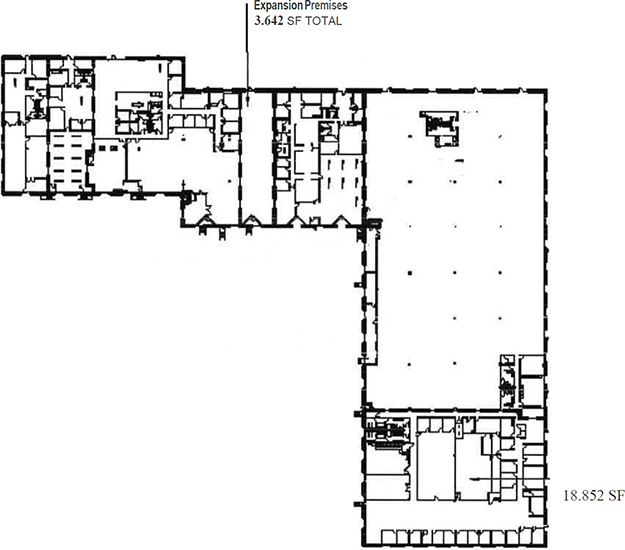
Exhibit B
WORK LETTER (EXPANSION
PREMISES IMPROVEMENTS)
1. Acceptance
of Premises. Tenant acknowledges and agrees that it shall accept the Expansion Premises in its “AS IS”
condition as of Landlord’s delivery of possession of the Expansion Premises and the Expansion Premises Commencement
Date.
2. EP Space Plans.
2.1 Preparation
and Delivery. On or before the tenth (30th)
business day following the Second Amendment Effective Date (such date is referred to herein as the “EP Space
Plans Delivery Deadline”), Tenant shall deliver to Landlord a space plan prepared by a design consultant reasonably
acceptable to Landlord (for purposes of the Expansion Premises Improvements, the “Architect”) depicting
the improvements to be installed in the Expansion Premises (the “EP Space Plans”). Landlord hereby acknowledges
and consents to Tenant contracting with MHA Works as the Architect.
2.2 Approval
Process. Landlord shall notify Tenant in writing whether it approves of the submitted EP Space Plans within five (5) business
days after Tenant’s submission thereof, which acceptance shall not be unreasonably withheld, conditioned, or delayed provided
that they comply with all Applicable Laws and are reasonably consistent with Tenant’s intended use of, and ancillary functions
at, the Expansion Premises, do not depict any matter which would (a) adversely affect (in the reasonable discretion of Landlord)
the Building’s structure or the Building’s systems (including the Building’s restrooms or mechanical rooms),
or (b) affect (in the reasonable discretion of Landlord) the Common Areas, the exterior appearance of the Project, or the provision
of services to other occupants of the Project (Landlord acknowledging that the Off-Premises Equipment will affect the exterior
of the Project). If Landlord has comments concerning such EP Space Plans, then Landlord shall notify Tenant in writing thereof
specifying in reasonable detail the reasons for such disapproval and the concerns or comments in connection therewith, in which
case Tenant shall, within three (3) business days after such notice, reasonably revise such EP Space Plans in consideration of
Landlord’s objections and submit to Landlord for its review and approval. Landlord shall notify Tenant in writing whether
it approves of the resubmitted EP Space Plans within three (3) business days after its receipt thereof. This process shall be
repeated until the EP Space Plans have been finally approved by Landlord and Tenant. If Landlord fails to notify Tenant of its
disapproval of and that it has comments or concerns with the initial EP Space Plans within five (5) business days (or, in the
case of resubmitted EP Space Plans, within three [3] business days) after the submission thereof, then Landlord shall be deemed
to have approved the EP Space Plans in question.
3.1 Preparation
and Delivery. On or before the tenth (10th ) business day following the date on
which the EP Space Plans are approved (or deemed approved) by Landlord and Tenant (such date is referred to herein as the “EP
Working Drawings Delivery Deadline”), Tenant shall provide to Landlord for its approval the initial set of final working
drawings, prepared by the Architect, of all improvements that Tenant proposes installing in the Expansion Premises; such working
drawings shall include the partition layout, ceiling plan, electrical outlets and switches, telephone outlets, drawings for any
modifications to the mechanical, electrical, life safety and plumbing and any other systems of the Building, and detailed plans
and specifications for the construction of the improvements called for under this Exhibit B
in accordance with all Applicable Laws and suitable for permitting and construction.
3.2 Approval
Process. As to each set of EP Working Drawings submitted, Landlord shall notify Tenant whether it approves of the submitted
working drawings within ten (10) business days after Tenant’s submission thereof, which approval shall be given or withheld
by Landlord in accordance with the standards set forth in Section 3.3. If Landlord has comments concerning such working drawings,
then Landlord shall notify Tenant in writing thereof specifying in reasonable detail the reasons for such disapproval and the
concerns or comments in connection therewith, in which case Tenant shall, within three (3) business days after such notice, reasonably
revise such working drawings in consideration of Landlord’s objections and submit the revised working drawings to Landlord
for its review and approval. Landlord shall notify Tenant in writing whether it approves of the resubmitted working drawings within
five (5) business days after its receipt thereof. This process shall be repeated until the working drawings have been finally
approved by Tenant and Landlord. If Landlord fails to notify Tenant that it disapproves of and/or has comments or concerns with
the initial working drawings within ten (10) business days (or, in the case of resubmitted working drawings, within five [5] business
days) after the submission thereof, then Landlord shall be deemed to have approved the working drawings in question.
3.3 Landlord’s
Approval; Performance of Expansion Premises Improvements. If any of Tenant’s proposed construction work will affect
the Building’s structure or the Building’s systems, then the working drawings pertaining thereto must be approved
by the Landlord’s engineer of record. Landlord shall coordinate the review and approval of its Project engineer and shall
use commercially reasonable efforts to ensure that such approval shall coincide with Landlord’s review and approval process
set forth in Section 3.2. Landlord’s approval of such working drawings shall not be unreasonably withheld, conditioned,
or delayed (and Landlord shall use commercially reasonable efforts to cause its engineer not to unreasonably withhold, condition
or delay its approval of any working drawings requiring such engineer’s approval), provided that (a) they comply with all
Applicable Laws and are reasonably consistent with Tenant’s intended use of, and ancillary functions at, the Expansion Premises,
(b) the improvements depicted thereon do not (1) adversely affect (in the reasonable discretion of Landlord) the Building’s
structure or the Building’s systems (including the Project’s restrooms or mechanical rooms), or (2) affect (in the
reasonable discretion of Landlord) (A) the exterior appearance of the Project, (B) the appearance of the Project’s common
areas or elevator lobby areas or (C) the provision of services to other occupants of the Project, (c) such working drawings are
sufficiently detailed to allow construction of the improvements and associated work in a good and workmanlike manner, and (d)
the improvements depicted thereon conform to the rules and regulations promulgated from time to time by Landlord for the construction
of tenant improvements (a copy of which has been delivered to Tenant). As used herein, “EP Working Drawings” means
the final working drawings approved by Landlord and Tenant, as amended from time to time by any approved changes thereto, and
“Expansion Premises Improvements” means all improvements to be constructed in accordance with and as indicated
on the EP Working Drawings, together with any work required by governmental authorities to be made to other areas of the Project
as a result of the improvements indicated by the EP Working Drawings. Landlord’s approval of the EP Working Drawings shall
not be a representation or warranty of Landlord that such drawings are adequate for any use or comply with any Applicable Law,
but shall merely be the consent of Landlord thereto. Landlord shall, at Tenant’s request, sign the EP Working Drawings to
evidence its review and approval thereof. After the final version of the EP Working Drawings have been approved, Tenant shall
cause the Expansion Premises Improvements to be performed substantially in accordance with the EP Working Drawings. LANDLORD
MAKES NO WARRANTIES, EXPRESS OR IMPLIED, WITH RESPECT TO THE EP SPACE PLANS, THE EP WORKING DRAWINGS OR THE EXPANSION PREMISES
IMPROVEMENTS (OR ANY OTHER SERVICES PROVIDED BY THE ARCHITECT, TENANT’S CONTRACTOR OR ANY OF THEIR SUBCONTRACTORS). ALL
IMPLIED WARRANTIES BY LANDLORD WITH RESPECT TO THE EP SPACE PLANS, EP WORKING DRAWINGS OR THE EXPANSION PREMISES IMPROVEMENTS
(OR ANY OTHER SERVICES PROVIDED BY THE ARCHITECT, TENANT’S CONTRACTOR OR ANY OF THEIR SUBCONTRACTORS), INCLUDING BUT NOT
LIMITED TO THOSE OF HABITABILITY, MERCHANTABILITY, MARKETABILITY, QUALITY AND FITNESS FOR A PARTICULAR PURPOSE, ARE EXPRESSLY
NEGATED AND WAIVED. WITHOUT LIMITING THE FOREGOING, LANDLORD SHALL NOT BE RESPONSIBLE FOR ANY FAILURE OF THE EXPANSION PREMISES
IMPROVEMENTS. LANDLORD WILL NOT BE RESPONSIBLE FOR, OR HAVE CONTROL OR CHARGE OVER, THE ACTS OR OMISSIONS OF THE ARCHITECT OR
ITS AGENTS OR EMPLOYEES. LANDLORD IS NOT ACTING AS A CONTRACTOR AND IS NOT GUARANTEEING THE EP SPACE PLANS, THE EP WORKING DRAWINGS
OR THE EXPANSION PREMISES IMPROVEMENTS, TENANT’S SOLE RECOURSE WITH RESPECT THERETO BEING THE PURSUIT OF TENANT’S
REMEDIES UNDER THE CONSTRUCTION CONTRACT (as defined below) OR IN TENANT’S ARCHITECT’S AGREEMENT.
4. Contractors;
Performance of Work. The Expansion Premises Improvements shall be performed only by a licensed contractor (“General
Contractor”) and licensed subcontractors. Landlord shall have the right to require that any contractors and/or subcontractors
performing work on the life safety systems or to the roof of the Building be on Landlord’s approved contractor list. Additionally,
Landlord may require that the General Contractor be approved in writing by Landlord, which approval shall not be unreasonably
withheld, conditioned, or delayed. Landlord hereby acknowledges and consents to Tenant contracting with McDonald York Building
Company as the General Contractor. The General Contractor shall be required to procure and maintain insurance covering the General
Contractor and all subcontractors against such risks, in such amounts, and with such companies as Landlord may reasonably require.
Certificates of such insurance, with paid receipts therefor, must be received by Landlord before the Expansion Premises Improvements
are commenced. The Expansion Premises Improvements shall be performed in a good and workmanlike manner free of defects, shall
substantially conform with the EP Working Drawings, and shall be performed in such a manner and at such times as and not to interfere
with or delay Landlord’s other contractors, the operation of the Project, and the occupancy thereof by other tenants. Tenant,
Tenant’s Project Manager, and General Contractor shall contact Landlord and schedule time periods during which they (or
any subcontractors) may use Project facilities in connection with the Expansion Premises Improvements (e.g., elevators, excess
electricity, etc.). Tenant shall use (and cause its contractors and subcontractors to use) commercially reasonable efforts to
commence and complete the Expansion Premises Improvements as soon as reasonably possible, and shall diligently prosecute the Expansion
Premises Improvements to completion.
| 5. | Construction Contracts. |
5.1 Tenant’s
General Contractor. Tenant shall enter into a construction contract with a general contractor selected by Tenant and approved
by Landlord in a form acceptable to Tenant’s representative for the Expansion Premises Improvements, which shall comply
with the provisions of this Section 5 and provide for, among other things, (a) a one-year warranty for all defective Expansion
Premises Improvements; (b) a requirement that Tenant’s General Contractor maintain, on behalf of the General Contractor
and all subcontractors, commercial general liability insurance of not less than a combined single limit of$5,000,000, naming Landlord,
Landlord’s property management company, Landlord’s Mortgagee, Tenant, and each of their respective Affiliates as additional
insureds; (c) a requirement that the contractor perform the Expansion Premises Improvements in substantial accordance with the
EP Working Drawings (and such plans and drawings are specifically referenced and/or itemized in the Contract) and in a good and
workmanlike manner; (d) a requirement that the General Contractor is responsible for daily cleanup work and final clean up (including
removal of debris); and (e) those items described in Section 5.2 below (collectively, the “Approval Criteria”).
Tenant shall provide Landlord with a copy of the proposed contract with the General Contractor and Landlord shall have three
(3) business days after receipt thereof to notify Tenant whether it approves the proposed construction agreements, such approval
shall not be unreasonably withheld, conditioned, or delayed provided such contract complies with the terms of this Exhibit
B and any applicable provisions of the Lease, as amended by this Second Amendment. If Landlord has comments concerning
the proposed construction agreement (in which case such draft of the construction agreement shall be deemed disapproved by Landlord),
then it shall specify in writing and in reasonable detail the reasons for such disapproval and comments or concerns, in which
case Tenant shall revise the proposed construction agreement to reasonably address the Landlord’s comments and resubmit
the proposed construction agreement to Landlord within two (2) business days after Landlord notifies Tenant of its objections
thereto, following which Landlord shall have two (2) business days to notify Tenant whether it approves the revised construction
agreement. If Landlord fails to notify Tenant that it has comments or concerns with the construction agreements within three (3)
business days after the initial construction agreements or two (2) business days after the revised construction agreements (as
the case may be) are delivered to Landlord, then Landlord shall be deemed to have approved the construction agreements.
5.2 All
Construction Contract. Unless otherwise agreed in writing by Landlord and Tenant, each of Tenant’s construction
contracts with the General Contractor shall: (a) provide a schedule and sequence of construction activities and completion reasonably
acceptable to Landlord (“Construction Schedule”), (b) be in a contract form that satisfies the Approval Criteria,
(c) require the contractor and each subcontractor to name Landlord, Landlord’s property management company, Landlord’s
Mortgagee, and Tenant as additional insured on such contractor’s insurance maintained in connection with the construction
of the Expansion Premises Improvements, (d) be assignable following an Event of Default by Tenant under the Lease, as amended
by this Second Amendment, to Landlord and Landlord’s Mortgagees, (e) contain at least a one-year warranty for all workmanship
and materials, and (f) require the General Contractor to obtain extended warranties for all air handling units, chillers (and
associated VFD’s) and generators (if any) installed in the Expansion Premises as part of the Expansion Premises Improvements.
6. Change
Orders. Tenant may initiate changes in the Expansion Premises Improvements. Each such change must receive the prior written
approval of Landlord, such approval shall be granted or withheld in accordance with the standards set forth in Section 3.3 above.
Tenant shall, upon completion of the Expansion Premises Improvements, furnish Landlord with accurate architectural, mechanical,
electrical and plumbing “as built” plans of the Expansion Premises Improvements as constructed in both blueprint and
electronic CADD format, which plans shall be incorporated into this Exhibit B by this reference for all purposes.
If Tenant requests any changes to the Expansion Premises Improvements described in the EP Working Drawings, then such increased
costs and any additional design costs incurred in connection therewith as the result of any such change shall be added to the
Total EP Construction Costs. Tenant shall provide Landlord with a copy of the proposed change and Landlord shall have five (5)
business days of receipt thereof to notify Tenant whether it approves the proposed change, such approval shall be granted or withheld
in accordance with the standards set forth in Section 3.3 above. If Landlord has comments concerning the proposed change (in which
case such initially proposed change shall be deemed disapproved by Landlord pending such comments being addressed), then it shall
specify in writing reasonable detail the reasons for such comments or concerns, in which case Tenant shall revise the proposed
change request to reasonably address the Landlord’s comments and resubmit the requested change to Landlord within two (2)
business days after Landlord notifies Tenant of its comments thereto, following which Landlord shall have five (5) business days
to notify Tenant whether it approves the revised change request. If Landlord fails to notify Tenant that it has comments or concerns
with the change request within five (5) business days after submission of such change request or revised change request (as the
case may be) to Landlord, then Landlord shall be deemed to have approved the change request.
7. Definitions.
As used herein “Substantial Completion,” “Substantially Completed,” and any derivations
thereof mean the Expansion Premises Improvements in the Expansion Premises are substantially completed (as reasonably determined
by Landlord and the Architect) in accordance with the final version of the EP Working Drawings (inclusive of all phases of the
Expansion Premises Improvements), which shall be deemed to have occurred once Tenant has (a) obtained a permanent certificate
of occupancy for the entire Premises, inclusive of the Expansion Premises, from the applicable governmental authority and delivered
proof of the same to Landlord, (b) delivered to Landlord certification from the Architect that the Expansion Premises Improvements
have been completed in a good and workmanlike manner and substantially in accordance with the EP Working Drawings, and in accordance
with all applicable laws, on the appropriate AIA form or another form approved by Landlord, and (c) completed commissioning of
all MEP equipment and systems installed by Tenant, as evidenced by an approved final inspection from the applicable governmental
authority. Within thirty (30) days following Substantial Completion of the Expansion Premises Improvements, Tenant shall deliver
to Landlord the following reports: (i) commissioning checklists and start-up reports for all HVAC systems and equipment and Tenant’s
generator, all signed by factory certified representatives of the manufacturers of such equipment; (ii) a certified TAB report
for all HVAC systems; and (iii) a final commissioning report that all HVAC and emergency power systems are functioning properly.
Substantial Completion shall have occurred even though minor details of construction (i.e., aesthetic/architectural defects as
defined in the punchlist prepared pursuant to Section 8 below), decoration, and landscaping remain to be completed.
(3) Walk-Through;
Puncblist. When Tenant considers the Expansion Premises Improvements in the Premises to be Substantially Completed, Tenant
will notify Landlord and within three business days thereafter, Landlord’s representative and Tenant’s representative
shall conduct a walk- through of the Premises and identify any necessary touch-up work, repairs and minor completion items that
are necessary for final completion of the Expansion Premises Improvements. Neither Landlord’s representative nor Tenant’s
representative shall unreasonably withhold, condition or delay his or her agreement on punchlist items. Tenant shall use reasonable
efforts to cause the General Contractor performing the Expansion Premises Improvements to complete all punchlist items within
thirty (30) days after agreement thereon.
8. Excess
Costs. Tenant shall pay the entire amount by which the Total EP Construction Costs (hereinafter defined) exceed the Expansion
Premises Construction Allowance (hereinafter defined) (such excess amount being referred to herein as the “Excess Amount”).
Upon approval of the EP Working Drawings and selection of a contractor, Tenant shall promptly execute a work order agreement
which identifies such drawings and itemizes the Total EP Construction Costs and sets forth the Expansion Premises Construction
Allowance. As used herein, “Total EP Construction Costs” means the entire cost of performing the Expansion
Premises Improvements, including design of and space planning for the Expansion Premises Improvements and preparation of the EP
Working Drawings and the final “as-built” plan of the Expansion Premises Improvements, costs of construction labor
and materials, electrical usage during construction, additional janitorial services, standard building directory and suite tenant
signage, related taxes and insurance costs, licenses, permits, certifications, surveys and other approvals required by Applicable
Law, and the construction supervision fee referenced in Section 11 of this Exhibit.
9. Expansion
Premises Construction Allowance. Landlord shall provide to Tenant a construction allowance not to exceed $115 per rentable
square foot in the Expansion Premises (i.e., a total maximum allowance of $418,830.00) (the “Expansion Premises Construction
Allowance”) to be applied toward the Total EP Construction Costs, as adjusted for any changes to the Expansion Premises
Improvements. No disbursement of the Expansion Premises Construction Allowance shall be made by Landlord until Tenant has first
made payment to the General Contractor from its own funds (and provided reasonable evidence thereof to Landlord). Thereafter,
Landlord shall pay to Tenant the Expansion Premises Construction Allowance, to be applied solely toward the remaining Total EP
Construction Costs and not in reimbursement of the Excess Amount paid by Tenant, in four disbursements (but not more than once
in any calendar month) in accordance with the following draw schedule: (a) up to 25% of the Expansion Premises Construction Allowance
within thirty (30) days after Tenant (i) delivers a written request for such payment to Landlord, (ii) has completed construction
of 25% of the Expansion Premises Improvements in accordance with the EP Working Drawings (as evidenced by a written certification
from Tenant’s Architect that such 25% portion of the Expansion Premises Improvements have been completed in a good and workmanlike
manner and in accordance with all applicable laws, which certification shall be on a form approved by Landlord and provided to
Landlord simultaneously with such draw request), (iii) provides Landlord with conditional or partial lien waivers, as the case
may be, from the General Contractor and all contractors, subcontractors and materialmen who performed the Expansion Premises Improvements
and contracted directly with Tenant, fully executed, acknowledged and in a form reasonably approved by Landlord, and (iv) provides
Landlord with copies of all invoices in connection with such Expansion Premises Improvements for which Tenant is seeking reimbursement
and proof of payment of the same; (b) an additional 25% of the Expansion Premises Construction Allowance within thirty (30) days
after Tenant (i)
delivers a written request for such payment to Landlord, (ii) has completed construction of 50% of the Expansion Premises Improvements
in accordance with the EP Working Drawings (as evidenced by a written certification from Tenant’s Architect that 50% of
the Expansion Premises Improvements have been completed in a good and workmanlike manner and in accordance with all applicable
laws, which certification shall be on a form approved by Landlord and provided to Landlord simultaneously with such draw request),
(iii) provides Landlord with conditional or partial lien waivers, as the case may be, from the General Contractor and all contractors,
subcontractors and materialmen who performed the Expansion Premises Improvements and contracted directly with Tenant, fully executed,
acknowledged and in a form reasonably approved by Landlord, and (iv) provides Landlord with copies of all invoices in connection
with such Expansion Premises Improvements for which Tenant is seeking reimbursement and proof of payment of the same; (c) an additional
25% of the Expansion Premises Construction Allowance within thirty (30) days after Tenant (i) delivers a written request for such
payment to Landlord, (ii) has completed construction of 75% of the Expansion Premises Improvements in accordance with the EP Working
Drawings (as evidenced by a written certification from Tenant’s Architect that 75% of the Expansion Premises Improvements
have been completed in a good and workmanlike manner and in accordance with all applicable laws, which certification shall be
on a form approved by Landlord and provided to Landlord simultaneously with such draw request), (iii) provides Landlord with conditional
or partial lien waivers, as the case may be, from the General Contractor and all contractors, subcontractors and materialmen who
performed the Expansion Premises Improvements and contracted directly with Tenant, fully executed, acknowledged and in a form
reasonably approved by Landlord, and (iv) provides Landlord with copies of all invoices in connection with such Expansion Premises
Improvements for which Tenant is seeking reimbursement and proof of payment of the same; and (d) the remaining portion of the
Expansion Premises Construction Allowance to which Tenant is entitled hereunder within thirty (30) days after the satisfaction
of each of the following conditions: (i) Tenant’s written request to Landlord for payment of such remaining portion of the
Expansion Premises Construction Allowance, (ii) Landlord’s receipt of final, unconditional lien waivers from the General
Contractor and all contractors, subcontractors and materialmen who performed the Expansion Premises Improvements and contracted
directly with Tenant, fully executed, acknowledged and in a form reasonably approved by Landlord, (iii) Landlord’s receipt
of copies of all invoices related to the costs for which Tenant is seeking reimbursement and proof of payment of same, (iv) Landlord’s
receipt of the Architect’s certification that the Expansion Premises Improvements have been finally completed in a good
and workmanlike manner and in accordance with all applicable laws, including any punch-list items, on the appropriate AIA form
or another form approved by Landlord, (v) Tenant’s delivery to Landlord of the permanent certificate of occupancy issued
for the Premises, as expanded by the Expansion Premises, (vi) Tenant’s occupancy of the Premises, as expanded by the Expansion
Premises, (vii) Tenant’s delivery to Landlord of the “as built” plans for the Expansion Premises Improvements
as constructed (and as set forth above) to Landlord’s construction representative (set form below), and (viii) Landlord’s
receipt of an estoppel certificate confirming such factual matters as Landlord or Landlord’s Mortgagee may reasonably request.
Each application for payment from Tenant hereunder satisfying all of the conditions required for such payment is hereinafter referred
to as a “Completed Application for Payment” solely for purposes of this Second Amendment. If, however, the
Completed Application for Payment is incomplete or incorrect, Landlord’s payment of such request shall be deferred until
thirty (30) days following Landlord’s receipt of the corrected Completed Application for Payment. Notwithstanding anything
to the contrary contained in this Exhibit, Landlord shall not be obligated to make any disbursement of the Expansion Premises
Construction Allowance during the pendency of any of the following: (A) Landlord has received written notice of any unpaid claims
relating to any portion of the Expansion Premises Improvements or materials in connection therewith, other than claims which will
be paid in full from such disbursement, (B) there is an unbonded lien outstanding against the Project or the Premises or Tenant’s
interest therein by reason of work done, or claimed to have been done, or materials supplied or specifically fabricated, claimed
to have been supplied or specifically fabricated, to or for Tenant or the Premises, as expanded by the Expansion Premises, (C)
the conditions to the disbursement of the Expansion Premises Construction Allowance are not satisfied, or (D) an Event of Default
by Tenant exists. After the final completion of the Expansion Premises Improvements and a reconciliation by Landlord of the Expansion
Premises Construction Allowance and the Total Construction Costs applicable to the Expansion Premises Improvements and provided
no Event of Default then exists, Tenant may use any excess portion of the Expansion Premises Construction Allowance (not to exceed
fifty percent [50%] of the total Expansion Premises Construction Allowance) remaining after payment of the Total Construction
Costs applicable to the Expansion Premises Improvements towards payment of the Total Construction Costs applicable to the Work
to the Existing Premises performed by Tenant pursuant to Exhibit D of the Lease; provided, however, that Landlord shall not be
required to disburse such excess amount to Tenant if Tenant has not satisfied the conditions related to the payment of the Construction
Allowance with respect to such portion of the Work, as provided in Section 10 of Exhibit D of the Lease. Such excess amount requested
by Tenant in connection with the payment of the Total Construction Costs applicable to the Work in the Existing Premises shall
be disbursed by Landlord in accordance with Section 10 of Exhibit D of the Lease and within thirty (30) days after Landlord’s
receipt of a Completed Application for Payment (as such term is used in Exhibit D of the Lease) with respect to the applicable
portion of the Work. The Expansion Premises Construction Allowance must be used (that is, the Expansion Premises Improvements
must be fully complete and the Expansion Premises Construction Allowance disbursed) within twelve (12) months following the EP
Rent Commencement Date (the “Outside EPCA Disbursement Date”) or shall be deemed forfeited with no further
obligation by Landlord with respect thereto, time being of the essence with respect thereto. Notwithstanding the foregoing, if
Tenant is delayed from completing the Expansion Premises Improvements as a result of an event of Force Majeure occurring prior
to the Outside EPCA Disbursement Date, the Outside EPCA Disbursement Date shall be extended by one (1) day for each day of delay
caused by such Force Majeure. Tenant shall notify Landlord of any such event of Force Majeure in accordance with the provisions
of Section 29.17 of the Lease and shall use commercially reasonable efforts to limit any delay to the completion of the Expansion
Premises Improvements caused by such Force Majeure.
10. Right
of Inspection. Landlord or its Affiliate or agent may inspect the Expansion Premises Improvements and coordinate the relationship
between the Expansion Premises Improvements, the Project and the Building’s Systems. Landlord and Landlord’s representative,
Affiliate or agent shall notify Tenant upon entering the Premises (including the Expansion Premises), shall use commercially reasonable
efforts not to unreasonably interfere with the Expansion Premises Improvements or activities at the Premises (including the Expansion
Premises) and shall fully abide by all site safety and security requirements provided to Landlord in writing, including without
limitation, all requirements and governmental guidance related to the COVID-19 pandemic. Tenant shall pay to Landlord a construction
supervision fee equal to four percent (4%) of the total Expansion Premises Construction Allowance disbursed to Tenant (exclusive
of the construction supervision fee). The construction supervision fee shall be paid directly to Landlord out of the proceeds
of the Expansion Premises Construction Allowance prior to distribution to Tenant.
11. Construction
Representatives. Landlord’s and Tenant’s representatives for coordination of construction and approval of
change orders will be as follows, provided that either party may change its representative upon written notice to the other:
| Landlord’s Representative: |
Copper II 2020, LLC |
| |
c/o Lincoln Harris LLC |
| |
5400 Trinity Road, Suite 200 Raleigh, NC 27607 |
| |
Attn: Paul Pierron |
| |
Telephone: 919.215.4872 |
| |
Email: [email protected] |
| |
|
| Tenant’s Representative: |
Andrew Novak |
| |
c/o Novan, Inc. |
| |
4105 Hopson Road |
| |
Morrisville, NC 27560 |
| |
Telephone: 919.485.8080 |
| |
Facsimile: 919.237.9212 |
| |
Email: [email protected] |
| |
|
| With a copy to: |
G. Wayne Fuller Jr., PE |
| |
c/o MultiCore International, Inc. |
| |
4220 Old Gun Road East |
| |
Midlothian, VA 23113 |
| |
Telephone: (804) 513-7727 |
| |
Email: [email protected] |
Tenant’s Project
Manager will provide assistance to Tenant with respect to the Expansion Premises Improvements and acting as a liaison between
and among Tenant and Landlord during the performance of the Expansion Premises Improvements. Tenant hereby notifies Landlord that
Tenant’s Project Manager does not have the authority to direct or agree to a change in the scope, cost or timeframe for
performing of the Expansion Premises Improvements or otherwise bind Tenant, except as otherwise expressly set forth herein or
expressly stated by Tenant or Tenant’s representative.
12. Miscellaneous.
To the extent not inconsistent with this Exhibit, Articles 8, 10 and 15 of the Lease shall govern the performance of the
Expansion Premises Improvements and Landlord’s and Tenant’s respective rights and obligations regarding the improvements
installed pursuant thereto. For purposes of clarity, the provisions of this Exhibit B are intended to apply to the Expansion
Premises Improvements only and are not intended to modify Exhibit D of the Lease or any other provisions of the Lease related
to Tenant’s performance of the Work in the Existing Premises. Accordingly, any terms defined in this Exhibit B shall
not modify any defined terms set forth in Exhibit D of the Lease.
Exhibit 10.20
THIRD AMENDMENT
TO LEASE
This THIRD
AMENDMENT TO LEASE (this “Amendment”), dated as of October 17, 2023 (the “Effective Date”),
is made and entered into by and between TBC STIRRUP CREEK OWNER LLC, a Delaware limited liability company (“Landlord”),
and LNHC, INC., a Delaware corporation (“Tenant” or “LNHC”).
WITNESSETH:
WHEREAS,
Landlord’s predecessor-in-interest with respect to the Lease (defined below) and Novan, Inc., a Delaware corporation (“Original
Tenant” or “Novan”), entered into that certain Lease dated January 18, 2021 (the “Original
Lease”), as amended by that certain First Amendment to Lease dated March 18, 2021, as further amended by that certain
Second Amendment to Lease dated November 23, 2021 (collectively, the “Lease”) for the lease of space
known as Suite 110 in the building having an address of 4020 Stirrup Creek Drive, Durham, North Carolina 27703, all as more particularly
described in the Lease;
WHEREAS,
on or about the Effective Date, Original Tenant has assigned to Tenant, and Tenant has assumed, the Lease (the “Assignment”)
in the bankruptcy sale to LNHC of all or substantially all of the assets of Novan and certain of the assets of its subsidiary,
EPI Health LLC, a South Carolina limited liability company (“EPI”, and together with Novan, the “Debtors”),
in the Debtors’ chapter 11 bankruptcy cases filed in the United States Bankruptcy Court for the District of Delaware (the
“Bankruptcy Court”) and jointly administered under case no. 23-10937 (the “Bankruptcy Cases”);
and
WHEREAS, Landlord and Tenant desire to
enter into this Amendment on the terms and conditions contained herein.
NOW, THEREFORE,
in consideration of the mutual covenants herein contained, and other good and valuable consideration, the receipt and sufficiency
of which are hereby acknowledged, Landlord and Tenant agree as follows:
1. Capitalized
Terms. All capitalized terms used and not otherwise defined in this Amendment shall have the respective meanings ascribed
to them in the Original Lease.
2. Assumed
Contract. As of the Effective Date, the Lease shall be deemed an “Assumed Contract” with a $0.00 “Cure
Amount,” and designated on the “Assumed Contract List” pursuant to and as such terms are defined in that certain
(i) Order (I) Approving the Asset Purchase Agreement, (II) Authorizing the Sale of the Debtors’ Development Assets and
Certain of the Commercial Assets Free and Clear of All Encumbrances to LNHC, Inc., (III) Authorizing the Assumption and Assignment
of Certain Executory Contracts and Unexpired Leases, and (IV) Granting Related Relief, entered by the Bankruptcy Court in the
Bankruptcy Cases on September 12, 2023 at docket number 291 (“Sale Order”); and (ii) Amended and Restated
Asset Purchase Agreement, dated September 1, 2023, by and among Novan, EPI and LNHC (as the designee of Ligand Pharmaceuticals
Incorporated), and attached as Exhibit A to the Sale Order.
3. Assumption
of Liabilities. From and after the Effective Date, Tenant shall be responsible for all the obligations and liabilities
of “Tenant” under the Lease (as amended hereby), whether monetary or non-monetary, including, but not limited to, obligations
that are not yet known, liquidated or due and owing under the Lease as of the Effective Date which will be billed in the ordinary
course pursuant to the terms of the Lease.
4. Condition
of Premises. Landlord makes no representations or warranties, express or implied, concerning the condition of the Premises
and Tenant hereby accepts the Premises in their “AS-IS” condition as of the Effective Date.
5. Insurance;
Certificate of Occupancy. Before Tenant may occupy the Premises, (a) Tenant shall deliver to Landlord certificates of insurance
from Tenant satisfying all requirements of the Lease, and (b) if required by Applicable Law, Tenant shall deliver to Landlord a
new certificate of occupancy for the Premises from the applicable governmental authority (in accordance with Section 1.1.1 of the
Original Lease).
6. Brokerage.
Tenant represents and warrants to Landlord that neither Original Tenant nor Tenant has dealt with any broker or agent in connection
with the negotiation or execution of this Amendment. In no event shall Landlord be liable for any leasing or brokerage commission
with respect to the negotiation and execution of the Assignment or this Amendment. Tenant shall indemnify, defend and hold Landlord
harmless from and against all costs, expenses, attorneys’ fees and other liability for commissions or other compensation
claimed by any broker or agent claiming the same by, through or under Original Tenant or Tenant with respect to the Assignment
or this Amendment.
7. Notices.
The addresses and/or other contact information set forth below shall supersede and replace any addresses and/or contact information
for notice set forth in the Lease, pursuant to Section 29.18 therein.
| Landlord: |
TBC Stirrup Creek Owner LLC
c/o Lincoln Harris LLC |
| |
5400 Trinity Road, Suite 200 |
| |
Raleigh, NC 27607 |
| |
Attention: Property Manager – 4020 Stirrup |
| |
|
| with a copy to: |
TBC Stirrup Creek Owner LLC
c/o Goldman Sachs & Co. |
| |
2001 Ross Avenue, Suite 2800 |
| |
Dallas, TX 75201 |
| |
Attention: Asset Manager – 4020 Stirrup |
| |
|
| Tenant: |
LNHC, Inc. |
| |
3911 Sorrento Valley Boulevard, Suite 110
San Diego, CA 92121 |
| |
Attention: President |
| |
|
| with copies to: |
Ligand Pharmaceuticals Incorporated |
| |
3911 Sorrento Valley Boulevard, Suite 110
San Diego, CA 92121 |
| |
Attention: General Counsel |
| |
|
| |
-and- |
| |
|
| |
Ligand Pharmaceuticals Incorporated |
| |
3911 Sorrento Valley Boulevard, Suite 110
San Diego, CA 92121 |
| |
Attention: Chief Financial Officer |
8. Letter
of Credit. Within 30 calendar days following the Effective Date, Tenant shall provide Landlord with a replacement Letter
of Credit in the Letter of Credit Amount ($471,621.50) complying with the terms of Section 21 of the Original Lease. Following
Landlord’s approval of the replacement Letter of Credit, Tenant shall deliver the original to Goldman Sachs & Co., 2001
Ross Avenue, Suite 2800, Dallas, TX 75201, Attention: Keri Duran. Sections 21(f), 21(g) and 21(h) to the Original Lease are hereby
deleted in their entirety. Upon Landlord’s acceptance of Tenant’s replacement Letter of Credit pursuant to this Paragraph
8, Landlord shall provide its consent to, and/or use its reasonable efforts to cooperate with the Original Tenant in the surrender,
cancellation and/or termination of the Original Tenant’s Letter of Credit.
9. Guaranty.
Tenant shall, simultaneously with the execution and delivery of this Amendment, deliver to Landlord a Guaranty by Ligand Pharmaceuticals
Incorporated in the form of Exhibit A attached hereto. Tenant consents to the terms and provisions of such guaranty.
10. Miscellaneous.
(a) Except
as set forth herein, nothing contained in this Amendment shall be deemed to amend or modify in any respect the terms of the Lease
and such terms shall remain in full force and effect as modified hereby. If there is any inconsistency between the terms of this
Amendment and the terms of the Lease, the terms of this Amendment shall be controlling and prevail.
(b) This
Amendment contains the entire agreement of the parties with respect to its subject matter and all prior negotiations, discussions,
representations, agreements and understandings heretofore had among the parties with respect thereto are merged herein.
(c) This
Amendment may be executed in one or more counterparts, and by the different parties hereto in separate counterparts, each of which
when executed shall be deemed to be an original but all of which taken together shall constitute one and the same agreement. Delivery
of an executed counterpart of a signature page to this Amendment by facsimile, email or other electronic transfer shall be effective
as delivery of a manually executed counterpart to this Amendment.
(d) This
Amendment shall not be binding upon Landlord or Tenant unless and until each of Landlord and Tenant shall have delivered a fully
executed counterpart of this Amendment to the other.
(e) An
original, copy, facsimile, electronic signature (including, but not limited to, DocuSign), pdf or other electronically transmitted
copy of an undersigned’s signature shall be sufficient to execute this Amendment.
(f) This
Amendment shall be binding upon and inure to the benefit of Landlord and Tenant and their successors and permitted assigns. This
Amendment may not be amended or modified except by an instrument in writing signed by Landlord and Tenant.
(g) This
Amendment shall be governed by the laws of the State of North Carolina without giving effect to conflict of laws principles thereof.
(h) The
captions, headings, and titles in this Amendment are solely for convenience of reference and shall not affect its interpretation.
(i) The
submission of this Amendment by Landlord to Tenant for examination and/or execution shall not be construed as an offer and shall
not in any manner bind Landlord and Tenant shall not have any rights under this Amendment, and no obligations on Landlord shall
arise under this Amendment, unless and until Landlord executes a copy of this Amendment and delivers it to Tenant.
[end of page; signature
pages follow.]
IN WITNESS WHEREOF, Landlord and Tenant have executed
this Amendment as of the Effective Date.
| |
LANDLORD: |
| |
|
|
|
|
|
|
| |
TBC STIRRUP CREEK OWNER LLC, a Delaware limited liability company |
| |
By: |
TBC Stirrup Creek JV LLC, a Delaware limited liability company, its sole member |
| |
|
By: |
LH Stirrup Research LLC, a Delaware limited liability company, its operating member |
| |
|
|
By: |
Lincoln Harris LLC, a Delaware limited liability company, its manager |
| |
|
|
|
By: |
The Harris Group of Carolinas, Inc., a North Carolina corporation, its operating managing member |
| |
|
|
|
|
|
| |
|
|
|
|
By: |
 |
| |
|
|
|
|
|
Name: John W. Harris III |
| |
|
|
|
|
|
Title: Authorized Signatory |
| |
TENANT |
|
| |
|
|
|
| |
LNHC, INC., a Delaware corporation |
|
| |
|
|
| |
By: |
 |
|
| |
|
Name: Matthew Korenberg |
|
| |
|
Title: President |
|
JOINDER
Original
Tenant consents to the
execution of this Amendment. Original
Tenant agrees and acknowledges that Original Tenant shall
have no further right, title
or interest in
the interest of “Tenant” under
the Lease (as amended
hereby).
Executed as of the
Effective Date.
| |
ORIGINAL TENANT: |
|
| |
|
|
| |
NOVAN, INC. a Delaware corporation |
|
| |
|
|
|
| |
By: |
 |
|
| |
|
Name: Paula B. Stafford |
|
| |
|
Title: President and CEO |
|
EXHIBIT A
FORM OF GUARANTY
GUARANTY
In connection
with Landlord’s consent to the assumption and assignment (the “Assignment”) of the Lease (defined
below) from Novan, Inc., a Delaware corporation (“Original Tenant”), to LNHC, Inc., a Delaware corporation
(together with its permitted successors and assigns, “Tenant”), LIGAND PHARMACEUTICALS INCORPORATED,
a Delaware corporation (“Guarantor”), hereby unconditionally and irrevocably guarantees the complete
and timely performance of each obligation of Original Tenant and Tenant (and any successors or assignee of Tenant) under the Lease,
any extensions or renewals of and amendments to the Lease and to all new leases entered into by Landlord, its Affiliates, successors
or assignees and Tenant, its Affiliates, successors or assignees relating to space in the Project or any related complex. This
Guaranty is an absolute, primary, and continuing, guaranty of payment and performance (not collection) and is independent of Tenant’s
obligations under the Lease. Guarantor (and if this Guaranty is signed by more than one person or entity, each Guarantor hereunder)
shall be primarily liable, jointly and severally, with Original Tenant, Tenant and any other guarantor of Tenant’s obligations.
Guarantor waives any right to require Landlord to (a) join Original Tenant or Tenant with Guarantor in any suit arising under this
Guaranty, (b) proceed against or exhaust any security given to secure Original Tenant’s or Tenant’s obligations under
the Lease, (c) exercise any rights under Landlord’s remedies pursuant to the Lease, (d) take any action pursuant to applicable
forcible entry and detainer statutes, or (e) pursue or exhaust any other person (including Original Tenant and Tenant) or any other
remedy in Landlord’s power. As used herein, “Lease” means the Lease dated January 18, 2021 between
Original Tenant and Landlord’s predecessor-in-interest thereto, as amended by First Amendment to Lease dated March 18, 2021,
Second Amendment to Lease dated November 23, 2021, as amended by Third Amendment to Lease dated on or about the date hereof, and
as may be further amended from time to time. Capitalized terms used but not defined herein shall have the meanings given to them
in the Lease.
Until
all of Tenant’s obligations to Landlord have been discharged in full, Guarantor shall have no right of subrogation against
Tenant. Landlord may, without notice or demand and without affecting Guarantor’s liability hereunder, from time to time,
compromise, extend, renew or otherwise modify any or all of the terms of the Lease by amendment, novation or otherwise (including
a new lease, to the extent a court of competent jurisdiction determines any of the foregoing constitutes a new lease), or fail
to perfect, or fail to continue the perfection of, any security interests granted under the Lease. Without limiting the generality
of the foregoing, if Tenant elects to increase the size of the leased premises, extend or renew the lease term, or otherwise expand
Tenant’s obligations under the Lease, Tenant’s execution of such lease documentation shall constitute Guarantor’s
consent thereto (and such increased obligations of Tenant under the Lease shall constitute a guaranteed obligation hereunder);
Guarantor hereby waives any and all rights to consent thereto. Guarantor waives any right to participate in any security now or
hereafter held by Landlord. Guarantor hereby waives all presentments, demands for performance, notices of nonperformance, protests,
notices of protest, dishonor and notices of acceptance of this Guaranty, and waives all notices of existence, creation or incurring
of new or additional obligations from Tenant to Landlord. Guarantor further waives all defenses afforded guarantors or based on
suretyship or impairment of collateral under applicable Law, other than payment and performance in full of Tenant’s obligations
under the Lease. The liability of Guarantor under this Guaranty will not be affected by (a) the release or discharge of Original
Tenant or Tenant from, or impairment, limitation or modification of, Tenant’s obligations under the Lease in any bankruptcy,
receivership, or other debtor relief proceeding, whether state or federal and whether voluntary or involuntary; (b) the rejection
or disaffirmance of the Lease in any such proceeding; or (c) the cessation from any cause whatsoever of the liability of Original
Tenant or Tenant under the Lease.
Guarantor
shall not, without the prior written consent of Landlord, (a) assign or transfer this Guaranty or any estate or interest herein,
whether directly or by operation of law, (b) permit any other entity to become Guarantor hereunder by merger, consolidation, or
other reorganization, (c) if Guarantor is an entity other than a corporation whose stock is publicly traded, permit the transfer
of an ownership interest in Guarantor so as to result in a change in the current direct or indirect control of Guarantor, or (d)
sell or otherwise transfer, in one or more transactions, a majority of Guarantor’s assets. If Guarantor violates the foregoing
restrictions or otherwise defaults under this Guaranty, Landlord shall have all available remedies at law and in equity against
Guarantor and Tenant. Without limiting the generality of the foregoing, Landlord may (1) declare an immediate Event of Default
under the Lease, (2) require
both or either (at Landlord’s election) of Guarantor or Tenant to deliver to Landlord additional security for the obligations
of Tenant and Guarantor under the Lease and the Guaranty, respectively, which additional security may be in the form of an irrevocable
letter of credit in form and substance satisfactory to Landlord, and in an amount to be determined by Landlord in its reasonable
discretion, and (3) increase by 25% the amount of Base Rent payable by Tenant under the Lease, with such increased Base Rent to
continue until Guarantor cures such violation or default, to compensate Landlord, for among other things, the reasonable estimate
in the diminution in the fair market value of the Project. Landlord and Tenant agree that Landlord’s damages resulting from
Guarantor’s default under this Guaranty are difficult, if not impossible, to determine and the Base Rent increase as provided
above is a fair estimate of those damages which has been agreed to in an effort to cause the amount of such damages to be certain.
Any and all remedies set forth in this Guaranty: (A) shall be in addition to any and all other remedies Landlord may have at law
or in equity, (B) shall be cumulative, and (C) may be pursued successively or concurrently as Landlord may elect. The exercise
of any remedy by Landlord shall not be deemed an election of remedies or preclude Landlord from exercising any other remedies in
the future.
Notwithstanding
the foregoing, Guarantor may permit any other entity to become Guarantor hereunder and/or permit the transfer of an ownership interest
in Guarantor (each a “Permitted Guarantor Change”) without the written consent of Landlord, provided
the new Guarantor is:
(1) any
corporation, limited partnership, limited liability partnership, limited liability company or other business entity in which or
with which Guarantor, or its corporate successors or assigns, is merged or consolidated, in accordance with applicable statutory
provisions governing merger and consolidation of business entities, so long as (A) Guarantor’s obligations hereunder are
assumed by the entity surviving such merger or created by such consolidation; and (B) the proposed transferee has tangible net
worth of no less than $250,000,000.00 as of the effective date of the Permitted Guarantor Change; or
(2) any
corporation, limited partnership, limited liability partnership, limited liability company or other business entity acquiring all
or substantially all of Guarantor’s assets, so long as (A) Guarantor’s obligations hereunder are assumed by the entity
acquiring such assets; and (B) the proposed transferee has tangible net worth of no less than $250,000,000.00 as of the effective
date of the Permitted Guarantor Change.
Guarantor
shall promptly notify Landlord of any such Permitted Guarantor Change. Guarantor shall remain liable for the performance of all
of the obligations of Guarantor hereunder, or if Guarantor no longer exists because of a merger, consolidation, or acquisition,
the surviving or acquiring entity shall expressly assume in writing the obligations of Guarantor hereunder. No later than ten days
after the effective date of any Permitted Guarantor Change, Guarantor agrees to furnish Landlord with (i) copies of the instrument
effecting any of the foregoing Permitted Guarantor Changes, and (ii) documentation establishing Guarantor’s satisfaction
of the requirements set forth above applicable to any such Permitted Guarantor Change.
Guarantor
represents and warrants to Landlord, as a material inducement to Landlord to consent to the Assignment, that (a) this Guaranty
and each instrument securing this Guaranty have been duly executed and delivered and constitute legally enforceable obligations
of Guarantor; (b) there is no action, suit or proceeding pending or, to Guarantor’s knowledge, threatened against or affecting
Guarantor, at law or in equity, or before or by any governmental authority, which might result in any materially adverse change
in Guarantor’s business or financial condition; (c) execution of this Guaranty will not render Guarantor insolvent; (d) Guarantor
expects to receive substantial benefits from Tenant’s financial success; (e) this Guaranty may reasonably be expected directly
or indirectly to benefit Guarantor; and (f) the financial statements or other financial information pertaining to Guarantor or
its Affiliates delivered to Landlord in connection with the negotiation of the Lease or pursuant to this Guaranty are and will
be based upon and are consistent in all material respects with the information contained in the Guarantor’s books and records,
have been or will be prepared and reviewed by Guarantor, based on GAAP consistently applied throughout the periods indicated (except
as may be indicated in the notes thereto) and fairly present, in all material respects, the financial position of the Guarantor
as of the date thereof and the results of its respective operations for the periods then ended, except as otherwise noted therein;
provided that the interim financial statements are subject to customary recurring year-end adjustments, which in the aggregate
are not material, and lack footnotes and other presentation items. Guarantor shall pay to Landlord all out-of-pocket costs incurred
by Landlord in enforcing this Guaranty (including, without limitation, reasonable attorneys’ fees and expenses). The obligations
of Tenant under the Lease to execute and deliver estoppel and financial statements, as therein provided, shall be deemed to also
require the Guarantor hereunder to do so and provide the same relative to Guarantor following written request by Landlord in accordance
with the terms of the Lease. All notices and other communications given pursuant to, or in connection with, this Guaranty shall
be delivered in the same manner required in the Lease. All notices or other communications addressed to Guarantor shall be delivered
at the address set forth below. This Guaranty shall be binding upon the heirs, legal representatives, successors and assigns of
Guarantor and shall inure to the benefit of Landlord’s successors and assigns.
This Guaranty
will be governed by and construed in accordance with the laws of the State in which the Premises (as defined in the Lease) are
located. The proper place of venue to enforce this Guaranty will be the county or district in which the Premises are located. In
any legal proceeding regarding this Guaranty, including enforcement of any judgments, Guarantor irrevocably and unconditionally
(a) submits to the jurisdiction of the courts of law in the county or district in which the Premises are located; (b) accepts the
venue of such courts and waives and agrees not to plead any objection thereto; and (c) agrees that (1) service of process may be
effected at the address specified herein, or at such other address of which Landlord has been properly notified in writing, and
(2) nothing herein will affect Landlord’s right to effect service of process in any other manner permitted by applicable
law.
Guarantor
acknowledges that it and its counsel have reviewed and revised this Guaranty and that the rule of construction to the effect that
any ambiguities are to be resolved against the drafting party will not be employed in the interpretation of this Guaranty or any
document executed and delivered by Guarantor in connection with the transactions contemplated by this Guaranty.
The representations,
covenants and agreements set forth herein will continue and survive the termination of the Lease or this Guaranty. The masculine
and neuter genders each include the masculine, feminine and neuter genders. This instrument may not be changed, modified, discharged
or terminated orally or in any manner other than by an agreement in writing signed by Guarantor and Landlord. The words “Guaranty”
and “guarantees” will not be interpreted to limit Guarantor’s primary obligations and liability hereunder.
TO THE
MAXIMUM EXTENT PERMITTED BY APPLICABLE LAWS, GUARANTOR KNOWINGLY, VOLUNTARILY, AND INTENTIONALLY WAIVES THE RIGHT TO A TRIAL BY
JURY IN RESPECT OF ANY LITIGATION BASED ON THIS GUARANTY, ARISING OUT OF, UNDER, OR IN CONNECTION WITH THIS LEASE, OR ANY COURSE
OF CONDUCT, COURSE OF DEALING, STATEMENT (WHETHER VERBAL OR WRITTEN), OR ACTION BETWEEN LANDLORD AND GUARANTOR OR ANY EXERCISE
BY LANDLORD OR GUARANTOR OF ANY OF THEIR RESPECTIVE RIGHTS UNDER THIS GUARANTY OR IN ANY WAY RELATING TO THE PREMISES. THIS WAIVER
IS A MATERIAL INDUCEMENT FOR LANDLORD TO CONSENT TO THE ASSIGNMENT. THIS WAIVER SURVIVES THE EXPIRATION OR TERMINATION OF THE LEASE
AND THIS GUARANTY.
[THE REMAINDER OF THIS PAGE
IS INTENTIONALLY LEFT BLANK.]
Executed as of____________, 2023.
| |
LIGAND PHARMACEUTICALS INCORPORATED, a |
| |
Delaware corporation |
| |
|
|
| |
By: |
|
| |
|
|
| |
Name: |
|
| |
|
|
| |
Title: |
|
| |
For all notices to Guarantor: |
| |
|
|
| |
Ligand Pharmaceuticals Incorporated |
| |
3911 Sorrento Valley Boulevard, Suite 110
San Diego, CA 92121 |
| |
Attention: |
Chief Financial Officer |
| |
|
|
| |
-and- |
| |
|
|
| |
Ligand Pharmaceuticals Incorporated |
| |
3911 Sorrento Valley Boulevard, Suite 110
San Diego, CA 92121 |
| |
Attention: |
General Counsel |
| |
|
|
| |
-with a copy to: |
| |
|
|
| |
Morgan, Lewis & Bockius LLP
101 Park Avenue |
| |
New York, NY 10178 |
| |
Attention: |
Craig A. Wolfe, Esq. |
| |
|
Jason R. Alderson, Esq. |
JOINDER
The undersigned, of behalf
of its successors and assigns, consents to the execution of this Guaranty and agrees to be bound by the terms and conditions thereof.
Executed as of____________, 2023.
| |
TENANT: |
| |
|
|
| |
LNHC, INC., a Delaware corporation |
| |
|
|
| |
By: |
|
| |
|
Name: Matthew Korenberg |
| |
|
Title: President |
Exhibit
10.21
Certain
confidential information contained in this exhibit have been omitted by means of redacting a portion of the text and replacing
it with [***], pursuant to Regulation S-K Item 601(b)(10) of the Securities Act of 1933, as amended. Certain confidential information
has been excluded from this exhibit because it is: (i) not material; and (ii) the registrant treats such information as private
or confidential.
CONTRACT
MANUFACTURING AGREEMENT
This
Contract Manufacturing Agreement (the “Agreement”)
made
and executed as of this 12th
day
of February, 2025
(hereinafter
referred to as “Date of Agreement”)
by
and between
LNHC,
INC.,
a
company organized under the laws of the State of Delaware in the United States of America,
with
its principal offices at 4020 Stirrup Creek Drive, Suite 110, Durham, NC 27703 U.S.A.
(hereinafter
“COMPANY”),
and
Orion
Corporation,
a
company organised under the laws of Finland,
(Business
Identity Code FI 19992126),
with
its principal offices at Orionintie 1, 02200 Espoo, Finland
(hereinafter
referred to as “ORION”).
Each
of COMPANY and ORION referred to herein after as a “Party” and collectively as the “Parties”.
WITNESSETH
| WHEREAS, | COMPANY
is engaged in the business of the development, registration and licensing of pharmaceutical
products and ORION is engaged in the business of, inter alia, manufacturing pharmaceutical
products; |
| WHEREAS, | COMPANY
now desires to have ORION manufacture for, and supply to COMPANY, the Product (as defined
below) on a non-exclusive basis; and |
| WHEREAS, | ORION,
subject to the terms and conditions of this Agreement, desires to so manufacture for
and supply the Product to COMPANY. |
NOW,
THEREFORE, COMPANY and ORION, in consideration of the premises and of the mutual agreement, covenants and conditions hereinafter
set forth, agree and covenant as follows:
| 1.1. | In
this Agreement the following capitalized words and expressions bear the meanings set
out below: |
“Affiliate”
means any entity which, directly or indirectly, controls, is controlled by, or is under common control with a Party. For the
purpose of this definition, “control” shall mean the direct or indirect ownership of more than fifty percent (50%)
of the outstanding voting stock of a subject entity, or such other relationship as in fact results in actual control over the
management, business and affairs of a subject entity.
“API”
means the active pharmaceutical ingredient required for the Manufacture of the Product hereunder and designated as the “Active”
ingredient of the Product in Schedule 1.
“Approved
Facility” means each of ORION’s manufacturing facilities located at Turku (Tengstrominkatu 8, 20380 Turku, Finland)
and Salo (Joensuunkatu 7 B, 24100 Salo, Finland), Finland.
“Business
Day” means a day (not being a Saturday or Sunday) on which banks are open for business in Finland and the United States
of America.
“Certificate
of Analysis” means a certificate supplied with delivered Product, which states details of the relevant Product batch(es)
covered by the certificate and contains the agreed manufacturing data.
“Current
Good Manufacturing Practices” or “cGMPs” means all applicable standards relating to manufacturing practices
for intermediates, drug substances, active pharmaceutical ingredients, or finished pharmaceutical products, including without
limitation (i) the principles detailed in the U.S. Current Good Manufacturing Practices, 21 C.F.R. Parts 210 and 211, the Quality
System Regulation, 21 C.F.R. 820, The Rules Governing Medicinal Products in the European Community, Volume IV Good Manufacturing
Practice for Medicinal Products, and the Good Manufacturing Practices promulgated by the International Conference on Harmonisation,
including without limitation Q7A Good Manufacturing Practice Guidance For Active Pharmaceutical Ingredients (ICH Q7A), (ii) the
principles promulgated by any applicable governmental or regulatory authority having jurisdiction over the manufacture of the
Product, in the form of laws, rules, or regulations, and (iii) the principles promulgated by any applicable governmental or regulatory
authority having jurisdiction over the manufacture of the Product, in the form of guidance documents (including but not limited
to advisory opinions, compliance policy guides, and guidelines); in each case as in effect at the Date of Agreement and as amended,
promulgated, or accepted by any applicable governmental or regulatory authority from time to time during the term of this Agreement.
“Confidential
Information” means any and all information, documentation, know-how and data disclosed and/or made available under this
Agreement by or on behalf of a Party to the other Party relating to the Product, the business affairs, trade secrets and/or other
activities of such Party and/or its Affiliates, which may include but may not be limited to specifications, ideas, know-how, formulas,
technology, practices, processes, methods of production, manufacturing processes documentation, manufacturing formulae, instructions,
specifications, standards and analytical procedures, whether technical or non-technical, verbal or written, patented or patentable,
as well as product samples and specifications. This Agreement shall be without prejudice to any confidentiality obligations of
the Parties in regards of information, documentation, know-how, data, inventions, improvements, modifications, adaptations, enhancements,
new applications or materials that constitute confidential information of such Party under the Prior Supply Agreement, which agreement
and related obligations shall remain in force in accordance with the Prior Supply Agreement. For clarity, should any Confidential
Information disclosed hereunder overlap with confidential information provided for the purposes of the Prior Supply Agreement,
such information may be protected by both this Agreement and the Prior Supply Agreement. The terms of this Agreement shall be
deemed Confidential Information of both Parties.
“Country
of Manufacture” means Finland.
“Data”
means any and all data, documentation, designs, materials, results and information, in any form, conceived, derived, reduced to
practice, made, created, written, designed or developed by or on behalf of ORION, alone or together with COMPANY, in connection
with the Manufacture of any Product hereunder, applicable technology transfer agreements or arising as a result thereof, and specifically
relating to: (a) the business of COMPANY or its Affiliates; (b) licensees, customers and other suppliers of COMPANY, as it relates
to any Product; (c) each Product and the development and Manufacture thereof, including any Improvements; or (d) any Intellectual
Property Rights of COMPANY.
“Encumbrance”
means any charge, claim, community property interest, pledge, condition, equitable interest, lien (statutory or other), option,
security interest, mortgage, easement, encroachment, right of way, right of first refusal, or restriction of any kind, including
any restriction on use, voting, transfer, receipt of income or exercise of any other attribute of ownership.
“Improvements”
means any and all inventions, improvements, modifications, adaptations, enhancements or new applications related to the Product
or the techniques or processes involved in its Manufacture which are conceived, derived, reduced to practice, made or developed
by or on behalf of ORION, alone or together with COMPANY, in connection with the Manufacture of the Product hereunder or arising
as a result thereof.
“Independent
Improvements” means any and all inventions, improvements, modifications, adaptations, enhancements or new applications,
techniques or processes conceived, derived, reduced to practice, made or developed by ORION in connection with the Manufacture
of the Product hereunder or arising as a result thereof other than the Improvements and which ORION can prove: (1) are independent
of the Improvements, (2) the use and/or application of which in no way exploits or utilises any of the Improvements, COMPANY’s
IPRs or COMPANY’s Confidential Information, and (3) the use of which can be done independently of each of the Improvements,
COMPANY’s IPR and COMPANY’s Confidential Information.
“Intellectual
Property Rights” or “IPRs” means all inventions, patent applications, patents, registered or unregistered
design rights, copyrights, database rights, trade marks, trade names, know-how and other industrial or intellectual property rights
of whatever kind and all rights of a similar nature throughout the world.
“Manufacture”
shall mean the manufacture of Product and assurance and verification of Product quality and compliance of the Product to the
Product Specification (in accordance with the Quality Agreement and applicable marketing authorization), including but not limited
to the quality control and quality assurance, packaging (if any) and storage of the Product.
“ORION
Background” shall mean inventions, processes, know-how, trade secrets, and any related intellectual property including
analytical methods, procedures, techniques, manuals, financial information, computer expertise and any software, each of which
ORION (i) owns or controls prior to the Date of Agreement (or the effective date of the Prior Supply Agreement) and/or (ii) acquires
or develops independently of this Agreement or the Prior Supply Agreement. Any improvements to ORION Background shall be considered
ORION Background.
“Product”
shall mean the pharmaceutical product identified in Schedule 1.
“Product
Specification” means the agreed specifications for the Product set out in Schedule 1.
“Quality
Agreement” means the agreement between ORION and COMPANY, which sets out the roles and responsibilities of each Party
with respect to Manufacture of the Product(s), to be entered into between the Parties pursuant to this Agreement.
“Separable
Improvement” means an Improvement that constitutes: (i) an equipment update to any equipment other than COMPANY Equipment
or (ii) a manufacturing process or technique that, in each case (i) and (ii), is separable from, and capable of being used independently
of, COMPANY’s IPR and COMPANY’s Confidential Information, and does not rely upon, incorporate or reference any of
COMPANY’s IPR or COMPANY’s Confidential Information.
| 2.1. | Upon
execution of this Agreement, the Parties will promptly establish a steering committee
(the “Steering Committee”) to perform the functions specifically assigned
to the Steering Committee under this Agreement. The Steering Committee will be comprised
of an equal number of members from each Party, initially four (4) in total, all of whom
are and shall be full time employees of the appointing Party. Each Party may, in its
sole discretion, replace its assigned representatives at any time as necessary, by providing
written notice to the other Party of such change. |
| (a) | The
Steering Committee will (i) provide general oversight regarding the Parties’ performance
of their respective obligations under this Agreement; (ii) review metrics regarding key
performance indicators such as order fulfilment and on-time delivery; (iii) review and
respond to Change Order Requests, as more particularly described in Section 4.15; (iv)
attempt to resolve any disputes between the Parties, as more particularly described in
Section 25.2; (v) act as the point of information exchange between the Parties; and (vi)
make any other decisions expressly assigned to the Steering Committee by this Agreement
and perform other functions as appropriate to further the purposes of this Agreement
as allocated to it in writing by the Parties. Each Party will use good faith efforts
to facilitate and assist the efforts of the Steering Committee. |
| (b) | All
decisions of the Steering Committee shall be made by unanimous consent and documented
in writing. In the event the Steering Committee is unable to reach agreement on a matter
within the Steering Committee’s authority, the issue shall be resolved by first
escalating the matter to a senior executive of each Party, and then following the dispute
resolution provisions in Section 25.2. |
| (c) | The
Steering Committee shall meet at least every twelve (12) months during the term of this
Agreement, and such annual meetings shall be in-person unless otherwise agreed upon by
the Steering Committee. The location of the annual meetings of the Steering Committee
to be held in-person shall alternate between the reasonable locations selected by each
Party. Each Party shall bear all the expenses of its representatives on the Steering
Committee. Either Party may call additional meetings of the Steering Committee (which
may be by telephone or video conference) by providing written notice of the meeting to
the other Party at least five (5) Business Days in advance of such meeting, provided
that the members of the Steering Committee may waive the notice requirement at any time.
Responsibility for keeping the minutes of Steering Committee meetings shall alternate
between COMPANY and ORION. |
| (d) | Other
than with respect to approving Change Order Requests, the Steering Committee does not
have the authority to amend or waive compliance with this Agreement. |
Subject
to Section 21.2 below, COMPANY shall by the end of each month furnish ORION with a [***] forecast concerning COMPANY’s
anticipated demand for Products. Such rolling forecast shall be regarded as a good faith estimate of COMPANY’S demand for
Products but shall not be deemed binding on COMPANY, provided that the first [***] of each such forecast shall be deemed
a binding order (in respect of which COMPANY shall be obliged to send ORION a separate binding Purchase Order, which shall be
subject to confirmation by ORION pursuant to Section 4).
| 4. | manufacture
and supply of product |
| 4.1. | COMPANY
hereby appoints ORION, on a non-exclusive basis, to Manufacture and supply the Product
to COMPANY during the term of this Agreement. |
| 4.2. | ORION
shall Manufacture and supply to COMPANY, and COMPANY undertakes to purchase from ORION,
the Product during the term of this Agreement in accordance with the terms and conditions
of this Agreement, the Quality Agreement, and applicable law. |
| 4.3. | ORION
shall Manufacture and supply to COMPANY the amounts of Product pursuant to purchase orders
issued by COMPANY and accepted by ORION (“Purchase Orders”). Each
Purchase Order shall contain, at a minimum: |
| (a) | a
description of the Product; |
| (b) | the
quantity of Product being purchased; |
| (c) | the
delivery date for the Product (as determined in accordance with this Agreement); |
| (d) | the
price of the Product (as determined in accordance with this Agreement); and |
| (e) | any
other terms relating to the purchase of the Product referred to in that order. |
| 4.4. | ORION
shall, within [***] from receipt of any order from COMPANY, accept or reject such order
by providing notice to COMPANY. If ORION rejects an order within such [***],
ORION must provide written notice specifying the reason for the rejection, provided that
ORION cannot reject any order that is consistent with the binding portion of any forecast
provided by COMPANY pursuant to Section 3, and to the extent COMPANY requests an amount
in an order that exceeds the binding portion of a forecast, but not an amount in excess
of [***] of such binding portion, then ORION shall use commercially reasonable efforts
to accept such order. Any order that is in accordance with any such forecast or that
is not rejected in writing by ORION in accordance with this Section 4.4 shall be deemed
accepted by ORION and shall be a Purchase Order subject to the terms of this Agreement.
Notwithstanding anything in the foregoing, ORION shall not have the obligation to accept
or Manufacture and supply any amount of Product which requests less than the minimum
lead-time specified in Section 4.6. |
| 4.5. | The
Product shall be Manufactured only at an Approved Facility. ORION may change the location
of Manufacture upon the prior written consent of COMPANY such consent not to be unreasonably
withheld or delayed (any such new location approved by COMPANY shall be deemed added
to the definition of Approved Facility without any additional action hereunder). ORION
shall be responsible for all transfer actions, and bear all costs and expenses related
thereto, including costs to move Company Equipment (as defined below) and registration
change costs, unless otherwise agreed in writing by the Parties. |
| 4.6. | ORION
shall Manufacture and supply Product in accordance with Purchase Orders. Delivery of
Product ordered shall take place within [***] days from the date of
ORION’s order acceptance pursuant to Section 4.2. Purchase orders shall be placed
in full batch sizes (or multiples thereof) only with the understanding that ORION may
over-deliver so as to meet the full batch sizes to the extent a Purchase Order requests
an amount other than a full batch size in fulfilling its delivery obligations hereunder.
Notwithstanding any of the aforesaid, the Parties shall separately agree on the delivery
time for the first batch(es) of Product ordered by COMPANY. Further, ORION shall have
no delivery obligation in the event COMPANY has not complied with the forecasting obligation
set forth in Section 3. |
| 4.7. | The
Product shall be delivered FCA (Incoterms 2020) the Approved Facility at Salo, Finland
(Incoterms 2020). Title to Product shall pass to COMPANY upon delivery. Payment term
is [***] from the date of ORION’s invoice. Overdue amounts shall accrue interest
at the rate of the lower of: [***] |
| |
4.8. |
COMPANY shall during
the term of this Agreement but not more often than once per [***] (unless agreed otherwise or if in connection with a “for
cause” audit), be entitled, free of charge but otherwise at its sole expense and upon reasonable advance notice and
during normal business hours, to audit the Approved Facilities. COMPANY will however not be required to pay for “for
cause” audits in the event of identified non-compliance by ORION. Such audit right shall include the right to audit
and inspect all inventory of Product, API, and Materials located at the Approved Facility. ORION agrees to cooperate and assist
COMPANY (and to require any ORION Affiliate to cooperate and assist COMPANY) in connection with any audits performed pursuant
to this Section 4.8. COMPANY’s rights under this Section 4.8 shall be in addition to any audit rights under the Quality
Agreement. |
| |
4.9. |
Without prejudice to
COMPANY’s other obligations under this Agreement, COMPANY agrees during each calendar year of the Initial Period beginning
with [***] to purchase certain minimum amounts of Product from ORION set forth in Schedule 4 (hereinafter “Minimum
Purchase Requirement”). |
| |
4.10. |
In the event that COMPANY
purchases from ORION a quantity of Product less than the Minimum Purchase Requirement, then COMPANY shall, within [***] of
receiving a written request from ORION at COMPANY’s option either a) place an order for the shortfall of purchased products
against the Minimum Purchase Requirements or b) effect compensation payment within [***] after written agreement by the Parties
as to the applicable amount of such payment (hereinafter “Shortfall”). Failure of COMPANY to effect timely
payment of the Shortfall or place an order for the shortfall shall entitle ORION to terminate the Agreement pursuant to the
terms set forth in Section 13.3. |
| |
4.11. |
COMPANY shall at its
cost be responsible for procuring the API and delivering to ORION appropriate amounts of API based on accepted Purchase Orders.
COMPANY shall provide ORION with all information available to COMPANY regarding known or potential hazards associated with
the use of API. ORION shall not be liable to COMPANY nor be deemed to have breached this Agreement for errors, delays or other
consequences arising solely from COMPANY’s failure to timely provide API to ORION, and any such failure by COMPANY which
causes a delay in ORION’s ability to Manufacture and deliver the Product in the agreed schedule shall automatically
extend the same by a time period reasonably commensurate to take into account such failure. COMPANY shall retain title to
API until it is Manufactured into Product. ORION shall handle, store, and use API in accordance with the applicable specifications,
cGMPs, and all applicable laws and regulations. API may only be used by ORION for the Product. In the event that ORION loses,
destroys or damages any API such that it cannot be used in connection with Product, ORION shall reimburse COMPANY for COMPANY’s
expenses incurred in connection with procuring and shipping API to replace such lost, destroyed or damaged API. |
| |
4.13. |
In case ORION does not
deliver Product conforming to the Agreed Quality (as defined in Section 6.1 below) within the delivery time specified in Section
4.4, including the [***] shelf life requirement for Product, due to reasons other than (i) Force Majeure (as defined in Section
16 herein below), (ii) a quality issue relating to API supplied by COMPANY, (iii) a non-delivery or late delivery of API supplied
by COMPANY, or (iv) any other reason not attributable to ORION, its Affiliates or subcontractors, ORION shall be liable for
liquidated damages towards COMPANY. In the event any Product has less than [***] of available shelf life at release by Orion,
the discount specified in Schedule 4 applicable to such Product with reduced shelf life shall apply to any amounts payable
for such Product. Without limiting COMPANY’s rights to a price reduction for failure to provide the [***] shelf life
of Product set forth on Schedule 4, the amount of such liquidated damages [***] of the order value price for the delayed part
of the delivery. COMPANY shall have the right to a credit from future payments to ORION in the amount corresponding to such
liquidated damages. |
| 4.14. | The
Parties agree that the equipment listed on Schedule 2 is located in an Approved Facility
as of the Date of Agreement and is owned by COMPANY. Such equipment, together with any
other machinery, equipment, furnishings, fixtures furnished by COMPANY to ORION or paid
for in whole or in part by COMPANY (including if COMPANY reimburses ORION for all or
a portion of the cost of any such items), together with (a) additions to, substitutions
for, replacements of and accessions to any of the foregoing items, (b) attachments, components,
parts (including spare parts) and accessories installed thereon or affixed thereto, and
(c) intellectual property rights in connection with the foregoing, shall be referred
to herein collectively as the “Company Equipment.” The Company Equipment
is and will at all times remain the property of COMPANY and be held by ORION on a bailment-at-will
basis. |
| (a) | Only
COMPANY has any right, title or interest in and to the Company Equipment, except for
ORION’s limited right, subject to COMPANY’s sole discretion, to use the Company
Equipment in the performance of ORION’s obligations under this Agreement. Except
to the extent required to Manufacture the Product, ORION shall not use the Company Equipment
for any purpose. ORION shall not comingle Company Equipment with the property of ORION
or with that of a person or entity other than COMPANY or ORION, and ORION shall not move
any Company Equipment from the applicable Approved Facility without the prior written
approval by COMPANY. COMPANY may, at any time, for any reason, retake possession of any
Company Equipment. Upon COMPANY’s request Company Equipment will be promptly released
to COMPANY or delivered to COMPANY by ORION, at the sole cost, expense and liability
of COMPANY. ORION’s continued holding of Company Equipment after demand has been
made by COMPANY for delivery may substantially impair the value thereof, and, accordingly,
COMPANY will be entitled to seek a court order of possession without any need or proving
damages or a bond. To the fullest extent permitted by law, ORION shall not allow any
Encumbrance to be imposed on or attach to the Company Equipment through ORION or as a
result of ORION’s action or inaction, and ORION hereby waives any Encumbrance that
it may have or acquire in the Company Equipment, including any Encumbrance that is automatically
imposed or attached by operation of law. |
| (b) | If
the bailment relationship described in this Section 4.14 is deemed to be a secured financing
transaction, ORION grants to COMPANY a continuing security interest in any rights or
interests it may have in the Company Equipment. |
| (c) | ORION
shall bear the risk of loss of and damage to Company Equipment while at the applicable
Approved Facility. ORION shall, at its own expense, for the benefit of COMPANY, insure
all Company Equipment with full and extended coverage for all losses, for its full replacement
value. ORION shall, at its sole cost and expense, maintain, repair, refurbish and replace
Company Equipment damaged while in ORION’s possession, including as described in
the terms set forth on Schedule 2. All replacement parts, additions, improvements and
accessories for such Company Equipment will automatically become COMPANY’s property
upon their incorporation into or attachment to the Company Equipment. All replacements
of Company Equipment will also be COMPANY’s property. ORION shall replace any missing
components of or inserts to any Company Equipment. Notwithstanding the foregoing COMPANY
shall be responsible for breakage of Company Equipment during production (other than
due to the misuse or negligence of ORION) as well as normal maintenance of Company Equipment. |
| (d) | ORION
will maintain a written inventory of all Company Equipment that sets forth a description
and the location of all Company Equipment utilizing COMPANY’s SAP system and coding.
ORION shall immediately sign any documents reasonably requested by COMPANY to evidence
all of COMPANY’s rights to and interests in Company Equipment. ORION grants to
COMPANY a limited and irrevocable power of attorney, coupled with an interest, to execute
and record on ORION’s behalf any documents with respect to Company Equipment that
are reasonably necessary to reflect COMPANY’s interest in the Company Equipment. |
| 4.15. | Each
Party may, from time to time, submit to the other Party a request for changes to the
Product Specification or to any other key assumptions regarding the Manufacture of the
Product, including without limitation the use of any particular vendor or raw material
supplier (any such request, a “Change Order Request”). Each Change
Order Request shall be approved in writing by COMPANY prior to its implementation. If,
in the Steering Committee’s reasonable judgment, ORION can implement the requested
changes in a Change Order Request without requiring additional resources, ORION will
implement the Change Order Request at no additional cost to COMPANY. Otherwise, ORION
will provide COMPANY with a written change order proposal (a “Change Order Proposal”)
in response to the Change Order Request, including price change and time required to
implement the requested change(s). COMPANY may, at its discretion, accept or reject any
Change Order Proposal. Each Party will use reasonable efforts to respond as expeditiously
as possible to Change Order Requests and Change Order Proposals. The Steering Committee
shall attempt to resolve any disputes regarding a Change Order Request or Change Order
Proposal. Any Change Order Request implemented by ORION or Change Order Proposal accepted
by COMPANY shall be referred to herein as a “Change Order.” |
| 4.16. | Without
limiting COMPANY’s rights in Section 16.2, upon the expiration of this Agreement
or as separately agreed, ORION shall, at COMPANY’s request at any time and at COMPANY’s
expense, reasonably cooperate with COMPANY and with COMPANY and any third party designated
by COMPANY (a “New Manufacturer”) to effectuate the royalty-free and
limited transfer of manufacturing know-how from ORION to COMPANY or such New Manufacturer,
as appropriate, to enable COMPANY or the New Manufacturer to manufacture and package
the affected Products. ORION agrees to use commercially reasonable efforts to enable
COMPANY or such New Manufacturer to Manufacture Products. COMPANY acknowledges that the
activities and obligations of ORION described in this Section 4.16 are subject to reasonable
payment obligations and requires a separate technology transfer agreement between the
Parties. |
| 5.1. | ORION
shall be responsible for procuring, at its sole cost and expense all necessary packaging
and other materials (excluding API) for the Product (hereinafter “Materials”).
ORION shall ensure that all Materials conform to the respective Material specifications
set forth on Schedule 1 (hereinafter referred to as “Material Specification”)
and shall allow no changes or deviations from the Material Specification without the
prior written consent of COMPANY, such consent not to be unreasonably withheld or delayed. |
| 5.2. | For
the avoidance of doubt, the Parties agree that the price for the Materials, and all costs
and expenses incurred by ORION in fulfilling its obligations under this Section 5 shall
be deemed included in the Supply Price (as defined below) payable by COMPANY for the
Product. COMPANY acknowledges that ORION will order Materials based upon the first [***] of COMPANY’s forecast
referred to in Section 3, and agrees to reimburse ORION for the costs and for other
expenses (including destruction costs) incurred in connection with any Materials
rendered obsolete or unusable other than due to negligence on ORION’s
part. |
| 5.3. | ORION
shall maintain a safety stock of raw materials and packaging components (the “Safety
Stock”) in the amounts set forth on Schedule 3. ORION shall provide immediate
written notice to COMPANY if the Safety Stock falls below the quantities required by
this Section 5.3. Annually during the term of this Agreement, the Parties shall, via
the Steering Committee, meet to discuss whether the quantities of Safety Stock should
be adjusted. |
| 6.1. | ORION
represents and warrants that all amounts of Product delivered and supplied to COMPANY
under this Agreement: |
| (a) | Shall
have been Manufactured only in the Approved Facility in accordance with, and shall otherwise
comply with, (i) the terms and conditions of this Agreement and the Quality Agreement,
(ii) current Good Manufacturing Practices (cGMPs), (iii) all applicable laws and regulations
in the Country of Manufacture and the European Union, and (iv) the regulations of the
U.S. Food and Drug Administration (FDA) and the Pharmaceuticals and Medical Devices Agency
of Japan (PMDA); |
| (b) | shall
meet the Product Specification; and |
| (c) | shall
on the date of delivery have, at minimum, [***] of shelf life remaining (items (a), (b), and (c) collectively referred to
as “Agreed Quality”). |
| |
6.2. |
ORION
shall test each batch of Product Manufactured pursuant to this Agreement in accordance with the procedures set out in the
Product Specification before delivery. ORION shall furnish COMPANY with a Certificate of Analysis for each batch of Product
delivered. Each Certificate of Analysis shall set forth the items tested, the applicable Product Specification, and the test
results for each batch delivered. Each Certificate of Analysis shall also meet any applicable requirements of the Quality
Agreement. |
| |
6.3. |
COMPANY
shall notify ORION within [***] after the receipt of the Product if COMPANY finds out that a Product delivered does not comply
with the Agreed Quality. Any claims by COMPANY regarding Product delivered shall specify the nature and basis for the claim
and cite relevant ORION’s batch control numbers or other information to enable specific identification of Product involved.
ORION agrees to review any written claim made by COMPANY regarding the quality of the Product and provide COMPANY with the
results of such review within [***] after ORION’s receipt of such written claim. |
| 6.4. | If
the review and testing by ORION referred to in Section 6.3 confirms that a claimed quantity
of Product did not as of the date of delivery meet the Agreed Quality in accordance with
this Agreement, then COMPANY shall have the right to reject such quantity of Product
in case of negligence or wilful misconduct by ORION during the production of Product,
and shall at ORION’s expense dispose of or deliver such quantity involved to such
destination as ORION shall direct in writing, provided that such directions are in compliance
with applicable environmental laws and regulations, and ORION shall, as COMPANY’s
sole and exclusive remedy, at ORION’s option, either make a replacement delivery
of conforming Product free of charge as soon as practicable or reimburse COMPANY for
any payments made for such non-conforming Product; provided that for clarity the foregoing
shall not limit or affect COMPANY’s rights and remedies under Section 8 (Liability
and Indemnity) and Section 13 (Term and Termination). In the event that ORION fails to
timely deliver product in accordance with Section 4.6, or fails to deliver Product conforming
to the Agreed Quality, in each case, on more than one occasion, the Parties agree to
cause the Steering Committee to meet promptly to discuss and address such matters. |
| 6.5. | If
the Parties hereto fail to agree as to whether a delivered quantity of Product complies
with the Agreed Quality, then the Parties agree to have the batch in dispute tested and
further analysed by an independent testing laboratory selected by agreement between the
Parties, unless otherwise agreed by the Parties. Should said laboratory's testing determine
that delivered Product do not comply with the Agreed Quality, then ORION shall bear all
costs for the independent laboratory testing, and Section 6.4 shall be applied. However,
if said quantity of Product is determined by the independent laboratory to have met the
Agreed Quality, then COMPANY shall bear all costs of the independent laboratory testing.
Such laboratory’s testing results shall serve as an expert opinion and shall be
without prejudice to any remedies available to either Party under this Agreement. |
| 6.6. | The
Parties shall enter into a separate Quality Agreement prior to the first delivery of
Product under this Agreement. Such Quality Agreement shall be incorporated by reference
into this Agreement. |
| 7. | PRICE
AND TERMS OF PAYMENT |
| 7.1. | COMPANY
shall pay to ORION for the Manufacture and supply of Product the price set forth in Schedule
4 of this Agreement applicable to the amount of Product set forth therein (hereinafter
“Supply Price”). Subject to the terms set forth in Schedule 4, the
Supply Price shall be subject to review over the term of this Agreement as follows: |
| (a) | Changes
in Material costs. ORION shall decrease, and shall have the right to increase the Supply
Price once per calendar year, to reflect any verifiable changes in ORION’s cost
of Material used for the Manufacture of Products. ORION shall notify COMPANY of any increase
or decrease by 31 October in a calendar year and upon such notification the increase
or decrease shall be effective from the beginning of the following calendar year, provided
that the Supply Price shall never increase or decrease by more than [***]
over the Supply Price then in effect. Should a Party identify a new source of supply
of a Material it shall notify the other Party thereof in writing and, subject to both
Parties agreeing upon the change of Material, and, as the case may be, supplier thereof
(including agreeing on the division of costs and benefits connected with such change),
such change shall be implemented as soon as reasonable after the necessary marketing
authorisations have been obtained. |
| |
(b) |
Changes in other Manufacturing and supply costs. ORION shall decrease and shall have the right to increase the Supply Price once per calendar year, to reflect any changes in ORION’S direct verifiable manufacturing and supply costs other than costs of Materials. ORION shall notify COMPANY of any increase or decrease by 31 October in a calendar year and upon such notification the increase shall be effective from the beginning of the following calendar year, provided that the Supply Price shall never increase by more than [***] over the Supply Price then in effect. The benefits of any costs savings achieved by ORION shall be divided between the Parties on a [***] COMPANY–[***] ORION basis. |
| 8. | LIABILITY
AND INDEMNITY |
| 8.1. | Subject
to the terms of this Agreement, ORION agrees to defend, indemnify and hold COMPANY, its
officers, employees, agents, and Affiliates harmless from and against all losses, damages,
and costs (including reasonable attorneys’ fees) (collectively “Losses”)
claimed by any third party in connection with a claim, suit, demand, action or proceeding
for (a) personal injury, death or damage to physical property to the extent attributable
to the negligence or willful misconduct or breach of or failure to comply with this Agreement
by ORION, its employees or directors; or (b) infringement of third party intellectual
property rights to the extent attributable to ORION; in each case, except to the extent
any such Losses are indemnifiable by COMPANY pursuant to Section 8.2 or otherwise attributable
to the negligence of COMPANY. |
| 8.2. | Subject
to the terms of this Agreement, COMPANY agrees to defend, indemnify and hold ORION, its
officers, employees, agents, and Affiliates harmless from and against all Losses claimed
by any third party in connection with a claim, suit, demand, action or proceeding for
(a) personal injury, death or damage to physical property to the extent attributable
to (i) the development, registration, commercialization and/or end-user’s use of
the Product; or (ii) the negligence or willful misconduct or breach of or failure to
comply with this Agreement by COMPANY, its employees or directors; or (b) for infringement
of third party intellectual property rights to the extent attributable to COMPANY (such
as the COMPANY’s Product, API or the use thereof); in each case, except to the
extent any such Losses are indemnifiable by ORION pursuant to Section 8.1 or otherwise
attributable to the negligence of ORION. |
| 8.3. | With
respect to any indemnification obligation under this Agreement, the following conditions
must be met for such indemnification obligation to become applicable: |
| (a) | The
Party to be indemnified shall notify the indemnifying Party promptly in writing of any
claim which may give rise to an obligation on the part of the indemnifying Party hereunder; |
| (b) | the
indemnifying Party shall be allowed to timely undertake the sole control of the defense
of any such action and claim, including all negotiations for the settlement, or compromise
of such claim or action at its sole expense, provided that the indemnifying Party shall
obtain the written consent of the indemnified Party, which shall not be unreasonably
withheld, prior to ceasing to defend, settling or otherwise disposing of any claim if
as a result thereof the indemnified Party would become subject to injunctive or other
equitable relief or if the indemnified Party may reasonably object to such disposition
of such claim based on a continuing adverse effect on the indemnified Party; and |
| (c) | the
Party to be indemnified shall at the expense of the indemnifying Party render reasonable
assistance, information, co-operation and authority to permit the indemnifying Party
to defend such action. |
| |
8.4. |
In no event shall either Party be liable under or in connection with this Agreement for any indirect, punitive, incidental, special, exemplary or consequential damages, or for any lost profits, lost business, or lost goodwill. In no event shall ORION’s liability for any damages or other liability of any kind or nature for an action exceed the amount paid or payable to ORION under this Agreement during the [***]. These limitations in the preceding two sentences shall, however, not apply: (i) to a Party’s indemnification obligations pursuant to Section 8.1 or 8.2 above, (ii) with respect to any breaches of confidentiality by a Party, or (iii) in the event a Party infringes or misappropriates the intellectual property rights of the other Party. |
| 8.5. | Without
prejudice to Section 8.1 or 8.2, in the event a Party faces product liability or patent
infringement litigation, actual or threatened and involving such Party’s activities
related to the Product, such Party shall without delay notify the other Party thereof
in writing. As of such notice, (a) the Party facing such actual or threatened litigation
shall have the right to suspend further supply and/or purchase of the Product, and/or
(b) COMPANY can require ORION, and ORION agrees to comply with such requirement, to suspend
the Manufacturing, supply and/or services related to, and/or other activities involving,
the Product to the extent this is deemed necessary or advisable by COMPANY (upon having
consulted its legal advisors) or required by a court ordered injunction, or an arbitrator(s)
award or order (whether interim or final) to prevent or limit actual or possible damages,
liability or injury to COMPANY and/or ORION. In the event a Party does not abide with
such request, then all Manufacture, supply, purchase of, and/or other activities involving
the Product thereafter by such Party shall be at the sole risk and responsibility of
such Party in relation to such litigation or threat of litigation for so long as it continues.
Such request and compliance therewith shall be deemed a temporary suspension of the Parties’
obligations under this Agreement and the Parties hereto agree, upon the written request
of either Party to discuss in good faith possible means of resolving the situation, which
means may include but not be limited to the following: |
| (a) | to
terminate this Agreement for mutual convenience and to make a final transition accounting
and settlement for outstanding payments and expenses, to which each Party is entitled
under the terms of this Agreement at that time; |
| (b) | to
modify the Agreement to reasonably resolve the situation affecting the Parties at that
time; or |
| (c) | to
seek to enter into an alternative manufacture and supply arrangement for the Product. |
| 8.6. | Without
limiting the foregoing, in the event COMPANY faces patent infringement litigation in
any territory, actual or threatened and involving COMPANY’s activities related
to the Product, COMPANY shall without delay notify ORION thereof in writing, and at ORION’s
request the Parties shall promptly discuss in good faith whether to suspend the Manufacturing,
supply and/or services related to, and/or other activities involving the Product under
this Agreement or other possible means of resolving the situation. If COMPANY neglects
to notify ORION or requires ORION to continue such activities, then subject to Section
8.1 all such activities by ORION shall be at the sole risk and responsibility of COMPANY
in relation to such litigation or threat of litigation for so long as it continues, and
it is the responsibility of COMPANY to stop all delivery of Product to the territory
facing such claims until such time litigation or threat of litigation has been satisfactorily
resolved. |
| |
8.7. |
Each Party shall, at its own cost and expense, maintain insurance during the term of this Agreement and for a period of [***] after expiration or termination of this Agreement, including product liability insurance, with respect to its activities hereunder, which insurance shall be in such amounts and subject to such deductibles as the Parties may agree based upon standards prevailing in the industry at the time, Either Party may satisfy its obligations under this Section 8.7 through self-insurance. |
| 9. | CERTAIN
UNDERTAKINGS OF ORION; IMPROVEMENTS |
| 9.1. | During
and after the term of this Agreement, ORION shall not: |
| (a) | use
for any purpose other than the proper performance under this Agreement, or exploit, transfer,
disclose or make available to any third party, any part of COMPANY’s intellectual
property; |
| (b) | manufacture
or supply products, which have been Manufactured exploiting and/or using any part of
COMPANY’s intellectual property or COMPANY Equipment (without the prior written
consent of COMPANY), for or to any third party; and |
| (c) | incorporate
any intellectual property of ORION or any third party to any Product or its Manufacture
that COMPANY does not have an unrestricted right to use (without COMPANY’s prior
written consent) or use ORION Background in the Manufacture of the Product in a way that
would restrict the COMPANY’s right to use the Product or Manufacturing process. |
| |
9.2. |
ORION represents and warrants that has, and shall throughout the term of this Agreement maintain, all manufacturing licenses, permits and authorizations that are issued by regulatory authorities in the Country of Manufacture and that are required for fulfilling its obligations under this Agreement, it being expressly acknowledged that in the event a regulatory authority imposes new requirements as a prerequisite for maintaining such licenses, permits or authorizations that were not foreseen at the Date of Agreement, and that would require ORION to make physical or equipment modifications to the Approved Facility with financial investments beyond ordinary repair and maintenance, then the Parties shall discuss such requirements (including a possible cost sharing arrangement) in good faith for a period of [***], whereafter termination of this Agreement upon [***] notice thereof shall constitute COMPANY’s sole and exclusive remedy for ORION’s failure to so maintain such licenses, permits, or authorizations (without limiting COMPANY’s indemnification rights under Section 8). |
| 9.3. | Any
and all Improvements and Data shall be the sole and exclusive property of COMPANY. Notwithstanding
anything to the contrary herein, any and all Improvements and Data shall be deemed the
Confidential Information of COMPANY and COMPANY shall be deemed the disclosing party
with respect thereto. ORION agrees to assign and hereby assigns to COMPANY all right,
title and interest in and to Improvements, Data and all Intellectual Property Rights
appurtenant thereto. ORION will provide reasonable assistance to COMPANY (and shall cause
its employees, Affiliates and subcontractors to do so as well), at COMPANY’s expense,
in obtaining, enforcing and defending COMPANY’s ownership of Improvements and Data
and appurtenant Intellectual Property Rights. ORION shall ensure that all of its employees,
Affiliates and subcontractors providing services under this Agreement are subject to
binding obligations which are sufficient to enable ORION to assign all Intellectual Property
Rights in Improvements and Data to COMPANY in accordance with this Section 9.3. ORION
will promptly inform COMPANY in writing of all Improvements and Data and provide COMPANY
with written materials related to such Improvements and Data. ORION shall not disclose,
implement or use any Improvement or Data without the prior written consent of COMPANY.
COMPANY shall control the prosecution and enforcement of Intellectual Property Rights
related to Improvements and Data. COMPANY shall have and ORION agrees to grant and hereby
grants to COMPANY a non-exclusive, royalty-free, fully paid-up, world-wide, transferable
right and license, with the right to grant sub-licenses, under any and all Independent
Improvements for the research, development, manufacture, promotion, marketing, distribution
and/or sale of Product. |
| 9.4. | All
ORION Background remains the exclusive property of ORION. Any Independent Improvements
shall be the sole and exclusive property of ORION, subject to the license granted to
COMPANY in Section 9.3. ORION shall have and COMPANY agrees to grant and hereby grants
ORION a non-exclusive, non-sublicensable, royalty-free, fully paid-up, world-wide, perpetual,
non-transferable right and license, under any and all Separable Improvements, solely
for use by ORION as part of its internal manufacturing processes. |
| 10. | REPRESENTATIONS
AND WARRANTIES |
| 10.1. | In
addition to the representations and warranties otherwise set forth in this Agreement,
ORION and COMPANY represent and warrant, as applicable, that: (a) neither the execution,
delivery, and performance of this Agreement nor the Manufacture of Product hereunder
will violate any agreement with a third party to which ORION or COMPANY is a party; (b)
it has not and will not use, in the performance of its obligations hereunder, the services
of any persons who have been, or are in the process of being, debarred or suspended under
21 U.S.C. §335(a) or (b) or other similar law, and neither ORION/COMPANY nor any
of its officers, employees or consultants acting or providing services under this Agreement,
including but not limited to generating and compiling the documents, data and information
for the marketing authorization file, has been convicted of an offense under any law
cited as a ground for debarment, denial of approval or suspension under 21 U.S.C. §
335(a) or other similar law; (c) ORION will not pledge or otherwise transfer, without
COMPANY’s prior written consent, any work-in process or finished goods inventory
of Products or API other than to COMPANY as provided in this Agreement and that all transfers
of Product to COMPANY or provision of API to ORION shall be free and clear of any liens
or other Encumbrances; and (d) there is no claim, suit, proceeding or other investigation
pending, or to the knowledge of ORION/COMPANY, threatened, which is likely to prevent
or materially affect ORION’s or COMPANY’s ability to perform its obligations
hereunder. |
| 10.2. | EXCEPT
AS EXPRESSLY PROVIDED IN THIS AGREEMENT, NEITHER PARTY PROVIDES ANY REPRESENTATIONS OR
WARRANTIES, WHETHER WRITTEN OR ORAL, EXPRESS OR IMPLIED, REGARDING ANY SUBJECT MATTER
OF THIS AGREEMENT AND EACH PARTY HEREBY DISCLAIMS ALL OTHER REPRESENTATIONS AND WARRANTIES,
WHETHER WRITTEN OR ORAL, EXPRESS AND IMPLIED, INCLUDING REGARDING TITLE, VALIDITY, PATENTABILITY,
ENFORCEABILITY OF PATENT RIGHTS, THE IMPLIED WARRANTIES OF MERCHANTABILITY, FITNESS FOR
A PARTICULAR PURPOSE, AND FREEDOM FROM INFRINGEMENT OF THIRD PARTY RIGHTS, AND ANY WARRANTIES
ARISING FROM A COURSE OF DEALING, USAGE OR TRADE PRACTICES. |
Unless
otherwise expressly agreed herein, nothing in this Agreement shall effect, or purport to effect any transfer or conveyance, express
or implied, of any right, title, ownership, license or other interest to ORION in COMPANY’s Confidential Information or
Intellectual Property Rights other than the non-exclusive, non-sublicensable, non-transferable right to use such Confidential
Information and COMPANY’s Intellectual Property Rights that cover the Product for the sole and limited purpose of, and to
the extent necessary for, performing its obligations pursuant to this Agreement.
| 12.1. | Each
Party shall itself, and shall cause its directors, officers and employees (hereinafter
“Employees”), to hold and treat all Confidential Information disclosed
to it by or on behalf of the other Party in the strictest confidence and not, and cause
its Employees not to, publish it or disclose it to any third party, nor use such Confidential
Information for any purposes other than the proper performance of its obligations or
exercise of its rights pursuant to this Agreement, without the express prior written
consent of the disclosing Party. |
| 12.2. | Each
Party shall make available the other Party’s Confidential Information only to those
of its Employees and its Affiliates’ Employees who strictly need to know that Confidential
Information for the purpose of this Agreement, provided that such Employees are bound
to confidentiality and non-use obligations materially no less stringent that those included
herein, and such Party shall remain responsible and liable for any and all uses of such
Confidential Information by such Employees. |
| 12.3. | Notwithstanding
anything to the contrary set forth herein, no information disclosed or otherwise made
available under this Agreement shall constitute Confidential Information for the purposes
hereof to the extent the same: |
| (a) | is
or becomes generally available to the public through no breach of this Agreement by the
receiving Party or any of its Employees; |
| (b) | was
lawfully in the receiving Party’s possession and reduced to writing prior to the
time of disclosure of the same information to the receiving Party by or on behalf of
the disclosing Party; |
| (c) | is
obtained by the receiving Party from a third party lawfully entitled to possession of
such information and under no obligation of confidentiality towards the disclosing Party
or its Affiliates in respect of such information; or |
| (d) | is
or has been independently developed by or for the receiving Party without reference to,
aid from or reliance upon information obtained by the receiving Party from the disclosing
Party under this Agreement. |
| 12.4. | In
the event a receiving Party or its Employee is required under law or regulation or order
of government or judicial authority to disclose all or any part of the disclosing Party’s
Confidential Information, such Party shall a) promptly and without delay notify the disclosing
Party of the existence, terms and circumstances surrounding such requirement so that
the disclosing Party may, at its sole discretion, seek a protective order or other appropriate
relief or remedy or waive compliance with the terms hereof and b) if disclosure of such
information is required, disclose such information only to the minimum extent so required
to be disclosed. If and whenever any Confidential Information is disclosed in accordance
with this Section 12.4, such disclosure shall not cause any such information to cease
to be Confidential Information. Notwithstanding anything to the contrary in this Section
12.4, COMPANY shall be permitted to disclose the terms of this Agreement, including the
Quality Agreement, as required under applicable laws or orders or requests given by competent
authorities in connection with communications with, or filings to, any governmental or
regulatory authority concerning any Product. |
| |
12.5. |
This
Section 12 shall survive the termination or expiration of this Agreement for whatsoever reason and shall continue in full
force and effect for (i) [***] after such termination or expiration, or (ii) [***] from the Date of Agreement, whichever is
longer. |
| |
13.1. |
This
Agreement shall become effective on the Date of Agreement and continue in full force and effect for an initial period of [***]
(hereinafter “Initial Period”). The Agreement shall thereafter be automatically renewed for successive
[***] periods unless a notice of non-renewal is provided by either of the Parties in writing at least [***] before the end
of the Initial Period or any consecutive [***] period. |
| |
13.2. |
This
Agreement may be terminated immediately by either of the Parties upon written notice if the other Party becomes insolvent,
is adjudged bankrupt, applies for judicial or extra-judicial settlement with its creditors, makes an assignment for the benefit
of its creditors, voluntarily files for bankruptcy or has a receiver or trustee or the like in bankruptcy appointed by reason
of its insolvency, or in the event an involuntary bankruptcy action is filed against the other Party and not dismissed within
[***], or if the other Party becomes the subject of liquidation or dissolution proceedings or otherwise discontinues business. |
| |
|
|
| |
13.3. |
In
the event a Party breaches any of the terms or conditions of this Agreement (the “Defaulting Party”) the
other Party (the “Non-Defaulting Party”) may give written notice of such breach to the Defaulting Party,
specifying the nature of the breach and requesting a cure. If the Defaulting Party fails to fully cure or to take appropriate
action reasonably acceptable to the Non-Defaulting Party to cure such breach within [***] days of receipt of written notice
from the Non-Defaulting Party, then the Non-Defaulting Party shall be entitled to terminate this Agreement upon written notice
to the Defaulting Party, such termination to be effective upon the Defaulting Party’s receipt of such notice. |
| 13.4. | For
the avoidance of doubt, neither Party may terminate this Agreement before the expiration
of the Initial Period other than pursuant to Section 13.2 or Section 13.3. |
| 14.1. | Termination
of this Agreement, for whatever reason, shall be without prejudice to any rights, claims
or obligations of either Party which may have accrued prior to the effective date of
such termination. |
| 14.2. | In
the event of termination of this Agreement for whatever reason, save for breach of the
Agreement by ORION, ORION shall be reimbursed by COMPANY in full without any set off
or counterclaim in respect of: |
| (a) | any
unpaid amounts existing as of the date of termination for any Product already delivered;
and |
| (b) | any
Product ordered by COMPANY but not delivered, provided that such Product is promptly
delivered to COMPANY; and |
| (c) | any
destruction costs for unused Materials. |
| 14.3. | In
the event of termination of this Agreement by COMPANY for breach of the Agreement by
ORION, ORION shall, at COMPANY’s request and at ORION’s expense, reasonably
cooperate to effectuate the royalty-free transfer of manufacturing know-how from ORION
to COMPANY or a New Manufacturer to enable COMPANY or the New Manufacturer to manufacture
and package Products. Such cooperation shall include translation and transfer of documentation
related to manufacturing of Products as well as assistance with the transfer of COMPANY
Equipment. |
| 14.4. | In
the event of termination of this Agreement: (a) ORION shall return to COMPANY all API
in ORION’s possession; and (b) each Party shall promptly return to the other, unless
otherwise agreed, all of such other Party’s Confidential Information received hereunder.
Such returns shall be completed as soon as practicable after completing and delivering
all outstanding orders of Product. |
| 14.5. | Termination
of this Agreement, for whatever reason, shall not affect this Section 14 and other Sections which by their nature should survive
the termination or expiration of this Agreement, including without limitation Sections 1 (to the extent necessary to enforce
other surviving rights and obligations of the Parties), 4.10, 6.1, 6.3, 8, 9, 10, 11, 12 (for the period set forth in Section
12.5), 13 through 28, all of which shall continue in full force and effect in accordance with their terms after such termination. |
| 15.1. | Neither
this Agreement nor any right, obligation, commitment or liability hereunder may be assigned
by either Party without the other Party's express written consent, such consent not to
be unreasonably withheld, provided, however, that each Party may assign this Agreement
to (a) an Affiliate of such Party or (b) a third party to whom its business assets relevant
to this Agreement are transferred or assigned by means of sale, merger, divestiture,
license or any bona fide restructuring of operations. |
| 15.2. | ORION
may subcontract the Manufacture of the Product to a third party only with COMPANY’s
prior written consent in each instance. |
| 15.3. | Subcontracting
pursuant to Section 15.2 shall not relieve ORION of any of its obligations under this
Agreement and ORION shall be responsible and liable for any activities of such subcontractors.
No assignment under Section 15.1 shall relieve ORION of its obligations accrued until
the date of such assignment, unless specifically otherwise agreed in writing by COMPANY. |
| 15.4. | Any
attempted assignment or subcontracting in violation of this Section 15 shall be null
and void. |
Neither
of the Parties to this Agreement shall have any liability whatsoever or be in default for any delays or failures in performance
under this Agreement resulting from any occurrence of an event of Force Majeure. For purposes hereof, “Force Majeure”
shall be deemed to be any future event or condition, which (i) is beyond the reasonable control, and without the fault of the
Party affected thereby, (ii) was not foreseeable by such Party at the time this Agreement was entered into, and (iii) the effect(s)
of which the Party affected thereby could not have prevented, mitigated or overcome by reasonable measures. The occurrence or
existence of any event of Force Majeure shall be promptly notified by the affected Party to the other. The affected Party shall
use all reasonable endeavours to remove, as quickly as possible, the effect of said event of Force Majeure.
| 17. | PRODUCT
RECALL; RECORDS |
| 17.1. | Each
Party shall promptly notify the other Party in writing of any facts relating to the advisability
of the recall, destruction or withholding from the market of the Product(s) (hereinafter
“Recall”). COMPANY shall control all decisions regarding whether to
initiate any Recall as well as the implementation of any Recall. |
| 17.2. | ORION
shall bear the direct out-of-pocket costs and expenses, including replacement of any
product determined unsalable, of any Recall if and only to the extent such Recall is
the result of any fault attributable to ORION or a breach by ORION of its obligations
under this Agreement. COMPANY shall bear all costs and expenses of any Recall in all
other circumstances. |
| 17.3. | Any
and all complaints of which ORION becomes aware relating to the Product shall promptly
be forwarded to COMPANY. Without limiting the foregoing, ORION shall forward any such
complaint that might be associated with an Adverse Event (as defined below) no later
than twenty-four (24) hours following its receipt. COMPANY shall promptly inform ORION
of any and all complaints that COMPANY receives which implicate ORION’s manufacturing
or other processes at the Approved Facility. Notification under this Section 17.3 shall
be given by telephone or email, with a facsimile confirmation promptly following. |
| 17.4. | For
the purposes of this Agreement, “Adverse Event” shall mean any adverse
event associated with the use of the Product in humans, including but not limited to
“adverse event” as defined in International Conference on Harmonisation of
Technical Requirements for Registration of Pharmaceuticals for Human Use (ICH) guidelines
or applicable law. Adverse Events shall include an adverse event occurring in the course
of the use of a Product in professional practice, in studies, in investigations or in
tests. Adverse Events also shall include an adverse event occurring from Product overdose
(whether accidental or intentional), from Product abuse, or from Product withdrawal,
as well as any toxicity, sensitivity, failure of expected pharmacological action, or
laboratory abnormality which is or is thought by the reporter to be serious or associated
with relevant clinical signs or symptoms. With respect to Product, ORION shall promptly
notify COMPANY, as soon as possible, but no later than [***] following
its receipt, of information concerning a possible Adverse Event. ORION shall provide
to COMPANY all the information ORION has available concerning the Adverse Event and shall
cooperate fully with any investigation conducted or directed by COMPANY. To the extent
an Adverse Event of which COMPANY becomes aware implicates ORION’s manufacturing
or other processes at the Approved Facility, COMPANY shall inform ORION of such Adverse
Event and shall disclose to ORION any information COMPANY has regarding that Adverse
Event which implicates ORION’s manufacturing or other processes at the Approved
Facility. Notification under this Section 17.4 shall be given by telephone or email,
with a facsimile confirmation promptly following. |
| 17.5. | ORION
shall maintain records detailing the Manufacture of Products (the “Records”).
These Records shall be made available for inspection by COMPANY, or a representative
employed by COMPANY, at reasonable times during the term of this Agreement and thereafter
for [***]. COMPANY shall have the right to make extracts or copies of Records. |
| 17.6. | If
any governmental or regulatory authority conducts, or gives notice to ORION (or COMPANY)
of its intent to conduct, an inspection of a portion of ORION’s facilities relating
to the Product or of the Records, or to take any other action with respect to the services
provided under this Agreement, ORION will promptly give COMPANY notice thereof. ORION
shall permit COMPANY to participate in any such inspection. ORION shall timely provide
COMPANY with a copy of any inspection report or regulatory letter issued by a regulatory
authority. ORION may redact any information from such letters or reports not related
to a portion of ORION’s facilities relating to the Product or the Records, or the
services provided under this Agreement. ORION shall also provide COMPANY a meaningful
opportunity to review and comment upon any response of ORION thereto. COMPANY’s
comments in such regard shall be considered in good faith and be given due regard by
ORION in formulating any response to a regulatory authority. |
| 18. | COMPLIANCE
WITH LAW AND GOOD BUSINESS PRACTICE, PROCESSING OF PERSONAL DATA |
| 18.1. | At
all times during the term of this Agreement, each Party agrees to comply with all applicable
laws, rules and regulations as well as ethical business practices. Without limiting the
generality of the foregoing, each Party shall comply with the applicable anti-corruption
laws of the United Kingdom (i.e. the Bribery Act 2010) and the country/ies in which such
Party is located or is operating. In addition, the COMPANY undertakes to comply with
ORION’s Third Party Code of Conduct appended hereto as Schedule 5. |
| 18.2. | In
the performance of the pharmacovigilance and other activities under this Agreement, both
Parties shall comply with all laws and regulations relating to protection or processing
of personal data applicable to each party’s respective activities, including without
limitation European Union Directive 95/46/EC, as amended from time to time, and/or any
national legislation implementing such directive, Regulation (EU) 2016/679 of the European
Parliament and of the Council of 27 April 2016 (General Data Protection Regulation),
as amended from time to time, and/or any subsequent European Union and its Member States’
legislation in relation to the protection of personal data and the California Consumer
Privacy Act of 2018, Cal. Civ. Code § 1798.100 et seq. (“Data Protection
Laws”). |
| 18.3. | For
the purposes of this Agreement “personal data” shall mean information that
can be used by itself or in combination with other available information to identify
a specific individual, as defined in detail under applicable Data Protection Laws. |
| 18.4. | Each
Party shall process, use and disclose personal data obtained in the course of performing
its activities under this Agreement for the sole purpose of performance of this Agreement
and in compliance with the applicable regulatory obligations, or as otherwise required
by law or by a court order. Both Parties shall implement all commercially reasonable
physical, technical and administrative safeguards appropriate to the nature of the information
designed to prevent any use or disclosure of personal data other than as provided for
by this Agreement. Both Parties will also take commercially reasonable precautions to
protect the personal data from alteration or destruction. |
| 18.5. | Each
Party shall notify the other Party promptly after discovery of any accidental, unauthorized,
or unlawful destruction, loss, alteration, or disclosure of, or access to, the personal
data (“Personal Data Breach”) that such Party is processing in connection
with this Agreement, and shall take immediate steps to rectify any Personal Data Breach. |
| 18.6. | The
Parties acknowledge that each of them shall process personal data, as defined in the
Data Protection Laws, in connection with this Agreement. The Parties anticipate that
the personal data disclosed to each other in connection with the Agreement will consist
solely of the names, titles and contact details of their respective personnel who are
involved in the performance or administration of the Agreement. Each Party processes
personal data that it receives from the other Party for its own purposes as a data controller,
as defined in the Data Protection Laws. To the extent ORION transfers any personal data
outside of the EU/EE, excluding, however, such countries, which are deemed by the European
Commission to provide adequate protection to data subjects (pursuant to Article 45 of
the EU GDPR), the Parties agree that the then-current approved EU standard contractual
clauses for transfers to controllers shall at such time be signed between the Parties,
and which clauses shall be attached to this Agreement as a Schedule. |
| 19.1. | The
failure by either Party at any time to enforce any of the terms, provisions or conditions
of this Agreement or to exercise any right hereunder shall not constitute or be construed
to constitute a waiver of the same or affect that Party’s rights thereafter to
enforce or exercise the same. |
| 19.2. | No
waiver of any term, provision or condition of this Agreement shall be effective unless
it is in writing and signed by a duly authorised person on behalf of the waiving Party. |
In
case one or more of the provisions contained in this Agreement shall, for any reason, be held invalid, illegal or unenforceable
in any respect, such invalidity, illegality or unenforceability shall not affect any other provision of this Agreement, but this
Agreement shall be construed by limiting such invalid, illegal or unenforceable provision, or if such is not possible, by deleting
such invalid, illegal or unenforceable provision from this Agreement; provided that should this Agreement as a result of any such
deleting not any more reasonably correspond to the good faith intent of the Parties, either Party may propose to the other Party
amendments also to the other provisions of this Agreement in order to have the Agreement correspond to such good faith intent
and negotiate in good faith on such amendment(s).
| 21.1. | This
Agreement, together with the attached Schedules and the Quality Agreement, represents
the entire agreement between the Parties relating to the subject matter hereof and supersedes
all prior arrangements, understandings, correspondence, notes, minutes and agreements
between the Parties whether written or oral, other than that certain Master Contract
Manufacturing Agreement dated October 15, 2018, by and between ORION and COMPANY (as
successor-in-interest to Novan, Inc.) (the “Prior Supply Agreement”),
which shall remain in full force and effect; provided, that as of the Date of Agreement,
all then-ongoing activities related to commercial batches initiated or otherwise conducted
pursuant to the Prior Supply Agreement shall be subject to the terms and conditions of
this Agreement and all batches in process as of the Date of Agreement, including those
ordered under [***], shall count towards any minimum purchase
obligations under this Agreement. COMPANY shall not be required to issue any forecasts
or Purchase Orders under this Agreement until such time that COMPANY determines is appropriate
based on such batches in process. In the event of a conflict between the Quality Agreement
and the body of this Agreement regarding a cGMP related matter, the Quality Agreement
shall control; in the event of any other conflict, the body of this Agreement shall control. |
| 21.2. | No
supplement, modification or amendment of this Agreement shall be binding unless executed
by the Parties in writing and signed by the duly authorized representatives of both Parties
hereto, provided that this Agreement shall be deemed automatically amended by any Change
Order signed by the Parties without the requirement of additional action by either Party. |
| 22. | INDEPENDENT
CONTRACTORS |
The
status of COMPANY and ORION under the business arrangement established by this Agreement is that of independent contractors. It
is expressly agreed that for tax, legal or other purposes (i) this Agreement or any portion of this Agreement shall not be
considered to be a partnership agreement, and (ii) the relationship between the two Parties shall not constitute a partnership,
joint venture or agency. Neither Party has any authority whatsoever to act as an agent or representative of the other, nor has
either any authority or power to contract for, or create or assume any obligation or liability in the other’s name or on
behalf of the other or otherwise bind the other in any way for any purpose, nor shall either Party hereto represent to any third
parties it possesses any such authority to bind the other Party.
| 23.1. | Notices
provided hereunder to be given by either Party to the other shall be in writing and shall
be delivered by recognized overnight delivery service or sent by government mail service
(certified or registered air mail) to the following respective addresses or to such other
addresses as the Parties may hereafter communicate to each other in writing: |
If
to ORION:
Orion
Corporation
Attn:
CEO
Orionintie
1
02200
Espoo, Finland
If
to COMPANY:
LNHC,
Inc.
4020
Stirrup Creek Drive
Suite
110
Durham,
North Carolina 27703 U.S.A.
Attn:
Chief Executive Officer.
| 23.2. | The
notices shall be deemed to have been received as follows: (a) registered air-mail, on
the fifth (5) day after mailing; and (b) for notices delivered in any other form, on
the day when delivered at the address of the recipient. |
| 23.3. | Nothing
contained herein shall justify or excuse failure to give oral notice for the purpose
of informing the other Party hereto when prompt notification is required, but, it is
understood that such oral notice shall in no way satisfy the requirement of a written
notice. |
This
Agreement may be executed in any number of counterparts and by the Parties to it on separate counterparts, each of which when
so executed and delivered shall be an original, but all the counterparts shall together constitute one and the same instrument.
This Agreement may be signed by any party hereto through an electronic signature. A signed copy of this Agreement delivered by
facsimile, e-mail, or other means of electronic transmission shall be deemed to have the same legal effect as delivery of an original
signed copy of this Agreement.
| 25. | GOVERNING
LAW AND JURISDICTION |
| 25.1. | This
Agreement shall be governed by, and construed in accordance with, the laws of England
and Wales, without reference to the conflict of law provisions thereof. It is specifically
agreed that the United Nations Convention on Contracts for the International Sale of
Goods is not applicable to this Agreement. |
| 25.2. | Any
and all disputes arising out of or relating to this Agreement, including the validity
or breach thereof, shall be finally and exclusively settled by binding arbitration under
the Rules of Arbitration of the International Chamber of Commerce. IBA Rules on the Taking
of Evidence in International Arbitration shall apply in the arbitration proceedings.
The arbitration proceedings shall be held in the English language. The seat of arbitration
shall be in London, United Kingdom. For the avoidance of doubt, nothing in this Section
25.2 shall preclude either Party from seeking equitable relief or interim or provisional
relief from a court of competent jurisdiction, including a temporary restraining order,
preliminary injunction or other interim equitable relief, concerning a Dispute either
prior to or during any arbitration if necessary to protect the interest of such Party
or to preserve the status quo pending the arbitration proceeding. |
Unless
agreed upon in writing beforehand by the Parties, neither Party shall discuss with any third party or originate any publicity,
news release or other public announcement, written or oral, whether to the public press, stockholders or otherwise, regarding
any matters relating to the content or terms of this Agreement, or any amendment hereto, or the performance by either of the Parties
hereunder, except for such announcement as in the opinion of legal counsel to the Party making such announcement is required under
applicable law or stock exchange regulations, in which event such Party shall give the other Party an opportunity reasonable under
the circumstances to review the form and content of the announcement before such legally required disclosure is made.
The
following Schedules are attached to this Agreement:
| Schedule
1 | Products
and Product Specification |
| Schedule
2 | Company
Equipment |
| Schedule
5 | Orion’s
Third-Party Code of Conduct |
The
Schedules constitute an integral part of this Agreement. In case of discrepancies between the Agreement and a Schedule, the provisions
of the Agreement shall prevail.
The
headings in this Agreement are inserted for the convenience of the Parties only and may not be used in the interpretation of any
provisions hereof.
IN
WITNESS WHEREOF, the Parties hereto have caused this Agreement to be executed by their duly authorised representatives.
SIGNATURES
| Orion
Corporation |
|
LNHC,
INC. |
|
| |
|
|
|
| By: |
/s/
Juhani Kankaanpaa |
|
By: |
/s/
Octavio Espinoza |
|
| |
|
|
|
| Name: |
Juhani
Kankaanpaa |
|
Name: |
Octavio
Espinoza |
|
| |
|
|
|
| Title: |
SVP, G-OPS |
|
Title: |
CFO |
|
| |
|
|
|
| |
|
|
|
| |
|
|
|
| By: |
/s/ Marko
Salo |
|
|
|
| |
|
|
|
| Name: |
Marko Salo |
|
|
|
| |
|
|
|
| Title: |
VP, Marketing
and Sales |
|
|
|
SCHEDULE
1 Products and Product Specification
Berdazimer
Gel (Tube A)
[***]
[***]
Hydrogel
(Tube B)
[***]
Zelsuvmi
Admixture
[***]
| SCHEDULE
2 | Company
Equipment |
| Scope | Maintenance
of equipment and purchasing of dedicated spare parts for Company owned equipment at Orion
premises used for both hydrogel and active gel products. Equipment is only used for Company
products, and maintenance of equipment is done at Orion and Orion technical support will
order the spare parts and participate in maintenance and be present when maintenance
personnel by equipment supplier are at site. |
The
scope of work for Company owned equipment will include:
| ● | Ordering
of needed spare parts. |
| ● | Ordering
of special equipment supplier maintenance and/or repair when needed. |
| ○ | writing
of CR, reception and checking of parts. |
| ○ | maintenance
of equipment by Orion technical personnel |
| ○ | participating/being
present during special equipment supplier maintenance and/or repair done. |
| ○ | testing
and verification of equipment for use after any repairing done. |
Orion
to order maintenance and needed spare parts, and to do technical maintenance, when capable or order maintenance and/or repair
from equipment manufacturer, when needed. Orion to inform needed maintenance and/or repair of equipment to Company, and estimated
costs.
| Cost | Total
cost depending of scope of work. Spare parts and maintenance and repair done by equipment
manufacturer are charged as pass-through-costs. Orion personnel work to be invoiced based
on hourly rate of [***] |
| Invoicing | Invoicing
after maintenance/repair work done, and any spare parts ordered, received and checked.
In case any prepayments are required by equipment manufacturer, Orion will pass such
costs immediately to Company. |
[***]
[***]
SCHEDULE
5
Third
Party Code of Conduct
Orion
Corporation (‘Orion) is a Finnish pharmaceutical company —
a globally operating builder of well-being. We develop, manufacture and market human and
veterinary pharmaceuticals and active pharmaceutical ingredients.
Orion
is committed to sustainability in all its operations. Through the Orion's internal Code of Conduct and Our Management Approaches
of Corporate Responsibility (www.orion.fi/en/sustainability) Orion has established company standards that include ethical business
practices, labour, health and safety, environment and related management systems. These standards apply to all Orion personnel.
We are committed to high standards ourselves thus we regard ourselves entitled to expect the same from our Third Parties that
supply goods and services for us. ‘Third Parties’ typically refers to suppliers of products and services, but can
also include agents, distributors, wholesalers, licensors, licensees and sales entities. All of Orion’s Third Parties are
obligated to implement the principles of the Third Party Code of Conduct across their whole business involved in the manufacturing
of goods and services for Orion. Third Party shall show continued effort to improve their performance with the expectations of
this Third Party Code of Conduct.
To
demonstrate conformance with these expectations and compliance with applicable regulations, Orion is reserved the right to conduct,
or have conducted on our behalf, on-site audits to check compliance upon the giving of reasonable notice. Third Party shall maintain
documentation necessary to demonstrate conformance with these expectations and compliance with applicable regulations.
If
you have any questions, please do not hesitate to contact us at Orion.
Regulatory
compliance
Orion’s
general rule is that our Third Party must, at a minimum, operate in full compliance with all applicable laws, rules and regulations
in the countries in which they operate. Orion’s requirements may exceed the requirements set out in national law.
Ethical
business practices
Third
Party shall conduct their business ethically and act with integrity. Third Party shall commit to and respect the principles and
values of the United Nations Universal Declaration of Human Rights.
Business
integrity and Fair Competition
The
highest standards of integrity are to be expected in all business interactions. All forms of bribery, corruption, extortion and
embezzlement are prohibited. Third Party shall not pay or accept bribes or participate in other illegal inducements in business
or government relationships. Third Party shall conduct business in full compliance with the applicable competition laws that govern
the jurisdictions in which they conduct business.
Identification
of Concerns
All
workers should be encouraged to report concerns or illegal activities in the workplace without threat of reprisal, intimidation
or harassment. Third Party shall investigate and take corrective action if needed.
Animal
Welfare
Animals
shall be treated respectfully with pain and stress minimized. Animal testing should be performed after consideration to replace
animals, to reduce the numbers of animals used, or to refine procedures to minimize distress. Alternatives should be used wherever
these are scientifically valid and acceptable to regulatory authorities.
Privacy
Third
Party shall ensure that company, worker, and patient privacy rights are protected as provided by the applicable laws.
Labour
Third
Party shall be committed to uphold the human rights of workers and to treat them with dignity and respect. Third Party shall commit
to and respect the principles of International Labor Organization (ILO) Conventions.
Freely
Chosen Employment
Third
Party shall not use forced, bonded or indentured labour, trafficked or non voluntary labour.
Child
Labour and Young Workers
Third
Party shall not, under any condition, employ children who are below the minimum legal age for employment. The employment of young
workers below the age of 18 shall only occur in non hazardous work and when young workers are above a country’s legal age
for employment or the age established for completing compulsory education.
Non-Discrimination
Third
Party shall provide a workplace free of harassment and discrimination. Discrimination on the basis of race, colour, age, gender,
sexual orientation, ethnicity, disability, religion, political affiliation, union membership, marital status or any other discriminating
factor is not condoned.
Fair
Treatment
Third
Party shall provide a workplace free of harsh and inhumane treatment, including any sexual harassment, sexual abuse, corporal
punishment, mental or physical coercion or verbal abuse of workers and no threat of any such treatment.
Wages,
Benefits and Working Hours
Third
Party shall pay workers at least the applicable minimum wages, overtime hours and mandated benefits required by local laws. Local
legislation and collective bargaining agreements regulating hours of work shall be followed.
Freedom
of Association
Open
communication and direct engagement with workers to resolve workplace and compensation issues is encouraged. Third Party shall
respect the rights of workers, as set forth in local laws, to associate freely, join or not join labour unions, seek representation,
join workers’ councils and bargain collectively.
Health
and Safety
Third
Party shall provide a safe and healthy working environment, including for any company provided living quarters, for workers at
all levels. Appropriate health and safety information, training and equipment shall be provided to workers.
Third
Party shall fully comply with all safety and health laws and regulations including those applicable to the areas of occupational
safety, emergency preparedness, occupational illness, industrial hygiene, physically demanding work, machine safeguarding, sanitation,
food and housing.
Worker
Protection
Third
Party shall protect workers from over exposure to chemical, biological, physical hazards and physically demanding tasks in the
work place and in any company provided living quarters.
Environment
Third
Party should support a precautionary approach to environmental challenges. Third Party shall operate in an environmentally responsible
and efficient manner to minimize adverse impacts on the environment. Third Party shall undertake initiatives to promote greater
environmental responsibility and are encouraged for the development and diffusion of environmentally friendly technologies.
Environmental
Authorizations
Third
Party shall comply with all applicable environmental laws and regulations. All required environmental permits, licenses, information
registrations and restrictions shall be obtained and their operational and reporting requirements followed.
Waste
and Emissions
Third
Party shall have systems in place to ensure the safe handling, movement, storage, recycling, reuse, or management of waste, air
emissions and wastewater discharges. Any waste, wastewater or emissions with the potential to adversely impact human or environmental
health shall be appropriately managed, controlled and treated prior to release into the environment.
Spills
and Releases
Third
Party shall have systems in place to prevent and mitigate accidental spills and releases to the environment.
Exhibit
10.22
EXECUTION
VERSION
ASSIGNMENT
AGREEMENT
THIS
ASSIGNMENT AGREEMENT (this “Agreement”) is made as of March 24, 2025 (the “Effective
Date”), by and between Ligand Pharmaceuticals Incorporated, a Delaware corporation (“Assignee”),
and LNHC, Inc., a Delaware corporation (“Assignor”). Assignee and Assignor may be referred to herein,
individually, as a “Party,” and, collectively, as the “Parties.” Capitalized
terms used and not elsewhere defined herein have the meanings set forth in Article VI.
RECITALS
WHEREAS,
the Parties are undertaking a restructuring involving Assignee and certain of its Affiliates on terms mutually agreed to by the
Parties (the “Restructuring”); and
WHEREAS,
to give partial effect to the Restructuring, Assignor wishes to assign to Assignee, and Assignee wishes to accept from Assignor,
the Assigned Assets (as defined below), and, as consideration therefor, Assignor shall assign to Assignee, and Assignee shall
accept from Assignor, the Assumed Liabilities (as defined below).
AGREEMENT
NOW,
THEREFORE, in consideration of the mutual covenants contained herein and other good and valuable consideration, the receipt
and sufficiency of which are hereby acknowledged, the Parties hereby agree as follows:
Article
I
ASSIGNMENT
Section
1.1. Assignment & Acceptance of the Assigned Assets.
(a)
Upon the terms and conditions set forth in this Agreement, (i) Assignor hereby irrevocably transfers, assigns, contributes, conveys
and delivers to Assignee, and Assignee hereby accepts from Assignor, all of Assignor’s right, title and interest in and
to the rights, properties and assets, either tangible or intangible, owned, used or held for use by Assignor and described or
set forth on Exhibit A (the “Assigned Assets”); and (ii) Assignee hereby assumes, and
agrees to pay, perform and discharge when due, any and all Liabilities arising from the Assigned Assets, whether or not arising
from Assignor’s ownership and/or use thereof prior to the Effective Date (the “Assumed Liabilities”,
and the transactions contemplated by the foregoing (i) and (ii), collectively, the “Assignment”).
(b)
Notwithstanding anything in Section 1.1(a) to the contrary, (i) all other assets and properties of Assignor that are not
Assigned Assets as specifically set forth in Section 1.1(a) shall be excluded from and shall not constitute Assigned Assets;
and (ii) all Liabilities other than those Liabilities that are specifically Assumed Liabilities are excluded Liabilities, and
Assignee shall not assume and shall not be responsible to pay, perform or discharge when due any Liabilities of Assignor or any
of its Affiliates of any kind or nature whatsoever other than the Assumed Liabilities.
Section
1.2. Procedures for Assigned Assets Not Transferable; Post-Closing
Transfers. If any Assigned Asset is not assignable or transferable to, or any Assumed Liability is not assumable by, Assignee
without the consent of a Governmental Authority or a third party, and such consent has not been obtained on or prior to the Closing
(as defined below), this Agreement will not constitute an assignment, sublease, transfer or assumption thereof unless and until
such consent is obtained. In such case, Assignor will (a) cooperate in good faith with Assignee and use commercially reasonable
best efforts to obtain such consent as soon as practicable after the Closing, (b) use commercially reasonable best efforts to
provide Assignee the benefit of the Assigned Assets and (c) cooperate in good faith in any reasonable and lawful arrangement designed
to provide such benefits to Assignee.
Section
1.3. Wrong Pockets. If, prior to the date that is twelve (12)
months after the Closing, Assignee determines and identifies any rights, properties and assets, either tangible or intangible,
owned, used or held for use by Assignor that Assignee reasonably determines was incorrectly omitted from the Assigned Assets,
and Assignor, acting reasonably, agrees with such determination, then such right, property or asset, as applicable, will be hereby
irrevocably transferred, assigned and delivered by Assignor to Assignee, and Exhibit A will be deemed amended to
include such right, property or asset, as applicable.
Section
1.4. Pass-through of Payments Received Under the Sato License Agreement.
Beginning on the Effective Date, Assignee shall pay Assignor any amounts received by Assignee from Sato Pharmaceutical Co., Ltd
(“Sato”) under the Sato License Agreement (as defined in Schedule 2 to Exhibit A) solely
in respect of the “Licensed Product” (and, for the avoidance of doubt, no other product covered by the Sato License
Agreement) in the “Licensed Field” (in each case, as defined in that certain Exclusive License and Sublicense Agreement
between the Parties as of even date herewith), less any out-of-pocket costs incurred by Assignee to effectuate its rights, obligations
and responsibilities under the Sato License Agreement. In consideration for this payment, Assignor agrees to satisfy all of its
obligations under that certain (a) Quality Agreement – Nitric oxide-based investigational medicinal products, dated as of
September 26th, 2019, by and between Sato and Assignor (as successor-in-interest to Novan, Inc.); (b) Pharmacovigilance
Agreement, dated as of May 31st, 2018, by and between Sato and Assignor (as successor-in-interest to Novan, Inc.);
(c) Data Transfer Agreement, dated as of February 23rd, 2023, by and between Sato and Assignor (as successor-in-interest
to Novan, Inc.); (d) Quality Agreement – SB204 for clinical trial, dated as of July 20th, 2018, by and between
Sato and Assignor (as successor-in-interest to Novan, Inc.); (e) Clinical Supply Agreement – SKN15B01, dated as of March
14th, 2023, by and between Sato and Assignor (as successor-in-interest to Novan, Inc.); (f) Clinical Supply Agreement
– SKN15C01, dated as of October 17th, 2024, by and between Sato and Assignor (as successor-in-interest to Novan,
Inc.); and (g) any other agreement entered into by Sato and Assignor relating to the Sato License Agreement.
Article
II
CLOSING
Section
2.1. Closing. Subject to the terms and conditions of this Agreement,
the closing of the Assignment (the “Closing”) will occur on the Effective Date.
Section
2.2. Closing Deliverables.
(a)
At the Closing, Assignor will deliver, or cause to be delivered (as applicable), to Assignee the following:
(i)
A Bill of Sale in the form set forth on Exhibit B (the “Bill of Sale”), duly executed
by Assignor;
(ii)
An IP Assignment Agreement in the form set forth on Exhibit C (the “IP Assignment Agreement”,
and together with the Bill of Sale, collectively, the “Ancillary Agreements”), duly executed by Assignor;
and
(iii)
Such other customary instruments of transfer, assumption, filings or documents in form and substance reasonably satisfactory to
Assignee as may be required to give effect to this Agreement.
(b)
At the Closing, Assignee will deliver, or cause to be delivered (as applicable), to Assignor the following:
(i)
The Bill of Sale, duly executed by Assignee;
(ii)
The IP Assignment Agreement, duly executed by Assignee; and
(iii)
Such other customary instruments of transfer, assumption, filings or documents in form and substance reasonably satisfactory to
Assignor as may be required to give effect to this Agreement.
Article
III
REPRESENTATIONS AND WARRANTIES OF ASSIGNOR
Assignor
hereby represents and warrants to Assignee that the statements contained in this Article III are true and correct as of
the Effective Date.
Section
3.1. Organization. Assignor is a corporation duly organized and
incorporated, validly existing and in good standing under the laws of the State of Delaware.
Section
3.2. Authorization. All corporate action required to be taken
by Assignor to enter into this Agreement, has been taken. All actions on the part of the officers of Assignor necessary for the
execution and delivery of this Agreement and the performance of all obligations of Assignor under this Agreement to be performed
as of the execution of this Agreement have been taken. This Agreement, when executed and delivered by Assignor, shall constitute
valid and legally binding obligations of Assignor (assuming due authorization, execution and delivery by Assignee), enforceable
against Assignor in accordance with its terms except (a) as limited by applicable bankruptcy, insolvency, reorganization, moratorium,
fraudulent conveyance, or other laws of general application relating to or affecting the enforcement of creditors’ rights
generally or (b) as limited by laws relating to the availability of specific performance, injunctive relief, or other equitable
remedies.
Section
3.3. Assigned Assets. Assignor has good, valid and marketable
title to, and owns or otherwise possesses valid and legally enforceable rights to use, the Assigned Assets, free and clear of
encumbrances.
Section
3.4. EXCEPT AS EXPRESSLY SET FORTH IN THIS Article
III, ASSIGNOR MAKES NO WARRANTIES WITH RESPECT TO THE ASSIGNED ASSETS, AND HEREBY DISCLAIMS ALL OTHER WARRANTIES, EXPRESS
OR IMPLIED, INCLUDING WARRANTIES OF MERCHANTABILITY, INFRINGEMENT AND FITNESS FOR A PARTICULAR PURPOSE.
Article
IV
REPRESENTATIONS AND WARRANTIES OF ASSIGNEE
Assignee
hereby represents and warrants to Assignor that the statements contained in this Article IV are true and correct as of
the Effective Date.
Section
4.1. Organization. Assignee is a corporation duly organized and
incorporated, validly existing, and in good standing under the laws of the State of Delaware.
Section
4.2. Authorization. All corporate action on the part of Assignee,
its officers, directors and stockholders necessary for the authorization, execution and delivery by Assignee of this Agreement,
and the performance of all obligations of Assignee hereunder, has been taken, and this Agreement constitutes (assuming due authorization,
execution and delivery by Assignor) a valid and legally binding obligation of Assignee, enforceable against Assignee in accordance
with its terms except (i) as limited by applicable bankruptcy, insolvency, reorganization, moratorium, fraudulent conveyance,
and other laws of general application affecting enforcement of creditors’ rights generally, or (ii) as limited by laws relating
to the availability of specific performance, injunctive relief, or other equitable remedies.
Article
V
LIMITATION OF LIABILITY
Section
5.1. EXCEPT AS PROHIBITED BY APPLICABLE LAW, IN NO EVENT SHALL A PARTY
BE LIABLE TO ANY OTHER PARTY OR ANY ENTITY CLAIMING THROUGH SUCH PARTY FOR ANY INCIDENTAL, CONSEQUENTIAL, SPECIAL, INDIRECT, PUNITIVE
OR EXEMPLARY DAMAGES (INCLUDING, CLAIMS FOR LOST BUSINESS PROFITS OR REVENUE, OR INTERRUPTION IN USE OF THE PRODUCTS), WHETHER
AS A RESULT OF BREACH OF CONTRACT, WARRANTY, TORT, STRICT LIABILITY, STATUTE OR OTHERWISE AND EVEN IF THAT PARTY HAS BEEN ADVISED
OF THE POSSIBILITY OF SUCH DAMAGES.
Article
VI
DEFINITIONS
Section
6.1. Definitions.
“Affiliate”
means any entity that, directly or indirectly, controls, is controlled by, or is under common control with, the specified entity.
For purposes of this definition, “control” and, with correlative meanings, the terms “controlled by” and
“under common control with” means: (i) the possession, directly or indirectly, of the power to direct the management
and policies of a business entity, whether through the ownership of voting securities, by contract relating to voting rights or
corporate governance or otherwise; (ii) the ownership, directly or indirectly, of more than fifty percent (50%) of the voting
securities or other ownership interests of a business entity (or, with respect to a limited partnership or other similar entity,
its general partner or controlling entity); or (iii) any other arrangement whereby an entity controls or has the right to control
the board of directors or equivalent governing body or management of a corporation or other entity.
“Liability”
means any liability, debt, obligation, deficiency, tax, penalty, assessment, fine, claim, action or other loss, fee, cost or expense
of any kind or nature whatsoever, whether asserted or unasserted, absolute or contingent, known or unknown, accrued or unaccrued,
liquidated or unliquidated, and whether due or to become due and regardless of when asserted.
Article
VII
MISCELLANEOUS
Section
7.1. Amendments and Waivers. No modification, amendment or waiver
of any provision hereof shall be effective against the Parties unless such modification, amendment or waiver is approved in writing
by each Party. The failure of any Party to enforce any provision of this Agreement or under any agreement contemplated hereby
shall in no way be construed as a waiver of such provisions and shall not affect the right of such Party thereafter to enforce
each and every provision of this Agreement and any agreement referred to herein in accordance with their terms.
Section
7.2. Survival of Representations and Warranties. All representations
and warranties contained herein or made in writing by any Party in connection herewith will survive the execution and delivery
of this Agreement and the Closing, regardless of any investigation made by any of the Parties or on their behalf.
Section
7.3. Further Assurances. In case at any time after the execution
of this Agreement any further action is necessary or desirable to carry out the purposes of this Agreement or to consummate the
transactions contemplated herein, each of the Parties will take such further action (including the execution and delivery of such
further instruments and documents) as the other Party may reasonably request, all at the sole cost and expense of the requesting
Party. In the event any filings or notices are required to be made with, or any consents or similar approvals are required to
be obtained from, the U.S. Food and Drug Administration or any other regulatory or governmental authorities (each, a “Governmental
Authority”) after the Effective Date to carry out the purposes of this Agreement or to consummate the transactions
contemplated herein (“Required Government Actions”), the Parties shall cooperate, at their respective
cost and expense, to take any and all such Required Government Actions.
Section
7.4. Assignment. This Agreement and all of the provisions hereof
shall be binding upon and inure to the benefit of the Parties and their respective successors and permitted assigns. Except as
(a) to Affiliates or (b) to a successor to all or substantially all of the Party’s rights, interests or obligations to which
this Agreement relates, whether by a merger, sale of stock, sale of assets, reorganization or other transaction, neither this
Agreement nor any of the rights, interests or obligations hereunder may be assigned or delegated by any Party without the prior
consent of the other Party. Any assignment or delegation of any rights, interests or obligations of a Party under this Agreement
that is inconsistent with this Section 7.4 shall be null and void.
Section
7.5. Severability. Whenever possible, each provision of this
Agreement will be interpreted in such manner as to be effective and valid under applicable law, but if any provision of this Agreement
is held to be invalid, illegal or unenforceable under any applicable law or rule in any jurisdiction, such provision will be ineffective
only to the extent of such invalidity, illegality or unenforceability in such jurisdiction, without invalidating the remainder
of this Agreement in such jurisdiction or any provision hereof in any other jurisdiction.
Section
7.6. Governing Law. All questions concerning the construction,
validity and interpretation of this Agreement shall be governed and construed in accordance with the domestic laws of the State
of Delaware, without giving effect to any choice of law or conflict of law provision (whether of the State of Delaware or any
other jurisdiction) that would cause the application of the laws of any jurisdiction other than the State of Delaware.
Section
7.7. Relationship of the Parties. It is expressly agreed that
the relationship of the Parties shall not constitute a partnership, joint venture or agency, and the Parties shall be considered
independent contractors. None of the Parties shall have the authority to make any statements, representations or commitments of
any kind, or to take any action, which shall be binding on any other Party without the prior consent of such Party.
Section
7.8. Notices. Any notice, approval, authorization, consent, or
other communication required or permitted to be delivered to either Party under this Agreement must be in writing and will be
deemed properly delivered, given, and received (i) when delivered by hand or by messenger, (ii) when sent by facsimile, with written
confirmation of receipt, (iii) three (3) business days after being mailed by first class mail (return receipt requested) or delivery
to an international courier or express delivery service, or (iv) when received at the applicable e-mail address set forth below
when sent by e-mail. All notices, approvals, authorizations, consents, or other communications shall be sent to the address or
e-mail address set forth below (or to such other address or e-mail address as may be designated by a Party by giving written notice
to the other Party pursuant to this Section 7.8):
If
to Assignor, to:
LNHC,
Inc.
4020
Stirrup Creek Drive
Suite
110
Durham,
NC 27703
Attention:
Chief Executive Officer |
If
to Assignee, to:
Ligand
Pharmaceuticals Incorporated
555
Heritage Drive
Suite
200
Jupiter,
FL 33458
Attention:
Chief Financial Officer
in
each case, with copies also sent to:
Ligand
Pharmaceuticals Incorporated
555
Heritage Drive
Suite
200
Jupiter,
FL 33458
Attention:
Chief Legal Officer
Latham
& Watkins, LLP
200
Clarendon Street
Boston,
MA 02116
Attn:
Peter Handrinos, Esq.
Email:
[email protected] |
Section
7.9. Counterparts. This Agreement may be executed in two (2)
or more counterparts, each of which shall be deemed an original, but all of which together shall constitute one and the same instrument.
Counterparts may be delivered via electronic mail (including pdf or any electronic signature complying with the U.S. federal ESIGN
Act of 2000, e.g., www.docusign.com) or other transmission method and any counterpart so delivered shall be deemed to have been
duly and validly delivered and be valid and effective for all purposes.
Section
7.10. Construction. Any rule of construction to the effect that ambiguities
are to be resolved against the drafting Party will not be applied in the construction or interpretation of this Agreement. Except
where the context otherwise requires, wherever used, the use of any gender shall be applicable to all genders, and the word “or”
is used in the inclusive sense. As used in this Agreement, the words “include” and “including,” and variations
thereof, will not be deemed to be terms of limitation, but rather will be deemed to be followed by the words “without limitation.”
Section
7.11. Entire Agreement. This Agreement (including Exhibit A
hereto), together with the Ancillary Agreements, collectively constitute the full and entire understanding and agreement between
the Parties with respect to the subject matter hereof, and any other written or oral agreement relating to the subject matter
hereof existing between the Parties are expressly canceled.
Section
7.12. Descriptive Headings. The descriptive headings of this Agreement are
inserted for convenience only and do not constitute a part of this Agreement.
[SIGNATURE
PAGES FOLLOW]
IN
WITNESS WHEREOF, the Parties have caused this Assignment Agreement to be executed as of the Effective Date.
| ASSIGNEE: |
LIGAND PHARMACEUTICALS INCORPORATED |
|
| |
|
|
|
| |
By: |
/s/ Richard
Baxter |
|
| |
Name: |
Richard
Baxter |
|
| |
Title: |
Senior
Vice President, Investment Operations |
|
Signature
Page to Assignment Agreement
IN
WITNESS WHEREOF, the Parties have caused this Assignment Agreement to be executed as of the Effective Date.
| ASSIGNOR: |
LNHC, INC. |
|
| |
|
|
|
| |
By: |
/s/ Octavio
Espinoza |
|
| |
Name:
|
Octavio
Espinoza |
|
| |
Title: |
Officer
& Board Member |
|
Signature
Page to Assignment Agreement
EXHIBIT
A
Assigned
Assets
| v | All
Intellectual Property Rights (as defined below) owned, controlled by or licensed to Assignor
as of the Effective Date and all upgrades, enhancements, modifications, alterations,
improvements, developments, or other changes to such Intellectual Property Rights made
by Assignor after the Effective Date, including those Intellectual Property Rights set
forth on Schedule 1 to this Exhibit A but excluding the trademarks
for “LNHC” or “PELTHOS THERAPEUTICS” (the “Assigned
IP”). |
| v | All
Regulatory Materials owned or controlled by Assignor as of the Effective Date. |
| v | The
contracts, agreements or documents, as applicable, of Assignor set forth on Schedule
2 to this Exhibit A that are related to the Assigned IP (the “Assigned
Contracts”). |
| v | The
domain names set forth on Schedule 3 to this Exhibit A (the “Assigned
Domains”). |
For
the purposes of this Exhibit A, the following terms have the following respective meanings:
“Intellectual
Property Rights” means and includes all rights of any of the following types anywhere in the world: (i) Patent Rights;
(ii) copyrights, moral rights, and rights in works of authorship; (iii) Know-How; (iv) all other intellectual property and proprietary
rights of any kind or nature, including trademark and servicemark rights (whether registered or not) and the entire goodwill of
the business of Assignor connected with and symbolized by such trademarks, but excluding domain names; and (v) all registrations
and applications (and like protections) for any of the foregoing.
“Know-How”
means data, trade secrets, inventions (whether patentable or otherwise), discoveries, specifications, instructions, processes,
compositions, formulae, materials, compounds, methods, protocols, expertise, technical information, and any other information
of any kind whatsoever (including any pharmacological, biological, chemical, biochemical, manufacturing, business, and financial
information), and other technology applicable to formulations, compositions or products or to their manufacture, development,
registration, use or marketing or to methods of assaying or testing them, and all biological, chemical, pharmacological, biochemical,
toxicological, pharmaceutical, physical and analytical, safety, quality control, manufacturing, preclinical, and clinical data
relevant to any of the foregoing.
“Patent
Rights” means in any country, any and all: (i) patents (including any inventor’s certificate, utility model,
petty patent and design patent), including any reissue, re-examination, renewal or extension (including any supplementary protection
certificate) of any patent, and any confirmation patent or patent of addition based on any patent, in such country, and (ii) patent
applications, including any continuations, continuations-in-part, divisionals, provisionals, continued prosecution application,
substitute applications, and any other patent application that claims priority from any patent.
“Regulatory
Materials” means regulatory applications (including the NDA and all investigational drug applications), submissions,
notifications, communications, correspondence, registrations, Regulatory Approvals or other filings made to, received from or
otherwise conducted with a Regulatory Authority in connection with the research, manufacturing, development, or commercialization
of a drug product in a particular country or jurisdiction. For clarity, Regulatory Materials includes any drug or device master
files owned or controlled by Assignor.
“Regulatory
Approval” means, in any given country, the granting by the Regulatory Authorities in that country of all approvals
that are necessary for the manufacturing, distributing, marketing, sale, pricing and reimbursement of a drug product. Regulatory
Approvals include any approved New Drug Applications held by or on behalf of Assignor, including that certain New Drug Application
#217424 filed for marketing approval of Zelsuvmi and that certain New Drug Application #203791 filed for marketing approval of
Sitavig.
“Regulatory
Authority” means an agency of any government having the authority to regulate the sale, manufacture, marketing,
testing, pricing or payment reimbursement of drugs.
Schedule
1
Registered
Intellectual Property
Schedule
2
Assigned
Contracts
| 1. | Amended,
Restated and Consolidated License Agreement, dated as of June 27th, 2012,
by and between The University of North Carolina at Chapel Hill (“UNC”)
and Assignor (as successor-in-interest to Novan, Inc.), as amended by that certain First
Amendment to Amended, Restated and Consolidated License Agreement, dated as of November
30th, 2012, that certain Second Amendment to Amended, Restated and Consolidated
License Agreement, dated as of April 12th, 2016, that certain Third Amendment
to Amended, Restated Consolidated License Agreement, dated as of November 1st,
2018, that certain Fourth Amendment to Amended, Restated and Consolidated License Agreement,
dated as of November 26th, 2018, that certain Fifth Amendment to Amended,
Restated and Consolidated License Agreement, dated as of November 9th, 2021,
that certain Sixth Amendment to Amended, Restated and Consolidated License Agreement,
dated as of July 26, 2024, and that certain Seventh Amendment to Amended, Restated and
Consolidated License Agreement, dated as of March 12, 2025, in each case, by and between
UNC and Assignor (as successor-in-interest to Novan, Inc.). |
| 2. | License
Agreement, dated as of January 12th, 2017, by and between Sato and Assignor
(as successor-in-interest to Novan, Inc.), as amended by that certain First Amendment
to License Agreement, dated as of January 12th, 2017, and that certain Second
Amendment to License Agreement, dated as of October 5th, 2018, in each case,
by and between Sato and Assignor (as successor-in-interest to Novan, Inc.) (the “Sato
License Agreement”). |
| 3. | UNC
Sublicense Agreement, dated as of December 29, 2015, by and between KNOW Bio, LLC (“KNOW
Bio”) and Assignor (as successor-in-interest to Novan, Inc.), as amended
by that certain First Amendment to UNC Sublicense Agreement, dated as of October 13th,
2017, and that certain Second Amendment to UNC Sublicense Agreement, dated as of November
2nd, 2018, in each case, by and between KNOW Bio and Assignor (as successor-in-interest
to Novan, Inc.). |
| 4. | Novan
Patent and Know-How License Agreement, dated as of December 29th, 2015, by
and between KNOW Bio and Assignor (as successor-in-interest to Novan, Inc.), as amended
by that certain First Amendment to Novan Patent and Know-How License Agreement, dated
as of October 13th, 2017, and that certain Second Amendment to Novan Patent
and Know-How License Agreement, dated as of November 2nd, 2018, in each case,
by and between KNOW Bio and Assignor (as successor-in-interest to Novan, Inc.). |
| 5. | License
Agreement, dated as of May 23rd, 2012, by and between The University of Akron
Research Foundation and Assignor (as successor-in-interest to Novan, Inc.). |
| 6. | License
and Data Purchase Agreement, dated August 15th, 2014, by and between Strakan
International S.à r.l. and Assignor (as successor-in-interest to Novan, Inc.). |
| 7. | OTC
Switch License Agreement, dated February 21st, 2020, by and between Bayer
Healthcare LLC and Assignor (as successor-in-interest to EPI Health LLC). |
| 8. | Transfer
and License Agreement, dated February 21st, 2020, by and between Vectans Pharma
and Assignor (as successor-in-interest to EPI Health LLC). |
| 9. | Quality
Agreement, dated August 30th, 2018, by and between Vectans Pharma and Assignor
(as successor-in-interest to EPI Health LLC). |
Schedule
3
Assigned
Domains
berdazimer.com
berdazimersodium.com
nitricil.com
nitric-oxide.com
sitavig.com
EXHIBIT
B
Form
of Bill of Sale
BILL
OF SALE
This
Bill of Sale (this “Bill of Sale”)
is dated as of [ ● ], 2025 (the “Effective Date”),
by and between Ligand Pharmaceuticals Incorporated, a Delaware corporation (“Assignee”), and LNHC, Inc.,
a Delaware corporation (“Assignor”). Assignee and Assignor may be referred to herein, individually,
as a “Party,” and, collectively, as the “Parties.” Capitalized terms used
and not elsewhere defined herein have the meanings set forth in the Assignment Agreement (as defined below).
RECITALS
WHEREAS,
the Parties are undertaking a restructuring involving Assignee and certain of its Affiliates on terms mutually agreed to by the
Parties (the “Restructuring”);
WHEREAS,
in connection with the Restructuring, Assignor and Assignee have entered into that certain Assignment Agreement, dated as of
[ ● ] (the “Assignment Agreement”), pursuant to which Assignor and Assignee have agreed
that Assignor shall assign to Assignee, and Assignee shall accept and assume from Assignor, the Assigned Assets, and as
consideration therefor, Assignor shall assign to Assignee, and Assignee shall accept and assume from Assignor, the Assumed
Liabilities; and
WHEREAS,
Assignor and Assignee now desire to evidence the assignment of the Assigned Assets and the Assumed Liabilities from Assignor to
Assignee by the execution and delivery of this Bill of Sale.
AGREEMENT
NOW,
THEREFORE, in furtherance of the Assignment Agreement and for good and valuable consideration, the receipt and sufficiency
of which is hereby acknowledged by the Parties, the Parties, intending to be legally bound, do hereby agree as follows:
1.
Pursuant to the Assignment Agreement, (a) Assignor does hereby irrevocably assign, transfer and deliver to Assignee, and Assignee
does hereby accept and assume from Assignor, all of Assignor’s right, title and interest in and to the Assigned Assets;
and (b) Assignee hereby assumes, and agrees to pay, perform and discharge when due, the Assumed Liabilities. Assignor hereby authorizes
Assignee at any time to file one or more financing statements or any amendments or assignments to financing statements previously
filed by Assignee (and continuation statements with respect to such financing statements when applicable) naming Assignor as the
seller and Assignee as the buyer in respect of the Assigned Assets and Assumed Liabilities.
2.
This Bill of Sale: (a) is made pursuant to, and is subject to the terms of, the Assignment Agreement and (b) shall be binding
upon and inure to the benefit of Assignor and Assignee and their respective successors and permitted assigns, for the uses and
purposes set forth and referred to above, effective immediately upon its delivery to Assignee.
3.
THIS BILL OF SALE SHALL BE GOVERNED BY, AND CONSTRUED IN ACCORDANCE WITH, THE LAWS OF THE STATE OF DELAWARE WITHOUT GIVING EFFECT
TO ANY CHOICE OR CONFLICT OF LAW PROVISION OR RULE THAT WOULD CAUSE THE APPLICATION OF THE LAWS OF ANY OTHER JURISDICTION.
4.
This Bill of Sale may be executed in any number of counterparts and by facsimile or other electronic transmission, each of which
counterpart shall constitute an original and all of which counterparts together shall constitute one and the same instrument.
5.
ARTICLE VII (Miscellaneous) of the Assignment Agreement is hereby incorporated by reference in its entirety as if fully set forth
herein. The Parties hereto acknowledge and agree that the representations, warranties and agreements contained in the Assignment
Agreement shall not be superseded hereby but shall remain in full force and effect to the full extent provided therein. In the
event of any conflict or inconsistency between the terms of the Assignment Agreement and the terms of this Bill of Sale, the terms
of the Assignment Agreement shall govern. Nothing in this Bill of Sale shall amend, modify, limit or waive any rights or obligations
of Assignor or Assignee under the Assignment Agreement.
[SIGNATURE
PAGE FOLLOWS]
In
Witness Whereof, the Parties have executed
this Bill of Sale as of the Effective Date.
| ASSIGNEE: |
LIGAND PHARMACEUTICALS INCORPORATED |
| |
|
|
| |
By: |
|
|
| |
Name:
[ ● ] |
|
| |
Title:
[ ● ] |
|
| |
|
|
| |
Address: |
|
| |
555
Heritage Drive |
|
| |
Suite
200 |
|
| |
Jupiter,
FL 33458 |
|
| |
Attention:
CFO |
|
| |
Email:
[ ● ] |
|
| ASSIGNOR: |
LNHC, INC. |
| |
|
|
| |
By: |
|
|
| |
Name:
[ ● ] |
|
| |
Title:
[ ● ] |
|
| |
|
|
| |
Address: |
|
| |
4020
Stirrup Creek Drive |
|
| |
Suite
110 |
|
| |
Durham,
NC 27703 |
|
| |
Attention:
CEO |
|
| |
Email:
[ ● ] |
|
Signature
Page to Bill of Sale
EXHIBIT
C
Form
of IP Assignment Agreement
IP
ASSIGNMENT
This
IP Assignment (this “IP Assignment”)
is dated as of [ ● ], 2025 (the “Effective Date”),
by and between Ligand Pharmaceuticals Incorporated, a Delaware corporation (“Assignee”), and LNHC, Inc.,
a Delaware corporation (“Assignor”). Assignee and Assignor may be referred to herein, individually,
as a “Party,” and, collectively, as the “Parties.” Capitalized terms used
and not elsewhere defined herein shall have the meanings set forth in the Assignment Agreement (as defined below).
RECITALS
WHEREAS,
Assignor is the owner of the Assigned Assets, including the Intellectual Property Rights owned and registered to Assignor as set
forth in Exhibit A attached hereto (the “Assigned IP”);
WHEREAS,
the Parties are undertaking a restructuring involving Assignee and certain of its Affiliates on terms mutually agreed to by the
Parties (the “Restructuring”);
WHEREAS,
in connection with the Restructuring, Assignor and Assignee have entered into that certain Assignment Agreement, dated as of [
● ] (the “Assignment Agreement”), pursuant to which Assignor and Assignee have agreed that
Assignor shall assign to Assignee, and Assignee shall accept and assume from Assignor, the Assigned IP, among other things, and
as consideration therefor, Assignor shall assign to Assignee, and Assignee shall accept and assume from Assignor, the Assumed
Liabilities; and
WHEREAS,
the Parties now desire to assign from Assignor to Assignee the Assigned IP by the execution and delivery of this IP Assignment.
AGREEMENT
NOW,
THEREFORE, in furtherance of the Assignment Agreement and for good and valuable consideration, the receipt and sufficiency
of which is hereby acknowledged by the Parties, the Parties, intending to be legally bound, do hereby agree as follows:
1.
Pursuant to the Assignment Agreement, (a) Assignor does hereby irrevocably assign, transfer and convey to Assignee, and Assignee
does hereby accept and assume from Assignor, all of Assignor’s right, title and interest in and to the Assigned IP, including
without limitation: (a) all statutory rights, common law rights and other intellectual property or proprietary rights in the Assigned
IP, and all registrations or applications therefor, and all renewals or extensions thereof, under any applicable law now or hereafter
in effect; (b) all rights to royalties, fees, income, payments, and other proceeds now or hereafter due or payable and deriving
from the Assigned IP; (c) all goodwill associated with the Assigned IP or symbolized thereby and (d) the right to bring claims
and/or actions for, and to obtain relief (and to retain any damages recovered) in respect of such claims and/or actions for, any
infringement, misappropriation or any other violation of the Assigned IP, whether occurring before, on or after the date of this
IP Assignment.
2.
If Assignor has any Assigned IP that cannot be assigned as a matter of law (the “Unassignable IP Rights”),
Assignor hereby grants to Assignee an exclusive (without reservation), irrevocable, perpetual, worldwide, transferable, fully-paid
and royalty-free license, with the right to sublicense through multiple tiers, under the Unassignable IP Rights, to fully utilize
the Assigned IP in any manner without any restriction. Assignor further waives any “moral” rights, or other rights
with respect to attribution of authorship or integrity relating to the Assigned IP as Assignor may have under any applicable law
under any legal theory.
3.
Assignor agrees to perform, without charge or cost to Assignee, all acts reasonably necessary to permit and assist Assignee in
perfecting the full benefits, enjoyment, rights, title and interest throughout the world in the Assigned IP assigned to Assignee
hereunder, including without limitation the execution of documents, including any and all powers of attorney, applications, assignments,
declarations, affidavits, and any other papers in connection therewith reasonably necessary to perfect such benefits, enjoyment,
rights, title and interest in Assignee, assistance and cooperation in the registration of applicable Intellectual Property Rights.
4.
This IP Assignment: (a) is made pursuant to, and is subject to the terms of, the Assignment Agreement and (b) shall be binding
upon and inure to the benefit of Assignor and Assignee and their respective successors and permitted assigns, for the uses and
purposes set forth and referred to above, effective immediately upon its delivery to Assignee.
5.
THIS IP ASSIGNMENT SHALL BE GOVERNED BY, AND CONSTRUED IN ACCORDANCE WITH, THE LAWS OF THE STATE OF DELAWARE WITHOUT GIVING EFFECT
TO ANY CHOICE OR CONFLICT OF LAW PROVISION OR RULE THAT WOULD CAUSE THE APPLICATION OF THE LAWS OF ANY OTHER JURISDICTION OTHER
THAN THE STATE OF DELAWARE.
6.
Nothing in this IP Assignment, express or implied, is intended or shall be construed to confer upon, or to give to, any individual
or entity other than the Assignee and its successors and assigns any remedy or claim under or by reason of this IP Assignment
or any terms, covenants or conditions hereof, and this IP Assignment shall be for the sole and exclusive benefit of the Assignee
and its successors and assigns.
7.
ARTICLE VII (Miscellaneous) of the Assignment Agreement is hereby incorporated by reference in its entirety as if fully set forth
herein. The Parties hereto acknowledge and agree that the representations, warranties and agreements contained in the Assignment
Agreement shall not be superseded hereby but shall remain in full force and effect to the full extent provided therein. In the
event of any conflict or inconsistency between the terms of the Assignment Agreement and the terms of this IP Assignment, the
terms of the Assignment Agreement shall govern. Nothing in this IP Assignment shall amend, modify, limit or waive any rights or
obligations of Assignor or Assignee under the Assignment Agreement.
[SIGNATURE
PAGE FOLLOWS]
In
Witness Whereof, the Parties have executed
this IP Assignment as of the Effective Date.
| ASSIGNEE: |
LIGAND
PHARMACEUTICALS INCORPORATED |
|
| |
|
|
| |
By: |
|
|
| |
Name:
[ ● ] |
|
| |
Title:
[ ● ] |
|
| |
|
|
| |
Address: |
|
| |
555
Heritage Drive |
|
| |
Suite
200 |
|
| |
Jupiter,
FL 33458 |
|
| |
Attention:
CFO |
|
| |
Email:
[ ● ] |
|
| ASSIGNOR: |
LNHC,
INC. |
|
| |
|
|
| |
By: |
|
|
| |
Name:
[ ● ] |
|
| |
Title:
[ ● ] |
|
| |
|
|
| |
Address: |
|
| |
4020
Stirrup Creek Drive |
|
| |
Suite
110 |
|
| |
Durham,
NC 27703 |
|
| |
Attention:
CEO |
|
| |
Email:
[ ● ] |
|
Signature
Page to IP Assignment
Exhibit 10.23
EXECUTION VERSION
MASTER
SERVICES AGREEMENT FOR PRODUCT SUPPLY
This
Master Services Agreement for Product Supply (“Agreement”)
is made and entered into as of March 24, 2025 (the “Effective Date”) by and between Ligand
Pharmaceuticals Incorporated, a Delaware corporation (hereinafter referred to as “Ligand”) and LNHC,
Inc., a Delaware corporation (hereinafter referred to as “Supplier”). Ligand and Supplier may be
referred to individually as a “Party” and collectively, as “Parties”.
RECITALS
WHEREAS,
Ligand and Supplier undertook a restructuring involving Supplier and its Affiliates (the “Restructuring”),
pursuant to which Ligand provided Supplier with the requisite assets and processes to provide certain Services (as defined below)
to the Applicable Ligand Parties (as defined below) in accordance with this Agreement.
NOW,
THEREFORE, in consideration of the premises and the mutual covenants and agreements contained herein, the Parties hereto agree
as follows:
1. DEFINITIONS
1.1
“Affiliate” shall mean, with respect to a Person, any Person that, directly or indirectly, through one (1) or
more intermediaries, controls, is controlled by or is under common control with, such first Person for so long as such Person
controls, is controlled by or is under common control with, such first Person. For purposes of this definition, “control”
and, with correlative meanings, the terms “controlled by” and “under common control with” shall mean:
(a) the possession, directly or indirectly, of the power to direct the management or policies of a business entity, whether
through the ownership of voting securities, by contract relating to voting rights or corporate governance or otherwise; or (b) the
ownership, directly or indirectly, of more than fifty percent (50%) of the voting securities or other ownership interests
of a business entity (or, with respect to a limited partnership or other similar entity, its general partner or controlling entity).
For the avoidance of doubt, the Applicable Ligand Parties (as defined below) and Supplier shall not be deemed to be Affiliates
of each other.
1.2
“Anticorruption Law” shall mean all Applicable Law relating to anti-bribery or anticorruption, including which
prohibit the corrupt payment, offer, promise, or authorization of the payment or transfer of anything of value (including gifts
or entertainment), directly or indirectly, to any government official to obtain a business advantage; such as, the U.S. Foreign
Corrupt Practices Act of 1977, as amended from time to time and all national and international laws enacted to implement
the OECD Convention on Combating Bribery of Foreign Officials in International Business Transactions.
1.3
“API” shall mean active pharmaceutical ingredient.
1.4
“Applicable Law” shall mean all applicable federal, state, local or foreign laws, statutes or ordinance, common
law, or any rules, regulations, standards, judgments, orders, writs, injunctions, decrees, arbitration awards and agency requirements.
1.5
“Bankruptcy Code” shall mean the United States Bankruptcy Code.
1.6
“Batch” shall mean a specific quantity of Product that is intended to be of defined character and quality,
within specified limits, and is produced during one cycle of Product manufacture as defined by the applicable Batch record.
1.7
“Business Day” shall mean any day on which commercial banks in New York, New York are generally open for business.
1.8
“Certificate of Analysis” shall mean the certificate provided by Supplier to the Applicable Ligand Parties
confirming that each Batch of Product that has been tested meets the Specifications and, to the extent specified as a Product
Requirement in the applicable Work Order, the requirements of GMP.
1.9
“Change of Control” shall mean (a) the acquisition, directly or indirectly (through beneficial ownership
or otherwise), of a majority of the voting securities of a party, (b) a merger, reorganization or other business combination
in which the stockholders of a party beneficially own less than a majority of the voting stock of the surviving entity, or (c) the
sale, conveyance, transfer, lease or other disposition of all or substantially all assets of a party to a non-Affiliate party.
1.10
“Claim” shall mean any claim, demand, proceeding, action.
1.11
“Deliverables” means all documents, materials and Products developed or made by Supplier, its Affiliates,
or their Representatives as part of or in relation to the Services in any form (including those items stated to be deliverables
as set forth on a Work Order and all reports, data and information arising in the course of the Services (including drafts thereof)).
1.12
“Failure to Supply” means either (a) Supplier discontinues the manufacture of a Product being supplied to the
Applicable Ligand Parties in accordance with this Agreement and the Work Order(s) applicable thereto, or (b) Supplier fails to
deliver at least a minimum percentage (as set forth in the applicable Work Order(s)) of the quantity of a Product ordered by the
Applicable Ligand Parties on or before the Delivery Date set forth in the applicable Work Order(s).
1.13
“Force Majeure Event” means, in relation to a Party, any event beyond that Party’s reasonable control,
including any act of God or the elements, fire, flood, pandemic, epidemic, quarantine restriction, war, terrorism, acts of civil
or military authority, any civil commotion, riots, strikes, lock outs or other industrial dispute.
1.14
“GMP” shall mean the good manufacturing practices in effect from time to time applicable to the manufacture
of the Products and promulgated by Regulatory Authorities in each jurisdiction in which Products are manufactured, packaged, marketed,
distributed, used or sold, including the requirements set forth in U.S. C.F.R. (Title 21, Parts 210-211) and as
further defined by FDA guidance documents, and in European Commission Directive 91/356/EEC, as amended by Directives 2003/94/EC
and 91/412/EEC respectively (as supplemented by Volume 4 of EUR-Lex published by the European Commission).
1.15
“Intellectual Property Rights” shall mean, in any and all jurisdictions throughout the world, all: (a) Patents,
(b) Know-how, (c) trademarks and service marks, including all applications and registrations thereof and the goodwill
connected with the use of and symbolized by the foregoing, (d) copyrights, including all applications and registrations related
to the foregoing, and (e) other intellectual property rights, and the term “Intellectual Property Right”
shall be construed accordingly.
1.16
“Know-how” shall mean data, trade secrets, inventions (whether patentable or otherwise), discoveries, specifications,
instructions, processes, compositions, formulae, materials, compounds, methods, protocols, expertise, technical information, and
any other information of any kind whatsoever (including any pharmacological, biological, chemical, biochemical, manufacturing,
business, and financial information), and other technology applicable to formulations, compositions or products or to their manufacture,
development, registration, use or marketing or to methods of assaying or testing them, and all biological, chemical, pharmacological,
biochemical, toxicological, pharmaceutical, physical and analytical, safety, quality control, manufacturing, preclinical, and
clinical data relevant to any of the foregoing.
1.17
“Ligand Materials” shall mean the materials, if any, which are provided by or on behalf of the Applicable Ligand
Parties to Supplier for use in the performance of Services.
1.18
“Ligand Product” shall mean any drug product developed by the Applicable Ligand Parties incorporating Products.
1.19
“Loss” means any liabilities, expenses, and losses, including reasonable (and reasonably documented) legal
expenses and attorneys’ fees.
1.20
“OFAC” shall mean the U.S. Treasury Department’s Office of Foreign Assets Control.
1.21
“Patents” shall mean in any country, any and all: (i) patents (including any inventor’s certificate,
utility model, petty patent and design patent), including any reissue, re-examination, renewal or extension (including any supplementary
protection certificate) of any patent, and any confirmation patent or patent of addition based on any patent, in such country,
and (ii) patent applications, including any continuations, continuations-in-part, divisionals, provisionals, continued prosecution
application, substitute applications, and any other patent application that claims priority from any patent.
1.22
“Person” shall mean any individual, sole proprietorship, partnership, limited partnership, limited liability
partnership, corporation, limited liability company, business trust, joint stock company, trust, unincorporated association, joint
venture or other similar entity or organization, including a government or political subdivision, department or agency of a government.
1.23
“Product” shall mean certain starting material, raw material, intermediate, reference standard, bulk form pharmaceutical
product, finished form pharmaceutical product or API to be supplied by Supplier to the Applicable Ligand Parties, as set out in
Work Orders.
1.24
“Product Requirements” shall mean, with respect to a Batch of Product, (a) this Agreement, (b) all
applicable Specifications, (c), to the extent applicable, the requirements of the Quality Agreement, (d) the requirements
of Applicable Law, (e) the requirements of GMP (unless otherwise stated in the applicable Work Order) and (f) any other
requirements expressly stated in the applicable Work Order.
1.25
“Regulatory Approval” shall mean, in any given country, the granting by the Regulatory Authorities in that
country of all approvals that are necessary for the manufacturing, distributing, marketing, sale, pricing and reimbursement of
a drug product.
1.26
“Regulatory Authority” shall mean the applicable national (e.g., the FDA, ICH), supra-national (e.g., the European
Commission), regional, state or local regulatory agency, department, bureau, commission, council or other governmental entity
that, in each case, has the authority to regulate the sale, manufacture, marketing, testing, pricing or payment reimbursement
of drugs.
1.27
“Regulatory Materials” shall mean regulatory applications, submissions, notifications, communications, correspondence,
registrations, Regulatory Approvals or other filings made to, received from or otherwise conducted with a Regulatory Authority
in connection with the research, manufacturing, development, or commercialization of a drug product in a particular country or
jurisdiction.
1.28
“Representatives” shall mean the respective employees, officers, directors, consultants, Affiliates and agents
of, as applicable, an Applicable Ligand Party or Supplier (or, to the extent applicable, each of its respective Affiliates).
1.29
“Service Charges” shall mean the agreed charges for the performance of the Services for a Work Order, as set
forth in the applicable Work Order; provided that all Service Charges shall be based upon Supplier’s actual cost
to perform the applicable Services plus no more than a ten percent (10%) mark-up on such actual cost.
1.30
“Service Requirements” shall mean: (a) this Agreement, (b) the requirements of Applicable Law, and
(c) any requirements expressly stated in the applicable Work Order.
1.31
“Services” shall mean certain development and manufacturing services to be provided by Supplier or Permitted
Subcontractors in compliance with this Agreement and as set forth in the Work Orders.
1.32
“Specifications” shall mean those specifications for a Product set out in the applicable Work Order, as may
be modified or amended from time to time by mutual written agreement of the Parties.
1.33
“Supplier Manufacturing Assets” means all assets, tangible and intangible (including Intellectual Property
Rights and Regulatory Materials), of Supplier and its Affiliates that are identified by Ligand and its Representatives as being
reasonably necessary for the development and manufacture of Specified Products.
1.34
“Tax” shall mean any form of tax or taxation, levy, duty, charge, social security charge, contribution or withholding
of whatever nature (including any related fine, penalty, surcharge or interest).
1.35
“Third Party” shall mean a party other than a Party or its Affiliates.
1.36
“U.S. Trade Controls” shall mean any laws and regulations administered and maintained by the United States
Government and any agency thereof pertaining to economic sanctions and export controls, including the U.S. Department of
Commerce’s Export Administration Regulations and the various economic sanctions programs promulgated by OFAC.
1.37
“Work Order(s)” shall mean a written document, substantially in the form of Schedule 1, specifying
the Services to be conducted by Supplier, the applicable Product(s) that are the subject of the relevant Services, and the Deliverables
to be supplied in connection therewith, as mutually agreed to by the parties thereto, which document shall be incorporated by
reference into this Agreement.
2. SCOPE OF AGREEMENT
2.1
Structure. This Agreement sets out the master terms and conditions under which the Applicable Ligand Parties may request
to contract with Supplier for the provision of various Services from time to time by entering into Work Orders with Supplier.
2.2
Work Orders. Supplier shall manufacture and supply to Ligand and/or any of its Affiliates (each, an “Applicable
Ligand Party”, and, collectively, the “Applicable Ligand Parties”) pre-clinical, clinical or commercial,
as applicable per each Work Order, quantities of Products based on the NITRICIL™ technology on terms set forth in a Work
Order to be submitted by the Applicable Ligand Parties to Supplier; provided that such Work Order requires that the Applicable
Ligand Party submit purchase orders for the manufacture and supply of the Products with at least a six (6) month lead time with
respect to orders for commercial supply. If the Applicable Ligand Parties request in writing that Supplier shall provide certain
other Services that are not related to the manufacture and supply of clinical or commercial quantities of Products that are based
on the NITRICIL™ technology, the Applicable Ligand Parties, on the one hand, and Supplier, on the other hand, shall negotiate
in good faith a Work Order with respect to such Services, which the parties to such Work Order shall execute no later than thirty
(30) Business Days after the initial written request. Each Work Order incorporates the terms of this Agreement by reference and
will be governed by the terms and conditions of this Agreement. In the event of a conflict between the terms of this Agreement
and the terms of a Work Order, the terms of this Agreement will govern, unless the Work Order expressly identifies the provision
intended by the parties to such Work Order to be modified.
2.3
Ligand Licensees. Notwithstanding anything in this Agreement to the contrary, the “Applicable Ligand Parties”
as defined in Section 2.2 above shall include certain Persons that have received from Ligand licenses or sublicenses (as
applicable) to Intellectual Property Rights of Ligand relating to Services to be provided by Supplier hereunder, whether or not
such Services are being provided by Supplier pursuant to existing Work Orders (such Persons, each, a “Ligand Licensee”,
and, collectively, the “Ligand Licensees”). Upon Supplier’s receipt of written notice from Ligand setting
forth any such Ligand Licensees, the Ligand Licensees shall be entitled to exercise any and all rights of the Applicable Ligand
Parties hereunder. For the avoidance of doubt, (i) Ligand Licensees shall not be considered Affiliates of Ligand for any purposes
of this Agreement unless otherwise satisfying the provisions of the term Affiliate as defined herein, and (ii) Supplier shall
in no event be considered a Ligand Licensee.
3. SERVICES
3.1
Provision of Services. Supplier shall provide the Services to the Applicable Ligand Parties in conformance with the Service
Requirements and within the timeframe and target dates set forth in the applicable Work Order. Supplier shall cooperate and comply
with all instructions of the Applicable Ligand Parties (and their respective Representatives) in all matters relating to the Services.
3.2
Permitted Subcontractors. Supplier shall not subcontract or sublicense its rights or obligations under this Agreement without
the prior written consent of Ligand; provided, however, that Supplier may subcontract its rights or obligations
under this Agreement to Supplier’s Affiliates without Ligand’s prior written consent (any Third Party to whom Ligand
grants consent pursuant to this Section 3.2 being a “Permitted Subcontractor”). Supplier shall
remain fully and unconditionally liable, obligated and responsible for the full and complete performance of all of its obligations
under the terms and conditions of this Agreement whether or not such performance is carried out by Supplier or any of its Permitted
Subcontractors.
4. SUPPLY OF PRODUCT
4.1
Supply of Product. If the Services involve the supply of Product, Supplier shall supply such Product to the Applicable
Ligand Parties in conformance with the Product Requirements and shall manufacture such Product at the Supplier facility specified
for manufacture in the Work Order.
4.2
Shipping. Supplier shall ship only Products which have been manufactured in accordance with the Product Requirements therefor.
Supplier shall ship such conforming Products for delivery on the delivery date set forth in the applicable Work Order (the “Delivery
Date”) together with such accompanying documentation (including any applicable Certificate of Analysis) as set forth
in the applicable Work Order. Supplier shall ship the Products DDP (Incoterms 2010) (or as otherwise specified in the applicable
Work Order) using such freight carrier as is notified by the Applicable Ligand Parties to Supplier in the applicable Work Order.
All Product supplied hereunder will be delivered free and clear of all encumbrances and liens.
4.3
Safety Stock. Throughout the term of a Work Order that includes Services involving the supply of Product, Supplier shall
secure, maintain and store no less than a nine (9) month inventory of such Product based on projected anticipated order quantities
from the Applicable Ligand Parties; provided that upon Supplier’s request, the Applicable Ligand Parties shall reasonably
and promptly provide forecasts or projections to Supplier to assist Supplier with stockpiling appropriate quantities of such Product.
All inventories of Product shall be maintained on a first-product-in, first-product-out basis such that Supplier replaces any
consumed inventory on a timely basis.
4.4
Failure to Deliver.
4.4.1
In the event a Failure to Supply occurs with respect to a Product being supplied in accordance with this Agreement and the Work
Order(s) applicable thereto (such Product, the “Specified Product”), the Parties shall meet as soon as reasonably
practicable following the first occurrence of such Failure to Supply to discuss the source of the Failure to Supply and the suggested
remedies therefor.
4.4.2
In the event of a Failure to Supply in which Supplier fails to deliver for any reason (except due a Force Majeure Event) at least
a minimum percentage (as set forth in a Work Order) of the quantity of Product ordered by the Applicable Ligand Parties between
fifteen (15) days and thirty (30) days after the Delivery Date set forth in such Work Order for such Product, the price that the
Applicable Ligand Parties shall pay to Supplier for such Product pursuant to such Work Order will be discounted by ten percent
(10%). In the event of a Failure to Supply in which Supplier fails to deliver for any reason (except due a Force Majeure Event)
at least a minimum percentage (as set forth in a Work Order) of the quantity of Product ordered by the Applicable Ligand Parties
between thirty-one (31) days and sixty (60) days after the Delivery Date set forth in such Work Order for such Product, the price
that the Applicable Ligand Parties shall pay to Supplier for such Product pursuant to such Work Order will be discounted by twenty-five
percent (25%). In the event of a Failure to Supply in which Supplier fails to deliver for any reason (including due to a Force
Majeure Event) at least a minimum percentage (as set forth in a Work Order) of the quantity of Product ordered by the Applicable
Ligand Parties more than sixty (60) days after the Delivery Date set forth in such Work Order, the Applicable Ligand Parties,
in their sole discretion, shall have the right to either (a) pay Supplier for such Product at a discount of thirty-five percent
(35%) or (b) terminate all or a portion of such Work Order.
4.4.3
If a Failure to Supply is not cured by Supplier within ninety (90) days after the first occurrence of such Failure to Supply,
then at Ligand’s option upon written notice to Supplier, and notwithstanding anything in this Agreement to the contrary,
Ligand shall have the right to require that Supplier promptly, and in no event more than the greater of (i) thirty (30) days after
Supplier’s receipt of the foregoing written notice from Ligand and (ii) (x) in the event a Product defect is giving rise
to the Failure to Supply and (y) the applicable Product is submitted to an independent testing laboratory for determination in
accordance with Section 4.5.4 below, thirty (30) days after the Parties’ receipt of such determination results, cooperate
with Ligand and/or its designee to effect a smooth and orderly transition of the manufacture and supply of the Specified Product
to a Third Party manufacturer of Ligand’s choice so that the Applicable Ligand Parties’ supply of the Specified Product
is not disrupted, including by providing access to relevant data and information and granting a non-exclusive license to Ligand
and/or its designee to the Supplier Manufacturing Assets. Supplier shall, at the reasonable request of Ligand, permit Ligand and
its Representatives to conduct such inspections of the assets and books and records of Supplier as Ligand deems reasonably necessary
for Ligand and its Representatives to identify the Supplier Manufacturing Assets.
4.5
Inspection; Defects; Testing.
4.5.1
The Applicable Ligand Parties shall visually inspect Product promptly following delivery, and if the Applicable Ligand Parties
determine that the Product is not in accordance with the Product Requirements, the Certificate of Analysis or contains obvious
defects (“Defective Product”), the Applicable Ligand Parties shall promptly notify Supplier in writing of the
same within thirty (30) days following the Applicable Ligand Parties’ receipt of such Product. Upon receipt of notification
that a Product is a Defective Product, other than as a result of the failure of the Applicable Ligand Parties to store or handle
such Defective Product in accordance with the Specifications therefor, at the Applicable Ligand Parties’ sole option, Supplier
shall either (a) rework and/or reprocess such Defective Products in accordance with the Product Requirements as soon as reasonably
possible or (b) deliver replacement Products, in each case (a) or (b), within ninety (90) days of the Applicable
Ligand Parties’ notice pursuant to this Section 4.5 or such other time frame as may be agreed between the applicable
parties at no additional charge unless otherwise set forth on the applicable Work Order.
4.5.2
Notwithstanding Section 4.5.1, Supplier shall remain liable to the Applicable Ligand Parties as appropriate, for any
Product that is determined to be Defective Product subsequently and which Product could not reasonably have been determined to
be Defective Product earlier pursuant to Section 4.5. Upon discovery of such defect, the Applicable Ligand Parties
shall notify Supplier in writing specifying the relevant defect and rejecting the relevant shipment not later than thirty (30) days
following the detection of the relevant defect. Upon receipt of such notice, the Parties shall discuss in good faith a rework
or reprocess of the impacted lots together with a timeline for delivery.
4.5.3
Notwithstanding anything in this Section 4.5 to the contrary, in the event any Product defect hereunder gives rise to a
Failure to Supply, in the good faith judgment of Ligand, Ligand shall have the right to exercise the rights set forth in Section
4.4 as to the applicable Product, and nothing in this Section 4.5 shall be read or interpreted to preclude or otherwise
restrict Ligand’s exercise thereof.
4.5.4
If Supplier disputes that the relevant Product is a Defective Product, whether pursuant to Section 4.5.1 or Section
4.5.2, the Applicable Ligand Parties, on the one hand, and Supplier, on the other hand, may each propose to submit the Product
to an agreed reputable independent testing laboratory for determination, in which case the Applicable Ligand Parties and the Supplier
shall cooperate to provide such Product to such laboratory. If the independent testing laboratory agrees with the Applicable Ligand
Parties’ determination, Supplier shall bear all costs for such testing; otherwise, the Applicable Ligand Parties shall bear
all such testing costs. The results of such testing shall be binding on the Parties, absent manifest error.
4.6
Quality Agreement, Quality Control.
4.6.1
At any time during the Term, Ligand may request in writing that Supplier execute and deliver to Ligand a Quality Agreement, (x)
in form reasonably satisfactory to Ligand and (y) within twenty (20) Business Days of Supplier’s receipt of such written
request, specifying the roles, responsibilities, procedures and standards by which the Applicable Ligand Parties and Supplier
(and their respective Affiliates and Permitted Subcontractors) will coordinate and implement the operational and quality assurance
activities needed to efficiently achieve regulatory compliance objectives in connection with the Services and activities conducted
pursuant to this Agreement (the “Quality Agreement”). For clarity, upon execution and delivery thereof, Supplier
and the Applicable Ligand Parties shall each, and shall each cause their Permitted Subcontractors and Affiliates, as applicable,
to, comply with their respective obligations as set forth in the Quality Agreement.
4.6.2
Regardless of whether a Quality Agreement has been executed and delivered by the Parties pursuant to Section 4.6.1 above,
Supplier shall perform quality control testing and quality assurance review, approval, and Batch release prior to its shipping
of each Batch of Product to the Applicable Ligand Parties to ensure that the Product and/or Services comply with the Product Requirements.
Supplier shall promptly notify the Applicable Ligand Parties if Supplier becomes aware that any Products or Services do not meet
the Product Requirements or Service Requirements, as applicable.
4.7
Manufacturing Technology Transfer. If Ligand notifies Supplier that Ligand wishes to manufacture any product that uses
the NITRICIL™ technology platform (excluding ZELSUVMI™ (berdazimer) topical gel for the treatment of treatment of
molluscum contagiosum in humans): (i) Supplier shall transfer from Supplier or its Affiliates or its or their Third Party contractors
to Ligand or its designee (in writing or in an electronic format) all data, information, and other Know-How owned or controlled
by Supplier and its Affiliates and its or their Third Party contractors that is necessary or is actually used by Supplier or its
Affiliates or its or their Third Party contractors for the manufacture of such product to enable Ligand or its designee to manufacture
such product (“Manufacturing Technology Transfer”); and (ii) at the reasonable request of Ligand from time
to time, Supplier shall make its employees and consultants (including personnel of its Affiliates or its or their Third Party
contractors) available to Ligand or its designee to provide reasonable consultation and technical assistance in order to ensure
an orderly Manufacturing Technology Transfer for such product to Ligand or its designee and to assist Ligand and its designee
in the manufacture of such product.
4.8
Supply of Product to Third Party Licensees. Upon written request of an Applicable Ligand Party, Supplier will negotiate
in good faith reasonable terms and conditions for an agreement between Supplier and a Third Party licensee of such Applicable
Ligand Party for Supplier to supply to such Third Party any Products that are based on the NITRICIL™ technology.
5. PERSONNEL AND REPORTING
5.1
Supplier shall: (a) only use personnel with sufficient qualifications and experience in order to supply the Services; (b) provide
its personnel with adequate training; and (c) assume full responsibility for its personnel’s compliance with this Agreement.
5.2
The Parties hereby agree that the performance of the Services shall be under the day-to-day supervision of a duly qualified employee
of Supplier (“Responsible Person”) who shall fully inform, update and cooperate with the designated contact
person of the Applicable Ligand Parties on a timely, reasonable and regular basis, including at any reasonable time requested
by such contact person. The Responsible Person shall be available to attend regular scheduled meetings (as agreed between the
Parties) and ad hoc meetings as needed with the Applicable Ligand Parties to discuss matters relating to the Services.
6. REGULATORY COOPERATION
6.1
General Assistance. Supplier shall provide the Applicable Ligand Parties with assistance, as the Applicable Ligand Parties
reasonably require, in connection with supply of Products or Ligand Products under the Services, and preparation and filing of
all Regulatory Materials and any other documents required in connection with seeking and obtaining Regulatory Approval of Ligand
Products, including providing the Applicable Ligand Parties with Supplier’s drug master file for Product and a right to
reference the same. The Applicable Ligand Parties will own all Regulatory Materials submitted by the Applicable Ligand Parties
to the Regulatory Authorities and all Regulatory Approvals resulting from such submissions.
6.2
Regulatory Data and Right of Reference. Supplier grants to the Applicable Ligand Parties a right to reference, file, or
incorporate by reference any of Supplier’s Regulatory Materials that are reasonably necessary or desirable for the Applicable
Ligand Parties to exercise their respective rights under this Agreement. The Applicable Ligand Parties may use and disclose all
Regulatory Materials of Supplier and underlying data, information, documents, results, and analyses: (a) in any filing or correspondence
that the Applicable Ligand Parties make with a Regulatory Authority; (b) in the preparation, filing, prosecution, defense, and
enforcement of any Patents; and (c) in connection with preparing, publishing, and otherwise presenting research articles, scientific
articles, scientific presentations, and the like, subject to the provisions of the confidentiality provisions in this Agreement.
In addition, Supplier will provide the Applicable Ligand Parties with copies of all pre-clinical data, clinical data, and any
other data used, relied on, or incorporated into any such Regulatory Materials (all such data being subject to the license granted
under Section 8.1.1 hereof). The Applicable Ligand Parties may use and exploit all such data for use in connection with
Ligand Products, including in any filing or correspondence that the Applicable Ligand Parties make with a Regulatory Authority
with respect to any Ligand Products.
7. PAYMENTS AND RELATED OBLIGATIONS
7.1
Service Charges, Invoices. In consideration of the provision of the Services, the Applicable Ligand Parties shall pay to
Supplier the applicable Service Charges therefor. Supplier shall invoice the Applicable Ligand Parties for Services as set out
in the applicable Work Order on the terms set out therein. Where payment intervals or invoicing arrangements are not specified
in the applicable Work Order, Supplier will submit monthly invoices in arrears for Services performed during such period. Supplier
shall provide to the Applicable Ligand Parties, on request, all documents, data and information reasonably required to support
such invoice.
7.2
Payment Method, Currency. The Applicable Ligand Parties shall pay all amounts properly due and undisputed within thirty
(30) days of receipt of an invoice therefor in accordance with Section 7.1, unless otherwise agreed in the applicable
Work Order. All payments made by the Applicable Ligand Parties under this Agreement shall be made in United States dollars.
7.3
Taxes. All Service Charges stated and any other payments made by the Applicable Ligand Parties to Supplier under this Agreement
(a) are inclusive of any Taxes, including any excise, sales, use, or value added (VAT), if any and (b) shall be made
free and clear and without deduction or withholding for any Taxes, except as required by Applicable Law. The Applicable Ligand
Parties shall have no obligation to pay, and Supplier shall be solely responsible for, any Taxes or fees that are based upon Supplier’s
income or receipts or otherwise with respect to the performance of the Services hereunder.
8. INTELLECTUAL
PROPERTY
8.1
Licenses.
8.1.1
By Supplier. Supplier, together with its applicable Affiliate(s), hereby grants to the Applicable Ligand Parties a non-exclusive,
perpetual, irrevocable, fully-paid up, royalty-free license (with the right to sublicense) under Supplier’s Intellectual
Property Rights to the extent necessary for the Applicable Ligand Parties to use, make, have made, sell, offer for sale, import
and otherwise exploit any Deliverable created pursuant to a Work Order and all Ligand Products.
8.1.2
By the Applicable Ligand Parties. The Parties acknowledge that, in connection with the Restructuring, the Parties entered
into that certain Exclusive License and Sublicense Agreement, of even date herewith (the “License Agreement”),
pursuant to which Ligand granted to Supplier licenses and sublicenses to certain Specified IP (as defined therein) (the “Specified
Licenses”). Except for the Specified IP covered by the Specified Licenses, which Ligand has granted a license and sublicense
to Supplier on the terms and conditions of the License Agreement, the Applicable Ligand Parties, together with their respective
Affiliate(s), hereby grant to Supplier until termination or expiry of the applicable Work Order, a non-exclusive, fully paid-up,
royalty-free, non-transferable, non-sublicensable (other than to Permitted Subcontractors and solely to the extent necessary for
the provision of the Services hereunder) license to, as applicable, their respective Intellectual Property Rights made available
to Supplier pursuant to a Work Order solely to the extent required for Supplier to provide the Services under such Work Order
on the terms and conditions of this Agreement.
8.2
No Other Rights. No license or other right is or shall be created or granted hereunder by implication, estoppel or otherwise.
Except for the Specified IP covered by the Specified Licenses, which Ligand has granted to Supplier on the terms and conditions
of the License Agreement, (i) all licenses and rights are or shall be granted only as expressly provided in this Agreement, (ii)
the Applicable Ligand Parties, Supplier and their respective Affiliates retain exclusive ownership of their respective Intellectual
Property Rights, and (iii) all rights not expressly granted by the Applicable Ligand Parties, Supplier or their respective Affiliates
under this Agreement are reserved by such parties.
9. WARRANTIES
9.1
Mutual Representations and Warranties. Each Party represents and warrants the following:
9.1.1
Corporate Power. Such Party is duly organized and validly existing under the laws of the jurisdiction of its organization
and has full corporate power and authority to enter into this Agreement and to carry out the provisions hereof and its obligations
hereunder.
9.1.2
Due Authorization. Such Party is duly authorized to execute and deliver this Agreement and to perform its obligations hereunder.
The person executing this Agreement on such Party’s behalf has been duly authorized to do so by all requisite corporate
action.
9.1.3
Binding Agreement. This Agreement is a legal and valid obligation binding upon such Party and enforceable in accordance
with its terms. The execution, delivery and performance of this Agreement by such Party does not conflict with any agreement,
instrument or understanding, oral or written, to which it is a Party or by which it may be bound, nor, to such Party’s knowledge,
does it violate any Applicable Law or regulation of any court, governmental body or administrative or other agency having jurisdiction
over it.
9.2
Ligand Representations and Warranties.
9.2.1
License. Ligand represents and warrants to Supplier that the Applicable Ligand Parties, together with their respective
Affiliate(s), have the full and legal rights and authority to grant the license granted to Supplier under Section 8.1.2.
9.2.2
Intellectual Property. Ligand represents and warrants to Supplier that, to Ligand’s knowledge, the use of the Ligand
Materials or the manufacture of a Product under a Work Order as specifically directed by Ligand shall not infringe or misappropriate
any Intellectual Property Rights of any Third Party.
9.3
Supplier Representations and Warranties.
9.3.1
Product. Supplier represents and warrants to the Applicable Ligand Parties that any Product delivered pursuant to a given
Work Order shall conform to the Product Requirements. Supplier further represents and warrants that Product, at the time of delivery,
shall not be adulterated or misbranded within the meaning of the United States Food, Drug and Cosmetic Act, if applicable.
9.3.2
Intellectual Property. Supplier represents and warrants to the Applicable Ligand Parties that, to Supplier’s knowledge,
the provision of the Services and the Applicable Ligand Parties’ receipt and use of those Services (including any Deliverable)
shall not infringe or misappropriate any Intellectual Property Rights of any Third Party. The representation and warranty in this
Section 9.3.2 shall exclude any activities under the Services that are performed by Supplier specifically at Ligand’s
direction.
9.3.3
No Breach. Supplier represents and warrants to the Applicable Ligand Parties that in providing the Services, it and its
Permitted Subcontractors will not breach any contract or infringe any rights of any person.
9.3.4
Permits. Supplier represents and warrants to the Applicable Ligand Parties that it has, and its Permitted Subcontractors
have, and will maintain during the term of this Agreement all licenses, permits and similar authorizations of governmental and
regulatory authorities necessary for Supplier to comply with all of its obligations pursuant to this Agreement, including under
U.S. Trade Controls, including health, safety and environmental permits.
9.3.5
Non-debarment. Supplier represents and warrants that: (a) it has not been debarred or suspended by the FDA or similar
actions by any other Regulatory Authority having jurisdiction, from providing services to a company that has a pending or approved
drug product application; and (b) it shall not engage anyone (as a Permitted Subcontractor, Representative or otherwise)
who has been debarred by the FDA or similar actions by other Regulatory Authority having jurisdiction, for performing Services
under this Agreement.
9.3.6
Professional Standards. Supplier represents and warrants that (a) it, and its Permitted Subcontractors, as applicable
possess the necessary expertise to perform the Services hereunder consistent with professional standards of the industry, and
(b) the Services will be performed in a professional and workmanlike manner consistent with professional standards of the
industry.
9.3.7
Use of Ligand Materials. To the extent Ligand Materials are provided in connection with the provision of the Services,
if any, Supplier represents and warrants that Supplier and its Permitted Subcontractors will use the Ligand Materials only for
the manufacture of Product and the performance of Services and not for any other purposes without the express written permission
of the Applicable Ligand Parties.
9.3.8
Anticorruption Law. Supplier represents and warrants to the Applicable Ligand Parties that it will perform all Services
hereunder in compliance with all Applicable Law (including Anticorruption Law).
10. INDEMNIFICATION, LIABILITY AND INSURANCE
10.1
Indemnification by Supplier. Supplier shall indemnify, defend and hold harmless the Applicable Ligand Parties and their
respective Representatives from and against all Losses to which the Applicable Ligand Parties or their respective Representatives
may become subject to as a result of any Third Party Claims resulting from or arising out of any: (a) breach by Supplier
of any of Supplier’s representations, warranties, covenants or obligations under this Agreement; (b) gross negligence
or willful misconduct of Supplier or any of its Representatives; or (c) violation by Supplier and its Representatives of any Applicable
Law with respect to the Services which are the subject matter of this Agreement, in each case except to the extent that any such
Loss arises out of any negligence, gross negligence or willful misconduct of, or breach of this Agreement by the Applicable Ligand
Party and/or its Representatives or is subject to Ligand’s obligations under Section 10.2 hereof.
10.2
Indemnification by Ligand. Ligand shall indemnify, defend and hold harmless Supplier and its Representatives from and against
all Losses to which the Supplier and its Representatives may become subject to as a result of any Third Party Claims resulting
from or arising out of any: (a) breach by Ligand of any of Ligand’s representations, warranties, covenants or obligations
under this Agreement; (b) gross negligence or willful misconduct of Ligand or any Ligand Representative; or (c) any acts
or omissions of Supplier or its Representatives taken at Ligand’s direction, in each case, except to the extent that any
such Loss arises out of any negligence, gross negligence or willful misconduct of, or breach of this Agreement by Supplier and/or
its Representatives or is subject to Supplier’s obligations under Section 10.1 hereof.
10.3
Indemnification Procedure. A Party (the “Indemnitee”) which intends to claim indemnification under this
Section 10 shall promptly notify the other Party (the “Indemnitor”) in writing of any action, claim
or liability in respect of which the Indemnitee or any of its directors, officers, employees or agents intend to claim such indemnification,
provided that the failure to provide timely notice to the Indemnitor shall release the Indemnitor from any liability to
the Indemnitee but only to the extent the Indemnitor is actually prejudiced thereby. Within fifteen (15) days after such
notification is delivered by the Indemnitee to the Indemnitor, the Indemnitee shall permit and shall cause its employees and agents
to permit, the Indemnitor to assume the defense of any such action or claim with qualified counsel at the Indemnitor’s sole
cost and expense, provided, however, that if there exists or is reasonably likely to exist a conflict of interest
that would make it inappropriate in the judgment of the Indemnitee in its reasonable discretion for the same counsel to represent
both the Indemnitee and the Indemnitor, the Indemnitee shall be able to obtain its own counsel at the expense of the Indemnitor.
If the Indemnitor does not deliver written notice to the Indemnitee of its intent to assume control of such defense within such
fifteen (15) day period, the Indemnitee may assume such defense with qualified counsel if its choice at the sole cost of
the Indemnitor. If the Indemnitor assumes such defense hereunder, the Indemnitee may participate in such defense through counsel
of its own selection at the Indemnitee’s sole cost and expense. Neither Party shall settle or consent to entry of judgment
of any such claim or dispute without the other Party’s prior written consent, which consent shall not be unreasonably withheld,
conditioned or delayed; provided that the Indemnitee shall be deemed to have granted such consent if either (a) such
settlement does not adversely affect the Indemnitee and does not impose any obligation or liability on the Indemnitee which cannot
be assumed and performed in full by the Indemnitor, or (b) such settlement involves only the payment of money by the Indemnitor
or its insurer. The Indemnitor shall not be responsible for any attorneys’ fees or other costs incurred other than as provided
in this Agreement. The Indemnitee, its employees and agents, shall provide reasonable and good faith assistance (including documents
and testimony) to the Indemnitor and its legal representatives, at the Indemnitor’s expense, in the investigation and defense
of any action, claim or liability covered by this indemnification.
10.4
Limitation of Liability. TO THE FULLEST EXTENT PERMITTED BY APPLICABLE LAW AND EXCEPT WITH RESPECT TO: (A) A CLAIM
ARISING OUT OF FRAUD, GROSS NEGLIGENCE OR WILLFUL MISCONDUCT, (B) ANY AMOUNTS PAYABLE PURSUANT TO SECTION 10.1
OR SECTION 10.2, OR (C) ANY BREACH OF SECTION 11, IN NO EVENT SHALL EITHER PARTY, ITS DIRECTORS, OFFICERS,
EMPLOYEES, AGENTS OR AFFILIATES BE LIABLE TO THE OTHER PARTY FOR ANY INDIRECT, INCIDENTAL, MULTIPLE, SPECIAL, PUNITIVE, EXEMPLARY
OR CONSEQUENTIAL DAMAGES WHATSOEVER THAT IN ANY WAY ARISE OUT OF, RELATE TO, OR ARE A CONSEQUENCE OF, ITS PERFORMANCE OR NON-PERFORMANCE
HEREUNDER, WHETHER BASED UPON A CLAIM OR ACTION OF CONTRACT, WARRANTY, NEGLIGENCE, STRICT LIABILITY OR OTHER TORT, OR OTHERWISE,
EVEN IF SUCH PARTY HAS BEEN PUT ON NOTICE OF THE POSSIBILITY OF SUCH DAMAGES, ARISING OUT OF THE AGREEMENT. SUPPLIER’S AGGREGATE
LIABILITY FOR ANY CLAIM ARISING UNDER THIS AGREEMENT SHALL NOT EXCEED THREE (3) TIMES THE AMOUNTS PAID OR PAYABLE BY ALL APPLICABLE
LIGAND PARTIES TO SUPPLIER OVER THE TWELVE (12) MONTHS PRECEDING THE DATE ON WHICH SUCH CLAIM ARISES.
10.5
Insurance. Supplier shall, beginning not later than the Effective Date and, thereafter, during the Term and for a period
of five (5) years after expiration or termination of this Agreement, maintain sufficient levels of comprehensive commercial
general liability and products liability insurance with a reputable insurance company, at its own cost and expense, to cover Supplier’s
potential liabilities under this Agreement. Supplier shall provide, within thirty (30) days of an Applicable Ligand Party’s
request, certificates of insurance verifying insurance coverage in accordance with this Section 10.5.
11. CONFIDENTIALITY
11.1
Confidential Information. The Applicable Ligand Parties and Supplier (and, to the extent applicable, their respective Affiliates)
have given to each other prior to the Effective Date, and in connection with this Agreement may in the future provide to each
other, Confidential Information, including each such party’s and its respective Affiliates’ Know-how, disclosures,
proprietary materials and/or technologies, economic information, business or research strategies, trade secrets and material embodiments
thereof. As used herein, “Confidential Information” shall mean any and all information of a confidential and
proprietary nature disclosed prior to the Effective Date or during the Term by or on behalf of the Applicable Ligand Parties,
Supplier and/or their respective Affiliates to any other such Party and/or its respective Affiliates, either directly or indirectly,
whether in graphic, written, electronic or oral form, identified at the time of disclosure as confidential, or which would reasonably
be understood or otherwise deemed to be confidential. It is agreed and understood that the terms of this Agreement shall be deemed
the Confidential Information of each of the Applicable Ligand Parties, Supplier and their respective Affiliates, and that all
reports and other information provided by or on behalf of any such Party and/or its respective Affiliates shall be deemed the
Confidential Information of such Party and its respective Affiliates.
11.2
Confidentiality and Non-Use. Subject to Section 11.3 and Section 11.4, the recipient of a disclosing
Party’s Confidential Information shall maintain such Confidential Information in strict trust and confidence, and shall
disclose such Confidential Information only to its employees, agents, consultants, Affiliates, attorneys, accountants and advisors
who have a reasonable need to know such Confidential Information and who are bound by obligations of confidentiality and non-use
no less restrictive than those set forth herein. Subject to Section 11.3 and Section 11.4, the recipient
of the disclosing Party’s Confidential Information shall use such Confidential Information solely to exercise its rights
and perform its obligations under this Agreement (including the right to use and disclose such Confidential Information in regulatory
applications and filings), unless otherwise mutually agreed in writing. The recipient of the other Party’s Confidential
Information shall protect and keep secret such Confidential Information using the same degree of care that it uses to protect
its own confidential and proprietary information of a similar nature and importance (but in any event no less than reasonable
care).
11.3
Exclusions. Confidential Information shall not include information that: (a) is in the recipient Party’s possession
prior to receipt from the disclosing Party, as evidenced by the recipient Party’s contemporaneous records; (b) is or
becomes, through no fault of the recipient Party, publicly known; (c) is furnished to the recipient by a Third Party without
breach of a duty to the disclosing Party; or (d) is independently developed by the recipient without use of, application
of or access to the disclosing Party’s Confidential Information, as evidenced by the recipient Party’s contemporaneous
records.
11.4
Authorized Disclosure. A Party that has received the Confidential Information of the other Party may disclose such Confidential
Information without the prior written consent of the disclosing Party to the extent such disclosure is reasonably necessary in
the following instances; provided that the recipient Party, to the extent possible, shall give the disclosing Party prior
written notice (or, to the extent prior notice is not possible, written notice as soon as possible) of the proposed disclosure
and shall cooperate fully with the disclosing Party to minimize the scope of any such required disclosure, to the extent possible
and in accordance with Applicable Law: (a) prosecuting or defending litigation; (b) complying with applicable governmental
laws and regulations or rules of a securities exchange; and (c) if otherwise legally compelled to disclose such Confidential Information.
In addition, the recipient Party may disclose the disclosing Party’s Confidential Information to the recipient Party’s
employees, investors, acquirers, consultants and agents who have a reasonable need to know such Confidential Information and are
bound by obligations of confidentiality and non-use no less restrictive than those set forth in this Section 11.
11.5
Termination. All obligations of confidentiality and non-use imposed under this Section 11 shall expire five
(5) years after the date of expiration or termination of this Agreement.
12. TERM AND TERMINATION
12.1
Term. The term of this Agreement shall commence on the Effective Date and continue in full force and effect for a period
of fifteen (15) years (“Initial Term”). Ligand may renew this Agreement for additional periods of five
(5) years each by providing notice in writing to Supplier not less than ninety (90) days prior to the expiry of, as
applicable, the Initial Term or any subsequent renewal period (the Initial Term together with all renewal periods, the “Term”).
12.2
Work Orders.
12.2.1
Each Work Order shall commence on the effective date thereof and shall terminate upon the completion of the Services specified
thereunder unless earlier terminated in accordance with this Section 12. If the term of a Work Order extends past
the expiry of this Agreement, the applicable terms and conditions of this Agreement shall continue in full force and effect until
completion of the specified Services. The expiry or termination of a Work Order will not terminate or otherwise affect any other
Work Order.
12.2.2
For clarity, termination or expiration of any one Work Order pursuant to Section 12.3 or 12.4 shall not
affect the effectiveness of any other Work Order and each effective Work Order shall continue in full force and effect unless
specifically terminated or expired under the terms of such Work Order and/or this Agreement.
12.3
Ligand Termination Rights. Ligand may terminate this Agreement and the Applicable Ligand Parties may terminate any Work
Order upon thirty (30) days prior written notice to Supplier:
12.3.1
upon the occurrence of a Change of Control in Supplier; or
12.3.2
for convenience.
12.4
General Termination Rights. Either Party may terminate this Agreement:
12.4.1
upon written notice to the other Party in the event of the entry of a decree or order for relief by a court of competent jurisdiction
in respect of the other Party in an involuntary case under the Bankruptcy Code, as now constituted or hereafter amended, or any
other applicable federal, state or foreign insolvency or other similar law and the continuance of any such decree or order that
is unstayed and in effect for a period of sixty (60) consecutive days;
12.4.2
upon written notice to the other Party in the event of the filing by the other Party of a petition for relief under the Bankruptcy
Code, as now constituted or hereafter amended, or any other applicable federal, state or foreign insolvency or similar law; or
12.4.3
immediately in the event of a material breach of any provision of this Agreement by the other Party and/or any of its Affiliates
if the breach is not remedied within thirty (30) days following written notice of such breach to the other Party.
12.5
Effect of Termination.
12.5.1
Upon termination or expiry of this Agreement or a Work Order for any reason:
| a. | each
Party hereto shall promptly return, or at the request of another Party hereto destroy,
any Confidential Information of the other Party hereto or its respective Affiliates in
the possession or control of such Party or its Affiliates at such time within thirty
(30) days following the termination (provided that each such party may retain
one (1) copy solely to the extent required by Applicable Law) and Supplier shall
promptly return to the Applicable Ligand Parties any unused Ligand Materials that are
in Supplier’s or its Affiliates’ possession or control, if any; |
| b. | The
Applicable Ligand Parties shall pay any undisputed outstanding amounts due for Services
completed up to and including the effective date of termination or expiry of this Agreement
(“Effective Termination Date”). Any payment due under this Section 12.5.1b
shall be paid by the Applicable Ligand Parties within thirty (30) days after the
Effective Termination Date; |
| c. | each
of the Applicable Ligand Parties and Supplier (and, to the extent applicable, their respective
Affiliates) shall retain any and all rights or remedies such Party (and, to the extent
applicable, its Affiliates) may have in law or in equity; and |
| d. | Supplier
shall provide all reasonable assistance for further reasonable cost to the Applicable
Ligand Parties to facilitate the orderly transfer of the provision of Services to the
Applicable Ligand Parties or to enable a Third Party to commence the provision of all
or part of the Services. |
12.6
Survival. Termination or expiration of this Agreement through any means and for any reason shall not relieve the Applicable
Ligand Parties or Supplier (and, to the extent applicable, their respective Affiliates) of any obligation accruing prior thereto,
including the obligation to pay money, and shall be without prejudice to the rights and remedies of either such party (and, to
the extent applicable, its Affiliates) with respect to the antecedent breach of any of the provisions of this Agreement. Sections 1,
4.5, 6 through 11, 12.5 and 13 through 16 shall survive the termination or expiration
of this Agreement.
13.
RIGHTS IN BANKRUPTCY
13.1
Applicability of 11 U.S.C. § 365(n). All rights and licenses, except for the Specified Licenses, which Ligand
has granted to Supplier on the terms and conditions of the License Agreement, granted under or pursuant to this Agreement (collectively,
the “Agreement Intellectual Property”) are intended to be, and shall otherwise be deemed to be, for purposes
of Section 365(n) of the United States Bankruptcy Code (the “Bankruptcy Code”) or any analogous provisions
in any other country or jurisdiction, licenses of rights to “intellectual property” as defined under Section 101(35A)
of the Bankruptcy Code. The Parties agree that the licensee of such Agreement Intellectual Property under this Agreement shall
retain and may fully exercise all of its rights and elections under the Bankruptcy Code, including Section 365(n) of the
Bankruptcy Code, or any analogous provisions in any other country or jurisdiction. All of the rights granted to the Applicable
Ligand Parties or Supplier (and, to the extent applicable, their respective Affiliates) under this Agreement shall be deemed to
exist immediately before the occurrence of any bankruptcy case in which a Party is the debtor.
13.2
Rights of non-Debtor Party in Bankruptcy. If a bankruptcy proceeding is commenced by or against Supplier under the Bankruptcy
Code or any analogous provisions in any other country or jurisdiction, the Applicable Ligand Parties shall be entitled to a complete
duplicate of (or complete access to, as appropriate) any Agreement Intellectual Property and all embodiments of such Agreement
Intellectual Property, which, if not already in the Applicable Ligand Parties’ possession, shall be delivered to the Applicable
Ligand Parties within five (5) Business Days of such request.
14. RECORDS AND INSPECTIONS.
14.1
Records. Supplier shall, and shall cause its Permitted Subcontractors to, keep during the Term and for six (6) years
following the Term, clear, complete, accurate, and up to date records (“Records”) of all Services provided
in connection with this Agreement, all time, costs and expenses incurred in the provision of the Services, and all personnel,
materials, products, parts and equipment used in connection with the provision of the Services. No less than thirty (30) days
prior to the later of: (a) the date on which Supplier intends to destroy the Records in accordance with this Section 14.1,
and (b) the sixth (6th) anniversary of the termination or expiration of the Term, Supplier shall notify Ligand
in writing of such impending destruction and offer Ligand the opportunity to take ownership of the Records, at Ligand’s
expense.
14.2
Audits. Upon reasonable prior written notice from the Applicable Ligand Parties, Supplier shall make available or cause
its Permitted Subcontractors to make available, to the Applicable Ligand Parties and their respective nominated Representatives,
or any Regulatory Authority or other competent government authority, and their representatives and agents, (a) the Records,
(b) Supplier’s facilities, or (c) the facilities of its Permitted Subcontractors, each to the extent required
to monitor and audit Supplier’s compliance with this Agreement and all Applicable Laws (an “Audit”).
Supplier shall cooperate fully with such Audit. Such audits may be conducted during normal business hours upon reasonable prior
written notice to Supplier, and not more than once per calendar year.
14.3
Regulatory Authority Inspections. If Supplier receives any notice or request from an applicable Regulatory Authority or
other competent government authority relating to an inspection of its Records or facilities, Supplier shall notify Ligand in writing
within three (3) Business Days of receipt thereof, to the extent such inspection relates to the provision of the Services.
Supplier shall permit (and shall cause its Permitted Subcontractors to permit) Ligand and/or its designated Representatives to
attend any such inspection and shall provide Ligand with a copy of all correspondence and reports or such other materials that
it or its Permitted Subcontractor(s) receives from such Regulatory Authority or government authority in connection therewith within
three (3) Business Days of receipt.
14.4
Notice of Regulatory Actions. Supplier shall inform Ligand of any regulatory or government actions (including warning
letters) or change in the regulatory status (including the GMP compliance status) of any part of its (or its Permitted Subcontractor’s)
facilities within three (3) Business Days of becoming aware thereof. To the extent Supplier sends any comments or responses
to any Regulatory Authority or other competent government authority in relation thereto, Supplier shall allow Ligand to review
and comment on any such comments or responses reasonably in advance of submission.
15. DISPUTE RESOLUTION
15.1
Exclusive Dispute Resolution Mechanism. The Parties agree the procedures set forth in this Section 15 shall
be the exclusive mechanism for resolving any disputes, controversies or claims (collectively, “Disputes”) between
the Applicable Ligand Parties and Supplier (and/or their respective Affiliates) that arise from time to time pursuant to this
Agreement relating to the rights and/or obligations of such parties and their respective Affiliates hereunder that cannot be resolved
through good faith negotiation between such parties. In the event an Affiliate of a Party not constituting an Applicable Ligand
Party hereunder is party to or otherwise involved in any Dispute, the applicable Party shall ensure that such Affiliate abides
by the terms of this Section 15.
15.2
Executive Resolution. Any Dispute must first be submitted to the officers designated below, or their appointed representatives,
for attempted resolution by good faith negotiations for a period of at least thirty (30) days.
| For Ligand |
Chief Financial Officer (or the Chief Financial Officer’s
designee) |
| For Supplier |
CEO (or the CEO’s designee) |
If
the representatives of the Parties designated in accordance with the above are not able to resolve any Dispute within such thirty
(30) day period, the Applicable Ligand Parties, Supplier and/or their respective Affiliates (as applicable) may invoke the
provisions set forth in Section 15.3.
15.3
Dispute Resolution. Any and all unresolved Disputes, and any and all unresolved issues remaining after consideration of
a Dispute in accordance with Section 15.2, except as set forth in Section 15.4, shall be exclusively and
finally resolved by and in the state or federal courts located in the State of Delaware, and any appellate court from any thereof,
in any action or proceeding arising out of or relating to this Agreement delivered in connection herewith or the transactions
contemplated hereby or for recognition or enforcement of any judgment relating thereto, and each Party hereto hereby irrevocably
and unconditionally: (a) agrees not to commence any such action or proceeding except in such courts; (b) agrees that
any claim in respect of any such action or proceeding may be heard and determined in such state or federal court located in the
State of Delaware, to the extent permitted by Applicable Law; (c) waives, to the fullest extent it may legally and effectively
do so, any objection which it may now or hereafter have to the laying of venue of any such action or proceeding in any such state
or federal court; and (d) waives, to the fullest extent permitted by Applicable Law, the defense of an inconvenient forum
to the maintenance of such action or proceeding in any such state or federal court. Each Party hereto agrees that a final judgment
in any such action or proceeding shall be conclusive and may be enforced in other jurisdictions by suit on the judgment or in
any other manner provided by Applicable Law. Each Party hereto irrevocably consents to service of process in the manner provided
for notices in Section 16.9. Nothing in this Agreement will affect the right of any Party hereto to serve process
in any other manner permitted by Applicable Law. EACH PARTY HERETO HEREBY IRREVOCABLY WAIVES ALL RIGHT TO TRIAL BY JURY IN ANY
ACTION, PROCEEDING OR COUNTERCLAIM (WHETHER BASED ON CONTRACT, TORT OR OTHERWISE) ARISING OUT OF OR RELATING TO THIS AGREEMENT
OR THE ACTIONS OF ANY PARTY IN THE NEGOTIATION, ADMINISTRATION, PERFORMANCE AND ENFORCEMENT HEREOF.
15.4
Preliminary Injunctions. Notwithstanding anything herein to the contrary, the Parties hereto may seek equitable relief,
including a temporary restraining order or a preliminary injunction from any court of competent jurisdiction in order to prevent
immediate and irreparable injury, loss, or damage on a provisional basis, pending the decision of the court(s) on the ultimate
merits of any Dispute.
15.5
Confidentiality. All proceedings and decisions of the court(s) shall be deemed Confidential Information and shall be subject
to Section 11 hereof.
16. MISCELLANEOUS
16.1
Entire Agreement. The Parties hereto acknowledge that this Agreement, together with all Work Orders, and, to the extent
applicable, the Quality Agreement set forth the entire agreement and understanding of the parties and except as set out herein,
supersedes all prior written or oral agreements or understandings with respect to the subject matter hereof.
16.2
Public Announcements. Except as permitted under Section 11, no Party hereto shall, nor shall it permit its
respective Affiliates to, issue, publish, or disseminate or cause to be issued, published or disseminated any press release or
public communication relating to this Agreement, its terms or any of the transactions contemplated herein without the prior written
consent of the other Party.
16.3
Governing Law. This Agreement shall be governed by, and construed and interpreted, in accordance with the internal laws
of the State of Delaware, without giving effect to any choice of law rule that would cause the application of the laws of any
jurisdiction other than the internal laws of the State of Delaware to the rights and duties of the parties hereto.
16.4
Further Assurances. From time to time on and after the Effective Date, each Party hereto shall, and, to the extent applicable,
shall cause its respective Affiliates to, at the reasonable request of another Party hereto: (a) deliver to such other party
hereto such records, data or other documents consistent with the provisions of this Agreement; (b) execute, and deliver or
cause to be delivered, all such assignments, consents, documents or further instruments of transfer or license; and (c) take
or cause to be taken all such other actions, as such other Party hereto may reasonably deem necessary or desirable in order for
such party hereto to obtain the full benefits of this Agreement and the transactions contemplated hereby.
16.5
Independent Contractors. The relationship of the Applicable Ligand Parties and Supplier established by this Agreement is
that of independent contractors. Nothing in this Agreement shall be constructed to create any other relationship between the Applicable
Ligand Parties and Supplier. Neither Party shall have any right, power or authority to bind the other or assume, create or incur
any expense, liability or obligation, express or implied, on behalf of the other.
16.6
Assignment. Neither Party hereto may assign or transfer this Agreement, in whole or in part or by operation of law or otherwise,
without the prior written consent of the other Party, which shall not be unreasonably withheld; provided that either Party
hereto may make an assignment of this Agreement, without the other Party’s consent to an Affiliate or to a Third Party successor
to all or substantially all of the business or product to which this Agreement relates, whether in a merger, sale of stock, sale
of assets or other transaction; provided that any such permitted successor or assignee is obligated pursuant to a written
agreement to assume performance of this Agreement or such rights and obligations. Any permitted assignment shall be binding on
the successors of the assigning party hereto. Any assignment or attempted assignment by any Party hereto in violation of the terms
of this Section 16.6 shall be null and void.
16.7
Third Party Beneficiaries. This Agreement is neither expressly nor impliedly made for the benefit of any party other than
the parties hereto and the parties indemnified pursuant to Section 10 and there are no intended Third Party beneficiaries
except for the parties indemnified pursuant to Section 10.
16.8
No Use of Names. Except as otherwise required under Applicable Law, or as otherwise permitted under Section 11,
no party hereto shall, nor shall it permit its Affiliates to, use the name of the other in its advertising, press releases or
promotional materials without the prior written consent of the Parties.
16.9
Notices. Any notice, approval, authorization, consent, or other communication required or permitted to be delivered to
either Party under this Agreement must be in writing and will be deemed properly delivered, given, and received (i) when delivered
by hand or by messenger, (ii) when sent by facsimile, with written confirmation of receipt, (iii) three (3) Business Days after
being mailed by first class mail (return receipt requested) or delivery to an international courier or express delivery service,
or (iv) when received at the applicable e-mail address set forth below when sent by e-mail. All notices, approvals, authorizations,
consents, or other communications shall be sent to the address or e-mail address set forth below (or to such other address or
e-mail address as may be designated by a Party by giving written notice to the other Party pursuant to this Section 16.9):
If
to Ligand, to:
Ligand
Pharmaceuticals Incorporated
555
Heritage Drive
Suite
200
Jupiter,
FL 33458
Attention:
Chief Financial Officer
in
each case, with copies also sent to:
Ligand
Pharmaceuticals Incorporated
555
Heritage Drive
Suite
200
Jupiter,
FL 33458
Attention:
Chief Legal Officer
Latham
& Watkins, LLP
200
Clarendon Street
Boston,
MA 02116
Attn:
Peter Handrinos, Esq.
Email:
[email protected]
|
If
to Supplier, to:
LNHC,
Inc.
4020
Stirrup Creek Drive
Suite
110
Durham,
NC 27703
Attention:
Chief Executive Officer
|
16.10
Costs and Expenses. Except as otherwise provided in this Agreement, each Party hereto shall bear the costs and expenses
(including legal and accounting fees) arising out of or in connection with (i) its preparation, negotiation and implementation
of this Agreement and (ii) its and its respective Affiliates’ preparation, negotiation and implementation of any Work Order.
16.11
Amendment. No modification of any of the terms of this Agreement, or any amendments thereto, shall be deemed to be valid
unless in writing and signed by the Parties. No course of dealing or usage of trade shall be used to modify the terms and conditions
herein.
16.12
No Waiver. Any delay or failure by a party hereto to enforce its rights under this Agreement or any waiver as to a particular
default or other matter shall not constitute a waiver of such party’s rights to the future enforcement of its rights under
this Agreement, except only in the event of an express written and signed waiver as to a particular matter for a particular period
of time. The remedies herein provided are cumulative and not exclusive of any remedies provided by law.
16.13
Severability. If any provision of this Agreement or any other document delivered under this Agreement is prohibited or
unenforceable in any jurisdiction, it shall be ineffective in such jurisdiction only to the extent of such prohibition or unenforceability
and such prohibition or unenforceability shall not invalidate the balance of such provision to the extent it is not prohibited
or enforceable nor the remaining provisions hereof, nor render unenforceable such provision in any other jurisdiction, unless
the effect of rendering such provision ineffective would be to substantially deviate from the expectations and intent of the respective
parties to, as applicable, this Agreement or such other document. In the event any provision of this Agreement or any other document
delivered under this Agreement shall be held to be invalid, illegal or unenforceable, the same shall be amended and interpreted
so as best to accomplish the original intent (within the limits of Applicable Law) of the applicable parties and so as not to
affect the validity or enforceability thereof.
16.14
Construction of this Agreement. Except where the context otherwise requires, wherever used, the use of any gender shall
be applicable to all genders, and the word “or” is used in the inclusive sense. When used in this Agreement, “including”
shall mean “including without limitation”. References to either Party include the successors and permitted assigns
of that Party. The headings of this Agreement are for convenience of reference only and in no way define, describe, extend or
limit the scope or intent of this Agreement or the intent of any provision contained in this Agreement. The Parties have each
consulted counsel of their choice regarding this Agreement, and, accordingly, no provisions of this Agreement shall be construed
against either Party on the basis that the Party drafted this Agreement or any provision thereof. If the terms of this Agreement
conflict with the terms of any schedule, then the terms of this Agreement shall govern. The official text of this Agreement and
any schedules hereto, any notice given or accounts or statements required by this Agreement and any dispute proceeding related
to or arising hereunder, shall be in English. In the event of any dispute concerning the construction or meaning of this Agreement,
reference shall be made only to this Agreement as written in English and not to any other translation into any other language.
Unless the context requires otherwise, references herein to “this Agreement” shall include this Agreement and the
Work Orders.
16.15
Counterparts. This Agreement and any amendment or supplement hereto may be executed in any number of counterparts, each
of which shall be deemed an original and all of which taken together shall constitute one and the same instrument. This Agreement
may be executed and delivered by facsimile or any other electronic means, including “.pdf” or “.tiff”
files and any facsimile or electronic signature shall constitute an original for all purposes.
[Signature
Page Follows]
IN
WITNESS WHEREOF, the Parties hereto have each caused this Agreement to be executed by their duly authorized officers as of
the Effective Date.
| LIGAND PHARMACEUTICALS
INCORPORATED |
|
LNHC, INC. |
| By: |
/s/
Richard Baxter |
|
By: |
/s/ Octavio
Espinoza |
| Name: |
Richard Baxter |
|
Name: |
Octavio Espinoza |
| Title: |
Senior Vice President, Investment Operations |
|
Title: |
Officer & Board Member |
Signature Page
to Master Services Agreement for Product Supply
SCHEDULE 1
FORM OF WORK ORDER
WORK ORDER#
This
Work Order (the “Work Order”)
is made and entered into as of this _____ day of _______, ______ (the “Effective Date”) by and [between]/[among]
[APPLICABLE LIGAND PARTIES] (hereinafter referred to[, collectively,] as “Ligand”) and LNHC,
Inc., a Delaware corporation (hereinafter referred to as “Supplier”). Ligand and Supplier may be
referred to individually, as a “Party”, and collectively, as “Parties”.
RECITALS
WHEREAS,
[Ligand Pharmaceuticals Incorporated, a Delaware corporation] and Supplier entered into that certain Master Services Agreement
for Product Supply dated [●] (the “Master Services Agreement”), which allows Ligand to request services
from Supplier from time to time.
WHEREAS,
in accordance with Section 2.2 of the Master Services Agreement, this Work Order sets out the Services to be supplied
by Supplier to Ligand.
NOW,
THEREFORE, in consideration of the premises and the mutual covenants and agreements contained herein, the Parties hereto agree
as follows:
1. INTERPRETATION
1.1
This Work Order incorporates the terms of the Master Services Agreement by reference. All defined terms in the Master Services
Agreement shall have the same meaning in this Work Order unless otherwise stated.
2. TERM AND TERMINATION
2.1
This Work Order shall commence on the Effective Date set out above and shall expire upon the completion of the supply of the Services
unless terminated earlier in accordance with the Master Services Agreement.
3. SERVICES AND SERVICE CHARGES
3.1
Supplier shall provide the Services as set out in Appendix A to this Work Order to Ligand.
3.2
Service Charges for the provision of the Services under this Work Order shall be [for a total sum anticipated not to exceed
[●]] as set out in Appendix B to this Work Order.
4. PAYMENT TERMS
4.1
All invoices for payment under this Work Order shall be submitted to:
[APPLICABLE
LIGAND PARTIES]
Department: [●]
Address: [●]
Supplier
invoices under this Work Order shall be made payable to:
| Name and Address of Bank |
[●] |
| Name and Address of a/c holder |
[●] |
5. ADDITIONAL TERMS AND CONDITIONS
5.1
Any terms and conditions additional to those set out above and in the Master Services Agreement are set out in Appendix C
to this Work Order.
[Signature
Page Follows]
IN
WITNESS WHEREOF, the Parties hereto have caused their duly authorized representatives to sign this Work Order upon the date
first set forth above.
| [APPLICABLE LIGAND PARTIES] |
|
LNHC, INC. |
| Name: |
|
|
Name: |
|
| Title: |
|
|
Title: |
|
APPENDIX A
TO WORK ORDER#
(SERVICES)
[INSERT
DESCRIPTION OF THE SERVICES TO BE PROVIDED UNDER THE WORK ORDER INCLUDING ANY DELIVERABLES OR PRODUCTS AND ANY TIMELINE/ PROJECT
MILESTONES AGREED.]
[ATTACH/
INSERT ANY AGREED DESCRIPTION OF SERVICES REQUIREMENTS, PRODUCT REQUIREMENTS, SPECIFICATIONS, ANY DELIVERABLES OR ANY EXCEPTION
TO GMP REQUIREMENT.]
APPENDIX B
TO WORK ORDER#
(SERVICE CHARGES)
PART
A: SERVICE CHARGES
[ADD
DETAILS OF SERVICE CHARGES (SPECIFY CURRENCY) OR INSERT DOCUMENT THAT SPECIFIES THE SERVICE CHARGES/ BUDGET.]
PART
B: PAYMENT INTERVALS
[INSERT
THE DATES OR EVENTS ON WHICH INSTALMENTS ARE TO BE INVOICED AND THE AMOUNT OF EACH INSTALLMENT.]
APPENDIX C
TO WORK ORDER#
(ADDITIONAL TERMS AND CONDITIONS)
[INSERT
ANY ADDITIONAL TERMS AND CONDITIONS.]
Exhibit 10.24
EXECUTION VERSION
EXCLUSIVE
License and SUBLICENSE Agreement
This
Exclusive License and Sublicense Agreement (this “Agreement”)
is entered into as of March 21, 2025 (the “Effective Date”), by and between Ligand Pharmaceuticals Incorporated,
a Delaware corporation (“Licensor”) and LNHC, Inc., a Delaware corporation (“Licensee”).
Licensor and Licensee are sometimes referred to herein individually as a “Party” and together as the “Parties.”
Recitals
Whereas,
the U.S. Food and Drug Administration (the “FDA”)
has approved that certain New Drug Application #217424 filed for marketing approval of the Licensed Product (as defined below)
(the “NDA”);
Whereas,
Licensor owns or controls the Specified IP (as
defined below) relating to the Licensed Product; and
Whereas,
Licensee desires to receive, as applicable, exclusive
licenses and sublicenses to the Specified IP, and Licensor is willing to grant such licenses and sublicenses to Licensee under
the terms and conditions provided herein.
Now,
therefore, in consideration of the mutual
covenants set forth herein and for other consideration, the receipt and sufficiency of which are hereby acknowledged, and intending
to be legally bound hereby, the Parties hereby agree as follows:
Agreement
| 1. | Definitions.
As
used in this Agreement: |
1.1
“Affiliate” means, with respect to a Person, any Person that, directly or indirectly, through one (1) or
more intermediaries, controls, is controlled by or is under common control with such first Person at any time for so long as such
Person controls, is controlled by or is under common control with such first Person. For purposes of this definition, “control”
and, with correlative meanings, the terms “controlled by” and “under common control with” means: (i) the
possession, directly or indirectly, of the power to direct the management and policies of a business entity, whether through the
ownership of voting securities, by contract relating to voting rights or corporate governance or otherwise; (ii) the ownership,
directly or indirectly, of more than fifty percent (50%) of the voting securities or other ownership interests of a business entity
(or, with respect to a limited partnership or other similar entity, its general partner or controlling entity); or (iii) any other
arrangement whereby a Person controls or has the right to control the board of directors or equivalent governing body or management
of a corporation or other entity. For the avoidance of doubt, Licensor and Licensee shall not be deemed to be Affiliates of each
other hereunder.
1.2
“Applicable Law” shall mean all applicable federal, state, local or foreign laws, statutes or ordinance,
common law, or any rules, regulations, standards, judgments, orders, writs, injunctions, decrees, arbitration awards and agency
requirements.
1.3
“Applicable Royalty Rate” means (i) prior to the expiration of the Initial Royalty Term, thirteen percent
(13%) and (ii) after the expiration of the Initial Royalty Term, ten and four tenths percent (10.4%).
1.4
“Change of Control” means the occurrence of one of the following events: (i) any Third Party becoming the
owner, directly or indirectly, of securities of the pertinent Party representing more than fifty percent (50%) of the combined
voting power of such Party’s then outstanding securities, other than by virtue of a merger, consolidation or similar transaction;
(ii) there is consummated a merger, consolidation or similar transaction involving (directly or indirectly) the pertinent Party
and, immediately after the consummation of such merger, consolidation or similar transaction, the stockholders of such Party immediately
prior thereto do not own, directly or indirectly, either (x) outstanding voting securities representing more than fifty percent
(50%) of the combined outstanding voting power of the surviving entity in such merger, consolidation or similar transaction or
(y) more than fifty percent (50%) of the combined outstanding voting power of the parent of the surviving entity in such merger,
consolidation or similar transaction; or (iii) there is a sale of all or substantially all of the pertinent Party’s assets
and/or business in one transaction or in a series of related transactions. In addition to the foregoing, the transfer or sale
to a Third Party of all or substantially all of the business of the pertinent Party to which this Agreement relates, whether by
merger, sale of stock, sale or transfer of assets or otherwise, shall, to the extent not otherwise covered by the foregoing clauses
(i)-(iii), also constitute a Change of Control of such Party for purposes of this Agreement.
1.5
“Commercially Reasonable Efforts” means with respect to Licensee in relation to an obligation under this
Agreement applicable to a Licensed Product, the use of reasonable, good faith efforts that would be used by a reputable biopharmaceutical
company that is marketing a pharmaceutical product at a similar stage in its development or commercial life as the Licensed Product,
and that has commercial, profit and market potential, or strategic value, similar to the Licensed Product, taking into account,
in each case, any of the following, without limitation: the intellectual property protection and competitive landscape relevant
to such product, safety and efficacy, product profile, competitiveness of the marketplace, proprietary position, commercial success
or lack thereof of such product, regulatory exclusivity (or lack thereof), reasonably anticipated or approved labeling, the likelihood
of receipt of Regulatory Approval given the regulatory structure involved, the likely timing of entry into the market, profitability
(including pricing and reimbursement status achieved or likely to be achieved), in relation to pricing determinations, Applicable
Laws and market practices, including those relating to pricing, discounting and reimbursement, and any other relevant, actual
or anticipated scientific, technical, commercial and other factors.
1.6
“Confidential Information” means all information disclosed (whether in writing, electronically, orally
or by observation) by one Party (the “Disclosing Party”) to the other Party (the “Receiving Party”)
unless, in each case, such information, as shown by competent evidence:
(a)
was known to the Receiving Party or to the general public prior to the Disclosing Party’s disclosure, as demonstrated
by the Receiving Party’s contemporaneous written records;
(b)
became known to the general public, after the Disclosing Party’s disclosure hereunder, other than through a breach of
the confidentiality provisions of this Agreement by the Receiving Party or any Person to whom such Receiving Party disclosed such
information;
(c)
was subsequently disclosed to the Receiving Party by a Person having a legal right to disclose, without any restrictions,
such information; or
(d)
was developed by the Receiving Party independent of the Disclosing Party’s Confidential Information.
1.7
“Distributor” means, with respect to a country, any Third Party that is used by Licensee in such country
on a non-exclusive basis, and without any license grant or other right from Licensee or any of its Sublicensees under any Intellectual
Property Rights, to distribute finished, packaged pharmaceutical products to pharmacies, managed care organizations, governmental
agencies, and other group purchasing organizations (e.g., pharmaceutical benefits managers) and the like in such country. For
clarity, a Distributor of a Licensed Product in a country shall not include any person or entity that has been granted a right,
whether by license or otherwise and whether express or implied (including by subcontract or agency), by Licensee or its Affiliates
to manufacture any such Licensed Product.
1.8
“First Commercial Sale” means, on a country-by-country basis, the first sale by or on behalf of Licensee,
its Affiliate, or any Sublicensee (excluding Distributors) to a Third Party of a Licensed Product for use by the end user in a
given country in the Territory after Regulatory Approval has been granted to such Licensed Product in such country. Any sale of
Licensed Product by Licensee to its Affiliate or a Sublicensee shall not constitute a First Commercial Sale unless there is no
subsequent resale of such Licensed Product by such Affiliate or Sublicensee.
1.9
“Hatch-Waxman Time Period” means the applicable period of time during which a patent holder or licensee
has the right to file an infringement suit to maintain certain rights and privileges upon receipt of a Paragraph IV Patent Certification
by a Third Party filing an abbreviated new drug application or new drug application, or any other similar patent certification
by a Third Party, or any foreign equivalent thereof.
1.10
“Improvements” means any upgrade, enhancement, modification, alteration, improvement, development, or other
change made by either Party, whether solely or jointly, to the Specified IP (or the products or inventions disclosed therein)
during the Term.
1.11
“Initial Royalty Term” means, on a country-by-country basis, the period of time commencing on the Effective
Date and continuing until the expiration or termination of the last to expire Valid Claim of the Patent Rights that are included
in the Specified IP and that cover the Licensed Product.
1.12
“Intellectual Property Rights” means and includes all rights of any of the following types anywhere in
the world: (i) Patent Rights, (ii) copyrights, moral rights, and rights in works of authorship, (iii) Know-How, (iv) all other
intellectual property and proprietary rights of any kind or nature, and (v) all registrations and applications for any of the
foregoing.
1.13
“Know-How” means data, trade secrets, inventions (whether patentable or otherwise), discoveries, specifications,
instructions, processes, compositions, formulae, materials, compounds, methods, protocols, expertise, technical information, and
any other information of any kind whatsoever (including any pharmacological, biological, chemical, biochemical, manufacturing,
business, and financial information), and other technology applicable to formulations, compositions or products or to their manufacture,
development, registration, use or marketing or to methods of assaying or testing them, and all biological, chemical, pharmacological,
biochemical, toxicological, pharmaceutical, physical and analytical, safety, quality control, manufacturing, preclinical, and
clinical data relevant to any of the foregoing.
1.14
“Launch” means the commencement of commercialization activities designed to achieve the First Commercial
Sale of the Licensed Product in the Field in the Territory.
1.15
“Licensed Field” means the treatment of molluscum contagiosum in humans.
1.16
“Licensed Product” means ZELSUVMI™ (berdazimer) topical gel.
1.17
“Net Sales” means, with respect to any Licensed Product, the gross amounts invoiced for sales or other
disposition of such Licensed Product by or on behalf of Licensee, its Affiliates, and their Sublicensees to Third Parties (other
than Licensee’s Affiliates, Sublicensees and Distributors) for use by the end user in a bona fide arm’s length transaction
less (a) sales taxes or other taxes, (b) shipping and insurance charges, (c) actual allowances, rebates, credits, or refunds for
returned or defective Licensed Products, (d) trade discounts and quantity discounts, retroactive price reductions, or other allowances
actually allowed or granted from the billed amount and taken, (e) rebates, credits, and chargeback payments (or the equivalent
thereof) granted to managed health care organizations, wholesalers, or to federal, state/provincial, local and other governments,
including their agencies, purchasers, and/or reimbursers, or to trade customers, and (f) any import or export duties, tariffs,
or similar charges incurred with respect to the import or export of the Licensed Product into or out of any country in the Territory.
The Licensed Product will be considered sold when paid for. Notwithstanding the foregoing, Net Sales shall not include, and shall
be deemed zero with respect to, (1) the distribution of reasonable quantities of promotional samples of the Licensed Product,
(2) Licensed Products provided for clinical trials or research purposes, or charitable or compassionate use purposes, or (3) Licensed
Products provided to any of Licensee’s Affiliates, Sublicensees or other strategic partners under an agreement in which
Net Sales by such Affiliate, Sublicensee or other strategic partner shall be subject to royalties hereunder.
1.18
“Net Sales Milestone Event” means the sale(s) of commercial quantities of the Licensed Product for human
therapeutic use under any Regulatory Approval for the Licensed Product (including the NDA) by Licensee, an Affiliate or any Sublicensee
of the foregoing for which the aggregate proceeds of such sale(s) constitute thirty-five million U.S. Dollars ($35,000,000) in
aggregate Net Sales during four (4) consecutive calendar quarters.
1.19
“Non-Royalty Sublicense Income” means payments received by Licensee or its Affiliates from a Sublicensee
in consideration for the grant by Licensee or its Affiliates of a sublicense under the Specified IP to make, use, sell, offer
to sell, or otherwise develop, commercialize or exploit the Licensed Product in the Licensed Field in the Territory, including
the portion of upfront payments, license fees and milestone payments allocable to such rights to Specified IP, but excluding:
(a) payments made in consideration of equity or debt securities of Licensee or its Affiliates to the extent at or below the fair
market value of such securities, (b) payments made to Licensee or its Affiliates as a prepayment or reimbursement for the performance
of research, development or commercialization services at cost, and (c) royalty or profit share payments received based on the
sales of any Licensed Product, provided that such quanta of sales is included as Net Sales under this Agreement. In the
event that Licensee receives non-cash consideration from a Sublicensee for rights to the Specified IP, Non-Royalty Sublicense
Income will be determined based on the fair market value of such consideration received by Licensee or its Affiliates.
1.20
“Patent Challenge” means, with respect to any Patent Right included in the Specified IP, to contest the
validity, enforceability, or scope of claims of any such Patent Right, in whole or in part, in any court, arbitration proceeding
or other tribunal, including the United States Patent and Trademark Office and the United States International Trade Commission.
As used in this definition the term “contest” includes (a) filing an action under 28 U.S.C. §§ 2201-2202
seeking a declaration of invalidity, unenforceability, or non-infringement of any such Patent Rights; (b) filing, or joining in,
a petition under 35 U.S.C. § 311 to institute inter partes review of any such Patent Right or any portion thereof; (c) filing,
or joining in, a petition under 35 U.S.C. § 321 to institute post-grant review of any such Patent Right or any portion thereof;
(d) any foreign equivalent of clauses (a), (b), or (c) in the Territory outside of the United States; or (e) filing or commencing
any opposition, nullity, or similar proceedings challenging the validity of any such Patent Right in any country outside the United
States.
1.21
“Patent Rights” means in any country, any and all: (i) patents (including any inventor’s certificate,
utility model, petty patent and design patent), including any reissue, re-examination, renewal or extension (including any supplementary
protection certificate) of any patent, and any confirmation patent or patent of addition based on any patent, in such country,
and (ii) patent applications, including any continuations, continuations-in-part, divisionals, provisionals, continued prosecution
application, substitute applications, and any other patent application that claims priority from any patent.
1.22
“Person” means an individual, sole proprietorship, partnership, limited partnership, limited liability
partnership, corporation, limited liability company, business trust, joint stock company, trust, incorporated association, joint
venture or similar entity or organization, including a government or political subdivision or department or agency of a government.
1.23
“Prosecute” and “Prosecution” means the preparation, filing, prosecution and maintenance
of Patent Rights, including seeking patent extensions and supplementary protection certificate applications pursuant to 35 U.S.C.
§ 156 or similar statutes.
1.24
“Regulatory Approval” means, in any given country, the granting by the Regulatory Authorities in that country
of all approvals that are necessary for the manufacturing, distributing, marketing, sale, pricing and reimbursement of a drug
product.
1.25
“Regulatory Authority” means an agency of any government having the authority to regulate the sale, manufacture,
marketing, testing, pricing or payment reimbursement of drugs.
1.26
“Regulatory Materials” means regulatory applications, submissions, notifications, communications, correspondence,
registrations, Regulatory Approvals (including the NDA) or other filings made to, received from or otherwise conducted with a
Regulatory Authority in connection with the research, manufacturing, development, or commercialization of a drug product in a
particular country or jurisdiction.
1.27
“Sato License Agreement” means that License Agreement, dated as of January 12th, 2017, by and
between Sato Pharmaceutical Co., Ltd (“Sato”) and Licensee (as successor-in-interest to Novan, Inc.), as amended
by that certain First Amendment to License Agreement, dated as of January 12th, 2017 and that certain Second Amendment
to License Agreement, dated as of October 5th, 2018, in each case, by and between Sato and Licensee (as successor-in-interest
to Novan, Inc.), and as assigned to Licensor pursuant to that certain Assignment Agreement, dated as of March 24, 2025, by and
between the Parties (the “Assignment Agreement”).
1.28
“Specified IP” means the Intellectual Property Rights set forth on Exhibit A of the Assignment Agreement
that are necessary to (a) make, use, sell or offer to sell the Licensed Product in the Licensed Field in the Territory or (b)
make or have made Compound and/or Licensed Products (each as defined in the Sato License Agreement) for Sato solely pursuant to
the Sato License Agreement and related ancillary agreements.
1.29
“Sublicensee” means a Third Party or an Affiliate of Licensee to which Licensee grants a sublicense under
Section 2.2, under the Specified IP, to make, use, sell or offer to sell the Licensed Product in the Licensed Field in
the Territory, as the case may be, other than a Distributor. In no event will Licensor or any of its Affiliates be deemed a Sublicensee.
1.30
“Subsequent Equity Financing” means a bona fide equity financing for the principal purpose of raising capital
pursuant to which Licensee issues and sells shares of its capital stock (including, for the avoidance of doubt, any securities
convertible or exchangeable for shares of its capital stock) (“Financing Shares”).
1.31
“Territory” means worldwide except for Japan (it being understood and agreed to by the Parties that Sato
has obtained exclusive rights with respect to the Licensed Product in Japan pursuant to the Sato License Agreement).
1.32
“Third Party” means any entity other than Licensee or Licensor or an Affiliate of Licensee or Licensor.
1.33
“Third Party Analyst” means a reputable Third Party auditor or vendor with experience with fields and products
substantially similar to the Licensed Field and the Licensed Product, respectively, selected by Licensor.
1.34
“UNC Agreement” means that certain Amended, Restated and Consolidated License Agreement, dated June 27,
2012, with The University of North Carolina at Chapel Hill (“UNC”).
1.35
“Valid Claim” means, on a country-by-country basis, (a) a claim of an unexpired issued or granted Patent
Right as long as the claim has not been admitted to being invalid by the owner of such Patent Right or otherwise caused to be
invalid or unenforceable through reissue, disclaimer or otherwise, or held invalid or unenforceable by a tribunal or governmental
agency of competent jurisdiction from whose judgment no appeal is allowed or timely taken; or (b) a claim within a patent application
in a Patent Right that has not been pending for more than seven (7) years from the date of its first priority patent application
anywhere in the Territory and which claim has not been revoked, cancelled, withdrawn, held invalid or abandoned.
| 2. | Licenses
and Sublicenses; Development Rights |
2.1
Exclusive Licenses and Sublicenses. Subject to the terms and conditions of this Agreement, including payment of all amounts
owing under Section 6, Licensor hereby grants to Licensee an exclusive (even as to Licensor), sublicensable (through multiple
tiers, solely in accordance with and as described below in Section 2.2) and non-transferrable (except as described in Section
12.3) license and sublicense (as applicable to the pertinent Specified IP owned by upstream licensors of Licensor) during
the Term under the Specified IP to (a) make, use, sell or offer to sell the Licensed Product in the Licensed Field in the Territory
and (b) make or have made “Compound” and/or “Licensed Products” (each as defined in the Sato License Agreement)
for Sato solely pursuant to the Sato License Agreement and related ancillary agreements.
2.2
Sublicense. Licensee may, with the prior written consent of Licensor, such consent not to be unreasonably withheld, conditioned
or delayed, grant sublicenses to its Affiliates and Third Parties, through multiple tiers, under the licenses and sublicenses
granted by Licensor to Licensee in Section 2.1. All sublicenses granted in accordance with this Section 2.2 will
be pursuant to written agreements that are in accordance with and no broader than the terms of this Agreement and that include
indemnification provisions no less protective of Licensor than those contained herein and a disclaimer of warranties on behalf
of Licensor. Licensee shall provide Licensor with a copy of any such sublicense agreement and each amendment thereto no later
than ten (10) days following the execution of such sublicense or amendment, which may be redacted as necessary to protect confidential
information and other commercially sensitive information but solely to the extent not necessary for Licensor to determine whether
the sublicense is consistent with the terms of this Agreement. Licensee shall ensure that such Sublicensee is bound by and subject
to all terms and conditions of this Agreement applicable to such Sublicensee, in the same manner and to the same extent as Licensee
is bound thereby, and Licensee shall remain directly and primarily responsible and liable for any acts or omissions of its Sublicensees
in relation to any subject matter of this Agreement.
2.3
Implied Licenses; Retained Rights.
(a). There are no implied rights or licenses granted under this Agreement, and all rights and licenses not expressly granted hereunder
are reserved by the Parties hereof.
(b). Without limiting the foregoing, Licensor reserves all rights to the Specified IP outside of the Licensed Field.
(c). Licensee acknowledges and agrees that the sublicenses granted to Licensee under Section 2.1 are subject to the retained
rights of UNC under the UNC Agreement, including Section 2.3 and Section 2.4 thereof.
(d). With respect to any Specified IP that was developed in whole or in part using funding from the federal government of the United
States (the “United States Government”), and to the extent applicable due to any such funding, the United States
Government is entitled, as a right, under the provisions of 35 U.S.C. §§ 200-212 and applicable regulations of Title
37 of the Code of Federal Regulations, to a non-exclusive, nontransferable, irrevocable, paid-up license to practice or have practiced
for or on the behalf of the United States Government any of the Specified IP throughout the world and Licensee agrees to comply
and require compliance therewith.
2.4
Additional UNC Specified IP. In the event that UNC notifies Licensor of an Improvement (for the purposes of this Section
2.4, as defined in the UNC Agreement) that becomes available for the license to Licensor under the UNC Agreement, Licensor
will notify Licensee of such Improvement. If Licensor includes such Improvement in the license granted to Licensor in the UNC
Agreement, then the Intellectual Property Rights of UNC claiming such Improvement shall be included in the Specified IP under
this Agreement (thereafter, “Additional Sublicensed Specified IP”). In the event that Licensor does not desire
to include such Improvement in the license granted to Licensor in the UNC Agreement, Licensor shall inform Licensee of such fact
together with notification of the existence of such Improvement, and Licensee may, by providing written notice to Licensor within
thirty (30) days of receiving notice from Licensor of such Improvement, require that such Improvement be included in the license
granted to Licensor in the UNC Agreement and the sublicense granted to Licensee under the Specified IP, in which case, Licensee
will be responsible for any and all costs arising from the addition of such Additional Sublicensed Specified IP and from the Prosecution
of such Additional Sublicensed Specified IP.
2.5
UNC Agreement.
(a). Licensee acknowledges and agrees that Licensor obtained the rights to certain of the Specified IP (the “Sublicensed
Specified IP”) through the UNC Agreement and that Licensee has received a copy thereof. Licensee’s rights and
obligations under this Agreement as they relate to the sublicense of the Sublicensed Specified IP shall be subject to terms and
conditions of the UNC Agreement. Licensee acknowledges that if UNC renders the license granted under the UNC Agreement non-exclusive
in accordance with the UNC Agreement with respect to any or all Sublicensed Specified IP, the statement that the sublicense granted
by Licensor under Section 2.1 is “exclusive” shall not include exclusivity as to any non-exclusive rights of
UNC under such Sublicensed Specified IP.
(b). To give further effect to Section 2.5(a) above, Licensee shall, on behalf of Licensor, comply in all respects with
any and all of the due diligence, reporting, information, inspection and recordation obligations of Licensor under the UNC Agreement,
including those set forth in Articles 4 and 5 of the UNC Agreement. Any and all expenses and costs arising from the foregoing
shall be the responsibility of Licensee unless expressly made the responsibility of UNC under the UNC Agreement. Licensee shall
concurrently provide to Licensor a copy of all such reports, records or other information provided to UNC in accordance herewith;
provided that the Parties agree and acknowledge that such copies of such reports, records or other information provided
to UNC shall not be deemed to satisfy Licensee’s obligations under Section 6.1(b) unless Licensor agrees in writing
that such obligations have been satisfied in full.
2.6
Development Rights. In addition to the rights granted to Licensee hereto, the Parties hereby agree, for a period of one (1)
year commencing on the Effective Date, to negotiate in good faith a development and funding agreement (a “Development
and Funding Agreement”) for Licensee to obtain rights to develop and commercialize the product program designated by
Licensor as SB207 (the “SB207 Program”). If the Parties are unable to enter into a mutually agreeable Development
and Funding Agreement within one (1) year of the Effective Date, Licensee will have no further rights to the SB207 Program, and
Licensor will have no further obligation to Licensee with respect to the SB207 Program.
2.7
Importance of Know-How. Licensor represents and Licensee acknowledges that the Know-How in the Specified IP is a valuable
and essential component of the Specified IP, and constituting proprietary and confidential information that is critical to the
successful manufacture, use, sale or other commercialization or exploitation of the Licensed Product in the Licensed Field in
the Territory.
2.8
Disclosure of Know-How. Upon written request from Licensor during the Term, Licensee shall promptly provide Licensor or Licensor’s
designee any then-existing Know-How that Licensee or its Affiliates or Sublicensees have discovered, invented, conceived, generated,
developed, created, reduced to practice or obtained with respect to the manufacture, use or commercialization of the Licensed
Product, Licensee shall promptly notify Licensor in writing of details of such Know-How.
2.9
No Diversion. Licensee shall use Commercially Reasonable Efforts not to, and shall use Commercially Reasonable Efforts to
cause its Affiliates, Sublicensees, Distributors and wholesalers not to, (a) manufacture, export, distribute, market, promote,
offer for sale or sell the Licensed Products for use outside of the Licensed Field or (b) distribute, market, promote, offer for
sale or sell the Licensed Product to any Third Party that is reasonably likely to directly or indirectly distribute, market, promote,
offer for sale or sell the Licensed Product outside of the Licensed Field, or distribute, market, promote, offer for sale or sell
the Licensed Product to another Person that, in turn, will be reasonably likely to do so. In the event either Party becomes aware
of any Third Party diverting any Licensed Product for use outside of the Licensed Field, such Party shall promptly notify in writing
the other Party, and Licensee shall reasonably investigate such diversion and keep Licensor fully and timely informed regarding
the investigation to eliminate such diversion. In the event that any Licensed Product sold or distributed by Licensee or any of
its Affiliates, Sublicensees, Distributors or wholesalers is discovered for sale or is sold outside of the Licensed Field in contravention
of this Section 2.9, Licensee shall, and shall cause its Affiliates, Sublicensees, Distributors and wholesalers to, use
Commercially Reasonable Efforts and take prompt action to eliminate such diversion, including, in the event that Licensee makes
a good faith determination that a particular Distributor, wholesaler or retailer is knowingly responsible for such diversion,
by exercising all rights and remedies available to Licensee with respect to such Distributor, wholesaler or retailer, up to and
including terminating, or causing to be terminated, the relationship with such Distributor, wholesaler or retailer.
3. Improvements. All Improvements
shall be exclusively owned by Licensor, and Licensee hereby irrevocably and unconditionally assigns all right, title, and interest
in and to such Improvements, including all Intellectual Property Rights therein, to Licensor. Licensee shall automatically receive
a license or sublicense, as applicable to all Improvements pursuant to Section 2.1. The Parties agree and acknowledge that,
with respect to the Sublicensed Specified IP, this Section 3 is subject to any rights of UNC to Improvements involving
the Sublicensed Specified IP pursuant to the UNC Agreement.
| 4. | Prosecution
and Enforcement; Regulatory Matters. |
4.1
Prosecution. Licensor will have the sole right to handle all Prosecution of the Specified IP, including any patents and applications
based on Improvements, at Licensor’s expense. Licensee shall have the right to participate, at its cost and expense, in
the filing and Prosecution activities of Licensor to the extent solely related to the Licensed Field. Licensor will notify Licensee
periodically of the status of any pending Patents Rights contained in the Specified IP, including any office actions, notice of
allowance, and required filings or payments concerning the Specified IP. Licensee will have the opportunity to comment on any
response to office actions or amendments to claims prior to their filing.
4.2
Enforcement. Each Party will promptly notify the other Party upon becoming aware of any known or suspected infringement of
any Specified IP. Such notice will include the identity of the party or parties known or suspected to have infringed the Specified
IP and any available information that is relevant to such infringement. Licensor will retain sole control over enforcement and
defense of the Specified IP against such Third Party infringers. If Licensor elects to file or defends any claim, suit, or action
(a “Claim”) against any Third Party based on any Specified IP, Licensee will cooperate with Licensor, at Licensor’s
request, in enforcing or defending such Claim, including joining Licensor as a party to such suit or action at any time at Licensor’s
request. Licensor will be responsible for all costs, expenses, and legal fees incurred by Licensee in connection with any Claim.
Licensor will be entitled to all damages awarded as a result of or agreed to in a monetary settlement of any Claim. If Licensor
fails to bring an action or proceeding with respect to infringement of any Specified IP in the Licensed Field in the Territory
within (X) ninety (90) days following the notice of alleged infringement or declaratory judgment, (Y) thirty (30) days prior to
the end of the applicable Hatch-Waxman Time Period, or (Z) thirty (30) days prior to the deadline that is necessary to avoid an
irrevocable loss of rights, whichever comes first, Licensee shall have the right, but not the obligation, to bring and control
any such action at its own expense and by counsel of its own choice, and Licensor shall have the right, at its own expense, to
be represented in any such action by counsel of its own choice. Nothing contained in this Section 4.2 will obligate Licensor
to enforce or defend any Specified IP.
4.3
Regulatory Matters. Commencing on the Effective Date, Licensor hereby transfers to Licensee the NDA, and Licensee shall be
the holder of the NDA during the Term. Licensee shall be the holder of all Regulatory Approvals (i.e., the NDA) for the Licensed
Product in the Licensed Field in the Territory. Licensee shall use Commercially Reasonable Efforts to (a) maintain the validity
and effectiveness of the Regulatory Approvals for the Licensed Product in the Licensed Field in the Territory in compliance with
Applicable Law and all applicable requirements of the FDA or other applicable Regulatory Authority (which shall include providing
the FDA or other applicable Regulatory Authority with all necessary updates and notifications in connection with the Regulatory
Approvals for the Licensed Product in the Licensed Field in the Territory, and timely reporting all relevant adverse events, complaints
and safety data to the FDA or other applicable Regulatory Authority), (b) promptly and diligently fulfill all of its obligations
in its capacity as holder of the Regulatory Approvals for the Licensed Product pursuant to Applicable Law in the Licensed Field
in the Territory and (c) secure and maintain any additional Regulatory Approvals that are necessary for the manufacturing, distributing,
marketing, sale, pricing and reimbursement of the Licensed Product in the Licensed Field in the Territory. Licensee shall promptly
notify Licensor after becoming aware of any audit or inspection being conducted by a Regulatory Authority with respect to the
Licensed Product, or of any recall or similar action with respect to the Licensed Product.
4.4
Review of Regulatory Materials. Licensee will provide Licensor for its review and comment drafts of any proposed Regulatory
Materials to be submitted to Regulatory Authorities in the Territory for the Licensed Products reasonably prior to submission,
but not less than thirty (30) days prior to the planned submission date, unless such time period is not practicable to comply
with regulatory requirement, in which case the maximum amount of time practicable, to allow Licensor to review and comment thereon.
Unless otherwise agreed by the Parties, Licensor shall provide its comments within thirty (30) days of receipt. Licensee will
reasonably consider Licensor’s comments and incorporate any comments unless unreasonable. In the event of a dispute over
the content of such Regulatory Materials to be submitted to a Regulatory Authority, Licensor shall have the right to make the
final decision with respect to the content of any Regulatory Materials for Licensed Products to the extent such content could
reasonably impact the Regulatory Approval of any product containing the NITRICIL™ technology platform. Licensee will notify
Licensor of any material comments or other material correspondence received from any Regulatory Authority with respect to all
Regulatory Materials (including all material correspondence with any Regulatory Authority) in the Territory for the Licensed Product
within five (5) business days of such receipt and will provide Licensor with copies thereof promptly after its receipt.
4.5
Right of Reference. Licensee hereby grants to the Licensor and its Affiliates a right to reference, file, or incorporate by
reference any of Licensee’s Regulatory Approvals (e.g., the NDA) and other Regulatory Materials to the extent reasonably
necessary or desirable for Licensor to exercise its rights under this Agreement, including exploitation of any product containing
the NITRICIL™ technology platform other than the Licensed Product (or, after termination of this Agreement pursuant to the
terms hereof, to pursue the development, commercialization and/or sale of the Licensed Product). Notwithstanding anything to the
contrary herein, Licensor and its Affiliates may use and disclose all Regulatory Materials of Licensee and all underlying data,
information, documents, results and analyses: (a) in any filing or correspondence that the Licensor or its Affiliates, as applicable,
make with a Regulatory Authority; (b) in the preparation, filing, prosecution, defense, and enforcement of any Patent Rights;
and (c) in connection with preparing, publishing, and otherwise presenting research articles, scientific articles, scientific
presentations, and the like.
5.1
General. Licensee shall be solely responsible, at its own expense, for all aspects of commercialization of the Licensed Product
in the Field in the Territory.
5.2
Commercial Diligence. Licensee shall (either by itself or with or through its Affiliates or Sublicensees) use Commercially
Reasonable Efforts to commercialize (including obtaining Regulatory Approvals necessary for commercialization of) the Licensed
Product in the Licensed Field in the Territory.
| 6. | Royalty,
Milestones and Reporting |
6.1
Royalty and Reporting.
(a). As consideration for the rights granted to Licensee under this Agreement, during the Term, on a Licensed Product-by-Licensed
Product and country-by-country basis, Licensee will pay Licensor a running royalty equal to (i) the Applicable Royalty Rate multiplied
by (ii) all Net Sales of the Licensed Product sold by Licensee or any of its Affiliates and Sublicensees. For clarity, the obligation
to pay royalties under this Section 6.1 shall be imposed only once with respect to the sale of the Licensed Product, regardless
of whether the Licensed Product, or the use or sale thereof, is covered by more than one claim contained in the Specified IP.
All amounts payable under this Section 6.1(a) are payable on a quarterly basis, with such amounts due by Licensee and received
by Licensor on or before the thirtieth (30th) day following the end of the calendar quarter in which such amounts were
earned.
(b). Licensee shall deliver to Licensor for each calendar month during the Term written reports (x) for each such month and (y)
for the three (3) month period ending on each such month (i) stating (A) the number, description and aggregate selling prices
of Licensed Products sold or otherwise disposed of, and deductions taken, during such applicable periods (and, to the extent applicable,
adjustments and corrections from prior periods), including, for such purposes, statements of unit volume shipped and gross and
net unit price(s) paid by purchasers of the Licensed Product and (B) the Net Sales derived therefrom, and (ii) including a report
from a Third Party Analyst of (A) total prescriptions, new prescriptions and estimated end user sales resulting from sales of
the Licensed Product during such applicable periods and (B) such other additional reporting requirements and information as are
reasonably requested by Licensor (the foregoing (i) and (ii), collectively, the “Progress Reports”). Progress
Reports shall be delivered by Licensee to Licensor (i), if the pertinent calendar month is the last calendar month of a calendar
quarter, on the date that is the earliest to occur of (x) the date that is fifteen (15) days after the end of such calendar month
and (y) the date that the royalty payment due for such calendar quarter is made by Licensee, and (ii) if the pertinent calendar
month is not the last calendar month of a calendar quarter, the date that is fifteen (15) days after the end of such calendar
month. The costs and expenses incurred by Licensee in connection with the preparation and delivery of the Progress Reports shall
be the sole responsibility of Licensee.
6.2
Milestone Payments.
(a). Upon the First Commercial Sale of the Licensed Product, Licensee shall pay to Licensor a one-time, non-refundable cash payment
equaling the sum of (A) five million U.S. Dollars ($5,000,000) plus (B) such amounts payable to UNC in connection with any extensions
of the first commercial sale milestone in Appendix D of the UNC Agreement pursuant to (x) that certain Sixth Amendment to Amended,
Restated and Consolidated License Agreement, dated as of July 26, 2024, by and between Licensor and UNC and (y) such other amendments
to the UNC Agreement as are entered into for the purposes of extending the aforementioned milestone.
(b). Upon the occurrence of the Net Sales Milestone Event, Licensee shall pay to Licensor a one-time, non-refundable cash payment
equaling five million U.S. Dollars ($5,000,000).
(c). All amounts payable under Section 6.2 shall be due and payable on the thirtieth (30th) day following the
achievement of the event giving rise to the payment obligations.
6.3
Non-Royalty Sublicense Income. Licensee shall pay Licensor thirty percent (30%) of all Non-Royalty Sublicense Income received
by Licensee or its Affiliates from any Sublicensee within thirty (30) days of Licensee or its Affiliate’s receipt of Non-Royalty
Sublicense Income from a Sublicensee.
6.4
Payment Terms; Exchange Rate. All amounts payable hereunder, including, for the avoidance of doubt, the payments under Section
6.1, Section 6.2 and Section 6.3, shall be paid in U.S. dollars. Any late payments of any such amounts shall
be subject to interest at an annual percentage rate equal to the lesser of twelve percent (12%) or the maximum rate permitted
by law (the “Applicable Rate”) from the original due date until paid in full. When conversion of payments from
any currency other than U.S. dollars is required, such conversion shall be at an exchange rate equal to the weighted average of
the rates of exchange for the currency of the country from which such payments are payable as published by The Wall Street Journal,
Eastern U.S. Edition, during the calendar quarter in which the applicable sales were made.
6.5
Audit. In addition to the Progress Reports, Licensee will and will cause its Affiliates and Sublicensees to maintain books
and records pertaining to its regulatory and commercialization activities and the royalties and related payments under this Agreement.
Such records shall be kept for three (3) years following the end of the calendar quarter to which they pertain, or such longer
period as may be required under Applicable Law. Licensor will be entitled to audit the books and records of Licensee and its Affiliates,
and require Licensee or its Affiliate to audit the books and records of Sublicensees, relevant to calculating amounts to be paid
under this Section 6. Such audits may be conducted during normal business hours upon reasonable prior written notice to
Licensee, and not more than once per calendar year. Any amounts shown to be owed but unpaid shall be paid within thirty (30) days
after the audit report. Any overpayment by Licensee revealed by an audit shall be credited against future payments owed by Licensee
to Licensor (and if no further payments are due, shall be refunded by Licensor to Licensee within thirty (30) days after the audit
report). Licensor shall bear the full cost of such audit unless such audit discloses an underpayment by Licensee of the greater
of (a) five percent (5%) of the amount of royalties or other payments due under this Agreement for the audited period and (b)
fifty thousand dollars ($50,000), in which case, Licensee shall bear the reasonable cost of such audit.
6.6
Consequences of a Patent Challenge. If: (i) Licensee or any of its Affiliates brings a Patent Challenge against Licensor or
UNC, (ii) Licensee or any of its Affiliates assists a Third Party in bringing a Patent Challenge against Licensor or UNC (except
as required under a court order or subpoena), or (iii) a Sublicensee or any of its Affiliates brings a Patent Challenge or assists
another in bringing a Patent Challenge against Licensor or UNC and Licensee does not terminate such Sublicensee’s sublicense
upon notice by Licensor, and in the case of any of (i), (ii), or (iii), Licensor does not choose to exercise its rights to terminate
this Agreement pursuant to Section 11.3, then Licensee shall pay to Licensor royalties at two times (2x) the applicable
rate set forth under Section 6.1 for the remainder of the Term. If such a Patent Challenge is successful, then Licensee
shall have no right to recoup any royalties paid during the period of such Patent Challenge. If a Patent Challenge is unsuccessful,
then Licensee shall reimburse each of Licensor and UNC for all legal fees and expenses incurred in its defense against the Patent
Challenge. Royalties due during the pendency of any Patent Challenge shall be paid directly to Licensor and not placed in escrow
or other account. If any of the provisions of this Section 6.6 are held invalid or unenforceable for any reason, then such
invalidity or unenforceability shall not affect any of the other provisions of this Section 6.6 or other provisions of
this Agreement.
| 7. | Representations
and Warranties; Liability |
7.1
Mutual Representations and Warranties. Each Party represents and warrants that it has full right, power, and authority to
enter into this Agreement and to perform its obligations and duties under this Agreement, and that the performance of such obligations
and duties does not and will not conflict with or result in a breach of any other agreements of such Party or any judgment, order,
or decree by which such Party is bound.
7.2
Additional Licensor Representations, Warranties and Covenants. Licensor represents, warrants, and covenants, as applicable,
to Licensee that, as of the Effective Date, (a) Licensor is the sole owner, or exclusive licensee (with the right to grant sublicenses)
of the entire right, title and interest in and to all Intellectual Property Rights within the Specified IP, free and clear from
any mortgages, pledges, liens, security interests, conditional and installment sale agreements, encumbrances, charges or claims
of any kind; (b) Licensor has the full and legal rights and authority to grant the licenses granted by it to Licensee under this
Agreement; (c) Licensor has not granted as of the Effective Date, and will not grant during the Term, any right to any Third Party
under the Specified IP that would conflict with the rights granted to Licensee hereunder; and (d) during the Term, Licensor will
use commercially reasonable efforts to Prosecute the Patent Rights in the Specified IP in the respective patent offices in the
Territory in accordance with Applicable Law.
7.3
Disclaimer of Warranties. OTHER THAN THE REPRESENTATIONS AND WARRANTIES SET FORTH IN SECTIONS 7.1 AND 7.2,
LICENSOR DOES NOT MAKE ANY WARRANTY OR REPRESENTATION AND DISCLAIMS ALL WARRANTIES AND REPRESENTATIONS, INCLUDING ALL WARRANTIES,
REPRESENTATIONS, AND CONDITIONS OF MERCHANTABILITY, FITNESS FOR A PARTICULAR PURPOSE, WORKMANSHIP, TITLE, OWNERSHIP, AND NON-INFRINGEMENT.
7.4
Limitation of Liability. EXCEPT FOR LICENSEE’S BREACH OF SECTION 2.5
(AND ANY OTHER SIMILAR OBLIGATIONS TO COMPLY WITH THE UNC AGREEMENT), SECTION 4,
SECTION 6, SECTION 10, AND ITS INDEMNIFICATION OBLIGATIONS HEREUNDER, IN NO EVENT WILL EITHER PARTY BE LIABLE TO
THE OTHER PARTY OR ANY THIRD PARTY FOR ANY CONSEQUENTIAL, INDIRECT, PUNITIVE, EXEMPLARY, SPECIAL OR INCIDENTAL DAMAGES, INCLUDING
ANY LOST DATA AND LOST PROFITS, ARISING FROM OR RELATING TO THIS AGREEMENT OR THE SPECIFIED IP. LICENSOR’S TOTAL CUMULATIVE
LIABILITY ARISING OUT OF OR IN CONNECTION WITH THIS AGREEMENT OR THE SPECIFIED IP, WHETHER IN CONTRACT OR TORT OR OTHERWISE, WILL
NOT EXCEED ONE HUNDRED THOUSAND DOLLARS ($100,000).
7.5
Mutual Representations and Warranties. Licensee hereby expressly acknowledges, for the benefit of Licensor and UNC, the disclaimers
and limitations of liability of UNC set forth in Article 10 of the UNC Agreement.
8. Indemnification.
8.1
By Licensor. Licensor will defend, indemnify, and hold Licensee and its Affiliates, directors, officers, employees, and agents
(each a “Licensee Representative”) harmless from and against any and all any and all liabilities, expenses,
and losses, including reasonable (and reasonably documented) legal expenses and attorneys’ fees (collectively, “Losses”),
to which any Licensee Representative may become subject to as a result of any claim, demand, action, or other proceeding by any
Third Party (a “Claim”) to the extent such Losses are directly or indirectly arising from or relating to: (i)
any gross negligence, misconduct, or violation of law by any Licensor Representative in the performance of this Agreement; or
(ii) any breach by any Licensor Representative of any of Licensor’s representations, warranties, covenants or obligations
under this Agreement, except, in each of subsection (i) and (ii), to the extent such Losses are subject to Licensee’s obligations
pursuant to Section 8.2.
8.2
By Licensee. Licensee will defend, indemnify, and hold Licensor and UNC, and each of their respective Affiliates, directors,
officers, employees, and agents, harmless (each, a “Licensor Representative”) from and against any and all
Losses to which any Licensor Representative may become subject to as a result of any Claim to the extent such Losses are directly
or indirectly arising from or relating to the exercise of any rights, licenses or sublicenses granted to Licensee hereunder, including:
(i) any claims (including any product liability claims) based on the design, manufacture, marketing, promotion, sale, distribution,
or use of the Licensed Product by any Licensee Representative; (ii) any gross negligence, misconduct, or violation of law by any
Licensee Representative in the performance of this Agreement or in connection with the design, manufacture, marketing, promotion,
sale, distribution, or use of the Licensed Product or (iii) any breach by any Licensee Representative of any of Licensee’s
representations, warranties, covenants or obligations under this Agreement, except, in each of subsection (i), (ii) and (iii),
to the extent such Losses are subject to Licensor’s obligations pursuant to Section 8.1.
8.3
Procedure. A party that intends to claim indemnification under this Section 8 (the “Indemnitee”)
shall promptly notify the indemnifying Party (the “Indemnitor”) in writing of any Claim in respect of which
the Indemnitee intends to claim such indemnification, and the Indemnitor shall have sole control of the defense or settlement
thereof. The Indemnitee may participate at its expense in the Indemnitor’s defense of and settlement negotiations for any
Claim with counsel of the Indemnitee’s own selection. The indemnity arrangement in this Section 8 shall not apply
to amounts paid in settlement of any action with respect to a Claim, if such settlement is effected without the consent of the
Indemnitor, which consent shall not be unreasonably withheld or delayed. The failure to deliver written notice to the Indemnitor
within a reasonable time after the commencement of any action with respect to a Claim shall only relieve the Indemnitor of its
indemnification obligations under this Section 8 if and to the extent the Indemnitor is actually prejudiced thereby. The
Indemnitee shall cooperate fully with the Indemnitor and its legal representatives in the investigation of any action with respect
to a Claim covered by this indemnification.
9. Insurance. Licensee is required to maintain
in force at its sole cost and expense, with reputable insurance companies, insurance coverage in amounts and of types reasonably
sufficient to protect against liability under Section 8 above. Licensor and UNC shall have the right to ascertain from
time to time that such coverage exists, with such right to be exercised in a reasonable manner.
10.1
Confidential Information. The Parties agree that, unless the Receiving Party obtains the prior written consent of the Disclosing
Party, at all times during the term of this Agreement and for a ten (10) year period following its expiration or earlier termination,
the Receiving Party will keep completely confidential, will not publish or otherwise disclose and will not use directly or indirectly
for any purpose other than as contemplated by this Agreement any Confidential Information of the Disclosing Party.
10.2
Limited Disclosure Permitted. Each Party may disclose Confidential Information of the Disclosing Party to the extent that
such disclosure is:
(a). required by Applicable Law, in the opinion of legal counsel to the Receiving Party; provided, however, that
the Receiving Party will first have given reasonable notice to the Disclosing Party (if practicable) and given the Disclosing
Party a reasonable opportunity to obtain a protective order or confidential treatment requiring that the Confidential Information
and documents that are the subject thereof be held in confidence by the recipient or, if disclosed, be used only for purposes
required by such law; provided further that if a protective order is not obtained, the Confidential Information so disclosed
will be limited to that information that is legally required to be disclosed by Applicable Law;
(b). made by Receiving Party to a governmental entity or Regulatory Authority as required to conduct clinical trials or obtain
or maintain Regulatory Approval for products or services that are the subject of licenses granted to the Receiving Party under
this Agreement, or otherwise as set forth in Section 4.4;
(c). made by Receiving Party to a Third Party as may be necessary or useful in connection with the manufacture, development and
commercialization of any products or services that are the subject of licenses or sublicenses granted to the Receiving Party under
this Agreement, in connection with financing activities of the Receiving Party, or in connection with the transfer or sale of
all or substantially all of the business of the Receiving Party to which this Agreement relates to a Third Party, whether by merger,
sale of stock, sale or transfer of assets or otherwise; provided, however, that: (i) each such Third Party has,
in the reasonable determination of the Receiving Party, a need to know such Confidential Information and is bound by an agreement
containing confidentiality and non-use obligations no less protective than those set forth in this Agreement in any material respect;
(ii) the Receiving Party informs each Third Party receiving Confidential Information of its confidential nature; and (iii) the
Receiving Party will be responsible for any breach of this Section 10 by any such third parties to the same extent as if
the breach were by the Receiving Party;
(d). made by a Receiving Party in order to comply with applicable securities laws disclosure requirement or any disclosure requirements
of any applicable stock market or securities exchange; or
(e). made by Licensor pursuant to the UNC Agreement.
10.3
Terms of Agreement. The Parties agree that the material terms of this Agreement shall be considered Confidential Information
of both Parties, subject to the special authorized disclosure provisions set forth below in this Section 10.3 (in lieu
of the authorized disclosure provisions set forth in Section 10.2, to the extent of any conflict) and without limiting
the generality of the definition of Confidential Information set forth herein. If either Party desires to make a public announcement
concerning the terms of this Agreement, such Party shall give reasonable prior advance notice of the proposed text of such announcement
to the other Party for its prior review and approval, such approval not to be unreasonably withheld. A Party shall not be required
to seek the permission of the other Party to repeat or disclose any information as to the terms of this Agreement that has already
been publicly disclosed by such Party in accordance with the foregoing or by the other Party, or any similar or comparable information.
Either Party may disclose the terms of this Agreement to such Party’s existing investors, lenders, directors and professional
advisors and to potential investors, lenders, acquirors or merger partners and their professional advisors who are bound by written
or professional obligations of non-disclosure and non-use that are at least as stringent as those contained in this Section
10 or are customary for such purpose. Each Party also may disclose the relevant terms of this Agreement to potential sublicensees
who agree to be bound by obligations of non-disclosure and non-use at least as stringent as those contained in this Section
10 in all material respects. Licensor may disclose this Agreement to UNC.
10.4
Publications. Licensor shall have the right to review and comment on any material proposed for disclosure or publication by
Licensee, such as by oral presentation, manuscript or abstract, which includes data generated from the use of the Specified IP
or any Confidential Information of Licensor. Before any such material is submitted for publication, Licensee shall deliver a complete
copy to Licensor at least forty-five (45) days prior to submitting the material to a publisher or initiating any other disclosure.
Licensor shall review any such material and give its comments to Licensee within forty-five (45) days of the delivery of such
material to Licensor. Licensee shall comply with Licensor’s request to delete references to Licensor’s Confidential
Information in any such material and agrees to delay any submission for publication or other public disclosure for a period of
up to an additional sixty (60) days for the purpose of preparing and filing appropriate applications in respect of any patentable
information that should, as determined by Licensor, be protected by the filing of a patent application before publication or disclosure.
11.1
Term. This Agreement will take effect on the Effective Date, and remain in full force and effect until such time as Licensee
ceases to actively exploit the Licensed Product, subject to termination as provided in this Section 11 (the “Term”).
11.2
Termination for Material Breach. Either Party may terminate this Agreement by giving a written notice of termination to the
other Party in the event of a material breach by such other Party of any term or condition of this Agreement and such other Party
fails to cure such breach within ninety (90) days after a written notice is given to such other Party requesting that such breach
be cured.
11.3
Termination as a Consequence of Patent Challenge by Licensee. If Licensee or any of its Affiliates (a) directly or indirectly
through assistance granted to a Third Party brings a Patent Challenge against Licensor or UNC, or (except as required under a
court order or subpoena) assists others in bringing a Patent Challenge against Licensor or UNC, or (b) does not terminate a sublicense
hereunder in accordance with Section 2.2 where such Sublicensee directly or indirectly brings a Patent Challenge against
Licensor or UNC, then, in each case ((a) or (b)), Licensor may, by written notice to Licensee, terminate this Agreement which
termination shall be effective upon receipt of such notice.
11.4
Termination for Insolvency. Licensor may, but is not required to, terminate this Agreement if, at any time, Licensee shall
file in any court or agency pursuant to any statute or regulation of any state, country or jurisdiction, a petition in bankruptcy
or insolvency or for reorganization or for an arrangement or for the appointment of a receiver or trustee of Licensee or of its
assets, or if Licensee proposes a written agreement of composition or extension of its debts, or if Licensee shall be served with
an involuntary petition against it, filed in any insolvency proceeding, and such petition shall not be dismissed within sixty
(60) days after the filing thereof, or if Licensee shall propose or be a party to any dissolution or liquidation, or if Licensee
shall make an assignment for the benefit of its creditors. All rights and licenses granted under or pursuant to this Agreement
by either Party are, for all purposes of Section 365(n) of Title 11 of the United States Code (“Title 11”),
licenses of rights to “intellectual property” as defined in Title 11, and in the event that a case under Title 11
is commence by or against either Party, the other Party shall have all rights set forth in Section 365(n) of Title 11 to the maximum
extent permitted thereby.
11.5
Termination by Licensor. Licensor shall have the right to terminate this Agreement on thirty (30) days’ prior notice
to Licensee if:
(a). Licensee fails to Launch the Licensed Product in the U.S. by December 31, 2025;
(b). Licensee fails to use Commercially Reasonable Efforts to enter into an agreement with a Third Party to commercialize the Licensed
Product in France, Germany, Italy, Spain and the United Kingdom by September 30, 2026; or
(c). Licensee or its Affiliate or Sublicensee fails to receive Regulatory Approval for the Licensed Product in France, Germany,
Italy, Spain and the United Kingdom by March 31, 2027.
11.6
Effect of Termination. Upon any termination of this Agreement:
(a). the licenses and sublicenses granted by Licensor to Licensee under this Agreement will immediately terminate and be revoked
and all other rights and obligations of the Parties under this Agreement will terminate (except for those rights that survive
pursuant to Sections 11.7 through 11.9);
(b). Licensee shall (subject to Section 11.7) immediately cease all further commercialization of the Licensed Product;
(c). each Party shall promptly return to the other Party, or at the request of the other Party delete or destroy, any Confidential
Information of the other Party in such Party’s possession or control; provided that such Party may keep one (1) copy
of such materials for archival purposes only, subject to continuing confidentiality obligations; and
(d). to the extent permitted under Applicable Law, Licensee shall assign to Licensor (or its designated Affiliate), at Licensee’s
cost, all Regulatory Approvals (including the NDA pursuant to the dossier transfer letter attached hereto as Exhibit A
held in escrow, which letter shall automatically become effective as of the effective date of such termination of this Agreement
and shall thereafter be submitted by Licensor to the FDA), all Regulatory Materials and all domain names for the Licensed Product
in the Territory, as well as any Third Party contracts necessary for the manufacture, use or sale of the Licensed Product in the
Territory as of the effective date of termination.
11.7
Sell-Off Period. On termination of this Agreement by Licensee pursuant to Section 11.2, Licensee and its Affiliates
and Sublicensees shall have the right to dispose of all stocks of Licensed Products in their possession and all Licensed Products
in the course of manufacture at the date of termination for a period of one hundred twenty (120) days after the date of termination
(the “Sell-off Period”), in each case, in accordance with the terms and conditions of this Agreement. Any royalty
payable under the provisions of Section 6.1 shall be paid to Licensor within forty-five (45) days after (a) termination,
with respect to royalties accrued prior to the effective date of termination, and (b) the expiration of the Sell-off Period, with
respect to royalties accrued during the Sell-off Period.
11.8
Effect on Sublicensees. All sublicenses and rights of Affiliates and Sublicensees will terminate as of the effective date
of termination of this Agreement; provided, however, that if, at the effective date of termination, any Sublicensee
(a) is in good standing with respect to its obligations under its sublicense, (b) is not in material breach of the terms of this
Agreement in regard to such sublicense, (c) was in compliance with all Applicable Law the effective date of termination, and (d)
agrees to assume the applicable obligations of Licensee hereunder (with respect to any obligations that arise after the effective
date of termination), then, at the request of the Sublicensee and with the written consent of Licensor (in Licensor’s sole
discretion), such sublicense shall survive such termination of this Agreement and shall be assigned to Licensor, provided
that, in such case, the obligations of Licensor to Sublicensee shall not exceed the obligations of Licensor to Licensee under
this Agreement.
11.9
Survival. Upon termination or expiration of this Agreement, Sections 1 (Definitions), 3 (Improvements), 4
(Prosecution and Enforcement; Regulatory Matters), 6 (Royalty, Milestones and Reporting), 7 (Representations
and Warranties; Liability), 8 (Indemnification), 10 (Confidentiality), 11.6 (Effect of Termination), 11.7
(Sell-Off Period), 11.8 (Effect on Sublicensees), 11.9 (Survival), and 12 (General) will survive.
12.1
Notice. Any notice, approval, authorization, consent, or other communication required or permitted to be delivered to either
Party under this Agreement must be in writing and will be deemed properly delivered, given, and received (i) when delivered by
hand or by messenger, (ii) when sent by facsimile, with written confirmation of receipt, (iii) three (3) business days after being
mailed by first class mail (return receipt requested) or delivery to an international courier or express delivery service, or
(iv) when received at the applicable e-mail address set forth below when sent by e-mail. All notices, approvals, authorizations,
consents, or other communications shall be sent to the address or e-mail address set forth below (or to such other address or
e-mail address as may be designated by a Party by giving written notice to the other Party pursuant to this Section 12.1):
If
to Licensor, to:
Ligand
Pharmaceuticals Incorporated
555
Heritage Drive
Suite
200
Jupiter,
FL 33458
Attention:
Chief Financial Officer
in
each case, with copies also sent to:
Ligand
Pharmaceuticals Incorporated
555
Heritage Drive
Suite
200
Jupiter,
FL 33458
Attention:
Chief Legal Officer
Latham
& Watkins, LLP
200
Clarendon Street
Boston,
MA 02116
Attn:
Peter Handrinos, Esq.
Email:
[email protected]
|
If
to Licensee, to:
LNHC,
Inc.
4020
Stirrup Creek Drive
Suite
110
Durham,
NC 27703
Attention:
Chief Executive Officer
|
12.2
Governing Law; Venue. This Agreement will be construed in accordance with and governed in all respects by the laws of the
State of Delaware, USA. Any legal action or other legal proceeding relating to this Agreement or the enforcement of any provision
of this Agreement may be brought or otherwise commenced in the state and federal courts located in Delaware, USA. Each Party expressly
and irrevocably consents and submits to the jurisdiction of such state courts (and each appellate courts thereof) in connection
with any such legal proceeding.
12.3
Assignment. Neither Party may assign, delegate or otherwise transfer, in whole or in part, any rights or obligations under
this Agreement, by operation of law or otherwise, without the other Party’s express prior written consent, which shall not
be unreasonably withheld; provided, however, that (i) Licensor may assign or transfer its rights and delegate its
obligations under this Agreement without such consent to an Affiliate, provided that Licensor shall remain liable and responsible
to Licensee for the performance and observance of all such duties and obligations by such Affiliate; and (ii) Licensor may assign
or transfer its rights and delegate its obligations under this Agreement without such consent to a transferee or successor entity
upon a Change of Control of Licensor. For the avoidance of doubt, Licensee shall not have the right to assign or transfer its
rights or delegate its obligations under this Agreement to (x) an Affiliate of Licensee or (y) an acquirer, transferee or successor
entity of Licensee in connection with a Change of Control of Licensee, in each case, without the prior written consent of Licensor,
such consent not to be unreasonably withheld, conditioned or delayed. In the case of any permitted assignment or transfer of or
under this Agreement, this Agreement shall be binding upon, and inure to the benefit of, the transferees, successors and assigns
of the Parties hereto. Any assignment in violation of the foregoing shall be null and void.
12.4
Remedies. The rights and remedies of the Parties will be cumulative (and not alternative). If any legal action is brought
to enforce this Agreement, the prevailing Party will be entitled to receive its attorneys’ fees, court costs, and other
collection expenses, in addition to any other relief it may receive.
12.5
Waiver. All waivers must be in writing and signed by an authorized representative of the Party to be charged. Any waiver or
failure to enforce any provision of this Agreement on one occasion will not be deemed a waiver of any other provision or of such
provision on any other occasion.
12.6
Severability. If any provision of this Agreement is unenforceable, such provision will be changed and interpreted to accomplish
the objectives of such provision to the greatest extent possible under Applicable Law and the remaining provisions will continue
in full force and effect.
12.7
Independent Contractors. This Agreement is not intended to establish any partnership, joint venture, employment, or other
relationship between the Parties except that of independent contractors.
12.8
Construction. The section headings in this Agreement are for convenience of reference only, will not be deemed to be a part
of this Agreement, and will not be referred to in connection with the construction or interpretation of this Agreement. Any rule
of construction to the effect that ambiguities are to be resolved against the drafting Party will not be applied in the construction
or interpretation of this Agreement. Except where the context otherwise requires, wherever used, the use of any gender shall be
applicable to all genders, and the word “or” is used in the inclusive sense. As used in this Agreement, the words
“include” and “including,” and variations thereof, will not be deemed to be terms of limitation, but rather
will be deemed to be followed by the words “without limitation.”
12.9
Counterparts. This Agreement may be executed in several counterparts, each of which will constitute an original and all of
which, when taken together, will constitute one agreement.
12.10
English Language. This Agreement has been prepared in the English language and the English language shall control its interpretation.
In addition, all notices required or permitted to be given hereunder, an all written, electronic, or other communications between
the Parties regarding this Agreement shall be in the English language.
12.11
Entire Agreement. This Agreement, along with the Exhibit(s) hereto, set forth the entire understanding of the Parties relating
to the subject matter hereof and supersedes all prior agreements and understandings between the Parties relating to the subject
matter hereof. This Agreement may not be amended, modified, altered, or supplemented other than by means of a written instrument
duly executed and delivered on behalf of both Parties.
[Signature
Page Follows.]
IN
WITNESS WHEREOF, the Parties have executed this Agreement as of the Effective Date.
| LIGAND PHARMACEUTICALS
INCORPORATED |
|
LNHC, INC. |
| By: |
/s/ Richard Baxter |
|
By: |
/s/ Octavio Espinoza |
| Name: |
Richard Baxter |
|
Name: |
Octavio Espinoza |
| Title: |
Senior Vice President, Investment Operations |
|
Title: |
Officer & Board Member |
Signature Page
to Exclusive License and Sublicense Agreement
Exhibit
A
Dossier
Transfer Letter from Licensee to Licensor
[
● ], 20[ ● ]
[
● ], Director
Food
and Drug Administration
Division
of Dermatology and Dentistry
Center
for Drug Evaluation and Research
Attention:
Central Document Room
5901-B
Ammendale Road
Beltsville,
MD 20705-1266
| Re: | NDA
217424 (ZELSUVMITM ((berdazimer) topical gel)) |
| Subject: | General
Correspondence: Change in Ownership of NDA Change
in contact |
Dear
[ ● ]:
Reference
is made to NDA 217424 for ZELSUVMITM (berdazimer) topical gel approved by the FDA on January 5, 2024.
LNHC,
Inc. (“LNHC”) is hereby notifying the Division that it has transferred all rights and ownership of NDA 217424
from LNHC to Ligand Pharmaceuticals Incorporated (“Ligand”) a Delaware corporation. Also enclosed is a
letter from [ ● ] of Ligand, who will be the official correspondent for NDA 217424 going forward from [ ● ].
Accordingly,
LNHC is no longer the owner and sponsor of NDA 217424 effective [ ● ]. Ligand has a complete copy of the NDA, including
amendments and records. The address and contact information for correspondence after [ ● ] is below.
Corresponding
Address of the New Sponsor:
Ligand
Pharmaceuticals Incorporated
[
● ]
Change
in Contact:
Effective
[ ● ] the new Sponsor’s contact information for NDA 217424 is as follows:
Ligand
Pharmaceuticals Incorporated
[
● ]
This
submission contains trade secrets and confidential commercial information exempt from public disclosure pursuant to exemption
4 of the Freedom of Information Act and FDA regulations (5 U.S.C. § 552(b)(4); 21 C.F.R. § 20.61), and the disclosure
of which is prohibited by other applicable laws. LNHC and Ligand respectfully request that the data and information submitted
not be publicly disclosed, consistent with 21 C.F.R. § 314.430. Pursuant to FDA regulations, Ligand is entitled to notice,
an opportunity to object, and an opportunity to seek pre-release judicial review in the event that FDA determines that all or
any part of this submission may be disclosed. See 21 C.F.R. § 20.61.
If
you have any questions regarding this correspondence, please feel free to contact me at the number provided below.
Sincerely,
| LIGAND PHARMACEUTICALS
INCORPORATED |
|
. |
Exhibit 99.1
LNHC,
Inc.
Condensed
Balance Sheets
(in
thousands)
| | |
(Unaudited)
June 30, 2025 | | |
December 31, 2024 | |
| ASSETS | |
| | | |
| | |
| Current assets: | |
| | | |
| | |
| Cash and cash equivalents | |
$ | 2,817 | | |
$ | — | |
| Accounts receivable, net | |
| 48 | | |
| — | |
| Inventory | |
| 7,091 | | |
| 4,526 | |
| Prepaid expenses and other current assets | |
| 1,189 | | |
| 798 | |
| Total current assets | |
| 11,145 | | |
| 5,324 | |
| Intangible assets, net | |
| — | | |
| 9,802 | |
| Goodwill | |
| 6,604 | | |
| 6,604 | |
| Property and equipment, net | |
| 10,633 | | |
| 11,483 | |
| Operating lease right-of-use assets, net | |
| 3,452 | | |
| 3,646 | |
| Other assets | |
| 529 | | |
| 501 | |
| Total assets | |
$ | 32,363 | | |
$ | 37,360 | |
| LIABILITIES AND PARENT COMPANY NET INVESTMENT | |
| | | |
| | |
| Current liabilities: | |
| | | |
| | |
| Accounts payable | |
$ | 993 | | |
$ | 1,712 | |
| Accrued expenses | |
| 10,432 | | |
| 2,041 | |
| Short-term Bridge loan | |
| 6,053 | | |
| — | |
| Operating lease liabilities, current portion | |
| 626 | | |
| 617 | |
| Deferred revenue, current portion | |
| 1,072 | | |
| 1,178 | |
| Total current liabilities | |
| 19,176 | | |
| 5,548 | |
| Deferred revenue, net of current portion | |
| 1,763 | | |
| 2,246 | |
| Deferred income tax liability | |
| — | | |
| 85 | |
| Operating lease liabilities, net of current portion | |
| 2,940 | | |
| 3,117 | |
| Other long-term liabilities | |
| 17,441 | | |
| 15,939 | |
| Total liabilities | |
| 41,320 | | |
| 26,935 | |
| Commitments and contingencies (Note 11) | |
| | | |
| | |
| Parent company net investment: | |
| | | |
| | |
| Parent company net investment | |
| (8,957 | ) | |
| 10,425 | |
| Total parent company net investment | |
| (8,957 | ) | |
| 10,425 | |
| Total liabilities and parent company net investment | |
$ | 32,363 | | |
$ | 37,360 | |
The
accompanying notes are an integral part of these condensed financial statements.
LNHC,
Inc.
Condensed
Statements of Operations
(Unaudited)
(in
thousands)
| | |
Three months ended | | |
Six months ended | |
| | |
June 30, | | |
June 30, | |
| | |
2025 | | |
2024 | | |
2025 | | |
2024 | |
| Revenues | |
$ | 317 | | |
$ | 219 | | |
$ | 611 | | |
$ | 437 | |
| Operating expenses: | |
| | | |
| | | |
| | | |
| | |
| Research and development | |
| 3,938 | | |
| 2,288 | | |
| 6,670 | | |
| 5,617 | |
| Selling, general and administrative | |
| 12,384 | | |
| 3,174 | | |
| 16,646 | | |
| 7,087 | |
| Amortization of intangibles | |
| — | | |
| 178 | | |
| 162 | | |
| 357 | |
| Total operating expenses | |
| 16,322 | | |
| 5,640 | | |
| 23,478 | | |
| 13,061 | |
| Operating loss | |
| (16,005 | ) | |
| (5,421 | ) | |
| (22,867 | ) | |
| (12,624 | ) |
| Other income (expense), net: | |
| | | |
| | | |
| | | |
| | |
| Interest expense | |
| (930 | ) | |
| (380 | ) | |
| (1,556 | ) | |
| (750 | ) |
| Other income (expense) | |
| (26 | ) | |
| 2 | | |
| (49 | ) | |
| (4 | ) |
| Total other income (expense), net | |
| (956 | ) | |
| (378 | ) | |
| (1,605 | ) | |
| (754 | ) |
| Loss before income tax | |
| (16,961 | ) | |
| (5,799 | ) | |
| (24,472 | ) | |
| (13,378 | ) |
| Income tax benefit (expense) | |
| — | | |
| 59 | | |
| — | | |
| 136 | |
| Net loss | |
$ | (16,961 | ) | |
$ | (5,740 | ) | |
$ | (24,472 | ) | |
$ | (13,242 | ) |
The
accompanying notes are an integral part of these condensed financial statements.
LNHC,
Inc.
Condensed
Statements of Changes in Parent Company Net Investment
(Unaudited)
(in
thousands)
| | |
Parent
company
net investment | |
| Balance as of January 1, 2025 | |
$ | 10,425 | |
| Net loss | |
| (7,511 | ) |
| Parent allocation of share-based compensation | |
| 1,348 | |
| Transfer of intangible asset to parent company | |
| (9,640 | ) |
| Net transfers from parent company | |
| 7,778 | |
| Balance as of March 31, 2025 | |
| 2,400 | |
| Net loss | |
| (16,961 | ) |
| Parent allocation of share-based compensation | |
| 1,744 | |
| Net transfers from parent company | |
| 3,860 | |
| Balance as of June 30, 2025 | |
$ | (8,957 | ) |
| | |
| | |
| Balance as of January 1, 2024 | |
$ | 9,294 | |
| Net loss | |
| (7,502 | ) |
| Parent allocation of share-based compensation | |
| 981 | |
| Net transfers from parent company | |
| 6,921 | |
| Balance as of March 31, 2024 | |
| 9,694 | |
| Net loss | |
| (5,740 | ) |
| Parent allocation of share-based compensation | |
| 883 | |
| Net transfers from parent company | |
| 5,786 | |
| Balance as of June 30, 2024 | |
$ | 10,623 | |
The
accompanying notes are an integral part of these condensed financial statements.
LNHC,
Inc.
Condensed
Statements of Cash Flows
(Unaudited)
(in
thousands)
| | |
Six months ended | |
| | |
June 30, | |
| | |
2025 | | |
2024 | |
| Cash flow from operating activities: | |
| | | |
| | |
| Net loss | |
$ | (24,472 | ) | |
$ | (13,242 | ) |
| Adjustments to reconcile net loss to net cash used in operating activities: | |
| | | |
| | |
| Parent allocation of share-based compensation | |
| 3,092 | | |
| 1,864 | |
| Accretion of interest for Reedy Creek obligation | |
| 1,556 | | |
| 750 | |
| Depreciation of property and equipment | |
| 919 | | |
| 939 | |
| Amortization of intangibles | |
| 162 | | |
| 357 | |
| Lease amortization expense | |
| 347 | | |
| 347 | |
| Inventory write-off | |
| 264 | | |
| 248 | |
| Other | |
| 51 | | |
| — | |
| Changes in operating assets and liabilities: | |
| | | |
| | |
| Accounts receivable | |
| (48 | ) | |
| 3 | |
| Inventory | |
| (2,829 | ) | |
| (2,722 | ) |
| Prepaid expenses | |
| (391 | ) | |
| (59 | ) |
| Operating lease right-of-use assets | |
| (153 | ) | |
| (166 | ) |
| Accounts payable | |
| (719 | ) | |
| (466 | ) |
| Accrued expenses | |
| 7,481 | | |
| 175 | |
| Operating lease liabilities | |
| (168 | ) | |
| (146 | ) |
| Deferred revenue | |
| (589 | ) | |
| (437 | ) |
| Deferred income tax | |
| (85 | ) | |
| (136 | ) |
| Other assets and liabilities | |
| (82 | ) | |
| 13 | |
| Net cash used in operating activities | |
| (15,664 | ) | |
| (12,678 | ) |
| Cash flow from investing activities: | |
| | | |
| | |
| Purchases of property and equipment | |
| (67 | ) | |
| (29 | ) |
| Net cash used in investing activities | |
| (67 | ) | |
| (29 | ) |
| Cash flow from financing activities: | |
| | | |
| | |
| Proceeds from Pelthos investors | |
| 6,910 | | |
| — | |
| Net transfer from parent | |
| 11,638 | | |
| 12,707 | |
| Net cash provided by financing activities | |
| 18,548 | | |
| 12,707 | |
| Net increase in cash and cash equivalents | |
| 2,817 | | |
| — | |
| Cash and cash equivalents as of beginning of period | |
| — | | |
| — | |
| Cash and cash equivalents as of end of period | |
$ | 2,817 | | |
$ | — | |
| | |
| | | |
| | |
| Supplemental disclosure of cash flow information: | |
| | | |
| | |
| Cash paid for interest | |
$ | — | | |
$ | — | |
| Supplemental disclosure of non-cash investing and financing activities: | |
| | | |
| | |
| Purchases of property and equipment with accounts payable and accrued expenses as of end of period | |
$ | — | | |
$ | 3 | |
The
accompanying notes are an integral part of these condensed financial statements.
LNHC,
Inc.
Notes
to Condensed Financial Statements
(dollar
values in thousands, except for per share amounts)
Note
1: Organization and Nature of Operations
LNHC,
Inc. is a wholly-owned subsidiary of Ligand Pharmaceuticals Incorporated (“Ligand”) initially incorporated for the
purpose to hold the assets and liabilities acquired from Novan, Inc. (“Novan”). On September 27, 2023, Ligand, through
LNHC, Inc., acquired certain assets and liabilities of Novan. This transaction (the “Novan Acquisition”) was accounted
for by Ligand as a business combination. Novan was a medical dermatology company focused on developing and commercializing innovative
therapeutic products for skin diseases. Through its NITRICIL technology platform, Novan had concentrated on developing SB206 (berdazimer
gel, 10.3%) as a topical prescription gel for the treatment of viral skin infections, with a focus on molluscum contagiosum.
In
January 2023, Novan submitted a New Drug Application to the U.S. Food and Drug Administration (the “FDA”) for berdazimer
gel, 10.3% as a topical treatment for molluscum contagiosum which was subsequently approved by the FDA on January 5, 2024, and
is commercially known as ZELSUVMI™.
ZELSUVMI
is a topical medication for the treatment of molluscum contagiosum in adults and pediatric patients one year of age or older.
The FDA approved ZELSUVMI as a novel drug for the treatment of molluscum infections. ZELSUVMI is the first and only topical prescription
medication that can be applied by patients, parents, or caregivers at home, outside of a physician’s office, or other medical
setting to treat this highly contagious viral skin infection.
From
the date of the Novan Acquisition through March 24, 2025, LNHC held an IP portfolio that consisted of over 45 U.S. patents, 120
non-U.S. patents, and 25 pending patent applications worldwide along with substantial know-how and trade secrets. In addition
to ZELSUVMI, this IP portfolio provides material coverage for the NITRICIL platform technologies, licensed products and product
candidates. There are 14 issued U.S. patents covering ZELSUVMI which are expected to be listed in the Orange Book and which are
expected to expire beginning in 2026 and ending in 2035 (or potentially 2037 with patent extension).
On
March 24, 2025, LNHC assigned its rights to its IP portfolio to Ligand, and entered into an exclusive license and sublicense agreement
with Ligand, pursuant to which Ligand licensed to LNHC the intellectual property rights necessary to make, use, sell or offer
to sell ZELSUVMI for the treatment of molluscum contagiosum in humans worldwide except for Japan. In addition, on March 24, 2025,
LNHC and Ligand also entered into a Master Services Agreement under which Ligand, or related parties, may contract with LNHC for
LNHC to provide Ligand active pharmaceutical ingredients for clinical or commercial use related to NITRICIL technology. In addition,
the agreement also allows Ligand to require LNHC to provide manufacturing technology transfer services, if requested by Ligand,
for products utilizing NITRICIL technology other than ZELSUVMI for the treatment of molluscum contagiosum in humans, to a potential
third-party manufacturer.
Note
2: Basis of Presentation and Significant Accounting Policies
Basis
of Presentation
Unless
the context otherwise requires, “LNHC” or the “Company”, refers to LNHC, Inc. The Company’s condensed
financial statements have been prepared on a stand-alone basis, in conformity with United States generally accepted accounting
principles (“U.S. GAAP”).
Parent
Company Net Investment
The
Company is under the control of Ligand (commonly referred to as “Parent” or “Parent Company”). Accordingly,
the Parent Company net investment in the Company is shown in lieu of stockholder’s equity in the condensed financial statements.
All significant intercompany transactions with the Parent Company are deemed to have been paid in the period the costs were incurred.
Expenses related to corporate allocations are considered to be effectively settled for cash in the condensed financial statements
at the time the transaction was recorded.
Corporate
Allocations
The
condensed financial statements include all revenues, expenses, assets and liabilities directly associated with the Company’s
business activity, as well as an allocation of certain general and administrative expenses related to facilities, functions and
services provided by the Parent.
Corporate
expenses have been allocated to the Company based on a relative usage of (benefit from) certain corporate divisions, or specific
corporate employees, in the Company’s business. Management believes that methodology applied to the Company corporate expenses
allocations are reasonable and consistent across the Company’s reporting periods.
All
of the allocations and estimates in the condensed financial statements are based on assumptions that management believes are reasonable.
However, the condensed financial statements included herein may not be indicative of the financial position, results of operations
and cash flows of the Company in the future or if the Company had been a separate, stand-alone publicly traded entity during the
periods presented.
Liquidity
and Going Concern
Since
the Novan Acquisition, LNHC was dependent upon Ligand for all of its working capital and financing requirements, as Ligand uses
a centralized approach for cash management and financing its operations. There were no cash amounts specifically attributable
to LNHC for the historical periods presented; therefore, there is no cash reflected in the condensed financial statements. Accordingly,
cash and cash equivalents have not been allocated to LNHC in the condensed financial statements. Financing transactions related
to LNHC are accounted for as a component of net Parent investment in the condensed balance sheets and as a financing activity
including an interest expense component allocation on the accompanying condensed statements of cash flows.
The
accompanying condensed financial statements have been prepared assuming the Company will continue as a going concern, which contemplates
the realization of assets and the satisfaction of liabilities in the normal course of business.
LNHC
expects to continue to incur losses for the foreseeable future, as it continues to invest in commercialization activities for
ZELSUVMI, add operational, financial and management information systems and personnel to support Company operations and incur
additional costs associated with operating as a public company. LNHC’s ability to continue its operations is dependent upon
its ability to obtain additional capital in the future and generate cash flows from operations.
Based
on LNHC’s current projections, management believes there is substantial doubt about its ability to continue to operate as
a going concern and fund its operations through at least the next twelve months following the issuance of these condensed financial
statements. While the Company completed an equity offering of $50.1 million subsequent to the end of the reporting period,
see Note (13), Subsequent Events, the Company expects that costs associated with the commercial launch of ZELSUVMI (acquired pursuant
to the Merger), in addition to other activities, will require the Company to raise additional funds. However, there is no assurance
that the Company will be able to raise such additional funds on acceptable terms, if at all. If the Company raises additional
funds by issuing securities, existing stockholders may be diluted.
The
accompanying condensed financial statements included in this report do not include any adjustments to reflect the
possible future effects on the recoverability and classification of assets or the amounts and classification of liabilities that
may result from the matters discussed herein. While the Company believes in the viability of the Company’s strategy to generate
sufficient revenue, control costs, and raise additional funds, when necessary, there can be no assurances to that effect. The
Company’s ability to continue as a going concern is dependent upon the ability to implement the business plan, generate
sufficient revenues, raise capital, and to control operating expenses.
Use
of Estimates
The
preparation of condensed financial statements in conformity with U.S. GAAP requires management to make estimates and assumptions
that affect the reported amounts of assets and liabilities at the date of the condensed financial statements and the reported
amount of revenues and expenses during the reporting period. Actual results could differ from these estimates.
Inventory
The Company measures
inventory using the first-in, first-out method and values inventory at the lower of cost or net realizable value. Inventory value
includes amounts related to materials, manufacturing labor and overheads. The Company adjusts its inventory for potentially obsolete
inventory. The adjustment for obsolescence is generally an estimate of the value of inventory that is expected to expire in the
future based on projected sales volume and product expiration or expected sell-by dates. These assumptions require the Company
to analyze the aging of and forecasted demand for its inventory and make estimates regarding future product sales.
Prior to obtaining
initial regulatory approval for ZELSUVMI in January 2024, the Company expensed costs relating to production of pre-launch inventory
as research and development expense in its condensed statements of operations in the period incurred. Inventory acquired and the
related costs after January 5, 2024, the date of the FDA’s approval of ZELSUVMI, are capitalized.
Additionally, the
Company’s product is subject to strict quality control and monitoring that is performed throughout the manufacturing process,
including release of work-in-process to finished goods. In the event that certain batches or units of product do not meet quality
specifications, the Company records a write-down of any potential unmarketable inventory to its estimated net realizable value.
The amount of expense related to inventory write down as a result of excess, obsolescence, scrap, or other reasons is recorded
as research and development expense in the condensed statement of operations. The Company-recorded inventory write-down amounted
to $264 during the three and six months ended June 30, 2025, and $248 during the three and six months ended June 30, 2024. Any
of such expenses incurred subsequent to the ZELSUVMI commercial launch date will be recorded as cost of sales.
Property
and Equipment
Property
and equipment are recorded at cost and depreciated using the straight-line method over their estimated useful lives as follows:
| Computer equipment |
3 years |
| Software |
3-5 years |
| Furniture and fixtures |
5-7 years |
| Manufacturing and laboratory equipment |
7 years |
Leasehold
improvements are amortized over the shorter of the life of the lease or the useful life of the improvements. Expenditures for
maintenance and repairs are expensed as incurred. Improvements and betterments that add new functionality or extend the useful
life of an asset are capitalized. Leases for real estate often include tenant improvement allowances, which the Company assesses
according to applicable accounting guidance to determine the appropriate owner, and capitalizes such tenant improvement assets
accordingly.
Leases
The
Company leases office space under non-cancelable lease agreements. The Company applies the accounting guidance in ASC 842, Leases.
As such, the Company assesses all arrangements, that convey the right to control the use of property, plant and equipment,
at inception, to determine if it is, or contains, a lease based on the unique facts and circumstances present in that arrangement.
For those leases identified, the Company determines the lease classification, recognition, and measurement at the lease commencement
date. For arrangements that contain a lease, the Company: (i) identifies lease and non-lease components; (ii) determines the consideration
in the contract; (iii) determines whether the lease is an operating or financing lease; and (iv) recognizes lease Right of Use
(“ROU”) assets and corresponding lease liabilities. Lease liabilities are recorded based on the present value of lease
payments over the expected lease term. The corresponding ROU asset is measured from the initial lease liability, adjusted by (i)
accrued or prepaid rents; (ii) remaining unamortized initial direct costs and lease incentives; and (iii) any impairments of the
ROU asset.
The
Company elected the practical expedient to not separate non-lease components from the lease components. Fixed lease payments on
operating leases are recognized over the expected term of the lease on a straight-line basis. Variable lease expenses that are
not considered fixed are expensed as incurred. Fixed and variable lease expense on operating leases is recognized within operating
expenses within the condensed statements of operations. The Company has elected the short-term lease exemption and, therefore,
does not recognize an ROU asset or corresponding liability for lease arrangements with an original term of 12 months or less.
The
interest rate implicit in the Company’s lease contracts is typically not readily determinable and as such, the Company uses
its incremental borrowing rate based on the information available at the lease commencement date, which represents an internally
developed rate that would be incurred to borrow, on a collateralized basis, over a similar term, an amount equal to the lease
payments in a similar economic environment.
Impairment
of Goodwill and Long-Lived Assets
Goodwill,
which has an indefinite useful life, represents the excess of cost over fair value of net assets acquired. Goodwill is reviewed
for impairment at the reporting unit level at least annually during the fourth quarter, or more frequently if an event occurs
indicating the potential for impairment. During the goodwill impairment review, management performs an assessment of qualitative
factors to determine whether it is more likely than not that the fair value of a reporting unit is less than the carrying amount,
including goodwill. The qualitative factors include, but are not limited to, macroeconomic conditions, industry and market considerations,
and the overall financial performance. If, after assessing the totality of these qualitative factors, management determines that
it is not more likely than not that the fair value of reporting unit is less than the carrying amount, then no additional assessment
is deemed necessary. The Company did not identify indicators of impairment for goodwill during the three and six months ended
June 30, 2025 and 2024.
Long-lived
assets are reviewed for impairment whenever events or changes in circumstances indicate that the carrying amount of an asset may
not be recoverable. Recoverability of assets to be held and used is measured by a comparison of the carrying amount of an asset
to estimated undiscounted future cash flows expected to be generated by the asset. If the carrying amount of an asset exceeds
its estimated future cash flows, an impairment charge is recognized for an amount by which the carrying amount of the asset exceeds
the fair value of the asset. The Company did not identify indicators of impairment for the finite-lived intangibles during the
three and six months ended June 30, 2025 and 2024.
Fair
Value of Financial Instruments
Accounts
receivable, other current assets, accounts payable, accrued expenses, operating lease liabilities and other long-term liabilities
(Reedy Creek liability) are financial instruments and are recorded at cost in the condensed balance sheets.
The
estimated fair value of Reedy Creek liability as of June 30, 2025, was $20,614 compared to a carrying value of $17,441. The
estimated fair value of Reedy Creek liability as of December 31, 2024, was $19,100 compared to a carrying value of $15,939. The
fair value of Reedy Creek liability is classified as Level 3 within the fair value hierarchy (Unobservable inputs in which there
is little or no market data, which require the Company to develop its own assumptions) since it is determined based upon inputs
that are both significant and unobservable. This liability was fair valued based on the discounted cash flow method that estimated
the present value of the potential royalties, milestones, and collaboration revenue streams derived from the related programs
mentioned above, by applying a discount rate of 20% (revenue risk-adjusted discount rate).
The
estimated fair value of the remaining financial instruments approximates their carrying value as of June 30, 2025 and December
31, 2024.
Revenue
Recognition
To
determine revenue recognition for arrangements with customers, the Company performs the following five steps: (i) identify the
contracts with a customer; (ii) identify the performance obligations in the contract; (iii) determine the transaction price; (iv)
allocate the transaction price to the performance obligations in the contract; and (v) recognize revenue when (or as) the entity
satisfies a performance obligation.
The
Company only applies the five-step model to contracts when it is probable that the entity will collect the consideration it is
entitled to in exchange for the goods or services it transfers to the customer. At contract inception, the Company assesses the
goods or services promised to a customer within each contract and determines those that are performance obligations and assesses
whether each promised good or service is distinct. The Company then recognizes as revenue the amount of the transaction price
that is allocated to the respective performance obligation when (or as) the performance obligation is satisfied.
Upon
the occurrence of a contract modification, the Company conducts an evaluation pursuant to the modification framework in Topic
606 to determine the appropriate revenue recognition. The framework centers around key questions, including (i) whether the modification
adds additional goods and services, (ii) whether those goods and services are distinct, and (iii) whether the contract price increases
by an amount that reflects the standalone selling price for the new goods or services. The resulting conclusions will determine
whether the modification is treated as a separate, standalone contract or if it is combined with the original contract and accounted
for in that manner. In addition, some modifications are accounted for on a prospective basis and others on a cumulative catch-up
basis.
Research
and Development Expenses
Research
and development expenses include all direct and indirect development costs incurred for the development of the Company’s
drug product SB206. These expenses include salaries and related costs, including stock-based compensation and travel costs for
research and development personnel, allocated facility costs, laboratory and manufacturing materials and supplies, consulting
fees, product development, preclinical studies, clinical trial costs, licensing fees and milestone payments under license agreements
and other fees and costs related to the development of drug candidates. The cost of tangible and intangible assets that are acquired
for use on a particular research and development project, have no alternative future uses, and are not required to be capitalized
in accordance with the Company’s capitalization policy, are expensed as research and development costs as incurred.
Income
Taxes
Provision
for income taxes, deferred tax assets and liabilities, and reserves for unrecognized tax benefits reflect management’s best
assessment of estimated future taxes to be paid. Significant judgments and estimates based on interpretations of existing tax
laws or regulations in the United States are required in determining the Company provision for income taxes. Changes in tax laws,
statutory tax rates, and estimates of our future taxable income could impact the deferred tax assets and liabilities provided
for in the condensed financial statements and would require an adjustment to the provision for income taxes.
Deferred
tax assets are regularly assessed to determine the likelihood they will be recovered from future taxable income. A valuation allowance
is established when management believes it is more likely than not the future realization of all or some of a deferred tax asset
will not be achieved. In evaluating our ability to recover deferred tax assets within the jurisdiction which they arise, management
considers all available positive and negative evidence. Factors reviewed include the cumulative pre-tax book income for the past
three years, scheduled reversals of deferred tax liabilities, Company history of earnings and reliability of management forecasts,
projections of pre-tax book income over the foreseeable future, and the impact of any feasible and prudent tax planning strategies.
The
Company recognizes the impact of a tax position in its condensed financial statements only if that position is more likely than
not of being sustained upon examination by taxing authorities, based on the technical merits of the position. Tax authorities
regularly examine our returns in the jurisdictions in which the Company does business and management performs a regular assessment
of tax risk of Company’s return filing positions. Due to the complexity of some of the uncertainties, the ultimate resolution
may result in payments that are materially different from current estimate of the tax liability. These differences, as well as
any interest and penalties, will be reflected in the provision for income taxes in the period in which they are determined.
Recently
Issued Accounting Standards Not Yet Adopted
In
December 2023, the FASB issued ASU 2023-09, Income Taxes (Topic 740): Improvements to Income Tax Disclosures, which requires disaggregated
information about a reporting entity’s effective tax rate reconciliation, as well as information related to income taxes
paid to enhance the transparency and decision usefulness of income tax disclosures. This ASU will be effective for the annual
periods beginning after December 15, 2024. The Company is currently evaluating the impact ASU No. 2023-09 will have on its condensed
financial statements.
In
November 2024, the Financial Accounting Standards Board (“FASB”) issued Accounting Standards Update (“ASU”)
No. 2024-03, "Disaggregation of Income Statement Expenses," which requires disclosures of certain disaggregated income
statement expense captions into specified categories within the footnotes to the financial statements. The requirements of the
ASU are effective for annual periods beginning after December 15, 2026 and interim reporting periods beginning after December
15, 2027, with early adoption permitted. The requirements will be applied prospectively with the option for retrospective application.
The Company is currently evaluating the impact ASU No. 2024-03 will have on its condensed financial statements.
The
Company does not believe that any other recently issued, but not yet effective accounting pronouncements, if adopted, would have
a material impact on the condensed financial statements or disclosures.
Note
3: Sato Agreement
On
January 12, 2017, the Company entered into a license agreement, and related first amendment, with Sato Pharmaceutical Co., Ltd.
(“Sato”), relating to SB204, its drug candidate for the treatment of acne vulgaris in Japan (the “Sato Agreement”).
Pursuant to the Sato Agreement, the Company granted to Sato an exclusive, royalty-bearing, non-transferable right and license
under certain of the Company’s intellectual property rights, with the right to sublicense with the Company’s prior
written consent, to develop, use and sell products in Japan that incorporate SB204 in certain topical dosage forms for the treatment
of acne vulgaris, and to make the finished form of such products.
On
October 5, 2018, the Company and Sato entered into the second amendment (the “Sato Amendment”) to the Sato Agreement
(collectively, the “Amended Sato Agreement”). The Sato Amendment expanded the Sato Agreement to include SB206, the
Company’s drug candidate for the treatment of viral skin infections. Pursuant to the Amended Sato Agreement, the Company
granted to Sato an exclusive, royalty-bearing, non-transferable license under certain of its intellectual property rights, with
the right to sublicense with the Company’s prior written consent, to develop, use and sell products in Japan that incorporate
SB204 or SB206 in certain topical dosage forms for the treatment of acne vulgaris or viral skin infections, respectively, and
to make the finished form of such products.
The
Company or its designated contract manufacturer will supply study materials to Sato for use in the development of SB204 and SB206
in the licensed territory. The rights granted to Sato do not include the right to manufacture the active pharmaceutical ingredient
(“API”) of SB204 or SB206; rather, the parties agreed to negotiate a commercial supply agreement pursuant to which
the Company or its designated contract manufacturer would be the exclusive supplier to Sato of the API for the commercial manufacture
of licensed products in the licensed territory. Under the terms of the Amended Sato Agreement, the Company also has exclusive
rights to certain intellectual property that may be developed by Sato in the future, which the Company could choose to use for
its own development and commercialization of SB204 or SB206 outside of Japan.
The
term of the Amended Sato Agreement (and the period during which Sato must pay royalties under the amended license agreement) expires
on the twentieth anniversary of the first commercial sale of a licensed product in the licensed field in the licensed territory
(adjusted from the tenth anniversary of the first commercial sale in the Sato Agreement). The term of the Amended Sato Agreement
may be renewed with respect to a licensed product by mutual written agreement of the parties for additional two-year periods following
expiration of the initial term. All other material terms of the Sato Agreement remain unchanged by the Sato Amendment.
Sato
is responsible for funding the development and commercial costs for the program that are specific to Japan. The Company is obligated
to perform certain oversight, review and supporting activities for Sato, including: using commercially reasonable efforts to obtain
marketing approval of SB204 and SB206 in the United States and sharing all future scientific information the Company may obtain
during the term of the Amended Sato Agreement pertaining to SB204 and SB206; and participating in a joint committee that oversees,
reviews and approves Sato’s development and commercialization activities under the Amended Sato Agreement. Additionally,
the Company has granted Sato the option to use the Company’s trademarks in connection with the commercialization of licensed
products in the licensed territory for no additional consideration, subject to the Company’s approval of such use.
The
Company concluded that Sato is a customer with respect to all promises in the Amended Sato Agreement, and as such, revenue is
recognized in accordance with ASC 606. The Company allocated the transaction price (including the upfront payments received and
the unconstrained variable consideration), between the individual performance obligations based on their relative standalone-selling
prices. In future periods, the Company would lift the variable consideration constraint from each contingent payment if there
were no longer a probable likelihood of significant revenue reversal.
A
portion of transaction price allocated to license performance obligation was recognized in revenues on the date of license delivery.
For all other performance obligations, the Company concluded that a cost-based input method for revenue recognition is most appropriate.
The Company monitors and reassesses actual and estimated costs over the expected development period to calculate a percentage
of completeness for purposes of revenue recognition during each reporting period.
The
Company currently estimates the end of development period in the first quarter of 2028, based upon a Sato-prepared Japanese development
program timeline. The estimated percentage of completeness remains subject to prospective reassessment and adjustment based upon
Sato’s interaction with the Japanese regulatory authorities and other developmental and timing considerations.
All
contract liabilities (deferred revenue) recognized on the condensed balance sheets as of June 30, 2025 and December 31, 2024,
were related to the Sato Agreement. All revenue recognized for the three and six months ended June 30, 2025 and 2024 was
related to the Sato Agreement, and was recognized out of the deferred revenue balance as of the beginning of respective period.
The net amount of existing performance obligations under long-term contracts unsatisfied as of June 30, 2025 was $2,835,
out of which the Company expects to recognize approximately $1,072 in revenue over the next 12 months, and the remaining balance
thereafter.
The
Sato Agreement may be terminated by (i) Sato without cause upon 120 days’ advance written notice to the Company; (ii) either
party in the event of the other party’s uncured material breach upon 60 days’ advance written notice; (iii) force
majeure; (iv) either party in the event of the other party’s dissolution, liquidation, bankruptcy or insolvency; and (v)
the Company immediately upon written notice if Sato challenges the validity, patentability, or enforceability of any of the Company’s
patents or patent applications licensed to Sato under the Amended Sato Agreement. In the event of a termination, no portion of
the upfront fees received from Sato are refundable. The payment terms contained within the Sato Agreement related to upfront,
developmental milestone and sales milestone payments are of a short-term nature and, therefore, do not represent a financing component
requiring additional consideration.
On
March 24, 2025, LNHC assigned the Sato Agreement to Ligand, however, LNHC agreed to assume all contractual liabilities under the
Sato Agreement and certain agreements related to the Sato Agreement, and Ligand is obligated to pass-through all future payments
received from Sato to LNHC, starting from March 24, 2025. As such, the amount of Sato deferred revenue in the carve-out financials
has not changed as a result of the assignment of the Sato Agreement to Ligand.
Note
4: License Agreements
The
Company has entered into various licensing agreements with universities, research institutions, and others under which the Company
receives the rights, and in some cases substantially all of the rights, of the inventors, assignees or co-assignees to produce
and market technology protected by certain patents and patent applications.
On
March 24, 2025, LNHC assigned its rights to its IP portfolio to Ligand, and entered into an exclusive license and sublicense agreement
with Ligand, pursuant to which Ligand licensed to LNHC the intellectual property rights necessary to make, use, sell or offer
to sell ZELSUVMI for the treatment of molluscum contagiosum in humans worldwide except for Japan. In addition, on March 24, 2025,
LNHC and Ligand also entered into a Master Services Agreement under which Ligand, or related parties, may contract with LNHC for
LNHC to provide Ligand active pharmaceutical ingredients for clinical or commercial use related to NITRICIL technology. In addition,
the agreement also allows Ligand to require LNHC to provide manufacturing technology transfer services, if requested by Ligand,
for products utilizing NITRICIL technology other than ZELSUVMI for the treatment of molluscum contagiosum in humans, to a potential
third-party manufacturer.
Under the terms of
the license agreement with LNHC, Ligand is entitled to a 13% royalty on worldwide sales of ZELSUVMI, and $10 million
in commercialization and sales-based milestones. A $5 million obligation for the milestone related to
commercialization activities was incurred at the end of June 2025 and is reflected within both accrued expenses and selling,
general and administrative expenses for the three and six months ended June 30, 2025.
Prior
to the March 24, 2025, LNHC assignment of its rights to its IP portfolio to Ligand, the Company’s primary license agreement
was with the University of North Carolina at Chapel Hill (“UNC”) and is described in further detail within the subsection
below.
The
Company is generally required to make milestone payments based on development milestones and will be required to make royalty
payments based on a percentage of future sales of covered products or a percentage of sublicensing revenue. Costs to acquire rights
under license agreements and pre-commercialization milestone payments are classified as research and development expenses in the
condensed statements of operations. Research and development expense recognized in connection with the incurrence of such costs
totaled zero during both the three months ended June 30, 2025 and 2024, and $115 and $130 during the six months ended June 30,
2025 and 2024, respectively.
The
Company is generally required by the various licensing agreements to reimburse the licensor for certain legal and other patent
related costs. These costs are expensed as incurred and are classified as general and administrative expenses in the condensed
statements of operations. The Company’s general and administrative expense recognized in connection with the incurrence
of such costs totaled to $46 and $40 for the three months ended June 30, 2025 and 2024, and $48 and $59 for the six months
ended June 30, 2025 and 2024, respectively.
These
license arrangements could require the Company to make payments upon achievement of certain milestones by the Company. As future
royalty payments are directly related to future revenues (either sales or sublicensing), future commitments cannot be determined.
No accrual for future payments under these agreements has been recorded, as the Company cannot estimate if, when or in what amount
payments may become due.
UNC
License Agreement
The
Company acquired exclusive rights to intellectual property, including those that were ultimately developed by the Company into
the specific library of NITRICIL compounds, pursuant to license agreements with the University of North Carolina at Chapel Hill
(“UNC”), entered into in July 2007 and October 2009, which were subsequently amended, restated and consolidated in
June 2012 (the “UNC License Agreement”). Under the UNC License Agreement, the Company was granted an exclusive, worldwide
license, with the ability to sublicense, to develop and commercialize products utilizing the licensed intellectual property. The
Company has amended the UNC License Agreement multiple times since June 2012 to both expand the scope of licensed patents to cover
additional nitric oxide technologies and to modify certain regulatory and/or commercial milestones under the UNC License Agreement.
The
UNC License Agreement currently requires the Company to pay UNC up to $250 in regulatory and commercial milestones on a licensed
product by licensed product basis and a running royalty percentage in the low single digits on net sales of licensed products.
Licensed products include any products being developed by the Company or by its sublicensees. In addition, under the UNC License
Agreement, the Company is obligated to reimburse UNC for reasonable prosecution and maintenance costs related to intellectual
property. Pursuant to the UNC License Agreement, the Company has the first right to defend against third-party claims of patent
infringement with respect to the licensed products and to enforce the licensed patents against third-party infringers.
Unless
earlier terminated by the Company at its election, or if the Company were to materially breach the agreement or become bankrupt,
the UNC License Agreement remains in effect on a country by country and licensed product by licensed product basis until the expiration
of the last to expire issued patent covering such licensed product in the applicable country, and upon such expiration, the Company
will receive a perpetual, unrestricted, fully-paid and royalty free right to develop and commercialize such licensed product in
such country.
UNC
may terminate the agreement or render the license granted thereunder non-exclusive for the Company’s material breach of
the agreement that remains uncured after 90 days of receipt of written notice thereof from UNC and may also terminate the agreement
or render the license granted thereunder non-exclusive upon providing written notice for our bankruptcy or insolvency-related
events within 30 days of the occurrence of such events. The Company may terminate the agreement at any time for convenience upon
providing written notice of not less than 30 days to UNC. On March 24, 2025, LNHC assigned the UNC License Agreement to Ligand.
NITRICIL
Platform and Other Nitric Oxide Releasing Compounds
The UNC License Agreement
provided the Company with a library of compounds, patents and related intellectual property associated with nitric oxide releasing
materials (“UNC IP”). Certain portions of the UNC IP relate to what has been developed by the Company into the NITRICIL
technology platform, including NVN1000 (also known as berdazimer sodium), the new chemical entity (“NCE”) which is
the active pharmaceutical ingredient for ZELSUVMI, the Company’s first U.S. Food and Drug Administration (“FDA”)
approved commercial product. Other nitric oxide releasing materials, unrelated to berdazimer sodium, were a part of the UNC IP
but have not been developed subsequent to the execution of the UNC License Agreement by the Company or have been sublicensed to
other parties. On March 24, 2025, LNHC assigned its rights to these patents to Ligand.
NITRICIL
Platform
As
of June 30, 2025 the last to expire patent related to ZELSUVMI originating from the UNC License Agreement is May 2026. The
Company has progressed the development of that in-licensed intellectual property portfolio from the UNC License Agreement and
has since obtained 12 U.S. patents, in addition to two U.S. patents obtained with the original UNC License Agreement, resulting
in a total of 14 issued U.S. patents covering ZELSUVMI. These 14 U.S. patents are expected to expire during the time period beginning
in 2026 and ending in 2035. Upon the initial FDA approval of ZELSUVMI, the Company applied for 1,280 days of patent term extension
(“PTE”), for the U.S. patent covering ZELSUVMI compositions. Assuming grant of the PTE application, the term of this
patent may be extended from February 27, 2034, to August 30, 2037. On March 24, 2025, LNHC assigned its rights to these patents
to Ligand.
Note
5: Reedy Creek Liability
On
April 29, 2019, the Company entered into a royalty and milestone payments purchase agreement (the “Reedy Creek Purchase
Agreement”) with Reedy Creek Investments LLC (“Reedy Creek”), pursuant to which Reedy Creek provided funding
to the Company in an amount of $25,000 for the Company to pursue the development, regulatory approval and commercialization activities
(including through out-license agreements and other third-party arrangements) for SB206, a topical gel with anti-viral properties
being developed as a treatment for molluscum, and advancing programmatically such activities with respect to SB204, a once-daily,
topical monotherapy being developed for the treatment of acne vulgaris, and SB414, a topical cream-based product candidate being
developed for the treatment of atopic dermatitis.
If
the Company successfully commercializes any such product, following regulatory approval, the Company will be obligated to pay
Reedy Creek a low single digit royalty on net sales of such products in the United States, Mexico or Canada.
Pursuant
to the Purchase Agreement, the Company will pay Reedy Creek ongoing quarterly payments, calculated based on an applicable percentage
per product of any upfront fees, milestone payments, royalty payments or equivalent payments received by the Company pursuant
to any out-license agreement for SB204, SB206 or SB414 in the United States, Mexico or Canada, net of any upfront fees, milestone
payments, royalty payments or equivalent payments paid by the Company to third parties pursuant to any agreements under which
the Company has in-licensed intellectual property with respect to such products in the United States, Mexico or Canada. The applicable
percentage used for determining the ongoing quarterly payments, applied to amounts received directly by the Company pursuant to
any out-license agreement for each product, ranges from 10% for SB206 to 20% for SB204 and SB414.
However,
the agreement provides that the applicable percentage for each product will be 25% for fees or milestone payments received by
the Company (but not royalty payments received by the Company) until Reedy Creek has received payments under the Purchase Agreement
equal to the total funding amount provided by Reedy Creek under the Purchase Agreement. If the Company decides to commercialize
any product on its own following regulatory approval, as opposed to commercializing through an out-license agreement or other
third-party arrangement, the Company will only be obligated to pay Reedy Creek a low single digits royalty on net sales of such
products.
The
Company determined that the Reedy Creek Purchase Agreement is within the scope of ASC 730-20, Research and Development Arrangements
(“ASC 730-20”), and that there has not been a substantive and genuine transfer of risk related to the Reedy Creek
Purchase Agreement. As such, the Company determined that the appropriate accounting treatment under ASC 730-20 was to record the
proceeds of $25,000 as cash and cash equivalents, as the Company had the ability to direct the usage of funds, and a long-term
liability (“Reedy Creek Liability”) within the condensed balance sheets. The Reedy Creek liability would remain until
the Company receives future milestones from other potential third parties, as defined within the Purchase Agreement, of which
25% will be contractually owed to Reedy Creek. If potential future milestones or other payments are received by the Company, and
become partly due to Reedy Creek, the corresponding partial repayment to Reedy Creek will result in a ratable reduction of the
total long-term obligation to repay the initial purchase price.
As
of the Novan Acquisition date, the Reedy Creek liability was measured at fair value in the amount of $13,700. This long-term liability
is subsequently measured at amortized cost using the prospective effective interest method described in ASC 835-30, Imputation
of Interest. The effective interest rate is calculated by forecasting the expected cash flows to be paid over the life of
the liability relative to its fair value as of the Novan Acquisition date. The effective interest rate is recalculated in each
reporting period as the difference between expected cash flows and actual cash flows are realized and as there are changes to
expected future cash flows. The carrying value of the Reedy Creek liability is made up of the opening balance, which is increased
by accrued interest expense, and decreased by any cash payments made to Reedy Creek during the period to arrive at the ending
balance.
Note
6: Balance Sheet Account Details
Prepaid
expenses and other current assets consisted of the following:
| | |
June 30, 2025 | | |
December 31, 2024 | |
| Prepaid Prescription Drug User Fee Act (PDUFA) fees | |
$ | 202 | | |
$ | 404 | |
| Study materials under Sato Agreement | |
| — | | |
| 162 | |
| Deposits for meetings and conferences | |
| 488 | | |
| — | |
| Other | |
| 499 | | |
| 232 | |
| Total prepaid expenses and other current assets | |
$ | 1,189 | | |
$ | 798 | |
Inventory
consisted of the following:
| | |
June 30, 2025 | | |
December 31, 2024 | |
| Raw materials | |
$ | 385 | | |
$ | 603 | |
| Work-in-process | |
| 5,504 | | |
| 3,923 | |
| Finished goods | |
| 1,202 | | |
| — | |
| Total inventory | |
$ | 7,091 | | |
$ | 4,526 | |
Property
and equipment consisted of the following:
| | |
June 30, 2025 | | |
December 31, 2024 | |
| Manufacturing and laboratory equipment | |
$ | 2,810 | | |
$ | 2,810 | |
| Software | |
| 1,225 | | |
| 1,225 | |
| Furniture and fixtures | |
| 100 | | |
| 100 | |
| Computer equipment | |
| 21 | | |
| 21 | |
| Leasehold improvements | |
| 7,957 | | |
| 7,957 | |
| Construction-in-progress | |
| 1,734 | | |
| 1,668 | |
| Property and equipment, cost | |
| 13,847 | | |
| 13,781 | |
| Less: Accumulated depreciation and amortization | |
| (3,214 | ) | |
| (2,298 | ) |
| Total property and equipment, net | |
$ | 10,633 | | |
$ | 11,483 | |
The
Company’s depreciation and amortization expense was $461 and $469 for the three months ended June 30, 2025 and 2024,
and $919 and $939 for the six months ended June 30, 2025 and 2024, respectively.
Goodwill
and other identifiable intangible assets consisted of the following:
| | |
June 30, 2025 | | |
December 31, 2024 | |
| Indefinite-lived intangible assets | |
| | | |
| | |
| Goodwill | |
$ | 6,604 | | |
$ | 6,604 | |
| Definite-lived intangible assets | |
| | | |
| | |
| Complete technology | |
| — | | |
| 10,700 | |
| Less: accumulated amortization | |
| — | | |
| (898 | ) |
| Total definite-lived intangible assets | |
| — | | |
| 9,802 | |
| Total goodwill and other identifiable intangible assets, net | |
$ | 6,604 | | |
$ | 16,406 | |
Amortization
of finite-lived intangible assets is computed using the straight-line method over the estimated useful life of the asset of 15
years. The Company’s amortization expense was nil and $178 for the three months ended June 30, 2025 and 2024, and $162
and $357 for the six months ended June 30, 2025 and 2024, respectively. The Company had no impairment of goodwill or intangible
assets during the three and six months ended June 30, 2025 and 2024.
Other
long-term assets consisted of the following:
Other
long-term assets as of June 30, 2025 and December 31, 2024 were comprised of finished products (berdazimer gel, 10.3%). These
finished products, while not currently available for commercial sale due to the different labeling utilized, the Company expects
to use these units in the future as part of a patient assistance program. These items will be expensed when distributed.
Accrued
expenses consisted of the following:
| | |
June
30, 2025 | | |
December
31, 2024 | |
| Compensation | |
$ | 1,601 | | |
$ | 1,095 | |
| Drug product manufacturing
subcontractor | |
| 1,134 | | |
| 353 | |
| Commercialization milestone
payable | |
| 5,000 | | |
| — | |
Deferred
proceeds from Pelthos investors
| |
| 910
| | |
| | |
| Other | |
| 1,787
| | |
| 593 | |
| Total
accrued expenses | |
$ | 10,432 | | |
$ | 2,041 | |
Note
7: Leases
On
January 18, 2021, the Company entered into a lease with an initial term expiring in 2032, as amended for 19,265 rentable square
feet, located in Durham, North Carolina. This lease dated as of January 18, 2021, as amended (the “TBC Lease”), is
by and between the Company and Copper II 2020, LLC (the “TBC Landlord”), pursuant to which the Company is leasing
space serving as its corporate headquarters and primary API manufacturing site (the “Premises”) located within the
Triangle Business Center. The lease executed on January 18, 2021, as amended, was further amended on November 23, 2021 to expand
the Premises by approximately 3,642 additional rentable square feet from 15,623 rentable square feet.
The
TBC Lease commenced on January 18, 2021 (the “Lease Commencement Date”). Rent under the TBC Lease commenced in October
2021 (the “Rent Commencement Date”). The term of the TBC Lease expires on the last day of the 123 calendar month after
the Rent Commencement Date. The TBC Lease provides the Company with one option to extend the term of the TBC Lease for a period
of 5 years, which would commence upon the expiration of the original term of the TBC Lease, with base rent of a market rate determined
according to the TBC Lease; however, the renewal period was not included in the calculation of the lease obligation as the Company
determined it was not reasonably certain to exercise the renewal option.
The
monthly base rent for the Premises is approximately $39 for months 1-10 and approximately $49 for months 11-12, per the second
amendment to the primary lease. Beginning with month 13 and annually thereafter, the monthly base rent will be increased by 3%.
Subject to certain terms, the TBC Lease provided that base rent was abated for three months following the Rent Commencement Date.
The Company is obligated to pay its pro-rata portion of taxes and operating expenses for the building as well as maintenance and
insurance for the Premises, all as provided for in the TBC Lease.
The
TBC Landlord has agreed to provide the Company with a tenant improvement allowance in an amount not to exceed $130 per rentable
square foot, totaling approximately $2,450, per the primary lease, inclusive of the first amendment, and $115 per rentable square
foot, totaling $419, per the second amendment to the TBC Lease. Pursuant to the terms of the TBC Lease, the Company delivered
to the TBC Landlord a letter of credit in the amount of $583, as amended, as collateral for the full performance by the Company
of all of its obligations under the TBC Lease and for all losses and damages the TBC Landlord may suffer as a result of any default
by the Company under the TBC Lease.
The
Company’s rent cost was $174 for both the three months ended June 30, 2025 and 2024, and $347 for both the six months
ended June 30, 2025 and 2024, respectively. Cash paid for amounts included in the measurement of operating lease liabilities
was $161 and $156 for the three months ended June 30, 2025 and 2024, and $321 and $312 for the six months ended June 30,
2025 and 2024, respectively.
The
weighted average remaining lease term for the TBC Lease and weighted average discount rate for the TBC Lease are 6.6 years and
8.4%, respectively, as of June 30, 2025.
Future
minimum lease payments as of June 30, 2025, were as follows:
| Maturity of Lease Liabilities | | |
Operating Leases | |
| 2025 | | |
$ | 324 | |
| 2026 | | |
| 665 | |
| 2027 | | |
| 685 | |
| 2028 | | |
| 705 | |
| 2029 | | |
| 726 | |
| 2030 and beyond | | |
| 1,583 | |
| Total future undiscounted lease payments | | |
| 4,688 | |
| Less: imputed interest | | |
| (1,122 | ) |
| Total reported lease liability | | |
$ | 3,566 | |
Note
8: Income Taxes
Our
effective tax rate may vary from the U.S. federal statutory tax rate due to the change in the valuation allowance. The effective
tax rate was zero and 1% for the three months ended June 30, 2025 and 2024, and zero and 1% for the six months ended June 30,
2025 and 2024, respectively. The variance from the U.S. federal statutory tax rate of 21% for the three and six months ended June 30,
2025 and 2024 was primarily due to the change in valuation allowance, state income taxes, and other permanent differences.
Note
9: Relationship with Parent and Related Entities
Historically,
the Company’s business has been managed and operated in the normal course of business consistent with other affiliates of
the Parent. Accordingly, certain shared costs have been allocated to the Company and reflected as expenses in its condensed financial
statements. Management considers the allocation methodologies used to be reasonable and appropriate reflections of the historical
Parent expenses attributable to the Company for purposes of its stand-alone condensed financial statements. However, the expenses
reflected in the condensed financial statements may not be indicative of the actual expenses that would have been incurred during
the periods presented if the Company historically operated as a separate, stand-alone entity. In addition, the expenses reflected
in the condensed financial statements may not be indicative of related expenses that will be incurred in the future by the Company.
The
condensed statements of operations include expenses for certain centralized functions (such as accounting, treasury, audit, purchasing,
human resources, legal and facilities), executive compensation and other programs provided and/or administered by Parent that
are charged directly to the Company. A portion of these costs benefits the Company and is allocated using a pro-rata method based
on measures that management believes are consistent and reasonable.
The
amounts of corporate expenses allocated to the Company are summarized in a table below:
| | |
Three months ended | | |
Six months ended | |
| | |
June 30, | | |
June 30, | |
| | |
2025 | | |
2024 | | |
2025 | | |
2024 | |
| Payroll and related expenses | |
$ | 782 | | |
$ | 351 | | |
$ | 1,645 | | |
$ | 880 | |
| Share-based compensation | |
| 1,744 | | |
| 883 | | |
| 3,092 | | |
| 1,864 | |
| Other non-employee related corporate expenses | |
| 242 | | |
| 205 | | |
| 455 | | |
| 371 | |
| Total corporate expenses allocated to the Company | |
$ | 2,768 | | |
$ | 1,439 | | |
$ | 5,192 | | |
$ | 3,115 | |
LNHC
participates in Ligand’s centralized cash management and financing programs and will continue to participate in Ligand’s
centralized cash management until it becomes an independent company.
While
most of vendors disbursements are made directly by LNHC, all Company’s obligations are financed by Ligand and financing
decisions are determined by central Ligand treasury operations. Certain Company’s expenses are settled directly by Ligand,
including personnel-related expenses.
On
March 24, 2025, LNHC entered into a Bridge loan agreement with Ligand based on which any amounts of cash transfers from Ligand
to LNHC, or settlement of LNHC expenses directly by Ligand, starting from January 1, 2025, would be considered a loan in the amount
up to $18,000. This loan will accumulate interest on a risk-free rate, and will be either payable back to Ligand, or reduce Ligand’s
funding commitment with respect to an anticipated merger transaction.
As
mentioned in Note 1, on March 24, 2025, LNHC assigned its rights to its IP portfolio to Ligand, and entered into an exclusive
license and sublicense agreement with Ligand, pursuant to which Ligand licensed to LNHC the intellectual property rights necessary
to make, use, sell or offer to sell ZELSUVMI for the treatment of molluscum contagiosum in humans worldwide except for Japan.
An IP transfer transaction was accounted as a non-cash distribution from LNHC to the Parent, resulting in a reduction of Parent
Company Net Investments (PCNI) balance by the amount of IP’s net book value as of the date of the transfer. The IP was licensed
back to LNHC on the same date, and based on the license agreement, in the future LNHC will pay an aggregate amount of $10,000
upon the achievement of certain sales and commercial milestones, a low double-digit percentage royalty (reduced to lower double-digit
percentage royalty after expiration date for the licensed patents covering ZELSUVMI), and a low-mid percentage of non-royalty
payments received from LNHC’s sublicensees.
Also,
as mentioned in Note 1, on March 24, 2025, LNHC and Ligand also entered into a Master Services Agreement under which Ligand, or
related parties, may contract with LNHC to provide active pharmaceutical ingredients for clinical or commercial use related to
NITRICIL technology. The agreement also allows Ligand to require LNHC to provide manufacturing technology transfer services, if
requested, for products other than ZELSUVMI for the treatment of molluscum contagiosum in humans, to a potential third-party manufacturer.
Note
10: Stock Based Compensation
LNHC
does not have its own equity-based incentive plans, and employees of LNHC do not participate in Parent’s equity-based incentive
plans. However, a portion of certain Parent corporate employees’ share-based compensation expenses was allocated to LNHC
based on their involvement in LNHC operations. Under the Ligand 2002 Stock Incentive Plan (“2002 Plan”), Parent employees
were awarded share-based incentive awards in a number of forms, including non-statutory stock options, incentive stock options,
restricted stock units (“RSUs”), performance stock units (“PSUs”) and other cash-based or share-based
awards. Awards granted to Parent employees under the incentive plans typically vest 1/8 on the six month anniversary of the date
of grant, and 1/48 each month thereafter for forty-two months. The Company’s share-based compensation expense is recognized
based on the fair value on a straight-line basis over the requisite service periods of the awards, taking into consideration of
forfeitures as they occur.
The
Company measures share-based compensation for all share-based incentive awards at fair value on the grant date. The Black-Scholes
option-pricing model is used to estimate the fair value of stock options granted. The model assumptions include expected volatility,
term, dividends, and the risk-free interest rate. Management looks to historical and implied volatility of the underlying stock
to determine the expected volatility. The expected term of an award is based on historical forfeiture experience, exercise activity,
and on the terms and conditions of the stock awards. The expected dividend yield is determined to be 0% given that the Parent
Company currently does not expect to pay cash dividends or make any other distributions on common stock in the future. The risk-free
interest rate is based upon U.S. Treasury securities with remaining terms similar to the expected term of the share-based awards.
The fair value of RSUs is determined by the closing market price of the underlying stock on the date of grant.
Total
stock-based compensation expense included in the condensed statements of operations is as follows:
| | |
Three months ended | | |
Six months ended | |
| | |
June 30, | | |
June 30, | |
| | |
2025 | | |
2024 | | |
2025 | | |
2024 | |
| Research and development | |
$ | — | | |
$ | 27 | | |
$ | 51 | | |
$ | 27 | |
| Selling, general and administrative | |
| 1,744 | | |
| 856 | | |
| 3,041 | | |
| 1,837 | |
| Total | |
$ | 1,744 | | |
$ | 883 | | |
$ | 3,092 | | |
$ | 1,864 | |
Note
11: Commitments and Contingencies
From
time to time, the Company may have certain contingent liabilities that arise in the ordinary course of business activities. The
Company accrues a liability for such matters when it is probable that future expenditures will be made and such expenditures can
be reasonably estimated.
The
Company is not currently a party to any material legal proceedings and is not aware of any claims or actions pending against the
Company that the Company believes could have a material adverse effect on the Company’s business, operating results, cash
flows or condensed financial statements. In the future, the Company might from time to time become involved in litigation relating
to claims arising from its ordinary course of business.
The
Company has entered into, and expects to continue to enter into, contracts in the normal course of business with various third
parties who support its development work, commercialization activities, including drug product manufacturing, technical transfers,
finished commercial product production and supportive costs. The scope of the services under these agreements can generally be
modified at any time, and these agreements can generally be terminated by either party after a period of notice and receipt of
written notice. There have been no material contract terminations as of June 30, 2025.
Note
12: Retirement Plan
The
Company maintains a defined contribution savings plan under Section 401(k) of the Internal Revenue Code. This plan covers all
employees who meet minimum age requirements and allows participants to defer a portion of their annual compensation on a pre-tax
basis. The Company had made discretionary matching contributions of 50% of the employee’s contributions, up to a maximum
of $6 per year, and contributed $6 and $107 for three and six months ended June 30, 2024, respectively. Since January 1,
2025, the Company has made discretionary matching contributions of 100% of the first 4% of employee’s contribution, with
no cap, and contributed $47 and $127 for three and six months ended June 30, 2025, respectively.
Note
13: Subsequent Events
On
July 1, 2025, the Company was disposed by Parent and became a wholly owned subsidiary of Channel Therapeutics Corporation (“Channel”).
The combined company now operates under the name Pelthos Therapeutics Inc. (“Pelthos”). Concurrent with the Pelthos
Merger, Ligand invested $18.0 million into Pelthos out of total $50.1 million of equity capital investment made by Ligand
and a group of strategic investors led by Murchinson (including a cancellation of bridge capital that has been advanced to Pelthos
by certain of the private placement Investors since the beginning of 2025).
On
July 4, 2025, the President signed into law the One Big Beautiful Bill Act, a budget reconciliation package that changes many
key provisions of the U.S. federal income tax code, including extensions of various expiring provisions from the Tax Cuts and
Jobs Act of 2017. The Company is evaluating the impact on our financial statements from this legislation and the anticipated forthcoming
administrative guidance. We expect the most significant impact to the Company of the new legislation will be to allow for more
taxpayer-favorable treatment of research and development expenditures for US income tax purposes.
Exhibit 99.2
UNAUDITED
PRO FORMA CONDENSED COMBINED FINANCIAL INFORMATION
Certain
terms used below, but not otherwise defined, in this section shall have the meanings ascribed to them elsewhere in the Original
Report or the Form 8-K/A.
On
July 1, 2025 (the “Closing Date”), Pelthos Therapeutics Inc., a Nevada corporation (formerly known as “Channel
Therapeutics Corporation” (the “Company”)), consummated the previously announced merger transaction contemplated
by that certain Agreement and Plan of Merger, dated as of April 16, 2025 (the “Merger Agreement”), by and among the
Company, CHRO Merger Sub, Inc., a Delaware corporation and a wholly owned subsidiary of the Company (“Merger Sub”),
LNHC, Inc., a Delaware corporation (“LNHC”), and solely for the purposes of Article III thereof, Ligand Pharmaceuticals
Incorporated, a Delaware corporation and the parent of LNHC (“Ligand”). Pursuant to the Merger Agreement, (i) Merger
Sub merged with and into LNHC, with LNHC as the surviving company in the merger and, after giving effect to such merger, continuing
as a wholly-owned subsidiary of the Company (the “Merger”) and (ii) the Company’s name was changed from Channel
Therapeutics Corporation to Pelthos Therapeutics Inc. At the effective time of the Merger (the “Effective Time”),
the Company issued an aggregate of approximately 31,278 shares of the Company’s Series A Convertible Preferred Stock to
Ligand, based on the exchange ratio set forth in the Merger Agreement
Additionally,
on the Closing Date, the Company closed on a securities purchase agreement (the “Securities Purchase Agreement”) with
LNHC and certain investors, which includes Ligand (collectively, the “PIPE Investors”), pursuant to which, among other
things, the PIPE Investors purchased (either for cash or in exchange for the conversion of principal and interest payable under
an outstanding convertible note issued by the Company), and the Company issued and sold to the PIPE Investors, an aggregate of
50,100 shares of the Company’s Series A Convertible Preferred Stock, par value $0.0001 per share (the “Series A Preferred
Stock”) at a price per share equal to $1,000 (such transaction, the “PIPE Financing”). As an inducement to enter
into the Securities Purchase Agreement, the Company, LNHC and certain PIPE Investors, also entered into the ZELSUVMI Royalty Agreement
and the Channel Products Royalty Agreement (the “Royalty Agreements”), pursuant to which certain PIPE Investors will
receive royalty payments based on percentages of net sales of ZELSUVMI and the Channel Covered Products (each as further defined
in the Original Report or the Form 8-K/A).
The
following unaudited pro forma condensed combined financial information presents the financial information of the Company, adjusted
to give effect to the Merger, PIPE Financing and certain other transactions consummated on the Closing Date, including the Reverse
Stock Split and Conversions of Series A Preferred Stock (collectively, the “Transactions”). The following unaudited
pro forma condensed combined financial information has been prepared in accordance with Article 11 of Regulation S-X.
The
unaudited pro forma condensed combined balance sheet as of June 30, 2025 combines the historical balance sheets of the Company
and LNHC on a pro forma basis as if the Transactions had been consummated on June 30, 2025. The unaudited pro forma condensed
combined statements of operations for the six months ended June 30, 2025 and year ended December 31, 2024 combine the historical
statements of operations of Channel and LNHC for such periods on a pro forma basis as if the Transactions had been consummated
on January 1, 2024, the beginning of the earliest period presented.
Assumptions
and estimates underlying the unaudited pro forma adjustments included in the unaudited pro forma condensed combined financial
statements are described in the accompanying notes. The unaudited pro forma adjustments are based on available preliminary information
and certain assumptions that the Company believes are reasonable under the circumstances. The unaudited pro forma condensed combined
financial information is presented for illustrative purposes only and is not necessarily indicative of the operating results and
financial position that would have been achieved had the Transactions occurred on the dates indicated. The actual financial position
and results of operations may differ significantly from the pro forma amounts reflected herein due to a variety of factors.
The
Merger was accounted for as a business combination using the acquisition method of accounting under the provisions of Accounting
Standards Codification (“ASC”) 805, Business Combinations (“ASC 805”). The Company and LNHC each
meet the definition of a business as defined by ASC 805 by virtue of having inputs, processes and outputs. In addition, LNHC met
the definition of a VIE given the entity does not have sufficient equity to finance its activities without additional financial
support, as assessed immediately prior to the Merger. Finally, the Company owns 100% of the shares of LNHC following the close
of the Merger and is therefore the primary beneficiary of the LNHC business. As a result, the Company is deemed to be the accounting
acquirer in the Merger, and the Merger is accounted for as a business combination in which the Company acquired the LNHC business.
The LNHC assets acquired, and liabilities assumed in connection with the Merger are recorded at their acquisition date fair values.
The preliminary allocation of the estimated purchase price is based upon management’s estimates utilizing information currently
available and is subject to revision as additional information on the fair value of the assets and liabilities become available
and final appraisals and detailed analyses are completed. The Company is still evaluating the fair value of intangible assets,
inventory and other long-term liabilities, in addition to ensuring all other assets and liabilities and contingencies have been
identified and recorded. Differences between these preliminary estimates and the final purchase price allocation could occur,
and these differences may be material. A change in the fair value of the net assets of LNHC may change the amount of the purchase
price allocable to goodwill, and could have a material impact on the accompanying unaudited pro forma condensed combined financial
statements.
The
unaudited pro forma condensed combined financial information was derived from, and should be read together with, the accompanying
notes to the unaudited pro forma condensed combined financial information, the Company’s historical consolidated financial
statements, accompanying notes, and Management’s Discussion and Analysis of Financial Condition and Results of Operations
included in its annual report on Form 10-K for the fiscal year ended December 31, 2024 as filed with the SEC on March 27, 2025
and interim report on Form 10-Q as of and for the three and six months ended June 30, 2025 as filed with the SEC on August 13,
2025. The unaudited pro forma condensed combined financial information should also be read together with LNHC’s historical
audited combined financial statements, and accompanying notes, as of and for the fiscal year ended December 31, 2024, included
in the definitive information statement filed with the SEC on May 27, 2025 (the “Information Statement”), the unaudited
financial statement for the three months ended March 31, 2025, included in the Information Statement and the unaudited combined
financial statements, and accompanying notes, as of and for the three and six months ended June 30, 2025, included in this Form
8-K/A.
UNAUDITED
PRO FORMA CONDENSED COMBINED BALANCE SHEET
AS
OF JUNE 30, 2025
(in
thousands)
| | |
Pelthos Therapeutics Inc. (Historical) | | |
LNHC Inc.
(Historical)
| | |
Transaction Accounting Adjustments (Note
4) | | |
| Note | |
Pro
Forma Combined | |
| ASSETS | |
| | |
| | |
| | |
| | |
| |
| Current assets: | |
| | | |
| | | |
| | | |
| | |
| | |
| Cash
and cash equivalents | |
$ | 59 | | |
$ | 2,817 | | |
| 29,976 | | |
| 4(e) | |
$ | 27,642 | |
| | |
| | | |
| | | |
| (3,774 | ) | |
| 4(c) | |
| | |
| | |
| | | |
| | | |
| (1,436 | ) | |
| 4(k) | |
| | |
| Accounts
receivable, net | |
| | | |
| 48 | | |
| | | |
| | |
| 48 | |
| Inventory | |
| — | | |
| 7,091 | | |
| 18,594 | | |
| 4(h) | |
| 25,685 | |
| Prepaid
expenses and other current assets | |
| 764 | | |
| 1,189 | | |
| | | |
| | |
| 1,953 | |
| Total
current assets | |
| 823 | | |
| 11,145 | | |
| 43,360 | | |
| | |
| 55,328 | |
| Intangible assets,
net | |
| — | | |
| — | | |
| 33,200 | | |
| 4(b) | |
| 33,200 | |
| Goodwill | |
| — | | |
| 6,604 | | |
| 12,084 | | |
| 4(d) | |
| 18,688 | |
| Property and equipment,
net | |
| — | | |
| 10,633 | | |
| | | |
| | |
| 10,633 | |
| Operating lease right-of-use
assets, net | |
| — | | |
| 3,452 | | |
| 114 | | |
| 4(i) | |
| 3,566 | |
| Other
assets | |
| — | | |
| 529 | | |
| | | |
| | |
| 529 | |
| Total
assets | |
$ | 823 | | |
$ | 32,363 | | |
$ | 88,758 | | |
| | |
$ | 121,944 | |
| | |
| | | |
| | | |
| | | |
| | |
| | |
| LIABILITIES
AND STOCKHOLDERS’ DEFICIT | |
| | | |
| | | |
| | | |
| | |
| | |
| Current liabilities: | |
| | | |
| | | |
| | | |
| | |
| | |
| Accounts
payable and accrued expenses | |
$ | 5,013 | | |
$ | 11,425 | | |
| | | |
| | |
$ | 16,438 | |
| Operating
lease liabilities, current portion | |
| — | | |
| 626 | | |
| | | |
| | |
| 626 | |
| Deferred
revenue, current portion | |
| — | | |
| 1,072 | | |
| | | |
| | |
| 1,072 | |
| Loan
payable, net of debt discount | |
| 2,173 | | |
| 6,053 | | |
| (6,053 | ) | |
| 4(e) | |
| — | |
| | |
| | | |
| | | |
| (2,173 | ) | |
| 4(k) | |
| | |
| Loan
payable - related party, net of debt discount | |
| 132 | | |
| — | | |
| (100 | ) | |
| 4(e) | |
| 32 | |
| Total
current liabilities | |
| 7,318 | | |
| 19,176 | | |
| (8,326 | ) | |
| | |
| 18,168 | |
| Deferred revenue, net
of current portion | |
| — | | |
| 1,763 | | |
| | | |
| | |
| 1,763 | |
| Operating lease liabilities,
net of current portion | |
| — | | |
| 2,940 | | |
| | | |
| | |
| 2,940 | |
| Deferred tax liability | |
| — | | |
| — | | |
| 13,466 | | |
| 4(j) | |
| 13,466 | |
| Other long-term liabilities | |
| — | | |
| 17,441 | | |
| 2,159 | | |
| 4(g) | |
| 32,409 | |
| | |
| | | |
| | | |
| 12,809 | | |
| 4(e) | |
| | |
| Total
liabilities | |
| 7,318 | | |
| 41,320 | | |
| 20,108 | | |
| | |
| 68,746 | |
| Commitments and contingencies | |
| | | |
| | | |
| | | |
| | |
| | |
| Parent
company net investment | |
| — | | |
| (8,957 | ) | |
| 8,957 | | |
| 4(f) | |
| — | |
| Series
A convertible preferred stock | |
| — | | |
| — | | |
| — | | |
| 4(a) | |
| — | |
| | |
| | | |
| | | |
| — | | |
| 4(e) | |
| | |
| | |
| | | |
| | | |
| — | | |
| 4(m) | |
| | |
| Series
C preferred stock | |
| — | | |
| — | | |
| | | |
| | |
| — | |
| Common
stock | |
| — | | |
| — | | |
| — | | |
| 4(k) | |
| — | |
| | |
| | | |
| | | |
| — | | |
| 4(m) | |
| | |
| Additional
paid in capital | |
| 20,397 | | |
| — | | |
| 39,410 | | |
| 4(a) | |
| 84,211 | |
| | |
| | | |
| | | |
| 23,320 | | |
| 4(e) | |
| | |
| | |
| | | |
| | | |
| 737 | | |
| 4(k) | |
| | |
| | |
| | | |
| | | |
| 347 | | |
| 4(l) | |
| | |
| Accumulated
deficit | |
| (26,892 | ) | |
| — | | |
| (3,774 | ) | |
| 4(c) | |
| (31,013 | ) |
| | |
| | | |
| | | |
| (347 | ) | |
| 4(l) | |
| | |
| Total
stockholders’ deficit | |
| (6,495 | ) | |
| (8,957 | ) | |
| 68,650 | | |
| | |
| 53,198 | |
| Total
liabilities and stockholders’ deficit | |
$ | 823 | | |
$ | 32,363 | | |
$ | 88,758 | | |
| | |
$ | 121,944 | |
| | |
| | | |
| | | |
| | | |
| | |
| | |
UNAUDITED
PRO FORMA CONDENSED COMBINED STATEMENT OF OPERATIONS
FOR
THE SIX MONTHS ENDED JUNE 30, 2025
(in
thousands, except share and per share amounts)
| | |
Pelthos Therapeutics Inc. (Historical) | | |
LNHC Inc.
(Historical)
| | |
Transaction Accounting Adjustments (Note
4) | | |
| Note | |
Pro
Forma Combined | |
| Revenues | |
$ | — | | |
$ | 611 | | |
$ | — | | |
| | |
$ | 611 | |
| Operating expenses: | |
| | | |
| | | |
| | | |
| | |
| | |
| Selling,
general and administrative expenses | |
| 4,355 | | |
| 16,646 | | |
| | | |
| | |
| 21,001 | |
| Research
and development | |
| 709 | | |
| 6,670 | | |
| | | |
| | |
| 7,379 | |
| Amortization
of intangible assets | |
| — | | |
| 162 | | |
| 1,115 | | |
| 4(n) | |
| 1,277 | |
| Total
operating expenses | |
| 5,064 | | |
| 23,478 | | |
| 1,115 | | |
| | |
| 29,657 | |
| Operating
loss | |
| (5,064 | ) | |
| (22,867 | ) | |
| (1,115 | ) | |
| | |
| (29,046 | ) |
| Other income (expense),
net: | |
| | | |
| | | |
| | | |
| | |
| | |
| Interest
expense | |
| (352 | ) | |
| (1,556 | ) | |
| 352 | | |
| 4(p) | |
| (2,607 | ) |
| | |
| | | |
| | | |
| (1,051 | ) | |
| 4(s) | |
| | |
| Other
income | |
| — | | |
| (49 | ) | |
| | | |
| | |
| (49 | ) |
| Total
other (expense) income | |
| (352 | ) | |
| (1,605 | ) | |
| (699 | ) | |
| | |
| (2,656 | ) |
| Net loss before provision
for income taxes | |
| (5,416 | ) | |
| (24,472 | ) | |
| (1,814 | ) | |
| | |
| (31,702 | ) |
| Provision
for income taxes | |
| — | | |
| — | | |
| — | | |
| 4(q) | |
| — | |
| Net
loss | |
$ | (5,416 | ) | |
$ | (24,472 | ) | |
$ | (1,814 | ) | |
| | |
$ | (31,702 | ) |
| | |
| | | |
| | | |
| | | |
| | |
| | |
| Net
loss per common share - basic and diluted | |
$ | (8.64 | ) | |
| | | |
| | | |
| | |
$ | (10.54 | )
4(u) |
| | |
| | | |
| | | |
| | | |
| | |
| | |
| Weighted
average number of common shares outstanding during the year - basic and diluted | |
| 626,736 | | |
| | | |
| 2,381,000 | | |
| 4(t) | |
| 3,007,736 | |
UNAUDITED
PRO FORMA CONDENSED COMBINED STATEMENT OF OPERATIONS
FOR
THE YEAR ENDED DECEMBER 31, 2024
(in
thousands, except share and per share amounts)
| | |
Pelthos Therapeutics
Inc. (Historical) | | |
LNHC Inc.
(Historical)
| | |
Transaction Accounting Adjustments (Note
4) | | |
| Note | |
Pro
Forma Combined | |
| Revenues | |
$ | — | | |
$ | 876 | | |
$ | — | | |
| | |
$ | 876 | |
| Operating expenses: | |
| | | |
| | | |
| | | |
| | |
| | |
| Selling,
general and administrative expenses | |
| 6,392 | | |
| 15,528 | | |
| 3,774 | | |
| 4(o) | |
| 26,041 | |
| | |
| | | |
| | | |
| 347 | | |
| 4(r) | |
| | |
| Research
and development | |
| 1,179 | | |
| 11,278 | | |
| | | |
| | |
| 12,457 | |
| Amortization
of intangible assets | |
| — | | |
| 714 | | |
| 1,840 | | |
| 4(n) | |
| 2,554 | |
| Total
operating expenses | |
| 7,571 | | |
| 27,520 | | |
| 5,961 | | |
| | |
| 41,052 | |
| Operating loss | |
| (7,571 | ) | |
| (26,644 | ) | |
| (5,961 | ) | |
| | |
| (40,176 | ) |
| Other income (expense),
net: | |
| | | |
| | | |
| | | |
| | |
| | |
| Interest
expense | |
| (786 | ) | |
| (1,878 | ) | |
| 786 | | |
| 4(p) | |
| (3,979 | ) |
| | |
| | | |
| | | |
| (2,101 | ) | |
| 4(s) | |
| | |
| Other
income | |
| 39 | | |
| 2 | | |
| | | |
| | |
| 41 | |
| Gain
on default judgement | |
| 363 | | |
| — | | |
| | | |
| | |
| 363 | |
| Total other (expense)
income | |
| (384 | ) | |
| (1,876 | ) | |
| (1,315 | ) | |
| | |
| (3,575 | ) |
| Net loss before provision
for income taxes | |
| (7,955 | ) | |
| (28,520 | ) | |
| (7,276 | ) | |
| | |
| (43,751 | ) |
| Provision for income
taxes | |
| — | | |
| 290 | | |
| — | | |
| 4(q) | |
| 290 | |
| Net loss | |
$ | (7,955 | ) | |
$ | (28,230 | ) | |
$ | (7,276 | ) | |
| | |
$ | (43,461 | ) |
| | |
| | | |
| | | |
| | | |
| | |
| | |
| Net loss per common
share - basic and diluted | |
$ | (14.27 | ) | |
| | | |
| | | |
| | |
$ | (14.79 | )
4(u) |
| | |
| | | |
| | | |
| | | |
| | |
| | |
| Weighted average number of common shares outstanding
during the year - basic and diluted | |
| 557,447 | | |
| | | |
| 2,381,000 | | |
| 4(t) | |
| 2,938,447 | |
NOTES
TO UNAUDITED PRO FORMA CONDENSED COMBINED FINANCIAL INFORMATION
Note 1
– Basis of Pro Forma Presentation
The
unaudited pro forma condensed combined financial information presents the financial information of the Company, adjusted to give
effect to the Transactions. The unaudited pro forma condensed combined financial information has been prepared in accordance with
Article 11 of Regulation S-X.
The
Merger was accounted for as a business combination using the acquisition method of accounting under the provisions of ASC 805.
The Company and LNHC each meet the definition of a business as defined by ASC 805 by virtue of having inputs, processes and outputs.
In addition, LNHC met the definition of a VIE given the entity does not have sufficient equity to finance its activities without
additional financial support, as assessed immediately prior to the Merger. Finally, the Company owns 100% of the shares of LNHC
following the close of the Merger and is therefore the primary beneficiary of the LNHC business. As a result, the Company is deemed
to be the accounting acquirer in the Merger, and the Merger is accounted for as a business combination in which the Company acquired
the LNHC business. The LNHC assets acquired, and liabilities assumed in connection with the Merger are recorded at their acquisition
date fair values. The preliminary allocation of the estimated purchase price is based upon management’s estimates utilizing
information currently available and is subject to revision as additional information on the fair value of the assets and liabilities
become available and final appraisals and detailed analyses are completed. The Company is still evaluating the fair value of intangible
assets, inventory and other long-term liabilities, in addition to ensuring all other assets and liabilities and contingencies
have been identified and recorded. Differences between these preliminary estimates and the final purchase price allocation could
occur, and these differences may be material. A change in the fair value of the net assets of LNHC may change the amount of the
purchase price allocable to goodwill, and could have a material impact on the accompanying unaudited pro forma condensed combined
financial statements.
The
unaudited pro forma condensed combined balance sheet as of June 30, 2025 combines the historical balance sheets of the Company
and LNHC on a pro forma basis as if the Transactions had been consummated on June 30, 2025. The unaudited pro forma condensed
combined statements of operations for the six months ended June 30, 2025 and year ended December 31, 2024 combine the historical
statements of operations of the Company and LNHC for such periods on a pro forma basis as if the Transactions had been consummated
on January 1, 2024, the beginning of the earliest period presented.
The
unaudited pro forma condensed combined balance sheet as of June 30, 2025 has been prepared using, and should be read in conjunction
with:
| |
• |
The
Company’s unaudited consolidated balance sheet as of June 30, 2025 and the related notes thereto included in the Company’s
Form 10-Q filed with the SEC on August 13, 2025; and
|
| |
• |
LNHC’s
unaudited combined balance sheet as of June 30, 2025 and the related notes thereto included in this Form
8-K/A. |
The
unaudited pro forma condensed combined statements of operations for the six months ended June 30, 2025 and year ended December
31, 2024 have been prepared using, and should be read in conjunction with:
| |
• |
The
Company’s unaudited consolidated statement of operations for the six months ended June 30, 2025 and the related notes
thereto included in the Company’s Form 10-Q filed with the SEC on August 13, 2025; |
| |
• |
The Company's audited consolidated statement of operations
for the year ended December 31, 2024 and the related notes thereto included in the Company’s Form 10-K filed with the SEC on March
27, 2025;
|
| |
• |
LNHC’s unaudited condensed statement of operations for the six months ended June 30, 2025 and the
related notes thereto included in LNHC’s historical results included elsewhere in this Form 8-K/A; and
|
| |
• |
LNHC’s
audited statement of operations for the year ended December 31, 2024 and the related notes thereto included
in LNHC’s historical results included in the Information Statement. |
Assumptions
and estimates underlying the unaudited pro forma adjustments included in the unaudited pro forma condensed combined financial
statements are described in the accompanying notes. The unaudited pro forma adjustments are based on available preliminary information
and certain assumptions that management believes are reasonable under the circumstances. The unaudited pro forma condensed combined
financial information is presented for illustrative purposes only and is not necessarily indicative of the operating results and
financial position that would have been achieved had the Transactions occurred on the dates indicated. The actual financial position
and results of operations may differ materially from the information presented in these unaudited pro forma condensed combined
financial statements.
The
unaudited pro forma condensed combined financial statements, including the notes thereto, should be read in conjunction with the
separate Company and LNHC historical financial statements included elsewhere or incorporated by reference in the Original Report
or the Form 8-K/A.
Note 2
– Accounting Policies and Reclassifications
During
the preparation of the unaudited pro forma condensed combined financial statements, the Company performed a preliminary analysis
to identify differences in LNHC’s and the Company’s historical financial statement presentation and significant accounting
policies. Based on its initial analysis, the Company did not identify any differences in accounting policies that would have a
material impact on the unaudited pro forma condensed combined financial information. No reclassification adjustments have been
made to conform LNHC’s historical financial statement captions to the Company’s financial statement captions in the
unaudited pro forma condensed combined financial statements.
Following
the completion of the Merger, or as more information becomes available, the Company will finalize its comprehensive review of
financial statement presentation and accounting policies. Therefore, the pro forma financial information may not reflect all reclassifications
necessary to conform LNHC’s presentation to that of the Company due to limitations on the availability of information as
of the date of this Form 8-K/A. Accounting policy differences and reclassification adjustments may be identified as more information
becomes available.
Note
3 – Estimated Merger Consideration and Preliminary Purchase Price Allocation
Estimated
Merger Consideration
The
fair value of the merger consideration transferred upon completion of the Merger included the fair value of the Company’s
Series A Preferred Stock issued to the holder of LNHC common stock pursuant to the Merger Agreement.
The
following table summarizes the components of the estimated preliminary merger consideration (in thousands, except share and per
share amounts):
| | |
| | |
| | |
| |
| Shares of Series A Preferred Stock issued in the Merger(a) | |
| | | |
| | | |
| 31,278 | |
| Pelthos Series A Preferred Stock per share price(b) | |
| | | |
| | | |
$ | 1,260 | |
| Estimated total merger consideration | |
| | | |
| | | |
$ | 39,410 | |
| (a) |
Represents the number
of shares of the Company’s Series A Preferred Stock issued to LNHC’s shareholders based on the exchange ratio
as set forth in the Merger Agreement. |
| (b) |
As the Company’s
Series A Preferred Stock is immediately convertible into the Company’s common stock at a ratio of 1 to 100, the
fair value estimate of the Company’s Series A Preferred Stock is calculated as the closing Channel common stock
price on June 30, 2025 multiplied by 100. |
The
estimated total merger consideration is preliminary and subject to additional adjustments.
Preliminary
Purchase Price Allocation
Under
the acquisition method of accounting in accordance with ASC 805, LNHC’s identifiable assets acquired and liabilities assumed
by the Company are recorded at their acquisition-date fair value and combined with the assets and liabilities of the Company.
The pro forma purchase price allocation is preliminary and the estimated fair value of the assets acquired and liabilities assumed
are based upon available information and certain assumptions, which the Company believes are reasonable to illustrate the estimated
effects of the Merger. The fair value of certain assets and liabilities are estimated to approximate their book values, thus no
adjustments are reflected. The final determination of the purchase price allocation will be completed as soon as practicable and
will be based on the fair value of the assets acquired and liabilities assumed as of the Closing Date. Accordingly, the pro forma
purchase price allocation is subject to further adjustment as additional information becomes available and as additional analyses
and final valuations are completed. There can be no assurances that these additional analyses and final valuations will not result
in material changes to the estimates of fair value set forth below.
The
following table sets forth a preliminary allocation of the estimated merger consideration to LNHC’s identifiable tangible
and intangible assets expected to be acquired and liabilities expected to be assumed by the Company, as if the Merger had been
completed on June 30, 2025 (in thousands):
| | |
| |
| Estimated total consideration transferred | |
| $39,410 | |
| Estimated fair value of assets acquired and liabilities assumed: | |
| | |
| Cash and cash equivalents | |
| 2,817 | |
| Accounts receivable, net | |
| 48 | |
| Inventory | |
| 25,685 | |
| Prepaid expenses and other current assets | |
| 1,189 | |
| Intangible assets | |
| 33,200 | |
| Property and equipment | |
| 10,633 | |
| Operating lease right-of-use assets | |
| 3,566 | |
| Other assets | |
| 529 | |
| Accounts payable and accrued expenses | |
| (11,425 | ) |
| Operating lease liabilities, current portion | |
| (626 | ) |
| Deferred revenue, current portion | |
| (1,072 | ) |
| Loan Payable | |
| (6,053 | ) |
| Deferred revenue, net of current portion | |
| (1,763 | ) |
| Operating lease liabilities, net of current portion | |
| (2,940 | ) |
| Deferred tax liability | |
| (13,466 | ) |
| Other long-term liabilities | |
| (19,600 | ) |
| Total estimated fair value of net assets acquired | |
| 20,722 | |
| Estimated goodwill | |
| $18,688 | |
Preliminary
goodwill is calculated as the excess of the estimated merger consideration over the estimated fair value of the underlying net
assets to be acquired. The goodwill arising from the transaction is primarily attributable to expected synergies. The final calculation
of goodwill could differ materially from the preliminary amounts presented in these unaudited pro forma condensed combined financial
statements due to several factors. Each of these potential adjustments would have a corresponding impact to the preliminary calculation
of goodwill.
Note 4
– Pro Forma Transaction Accounting Adjustments
The
following pro forma adjustments are included in the unaudited pro forma condensed combined balance sheet as of June 30, 2025 to
reflect the effects of the Transactions:
4(a) Reflects
the total estimated merger consideration as outlined in Note 3, consisting of the estimated fair value of the Company’s
Series A Preferred Stock issued of $39.4 million. See Note 3 for significant estimates and assumptions used to estimate
the total merger consideration for the purpose of preparing the pro forma condensed combined financial information.
4(b) Reflects
a net adjustment to recognize the estimated fair value of LNHC’s identifiable intangible assets. The estimated net fair
value and the useful life of the intangible assets expected to be acquired is as follows (in thousands):
| | |
| | |
| | |
| | |
| |
| | |
Estimated
fair
value | | |
Average estimated useful
life | | |
Annual amortization expense
| | |
Six-month amortization expense | |
| Developed technology | |
$ | 32,200 | | |
| 13 | | |
$ | 2,477 | | |
$ | 1,238 | |
| Sato licensing agreement | |
| 1,000 | | |
| 13 | | |
| 77 | | |
| 38 | |
| Total estimated fair value of intangible assets acquired | |
| 33,200 | | |
| | | |
| 2,554 | | |
| 1,277 | |
The
preliminary fair value of developed technology was estimated using the “multi-period excess earnings” method, an income
approach that considers the net cash flows expected to be generated by the intangible asset by excluding any cash flows related
to contributory assets. Significant assumptions include the expected useful life of the patent, contributory asset charges and
the concluded discount rate.
The
preliminary fair value of the Sato licensing agreement was estimated using the “relief from royalty” method, an income
approach that considers the market-based royalty a company would pay to enjoy the benefits of the trade name or technology in
lieu of actual ownership of the technology. Significant assumptions include the royalty rate, forecasted cash flows of the license
agreement and concluded discount rate.
The
identified intangible assets and related amortization are preliminary and based on preliminary valuations prepared by third-party
advisors and reviewed by management. As discussed above, the amount that will ultimately be allocated to identified intangible
assets and the subsequent amortization expense may differ materially from this preliminary allocation. In addition, the amortization
impacts will ultimately be based upon the periods in which the associated economic benefits are expected to be derived. Therefore,
the amount of amortization following the Merger may differ significantly between periods based upon the final value assigned and
amortization methodology used for each identified intangible asset.
Amortization
related to the identified intangible assets is reflected as a pro forma adjustment in the unaudited pro forma condensed combined
statements of operations based on the estimated useful lives above, as further described in Note 4(n). The useful life assigned
to the intangibles is derived based on the expected timeline of cumulative cash flows from the intangible asset.
4(c) Reflects
total estimated merger-related transaction costs paid on the Closing Date of $3.8 million, which are reflected as an adjustment
to accumulated deficit.
4(d) Reflects
a net adjustment to recognize the preliminary estimated goodwill expected to arise from the merger, partially offset by the elimination
of LNHC’s historical goodwill balance. See Note 3 for significant estimates and assumptions used to determine the preliminary
estimate of goodwill for the purpose of preparing the pro forma condensed combined financial information. Goodwill arising from
the Merger may change materially from the amount presented due to a number of factors.
4(e) Represents
the net proceeds received from the PIPE Financing and Royalty Agreements, which was initially allocated to the PIPE Financing
and the Royalty Agreements on a relative fair value basis. The gross proceeds received under the PIPE Financing of $50.1 million
was reduced by amounts previously funded under bridge loan and/ or convertible note agreements which were exchanged in the PIPE
Financing for the conversion of principal and interest payable, and approximately $1.2 million transactions costs.
The
Royalty Agreements are initially recognized and accounted for in accordance with ASC 470, Debt (“ASC 470”).
The preliminary fair value of the Royalty Agreements was estimated using a discounted cash flow model, an income approach that
discounts the estimated future royalty payments based on the contractual royalty rates and expected revenues to be generated during
the life of the intellectual property. Significant assumptions include the projected revenues, expected useful life of the patent,
and the concluded discount rate. The fair value of the Royalty Agreements are preliminary and based on preliminary valuations
prepared by third-party advisors and reviewed by management. The final amount that will ultimately be allocated to the Royalty
Agreements may differ materially from this preliminary amount.
4(f) Reflects
the elimination of LNHC’s historical net parent investment.
4(g) Represents
the purchase accounting adjustment to increase LNHC’s liability associated with Reedy Creek to its estimated fair value.
4(h) Represents
the purchase accounting adjustment to step-up inventory balances to their estimated fair value.
4(i) Represents
the purchase accounting adjustment to increase the Right-of-use asset balance for lease agreements to their estimated fair value.
4(j) Represents
an adjustment to the deferred tax liability to record the estimated deferred tax impact of acquisition accounting adjustments
primarily related to amounts allocated to intangible assets and inventory.
4(k) Represents
the repayment of the Company’s loan payable upon the closing of the Transactions, of which approximately $0.7 million was
converted into 48,939 shares of the Company’s Common Stock and the remainder settled in cash.
4(l) Represents
the expected impact of equity-based compensation granted in April 2025 in contemplation of the Merger and the expected impact
of the accelerated vesting of certain equity-based compensation awards upon closing of the Merger.
4(m)
Represents the conversion of 23,810 shares of Series A Preferred Stock into 2,381,000 shares of the Company’s Common
Stock in connection with the Merger.
The
following pro forma adjustments are included in the unaudited pro forma condensed combined statements of operations for the six
months ended June 30, 2025 and year ended December 31, 2024 to reflect the effects of the Transactions:
4(n) Reflects
the estimated amortization expense related to the acquired intangible assets, which is calculated assuming a straight-line method
of amortization based on the preliminary estimated fair values and useful lives presented Note 4(b) above. The amount of
amortization are be based on the periods in which the associated economic benefits are expected to be derived and the pattern
of benefit for each intangible asset, and therefore, the amount following the Merger may differ significantly between periods
based upon the final values assigned and amortization methodology used for each intangible asset.
A
10% increase or decrease in the estimated fair value of the intangible assets would cause an increase or decrease of $0.1 million
to the quarterly amortization amount as presented in the unaudited pro forma condensed combined statement of operations for the
six months ended June 30, 2025, assuming a weighted average estimated useful life of 13 years.
A
10% increase or decrease in the estimated fair value of the intangible assets would cause an increase or decrease of $0.2 million
to the annual amortization amount as presented in the unaudited pro forma condensed combined statement of operations for the year
ended December 31, 2024, assuming a weighted average estimated useful life of 13 years.
4(o) Reflects
a non-recurring adjustment to record the total estimated merger-related transaction costs of approximately $3.8 million incurred
by the Company. Direct transaction costs are expensed as incurred and these additional transaction costs are reflected as if incurred
on January 1, 2024, the date the Merger is assumed to have been completed for the purposes of the unaudited pro forma condensed
combined statement of operations.
4(p) Reflects
the removal of interest expense associated with the Company’s loan payable converted into common shares or repaid at the
closing of the Transactions as discussed in Note 4(k).
4(q) No
income tax adjustment is reflected for the six months ended June 30, 2025 and year ended December 31, 2024 based on combined estimated
annual effective tax rate and having a full valuation allowance on the combined net deferred tax asset.
4(r) Represents
the expected impact of equity-based compensation granted in April 2025 in contemplation of the Merger and the expected impact
of the accelerated vesting of certain equity-based compensation awards upon closing of the Merger. The accelerated compensation
cost is incurred on January 1, 2024, the date the Merger is assumed to have been completed for the purposes of the unaudited
pro forma condensed combined statement of operations.
4(s) Represents
the estimated interest expense to be incurred in connection with the Royalty Agreements. As the Royalty Agreements are classified
as long-term liabilities under ASC 470, these amounts represent the accretion of the liability’s initial carrying value
to the expected future payout owed under the terms of the arrangement
4(t)
Represents additional shares of the Company’s Common Stock issued in the conversion of Series A Preferred Stock to Common
Stock in connection with the Merger.
4(u) Pro
forma basic and diluted net income (loss) per share has been adjusted to reflect the pro forma adjustments herein for the six
months ended June 30, 2025 and year ended December 31, 2024.