REGIONAL MANAGEMENT CORP.
EXECUTIVE SEVERANCE AND CHANGE IN CONTROL PLAN
(As Amended and Restated Effective october 30, 2025)
This Executive Severance and Change in Control Plan has been established by Regional Management Corp. (the “Company”) to provide Participants with the opportunity to receive severance benefits in the event of certain terminations of employment. The Plan is intended to further the best interests of the Company and its stockholders by attracting and retaining qualified executives and also attempting to assure the present and future continuity, objectivity, and dedication of management in the event of a Change in Control. The Plan is intended to qualify as a “top-hat” plan under ERISA, in that it is intended to be an “employee pension benefit plan” (as defined in Section 3(2) of ERISA) which is unfunded and provides benefits only to a select group of management or highly compensated employees of the Company.
In addition to other terms defined herein or in a Participation Agreement or other applicable instrument, wherever used in the Plan, the following terms shall have the meanings set forth below (unless otherwise indicated by the context):
(a)“Affiliate” means any corporation or other entity controlled by, controlling, or under common control with the Company, including but not limited to any Subsidiary.
(b)“Annual Bonus” means an annual bonus earned by the Participant under the Annual Incentive Plan.
(c)“Annual Incentive Plan” means the Company’s Annual Incentive Plan and/or any successor plan, in each case as amended and/or restated.
(d)“Applicable Law” means any applicable laws, rules, and regulations (or similar guidance), including but not limited to the Code, ERISA, and the listing or other rules of any applicable stock exchange.
(e)“Average Bonus” means the average of the Annual Bonus paid to a Participant for each of the three fiscal years preceding the fiscal year in which the Participant’s Termination Date occurs (or the average of such lesser number of fiscal year periods that the Participant is employed if less than three full fiscal years prior to the Termination Date, except in the case where the Participant has been employed one full fiscal year (or less) and his or her Annual Bonus for the preceding year has not yet been determined, in which case “Average Bonus” shall mean the Participant’s target bonus opportunity under the Annual Incentive Plan).
(f)“Base Salary” means the annual base salary of a Participant, as determined on the Participant’s Termination Date (unless the Committee determines otherwise); provided that, in the event that Severance Payments are payable due to a Change in Control, Base Salary shall mean the Participant’s annual base salary as in effect immediately prior to a Change in Control, or, if greater, at any time thereafter. For clarity, Base Salary does not include bonuses, commissions, overtime pay, shift pay,
premium pay, reimbursements, cost of living allowances, or income from incentive or equity compensation awards.
(g)“Board” means the Board of Directors of the Company.
(h)“Business” means the business of providing installment and similar loans and related payment protection insurance to consumers, and “Business Services” means the products and services related to the Business.
(i)“Cause” means the occurrence of any of the following: (i) the willful or grossly negligent material failure by the Participant to perform his or her duties (other than arising due to the Participant’s Disability); (ii) the conviction of the Participant, or the entering into a plea bargain or plea of nolo contendere by the Participant, of any felony, or of a misdemeanor involving the unlawful theft or conversion of substantial monies or other property, or any fraud or embezzlement offense; (iii) personally or on behalf of another person, willfully receiving a benefit relating to the Company or its Subsidiaries or its funds, properties, opportunities, or other assets in violation of Applicable Law, or constituting fraud, embezzlement, or misappropriation; (iv) the willful or grossly negligent failure by the Participant to comply substantially with any lawful written policy of the Company or its Subsidiaries that materially interferes with his or her ability to discharge his or her duties, responsibilities, or obligations; (v) the knowing misstatement by the Participant of the financial records of the Company or its Subsidiaries or complicit actions in respect thereof; (vi) the Participant’s habitual intoxication or substance abuse that interferes with his or her ability to discharge his or her duties, responsibilities, or obligations; (vii) the knowing failure to disclose material financial or other information to the Board; or (viii) the Participant’s engagement in conduct that results in the Participant’s obligation to reimburse the Company for the amount of any bonus, incentive-based compensation, equity-based compensation, profits realized from the sale of the Company’s securities, or other compensation pursuant to application of the provisions of Section 304 of the Sarbanes-Oxley Act of 2002, Section 954 of the Dodd-Frank Wall Street Reform and Consumer Protection Act, or other Applicable Law or pursuant to any clawback or recoupment policy, plan or agreement of the Company; (viii) material breach of the terms of the Plan or the Participant’s Participation Agreement (including but not limited to violation of any restrictive covenants applicable under the Plan and/or a Participation Agreement) or any other written agreement with the Company, which material breach is not cured (to the extent deemed curable by the Committee) by the Participant within ten (10) calendar days after his or her receipt of the Company’s written notice thereof. The termination of the Participant’s employment shall not be a termination for Cause unless and until there shall have been delivered to the Participant a copy of a resolution duly adopted in good faith by the affirmative vote of not less than a majority of the membership of the Board at a meeting of the Board called and held for such purpose (after a reasonable period of prior notice of such meeting and the Participant’s alleged improper conduct is communicated in writing to the Participant and the Participant (together with the Participant’s counsel) is given an opportunity to be heard before the Board), finding that the Participant has engaged in the conduct described as termination for Cause and specifying in detail the grounds for its decision, and further that the specified conduct remains uncured pursuant to the terms hereof or was not capable of cure. Notwithstanding the provisions of this Section 2(i), “Cause” will not be deemed to have occurred solely as a result of the Participant’s failure to follow any Company policy or any Company instruction to the Participant that would permit the Participant to terminate his or her employment under Section 5(a) or Section 5(b) because such policy or instruction constitutes Good Reason. The Board, in its discretion, may place the Participant on a paid leave of absence for all or any portion of the period of time from the delivery of the written notice described in the Plan until the effective date of the termination for Cause, or the date on which the Participant returns to work from
such paid leave of absence. Without limiting the effect of the foregoing, for purposes of the Plan, a Participant’s employment shall also be deemed to have been terminated for Cause if, after the Participant’s employment has terminated, facts and circumstances are discovered that would have justified, in the opinion of the Committee, a termination for Cause.
(j)“Change in Control” shall, except as may be otherwise required, if at all, under Code Section 409A, be deemed to have occurred upon the earliest of the following dates:
(i)The date any entity or person shall have become the beneficial owner of, or shall have obtained voting control over, more than fifty percent (50%) of the total voting power of the Company’s then outstanding voting stock;
(ii)The date of the consummation of (A) a merger, consolidation, recapitalization, or reorganization of the Company (or similar transaction involving the Company), in which the holders of the Company’s common stock immediately prior to the transaction have voting control over less than fifty percent (50%) of the voting securities of the surviving corporation immediately after such transaction, or (B) the sale or disposition of all or substantially all of the assets of the Company; or
(iii)The date there shall have been a change in a majority of the Board within a 12-month period unless the nomination for election by the Company’s stockholders or the appointment of each new director was approved by the vote of two-thirds of the members of the Board (or a committee of the Board, if nominations are approved by a Board committee rather than the Board) then still in office who were in office at the beginning of the 12-month period.
For the purposes herein, the term “person” shall mean any individual, corporation, partnership, group, association, or other person, as such term is defined in Section 13(d)(3) or Section 14(d)(2) of the Exchange Act, other than the Company, a Subsidiary, or any employee benefit plan(s) sponsored or maintained by the Company or a Subsidiary, and the term “beneficial owner” shall have the meaning given the term in Rule 13d-3 under the Exchange Act.
For clarity, a transaction shall not constitute a Change in Control if its principal purpose is to change the state of the Company’s incorporation, create a holding company that would be owned in substantially the same proportions by the persons who held the Company’s securities immediately before such transaction, or is another transaction of other similar effect.
Notwithstanding the preceding provisions, in the event that any compensation paid under the Plan is deemed to be deferred compensation subject to (and not exempt from) the provisions of Code Section 409A, then payment to be made upon a Change in Control may be permitted, in the Board’s discretion (if and to the extent permitted under Code Section 409A), upon the occurrence of one or more of the following events (as they are defined and interpreted under Code Section 409A): (A) a change in the ownership of the Company; (B) a change in effective control of the Company; or (C) a change in the ownership of a substantial portion of the assets of the Company.
(k)“CIC Severance Multiple” means the multiple of a Participant’s Base Salary and Average Bonus that applies for the purpose of calculating the amount of a Participant’s potential Severance Payments pursuant to Section 5(b), that is, for Severance Payments that become payable as a result of a Change in Control. The Committee will determine the CIC Severance Multiple for each Participant, provided that, in no event shall the CIC Severance Multiple exceed three (3).
(l)“Code” means the Internal Revenue Code of 1986, as amended, and the rules and regulations issued thereunder.
(m)“Committee” means the Human Resources and Compensation Committee of the Board (or a subcommittee thereof), or the Board or such other committee of the Board to which the Board has delegated authority to act under or pursuant to the provisions of the Plan. For clarity, the term “Committee” includes the Board (or subcommittee of the Committee or other Board committee) if the Board is exercising the authority of the Committee under the Plan.
(n)“Company” means Regional Management Corp., a Delaware corporation, together with any successor thereto, or any ultimate parent of any successor. References to the “Company” may also include its Affiliates in the Committee’s discretion.
(o)“Disability” shall mean the inability of the Participant to engage in any substantial gainful employment by reason of any medically determinable physical or mental impairment which can be expected to result in death, or which has lasted or can be expected to last for a continuous period of not less than 12 months.
(p)“Effective Date” means April 6, 2023. For clarity, the Plan was amended and restated effective October 30, 2025, but the Effective Date shall be April 6, 2023.
(q)“Eligible Executive” means those senior executive officers or other key employees of the Company who are determined by the Committee to be eligible to participate in the Plan. An individual will be treated as an employee of the Company if there exists between the individual and the Company the legal and bona fide relationship of employer and employee.
(r)“Employment Period” means the period of a Participant’s employment, as determined by the Committee.
(s)“ERISA” means the Employee Retirement Income Security Act of 1974, as amended, and rules and regulations issued thereunder.
(t)“Exchange Act” means the Securities Exchange Act of 1934, as amended, and the rules and regulations issued thereunder.
(u)“Excise Tax” means the excise tax on excess parachute payments under Code Section 4999 (or any successor or similar provision thereof), including any interest or penalties with respect to such excise tax.
(v)“Extended Term” means any extension of the Term of the Plan after the expiration of the Initial Term, as provided in Section 9.
(w)“Good Reason” means the occurrence of any of the following on or after the effective date of a Participant’s participation in the Plan without the Participant’s consent:
(i)A material reduction in the Participant’s Base Salary, annual cash incentive bonus opportunities or long-term incentive opportunities, including equity incentive opportunities (other than a reduction in annual cash incentive bonus opportunities or long-term incentive opportunities that applies to senior executive officers of the Company generally or that is due, in
the discretion of the Committee, to the failure to attain performance or other business objectives);
(ii)Any material and adverse change in the office or title, reporting relationship(s), working conditions, authority, duties, or responsibilities of the Participant to the Company (or (A) in the event of a merger, consolidation, or other business combination involving the Company, the successor to the Company’s business or assets, or (B) if all or substantially all of the voting securities of the Company are held by another public company, such public company);
(iii)Any assignment of duties that are materially and adversely inconsistent with and result in a diminution of the Participant’s position and duties with the Company (or (A) in the event of a merger, consolidation, or other business combination involving the Company, the successor to the Company’s business or assets, or (B) if all or substantially all of the voting securities of the Company are held by another public company, such public company);
(iv)The failure of the Company to assign the Plan to a successor in interest or the failure of the successor in interest to explicitly assume and agree to be bound by the Plan; or
(v)Both (A) an actual relocation of the Company’s principal office to a location outside of a 50-mile radius from the current location of the Company’s principal office at 979 Batesville Road, Suite B, Greer, South Carolina, and (B) either (X) the Company requires that, as a result of such Company relocation, the Participant relocate his or her principal residence and/or principal workplace by a distance of more than 50 miles from the location of the Participant’s principal residence or principal workplace address in connection with such Company relocation or (Y) the Company’s refuses, as a result of such Company relocation, to permit the Participant to work on a substantially fully remote basis.
Notwithstanding the foregoing, no event shall constitute Good Reason unless (i) the Participant notifies the Board in writing of his or her intention to terminate for Good Reason (describing the condition(s) that allegedly constitute Good Reason) within thirty (30) calendar days after the Participant knows or has reason to know of the occurrence of any such event, (ii) the Company does not cure said condition within thirty (30) days after its receipt of the Participant’s written notice, and (iii), in the event the Company does not cure said condition, the Participant terminates his or her employment within thirty (30) calendar days after the period for curing said condition has expired.
(x)“Initial Term” means the initial Term of the Plan, which commences on the Effective Date and expires on the sixth anniversary of the Effective Date.
(y)“Participant” means each Eligible Executive who has been selected to participate in the Plan pursuant to Section 4.
(z)“Participation Agreement” means the participation agreement between the Company and a Participant informing the Eligible Executive of his or her selection as a Participant in the Plan and containing such other terms and conditions as may be determined by the Committee, as such agreement may be amended and/or restated. Participation in the Plan is subject to the Participant’s timely execution and return of his or her Participation Agreement. References to the “Plan” shall, if and to the extent applicable, include the terms of a Participation Agreement entered into with a Participant, unless the Committee determines otherwise, and each Participant Agreement shall be deemed to include and incorporate by reference the terms of the Plan. A form of Participation Agreement is attached to the Plan
as Exhibit A, although the Committee retains the right to amend or modify the terms of the form of or any individual Participation Agreement.
(aa)“Plan” means the Regional Management Corp. Executive Severance and Change in Control Plan, as Amended and Restated Effective October 30, 2025, and as it may be further amended and/or restated.
(bb)“Prior Bonus” has the meaning given such term in Section 5(a).
(cc)“Pro Rata Bonus” has the meaning given such term in Section 5(a).
(dd)“Qualifying Termination” means (i) the Participant’s termination of his or her employment for Good Reason, or (ii) the Company’s termination of the Participant’s employment for any reason other than (A) termination for Cause, (B) termination following a Disability, or (C) termination due to death.
(ee)“Restricted Period” means the period of the Participant’s employment and the period of two (2) years, in the case of the Chief Executive Officer, or one (1) year, in the case of all Participants other than the Chief Executive Officer, following the Participant’s Termination Date during which certain Restrictive Covenants shall continue to apply to a Participant, as provided in Section 6 of the Plan.
(ff)“Securities Act” means the Securities Act of 1933, as amended, and rules and regulations issued thereunder.
(gg)“Severance Multiple” means the multiple of a Participant’s Base Salary and Average Bonus that applies for the purposes of calculating the amount of a Participant’s potential Severance Payments pursuant to Section 5(a), that is for payments other than payments as a result of a Change in Control. The Committee will determine the Severance Multiple for each Participant, provided that, in no event shall the Severance Multiple exceed three (3).
(hh)“Severance Payment” means an aggregate amount equal to a Participant’s Severance Multiple or CIC Severance Multiple times the sum of the Participant’s Base Salary and Average Bonus. In no event shall the Severance Payments for a Participant exceed an aggregate amount equal to three (3) times the sum of the Participant’s Base Salary and Average Bonus. In addition, in no event shall a Participant be eligible for Severance Payments based on both a CIC Severance Multiple and a Severance Multiple.
(ii)“Severance Period” means the period during which Severance Payments may be made to a Participant, commencing on a Participant’s Termination Date and continuing for such period of time (for instance, 12 months or 24 months) as determined by the Committee and stated in a Participant’s Participation Agreement.
(jj)“Stock Plan” means the Company’s 2024 Long-Term Incentive Plan, 2015 Long-Term Incentive Plan, and/or any successor or other applicable equity plan, in each case as amended and/or restated.
(kk)“Subsidiary” means a “subsidiary corporation,” whether now or hereafter existing, as defined in Code Section 424(f) (or any successor section thereto).
(ll)“Term” means the term of the Plan, which term commences on the Effective Date and ends as provided in Section 9.
(mm)“Termination Date” means the date on which a Participant’s employment or service with the Company is terminated for any reason. The Committee has discretion to determine a Participant’s Termination Date.
(a) General. The Plan shall be administered and interpreted by the Committee; provided, however, that the Board may, in its sole discretion, take any action delegated to the Committee under the Plan as it may deem necessary or appropriate. The members of the Committee shall be deemed independent if and to the extent required under Applicable Law.
(b) Additional Provisions Regarding Committee Authority. Subject to the terms of the Plan and Applicable Law, the Committee shall have full authority in its discretion to take any action with respect to the Plan, including but not limited to the authority to (i) determine individuals who are selected to participate in the Plan; (ii) construe and interpret the Plan, Participation Agreements, and any other instruments under the Plan and establish and interpret rules and regulations for administering the Plan; and (iii) make all other determinations deemed necessary or advisable for administering the Plan. Any decision made, or action taken, by the Committee under the Plan shall be final, conclusive, and binding on the Company, any Affiliates, any Participant, and any other person. The Committee’s authority to select Participants under the Plan shall not in any way restrict the authority of the Company to grant compensation to employees or other service providers under any other compensation plan, program, or arrangement of the Company.
(c) Manner of Acting; Indemnification. In addition to action by meeting in accordance with Applicable Law, any action of the Committee with respect to the Plan may be taken by a written instrument signed by all of the members of the Committee, and any action so taken by written consent shall be as fully effective as if it had been taken by a majority of the members at a meeting duly called and held. All expenses incurred in the administration of the Plan shall be paid by the Company. No member of the Board or the Committee shall be liable for any act, omission, interpretation, construction, or determination made in connection with the Plan other than as a result of such individual’s willful misconduct. The members of the Board and the Committee shall be entitled to indemnification and reimbursement in the manner and to the fullest extent provided in the Company’s certificate of incorporation and/or bylaws and/or pursuant to Applicable Law.
(d) Delegation. The Committee may in its discretion delegate to the Chief Executive Officer or other officers ministerial or other administrative authority under the Plan, subject to the requirements of Applicable Law and such terms and conditions as may be established by the Committee. In the case of such delegation, references to the “Committee” herein shall include such designee or designees, unless the context otherwise requires (as determined by the Committee).
4.Eligibility and Participation
(a)Commencement of Participation. An individual shall be eligible to participate in the Plan if he or she is an Eligible Executive and is selected by the Committee to participate in the Plan; provided that, in order to become a Participant in the Plan, the selected Eligible Executive must execute and return a Participation Agreement containing such terms and conditions as may be determined by the Committee.
A Participant’s participation in the Plan shall become effective as of the date determined by the Committee.
(b)Duration of Participation. A Participant shall cease to be a Participant in the Plan if he or she ceases to be an Eligible Executive or his or her employment or service is terminated under circumstances that do not entitle him or her to receive Severance Payments under the Plan. A Participant who becomes entitled to receive Severance Payments under the Plan shall remain a Participant in the Plan until the full amount of such Severance Payments has been paid to him or her in accordance with the terms of the Plan, unless otherwise provided in the Plan or the Participant and the Company agree otherwise.
5.Effect of Termination of Employment; Severance Benefits
In the event of a Participant’s termination of employment, the following provisions shall apply. The Committee shall have discretion to determine the basis for a Participant’s termination of employment.
(a)Qualifying Termination Without Change in Control.
(i)The Company may terminate a Participant’s employment due to a Qualifying Termination upon thirty (30) calendar days’ written notice to the Participant. A Participant may terminate his or her employment for Good Reason upon thirty (30) calendar days’ written notice to the Company, subject to the additional notice provisions of Section 2(w). The Company may elect to pay to the Participant his or her portion of Base Salary for the notice period in lieu of permitting the Participant to continue working.
(ii)Upon the occurrence of a Qualifying Termination, which Qualifying Termination occurs other than in connection with a Change in Control as described in Section 5(b), the Company shall pay to the Participant (A) accrued but unpaid Base Salary through the Termination Date, (B) a Severance Payment equal to the sum of (X) an amount equal to the Severance Multiple times Participant’s Base Salary in effect on the Termination Date, to be paid over the Severance Period, and (Y) an amount equal to the Severance Multiple times the Participant’s Average Bonus as determined as of the Termination Date, to be paid over the Severance Period, (C) a pro rata portion of the Annual Bonus for the year in which the Participant’s Termination Date occurs, to the extent earned (such amount to be calculated by determining the amount of the Annual Bonus earned as of the end of the year in which the Termination Date occurs and pro-rating such amount by the portion of such year that the Participant was employed by the Company) (such pro rata bonus, the “Pro Rata Bonus”), plus, if the Participant’s termination occurs after year-end but before the Annual Bonus for the preceding year is paid, the Annual Bonus for the preceding year, to the extent earned (such earned but unpaid bonus, the “Prior Bonus”), and (D) COBRA premiums as described in Section 5(g).
(iii)If a Participant becomes entitled to benefits under Section 5(a), he or she shall not be entitled to benefits under Section 5(b), and, similarly, if a Participant becomes entitled to benefits under Section 5(b), he or she shall not be entitled to benefits under Section 5(a).
(iv)Timing of Payments. The payment required by Section 5(a)(ii)(A) will be made as and at such times as the Participant would have otherwise received his or her Base Salary had he or she remained an employee of the Company (that is, in accordance with Company payroll practices). The Severance Payments required by Section 5(a)(ii)(B) will be made in equal
installments over the Severance Period as and at such times as the Participant would have otherwise received his or her Base Salary had he or she remained an employee of the Company (that is, in accordance with Company payroll practices), subject to execution of an irrevocable release as provided in Section 12 and provided that such amounts shall be paid commencing with the first payroll date that occurs on or after forty-five (45) calendar days following the Termination Date. The payment required by Section 5(a)(ii)(C) will be made as and at such time as the Participant would have otherwise received his or her Annual Bonus had he or she remained an employee of the Company, subject to execution of an irrevocable release as provided in Section 12. (For clarity, bonus payments under the Plan made pursuant to the Annual Incentive Plan shall be intended to be structured in a manner in accordance with or exempt from Code Section 409A.)
(b)Qualifying Termination in Connection With a Change in Control.
(i)The Company may terminate a Participant’s employment due to a Qualifying Termination in connection with a Change in Control as provided in this Section 5(b)(ii) upon thirty (30) calendar days’ written notice to the Participant. A Participant may terminate his or her employment for Good Reason in connection with a Change in Control as provided in this Section 5(b)(ii) upon thirty (30) calendar days’ written notice to the Company, subject to the additional notice provisions of Section 2(w). The Company may elect to pay to the Participant his or her portion of Base Salary for the notice period in lieu of permitting the Participant to continue working.
(ii) If, during the term of the Participant’s employment and within one (1) year immediately following a Change in Control or within six (6) months immediately prior to such Change in Control, the Participant’s employment with the Company is terminated due to a Qualifying Termination, the Company shall pay to the Participant (A) accrued but unpaid Base Salary through the Termination Date, (B) a Severance Payment equal to the sum of (X) an amount equal to the CIC Severance Multiple times Participant’s Base Salary in effect on the Termination Date, to be paid over the Severance Period, and (Y) an amount equal to the CIC Severance Multiple times the Participant’s Average Bonus as determined as of the Termination Date, to be paid over the Severance Period, (C) any Pro Rata Bonus, plus, if the Participant’s termination occurs after year-end but before the Annual Bonus for the preceding year is paid, the Prior Bonus for the preceding year, to the extent earned, and (D) COBRA premiums as described in Section 5(g).
(iii)Timing of Payments. The payment required by Section 5(b)(ii)(A) will be made as and at such times as the Participant would have otherwise received his or her Base Salary had he or she remained an employee of the Company (that is, in accordance with Company payroll practices). The Severance Payments required by Section 5(b)(ii)(B) will be made in equal installments over the Severance Period as and at such times as the Participant would have otherwise received his or her Base Salary had he or she remained an employee of the Company (that is, in accordance with Company payroll practices), subject to execution of an irrevocable release as provided in Section 12 and provided that such amounts shall be paid commencing with the first payroll date that occurs on or after forty-five (45) calendar days following the Termination Date. Any additional amounts payable pursuant to Section 5(b) attributable to a Change in Control occurring within six (6) months following the Participant’s termination of employment will be added to the remaining balance of the amounts payable under Section 5(b)(ii)(B) and will be paid as provided in this Section 5(b)(iii) over the remainder of the Severance Period. The payment required by Section 5(b)(ii)(C) will be made as and at such time as the Participant would have
otherwise received his or her Annual Bonus had he or she remained an employee of the Company, subject to execution of an irrevocable release as provided in Section 12.
(c)Termination Due to Death. If a Participant’s employment is terminated by reason of death, the Company shall pay the Participant (or his or her estate or representative) the sum of (i) any accrued but unpaid Base Salary earned prior to the Participant’s death, and (ii) any Pro Rata Bonus for the year in which the Participant’s death occurs, to the extent earned (such amount to be calculated by determining the amount of the Annual Bonus earned as of the end of the year in which the death occurs and pro-rating such amount by the portion of such year that the Participant was employed by the Company), plus, if the Participant’s death occurs after year-end but before the Annual Bonus for the preceding year is paid, the Prior Bonus for the preceding year, to the extent earned. The payments described in clause (i) in the preceding sentence will be made within forty five (45) calendar days following the date of the Participant’s death. Any Pro Rata Bonus and Prior Bonus will be paid as and at such time as the Participant would have otherwise received his or her Annual Bonus had he or she remained an employee of the Company. Upon termination of the Participant’s employment due to this Section 5(c), except as otherwise provided in Section 5(c), Section 5(h), and Section 5(i) herein, or as required under Applicable Law, a Participant (or any person claiming through him or her) shall have no right to any other compensation or benefits.
(d)Termination Due to Disability.
(i)Following an event of Disability of a Participant, the Company may terminate the Participant’s employment. In the event of the Participant’s termination following a Disability, the Company shall pay the Participant (A) accrued but unpaid Base Salary through the Termination Date, (B) a Severance Payment equal to the sum of (X) an amount equal to the Severance Multiple times the Participant’s Base Salary in effect on the Termination Date, to be paid over the Severance Period, and (Y) an amount equal to the Severance Multiple times the Participant’s Average Bonus as determined as of the Termination Date, to be paid over the Severance Period, (C) any Pro Rata Bonus, plus, if the Participant’s termination due to Disability occurs after year-end but before the Annual Bonus for the preceding year is paid, the Prior Bonus for the preceding year, to the extent earned, and (D) COBRA premiums as described in Section 5(g).
(ii)Timing of Payments. The payment required by Section 5(d)(i)(A) will be made as and at such times as the Participant would have otherwise received his or her Base Salary had he or she remained an employee of the Company (that is, in accordance with Company payroll practices). The Severance Payments required by Section 5(d)(i)(B) will be made in equal installments over the Severance Period as and at such times as the Participant would have otherwise received his or her Base Salary had he or she remained an employee of the Company (that is, in accordance with Company payroll practices), subject to execution of an irrevocable release as provided in Section 12 and provided that such amounts shall be paid commencing with the first payroll date that occurs on or after forty five (45) calendar days following the Termination Date. The payment required by Section 5(d)(i)(C) will be made as and at such time as the Participant would have otherwise received his or her Annual Bonus had he or she remained an employee of the Company, subject to execution of an irrevocable release as provided in Section 12.
(iii)Offset for Disability Benefits. The payment obligations of the Company set forth in this Section 5(d) will be reduced by the amount of any disability benefits paid to the Participant
pursuant to any disability insurance, plan, or policy provided and paid for by the Company. In the event that any such disability insurance, plan, or policy pays disability benefits to the Participant that are not subject to local, state, or federal taxation, the payment obligations of the Company set forth in this Section 5(d) will be reduced by an amount equal to the gross taxable amount that the Company would have been required to pay in order to yield the net, after-tax benefit that the Participant actually received pursuant to the disability insurance, plan, or policy.
(e)Termination for Cause. The Company may terminate a Participant’s employment for Cause. In the event of a Participant’s termination for Cause, the Company shall pay the Participant any accrued but unpaid Base Salary through the Participant’s Termination Date (payable forty five (45) calendar days after the Termination Date). Upon termination of the Participant’s employment under this Section 5(e), except as otherwise provided in Section 5(e), Section 5(h), or Section 5(i), or as required under Applicable Law, a Participant shall have no right to any other compensation or benefits.
(f)Voluntary Termination of Employment. If a Participant terminates his or her employment without Good Reason (and such termination is not for Cause or due to death or Disability), then the Company will pay to the Participant (i) any accrued but unpaid Base Salary through the Participant’s Termination Date (payable in accordance with the Company’s normal payroll practices), and (ii) if the Participant’s termination occurs after year-end but before the Annual Bonus for the preceding year is paid, the Prior Bonus for the preceding year, to the extent earned (payable as and at such time as the Participant would have otherwise received his or her Annual Bonus had he or she remained an employee of the Company). Upon termination of the Participant’s employment pursuant to this Section 5(f), except for the payments required by Section 5(f), Section 5(h), or Section 5(i), or as required by Applicable Law, the Participant shall have no right to any other compensation or benefits.
(g)Payment of COBRA Premiums; No Effect on Vested and Accrued Benefits. In the event that a Participant is entitled to Severance Payments pursuant to Section 5(a), Section 5(b), or Section 5(d), the following provisions shall apply: During the Severance Period and provided that the Participant timely and properly elects health continuation coverage under the Consolidated Omnibus Budget Reconciliation Act of 1985 (“COBRA”), the Company will, subject to the Participant’s compliance with the covenants contained in Section 6, reimburse the Participant for the monthly COBRA premium paid by the Participant for himself or herself and his or her dependents for continuation coverage under the Company’s group medical plan; provided, however, that if at any time during the Severance Period the Participant becomes eligible to receive health insurance from a subsequent employer or is no longer eligible to receive COBRA continuation coverage under the Company’s group medical plan, the Company’s obligation to continue to reimburse the Participant for his or her COBRA premium payments will terminate immediately. Such reimbursement will be paid to the Participant on the 20th day of the month immediately following the month in which the Participant timely remits the required COBRA premium payment. Notwithstanding anything to the contrary herein and subject to the terms of any benefit plan or program of the Company, no termination of the Participant’s employment with the Company will in any manner whatsoever result in any termination, curtailment, reduction, or cessation of any vested benefits or other entitlements to which the Participant is entitled under the terms of any such benefit plan or program of the Company in respect of which the Participant is a participant as of the Termination Date. Further, notwithstanding the foregoing provisions of Section 5(g), in the event that the continuation of health care coverage as required by Section 5(a)(ii), Section 5(b)(ii), or Section 5(d)(i) cannot be provided under the Company’s health care plan or would subject the Participants or the Company to any tax or penalty or otherwise jeopardize the tax status of the Company’s health care plan under Applicable Law or due to a change in Applicable Law,
the Company and any affected Participants agree to work together in good faith to restructure the health care continuation benefit in a manner that avoids such adverse consequences.
(h)Equity Awards. Notwithstanding any other provisions of the Plan, including the other provisions of Section 5 herein, any outstanding equity or other long-term incentive awards held by a Participant will be subject to the terms and conditions of the applicable Stock Plan and applicable award agreement, except as may be otherwise provided in a Participant’s Participation Agreement.
(i)Other Benefits. Notwithstanding any other provisions of the Plan, and in addition to the provisions of Sections 5(a)-(h) herein, in the event of a Participant’s termination of employment, the Participant will be entitled to (i) reimbursement of expenses to the extent provided under the Company’s expense reimbursement policy and subject to the terms of Section 8 herein, and (ii) any payments and benefits to which the Participant is entitled pursuant to the terms of any employee benefit or compensation plan or program in which the Participant participates (or participated) (in all cases, subject to the Company’s or an Affiliate’s authority to modify, suspend, or terminate any such plan or program at any time and from time to time). Further, during the Severance Period, the Company will pay reasonable outplacement service expenses of Participant in an amount not to exceed $25,000 per year.
(j)Compliance with Restrictive Covenants. The Company’s obligation to pay any Severance Payments, Pro Rata Bonus, Prior Bonus, health care reimbursement benefits under Section 5(g), or any other severance benefits under the Plan is contingent upon a Participant’s compliance with the covenants described in Section 6. Notwithstanding anything to the contrary in the Plan, in the event a Participant fails or ceases to fully abide by all of the covenants contained in Section 6, or in the event any court of competent jurisdiction or any arbitrator deems any such covenant(s) to be invalid or unenforceable as the result of a challenge by the Participant, then the Participant acknowledges and agrees that Participant shall not be eligible to receive, and will forfeit any and all, Severance Payments, Pro Rata Bonus, Prior Bonus, health care reimbursement benefits under Section 5(g) and/or other severance benefits under the Plan pursuant to Section 5 or otherwise, except that Participant will be entitled to $1,000 of the Severance Payments. If the Participant has already received any such Payments, Pro Rata Bonus, Prior Bonus, health care reimbursement benefits under Section 5(g) and/or other severance benefits under the Plan pursuant to Section 5 or otherwise at the time he or she violates any such covenant or the covenants are deemed invalid as set forth in the preceding sentence, by participating in the Plan, the Participant is deemed to have acknowledged that the Company will immediately be entitled to recover all such gross amounts in full from the Participant, except that Participant may retain $1,000 of the Severance Payments.
(k)Notice of Termination of Employment or Service. A termination of a Participant’s employment or service by the Company or by the Participant for any reason other than death shall be communicated to the other by a notice (the “Notice of Termination”) which shall specify the effective date of termination, set forth in reasonable detail the reasons and basis for such termination and, to the extent applicable, comply with the provisions of Section 2(i) or Section 2(w). No purported termination of employment or service of a Participant will be effective for purposes of the Plan without a Notice of Termination being given as required by this Section 5(k).
(l)Exclusive Payments; Liquidated Damages. The Severance Payments and, where applicable, Pro Rata Bonus, Prior Bonus, and health care reimbursement benefits, are intended to constitute the exclusive payments in the nature of severance or termination compensation that shall be due a Participant upon termination of employment or service due to the occurrence of a Qualifying Termination (whether such Qualifying Termination is in connection with a Change in Control or not) or a
termination due to Disability, and shall be in lieu of any such other severance or termination compensation under any other agreement, plan, program, or policy of the Company upon the occurrence of such events. Accordingly, if a Participant is a party to an employment, severance, termination, salary continuation, or other similar agreement with the Company, or is a participant in any other severance and/or change in control plan, practice, or policy of the Company, the severance benefits to which the Participant is entitled under the Plan shall be reduced (but not below zero) by the amount of severance pay to which he or she is entitled under such other agreement, plan, practice, or policy; provided that the reduction set forth in this Section 5(l) shall not apply as to any other such agreement, plan, practice, or policy that contains a reduction provision substantially similar to this Section 5(l) so long as the reduction provision of such other agreement, plan, practice, or policy is applied and the Participant does not receive duplicate benefits. The Severance Payments and, where applicable, any Pro Rata Bonus and Prior Bonus payments, to be made in accordance with this Section 5 shall constitute liquidated damages, and a Participant will not be entitled to any other compensation from the Company under the Plan or otherwise except as provided in this Section 5. Notwithstanding the preceding provisions of this Section 5(l), however, equity awards and other long-term incentive awards held by a Participant shall be governed by the provisions of Section 5(h) herein.
The Company’s obligation to pay Severance Payments, any Pro Rata Bonus, any Prior Bonus, any health care reimbursement benefits, and/or provide other benefits to a Participant under the Plan shall be subject to the Participant’s compliance with the following restrictive covenants (the “Restrictive Covenants”), and, by participating in the Plan, a Participant shall be deemed to have agreed to and shall abide and be bound by the following Restrictive Covenants:
(a) Confidentiality.
(i)The Participant acknowledges that during the Employment Period and prior thereto when he or she was an employee, agent, director, or officer of or consultant to the Company, the Participant has been given and will continue to have, in connection with the conduct of the Business, access and exposure to trade secrets and other confidential information in written, oral, electronic, and other form regarding the Company and its Subsidiaries, and their respective Affiliates, businesses, operations, equipment, products, and employees (“Confidential Information”), including, but not limited to:
(A)the identities of customers and key accounts and relationships and potential customers and key accounts and relationships, including, without limitation, the identity of customers and key accounts and potential customers and key accounts cultivated or maintained by the Participant while providing services to the Company or its Subsidiaries, or that the Participant cultivates or maintains while providing services at the Company or its Subsidiaries using the Company’s (or its Subsidiaries’) products, name, and infrastructure, and the identities of contact persons at those customers and key accounts and potential customers and key accounts, as well as other such confidential information related to the Business to which the Participant is exposed during the course of his or her employment or service;
(B)the particular preferences, likes, dislikes, and needs of those customers and key accounts and relationships, and potential customers and key accounts and
contact persons with respect to service types, financing terms, pricing, sales calls, timing, sales terms, rental terms, lease terms, service plans, and other marketing terms and techniques;
(C)business methods, practices, plans, strategies, forecasts, pricing, and marketing techniques;
(D)the identities of and proprietary information regarding Loan Sources (as defined below), brokers, licensors, vendors, and other suppliers and the identities of contact persons at such brokers, licensors, vendors, and other suppliers;
(E)the identities of and proprietary information regarding key sales representatives and personnel and other employees;
(F)advertising and sales materials, research, analyses, plans, technology, intellectual property rights, training materials and techniques, computer software, proprietary applications and code, operating procedures, and related materials;
(G)other facts and financial and other business information concerning the Company and the Subsidiaries or relating to their business, operations, financial condition, results of operations, and prospects;
(H)trade secrets under Applicable Law, and all other information the Company or its Subsidiaries hold as confidential and that has commercial value or is of such a nature that its unauthorized disclosure would be detrimental to the Company’s or any of its Subsidiaries’ interests; and
(I)financial, tax, account, loan, insurance, health, and other nonpublic, private, or regulated information of the Company’s and its Subsidiaries’ employees, contractors, customers, consumers, Loan Sources, brokers, licensors, and vendors.
(ii)Notwithstanding the foregoing, “Confidential Information” will not include information that is approved for public release by the Company or its Subsidiaries or information that the Participant can demonstrate (i) is already in or has subsequently entered the public domain, other than as a result of any breach of the Plan by the Participant; (ii) was in the possession of or known to the Participant prior to the Participant’s employment or other service with the Company and is not subject to confidentiality restrictions; (iii) was obtained from a third party not in violation of any agreement with, or duty of confidentiality to, the Company; or (iv) was independently developed by the Participant without use of or reference to the Company’s Confidential Information.
(iii)During the Employment Period and thereafter, the Participant will not at any time, except as directed by the Company, use for himself or herself or others, directly or indirectly, any such Confidential Information, and, except as required by Applicable Law or as directed by the Company, the Participant will not disclose such Confidential Information, directly or indirectly, to any other person or entity or use, lecture upon, or publish any of the Confidential Information.
(iv)All physical property and all notes, memoranda, files, records, writings, documents, and other materials of any and every nature, written or electronic, that the
Participant has prepared, developed, or received, or will prepare, develop, or receive in the course of his or her association with the Company or its Subsidiaries and that relate to or are useful in any manner to the Business or any other business now or hereafter conducted by the Company or its Subsidiaries, are and will remain the sole and exclusive property of such persons or entities. Except as may be required in the performance of the Participant’s duties, the Participant will not remove from such person’s or entity’s premises any such physical property, the original, “soft copy,” or any reproduction of any such materials nor the information contained therein, and all such physical property, materials, and information in his or her possession or under his or her custody or control will, on the Termination Date, be immediately turned over to the Company or its Subsidiaries.
(v)The Participant may disclose Confidential Information (i) to the extent required by a court of law, by any governmental agency having supervisory authority over the business of the Company, or by any administrative or legislative body (including a committee thereof) with apparent jurisdiction to order him or her to divulge, disclose, or make accessible such information (provided, however, that the Company is given reasonable prior notice of such proposed disclosure and a reasonable period of time to secure a protective order or take other action to protect such Confidential Information); or (ii) to the Participant’s spouse, attorney, and/or his or her personal tax and financial advisors as necessary or appropriate to advance the Participant’s tax, financial, and other personal planning (each, an “Exempt Person”), provided, however, that (A) each such Exempt Person is notified of the confidential nature of the Confidential Information, (B) such disclosure to an Exempt Person does not violate Applicable Law, and (C) any disclosure or use of Confidential Information by an Exempt Person shall be deemed to be a breach of this Section 6(a) by the Participant.
(b)Return of Property of the Company. Upon any voluntary or involuntary termination of the Participant’s employment (or at any time upon request of the Company), the Participant shall immediately surrender and return to the Company all property of or relating to the Company (including, without limitation, all records, notes, documents, forms, manuals, photographs, instructions, lists, drawings, blueprints, programs, diagrams, equipment, supplies, electronic files, passwords, log-in credentials, client-related and other records, notes, materials, computer-generated or computer-retrievable data or other data, computer disks, software or other written, printed or electronic material, which pertain to the business of the Company or that may or may not relate to or otherwise comprise or contain Confidential Information, as defined above, or trade secrets, as defined by Applicable Law) that the Participant created, used, possessed, had access to, or maintained while working for the Company from whatever source and whenever created, including all reproductions or excerpts thereof. This provision does not apply to purely personal documents of the Participant, but it does apply to business calendars, customer lists, contact information, computer programs, laptops, computers, cell phones, smartphones, personal digital assistants, disks and their contents and like information that may contain some personal matters of the Participant. The Participant acknowledges that title to all such property is vested in the Company. The Participant expressly agrees that the Company, upon termination of the Participant’s employment or at any time upon request of the Company, may have access to and review any computer(s), smart phones, or similar equipment utilized by the Participant at least in part for the Company’s business, whether owned by the Participant or by the Company, to determine if there is any business-related information thereon, and the Company may require that any such information be deleted if it determines that such is in the best interests of the Company.
(c)Non-Diversion of Business Opportunity. During the Participant’s employment with the Company and consistent with the Participant’s duties and fiduciary obligations to the Company, the Participant shall (i) disclose to the Company any business opportunity that comes to the Participant’s attention during the Participant’s employment with the Company and that relates to the business of the Company or otherwise arises as a result of the Participant’s employment with the Company, and (ii) not take advantage of or otherwise divert any such opportunity for the Participant’s own benefit or that of any other person or entity without prior written consent of the Company.
(d)Covenant Not to Solicit Competitive Business Services Through or From Loan Sources.
(i)The Participant agrees that during the Restricted Period, he or she shall not, directly or indirectly, on behalf of himself or herself or any other person or entity, solicit the provision of, or otherwise provide, Business Services that are competitive with those provided by or to the Company or its Subsidiaries, through any Loan Source. “Loan Source,” as used in the Plan, means any automobile dealership, online credit application network, retailer, or other Business Services source that the Company or its Subsidiaries uses at any time during the last year of the Participant’s employment with the Company and that the Participant has material contact with on behalf of the Company or its Subsidiaries, or is exposed to or has access to Confidential Information about through his or her employment with the Company.
(ii)The Participant agrees that during the Restricted Period, he or she shall not, directly or indirectly, on behalf of himself or herself or any other person or entity, solicit any Loan Source for the purpose of providing or receiving Business Services that are competitive with those provided by or to the Company.
(e)Covenant Not to Hire or Solicit Employees. The Participant agrees that during the Restricted Period, he or she shall not, directly or indirectly, on behalf of himself or herself or any other person or entity, hire any Company Employee for, or solicit any Company Employee for the purpose of offering employment with, any entity or person (including himself or herself) that operates a Business that is competitive with the Business of the Company or its Subsidiaries or that provides Business Services that are competitive with those provided by the Company or its Subsidiaries. “Company Employee” means any employee who (i) is employed with the Company or any of its Subsidiaries at any time during the last six (6) months of the Participant’s employment with the Company, and (i) either (X) has access to or has been exposed to Confidential Information or (Y) has had contact with the Participant through the Participant’s employment with the Company.
(f)Non-Compete. The Participant agrees that during the Restricted Period, he or she shall not, directly or indirectly, on behalf of himself or herself or any other person or entity, (i) work, whether on a full-time, part-time, consulting, or contractor basis, as an officer or in another capacity similar to his or her executive or management position with the Company for, (ii) provide Business Services to or on behalf of, (iii) operate or manage, or (iv) have an ownership or controlling interest in, any entity (including a sole proprietorship) in the Non-Compete Territory (as hereinafter defined) that provides products or services that are competitive with the Business of the Company or its Subsidiaries or the Business Services provided by the Company or its Subsidiaries. Participant acknowledges and agrees that the market area of the Company and its Subsidiaries extends throughout much of the United States and that he or she shall regularly be exposed to customers, Loan Sources, and related Confidential Information throughout that market area. Accordingly, the restriction in this Section 6(f) shall apply to the following geographic areas (the “Non-Compete Territory”): The United States of America; within a one hundred-mile
(100-mile) radius of the Company’s principal office in Greer, South Carolina (or, in the event of any relocation, the actual location of the principal office at the time of the termination Participant’s employment); within a one hundred-mile (100-mile) radius of the Participant’s assigned work location at the time of the termination Participant’s employment); and/or within a twenty-five-mile (25-mile) radius of any branch or other office of the Company or its Subsidiaries. Moreover, the restriction in this Section 6(f) shall not prevent the Participant from owning, for personal investment purposes, up to one percent (1%) of the stock of any entity whose securities are listed on a national or regional securities exchange or have been registered under Section 12(b) or Section 12(g) of the Securities Exchange Act of 1934, as amended.
(g)Patents, Inventions, and Other Intellectual Property.
(i)If at any time during the Employment Period or prior thereto at any time that a Participant was an employee, agent, director, or officer of, or consultant to, the Company or its Subsidiaries, the Participant, whether alone or with any other person or entity, makes, discovers, produces, conceives, or first reduces to practice any invention, process, development, design, or improvement that relates to, affects, or, in the opinion of the Board, is capable of being used or adapted for use in or in connection with the Business or any product, process, or intellectual property right of the Company or its Subsidiaries, (A) the Participant acknowledges and agrees that such invention, process, development, design, or improvement (collectively, “Company IP”) will be the sole property of the Company or such Subsidiaries, as appropriate, and is hereby irrevocably assigned by the Participant to the Company or such Subsidiaries, as appropriate, and (B) the Participant will immediately disclose in confidence all Company IP to the Company in writing. The Company shall have the right to use all such Company IP, whether original or derivative, in any matter it chooses without any related royalty, licensure, or other obligation. The Participant acknowledges that all such Company IP shall be considered as “work made for hire” as provided under the United States Copyright Act, 17 U.S.C. Section 101, et seq., and shall belong exclusively to the Company. The Participant agrees further that in the event that any Company IP should be deemed not to be work made for hire belonging exclusively to the Company, he or she shall promptly assign and transfer such Company IP to the Company so that the Company shall be, in fact, the exclusive owner.
(ii)The Participant will, if and when reasonably required to do so by the Company (whether during the Employment Period or thereafter), at the Company’s expense and, if after the expiration of the Employment Period, subject to the Participant’s availability and reimbursement by the Company of the Participant’s reasonable out-of-pocket expenses and payment to the Participant of a reasonable per diem to compensate the Participant for time spent in connection therewith: (i) apply, or join with the Company or a Subsidiary thereof, as appropriate, in applying, for patents or other protection in any jurisdiction in the world for any Company IP; (ii) execute or procure to be executed all instruments, and do or procure to be done all things, that are necessary or, in the opinion of the Company, advisable for vesting such patents or other protection in the name of the Company or a Subsidiary thereof or any nominee thereof, or subsequently for renewing and maintaining the same in the name of the Company, a Subsidiary thereof, or its nominees; and (iii) assist in defending any proceedings relating to, or any application for, such patents or other protection.
(iii)The Participant irrevocably appoints the Company as his or her attorney in his or her name (with full power of substitution and re-substitution) and on his or her behalf to execute
all documents, and do all things, required in order to give full effect to the provisions of this Section 6(g).
(i)It is understood and agreed by the Participant that the parties have attempted to limit his or her right to compete only to the extent necessary to protect the Company from unfair competition and that the terms and provisions of this Section 6 are not intended to restrict the Participant in the exercise of his or her skills or the use of knowledge or information that does not rise to the level of a trade secret under Applicable Law or Confidential Information of the Company (to which trade secrets and Confidential Information the Participant has had and/or shall have access and has made and/or shall make use of during employment with the Company). Therefore, in addition to any other remedies, the Participant agrees that any violation of the covenants in this Section 6 shall result in the immediate forfeiture of any remaining payment that otherwise is or may become due under the Plan if applicable. The Participant further agrees that should he or she breach any of the covenants contained in this Section 6, no further amounts shall be paid to the Participant pursuant hereto and the Participant shall repay to the Company any amounts previously received by the Participant hereunder. The Company and the Participant agree that all remedies available to the Company or the Participant, as applicable, shall be cumulative.
(ii)It is acknowledged that the purpose of these covenants and promises is (and that they are necessary) to protect the Company’s legitimate business interests, to protect the Company’s investment in the overall development of its business and the good will of its customers, and to protect and retain (and to prevent the Participant from unfairly and to the detriment of the Company utilizing or taking advantage of) such business trade secrets and Confidential Information of the Company and those substantial contacts and relationships (including those with current and prospective customers, clients, employees, and independent contractors of the Company) which the Participant established due to his or her employment with the Company.
(iii)The Plan is not intended to preclude the Participant’s opportunity to engage in or otherwise pursue occupations in any unrelated or non-competitive field of endeavor, or to engage in or otherwise pursue directly competitive endeavors so long as they meet the requirements of the Plan. The Participant represents that his or her experience and abilities are such that existence or enforcement of these covenants and promises shall not prevent the Participant from earning or pursuing an adequate livelihood and shall not cause an undue burden to the Participant or his or her family.
(iv)The Participant acknowledges that these covenants and promises (and their respective time, geographic, and/or activity limitations) are reasonable and that said limitations are no greater than necessary to protect said legitimate business interests in light of the Participant’s position with the Company and the Company’ business, and that the Participant agrees to strictly abide by the terms hereof. In the event that any provision of this Section 6 shall be declared by a court of competent jurisdiction to be invalid or unenforceable because of a conflict between the provision and any Applicable Law or public policy, the provision shall be modified to make the provision consistent with, and valid and enforceable under, the Applicable Law or public policy.
(i)Protected Rights. Notwithstanding anything in the Plan to the contrary, (i) nothing in the Plan, including but not limited to any release provided under the Plan, or other agreement prohibits the Participant from reporting possible violations of law or regulation to any governmental agency or entity, including but not limited to the Department of Justice, the Securities and Exchange Commission, the Congress and any agency Inspector General (the “Government Agencies”), or communicating with Government Agencies or otherwise participating in any investigation or proceedings that may be conducted by Government Agencies, including providing documents or other information; (ii) the Participant does not need the prior authorization of the Company to take any action described in (i), and the Participant is not required to notify the Company that he or she has taken any action described in (i); and (iii) neither the Plan nor such release limits the Participant’s right to receive an award for providing information relating to a possible securities law violation to the Securities and Exchange Commission. Further, notwithstanding the foregoing, the Participant shall not be held criminally or civilly liable under any federal, state, or local trade secret law for the disclosure of a trade secret that (x) is made (A) in confidence to a federal, state, or local official, either directly or indirectly, or to an attorney; and (B) solely for the purpose of reporting or investigating a suspected violation or law; or (y) is made in a complaint or other document filed in a lawsuit or other proceeding, if such filing is made under seal. Additionally, an individual suing an employer for retaliation based on the reporting of a suspected violation of law may disclose a trade secret to his or her attorney and use the trade secret information in the court proceeding, so long as any document containing the trade secret is filed under seal and the individual does not disclose the trade secret except pursuant to court order. The rights described in this Section 6(i) are referred to in the Plan as the “Protected Rights.”
(j)Assistance in Litigation. The Participant agrees that he or she shall, upon reasonable notice, furnish such information and assistance to the Company as may reasonably be required by the Company in connection with any litigation in which it is, or may become, a party, and which arises out of facts and circumstances known to the Participant. The Company shall promptly reimburse the Participant for his or her out-of-pocket expenses incurred in connection with the fulfillment of his or her obligations under this Section 6(j) in accordance with Section 8.
(k)Non-Disparagement. The Participant covenants and agrees that, during the term of the Participant’s employment and thereafter, the Participant shall not make any disparaging remarks, or any remarks that could reasonably be construed as disparaging, regarding the Company, its Subsidiaries or other Affiliates, or its or their officers, directors, employees, stockholders, representatives, or agents. The Company shall, except to the extent otherwise required by Applicable Law or as appropriate in the exercise of the Board’s fiduciary duties (as determined by the Board with advice of counsel), exercise reasonable efforts to cause the following individuals to refrain from making any disparaging statements, orally or in writing, regarding the Participant from and after the termination of the Participant’s employment: the Company’s executive officers and the members of the Board.
(l)Failure to Comply. In the event that the Participant shall fail to comply with any provision of this Section 6, all rights of the Participant and any person claiming under or through him or her to the Severance Payments, the Pro Rata Bonus, the Prior Bonus, the health care reimbursement benefits and any other benefits under the Plan shall thereupon terminate and no person shall be entitled thereafter to receive any payments or benefits hereunder. In addition to the foregoing, in the event of a breach by the Participant of the provisions of this Section 6, the Company (i) shall have and may exercise the right to immediately cease any payments under the Plan, or to refuse payment in the first instance, and the Company shall further be entitled to recover any payments previously made to the Participant under the Plan, and (ii) without in any way limiting the provisions of Section 13(n), shall have and may exercise any
and all other rights and remedies available to the Company at law or otherwise, including but not limited to obtaining an injunction from a court of competent jurisdiction enjoining and restraining the Participant from committing such violation, and the Participant hereby consents to the issuance of such injunction.
(m)Reasonableness of Restrictions. The Participant and the Company have each carefully read the provisions of this Section 6 and, having done so, agree that the restrictions set forth in this Section 6 (including, but not limited to, the restricted period and the Non-Compete Territory restriction set forth in this Section 6) are fair and reasonable and are reasonably required for the protection of the Company’s interests. Notwithstanding the foregoing, in the event any part of the covenants set forth in this Section 6 shall be held to be invalid or unenforceable, the remaining parts thereof shall nevertheless continue to be valid and enforceable as though the invalid or unenforceable parts had not been included therein. In the event that any provision of this Section 6 shall be declared by a court of competent jurisdiction to be invalid or unenforceable because of a conflict between the provision and any Applicable Law or public policy, the provision shall be modified to make the provision consistent with, and valid and enforceable under, the Applicable Law or public policy.
(n)Use of Name. The Participant will not have the rights to and may not use the name “Regional Management Corp.” or any other name used by the Company or its Subsidiaries or any derivative or abbreviation thereof in any manner, including but not limited to in any activity prohibited under Section 6, or in any manner that could reasonably be expected to be adverse to the interests of the Company or its Subsidiaries. This covenant shall survive indefinitely without limitation to time.
(o)Breach of Restrictive Covenants. The Participant acknowledges that the Plan is designed and intended to protect the legitimate business interests of the Company and that the restrictions imposed by the Plan are necessary, fair, and reasonably designed to protect those interests. The Participant further acknowledges that the Company has given him or her access to certain Confidential Information and that the use of such Confidential Information by him or her on behalf of some other entity (including himself or herself) would cause irreparable harm to the Company. The Participant also acknowledges that the Company has invested considerable time and resources in developing its relationships with its Loan Sources and customers and in training Company Employees, the loss of which similarly would cause irreparable harm to the Company. Without limitation, the Participant agrees that if he or she should breach or threaten to breach any of the restrictive covenants contained in Section 6, the Company may, in addition to seeking other available remedies (including but in no way limited to the Company’s rights under Section 5(a), Section 5(b) and Section 5(d)), apply, consistent with Section 13(m) below, for the immediate entry of an injunction restraining any actual or threatened breaches or violations of said provisions or terms by the Participant. If, for any reason, any of the restrictive covenants or related provisions contained in Section 6 should be held invalid or otherwise unenforceable, it is agreed the court shall construe the pertinent section(s) or provision(s) so as to allow its enforcement to the maximum extent permitted by Applicable Law. The Participant further agrees that any claimed breach of the Plan by the Company shall not prevent, or otherwise be a defense against, the enforcement of any restrictive covenant or other obligation of the Participant.
(p)Participant Representations. The Participant represents that the restrictions on his or her business as a participant in the Plan are fair and protect the legitimate business interests of the Company. The Participant represents further that the consideration for his or her participation in the Plan is fair and adequate, and that even if the restrictions in the Plan are applied to him or her, he or she shall still be able to earn a good and reasonable living from those activities, areas, and opportunities not restricted by the Plan. The Participant represents he or she has had an opportunity to consult with independent counsel
concerning participation in the Plan and is not relying on the Company or its counsel for any related legal, tax, or other advice. The Participant represents he is not subject to any contractual or other obligations, including but not limited to any non-competition, non-solicitation, confidentiality, and/or other restrictive covenants, that preclude him or her from being a participant in the Plan or would in any way restrict his or her work activities as required under the Plan. The Participant represents further that he or she does not possess any prior employer or other third-party proprietary information and shall not use or disclose any such information in his or her work for the Company. In the event that said representations should be untrue to any material extent and a related action should be initiated against the Company or its Subsidiaries, the Participant agrees to promptly indemnify the Company or its Subsidiaries for any resulting liability and costs, including attorneys’ fees, as they are incurred in full.
(q)Survival; Subsequent Employer Notice. The provisions contained in this Section 6, Section 13(b) and Section 13(n) will survive termination of the Plan or the Participant’s termination in the Plan regardless of whether such termination is initiated by the Company or the Participant. In the event of the termination of his or her employment with the Company and subsequent employment with, or work for, another entity or person, the Participant agrees to notify the Company of his or her new employment or work, including the name and address of the new employer or entity or person he or she intends to work for, before commencing work for the new employer or other entity or person.
If any of the payments or benefits received or to be received by a Participant (including, without limitation, any payment or benefits received in connection with a Change in Control or the Participant’s termination of employment, whether pursuant to the terms of the Plan or any other plan, arrangement or agreement, or otherwise) (all such payments collectively referred to herein as the “280G Payments”) constitute “parachute payments” within the meaning of Code Section 280G and would, but for this Section 7, be subject to the Excise Tax, then prior to making the 280G Payments, a calculation shall be made comparing (i) the net benefit to the Participant of the 280G Payments after payment of the Excise Tax to (ii) the net benefit to the Participant if the 280G Payments are limited to the extent necessary to avoid being subject to the Excise Tax. Only if the amount calculated under (i) above is less than the amount under (ii) above shall the 280G Payments be reduced to the minimum extent necessary to ensure that no portion of the 280G Payments is subject to the Excise Tax. Any reduction made pursuant to this Section 7 shall be made in a manner determined by the Accounting Firm (as defined below) that maximizes the Participant’s economic position and is consistent with the requirements of Code Section 409A. All calculations and determinations under this Section 7 shall be made by the Company’s regular independent accounting firm at the expense of the Company or, at the election and expense of the Participant, another nationally recognized independent accounting firm (the “Accounting Firm”) acceptable to the Company. The Company shall instruct the Accounting Firm to make all such calculations and determinations in a manner that is in the best interests of the Participant and maximizes the Participant’s position. For purposes of making the calculations and determinations required by this Section 7, the Accounting Firm may rely on reasonable, good faith assumptions and approximations concerning the application of Code Section 280G and Code Section 4999. The Company and the Participant shall furnish the Accounting Firm with such information and documents as the Accounting Firm may reasonably request in order to make its calculations and determinations under this Section 7. All calculations and determinations by the Accounting Firm shall be binding upon the Company and the Participant. If any payments or benefits are reduced under the Plan pursuant to this Section 7, the Participant shall pay all such assessed excise taxes, and any income taxes and additional excise taxes resulting solely from the payment of such excise taxes.
If the provisions of Code Section 280G and Section 4999 or any successor provisions are repealed without succession, this Section 7 will be of no further force or effect.
8.Code Section 409A Matters.
Notwithstanding any other provision in the Plan to the contrary, if and to the extent that Code Section 409A is deemed to apply to any benefit under the Plan, it is the general intention of the Company that such benefits shall, to the extent practicable, comply with, or be exempt from, Code Section 409A, and the Plan shall, to the extent practicable, be construed in accordance therewith. Deferrals of benefits distributable pursuant to the Plan that are otherwise exempt from Code Section 409A in a manner that would cause Code Section 409A to apply shall not be permitted unless such deferrals are in compliance with or otherwise exempt from Code Section 409A. In the event that the Company (or a successor thereto) has any stock which is publicly traded on an established securities market or otherwise and a Participant is determined to be a “specified employee” (as defined under Code Section 409A), any payment of deferred compensation subject to Code Section 409A to be made to the Participant upon a separation from service may not be made before the date that is six months after the Participant’s separation from service (or death, if earlier). To the extent that a Participant becomes subject to the six-month delay rule, all payments of deferred compensation subject to Code Section 409A that would have been made to the Participant during the six months following his or her separation from service, if any, will be accumulated and paid to the Participant during the seventh month following his or her separation from service, and any remaining payments due will be made in their ordinary course as described in the Plan. For the purposes herein, the phrase “termination of employment” or similar phrases will be interpreted in accordance with the term “separation from service” as defined under Code Section 409A if and to the extent required under Code Section 409A. Whenever payments under the Plan are to be made in installments, each such installment shall be deemed to be a separate payment for purposes of Code Section 409A. To the extent not otherwise specified in the Plan, all (A) reimbursements and (B) in-kind benefits provided under the Plan shall be made or provided in accordance with the requirements of Code Section 409A, including, where applicable, the requirement that (1) any reimbursement is for expenses incurred during the Participant’s lifetime (or during a shorter period of time specified in the Plan); (2) the amount of expenses eligible for reimbursement, or in kind benefits provided, during a calendar year may not affect the expenses eligible for reimbursement, or in kind benefits to be provided, in any other calendar year; (3) the reimbursement of an eligible expense shall be made no later than the last day of the calendar year following the year in which the expense is incurred; and (4) the right to reimbursement or in kind benefits is not subject to liquidation or exchange for another benefit. If the 45-day period described in Section 5(a)(iv) or Section 5(b)(iii) begins in one calendar year and ends in another, the Participant (or his or her beneficiary) shall not have the right to designate the calendar year of the payment (except as permitted by Code Section 409A). Further, (i) in the event that Code Section 409A requires that any special terms, provisions, or conditions be included in the Plan, then such terms, provisions, and conditions shall, to the extent practicable, be deemed to be made a part of the Plan, and (ii) terms used in the Plan shall be construed in accordance with Code Section 409A if and to the extent required. Neither the Company, its Affiliates, the Board, the Committee nor its or their designees or agents makes any representations that the payments and benefits provided under the Plan comply with Code Section 409A, and in no event will the Company, its Affiliates, the Board, the Committee nor its or their designees or agents be liable for all or any portion of any taxes, penalties, interest or other expenses that may be incurred by the Participant (or any person claiming through him or her) on account of non-compliance with Code Section 409A. Any payments that qualify for the “short-term deferral” exception or another exception under Code Section 409A shall be paid under the applicable exception.
9.Amendment and Termination; Plan Term
(a)Amendment and Termination. Except as otherwise provided in Section 9(b) herein, the Plan and any Participation Agreement may be amended, modified, suspended, and/or terminated in any respect by the Board or the Committee; provided that (i), during the Term, the Plan and a Participant’s Participation Agreement may not, without the Participant’s consent, be amended, modified, suspended, or terminated in a manner that would materially adversely affect the outstanding rights of a Participant as of the date of such action without such Participant’s consent (including but not limited to any amendment, modification, suspension, or termination in connection with or in anticipation of a Change in Control during the Term), and (ii) following a Change in Control during the Term, the Plan and any outstanding Participation Agreements shall continue in full force and effect and shall not terminate, expire, be suspended, or be materially amended, or modified in a manner that would materially adversely affect the outstanding rights of Participants until after all Participants who become entitled to any payments hereunder shall have received such payments in full, unless any such Participant consents to such termination, expiration, suspension, amendment, or modification. Upon the expiration of the Term, the Plan and all Participation Agreements shall be deemed terminated, and the Participant shall have no rights thereunder, except as provided in Section 9(a) or Section 9(b) herein. Notwithstanding the foregoing provisions of Section 9(a), however, the Board or the Committee shall have unilateral authority to amend, modify, suspend, and/or terminate the Plan and any Participation Agreement without Participant consent if necessary or appropriate (in the Board’s or the Committee’s discretion) to comply with Applicable Law or changes to Applicable Law. The waiver by the Company of a breach of any provision of the Plan or a Participation Agreement by a Participant shall not operate or be construed as a waiver of any subsequent breach by the Participant.
(b)Plan Term. The Term of the Plan shall commence on the Effective Date and shall expire on the sixth anniversary of the Effective Date (such period from the Effective Date until the sixth anniversary of the Effective Date, the “Initial Term”), unless the Board or the Committee, in its discretion, elects to extend the term until such date as the Board or the Committee may establish (any such additional period, the “Extended Term”). For clarity, the term “Term” includes the Initial Term and any Extended Term(s). The Board or the Committee may determine to extend the Term at any time prior to expiration of the Initial Term or any Extended Term, as the case may be. Upon the expiration of the Term, the Plan and all outstanding Participation Agreements shall automatically terminate, and Participants shall have no further rights to payments or benefits under the Plan, except with respect to (i) any unpaid payments or benefits which the Company became obligated to make during the Term in accordance with the Plan (including, by way of illustration only, the right to Severance Payments and other benefits due to a Qualifying Termination with or without a Change in Control or termination following Disability, in each case, which occurs during the Term, as provided in Section 5(a), Section 5(b) or Section 5(d) herein, which Company obligations shall continue until fulfilled in accordance with the Plan and respective Participation Agreement unless the affected Participant and the Company agree otherwise); and (ii) any payments of benefits which the Company or a successor would be obligated to make pursuant to the Plan as a result of significant (as determined by the Board prior to any Change in Control) negotiations between the Company and a third party that were in process at the time of the expiration of the Term, and which, if successful, would result in a Change in Control transaction, and both (A) a Change in Control based on the same such negotiations and (B) a Participant’s Qualifying Termination occur within twelve (12) months following the expiration of the Term (in which case the Participant shall be entitled to the benefits under Section 5(b) herein if the other conditions of Section 5(b) are met); and, provided, further, provided that, any obligations of a Participant under the Plan, including but not limited to the obligation to comply with
the restrictive covenants pursuant to Section 6 herein shall continue in effect in accordance with the terms of the Plan, notwithstanding the expiration of the Term.
10.Compliance with Recoupment, Ownership and Other Policies or Agreements.
Notwithstanding anything in the Plan to the contrary, the Committee may in its discretion at any time provide that any payments or benefits provided under the Plan shall be forfeited and/or recouped if the Participant, during employment or service or following termination of employment or service for any reason, engages in certain types of conduct, including but not limited to violation of policies of the Company, its Subsidiaries, or other Affiliates, breach of non-solicitation, noncompetition, confidentiality, or other restrictive covenants (including but not limited to the provisions of Section 6 herein), or other conduct by the Participant that is determined by the Committee to be detrimental to the business or reputation of the Company, its Subsidiaries or other Affiliates. In addition, without limiting the effect of the foregoing, as a condition to the receipt of payments or other benefits under the Plan, the Committee may at any time require that a Participant agree to abide by, and a Participant’s right to benefits under the Plan shall be subject to compliance with, any compensation recovery policy, equity retention policy, stock ownership guidelines, and/or any other policy adopted by the Company, its Subsidiaries, or other Affiliates, each as in effect from time to time and to the extent applicable to the Participant. Further, each Participant shall be subject to such compensation recovery, recoupment, forfeiture, and other similar provisions as may apply under Applicable Law.
11.Compliance with the Plan.
By participating in the Plan, each Participant shall be deemed to have agreed to the terms of the Plan, including but in no way limited to the terms of Section 6 herein.
In return for the Severance Payments, the Pro Rata Bonus, the Prior Bonus, health care reimbursement benefits described in Section 5(g), and any other severance benefits described herein, a Participant must execute and deliver a full release and waiver acceptable to the Company (substantially similar to the Release and Waiver attached hereto as Exhibit B and made a part of the Plan) of all known or unknown claims or causes of action the Participant has, had, or may have against the Company, its Subsidiaries, its other Affiliates and all of the officers, employees, directors, and agents of the Company, its Subsidiaries, and its other Affiliates, and such release must have become irrevocable as provided herein. Such release of claims shall not be accepted by the Company unless it has been executed by the Participant on or after the Participant’s Termination Date and has become irrevocable before the forty-fifth (45th) day after the Participant’s Termination Date. If the forty-five (45)-day period described in the immediately preceding sentence begins in one calendar year and ends in a later calendar year, the severance payments and reimbursements, if any, shall commence in the later calendar year even if the Participant executes the release and it becomes irrevocable in the earlier calendar year. If the Participant does not execute the release and the release does not become irrevocable before the forty-fifth (45th) day after the Participant’s Termination Date, the Participant shall not receive the Severance Payments, the Pro Rata Bonus, the Prior Bonus, the health care reimbursement benefits described in Section 5(g), or any other severance benefits described herein.
(a)Nonassignability. Neither benefits payable under the Plan nor any right or interest hereunder shall be assignable by a Participant, his or her beneficiaries, or legal representatives, without the prior written consent of the Company; provided, however, that nothing in this Section 13(a) shall preclude (i) a Participant from designating a beneficiary to receive any benefits payable hereunder upon his or her death, or (ii) the executors, administrators, or other legal representatives of a Participant or his or her estate from assigning any rights hereunder to the person or persons entitled thereto. The Company may assign the Plan without the consent of the Participant.
(b)Successors. The Plan shall bind any successor of or to the Company, the Company’s assets or the Company’s businesses (whether direct or indirect, by purchase of such assets or businesses, merger, consolidation, or otherwise), in the same manner and to the same extent that the Company would be obligated under the Plan if no succession had taken place. In the case of any transaction in which a successor would not by the foregoing provision or by operation of law be bound by the Plan, the Company shall require such successor expressly and unconditionally to assume and agree to perform the Company’s obligations under the Plan, in the same manner and to the same extent that the Company would be required to perform if no such succession had taken place. The term “Company,” as used in the Plan, shall mean the Company as hereinbefore defined and any successor or assignee to the business or assets which by reason hereof becomes bound by the Plan. The Plan shall bind the Participants, their executors, administrators, personal representatives, and beneficiaries.
(c)No Effect on Other Benefits. Benefits payable under the Plan shall not be counted as compensation for purposes of determining benefits under any other benefit plans, programs, or policies of the Company, except to the extent expressly provided for therein.
(d)Mitigation. A Participant shall not be required to mitigate the amount of any payment provided for in Section 5 by seeking other employment or otherwise, and, except as otherwise provided in the Plan (including but not limited to the provisions of Section 5(a)(iii), Section 5(d)(iii), Section 5(l), and Section 10), such amounts shall not be reduced regardless of whether a Participant obtains other employment.
(e)No Bar. By participating in the Plan, a Participant shall be deemed to have acknowledged and agreed that the existence of any claim or cause of action against the Company shall not constitute a defense to the enforcement by the Company of the Participant’s covenants, obligations, or undertakings in the Plan.
(f)Severability. Without limiting the effect of Section 6, the following shall apply: If for any reason any provision of the Plan is held invalid, a court or arbitrator shall modify the provision(s) (or subpart(s) thereof) to make the provision(s) (or subpart(s) thereof) and the Plan valid and enforceable to the fullest extent permitted by Applicable Law. Any invalid provision shall not affect any other provision of the Plan not held invalid, and each such other provision shall to the full extent consistent with law continue in full force and effect. If any provision of the Plan shall be held invalid in part, such invalidity shall in no way affect the rest of such provision not held so invalid, and the rest of such provision, together with all other provisions the Plan, shall to the full extent consistent with law continue in full force and effect.
(g)Rights of Third Parties. Nothing herein expressed or implied is intended to or shall be construed to confer upon or give to any person, firm, or other entity, other than the parties hereto and their permitted assigns, any rights or remedies under or by reason of the Plan.
(h)No Limitation of Rights. Nothing in the Plan shall limit or prejudice any rights of the Company under any other laws.
(i)Certain Interpretative Matters. No provision of the Plan will be interpreted in favor of, or against, any of the parties hereto by reason of the extent to which any such party or his, her or its counsel participated in the drafting thereof or by reason of the extent to which any such provision is inconsistent with any prior draft hereof or thereof.
(j)No Right to Employment. The Plan does not alter the status of each Participant as an at-will employee of the Company. Nothing in the Plan shall be construed as conferring upon any Participant any right to employment or service, or to continue in the employment of or service, to the Company or affect the right of the Company to terminate the employment or service of a Participant at any time and for any reason. Except as may be otherwise provided in the Plan or determined by the Committee, all rights of a Participant with respect to the Plan shall terminate upon the Participant’s termination of employment or service. The Participant’s employment shall be deemed to be at will.
(k)No Limitation on Corporate Actions; Compliance with Applicable Law. Nothing contained in the Plan shall be construed to prevent the Company from taking any corporate action which is deemed by it to be appropriate or in its best interest, whether or not such action would have an adverse effect on any benefits under the Plan. No employee, beneficiary, or any other person shall have any claim against the Company as a result of any such action. Further, notwithstanding any other Plan provision to the contrary, (i) the Company may impose such restrictions on any benefits provided under the Plan as may be required under Applicable Law, and (ii) the Company shall not be obligated to make any distribution of benefits under the Plan, or take any other action, unless such distribution or action is in compliance with Applicable Law.
(l)Withholding; Other Tax Matters. The Company shall withhold all required local, state, federal, foreign, and other taxes and any other amount required to be withheld from any amount payable under the Plan, including, without limitation, any Severance Payments, Pro Rata Bonus, Prior Bonus and any other payments and benefits described herein. The Company has no responsibility to take or refrain from taking any actions in order to achieve a certain tax result for a Participant or any other person, or to indemnify any person with respect to any tax obligations. By participating in the Plan, a Participant shall be deemed to have acknowledged and agreed with the provisions of this Section 13(l), and, further, that the Company has made no representation or warranty regarding the tax consequences associated with the benefits described under the Plan, that the Participant agrees he or she is solely responsible for the satisfaction of all federal, state, and local taxes and penalties for which he or she may be personally liable as a result of the benefits conveyed under the Plan (including any taxes under Code Section 409A).
(m)Governing Law. The Plan shall be governed by the laws of the State of Delaware, and in accordance with the applicable federal laws of the United States.
(n)Injunctive Relief/Arbitration; Personal Jurisdiction and Venue. Each Participant agrees that it would be difficult to calculate the Company’s damages from the Participant’s breach of any provision of Section 6. Each Participant further agrees that the Company will suffer irreparable damage and injury and will not have an adequate remedy at law in the event of any breach by the Participant of
any provision of Section 6. Accordingly, in the event of a breach by the Participant of Section 6, or in the event that the Participant brings an action challenging the enforceability of any of the provisions set forth in Section 6, in addition to all other remedies to which the Company is entitled under law, in equity, or otherwise, the Company may seek and shall be entitled to temporary, preliminary and/or permanent injunctive relief against the Participant (without the necessity of showing any actual damage) or a decree of specific performance of the provisions of Section 6, and/or other appropriate orders to restrain such breach. The Company and each Participant agree that the Company may obtain specific performance, and that the Company shall not be required to post bond in the event it is necessary for the Company to obtain temporary or preliminary injunctive relief, any bond requirement hereby being expressly waived by the Participant. The Company and each Participant knowingly and voluntarily agree that any controversy or dispute arising out of or otherwise related to the Plan, including any employment or statutory claim, shall be tried exclusively, without jury, and the Company and the Participant consent to personal jurisdiction, in the state courts of Greenville, South Carolina or the United States District Court for the District of South Carolina, Greenville division. The remedies referenced herein shall be in addition to, and not in limitation of, any other rights or remedies to which the Company or a Participant are or may be entitled at law or in equity respecting the Plan.
(o)Headings; Gender and Number. Headings are inserted in the Plan for convenience of reference only and are to be ignored in a construction of the provisions of the Plan. Where the context admits, words in any gender shall include any other gender, words in the singular shall include the plural, and words in the plural shall include the singular.
(p)No Trust; Unfunded Plan. The Plan shall be unfunded, and the Company shall not be required to create a trust or segregate any assets that may at any time be represented by benefits payable under the Plan. The Plan shall not establish any fiduciary relationship between the Company and any Participant or other person. Neither a Participant nor any other person shall, by reason of the Plan, acquire any right in or title to any assets, funds, or property of the Company, including, without limitation, any specific funds, assets, or other property which the Company, in its discretion, may set aside in anticipation of a liability under the Plan. A Participant shall have only a contractual right to amounts, if any, payable under the Plan, unsecured by any assets of the Company. Nothing contained in the Plan shall constitute a guarantee that the assets of such entities shall be sufficient to pay any benefits to any person.
(q)Beneficiary Designation. The Committee may permit a Participant to designate in writing a person or persons as beneficiary, which beneficiary shall be entitled to receive payments or benefits, if any, to which the Participant is otherwise entitled in the event of death. In the absence of such designation by a Participant, and in the event of the Participant’s death, the estate of the Participant shall be treated as beneficiary for purposes of the Plan unless the Committee determines otherwise. The Committee shall have discretion to approve and interpret the form or forms of such beneficiary designation.
(r)Facility of Payments. If a Participant or other person entitled to receive payments under the Plan (the “recipient”) shall, at the time payment of any such amount is due, be incapacitated so that such recipient cannot receive or acknowledge receipt of the payment, then the Committee, in its discretion, may direct that the payment may be made to the legal guardian, attorney-in-fact, or person with whom such recipient is residing, and such payment shall be in full satisfaction of the Company’s obligation under the Plan with respect to such amount.
(s)Right of Offset. The Company shall have the right (subject to any Code Section 409A considerations) to reduce the amount of any benefits otherwise payable under the Plan to, or on behalf of, any Participant by the amount of any obligation which the Participant has to the Company or an Affiliate of the Company that is or has become due and payable to the Company.
(a)Named Fiduciaries. For purposes of ERISA, the Committee will be the Named Fiduciary and Plan Administrator with respect to the Plan. The Plan Administrator shall be responsible for the general administration, operation, and interpretation of the Plan and for carrying out its provisions, except to the extent all or any such obligations specifically are imposed on another person or persons or entity. The Plan Administrator may engage an actuary, attorney, accountant, insurance company, or similar entity, consultant, or any other technical advisor on matters regarding the operation of the Plan and to assist in the administration of the Plan, and to perform such other duties as are required in connection therewith. The Plan Administrator may allocate its responsibilities for the operation and administration of the Plan, including the designation of persons who are not named fiduciaries to carry out fiduciary responsibilities under the Plan. The Plan Administrator shall effect such allocation of its responsibilities by adopting resolutions specifying the nature and extent of the responsibilities allocated; including, if appropriate, the persons who are not named fiduciaries, but who are designated to carry out fiduciary responsibilities under the Plan. Subject to the claims procedures set forth herein, and except as otherwise provided in this Section 14, the Plan Administrator shall have the duty and discretionary authority to interpret and construe the provisions of the Plan and decide any dispute which may arise regarding the rights of the Plan Administrator or the Participant. Determinations by the Plan Administrator shall be binding and conclusive upon all interested persons. The Plan shall be administered and the records of the Plan shall be maintained on the basis of the plan year. The plan year shall be the twelve-month period ending on December 31 of each year.
(b)Claims and Review Procedures. The following claims procedure shall apply for purposes of the Plan. The Participant and his or her assigns (if any) and the Company and its assigns (individually or collectively, “Claimant”) must follow the procedures set forth herein.
(i)Filing a Claim; Notification to Claimant of Decision: The Claimant shall make a claim in writing in accordance with procedures and guidelines established from time to time by the Plan Administrator, which claim shall be delivered to the Plan Administrator. Any claim for Severance Benefits must be made by the Claimant within the one-year period following his or her Termination Date. The Plan Administrator shall review and make the decision with respect to any claim. If a claim is denied in whole or in part, written notice thereof shall be furnished to the Claimant within thirty (30) days after the claim has been filed. Such notice shall set forth:
(A)the specific reason or reasons for the denial;
(B)a specific reference to the provisions of the Plan on which denial is based;
(C)a description of any additional material or information necessary for the Claimant to perfect a claim and an explanation of why such material or information is necessary; and
(D)an explanation of the procedure for review of the denied claim.
(ii)Procedure for Review: Any Claimant whose claim has been denied in full or in part may individually, or through the Claimant’s duly authorized representative, request a review of the claim denial by delivering a written application for review to the Board at any time within sixty (60) calendar days after receipt by the Claimant of written notice of the denial of the claim. Such request shall set forth in reasonable detail:
(A)the grounds upon which the request for review is based and any facts in support thereof; and
(B)any issues or comments which the Claimant considers pertinent to the claim.
Following such request for review, the Board shall fully and fairly review the decision denying the claim. Prior to the decision of the Board, the Claimant shall be given an opportunity to review pertinent documents.
(iii)Decision on Review: A decision on the review of a claim denied in whole or in part shall be made in the following manner:
(A)The decision on review shall be made by the Board, which shall consider the application and any written materials submitted by the Claimant in connection therewith. The Board, in its sole discretion, may require the Claimant to submit such additional documents or evidence as the Board may deem necessary or advisable in making such review.
(B)The Board shall render a decision upon a review of a denied claim within sixty (60) calendar days after receipt of a request for review. If special circumstances (such as the need to hold a hearing on any matter pertaining to the denied claim) warrant additional time, the decision will be rendered as soon as possible, but not later than one hundred twenty (120) calendar days after receipt of a request for review. Written notice of any such extension will be furnished to the Claimant prior to the commencement of the extension.
(C)The decision on review shall be in writing and shall include specific reasons for the decision, written in a manner calculated to be understood by the Claimant, and the specific references to the provisions of the Plan on which the decision is based. The decision of the Board on review shall be final and conclusive upon all persons. If the decision on review is not furnished to the Claimant within the time limits prescribed in subparagraph (ii) above, the claim will be deemed denied on review.
(iv)Disability Claim: In the event that a Claimant files a claim that can be construed as a claim for “disability benefits” within the meaning of Section 503 of ERISA and Section 2560.503-1 of the Labor Department’s Regulations thereunder, the provisions of this Section 14, including the timeframes for making decisions, shall be deemed modified to the extent necessary to comply with such Regulations (as the same may be amended from time to time).
[Signature Page To Follow]
IN WITNESS WHEREOF, the Plan is executed in behalf of the Company.
REGIONAL MANAGEMENT CORP.
By: /s/ Robert W. Beck
Name: Robert W. Beck
Title: President and Chief Executive Officer
ATTEST:
By: /s/ Catherine Atwood
Name: Catherine Atwood
Title: SVP, General Counsel, and Secretary
EXHIBIT A
Regional Management Corp.
Executive Severance and Change in Control Plan
Participation Agreement
[Date]
Participant Name
Participant Street Address
Participant City, State, Zip Code
Re: Regional Management Corp. Executive Severance and Change in Control Plan
Dear Participant:
This Participation Agreement (this “Agreement”) is made and entered into by and between [Participant Name] and Regional Management Corp. (the “Company”) effective as of [__________ __], 202___ (the “Effective Date”).
The Company has adopted the Regional Management Corp. Executive Severance and Change in Control Plan (such plan, as it may be amended and restated, the “Plan”), in order to provide selected eligible executives with the opportunity to receive severance and other benefits in the event of certain terminations of employment, including but not limited to in connection with a change in control of the Company under certain circumstances, and to attract and retain qualified executive officers.
A participant in the Plan is eligible to receive severance and other benefits if his or her employment or service is terminated under certain circumstances, as described in the Plan.
The Company has selected you to be a participant (the “Participant” or “you”) in the Plan, subject to the terms and conditions set forth in this Agreement and the Plan. A copy of the Plan has been provided to you and you acknowledge receipt of a copy of the Plan. The Plan is deemed to be part of the Agreement and its terms are incorporated herein by reference. In the event of a conflict between the terms of the Plan and this Agreement, the terms of the Plan shall control unless the Committee determines otherwise. Unless otherwise defined herein, any capitalized terms used in this Agreement shall have the meanings set forth in the Plan.
In consideration of the mutual covenants contained herein and in the Plan, the Participant and the Company hereby agree as follows:
1. Your participation in the Plan shall be effective as of the Effective Date. The Term of the Plan, this Agreement, and all rights and obligations under the Plan and this Agreement shall terminate on the sixth anniversary of the effective date of the Plan (that is, April 6, 2029), unless the Board or the Committee in its or their discretion elect to extend the Term of the Plan, and except for any obligations of a Participant under the Plan, including but not limited to the restrictive covenant obligations applicable to the Participant pursuant to Section 6 of the Plan, which obligations of the Participant shall continue in effect in accordance with the terms of the Plan, notwithstanding the expiration of the Term. The Participant acknowledges and agrees that his or her rights, including the potential right to Severance Payments or
other benefits, shall terminate upon the expiration of the Term of the Plan except as otherwise provided in the Plan or the Agreement. Any decision whether to extend, modify and/or amend the Plan, and/or adopt any successor plan or arrangement, after the expiration of the Term shall be in the sole discretion of the Board or the Committee. The Participant also acknowledges and agrees that the consideration he or she is receiving under the Plan and this Agreement, including any eligibility for extension of benefits as a result of the extension of the Term, is adequate consideration for the rights and obligations to which he or she is subject under the Plan and this Agreement, including but in no way limited to the restrictive covenant obligations under Section 6 of the Plan.
2. Your Severance Multiple in the event that you become entitled to Severance Payments pursuant to either (i) Section 5(a) of the Plan due to a Qualifying Termination other than in connection with a Change in Control, or (ii) Section 5(d) of the Plan due to a Termination Due to Disability shall be [________ (__)].
3. Your CIC Severance Multiple in the event that you become entitled to Severance Payments pursuant to Section 5(b) of the Plan due to a Qualifying Termination in connection with a Change in Control shall be [_________(__)].
4. Your Severance Period shall be the period commencing on your Termination Date and extending for the [12/24]-month period thereafter.
5. Your Restricted Period shall be the period of your employment and extending for the [12/24]-month period thereafter.
4. You agree to be bound by the terms of the Plan, including but in no way limited to the restrictive covenants, and other provisions set forth in the Plan, and the right of the Company to cease payments and/or recover payments in the event that you breach such restrictive covenants or as otherwise provided in the Plan. You also hereby consent and agree that the Company shall be entitled to seek, in addition to other available remedies, a temporary or permanent injunction or other equitable relief against such breach from any court of competent jurisdiction, without the necessity of showing any actual damages or that monetary damages would not afford an adequate remedy, and without the necessity of posting any bond or other security. The aforementioned equitable relief shall be in addition to, and not in lieu of, legal remedies, monetary damages or other available forms of relief.
5. You agree that this Agreement and the Plan contain all of the understandings and representations between you and the Company pertaining to the subject matter hereof and supersede all prior and contemporaneous understandings, agreements, representations, and warranties, both written and oral, with respect to such subject matter. You also agree that, if you are entitled to receive severance benefits under the Plan, then you shall not be entitled to receive severance benefits under any other severance plan, employment agreement, employment letter, or other plan, agreement, or arrangement maintained by the Company, as such plan, agreement, or arrangement may be amended from time to time, and you hereby waive any right to such benefits.
[6. You and the Company hereby acknowledge and agree that that certain Employment Agreement made and entered into as of _______ __, 20__ (the “Employment Agreement”) by and among you and the Company is hereby terminated effective as of [_________ __, 20__] and shall be of no further force or effect, and that neither you nor the Company shall have any further rights or obligations under the Employment Agreement. You and the Company also hereby agree that you will be subject to the restrictive covenants described in Section 6 of the Plan in lieu of the restrictive covenants described in the Employment Agreement. You and the Company further hereby agree to waive any notice
requirements or other requirements related to termination of the Employment Agreement under the terms of the Employment Agreement.]
7. Any equity or other long-term incentive awards you have been granted or that may be granted by the Company shall be subject to the terms of the applicable Stock Plan and applicable award agreement. Notwithstanding the foregoing, you and the Company expressly agree that (a) any reference to the Participant’s employment, change in control, consulting, or similar agreement in any Stock Plan or related award agreement shall hereby be deemed to refer to the Executive Severance and Change in Control Plan, and (b) each award agreement entered into between you and the Company under any Stock Plan shall hereby be deemed to be amended to conform to the foregoing (to the extent applicable), and, further, that, except as described in this Section 7, any such award agreements shall otherwise continue in full force and effect.
8. You shall cease to be a Participant in the Plan if you cease to be an Eligible Executive or your employment or service is terminated under circumstances that do not entitle you to receive severance benefits under the Plan or as otherwise provided in the Plan. You agree that nothing in the Plan or this Agreement changes your status as an at-will employee.
9. You acknowledge and agree that you have fully read, understand, and voluntarily enter into the Plan and this Agreement. You acknowledge and agree that you have received a copy of the Plan and have had an opportunity to consult with your personal tax or financial planning advisor and/or attorney about the tax, financial, and legal consequences of your participation in the Plan before signing this Agreement.
This Agreement may be executed in separate counterparts, each of which shall be deemed an original, but all of which taken together shall constitute one and the same instrument. The Plan and this Agreement may be amended as provided in the Plan.
IN WITNESS WHEREOF, the Company has executed this Agreement by its duly authorized officer as of the date set forth below. Please sign below and return the Agreement to the Company’s [Title] at [Address] within [__] calendar days of the date of this Agreement.
[Signature Page to Follow]
Very truly yours,
Regional Management Corp.
By:
Name:
Title:
By my signature below, I accept my designation as a Participant in the Plan and agree to be bound by and subject to the terms and conditions of this Agreement and the Plan, including but in no way limited to the restrictive covenants and other terms and conditions set forth in the Plan.
PARTICIPANT:
[Signature Page to Participation Agreement -- Executive Severance and Change in Control Plan]
EXHIBIT B
RELEASE OF CLAIMS
REGIONAL MANAGEMENT CORP.
EXECUTIVE SEVERANCE AND CHANGE IN CONTROL PLAN
This Release of Claims (the “Agreement”) is made and entered into by and between Regional Management Corp. (the “Company”) and [_____________](the “Participant”).
BACKGROUND
A. The Company has established the Regional Management Corp. Executive Severance and Change in Control Plan (as it may be amended and/or restated, the “Plan”) and has designated the Participant as a participant in the Plan, and, in connection therewith, the Company and the Participant have entered into that certain Participation Agreement dated ______ __, 202_ between the Company and the Participant (as it may be amended, the “Participation Agreement,” which is deemed to be part of the Plan), that, among its terms, provides that the Company will pay the Participant certain severance benefits (the “Severance”) under certain circumstances in connection with the termination of the Participant’s employment thereunder.
B. Under the terms of the Plan, the Company is not obligated to pay the Severance unless the Participant has signed a release of claims in favor of the Company. The parties intend this Agreement to be that release of claims.
NOW, THEREFORE, based on the foregoing and the terms and conditions below, the Company and the Participant, desiring to amicably resolve any and all existing and potential disputes between them as of the date each executes this Agreement, and in consideration of the obligations and undertakings set forth below and intending to be legally bound, agree as follows.
1. Company’s Obligations. In return for “Participant’s Obligations” (as described in Section 2 below), and provided that the Participant signs this Agreement and does not exercise the Participant’s rights to revoke or rescind the Participant’s waivers of certain discrimination claims (as described in Section 5 below), the Company will pay to the Participant the Severance.
2. Participant’s Obligations and Release of Claims. In return for the Company’s Obligations in Section 1 above, the Participant knowingly and voluntarily agrees to the following:
(a) The Participant hereby fully, finally, and forever releases, waives, and discharges, to the maximum extent that the law permits, any and all legal, equitable, and administrative claims, actions, causes of action, suits, debts, accounts, judgments, and demands (collectively, “Claims”) against the Company or any of its direct or indirect subsidiaries or affiliates that the Participant has or may have through the date on which the Participant signs this Agreement. This full and final release, waiver, and discharge extends to all and each of every legal, equitable, and administrative Claim(s) of any kind or nature whatsoever including, without limitation, the following:
(i) All Claims that the Participant has or may have now, whether the Participant now knows about or suspects such claims;
(ii) All Claims for attorney’s fees;
(iii) All rights and Claims of age discrimination and retaliation under the Age Discrimination in Employment Act (“ADEA”), as amended by the Older Workers Benefit Protection Act of 1990 (“OWBPA”);
(iv) All rights and Claims of any other forms of discrimination and retaliation of any kind or nature whatsoever under federal, state, or local law, including but not limited to Claims of discrimination and retaliation under Title VII of the Civil Rights Act of 1964, and the Americans With Disabilities Act (“ADA”);
(v) All Claims, whether in contract or tort, arising out of the Participant’s employment and the Participant’s termination of employment with the Company, including but not limited to any alleged breach of contract, breach of implied contract, wrongful or illegal termination, defamation, invasion of privacy, fraud, promissory estoppel, and infliction of emotional distress;
(vi) All Claims for any other compensation, including but not limited to front pay, back pay, bonus, fringe benefits, vacation pay, other paid time off, severance pay, other severance benefits, incentive opportunity pay, other grants of incentive compensation, and grants of stock, stock options, and other equity awards or equity-based awards;
(vii) All Claims under the Employee Retirement Security Act of 1974, as amended (“ERISA”), subject to Section 4(c) herein;
(viii) All Claims for any other alleged unlawful employment practices arising out of or relating to the Participant’s employment or termination of employment with the Company;
(ix) All Claims for emotional distress, pain and suffering, compensatory damages, punitive damages, and liquidated damages; and
(x) All Claims for reinstatement or re-employment.
Notwithstanding the foregoing, nothing in this Section 2(a) shall constitute a waiver of (i) any Claims that arise as a result of conduct that occurs after the date that the Participant signs this Agreement, (ii) any Claims for continuation rights under COBRA, Claims for unemployment benefits, or Claims for benefits under workers’ compensation law, or (iii) any Claims that do not exist as of the date that the Participant signs this Agreement.
(b) The Participant will not commence any civil actions against the Company except as necessary to enforce his or her rights and/or the Company’s obligations under this Agreement and the Plan. The Severance that the Participant is receiving under the Plan has a value that is greater than anything to which the Participant is entitled. Other than what the Participant is
receiving under the Plan, the Company owes the Participant nothing else in return for the Participant’s Obligations.
(c) The Participant relinquishes any right to future employment with the Company, and the Company shall have the right to refuse to re-employ the Participant without liability.
(d) The Participant agrees to continue to adhere to the terms and conditions set forth in Section 6 (Restrictive Covenants) of the Plan. The Participant agrees that such terms and conditions are reasonable and necessary to protect the legitimate interests of the Company and that any violation of Section 6 of the Plan by the Participant may cause substantial and irreparable harm to the Company. The Participant agrees that the Company may seek any remedies set forth in the Plan, including but not limited to Section 5(j) and/or Section 6 of the Plan should the Participant violate Section 6 of the Plan. The Company and the Participant specifically agree that Section 5(j) and Section 6 of the Plan are incorporated hereto by reference and integrated herein.
3. Certain Definitions. For purposes of Section 2, the “Participant” means [_____________] and any person or entity that has or obtains any legal rights or claims through [________________]. Further, the “Company” means Regional Management Corp. and any parent, subsidiary, and affiliated organization or entity in the present or past related to Regional Management Corp., and any past and present officers, directors, members, governors, attorneys, employees, agents, insurers, successors, and assigns of, and any person who acted on behalf of or instruction of, Regional Management Corp.
4. Other Provisions.
(a) The Company has paid or will pay the Participant in full for all reimbursable business expenses, earned annualized salary, earned unpaid bonus pay, and any other earnings through the last day of the Participant’s employment (if and to the extent such payments are required to be made).
(b) This Agreement does not prohibit the Participant from filing an administrative charge of discrimination with, or cooperating or participating in an investigation or proceeding conducted by, the Equal Employment Opportunity Commission or other federal or state regulatory or law enforcement agency. However, the Participant agrees not to seek or accept any money damages or other relief should any such charge be filed.
(c) Nothing in this Agreement affects the Participant’s rights in any qualified retirement or welfare benefit plan or program in which the Participant was a participant while employed by the Company. In addition, any equity, equity-based, or other long-term incentive awards granted to the Participant shall be governed by the terms of the applicable Stock Plan (as defined in the Plan) and related award agreement. The terms of such plans, programs, and award agreements control the Participant’s rights with respect thereto.
(d) The Company will indemnify the Participant as permitted by and pursuant to any agreement or policy that the Company has adopted relating to indemnification of directors, officers, and employees, and as permitted by and pursuant to any provision of the Company’s certificate of incorporation or by-laws relating to such indemnification. The Participant will continue to be covered as permitted by and pursuant to any policy of directors and/or officers liability insurance policy on the terms and conditions of the applicable policy documents. For the
avoidance of doubt, nothing in Section 2(a) of this Agreement waives any right to claims for such indemnification or insurance coverage.
(e) Notwithstanding the foregoing, (i) nothing in this Agreement or other agreement prohibits the Participant from reporting possible violations of law or regulation to any federal, state, or local governmental agency or entity (the “Government Agencies”), or communicating with Government Agencies or otherwise participating in any investigation or proceeding that may be conducted by Government Agencies, including providing documents or other information; (ii) the Participant does not need the prior authorization of the Company to take any action described in (i), and the Participant is not required to notify the Company that he or she has taken any action described in (i); and (iii) the Agreement does not limit the Participant’s right to receive an award for providing information relating to a possible securities law violation to the Securities and Exchange Commission. Further, notwithstanding the foregoing, the Participant will not be held criminally or civilly liable under any Government Agency’s trade secret law for the disclosure of a trade secret that (i) is made (A) in confidence to a federal, state, or local government official, either directly or indirectly, or to an attorney, and (B) solely for the purpose of reporting or investigating a suspected violation or law; or (ii) is made in a complaint or other document filed in a lawsuit or other proceeding, if such filing is made under seal. Additionally, an individual suing an employer for retaliation based on the reporting of a suspected violation of law may disclose a trade secret to his or her attorney and use the trade secret information in the court proceeding, so long as any document containing the trade secret is filed under seal and the individual does not disclose the trade secret except pursuant to court order.
(f) The terms and obligations of the Participant’s participation in the Plan and this Agreement shall inure to the benefit of the Participant’s heirs and estate.
5. Participant’s Rights to Counsel, Consider, Revoke, and Rescind.
(a) The Company hereby advises the Participant to consult with an attorney prior to signing this Agreement.
(b) The Participant further understands that the Participant has [45 or 21] days to consider the Participant’s release of rights and claims of age discrimination under the ADEA and OWBPA, beginning the date on which the Participant receives this Agreement. The Participant agrees that he or she was provided this Agreement on _________, 20__ for consideration. If the Participant signs this Agreement, the Participant understands that the Participant is entitled to revoke the Participant’s release of any rights or claims under the ADEA and OWBPA within seven (7) days after the Participant has executed it, and the Participant’s release of any rights or claims under the ADEA and OWBPA will not become effective or enforceable until the seven-day period has expired. To revoke such release, the Participant must put the rescission in writing and deliver it to the Company by hand or mail within the seven (7)-day period. If the Participant delivers the rescission by mail, it must be: (i) postmarked within seven (7) calendar days after the date on which the Participant signs this Agreement; (ii) addressed to the Company, c/o General Counsel, 979 Batesville Road, Suite B, Greer, SC 29651; and (iii) sent by certified mail return receipt requested. If the Participant revokes or rescinds the Participant’s waivers of discrimination claims as provided above, the Participant shall not be entitled to receive the Severance.
6. Non-Admission. The Company and the Participant enter into this Agreement expressly disavowing fault, liability, and wrongdoing, liability at all times having been denied. Neither this Agreement, nor anything contained in it, will be construed as an admission by either of them of any liability, wrongdoing, or unlawful conduct whatsoever. If this Agreement is not executed, no term of this Agreement will be deemed an admission by either party of any right that he/it may have with or against the other.
7. No Oral Modification or Waiver. This Agreement may not be changed orally. No breach of any provision hereof can be waived by either party unless in writing. Waiver of any one breach by a party will not be deemed to be a waiver of any other breach of the same or any other provision hereof.
8. Governing Law. This Agreement will be governed by the substantive laws of the State of Delaware without regard to conflicts of law principles.
9. Forum Selection, Jurisdiction, and Venue. The Participant and the Company knowingly and voluntarily agree that any controversy or dispute arising out of or otherwise related to this Agreement, including any employment or statutory claim, shall be tried exclusively, without jury, and consent to personal jurisdiction, in the state courts of Greenville, South Carolina or the United States District Court for the District of South Carolina, Greenville division.
10. Counterparts. This Agreement may be executed in any number of counterparts, each such counterpart will be deemed to be an original instrument, and all such counterparts together will constitute but one agreement.
11. Blue Pencil Doctrine. In the event that any provision of this Agreement is unenforceable under applicable law, the validity or enforceability of the remaining provisions will not be affected. To the extent any provision of this Agreement is judicially determined to be unenforceable, a court of competent jurisdiction may reform any such provision to make it enforceable. The provisions of this Agreement will, where possible, be interpreted so as to sustain its legality and enforceability.
12. Agreement Freely Entered Into. The Participant and the Company have voluntarily and free from coercion entered into this Agreement. Each has read this Agreement carefully and understands all of its terms, and has had the opportunity to discuss this Agreement with his/her/its own attorney prior to its execution. In agreeing to sign this Agreement, neither party has relied on any statements or explanations made by the other party, their respective agents, or attorneys except as set forth in this Agreement. Both parties agree to abide by this Agreement.
IN WITNESS WHEREOF, the parties hereto have caused this Agreement to be duly executed as of the dates set forth below.
Participant: Regional Management Corp.
By: By: Name:
Its:
Dated: Dated:

Regional Management Corp. Announces Third Quarter 2025 Results
- Net income of $14.4 million and diluted earnings per share of $1.42, up 87% year-over-year -
- Record originations and 12.8% year-over-year portfolio growth drive record revenue -
- Net credit loss rate of 10.2%, an improvement of 40 basis points year-over-year -
- Annualized operating expense ratio of 12.8%, an all-time best -
- Increases authorization under stock repurchase program from $30 million to $60 million -
Greenville, South Carolina – November 5, 2025 – Regional Management Corp. (NYSE: RM), a diversified consumer finance company, today announced results for the third quarter ended September 30, 2025.
“Building on our strong second-quarter momentum, we delivered another outstanding performance in the third quarter,” said Robert W. Beck, President and Chief Executive Officer of Regional Management Corp. “We achieved net income of $14.4 million and diluted EPS of $1.42 — an 87% year-over-year improvement — and crossed the $2 billion milestone in ending net receivables for the first time in our company’s history. Total revenue reached a record $165 million, while our operating expense ratio improved to an all-time best 12.8%.”
“Our success reflects disciplined execution of our growth strategies, strong credit management, and continued investment in technology and analytics,” added Mr. Beck. “Total originations hit another record, up 23% from prior year, and our auto-secured portfolio grew 41% year-over-year, demonstrating healthy consumer demand. We are also seeing notable improvements in credit performance across our portfolio, as our net credit loss rate improved 40 basis points year-over-year.”
“At the same time, we have maintained expense discipline, with revenue growth outpacing G&A expense growth by 12 times, even as we invest in innovation and new branches,” continued Mr. Beck. “Our consistent capital generation has supported $26 million in shareholder returns through dividends and share repurchases year-to-date. Based on the strength of our balance sheet, excess capital, and ability to generate income, our Board of Directors increased our authorization under our stock repurchase program from $30 million to $60 million.”
“Looking ahead, we are confident in our position and strategy,” added Mr. Beck. “We plan to open additional branches in Louisiana and California before year-end and to enter one to two new states in 2026. We remain focused on expanding our high-quality, auto-secured and higher-margin small-loan portfolios, enhancing our data and analytic capabilities, and delivering consistent value to shareholders. With a healthy balance sheet and a larger $60 million share repurchase authorization, we are well-positioned to sustain strong performance and long-term growth.”
Third Quarter 2025 Highlights
•Net income for the third quarter of 2025 was $14.4 million and diluted earnings per share was $1.42, up 87.3% and 86.8% year-over-year, respectively.
•Net finance receivables as of September 30, 2025 were a record $2.1 billion, an improvement of $233.3 million, or 12.8%, from the prior-year period, driven by strong performance from the digital channel, receivables growth in 16 new branches opened since the third quarter of 2024, and strong execution of the company’s barbell strategy, which balances growth in higher-quality, auto-secured products with growth in the higher-margin small loan portfolio.
oRecord total originations of $522.3 million, up 22.5% from the prior-year period, while maintaining conservative underwriting criteria.
oLarge loan net finance receivables of $1.5 billion increased $218.7 million, or 16.9%, from the prior-year period and represented 73.7% of the total loan portfolio, compared to 71.1% in the prior-year period.
▪Auto-secured net finance receivables of $275.4 million increased $79.6 million, or 40.6%, from the prior-year period and represented 13.4% of the total loan portfolio, compared to 10.8% in the prior-year period.
oSmall loan net finance receivables of $540.9 million increased $14.5 million, or 2.8%, from the prior-year period and represented 26.3% of the total loan portfolio, compared to 28.9% in the prior-year period.
oNet finance receivables with annual percentage rates (APRs) above 36% increased by 12.9% year-over-year and represent 17.8% of the portfolio, consistent with the prior-year period.
oCustomer accounts improved by 5.0% from the prior-year period.
•Record quarterly total revenue of $165.5 million, an increase of $19.1 million, or 13.1%, from the prior-year period, primarily due to growth in average net finance receivables.
oTotal revenue yield for the third quarter of 2025 was 33.1%, compared to 32.6% in the prior-year period, an improvement of 50 basis points. The prior-year period was inclusive of lower revenue from personal property insurance claims and reserves associated with hurricane activity, negatively impacting the prior-year period total revenue yield by 80 basis points. Due to product mix shift to large loans, total revenue yield for the third quarter 2025 was 30 basis points lower year-over-year after adjusting for the prior-year hurricane impact.
oInterest and fee yield decreased 20 basis points from the prior-year period due to product mix shift to large loans.
•Provision for credit losses for the third quarter of 2025 was $60.5 million, an increase of $6.1 million, or 11.3%, from the prior-year period, driven by portfolio growth.
oThe net credit loss rate (annualized net credit losses as a percentage of average net finance receivables) for the third quarter of 2025 was 10.2%, a 40 basis point improvement compared to 10.6% in the prior-year period, due to credit tightening, effective portfolio management, and product mix.
oThe provision for credit losses for the third quarter of 2025 included a sequential reserve increase of $9.2 million, primarily due to portfolio growth occurring during the third quarter of 2025.
oThe allowance for credit losses was $212.0 million as of September 30, 2025, or 10.3% of net finance receivables, stable sequentially and an improvement compared to 10.6% in the prior-year period, which included an estimated 20 basis points related to prior-year hurricane activity.
•As of September 30, 2025, 30+ day contractual delinquencies totaled $144.3 million, or 7.0% of net finance receivables, a 40 basis point seasonal increase sequentially and a 10 basis point increase from the prior-year period. The 30+ day contractual delinquency rate improved 30 basis points year-over-year after adjusting for the impact in the prior year of special borrower assistance programs associated with hurricane activity.
oThe delinquency rate of the large loan portfolio was 5.7% as of the end of the third quarter of 2025, a 20 basis point improvement from the prior-year period and a 60 basis point improvement from the prior-year period after adjusting for the prior-year hurricane impact.
oThe delinquency rate of the small loan portfolio was 10.8% as of the end of the third quarter of 2025, a 140 basis point increase from the prior-year period and a 90 basis point increase from the prior-year period after adjusting for the prior-year hurricane impact, reflecting faster growth in the higher-margin portfolio in 2024 compared to 2025.
•General and administrative expenses for the third quarter of 2025 were $64.1 million, an increase of $1.6 million from the prior-year period. The operating expense ratio (annualized general and administrative expenses as a percentage of average net finance receivables) for the third quarter of 2025 was 12.8%, an all-time best despite investment in innovation and growth. The ratio reflected improvements of 40 basis points and 110 basis points from 13.2% and 13.9% in the prior-quarter and prior-year periods, respectively. Revenue growth outpaced G&A expense growth by 12x in the third quarter.
•In the third quarter of 2025, the company repurchased 153,552 shares of its common stock at a weighted-average price of $32.56 per share under the company's stock repurchase program.
Fourth Quarter 2025 Dividend and Increase in Stock Repurchase Program Authorization
The company’s Board of Directors has declared a dividend of $0.30 per common share for the fourth quarter of 2025. The dividend will be paid on December 16, 2025 to shareholders of record as of the close of business on November 25, 2025. The declaration and payment of any future dividend is subject to the discretion of the Board of Directors and will depend on a variety of factors, including the company’s financial condition and results of operations.
In addition, the company’s Board of Directors has approved a $30 million increase in the amount authorized under the stock repurchase program announced in December 2024, from $30 million to $60 million. The authorization is effective immediately and will continue through June 30, 2027. As of the end of October 2025, the company had repurchased $23.5 million of stock under the $60 million stock repurchase program.
Share repurchases under the stock repurchase program may be made in the open market at prevailing market prices, through privately negotiated transactions, or through other structures in accordance with applicable federal securities laws, at times and in amounts as management deems appropriate. The timing and the amount of any common stock repurchases will be determined by the company’s management based on its evaluation of market conditions, the company’s liquidity needs, legal and contractual requirements and restrictions (including covenants in the company’s credit agreements), share price, and other factors. Repurchases of common stock may be made under a Rule 10b5-1 plan, which would permit common stock to be repurchased when the company might otherwise be precluded from doing so under insider trading laws. The repurchase program does not obligate the company to purchase any particular number of shares and may be suspended, modified, or discontinued at any time without prior notice.
Liquidity and Capital Resources
As of September 30, 2025, the company had net finance receivables of $2.1 billion and debt of $1.6 billion. The debt consisted of:
•$196.2 million on the company’s $355 million senior revolving credit facility,
•$186.2 million on the company’s aggregate $425 million revolving warehouse credit facilities, and
•$1.2 billion through the company’s asset-backed securitizations.
As of September 30, 2025, the company’s unused capacity to fund future growth on its revolving credit facilities (subject to the borrowing base) was $400 million, or 51.3%, and the company had available liquidity of $155.4 million, including unrestricted cash on hand and immediate availability to draw down cash from its revolving credit facilities. As of September 30, 2025, the company’s fixed-rate debt as a percentage of total debt was 76%, with a weighted-average coupon of 4.6% and a weighted-average revolving duration of 1.1 years.
In October, the company closed a $253 million asset-backed securitization transaction at a weighted-average coupon of 4.8%, a 50-basis point improvement over the company’s first quarter 2025 securitization transaction. The Class A notes of the securitization received a top rating of “AAA” from Standard & Poor’s and Morningstar DBRS. The company used a portion of the proceeds from the securitization to pay down variable rate debt facilities, as well as fully pay off the remaining notes from its RMIT 2021-1 securitization. Following the closing of the October securitization, fixed-rate debt represented 89% of total debt, with a weighted-average coupon of 4.7% and a weighted-average revolving duration of 1.2 years.
The company had a funded debt-to-equity ratio of 4.3 to 1.0 and a stockholders’ equity ratio of 18.3%, each as of September 30, 2025. On a non-GAAP basis, the company had a funded debt-to-tangible equity ratio of 4.6 to 1.0, as of September 30, 2025. Please refer to the reconciliations of non-GAAP measures to comparable GAAP measures included at the end of this press release.
Conference Call Information
Regional Management Corp. will host a conference call and webcast today at 5:00 PM ET to discuss these results.
The dial-in number for the conference call is (877) 407-0752 (toll-free) or (201) 389-0912 (international). Please dial the number 10 minutes prior to the scheduled start time.
*** A supplemental slide presentation will be made available on Regional’s website prior to the earnings call at www.RegionalManagement.com. ***
In addition, a live webcast of the conference call will be available on Regional’s website at www.RegionalManagement.com.
A webcast replay of the call will be available at www.RegionalManagement.com for one year following the call.
About Regional Management Corp.
Regional Management Corp. (NYSE: RM) is a diversified consumer finance company that provides attractive, easy-to-understand installment loan products primarily to customers with limited access to consumer credit from banks, thrifts, credit card companies, and other lenders. Regional Management operates under the name “Regional Finance” online and in branch locations in 19 states across the United States. Most of its loan products are secured, and each is structured on a fixed-rate, fixed-term basis with fully amortizing equal monthly installment payments, repayable at any time without penalty. Regional Management sources loans through its multiple channel platform, which includes branches, centrally managed direct mail campaigns, digital partners, and its consumer website. For more information, please visit www.RegionalManagement.com.
Forward-Looking Statements
This press release may contain various “forward-looking statements” within the meaning of the Private Securities Litigation Reform Act of 1995. Forward-looking statements are not statements of historical fact but instead represent Regional Management Corp.’s expectations or beliefs concerning future events. Forward-looking statements include, without limitation, statements concerning financial outlooks or future plans, objectives, goals, projections, strategies, events, or performance, and underlying assumptions and other statements related thereto. Words such as “may,” “will,” “should,” “likely,” “anticipates,” “expects,” “intends,” “plans,” “projects,” “believes,” “estimates,” “outlook,” and similar expressions may be used to identify these forward-looking statements. Such forward-looking statements speak only as of the date on which they were made and are about matters that are inherently subject to risks and uncertainties, many of which are outside of the control of Regional Management. As a result, actual performance and results may differ materially from those contemplated by these forward-looking statements. Therefore, investors should not place undue reliance on forward-looking statements.
Factors that could cause actual results or performance to differ from the expectations expressed or implied in forward-looking statements include, but are not limited to, the following: managing growth effectively, implementing Regional Management’s growth strategy, and opening new branches as planned; Regional Management’s convenience check strategy; Regional Management’s policies and procedures for underwriting, processing, and servicing loans; Regional Management’s ability to collect on its loan portfolio; Regional Management’s insurance operations; exposure to credit risk and repayment risk, which risks may increase in light of adverse or recessionary economic conditions; the implementation of evolving underwriting models and processes, including as to the effectiveness of Regional Management's custom scorecards; changes in the competitive environment in which Regional Management operates or a decrease in the demand for its products; the geographic concentration of Regional Management’s loan portfolio; the failure of third-party service providers, including those providing information technology products; changes in economic conditions in the markets Regional Management serves, including levels of unemployment and bankruptcies; impacts of a prolonged U.S. federal
government shutdown; the ability to achieve successful acquisitions and strategic alliances; the ability to make technological improvements as quickly as competitors; security breaches, cyber-attacks, failures in information systems, or fraudulent activity; the ability to originate loans; reliance on information technology resources and providers, including the risk of prolonged system outages; changes in current revenue and expense trends, including trends affecting delinquencies and credit losses; any future public health crises, including the impact of such crisis on our operations and financial condition; changes in operating and administrative expenses; the departure, transition, or replacement of key personnel; the ability to timely and effectively implement, transition to, and maintain the necessary information technology systems, infrastructure, processes, and controls to support Regional Management’s operations and initiatives; changes in interest rates; existing sources of liquidity may become insufficient or access to these sources may become unexpectedly restricted; exposure to financial risk due to asset-backed securitization transactions; risks related to regulation and legal proceedings, including changes in laws or regulations or in the interpretation or enforcement of laws or regulations; changes in accounting standards, rules, and interpretations and the failure of related assumptions and estimates; the impact of changes in tax laws and guidance, including the timing and amount of revenues that may be recognized; risks related to the ownership of Regional Management’s common stock, including volatility in the market price of shares of Regional Management’s common stock; the timing and amount of future cash dividend payments; and anti-takeover provisions in Regional Management’s charter documents and applicable state law.
The foregoing factors and others are discussed in greater detail in Regional Management’s filings with the Securities and Exchange Commission. Regional Management will not update or revise forward-looking statements to reflect events or circumstances after the date of this press release or to reflect the occurrence of unanticipated events or the non-occurrence of anticipated events, whether as a result of new information, future developments, or otherwise, except as required by law. Regional Management is not responsible for changes made to this document by wire services or Internet services.
Contact
Investor Relations
Garrett Edson, (203) 682-8331
[email protected]
Regional Management Corp. and Subsidiaries
Consolidated Statements of Income
(Unaudited)
(dollars in thousands, except per share amounts)
|
|
|
|
|
|
|
|
|
|
|
|
|
|
|
|
|
|
|
|
|
|
|
|
|
|
|
|
|
|
Better (Worse) |
|
|
|
|
|
Better (Worse) |
|
|
3Q 25 |
|
3Q 24 |
|
$ |
|
% |
|
YTD 25 |
|
YTD 24 |
|
$ |
|
% |
|
Revenue |
|
|
|
|
|
|
|
|
|
|
|
|
|
|
|
|
Interest and fee income |
$ |
148,672 |
|
$ |
133,932 |
|
$ |
14,740 |
|
|
11.0 |
% |
$ |
425,920 |
|
$ |
390,648 |
|
$ |
35,272 |
|
|
9.0 |
% |
Insurance income, net |
|
11,391 |
|
|
7,422 |
|
|
3,969 |
|
|
53.5 |
% |
|
34,187 |
|
|
28,903 |
|
|
5,284 |
|
|
18.3 |
% |
Other income |
|
5,424 |
|
|
4,984 |
|
|
440 |
|
|
8.8 |
% |
|
15,789 |
|
|
14,120 |
|
|
1,669 |
|
|
11.8 |
% |
Total revenue |
|
165,487 |
|
|
146,338 |
|
|
19,149 |
|
|
13.1 |
% |
|
475,896 |
|
|
433,671 |
|
|
42,225 |
|
|
9.7 |
% |
|
|
|
|
|
|
|
|
|
|
|
|
|
|
|
|
|
Expenses |
|
|
|
|
|
|
|
|
|
|
|
|
|
|
|
|
Provision for credit losses |
|
60,474 |
|
|
54,349 |
|
|
(6,125 |
) |
|
(11.3 |
)% |
|
179,053 |
|
|
154,574 |
|
|
(24,479 |
) |
|
(15.8 |
)% |
|
|
|
|
|
|
|
|
|
|
|
|
|
|
|
|
|
Personnel |
|
39,517 |
|
|
38,323 |
|
|
(1,194 |
) |
|
(3.1 |
)% |
|
119,243 |
|
|
113,240 |
|
|
(6,003 |
) |
|
(5.3 |
)% |
Occupancy |
|
7,160 |
|
|
6,551 |
|
|
(609 |
) |
|
(9.3 |
)% |
|
20,977 |
|
|
19,075 |
|
|
(1,902 |
) |
|
(10.0 |
)% |
Marketing |
|
4,212 |
|
|
5,078 |
|
|
866 |
|
|
17.1 |
% |
|
14,677 |
|
|
14,229 |
|
|
(448 |
) |
|
(3.1 |
)% |
Other |
|
13,179 |
|
|
12,516 |
|
|
(663 |
) |
|
(5.3 |
)% |
|
38,159 |
|
|
36,508 |
|
|
(1,651 |
) |
|
(4.5 |
)% |
Total general and administrative |
|
64,068 |
|
|
62,468 |
|
|
(1,600 |
) |
|
(2.6 |
)% |
|
193,056 |
|
|
183,052 |
|
|
(10,004 |
) |
|
(5.5 |
)% |
|
|
|
|
|
|
|
|
|
|
|
|
|
|
|
|
|
Interest expense |
|
21,971 |
|
|
19,356 |
|
|
(2,615 |
) |
|
(13.5 |
)% |
|
62,168 |
|
|
54,725 |
|
|
(7,443 |
) |
|
(13.6 |
)% |
Income before income taxes |
|
18,974 |
|
|
10,165 |
|
|
8,809 |
|
|
86.7 |
% |
|
41,619 |
|
|
41,320 |
|
|
299 |
|
|
0.7 |
% |
Income taxes |
|
4,618 |
|
|
2,502 |
|
|
(2,116 |
) |
|
(84.6 |
)% |
|
10,116 |
|
|
10,007 |
|
|
(109 |
) |
|
(1.1 |
)% |
Net income |
$ |
14,356 |
|
$ |
7,663 |
|
$ |
6,693 |
|
|
87.3 |
% |
$ |
31,503 |
|
$ |
31,313 |
|
$ |
190 |
|
|
0.6 |
% |
Net income per common share: |
|
|
|
|
|
|
|
|
|
|
|
|
|
|
|
|
Basic |
$ |
1.53 |
|
$ |
0.79 |
|
$ |
0.74 |
|
|
93.7 |
% |
$ |
3.32 |
|
$ |
3.25 |
|
$ |
0.07 |
|
|
2.2 |
% |
Diluted |
$ |
1.42 |
|
$ |
0.76 |
|
$ |
0.66 |
|
|
86.8 |
% |
$ |
3.15 |
|
$ |
3.16 |
|
$ |
(0.01 |
) |
|
(0.3 |
)% |
Weighted-average common shares outstanding: |
|
|
|
|
|
|
|
|
|
|
|
|
|
|
|
|
Basic |
|
9,370 |
|
|
9,683 |
|
|
313 |
|
|
3.2 |
% |
|
9,493 |
|
|
9,622 |
|
|
129 |
|
|
1.3 |
% |
Diluted |
|
10,133 |
|
|
10,090 |
|
|
(43 |
) |
|
(0.4 |
)% |
|
10,000 |
|
|
9,900 |
|
|
(100 |
) |
|
(1.0 |
)% |
Return on average assets (annualized) |
|
2.9 |
% |
|
1.7 |
% |
|
|
|
|
|
2.2 |
% |
|
2.3 |
% |
|
|
|
|
Return on average equity (annualized) |
|
15.6 |
% |
|
8.7 |
% |
|
|
|
|
|
11.7 |
% |
|
12.3 |
% |
|
|
|
|
Regional Management Corp. and Subsidiaries
Consolidated Balance Sheets
(Unaudited)
(dollars in thousands, except par value amounts)
|
|
|
|
|
|
|
|
|
|
|
|
|
|
|
|
|
|
Increase (Decrease) |
|
|
3Q 25 |
|
3Q 24 |
|
$ |
|
% |
|
Assets |
|
|
|
|
|
|
|
|
Cash |
$ |
4,084 |
|
$ |
4,745 |
|
$ |
(661 |
) |
|
(13.9 |
)% |
Net finance receivables |
|
2,053,017 |
|
|
1,819,756 |
|
|
233,261 |
|
|
12.8 |
% |
Unearned insurance premiums |
|
(50,987 |
) |
|
(46,508 |
) |
|
(4,479 |
) |
|
(9.6 |
)% |
Allowance for credit losses |
|
(212,000 |
) |
|
(192,100 |
) |
|
(19,900 |
) |
|
(10.4 |
)% |
Net finance receivables, less unearned insurance premiums and allowance for credit losses |
|
1,790,030 |
|
|
1,581,148 |
|
|
208,882 |
|
|
13.2 |
% |
Restricted cash |
|
104,459 |
|
|
115,576 |
|
|
(11,117 |
) |
|
(9.6 |
)% |
Lease assets |
|
40,782 |
|
|
37,229 |
|
|
3,553 |
|
|
9.5 |
% |
Intangible assets |
|
30,385 |
|
|
22,250 |
|
|
8,135 |
|
|
36.6 |
% |
Restricted available-for-sale investments |
|
22,344 |
|
|
21,727 |
|
|
617 |
|
|
2.8 |
% |
Property and equipment |
|
12,996 |
|
|
13,425 |
|
|
(429 |
) |
|
(3.2 |
)% |
Deferred tax assets, net |
|
587 |
|
|
11,833 |
|
|
(11,246 |
) |
|
(95.0 |
)% |
Other assets |
|
22,599 |
|
|
13,898 |
|
|
8,701 |
|
|
62.6 |
% |
Total assets |
$ |
2,028,266 |
|
$ |
1,821,831 |
|
$ |
206,435 |
|
|
11.3 |
% |
Liabilities and Stockholders’ Equity |
|
|
|
|
|
|
|
|
Liabilities: |
|
|
|
|
|
|
|
|
Debt |
$ |
1,581,992 |
|
$ |
1,395,892 |
|
$ |
186,100 |
|
|
13.3 |
% |
Unamortized debt issuance costs |
|
(7,521 |
) |
|
(4,645 |
) |
|
(2,876 |
) |
|
(61.9 |
)% |
Net debt |
|
1,574,471 |
|
|
1,391,247 |
|
|
183,224 |
|
|
13.2 |
% |
Lease liabilities |
|
42,906 |
|
|
39,350 |
|
|
3,556 |
|
|
9.0 |
% |
Other liabilities |
|
38,971 |
|
|
38,306 |
|
|
665 |
|
|
1.7 |
% |
Total liabilities |
|
1,656,348 |
|
|
1,468,903 |
|
|
187,445 |
|
|
12.8 |
% |
Stockholders’ equity: |
|
|
|
|
|
|
|
|
Preferred stock ($0.10 par value, 100,000 shares authorized, none issued or outstanding) |
|
— |
|
|
— |
|
|
— |
|
|
— |
|
Common stock ($0.10 par value, 1,000,000 shares authorized, 15,220 shares issued and 9,803 shares outstanding at September 30, 2025 and 14,971 shares issued and 10,164 shares outstanding at September 30, 2024) |
|
1,522 |
|
|
1,497 |
|
|
25 |
|
|
1.7 |
% |
Additional paid-in capital |
|
139,868 |
|
|
129,936 |
|
|
9,932 |
|
|
7.6 |
% |
Retained earnings |
|
400,844 |
|
|
371,725 |
|
|
29,119 |
|
|
7.8 |
% |
Accumulated other comprehensive loss |
|
(10 |
) |
|
(87 |
) |
|
77 |
|
|
88.5 |
% |
Treasury stock (5,417 shares at September 30, 2025 and 4,807 shares at
September 30, 2024) |
|
(170,306 |
) |
|
(150,143 |
) |
|
(20,163 |
) |
|
(13.4 |
)% |
Total stockholders’ equity |
|
371,918 |
|
|
352,928 |
|
|
18,990 |
|
|
5.4 |
% |
Total liabilities and stockholders’ equity |
$ |
2,028,266 |
|
$ |
1,821,831 |
|
$ |
206,435 |
|
|
11.3 |
% |
Regional Management Corp. and Subsidiaries
Selected Financial Data
(Unaudited)
(dollars in thousands, except per share amounts)
|
|
|
|
|
|
|
|
|
|
|
|
|
|
|
|
|
|
|
|
|
|
|
|
|
|
|
|
|
|
|
Net Finance Receivables |
|
|
|
3Q 25 |
|
|
2Q 25 |
|
|
QoQ $
Inc (Dec) |
|
|
QoQ %
Inc (Dec) |
|
|
3Q 24 |
|
|
YoY $
Inc (Dec) |
|
|
YoY %
Inc (Dec) |
|
Large loans |
|
$ |
1,512,140 |
|
|
$ |
1,413,367 |
|
|
$ |
98,773 |
|
|
|
7.0 |
% |
|
$ |
1,293,410 |
|
|
$ |
218,730 |
|
|
|
16.9 |
% |
Small loans |
|
|
540,877 |
|
|
|
546,997 |
|
|
|
(6,120 |
) |
|
|
(1.1 |
)% |
|
|
526,346 |
|
|
|
14,531 |
|
|
|
2.8 |
% |
Total |
|
$ |
2,053,017 |
|
|
$ |
1,960,364 |
|
|
$ |
92,653 |
|
|
|
4.7 |
% |
|
$ |
1,819,756 |
|
|
$ |
233,261 |
|
|
|
12.8 |
% |
Number of branches |
|
|
349 |
|
|
|
352 |
|
|
|
(3 |
) |
|
|
(0.9 |
)% |
|
|
340 |
|
|
|
9 |
|
|
|
2.6 |
% |
Net finance receivables per branch |
|
$ |
5,883 |
|
|
$ |
5,569 |
|
|
$ |
314 |
|
|
|
5.6 |
% |
|
$ |
5,352 |
|
|
$ |
531 |
|
|
|
9.9 |
% |
|
|
|
|
|
|
|
|
|
|
|
|
|
|
|
|
|
|
|
|
|
|
|
|
|
|
|
|
|
|
|
Average Net Finance Receivables |
|
|
|
3Q 25 |
|
|
2Q 25 |
|
|
QoQ $
Inc (Dec) |
|
|
QoQ %
Inc (Dec) |
|
|
3Q 24 |
|
|
YoY $
Inc (Dec) |
|
|
YoY %
Inc (Dec) |
|
Large loans |
|
$ |
1,460,187 |
|
|
$ |
1,372,783 |
|
|
$ |
87,404 |
|
|
|
6.4 |
% |
|
$ |
1,279,720 |
|
|
$ |
180,467 |
|
|
|
14.1 |
% |
Small loans |
|
|
541,201 |
|
|
|
540,106 |
|
|
|
1,095 |
|
|
|
0.2 |
% |
|
|
513,089 |
|
|
|
28,112 |
|
|
|
5.5 |
% |
Total |
|
$ |
2,001,388 |
|
|
$ |
1,912,889 |
|
|
$ |
88,499 |
|
|
|
4.6 |
% |
|
$ |
1,792,809 |
|
|
$ |
208,579 |
|
|
|
11.6 |
% |
|
|
|
|
|
|
|
|
|
|
|
|
|
|
|
|
|
|
|
|
|
|
|
Revenue Yields (1) |
|
|
|
3Q 25 |
|
|
2Q 25 |
|
|
QoQ
Inc (Dec) |
|
|
3Q 24 |
|
|
YoY
Inc (Dec) |
|
Large loans |
|
|
27.1 |
% |
|
|
26.6 |
% |
|
|
0.5 |
% |
|
|
26.7 |
% |
|
|
0.4 |
% |
Small loans |
|
|
36.7 |
% |
|
|
36.5 |
% |
|
|
0.2 |
% |
|
|
37.8 |
% |
|
|
(1.1 |
)% |
Total interest and fee yield |
|
|
29.7 |
% |
|
|
29.4 |
% |
|
|
0.3 |
% |
|
|
29.9 |
% |
|
|
(0.2 |
)% |
Total revenue yield |
|
|
33.1 |
% |
|
|
32.9 |
% |
|
|
0.2 |
% |
|
|
32.6 |
% |
|
|
0.5 |
% |
(1) Annualized as a percentage of average net finance receivables.
|
|
|
|
|
|
|
|
|
|
|
|
|
|
|
|
|
|
|
Components of Increase in Interest and Fee Income |
|
|
|
3Q 25 Compared to 3Q 24 |
|
|
|
Increase (Decrease) |
|
|
|
Volume |
|
|
Rate |
|
|
Volume & Rate |
|
|
Total |
|
Large loans |
|
$ |
12,056 |
|
|
$ |
1,242 |
|
|
$ |
176 |
|
|
$ |
13,474 |
|
Small loans |
|
|
2,654 |
|
|
|
(1,316 |
) |
|
|
(72 |
) |
|
|
1,266 |
|
Product mix |
|
|
872 |
|
|
|
(680 |
) |
|
|
(192 |
) |
|
|
— |
|
Total |
|
$ |
15,582 |
|
|
$ |
(754 |
) |
|
$ |
(88 |
) |
|
$ |
14,740 |
|
|
|
|
|
|
|
|
|
|
|
|
|
|
|
|
|
|
|
|
|
|
|
|
|
|
|
|
|
|
|
|
Loans Originated (1) |
|
|
|
3Q 25 |
|
|
2Q 25 |
|
|
QoQ $
Inc (Dec) |
|
|
QoQ %
Inc (Dec) |
|
|
3Q 24 |
|
|
YoY $
Inc (Dec) |
|
|
YoY %
Inc (Dec) |
|
Large loans |
|
$ |
363,055 |
|
|
$ |
336,473 |
|
|
$ |
26,582 |
|
|
|
7.9 |
% |
|
$ |
251,563 |
|
|
$ |
111,492 |
|
|
|
44.3 |
% |
Small loans |
|
|
159,210 |
|
|
|
173,856 |
|
|
|
(14,646 |
) |
|
|
(8.4 |
)% |
|
|
174,632 |
|
|
|
(15,422 |
) |
|
|
(8.8 |
)% |
Total |
|
$ |
522,265 |
|
|
$ |
510,329 |
|
|
$ |
11,936 |
|
|
|
2.3 |
% |
|
$ |
426,195 |
|
|
$ |
96,070 |
|
|
|
22.5 |
% |
(1) Represents the principal balance of loan originations and refinancings.
|
|
|
|
|
|
|
|
|
|
|
|
|
|
|
Other Key Metrics |
|
|
|
3Q 25 |
|
|
2Q 25 |
|
|
3Q 24 |
|
Net credit losses |
|
$ |
51,274 |
|
|
$ |
56,887 |
|
|
$ |
47,649 |
|
Percentage of average net finance receivables (annualized) |
|
|
10.2 |
% |
|
|
11.9 |
% |
|
|
10.6 |
% |
Provision for credit losses |
|
$ |
60,474 |
|
|
$ |
60,587 |
|
|
$ |
54,349 |
|
Percentage of average net finance receivables (annualized) |
|
|
12.1 |
% |
|
|
12.7 |
% |
|
|
12.1 |
% |
Percentage of total revenue |
|
|
36.5 |
% |
|
|
38.5 |
% |
|
|
37.1 |
% |
General and administrative expenses |
|
$ |
64,068 |
|
|
$ |
62,945 |
|
|
$ |
62,468 |
|
Percentage of average net finance receivables (annualized) |
|
|
12.8 |
% |
|
|
13.2 |
% |
|
|
13.9 |
% |
Percentage of total revenue |
|
|
38.7 |
% |
|
|
40.0 |
% |
|
|
42.7 |
% |
Same store results (1): |
|
|
|
|
|
|
|
|
|
Net finance receivables at period-end |
|
$ |
2,000,665 |
|
|
$ |
1,915,667 |
|
|
$ |
1,815,187 |
|
Net finance receivable growth rate |
|
|
9.9 |
% |
|
|
8.1 |
% |
|
|
3.7 |
% |
Number of branches in calculation |
|
|
333 |
|
|
|
335 |
|
|
|
337 |
|
(1) Same store sales reflect the change in year-over-year sales for the comparable branch base. The comparable branch base includes those branches open for at least one year.
|
|
|
|
|
|
|
|
|
|
|
|
|
|
|
|
|
|
|
|
|
|
|
|
|
|
|
Contractual Delinquency |
|
|
|
3Q 25 |
|
|
2Q 25 |
|
|
3Q 24 |
|
Allowance for credit losses |
|
$ |
212,000 |
|
|
|
10.3 |
% |
|
$ |
202,800 |
|
|
|
10.3 |
% |
|
$ |
192,100 |
|
|
|
10.6 |
% |
Current
|
|
|
1,740,356 |
|
|
|
84.8 |
% |
|
|
1,672,027 |
|
|
|
85.3 |
% |
|
|
1,529,171 |
|
|
|
84.1 |
% |
1 to 29 days past due |
|
|
168,380 |
|
|
|
8.2 |
% |
|
|
158,951 |
|
|
|
8.1 |
% |
|
|
164,568 |
|
|
|
9.0 |
% |
Delinquent accounts: |
|
|
|
|
|
|
|
|
|
|
|
|
|
|
|
|
|
|
30 to 59 days |
|
|
40,100 |
|
|
|
1.9 |
% |
|
|
35,362 |
|
|
|
1.8 |
% |
|
|
35,300 |
|
|
|
1.9 |
% |
60 to 89 days |
|
|
31,914 |
|
|
|
1.6 |
% |
|
|
28,949 |
|
|
|
1.5 |
% |
|
|
27,704 |
|
|
|
1.5 |
% |
90 to 119 days |
|
|
26,304 |
|
|
|
1.2 |
% |
|
|
22,348 |
|
|
|
1.1 |
% |
|
|
23,964 |
|
|
|
1.4 |
% |
120 to 149 days |
|
|
23,722 |
|
|
|
1.2 |
% |
|
|
21,625 |
|
|
|
1.1 |
% |
|
|
22,544 |
|
|
|
1.2 |
% |
150 to 179 days |
|
|
22,241 |
|
|
|
1.1 |
% |
|
|
21,102 |
|
|
|
1.1 |
% |
|
|
16,505 |
|
|
|
0.9 |
% |
Total delinquency |
|
$ |
144,281 |
|
|
|
7.0 |
% |
|
$ |
129,386 |
|
|
|
6.6 |
% |
|
$ |
126,017 |
|
|
|
6.9 |
% |
Total net finance receivables |
|
$ |
2,053,017 |
|
|
|
100.0 |
% |
|
$ |
1,960,364 |
|
|
|
100.0 |
% |
|
$ |
1,819,756 |
|
|
|
100.0 |
% |
1 day and over past due |
|
$ |
312,661 |
|
|
|
15.2 |
% |
|
$ |
288,337 |
|
|
|
14.7 |
% |
|
$ |
290,585 |
|
|
|
15.9 |
% |
|
|
|
|
|
|
|
|
|
|
|
|
|
|
|
|
|
|
|
|
|
|
|
|
|
|
|
Contractual Delinquency by Product |
|
|
|
3Q 25 |
|
|
2Q 25 |
|
|
3Q 24 |
|
Large loans |
|
$ |
85,865 |
|
|
|
5.7 |
% |
|
$ |
76,690 |
|
|
|
5.4 |
% |
|
$ |
76,435 |
|
|
|
5.9 |
% |
Small loans |
|
|
58,416 |
|
|
|
10.8 |
% |
|
|
52,696 |
|
|
|
9.6 |
% |
|
|
49,582 |
|
|
|
9.4 |
% |
Total |
|
$ |
144,281 |
|
|
|
7.0 |
% |
|
$ |
129,386 |
|
|
|
6.6 |
% |
|
$ |
126,017 |
|
|
|
6.9 |
% |
|
|
|
|
|
|
|
|
|
|
|
|
|
|
|
|
|
|
|
|
|
|
|
Income Statement Quarterly Trend |
|
|
3Q 24 |
|
4Q 24 |
|
1Q 25 |
|
2Q 25 |
|
3Q 25 |
|
QoQ $
B(W) |
|
YoY $
B(W) |
|
Revenue |
|
|
|
|
|
|
|
|
|
|
|
|
|
|
Interest and fee income |
$ |
133,932 |
|
$ |
138,246 |
|
$ |
136,553 |
|
$ |
140,695 |
|
$ |
148,672 |
|
$ |
7,977 |
|
$ |
14,740 |
|
Insurance income, net |
|
7,422 |
|
|
11,792 |
|
|
11,297 |
|
|
11,499 |
|
|
11,391 |
|
|
(108 |
) |
|
3,969 |
|
Other income |
|
4,984 |
|
|
4,794 |
|
|
5,117 |
|
|
5,248 |
|
|
5,424 |
|
|
176 |
|
|
440 |
|
Total revenue |
|
146,338 |
|
|
154,832 |
|
|
152,967 |
|
|
157,442 |
|
|
165,487 |
|
|
8,045 |
|
|
19,149 |
|
Expenses |
|
|
|
|
|
|
|
|
|
|
|
|
|
|
Provision for credit losses |
|
54,349 |
|
|
57,626 |
|
|
57,992 |
|
|
60,587 |
|
|
60,474 |
|
|
113 |
|
|
(6,125 |
) |
Personnel
|
|
38,323 |
|
|
40,549 |
|
|
41,142 |
|
|
38,584 |
|
|
39,517 |
|
|
(933 |
) |
|
(1,194 |
) |
Occupancy |
|
6,551 |
|
|
6,748 |
|
|
6,906 |
|
|
6,911 |
|
|
7,160 |
|
|
(249 |
) |
|
(609 |
) |
Marketing |
|
5,078 |
|
|
4,777 |
|
|
5,406 |
|
|
5,059 |
|
|
4,212 |
|
|
847 |
|
|
866 |
|
Other |
|
12,516 |
|
|
12,572 |
|
|
12,589 |
|
|
12,391 |
|
|
13,179 |
|
|
(788 |
) |
|
(663 |
) |
Total general and administrative |
|
62,468 |
|
|
64,646 |
|
|
66,043 |
|
|
62,945 |
|
|
64,068 |
|
|
(1,123 |
) |
|
(1,600 |
) |
Interest expense
|
|
19,356 |
|
|
19,805 |
|
|
19,771 |
|
|
20,426 |
|
|
21,971 |
|
|
(1,545 |
) |
|
(2,615 |
) |
Income before income taxes |
|
10,165 |
|
|
12,755 |
|
|
9,161 |
|
|
13,484 |
|
|
18,974 |
|
|
5,490 |
|
|
8,809 |
|
Income taxes |
|
2,502 |
|
|
2,841 |
|
|
2,154 |
|
|
3,344 |
|
|
4,618 |
|
|
(1,274 |
) |
|
(2,116 |
) |
Net income |
$ |
7,663 |
|
$ |
9,914 |
|
$ |
7,007 |
|
$ |
10,140 |
|
$ |
14,356 |
|
$ |
4,216 |
|
$ |
6,693 |
|
Net income per common share: |
|
|
|
|
|
|
|
|
|
|
|
|
|
|
Basic |
$ |
0.79 |
|
$ |
1.02 |
|
$ |
0.73 |
|
$ |
1.07 |
|
$ |
1.53 |
|
$ |
0.46 |
|
$ |
0.74 |
|
Diluted |
$ |
0.76 |
|
$ |
0.98 |
|
$ |
0.70 |
|
$ |
1.03 |
|
$ |
1.42 |
|
$ |
0.39 |
|
$ |
0.66 |
|
Weighted-average shares outstanding: |
|
|
|
|
|
|
|
|
|
|
|
|
|
|
Basic |
|
9,683 |
|
|
9,691 |
|
|
9,610 |
|
|
9,504 |
|
|
9,370 |
|
|
134 |
|
|
313 |
|
Diluted |
|
10,090 |
|
|
10,128 |
|
|
10,025 |
|
|
9,843 |
|
|
10,133 |
|
|
(290 |
) |
|
(43 |
) |
|
|
|
|
|
|
|
|
|
|
|
|
|
|
|
|
Balance Sheet & Other Key Metrics Quarterly Trends |
|
|
3Q 24 |
|
4Q 24 |
|
1Q 25 |
|
2Q 25 |
|
3Q 25 |
|
QoQ $
Inc (Dec) |
|
YoY $
Inc (Dec) |
|
Total assets |
$ |
1,821,831 |
|
$ |
1,909,109 |
|
$ |
1,900,683 |
|
$ |
1,967,131 |
|
$ |
2,028,266 |
|
$ |
61,135 |
|
$ |
206,435 |
|
Net finance receivables |
$ |
1,819,756 |
|
$ |
1,892,535 |
|
$ |
1,890,351 |
|
$ |
1,960,364 |
|
$ |
2,053,017 |
|
$ |
92,653 |
|
$ |
233,261 |
|
Allowance for credit losses |
$ |
192,100 |
|
$ |
199,500 |
|
$ |
199,100 |
|
$ |
202,800 |
|
$ |
212,000 |
|
$ |
9,200 |
|
$ |
19,900 |
|
Debt |
$ |
1,395,892 |
|
$ |
1,478,336 |
|
$ |
1,477,860 |
|
$ |
1,509,133 |
|
$ |
1,581,992 |
|
$ |
72,859 |
|
$ |
186,100 |
|
Interest and fee yield (annualized) |
|
29.9 |
% |
|
29.8 |
% |
|
28.9 |
% |
|
29.4 |
% |
|
29.7 |
% |
|
0.3 |
% |
|
(0.2 |
)% |
Efficiency ratio (1) |
|
42.7 |
% |
|
41.8 |
% |
|
43.2 |
% |
|
40.0 |
% |
|
38.7 |
% |
|
(1.3 |
)% |
|
(4.0 |
)% |
Operating expense ratio (2) |
|
13.9 |
% |
|
14.0 |
% |
|
14.0 |
% |
|
13.2 |
% |
|
12.8 |
% |
|
(0.4 |
)% |
|
(1.1 |
)% |
Delinquency rate (3) |
|
6.9 |
% |
|
7.7 |
% |
|
7.1 |
% |
|
6.6 |
% |
|
7.0 |
% |
|
0.4 |
% |
|
0.1 |
% |
Net credit loss rate (4) |
|
10.6 |
% |
|
10.8 |
% |
|
12.4 |
% |
|
11.9 |
% |
|
10.2 |
% |
|
(1.7 |
)% |
|
(0.4 |
)% |
Book value per share |
$ |
34.72 |
|
$ |
35.67 |
|
$ |
35.48 |
|
$ |
36.43 |
|
$ |
37.94 |
|
$ |
1.51 |
|
$ |
3.22 |
|
(1) General and administrative expenses as a percentage of total revenue.
(2) Annualized general and administrative expenses as a percentage of average net finance receivables.
(3) Delinquent loans outstanding as a percentage of ending net finance receivables.
(4) Annualized net credit losses as a percentage of average net finance receivables.
|
|
|
|
|
|
|
|
|
|
|
|
|
|
|
|
|
|
|
Average Net Finance Receivables |
|
|
|
YTD 25 |
|
|
YTD 24 |
|
|
YoY $
Inc (Dec) |
|
|
YoY %
Inc (Dec) |
|
Large loans |
|
$ |
1,391,470 |
|
|
$ |
1,266,363 |
|
|
$ |
125,107 |
|
|
|
9.9 |
% |
Small loans |
|
|
543,402 |
|
|
|
500,508 |
|
|
|
42,894 |
|
|
|
8.6 |
% |
Total |
|
$ |
1,934,872 |
|
|
$ |
1,766,871 |
|
|
$ |
168,001 |
|
|
|
9.5 |
% |
|
|
|
|
|
|
|
|
|
|
|
|
|
|
|
Revenue Yields (1) |
|
|
|
YTD 25 |
|
|
YTD 24 |
|
|
YoY
Inc (Dec) |
|
Large loans |
|
|
26.6 |
% |
|
|
26.3 |
% |
|
|
0.3 |
% |
Small loans |
|
|
36.4 |
% |
|
|
37.6 |
% |
|
|
(1.2 |
)% |
Total interest and fee yield |
|
|
29.4 |
% |
|
|
29.5 |
% |
|
|
(0.1 |
)% |
Total revenue yield |
|
|
32.8 |
% |
|
|
32.7 |
% |
|
|
0.1 |
% |
(1) Annualized as a percentage of average net finance receivables.
|
|
|
|
|
|
|
|
|
|
|
|
|
|
|
|
|
|
|
Components of Increase in Interest and Fee Income |
|
|
|
YTD 25 Compared to YTD 24 |
|
|
|
Increase (Decrease) |
|
|
|
Volume |
|
|
Rate |
|
|
Volume & Rate |
|
|
Total |
|
Large loans |
|
$ |
24,664 |
|
|
$ |
3,140 |
|
|
$ |
310 |
|
|
$ |
28,114 |
|
Small loans |
|
|
12,083 |
|
|
|
(4,537 |
) |
|
|
(388 |
) |
|
|
7,158 |
|
Product mix |
|
|
397 |
|
|
|
(313 |
) |
|
|
(84 |
) |
|
|
— |
|
Total |
|
$ |
37,144 |
|
|
$ |
(1,710 |
) |
|
$ |
(162 |
) |
|
$ |
35,272 |
|
|
|
|
|
|
|
|
|
|
|
|
|
|
|
|
|
|
|
|
Loans Originated (1) |
|
|
|
YTD 25 |
|
|
YTD 24 |
|
|
YTD $
Inc (Dec) |
|
|
YTD %
Inc (Dec) |
|
Large loans |
|
$ |
941,337 |
|
|
$ |
691,416 |
|
|
$ |
249,921 |
|
|
|
36.1 |
% |
Small loans |
|
|
483,377 |
|
|
|
487,195 |
|
|
|
(3,818 |
) |
|
|
(0.8 |
)% |
Total |
|
$ |
1,424,714 |
|
|
$ |
1,178,611 |
|
|
$ |
246,103 |
|
|
|
20.9 |
% |
(1) Represents the principal balance of loan originations and refinancings.
|
|
|
|
|
|
|
|
|
|
|
Other Key Metrics |
|
|
|
YTD 25 |
|
|
YTD 24 |
|
Net credit losses |
|
$ |
166,553 |
|
|
$ |
149,874 |
|
Percentage of average net finance receivables (annualized) |
|
|
11.5 |
% |
|
|
11.3 |
% |
Provision for credit losses |
|
$ |
179,053 |
|
|
$ |
154,574 |
|
Percentage of average net finance receivables (annualized) |
|
|
12.3 |
% |
|
|
11.7 |
% |
Percentage of total revenue |
|
|
37.6 |
% |
|
|
35.6 |
% |
General and administrative expenses |
|
$ |
193,056 |
|
|
$ |
183,052 |
|
Percentage of average net finance receivables (annualized) |
|
|
13.3 |
% |
|
|
13.8 |
% |
Percentage of total revenue |
|
|
40.6 |
% |
|
|
42.2 |
% |
Non-GAAP Financial Measures
In addition to financial measures presented in accordance with generally accepted accounting principles (“GAAP”), this press release contains certain non-GAAP financial measures. The company’s management utilizes non-GAAP measures as additional metrics to aid in, and enhance, its understanding of the company’s financial results. Tangible equity and the funded debt-to-tangible equity ratio are non-GAAP measures that adjust GAAP measures to exclude intangible assets. Management uses these equity measures to evaluate and manage the company’s capital and leverage position. The company also believes that these equity measures are commonly used in the financial services industry and provide useful information to users of the company’s financial statements in the evaluation of its capital and leverage position.
This non-GAAP financial information should be considered in addition to, not as a substitute for or superior to, measures of financial performance prepared in accordance with GAAP. In addition, the company’s non-GAAP measures may not be comparable to similarly titled non-GAAP measures of other companies. The following tables provide a reconciliation of GAAP measures to non-GAAP measures.
|
|
|
|
|
|
|
3Q 25 |
|
Debt |
|
$ |
1,581,992 |
|
Total stockholders' equity
|
|
|
371,918 |
|
Less: Intangible assets |
|
|
30,385 |
|
Tangible equity (non-GAAP) |
|
$ |
341,533 |
|
Funded debt-to-equity ratio
|
|
|
4.3 |
x |
Funded debt-to-tangible equity ratio (non-GAAP) |
|
|
4.6 |
x |

3Q 25 Earnings Presentation November 5, 2025 Exhibit 99.2
Legal Disclosures This document contains summarized information concerning Regional Management Corp. (the “Company”) and the Company’s business, operations, financial performance, and trends. No representation is made that the information in this document is complete. For additional financial, statistical, and business information, please see the Company’s most recent Annual Report on Form 10-K and Quarterly Reports on Form 10-Q filed with the U.S. Securities and Exchange Commission (the “SEC”), as well as the Company’s other reports filed with the SEC from time to time. Such reports are or will be available on the Company’s website (www.regionalmanagement.com) and on the SEC’s website (www.sec.gov). The information and opinions contained in this document are provided as of the date of this presentation and are subject to change without notice. This document has not been approved by any regulatory or supervisory authority. This presentation, the related remarks, and the responses to various questions may contain various “forward-looking statements” within the meaning of the Private Securities Litigation Reform Act of 1995. Forward-looking statements are not statements of historical fact but instead represent the Company’s expectations or beliefs concerning future events. Forward-looking statements include, without limitation, statements concerning financial outlook or future plans, objectives, goals, projections, strategies, events, or performance, and underlying assumptions and other statements related thereto. Words such as “may,” “will,” “should,” “likely,” “anticipates,” “expects,” “intends,” “plans,” “projects,” “believes,” “estimates,” “outlook,” and similar expressions may be used to identify these forward-looking statements. Such forward-looking statements speak only as of the date on which they were made and are about matters that are inherently subject to risks and uncertainties, many of which are outside of the control of the Company. As a result, actual performance and results may differ materially from those contemplated by these forward-looking statements. Therefore, investors should not place undue reliance on such statements. Factors that could cause actual results or performance to differ from the expectations expressed or implied in forward-looking statements include, but are not limited to, the following: managing growth effectively, implementing Regional Management's growth strategy, and opening new branches as planned; Regional Management's convenience check strategy; Regional Management's policies and procedures for underwriting, processing, and servicing loans; Regional Management's ability to collect on its loan portfolio; Regional Management's insurance operations; exposure to credit risk and repayment risk, which risks may increase in light of adverse or recessionary economic conditions; the implementation of evolving underwriting models and processes, including as to the effectiveness of Regional Management’s custom scorecards; changes in the competitive environment in which Regional Management operates or a decrease in the demand for its products; the geographic concentration of Regional Management's loan portfolio; the failure of third-party service providers, including those providing information technology products; changes in economic conditions in the markets Regional Management serves, including levels of unemployment and bankruptcies; impacts of a prolonged U.S. federal government shutdown; the ability to achieve successful acquisitions and strategic alliances; the ability to make technological improvements as quickly as competitors; security breaches, cyber-attacks, failures in information systems, or fraudulent activity; the ability to originate loans; reliance on information technology resources and providers, including the risk of prolonged system outages; changes in current revenue and expense trends, including trends affecting delinquencies and credit losses; any future public health crises, including the impact of such crisis on our operations and financial condition; changes in operating and administrative expenses; the departure, transition, or replacement of key personnel; the ability to timely and effectively implement, transition to, and maintain the necessary information technology systems, infrastructure, processes, and controls to support Regional Management's operations and initiatives; changes in interest rates; existing sources of liquidity may become insufficient or access to these sources may become unexpectedly restricted; exposure to financial risk due to asset-backed securitization transactions; risks related to regulation and legal proceedings, including changes in laws or regulations or in the interpretation or enforcement of laws or regulations; changes in accounting standards, rules, and interpretations and the failure of related assumptions and estimates; the impact of changes in tax laws and guidance, including the timing and amount of revenues that may be recognized; risks related to the ownership of Regional Management's common stock, including volatility in the market price of shares of Regional Management's common stock; the timing and amount of future cash dividend payments; and anti-takeover provisions in Regional Management's charter documents and applicable state law. The foregoing factors and others are discussed in greater detail in the Company's filings with the SEC. The Company will not update or revise forward-looking statements to reflect events or circumstances after the date of this presentation or to reflect the occurrence of unanticipated events or the non-occurrence of anticipated events, whether as a result of new information, future developments, or otherwise, except as required by law. This presentation contains certain non-GAAP measures. Please refer to the Appendix accompanying this presentation for a reconciliation of non-GAAP measures to the most comparable GAAP measures. This presentation also contains certain financial terms and abbreviations. Please refer to the Appendix accompanying this presentation for a glossary of terms and abbreviations. 2
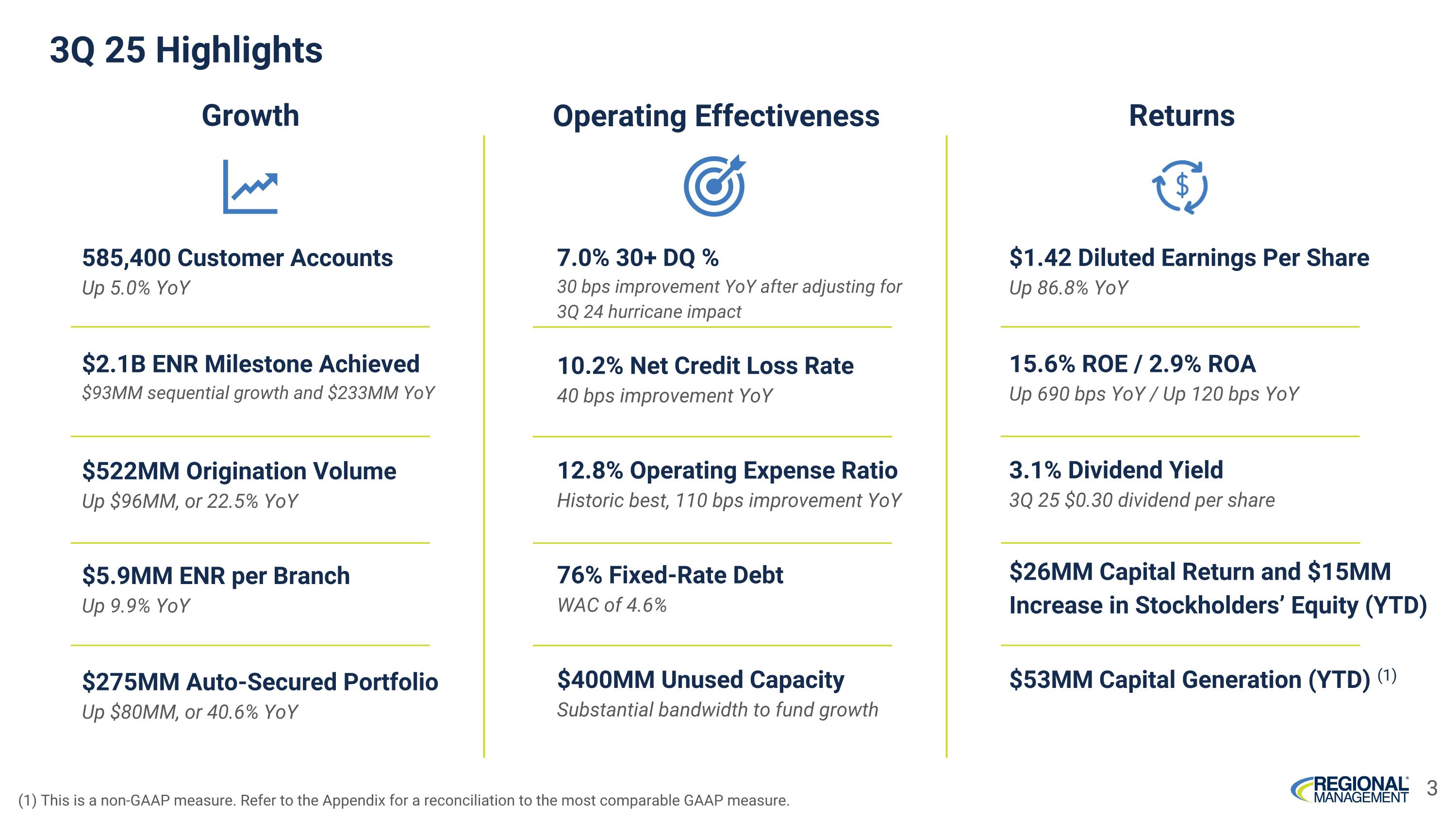
3Q 25 Highlights 585,400 Customer Accounts Up 5.0% YoY $2.1B ENR Milestone Achieved $93MM sequential growth and $233MM YoY $522MM Origination Volume Up $96MM, or 22.5% YoY $5.9MM ENR per Branch Up 9.9% YoY $275MM Auto-Secured Portfolio Up $80MM, or 40.6% YoY 3 Growth Operating Effectiveness Returns 7.0% 30+ DQ % 30 bps improvement YoY after adjusting for 3Q 24 hurricane impact 10.2% Net Credit Loss Rate 40 bps improvement YoY 12.8% Operating Expense Ratio Historic best, 110 bps improvement YoY 76% Fixed-Rate Debt WAC of 4.6% $400MM Unused Capacity Substantial bandwidth to fund growth $1.42 Diluted Earnings Per Share Up 86.8% YoY 15.6% ROE / 2.9% ROA Up 690 bps YoY / Up 120 bps YoY 3.1% Dividend Yield 3Q 25 $0.30 dividend per share $26MM Capital Return and $15MM Increase in Stockholders’ Equity (YTD) $53MM Capital Generation (YTD) (1) (1) This is a non-GAAP measure. Refer to the Appendix for a reconciliation to the most comparable GAAP measure.

3Q 25 Financial Highlights Significant improvements across key financial metrics, including net income, up $6.7MM, or 87.3% YoY Prior-year net income was inclusive of estimated hurricane impacts of $4.3MM, or $0.42 per diluted share Record total revenue of $165.5MM grew 13.1% YoY All-time best operating expense ratio of 12.8%, YoY improvement of 110 bps 4
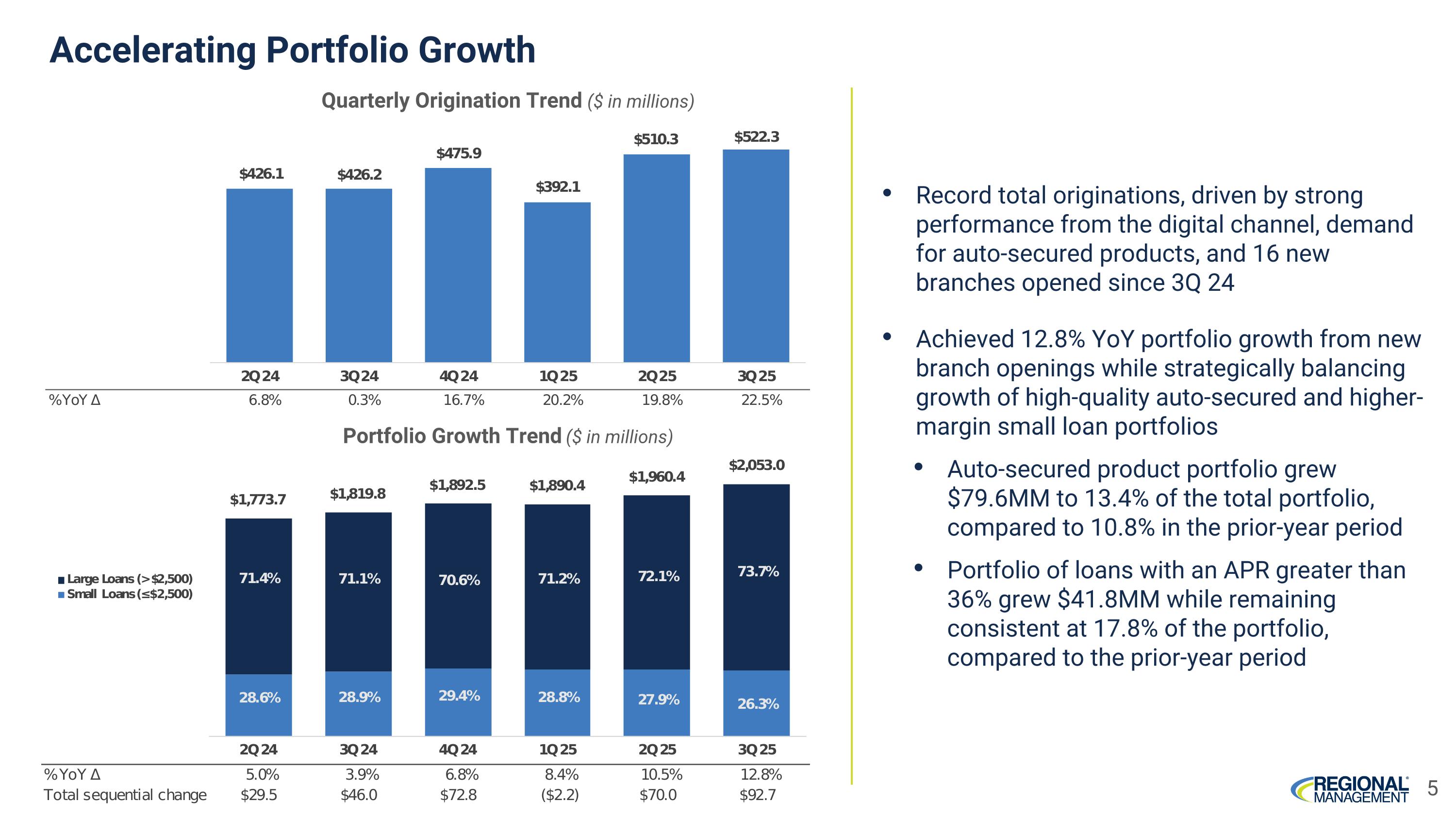
Portfolio Growth Trend ($ in millions) Accelerating Portfolio Growth 5 Record total originations, driven by strong performance from the digital channel, demand for auto-secured products, and 16 new branches opened since 3Q 24 Achieved 12.8% YoY portfolio growth from new branch openings while strategically balancing growth of high-quality auto-secured and higher-margin small loan portfolios Auto-secured product portfolio grew $79.6MM to 13.4% of the total portfolio, compared to 10.8% in the prior-year period Portfolio of loans with an APR greater than 36% grew $41.8MM while remaining consistent at 17.8% of the portfolio, compared to the prior-year period Quarterly Origination Trend ($ in millions)
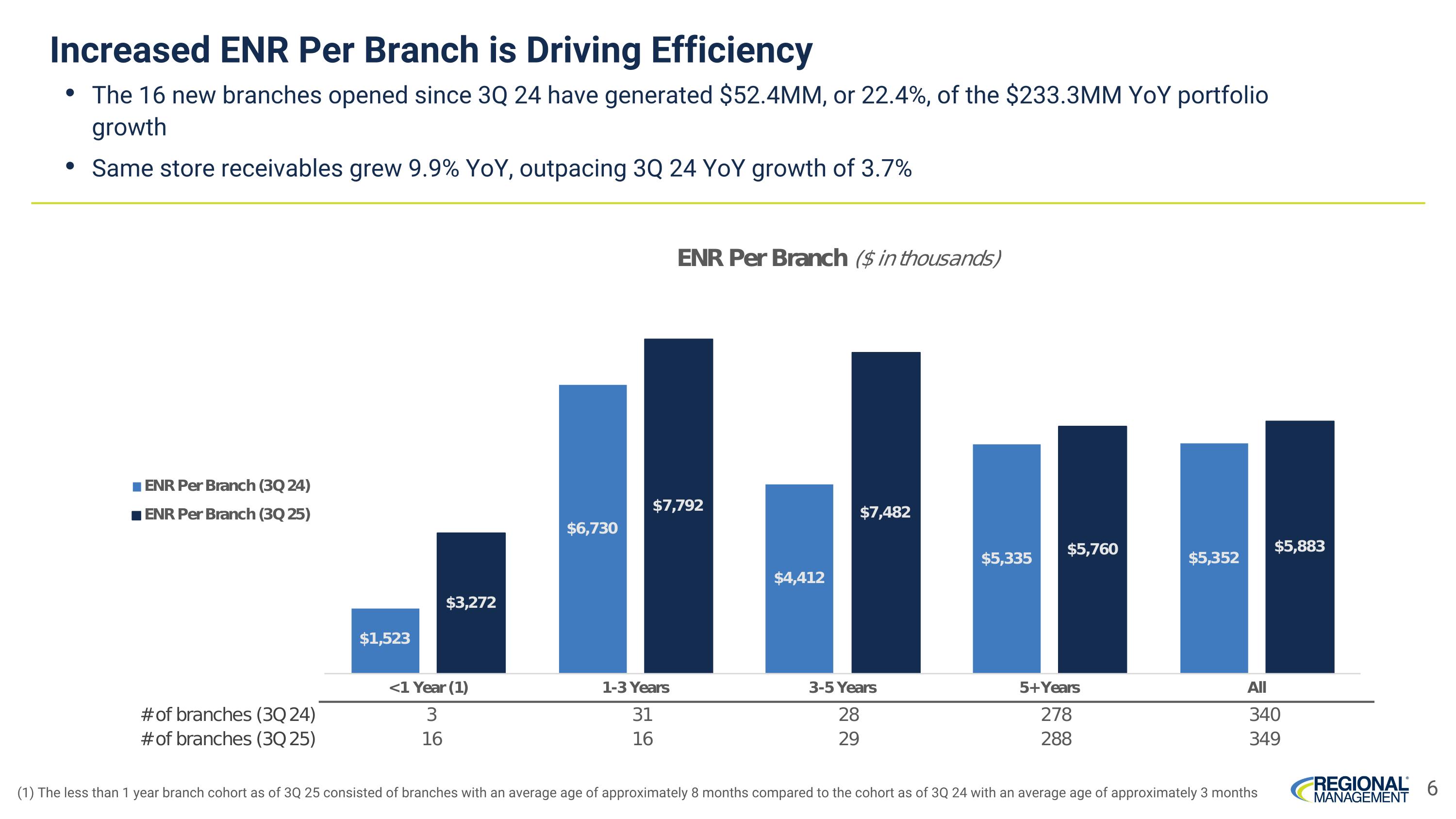
Increased ENR Per Branch is Driving Efficiency The 16 new branches opened since 3Q 24 have generated $52.4MM, or 22.4%, of the $233.3MM YoY portfolio growth Same store receivables grew 9.9% YoY, outpacing 3Q 24 YoY growth of 3.7% 6 (1) The less than 1 year branch cohort as of 3Q 25 consisted of branches with an average age of approximately 8 months compared to the cohort as of 3Q 24 with an average age of approximately 3 months
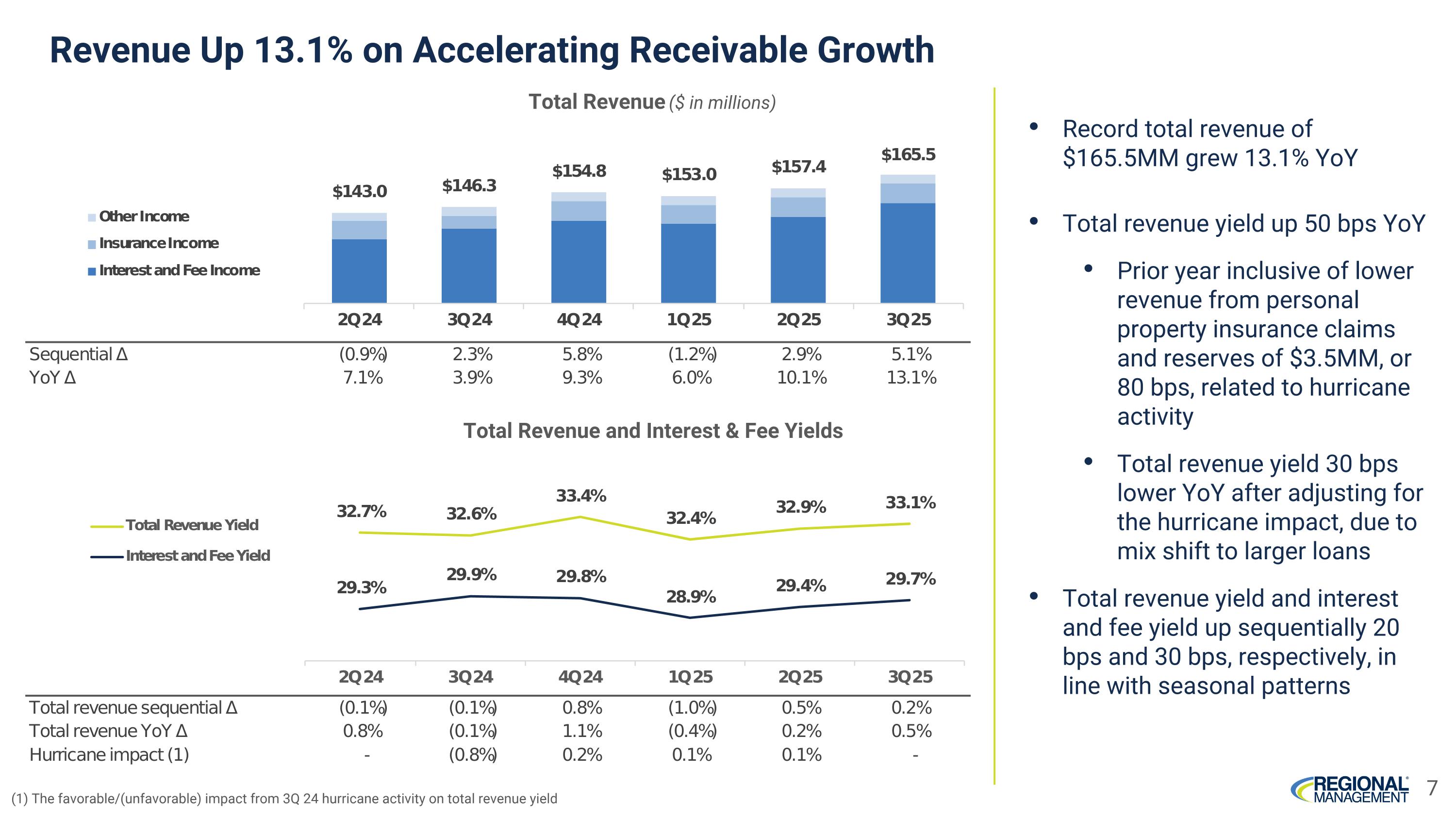
Record total revenue of $165.5MM grew 13.1% YoY Total revenue yield up 50 bps YoY Prior year inclusive of lower revenue from personal property insurance claims and reserves of $3.5MM, or 80 bps, related to hurricane activity Total revenue yield 30 bps lower YoY after adjusting for the hurricane impact, due to mix shift to larger loans Total revenue yield and interest and fee yield up sequentially 20 bps and 30 bps, respectively, in line with seasonal patterns 7 Revenue Up 13.1% on Accelerating Receivable Growth Total Revenue and Interest & Fee Yields Total Revenue ($ in millions) (1) The favorable/(unfavorable) impact from 3Q 24 hurricane activity on total revenue yield
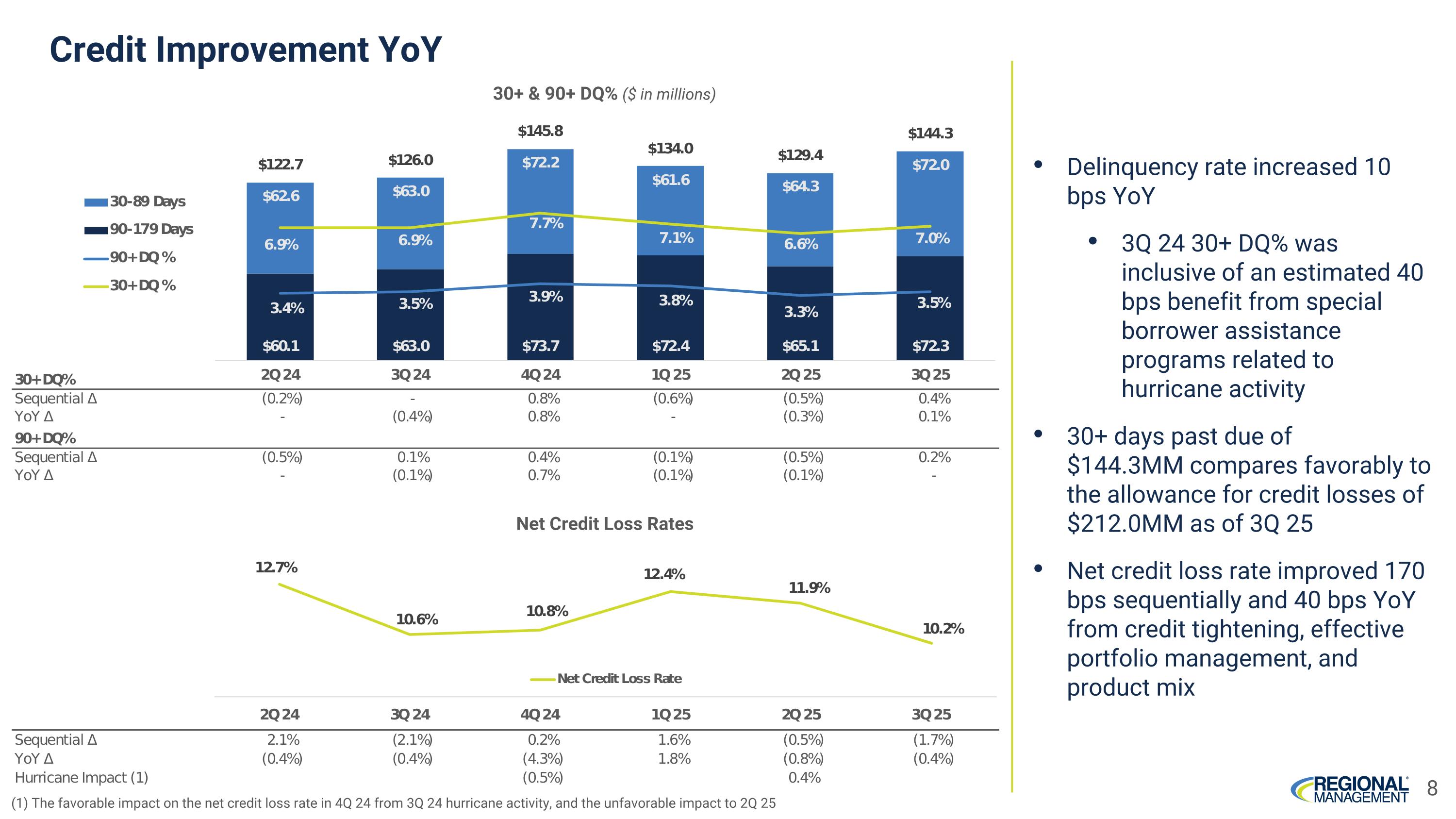
Credit Improvement YoY Delinquency rate increased 10 bps YoY 3Q 24 30+ DQ% was inclusive of an estimated 40 bps benefit from special borrower assistance programs related to hurricane activity 30+ days past due of $144.3MM compares favorably to the allowance for credit losses of $212.0MM as of 3Q 25 Net credit loss rate improved 170 bps sequentially and 40 bps YoY from credit tightening, effective portfolio management, and product mix 30+ & 90+ DQ% ($ in millions) Net Credit Loss Rates 8 (1) The favorable impact on the net credit loss rate in 4Q 24 from 3Q 24 hurricane activity, and the unfavorable impact to 2Q 25

Reserves For Credit Losses In 3Q 25, the allowance for credit losses increased by $9.2MM due to portfolio growth. The allowance for credit loss rate of 10.3% remained consistent sequentially and improved from 10.6% in the prior-year period, which included an estimated 20 bps related to prior-year hurricane activity. The Company is required to reserve for expected lifetime credit losses at the origination of each loan, while the revenue benefits are recognized over the life of the loan. Allowance for Credit Losses ($ in millions) 9

Improving Operating Leverage While Investing in Our Business 10 Operating Expense Ratio ($ in millions) All-time best operating expense ratio of 12.8%, YoY improvement of 110 bps, despite investment in innovation and growth, including 16 new branches opened since 3Q 24 YoY total revenue growth outpaced G&A expense growth by 12.0x
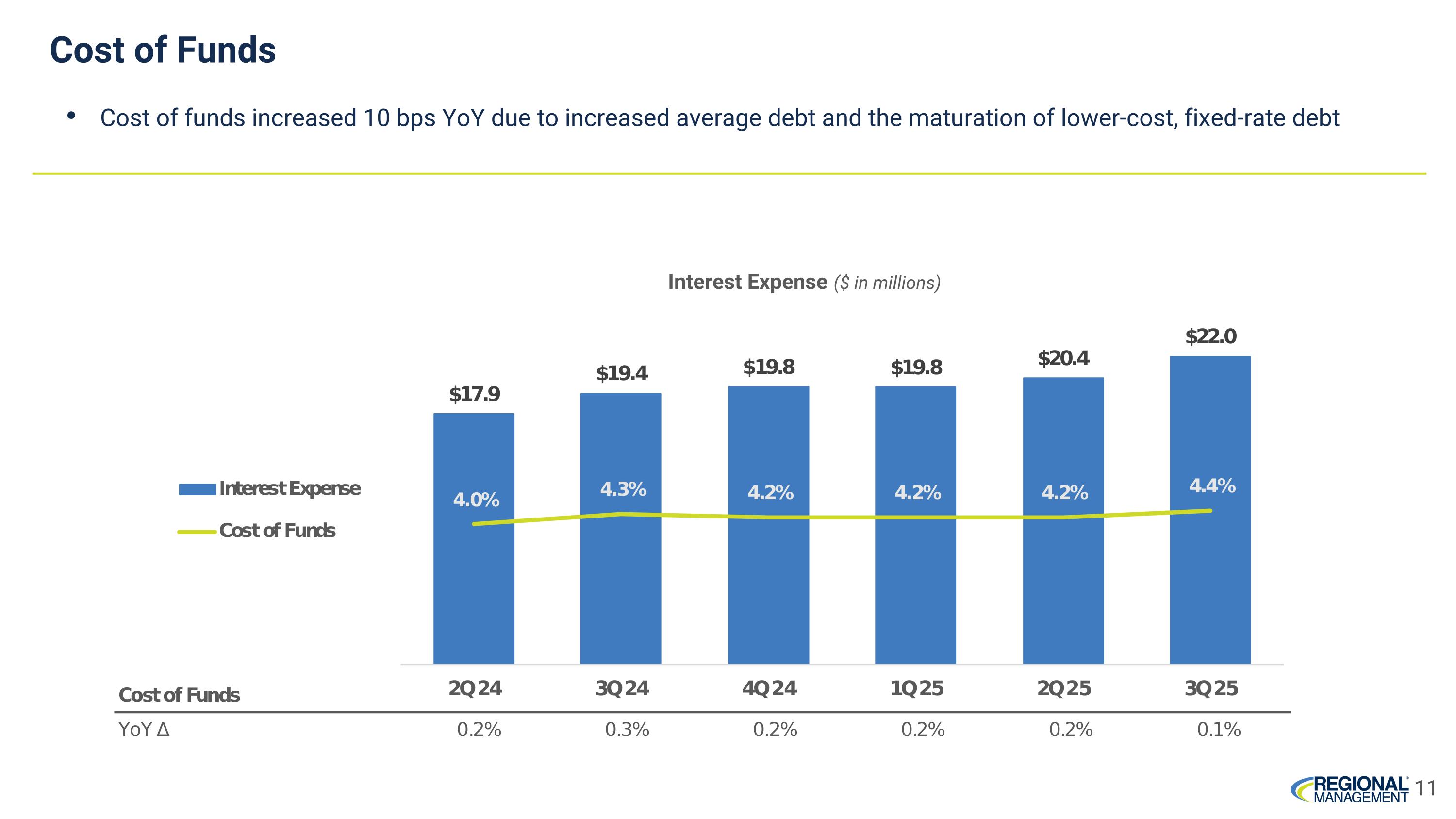
Cost of funds increased 10 bps YoY due to increased average debt and the maturation of lower-cost, fixed-rate debt Cost of Funds 11 Interest Expense ($ in millions)

Total unused capacity was $400MM (subject to borrowing base) as of September 30, 2025 Available liquidity of $155MM as of September 30, 2025 Fixed-rate debt represented 76% of total debt as of September 30, 2025, with WAC of 4.6% and a weighted-average revolving duration of 1.1 years Closed a $253MM securitization in October 2025 with WAC of 4.8%, down 50 bps from 1Q 25 securitization WAC of 5.3% Following the closing of the October securitization, fixed-rate debt now represents 89% of total debt, with WAC of 4.7% and a weighted-average revolving duration of 1.2 years Strong Funding Profile Unused Capacity ($ in millions) Fixed vs. Variable Debt Funded Debt Ratios 12 (1) This is a non-GAAP measure. Refer to the Appendix for a reconciliation to the most comparable GAAP measure.

Excess Capital Consistently Returned to Stockholders Capital Performance Since 2020 $205MM total capital increase $178MM returned to stockholders $382MM capital generated 12.9% CAGR 21.4% ratio of capital generation to average stockholders’ equity Proven track record of excess capital generation allowing returns to stockholders and reinvestment in strategic initiatives to generate sustainable, long-term profitable growth Significant capital generated even during recent periods of high inflation 13 (1) Cumulative change since year-end 2019 through the period ended 3Q 25. (2) This is a non-GAAP measure. Refer to the Appendix for a reconciliation to the most comparable GAAP measure. (3) YTD 25 is annualized.

3Q 25 Results and Outlook 14 Prior to discrete items, such as any tax impacts of equity compensation Key Metrics 3Q 25 Results 4Q 25 Outlook Net Income $14.4MM ~$12.0MM ENR Growth $92.7MM ~$60.0 - $70.0MM ANR Growth $88.5MM ~$80.0MM Total Revenue Yield 33.1% ~32.2% Net Credit Losses $51.3MM ~$57.0MM Allowance for Credit Loss Rate 10.3% ~10.3% G&A Expense $64.1MM ~$65.0MM Interest Expense $22.0MM ~$23.0MM Effective Tax Rate 24.3% ~24.5%(1)

Appendix 15

Record high digital volume driven by geographic expansion and our auto-secured product Digital volume represented 36.5% of total new borrower volume Large loans represented 78.9% of new borrower digitally sourced loans booked in 3Q 25 Digitally Sourced Origination Volume ($ in millions) Digitally Sourced Originations – Record High 16
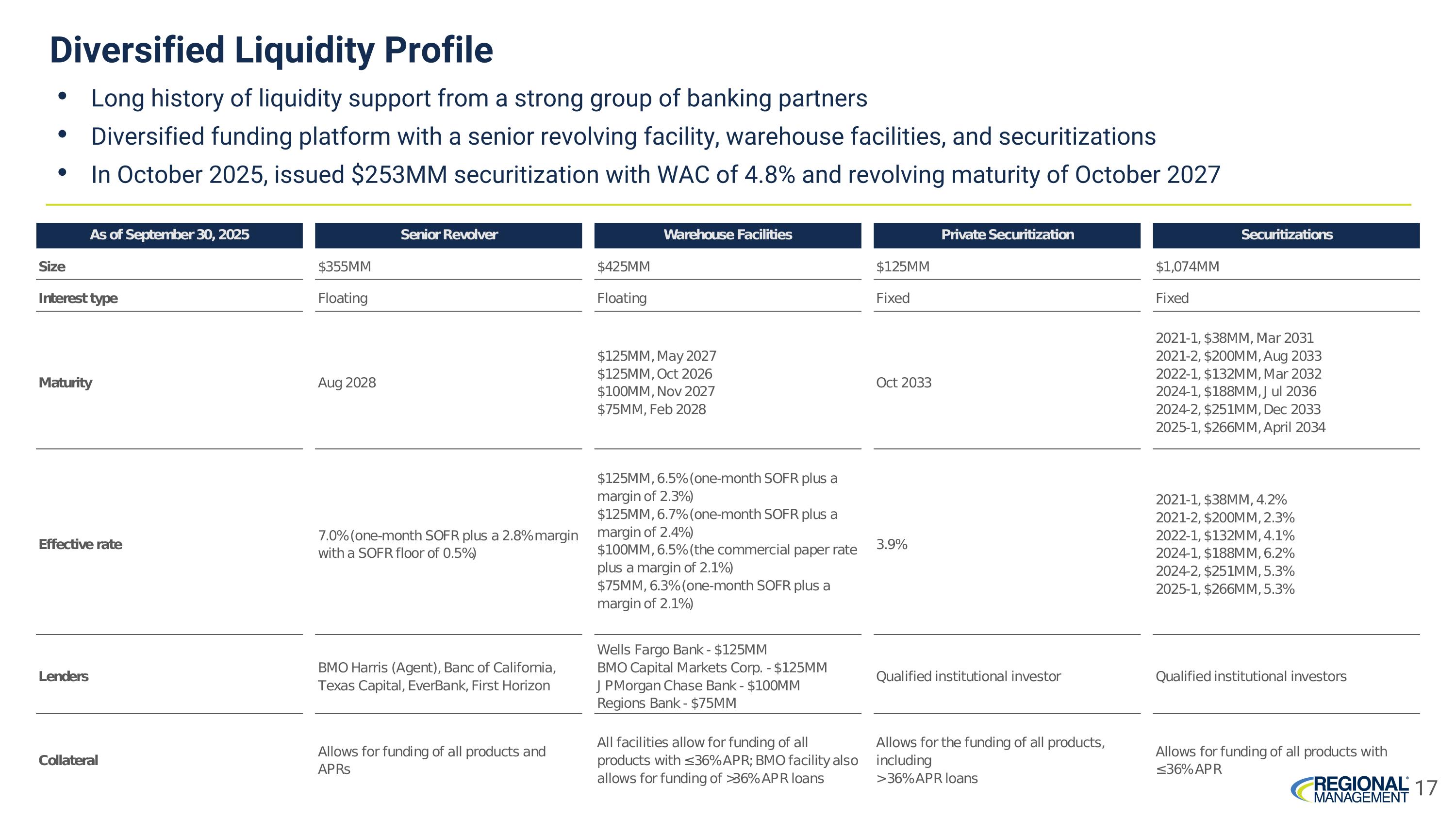
Diversified Liquidity Profile Long history of liquidity support from a strong group of banking partners Diversified funding platform with a senior revolving facility, warehouse facilities, and securitizations In October 2025, issued $253MM securitization with WAC of 4.8% and revolving maturity of October 2027 17

Consolidated Income Statements 18
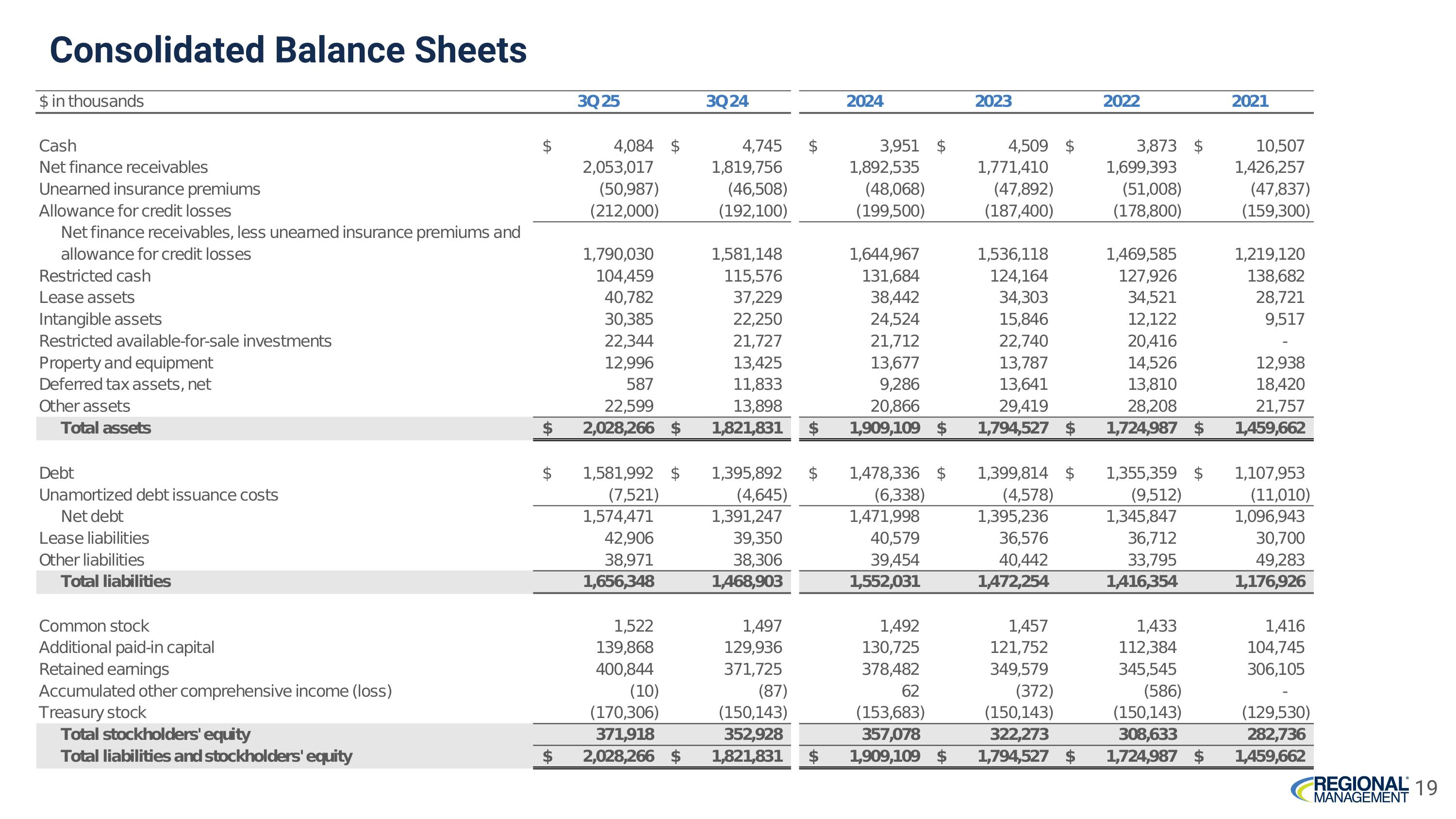
Consolidated Balance Sheets 19

Non-GAAP Financial Measures In addition to financial measures presented in accordance with generally accepted accounting principles (“GAAP”), this presentation contains certain non-GAAP financial measures. The Company’s management utilizes non-GAAP measures as additional metrics to aid in, and enhance, its understanding of the Company’s financial results. The Company believes that these non-GAAP measures provide useful information by excluding certain material items that may not be indicative of our operating results. As a result, the Company believes that the non-GAAP measures that it has presented will aid in the evaluation of the operating performance of the business. Total capital and capital return, capital generation, and capital generation as a % of average stockholders' equity are non-GAAP measures to include stock repurchases and dividends returned to stockholders with total capital. Management uses these measures to evaluate the Company's ability to generate capital to return to stockholders, reinvest in strategic initiatives, and evaluate its capacity to absorb losses. The Company also believes that these capital and absorption measures provide useful information to users of the Company’s financial statements in the evaluation of its ability to generate capital to return to stockholders, reinvest in strategic initiatives, and evaluate its capacity to absorb losses. Furthermore, tangible equity and the funded debt-to-tangible equity ratio are non-GAAP measures that adjust GAAP measures to exclude intangible assets. Management uses these equity measures to evaluate and manage the Company’s capital and leverage position. The Company also believes that these equity measures are commonly used in the financial services industry and provide useful information to users of the Company’s financial statements in the evaluation of its capital and leverage position. As a result, the Company also believes that these adjusted measures will aid users of its financial statements in the evaluation of its operating performance. This non-GAAP financial information should be considered in addition to, not as a substitute for or superior to, measures of financial performance prepared in accordance with GAAP. In addition, the Company’s non-GAAP measures may not be comparable to similarly titled non-GAAP measures of other companies. The following tables provide reconciliations of GAAP measures to non-GAAP measures. 20

Non-GAAP Financial Measures (Cont’d) 21

Non-GAAP Financial Measures (Cont’d) 22

Glossary 23 Allowance for credit loss rate – allowance for credit losses as a percentage of ending net finance receivables ANR – average net finance receivables Bps – basis points Capital generation – the year-to-date change in total capital and capital return from the prior year-end Cost of funds – annualized interest expense as a percentage of average net finance receivables Cumulative capital return – dividend and common stock repurchase activity that has occurred since December 31, 2019 Debt balance – the balance for each respective debt agreement, composed of principal balance and accrued interest Dividend yield – annualized dividends per share divided by the closing share price as of the last day of the quarter Delinquency rate (DQ %) – delinquent loans outstanding as a percentage of ending net finance receivables ENR – ending net finance receivables Funded debt ratio – total debt divided by total assets Interest and fee yield – annualized interest and fee income as a percentage of average net finance receivables Net credit loss rate – annualized net credit losses as a percentage of average net finance receivables Operating expense ratio – annualized general and administrative expenses as a percentage of average net finance receivables Return on assets (ROA) – annualized net income as a percentage of average total assets Return on equity (ROE) – annualized net income as a percentage of average stockholders’ equity Same store – comparison of branches with a comparable branch base; the comparable branch base includes those branches open for at least 1 year Total capital – stockholders’ equity plus allowance for credit losses Total revenue yield – annualized total revenue as a percentage of average net finance receivables WAC – weighted-average coupon YoY – year-over-year


Regional Management Corp. Names Lakhbir Lamba as President, Chief Executive Officer, and Director
- Current President, CEO, and Director Rob Beck to Retire -
- Beck to Remain with Regional Until June 2026 to Ensure Seamless Transition -
Greenville, South Carolina – November 5, 2025 – Regional Management Corp. (NYSE: RM), a diversified consumer finance company, announced today the retirement of its President, Chief Executive Officer, and Director, Robert W. Beck. The Board of Directors has appointed Lakhbir Lamba as Regional’s new President, Chief Executive Officer, and Director effective November 10, 2025. Mr. Beck will assist with a smooth and orderly transition in an advisory role before officially retiring from the company on June 30, 2026.
Mr. Lamba brings to Regional nearly 30 years of leadership experience in consumer lending and financial services, with extensive expertise in consumer credit, digital and technology platform development, branch sales and service, analytics, and product management. Most recently, he was Executive Vice President, Head of Consumer Lending & Analytics at PNC Financial Services Group, Inc., where he oversaw a team of 2,000 employees and managed the division’s portfolio of $32 billion in total assets. Mr. Lamba spent more than 15 years with PNC, including as its EVP of Retail Lending and EVP of Analytics and Portfolio Management. He received his Bachelor of Technology in Mechanical Engineering from the Indian Institute of Technology in New Delhi and his MBA in Finance and Strategy from Purdue University’s Krannert Graduate School of Management.
“We are extremely excited to welcome Lakhbir as our new President and CEO,” said Carlos Palomares, Chair of the Board of Regional Management. “We believe Lakhbir’s consistent success at PNC, his focus on innovation, and his impressive skillset developed within the consumer financial services space make him the ideal fit to continue our current growth strategy and lead Regional moving forward. At the same time, we want to congratulate Rob on his well-deserved retirement and for all of his contributions in leading the Regional team through some of our toughest challenges. We appreciate that Rob will help effect a seamless transition to Lakhbir’s leadership and wish him only the best in his next chapter.”
“It has been my distinct pleasure to lead such an outstanding team over the past five and a half years,” said Mr. Beck. “I want to thank everyone at Regional for their unwavering commitment and efforts. I am proud of what we have accomplished as we navigated through some of the most
challenging environments we have experienced in decades, while nearly doubling our net finance receivables and expanding our footprint across the country to eight new states. Over the same time period, we invested heavily to transform our technology platforms and data and analytic capabilities, positioning the business for future growth. The company is now enjoying increased momentum and accelerated growth, and I am confident that Lakhbir will lead the team to even greater success. With Regional well-positioned for its next stage of expansion, I look forward to beginning my next chapter and spending time with my family.”
“I am thrilled to be leading Regional and this outstanding team and want to thank the Board for this incredible opportunity,” added Mr. Lamba. “Rob has done a wonderful job steering Regional over the past several years and positioning the company well for its next chapter of growth. I look forward to continuing our current growth strategy in the years ahead, as we expand our geographic footprint, responsibly grow our portfolio, and leverage the latest technological advancements to deliver sustainable and increasing profitability over the long term.”
About Regional Management Corp.
Regional Management Corp. (NYSE: RM) is a diversified consumer finance company that provides attractive, easy-to-understand installment loan products primarily to customers with limited access to consumer credit from banks, thrifts, credit card companies, and other lenders. Regional Management operates under the name “Regional Finance” online and in branch locations in 19 states across the United States. Most of its loan products are secured, and each is structured on a fixed-rate, fixed-term basis with fully amortizing equal monthly installment payments, repayable at any time without penalty. Regional Management sources loans through its multiple channel platform, which includes branches, centrally managed direct mail campaigns, digital partners, and its consumer website. For more information, please visit www.RegionalManagement.com.
Forward-Looking Statements
This press release may contain various “forward-looking statements” within the meaning of the Private Securities Litigation Reform Act of 1995. Forward-looking statements are not statements of historical fact but instead represent Regional Management Corp.’s expectations or beliefs concerning future events. Forward-looking statements include, without limitation, statements concerning financial outlooks or future plans, objectives, goals, projections, strategies, events, or performance, and underlying assumptions and other statements related thereto. Words such as “may,” “will,” “should,” “likely,” “anticipates,” “expects,” “intends,” “plans,” “projects,” “believes,” “estimates,” “outlook,” and similar expressions may be used to identify these forward-looking statements. Such forward-looking statements speak only as of the date on which they were made and are about matters that are inherently subject to risks and uncertainties, many of which are outside of the control of Regional Management. As a result, actual performance and results may differ materially from those contemplated by these forward-looking statements. Therefore, investors should not place undue reliance on forward-looking statements.
Factors that could cause actual results or performance to differ from the expectations expressed or implied in forward-looking statements include, but are not limited to, the following: managing growth effectively, implementing Regional Management’s growth strategy, and opening new branches as planned; Regional Management’s convenience check strategy; Regional Management’s policies and procedures for underwriting, processing, and servicing loans; Regional Management’s ability to collect on its loan portfolio; Regional Management’s insurance operations; exposure to credit risk and repayment risk, which risks may increase in light of adverse or recessionary economic conditions; the implementation of evolving underwriting models and processes, including as to the effectiveness of Regional Management's custom scorecards; changes in the competitive environment in which Regional Management operates or a decrease in the demand for its products; the geographic concentration of Regional Management’s loan portfolio; the failure of third-party service providers, including those providing information technology products; changes in economic conditions in the markets Regional Management serves, including levels of unemployment and bankruptcies; the duration of the U.S. government shutdown; the ability to achieve successful acquisitions and strategic alliances; the ability to make technological improvements as quickly as competitors; security breaches, cyber-attacks, failures in information systems, or fraudulent activity; the ability to originate loans; reliance on information technology resources and providers, including the risk of prolonged system outages; changes in current revenue and expense trends, including trends affecting delinquencies and credit losses; any future public health crises, including the impact of such crisis on our operations and financial condition; changes in operating and administrative expenses; the departure, transition, or replacement of key personnel; the ability to timely and effectively implement, transition to, and maintain the necessary information technology systems, infrastructure, processes, and controls to support Regional Management’s operations and initiatives; changes in interest rates; existing sources of liquidity may become insufficient or access to these sources may become unexpectedly restricted; exposure to financial risk due to asset-backed securitization transactions; risks related to regulation and legal proceedings, including changes in laws or regulations or in the interpretation or enforcement of laws or regulations; changes in accounting standards, rules, and interpretations and the failure of related assumptions and estimates; the impact of changes in tax laws and guidance, including the timing and amount of revenues that may be recognized; risks related to the ownership of Regional Management’s common stock, including volatility in the market price of shares of Regional Management’s common stock; the timing and amount of future cash dividend payments; and anti-takeover provisions in Regional Management’s charter documents and applicable state law.
The foregoing factors and others are discussed in greater detail in Regional Management’s filings with the Securities and Exchange Commission. Regional Management will not update or revise forward-looking statements to reflect events or circumstances after the date of this press release or to reflect the occurrence of unanticipated events or the non-occurrence of anticipated events, whether as a result of new information, future developments, or otherwise, except as required by law. Regional Management is not responsible for changes made to this document by wire services or Internet services.
Contact:
Investor Relations
Garrett Edson, (203) 682-8331
[email protected]