rxrx-20250805
0001601830FALSE00016018302024-08-082024-08-08


UNITED STATES
SECURITIES AND EXCHANGE COMMISSION
Washington, D.C. 20549

FORM 8-K

CURRENT REPORT
Pursuant to Section 13 OR 15(d)
of The Securities Exchange Act of 1934

Date of Report (Date of earliest event reported): August 5, 2025

RECURSION PHARMACEUTICALS, INC.
(Exact name of registrant as specified in its charter)

Delaware
001-40323
 46-4099738
(State or other jurisdiction of incorporation)(Commission File Number)(I.R.S. Employer Identification No.)
41 S Rio Grande Street
Salt Lake City, UT 84101
(Address of principal executive offices) (Zip code)

(385) 269 - 0203
(Registrant’s telephone number, including area code)

Not Applicable
(Former name or former address, if changed since last report.)

Check the appropriate box below if the Form 8-K filing is intended to simultaneously satisfy the filing obligation of the registrant under any of the following provisions:

    Written communications pursuant to Rule 425 under the Securities Act (17 CFR 230.425)

    Soliciting material pursuant to Rule 14a-12 under the Exchange Act (17 CFR 240.14a-12)

    Pre-commencement communications pursuant to Rule 14d-2(b) under the Exchange Act (17 CFR 240.14d-2(b))

    Pre-commencement communications pursuant to Rule 13e-4(c) under the Exchange Act (17 CFR 240.13e-4(c))

Securities registered pursuant to Section 12(b) of the Act:
Title of each classTrading symbol(s)Name of each exchange on which registered
Class A Common Stock, par value $0.00001 per shareRXRX
Nasdaq Global Select Market

Indicate by check mark whether the registrant is an emerging growth company as defined in Rule 405 of the Securities Act of 1933 or (§230.405 of this chapter) or Rule 12b-2 of the Securities Exchange Act of 1934 (§240.12b-2 of this chapter).


Emerging growth company

If an emerging growth company, indicate by check mark if the registrant has elected not to use the extended transition period for complying with any new or revised financial accounting standards provided pursuant to Section 13(a) of the Exchange Act. ☐

Item 2.02. Results of Operations and Financial Condition.

On August 5, 2025, the Company issued a press release announcing its results of operations and financial condition for the second quarter June 30, 2025. A copy of the press release is furnished as Exhibit 99.1 and is incorporated herein by reference.

Item 7.01. Regulation FD Disclosure.

On August 5, 2025, the Company released an updated corporate presentation to the investor section of the Company’s website. A copy of the presentation is attached hereto as Exhibit 99.2 to this Current Report on Form 8-K and incorporated into this Item 7.01 by reference.

Also on August 5, 2025, the Company released a presentation made in connection with its L(earnings) call on August 5, 2025. A copy of the presentation is attached hereto as Exhibit 99.3 to this Current Report on Form 8-K and incorporated into this Item 7.01 by reference.

The information furnished pursuant to Item 2.02 (including Exhibit 99.1) and 7.01 (including Exhibits 99.2 and 99.3) on this Form 8-K, shall not be deemed “filed” for purposes of Section 18 of the Securities Exchange Act of 1934, as amended (the “Exchange Act”), or otherwise subject to the liabilities of that section, nor shall it be deemed incorporated by reference into any other filing under the Securities Act of 1933, as amended, or the Exchange Act, except as expressly set forth by specific reference in such a filing.


Item 9.01. Financial Statements and Exhibits.

(d) Exhibits.

Exhibit NumberDescription
99.1
99.2
99.3
104Cover Page Interactive Data File (embedded within the Inline XBRL document)


SIGNATURES
Pursuant to the requirements of the Securities Exchange Act of 1934, the registrant has duly caused this report to be signed on its behalf by the undersigned hereunto duly authorized on August 5, 2025.


RECURSION PHARMACEUTICALS, INC.
By:
/s/ Ben Taylor
Ben Taylor
Chief Financial Officer

Exhibit 99.1

Recursion Reports Second Quarter 2025 Financial Results and Provides Business Update

Company shares partnership and clinical updates including $7 million Sanofi milestone and more information on patient populations for REC-1245 (RBM39) and REC-617 (CDK7)

SALT LAKE CITY, August 5, 2025 (GLOBE NEWSWIRE) — Recursion (Nasdaq: RXRX), a leading clinical stage TechBio company decoding biology to radically improve lives, today reported business updates and financial results for its second quarter ended June 30, 2025.

Recursion will host a (L)earnings Call on August 5, 2025 at 8:00 am ET / 6:00 am MT / 1:00 pm BST from Recursion’s X (formerly Twitter), LinkedIn, and YouTube accounts giving analysts, investors, and the public the opportunity to ask questions of the company by submitting questions here: https://forms.gle/ciFX2KbLfkAvh3Q87.

"The power of our platform not only allows us to discover and develop potential new medicines, but also gives us insights on patient populations to target that would be challenging using traditional methods,” said Chris Gibson, Co-Founder and CEO of Recursion. “In discovery, we’re deploying advanced models like Boltz-2 to rapidly design ligands for high-value targets. State of the art platform capabilities helped us drive our fourth partnered discovery milestone with Sanofi this quarter, reflecting tangible momentum across our joint pipeline. We are leveraging these and other improvements to the Recursion OS to not only accelerate and improve our funnel of new programs, but also execution of later stage programs in our pipeline like RBM39 and CDK7.”

Summary of Business Highlights


Portfolio - Internal and Partnered Programs
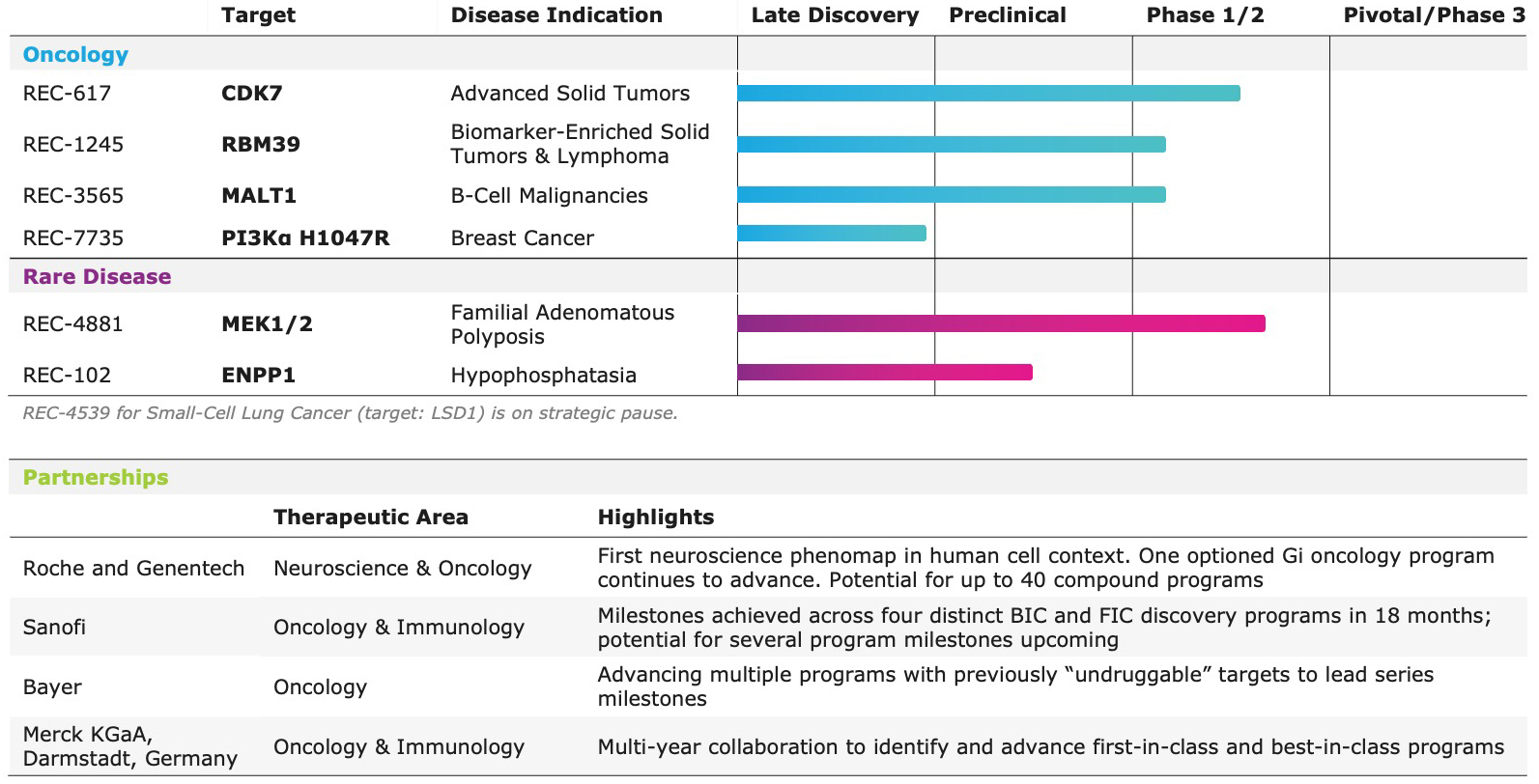
q22025earningsdeck-pipelina.jpg

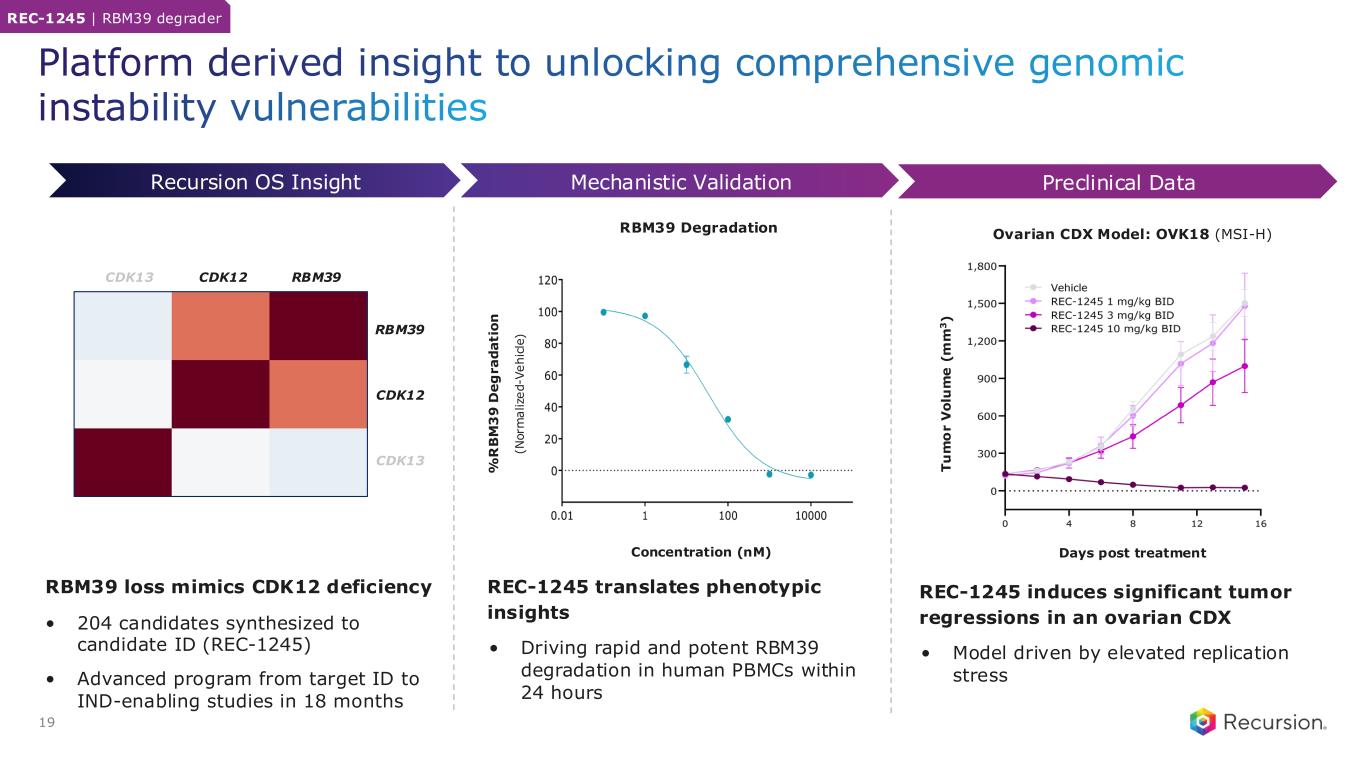
“REC-1245, our potential first-in-class RBM39 degrader, was identified using phenomap-derived insight, and mimics CDK12 loss to induce replication stress and suppress DDR pathways without CDK12 related toxicities. Early data show strong activity in tumors characterized by replication stress and DNA repair vulnerabilities. Our DAHLIA trial is now enrolling select tumor types to identify responsive populations. For REC-617, our CDK7 inhibitor, we leveraged multi-omic and real world patient data and causal AI modeling to select platinum-resistant ovarian cancer as the first combination cohort,” said Najat Khan, PhD, Chief R&D Officer and Chief Commercial Officer of Recursion.

Internal Pipeline Updates:
REC-1245 (RBM39): Recursion provided updates on the biomarker strategy and patient population currently enrolling in the ongoing Phase 1/2 DAHLIA study.
About REC-1245
Potential first-in-class oral RBM39 degrader that selectively impairs alternative splicing to silence multiple DDR pathways, leading to high replication stress.
Characterized to selectively mimic the phenotype associated with CDK12 loss of function using Recursion’s AI-powered maps of human biology.
Update on target patient population
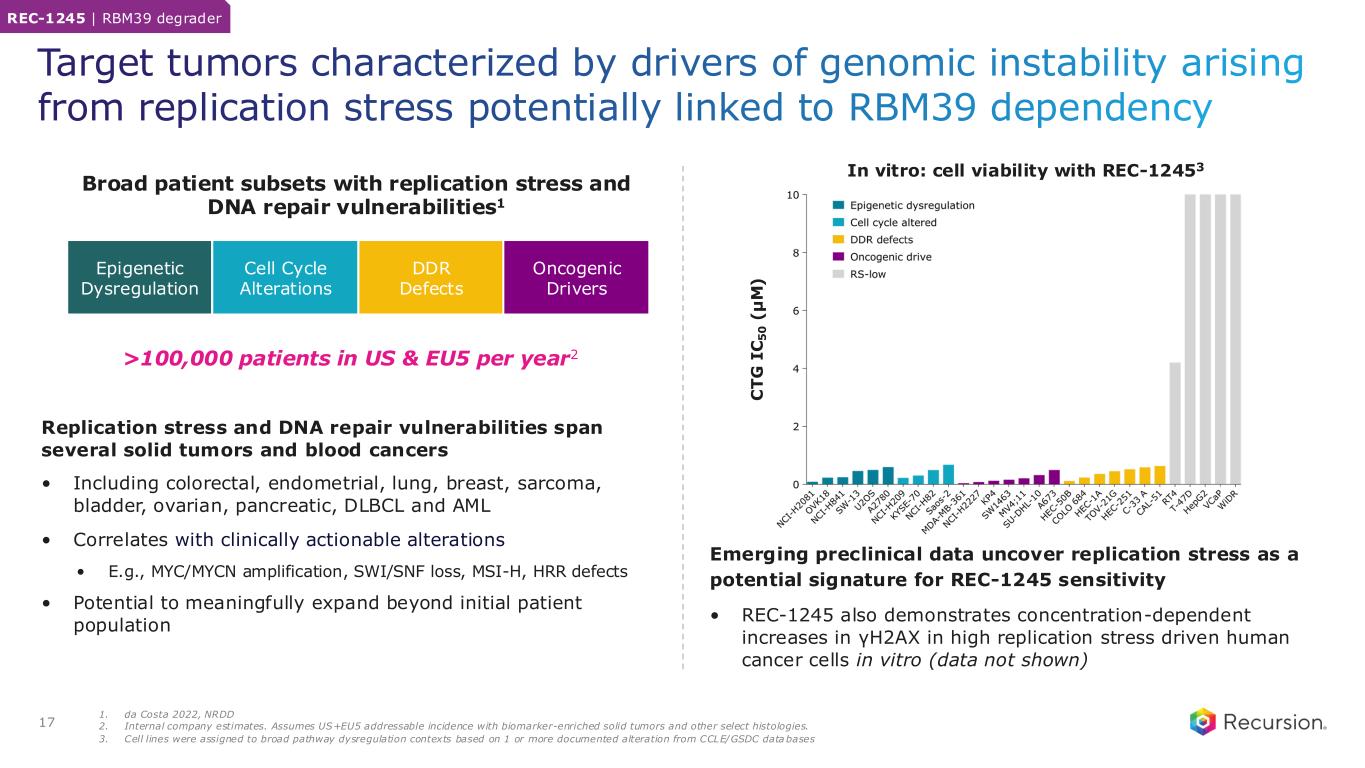
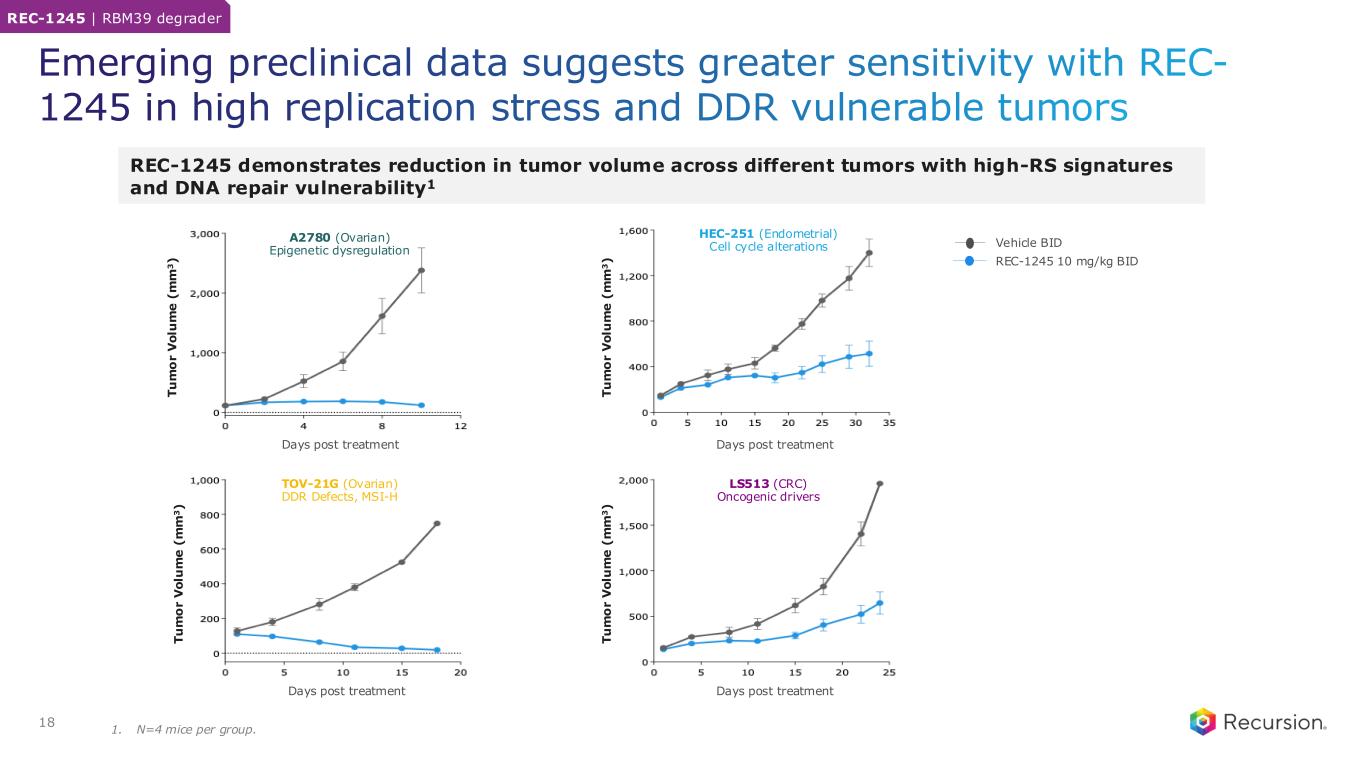
Early preclinical data shows REC-1245 reduces viability in tumors characterized by replication stress and DNA repair vulnerabilities (DDR defects) across multiple solid tumor types, including MSI-H/dMMR, HRR altered cancers, and other tumors.
Multi‑omic profiling underway to refine the molecular signature of sensitivity.
Additional DAHLIA trial details


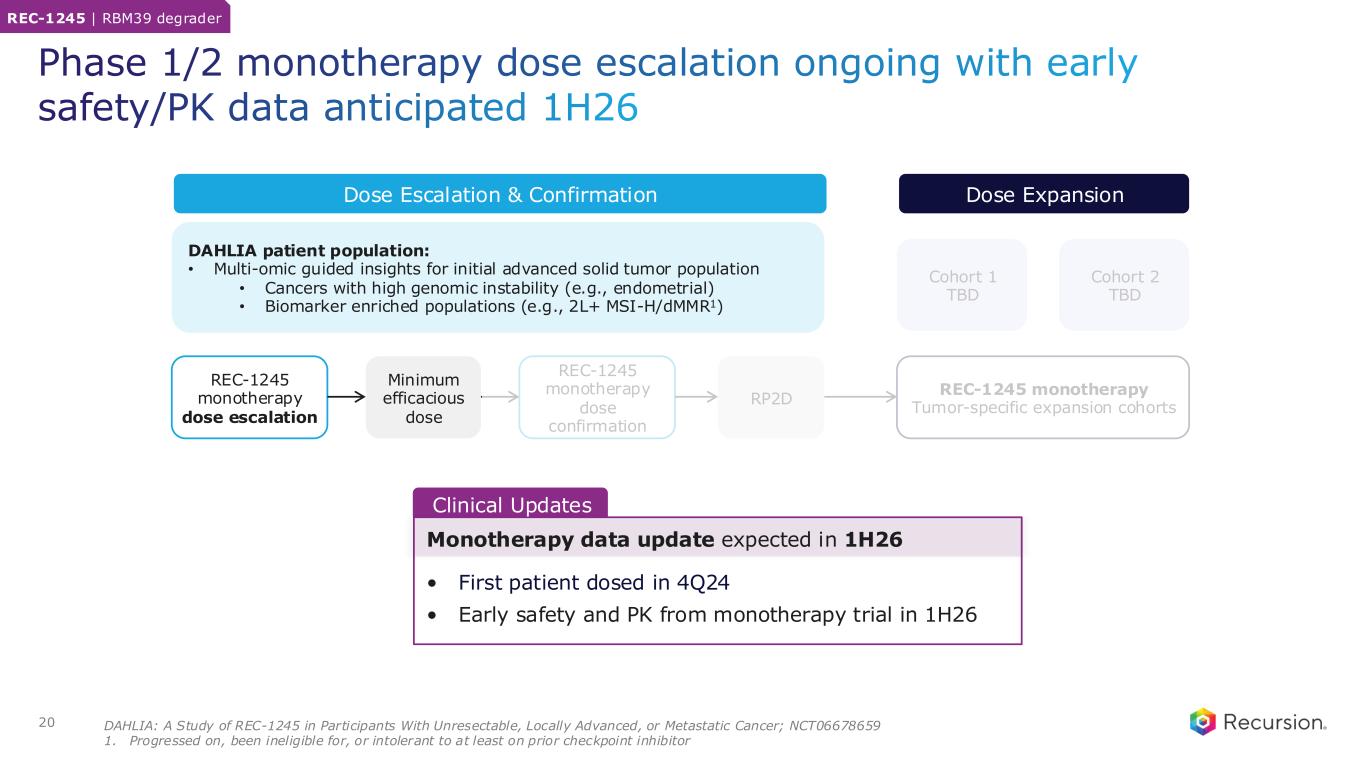
Monotherapy dose-escalation of Phase 1/2 DAHLIA trial in patients with advanced solid tumors ongoing.
Early safety and PK data from the Phase 1 dose-escalation portion on track for 1H26.
REC-617 (CDK7): Recursion initiated a combination dose escalation portion of the ELUCIDATE Phase 1/2 trial in 1H25.
About REC-617
Orally bioavailable, highly potent, and selective CDK7 inhibitor with best-in-class potential.
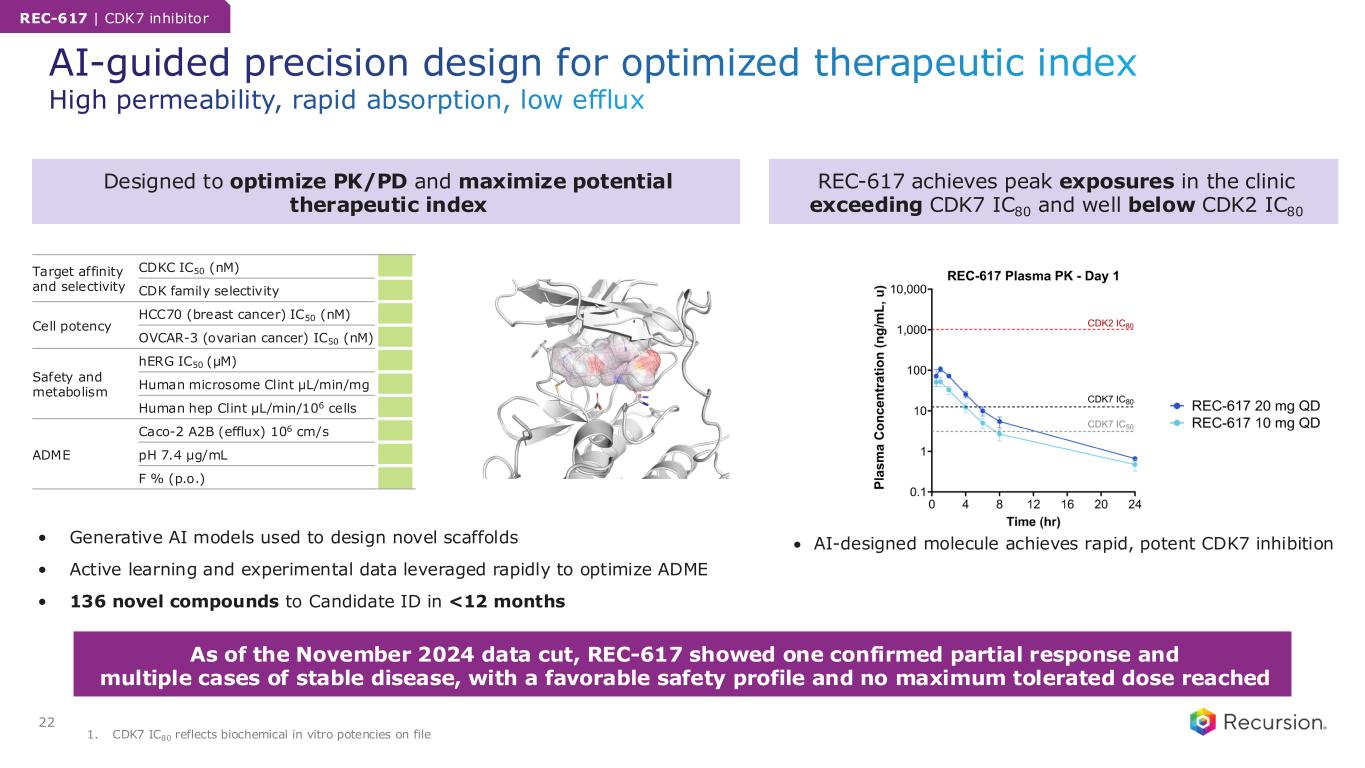
Precision-designed using Recursion’s generative AI and active learning platform to optimize for non-covalent binding and ADME/PK, potentially delivering a broader therapeutic window, reduced off-target effects, and enhanced absorption.
Early Phase 1/2 results demonstrated promising safety and efficacy signals, including a durable partial response in a late-stage metastatic ovarian cancer patient and stable disease across four other patients with solid tumors (e.g. CRC, NSCLC).
Update on target patient population
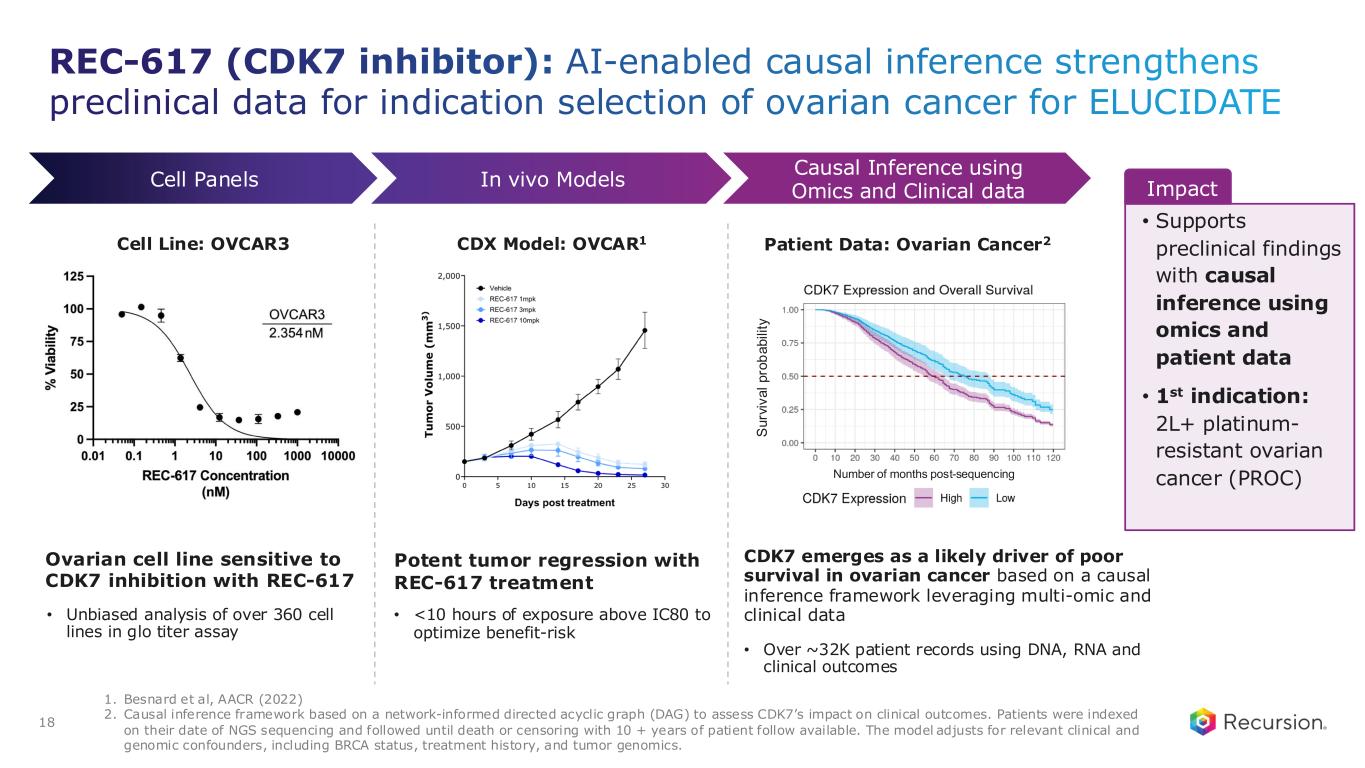
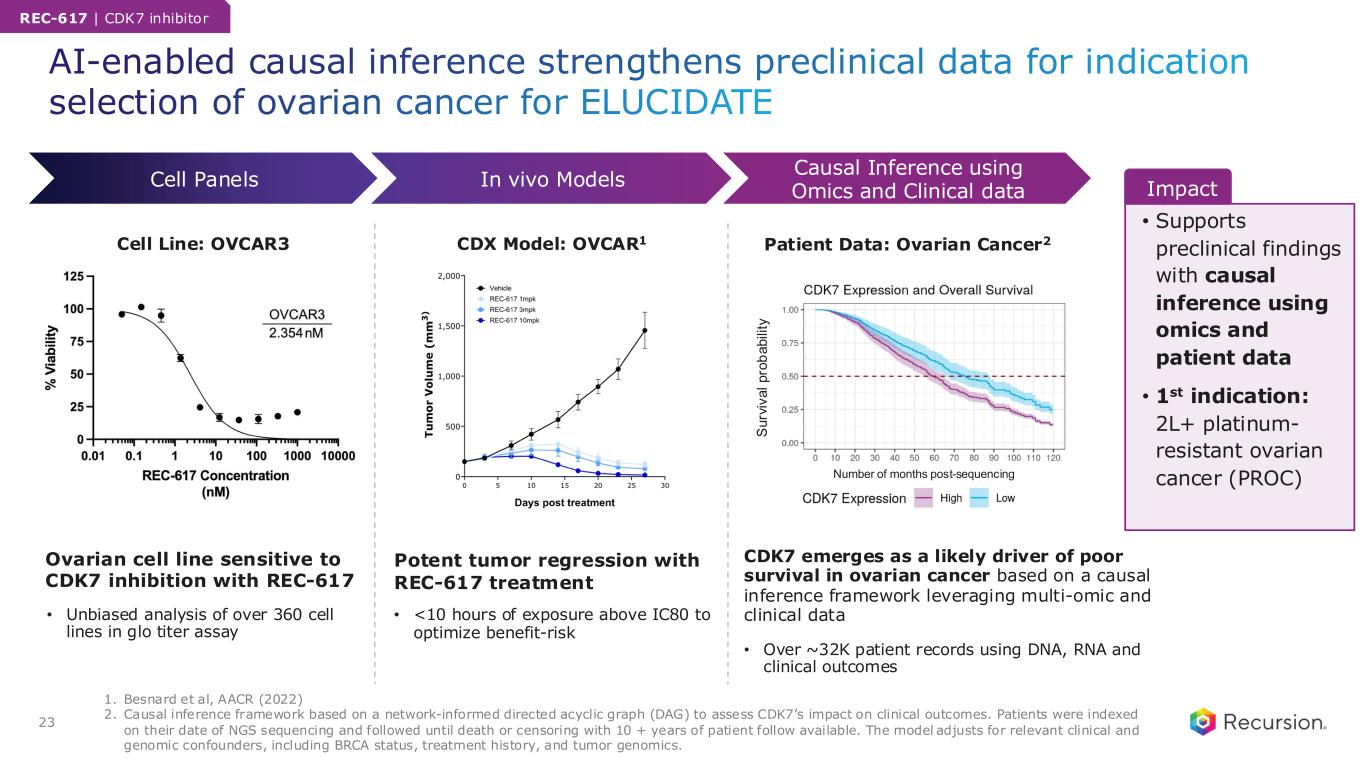
Based on early clinical, preclinical, and causal AI modeling data, Recursion selected ovarian cancer as the initial combination dose expansion cohort.
Additional ELUCIDATE combination trial details
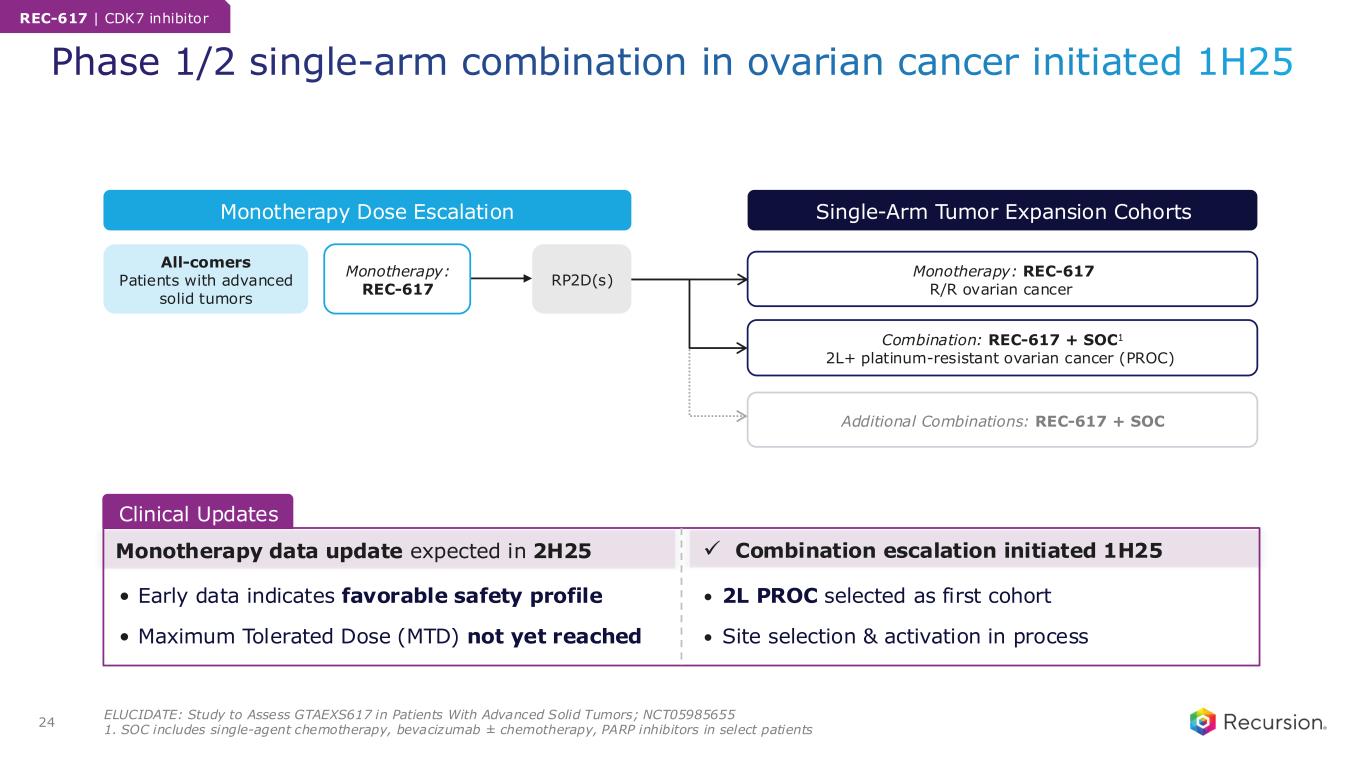
REC-617 in combination with standards of care in 2L+ platinum-resistant ovarian cancer population. Enrollment activities have been initiated.
Additional tumor types and therapies for single-arm expansion cohorts under evaluation.
Additional data from monotherapy dose-escalation on-track for 2H25.
REC-102 (ENPP1): Acquired full rights to REC-102, Recursion’s ENPP1 inhibitor for the treatment of hypophosphatasia (HPP), from its joint venture with Rallybio.
REC-102 is the first potential oral disease-modifying treatment for HPP, a rare and debilitating genetic disorder with limited treatment options.
Additional preclinical data from the REC-102 program will be presented at the 2025 American Society for Bone and Mineral Research (ASMBR), being held in Seattle, WA.
A poster titled Amelioration of osteomalacia in late-onset HPP mice via pharmacological inhibition of ENPP1 is scheduled for presentation on September 6, 2025 between 2:00 PM - 3:30 PM PT, during the Basic and Translational session.
Phase 1 initiation remains on-track for 2H26.

Upcoming milestones:
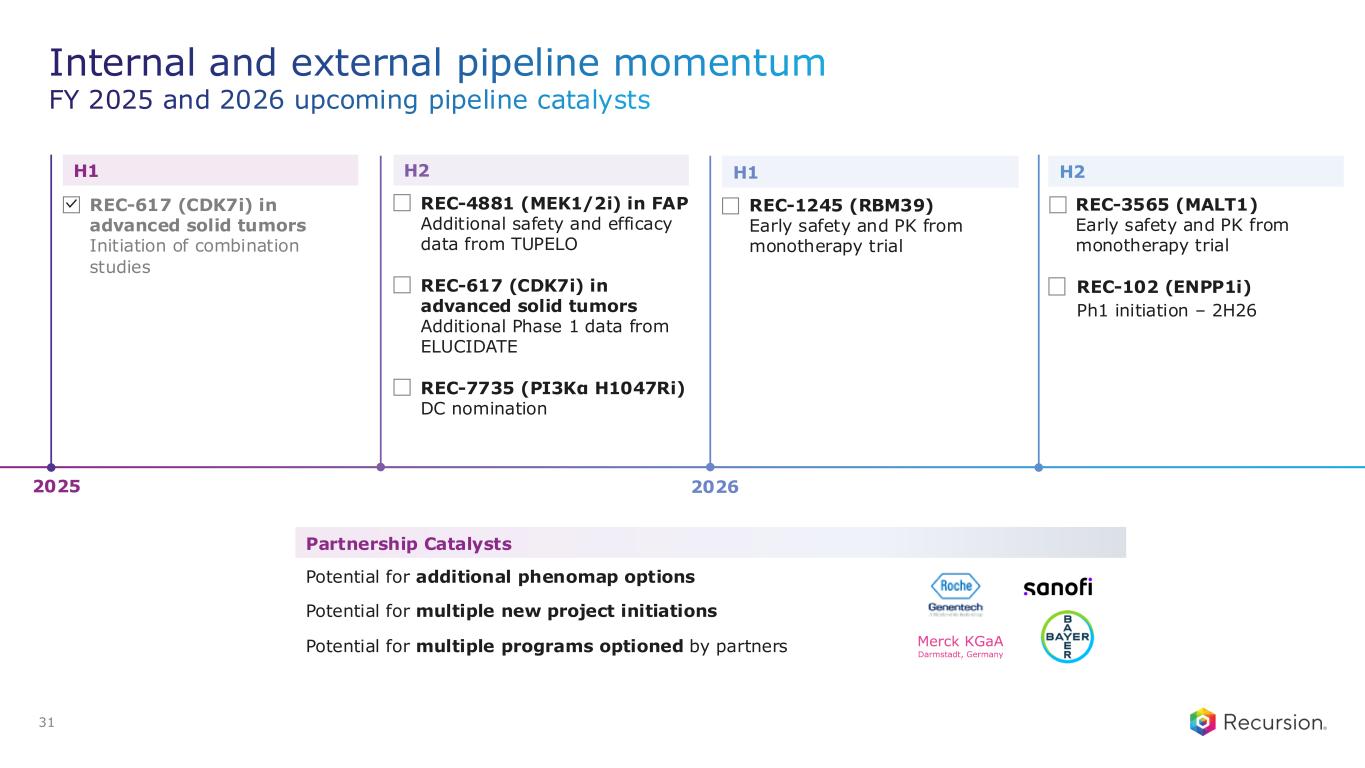
REC-4881 (MEK1/2): Additional data in FAP from TUPELO expected in 2H25.
REC-617 (CDK7): Additional monotherapy data expected in 2H25.


REC-7735 (PI3Kα H1047R): Preclinical studies ongoing with development candidate expected in 2H25.
REC-1245 (RBM39): Early Phase 1 safety and PK monotherapy data expected in 1H26.
REC-3565 (MALT1): Early Phase 1 safety and PK monotherapy data expected in 2H26.
REC-102 (ENPP1): Phase 1 initiation expected in 2H26.
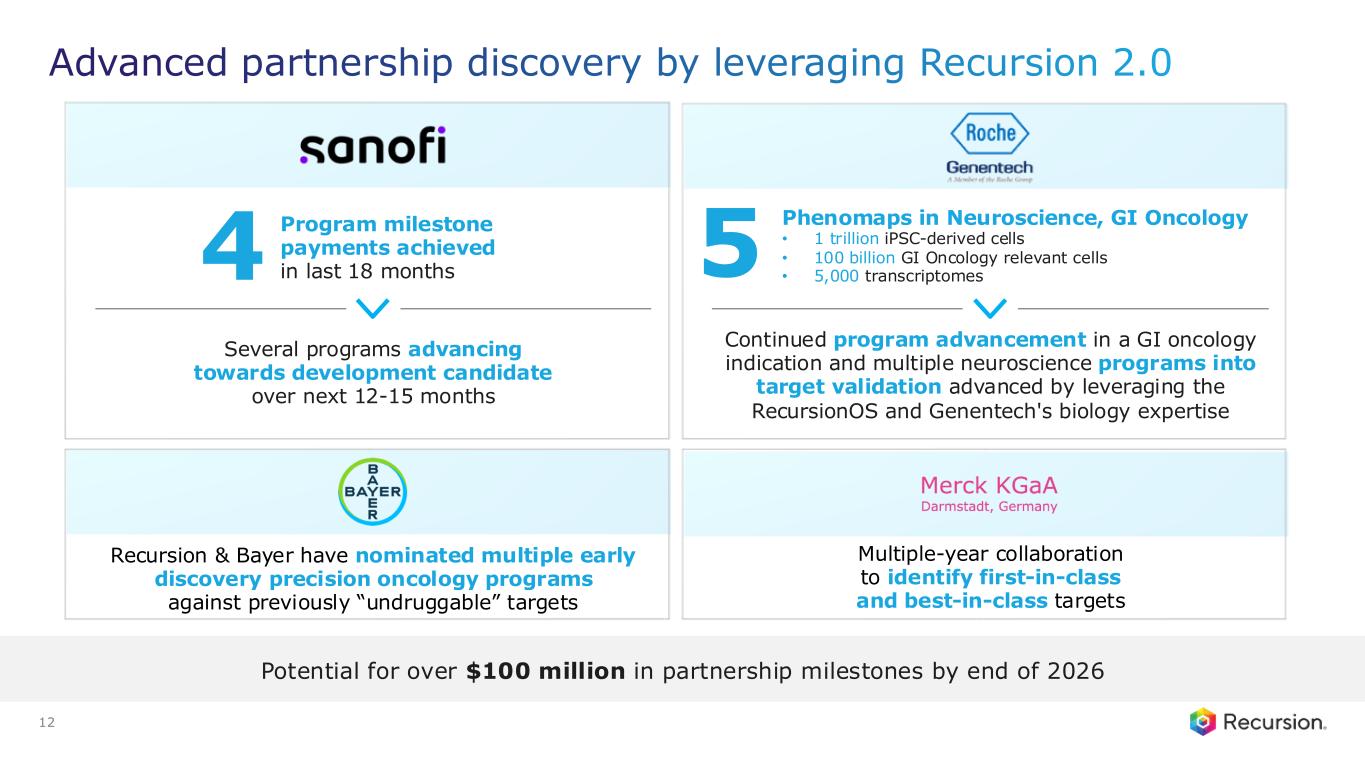
Potential for over $100 million in partnership milestones by the end of 2026.
Several programs are advancing towards potential development candidate designation over the next 12-15 months.
Multiple neuroscience target validation programs advancing by leveraging the RecursionOS.
Partnered Discovery Updates:
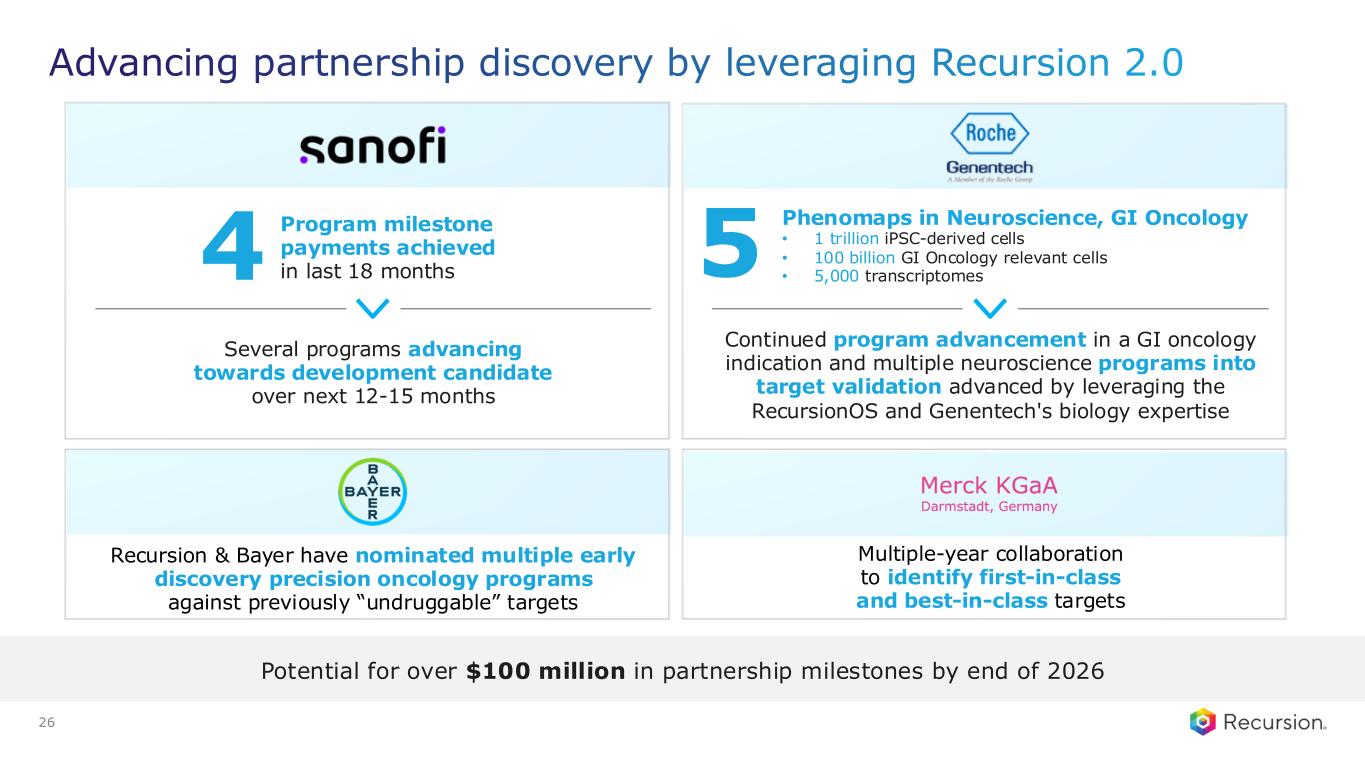
Sanofi: Recursion and Sanofi continue to advance multi-target collaboration for up to 15 best-in-class or first-in-class programs across oncology and immunology, with $130 million in upfront and milestone payments achieved to date. Each program has the potential for over $300 million in milestone payments.
In 2Q, achieved a $7 million milestone payment for an immunology program. Under the collaboration, this is the fourth partnered program reaching a significant discovery milestone in 18 months.
Sanofi is now leveraging combined RecursionOS 2.0, including phenomics, to identify new program opportunities.
Several programs are advancing towards potential development candidate designation over the next 12-15 months.
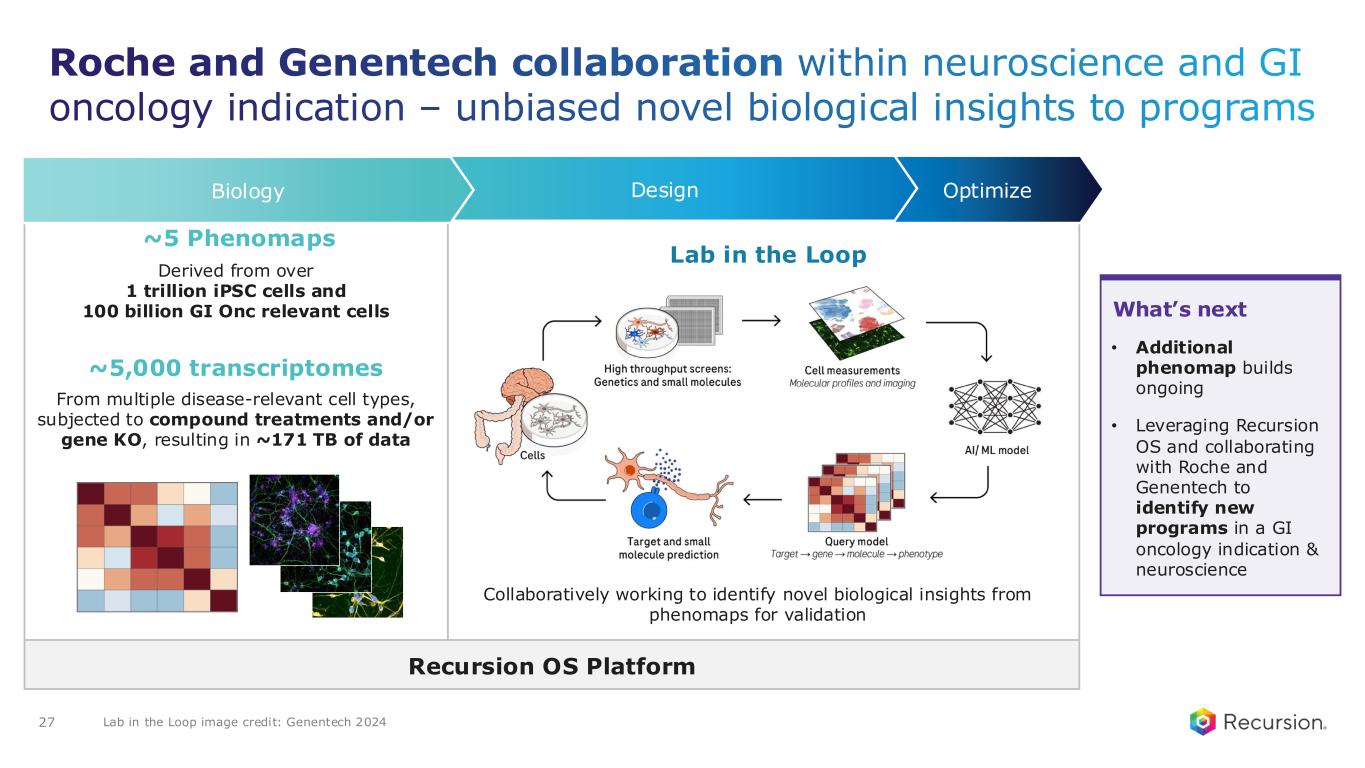
Roche and Genentech: Recursion continues to make meaningful progress on both building additional neuromaps and driving target validation and small molecule programs in a single GI oncology indication.
Neuro: To date, the collaboration has built a whole-genome knockout phenomap derived from over one trillion iPSC-derived neural cells, alongside around 5,000 transcriptomes representing approximately 171 TB of data.
Potential neuroscience targets have been identified for validation from the map, and today multiple novel target validation programs are advancing leveraging the RecursionOS and Genentech’s biological expertise.
Building additional neuromaps, including multi-modal maps, combining Roche and Genentech's expertise in single cell screens with Recursion’s and Genentech’s multi-omic machine learning capabilities.
GI-Oncology: To date, Recursion has generated all whole genome scale and small molecule GI-oncology specific phenomaps contemplated in the partnership, from which both novel target and small molecule programs can be surfaced.
One optioned program continues to advance toward lead series.
Focused on advancing multiple novel target and/or compound programs.
Bayer: Recursion and Bayer have nominated multiple early discovery precision oncology programs against previously “undruggable” targets. Work is underway to advance multiple programs to lead series milestone decisions.
Merck KgAa, Darmstadt, Germany: Collaboration ongoing to identify first-in-class and best-in-class targets.


Platform
platformpictureq22025a.jpg


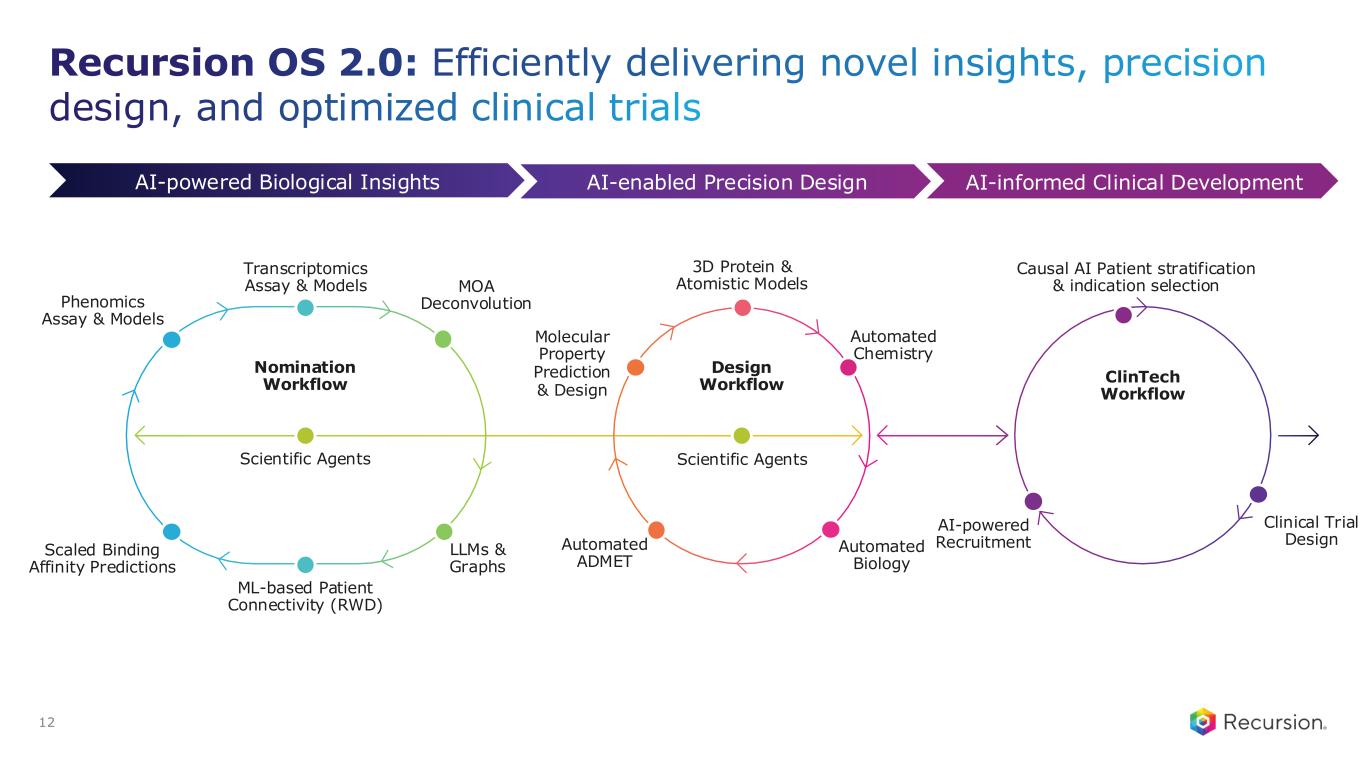
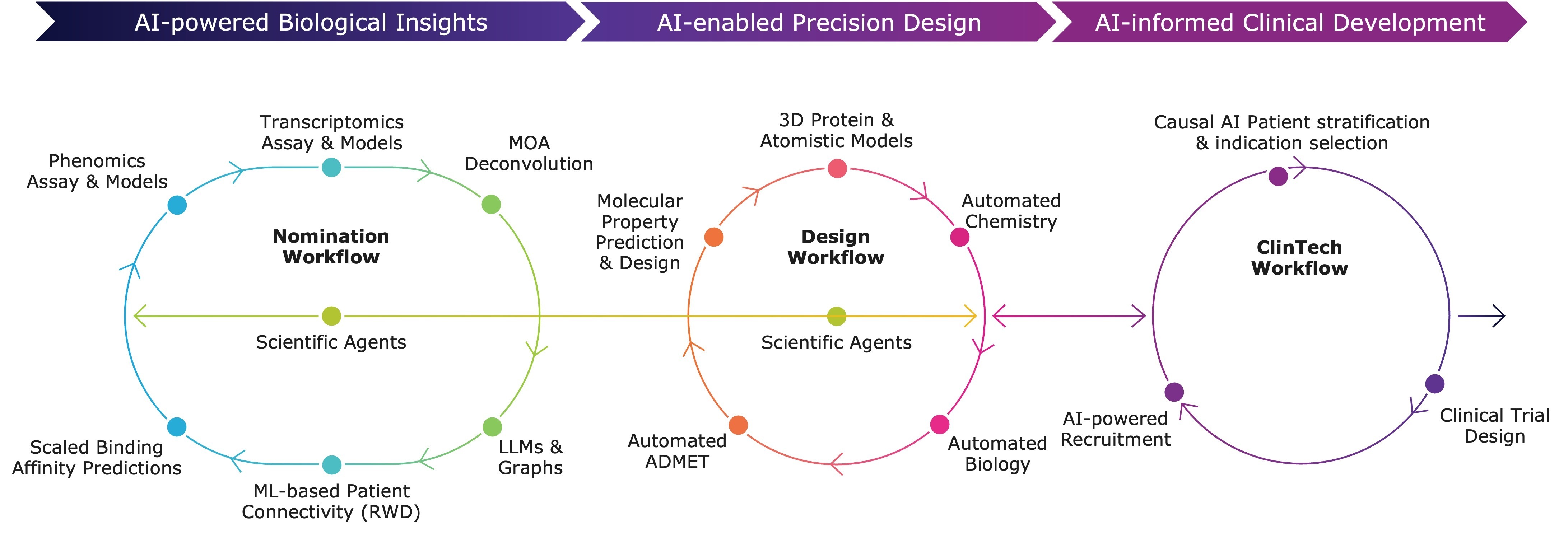
Recursion OS 2.0: The platform is continuing to drive program development with applications across biology, chemistry and clinical development.
Actively expanding the Virtual Cell to understand and predict cellular behavior across a wider range of biology.
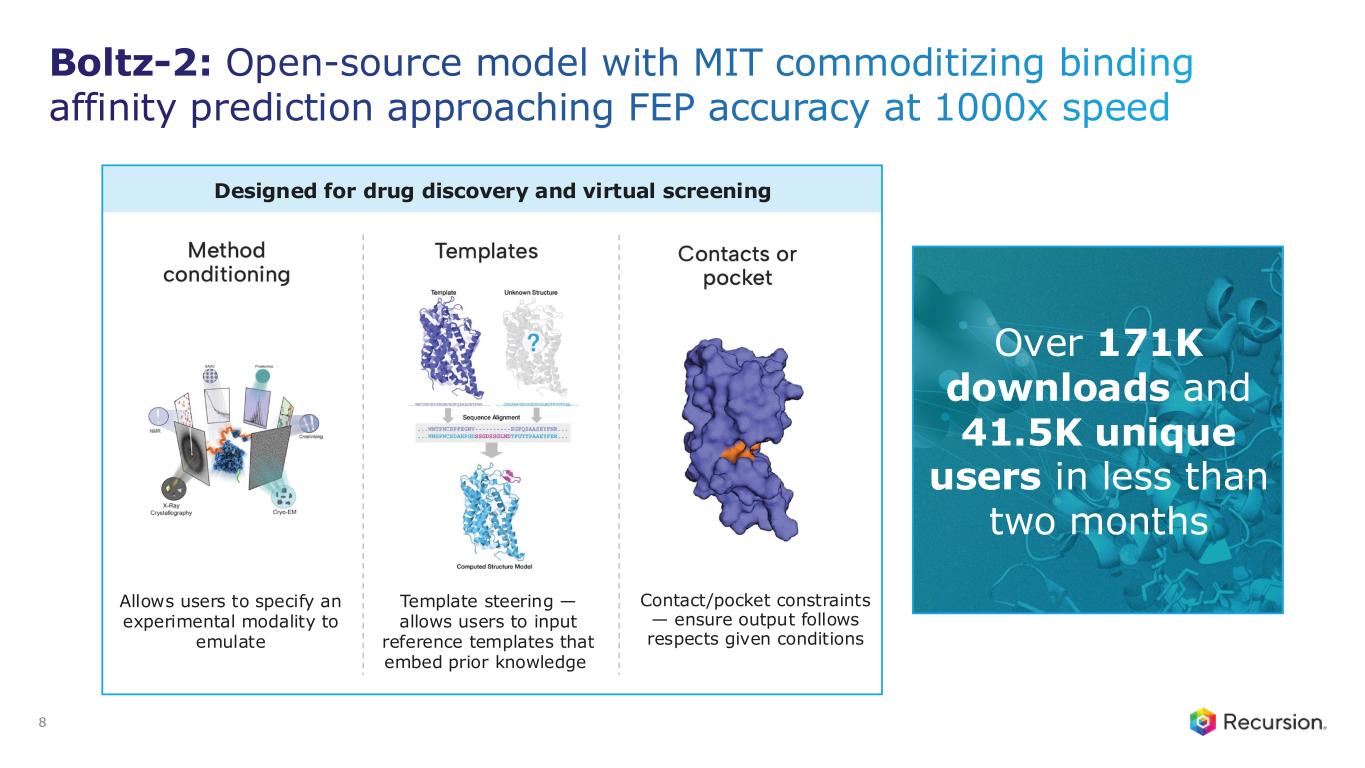
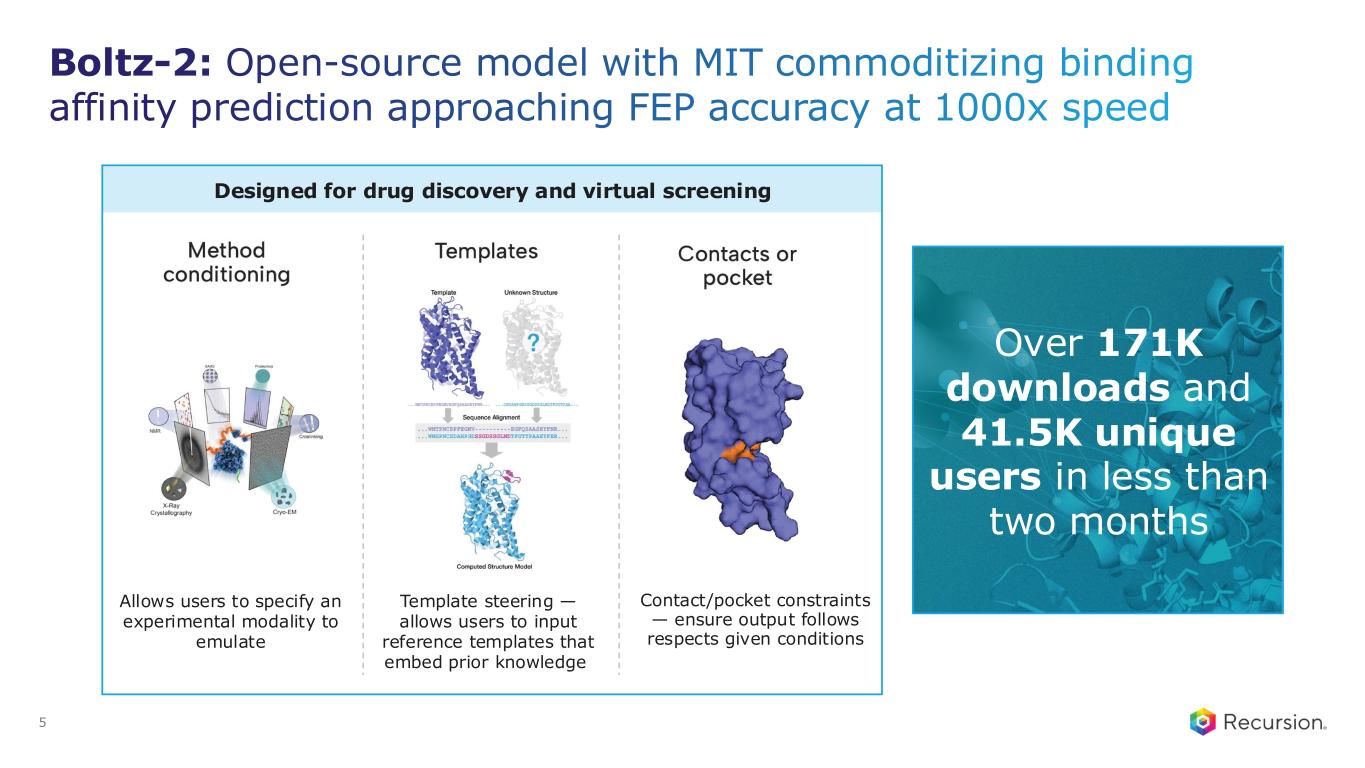
Boltz-2 open source model released with MIT and Nvidia to commoditize state of the art performance for binding affinity prediction approaching the accuracy of physics-based free energy perturbation (FEP) calculations while being over 1,000 times faster and less computationally expensive. The open source tool has been downloaded by over 40,000 unique users to date.
Incorporating diverse cell types beyond HUVEC and disease areas beyond oncology, to discover more novel biology and new medicines.
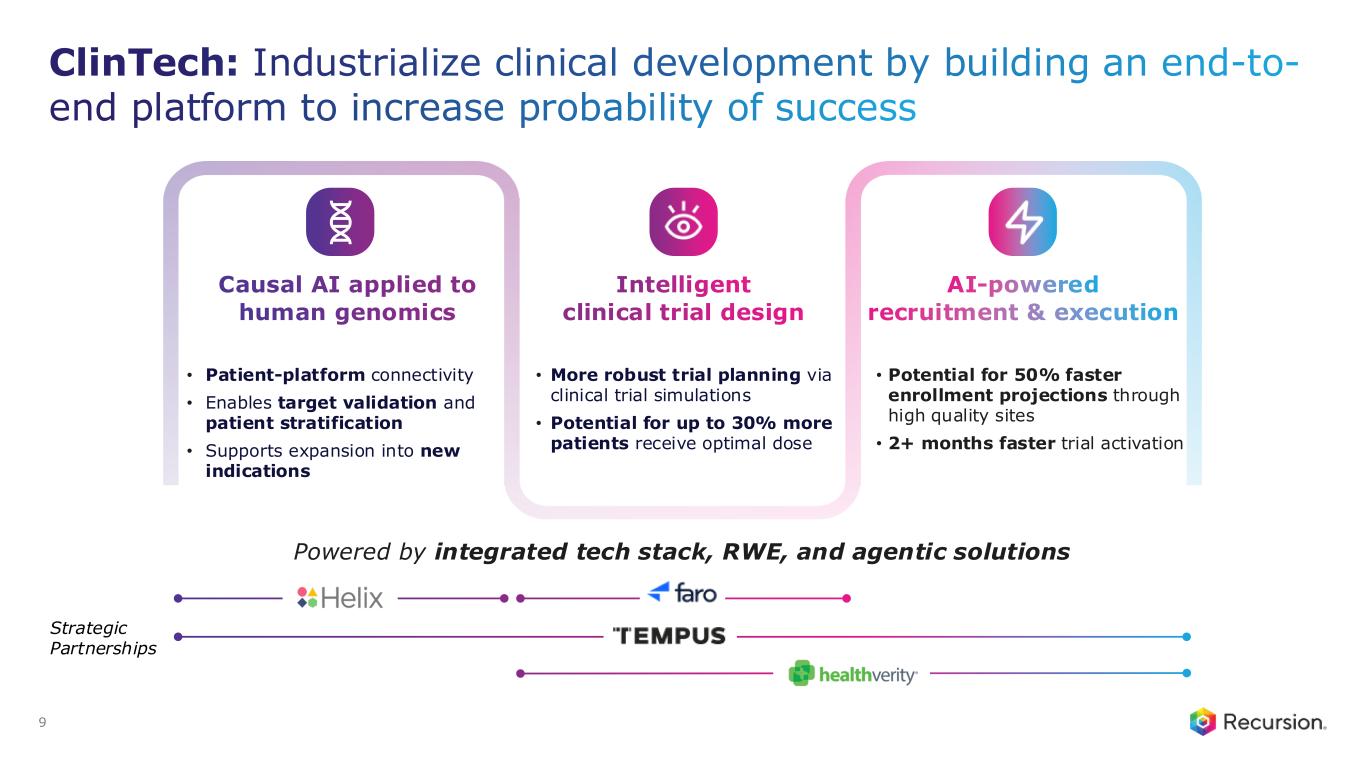
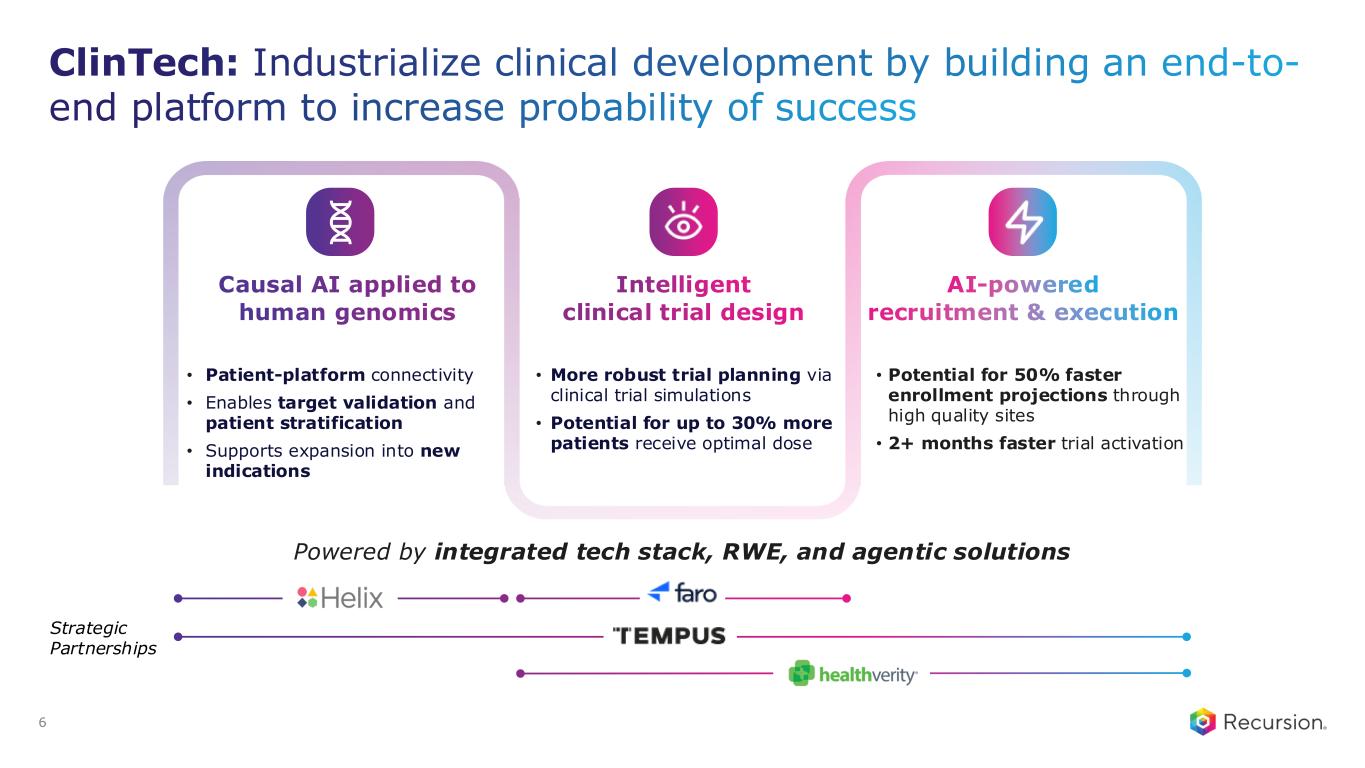
Recursion continues to expand its ClinTech platform, integrating high-quality, linked patient datasets like Tempus, HealthVerity, and Helix to strengthen programs, bolster preclinical and early clinical data to select patients (e.g., for REC-617), and optimize recruitment.

Second Quarter 2025 Financial Results

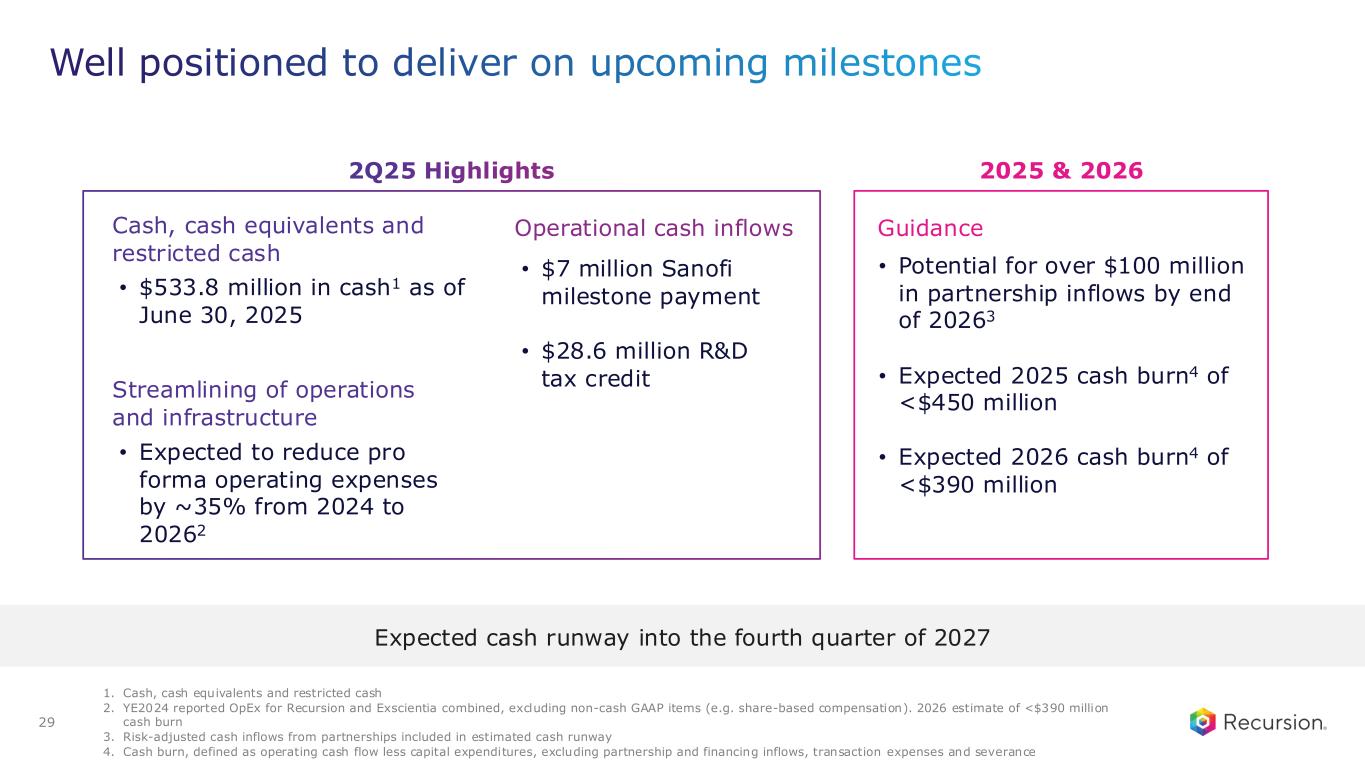
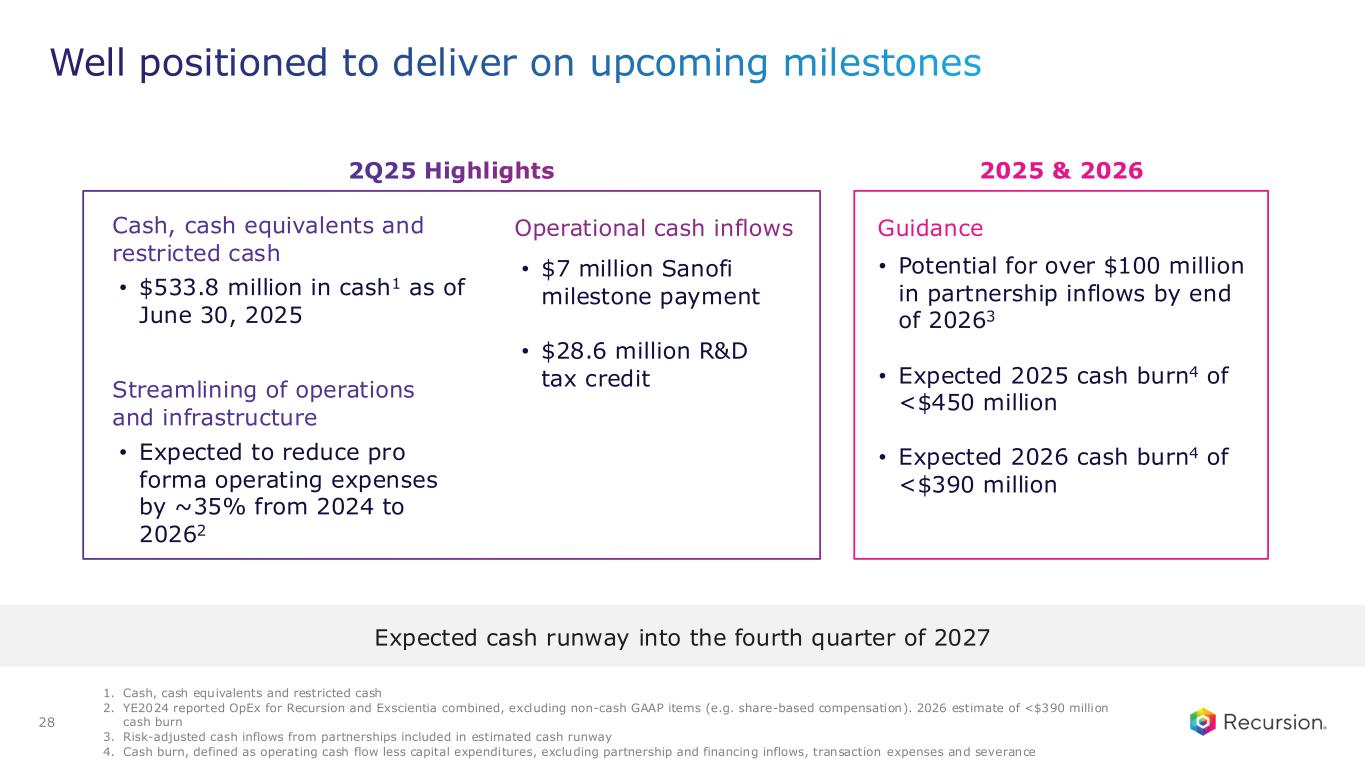
Cash Position: Cash, cash equivalents and restricted cash were $533.8 million as of June 30, 2025 compared to $603.0 million as of December 31, 2024. Based on current operating plans, the Company believes that its expected cash runway will extend into the fourth quarter of 2027.
Revenue: Total revenue, consisting primarily of revenue from collaboration agreements, was $19.2 million for the second quarter of 2025, compared to $14.4 million for the second quarter of 2024.
Research and Development Expenses: Research and development expenses were $128.6 million for the second quarter of 2025, compared to $73.9 million for the second quarter of 2024. The increase was primarily driven by the Company's agreement with Tempus as well as its business combination with Exscientia in November 2024. This includes recognition of $22.7 million in non-cash expenses for use of Tempus’ patient-centric multimodal oncology data under the companies’ ongoing collaboration.


General and Administrative Expenses: General and administrative expenses were $46.7 million for the second quarter of 2025 compared to $31.8 million for the second quarter of 2024. The increase compared to the prior period was primarily due to the inclusion of G&A expenses from the business combination with Exscientia.
Net Loss: Net loss was $171.9 million for the second quarter of 2025, compared to a net loss of $97.5 million for the second quarter of 2024.
Operational cash flows: Net cash used in operating activities was $208.4 million for the six months ended June 30, 2025, compared to net cash used in operating activities of $184.5 million for the six months ended June 30, 2024. The increase in cash used in operating activities was primarily driven by the inclusion of Exscientia’s operations, for which the business combination with Recursion closed in November 2024.This was partially offset by cash inflows from partnerships and operational tax rebates totaling $7.0 million and $28.6 million respectively for the first three and six months of 2025. No cash inflows from partnerships or operational tax rebates were recorded during the six months ended June 30, 2024. In association with the restructuring activities announced in June 2025, the Company expects to incur costs totalling $9.3 million, of which $3.9 million has been paid in the second quarter of 2025. Recursion expects to incur all of these expenses in the year ending December 31, 2025.

About Recursion
Recursion (NASDAQ: RXRX) is a clinical stage TechBio company leading the space by decoding biology to radically improve lives. Enabling its mission is the Recursion OS, a platform built across diverse technologies that continuously generate one of the world’s largest proprietary biological and chemical datasets. Recursion leverages sophisticated machine-learning algorithms to distill from its dataset a collection of trillions of searchable relationships across biology and chemistry unconstrained by human bias. By commanding massive experimental scale — up to millions of wet lab experiments weekly — and massive computational scale — owning and operating one of the most powerful supercomputers in the world, Recursion is uniting technology, biology and chemistry to advance the future of medicine.

Recursion is headquartered in Salt Lake City, where it is a founding member of BioHive, the Utah life sciences industry collective. Recursion also has offices in Toronto, Montréal, New York, London, Oxford area, and the San Francisco Bay area. Learn more at www.Recursion.com, or connect on X (formerly Twitter) and LinkedIn.


Media Contact
[email protected]

Investor Contact
[email protected]


Recursion Pharmaceuticals, Inc.
Consolidated Statements of Operations (unaudited)
(in thousands, except share and per share amounts)

Three months ended June 30,Six months ended
June 30,
2025202420252024
Revenue
Operating revenue$19,103 $14,404 $33,921 $27,895 
Grant revenue120 13 47 316 
Total revenue19,223 14,417 33,968 28,211 
Operating costs and expenses
Cost of revenue20,161 9,199 41,990 20,365 
Research and development128,636 73,928 258,269 141,488 
General and administrative46,653 31,833 101,304 63,241 
Total operating costs and expenses195,450 114,960 401,563 225,094 
Loss from operations(176,227)(100,543)(367,595)(196,883)
Other income (loss), net4,330 2,480 (6,947)6,668 
Loss before income tax benefit (171,897)(98,063)(374,542)(190,215)
Income tax benefit— 523 158 1,302 
Net loss$(171,897)$(97,540)$(374,384)$(188,913)
Per share data
Net loss per share of Class A, B and Exchangeable common stock, basic and diluted$(0.41)$(0.40)$(0.91)$(0.79)
Weighted-average shares (Class A, B and Exchangeable) outstanding, basic and diluted417,361,147 242,196,409 410,268,199 239,107,879 


Recursion Pharmaceuticals, Inc.
Condensed Consolidated Balance Sheets (unaudited)
(in thousands)
 June 30,December 31,
 20252024
Assets  
Current assets  
Cash and cash equivalents$525,110 $594,350 
Restricted cash3,106 3,045 
Other receivables21,606 49,166 
Prepaid data assets— 29,601 
Other current assets37,338 38,107 
Total current assets587,160 714,269 
Restricted cash, non-current5,629 5,629 
Property and equipment, net120,038 141,063 
Operating lease right-of-use assets50,324 65,877 
Financing lease right-of-use assets23,242 26,273 
Intangible assets, net341,319 335,855 
Goodwill164,270 148,873 
Deferred tax assets957 1,934 
Other assets, non-current9,416 8,825 
Total assets$1,302,355 $1,448,598 
Liabilities and stockholders’ equity
Current liabilities
Accounts payable$19,314 $21,613 
Accrued expenses and other liabilities64,280 81,872 
Accrued data liability20,258 — 
Unearned revenue39,690 61,767 
Operating lease liabilities11,732 13,795 
Notes payable and financing lease liabilities8,752 8,425 
Total current liabilities164,026 187,472 
Unearned revenue, non-current126,243 118,765 
Operating lease liabilities, non-current53,395 67,250 
Notes payable and financing lease liabilities, non-current14,196 19,022 
Deferred tax liabilities23,784 16,575 
Other liabilities, non-current1,565 4,732 
Total liabilities383,209 413,816 
Commitments and contingencies
Stockholders’ equity
Common stock (Class A, B and Exchangeable)
Additional paid-in capital2,681,111 2,473,698 
Accumulated deficit(1,805,589)(1,431,283)
Accumulated other comprehensive loss43,620 (7,637)
Total stockholders’ equity919,146 1,034,782 
Total liabilities and stockholders’ equity $1,302,355 $1,448,598 


Forward-Looking Statements
This document contains information that includes or is based upon “forward-looking statements” within the meaning of the Securities Litigation Reform Act of 1995, including, without limitation, those regarding Recursion’s ability to discover and develop medicines and the occurrence or realization of near-term milestones; the timing of data readouts and other milestones; the impact of preclinical data on trial outcomes; Recursion's future as a leader in TechBio and ability to deliver better treatments to patients faster; the completion of core integration plans and the results of the business combination with Exscientia; expectations relating to early and late stage discovery, preclinical, and clinical programs, including timelines for commencement of and enrollment in studies, data readouts, and progression toward IND-enabling studies; expectations and developments with respect to licenses and collaborations, including option exercises by partners and the amount and timing of potential milestone payments, and the acceleration of progress across multiple partnered programs; prospective products and their potential future indications and market opportunities; developments with Recursion OS, including the ability to discover and develop new medicines and provide insights into patient populations; financial position and cash runway; and other technologies; business and financial plans and performance; and all other statements that are not historical facts. Forward-looking statements may or may not include identifying words such as “plan,” “will,” “expect,” “anticipate,” “intend,” “believe,” “potential,” “continue,” and similar terms. These statements are subject to known or unknown risks and uncertainties that could cause actual results to differ materially from those expressed or implied in such statements, including but not limited to: challenges inherent in pharmaceutical research and development, including the timing and results of preclinical and clinical programs, where the risk of failure is high and failure can occur at any stage prior to or after regulatory approval due to lack of sufficient efficacy, safety considerations, or other factors; our ability to leverage and enhance our drug discovery platform; our ability to obtain financing for development activities and other corporate purposes; the success of our collaboration activities; our ability to obtain regulatory approval of, and ultimately commercialize, drug candidates; our ability to obtain, maintain, and enforce intellectual property protections; cyberattacks or other disruptions to our technology systems; our ability to attract, motivate, and retain key employees and manage our growth; inflation and other macroeconomic issues; and other risks and uncertainties such as those described under the heading “Risk Factors” in our filings with the U.S. Securities and Exchange Commission, including our Annual Report on Form 10-K and Quarterly Reports on Form 10-Q. All forward-looking statements are based on management’s current estimates, projections, and assumptions, and Recursion undertakes no obligation to correct or update any such statements, whether as a result of new information, future developments, or otherwise, except to the extent required by applicable law.

Corporate Deck August 2025


This presentation of Recursion Pharmaceuticals, Inc. (“Recursion,” “we,” “us,” or “our”) and any accompanying discussion contain statements that are not historical facts may be considered forward-looking statements under federal securities laws and may be identified by words such as “anticipates,” “believes,” “estimates,” “expects,” “intends,” “plans,” “potential,” “predicts,” “projects,” “seeks,” “should,” “will,” or words of similar meaning and include, but are not limited to, statements regarding Recursion’s ability to demonstrate the potential of technology-driven approaches to increase speed, quality and the scalability of drug discovery; the potential outlook for programs being prioritized and deprioritized; Recursion's future as a leader in TechBio and ability to deliver better treatments to patients faster; Recursion’s OS industrializing first- and best-in-class drug discovery; the occurrence or realization of potential milestones; current and future preclinical and clinical studies, including timelines for enrollment in studies, data readouts, and progression toward IND-enabling and other potential studies; advancements of its pipeline, partnerships, and data strategies; the potential size of the market opportunity for our drug candidates; outcomes and benefits from licenses, partnerships and collaborations, including option exercises by partners and the amount and timing of potential milestone payments; the initiation, timing, progress, results, and cost of our research and development programs; advancements of our Recursion OS; the potential for additional partnerships; our ability to identify viable new drug candidates for clinical development and the accelerating rate at which we expect to identify such candidates including our ability to leverage the datasets acquired through the license agreement into increased machine learning capabilities and accelerate clinical trial enrollment; Recursion’s cash burn, cash position and cash runway; the completion of core integration plans and the results of the business combination with Exscientia; and many others. Other important factors and information are contained in Recursion’s most recent Annual Report on Form 10-K, Quarterly Report on Form 10-Q, and the Company’s other filings with the U.S. Securities and Exchange Commission (the “SEC”), which can be accessed at https://ir.recursion.com, or www.sec.gov. All forward-looking statements are qualified by these cautionary statements and apply only as of the date they are made. Recursion does not undertake any obligation to update any forward-looking statement, whether as a result of new information, future events or otherwise. Certain information contained in this presentation relates to or is based on studies, publications, surveys and other data obtained from third-party sources and the company’s own internal estimates and research. While the company believes these third-party sources to be reliable as of the date of this presentation, it has not independently verified, and makes no representation as to the adequacy, fairness, accuracy or completeness of, any information obtained from third- party sources. In addition, all of the market data included in this presentation involves a number of assumptions and limitations, and there can be no guarantee as to the accuracy or reliability of such assumptions. Finally, while the company believes its own internal research is reliable, such research has not been verified by any independent source. Information contained in, or that can be accessed through our website is not a part of and is not incorporated into this presentation. Cross-trial or cross-candidate comparisons against other clinical trials and other drug candidates are not based on head-to-head studies and are presented for informational purposes; comparisons are based on publicly available information for other clinical trials and other drug candidates. Any non-Recursion logos or trademarks included herein are the property of the owners thereof and are used for reference purposes only. Important Information 2

 
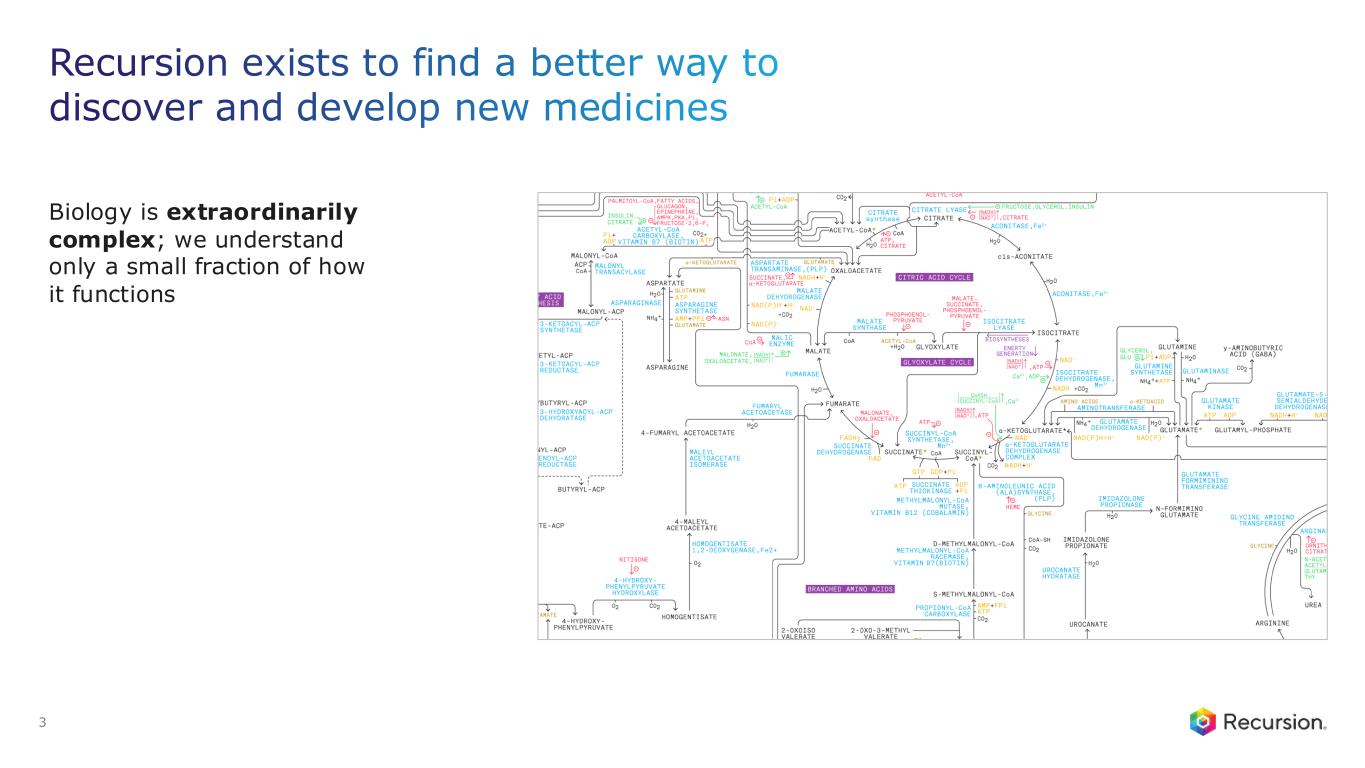
Recursion exists to find a better way to discover and develop new medicines 3 Biology is extraordinarily complex; we understand only a small fraction of how it functions


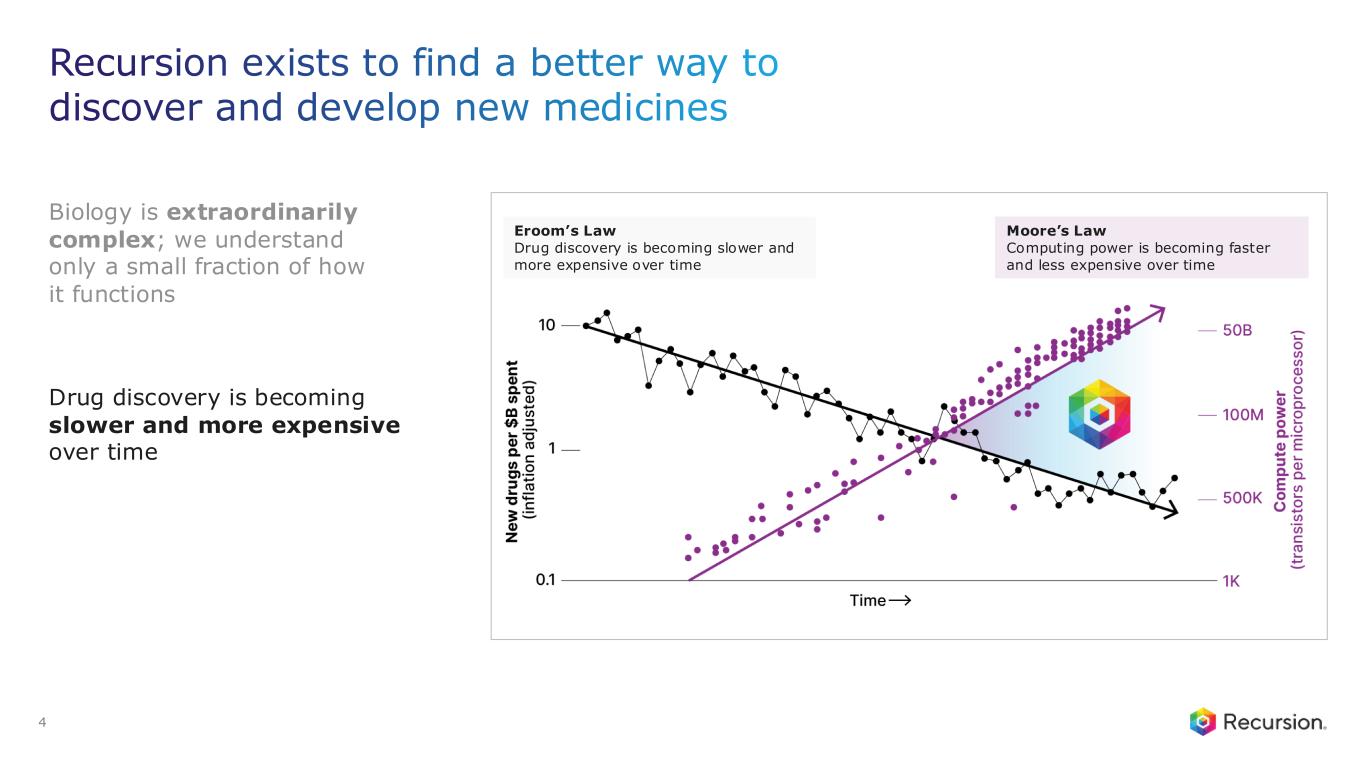
Recursion exists to find a better way to discover and develop new medicines 4 Eroom’s Law Drug discovery is becoming slower and more expensive over time Drug discovery is becoming slower and more expensive over time Biology is extraordinarily complex; we understand only a small fraction of how it functions Moore’s Law Computing power is becoming faster and less expensive over time


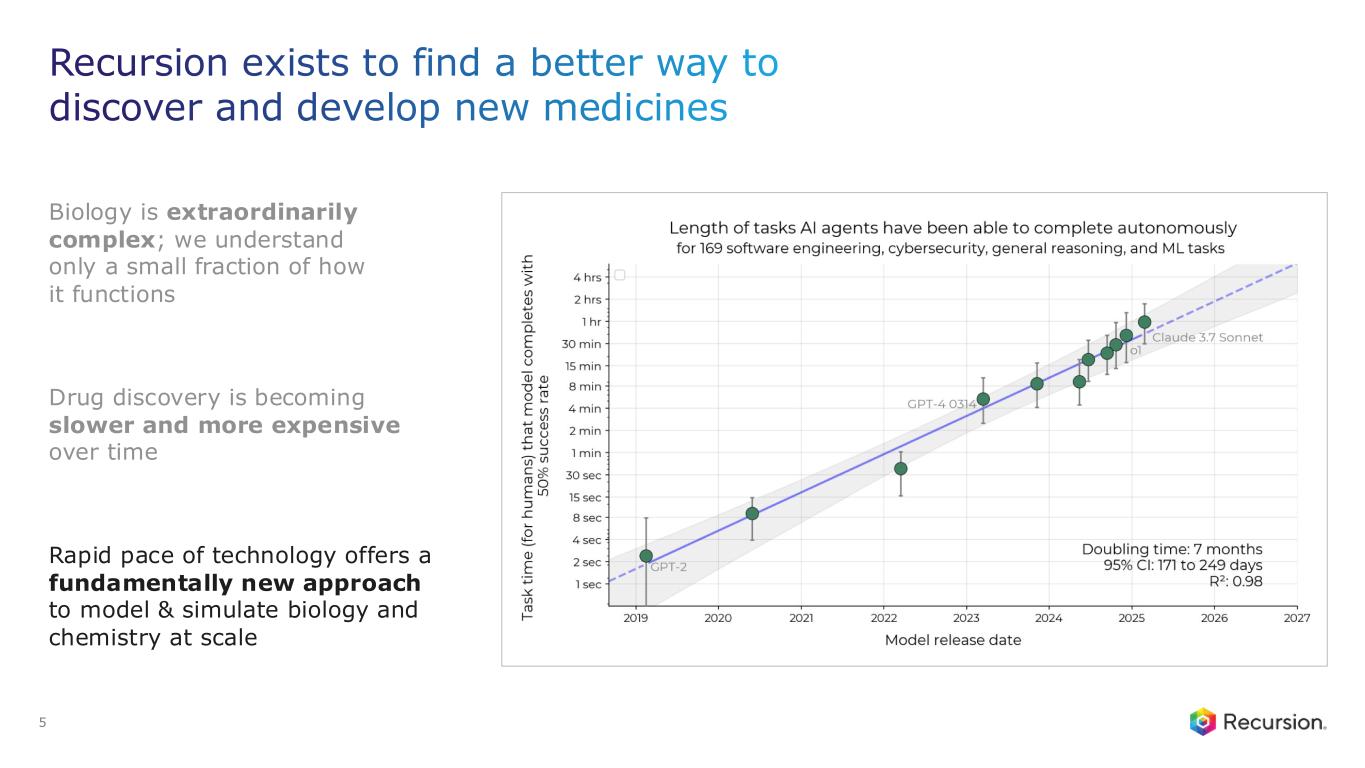
Recursion exists to find a better way to discover and develop new medicines 5 Drug discovery is becoming slower and more expensive over time Biology is extraordinarily complex; we understand only a small fraction of how it functions Rapid pace of technology offers a fundamentally new approach to model & simulate biology and chemistry at scale


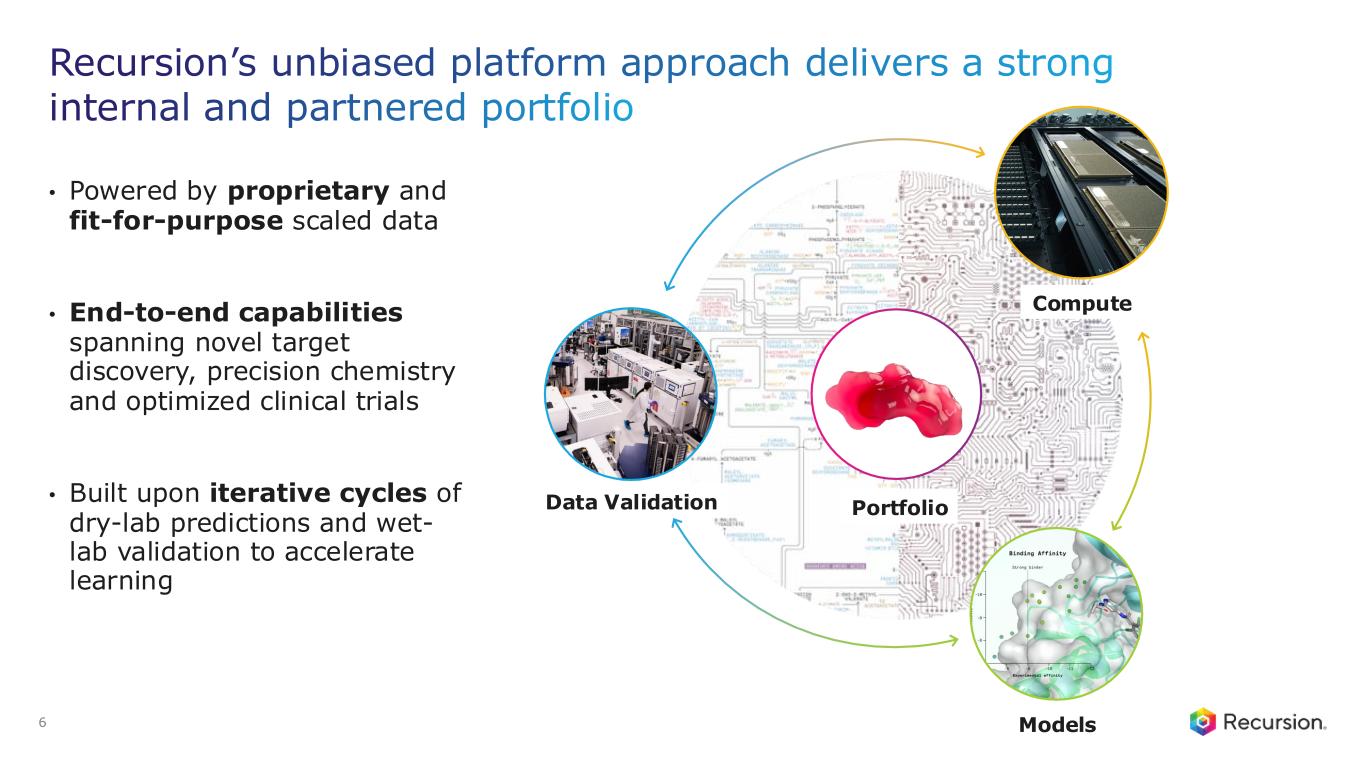
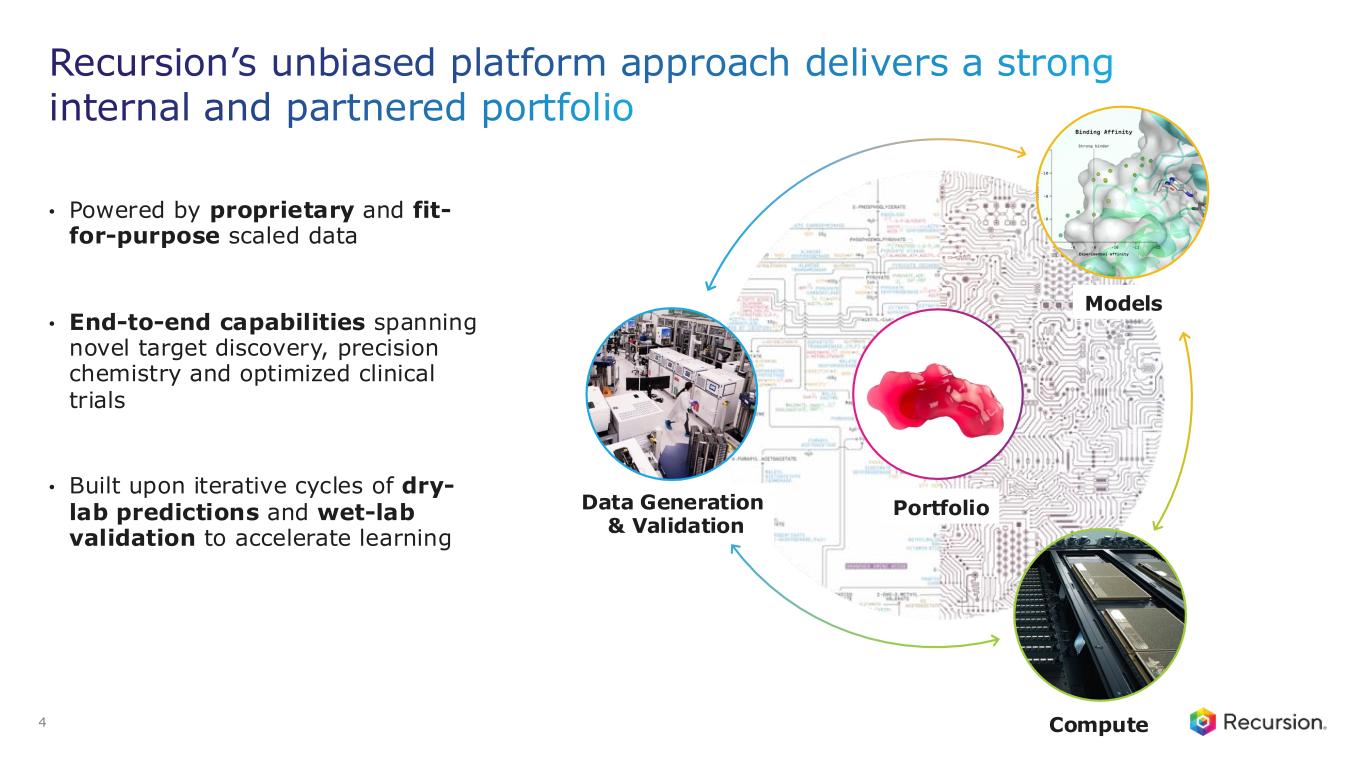
Recursion’s unbiased platform approach delivers a strong internal and partnered portfolio 6 • Powered by proprietary and fit-for-purpose scaled data • End-to-end capabilities spanning novel target discovery, precision chemistry and optimized clinical trials • Built upon iterative cycles of dry-lab predictions and wet- lab validation to accelerate learning Compute PortfolioData Validation Models


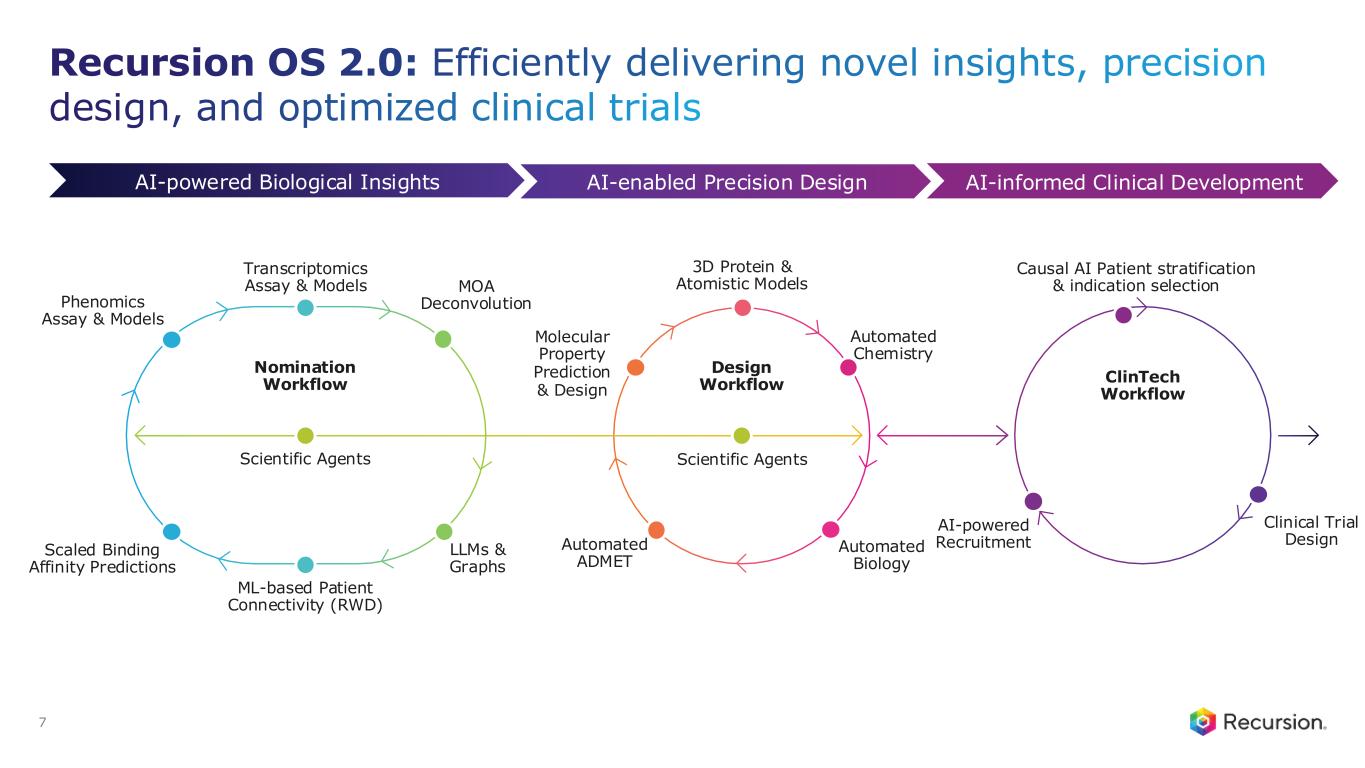
Recursion OS 2.0: Efficiently delivering novel insights, precision design, and optimized clinical trials 7 Design Workflow Automated ADMET Automated Chemistry Automated Biology 3D Protein & Atomistic Models Molecular Property Prediction & Design Scientific Agents Nomination Workflow Scientific Agents Transcriptomics Assay & Models ML-based Patient Connectivity (RWD) LLMs & Graphs MOA Deconvolution Scaled Binding Affinity Predictions Phenomics Assay & Models Clinical Trial Design ClinTech Workflow AI-powered Recruitment Causal AI Patient stratification & indication selection AI-enabled Precision DesignAI-powered Biological Insights AI-informed Clinical Development


Boltz-2: Open-source model with MIT commoditizing binding affinity prediction approaching FEP accuracy at 1000x speed 8 Over 171K downloads and 41.5K unique users in less than two months Designed for drug discovery and virtual screening Contact/pocket constraints — ensure output follows respects given conditions Allows users to specify an experimental modality to emulate Template steering — allows users to input reference templates that embed prior knowledge


ClinTech: Industrialize clinical development by building an end-to- end platform to increase probability of success 9 • Patient-platform connectivity • Enables target validation and patient stratification • Supports expansion into new indications • More robust trial planning via clinical trial simulations • Potential for up to 30% more patients receive optimal dose • Potential for 50% faster enrollment projections through high quality sites • 2+ months faster trial activation Powered by integrated tech stack, RWE, and agentic solutions Strategic Partnerships Causal AI applied to human genomics Intelligent clinical trial design AI-powered recruitment & execution


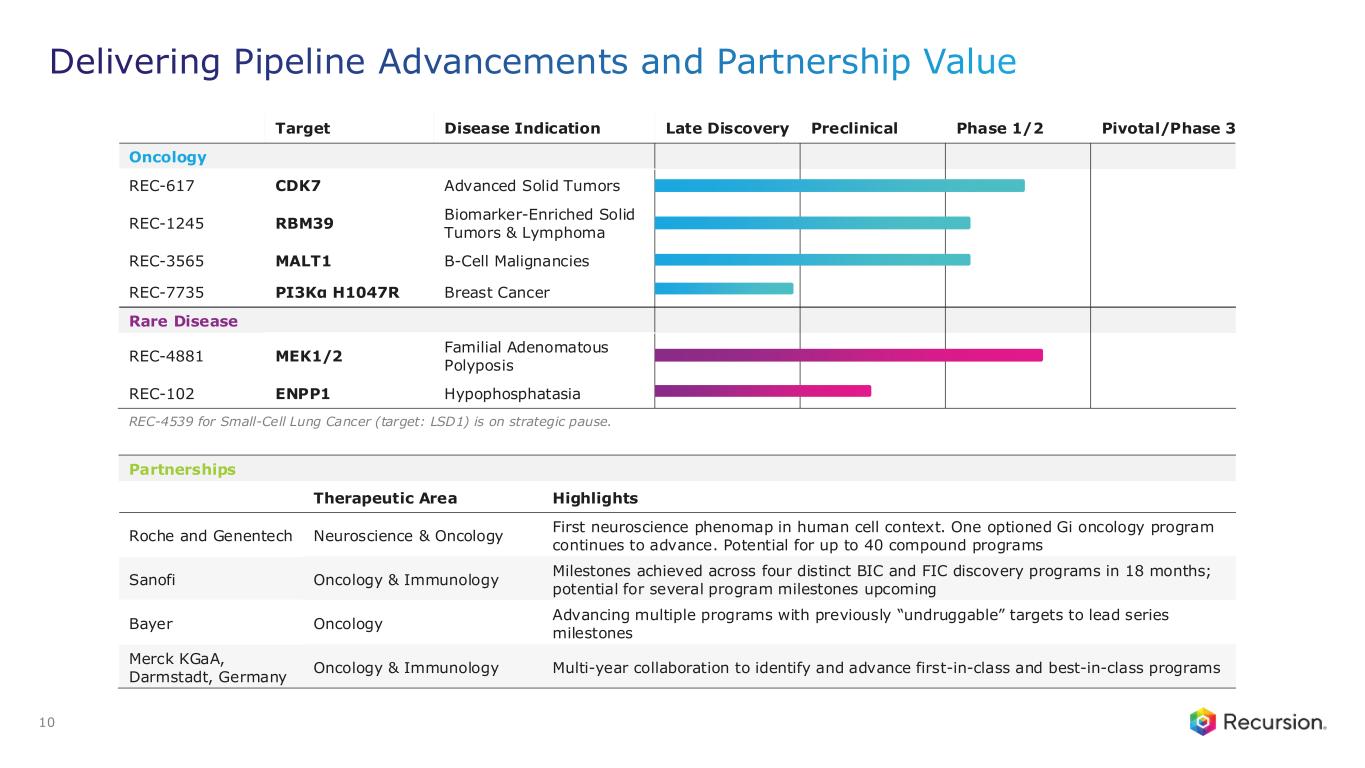
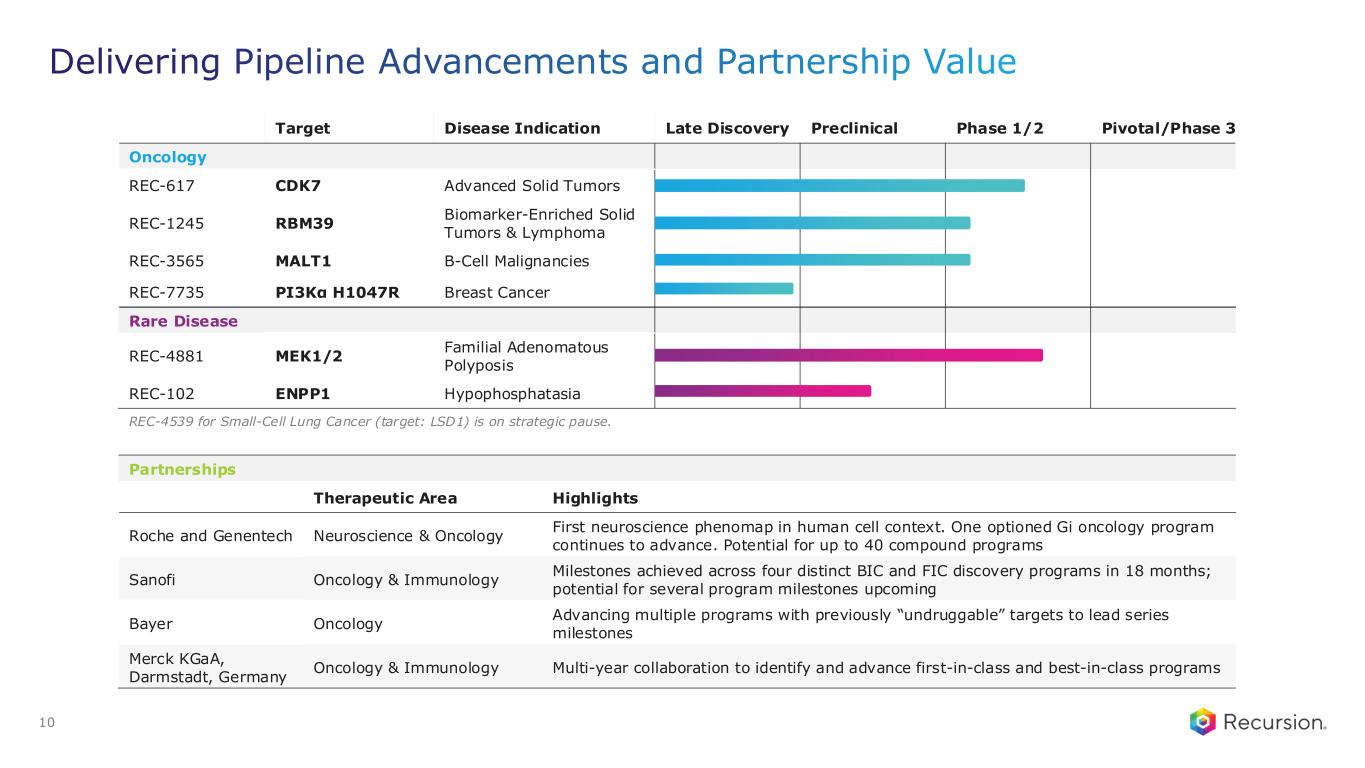
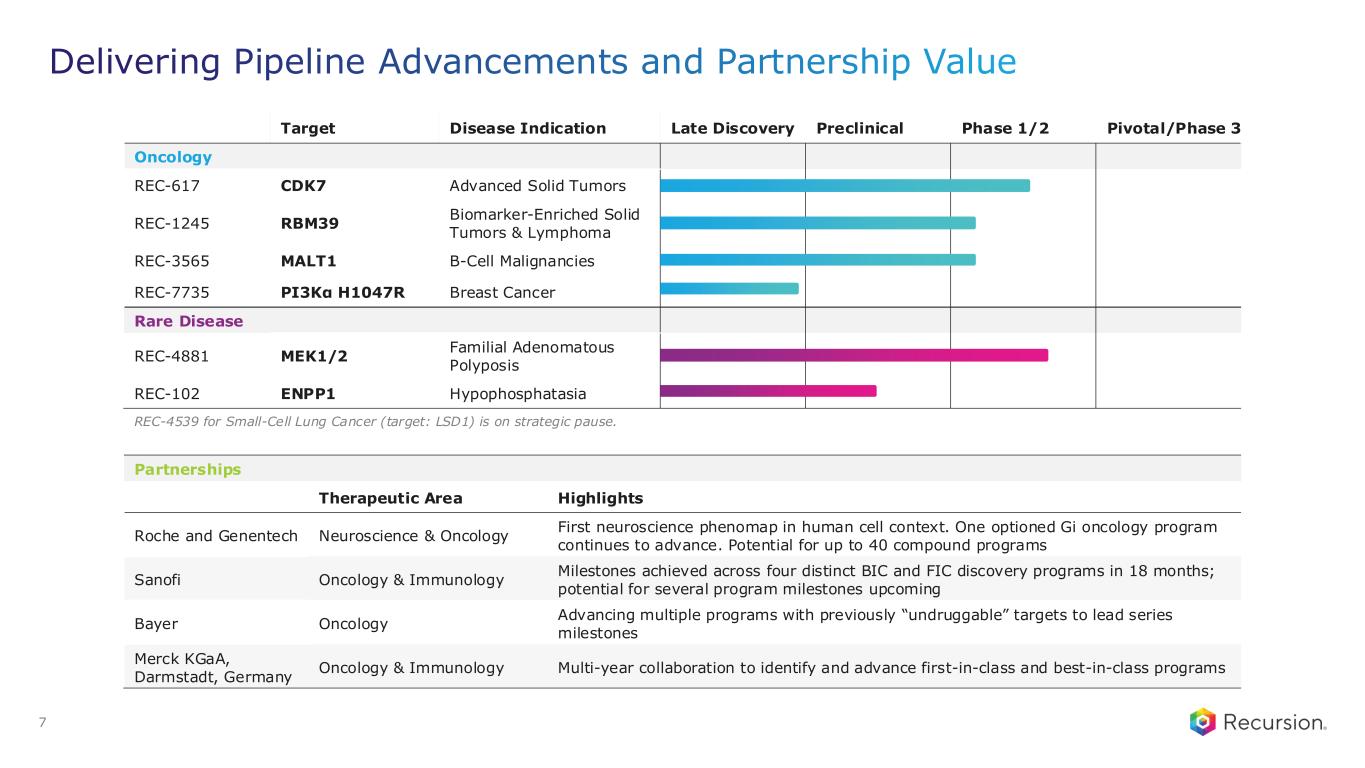
REC-4539 for Small-Cell Lung Cancer (target: LSD1) is on strategic pause. Delivering Pipeline Advancements and Partnership Value 10 Target Disease Indication Late Discovery Preclinical Phase 1/2 Pivotal/Phase 3 Oncology REC-617 CDK7 Advanced Solid Tumors REC-1245 RBM39 Biomarker-Enriched Solid Tumors & Lymphoma REC-3565 MALT1 B-Cell Malignancies REC-7735 PI3Kα H1047R Breast Cancer Rare Disease REC-4881 MEK1/2 Familial Adenomatous Polyposis REC-102 ENPP1 Hypophosphatasia Partnerships Therapeutic Area Highlights Roche and Genentech Neuroscience & Oncology First neuroscience phenomap in human cell context. One optioned Gi oncology program continues to advance. Potential for up to 40 compound programs Sanofi Oncology & Immunology Milestones achieved across four distinct BIC and FIC discovery programs in 18 months; potential for several program milestones upcoming Bayer Oncology Advancing multiple programs with previously “undruggable” targets to lead series milestones Merck KGaA, Darmstadt, Germany Oncology & Immunology Multi-year collaboration to identify and advance first-in-class and best-in-class programs


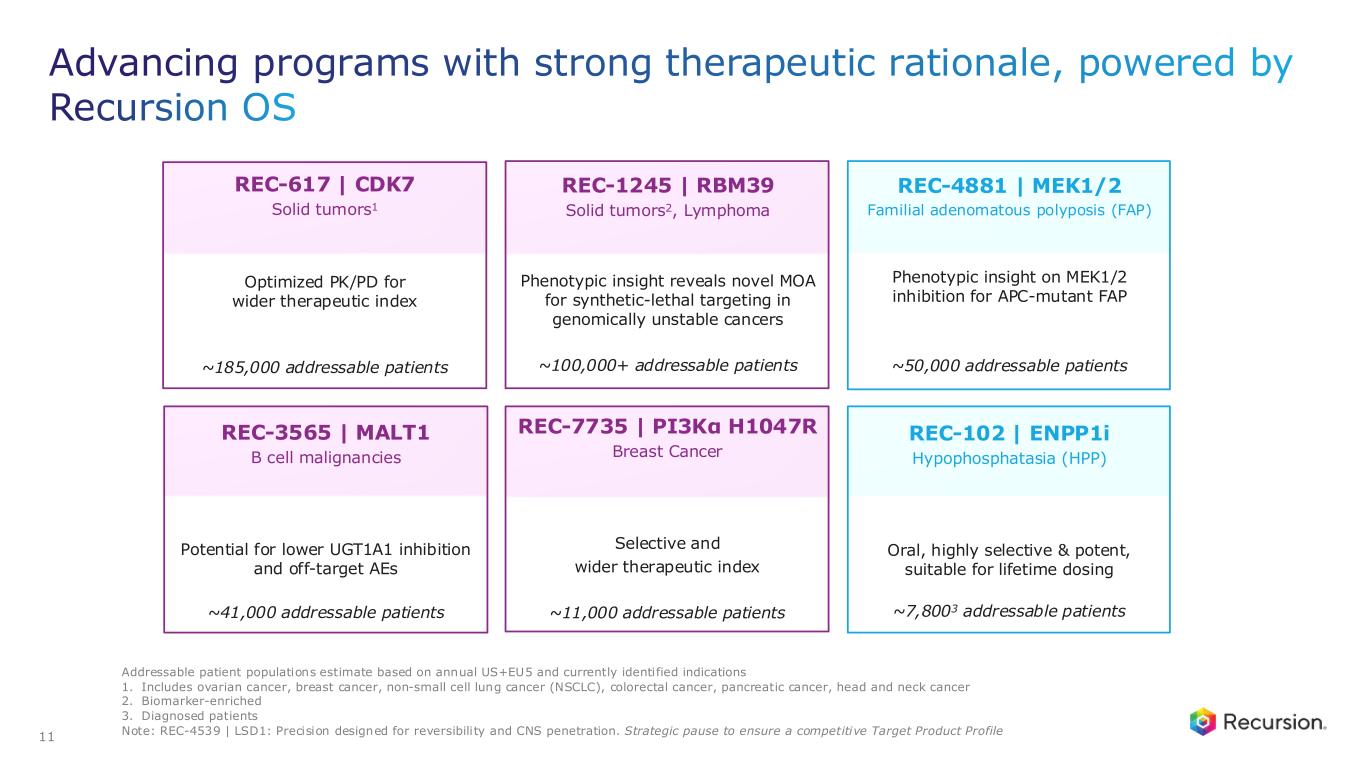
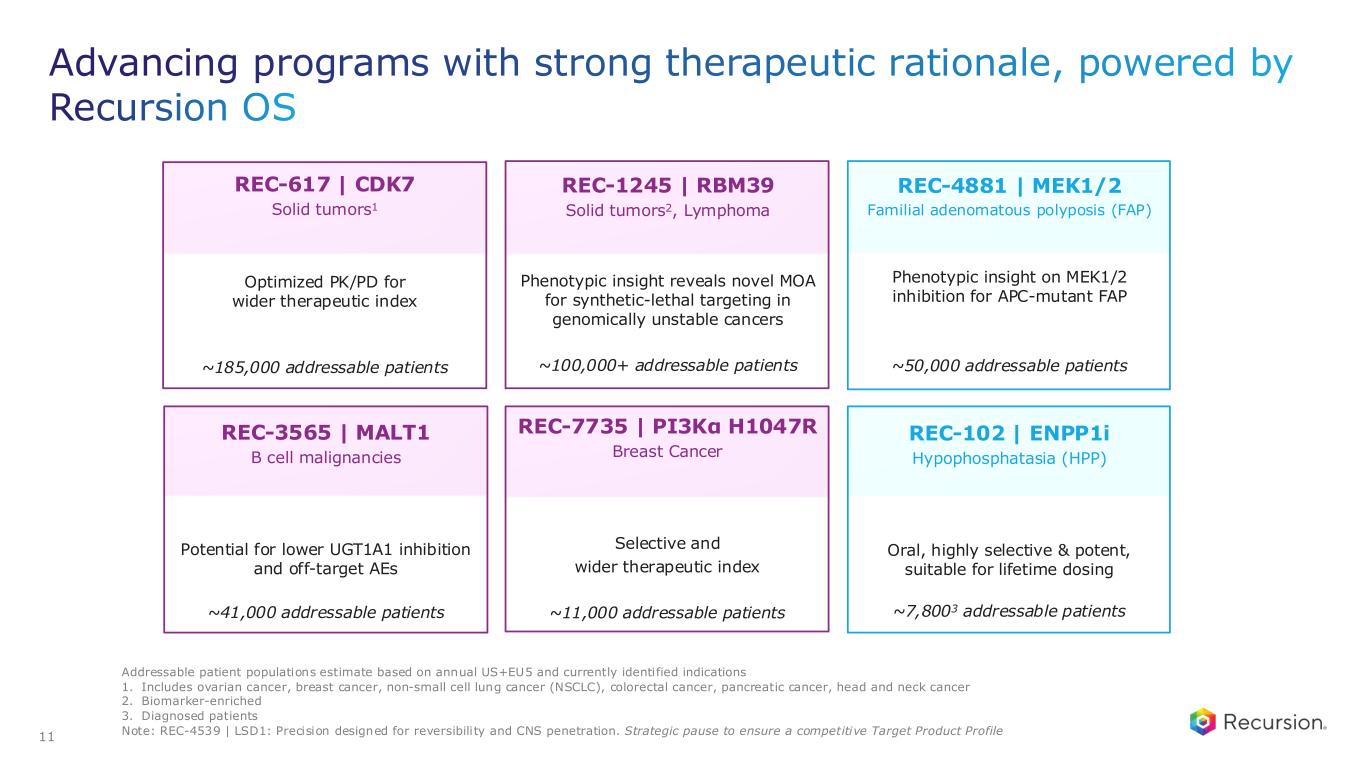
Advancing programs with strong therapeutic rationale, powered by Recursion OS Addressable patient populations estimate based on annual US+EU5 and currently identified indications 1. Includes ovarian cancer, breast cancer, non-small cell lung cancer (NSCLC), colorectal cancer, pancreatic cancer, head and neck cancer 2. Biomarker-enriched 3. Diagnosed patients Note: REC-4539 | LSD1: Precision designed for reversibility and CNS penetration. Strategic pause to ensure a competitive Target Product Profile 11 REC-617 | CDK7 Solid tumors1 Optimized PK/PD for wider therapeutic index ~185,000 addressable patients REC-1245 | RBM39 Solid tumors2, Lymphoma Phenotypic insight reveals novel MOA for synthetic-lethal targeting in genomically unstable cancers ~100,000+ addressable patients REC-4881 | MEK1/2 Familial adenomatous polyposis (FAP) Phenotypic insight on MEK1/2 inhibition for APC-mutant FAP ~50,000 addressable patients REC-3565 | MALT1 B cell malignancies Potential for lower UGT1A1 inhibition and off-target AEs ~41,000 addressable patients REC-7735 | PI3Kα H1047R Breast Cancer Selective and wider therapeutic index ~11,000 addressable patients REC-102 | ENPP1i Hypophosphatasia (HPP) Oral, highly selective & potent, suitable for lifetime dosing ~7,8003 addressable patients


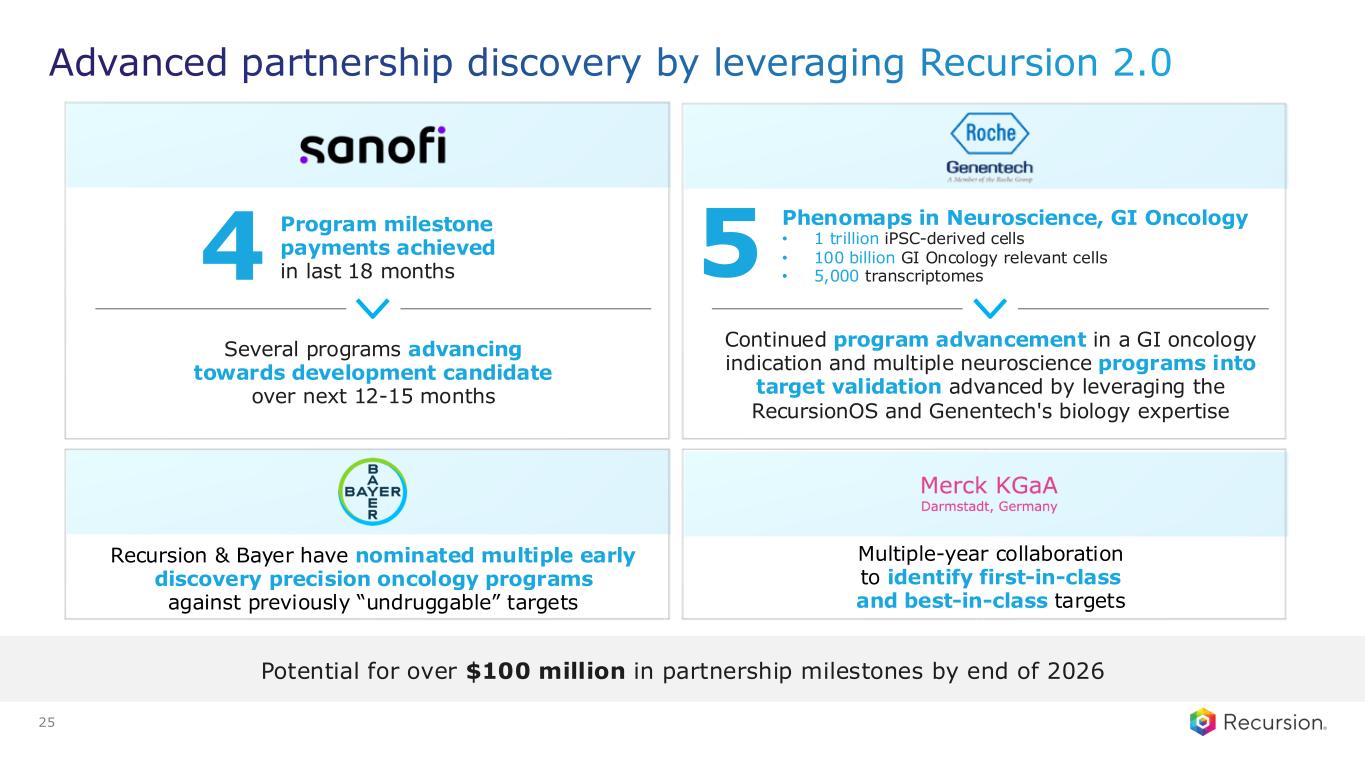
Advanced partnership discovery by leveraging Recursion 2.0 12 4 Program milestone payments achieved in last 18 months Several programs advancing towards development candidate over next 12-15 months Continued program advancement in a GI oncology indication and multiple neuroscience programs into target validation advanced by leveraging the RecursionOS and Genentech's biology expertise Phenomaps in Neuroscience, GI Oncology • 1 trillion iPSC-derived cells • 100 billion GI Oncology relevant cells • 5,000 transcriptomes5 Potential for over $100 million in partnership milestones by end of 2026 Recursion & Bayer have nominated multiple early discovery precision oncology programs against previously “undruggable” targets Multiple-year collaboration to identify first-in-class and best-in-class targets


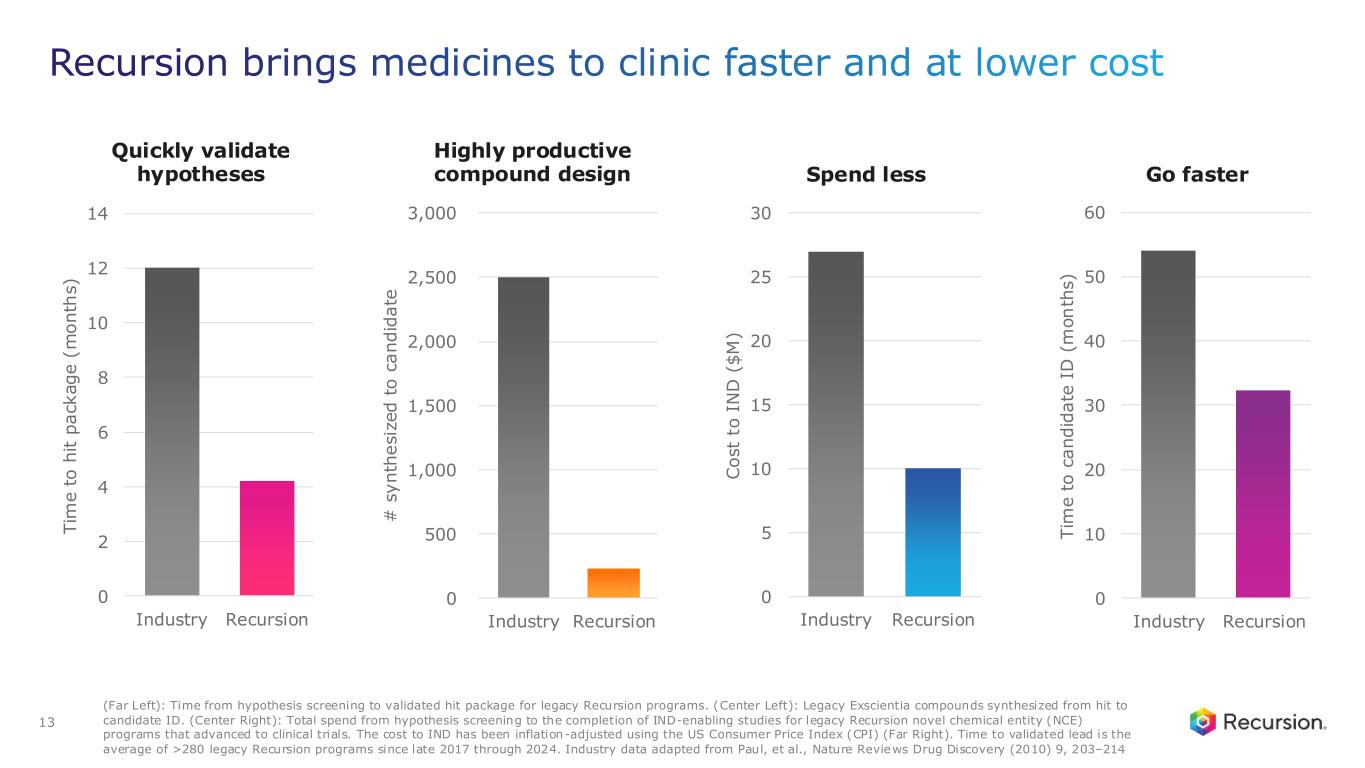
Recursion brings medicines to clinic faster and at lower cost 0 10 20 30 40 50 60 Industry Recursion T im e t o c a n d id a te I D ( m o n th s ) Go faster 0 5 10 15 20 25 30 Industry Recursion C o s t to I N D ( $ M ) Spend less 0 500 1,000 1,500 2,000 2,500 3,000 Industry Recursion Highly productive compound design # s y n th e s iz e d t o c a n d id a te 0 2 4 6 8 10 12 14 Industry Recursion T im e t o h it p a c k a g e ( m o n th s ) Quickly validate hypotheses (Far Left): Time from hypothesis screening to validated hit package for legacy Recursion programs. (Center Left): Legacy Exscientia compounds synthesized from hit to candidate ID. (Center Right): Total spend from hypothesis screening to the completion of IND-enabling studies for legacy Recursion novel chemical entity (NCE) programs that advanced to clinical trials. The cost to IND has been inflation-adjusted using the US Consumer Price Index (CPI) (Far Right). Time to validated lead is the average of >280 legacy Recursion programs since late 2017 through 2024. Industry data adapted from Paul, et al., Nature Reviews Drug Discovery (2010) 9, 203–214 13


Pipeline


Internal Pipeline PIPELINE


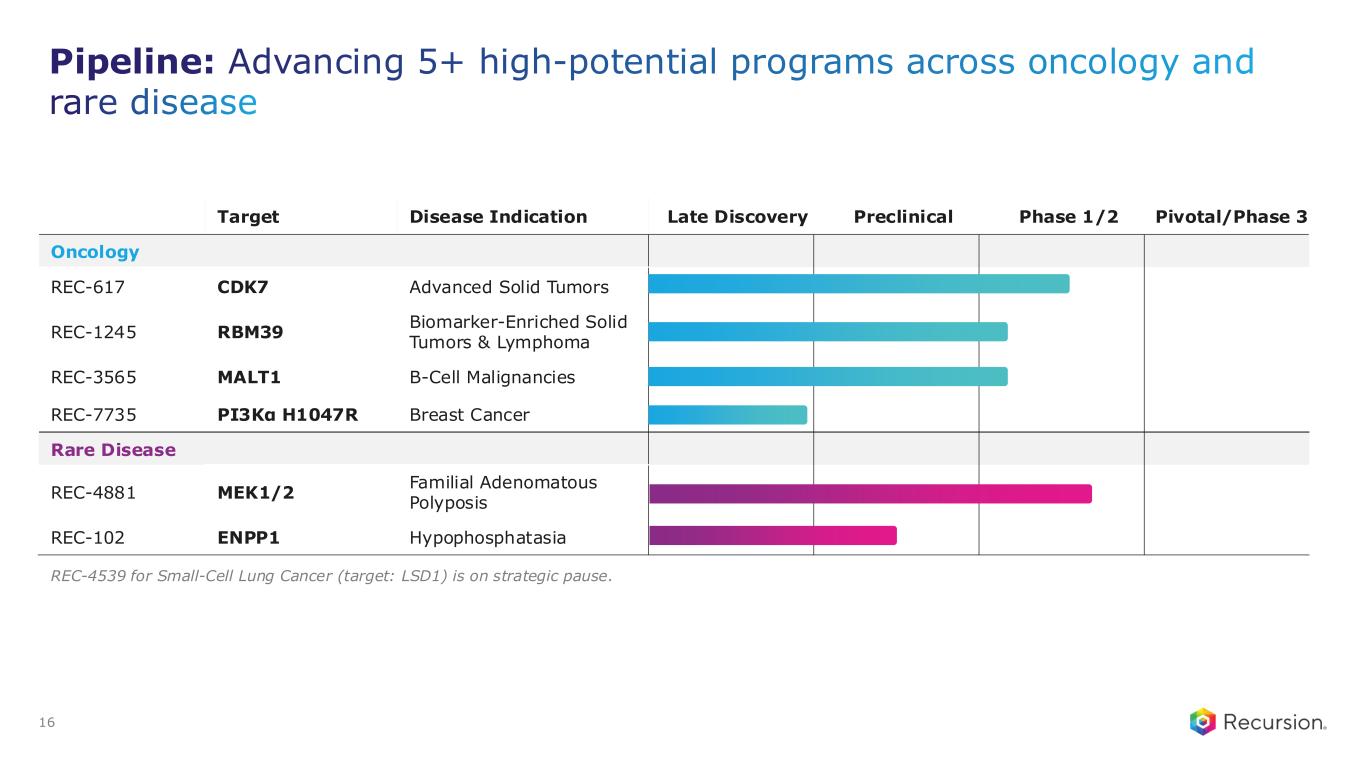
Pipeline: Advancing 5+ high-potential programs across oncology and rare disease 16 REC-4539 for Small-Cell Lung Cancer (target: LSD1) is on strategic pause. Target Disease Indication Late Discovery Preclinical Phase 1/2 Pivotal/Phase 3 Oncology REC-617 CDK7 Advanced Solid Tumors REC-1245 RBM39 Biomarker-Enriched Solid Tumors & Lymphoma REC-3565 MALT1 B-Cell Malignancies REC-7735 PI3Kα H1047R Breast Cancer Rare Disease REC-4881 MEK1/2 Familial Adenomatous Polyposis REC-102 ENPP1 Hypophosphatasia


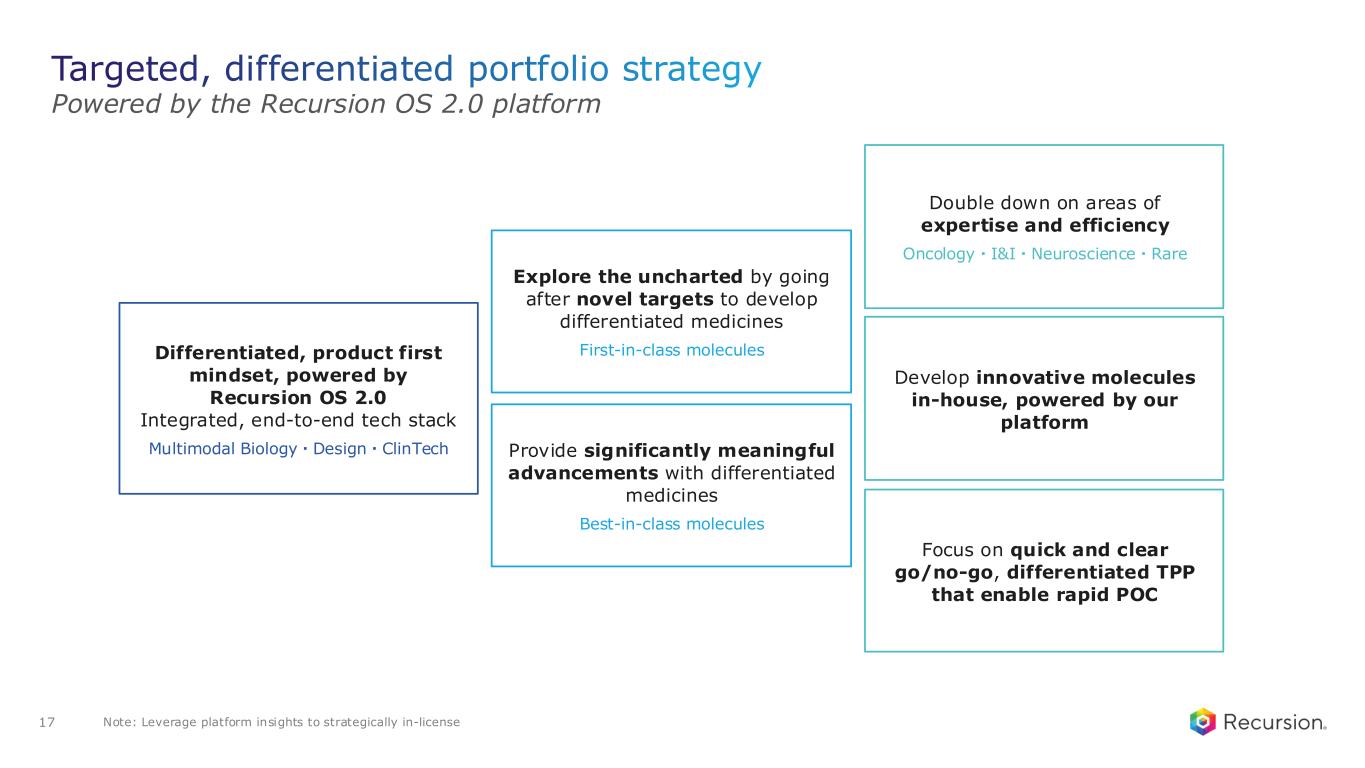
Targeted, differentiated portfolio strategy Powered by the Recursion OS 2.0 platform Explore the uncharted by going after novel targets to develop differentiated medicines First-in-class molecules Provide significantly meaningful advancements with differentiated medicines Best-in-class molecules Differentiated, product first mindset, powered by Recursion OS 2.0 Integrated, end-to-end tech stack Multimodal Biology・Design・ClinTech Focus on quick and clear go/no-go, differentiated TPP that enable rapid POC Double down on areas of expertise and efficiency Oncology・I&I・Neuroscience・Rare Develop innovative molecules in-house, powered by our platform Note: Leverage platform insights to strategically in-license17


REC-617 (CDK7 inhibitor): AI-enabled causal inference strengthens preclinical data for indication selection of ovarian cancer for ELUCIDATE 18 1. Besnard et al, AACR (2022) 2. Causal inference framework based on a network-informed directed acyclic graph (DAG) to assess CDK7’s impact on clinical outcomes. Patients were indexed on their date of NGS sequencing and followed until death or censoring with 10 + years of patient follow available. The model adjusts for relevant clinical and genomic confounders, including BRCA status, treatment history, and tumor genomics. Ovarian cell line sensitive to CDK7 inhibition with REC-617 • Unbiased analysis of over 360 cell lines in glo titer assay Cell Panels Causal Inference using Omics and Clinical data CDK7 emerges as a likely driver of poor survival in ovarian cancer based on a causal inference framework leveraging multi-omic and clinical data • Over ~32K patient records using DNA, RNA and clinical outcomes Impact • Supports preclinical findings with causal inference using omics and patient data • 1st indication: 2L+ platinum- resistant ovarian cancer (PROC) Potent tumor regression with REC-617 treatment • <10 hours of exposure above IC80 to optimize benefit-risk In vivo Models CDX Model: OVCAR1 Patient Data: Ovarian Cancer2Cell Line: OVCAR3 S u rv iv a l p ro b a b ili ty Number of months post-sequencing


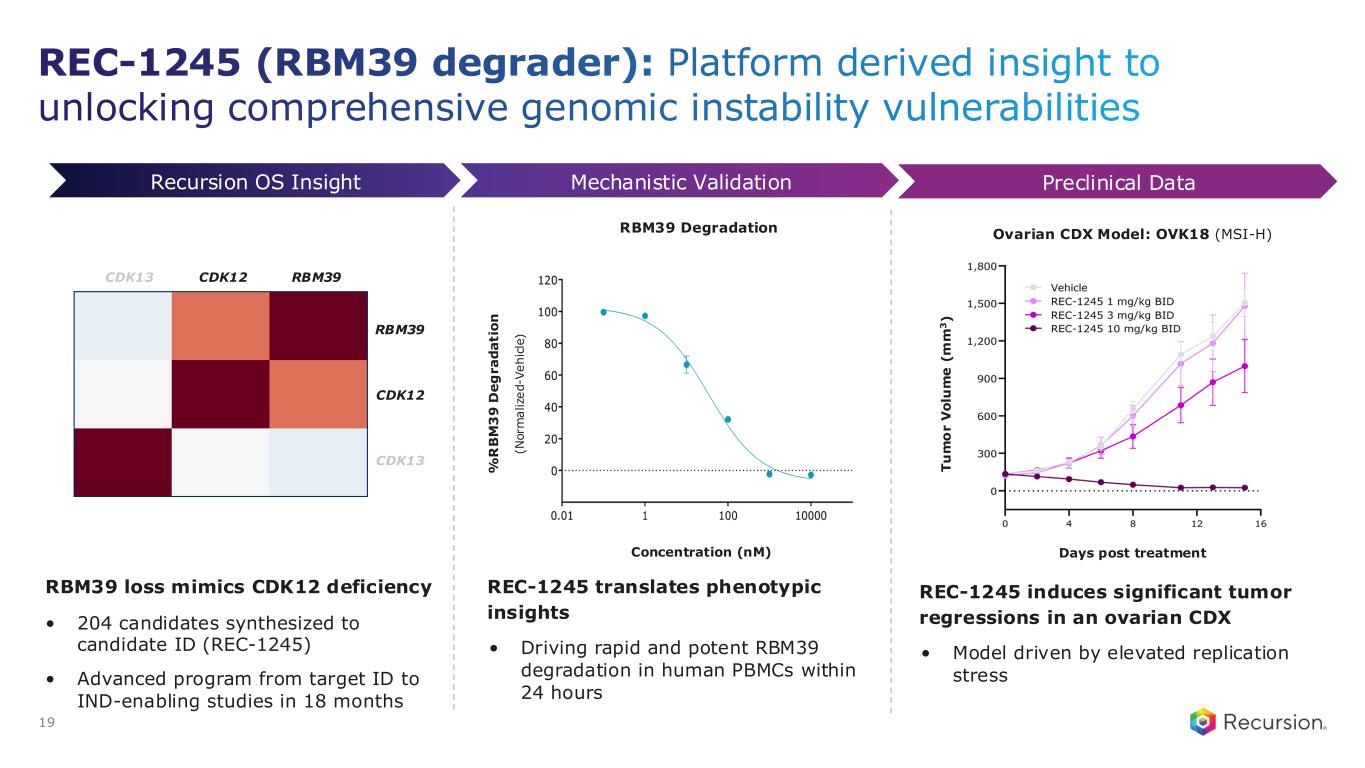
Mechanistic Validation RBM39 Degradation % R B M 3 9 D e g r a d a t io n (N o rm a li ze d -V e h ic le ) Concentration (nM) Recursion OS Insight REC-1245 (RBM39 degrader): Platform derived insight to unlocking comprehensive genomic instability vulnerabilities 19 Preclinical Data Days post treatment T u m o r V o lu m e ( m m 3 ) Ovarian CDX Model: OVK18 (MSI-H) REC-1245 induces significant tumor regressions in an ovarian CDX • Model driven by elevated replication stress REC-1245 translates phenotypic insights • Driving rapid and potent RBM39 degradation in human PBMCs within 24 hours RBM39 loss mimics CDK12 deficiency • 204 candidates synthesized to candidate ID (REC-1245) • Advanced program from target ID to IND-enabling studies in 18 months CDK12 RBM39CDK13 RBM39 CDK12 CDK13


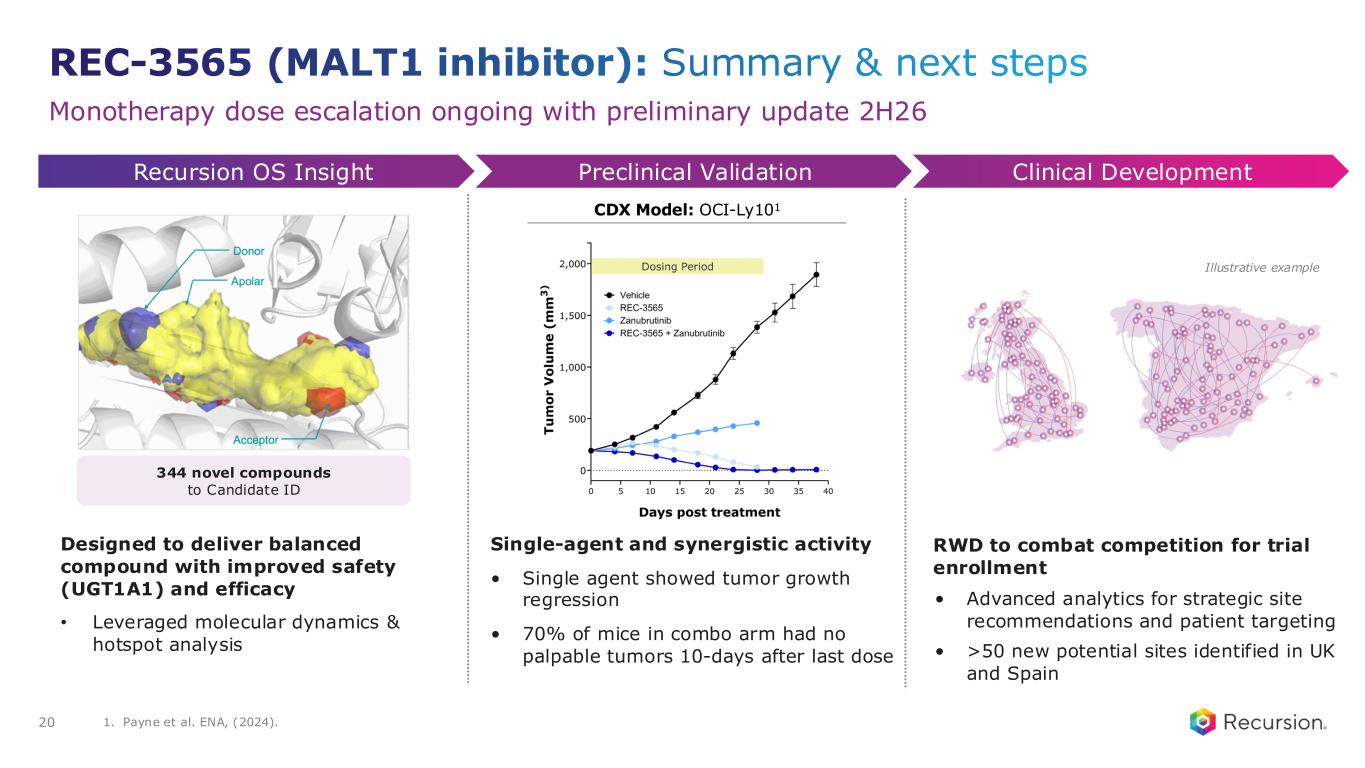
REC-3565 (MALT1 inhibitor): Summary & next steps Monotherapy dose escalation ongoing with preliminary update 2H26 RWD to combat competition for trial enrollment • Advanced analytics for strategic site recommendations and patient targeting • >50 new potential sites identified in UK and Spain Single-agent and synergistic activity • Single agent showed tumor growth regression • 70% of mice in combo arm had no palpable tumors 10-days after last dose Designed to deliver balanced compound with improved safety (UGT1A1) and efficacy • Leveraged molecular dynamics & hotspot analysis CDX Model: OCI-Ly101 Illustrative example 344 novel compounds to Candidate ID 20 1. Payne et al. ENA, (2024). Clinical Development Recursion OS Insight Preclinical Validation


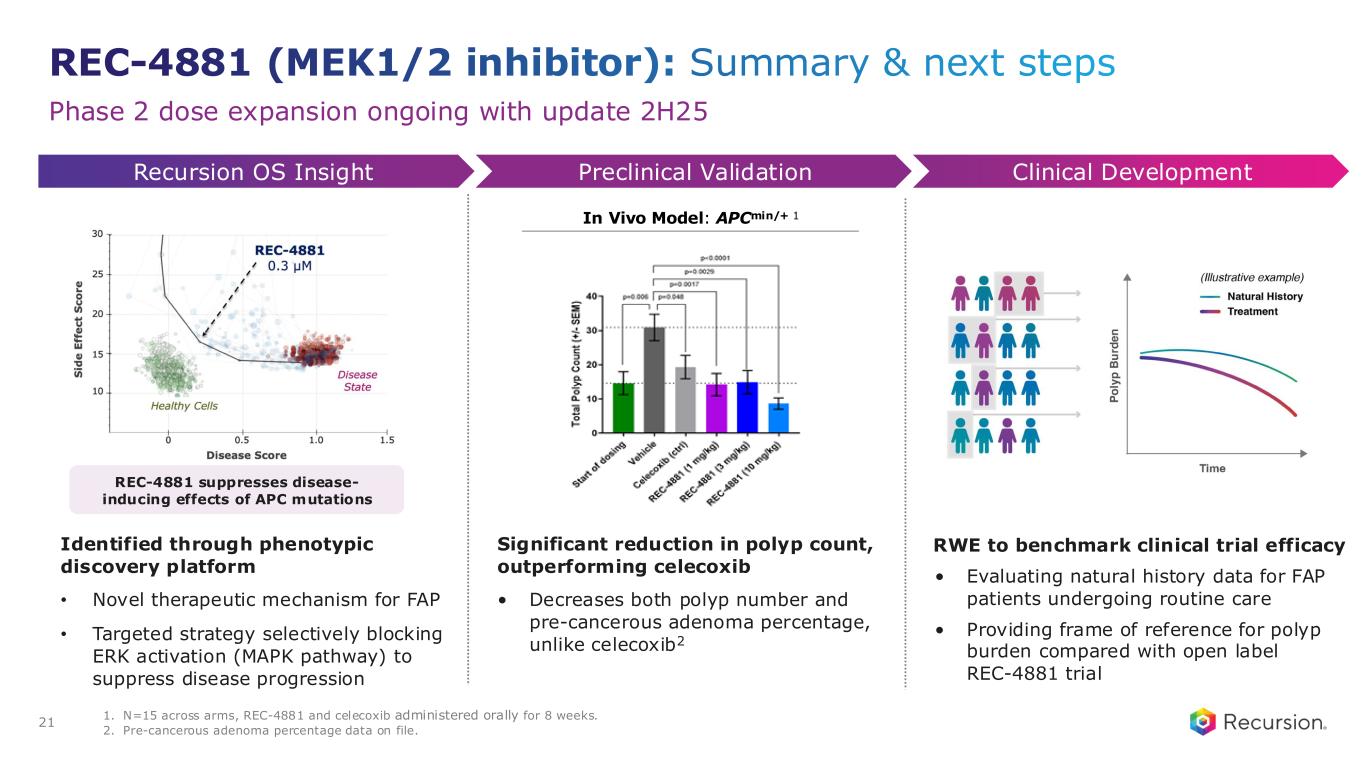
REC-4881 (MEK1/2 inhibitor): Summary & next steps Phase 2 dose expansion ongoing with update 2H25 In Vivo Model: APCmin/+ 1 RWE to benchmark clinical trial efficacy • Evaluating natural history data for FAP patients undergoing routine care • Providing frame of reference for polyp burden compared with open label REC-4881 trial Significant reduction in polyp count, outperforming celecoxib • Decreases both polyp number and pre-cancerous adenoma percentage, unlike celecoxib2 Identified through phenotypic discovery platform • Novel therapeutic mechanism for FAP • Targeted strategy selectively blocking ERK activation (MAPK pathway) to suppress disease progression 1. N=15 across arms, REC-4881 and celecoxib administered orally for 8 weeks. 2. Pre-cancerous adenoma percentage data on file. 21 REC-4881 suppresses disease- inducing effects of APC mutations Clinical Development Recursion OS Insight Preclinical Validation


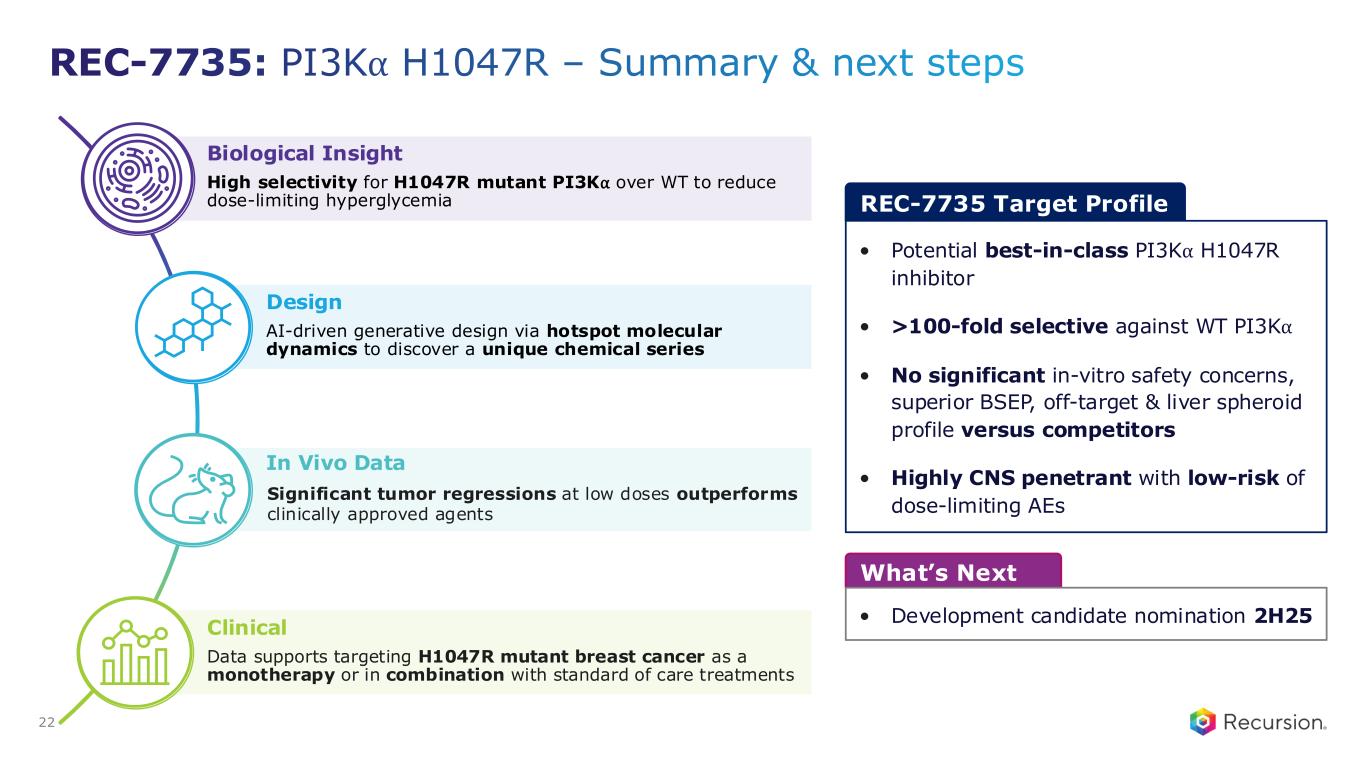
REC-7735: PI3K⍺ H1047R – Summary & next steps Biological Insight High selectivity for H1047R mutant PI3K⍺ over WT to reduce dose-limiting hyperglycemia Design AI-driven generative design via hotspot molecular dynamics to discover a unique chemical series In Vivo Data Significant tumor regressions at low doses outperforms clinically approved agents Clinical Data supports targeting H1047R mutant breast cancer as a monotherapy or in combination with standard of care treatments What’s Next • Development candidate nomination 2H25 REC-7735 Target Profile • Potential best-in-class PI3K⍺ H1047R inhibitor • >100-fold selective against WT PI3K⍺ • No significant in-vitro safety concerns, superior BSEP, off-target & liver spheroid profile versus competitors • Highly CNS penetrant with low-risk of dose-limiting AEs 22


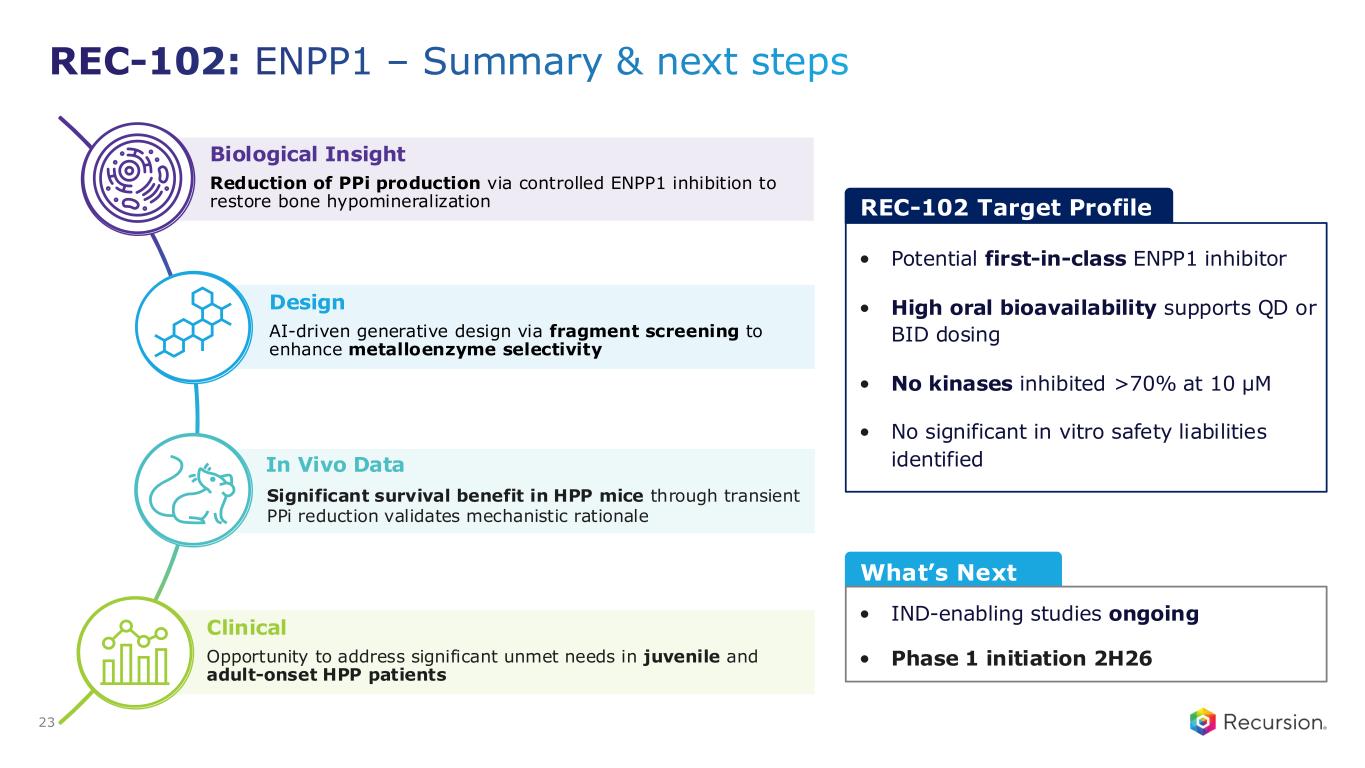
REC-102: ENPP1 – Summary & next steps Biological Insight Reduction of PPi production via controlled ENPP1 inhibition to restore bone hypomineralization Design AI-driven generative design via fragment screening to enhance metalloenzyme selectivity In Vivo Data Significant survival benefit in HPP mice through transient PPi reduction validates mechanistic rationale Clinical Opportunity to address significant unmet needs in juvenile and adult-onset HPP patients REC-102 Target Profile • Potential first-in-class ENPP1 inhibitor • High oral bioavailability supports QD or BID dosing • No kinases inhibited >70% at 10 µM • No significant in vitro safety liabilities identified What’s Next • IND-enabling studies ongoing • Phase 1 initiation 2H26 23


Partnered Pipeline PIPELINE


Advanced partnership discovery by leveraging Recursion 2.0 25 4 Program milestone payments achieved in last 18 months Several programs advancing towards development candidate over next 12-15 months Continued program advancement in a GI oncology indication and multiple neuroscience programs into target validation advanced by leveraging the RecursionOS and Genentech's biology expertise Phenomaps in Neuroscience, GI Oncology • 1 trillion iPSC-derived cells • 100 billion GI Oncology relevant cells • 5,000 transcriptomes5 Potential for over $100 million in partnership milestones by end of 2026 Recursion & Bayer have nominated multiple early discovery precision oncology programs against previously “undruggable” targets Multiple-year collaboration to identify first-in-class and best-in-class targets


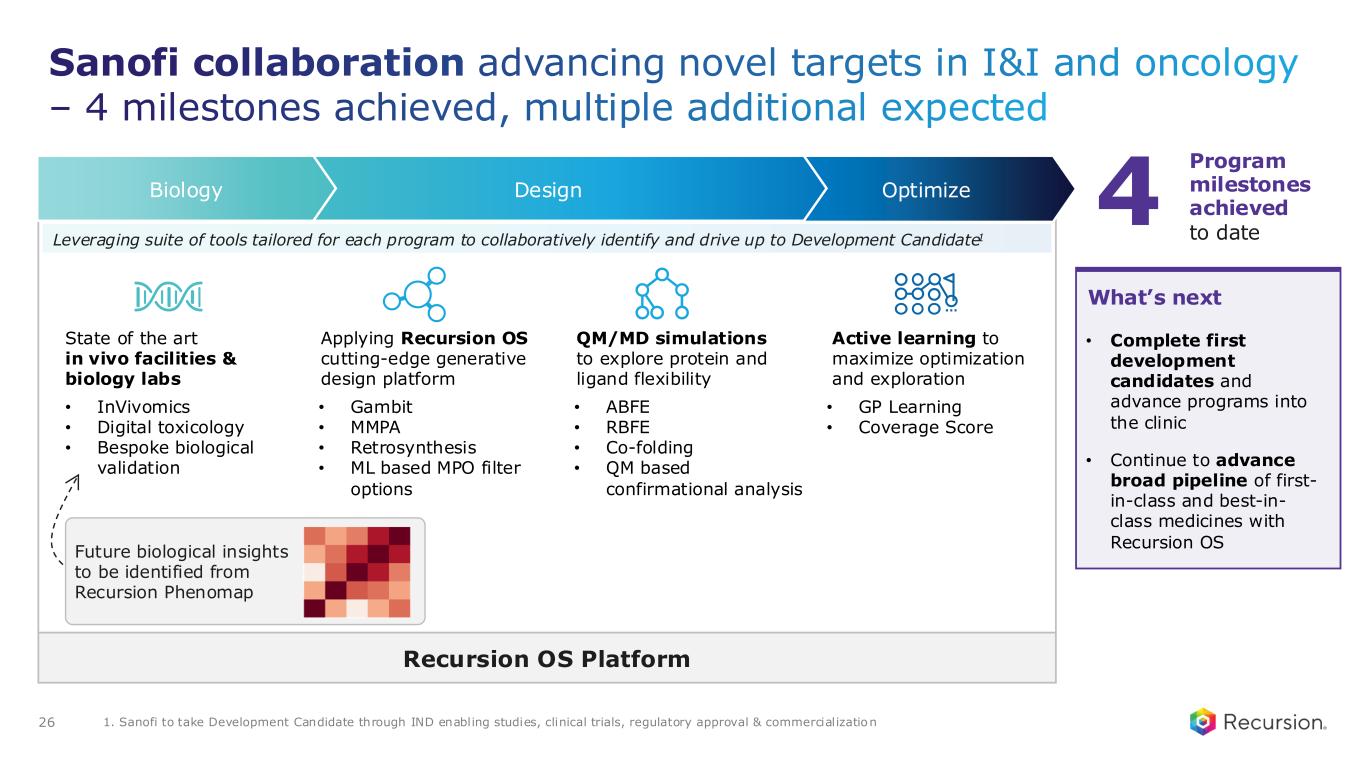
Sanofi collaboration advancing novel targets in I&I and oncology – 4 milestones achieved, multiple additional expected OptimizeDesignBiology QM/MD simulations to explore protein and ligand flexibility Applying Recursion OS cutting-edge generative design platform Active learning to maximize optimization and exploration 4 Program milestones achieved to date • Complete first development candidates and advance programs into the clinic • Continue to advance broad pipeline of first- in-class and best-in- class medicines with Recursion OS What’s next Future biological insights to be identified from Recursion Phenomap • Gambit • MMPA • Retrosynthesis • ML based MPO filter options • ABFE • RBFE • Co-folding • QM based confirmational analysis • GP Learning • Coverage Score State of the art in vivo facilities & biology labs • InVivomics • Digital toxicology • Bespoke biological validation Leveraging suite of tools tailored for each program to collaboratively identify and drive up to Development Candidate1 Recursion OS Platform 1. Sanofi to take Development Candidate through IND enabling studies, clinical trials, regulatory approval & commercialization 26


Roche and Genentech collaboration within neuroscience and GI oncology indication – unbiased novel biological insights to programs ~5 Phenomaps • Additional phenomap builds ongoing • Leveraging Recursion OS and collaborating with Roche and Genentech to identify new programs in a GI oncology indication & neuroscience What’s next Collaboratively working to identify novel biological insights from phenomaps for validation Lab in the Loop Derived from over 1 trillion iPSC cells and 100 billion GI Onc relevant cells ~5,000 transcriptomes Recursion OS Platform From multiple disease-relevant cell types, subjected to compound treatments and/or gene KO, resulting in ~171 TB of data OptimizeDesignBiology Lab in the Loop image credit: Genentech 202427


Financial Update


Well positioned to deliver on upcoming milestones 1. Cash, cash equivalents and restricted cash 2. YE2024 reported OpEx for Recursion and Exscientia combined, excluding non-cash GAAP items (e.g. share-based compensation). 2026 estimate of <$390 million cash burn 3. Risk-adjusted cash inflows from partnerships included in estimated cash runway 4. Cash burn, defined as operating cash flow less capital expenditures, excluding partnership and financing inflows, transaction expenses and severance 29 • $533.8 million in cash1 as of June 30, 2025 Cash, cash equivalents and restricted cash Operational cash inflows • $7 million Sanofi milestone payment • $28.6 million R&D tax credit • Potential for over $100 million in partnership inflows by end of 20263 • Expected 2025 cash burn4 of <$450 million • Expected 2026 cash burn4 of <$390 million Expected cash runway into the fourth quarter of 2027 Guidance 2Q25 Highlights 2025 & 2026 Streamlining of operations and infrastructure • Expected to reduce pro forma operating expenses by ~35% from 2024 to 20262


Looking Forward


Internal and external pipeline momentum FY 2025 and 2026 upcoming pipeline catalysts Partnership Catalysts Potential for additional phenomap options Potential for multiple new project initiations Potential for multiple programs optioned by partners 2025 2026 H1 REC-617 (CDK7i) in advanced solid tumors Initiation of combination studies H2 REC-4881 (MEK1/2i) in FAP Additional safety and efficacy data from TUPELO REC-617 (CDK7i) in advanced solid tumors Additional Phase 1 data from ELUCIDATE REC-7735 (PI3Kα H1047Ri) DC nomination H1 REC-1245 (RBM39) Early safety and PK from monotherapy trial H2 REC-3565 (MALT1) Early safety and PK from monotherapy trial REC-102 (ENPP1i) Ph1 initiation – 2H26 31


2Q25 (L)earnings August 2025


This presentation of Recursion Pharmaceuticals, Inc. (“Recursion,” “we,” “us,” or “our”) and any accompanying discussion contain statements that are not historical facts may be considered forward-looking statements under federal securities laws and may be identified by words such as “anticipates,” “believes,” “estimates,” “expects,” “intends,” “plans,” “potential,” “predicts,” “projects,” “seeks,” “should,” “will,” or words of similar meaning and include, but are not limited to, statements regarding Recursion’s ability to demonstrate the potential of technology-driven approaches to increase speed, quality and the scalability of drug discovery; Recursion's future as a leader in TechBio and ability to deliver better treatments to patients faster; Recursion’s OS industrializing first- and best- in-class drug discovery; our ability to industrialize clinical development and the effect of doing so on clinical trial outcomes; the occurrence or realization of potential milestones; current and future preclinical and clinical studies, including timelines for enrollment in studies, data readouts, and progression toward IND- enabling and other potential studies; advancements of our pipeline, partnerships, and data strategies; the potential size of the market opportunity for our drug candidates; outcomes and benefits from licenses, partnerships and collaborations, including option exercises by partners and the amount and timing of potential milestone payments; the initiation, timing, progress, results, and cost of our research and development programs; advancements of our Recursion OS; the potential for additional partnerships; our ability to identify viable new drug candidates for clinical development and the accelerating rate at which we expect to identify such candidates including our ability to leverage the datasets acquired through the license agreement into increased machine learning capabilities and accelerate clinical trial enrollment; Recursion’s cash position and cash runway; the completion of core integration plans and the results of the business combination with Exscientia; and many others. Other important factors and information are contained in Recursion’s most recent Annual Report on Form 10-K, Quarterly Report on Form 10-Q, and the Company’s other filings with the U.S. Securities and Exchange Commission (the “SEC”), which can be accessed at https://ir.recursion.com, or www.sec.gov. All forward-looking statements are qualified by these cautionary statements and apply only as of the date they are made. Recursion does not undertake any obligation to update any forward-looking statement, whether as a result of new information, future events or otherwise. Certain information contained in this presentation relates to or is based on studies, publications, surveys and other data obtained from third-party sources and the company’s own internal estimates and research. While the company believes these third-party sources to be reliable as of the date of this presentation, it has not independently verified, and makes no representation as to the adequacy, fairness, accuracy or completeness of, any information obtained from third- party sources. In addition, all of the market data included in this presentation involves a number of assumptions and limitations, and there can be no guarantee as to the accuracy or reliability of such assumptions. Finally, while the company believes its own internal research is reliable, such research has not been verified by any independent source. Information contained in, or that can be accessed through our website is not a part of and is not incorporated into this presentation. Cross-trial or cross-candidate comparisons against other clinical trials and other drug candidates are not based on head-to-head studies and are presented for informational purposes; comparisons are based on publicly available information for other clinical trials and other drug candidates. Any non-Recursion logos or trademarks included herein are the property of the owners thereof and are used for reference purposes only. Important Information 2


Recursion OS 2.0


Recursion’s unbiased platform approach delivers a strong internal and partnered portfolio 4 • Powered by proprietary and fit- for-purpose scaled data • End-to-end capabilities spanning novel target discovery, precision chemistry and optimized clinical trials • Built upon iterative cycles of dry- lab predictions and wet-lab validation to accelerate learning Models Portfolio Compute Data Generation & Validation


Boltz-2: Open-source model with MIT commoditizing binding affinity prediction approaching FEP accuracy at 1000x speed 5 Over 171K downloads and 41.5K unique users in less than two months Designed for drug discovery and virtual screening Contact/pocket constraints — ensure output follows respects given conditions Allows users to specify an experimental modality to emulate Template steering — allows users to input reference templates that embed prior knowledge


ClinTech: Industrialize clinical development by building an end-to- end platform to increase probability of success 6 • Patient-platform connectivity • Enables target validation and patient stratification • Supports expansion into new indications • More robust trial planning via clinical trial simulations • Potential for up to 30% more patients receive optimal dose • Potential for 50% faster enrollment projections through high quality sites • 2+ months faster trial activation Powered by integrated tech stack, RWE, and agentic solutions Strategic Partnerships Causal AI applied to human genomics Intelligent clinical trial design AI-powered recruitment & execution


REC-4539 for Small-Cell Lung Cancer (target: LSD1) is on strategic pause. Delivering Pipeline Advancements and Partnership Value 7 Target Disease Indication Late Discovery Preclinical Phase 1/2 Pivotal/Phase 3 Oncology REC-617 CDK7 Advanced Solid Tumors REC-1245 RBM39 Biomarker-Enriched Solid Tumors & Lymphoma REC-3565 MALT1 B-Cell Malignancies REC-7735 PI3Kα H1047R Breast Cancer Rare Disease REC-4881 MEK1/2 Familial Adenomatous Polyposis REC-102 ENPP1 Hypophosphatasia Partnerships Therapeutic Area Highlights Roche and Genentech Neuroscience & Oncology First neuroscience phenomap in human cell context. One optioned Gi oncology program continues to advance. Potential for up to 40 compound programs Sanofi Oncology & Immunology Milestones achieved across four distinct BIC and FIC discovery programs in 18 months; potential for several program milestones upcoming Bayer Oncology Advancing multiple programs with previously “undruggable” targets to lead series milestones Merck KGaA, Darmstadt, Germany Oncology & Immunology Multi-year collaboration to identify and advance first-in-class and best-in-class programs


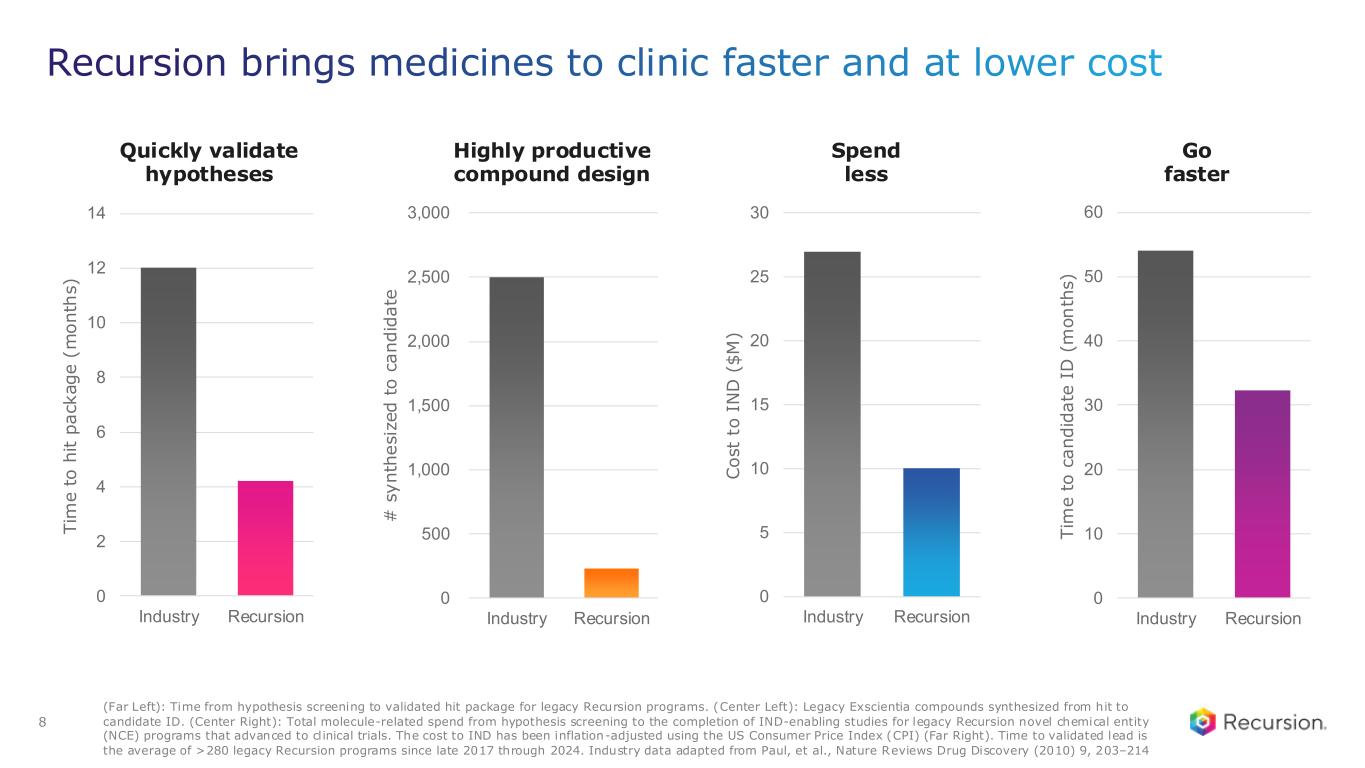
Recursion brings medicines to clinic faster and at lower cost 0 10 20 30 40 50 60 Industry Recursion T im e t o c a n d id a te I D ( m o n th s ) Go faster 0 5 10 15 20 25 30 Industry Recursion C o s t to I N D ( $ M ) Spend less 0 500 1,000 1,500 2,000 2,500 3,000 Industry Recursion Highly productive compound design # s y n th e s iz e d t o c a n d id a te 0 2 4 6 8 10 12 14 Industry Recursion T im e t o h it p a c k a g e ( m o n th s ) Quickly validate hypotheses (Far Left): Time from hypothesis screening to validated hit package for legacy Recursion programs. (Center Left): Legacy Exscientia compounds synthesized from hit to candidate ID. (Center Right): Total molecule-related spend from hypothesis screening to the completion of IND-enabling studies for legacy Recursion novel chemical entity (NCE) programs that advanced to clinical trials. The cost to IND has been inflation-adjusted using the US Consumer Price Index (CPI) (Far Right). Time to validated lead is the average of >280 legacy Recursion programs since late 2017 through 2024. Industry data adapted from Paul, et al., Nature Reviews Drug Discovery (2010) 9, 203–214 8


Building Momentum: Portfolio Advancement Fueled by Platform Insights


REC-4539 for Small-Cell Lung Cancer (target: LSD1) is on strategic pause. Delivering Pipeline Advancements and Partnership Value 10 Target Disease Indication Late Discovery Preclinical Phase 1/2 Pivotal/Phase 3 Oncology REC-617 CDK7 Advanced Solid Tumors REC-1245 RBM39 Biomarker-Enriched Solid Tumors & Lymphoma REC-3565 MALT1 B-Cell Malignancies REC-7735 PI3Kα H1047R Breast Cancer Rare Disease REC-4881 MEK1/2 Familial Adenomatous Polyposis REC-102 ENPP1 Hypophosphatasia Partnerships Therapeutic Area Highlights Roche and Genentech Neuroscience & Oncology First neuroscience phenomap in human cell context. One optioned Gi oncology program continues to advance. Potential for up to 40 compound programs Sanofi Oncology & Immunology Milestones achieved across four distinct BIC and FIC discovery programs in 18 months; potential for several program milestones upcoming Bayer Oncology Advancing multiple programs with previously “undruggable” targets to lead series milestones Merck KGaA, Darmstadt, Germany Oncology & Immunology Multi-year collaboration to identify and advance first-in-class and best-in-class programs


Advancing programs with strong therapeutic rationale, powered by Recursion OS Addressable patient populations estimate based on annual US+EU5 and currently identified indications 1. Includes ovarian cancer, breast cancer, non-small cell lung cancer (NSCLC), colorectal cancer, pancreatic cancer, head and neck cancer 2. Biomarker-enriched 3. Diagnosed patients Note: REC-4539 | LSD1: Precision designed for reversibility and CNS penetration. Strategic pause to ensure a competitive Target Product Profile 11 REC-617 | CDK7 Solid tumors1 Optimized PK/PD for wider therapeutic index ~185,000 addressable patients REC-1245 | RBM39 Solid tumors2, Lymphoma Phenotypic insight reveals novel MOA for synthetic-lethal targeting in genomically unstable cancers ~100,000+ addressable patients REC-4881 | MEK1/2 Familial adenomatous polyposis (FAP) Phenotypic insight on MEK1/2 inhibition for APC-mutant FAP ~50,000 addressable patients REC-3565 | MALT1 B cell malignancies Potential for lower UGT1A1 inhibition and off-target AEs ~41,000 addressable patients REC-7735 | PI3Kα H1047R Breast Cancer Selective and wider therapeutic index ~11,000 addressable patients REC-102 | ENPP1i Hypophosphatasia (HPP) Oral, highly selective & potent, suitable for lifetime dosing ~7,8003 addressable patients


Recursion OS 2.0: Efficiently delivering novel insights, precision design, and optimized clinical trials 12 Nomination Workflow Scientific Agents Transcriptomics Assay & Models ML-based Patient Connectivity (RWD) LLMs & Graphs MOA Deconvolution Scaled Binding Affinity Predictions Phenomics Assay & Models AI-powered Biological Insights Clinical Trial Design ClinTech Workflow AI-powered Recruitment Causal AI Patient stratification & indication selection AI-informed Clinical Development Design Workflow Automated ADMET Automated Chemistry Automated Biology 3D Protein & Atomistic Models Molecular Property Prediction & Design Scientific Agents AI-enabled Precision Design


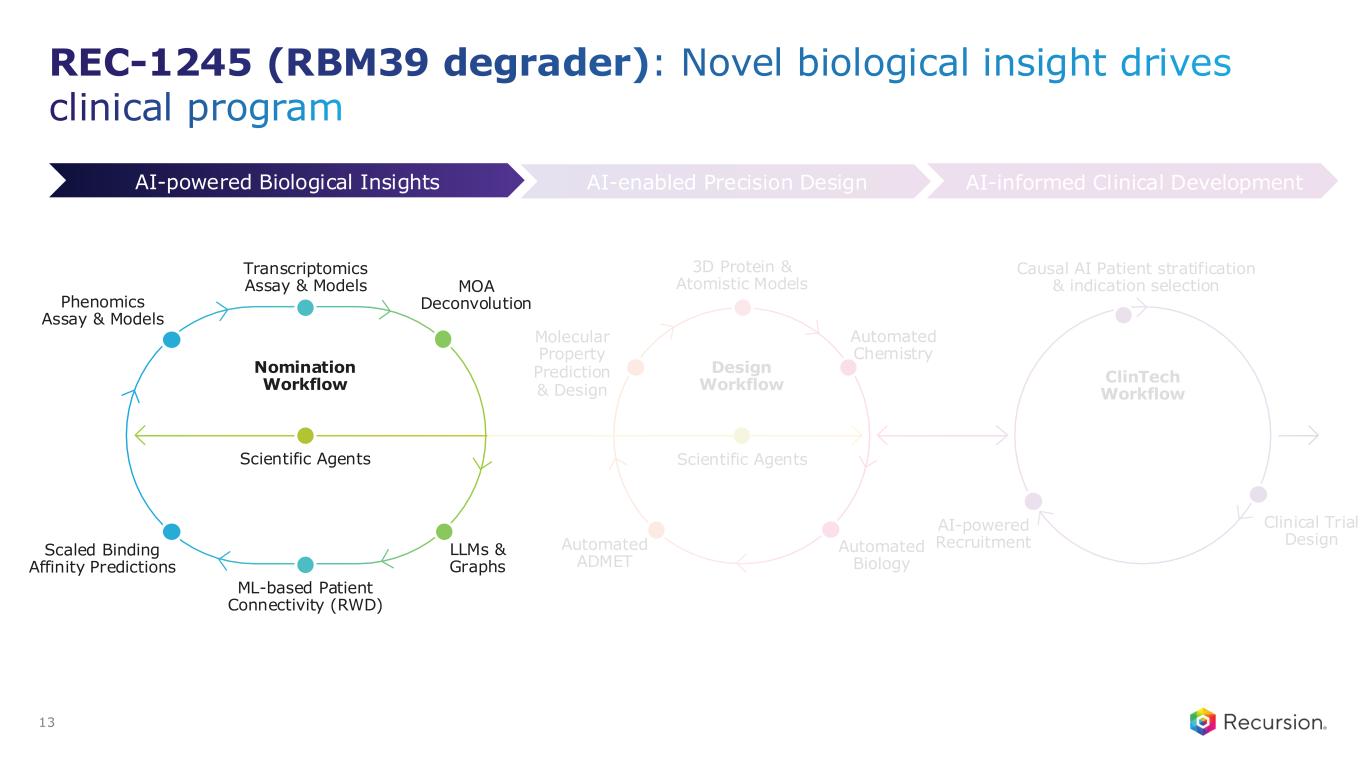
REC-1245 (RBM39 degrader): Novel biological insight drives clinical program 13 Design Workflow Automated ADMET Automated Chemistry Automated Biology 3D Protein & Atomistic Models Molecular Property Prediction & Design Scientific Agents AI-enabled Precision Design Nomination Workflow Scientific Agents Transcriptomics Assay & Models ML-based Patient Connectivity (RWD) LLMs & Graphs MOA Deconvolution Scaled Binding Affinity Predictions Phenomics Assay & Models AI-powered Biological Insights Clinical Trial Design ClinTech Workflow AI-powered Recruitment Causal AI Patient stratification & indication selection AI-informed Clinical Development


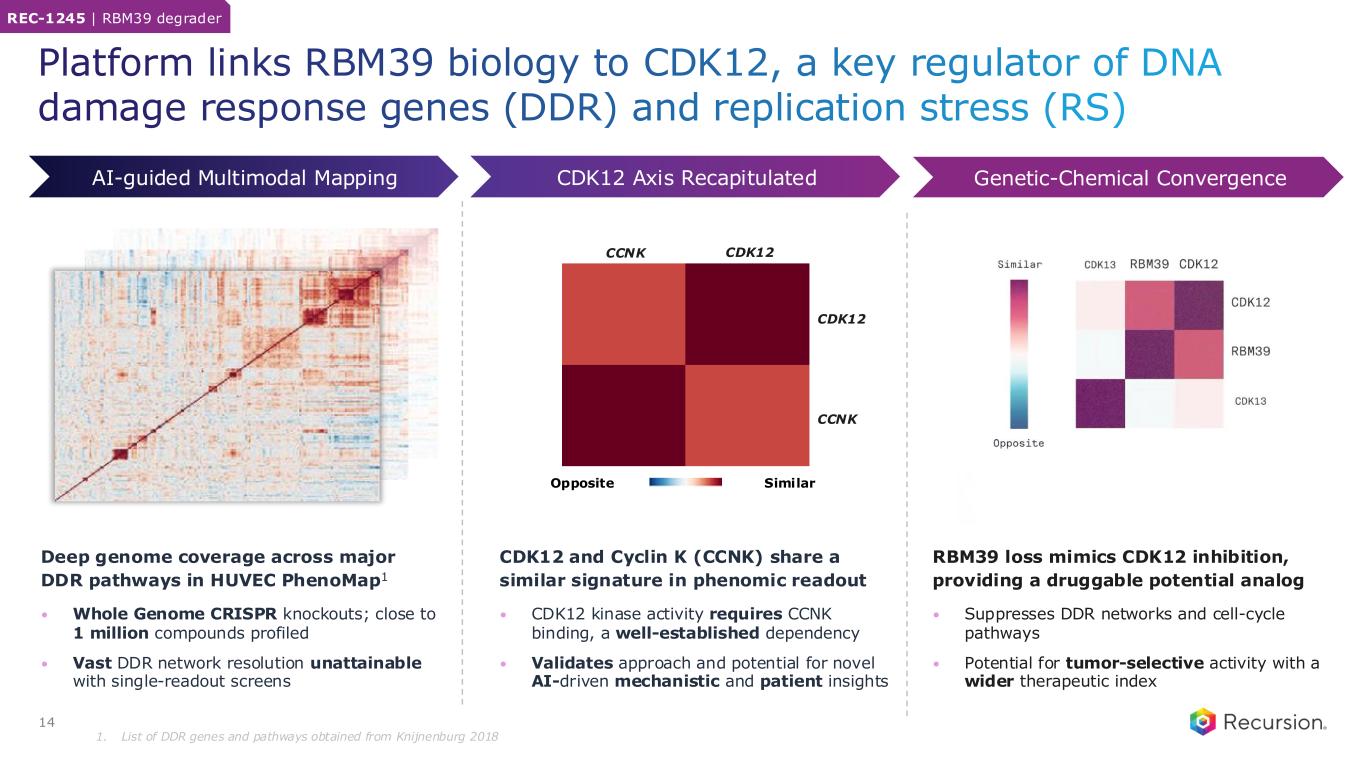
Platform links RBM39 biology to CDK12, a key regulator of DNA damage response genes (DDR) and replication stress (RS) Genetic-Chemical ConvergenceCDK12 Axis RecapitulatedAI-guided Multimodal Mapping Deep genome coverage across major DDR pathways in HUVEC PhenoMap1 • Whole Genome CRISPR knockouts; close to 1 million compounds profiled • Vast DDR network resolution unattainable with single-readout screens 1. List of DDR genes and pathways obtained from Knijnenburg 2018 CDK12 and Cyclin K (CCNK) share a similar signature in phenomic readout • CDK12 kinase activity requires CCNK binding, a well-established dependency • Validates approach and potential for novel AI-driven mechanistic and patient insights 14 RBM39 loss mimics CDK12 inhibition, providing a druggable potential analog • Suppresses DDR networks and cell-cycle pathways • Potential for tumor-selective activity with a wider therapeutic index SimilarOpposite CCNK CDK12 CDK12 CCNK REC-1245 | RBM39 degrader


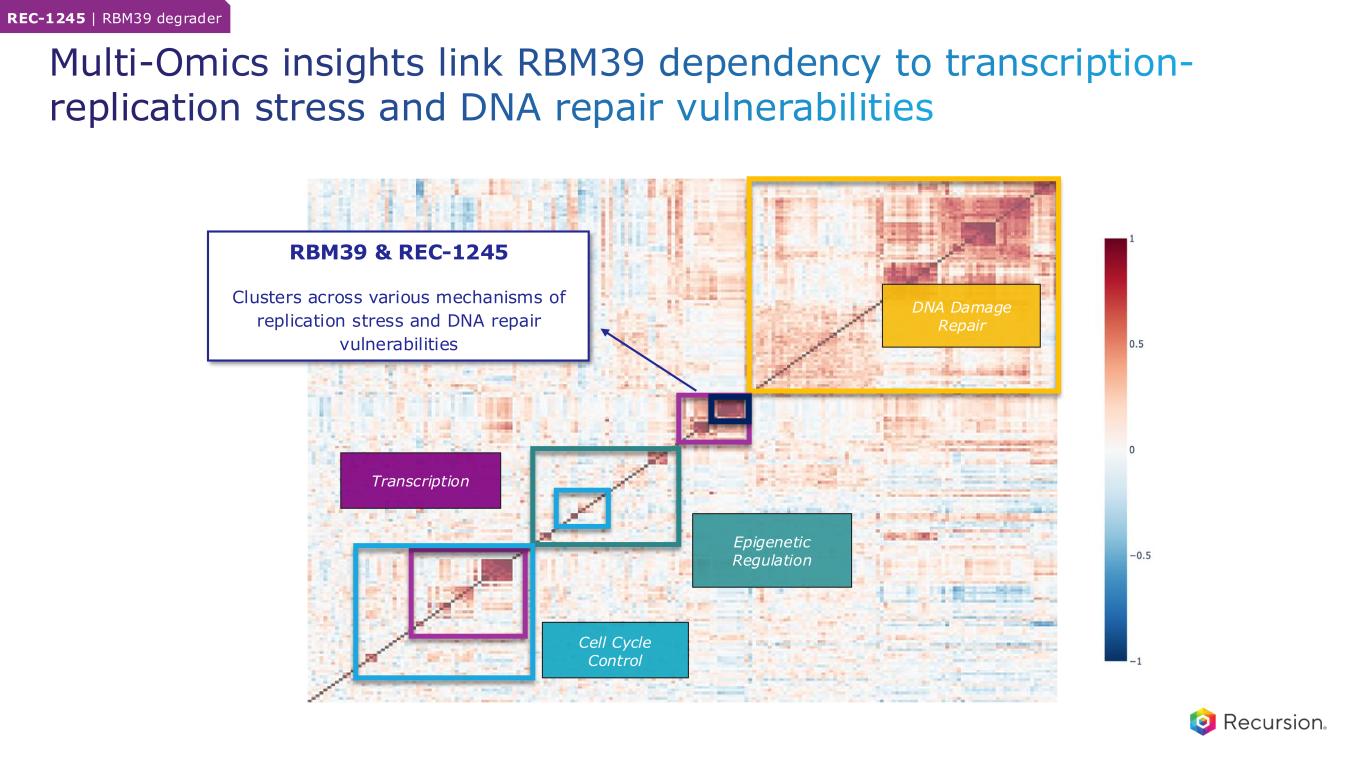
Multi-Omics insights link RBM39 dependency to transcription- replication stress and DNA repair vulnerabilities Epigenetic Regulation Cell Cycle Control Transcription DNA Damage Repair RBM39 & REC-1245 Clusters across various mechanisms of replication stress and DNA repair vulnerabilities REC-1245 | RBM39 degrader


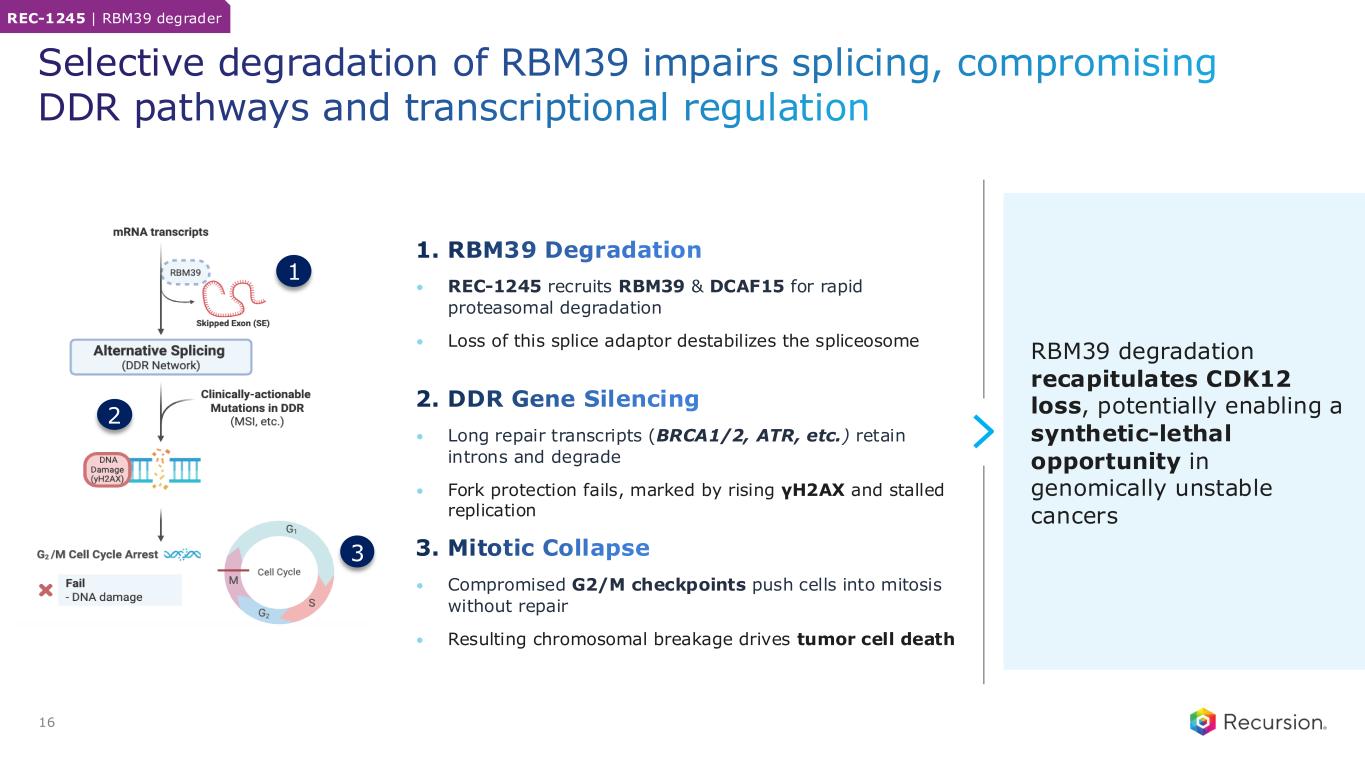
Selective degradation of RBM39 impairs splicing, compromising DDR pathways and transcriptional regulation 2 3 1 1. RBM39 Degradation • REC-1245 recruits RBM39 & DCAF15 for rapid proteasomal degradation • Loss of this splice adaptor destabilizes the spliceosome 2. DDR Gene Silencing • Long repair transcripts (BRCA1/2, ATR, etc.) retain introns and degrade • Fork protection fails, marked by rising γH2AX and stalled replication 3. Mitotic Collapse • Compromised G2/M checkpoints push cells into mitosis without repair • Resulting chromosomal breakage drives tumor cell death 16 RBM39 degradation recapitulates CDK12 loss, potentially enabling a synthetic-lethal opportunity in genomically unstable cancers REC-1245 | RBM39 degrader


Target tumors characterized by drivers of genomic instability arising from replication stress potentially linked to RBM39 dependency 17 1. da Costa 2022, NRDD 2. Internal company estimates. Assumes US+EU5 addressable incidence with biomarker-enriched solid tumors and other select histologies. 3. Cell lines were assigned to broad pathway dysregulation contexts based on 1 or more documented alteration from CCLE/GSDC databases C T G I C 5 0 ( µ M ) In vitro: cell viability with REC-12453 Emerging preclinical data uncover replication stress as a potential signature for REC-1245 sensitivity • REC-1245 also demonstrates concentration-dependent increases in γH2AX in high replication stress driven human cancer cells in vitro (data not shown) Replication stress and DNA repair vulnerabilities span several solid tumors and blood cancers • Including colorectal, endometrial, lung, breast, sarcoma, bladder, ovarian, pancreatic, DLBCL and AML • Correlates with clinically actionable alterations • E.g., MYC/MYCN amplification, SWI/SNF loss, MSI-H, HRR defects • Potential to meaningfully expand beyond initial patient population Broad patient subsets with replication stress and DNA repair vulnerabilities1 Epigenetic Dysregulation Cell Cycle Alterations Oncogenic Drivers DDR Defects >100,000 patients in US & EU5 per year2 REC-1245 | RBM39 degrader


Emerging preclinical data suggests greater sensitivity with REC- 1245 in high replication stress and DDR vulnerable tumors 18 1. N=4 mice per group. REC-1245 demonstrates reduction in tumor volume across different tumors with high-RS signatures and DNA repair vulnerability1 Vehicle BID REC-1245 10 mg/kg BID A2780 (Ovarian) Epigenetic dysregulation Days post treatment T u m o r V o lu m e ( m m 3 ) HEC-251 (Endometrial) Cell cycle alterations Days post treatment T u m o r V o lu m e ( m m 3 ) LS513 (CRC) Oncogenic drivers Days post treatment T u m o r V o lu m e ( m m 3 ) TOV-21G (Ovarian) DDR Defects, MSI-H Days post treatment T u m o r V o lu m e ( m m 3 ) REC-1245 | RBM39 degrader


Mechanistic Validation RBM39 Degradation % R B M 3 9 D e g r a d a t io n (N o rm a li ze d -V e h ic le ) Concentration (nM) Recursion OS Insight Platform derived insight to unlocking comprehensive genomic instability vulnerabilities 19 Preclinical Data Days post treatment T u m o r V o lu m e ( m m 3 ) Ovarian CDX Model: OVK18 (MSI-H) REC-1245 induces significant tumor regressions in an ovarian CDX • Model driven by elevated replication stress REC-1245 translates phenotypic insights • Driving rapid and potent RBM39 degradation in human PBMCs within 24 hours RBM39 loss mimics CDK12 deficiency • 204 candidates synthesized to candidate ID (REC-1245) • Advanced program from target ID to IND-enabling studies in 18 months REC-1245 | RBM39 degrader CDK12 RBM39CDK13 RBM39 CDK12 CDK13


Phase 1/2 monotherapy dose escalation ongoing with early safety/PK data anticipated 1H26 20 Clinical Updates • First patient dosed in 4Q24 • Early safety and PK from monotherapy trial in 1H26 Monotherapy data update expected in 1H26 REC-1245 monotherapy dose escalation Minimum efficacious dose REC-1245 monotherapy dose confirmation RP2D REC-1245 monotherapy Tumor-specific expansion cohorts Dose Escalation & Confirmation Dose Expansion DAHLIA patient population: • Multi-omic guided insights for initial advanced solid tumor population • Cancers with high genomic instability (e.g., endometrial) • Biomarker enriched populations (e.g., 2L+ MSI-H/dMMR1) Cohort 1 TBD Cohort 2 TBD DAHLIA: A Study of REC-1245 in Participants With Unresectable, Locally Advanced, or Metastatic Cancer; NCT06678659 1. Progressed on, been ineligible for, or intolerant to at least on prior checkpoint inhibitor REC-1245 | RBM39 degrader


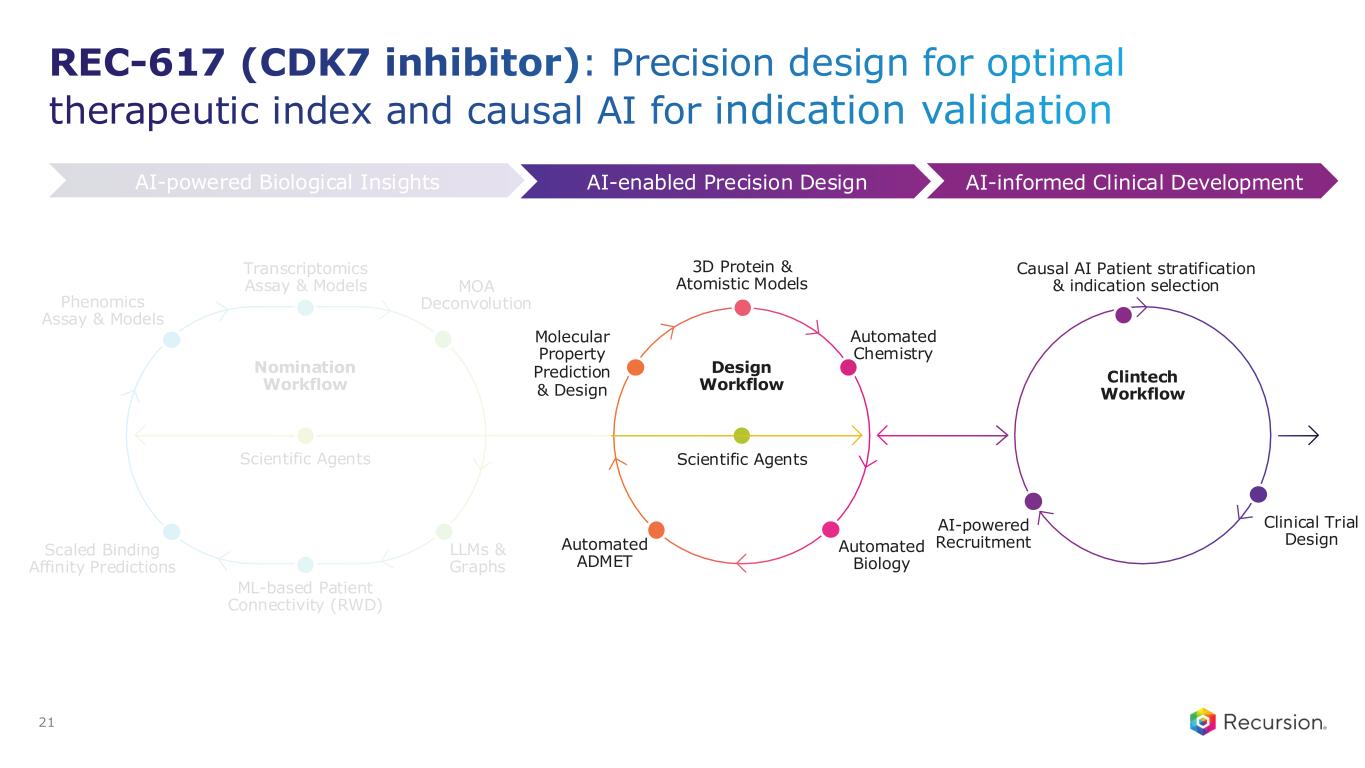
REC-617 (CDK7 inhibitor): Precision design for optimal therapeutic index and causal AI for indication validation 21 Design Workflow Automated ADMET Automated Chemistry Automated Biology 3D Protein & Atomistic Models Molecular Property Prediction & Design Scientific Agents Nomination Workflow Scientific Agents Transcriptomics Assay & Models ML-based Patient Connectivity (RWD) LLMs & Graphs MOA Deconvolution Scaled Binding Affinity Predictions Phenomics Assay & Models Clinical Trial Design Clintech Workflow AI-powered Recruitment Causal AI Patient stratification & indication selection AI-enabled Precision DesignAI-powered Biological Insights AI-informed Clinical Development


22 AI-guided precision design for optimized therapeutic index High permeability, rapid absorption, low efflux Target affinity and selectivity CDKC IC50 (nM) CDK family selectivity Cell potency HCC70 (breast cancer) IC50 (nM) OVCAR-3 (ovarian cancer) IC50 (nM) Safety and metabolism hERG IC50 (μM) Human microsome Clint μL/min/mg Human hep Clint μL/min/106 cells ADME Caco-2 A2B (efflux) 106 cm/s pH 7.4 μg/mL F % (p.o.) • Generative AI models used to design novel scaffolds • Active learning and experimental data leveraged rapidly to optimize ADME • 136 novel compounds to Candidate ID in <12 months Designed to optimize PK/PD and maximize potential therapeutic index REC-617 achieves peak exposures in the clinic exceeding CDK7 IC80 and well below CDK2 IC80 • AI-designed molecule achieves rapid, potent CDK7 inhibition 1. CDK7 IC80 reflects biochemical in vitro potencies on file REC-617 | CDK7 inhibitor As of the November 2024 data cut, REC-617 showed one confirmed partial response and multiple cases of stable disease, with a favorable safety profile and no maximum tolerated dose reached


AI-enabled causal inference strengthens preclinical data for indication selection of ovarian cancer for ELUCIDATE 23 1. Besnard et al, AACR (2022) 2. Causal inference framework based on a network-informed directed acyclic graph (DAG) to assess CDK7’s impact on clinical outcomes. Patients were indexed on their date of NGS sequencing and followed until death or censoring with 10 + years of patient follow available. The model adjusts for relevant clinical and genomic confounders, including BRCA status, treatment history, and tumor genomics. Ovarian cell line sensitive to CDK7 inhibition with REC-617 • Unbiased analysis of over 360 cell lines in glo titer assay Cell Panels Causal Inference using Omics and Clinical data CDK7 emerges as a likely driver of poor survival in ovarian cancer based on a causal inference framework leveraging multi-omic and clinical data • Over ~32K patient records using DNA, RNA and clinical outcomes Impact • Supports preclinical findings with causal inference using omics and patient data • 1st indication: 2L+ platinum- resistant ovarian cancer (PROC) Potent tumor regression with REC-617 treatment • <10 hours of exposure above IC80 to optimize benefit-risk In vivo Models CDX Model: OVCAR1 Patient Data: Ovarian Cancer2Cell Line: OVCAR3 S u rv iv a l p ro b a b ili ty Number of months post-sequencing REC-617 | CDK7 inhibitor


Phase 1/2 single-arm combination in ovarian cancer initiated 1H25 24 ELUCIDATE: Study to Assess GTAEXS617 in Patients With Advanced Solid Tumors; NCT05985655 1. SOC includes single-agent chemotherapy, bevacizumab ± chemotherapy, PARP inhibitors in select patients Clinical Updates • Early data indicates favorable safety profile • Maximum Tolerated Dose (MTD) not yet reached ✓ Combination escalation initiated 1H25 • 2L PROC selected as first cohort • Site selection & activation in process Monotherapy data update expected in 2H25 Single-Arm Tumor Expansion Cohorts Combination: REC-617 + SOC1 2L+ platinum-resistant ovarian cancer (PROC) Monotherapy Dose Escalation All-comers Patients with advanced solid tumors RP2D(s) Monotherapy: REC-617 Monotherapy: REC-617 R/R ovarian cancer Additional Combinations: REC-617 + SOC REC-617 | CDK7 inhibitor


Partnered Discovery Delivering on differentiated programs


Advancing partnership discovery by leveraging Recursion 2.0 26 4 Program milestone payments achieved in last 18 months Several programs advancing towards development candidate over next 12-15 months Continued program advancement in a GI oncology indication and multiple neuroscience programs into target validation advanced by leveraging the RecursionOS and Genentech's biology expertise Phenomaps in Neuroscience, GI Oncology • 1 trillion iPSC-derived cells • 100 billion GI Oncology relevant cells • 5,000 transcriptomes5 Potential for over $100 million in partnership milestones by end of 2026 Recursion & Bayer have nominated multiple early discovery precision oncology programs against previously “undruggable” targets Multiple-year collaboration to identify first-in-class and best-in-class targets


Financial Update


Well positioned to deliver on upcoming milestones 1. Cash, cash equivalents and restricted cash 2. YE2024 reported OpEx for Recursion and Exscientia combined, excluding non-cash GAAP items (e.g. share-based compensation). 2026 estimate of <$390 million cash burn 3. Risk-adjusted cash inflows from partnerships included in estimated cash runway 4. Cash burn, defined as operating cash flow less capital expenditures, excluding partnership and financing inflows, transaction expenses and severance 28 • $533.8 million in cash1 as of June 30, 2025 Cash, cash equivalents and restricted cash Operational cash inflows • $7 million Sanofi milestone payment • $28.6 million R&D tax credit • Potential for over $100 million in partnership inflows by end of 20263 • Expected 2025 cash burn4 of <$450 million • Expected 2026 cash burn4 of <$390 million Expected cash runway into the fourth quarter of 2027 Guidance 2Q25 Highlights 2025 & 2026 Streamlining of operations and infrastructure • Expected to reduce pro forma operating expenses by ~35% from 2024 to 20262


Looking ahead


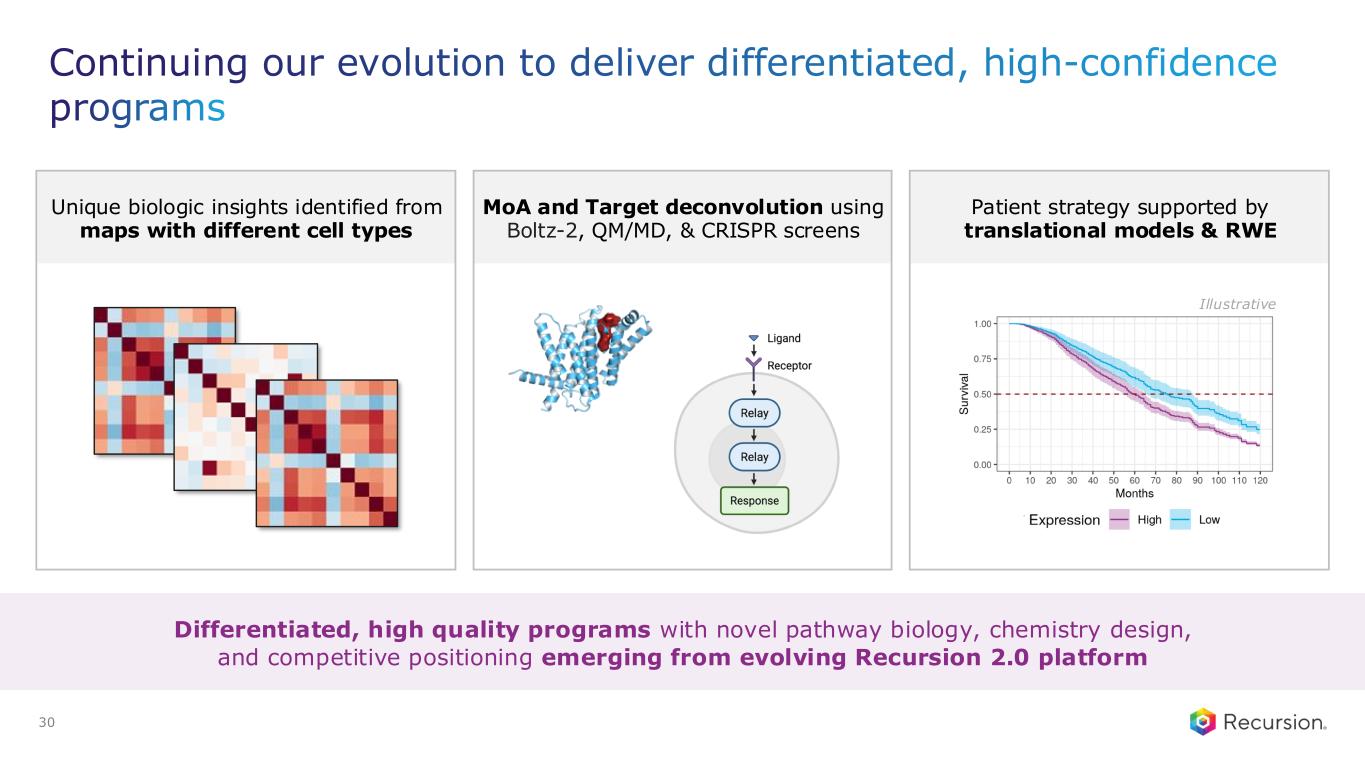
Continuing our evolution to deliver differentiated, high-confidence programs 30 Differentiated, high quality programs with novel pathway biology, chemistry design, and competitive positioning emerging from evolving Recursion 2.0 platform Unique biologic insights identified from maps with different cell types MoA and Target deconvolution using Boltz-2, QM/MD, & CRISPR screens Patient strategy supported by translational models & RWE Illustrative


Internal and external pipeline momentum FY 2025 and 2026 upcoming pipeline catalysts Partnership Catalysts Potential for additional phenomap options Potential for multiple new project initiations Potential for multiple programs optioned by partners 2025 2026 H1 REC-617 (CDK7i) in advanced solid tumors Initiation of combination studies H2 REC-4881 (MEK1/2i) in FAP Additional safety and efficacy data from TUPELO REC-617 (CDK7i) in advanced solid tumors Additional Phase 1 data from ELUCIDATE REC-7735 (PI3Kα H1047Ri) DC nomination H1 REC-1245 (RBM39) Early safety and PK from monotherapy trial H2 REC-3565 (MALT1) Early safety and PK from monotherapy trial REC-102 (ENPP1i) Ph1 initiation – 2H26 31