Sangoma Technologies Corporation
ANNUAL INFORMATION FORM
For the fiscal year ended June 30, 2026
September 28, 2026
TABLE OF CONTENTS
GENERAL
The information in this Annual Information Form is presented as of June 30, 2026, unless otherwise indicated.
Unless otherwise indicated, or the context otherwise requires, references in this Annual Information Form to “Sangoma”, “the Company”, “we”, “us” or “our” refer to Sangoma Technologies Corporation and its subsidiaries together and all references to “$” or “dollars” are to United States dollars.
FORWARD LOOKING STATEMENTS
This Annual Information Form contains “forward-looking information” within the meaning of applicable securities laws, including statements regarding the future success of our business, development strategies and future opportunities. Forward-looking information is generally identifiable by use of the words “believes”, “may”, “plans”, “will”, “anticipates”, “intends”, “could”, “should”, “estimates”, “expects”, “forecasts”, “projects” and similar expressions, and the negative of such expressions.
Forward-looking information in this Annual Information Form includes, but is not limited to, statements concerning estimates of expected expenditures, expected future product development, expected future production and outcomes, anticipated cash flows, and other statements which are not historical facts.
Although we believe that our expectations reflected in these forward-looking statements are reasonable, such statements involve inherent risks and uncertainties and no assurance can be given that actual results will be consistent with these forward-looking statements, if at all. Forward-looking statements are based on the opinions and estimates of management at the date that the statements are made, and are subject to a variety of risks and uncertainties and other factors that could cause actual events or results to differ materially and adversely from those projected, estimated or anticipated in forward-looking statements. Readers are cautioned not to place any undue reliance on forward-looking statements, as there can be no assurance that the plans, intentions, estimations, projections or expectations upon which they are based will occur. Except as required by applicable law, we undertake no obligation to revise or update any forward-looking statements for any reason, including, but not limited to, if circumstances or management’s estimates or opinions should change, or if new facts shall subsequently be made available or come to light.
Readers are cautioned that these forward-looking statements are only predictions and are, therefore, inherently subject to business, economic and competitive risks, uncertainties, and assumptions, both general and specific, that are extremely difficult to accurately predict, including those identified below and in the section “Risk Factors” herein. These known and unknown risk factors could cause the actual results, performance or achievements to be materially and adversely different from any future results, performance or achievements expressed or implied by the forward-looking information contained in this Annual Information Form. Some of the risks and other factors which could cause actual results to differ materially from those expressed or implied in the forward-looking statements contained herein include, but are not limited to, changes in exchange rate between the Canadian dollar and other currencies (in particular the United States (“U.S.”) dollar), changes in technology, including with respect to artificial intelligence and machine learning, changes in the business climate, changes to macroeconomic conditions, including (i) inflationary pressures and potential recessionary conditions, as well as actions taken by central banks and regulators across the world in an attempt to reduce, curtail and address such pressures and conditions, and (ii) recent events in the world economy and global financial and credit markets as a consequence of global conflicts, uncertain economic conditions, macroeconomic changes and trade wars (such as the trade war between the U.S., on the one hand, and China, Mexico and Canada, on the other), including the potential use and effects of tariffs to address the U.S. presidential administration’s policy goals, the effects of adverse developments at financial institutions, including bank failures, that impact general sentiment regarding the stability and liquidity of banks (including the U.S. government’s debt ceiling policies and contemplated or actual budget and tax cuts), and the resulting impact on the stability of the global financial markets at large, our ability to identify and remediate material weaknesses and significant deficiencies in our internal controls, changes in the regulatory environment, the imposition of tariffs, impact of our disposition of VoIP Supply, LLC and internal reorganizations, the decline in the importance of the PSTN (as defined herein), impairment of goodwill and new competitive pressures, and acts of terrorism and war,
hostilities and conflicts, including, but not limited to, Russia’s invasion of Ukraine in February 2022, the Israel-Hamas conflict, the U.S.-Iran conflict (and related broader geographic instability, including threats to the Strait of Hormuz and elevated energy prices), and associated changes in global trade policies and economic sanctions).
A more complete discussion of the risks and uncertainties facing the Company is disclosed under the heading “Risk Factors” in this Annual Information Form, as well as in any continuous disclosure filings of the Company made with Canadian securities regulatory authorities, each of which are available at www.sedarplus.ca and www.sec.gov.
All forward-looking information in this Annual Information Form is qualified in its entirety by this cautionary statement and we disclaim any obligation to revise or update such forward-looking information to reflect future results, events, or developments, except as required by law.
CORPORATE STRUCTURE
Name, Address and Incorporation
Sangoma Technologies Corporation is an Ontario corporation existing under the Business Corporations Act (Ontario) (the “OBCA”). The Company was formed on July 1, 2001 by way of a vertical short-form amalgamation among Sangoma.com Inc., 1056574 Ontario Limited and 883750 Ontario Limited, each, a wholly-owned subsidiary of Sangoma.com Inc., pursuant to the OBCA (the “Amalgamation”). Pursuant to the Amalgamation, all of the shares in the capital of Sangoma.com Inc. converted into shares of the capital of the amalgamated corporation, then named “Sangoma.com Inc.” Subsequently, on October 18, 2001, the Company changed its name to “Sangoma Technologies Corporation”.
The registered office of the Company is located at Bay-Adelaide Centre, 333 Bay Street, Suite 3400, Toronto, Ontario, Canada M5H 2S7, and its head office is located at 301 N. Cattlemen Road, Suite 300, Sarasota, Florida, United States 34232. The Company’s website address is: www.sangoma.com. The information on Sangoma’s website is not incorporated by reference in this Annual Information Form.
Intercorporate Relationships
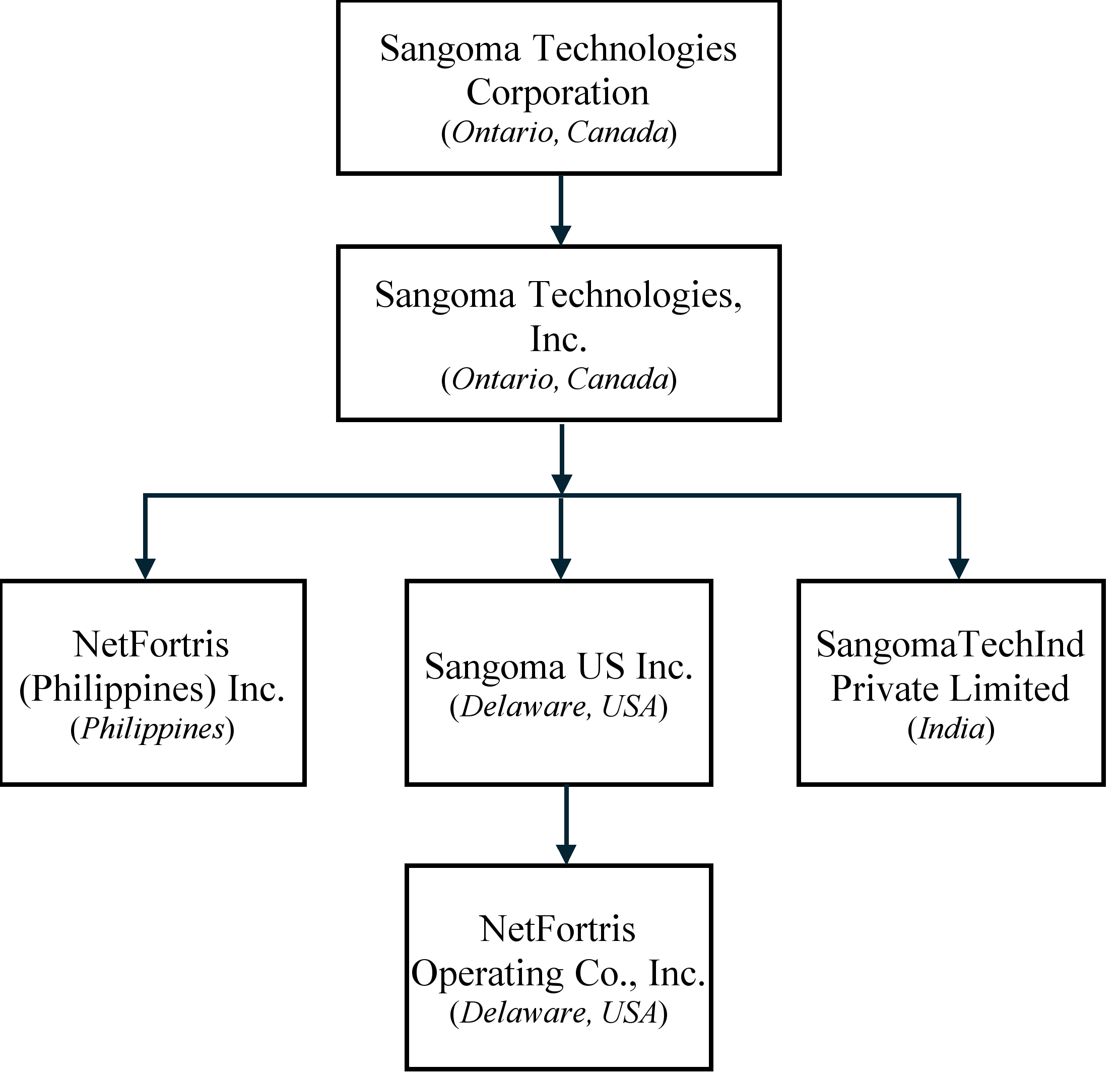
The following chart outlines Sangoma’s corporate structure and identifies the jurisdictions of each of our material subsidiaries as at September 28, 2026.
GENERAL DEVELOPMENT OF THE BUSINESS
Legacy Hardware Exit
As of June 30, 2026, Sangoma exited its legacy hardware business, comprising session border controllers, PSTN interface boards, and media processing boards. Effective October 1, 2026, the Company no longer manufactures, markets, or sells these products. Sangoma continues to offer VoIP gateways as part of its network interconnection product line.
Strategic Review
On May 13, 2026, in connection with the announcement of the Company’s third quarter fiscal 2026 financial results, the Company announced that the Board of Directors had initiated a strategic review process to evaluate a range of alternatives aimed at enhancing shareholder value. The strategic review is being conducted with the assistance of independent financial advisors and will consider, among other things, potential strategic transactions, partnerships, and other value-enhancing opportunities. There can be no assurance that the strategic review will result in any particular outcome or transaction. The Company intends to provide updates as appropriate.
CFO Transition
On June 4, 2026, the Company announced that Larry Stock had elected to retire from his role as Chief Financial Officer effective June 30, 2026, following nearly six years of distinguished service to the Company. Upon his retirement, Mr. Stock will remain available to the Company in a senior advisory capacity for a period of one year to ensure an orderly transition. Effective July 1, 2026, Adrian Back, previously the Senior Vice President, Finance, assumed the role of Interim Chief Financial Officer. The Board of Directors has commenced a search to identify a permanent successor to the CFO role, which will include both internal and external candidates.
Normal Course Issuer Bid
On March 25, 2025, the Company announced its intention to commence a Normal Course Issuer Bid (“NCIB”) with respect to its common shares (“Common Shares”). Pursuant to the initial NCIB, during the 12-month period commencing March 27, 2025 and ending March 26, 2026, the Company was authorized to purchase up to 1,679,720 Common Shares, representing 5% of the total number of 33,594,409 Common Shares outstanding as of March 17, 2025, through the facilities of the Toronto Stock Exchange (the “TSX”), the Nasdaq Global Select Market (“Nasdaq”) or alternative Canadian trading systems. During Fiscal 2026, the Company purchased and cancelled 195,949 Common Shares under the NCIB. On April 1, 2026, the TSX accepted the Company’s notice to renew its NCIB for a further 12-month period commencing April 6, 2026 and ending no later than April 5, 2027, under which the Company may purchase up to 1,663,939 Common Shares, representing approximately 5% of the 33,278,790 Common Shares outstanding as of March 24, 2026.
Disposition of VoIP Supply, LLC
On August 5, 2025, the Company announced that it completed the sale of its subsidiary, VoIP Supply, LLC, a New York-based distributor of VoIP hardware and related services. The divestiture was completed on June 30, 2025 for a total purchase price of $4.5 million, and enabled the Company to further streamline its operations and increase its focus on its core software and services business. See Risk Factors — “We may have difficulties identifying, successfully completing or integrating acquisitions or dispositions, or maintaining or growing our acquired businesses” described below.
Internal Reorganization
On December 31, 2024 and June 30, 2025, Sangoma completed a series of dissolutions and mergers of various subsidiaries into Sangoma US Inc., for the purpose of creating a more simplified and cost-effective corporate structure.
Credit Facility
On March 28, 2022, the Company entered into a second amended and restated credit agreement (the “Second Amended and Restated Credit Agreement”) with, among others, The Toronto-Dominion Bank and Bank of Montreal, as lenders. The Second Amended and Restated Credit Agreement, which was entered into to fund, among other things, certain of the Company’s prior acquisitions, is comprised of multiple term credit facilities, a revolving credit facility and a swingline credit facility.
On April 6, 2023, the Company entered into that certain Second Amendment to the Second Amended and Restated Credit Agreement to reflect certain administrative amendments and to increase the amount of the revolving credit facility from $6 million to $20 million and the amount of the swingline credit facility from $1.5 million to $5 million.
On June 4, 2024, the Company entered into the third amendment to the Second Amended and Restated Credit Agreement to reflect certain administrative amendments.
DESCRIPTION OF THE BUSINESS
Overview
Sangoma’s products and services are used by leading companies throughout the world and in leading UC, PBX, IVR, contact center, carrier networks, and data communication applications worldwide. Sangoma’s portfolio of products also enable service providers, enterprises, small to mid-sized businesses (“SMBs”), and original equipment manufacturers (“OEMs”) alike to leverage their existing infrastructure for maximum financial return, while still delivering the most advanced applications and services from the latest technologies available. Please refer to the “Glossary of Technical Terms” for detailed definitions of terms used throughout this AIF.
Communications as a Service (CaaS) Portfolio
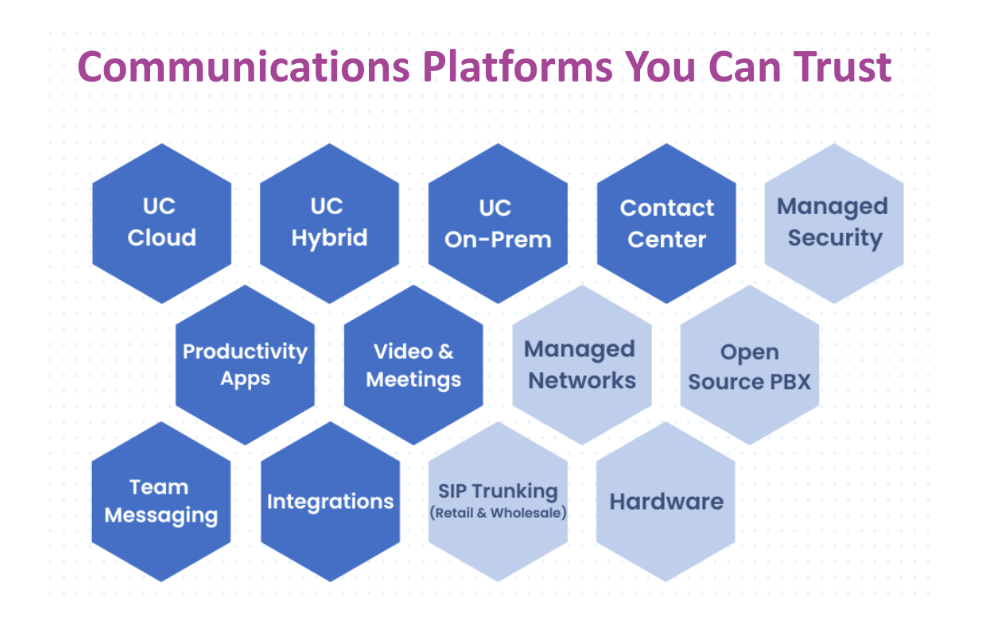
Sangoma is a trusted leader in delivering value-based Communications as a Service solutions for businesses of all sizes. The value-based communications segment includes small businesses to large enterprises who are looking for all the advantages of cloud-based communications at a fair price. Sangoma’s current Communications as a Service offerings are typically offered with monthly, yearly, or multi-year contracts and include:
•Unified Communications as a Service (“UCaaS”)
•Trunking as a Service (“TaaS”)
•Contact Center as a Service (“CCaaS”)
•Communications Platform as a Service (“CPaaS”)
•Video Meetings as a Service (“MaaS”)
•Collaboration as a Service (“Collab aaS”)
Unified Communications as a Service (UCaaS)
Sangoma’s UC solutions are business communication systems (PBX’s with advanced UC features, such as presence/chat, conferencing, mobility, fax, and more) that can be deployed on-premise or hosted in the cloud, allowing businesses to select the best option for their needs. Unified Communication systems, because of their mobility features such as having the business phone number ring on an app on your smartphone and/or desktop and instant messaging capability, enable remote work and work from home much more efficiently. Sangoma’s Unified
Communication solutions fully integrate with our phones, soft clients, and network interoperability products to provide a fully interoperable solution from a single vendor.
Cloud-Based Business Phone Solution
Sangoma offers its customers full-scale cloud-based Unified Communications solutions. With Sangoma, businesses can get contact center, mobility, softphone, call control, and productivity features included for every user at a reasonable price. Sangoma’s hosted phone service delivers the customer experience businesses demand at an affordable price point. Customers can also choose pre-provisioned phones that customers simply plug into their network.
On-Premise Business Phone Solution
Sangoma also offers a more traditional on-premise UC phone system, for businesses still wanting to deploy their business phone system on premise. Whether deployed on a dedicated appliance or in the customer’s virtual environment, Sangoma provides the power and connectivity necessary.
•IP Deskphones, Headsets and UC Clients: Sangoma provides desktop and softphone collaboration clients that integrate seamlessly with our UC solution offerings and deliver UC features (presence, contacts, chat, calling, audio and video conferencing, etc.) from a single application, on any device, at any location.
•IP Deskphones: Sangoma offers a full line of phones that work with both our cloud and on-premise systems that are perfect for every user type, from casual to call center to managers and executives. Sangoma’s product line includes entry-level, mid-range, and executive- level phones. All models include HD Voice and plug-and-play deployment. Sangoma’s range of IP phones are customized to seamlessly integrate with all of our UC Systems and provide zero touch installation, simplified system management, and instant access to a wide range of features.
•Headsets: Sangoma also offers headsets that either work in conjunction with the desktop phones (by plugging into the phone) or work in conjunction to our desktop soft client (by plugging directly into the computer). These headsets enable roaming of up to 325 feet from the phone or desk computer.
•UC Clients and Softphones: Unified Communication Clients (or softphones) are used to make or receive phone calls with your business phone number and can be used as your main phone or as an extension of your desk phone. They are available as an app on your smartphone or computer. These UC clients have enabled employees to work remote seamlessly by enabling phone calls to customers and other employees as if they were in a physical office. Sangoma offers UC clients with all of our Unified Communication / Business phone system product lines.
Trunking as a Service
SIP trunks deliver Internet-based telephony services to businesses using their existing internet connection, eliminating the need for separate traditional PSTN or digital telecom connections. SIP trunking is fast becoming the technology of choice to interconnect an IP PBX system to a telephone company. The main drivers are cost efficiencies (over fixed lines such as ISDN or analog lines from incumbent telcos) and end-to-end UC features/transparency. Cost efficiencies are realized because SIP trunking uses already-available broadband connections at customer premises. Sangoma offers both retail and wholesale SIP trunking which allows our customers to choose the service that best meets their needs. Either service offers DIDs and number porting.
Retail SIP Trunking
Retail SIP trunking offers predictable monthly expenses with pricing based per trunk. SIPStation, Sangoma’s retail SIP trunking service, is seamlessly integrated into our various UC platforms, making it easy to get up and running. It also includes an integrated fax service option, enabling a business to send and receive faxes from a web interface or from a local fax machine. Typically, SMBs and enterprises would utilize this type of service.
Wholesale SIP Trunking
Sangoma’s wholesale SIP trunking offer is now available following the acquisition of VoIP Innovations. Pricing for wholesale SIP trunking is usage-based but with a larger monthly minimum commitment. This includes origination, termination, SMS/MMS, e911, and fraud mitigation. Typically, very large businesses or service providers who resell SIP trunks would utilize this type of service.
Fax as a Service
Faxing remains an important communications tool, yet VoIP networks are sometimes unable to send faxes reliably because fax standards are based on very specific timing that can be interrupted in VoIP systems, especially where there is substantial latency. Sangoma’s FoIP service, FaxStation, is a hosted service to remedy this problem, available with our TaaS. It features a telecom appliance with up to four analog connections for fax machines and operates in concert with Sangoma’s fax server data center to encrypt and package the fax communication to make it fail-safe. This is particularly useful for small businesses that rely on fax communications but also for industries with challenging network conditions, such as mining, oil rigs, and ship-to-shore over satellite.
Contact Center as a Service
CCaaS is our cloud-based contact center, or customer experience, offering. It provides robust contact center capabilities running in various ways: either standalone, in conjunction with our other cloud services (such as UCaaS), or integrated “inside” our UCaaS product in a simplified version. This latter solution is intended for ‘departmental’ type usage, by companies that are not pure-play contact centers, but that might have a department such as customer service or technical support that operate inside that company almost like a mini contact center.
Communications Platform as a Service
CPaaS allows developers to easily build services and applications using real-time communication features, such as voice, video, chat, and SMS, via the cloud. Our platform enables Sangoma, our integrator/developer partners, and advanced customers to build new communications services based on voice, rest APIs, WebRTC, and SMS. When running an application on a CPaaS platform, performance is critical. To ensure peak performance, Sangoma offers its own SIP trunking service, providing optimized connectivity in addition to easy access to phone numbers. Sangoma also sells a series of ‘applications’ (or Apps) based upon our CPaaS product that customers can purchase.
Video Meetings as a Service
Sangoma Meet is our video meetings, cloud-based service accessible from any device, be it desktop or mobile. It enables file sharing on screen so collaboration with co-workers is enhanced, integrates seamlessly with your calendar, and enables PSTN phone calls. Sangoma Meet is available in free and chargeable tiers.
Collaboration as a Service
Collab aaS is Sangoma’s cloud-based offering for enabling people to work together more productively. This service is called TeamHub. It allows users to interact using any of the various forms of communications, including chatting, calling, and video. TeamHub integrates Sangoma’s softphone client software applications (desktop and mobile) and is designed to allow communications to start in one mode (such as chat), and move through different modes very elegantly, in effect ‘upgrading’ that mode of communications to a voice call in real time, and/or upgrading that voice call to a video meeting.
MSP Portfolio
Sangoma’s cloud-based Managed Service Provider (“MSP”) offerings deliver mission critical communication services that businesses need and complement our full line of Communications as a Service solutions. The MSP product line is built upon a tightly integrated, enterprise grade, and end-to-end managed network, which is all supported by an expert 24/7 network engineering team. The current MSP offering includes three primary services:
•Managed Security: Sangoma provides a cloud-based service, sometimes called Unified Threat Management (“UTM”), whereby the customers network, including voice and data traffic, are secured by intrusion prevention and detection capabilities. The network security service helps protect customers against attacks and data losses from spam, viruses, ransomware, botnets, etc.
•Managed SD-WAN: Sangoma offers a cloud-based software-defined approach to managing a customer’s wide area network. The SD- WAN service enables network redundancy through the ability to manage multiple internet connections from multiple providers, which is seen as one seamless connection for the customer. If one connection fails, the customer does not lose connectivity and has uninterrupted uptime. The service also provides traffic shaping whereby certain types of traffic can be given priority or forced in priority.
•Managed Access: Sangoma also provides a robust broadband connectivity solution, including network monitoring, analytics, backup, and a fully PCI-compliant offering for payment card and credit card transactions. Additionally, our Managed Access solution integrates with Managed Security and Managed SD-WAN services, delivering unique capabilities such as secure, end-to-end peering connections to critical destinations (such as Public Cloud sites like AWS and Azure) and Quality of Service commitments.
Network Interconnection Products
In addition to the CaaS and MSP offerings described above, Sangoma also offers network interconnection productsin the form of VoIP Gateways.
VoIP gateways are needed any time voice traffic moves from a VoIP network to a traditional PSTN telephone network. As the traffic traverses these networks, there are issues that need to be resolved regarding both the media (the sound of the caller’s voice) and the signaling (the method used to control the media traveling over that connection).
In a service provider or carrier network, much larger gateways perform these same tasks. In addition, there are signaling protocols that are only used when carrier networks communicate with other carrier networks that are not included in the enterprise product line.
All Sangoma’s gateways have broad interoperability certifications.
Open-Source Software Products
Asterisk and FreePBX
Sangoma is the primary developer and sponsor of the Asterisk project, the world’s most widely used open-source communications software, and the FreePBX project, the world’s most widely used open-source PBX software.
Sangoma also offers revenue-generating products and services, beyond the open-source Asterisk or FreePBX software, to users of these open-source software projects. The types of products and services Sangoma offers includes software add-ons to Asterisk or FreePBX, IP phones, SIP trunking, cloud-based fax, training, technical support, maintenance, PSTN cards, VoIP gateways, session border controllers, and commercial/hardened versions of the PBX/UC software.
Customer Base
We currently have over 35,000 customers, which include distributors, resellers, enterprises, OEM manufacturers, service providers and end users (ranging from small businesses to larger enterprises). No single customer accounted for more than 5% of our revenue for the fiscal year ended June 30, 2026 (“Fiscal 2026”).
We sell into over 134 countries around the globe, broken down geographically into the two primary regions of North America and International.
We typically sell to large customers (including OEMs and carriers) using a direct sales model and to SMBs through a global network of distributors and resellers/integrators, as further described below.
Sales and Marketing
We market our services and solutions to both partners and end users. We employ a variety of means for generating leads, including but not limited to search engine marketing and optimization, online display advertising, content gating, attending tradeshow and conference events, conducting road shows across the globe, partnering with third parties, hosting webinars, and targeting specific geographic areas for local marketing. We utilize a sophisticated system for acquiring and nurturing leads that allows us to track our efforts and fine tune our strategies for moving prospects through the buying cycle.
Our products and services are sold both through our extensive channel network, made up of resellers, distributors, and master agents and to our direct customers as well. We provide our partners with a host of sales and marketing resources to help them effectively sell, implement, and support Sangoma solutions. Additionally, we employ salespeople in each geographic region to provide added support and product knowledge to our partners and customers. As we expand our global network, we focus on recruiting partners who expand our coverage area to bring Sangoma solutions to new locations around the globe.
Research and Development
As a technology company, the Company is continuously working on a large number of projects across its broad portfolio of solutions. While the Company has introduced several new solutions to its product portfolio over the last few years, the majority of the Company’s investment in R&D is dedicated to sustaining, improving on and enhancing its broad portfolio of existing solutions that were previously acquired (see “General Development of the Business”). The Company believes that product innovation is essential to a technology company’s future. The Company also believes that R&D investment is necessary in order to address the needs of its wide-ranging group of customers (which include business of all sizes including service providers, carriers, enterprises, small and medium-sized businesses, and original equipment manufacturers) in more than 134 countries, to keep pace with technology developments in the cloud communications industry, to meaningfully compete in that industry, and to achieve and maintain market acceptance. The Company focuses on creating and introducing solutions to the market as soon as commercially practical and, thereafter, focuses on enhancements to further improve its solutions. Such introductions enable the Company to validate acceptance to some degree, and to get solutions to market efficiently in order to start generating revenue. Furthermore, the Company focuses on keeping its new development costs for new projects under control in a number of ways, including by reusing its existing code base where applicable and by leveraging open-source software.
Our history of successful strategic acquisitions in order to introduce new solutions to transition the business from a “product-focused” company to one with a significant base of recurring revenue derived from various cloud solutions, subscriptions, maintenance/support and other recurring revenue opportunities will increase the predictability of our revenue stream and our long-term value, thereby enabling us to better meet our strategic objectives. (see “General Development of the Business”).
Our R&D personnel are skilled with deep domain expertise in the diverse areas of enterprise communications, cloud, IP networking, UC, and mobile UC solutions. We work to continuously improve our R&D efforts through operational measurement, adoption of best practices, effective partnerships and investment in our people, including attracting and hiring personnel in various places around the world to provide us with the skills we require at cost-effective rates.
The Company incurred $42.90 millionn in R&D costs for Fiscal 2026, which represented approximately 21% of its sales for such period, largely in line with the $42.15 million for the fiscal year ended June 30, 2025.
Competition
We compete in the enterprise communication market providing solutions and services for transporting data, voice and video traffic across intranets, extranets, mobile networks and the Internet. These markets are characterized by rapid change, converging technologies and a migration to networking and communications solutions that offer relative advantages. These market factors represent both an opportunity and a competitive threat to us. We compete with numerous vendors in each product category. The overall number of our competitors providing niche product solutions may increase. Also, the identity and composition of competitors may change as we increase our activity in our new product markets. As we continue to expand globally, we may see new competition in different geographic regions.
Competitors for our cloud enterprise communication solutions include hosted and cloud services providers, such as RingCentral, Inc., Cisco Systems, Inc. (which acquired Broadsoft, Inc.) 8X8, Inc., Mitel Networks Corp., Microsoft Teams, Jive/LogMeIn, Nextiva, Dialpad, Avaya Inc., and Vonage Holdings Corp. as well as other hosted PBX providers. Competitors for our TaaS offering include Bandwidth.com, Telnyx, Flowroute, ThinQ, and Peerless, amongst others.
Competitors for our on-premise enterprise communication solutions include traditional communications vendors and software vendors that are adding communications and collaboration solutions to their offerings. We compete against many traditional communications vendors, including Avaya Inc., Cisco Systems, Inc., Mitel Networks Corp., 3CX and Panasonic Corporation as well as other on-premise providers. We also compete with software vendors who, in recent years, have expanded their offerings to address portions of this UC market. This group of competitors includes Microsoft Corporation (via Skype), Google LLC, and Slack.
Competitors for our IP-Phone solutions include Poly Inc. (formerly Polycom, Inc.), VTech Holdings Limited and Yealink Inc. as well as other IP phone manufacturers.
Competitors for our network connectivity solutions include AudioCodes Ltd., Oracle (via their acquisition of Acme Packet) and Ribbon Communications Inc. as well as other providers.
Some of these companies compete across many of our product lines, while others are primarily focused in a specific product area. New ventures to create products that do or could compete with our products are regularly formed.
In addition, some of our competitors may have greater resources, including technical and engineering resources, than we do. As we expand into new markets, we will face competition not only from our existing competitors but also from other competitors, including existing companies with strong technological, marketing and sales positions in those markets. We also sometimes face competition from resellers and distributors of our products, including some that may make use of our open-source solutions. Companies with which we have strategic alliances in some areas may be competitors in other areas, and in our view this trend may increase. In addition, because the market for our products is subject to rapid technological change as the market evolves, we may face competition in the future from companies that do not currently compete in our markets, including companies that currently compete in other sectors of the information technology, communications and software industries
Foreign Operations
Approximately 95% of our revenue in Fiscal 2026 was generated from operations in the United States and 5% from operations in non-U.S. jurisdictions. Substantially all of the revenue generated in Fiscal 2026 was denominated in U.S. dollars. Please refer to Note 18 entitled “Segment Disclosures” of the 2026 Annual Financial Statements.
Employees
As at June 30, 2026, the Company and its subsidiaries employed 569 employees, 46 of which are in Canada, 352 of which are in the United States and 171 of which are located elsewhere.
DESCRIPTION OF CAPITAL STRUCTURE
The following description of our share capital summarizes certain provisions contained in our Articles and by-laws. These summaries do not purport to be complete and are subject to, and are qualified in their entirety by reference to, all of the provisions of our Articles and by-laws, which have been filed under our profile on SEDAR+ at www.sedarplus.ca.
Share Capital
Our authorized share capital consists of an unlimited number of Common Shares. As at June 30, 2026, 33,338,932 Common Shares were issued and outstanding.
Common Shares
Each Common Share entitles the holder thereof to: (i) receive notice of, attend and vote at all meetings of the shareholders of the Company; (ii) the right to one vote at all such meetings; (iii) receive and participate equally and rateably in any dividends declared on the Common Shares, if and when declared by the Board in their sole discretion; and (iv) receive and participate equally and rateably in any distribution of the assets of the Company in the event of liquidation, dissolution or winding-up of the Company, whether voluntary or involuntary, or any other distribution of the assets of the Company among its shareholders for the purpose of winding up its affairs.
DIVIDENDS AND DISTRIBUTIONS
The Company has not declared or paid dividends in the last three (3) years and the Company currently intends to retain any future earnings to fund the development and growth of its business and pay down debt and does not currently anticipate paying dividends on the Common Shares. Any determination to pay dividends in the future will be at the direction of the Board and will depend on many factors, including, among others, the Company’s financial condition, current and anticipated cash requirements, contractual restrictions and financing agreement covenants, solvency tests imposed by applicable corporate law and other factors that the Board may deem relevant.
MARKET FOR SECURITIES
Trading Price and Volume
The Common Shares are listed and posted for trading on the TSX under the symbol “STC” and on the Nasdaq under the symbol “SANG” as of December 16, 2021. The following tables set forth the monthly range of high and low prices per Common Share and total monthly volumes traded on the TSX and the Nasdaq for Fiscal 2026.
| | | | | | | | | | | | | | | | | | | | |
TSX |
|
Month |
| High |
| Low |
| Volume |
| July 2025 |
| C $8.80 |
| C $7.65 |
| 512,400 |
| August 2025 |
| C $8.58 |
| C $7.51 |
| 514,200 |
| September 2025 |
| C $8.73 |
| C $6.48 |
| 561,000 |
| October 2025 |
| C $7.50 |
| C $6.58 |
| 817,100 |
| November 2025 |
| C $7.62 |
| C $6.82 |
| 263,700 |
| December 2025 |
| C $7.53 |
| C $6.72 |
| 530,700 |
| January 2026 |
| C $7.00 |
| C $6.23 |
| 517,400 |
| February 2026 |
| C $7.00 |
| C $5.97 |
| 528,900 |
| March 2026 |
| C $6.50 |
| C $5.18 |
| 677,700 |
| April 2026 |
| C $6.06 |
| C $5.16 |
| 2,006,700 |
| May 2026 |
| C $6.05 |
| C $4.71 |
| 748,200 |
| June 2026 |
| C $5.59 |
| C $4.76 |
| 360,900 |
|
|
|
|
|
|
|
Nasdaq |
|
|
|
|
|
|
Month |
| High |
| Low |
| Volume |
| July 2025 |
| $6.49 |
| $5.46 |
| 44,500 |
| August 2025 |
| $6.19 |
| $5.30 |
| 43,500 |
| September 2025 |
| $6.46 |
| $4.70 |
| 361,100 |
| October 2025 |
| $5.39 |
| $4.65 |
| 125,000 |
| November 2025 |
| $5.37 |
| $4.76 |
| 81,700 |
| December 2025 |
| $5.42 |
| $4.80 |
| 77,200 |
| January 2026 |
| $5.02 |
| $4.64 |
| 37,000 |
| February 2026 |
| $5.10 |
| $4.30 |
| 107,100 |
| March 2026 |
| $4.76 |
| $3.71 |
| 105,200 |
| April 2026 |
| $4.44 |
| $3.75 |
| 85,400 |
| May 2026 |
| $4.35 |
| $3.48 |
| 161,500 |
| June 2026 |
| $3.98 |
| $3.40 |
| 101,300 |
ESCROWED SECURITIES AND SECURITIES SUBJECT TO CONTRACTUAL RESTRICTION ON TRANSFER
The following table sets forth the securities of the Company subject to escrow or contractual restriction on transfer as of the date hereof, and the percentage that number represents of the outstanding securities of that class as of June 30, 2026:
| | | | | | | | |
Designation of Class | Number of securities held in escrow or that are subject to a contractual restriction on transfer | Percentage of class |
Common Shares | — | — |
DIRECTORS AND EXECUTIVE OFFICERS
Pursuant to the Articles of the Company, the Board shall consist of a minimum of three and a maximum of nine directors. The directors of the Company shall hold office until the next annual meeting of Shareholders or until their resignation or removal or until their respective successors have been duly elected or appointed.
The following table sets out certain information with respect to the directors and executive officers of the Company as at the date of this Annual Information Form:
| | | | | | | | |
Name and Place of Residence | Position with the Company | Principal Occupation |
Charles Salameh
Ontario, Canada | Director and Chief Executive Officer (September 1, 2023) | Chief Executive Officer of the Company |
Al Guarino(2)
Ontario, Canada | Director | Chief Financial Officer of Physiomed Health |
Allan Brett(2)
Ontario, Canada | Director | Chief Financial Officer of The Descartes Systems Group Inc. |
Norman A. Worthington, III
Florida, USA | Director (Chair) | Chair of the Company’s Board of Directors |
Marc Lederman(1)(2)
Pennsylvania, USA | Director | Co-founder and General Partner, NewSpring Capital |
Giovanna (Joanne) Moretti(1)
Texas, USA | Director | Chief Revenue Officer, Fictiv |
April Walker(1)
Pennsylvania, USA | Director | Strategic Advisor |
Adrian Back(3)
Florida, USA | Interim Chief Financial Officer | Interim Chief Financial Officer of the Company |
Mark Strachan
Ontario, Canada | Chief Information Officer | Chief Information Officer of the Company |
Jeremy Wubs
Ontario, Canada | Chief Operating Officer (September 11, 2023) | Chief Operating Officer of the Company |
Samantha Reburn
Ontario, Canada | Chief Legal & Administrative Officer, Corporate Secretary | Chief Legal & Administrative Officer, Corporate Secretary of the Company |
______________________________________
Notes:
(1)Member of the Compensation, Nominating and Governance Committee. Marc Lederman is the Chair of the Compensation, Nominating and Governance Committee.
(2)Member of the Audit Committee. Al Guarino is the Chair of the Audit Committee.
(3)Mr. Back was appointed as the Interim Chief Financial Officer of the Company effective as of July 1, 2026.
As at the date hereof, our directors and executive officers as a group beneficially owned, or controlled or directed, directly or indirectly, an aggregate of 9,080,978 Common Shares representing approximately 27.24%of the issued and outstanding Common Shares as at June 30, 2026. The foregoing does not take into account Common Shares to be issued upon the potential exercise of options or vesting of other equity awards.
The following are brief biographies of the directors and executive officers of the Company.
Norman A. Worthington has been the Chair of our Board of Directors since April 2021, following the Company’s acquisition of StarBlue Inc. in March 2021 (the “StarBlue Acquisition”). Mr. Worthington was also a Sangoma employee from February 2023 to September 2023 when he took over as the Company’s Interim Executive Chairman, and previously from April 2021 to May 15, 2022, to assist with the integration of StarBlue following the StarBlue Acquisition. Mr. Worthington previously served as the CEO of Star2Star Communications, LLC from 2006 to 2018, and again from January 2020 until March 31, 2021, and as the Executive Chairman of StarBlue from January 2018 to March 2021.
Al Guarino is a CPA and has been a member of our Board of Directors since May 2014. Mr. Guarino currently serves as the Chair of the Audit Committee. Mr. Guarino is the Chief Financial Officer of Physiomed Health, a large chain of healthcare clinics. He is a significant shareholder in several privately held enterprises ranging from health care, manufacturing, distribution, and automotive.
Allan Brett has been a member of our Board of Directors since January 2017 and currently serves as a member of the Audit Committee. Mr. Brett is a CPA, CA and CBV, and an experienced public company executive who previously served as the CFO of The Descartes Systems Group Inc., a public logistics technology company listed on the TSX and Nasdaq exchanges from May 2014 to March 2026. Prior to that, Mr. Brett was the CFO at Aastra Technologies Limited, a TSX listed communications hardware company, from 1996 through to its sale to Mitel Networks Corporation in 2014. Mr. Brett is also currently the Chairman of the Board of Vitalhub Corp., a public healthcare software company listed on the TSX.
Marc Lederman has been a member of our Board of Directors since March 2021, following the StarBlue Acquisition. Mr. Lederman currently serves as a member of the Audit Committee as well as Chair of the Compensation, Nominating and Governance Committee. Mr. Lederman is a co-founder of NewSpring Capital and a General Partner of the Firm’s dedicated growth equity funds. He serves as the member of the investment committee of all NewSpring Growth and NewSpring Mezzanine funds. Mr. Lederman has an extensive background in finance, investing, consulting, and accounting and was a Certified Public Accountant. Prior to co-founding NewSpring, he was a Manager in the Business Assurance and Advisory Services Group of Deloitte. Mr. Lederman is an active member of the Mid-Atlantic region’s private equity and venture capital community. Mr. Lederman received a BS in Accountancy from Villanova University and an MBA from The Wharton School of University of the Pennsylvania. Mr. Lederman has served on the board of directors on over a dozen technology and service companies over the past two and a half decades.
Joanne Moretti has been a member of the Board since April 2023 and currently serves as a member of the Compensation, Nominating and Governance Committee. With over 32 years’ experience in the High-Tech & Manufacturing industries, holding board-appointed C-level responsibilities in Fortune 200 companies as well as startups, her expertise spans sales, marketing and product management with a tremendous record of delivering profitable growth. Today she is the Chief Revenue Officer at Fictiv, a digital manufacturing company that delivers on-demand custom manufacturing to some of the largest enterprises as well as most innovative startups in the world. During the last five years, she has helped Fictiv achieve hypergrowth. Prior to Fictiv, Joanne sat on the board of DecisionLink, was the SVP & Chief Marketing Officer at Jabil, a Fortune 200 Manufacturing Solutions Company and held Sales & Marketing roles at tech giants HP, Dell and CA to make significant impact in each company.
April Walker has served as a director of Sangoma Technologies Corporation since July 2024 and is currently a member of the Compensation, Nominating, and Governance Committee. A technology and business leader with more than 40 years of experience, Ms. Walker brings deep expertise in artificial intelligence, cybersecurity, quantum computing, data center infrastructure, digital transformation, emerging technologies, technology risk, customer success, and enterprise innovation. She has held senior leadership positions across the technology, financial services, media and entertainment, energy, and telecommunications industries, including roles at Salesforce, Microsoft, MetLife, NBCUniversal, AOL, and Washington Gas. Ms. Walker is the Founder and Chief Executive Officer of HamptonIda Advisory Group, through which she advises boards and senior executives on technology strategy, innovation, and emerging technology risk. She also serves on the Board of Directors of Universal Display Corporation (Nasdaq: OLED) and is a member of its Investment Committee and Technology and Innovation Committee. In addition, she serves as a Senior Executive Advisor to Qtonic Quantum, advising on enterprise
technology strategy, quantum computing, and post-quantum cybersecurity. From July 2022 to June 2024, Ms. Walker served as Senior Vice President of Customer Success at Salesforce. From March 2018 to July 22 she served as General Manager of Microsoft’s U.S. Technology and Innovation Hubs, where she led technology and innovatin engagement with enterprise customers across the United States and the globe.
Charles Salameh has been the Chief Executive Officer for Sangoma since September 1, 2023. Charles is a seasoned technology executive with more than three decades of international expertise, with a storied career spanning the Information Technology and Network industries. His notable contributions include pivotal roles in the global evolution of Infosys’ Strategic go-to-market programs, SVP of Hewlett Packard Services Americas business, and occupying various high-ranking positions at DXC, Nortel Networks, and Bell Canada. Equipped with an MBA from the University of Toronto and a civil engineering degree, Charles combines robust academic foundations with his broad career experiences. Beyond his professional and academic accolades, he dedicates himself to advising the industry and passionately advocates for the advancement of technology.
Jeremy Wubs joined Sangoma as the Chief Operating Officer on September 11, 2023. Jeremy Wubs is a seasoned technology and transformation leader, boasting a successful track record spanning over two decades. With a proven history of delivering outstanding financial outcomes in highly competitive markets, Jeremy’s most recent role was as the Senior Vice President of Product, Marketing, and Professional Services at Bell Canada. In this capacity, he oversaw a multi-billion dollar product line across various technology sectors, including voice, collaboration, contact center, cloud computing, networking, cybersecurity, and IoT, targeting the small, medium, and enterprise market segments.
Adrian Back was appointed Interim Chief Financial Officer effective July 1, 2026. Mr. Back joined Sangoma via the Company’s acquisition of Star2Star Communications in 2021 and has served as Senior Vice President, Finance since that time. In this capacity, his responsibilities have included financial planning and analysis, external audit, SOX compliance and treasury.
Mark Strachan has served as Chief Information Officer since 2024. With a rich background in information technology, business systems, and operations, Mark Strachan brings over 30 years of expertise. His proven track record includes successful company integrations, application roadmaps, security operations, service management, and service improvement initiatives. Having completed an executive MBA program and CPA designation, Mark excels in leading teams and implementing innovative technologies to boost operational efficiency and support business expansion. His depth of experience enables him to drive innovation and deliver exceptional outcomes.
Samantha Reburn has been the Company’s Chief Legal & Administrative Officer since February 2022. Ms. Reburn is responsible for managing and overseeing Sangoma’s legal affairs, risk management and human resources. In addition, as Corporate Secretary, Sam is responsible for all corporate governance matters. Prior to joining Sangoma, Sam was the General Counsel at Docebo Inc. and prior thereto was VP, Legal at Kew Media Group Inc. Sam holds a J.D. from Western University and a B.A. from McGill University.
Corporate Governance
To further align management’s interests with those of our shareholders and to comply with Section 10D of the Exchange Act, Rule 10D-1 of the Exchange Act and the listing standards adopted by Nasdaq (the “Nasdaq Listing Rules”), the Company has adopted a compensation clawback policy (the “Compensation Clawback Policy”) that recoups incentive compensation from executives that was previously paid or awarded under certain circumstances, including in order to comply with the requirements stipulated by Section 10D of the Exchange Act, Rule 10D-1 of the Exchange Act and the listing standards adopted by Nasdaq. The Compensation Clawback Policy was approved by the Company’s shareholders in November 2023.
The Compensation Clawback Policy provides for the mandatory recovery of erroneously awarded incentive-based compensation from current and former executive officers (as defined in the Compensation Clawback Policy) of the Company in the event that the Company is required to prepare an accounting restatement. The Compensation Clawback Policy shall apply to any incentive-based compensation awarded to and received by executives on or
before October 2, 2023. Additionally, the Compensation Clawback Policy provides that if the Company is required to prepare an accounting restatement as a result of misconduct then, in accordance with Section 304 of the Sarbanes-Oxley Act of 2002, as amended (the “U.S. Sarbanes-Oxley Act”), the Chief Executive Officer and Chief Financial Officer shall reimburse the Company for (i) any bonus or other incentive-based or equity-based compensation received during the 12-month period following the date of the financial document, and (ii) any profits realized from the sale of the Company’s securities during such 12-month period. The foregoing description of the Compensation Clawback Policy is a summary only and is qualified in its entirety by reference to the full text of the Compensation Clawback Policy, a copy of which is attached to the Form 40-F (to which this Annual Information Form forms a part) as Exhibit 97.1.
AUDIT COMMITTEE INFORMATION
Audit Committee’s Charter
The Audit Committee is a committee of the Board. Pursuant to applicable laws, the Company is required to have an audit committee comprised of not less than three Directors, all of whom are independent in accordance with National Instrument 52-110 – Audit Committees (“NI 52-110”). NI 52-110 requires the Company to disclose annually in its annual information form certain information concerning the constitution of its audit committee and its relationship with its independent auditor. The members of the Audit Committee and the chair of the Audit Committee are appointed by the Board on an annual basis, or until their successors are duly appointed, for the purpose of overseeing the Company’s financial controls and reporting and monitoring whether the Company complies with financial covenants and legal regulatory requirements governing financial disclosure matters and financial risk management. The Audit Committee charter (the “Charter”) is reproduced as Schedule “A”.
Composition of Audit Committee
The Audit Committee is comprised of Al Guarino (Chair), Allan Brett and Marc Lederman. Each of the members of the Audit Committee is “independent” (within the meaning given to such term in NI 52-110) and “financially literate” (within the meaning given to such term in National Instrument 51-102 Continuous Disclosure Obligations).
Relevant Education and Experience
Each member of the Audit Committee has the education and/or practical experience required to understand and evaluate financial statements that present a breadth and level of complexity of accounting issues that are generally comparable to the breadth and complexity of issues that can reasonably be expected to be raised by Company’s financial statements. See each member’s biography under “Directors and Executive Officers” for further details.
Reliance on Certain Exemptions
At no time since the commencement of the Company’s most recently completed financial year has the Corporation relied on exemptions of NI 52-110, or an exemption from NI 52-110, in whole or in part, granted under Part 8 thereof.
Audit Committee Oversight
At no time since the commencement of the Company’s most recently completed financial year has the Audit Committee made a recommendation to nominate or compensate an external auditor not adopted by the Board.
Pre-Approval Policies and Procedures
The Audit Committee has the power and authority to pre-approve all non-audit services to be provided by the external auditor or delegate such pre-approval of non-audit services to any independent member of the Audit
Committee; provided that such independent member much notify the Audit Committee at each Committee meeting of the non-audit services they approved since the last Audit Committee meeting.
External Auditor Service Fees (By Category)
The Company’s Independent Registered Public Accounting Firm for the most recently completed financial year was KPMG LLP (Vaughan, Canada, PCAOB ID No.: 85).
The fees billed to the Company by KPMG LLP for the fiscal year ended June 30, 2026 and 2025 are as follows:
| | | | | | | | |
Category of Fees | Year Ended June 30, 2025 | Year Ended June 30, 2026 |
Audit Fees | $661,599 | $855,563 |
Audit-Related Fees(1) | $— | $— |
Tax Fees(2) | $— | $— |
All Other Fees | $— | $— |
______________________________________
Notes:
(4)The aggregate of fees billed for assurance and related services that are reasonably related to the performance of the audit or review of the Company’s financial statements which are not included under the line item titled “Audit Fees” above.
(5)The aggregate of fees billed for professional services rendered for tax compliance, tax advice and tax planning, including the preparation of corporate tax returns.
(6)
CEASE TRADE ORDERS
To the best of the knowledge of the Company, no director or executive officer of the Company is, as at the date of this Annual Information Form, or was within ten years before the date of this Annual Information Form, a director, chief executive officer or chief financial officer of any company (including Sangoma) that: (a) was the subject of an order that was issued while the director or executive officer was acting in the capacity as director, chief executive officer or chief financial officer; or (b) was subject to an order that was issued after the director or executive officer ceased to be a director, chief executive officer or chief financial officer, and which resulted from an event that occurred while that person was acting in the capacity as a director, chief executive officer or chief financial officer. For the purposes of this paragraph, “order” means a cease trade order, an order similar to a cease trade order or an order that denied the relevant corporation access to any exemption under securities legislation, in each case that was in effect for a period of more than 30 consecutive days.
BANKRUPTCY AND INSOLVENCY
To the best of the knowledge of the Company, no director or executive officer of the Company: (a) is, as at the date of this Annual Information Form, or within 10 years before the date of this Annual Information Form, has been a director, executive officer of a corporation (including Sangoma) that, while that person was acting in that capacity, or within a year of that person ceasing to act in that capacity, became bankrupt, made a proposal under any legislation relating to bankruptcy or insolvency or was subject to or instituted any proceedings, arrangement or compromise with creditors or had a receiver, receiver manager or trustee appointed to hold its assets; or (b) has within the 10 years before the date of this Annual Information Form, become bankrupt, made a proposal under any legislation relating to bankruptcy or insolvency, or become subject to or instituted any proceedings, arrangement or compromise with creditors, or had a receiver, receiver manager or trustee appointed to hold the assets of the director or executive officer.
PENALTIES OR SANCTIONS
To the best of the Company’s knowledge, no director or executive officer of the Company or shareholder holding a sufficient number of securities of the Company to affect materially the control of the Company, has been subject to: (a) any penalties or sanctions imposed by a court relating to securities legislation or by a securities regulatory authority or has entered into a settlement agreement with a securities regulatory authority; or (b) any other penalties or sanctions imposed by a court or regulatory body that would likely be considered important to a reasonable investor in making an investment decision.
CONFLICTS OF INTEREST
Some of our existing directors or officers are also directors and officers of other companies and have other business interests which may prove to be of interest to us, which may be competitive to the interests of the Company or which may be current or future strategic partners. It is possible, therefore, that a conflict may arise between their duties as directors or officers of our company and their duties as directors or officers of such other companies. We require that such individuals disclose all such conflicts in accordance with the requirements of the OBCA and that they govern themselves in respect thereof to the best of their ability in accordance with the obligations imposed upon them by law.
RISK FACTORS
We operate in an ever-changing business and competitive economic environment in the UC market that exposes us to a number of risks and uncertainties, including those risk factors set forth below. The following section describes some, but not all, of the risks and uncertainties that may materially and adversely impact our business, financial condition, strategy or results of operations. Additional risks and uncertainties not described below or not presently known to us may also significantly impact our business in both the near- and long-term.
If any one (or a combination) of these risks occur, they may have a material and adverse effect on our business, financial condition, cash flow or results of operations, as well as the overall trading price of our Common Shares. Readers are cautioned to understand that the sole purpose of discussing these risks and uncertainties is to alert the reader to some, but not all, factors that could cause actual results to differ materially from past results or from those described in forward-looking statements and not to describe facts, trends and circumstances that could have a favorable impact on our results or financial position.
Natural disasters, public health crises, political crises, or other catastrophic events may adversely affect our business affairs, results of operations, financial condition, liquidity, availability of credit and foreign exchange exposure.
Natural disasters, such as earthquakes, hurricanes, tornadoes, floods, and other adverse weather and climate conditions; unforeseen public health crises and other pandemics and epidemics; political crises, such as terrorist attacks, war, and other political instability; or other catastrophic events, including as a direct or indirect result of the Russo-Ukraine War, the ongoing Israel-Hamas conflict and the U.S.-Iran conflict (and potentially broader future military conflicts and instability in the region), could disrupt our operations in any of our offices or the operations of one or more of our third-party providers and vendors. To the extent any of these events occur (or fears pertaining to the occurrence of any such event increase) our business and results of operations could be materially and adversely affected.
The impact of macroeconomic conditions, as well as the resulting effect on the operations of and spending by SMBs, and on consumer spending more generally, may materially and adversely affect our business, operating results and financial condition.
A significant majority of the customers that use our platforms are SMBs. Our performance is subject to worldwide economic conditions and global events, including political, economic, social and environmental risks that may
impact our operations or our customers’ operations and/or decrease consumer spending, both in the near- and long-term. Macroeconomic conditions and events, such as pandemics and the related measures taken by public and private actors to protect the public health (including stay-at-home orders, other global health emergencies, natural disasters, climate change and global warming, acts or threats of war, such as the Russo-Ukraine war, the Israel-Hamas conflict and the U.S.-Iran conflict (and potentially broader future military conflicts in the region), which have caused substantial regional instability in portions of Europe and the Middle East and extreme volatility in the global markets at large), or terrorism and other general security concerns, inflation and the fear of a recession, and foreign exchange rate fluctuations) may directly and indirectly impact the operations of, and spending levels exemplified by, SMBs and consumer spending trends more generally. SMBs may be disproportionately affected by economic downturns, and given that SMBs frequently have limited budgets, SMBs could elect to choose to allocate their spending to items other than our platform, especially in times of economic uncertainty, volatility or recessions.
In addition, recent events in the global financial markets have demonstrated that businesses and industries throughout the world are very tightly intertwined and interdependent. Thus, financial developments seemingly unrelated (or solely tangentially related) to us or to our industry may materially and adversely affect us in the near- and long-term. Volatility in the market price of our Common Shares due to seemingly unrelated financial developments could impede or otherwise restrict and limit our ability to raise capital for the financing of acquisitions or other reasons. Potential price inflation caused by an excess of liquidity in countries where we conduct business may increase the costs we incur to provide our solutions and may reduce profit margins on agreements that govern our provision of products or services to customers over a multi-year period. A reduction in credit, combined with reduced economic activity, may materially and adversely affect businesses and industries that collectively constitute a significant portion of our customer base. As a result, these customers may need to reduce their purchases of our products or services, or we may experience greater difficulty in receiving payment for the products or services that these customers purchase from us. Any of these events, or any other events caused by turmoil or uncertainty in world financial markets, may have a material and adverse effect on our business, operating results, and financial conditions.
The ongoing Russo-Ukraine War, the Israel-Hamas conflict and the U.S.-Iran conflict, including broader military conflict and instability in the region, the actual or perceived threat of an exacerbation of such conflicts, could have a material and adverse effect on our business, operations and financial condition.
Russia’s invasion of Ukraine in February 2022 has caused, and could continue to cause, increased volatility across the global financial markets, increased inflation, and turbulence in the markets in which we operate. In response to actions undertaken by Russia in Ukraine, several countries (including Canada, the United States and other western governments) have imposed stringent economic sanctions and export control measures, and may impose additional sanctions or export control measures in the near-term, which have included severe and complete restrictions on exports and other commerce and business dealings involving Russia, certain regions of Ukraine, Belarus and/or particular entities and individuals.
In May 2023, in coordination with the G7, Australia, and other partners, the United States imposed new sanctions on Russia. As part of these actions, the U.S. Department of State imposed sanctions on over 200 entities, individuals, vessels, and aircraft, as well as designated certain entities and individuals (i) across Russia’s defense and related materiel, technology, and metals and mining sectors and (ii) involved in expanding Russia’s future energy production and capacity. In December 2023, the U.S. government signed an executive order which seeks to strengthen U.S. sanctions authorities against financial facilitators of Russia’s war efforts, and additionally provided authority to broaden U.S. import bans on certain Russian goods. Likewise, in February 2024, the United States’ Treasury Department, State Department and Department of Commerce, collectively, imposed an extensive set of new sanctions on Russia, which specifically target Russia’s financial sector and military-industrial operations. Such sanctions seek to restrict Russia’s energy industry and limit the evasion of sanctions outside the United States, including by encompassing 500 additional persons associated with the ongoing Russo-Ukraine War. Moreover, the resulting impact of sanctions imposed by western nations against Russia, Russian-backed separatist regions in Ukraine, certain banks, companies, government officials, and other individuals in Russia and Belarus, could adversely impact our ability to access additional capital funding sources. In August 2024, the United States Treasury Department imposed sanctions on more than 400 entities and persons that have supported Russia’s war effort in
Ukraine, including certain companies in China that the U.S. government asserted have helped Russia evade prior sanctions applied by western nations and strengthen its military efforts. The United States additionally in August 2024 added 105 and Russian and Chinese firms to a trade restrictions list for ongoing alleged support of the Russian military, including by sending U.S. electronics to Russian military-related end-users as well as producing drones for Russia’s use. In December 2024, the European Council introduced a further sanctions package against Russia, which, among other things, added 54 persons and 30 entities allegedly responsible for actions undermining or threatening the territorial integrity, sovereignty and independence of Ukraine to the list of persons, entities and bodies subject to restrictive measures set out in the Annex to Decision 2014/145/CFSP.
Likewise, the ongoing conflicts in the Middle East, including the Israel-Hamas conflict and the U.S.-Iran conflict, have impacted and could continue to impact the global economy for the foreseeable future. In February 2026, the United States and Israel launched strikes against Iran, targeting nuclear and military infrastructure. Although a ceasefire was brokered and a memorandum of understanding reached in June 2026, both sides have since traded strikes over alleged violations. In July 2026, after Iran attacked commercial ships near the Strait of Hormuz, the United States launched additional strikes against Iran and reimposed sanctions on Iranian oil sales. Iran has threatened to keep the Strait of Hormuz closed until its demands are met. The conflicts have caused, and could intensify, volatility in energy prices and market prices more broadly, and the extent and duration of military actions, sanctions and resulting market disruptions could be significant and could potentially have a substantial negative impact on geopolitical stability and on our business for an unknown period of time.
In addition, any further changes in regulations or shifts in political conditions are beyond the control of the Company and may materially and adversely affect our business, or if significant enough, may significantly impede our ability to transact in certain countries. Operations may be affected in varying degrees by government regulations with respect to restrictions on production, price controls and foreign exchange restrictions.
While we do not have any direct significant exposure or connection to Russia, Ukraine, Belarus, Iran or the Middle East at large, it is uncertain as to how such events and any related economic sanctions could impact the global economy. Any negative developments in respect thereof could have a material and adverse effect on our business, operations, financial condition, and the value of our securities.
High rates of global inflation, the occurrence of a recession and higher interest rates could have a material and adverse impact on our business, results of operations and financial condition.
In recent years, the global markets have experienced higher rates of inflation as a result of several market factors, including in the form of increased costs pertaining to labor, materials, shipping and overhead.
As a result of these inflationary pressures, governments in many countries have implemented tight monetary policies, which could slow the growth rate of local economies and restrict the availability of credit. In particular, the monetary policies of the Federal Reserve, implemented through open market operations, the federal funds rate (“Fed Funds Rate”) targets, and the discount rate for banking borrowings and reserve requirements, affect prevailing interest rates. A material change in any of these policies could have a material impact on us or our customers, and therefore on our results of operations. Beginning in 2022, in response to growing indications of inflation, the Federal Reserve increased interest rates rapidly and the Fed Funds Rate reached a 23-year high in 2023. The Federal Reserve subsequently reduced rates six times between September 2024 and September 2025, bringing the target range to 3.50% to 3.75%, where it has remained since. While interest rates are lower than their 2023 peak, they remain elevated relative to pre-pandemic levels. At its July 2026 meeting, the Federal Reserve held rates steady for a fifth consecutive meeting, citing elevated inflation and uncertainty arising in part from the conflict in the Middle East and related energy price pressures. Three FOMC members dissented, preferring a rate increase, and the possibility of a rate hike at subsequent meetings remains. Any increase in interest rates would further increase our cost of borrowing and could have a material and adverse effect on our business, results of operations and financial condition.
While we experienced increases in the cost of labor and materials, we believe that our financial condition and results of operations have thus far not been materially impacted by inflationary pressures. However, to the extent the current rates of inflation and shifts in fiscal and monetary policy result in prolonged and slower growth or a
recession, it could have a material and adverse effect on the demand for our products and services and, in the process, our business, results of operations and financial condition as a whole, including with respect to our ability to maintain current levels of gross margin and general and administrative expenses as a percentage of total revenue. Moreover, in the event that a global recession were to occur, it could materially and adversely impact the critical counterparties that we engage, including in the form of a decrease in the products and services they seek to obtain from us. Additionally, due to our current level of debt, our business and results of operations have been, and may continue to be, impacted by a rise in interest rates, which may continue to rise. Relatively high interest rates will increase cost of capital and the cost of borrowings for any other corporate purpose. As a result, if we need or seek significant borrowings and interest rates remain elevated or increase, the cost of such borrowing to us could be significant, which may have a significant adverse impact on our financial condition and results of operations. We continue to monitor our operations and will seek to take appropriate actions to mitigate the potential impact of heightened inflation on our business. Nevertheless, there can be no assurances that we will be successful in doing so, if at all.
Security breaches, cyber-attacks, or other attacks on our systems or other security breaches could harm our reputation or subject us to significant liability, and adversely affect our business.
In December 2020, the Company was the target of a ransomware cyber-attack where the attackers encrypted a number of the Company’s servers. Prior to executing the encryption, the attackers accessed, copied, stole and later ultimately published, a significant number of confidential files relating to the Company’s financial information, its corporate development efforts, certain private employee data, as well as certain customer information and ordering history. While the investigation has not identified any compromise to the Company’s products, services or intellectual property, or any security threats that could create any additional risk for our customers from using our products, and the Company has enhanced its cybersecurity defences and invested in additional infrastructure to help detect and prevent future attempts or incidents of unauthorized access to or malicious activity on its network, the Company is subject to a number of risks and uncertainties in connection with the cyber-attack. Such risks and uncertainties include, but are not limited to: the outcome of the ongoing investigation into the cyber-attack; costs related to the investigation and any resulting liabilities, regulatory investigation or lawsuit; the Company’s ability to recover any proceeds under its insurance policies; costs related to and the effectiveness of the Company’s mitigation and remediation efforts; the potential loss of stakeholder confidence in the Company’s ability to protect their information, and the potential adverse financial impact such loss of confidence may have on the Company’s business.
Furthermore, as the nature of the Company’s business involves: the collection, use and storage of confidential or commercially sensitive information about its customers, vendors, business partners and employees, including personally identifiable information, payment and account information, and intellectual property; and the development, procurement and use of various information technology systems, hardware, software and applications, the Company is subject to a number of cyber security and data privacy related risks. Such risks include, but are not limited to: potential exposure and vulnerability of the Company’s (or its vendors’, business partners’ or third-party service providers’) corporate networks or systems to cyber-attacks, which continue to evolve in terms of methods, frequency and sophistication; unauthorized access to or malicious activity on the Company’s (or its vendors’, business partners’ or third-party service providers’) corporate networks or systems, and the resulting costs, disruption to the Company’s business, and potential adverse impact on its financial results and reputation; the Company’s reliance on and the potential failures, weaknesses or defects in design or manufacturing of the information technology systems, hardware, software or applications used by the Company could result in business disruption and could increase the Company’s vulnerability to cyber-attacks. While the Company has deployed additional security measures, invested in additional infrastructure and bolstered its cybersecurity defences in light of the 2020 cyber-attack, there can be no assurance that the Company will be able to anticipate, prevent, detect or mitigate all such cyber-attacks or information technology systems failures or disruptions. Certain of our employees work remotely, which heightens potential cybersecurity risks given the reliance on remote networking capabilities and utilization of external devices.
Certain macroeconomic and geopolitical conditions, which are outside of our control, as well as the evolution of methods and techniques used by bad actors, may also make us more susceptible to a cybersecurity attack. For
example, tensions between Russia and several western nations (and their respective allies) in connection with the Russia-Ukraine War could result in retaliatory actions being undertaken by supporters of Russia, including in the form of espionage, phishing campaigns and other forms of cyber-attacks. Moreover, pro-Russian ransomware cybercriminals and gangs have previously publicly threatened to augment their hacking efforts in response to the implementation of sanctions and other responsive actions taken by western countries (and their allies). Increasing costs associated with information security, such as increased investment in technology, the cost of compliance and costs resulting from consumer fraud could cause our business and results of operations to suffer materially. Likewise, within a few hours of the commencement of the Hamas-Israel conflict, activist hackers commenced cyberattacks against both Israeli and Palestinian websites, and in a short period, had targeted dozens of government websites and media outlets. Such cyber-intrusions included DDOS attacks, attempts to overload websites with ‘junk’ traffic and ultimately bring down the site.
Similarly, the escalation of the U.S.-Iran conflict in 2026 has increased the risk of state-sponsored cyberattacks from Iranian threat actors targeting U.S.-based companies and critical infrastructure.
The methods and techniques used by cyber threat actors to gain entry into our network and access our computer systems, software and data will become more advanced with the use of AI and may become increasingly difficult or impossible to detect and prevent. As these threats continue to evolve, we may be required to invest significant additional resources to modify and enhance our information security and controls or to investigate and remediate any security vulnerabilities. While our technology infrastructure is designed to safeguard and protect personal and business information, we have limited ability to monitor the implementation of similar safeguards by our vendors.
Any cyberattack, unauthorized intrusion, malicious software infiltration, network disruption, corruption of data, misuse or theft of private or other sensitive information, or inadvertent acts by our own employees, could result in the disclosure or misuse of confidential or proprietary information, which could have a material adverse effect on our business operations or that of our clients. If we experience a significant data security breach, fail to detect and appropriately respond to a significant data security breach, or fail to comply with the various cybersecurity regulations, including the California Consumer Privacy Act and the California Privacy Rights Act in the United States, and other constantly evolving regulations, we could be exposed to government enforcement actions and private litigation. These losses may exceed our insurance coverage for such incidents. In addition, our employees and clients could lose confidence in our ability to protect their personal and proprietary information, which could cause them to terminate their relationships with us. Any loss of confidence arising from a significant data security breach could hurt our reputation, further damaging our business.
Our insurance may not provide adequate levels of coverage against claims.
We maintain insurance that we believe is customary for businesses of our size and type. However, there are types of losses we may incur that cannot be insured against or that we believe are not economically reasonable to insure. Moreover, any loss incurred could exceed policy limits and policy payments made to us may not be made on a timely basis. Such losses could adversely affect our business prospects, results of operations, cash flows and financial condition.
Our insurance costs may increase significantly, we may be unable to obtain the same level of insurance coverage and our insurance coverage may not be adequate to cover all possible losses we may suffer.
We generally renew our insurance policies annually. If the cost of coverage becomes too high or if we believe certain coverage becomes inapplicable, we may need to reduce our policy limits, increase retention amounts or agree to certain exclusions from our coverage to reduce the premiums to an acceptable amount or to otherwise reduce coverage for certain occurrences. On the other hand, we may determine that we either do not have certain coverage that would be prudent for our business and the risks associated with our business or that our current coverages are too low to adequately cover such risks. In either event, we may incur additional or higher premiums for such coverage than in prior years.
Among other factors, national security concerns, catastrophic events, pandemics, public health crises, macroeconomic pressures and events, or any changes in any applicable statutory requirement binding insurance carriers to offer certain types of coverage could also adversely affect available insurance coverage and result in, among other things, increased premiums on available coverage (which may cause us to elect to reduce our policy limits or not renew our coverage) and additional exclusions from coverage. As cyber incidents and threats continue to evolve, we may be required to expend additional, perhaps significant, resources to continue to update, modify or enhance our protective measures or to investigate and remediate any vulnerability to cyber incidents. Although we maintain and monitor our information technology systems and many of our subsidiaries maintain coverage to indemnify us from losses arising from cyber-attacks, such systems and insurance coverage may not be sufficient to protect against or cover all the losses we may experience as a result of any cyberattacks. We are currently reviewing and are in the process of obtaining new insurance coverage for cyber incidents on a consolidated basis.
We may suffer damage due to a casualty loss (such as fire, natural disasters, pandemics and acts of war or terrorism) or other losses, such as those related to labor, professional liability or certain actions or inactions by our management, directors, employees or others, that could severely disrupt its business or subject us to claims by third parties who are injured or harmed. Although we maintain insurance that we believe to be adequate, such insurance may be inadequate or unavailable to cover all the risks to which our business and assets may be exposed, including risks related to certain litigation. Should an uninsured loss (including a loss that is less than the applicable deductible or that is not covered by insurance) or loss in excess of insured limits occur, it could have a significant adverse impact on our business, results of operations or financial condition.
We may have difficulties identifying, successfully completing or integrating acquisitions or dispositions, or maintaining or growing our acquired businesses.
We remain committed to our dual-pronged growth strategy of organically growing our strategic portions of our business while pursuing strategic acquisitions and, at the same time, remaining consistently profitable. In Fiscal 2025, we announced the disposition of our subsidiary, VoIP Supply, LLC, a New York-based distributor of VoIP hardware and related services. The divestiture was completed on June 30, 2025, for a total purchase price of $4.5 million, and enabled the Company to further streamline its operations and increase its focus on its core software and services business. We additionally performed an internal reorganization in Fiscal 2025 in an attempt to simplify our corporate governance structure. In Fiscal 2022, we completed the acquisition of NetFortris Corporation (the “NetFortris Acquisition”) and in the fiscal year ended June 30, 2021 we completed the StarBlue Acquisition, in the fiscal year ended June 30, 2020, we completed the VI Acquisition and the acquisition of .e4, LLC, and in the fiscal year ended June 30, 2019, we completed the Digium Acquisition. While we have the experience required to execute this strategy, we do not have control over the market conditions prevailing or likely to prevail in the future, which may impact the ability to execute this strategy. There can be no assurances that we will be able to identify suitable acquisition candidates available for sale at reasonable valuations, consummate any acquisition or successfully integrate any acquired business into our operations.
Moreover, although we are adequately financed at this stage of our growth strategy, there can be no assurance that we will be able to access further financial resources for other suitable acquisition opportunities that may become available to us. We have and will likely continue to have competition for acquisition opportunities from other parties including those that have greater financial resources or are willing to pay higher valuation multiples.
Acquisitions involve significant risks and uncertainties, including, but not limited to, the following:
•unanticipated costs and liabilities;
•difficulties in marketing and integrating new products, software, businesses, operations and technology infrastructure in an efficient, effective and secure manner, including the integration of businesses where a portion or all of the business is in an adjacent industry;
•the inability to achieve synergy and cost reduction targets assumed at the time of acquisition;
•difficulties in maintaining customer and key supplier relations, including changing contract manufacturers as a result of lower volumes of business;
•the potential loss of key employees of the acquired businesses, including as a result of cultural differences between the acquired company and our own;
•the diversion of the attention of our senior management from the operation of our daily business;
•the potential adverse effect on our net debt and liquidity position as a result of all or a portion of an acquisition purchase price being paid in cash;
•the potential significant increase of our interest expense, leverage and debt service requirements if we incur additional debt to pay for an acquisition;
•the potential issuance of securities that would dilute our shareholders’ percentage ownership;
•the potential to incur restructuring and other related expenses, including significant transaction costs that may be incurred regardless of whether a potential strategic acquisition or investment is completed;
•use of resources that are needed in other areas of our business;
•the inability to maintain uniform standards, controls, policies and procedures, including the inability to establish and maintain adequate internal controls over financial reporting, and remediate, in whole or in part, any material weaknesses or significant deficiencies identified with respect to internal controls over financial reporting;
•difficulties in entering markets in which we have no or limited direct prior experience and where competitors in such markets have stronger market positions;
•difficulties in securing required regulatory approvals or otherwise satisfy closing conditions for a proposed transaction in a timely manner, or at all;
•potential impairment charges on higher levels of goodwill and intangible assets as a result of impairment testing performed on a regular basis;
•higher amortization expenses related to acquired definite-lived intangible assets; and
•becoming subject to intellectual property or other litigation.
Moreover, to the extent we were to pursue or engage in any transactions, including acquisitions and dispositions, there is no guarantee that such transactions will be successful or, even if consummated, improve our operating results and financial condition. There are also no guarantees that our prior acquisitions and dispositions, including with respect to VoIP Supply, LLC, will be successful or enhance our operating results and financial condition. We may incur costs, breakage fees or other expenses in connection with any such transactions, and any such transactions may ultimately have a material adverse effect on our operating results.
Businesses we acquire may not have disclosure controls and procedures and internal controls over financial reporting, cybersecurity controls and data privacy compliance programs, or their existing controls and programs may be weaker than or otherwise not in conformity with ours.
We have a history of acquiring businesses of varying sizes and organizational complexities. Upon consummating an acquisition, we seek to implement our disclosure controls and procedures, our internal controls over financial reporting as well as procedures relating to cybersecurity and compliance with data privacy laws and regulations at the acquired company as promptly as possible. Depending upon the nature and scale of the business acquired, the implementation of our disclosure controls and procedures as well as the implementation of our internal controls over financial reporting at an acquired company (including the remediation of any material weaknesses or significant deficiencies) may be a lengthy process and may divert our attention from other business operations. Our integration efforts may periodically expose deficiencies or suspected deficiencies in the controls, procedures and programs of an
acquired company that were not identified in our due diligence undertaken prior to consummating the acquisition. Where there exists a risk of deficiencies in controls, procedures or programs, we may not be in a position to comply with our obligations under applicable laws, regulations, rules and listing standards or we may be required to avail ourselves of scope limitations with respect to certifications required thereunder, and, as a result, our business and financial condition may be materially harmed.
We may from time to time undertake internal reorganizations that may adversely impact our business, financial condition and results of operations.
From time to time, we may undertake internal reorganizations or make other changes in an effort to simplify our organizational structure, streamline our operations, increase our stockholder base or for other operational reasons. On December 31, 2024 and June 30, 2025, we completed a series of dissolutions and mergers of various subsidiaries into Sangoma US Inc., for the purpose of creating a more simplified and cost-effective corporate structure. These reorganizations or changes (or reorganizations or related changes in the future) could be disruptive to our business, result in significant expense, require regulatory approvals, and may not be successful in achieving its objectives or fail to result in the intended or expected benefits, any of which could materially and adversely impact our business and results of operations.
Our growth strategy may require a significant amount of cash and we may require additional sources of funds if our sources of liquidity are unavailable or insufficient to fund our operations.
We may not generate sufficient cash from operations to execute our strategic growth plans or take advantage of acquisition opportunities. In order to finance our business, we may need to utilize additional borrowings other than those available under our current credit facilities. Our ability to continually access our facilities is conditional upon our compliance with covenants contained in the terms governing these facilities. We may not be in compliance with such covenants in the future. We may need to secure additional sources of funding if our cash and borrowings under our revolving credit facility are unavailable or insufficient to finance our operations. Such funding may not be available on terms satisfactory to us, or at all. In addition, any proceeds from the issuance of debt may be required to be used, in whole or in part, to make mandatory payments under our Credit Agreement. If we were to incur higher levels of debt, we would require a larger portion of our operating cash flow to be used to pay principal and interest on our indebtedness. The increased use of cash to pay indebtedness could leave us with insufficient funds to finance our operating activities, such as R&D expenses and capital expenditures. In addition, any new debt instruments may contain covenants or other restrictions that affect our business operations. If we were to raise additional funds by selling equity securities, the relative ownership of our existing investors could be diluted or the new investors could obtain terms more favorable than previous investors. We cannot predict the timing or amount of any such capital requirements at this time. If financing is not available on satisfactory terms, or at all, we may be unable to expand our business at the rate desired and our results of operations may suffer.
We have significant indebtedness. This debt contains customary default clauses, a breach of which may result in acceleration of the repayment of some or all of this debt. Our level of indebtedness could additionally adversely affect our financial health and prevent us from fulfilling our debt obligations.
As of the end of Fiscal 2026, the Company had $27,300,0001 aggregate principal amount of indebtedness outstanding under the Second Amended and Restated Credit Agreement. During Fiscal 2026, the Company did not draw down on its operating facility or loan (June 30, 2025 - $nill), repaid $20,600,000 (June 30, 2025 - $21,325,000) in term loans and repaid $— (June 30,2025 - $8,600,000) in revolving credit facilities.
The Second Amended and Restated Credit Agreement has customary default clauses. In the event Sangoma was to default on the Second Amended and Restated Credit Agreement and was unable to cure or obtain a waiver of default, the repayment of its debt owing under the Second Amended and Restated Credit Agreement may be accelerated. If acceleration were to occur, Sangoma would be required to secure alternative sources of equity or debt financing to be able to repay the debt. Alternative financing may not be available on terms satisfactory to the Company, or at all. New debt financing may require the cooperation and agreement of the Company’s existing
1 NTD: Amount to be confirmed.
lenders. If acceptable alternative financing were unavailable, Sangoma would have to consider alternatives to fund the repayment of the debt, including the sale of part or all of the business, which sale may occur at a distressed price.
More generally, our level of indebtedness could have significant and adverse effects on our business. For example, our level of indebtedness and the terms of our debt agreements could: (i) make it more difficult for us to satisfy our financial obligations under our indebtedness and our contractual and commercial commitments and increase the risk that we may default on our debt obligations; (ii) prevent us from raising the funds necessary to repurchase notes tendered to us if we undergo a change of control; (iii) require us to use a substantial portion of our cash flow from operations to pay interest and principal on the Second Amended and Restated Credit Agreement and other debt, which would reduce the funds available for working capital, capital expenditures and other general corporate purposes; (iv) limit our ability to obtain additional financing for working capital, capital expenditures, acquisitions and other investments, or general corporate purposes, which may limit our ability to execute our business strategy; (v) limit our ability to refinance our current or future indebtedness on terms that are commercially reasonable, if at all; (vi) heighten our vulnerability to downturns in our business, our industry or in the general economy, and restrict us from exploiting business opportunities or making acquisitions; (vii) place us at a competitive disadvantage compared to those of our competitors that may have proportionately less debt; (viii) limit management’s discretion in operating our business; and (ix) limit our flexibility in planning for, or reacting to, changes in our business, the industry in which we operate or the general economy. Each of these factors may have a material and adverse effect on our financial condition and viability. Our ability to satisfy our other debt obligations will depend on our future operating performance, which will be affected by prevailing economic conditions and financial, business and other factors affecting our company and industry, many of which are beyond our control.
The agreements governing our indebtedness contain restrictions and limitations that could significantly impact our ability to operate our business.
The agreements governing our indebtedness contain covenants that place limitations on the dollar amounts paid or other actions relating to:
•payments in respect of, or redemptions or acquisitions of, debt or equity issued by us or our subsidiaries, including the payment of dividends on our Common Shares;
•incurring additional indebtedness;
•incurring guarantee obligations;
•engaging in sales or other dispositions of assets;
•creating liens on assets;
•entering into sale and leaseback transactions;
•making investments, loans or advances;
•entering into hedging transactions;
•engaging in mergers, consolidations or sales of all or substantially all of our assets; and
•engaging in certain transactions with affiliates.
In addition, we are required to maintain a maximum consolidated total net leverage ratio and minimum interest coverage ratio as set forth in the agreements governing such indebtedness. These restrictions could inhibit our ability to pursue our business strategies. Our ability to comply with these covenants in future periods will depend on our ongoing financial and operating performance, which in turn will be subject to economic conditions and to financial, market and competitive factors, many of which are beyond our control. The ability to comply with these covenants in future periods will also depend on our ability to successfully implement our overall business strategy and realize contemplated acquisition synergies.
We may also incur additional indebtedness in the future. The instruments governing such indebtedness could contain provisions that are as, or more, restrictive than those to which we are presently subject. If we are unable to repay, refinance or restructure our indebtedness when payment is due, the lenders could proceed against the collateral granted to them to secure such indebtedness, as applicable, or force us into bankruptcy or liquidation.
We expect gross margin percentage to vary over time, and our level of gross margin may not be sustainable.
Our gross margin percentage has historically fluctuated, primarily as the result of acquisitions, changes in product mix, changes in production costs, entering new geographic markets and price competition. Our current gross margin percentage may not be sustainable and our gross margin percentage may decrease. A decrease in gross margin percentage can be the result of numerous factors, including:
•acquisitions with a lower gross margin percentage than us;
•changes in customer, geographic, or product mix, including mix of configurations within each product group;
•introduction of new solutions, including those with price-performance advantages;
•our ability to reduce production costs;
•entry into new markets or growth in lower margin markets, including markets with different pricing and cost structures;
•additional sales discounts;
•changes in the financial health of contract manufacturers or suppliers or increases in related material, component, labor or other manufacturing and inventory related costs;
•the timing of revenue recognition and revenue deferrals;
•a decrease in revenues, while certain distribution costs remain fixed;
•lower than expected benefits from value engineering;
•increased price competition;
•changes in distribution channels;
•increased warranty costs; and
•overall execution of our strategy and operating plans.
If any of these factors, or other factors unknown to us at this time, occur then our gross margin percentage could be adversely affected, which could lead to an adverse effect, which could be material on our business, financial condition and results of operations.
If we fail to attract and retain key personnel, it could adversely affect our ability to develop and effectively manage and expand our business.
Our success depends on the continued efforts and abilities of our key technical, customer-facing and management personnel. The loss of the services of any of these persons could have a material adverse effect on our business, results of operations and financial condition. We do not carry key person insurance.
Success is also highly dependent on our continuing ability to identify, hire, train, motivate and retain highly qualified management, finance, technical, sales and marketing personnel. Any such new hire may require a significant transition period prior to making a meaningful contribution to our business. Competition for qualified
employees is particularly intense in the technology industry, and we have in the past experienced difficulty recruiting qualified employees. Our failure to attract and to retain the necessary qualified personnel could seriously harm our operating results and financial condition.
We are dependent on the continued services and performance of our senior management and other key employees, the loss of any of whom could adversely affect our business, operating results and financial condition.
Our future performance depends on the continued services and contributions of our senior management to execute on our business plan and to identify and pursue new opportunities and product innovations. The failure to properly manage succession plans and/or the loss of services of senior management or other key employees could significantly delay or prevent the achievement of our strategic objectives. From time to time, there may be changes in our senior management team resulting from the hiring or departure of executives, which could disrupt our business. Departing executives could decide to join a competitor or otherwise compete with us directly or indirectly. The loss of the services of one or more of our senior management or other key employees for any reason could adversely affect our business, financial condition and operating results and require significant amounts of time, training and resources to find suitable replacements and integrate them within our business, and could adversely affect our corporate culture.
Our business could be harmed if we fail to manage our growth effectively.
The rapid growth we have experienced in our business places significant demands on our operational infrastructure. The scalability and flexibility of our platforms depend on the functionality of our technology and network infrastructure and its ability to handle increased traffic and demand for bandwidth. The growth in the number of customers using our platform and the number of requests processed through our platform has increased the amount of data that we process. Any problems with the transmission of increased data and requests could result in harm to our brand or reputation. Moreover, as our business grows, we will need to devote additional resources to improving our operational infrastructure and continuing to enhance its scalability in order to maintain the performance of our platform.
Our success is dependent on our ability to manage growth from managerial, financial, and human resources perspectives.
The growth of our operations places a strain on managerial, financial and human resources. Our ability to manage future growth will depend in large part upon a number of factors, including the ability to: build and train sales and marketing staff to create an expanding presence in the evolving marketplace for our products; attract and retain qualified technical personnel in order to continue to develop reliable and scalable products and services that respond to evolving customer needs; develop customer support capacity as sales increase, so that we can provide customer support without diverting resources from product development efforts; and expand our internal management and financial controls significantly, so that we can maintain control over our operations and provide support to other functional areas within our business as the number of personnel and size of our operations increase. Our inability to achieve any of these objectives could have a material adverse effect on our business, operating results, financial condition and prospects.
We may not remain competitive and increased competition could seriously harm our business.
We experience intense competition from other competitors in the UC market. Competitors may announce new products, services or enhancements including Cloud-based offerings that better meet the needs of customers or changing industry standards. In addition, because the market for our products is subject to rapid technological change as the market evolves, we may face competition in the future from companies that do not currently compete in our markets, including companies that currently compete in other sectors of the information technology, communications and software industries, who may provide new products, services or enhancements that better meet the needs of customers or changing industry standards. Increased competition may cause price reductions, reduced gross margins and loss of market share, any of which could have a material adverse effect on our business, results of operations and financial condition. Many of our competitors and potential competitors have significantly greater technical, marketing, service or financial resources. Other competitive factors include price, performance, product
features, market timing, brand recognition, product quality, product availability, breadth of product line, design expertise, customer service and post contract support. A very important selection factor from a customer perspective is a large installed customer base that has widely and productively implemented our solutions, which not only increases the potential for repeat business, but also provides reference accounts to promote our products and solutions with new customers. While management believes that we have a significant installed customer base, many of our competitors have a larger installed base of users, longer operating histories or greater name recognition. In addition, if one or more of our competitors were to merge or partner with other competitors, the change in the competitive landscape could adversely affect our ability to compete effectively.
Industry consolidation may lead to increased competition and costs, and may harm our operating results.
There has been a trend toward industry consolidation in the UC market for several years. We expect this trend to continue as companies attempt to strengthen or hold their market positions in an evolving industry and as companies are acquired or are unable to continue all or a portion of their operations. Companies that are our strategic alliance partners in some areas of our business may acquire or form alliances with our competitors, thereby reducing their business with us. We believe that industry consolidation may result in stronger competitors that are better able to compete as sole-source vendors for customers. This could materially adversely affect our business, operating results and financial condition.
Moreover, we rely on certain third parties to provide supplies and services necessary for our business. Any reduction in market participants and available suppliers and vendors, whether through transactions or consolidation, could result in fewer alternatives for sourcing key supplies and services. Such consolidation could result in a shortage of supplies and services thereby increasing the cost of such supplies and services, and potentially inhibit the ability of suppliers and vendors to deliver on time, if at all. Cost increases and delays in, or the unavailability of, critical supplies and services could have a material and adverse effect on our results of operations.
Our results of operations could be materially and adversely affected if we cannot keep pace with technological changes impacting the development of our products and implementation of our business needs, including with respect to automation and the use of AI and machine learning, and any such new technology and/or products may cause us to become less competitive, and higher levels of capital expenditures may be necessary in order to remain competitive.
Our success depends on our ability to keep pace with rapid technological changes affecting the development of our products and implementation of our business needs. Emerging technological trends such as AI, machine learning and automation are impacting industries and business operations. If we do not sufficiently invest in new technology and industry developments, appropriately implement new technologies or evolve our business at sufficient speed and scale in response to such developments, or if we do not make the right strategic investments to respond to these developments, our products, results of operations and ability to develop and maintain our business could be negatively affected. Our competitors or other third parties may incorporate AI technologies into their services, products and business more quickly or more successfully than us, which could impair our ability to compete effectively and materially and adversely affect our results of operations and financial condition.
Our success depends on our ability to continue to innovate and create new products and enhancements to our existing products.
To keep pace with technological developments, satisfy increasingly sophisticated customer requirements and achieve market acceptance, we must enhance and improve existing products and continue to introduce new products and services. If we are unable to successfully develop new products, integrate acquired products or enhance and improve existing products or if we fail to position and/or price our products to meet market demand, our business and operating results will be adversely affected. Accelerated product introductions and short product life cycles require high levels of expenditures for R&D that could adversely affect our results of operations. Further, the introduction of new products could require long development and testing periods and may not be introduced in a timely manner or may not achieve the broad market acceptance necessary to generate significant revenue. Further, if a competitor develops a new, less expensive product using a different technological approach to delivering informational services over existing networks, our products would no longer be competitive. Conversely, even if we
are successful in rapidly developing new products ahead of our competitors, if we do not cost-effectively manage our inventory levels of existing products when making the transition to new products, our financial results could be negatively affected by write-offs as a result of high levels of obsolete inventory. If any of the foregoing were to occur, our operating results could be materially and adversely impacted.
No assurance can be provided that our solutions will remain compatible with evolving UC platforms and operating requirements. In addition, competitive or technological developments and new regulatory requirements may require us to make substantial, unanticipated investments in new products and technologies, including with respect to AI. If we are required to expend substantial resources to respond to specific technological or product changes, our operating results could be adversely affected. Our continuing ability to address these risks will depend, to a large extent, on our ability to retain a technically competent R&D staff and to adapt to rapid technological advances in the industry.
We may not receive significant revenue as a result of our current research and development efforts.
We reinvest a significant percentage of our revenue in research and development. Our investment in our current research and development efforts may not provide a sufficient, timely return. We make and will continue to make significant investments in our solutions and new technologies. Investments in new technologies are inherently speculative. Commercial success depends on many factors including the degree of innovation of the products developed through our research and development efforts, sufficient support from our strategic partners, and effective distribution and marketing. These expenditures may materially adversely affect our operating results if they are not offset by revenue increases. We continue to dedicate a significant amount of resources to our research and development efforts in order to maintain our competitive position. However, significant revenue from new product and service investments may not be achieved for a number of years, if at all. Moreover, new products and services may not be profitable.
We are dependent on certain technologies used in our products that are licensed on a non-exclusive basis from third parties.
We license certain technologies used in our products from third parties, generally on a non-exclusive basis. The termination of any of these licenses, or the failure of the licensors to adequately maintain or update their products, could delay our ability to offer our solutions while we seek to implement alternative technology offered by other sources and may require significant unplanned investments. In addition, alternative technology may not be available on commercially reasonable terms. In the future, it may be necessary or desirable to obtain other third-party technology licenses relating to one or more of our solutions or relating to current or future technologies. There is a risk that we will not be able to obtain licensing rights to the needed technology on commercially reasonable terms, if at all.
Our success and ability to compete depends upon our ability to secure and protect patents, trademarks, and other proprietary rights.
A number of competitors and other third parties have been issued patents and may have filed patent applications or obtain additional patents and proprietary rights for technologies similar to those used in our solutions. Some of these patents may grant very broad protection to the owners of the patents. We cannot determine with certainty whether any existing third-party patents or the issuance of any third-party patents would require us to alter our technology, obtain licenses or cease certain activities. We may become subject to claims by third parties alleging our technology infringes their property rights due to the growth of software products in our target markets, the overlap in functionality of these products and the prevalence of software products. We provide our customers with a qualified indemnity against the infringement of third-party intellectual property rights. From time to time, various owners of patents and copyrighted works send us or our customers’ letters alleging that our products infringe or might infringe upon the owner’s intellectual property rights. We generally attempt to resolve any such matter by informing the owner of our position concerning non-infringement or invalidity. Even though we attempt to resolve these matters without litigation, it is always possible that the owner of a patent or copyrighted work will bring an action against us.
We rely on a combination of copyright and trade secret laws and contractual provisions to establish and protect our rights in our software and proprietary technology. We generally enter into non-disclosure agreements with employees and customers and historically have restricted access to our software products’ source code. We regard our source code as proprietary information, and attempt to protect the source code versions of our products as trade secrets and as unpublished copyrighted works. In a few cases, we have provided copies of source code for certain products to third-party escrow agents to be released on certain predefined terms. Despite our precautions, it may be possible for unauthorized parties to copy or otherwise reverse engineer portions of our products or otherwise obtain and use information that we regard as proprietary.
Existing copyright and trade secret laws offer only limited protection, and the laws of certain countries in which our products may be used in the future may not protect our products and intellectual property rights to the same extent as the laws of Canada and the United States. Certain provisions of the license and strategic alliance agreements that may be entered into in the future by us, including provisions protecting against unauthorized use, transfer and disclosure, may be unenforceable under the laws of certain jurisdictions, and we are required to negotiate limits on these provisions from time to time.
Moreover, a number of aspects of intellectual property protection in the field of AI are currently under development, and there is uncertainty and ongoing litigation in different jurisdictions as to the degree and extent of protection warranted for AI and machine learning systems, as well as relevant system input and outputs. If we fail to obtain protection for the intellectual property rights concerning our AI technologies, or later have our intellectual property rights invalidated or otherwise diminished, our competitors may be able to take advantage of our research and development efforts to develop competing products, and our business, financial condition and operations could be materially and adversely impacted.
Litigation may be necessary to determine the scope, enforceability and validity of third-party proprietary rights or to establish our proprietary rights. Some competitors have substantially greater resources and may be able to sustain the costs of complex intellectual property litigation to a greater degree and for a longer period of time than we could. Regardless of their merit, any such claims could: be time consuming; be expensive to defend; divert management’s attention and focus away from the business; cause product shipment delays or stoppages; subject us to significant liabilities; and require us to enter into costly royalty or licensing agreements or to modify or stop using the infringing technology, any of which may adversely affect our revenue, financial condition and results of operations. There can be no assurance that the steps taken by us to protect our proprietary rights will be adequate to deter misappropriation of our technology or independent development by others of technologies that are substantially equivalent or superior to our technology.
We may be subject to new competitors because there are few technological barriers to entry in an open source software market.
One of the characteristics of open source software is that anyone may modify and redistribute the existing open source software and use it to compete with us, including forking an existing version of our open source software such as Asterisk® and/or FreePBX®. Such competition can develop without the degree of overhead and lead time required by traditional proprietary software companies. It is possible for competitors with greater resources than ours to develop their own open source solutions or acquire a smaller business that has developed open source offerings that compete with our offerings, potentially reducing the demand for, and putting price pressure on, our offerings. In addition, some competitors make their open source software available for free download and use on an ad hoc basis or may position their open source software as a loss leader. We cannot guarantee that we will be able to compete successfully against current and future competitors or that competitive pressure and/or the availability of open source software will not result in price reductions, reduced operating margins and loss of market share. Additionally, any failure by us to provide high-quality technical support, or the perception that we do not provide high-quality technical support, could harm our reputation and negatively impact our ability to sell subscriptions for our open source offerings to existing and prospective customers. If we are unable to differentiate our open source offerings from those of our competitors or compete effectively with other open source offerings, our business, financial condition, operation results and cash flows could be adversely affected.
We could be prevented from selling or developing our software if the GNU General Public License and similar licenses under which our technologies are developed and licensed are not enforceable or are modified so as to become incompatible with other open source licenses.
A number of our offerings, including Asterisk® and FreePBX®, have been developed and licensed under the GNU General Public License and similar open source licenses. These licenses state that any program licensed under them may be liberally copied, modified and distributed. It is possible that a court would hold these licenses to be unenforceable or that someone could assert a claim for proprietary rights in a program developed and distributed under them. Additionally, if any of the open source components of our offerings may not be liberally copied, modified or distributed, then our ability to distribute or develop all or a portion of our offerings could be adversely impacted.
Efforts to assert intellectual property ownership rights in our technologies could impact our standing in the open source community, which could limit our technology innovation capabilities and adversely affect our business.
When we undertake actions to protect and maintain ownership and control over our intellectual property, including patents, copyrights and trademark rights, our standing in the open source community could be adversely affected as the community supports the ability to write and share code freely. This in turn could limit our ability to continue to rely on this community, upon which we are dependent, as a resource to help develop and improve our technologies and further our research and development efforts, which could adversely affect our business.
Our membership in the Open Invention Network (“OIN”) community limits our ability to enforce our patent rights in certain circumstances.
As part of our commitment to the open source community, our wholly owned subsidiary Digium, Inc., participates in the Open Invention Network community and licenses patents applicable to the Linux System in certain circumstances. As part of Digium’s participation, we agree, subject to certain limitations, to grant to other OIN licensees and their subsidiaries a license under Digium’s patents to make, have made, use, import, or distribute any Linux System and release each such licensee from claims of infringement on those patents. This license may be suspended in the event a community member files a claim against us based products that perform substantially the same function as the Linux System, and are distributed by us through our subsidiaries. This limitation on our ability to assert our patent rights against others could harm our business and ability to compete.
Our use of “open source” software could negatively affect our ability to sell our products and subject us to possible litigation.
Our products incorporate and are dependent to a significant extent on the use and development of “open source” software, and we intend to continue our use and development of open source software in the future. Such open source software is generally licensed by its authors or other third parties under open source licenses and is typically freely accessible, usable and modifiable. Pursuant to such open source licenses, we may be subject to certain conditions, including requirements that we offer our proprietary software that incorporates the open source software for no cost, that we make available source code for modifications or derivative works we create based upon, incorporating or using the open source software and that we license such modifications or derivative works under the terms of the particular open source license. If an author or other third-party that uses or distributes such open source software were to allege that we had not complied with the conditions of one or more of these licenses, we could be required to incur significant legal expenses defending against such allegations and could be subject to significant damages, enjoined from the sale of our solutions that contained or are dependent upon the open source software and required to comply with the foregoing conditions, which could disrupt the distribution and sale of some of our solutions. Litigation could be costly for us to defend, have a negative effect on our operating results and financial condition or require us to devote additional research and development resources to change the affected platform. The terms of many open source licenses to which we are subject have not been interpreted by U.S., Canadian or foreign courts. Accordingly, there is a risk that terms of these licenses could be construed in a manner that imposes unanticipated conditions or restrictions on our ability to commercialize our solutions. The potential impact of these terms on our business is therefore uncertain and may result in unanticipated obligations regarding our solutions and technologies. Nevertheless, this position could be challenged. Any requirement to disclose our
proprietary source code, termination of open source license rights or payments of damages for breach of contract could be harmful to our business, results of operations or financial condition, and could help our competitors develop products and services that are similar to or better than ours.
In addition to risks related to license requirements, usage of open source software can lead to greater risks than the use of third-party commercial software, as open source licensors generally do not provide warranties, controls on the origin or development of the software, or remedies against the licensors. Many of the risks associated with usage of open source software cannot be eliminated and could adversely affect our business.
Although we believe that we have complied with our obligations under the various applicable licenses for open source software, it is possible that we may not be aware of all instances where open source software has been incorporated into our proprietary software or used in connection with our solutions or our corresponding obligations under open source licenses. We do not have robust open source software usage policies or monitoring procedures in place. We rely on multiple software programmers to design our proprietary software and we cannot be certain that our programmers have not incorporated open source software into our proprietary software that we intend to maintain as confidential or that they will not do so in the future. To the extent that we are required to disclose the source code of certain of our proprietary software developments to third parties, including our competitors, in order to comply with applicable open source license terms, such disclosure could harm our intellectual property position, competitive advantage, results of operations and financial condition. In addition, to the extent that we have failed to comply with our obligations under particular licenses for open source software, we may lose the right to continue to use and exploit such open source software in connection with our operations and solutions, which could disrupt and adversely affect our business.
We may be subject to product liability claims from customers if the occurrence of errors or failures is significant given the business- critical nature of some our solutions.
As a result of their complexity, our products and software solutions may contain undetected errors or failures when entering the market. Despite conducting testing and quality assurance, defects and errors may be found in new solutions after commencement of commercial shipments or the offering of a service using these solutions. In these circumstances, we may be unable to successfully correct the errors in a timely manner or at all. The occurrence of errors and failures in our software solutions could result in negative publicity and a loss of, or delay in, market acceptance of our software solutions. Such publicity could reduce revenue from new licenses and lead to increased customer attrition. Alleviating these errors and failures could require us to expend significant capital and other resources. The consequences of these errors and failures could have a material adverse effect on our business, results of operations, and financial condition. Further, a customer could share information about bad experiences, which could result in damage to our reputation and loss of future sales. Because many of our customers use our software solutions for business-critical applications, any errors, defects, or other performance problems could result in financial or other damage to our customers. Our customers or other third parties could seek to recover damages from us in the event of actual or alleged failures of our software solutions.
Although we maintain product liability insurance in certain limited circumstances and our license agreements with customers typically contain provisions designed to limit our exposure to potential product liability claims, it is possible that this insurance and these limitations of liability provisions may not effectively protect us against these claims and the liability and associated costs. While we have not experienced any material product liability claims to date, the sale and support of our products may entail the risk of those claims, which are likely to be substantial in light of the use of our products in critical applications. Accordingly, any such claim could have a material adverse effect upon our business, results of operations, and financial condition. In addition, defending this kind of claim, regardless of its merits, or otherwise satisfying affected customers, could entail substantial expense and require the devotion of significant time and attention by key management personnel.
Any failure to offer high-quality customer support may harm our relationships with our customers and our results of operations.
Our customers depend on our customer support teams to resolve technical and operational issues if and when they arise. We may be unable to respond quickly enough to accommodate short-term increases in customer demand for customer support. Customer demand for support may also increase as we expand our business. Increased customer demand for customer support, without corresponding revenue, could increase costs and harm our results of operations. In addition, as we continue to expand our customer base, we need to be able to provide efficient and effective customer support that meets our customers’ needs and expectations globally at scale. The number of our customers has grown significantly, which puts additional pressure on our support organization. If we are unable to provide efficient and effective customer support globally at scale, our ability to grow our operations may be harmed and we may need to hire additional support personnel, which could harm our margins and results of operations. Our sales depend on our business reputation and on positive recommendations from our existing customers. Any failure to maintain high- quality customer support, or a market perception that we do not maintain high-quality customer support, could harm our reputation, our ability to sell our platform to existing and prospective customers, our business, results of operations, and financial condition.
From time to time, we may be subject to litigation or dispute resolution that could result in significant costs to us and damage our reputation.
In addition to being subject to litigation in the ordinary course of business, we may become subject to class actions, securities litigation or other actions, including anti-trust and anti-competitive actions. Any litigation may be time consuming, expensive and distracting from the conduct of our day-to-day business. The adverse resolution of any specific lawsuit could have a material adverse effect on our financial condition and liquidity. In addition, the resolution of those matters may require us to issue additional Common Shares, which could potentially result in dilution. Expenses incurred in connection with these matters (which include fees of lawyers and other professional advisors and potential obligations to indemnify officers and directors who may be parties to such actions) could adversely affect our cash position.
Negative publicity may adversely affect us.
Media coverage and public statements that insinuate improper actions by us, regardless of their factual accuracy or truthfulness, may result in negative publicity, litigation or governmental investigations by regulators. Addressing negative publicity and any resulting litigation or investigations may distract management, increase costs and divert resources. Negative publicity may have an adverse impact on our reputation and the morale of our employees, which could have a material adverse effect on our business, financial condition, results of operations and cash flows.
Our success is dependent on certain strategic relationships with third parties to execute on our operations and strategy and to uphold our reputation.
We currently have strategic relationships with distributors, resellers, OEMs, system integrators and enterprise application providers. We depend on these relationships to: distribute our solutions; generate sales leads; build brand and market awareness; and implement and support our solutions. We believe that our success depends, in part, on our ability to develop and maintain strategic relationships with resellers, OEMs, system integrators, and enterprise application providers. We generally do not have long-term or exclusive agreements with these strategic partners. If we lose a strategic partner in a key market, or if a current or future strategic partner fails to adequately provide customer service to our customers, our reputation will suffer and sales of our product and services could be substantially diminished. Further, our competitors may effectively incentivize our strategic partners to favor our competitors’ products or services, which could diminish our prospects. In addition, strategic partners may not perform as expected under our agreements and we may in the future have disagreements or disputes with such partners. If any such disagreements or disputes cause us to lose access to products or services from a particular supplier, or lead us to experience a significant disruption in the supply of products or services from a current supplier, they could have an adverse effect on our business and operating results.
Because we depend upon a limited number of outside contract manufacturers and warehousing relationships, our operations could be materially delayed or interrupted if we encounter any problems with these contractors.
We do not have any internal manufacturing capabilities, and we rely upon a limited number of contract manufacturers and warehousing relationships (including sole-source relationships). Our ability to ship products to our customers could therefore be significantly delayed or interrupted as a result of a variety of factors relating to our contract manufacturers and warehousing relationships, including:
•failure to effectively manage our contract manufacturer relationships and warehousing relationships, including when switching from one contract manufacturer to another as we are currently undertaking in connection with consolidating our supply chain;
•our contract manufacturers and/or warehousing relationships experiencing delays, disruptions (including fires or other casualty events at its facilities) or quality control problems in their manufacturing and/or logistical operations. The Company has manufacturing partners in multiple countries around the globe and parts for these factories come from a wide variety of sources. Any public health crisis, emergency or other event among or impacting manufacturing or warehouse partner employees, or the temporary closure of any of these facilities or delays in transporting any products between locations could impact our ability to fulfill customer orders;
•lead-times for required materials and components varying significantly and being dependent on factors such as the specific supplier, contract terms and the demand for each component at a given time;
•under-estimating our requirements, resulting in our contract manufacturers having inadequate materials and components required to produce our products, or overestimating our requirements, resulting in charges assessed by the contract manufacturers or liabilities for excess inventory, each of which could negatively affect our gross margins; and
•the possible absence of adequate capacity and reduced control over component availability, quality assurances, delivery schedules, manufacturing yields and costs.
We are also exposed to risks relating to the financial viability of our contract manufacturers as a result of business and industry risks that affect those manufacturers. In order to finance their businesses during economic downturns or otherwise, our contract manufacturers may need to secure additional sources of equity or debt financing. Such funding may not be available on terms satisfactory to them, or at all, which could result in a material disruption to our production requirements.
If any of our contract manufacturers are unable or unwilling to continue manufacturing our products in required volumes and quality levels, we will have to identify, qualify, select and implement acceptable alternative manufacturers, which would likely be time consuming and costly. In particular, certain contract manufacturers are sole manufacturing sources for certain of our products. A failure of our contract manufacturers to satisfy our manufacturing needs on a timely basis, as a result of the factors described above or otherwise, could result in a material disruption to our business until another manufacturer is identified and able to produce the same products, which could take a substantial amount of time, during which our results of operations, financial condition and reputation among our customers and within our industry could be materially and adversely affected. In addition, alternate sources may not be available to us or may not be in a position to satisfy our production requirements on a timely basis or at commercially reasonable prices and quality. Therefore, any significant interruption in manufacturing could result in us being unable to deliver the affected products to meet our customer orders.
We depend on sole source and limited source suppliers for key components. If these components are not available on a timely basis, or at all, we may not be able to meet scheduled product deliveries to our customers.
We depend on sole source and limited source suppliers for key components of our products. In addition, our contract manufacturers often acquire these components through purchase orders and may have no long-term commitments regarding supply or pricing from their suppliers. In addition, if demand for telecommunications equipment increases, we may face a shortage of components from our suppliers. This could result in longer lead times, increases in the price of components and a reduction in our margins, all of which could adversely affect the results of our operations.
Lengthened lead times for various components may lengthen, which may make certain components scarce. As component demand increases and lead-times become longer, our suppliers may increase component costs. We also depend on anticipated product orders to determine our materials requirements. Lead times for limited source materials and components can be as long as twelve months, vary significantly and depend on factors such as the specific supplier, contract terms and demand for a component at a given time. From time to time, shortages in allocations of components have resulted in delays in filling orders. Shortages, price increases and delays in obtaining components in the future could impede our ability to meet customer orders. Any of these sole source or limited source suppliers could stop producing the components, cease operations entirely, or be acquired by, or enter into exclusive arrangements with, our competitors. As a result, these sole source and limited source suppliers may stop selling their components to our contract manufacturers at commercially reasonable prices, or at all. Any such interruption, delay or inability to obtain these components from alternate sources at acceptable prices and within a reasonable amount of time would adversely affect our ability to meet scheduled product deliveries to our customers and reduce margins realized by us.
System or network failures or information security breaches in connection with our solutions and services could reduce our sales, impair our reputation, increase costs or result in liability claims, and seriously harm our business.
We provide hosting services as part of our Cloud solutions. These hosting services, which generally take place through third-party data centers, depend upon the uninterrupted operation of data centers and the ability to protect computer equipment and information stored in these data centers against damage that may be caused by natural disaster, pandemics, fire, power loss, telecommunications or internet failure, unauthorized intrusion, computer viruses and other similar damaging events. If any of the data centers we use were to become inoperable for an extended period, we might be unable to provide our customers with contracted services, which may result in lost revenue and our customers may cease to use our services entirely. Moreover, to the extent that any system failure or similar event results in damages to customers or their businesses, these customers could seek compensation from us for their losses, and those claims, even if unsuccessful, would likely be time-consuming and costly to address. Although we take what we believe to be reasonable precautions against such occurrences, and we maintain business interruption insurance in certain limited circumstances, no assurance can be given that damaging events such as these will not result in a prolonged interruption of our services, which could result in customer dissatisfaction, loss of revenue and damage to our business.
As a provider of hosted services, we receive confidential information. There can be no assurance that this information will not be subject to computer break-ins, theft, and other improper activity that could jeopardize the security of information for which we are responsible. Any such lapse in security could expose us to litigation, loss of customers, or otherwise harm our business. In addition, any person who is able to circumvent our security measures could misappropriate proprietary or confidential customer information or cause interruptions in our operations.
Interruptions or other issues in the proper functioning of or upgrades to our information technology systems could cause disruption to our operations.
Our information technology systems require periodic modifications, upgrades, and replacement that subject us to costs and risks, including potential disruption to our internal control structure, substantial capital expenditures, additional administration and operating expenses, retention of sufficiently skilled personnel or outside firms to implement and operate existing or new systems, diversion of management’s attention from other aspects of our business, and other risks and costs of delays or difficulties in transitioning to new or modified information technology systems or of integrating new or modified information technology systems into our current technical infrastructure.
We are continually improving and upgrading our information technology systems. Implementation of new information technology systems is complex, expensive, and time-consuming. If we fail to timely and successfully implement new information technology systems, or improvements or upgrades to existing information technology systems, or if such information technology systems do not operate as intended, this could have an adverse impact on our business, internal controls (including internal controls over financial reporting), results of operations and financial condition.
We heavily rely on our information technology systems to manage our various business operations and regulatory compliance. Our technical infrastructure may be subject to damage or interruption from a variety of sources, including power outages, computer and telecommunications failures, computer viruses, cyber security breaches, vandalism, severe weather conditions, catastrophic events, terrorism, and human error. If our information technology systems are damaged, fail to function properly, or otherwise become compromised or unavailable, we may incur substantial costs to repair or replace them, and we may experience loss of critical data and interruptions or delays in our ability to perform critical functions, which could adversely affect our business, results of operations and financial condition.
We rely on carriers and network service providers to provide network capacity and connectivity, the absence or disruption of which may adversely affect our cloud segment.
We purchase network capacity wholesale from carriers, which we resell to our customers in various retail offerings. If any of these carriers or network service providers experience disruptions to their operations, even if only for a limited time, cease operations, or otherwise terminate the services that we depend on, the delay in switching our technology to another carrier or network service provider, if available, and qualifying them could damage our reputation with our customers, expose us to liability, cause us to lose customers, or have a material adverse effect on our business, financial condition or operating results. We may incur significant costs for switching our technology or taking other actions in preparation for, or in reaction to, disruptions in the operations of these carriers or network service providers. The rates we pay to our carriers and network service providers may also increase, which may reduce our profitability and increase the retail price of our service.
Any impairment of the performance of our solutions or problems in providing our network services to our customers, even if for a limited time, could have an adverse effect on our business, financial condition and operating results.
The significance of our international operations increases our exposure to international business risks that could cause our operating results to suffer.
We intend to maintain our international operations, which may include entry into additional international markets. The possible expansion of our international operations will require management attention and financial resources to establish additional foreign operations, hire additional personnel, and recruit additional international resellers. Incremental revenue may not be adequate to cover the expenses of international expansion. Our possible expansion into new international markets may take longer than anticipated and could directly impact how quickly we increase product sales into these markets. International markets may take additional time and resources to penetrate successfully. Any disruption in the ability of our personnel to travel could impact our ability to expand international operations and to service our international customers, which could, in turn, have a material adverse effect on our business, results of operations and financial condition. Other risks that we may encounter in conducting international business activities generally could include the following: economic and political instability; unexpected changes in foreign regulatory requirements and laws; tariffs and other trade barriers; timing, cost, and potential difficulty of adapting our product to the local language standards; longer sales cycles and accounts receivable cash collections cycles; potentially adverse tax consequences, including the complexities of foreign value-added tax (or other tax) systems; fluctuations in foreign currencies; difficulty in enforcing contracts; lack of familiarity and burdens and complexity involved with complying with multiple, conflicting and changing foreign laws, standards, regulatory requirements, export controls and other barriers; difficulties in ensuring compliance with countries’ multiple, conflicting and changing international trade, customs and sanctions laws; compliance with U.S., Canadian and foreign anti-corruption, anti-bribery, and anti-money laundering laws; data privacy laws which may require that customer and consumer data be stored and processed in a designated territory; difficulties in managing systems integrators and technology partners; different technology standards; limitations on technology infrastructure, which could limit our ability to migrate international operations to our existing systems and, could result in increased costs; reduced or uncertain protection for intellectual property rights in some countries; new and different sources of competition; reduced demand for our products at historical price points; difficulties in managing and staffing international operations and differing employer/employee relationships and local employment laws; and restrictions on the repatriation of funds.
Changes in the value of the United States dollar, as compared to the currencies of other countries where we transact business, including the U.S., could harm our operating results and financial condition.
We actively pursue a strategy of growth by acquisition, which exposes us to revenue denominated in numerous foreign currencies. Our organizational structure has changed to include a larger presence in the US and International markets.
Approximately 95% of our revenue in Fiscal 2026 was generated from our North American operations and approximately 5% of our revenue was derived from our international operations. Substantially all of the revenue generated in Fiscal 2026 was denominated in US dollars. Please refer to Note 18 entitled “Segment disclosures” of the 2026 Annual Financial Statements.
Changes in foreign exchange rates between the currencies in which the Company transacts could have a material effect, either favourable or adverse, on both our revenue, expenses and financial condition on a go-forward basis.
We may have exposure to greater than anticipated tax liabilities or expenses.
We conduct our business operations in various foreign jurisdictions and through legal entities or branch offices primarily in Canada, the United States, Ireland, United Kingdom, Colombia, the Philippines and India. Accordingly, we are subject to income taxes as well as non-income based taxes in Canada, as well as these and other foreign jurisdictions and our tax structure is subject to review by numerous taxation authorities. The tax laws of these jurisdictions have detailed and varied tax rules, which are subject to change.
Significant judgment is required in determining our worldwide provision for income taxes, deferred tax assets and other tax liabilities. Although we strive to ensure that our tax estimates and filing positions are reasonable, no assurance can be provided that the final determination of any tax audits or litigation will not be different from what is reflected in our historical income tax provisions and accruals, and any such differences may materially affect our operating results for the affected period or periods. We also have exposure to additional non-income tax liabilities such as payroll, sales, use, value-added, non-resident withholding, repatriation, net worth, property, harmonized and goods and services taxes in Canada, the United States, Ireland, the United Kingdom, Hong Kong, India and other foreign jurisdictions.
International taxation authorities, including the Canada Revenue Agency, the United States Internal Revenue Service, the Irish Tax Authorities, the United Kingdom’s HM Revenue and Customs and the India Revenue Agency, could challenge the validity of our tax filings or introduce new tax legislation. If any of these taxation authorities are successful in challenging our tax filings or introduce new tax legislation, our income tax expense may be adversely affected and it could also be subject to interest and penalty charges. Any such increase in our income tax expense and related interest and penalties could have a significant impact on future net earnings and future cash flows.
Transfer pricing rules may adversely affect our income tax expense.
We conduct business operations in various jurisdictions and through legal entities in Canada, the United States, throughout Europe and elsewhere. We and certain of our subsidiaries provide solutions and services to, and undertake certain significant transactions with, other subsidiaries in different jurisdictions. The tax laws of many of these jurisdictions have detailed transfer pricing rules which require that all transactions with non-resident related parties be priced using arm’s length pricing principles. Contemporaneous documentation must exist to support this pricing. The taxation authorities in the jurisdictions where we carry on business could challenge our transfer pricing policies. International transfer pricing is an area of taxation that depends heavily on the underlying facts and circumstances and generally involves a significant degree of judgment. If any of these taxation authorities are successful in challenging our transfer pricing policies, our income tax expense may be adversely affected and we could also be subjected to interest and penalty charges. Any increase in our income tax expense and related interest and penalties could have a significant impact on our future earnings and future cash flows.
Our future effective tax rates could be subject to volatility or adversely affected by a number of factors.
Our future effective tax rates could be subject to volatility or adversely affected by a number of factors, including:
•changes in the valuation of our deferred tax assets and liabilities;
•expected timing and amount of the release of any tax valuation allowances;
•tax effects of stock-based compensation;
•costs related to intercompany restructurings;
•changes in tax laws, regulations or interpretations thereof; or
•future earnings being lower than anticipated in countries where we have lower statutory tax rates and higher than anticipated earnings in countries where we have higher statutory tax rates.
We currently conduct activities in the United States and other jurisdictions through our subsidiaries pursuant to transfer pricing arrangements and may in the future conduct operations in other jurisdictions pursuant to similar arrangements. If two or more affiliated companies are located in different countries, the tax laws or regulations of each country generally will require that transfer prices be the same as those between unrelated companies dealing at arms’ length. While we believe that we operate in compliance with applicable transfer pricing laws and intend to continue to do so, our transfer pricing procedures are not binding on applicable tax authorities. If tax authorities in any of these countries were to successfully challenge our transfer prices as not reflecting arm’s length transactions, they could require us to adjust our transfer prices and thereby reallocate our income to reflect these revised transfer prices, which could result in a higher tax liability to us.
Changes in privacy and contact center laws and regulations, including with respect to AI, may adversely impact our ability to compete and operate in our current markets and cause our operating results to suffer.
Our customers can use our solutions and services to collect, use, process and store information regarding their customers and other individuals. Federal, provincial, and foreign government bodies and agencies may adopt or change laws and regulations regarding the collection, use, processing, storage and disclosure of personal information obtained from consumers and other individuals. In the EU, some of our operations are subject to the EU’s General Data Protection Regulation (“GDPR”) which took effect May 25, 2018. The GDPR introduced a number of obligations for companies including, for example, expanded disclosures about how personal data is to be used, mechanisms for obtaining consent from data subjects, controls for data subjects with respect to their personal data, limitations on retention of personal data and mandatory data breach notifications. Additionally, the GDPR places companies under certain obligations relating to data transfers and the security of the personal data they possess. Given the breadth of the GDPR, there can be no assurance that the measures we have taken for the purposes of compliance will be successful in preventing breach of the GDPR. The related UK GDPR and the UK Data Protection Act of 2018, which ensures that the United Kingdom has in effect the same high standards for data protection in place as under the GDPR, impose stringent operational requirements in the United Kingdom (including through restrictions on processing of personal data and cross-border transfers of personal data, and mandatory breach reporting to regulators and, under certain circumstances, to the individuals whose personal data was compromised in the breach). The Federal Communication Commission has introduced new rules and regulations regarding compliance with “do not call” lists and robocall mitigation which could adversely affect our TaaS offering given the increased compliance. In addition to government regulatory activity, privacy advocacy groups and the technology industry and other industries may consider various new, additional or different self- regulatory standards that may place additional burdens directly on our customers and target customers, and indirectly on us. Our solutions and services are expected to be capable of use by our customers in compliance with all applicable laws and regulations. The functional and operational requirements and costs of compliance with such laws and regulations may adversely impact our business, and failure to enable our products to comply with such laws and regulations could lead to significant fines and penalties imposed by regulators, as well as claims by our customers or third parties. Additionally, all of these domestic and international legislative and regulatory initiatives could adversely
affect our customers’ ability or desire to collect, use, process and store certain information, which could reduce demand for our solutions and services.
Other new laws and regulations are rapidly coming into effect while existing legislation is quickly evolving. In the United States, the Securities and Exchange Commission (the “SEC”) adopted new rules requiring public companies to disclose information about a material cybersecurity incident, including any breach of personal data, within four business days of determining that it has experienced a material cybersecurity incident. Likewise, several privacy laws in the United States came into effect in 2023, including in California, Virginia, Colorado, Connecticut and Utah, and additional state privacy laws came into effect in 2024, including in Montana, Oregon and Texas, all of which give new data privacy rights to their respective residents and impose significant obligations on controllers and processors of consumer data. Furthermore, several data privacy laws in the United States have become, or will become, effective in 2025, including the Delaware Personal Data Privacy Act, the Iowa Consumer Data Protection Act, the Nebraska Data Privacy Act, the New Hampshire Data Privacy Act, the New Jersey Data Privacy Act, the Tennessee Information Protection Act, the Minnesota Consumer Data Privacy Act and the Maryland Online Data Privacy Act.
There is additionally increasing U.S. and foreign activity in the regulation of AI, and other similar uses of technology. For example, in Europe, there is a proposed regulation (the Artificial Intelligence Act) that, if adopted and approved, could impose onerous and substantial obligations related to the use of AI-related systems. Additionally, several states and localities in the United States have enacted measures related to the use of AI and machine learning in products and services. In October 2023, the President of the United States issued an executive order on the Safe, Secure and Trustworthy Development and Use of AI, emphasizing the need for transparency, accountability and fairness in the development and use of AI tools, and AI is the subject of evolving review by various governmental and regulatory agencies, including the SEC and the Federal Trade Commission. Depending on how these AI laws and regulations are interpreted, and to the extent that our business practices, products and services utilize AI, we could be subject to, and need to comply with, such obligations. Moreover, our development and use of AI, and the uncertain regulatory environment, could result in reputational harm, liability or other material and adverse consequences to our financial condition and business operations. The introduction of AI technologies into new or existing products may also result in new or enhanced governmental or regulatory scrutiny, litigation, confidentiality or security risks, ethical concerns, or other complications that could adversely affect our business, reputation, or financial results. The intellectual property ownership and license rights, including copyright, surrounding AI technologies has not been fully addressed by courts or national or local laws or regulations, and the use or adoption of third-party AI technologies into our products and services may result in exposure to claims of copyright infringement or other intellectual property misappropriation. Uncertainty around new and emerging AI technologies, such as generative AI, may require additional investment in the development and maintenance of proprietary datasets and machine learning models, development of new approaches and processes to provide attribution or remuneration to creators of training data, and development of appropriate protections and safeguards for handling the use of customer data with AI technologies, which may be costly and could impact our expenses if we decide to expand generative AI into our product offerings. AI technologies, including generative AI, may create content that appears correct but is factually inaccurate or flawed. Our customers or others may rely on or use this flawed content to their detriment, which may expose us to brand or reputational harm, competitive harm, and/or legal liability. The use of AI technologies presents emerging ethical and social issues, and if we enable or offer solutions that draw scrutiny or controversy due to their perceived or actual impact on customers or on society as a whole, we may experience brand or reputational harm, competitive harm, and/or legal liability.
The introduction of AI, an emerging technology in the early stages of commercial use, into our business and operations may subject us to new or heightened legal, regulatory, ethical, operational, reputational, or other risks. The models underlying AI may be incorrectly or inadequately designed or implemented and trained on, or otherwise use, data or algorithms that are, and output that may be, incomplete, inadequate, misleading, biased, poor-quality or otherwise flawed, any of which may not be easily detectable. Further, inappropriate or controversial data practices by developers and end-users or other factors adversely affecting public opinion of AI could impair the acceptance of AI, including those incorporated in our business and operations. If the AI that we use is deficient, inaccurate or controversial, we could incur operational inefficiencies, competitive harm, legal and regulatory action, brand or reputational harm, or other adverse impacts on our business and financial results. Further, there can be no assurance
that our use of AI will be successful in enhancing our business or operations or otherwise result in our intended outcomes, and our competitors may incorporate AI into their businesses or operations more quickly or more successfully than us.
Existing privacy-related laws and regulations in the United States and other countries are evolving and are subject to potentially differing interpretations, and various U.S. federal and state or other international legislative and regulatory bodies may expand or enact laws regarding privacy and data security-related matters. Due to the fact that privacy and information security laws and regulations are subject to change from time to time, our compliance with them may result in cost increases due to necessary systems changes and the development of new processes. Any new or modified laws and regulations may require that we modify our data processing practices and policies, and incur substantial costs and expenses in an effort to comply with such laws and regulations. These laws are complex and there is no ubiquitous approach to maintaining compliance. Requirements may be interpreted and applied in a manner that is inconsistent from one jurisdiction to another or may conflict with other rules or our practices. If we fail to comply with any of these laws and regulations, we could be subjected to legal risk and other adverse effects to our business and operations.
With respect to AI specifically, it is possible that we will not be able to anticipate how to respond to rapidly developing laws and regulations. Further, if we do not have sufficient rights to use the data or algorithms on which our AI solutions rely or the output generated thereby, we also may incur liability through the violation of applicable laws and regulations, third-party intellectual property, privacy or other rights, or contracts to which we are a party. We may not be able to sufficiently mitigate or detect any of the foregoing risks or concerns given our and other market participants’ lack of experience with using AI, the pace of technological change, and rapid adoption of AI by our business partners and competitors. Any actual or perceived failure to address risks or concerns relating to the use of AI, whether unfounded or not, could adversely affect our business and operations.
The current U.S. presidential administration’s trade and economic policies, including the imposition of tariffs, could impact the macroeconomic framework in which we operate.
The policies of the current U.S. presidential administration could impact our business and operations, including the macroeconomic framework in which we operate. Since taking office in January 2025, the administration has issued numerous executive orders, imposed tariffs on imports from China, Mexico, Canada and other jurisdictions, and has utilized the threat of additional tariffs in connection with the implementation of its domestic and foreign policy goals. While the Company has not experienced a material adverse impact on its financial condition or results of operations as a result of these trade actions to date, these policies have created uncertainty in international trade and have increased the cost of certain goods and services more broadly. Any escalation of trade wars, through the implementation of additional tariffs or otherwise, could adversely affect us, directly and indirectly, including by adversely impacting the supply chains for our operations, and increasing the costs of products and services we provide and utilize. Moreover, the administration’s broader economic and regulatory agenda, including potential changes to tax policy, government spending, and immigration, creates ongoing regulatory uncertainty that could affect our business environment and the operations of our customers and suppliers.
The Company has initiated a strategic review, the outcome of which is uncertain and could result in disruption to the business.
On May 13, 2026, the Board of Directors announced the initiation of a strategic review process to evaluate a range of alternatives aimed at enhancing shareholder value. There can be no assurance that the strategic review process will result in any particular outcome or transaction. The process of conducting a strategic review could be time consuming and disruptive to the Company’s business and operations, and the perception or announcement of the review may cause uncertainty among customers, employees, suppliers, and other stakeholders, which could adversely affect the Company’s business, financial condition, and results of operations. In addition, the Company will incur costs related to the strategic review, including fees payable to financial advisors, legal counsel, and other professional advisors. If the strategic review does not result in a transaction or other value-enhancing outcome, the Company’s share price may decline.
Growing emphasis by the investment community, regulators and other stakeholders on environmental, social and governance-related matters could impact our business and operations.
Members of the investment community have in the past several years heavily factored in a company’s commitment to environmental, social and governance (“ESG”)-related initiatives and sustainability performance as part of their overall investment thesis and strategy, and, to the extent still emphasized, such investors could elect to eventually forego their investment in us to the extent we fail to satisfy such metrics. Moreover, the increased focus by regulators and other stakeholders on ESG-related practices and disclosures has created, and will likely create for the foreseeable future, increased pressure regarding the enhancement of, and modification to, our disclosure and governance practices. Recently, there has been a growing concern and emphasis by governmental agencies regarding the effects of climate change on the environment and the need to make disclosures to investors regarding a company’s environmental footprint. For example, on March 6, 2024, the SEC has sought to adopt rules requiring public companies to include certain climate-related disclosures in their respective registration statements and annual reports filed with the SEC, including climate-related financial statement metrics, greenhouse gas emissions and climate-related targets and goals, and management’s role in managing material climate-related risks. A number of state legislators and regulators, including California laws S.B. 253, S.B. 261 and A.B. 1305 in the State of California, as well as non-U.S. governmental agencies (such as the EU’s Corporate Sustainability Reporting Directive), have adopted or are currently considering proposing or adopting other rules, regulations, directives, initiatives and laws requiring ESG-related disclosures or limiting (or affirmatively requiring) certain ESG-related conduct. In the event that we were to become subject to any of the newly adopted climate change and/or ESG-related disclosure regimes, including in the United States, Europe and elsewhere, it could require us to, among other things, (i) restrict or limit our operating activities or other conduct, (ii) make material capital improvements and expend material capital resources in connection with such compliance efforts, and (iii) alter our business and operational strategy more generally. Furthermore, there continues to be a lack of consistent proposed climate change and ESG-related legislation, which creates regulatory and economic uncertainty. Separately, enhanced climate-related disclosure requirements and obligations could lead to reputational or other harm with customers, regulators, investors or other stakeholders and could also increase our litigation risks relating to statements alleged to have been made by us or others in our industry regarding climate change risks, or in connection with any future disclosures we may make regarding reported emissions, particularly given the inherent approximations, estimations and uncertainties with respect to calculating, determining and reporting greenhouse gas emissions. Additionally, governmental regulators, including the SEC, have also from time to time applied additional scrutiny to existing climate change-related assertions in public disclosures, increasing the potential for enforcement if any such governmental regulator were to allege that our climate change-related disclosures are misleading or deficient. As a result of the foregoing, we currently face, and are likely to continue to face, increasing pressure regarding our ESG-related disclosures, practices, initiatives and sustainability performance in the near- and long-term. We continue to monitor for these changes and their potential impact on our business, financial condition and industry at large, and seek to implement measures to comply with all such newly implemented requirements; however, given the rapidly changing nature of these rules, regulations, directives, initiatives and laws, and the heightened regulatory scrutiny being applied by governmental agencies across numerous jurisdictions, it is not possible to predict how such matters will ultimately impact our business or that of our critical counterparties at this time.
We may incur additional costs to maintain legitimate means for our transfer and receipt of personal data from the EEA, or may be unable to maintain such legitimate means.
With regard to transfers to the United States of personal data (as such term is defined under the General Data Protection Regulation) from employees, customers and users or our European companies, we relied until March 2021 upon the EU – U.S. Privacy Shield, as well as EU standard contractual clauses in certain circumstances, and upon GDPR. The EU – U.S. Privacy Shield and EU standard contractual clauses have been subject to legal challenge, resulting in the EU – U.S. Privacy Shield being invalidated by the Court of Justice of the European Union (CJEU). While the validity of the EU standard contractual clauses was confirmed by the Court, the use of the standard contractual clauses with respect to data transfers from the EEA or the UK to the United States may be subject to further challenge. Sangoma withdrew from the EU-US Privacy Shield in March 2021 and since that time we have relied on GDPR and EU standard contractual clauses. We may experience reluctance or refusal by current or prospective European customers to use our products, and we may find it necessary or desirable to make further
changes to our handling of personal data of EEA or UK residents, including arrangements to store and process such data outside the United States. The regulatory environment applicable to the handling of personal data from the EEA or the UK, and our actions taken in response, may cause us to assume additional liabilities or incur additional costs, and could result in our business, operating results and financial condition being harmed. Should we transfer the personal data of EEA/UK residents to the United States without a GDPR-compliant solution, we and our customers may face a risk of enforcement actions by data protection authorities in the EEA and the UK relating to personal data transfers to us and by us from the EEA or the UK. Any such enforcement actions could result in substantial costs and diversion of resources, distract management and technical personnel and negatively affect our business, operating results and financial condition.
Our results of operating activities may vary significantly from quarter to quarter and therefore may be difficult to predict or may fail to meet investment community expectations.
Our revenue is difficult to forecast and may fluctuate significantly from quarter to quarter. In addition, our operating results may not follow any past trends. The factors affecting revenue and results, many of which are outside of our control, include: foreign exchange fluctuations; competitive conditions; market acceptance of our solutions and services; the ability to hire, train and retain sufficient sales and professional services staff; the ability to complete our service obligations related to product sales in a timely manner; varying size, timing and contractual terms of orders for products, which may delay the recognition of revenue; the ability to maintain existing relationships and to create new relationships to assist with sales and marketing efforts; the discretionary nature of customers’ purchase and budget cycles and changes in their budgets for, and timing of, software and related purchases; the length and variability of the sales cycles for our products; strategic decisions by us or our competitors, such as acquisitions, divestitures, spin-offs, joint ventures, strategic investments or changes in business strategy; general weakening of the economy resulting in a decrease in the overall demand for enterprise communication solutions and services or otherwise affecting customers’ capital investment levels in enterprise communications; changes in our pricing policies and the pricing policies of our competitors; timing of product development and new product initiatives; changes in the mix of revenue attributable to substantially lower-margin product revenue as opposed to higher-margin product and Cloud solutions and/or services revenue; timing of expenses and recognition of revenue; the amount and timing of operating expenses related to the maintenance and expansion of our business, operations and infrastructure; and changes in laws and regulations that impact our business.
While we have consistently managed our businesses by scaling our costs to prevailing revenue levels to ensure that we operate profitably and generate positive cash flows to, in part, fund our acquisition strategy, no assurance can be provided that we will be able to sustain this profitability on a quarterly or annual basis.
We, on at least an annual basis, review the value of acquired intangibles and goodwill to determine whether any impairment exists. We also periodically review opportunities to organize operations more efficiently, and may record restructuring charges in connection with any such reorganization. Our acquisition strategy provides management with a regular opportunity with each new acquisition to revisit and re-organize our operations to leverage the strength and synergies introduced by new organizations. Any write-down of intangible assets or goodwill or restructuring charges in the future could affect our results of operations materially and adversely and as a result our share price may decline.
We incur increased costs as a result of being a public company in the United States, and our management is required to devote substantial time to public company compliance efforts.
During Fiscal 2022 we became a public company in the United States on the Nasdaq and as a result, we incur additional legal, accounting, stock exchange, reporting and other expenses that we did not incur as a public company in Canada. The additional demands associated with being a U.S. public company may disrupt regular operations of our business by diverting the attention of some of our senior management team away from revenue-producing activities to additional management and administrative oversight, adversely affecting our ability to attract and complete business opportunities and increasing the difficulty in both retaining professionals and managing and growing our business. Any of these effects could harm our business, results of operations and financial condition. If our efforts to comply with new United States laws, regulations and standards differ from the activities intended by
regulatory or governing bodies, such regulatory bodies or third parties may initiate legal proceedings against us and our business may be adversely affected. As a public company in the United States, it is more expensive for us to maintain director and officer liability insurance, and we may be required to accept reduced coverage or incur substantially higher costs to continue our coverage. These factors could also make it more difficult for us to attract and retain qualified directors.
We identified a material weakness, and significant deficiencies in our internal controls, which if not remediated appropriately or in a timely manner, could result in, among other things, loss of investor confidence and adversely impact our stock price.
We have identified a material weakness in our internal control over financial reporting, and significant deficiencies in our internal controls, which if not remediated appropriately or in a timely manner, could result in, among other things, loss of investor confidence and adversely impact our stock price.
The U.S. Sarbanes-Oxley Act requires that we maintain effective disclosure controls and procedures and internal control over financial reporting. Pursuant to Section 404 of the U.S. Sarbanes-Oxley Act ("Section 404"), we will be required to furnish a report by our management on our internal control over financial reporting ("ICFR"), which, if or when we are no longer an emerging growth company, must be accompanied by an attestation report on ICFR issued by our independent registered public accounting firm.
To achieve compliance with Section 404 within the prescribed period, we document and evaluate our ICFR, which is both costly and challenging. In this regard, we will need to continue to dedicate internal resources, potentially engage outside consultants and adopt a detailed work plan to assess and document the adequacy of our ICFR, continue steps to improve control processes as appropriate, validate through testing that controls are functioning as documented and implement a continuous reporting and improvement process for ICFR.
As disclosed in our management's discussion and analysis for the year ended June 30, 2026, management evaluated the effectiveness of our ICFR as of June 30, 2026 against the criteria set forth in Internal Control – Integrated Framework (2013) issued by the Committee of Sponsoring Organizations of the Treadway Commission, and concluded that our ICFR was not effective as of that date because of a material weakness relating to our revenue recognition and deferred revenue reconciliation processes. Management did not maintain effective process-level controls over these processes: our review control over revenue was not designed with sufficient precision to identify misstatements arising from customer cancellations that were not correctly reflected in revenue recognized, and we did not consistently perform our manual detective controls for reconciling billing activity, revenue recognized, and deferred revenue. This material weakness resulted from our risk assessment process not identifying, at a sufficient level of precision, the incremental controls needed as we transitioned to a new enterprise resource planning system during the year, and resulted in immaterial misstatements of revenue and deferred revenue in certain prior interim periods of fiscal 2026, which we have since revised. We have taken, and continue to take, remedial measures intended to address this material weakness, including correcting the underlying system defect that caused customer cancellations not to be reflected across our systems; implementing automated exception reporting to monitor the flow of cancellation and contract-status data between our billing systems, Salesforce, and NetSuite; implementing a new reconciliation between billing activity and revenue recognized; restricting the ability to manually change contract dates or cancellation status in Salesforce; retraining the control owners responsible for our manual detective controls; and introducing a supervisory monitoring layer under which a member of management independently confirms, on a monthly basis, that those controls were performed. While we believe that the efforts taken to date and those planned for remediation will improve the effectiveness of our ICFR, these remediation efforts are ongoing and will require a sufficient period of time to operate for management to be able to conclude that the design is effective to address the risks of material misstatement and that such controls are operating effectively through testing of such controls. We may conclude that additional measures are necessary to remediate this material weakness, which may necessitate additional evaluation and implementation time. This material weakness had not been remediated as of the date of this Annual Information Form.
While we generally believe that our overall internal control environment is sufficient for a company of our size, the existence of the material weakness described above, or of any significant deficiency in ICFR, requires management to devote significant time and incur significant expenses to remediate such issues, and management may not be able to remediate them in a timely manner or at all. If we are unable to remediate the existing material weakness or existing significant deficiencies in a timely manner, are otherwise unable to maintain effective ICFR or disclosure controls and procedures, or should another material weakness or significant deficiency be identified, our ability to record, process and report financial information accurately, and prepare financial statements within required time periods, could be materially and adversely affected, any of which could subject us to litigation or investigations by regulatory authorities, such as the United States Department of Justice and the SEC, requiring management resources and payment of legal and other expenses, negatively affect investor confidence in our financial statements
and adversely impact our stock price. In addition, if we are unable to continue to meet these requirements, we may not be able to remain listed on Nasdaq or any other U.S.-based exchange.
As a foreign private issuer, we are subject to different U.S. securities laws and rules than a domestic U.S. issuer, which may limit the information publicly available to our shareholders.
We are a “foreign private issuer” as such term is defined in Rule 405 under the United States Securities Act of 1933, as amended, and are permitted, under a multijurisdictional disclosure system adopted by the United States and Canada, to prepare our disclosure documents filed under the United States Securities Exchange Act of 1934, as amended (the “Exchange Act”) in accordance with Canadian disclosure requirements. Under the Exchange Act, we are subject to reporting obligations that, in certain respects, are less detailed and less frequent than those of U.S. domestic reporting companies. As a result, we do not file the same reports that a U.S. domestic issuer would file with the SEC, although we are required to file or furnish to the SEC the continuous disclosure documents that we are required to file in Canada under Canadian securities laws. In addition, our officers, directors, and principal shareholders are exempt from the reporting and “short swing” profit recovery provisions of Section 16 of the Exchange Act. Therefore, our shareholders may not know on as timely a basis when our officers, directors and principal shareholders purchase or sell shares, as the reporting deadlines under the corresponding Canadian insider reporting requirements are longer than those set forth under U.S. securities laws.
As a foreign private issuer, we are also exempt from the rules and regulations promulgated under the Exchange Act related to the furnishing and content of proxy statements. We are also exempt from Regulation FD, which prohibits issuers from making selective disclosures of material non-public information. While we expect to comply with the corresponding requirements relating to proxy statements and disclosure of material non-public information under Canadian securities laws, these requirements differ from those under the Exchange Act and Regulation FD and shareholders should therefore not expect to receive in every case the same information at the same time as such information is provided by U.S. domestic companies.
In June 2025, the SEC issued a concept release, requesting public comment on (x) potential rule modifications that could, among other things, amend the eligibility requirements for foreign private issuers and (y) any other aspect of the foreign issuer securities regulations that commenters believe may be enhanced. The SEC in particular noted the potential need to reassess whether the current foreign private issuer definition adequately reflects today’s foreign private issuer population and is serving its intended function. While the ultimate outcome of such concept release is not yet determinable, any reassessment of the scope or eligibility requirements for foreign private issuers could adversely affect our business and operations.
In addition, as a foreign private issuer, we have the option to follow certain Canadian corporate governance practices, except to the extent that such laws would be contrary to U.S. securities laws, and provided that we disclose the requirements we are not following and describe the Canadian practices we follow instead. For example, we do not intend to follow the minimum quorum requirements for shareholder meetings as well as certain shareholder approval requirements prior to the issuance of securities under Nasdaq listing rules, as permitted for foreign private issuers. As a result, our shareholders may not have the same protections afforded to shareholders of U.S. domestic companies that are subject to all U.S. corporate governance requirements.
We may cease to qualify as a foreign private issuer if a majority of our shares are held in the United States and we fail to meet the additional requirements necessary to avoid loss of foreign private issuer status, such as if (i) a majority of our directors or executive officers are U.S. citizens or residents; (ii) a majority of our assets are located in the United States; or (iii) our business is administered principally in the United States. If we cease to qualify, we will be subject to the same reporting requirements and corporate governance requirements as a U.S. domestic issuer which could increase our costs of being a public company in the United States. Additionally, the regulatory and compliance costs to us under securities laws as a U.S. domestic issuer will be significantly more than the costs incurred as a Canadian foreign private issuer, and therefore could materially impact our financial condition.
We are subject to ongoing costs and risks associated with complying with extensive corporate governance and disclosure requirements.
Other new laws and regulations are rapidly coming into effect or are being contemplated, which create further corporate governance and disclosure requirements. For example, the SEC recently adopted new rules on Cybersecurity Risk Management, Strategy, Governance and Incident Disclosure, which will require reporting companies, including us, to report information relating to certain cyber-attacks or other information security breaches in disclosures required to be made under the federal securities laws and may increase our costs of doing business, expose us to potential compliance risk, including the ability to make timely disclosures to the public, and impact the manner in which we operate. Any such cyber incidents involving our computer systems and networks, or those of third parties important to our business, could have a material adverse effect on our business, financial condition, results of operations and prospect. Additionally, the rapid evolution and increased adoption of AI technologies and our obligations to comply with emerging laws and regulations may require us to develop additional AI-specific governance programs and comply with related disclosure regimes.
There remains increased focus from lawmakers and regulators on corporate ESG practices, including climate change and related ESG disclosure requirements. Expectations regarding voluntary ESG initiatives and disclosures may result in increased costs (including but not limited to increased costs related to compliance, stakeholder engagement, contracting and insurance), changes in demand for certain products, enhanced compliance or disclosure obligations, or other adverse impacts to our business, financial condition or results of operations. In addition, standards for tracking and reporting ESG matters continue to evolve, and our business may be impacted by new laws, regulations or investor criteria in the United States, Europe and around the world related to ESG. In March 2024, the SEC adopted new rules that will require registrants to provide certain climate-related information in their registration statements and annual reports. The rules require information about a registrant’s climate-related risks that are reasonably likely to have a material impact on its business, results of operations, or financial condition. The required information about climate-related risks will also include disclosure of a registrant’s greenhouse gas emissions. In addition, the rules will require registrants to present certain climate-related financial metrics in their audited financial statements. The SEC’s newly adopted climate-related disclosure rules may require us to incur significant additional costs to comply, including the implementation of significant additional internal controls processes and procedures regarding matters that have not been subject to such controls in the past and expanded data collection, analysis and certification with respect to greenhouse gas emissions reporting that may not be complete or accurate, and impose increased oversight obligations on our management and board of directors. These and other regulations, disclosure-related and otherwise, including California laws S.B. 253, S.B. 261 and A.B. 1305 and the EU’s Corporate Sustainability Reporting Directive, may increase our costs as well as increase scrutiny regarding our ESG efforts, which may enhance the risks discussed in this risk factor. These legal and regulatory requirements, as well as investor expectations related to ESG practices and disclosures are subject to change, can be unpredictable, and may be difficult and expensive for us to comply with. If we fail to adapt to or comply with all laws, regulations, policies and related interpretations, our business and reputation could be negatively impacted, and our share price and access to/cost of capital could be materially and adversely affected. Additionally, many of our customers and suppliers may be subject to similar expectations, which may augment or create additional risks, including risks that may not be known to us.
Material and adverse developments impacting the financial services industry at large, including the occurrence of actual (or widespread concerns regarding the potential occurrence of) defaults, illiquidity, operational failures and non-performance by financial institutions and critical counterparties, could have a material and adverse effect on our business, financial condition and results of operations.
The occurrence of actual (or widespread concerns regarding the potential occurrence of) illiquidity, operational failures, defaults, non-performance or other material and adverse developments that impact financial institutions and transactional counterparties, or other entities within the financial services industry at large, have previously caused, and could continue to cause, market-wide liquidity issues, bank-runs and general contagion across the global financial industry. For example, on March 10, 2023, Silicon Valley Bank (“SVB”) was closed by the California Department of Financial Protection and Innovation and the Federal Deposit Insurance Corporation (the “FDIC”) was subsequently appointed as a receiver. Similarly, on March 12, 2023, Signature Bank and Silvergate Capital
Corp. were each placed into receivership. In the event of any similar financial contagion in the future, we and other parties with who we conduct business and engage commercially may be unable to access critical funds in deposit accounts or other accounts held with a closed or failing financial institution or pursuant to lending arrangements with such financial institutions. Accordingly, in such instance, our ability to pay our obligations, and any of our counterparties’ ability to pay their respective obligations, or enter into new commercial arrangements requiring additional payments, could be materially and adversely affected.
We are an emerging growth company and intend to take advantage of reduced disclosure requirements applicable to emerging growth companies, which could make our Common Shares less attractive to investors.
We are an “emerging growth company” as defined in the Jumpstart Our Business Startups Act of 2012. We will remain an emerging growth company until the earliest to occur of (i) the last day of the fiscal year in which we have total annual gross revenue of $1.07 billion or more; (ii) June 30, 2027 (the last day of the fiscal year ending after the fifth anniversary of the effective date of our registration statement on Form F-10); (iii) the date on which we have issued more than $1.0 billion in non-convertible debt securities during the prior three-year period; or (iv) the date we qualify as a “large accelerated filer” under the rules of the SEC, which means the market value of our Common Shares held by non-affiliates exceeds $700 million as of the last business day of its most recently completed second fiscal quarter after we have been a reporting company in the United States for at least 12 months. For so long as we remain an emerging growth company, we are permitted to and intend to rely upon exemptions from certain disclosure requirements that are applicable to other public companies that are not emerging growth companies. These exemptions include not being required to comply with the auditor attestation requirements of Section 404. We may take advantage of some, but not all, of the available exemptions available to emerging growth companies. We cannot predict whether investors will find our Common Shares less attractive if we rely on these exemptions. If some investors find our Common Shares less attractive as a result, there may be a less active trading market for our Common Shares and the price of our Common Shares may be more volatile.
Dual listed shares may be exposed to increased volatility.
The Company’s listing on both the TSX and Nasdaq may increase volatility due to the ability to buy and sell Common Shares in two places, different market conditions in different capital markets, and different trading volumes. This may result in less liquidity on both exchanges, different liquidity levels, and different prevailing trading prices.
If a United States person is treated as owning at least 10% of our Common Shares, such holder may be subject to adverse U.S. federal income tax consequences.
If a United States person is treated as owning (directly, indirectly, or constructively) at least 10% of the value or voting power of our Common Shares, such person may be treated as a “United States shareholder” with respect to each “controlled foreign corporation” in our group. Because our group includes one or more U.S. subsidiaries, we expect that certain of our non-U.S. subsidiaries will be treated as controlled foreign corporations (regardless of whether or not we are treated as a controlled foreign corporation). A United States shareholder of a controlled foreign corporation may be required to report annually and include in its U.S. taxable income its pro rata share of “Subpart F income,” “global intangible low-taxed income,” and investments in U.S. property by controlled foreign corporations, regardless of whether we make any distributions. An individual that is a United States shareholder with respect to a controlled foreign corporation generally would not be allowed certain tax deductions or foreign tax credits that would be allowed to a United States shareholder that is a U.S. corporation. Failure to comply with these reporting obligations may subject a United States shareholder to significant monetary penalties and may prevent the statute of limitations with respect to such shareholder’s U.S. federal income tax return for the year for which reporting was due from starting. We cannot provide any assurances that we will assist investors in determining whether any of our non-U.S. subsidiaries is treated as a controlled foreign corporation or whether any investor is treated as a United States shareholder with respect to any such controlled foreign corporation or furnish to any United States shareholders information that may be necessary to comply with the aforementioned reporting and tax paying obligations. A United States investor should consult its advisors regarding the potential application of these rules to an investment in our Common Shares.
We may be a passive foreign investment company, which may result in adverse U.S. federal income tax consequences for U.S. Holders of Common Shares.
Generally, if for any taxable year 75% or more of our gross income is passive income, or at least 50% of the average quarterly value of our assets are held for the production of, or produce, passive income, we would be characterized as a passive foreign investment company (“PFIC”) for U.S. federal income tax purposes. Based on the nature of our income and the value and composition of our assets, we do not believe we were a PFIC during the taxable year ended June 30, 2026. Because PFIC status is determined on an annual basis and generally cannot be determined until the end of the taxable year, there can be no assurance that we will not be a PFIC for the current or future taxable years. If we are characterized as a PFIC, our shareholders who are U.S. Holders may suffer adverse tax consequences, including the treatment of gains realized on the sale of our Common Shares as ordinary income, rather than as capital gain, the loss of the preferential rate applicable to dividends received on our Common Shares by individuals who are U.S. Holders, and the addition of interest charges to the tax on such gains and certain distributions. A U.S. shareholder of a PFIC generally may mitigate these adverse U.S. federal income tax consequences by making a Qualified Electing Fund election, or, to a lesser extent, a mark-to-market election. However, we do not intend to provide the information necessary for U.S. Holders to make Qualified Electing Fund elections if we are classified as a PFIC.
Our share price in the past has been volatile, and may continue to be volatile or may decline significantly regardless of our operating performance, and investors may not be able to resell shares at or above the price at which they purchased the shares.
Our Common Shares are publicly traded on the TSX and the Nasdaq. At times, the share price has been volatile. The market price of our Common Shares may fluctuate significantly in response to numerous factors, many of which are beyond our control and which may be accentuated due to the relatively low average daily trading volume in our Common Shares. The factors include:
•fluctuations in the overall stock market;
•actual or anticipated fluctuations in our quarterly operating results;
•the exercise of options and subsequent sales of shares by option holders, including those held by our senior management and other employees;
•sales or perceived sales of additional Common Shares;
•additions or departures of our executive officers, directors and/or other key personnel;
•actual or anticipated developments in our competitors’ businesses or the competitive landscape generally;
•significant acquisitions or business combinations, strategic partnerships, joint ventures or capital commitments by or involving us or our competitors;
•the failure of securities analysts to cover the Company and/or changes in financial forecasts and recommendations by securities analysts;
•operating and share price performance of other companies that investors deem comparable to us or from a lack of market comparable companies;
•trade wars, including the implementation of tariffs and reciprocal tariffs by nations throughout the world;
•fluctuations to the costs of vital products and services used by us in our business;
•size of our public float;
•short sales, hedging and other derivative transactions involving our Common Shares;
•release or expiration of transfer restrictions on outstanding Common Shares (including Common Shares subject to lock-up restrictions);
•fluctuations in foreign exchange rates;
•changes in global financial markets and global economies and general market conditions, such as interest rates;
•operating and financial performance that vary from the expectations of management, securities analysts and investors;
•financial projections we may provide to the public, any changes in these projections or failure to meet these projections;
•litigation involving us, our industry, or both;
•news reports, investor speculation, social media, chat rooms and other methods of information dissemination concerning trends, concerns, technological or competitive developments, regulatory matters and other related issues in our industry or target markets;
•current and future global economic, political and social conditions, including any fears or concerns regarding rising inflation rates and an actual or threatened global recession;
•regulatory changes affecting our industry generally and our business and operations; and
•natural disasters, terrorist attacks and acts of war, including the ongoing Russo-Ukraine War, the Israel-Hamas conflict, the U.S.-Iran conflict and broader instability in the Middle East (and responses taken by governmental authorities in response to such matters).
In addition, at various times, the stock markets, including the TSX and the Nasdaq, have experienced extreme price and volume fluctuations that have affected the market prices of equity securities of many technology companies. Stock prices of many technology companies have fluctuated in a manner unrelated or disproportionate to the operating performance of those companies. In the past, stockholders have initiated securities class action litigation following declines in stock prices of technology companies. Any future litigation may subject us to substantial costs, divert resources and the attention of management from our business, which could harm our business and operating results.
There can be no assurance that an active trading market for the Common Shares will be sustained in the future on the TSX and the Nasdaq or any other regulated public market. If an active public market is not sustained, the liquidity of an investment in the Common Shares may be limited and our share price may decline.
We are subject to export and import controls and anti-corruption and economic sanctions laws that could impair our ability to offer our platform internationally or subject us to liability if we are not in compliance with applicable laws.
As a result of our international operations, we and the companies we have acquired are subject to a number of Canadian, U.S. and foreign laws relating to anti-corruption, economic sanctions and to export and import controls which presently limit and could limit further our ability to offer our platform in certain jurisdictions or to certain customers. In addition, the export of our technology, hardware or software in certain jurisdictions may require governmental authorizations. Complying with export or import controls and anti-corruption and economic sanctions laws may be time-consuming and result in the delay or loss of business opportunities.
Any change in export or import controls, anti-corruption laws, economic sanctions or related legislation, or change in the countries, governments, persons, or technologies targeted by such restrictions or legislation, could result in decreased use of our products by customers or in our decreased ability to offer our products internationally, which would harm our business, operating results and financial condition. Furthermore, failure to comply with export or import controls or with anti-corruption or economic sanctions laws may expose us to government investigations,
more onerous compliance requirements and significant penalties, which could harm our business, operating results and financial condition. In addition, responding to any action will likely result in a significant diversion of management’s attention and resources and an increase in professional fees. Enforcement actions and sanctions could harm our business, operating results and financial condition.
Trade wars and changes in international trade law and policies may have a material adverse effect on our business, financial condition and results of operations. In October 2022, the United States government issued a new set of export controls which (i) banned Chinese companies from buying advanced chips and chip-making equipment in the United States without a license, and (ii) restricted the ability of U.S. persons from providing support for the development or production of chips at certain manufacturing facilities in China. Moreover, in December 2022, the United States imposed new duties on imports from certain major solar panel makers in China after an investigation determined that such manufacturers were avoiding tariffs by finishing their products in Southeast Asian countries. Additionally, the United States government signed an executive order restricting U.S. firms from investing in certain Chinese companies in sectors such as AI and quantum computing, citing national security concerns. In response, China implemented its own export controls on two rare elements, germanium and gallium, which the United States relies on to produce chips, fiber optics and solar panels.
As a global company, our success depends on our ability to sell across borders. Trade wars and changes in laws and policy relating to trade or taxes may have an adverse effect on our business, financial condition and results of operations. More specifically, the geopolitical environment of the markets where we operate may influence customer demand for our products and may have an impact on input costs. For instance, any potential changes in the economic and political climate in the United States, such as the potential changes to, or the termination of, trade agreements between the United States and the EU, or among Canada, the United States and Mexico, or the increased geopolitical uncertainty in the EU, could impact our business and our sales and profitability.
In late 2024 and early 2025, a new round of trade restrictions was announced by China and the United States. For example, in December 2024, China issued further rules restricting exports of materials that can typically be used in military applications including antimony, gallium, germanium and other superhard materials. The United States thereafter issued reciprocal tariffs, increasing tariffs on many items from China from 25% to 50%, effective January 1, 2025. On February 1, 2025, the United States again further increased tariffs on imports of many products from China to 60%, and in March 2025, the United States further increased the tariff on imports of many products.
The current U.S. presidential administration has imposed additional tariffs on a number of countries, including China, Mexico and Canada, and has pursued reciprocal tariff policies that have created significant uncertainties in international trade which may affect our business. These tariffs and any resulting countermeasures could increase the cost of raw materials and components that we transport, disrupt global supply chains and create additional operational challenges. The imposition of tariffs could increase costs of the end-user products we supply that we may not be able to pass on to our customers, which could in turn cause a decrease in the sales of our products and materially and adversely affect our business and results of operations. Since we operate in the United States and deliver products and services to customers in the United States, ongoing trade disputes with China, Mexico and Canada could materially and adversely affect us, and especially if escalated, may cause global economic turmoil and adversely impact the supply chain for our products, the cost of our products and the demand for our products and, thus, may have a material adverse effect on our business and results of operations. The institution of trade tariffs globally, and between the U.S., on the one hand, and China, Mexico, Canada and other jurisdictions, on the other, specifically, may negatively impact the affected countries’ economic conditions, which could negatively affect demand for our products in those countries and materially and adversely affect our business and results of operations of our customers serving the affected markets.
Changes in accounting standards and interpretations, and our adoption thereof, as well as subjective assumptions, estimates and judgments by management related to complex accounting matters could significantly affect our reported financial results or financial condition.
IFRS accounting principles and related accounting pronouncements, implementation guidelines and interpretations with regards to a wide range of matters that are relevant to our business, including revenue recognition, impairment
of goodwill and intangible assets, income taxes and litigation, are highly complex and involve many subjective assumptions, estimates and judgments. Changes in these rules or their interpretation or changes in underlying assumptions, estimates or judgments or if actual circumstances differ from those in our assumptions, estimates or judgments could significantly change our reported financial performance or financial condition in accordance with generally accepted accounting principles.
Further, our implementation of and compliance with changes in accounting rules, including new accounting rules and interpretations, could adversely affect our reported financial position or operating results or cause unanticipated fluctuations in our reported operating results in future periods.
Climate change may have an impact on our business.
While we seek to mitigate our business risks associated with climate change, we recognize that there are inherent climate-related risks wherever business is conducted. Any of our locations may be vulnerable to the adverse effects of climate change. Furthermore, it is more difficult to mitigate the impact of these events on our employees while they work from home. Changing market dynamics, global policy developments, and the increasing frequency and impact of extreme weather events on critical infrastructure in the United States, Canada and elsewhere have the potential to disrupt our business, the business of our suppliers, and the business of our customers, and may cause us to experience higher attrition, losses and additional costs to maintain or resume operations. In particular, we rely on data centers to deliver our solutions, which consume significant amounts of energy. To the extent that energy prices increase as a result of carbon pricing or other measures, this could affect our cost structure. There remains increased focus from lawmakers and regulators on corporate ESG practices, including climate change and related ESG disclosure requirements.
INTERESTS OF MANAGEMENT AND OTHERS IN MATERIAL TRANSACTIONS
Except as otherwise disclosed in this Annual Information Form and within the Company’s financial statements, no director or executive officer of Sangoma and, to the knowledge of the directors and executive officers of Sangoma, none of their respective associates or affiliates, nor any person who beneficially owns or exercises control or direction, directly or indirectly, over more than 10% of the Company’s outstanding Common Shares, nor their respective associates or affiliates, has had any material interest, direct or indirect, in any transaction within our three most recently completed financial years or in any proposed transaction which has materially affected or is reasonably expected to materially affect Sangoma or any of its subsidiaries on a consolidated basis.
LEGAL PROCEEDINGS AND REGULATORY ACTIONS
Sangoma is not aware of any legal proceedings material to the Company to which it is a party, or that any of the Company’s property is or was the subject of, during Fiscal 2026 nor is Sangoma aware of any such legal proceedings being contemplated.
To the best of the Company’s knowledge, Sangoma is not currently a party to any regulatory investigation or proceeding or subject to any potential penalty or sanction, individually or in the aggregate, relating to securities legislation, which is likely to have a material adverse effect on the business, operations or financial condition of the Company as a whole. Further, Sangoma has not entered into any settlement agreements before a court or regulatory authority relating to securities legislation during Fiscal 2026.
TRANSFER AGENT AND REGISTRAR
The transfer agent and registrar for our Common Shares is Odyssey Trust Company at its principal office in Calgary, Alberta.
MATERIAL CONTRACTS
Except as follows, Sangoma did not enter into any material contracts during the twelve months ended June 30, 2026 or before the twelve months ended June 30, 2026 that are still in effect, other than in the ordinary course of business:
•Second Amended and Restated Credit Agreement among Sangoma Technologies Inc. and Sangoma U.S. Inc. and the Toronto-Dominion Bank and certain of its subsidiaries and the Bank of Montreal and certain of its subsidiaries dated as of March 28, 2022, as most recently amended on June 4, 2024.
INTERESTS OF EXPERTS
KPMG LLP, the external auditors of the Company, reported on the 2026 Annual Financial Statements. KPMG LLP has advised the Company that they are independent of the Company within the meaning of the Rules of Professional Conduct of Chartered Professional Accountants of Ontario (registered name of The Institute of Chartered Accountants of Ontario). None of the directors, officers or employees of KPMG LLP, are currently expected to be elected, appointed or employed as a director, officer or employee of the Company or of any of associate or affiliate of the Company.
ADDITIONAL INFORMATION
Additional information relating to the Company may be found under Sangoma’s SEDAR+ profile at www.sedarplus.ca.
Additional information, including directors’ and officers’ remuneration and indebtedness, principal holders of the Company’s securities and securities authorized for issuance under equity compensation plans, if applicable, is contained in the Company’s management information circular dated November 5, 2025 prepared and filed in connection with our annual and special meeting of shareholders held on December 16, 2025. Additional financial information is provided in the Company’s financial statements and management’s discussion and analysis for the year ended June 30, 2026.
GLOSSARY OF TECHNICAL TERMS
Analog: Analog telephony is the telephone system that dates back to the original experiments by Alexander Graham Bell. The voice signal is picked up by a microphone and transmitted to the central office. Voice signals from the central office consist of voltages that drive a headset to produce sound. Analog means that the voice pressure signals are represented by voltages levels on the line.
API: An Application Program Interface (“API”) is a purpose-built interface that allows fourth party software to interact with a particular application. A typical API is the user interface for Windows that allow programmers to write programs for Windows that use all its built- in utilities. APIs do not depend on revealing source code, in general. They are usually well documented and include sample programs that make development easy.
Codec: In the telephony context a codec is a mechanism of digitally encoding voice. On the PSTN a voice channel takes up 64kbps in a codec standard called G.711. Cell phones use a codec called GSM that compress the voice further so that a GSM call consumes about 24kbps. Other compressed codecs are used in VoIP to conserve bandwidth. These include standards such as G.729 and G.723. Most audio codecs are lousy, in that some of the voice quality is degraded by the compression. On the other hand, as bandwidth becomes cheaper, VoIP allows one to use other codecs that in fact use more bandwidth than the PSTN, the so-called broadband codecs that have DVD-like voice quality.
Digital telephony: In the modern PSTN only the “last mile” line to the customer is still analog, all other internal parts of the network are digital. Digital in this case means that at the central office the analog signal from the subscriber’s telephone is sampled digitally, converting the line voltages to a series of numbers that can be easily transmitted error free over long distances. See T1, E1 below.
Gateway: In the telephony context this is typically a separate unit with its own case and power supply that provides VoIP-to-PSTN services for a VoIP network. Almost all gateway devices use SIP interfaces to the VoIP system over Ethernet and have analog or digital telephony interfaces that connect to the PSTN. VoIP gateways are available from many manufacturers including Audiocodes, Cisco, Grandstream, Patton Electronics and many others.
ISDN: Integrated Services Digital Network (“ISDN”) is a set of communications standards for simultaneous digital transmission of voice, video, data, and other network services over the traditional circuits of the public switched telephone network. Of the many variations of ISDN, Sangoma supports Basic Rate Interface (“BRI”) which is essentially an all-digital replacement for ordinary analog lines and Primary Rate Interface (“PRI”) which is used over T1 and E1 lines. BRI is very popular outside of North America. PRI is used worldwide.
IP: The Internet Protocol (“IP”) is the primary protocol in the internet layer of the IP suite and delivers data packets from the source host to the destination host solely based on the IP address.
IP-PBX: IP-PBX is a VoIP-based PBX that uses IP to deliver calls from the PSTN or VOIP network to phones in a single or multiple locations.
ISP: Internet Service Provider (“ISP”).
IVR: Interactive Voice Response (“IVR”) systems use the phone to navigate a menu, for example those used by banks to allow access to customer’s account information. IVR systems have typically been driven by dial tones as the buttons on your phone are pressed, but increasingly they are using voice recognition for navigation.
Open Source: Open Source software is distributed free subject to certain conditions. Open Source licenses usually stipulate that source code must always be distributed or made available, and any improvements in the code have to be donated back to the community. It is possible to have dual licensing: Open Source to the community and also a closed, commercial license of the same or similar software.
NetBorder: NetBorder is the trade name of a Sangoma SIP to PSTN gateway product. It includes several other functions in addition to the PSTN gateway function. The mass marketed version is known as NetBorder Express or NBE.
PBX: A Private Branch Exchange (“PBX”) is an enterprise communication system that is typically On- premise to deliver calls from the PSTN or VoIP network to phones in a single or multiple locations.
PSTN: A Public Switched Telephone Network (“PSTN”) is the standard telephone network that has been in operation for many decades. A telephone or FAX or PBX or other telephony device is generally connected to an analog line at a wall plug, which is connected by “last mile” cabling to the central office. The analog signal from the device is converted to a digital signal at the Telco central office and is multiplexed, 24 simultaneous voice channels per line (in North America) onto a T1 for onward transmission. At the other end of the line the digital channel is reconverted to analog for transmission over the “last mile” to the receiving phone or other device.
SBC: A Session Border Controller (“SBC”) is a device deployed in VoIP networks to exert control over the signaling and usually also the media streams involved in setting up, conducting, and tearing down telephone calls or other interactive media communications. SBCs are deployed as demarcation points between enterprises and service providers and between service provider networks.
Signalling: Call setup and tear down is remarkably complicated, involving such things as responding to the different tones as well as generating them, caller identification and handling the different features like hook- flash and voicemail properly. There are different signalling mechanisms for different types of circuits. Analog circuits use tones such as out-of-order, busy, ringing as well as the dialling tones. T1 lines often use a data protocol called ISDN PRI, where packets of control data are exchanged on a separate data channel. ISDN PRI is a simplification of the general signalling protocol used internally by the telecommunications networks known as SS7. In all cases signalling has to be exactly compatible with what the Telco expects, so interoperability and standards are important.
SIP: Session Initiation Protocol (“SIP”) is the emerging standard signalling protocol for VoIP, though it has much broader applications. SIP is responsible for setting up and teardown of two party and multiparty calls, as well as a host of management features. To a great and increasing extent, VoIP calls are SIP based. The term SIP Trunk is used to describe the provision of a SIP line to an end customer.
T1, E1: A T1 line is a circuit that carries 24 digital telephone calls simultaneously. At higher densities, 28 T1s are aggregated into a T3 line carrying 672 calls. Larger offices can also connect to the central office via T1 directly, so as to have only one circuit for up to 24 calls. T1 is standard in North America and Japan while E1 is the standard in the rest of the world. E1 carries 30 channels of digitized voice per line.
TDM: Time Division Multiplexing (“TDM”) is used in circuit switched networks to increase the number of calls carried simultaneously on any one circuit and formed the basis for the digital telephony networks.
Unified Communications: Unified Communications (“UC”) is a concept in which voice, email, messaging, video and any other type of communication are all considered forms of data that can be combined, manipulated and used in intelligent applications in a seamless way.
VoIP: Voice over IP (“VoIP”) is the transfer of voice traffic over the IP. IP is used universally for all networking including local area networks and private networks, not just the Internet. As such, VoIP is not necessarily voice over the Internet, but voice over general data networks.
F
Schedule “A”
AUDIT COMMITTEE CHARTER
1.PURPOSE
The Audit Committee (the “Committee”) is a committee of the board of directors of the Corporation (the “Board”). The members of the Committee and the chair of the Committee (the “Chair”) are appointed by the Board on an annual basis (or until their successors are duly appointed) for the purpose of overseeing the Corporation’s financial controls and reporting and monitoring whether the Corporation complies with financial covenants and legal and regulatory requirements governing financial disclosure matters and financial risk management.
2.COMPOSITION
The Committee shall consist of a minimum of three members of the Board.
The Committee must be constituted as required under National Instrument 52-110– Audit Committees, as it may be amended or replaced from time to time (“NI 52-110”), and the Listing Rules of The Nasdaq Stock Market LLC (“Nasdaq Listing Rules”).
All members of the Committee must (except to the extent permitted by NI 52-110 and applicable phase-in exemptions under Nasdaq Listing Rules) be (i) independent (as defined by NI 52-110), and free from any relationship that, in the view of the Board, could be reasonably expected to interfere with the exercise of his or her independent judgment as a member of the Committee and (ii) independent within the meaning of Nasdaq Listing Rules and Rule 10A-3 promulgated by the U.S. Securities and Exchange Commission (and any successor rules thereto).
No members of the Committee shall receive, other than for service on the Board or the Committee or other committees of the Board, any consulting, advisory, or other compensatory fee from the Corporation or any of its related parties or subsidiaries.
All members of the Committee must (i) (except to the extent permitted by NI 52-110) be financially literate (which is defined as the ability to read and understand a set of financial statements that present a breadth and level of complexity of accounting issues that are generally comparable to the breadth and complexity of the issues that can reasonably be expected to be raised by the Corporation’s financial statements) and (ii) be able to read and understand fundamental financial statements. No member of the Committee shall have participated in the preparation of financial statements of the Corporation or any current subsidiary of the Corporation for the preceding three full fiscal years. At least one member of the Committee shall at all times be financially sophisticated (within the meaning set forth in the Nasdaq Listing Rules).
Any member of the Committee may be removed or replaced at any time by the Board and shall cease to be a member of the Committee on ceasing to be a director. The Board may fill vacancies on the Committee by election from among the Board. If and whenever a vacancy exists on the Committee, the remaining members may exercise all powers of the Committee so long as a quorum remains.
3.LIMITATIONS ON COMMITTEES’ DUTIES
In contributing to the Committee’s discharge of its duties under this Charter, each will be obliged to exercise the care, diligence and skill that a reasonably prudent person would exercise in comparable circumstances. Nothing in this Charter is intended or may be construed as imposing on any Member a standard of care or diligence that is in any way more onerous or extensive than the standard to which any member of the Board may be otherwise subject. Members are entitled to rely, absent actual knowledge to the contrary, on (i) the integrity of the persons and organizations from whom they receive information, (ii) the accuracy and completeness of the information provided, (iii) representations and reports made by management of the Corporation as to the non-audit services provided to the Corporation by the external auditor, (iv) financial statements of the Corporation represented to them by a member of
management or in a written report of the external auditors to present fairly the financial position of the Corporation in accordance with applicable generally accepted accounting principles, and (v) any report of a lawyer, accountant, engineer, appraiser or other person whose profession lends credibility to a statement made by any such person.
4.MEETINGS
The Committee should meet not less than four times annually. The Committee should meet within 45 days following the end of the first three financial quarters of the Corporation and shall meet within 90 days following the end of the fiscal year of the Corporation. A quorum for the transaction of business at any meeting of the Committee shall be a majority of the members of the Committee or such greater number as the Committee shall by resolution determine. The Committee shall keep minutes of each meeting of the Committee. A copy of the minutes shall be provided to each member of the Committee. The Committee shall report to the Board in a timely manner with respect to each of its meetings held, which may take the form of circulating copies of the minutes of such meeting.
Meetings of the Committee shall be held from time to time and at such place as any member of the Committee shall determine upon two days’ prior notice to each of the other Committee members. The members of the Committee may waive the requirement for notice. In addition, each of the Chief Executive Officer, the Chief Financial Officer and the external auditor shall be entitled to request that the Chair call a meeting. If the Chair is absent from a meeting, the Committee members in attendance will serve as Co-Chairs for the purposes of that meeting.
The Committee shall determine any desired agenda items and may ask members of management and employees of the Corporation (including, for greater certainty, its affiliates and subsidiaries) or others (including the external auditor) to attend meetings and provide such information as the Committee requests. Members of the Committee shall have full access to information of the Corporation (including, for greater certainty, its affiliates, subsidiaries and their respective operations) and shall be permitted to discuss such information and any other matters relating to the results of operations and financial position of the Corporation with management, employees, the external auditor and others as they consider appropriate.
The Committee or its Chair should meet at least once per year with management and the external auditor in separate sessions to discuss any matters that the Committee or either of these groups desires to discuss privately. In addition, the Committee or its Chair should meet with management quarterly in connection with the review and approval of the Corporation’s interim financial statements.
5.RESPONSIBILITIES:
As part of its function in assisting the Board in fulfilling its oversight responsibilities (and without limiting the generality of the Committee’s role), the Committee will have the power and authority:
A.Disclosure
(i)to review, approve and recommend for Board approval the Corporation’s interim financial statements, including any certification, report, opinion or review rendered by the external auditor and the related management’s discussion and analysis and press release;
(ii)to review, approve and recommend for Board approval the Corporation’s annual financial statements, including any certification, report, opinion or review rendered by the external auditor, the annual information form, and the related management’s discussion and analysis and press release;
(iii)to review and approve any other press releases that contain material financial information and such other financial information of the Corporation provided to the public or any governmental body as the Committee requires;
(iv)to satisfy itself that adequate procedures have been put in place by management for the review of the Corporation’s public disclosure of financial information extracted or derived from the Corporation’s financial statements and the related management’s discussion and analysis;
(v)to review any litigation, claim or other contingency and any regulatory or accounting initiatives that could have a material effect upon the financial position or operating results of the Corporation and the appropriateness of the disclosure thereof in the documents reviewed by the Committee;
(vi)to receive periodically management reports assessing the adequacy and effectiveness of the Corporation’s disclosure controls and procedures;
B.Internal Control Over Financial Reporting
(i)to review management’s process to identify and manage the significant risks associated with the activities of the Corporation;
(ii)to review the effectiveness of the internal control systems for monitoring compliance with laws and regulations;
(iii)to receive periodical management reports assessing the adequacy and effectiveness of the Corporation’s internal control systems;
(iv)to assess the overall effectiveness of the internal control and risk management frameworks through discussions with management and the external auditors and assess whether recommendations made by the external auditors have been implemented by management;
C.External Auditor
(i)to recommend to the Board the selection of the external auditor and the fees and other compensation to be paid to the external auditor;
(ii)to have the authority to communicate directly with the external auditor and arrange for the external auditor to be available to the Committee and the Board as needed;
(iii)to advise the external auditor that it is required to report to the Committee, and not to management;
(iv)to monitor the relationship between management and the external auditor, including reviewing any management letters or other reports of the external auditor, discussing any material differences of opinion between management and the external auditor and resolving disagreements between the external auditor and management;
(v)to review and discuss with the external auditor all critical accounting policies and practices to be used in the Corporation’s financial statements, all alternative treatments of financial information within generally accepted accounting principles that have been discussed with management, the ramifications of the use of such alternative treatments and the treatment preferred by the external auditor;
(vi)to review any major issues regarding accounting principles and financial statement presentation with the external auditor and management, including any significant changes in the Corporation’s selection or application of accounting principles and any significant financial reporting issues and judgments made in connection with the preparation of the Corporation’s financial statements.
(vii)to, if considered appropriate, establish separate systems of reporting to the Committee by each of management and the external auditor;
(viii)to review and discuss on an annual basis with the external auditor all significant relationships they have with the Corporation, management or employees that might interfere with the independence of the external auditor;
(ix)to pre-approve all non-audit services to be provided by the external auditor, or delegate such pre-approval of non-audit services to the Chair of the Committee; provided that the Chair shall notify the Committee at each Committee meeting of the non-audit services they approved since the last Committee meeting;
(x)to review the performance of the external auditor and recommend any discharge of the external auditor when the Committee determines that circumstances warrant;
(xi)to periodically consult with the external auditor out of the presence of management about (a) any significant risks or exposures facing the Corporation, (b) internal controls and other steps that management has taken to control such risks, and (c) the fullness and accuracy of the financial statements of the Corporation, including the adequacy of internal controls to expose any payments, transactions or procedures that might be deemed illegal or otherwise improper;
(xii)to review and approve any proposed hiring of current or former partners or employees of the current (and any former) external auditor of the Corporation;
D.Audit
(i)to review the scope, plan and results of the external auditor’s audit and reviews, including the auditor’s engagement letter, the post-audit management letter, if any, and the form of the audit report;
(ii)following completion of the annual audit and quarterly reviews, to review separately with each of management and the external auditor any significant changes to planned procedures, any difficulties encountered during the course of the audit and, if applicable, reviews, including any restrictions on the scope of work or access to required information and the cooperation that the external auditor received during the course of the audit and, if applicable, reviews;
(iii)to review any significant disagreements between management and the external auditor in connection with the preparation of the financial statements;
(iv)to review with the external auditor and management significant findings and the extent to which changes or improvements in financial or accounting practices, as approved by the Committee, have been implemented;
(v)to review the system in place to seek to ensure that the financial statements, management’s discussion and analysis and other financial information disseminated to regulatory authorities and the public satisfy applicable requirements;
E.Other
(i)to inform the Board of matters that may significantly impact on the financial condition or affairs of the business;
(ii)to review the public disclosure regarding the Committee required from time to time by NI 52-110;
(iii)to review in advance, and approve, the hiring and appointment of the Corporation’s Chief Financial Officer;
(iv)to establish and oversee the effectiveness of procedures for the receipt, retention and treatment of complaints regarding accounting, internal accounting controls or auditing under the Corporation’s whistleblower policy; and
(v)to perform any other activities as the Committee or the Board deems necessary or appropriate.
6.ACCESS TO PERSONNEL & INFORMATION
The Committee shall have access to such officers and employees of the Corporation, the Corporation’s independent auditors and its legal counsel, to separate legal counsel and advisors and to such information respecting the Corporation as it considers to be necessary or advisable in order to perform its duties and responsibilities.
7.NO RIGHTS CREATED
This Charter is a broad policy statement and is intended to be part of the Committee’s flexible governance framework. While this charter should comply with all applicable law and the Corporation’s constating documents, this Charter does not create any legally binding obligations on the Committee, the Board, any director or the Corporation.
1393-4443-8050
SANGOMA TECHNOLOGIES CORPORATION
Consolidated financial statements for the
years ended June 30, 2026 and 2025
(in thousands of US dollars)
Bay-Adelaide Centre,
333 Bay Street, Suite 3400,
Toronto, Ontario,
Canada M5H 2S7
Sangoma Technologies Corporation
Fiscal year ended June 30, 2026 and 2025
Table of contents
| | | | | |
| Independent auditor’s report | |
| |
Consolidated statements of financial position | |
| |
Consolidated statements of loss and comprehensive loss | |
| |
Consolidated statements of changes in shareholders’ equity | |
| |
Consolidated statements of cash flows | |
| |
Notes to the consolidated financial statements | |
KPMG LLP
100 New Park Place, Suite 1400
Vaughan, ON L4K 0J3
Canada
Tel (905) 265-5900
Fax (905) 265-6390
REPORT OF INDEPENDENT REGISTERED PUBLIC ACCOUNTING FIRM
To the Shareholders and Board of Directors of Sangoma Technologies Corporation
Opinion on the Consolidated Financial Statements
We have audited the accompanying consolidated statements of financial position of Sangoma Technologies Corporation (and subsidiaries) (the Company) as of June 30, 2026 and 2025, the related consolidated statements of loss and comprehensive loss, changes in shareholders' equity, and cash flows for each of the years then ended, and the related notes (collectively, the consolidated financial statements). In our opinion, the consolidated financial statements present fairly, in all material respects, the financial position of the Company as of June 30, 2026 and 2025, and its financial performance and its cash flows for each of the years then ended, in conformity with International Financial Reporting Standards (IFRS) as issued by the International Accounting Standards Board (IASB).
Basis for Opinion
These consolidated financial statements are the responsibility of the Company's management. Our responsibility is to express an opinion on these consolidated financial statements based on our audits. We are a public accounting firm registered with the Public Company Accounting Oversight Board (United States) (PCAOB) and are required to be independent with respect to the Company in accordance with the U.S. federal securities laws and the applicable rules and regulations of the Securities and Exchange Commission and the PCAOB.
We conducted our audits in accordance with the standards of the PCAOB. Those standards require that we plan and perform the audit to obtain reasonable assurance about whether the consolidated financial statements are free of material misstatement, whether due to error or fraud. The Company is not required to have, nor were we engaged to perform, an audit of its internal control over financial reporting. As part of our audits, we are required to obtain an understanding of internal control over financial reporting but not for the purpose of expressing an opinion on the effectiveness of the Company's internal control over financial reporting. Accordingly, we express no such opinion.
Our audits included performing procedures to assess the risks of material misstatement of the consolidated financial statements, whether due to error or fraud, and performing procedures that respond to those risks. Such procedures included examining, on a test basis, evidence regarding the amounts and disclosures in the consolidated financial statements. Our audits also included evaluating the accounting principles used and significant estimates made by management, as well as evaluating the overall presentation of the consolidated financial statements. We believe that our audits provide a reasonable basis for our opinion.
KPMG LLP, an Ontario limited liability partnership and member firm of the KPMG global organization of independent member firms affiliated
with KPMG International Limited, a private English company limited by guarantee. KPMG Canada provides services to KPMG LLP.
Chartered Professional Accountants, Licensed Public Accountants
We have served as the Company's auditor since 2022.
Vaughan, Canada
September 28, 2026
KPMG LLP, an Ontario limited liability partnership and member firm of the KPMG global organization of independent member firms affiliated
with KPMG International Limited, a private English company limited by guarantee. KPMG Canada provides services to KPMG LLP.
| | |
| Sangoma Technologies Corporation |
Consolidated statements of financial position |
As at June 30, 2026, and June 30, 2025 |
(in thousands of US dollars, except per share data) |
| | | | | | | | | | | | |
| | | June 30 | June 30 |
| | | |
| Note | | 2026 | 2025 |
| | | $ | $ |
| Assets | | | | |
| Current assets | | | | |
| Cash and cash equivalents | 4 | | 10,431 | | 13,494 | |
| Trade and other receivables | 4 | | 11,305 | | 15,131 | |
| Inventories | 6 | | 4,762 | | 8,227 | |
| Sales tax receivable | | | 837 | | 231 | |
| Income tax receivable | | | 1,225 | | 484 | |
| Contract assets | | | 1,046 | | 1,172 | |
| Derivative assets | 14 | | 64 | | 254 | |
| | | | |
| Other current assets | | | 4,043 | | 3,629 | |
| | | 33,713 | | 42,622 | |
| Non-current assets | | | | |
| Property and equipment | 7 | | 4,797 | | 6,433 | |
| Right-of-use assets | 8 | | 5,909 | | 7,215 | |
| Intangible assets | 9 | | 59,012 | | 91,124 | |
| Development costs | 10 | | 8,235 | | 8,438 | |
| Deferred income tax assets | 11 | | 3,707 | | 1,711 | |
| Goodwill | 12 | | 118,446 | | 186,840 | |
| Contract assets | | | 1,273 | | 1,752 | |
| Derivative assets | 14 | | — | | 41 | |
| | | | |
| Other non-current assets | | | 419 | | 369 | |
| | | 235,511 | | 346,545 | |
| Liabilities | | | | |
| Current liabilities | | | | |
| Accounts payable and accrued liabilities | 4, | | 14,557 | | 15,552 | |
| Provisions | 13 | | 142 | | 172 | |
| Sales tax payable | | | 1,365 | | 4,012 | |
| Income tax payable | | | 382 | | 647 | |
| | | | |
| Operating facility and loans | 14 | | 18,412 | | 20,600 | |
| Contract liabilities | 15 | | 6,711 | | 7,037 | |
| | | | |
| | | | |
| Lease obligations on right-of-use assets | 8 | | 1,570 | | 1,456 | |
| | | 43,139 | | 49,476 | |
| Long term liabilities | | | | |
| | | | |
| Operating facility and loans | 14 | | 8,888 | | 27,300 | |
| Contract liabilities | 15 | | 1,894 | | 2,695 | |
| Non-current lease obligations on right-of-use assets | 8 | | 5,308 | | 6,752 | |
| Deferred income tax liabilities | 11 | | — | | 4,297 | |
| Other non-current liabilities | | | 1,628 | | 1,830 | |
| | | 60,857 | | 92,350 | |
| Shareholders’ equity | | | | |
| Share capital | | | 380,859 | | 380,126 | |
| | | | |
| Contributed surplus | | | 21,822 | | 20,949 | |
| Accumulated other comprehensive income | | | 12 | | 65 | |
| Accumulated deficit | | | (228,039) | | (146,945) | |
| | | 174,654 | | 254,195 | |
| | | 235,511 | | 346,545 | |
| | | | | | | | |
Subsequent events (Note 20) | | |
| | |
| Approved by the Board | | |
| (Signed) | Al Guarino | Director |
| (Signed) | Allan Brett | Director |
| |
| | |
| | |
The accompanying notes are an integral part of these consolidated financial statements.
| | |
| Sangoma Technologies Corporation |
Consolidated statements of loss and comprehensive loss |
For the years ended June 30, 2026 and 2025 |
(in thousands of US dollars, except per share data) |
| | | | | | | | | | | | | |
| | | |
| | | | June 30 | June 30 |
| | | |
| Note | | | 2026 | 2025 |
| | | | $ | $ |
| Revenue | 18 | | | 200,065 | | 236,692 | |
| Cost of sales | | | | 56,402 | | 74,943 | |
| Inventory write-down | 6 | | | 3,000 | | — | |
| Gross profit | | | | 140,663 | | 161,749 | |
| | | | | |
| Expenses | | | | | |
| Sales and marketing | | | | 48,866 | | 50,974 | |
| Research and development | 10 | | | 42,904 | | 42,149 | |
| General and administration | | | | 30,406 | | 37,129 | |
| Amortization of intangible assets | 9 | | | 32,112 | | 32,768 | |
| | | | | |
| | | | | |
| | | | | |
| | | | | |
| Interest expense (net) | 4, 8 ,14 | | | 2,024 | | 4,012 | |
| | | | | |
| Restructuring and business integration costs | | | | 2,506 | | 961 | |
| | | | | |
| | | | | |
| | | | | |
| Goodwill impairment | 12 | | | 68,394 | | — | |
| Loss on sale, divestiture of subsidiary | 19 | | | — | | 99 | |
| | | | | |
| Loss before income tax | | | | (86,549) | | (6,343) | |
| Provision for income taxes | | | | | |
| Current | 11 | | | 563 | | 3,853 | |
| Deferred | 11 | | | (6,018) | | (5,186) | |
| Net loss | | | | (81,094) | | (5,010) | |
| | | | | |
Other comprehensive loss | | | | | |
Items to be reclassified to net loss | | | | | |
| Loss in fair value of interest rate swaps, net of tax | 11,14 | | | (173) | | (561) | |
| Foreign currency translation gain | | | | 120 | | — | |
| | | | | |
| | | | | |
| Comprehensive loss | | | | (81,147) | | (5,571) | |
| | | | | |
| Loss per share | | | | | |
| Basic and diluted | 16(iii) | | | $(2.44) | $(0.15) |
| | | | | |
| | | | | |
| | | | | |
| | | | | |
| Weighted average number of shares outstanding | | | | | |
| Basic and diluted | 16(iii) | | | 33,244,861 | 33,497,223 |
| | | | | |
The accompanying notes are an integral part of these consolidated financial statements.
| | |
| Sangoma Technologies Corporation |
Consolidated statements of changes in shareholders' equity |
For the years ended June 30, 2026 and 2025 |
(in thousands of US dollars, except per share data) |
| | | | | | | | | | | | | | | | | | | | | | | | |
| Note | Number of common shares | Share capital | | Contributed surplus | Accumulated other comprehensive earnings | Retained earnings (accumulated deficit) | Total shareholders' equity |
| | # | $ | | $ | $ | $ | $ |
| | | | | | | | |
| | | | | | | | |
| Balance, July 1, 2024 | | 33,340,159 | | 380,986 | | | 20,053 | | 626 | | (141,935) | | 259,730 | |
| | | | | | | | |
| Net loss | | — | | — | | | — | | — | | (5,010) | | (5,010) | |
| | | | | | | | |
| Change in fair value of interest rate swaps, net of tax | 11, 14 | — | | — | | | — | | (561) | | — | | (561) | |
| | | | | | | | |
| | | | | | | | |
| | | | | | | | |
| | | | | | | | |
| | | | | | | | |
| | | | | | | | |
| Common shares issued for RSU exercised | 16(i),16(ii) | 362,492 | | 2,012 | | | (2,012) | | — | | — | | — | |
| Common shares purchased and cancelled, net of tax | 4 | (439,741) | | (2,872) | | | — | | — | | — | | (2,872) | |
| | | | | | | | |
| | | | | | | | |
| Share-based compensation expense | 16(ii) | — | | — | | | 2,908 | | — | | — | | 2,908 | |
Balance at June 30, 2025 | | 33,262,910 | | 380,126 | | | 20,949 | | 65 | | (146,945) | | 254,195 | |
| | | | | | | | |
| | | | | | | | |
| | | | | | | | |
| Net loss | | — | | — | | | — | | — | | (81,094) | | (81,094) | |
| | | | | | | | |
| | | | | | | | |
| Change in fair value of interest rate swaps, net of tax | 11, 14 | — | | — | | | — | | (173) | | — | | (173) | |
| Change in cumulative impact of foreign currency | | — | | — | | | — | | 120 | | — | | 120 | |
| | | | | | | | |
| | | | | | | | |
| | | | | | | | |
| Common shares issued under employee share purchase plan | 16(i) | 29,650 | | 157 | | | (9) | | — | | — | | 148 | |
| | | | | | | | |
| Common shares issued for RSU exercised | 16(i),16(ii) | 317,066 | | 1,604 | | | (1,604) | | — | | — | | — | |
| Common shares purchased and cancelled, net of tax | 16(i) | (270,694) | | (1,028) | | | — | | — | | — | | (1,028) | |
| | | | | | | | |
| | | | | | | | |
| Share-based compensation expense | 16(ii) | — | | — | | | 2,486 | | — | | — | | 2,486 | |
Balance at June 30, 2026 | | 33,338,932 | | 380,859 | | | 21,822 | | 12 | | (228,039) | | 174,654 | |
The accompanying notes are an integral part of these consolidated financial statements.
| | |
| Sangoma Technologies Corporation |
Consolidated statements of cash flows |
For the years ended June 30, 2026 and 2025 |
(in thousands of US dollars, except per share data) |
| | | | | | | | | | | | | |
| | | |
| | | | June 30 | June 30 |
| | | |
| Note | | | 2026 | 2025 |
| Operating activities | | | | $ | $ |
| Net loss | | | | (81,094) | | (5,010) | |
| Adjustments for: | | | | | |
| Depreciation of property and equipment | 7 | | | 3,250 | | 4,066 | |
| Depreciation of right-of-use assets | 8 | | | 1,508 | | 2,564 | |
| Amortization of intangible assets | 9 | | | 32,112 | | 32,768 | |
| Amortization of development costs | 10 | | | 6,147 | | 5,646 | |
| Income tax recovery | 11 | | | (5,455) | | (1,333) | |
| Income tax paid | | | | (1,381) | | (2,325) | |
| | | | | |
| Share-based compensation expense | 16(ii) | | | 2,486 | | 2,908 | |
| | | | | |
| Unrealized foreign exchange gain (loss) | | | | 15 | | (50) | |
| Goodwill impairment | 12,19 | | | 68,394 | | — | |
| | | | | |
| | | | | |
| | | | | |
| Accretion expense | 8 | | | 225 | | 301 | |
| | | | | |
| | | | | |
| Loss on disposal of property and equipment | 7 | | | 170 | | 220 | |
| | | | | |
| | | | | |
| Loss on sale, divestiture of subsidiary | 20 | | | — | | 99 | |
| Changes in working capital | | | | | |
| Trade and other receivables | | | | (674) | | 5,822 | |
| Inventories | | | | 3,465 | | 3,651 | |
| Sales tax receivable | | | | (606) | | 254 | |
| | | | | |
| Contract assets | | | | 605 | | 973 | |
| Other assets | | | | (464) | | 197 | |
| Sales tax payable | | | | (2,647) | | (1,920) | |
| Accounts payable and accrued liabilities | | | | (995) | | (4,581) | |
| Provisions | | | | (30) | | (233) | |
| Other non current liabilities | | | | (202) | | 691 | |
| Contract liabilities | | | | (1,127) | | (2,922) | |
| Net cash provided by operating activities | | | | 23,702 | | 41,786 | |
| Investing activities | | | | | |
| Purchase of property and equipment | 7 | | | (1,784) | | (2,391) | |
| Development costs | 10 | | | (6,246) | | (6,448) | |
| Proceeds from sale of VoIP Supply LLC | 19 | | | 4,500 | | — | |
| | | | | |
| Net cash flows used in investing activities | | | | (3,530) | | (8,839) | |
| Financing activities | | | | | |
| | | | | |
| Repayments of operating facility and loan | 14 | | | (20,600) | | (29,925) | |
| Repayment of lease obligations on right-of-use assets | 8 | | | (1,755) | | (2,924) | |
| | | | | |
| | | | | |
| Common shares issued under employee share purchase plan | 16(i) | | | 148 | | — | |
| | | | | |
| Common shares purchased and canceled | 16(i) | | | (1,028) | | (2,835) | |
| | | | | |
| Net cash flows used in financing activities | | | | (23,235) | | (35,684) | |
| | | | | |
| Decrease in cash and cash equivalents | | | | (3,063) | | (2,737) | |
| | | | | |
Cash and cash equivalents, beginning of the year | | | | 13,494 | | 16,231 | |
Cash and cash equivalents, end of the year | | | | 10,431 | | 13,494 | |
The accompanying notes are an integral part of these consolidated financial statements.
| | |
| Sangoma Technologies Corporation |
Notes to the consolidated financial statements |
For the years ended June 30, 2026 and 2025 |
(in thousands of US dollars, except per share data) |
1. General information
Founded in 1984, Sangoma Technologies Corporation (“Sangoma” or the “Company”) is publicly traded on the Toronto Stock Exchange (TSX: STC) and NASDAQ (NASDAQ: SANG). The Company was incorporated in Canada, and its legal name is Sangoma Technologies Corporation. Its primary operating subsidiaries as of June 30, 2026 are Sangoma Technologies Inc., and Sangoma US Inc.. As a result of the reorganization activities completed during fiscal 2025, Sangoma US Inc. is now the single operating subsidiary in the United States of America responsible for all businesses in the United States. On June 30, 2025, Sangoma US Inc. also completed the sale of its wholly-owned subsidiary, VoIP Supply LLC (note 19), to PVG Technology Holdings, LLC. As a result of these transactions, Sangoma US Inc. now directly holds all remaining active U.S. operations.
Sangoma is a leading provider of hardware and software components that enable or enhance Internet Protocol Communications Systems for both telecom and datacom applications. Enterprises, small to medium sized businesses (“SMBs”) and telecom operators globally rely on Sangoma’s technology as part of their mission critical infrastructures. The product line includes data and telecom boards for media and signal processing, as well as gateway appliances and software.
The Company is domiciled in Ontario, Canada. The address of the Company’s registered office is Bay-Adelaide Centre, 333 Bay Street, Suite 3400, Toronto, Ontario, M5H 2S7 and the Company operates in multiple jurisdictions.
2. Significant accounting policies
(i) Statement of compliance and basis of presentation
The accompanying consolidated financial statements have been prepared in accordance with International Financial Reporting Standards (“IFRS”) as issued by the International Accounting Standards Board (“IASB”).
(ii) Basis of consolidation
The consolidated financial statements include the accounts of the Company and its wholly-owned subsidiaries, Sangoma Technologies Inc. (Canada), Sangoma Technologies Ltd. (Ireland), Sangoma Technologies Private Ltd. (India), Sangoma US Inc. (United States), NetFortris Operating Co. Inc. (United States), Fonality Pty Ltd. (Australia), NetFortris (Philippines) Inc. (Philippines), and Sangoma Columbia S.A.S. (Columbia).
Subsidiaries are entities controlled by the Company where control is defined as the power to govern the financial and operating policies of an entity so as to obtain benefits from its activities. Subsidiaries are included in the consolidated financial statements from the date control is obtained until the date control ceases. All intercompany balances, transactions, income and expenses have been eliminated on consolidation.
(iii) Financial instruments
Non-Derivative Financial Assets
Recognition and initial measurement
The Company recognizes financial assets when it becomes party to the contractual provisions of the instrument. Financial assets are measured initially at their fair value plus, in the case of financial assets not subsequently measured at fair value through profit or loss, transaction costs that are directly attributable to their acquisition. Transaction costs attributable to the acquisition of financial assets subsequently measured at fair value through profit or loss are expensed in profit or loss when incurred.
| | |
| Sangoma Technologies Corporation |
Notes to the consolidated financial statements |
For the years ended June 30, 2026 and 2025 |
(in thousands of US dollars, except per share data) |
Classification and subsequent measurement
On initial recognition, financial assets are classified as subsequently measured at amortized cost, fair value through other comprehensive income (“FVOCI”) or fair value through profit or loss (“FVTPL”). The Company determines the classification of its financial assets, together with any embedded derivatives, based on the business model for managing the financial assets and their contractual cash flow characteristics.
Financial assets are classified as follows:
•Amortized cost - Assets that are held for collection of contractual cash flows where those cash flows are solely payments of principal and interest are measured at amortized cost. Interest revenue is calculated using the effective interest method and gains or losses arising from impairment, foreign exchange and derecognition are recognized in profit or loss. Financial assets measured at amortized cost are comprised of cash and cash equivalents, trade receivables, contract assets and other current assets.
•Fair value through other comprehensive income - Assets that are held for collection of contractual cash flows and for selling the financial assets, and for which the contractual cash flows are related to payments of principal and interest, are measured at fair value through other comprehensive income. Interest income calculated using the effective interest method and gains or losses arising from impairment and foreign exchange are recognized in profit or loss.
All other changes in the carrying amount of the financial assets are recognized in other comprehensive income. Upon derecognition, the cumulative gain or loss previously recognized in other comprehensive income is reclassified to profit or loss. The Company does not hold any financial assets measured at fair value through other comprehensive income.
•Mandatorily at fair value through profit or loss - Assets that do not meet the criteria to be measured at amortized cost, or fair value through other comprehensive income, are measured at fair value through profit or loss. All interest income and changes in the financial assets’ carrying amount are recognized in profit or loss. The Company does not hold any financial assets mandatorily measured at fair value through profit or loss.
•Designated at fair value through profit or loss – On initial recognition, the Company may irrevocably designate a financial asset to be measured at fair value through profit or loss in order to eliminate or significantly reduce an accounting mismatch that would otherwise arise from measuring assets or liabilities, or recognizing the gains and losses on them, on different bases. All interest income and changes in the financial assets’ carrying amount are recognized in profit or loss. The Company does not hold any financial assets designated to be measured at fair value through profit or loss.
Classification and subsequent measurement
Business model assessment
The Company assesses the objective of its business model for holding a financial asset at a level of aggregation which best reflects the way the business is managed, and information is provided to management. Information considered in this assessment includes stated policies and objectives.
Contractual cash flow assessment
The cash flows of financial assets are assessed as to whether they are solely payments of principal and interest on the basis of their contractual terms. For this purpose, ‘principal’ is defined as the fair value of the financial asset on initial recognition. ‘Interest’ is defined as consideration for the time value of money, the credit risk associated with the principal amount outstanding, and other basic lending risks and costs. In performing this assessment, the
| | |
| Sangoma Technologies Corporation |
Notes to the consolidated financial statements |
For the years ended June 30, 2026 and 2025 |
(in thousands of US dollars, except per share data) |
Company considers factors that would alter the timing and amount of cash flows such as prepayment and extension features, terms that might limit the Company’s claim to cash flows, and any features that modify consideration for the time value of money.
Impairment of Financial Assets
The Company recognizes a loss allowance for the expected credit losses associated with its financial assets, other than financial assets measured at fair value through profit or loss. Expected credit losses are measured to reflect a probability-weighted amount, the time value of money, and reasonable and supportable information regarding past events, current conditions and forecasts of future economic conditions. The Company applies the simplified approach for trade receivables. Using the simplified approach, the Company records a loss allowance equal to the expected credit losses resulting from all possible default events over the assets’ contractual lifetime.
The Company assesses whether a financial asset is credit-impaired at the reporting date. Regular indicators that a financial instrument is credit-impaired include significant financial difficulties as evidenced through borrowing patterns or observed balances in other accounts and breaches of borrowing contracts such as default events or breaches of borrowing covenants.
For financial assets assessed as credit-impaired at the reporting date, the Company continues to recognize a loss allowance equal to lifetime expected credit losses.
For financial assets measured at amortized cost, loss allowances for expected credit losses are presented in the consolidated statements of financial position as a deduction from the gross carrying amount of the financial asset. Financial assets are written off when the Company has no reasonable expectations of recovering all or any portion thereof.
Derecognition of financial assets
The Company derecognizes a financial asset when its contractual rights to the cash flows from the financial asset expire.
Non-Derivative Financial Liabilities
Recognition and initial measurement
The Company recognizes a financial liability when it becomes party to the contractual provisions of the instrument. At initial recognition, the Company measures financial liabilities at their fair value plus transaction costs that are directly attributable to their issuance, with the exception of financial liabilities subsequently measured at fair value through profit or loss for which transaction costs are immediately recorded in profit or loss.
Where an instrument contains both a liability and equity component, these components are recognized separately based on the substance of the instrument, with the liability component measured initially at fair value and the equity component assigned the residual amount.
Classification and subsequent measurement
Subsequent to initial recognition, all financial liabilities are measured at amortized cost using the effective interest rate method. Interest, gains and losses relating to a financial liability are recognized in profit or loss.
| | |
| Sangoma Technologies Corporation |
Notes to the consolidated financial statements |
For the years ended June 30, 2026 and 2025 |
(in thousands of US dollars, except per share data) |
Derecognition of financial liabilities
The Company derecognizes a financial liability only when its contractual obligations are discharged, cancelled or expire.
Derivative Financial Liabilities
The Company holds interest rate swaps to hedge its interest rate risk exposures on the variable-interest credit arrangement. At the inception of the hedging relationship, there is formal designation and documentation prepared by the Company of the hedging relationship between the hedging instruments and hedged items and the risk management objective and strategy for undertaking the hedge including how the Company will assess whether the hedging relationship meets the hedge effectiveness requirements. The Company assesses at the inception of the hedging relationship, and on ongoing basis, whether the hedging relationship meets the hedge effectiveness requirements.
Recognition and initial measurement
The Company recognizes interest rate swaps at fair value initially; attributable transaction costs are recognized in comprehensive loss as incurred.
Classification and subsequent measurement
Subsequent to initial recognition, interest rate swaps are measured at fair value and the effective portion of changes in fair value of the derivative that is designated and meets the definition of the hedge is recognized in accumulated other comprehensive loss. The amount recognized in other comprehensive loss is removed and included in earnings in the same period as the hedged cash flows affect earnings under the same line item in the consolidated statements of comprehensive loss as the hedged item. Any ineffective portion of changes in the fair value of the derivative is recognized immediately in earnings.
(iv) Inventories
Parts and finished goods are stated at the lower of cost and net realizable value. Inventory cost includes all expenses directly attributable to the manufacturing process, which include the cost of materials. Costs of ordinary interchangeable items are assigned using weighted average cost method. Net realizable value is the estimated selling price in the ordinary course of business less any applicable selling expenses.
(v) Property and equipment
Property and equipment are stated at cost less accumulated depreciation and impairment losses. Cost includes expenditures that are directly attributable to the acquisition of the asset. Subsequent costs are included in the asset’s carrying amount or recognized as a separate asset, as appropriate, only when it is probable that future economic benefits associated with the item will flow to the Company and the cost can be measured reliably. The carrying amount of a replaced asset is derecognized when replaced. Repairs and maintenance costs are charged to the consolidated statements of loss and comprehensive loss during the period in which they are incurred.
Depreciation is calculated on a straight-line basis for all classes of property and equipment over their useful life as outlined below:
| | | | | |
| Leasehold improvements, tradeshow equipment, and software | 5 years |
| Office furniture and computer equipment | 3 - 5 years |
| Stockroom and production equipment | 3 - 7 years |
| | |
| Sangoma Technologies Corporation |
Notes to the consolidated financial statements |
For the years ended June 30, 2026 and 2025 |
(in thousands of US dollars, except per share data) |
Residual values, method of depreciation and useful lives of the assets are reviewed annually and adjusted, if required.
Gains and losses on disposals of property and equipment are determined by comparing the proceeds with the carrying amount of the asset and are included as part of other gains and losses in the consolidated statements of loss and comprehensive loss.
(vi) Leases
At commencement of the contract, the Company evaluates if the contract is a lease based on whether the contract conveys the right to control the use of a specific asset for a period of time in exchange for a consideration. To determine whether the contract results in right of control, the Company assesses whether it has both the right to direct the identified asset’s use and to obtain substantially all the economic benefits from that use.
Once the Company has determined that the contract conveys the right to control the use of the asset, the Company recognizes a right-of-use asset and a lease liability at the lease commencement date.
The asset is initially measured at cost which comprises of the lease liability, lease payments made at or before the commencement date less any lease incentives. Subsequently the asset is measured at net carrying value, which is cost less accumulated depreciation and impairment losses, adjusted for any remeasurement of the lease liability. The assets are depreciated to the earlier of the end of the useful life of the right-of-use asset or the lease term using the straight-line method as this most closely reflects the expected pattern of consumption of the future economic benefits. The lease term includes periods covered by an option to extend if the Company is reasonably certain to exercise that option.
The lease liability is initially measured at the present value of the future lease payments discounted using the Company’s incremental borrowing rate as the discount rate. Subsequently, the lease liability is measured at amortized cost using the effective interest method. It is remeasured when there is a change in future lease payments arising from a change in an index or rate, or if the Company changes its assessment of whether it will exercise a purchase, extension or termination option.
The Company applies recognition exemptions for short-term leases (leases with term less than 12 months) and low-dollar value leases.
The Company leases properties which make up the entire right-of-use asset and lease liability balances.
(vii) Intangible assets
Intangible assets with finite lives that are acquired separately are measured on initial recognition at cost, which comprises its purchase price plus any directly attributable costs of preparing the asset for its intended use. Following initial recognition, such intangible assets are carried at cost less any accumulated amortization on a straight-line basis over the following periods:
| | | | | |
| Purchased technology | 6 - 10 years |
| Customer relationships | 3 - 10 years |
| Brand | 6 - 10 years |
| Other purchased intangibles | 3 - 10 years |
Amortization expense is shown as a separate line item on the consolidated statements of loss and comprehensive loss.
| | |
| Sangoma Technologies Corporation |
Notes to the consolidated financial statements |
For the years ended June 30, 2026 and 2025 |
(in thousands of US dollars, except per share data) |
The estimated useful life and amortization method are reviewed annually, with the effect of any change in estimate being accounted for on a prospective basis. These assets are subject to impairment testing as described below in Note 2(xviii).
(viii) Revenue recognision
The Company derives its revenues primarily from services and subscriptions, sale of products, and professional services. Revenues are recognized when control of these services is transferred to the customers, in an amount that reflects the consideration the Company expects to be entitled to in exchange for products and services.
The Company determines revenue recognition through the following steps:
•Identification of the contract, or contracts, with a customer;
•Identification of the performance obligations in the contract;
•Determination of the transaction price;
•Allocation of the transaction price to the performance obligations in the contract
•Recognition of revenue when, or as, the Company satisfies a performance obligation.
The Company recognizes revenues as follows:
Product revenue
Product revenue primarily includes revenue generated from sale of pre-configured phones, connectivity hardware and professional implementation services. Revenue is recognized upon transfer of control to the customer which is generally upon shipment from the Company’s warehouse.
Services revenue
Services revenue is generated from fees that provide customers access to one or more of the Company’s software applications and related services and the rental for the hardware required to deliver these services. These arrangements have contractual terms typically ranging from one month to seven years and include recurring fixed fee subscription fees, variable usage-based fees for usage in excess of plan limits, one-time fees, recurring license and other fees, derived from sales through our direct and indirect sales channels, including resellers and distributors.
Arrangements with customers do not provide the customer with the right to take possession of the Company’s software at any time. Instead, customers are granted continuous access to the services over the contractual period. The Company transfers control evenly over the contractual period by providing stand-ready service. Accordingly, the fixed consideration related to subscription is recognized over time on a straight-line basis over the contract term beginning on the date the Company’s service is made available to the customer. The Company may offer from time to time its customers, services for no consideration during the initial months. Such discounts are recognized ratably over the term of the contract.
Fees for additional minutes of usage in excess of plan limits are deemed to be variable consideration that meet the allocation exception for variable consideration as they are specific to the month that the usage occurs.
The Company’s subscription contracts typically allow the customers to terminate their services within the first 30 days and receive a refund for any amounts paid for the remaining contract period. After the end of the termination period, the contract is non-cancellable and the customer is obligated to pay for the remaining term of the contract. Accordingly, the Company considers the non-cancellable term of the contract to begin after the expiration of the 30 day termination period.
The Company records reductions to revenue for estimated sales returns and customer credits at the time the related revenue is recognized. Sales returns and customer credits are estimated based on the Company’s historical experience, current trends and the Company’s expectations regarding future experience. The Company monitors the accuracy of its sales reserve estimates by reviewing actual returns and credits and adjusts them for its future expectations to determine the adequacy of its current and future reserve needs. If actual future returns and credits differ from past experience, additional reserves may be required.
| | |
| Sangoma Technologies Corporation |
Notes to the consolidated financial statements |
For the years ended June 30, 2026 and 2025 |
(in thousands of US dollars, except per share data) |
Principal vs. Agent
A portion of the Company’s revenues are generated through sales by resellers who offer add-ons which may not be controlled by the Company prior to transfer to the customer. The Company does not recognize any revenue for these add-ons.
However, when the Company controls the performance of these contractual obligations prior to the delivery to the customer, it records these revenues at the gross amount paid by the customer with amounts retained by the resellers recognized as sales and marketing expenses. The Company assesses control of goods or services when it is primarily responsible for fulfilling the promise to provide the good or service, has inventory risk and has discretion in establishing the price.
(ix) Cost of sales
Cost of product sales includes the cost of finished goods inventory and costs related to shipping and handling. Cost of service sales include cost of delivery of service, third party carrier charges, data center and software licenses.
(x) Foreign currency
The Company and all of its significant wholly-owned operating subsidiaries are measured in US dollar as the functional currency. Transactions in currencies other than USD are initially recorded in US dollars by applying the exchange rate prevailing at the date of the transaction. Monetary assets and liabilities denominated in other than US dollar are revaluated at the foreign exchange rate at the reporting date. Foreign exchange differences arising on translation are recognized in the consolidated statement of loss and comprehensive loss.
(xi) Interest income
Interest income from financial assets is recognized when it is probable that the economic benefits will flow to the Company and the amount of income can be measured reliably. Interest income is accrued on the basis of time that has passed, by reference to the principal outstanding and at the effective interest rate applicable.
(xii) Share-based payments
The Company has multiple components of its equity incentive plan including stock options, Deferred Share Units ("DSUs"), Performance Share Units (PSUs), and Restricted Share Units ("RSUs"). The Company uses the fair value based methods to measure share-based compensation for all share-based awards made to employees and directors. The grant date fair value of equity-settled share-based payments awards granted to employees is generally recognized as an expense, with a corresponding increase in equity, over the vesting period of the awards.
Under the Legacy Plan (as defined in note 16(ii)), the Company grants stock options to its employees. Stock options vest over and expire after various periods of time. The general vesting policy is 25% of the options vest on the first anniversary of the grant and the remainder vest in equal amounts every 3 months thereafter until the fourth anniversary of the commencement date. The fair value of each tranche is measured at the date of grant using the Black-Scholes option pricing model. Share-based compensation expense is recognized over the tranche’s vesting period based on the number of awards expected to vest. The number of awards expected to vest is reviewed at least annually, with any impact being recognized immediately.
On December 13, 2022, the Company adopted the Omnibus Equity Incentive Plan (the “Plan”), which replaces the Legacy Plan. No further grants will be made under the Legacy Plan.
Under the Omnibus Plan, the Company may grant participants Options, Deferred Share Units (DSUs), Performance Share Units (PSUs), and Restricted Share Units (RSUs). The DSUs, PSUs, and RSUs are redeemable either for one common share or for an amount in cash equal to the fair market value of one common share (at the option of the
| | |
| Sangoma Technologies Corporation |
Notes to the consolidated financial statements |
For the years ended June 30, 2026 and 2025 |
(in thousands of US dollars, except per share data) |
Company and as set out in the participant’s equity award agreement). All DSUs, PSUs, and RSUs are accounted for as equity-settled awards.
DSUs generally vest immediately and become redeemable once a director no longer serves on the board of the
Company.
PSUs vest in full at the end of a three-year period. For PSUs granted prior to fiscal 2024, the final amount's 50% is based on market-based performance targets being met and 50% on non-market-based performance targets, with the conversion ratio for vested PSUs being from 0% to 150%. The expense related to the PSUs is measured based on the fair value of the awards at the grant date using the Monte Carlo simulation for the market-based performance targets, and based on the fair value of the awards at the grant date using the volume weighted average trading price per share on the TSX during the immediately preceding five trading days for the non-market-based performance targets. For PSUs granted from fiscal 2024, the final amount is based 100% on market-based performance targets.
RSUs vest over a three-year period after the date of grant. The expense is measured based on the fair value of the awards at the grant date.
(xiii) Income taxes and deferred taxes
The income tax provision comprises current and deferred tax. Income tax is recognized in the consolidated statements of loss and comprehensive loss except to the extent that it relates to items recognized directly in equity, in which case the income tax is also recognized directly in equity.
Current tax is the expected tax payable on the taxable income for the year, using tax rates enacted, or substantively enacted, at the end of the reporting period, and any adjustment to tax payable in respect of previous years.
Deferred tax is recognized in respect of temporary differences arising between the tax bases of assets and liabilities and their carrying amounts in the consolidated financial statements. Deferred tax is determined on a non-discounted basis using tax rates and laws that have been enacted or substantively enacted at the end of the reporting period and are expected to apply when the asset is realized or liability is settled. Deferred tax assets are recognized for deductible temporary differences, unused tax losses and other income tax deductions to the extent that it is probable the Company will have taxable loss against which those deductible temporary differences, unused tax losses and other income tax deductions can be utilized.
The extent to which deductible temporary differences, unused tax losses and other income tax deductions are expected to be realized is reassessed at the end of each reporting period.
In a business combination, temporary differences arise as a result of differences in the fair values of identifiable assets and liabilities acquired and their respective tax bases. Deferred tax assets and liabilities are recognized for the tax effects of these differences. Deferred tax assets and liabilities are not recognized for temporary differences arising from goodwill or from the initial recognition of assets and liabilities acquired in a transaction other than a business combination which do not affect either accounting or taxable income or loss.
(xiv) Research and development expenditures
The Company qualifies for certain investment tax credits related to its research and development activities in Canada. Research costs are expensed as incurred and are reduced by related investment tax credits, which are recognized when it is probable that they will be realized.
Costs that are directly attributable to the development phase of identified new products are recognized as intangible assets and amortized over a useful life of three years provided they meet the following recognition requirements:
•Completion of the intangible asset is technically feasible so that it will be available for use or sale.
| | |
| Sangoma Technologies Corporation |
Notes to the consolidated financial statements |
For the years ended June 30, 2026 and 2025 |
(in thousands of US dollars, except per share data) |
•The Company intends to complete the intangible asset and use or sell it and also has the ability to use or sell it.
•The intangible asset will generate probable future economic benefits. Among other things, this requires that there is a market for the output from the intangible asset or for the intangible asset itself, or, if it is to be used internally, the asset will be used in generating such benefits.
•There are adequate technical, financial and other resources to complete the development and to use or sell the intangible asset.
•The expenditure attributable to the intangible asset during its development can be measured reliably.
Development costs not meeting these criteria for capitalization are expensed as incurred.
Directly attributable costs include employee costs incurred on software development along with an appropriate portion of relevant overheads and borrowing costs (if any). Internally generated software development costs recognized as intangible assets are subject to the same subsequent measurement method as externally acquired software licenses. These assets are subject to impairment testing as described below in Note 2(xviii).
Any gain or loss arising on the disposal of an intangible asset is determined as the difference between the proceeds and the carrying amount of the asset and is recognized in profit or loss within “other income” or “other expenses”.
(xv) Foreign currency hedging
The Company periodically enters into forward foreign currency exchange contracts to hedge the cash flow risk associated with forecasted transactions in foreign currencies and foreign-currency denominated balances. The Company does not enter into derivative contracts for speculative purposes. The contracts, which have not been designated as hedges for accounting purposes, are marked to market each period. The resulting gain or loss is recorded as foreign currency exchange (gain) loss on the consolidated statements of loss and comprehensive loss. The Company does not hold any forward foreign currency exchange contracts as at June 30, 2026, and June 30, 2025.
(xvi) Investment tax credits
Investment tax credits (“ITCs”) are recognized where there is reasonable assurance that the ITCs will be received, and all attached conditions will be complied with. When the ITCs relates to an expense item, it is netted against the related expense. Where the ITCs relates to an asset, it reduces the carrying amount of the asset. The ITCs are then recognized as income over the useful life of a depreciable asset by way of a reduced depreciation charge. The Company is actively engaged in scientific research and development (“R&D”) and, accordingly, has previously filed for ITC refunds under both the Canadian federal and Ontario provincial Scientific Research and Experimental Development (“SR&ED”) tax incentive programs. The ITCs recorded in the accounts are based on management’s interpretation of the Income Tax Act of Canada, provisions which govern the eligibility of R&D costs. The claims are subject to review by the Canada Revenue Agency and the Minister of Revenue for Ontario before the refunds can be released.
(xvii) Goodwill
Goodwill represents the excess of the acquisition cost in a business combination over the fair value of the Company’s share of the identifiable net assets acquired. Goodwill is carried at cost less accumulated impairment losses.
(xviii) Impairment testing of goodwill and long-lived assets
For purposes of assessing impairment under IFRS, assets are grouped at the lowest levels for which there are largely independent cash inflows (cash-generating unit). The Company has one cash generating unit and intangible assets not yet available for use are tested for impairment at least annually. All other long-lived assets and finite life
| | |
| Sangoma Technologies Corporation |
Notes to the consolidated financial statements |
For the years ended June 30, 2026 and 2025 |
(in thousands of US dollars, except per share data) |
intangible assets are tested for impairment whenever events or changes in circumstances indicate that the carrying amount may not be recoverable. An impairment loss is recognized for the amount by which the asset’s or cash-generating unit’s carrying amount exceeds its recoverable amount, which is the higher of fair value less costs to sell or value-in-use. To determine the value-in-use, management estimates expected future cash flows from the cash-generating unit and determines a suitable pre-tax discount rate in order to calculate the present value of those cash flows. The data used for impairment testing procedures are directly linked to the Company’s latest approved budget, adjusted as necessary to exclude the effects of future reorganizations and asset enhancements. Discount factors have been determined for the cash-generating unit and reflect its risk profile as assessed by management.
Impairment losses for the cash-generating unit reduce first the carrying amount of any goodwill allocated to that cash-generating unit, with any remaining impairment loss charged pro rata to the other assets in the cash-generating unit. In allocating an impairment loss, the Company does not reduce the carrying amount of an asset below the highest of its fair value less costs of disposal or its value in use and zero. With the exception of goodwill, all assets are subsequently reassessed for indications that an impairment loss previously recognized may no longer exist. An impairment charge is reversed if the assets’ recoverable amount exceeds its carrying amount only to the extent the new carrying amount does not exceed the carrying value of the asset had it not originally been impaired.
(xix) Provisions
Provisions represent liabilities of the Company for which the amount or timing is uncertain. Provisions are recognized when the Company has a present legal or constructive obligation as a result of past events, it is probable that an outflow of resources will be required to settle the obligation, and the amount can be reliably estimated. Provisions are not recognized for future operating losses. Where material, provisions are measured at the present value of the expected expenditures to settle the obligation using a discount rate that reflects current market assessments of the time value of money and the risks specific to the obligation. The increase in the provision due to passage of time is recognized as interest expense.
(xx) Earnings per Share
Basic earnings per share is computed by dividing the net loss available to common shareholders by the weighted average number of shares outstanding during the reporting period. Diluted earnings per share is computed similarly to basic earnings per share except that the weighted average number of shares outstanding is increased to include additional shares for the assumed exercise of stock options and warrants. The average number of shares is calculated by assuming that outstanding conversions were exercised and that the proceeds from such exercises were used to acquire common shares at the average market price during the reporting period.
(xxi) Business combinations
On the acquisition of a business, the acquisition method of accounting is used, whereby the purchase consideration is allocated to the identifiable assets and liabilities on the basis of fair value as of the date of acquisition. Provisional fair values allocated at a reporting date are finalized as soon as the relevant information is available, within a period not to exceed twelve months from the acquisition date with retroactive restatement of the impact of adjustment to those provisional fair values effective as at the acquisition date. Incremental costs related to acquisitions are expensed as incurred. When the consideration transferred by the Company in a business combination includes assets or liabilities resulting from a contingent consideration arrangement, the contingent consideration is measured at its acquisition-date fair value and included as part of the consideration transferred in a business combination. Changes in the fair value of the contingent consideration that qualify as measurement period adjustments are adjusted retrospectively, with corresponding adjustments against goodwill. Measurement period adjustments are adjustments that arise from additional information obtained during the measurement period (which cannot exceed one year from the acquisition date) about facts and circumstances that existed at the acquisition date. The subsequent accounting for changes in the fair value of the contingent consideration that do not qualify as measurement period adjustments depends on how the contingent consideration is classified. Contingent consideration that is classified as equity is not
| | |
| Sangoma Technologies Corporation |
Notes to the consolidated financial statements |
For the years ended June 30, 2026 and 2025 |
(in thousands of US dollars, except per share data) |
re-measured at subsequent reporting dates and its subsequent settlement is accounted for within equity. Contingent consideration that is classified as an asset or a liability is re-measured at subsequent reporting dates in accordance with IFRS 9 Financial Instruments, or IAS 37 Provisions, Contingent Liabilities and Contingent Assets, as appropriate, with the corresponding gain or loss being recognized in profit or loss.
(xxii) Upcoming accounting pronoucement - IFRS 18
In April 2024, the IASB issued IFRS 18, Presentation and Disclosure in Financial Statements, which replaces IAS 1, Presentation of Financial Statements, and is effective for annual periods beginning on or after January 1, 2027. The Company intends to adopt IFRS 18 for its annual period beginning July 1, 2027, applied retrospectively, and does not intend to early adopt.
IFRS 18 requires all income and expenses in the statement of profit or loss to be classified into five defined categories: operating, investing, financing, income taxes, and discontinued operations. It also introduces disclosure requirements for management-defined performance measures ("MPMs"), being non-IFRS subtotals used in public communications outside the financial statements.
The Company is currently assessing the impact on its consolidated financial statements. Based on its preliminary review, certain line items — including interest expense (net), foreign currency exchange loss, loss on change in fair value of consideration payable, and loss on sale or divestiture of subsidiary — will require reclassification within the statement of loss. The full impact of adoption has not yet been quantified.
3. Significant accounting judgements, estimates and uncertainties
The preparation of consolidated financial statements in accordance with IFRS requires management to make estimates and assumptions that affect the amounts reported in the consolidated financial statements and notes to the consolidated financial statements. These estimates are based on management’s best knowledge of current events and actions the Company may undertake in the future. Actual results could differ from those estimates. Estimates and underlying assumptions are reviewed on an ongoing basis. Revisions to the accounting estimates are recognized in the period in which the estimates are revised.
Significant areas requiring the Company to make estimates include goodwill impairment testing and recoverability of long-lived assets, business combinations, income taxes, estimated useful life of long-lived assets, internally generated development costs, the fair value of share-based payments, provision for expected credit losses, inventory obsolescence, investment tax credits receivable, fair value of interest rate swaps, contract costs, and assets held for sale. These estimates and judgments are further discussed below:
(i)Goodwill impairment testing and recoverability of long-lived assets
Goodwill and long-lived assets are reviewed annually for impairment, or more frequently when there are indicators that impairment may have occurred, by comparing the carrying value to its recoverable amount. The determination of the recoverable amount is subject to significant estimates related to the cash flows used in the model. The recoverable amounts of the cash-generating unit was estimated based on an assessment of fair value less cost of disposal (FVLCD) using a discounted cash flow approach. The approach uses cash flow projections based upon a financial forecast approved by management, covering a five-year period. Cash flows for the terminal period for fair value less costs to sell is determined using an exit multiple. The risk premiums expected by market participants related to uncertainties about the industry and assumptions relating to future cash flows may differ or change quickly, depending on economic conditions and other events.
(ii)Business combinations
| | |
| Sangoma Technologies Corporation |
Notes to the consolidated financial statements |
For the years ended June 30, 2026 and 2025 |
(in thousands of US dollars, except per share data) |
In a business combination, all identifiable assets, liabilities and contingent liabilities acquired are recorded at their fair values. One of the most significant estimates relates to the determination of the fair value of these assets and liabilities. For any intangible asset identified, depending on the type of intangible asset and the complexity of determining its fair value, an independent valuation expert or management may develop the fair value, using appropriate valuation techniques, which are generally based on a forecast of the total expected future net cash flows. The evaluations are linked closely to the assumptions made by management regarding the future performance of the assets concerned and any changes in the discount rate applied. All acquisitions have been accounted for using the acquisition method.
Certain fair values may be estimated at the acquisition date pending confirmation or completion of the valuation process. Where provisional values are used in accounting for a business combination, they may be adjusted retrospectively in subsequent periods. The measurement period ends as soon as the Company receives the information it was seeking about facts and circumstances that existed as of the acquisition date or learns that more information is not obtainable. However, the measurement period shall not exceed one year from the acquisition date.
(iii)Income taxes
At the end of each reporting period, the Company assesses whether the realization of deferred tax benefits is sufficiently probable to recognize deferred tax assets. This assessment requires the exercise of judgment on the part of management with respect to, among other things, benefits that could be realized from available income tax strategies and future taxable income, as well as other positive and negative factors. The recorded amount of total deferred tax assets could be reduced if estimates of projected future taxable income and benefits from available income tax strategies are lowered, or if changes in current income tax regulations are enacted that impose restrictions on the timing or extent of the Company’s ability to utilize deferred tax benefits.
The Company’s effective income tax rate can vary significantly period-to-period for various reasons, including the mix and volume of business in lower income tax jurisdictions and in jurisdictions for which no deferred income tax assets have been recognized because management believed it was not probable that future taxable profit would be available against which income tax losses and deductible temporary differences could be utilized.
(iv) Estimated useful lives of long-lived assets
Management reviews useful lives of depreciable assets at each reporting date. Management assessed that the useful lives represent the expected utilization in terms of duration of the assets to the Company. Actual utilization, however, may vary due to technical obsolescence, particularly relating to software and information technology equipment.
(v)Internally generated development costs
Management monitors the progress of internal research and development projects and uses judgment to distinguish research from the development phase. Expenditures during the research phase are expensed as incurred. Development costs are recognized as an intangible asset when the Company can demonstrate certain criteria listed in Note 2(xiv). Otherwise, research and development costs are expensed as incurred.
(vi)Fair value of share-based payments
The fair value of all share-based payments granted are determined using the Black-Scholes option pricing model and Monte Carlo simulation which incorporates assumptions regarding risk-free interest rates, dividend yield, expected volatility, estimated forfeitures, and the expected life of the options. The Company has a significant number of share-based awards outstanding and expects to continue to make grants.
(vii)Provision for expected credit losses (“ECLs”)
| | |
| Sangoma Technologies Corporation |
Notes to the consolidated financial statements |
For the years ended June 30, 2026 and 2025 |
(in thousands of US dollars, except per share data) |
The Company is exposed to credit risk associated with its trade receivables. This risk is reduced by having customers’ trade receivables insured by Export Development Canada (“EDC”) wherever possible. Management reviews the trade receivables at each reporting date in accordance with IFRS 9. The ECL model requires considerable judgment, including consideration of how changes in economic factors affect ECLs, which are determined on a probability-weighted basis. IFRS 9 outlines a three-stage approach to recognizing ECLs which is intended to reflect the increase in credit risks of a financial instrument based on 1) 12-month expected credit losses or 2) lifetime expected credit losses. The Company measures provision for ECLs at an amount equal to lifetime ECLs.
(viii)Inventory obsolescence
Inventory consists of parts and finished goods recorded at the lower of cost and net realizable value. Its value is reviewed at each reporting period. Inventories are written down to net realizable value when the cost of inventories is estimated to be unrecoverable due to obsolescence, damage or slow movement. Actual net realizable value can vary from the estimated provision.
(ix)Investment tax credits receivable
Investment tax credits are recorded based on management’s estimate that all conditions attached to its receipt have been met. The Company has significant investment tax credits receivable and expects to continue to apply for future tax credits as their research and development activities remain applicable.
(x)Fair value of interest rate swaps
The estimated fair values of derivative instruments resulting in financial assets and liabilities, by their very nature, are subject to measurement uncertainty. The Company determines the fair value of interest rate swaps based on the present value of projected future cash flows using the implied zero-coupon forward swap yield curve. The change in the difference between the discounted cash flow streams for the hedged item and the hedging item is deemed to be hedge ineffectiveness and is recorded in the consolidated statements of loss and comprehensive loss. The fair value of the interest rate swap is based on forward yield curves, which are observable inputs provided by banks and available in other public data sources and are classified within Level 2.
(xi)Contract costs
Contract costs include customer acquisition costs, which consist primarily of sales commissions paid to sales personnel. These costs are deferred as a contract cost asset as they are considered to be incremental costs incurred to obtain a customer contract and amortized on a straight-line basis over a period consistent with the pattern of transfer of the products and services to which the asset relate, including specifically identifiable expected renewals. The Company has determined this to be an average of 4.2 years. The Company uses judgment to determine the period of benefit by taking into consideration its customer contracts and customer life, life of its revenue generating platform technology and other factors.
4. Financial instruments
The fair values of the cash, trade and other receivables, other current assets, accounts payable and accrued liabilities approximate their carrying values due to the relatively short-term nature of these financial instruments. The fair values of operating facility and loans approximate their carrying values due to variable interest loans or fixed rate loan, which represent market rate.
Derivative assets and liabilities are recorded at fair value.
| | |
| Sangoma Technologies Corporation |
Notes to the consolidated financial statements |
For the years ended June 30, 2026 and 2025 |
(in thousands of US dollars, except per share data) |
Cash and cash equivalents are comprised of:
| | | | | | | | |
| June 30 | June 30 |
| |
| 2026 | 2025 |
| $ | $ |
| Cash at bank and on hand | 10,431 | | 13,494 | |
| | |
| | |
Cash includes demand deposits with financial institutions and cash equivalents consist of short-term, highly liquid investments purchased with original maturities of three months or less. As at June 30, 2026 and June 30, 2025 the Company had no demand deposits and cash equivalents.
Interest expense (net) comprises of total interest income and interest expense for financial assets or financial liabilities that are not at fair value through profit or loss, and can be summarized as follows:
The Company earns interest income from its liquidable money market deposit account to generate steady cash flows and to manage liquidity. The interest rate on the account is variable based on prevailing market rate.
| | | | | | | | | | | | | | |
| | | | |
| | | | | June 30 | June 30 |
| | | | |
| Note | | | | 2026 | 2025 |
| | | | | $ | $ |
| Interest income | | | | | (365) | | (242) | |
| Interest expense | 14 | | | | 2,164 | | 3,953 | |
| Accretion expense | 8 | | | | 225 | | 301 | |
| Interest expense (net) | | | | | 2,024 | | 4,012 | |
The Company examines the various financial instrument risks to which it is exposed and assesses the impact and likelihood of those risks. These risks may include credit risk, liquidity risk, foreign currency risk, interest rate risk and market risk.
Credit risk
Credit risk is the risk of financial loss to the Company if a customer or counterparty to a financial instrument fails to meet its obligations. Where possible, the Company uses an insurance policy with Export Development Canada (“EDC”) for its trade receivables to manage this risk and minimize any exposure.
| | | | | | | | | | | | |
| | | June 30 | June 30 |
| | | |
| Note | | 2026 | 2025 |
| | | $ | $ |
| Trade receivables | | | 11,305 | | 10,631 | |
| | | | |
| Proceeds due on sale of VoIP Supply LLC | 19 | | — | | 4,500 | |
| Trade and other receivables | | | 11,305 | | 15,131 | |
As at June 30, 2025, the Company recorded $4,500 in respect of proceeds due on the the sale of VoIP Supply LLC. (note 19 ), all of which was received during the year ended June 30, 2026.
The Company’s maximum exposure to credit risk for its trade receivables is summarized as follows with some of the over 90-day receivable not being covered by EDC:
| | |
| Sangoma Technologies Corporation |
Notes to the consolidated financial statements |
For the years ended June 30, 2026 and 2025 |
(in thousands of US dollars, except per share data) |
| | | | | | | | |
| June 30 | June 30 |
| |
| 2026 | 2025 |
| $ | $ |
| Trade receivables aging: | | |
| 0-30 days | 9,865 | | 9,294 | |
| 31-90 days | 1,462 | | 812 | |
| Greater than 90 days | 317 | | 1,021 | |
| 11,644 | | 11,127 | |
| Expected credit loss provision | (339) | | (496) | |
| Net trade receivables | 11,305 | | 10,631 | |
The movement in the provision for expected credit losses can be reconciled as follows:
| | | | | | | | |
| June 30 | June 30 |
| |
| 2026 | 2025 |
| $ | $ |
| Expected credit loss provision: | | |
| Expected credit loss provision, beginning balance | (496) | (1,369) |
Net change in expected credit loss provision during the year | 157 | 873 |
| Expected credit loss provision, ending balance | (339) | (496) |
The Company applies the simplified approach to provide for expected credit losses as prescribed by IFRS 9, which permits the use of the lifetime expected loss provision for all trade receivables and contract assets. The expected
credit loss provision is based on the Company’s historical collections and loss experience and incorporates forward-looking factors, where appropriate.
The provision matrix below shows the expected credit loss rate for each aging category of trade receivables.
| | | | | | | | | | | | | | |
| | | June 30, 2026 |
| | | Over 30 | |
| | Up to 30 days | days past | Over 90 days |
| Total | past due | due | past due |
| Default rates | | 0.45 | % | 8.41 | % | 54.26 | % |
| Trade receivables | $ | 11,644 | | $ | 9,865 | | $ | 1,462 | | $ | 317 | |
| Expected credit loss provision | $ | 339 | | $ | 44 | | $ | 123 | | $ | 172 | |
| | | | |
| | | June 30, 2025 |
| | | Over 30 | |
| | Up to 30 days | days past | Over 90 days |
| Total | past due | due | past due |
| Default rates | | 0.49 | % | 8.13 | % | 37.61 | % |
| Trade receivables | $ | 11,127 | | $ | 9,294 | | $ | 812 | | $ | 1,021 | |
| Expected credit loss provision | $ | 496 | | $ | 46 | | $ | 66 | | $ | 384 | |
Substantially all of the Company’s cash and cash equivalents are held with major Canadian and US financial institutions and thus the exposure to credit risk is considered insignificant. Management actively monitors the Company’s exposure to credit risk under its financial instruments, including with respect to trade receivables.
| | |
| Sangoma Technologies Corporation |
Notes to the consolidated financial statements |
For the years ended June 30, 2026 and 2025 |
(in thousands of US dollars, except per share data) |
Liquidity risk
Liquidity risk is the risk that the Company will not be able to meet its obligations associated with financial liabilities. The Company has a planning and budgeting process in place by which it anticipates and determines the funds required to support its normal operating requirements. The Company coordinates and align this planning and budgeting process with its financing activities through its capital management process.
The Company holds sufficient cash and cash equivalents and working capital, maintained through stringent cash flow management, to ensure sufficient liquidity is maintained. The following are the undiscounted contractual maturities of significant financial liabilities of the Company as at June 30, 2026:
| | | | | | | | | | | | | | | | | |
| within 12 months | 13-24 months | 25-36 months | >36 months | Total |
| $ | $ | $ | $ | $ |
| Accounts payable and accrued liabilities | 14,557 | | — | | — | | — | | 14,557 | |
| Sales tax payable | 1,365 | | — | | — | | — | | 1,365 | |
| | | | | |
| Operating facility and loans | 18,412 | | 8,888 | | — | | — | | 27,300 | |
| Lease obligations on right of use assets | 1,772 | | 1,282 | | 1,162 | | 3,315 | | 7,531 | |
| Other non-current liabilities | — | | — | | — | | 1,628 | | 1,628 | |
| 36,106 | | 10,170 | | 1,162 | | 4,943 | | 52,381 | |
Foreign currency risk
A portion of the Company’s transactions occur in a foreign currency (Australian Dollar (AUD), Canadian Dollars (CAD), Columbia Peso (COP), Euros (EUR), Great British Pounds (GBP), Indian Rupees (INR), and Philippine Peso (PHP), therefore, the Company is exposed to foreign currency risk at the end of the reporting period through its foreign denominated cash, trade receivables, contract assets, accounts payable and accrued liabilities. As at June 30, 2026, a 10% depreciation or appreciation of the AUD, CAD, COP, EUR, GBP, INR, and PHP currencies against the U.S. dollar would have resulted in an approximate $87 (June 30, 2025 - $58) increase or decrease, respectively, in total comprehensive loss.
Interest rate risk
The Company’s exposure to interest rate fluctuations is with its credit facility (Note 14) which bears interest at a floating rate. As at June 30, 2026, a change in the interest rate of 1% per annum would have an impact of approximately $240 (June 30, 2025 - $402) per annum in finance costs. The Company also entered an interest rate swap arrangement for its loan facility (Note 14) to manage the exposure to changes in SOFR-rate based interest rate. As described in detail in Note 14, the fair value of the interest rate swaps are a current asset of $64 and non-current asset of $nil on June 30, 2026 (June 30, 2025 - current asset of $254 and non-current asset of $41).
5. Capital management
The Company’s objectives in managing capital is to safeguard the Company’s assets, to ensure sufficient liquidity to sustain the viability of the future development of the business via advancement of its significant research and development efforts, to conservatively manage financial risk and to maximize investor, creditor, and market confidence. The Company considers its capital structure to include its shareholders’ equity and operating facilities and loans. Working capital is optimized via stringent cash flow policies surrounding disbursement, foreign currency exchange and investment decision-making. There have been no changes in the Company’s approach to capital management during the year, and apart from the financial covenants as discussed in Note 14, the Company is not subject to any other capital requirements imposed by external parties.
| | |
| Sangoma Technologies Corporation |
Notes to the consolidated financial statements |
For the years ended June 30, 2026 and 2025 |
(in thousands of US dollars, except per share data) |
6. Inventories
Inventories recognized in the consolidated statements of financial position are comprised of:
| | | | | | | | |
| June 30 | June 30 |
| |
| 2026 | 2025 |
| $ | $ |
| Finished goods | 3,030 | | 4,310 | |
| Components and parts | 2,065 | | 5,263 | |
| 5,095 | | 9,573 | |
| Provision for obsolescence | (333) | | (1,346) | |
| | |
| Net inventory carrying value | 4,762 | | 8,227 | |
During the the year ended June 30, 2026, the Company recorded a non-cash inventory write-down of $3,000 due to the Company exiting the legacy connectivity products including the IP telephony cards and session board controllers. The charge was recorded in Inventory write-down in the consolidated statements of loss and comprehensive loss
Excluding the impact of the Inventory write-down, during the year ended June 30, 2026, inventories in the amount of $9,117 (June 30, 2025 - $31,113) were included in cost of sales.
| | |
| Sangoma Technologies Corporation |
Notes to the consolidated financial statements |
For the years ended June 30, 2026 and 2025 |
(in thousands of US dollars, except per share data) |
7. Property and equipment
| | | | | | | | | | | | | | | | | | | | | | | |
| | Office furniture | | Stockroom | | | |
| | and computer | Software | and production | Tradeshow | Leasehold | |
| Note | equipment | | equipment | equipment | improvements | Total |
| Cost | | $ | $ | $ | $ | $ | $ |
Balance at July 1, 2024 | | 5,974 | | 500 | | 15,656 | | 47 | | 510 | | 22,687 | |
| | | | | | | |
| Additions | | 804 | | — | | 1,587 | | — | | — | | 2,391 | |
| Disposals | | (3) | | — | | (606) | | — | | — | | (609) | |
| Disposal of VoIP Supply LLC | 19 | (113) | | (82) | | — | | — | | — | | (195) | |
Balance at June 30, 2025 | | 6,662 | | 418 | | 16,637 | | 47 | | 510 | | 24,274 | |
| | | | | | | |
| Additions | | 220 | | — | | 1,261 | | — | | 303 | | 1,784 | |
| Disposals | | — | | — | | (764) | | — | | — | | (764) | |
| | | | | | | |
Balance at June 30, 2026 | | 6,882 | | 418 | | 17,134 | | 47 | | 813 | | 25,294 | |
| | | | | | | |
| Accumulated depreciation | | | | | | | |
Balance at July 1, 2024 | | 4,179 | | 456 | | 9,207 | | 47 | | 404 | | 14,293 | |
| Depreciation expense | | 721 | | 15 | | 3,295 | | — | | 35 | | 4,066 | |
| Disposals | | — | | — | | (389) | | — | | — | | (389) | |
| Disposal of VoIP Supply LLC | 19 | (74) | | (55) | | — | | — | | — | | (129) | |
Balance at June 30, 2025 | | 4,826 | | 416 | | 12,113 | | 47 | | 439 | | 17,841 | |
| Depreciation expense | | 1,037 | | 2 | | 2,150 | | — | | 61 | | 3,250 | |
| Disposals | | — | | — | | (594) | | — | | — | | (594) | |
| | | | | | | |
Balance at June 30, 2026 | | 5,863 | | 418 | | 13,669 | | 47 | | 500 | | 20,497 | |
| | | | | | | |
| Net book value as at: | | | | | | | |
Balance at June 30, 2025 | | 1,836 | | 2 | | 4,524 | | — | | 71 | | 6,433 | |
Balance at June 30, 2026 | | 1,019 | | — | | 3,465 | | — | | 313 | | 4,797 | |
For the year ended June 30, 2026, depreciation expense of $781 (June 30, 2025 - $812) was recorded in general and administration expense in the consolidated statements of loss and comprehensive loss. Depreciation expense in the amount of $2,469 was included in cost of sales for the year ended June 30, 2026 (June 30, 2025 - $3,254).
For the year ended June 30, 2026, loss on disposal of $170 (June 30, 2025- $220) was recorded in general and administration expense in the consolidated statements of loss and comprehensive loss.
| | |
| Sangoma Technologies Corporation |
Notes to the consolidated financial statements |
For the years ended June 30, 2026 and 2025 |
(in thousands of US dollars, except per share data) |
8. Leases: Right-of-use assets and lease obligations
The Company’s lease obligations and right-of-use assets are presented below:
| | | | | | | | |
| Note | Right-of-use assets |
| | $ |
| Present value of leases | | |
Balance as at July 1, 2024 | | 19,757 | |
| Additions | | 93 | |
| | |
| Terminations | | (4,504) | |
| | |
| Disposal of VoIP Supply LLC | 19 | (1,149) | |
Balance at June 30, 2025 | | 14,197 | |
| Additions | | 215 | |
| | |
| | |
| Effects of movements on exchange rates | | (16) | |
| | |
Balance at June 30, 2026 | | 14,396 | |
| | |
| Accumulated depreciation and repayments | | |
Balance as at July 1, 2024 | | 9,593 | |
| Depreciation expense | | 2,564 | |
| Terminations | | (4,072) | |
| Disposal of VoIP Supply LLC | 19 | (1,103) | |
Balance at June 30, 2025 | | 6,982 | |
| Depreciation expense | | 1,508 | |
| | |
| Effects of movements on exchange rates | | (3) | |
| | |
Balance at June 30, 2026 | | 8,487 | |
| Net book value as at: | | |
| June 30, 2025 | | 7,215 | |
| June 30, 2026 | | 5,909 | |
| | | | | | | | |
| Note | Lease obligations |
| | $ |
| Present value of leases | | |
Balance as at July 1, 2024 | | 11,284 | |
| Additions | | 93 | |
| | |
| | |
| Repayments | | (2,924) | |
| Accretion expense | | 301 | |
| Terminations | | (502) | |
| Effects of movements on exchange rates | | 5 | |
| Disposal of VoIP Supply LLC | 19 | (49) | |
Balance at June 30, 2025 | | 8,208 | |
| Additions | | 215 | |
| | |
| | |
| Repayments | | (1,755) | |
| Accretion expense | | 225 | |
| | |
| Effects of movements on exchange rates | | (15) | |
| | |
Balance at June 30, 2026 | | 6,878 | |
| Lease Obligations - Current | | 1,570 | |
| Lease Obligations - Non-current | | 5,308 | |
| | 6,878 | |
| | |
| Sangoma Technologies Corporation |
Notes to the consolidated financial statements |
For the years ended June 30, 2026 and 2025 |
(in thousands of US dollars, except per share data) |
| | | | | | | | |
Amounts recognized in consolidated statements of loss and comprehensive loss | June 30 | June 30 |
| |
| 2026 | 2025 |
| $ | $ |
| Depreciation charge on right-of-use assets | 1,508 | | 2,564 | |
| Interest expense on lease obligations | 225 | | 301 | |
| Income from sub-leasing right-of-use assets | (772) | | (573) | |
| Expenses relating to leases of low-value assets | 191 | | 526 | |
| | |
| Sangoma Technologies Corporation |
Notes to the consolidated financial statements |
For the years ended June 30, 2026 and 2025 |
(in thousands of US dollars, except per share data) |
9. Intangible assets
| | | | | | | | | | | | | | | | | | | | | | |
| | | | | Other | | | |
| | Purchased | Customer | | purchased | | | |
| Note | technology | relationships | Brand | intangibles | Total | | |
| | $ | $ | $ | $ | $ | | |
| Cost | | | | | | | | |
Balance at July 1, 2024 | | 110,123 | | 126,456 | | 6,787 | | 2,748 | | 246,114 | | | |
| | | | | | | | |
| | | | | | | | |
| | | | | | | | |
| Disposal of VoIP Supply LLC | 19 | — | | (1,160) | | (1,050) | | — | | (2,210) | | | |
Balance at June 30, 2025 | | 110,123 | | 125,296 | | 5,737 | | 2,748 | | 243,904 | | | |
| | | | | | | | |
| | | | | | | | |
| | | | | | | | |
| | | | | | | | |
Balance at June 30, 2026 | | 110,123 | | 125,296 | | 5,737 | | 2,748 | | 243,904 | | | |
| | | | | | | | |
| Accumulated amortization | | | | | | | | |
Balance at July 1, 2024 | | 59,259 | | 55,769 | | 4,210 | | 2,748 | | 121,986 | | | |
| Amortization expense | | 17,385 | | 14,793 | | 590 | | — | | 32,768 | | | |
| | | | | | | | |
| Disposal of VoIP Supply LLC | 19 | — | | (1,160) | | (814) | | — | | (1,974) | | | |
Balance at June 30, 2025 | | 76,644 | | 69,402 | | 3,986 | | 2,748 | | 152,780 | | | |
| Amortization expense | | 16,807 | | 14,793 | | 512 | | — | | 32,112 | | | |
| | | | | | | | |
| | | | | | | | |
Balance at June 30, 2026 | | 93,451 | | 84,195 | | 4,498 | | 2,748 | | 184,892 | | | |
| Net book value as at: | | | | | | | | |
Balance at June 30, 2025 | | 33,479 | | 55,894 | | 1,751 | | — | | 91,124 | | | |
Balance at June 30, 2026 | | 16,672 | | 41,101 | | 1,239 | | — | | 59,012 | | | |
For the year ended June 30, 2026, amortization expense of intangible assets was $32,112 (June 30, 2025 - $32,768).
| | |
| Sangoma Technologies Corporation |
Notes to the consolidated financial statements |
For the years ended June 30, 2026 and 2025 |
(in thousands of US dollars, except per share data) |
10. Development costs
| | | | | |
| |
| Cost | $ |
Balance at July 1, 2024 | 17,702 | |
| Additions | 6,448 | |
| |
| Investment tax credits | (174) | |
Balance at June 30, 2025 | 23,976 | |
| Additions | 6,246 | |
| |
| Investment tax credits | (302) | |
Balance at June 30, 2026 | 29,920 | |
| |
| Accumulated amortization | |
Balance at July 1, 2024 | (9,892) | |
| Amortization | (5,646) | |
| |
Balance at June 30, 2025 | (15,538) | |
| Amortization | (6,147) | |
| |
Balance at June 30, 2026 | (21,685) | |
| | | | | | | | |
| June 30 | June 30 |
| June 30 |
| 2026 | 2025 |
| $ | $ |
| Net capitalized development costs | 8,235 | 8,438 |
Amortization expense is included in research and development expense in the consolidated statements of loss and comprehensive loss. For the year ended June 30, 2026, amortization was $6,147 (June 30, 2025 - $5,646 ). In addition to the above amortization, the Company has recognized $36,757 of engineering expenditures as expenses during the year ended June 30, 2026 (June 30, 2025 - $36,503).
| | |
| Sangoma Technologies Corporation |
Notes to the consolidated financial statements |
For the years ended June 30, 2026 and 2025 |
(in thousands of US dollars, except per share data) |
11. Income tax
(a.) Amounts recognized in profit or loss:
| | | | | | | | |
| June 30 | June 30 |
| |
| 2026 | 2025 |
| $ | $ |
| Current tax expense | | |
| Current year | 256 | | 4,331 | |
| Changes in prior years position | 307 | | (478) | |
| 563 | | 3,853 | |
| Deferred tax recovery | | |
| Origination and reversal of temporary differences | (6,087) | | (5,139) | |
| Changes in tax rate & deferred tax asset not recognized | 99 | | 53 | |
| Changes in prior years position | (30) | | (100) | |
| | |
| (6,018) | | (5,186) | |
(b.) Amounts recognized in OCI:
| | | | | | | | | | | | | | | | | | | | |
| June 30 | June 30 |
| |
| 2026 | 2025 |
| Before tax | Tax benefit | Net of tax | Before tax | Tax benefit | Net of tax |
| $ | $ | $ | $ | $ | $ |
| | | | | | |
| | | | | | |
| Change in fair value of interest rate swaps, net of tax | (231) | | 58 | | (173) | | (751) | | 190 | | (561) | |
| | | | | | |
(c.) Reconciliation of effective tax rate:
| | | | | | | | | |
| | June 30 | June 30 |
| | |
| | 2026 | 2025 |
| | $ | $ |
| Loss before tax from continuing operations | | (86,549) | | (6,343) | |
| Tax using the Company's domestic tax rate | | (22,211) | | (1,637) | |
| Effect of tax rates in foreign jurisdictions | | 510 | | 21 | |
| Changes in tax rate & deferred tax asset not recognized | | 99 | | 53 | |
| Tax effect of: | | | |
| Share based compensation | | 638 | | 751 | |
| Other non-deductible expenses | | (72) | | (132) | |
| Scientific Research and Experimental Development | | 85 | | (21) | |
| Impact of Section 382 limitation | | 148 | | — | |
| Sale of VoIP Supply LLC | | — | | 210 | |
| | | |
| | | |
| | | |
| Goodwill impairment | | 15,071 | | — | |
| | | |
| | | |
| | | |
| | | |
| Change in prior years position | | 277 | | (578) | |
| | (5,455) | | (1,333) | |
| | |
| Sangoma Technologies Corporation |
Notes to the consolidated financial statements |
For the years ended June 30, 2026 and 2025 |
(in thousands of US dollars, except per share data) |
(d.) Movements in deferred tax balances:
| | | | | | | | | | | | | | | | | | | | | | | | |
| Balance at July 1, 2025 | | | | | Balance at June 30, 2026 |
| DTA/(DTL) | Recognized in profit or loss | Recognized in OCI | | Other | Net | DTA | DTL |
| $ | $ | $ | | $ | $ | $ | $ |
| Non-deductible reserves | 2,753 | | (810) | | — | | | — | | 1,943 | | 1,943 | | — | |
| SR&ED investment tax credits, net of 12(1)(x) | 2,011 | | 62 | | — | | | (48) | | 2,025 | | 2,025 | | — | |
| Property, plant and equipment | (1,070) | | 234 | | — | | | — | | (836) | | — | | (836) | |
| Intangible assets including goodwill | (19,829) | | 9,189 | | — | | | — | | (10,640) | | — | | (10,640) | |
| Deferred development costs | 812 | | (2,287) | | — | | | — | | (1,475) | | — | | (1,475) | |
| Non-capital/Net operating losses carried forward | 11,207 | | 867 | | — | | | — | | 12,074 | | 12,074 | | — | |
| Right of use liabilities | 2,087 | | (381) | | — | | | — | | 1,706 | | 1,706 | | — | |
| Right of use assets & other | (1,831) | | 370 | | — | | | — | | (1,461) | | — | | (1,461) | |
| | | | | | | | |
| | | | | | | | |
| US R&D Investment Tax Credits | — | | — | | — | | | 254 | | 254 | | 254 | | — | |
| 163J interest | 1,498 | | (1,226) | | — | | | — | | 272 | | 272 | | — | |
| Interest Swap | (224) | | — | | 58 | | | 12 | | (154) | | — | | (154) | |
| Tax assets (liabilities) before set-off | (2,586) | | 6,018 | | 58 | | | 218 | | 3,708 | | 18,274 | | (14,566) | |
| Set-off of tax | | | | | | | 14,567 | | (14,566) | |
| Net tax assets (liabilities) | | | | | | | 3,707 | | — | |
| | | | | | | | | | | | | | | | | | | | | | | | |
| Balance at July 1, 2024 | | | | | Balance at June 30, 2025 |
| DTA/(DTL) | Recognized in profit or loss | Recognized in OCI | | Other | Net | DTA | DTL |
| $ | $ | $ | | $ | $ | $ | $ |
| Non-deductible reserves | 3,800 | | (1,047) | | — | | | — | | 2,753 | | 2,753 | | — | |
| SR&ED investment tax credits, net of 12(1)(x) | 2,364 | | 53 | | — | | | (406) | | 2,011 | | 2,011 | | — | |
| Property, plant and equipment | (1,474) | | 404 | | — | | | — | | (1,070) | | — | | (1,070) | |
| Intangible assets including goodwill | (26,586) | | 6,757 | | — | | | — | | (19,829) | | — | | (19,829) | |
| Deferred development costs | (72) | | 884 | | — | | | — | | 812 | | 812 | | — | |
| Non-capital/Net operating losses carried forward | 11,874 | | (667) | | — | | | — | | 11,207 | | 11,207 | | — | |
| Right of use liabilities | 2,896 | | (809) | | — | | | — | | 2,087 | | 2,087 | | — | |
| Right of use assets & other | (2,605) | | 774 | | — | | | — | | (1,831) | | — | | (1,831) | |
| Share issuance cost | 227 | | (227) | | — | | | — | | — | | — | | — | |
| | | | | | | | |
| | | | | | | | |
| 163J interest | 2,434 | | (936) | | — | | | | 1,498 | | 1,498 | | — | |
| Interest Swap | (418) | | — | | 190 | | | 4 | | (224) | | — | | (224) | |
| Tax assets (liabilities) before set-off | (7,560) | | 5,186 | | 190 | | | (402) | | (2,586) | | 20,368 | | (22,954) | |
| Set-off of tax | | | | | | | 18,657 | | (18,657) | |
| Net tax assets (liabilities) | | | | | | | 1,711 | | (4,297) | |
| | |
| Sangoma Technologies Corporation |
Notes to the consolidated financial statements |
For the years ended June 30, 2026 and 2025 |
(in thousands of US dollars, except per share data) |
(e.) Unrecognized deferred tax asset:
| | | | | | | | | | | | | | |
| June 30 | June 30 |
| |
| 2026 | 2025 |
| Gross amount | Tax effect | Gross amount | Tax effect |
| $ | $ | $ | $ |
| Capital losses carried forward Canada | 41 | | 10 | | 41 | | 10 | |
| Capital losses carried forward USA | 12,885 | | 3,234 | | 12,885 | | 3,271 | |
| Non-capital losses - STC Canada | 48 | | 12 | | 48 | | 12 | |
| | | | |
| Net operating loss - Australia | 3,364 | | 1,009 | | 2,811 | | 843 | |
Capital losses carried forward do not expire while the non-capital loss will expire in 2042.
12. Goodwill
The carrying amount and movements of goodwill was as follows:
| | | | | | | | |
| | |
| Note | $ |
Balance at July 1, 2024 | | 187,502 | |
| | |
| | |
| Disposal of VoIP Supply LLC | 19 | (662) | |
Balance at June 30, 2025 | | 186,840 | |
| | |
| | |
| Goodwill Impairment | | (68,394) | |
Balance at June 30, 2026 | | 118,446 | |
There is no addition to goodwill for the year ended June 30, 2026 and June 30, 2025.
The Company performed an annual impairment test for its single CGU as at June 30, 2026. The recoverable amount of the Company’s only CGU (“Sangoma”) was determined based on a fair value less costs to sell valuation model which used cash flow projections based on financial forecasts from management covering a five-year period and an after-tax discount rate of 14.5% to 16.3% (pre-tax – 17.6% to 19.8% ) per annum. The terminal value beyond the five-year period was determined using an enterprise value to earnings before interest, taxes, depreciation, amortization, and EV/EBITDA exit multiple based on peer group valuations. The cash flow projections used in estimating the recoverable amount were generally consistent with results achieved historically adjusted for anticipated growth. The Company concluded that the carrying value of its CGU was higher than the recoverable amount, therefore, a $68,394 non-cash goodwill impairment charge was recognized in the year ended June 30, 2026 (year ended June 30, 2025 - $nil). As of June 30, 2026, the carrying value of the Sangoma CGU was $241,322 and the recoverable amount was $172,928 giving rise to a deficiency of $68,394.
The Company performed sensitivities of key assumptions used in the impairment test at June 30, 2026 and determined that if all other assumptions were held constant:
•A 0.5% increase or decrease in the after-tax discount rate would change the estimated fair value by $3,400.
•A 0.25 times increase or decrease in the EV/EBITDA exit multiple used in determining the terminal value would change the estimated fair value by $6,500.
| | |
| Sangoma Technologies Corporation |
Notes to the consolidated financial statements |
For the years ended June 30, 2026 and 2025 |
(in thousands of US dollars, except per share data) |
13. Provisions
| | | | | | | | |
| | | | |
| | | | |
| | | | |
| | | | $ |
| | | | |
Balance at July 1, 2024 | | | | 405 | |
Provision reversed during the year | | | | (233) | |
Balance at June 30, 2025 | | | | 172 | |
Provision reversed during the year | | | | (30) | |
Balance at June 30, 2026 | | | | 142 | |
The provisions represent the Company’s best estimate of the value of the products sold in the current financial period that may be returned in a future period.
14. Operating facility and loan and derivative assets and liabilities
(a) Operating facility and loan
(i)On October 18, 2019, the Company entered into a loan facility with two banks and drew down $34,800. This loan is repayable on a straight-line basis through quarterly installment of $1,450, and was scheduled to be fully repaid on September 30, 2025. On March 24, 2025, the Company issued the repayment notice for the prepayment of the remaining balance of $2,900. On March 31, 2025, the remaining balance of $2,900 was paid in full. The balance outstanding against this term loan facility as of June 30, 2026 is $nil (June 30, 2025 - $nil).
(ii)On March 31, 2021, the Company amended its term loan facility with its lenders and drew down a second loan of $52,500 to fund part of the acquisition of StarBlue Inc. The second loan is repayable, on a straight-line basis, through quarterly payments of $2,188 and matures on February 28, 2027. The balance outstanding against this term loan facility as of June 30, 2026 is $6,563 (June 30, 2025 - $15,313). As at June 30, 2026, $6,563 (June 30, 2025 - $8,750) is classified as current and $nil (June 30, 2025 - $6,563) is classified as long-term in the consolidated statements of financial position.
(iii) On March 28, 2022, the Company amended its term loan facility with its lenders and drew down a third loan of $45,000 to fund part of the acquisition of NetFortris Corporation. The loan is repayable, on a straight-line basis, through quarterly payments of $1,875 and is due to mature on March 31, 2028. On June 28, 2022, the Company amended its term loan facility with its lenders, the amended repayment for the first twelve quarterly payments of $788 and $2,963 thereafter. The first quarterly repayment of $2,963 was made on June 30, 2025. The balance outstanding against this term loan facility as of June 30, 2026 is $20,737 (June 30, 2025 - $32,587). As at June 30, 2026, $11,850 (June 30, 2025 - $11,850) is classified as current and $8,887 (June 30, 2025 - $20,737) is classified as long-term in the consolidated statements of financial position. On June 4, 2024, the Company entered into the third amendment to the Second Amended and Restated Credit Agreement to reflect certain administrative amendments.
(iv)On April 6, 2023 the Company increased the amount of the revolving credit facility from $6,000 to $20,000 and the amount of the swingline credit facility from $1,500 to $5,000. As of June 30, 2026, there is no outstanding balance on the revolving credit facility (June 30, 2025 - $nil).
For the year ended June 30, 2026, the Company incurred interest costs to service its borrowing facilities, comprising of the loans and operating facilities, in the amount of $2,164 (June 30, 2025 - $3,953). During the year ended June 30, 2026, the Company borrowed $nil (June 30, 2025 - $nil) in term loans and repaid $20,600 (June 30, 2025 - $21,325) in term loans. The Company repaid $nil (June 30, 2025 - $8,600) in revolving credit facility.
| | |
| Sangoma Technologies Corporation |
Notes to the consolidated financial statements |
For the years ended June 30, 2026 and 2025 |
(in thousands of US dollars, except per share data) |
Under its credit agreements with its lenders, the Company must satisfy certain financial covenants, principally in respect of total funded debt to earnings before interest, taxes and amortization (“EBITDA”), and debt service coverage ratio. As at June 30, 2026, and June 30, 2025 the Company was in compliance with all covenants related to its credit agreements.
(b) Derivative assets and liabilities
The Company uses derivative financial instruments to hedge its exposure to interest rate risks. All derivative financial instruments are recognized as either assets or liabilities at fair value on the consolidated statements of financial position. Upon entering into a hedging arrangement with an intent to apply hedge accounting, the Company formally documents the hedge relationship and designates the instrument for financial reporting purposes as a fair value hedge, a cash flow hedge, or a net investment hedge. When the Company determines that a derivative financial instrument qualifies as a cash flow hedge and is effective, the changes in fair value of the instrument are recorded in accumulated other comprehensive loss, net of tax in the consolidated statements of financial position and will be reclassified to earnings when the hedged item affects earnings.
The interest rate swap arrangement with two banks became effective on January 31, 2020, with a maturity date of December 31, 2024. The notional amount of the swap agreement at inception was $17,400 and decreases in line with the term of the loan facility. Effective March 31, 2022, Sangoma US Inc. entered into a fixed rate swap transaction worth $43,750 over a five year period and terminating on February 28, 2027. As of June 30, 2026, the notional amount of the interest rate swap was $6,563 (June 30, 2025 – $15,313). The interest rate swap has a weighted average fixed rate of 1.80% (June 30, 2025 – 1.80%) and have been designated as an effective cash flow hedge and therefore qualifies for hedge accounting.
As at June 30, 2026, the fair value of the interest rate swap assets were valued at current of $64 (June 30, 2025 - $254) and non-current $nil (June 30, 2025 – $41). The current and non-current derivative assets were recorded in the consolidated statements of financial position.
For the year ended June 30, 2026, the change in fair value of the interest rate swaps, net of tax, was a loss of $173 (June 30, 2025 – a loss of $561) recorded in other comprehensive loss in the consolidated statements of loss and comprehensive loss. The fair value of interest rate swap is determined based on the market conditions and the terms of the interest rate swap agreement using the discounted cash flow methodology. Any differences between the hedged SOFR rate and the fixed rate are recorded as interest expense on the same period that the related interest is recorded for the loan facility based on the SOFR rate.
| | |
| Sangoma Technologies Corporation |
Notes to the consolidated financial statements |
For the years ended June 30, 2026 and 2025 |
(in thousands of US dollars, except per share data) |
15. Contract liabilities
Contract liabilities, which includes deferred revenues, represent the future performance obligations to customers in respect of services or customer activation fees for which consideration has been received upfront and is recognized over the expected term of the customer relationship.
Contract liabilities as at June 30, 2026, and June 30, 2025 are below: | | | | | | |
| | $ |
Opening balance, July 1, 2024 | | 12,654 |
Revenue deferred during the year | | 36,627 |
Deferred revenue recognized as revenue during the year | | (39,549) |
| | |
Ending balance, June 30, 2025 | | 9,732 |
Revenue deferred during the year | | 113,524 |
Deferred revenue recognized as revenue during the year | | (114,651) |
| | |
Ending balance, June 30, 2026 | | 8,605 |
| | |
| Contract liabilities - Current | | 6,711 |
| Contract liabilities - Non-current | | 1,894 |
| | 8,605 |
16. Shareholders' equity
(i)Share capital
The Company’s authorized share capital consists of an unlimited number of common shares without par value. As at June 30, 2026 and 2025, the Company’s issued and outstanding common shares consist of the following:
| | | | | | | | | | | |
| | | |
| | | | June 30 | June 30 |
| | | |
| | | | 2026 | 2025 |
| | | | # | # |
| Shares issued and outstanding: | | | | | |
Outstanding, beginning of the year | | | | 33,262,910 | 33,340,159 |
| | | | | |
| Shares issued under employee share purchase plan | | | | 29,650 | — |
| Shares purchased and cancelled | | | | (270,694) | (439,741) |
| | | | | |
| | | | | |
| Shares issued upon exercise of RSUs | | | | 317,066 | 362,492 |
Outstanding, end of the year | | | | 33,338,932 | 33,262,910 |
During the year ended June 30, 2026, a total of 317,066 (June 30, 2025 – 362,492) shares were issued upon the exercise of Restricted Share Units, and the Company recorded a charge of $1,604 (June 30, 2025 – $2,012) from contributed surplus to share capital.
In September 2024 the Company adopted the Employee Stock Purchase Plan ("ESPP"). The first offering period began on January 15, 2025, with the first purchase under the plan occurring on July 15, 2025. Under the Plan, the Share-based compensation expense related to the ESPP is measured based on the grant date at fair value of the expected discount to be provided to the employees who are registered in the plan. The Company recognizes share based compensation expense related to shares issued pursuant to the ESPP on a straight-line basis over the offering period, which is 6 months. The ESPP allows employees to purchase shares of the Company's common stock at a 10 percent discount from the Company’s stock price on the last day of the offering period. Under the plan, employees may withdraw from the plan at any time during the offering period. Other changes to the percentage contributions can be made at any time during the offering period but will only take effect the next offering period. The ESPP does not include any buy-back provisions or price protection against reductions in share price.
| | |
| Sangoma Technologies Corporation |
Notes to the consolidated financial statements |
For the years ended June 30, 2026 and 2025 |
(in thousands of US dollars, except per share data) |
During the year ended June 30, 2026, a total of 29,650 (June 30, 2025 – nil) shares were issued upon the exercise of ESPP, and the Company recorded a total of $157 (June 30, 2025 –$nil) to share capital.
On March 25, 2025, the Company announced its intention to make an Normal Course Issuer Bid (“NCIB”) with respect to its Shares. Pursuant to the NCIB, the Company may, during the 12-month period commencing March 27, 2025 and ending no later than March 26, 2026, purchase up to 1,679,720 shares, representing 5% of the total number of 33,594,409 shares outstanding as of March 17, 2025, through the facilities of the TSX, the Nasdaq Global Select Market or alternative Canadian trading systems.
On April 1, 2026, the Company announced the renewal of the Normal Course Issuer Bid (“NCIB”) with respect to its Shares. Pursuant to the NCIB, the Company may, during the 12-month period commencing April 6, 2026 and ending no later than April 5, 2027, purchase up to 1,663,939 shares, representing 5% of the total number of 33,278,790 shares outstanding as of March 24, 2026, through the facilities of the TSX, the Nasdaq Global Select Market or alternative Canadian trading systems.
Under the term of the NCIB, during the year ended June 30, 2026, the Company purchased a total of 195,949 common shares (June 30, 2025 – 514,486) at an average price of $5.02 per share (June 30, 2025 - $5.56), for total consideration of $985 (June 30, 2025 - $2,859). During the year ended June 30, 2026, the Company cancelled a total of 270,694 (June 30, 2025 – 507,357) common shares including 195,949 purchased in fiscal 2026 and 74,745 purchased at the end of fiscal 2025. the Company recorded a total reduction of $1,028 (June 30, 2025 - $2,872) in share capital for the value of the common shares settled and cancelled in the periods.
In connection with the NCIB, the Company entered into an automatic share purchase plan ("ASPP") with a designated broker for the purpose of allowing the Company to purchase its common shares under the NCIB during self-imposed trading blackout periods. Under the ASPP, the broker is authorized to repurchase common shares during blackout periods, without consultation with the Company, on predefined terms, including share price, time period and subject to other limitations imposed by the Company and subject to rules and policies of the TSX and applicable securities laws, such as a daily purchase restriction.
The Company did not provide its Broker with instructions to purchasing under its NCIB during the blackout period following the end of the year ended June 30, 2026. As at June 30, 2026, the Company had no liability and was not required to pay the designated broker under the ASPP.
(ii) Share based payments
On December 13, 2022, the Company’s shareholders approved the Omnibus Equity Incentive Plan (the “Plan”), which replaces the previous share option plan (the “Legacy Plan”). No further grants will be made under the Legacy Plan.
Under the Plan, the Company may grant participants Options, Deferred Share Units (DSUs), Performance Share Units (PSUs), Restricted Share Units (RSUs), and Employee Share Purchase Plan (ESPP).
The DSUs, PSUs, RSUs are redeemable either for one common share or for an amount in cash equal to the fair market value of one common share (at the option of the Company and as set out in the participant’s equity award agreement). All DSUs, PSUs and RSUs and are accounted for as equity-settled awards.
DSUs generally vest immediately and become redeemable once a director no longer serves on the board of the Company.
RSUs vest over a three-year period after the date of grant. The expense is measured based on the fair value of the awards at the grant date.
| | |
| Sangoma Technologies Corporation |
Notes to the consolidated financial statements |
For the years ended June 30, 2026 and 2025 |
(in thousands of US dollars, except per share data) |
PSUs vest in full at the end of a three-year period. the final amount is based 100% on market-based performance targets. The expense related to the PSUs is measured based on the fair value of the awards at the grant date using the Monte Carlo simulation.
For the year ended June 30, 2026, the Company recognized share-based compensation expense in the amount of $2,486 (June 30, 2025 - $2,908).
Stock Options
Under the Plan (and previously under the Legacy Plan), employees are periodically granted share options to purchase common shares at prices not less than the market price of the common shares on the day prior to the date of grant or the volume weighted average trading price per share on the TSX during the five trading days immediately preceding the grant date. The fair value of each option grant is estimated at the date of grant using the Black-Scholes option pricing model. Expected volatility is determined by the amount the Company’s daily share price fluctuated over a period commensurate with the expected life of the options. During the year ended June 30, 2026 and June 30, 2025, the Company did not grant any options.
The following table shows the movement in the stock option plan:
| | | | | | | | |
| Number | Weighted |
| of options | average price |
| # | $ |
Balance, July 1, 2024 | 462,346 | 15.21 |
| | |
| | |
| Expired | (47,176) | 11.77 |
| Forfeited | (33,484) | 15.40 |
| | |
| | |
Balance, June 30, 2025 | 381,686 | 15.62 |
| | |
| | |
| | |
| | |
| Expired | (280,859) | 15.06 |
| Forfeited | (2,600) | 9.69 |
| | |
| | |
Balance, June 30, 2026 | 98,227 | 17.38 |
The following table summarizes information about the stock options outstanding and exercisable at the end of each year:
| | | | | | | | | | | | | | | | | | | | |
| |
| June 30 | June 30 |
| |
| 2026 | 2025 |
| | Number of | Weighted | | Number of | Weighted |
| Number of | stock options | average | Number of | stock options | average |
| stock options | outstanding and | remaining | stock options | outstanding | remaining |
| Exercise price | outstanding | exercisable | contractual life | outstanding | and exercisable | contractual life |
| | | | | | |
| | | | | | |
$7.01 - $9.00 | 71,227 | | 71,227 | | 1.00 year | 84,120 | | 64,510 | | 2.00 years |
$9.01 - $12.00 | — | | — | | — | 62,023 | | 62,023 | | 0.93 years |
$12.01 - $15.00 | 27,000 | | 27,000 | | 0.75 years | 42,000 | | 34,143 | | 1.75 years |
$15.01 - $18.00 | — | | — | | — | 104,702 | | 104,702 | | 1.00 year |
$18.01 - $20.00 | — | | — | | — | 22,856 | | 21,468 | | 1.00 year |
$20.01 - $27.00 | — | | — | | — | 65,985 | | 65,985 | | 0.61 years |
| 98,227 | | 98,227 | | 0.93 years | 381,686 | | 352,831 | | 1.22 years |
| | |
| Sangoma Technologies Corporation |
Notes to the consolidated financial statements |
For the years ended June 30, 2026 and 2025 |
(in thousands of US dollars, except per share data) |
Share Units
The following table summarizes information about the DSUs, PSUs and RSUs granted, exercised and forfeited during the year ended June 30, 2026.
| | | | | | | | | | | | | | |
| | | |
| DSU | PSU | RSU | Total |
Awards outstanding July 1, 2024 | 172,086 | | 499,800 | | 607,157 | | 1,279,043 | |
Awards granted during the year | 64,356 | | 271,000 | | 271,000 | | 606,356 | |
Awards exercised during the year | — | | — | | (362,492) | | (362,492) | |
Awards forfeited during the year | — | | (82,500) | | (50,623) | | (133,123) | |
Awards outstanding June 30, 2025 | 236,442 | | 688,300 | | 465,042 | | 1,389,784 | |
| | | | |
| | | | |
Awards granted during the year | 78,000 | | 254,375 | | 254,375 | | 586,750 | |
Awards exercised during the year | — | | — | | (317,066) | | (317,066) | |
Awards forfeited during the year | — | | (101,500) | | (17,500) | | (119,000) | |
Awards outstanding June 30, 2026 | 314,442 | | 841,175 | | 384,851 | | 1,540,468 | |
During the year ended June 30, 2026, a total of 78,000 DSUs were granted (June 30, 2025 – 64,356). The fair value of each DSU issued during the year ended June 30, 2026 is $5.00 per share (June 30, 2025 – $6.06).
During the year ended June 30, 2026, a total of 254,375 PSUs were granted (June 30, 2025 – 271,000). The average fair value tied to market-based performance targets for each PSU issued during the year ended June 30, 2026 is $2.64 per share (June 30, 2025 – $6.68 ) using the Monte Carlo simulation.
The key assumptions used in the Monte Carlo simulation are:
| | | | | | | | |
| |
| June 30 | June 30 |
| |
| 2026 | 2025 |
| Fair value per share | $2.64 | $6.68 |
| Expected volatility | 47.00% | 64.00% |
| Time to expiry | 2.36 years | 2.76 years |
| Risk-free interest rate | 3.45% | 3.42% |
During the year ended June 30, 2026, a total of 254,375 RSUs were granted (June 30, 2025 – 271,000). The average fair value of each RSU issued during the year ended June 30, 2026 is $4.41 per share (June 30, 2025 –$5.65 ).
During the year ended June 30, 2026, a total of 317,066 RSUs were exercised and settled through the issuance of common shares (June 30, 2025 – 362,492).
(iii)Loss per share
Both the basic and diluted loss per share have been calculated using the net loss attributable to the shareholders of the Company as the numerator.
| | |
| Sangoma Technologies Corporation |
Notes to the consolidated financial statements |
For the years ended June 30, 2026 and 2025 |
(in thousands of US dollars, except per share data) |
| | | | | | | | | | |
| | |
| | | June 30 | June 30 |
| | |
| | | 2026 | 2025 |
| Number of shares: | | | | |
| Weighted average number of shares outstanding | | | 33,244,861 | 33,497,223 |
| | | | |
| Weighted average number of shares used in basic and diluted earnings per share | | | 33,244,861 | 33,497,223 |
| | | | |
| | | | |
| | | | |
| | | | |
| | | | |
| | | | |
| Net loss | | | $ | (81,094) | | $ | (5,010) |
| | | | |
| | | | |
| Loss per share | | | | |
| Basic and diluted | | | $ | (2.44) | | $ | (0.15) |
| | | | |
| | | | |
| | | | |
Potentially diluted shares relating to DSUs, PSUs, RSUs, and stock options as set-out below have been excluded from the calculation of the diluted number of shares as the impact would be anti dilutive.
| | | | | | | | | | |
| | |
| | | June 30 | June 30 |
| | |
| | | 2026 | 2025 |
| DSU | | | 314,442 | | 236,442 | |
| PSU | | | 841,175 | | 688,300 | |
| RSU | | | 384,851 | | 465,042 | |
| Stock options | | | 98,227 | | 381,686 | |
| | | 1,638,695 | 1,771,470 |
| | | | |
17. Related parties
The Company’s related parties include key management personnel and directors. Unless otherwise stated, none of the transactions incorporated special terms and conditions and no guarantees were given or received. Outstanding balances payable are usually settled in cash and relate to director fees.
The Company's related party transactions consist solely of compensation paid to key management personnel and directors as disclosed below. There were no other related party transactions or outstanding balances with related parties as of and for the years ended June 30, 2026 and 2025.
Compensation of key management personnel
Key management personnel are those individuals having authority and responsibility for planning, directing and controlling the activities of the Company, including members of the Company's Board of Directors. The Company considers key management to be the members of the Board of Directors and five officers.
The remuneration of directors and other members of key management personnel during the fiscal years ended June 30, 2026 and 2025 were as follows:
| | | | | | | | |
| June 30 | June 30 |
| |
| 2026 | 2025 |
| $ | $ |
| Short-term benefits | 2,573 | | 3,150 | |
| Long-term benefits | 72 | | 56 | |
| Share-based payment transactions | 2,328 | | 2,617 | |
| Total compensation | 4,973 | | 5,823 | |
| | |
| Sangoma Technologies Corporation |
Notes to the consolidated financial statements |
For the years ended June 30, 2026 and 2025 |
(in thousands of US dollars, except per share data) |
18. Segment disclosures
The Company operates as one operating segment in the development, manufacturing, distribution and support of voice and data connectivity components for software-based communication applications. The Company’s assets are primarily located in the United States of America (“USA”). The Company sells into two major geographic centers: USA and Others. The Company has determined that it has a single reportable segment as the Company’s decision makers review information on a consolidated basis.
Revenues for group of similar products and services can be summarized for the years ended June 30, 2026 and 2025 as follows:
| | | | | | | | | | |
| | |
| | | June 30 | June 30 |
| | |
| | | 2026 | 2025 |
| | | | |
| | | $ | $ |
| Products | | | 16,120 | | 41,592 | |
| Services | | | 183,945 | | 195,100 | |
| Total revenues | | | 200,065 | | 236,692 | |
The sales in each of these geographic locations for the years ended June 30, 2026 and 2025 as follows:
| | | | | | | | | | |
| | |
| | | June 30 | June 30 |
| | |
| | | 2026 | 2025 |
| | | | |
| | | $ | $ |
| USA | | | 190,905 | | 224,101 | |
| | | | |
| Others | | | 9,160 | | 12,591 | |
| Total revenues | | | 200,065 | | 236,692 | |
The non-current assets, in US dollars, in each of the geographic locations as at June 30, 2026, and June 30, 2025 are below:
| | | | | | | | |
| June 30 | June 30 |
| |
| 2026 | 2025 |
| $ | $ |
| USA | 196,712 | | 299,041 | |
| Others | 5,086 | | 4,882 | |
| Total non-current assets | 201,798 | | 303,923 | |
Non-current assets included in Others primarily consists of assets held in Canada.
| | |
| Sangoma Technologies Corporation |
Notes to the consolidated financial statements |
For the years ended June 30, 2026 and 2025 |
(in thousands of US dollars, except per share data) |
19. Disposal of VoIP Supply LLC
During fiscal 2025, the Company initiated plans for the disposal of substantially all of the assets and liabilities from VoIP Supply LLC, as part of its strategic realignment. In accordance with the criteria set out in IFRS 5, the Company determined that the assets and liabilities at VoIP Supply LLC met the criteria of a disposal group.
The associated assets and liabilities within the disposal group were measured at the lower of their carrying amounts and fair value less costs to sell. VoIP Supply LLC did not represent a separate operating segment under IFRS 8, as the Company considers the entire business of the Company from a single operating segment perspective and assesses the performance of the segment based on measures of profit and loss as well as assets and liabilities. As a result, the operating results of VoIP Supply LLC were not determined to meet the criteria of a discontinued operation under IFRS 5.
On June 30, 2025, the Company completed the sale of the VoIP Supply LLC to PVG Technology Holdings, LLC for a total aggregate purchase price of $4,500 (the “Transaction”) which was recorded as a receivable at June 30, 2025 and collected during the years ended June 30, 2026.
20. Subsequent events
As a result of the strategic review process, on September 28, 2026, the Board has approved the sale of the Company, subject to certain closing conditions.
21. Authorization of the consolidated financial statements
The consolidated financial statements were authorized for issuance by the Board of Directors on September 28, 2026.
Management discussion and analysis of financial
condition and results of operations for the
Fiscal Year ended June 30, 2026
TABLE OF CONTENTS
INTRODUCTION
As used in this Management Discussion and Analysis (“MD&A”), unless the context indicates or requires otherwise, all references to the “Company”, “Sangoma”, “we”, “us”, or “our” refer to Sangoma Technologies Corporation, together with our subsidiaries, on a consolidated basis as constituted on June 30, 2026. The MD&A is for the Fiscal Year ended June 30, 2026 as compared to the same periods in the previous year. This MD&A should be read in conjunction with Sangoma’s audited annual consolidated financial statements and related notes as at and for the year ended June 30, 2026 (“Financial Statements”), which have been prepared in accordance with International Financial Reporting Standards as issued by the International Accounting Standards Board (“IFRS Accounting Standards”), and the interim financial statements for the Fiscal Year ended June 30, 2026, prepared in accordance with IAS 34. All amounts are in thousands of United States dollars except where otherwise indicated.
Additional information about us, including copies of our continuous disclosure materials, is available on our website at www.sangoma.com, through the EDGAR website at www.sec.gov or through the SEDAR+ website at www.sedarplus.ca.
This MD&A is dated as of September 28, 2026.
NON-IFRS MEASURES
This MD&A contains references to certain non-IFRS financial measures such as Adjusted EBITDA and Free Cash Flow. These measures are used by management to evaluate the performance of the Company and do not have any meaning prescribed by IFRS and therefore may not be comparable to similar measures presented by other reporting issuers. Rather, these measures are provided as additional information to complement those IFRS measures by providing further understanding of our results of operations from management’s perspective should not be considered in isolation nor as a substitute for analysis of our financial information reported under IFRS. These non-IFRS measures are used to provide investors with alternative measures of our operating performance and liquidity and thus highlight trends in our business that may not otherwise be apparent when relying solely on IFRS measures. We also believe that securities analysts, investors and other interested parties frequently use non-IFRS measures to compare issuers. Management also uses non-IFRS measures to facilitate operating performance comparisons from period to period, the preparation of annual operating budgets and forecasts and to determine components of executive compensation. “Adjusted EBITDA” means earnings before income taxes, interest expense (net), share-based compensation, depreciation (including for right-of-use assets), amortization, restructuring and business integration costs, goodwill impairment, change in fair value of consideration payable and loss on sale divestiture of subsidiary. “Free Cash Flow” means cash flows from operating activities less cash used for purchases of property and equipment and capitalized development costs. The reconciliation of the closest IFRS measure to the non-IFRS measure is set out on pages 18 and 21 herein.
FORWARD-LOOKING STATEMENTS
This MD&A contains forward-looking statements, including statements regarding the future success of our business, development strategies and future opportunities. Forward-looking statements are provided for the purpose of presenting information about management’s current expectations and plans relating to the future, and readers are cautioned that such statements may not be appropriate for other purposes.
Forward-looking statements include, but are not limited to, statements relating to management’s guidance on revenue and Adjusted EBITDA, expectations regarding demand for the Company’s Products and Services, supply chain dynamics, foreign exchange impacts, cash flows, and other statements that are not historical facts. Words such as “believe”, “could”, “plan”, “estimate”, “expect”, “will”, “intend”, “may”, “potential”, “should”, and similar expressions are intended to identify forward-looking statements.
Although Sangoma believes that the expectations reflected in these forward-looking statements are reasonable, such statements involve known and unknown risks, uncertainties, and other factors that may cause actual results, performance, or achievements to differ materially from those expressed or implied by such forward-looking statements. These risks and uncertainties include, but are not limited to: changes in exchange rate between the Canadian dollar and other currencies (in particular the United States (“U.S.”) dollar), changes in technology, including with respect to artificial intelligence and machine learning, changes in the business climate, changes to macroeconomic conditions, including (i) inflationary pressures and potential recessionary conditions, as well as actions taken by central banks and regulators across the world in an attempt to reduce, curtail and address such pressures and conditions, and (ii) recent events in the world economy and global financial and credit markets as a consequence of global conflicts, uncertain economic conditions, macroeconomic changes and trade wars (such as the trade war between the U.S., on the one hand, and China, Mexico and Canada, on the other), including the potential use and effects of tariffs to address the U.S. presidential administration’s policy goals, the effects of adverse developments at financial institutions, including bank failures, that impact general sentiment regarding the stability and liquidity of banks (including the U.S. government’s debt ceiling policies and contemplated or actual budget and tax cuts), and the resulting impact on the stability of the global financial markets at large, our ability to identify and remediate material weaknesses and significant deficiencies in our internal controls, changes in the regulatory environment, the imposition of tariffs, impact of our disposition of VoIP Supply, LLC and internal reorganizations, the decline in the importance of the PSTN (as defined herein), impairment of goodwill and new competitive pressures, and acts of terrorism and war, hostilities and conflicts, including, but not limited to, Russia’s invasion of Ukraine in February 2022, the Israel-Hamas conflict, the U.S.-Iran conflict (and related broader geographic instability, including threats to the Strait of Hormuz and elevated energy prices), and associated changes in global trade policies and economic sanctions); and the risks and uncertainties described in the Company’s most recently filed Annual Information Form for the fiscal year ended June 30, 2026.
Forward-looking statements are based on the opinions, estimates, and assumptions of management as of the date of this press release and are inherently subject to significant business, economic, and competitive uncertainties and contingencies. Readers are cautioned not to place undue reliance on forward-looking statements, as there can be no assurance that the plans, intentions, or expectations upon which they are based will occur. Except as required by applicable securities laws, Sangoma undertakes no obligation to update or revise any forward-looking statements, whether as a result of new information, future events, or otherwise.
The forward-looking statements contained in this MD&A are expressly qualified by this cautionary statement. Sangoma undertakes no obligation to update forward-looking statements if circumstances or management’s estimates or opinions should change except as required by law.
OVERVIEW
Sangoma is a leading business communications platform provider with solutions that include its award-winning UCaaS, CCaaS, CPaaS, and Trunking technologies. The enterprise-grade communications suite is developed in-house; available for cloud, hybrid, or on-premises deployments. Additionally, Sangoma’s integrated approach provides managed services for connectivity, network, and security. A trusted communications partner with over 40 years on the market, Sangoma has over 2.7 million UC seats across a diversified base of over 100,000 customers. Sangoma has been recognized for 11 years in the Gartner UCaaS Magic Quadrant. As the primary developer and sponsor of the open source Asterisk and FreePBX projects, Sangoma is determined to continuously drive innovation in communication technology.
Please refer to the Glossary of Terms for detailed definitions of terms used throughout this MD&A.
Unified Communications
Sangoma’s UC platforms are business communication systems (PBXs with advanced UC features, such as presence/chat, conferencing, mobility, fax, and more) that fully integrate with our phones, soft clients, and network interoperability products.
We build our platforms in-house to provide reliable, affordable Unified Communications services with strong security. This approach reduces third-party vulnerabilities and allows us to swiftly troubleshoot and customize solutions for customers.
Cloud-Based Business Phone Solution (UCaaS)
Sangoma UC Cloud
Our intuitive cloud solutions seamlessly integrate voice, video, messaging, and call center capabilities into a single platform, enhancing productivity and streamlining operations at a fraction of the cost. Experience true white-glove support.
Sangoma UC Hybrid
Our hybrid UCaaS is powered by our unique cloud architecture, which includes our on-premises StarBox® appliance and cloud-based network backbone components. This blend of cloud and on-premises ensures unparalleled scalability, flexibility, and reliability for your business communications. It provides local survivability, multiple failover options (4G LTE / POTS lines) and multi-location flexibility.
On-Premises Business Phone Solution
Sangoma UC Prem
Sangoma also offers the more traditional on-premise UC phone system, giving administrators complete control over updates and integrations, to deploy their business phone system on-premises. Whether deployed on a dedicated appliance or in the customer’s virtual environment, Sangoma provides the power and connectivity customers and partners can trust.
IP DeskPhone, headsets, UC Clients and Softphones
Sangoma offers a variety of IP deskphones and headsets for both cloud and on-premise systems, featuring HD Voice and seamless integration with UC systems. Their headsets support connectivity with phones or computers and allow roaming up to 325 feet. Additionally, Sangoma provides UC Clients and Softphones for making business calls via smartphone or computer, functioning as a primary phone or desk phone extension.
Additional Communications Products
Contact Center as a Service (CCaaS)
Sangoma CX is a cloud-based Contact Center as a Service (CCaaS) solution that enhances customer experience by integrating with UCaaS offerings. It enables businesses to manage inbound interactions across various channels and supports outbound call campaigns. With features like end-to-end encryption, AI automation, and an intuitive interface, it streamlines contact center operations for higher agent productivity and improved customer experience.
Communications Platform as a Service (CPaaS)
Sangoma CPaaS allows developers to create applications with real-time communication features like voice, video, chat, and SMS via the cloud. Sangoma provides a platform for developers and customers to build communication services using voice, APIs, WebRTC, and SMS. To ensure optimal performance, Sangoma offers its own SIP trunking service and sells communication apps based on their CPaaS product.
Video, meetings, and collaboration
Sangoma Meet is our video meetings, cloud-based service accessible from desktop or mobile. It enables file sharing on screen, integrates seamlessly with your calendar, and enables PSTN phone calls. TeamHub is Sangoma’s collaboration platform, which allows users to interact via chatting, calling, and video.
Trunking as a Service (Taas)
SIP trunks provide Internet-based telephony services using existing internet connections, eliminating the need for separate PSTN or digital connections. SIP trunking is increasingly popular for connecting an IP PBX system to a phone company due to cost efficiency and UC features. Sangoma offers two SIP trunking services: Retail SIP Trunking, with predictable monthly costs and easy integration into UC platforms, including a fax service; and Wholesale SIP Trunking, which is usage-based with a larger monthly minimum, suitable for large businesses. Additionally, Sangoma provides FaxStation, a hosted fax service with a telecom appliance for secure fax communication.
MSP Portfolio
Sangoma’s cloud-based Managed Service Provider (MSP) offerings deliver essential communication services that businesses rely on, enhancing our comprehensive suite of Communications as a Service solutions. This MSP product line is founded on a seamlessly integrated, enterprise-grade, end-to-end managed network, all backed by a dedicated 24/7 team of expert network engineers.The current MSP offering includes: SD-WAN, Internet, VPN, 5G, and WiFi access points. Sangoma also provides Managed Security solutions, which include anti-spam & antivirus, VPN, content filtering, data protection, and interaction detection.
Hardware
Sangoma provides network interconnection products that seamlessly link various types of networks. These products enable the connection of VoIP networks to PSTN, mobile networks, or even to other VoIP networks, ensuring versatile and efficient communication.
Sangoma provides solutions for secure and interoperable VoIP network connections, including Session Border Controllers (SBCs) and VoIP gateways. SBCs manage security and connectivity between various networks, available as hardware, software, or hybrid solutions. VoIP gateways facilitate voice traffic between VoIP and traditional PSTN networks. Additionally, Sangoma offers PSTN interface and media processing boards for developers needing to connect to the PSTN, maximizing flexibility and compatibility in various environments. All products have broad interoperability certifications.
Open-Source Software Products
Sangoma is the main developer and sponsor of the Asterisk project, the most widely used open-source communications software, and the FreePBX project, the most popular open-source PBX software. Sangoma also provides revenue-generating products and services beyond these open-source projects. These include software add-ons, IP phones, SIP trunking, cloud-based fax, training, technical support, maintenance, PSTN cards, VoIP gateways, session border controllers, and commercial versions of the PBX/UC software.
OVERALL PERFORMANCE
Operational
Sangoma is a trusted leader in developing technology platforms for essential business communications. Customers include companies in the SMB, mid-market and enterprise spaces looking for all the advantages of cloud-based communications at a fair price. Sangoma offers a wide range of products to complement its services, delivering high-quality solutions through a global network of partners and distributors.
Sangoma has always been operated and managed as a single economic entity. There is one management team that directs the activities of all aspects of the Company and it is managed globally by our executive team. As a result, we believe that we have one reporting segment, being the consolidated Company. Over time, this may change as the Company grows and when this occurs, we will reflect the change in our reporting practice.
Revenue
Sangoma generates revenue from both Services and Products. Our Services revenue is generated primarily from customers entering recurring revenue agreements for services such as our UCaaS platforms and MSP services. Product revenues are comprised of the sale of products and services that generate non-recurring revenue, including our UC on-prem platform and hardware.
Innovation
Sangoma is committed to advancing its AI capabilities by investing in and developing its proprietary AI platform and collaborating with leading third-party AI platforms.
By building on top of our existing CPaaS offerings and leveraging the low code/no code Studio workflow engine, we are delivering innovative Voice AI and Knowledge AI (RAG) Agent solutions that seamlessly integrate with our existing Cloud, Hybrid, and Prem products and services.
This approach ensures that our partners and customers benefit from both our in-house expertise and the broader AI ecosystem, enhancing their operations with cutting-edge, AI-driven services and insights.
Sales and marketing
Over the past year, Sangoma has undergone a transformation in its go-to-market strategy. We’ve embarked on a brand revitalization program with a strong focus on our digital properties, including new company positioning and refined messaging that reflects who we are as a company. We have established continuous education and training programs in collaboration with distributors and partners. Additionally, we have forged robust partnerships with key Technology Services Distributors (TSDs) like Telarus, Avant, App Direct, Intelisys, Jenne, and ScanSource to grow our business nationwide through the channel.
Sales
Sangoma utilizes a 100% channel-driven 'go to market' strategy, collaborating with diverse partners and market influencers. Our network includes individual agents, large technology service distributors (TSDs), and both national and regional distributors. Our customers span from mid-market enterprises needing distributed solutions to smaller SMBs that rely on our partners for digital infrastructure strategies.
Sangoma thrives in several sectors, notably healthcare, retail, and service providers. Through the Pinnacle Channel Partner Program, we offer extensive support to our partners, enabling them to deliver Sangoma's essential communication platform solutions to their end users. This support includes formal lead registration, training, quoting assistance, co-marketing efforts, and competitive commission structures and incentives.
Marketing
Sangoma's marketing goals are seamlessly aligned with its business objectives, which focus on driving revenue growth and delivering value to stakeholders. We also recognize the importance of increased brand visibility, recognition, and trust within the channel partner community and among end users.
Four key pillars anchor our marketing transformation: brand development and perception, channel marketing and enablement, lead generation, and fostering a culture of innovation and process efficiency.
For brand development, Sangoma has clarified its position as a leader in the communications industry, known for developing essential communication platforms with in-house software for all UC deployment types. This is complemented by offerings such as SIP trunking, hardware, managed services, and managed security.
Channel marketing and enablement are crucial for Sangoma, as we are dedicated to supporting our channel partners and distributors. Our multichannel strategy includes large and small events, webinars, trainings, online advertising, email marketing, public relations, promotional programs, and discounts.
In lead generation, our goal is to deliver more qualified leads to our partners, utilizing both outbound and inbound strategies. These are multichannel efforts targeting our Ideal Customer Profile with key messages about our solutions. Tactics include email, calls, content marketing, online advertising, social media, and public relations.
Lastly, cultivating a strong culture of trust and rapid experimentation, combined with robust CRM and email automation processes, is vital to our marketing transformation.
RESULTS OF OPERATIONS
All amounts are in thousands of United States dollars except where otherwise indicated.
ITEMS AFFECTING COMPARABILITY OF RESULTS
Revision of Previously Reported Quarterly Financial Information
During the fourth quarter of fiscal 2026, the Company identified and corrected an error in service revenue recognized on cancelled contracts subsequent to the date of cancellation. The error was caused by incomplete data migration between the Company's Salesforce and NetSuite systems (the "ERP Revenue Matter"), as a result of the Company’s ERP implementation on July 1, 2025. The ERP Revenue Matter did not have any impact on any periods prior to July 1, 2025 as the error occurred on transition of our ERP in the current fiscal year. The error had no impact on reported cash flow from operating activities in any reported period. The error overstated the Company’s revenue and understated deferred revenue in each period, the Company has corrected the previously reported revenue and related amounts for the first three quarters of fiscal 2026. Management assessed the materiality of the ERP Revenue Matter on the Q1/26, Q2/26 and Q3/26 interim financial statements for fiscal 2026, individually and in the aggregate, and concluded that the impact was not material to any period. The correction to each period, noted in the table below, will be reflected in the 2026 comparative period interim financial statements when we issue our fiscal 2027 interim financial statements. The correct amounts for the Q1, Q2 and Q3 interim periods have been re-presented below. These updated figures are being used by the Company for comparative purposes herein and will be used for comparative purposes going forward.
The change in general and administration expense in each period also reflects the retrospective allocation, to the quarters to which it relates, of a reduction in the Company's accrual for performance-based compensation. The Company accrues performance-based bonus expense throughout the year based on then-current projections of annual performance against target. As the ERP Revenue Matter reduced the Company's projected annual revenue and Adjusted EBITDA, the related bonus accrual has been correspondingly reduced, with the reduction allocated to the first three quarters of fiscal 2026. This reduction to general and administration expense partially offsets the effect of the revenue correction on Adjusted EBITDA and net loss in each period.
| | | | | | | | | | | | | | | | | | | | | | | | | | | | | |
| | | | | | | | | |
| Three month period ended
September 30, 2025 | Three month period ended
December 31, 2025 | Three month period ended
March 31, 2026 |
| Reported | Adjustment | As Adjusted | Reported | Adjustment | As Adjusted | Reported | Adjustment | As Adjusted |
| $ | $ | $ | $ | $ | $ | $ | $ | $ |
| Service revenue | $ | 46,878 | $ | (486) | $ | 46,392 | $ | 47,579 | $ | (1,246) | $ | 46,333 | $ | 46,775 | $ | (1,282) | $ | 45,493 |
| % of total revenue | 92% | | 92% | 92% | | 92% | 92% | | 92% |
| Product revenue | $ | 3,940 | — | $ | 3,940 | $ | 3,871 | — | $ | 3,871 | $ | 4,220 | — | $ | 4,220 |
| % of total revenue | 8% | | 8% | 8% | | 8% | 8% | | 8% |
| Total revenue | $ | 50,818 | $ | (486) | $ | 50,332 | $ | 51,450 | $ | (1,246) | $ | 50,204 | $ | 50,995 | $ | (1,282) | $ | 49,713 |
| Gross profit | $ | 36,805 | $ | (486) | $ | 36,319 | $ | 38,246 | $ | (1,246) | $ | 37,000 | $ | 36,361 | $ | (1,282) | $ | 35,079 |
| General & administration | $ | 7,246 | $ | (176) | $ | 7,070 | $ | 8,807 | $ | (456) | $ | 8,351 | $ | 7,266 | $ | (472) | $ | 6,794 |
| Net loss | $ | (2,337) | $ | (310) | $ | (2,647) | $ | (1,996) | $ | (790) | $ | (2,786) | $ | (2,335) | $ | (810) | $ | (3,145) |
| Adjusted EBITDA | $ | 8,297 | $ | (310) | $ | 7,987 | $ | 8,335 | $ | (790) | $ | 7,545 | $ | 7,475 | $ | (810) | $ | 6,665 |
Exit from Legacy Connectivity Products
During the fourth quarter of fiscal 2026, the Company made the decision to exit its Legacy Connectivity Hardware product line, a declining product category within the Company's broader Products portfolio, as part of its ongoing strategy to focus investment and resources on its higher-margin Services and software offerings. As a result of this decision, the Company recorded a non-cash inventory write-down of $3,000 in the fourth quarter of fiscal 2026, reflecting the reduction of the related inventory to net realizable value in accordance with IAS 2, Inventories. The write-down primarily relates to raw materials and component inventory that the Company no longer expects to sell or utilize as a result of the exit decision. The write-down was recognized in Q4 FY2026. In connection with this exit, during the first quarter of 2027, the Company has approved a detailed plan to restructure the associated operations, including headcount reductions and facility rationalization, to be implemented over the next two fiscal quarters. No restructuring costs have been incurred in fiscal 2026 related to this restructuring plan. The Company expects the restructuring to be Adjusted EBITDA accretive on a run-rate basis once completed, as it eliminates a lower-margin product line and the associated fixed cost base.
SUMMARY
The following table outlines our consolidated statements of loss and comprehensive loss for the periods indicated:
| | | | | | | | | | | | | | | | | | | | | | | | | | |
| Three month period ended June 30 | Years ended June 30 |
| 2026 | 2025 | Change | Change | 2026 | 2025 | Change | Change |
| $ | $ | $ | % | $ | $ | $ | % |
| | | | | | | | |
| Revenue | 49,816 | | 59,362 | | (9,546) | | (16)% | 200,065 | | 236,692 | | (36,627) | | (15)% |
| Cost of sales | 14,551 | | 19,321 | | (4,770) | | (25)% | 56,402 | | 74,943 | | (18,541) | | (25)% |
| Inventory write-down | 3,000 | | — | | 3,000 | | 100% | 3,000 | | — | | 3,000 | | 100% |
| Gross profit | 32,265 | | 40,041 | | (7,776) | | (19)% | 140,663 | | 161,749 | | (21,086) | | (13)% |
| | | | | | | | |
| Expenses | | | | | | | | |
| Sales and marketing | 11,923 | | 12,870 | | (947) | | (7)% | 48,866 | | 50,974 | | (2,108) | | (4)% |
| Research and development | 10,408 | | 10,018 | | 390 | | 4% | 42,904 | | 42,149 | | 755 | | 2% |
| General and administration | 8,191 | | 8,003 | | 188 | | 2% | 30,406 | | 37,129 | | (6,723) | | (18)% |
| Amortization of intangible assets | 7,974 | | 8,172 | | (198) | | (2)% | 32,112 | | 32,768 | | (656) | | (2)% |
| | | | | | | | |
| | | | | | | | |
| | | | | | | | |
| | | | | | | | |
| Interest expense (net) | 449 | | 658 | | (209) | | (32)% | 2,024 | | 4,012 | | (1,988) | | (50)% |
| | | | | | | | |
| Restructuring and business integration costs | 1,449 | | 447 | | 1,002 | | 224% | 2,506 | | 961 | | 1,545 | | 161% |
| | | | | | | | |
| | | | | | | | |
| | | | | | | | |
| Goodwill impairment | 68,394 | | — | | 68,394 | | 100% | 68,394 | | — | | 68,394 | | 100% |
| Loss on sale, divestiture of subsidiary | — | | 99 | | (99) | | (100)% | — | | 99 | | (99) | | (100)% |
| | | | | | | | |
| Loss before income tax | (76,523) | | (226) | | (76,297) | | 33760% | (86,549) | | (6,343) | | (80,206) | | 1264% |
| Provision for income taxes | | | | | | | | |
| Current | (226) | | 1,387 | | (1,613) | | (116)% | 563 | | 3,853 | | (3,290) | | (85)% |
| Deferred | (3,781) | | (1,822) | | (1,959) | | 108% | (6,018) | | (5,186) | | (832) | | 16% |
| Net income (loss) | (72,516) | | 209 | | (72,725) | | (34797)% | (81,094) | | (5,010) | | (76,084) | | 1519% |
| | | | | | | | |
Other comprehensive income (loss) | | | | | | | | |
Items to be reclassified to net income (loss) | | | | | | | | |
| Loss in fair value of interest rate swaps, net of tax | (28) | | (51) | | 23 | | (45)% | (173) | | (561) | | 388 | | (69)% |
| Foreign currency translation gain | 10 | | — | | 10 | | 100% | 120 | | — | | 120 | | 100% |
| Comprehensive Income (loss) | (72,534) | | 158 | | (72,692) | | (46008)% | (81,147) | | (5,571) | | (75,576) | | 1357% |
Loss per share | | | | | | | | |
| Basic and diluted | $ | (2.19) | | $ | 0.01 | | $ | (2.20) | | (21961)% | $ | (2.44) | | $ | (0.15) | | $ | (2.29) | | 1527% |
| | | | | | | | |
| Weighted average shares outstanding (thousands) | | | | | | | | |
| Basic and diluted | 33,172 | | 33,233 | | (61) | | — | | 33,245 | | 33,497 | | (252) | | (1)% |
| Diluted | 33,172 | | 34,547 | | (1,376) | | (4)% | 33,245 | | 33,497 | | (252) | | (1)% |
| Other pertinent information | | | | | | | | |
| Total assets | | | | | 235,511 | | 346,545 | | (111,034) | | (32.04) | % |
| Non-current financial liabilities | | | | | 15,824 | | 35,882 | | (20,058) | | (55.90) | % |
REVIEW OF OPERATIONS
For the year ended June 30, 2025, the Company’s results include VoIP Supply, LLC (“VS”) as the Company owned and operated VS for the entirety of Fiscal 2025. To facilitate comparability to Fiscal 2026, Sangoma has also provided certain supplemental metrics including revenue, cost of sales, gross profit and margin, and Adjusted EBITDA excluding VS, as further described within the MD&A.
Revenue Product vs Service
| | | | | | | | | | | | | | | | | | | | | | | | | | | | | | | | | | | |
| | | | | | | | | | | |
| Three month period ended
June 30 | Three month period ended March 31, * | Years ended
June 30 |
| 2026 | 2025 | Change | Change | 2026 | Change | Change | 2026 | 2025 | Change | Change |
| $ | $ | $ | % | $ | $ | % | $ | $ | $ | % |
| Service revenue | $ | 45,727 | 48,057 | (2,330) | (5)% | 45,493 | 234 | 1% | 183,945 | 195,100 | (11,155) | (6)% |
| % of total revenue | 92% | 81% | | 11% | 92% | | —% | 92% | 82% | | 10% |
| Product revenue | $ | 4,089 | $ | 11,305 | $ | (7,216) | (64)% | 4,220 | (131) | (3)% | 16,120 | 41,592 | (25,472) | (61)% |
| % of total revenue | 8% | 19% | | (11)% | 8% | | —% | 8% | 18% | | (10)% |
| Total revenue | $ | 49,816 | $ | 59,362 | $ | (9,546) | (16)% | 49,713 | 103 | —% | 200,065 | 236,692 | (36,627) | (15)% |
•Refer to section “ Revision of Previously Reported Quarterly Financial Information”
Quarterly Comparison
Service revenue for the fourth quarter of fiscal 2026 was $45,727 at 92% of total revenue, lower compared to $47,337 at 91% of total revenue in the equivalent quarter of the prior year without VS. On a quarter-over-quarter basis, Service revenue was 1% higher compared to $45,493 in the third quarter of fiscal 2026. The increase was primarily from cloud services revenue.
Product revenue for the fourth quarter of fiscal 2026 was $4,089 compared to $4,532 of Product revenue without VS in the equivalent quarter of the prior year. On a quarter-over-quarter basis, Product revenue was 3% lower compared to $4,220 in the third quarter of fiscal 2026. The decrease was primarily from a decrease in sales of the Company’s legacy connectivity products as described above under "Exit from Legacy Connectivity Products and the impact of macroeconomic factors on customer buying patterns.
Total revenue for the fourth quarter of fiscal 2026 was $49,816, lower as compared to $51,869 of total revenue in the equivalent quarter of the prior year without VS. On a quarter-over-quarter basis, total revenue was relatively flat compared to $49,713 in the third quarter of fiscal 2026. Revenue mix for the quarter was in line with the Company’s expectations.
Fiscal Year Comparison
For the full year, service revenue was $183,945 at 92% of total revenue, lower compared to $192,928 at 92% of total revenue in the the same period a year ago without VS. The decline in service revenue was primarily the result of longer sales cycles and onboarding for larger, multi-location deals.
For fiscal 2026, product revenue was $16,120 at 8% of total revenue, higher compared to $15,944 at 8% of total revenue in the the same period a year ago without VS, driven by an increase in one-time hardware purchases tied to new service revenue orders.
Cost of sales and gross profit
| | | | | | | | | | | | | | | | | | | | | | | | | | | | | | | | | | | | | | |
| | | | | | | | | | | | |
| Three month period ended June 30 | Three month period ended March 31, * | Years ended June 30 | |
| 2026 | 2025 | Change | Change | 2026 | Change | Change | 2026 | 2025 | Change | Change | | | |
| $ | $ | $ | % | $ | $ | % | $ | $ | $ | % | | | |
| Cost of sales | 14,551 | 19,321 | (4,770) | (25)% | 14,634 | (83) | (1)% | 56,402 | 74,943 | (18,541) | (25)% | | | |
| Inventory write-down | 3,000 | — | 3,000 | 100% | — | 3,000 | 100% | 3,000 | — | 3,000 | 100% | | | |
| Gross profit | 32,265 | 40,041 | (7,776) | (19)% | 35,079 | (2,814) | (8)% | 140,663 | 161,749 | (21,086) | (13)% | | | |
| Gross margin | 65% | 67% | | (2)% | 71% | | (6)% | 70% | 68% | | 2% | | | |
| Gross profit without Inventory write-down | 35,265 | 40,041 | (4,776) | (12)% | 35,079 | 186 | 1% | 143,663 | 161,749 | (18,086) | (11)% | | | |
| Gross margin without Inventory write-down | 71% | 67% | | 4% | 71% | | —% | 72% | 68% | | 4% | | | |
•Refer to section “ Revision of Previously Reported Quarterly Financial Information”
Quarterly Comparison
Cost of sales for the fourth quarter of fiscal 2026 was $14,551 compared to $13,141 without VS in the equivalent quarter of the prior year. On a quarter-over-quarter basis, cost of sales was lower compared to $14,634 in the third quarter of fiscal 2026 as the Company saw a decrease in product revenue.
Gross profit and margin for the fourth quarter of fiscal 2026, were $32,265 and 65% respectively, lower than $38,728 and 75% in the equivalent quarter of the prior year without VS and $35,079 and 71% in the third quarter of fiscal 2026, reflecting an increase in the Company’s lower margin TaaS revenue. The fourth quarter fiscal 2026 gross margin also reflects a $3.0 million write-down of legacy connectivity hardware inventory to net realizable value, recognized in connection with management's decision to exit this product line. See “Exit from Legacy Connectivity Products” above. Excluding this write-down, gross profit and margin for the fourth quarter of fiscal 2026, would have been $35,265 and 71% respectively, consistent with the underlying margin trajectory of the business.
Fiscal Year Comparison
For the full year of fiscal 2026, cost of sales was $56,402, higher compared to $52,172 in the same period a year ago without VS.
For the full year of fiscal 2026, gross profit and margin were $140,663 and 70%, compared to $156,700 and 75% in the same period a year ago without VS and $143,663 and 72%, excluding the inventory write-down.
Expenses
Costs are allocated to four main categories as follow:
| | | | | | | | | | | | | | | | | | | | | | | | | | | | | | | | | | | |
| Three month periods ended June 30 | Three month periods ended March 31, * | Years ended June 30 |
| 2026 | 2025 | Change | Change | 2026 | Change | Change | 2026 | 2025 | Change | Change |
| $ | $ | $ | % | $ | $ | % | $ | $ | $ | % |
| Sales and marketing | 11,923 | | 12,870 | | (947) | | (7)% | 12,466 | | (543) | | (4)% | 48,866 | | 50,974 | | (2,108) | | (4)% |
| Research and development | 10,408 | | 10,018 | | 390 | | 4% | 10,771 | | (363) | | (3)% | 42,904 | | 42,149 | | 755 | | 2% |
| General and administration | 8,191 | | 8,003 | | 188 | | 2% | 6,794 | | 1,397 | | 21% | 30,406 | | 37,129 | | (6,723) | | (18)% |
| Amortization of intangible assets | 7,974 | | 8,172 | | (198) | | (2)% | 7,974 | | — | | —% | 32,112 | | 32,768 | | (656) | | (2)% |
| | | | | | | | | | | |
| | | | | | | | | | | |
•Refer to section “ Revision of Previously Reported Quarterly Financial Information”, including an explanation of the change to general and administration.
Sales and marketing
Quarterly Comparison
Sales and marketing expense was $11,923 for the fourth quarter of fiscal 2026, decreased by 7% from the $12,870 incurred in the equivalent quarter of the prior year, at 24% of revenue compared to 22% the same quarter a year ago. The decrease was mainly attributed to continuing efforts to refine and focus the marketing efforts with our Go-To-Market strategy. The increase as a percentage of revenue reflects the decline in total revenue rather than an increase in spending, as absolute costs decreased in both the quarter and year-to-date periods. On a quarter-over-quarter basis, sales and marketing decreased by 4% compared to $12,466 in the third quarter of fiscal 2026 in line with the Company’s Go-To-Market efforts, and marketing resources focused on lead generation.
Fiscal Year Comparison
For the full year of fiscal 2026, sales and marketing expense was $48,866 decreased from the $50,974 in the equivalent period of the prior year, at 24% of revenue compared to 22% of revenue a year ago.
Research and development
A portion of the Company’s R&D costs are capitalized each period and amortized on a straight-line basis over three years (see the audited consolidated financial statements and related notes for the fiscal year ended June 30, 2026, available at www.sedarplus.ca and www.sec.gov).
Quarterly Comparison
The research and development costs incurred and amortized during the fourth quarter of fiscal 2026 were $10,408 up 4% from the $10,018 incurred in the equivalent quarter of the prior year, at approximately
21% of revenue compared to 17% a year ago. On a quarter-over-quarter basis, research and development was down 3% compared to $10,771 in the third quarter of fiscal 2026, at approximately 22% of revenue. Overall, the Company’s research and development costs have remained fairly consistent on an absolute dollar basis.
Fiscal Year Comparison
For the full year of fiscal 2026, the research and development cost was $42,904, up marginally from the $42,149 in the equivalent period of the prior year, at approximately 21% of revenue compared to 18% a year ago. The increase was mainly due to higher amortization of development costs, which is from the capitalization of those costs relating to new products and services.
For the year ended June 30, 2026, the Company did not have any significant projects that have not yet generated revenue, nor did it have any products or services that are not fully developed, and which are material to the Company, therefore no impairment was assessed on any projects.
General and administration
Quarterly Comparison
During the fourth quarter of fiscal 2026, general and administration expenses were $8,191 at approximately 16% of revenue, which increased by 2% from the $8,003 at approximately 13% of revenue in the equivalent quarter of the prior year. On a quarter-over-quarter basis, general and administration increased by 21% compared to $6,794 in the third quarter of fiscal 2026. The majority of this increase relates to (i) the difference between the reduction to the Company's performance-based compensation accrual recorded in each period, representing the full-year reduction to that accrual described under "Revision of Previously Reported Quarterly Financial Information" above, (ii) a standard annual true-up recorded in the third quarter to correct the annual accrual of the Federal Universal Service Fund ("FUSF") contributions earlier in the fiscal year, with the fourth quarter reflecting FUSF expense at the Company's normal quarterly rate, and (iii) severance and other restructuring costs incurred by the Company during the fourth quarter, partially offset by the Company's ongoing cost management initiatives.
Fiscal Year Comparison
For the full year of fiscal 2026, general and administration expenses were $30,406, decreased by 18% compared to the $37,129 in the equivalent period of the prior year, at approximately 15% of revenue compared to 16%, respectively. This decrease in the Company’s general and administration spending is primarily a result of savings and prudent and careful management of overhead costs.
Amortization of intangible assets
Quarterly Comparison
Amortization of intangible assets was $7,974 for the fourth quarter of fiscal 2026, decreased by 2% compared to the $8,172 incurred in the equivalent quarter of the prior year, at approximately 16% of revenue compared to 14%, respectively. On a quarter-over-quarter basis, Amortization of intangible assets was consistent compared to $7,974 in the third quarter of fiscal 2026.
Fiscal Year Comparison
For the full year of fiscal 2026, it was $32,112, decreased by 2% compared to the $32,768 in the equivalent period of the prior year, at approximately 16% of revenue compared to 14%, respectively.
Other expenses are allocated as follow:
| | | | | | | | | | | | | | | | | | | | | | | | | | | | | | | | | | | |
| Three month periods ended June 30 | Three month periods ended March 31, | Years ended June 30 |
| 2026 | 2025 | Change | Change | 2026 | Change | Change | 2026 | 2025 | Change | Change |
| $ | $ | $ | % | $ | $ | % | $ | $ | $ | % |
| | | | | | | | | | | |
| | | | | | | | | | | |
| | | | | | | | | | | |
| | | | | | | | | | | |
| Interest expense (net) | 449 | 658 | (209) | | (32)% | 450 | | (1) | | —% | 2,024 | | 4,012 | | (1,988) | | (50)% |
| | | | | | | | | | | |
| Restructuring and business integration costs | 1,449 | 447 | 1,002 | 224% | 355 | 1,094 | 308% | 2,506 | | 961 | | 1,545 | | 161% |
| | | | | | | | | | | |
| | | | | | | | | | | |
| | | | | | | | | | | |
| | | | | | | | | | | |
| | | | | | | | | | | |
Interest expense (net)
Quarterly Comparison
Net interest expense was $449 for the fourth quarter of fiscal 2026, a savings of $209 from the $658 incurred in the equivalent quarter of the prior year. The savings of 32% on the interest expense was primarily driven by the quarterly repayments of the term loans, the repayments of the first term loan and revolving credit facility in full, and interest income from its liquidable money market deposit account. On a quarter-over-quarter basis, net interest expense decreased slightly compared to $450 in the third quarter of fiscal 2026.
Fiscal Year Comparison
For the full year of fiscal 2026, it was $2,024, decreased by 50% from the $4,012 in the equivalent period of the prior year. The savings of $1,988 in interest expense is as a result of lower interest rates and the repayments of $20,600 in the term loans in the full year of fiscal 2026. As at June 30, 2026, the total outstanding debt decreased to $27,300 from $47,900 as at June 30, 2025.
Goodwill Impairment
Sangoma undertakes an annual assessment of potential impairment, as required by IFRS. IFRS considers the recoverable amount to be the higher of fair value less costs to sell and value-in-use. See the Company’s annual audited consolidated financial statements available on SEDAR and EDGAR for more information.
Sangoma performed the valuation of the recoverable amount of the Company’s single cash generating unit (CGU). The assessment determined that the recoverable amount was less than the carrying value as of June 30, 2026. Accordingly, the Company recorded a non-cash $68,394 write down of the goodwill, to bring down the carrying value to the recoverable amount. This goodwill impairment resulted primarily from, among other factors, a significant increase in the discount rate as a result of macroeconomic factors, which other companies in our industry sector have also experienced, during the latter months of fiscal 2026. The company recorded a goodwill impairment of nil for the fiscal year ended June 30, 2025.
Net loss
Quarterly Comparison
Net loss for the fourth quarter of fiscal 2026 was $72,516 ($2.19 loss per share fully diluted), compared to a net income of $209 ($0.01 income per share fully diluted) incurred in the equivalent quarter of the prior year.
Fiscal Year Comparison
For the full year of fiscal 2026, it was a net loss $81,094 ($2.44 loss per share fully diluted), compared to a net loss of $5,010 ($0.15 loss per share fully diluted), in the equivalent period of the prior year.
Adjusted EBITDA
The derivation of Adjusted EBITDA and the reconciliation of net (loss) income to Adjusted EBITDA for the comparable periods are shown in the table below.
| | | | | | | | | | | | | | | | | | | | | | | | | | |
| Three month periods ended June 30 | Years ended June 30 |
| 2026 | 2025 | Change | Change | 2026 | 2025 | Change | Change |
| $ | $ | $ | % | $ | $ | $ | % |
| Net (loss) income | (72,516) | | 209 | | (72,725) | | (34797)% | (81,094) | | (5,010) | | (76,084) | | 1519% |
| Tax recovery | (4,007) | | (435) | | (3,572) | | 821% | (5,455) | | (1,333) | | (4,122) | | 309% |
| Interest expense (net) | 449 | | 658 | | (209) | | (32)% | 2,024 | | 4,012 | | (1,988) | | (50)% |
| Share-based compensation | 696 | | 625 | | 71 | | 11% | 2,486 | | 2,908 | | (422) | | (15)% |
| Depreciation of property and equipment | 721 | | 993 | | (272) | | (27)% | 3,250 | | 4,066 | | (816) | | (20)% |
| Depreciation of right-of-use assets | 374 | | 593 | | (219) | | (37)% | 1,508 | | 2,564 | | (1,056) | | (41)% |
| Amortization of intangibles | 7,974 | | 8,172 | | (198) | | (2)% | 32,112 | | 32,768 | | (656) | | (2)% |
| | | | | | | | |
| Restructuring and business integration costs | 1,449 | | 447 | | 1,002 | | 224% | 2,506 | | 961 | | 1,545 | | 161% |
| Inventory write-down | 3,000 | | — | | 3,000 | | 100% | 3,000 | | — | | 3,000 | | 100% |
| | | | | | | | |
| | | | | | | | |
| Goodwill Impairment | 68,394 | | — | | 68,394 | | 100% | 68,394 | | — | | 68,394 | | 100% |
| Loss on sale, divestiture of subsidiary | — | | 99 | | (99) | | (100)% | — | | 99 | | (99) | | (100)% |
| Adjusted EBITDA | 6,534 | | 11,361 | | (4,827) | | (42)% | 28,731 | | 41,035 | | (12,304) | | (30)% |
| AEBITDA as a % of revenue | 13% | 19% | | (6)% | 14% | 17% | | (3)% |
| | | | | | | | |
| | | | | | | | |
Restructuring and business integration costs
Quarterly Comparison
The restructuring cost was $1,449 for the fourth quarter of fiscal 2026 compared to $447 incurred in the equivalent quarter of the prior year, and $355 in the third quarter of fiscal 2026. The increase reflects a reduction in headcount, primarily within the Company's sales and marketing and customer onboarding and support functions, undertaken to align the Company's cost structure with its current scale and forecasted growth trajectory. The restructuring cost incurred in fiscal 2026 does not include any restructuring costs to be incurred in fiscal 2027 as noted in the section “Exit from Legacy Connectivity Products”.
Fiscal Year Comparison
For the full year of fiscal 2026, the restructuring cost was $2,506, up from the $961 in the equivalent period of the prior year. These costs are directly related to actions taken as to better align resources with strategic priorities.
Quarterly Comparison
Adjusted EBITDA for the fourth quarter of fiscal 2026 was $6,534, lower than the $11,361 in the equivalent quarter of the prior year, at 13% and 19% of revenue in each period respectively. The decrease was primarily driven by lower revenue, gross margin compression, lower cash from operating activities as compared to the prior year period.
Fiscal Year Comparison
For the full year of fiscal 2026, it was 14% of revenue, lower than the 17% in the equivalent period of the prior year, coming in slightly below the Company’s expectation, consistent with the reasons listed above.
QUARTERLY RESULTS OF OPERATIONS
Selected financial information over the prior eight quarters is shown in the table below.
| | | | | | | | | | | | | | | | | | | | | | | | | | |
| First | Second | Third | Fourth | First | Second | Third | Fourth |
| quarter | quarter | quarter | quarter | quarter 2 | quarter 2 | quarter 2 | quarter |
| 2025 | 2025 | 2025 | 2025 | 2026 | 2026 | 2026 | 2026 |
| Product Revenue | $10,457 | $10,306 | $9,524 | $11,305 | $3,940 | $3,871 | $4,220 | $4,089 |
| Product Revenue % Total Revenue | 17% | 17% | 16% | 19% | 8% | 8% | 8% | 8% |
| Service Revenue | $49,693 | $48,807 | $48,543 | $48,057 | $46,392 | $46,333 | $45,493 | $45,727 |
| Service Revenue % Total Revenue | 83% | 83% | 84% | 81% | 92% | 92% | 92% | 92% |
| Total Revenue | $60,150 | $59,113 | $58,067 | $59,362 | $50,332 | $50,204 | $49,713 | $49,816 |
| Gross Profit | $41,181 | $40,488 | $40,039 | $40,041 | $36,319 | $37,000 | $35,079 | $32,265 |
Operating Expenses1 | $42,056 | $41,296 | $40,605 | $39,063 | $38,280 | $39,507 | $38,005 | $38,496 |
| | | | | | | | |
| Net (loss) income | $(1,910) | $(1,881) | $(1,428) | $209 | $(2,647) | $(2,786) | $(3,145) | $(72,516) |
| | | | | | | | |
| Earnings (loss) per share - basic and diluted | $(0.06) | $(0.06) | $(0.04) | $0.01 | $(0.08) | $(0.08) | $(0.09) | $(2.19) |
| | | | | | | | |
| Cash from Operating Activities | $12,127 | $11,913 | $10,620 | $7,126 | $4,628 | $9,341 | $5,165 | $4,568 |
| Free Cash Flow | $10,012 | $9,786 | $8,355 | $4,794 | $2,920 | $7,248 | $2,767 | $2,737 |
| | | | | | | | |
| Free Cash Flow per share - basic and diluted | $0.30 | $0.29 | $0.25 | $0.14 | $0.09 | $0.22 | $0.08 | $0.08 |
| | | | | | | | |
| | | | | | | | |
| Adjusted EBITDA | $9,814 | $10,088 | $9,772 | $11,361 | $7,987 | $7,545 | $6,665 | $6,534 |
| AEBITDA as a % Revenue | 16% | 17% | 17% | 19% | 16% | 15% | 13% | 13% |
| AEBITDA as a % Revenue quarterly change | | 1% | —% | 2% | (3)% | (1)% | (2)% | —% |
| | | | | | | | |
| | | | | | | | |
| | | | | | | | |
1 Operating Expenses consist of sales and marketing, research and development, general and administration and amortization of intangible assets.
2 Refer to section “ Revision of Previously Reported Quarterly Financial Information”
Sales and Net Loss by Quarter
As discussed in the Company's fiscal 2025 MD&A, the Company completed a transformation of its go-to-market approach during fiscal 2025, which contributed to extended sales cycles, particularly for larger enterprise accounts, and temporarily slowed revenue growth. Following completion of this transition, the Company expected sequential quarterly revenue growth to resume beginning in the second quarter of fiscal 2026. Due to continued sales cycle elongation and the factors described under "Guidance" below, sequential growth was delayed and started in the fourth quarter of fiscal 2026. Revenue for fiscal 2026 was fairly flat quarter over quarter, with service revenue continues to account for the majority of total revenue at 92% this quarter.
LIQUIDITY AND CAPITAL RESOURCES
As at June 30, 2026, the Company had current assets of $33,713 and current liabilities of $43,139, compared with $42,622 and $49,476 at June 30, 2025, respectively. The decrease in current assets is mainly due to cash, inventories, trade and other receivables, while the decrease in current liabilities is primarily due to sales tax payable and operating facility and loans.
Cash of $10,431 on June 30, 2026 was 23% lower than the $13,494 on June 30, 2025. The Company used a portion of its cash to continue servicing the debts and buyback of common shares. During the full year of fiscal 2026, the Company repaid $20,600 in term loan payments compared to $21,325 in term loan and $8,600 in revolving credit facility in fiscal 2025. As at June 30, 2026, the total outstanding debt was reduced to $27,300 from $47,900 as at June 30, 2025.
Trade receivables of $11,305 on June 30, 2026, were higher than the $10,631 on June 30, 2025. The proceeds of $4,500 for the sale of VoIP Supply LLC included in the other receivables on June 30, 2025 was received in the first quarter of fiscal 2026.
Inventories of $4,762 on June 30, 2026, were $3,465 lower than the $8,227 on June 30, 2025. The decrease primarily reflects a one-time, non-cash inventory write-down of $3,000 associated with the exit of legacy connectivity products, specifically IP telephony cards and session border controllers. The change was recorded in Inventory write-down in the consolidated statements of loss and comprehensive loss. See “Exit from Legacy Connectivity Products” above.
The Company’s net cash flows from operating activities in the fourth quarter of fiscal 2026 was $4,568, lower than the $7,126 incurred in the equivalent quarter of the prior year primarily driven by lower-than-anticipated revenue, compressed gross margins resulting from softer international demand and the impact of current macroeconomic conditions in the quarter. Net cash provided by operating activities as a percentage of Adjusted EBITDA for the fourth quarter of fiscal 2026 was 70%, compared to 63% from the prior year period.
The Company’s net cash flows from operating activities in the full year of fiscal 2026 was $23,702, lower than the $41,786 incurred in the equivalent period of the prior year. Net cash provided by operating activities as a percentage of Adjusted EBITDA for the full year of fiscal 2026 was 82% compared to 102% in the equivalent period of the prior year, falling in line with the Company’s expectation of an annual range of 80-100%.
Free Cash Flow
The derivation of Free Cash Flow and the reconciliation of net cash from operating activities to Free Cash Flow for the comparable periods are shown in the table below.
| | | | | | | | | | | | | | | | | | | | | | | | | | |
| Three month periods ended
June 30 | Years ended
June 30 |
| 2026 | 2025 | Change | Change | 2026 | 2025 | Change | Change |
| $ | $ | $ | % | $ | $ | $ | % |
| Net cash provided by operating activities | 4,568 | | 7,126 | | (2,558) | | (36)% | 23,702 | | 41,786 | | (18,084) | | (43)% |
| Purchase of property and equipment | (221) | | (822) | | 601 | | (73)% | (1,784) | | (2,391) | | 607 | | (25)% |
| Development costs | (1,610) | | (1,510) | | (100) | | 7% | (6,246) | | (6,448) | | 202 | | (3)% |
| Free Cash Flow | 2,737 | | 4,794 | | (2,057) | | (43)% | 15,672 | | 32,947 | | (17,275) | | (52)% |
| | | | | | | | |
| Free Cash Flow per share - basic & diluted | $ | 0.08 | | $ | 0.14 | | $ | (0.06) | | (43) | % | $ | 0.47 | | $ | 0.98 | | $ | (0.51) | | (52)% |
| | | | | | | | |
| | | | | | | | |
| Weighted average shares outstanding - basic & diluted | 33,172 | 33,233 | (61) | | —% | 33,245 | 33,497 | (252) | | (1)% |
| | | | | | | | |
| | | | | | | | |
Free Cash Flow for the fourth quarter of fiscal 2026 was $2,737 ($0.08 per share fully diluted), lower than the $4,794 ($0.14 per share fully diluted) incurred in the equivalent quarter of the prior year.
For the full year of fiscal 2026, it was $15,672 ($0.47 per share fully diluted) compared to $32,947 ($0.98 per share fully diluted) in the equivalent period of the prior year.
Credit Facility
On October 18, 2019, the Company entered into a new credit agreement (the “Original Credit Agreement”) in favour of its subsidiaries, Sangoma Technologies Inc. and Sangoma US Inc. (the “Borrowers”) with inter alia The Toronto-Dominion Bank and The Bank of Montreal, as lenders (the “Lenders”). Under the terms of the Original Credit Agreement, the Lenders provided the Borrowers with a term loan facility to refinance the Company’s existing credit facilities and to fund part of the purchase of Voip Innovation Acquisition.
On March 31, 2021, the Company entered into an amended and restated credit agreement (the “Amended and Restated Credit Agreement”) which amended and restated the Original Credit Agreement to allow the Company to fund part of the StarBlue Acquisition.
On March 28, 2022, the Company entered into the Second Amended and Restated Credit Agreement (the “Second Amended and Restated Credit Agreement”) which amended and restated the Amended and Restated Credit Agreement to allow the Company to fund part of the NetFortris Acquisition. The Second Amended and Restated Credit Agreement is comprised of: (i) a $6,000 revolving credit facility, (ii) a $21,750 term credit facility, which was used to partially fund the Voip Innovation Acquisition (iii) a $52,500 term credit facility, which was used to partially fund the StarBlue Acquisition, (iv) a $45,000 term credit facility, which was used to partially fund the NetFortris Acquisition (the “Term 3 Facility”), and (v) a $1,500 swingline credit facility.
On June 28, 2022, the Company entered into the first amendment to the Second Amended and Restated Credit Agreement to reflect certain administrative amendments and to amend the amount of the Term 3 Facility quarterly principal installments.
On October 19, 2022 and January 31, 2023 the Company drew down $3,000 and $2,300 from the revolving credit facility, respectively which were fully repaid on June 28, 2024.
On April 6, 2023 the Company entered into a second amendment to the Second Amended and Restated Credit Agreement to reflect certain administrative amendments and to amend the amount of the revolving credit facility from $6,000 to $20,000 and the amount of the swingline credit facility from $1,500 to $5,000. Both the first term loan and the the revolving credit facility were fully repaid in fiscal 2025.
On June 4, 2024, the Company entered into the third amendment to the Second Amended and Restated Credit Agreement to reflect certain administrative amendments. As at June 30, 2026, the total debt outstanding is $27,300 compared to $47,900 as at June 30, 2025.
Under its Second Amended and Restated Credit Agreement with its lenders, the Company must satisfy certain financial covenants, principally in respect of total funded debt to earnings before interest, taxes and amortization, and debt service coverage ratio. As at June 30, 2026, the Company was in compliance with all covenants related to its Credit Agreement.
CONTRACTUAL OBLIGATIONS
The following table shows the movement in contractual liabilities from July 1, 2025 to June 30, 2026:
| | | | | |
| $ |
Opening balance, July 1, 2024 | 12,654 | |
Revenue deferred during the year | 36,627 | |
Deferred revenue recognized as revenue during the year | (39,549) | |
| |
Ending balance, June 30, 2025 | 9,732 | |
Revenue deferred during the year | 113,524 | |
Deferred revenue recognized as revenue during the year | (114,651) | |
| |
Ending balance, June 30, 2026 | 8,605 | |
| |
| Contract liabilities - Current | 6,711 | |
| Contract liabilities - Non-current | 1,894 | |
| 8,605 | |
Commitments
The table below outlines our contractual commitments as of June 30, 2026:
| | | | | | | | | | | | | | | | | |
| within 12 months | 13-24 months | 25-36 months | >36 months | Total |
| $ | $ | $ | $ | $ |
| Accounts payable and accrued liabilities | 14,557 | | — | | — | | — | | 14,557 | |
| Sales tax payable | 1,365 | | — | | — | | — | | 1,365 | |
| | | | | |
| Operating facility and loans | 18,412 | | 8,888 | | — | | — | | 27,300 | |
| Lease obligations on right of use assets | 1,772 | | 1,282 | | 1,162 | | 3,315 | | 7,531 | |
| Other non-current liabilities | — | | — | | — | | 1,628 | | 1,628 | |
| 36,106 | | 10,170 | | 1,162 | | 4,943 | | 52,381 | |
OFF-BALANCE SHEET ARRANGEMENTS
There are no off-balance sheet arrangements that have, or are reasonably likely to have, a current or future effect on the results of operations or financial condition of Sangoma.
RELATED PARTY TRANSACTIONS
Except as disclosed in the notes to the consolidated financial statements, the Company is not party to any material transactions with related parties.
CRITICAL ACCOUNTING POLICIES AND ESTIMATES
The preparation of our consolidated financial statements in conformity with IFRS requires management to make estimates and assumptions that affect the amounts reported in the consolidated financial statements and accompanying notes. We review these estimates on an ongoing basis based on management’s best
knowledge of current events and actions that we may undertake in the future. Actual results could differ from these estimates. All significant estimates and critical judgments, estimates, and assumptions are described in Note 3 of the Company’s Financial Statements.
FINANCIAL INSTRUMENTS AND OTHER INSTRUMENTS
The fair values of the cash and cash equivalents, trade and other receivables, contract assets, other current assets, accounts payable and accrued liabilities, approximate their carrying values due to the relatively short-term nature of these financial instruments or as these financial instruments are fair valued at each reporting period. The fair values of operating facility and loans approximate their carrying values due to variable interest loans or fixed rate loan, which represent market rate. Derivative assets and liabilities and consideration payable are recorded at fair value. Further details relating to our financial instruments, the risks associated with the financial instruments and how we manage those risks, are described in Note 4 of the Company’s Financial Statements.
SIGNIFICANT EVENTS
Normal Course Issuer Bid
On March 25, 2025, the Company announced its intention to make an Normal Course Issuer Bid (“NCIB”) with respect to its Shares. Pursuant to the NCIB, during the 12-month period commencing March 27, 2025 and ending no later than March 26, 2026, the Company was authorized to purchase up to 1,679,720 shares, representing 5% of the total number of 33,594,409 shares outstanding as of March 17, 2025, through the facilities of the TSX, the Nasdaq Global Select Market or alternative Canadian trading systems.
Under the term of the NCIB, during the year ended June 30, 2026, the Company purchased a total of 195,949 common shares (June 30, 2025 – 514,486) at an average price of $5.02 per share (June 30, 2025 - $5.56), for total consideration of $985 (June 30, 2025 - $2,859). During the year ended June 30, 2026, the Company cancelled a total of 270,694 (June 30, 2025 – 507,357) common shares including 195,949 purchased in fiscal 2026 and 74,745 purchased at the end of fiscal 2025. the Company recorded a total reduction of $1,028 (June 30, 2025 - $2,872) in share capital for the value of the common shares settled and cancelled in the periods.
Subsequent to the quarter end, on April 1, 2026, the TSX accepted the Company's notice to renew its NCIB for a further 12-month period commencing April 6, 2026 and ending no later than April 5, 2027, under which the Company may purchase up to 1,663,939 Shares, representing approximately 5% of the 33,278,790 Shares outstanding as of March 24, 2026, through the facilities of the TSX, the Nasdaq Global Select Market, or alternative Canadian trading systems. The Company has not yet purchased any shares under the current NCIB.
In connection with the NCIB, the Company entered into an automatic share purchase plan ("ASPP") with a designated broker for the purpose of allowing the Company to purchase its common shares under the NCIB during self-imposed trading blackout periods. Under the ASPP, the broker is authorized to repurchase common shares during blackout periods, without consultation with the Company, on predefined terms, including share price, time period and subject to other limitations imposed by the Company and subject to rules and policies of the TSX and applicable securities laws, such as a daily purchase restriction.
The Company did not provide its Broker with instructions to continue purchasing under its NCIB during the blackout period following the end of fiscal 2026. As at June 30, 2026, the Company had no liability and was not required to pay the designated broker under the ASPP.
SUBSEQUENT EVENTS
As a result of the strategic review process, on September 28, 2026, the Board has approved the sale of the Company, subject to certain closing conditions.
OUTSTANDING SHARE INFORMATION
We are currently authorized to issue an unlimited number of common shares. As of the date hereof, 33,503,340 common shares, 94,000 stock options and 912,704 share units are issued and outstanding.
GUIDANCE
Fiscal 2026 Results Against Guidance
Sangoma provided guidance for Fiscal 2026 on September 17, 2025, which it reaffirmed on November 5, 2025. That guidance included total revenue in the range of $200 - $210 million, with sequential growth expected in the second quarter of Fiscal 2026, and an Adjusted EBITDA² margin in the range of 17%-19%, inclusive of incremental go-to-market investments to stimulate organic growth. Sangoma narrowed its Fiscal 2026 guidance on February 4, 2026, providing total revenue in the range of $205–$208 million and an Adjusted EBITDA² margin in the range of 17-18%, and further narrowed the guidance on May 13, 2026 to a revenue range of $204 - $205 million and an Adjusted EBITDA² margin of 15 - 16%.
Actual fiscal 2026 revenue was $200 million and actual Adjusted EBITDA margin was 14%. Several factors contributed to the variance between guidance and actual results, including the ERP Revenue Matter described above under "Revision of Previously Reported Quarterly Financial Information," continued macroeconomic softness affecting the Company's Products business, and longer sales cycles resulting in delays between bookings and revenue recognition. The Company's guidance throughout fiscal 2026 was based on revenue as originally reported for the first three quarters of the year, prior to identification of the ERP Revenue Matter. Had the Company's guidance been based on revenue reflecting the subsequent downward revision, the Company's guidance ranges as reaffirmed or narrowed at each applicable date would have been
correspondingly lower, though the ERP Revenue Matter was not the sole driver of the variance between the Company's final narrowed guidance and its actual results.
Guidance for Fiscal 2027
In light of the ongoing strategic review, the Company is not providing guidance for Fiscal 2027.
EVALUATION OF DISCLOSURE CONTROLS AND PROCEDURES
Management of the Company, under the supervision of the Chief Executive Officer and interim Chief Financial Officer, is responsible for establishing and maintaining disclosure controls and procedures and internal control over financial reporting (“ICFR”) (as defined under applicable Canadian securities laws and by the United States Securities and Exchange Commission (“SEC”) in Rule 13a-15(e) and 15d-15(e) under the Securities Exchange Act of 1934, as amended (the “Exchange Act”)) for the Company to ensure that (i) material information relating to the Company is made known to management by others, particularly during the period in which the annual and interim filings are being prepared; and (ii) information required to be disclosed by the Company in its annual and interim filings or other reports filed or submitted under securities legislation is recorded, processed, summarized and reported within the time period specified in securities legislation. Our certifying officers concluded that, as a result of the material weakness in internal control over financial reporting described below, our disclosure controls and procedures were not effective as of June 30, 2026.
Management’s Report on Internal Control over Financial Reporting
Internal control over financial reporting (“ICFR”), as defined under the rules of the Canadian Securities Administrators and under Rules 13a-15(f) and 15d-15(f) under the Exchange Act, is a process designed to provide reasonable assurance regarding the reliability of financial reporting and the preparation of financial statements for external purposes in accordance with IFRS. ICFR includes those policies and procedures that establish the following:
a.maintenance of records in reasonable detail, that accurately and fairly reflect the transactions and dispositions of assets;
b.reasonable assurance that transactions are recorded as necessary to permit preparation of financial statements in accordance with applicable IFRS;
c.receipts and expenditures are only being made in accordance with authorizations of management or the Board of Directors; and
d.reasonable assurance regarding prevention or timely detection of unauthorized acquisition, use or disposition of the Company’s assets that could have a material effect on the financial statements.
Because of its inherent limitations, ICFR may not prevent or detect misstatements. Also, projections of any evaluation of effectiveness to future periods are subject to the risk that controls may become inadequate because of changes in conditions or that the degree of compliance with the policies or procedures may deteriorate.
A material weakness is a deficiency, or a combination of deficiencies, in ICFR, such that there is a reasonable possibility that a material misstatement of the Company’s annual or interim financial statements will not be prevented or detected on a timely basis.
Management, under the supervision and with the participation of our Chief Executive Officer and interim Chief Financial Officer and oversight of the Board of Directors, evaluated the effectiveness of our ICFR as of June 30, 2026 against the criteria set forth in Internal Control – Integrated Framework (2013) issued by the Committee of Sponsoring Organizations of the Treadway Commission. Based upon the evaluation, our Chief Executive Officer and Chief Financial Officer have concluded that, because of the material weakness described below, the Company’s ICFR was not effective as at June 30, 2026. This annual report does not include an attestation report of the Company’s registered public accounting firm due to the established rules of the Securities and Exchange Commission.
Management has concluded that the consolidated financial statements for fiscal year 2026 present fairly, in all material respects, the financial position of the Company at June 30, 2026 in conformity with IFRS and our external auditors have issued an unqualified opinion on our consolidated financial statements as of and for the year ended June 30, 2026.
Material Weakness in ICFR
Management did not maintain effective process-level controls over the Company’s revenue recognition and deferred revenue reconciliation processes. Specifically, (a) the Company’s review control over revenue was not designed with sufficient precision to identify misstatements arising from customer cancellations that were not correctly reflected in revenue recognized, and (b) the Company did not consistently perform its manual detective controls for reconciling billing activity, revenue recognized, and deferred revenue.
The material weakness resulted from the Company’s risk assessment process not identifying, at a sufficient level of precision, the incremental controls needed as the Company transitioned to a new enterprise resource planning system during the year.
These control deficiencies resulted in immaterial misstatements of revenue and deferred revenue in certain prior interim periods of fiscal 2026, which management has since revised in the Company’s MD&A and is correctly recorded in the Company’s annual financial statements. .
Remediation of Material Weakness in ICFR
Management is committed to the planning and implementation of remediation efforts to address the material weakness, as well as to foster improvement in the Company’s internal controls. These remediation efforts are underway and are intended to address the identified material weakness and enhance the overall financial control environment. We have taken certain measures to remediate the material weakness described above, including correcting the underlying system defect that caused customer cancellations not to be reflected across the Company’s systems; implementing automated exception-reporting to monitor the flow of cancellation and contract-status data between the Company’s billing systems, Salesforce, and NetSuite; implementing a new reconciliation between billing activity and revenue recognized; restricting the ability to manually change contract dates or cancellation status in Salesforce; retraining the control owners responsible for the Company’s manual detective controls; and introducing a supervisory monitoring layer under which a member of management independently confirms, on a monthly basis, that those controls were performed.
While we believe that the efforts taken to date and those planned for remediation will improve the effectiveness of our internal control over financial reporting, these remediation efforts will require a sufficient period of time to operate for management to be able to conclude that the design is effective to
address the risks of material misstatement and that such controls are operating effectively through testing of such controls.
Changes in Internal Control over Financial Reporting
Aside from the material weakness described above and the related remediation activities, no changes in our internal control over financial reporting occurred during the quarter ended June 30, 2026 that have materially affected, or are reasonably likely to materially affect, our internal control over financial reporting.
GLOSSARY OF TERMS
Analog
Analog telephony is the telephone system that dates back to the original experiments by Alexander Graham Bell. The voice signal is picked up by a microphone and transmitted to the central office. Voice signals from the central office consist of voltages that drive a headset to produce sound. Analog means that the voice pressure signals are represented by voltages levels on the line.
API
Application Program Interface: An API is a purpose-built interface that allows fourth party software to interact with a particular application. A typical API is the user interface for Windows that allows programmers to write programs for Windows that use all its built-in utilities. APIs do not depend on revealing source code, in general. They are usually well documented and include sample programs that make development easy.
Codec
In the telephony context a codec is a mechanism of digitally encoding voice. On the PSTN a voice channel takes up 64kbps in a codec standard called G.711. Cell phones use a codec called GSM that compresses the voice further so that a GSM call consumes about 24kbps. Other compressed codecs are used in VoIP to conserve bandwidth. These include standards such as G.729, G.723. Most audio codecs are lossy, in that some of the voice quality is degraded by the compression. On the other hand, as bandwidth becomes cheaper, VoIP allows one to use other codecs that in fact use more bandwidth than the PSTN, the so-called broadband codecs that have DVD-like voice quality.
Digital telephony
In the modern PSTN only the “last mile” line to the customer is still analog, all other internal parts of the network are digital. Digital in this case means that at the central office the analog signal from the subscriber’s telephone is sampled digitally, converting the line voltages to a series of numbers that can be easily transmitted error free over long distances. See T1, E1 below.
DID
Direct Inward Dialing (“DID”) is a virtual phone number that uses the existing phone lines to route incoming calls. Callers can connect to a phone extension directly without an operator. This offers convenience for both employees and callers alike. DID offers a cost saving on its own and is less expensive when purchased with a SIP trunk.
Gateway
In the telephony context this is typically a separate unit with its own case and power supply that provides VoIP-to-PSTN services for a VoIP network. Almost all gateway devices use SIP interfaces to the VoIP system over Ethernet and have analog or digital telephony interfaces that connect to the PSTN. VoIP gateways are available from many manufacturers including Audiocodes, Cisco, Grandstream, Patton Electronics and many others.
ISDN
Integrated Services Digital Network (“ISDN”) is a set of communications standards for simultaneous digital transmission of voice, video, data, and other network services over the traditional circuits of the public switched telephone network. Of the many
variations of ISDN, Sangoma supports BRI (Basic Rate Interface) which is essentially an all-digital replacement for ordinary analog lines and PRI (Primary Rate Interface) which is used over T1 and E1 lines. BRI is very popular outside of North America. PRI is used worldwide.
IoT
Internet of Things (“IoT”) refers to a system of interrelated, internet-connected objects that are able to collect and transfer data over a wireless network without human intervention.
IP
The Internet Protocol (“IP”) is the primary protocol in the internet layer of the Internet protocol suite, and delivers data packets from the source host to the destination host solely based on the IP address.
ISP
Internet Service Provider
ITSP
Internet Telephony Service Provider who offer telecommunications service including voice over internet type connections.
IVR
Interactive Voice Response: IVR systems use the phone to navigate a menu, for example those used by banks to allow access to customer’s account information. IVR systems have typically been driven by dial tones as the buttons on your phone are pressed, but increasingly they are using voice recognition for navigation.
Open Source
Open Source software is distributed free subject to certain conditions. Open Source licenses usually stipulate that source code must always be distributed or made available, and any improvements in the code have to be donated back to the community. It is possible to have dual licensing: Open Source to the community and also a closed, commercial license of the same or similar software.
NetBorder
This is the trade name of a Sangoma SIP to PSTN gateway product. It includes several other functions in addition to the PSTN gateway function. The mass marketed version is known as NetBorder Express or NBE.
PBX
Private branch exchange. A PBX is a premised basis device to deliver calls from the PSTN or VOIP network to phones in a single or multiple locations.
PSTN
Public Switched Telephone Network: This is the standard telephone network that has been in operation for many decades. A telephone or FAX or PBX or other telephony device is generally connected to an analog line at a wall plug, which is connected by “last mile” cabling to the central office. The analog signal from the device is converted to a digital signal at the Telco central office and is multiplexed, 24 simultaneous voice channels per line (in North America) onto a T1 for onward transmission. At the other end of the line the digital channel is reconverted to analog for transmission over the “last mile” to the receiving phone or other device.
SBC
A Session Border Controller (“SBC”) is a device deployed in Voice over Internet Protocol (“VoIP”) networks to exert control over the signaling and usually also the media streams involved in setting up, conducting, and tearing down telephone calls or other interactive media communications. SBCs are deployed as demarcation points between enterprises and service providers and between service provider networks.
SD-WAN
A Software-defined Wide Area Network (“SD-WAN”) uses software to control and manage connectivity across a customers wide area network. While traditional wide area networks rely on physical routers to connect remote users, this centralized software solution can help customers monitor their performance of the network and manage traffic.
Signaling
Call setup and tear down is remarkably complicated, involving such things as responding to the different tones as well as generating them, caller identification, and handling the different features like hook-flash and voicemail properly. There are
different signaling mechanisms for different types of circuits. Analog circuits use tones such as out-of-order, busy, ringing as well as the dialing tones. T1 lines often use a data protocol called ISDN PRI, where packets of control data are exchanged on a separate data channel. ISDN PRI is a simplification of the general signaling protocol used internally by the telecommunications networks known as SS7. In all cases, signaling must be exactly compatible with what the Telco expects, so interoperability and standards are important.
SIP
Session Initiation Protocol: SIP is the emerging standard signaling protocol for VoIP, though it has much broader applications. SIP is responsible for setting up and teardown of two party and multiparty calls, as well as a host of management features. To a great and increasing extent, VoIP calls are SIP based. The term SIP Trunk is used to describe the provision of a SIP line to an end customer.
T1, E1
A T1 line is a circuit that simultaneously carries 24 digital telephone calls. At higher densities, 28 T1s are aggregated into a T3 line carrying 672 calls. Larger offices can also connect to the central office via T1 directly, so as to have only one circuit for up to 24 calls. T1 is standard in North America and Japan while E1 is the standard in the rest of the world. E1 carries 30 channels of digitized voice per line.
TDM
Time Division Multiplexing (“TDM”) is used in circuit switched networks to increase the number of calls carried simultaneously on any one circuit and formed the basis for the digital telephony networks.
TSD
A Technology Services Distributor (TSD) is a company that connects technology vendors and selling partners, and provides technology service solutions to IT sales agents. TSDs are also known as "master agents" or "telecom agents or brokers". TSDs play a key role in the technology advisory channel, and offer many benefits, including: quick access to solutions, generating sales volume, collecting commissions, industry experience and business solutions, enablement training, and marketing activities.
Unified Communications
Unified communications is a concept in which voice, email, messaging, video, and any other type of communication are all considered forms of data that can be combined, manipulated, and used in intelligent applications seamlessly.
VoIP
Voice over IP is the transfer of voice traffic over the Internet Protocol. IP is used universally for all networking, including local area networks and private networks, not just the Internet. VoIP is not necessarily voice over the Internet, but voice over general data networks.