AMENDED AND RESTATED BYLAWS OF NUSCALE POWER CORP. (a Delaware corporation) ARTICLE I CORPORATE OFFICES Section 1.1 Registered Office. The registered office of NuScale Power Corp. (the “Corporation”) shall be fixed in the Certificate of Incorporation of the Corporation. Section 1.2 Other Offices. The Corporation may also have an office or offices, and keep the books and records of the Corporation, except as otherwise required by law, at such other place or places, either within or without the State of Delaware, as the Corporation may from time to time determine or the business of the Corporation may require. ARTICLE II MEETINGS OF STOCKHOLDERS Section 2.1 Annual Meeting. The annual meeting of stockholders, for the election of directors to succeed those whose terms expire and for the transaction of such other business as may properly come before the meeting, shall be held at such place, if any, either within or without the State of Delaware, on such date, and at such time as the Board of Directors shall fix. The Board of Directors may postpone, reschedule or cancel any annual meeting of stockholders previously scheduled by the Board of Directors. Section 2.2 Special Meeting. (a) Except as otherwise required by law, and except as otherwise provided for or fixed pursuant to the Certificate of Incorporation, including any certificate of designations relating to any series of Preferred Stock (each hereinafter referred to as a “Preferred Stock Designation”), a special meeting of the stockholders of the Corporation: (i) may be called at any time by the Board of Directors; and (ii) shall be called by the Chairman of the Board of Directors or the Secretary of the Corporation upon the written request or requests of one or more persons that: (A) own (as defined below) shares representing at least 50% of the voting power of the stock entitled to vote on the matter or matters to be brought before the proposed special meeting (hereinafter, the “requisite percent”) at the time a request is delivered; and (B) comply with the notice procedures set forth in this Section 2.2 with respect to any matter that is a proper subject for the meeting pursuant to Section 2.2(e) (a meeting called in accordance with clause (ii) above, a “stockholder-requested special meeting”). Except as otherwise required by law, and except as otherwise provided for or fixed pursuant to the Certificate of Incorporation (including any Preferred Stock Designation), special meetings of the stockholders of the Corporation may not be called by any other person or persons. Only such business shall be conducted at a special meeting of stockholders as shall have been brought before the meeting pursuant to the Corporation’s notice of meeting.
2 (b) For purposes of satisfying the requisite percent under this Section 2.2: (i) A person is deemed to “own” only those outstanding shares of stock of the Corporation as to which such person possesses both: (A) the full voting and investment rights pertaining to the shares; and (B) the full economic interest in (including the opportunity for profit and risk of loss on) the shares, except that the number of shares calculated in accordance with the foregoing clauses (A) and (B) shall not include any shares: (1) sold by such person in any transaction that has not been settled or closed; (2) borrowed by the person for any purposes or purchased by the person pursuant to an agreement to resell; or (3) subject to any option, warrant, forward contract, swap, contract of sale, or other derivative or similar agreement entered into by the person, whether the instrument or agreement is to be settled with shares or with cash based on the notional amount or value of outstanding shares of stock of the Corporation, if the instrument or agreement has, or is intended to have, or if exercised would have, the purpose or effect of: (x) reducing in any manner, to any extent or at any time in the future, the person’s full right to vote or direct the voting of the shares; and/or (y) hedging, offsetting or altering to any degree any gain or loss arising from the full economic ownership of the shares by the person. For purposes of the foregoing clauses (1)-(3), the term “person” includes its affiliates; and (ii) A person “owns” shares held in the name of a nominee or other intermediary so long as such person retains both: (A) the full voting and investment rights pertaining to the shares; and (B) the full economic interest in the shares. The person’s ownership of shares is deemed to continue during any period in which the person has delegated any voting power by means of a proxy, power of attorney, or other instrument or arrangement that is revocable at any time by the person. (c) In order for a stockholder-requested special meeting to be called by the Secretary of the Corporation, one or more written requests for a special meeting signed by persons (or their duly authorized agents) who own or who are acting on behalf of persons who own, as of the ownership record date, at least the requisite percent (the “special meeting request”), shall be delivered to the Secretary. A special meeting request shall: (i) state the business (including the identity of nominees for election as a director, if any) proposed to be acted on at the meeting, which shall be limited to the business set forth in the record date request notice received by the Secretary; (ii) bear the date of signature of each such person (or duly authorized agent) submitting the special meeting request; (iii) set forth the name and address of each person submitting the special meeting request (as they appear on the Corporation’s books, if applicable); (iv) contain the information required by Section 2.10(a) below with respect to any director nominations or other business proposed to be presented at the special meeting, and as to each person requesting the meeting and each other person (including any beneficial owner) on whose behalf the person is acting, other than persons who have provided such request solely in response to any form of public solicitation for such requests; (v) include documentary evidence that the requesting persons own the requisite percent as of the ownership record date; provided, however, that if the requesting persons are not the beneficial owners of the shares representing the requisite percent, then to be valid, the special meeting request must also include documentary evidence of the number of shares owned (as defined in Section 2.2(b) above) by the beneficial owners on whose behalf the special meeting request is made as of the ownership record date; and (vi) be delivered to the Secretary of the Corporation at the principal executive offices of the
3 Corporation, by hand or by certified or registered mail, return receipt requested, within 60 days after the ownership record date. The special meeting request shall be updated and supplemented within five business days after the record date for determining the stockholders entitled to vote at the stockholder requested-special meeting (or by the opening of business on the date of the meeting, whichever is earlier, if the record date for determining the stockholders entitled to vote at the meeting is different from the record date for determining the stockholders entitled to notice of the meeting), and in either case such information when provided to the Corporation shall be current as of the record date for determining the stockholders entitled to vote at the meeting. In addition, the requesting person and each other person (including any beneficial owner) on whose behalf the person is acting, shall provide such other information as the Corporation may reasonably request within 10 business days of such a request. (d) After receiving a special meeting request, the Board of Directors shall determine in good faith whether the persons requesting the special meeting have satisfied the requirements for calling a special meeting of stockholders, and the Corporation shall notify the requesting person of the Board’s determination about whether the special meeting request is valid. The date, time and place of the special meeting shall be fixed by the Board of Directors, and the date of the special meeting shall not be more than 90 days after the date on which the Board of Directors fixes the date of the special meeting. The record date for the special meeting shall be fixed by the Board of Directors as set forth in Section 7.6(a) below. (e) A special meeting request shall not be valid, and the Corporation shall not call a special meeting if: (i) the special meeting request relates to an item of business that is not a proper subject for stockholder action under, or that involves a violation of, applicable law; (ii) an item of business that is the same or substantially similar (as determined in good faith by the Board of Directors) was presented at a meeting of stockholders occurring within 90 days preceding the earliest date of signature on the special meeting request, provided that the removal of directors and the filling of the resulting vacancies shall not be considered the same or substantially similar to the election of directors at the preceding annual meeting of stockholders; (iii) the special meeting request is delivered during the period commencing 90 days prior to the first anniversary of the preceding year’s annual meeting and ending on the date of the next annual meeting of stockholders; or (iv) the special meeting request does not comply with the requirements of this Section 2.2. (f) Any person who submitted a special meeting request may revoke its written request by written revocation delivered to the Secretary of the Corporation at the principal executive offices of the Corporation at any time prior to the stockholder-requested special meeting. A special meeting request shall be deemed revoked (and any meeting scheduled in response may be cancelled) if the persons submitting the special meeting request, and any beneficial owners on whose behalf they are acting (as applicable), do not continue to own (as defined in Section 2.2(b) above) at least the requisite percent at all times between the date the record date request notice is received by the Corporation and the date of the applicable stockholder-requested special meeting, and the requesting person shall promptly notify the Secretary of the Corporation of any decrease in ownership of shares of stock of the Corporation that results in such a revocation. If, as a result of any revocations, there are no longer valid unrevoked written requests from the requisite percent, the Board of Directors shall have the discretion to determine whether or not to proceed with the special meeting.
4 (g) Business transacted at a stockholder-requested special meeting shall be limited to: (i) the business stated in the valid special meeting request received from the requisite percent; and (ii) any additional business that the Board of Directors determines to include in the Corporation’s notice of meeting. If none of the persons who submitted the special meeting request (or their qualified representatives, as defined in Section 2.10(c)(i)) appears at the special meeting to present the matter or matters to be brought before the special meeting that were specified in the special meeting request, the Corporation need not present the matter or matters for a vote at the meeting, notwithstanding that proxies in respect of such vote may have been received by the Corporation. The Board of Directors may postpone, reschedule or cancel any special meeting of stockholders previously scheduled pursuant to this Section 2.2. Section 2.3 Notice of Stockholders’ Meetings. (a) Whenever stockholders are required or permitted to take any action at a meeting, notice of the place, if any, date, and time of the meeting of stockholders, the record date for determining the stockholders entitled to vote at the meeting (if such date is different from the record date for determining the stockholders entitled to notice of the meeting), the means of remote communications, if any, by which stockholders and proxyholders may be deemed to be present in person and vote at such meeting and, if the meeting is to be held solely by means of remote communications, the means for accessing the list of stockholders contemplated by Section 2.5 of these Bylaws, shall be given. The notice shall be given not less than 10 nor more than 60 days before the date on which the meeting is to be held, to each stockholder entitled to vote at such meeting as of the record date for determining the stockholders entitled to notice of the meeting, except as otherwise provided by law, the Certificate of Incorporation (including any Preferred Stock Designation) or these Bylaws. In the case of a special meeting, the purpose or purposes for which the meeting is called also shall be set forth in the notice. (b) Except as otherwise required by law, notice may be given in writing directed to a stockholder’s mailing address as it appears on the records of the Corporation and shall be given: (i) if mailed, when notice is deposited in the U.S. mail, postage prepaid; and (ii) if delivered by courier service, the earlier of when the notice is received or left at such stockholder’s address. (c) So long as the Corporation is subject to the Securities and Exchange Commission’s proxy rules set forth in Regulation 14A under the Securities Exchange Act of 1934 (the “Exchange Act”), notice shall be given in the manner required by such rules. To the extent permitted by such rules, notice may be given by electronic transmission directed to the stockholder’s electronic mail address, and if so given, shall be given when directed to such stockholder’s electronic mail address unless the stockholder has notified the Corporation in writing or by electronic transmission of an objection to receiving notice by electronic mail or such notice is prohibited by Section 232(e) of the General Corporation Law of the State of Delaware (the “DGCL”). If notice is given by electronic mail, such notice shall comply with the applicable provisions of Sections 232(a) and 232(d) of the DGCL. (d) Notice may be given by other forms of electronic transmission with the consent of a stockholder in the manner permitted by Section 232(b) of the DGCL and shall be deemed given as provided therein.
5 (e) An affidavit that notice has been given, executed by the Secretary of the Corporation, Assistant Secretary or any transfer agent or other agent of the Corporation, shall be prima facie evidence of the facts stated in the notice in the absence of fraud. Notice shall be deemed to have been given to all stockholders who share an address if notice is given in accordance with the “householding” rules set forth in Rule 14a-3(e) under the Exchange Act and Section 233 of the DGCL. (f) When a meeting is adjourned to another time or place (including an adjournment taken to address a technical failure to convene or continue a meeting using remote communication), notice need not be given of the adjourned meeting if the time, place, if any, thereof, and the means of remote communications, if any, by which stockholders and proxyholders may be deemed to be present in person and vote at such adjourned meeting are (i) announced at the meeting at which the adjournment is taken, (ii) displayed, during the time scheduled for the meeting, on the same electronic network used to enable stockholders and proxyholders to participate in the meeting by means of remote communication or (iii) set forth in the notice of meeting given in accordance with Section 2.3(a). At the adjourned meeting the Corporation may transact any business which might have been transacted at the original meeting. If the adjournment is for more than 30 days, a notice of the adjourned meeting shall be given to each stockholder of record entitled to vote at the meeting. If after the adjournment a new record date for stockholders entitled to vote is fixed for the adjourned meeting, the Board of Directors shall fix a new record date for notice of such adjourned meeting in accordance with Section 7.6(a), and shall give notice of the adjourned meeting to each stockholder of record entitled to vote at such adjourned meeting as of the record date fixed for notice of such adjourned meeting. Section 2.4 Organization. (a) Unless otherwise determined by the Board of Directors, meetings of stockholders shall be presided over by the Chairman of the Board of Directors, or in his or her absence, by the Chief Executive Officer or, in his or her absence, by another person designated by the Board of Directors. The Secretary of the Corporation, or in his or her absence, an Assistant Secretary, or in the absence of the Secretary and all Assistant Secretaries, a person whom the chairman of the meeting shall appoint, shall act as secretary of the meeting and keep a record of the proceedings thereof. (b) The date and time of the opening and the closing of the polls for each matter upon which the stockholders shall vote at a meeting of stockholders shall be announced at the meeting. The Board of Directors may adopt such rules and regulations for the conduct of any meeting of stockholders as it shall deem appropriate. Except to the extent inconsistent with such rules and regulations as adopted by the Board of Directors, the chairman of the meeting shall have the authority to adopt and enforce such rules and regulations for the conduct of any meeting of stockholders and the safety of those in attendance as, in the judgment of the chairman, are necessary, appropriate or convenient for the conduct of the meeting. Rules and regulations for the conduct of meetings of stockholders, whether adopted by the Board of Directors or by the chairman of the meeting, may include, without limitation, establishing: (i) an agenda or order of business for the meeting; (ii) rules and procedures for maintaining order at the meeting and the safety of those present; (iii) limitations on attendance at or participation in the meeting to stockholders entitled to vote at the meeting, their duly authorized and constituted proxies and
6 such other persons as the chairman of the meeting shall permit; (iv) restrictions on entry to the meeting after the time fixed for the commencement thereof; (v) limitations on the time allotted for consideration of each agenda item and for questions and comments by participants; (vi) regulations for the opening and closing of the polls for balloting and matters which are to be voted on by ballot (if any); and (vii) procedures (if any) requiring attendees to provide the Corporation advance notice of their intent to attend the meeting. Subject to any rules and regulations adopted by the Board of Directors, the chairman of the meeting may convene and, for any or no reason, from time to time, adjourn and/or recess any meeting of stockholders pursuant to Section 2.7. The chairman of the meeting, in addition to making any other determinations that may be appropriate to the conduct of the meeting, shall have the power to declare that a nomination or other business was not properly brought before the meeting if the facts warrant (including if a determination is made, pursuant to Section 2.10(c)(i) of these Bylaws, that a nomination or other business was not made or proposed, as the case may be, in accordance with Section 2.10 of these Bylaws), and if such chairman should so declare, such nomination shall be disregarded or such other business shall not be transacted. Section 2.5 List of Stockholders. The Corporation shall prepare, at least 10 days before every meeting of stockholders, a complete list of the stockholders entitled to vote at the meeting; provided, however, that if the record date for determining the stockholders entitled to vote is less than 10 days before the date of the meeting, the list shall reflect the stockholders entitled to vote as of the 10th day before the meeting date. Such list shall be arranged in alphabetical order and shall show the address of each stockholder and the number of shares registered in the name of each stockholder. Nothing in this Section 2.5 shall require the Corporation to include electronic mail addresses or other electronic contact information on such list. Such list shall be open to the examination of any stockholder for any purpose germane to the meeting at least 10 days prior to the meeting: (a) on a reasonably accessible electronic network, provided that the information required to gain access to such list is provided with the notice of meeting; or (b) during ordinary business hours at the principal place of business of the Corporation. In the event that the Corporation determines to make the list available on an electronic network, the Corporation may take reasonable steps to ensure that such information is available only to stockholders of the Corporation. If the meeting is to be held at a place, then a list of stockholders entitled to vote at the meeting shall be produced and kept at the time and place of the meeting during the whole time thereof and may be examined by any stockholder who is present. If the meeting is to be held solely by means of remote communication, then the list shall also be open to the examination of any stockholder during the whole time of the meeting on a reasonably accessible electronic network, and the information required to access such list shall be provided with the notice of the meeting. Except as otherwise required by law, the stock ledger shall be the only evidence as to who are the stockholders entitled to examine the list of stockholders required by this Section 2.5 or to vote in person or by proxy at any meeting of stockholders. Section 2.6 Quorum. Except as otherwise required by law, the Certificate of Incorporation (including any Preferred Stock Designation) or these Bylaws, at any meeting of stockholders, a majority of the voting power of the stock outstanding and entitled to vote at the meeting, present in person or represented by proxy, shall constitute a quorum for the transaction of business; provided, however, that where a separate vote by a class or series or classes or series is required, a majority of the voting power of the stock of such class or series or classes or series
7 outstanding and entitled to vote on that matter, present in person or represented by proxy, shall constitute a quorum entitled to take action with respect to such matter. If a quorum is not present or represented at any meeting of stockholders, then the chairman of the meeting, or a majority of the voting power of the stock present in person or represented by proxy at the meeting and entitled to vote thereon, shall have power to adjourn or recess the meeting from time to time in accordance with Section 2.7, until a quorum is present or represented. Subject to applicable law, if a quorum initially is present at any meeting of stockholders, the stockholders may continue to transact business until adjournment or recess, notwithstanding the withdrawal of enough stockholders to leave less than a quorum, but if a quorum is not present at least initially, no business other than adjournment or recess may be transacted. Section 2.7 Adjourned or Recessed Meeting. Any annual or special meeting of stockholders, whether or not a quorum is present, may be adjourned or recessed for any or no reason from time to time by the chairman of the meeting, subject to any rules and regulations adopted by the Board of Directors pursuant to Section 2.4(b). Any such meeting may be adjourned for any or no reason (and may be recessed if a quorum is not present or represented) from time to time by a majority of the voting power of the stock present in person or represented by proxy at the meeting and entitled to vote thereon. At any such adjourned or recessed meeting at which a quorum is present, any business may be transacted that might have been transacted at the meeting as originally called. Section 2.8 Voting. (a) Except as otherwise required by law or the Certificate of Incorporation (including any Preferred Stock Designation), each holder of stock of the Corporation entitled to vote at any meeting of stockholders shall be entitled to one vote for each share of such stock held of record by such holder that has voting power upon the subject matter in question. (b) Except as otherwise required by law, the Certificate of Incorporation (including any Preferred Stock Designation), these Bylaws or any law, rule or regulation applicable to the Corporation or its securities, at each meeting of stockholders at which a quorum is present, all corporate actions to be taken by vote of the stockholders shall be authorized by the affirmative vote of at least a majority of the voting power of the stock present in person or represented by proxy and entitled to vote on the subject matter, and where a separate vote by a class or series or classes or series is required, if a quorum of such class or series or classes or series is present, such act shall be authorized by the affirmative vote of at least a majority of the voting power of the stock of such class or series or classes or series present in person or represented by proxy and entitled to vote on the subject matter. Voting at meetings of stockholders need not be by written ballot. Section 2.9 Proxies. Every stockholder entitled to vote for directors, or on any other matter, shall have the right to do so either in person or by one or more persons authorized to act for such stockholder by proxy, but no such proxy shall be voted or acted upon after three years from its date, unless the proxy provides for a longer period. A proxy shall be irrevocable if it states that it is irrevocable and if, and only as long as, it is coupled with an interest sufficient in law to support an irrevocable power. A proxy may be made irrevocable regardless of whether the interest with which it is coupled is an interest in the stock itself or an interest in the Corporation
8 generally. A stockholder may revoke any proxy which is not irrevocable by attending the meeting and voting in person or by delivering to the Secretary of the Corporation a revocation of the proxy or an executed new proxy bearing a later date. Section 2.10 Notice of Stockholder Business and Nominations. (a) Annual Meeting. (i) Nominations of persons for election to the Board of Directors and the proposal of business other than nominations to be considered by the stockholders may be made at an annual meeting of stockholders only: (A) pursuant to the Corporation’s notice of meeting (or any supplement thereto); (B) by or at the direction of the Board of Directors (or any authorized committee thereof); or (C) by any stockholder of the Corporation who is a stockholder of record at the time the notice provided for in this Section 2.10(a) is delivered to the Secretary of the Corporation, who is entitled to vote at the meeting and who complies with the notice procedures set forth in this Section 2.10(a). For the avoidance of doubt, the foregoing clause (C) shall be the exclusive means for a stockholder to make nominations or propose other business at an annual meeting of stockholders (other than a proposal included in the Corporation’s proxy statement pursuant to and in compliance with Rule 14a-8 under the Exchange Act). (ii) For nominations or other business to be properly brought before an annual meeting by a stockholder pursuant to clause (C) of the foregoing paragraph, the stockholder must have given timely notice thereof in writing to the Secretary of the Corporation and, in the case of business other than nominations, such business must be a proper subject for stockholder action. To be timely, a stockholder’s notice must be delivered to the Secretary at the principal executive offices of the Corporation not later than the close of business (as defined in Section 2.10(c)(ii) below) on the 90th day nor earlier than the close of business on the 120th day prior to the first anniversary of the preceding year’s annual meeting; provided, however, that in the event that the date of the annual meeting is more than 30 days before or more than 30 days after such anniversary date, or if no annual meeting was held in the preceding year, notice by the stockholder to be timely must be so delivered not earlier than the close of business on the 120th day prior to such annual meeting and not later than the close of business on the later of the 90th day prior to such annual meeting or the 10th day following the date on which public announcement (as defined in Section 2.10(c)(ii) below) of the date of such meeting is first made by the Corporation. In no event shall an adjournment or recess of an annual meeting, or a postponement of an annual meeting for which notice of the meeting has already been given to stockholders or a public announcement of the meeting date has already been made, commence a new time period (or extend any time period) for the giving of a stockholder’s notice as described above. The number of nominees a stockholder may nominate for election at the annual meeting (or in the case of a stockholder giving the notice on behalf of a beneficial owner, the number of nominees a stockholder may nominate for election at the annual meeting on behalf of the beneficial owner) shall not exceed the number of directors to be elected at such annual meeting. Such stockholder’s notice shall set forth: (A) as to each person whom the stockholder proposes to nominate for election or re-election as a director: (1) all information relating to such person that
9 is required to be disclosed in solicitations of proxies for election of directors in an election contest, or is otherwise required, in each case pursuant to and in accordance with Regulation 14A under the Exchange Act; and (2) such person’s written consent to being named in the proxy statement and form of proxy as a nominee and to serving as a director, if elected, for the full term for which such person is standing for election; provided, however, that, in addition to the information required in the stockholder’s notice pursuant to this Section 2.10(a)(ii)(A), such person shall also provide the Corporation (x) within five business days after delivery of the stockholder’s notice, a fully completed and signed questionnaire required of the Corporation’s directors (which will be provided to such person promptly following a request therefor), and (y) promptly, such other information that the Corporation may reasonably request and that is necessary to permit the Corporation to determine the eligibility of such person to serve as a director of the Corporation, including information relevant to a determination whether such person can be considered an independent director; (B) as to any other business that the stockholder proposes to bring before the meeting, a brief description of the business desired to be brought before the meeting, the text of the proposal or business (including the text of any resolutions proposed for consideration and in the event that such business includes a proposal to amend the Bylaws of the Corporation, the language of the proposed amendment), the reasons for conducting such business at the meeting and any substantial interest (within the meaning of Item 5 of Schedule 14A under the Exchange Act) in such business of such stockholder and the beneficial owner (within the meaning of Section 13(d) of the Exchange Act), if any, on whose behalf the proposal is made; (C) as to the stockholder giving the notice and the beneficial owner, if any, on whose behalf the nomination is made or the other business is proposed: (1) the name and address of such stockholder, as they appear on the Corporation’s books, and the name and address of such beneficial owner; (2) the class or series and number of shares of stock of the Corporation which are owned of record by such stockholder and such beneficial owner as of the date of the notice, and a representation that the stockholder will notify the Corporation in writing within five business days after the record date for such meeting of the class or series and number of shares of stock of the Corporation owned of record by the stockholder and such beneficial owner as of the record date for the meeting; and (3) a representation that the stockholder (or a qualified representative of the stockholder) intends to appear at the meeting to make such nomination or propose such business; and (D) as to the stockholder giving the notice or, if the notice is given on behalf of a beneficial owner on whose behalf the nomination is made or the other business is proposed, as to such beneficial owner, and if such stockholder or beneficial owner is an entity, as to each director, executive, managing member or control person of such entity (any such individual or control person, a “control person”):
10 (1) the class or series and number of shares of stock of the Corporation which are beneficially owned (as defined in Section 2.10(c)(ii) below) by such stockholder or beneficial owner and by any control person as of the date of the notice, and a representation that the stockholder will notify the Corporation in writing within five business days after the record date for such meeting of the class or series and number of shares of stock of the Corporation beneficially owned by such stockholder or beneficial owner and by any control person as of the record date for the meeting; (2) a description of any agreement, arrangement or understanding with respect to the nomination or other business between or among such stockholder, beneficial owner or control person and any other person, including, without limitation any agreements that would be required to be disclosed pursuant to Item 5 or Item 6 of Exchange Act Schedule 13D (regardless of whether the requirement to file a Schedule 13D is applicable) and a representation that the stockholder will notify the Corporation in writing within five business days after the record date for such meeting of any such agreement, arrangement or understanding in effect as of the record date for the meeting; (3) a description of any agreement, arrangement or understanding (including, without limitation, any derivative or short positions, profit interests, options, hedging transactions, and borrowed or loaned shares) that has been entered into as of the date of the stockholder’s notice by, or on behalf of, such stockholder, beneficial owner or control person, the effect or intent of which is to mitigate loss, manage risk or benefit from changes in the share price of any class or series of the Corporation’s stock, or maintain, increase or decrease the voting power of the stockholder, beneficial owner or control person with respect to securities of the Corporation, and a representation that the stockholder will notify the Corporation in writing within five business days after the record date for such meeting of any such agreement, arrangement or understanding in effect as of the record date for the meeting; and (4) a representation whether the stockholder or the beneficial owner, if any, will engage in a solicitation with respect to the nomination or other business and, if so, the name of each participant in such solicitation (as defined in Item 4 of Schedule 14A under the Exchange Act) and whether such person intends or is part of a group which intends to deliver a proxy statement and/or form of proxy to holders of shares representing at least 67% of the voting power of the stock entitled to vote generally in the election of directors in the case of a nomination, or holders of shares representing at least the percentage of the Corporation’s stock required to approve or adopt the business to be proposed in the case of other business; and, in the case of a solicitation subject to Rule 14a-19 of the Exchange Act, a representation (x) that the stockholder or beneficial owner will deliver a proxy statement and form of proxy through means satisfying each of the conditions that would be applicable to the Corporation under either Rule 14a-16(a) or Rule 14a-16(n) of the Exchange Act; and (y) that immediately after soliciting holders, the stockholder or beneficial owner will provide the Corporation with documents, which may take the form of a certified statement and documentation from a proxy solicitor, demonstrating that the necessary steps have been taken to deliver a proxy statement and form of proxy to holders of the required percentage of the Corporation’s common stock.
11 (iii) Notwithstanding anything in Section 2.10(a)(ii) above or Section 2.10(b) below to the contrary, if the record date for determining the stockholders entitled to vote at any meeting of stockholders is different from the record date for determining the stockholders entitled to notice of the meeting, a stockholder’s notice required by this Section 2.10 shall set forth a representation that the stockholder will notify the Corporation in writing within five business days after the record date for determining the stockholders entitled to vote at the meeting, or by the opening of business on the date of the meeting (whichever is earlier), of the information required under clauses (ii)(C)(2) and (ii)(D)(1)-(3) of this Section 2.10(a), and such information when provided to the Corporation shall be current as of the record date for determining the stockholders entitled to vote at the meeting. (iv) This Section 2.10(a) shall not apply to a proposal proposed to be made by a stockholder if the stockholder has notified the Corporation of his or her intention to present the proposal at an annual or special meeting only pursuant to and in compliance with Rule 14a-8 under the Exchange Act and such proposal has been included in a proxy statement that has been prepared by the Corporation to solicit proxies for such meeting. (v) Notwithstanding anything in this Section 2.10(a) to the contrary, in the event that the number of directors to be elected to the Board of Directors at an annual meeting is increased and there is no public announcement by the Corporation naming all of the nominees for director or specifying the size of the increased Board of Directors made by the Corporation at least 10 days prior to the last day a stockholder may deliver a notice in accordance with Section 2.10(a)(ii) above, a stockholder’s notice required by this Section 2.10(a) shall also be considered timely, but only with respect to nominees for any new positions created by such increase, if it shall be delivered to the Secretary of the Corporation at the principal executive offices of the Corporation not later than the close of business on the 10th day following the day on which such public announcement is first made by the Corporation. (b) Special Meeting. Nominations of persons for election to the Board of Directors may be made at a special meeting of stockholders at which directors are to be elected pursuant to the Corporation’s notice of meeting: (i) by or at the direction of the Board of Directors (or any authorized committee thereof); (ii) provided that one or more directors are to be elected at such meeting, by any stockholder of the Corporation who is a stockholder of record at the time the notice provided for in this Section 2.10(b) is delivered to the Secretary of the Corporation, who is entitled to vote at the meeting and upon such election and who delivers notice thereof in writing setting forth the information required by Section 2.10(a) above; or (iii) in the case of a stockholder-requested special meeting, by any stockholder of the Corporation pursuant to Section 2.2. In the event the Corporation calls a special meeting of stockholders (other than a stockholder-requested special meeting) for the purpose of electing one or more directors to the Board of Directors, any stockholder entitled to vote in such election of directors may nominate a person or persons (as the case may be) for election to such position(s) as specified in the Corporation’s notice of meeting, if the notice required by this Section 2.10(b) shall be delivered to the Secretary at the principal executive offices of the Corporation not earlier than the close of business on the 120th day prior to such special meeting and not later than the close of business on the later of the 90th day prior to such special meeting or the 10th day following the date on which public announcement of the date of the special meeting and of the nominees proposed by the Board of Directors to be elected at such meeting is first made by the
12 Corporation. The number of nominees a stockholder may nominate for election at the special meeting (or in the case of a stockholder giving the notice on behalf of a beneficial owner, the number of nominees a stockholder may nominate for election at the annual meeting on behalf of such beneficial owner) shall not exceed the number of directors to be elected at such special meeting. In no event shall an adjournment, recess or postponement of a special meeting commence a new time period (or extend any time period) for the giving of a stockholder’s notice as described above. Notwithstanding any other provision of these Bylaws, in the case of a stockholder-requested special meeting, no stockholder may nominate a person for election to the Board of Directors or propose any other business to be considered at the meeting, except pursuant to the written request(s) delivered for such special meeting pursuant to Section 2.2(a). (c) General. (i) Except as otherwise required by law, only such persons who are nominated in accordance with the procedures set forth in this Section 2.10 shall be eligible to be elected at any meeting of stockholders of the Corporation to serve as directors and only such other business shall be conducted at a meeting of stockholders as shall have been brought before the meeting in accordance with the procedures set forth in this Section 2.10. Except as otherwise required by law, each of the Board of Directors or the chairman of the meeting shall have the power to determine whether a nomination or any other business proposed to be brought before the meeting was made or proposed, as the case may be, in accordance with the procedures set forth in this Section 2.10 (including whether a stockholder or beneficial owner solicited (or is part of a group which solicited) or did not so solicit, as the case may be, proxies in compliance with such stockholder’s representation as required by clause (a)(ii)(D)(4) of this Section 2.10). If any proposed nomination or other business is not in compliance with this Section 2.10, then except as otherwise required by law, the chairman of the meeting shall have the power to declare that such nomination shall be disregarded or that such other business shall not be transacted. Notwithstanding the foregoing provisions of this Section 2.10, unless otherwise required by law, or otherwise determined by the Board of Directors or the chairman of the meeting, if the stockholder does not provide the information required under clauses (a)(ii)(C)(2) and (a)(ii)(D)(1)-(3) of this Section 2.10 to the Corporation within the time frames specified herein, any such nomination shall be disregarded and any such other business shall not be transacted, notwithstanding that proxies in respect of such vote may have been received by the Corporation. Notwithstanding the foregoing provisions of this Section 2.10, unless otherwise required by law, or otherwise determined by the Board of Directors or the chairman of the meeting, if the stockholder (or a qualified representative of the stockholder) does not appear at the annual or special meeting of stockholders of the Corporation to present a nomination or other business (whether pursuant to the requirements of these Bylaws or in accordance with Rule 14a-8 under the Exchange Act), such nomination shall be disregarded and such other business shall not be transacted, notwithstanding that proxies in respect of such vote may have been received by the Corporation. To be considered a qualified representative of a stockholder pursuant to the preceding sentence, a person must be a duly authorized officer, manager or partner of such stockholder or authorized by a writing executed by such stockholder (or a reliable reproduction of the writing) delivered to the Corporation prior to the making of such nomination or proposal at such meeting (and in any event not fewer than five days before the meeting) stating that such person is authorized to act for such stockholder as proxy at the meeting of stockholders.
13 (ii) For purposes of this Section 2.10, the “close of business” shall mean 6:00 p.m. local time at the principal executive offices of the Corporation on any calendar day, whether or not the day is a business day, and a “public announcement” shall mean disclosure in a press release reported by the Dow Jones News Service, Associated Press or a comparable national news service or in a document publicly filed by the Corporation with the Securities and Exchange Commission pursuant to Section 13, 14 or 15(d) of the Exchange Act. For purposes of clause (a)(ii)(D)(1) of this Section 2.10, shares shall be treated as “beneficially owned” by a person if the person beneficially owns such shares, directly or indirectly, for purposes of Section 13(d) of the Exchange Act and Regulations 13D and 13G thereunder or has or shares pursuant to any agreement, arrangement or understanding (whether or not in writing): (A) the right to acquire such shares (whether such right is exercisable immediately or only after the passage of time or the fulfillment of a condition or both); (B) the right to vote such shares, alone or in concert with others; and/or (C) investment power with respect to such shares, including the power to dispose of, or to direct the disposition of, such shares. Section 2.11 Action by Written Consent. (a) Except as otherwise provided for or fixed pursuant to the Certificate of Incorporation (including any Preferred Stock Designation) or until such time as the Corporation is no longer a “Controlled Company” pursuant to NYSE Rule 303A.00, any action required or permitted to be taken at any annual or special meeting of stockholders of the Corporation may be taken without a meeting, without prior notice and without a vote, if a consent or consents, setting forth the action so taken, are signed by the holders of the outstanding stock having not less than the minimum number of votes that would be necessary to authorize or take such action at a meeting at which all shares entitled to vote thereon were present and voted. To be effective, such a consent must be delivered to the Corporation in accordance with Section 228(d) of the DGCL; provided, however, that the Corporation has not designated, and shall not designate, any information processing system for receiving such consents. No consent shall be effective to take the corporate action referred to therein unless consents signed by a sufficient number of holders to take action are delivered to the Corporation in accordance with this Section 2.11 within 60 days of the first date on which a consent is so delivered to the Corporation. Any person executing a consent may provide, whether through instruction to an agent or otherwise, that such a consent shall be effective at a future time (including a time determined upon the happening of an event), no later than 60 days after such instruction is given or such provision is made, if evidence of such instruction or provision is provided to the Corporation. Unless otherwise provided, any such consent shall be revocable prior to its becoming effective. (b) Prompt notice of the taking of the corporate action without a meeting by less than unanimous consent shall be given to those stockholders who have not consented and who, if the action had been taken at a meeting, would have been entitled to notice of the meeting if the record date for notice of such meeting had been the date that consents signed by a sufficient number of stockholders to take the action were delivered to the Corporation in accordance with this Section 2.11. Section 2.12 Inspectors of Election. Before any meeting of stockholders, the Corporation may, and shall if required by law, appoint one or more inspectors of election to act at the meeting and make a written report thereof. Inspectors may be employees of the
14 Corporation. The Corporation may designate one or more persons as alternate inspectors to replace any inspector who fails to act. If no inspector or alternate is able to act at a meeting of stockholders, the chairman of the meeting may, and shall if required by law, appoint one or more inspectors to act at the meeting. Each inspector, before entering upon the discharge of his or her duties, shall take and sign an oath faithfully to execute the duties of inspector with strict impartiality and according to the best of his or her ability. Inspectors need not be stockholders. No director or nominee for the office of director at an election shall be appointed as an inspector at such election. Such inspectors shall: (a) determine the number of shares outstanding and the voting power of each, the number of shares represented at the meeting, the existence of a quorum, and the validity of proxies and ballots; (b) determine and retain for a reasonable period a record of the disposition of any challenges made to any determination by the inspectors; (c) count and tabulate all votes and ballots; and (d) certify their determination of the number of shares represented at the meeting, and their count of all votes and ballots. Section 2.13 Meetings by Remote Communications. The Board of Directors may, in its sole discretion, determine that a meeting of stockholders shall not be held at any place, but may instead be held solely by means of remote communication in accordance with Section 211(a)(2) of the DGCL. If authorized by the Board of Directors in its sole discretion, and subject to such guidelines and procedures as the Board of Directors may adopt, stockholders and proxyholders not physically present at a meeting of stockholders may, by means of remote communication: (a) participate in a meeting of stockholders; and (b) be deemed present in person and vote at a meeting of stockholders whether such meeting is to be held at a designated place or solely by means of remote communication, provided that: (i) the Corporation shall implement reasonable measures to verify that each person deemed present and permitted to vote at the meeting by means of remote communication is a stockholder or proxyholder; (ii) the Corporation shall implement reasonable measures to provide such stockholders and proxyholders a reasonable opportunity to participate in the meeting and to vote on matters submitted to the stockholders, including an opportunity to read or hear the proceedings of the meeting substantially concurrently with such proceedings; and (iii) if any stockholder or proxyholder votes or takes other action at the meeting by means of remote communication, a record of such vote or other action shall be maintained by the Corporation. Section 2.14 Delivery to the Corporation. Whenever this Article II requires one or more persons (including a record or beneficial owner of stock) to deliver a document or information to the Corporation or any officer, employee or agent thereof (including any notice, request, questionnaire, revocation, representation or other document or agreement), the Corporation shall not be required to accept delivery of such document or information unless the document or information is in writing exclusively (and not in an electronic transmission) and delivered
15 exclusively by hand (including, without limitation, overnight courier service) or by certified or registered mail, return receipt requested. ARTICLE III DIRECTORS Section 3.1 Powers. Except as otherwise required by the DGCL or as provided in the Certificate of Incorporation (including any Preferred Stock Designation), the business and affairs of the Corporation shall be managed by or under the direction of the Board of Directors. In addition to the powers and authorities these Bylaws expressly confer upon it, the Board of Directors may exercise all such powers of the Corporation and do all such lawful acts and things as are not by law, the Certificate of Incorporation (including any Preferred Stock Designation) or these Bylaws required to be exercised or done by the stockholders. Section 3.2 Number, Term of Office and Election. (a) Except as otherwise provided for or fixed pursuant to the Certificate of Incorporation (including any Preferred Stock Designation), the Board of Directors shall consist of not fewer than 5 nor more than 11 directors, the exact number to be determined from time to time solely by resolution adopted by the affirmative vote of a majority of the total number of directors then authorized (hereinafter referred to as the “Whole Board”). (b) At any meeting of stockholders at which directors are to be elected, each nominee for election as a director in an uncontested election shall be elected if the number of votes cast for the nominee’s election exceeds the number of votes cast against the nominee’s election. In all director elections other than uncontested elections, the nominees for election as a director shall be elected by a plurality of the votes cast. For purposes of this Section 3.2, an “uncontested election” means any meeting of stockholders at which the number of candidates does not exceed the number of directors to be elected and with respect to which: (a) no stockholder has submitted notice of an intent to nominate a candidate for election at such meeting in accordance with Section 2.10; or (b) such a notice has been submitted, and on or before the fifth business day prior to the date that the Corporation files its definitive proxy statement relating to such meeting with the Securities and Exchange Commission (regardless of whether thereafter revised or supplemented), the notice has been: (i) withdrawn in writing to the Secretary of the Corporation; (ii) determined not to be a valid notice of nomination, with such determination to be made by the Board of Directors (or a committee thereof) pursuant to Section 2.10, or if challenged in court, by a final court order; or (iii) determined by the Board of Directors (or a committee thereof) not to create a bona fide election contest. (c) Each director shall hold office until the next election of directors and until his or her successor shall have been duly elected and qualified. Directors need not be stockholders unless so required by the Certificate of Incorporation (including any Preferred Stock Designation) or these Bylaws, wherein other qualifications for directors may be prescribed. Section 3.3 Vacancies and Newly Created Directorships. Subject to the rights of the holders of any outstanding series of Preferred Stock, and unless otherwise required by law,
16 newly created directorships resulting from any increase in the authorized number of directors and any vacancies in the Board of Directors resulting from death, resignation, retirement, disqualification, removal from office or other cause may be filled by the affirmative vote of a majority of the remaining directors then in office, even though less than a quorum, or by the sole remaining director, and any director so chosen shall hold office until the next election of directors and until his or her successor shall have been duly elected and qualified. No decrease in the authorized number of directors shall shorten the term of any incumbent director. Section 3.4 Resignations and Removal. (a) Any director may resign at any time upon notice given in writing or by electronic transmission to the Board of Directors, the Chairman of the Board of Directors or the Secretary of the Corporation. Such resignation shall take effect upon delivery, unless the resignation specifies a later effective date or time or an effective date or time determined upon the happening of an event or events. Unless otherwise specified therein, the acceptance of such resignation shall not be necessary to make it effective. (b) Any director, or the entire Board of Directors, may be removed, with or without cause, by the affirmative vote of at least a majority of the voting power of the stock outstanding and entitled to vote thereon; provided, however, that whenever the holders of any class or series are entitled to elect one or more directors by the Certificate of Incorporation (including any Preferred Stock Designation), with respect to the removal without cause of a director or directors so elected, the vote of the holders of the outstanding shares of that class or series and not the vote of the outstanding shares as a whole shall apply. Section 3.5 Regular Meetings. Regular meetings of the Board of Directors shall be held at such place or places, within or without the State of Delaware, on such date or dates and at such time or times, as shall have been established by the Board of Directors and publicized among all directors. A notice of each regular meeting shall not be required. Section 3.6 Special Meetings. Special meetings of the Board of Directors for any purpose or purposes may be called at any time by the Chairman of the Board of Directors, the Chief Executive Officer or a majority of the directors then in office. The person or persons authorized to call special meetings of the Board of Directors may fix the place, within or without the State of Delaware, date and time of such meetings. Notice of each such meeting shall be given to each director, if by mail, addressed to such director at his or her residence or usual place of business, at least five days before the day on which such meeting is to be held, or shall be sent to such director by electronic transmission, or be delivered personally or by telephone, in each case at least 24 hours prior to the time set for such meeting. A notice of special meeting need not state the purpose of such meeting, and, unless indicated in the notice thereof, any and all business may be transacted at a special meeting. Section 3.7 Participation in Meetings by Conference Telephone. Members of the Board of Directors, or of any committee thereof, may participate in a meeting of such Board of Directors or committee by means of conference telephone or other communications equipment by means of which all persons participating in the meeting can hear each other, and such participation shall constitute presence in person at such meeting.
17 Section 3.8 Quorum and Voting. Except as otherwise required by law, the Certificate of Incorporation or these Bylaws, a majority of the Whole Board shall constitute a quorum for the transaction of business at any meeting of the Board of Directors, and the vote of a majority of the directors present at a duly held meeting at which a quorum is present shall be the act of the Board of Directors. The chairman of the meeting or a majority of the directors present may adjourn the meeting to another time and place whether or not a quorum is present. At any adjourned meeting at which a quorum is present, any business may be transacted which might have been transacted at the meeting as originally called. Section 3.9 Board of Directors Action by Written Consent Without a Meeting. Unless otherwise restricted by the Certificate of Incorporation or these Bylaws, any action required or permitted to be taken at any meeting of the Board of Directors, or any committee thereof, may be taken without a meeting, provided that all members of the Board of Directors or committee, as the case may be, consent in writing or by electronic transmission to such action. After an action is taken, the consent or consents relating thereto shall be filed with the minutes or proceedings of the Board of Directors or committee in the same paper or electronic form as the minutes are maintained. Any person (whether or not then a director) may provide, whether through instruction to an agent or otherwise, that a consent to action shall be effective at a future time (including a time determined upon the happening of an event), no later than 60 days after such instruction is given or such provision is made and such consent shall be deemed to have been given at such effective time so long as such person is then a director and did not revoke the consent prior to such time. Any such consent shall be revocable prior to its becoming effective. Section 3.10 Chairman of the Board. The Chairman of the Board shall preside at meetings of stockholders (unless otherwise determined by the Board of Directors) and at meetings of directors and shall perform such other duties as the Board of Directors may from time to time determine. If the Chairman of the Board is not present at a meeting of the Board of Directors, another director chosen by the Board of Directors shall preside. Section 3.11 Rules and Regulations. The Board of Directors shall adopt such rules and regulations not inconsistent with the provisions of law, the Certificate of Incorporation or these Bylaws for the conduct of its meetings and management of the affairs of the Corporation as the Board of Directors shall deem proper. Section 3.12 Fees and Compensation of Directors. Unless otherwise restricted by the Certificate of Incorporation, directors may receive such compensation, if any, for their services on the Board of Directors and its committees, and such reimbursement of expenses, as may be fixed or determined by resolution of the Board of Directors. Section 3.13 Emergency Bylaws. This Section 3.13 shall be operative during any emergency condition as contemplated by Section 110 of the DGCL (an “Emergency”), notwithstanding any different or conflicting provisions in these Bylaws, the Certificate of Incorporation or the DGCL. In the event of any Emergency, or other similar emergency condition, the director or directors in attendance at a meeting of the Board of Directors or a standing committee thereof shall constitute a quorum. Such director or directors in attendance may further take action to appoint one or more of themselves or other directors to membership on any standing or temporary committees of the Board of Directors as they shall deem necessary
18 and appropriate. Except as the Board of Directors may otherwise determine, during any Emergency, the Corporation and its directors and officers, may exercise any authority and take any action or measure contemplated by Section 110 of the DGCL. ARTICLE IV COMMITTEES Section 4.1 Committees of the Board of Directors. The Board of Directors may designate one or more committees, each such committee to consist of one or more of the directors of the Corporation. The Board of Directors may designate one or more directors as alternate members of any committee to replace any absent or disqualified member at any meeting of the committee. In the absence or disqualification of a member of a committee, the member or members present at any meeting and not disqualified from voting, whether or not he, she or they constitute a quorum, may unanimously appoint another member of the Board of Directors to act at the meeting in the place of any such absent or disqualified member. Any such committee, to the extent permitted by law and provided in the resolution of the Board of Directors establishing such committee, shall have and may exercise all the powers and authority of the Board of Directors in the management of the business and affairs of the Corporation, and may authorize the seal of the Corporation to be affixed to all papers which may require it; but no such committee shall have the power or authority in reference to the following matters: (a) approving or adopting, or recommending to the stockholders, any action or matter (other than the election or removal of directors) expressly required by the DGCL to be submitted to stockholders for approval; or (b) adopting, amending or repealing any bylaw of the Corporation. All committees of the Board of Directors shall keep minutes of their meetings and shall report their proceedings to the Board of Directors when requested or required by the Board of Directors. Section 4.2 Meetings and Action of Committees. Unless the Board of Directors provides otherwise by resolution, any committee of the Board of Directors may adopt, alter and repeal such rules and regulations not inconsistent with the provisions of law, the Certificate of Incorporation or these Bylaws for the conduct of its meetings as such committee may deem proper. A majority of the directors then serving on a committee shall constitute a quorum for the transaction of business by the committee except as otherwise required by law, the Certificate of Incorporation or these Bylaws, and except as otherwise provided in a resolution of the Board of Directors; provided, however, that in no case shall a quorum be less than one-third of the directors then serving on the committee. Unless the Certificate of Incorporation, these Bylaws or a resolution of the Board of Directors requires a greater number, the vote of a majority of the members of a committee present at a meeting at which a quorum is present shall be the act of the committee. ARTICLE V OFFICERS Section 5.1 Officers. The officers of the Corporation shall consist of a Chief Executive Officer, a Chief Financial Officer, a Secretary, a Treasurer, a Chief Accounting Officer, a Controller and such other officers as the Board of Directors may from time to time determine, each of whom shall be elected by the Board of Directors, each to have such authority, functions or duties as set forth in these Bylaws or as determined by the Board of Directors. Each officer shall be elected by the Board of
19 Directors and shall hold office for such term as may be prescribed by the Board of Directors and until such person’s successor shall have been duly elected and qualified, or until such person’s earlier death, disqualification, resignation or removal. Any number of offices may be held by the same person; provided, however, that no officer shall execute, acknowledge or verify any instrument in more than one capacity if such instrument is required by law, the Certificate of Incorporation or these Bylaws to be executed, acknowledged or verified by two or more officers. The Board of Directors may require any officer, agent or employee to give security for the faithful performance of his or her duties. Section 5.2 Compensation. The salaries of the officers of the Corporation and the manner and time of the payment of such salaries shall be fixed and determined by the Board of Directors or by a duly authorized officer and may be altered by the Board of Directors from time to time as it deems appropriate, subject to the rights, if any, of such officers under any contract of employment. Section 5.3 Removal, Resignation and Vacancies. Any officer of the Corporation may be removed, with or without cause, by the Board of Directors or by a duly authorized officer, without prejudice to the rights, if any, of such officer under any contract to which it is a party. Any officer may resign at any time upon notice given in writing or by electronic transmission to the Corporation, without prejudice to the rights, if any, of the Corporation under any contract to which such officer is a party. If any vacancy occurs in any office of the Corporation, the Board of Directors may elect a successor to fill such vacancy for the remainder of the unexpired term and until a successor shall have been duly elected and qualified. Section 5.4 Chief Executive Officer. The Chief Executive Officer shall have general supervision and direction of the business and affairs of the Corporation, shall be responsible for corporate policy and strategy, and shall report directly to the Board of Directors. Unless otherwise provided in these Bylaws or determined by the Board of Directors, all other officers of the Corporation shall report directly to the Chief Executive Officer or as otherwise determined by the Chief Executive Officer. The Chief Executive Officer shall, if present and in the absence of the Chairman of the Board of Directors, preside at meetings of the stockholders. Section 5.5 Chief Financial Officer. The Chief Financial Officer shall exercise all the powers and perform the duties of the office of the chief financial officer and in general have overall supervision of the financial operations of the Corporation. The Chief Financial Officer shall, when requested, counsel with and advise the other officers of the Corporation and shall perform such other duties as the Board of Directors, the Chief Executive Officer or the President may from time to time determine. Section 5.6 Treasurer. The Treasurer shall supervise and be responsible for all the funds and securities of the Corporation, the deposit of all monies and other valuables to the credit of the Corporation in depositories of the Corporation, borrowings and compliance with the provisions of all indentures, agreements and instruments governing such borrowings to which the Corporation is a party, the disbursement of funds of the Corporation and the investment of its funds, and in general shall perform all of the duties incident to the office of the Treasurer. The Treasurer shall, when requested, counsel with and advise the other officers of the Corporation
20 and shall perform such other duties as the Board of Directors, the Chief Executive Officer, the President or the Chief Financial Officer may from time to time determine. Section 5.7 Chief Accounting Officer. The Chief Accounting Officer shall be the chief accounting officer of the Corporation. The Chief Accounting Officer shall, when requested, counsel with and advise the other officers of the Corporation and shall perform such other duties as the Board of Directors, the Chief Executive Officer, the President, the Chief Financial Officer or the Treasurer may from time to time determine. Controller. The Controller shall be the chief accounting officer of the Corporation. The Controller shall, when requested, counsel with and advise the other officers of the Corporation and shall perform such other duties as the Board of Directors, the Chief Executive Officer, the President, the Chief Financial Officer or the Treasurer may from time to time determine. Section 5.8 Secretary. The powers and duties of the Secretary are: (i) to act as Secretary at all meetings of the Board of Directors, of the committees of the Board of Directors and of the stockholders and to record the proceedings of such meetings in a book or books to be kept for that purpose; (ii) to see that all notices required to be given by the Corporation are duly given and served; (iii) to act as custodian of the seal of the Corporation and affix the seal or cause it to be affixed to all certificates of stock of the Corporation and to all documents, the execution of which on behalf of the Corporation under its seal is duly authorized in accordance with the provisions of these Bylaws; (iv) to have charge of the books, records and papers of the Corporation and see that the reports, statements and other documents required by law to be kept and filed are properly kept and filed; and (v) to perform all of the duties incident to the office of Secretary. The Secretary shall, when requested, counsel with and advise the other officers of the Corporation and shall perform such other duties as the Board of Directors, the Chief Executive Officer or the President may from time to time determine. Section 5.9 Additional Matters. The Chief Executive Officer and the Chief Financial Officer of the Corporation shall have the authority to designate employees of the Corporation to have the title of Vice President, Assistant Vice President, Assistant Treasurer or Assistant Secretary. Any employee so designated shall have the powers and duties determined by the officer making such designation. The persons upon whom such titles are conferred shall not be deemed officers of the Corporation unless elected by the Board of Directors. Section 5.10 Checks; Drafts; Evidences of Indebtedness. From time to time, the Board of Directors shall determine the method, and designate (or authorize officers of the Corporation to designate) the person or persons who shall have authority, to sign or endorse all checks, drafts, other orders for payment of money and notes, bonds, debentures or other evidences of indebtedness that are issued in the name of or payable by the Corporation, and only the persons so authorized shall sign or endorse such instruments. Section 5.11 Corporate Contracts and Instruments; How Executed. Except as otherwise provided in these Bylaws, the Board of Directors may determine the method, and designate (or authorize officers of the Corporation to designate) the person or persons who shall have authority to enter into any contract or execute any instrument in the name of and on behalf of the Corporation. Such authority may be general or confined to specific instances. Unless so authorized, or within the power incident to a person’s office or other position with the

21 Corporation, no person shall have any power or authority to bind the Corporation by any contract or engagement or to pledge its credit or to render it liable for any purpose or for any amount.
22 Section 5.12 Signature Authority. Unless otherwise determined by the Board of Directors or otherwise provided by law or these Bylaws, contracts, evidences of indebtedness and other instruments or documents of the Corporation may be executed, signed or endorsed: (i) by the Chief Executive Officer; or (ii) by the Chief Financial Officer, Treasurer, Secretary or ControllerChief Accounting Officer, in each case only with regard to such instruments or documents that pertain to or relate to such person’s duties or business functions. Section 5.13 Action with Respect to Securities of Other Corporations or Entities. The Chief Executive Officer or any other officer of the Corporation authorized by the Board of Directors or the Chief Executive Officer is authorized to vote, represent, and exercise on behalf of the Corporation all rights incident to any and all shares or other equity interests of any other corporation or entity or corporations or entities, standing in the name of the Corporation. The authority herein granted may be exercised either by such person directly or by any other person authorized to do so by proxy or power of attorney duly executed by the person having such authority. Section 5.14 Delegation. The Board of Directors may from time to time delegate the powers or duties of any officer to any other officers or agents, notwithstanding the foregoing provisions of this Article V. ARTICLE VI INDEMNIFICATION AND ADVANCEMENT OF EXPENSES Section 6.1 Right to Indemnification. (a) Each person who was or is a party or is threatened to be made a party to, or was or is otherwise involved in, any action, suit, arbitration, alternative dispute resolution mechanism, investigation, inquiry, judicial, administrative or legislative hearing, or any other threatened, pending or completed proceeding, whether brought by or in the right of the Corporation or otherwise, including any and all appeals, whether of a civil, criminal, administrative, legislative, investigative or other nature (hereinafter a “proceeding”), by reason of the fact that he or she is or was a director or an officer (which means, for purposes of this Article VI, any individual designated by the Board of Directors as an officer for purposes of Section 16 of the Exchange Act) of the Corporation or while a director or officer of the Corporation is or was serving at the request of the Corporation as a director, officer, employee, agent or trustee of another corporation or of a partnership, joint venture, trust or other enterprise, including service with respect to an employee benefit plan (hereinafter an “indemnitee”), or by reason of anything done or not done by him or her in any such capacity, shall be indemnified and held harmless by the Corporation to the fullest extent authorized by the DGCL, as the same exists or may hereafter be amended, against all expense, liability and loss (including attorneys’ fees, judgments, fines, ERISA excise taxes, penalties and amounts paid in settlement by or on behalf of the indemnitee) actually and reasonably incurred by such indemnitee in connection therewith, all on the terms and conditions set forth in these Bylaws; provided, however, that, except as otherwise required by law or provided in Section 6.4 with respect to suits to enforce rights under this Article VI, the Corporation shall indemnify any such indemnitee in connection with a proceeding, or part thereof, voluntarily initiated by such indemnitee (including claims and counterclaims, whether such counterclaims are asserted by: (i) such indemnitee; or (ii) the
23 Corporation in a proceeding initiated by such indemnitee) only if such proceeding, or part thereof, was authorized or ratified by the Board of Directors or the Board of Directors otherwise determines that indemnification or advancement of expenses is appropriate. (b) To receive indemnification under this Article VI, an indemnitee shall submit a written request to the Corporation. Such request shall include documentation or information that is necessary to determine the entitlement of the indemnitee to indemnification and that is reasonably available to the indemnitee. Upon receipt by the Corporation of such a written request, unless indemnification is required by Section 6.3, the entitlement of the indemnitee to indemnification shall be determined by the following person or persons who shall be empowered to make such determination, as selected by the Board of Directors (except with respect to clause (v) of this Section 6.1(b)): (i) the Board of Directors by a majority vote of the directors who are not parties to such proceeding, whether or not such majority constitutes a quorum; (ii) a committee of such directors designated by a majority vote of such directors, whether or not such majority constitutes a quorum; (iii) if there are no such directors, or if such directors so direct, by independent legal counsel in a written opinion to the Board of Directors, a copy of which shall be delivered to the indemnitee; (iv) the stockholders of the Corporation; or (v) in the event that a change of control (as defined below) has occurred, by independent legal counsel in a written opinion to the Board of Directors, a copy of which shall be delivered to the indemnitee. The determination of entitlement to indemnification shall be made and, unless a contrary determination is made, such indemnification shall be paid in full by the Corporation not later than 60 days after receipt by the Corporation of a written request for indemnification. For purposes of this Section 6.1(b), a “change of control” will be deemed to have occurred if, with respect to any particular 24-month period, the individuals who, at the beginning of such 24- month period, constituted the Board of Directors (the “incumbent board”), cease for any reason to constitute at least a majority of the Board of Directors; provided, however, that any individual becoming a director subsequent to the beginning of such 24-month period whose election, or nomination for election by the stockholders of the Corporation, was approved by a vote of at least a majority of the directors then comprising the incumbent board shall be considered as though such individual were a member of the incumbent board, but excluding, for this purpose, any such individual whose initial assumption of office occurs as a result of an actual or threatened election contest with respect to the election or removal of directors or other actual or threatened solicitation of proxies or consents by or on behalf of a person other than the Board of Directors. Section 6.2 Right to Advancement of Expenses. (a) In addition to the right to indemnification conferred in Section 6.1, an indemnitee shall, to the fullest extent permitted by law, also have the right to be paid by the Corporation the expenses (including attorneys’ fees) incurred in defending any proceeding in advance of its final disposition (hereinafter an “advancement of expenses”); provided, however, that an advancement of expenses shall be made only upon delivery to the Corporation of an undertaking (hereinafter an “undertaking”), by or on behalf of such indemnitee, to repay all amounts so advanced if it shall ultimately be determined by final judicial decision of a court of competent jurisdiction from which there is no further right to appeal (hereinafter a “final adjudication”) that such indemnitee is not entitled to be indemnified for such expenses under this Article VI or otherwise.
24 (b) To receive an advancement of expenses under this Section 6.2, an indemnitee shall submit a written request to the Corporation. Such request shall reasonably evidence the expenses incurred by the indemnitee and shall include or be accompanied by the undertaking required by Section 6.2(a). Each such advancement of expenses shall be made within 20 days after the receipt by the Corporation of a written request for advancement of expenses. (c) Notwithstanding the foregoing Section 6.2(a), the Corporation shall not make or continue to make advancements of expenses to an indemnitee if a determination is reasonably made that the facts known at the time such determination is made demonstrate clearly and convincingly that the indemnitee acted in bad faith or in a manner that the indemnitee did not reasonably believe to be in or not opposed to the best interests of the Corporation, or, with respect to any criminal proceeding, that the indemnitee had reasonable cause to believe his or her conduct was unlawful. Such determination shall be made: (i) by the Board of Directors by a majority vote of directors who are not parties to such proceeding, whether or not such majority constitutes a quorum; (ii) by a committee of such directors designated by a majority vote of such directors, whether or not such majority constitutes a quorum; or (iii) if there are no such directors, or if such directors so direct, by independent legal counsel in a written opinion to the Board of Directors, a copy of which shall be delivered to the indemnitee. Section 6.3 Indemnification for Successful Defense. To the extent that an indemnitee has been successful on the merits or otherwise in defense of any proceeding (or in defense of any claim, issue or matter therein), such indemnitee shall be indemnified under this Section 6.3 against expenses (including attorneys’ fees) actually and reasonably incurred in connection with such defense. Indemnification under this Section 6.3 shall not be subject to satisfaction of a standard of conduct, and the Corporation may not assert the failure to satisfy a standard of conduct as a basis to deny indemnification or recover amounts advanced, including in a suit brought pursuant to Section 6.4 (notwithstanding anything to the contrary therein); provided, however, that, any indemnitee who is not a current or former director or officer (as such term is defined in the final sentence of Section 145(c)(1) of the DGCL) shall be entitled to indemnification under Section 6.1 and this Section 6.3 only if such indemnitee has satisfied the standard of conduct required for indemnification under Section 145(a) or Section 145(b) of the DGCL. Section 6.4 Right of Indemnitee to Bring Suit. In the event that a determination is made that the indemnitee is not entitled to indemnification or if payment is not timely made following a determination of entitlement to indemnification pursuant to Section 6.1(b), if a request for indemnification under Section 6.3 is not paid in full by the Corporation within 60 days after a written request has been received by the Corporation, or if an advancement of expenses is not timely made under Section 6.2(b), the indemnitee may at any time thereafter bring suit against the Corporation in a court of competent jurisdiction in the State of Delaware seeking an adjudication of entitlement to such indemnification or advancement of expenses. If successful in whole or in part in any such suit, or in a suit brought by the Corporation to recover an advancement of expenses pursuant to the terms of an undertaking, the indemnitee shall be entitled to be paid also the expense of prosecuting or defending such suit to the fullest extent permitted by law. In any suit brought by the indemnitee to enforce a right to indemnification hereunder (but not in a suit brought by the indemnitee to enforce a right to an advancement of
25 expenses) it shall be a defense that the indemnitee has not met any applicable standard of conduct for indemnification set forth in Section 145(a) or Section 145(b) of the DGCL. Further, in any suit brought by the Corporation to recover an advancement of expenses pursuant to the terms of an undertaking, the Corporation shall be entitled to recover such expenses upon a final adjudication that the indemnitee has not met any applicable standard of conduct for indemnification set forth in Section 145(a) or Section 145(b) of the DGCL. Neither the failure of the Corporation (including its directors who are not parties to such action, a committee of such directors, independent legal counsel or its stockholders) to have made a determination prior to the commencement of such suit that indemnification of the indemnitee is proper in the circumstances because the indemnitee has met such applicable standard of conduct, nor an actual determination by the Corporation (including its directors who are not parties to such action, a committee of such directors, independent legal counsel or its stockholders) that the indemnitee has not met such applicable standard of conduct, shall create a presumption that the indemnitee has not met the applicable standard of conduct or, in the case of such a suit brought by the indemnitee, be a defense to such suit. In any suit brought by the indemnitee to enforce a right to indemnification or to an advancement of expenses hereunder, or brought by the Corporation to recover an advancement of expenses pursuant to the terms of an undertaking, the burden of proving that the indemnitee is not entitled to be indemnified, or to such advancement of expenses, under applicable law, this Article VI or otherwise shall be on the Corporation. Section 6.5 Non-Exclusivity of Rights. The rights to indemnification and to the advancement of expenses conferred in this Article VI shall not be exclusive of any other right which any person may have or hereafter acquire under any law, agreement, vote of stockholders or disinterested directors, provisions of a certificate of incorporation or bylaws, or otherwise. Section 6.6 Insurance. The Corporation may maintain insurance, at its expense, to protect itself and any director, officer, employee or agent of the Corporation or another corporation, partnership, joint venture, trust or other enterprise against any expense, liability or loss, whether or not the Corporation would have the power to indemnify such person against such expense, liability or loss under the DGCL. Section 6.7 Indemnification of Employees and Agents of the Corporation. The Corporation may, to the extent and in the manner permitted by law, and to the extent authorized from time to time, grant rights to indemnification and to the advancement of expenses to any employee or agent of the Corporation. Section 6.8 Nature of Rights. The rights conferred upon indemnitees in this Article VI shall be contract rights and such rights shall continue as to an indemnitee who has ceased to be a director or officer and shall inure to the benefit of the indemnitee’s heirs, executors and administrators. Any amendment, alteration or repeal of this Article VI that adversely affects any right of an indemnitee or its successors shall be prospective only and shall not limit or eliminate any such right with respect to any proceeding involving any occurrence or alleged occurrence of any action or omission to act that took place prior to such amendment, alteration or repeal. Section 6.9 Settlement of Claims. Notwithstanding anything in this Article VI to the contrary, the Corporation shall not be liable to indemnify any indemnitee under this Article VI
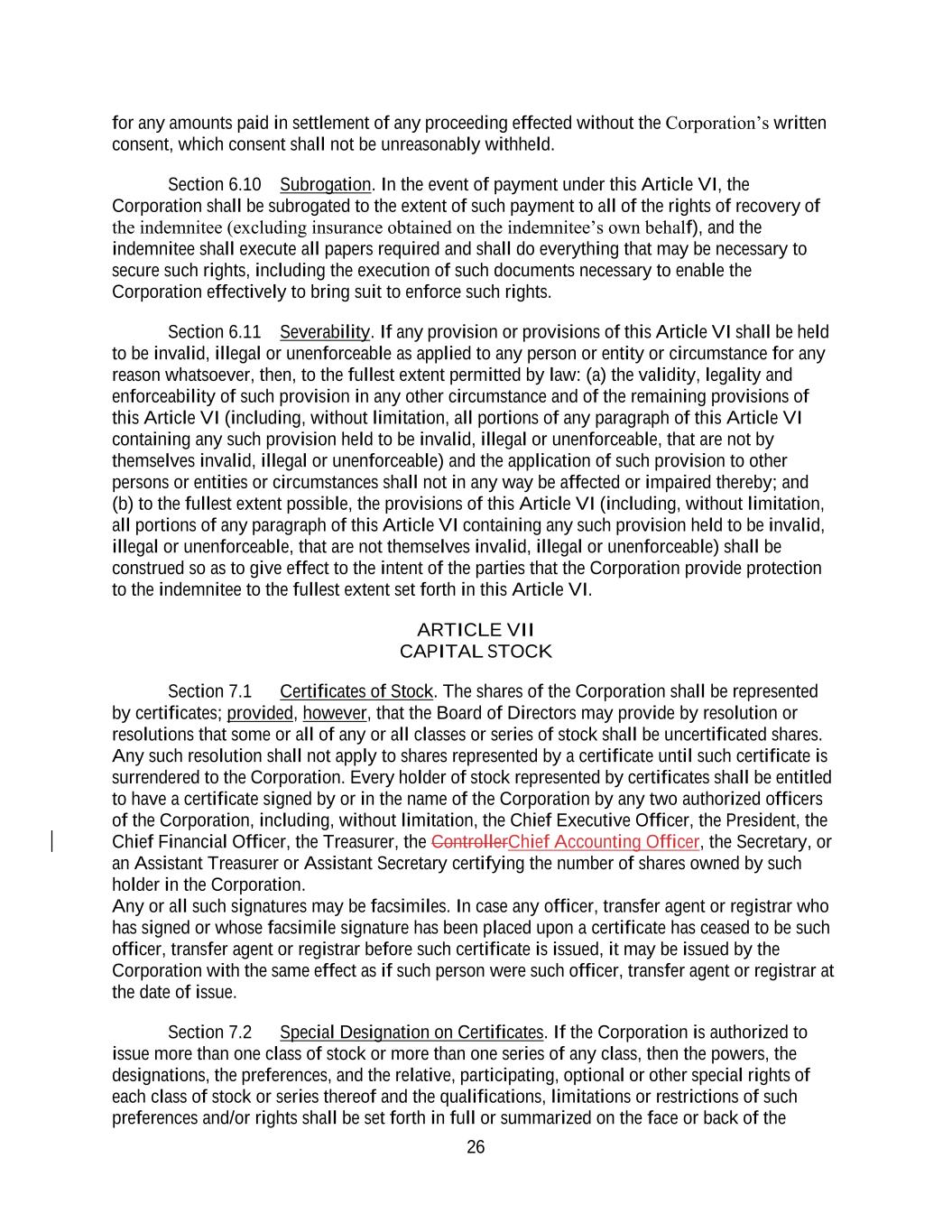
26 for any amounts paid in settlement of any proceeding effected without the Corporation’s written consent, which consent shall not be unreasonably withheld. Section 6.10 Subrogation. In the event of payment under this Article VI, the Corporation shall be subrogated to the extent of such payment to all of the rights of recovery of the indemnitee (excluding insurance obtained on the indemnitee’s own behalf), and the indemnitee shall execute all papers required and shall do everything that may be necessary to secure such rights, including the execution of such documents necessary to enable the Corporation effectively to bring suit to enforce such rights. Section 6.11 Severability. If any provision or provisions of this Article VI shall be held to be invalid, illegal or unenforceable as applied to any person or entity or circumstance for any reason whatsoever, then, to the fullest extent permitted by law: (a) the validity, legality and enforceability of such provision in any other circumstance and of the remaining provisions of this Article VI (including, without limitation, all portions of any paragraph of this Article VI containing any such provision held to be invalid, illegal or unenforceable, that are not by themselves invalid, illegal or unenforceable) and the application of such provision to other persons or entities or circumstances shall not in any way be affected or impaired thereby; and (b) to the fullest extent possible, the provisions of this Article VI (including, without limitation, all portions of any paragraph of this Article VI containing any such provision held to be invalid, illegal or unenforceable, that are not themselves invalid, illegal or unenforceable) shall be construed so as to give effect to the intent of the parties that the Corporation provide protection to the indemnitee to the fullest extent set forth in this Article VI. ARTICLE VII CAPITAL STOCK Section 7.1 Certificates of Stock. The shares of the Corporation shall be represented by certificates; provided, however, that the Board of Directors may provide by resolution or resolutions that some or all of any or all classes or series of stock shall be uncertificated shares. Any such resolution shall not apply to shares represented by a certificate until such certificate is surrendered to the Corporation. Every holder of stock represented by certificates shall be entitled to have a certificate signed by or in the name of the Corporation by any two authorized officers of the Corporation, including, without limitation, the Chief Executive Officer, the President, the Chief Financial Officer, the Treasurer, the ControllerChief Accounting Officer, the Secretary, or an Assistant Treasurer or Assistant Secretary certifying the number of shares owned by such holder in the Corporation. Any or all such signatures may be facsimiles. In case any officer, transfer agent or registrar who has signed or whose facsimile signature has been placed upon a certificate has ceased to be such officer, transfer agent or registrar before such certificate is issued, it may be issued by the Corporation with the same effect as if such person were such officer, transfer agent or registrar at the date of issue. Section 7.2 Special Designation on Certificates. If the Corporation is authorized to issue more than one class of stock or more than one series of any class, then the powers, the designations, the preferences, and the relative, participating, optional or other special rights of each class of stock or series thereof and the qualifications, limitations or restrictions of such preferences and/or rights shall be set forth in full or summarized on the face or back of the
27 certificate that the Corporation shall issue to represent such class or series of stock; provided, however, that, except as otherwise provided in Section 202 of the DGCL, in lieu of the foregoing requirements there may be set forth on the face or back of the certificate that the Corporation shall issue to represent such class or series of stock a statement that the Corporation will furnish without charge to each stockholder who so requests the powers, the designations, the preferences, and the relative, participating, optional or other special rights of each class of stock or series thereof and the qualifications, limitations or restrictions of such preferences and/or rights. Within a reasonable time after the issuance or transfer of uncertificated stock, the registered owner thereof shall be given a notice, in writing or by electronic transmission, containing the information required to be set forth or stated on certificates pursuant to this Section 7.2 or Section 151, 156, 202(a) or 218(a) of the DGCL or with respect to this Section 7.2 and Section 151 of the DGCL a statement that the Corporation will furnish without charge to each stockholder who so requests the powers, the designations, the preferences, and the relative, participating, optional or other special rights of each class of stock or series thereof and the qualifications, limitations or restrictions of such preferences and/or rights. Except as otherwise expressly provided by law, the rights and obligations of the holders of uncertificated stock and the rights and obligations of the holders of certificates representing stock of the same class and series shall be identical. Section 7.3 Transfers of Stock. Transfers of shares of stock of the Corporation shall be made only on the books of the Corporation upon authorization by the registered holder thereof or by such holder’s attorney thereunto authorized by a power of attorney duly executed and filed with the Secretary of the Corporation or a transfer agent for such stock, and if such shares are represented by a certificate, upon surrender of the certificate or certificates for such shares properly endorsed or accompanied by a duly executed stock transfer power and the payment of any taxes thereon; provided, however, that the Corporation shall be entitled to recognize and enforce any lawful restriction on transfer. Section 7.4 Lost Certificates. The Corporation may issue a new share certificate or uncertificated shares in the place of any certificate theretofore issued by it, alleged to have been lost, stolen or destroyed, and the Corporation may require the owner of the lost, stolen or destroyed certificate or the owner’s legal representative to give the Corporation a bond (or other adequate security) sufficient to indemnify it against any claim that may be made against it (including any expense or liability) on account of the alleged loss, theft or destruction of any such certificate or the issuance of such new certificate or uncertificated shares. The Board of Directors may adopt such other provisions and restrictions with reference to lost certificates, not inconsistent with applicable law, as it shall in its discretion deem appropriate. Section 7.5 Registered Stockholders. The Corporation shall be entitled to recognize the exclusive right of a person registered on its books as the owner of shares to receive dividends, and to vote as such owner, and shall not be bound to recognize any equitable or other claim to or interest in such share or shares on the part of any other person, whether or not it shall have express or other notice thereof, except as otherwise required by law.
28 Section 7.6 Record Date for Determining Stockholders. (a) In order that the Corporation may determine the stockholders entitled to notice of any meeting of stockholders or any adjourned meeting, the Board of Directors may fix a record date, which record date shall not precede the date upon which the resolution fixing the record date is adopted by the Board of Directors, and which record date shall, unless otherwise required by law, not be more than 60 nor less than 10 days before the date of such meeting. If the Board of Directors so fixes a date, such date shall also be the record date for determining the stockholders entitled to vote at such meeting unless the Board of Directors determines, at the time it fixes such record date, that a later date on or before the date of the meeting shall be the date for making such determination. If no record date is fixed by the Board of Directors, the record date for determining stockholders entitled to notice of and to vote at a meeting of stockholders shall be at the close of business on the day next preceding the day on which notice is given, or, if notice is waived, at the close of business on the day next preceding the day on which the meeting is held. A determination of stockholders of record entitled to notice of or to vote at a meeting of stockholders shall apply to any adjourned meeting; provided, however, that the Board of Directors may fix a new record date for the determination of stockholders entitled to vote at the adjourned meeting, and in such case shall also fix as the record date for stockholders entitled to notice of such adjourned meeting the same or an earlier date as that fixed for determination of stockholders entitled to vote in accordance herewith at the adjourned meeting. (b) In order that the Corporation may determine the stockholders entitled to receive payment of any dividend or other distribution or allotment of any rights, or entitled to exercise any rights in respect of any change, conversion or exchange of stock or for the purpose of any other lawful action, the Board of Directors may fix a record date, which record date shall not precede the date upon which the resolution fixing the record date is adopted by the Board of Directors, and which record date shall not be more than 60 days prior to such action. If no such record date is fixed, the record date for determining stockholders for any such purpose shall be at the close of business on the day on which the Board of Directors adopts the resolution relating thereto. (c) Unless otherwise restricted by the Certificate of Incorporation (including any Preferred Stock Designation), in order that the Corporation may determine the stockholders entitled to express consent to corporate action without a meeting, the Board of Directors may fix a record date, which record date shall not precede the date upon which the resolution fixing the record date is adopted by the Board of Directors, and which record date shall not be more than 10 days after the date upon which the resolution fixing the record date is adopted by the Board of Directors. If no record date has been fixed by the Board of Directors, the record date for determining stockholders entitled to express consent to corporate action without a meeting, when no prior action of the Board of Directors is required by law, shall be the first date on which a signed consent setting forth the action taken or proposed to be taken was delivered to the Corporation in accordance with Section 2.11. If no record date has been fixed by the Board of Directors, the record date for determining stockholders entitled to express consent to corporate action without a meeting, if prior action by the Board of Directors is required by law, shall be at the close of business on the day on which the Board of Directors adopts the resolution taking such prior action.
29 Section 7.7 Regulations. To the extent permitted by applicable law, the Board of Directors may make such additional rules and regulations as it may deem expedient concerning the issue, transfer and registration of shares of stock of the Corporation. Section 7.8 Waiver of Notice. Whenever notice is required to be given under any provision of the DGCL or the Certificate of Incorporation or these Bylaws, a written waiver, signed by the person entitled to notice, or a waiver by electronic transmission by the person entitled to notice, whether before or after the time stated therein, shall be deemed equivalent to notice. Attendance of a person at a meeting shall constitute a waiver of notice of such meeting, except when the person attends a meeting for the express purpose of objecting at the beginning of the meeting, to the transaction of any business because the meeting is not lawfully called or convened. Neither the business to be transacted at, nor the purpose of, any regular or special meeting of the stockholders, the Board of Directors or a committee of the Board of Directors need be specified in any written waiver of notice or any waiver by electronic transmission unless so required by the Certificate of Incorporation or these Bylaws. ARTICLE VIII GENERAL MATTERS Section 8.1 Fiscal Year. The fiscal year of the Corporation shall begin on the first day of January of each year and end on the last day of December of the same year, or shall extend for such other 12 consecutive months as the Board of Directors may designate. Section 8.2 Corporate Seal. The Board of Directors may provide a suitable seal, containing the name of the Corporation, which seal shall be in the charge of the Secretary of the Corporation. If and when so directed by the Board of Directors or a committee thereof, duplicates of the seal may be kept and used by the Treasurer or by an Assistant Secretary or Assistant Treasurer. Section 8.3 Reliance Upon Books, Reports and Records. Each director and each member of any committee designated by the Board of Directors shall, in the performance of his or her duties, be fully protected in relying in good faith upon the books of account or other records of the Corporation and upon such information, opinions, reports or statements presented to the Corporation by any of its officers or employees, or committees of the Board of Directors so designated, or by any other person as to matters which such director or committee member reasonably believes are within such other person’s professional or expert competence and who has been selected with reasonable care by or on behalf of the Corporation. Section 8.4 Subject to Law and Certificate of Incorporation. All powers, duties and responsibilities provided for in these Bylaws, whether or not explicitly so qualified, are qualified by the Certificate of Incorporation (including any Preferred Stock Designation) and applicable law. Section 8.5 Electronic Signatures, etc. Except as otherwise required by the Certificate of Incorporation (including as otherwise required by any Preferred Stock Designation) or these Bylaws (including, without limitation, as otherwise required by Section 2.14), any document, including, without limitation, any consent, agreement, certificate or instrument, required by the
30 DGCL, the Certificate of Incorporation (including any Preferred Stock Designation) or these Bylaws to be executed by any officer, director, stockholder, employee or agent of the Corporation may be executed using a facsimile or other form of electronic signature to the fullest extent permitted by applicable law. All other contracts, agreements, certificates or instruments to be executed on behalf of the Corporation may be executed using a facsimile or other form of electronic signature to the fullest extent permitted by applicable law. The terms “electronic mail,” “electronic mail address,” “electronic signature” and “electronic transmission” as used herein shall have the meanings ascribed thereto in the DGCL. ARTICLE IX FORUM FOR ADJUDICATION OF DISPUTES Section 9.1 Forum. Unless the Corporation, in writing, selects or consents to the selection of an alternative forum: (a) the sole and exclusive forum for any complaint asserting any internal corporate claims (as defined below), to the fullest extent permitted by law, and subject to applicable jurisdictional requirements, shall be the Court of Chancery of the State of Delaware (or, if the Court of Chancery does not have, or declines to accept, jurisdiction, another state court or a federal court located within the State of Delaware); and (b) the sole and exclusive forum for any complaint asserting a cause of action arising under the Securities Act of 1933, to the fullest extent permitted by law, shall be the federal district courts of the United States of America. For purposes of this Article IX, internal corporate claims means claims, including claims in the right of the Corporation: (a) that are based upon a violation of a duty by a current or former director, officer, employee or stockholder in such capacity, or (b) as to which the DGCL confers jurisdiction upon the Court of Chancery. Any person or entity purchasing or otherwise acquiring or holding any interest in shares of stock of the Corporation shall be deemed to have notice of and consented to the provisions of this Article IX. Section 9.2 Enforceability. If any provision of this Article IX shall be held to be invalid, illegal or unenforceable as applied to any person or entity or circumstance for any reason whatsoever, then, to the fullest extent permitted by law, the validity, legality and enforceability of such provision in any other circumstance and of the remaining provisions of this Article IX (including, without limitation, each portion of any sentence of this Article IX containing any such provision held to be invalid, illegal or unenforceable that is not itself held to be invalid, illegal or unenforceable) and the application of such provision to other persons or entities or circumstances shall not in any way be affected or impaired thereby. ARTICLE X AMENDMENTS Section 10.1 Amendments. In furtherance and not in limitation of the powers conferred by the laws of the State of Delaware, the Board of Directors is expressly authorized to adopt, amend or repeal these Bylaws. Except as otherwise provided in the Certificate of Incorporation (including the terms of any Preferred Stock Designation that provides for a greater or lesser vote) or these Bylaws, and in addition to any other vote required by law, the affirmative vote of at least a majority of the voting power of the stock outstanding and entitled to vote thereon, voting together as a single class, shall be required for the stockholders to adopt, amend or repeal, or adopt any provision inconsistent with, any provision of these Bylaws.

31 The foregoing Amended and Restated Bylaws were adopted by the Board of Directors on November 16, 2025.