Exhibit 99.1
Aeglea BioTherapeutics Reports Fourth Quarter and Full Year 2021 Financial Results and Provides Program Updates
Pegzilarginase BLA preparation on track to enable a second quarter 2022 submission to the FDA
Accelerating Phase 1/2 trial of AGLE-177 for Homocystinuria; clinical data announcement expected in the second half of 2022
$95 million of cash as of December 31, 2021, which is expected to fund operations into the first quarter of 2023
Austin, Texas, March 8, 2022 - Aeglea BioTherapeutics, Inc. (Nasdaq:AGLE), a clinical-stage biotechnology company developing a new generation of human enzyme therapeutics as innovative solutions for rare metabolic diseases, today announced financial results for the fourth quarter and full year 2021, and provided program updates.
“2021 moved us closer to our goal of delivering life-changing medicines to people with rare metabolic diseases with positive topline data from our pivotal Phase 3 trial of pegzilarginase for Arginase 1 Deficiency and the dosing of the first patients in our Phase 1/2 trial of AGLE-177 for Homocystinuria. We enter 2022 well positioned to capitalize on the momentum we’ve built,” said Anthony Quinn, M.B., Ch.B., Ph. D., president and chief executive officer of Aeglea. “We are excited about the opportunities in 2022 for a transformative year. With a strong portfolio of human enzyme therapies for rare metabolic diseases, we are looking forward to advancing all our programs, including sharing clinical data from our AGLE-177 program, progressing AGLE-325 for Cystinuria through IND-enabling studies and working with the FDA throughout the regulatory process for pegzilarginase.”
Program Updates
Pegzilarginase in Arginase 1 Deficiency
|
|
• |
Announced the PEACE Phase 3 clinical trial met its primary endpoint with an 80% plasma arginine reduction, and an accompanying positive trend in a secondary endpoint assessing mobility. Additionally, 90.5% of patients achieved normal plasma arginine levels. Pegzilarginase was well-tolerated, and no patients discontinued the trial due to adverse events. |
|
|
• |
Highlighted 104-week data from the GMFM-E and 6-Minute Walk Test assessments from the Phase 1/2 open-label extension, which underscores the sustained, long-term impact of pegzilarginase treatment on mobility. |
|
|
• |
Plan to present additional data from PEACE Phase 3 clinical trial at the Society for Inherited Metabolic Disorders (SIMD) Annual Meeting in April 2022. |
|
|
• |
Hosted a Key Opinion Leader and Patient Caregiver event to provide insights and perspectives on treating and living with Arginase 1 Deficiency. |
|
|
• |
Met with U.S. Food and Drug Administration (FDA) in late February to discuss data from the pegzilarginase program and the path towards Biologic License Application (BLA) submission. |
|
|
• |
BLA preparation on track to enable a second quarter 2022 submission. |
AGLE-177 in Homocystinuria
|
|
• |
Completed dosing in the 0.15 mg/kg intravenous cohort in the Phase 1/2 clinical trial. AGLE-177 was well tolerated with no safety concerns and data from this first cohort showed reductions in total homocysteine in all patients. |
|
|
• |
The encouraging results from the first cohort allowed the Company to advance directly to the 0.45 mg/kg subcutaneous dose, accelerating the generation of dose response data. This second cohort is currently being dosed. |
|
|
• |
Filed an Investigational New Drug (IND) application with the FDA. Acceptance of the IND would allow the Company to open clinical trial sites in the U.S. for the Phase 1/2 clinical trial and a potential pivotal Phase 3 trial. |
|
|
• |
Expect to announce Phase 1/2 clinical data in the second half of 2022. |
AGLE-325 in Cystinuria
|
|
• |
Shared preclinical data from optimized clinical candidate, which the Company believes will support an attractive clinical dosing schedule. |
|
|
• |
Plan to move through IND-enabling studies in 2022. |
Upcoming Events
|
|
• |
American College of Medical Genetics and Genomics Annual Clinical Genetics Meeting, March 22-26 |
|
|
• |
American Academy of Neurology Annual Conference, April 2-7 |
|
|
• |
Society for Inherited Metabolic Disorders 43rd Annual Meeting, April 10-13 |
|
|
• |
Needham Virtual Healthcare Conference, April 11-14 |
Fourth Quarter and Full Year 2021 Financial Results
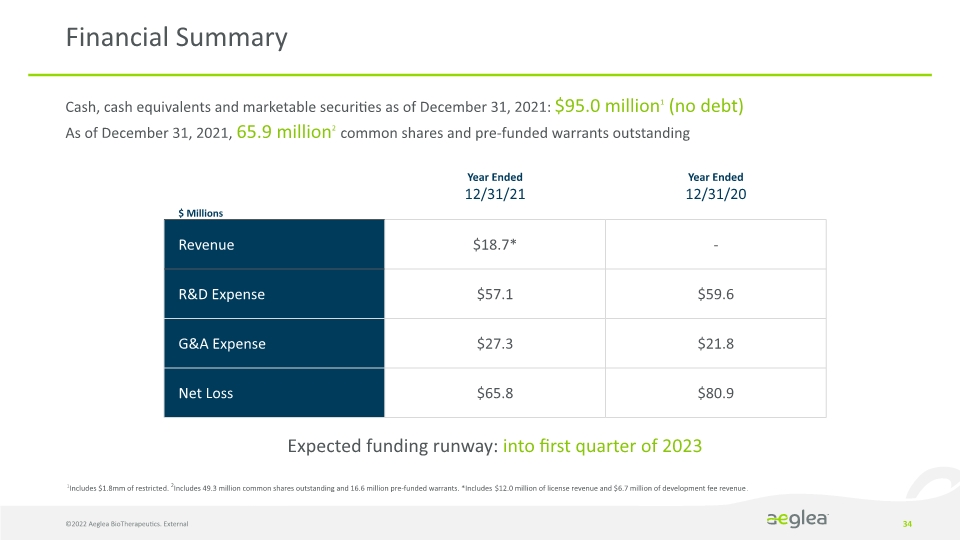
As of December 31, 2021, Aeglea had available cash, cash equivalents, marketable securities and restricted cash of $95.0 million. The Company expects its cash, cash equivalents and investments will enable it to fund its operating expenses and capital expenditure requirements into the first quarter of 2023.
Aeglea recognized development fee revenues of $3.6 million in the fourth quarter of 2021, as a result of its license and supply agreement with Immedica for the commercial rights to pegzilarginase in certain territories outside the United States (License and Supply Agreement). The revenues recorded in the fourth quarter of 2021 are related to the delivery of clinical trial and regulatory services. Aeglea recognized no revenue for the fourth quarter of 2020.
Aeglea recognized license and development fee revenues of $18.7 million in the year ended December 31, 2021, as a result of its License and Supply Agreement. The revenues recorded in the year ended December 31, 2021 are related to the transfer of the license and delivery of clinical trial and regulatory services. Aeglea recognized no revenue for the year ended December 31, 2020.
Research and development expenses totaled $16.8 million for the fourth quarter of 2021 and $15.8 million for the fourth quarter of 2020. The increase was primarily associated with a ramp-up in BLA development activities and increased enrollment in our PEACE Phase 3 trial of pegzilarginase for the treatment of patients with Arginase 1 Deficiency.
Research and development expenses totaled $57.1 million for the year ended December 31, 2021 and $59.6 million for the year ended December 31, 2020. The decrease was primarily associated with completing certain pre-commercial manufacturing activities for pegzilarginase and completing formulation, characterization, and stability studies for AGLE-177.
General and administrative expenses totaled $7.3 million for the fourth quarter of 2021 and $7.0 million for the fourth quarter of 2020. This increase was primarily due to changes in employee headcount and additional compensation to support the development of the Company’s commercial capabilities and infrastructure.
General and administrative expenses totaled $27.3 million for the year ended December 31, 2021 and $21.8 million for the year ended December 31, 2020. This increase was primarily due to changes in employee headcount and additional compensation and an increase in operational expenses to build the Company’s commercial capabilities and infrastructure.
Net loss totaled $20.4 million and $22.7 million for the fourth quarter of 2021 and 2020, respectively, with non-cash stock compensation expense of $2.1 million and $1.6 million for the fourth quarter of 2021 and 2020, respectively. Net loss totaled $65.8 million and $80.9 million for the years ended December 31, 2021 and 2020, respectively, with non-cash stock compensation expense of $8.0 million and $6.3 million for the years ended December 31, 2021 and 2020, respectively.
About Pegzilarginase in Arginase 1 Deficiency
Pegzilarginase is a novel recombinant human enzyme engineered to degrade the amino acid arginine and has been shown to rapidly and sustainably lower levels of the amino acid arginine in plasma. Aeglea is developing pegzilarginase for the treatment of people with Arginase 1 Deficiency (ARG1-D), a rare debilitating and progressive disease characterized by the accumulation of arginine. ARG1-D presents in early childhood and patients experience spasticity, seizures, developmental delay, intellectual disability and early mortality.
In December 2021, Aeglea announced the PEACE Phase 3 clinical trial met its primary endpoint with an 80% plasma arginine reduction. Additionally, 90.5% of pegzilarginase treated patients achieved normal plasma arginine levels. The arginine lowering was accompanied by a positive trend in a secondary endpoint, GMFM-E, which is a key clinical assessment of mobility. Aeglea’s Phase 1/2 and Phase 2 Open-Label Extension (OLE) data for pegzilarginase in patients with ARG1-D demonstrated clinical improvements and sustained lowering of plasma arginine. Pegzilarginase has received multiple regulatory designations, including Rare Pediatric
Disease, Breakthrough Therapy, Fast Track and Orphan Drug Designations from the U.S. Food and Drug Administration as well as Orphan Drug Designation from the European Medicines Agency.
About AGLE-177 in Homocystinuria
AGLE-177 is a novel recombinant human enzyme, which is engineered to degrade the amino acid homocysteine and its dimer, homocystine. AGLE-177 is currently being studied in a Phase 1/2 clinical trial for the treatment of patients with Classical Homocystinuria, a rare inherited disorder of methionine metabolism that results in elevated levels of total homocysteine. Homocysteine accumulation plays a key role in multiple progressive and serious disease-related complications, including thromboembolic vascular events, skeletal abnormalities (including severe osteoporosis), developmental delay, intellectual disability, lens dislocation and severe near sightedness. Preclinical data demonstrated that AGLE-177 improved important disease-related abnormalities and survival in a mouse model of Homocystinuria. AGLE-177 has received both U.S. and EU Orphan Drug Designation as well as U.S. Rare Pediatric Disease Designation.
About Aeglea BioTherapeutics
Aeglea BioTherapeutics is a clinical-stage biotechnology company redefining the potential of human enzyme therapeutics to benefit people with rare metabolic diseases with limited treatment options. In December 2021, Aeglea announced positive topline data from its PEACE Phase 3 clinical trial for its lead product candidate, pegzilarginase, in patients with Arginase 1 Deficiency. Pegzilarginase has received both Rare Pediatric Disease and Breakthrough Therapy Designations. Aeglea also has an ongoing Phase 1/2 clinical trial of AGLE-177 for the treatment of Homocystinuria. AGLE-177 has been granted Rare Pediatric Disease Designation. Aeglea has an active discovery platform focused on engineering small changes in human enzymes to have a big impact on the lives of patients and their families. For more information, please visit http://aeglea.com.
Safe Harbor / Forward Looking Statements
This press release contains "forward-looking" statements within the meaning of the safe harbor provisions of the U.S. Private Securities Litigation Reform Act of 1995. Forward-looking statements can be identified by words such as: "anticipate," "intend," "plan," "goal," "seek," "believe," "project," "estimate," "expect," "strategy," "future," "likely," "may," "should," "will" and similar references to future periods. These statements are subject to numerous risks and uncertainties that could cause actual results to differ materially from what we expect. Examples of forward-looking statements include, among others, statements we make regarding our ability to obtain regulatory approval for, and commercialize, pegzilarginase, recognize milestone and royalty payments from our agreement with Immedica, the timing and success of our clinical trials and related data, the timing and expectations for regulatory submissions and approvals, including the submission of a BLA for pegzilarginase, timing and results of meetings with regulators, the timing of announcements and updates relating to our clinical trials and related data, our ability to enroll patients into our clinical trials, the expected impact of the COVID-19 pandemic on our operations and clinical trials, success in our collaborations, our cash forecasts, the potential addressable markets of our product candidates and the potential therapeutic benefits and economic value of our lead product candidate or other product candidates. Further information on potential risk factors that could affect our business and its financial results are detailed in our most recent Annual Report on Form 10-K for the year ended December 31, 2021 filed with the Securities and Exchange Commission (SEC), and other reports as filed with the SEC. We undertake no obligation to publicly update any forward-looking statement, whether written or oral, that may be made from time to time, whether as a result of new information, future developments or otherwise.
Contact Information:
Investors & Media
Kelly Boothe, Ph.D.
Senior Director, Corporate Communications & Investor Relations
512.399.5458
[email protected]
[email protected]
Financials
Aeglea BioTherapeutics, Inc.
Consolidated Balance Sheets
(In thousands, except share and per share amounts)
|
|
|
December 31, |
|
|
December 31, |
|
|
|
|
2021 |
|
|
2020 |
|
|
ASSETS |
|
|
|
|
|
|
|
|
|
CURRENT ASSETS |
|
|
|
|
|
|
|
|
|
Cash and cash equivalents |
|
$ |
15,142 |
|
|
$ |
90,095 |
|
|
Marketable securities |
|
|
77,986 |
|
|
|
56,178 |
|
|
License and development receivable |
|
|
815 |
|
|
|
— |
|
|
Prepaid expenses and other current assets |
|
|
4,948 |
|
|
|
3,516 |
|
|
Total current assets |
|
|
98,891 |
|
|
|
149,789 |
|
|
Restricted cash |
|
|
1,838 |
|
|
|
1,842 |
|
|
Property and equipment, net |
|
|
4,549 |
|
|
|
5,642 |
|
|
Operating lease right-of-use assets |
|
|
3,806 |
|
|
|
4,230 |
|
|
Other non-current assets |
|
|
842 |
|
|
|
115 |
|
|
TOTAL ASSETS |
|
$ |
109,926 |
|
|
$ |
161,618 |
|
|
|
|
|
|
|
|
|
|
|
|
LIABILITIES AND STOCKHOLDERS’ EQUITY |
|
|
|
|
|
|
|
|
|
CURRENT LIABILITIES |
|
|
|
|
|
|
|
|
|
Accounts payable |
|
$ |
3,319 |
|
|
$ |
2,254 |
|
|
Operating lease liabilities |
|
|
436 |
|
|
|
319 |
|
|
Deferred revenue |
|
|
2,359 |
|
|
|
— |
|
|
Accrued and other current liabilities |
|
|
14,030 |
|
|
|
13,870 |
|
|
Total current liabilities |
|
|
20,144 |
|
|
|
16,443 |
|
|
Non-current operating lease liabilities |
|
|
4,608 |
|
|
|
5,129 |
|
|
Deferred revenue, net of current portion |
|
|
1,217 |
|
|
|
— |
|
|
Other non-current liabilities |
|
|
16 |
|
|
|
214 |
|
|
TOTAL LIABILITIES |
|
|
25,985 |
|
|
|
21,786 |
|
|
|
|
|
|
|
|
|
|
|
|
STOCKHOLDERS’ EQUITY |
|
|
|
|
|
|
|
|
|
Preferred stock, $0.0001 par value; 10,000,000 shares authorized
as of December 31, 2021 and 2020; no shares issued and
outstanding as of December 31, 2021 and 2020 |
|
|
— |
|
|
|
— |
|
|
Common stock, $0.0001 par value; 500,000,000 shares authorized
as of December 31, 2021 and 2020; 49,355,130 shares and
47,959,086 shares issued and outstanding as of December 31, 2021
and 2020, respectively |
|
|
5 |
|
|
|
5 |
|
|
Additional paid-in capital |
|
|
425,765 |
|
|
|
415,824 |
|
|
Accumulated other comprehensive (loss) income |
|
|
(20 |
) |
|
|
11 |
|
|
Accumulated deficit |
|
|
(341,809 |
) |
|
|
(276,008 |
) |
|
TOTAL STOCKHOLDERS’ EQUITY |
|
|
83,941 |
|
|
|
139,832 |
|
|
TOTAL LIABILITIES AND STOCKHOLDERS’ EQUITY |
|
$ |
109,926 |
|
|
$ |
161,618 |
|
Aeglea BioTherapeutics, Inc.
Consolidated Statements of Operations
(In thousands, except share and per share amounts)
|
|
|
Year Ended December 31, |
|
|
|
|
|
|
2021 |
|
|
2020 |
|
|
2019 |
|
|
|
Revenue: |
|
|
|
|
|
|
|
|
|
|
|
|
|
|
|
License |
|
|
$ |
12,000 |
|
|
$ |
— |
|
|
$ |
— |
|
|
|
Development fee |
|
|
|
6,739 |
|
|
|
— |
|
|
|
— |
|
|
|
Total revenue |
|
|
|
18,739 |
|
|
|
— |
|
|
|
— |
|
|
|
|
|
|
|
|
|
|
|
|
|
|
|
|
|
|
|
Operating expenses: |
|
|
|
|
|
|
|
|
|
|
|
|
|
|
|
Research and development |
|
|
|
57,069 |
|
|
|
59,638 |
|
|
|
64,600 |
|
|
|
General and administrative |
|
|
|
27,319 |
|
|
|
21,843 |
|
|
|
15,734 |
|
|
|
Total operating expenses |
|
|
|
84,388 |
|
|
|
81,481 |
|
|
|
80,334 |
|
|
|
Loss from operations |
|
|
|
(65,649 |
) |
|
|
(81,481 |
) |
|
|
(80,334 |
) |
|
|
|
|
|
|
|
|
|
|
|
|
|
|
|
|
|
|
Other income (expense): |
|
|
|
|
|
|
|
|
|
|
|
|
|
|
|
Interest income |
|
|
|
111 |
|
|
|
593 |
|
|
|
2,143 |
|
|
|
Other expense, net |
|
|
|
(122 |
) |
|
|
(5 |
) |
|
|
(63 |
) |
|
|
Total other income (expense) |
|
|
|
(11 |
) |
|
|
588 |
|
|
|
2,080 |
|
|
|
Loss before income tax expense |
|
|
|
(65,660 |
) |
|
|
(80,893 |
) |
|
|
(78,254 |
) |
|
|
Income tax expense |
|
|
|
(141 |
) |
|
|
— |
|
|
|
— |
|
|
|
Net loss |
|
|
$ |
(65,801 |
) |
|
$ |
(80,893 |
) |
|
$ |
(78,254 |
) |
|
|
|
|
|
|
|
|
|
|
|
|
|
|
|
|
|
|
Net loss per share, basic and diluted |
|
|
$ |
(1.00 |
) |
|
$ |
(1.52 |
) |
|
$ |
(2.45 |
) |
|
|
Weighted-average common shares outstanding, basic and
diluted |
|
|
|
65,744,611 |
|
|
|
53,371,730 |
|
|
|
31,949,633 |
|
|
Reimagining The Potential Of Human Enzyme Therapeutics Corporate Overview – March 2022 Nasdaq: AGLE Exhibit 99.2
Forward Looking Statements ©2022 Aeglea BioTherapeutics. External 2 This presentation and the accompanying oral presentation contain “forward-looking” statements that are based on our management’s beliefs and assumptions and on information currently available to management. Forward-looking statements include all statements other than statements of historical fact contained in this presentation, including information concerning our current and future financial performance, business plans and objectives, current and future clinical and preclinical development activities, timing and success of our ongoing and planned clinical trials and related data, the timing of announcements, updates, results of our clinical trials and related data and our planned BLA submission for our lead product candidate pegzilarginase, our ability to obtain and maintain regulatory approval, the potential therapeutic benefits, safety profile and economic value of pegzilarginase and our other product candidates, potential growth opportunities, financing plans, use and adequacy of financing plans, competitive position, industry environment and potential market opportunities.
Forward-looking statements are subject to known and unknown risks, uncertainties, assumptions and other factors including, but not limited to, those related to the success, cost and timing of our product candidate development activities and ongoing and planned clinical trials; our plans to develop and commercialize targeted therapeutics, including our lead product candidate pegzilarginase and our product candidates for the treatment of homocystinuria and cystinuria; the design, progress of patient enrollment and dosing in our clinical trials; the ability of our product candidates to achieve applicable endpoints in clinical trials; the safety profile of our product candidates in clinical trials; the potential for data from our current and future clinical trials to support a marketing application, as well as the timing of these events; the potential for preclinical studies to be predictive of current or future clinical trials; our ability to obtain funding for our operations, development and commercialization of our product candidates; the impact of the COVID-19 pandemic on our operations and clinical development activities, including on the timing of enrollment of our clinical trials; the timing of and our ability to obtain and maintain regulatory approvals; our ability to obtain regulatory approval for, and commercialize, pegzilarginase, and recognize milestone and royalty payments from our licensing and supply agreement with Immedica; the potential for expedited development and review of pegzilarginase as a result of its Breakthrough Therapy designation; the potential addressable markets of our product candidates; the rate and degree of market acceptance and clinical utility of our product candidates; the size and growth potential of the markets for our product candidates, and our ability to serve those markets; our commercialization, marketing and manufacturing capabilities and strategy; future agreements with third parties in connection with the potential commercialization of our product candidates; our expectations regarding our ability to obtain and maintain intellectual property protection; our dependence on third party manufacturers; our ability to develop our own commercial manufacturing facility; the success of competing therapies that are or may become available; our ability to attract and retain key scientific or management personnel; our ability to identify additional product candidates with significant commercial potential consistent with our commercial objectives; and our estimates regarding expenses, future revenue, capital requirements and needs for additional financing.
Moreover, we operate in a very competitive and rapidly changing environment, and new risks may emerge from time to time. It is not possible for our management to predict all risks, nor can we assess the impact of all factors on our business or the extent to which any factor, or combination of factors, may cause actual results to differ materially from those contained in any forward-looking statements we may make. In light of these risks, uncertainties and assumptions, the forward-looking events and circumstances discussed herein may not occur and actual results could differ materially and adversely from those anticipated or implied in the forward-looking statements. Further information on these and other factors that could affect these forward-looking statements is contained in our most recent Annual Report on Form 10-K filed with the U.S. Securities and Exchange Commission (SEC) and other reports filed by the SEC. You should not rely upon forward-looking statements as predictions of future events. Although our management believes that the expectations reflected in our forward-looking statements are reasonable, we cannot guarantee that the future results, levels of activity, performance or events and circumstances described in the forward-looking statements will be achieved or occur. We undertake no obligation to publicly update any forward-looking statements, whether written or oral, that may be made from time to time, whether as a result of new information, future developments or otherwise.
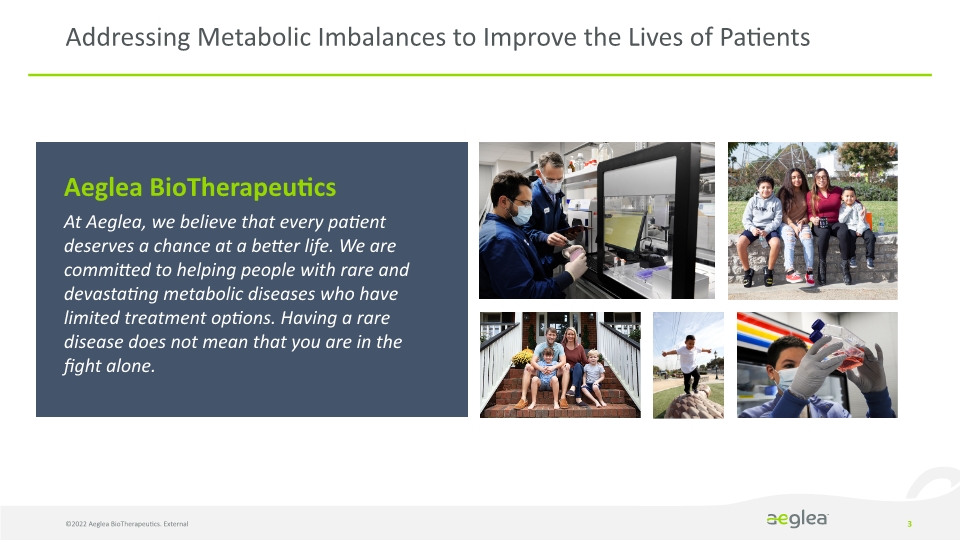
Addressing Metabolic Imbalances to Improve the Lives of Patients ©2022 Aeglea BioTherapeutics. External 3 Aeglea BioTherapeutics
At Aeglea, we believe that every patient deserves a chance at a better life. We are committed to helping people with rare and devastating metabolic diseases who have limited treatment options. Having a rare disease does not mean that you are in the fight alone.
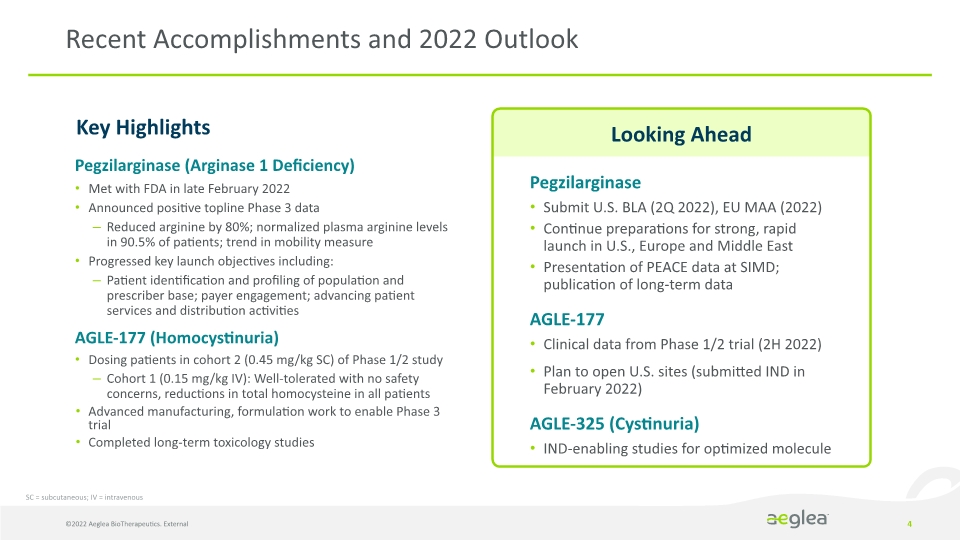
Looking Ahead Key Highlights 4 Pegzilarginase
Submit U.S. BLA (2Q 2022), EU MAA (2022)
Continue preparations for strong, rapid launch in U.S., Europe and Middle East
Presentation of PEACE data at SIMD; publication of long-term data
AGLE-177
Clinical data from Phase 1/2 trial (2H 2022)
Plan to open U.S. sites (submitted IND in February 2022)
AGLE-325 (Cystinuria)
IND-enabling studies for optimized molecule Recent Accomplishments and 2022 Outlook Pegzilarginase (Arginase 1 Deficiency)
Met with FDA in late February 2022
Announced positive topline Phase 3 data
Reduced arginine by 80%; normalized plasma arginine levels in 90.5% of patients; trend in mobility measure
Progressed key launch objectives including:
Patient identification and profiling of population and prescriber base; payer engagement; advancing patient services and distribution activities
AGLE-177 (Homocystinuria)
Dosing patients in cohort 2 (0.45 mg/kg SC) of Phase 1/2 study
Cohort 1 (0.15 mg/kg IV): Well-tolerated with no safety concerns, reductions in total homocysteine in all patients
Advanced manufacturing, formulation work to enable Phase 3 trial
Completed long-term toxicology studies ©2022 Aeglea BioTherapeutics. External SC = subcutaneous; IV = intravenous
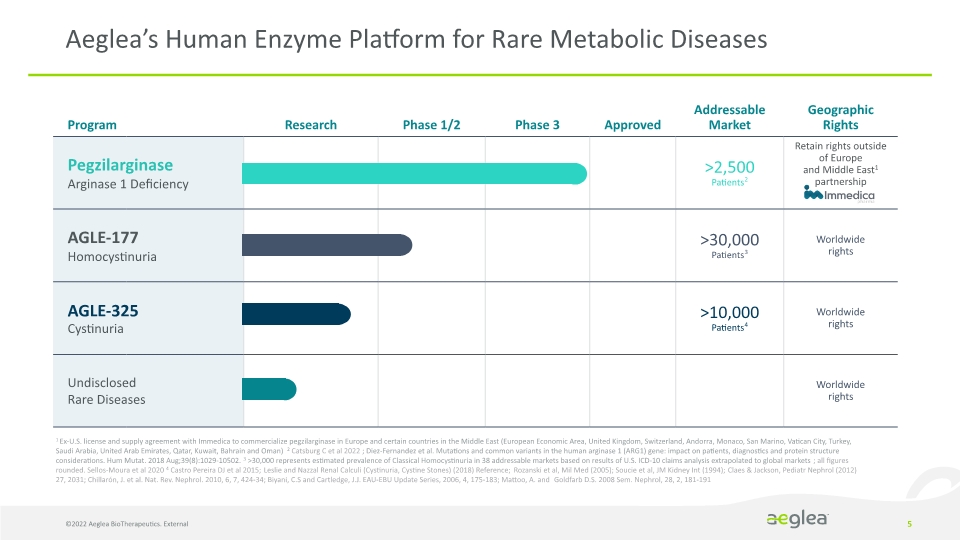
5 Aeglea’s Human Enzyme Platform for Rare Metabolic Diseases 1 Ex-U.S. license and supply agreement with Immedica to commercialize pegzilarginase in Europe and certain countries in the Middle East (European Economic Area, United Kingdom, Switzerland, Andorra, Monaco, San Marino, Vatican City, Turkey, Saudi Arabia, United Arab Emirates, Qatar, Kuwait, Bahrain and Oman) 2 Catsburg C et al 2022 ; Diez-Fernandez et al. Mutations and common variants in the human arginase 1 (ARG1) gene: impact on patients, diagnostics and protein structure considerations. Hum Mutat. 2018 Aug;39(8):1029-10502. 3 >30,000 represents estimated prevalence of Classical Homocystinuria in 38 addressable markets based on results of U.S. ICD-10 claims analysis extrapolated to global markets; all figures rounded. Sellos-Moura et al 2020 4 Castro Pereira DJ et al 2015; Leslie and Nazzal Renal Calculi (Cystinuria, Cystine Stones) (2018) Reference; Rozanski et al, Mil Med (2005); Soucie et al, JM Kidney Int (1994); Claes & Jackson, Pediatr Nephrol (2012) 27, 2031; Chillarón, J. et al. Nat. Rev. Nephrol. 2010, 6, 7, 424-34; Biyani, C.S and Cartledge, J.J. EAU-EBU Update Series, 2006, 4, 175-183; Mattoo, A. and Goldfarb D.S. 2008 Sem. Nephrol, 28, 2, 181-191 ©2022 Aeglea BioTherapeutics. External
Pegzilarginase for Arginase 1 Deficiency
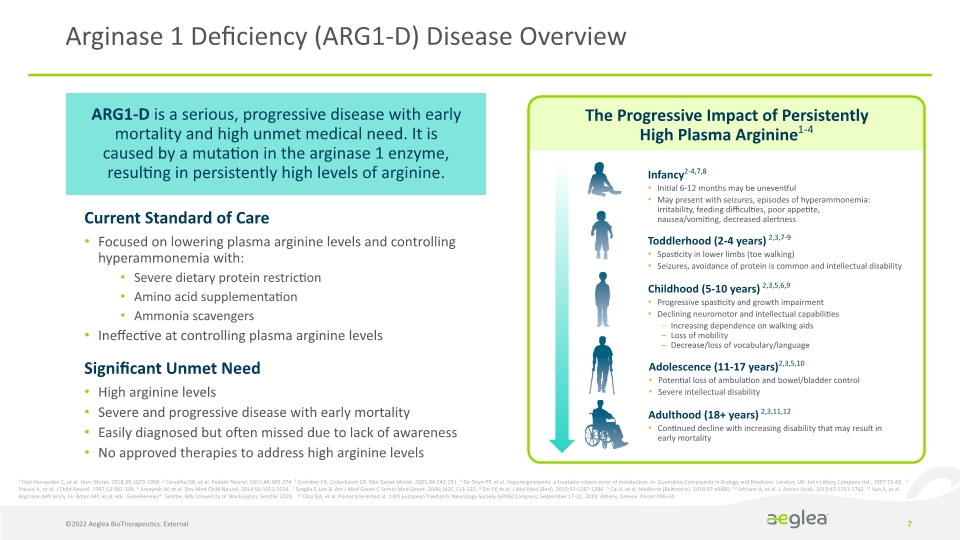
The Progressive Impact of Persistently High Plasma Arginine1-4 Arginase 1 Deficiency (ARG1-D) Disease Overview 7 Infancy2-4,7,8
Initial 6-12 months may be uneventful
May present with seizures, episodes of hyperammonemia: irritability, feeding difficulties, poor appetite, nausea/vomiting, decreased alertness
Toddlerhood (2-4 years) 2,3,7-9
Spasticity in lower limbs (toe walking)
Seizures, avoidance of protein is common and intellectual disability Childhood (5-10 years) 2,3,5,6,9
Progressive spasticity and growth impairment
Declining neuromotor and intellectual capabilities
Increasing dependence on walking aids
Loss of mobility
Decrease/loss of vocabulary/language
Adolescence (11-17 years)2,3,5,10
Potential loss of ambulation and bowel/bladder control
Severe intellectual disability Adulthood (18+ years) 2,3,11,12
Continued decline with increasing disability that may result in early mortality 1 Diez-Fernandez C, et al. Hum Mutat. 2018;39:1029-1050. 2 Carvalho DR, et al. Pediatr Neurol. 2012;46:369-374. 3 Crombez EA, Cederbaum SD. Mol Genet Metab. 2005;84:243-251. 4 De Deyn PP, et al. Hyperargininemia: a treatable inborn error of metabolism. In: Guanidino Compounds in Biology and Medicine. London, UK: John Libbey Company Ltd.; 1997:53-69. 5 Prasad A, et al. J Child Neurol. 1997;12:301-309. 6 Amayreh W, et al. Dev Med Child Neurol. 2014;56:1021-1024. 7 Scaglia F, Lee B. Am J Med Genet C Semin Med Genet. 2006;142C:113-120. 8 Sin YY, et al. J Mol Med (Berl). 2015;93:1287-1296. 9 Cai X, et al. Medicine (Baltimore). 2018;97:e9880. 10 Schlune A, et al. J. Amino Acids. 2015;47:1751-1762. 11 Sun A, et al. Arginase deficiency. In: Adam MP, et al, eds. GeneReviews®. Seattle, WA: University of Washington, Seattle; 2020. 12 Diaz GA, et al. Poster presented at: 13th European Paediatric Neurology Society (EPNS) Congress; September 17-21, 2019; Athens, Greece. Poster P06-34. Current Standard of Care
Focused on lowering plasma arginine levels and controlling hyperammonemia with:
Severe dietary protein restriction
Amino acid supplementation
Ammonia scavengers
Ineffective at controlling plasma arginine levels
Significant Unmet Need
High arginine levels
Severe and progressive disease with early mortality
Easily diagnosed but often missed due to lack of awareness
No approved therapies to address high arginine levels
ARG1-D is a serious, progressive disease with early mortality and high unmet medical need. It is caused by a mutation in the arginase 1 enzyme, resulting in persistently high levels of arginine. ©2022 Aeglea BioTherapeutics. External
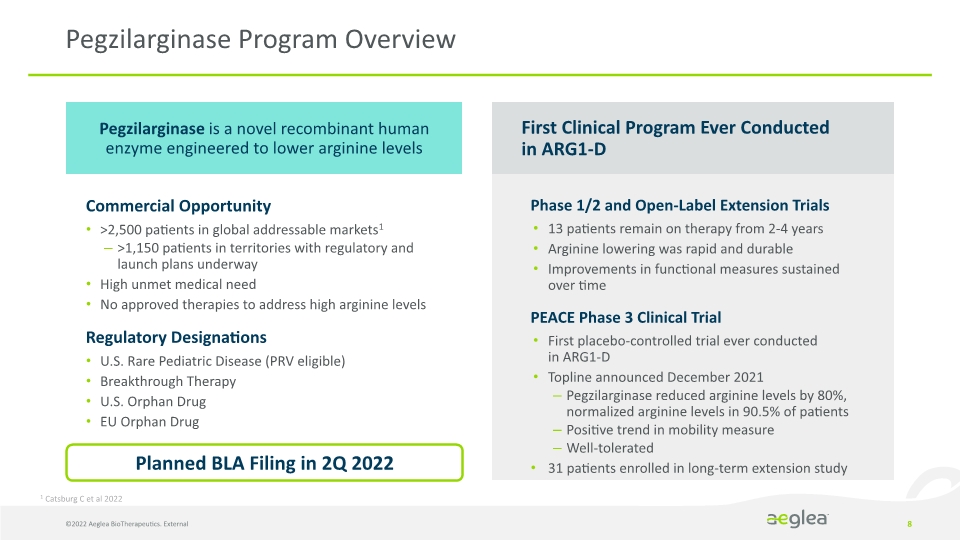
8 Pegzilarginase Program Overview Commercial Opportunity
>2,500 patients in global addressable markets1
>1,150 patients in territories with regulatory and launch plans underway
High unmet medical need
No approved therapies to address high arginine levels
Regulatory Designations
U.S. Rare Pediatric Disease (PRV eligible)
Breakthrough Therapy
U.S. Orphan Drug
EU Orphan Drug
Pegzilarginase is a novel recombinant human enzyme engineered to lower arginine levels Planned BLA Filing in 2Q 2022 Phase 1/2 and Open-Label Extension Trials
13 patients remain on therapy from 2-4 years
Arginine lowering was rapid and durable
Improvements in functional measures sustained over time
PEACE Phase 3 Clinical Trial
First placebo-controlled trial ever conducted in ARG1-D
Topline announced December 2021
Pegzilarginase reduced arginine levels by 80%, normalized arginine levels in 90.5% of patients
Positive trend in mobility measure
Well-tolerated
31 patients enrolled in long-term extension study First Clinical Program Ever Conducted in ARG1-D ©2022 Aeglea BioTherapeutics. External 1 Catsburg C et al 2022
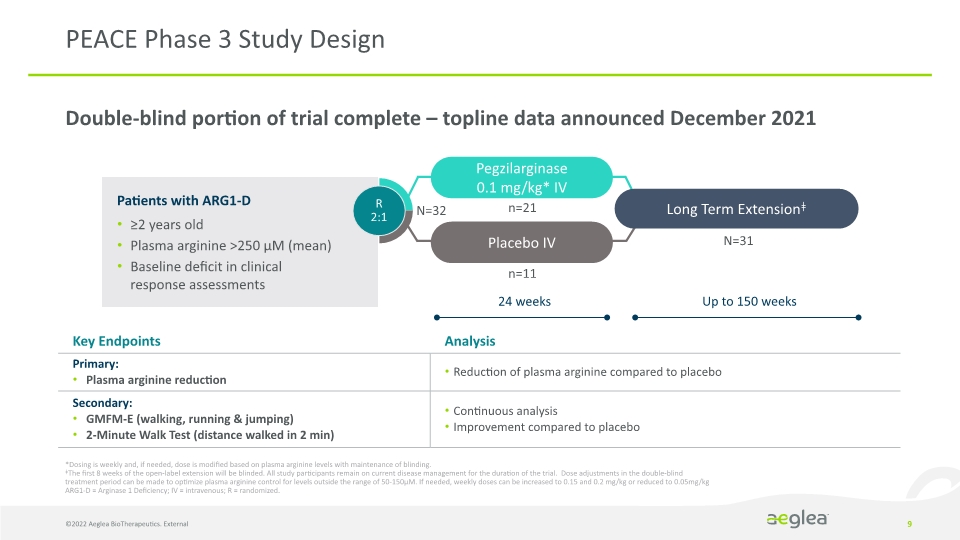
Double-blind portion of trial complete – topline data announced December 2021 9 PEACE Phase 3 Study Design *Dosing is weekly and, if needed, dose is modified based on plasma arginine levels with maintenance of blinding.
ǂThe first 8 weeks of the open-label extension will be blinded. All study participants remain on current disease management for the duration of the trial. Dose adjustments in the double-blind treatment period can be made to optimize plasma arginine control for levels outside the range of 50-150µM. If needed, weekly doses can be increased to 0.15 and 0.2 mg/kg or reduced to 0.05mg/kg
ARG1-D = Arginase 1 Deficiency; IV = intravenous; R = randomized. Patients with ARG1-D
≥2 years old
Plasma arginine >250 µM (mean)
Baseline deficit in clinical response assessments Placebo IV R 2:1 Long Term Extensionǂ Pegzilarginase
0.1 mg/kg* IV 24 weeks Up to 150 weeks n=11 N=32 n=21 N=31 ©2022 Aeglea BioTherapeutics. External
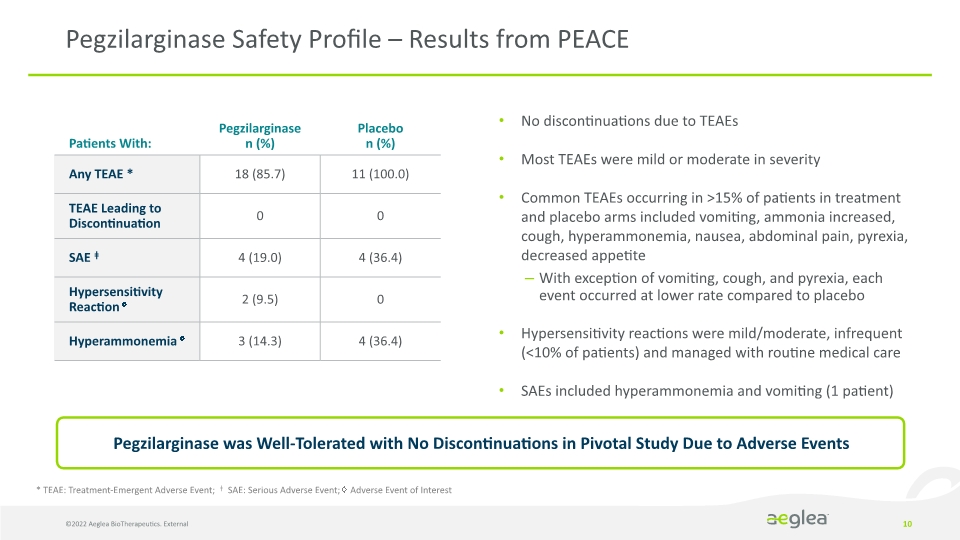
10 Pegzilarginase Safety Profile – Results from PEACE * TEAE: Treatment-Emergent Adverse Event; ǂ SAE: Serious Adverse Event; ♢ Adverse Event of Interest
Pegzilarginase was Well-Tolerated with No Discontinuations in Pivotal Study Due to Adverse Events No discontinuations due to TEAEs
Most TEAEs were mild or moderate in severity
Common TEAEs occurring in >15% of patients in treatment and placebo arms included vomiting, ammonia increased, cough, hyperammonemia, nausea, abdominal pain, pyrexia, decreased appetite
With exception of vomiting, cough, and pyrexia, each event occurred at lower rate compared to placebo
Hypersensitivity reactions were mild/moderate, infrequent (<10% of patients) and managed with routine medical care
SAEs included hyperammonemia and vomiting (1 patient) ©2022 Aeglea BioTherapeutics. External Any TEAE *TEAE Leading to DiscontinuationSAE ǂ
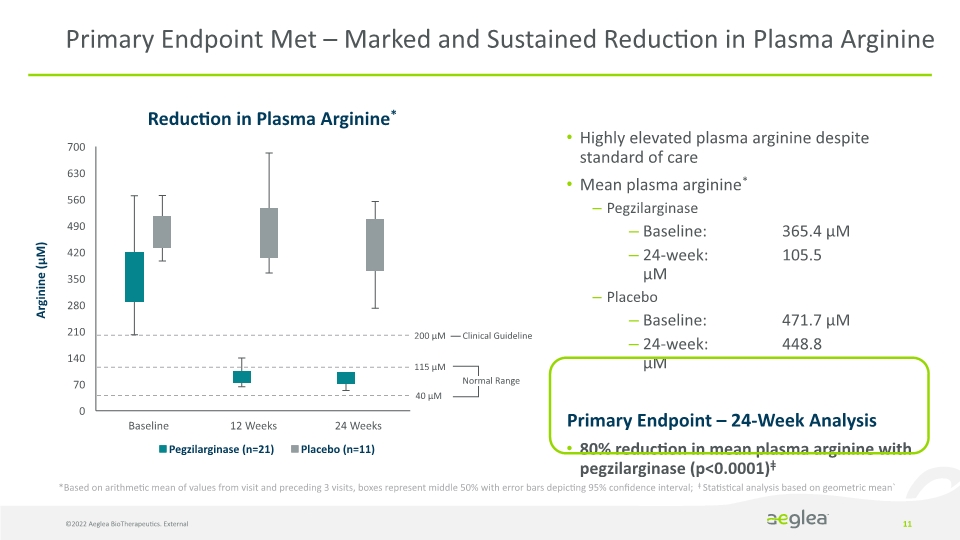
11
Highly elevated plasma arginine despite standard of care
Mean plasma arginine*
Pegzilarginase
Baseline: 365.4 µM
24-week: 105.5 µM
Placebo
Baseline: 471.7 µM
24-week: 448.8 µM
Primary Endpoint – 24-Week Analysis
80% reduction in mean plasma arginine with pegzilarginase (p<0.0001)ǂ Primary Endpoint Met – Marked and Sustained Reduction in Plasma Arginine Reduction in Plasma Arginine* *Based on arithmetic mean of values from visit and preceding 3 visits, boxes represent middle 50% with error bars depicting 95% confidence interval; ǂ Statistical analysis based on geometric mean` Clinical Guideline ©2022 Aeglea BioTherapeutics. External Bar graph
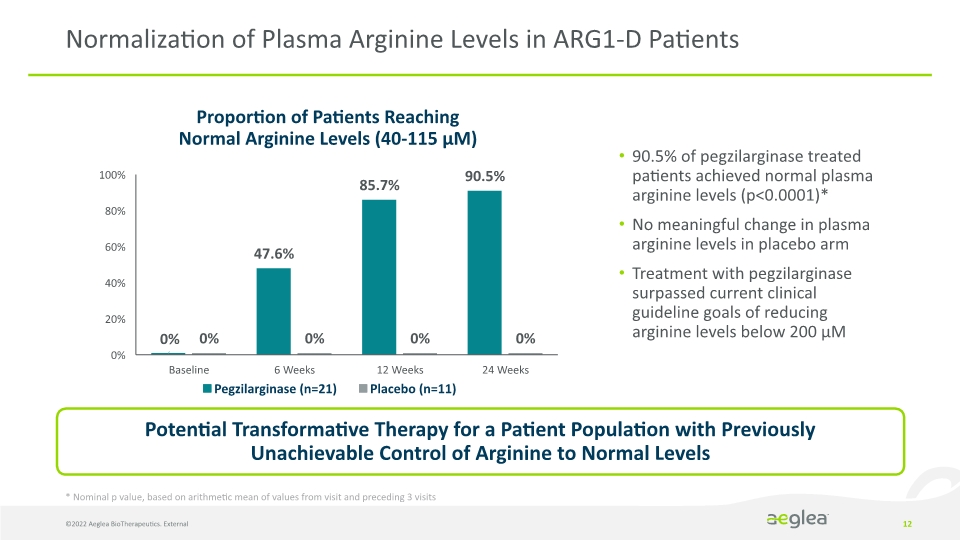
90.5% of pegzilarginase treated patients achieved normal plasma arginine levels (p<0.0001)*
No meaningful change in plasma arginine levels in placebo arm
Treatment with pegzilarginase surpassed current clinical guideline goals of reducing arginine levels below 200 µM 12 Normalization of Plasma Arginine Levels in ARG1-D Patients Proportion of Patients Reaching Normal Arginine Levels (40-115 µM) Potential Transformative Therapy for a Patient Population with Previously Unachievable Control of Arginine to Normal Levels * Nominal p value, based on arithmetic mean of values from visit and preceding 3 visits ©2022 Aeglea BioTherapeutics. External Bar graph
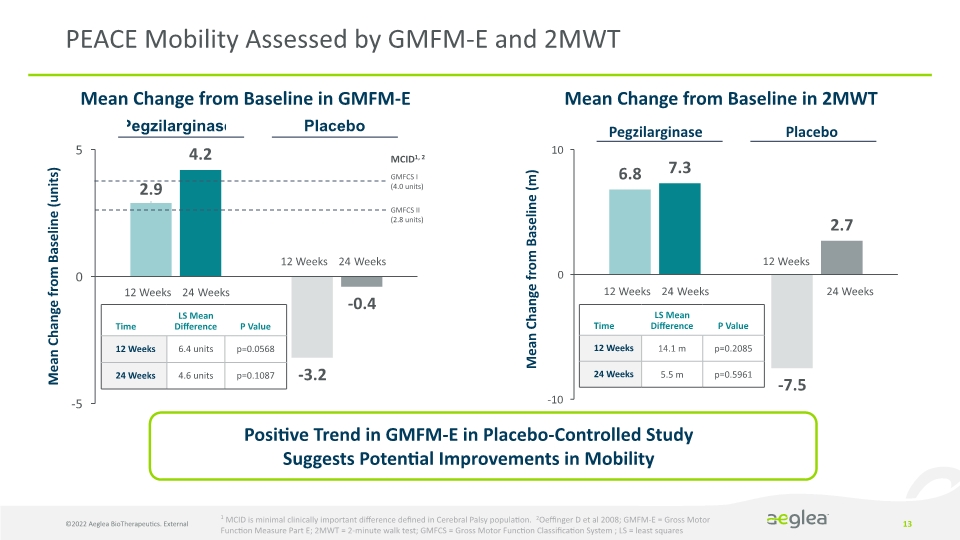
PEACE Mobility Assessed by GMFM-E and 2MWT 13 Mean Change from Baseline in 2MWT Mean Change from Baseline in GMFM-E 1 MCID is minimal clinically important difference defined in Cerebral Palsy population. 2Oeffinger D et al 2008; GMFM-E = Gross Motor Function Measure Part E; 2MWT = 2-minute walk test; GMFCS = Gross Motor Function Classification System ; LS = least squares ©2022 Aeglea BioTherapeutics. External Bar graph
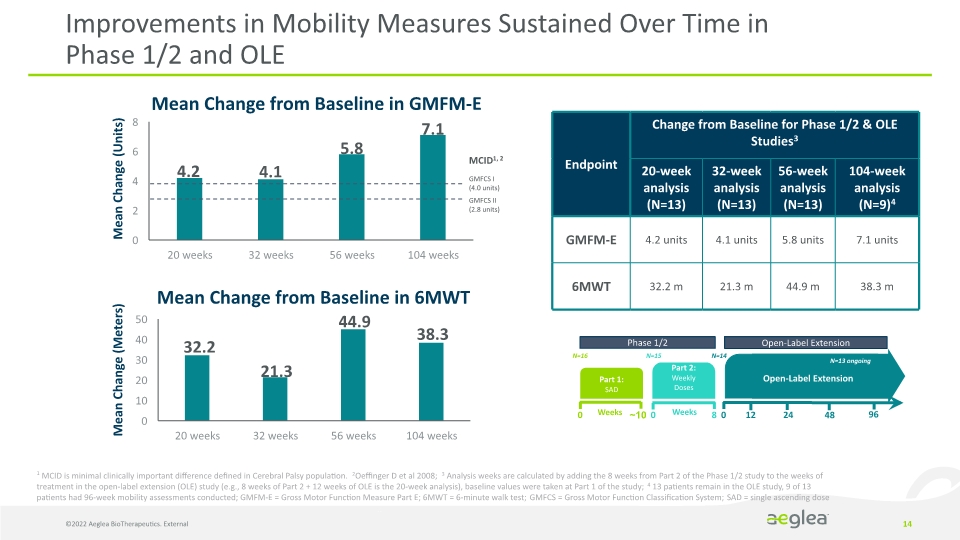
14 Improvements in Mobility Measures Sustained Over Time in Phase 1/2 and OLE 48 1 MCID is minimal clinically important difference defined in Cerebral Palsy population. 2Oeffinger D et al 2008; 3 Analysis weeks are calculated by adding the 8 weeks from Part 2 of the Phase 1/2 study to the weeks of treatment in the open-label extension (OLE) study (e.g., 8 weeks of Part 2 + 12 weeks of OLE is the 20-week analysis), baseline values were taken at Part 1 of the study; 4 13 patients remain in the OLE study, 9 of 13 patients had 96-week mobility assessments conducted; GMFM-E = Gross Motor Function Measure Part E; 6MWT = 6-minute walk test; GMFCS = Gross Motor Function Classification System; SAD = single ascending dose Mean Change from Baseline in GMFM-E Mean Change from Baseline in 6MWT Mean Change (Units) Mean Change (Meters) ©2022 Aeglea BioTherapeutics. External Bar graph
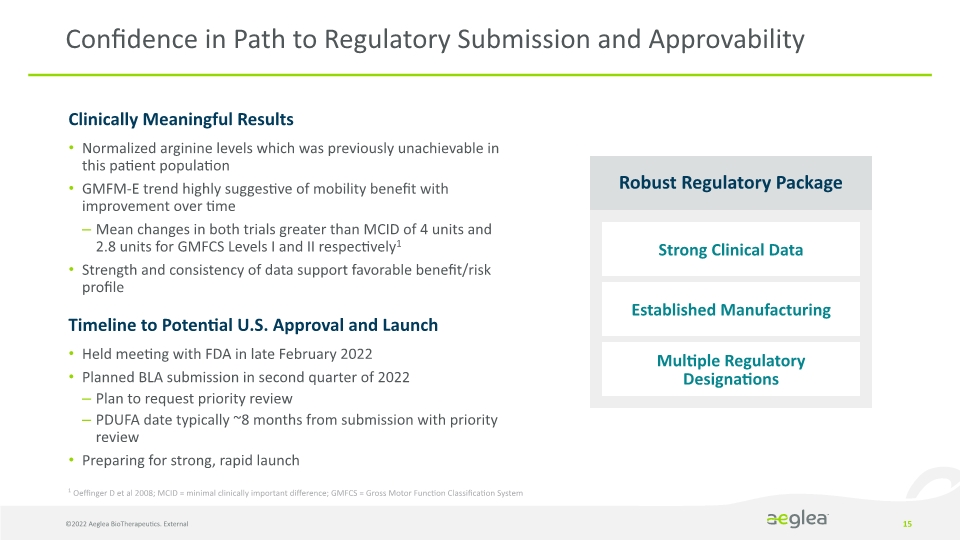
15 Clinically Meaningful Results
Normalized arginine levels which was previously unachievable in this patient population
GMFM-E trend highly suggestive of mobility benefit with improvement over time
Mean changes in both trials greater than MCID of 4 units and 2.8 units for GMFCS Levels I and II respectively1
Strength and consistency of data support favorable benefit/risk profile
Timeline to Potential U.S. Approval and Launch
Held meeting with FDA in late February 2022
Planned BLA submission in second quarter of 2022
Plan to request priority review
PDUFA date typically ~8 months from submission with priority review
Preparing for strong, rapid launch Confidence in Path to Regulatory Submission and Approvability Robust Regulatory Package Strong Clinical Data Established Manufacturing Multiple Regulatory Designations 1 Oeffinger D et al 2008; MCID = minimal clinically important difference; GMFCS = Gross Motor Function Classification System ©2022 Aeglea BioTherapeutics. External
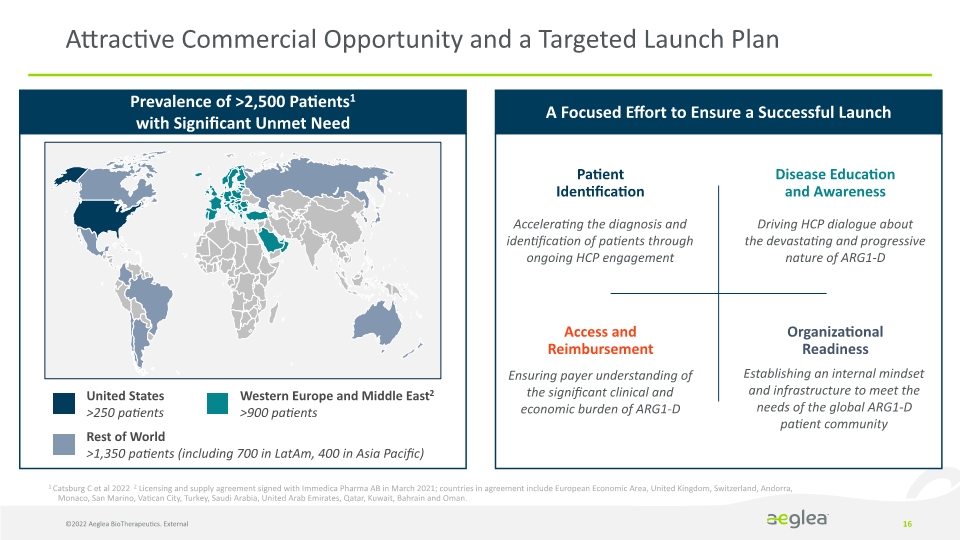
16 Attractive Commercial Opportunity and a Targeted Launch Plan 1 Catsburg C et al 2022 2 Licensing and supply agreement signed with Immedica Pharma AB in March 2021; countries in agreement include European Economic Area, United Kingdom, Switzerland, Andorra, Monaco, San Marino, Vatican City, Turkey, Saudi Arabia, United Arab Emirates, Qatar, Kuwait, Bahrain and Oman.
Prevalence of >2,500 Patients1 with Significant Unmet Need United States
>250 patients Western Europe and Middle East2
>900 patients Rest of World
>1,350 patients (including 700 in LatAm, 400 in Asia Pacific) Patient Identification Accelerating the diagnosis and identification of patients through ongoing HCP engagement Disease Education and Awareness Driving HCP dialogue about
the devastating and progressive nature of ARG1-D Access and Reimbursement Ensuring payer understanding of the significant clinical and economic burden of ARG1-D Organizational
Readiness Establishing an internal mindset and infrastructure to meet the needs of the global ARG1-D patient community A Focused Effort to Ensure a Successful Launch ©2022 Aeglea BioTherapeutics. External Map
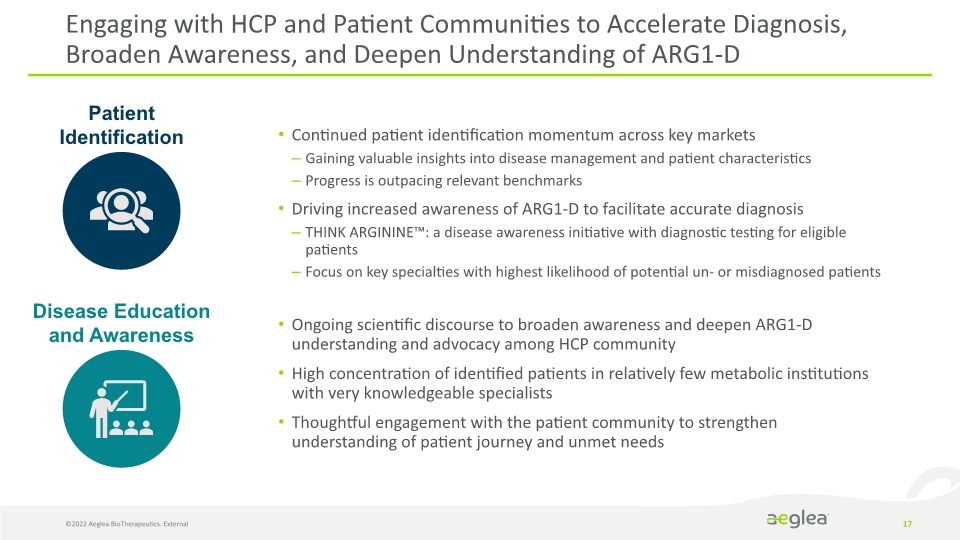
Continued patient identification momentum across key markets
Gaining valuable insights into disease management and patient characteristics
Progress is outpacing relevant benchmarks
Driving increased awareness of ARG1-D to facilitate accurate diagnosis
THINK ARGININE™: a disease awareness initiative with diagnostic testing for eligible patients
Focus on key specialties with highest likelihood of potential un- or misdiagnosed patients
Ongoing scientific discourse to broaden awareness and deepen ARG1-D understanding and advocacy among HCP community
High concentration of identified patients in relatively few metabolic institutions with very knowledgeable specialists
Thoughtful engagement with the patient community to strengthen understanding of patient journey and unmet needs Engaging with HCP and Patient Communities to Accelerate Diagnosis, Broaden Awareness, and Deepen Understanding of ARG1-D 17 Patient Identification Disease Education and Awareness ©2022 Aeglea BioTherapeutics. External
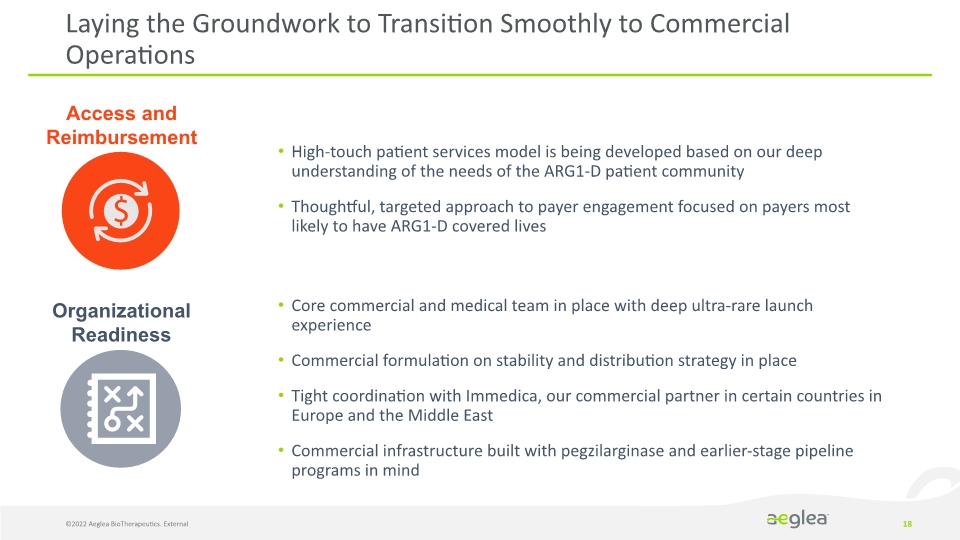
Laying the Groundwork to Transition Smoothly to Commercial Operations 18 High-touch patient services model is being developed based on our deep understanding of the needs of the ARG1-D patient community
Thoughtful, targeted approach to payer engagement focused on payers most likely to have ARG1-D covered lives Core commercial and medical team in place with deep ultra-rare launch experience
Commercial formulation on stability and distribution strategy in place
Tight coordination with Immedica, our commercial partner in certain countries in Europe and the Middle East
Commercial infrastructure built with pegzilarginase and earlier-stage pipeline programs in mind Access and Reimbursement Organizational
Readiness ©2022 Aeglea BioTherapeutics. External

AGLE-177 for Homocystinuria
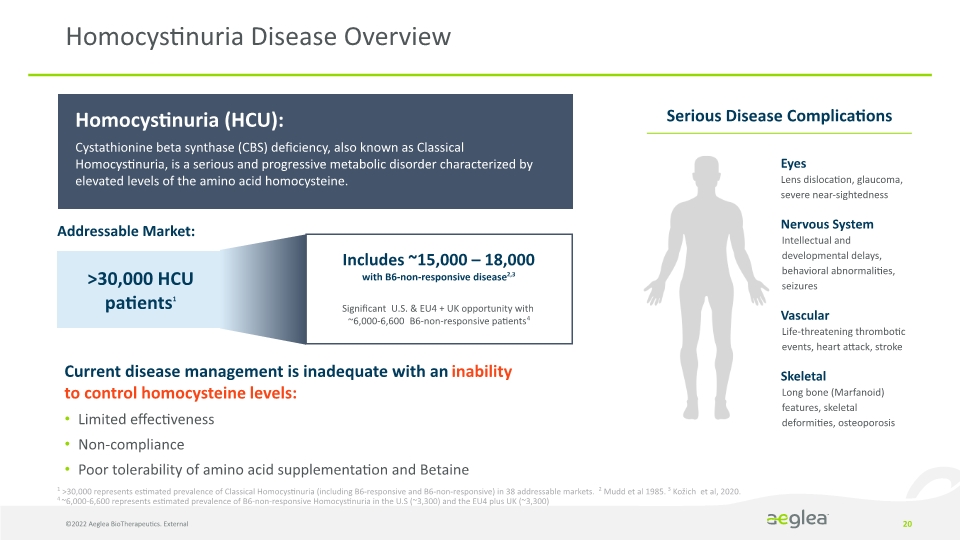
Homocystinuria Disease Overview 20 1 >30,000 represents estimated prevalence of Classical Homocystinuria (including B6-responsive and B6-non-responsive) in 38 addressable markets. 2 Mudd et al 1985. 3 Kožich et al, 2020. 4 ~6,000-6,600 represents estimated prevalence of B6-non-responsive Homocystinuria in the U.S (~3,300) and the EU4 plus UK (~3,300) Homocystinuria (HCU):
Cystathionine beta synthase (CBS) deficiency, also known as Classical Homocystinuria, is a serious and progressive metabolic disorder characterized by elevated levels of the amino acid homocysteine.
Addressable Market: >30,000 HCU patients1 Includes ~15,000 – 18,000
with B6-non-responsive disease2,3
Significant U.S. & EU4 + UK opportunity with
~6,000-6,600 B6-non-responsive patients4
Serious Disease Complications Eyes
Lens dislocation, glaucoma, severe near-sightedness
Nervous System
Intellectual and developmental delays, behavioral abnormalities, seizures
Vascular
Life-threatening thrombotic events, heart attack, stroke
Skeletal
Long bone (Marfanoid) features, skeletal deformities, osteoporosis
Current disease management is inadequate with an inability to control homocysteine levels:
Limited effectiveness
Non-compliance
Poor tolerability of amino acid supplementation and Betaine ©2022 Aeglea BioTherapeutics. External
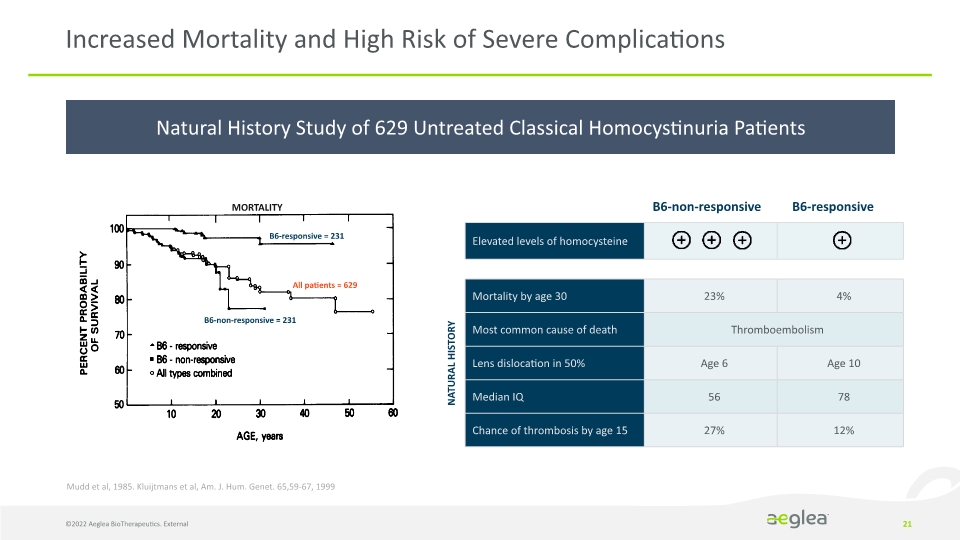
Natural History Study of 629 Untreated Classical Homocystinuria Patients 21 Increased Mortality and High Risk of Severe Complications B6-responsive = 231 All patients = 629 B6-non-responsive = 231 MORTALITY NATURAL HISTORY Mudd et al, 1985. Kluijtmans et al, Am. J. Hum. Genet. 65,59-67, 1999 B6-non-responsive B6-responsive ©2022 Aeglea BioTherapeutics. External
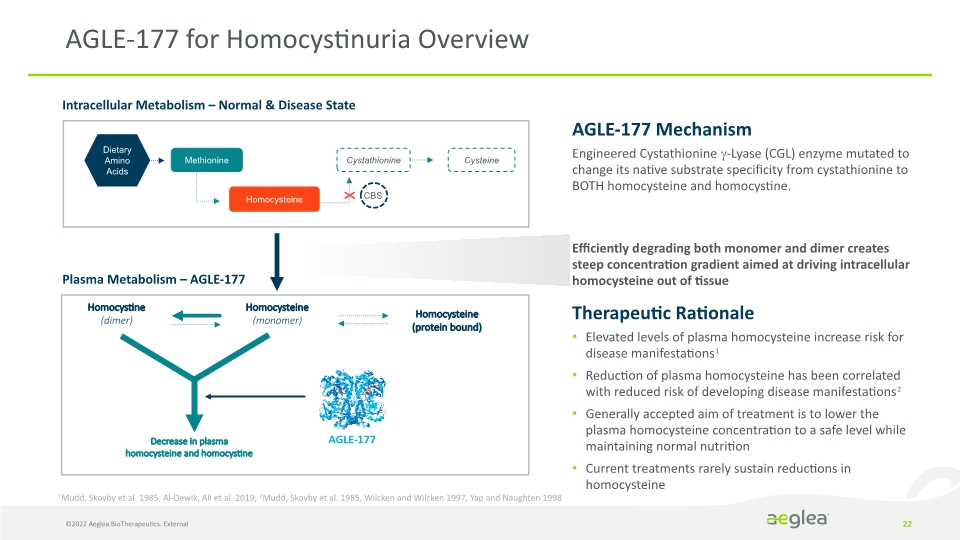
AGLE-177 for Homocystinuria Overview 22 Intracellular Metabolism – Normal & Disease State Plasma Metabolism – AGLE-177 Homocysteine
(monomer) Homocystine
(dimer) AGLE-177 Homocysteine
(protein bound)
Decrease in plasma homocysteine and homocystine X AGLE-177 Mechanism
Engineered Cystathionine -Lyase (CGL) enzyme mutated to change its native substrate specificity from cystathionine to BOTH homocysteine and homocystine.
Efficiently degrading both monomer and dimer creates steep concentration gradient aimed at driving intracellular homocysteine out of tissue
Therapeutic Rationale
Elevated levels of plasma homocysteine increase risk for disease manifestations1
Reduction of plasma homocysteine has been correlated with reduced risk of developing disease manifestations2
Generally accepted aim of treatment is to lower the plasma homocysteine concentration to a safe level while maintaining normal nutrition
Current treatments rarely sustain reductions in homocysteine 1Mudd, Skovby et al. 1985, Al-Dewik, Ali et al. 2019; 2Mudd, Skovby et al. 1985, Wilcken and Wilcken 1997, Yap and Naughten 1998
©2022 Aeglea BioTherapeutics. External
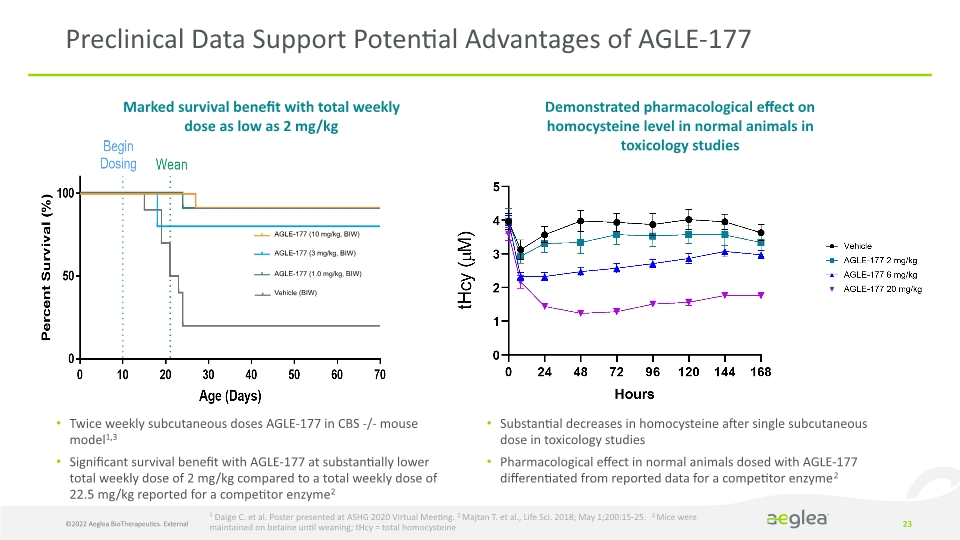
23 Preclinical Data Support Potential Advantages of AGLE-177 Marked survival benefit with total weekly dose as low as 2 mg/kg 1 Daige C. et al. Poster presented at ASHG 2020 Virtual Meeting. 2 Majtan T. et al., Life Sci. 2018; May 1;200:15-25. 3 Mice were maintained on betaine until weaning; tHcy = total homocysteine Twice weekly subcutaneous doses AGLE-177 in CBS -/- mouse model1,3
Significant survival benefit with AGLE-177 at substantially lower total weekly dose of 2 mg/kg compared to a total weekly dose of 22.5 mg/kg reported for a competitor enzyme2 Demonstrated pharmacological effect on homocysteine level in normal animals in toxicology studies Substantial decreases in homocysteine after single subcutaneous dose in toxicology studies
Pharmacological effect in normal animals dosed with AGLE-177 differentiated from reported data for a competitor enzyme2 ©2022 Aeglea BioTherapeutics. External Pie chart
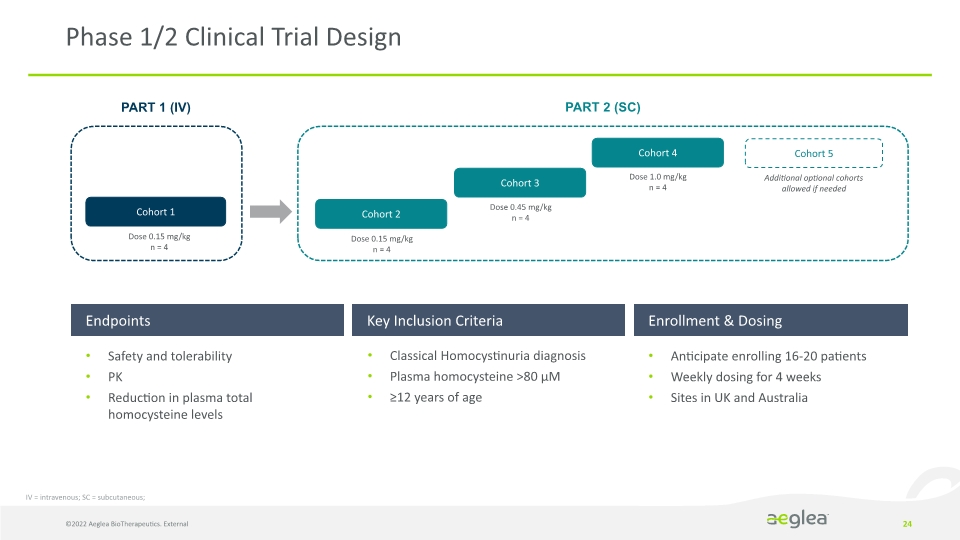
Phase 1/2 Clinical Trial Design 24 Endpoints Key Inclusion Criteria Enrollment & Dosing Safety and tolerability
PK
Reduction in plasma total homocysteine levels Classical Homocystinuria diagnosis
Plasma homocysteine >80 µM
≥12 years of age
Anticipate enrolling 16-20 patients
Weekly dosing for 4 weeks
Sites in UK and Australia ©2022 Aeglea BioTherapeutics. External IV = intravenous; SC = subcutaneous;
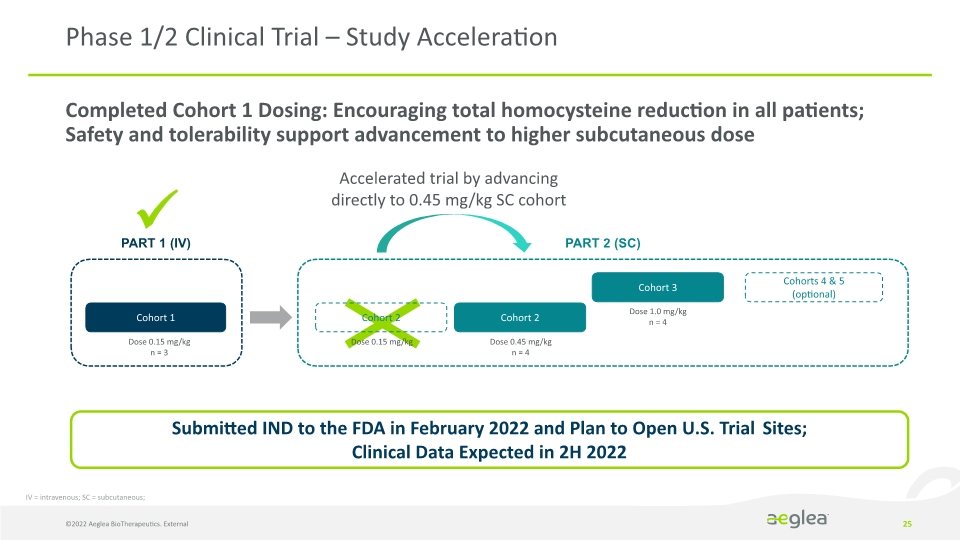
Phase 1/2 Clinical Trial – Study Acceleration 25 Cohort 2 Cohort 3 PART 1 (IV) PART 2 (SC) Dose 0.45 mg/kg
n = 4 Dose 1.0 mg/kg
n = 4 Dose 0.15 mg/kg
n = 3 Cohort 1 Dose 0.15 mg/kg Cohorts 4 & 5
(optional) Submitted IND to the FDA in February 2022 and Plan to Open U.S. Trial Sites;
Clinical Data Expected in 2H 2022 ©2022 Aeglea BioTherapeutics. External Cohort 2 Accelerated trial by advancing directly to 0.45 mg/kg SC cohort Completed Cohort 1 Dosing: Encouraging total homocysteine reduction in all patients; Safety and tolerability support advancement to higher subcutaneous dose IV = intravenous; SC = subcutaneous;
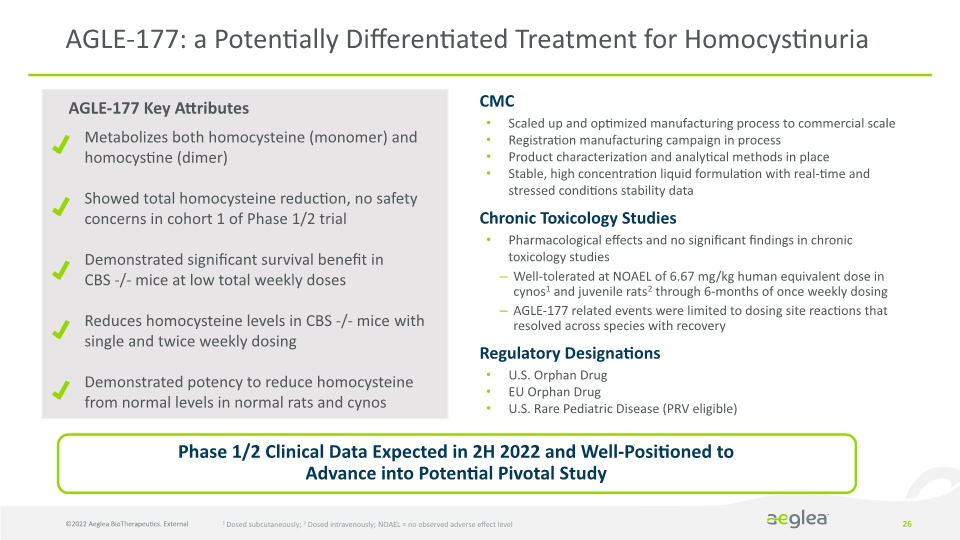
26 AGLE-177: a Potentially Differentiated Treatment for Homocystinuria Metabolizes both homocysteine (monomer) and homocystine (dimer)
Showed total homocysteine reduction, no safety concerns in cohort 1 of Phase 1/2 trial
Demonstrated significant survival benefit in CBS -/- mice at low total weekly doses
Reduces homocysteine levels in CBS -/- mice with single and twice weekly dosing
Demonstrated potency to reduce homocysteine from normal levels in normal rats and cynos 1 Dosed subcutaneously; 2 Dosed intravenously; NOAEL = no observed adverse effect level AGLE-177 Key Attributes Phase 1/2 Clinical Data Expected in 2H 2022 and Well-Positioned to Advance into Potential Pivotal Study ©2022 Aeglea BioTherapeutics. External
Human Enzyme Engineering Platform
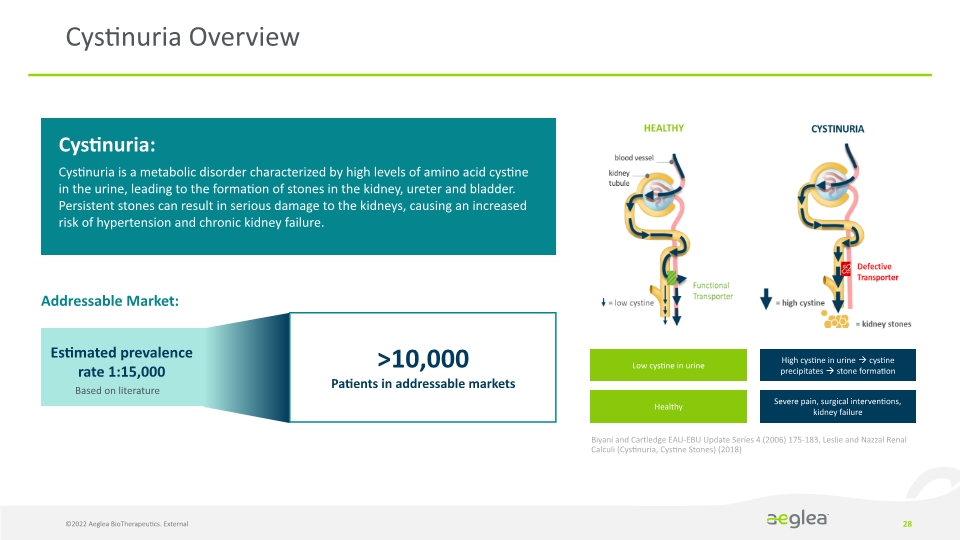
Cystinuria Overview 28 Cystinuria:
Cystinuria is a metabolic disorder characterized by high levels of amino acid cystine in the urine, leading to the formation of stones in the kidney, ureter and bladder. Persistent stones can result in serious damage to the kidneys, causing an increased risk of hypertension and chronic kidney failure. Addressable Market: Estimated prevalence rate 1:15,000 Based on literature >10,000
Patients in addressable markets
Low cystine in urine Healthy High cystine in urine cystine precipitates stone formation Severe pain, surgical interventions, kidney failure Biyani and Cartledge EAU-EBU Update Series 4 (2006) 175-183, Leslie and Nazzal Renal Calculi (Cystinuria, Cystine Stones) (2018) ©2022 Aeglea BioTherapeutics. External
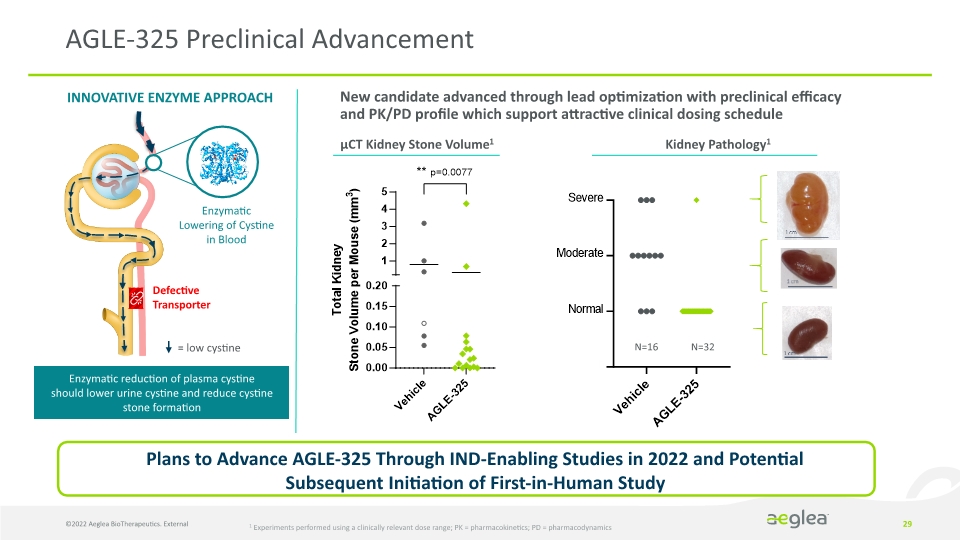
29 AGLE-325 Preclinical Advancement New candidate advanced through lead optimization with preclinical efficacy and PK/PD profile which support attractive clinical dosing schedule µCT Kidney Stone Volume1 Kidney Pathology1 N=16 N=32 INNOVATIVE ENZYME APPROACH Enzymatic reduction of plasma cystine should lower urine cystine and reduce cystine stone formation 1 Experiments performed using a clinically relevant dose range; PK = pharmacokinetics; PD = pharmacodynamics ©2022 Aeglea BioTherapeutics. External
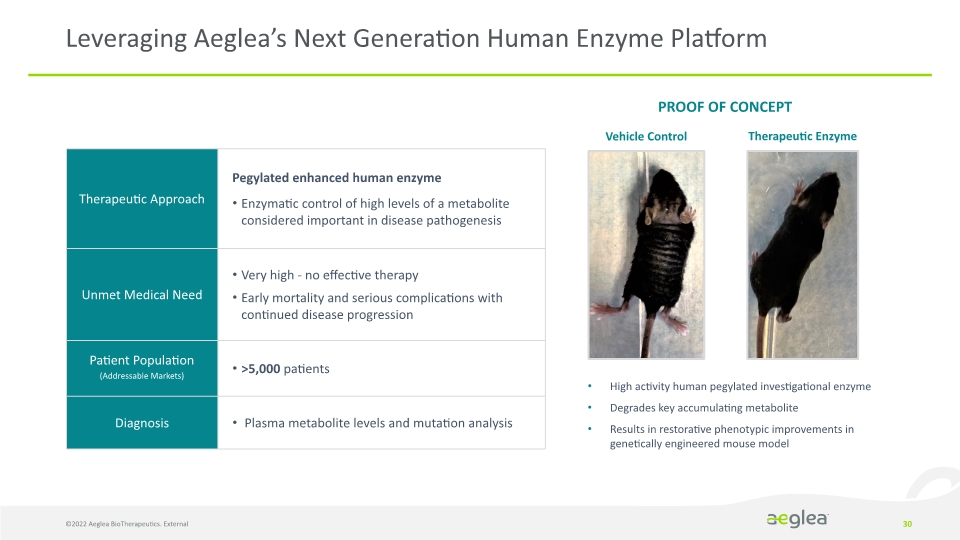
Leveraging Aeglea’s Next Generation Human Enzyme Platform 30 High activity human pegylated investigational enzyme
Degrades key accumulating metabolite
Results in restorative phenotypic improvements in genetically engineered mouse model PROOF OF CONCEPT Vehicle Control Therapeutic Enzyme ©2022 Aeglea BioTherapeutics. External

Summary
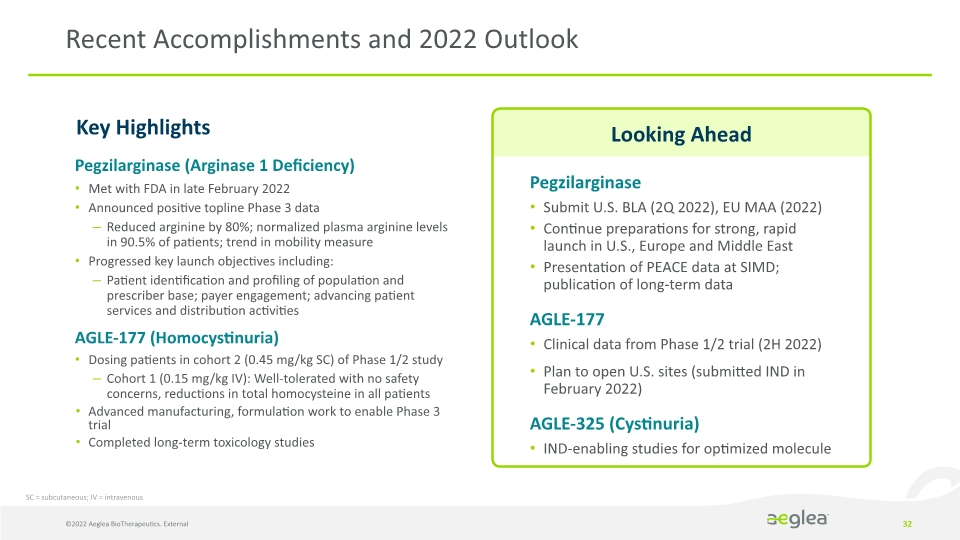
Looking Ahead Key Highlights 32 Pegzilarginase
Submit U.S. BLA (2Q 2022), EU MAA (2022)
Continue preparations for strong, rapid launch in U.S., Europe and Middle East
Presentation of PEACE data at SIMD; publication of long-term data
AGLE-177
Clinical data from Phase 1/2 trial (2H 2022)
Plan to open U.S. sites (submitted IND in February 2022)
AGLE-325 (Cystinuria)
IND-enabling studies for optimized molecule Recent Accomplishments and 2022 Outlook Pegzilarginase (Arginase 1 Deficiency)
Met with FDA in late February 2022
Announced positive topline Phase 3 data
Reduced arginine by 80%; normalized plasma arginine levels in 90.5% of patients; trend in mobility measure
Progressed key launch objectives including:
Patient identification and profiling of population and prescriber base; payer engagement; advancing patient services and distribution activities
AGLE-177 (Homocystinuria)
Dosing patients in cohort 2 (0.45 mg/kg SC) of Phase 1/2 study
Cohort 1 (0.15 mg/kg IV): Well-tolerated with no safety concerns, reductions in total homocysteine in all patients
Advanced manufacturing, formulation work to enable Phase 3 trial
Completed long-term toxicology studies ©2022 Aeglea BioTherapeutics. External SC = subcutaneous; IV = intravenous
805 Las Cimas Parkway Suite 100 Austin, TX 78746 aeglea.com
Financial Summary 34 Cash, cash equivalents and marketable securities as of December 31, 2021: $95.0 million1 (no debt)
As of December 31, 2021, 65.9 million2 common shares and pre-funded warrants outstanding Expected funding runway: into first quarter of 2023 1Includes $1.8mm of restricted. 2Includes 49.3 million common shares outstanding and 16.6 million pre-funded warrants. *Includes $12.0 million of license revenue and $6.7 million of development fee revenue. ©2022 Aeglea BioTherapeutics. External Year Ended $18.7* $57.1 $27.3 $65.8 $59.6 $21.8 $80.9 12/31/2112/31/20RevenueR&D ExpenseG&A ExpenseNet Loss$ Millions
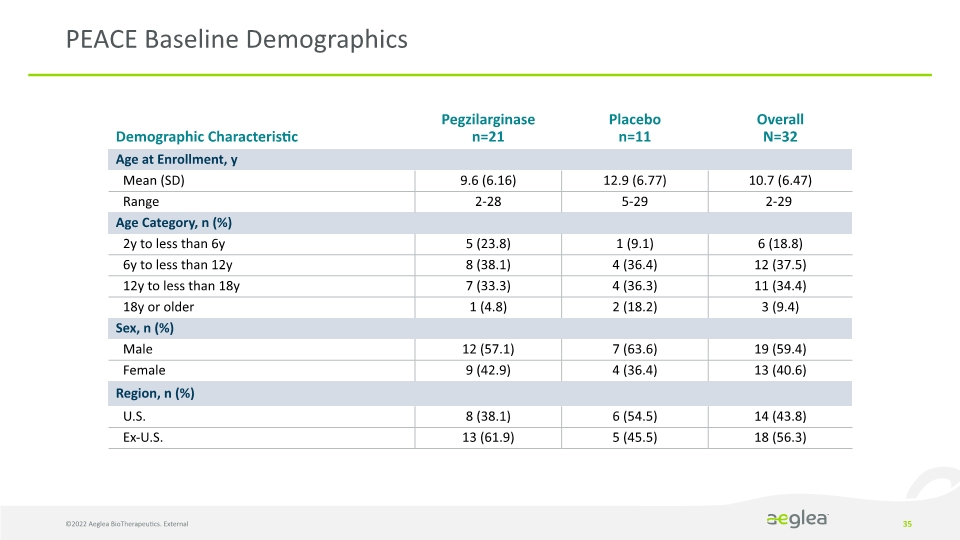
PEACE Baseline Demographics 35 ©2022 Aeglea BioTherapeutics. External Demographic Characteristic Age at Enrollment, y Mean (SD) Placebo n=11 Overall N=32 9.6 (6.16) 2-28 5-29 2-29 13(61.9) 5(45.5) 18(56.3) Range Pegzilarginase n=21 Age Category, n (%) 2y to less than 6y 6y to less than 12y12y to less than 18y18y or older Sex, n (%)Male 8(38.1) 6(54.5) 14(43.8) 9(42.9) 4(36.4) 13(40.6) 12(57.1) 7(63.6) 19(59.4) 1(4.8) 2(18.2) 3(9.4) 7(33.3) 4(36.3) 11(34.4) 8(38.1) 4(36.4) 12(37.5) 5(23.8) 1(9.1) 6(18.8)9.6(6.16) 12.9(6.77) 10.7(6.47)
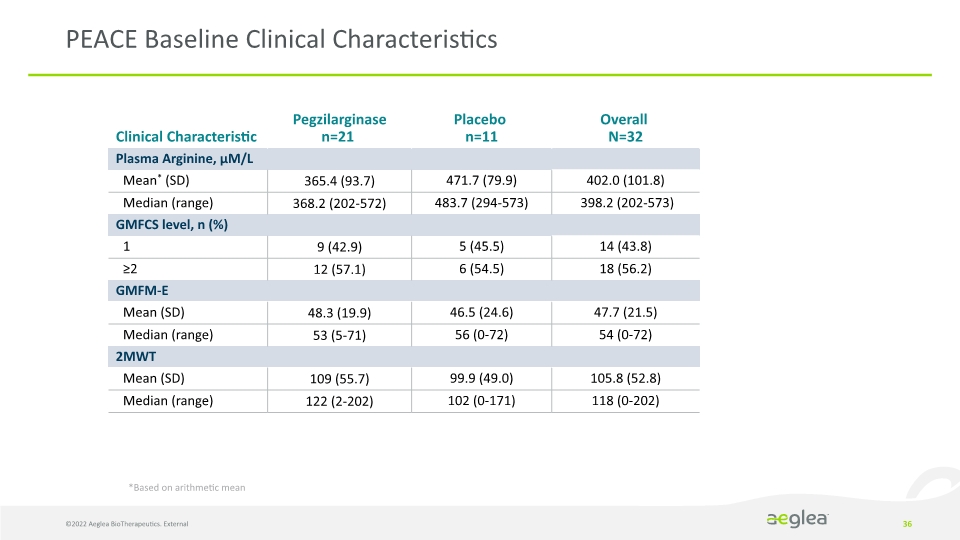
PEACE Baseline Clinical Characteristics 36 *Based on arithmetic mean ©2022 Aeglea BioTherapeutics. External Clinical Characteristic Plasma Arginine, µM/L Mean (SD) Pegzilarginase n=21 Placebo n=11 Overall N=32 median (range) GMFCS level, n(%) 1>2 GMFM-E 2MWT 365.4 (93.7) 368.2 (202-572) 9 (42.9) 12 (57.1) 48.3 (19.9) 53 (5-71) 109 (55.7) 122 (2-202) 471.7 (79.9) 483.7 (294-573) 5 (45.5) 6 (54.5) 46.5 (24.6) 56 (0-72) 99.9 (49.0) 102 (0-171) 402.0 (101.8) 398.2 (202-573) 14 (43.8) 18 (56.2) 47.7 (21.5) 54 (0-72) 105.8 (52.8) 118 (0-202)
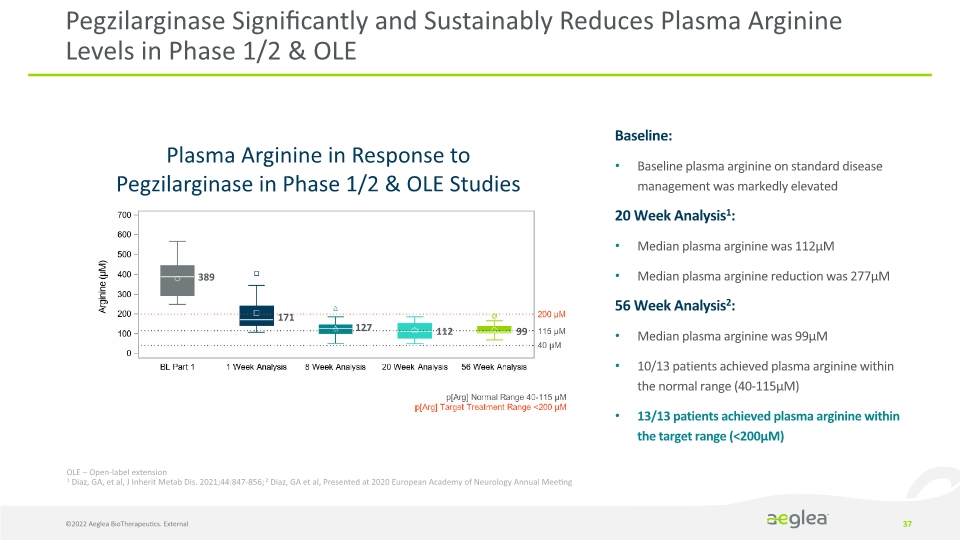
Pegzilarginase Significantly and Sustainably Reduces Plasma Arginine Levels in Phase 1/2 & OLE 37 Plasma Arginine in Response to Pegzilarginase in Phase 1/2 & OLE Studies Baseline:
Baseline plasma arginine on standard disease management was markedly elevated
20 Week Analysis1:
Median plasma arginine was 112µM
Median plasma arginine reduction was 277µM
56 Week Analysis2:
Median plasma arginine was 99µM
10/13 patients achieved plasma arginine within the normal range (40-115µM)
13/13 patients achieved plasma arginine within the target range (<200µM) 389 171 127 112 99 OLE – Open-label extension
1 Diaz, GA, et al, J Inherit Metab Dis. 2021;44:847-856; 2 Diaz, GA et al, Presented at 2020 European Academy of Neurology Annual Meeting ©2022 Aeglea BioTherapeutics. External
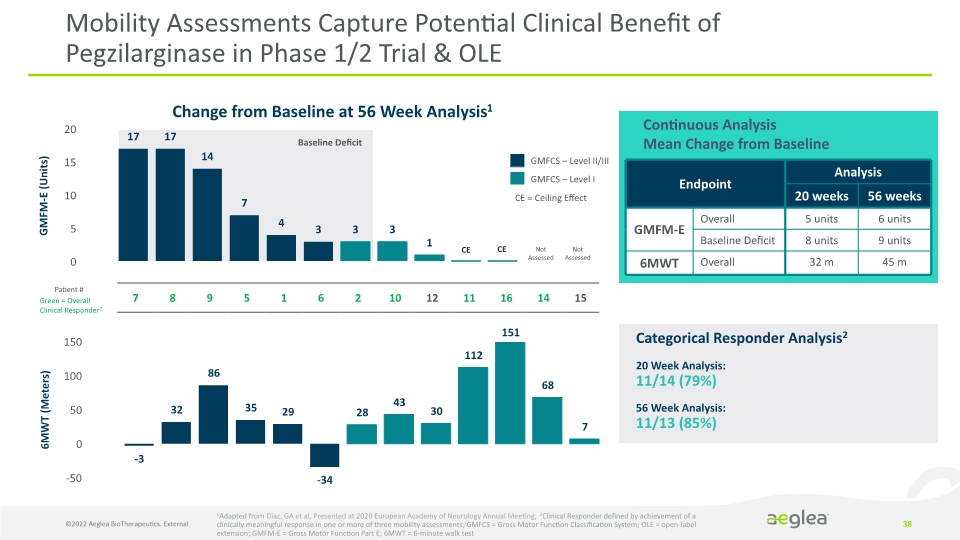
Mobility Assessments Capture Potential Clinical Benefit of Pegzilarginase in Phase 1/2 Trial & OLE 38 Continuous Analysis
Mean Change from Baseline GMFCS – Level II/III GMFCS – Level I CE = Ceiling Effect 20 Week Analysis: 11/14 (79%)
56 Week Analysis: 11/13 (85%) Categorical Responder Analysis2 1Adapted from Diaz, GA et al, Presented at 2020 European Academy of Neurology Annual Meeting; 2Clinical Responder defined by achievement of a clinically meaningful response in one or more of three mobility assessments; GMFCS = Gross Motor Function Classification System; OLE = open-label extension; GMFM-E = Gross Motor Function Part E; 6MWT = 6-minute walk test Change from Baseline at 56 Week Analysis1 Not Assessed Not Assessed CE CE Green = Overall Clinical Responder2 Patient # GMFM-E (Units) 6MWT (Meters) Baseline Deficit 151 ©2022 Aeglea BioTherapeutics. External Bar Chart
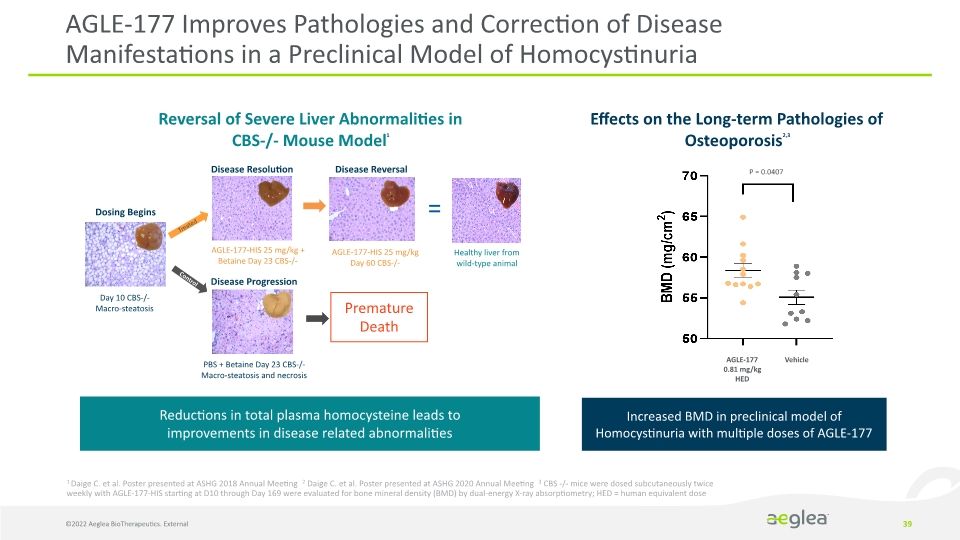
AGLE-177 Improves Pathologies and Correction of Disease Manifestations in a Preclinical Model of Homocystinuria 39 Disease Resolution Disease Reversal Dosing Begins Day 10 CBS-/-
Macro-steatosis Disease Progression AGLE-177-HIS 25 mg/kg + Betaine Day 23 CBS-/- AGLE-177-HIS 25 mg/kg
Day 60 CBS-/- PBS + Betaine Day 23 CBS-/-
Macro-steatosis and necrosis Premature Death Healthy liver from
wild-type animal Reversal of Severe Liver Abnormalities in CBS-/- Mouse Model1 Reductions in total plasma homocysteine leads to improvements in disease related abnormalities Effects on the Long-term Pathologies of Osteoporosis2,3 Increased BMD in preclinical model of Homocystinuria with multiple doses of AGLE-177 1 Daige C. et al. Poster presented at ASHG 2018 Annual Meeting 2 Daige C. et al. Poster presented at ASHG 2020 Annual Meeting 3 CBS -/- mice were dosed subcutaneously twice weekly with AGLE-177-HIS starting at D10 through Day 169 were evaluated for bone mineral density (BMD) by dual-energy X-ray absorptiometry; HED = human equivalent dose ©2022 Aeglea BioTherapeutics. External
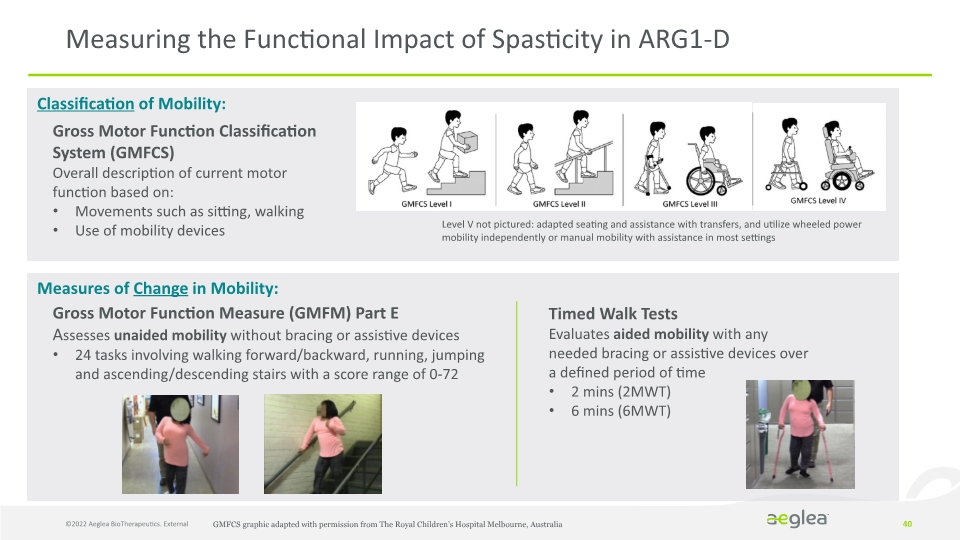
Measuring the Functional Impact of Spasticity in ARG1-D 40 Gross Motor Function Classification System (GMFCS)
Overall description of current motor function based on:
Movements such as sitting, walking
Use of mobility devices Gross Motor Function Measure (GMFM) Part E
Assesses unaided mobility without bracing or assistive devices
24 tasks involving walking forward/backward, running, jumping and ascending/descending stairs with a score range of 0-72
Timed Walk Tests
Evaluates aided mobility with any needed bracing or assistive devices over a defined period of time
2 mins (2MWT)
6 mins (6MWT) Classification of Mobility: Measures of Change in Mobility: Level V not pictured: adapted seating and assistance with transfers, and utilize wheeled power mobility independently or manual mobility with assistance in most settings GMFCS graphic adapted with permission from The Royal Children’s Hospital Melbourne, Australia ©2022 Aeglea BioTherapeutics. External