trn-20260212February 12, 2026February 12, 2026TRINITY INDUSTRIES INC0000099780false00000997802026-02-122026-02-12
UNITED STATES SECURITIES AND EXCHANGE COMMISSION
WASHINGTON, D.C. 20549
FORM 8-K
CURRENT REPORT
Pursuant to Section 13 or 15(d) of the Securities Exchange Act of 1934
| | | | | | | | |
| Date of Report (Date of Earliest Event Reported): | | February 12, 2026 |
_______________________________________
(Exact name of registrant as specified in its charter)
| | | | | | | | | | | | | | |
| | | | | |
| Delaware | | 1-6903 | | 75-0225040 |
(State or other jurisdiction
of incorporation) | | (Commission File No.) | | (I.R.S. Employer
Identification No.) |
14221 N. Dallas Parkway, Suite 1100,
Dallas, Texas 75254-2957
(Address of Principal Executive Offices, and Zip Code)
(214) 631-4420
Registrant's Telephone Number, Including Area Code
Not Applicable
(Former Name or Former Address, if Changed Since Last Report)
______________________________________________
Check the appropriate box below if the Form 8-K filing is intended to simultaneously satisfy the filing obligation of the registrant under any of the following provisions:
☐ Written communications pursuant to Rule 425 under the Securities Act (17 CFR 230.425)
☐ Soliciting material pursuant to Rule 14a-12 under the Exchange Act (17 CFR 240.14a-12)
☐ Pre-commencement communications pursuant to Rule 14d-2(b) under the Exchange Act (17 CFR 240.14d-2(b))
☐ Pre-commencement communications pursuant to Rule 13e-4(c) under the Exchange Act (17 CFR 240.13e-4(c))
Securities registered pursuant to Section 12(b) of the Act:
| | | | | | | | |
| Title of each class | Trading Symbol(s) | Name of each exchange on which registered |
| Common Stock | TRN | New York Stock Exchange |
| | NYSE Texas |
Indicate by check mark whether the registrant is an emerging growth company as defined in Rule 405 of the Securities Act of 1933 (17 CFR §230.405) or Rule 12b-2 of the Securities Exchange Act of 1934 (17 CFR §240.12b-2).
Emerging growth company ☐
If an emerging growth company, indicate by check mark if the registrant has elected not to use the extended transition period for complying with any new or revised financial accounting standards provided pursuant to Section 13(a) of the Exchange Act. ☐
Item 2.02 Results of Operations and Financial Condition.
Trinity Industries, Inc. ("Trinity") hereby furnishes the information set forth in its News Release, dated February 12, 2026, announcing operating results for the three and twelve month periods ended December 31, 2025, a copy of which is furnished as Exhibit 99.1 and incorporated herein by reference. On February 12, 2026, Trinity held a conference call and webcast with respect to its financial results for the three and twelve month periods ended December 31, 2025. The conference call scripts of Leigh Anne Mann, Vice President of Investor Relations; E. Jean Savage, Chief Executive Officer and President; and Eric R. Marchetto, Executive Vice President and Chief Financial Officer are furnished as Exhibit 99.2, and incorporated herein by reference.
The conference call, News Release, and Presentation Materials, described below, included references to Adjusted Operating Results and Adjusted Earnings Per Share, Adjusted Return on Equity, Cash Flow from Operations with Net Gains on Lease Portfolio Sales, EBITDA and Adjusted EBITDA, which are not calculations based on generally accepted accounting principles (“GAAP”). Reconciliations of each of these non-GAAP measures to the most directly comparable GAAP measures have been included in the News Release and/or the Presentation Materials. When forward-looking non-GAAP measures are provided, Trinity does not provide quantitative reconciliations of forward-looking non-GAAP measures to the most directly comparable GAAP measures because it cannot, without unreasonable effort, predict the timing and amounts of certain items included in the computations of each of these measures. These factors include, but are not limited to: the product mix of expected railcar deliveries; the timing and amount of significant transactions and investments, such as lease portfolio sales, capital expenditures, and returns of capital to shareholders; and the amount and timing of certain other items outside the normal course of our core business operations.
This information and the materials described in Item 7.01 are not "filed" pursuant to the Securities Exchange Act of 1934 and are not incorporated by reference into any Securities Act of 1933 registration statements. Additionally, the submission of the report on Form 8-K is not an admission of the materiality of any information in this report that is required to be disclosed solely by Regulation FD.
Item 7.01 Regulation FD Disclosure.
See "Item 2.02 – Results of Operations and Financial Condition." Additionally, Trinity posted its presentation for investors and interested parties to its website to accompany the conference call; a copy of these materials is furnished as Exhibit 99.3 and incorporated herein by reference.
Forward-Looking Statements
Some statements in this release, which are not historical facts, are “forward-looking statements” as defined by the Private Securities Litigation Reform Act of 1995. Forward-looking statements include statements about Trinity's estimates, expectations, beliefs, intentions or strategies for the future, and the assumptions underlying these forward-looking statements, including, but not limited to, future financial and operating performance, future opportunities and any other statements regarding events or developments that Trinity believes or anticipates will or may occur in the future, including the impacts of a potential shutdown, or partial shutdown, of the U.S. government. Trinity uses the words “anticipates,” “assumes,” “believes,” “estimates,” “expects,” “intends,” “forecasts,” “may,” “will,” “should,” “guidance,” “projected,” “outlook,” and similar expressions to identify these forward-looking statements. Forward-looking statements speak only as of the date of this release, and Trinity expressly disclaims any obligation or undertaking to disseminate any updates or revisions to any forward-looking statement contained herein to reflect any change in Trinity’s expectations with regard thereto or any change in events, conditions or circumstances on which any such statement is based, except as required by federal securities laws. Forward-looking statements involve risks and uncertainties that could cause actual results to differ materially from historical experience or present expectations, including but not limited to risks and uncertainties regarding economic, competitive, governmental, and technological factors affecting Trinity’s operations, markets, products, services and prices, and such forward-looking statements are not guarantees of future performance. For a discussion of such risks and uncertainties, which could cause actual results to differ from those contained in the forward-looking statements, see “Risk Factors” and “Forward-Looking Statements” in Trinity’s Annual Report on Form 10-K for the most recent fiscal year, as may be revised and updated by Trinity’s Quarterly Reports on Form 10-Q, and Trinity’s Current Reports on Form 8-K.
Item 9.01 Financial Statements and Exhibits.
(a) - (c) Not applicable.
(d) Exhibits:
| | | | | | | | |
| NO. | | DESCRIPTION |
| 99.1 | | | |
| 99.2 | | | |
| 99.3 | | | |
| | |
| 101.SCH | | Inline XBRL Taxonomy Extension Schema Document (filed electronically herewith). |
| | |
| 101.LAB | | Inline XBRL Taxonomy Extension Label Linkbase Document (filed electronically herewith). |
| 101.PRE | | Inline XBRL Taxonomy Extension Presentation Linkbase Document (filed electronically herewith). |
| | |
| 104 | | Cover Page Interactive Data File (formatted as Inline XBRL and contained in Exhibit 101). |
SIGNATURES
Pursuant to the requirements of the Securities Exchange Act of 1934, the registrant has duly caused this report to be signed on its behalf by the undersigned hereunto duly authorized.
| | | | | | | | |
| Trinity Industries, Inc. |
| | |
| February 12, 2026 | By: | /s/ Eric R. Marchetto |
| | Name: Eric R. Marchetto |
| | Title: Executive Vice President and Chief Financial Officer |
Exhibit 99.1
FOR IMMEDIATE RELEASE
Trinity Industries, Inc. Announces Fourth Quarter and Full Year 2025 Results
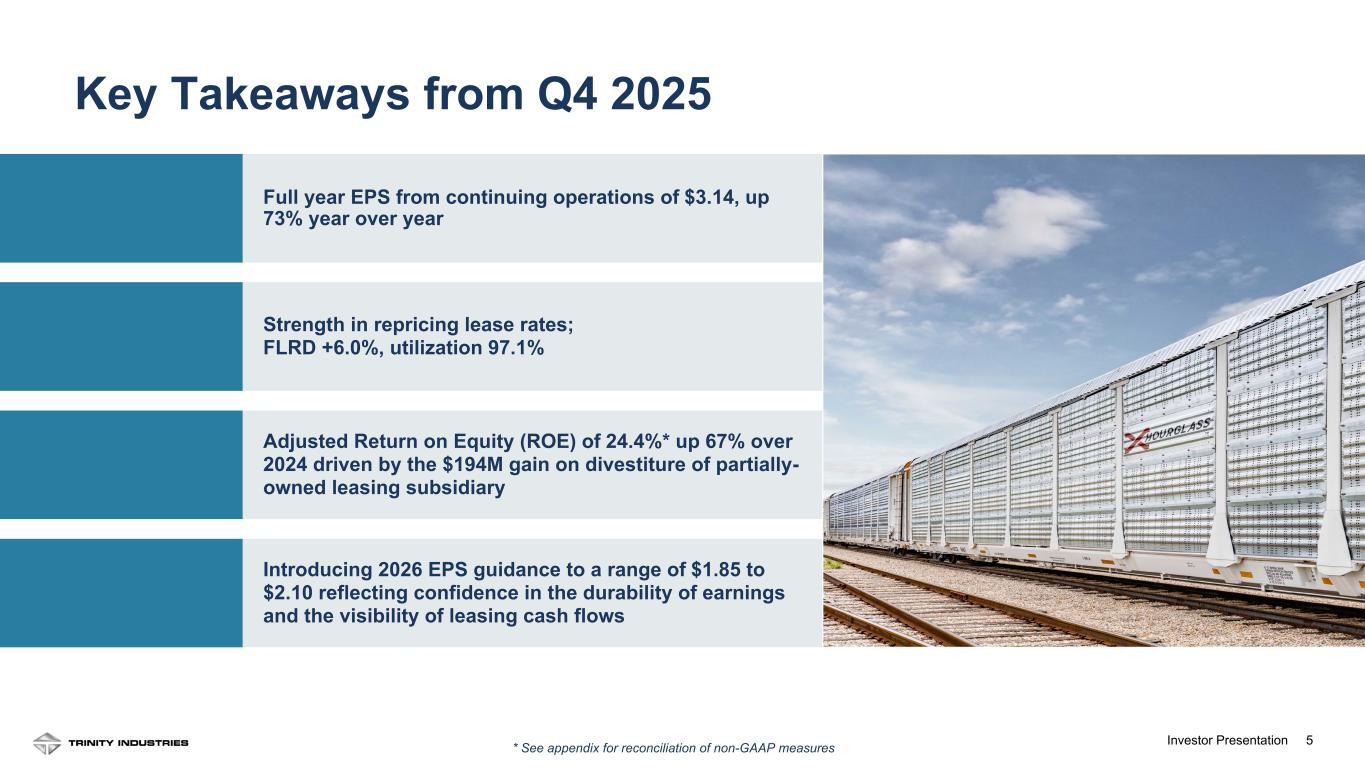
Reports full year earnings from continuing operations of $3.14 per diluted share
Generates full year operating cash flow of $367 million
Net gains on lease portfolio sales of $91 million and non-cash pre-tax gain on railcar partnership restructuring of $194 million
Lease fleet utilization of 97.1% and Future Lease Rate Differential ("FLRD") of positive 6.0% at quarter-end
Delivered 9,500 railcars in the year; backlog of $1.7 billion at year-end
DALLAS, Texas – February 12, 2026 – Trinity Industries, Inc. (NYSE:TRN) today announced earnings results for the fourth quarter and year ended December 31, 2025.
Financial and Operational Highlights – Fourth Quarter
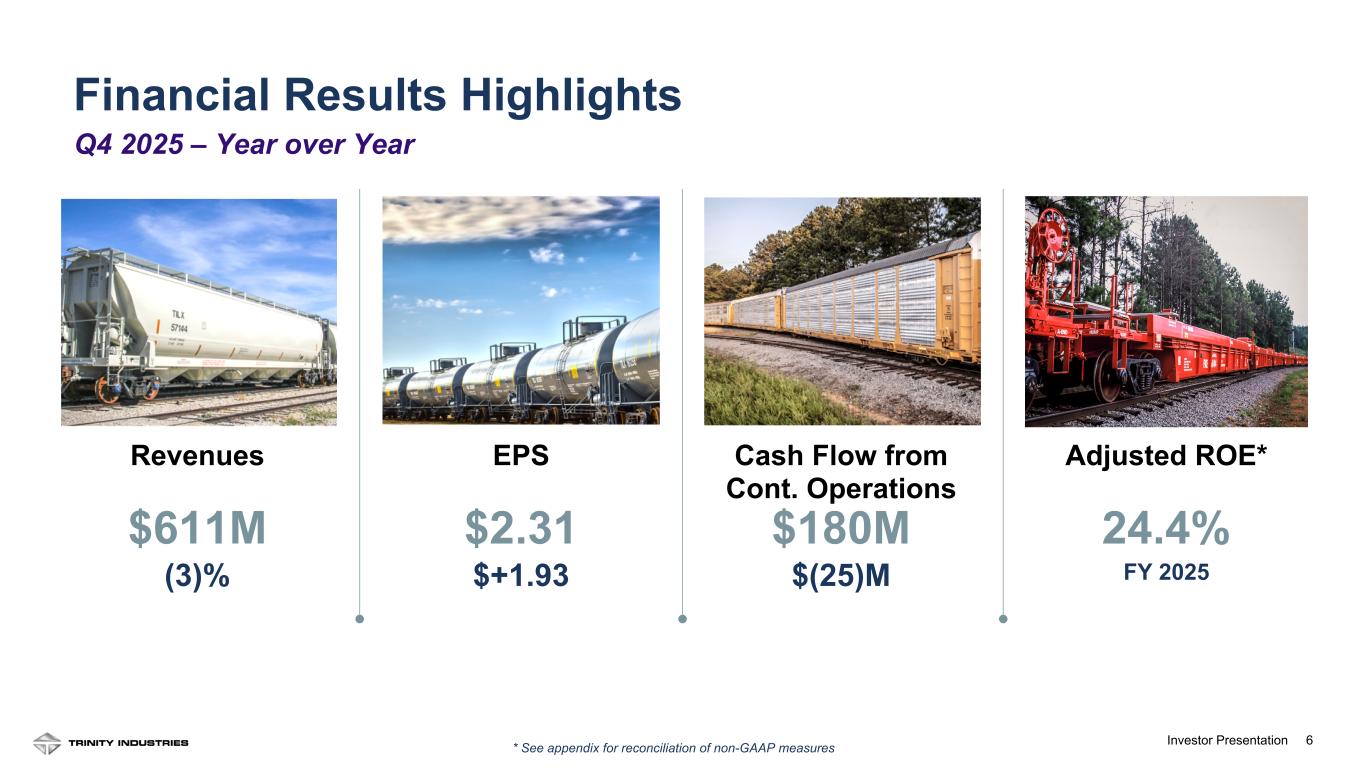
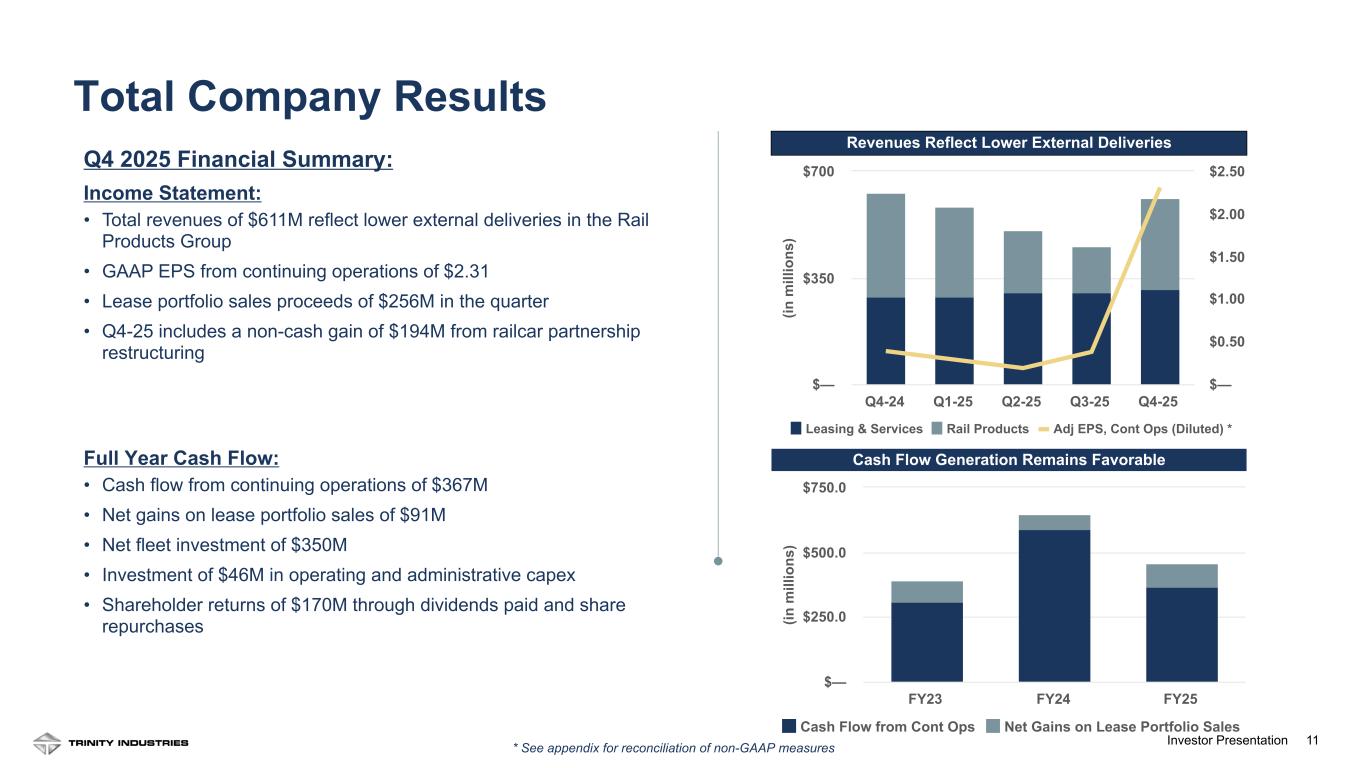
•Quarterly total company revenues of $611 million
•Quarterly income from continuing operations per common diluted share ("EPS") of $2.31; $1.93 improvement in EPS year over year
•Non-cash pre-tax gain on railcar partnership restructuring of $194 million
•Lease fleet utilization of 97.1% and FLRD of positive 6.0% at quarter-end
•Quarterly railcar deliveries of 2,945 and new railcar orders of 1,800
Financial and Operational Highlights – Full Year
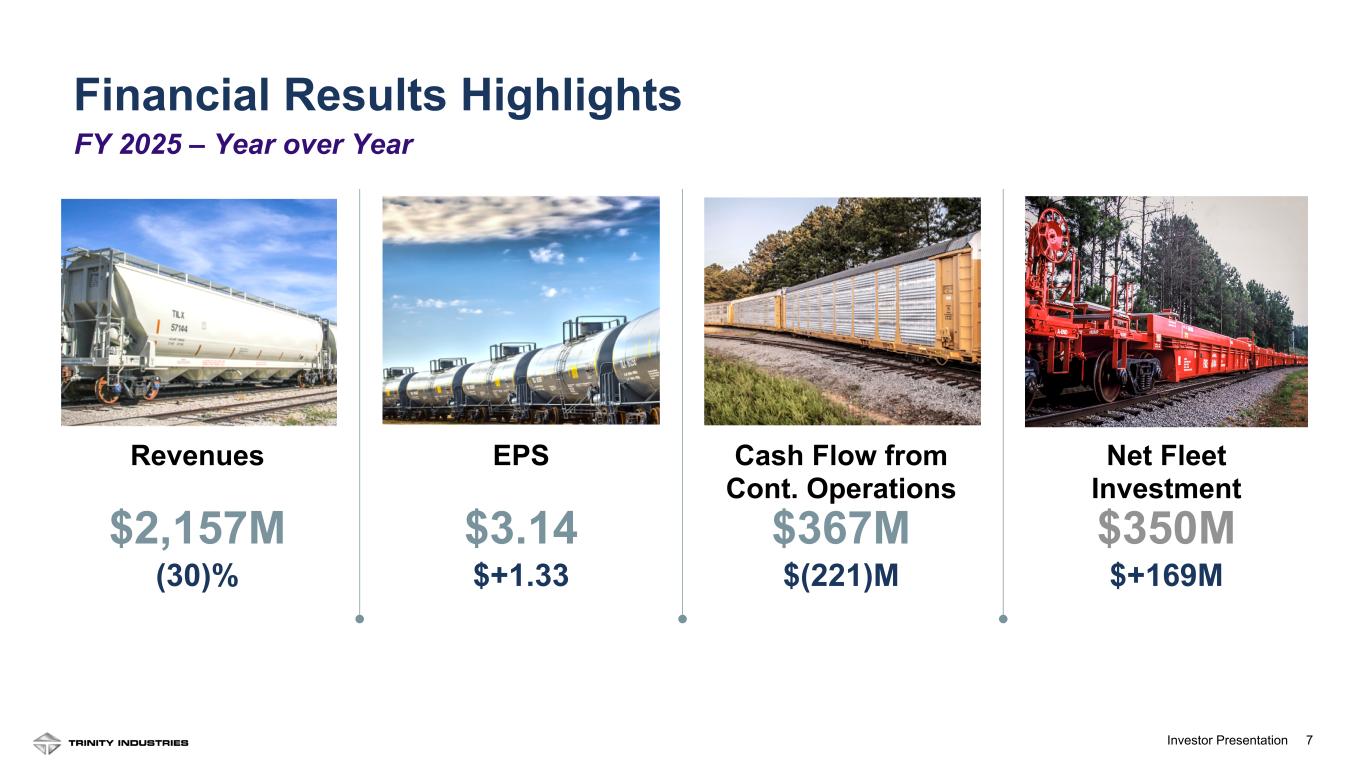
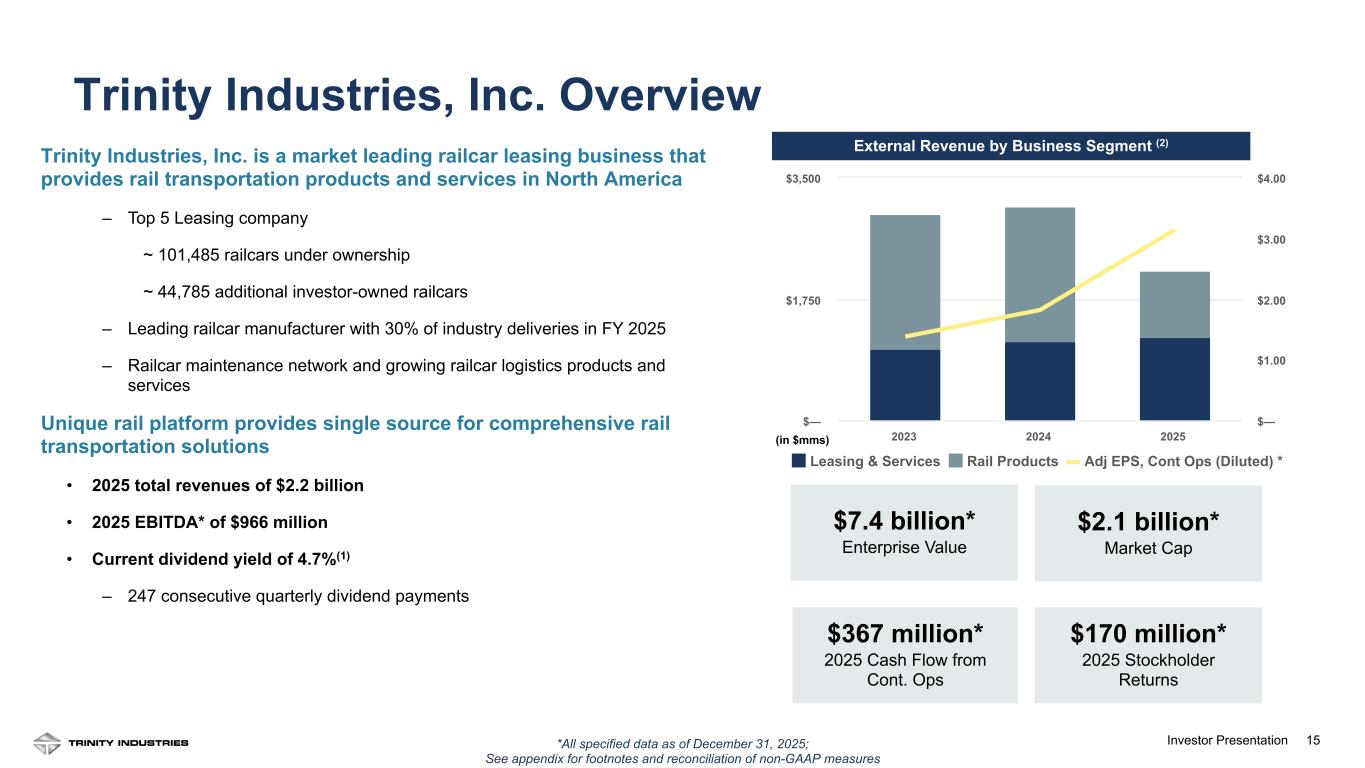
•Full year total company revenues of $2.2 billion
•Full year EPS of $3.14; $1.33 improvement in EPS year over year
•Full year cash flow from continuing operations of $367 million and net gains on lease portfolio sales of $91 million
•Full year Return on Equity ("ROE") of 23.2% and Adjusted ROE of 24.4%
2026 Guidance
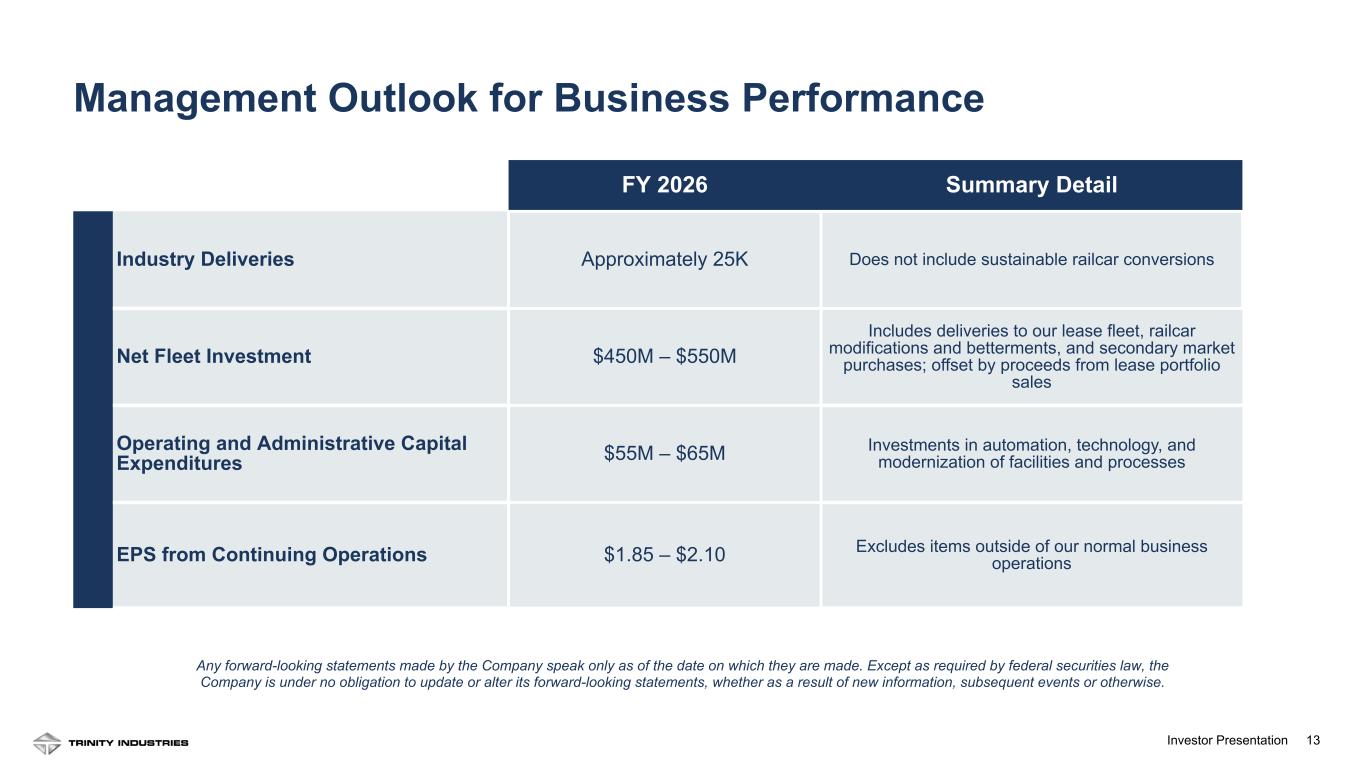
•Industry deliveries of approximately 25,000 railcars
•Net fleet investment of $450 million to $550 million
•Operating and administrative capital expenditures of $55 million to $65 million
•EPS of $1.85 to $2.10
◦Excludes items outside of our core business operations
Management Commentary
“Trinity Industries delivered strong full year 2025 results with an EPS of $3.14 – an improvement of $1.33 year over year – driven by higher lease rates, gains on lease portfolio sales, lower administrative costs, and a $194 million non-cash gain from a railcar partnership restructuring,” said Jean Savage, Trinity’s Chief Executive Officer and President. “We ended the year with an Adjusted ROE of 24.4%, and our cash flow from operations metric, which includes net gains on lease portfolio sales, was $458 million,” Ms. Savage added.
“In our Railcar Leasing and Services Group, full year revenues increased 6% year over year, reflecting continued repricing of our fleet at market rates and net fleet growth. Additionally, the railcar partnership restructuring reinforces our confidence in the value of our lease fleet and its earnings growth potential. The market value of our lease fleet is substantially higher than its book value, and we plan to proactively and consistently monetize this embedded value through increased secondary market sales as an integral part of our capital allocation strategy.”
Ms. Savage continued, “In the Rail Products Group, we delivered a full year operating margin of 5.2%, within our guidance range. Achieving this margin despite a 46% decline in year over year deliveries underscores the progress we have made in creating a more resilient and adaptable operating platform.”
“Looking ahead, we are introducing full year 2026 EPS guidance of $1.85 to $2.10, reflecting continued lease rate growth, higher expected gains from increased secondary market activity, and stable margin performance.” Ms. Savage concluded, “We are intentionally structured to generate resilient earnings and strong cash flow through disciplined lease pricing, active portfolio management, and balanced capital deployment.”
Consolidated Financial Summary
| | | | | | | | | | | | | | | | | |
| Three Months Ended
December 31, | | |
| 2025 | | 2024 | | Year over Year – Comparison |
| ($ in millions, except per share amounts) | | |
| Revenues | $ | 611.2 | | $ | 629.4 | | Lower external deliveries in the Rail Products Group, partially offset by higher lease rates and higher maintenance services revenues |
| | | | | |
| | | | | |
Operating profit | $ | 335.4 | | $ | 112.0 | | $194 million non-cash gain on railcar partnership restructuring and higher gains on lease portfolio sales, partially offset by lower external deliveries in the Rail Products Group |
| | | | | |
| Interest expense, net | $ | 70.6 | | $ | 66.9 | | |
| Net income from continuing operations attributable to Trinity Industries, Inc. | $ | 188.9 | | $ | 31.9 | | |
| | | | | |
EBITDA (1) | $ | 417.1 | | $ | 191.1 | | |
| | | | | |
| Effective tax expense rate | 25.8 | % | | 14.1 | % | | Q4 2024 – Changes in valuation allowances |
| Diluted EPS – GAAP | $ | 2.31 | | $ | 0.38 | | |
| | | | | |
| | | | | |
| Year Ended
December 31, | | |
| 2025 | | 2024 | | Year over Year – Comparison |
| ($ in millions, except per share amounts) | | |
| Revenues | $ | 2,156.9 | | $ | 3,079.2 | | Lower external deliveries in the Rail Products Group |
Operating profit | $ | 649.2 | | $ | 491.5 | | $194 million non-cash gain on railcar partnership restructuring, higher gains on lease portfolio sales, and lower selling, engineering, and administrative expenses, partially offset by lower external deliveries in the Rail Products Group and costs associated with workforce reductions |
| Interest expense, net | $ | 274.2 | | $ | 273.5 | | |
| Net income from continuing operations attributable to Trinity Industries, Inc. | $ | 260.3 | | $ | 152.7 | | |
EBITDA (1) | $ | 965.7 | | $ | 804.1 | | |
| Effective tax expense rate | 24.2 | % | | 22.7 | % | | |
| Diluted EPS – GAAP | $ | 3.14 | | $ | 1.81 | | |
| | | | | |
| | | | | |
| | | |
| | | | | |
| | | |
| Net cash provided by operating activities – continuing operations | $ | 366.9 | | $ | 588.1 | | Primarily higher railcar deliveries in the prior year and the purchase of tax credits in the current year |
Cash flow from operations with net gains on lease portfolio sales (1) | $ | 458.3 | | $ | 645.4 | |
| Net fleet investment | $ | 350.0 | | $ | 181.2 | | Higher fleet additions in 2025 |
| Returns of capital to stockholders | $ | 170.0 | | $ | 114.2 | | |
| | | | | |
(1) Non-GAAP financial measure. See the Reconciliations of Non-GAAP Measures section within this Press Release for a reconciliation to the most directly comparable GAAP measure and why management believes this measure is useful to management and investors.
Additional Business Items
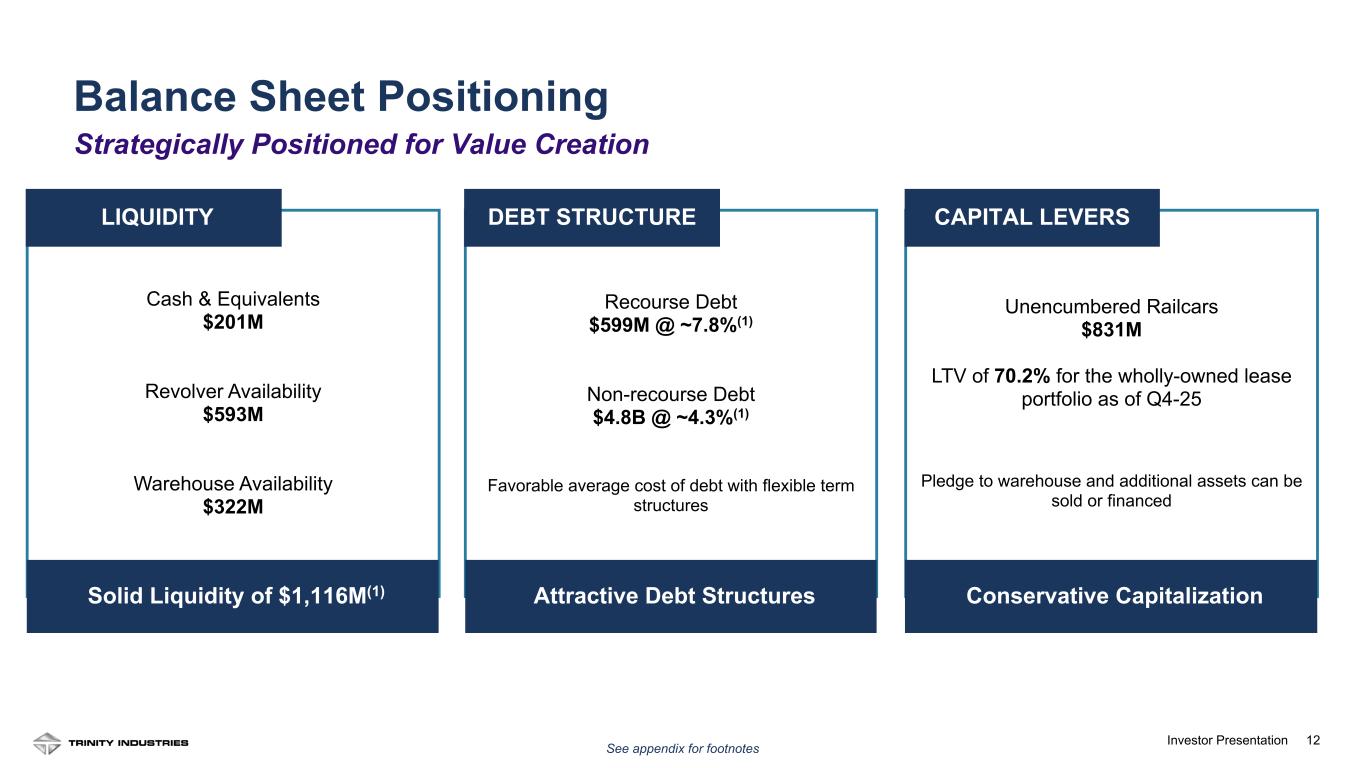
•Total committed liquidity of $1.1 billion as of December 31, 2025.
•In December 2025, our Board of Directors declared an increase to our quarterly dividend from $0.30 per share to $0.31 per share.
•In December 2025, the Company completed a strategic restructuring of its railcar investment partnerships with Napier Park, a leading alternative credit platform. Before the restructuring, Trinity held a 43% stake in TRIP Rail Holdings LLC (“TRIP Holdings”), which owned over 17,000 railcars through its subsidiaries Tribute Rail LLC (“Tribute”) and Triumph Rail LLC (“Triumph”). Trinity also owned 31% of RIV 2013 Rail Holdings LLC (“RIV 2013”), which owns more than 6,200 railcars via its subsidiary TRP 2021 LLC (“TRP 2021”).
◦Through this transaction, Napier Park acquired 99.8% ownership of Triumph’s immediate parent company, Triumph Rail Holdings LLC (“Triumph Holdings”), and Trinity acquired sole ownership of RIV 2013 and TRP 2021. Trinity now wholly owns RIV 2013 and 0.2% of Triumph Holdings, while Napier Park owns 99.8% of Triumph Holdings. Tribute remains a subsidiary of TRIP Holdings under the current joint venture ownership structure, with Napier Park owning 57% and Trinity owning 43% of TRIP Holdings.
◦Trinity recognized a non-cash pre-tax gain of $194 million from the sale of its equity stake in Triumph Holdings.
◦Approximately 6,235 railcars were transferred from partially-owned to wholly-owned related to the acquisition of the noncontrolling interest in RIV 2013 as of December 31, 2025. Approximately 10,850 railcars were transferred from partially-owned to investor-owned related to the divestiture of Triumph as of December 31, 2025.
Business Group Summary
| | | | | | | | | | | | | | | | | |
| Three Months Ended
December 31, | | |
| 2025 | | 2024 | | Year over Year – Comparison |
| ($ in millions) | | |
| Railcar Leasing and Services Group | | |
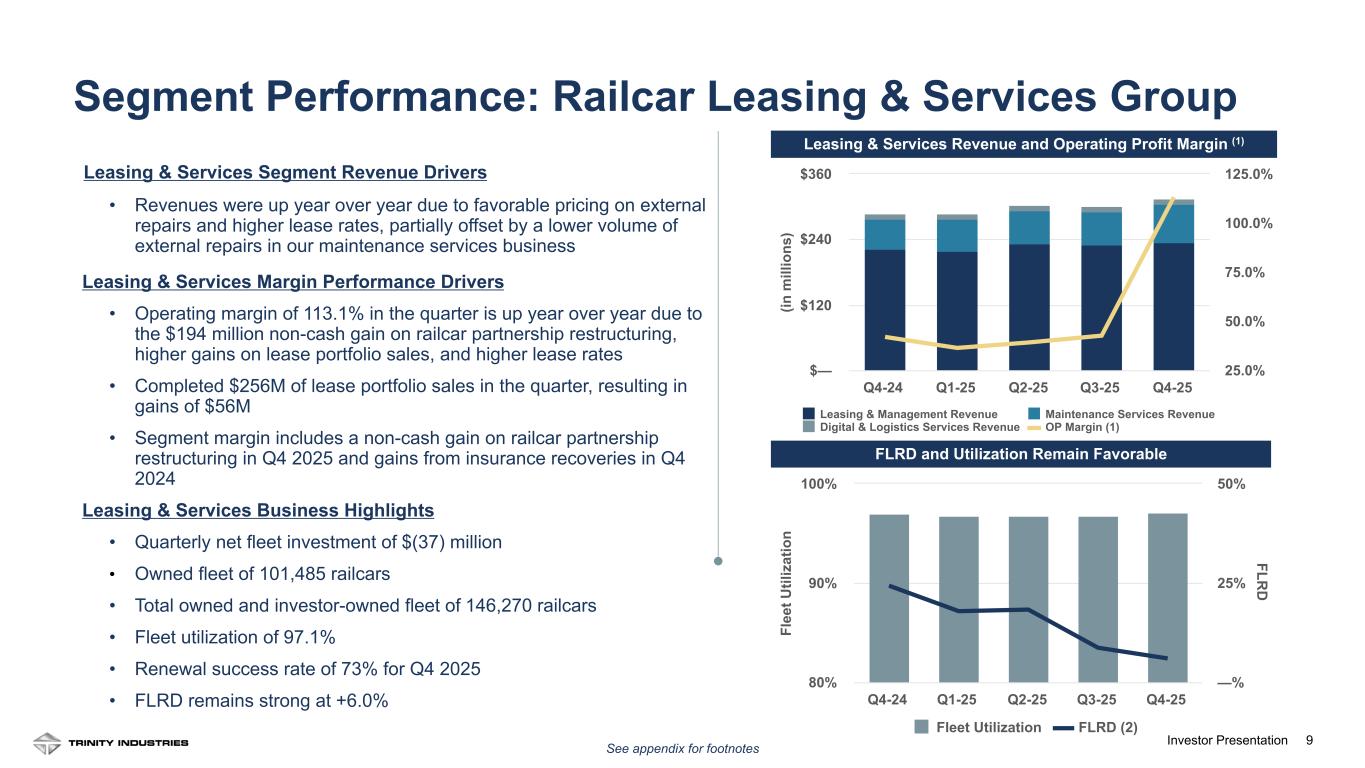
| Revenues | $ | 315.8 | | $ | 287.1 | | Favorable pricing on external repairs and higher lease rates, partially offset by a lower volume of external repairs in the maintenance services business |
| Operating profit | $ | 357.2 | | $ | 120.5 | | Gain on railcar partnership restructuring, higher gains on lease portfolio sales, and higher lease rates |
| Operating profit margin | 113.1 | % | | 42.0 | % | |
| Gains on lease portfolio sales | $ | 56.0 | | $ | 21.1 | | |
| Gain on divestiture of partially-owned leasing subsidiary | $ | 194.2 | | $ | — | | |
Fleet utilization (1) | 97.1 | % | | 97.0 | % | | |
FLRD (2) | +6.0 | % | | +24.3 | % | | Strength in repricing lease rates |
| Wholly-owned lease fleet (in units) | 95,315 | | 86,355 | | 2025 includes approximately 6,235 railcars transferred from partially-owned to wholly-owned related to the railcar partnership restructuring |
| Partially-owned lease fleet (in units) | 6,170 | | 23,280 | | 2025 includes approximately 10,850 railcars transferred from partially-owned to investor-owned related to the railcar partnership restructuring |
| | | | |
| Investor-owned lease fleet (in units) | 44,785 | | 34,230 | |
| Rail Products Group | | | | | |
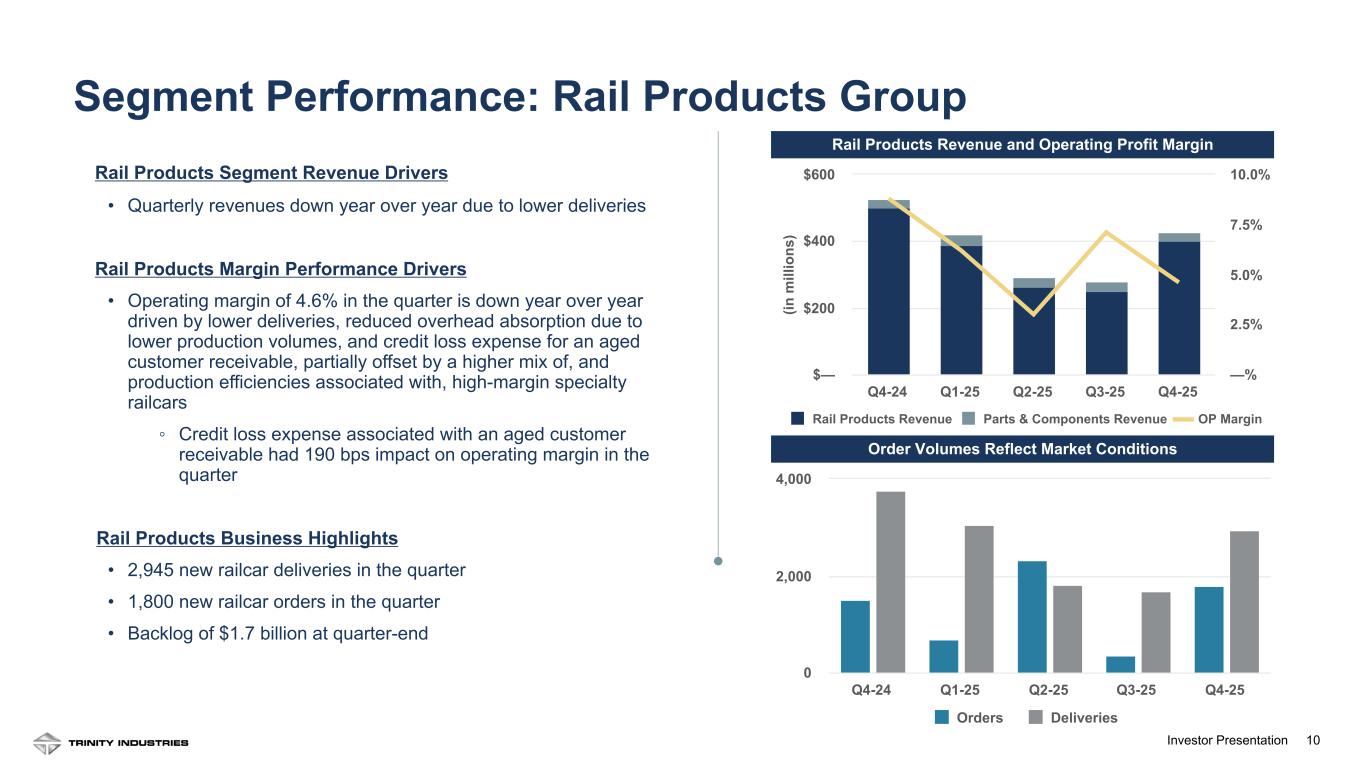
| Revenues | $ | 426.7 | | $ | 526.3 | | Lower deliveries |
| Operating profit | $ | 19.6 | | $ | 46.3 | | Lower deliveries, reduced overhead absorption due to lower production volumes, and credit loss expense for an aged customer receivable, partially offset by a higher mix of, and production efficiencies associated with, high-margin specialty railcars |
| Operating profit margin | 4.6 | % | | 8.8 | % | |
| New railcars: | | | | | |
| Deliveries (in units) | 2,945 | | 3,760 | | |
| Orders (in units) | 1,800 | | 1,500 | | |
| Order value | $ | 241.8 | | $ | 191.9 | | |
| Backlog value | $ | 1,661.6 | | $ | 2,145.5 | | Expect to deliver approximately 49% of our railcar backlog value during 2026 |
| Sustainable railcar conversions: | | | | | |
| Deliveries (in units) | — | | 55 | | |
| Backlog (in units) | 270 | | 25 | | |
| Backlog value | $ | 35.2 | | $ | 3.1 | | |
| Eliminations | | | | | |
| Eliminations – revenues | $ | (131.3) | | $ | (184.0) | | |
| Eliminations – operating profit | $ | (4.2) | | $ | (17.7) | | |
| Corporate and other | | | | | |
| Selling, engineering, and administrative expenses | $ | 37.2 | | $ | 32.8 | | Higher employee-related costs, including incentive-based compensation |
| | | | | |
| | | | | |
| December 31, 2025 | | December 31, 2024 | | |
| Loan-to-value ratio | | | | | |
| Wholly-owned subsidiaries | 70.2 | % | | 67.6 | % | | |
(1) Includes wholly-owned railcars, partially-owned railcars, and railcars under leased-in arrangements.
(2) FLRD calculates the implied change in lease rates for railcar leases expiring over the next four quarters. The FLRD assumes that these expiring leases will be renewed at the most recent quarterly transacted lease rates for each railcar type. We believe the FLRD is useful to both management and investors as it provides insight into the near-term trend in lease rates.
Conference Call
Trinity will hold a conference call at 8:00 a.m. Eastern on February 12, 2026 to discuss its fourth quarter and full year results. To listen to the call, please visit the Investor Relations section of the Company's website at www.trin.net and access the Events & Presentations webpage, or the live call can be accessed at 1-888-317-6003 with the conference passcode "1457819". Please call at least 10 minutes in advance to ensure a proper connection. An audio replay may be accessed through the Company’s website or by dialing 1-877-344-7529 with passcode "3121216" until 11:59 p.m. Eastern on February 19, 2026.
Additionally, the Company will provide a quarterly investor presentation that will be accessible both within the webcast and on Trinity's Investor Relations website under the Events and Presentations portion of the site along with the Fourth Quarter Earnings Call event weblink.
Non-GAAP Financial Measures
We have included financial measures compiled in accordance with generally accepted accounting principles ("GAAP") and certain non-GAAP measures in this earnings press release to provide management and investors with additional information regarding our financial results. Non-GAAP measures should not be considered in isolation or as a substitute for our reported results prepared in accordance with GAAP and, as calculated, may not be comparable to other similarly titled measures for other companies. For each non-GAAP financial measure, a reconciliation to the most comparable GAAP measure has been included in the accompanying tables. When forward-looking non-GAAP measures are provided, quantitative reconciliations to the most directly comparable GAAP measures are not provided because management cannot, without unreasonable effort, predict the timing and amounts of certain items included in the computations of each of these measures. These factors include, but are not limited to: the product mix of expected railcar deliveries; the timing and amount of significant transactions and investments, such as lease portfolio sales, capital expenditures, and returns of capital to stockholders; and the amount and timing of certain other items outside the normal course of our core business operations.
About Trinity Industries
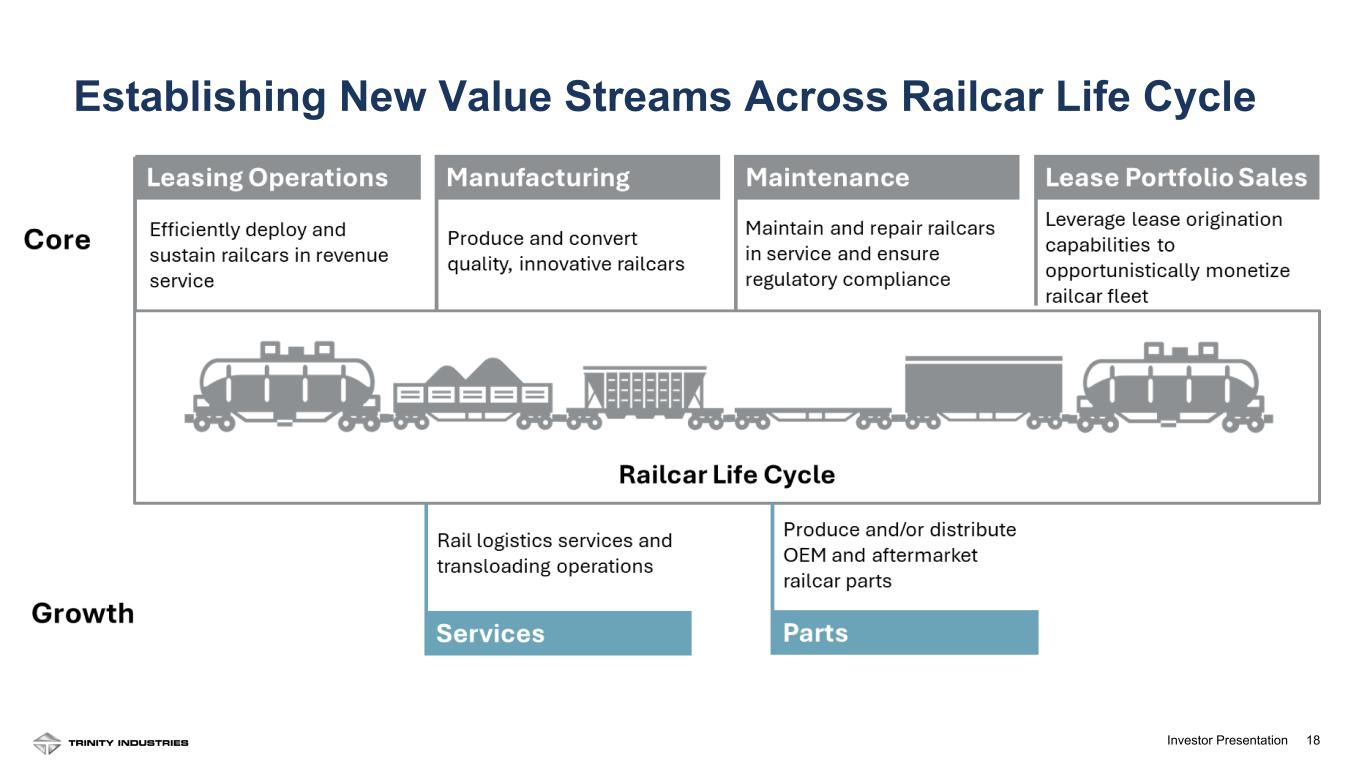
Trinity Industries, Inc., headquartered in Dallas, Texas, owns businesses that are leading providers of rail transportation products and services in North America. Our businesses market their railcar products and services under the trade name TrinityRail®. Our platform also includes the brands of RSI Logistics, a provider of software and logistics solutions, and Holden America, a supplier of railcar parts and components. Our platform provides railcar leasing and management services; railcar manufacturing; railcar maintenance and modifications; and other railcar logistics products and services. Trinity reports its financial results in two reportable business segments: (1) Railcar Leasing and Services Group and (2) Rail Products Group. For more information, visit: www.trin.net.
Some statements in this release, which are not historical facts, are “forward-looking statements” as defined by the Private Securities Litigation Reform Act of 1995. Forward-looking statements include statements about Trinity's estimates, expectations, beliefs, intentions or strategies for the future, and the assumptions underlying these forward-looking statements, including, but not limited to, future financial and operating performance, future opportunities and any other statements regarding events or developments that Trinity believes or anticipates will or may occur in the future, including the impacts of a potential shutdown, or partial shutdown, of the U.S. government. Trinity uses the words “anticipates,” “assumes,” “believes,” “estimates,” “expects,” “intends,” “forecasts,” “may,” “will,” “should,” “guidance,” “projected,” “outlook,” and similar expressions to identify these forward-looking statements. Forward-looking statements speak only as of the date of this release, and Trinity expressly disclaims any obligation or undertaking to disseminate any updates or revisions to any forward-looking statement contained herein to reflect any change in Trinity’s expectations with regard thereto or any change in events, conditions or circumstances on which any such statement is based, except as required by federal securities laws. Forward-looking statements involve risks and uncertainties that could cause actual results to differ materially from historical experience or our present expectations, including but not limited to risks and uncertainties regarding economic, competitive, governmental, and technological factors affecting Trinity’s operations, markets, products, services and prices, and such forward-looking statements are not guarantees of future performance. For a discussion of such risks and uncertainties, which could cause actual results to differ from those contained in the forward-looking statements, see “Risk Factors” and “Forward-Looking Statements” in Trinity’s Annual Report on Form 10-K for the most recent fiscal year, as may be revised and updated by Trinity’s Quarterly Reports on Form 10-Q, and Trinity’s Current Reports on Form 8-K.
| | |
| Investor Contact: |
| Leigh Anne Mann |
| Vice President, Investor Relations |
| Trinity Industries, Inc. |
| (Investors) 214/631-4420 |
|
| Media Contact: |
| Jack L. Todd |
| Vice President, Public Affairs |
| Trinity Industries, Inc. |
| (Media Line) 214/589-8909 |
- TABLES TO FOLLOW -
Trinity Industries, Inc.
Condensed Consolidated Statements of Operations
(in millions, except per share amounts)
(unaudited)
| | | | | | | | | | | | | | | | | | | | | | | |
| Three Months Ended
December 31, | | Year Ended
December 31, |
| 2025 | | 2024 | | 2025 | | 2024 |
| Revenues | $ | 611.2 | | | $ | 629.4 | | | $ | 2,156.9 | | | $ | 3,079.2 | |
| Operating costs: | | | | | | | |
| Cost of revenues | 455.5 | | | 474.4 | | | 1,584.2 | | | 2,411.0 | |
| Selling, engineering, and administrative expenses | 69.7 | | | 61.6 | | | 214.3 | | | 235.7 | |
| Gains (losses) on dispositions of property and other divestitures: | | | | | | | |
| Lease portfolio sales | 56.0 | | | 21.1 | | | 91.4 | | | 57.3 | |
| Gain on divestiture of partially-owned leasing subsidiary | 194.2 | | | — | | | 194.2 | | | — | |
| Other | (0.8) | | | 1.8 | | | 5.2 | | | 6.0 | |
| | | | | | | |
| Restructuring activities, net | — | | | 4.3 | | | — | | | 4.3 | |
| 275.8 | | | 517.4 | | | 1,507.7 | | | 2,587.7 | |
| Operating profit | 335.4 | | | 112.0 | | | 649.2 | | | 491.5 | |
| Interest expense, net | 70.6 | | | 66.9 | | | 274.2 | | | 273.5 | |
| | | | | | | |
| Other, net | — | | | (2.4) | | | (0.4) | | | (3.8) | |
| Income from continuing operations before income taxes | 264.8 | | | 47.5 | | | 375.4 | | | 221.8 | |
| Provision (benefit) for income taxes: | | | | | | | |
| Current | 4.8 | | | 27.3 | | | 13.4 | | | 72.5 | |
| Deferred | 63.5 | | | (20.6) | | | 77.5 | | | (22.1) | |
| 68.3 | | | 6.7 | | | 90.9 | | | 50.4 | |
| Income from continuing operations | 196.5 | | | 40.8 | | | 284.5 | | | 171.4 | |
| Loss from discontinued operations, net of income taxes | (2.3) | | | (3.0) | | | (7.2) | | | (14.3) | |
| | | | | | | |
| Net income | 194.2 | | | 37.8 | | | 277.3 | | | 157.1 | |
| Net income attributable to noncontrolling interest | 7.6 | | | 8.9 | | | 24.2 | | | 18.7 | |
| Net income attributable to Trinity Industries, Inc. | $ | 186.6 | | | $ | 28.9 | | | $ | 253.1 | | | $ | 138.4 | |
| | | | | | | |
| Basic earnings per common share: | | | | | | | |
| Income from continuing operations | $ | 2.36 | | | $ | 0.39 | | | $ | 3.22 | | | $ | 1.86 | |
| Loss from discontinued operations | (0.03) | | | (0.04) | | | (0.09) | | | (0.17) | |
| Net income attributable to Trinity Industries, Inc. | $ | 2.34 | | | $ | 0.35 | | | $ | 3.13 | | | $ | 1.69 | |
| Diluted earnings per common share: | | | | | | | |
| Income from continuing operations | $ | 2.31 | | | $ | 0.38 | | | $ | 3.14 | | | $ | 1.81 | |
| Loss from discontinued operations | (0.03) | | | (0.04) | | | (0.09) | | | (0.17) | |
| Net income attributable to Trinity Industries, Inc. | $ | 2.28 | | | $ | 0.34 | | | $ | 3.05 | | | $ | 1.64 | |
| Weighted average number of shares outstanding: | | | | | | | |
| Basic | 79.9 | | | 81.9 | | | 80.8 | | | 81.9 | |
| Diluted | 81.8 | | | 84.5 | | | 82.9 | | | 84.2 | |
Note: Earnings per common share is calculated independently for each component and may not sum to total net income attributable to Trinity Industries, Inc. per common share due to rounding.
Trinity has certain unvested restricted stock awards that participate in dividends on a nonforfeitable basis and are therefore considered to be participating securities. Consequently, diluted net income attributable to Trinity Industries, Inc. per common share is calculated under both the two-class method and the treasury stock method, and the more dilutive of the two calculations is presented.
Trinity Industries, Inc.
Condensed Consolidated Balance Sheets
(in millions)
(unaudited)
| | | | | | | | | | | |
| December 31, 2025 | | December 31, 2024 |
| ASSETS | | | |
| Cash and cash equivalents | $ | 201.3 | | | $ | 228.2 | |
| Receivables, net of allowance | 389.1 | | | 379.1 | |
| Income tax receivable | 27.5 | | | 2.4 | |
| Inventories | 469.1 | | | 476.2 | |
| Restricted cash | 122.3 | | | 146.2 | |
| Property, plant, and equipment, net: | | | |
| Railcars in our lease fleet: | | | |
| Wholly-owned subsidiaries | 6,512.4 | | | 5,948.1 | |
| Partially-owned subsidiaries | 372.2 | | | 1,416.0 | |
| Deferred profit on railcar products sold | (628.6) | | | (732.5) | |
| Operating and administrative assets | 365.3 | | | 356.5 | |
| 6,621.3 | | | 6,988.1 | |
| Goodwill | 221.5 | | | 221.5 | |
| | | |
| Other assets | 372.3 | | | 390.5 | |
| Total assets | $ | 8,424.4 | | | $ | 8,832.2 | |
| | | |
| LIABILITIES AND STOCKHOLDERS' EQUITY | | | |
| Accounts payable | $ | 269.6 | | | $ | 251.7 | |
| Accrued liabilities | 301.2 | | | 353.0 | |
| Debt: | | | |
| Recourse | 598.5 | | | 597.8 | |
| Non-recourse: | | | |
| Wholly-owned subsidiaries | 4,573.4 | | | 4,021.3 | |
| Partially-owned subsidiaries | 270.6 | | | 1,071.8 | |
| 5,442.5 | | | 5,690.9 | |
| Deferred income taxes | 1,129.0 | | | 1,075.6 | |
| | | |
| Other liabilities | 136.8 | | | 153.8 | |
| Stockholders' equity: | | | |
| Trinity Industries, Inc. | 1,077.2 | | | 1,058.9 | |
| Noncontrolling interest | 68.1 | | | 248.3 | |
| 1,145.3 | | | 1,307.2 | |
| Total liabilities and stockholders' equity | $ | 8,424.4 | | | $ | 8,832.2 | |
Trinity Industries, Inc.
Condensed Consolidated Statements of Cash Flows
(in millions)
(unaudited)
| | | | | | | | | | | |
| Year Ended
December 31, |
| 2025 | | 2024 |
| Operating activities: | | | |
| Net cash provided by operating activities – continuing operations | $ | 366.9 | | | $ | 588.1 | |
| Net cash used in operating activities – discontinued operations | (7.2) | | | (14.3) | |
| Net cash provided by operating activities | 359.7 | | | 573.8 | |
| | | |
| Investing activities: | | | |
| Capital expenditures – lease fleet | (749.3) | | | (541.9) | |
| Proceeds from lease portfolio sales | 399.3 | | | 360.7 | |
| Capital expenditures – operating and administrative | (45.6) | | | (53.8) | |
| | | |
| Other investing activities | 10.0 | | | 20.4 | |
| | | |
| | | |
| | | |
| Net cash used in investing activities | (385.6) | | | (214.6) | |
| | | |
| Financing activities: | | | |
| Net proceeds from (repayments of) debt | 180.0 | | | (80.1) | |
| Shares repurchased | (71.3) | | | (20.7) | |
| Dividends paid to common shareholders | (98.7) | | | (93.2) | |
| Other financing activities | (34.9) | | | (25.9) | |
| | | |
| | | |
| Net cash used in financing activities | (24.9) | | | (219.9) | |
| Net increase (decrease) in cash, cash equivalents, and restricted cash | (50.8) | | | 139.3 | |
| Cash, cash equivalents, and restricted cash at beginning of period | 374.4 | | | 235.1 | |
| Cash, cash equivalents, and restricted cash at end of period | $ | 323.6 | | | $ | 374.4 | |
Trinity Industries, Inc.
Reconciliations of Non-GAAP Measures
($ in millions, except per share amounts and percentages)
(unaudited)
Adjusted Operating Results
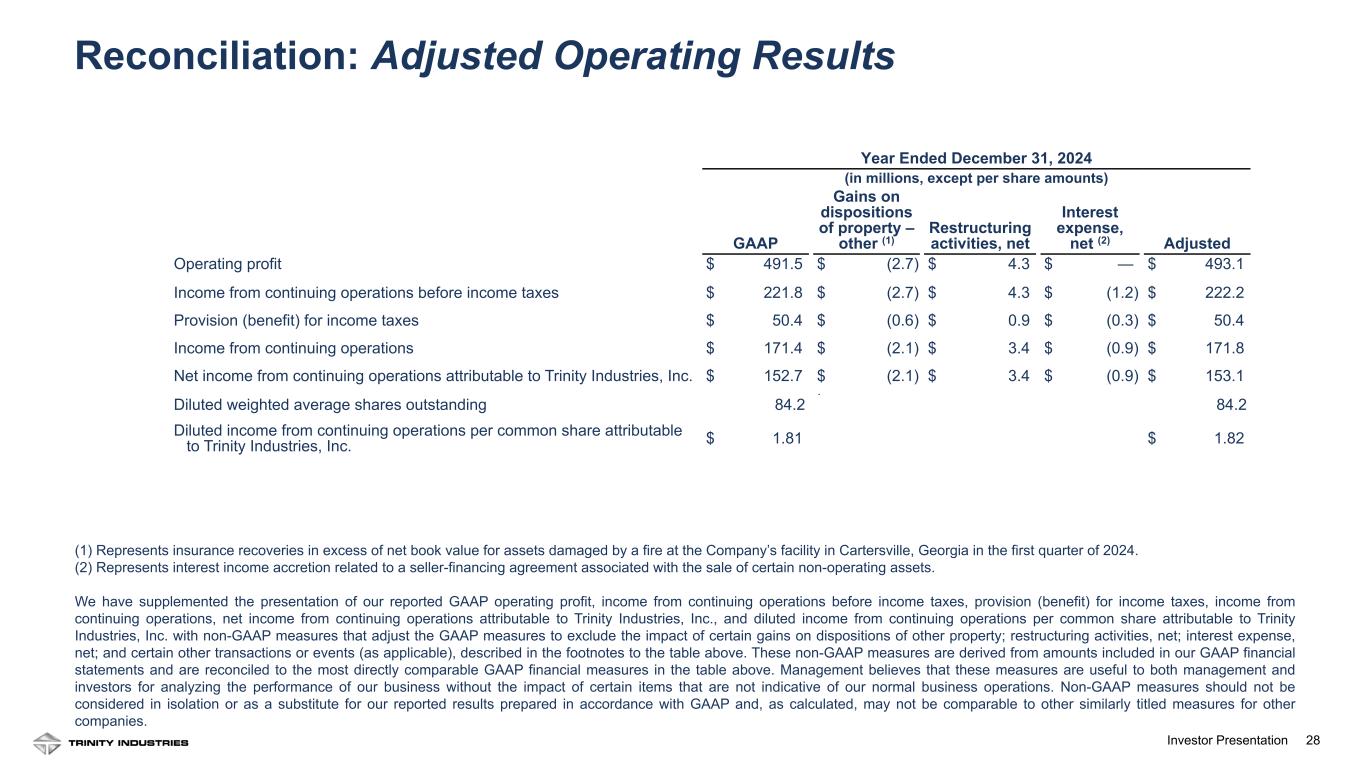
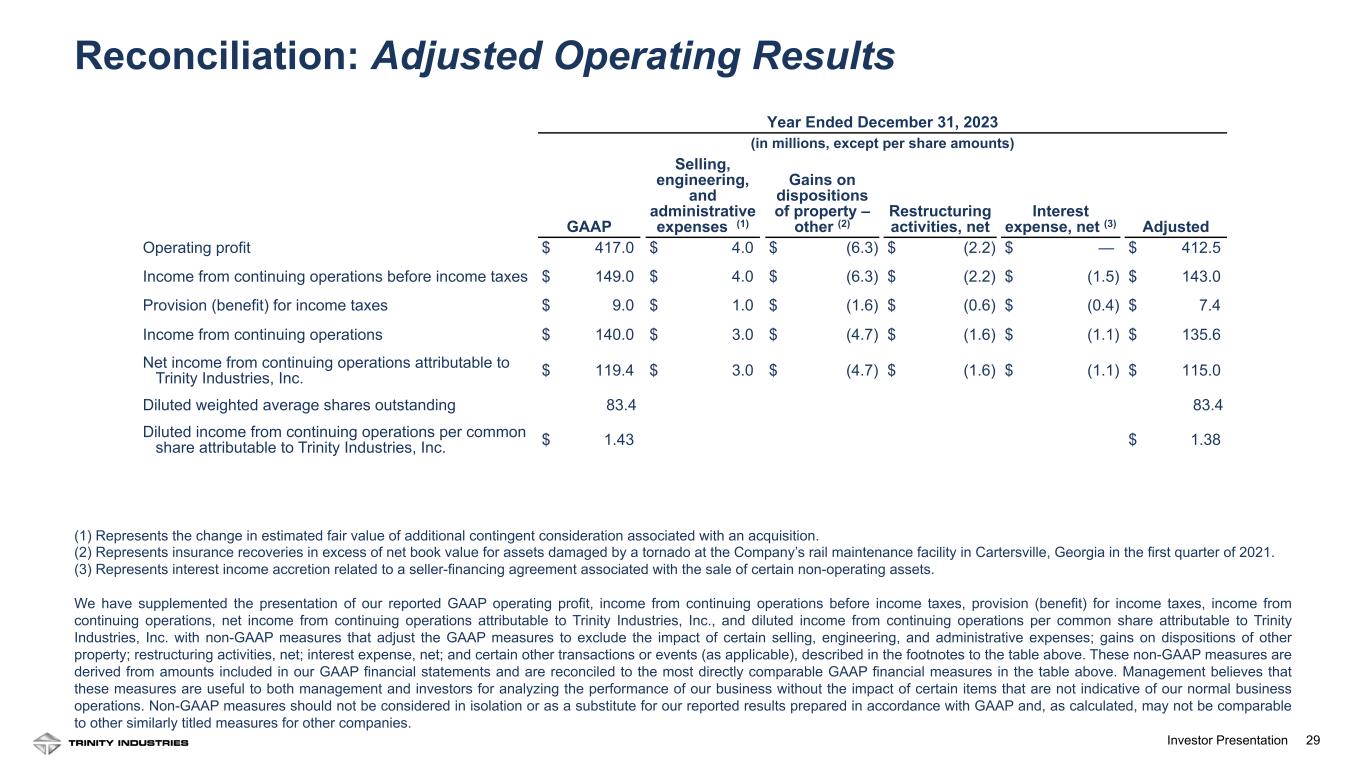
We have supplemented the presentation of our reported GAAP operating profit, income from continuing operations before income taxes, provision (benefit) for income taxes, income from continuing operations, net income from continuing operations attributable to Trinity Industries, Inc., and diluted income from continuing operations per common share attributable to Trinity Industries, Inc. with non-GAAP measures that adjust the GAAP measures to exclude the impact of certain gains on dispositions of other property; restructuring activities, net; interest expense, net; and certain other transactions or events (as applicable), described in the footnotes to the tables below. These non-GAAP measures are derived from amounts included in our GAAP financial statements and are reconciled to the most directly comparable GAAP financial measures in the tables below. Management believes that these measures are useful to both management and investors for analyzing the performance of our business without the impact of certain items that are not indicative of our normal business operations. Non-GAAP measures should not be considered in isolation or as a substitute for our reported results prepared in accordance with GAAP and, as calculated, may not be comparable to other similarly titled measures for other companies.
| | | | | | | | | | | | | | | | | | | | | | | | | | | |
| Three Months Ended December 31, 2024 |
| GAAP | | | | Gains on dispositions of property – other (1) | | Restructuring activities, net | | | | Adjusted |
| Operating profit | $ | 112.0 | | | | | $ | (2.7) | | | $ | 4.3 | | | | | $ | 113.6 | |
| | | | | | | | | | | |
| Income from continuing operations before income taxes | $ | 47.5 | | | | | $ | (2.7) | | | $ | 4.3 | | | | | $ | 49.1 | |
| | | | | | | | | | | |
| Provision (benefit) for income taxes | $ | 6.7 | | | | | $ | (0.6) | | | $ | 0.9 | | | | | $ | 7.0 | |
| | | | | | | | | | | |
| Income from continuing operations | $ | 40.8 | | | | | $ | (2.1) | | | $ | 3.4 | | | | | $ | 42.1 | |
| | | | | | | | | | | |
| Net income from continuing operations attributable to Trinity Industries, Inc. | $ | 31.9 | | | | | $ | (2.1) | | | $ | 3.4 | | | | | $ | 33.2 | |
| | | | | | | | | | | |
| Diluted weighted average shares outstanding | 84.5 | | | | | | | | | | 84.5 |
| | | | | | | | | | | |
| Diluted income from continuing operations per common share attributable to Trinity Industries, Inc. | $ | 0.38 | | | | | | | | | | | $ | 0.39 | |
| | | | | | | | | | | | | | | | | | | | | | | | | | | | | | | | | | | |
| Year Ended December 31, 2024 |
| GAAP | | | | Gains on dispositions of property – other (1) | | Restructuring activities, net | | | | | | Interest expense, net (2) | | Adjusted |
| Operating profit | $ | 491.5 | | | | | $ | (2.7) | | | $ | 4.3 | | | | | | | $ | — | | | $ | 493.1 | |
| | | | | | | | | | | | | | | |
| Income from continuing operations before income taxes | $ | 221.8 | | | | | $ | (2.7) | | | $ | 4.3 | | | | | | | $ | (1.2) | | | $ | 222.2 | |
| | | | | | | | | | | | | | | |
| Provision (benefit) for income taxes | $ | 50.4 | | | | | $ | (0.6) | | | $ | 0.9 | | | | | | | $ | (0.3) | | | $ | 50.4 | |
| | | | | | | | | | | | | | | |
| Income from continuing operations | $ | 171.4 | | | | | $ | (2.1) | | | $ | 3.4 | | | | | | | $ | (0.9) | | | $ | 171.8 | |
| | | | | | | | | | | | | | | |
| Net income from continuing operations attributable to Trinity Industries, Inc. | $ | 152.7 | | | | | $ | (2.1) | | | $ | 3.4 | | | | | | | $ | (0.9) | | | $ | 153.1 | |
| | | | | | | | | | | | | | | |
| Diluted weighted average shares outstanding | 84.2 | | | | | | | | | | | | | | 84.2 |
| | | | | | | | | | | | | | | |
| Diluted income from continuing operations per common share attributable to Trinity Industries, Inc. | $ | 1.81 | | | | | | | | | | | | | | | $ | 1.82 | |
(1) Represents insurance recoveries in excess of net book value for assets damaged by a fire at the Company’s facility in Cartersville, Georgia in the first quarter of 2024.
(2) Represents interest income accretion related to a seller-financing agreement associated with the sale of certain non-operating assets.
Adjusted Return on Equity
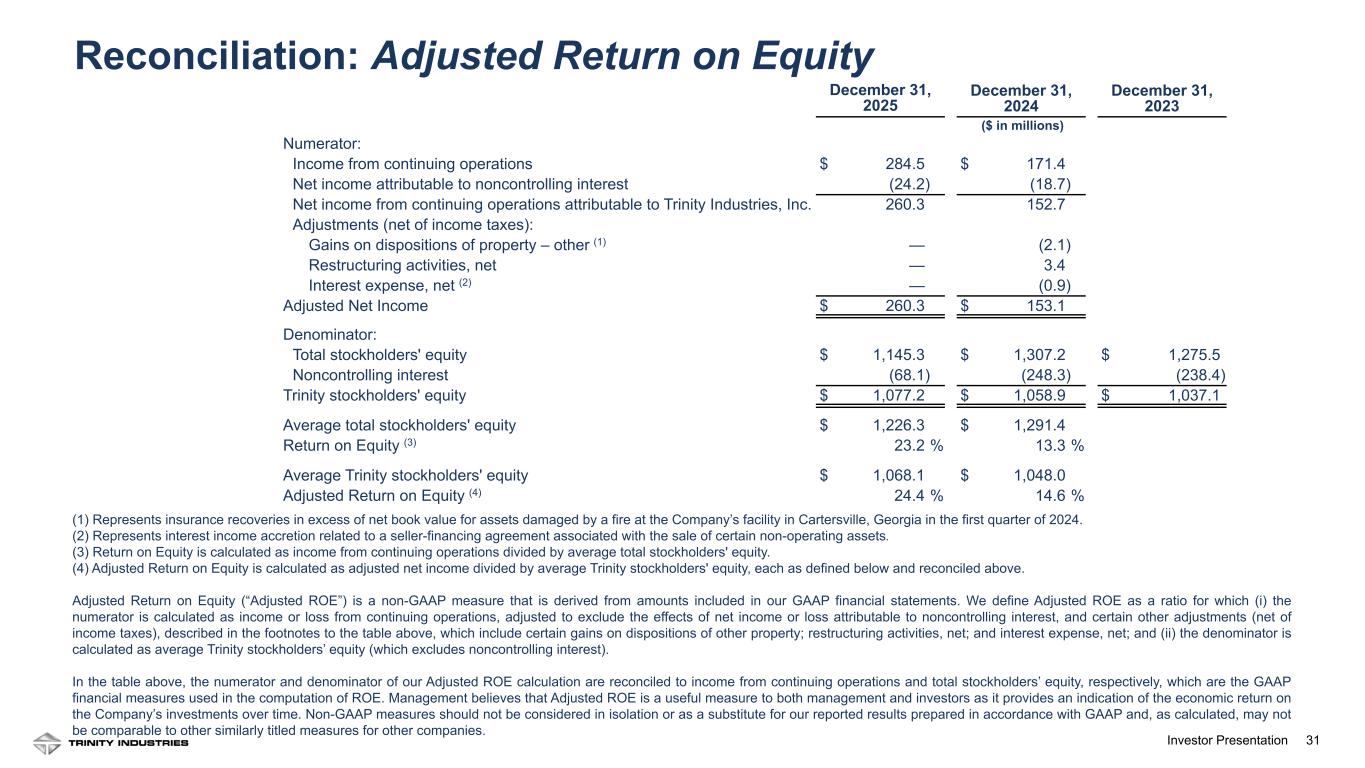
Adjusted Return on Equity (“Adjusted ROE”) is defined as a ratio for which (i) the numerator is calculated as income or loss from continuing operations, adjusted to exclude the effects of net income or loss attributable to noncontrolling interest, and certain other adjustments (net of income taxes), described in the footnotes to the table below, which include certain gains on dispositions of other property; restructuring activities, net; and interest expense, net; and (ii) the denominator is calculated as average Trinity stockholders’ equity (which excludes noncontrolling interest). In the following table, the numerator and denominator of our Adjusted ROE calculation are reconciled to income from continuing operations and total stockholders’ equity, respectively, which are the most directly comparable GAAP financial measures. Management believes that Adjusted ROE is a useful measure to both management and investors as it provides an indication of the economic return on the Company’s investments over time. Non-GAAP measures should not be considered in isolation or as a substitute for our reported results prepared in accordance with GAAP and, as calculated, may not be comparable to other similarly titled measures for other companies.
| | | | | | | | | | | | | | | | | |
| December 31, 2025 | | December 31, 2024 | | December 31, 2023 |
| ($ in millions) |
| Numerator: | | | | | |
| Income from continuing operations | $ | 284.5 | | | $ | 171.4 | | | |
| Net income attributable to noncontrolling interest | (24.2) | | | (18.7) | | | |
| Net income from continuing operations attributable to Trinity Industries, Inc. | 260.3 | | | 152.7 | | | |
| Adjustments (net of income taxes): | | | | | |
| | | | | |
Gains on dispositions of property – other (1) | — | | | (2.1) | | | |
| Restructuring activities, net | — | | | 3.4 | | | |
Interest expense, net (2) | — | | | (0.9) | | | |
| Adjusted Net Income | $ | 260.3 | | | $ | 153.1 | | | |
| | | | | |
| Denominator: | | | | | |
| Total stockholders' equity | $ | 1,145.3 | | | $ | 1,307.2 | | | $ | 1,275.5 | |
| Noncontrolling interest | (68.1) | | | (248.3) | | | (238.4) | |
| Trinity stockholders' equity | $ | 1,077.2 | | | $ | 1,058.9 | | | $ | 1,037.1 | |
| | | | | |
| Average total stockholders' equity | $ | 1,226.3 | | | $ | 1,291.4 | | | |
Return on Equity (3) | 23.2 | % | | 13.3 | % | | |
| | | | | |
| Average Trinity stockholders' equity | $ | 1,068.1 | | | $ | 1,048.0 | | | |
Adjusted Return on Equity (4) | 24.4 | % | | 14.6 | % | | |
(1) Represents insurance recoveries in excess of net book value for assets damaged by a fire at the Company’s facility in Cartersville, Georgia in the first quarter of 2024.
(2) Represents interest income accretion related to a seller-financing agreement associated with the sale of certain non-operating assets.
(3) Return on Equity is calculated as income from continuing operations divided by average total stockholders' equity.
(4) Adjusted Return on Equity is calculated as adjusted net income divided by average Trinity stockholders' equity, each as defined and reconciled above.
Cash Flow from Operations with Net Gains on Lease Portfolio Sales
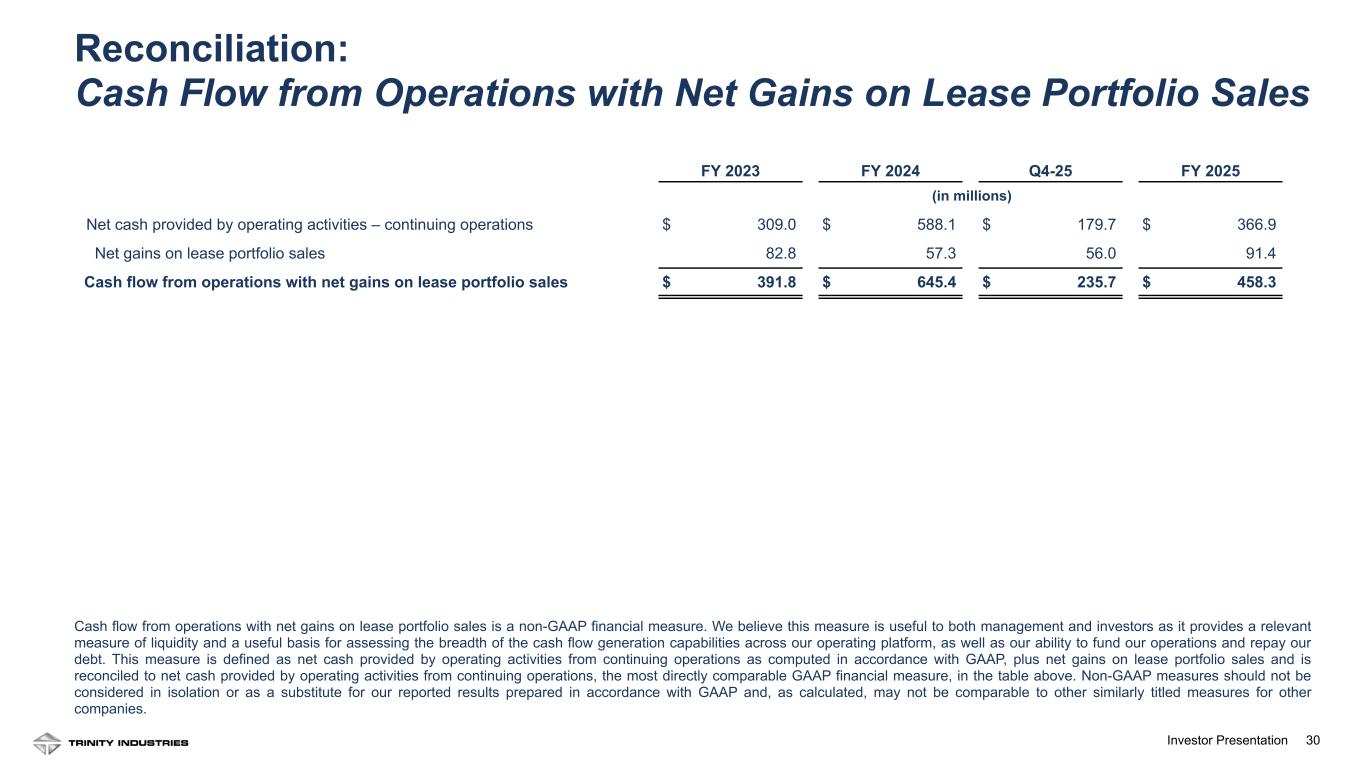
Cash flow from operations with net gains on lease portfolio sales is a non-GAAP financial measure. We believe this measure is useful to both management and investors as it provides a relevant measure of liquidity and a useful basis for assessing the breadth of the cash flow generation capabilities across our operating platform, as well as our ability to fund our operations and repay our debt. This measure is defined as net cash provided by operating activities from continuing operations as computed in accordance with GAAP, plus net gains on lease portfolio sales and is reconciled to net cash provided by operating activities from continuing operations, the most directly comparable GAAP financial measure, in the following table. Non-GAAP measures should not be considered in isolation or as a substitute for our reported results prepared in accordance with GAAP and, as calculated, may not be comparable to other similarly titled measures for other companies.
| | | | | | | | | | | |
| Year Ended
December 31, |
| 2025 | | 2024 |
| Net cash provided by operating activities – continuing operations | $ | 366.9 | | | $ | 588.1 | |
| Net gains on lease portfolio sales | 91.4 | | | 57.3 | |
Cash flow from operations with net gains on lease portfolio sales | $ | 458.3 | | | $ | 645.4 | |
EBITDA and Adjusted EBITDA
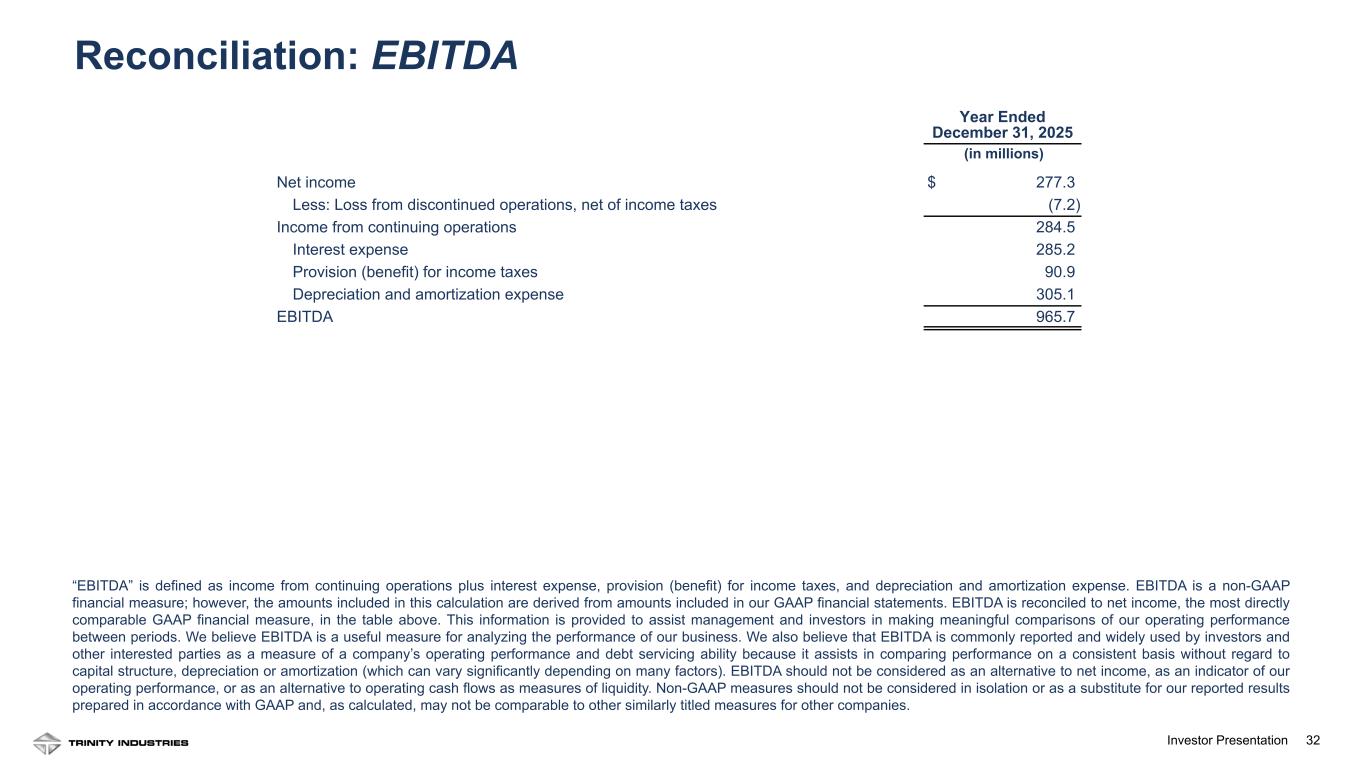
“EBITDA” is defined as income from continuing operations plus interest expense, provision (benefit) for income taxes, and depreciation and amortization expense. Adjusted EBITDA is defined as EBITDA plus certain gains on dispositions of other property; restructuring activities, net; and interest income. EBITDA and Adjusted EBITDA are non-GAAP financial measures; however, the amounts included in these calculations are derived from amounts included in our GAAP financial statements. EBITDA and Adjusted EBITDA are reconciled to net income, the most directly comparable GAAP financial measure, in the following table. This information is provided to assist management and investors in making meaningful comparisons of our operating performance between periods. We believe EBITDA is a useful measure for analyzing the performance of our business. We also believe that EBITDA is commonly reported and widely used by investors and other interested parties as a measure of a company’s operating performance and debt servicing ability because it assists in comparing performance on a consistent basis without regard to capital structure, depreciation or amortization (which can vary significantly depending on many factors). EBITDA and Adjusted EBITDA should not be considered as alternatives to net income, as indicators of our operating performance, or as alternatives to operating cash flows as measures of liquidity. Non-GAAP measures should not be considered in isolation or as a substitute for our reported results prepared in accordance with GAAP and, as calculated, may not be comparable to other similarly titled measures for other companies.
| | | | | | | | | | | | | | | | | | | | | | | |
| Three Months Ended
December 31, | | Year Ended
December 31, |
| 2025 | | 2024 | | 2025 | | 2024 |
| Net income | $ | 194.2 | | | $ | 37.8 | | | $ | 277.3 | | | $ | 157.1 | |
| Less: Loss from discontinued operations, net of income taxes | (2.3) | | | (3.0) | | | (7.2) | | | (14.3) | |
| | | | | | | |
| Income from continuing operations | 196.5 | | | 40.8 | | | 284.5 | | | 171.4 | |
| Interest expense | 73.6 | | | 70.0 | | | 285.2 | | | 288.5 | |
| Provision (benefit) for income taxes | 68.3 | | | 6.7 | | | 90.9 | | | 50.4 | |
| Depreciation and amortization expense | 78.7 | | | 73.6 | | | 305.1 | | | 293.8 | |
EBITDA | 417.1 | | | 191.1 | | | 965.7 | | | 804.1 | |
| | | | | | | |
| Gains on dispositions of property – other | — | | | (2.7) | | | — | | | (2.7) | |
| | | | | | | |
| Restructuring activities, net | — | | | 4.3 | | | — | | | 4.3 | |
| Interest income | — | | | — | | | — | | | (1.2) | |
| | | | | | | |
| Adjusted EBITDA | $ | 417.1 | | | $ | 192.7 | | | $ | 965.7 | | | $ | 804.5 | |
Exhibit 99.2
Trinity Industries, Inc.
Earnings Release Conference Call – Q4 2025
February 12, 2026
Leigh Anne Mann
Vice President, Investor Relations
Thank you, operator. Good morning everyone. We appreciate you joining us for the Company’s fourth quarter and full year 2025 financial results conference call.
Our prepared remarks will include comments from Jean Savage, Trinity’s Chief Executive Officer and President, and Eric Marchetto, the Company’s Chief Financial Officer. We will hold a Q&A session following the prepared remarks from our leaders.
During the call today, we will reference certain non-GAAP financial metrics. The reconciliations of the non-GAAP metrics to comparable GAAP measures are provided in the appendix of the quarterly investor slides, which are accessible on our investor relations website at www.trin.net. These slides are under the Events and Presentations portion of the website, along with the Fourth Quarter Earnings Conference Call event link.
A replay of today’s call will be available after 10:30 a.m. Eastern time through midnight on February 19th, 2026. Replay information is available under the Events and Presentations page on our Investor Relations website.
It is now my pleasure to turn the call over to Jean.
E. Jean Savage
Chief Executive Officer and President
Thank you, Leigh Anne, and good morning everyone. Our 2025 results demonstrate the durability of Trinity’s business model and the effectiveness of our strategy across the cycle. We are intentionally structured to generate resilient earnings, strong cash flow, and attractive returns in a wide range of market conditions, and this year’s performance reinforces that positioning.
For the full year, we delivered earnings per share of $3.14, representing a 73% year over year increase, and achieved an Adjusted Return on Equity of 24.4%, up 67% from the prior year. These results reflect the strength of our leasing platform, disciplined execution in the secondary market, resilient manufacturing performance in a low volume environment, and a significant year-end transaction that not only enhanced earnings but also highlighted the substantial embedded value of the railcar assets on our balance sheet.
Looking ahead to 2026, we are introducing an EPS guidance range of $1.85 to $2.10. Our guidance reflects confidence in the durability of our earnings and the visibility of our leasing cash flows. Lease rates continue to trend higher, supported by healthy demand, even as the pace of growth moderates in certain railcar categories. The buying and selling of railcars is a key value driver of Trinity’s business model.
We expect industry deliveries of approximately 25,000 railcars in 2026, well below replacement levels, but reflective of current industry backlogs. Importantly, despite lower delivery volumes, we expect solid operating margins, driven by disciplined execution and the realization of the cost actions we have implemented. Eric will walk through our expectations for 2026 in more detail shortly.
I’ll begin with a brief market overview, followed by a closer look at our fourth quarter and full year performance.
Market Update
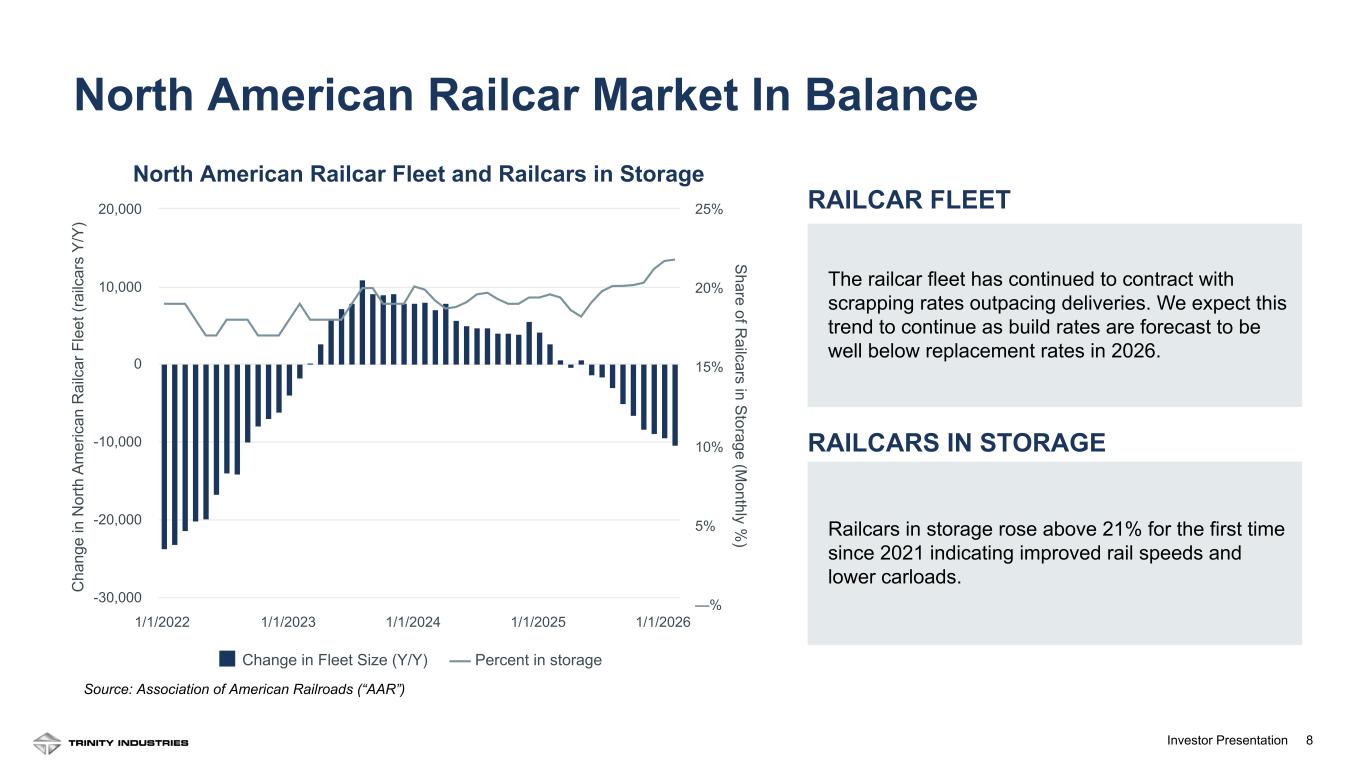
The North American railcar fleet continued to rationalize in 2025 with retirements exceeding new deliveries, resulting in a net fleet contraction. In 2025, approximately 31,000 railcars were delivered, while more than 38,000 older cars were retired. At the same time, rail network fluidity has shown meaningful and sustained improvements. As efficiency has improved, railcars in storage rose above 21% for the first time since 2021, reflecting faster cycle times and a normalization of carload demand.
While our 2026 delivery expectations are muted, we are optimistic about the pickup we have seen in inquiry levels and orders in the fourth quarter. We remain disciplined in our order intake while maintaining readiness to respond as demand strengthens.
In 2026, Agriculture, Energy, and non-residential Construction end markets are showing strength. Headwinds remain in key Consumer and Chemical markets, like automobiles and chlor-alkalis.
Segment Performance
I will now highlight segment performance for the quarter, beginning with the Railcar Leasing and Services segment, which includes leasing, maintenance, and digital and logistics services.
Leasing and Services
The Leasing and Services business remains the foundation of Trinity’s earnings stability. Full year revenues increased 5.5% year over year, driven by higher lease rates and net fleet growth. Net lease fleet investment totaled $350 million at the high end of our guidance range, and we used the
secondary market effectively as both a buyer and a seller to strategically grow and strengthen the composition of our lease fleet.
Segment operating profit increased 53% year over year, supported by the railcar partnership restructuring we completed with Napier Park in December, recording a $194 million non-cash gain in the segment. Additionally, we recorded $56 million in gains on railcar sales in the fourth quarter, resulting in a full year gain of $91 million.
Fleet utilization remained strong at 97.1% with renewal success of 73% in the fourth quarter. While the Future Lease Rate Differential, or FLRD, moderated to 6.0% as renewal growth normalized, renewing rates were 27% higher than expiring rates. We believe there is still significant room for lease rate expansion and remain very positive about this business.
Eric will walk through the financial impacts of our recently completed railcar partnership restructuring, but I did want to highlight the change in fleet composition. The transaction simplified our ownership structure, resulting in approximately 17,100 railcars removed from the partially-owned railcar category. We assumed full ownership of 6,235 railcars. The remaining railcars moved from partially-owned to investor-owned, which will reduce reported revenue and operating profit, but this impact is largely offset by a corresponding reduction in minority interest. The restructuring simplified our ownership structure, increased transparency, and improved earnings, while maintaining economic value.
Rail Products
Rail Products delivered a full year operating margin of 5.2%, within guidance, despite deliveries declining 46%. Cost discipline, automation, and workforce actions enabled profitability in a low-volume environment. Additionally, the headcount rationalization decisions we made in 2025 have right-sized the organization for the current reality and allow us to maintain profitability. With an aging fleet and continued net retirements, we expect demand to return over time allowing meaningful margin expansion as volumes recover.
In the fourth quarter, we recorded a one-time credit loss related to a customer receivable within Rail Products. This charge was included in SE&A and reduced the Rail Products Group operating margin by 190 basis points for the quarter. This was an isolated incident and not reflective of ongoing performance.
Conclusion
Before I hand it over to Eric to provide more details on our 2025 financial performance and 2026 guidance, I want to reiterate that Trinity is designed to perform in a wide range of demand environments. Our results and guidance clearly demonstrate the actions we have taken over the last several years have led to a more durable platform. This includes integrating new technologies to optimize our business and lower the breakeven point. For example, we have been investing in AI as a core operating capability, not as a standalone technology initiative.
Working with partners like Palantir and Databricks, we’ve embedded AI directly into our manufacturing, logistics, and financial workflows.
Practically, that means we are using AI to identify and redeploy material that historically would have been scrapped, improving yield and protecting margin. We’ve also implemented an AI-enabled inquiry-to-delivery process, giving us end-to-end visibility and faster decision-making.
In logistics, AI-driven agents enhance our advanced shipping notices, improving accuracy and timeliness. We’ve extended those same models into accounts receivable, reducing disputes and accelerating collections.
The cumulative impact has been improved working capital, higher productivity, and more predictable execution across the enterprise. Importantly, these are not pilot programs—they are embedded in how we run the business today, and they continue to scale.
We are excited at the impact these initiatives are having on our business now and in the future. I’ll now turn the call over to Eric to talk through financial results and our guidance for 2026.
Eric R. Marchetto
Executive Vice President and Chief Financial Officer
Thank you, Jean, and good morning everyone. Before I talk through our financial statements, I want to take a moment to walk through our recent strategic railcar partnership restructuring and what it means for Trinity.
Prior to this transaction, approximately 23,000 railcars held in our TRIP and RIV partnership vehicles were partially-owned but fully consolidated on our balance sheet and carried at cost. As part of a new fund raised by Napier Park, we began simplifying the fleet structure. We took full ownership of the TRP 2021 fleet, approximately 6,235 railcars, and Napier Park assumed full ownership of the Triumph fleet, approximately 10,850 railcars. The transacted value of the Triumph fleet was significantly higher than our book value, which resulted in a $194 million non-cash gain on the disposition.
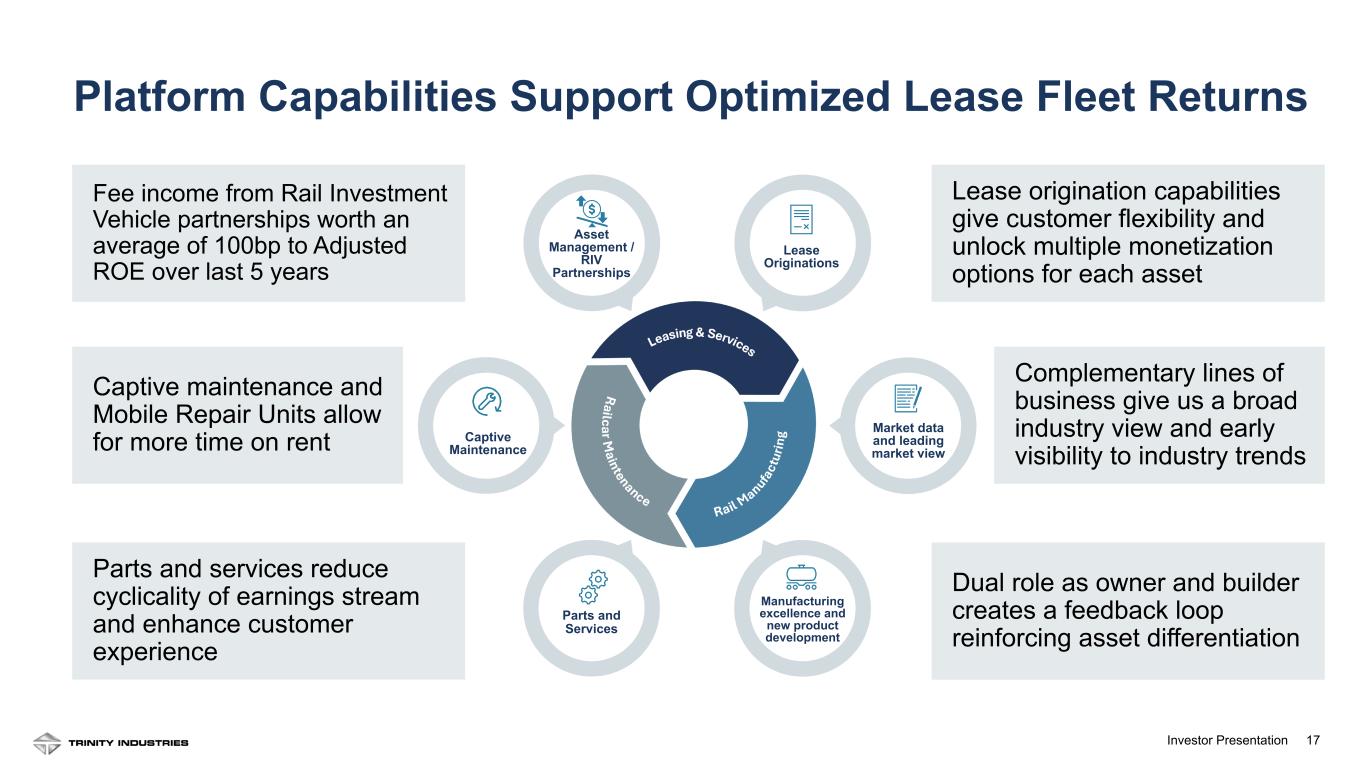
Our railcar leasing fleet now consists of 101,000 railcars on our balance sheet and 45,000 railcars under management as part of our Railcar Investment Vehicles, or “RIVs”. Our RIV Program provides servicing revenue of approximately $20 million per year, which is part of our leasing operations. The RIV Program also provides scale to our platform which enhances the unique view we have of the North American railcar market.
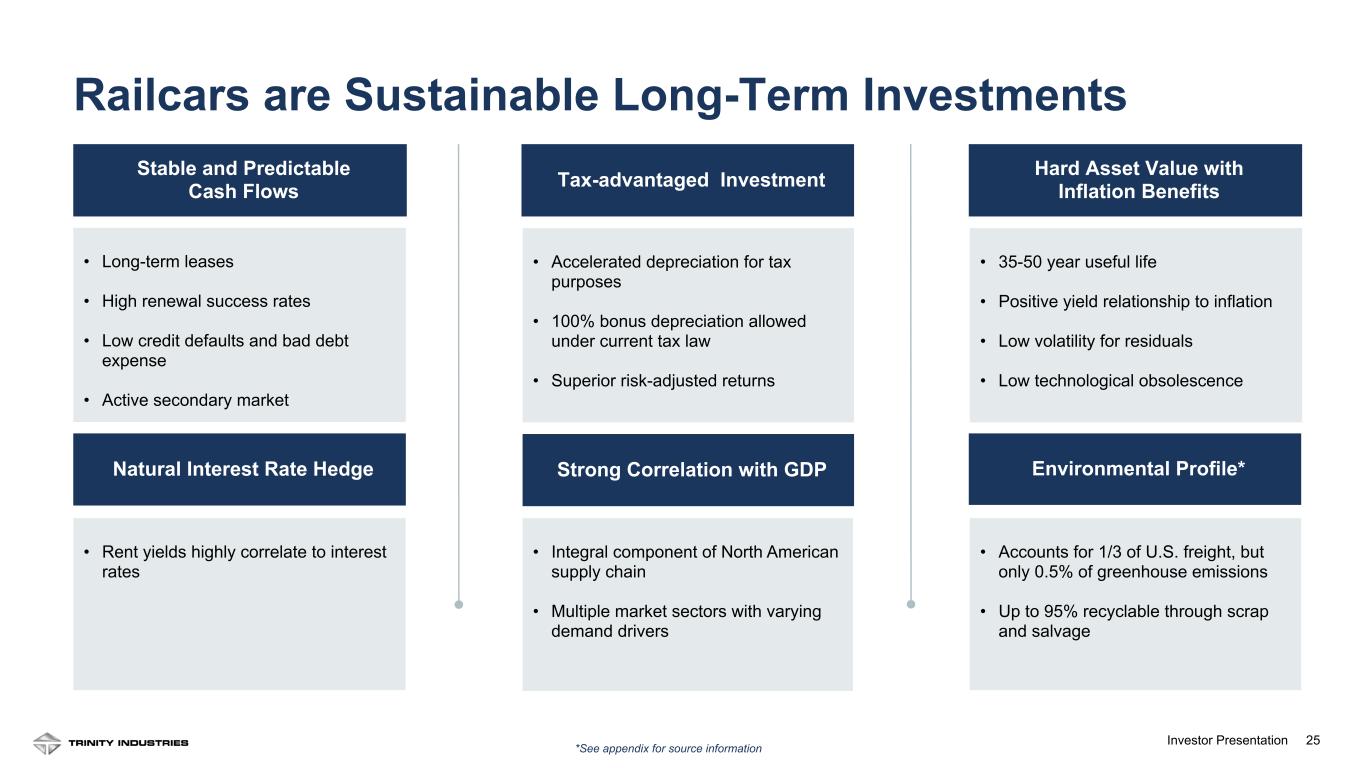
Furthermore, this railcar partnership transaction underscores the embedded value in our assets. We have over 101,000 railcars on our balance sheet carried at a cost of $6.3 billion. We estimate that the market value of these railcars would be approximately 35 to 45% higher than the carrying value, which demonstrates the estimated 3 to 4% annual appreciation we have seen in railcar values over the last 20 years. While lease rates have increased, they have not increased at the same pace as railcar asset appreciation. We can choose to generate value from our railcars over the long term by holding them in our fleet as lease rates continue to rise or by selling them. This gives us conviction in the long term returns of our business.
Income Statement
Moving to the income statement, we ended the year with fourth quarter revenue of $611 million and full year revenue of $2.2 billion. This is down year over year due to lower external railcar deliveries. Our fourth quarter earnings per share of $2.31 reflect a strong end to the year and an impact of approximately $1.50 from the fourth quarter railcar partnership restructuring. Full year EPS of $3.14 was up 73% year over year, in line with our guidance of $3.05 to $3.20. Before the impact of the railcar partnership restructuring, our 2025 performance was above the midpoint of our previous guidance.
Cash Flow Statement
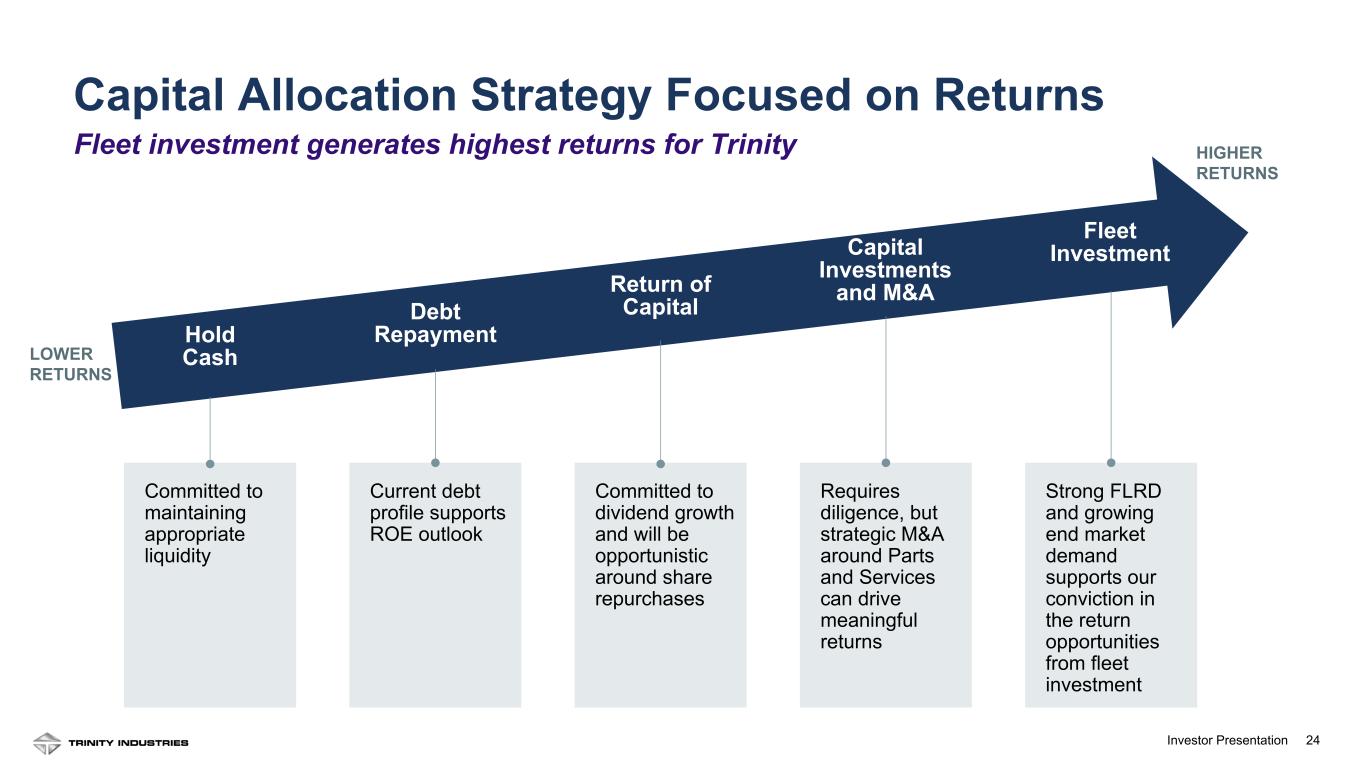
Moving to the cash flow statement, our full year cash flow from continuing operations was $367 million. Our full year net lease fleet investment was $350 million, at the top of our guidance range, reflecting our conviction in deploying capital into our own fleet. Additionally, we returned $170 million in 2025 to our shareholders through dividends paid and share repurchases. In December, we raised our quarterly dividend to $0.31 per share, marking seven consecutive years of dividend growth with an annualized growth rate of 9%. This reflects Trinity’s commitment to returning capital to shareholders.
Balance Sheet
We are ending the year with a strong balance sheet. We have liquidity of $1.1 billion through cash, revolver availability, and our warehouse. Our loan-to-value for the wholly-owned lease fleet is 70.2%. The increase in our LTV was the result of the debt restructuring we completed in October, as well as the addition of the TRP 2021 fleet to our wholly-owned fleet. We are very comfortable with the leverage on our fleet and are regularly refinancing our railcars as our debt amortizes to keep our debt in an appropriate range. Our balance sheet gives us the flexibility we need to effectively deploy capital and run our business.
Guidance
And now I’d like to talk about our expectations for 2026.
As Jean noted, we are expecting industry deliveries of about 25,000 railcars, and we expect to maintain our historical market share of those deliveries. Despite the lower level of new railcars, we expect to maintain a Rail Products Group segment operating margin of 5% to 6% for the full year.
We expect the secondary market to remain active and anticipate gains of $120 to $140 million in 2026. We see an opportunity to further simplify our fleet structure and contribute the remaining partially-owned railcars to our managed Napier Park fleet in the second quarter. While this transaction is not complete, we have included the anticipated gains in our full year guidance.
We expect Leasing and Services full year segment margins of 40% to 45%, including the impact of gains and any further railcar partnership restructuring activities. In addition to the gains, we expect higher lease rates to contribute to a higher operating margin, offset by higher fleet maintenance activity in 2026.
We expect a full year net lease fleet investment of $450 to $550 million, reflecting new lease originations, secondary market sales and purchases, and fleet modifications and sustainable conversions.
We expect operating and administrative capex of $55 to $65 million, which includes further investment in automation, technology, and modernization of facilities and processes.
We expect slightly lower SE&A costs in 2026. We expect a full year tax rate of approximately 25% to 27% for the full year.
And, finally, we expect a full year EPS of $1.85 to $2.10. We have made structural changes to our business over the last few years that have improved our profitability and returns throughout the economic cycle.
With our 2026 guidance, I would also like to close with an update on our three-year targets we set at our 2024 Investor Day. As you recall, we introduced three enterprise KPIs with targets over the 2024 to 2026 timeframe: (1) net lease fleet investment, (2) cash flow from operations with net gains on lease portfolio sales, and (3) Adjusted Return on Equity.
First, our three-year net lease fleet investment target was $750 million to $1 billion over the three years. To date, we have invested $531 million, and with our 2026 guidance, we will be at the top end of this range.
Second, our cash flow from operations with net gains on lease portfolio sales target was $1.2 billion to $1.4 billion over the period. To date, we have achieved $1.1 billion, and with current guidance, we expect to exceed this range. It is important to note this excludes non-cash gains.
Finally, we set an Adjusted ROE target of 12% to 15%. We ended 2024 with an Adjusted ROE of 14.6% and ended 2025 with an Adjusted ROE of 24.4%, averaging 19.5% over the first two years of the planning period.
These targets were introduced with the overall guidance of approximately 120,000 industry railcar deliveries over the period. Our current outlook reflects deliveries of approximately 100,000 units. Importantly, this demonstrates the strength and flexibility of our operating model. We have proactively aligned our business to match evolving market conditions while continuing to deliver on our financial commitments.
As Jean noted, our 2025 results underscore the strength and resilience of our platform and our ability to deliver attractive returns in a more challenging operating environment. As we look ahead to 2026, we remain highly confident in our trajectory. With disciplined execution, continued cost rationalization, and a flexible platform, we believe we are well positioned in the market. These strengths give us the foundation to navigate uncertainty and, more importantly, the capacity to generate meaningful, sustainable value for our shareholders over the long term.
Operator, we are now ready to take our first question.
E. Jean Savage
Chief Executive Officer and President
(after Q&A)
Thank you. Trinity is structurally stronger, more resilient, and better positioned today than prior cycles. We will remain disciplined and focused on continuing to drive improvements in our business. We are intentionally structured to generate resilient earnings and strong cash flow through disciplined lease pricing, active portfolio management, and balanced capital deployment.
Thank you for joining us on today’s earnings call.