As filed with the U.S. Securities and Exchange Commission on November 27, 2024.
Registration No. 333-282849
UNITED
STATES
SECURITIES AND EXCHANGE COMMISSION
Washington, D.C. 20549
AMENDMENT NO. 1
TO
FORM F-1
REGISTRATION STATEMENT
UNDER
THE SECURITIES ACT OF 1933
Uni-Fuels Holdings Limited
(Exact Name of Registrant as Specified in its Charter)
Not Applicable
(Translation of Registrant’s Name into English)
| Cayman Islands | 5172 | Not Applicable | ||
(State or other jurisdiction of incorporation or organization) |
(Primary Standard Industrial Classification Code Number) |
(I.R.S. Employer Identification No.) |
15 Beach Road, Beach Centre #05-07
Singapore
189677
+65 6027 1250
(Address, including zip code, and telephone number, including area code, of registrant’s principal executive offices)
COGENCY
GLOBAL INC.
122 East 42nd Street, 18th Floor
New York, NY 10168
+1-800-221-0102
(Name, address, including zip code, and telephone number, including area code, of agent for service)
Copies of all communications, including communications sent to agent for service, should be sent to:
Lawrence
S. Venick, Esq. 2206-19
Jardine House Hong
Kong SAR |
Richard I. Anslow, Esq. Jonathan Deblinger, Esq. Ellenoff Grossman & Schole LLP 1345 Avenue of the Americas New York, NY 10105 Telephone: (212) 370-1300 |
Approximate date of commencement of proposed sale to the public: As soon as practicable after this Registration Statement becomes effective.
If any of the securities being registered on this Form are to be offered on a delayed or continuous basis pursuant to Rule 415 under the Securities Act of 1933, check the following box: ☒
If this Form is filed to register additional securities for an offering pursuant to Rule 462(b) under the Securities Act, check the following box and list the Securities Act registration statement number of the earlier effective registration statement for the same offering. ☐
If this Form is a post-effective amendment filed pursuant to Rule 462(c) under the Securities Act, check the following box and list the Securities Act registration statement number of the earlier effective registration statement for the same offering. ☐
If this Form is a post-effective amendment filed pursuant to Rule 462(d) under the Securities Act, check the following box and list the Securities Act registration number of the earlier effective registration statement for the same offering. ☐
Emerging growth company. ☒
If an emerging growth company that prepares its financial statements in accordance with U.S. GAAP, indicate by check mark if the registrant has elected not to use the extended transition period for complying with any new or revised financial accounting standards provided pursuant to Section 7(a)(2)(B) of the Securities Act. ☐
The registrant hereby amends this registration statement on such date or dates as may be necessary to delay its effective date until the registrant shall file a further amendment which specifically states that this registration statement shall thereafter become effective in accordance with Section 8(a) of the Securities Act of 1933, as amended, or until the registration statement shall become effective on such date as the U.S. Securities and Exchange Commission, acting pursuant to said Section 8(a), may determine.
The information in this preliminary prospectus is not complete and may be changed. These securities may not be sold until the registration statement filed with the Securities and Exchange Commission is effective. This preliminary prospectus is not an offer to sell these securities nor does it seek an offer to buy these securities in any jurisdiction where the offer or sale is not permitted.
PRELIMINARY PROSPECTUS (SUBJECT TO COMPLETION) DATED NOVEMBER 27, 2024 |
Uni-Fuels Holdings Limited
2,100,000 Class A Ordinary Shares
This is the initial public offering of Uni-Fuels Holdings Limited. Prior to this offering, there has been no public market for our Class A Ordinary Shares. It is currently estimated that the initial public offering price per share will be $4.00. We have applied to list our Class A Ordinary Shares on the Nasdaq Capital Market under the symbol “UFG.”
Immediately after this offering, assuming an offering size as set forth above, Koh Kuan Hua will, through his wholly owned entity Garden City Private Capital Limited, own approximately 70.56% of our outstanding shares (or 69.88% of our outstanding shares if the underwriters option to purchase additional shares is exercised in full). As a result, we expect to be a “controlled company” within the meaning of rule 5615(c) of Nasdaq Stock Market LLC (“Nasdaq Listing Rules”). For so long as we remain a “controlled company,” we are permitted to elect not to comply with certain corporate governance requirements. If we rely on these exemptions, you will not have the same protection afforded to shareholders of companies that are subject to these corporate governance requirements. Although we currently do not intend to rely on the “controlled company” exemption under the Nasdaq listing rules, we could elect to rely on this exemption after we complete this offering. See section titled “Prospectus Summary — Implications of Being a Controlled Company”.
The share capital of the Company consists of two classes of ordinary shares, Class A Ordinary Shares and Class B Ordinary Shares. We will issue 2,100,000 Class A Ordinary Shares in this offering. The rights of the holders of Class A Ordinary Shares and Class B Ordinary Shares are identical, except with respect to voting and conversion rights. Each Class B Ordinary Share has ten votes per share and is convertible into one Class A Ordinary Share, whereas our Class A Ordinary Shares, which we are selling in this offering, have one vote per share. See “Risk Factors — Risks Related to Our Ordinary Shares — The dual-class structure of our Ordinary Shares has the effect of concentrating voting control with those shareholders who held our Class B Ordinary Shares prior to this offering. This ownership will limit or preclude your ability to influence corporate matters, including the election of directors, amendments of our organizational documents, and any merger, consolidation, sale of all or substantially all of our assets, or other major corporate transactions requiring shareholder approval, and that may adversely affect the trading price of our Class A Ordinary Shares.”
We are both an “emerging growth company” and a “foreign private issuer” under applicable U.S. Securities and Exchange Commission rules and will be eligible for reduced public company disclosure requirements. See section titled “Prospectus Summary — Implications of Being an ‘Emerging Growth Company’ and a ‘Foreign Private Issuer’” for additional information.
Investing in our Class A Ordinary Shares involves risks. See section titled “Risk Factors” beginning on page 12 of this prospectus.
Neither the Securities and Exchange Commission nor any other regulatory body has approved or disapproved of these securities or passed upon the adequacy or accuracy of this prospectus. Any representation to the contrary is a criminal offense.
| PER SHARE | TOTAL | |||||||
| Initial public offering price(1) | $ | 4 | $ | 8,400,000 | ||||
| Underwriting discounts and commissions(2) | $ | 0.28 | $ | 588,000 | ||||
| Proceeds, before expenses, to us | $ | 3.72 | $ | 7,812,000 | ||||
| (1) | Initial public offering price per share is assumed as $4 per share, as set forth on the cover page of this prospectus. The table above assumes that the underwriters do not exercise their over-allotment option. |
| (2) | The underwriting discount is 7% of the public offering price. Does not include a non-accountable expense allowance equal to 1% of the gross proceeds of this offering, payable to the representatives of the underwriters, as well as reimbursement of certain expenses of the underwriters. In addition to the underwriting discounts listed above and the non-accountable expense allowance described in the footnote, we have agreed to issue to the representatives of the underwriters upon the closing of this offering a warrant exercisable during the period commencing from six months from the effective date of the registration statement for this offering, and expiring five years from the commencement of sales of this offering, entitling the representatives to purchase up to 5% of the number of shares sold in this offering at a per share exercise price equal to 125% of the public offering price. The registration statement of which this prospectus is a part also covers such warrants and the shares issuable upon the exercise thereof. For a description of other terms of compensation to be received by the underwriters, see “Underwriting” beginning on page 105. |
We expect our total cash expenses for this offering (including cash expenses payable to our underwriters for their out-of-pocket expenses) to be approximately $928,202, exclusive of the above discounts and commissions. These payments will further reduce proceeds available to us before expenses. See “Underwriting.”
This offering is being conducted on a firm commitment basis. The underwriters are obligated to take and pay for all of the Class A Ordinary Shares if any such shares are taken. We have granted the underwriters an option for a period of forty-five (45) days after the closing of this offering to purchase up to 15% of the total number of our Class A Ordinary Shares to be offered by us pursuant to this offering (excluding shares subject to this option), solely for the purpose of covering over-allotments, at the initial public offering price less the underwriting discounts and commissions. If we complete this offering, net proceeds will be delivered to us on the closing date.
The underwriters expect to deliver the shares to purchasers against payment on , 2024.
R. F. Lafferty & Co., Inc.
Prospectus dated , 2024
TABLE OF CONTENTS
For investors outside the United States: neither we nor the underwriters have done anything that would permit this offering or possession or distribution of this prospectus in any jurisdiction, other than the United States, where action for that purpose is required. Persons outside the United States who come into possession of this prospectus must inform themselves about, and observe any restrictions relating to, the offering of the Class A Ordinary Shares and the distribution of this prospectus outside the United States.
Neither we nor the underwriters have authorized anyone to provide you with any information or to make any representations other than those contained in this prospectus, any amendment or supplement to this prospectus, or in any free writing prospectus we have prepared, and neither we nor the underwriters take responsibility for, and can provide no assurance as to the reliability of, any other information others may give you. Neither we nor the underwriters are making an offer to sell, or seeking offers to buy, these securities in any jurisdiction where the offer or sale is not permitted. The information contained in this prospectus is accurate only as of the date on the cover page of this prospectus, regardless of the time of delivery of this prospectus or the sale of the Class A Ordinary Shares. Our business, financial condition, results of operations and prospects may have changed since the date on the cover page of this prospectus.
This summary highlights selected information contained elsewhere in this prospectus. This summary does not contain all of the information that you should consider before investing in our Class A Ordinary Shares. For a more complete understanding of us and this offering, you should read and carefully consider the entire prospectus, including the more detailed information set forth under “Risk Factors” and “Management’s Discussion and Analysis of Financial Condition and Results of Operations” and our consolidated financial statements and the related notes. Some of the statements in this prospectus are forward-looking statements. See section titled “Special Note Regarding Forward-Looking Statements.”
Our Business
We are a service provider of marine fuels solutions headquartered in Singapore. We market, resell and broker marine fuels products such as very low sulfur fuel oil (“VLSFO”), high sulfur fuel oil (“HSFO”), and marine gas oil (“MGO”). We offer these products to shipping companies and marine fuels suppliers worldwide in-port and offshore. In addition, we may from time to time provide shipping related services to our customers including but not limited to the arrangement of ship agents, ship provisions and marine fuels surveyors. We provide value to our customers by leveraging on our global supply network and market solutions facilitated by our integrated capabilities.
We operate an integrated business model where we serve our customers through two operating models, sales of marine fuels solutions and brokerage (i.e. acting as intermediary between marine fuels suppliers and customers for a commission). In the sales model, we control and manage the customer relationship throughout the entire transaction and provide value-added solutions such as trade credit, financing, risk management, market intelligence and operational expertise. In the broker model, we refer the customer to a third-party supplier in exchange for a brokerage fee. In a sales transaction, we manage and guarantee the supply of marine fuels to the customer while we procure the marine fuel, including its delivery, from a third-party supplier. In a brokerage transaction, the third-party supplier will manage and guarantee the supply of marine fuels to the customer.
During the two years ended December 31, 2023, we have arranged for marine fuel supply (under both our reselling and brokerage business) at 103 geographical ports worldwide, of which 35.9% of the supplies were carried out in South East Asia, 27.2% in North East Asia, 8.7% in South Asia, 8.7% in North America, 7.8% in Europe, 3.9% in South America, 3.9% in Middle East, 2.9% in Africa and 1.0% in Central America.
During the two years ended December 31, 2023, we have arranged for marine fuel supply to 88 customers, of which 77.3% are based in South East Asia, 15.9% in North East Asia, 4.6% in Europe and 2.3% in Middle East. Our customers are mainly shipping companies operating in market sectors such as bulk, tanker, offshore, container, general cargo, tug and barge, car carrier, cruise, yacht and dredging. Our customers also include other marine fuel suppliers operating in similar capacity as our Group.
Our Industry
Marine fuels supply, also commonly known as bunkering, is the process of supplying marine fuels products to ships. Bunkering is an essential aspect of the shipping industry that ensures a ship has the necessary fuel to operate at sea. Marine fuels supply is a fuel logistics business that operates within the broader framework of the maritime transportation sector. The supply of marine fuels plays a vital role is facilitating global trade by providing marine fuels to ships trading around the world. It is an industry that is closely influenced by factors such as global trade volumes, economic growth, shifting trade patterns, and regulatory changes that govern the marine fuels industry.
Marine fuel, also commonly known as bunker fuel(s) or bunker(s), refers to fuel consumed by ship engines. The process of supplying marine fuels is most frequently delivered by bunker barges to the receiving vessels. The supply of marine fuels can also be delivered by road trucks and less frequently by pipelines at berths.
| 1 |
The marine fuels industry comprises a diverse range of stakeholders, ranging from marine fuels suppliers and shipping companies to port authorities and regulatory bodies. The supply chain infrastructure of the marine fuels industry includes refineries, oil tankers, storage terminal, and bunker barges.
The commercial participants in the marine fuels supply ecosystem generally include the following parties: (1) physical distributors, (2) resellers, and (3) brokers.
Our Competitive Strengths
We believe our main competitive strengths are as follows:
| ● | We operate in Singapore, a global major marine fuels hub and major shipping region in Asia Pacific | |
| ● | We have a scalable operating model to facilitate growth | |
| ● | We have an experienced management team with in-depth knowledge and expertise | |
| ● | We have an integrated global supply network | |
| ● | We adopt effective financial management | |
| ● | We are efficient and responsive when communicating with our customers | |
| ● | We are agile and flexible in our business operations |
Our Business Strategies and Future Plans
Our business strategies and future plans are as follows:
| ● | Strengthening and increasing our market share in existing markets | |
| ● | Increasing our market presence through expansion into new geographical locations | |
| ● | Competitive sourcing and diversification of suppliers in our supply network | |
| ● | Attract, develop and retain talented employees | |
| ● | Increasing financial resources available to us | |
| ● | Maintain high level of credit and compliance risk management processes | |
| ● | Selective acquisition of companies and/or formation of partnerships and/or joint ventures | |
| ● | Increasing our service offering in alternative fuels | |
| ● | Formation of new income streams and acquisition of assets |
Summary Risk Factors
Our prospectus should be considered in light of the risks, uncertainties, expenses, and difficulties frequently encountered by similar companies. Below please find a summary of the principal risks we face, organized under relevant headings. These risks are discussed more carefully in the section titled “Risk Factors.”
Risks Related to Our Business
| ● | Our Group does not have a long operating history as an integrated group. | |
| ● | Our historical financial and operating results are not a guarantee of our future performance. | |
| ● | Global economy and international trade conditions are critical factors affecting the demand for marine fuel, and a decline in international trade could adversely affect our business, financial condition and results of operations. |
| 2 |
| ● | We may be exposed to the credit risks of our customers while we remain subject to satisfying payment obligations to our suppliers, which would adversely affect our financial condition. | |
| ● | The failure of timely delivery of marine fuels to our customers would adversely affect our Group’s reputation, business, financial condition and results of operations. | |
| ● | Material disruptions in the availability or supply of marine fuels would have an adverse effect on our business, financial condition and results of operations. | |
| ● | If the marine fuels we purchase from our suppliers fails to meet the contractual quality specifications we have agreed to supply to our customers, it would have an adverse effect on our business, financial condition and results of operations. | |
| ● | We may be exposed to the risk of our customers not fulfilling their performance obligations, which would adversely affect our Group’s reputation, business, financial condition and results of operations. | |
| ● | We are exposed to risks in connection with our use of derivatives, which, if not properly managed, could have a material adverse effect on our business, financial condition and results of operations. | |
| ● | Our business is dependent on our ability to obtain financing to meet our working capital requirements and fund our future growth. | |
| ● | Failure to adapt to market trends in the marine fuels industry would adversely affect our business. | |
| ● | The risk of disintermediation in the marine fuels industry chain could materially and adversely affect our business, results of operations, financial condition and business prospects. | |
| ● | Our future strategic acquisitions, investments and partnerships could pose various risks, increase our leverage, dilute existing shareholders and significantly impact our ability to expand our overall profitability. | |
| ● | Our revenue generated from brokerage services heavily relies on one-off commission income, and there is no guarantee of recurring sales from our existing customers. | |
| ● | Our brokerage income is tied to the successful completion of transactions between suppliers and buyers, the process of which we have no control over. | |
| ● | Information technology failures and data security breaches could have an adverse effect on our business, financial condition and results of operations. | |
| ● | Increased dependence on technology may hinder the Company’s business operations and adversely affect its financial condition and results of operations if such technologies fail. |
Risks Related to Doing Business in Singapore
| ● | We are subject to the laws of Singapore, which differ in certain material respects from the laws of the United States. | |
| ● | We are subject to risks associated with operating in the rapidly evolving Southeast Asia, and we might therefore be exposed to various risks inherent in operating and investing in the region. |
Risks Related to Our Ordinary Shares
| ● | An active trading market for our Class A Ordinary Shares may not develop and could affect the trading price of our Class A Ordinary Shares. | |
| ● | Our Class A Ordinary Shares price may never trade at or above the price in this offering. | |
| ● | The initial public offering price for our Class A Ordinary Shares may not reflect their actual value. | |
| ● | Our share price may fluctuate significantly in the future and you may lose all or part of your investment, and litigation may be brought against us. |
| 3 |
| ● | Certain recent initial public offerings of companies with public floats comparable to our anticipated public float have experienced extreme volatility that was seemingly unrelated to the underlying performance of the respective company. We may experience similar volatility, which may make it difficult for prospective investors to assess the value of our Class A Ordinary Shares. | |
| ● | Investors in our Class A Ordinary Shares will face immediate and substantial dilution in the net tangible book value per share and may experience future dilution. | |
| ● | We may have conflicts of interest with our Major Shareholders and, because of our Major Shareholders’ significant ownership interest in our company, we may not be able to resolve such conflicts on terms favorable to us. | |
| ● | Our Class A Ordinary Shares may trade under $4.00 per share and thus would be known as “penny stock”. Trading in penny stocks has certain restrictions and these restrictions could negatively affect the price and liquidity of our Ordinary Shares. | |
| ● | We may require additional funding in the form of equity or debt for our future growth which will cause dilution in Shareholders’ equity interest. | |
| ● | Investors may not be able to participate in future issues or certain other equity issues of our Class A Ordinary Shares. | |
| ● | We have no immediate plans to pay dividends. | |
| ● | If we fail to meet applicable listing requirements, Nasdaq may delist our Class A Ordinary Shares from trading, in which case the liquidity and market price of our Class A Ordinary Shares could decline. | |
| ● | We will incur significant expenses and devote other significant resources and management time as a result of being a public company, which may negatively impact our financial performance and could cause our results of operations and financial condition to suffer. | |
| ● | If we fail to maintain an effective system of disclosure controls and internal controls over financial reporting, our ability to timely produce accurate financial statements or comply with applicable regulations could be impaired. | |
| ● | Investors may have difficulty enforcing judgments against us, our directors and management. | |
| ● | The laws of the Cayman Islands relating to the protection of the interest of minority shareholders are different from those in the United States. | |
| ● | We are an emerging growth company within the meaning of the Securities Act and may take advantage of certain reduced reporting requirements. | |
| ● | We qualify as a foreign private issuer and, as a result, we will not be subject to U.S. proxy rules and will be subject to Exchange Act reporting obligations that permit less detailed and less frequent reporting than that of a U.S. domestic public company. | |
| ● | We may lose our foreign private issuer status in the future, which could result in significant additional costs and expenses. | |
| ● | We do not expect to be subject to certain Nasdaq corporate governance rules applicable to U.S. listed companies. | |
| ● | There can be no assurance that we will not be a passive foreign investment company, or PFIC, for U.S. federal income tax purposes for any taxable year, which could subject U.S. investors in the Class A Ordinary Shares to significant adverse U.S. income tax consequences. | |
| ● | We have broad discretion in the use of the net proceeds from this offering and may not use them effectively. | |
| ● | We may regularly encounter potential conflicts of interest, and our failure to identify and address such conflicts of interest could adversely affect our business. | |
| ● | If securities or industry analysts do not publish research or reports about our business, or if the publish a negative report regarding our Class A Ordinary Shares, the price of our Class A Ordinary Shares and trading volume could decline. |
| 4 |
Our Corporate Structure and History
Uni-Fuels Holdings Limited, the issuer in this offering, was incorporated under the laws of the Cayman Islands on March 8, 2024. Our operating subsidiary, Uni-Fuels Pte. Ltd., or Uni-Fuels Singapore, was incorporated in Singapore on October 12, 2021.
The Company adopted a dual-class share structure. Each Class B Ordinary Share has ten votes per share whereas each Class A Ordinary Share has one vote per share. The following diagram illustrates the ownership structure of the Company before giving effect to this offering:

Note: There are five minority shareholders (namely Braden Ong Wei Cong, Lai Yen Fen, Thong Mei Sze, Wong Chee How and iCapital Holdings (SG) Pte. Ltd.), each holding 1,470,000 Class A Ordinary Shares, representing 4.90% of the total issued share capital of the Company and 0.63% voting power over the Company. None of these minority shareholders is a related party of the Company.
| 5 |
The following diagram illustrates the ownership structure of the Company after giving effect to this offering:

Note: Immediately upon consummation of this offering, assuming the Underwriters do not exercise their over-allotment options, our public shareholders will own a total of 2,100,000 Class A Ordinary Shares, representing 0.89% of voting power over the Company; and Mr. Koh Kuan Hua, the Company’s Chairman, Chief Executive Officer and Director, through Garden City Private Capital Limited, will own 22,650,000 Class B Ordinary Shares, representing 95.99% of voting power over the Company. There are five minority shareholders (namely Braden Ong Wei Cong, Lai Yen Fen, Thong Mei Sze, Wong Chee How and iCapital Holdings (SG) Pte. Ltd.), each holding 1,470,000 Class A Ordinary Shares, which will immediately upon consummation of this offering represent 4.53% of the total issued share capital of the Company and 0.62% voting power over the Company. None of these minority shareholders is a related party of the Company.
Corporate Information
Our registered office in the Cayman Islands is located at the offices of Ogier Global (Cayman) Limited, whose physical and postal address is 89 Nexus Way, Camana Bay, Grand Cayman, Cayman Islands KY1-9009. Our principal place of business is 15 Beach Road, Beach Centre #05-07, Singapore 189677. The telephone number of our principal office is +65 6027 1250. Our agent for service of process in the United States is Cogency Global Inc., located at 122 East 42nd Street, 18th Floor, New York, NY 10168. Our corporate website is https://uni-fuels.com. Information contained on our website does not constitute part of this prospectus.
Implications of Being an “Emerging Growth Company” and a “Foreign Private Issuer”
As a company with less than $1.235 billion in revenue during our most recently completed fiscal year, we qualify as an “emerging growth company” as defined in Section 2(a) of the Securities Act, as modified by the JOBS Act. As an emerging growth company, we may take advantage of certain reduced disclosure and requirements that are otherwise applicable generally to U.S. public companies that are not emerging growth companies. These provisions include:
● the option to include in an initial public offering registration statement only two years of audited financial statements and selected financial data and only two years of related disclosure;
● reduced executive compensation disclosure; and
● an exemption from the auditor attestation requirements of Section 404 of the Sarbanes-Oxley Act of 2002 (“Sarbanes-Oxley Act”) in the assessment of our internal control over financial reporting.
The JOBS Act also permits an emerging growth company, such as us, to delay adopting new or revised accounting standards until such time as those standards are applicable to private companies. We have not elected to “opt out” of this provision, which means that when a standard is issued or revised and it has different application dates for public or private companies, we will have the discretion to adopt the new or revised standard at the time private companies adopt the new or revised standard and our discretion will remain until such time that we either (i) irrevocably elect to “opt out” of such extended transition period or (ii) no longer qualify as an emerging growth company.
| 6 |
We will remain an emerging growth company until the earliest of:
| ● | the last day of our fiscal year during which we have total annual revenue of at least $1.235 billion; | |
| ● | the last day of our fiscal year following the fifth anniversary of the closing of this offering; | |
| ● | the date on which we have, during the previous three-year period, issued more than $1.0 billion in non-convertible debt securities; or | |
| ● | the date on which we are deemed to be a “large accelerated filer” under the Exchange Act, which, among other things, would occur if the market value of our Class A Shares that are held by non-affiliates exceeds $700 million as of the last business day of our most recently completed second fiscal quarter. |
We have taken advantage of reduced reporting requirements in this prospectus. Accordingly, the information contained herein may be different than the information you receive from other public companies.
In addition, upon closing of this offering, we will report under the Exchange Act as a “foreign private issuer.” As a foreign private issuer, we may take advantage of certain provisions under the Nasdaq rules that allow us to follow Cayman Islands law for certain corporate governance matters. Even after we no longer qualify as an emerging growth company, as long as we qualify as a foreign private issuer under the Exchange Act, we will be exempt from certain provisions of the Exchange Act that are applicable to U.S. domestic public companies, including:
| ● | the sections of the Exchange Act regulating the solicitation of proxies, consents, or authorizations in respect of a security registered under the Exchange Act; | |
| ● | the sections of the Exchange Act requiring insiders to file public reports of their share ownership and trading activities and liability for insiders who profit from trades made in a short period of time; | |
| ● | the rules under the Exchange Act requiring the filing with the Securities and Exchange Commission of quarterly reports on Form 10-Q containing unaudited financial and other specified information, or current reports on Form 8-K, upon the occurrence of specified significant events; and | |
| ● | Regulation Fair Disclosure (“Regulation FD”), which regulates selective disclosures of material information by issuers. |
We are also a foreign private issuer. Foreign private issuers, like emerging growth companies, are also exempt from certain more stringent executive compensation disclosure rules. Thus, if we remain a foreign private issuer, even if we no longer qualify as an emerging growth company, we will continue to be exempt from the more stringent compensation disclosures required of public companies that are neither an emerging growth company nor a foreign private issuer.
We may take advantage of these exemptions until such time as we are no longer a foreign private issuer. We are required to determine our status as a foreign private issuer on an annual basis at the end of our second fiscal quarter. We would cease to be a foreign private issuer at such time as more than 50% of our outstanding voting securities are held by U.S. residents and any of the following three circumstances apply:
| ● | the majority of our executive officers or directors are U.S. citizens or residents; | |
| ● | more than 50% of our assets are located in the United States; or | |
| ● | our business is administered principally in the United States. |
| 7 |
Implications of Being a Controlled Company
Upon the completion of this offering, we will be a “controlled company” as defined under the Nasdaq Listing Rules because Koh Kuan Hua will, through his wholly-owned entity Garden City Private Capital Limited, hold 70.56% of our total issued and outstanding shares and will be able to exercise 95.99% of the total voting power of our issued and outstanding share capital. For so long as we remain a “controlled company,” we are permitted to elect not to comply with certain corporate governance requirements. If we rely on these exemptions, you will not have the same protection afforded to shareholders of companies that are subject to these corporate governance requirements. Although we currently do not intend to rely on the “controlled company” exemption under the Nasdaq listing rules, we could elect to rely on this exemption after we complete this offering. See section titled “Risk Factors — Risks Relating to our Class A Ordinary Shares — We will be a “controlled company” within the meaning of the Nasdaq Stock Market listing rules and, as a result, may rely on exemptions from certain corporate governance requirements that provide protection to shareholders of other companies.”
Even if we cease to be a controlled company, we may still rely on exemptions available to foreign private issuers.
Conventions Which Apply to this Prospectus
Throughout this prospectus, we use a number of key terms and provide a number of key performance indicators used by management. Unless the context otherwise requires, the following definitions apply throughout where the context so admits:
Other Companies, Organizations and Agencies
| “Independent Registered Public Accounting Firm” | : | Marcum Asia CPAs LLP | ||
| “Underwriters” | : | The underwriters for the Offering, of which R. F. Lafferty & Co., Inc. is serving as representative. |
General
| “amended and restated memorandum and articles of association” | : | The amended and restated memorandum and articles of association of our Company which was adopted on April 29, 2024. | ||
| “Audit Committee” | : | The audit committee of our Board of Directors. | ||
| “Board” or “Board of Directors” | : | The board of Directors of our Company. | ||
| “Clear Day” or “clear day” | : | Has the meaning given to that term in the amended and restated articles of association of the Company which was adopted on April 29, 2024. | ||
| “Companies Act” | : | The Companies Act (Revised) of the Cayman Islands. | ||
| “Company” | : | Uni-Fuels Holdings Limited, a Cayman Islands company. | ||
| “Compensation Committee” | : | The compensation committee of our Board of Directors. | ||
| “COVID-19” | : | Coronavirus disease 2019. | ||
| “Directors” | : | The directors of our Company. | ||
| “Executive Officers” | : | The executive officers of our Company. See section titled “Management.” | ||
| “Fiscal Year” or “FY” | : | Financial year ended or, as the case may be, ending December 31. | ||
| “Group” | : | Our Company and our subsidiaries. | ||
| “HSFO” | High sulfur fuel oil. | |||
| “Listing” | : | The listing and quotation of our Class A Ordinary Shares on Nasdaq. | ||
| “LNG” | : | Liquefied natural gas. | ||
| “Major Shareholder(s)” | : | A person who has an interest or interests (whether by record or beneficial ownership) in one or more voting shares (excluding treasury shares) in our Company, and the total votes attached to that share, or those shares, is not less than 5.0% of the total votes attached to all the voting shares (excluding treasury shares) in our Company. Each of Mr. Koh Kuan Hua (our Chairman, Chief Executive Officer and Director) and Garden City Private Capital Limited (his wholly-owned investment holding company) is a Major Shareholder. |
| 8 |
| “MGO” | Marine gas oil. | |||
| “Nasdaq” | : | The Nasdaq Stock Market LLC. | ||
| “Nasdaq Listing Rules” | : | The Nasdaq rules governing listed companies. | ||
| “Nominating and Corporate Governance Committee” | : | The nominating and corporate governance committee of our Board of Directors. | ||
| “Offer Price” | : | US$4.00 for each Class A Ordinary Share being offered in this offering. | ||
| “Offering” | : | The Offering of Class A Ordinary Shares by the Underwriter on behalf of our Company for subscription at the Offer Price, subject to and on the terms and conditions set out in this prospectus. | ||
| “ordinary resolution” | A resolution passed by a simple majority of the Shareholders as, being entitled to do so, vote in person or by proxy at a general meeting of our Company and includes a unanimous written resolution. | |||
| “Share(s),” “ordinary share(s)” or “Ordinary Share(s)” | : | Class A Ordinary Shares and Class B Ordinary Shares in the capital of our Company. | ||
| “Shareholders” | : | Registered holders of our Shares. | ||
| “special resolution” | A resolution passed by at least two-thirds of the Shareholders as, being entitled to do so, vote in person or by proxy at a general meeting of our Company and includes a unanimous written resolution. | |||
| “Underwriting Agreement” | : | The Underwriting Agreement dated [ ], 2024 entered into between our Company and R. F. Lafferty & Co., Inc., pursuant to which the Underwriter have agreed to purchase, and we have agreed to sell to them, 2,100,000 of our Class A Ordinary Shares at the Offer Price, less the underwriting discounts and commissions, as described in the sections titled “Underwriting” of this prospectus | ||
| “Uni-Fuels Group” | : | Uni-Fuels Group Inc., a direct wholly-owned subsidiary of the Company. | ||
| “Uni-Fuels Singapore” | : | Uni-Fuels Pte. Ltd., an indirect wholly-owned subsidiary of the Company. | ||
| “U.S. GAAP” | : | Accounting principles generally accepted in the United States of America. | ||
| “VLSFO” | : | Very low sulfur fuel oil. |
Currencies, Units and Others
| “SGD” | : | The Singapore dollar, the legal currency of Singapore. | ||
| “US$,” “US dollars,” “USD” or “$” | : | U.S. dollars and cents respectively, the lawful currency of the U.S. | ||
| “%” or “per cent.” | : | Per centum. | ||
| “sq. m.” | : | Square meters. |
The expressions “associated company”, “related corporation” and “subsidiary” shall have the respective meanings ascribed to them in the Companies Act, as the case may be.
Any discrepancies in tables included herein between the total sum of amounts listed and the totals thereof are due to rounding. Accordingly, figures shown as totals in certain tables may not be an arithmetic aggregation of the figures that precede them.
Unless the context otherwise requires, a reference to “we”, “our”, “us” or “our Group” or their other grammatical variations is a reference to our Company and our subsidiaries taken as a whole.
Certain of our customers and suppliers are referred to in this prospectus by their trade names. Our contracts with these customers and suppliers are typically with an entity or entities in the relevant customer or supplier’s group of companies.
Internet site addresses in this prospectus are included for reference only and the information contained in any website, including our website, is not incorporated by reference into, and does not form part of, this prospectus.
| 9 |
Market and Industry Data
We are responsible for the information contained in this prospectus and any free writing prospectus we prepare or authorize. This prospectus includes statistical and other industry and market data that we obtained from industry publications and research, surveys and studies conducted by third parties, as well estimates by our management based on such data. The market data and estimates used in this prospectus involve a number of assumptions and limitations, and you are cautioned not to give undue weight to such data and estimates. While we believe that the information from these industry publications, surveys and studies is reliable, the industry in which we operate is subject to a high degree of uncertainty and risk due to a variety of important factors, including those described in the section titled “Risk Factors.” These and other factors could cause results to differ materially from those expressed in the estimates made by the independent parties and by us.
Presentation of Financial and Other Information
Unless otherwise indicated, all financial information contained in this prospectus is prepared and presented in accordance with U.S. GAAP.
All references in this prospectus to “U.S. dollars,” “US$,” “$” and “USD” refer to the currency of the United States of America and all references to “SGD” or “Singapore Dollar” refer to the currency of Singapore. Unless otherwise indicated, all references to currency amounts in this prospectus are in USD. The Company is a holding company with operations exclusively conducted in Singapore through its Singapore operating subsidiary, of whose reporting currency is USD.
We have made rounding adjustments to some of the figures contained in this prospectus. Accordingly, numerical figures shown as totals in some tables may not be exact arithmetic aggregations of the figures that preceded them.
| Shares offered by us: | 2,100,000 Class A Ordinary Shares (or 2,415,000 Class A Ordinary Shares if the Underwriters exercise their option to purchase additional Class A Ordinary Shares within 45 days of the date of this prospectus from us in full). | |
| Offer Price: | $4.00 per Class A Ordinary Share. | |
| Number of Shares outstanding before this offering: | 7,350,000 Class A Ordinary Shares and 22,650,000 Class B Ordinary Shares are outstanding as of the date of this prospectus. | |
| Shares to be outstanding immediately after this offering: | 9,450,000 Class A Ordinary Shares and 22,650,000 Class B Ordinary Shares (or 9,765,000 Class A Ordinary Shares and 22,650,000 Class B Ordinary Shares if the Underwriters exercise their option to purchase additional Class A Ordinary Shares within 45 days of the date of this prospectus from us in full). | |
| Over-allotment option to purchase additional Shares: | We have granted the Underwriters an option to purchase up to 315,000 additional Class A Ordinary Shares from us within 45 days of the date of this prospectus. | |
| Voting Rights | We have adopted a dual-class share structure. Holders of our Class A Ordinary Shares and holders of our Class B Ordinary Shares will have different voting rights. Each Class A Ordinary Share shall entitle the holder thereof to one (1) vote on all matters subject to vote at general meetings of the Company, and each Class B Ordinary Shares shall entitle the holder thereof to ten (10) votes on all matters subject to vote at general meetings of the Company. | |
| Use of proceeds: | We intend to use the proceeds from this offering for:
(i) scaling up our reselling activities to gain market share from existing and new markets;
(ii) for strengthening our workforce and expanding our market presence in new geographical locations; and
(iii) cash reserve and general corporate purposes.
See “Use of Proceeds” on page 35 for more information. | |
| Representative warrants | We have agreed to sell to the representative of the underwriters warrants to purchase up to a total of 120,750 Class A Ordinary Shares (equal to 5% of the aggregate number of Class A Ordinary Shares sold in the offering, including shares issued pursuant to the exercise of the over-allotment option) at a price equal to 125% of the price of our Class A Ordinary Shares offered hereby. | |
| Lock-up: |
All of our directors and officers and principal shareholders (5% or more shareholders) have agreed with the Underwriter, subject to certain exceptions, not to sell, transfer, or dispose of, directly or indirectly, any of our Class A Ordinary Shares or securities convertible into or exercisable or exchangeable for our Class A Ordinary Shares for a period of six (6) months from the closing date of this offering. Our five minority shareholders (namely Braden Ong Wei Cong, Lai Yen Fen, Thong Mei Sze, Wong Chee How and iCapital Holdings (SG) Pte. Ltd.) have agreed with the Underwriter, subject to certain exceptions, not to sell, transfer, or dispose of, directly or indirectly, any of our Class A Ordinary Shares or securities convertible into or exercisable or exchangeable for our Class A Ordinary Shares for a period of forty-five (45) days from the closing date of this offering.
See sections titled “Shares Eligible for Future Sale” and “Underwriting” for more information. | |
| Nasdaq Capital Market symbol: | We intend to list the Class A Ordinary Shares on the Nasdaq Capital Market under the symbol “UFG.” | |
| Risk factors: | See section titled “Risk Factors” and other information included in this prospectus for a discussion of factors you should carefully consider before deciding to invest in the Class A Ordinary Shares. |
| 10 |
The following summary presents consolidated balance sheet data as of December 31, 2023 and 2022 and summary consolidated statements of operations data for the years ended December 31, 2023 and 2022, which have been derived from our audited consolidated financial statements included elsewhere in this prospectus; and consolidated balance sheet data as of June 30, 2024 and 2023 and summary consolidated statements of operations data for the six months ended June 30, 2024 and 2023, which have been derived from our unaudited consolidated financial statements included elsewhere in this prospectus. Our consolidated financial statements are prepared and presented in accordance with U.S. GAAP. You should read this “Selected Consolidated Financial And Operating Data” section together with our consolidated financial statements and the related notes and the “Management’s Discussion and Analysis of Financial Condition and Results of Operations” section included elsewhere in this prospectus.
Selected Unaudited Condensed Consolidated Statements of Income and Comprehensive Income Data
For the Six Month Ended June 30, | ||||||||
| 2024 | 2023 | |||||||
| US$ | US$ | |||||||
| Revenues | 74,192,974 | 14,309,111 | ||||||
| Cost of revenue | (72,733,991 | ) | (13,298,177 | ) | ||||
| Gross profit | 1,458,983 | 1,010.934 | ||||||
| Total operating expenses | (1,349,675 | ) | (138,853 | ) | ||||
| Income from operations | 109,308 | 872,081 | ||||||
| Net income | 101,972 | 743,411 | ||||||
Selected Consolidated Statements of Income and Comprehensive Income Data
For the Years Ended December 31, | ||||||||
| 2023 | 2022 | |||||||
| US$ | US$ | |||||||
| Revenues | 70,785,528 | 30,818,471 | ||||||
| Cost of revenue | (68,505,327 | ) | (28,414,153 | ) | ||||
| Gross profit | 2,280,201 | 2,404,318 | ||||||
| Total operating expenses | (883,088 | ) | (45,678 | ) | ||||
| Income from operations | 1,397,113 | 2,358,640 | ||||||
| Net income | 1,211,787 | 1,977,132 | ||||||
Selected Consolidated Statements of Financial Position Data
As of 30 June 2024 | As of 31 December 2023 | As of 31 December 2022 | ||||||||||
| US$ | US$ | US$ | ||||||||||
| Cash | 4,004,202 | 2,564,850 | 3,297,725 | |||||||||
| Restricted cash | 1,500,000 | 1,500,000 | - | |||||||||
| Accounts receivable, net | 8,554,331 | 12,807,009 | 386,074 | |||||||||
| Accounts receivable, net, -related party | - | - | 709,734 | |||||||||
| Prepayments and other assets, net | 166,526 | 120,910 | 9,133 | |||||||||
| Total current assets | 14,225,059 | 16,992,769 | 4,402,666 | |||||||||
| Property and equipment, net | 364,532 | 395,056 | - | |||||||||
| Operating lease right-of-use assets | 156,926 | 197,863 | - | |||||||||
| Prepayments and other assets, net | 28,794 | 30,576 | - | |||||||||
| Deferred initial public offering (“IPO”) costs | 298,619 | 112,900 | - | |||||||||
| Deferred tax assets, net | - | - | 919 | |||||||||
| Total assets | 15,073,930 | 17,729,164 | 4,403,585 | |||||||||
| Accounts payable | 8,802,768 | 11,196,384 | 443,352 | |||||||||
| Accounts payable -related party | - | - | 979,568 | |||||||||
| Short-term bank loans | 1,203,938 | 1,195,149 | - | |||||||||
| Amounts due to related parties | 276,155 | 278,001 | - | |||||||||
| Income tax payables | 5,503 | 272,437 | 445,449 | |||||||||
| Operating lease liabilities, current | 87,355 | 85,382 | - | |||||||||
| Accrued expenses and other liabilities | 121,087 | 177,737 | 173,883 | |||||||||
| Total current liabilities | 10,496,806 | 13,205,090 | 2,042,252 | |||||||||
| Operating lease liabilities, non-current | 83,658 | 127,834 | - | |||||||||
| Accrued expenses and other liabilities, non-current | 9,924 | 9,700 | - | |||||||||
| Deferred tax liabilities, net | 8,450 | 13,420 | - | |||||||||
| Total liabilities | 10,598,838 | 13,356,044 | 2,042,252 | |||||||||
| Total shareholders’ equity | 4,475,092 | 4,373,120 | 2,361,333 | |||||||||
Selected Unaudited Condensed Consolidated Statements of Cash Flow Data
For the Six Months Ended June 30, | ||||||||
| 2024 | 2023 | |||||||
| US$ | US$ | |||||||
| Net cash provided by (used in) operating activities | 1,624,481 | (410,049 | ) | |||||
| Net cash used in investing activities | (6,353 | ) | (126,457 | ) | ||||
| Net cash (used in) provided by financing activities | (178,776 | ) | 800,000 | |||||
| Cash and restricted cash, beginning of period | 4,064,850 | 3,297,725 | ||||||
| Cash and restricted cash, end of period | 5,504,202 | 3,561,219 | ||||||
Selected Consolidated Cash Flow Data
For the Years Ended December 31, | ||||||||
| 2023 | 2022 | |||||||
| US$ | US$ | |||||||
| Net cash (used in) provided by operating activities | (965,794 | ) | 3,026,856 | |||||
| Net cash used in investing activities | (427,331 | ) | - | |||||
| Net cash provided by financing activities | 2,160,250 | - | ||||||
| Cash and restricted cash, beginning of year | 3,297,725 | 270,869 | ||||||
| Cash and restricted cash, end of year | 4,064,850 | 3,297,725 | ||||||
| 11 |
Prospective investors should carefully consider and evaluate each of the following considerations and all other information set forth in this prospectus before deciding to invest in our Class A Ordinary Shares. The following section describes some of the significant risks known to us now that could directly or indirectly affect us and the value or trading price of our Class A Ordinary Shares and should not be construed as a comprehensive listing of all risk factors. The following section does not state risks unknown to us now but which could occur in the future and risks which we currently believe to be not material but may subsequently turn out to be so. Should these risks occur and/or turn out to be material, they could materially and adversely affect our business, financial condition, results of operations and prospects. To the best of our Directors’ knowledge and belief, the risk factors that are material to investors in making an informed judgment have been set out below. If any of the following considerations and uncertainties develops into actual events, our business, financial condition, results of operations and prospects could be materially and adversely affected. In such cases, the trading price of our Class A Ordinary Shares could decline and investors may lose all or part of their investment in our Class A Ordinary Shares. Prospective investors are advised to apprise themselves of all factors involving the risks of investing in our Class A Ordinary Shares from their professional advisers before making any decision to invest in our Class A Ordinary Shares.
This prospectus also contains forward-looking statements having direct and/or indirect implications on our future performance. Our actual results could differ materially from those anticipated in these forward-looking statements as a result of certain factors, including the risks and uncertainties faced by us described below and elsewhere in this prospectus.
Risks Related to Our Business
Our Group does not have a long operating history as an integrated group.
Our Company was incorporated as a holding company on March 8, 2024. While the businesses of our subsidiary have been in operation since October 2021, we do not have a long history of running an integrated group with standardized policies and procedures as compared to our competitors and on which our past performance may be judged. Given our limited operating history and the rapidly evolving market in which we compete, we may encounter operational, financial and other difficulties as we establish and expand our operations, product and service developments, sales and marketing, technology and general and administrative capabilities.
We may incur losses in the future.
For the years ended December 31, 2023 and December 31, 2022, the Company recorded net income of $1,211,787 and $1,977,132, respectively. We anticipate that our operating expenses, together with the increased general administrative expenses of a public company, will increase in the foreseeable future as we seek to maintain and continue to grow our business, attract potential customers and further enhance our service offerings. These efforts may prove more expensive than we currently anticipate, and we may not succeed in increasing our revenue sufficiently to offset these higher expenses. As a result of the foregoing and other factors, we may incur net losses in the future and may be unable to achieve or maintain sufficient cash flows or profitability on a quarterly or annual basis for the foreseeable future.
Our historical financial and operating results are not a guarantee of our future performance.
Our annual and periodic financial results vary from year to year and from period to period, in response to a number of factors that we cannot predict, such as general business outlook and sentiment, economic market conditions, employment rates, inflation and interest rates and consumer confidence. As such, we believe that our annual and periodic financial results are not a guarantee of our future economic performance and undue reliance should not be placed on such results for future speculative purposes.
| 12 |
Global economy and international trade conditions are critical factors affecting the demand for marine fuel, and a decline in international trade could adversely affect our business, financial condition and results of operations.
Global demand for marine fuels is primarily driven by the level of activity in the shipping industry, in particular the number of active vessels at sea. Economic downturns in one or more countries or regions, particularly in Asia, the United States, European Union and other countries or regions with consumer-oriented economies, have in the past, and could in the future, reduce international trade volumes, which directly affects the demand for shipping services, and, in turn, the demand for marine fuel. The downturns in global economy or reductions in international trade volume may reduce the demand for marine fuels which could adversely affect our business, financial condition and results of operations.
We may not be successful in expanding our business operations consistent with our strategies.
Our future growth will depend on our ability to successfully implement our strategies and there can be no assurance that we will be able to grow our business as currently anticipated. Our future growth depends on a number of factors, including our ability to identify and capitalize on business opportunities that are in line with our strategies. We may decide to alter or discontinue aspects of our business strategies should the market develop differently than we have anticipated. As a result, our failure to execute our strategies successfully could adversely affect our business, financial condition and results of operations.
Marine fuels prices may fluctuate due to factors out of our control. Any significant increase in marine fuels price may adversely affect our working capital requirements and financial condition. These factors include, among others, global economic conditions, changes in global crude oil prices, expected and actual supply of and demand for marine fuel, political conditions, changes in laws and regulations related to environmental matters (including those mandating or incentivizing alternative energy sources or otherwise addressing global climate change), changes in pricing or production controls by the Organization of the Petroleum Exporting Countries (OPEC), technological advances affecting energy consumption and supply, energy conservation efforts, price and availability of alternative fuels, and weather.
The fluctuations in marine fuels prices, which are out of our control, may affect our working capital requirements. Since our operation scale is limited by our working capital, for a given period of time, if the marine fuels prices increase substantially as a result of policies or controls imposed by the relevant regulatory authorities, we could purchase lesser marine fuels from our suppliers with the same level of financial resources and same trade credit offered by our suppliers. We are therefore vulnerable to such unfavorable changes in government policies or controls on marine fuels prices. In the event that there is a significant increase in the price of marine fuel, we might require additional working capital in order to fulfil our customers’ purchasing requirements.
To ensure a positive gross profit for each transaction for our marine fuels reselling business, we price our sales on a “cost plus mark-up” basis, i.e. our sales margin, being the difference between the selling price per metric ton of marine fuels sold to our customers and the corresponding purchase cost from our suppliers. Therefore, we will be able to generate more profit when we resell more marine fuels products in terms of quantity. If the marine fuels price increases significantly and we cannot obtain sufficient financial resources and improve our cash flow in time to ensure we can procure similar amount of marine fuels from our suppliers, we may not be able to deliver as much marine fuels to customers as we could when the marine fuels price is at a relatively low level and our profitability may be adversely affected, and the requirement for additional working capital may tighten our operating cash flows, which may in turn adversely affect our financial condition.
We are exposed to the risk that our competitors may undercut marine fuels prices, which would adversely affect our Group’s business and financial results.
If our competitors undercut marine fuels prices to increase their market share and we fail to effectively compete with them, customers may choose to procure marine fuels supply from such competitors, causing a shortfall in our revenue that would adversely affect our business and financial results due to such intensified competitive environment.
| 13 |
We may be exposed to the credit risks of our customers while we remain subject to satisfying payment obligations to our suppliers, which would adversely affect our financial condition.
Our financial position and profitability are dependent to a large extent on the creditworthiness of our customers and their ability to settle the outstanding amount owed to our Group in accordance with the credit periods we have granted to them. The payment terms of our customers typically range from 30 to 60 days. Meanwhile, the payment terms to our suppliers range from cash on delivery to 30 days.
Should we experience any delays or difficulties in collecting payments from our customers, while remaining obligated to satisfy our ongoing payment obligations to our suppliers, we may be required to consider alternative sources of financing and/or defer on our own payment obligations. This may have a negative impact on the cash flow of our Group and we may have insufficient working capital to run our day-to-day operations.
The failure of timely delivery of marine fuels to our customers would adversely affect our Group’s reputation, business, financial condition and results of operations.
Marine fuels suppliers are responsible for handling the physical distribution of marine fuels to customers. The failure of third parties to physically deliver the marine fuels in accordance with the contractual terms would arise from various causes, including but not limited to, interruption of their business, such as, bunker barge engine failure with no alternative bunker barges available. We might need to arrange another supplier to handle the physical delivery of marine fuel, which may cause delay in meeting our customer’s requirements. In the event that no other supplier is available to handle the physical delivery, our relationship with our customers may be adversely affected and we may be subject to claims and other liabilities, which, in turn, would have an adverse effect on our business, financial condition and results of operations.
We believe that the reputation we have built over the years serves a significant role in attracting customers and securing our customers’ orders. Whether or not we can maintain or promote our reputation depends largely on our ability to provide marine fuels supply to our customers in a timely manner. If we fail to meet their needs or are unable to deliver marine fuels requested by them at the designated port in a timely manner, our customers may no longer perceive our services to be of a high quality and our reputation would be adversely affected. This will, in turn, adversely affect our business, financial condition and results of operations.
Material disruptions in the availability or supply of marine fuels would have an adverse effect on our business, financial condition and results of operations.
Our business depends on our ability to successfully source and arrange physical delivery of marine fuels to our customers’ vessels. There are a number of factors out of our control that would materially disrupt the availability or supply of marine fuels or our ability to arrange physical delivery in a timely manner. If our suppliers do not have sufficient supply of marine fuels at designated ports to meet our customers’ needs and we cannot find any alternative suppliers, we may lose our customers, which may adversely affect the profitability of our business.
If the marine fuels we purchase from our suppliers fail to meet the contractual quality specifications we have agreed to supply to our customers, it would have an adverse effect on our business, financial condition and results of operations.
We source marine fuels from various suppliers. Although we take measures to ensure the quality of the marine fuels that we supply, if the marine fuels that we arrange for supplying our customers’ vessels fail to meet the specifications we have agreed to with our customers, we would incur significant liabilities should a customer initiate a claim or a lawsuit against us and we are unable to initiate a claim or a lawsuit against our suppliers. We may not always have effective remedies available to us against our suppliers if they supply marine fuels that fail to meet contractual specifications, and any attempt to enforce our rights would be costly and time consuming. It would also harm our relationships with our customers, jeopardize our reputation and expose our Group to potential claims. As a result, our financial condition and results of operations would be adversely affected.
We may be exposed to the risk of our customers not fulfilling their performance obligations, which would adversely affect our Group’s reputation, business, financial condition and results of operations.
We derive our profits from our reselling business by charging a sales margin on top of our costs of purchase for each ton of marine fuels we supply to our customers. There may be instances where we may be exposed to unwarranted risk because our customers default on their performance obligations, such as in the event of a cancellation of supply. In such circumstances, we will pass the costs associated with the non-performance to our customers as per the terms of our sales agreement. However, there is no guarantee that our customers will compensate us in accordance with the terms of our sales agreement. In the event we are unable to collect compensation from our customers, we may seek alternative remedies to resolve such issues with our customers, which may include legal action. In this instance, if the market price of marine fuels drops below the price we paid to our supplier, we could incur losses. Depending on the severity of our customers’ non-performance, our relationship with our suppliers and our reputation in the marine fuels market may be jeopardized. To mitigate this, we may need to compensate our suppliers, even if it means incurring losses, thus, adversely affect our Group’s reputation, business, financial condition and results of operations.
| 14 |
We are exposed to concentration of credit risk with respect to accounts receivable.
As of December 31, 2023, there was one customer whose receivables accounted for 10% or more of our total balances of accounts receivable and it accounted for approximately 15% of the total balances of receivables from customers. As of December 31, 2022, two customers collectively accounted for a significant portion of the Group’s total balances of accounts receivable, representing approximately 65% and 29% of the total balances of receivables from customers, respectively. All accounts receivable for the fiscal year ended December 31, 2022 had been collected subsequently. The aforementioned single customer from 2023 was not one of the two customers from 2022. Of these three customers, only the customer who accounted for 65% of the total balances of receivables from customers as of December 31, 2022 is a related party (i.e. Sea Oil Petroleum Pte Ltd). See “Related Party Transactions.” Dependence on a limited number of customers for a substantial portion of receivables increases our vulnerability to credit risk. Any adverse developments, such as deterioration in the financial health of these key customers, payment delays, or defaults, could negatively impact our cash flows, liquidity, and financial performance. We also cannot assure you that we will not see less concentration of accounts receivable in the future. In such case, if any of these customers defaults on its payment obligations to us, we will not be able to recover the related accounts receivable, and our business, financial condition and results of operations may be materially and adversely affected.
We source marine fuels from a limited number of third-party vendors, and the loss of any of these vendors would negatively impact our business.
We did not enter into any long-term written agreements or supply contracts with our vendors for the years ended December 31, 2023 and 2022. Instead, our transactions are executed through individual purchase orders on a per-transaction basis. As such, there is no long-term supply commitments from our vendors and they are not contractually obligated to supply to us a fixed quantity of marine fuels over any specific period. Although we do not enter into written agreements or supply contracts, we source marine fuels from a limited number of third-party vendors. For the year ended December 31, 2023, one vendor accounted for 10% or more of the Group’s cost of revenues. Cost of revenues charged by the vendor for the year ended December 31, 2023 represented 13% of the Group’s cost of revenues for that year. For the year ended December 31, 2022, two vendors accounted for 10% or more of the Group’s cost of revenues. Cost of revenues charged by these two vendors for the year ended December 31, 2022 represented 60% and 25% of the Group’s cost of revenues for that year, respectively. Due to concentration of vendors, any interruption of the operations of our vendors, any failure of our vendors to accommodate our fast growing business scale, any termination or suspension of our supply arrangements, any change in cooperation terms, or the deterioration of cooperative relationships with these vendors may materially and adversely affect our results of operations. We cannot assure you that we would be able to find replacement vendors on commercially reasonable terms or a timely basis.
We are exposed to risks in connection with our use of derivatives, which, if not properly managed, could have a material adverse effect on our business, financial condition and results of operations.
We may be exposed to fluctuating marine fuels prices primarily arising from varying derivative instruments such as hedging an index related swap for certain transactions that we enter with our customers and our suppliers. These swaps allow us to manage price risk by locking in future prices based on market indices. However, we may be exposed to risks when the physical marine fuels products that we buy or sell do not correspond exactly with the underlying swap such as the product type, tenor and quantity. For instance, we may be exposed to losses in the event the actual delivered quantity of the physical marine fuels product is lesser than the quantity of the swap position we have originally traded, and the current value of the swap is lower than the price we originally entered into. We may also be subjected to margin calls in the event of excessive price movements that is trading against our favor, thus, negatively impact our operating cash flow. As a result, our business, financial condition and results of operations would be adversely affected.
Our business is dependent on our ability to obtain financing to meet our working capital requirements and fund our future growth.
We require a significant amount of working capital to operate our business and fund our future growth. We rely on credit arrangements with financial institutions and suppliers as a significant source of liquidity for our working capital requirements beyond our operating cash flow. Our principal sources of liquidity to finance our day-to-day operations are from the financing provided by a financing institution, our Major Shareholders and cashflow from operating activities. We have obtained facilities from Bangkok Bank Public Company Limited Singapore Branch with an aggregate limit of US$1,500,000. As of June 30, 2024 and December 31, 2023, only the trade financing facilities were drawn down, which amounted to US$1,203,938 and US$1,195,149, respectively. As of October 2024, the facility we received from Bangkok Bank Public Company Limited Singapore Branch is no longer active and we have obtained a banking facility with United Overseas Bank Limited for an aggregate limit of US$4,000,000. We believe that substantial tightening of credit available from our suppliers or the global credit markets could affect our ability to obtain credit as and when we need it on commercially reasonable terms or at all and, consequently, could require us to scale back our operations and negatively affect our future development and growth. Even if we are able to obtain financing, the restrictions creditors may place on our operations and our increased level of indebtedness could limit our operational freedom, adversely affecting our business, financial condition and results of operations.
Failure to adapt to market trends in the marine fuels industry would adversely affect our business.
Alternative fuels, such as liquefied natural gas (“LNG”), biofuel, methanol and ammonia are almost free of sulfur or sulfur free and can be used alone or either in combination with conventional marine fuels to achieve decarbonization of shipping transportation and the enhancement of environmental protection. Governments could enact legislation or regulations that attempt to control or limit greenhouse gas emissions such as carbon dioxide. Such laws or regulations could impose costs tied to carbon emissions, operational requirements or restrictions, or additional charges to fund energy efficiency activities. They could also provide a cost advantage to alternative fuels, impose costs or restrictions on end users of marine fuel, or result in other costs or requirements, such as costs associated with the adoption of new infrastructure and technology to respond to new mandates. The options to comply with tightened environmental protection laws may include switching to alternative fuels such as LNG, biofuel, methanol and ammonia.
If alternative fuels such as LNG, biofuel, methanol and ammonia become the major marine fuels in the future, there is no assurance that we would be able to adapt to such trends and our business and financial results would be adversely affected.
Greenhouse gas emissions or other legislation or regulations intended to address climate change could increase our operating costs, adversely affecting our financial results, growth, cash flows and results of operations.
National, regional and/or state legislative and/or regulatory initiatives may attempt to control or limit the causes of climate change, including greenhouse gas emissions, such as carbon dioxide and methane. Such laws or regulations could impose costs tied to greenhouse gas emissions, operational requirements or restrictions, or additional charges to fund energy efficiency activities. They could also provide a cost advantage to alternative energy sources, impose costs or restrictions on end users of marine fuel, or result in other costs or requirements, such as costs associated with the adoption of new infrastructure and technology to respond to new mandates. The focus on climate change could adversely impact the reputation of fossil fuel products or services. The occurrence of the foregoing events could put upward pressure on the cost of marine fuels relative to other energy sources, increase our costs and the prices we charge to customers, reduce the demand for marine fuels or cause fuel switching to other energy or energy saving sources, and impact the competitive position of marine fuels and the ability to serve new or existing customers, adversely affecting our business, results of operations and cash flows.
| 15 |
The risk of disintermediation in the marine fuels industry chain could materially and adversely affect our business, results of operations, financial condition and business prospects.
We operate as an integrated service provider of marine fuels solutions through our reselling and brokering operating models, where we provide one-stop marine fuels solutions through our global supply network for customers who purchase marine fuels products in different regions around the world. We believe we play an important role in the supply chain of the marine fuels industry primarily because we are able to aggregate the demand of marine fuels products in different regions around the world, which allows our suppliers, in particular physical distributors, to focus on their core business activities of transacting larger volumes of recurring transactions in the areas where they operate, while we manage the complicated downstream marine fuels distribution activities of reselling and marketing to numerous shipping companies located in different countries of varying scales and sizes, granting trade credit to customers, providing market intelligence, and operational expertise.
However, there is no guarantee that such industry landscape will continue to persist or that our suppliers or customers will continue to rely on us as a reseller and broker to sell or procure the desired marine fuels products. If, for whatever reasons, our customers decide to bypass us to buy marine fuels products directly from our marine fuels suppliers, disintermediation would be created and our value as a reseller and broker in the supply chain would be diminished. Our business, results of operations, financial condition and business prospects would be materially and adversely affected should there emerge such trend of disintermediation.
Industry consolidation may give our competitors advantage over us, which could result in a loss of customers and/or a reduction of our revenue.
Some of our competitors have made or may make acquisitions or enter into partnerships or other strategic relationships in order to offer more comprehensive services or achieve greater economies of scale. In addition, new entrants not currently considered competitors may enter our market through acquisitions, partnerships or strategic relationships. Many potential entrants may have competitive advantages over us, such as greater name recognition, longer operating histories, more varied services and larger marketing budgets, as well as greater financial, technical and other resources. Industry consolidation may result in practices that make it more difficult for us to compete effectively, including on the basis of price, sales and marketing programs or services functionality. These pressures could result in a reduction in our revenue.
Significant fluctuations in foreign exchange rates could materially affect our results of operations.
Nearly all of our revenues and costs of sales are denominated in U.S. dollars. However, payments of local operating costs, office rental, local taxes and local employee compensation may be denominated in the local currency. From time to time, we may also pay certain of our suppliers in the local currency. As our consolidated financial statements are prepared in U.S. dollars, we face a currency translation risk to the extent that the assets, liabilities, revenues and expenses of our subsidiaries are denominated in currencies other than the U.S. dollar. Our largest exposure is Singapore dollars since our operating expenses are denominated in Singapore dollars. Significant fluctuations in foreign exchange rates could have a material adverse effect on our business, financial condition and results of operations.
Our suppliers may source their marine fuels products from sanctioned countries, which could have a material adverse effect on our business, financial condition, and results of operations.
We are a reseller and broker of marine fuels products based in Singapore and we source our marine fuels products from physical distributors located in different regions around the world. However, although we have conducted and will continue to conduct due diligence on our suppliers, there is no guarantee that our suppliers will not source their marine fuels products from sanctioned countries. Sanctions are typically imposed as a tool of foreign policy and may target countries that engage in activities that are perceived as a threat to international peace and security. These activities may include, but are not limited to, human rights abuses, nuclear proliferation, terrorism, or other illegal activities. Such sanctions may be imposed by the United Nations, the European Union, or the United States government, among others, and may prohibit or restrict trade with certain countries or entities, including those engaged in human rights abuses, terrorism, or other illegal activities. If our suppliers violate such sanctions by sourcing marine fuels products from sanctioned countries, it may cause adverse impact on the stability of our marine fuels supply, which could adversely affect our overall results of operations and financial condition. In addition to the operational and financial consequences, violations of sanctions can also lead to reputational damage. Our customers, investors, shareholders and other stakeholders may perceive us as a company that engages in unethical or illegal activities, which could have a negative impact on our business operations and relationships. This, in turn, could lead to a loss of customers, a decline in revenue, and a decrease in our share price. We have adopted various measures to mitigate this risk. However, there can be no assurance that we will be able to completely eliminate this risk.
| 16 |
Any lack of requisite approvals, licenses or permits applicable to our business, or any non-compliance with relevant laws and regulations, may have a material and adverse effect on our business, financial condition, results of operations and prospects.
Our business is subject to governmental supervision and regulation by various Singapore governmental authorities including, but not limited to, Workplace Safety and Health Act 2006 of Singapore, Workplace Safety and Health (General Provisions) Regulations of Singapore, Workplace Safety and Health (Risk Management) regulations of Singapore, amongst others. Such government authorities promulgate and enforce laws and regulations that cover a variety of business activities that our operations concern, such as trading of marine fuel, among other things. These regulations in general regulate the entry into, the permitted scope of, as well as approvals, licenses and permits for, the relevant business activities.
In addition to obtaining necessary approvals, licenses and permits for conducting our business, we must comply with relevant laws and regulations. Our businesses are subject to various and complex laws and regulations, extensive government regulations and supervision. We may not be fully informed of all and new requirements under relevant laws and regulations in a timely manner, and even if we become aware of new requirements, due to uncertainties in their interpretations and implementation, it will be difficult for us to determine what actions or omissions would be deemed as violations of applicable laws and regulations. We may also not be able to respond to evolving laws and regulations and take appropriate action in time to adjust our business model. As a result, we may be in violation or non-compliance with such laws and regulations.
Due to the uncertainties in the regulatory environment of the industries in which we operate, there can be no assurance that we have obtained or applied for all the approvals, permits and licenses required for conducting our business and all activities in Singapore, or that we would be able to maintain our existing approvals, permits and licenses or obtain any new approvals, permits and licenses if required by any future laws or regulations. If we fail to obtain and maintain approvals, licenses or permits required for our business, or to comply with relevant laws and regulations, we could be subject to liabilities, fines, penalties and operational disruptions, or we could be required to modify our business model, which could materially and adversely affect our business, financial condition and results of operations.
Also, failure of the Company to comply with industry regulations, such as the International Convention for the Prevention of Pollution from Ships (“MARPOL”), even if not mandatory, could result in reputational damage. Non-compliance may also lead to increased regulatory scrutiny, operational disruptions, and loss of customer trust. These consequences could have a material adverse effect on our financial condition, results of operations, and reputation.
Any damage to the reputation and recognition of our brand name, including negative publicity against us, may materially and adversely affect our business operations and prospects.
We use our trade name “Uni-Fuels” as our brand, which plays a critical role in our business operations. It serves as our unique identifier in the market and represents not only our products and services but also the goodwill and network we have built over time. We depend on our reputation and brand name in many aspects of our business operations. As “Uni-Fuels” gains recognition, we believe it would create a network effect – customers would recommend us to others, suppliers would recognize our brand, and industry partners would collaborate more readily. However, we cannot assure you that we will be able to maintain a positive reputation or brand name for all of our products and services in the future. Our reputation and brand name may be materially and adversely affected by a number of factors, many of which are beyond our control, including:
| ● | adverse associations with third party suppliers from whom we procure marine fuels, including with respect to the quality of their marine fuels; |
| ● | lawsuits and regulatory investigations against us or otherwise relating to our services or industry; |
| ● | improper or illegal conduct by our employees, suppliers and others parties, that is not authorized by us; and |
| ● | adverse publicity associated with us, our services or our industry, whether founded or unfounded. |
Moreover, fuel spills by other industry participants or other environmental incidents may garner negative press, potentially casting a shadow over the entire marine fuel industry. Such incidents could lead to heightened regulatory scrutiny, increased operational costs, and damage to the industry’s reputation, all of which may adversely affect our financial performance and stock price.
Any damage to our brand name or reputation as a result of these or other factors may cause our services to be perceived unfavorably by customers and the existing and prospective employees, suppliers and others parties, and our business operations and prospects could be materially and adversely affected as a result.
| 17 |
Our insurance may not provide adequate coverage for all potential losses and claims relating to our business operations and/or assets, and any uninsured losses incurred, may be substantial and therefore adversely affect our operations and financial results.
We maintain insurance coverage against, among other things, physical property of the Company, public liability insurance such as fire insurance, insurance for work injury that also includes third party bodily injury that occurs within our office premises, medical insurance policies that cover outpatient, hospitalization, surgical and dental, personal accident insurance, as well as business travel insurance for our employees. For more details, please refer to the section headed “Business — Insurance” in this prospectus. However, our insurance coverage may not adequately protect us against all potential claims, damages and liabilities that we may incur in the course of our business operations, which may result in an adverse effect on our business. If we are held responsible for any damages, liabilities or losses and our insurance is insufficient or unavailable to cover the claims, there would be an adverse effect on our business, results of operations and financial position.
In addition, there is no guarantee that insurance coverage will always be available to us at economically favorable premiums (or at all) or that, in the event of a claim, the level of insurance currently maintained by us or in the future is or will be adequate or cover the entire claim/liability. We may be subject to liabilities which have not been insured adequately at all. Any uninsured risks may result in substantial costs and the diversion of resources, which could adversely affect our results of operations and financial condition.
With respect to losses which are covered by our insurance policies, it may be a difficult and lengthy process to recover such losses from insurers. In addition, we may be unable to recover the amount from the insurer. Even we are able to recover certain losses from our insurers, our premiums might increase and it might be hard for us to renew our insurance policies. Therefore, if we are held liable for uninsured losses or amounts and claims for insured losses exceeding our insurance coverage, our operations and financial results may be adversely affected.
Our future strategic acquisitions, investments and partnerships could pose various risks, increase our leverage, dilute existing shareholders and significantly impact our ability to expand our overall profitability.
Acquisitions involve inherent risks, such those relating to increased leverage and debt service requirements and post-acquisition integration challenges, which could have a material and adverse effect on our results of operations and/or cash flow and could strain our human resources. We may be unable to successfully implement effective cost controls or achieve expected synergies as a result of a future acquisition. Acquisitions may result in our assumption of unexpected liabilities and the diversion of management’s attention from the operation of our business. Acquisitions may also result in our having greater exposure to the industry risks of the businesses underlying the acquisition. Strategic investments and partnerships with other companies expose us to the risk that we may not be able to control the actions of our investees or partners, which could decrease the amount of benefits we realize from a particular relationship. We are also exposed to the risk that our partners in strategic investments and infrastructure may encounter financial difficulties that could lead to a disruption of investee or partnership activities, or an impairment of assets acquired, which could adversely affect future reported results of operations and shareholders’ equity. Acquisitions may subject us to new or different regulations or tax consequences which could have an adverse effect on our operations.
In addition, we may be unable to obtain the financing necessary to complete acquisitions on attractive terms or at all. If we raise additional funds through future issuances of equity or convertible debt securities, our existing shareholders could suffer significant dilution, and any new equity securities we issue could have rights, preferences and privileges superior to those of holders of our Class A Ordinary Shares. Future equity financings would also decrease our earnings per share and the benefits derived by us from such new ventures or acquisitions might not outweigh or exceed their dilutive effect. Any additional debt financing we secure could involve restrictive covenants relating to our capital raising activities and other financial and operational matters, which may make it more difficult for us to obtain additional capital or to pursue business opportunities. Realization of any of the foregoing risks associated with future strategic acquisitions, investments and partnerships could materially and adversely affect our business, results of operations and financial condition.
| 18 |
Our ability to operate effectively could be impaired if we fail to attract and retain our key management and employees.
Our success depends, in part, upon the continuing contributions of key management and employees and our continuing ability to attract, develop, motivate and retain highly qualified and skilled personnel. The loss of the services of any of our key management and employees or the failure to attract or replace qualified personnel may have a material and adverse effect on our business.
Negative publicity relating to our Group or our Directors, Executive Officers or Major Shareholders may materially and adversely affect our reputation and Share price.
Negative publicity or announcements relating to our Group or any of our Directors, Executive Officers or Major Shareholders, whether with or without merit, may materially and adversely affect the reputation and goodwill of our Group in our industry, consequently affecting our relationships with our customers and car dealers. In addition, such negative publicity may affect market perception of our Group and the performance of our Share price.
Negative publicity or announcements may include, among others, newspaper reports of accidents at our work places, unsuccessful attempts in joint ventures, acquisitions or take-overs, any involvement we may have in litigation or insolvency proceedings, and unfavorable or negative articles on any of our Directors, Executive Officers or Major Shareholders. Any claims and legal actions brought forward by our customers may also have a negative impact on our brand image. If our customers, suppliers or sub-contractors subsequently lose confidence in us, this could result in the termination of business relationships or fewer referrals or invitations to tender or quote for the services we provide or other contracts. To this end, our business, financial condition, results of operations and prospects may be adversely impacted.
We may be involved in legal proceedings arising from our business operations from time to time which adversely affect our business, financial condition and results of operations.
We are currently not involved in any legal proceedings. We may be subject to disputes with and subject to claims from our customers, suppliers, employees or third parties from time to time through the ordinary course of our business. There is no assurance that we may resolve every instance of a dispute through negotiation and/or mediation with the relevant parties involved. Legal proceedings can involve substantial costs, including the costs associated with defending ourselves or initiating legal proceedings against other parties in the interests of our Group. In the event of an unfavorable outcome from such legal proceedings, we may be liable to incur significant costs and damages which may adversely affect our business, financial condition and results of operations.
Regional or global conflicts may materially and adversely affect our business and results of operations.
The outbreak of war in Ukraine in early 2022 has already affected global economic markets, including a dramatic increase in the price of oil and gas, and the uncertain resolution of this conflict could result in protracted and/or severe damage to the global economy. Russia’s military interventions in Ukraine have led to, and may lead to, additional sanctions being levied by the United States, European Union and other countries against Russia. Russia’s military incursion and the resulting sanctions could adversely affect global energy and financial markets and thus could affect the global markets, our customers’ businesses and potentially our business. As at the date of this prospectus, to the best knowledge of the Company, we (i) do not have any direct business or contracts with any Russian or Ukraine entity as a supplier or customer, (ii) do not have any knowledge whether any our customers or suppliers have any direct business or contracts with any Russian entity, (iii) our business segments, lines of service, projects, or operations are not materially impacted by supply chain disruptions by the war in Ukraine, and (iv) have not been financially affected by the war in Ukraine.
Similarly, the war in Gaza is unpredictable and may expand into a regional or even possibly a global conflict. To date, this newest chapter in the long Middle East conflict has not resulted in any material adverse impact on the Company, but a prolonged conflict and/or significant escalation of hostilities would likely cause disruption in international relations and global trade, which in turn would likely adversely affect our business and the price of our Class A Ordinary Shares.
The extent and duration of the military action, sanctions and resulting market disruptions are impossible to predict, but could be substantial. Any such disruptions caused by regional or global conflicts or resulting sanctions may magnify the impact of other risks described in this section. We cannot predict the progress or outcome of the situation in any regional or global conflicts, as conflicts and governmental reactions are rapidly developing and beyond their control. Prolonged unrest, intensified military activities or more extensive sanctions could have a material adverse effect on the global economy, and such effect could in turn have a material adverse effect on our business, financial condition, results of operations, and prospects.
| 19 |
We do not anticipate any new or heightened risk of potential cyberattacks by state actors or others due to these regional or global conflicts, and we have not taken any actions to mitigate such potential risks. Our board of directors will continue to monitor any potential risks that might arise due to regional or global conflicts which are specific to the Company, including but not limited to risks related to cybersecurity, sanctions, and supply chain, suppliers, or service providers in affected regions as well as risks connected with ongoing or halted operations or investments in affected regions.
Risks specific to our brokerage services
Our revenue generated from brokerage services heavily relies on one-off commission income, and there is no guarantee of recurring sales from our existing customers.
Our revenue generated from brokerage services is primarily generated through commission for acting as intermediary between marine fuels suppliers and customers. This commission is largely one-off, and tied to each individual transaction. We have developed various marketing channels to generate recurring business from existing customers, referrals, and direct marketing. However, we cannot guarantee that we will be able to generate increasing commission from recurring customers or successfully arrange marine fuels supply between new suppliers and customers. Our commission income is vulnerable to fluctuations given the one-off nature of a large portion of our commissions, and our financial position may be negatively affected if we are unable to maintain or grow our commission income.
Our brokerage income is tied to the successful completion of transactions between suppliers and buyers, the process of which we have no control over.
The Company’s brokerage revenue hinges entirely on facilitating successful transactions between marine fuels buyers and suppliers. Any disruption in this transactional process poses a significant risk to us. For instance, if a customer encounters financial difficulties and fails to complete a transaction, the company may not receive its brokerage fee despite having invested time and resources in facilitating the deal. Similarly, if a fuel supplier experiences logistical challenges or fails to meet contractual obligations, transactions may be delayed or canceled, resulting in lost brokerage opportunities for the Company.
Moreover, the brokerage process itself can be complex and time-consuming, involving negotiation, documentation, and coordination between multiple parties. Any delays or inefficiencies in this process can not only strain customer relationships but also impact the Company’s ability to generate timely revenue. Additionally, disputes between customers and suppliers, whether related to pricing, quality, or delivery, can lead to transactional breakdowns and potential legal entanglements, further complicating the brokerage process and jeopardizing the company’s income stream.
We are subject to counterparty risks.
As an intermediary between marine fuels suppliers and customers, our brokerage business relies heavily on establishing and maintaining relationships with both suppliers and customers. There is inherent risk associated with the creditworthiness, reliability and integrity of these counterparties. Failure of a customer to fulfil payment obligations or of a supplier to deliver contracted marine fuels quantities could lead to financial losses, contractual disputes and damage to the Company’s reputation. Additionally, unforeseen events such as supplier insolvency or customer default could impact the Company’s ability to facilitate transactions effectively, thereby affecting revenue generation.
| 20 |
Technology and Cybersecurity Risks
Information technology failures and data security breaches could have an adverse effect on our business, financial condition and results of operations.
We rely upon our information technology and communications systems to support key business functions and the efficient operation of these systems is critical to our business. Our information technology systems, including our back-up systems and external cloud services, could be damaged or interrupted by power outages, computer or telecommunications failures, viruses, security breaches, natural disasters, and/or errors by our employees, service providers or vendors. A significant disruption in the functioning of these systems could damage our reputation, impair our ability to conduct our business, impact our credit and risk exposure decisions, cause us to lose customers, subject us to litigation and/or require us to incur significant expense to address and remediate or otherwise resolve these issues, which could have an adverse effect on our business, financial condition and results of operations.
Increased dependence on technology may hinder the Company’s business operations and adversely affect its financial condition and results of operations if such technologies fail.
The Company has implemented or acquired a variety of technological tools including both Company-owned information technology and technological services provided by outside parties. These tools and systems support critical functions including customer relationship management, contractual documentation and financial reporting, among others. The failure of these or other similarly important technologies, or the Company’s inability to have these technologies supported, updated, expanded, or integrated into other technologies, could hinder its business operations and adversely impact its financial condition and results of operations.
Although the Company has, when possible, developed alternative sources of technology and built redundancy into its computer networks and tools, there can be no assurance that these efforts would protect against all potential issues related to the loss of any such technologies.
Cyber-attacks or acts of cyber-terrorism could disrupt our business operations and information technology systems or result in the loss or exposure of confidential or sensitive customer, employee or Company information.
Our business operations and information technology systems may be vulnerable to an attack by individuals or organizations intending to disrupt our business operations and information technology systems, even though the Company has implemented policies, procedures and controls to prevent and detect these activities. We use our information technology systems to manage our marine fuels trading and brokerage operations and other business processes. Disruption of those systems could adversely impact our ability to safely deliver marine fuels to our customers or serve our customers timely. Accordingly, if such an attack or act of terrorism were to occur, our operations and financial results could be adversely affected.
In addition, we use our information technology systems to protect confidential or sensitive customer, employee and Company information developed and maintained in the normal course of our business. Any attack on such systems that would result in the unauthorized release of customer, employee or other confidential or sensitive data could have a material adverse effect on our business reputation, increase our costs and expose us to additional material legal claims and liability. If such an attack or act of terrorism were to occur, our operations and financial results could be adversely affected.
Risks Related to Doing Business in Singapore
We are subject to the laws of Singapore, which differ in certain material respects from the laws of the United States.
We are required to comply with the laws of Singapore, certain of which are capable of extra-territorial application, as well as the constitution of our Singapore operating subsidiary. In particular, we are required to comply with certain provisions of the Securities and Futures Act 2001 of Singapore (the “SFA”), which prohibit certain forms of market conduct and information disclosures, and impose criminal and civil penalties on corporations, directors and officers in respect of any breach of such provisions.
| 21 |
The laws of Singapore and of the United States differ in certain significant respects. The application of Singapore law, in particular, the Companies Act may, in certain circumstances, impose more restrictions on us, our directors and officers than would otherwise be applicable to U.S. corporations, including those incorporated in Delaware. For example, the Companies Act requires a director to act with reasonable degree of diligence in the discharge of the duties of his or her office and, in certain circumstances, imposes liability for specified contraventions of particular statutory requirements or prohibitions. Additionally, under the Employment of Foreign Manpower Act 1990 of Singapore, we are also required to ensure that each foreign worker employed by us has a valid work pass, and in particular, the number of foreign workers employed under certain work passes (e.g. Work Permits and S Pass holders) are subject to a quota and certain other limitations. Generally, we are also required to take out mandatory insurance for accidents which arise in the course of an employee’s employment under the Work Injury Compensation Act 2019 of Singapore.
Any adverse material changes to the Singapore market (whether localized or resulting from global economic or other conditions) such as the occurrence of an economic recession, pandemic or widespread outbreak of an infectious disease (such as COVID-19), could have a material adverse effect on our business, results of operations and financial condition.
During the fiscal years ended December 31, 2023 and December 31, 2022, all of our revenue was derived from our operations in Singapore. Any adverse circumstances affecting the Singapore market, such as an economic recession, epidemic outbreak or natural disaster or other adverse incident, may adversely affect our business, financial condition, results of operations and prospects. Any downturn in the industry which we operate in resulting in the postponement, delay or cancellation of contracts and delay in recovery of receivables is likely to have an adverse impact on our business and profitability.
Uncertain global economic conditions have had and may continue to have an adverse impact on our business in the form of lower net sales due to weakened demand, unfavorable changes in product price/mix, or lower profit margins. For example, global economic downturns may adversely impact some of our customers who are particularly sensitive to business and consumer spending.
During economic downturns or recessions, there can be a heightened competition and increased pressure to reduce brokerage and trading fees as our customers may reduce their demand for our services. If we reduce brokerage and trading fees significantly, the result could be a negative impact on our financial condition or results of operations, profitability and cash flows.
An epidemic or outbreak of communicable diseases may also adversely affect our business, financial condition, results of operations and prospects. The COVID-19 epidemic resulted in a global health crisis, causing disruptions to social and economic activities, business operations and supply chains worldwide, including in Singapore. Measures taken by the Singapore government to tackle the spread of COVID-19 have included, among others, border closures, quarantine measures and lockdown measures. As of the date of this prospectus, the COVID-19 outbreak and related government measures did not adversely affect our business.
However, in the event of a resurgence of COVID-19, if a substantial number of our employees are infected with and/or are suspected of having COVID-19, and our employees are required to be quarantined and/or hospitalized, this may disrupt our ability to render services which may have a material adverse effect on our business operations and reputation of our Group.
We are subject to risks associated with operating in the rapidly evolving Southeast Asia, and we might therefore be exposed to various risks inherent in operating and investing in the region.
We derive majority of our revenue from our operations in countries located in Southeast Asia, and we intend to continue to develop and expand our business and penetration in the region. Our operations in Southeast Asia are subject to various risks related to the economic, political and social conditions of the countries in which we operate, including risks related to the following:
| ● | currencies may be devalued or may depreciate or currency restrictions or other restraints on transfer of funds may be imposed; |
| ● | the effects of inflation within Southeast Asia generally and/or within any specific country in which we operate may increase our cost of operations; |
| 22 |
| ● | health epidemics, pandemics or disease outbreaks (including the COVID-19 outbreak) may affect our operations and demand for our services. For example, if the ports in certain Southeast Asia regions do not operate, no orders will be received from customers with vessels based in those ports, which could affect our revenue; and |
| ● | political changes may lead to changes in the business, legal and regulatory environments in which we operate. Volatile political situations in certain Southeast Asian countries could impact our business. For example, in Myanmar, following the military taking power in February 2021, there have been and continue to be mass protests and instability disrupting business activities. In Thailand, the risk of protest movements continues to exist and may increase political instability. In addition, presidential elections are due to take place Indonesia in 2024, where elections in the past have led to uncertainty, impacting markets and leading to unrest. In Malaysia, there have been several changes in the governing party in the past few years. |
Any disruptions in our business activities or volatility or uncertainty in the economic, political or regulatory conditions in the markets we operate in could adversely affect our business, financial condition, results of operations and prospects.
We may be exposed to liabilities under applicable anti-corruption laws and any determination that we violated these laws could have a materially adverse effect on our business.
We are subject to various anti-corruption laws, including the Prevention of Corruption Act 1960, which prohibits any person from making improper gratification as an inducement to or reward for any person doing or forbearing to do anything in respect of any matter or transaction, or any member, officer or servant of a public body doing or forbearing to do anything in respect of any matter or transaction in which such public body is concerned. We may conduct business in countries and regions that are generally recognized as potentially more corrupt business environments. Activities in these countries create the risk of unauthorized payments or offers of payments by one of our employees or agents that could be in violation of various anti-corruption laws. We cannot provide assurance that our internal controls and compliance systems will always protect us from acts committed by our employees or agents. If our employees or agents violate our policies or we fail to maintain adequate record keeping and internal accounting practices to accurately record our transactions, we may be subject to regulatory sanctions. Violations of the Prevention of Corruption Act 1960 or other anti-corruption laws, or allegations of any such acts, could damage our reputation and subject us to civil or criminal investigations in the United States and in other jurisdictions. Those and any related shareholder lawsuits could lead to substantial civil and criminal, monetary and nonmonetary penalties and cause us to incur significant legal and investigatory fees which could adversely affect our business, consolidated financial condition and results of operations.
Risks Related to Our Ordinary Shares
An active trading market for our Class A Ordinary Shares may not develop and could affect the trading price of our Class A Ordinary Shares.
Prior to the Offering, there has been no public market for our Class A Ordinary Shares. Although an application has been made to Nasdaq Capital Market for the listing and quotation of our Class A Ordinary Shares, there can be no assurance that there will be an active, liquid public market for our Class A Ordinary Shares after the Offering. The lack of an active market may impair your ability to sell your Class A Ordinary Shares at the time you wish to sell them or at a price that you consider reasonable. The lack of an active market may also reduce the fair market value of your Class A Ordinary Shares. An inactive market may also impair our ability to raise capital to continue to fund operations by selling Class A Ordinary Shares and may impair our ability to acquire other companies or technologies by using our Class A Ordinary Shares as consideration. The initial public offering price was determined by negotiations between us and the underwriters and may not be indicative of the future prices of our Class A Ordinary Shares.
Our Class A Ordinary Shares price may never trade at or above the price in this offering.
Stock markets generally have experienced extreme price and volume fluctuations that have often been unrelated or disproportionate to the operating performance of those companies. Broad market and industry factors may significantly affect the market price of our Class A Ordinary Shares, regardless of our actual operating performance. These fluctuations may be even more pronounced in the trading market for our Class A Ordinary Shares shortly following this offering. If the market price of our Class A Ordinary Shares after this offering does not ever exceed the initial public offering price, you may not realize any return on your investment in us and may lose some or all of your investment.
| 23 |
The initial public offering price for our Class A Ordinary Shares may not reflect their actual value.
The initial public offering price for our Class A Ordinary Shares is and will be determined through negotiations between us and representatives of the underwriters. The price of our Class A Ordinary Shares may not be indicative of their actual value or any future market price for our securities. This price may not accurately reflect the value of the Class A Ordinary Shares or the value that potential investors will realize upon their disposition of Class A Ordinary Shares. The price does not necessarily bear any relationship to our assets, earnings, book value per Class A Ordinary Share or other generally accepted criteria of value.
The dual-class structure of our Ordinary Shares has the effect of concentrating voting control with those shareholders who held our Class B Ordinary Shares prior to this offering. This ownership will limit or preclude your ability to influence corporate matters, including the election of directors, amendments of our organizational documents, and any merger, consolidation, sale of all or substantially all of our assets, or other major corporate transactions requiring shareholder approval, and that may adversely affect the trading price of our Class A Ordinary Shares.
Each Class B Ordinary Share has ten votes per share, and our Class A Ordinary Shares, which we are selling in this offering, have one vote per share. Following this offering, our Major Shareholders, which together hold 100% of our issued and outstanding Class B Ordinary Shares, will own shares representing approximately 95.99 of the voting power of our outstanding Ordinary Shares following this offering. In addition, because of the ten-to-one voting ratio between our Class B and Class A Ordinary Shares, the holders of our Class B Ordinary Shares could continue to control a majority of the combined voting power of our Ordinary Shares and therefore control all matters submitted to our shareholders for approval until converted by the holders of our Class B Ordinary Shares. This concentrated control may limit or preclude your ability to influence corporate matters for the foreseeable future, including the election of directors, amendments of our organizational documents and any merger, consolidation, sale of all or substantially all of our assets or other major corporate transactions requiring shareholder approval. In addition, this concentrated control may prevent or discourage unsolicited acquisition proposals or offers for our capital stock that you may feel are in your best interest as one of our shareholders. As a result, such concentrated control may adversely affect the market price of our Class A Ordinary Shares.
Future transfers by holders of Class B Ordinary Shares will generally result in those shares converting to Class A Ordinary Shares, subject to limited exceptions as specified in our amended and restated memorandum and articles of association, such as transfers to family members and certain transfers effected for estate planning purposes. The conversion of Class B Ordinary Shares to Class A Ordinary Shares will have the effect, over time, of increasing the relative voting power of those holders of Class B Ordinary Shares who retain their shares in the long term. As a result, it is possible that one or more of the persons or entities holding our Class B Ordinary Shares could gain significant voting control as other holders of Class B Ordinary Shares sell or otherwise convert their shares into Class A Ordinary Shares.
We cannot predict the effect that our dual-class structure may have on the market price of our Class A Ordinary Shares.
We cannot predict whether our dual-class structure will result in a lower or more volatile market price of our Class A Ordinary Shares, adverse publicity or other adverse consequences. For example, certain index providers have announced and implemented restrictions on including companies with multiple-class share structures in certain of their indices. In July 2017, FTSE Russell announced that it would require new constituents of its indices to have greater than 5% of the company’s voting rights in the hands of public stockholders, and S&P Dow Jones announced that it would no longer admit companies with multiple-class share structures to certain of its indices. Affected indices include the Russell 2000 and the S&P 500, S&P MidCap 400 and S&P SmallCap 600, which together make up the S&P Composite 1500. Also in 2017, MSCI, a leading stock index provider, opened public consultations on its treatment of no-vote and multi-class structures and temporarily barred new multi-class listings from certain of its indices; however, in October 2018, MSCI announced its decision to include equity securities “with unequal voting structures” in its indices and to launch a new index that specifically includes voting rights in its eligibility criteria. Under such announced and implemented policies, the dual-class structure of our Ordinary Shares would make us ineligible for inclusion in certain indices and, as a result, mutual funds, exchange-traded funds and other investment vehicles that attempt to passively track those indices would not invest in our Class A Ordinary Shares. These policies are relatively new and it is unclear what effect, if any, they will have on the valuations of publicly-traded companies excluded from such indices, but it is possible that they may adversely affect valuations, as compared to similar companies that are included. Due to the dual-class structure of our Ordinary Shares, we will likely be excluded from certain indices and we cannot assure you that other stock indices will not take similar actions. Given the sustained flow of investment funds into passive strategies that seek to track certain indices, exclusion from certain stock indices would likely preclude investment by many of these funds and could make our Class A Ordinary Shares less attractive to other investors. As a result, the market price of our Class A Ordinary Shares could be adversely affected.
| 24 |
Our share price may fluctuate significantly in the future and you may lose all or part of your investment, and litigation may be brought against us.
There is no assurance that the market price for our Class A Ordinary Shares will not decline below the Offer Price. The Offer Price was determined after consultation between our Company and the underwriter, after taking into consideration, among others, market conditions and estimated market demand for our Class A Ordinary Shares. The Offer Price may not necessarily be indicative of the market price for our Class A Ordinary Shares after the completion of the Offering. Investors may not be able to sell their Class A Ordinary Shares at or above the Offer Price. The prices at which our Class A Ordinary Shares will trade after the Offering may fluctuate significantly and rapidly as a result of, among others, the following factors, some of which are beyond our control:
| ● | variation in our results of operations; |
| ● | perceived prospects and future plans for our business and the general outlook of our industry; |
| ● | changes in securities analysts’ estimates of our results of operations and recommendations; |
| ● | announcements by us of significant contracts, acquisitions, strategic alliances or joint ventures or capital commitments; |
| ● | the valuation of publicly-traded companies that are engaged in business activities similar to ours; |
| ● | additions or departures of key personnel; |
| ● | fluctuations in stock market prices and volume; |
| ● | involvement in litigation; |
| ● | general economic and stock market conditions; and |
| ● | discrepancies between our actual operating results and those expected by investors and securities analysts. |
There is no guarantee that our Class A Ordinary Shares will appreciate in value after this offering or even maintain the price at which you purchased the Class A Ordinary Shares. You may not realize a return on your investment in our Class A Ordinary Shares and you may even lose your entire investment in our Class A Ordinary Shares.
In addition, the stock markets have from time to time experienced significant price and volume fluctuations that have affected the market prices of securities. These fluctuations often have been unrelated or disproportionate to the operating performance of publicly-traded companies. In the past, following periods of volatility in the market price of a particular company’s securities, an investor may lose all or part of his or her investment, and litigation has sometimes been brought against that company. If similar litigation is instituted against us, it could result in substantial costs and divert our senior management’s attention and resources from our core business.
We intend to grant employee share options and other share-based awards in the future. We will recognize any share-based compensation expenses in our consolidated statements of comprehensive loss. Any additional grant of employee share options and other share-based awards in the future may have a material adverse effect on our results of operation.
We have adopted the Uni-Fuels Holdings Limited 2024 Share Incentive Plan, or the 2024 Incentive Plan, for the purpose of granting share-based compensation awards to our employees, directors and consultants to incentivize their performance and align their interests with ours. Awards may be granted under the 2024 Incentive Plan for up to 15% of the Company’s issued and outstanding Class A Ordinary Shares as of the date of this offering or as of December 31 of the prior calendar year. As of the date of this prospectus, no awards have been granted under the 2024 Incentive Plan. As a result of potential future grants, we expect to incur significant share-based compensation expenses in the future. The amount of these expenses is based on the fair value of the share-based awards. We account for compensation costs for all share options using a fair-value based method and recognize expenses in our consolidated statements of profit or loss and other comprehensive income. The expenses associated with share-based compensation will decrease our profitability, perhaps materially, and the additional securities issued under share-based compensation plans will dilute the ownership interests of our shareholders. However, if we limit the scope of our share-based compensation plan, we may not be able to attract or retain key personnel who expect to be compensated by options.
| 25 |
Certain recent initial public offerings of companies with public floats comparable to our anticipated public float have experienced extreme volatility that was seemingly unrelated to the underlying performance of the respective company. We may experience similar volatility, which may make it difficult for prospective investors to assess the value of our Class A Ordinary Shares.
In addition to the risks addressed above in “— Our Class A Ordinary Share price may fluctuate significantly in the future and you may lose all or part of your investment, and litigation may be brought against us,” our Class A Ordinary Shares may be subject to extreme volatility that is seemingly unrelated to the underlying performance of our business. Recently, companies with comparable public floats and initial public offering sizes have experienced instances of extreme stock price run-ups followed by rapid price declines, and such stock price volatility was seemingly unrelated to the respective company’s underlying performance. Although the specific cause of such volatility is unclear, our anticipated public float may amplify the impact the actions taken by a few shareholders have on the price of our Class A Ordinary Shares, which may cause our share price to deviate, potentially significantly, from a price that better reflects the underlying performance of our business. Should our Class A Ordinary Shares experience run-ups and declines that are seemingly unrelated to our actual or expected operating performance and financial condition or prospects, prospective investors may have difficulty assessing the rapidly changing value of our Class A Ordinary Shares. In addition, investors of our Class A Ordinary Shares may experience losses, which may be material, if the price of our Ordinary Shares declines after this offering or if such investors purchase shares of our Class A Ordinary Shares prior to any price decline.
Holders of our Class A Ordinary Shares may also not be able to readily liquidate their investment or may be forced to sell at depressed prices due to low volume trading. Broad market fluctuations and general economic and political conditions may also adversely affect the market price of our Class A Ordinary Shares. As a result of this volatility, investors may experience losses on their investment in our Ordinary Shares. Furthermore, the potential extreme volatility may confuse the public investors of the value of our stock, distort the market perception of our stock price and our Company’s financial performance and public image and negatively affect the long-term liquidity of our Class A Ordinary Shares, regardless of our actual or expected operating performance. If we encounter such volatility, including any rapid stock price increases and declines seemingly unrelated to our actual or expected operating performance and financial condition or prospects, it will likely make it difficult and confusing for prospective investors to assess the rapidly changing value of our Class A Ordinary Shares and understand the value thereof.
Investors in our Class A Ordinary Shares likely will face immediate and substantial dilution in the net tangible book value per share and may experience future dilution.
The Offer Price is likely to substantially higher than our Group’s current net tangible book value per share. If we were liquidated immediately following this offering, each investor subscribing for this offering would receive less than the price they paid for their Class A Ordinary Shares. Please refer to the section titled “Dilution” of this prospectus for more information.
We may have conflicts of interest with our Major Shareholders and, because of our Major Shareholders’ significant ownership interest in our company, we may not be able to resolve such conflicts on terms favorable to us.
Immediately upon the completion of this offering, our Major Shareholders will beneficially own 70.56% of our outstanding Shares, representing 95.99% of our total voting power in the aggregate, assuming the underwriters of this offering do not exercise their option to purchase additional Shares. Accordingly, our Major Shareholders will continue to be our controlling shareholder immediately upon the completion of this offering and may have significant influence in determining the outcome of any corporate actions or other matters that require shareholder approval, such as mergers, consolidations, change of our name, and amendments of our amended and restated memorandum and articles of association.
The concentration of ownership and voting power may cause transactions to occur in a way that may not be beneficial to you as a holder of our Class A Ordinary Shares in this offering and may prevent us from doing transactions that would be beneficial to you. Conflicts of interest may arise between our Major Shareholders or any of its controlling shareholders and us in a number of areas relating to our past and ongoing relationships. Potential conflicts of interest that we have identified include the following:
| ● | Our board members or executive officers may have conflicts of interest. Koh Kuan Hua is also the Company’s CEO and Director. As a result, these overlapping relationships could create or appear to create conflicts of interest when he is faced with decisions with potentially different implications for either or both of them and us. |
| 26 |
| ● | Sale of Class A Ordinary Shares or assets in our company. Upon expiration of the lock-up period and subject to certain restrictions under relevant securities laws and stock exchange rules, as well as other relevant restrictions, our Major Shareholders may decide to sell all or a portion of our Class A Ordinary Shares that they hold to a third party, thereby giving that third party substantial influence over our business and our affairs. In addition, our Major Shareholders may decide to sell all or a portion of our Shares in the event of default of our Major Shareholders under any applicable debt or other obligations or otherwise becomes insolvent. Such a sale of our Shares or our assets could be contrary to the interests of our employees or our other shareholders. In addition, our Major Shareholders may also discourage, delay, or prevent a change in control of our company, which could deprive our shareholders of an opportunity to receive a premium for their Shares as part of a sale of our Company and might reduce the price of our Shares. |
Our Class A Ordinary Shares may trade under $4.00 per share and thus would be known as “penny stock”. Trading in penny stocks has certain restrictions and these restrictions could negatively affect the price and liquidity of our Class A Ordinary Shares.
Our Class A Ordinary Shares may trade below $4.00 per share. As a result, our Class A Ordinary Shares would be known as “penny stock”, which is subject to various regulations involving disclosures to be given to you prior to the purchase of any penny stock. The SEC has adopted regulations which generally define a “penny stock” to be any equity security that has a market price of less than $4.00 per share, subject to certain exceptions. Depending on market fluctuations, our Class A Ordinary Shares could be considered to be “penny stock”. A penny stock is subject to rules that impose additional sales practice requirements on broker/dealers who sell these securities to persons other than accredited investors. For transactions covered by these rules, the broker/dealer must make a special suitability determination for the purchase of these securities. In addition, a broker/dealer must receive the purchaser’s written consent to the transaction prior to the purchase and must also provide certain written disclosures to the purchaser. Consequently, the “penny stock” rules may restrict the ability of broker/dealers to sell our Class A Ordinary Shares, and may negatively affect the ability of holders of our Class A Ordinary Shares to resell them. These disclosures require you to acknowledge that you understand the risks associated with buying penny stocks and that you can absorb the loss of your entire investment. Penny stocks generally do not have a very high trading volume. Consequently, the price of the shares is often volatile and you may not be able to buy or sell your shares when you want to.
We may require additional funding in the form of equity or debt for our future growth which will cause dilution in Shareholders’ equity interest.
We may pursue opportunities to grow our business through joint ventures, strategic alliance, acquisitions or investment opportunities, following the Offering. However, there can be no assurance that we will be able to obtain additional funding on terms that are acceptable to us or at all. If we are unable to do so, our future plans and growth may be adversely affected.
An issue of Class A Ordinary Shares or other securities to raise funds will dilute Shareholders’ equity interests and may, in the case of a rights issue, require additional investments by Shareholders. Further, an issue of Class A Ordinary Shares below the then prevailing market price will also affect the value of the Class A Ordinary Shares then held by investors.
Dilution in Shareholders’ equity interests may occur even if the issue of shares is at a premium to the market price. In addition, any additional debt funding may restrict our freedom to operate our business as it may have conditions that:
| ● | limit our ability to pay dividends or require us to seek consents for the payment of dividends; |
| ● | increase our vulnerability to general adverse economic and industry conditions; |
| ● | require us to dedicate a portion of our cash flow from operations to repayments of our debt, thereby reducing the availability of our cash flow for capital expenditures, working capital and other general corporate purposes; and |
| ● | limit our flexibility in planning for, or reacting to, changes in our business and our industry. |
| 27 |
Volatility or uncertainty of the credit markets could limit our ability to borrow funds or cause our borrowings to be more expensive in the future. As such, we may be forced to pay unattractive interest rates, thereby increasing our interest expense, decreasing our profitability and reducing our financial flexibility if we take on additional debt financing.
Investors may not be able to participate in future issues or certain other equity issues of our Shares.
In the event that we issue new Shares, we will be under no obligation to offer those Shares to our existing Shareholders at the time of issue, except where we elect to conduct a rights issue. However, in electing to conduct a rights issue or certain other equity issues, we will have the discretion and may also be subject to certain regulations as to the procedures to be followed in making such rights available to Shareholders or in disposing of such rights for the benefit of such Shareholders and making the net proceeds available to them. In addition, we may not offer such rights to our existing Shareholders having an address in jurisdictions outside of Singapore.
Accordingly, certain Shareholders may be unable to participate in future equity offerings by us and may experience dilution in their shareholdings as a result.
We have no immediate plans to pay dividends.
We plan to reinvest all of our future earnings, to the extent we have earnings, in order to expand our product and services offerings and to cover operating costs and capital needs, and to otherwise become and remain competitive. We do not plan to pay any cash dividends with respect to our securities in the foreseeable future. As we are a company with a limited operating history, we may not be able to generate, at any time, sufficient surplus cash that would be available for distribution to the holders of our Shares as a dividend. Therefore, you should not expect to receive immediate cash dividends on the Shares we are offering. Consequently, investors may need to rely on sales of their Shares after price appreciation, which may never occur, as the only way to realize any future gains on their investment. In addition, the laws of the Cayman Islands impose restrictions on our ability to declare and pay dividends.
If we fail to meet applicable listing requirements, Nasdaq may delist our Class A Ordinary Shares from trading, in which case the liquidity and market price of our Class A Ordinary Shares could decline.
Assuming our Class A Ordinary Shares are listed on Nasdaq on the closing of the Offering, we cannot assure you that we will be able to meet the continued listing standards of Nasdaq in the future. If we fail to comply with the applicable listing standards and Nasdaq delists our Class A Ordinary Shares, we and our Shareholders could face significant material adverse consequences, including:
| ● | a limited availability of market quotations for our Class A Ordinary Shares; |
| ● | reduced liquidity for our Class A Ordinary Shares; |
| ● | a determination that our Class A Ordinary Shares are “penny stock”, which would require brokers trading in our Class A Ordinary Shares to adhere to more stringent rules and possibly result in a reduced level of trading activity in the secondary trading market for our Class A Ordinary Shares; |
| ● | a limited amount of news about us and analyst coverage of us; and |
| ● | a decreased ability for us to issue additional equity securities or obtain additional equity or debt financing in the future. |
The National Securities Markets Improvement Act of 1996, which is a federal statute, prevents or pre-empts the states from regulating the sale of certain securities, which are referred to as “covered securities.” Because we expect that our Class A Ordinary Shares will be listed on Nasdaq, such securities will be covered securities. Although the states are pre-empted from regulating the sale of our securities, the federal statute does allow the states to investigate companies if there is a suspicion of fraud, and, if there is a finding of fraudulent activity, then the states can regulate or bar the sale of covered securities in a particular case. Further, if we were no longer listed on Nasdaq, our securities would not be covered securities and we would be subject to regulations in each state in which we offer our securities.
| 28 |
We will incur significant expenses and devote other significant resources and management time as a result of being a public company, which may negatively impact our financial performance and could cause our results of operations and financial condition to suffer.
We will incur significant legal, accounting, insurance and other expenses as a result of being a public company. Laws, regulations and standards relating to corporate governance and public disclosure for public companies, including the Dodd-Frank Act of 2010, the Sarbanes-Oxley Act, regulations related thereto and the rules and regulations of the SEC and Nasdaq, will significantly increase our costs as well as the time that must be devoted to compliance matters. We expect that compliance with these laws, rules, regulations and standards will substantially increase our expenses, including our legal and accounting costs, and make some of our operating activities more time-consuming and costly. These new public company obligations also will require attention from our senior management and could divert their attention away from the day-to-day management of our business. We also expect these laws, rules, regulations and standards to make it more expensive for us to obtain director and officer liability insurance, and we may be required to accept reduced policy limits and coverage or incur substantially higher costs to obtain the same or similar coverage. As a result, it may be more difficult for us to attract and retain qualified persons to serve on our Board of Directors or as officers. As a result of the foregoing, we expect a substantial increase in legal, accounting, insurance and certain other expenses in the future, which will negatively impact our financial performance and could cause our results of operations and financial condition to suffer. Furthermore, if we are unable to satisfy our obligations as a public company, we could be subject to delisting of our Shares, fines, sanctions and other regulatory actions and potential civil litigation.
If we fail to maintain an effective system of disclosure controls and internal controls over financial reporting, our ability to timely produce accurate financial statements or comply with applicable regulations could be impaired.
The Sarbanes-Oxley Act requires, among other things, that we maintain effective internal disclosure controls and procedures over our financial reporting. We are continuing to develop and refine our disclosure controls and other procedures that are designed to ensure that information required to be disclosed by us in our reports that we will file with the SEC will be recorded, processed, summarized, and reported within the time periods and as otherwise specified in SEC rules, and that information required to be disclosed in reports under the Exchange Act is accumulated and communicated to our principal Executive Officers and financial officers. We are also continuing to improve our internal controls over financial reporting.
Ensuring that we have effective disclosure controls and procedures and internal controls over financial reporting in place so that we can produce accurate financial statements on a timely basis is a costly and time-consuming effort that will need to be re-evaluated frequently. Our internal controls over financial reporting is a process designed to provide reasonable assurance regarding the reliability of financial reporting and the preparation of financial statements in accordance with U.S. GAAP. Beginning with our second annual report on Form 20-F after we become a company whose securities are publicly listed in the United States, we will be required, pursuant to Section 404 of the Sarbanes-Oxley Act, to make a formal assessment of the effectiveness of our internal controls over financial reporting, and once we cease to be an emerging growth company, we will be required to include an attestation report on internal controls over financial reporting issued by our Independent Registered Public Accounting Firm. During our evaluation of our internal controls, if we identify one or more material weaknesses in our internal controls over financial reporting, we will be unable to assert that our internal controls over financial reporting are effective. We cannot assure you that there will not be material weaknesses or significant deficiencies in our internal controls over financial reporting in the future. Any failure to maintain internal controls over financial reporting could severely inhibit our ability to accurately report our financial condition, or results of operations.
We and our auditor have identified the following material weaknesses in our internal controls over financial reporting: (a) lack of sufficient full-time personnel with appropriate levels of accounting knowledge and experience to monitor the daily recording of transactions, address complex U.S. GAAP accounting issues and to prepare and review financial statements and related disclosures under U.S. GAAP; (b) lack of a functional internal audit department or personnel that monitors the consistencies of the preventive internal control procedures as well as adequate policies and procedures in internal audit function; (c) lack of a functioning audit committee and a lack of independent directors; and (d) lack of proper IT control environment, risk assessment and control activities related to Access/Logical Security, Change Management, Operation Security, Cyber Security and Service Organization Management. We intend to implement measures designed to improve our internal control over financial reporting and IT control to address the underlying causes of these material weaknesses, including i) hiring more qualified staff to fill up the key roles in the operations; ii) setting up a financial and system control framework with formal documentation of polices and controls in place; iii) setting up an IT team and implement a set of IT control; and iv) appointing independent directors, establishing an audit committee and strengthening corporate governance. However, the implementation of these measures may not fully address these deficiencies in our internal control over financial reporting. Our failure to correct these control deficiencies or our failure to discover and address any other control deficiencies could result in inaccuracies in our financial statements and impair our ability to comply with applicable financial reporting requirements and related regulatory filings on a timely basis. Moreover, ineffective internal control over financial reporting could significantly hinder our ability to prevent fraud.
| 29 |
Furthermore, it is possible that, had our independent registered public accounting firm conducted an audit of our internal control over financial reporting, such firm might have identified additional material weaknesses and deficiencies. Upon completing this offering, we will become a public company in the United States subject to the Sarbanes-Oxley Act of 2002. Section 404 of the Sarbanes-Oxley Act of 2002, or Section 404, will require that we include a report of management’s assessment on our internal control over financial reporting in our annual report on Form 20-F, beginning with our annual report for the fiscal year ending December 31, 2024. In addition, once we cease to be an “emerging growth company” as such term is defined in the JOBS Act, our independent registered public accounting firm may be required to report on the effectiveness of our internal control over financial reporting. Our management may conclude that our internal control over financial reporting is not effective.
Investors may have difficulty enforcing judgments against us, our directors and management.
Uni-Fuels Holdings Limited is incorporated under the laws of the Cayman Islands and substantially all of our directors and officers reside outside the United States. Moreover, many of these persons do not have significant assets in the United States. As a result, it may be difficult or impossible to effect service of process within the United States upon these persons, or to recover against us or them on judgments of U.S. courts, including judgments predicated upon the civil liability provisions of the U.S. federal securities laws.
Ogier, our counsel with respect to the laws of the Cayman Islands, has advised us that there is uncertainty as to whether the courts of the Cayman Islands would (i) recognize or enforce against us, judgments of courts of the United States predicated upon the civil liability provisions of the securities laws of the United States or any State in the United States; and (ii) in original actions brought in the Cayman Islands, to impose liabilities against us predicated upon the civil liability provisions of the securities laws of the United States or any State in the United States. Although there is no statutory enforcement in the Cayman Islands of judgments obtained in the United States, the courts of the Cayman Islands may recognize and enforce in certain circumstances without any re-examination or re-litigation of matters adjudicated upon, provided such judgement: (i) is given by a foreign court of competent jurisdiction; (ii) imposes on the judgment debtor a liability to pay a liquidated sum for which the judgment has been given; (iii) is final; (iv) is not in respect of taxes, a fine or a penalty; and (v) was not obtained in a manner and is not of a kind the enforcement of which is contrary to natural justice or public policy of the Cayman Islands. Subject to the aforementioned limitations, in appropriate circumstances, a Cayman Islands court may give effect in the Cayman Islands to other kinds of final foreign judgments such as declaratory orders, orders for performance of contracts and injunctions.
Also, our principal executive offices and substantially all of our assets are located in Singapore. It is possible that the Singapore courts may not (i) recognize and enforce judgments of courts in the United States, based upon the civil liability provisions of the securities laws of the United States or any state or territory of the United States (ii) enter judgments in original actions brought in the Singapore courts based solely on the civil liability provisions of these securities laws. An in personam final and conclusive judgment in the federal or state courts of the United States under which a fixed or ascertainable sum of money is payable may generally be enforced as a debt in the Singapore courts under the common law as long as it is established that the Singapore courts have jurisdiction over the judgment debtor. Additionally, the court where the judgment was obtained must have had international jurisdiction over the party sought to be bound in the local proceedings. However, the Singapore courts are unlikely to enforce a foreign judgment if (a) the foreign judgment is inconsistent with a prior local judgment that is binding on the same parties; (b) the enforcement of the foreign judgment would contravene the public policy of Singapore; (c) the proceedings in which the foreign judgment was obtained were contrary to principles of natural justice; (d) the foreign judgment was obtained by fraud; or (e) the enforcement of the foreign judgment amounts to the direct or indirect enforcement of a foreign penal, revenue or other public law.
| 30 |
The laws of the Cayman Islands relating to the protection of the interest of minority shareholders are different from those in the United States.
Our corporate affairs are governed by the amended and restated memorandum and articles of association of the Company (as may be amended from time to time), by the Companies Act and the common law of the Cayman Islands. The rights of shareholders to take action against our directors, action by minority shareholders and the fiduciary responsibilities of our directors to us under the Cayman Islands law are to a large extent governed by the common law of the Cayman Islands and our amended and restated memorandum and articles of association. The common law of the Cayman Islands is derived in part from comparatively limited judicial precedent in the Cayman Islands as well as from the English common law, the decisions of whose courts are of persuasive authority, but are not binding on a court in the Cayman Islands. The rights of our shareholders and the fiduciary responsibilities of our directors under Cayman Islands law are different from what they would be under statutes or judicial precedent in some jurisdictions in the United States. In particular, the Cayman Islands has a different body of securities laws as compared to the United States, and certain states, such as Delaware, may have more fully developed and judicially interpreted bodies of corporate law. In addition, Cayman Islands companies may not have standing to initiate a shareholders derivative action in a Federal court of the United States.
The laws of the Cayman Islands relating to the protection of the interests of minority shareholders differ in certain respects from those established under statutes or judicial precedent in existence in the United States and other jurisdictions. Such differences may mean that the remedies available to our minority shareholders may be different from those they would have under the laws of other jurisdictions, including the United States. Potential investors should be aware that there is a risk that provisions of the Companies Act may not offer the same protection as the relevant laws and regulations in the United States may offer, and should consider obtaining independent legal advice on the implications of investing in foreign-incorporated companies.
We are an emerging growth company within the meaning of the Securities Act and may take advantage of certain reduced reporting requirements.
We are an “emerging growth company,” as defined in the JOBS Act, and we may take advantage of certain exemptions from requirements applicable to other public companies that are not emerging growth companies, including, most significantly, not being required to comply with the auditor attestation requirements of Section 404 of the Sarbanes-Oxley Act for so long as we remain an emerging growth company. As a result, if we elect not to comply with such auditor attestation requirements, our investors may not have access to certain information they may deem important.
The JOBS Act also provides that an emerging growth company does not need to comply with any new or revised financial accounting standards until such date that a private company is otherwise required to comply with such new or revised accounting standards. We do not plan to “opt out” of such exemptions afforded to an emerging growth company. As a result of this election, our financial statements may not be comparable to those of companies that comply with public company effective dates.
We qualify as a foreign private issuer and, as a result, we will not be subject to U.S. proxy rules and will be subject to Exchange Act reporting obligations that permit less detailed and less frequent reporting than that of a U.S. domestic public company.
Upon the closing of this offering, we will report under the Exchange Act as a non-U.S. company with foreign private issuer status. Because we qualify as a foreign private issuer under the Exchange Act, we are exempt from certain provisions of the Exchange Act that are applicable to U.S. domestic public companies, including (i) the sections of the Exchange Act regulating the solicitation of proxies, consents or authorizations in respect of a security registered under the Exchange Act; (ii) the sections of the Exchange Act requiring insiders to file public reports of their stock ownership and trading activities and liability for insiders who profit from trades made in a short period of time; and (iii) the rules under the Exchange Act requiring the filing with the SEC of quarterly reports on Form 10-Q containing unaudited financial and other specified information, or current reports on Form 8-K upon the occurrence of specified significant events. In addition, our officers, Directors and principal Shareholders are exempt from the reporting and “short-swing” profit recovery provisions of Section 16 of the Exchange Act and the rules thereunder. Therefore, our Shareholders may not know on a timely basis when our officers, directors and principal Shareholders purchase or sell our Class A Ordinary Shares. In addition, foreign private issuers are not required to file their annual report on Form 20-F until one hundred twenty (120) days after the end of each fiscal year, while U.S. domestic issuers that are accelerated filers are required to file their annual report on Form 10-K within seventy-five (75) days after the end of each fiscal year. Foreign private issuers also are exempt from Regulation Fair Disclosure, aimed at preventing issuers from making selective disclosures of material information. As a result of the above, you may not have the same protections afforded to shareholders of companies that are not foreign private issuers.
| 31 |
If we lose our status as a foreign private issuer, we would be required to comply with the Exchange Act reporting and other requirements applicable to U.S. domestic issuers, which are more detailed and extensive than the requirements for foreign private issuers. We may also be required to make changes in our corporate governance practices in accordance with various SEC and Nasdaq rules. The regulatory and compliance costs to us under U.S. securities laws if we are required to comply with the reporting requirements applicable to a U.S. domestic issuer may be significantly higher than the cost we would incur as a foreign private issuer. As a result, we expect that a loss of foreign private issuer status would increase our legal and financial compliance costs and would make some activities highly time consuming and costly. We also expect that if we were required to comply with the rules and regulations applicable to U.S. domestic issuers, it would make it more difficult and expensive for us to obtain and maintain directors and officers liability insurance, and we may be required to accept reduced coverage or incur substantially higher costs to obtain coverage. These rules and regulations could also make it more difficult for us to attract and retain qualified members of our Board of Directors.
We may lose our foreign private issuer status in the future, which could result in significant additional costs and expenses.
As discussed above, we are a foreign private issuer, and therefore, we are not required to comply with all of the periodic disclosure and current reporting requirements of the Exchange Act. The determination of foreign private issuer status is made annually on the last business day of an issuer’s most recently completed second fiscal quarter. We would lose our foreign private issuer status if, for example, more than 50% of our Shares are directly or indirectly held by residents of the United States and we fail to meet additional requirements necessary to maintain our foreign private issuer status. If we lose our foreign private issuer status on this date, we will be required to file with the SEC periodic reports and registration statements on U.S. domestic issuer forms, which are more detailed and extensive than the forms available to a foreign private issuer. We will also have to mandatorily comply with U.S. federal proxy requirements, and our officers, Directors, Executive Officers and Major Shareholders will become subject to the short-swing profit disclosure and recovery provisions of Section 16 of the Exchange Act. In addition, we will lose our ability to rely upon exemptions from certain corporate governance requirements under the Nasdaq rules. As a U.S. listed public company that is not a foreign private issuer, we will incur significant additional legal, accounting and other expenses that we will not incur as a foreign private issuer, and accounting, reporting and other expenses in order to maintain a listing on a U.S. securities exchange.
We do not expect to be subject to certain Nasdaq corporate governance rules applicable to U.S. listed companies.
As a foreign private issuer, we are entitled to rely on a provision in Nasdaq’s corporate governance rules that allows us to follow Cayman Islands corporate law with regards to certain aspects of corporate governance. This allows us to follow certain corporate governance practices that differ in significant respects from the corporate governance requirements applicable to U.S. companies listed on Nasdaq.
In addition, our Audit Committee is not subject to additional Nasdaq requirements applicable to listed U.S. companies, including an affirmative determination that all members of the audit committee are “independent,” using more stringent criteria than those applicable to the Company under relevant SEC rules. Nasdaq’s corporate governance rules require listed U.S. companies to, among other things, seek shareholder approval for the implementation of certain equity compensation plans and issuances of shares, which the Company is not required to follow as a foreign private issuer. However, following this offering, we will voluntarily have a majority of independent directors and our audit committee will consist of three independent directors.
We will be a “controlled company” within the meaning of the Nasdaq Stock Market listing rules and, as a result, may rely on exemptions from certain corporate governance requirements that provide protection to shareholders of other companies.
We will be a “controlled company” as defined under the Nasdaq Stock Market listing rules because Koh Kuan Hua will, through his wholly owned entity Garden City Private Capital Limited, own approximately 70.56% of our outstanding shares (or 69.88% of our outstanding shares if the underwriters option to purchase additional shares is exercised in full) immediately after the completion of this offering. Pursuant to our post-offering memorandum and articles of association, an ordinary resolution to be passed at a shareholders’ meeting requires the affirmative vote of a simple majority of the votes attaching to the ordinary shares cast at a meeting, while a special resolution requires the affirmative vote of no less than two-thirds of the votes cast attaching to the outstanding and issued ordinary shares cast at a meeting. A special resolution will be required for important matters such as making changes to our post-offering memorandum and articles of association. As a result, Koh Kuan Hua will have the ability to control or significantly influence the outcome of matters requiring approval by shareholders. In addition, for so long as we remain a controlled company under that definition, we are permitted to elect to rely on, and may rely on, certain exemptions from corporate governance rules, including an exemption from the rule that a majority of our board of directors must be independent directors. We do not currently plan to utilize the exemptions available for controlled companies after we complete this offering, but instead, we plan to rely on the exemption available for foreign private issuers to follow our home country governance practices. If we cease to be a foreign private issuer or if we cannot rely on the home country governance practice exemptions for any reason, we may decide to invoke the exemptions available for a controlled company as long as we remain a controlled company. As a result, you will not have the same protection afforded to shareholders of companies that are subject to these corporate governance requirements.
As a foreign private issuer, we are permitted, and intend, to phase-in our compliance with certain Nasdaq Listing Rules, as permitted by Nasdaq Listing Rule 5615(b)(1), instead of otherwise having to be in compliance with such rules as of the date of our initial listing on Nasdaq, which may result in less protection than is accorded to investors under rules applicable to domestic U.S. issuers and if we do not obtain compliance within the allotted time, we could become subject to delisting by Nasdaq.
In accordance with Nasdaq Listing Rule 5615(b)(1), as a foreign private issuer, we are permitted, and intend, to phase-in our compliance with certain Nasdaq Listing Rules, instead of otherwise having to be in compliance with such rules as of the date of our initial listing on Nasdaq. For instance, we are required to have an audit committee of at least three members that satisfies Nasdaq Listing Rule 5605(c)(2)(A), provided, however, that in light of Nasdaq Listing Rule 5615(b)(1), we have up to one year from the date of our listing to have an audit committee and members who meet such requirements. Therefore, immediately upon listing, our audit committee consists of only two members. This phased-in period of compliance may result in less protection than is accorded to investors under rules applicable to domestic U.S. issuers and if we do not obtain compliance within the allotted time, we could become subject to delisting by Nasdaq.
There can be no assurance that we will not be a passive foreign investment company, or PFIC, for U.S. federal income tax purposes for any taxable year, which could subject U.S. investors in the Class A Ordinary Shares to significant adverse U.S. income tax consequences.
In general, we will be treated as a passive foreign investment company (“PFIC”) for any taxable year in which either (1) at least 75% of our gross income (looking through certain 25% or more-owned subsidiaries) is passive income or (2) at least 50% of the average value of our assets (looking through certain 25% or more-owned subsidiaries) is attributable to assets that produce, or are held for the production of, passive income. Passive income generally includes, without limitation, dividends, interest, rents, royalties, and gains from the disposition of passive assets. If we are determined to be a PFIC for any taxable year (or portion thereof) that is included in the holding period of a U.S. Holder (as defined in the Section of this prospectus captioned “Material U.S. Federal Income Tax Considerations”) of our securities, the U.S. Holder may be subject to increased U.S. federal income tax liability and may be subject to additional reporting requirements. The determination of whether we are a PFIC is a fact-intensive determination made on an annual basis applying principles and methodologies that in some circumstances are unclear and subject to varying interpretation. Our actual PFIC status for any taxable year will not be determinable until after the end of such taxable year. Accordingly, there can be no assurance with respect to our status as a PFIC for our current taxable year or any subsequent taxable year. We urge U.S. Holders to consult their own tax advisors regarding the possible application of the PFIC rules in light of their individual circumstances.
| 32 |
We have broad discretion in the use of the net proceeds from this offering and may not use them effectively.
Our management will have broad discretion in the application of the net proceeds, including for any of the purposes described in the section entitled “Use of Proceeds” and in such order of priority as our management may determine in its discretion, and you will not have the opportunity as part of your investment decision to assess whether the net proceeds are being used appropriately. Because of the number and variability of factors that will determine our use of the net proceeds from this offering, their ultimate use may vary substantially from their currently intended use. The failure by our management to apply these funds effectively could harm our business.
We may regularly encounter potential conflicts of interest, and our failure to identify and address such conflicts of interest could adversely affect our business.
We face the possibility of actual, potential, or perceived conflicts of interest in the ordinary course of our business operations. Conflicts of interest may exist between (i) our different businesses; (ii) us and our clients; (iii) our clients; (iv) us and our employees; (v) our clients and our employees, (vi) us and our Major Shareholders and their controlling entities, or (vii) our dealer-shareholders and our other shareholders. As we expand the scope of our business and our client base, it is critical for us to be able to timely address potential conflicts of interest, including situations where two or more interests within our businesses naturally exist but are in competition or conflict. We have put in place internal control and risk management procedures that are designed to identify and address conflicts of interest, including a procedure for presenting potential conflicts of interest to the audit committee of our Board of Directors. However, appropriately identifying and managing actual, potential, or perceived conflicts of interest is complex and difficult, and our reputation and our clients’ confidence in us could be damaged if we fail, or appear to fail, to deal appropriately with one or more actual, potential, or perceived conflicts of interest. It is possible that actual, potential, or perceived conflicts of interest could also give rise to client dissatisfaction, litigation, or regulatory enforcement actions. Regulatory scrutiny of, or litigation in connection with, conflicts of interest could have a material adverse effect on our reputation, which could materially and adversely affect our business in a number of ways, including a reluctance of some potential clients and counterparties to do business with us. Any of the foregoing could materially and adversely affect our reputation, business, financial condition, and results of operations.
A conflict of interest occurs when an individual’s private interest (or the interest of a member of his or her family or close friend(s) or business associate(s)) interferes, or even appears to interfere, with the interests of our company as a whole. A conflict of interest can arise when an employee, officer or director (or a member of his or her family or a close friend(s) or business associate(s)) takes actions or has interests that may make it difficult to perform his or her work for our Company objectively and effectively. Conflicts of interest also arise when an employee, officer or director (or a member of his or her family or close friend(s) or business associate(s)) receives improper personal benefits as a result of his or her position in our Company.
Directors and executive officers must seek determinations and prior authorizations or approvals of potential conflicts of interest exclusively from our audit committee. All other employees are required to approach our Chief Executive Officer or our Chief Financial Officer if they have any questions about reporting a suspected conflict of interest.
If securities or industry analysts do not publish research or reports about our business, or if the publish a negative report regarding our Class A Ordinary Shares, the price of our Class A Ordinary Shares and trading volume could decline.
The trading market for our Class A Ordinary Shares may depend in part on the research and reports that industry or securities analysts publish about us or our business. We do not have any control over these analysts. If one or more of the analysts who cover us downgrade us, the price of our Class A Ordinary Shares would likely decline. If one or more of these analysts cease coverage of our Company or fail to regularly publish reports on us, we could lose visibility in the financial markets, which could cause the price of our Class A Ordinary Shares and the trading volume to decline.
| 33 |
SPECIAL NOTE REGARDING FORWARD-LOOKING STATEMENTS
This prospectus contains forward-looking statements that involve risks and uncertainties. All statements other than statements of current or historical facts are forward-looking statements. These statements involve known and unknown risks, uncertainties and other factors, including those listed under “Risk Factors,” that may cause our actual results, performance or achievements to be materially different from those expressed or implied by the forward-looking statements.
In some cases, you can identify these forward-looking statements by words or phrases such as “may,” “will,” “expect,” “anticipate,” “aim,” “estimate,” “potential,” “intend,” “plan,” “believe,” “likely to” or other similar expressions. We have based these forward-looking statements largely on our current expectations and projections about future events and financial trends that we believe may affect our financial condition, results of operations, business strategy and financial needs. These forward-looking statements include statements about:
| ● | changes in political, social and economic conditions, the regulatory environment, laws and regulations and interpretation thereof in the jurisdictions where we conduct business or expect to conduct business; |
| ● | the risk that we may be unable to realize our anticipated growth strategies and expected internal growth; |
| ● | changes in the availability and cost of professional staff which we require to operate our business; |
| ● | changes in customers’ preferences and needs; |
| ● | changes in competitive conditions and our ability to compete under such conditions; |
| ● | changes in our future capital needs and the availability of financing and capital to fund such needs; |
| ● | changes in currency exchange rates or interest rates; |
| ● | projections of revenue, profits, earnings, capital structure and other financial items; |
| ● | changes in our plan to enter into certain new business sectors; and |
| ● | other factors beyond our control. |
You should read this prospectus and the documents that we refer to in this prospectus with the understanding that our actual future results may be materially different from and worse than what we expect. Other sections of this prospectus include additional factors which could adversely impact our business and financial performance. Moreover, we operate in an evolving environment. New risk factors and uncertainties emerge from time to time and it is not possible for our management to predict all risk factors and uncertainties, nor can we assess the impact of all factors on our business or the extent to which any factor, or combination of factors, may cause actual results to differ materially from those contained in any forward-looking statements. We qualify all of our forward-looking statements by these cautionary statements.
You should not rely upon forward-looking statements as predictions of future events. The forward-looking statements made in this prospectus relate only to events or information as of the date on which the statements are made in this prospectus. Except as required by law, we undertake no obligation to update or revise any forward-looking statements, whether as a result of new information, future events or otherwise. You should read this prospectus and the documents that we refer to in this prospectus and have filed as exhibits to the registration statement, of which this prospectus is a part, completely and with the understanding that our actual future results may be materially different from what we expect.
This prospectus also contains statistical data and estimates that we obtained from industry publications and reports generated by government or third-party providers of market intelligence. Although we have not independently verified the data, we believe that the publications and reports are reliable.
| 34 |
We estimate that we will receive net proceeds from this offering of approximately $ million, after deducting underwriting discounts and commissions and estimated offering expenses payable by us. These estimates are based upon an assumed initial Offer Price of $ per share, the midpoint of the estimated range of the initial public Offer Price shown on the front cover of this prospectus.
We plan to use the net proceeds of this offering in the following order of priority:
| ● | Approximately 80% for scaling up our reselling activities to gain market share from existing and new markets; |
| ● | Approximately 15% for strengthening our workforce and expanding our market presence in new geographical locations; and |
| ● | Approximately 5% for cash reserve and general corporate purposes. |
To the extent that our actual net proceeds is not sufficient to fund all of the proposed purposes, we will decrease our allocation of the net proceeds for the purposes set out above on a pro rata basis. We would anticipate raising additional capital through equity or debt financing sufficient to fund our proposed uses above.
The amounts and timing of any expenditures will vary depending on the amount of cash generated by our operations, and the rate of growth, if any, of our business, and our plans and business conditions. The foregoing represents our current intentions based upon our present plans and business conditions to use and allocate the net proceeds of this offering. Our management will have significant flexibility in applying and discretion to apply the net proceeds of the offering. If an unforeseen event occurs or business conditions change, we may use the proceeds of this offering differently than as described in this prospectus.
Pending deployment of the net proceeds for the uses described above, the funds may be placed in short-term deposits with financial institutions or used to invest in short-term money market instruments.
| 35 |
We have no formal dividend policy. We currently intend to retain all available funds and any future earnings to fund the development and growth of our business and to repay any indebtedness and, therefore, we do not anticipate paying any cash dividends in the foreseeable future. Additionally, our ability to pay dividends on our Shares is limited by various factors such as our future financial performance and bank covenants. Any future determination to pay dividends will be at the discretion of our Board of Directors, subject to compliance with covenants in current and future agreements governing our and our subsidiaries’ indebtedness, and will depend on our results of operations, financial condition, capital requirements and other factors that our Board of Directors may deem relevant. Under Cayman Islands law, a Cayman Islands company may pay a dividend on its shares out of either profit or share premium, provided that in no circumstances may a dividend be paid if following such payment the company would be unable to pay its debts as they fall due in the ordinary course of business.
| 36 |
The following tables set forth our capitalization as of June 30, 2024:
| ● | on an actual basis; | |
| ● | on a pro forma basis to reflect the conversion of 6,000,000 Class B Ordinary Shares into 6,000,000 Class A Ordinary Shares effected on September 4, 2024 and conversion of additional 1,350,000 Class B Ordinary Shares into 1,350,000 Class A Ordinary Shares effected on September 25, 2024; and |
| ● | on a pro forma as adjusted basis to reflect the issuance and sale of 2,100,000 Class A Ordinary Shares at an assumed initial public Offer Price of US$4.00 per share after deducting the underwriting discounts and commissions and estimated Offering expenses payable by us. |
The Company adopted a dual-class share structure. Its authorized share capital is US$50,000 divided into 450,000,000 Class A Ordinary Shares of par value US$0.0001 each and 50,000,000 Class B Ordinary Shares of par value US$0.0001 each.
You should read the tables together with our consolidated financial statements and the related notes included elsewhere in this prospectus and the information under “Management’s Discussion and Analysis of Financial Condition and Results of Operations.”
| As of June 30, 2024 | Pro forma | |||||||||||
| Actual | Pro forma(1) | as adjusted(2) | ||||||||||
| (in US$) | (in US$) | (in US$) | ||||||||||
| Current liabilities: | ||||||||||||
| Short-term bank loans | 1,203,938 | 1,203,938 | 1,203,938 | |||||||||
| Equity: | ||||||||||||
| Class A Ordinary Shares, US$0.0001 par value, 450,000,000 shares authorized as of June 30, 2024; nil issued and outstanding on an actual basis as of June 30, 2024; 7,350,000 shares issued and outstanding on a pro forma basis; 9,450,000 shares issued and outstanding on a pro forma as adjusted basis | - | 735 | 945 | |||||||||
| Class B Ordinary Shares, US$0.0001 par value, 50,000,000 shares authorized as of June 30, 2024; 30,000,000 shares issued and outstanding on an actual basis as of June 30, 2024; 22,650,000 shares issued and outstanding on a pro forma basis; 22,650,000 issued and outstanding on a pro forma as adjusted basis | 3,000 | 2,265 | 2,265 | |||||||||
| Additional paid-in capital | 3,997,000 | 3,997,000 | 10,931,588 | |||||||||
| Retained earnings | 475,092 | 475,092 | 475,092 | |||||||||
| Total equity | 4,475,092 | 4,475,092 | 11,409,890 | |||||||||
| Total capitalization | 5,679,030 | 5,679,030 | 12,613,828 | |||||||||
| (1) | Reflects the conversion of 6,000,000 Class B Ordinary Shares into 6,000,000 Class A Ordinary Shares effected on September 4, 2024 and the conversion of additional 1,350,000 Class B Ordinary Shares into 1,350,000 Class A Ordinary Shares effected on September 25, 2024. |
| (2) | Reflects the allotment of 2,100,000 Class A Ordinary Shares in this Offering (excluding any Ordinary Shares that may be allotted as a result of the underwriters exercising their over-allotment option) at an assumed initial public Offer Price of US$4.00 per Ordinary Share, and after deducting the underwriting discounts and commissions and estimated Offering expenses payable by us. The pro forma as adjusted information discussed above is illustrative only and is subject to adjustments based on the actual net proceeds to be received by us from this Offering. |
| 37 |
If you invest in our Shares, your interest will be diluted to the extent of the difference between the initial public Offer Price per share and our net tangible book value per share after this Offering. Dilution results from the fact that the initial public Offer Price per share is substantially in excess of the book value per Ordinary Share attributable to the existing Shareholders for our presently outstanding shares.
Net tangible book value represents the amount of our total assets, excluding operating lease right-of-use assets and deferred IPO costs, less our total liabilities. Our net tangible book value as of June 30, 2024 was US$0.13 per Ordinary Share (including both Classes A and B Ordinary Shares).
After giving effect to the issuance and sale of 2,100,000 Class A Ordinary Shares in this Offering at an assumed initial public Offer Price of US$4.00 per share, and after deducting underwriting discounts and estimated Offering expenses payable by us, our pro forma as adjusted net tangible book value as of June 30, 2024 would have been US$0.35 per outstanding Ordinary Share (including both Classes A and B Ordinary Shares). This represents an immediate increase in net tangible book value of US$0.22 per Ordinary Share to existing shareholders and an immediate dilution in net tangible book value of US$3.65 per Ordinary Share to investors purchasing Shares in this Offering. The following table illustrates such dilution:
| Per Ordinary Share (both Classes A and B) | ||||
| Assumed initial public Offer Price | $ | 4.00 | ||
| Net tangible book value as of June 30, 2024 | 0.13 | |||
| Pro forma as adjusted net tangible book value after giving effect to this Offering | 0.35 | |||
| Amount of dilution in net tangible book value to investors in this offering | $ | 3.65 | ||
Each US$1 increase (decrease) in the assumed initial public Offer Price of US$4.00 per Class A Ordinary Share would increase (decrease) our pro forma as adjusted net tangible book value as of June 30, 2024, after this Offering by approximately US$0.06 per Ordinary Share, and would increase (decrease) dilution to new investors by approximately US$0.94 per Ordinary Share, assuming that the number of Ordinary Shares offered by us, as set forth on the cover page of this prospectus, remains the same, and after deducting the underwriting discounts and commissions and estimated Offering expenses payable by us.
An increase (decrease) of 1 million in the number of Ordinary Shares we are offering would increase (decrease) our pro forma as adjusted net tangible book value as of June 30, 2024 after this Offering by approximately US$0.11 per Ordinary Share, and would decrease (increase) dilution to new investors by approximately US$0.11 per Ordinary Share, assuming the assumed initial public Offer Price per Ordinary Share, as set forth on the cover page of this prospectus remains the same, and after deducting the estimate underwriting discounts and commissions and estimated Offering expenses payable by us. The pro forma as adjusted information is illustrative only, and we will adjust this information based on the actual initial public Offer Price and other terms of this Offering determined at pricing.
The following table summarizes, on a pro forma as adjusted basis as of June 30, 2024, the total number of Shares purchased from us, the total cash consideration paid to us, and the average price per share paid by existing shareholders and by investors in this Offering. The table below reflects an assumed initial public Offer Price of US$4.00 per share, for shares purchased in this Offering and excludes underwriting discounts and commissions and estimated Offering expenses payable by us.
| Shares Purchased | Total Consideration | Average Price per Share | ||||||||||||||||||
| Number | % | US$ | % | US$ | ||||||||||||||||
| Existing Shareholders | 30,000,000 | 93 | 4,000,000 | 32 | 0.13 | |||||||||||||||
| Investors in this Offering | 2,100,000 | 7 | 8,400,000 | 68 | 4.00 | |||||||||||||||
| Total | 32,100,000 | 100 | 12,400,000 | 100 | 0.39 | |||||||||||||||
The dilution information in this section is presented for illustrative purposes only. Our pro forma as adjusted net tangible book value following the consummation of this Offering is subject to adjustment based on the actual initial public Offer Price of our Shares and other terms of this Offering determined at pricing.
| 38 |
SELECTED CONSOLIDATED FINANCIAL AND OPERATING DATA
The following selected consolidated financial data for the years ended December 31, 2023 and 2022 have been derived from our audited financial statements, and the financial data for the six months ended June 30, 2024 and 2023 have been derived from our unaudited interim financial statements included elsewhere in this prospectus. Our consolidated financial statements are prepared and presented in accordance with U.S. GAAP. You should read this “Selected Consolidated Financial and Operating Data” section together with our consolidated financial statements and the related notes and the “Management’s Discussion and Analysis of Financial Condition and Results of Operations” section included elsewhere in this prospectus.
Selected Unaudited Condensed Consolidated Statements of Income and Comprehensive Income Data
For the Six Month Ended June 30, | ||||||||
| 2024 | 2023 | |||||||
| US$ | US$ | |||||||
| Revenues | 74,192,974 | 14,309,111 | ||||||
| Cost of revenue | (72,733,991 | ) | (13,298,177 | ) | ||||
| Gross profit | 1,458,983 | 1,010.934 | ||||||
| Total operating expenses | (1,349,675 | ) | (138,853 | ) | ||||
| Income from operations | 109,308 | 872,081 | ||||||
| Net income | 101,972 | 743,411 | ||||||
Selected Consolidated Statements of Income and Comprehensive Income Data
For the Years Ended December 31, | ||||||||
| 2023 | 2022 | |||||||
| US$ | US$ | |||||||
| Revenues | 70,785,528 | 30,818,471 | ||||||
| Cost of revenue | (68,505,327 | ) | (28,414,153 | ) | ||||
| Gross profit | 2,280,201 | 2,404,318 | ||||||
| Total operating expenses | (883,088 | ) | (45,678 | ) | ||||
| Income from operations | 1,397,113 | 2,358,640 | ||||||
| Net income | 1,211,787 | 1,977,132 | ||||||
Selected Consolidated Statements of Financial Position Data
As of 30 June 2024 | As of 31 December 2023 | As of 31 December 2022 | ||||||||||
| US$ | US$ | US$ | ||||||||||
| Cash | 4,004,202 | 2,564,850 | 3,297,725 | |||||||||
| Restricted cash | 1,500,000 | 1,500,000 | - | |||||||||
| Accounts receivable, net | 8,554,331 | 12,807,009 | 386,074 | |||||||||
| Accounts receivable, net, -related party | - | - | 709,734 | |||||||||
| Prepayments and other assets, net | 166,526 | 120,910 | 9,133 | |||||||||
| Total current assets | 14,225,059 | 16,992,769 | 4,402,666 | |||||||||
| Property and equipment, net | 364,532 | 395,056 | - | |||||||||
| Operating lease right-of-use assets | 156,926 | 197,863 | - | |||||||||
| Prepayments and other assets, net | 28,794 | 30,576 | - | |||||||||
| Deferred initial public offering (“IPO”) costs | 298,619 | 112,900 | - | |||||||||
| Deferred tax assets, net | - | - | 919 | |||||||||
| Total assets | 15,073,930 | 17,729,164 | 4,403,585 | |||||||||
| Accounts payable | 8,802,768 | 11,196,384 | 443,352 | |||||||||
| Accounts payable -related party | - | - | 979,568 | |||||||||
| Short-term bank loans | 1,203,938 | 1,195,149 | - | |||||||||
| Amounts due to related parties | 276,155 | 278,001 | - | |||||||||
| Income tax payables | 5,503 | 272,437 | 445,449 | |||||||||
| Operating lease liabilities, current | 87,355 | 85,382 | - | |||||||||
| Accrued expenses and other liabilities | 121,087 | 177,737 | 173,883 | |||||||||
| Total current liabilities | 10,496,806 | 13,205,090 | 2,042,252 | |||||||||
| Operating lease liabilities, non-current | 83,658 | 127,834 | - | |||||||||
| Accrued expenses and other liabilities, non-current | 9,924 | 9,700 | - | |||||||||
| Deferred tax liabilities, net | 8,450 | 13,420 | - | |||||||||
| Total liabilities | 10,598,838 | 13,356,044 | 2,042,252 | |||||||||
| Total shareholders’ equity | 4,475,092 | 4,373,120 | 2,361,333 | |||||||||
Selected Unaudited Condensed Consolidated Statements of Cash Flow Data
For the Six Months Ended June 30, | ||||||||
| 2024 | 2023 | |||||||
| US$ | US$ | |||||||
| Net cash provided by (used in) operating activities | 1,624,481 | (410,049 | ) | |||||
| Net cash used in investing activities | (6,353 | ) | (126,457 | ) | ||||
| Net cash (used in) provided by financing activities | (178,776 | ) | 800,000 | |||||
| Cash and restricted cash, beginning of period | 4,064,850 | 3,297,725 | ||||||
| Cash and restricted cash, end of period | 5,504,202 | 3,561,219 | ||||||
Selected Consolidated Cash Flow Data
For the Years Ended December 31, | ||||||||
| 2023 | 2022 | |||||||
| US$ | US$ | |||||||
| Net cash (used in) provided by operating activities | (965,794 | ) | 3,026,856 | |||||
| Net cash used in investing activities | (427,331 | ) | - | |||||
| Net cash provided by financing activities | 2,160,250 | - | ||||||
| Cash and restricted cash, beginning of year | 3,297,725 | 270,869 | ||||||
| Cash and restricted cash, end of year | 4,064,850 | 3,297,725 | ||||||
| 39 |
MANAGEMENT’S DISCUSSION AND ANALYSIS OF FINANCIAL CONDITION AND RESULTS OF OPERATIONS
The following discussion and analysis of the Company’s financial condition and results of operations should be read in conjunction with the section of this prospectus titled “Summary Financial Information” and the Company’s consolidated financial statements and related notes appearing elsewhere in this prospectus. In addition to historical information, this discussion and analysis here and throughout this prospectus contains forward-looking statements that involve risks, uncertainties and assumptions. The Company’s actual results may differ materially from those anticipated in these forward-looking statements as a result of certain factors, including, but not limited to, those set forth under “Risk Factors” and elsewhere in this prospectus.
Overview
We are a service provider of marine fuels solutions headquartered in Singapore. We market, resell and broker marine fuels products such as VLSFO, HSFO and MGO. We offer these products to shipping companies and marine fuels suppliers worldwide in-port and offshore. We provide value to our customers by leveraging on our global supply network and advanced market solutions facilitated by our integrated capabilities.
We operate an integrated business model where we serve our customers through two operating models, sales of marine fuels and marine fuels brokerage (i.e. acting as intermediary between marine fuels suppliers and customers for a commission). In the sales model, we control and manage the customer relationship throughout the entire transaction and provide value-added solutions such as trade credit, financing, risk management, market intelligence and operational expertise. In the broker model, we refer the customer to a third-party supplier in exchange for a brokerage fee. In a sales transaction, we guarantee the supply of marine fuels to the customer while we procure the marine fuels, including its delivery, from a third-party supplier. In a brokerage transaction, the third-party supplier will manage and guarantee the supply of marine fuels to the buyer. Starting in July 2023, we revised our strategic plan to focus more intensively on our core business activities within the sales sector. Our business is carried out through our wholly owned operating subsidiary, Uni-Fuels Pte Ltd, or Uni-Fuels Singapore.
The following discussion and analysis of our financial condition and results of operations is prepared based on the financial data which is derived from our unaudited condensed consolidated financial statements for the six months ended June 30, 2024 and 2023, and our audited consolidated financial statements for the years ended December 31, 2023 and 2022, included in this prospectus.
Our revenues were US$74.2 million and US$14.3 million for the six months ended June 30, 2024 and 2023, respectively, and US$70.8 million and US$30.8 million for the years ended December 31, 2023 and 2022, respectively. We, recorded net income of US$0.1 million and US$0.7 million for the six months ended June 30, 2024 and 2023, respectively, and US$1.2 million and US$2.0 million for the years ended December 31, 2023 and 2022, respectively. We plan to keep our business growing by strengthening and increasing our market share in existing markets, increasing our market presence through expansion into new geographical locations, competitive sourcing and diversification of suppliers in our supply network, increasing our service offering in alternative fuels, and formation of new income streams and acquisition of assets.
Factors Affecting Our Results of Operations
Marine fuels supply is a logistic business that is influenced by general factors such as global trade volumes, global economic growth, shifting global trade patterns, and regulatory changes that govern the marine fuels industry. Our profits are driven by the supply volume of marine fuels products where we act as a reseller and broker and the sales margin we charge our customers for each ton of marine fuels which we supply as a reseller and broker. Our reselling business is financed by our working capital that is derived from financial institutions, our Major Shareholder and cashflow from operating activities. We plan to obtain additional trade financing facilities from financial institutions to further grow our business. The associated financing costs, such as interest, will be charged to our customers by incorporating a financing cost structure mark-up in the sales margin we charge our customers for our reselling business. We believe our business performance for each financial year can be measured by our supply volume of marine fuels products for our reselling and brokerage business, gross profit and gross profit per ton for our reselling business, and gross profit for our brokerage business.
| 40 |
Our results of operations have been affected in the periods under review, and are expected to continue to be affected, by the following factors relating to our operations:
Supply volume
Our supply volume is driven by our customers’ demand for marine fuels and our market share of the marine fuels and brokerage service market. The calculations are derived from the quantity of marine fuels products that we have arranged to supply to our customers for our reselling and brokerage business. The products include VLSFO, HSFO and MGO products, for the relevant periods, and are measured in metric tons.
Gross profit
Our sales margin is typically influenced by market conditions on supply and demand, cost structure related to the purchase of marine fuels, credit risk associated to our customer’s creditworthiness, competition faced for each business opportunity, the quality of our business relationships with customers, our ability to manage post transactional matters related to potential claims or disputes and the collection of trade receivables in a timely manner. We conduct our operations with the targeting of maximizing our gross profit for each transaction. Depending on the opportunity on hand, we manage each business opportunity by constantly evaluating and adjusting our gross profit based on real-time market conditions.
Operating cost structure
Our operating cost structure is made up of our sales and marketing expenses and general and administrative expenses. The largest component of our operating expenses is the compensation and benefits of our employees. The overall operating expenses for the compensation and benefits of our employees have increased during our six months ended June 30, 2024. This is largely driven by our continued investment in skilled personnel to support our growth and expansion plan. To further support our continued growth and expansion plan under our scalable business model, we may continue to hire new employees with majority of them being our sales and marketing employees and minority being our general and administrative employees in the future.
Fluctuations in interest rates
The financing costs related to our working capital including our borrowings from financial institutions are factored in the sales margin we charge our customers for each transaction, The effect on our results due to the fluctuation of interest rates are expected to be limited. However, it may take a few weeks for us to adjust the sales margins we charge our customers in response to movements in interest rates. Therefore, any significant changes in interest rates may have a short term effect on our results of operations.
Impact of Russia’s Invasion of Ukraine and Related Supply Chain Issues
Russia launched a large-scale invasion of Ukraine on February 24, 2022. The extent and duration of the military action, the resulting sanctions, and the potential for future market disruptions, including volatilities in stock markets, disruptions to the global supply chain, and worsening global inflation, are impossible to predict but could be significant. Any such disruptions stemming from Russian military action, as well as other actions (including cyberattacks and espionage), or the actual and threatened responses to such activity, including purchasing and financing restrictions, boycotts, changes in consumer or purchaser preferences, sanctions, tariffs, or cyberattacks, could have a significant collateral impact on the global economy and our business model and revenue stream. Nevertheless, as of the date of this prospectus, given that (i) we principally operate in Singapore and do not have a business presence in Russia or Ukraine; and (ii) although the global supply chains of crude oil and other petroleum products including marine fuels have been significantly disrupted by Russia’s invasion of Ukraine, we have managed to maintain our supply network, there has been no material impact on our cash flows, liquidity, capital resources, cash requirements, financial position, or results of operations due to the global disruption stemming from Russia’s invasion of Ukraine.
| 41 |
Impact of Tensions in the Middle East
On October 7, 2023, the Palestinian political and military organization Hamas launched an attack on Israel, reigniting years of conflict between Palestine and Israel. In response, Israel has been conducting military operations in the Palestinian Gaza region. The escalating violence has raised concerns in the Middle East and impacted the commodities market. Despite these tensions, the effect on oil prices has been relatively muted. The Company has managed to maintain its supply network without any significant disruption. There has been no material impact on our cash flows, liquidity, capital resources, cash requirements, financial position, or results of operations due to the ongoing conflict in the region.
Key Components of Results of Operations
Revenues
Our revenues consist of sales of marine fuels and brokerage commission. The following table sets forth the breakdown of our total revenues, both in absolute amount and as a percentage of our total revenues, for the six months ended June 30, 2024 and 2023, and the years ended December 31, 2023 and 2022:
For the Six Months Ended June 30, | For the Years Ended December 31, | |||||||||||||||||||||||||||||||
| 2024 | 2023 | 2023 | 2022 | |||||||||||||||||||||||||||||
| US$ | % of total revenues | US$ | % of total revenues | US$ | % of total revenues | US$ | % of total revenues | |||||||||||||||||||||||||
| Revenues | ||||||||||||||||||||||||||||||||
| Sales of marine fuels | 74,192,974 | 100.0 | 11,490,452 | 80.3 | 67,966,869 | 96.0 | 19,137,919 | 62.1 | ||||||||||||||||||||||||
| Sales of marine fuels-related party | - | - | 2,184,911 | 15.3 | 2,184,911 | 3.1 | 10,424,827 | 33.8 | ||||||||||||||||||||||||
| 74,192,974 | 100.0 | 13,675,363 | 95.6 | 70,151,780 | 99.1 | 29,562,746 | 95.9 | |||||||||||||||||||||||||
| Brokerage commissions | - | - | 142,479 | 1.0 | 142,479 | 0.2 | - | - | ||||||||||||||||||||||||
| Brokerage commissions-related party | - | - | 491,269 | 3.4 | 491,269 | 0.7 | 1,255,725 | 4.1 | ||||||||||||||||||||||||
| - | - | 633,748 | 4.4 | 633,748 | 0.9 | 1,255,725 | 4.1 | |||||||||||||||||||||||||
| Total revenues | 74,192,974 | 100.0 | 14,309,111 | 100.0 | 70,785,528 | 100.0 | 30,818,471 | 100.0 | ||||||||||||||||||||||||
Sales of marine fuels
These revenues represent proceed from sales of marine fuels which are priced at a fixed amount per unit of volume sold in each transaction. When selling marine fuels to our customers, sales income is recognized upon the physical delivery of the marine fuels to the customers. The weighted average selling price offered to customers varies and may be influenced by factors such as the supply location, supply date, and the quantity of the supply. Sales of marine fuels accounted for 100.0% and 95.6% of our total revenues for the six months ended June 30, 2024 and 2023, respectively, and 99.1% and 95.9% of our total revenues for the years ended December 31, 2023, and 2022, respectively.
Brokerage commissions
Brokerage commissions represent fees and commissions from referring shipping companies to our customers based on a fixed rate for each transaction. When referring shipping companies to our customers for transaction of marine fuel, brokerage commission is recognized upon the completion of the transaction between the shipping companies and our customers. The income derived from our customers varies and may be influenced by the overall sales margin and quantity of the supply for each transaction. Brokerage commissions represented nil and 4.4% of our total revenues for the six months ended June 30, 2024 and 2023, respectively, and 0.9% and 4.1% of our total revenues for the years ended December 31, 2023 and 2022, respectively.
Cost of revenues
Cost of revenues mainly represents costs directly incurred in sourcing goods and services related to our revenues, such as the purchase of marine fuels and associated commission expenses. Cost of revenues represented 98.0% and 92.9% of our total revenue for the six months ended June 30, 2024 and 2023, respectively, and 96.8% and 92.2% of our total revenues for the years ended December 31, 2023 and 2022, respectively.
| 42 |
Gross profit and gross profit margin
The following table sets forth our gross profit and gross profit margin by revenue streams for the periods indicated.
For the Six Months Ended June 30, | For the Years Ended December 31, | |||||||||||||||||||||||||||||||
| 2024 | 2023 | 2023 | 2022 | |||||||||||||||||||||||||||||
Gross Profit | Gross Profit Margin | Gross Profit | Gross Profit Margin | Gross Profit | Gross Profit Margin | Gross Profit | Gross Profit Margin | |||||||||||||||||||||||||
| US$ | % | US$ | % | US$ | % | US$ | % | |||||||||||||||||||||||||
| Gross profit: | ||||||||||||||||||||||||||||||||
| Sales of marine fuels | 1,458,983 | 2.0 | 308,289 | 2.7 | 1,578,724 | 2.3 | 784,532 | 4.1 | ||||||||||||||||||||||||
| Sales of marine fuels-related party | - | - | 68,897 | 3.2 | 67,729 | 3.1 | 364,061 | 3.5 | ||||||||||||||||||||||||
| 1,458,983 | 2.0 | 377,186 | 2.8 | 1,646,453 | 2.3 | 1,148,593 | 3.9 | |||||||||||||||||||||||||
| Brokerage commissions | - | - | 142,479 | 100 | 142,479 | 100 | - | - | ||||||||||||||||||||||||
| Brokerage commissions-related party | - | - | 491,269 | 100 | 491,269 | 100 | 1,255,725 | 100 | ||||||||||||||||||||||||
| - | - | 633,748 | 100 | 633,748 | 100 | 1,255,725 | 100 | |||||||||||||||||||||||||
| Total gross profit | 1,458,983 | 2.0 | 1,010,934 | 7.1 | 2,280,201 | 3.2 | 2,404,318 | 7.8 | ||||||||||||||||||||||||
Gross profit represents our revenues less cost of revenues. Our gross profit margin represents our gross profit as a percentage of our revenues. Our gross profit was US$1.5 million and US$1.0 million for the six months ended June 30, 2024 and 2023, respectively, and US$2.3 million and US$2.4 million for the years ended December 31, 2023 and 2022, respectively. Our gross profit margin was 2.0% and 7.1% for the six months ended June 30, 2024 and 2023, respectively, and 3.2% and 7.8% for the years ended December 31, 2023 and 2022, respectively.
Operating expenses
Selling and marketing expenses
Selling and marketing expenses include salaries and contributions to retirement benefit schemes for our sales and marketing employees, travel and business development expenses covering both domestic and international travel, as well as other expenditures incurred in the pursuit of business development and expanding our business network. Selling and marketing expenses accounted for 0.3% and 0.1% of our total revenues for the six months ended June 30, 2024 and 2023, respectively, and 0.3% and nil of our total revenues for the years ended December 31, 2023 and 2022, respectively.
General and administrative expenses
General and administrative expenses mainly comprise (i) salaries and contributions to retirement benefit schemes for our administration and operation employees; (ii) services fee for audit, company secretary, legal, tax reporting, and other professional services; (iii) rental and related expenses for leasing of our office premises; (iv) IT support software subscription and telecommunication support for daily administration work; and (v) depreciation of our property and equipment and other office operating expenses. General and administrative expenses accounted for 1.5% and 0.9% of our total revenues for the six months ended June 30, 2024 and 2023, respectively, and 0.9% and 0.1% of our total revenues for the years ended December 31, 2023 and 2022, respectively.
Other income, net
Other income, net represents net interest expenses and other ancillary service income, which are not within the scope of ASC 606. Other income, net amounted to US$5,477 and US$3,037 for the six months ended June 30, 2024 and 2023, respectively, and US$9,037 and US$4,813 for the years ended December 31, 2023 and 2022, respectively.
| 43 |
Income Tax
Our operating subsidiary in Singapore is subjected to Singapore Corporate Income Tax. For the six months ended June 30, 2024 and 2023, and the years ended December 31, 2023 and 2022, we were eligible under the tax exemption scheme for new start-up companies introduced under Section 43 of the Income Tax Act 1947 of Singapore. For eligible entities under the tax exemption scheme, a 75% exemption on the first SG$100,000 (equivalent to US$73,611) of normal chargeable income and a further 50% exemption on the next SG$100,000 (equivalent to US$73,611) of normal chargeable income was granted for their first three consecutive years of assessment. The other entity will be subject to tax rate of 17% on the entire chargeable income, if any. Income tax accounted for nil and 0.9% of our total revenues for the six months ended June 30, 2024 and 2023, respectively, and 0.3% and 1.3% of our total revenues for the years ended December 31, 2023 and 2022, respectively.
Under relevant Singapore tax laws, tax cases are normally subject to investigation by the tax authority for up to 4 years of assessment prior to the current year of assessment for Corporate Income Tax, and 5 years from the end of the prescribed accounting period for Goods and Services Tax. As of June 30, 2024 and December 31, 2023, we had no open tax investigations from the tax authority and we do not consider that there was any uncertain tax position as of those dates.
Results of Operations
The following table sets forth a summary of our results of operations for the six months ended June 30, 2024 and 2023, and the years ended December 31, 2023 and 2022 as indicated. This information should be read together with our consolidated financial statements and related notes included elsewhere in this prospectus. The operating results in any year are not necessarily indicative of the results that may be expected for any future trends.
For the Six Months Ended June 30, | For the Years Ended December 31, | |||||||||||||||||||||||||||||||
| 2024 | 2023 | 2023 | 2022 | |||||||||||||||||||||||||||||
| US$ | % of total revenues | US$ | % of total revenues | US$ | % of total revenues | US$ | % of total revenues | |||||||||||||||||||||||||
| Revenues | ||||||||||||||||||||||||||||||||
| Sales of marine fuels | 74,192,974 | 100.0 | 11,490,452 | 80.3 | 67,966,869 | 96.0 | 19,137,919 | 62.1 | ||||||||||||||||||||||||
| Sales of marine fuels-related party | - | - | 2,184,911 | 15.3 | 2,184,911 | 3.1 | 10,424,827 | 33.8 | ||||||||||||||||||||||||
| Brokerage commissions | - | - | 142,479 | 1.0 | 142,479 | 0.2 | - | - | ||||||||||||||||||||||||
| Brokerage commissions-related party | - | - | 491,269 | 3.4 | 491,269 | 0.7 | 1,255,725 | 4.1 | ||||||||||||||||||||||||
| Total revenues | 74,192,974 | 100.0 | 14,309,111 | 100.0 | 70,785,528 | 100.0 | 30,818,471 | 100.0 | ||||||||||||||||||||||||
| Cost of revenue | (72,733,991 | ) | 98.0 | (13,298,177 | ) | 92.9 | (68,505,327 | ) | 96.8 | (28,414,153 | ) | 92.2 | ||||||||||||||||||||
| Gross profit | 1,458,983 | 2.0 | 1,010,934 | 7.1 | 2,280,201 | 3.2 | 2,404,318 | 7.8 | ||||||||||||||||||||||||
| Operating expenses | ||||||||||||||||||||||||||||||||
| Selling and marketing expenses | (259,282 | ) | 0.3 | (7,909 | ) | 0.1 | (210,957 | ) | 0.3 | (146 | ) | - | ||||||||||||||||||||
| General and administrative expenses | (1,090,393 | ) | 1.5 | (130,944 | ) | 0.9 | (672,131 | ) | 0.9 | (45,532 | ) | 0.1 | ||||||||||||||||||||
| Total operating expenses | (1,349,675 | ) | 1.8 | (138,853 | ) | 1.0 | (883,088 | ) | 1.2 | (45,678 | ) | 0.1 | ||||||||||||||||||||
| Income from operations | 109,308 | 0.2 | 872,081 | 6.1 | 1,397,113 | 2.0 | 2,358,640 | 7.7 | ||||||||||||||||||||||||
| Other income | ||||||||||||||||||||||||||||||||
| Interest expense, net | (8,972 | ) | - | - | - | (1,907 | ) | - | - | - | ||||||||||||||||||||||
| Other income | 14,449 | - | 3,037 | - | 10,944 | - | 4,813 | - | ||||||||||||||||||||||||
| Total other income, net | 5,477 | - | 3,037 | - | 9,037 | - | 4,813 | - | ||||||||||||||||||||||||
| Income before income tax expense | 114,785 | 0.2 | 875,118 | 6.1 | 1,406,150 | 2.0 | 2,363,453 | 7.7 | ||||||||||||||||||||||||
| Income tax expenses | (12,813 | ) | - | (131,707 | ) | 0.9 | (194,363 | ) | 0.3 | (386,321 | ) | 1.3 | ||||||||||||||||||||
| Net income | 101,972 | 0.2 | 743,411 | 5.2 | 1,211,787 | 1.7 | 1,977,132 | 6.4 | ||||||||||||||||||||||||
| 44 |
Six Months Ended June 30, 2024 Compared to Six Months Ended June 30, 2023
Revenues
Total revenues increased significantly by 419% from approximately US$14.3 million for the six months ended June 30, 2023 to approximately US$74.2 million for the six months ended June 30, 2024. The substantial increase in total revenues was primarily driven by a significant rise in sales of marine fuels, partially offset by a decrease in brokerage commissions, reflecting a shift in our revenue mix.
Sales of marine fuels – Sales of marine fuels increased by approximately US$60.5 million, or 443%, from approximately US$13.7 million for the six months ended June 30, 2023, to approximately US$74.2 million for the six months ended June 30, 2024. This growth resulted from our strategic efforts to enhance our core business activities within the sales sector. We expanded our team and directly engaged in the sales of marine fuels using our own internal capabilities, rather than relying on brokerage activities. In addition, with more resources allocating to the sales and marketing department, we were better equipped to meet customer needs that we were previously unable to handle. This led to a significant expansion of our customer base and an increase in the number of ports served during the six months ended June 30, 2024. The number of customers and ports related to the sales of marine fuels increased significantly from 16 customers and 19 ports during the six months ended June 30, 2023 to 87 customers and 52 ports during the six months ended June 30, 2024. Our successful expansion into new customer base and ports served resulted in a substantial increase in our revenues.
Prices for marine fuels fluctuated during the six months ended June 30, 2023, and 2024, with our weighted average selling price for marine fuels decreasing from US$696 per metric ton to US$635 per metric ton. The average prices for VLSFO in Singapore increased from US$606 to US$628 per metric ton, while MGO slightly decreased from US$774 to US$773 per metric ton during the same period. Despite the increase in the average price for VLSFO in Singapore, which accounted for our largest sales by location, our strategic decision to offer more competitive pricing helped us capture a greater market share. This pricing approach allowed us to maintain a strong market position, as evidenced by the substantial growth in our revenue during the six months ended June 30, 2024.
Brokerage commissions – Brokerage commissions decreased to nil for the six months ended June 30, 2024, from approximately US$0.6 million for the six months ended June 30, 2023. This decline was primarily attributed to our strategic shift towards increasing direct sales activities. Beginning in July 2023, we made a deliberate decision to execute sales transactions directly, leveraging our expanded sales and support resources without referring shipping companies to our customers for commissions. As a result, there were no brokerage commissions for the six months ended June 30, 2024.
Cost of revenues
Cost of revenues increased by approximately US$59.4 million or 446.9% from approximately US$13.3 million for the six months ended June 30, 2023 to US$72.7 million for the six months ended June 30, 2024. Such increase was mainly attributable to the growth in sales of marine fuels with increasing cost to acquire marine fuels for sales.
Gross profit
Our gross profit increased by approximately US$0.4 million, or 44.3%, from approximately US$1.0 million for the six months ended June 30, 2023, to approximately US$1.5 million for the six months ended June 30, 2024. However, the total gross profit margin for the six months ended June 30, 2024, decreased to approximately 2.0%, compared to approximately 7.1% for the six months ended June 30, 2023.
The gross profit margin from the sales of marine fuels declined to 2.0% for the six months ended June 30, 2024, from 2.8% for the six months ended June 30, 2023. This decrease was primarily due to our strategic decision to offer more competitive pricing, aiming to enhance our market presence and secure a greater market share. Consequently, we accepted orders for transactions within market range, even with lower gross profit margin than those achieved during the six months ended June 30, 2023.
| 45 |
Additionally, the reduction in the total gross profit margin can be attributed to a decrease in brokerage commissions, which traditionally yield a 100% gross profit margin. By executing our strategic plans and focusing our efforts on direct sales of marine fuels using our own resources, we dedicated all our efforts to this area during the six months ended June 30, 2024. This shift in our revenue mix further contributed to the decline in the total gross profit margin.
Despite the decrease in gross profit margin, our strategy of dedicating additional resources and offering more competitive pricing allowed us to expand our customer base and market reach. This approach enabled us to adapt to evolving market dynamics and ultimately increase our gross profit.
Operating expenses
Selling and marketing expenses increased to US$0.3 million for the six months ended June 30, 2024, from US$7,909 for the six months ended June 30, 2023, primarily driven by the expansion of our sales activities. To enhance our sales efforts, we significantly expanded our sales and marketing team, increasing from 1 employee during the six months ended June 30, 2023, to 7 employees during the six months ended June 30, 2024. Additionally, we dedicated efforts in building and nurturing relationships with our customers and business partners, and more business travel and marketing activities were undertaken, contributing to this substantial increase.
General and administrative expenses increased by US$1.0 million to US$1.1 million for the six months ended June 30, 2024, compared to US$0.1 million for the six months ended June 30, 2023. A significant factor contributing to this increase was the expansion of our workforce through the recruitment of additional administrative staff and key management personnel, aimed at enhancing operational efficiency. Additionally, there was a notable rise in professional fees, primarily due to expenses related to the audit of our consolidated financial statements. Furthermore, the leasing of a new office premises, with the tenancy agreement signed in March 2023, led to an increase in occupancy costs as well as expenses related to communication and technology services required to support daily administrative tasks and streamline workflow processes. These factors collectively drove the sharp increase in total general and administrative expenses during the six months ended June 30, 2024, reflecting our concerted efforts to support operational growth and strategic initiatives.
Other income
Other income increased by US$2,440 from US$3,037 for the six months ended June 30, 2023 to US$5,477 for the six months ended June 30, 2024. This increase was primarily due to the Productivity Solutions Grant of US$12,467 provided by the Singapore Government during the six months ended June 30, 2024, aimed at supporting productivity improvements for local enterprises. This increase was partially offset by an increase in interest expenses related to our short-term bank loans.
Income before income taxes
We had an income before income taxes of US$0.9 million and US$0.1 million for the six months ended June 30, 2023 and 2024, respectively. The decrease was primarily due to lower profit margin resulting from our increased sales activities and a reduction in brokerage commissions. Additionally, the expansion of our operations through the recruitment of staff and the incurrence of additional operating expenses to support our growth initiatives and enhance our overall capabilities also contributed significantly to the decrease in income before income taxes during the six months ended June 30, 2024.
Income tax expense
Income tax expense decreased from US$0.1 million for the six months ended June 30, 2023 to US$12,813 for the six months ended June 30, 2024. The decrease primarily corresponded with the decrease in our income before income taxes.
Net income
As a result of the foregoing factors, net income decreased by 86.3% from US$0.7 million for the six months ended June 30, 2023 to US$0.1 million for the six months ended June 30, 2024.
| 46 |
Year Ended December 31, 2023 Compared to Year Ended December 31, 2022
Revenues
Total revenues increased significantly by 130% from US$30.8 million for the year ended December 31, 2022 to US$70.8 million for the year ended December 31, 2023. The substantial increase in total revenues was primarily driven by a significant rise in sales of marine fuel. This growth was partially offset by a decrease in brokerage commissions, reflecting a shift in our revenue mix.
Sales of marine fuels – Sales of marine fuels increased by approximately US$40.6 million, or 137%, from approximately US$29.6 million for the year ended December 31, 2022, to approximately US$70.2 million for the year ended December 31, 2023. This increase was due to our strategic efforts to enhance our core business activities within the sales sector. We successfully expanded our team by increasing the number of employees in our sales and marketing department to conduct sales of marine fuels using our own resources, which led to a significant expansion of our customer base and an increase in the number of ports served during the year ended December 31, 2023. The number of customers and ports related to the sales of marine fuels increased significantly from 13 customers and 30 ports in the year ended December 31, 2022 to 83 customers and 51 ports during the year ended December 31, 2023. Our successful expansion into new customer base and supply ports led to in an increase in the number of customers and ports where we arrange marine fuels supply for our customers, and resulted in a substantial increase in our revenues.
On the other hand, prices for marine fuels experienced a decline during the years ended December 31, 2022, and 2023. As an indicator, the global average marine fuels price of VLSFO and MGO fell from US$878 and US$1,157 per metric ton, respectively, during the year ended December 31, 2022, to US$683 and US$950 per metric ton, respectively, during the year ended December 31, 2023. In line with the general market conditions as highlighted by the two indicators thereof, our weighted average selling price was reduced from US$902 per metric ton during the year ended December 31, 2022, to US$674 per metric ton during the year ended December 31, 2023, reflecting the market trend. Despite the downward trend in marine fuels prices, our effective response to market conditions has allowed us to maintain a strong market position and continue to provide value to our customers, as evidenced by a significant increase in our revenues.
Brokerage commissions – Brokerage commissions decreased by approximately US$0.6 million or 50% to approximately US$0.6 million for the year ended December 31, 2023, from approximately US$1.2 million for the year ended December 31, 2022. This decline was primarily attributed to a strategic pivot towards increasing our sales activities. With more resources allocated by recruiting sales and marketing employees and other personnel, we strategically decided to execute more sales by leveraging our internal resources instead of referring deals to other parties for brokerage commissions during the year ended December 31, 2023. The considerable decrease in the number of brokerage transactions we referred, which significantly dropped to 85 for the year ended December 31, 2023, from 236 for the year ended December 31, 2022, suggested a decrease in our brokerage commissions.
Cost of revenues
Cost of revenues increased by approximately US$40.1 million or 141% from approximately US$28.4 million for the year ended December 31, 2022 to US$68.5 million for the year ended December 31, 2023. Such increase was mainly attributable to the growth in sales of marine fuels with increasing cost to acquire marine fuels for sales.
Gross profit
Our gross profit decreased by approximately US$0.1 million or 5%, from approximately US$2.4 million for the year ended December 31, 2022 to approximately US$2.3 million for the year ended December 31, 2023. The total gross profit margin for the year ended December 31, 2023, was approximately 3.2%, compared to approximately 7.8% for the year ended December 31, 2022.
Gross profit margin of sales of marine fuels decreased to 2.3% for the year ended December 31, 2023 from 3.9% for the year ended December 31, 2022. This decline was primarily due to our strategic focus on expanding market presence and capturing additional market share for our reselling business. As part of our growth strategy, we dedicated our resources to acquiring new customers by offering competitive prices that are in line with market conditions with a view to increasing our market share. Gross profit margin from sales of marine fuels to third parties and related parties was 4.1% and 3.5%, respectively, for the year ended December 31, 2022. In comparison, for the year ended December 31, 2023, gross profit margin was 2.3% and 3.1%, respectively. There was no significant difference in gross profit margin between the sales to our third-party customers and related parties.
Additionally, the decrease in total gross profit margin was also attributed to the decline in brokerage commissions, which traditionally yield a 100% gross profit margin. In executing our strategic plans and focusing on transactions using our own resources, we chose to dedicate most of our resources to the sales of marine fuels during the year ended December 31, 2023. This shift in our revenue mix resulted in a decrease in the total gross profit margin.
| 47 |
Although the decrease in gross profit and gross profit margin was noted, these decisions were made as part of a deliberate strategy to drive sales, expand market share, and adapt to prevailing market dynamics. By offering more competitive pricing and strategically allocating resources, we could strengthen our market position and enhance long-term profitability.
Operating expenses
Selling and marketing expenses increased to US$0.2 million for the year ended December 31, 2023, from US$146 for the year ended December 31, 2022, primarily driven by the expansion of our sales activities. To manage sales more effectively, we hired more employees in our sales and marketing department to strengthen our customer relationships. Additionally, our staff undertook increased efforts in building and nurturing relationships with our customers and business partners, and more business travel and marketing activities were undertaken, contributing to this substantial increase.
General and administrative expenses increased by US$0.6 million to US$0.7 million for the year ended December 31, 2023, compared to US$45,532 for the year ended December 31, 2022. One significant factor was the expansion of our workforce through the recruitment of administrative staff and key management personnel, aiming at enhancing operational efficiency. There was also a notable rise in professional fees resulting from expenses related to auditing our consolidated financial statements and consulting services regarding leasing the new office premises and negotiating banking facilities for business financing. Furthermore, the leasing of a new office premise located at 15 Beach Road, Beach Centre #05-07, Singapore 189677, with the tenancy agreement signed in March 2023, necessitated increased operating expenses in communication and technology services to support daily administrative tasks and streamline workflow processes. Moreover, the addition of depreciation expense was due to the introduction or expansion of property and equipment. These factors collectively drove a sharp increase in total general and administrative expenses compared to the preceding year, reflecting our concerted efforts to support operational growth and strategic initiatives.
Other income
Other income increased by US$4,224 from US$4,813 for the year ended December 31, 2022 to US$9,037 for the year ended December 31, 2023. The increase was mainly due to interest income earned from fixed deposit and increase in other ancillary service income which is not within the scope ASC 606.
Income before income taxes
We had an income before income taxes of US$1.4 million and US$2.4 million for the years ended December 31, 2023 and 2022, respectively. The decrease in income before income taxes was primarily due to the lower margin resulting from our increased sales activities and a decrease in brokerage commissions. Additionally, the expansion of our operations through the recruitment of staff and the incurrence of additional operating expenses to support our growth initiatives and enhance our overall capabilities also contributed to this decrease during the year ended December 31, 2023.
Income tax expense
Income tax expense decreased from US$0.4 million for the year ended December 31, 2022 to US$0.2 million for the year ended December 31, 2023. The change was primarily due to the decrease in income before income taxes and corporate income tax rebate received amounted to SG$38,000 (equivalent to US$28,818) together with benefit from tax allowance claim in Singapore, which further reduced our income tax expense.
Net income
As a result of the foregoing factors, net income decreased by 39% from US$2.0 million for the year ended December 31, 2022 to US$1.2 million for the year ended December 31, 2023.
Liquidity and Capital Resources
Prior to this offering, our principal sources of liquidity to finance our day-to-day operations are from the financing provided by a financing institution, our Major Shareholder and cashflow from operating activities (please refer to the details set out in the analysis of our cash flows below).
On September 22, 2023, Bangkok Bank Public Company Limited Singapore Branch extended to us banking facilities comprising (i) trade financing, with an interest rate of 3.25% per annum above the bank’s cost of funds, and (ii) a revolving short-term loan, with an interest rate of 3.75% per annum above the bank’s cost of funds, with a combined limit of US$1.5 million. Both facilities have a tenor of up to 60 days from the date of drawdown.
On July 11, 2024, United Overseas Bank Limited, another financial institution in Singapore, granted us banking facilities comprising (i) a trade financing facility of US$2 million, with an interest rate of 1.65% per annum over the bank’s cost of funds and a financing period of up to 45 days for supplier invoices, and (ii) a foreign exchange facility of US$2 million, with a maximum tenor of 3 months. With the availability of the banking facilities from United Overseas Bank Limited, on September 24, 2024, we terminated our original banking facilities with Bangkok Bank Public Company Limited Singapore Branch.
As of June 30, 2024 and December 31, 2023, only the trade financing facilities were drawn down, which amounted to US$1,203,938 and US$1,195,149, respectively.
| 48 |
In addition to the bank financing, we also obtained advances from our Major Shareholder, Koh Kuan Hua, which are unsecured, non-interest bearing, and repayable on demand, to fund our day-to-day operations. As of June 30, 2024 and December 31, 2023, we had advances from Koh Kuan Hua amounted to US$276,155 and US$278,001, respectively. See “Related Party Transactions.”
The availability of cash flow from operating activities, access to banking facilities and advances from our Major Shareholder together provide us with sufficient liquidity to meet our ongoing working capital requirements.
We recorded net cash inflow in operating activities of US$1.6 million for the six months ended June 30, 2024, net cash outflow in operating activities of US$0.4 million for the six months ended June 30, 2023, net cash outflow in operating activities of US$1.0 million for the year ended December 31, 2023 and net cash inflow from operating activities of US$3.0 million for the year ended December 31, 2022.
As of June 30, 2024, we had positive working capital of US$3.7 million, US$4.0 million in cash and US$1.5 million in restricted cash, out of which US$0.2 million was held in Singapore Dollars, and the rest was held in U.S. Dollars and other currencies. As of December 31, 2023, we had positive working capital of US$3.8 million, US$2.6 million in cash and US$1.5 million in restricted cash, out of which US$7,859 was held in Singapore Dollars, and the rest was held in U.S. Dollars. Our cash and restricted cash primarily consist of balances maintained with banks in Singapore. Our restricted cash represents a fixed deposit amounting to US$1.5 million, which is required to be maintained with a bank in Singapore and is used as collateral for banking facilities extended to the Company. This deposit is set to mature on October 15, 2024.
In assessing our liquidity, we monitor and analyze our cash on-hand and our operating and capital expenditure commitments. Our liquidity needs are to meet our working capital requirements, operating expenses and capital expenditure obligations. Equity financing in form of shares allotment and capital contribution from shareholders, and cash generated from operations have been utilized to finance our working capital requirements.
Considering all facts and information on hand, we expect our cash on hand is sufficient to finance our working capital requirements within the normal operating cycle of a twelve-months period from the date of our financial statements are issued.
If we are unable to have sufficient fund to finance our working capital requirements within the normal operating cycle of a twelve-months period from the date of these financial statements are issued, we may consider supplementing our available sources of funds through the following sources:
| ● | addition equity financing from Major Shareholders or third-party investors; and/or | |
| ● | financial support from financial institutions, our Major Shareholders and related parties. |
Based on the above considerations, we are of the opinion that we have sufficient funds to meet our working capital requirements and current liabilities as they become due within twelve months from the date of our financial statements are issued. However, there is no assurance that we will be successful in implementing our plans. There are a number of factors that could potentially arise and could undermine our plans, such as changes in the demand for our products, general market conditions and the broader capital market climate in Singapore, etc.
Cash Flows
The following table sets forth a summary of our cash flows for the six months ended June 30, 2024 and 2023 and the years ended December 31, 2023 and 2022 as indicated.
For the Six Months Ended June 30, | For the Years Ended December 31, | |||||||||||||||
| 2024 | 2023 | 2023 | 2022 | |||||||||||||
| US$ | US$ | US$ | US$ | |||||||||||||
| Net cash provided by (used in) operating activities | 1,624,481 | (410,049 | ) | (965,794 | ) | 3,026,856 | ||||||||||
| Net cash used in investing activities | (6,353 | ) | (126,457 | ) | (427,331 | ) | - | |||||||||
| Net cash (used in) provided by financing activities | (178,776 | ) | 800,000 | 2,160,250 | - | |||||||||||
| Net increase in cash and restricted cash | 1,439,352 | 263,494 | 767,125 | 3,026,856 | ||||||||||||
| Cash and restricted cash, beginning of period / year | 4,064,850 | 3,297,725 | 3,297,725 | 270,869 | ||||||||||||
| Cash and restricted cash, end of period / year | 5,504,202 | 3,561,219 | 4,064,850 | 3,297,725 | ||||||||||||
| 49 |
Operating activities
Net cash provided by operating activities for the six months ended June 30, 2024 was US$1.6 million, as compared to the net income of US$0.1 million. The difference was primarily attributable to (i) a decrease of US$4.3 million in accounts receivable due to reduced billing to our customers with fewer sales activities towards the end of the period; (ii) a decrease of US$2.4 million in accounts payable as most invoices from the vendors had been settled before the period ended; and (iii) a decrease of income tax payable of US$0.3 million due to the settlement of Corporate Income Tax.
Net cash used in operating activities for the six months ended June 30, 2023 was US$0.4 million, as compared to the net income of US$0.7 million. The difference was primarily attributable to (i) an increase of US$0.6 million in accounts receivable due to intensified sales activities with our customers near the period ended; (ii) a decrease of US$0.3 million in accounts payable with most invoices from the vendors had been settled before the period ended; and (iii) a decrease of income tax payable of US$0.2 million due to the settlement of Corporate Income Tax.
Net cash used in operating activities for the year ended December 31, 2023 was US$1.0 million, as compared to the net income of US$1.2 million. The difference was primarily attributable to (i) an increase of US$11.7 million in accounts receivable due to intensified sales activities, necessitating the granting of a general 30-day credit term to customers; (ii) an increase of US$9.8 million in accounts payable, which aligned with the expansion in sales activities, leading to an increase in purchase of marine fuels to support operations; (iii) an increase of US$0.1 million in prepayment and other assets, due to our proactive approach to smoothen business operations by paying certain operating expenses in advance; and (iv) a decrease of income tax payable of US$0.2 million with payment of Corporate Income Tax.
Net cash provided by operating activities for the year ended December 31, 2022 was US$3.0 million, as compared to the net profit of US$2.0 million. The difference was primarily attributable to (i) a decrease of US$0.3 million in accounts receivable, attributed to fewer sales towards the end of the year, resulting in a reduced amount billed to our customers; (ii) an increase of US$0.4 million for the provision of Corporate Income Tax and (iii) an increase of US$0.1 million in accounts payables and US$0.2 million in accrued expenses and other liabilities due to the delays in settling procurement costs and other operating expenses.
Investing activities
Net cash used in investing activities for the six months ended June 30, 2024 and 2023 and the year ended December 31, 2023 was US$6,353, US$0.1 million and US$0.4 million, respectively, which was entirely spent on the purchase of property and equipment.
Financing activities
Net cash used in financing activities for the six months ended June 30, 2024 was US$0.2 million, which was primarily due to payment of offering costs related to IPO.
Net cash provided by financing activities for the six months ended June 30, 2023 was US$0.8 million, which was solely related to proceeds from the capital injection from shareholder of US$0.8 million.
Net cash provided by financing activities for the year ended December 31, 2023 was US$2.2 million. This was primarily due to (i) net drawdowns from banking facilities of US$1.2 million during the year ended December 31, 2023; (ii) proceeds from the capital injection from shareholder of US$0.8 million; (iii) deposit of US$0.3 million received from a related party; and (iv) payment of cost related to this offering of US$0.1 million.
Quantitative and Qualitative Disclosures about Market Risks
Currency risk
The function currency of the Company is US$ and the financial statements are presented in US$. Our business activities and our assets and liabilities are predominately denominated in the function currency. Therefore, we are not exposed to significant foreign currency risk as majority of the operations and transactions are denominated in the functional currency.
| 50 |
Concentration and credit risks
Financial instruments that potentially subject us to the credit risks consist of cash, restricted cash, accounts receivable and other assets. The maximum exposures of such assets to credit risk are their carrying amounts as of the balance sheet dates.
We primarily deposit our cash and restricted cash with reputable banks located in Singapore. As of June 30, 2024, US$5,499,482 was deposited with these banks. Balances maintained with banks in Singapore are insured under the Deposit Insurance Scheme introduced by the Singapore Deposit Insurance Corporation Limited. The maximum insured amount was SG$75,000 (equivalent to $55,208) until March 31, 2024, after which it was increased to SG$100,000 (equivalent to $73,611) commenced from April 1, 2024, whilst the balances maintained by us may at times exceed the insured limits. Cash balances maintained with banks in Singapore are not otherwise insured by the Federal Deposit Insurance Corporation or other programs. We have not experienced any losses in these bank accounts and we believe that we are not exposed to any significant credit risk on cash and restricted cash.
Assets that potentially subject us to a significant concentration of credit risk primarily consist of accounts receivable and other assets. We perform regular and ongoing credit assessments of the counterparts’ financial conditions and credit histories. We also assess historical collection, aging of receivables and general economic conditions. We consider that we have adequate controls over these receivables in order to minimize the related credit risk. As of June 30, 2024 and December 31, 2023, the balances of allowance for expected credit losses were US$12,148 and US$13,881, respectively.
For the six months ended June 30, 2024 and 2023 and the years ended December 31, 2023 and 2022, most of our assets were located in Singapore. At the same time, we consider that we were exposed to the following concentrations of risk:
| (a) | Major customers |
For the six months ended June 30, 2024, there was one customer accounted for 10% or more of our revenues. Revenue from that customer for the six months ended June 30, 2024 represented 15% of our total revenues for that period. For the six months ended June 30, 2023, there were two customers accounting for 10% or more of our revenues. Revenues from these customers for the six months ended June 30, 2023 represented 36% and 19% of our total revenues for that period, respectively.
For the year ended December 31, 2023, no customer accounted for 10% or more of our revenues. For the year ended December 31, 2022, there were four customers accounting for 10% or more of our revenues. Revenues from these four customers for the year ended December 31, 2022 represented 38%, 15%, 11%, and 11% of our total revenues for that year, respectively.
Of these customers, only the customer who accounted for 19% of our revenues for the six months ended June 30, 2023 and 38% of our revenues for the year ended December 31, 2022 is a related party (i.e. Sea Oil Petroleum Pte Ltd). See “Related Party Transactions”.
As of June 30, 2024, there were three customers whose receivables accounted for 10% or more of our total balances of accounts receivable and accounted for approximately 15%, 12% and 10% of the total balances of receivables from customers, respectively. As of December 31, 2023, there was one customer whose receivables accounted for 10% or more of our total balances of accounts receivable and it accounted for approximately 15% of the total balances of receivables from customers.
| (b) | Major vendors |
For the six months ended June 30, 2024, there were three vendors accounted for 10% or more of our cost of revenues. Cost of revenues charged by these vendors for the six months ended June 30, 2024 represented 15%, 13% and 13% of our cost of revenues for that period, respectively. For the six months ended June 30, 2023, there were two vendors accounted for 10% or more of our cost of revenues. Cost of revenues charged by these vendors for the six months ended June 30, 2023 represented 66% and 10% of our cost of revenues for that period, respectively.
For the year ended December 31, 2023, one vendor accounted for 10% or more of our cost of revenues. Cost of revenues charged by the vendor for the year ended December 31, 2023 represented 13% of our cost of revenues for that year. For the year ended December 31, 2022, two vendors accounted for 10% or more of our cost of revenues. Cost of revenues charged by these two vendors for the year ended December 31, 2022 represented 60% and 25% of our cost of revenues for that year, respectively.
| 51 |
Of these vendors, only the vendor who accounted for 66% of our cost of revenues for the six months ended June 30, 2023, 13% of our cost of revenues for the year ended December 31, 2023 and 60% of our cost of revenues for the year ended December 31, 2022 is a related party (i.e. Sea Oil Petroleum Pte Ltd). See “Related Party Transactions”.
As of June 30, 2024, there were four vendors whose payables accounted for 10% or more of our total balances of accounts payable and accounted for approximately 22%, 11%, 11% and 10% of the total balances of accounts payables, respectively. As of December 31, 2023, there were two vendors whose payables accounted for 10% or more of our total balances of accounts payable and they accounted for approximately 28% and 12% of the total balances of accounts payables, respectively.
Interest rate risk
Fluctuations in market interest rates may negatively affect our financial condition and results of operations. We are exposed to floating interest rate risk on bank deposits and bank borrowings, particularly during periods when the interest rate is expected to significant changes. Nevertheless, given the amounts of bank deposits and bank borrowings in question, we consider our interest rate risk to be manageable and not likely to cause significant disruption to the business. As of June 30, 2024, we had an outstanding principal of $1,203,938. We estimate that a 1% increase in the bank’s Cost of Funds against bank borrowings outstanding on June 30, 2024 would result in an increase in interest expense of $12,039 per annum whilst we estimate a 1% decrease in the bank’s Cost of Funds against bank borrowings outstanding on June 30, 2024 would result in a decrease in interest expense of $12,039 per annum. We have not used any derivatives to manage or hedge our interest rate risk exposure.
Off-Balance Sheet Commitments and Arrangements
We did not have during the periods presented, and we do not currently have, any off-balance sheet financing arrangements or any relationships with unconsolidated entities or financial partnerships, including entities sometimes referred to as structured finance or special purpose entities, that were established for the purpose of facilitating off-balance sheet arrangements or other contractually narrow or limited purposes.
Specifically, we have not entered into any financial guarantees, commitments or other arrangements to guarantee payment obligations of any parties. In addition, we have not entered into any derivative contracts that are indexed to our shares and classified as shareholders’ equity or that are not reflected in our consolidated financial statements. Moreover, we do not have any retained or contingent interest in assets transferred to an unconsolidated entity that serves as credit, liquidity or market risk support to such entity. We do not have any variable interest in any unconsolidated entity that provides financing, liquidity, market risk or credit support to us or engages in leasing, hedging or product development services with us.
Commitments and Contingencies
The following table summarizes our contractual obligations as of June 30, 2024:
Less than 1 year | Between 1-2 years | Total | ||||||||||
| Contractual obligations | US$ | US$ | US$ | |||||||||
| Repayment of short-term bank loans | 1,203,938 | - | 1,203,938 | |||||||||
| Operating lease commitment | 93,365 | 85,584 | 178,949 | |||||||||
| Total | 1,297,303 | 85,584 | 1,382,887 | |||||||||
Other than as shown above, we did not have any significant financial and capital commitments, long-term obligations, or guarantees as of June 30, 2024 and December 31, 2023.
As of June 30, 2024 and December 31, 2023, we were not a party to any legal or administrative proceedings. In addition, there were no legal or regulatory proceedings, either individually or in the aggregate, that could have resulted in an unfavorable outcome with a material adverse effect on our results of operations, consolidated financial condition, or cash flows.
As of the date of this prospectus, we did not have any loss contingencies which require to be recognized or disclosed in our consolidated financial statements.
| 52 |
Seasonality
The nature of our business does not appear to be affected by seasonal variations. We may experience fluctuations in demand due to heightened or weakened economic conditions, geopolitical events, and shifts in trade patterns in areas where we operate.
Inflation
Whilst inflation has been a global issue impacting many countries around the globe, inflation in Singapore has not materially affected our results of operations in recent years. According to Singapore Department of Statistics, consumer price index of Singapore increased from 113 for the six months ended June 30, 2023 to 116 for the six months ended June 30, 2024 and the core inflation rate slightly increased from 4.1% for the year ended December 31, 2022 to 4.2% for the year ended December 31, 2023. Although we have not been significantly affected by inflation at this point in time, we may be affected if Singapore and any other jurisdiction where we operate in the future experience higher rates of inflation in the future.
Significant Accounting Policies and Critical Accounting Judgments and Estimates
We prepare our consolidated financial statements in accordance with U.S. GAAP, which requires us to make judgments, estimates and assumptions that affect (i) the reported amounts of our assets and liabilities; (ii) the disclosure of our contingent assets and liabilities at the end of each reporting period; and (iii) the reported amounts of revenues and expenses during each reporting period. We continually evaluate these judgments, estimates and assumptions based on our own historical experience, knowledge and assessment of current business and other conditions and our expectations regarding the future based on available information, which together form our basis for making judgments about matters that are not readily apparent from other sources. Since the use of estimates is an integral component of the financial reporting process, our actual results could differ from those estimates. Some of our accounting policies require a higher degree of judgment than others in their application.
When reading our consolidated financial statements, you should consider our selection of critical accounting policies, the judgment and other uncertainties affecting the application of such policies and the sensitivity of reported results to changes in conditions and assumptions. Our critical accounting policies and practices include the following: (i) revenue recognition; (ii) operating leases; and (iii) accounts receivable, net. See Note 2—Summary of Significant Accounting Policies to our consolidated financial statements for the disclosure of these accounting policies. We believe the following accounting estimate involves the most significant judgments used in the preparation of our financial statements.
Critical Accounting Estimates
Allowance for expected credit losses against financial assets
We assess the allowance by pooling relevant financial assets that have similar risk characteristics and evaluates receivable individually when specific assets no longer share those risk characteristics. We determine the expected credit losses based on aging data, historical collection experience, customer specific facts current economic conditions, reasonable and supportable forecasts of future economic conditions, and other factors that may affect our ability to collect form counterparties. Balances are charged off against the allowance after all means of collection have been exhausted and the potential for recovery is considered remote. We continue to evaluate the reasonableness of the allowance policy and update it if necessary. As of June 30, 2024 and December 31, 2023, the balance of allowance for expected credit losses against financial assets were US$12,148 and $13,881, respectively.
Recent Accounting Pronouncements
See the discussion of the recent accounting pronouncements contained in Note 2 to the consolidated financial statements, “Summary of Significant Accounting Policies”.
| 53 |
QUANTITATIVE AND QUALITATIVE DISCLOSURES ABOUT MARKET RISK
Inflation Risk
Inflationary factors, such as increases in personnel and overhead costs, could impair our operating results. Although we do not believe that inflation has had a material impact on our financial position or results of operations to date, a high rate of inflation in the future may have an adverse effect on our ability to maintain current levels of gross margin and operating expenses as a percentage of sales revenue if the revenues do not increase with such increased costs.
Interest Rate Risk
We are exposed to cash flow interest rate risk in relation to bank loans with variable interest rates which is partially offset by bank balances held at variable rates. It is the Group’s policy to keep its borrowings at variable rates at a minimum so as to minimize the fair value interest rate risk.
Credit Risk
Credit risk is controlled by the application of credit approvals, limits and monitoring procedures. We manage credit risk through regularly evaluating the collectability of financial assets, based on a combination of factors such as credit worthiness, past transaction history, current economic industry trends and changes in payment patterns. We identify credit risk collectively based on industry and customer type. In measuring the credit risk of our sales to our customers, we mainly reflect the “probability of default” by the customer on its contractual obligations and consider the current financial position of the customer and the current and likely future exposures to the customer.
Liquidity Risk
We are also exposed to liquidity risk, which is risk that we will be unable to provide sufficient capital resources and liquidity to meet our commitments and business needs. Liquidity risk is controlled by the application of financial position analysis and monitoring procedures. To manage liquidity risk, the Group monitors and maintains a level of cash and cash equivalents deemed adequate by the management to finance the Group’s operations and mitigate the effects of fluctuations in cash flows.
As of the date of this prospectus, the Group has no outstanding long-term debt. Management monitors the Company’s liquidity position regularly.
Foreign Exchange Risk
While substantially all of our revenues and costs of sales are denominated in in the U.S. dollar, our operating expenses are denominated in Singapore Dollar. All of our fixed assets are denominated in Singapore Dollar. As a result, we are exposed to foreign exchange risk as our operating expense may be affected by fluctuations in the exchange rate between the U.S. dollar and the Singapore Dollar.
| 54 |
OUR CORPORATE STRUCTURE AND HISTORY
Corporate History
The Group’s history can be traced back to October 2021 when Goh Wee Huan, our former director and CEO, established our operating subsidiary, Uni-Fuels Pte Ltd in Singapore. In December 2023, Koh Kuan Hua acquired 100% of Uni-Fuels Pte Ltd from Goh Wee Huan. We have been providing marine fuels supply as a reseller and broker to our customers consisting of shipping companies operating in market sectors such as bulk carriers, tanker vessels, offshore support vessels, container ships, general cargo vessels, tugs and barges, car carriers, cruise liners, yachts, and dredging vessels since the incorporation of our Singapore subsidiary.
Uni-Fuels Holdings Limited (the “Company”), the issuer in this offering, was incorporated under the laws of the Cayman Islands on March 8, 2024. As of the date of this prospectus, the Company owns 100% of Uni-Fuels Group Inc. (“Uni-Fuels Group”), a Cayman Island intermediate holding company with no business operations that was incorporated on February 5, 2024, which in turn holds 100% of the sole operating subsidiary within the Group, namely Uni-Fuels Pte. Ltd. (“Uni-Fuels Singapore”). Uni-Fuels Singapore was incorporated in Singapore on October 12, 2021 and has commenced business operations on that date.
For the purpose of this offering, the Group has undergone a reorganization of its corporate structure pursuant to which Uni-Fuels Singapore became a subsidiary of the Company: the then sole shareholder of Uni-Fuels Singapore, namely Koh Kuan Hua, (i) through his wholly-owned British Virgin Islands holding company, Garden City Private Capital Limited, was transferred one Class B Ordinary Share of the Company, representing 100% issued share capital of the Company, on March 14, 2024; and (ii) transferred his 100% ownership in Uni-Fuels Singapore to Uni-Fuels Group on April 18, 2024.
On September 3, 2024, the Company resolved to allot 29,999,999 Class B Ordinary Shares to Garden City Private Capital Limited, who then converted 6,000,000 Class B Ordinary Shares into 6,000,000 Class A Ordinary Shares on September 4, 2024 and further converted 1,350,000 Class B Ordinary Shares into 1,350,000 Class A Ordinary Shares on September 25, 2024. As a result of such allotment and conversions, the Company has 7,350,000 Class A ordinary shares and 22,650,000 Class B ordinary shares in issue. Subsequently in September 2024, Garden City Private Capital Limited transferred an aggregate of 7,350,000 Class A Ordinary Shares to five minority shareholders.
Corporate Structure
The following diagram illustrates the ownership structure of the Company before giving effect to this offering:

Note: There are five minority shareholders (namely Braden Ong Wei Cong, Lai Yen Fen, Thong Mei Sze, Wong Chee How and iCapital Holdings (SG) Pte. Ltd.), each holding 1,470,000 Class A Ordinary Shares, representing 4.90% of the total issued share capital of the Company and 0.63% voting power over the Company. None of these minority shareholders is a related party of the Company.
| 55 |
The following diagram illustrates the ownership structure of the Company after giving effect to this offering:

Note: Immediately upon consummation of this offering, assuming the Underwriters do not exercise their over-allotment options, our public shareholders will own a total of 2,100,000 Class A Ordinary Shares, representing 0.89% of voting power over the Company; and Mr. Koh Kuan Hua, the Company’s Chairman, Chief Executive Officer and Director, through Garden City Private Capital Limited, will own 22,650,000 Class B Ordinary Shares, representing 95.99% of voting power over the Company. There are five minority shareholders (namely Braden Ong Wei Cong, Lai Yen Fen, Thong Mei Sze, Wong Chee How and iCapital Holdings (SG) Pte. Ltd.), each holding 1,470,000 Class A Ordinary Shares, which will immediately upon consummation of this offering represent 4.53% of the total issued share capital of the Company and 0.62% voting power over the Company. None of these minority shareholders is a related party of the Company.
| 56 |
Marine fuels supply, also commonly known as bunkering, is the process of supplying marine fuels products to ships. Bunkering is an essential aspect of the shipping industry that ensures a ship has the necessary fuel to operate at sea. Marine fuels supply is a fuel logistics business that operates within the broader framework of the maritime transportation sector. The supply of marine fuels plays a vital role is facilitating global trade by providing marine fuels to ships trading around the world. It is an industry that is closely influenced by factors such as global trade volumes, economic growth, shifting trade patterns, and regulatory changes that govern the marine fuels industry.
Marine fuels, also commonly known as bunker fuel(s) or bunker(s), refers to fuel consumed by ship engines. The process of supplying marine fuels is most frequently delivered by bunker barges to the receiving vessels. The supply of marine fuels can also be delivered by road trucks and less frequently by pipelines at berths.
Marine fuels are produced by the blending of marine fuels components that are produced during the refining process. These marine fuels components may include various forms of residues and distillates which are blended to meet industry and regulatory quality standards.
Marine fuels prices fluctuate in accordance with factors such as supply and demand. The main underlying factor affecting marine fuels price is the price of crude oil. This is because marine fuels products consist of components derived from the refining process of crude oil.
The marine fuels industry comprises a diverse range of stakeholders, ranging from marine fuels suppliers and shipping companies to port authorities and regulatory bodies. The supply chain infrastructure of the marine fuels industry includes refineries, oil tankers, storage terminals, and bunker barges. The commercial participants within the supply chain are illustrated as per the following figure:

| 57 |
The commercial participants in the marine fuels supply ecosystem generally include the following parties:
The physical distributor in a marine fuels supply chain is generally involved in the sourcing of marine fuels in breakbulk, loading and transporting marine fuels in breakbulk, as well as sales and marketing of marine fuels products, following by the physical delivery to the receiving vessels nominated by end customers. Some of the physical distributor participants may also be involved in the storage and blending process.
The key active participants within the physical distribution of marine fuels include national oil companies such as PetroChina, Sinopec, Chimbusco, Petronas, Petrobras, Pertamina, PTT, etc, oil majors such as Shell, ExxonMobil, BP, Chevron, Total, etc, commodity trading companies such as Vitol, Trafigura, Mercuria, Glencore, etc, and local independent marine fuels companies such as Equatorial Marine fuels in Singapore port, Seven Seas Oil in Hong Kong port, Oil Marketing & Trading International in Fujairah port, etc.
The reseller manages and guarantees the delivery of marine fuels to the customer and purchases both the marine fuels and delivery service from a third-party physical distributor or reseller.
The key active participants within the reselling of marine fuels include companies like Bunker Holding (Dan-Bunkering, KPI Oceanconnect, Glander International, Baseblue, etc), World Fuel Services, Peninsula, Monjasa, Integr8 Fuels, Fratelli Cosulich, Alpha Trading, etc. Some of these companies also act as a physical distributor in certain geographical locations in different parts of the world or as a broker as part of their service offerings to customers.
The broker does not manage or guarantee the delivery of marine fuels to the customer but relies on the seller which can be a physical distributor or reseller to manage and guarantee the physical supply of both the marine fuels and delivery of the marine fuels to the customer.
They key active participants within the brokerage of marine fuels come in various forms. These companies may function as a pure broker outright or as a marine fuels buying alliance that offers marine fuels procurement management of some sort as part of their offerings. These companies include Nautical Supply International, Liberty Marine Fuels, Hafnia Bunkers, etc.
The global marine fuels supply chain process is illustrated as follows:

Marine fuels suppliers, in the form of physical distributors or resellers, generate profits by adding a sales margin to each ton of marine fuels they supply. The profitability of a marine fuels supplier is driven by the volume supplied and the sales margin that the marine fuels supplier can add to each ton of marine fuels supplied.
Marine fuels customers are predominantly end users comprising shipping companies that operate in their respective market segments such as bulk, tanker, offshore, container, general cargo, tug and barge, car carrier, cruise, yacht, dredging, fishing, and navy. In a transaction, a shipping company may buy from a reseller who buys from a physical distributor or another reseller, or a shipping company may buy from the physical distributor. Because for our shipping company customers, the cost of marine fuels is a key component of their operational cost, marine fuels price becomes a critical factor in their decision-making process when selecting a supplier. The other factors that play a role during a customer’s decision-making process include the availability of supply at the desired time, accessibility of the required marine fuels product at different geographical location, reliability of the physical distribution, quality of the marine fuels product to be delivered, availability of trade credit, quality of customer service, and the reseller’s or physical distributor’s ability to manage operational issues such as resolving a claim.
The shipping industry is directly connected to international trade, with around 90% of the world’s internationally traded goods carried by sea. It was reported by United Nations Conference on Trade and Development (“UNCTAD”) that the world’s seaborne trade reached 11 billion tons in 2021, which equates to an estimated 58,988 billion ton-miles of maritime distance, based on a report by Clarksons Research quoted by UNCTAD. It was also reported by UNCTAD that the world’s shipping fleet consisted of 105,493 ships of at least 100 gross tons and reached a carrying capacity of 2.27 billion dead weight tons as of January 2023. However, the exact size of the marine fuels market is not easily determined. Based on data published by International Maritime Organization (“IMO”) which requires all international vessels over 5000 metric tons in gross tonnage to report their fuel consumption, the estimated volume of the global marine fuels market based on over 94% of vessels who reported was around 225 million metric tons in 2021. The standard industry assumption is that 30 million metric tons are consumed annually by smaller vessels. Based on the assumption, the global marine fuels market was around 255 million metric tons in 2021. The bulk of the volume was consumed by container ships, bulk carriers and tankers, accounting for around 80% of the total market volume.
The majority of marine fuels sales are concentrated in various strategically located ports. These ports are generally in areas with high traffic and trade volumes. The largest marine fuels supply locations in 2022 include Singapore, Amsterdam–Rotterdam–Antwerp (“ARA”), Fujairah, Gibraltar Straits, US Gulf, amongst others as illustrated in a figure below.
The global marine fuels volumes in 2022 is illustrated in the figure as follows:

The marine fuels industry is undergoing a transition towards cleaner fuels and technologies to reduce emission and comply with regulatory requirements. Based on the UNCATD’s review of maritime transport 2023, international shipping is responsible for around 3% of global Greenhouse Gas (“GHG”) emissions. The International Convention for the Prevention of Pollution from Ships (“MARPOL”) is among the most important legal instruments relating to international shipping. Developed under the guidance of IMO, MARPOL Technical Annex VI includes key regulatory measures for decarbonizing the shipping industry and reducing GHG emissions from ships. These short-term decarbonization measures include the Energy Efficiency Existing Ship Index (“EEXI”) and the Carbon Intensity Indicator (“CII”) under Annex VI of MARPOL which were implemented from 2023 onwards.
In July 2023, the IMO adopted a revised version of its GHG emissions strategy, which targets emissions from international shipping to reach net-zero by or around 2050 (compared to the 2018 strategy target of a 50% reduction in emissions with respect to 2008 levels). Member states agreed to “indicative checkpoints” that call for reducing total GHG emissions by 20% and striving for 30% by 2030 and 70% and striving for 80% by 2040, both relative to 2008. Emissions will now be considered on a life cycle (or well-to-wake) basis.
The shipping industry needs to replace fossil fuels with alternative fuels that emit little or no GHG across their entire life cycle. As the transition in shipping is still in its early stage, there is some progress under way, with one third of the newly built ships on order in 2022 capable of using alternative fuels. Implementing alternative fuels on a large scale requires significantly transforming fuel production and distribution supply chains. It also involves multiple stakeholders across shipping, port, energy, and finance sectors. Swift intervention at policy and regulatory level is needed to stimulate demand for alternative fuels, green technologies, and new shipping fleets, to encourage the relevant participants in the shipping industry to invest. Some of the alternative marine fuels products that are viewed as promising solutions include biofuel, LNG, methanol and ammonia amongst other alternative marine fuels products mix.
| 58 |
Overview
We are a service provider of marine fuels solutions headquartered in Singapore. We market, resell and broker marine fuels products such as VLSFO, HSFO, and MGO. We offer these products to shipping companies and marine fuels suppliers worldwide in-port and offshore. In addition, we may from time to time provide shipping related services to our customers including but not limited to the arrangement of ship agents, ship provisions and marine fuels surveyors. We provide value to our customers by leveraging on our global supply network and market solutions facilitated by our integrated capabilities.
We operate an integrated business model where we serve our customers through two operating models, sales of marine fuels solutions and brokerage (i.e. acting as intermediary between marine fuels suppliers and customers for a commission). In the sales model, we control and manage the customer relationship throughout the entire transaction and provide value-added solutions such as trade credit, financing, risk management, market intelligence and operational expertise. In the broker model, we refer the customer to a third-party supplier in exchange for a brokerage fee. In a sales transaction, we manage and guarantee the supply of marine fuels to the customer while we procure the marine fuel, including its delivery, from a third-party supplier. In a brokerage transaction, the third-party supplier will manage and guarantee the supply of marine fuels to the customer.
During the two years ended December 31, 2023, we have arranged for marine fuels supply (under both our reselling and brokerage business) at 103 geographical ports worldwide, of which 35.9% of the supplies were carried out in South East Asia, 27.2% in North East Asia, 8.7% in South Asia, 8.7% in North America, 7.8% in Europe, 3.9% in South America, 3.9% in Middle East, 2.9% in Africa and 1.0% in Central America.

During the two years ended December 31, 2023, we have arranged for marine fuels supply to 88 customers, of which 77.3% are based in South East Asia, 15.9% in North East Asia, 4.6% in Europe and 2.3% in Middle East. Our customers are mainly shipping companies operating in market sectors such as bulk, tanker, offshore, container, general cargo, tug and barge, car carrier, cruise, yacht and dredging. Our customers also include other marine fuel suppliers operating in similar capacity as our Group.
| 59 |

Our operating subsidiary, Uni-Fuels Singapore, was founded and established on October 12, 2021 by Ms. Goh Wee Huan, as the sole owner. In December 2023, Mr. Koh Kuan Hua, our Chairman, Chief Executive Officer and Director, acquired 100% ownership in Uni-Fuels Singapore.
Uni-Fuels Holdings Limited (the “Company”), the issuer in this offering, was incorporated under the laws of the Cayman Islands on March 8, 2024. As of the date of this prospectus, the Company owns 100% of Uni-Fuels Group, a Cayman Island intermediate holding company with no business operations that was incorporated on February 5, 2024, which in turn holds 100% of the sole operating subsidiary within the Group, namely Uni-Fuels Singapore. Uni-Fuels Singapore was incorporated in Singapore on October 12, 2021 and has commenced business operations since then.
Our Cash Management System
We utilize internal working capital generated from our capital, cash flow generated by our operating activities, and financing from financial institution.
We keep track of our ageing receivables and ageing payables and monitor our cash flow statements to ensure that we receive timely payments, follow up on outstanding payments as well as make timely payments on due dates to our suppliers.
Our Corporate Vision and Mission
Our Vision is to deliver sustainable fuel solutions for the world’s shipping fleet. Our Mission is to provide efficient and responsive access to marine fuels supply covering all ports worldwide, across all time zones.
Our Products and Services
We serve our customers through two operating models: sales of marine fuels and marine fuels brokerage (i.e. acting as intermediary between marine fuels suppliers and customers for a commission).
Sales of Marine Fuels
The marine fuels products that we offer to our customers consist of the following:
| ▪ | Very low sulfur fuel oil (“VLSFO”) |
| ▪ | High sulfur fuel oil (“HSFO”) |
| ▪ | Marine gas oil (“MGO”) |
| 60 |
We buy and resell marine fuels as a counterparty to customers. The sales terms are typically governed by our standard terms and conditions or to a lesser extent other mutually agreed terms, for instance, published by The Baltic and International Maritime Council. The process generally starts with customers informing us of their request for quotation based on their requirements. We will then source the marine fuels products based on the requirements of our customers from various marine fuels suppliers. We generate our income from reselling the marine fuels products from our suppliers to our customers and generate our profit by adding a sales margin on top of the cost of purchase. For each sales transaction, we will assume the trade credit risk on each credit rated customer that we work with. We are also responsible for the financing of each sales transaction including managing the financial mismatch in our accounts receivables and accounts payable terms. In this process, we will collect our accounts receivables directly from our customers and pay our suppliers directly for our accounts payables. As a reseller of marine fuels products, we are not exposed to marine fuels price volatility. The volatility of marine fuels prices is passed to our customers.
Marine Fuels Solutions
As part of our service offering to our customers, we provide marine fuels at the designated time and location through the following marine fuels solutions:
Agile and flexible pricing: Depending on the preference of the customer, we can offer fixed pricing on the spot market for single or multiple physical deliveries up to a period of three months ahead, an index related floating price on the spot market for single physical delivery or on term contract with multiple physical deliveries, or a hybrid of both such as an index related floating price with trigger pricing options to convert an index related floating price to a fixed price. Our agility and flexibility in managing various pricing options enables our customers to better control and manage their marine fuels exposures and achieve protection against volatile marine fuels price fluctuations.
Fuel management: Depending on the business nature and aggregate committed volume of our customers, we may offer selected customers an open book marine fuels procurement solution (i.e. transparent procurement in our account and selling to our customers at the purchase price we purchase from our suppliers, for which we would charge our customers a pre-agreed fee which will be added to the purchase price) backed by in-house capabilities where we act as procurement desk at a pre-agreed fee that is fixed for the period of the framework agreement.
Trade credit and financing: As part of industry practice, we may offer trade credit to selected customers after concluding our due diligence on such customers to assess their creditworthiness. We believe trade credit is an essential factor that a customer will consider when selecting a marine fuels supplier due to the significant amount of capital required to finance their marine fuels purchases. As part of our offerings to our customers, we will also from time to time purchase from our marine fuels suppliers at varying payment terms including shorter payment terms such as 7 days from the date of delivery and resell to our customers based on an agreed payment term such as on 30 days from the date of delivery.
Market intelligence: Unlike single sourced marine fuels suppliers (i.e. physical distributors and/or resellers who only supply marine fuels at a single location or locations within a particular country), we are well positioned to provide market intelligence in different marine fuels hubs around the world because we have access to different suppliers that cover different market regions. To enable our customers to make informed decisions, the information we provide may include but not limited to information pertaining to the product availability at different supply locations, specifications of various marine fuels products, price indications of different supply locations, latest regulatory or compliance guidelines, as well as latest market updates.
Operational expertise: We believe that our ability to provide efficient and responsive solutions due to operational changes or unforeseen circumstances are critical factors that customers take into consideration when working with us. Depending on the challenges (e.g. delay on arrival, quantity shortage, change of route, reduction of quantity, etc.) faced by our customers, we provide real time support and leverage on our deep knowledge of the different supply locations and relationships with our suppliers to resolve operational issues, enhancing our relationships with our customers.
| 61 |
For the fiscal years ended December 31, 2022 and December 31, 2023, our revenue derived from the sales of marine fuels was $29,562,745.93 and $70,151,779.57, respectively. The breakdown of our sales of marine fuels by product type is set forth below:

Marine Fuels Brokerage
We also act as broker between marine fuels suppliers and shipping companies where we introduce potential business opportunities from prospective buyers to prospective sellers. The credit risk is undertaken by the sellers who deal with the customers directly. The transactions between the buyers and sellers are also governed by the terms and conditions of the sellers instead of our terms and conditions. For the brokerage transactions, we will receive commissions from the sellers for the transactions that are referred by us. The amount of the commissions are agreed between the sellers and us on a transactional basis. We do not finance the purchase of the products. The buyers will pay directly to the sellers. We consider the sellers our customers as we receive commissions from them.
| 62 |
For the fiscal years ended December 31, 2022 and December 31, 2023, our revenue derived from marine fuels brokerage was $1,255,724.49 and $633,748.09, respectively. The breakdown of marine fuel brokerage in revenue by product type is set forth below:
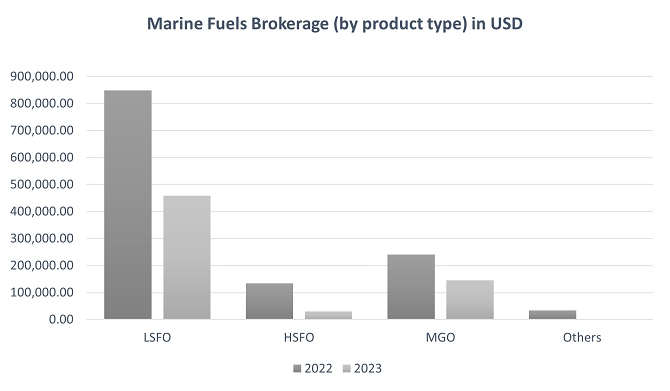
Our Supply Network
We provide extensive global coverage for our customers’ marine fuels needs through our broad supply network. This extensive network ensures convenient and reliable access to marine fuels across ports worldwide, spanning different time zones. Depending on our customer’s requirements, such as the port of call, product type, delivery time, and quantity, we source marine fuels products from different marine fuels suppliers located in different regions, allowing us to tailor our offerings to meet customer demands. These marine fuels products are typically sourced, stored and blended into the desired specifications by cargo sellers such as major oil companies, national oil companies, and independent oil companies at their designated blending facilities. The physical distributor will source and purchase the marine fuels products from cargo sellers and load the marine fuels product onto the nominated marine fuels barges of the physical distributors or barge operator at the cargo seller’s designated storage facilities who will then perform the actual delivery to our customer’s receiving vessel. There may be instances where the delivery is made by road tankers, in this case the road tanker will load the marine fuels product at the designated shore storage facility designated by the cargo seller. In situations where only direct supply from pipelines at shore is available, our customer’s vessel will berth alongside a jetty to receive marine fuels directly from the shore tank by pipeline delivery.
For the fiscal years ended December 31, 2022 and December 31, 2023, the total volume of marine fuels supply that we arranged (under both our reselling and brokerage business) amounted to 142,050,237 metric tons and 162,528,209 metric tons, respectively. Set forth below is a breakdown of the ports where we arranged for the supply marine fuels for our customers:
| FY 2022 | FY 2023 | |||||||||||||||||
| Port Name | Volume (metric tons) | Percentage (%) | Port Name | Volume (metric tons) | Percentage (%) | |||||||||||||
| Singapore | 56,924.954 | 40.07 | Singapore | 72,074.453 | 44.35 | |||||||||||||
| Singapore EOPL | 11,259.255 | 7.93 | Hong Kong | 11,774.122 | 7.24 | |||||||||||||
| Fujairah | 9,397.188 | 6.62 | Pasir Gudang | 8,136.649 | 5.01 | |||||||||||||
| Yosu | 6,175.000 | 4.35 | Port Tanjung Pelepas | 5,594.698 | 3.44 | |||||||||||||
| Ko Sichang | 4,229.451 | 2.98 | Zeebrugge | 4,477.421 | 2.75 | |||||||||||||
| Freeport | 3,612.416 | 2.54 | Lian Yun Gang | 4,362.000 | 2.68 | |||||||||||||
| Shanghai | 3,194.310 | 2.25 | Singapore EOPL | 3,545.458 | 2.18 | |||||||||||||
| Ulsan | 2,880.000 | 2.03 | Port Klang | 3,196.643 | 1.97 | |||||||||||||
| Busan | 2,745.000 | 1.93 | Flushing | 3,196.610 | 1.97 | |||||||||||||
| Santos | 1,990.806 | 1.40 | Ningbo | 2,980.200 | 1.83 | |||||||||||||
| Others | 39,641.857 | 27.91 | Others | 43,189.954 | 26.57 | |||||||||||||
| Total | 142,050.237 | 100.00 | Total | 162,528.209 | 100.00 | |||||||||||||
| 63 |
The regions where we have arranged for marine fuels supply for our customers are illustrated below:
South East Asia

| 64 |
North East Asia

Middle East and South Asia

| 65 |
Europe

Africa

North, Central and South America

| 66 |
Our Competitive Strengths
Our main competitive strengths are as follows:
We operate in Singapore, a global major marine fuels hub and major shipping region in Asia Pacific
Our operations are strategically positioned within the largest global marine fuels hub of Singapore, which is also a pivotal location within the Asia Pacific’s major shipping routes. According to IMO’s fuel consumption data for vessels above 5000 metric tons in gross tonnage and standard industry assumption of 30 million metric tons are consumed by smaller vessels, the global marine fuels market reached an estimated size of 255 million metric tons in 2021. Singapore, recognized as the world’s largest marine fuels port, commands a significant market share, accounting for 19.62% of the estimated global volume. Official data from the Maritime Port Authority (“MPA”) reveals a total supply volume of 50.04 million metric tons in 2021. Leveraging our presence and operational model in Singapore, we believe we are well-positioned to capitalize on the growing demand for marine fuels within this regional market. Moreover, we believe that our market presence in the Asia Pacific region gives us direct access to the growth opportunities in the region. According to statistics provided by UNCTAD, Asia Pacific shipping ports handled about 42% of the total goods loaded worldwide and about 64% of total goods discharged worldwide in 2021, and we believe that the Asia Pacific region is expected to continue this dominant position in the marine fuels market which is supported by demands in North Eastern Asian ports such as Hong Kong, Zhoushan, and surrounding ports in Korea.
We have a scalable operating model to facilitate growth
We have established an efficient operating model with scalable advantages that positions us for market growth. Our operating model allows us to grow our business with limited additional investments and has low profitability breakeven thresholds in new geographical locations. By leveraging on our operating model, we will be able to scale our operations to generate additional income to drive profitability.
We have an experienced management team with in-depth knowledge and expertise
Our management team, consisting of Mr. Koh Kuan Hua, our Chairman of Board of Directors, Chief Executive Officer and Director, Ms. Stefanie Tay, our Chief Operating Officer and Director, Ms. Lee Ling Li, our Chief Financial Officer, Mr. Alan Tan, our Senior Vice President, Commercial, and Mr. Tan Guan Kai, our Vice President, Operations, have extensive experience in the marine fuels industry, averaging over 17 years. The team possess an in-depth knowledge of the industry as well as the expertise to manage and operate the business in their relevant capacities to develop and execute our business strategies to capture market opportunities.
We have an integrated global supply network
Unlike local marine fuels suppliers who only supply marine fuels at a single location or locations within a particular country, we provide extensive global coverage to our customers’ marine fuels requirements. Through our broad supply network, we offer our customers convenience and reliable access to marine fuels supply covering ports worldwide, across different time zones.
We adopt effective financial management
We optimize the financial resources that we possess to ensure liquidity, minimize financial risks, and maximize returns on investment. The designs of these processes ensure that we are efficient in our day-to-day business operations, that we have sufficient liquidity to make timely payments to our suppliers, avoid unnecessary losses in foreign exchange fluctuations, and that we be in a position to maximize potential business opportunities.
We are efficient and responsive when communicating with our customers
We take pride in our efficient and responsive approach to customer communication, recognizing that clarity and efficiency are paramount in meeting the operational requirements of our valued customers. We provide real-time support and 24/7 availability so that our customers receive the information they need promptly to support their operational decisions.
| 67 |
We are agile and flexible in our business operations
Our business model as a reseller and broker of marine fuels products enables us to stay agile and flexible during market disruptions, fluctuations in market demands, and changes in market conditions. Our agile approach enables us to read market signals, anticipate changes, and adapt our strategies promptly such as being able to provide alternative sources of supply during shortages of product availability in the market. Our flexible approach enables us to allocate our working capital and credit resources opportunistically and promptly to business opportunities with better returns, especially in a higher-priced marine fuels environment.
Our Business Strategies and Future Plans
Strengthening and increasing our market share in existing markets
We plan to continue to work closely with our customers through regular customer engagements to ensure that we are offering marine fuels products and solutions that meet their specific requirements. Apart from delivering quality marine fuels at the agreed price, location, and terms to our customers, we will continue to offer our customers advanced market solutions such as fixed pricing (e.g. spot pricing, fixed forward pricing or floating pricing formula), financing that corresponds to the needs of selected customers, and fuel management that is backed by our in-house procurement capabilities. In addition, we will continue to incorporate value added solutions such as trade credit, market intelligence, and operational expertise as part of our offerings to our customers. We aim to strengthen our customer relationships to become their preferred marine fuels supplier and broaden our customer base by offering our services as a comprehensive one-stop shop that provides efficient and responsive access to uninterrupted marine fuels supply worldwide.
Increasing our market presence through expansion into new geographical locations
We plan to expand our geographical presence at key shipping hubs around the world to gain access to new markets and further increase and strengthen our market positions in these areas. Depending on the resources available to us, our immediate plan is to build upon our presence in Asia by continuing to expand our sales operations and supply network. During our expansion process, we may hire local employees with suitable backgrounds to establish our brand in new markets. As we expand our geographical coverage, we will be able to better serve our existing and new customers at closer proximity and offer comprehensive marine fuels solutions and benefits through the scale of our operations. At the same time, we also will continue to strengthen our relationships with existing local suppliers and establish new relationships with local suppliers to secure and diversify our supplier concentration mix so that we can continue to obtain attractive terms through our sourcing to optimize our margins.
We have established a branch office in South Korea in March 2024. Going forward, we may consider setting up subsidiaries, branch offices or representative offices in different regions around the world across different time zones such as Houston in the United States, Dubai in the United Arab Emirates, London in the United Kingdom, to support our sales and marketing activities. The decision and timing of setting up these entities or offices including the exact locations is dependent on the availability of financial resources, commercial viability at the time of execution and human resources to the Company.
Competitive sourcing and diversification of suppliers in our supply network
We believe that the diversification of suppliers in our supply network is crucial for mitigating our operational risks, ensuring operational continuity, and improving our competitive sourcing capabilities. By maintaining a diverse base of suppliers, we will be able to be more competent in our offerings to our customers. We are also able to remain resilient during market disruptions, where we will have the options to source from multiple suppliers, thus increasing our chances of securing the supply for our customers. By working with an enlarged pool of suppliers, we will be able to optimize our sourcing capabilities such as varying options for benchmarking our buying prices, optionality to appoint suitable suppliers to maintain high delivery standards, at the most competitive pricing available.
Attract, develop and retain talented employees
We believe that a significant part of our success is attributable to our ability to attract, develop, motivate, and retain our talented employees. We plan to continue to strengthen our team by proactively recruiting, retaining, and training talents in the sales and marketing department. We intend to develop a compelling employer brand that reflects our commitment to innovation, diversity, and positive work culture. We also plan to continuously improve and invest on our trainee trader program to cultivate a sustainable revenue-generating workforce. We will continue to focus on retaining and attracting talented employees through competitive compensation packages, well-being programs, career advancement opportunities, and recognition and rewards programs for qualified employees.
| 68 |
Increasing financial resources available to us
Our working capital dictates how much revenue we can generate. Our principal sources of liquidity to finance our day-to-day operations are from the financing provided by a financing institution, our Major Shareholders and cashflow from operating activities. We have obtained facilities from Bangkok Bank Public Company Limited Singapore Branch with an aggregate limit of US$1,500,000. As of June 30, 2024 and December 31, 2023, only the trade financing facilities were drawn down, which amounted to US$1,203,938 and US$1,195,149, respectively. As of October 2024the facility we received from Bangkok Bank Public Company Limited Singapore Branch is no longer active and we have obtained a banking facility with United Overseas Bank Limited for an aggregate limit of US$4,000,000. As part of our daily operations, we also negotiate for favorable credit terms from our suppliers to enhance our cash flow liquidity. Going forward, we plan to increase our trade financing facility with financial institutions so that we can conclude more business resulting in higher revenue streams. Part of the net proceeds of this offering will be applied to our working capital. We intend to gain further access to trade financing from financial institutions which will allow us to drive our growth and maximize value to our shareholders.
Maintain high level of credit and compliance risk management processes
Credit and compliance risk management are integral components of our financial well-being, sustainability, and reputation. The upkeeping of efficient and robust risk management processes will foster trust amongst our stakeholders, ensure regulatory compliance, and safeguard the integrity of our daily operations. We will continue to employ a dynamic credit risk management approach that involves continuous assessment of our credit exposures to promptly identify and mitigate potential risks associated with our credit portfolio. By meticulously evaluating the creditworthiness of our customers, we aim to minimize default risk and optimize the quality of our customer portfolio. We will continue to strategically diversify our credit exposure across different shipping market sectors to reduce our concentration risk to remain resilient in the face of economic fluctuations. We will continue to uphold the highest standards of regulatory compliance. Our compliance risk management processes are meticulously designed to ensure adherence to all applicable laws, regulations, and industry best practices. The established framework integrates comprehensive policies, procedures, and internal controls by serving as a guide for our teams to navigate complex regulatory landscapes with diligence.
Selective acquisition of companies and/or formation of partnerships and/or joint ventures
We may acquire stakes in companies and/or forming partnerships and/or joint ventures with potential business partners within the value chain of the shipping and marine fuels industry, with a view to support the business growth of our company and diversify our revenue streams. While we have not identified any specific targets, we may plan to selectively pursue acquisitions and formation of partnerships and/or joint ventures that complement our existing operations, facilitate our business strategies as well as strengthening our market solutions, enhancing our market capabilities and/or expanding our market presence in our core markets, in order to maximize the potential value and capability of our company. Our potential targets for acquisition and formation of partnerships and/or joint ventures will focus on companies with operations that will enhance our profitability, market share and bring synergy to our business. The choice of potential targets is subject to the candidate’s ability to complement and value add to our existing business. As of the date of this prospectus, we have not identified any targets for acquisition of companies and/or formation of joint ventures.
Increasing our service offering in alternative fuels
Due to changes to ongoing regulatory guidelines, the shipping industry is witnessing a shift towards exploring and adopting alternative fuels where we foresee a growth in LNG and biofuel demand in the coming years. We plan to engage our existing and potential customers to understand their potential requirements for LNG and biofuel as we go along. By understanding their potential requirements, we will be able to provide relevant solutions to potentially increase our sales volume for this product segment when there is demand.
In the near term, we plan to apply for ISCC EU and ISCC Plus certificates from the International Sustainability and Carbon Certification (“ISCC”), a global certification system that sets standards for sustainable production, sourcing and trade of all kinds of bio-based feedstock and biofuel, in line with Renewable Energy Directive (“RED II”). Biofuel suppliers and operators must provide a Proof of Sustainability (“PoS”) to verify the sustainability of feedstock and energy inputs. A PoS follows a fuel batch throughout its whole supply chain with GHG estimates. The certification will enable us to pass on PoS for liquid and gaseous biofuel, including fatty acid methyl ester (“FAME”), hydrotreated vegetable oil (“HVO”) and liquefied biomethane (“LBM”).
| 69 |
Formation of new income streams
We may pursue potential business opportunities beyond the reselling and brokering of marine fuels supply. These business opportunities may include activities within the upstream marine fuels supply chain such as the storage, blending and/or transportation of marine fuels products, and expansion into new customer market sectors such as fishing and naval vessels. The formation of these new income streams may be carried out in conjunction with the selective acquisition of companies and/or formation of partnerships and/or joint ventures or may be developed separately for its sole intention depending on the financial and commercial resources that are available to us. We believe these new income streams will generate additional income for our business, thus increasing our overall profitability.
Our Major Customers
Our major customers of the Group are shipping companies and marine fuels suppliers. Most of our customers are based in South East Asia. Our shipping company customers operate across various market sectors, including bulk carriers, tanker vessels, offshore support vessels, container ships, general cargo vessels, tugs and barges, car carriers, cruise liners, yachts, and dredging vessels. Our comprehensive suite of services caters to the unique fueling needs of each sector, ensuring efficient and reliable fuel procurement and delivery processes.
We did not enter into any long-term written agreements or sales contracts with our customers for the years ended December 31, 2023 and 2022. Instead, our transactions are executed through individual sales orders on a per-transaction basis. As such, there are no long-term purchase commitments from our customers, and they are not contractually obligated to purchase a fixed quantity of oil from us over any specific period.
For the year ended December 31, 2023, no customer accounted for 10% or more of the Group’s revenues. For the year ended December 31, 2022, there were four customers accounting for 10% or more of the Group’s revenues. These four customers were Customer A, Customer B, Customer C and Customer D, which accounted for 38%, 15%, 11%, and 11%, respectively, of the Group’s total revenues for the year ended December 31, 2022.
For the six months ended June 30, 2024, there was one customer accounted for 10% or more of our revenues. Revenue from that customer for the six months ended June 30, 2024 represented 15% of our total revenues for that period. For the six months ended June 30, 2023, there were two customers accounting for 10% or more of our revenues. Revenues from these customers for the six months ended June 30, 2023 represented 36% and 19% of our total revenues for that period, respectively.
As of December 31, 2023, there was one customer whose receivables accounted for 10% or more of the Group’s total balances of accounts receivable and it accounted for approximately 15% of the total balances of receivables from customers. As of December 31, 2022, there were two customers whose receivables accounted for 10% or more of the Group’s total balances of accounts receivable and they accounted for approximately 65% and 29% of the total balances of receivables from customers, respectively.
As of June 30, 2024, there were three customers whose receivables accounted for 10% or more of our total balances of accounts receivable and accounted for approximately 15%, 12% and 10% of the total balances of receivables from customers, respectively. As of December 31, 2023, there was one customer whose receivables accounted for 10% or more of our total balances of accounts receivable and it accounted for approximately 15% of the total balances of receivables from customers.
Except for Customer A, i.e. Sea Oil Petroleum Pte Ltd, which is a related party, none of the customers referenced above is a related party of the Company. See “Related Party Transactions.”
Our Major Vendors
We generally source marine fuels from physical distributors or resellers. We did not enter into any long-term written agreements or supply contracts with our vendors for the years ended December 31, 2023 and 2022. Instead, our transactions are executed through individual purchase orders on a per-transaction basis. As such, there is no long-term supply commitments from our vendors and they are not contractually obligated to supply to us a fixed quantity of oil over any specific period.
For the year ended December 31, 2023, one vendor accounted for 10% or more of the Group’s cost of revenues. Cost of revenues charged by the vendor for the year ended December 31, 2023 represented 13% of the Group’s cost of revenues for that year. For the year ended December 31, 2022, two vendors accounted for 10% or more of the Group’s cost of revenues. Cost of revenues charged by these two vendors for the year ended December 31, 2022 represented 60% and 25% of the Group’s cost of revenues for that year, respectively.
As of December 31, 2023, there were two vendors whose payables accounted for 10% or more of the Group’s total balances of accounts payable and they accounted for approximately 28% and 12% of the total balance of accounts payables, respectively. As of December 31, 2022, there were two vendors whose payables accounted for 10% or more of the Group’s total balances of accounts payable and they accounted for approximately 69% and 31% of the total balances of accounts payables, respectively.
| 70 |
Sales and Marketing
We segment our customers based into end users (e.g. shipping companies including ship owners, operators and charterers) and marine fuels suppliers (e.g. physical distributors and resellers). Our customers may be further classified into market sectors delineated by type of vessel, such as bulk, tanker, offshore, container, general cargo, tug and barge, car carrier, cruise, yacht and dredging.
Our sales and marketing strategy revolves around our global integrated supply network where we consistently market our services to existing and prospective customers. We foster mutual rapport and long-term relationships with our customers by providing quality marine fuels and reliable solutions based on our customers’ specific requirements.
We maintain our customer relationships through regular customer engagements such as emails, calls, instant messaging, frequent meetings, and business trips. We pay close attention to their needs and preferences to better relate and understand their purchasing requirements. We also respond in a timely manner as and when required by our customers where we provide collaborative problem-solving solutions as well as providing operational expertise and sharing up to date market intelligence to help them navigate their operational processes. In the process, we may get referrals from existing customers and suppliers from time to time. We will also participate in industry events, conferences and exhibitions to network with industry participants where we may meet existing customers or potential business partners who may in time become our customers. As part of our marketing campaign, we may also engage in social media marketing, advertise on industry related publications as well as sponsor customer’s and supplier’s events from time to time.
We believe our leadership’s years of experience in the industry, reputation, and level of customer service are significant factors in retaining our customers and attracting new customers.
We do not expect any changes to our target customer base going forward unless we expand into a new business line.
Presently, we are operating our sales and marketing arm from our head office in Singapore and marketing arm from our Korea branch office which was recently set up in March 2024.
Our sales and marketing team is led by Alan Tan, Senior Vice-President, Commercial. He manages a team of senior bunker traders and bunker traders including the branch manager of our Korean branch office who joined the Group in March 2024. The major role and responsibilities of our sales and marketing team include developing strong relationships with customers, identifying and pursuing new business opportunities by actively prospecting and acquisition of new customers, onboarding new customers to conduct potential business, sourcing and negotiating marine fuels prices and terms with customers and suppliers, execute transactions related to the sale and purchase of marine fuel, providing real time operational support and market intelligence based on customer requirements, and following up on receivables collections.
Our Pricing Policy and Strategy
The key factors that influence our pricing include market conditions on supply and demand, cost structure related to the purchase of marine fuel, credit risk associated to our customer’s creditworthiness, competition faced for each business opportunity, and the quality of our business relationships with customers.
Receivables and Credit Terms
Our receivables credit terms are typically 30 days from the date of delivery. There may also be instances where we granted extended credit terms such as 45 days or 60 days from date of delivery to our customers or shorter credit terms like cash on delivery, 7 days or 14 days from the date of delivery, etc, to our customers. We will request for cash in advance payment terms from customers where we are unable to grant trade credit. In this instance, delivery will only be arranged after receiving payment from our customer.
We have not encountered difficulty in trade receivables collection till date since our inception.
Brokers and Commissions
We may work with third parties i.e. broker who refers a potential transaction to us. If the event we work with such parties, we will pay broker fee to the designated third party.
| 71 |
Quality Control
As part of our sourcing process, we will ensure that the marine fuels products supplied by us fulfil the standards that comply with industry specifications.
These standards may include but not limited to International Organization for Standardization (“ISO”) standards such as:
| ■ | ISO 8217:2005 (E) – specifies the requirements for petroleum fuels for use in marine diesel engines and boilers, prior to appropriate treatment before use. It specifies four categories of distillate fuel, one of which is for diesel engines for emergency purposes. It also specifies ten categories of residual fuel. | |
| ■ | ISO 8217:2010 (E) – specifies the requirements for petroleum fuels for use in marine diesel engines and boilers, prior to appropriate treatment before use. The specifications for fuels in ISO 8217:2010 can also be applicable to fuels for stationary diesel engines of the same or similar make and type as those used for marine purposes. It specifies four categories of distillate fuel, one of which is for diesel engines for emergency purposes. It also specifies six categories of residual fuel. | |
| ■ | ISO 8217:2012 (E) - specifies the requirements for petroleum fuels for use in marine diesel engines and boilers, prior to appropriate treatment before use. The specifications for fuels in ISO 8217:2012 can also be applicable to fuels for stationary diesel engines of the same or similar make and type as those used for marine purposes. It specifies four categories of distillate fuel, one of which is for diesel engines for emergency purposes. It also specifies six categories of residual fuel. | |
| ■ | ISO 8217:2017 (E) - specifies the requirements for fuels for use in marine diesel engines and boilers, prior to conventional onboard treatment (settling, centrifuging, filtration) before use. It specifies seven categories of distillate fuels, one of which is for diesel engines used for emergency purposes. It also specifies six categories of residual fuels |
In the event where ISO standards are unavailable, we will provide our customer with a specification standard that is available. In this instance, we will conclude the transaction with our customer after their acceptance of the available specification standard.
In addition, subject to the requirements of our customers, we may also arrange for testing of the quality of the marine fuels pre- or post-delivery to our customers at an extra cost. We may appoint independent third-party surveyors to conduct laboratory testing of the marine fuels to determine if the supplied product meets the agreed specification.
As part of our agreement with our suppliers, we will require our suppliers to collect a minimum of two samples during the delivery of marine fuel, where one will be retained by the marine fuels barge and the other will be retained by the receiving vessel. The seal numbers of these samples will be documented on the bunker delivery note and signed off by the parties involved of the delivery. In the event our customer raises any discrepancies over the quality of the marine fuels that has been supplied, we will notify our supplier and investigate by performing a mutually agreed joint laboratory analysis as per the terms of the delivery where the test results shall be deemed as final and binding. The party at fault shall bear the cost of the testing and compensate the other party. In this case, our customer may seek compensation from us, and we will in turn, seek compensation from our supplier.
Research and Development
We did not conduct any research and development activities for the years ended December 31, 2023 and 2022 and the six months ended June 30, 2024.
Competition
The marine fuels supply chain is highly fragmented, with many different types of companies involved in the marine fuels supply ecosystem. We face competition from different marine fuels participants operating in each of the geographic markets in which operate. These include national oil companies, oil majors, oil independents, commodity trading houses, oil traders, storage terminals, international bunker traders, online procurement platforms, brokers, smaller regional bunker traders, bunkering pools servicing shipping fleets and bunker buying alliances. They are involved at different stages – from production, transportation, and storage through to procurement, sales and marketing, and delivery to the end customers.
| 72 |
We consider our major competitors to be marine fuels suppliers that transact directly with end user customers. We generally compete in areas such as pricing, sufficient access to trade credit, working capital, supply network, market intelligence, operational expertise, as well as the ability to upkeep stakeholders’ relationships.
Seasonality
Our Group’s business activities are generally not directly affected by factors associated with seasonality. We may experience fluctuation in demand due to heightened or weakened economic conditions, geopolitical events, and shifts in trade patterns in areas where we operate.
Insurance
Our Group maintains various forms of insurance coverage for all risks on contents related to physical property of the Company, public liability insurance such as fire insurance, insurance for work injury that also includes third party bodily injury that occurs within our office premises, medical insurance policies that cover outpatient, hospitalization, surgical and dental, personal accident insurance, as well as business travel insurance for our employees.
Intellectual Property
Trademark
We have registered the following trademark with the Intellectual Property Office of Singapore:
| Trademark | Application Number | Proprietor | Classes | |||
 |
40202405063W | Uni-Fuels Pte. Ltd. | 04,36 |
We have also filed an application to register the following trademark with the Intellectual Property Office of Singapore on September 10, 2024:
| Trademark | Application Number | Applicant | Classes | |||
 |
40202420741Y | Uni-Fuels Pte. Ltd. | 04,36 |
Domain
We have a registered domain, www.uni-fuels.com. The information contained on this website is not a part of this prospectus.
Marine fuels trading primarily involves the buying and selling of physical commodities. Unlike technology-intensive industries where patents and trade secrets play a significant role, marine fuels trading relies less on proprietary technology or processes. We use the trade name “Uni-Fuels” as our brand, for which we have applied for trademark registration. Due to the nature of our business, we believe our exposure to intellectual property risk in our business is limited, and therefore we have not implemented any measures to protect our intellectual property. Since our inception, there have not, to our knowledge, been any infringements of intellectual property rights owned by the Company, including but not limited to any claims and threatened claims or proceedings initiated by us; and we have not been subject to any third party claims relating to intellectual property made against us.
As of the date of this prospectus, we have not entered into any licensing agreements relating to our intellectual property with any third parties; and except for off-the-shelf software, we do not license intellectual property from any third party.
Employees
As of August 31, 2024, we had a workforce of 16 employees who are located in Singapore and 1 employee who is located in Korea. The following table sets forth the number of our employees as of August 31, 2024 by function:
| Number | % of Total | |||||||
| Management | 5 | 33 | % | |||||
| Finance, Accounting, Human Resource and Administration | 4 | 27 | % | |||||
| Sales and Marketing | 8 | 40 | % | |||||
| Total | 17 | 100 | % | |||||
Our success depends on our ability to attract, retain and motivate qualified employees that share our values. We place great emphasis on our corporate culture to ensure that we maintain consistently high standards where we operate. We believe that we maintain a good working relationship with our employees and we have not experienced any significant labor disputes.
We provide training to new sales and marketing employees with no experience in the marine fuels industry working in the sales and marketing department.
We enter into standard labor contracts and confidentiality agreements with our employees.
| 73 |
Properties
Our principal place of business is located at 15 Beach Road, Beach Centre #05-07, Singapore 189677, where we lease approximately 1,442.38 square feet of office space. Our Singapore office is leased under one lease which will expire on May 31, 2026. We believe that our facilities are adequate to meet our needs for the immediate future, and that, should it be needed, suitable additional space will be available on commercially reasonable terms to accommodate any expansion of our operations.
Legal Proceedings
We may from time to time be subject to various legal or administrative claims and proceedings arising in the ordinary course of our business. The Company is and has not been a party to any litigation, arbitration or administrative proceedings that we believe would, individually or taken as a whole, have a material adverse effect on our business, financial condition or results of operations, and, insofar as we are aware, no such litigation, arbitration or administrative proceedings are pending, threatened, or contemplated.
Our Social Responsibilities
Our Group is dedicated to conducting business with a strong commitment to ethics, sustainability, and social responsibility, while ensuring compliance with all relevant rules and regulations. The discussions below outline our core areas of focus for corporate social responsibility:
Employee health and safety. We are dedicated to establishing satisfactory and optimal working conditions for our employees across our operational areas. We place great importance on creating a safe work environment and continuously strive to improve our procedures to ensure the health and safety of our staff, aiming to foster a happy, healthy, and productive workforce.
Employee development. We value professional growth and development of our employees. We encourage employees to enhance their professional and personal competencies through internal and external education and training programs.
Equal opportunities. When hiring new team members, we carefully assess candidates based on their professional and personal skills, without regard to gender, nationality, skin color, religion, or sexual orientation. Our focus is on recruiting competent professionals. Equal career and management opportunities are available to all employees.
Environment. As a service provider of marine fuels to the global shipping companies, we prioritize minimizing our environmental impact. We are committed to complying with applicable environmental regulations to ensure lower emissions. Our aim is to provide environmentally better alternatives while meeting the needs of our business partners. We expect all our partners to fulfil regulatory requirements, maintain safe working conditions and equipment, and demonstrate environmentally responsible practices.
| 74 |
We are subject to all relevant laws and regulations of Singapore and may be affected by policies which may be introduced by their respective governments from time to time. We have identified the main laws and regulations (apart from those pertaining to general business requirements) that materially affect our operations, including the licenses, permits and approvals typically required for the conduct of our business, and the relevant regulatory bodies, below.
As of the date of this prospectus, our Directors believe that we are not in breach of any laws or regulations applicable to our business operations that would materially affect our business operations, and our Group is in compliance with all the applicable laws and regulations that are material to our business operations. Our Group may be subject to certain fines/penalties arising from its ordinary course of business from time to time.
Singapore
Laws and regulations relating to employment
Employment Act 1968 of Singapore (“EA 1968”)
The EA 1968 covers every employee who is under a contract of service with an employer and includes a workman (as defined under the EA 1968), subject to exceptions. The definition of “employee” under the EA 1968 does not extend to, among others, freelance contractors who have entered into a contract for service. Accordingly, freelance contractors would not be considered as employees of our Group. The EA 1968 prescribes certain minimum conditions of service that employers are required to provide to their employees, including (i) minimum days of statutory annual and sick leave (Sections 88A and 89 of the EA 1968 respectively); (ii) paid public holidays (Section 88 of the EA 1968); (iii) statutory protection against wrongful dismissal (Section 14 of the EA 1968); (iv) provision of key employment terms in writing (Section 95A of the EA 1968); and (v) statutory maternity leave and childcare leave benefits (Sections 76 and Section 87A of the EA 1968 respectively).
A workman is defined under Section 2 of the EA 1968 as including, among others, (a) any person, skilled or unskilled, who has entered into a contract of service with an employer in pursuance of which he is engaged in manual labor, including any artisan or apprentice; and (b) any person employed partly for manual labor and partly for the purpose of supervising in person any workman in and throughout the performance of his work.
The main employment provisions of the EA 1968, which includes public holiday and sick leave entitlements, minimum days of annual leave, payment of salary and allowable deductions and release for wrongful dismissal, cover all employees, including persons employed in a managerial or executive position, except domestic workers, seafarers and those who are covered separately.
In addition to the main employment provisions of the EA 1968, Part 4 of the Employment Act contains provisions relating to, among other things, working hours, overtime, rest days, holidays, annual leave, payment of retrenchment benefit, priority of retirement benefit, annual wage supplements and other conditions of work or service (“Part 4”). However, such Part 4 provisions only apply to: (a) workmen earning basic monthly salaries of not more than S$4,500; and (b) employees (excluding workmen or a person employed in a managerial or an executive position) earning basic monthly salaries of not more than S$2,600. An employer who breaches any provision of Part 4 of the EA 1968 is guilty of an offense and is liable on conviction for a fine not exceeding S$5,000, and for a second or subsequent offense a fine not exceeding S$10,000 or imprisonment for a term not exceeding 12 months or both.
From April 1, 2016, employers are required to issue to their employees who are covered by the EA 1968 and who are employed for 14 days or more a written record of the key employment terms of the employee. The key employment terms required to be provided (unless inapplicable to such employee) include, among other things, working arrangements (such as daily working hours, number of working days per week and rest day(s)), salary period, basic salary, fixed allowances and deductions, over time rate of pay, types of leave and other medical benefits.
| 75 |
Employment of Foreign Manpower Act 1990 of Singapore (“EFMA 1990”)
The employment of foreign employees in Singapore is governed by EFMA 1990 and is regulated by the Ministry of Manpower of Singapore (“MOM”).
Pursuant to Section 5 of the EFMA 1990, no person shall employ a foreign employee unless the foreign employee has obtained a valid work pass from the MOM in accordance with the Employment of Foreign Manpower (Work Passes) Regulations 2012, which allows the foreign employee to work for him. Any person who fails to comply with or contravenes this provision of the EFMA 1990 is guilty of an offense and will: (a) be liable on conviction for a fine not less than S$5,000 and not more than S$30,000 or imprisonment for a term not exceeding 12 months or both; and (b) on a second or subsequent conviction: (i) in the case of an individual, be liable for a fine of not less than S$10,000 and not more than S$30,000 and imprisonment for a term of not less than one month and not more than 12 months; or (ii) in any other case, be punished with a fine of not less than S$20,000 and not more than S$60,000.
The work pass to be issued to a foreigner is contingent on, among other things, the type of work and salary being received by the foreigner. Foreign professionals, managers and executives earning a fixed monthly salary of at least S$5,000 (in all sectors except the financial services sector) and at least $5,500 (in the financial services sector), with acceptable qualifications (such as a good university degree, professional qualifications or specialist skills) are eligible for an employment pass. From 1 January 2025, the qualifying salary will be increased to S$5,600 (in all sectors except the financial services sector), and S$6,200 (in the financial services sector). The qualifying salaries increase for older and more experienced candidates. From 1 September 2023, in addition to meeting qualifying salary, employment pass candidates must also pass a points-based Complementarity Assessment Framework (“COMPASS”). From 1 September 2023, new applications for mid-level skilled staff earning a fixed monthly salary of at least S$3,150 (in all sectors except the financial services) and $3,650 (in the financial services sector) who possess a degree, diploma or technical certificate and have the relevant work experience may apply for an S-pass; and semi-skilled foreign workers from approved source countries working in, among others, the manufacturing sector may apply for a work permit. From 1 September 2025, the qualifying salary will be increased to at least S$3,300 (in all sectors except the financial services sector), and S$3,800 (in the financial services sector).
Further, under the Employment of Foreign Manpower (Work Passes) Regulations 2012, an employer of a Work Permit or S-Pass holder is required to purchase and maintain medical insurance with coverage of at least S$60,000 per 12-month period of a foreign workers’ employment (or for such shorter period where the foreign workers’ period of employment is less than 12 months) for the foreign workers’ in-patient care and day surgery except as the Controller of Work Passes may otherwise provide by notification in writing.
In addition, the employment of foreign workers is also subject to sector-specific rules regulated by the MOM achieved via various policy instruments including: (a) business activity; (b) approved source countries; (c) the imposition of security bonds and levies; and (d) quota (or dependency ratio ceilings) based on the ratio of local to foreign workers.
Central Provident Fund Act 1953 of Singapore (“CPFA 1953”)
Pursuant to Section 7 of the CPFA 1953, an employer is obliged to make CPF contributions for all employees who are Singapore citizens or permanent residents who are employed in Singapore by an employer (save for employees who are employed as a master, a seaman or an apprentice in any vessel, subject to an exception for non-exempted owners). CPF contributions are not applicable for foreigners who hold work passes. CPF contributions are required for both ordinary wages and additional wages (subject to an ordinary wage ceiling and a yearly additional wage ceiling) of employees at the applicable prescribed rates which is dependent on, among other things, the amount of monthly wages and the age of the employee. An employer must pay both the employer’s and employee’s share of the monthly CPF contribution. However, an employer can recover the employee’s share of CPF contributions by deducting it from their wages.
Pursuant to Section 9 of the CPFA 1953, where the amount of the contributions which an employer is liable to pay under Section 7 of the CPFA 1953 in respect of any month is not paid within the prescribed period, the employer shall be liable for the payment of interest on the amount for everyday the amount remains unpaid commencing from the first day of the month succeeding the month in respect of which the amount is payable and the interest shall be calculated at the rate of 1.5% per month or the sum of S$5, whichever is greater. Where any employer who has recovered any amount from the monthly wages of an employee in accordance with the CPFA 1953 fails to pay the contributions to the CPF within the prescribed time, he will be guilty of an offense and will be liable on conviction for a fine not exceeding S$10,000 or imprisonment for a term not exceeding seven years or both. Where an offense has been committed under the CPFA 1953 but there are no specific penalties provided, the offender may be liable for a fine not exceeding S$5,000 or imprisonment for a term not exceeding six months or both, and where the person is a repeat offender in relation to the same offence, the offender may be liable for a fine not exceeding S$10,000 or imprisonment for a term not exceeding 12 months or both.
| 76 |
Laws and regulations relating to workplace health and safety
Workplace Safety and Health Act 2006 of Singapore (“WSHA 2006”)
Sections 12(1) and 12(2) of the WSHA 2006 provide that every employer has the duty to take, so far as is reasonably practicable, such measures as are necessary to ensure the safety and health of its employees at work and persons (not being the employer’s employees) who may be affected by any undertaking carried on by the employer in the workplace, respectively. These measures include providing and maintaining for the employees a work environment that is safe, without risk to health, and adequate with regards to facilities and arrangements for employees’ welfare at work, ensuring that adequate safety measures are taken in respect of any machinery, equipment, plant, article or process used by the employees, ensuring that the employees are not exposed to hazards arising out of the arrangement, disposal, manipulation, organization, processing, storage, transport, working or use of things in or near their workplace and under the control of the employer, developing and implementing procedures for dealing with emergencies that may arise while those persons are at work and ensuring that the employees at work have adequate instruction, information, training and supervision as is necessary for them to perform their work. The relevant regulatory body is the MOM.
Any person who breaches his duty under the WSHA 2006 is guilty of an offense and will be liable on conviction, for situations where no penalty is expressly provided, in the case of a body corporate, to a fine not exceeding S$500,000 and if the contravention continues after the conviction, the body corporate shall be guilty of a further offense and will be liable to a fine not exceeding S$5,000 for every day or part thereof during which the offense continues after conviction. For repeat offenders, where a person has on at least one previous occasion been convicted of an offense under the WSHA 2006 that causes the death of any person and that person is subsequently convicted of the same offense that causes the death of another person, the court may, in addition to any imprisonment, if prescribed, punish the person, in the case of a body corporate, with a fine not exceeding S$1 million and, in the case of a continuing offense, with a further fine not exceeding S$5,000 for every day or part thereof during which the offense continues after conviction.
Under Section 16 of the WSHA 2006, it is the duty of any person who manufactures or supplies any machinery, equipment or hazardous substance (“MEHS”) for use at work to ensure, so far as is reasonably practicable, that (a) information regarding the safe use of the MEHS is supplied for use at work (which should include precautions to be taken for the proper use and maintenance of such MEHS, the health hazards associated with the MEHS and the information relating to and the results of any examinations or tests of the MEHS that are relevant to its safe use); (b) the MEHS is safe, and without risk to health, when properly used; and (c) the MEHS is examined and tested in compliance with the obligation imposed by paragraph (b). The duties imposed on any person in respect of the aforementioned shall (i) apply only if the MEHS is manufactured or supplied in the course of a trade or business carried on by the person (whether for profit or not); (ii) apply whether or not the MEHS is exclusively manufactured or supplied for use by persons at work; (iii) extend to the supply of the MEHS by way of sale, transfer, lease or hire and whether as principal or agent, and to the supply of the MEHS to a person for the purpose of supply to others; but (iv) do not apply to a person by reason only that the person supplies the machinery or equipment under a lease-purchase agreement, conditional sale agreement or credit-sale agreement to another (“customer”) in the course of a business of financing the acquisition of the machinery or equipment by the customer from others.
Under Section 21(1), read with Section 21(2) of the WSHA 2006, the Commissioner for Workplace Safety and Health (the “CWSH”) may serve a remedial order or a stop-work order in respect of a workplace if he is satisfied that (a) the workplace is in such condition, or is so located, or any part of the machinery, equipment, plant or article in the workplace is so used, that any work or process carried on in the workplace cannot be carried on with due regard to the safety, health and welfare of persons at work; (b) any person has contravened any duty imposed by the WSHA 2006; or (c) any person has done any act, or has refrained from doing any act which, in the opinion of the CWSH, poses or is likely to pose a risk to the safety, health and welfare of persons at work.
| 77 |
The remedial order shall direct the person served with the order to take such measures, to the satisfaction of the CWSH, to, among other things, remedy any danger so as to enable the work or process in the workplace to be carried on with due regard to the safety, health and welfare of the persons at work, whereas a stop-work order will direct the person served with the order to immediately cease to carry on any work or process indefinitely or until such measures as are required by the CWSH have been taken, to the satisfaction of the CWSH, to remedy any danger so as to enable the work or process in the workplace to be carried on with due regard to the safety, health and welfare of the persons at work, and shall specify the date on which such order is to take effect.
Pursuant to the Workplace Safety and Health (Risk Management) Regulations (“Risk Management Regulations”), the employer in a workplace is supposed to, among other things, conduct a risk assessment in relation to the safety and health risks posed to any person who may be affected by his undertaking in the workplace, take all reasonably practicable steps to eliminate or where it is not reasonably practicable to eliminate the risk, minimize foreseeable risks, implement measures or safe work procedures to address the risks. A person who, without reasonable excuse, contravenes the aforementioned requirements shall be guilty of an offence and shall be liable on conviction to a fine not exceeding S$50,000 or to imprisonment for a term not exceeding two years or both. Every employer is also required to maintain records of such risk assessments and measures/safety procedures and submit such records to the CWSH when required by the CWSH from time to time. Any employer who fails to comply with the requirement to maintain records is guilty of an offense and is liable on conviction for a fine not exceeding S$20,000 or to imprisonment for a term not exceeding two years or both for the first offense, and for a fine not exceeding S$50,000 or imprisonment for a term not exceeding two years or both for a subsequent offense. Such records are to be kept for a period of not less than three years. Any employer who fails to do so without reasonable excuse shall be guilty of an offence and is liable on conviction to a fine not exceeding S$10,000 for the first offense, and a fine not exceeding S$20,000 or to imprisonment for a term not exceeding six months or both for a subsequent offense.
Workplace Safety and Health (General Provisions) Regulations of Singapore (“WSHR”)
More specific duties imposed by MOM as laid out in the WSHR include taking effective measures to protect persons at work from the harmful effects of any exposure to any biohazardous material which may constitute a risk to their health and ensuring that the employee has the necessary expertise for the work that he is engaged for and implemented adequate safety and health measures.
Pursuant to the WSHR, the following equipment, among others, are required to be tested and examined after its installation by an examiner (the “Authorized Examiner”), who is authorized by the CWSH, before they can be used in a factory and thereafter, at specified intervals:
| ● | hoist or lift; |
| ● | lifting gears; and/or |
| ● | lifting appliances and lifting machines. |
Upon examination, the Authorized Examiner will issue and sign a certificate of test and examination, specifying the safe working load of the equipment. Such certificate of test and examination shall be kept available for inspection. Under Regulation 22 of the WSHR, it is the duty of the owner of the equipment/occupier of a workplace to keep a register containing the requisite particulars with respect to the lifting gears, lifting appliances and lifting machines. In addition to the above, under the WSHA 2006, inspectors appointed by the CWSH may, among others, enter, a workplace, to make such examination and inquiry as may be necessary to ascertain whether the provisions of the WSHA 2006 are complied with, to take samples of any material or substance found in a workplace or being discharged from any workplace for the purpose of analysis or test, to assess the levels of noise, illumination, heat or harmful or hazardous substances in any workplace and the exposure levels of persons at work therein and to take into custody any article in a workplace which is required for the purpose of an investigation or inquiry under the WSHA 2006.
| 78 |
Risk Management Regulations
Pursuant to the Risk Management Regulations, in every workplace, the employer and principal must conduct a risk assessment in relation to the safety and health risks posed to any person who may be affected by his undertaking in the workplace. Thereafter, employers and principals should take all reasonably practicable steps to eliminate any foreseeable risk to any person who may be affected by his undertaking in the workplace. Where it is not reasonably practicable to eliminate such risk, the employer or principal is required to implement reasonably practicable measures to minimize the risk, such as substitution, engineering control, administrative control and provision and use of suitable personal protective equipment, and safe work procedures to control the risk. All reasonably practicable steps should also be taken by the employer and principal to ensure that any person in the workplace who may be exposed to a risk to his safety and health is informed of the nature of the risk involved, and any measure or safe work procedures implemented.
Work Injury Compensation Act 2019 of Singapore (“WICA 2019”)
The WICA 2019, which is regulated by the MOM, applies to all employees who are engaged under a contract of service or apprenticeship with an employer regardless of their level of earnings. The WICA 2019 does not cover self-employed persons or independent contractors. However, as Section 13(1) of the WICA 2019 provides that, where any person (referred to as the principal) in the course of or for the purpose of his trade or business contracts with any other person (referred to as the subcontractor employer), the principal may be liable to compensate those employees of the subcontractor employer who were injured while employed in the execution of work for the principal. In addition, the WICA 2019 provides that if an employee dies or sustains injuries in a work-related accident or contracts occupational diseases in the course of the employment, the employer shall be liable to pay compensation in accordance with the provisions of the WICA 2019. An injured employee is entitled to claim medical leave wages, medical expenses and lump sum compensation for permanent incapacity or death, subject to certain limits stipulated in the WICA 2019.
Should an employee suffer an injury arising out of and in the course of his employment, he can choose to either:
(a) report the accident to his employer in order to submit a claim for compensation through the MOM without needing to prove fault or negligence on anyone’s part. There is a fixed formula in the WICA 2019 for the amount of compensation to be awarded; or
(b) commence legal proceedings to claim damages under common law against the employer for breach of duty or negligence.
Under the WICA 2019, every employer is required to insure and maintain insurance under approved policies with an insurer against all liabilities which he may incur under the provisions of the WICA 2019 in respect of all employees employed by him, unless specifically exempted. Failure to provide adequate insurance is an offense carrying a fine of up to S$10,000 or imprisonment for a term of up to 12 months, or both for a first-time offender. For further information on our Group’s insurance policies, please refer to the section headed “Business – Insurance”.
Laws and regulations relating to infectious diseases
Infectious Diseases Act 1976 of Singapore (“IDA 1976”)
Under the IDA 1976, if the Director-General of Health (“DGH”) has reason to believe that there exist on any premises conditions that are likely to lead to the outbreak or spread of any infectious disease, he may, among other things, by written notice, order the closure of the premises for a period not exceeding 14 days, and require the owner or occupier of the premises to cleanse or disinfect the premises in the manner and within the time specified in the notice or carry out such additional measures as the DGH may require in the manner and within the time specified in the notice. Such notice directing the owner or the occupier of the premises to close the premises may be renewed by the DGH from time to time for such period, not exceeding 14 days, as the DGH may, by written notice, specify.
In addition, pursuant to Section 15 of the IDA 1976, the DGH may order the following persons to be detained and isolated in a hospital or other place for such period of time and subject to such conditions as the DGH may determine: (a) any person who is a case or an at-risk individual of an infectious disease; (b) any class of persons mentioned in paragraph (a); (c) any person who is suspected to be a case or an at-risk individual of an infectious disease. Under Section 21(1) of the IDA 1976, the DGH may also direct (a) any person who is a case or an at-risk individual of an infectious disease and is carrying on or may carry on any business, undertaking or work; (aa) any class of persons mentioned in paragraph (a); (ab) any person who is suspected to be a case or an at-risk individual of an infectious disease and is carrying on or may carry on any business, undertaking or work; (b) any person carrying on any business, undertaking or work in a manner as is likely to cause the spread of any infectious disease; or (ba) any class of persons mentioned in paragraph (b), to take preventative action that the DGH reasonably believes is necessary to prevent the possible outbreak or prevent or reduce the spread of the infectious disease. Under Section 21(2) of the IDA 1976, “preventative action” in the case of such direction, includes, among other things, requiring the person to stop carrying on, or not carry on, the business, undertaking or work during a period of time specified in the direction, take specified steps within a period of time specified in the direction, to ensure that the business, undertaking or work is conducted in compliance with conditions specified in the direction.
| 79 |
Any person who, without reasonable excuse, fails to comply with any requirement of such notice or direction given to that person by the DGH is guilty of an offense. Where there are no specific penalties for such offense, any person guilty of an offense under the IDA 1976 for which no penalty is expressly provided shall (a) in the case of a first offense, be liable on conviction for a fine not exceeding S$10,000 or imprisonment for a term not exceeding 6 months or both; and (b) in the case of a second or subsequent offense, be liable on conviction for a fine not exceeding S$20,000 or imprisonment for a term not exceeding 12 months or both.
Environmental Public Health Act 1987 of Singapore (“EPHA 1987”)
The EPHA 1987 is administered by the National Environmental Agency (“NEA”) and regulates, among other things, the disposal and treatment of industrial waste and public nuisances. Under Section 45 of the EPHA, the Director-General of Public Health of Singapore (the “DGPH”) may, upon receipt of any information with respect to the existence of a nuisance liable to be dealt with summarily under the EPHA 1987 and if satisfied of the existence of a nuisance, serve a nuisance order on the person by whose act, default or sufferance the nuisance arises or continues, or if the person cannot be found, on the owner or occupier of the premises on which the nuisance arises. Some of the nuisances which are liable to be dealt with summarily under the EPHA 1987 include any premises or part of the premises of such a construction or in such a state as to be a nuisance or injurious or dangerous to health, any factory or work place which is not kept in a clean state, any place where there exists or is likely to exist any condition giving rise, or capable of giving rise to the breeding of flies or mosquitoes, any place where there occurs, or from which there emanates noise or vibration as to amount to a nuisance and any machinery, plant or any method or process used in any premises which causes a nuisance or is dangerous to public health and safety. If the DGPH receives any information in respect of the existence of a nuisance liable to be dealt with under the EPHA 1987, a nuisance order may be served on the person responsible for the nuisance prescribing the measures to be taken to remedy the nuisance. Any failure to comply with the nuisance order served is an offense and such person is liable upon conviction for a fine not exceeding S$10,000 for the first offense and to a further fine not exceeding S$1,000 for every day during which the offense continues after conviction. In the case of a second or subsequent conviction, such person is liable to a fine not exceeding S$20,000 or to imprisonment for a term not exceeding 3 months or to both and, in the case of a continuing offense, to a further fine not exceeding S$1,000 for every day or part of a day during which the offense continues after conviction.
International Environmental Regulations
International Convention for the Prevention of Pollution from Ships (“MARPOL”)
The IMO adopted MARPOL, which imposes environmental standards on the shipping industry relating to marine pollution, including oil spills, management of garbage, the handling and disposal of noxious liquids, sewage and air emissions. The IMO has also issued the Guidance for Best Practice for Member State/Coastal State (the “Guidance”) to provide recommendations and standards for member states and coastal states to enhance maritime safety, security, and environmental protection, with an aim to assist member states in fulfilling their responsibilities under MARPOL Annex VI. Best practices suggested in the Guidance that relate to our operations include, among other things the following:
| ● | Member states/coastal States should promote the availability of fuel oils which comply with MARPOL Annex VI and require suppliers under their jurisdiction to provide fuel oils that comply with the requirements of regulation 14 and regulation 18.3 of MARPOL Annex VI. |
| ● | Regulation 18.3 requires fuel delivered to ships to comply with a number of qualitative requirements. However, no specifications (i.e. ISO 8217) or routine testing scheme exists, which would guarantee that a fuel complies with such qualitative requirements. In cases where it is documented that the fuel delivered does not comply with those qualitative requirements of the regulation the port State/coastal State should take action against the supplier; and member states/coastal States should encourage fuel oil suppliers under their jurisdiction to use detailed fuel specifications, as well as the Guidance on best practice for fuel oil suppliers for assuring the quality of fuel oil delivered to ships. |
| ● | Member states/port States should verify the availability of bunker delivery notes on board and their compliance with MARPOL Annex VI, appendix V during all port State control inspections. |
| ● | Member states/coastal states have an obligation under MARPOL Annex VI to require those fuel oil suppliers to provide a bunker delivery note containing at least the information specified in appendix V to MARPOL Annex VI, accompanied by a MARPOL delivered sample of the fuel oil delivered that has been sealed and signed by the supplier’s representative and the master or officer in charge of the bunker operation on completion of bunkering operations. |
| ● | The member state/coastal State should implement provisions in their national regulation that enables them to address situations where suppliers are found to deliver fuel oil that does not comply with the associated bunker delivery note. |
| ● | Member states/coastal States that receive documentation of delivery of fuel oil to a ship that does not comply with that stated on the bunker delivery note by a fuel oil supplier within their jurisdiction should verify whether any action as appropriate needs to be taken regarding the fuel oil supplier. |
We, as a reseller of marine fuels, are committed to adhering these best practices in order to fulfil our responsibilities under MARPOL.
| 80 |
The following table sets forth information regarding our Directors and Executive Officers as at the date of this prospectus:
| Name | Age | Position | ||
| Koh Kuan Hua | 39 | Chief Executive Officer, Chairman of the Board of Directors and Director | ||
| Zheng Wenling Stefanie Tay | 45 | Chief Operating Officer and Director | ||
| Lee Ling Li | 49 | Chief Financial Officer | ||
Chay Yiowmin* |
50 | Independent Director Nominee | ||
Gn Jong Yuh Gwendolyn* |
53 | Independent Director Nominee | ||
Shirley Tan Sey Liy* |
48 | Independent Director Nominee |
| * | Has accepted an independent director appointment, which will be effective immediately after effectiveness of the registration statement of which this prospectus forms a part. |
The business and working experience and areas of responsibility of our Directors and Executive Officers are set out below:
Mr. Koh Kuan Hua, aged 39, is our Chairman, Chief Executive Officer and Director. He is responsible for providing overall direction, leadership and formulating business strategies for our Group. He joined our operating subsidiary, Uni-Fuels Singapore, in November 2023 and has been appointed as a Director of the Company in March 2024. Mr. Koh has over 14 years of experience in the marine fuels industry. Prior to joining us, from October 2015 to October 2023, Mr. Koh worked at Sea Oil Petroleum Pte Ltd in Singapore, where he was responsible for the day-to-day operations, formulating business strategies and overall performance of the company. He was a shareholder and Director of that company. From October 2010 to December 2014, he worked as a Bunker Trader at A/S Dan-Bunkering Ltd, Shanghai Representative Office in China and Senior Bunker Trader at Dan-Bunkering (Singapore) Pte Ltd in Singapore. From February 2010 to September 2010, he worked as a Bunker Trader at Praxis Energy Agents Pte Ltd in Singapore. Mr. Koh completed his Diploma in Film and Media Studies, Film, Sound & Video at Ngee Ann Polytechnic in 2006. Mr. Koh is the spouse of Ms. Tay, our Chief Operating Officer and Director.
Ms. Zheng Wenling Stefanie Tay, aged 45, is our Chief Operating Officer and Director. She is responsible for the day-to-day operations of our Group. She joined our operating subsidiary, Uni-Fuels Singapore, as its Chief Operating Officer in November 2023. She has been appointed as a Director of the Company in March 2024. Ms. Tay has over 18 years of experience in the marine fuels industry. Prior to joining us, from October 2015 to September 2023, Ms. Tay worked at Sea Oil Petroleum Pte Ltd in Singapore, where she was responsible for the sales and operational performance of the company. She was the Commercial Director of that company. From August 2010 to December 2014, she worked as a Senior Bunker Trader and then as a Trading Manager and Team Leader at Dan-Bunkering (Singapore) Pte Ltd in Singapore. From October 2006 to August 2010, she worked as a Bunker Trader before promoting to the role of Senior Bunker Trader and Team Leader at United Bunkering & Trading (Asia) Pte Ltd in Singapore. Ms. Tay completed her Honours Degree of Bachelor of Science in Management at University College Dublin in 2009. She is the spouse of Mr. Koh, our Chairman, Chief Executive Officer and Director.
| 81 |
Ms. Lee Ling Li, aged 49, is our Chief Financial Officer. She is responsible for the overall finance and accounting functions, trade finance, treasury, payroll, tax and corporate secretarial matters for our Group. She joined our operating subsidiary, Uni-Fuels Singapore, in January 2024. She is also a Director of our subsidiary, Uni-Fuels Group Inc. Ms. Lee has over 27 years of experience in finance and accounting working for various organizations in the marine fuels industry. From February 2022 to December 2023, Ms. Lee worked as a Head of Finance and Accounting at Sea Oil Petroleum Pte Ltd in Singapore. From September 2015 to September 2021, she worked as the Group Chief Accountant at AFCO Energy Pte Ltd in Singapore. From September 2010 to July 2015, she worked as a Chief Accountant at Opet Trade (Singapore) Pte Ltd in Singapore. From September 2005 to June 2010, she worked as the Group Chief Accountant at United Bunkering & Trading (Asia) Pte Ltd in Singapore. In all of the positions in the various companies aforementioned, Ms. Lee was responsible for the finance, accounting, administrative, HR, tax reporting and treasury functions of those companies. From September 1996 to September 2005, she worked as an Accountant for Bomin Bunker Oil Pte Ltd in Singapore, where she was responsible for the finance and accounting, payroll and tax reporting functions. Ms. Lee completed her Master of Business in Professional Accounting and Graduate Certificate in Accounting at Victoria University of Technology in 2003 and 2001 respectively. She obtained a Higher Diploma in Accounting from London of Chamber Commerce and Industry (Singapore) in 1995 and a Diploma in Accounting from Thames School of Commerce Singapore in 1995.
Mr. Chay Yiowmin, aged 50, will, immediately after effectiveness of the registration statement of which this prospectus forms a part, be appointed as our Independent Director. He is currently the CEO of Chay Corporate Advisory Pte Ltd and serves as the lead independent and non-executive director of Ntegrator Holdings Limited and Mary Chia Holdings Limited. His past roles include lead independent and non-executive director of UMS Holdings Ltd, Advance SCT Limited, Metech International Limited, Raffles Infrastructure Holdings Limited, and a non-executive director of Libra Group Limited and 8I Holdings Limited. With extensive experience in public accounting in Singapore and the United Kingdom, Mr. Chay has held senior positions at PricewaterhouseCoopers LLP, Deloitte & Touche LLP, Moore Stephens LLP, and BDO LLP, where he led the Corporate Finance Practice from 2012 to 2019. He specialized in financial services and shipping during his tenure as an assurance partner from 2010 to 2012. Mr. Chay holds a Bachelor of Accountancy (Hons) and a Master of Business from Nanyang Technological University, as well as an MBA from the University of Birmingham. He is a Fellow Chartered Accountant (FCA Singapore), an Associate Chartered Accountant (ACA), and a Chartered Valuer and Appraiser (CVA). He is actively involved in various professional and community roles, including serving on the Singapore steering committee of the Professional Risk Managers’ International Association (PRMIA) and the Standards and Technical Committee of IVAS, where he is also a programme instructor. Mr. Chay is an associate lecturer at Singapore University of Social Sciences (SUSS) and an active Grassroots Leader, holding several leadership positions within local community committees. He was honored with the Pingat Bakti Masyarakat (Public Service Medal) (PBM) by the President of Singapore in 2016.
Ms. Gn Jong Yuh Gwendolyn, aged 53, will, immediately after effectiveness of the registration statement of which this prospectus forms a part, be appointed as our Independent Director. She is an Equity Partner at Shook Lin & Bok LLP, where she has over 20 years of experience as a Corporate Lawyer specializing in corporate finance and capital markets across Singapore and the Asian region. Ms. Gn actively advises SGX Main Board and Catalist listed companies, SMEs, MNCs, and financial institutions on a range of areas including fund raising, IPOs, RTOs, dual listings, mergers and acquisitions, corporate structuring, and corporate governance. Her extensive expertise has positioned her as a leading advisor in these fields. She graduated with an LLB (Hons) (Second Upper) from the National University of Singapore in 1994 and was called to the Singapore bar as an Advocate and Solicitor in 1995. Ms. Gn has received the International Law Office and Lexology Client Choice Award 2014 for Capital Markets in Singapore and is recognized by Asialaw Leading Lawyers as a leading capital markets and corporate finance lawyer. She is also featured in Euromoney’s Guide to the World’s Leading Women in Business Law and World’s Leading Capital Markets Lawyers.
Ms. Shirley Tan Sey Liy, aged 48, will, immediately after effectiveness of the registration statement of which this prospectus forms a part, be appointed as our Independent Director. She is the Founder and CEO of ST Corporate Advisory Pte Ltd and serves as an Independent Director of Rectitude Holdings Ltd. With over 20 years of experience, Ms. Tan is a qualified Chartered Secretary specializing in corporate secretarial work and compliance advisory. Her expertise spans private and publicly listed companies, SMEs, foreign and offshore companies, and academic institutions in Singapore. She has significant experience in corporate secretarial due diligence for IPOs, dual listings in Singapore and Hong Kong, secondary listings on SGX, Nasdaq listings, REITs, RTOs, M&As, company restructuring, liquidation, and immigration applications for expatriates. Additionally, she offers advisory services on compliance matters in Singapore. Ms. Tan holds a Master of Science in Management with Distinction from the National University of Ireland, Dublin. She is a Fellow of the Chartered Secretaries Institute of Singapore (CSIS) and holds a Practicing Certificate from CSIS. She is also a member of the CSIS Secretarial Practice Sub-Committee, the Singapore Institute of Directors, and the Singapore Chinese Chamber of Commerce and Industry.
Family Relationship
Mr. Koh (our Chairman, Chief Executive Officer and Director) and Ms. Tay (our Chief Operating Officer and Director) are spouses. Otherwise, there are no family relationships among our directors and executive officers.
Corporate Governance Practices
Foreign Private Issuer
After the consummation of this offering, we will qualify as a “foreign private issuer” under the SEC rules and Nasdaq rules. As a foreign private issuer, we will be exempt from the rules under the Exchange Act related to the furnishing and content of proxy statements, and our officers, directors, and principal shareholders will be exempt from the reporting and short-swing profit recovery provisions contained in Section 16 of the Exchange Act. Also, we are not required to comply with Regulation FD, which restricts the selective disclosure of material information. However, we will file with the SEC, within 120 days after the end of each fiscal year, or such applicable time as required by the SEC, an annual report on Form 20-F containing financial statements audited by an independent registered public accounting firm, and we will submit to the SEC from time to time, on Form 6-K, reports of information that would likely be material to an investment decision in our Shares.
Furthermore, Nasdaq Rule 5615(a)(3) provides that a foreign private issuer, such as us, may rely on our home country corporate governance practices in lieu of certain of the rules in the Nasdaq Rule 5600 Series and Rule 5250(d), except that we must comply with Nasdaq’s Notification of Noncompliance requirement (Rule 5625), the Voting Rights requirement (Rule 5640), and that we have an audit committee that satisfies Rule 5605(c)(3), including having committee members that meet the independence requirements of Rule 5605(c)(2)(A)(ii). The exemptions are subject to our disclosure of which requirements we are not following and the equivalent Cayman Islands requirements. Below are some of the exemptions afforded to foreign private issuers under the Nasdaq rules:
| ● | Exemption from the requirement that we disclose within four business days of any determination to grant a waiver of the code of business conduct and ethics to directors and officers. |
| ● | Exemption from the requirement that our board of directors be composed of independent directors. |
| ● | Exemption from the requirement that our audit committee have a minimum of three members. |
| ● | Exemption from the requirement that we hold annual shareholders’ meetings. |
| ● | Exemption from the requirement that our board of directors have a remuneration committee composed entirely of independent directors with a written charter addressing the committee’s purpose and responsibilities. |
| ● | Exemption from the requirement that director nominees are selected, or recommended for selection by our board of directors, either by (i) independent directors constituting a majority of our board of directors’ independent directors in a vote in which only independent directors participate, or (ii) a committee comprised solely of independent directors and governed by a formal written charter or board resolution, as applicable, addressing the nomination process as adopted. |
We intend to comply with all of the rules generally applicable to U.S. domestic companies listed on the Nasdaq. We may in the future decide to use the foreign private issuer exemption with respect to some or all of the other Nasdaq corporate governance rules. We also intend to comply with Cayman Islands corporate governance requirements under the Companies Act applicable to us at the same time. If we rely on our home country corporate governance practices in lieu of certain of the rules of Nasdaq, our shareholders may not have the same protections afforded to shareholders of companies that are subject to all of the corporate governance requirements of Nasdaq. We may utilize these exemptions for as long as we continue to qualify as a foreign private issuer.
| 82 |
Board of Directors
Our board of directors will consist of five directors upon the SEC’s declaration of effectiveness of our registration statement on Form F-1, of which this prospectus is a part. A director who is, directly or indirectly, interested in a contract or transaction or proposed contract or transaction with our company shall declare the nature of his or her interest at a meeting of our directors. A director may vote in respect of any contract or transaction or proposed contract or transaction notwithstanding that he or she may be interested therein and if he or she does so his or her vote shall be counted and he or she may be counted in the quorum at any meeting of our directors at which any such contract or transaction or proposed contract or transaction is considered. Our directors may exercise all the powers of our Company to issue debentures, debenture stock, bonds, and other securities, whether outright or as collateral security for any debt, liability or obligation of our company or of any third party. None of our non-executive directors have a service contract with us that provides for benefits upon termination of service.
We recognize the importance and benefit of having a board of directors composed of highly talented and experienced individuals having regard to the need to foster and promote diversity among board members with respect to attributes such as gender, ethnicity and other factors. In support of this goal, we will consider criteria that promote diversity, including with regard to gender, ethnicity, and other dimensions; and consider the level of representation of women on our board of directors along with other markers of diversity.
Committees of the Board of Directors
We will establish three committees under the board of directors immediately upon the effectiveness of our registration statement on Form F-1, of which this prospectus is a part: an audit committee, a compensation committee, and a nominating and corporate governance committee. We expect to adopt a charter for each of the three committees. Each committee’s members and functions are described below.
Audit Committee. Our audit committee will consist of Mr. Chay Yiowmin and Ms. Shirley Tan Sey Liy. Mr. Chay Yiowmin will be the chairman of our audit committee. We have determined that each of our audit committee members satisfies the “independence” requirements of Rule 5605(c)(2) of the Nasdaq rules and meets the independence standards under Rule 10A-3 under the Exchange Act. We have determined that Mr. Chay Yiowmin qualifies as an “audit committee financial expert” within the meaning of the SEC rules and possesses financial sophistication within the meaning of the Nasdaq rules. Our audit committee will only consist of two members immediately upon listing. Therefore, the composition of our audit committee does not comply with Rule 5605(c)(2)(A) of the Nasdaq rules which requires our audit committee to have at least three members. However, we intend to rely on the phase-in rules for newly listed companies under Rule 5615(b)(1)(B). Pursuant to these rules, regarding the requirement to have at least three members on the audit committee, we have until one year after the date the Company’s securities first trade on Nasdaq to comply with the requirement. The audit committee will oversee our accounting and financial reporting processes and the audits of the financial statements of our company. The audit committee will be responsible for, among other things:
| ● | appointing the independent auditors and pre-approving all auditing and non-auditing services permitted to be performed by the independent auditors; |
| ● | reviewing with the independent auditors any audit problems or difficulties and management’s response; |
| ● | discussing the annual audited financial statements with management and the independent auditors; |
| ● | reviewing the adequacy and effectiveness of our accounting and internal control policies and procedures and any steps taken to monitor and control major financial risk exposures; |
| ● | reviewing and approving all proposed related-party transactions; |
| ● | meeting separately and periodically with management and the independent auditors; and |
| ● | monitoring compliance with our code of business conduct and ethics, including reviewing the adequacy and effectiveness of our procedures to ensure proper compliance. |
| 83 |
Compensation Committee. Our compensation committee will consist of Ms. Shirley Tan Sey Liy, Mr. Chay Yiowmin, and Ms. Gn Jong Yuh Gwendolyn. Ms. Shirley Tan Sey Liy will be the chairwoman of our compensation committee. We have determined that each of our compensation committee members satisfies the “independence” requirements of Rule 5605(a)(2) of the Nasdaq rules. The compensation committee will assist the board in reviewing and approving the compensation structure, including all forms of compensation, relating to our directors and executive officers. Our chief executive officer may not be present at any committee meeting during which his compensation is deliberated. The compensation committee will be responsible for, among other things:
| ● | reviewing and approving, or recommending to the board for its approval, the compensation for our chief executive officer and other executive officers; |
| ● | reviewing and recommending to the board for determination with respect to the compensation of our non-employee directors; |
| ● | reviewing periodically and approving any incentive compensation or equity plans, programs, or similar arrangements; and |
| ● | selecting compensation consultant, legal counsel, or other adviser only after taking into consideration all factors relevant to that person’s independence from management. |
Nominating and Corporate Governance Committee. Our nominating and corporate governance committee will consist of Ms. Gn Jong Yuh Gwendolyn, Ms. Shirley Tan Sey Liy, and Mr. Chay Yiowmin. Ms. Gn Jong Yuh Gwendolyn will be the chairwoman of our nominating and corporate governance committee. We have determined that each of our nominating and corporate governance committee members satisfies the “independence” requirements of Rule 5605(a)(2) of the Nasdaq rules. The nominating and corporate governance committee will assist the board of directors in selecting individuals qualified to become our directors and in determining the composition of the board and its committees. The nominating and corporate governance committee will be responsible for, among other things:
| ● | selecting and recommending to the board nominees for election by the shareholders or appointment by the board; |
| ● | reviewing annually with the board the current composition of the board in regard to characteristics such as independence, knowledge, skills, experience, and diversity; |
| ● | making recommendations on the frequency and structure of board meetings and monitoring the functioning of the committees of the board; and |
| ● | advising the board periodically in regard to significant developments in the law and practice of corporate governance, as well as our compliance with applicable laws and regulations, and making recommendations to the board on all matters of corporate governance and on any remedial action to be taken. |
Duties of Directors
Under Cayman Islands law, the fiduciary duties owed by a director and officer include (a) a duty to act in good faith in what the director or officer believes to be in the best interests of the company as a whole, (b) a duty to exercise their powers for the purposes for which they were conferred and not for a collateral purpose, (c) a duty to avoid improperly fettering the exercise of future discretion, (d) a duty to avoid any conflict of interest between the director’s duty to the company and the director’s personal interests, and (e) a duty to exercise independent judgment. In addition to the above, directors also owe a duty of care which is not fiduciary in nature. This duty has been defined as a requirement to act as a reasonably diligent person having both the general knowledge, skill and experience that may reasonably be expected of a person carrying out the same functions as are carried out by that director in relation to the company and the general knowledge skill and experience of that director.
As set out above, our directors have a duty not to put themselves in a position of conflict and this includes a duty not to engage in self-dealing, or to otherwise benefit as a result of their position. However, in some instances what would otherwise be a breach of this duty can be forgiven and/or authorized in advance by the shareholders provided that there is full disclosure by the directors. This can be done by way of permission granted in the memorandum and articles of association of a company or alternatively by shareholder approval at general meetings.
| 84 |
Code of Business Conduct and Ethics
In connection with this offering, we have adopted a code of business conduct and ethics, which is applicable to all of our directors, executive officers and employees and is publicly available.
Terms of Directors and Officers
Our directors may be elected by a resolution of our board of directors or by an ordinary resolution of our shareholders. An appointment of a director may be on terms that the director will automatically retire from office (unless he has sooner vacated office) at the next or a subsequent annual general meeting or upon any specified event or after any specified period in a written agreement between our Company and the director, if any, but no such term will be implied in the absence of express provision. It is expected that, whether by ordinary resolution or by the directors, each director will be appointed on the terms that the director will hold office until the appointment of the director’s successor or the director’s re-appointment at the next annual general meeting, unless the director has sooner vacated office.
Employment Agreements with Executive Officers
We will enter into employment agreements with each of our executive officers. Under these agreements, each of our executive officers is employed for a specified time period. We may terminate, at any time, without advance notice or remuneration, for certain acts of the executive officer, such as conviction or plea of guilty to a felony or any crime involving moral turpitude, negligent or dishonest acts to our detriment, or misconduct or a failure to perform agreed duties. An executive officer may terminate his or her employment at any time with a three-month prior written notice.
Each executive officer has agreed to hold, both during and after the termination or expiry of his employment agreement, in strict confidence and not to use, except as required in the performance of his duties in connection with the employment or pursuant to applicable law, any of our confidential or proprietary information or the confidential or proprietary information of any third party received by us and for which we have confidential obligations. Each executive officer has also agreed to disclose in confidence to us all inventions, designs and trade secrets which he conceives, develops or reduces to practice during his employment with us and to assign all right, title and interest in them to us, and assist us in obtaining and enforcing patents, copyrights and other legal rights for these inventions, designs and trade secrets.
In addition, each executive officer has agreed to be bound by non-competition and non-solicitation restrictions during the term of the employment and for one year following the last date of employment. Specifically, each executive officer has agreed not to: (i) engage or assist others in engaging in any business or enterprise that is competitive with our business, (ii) solicit, divert or take away the business of our clients, customers or business partners, or (iii) solicit, induce or attempt to induce any employee or independent contractor to terminate his or her employment or engagement with us. The employment agreements also contain other customary terms and provisions.
Involvement in Certain Legal Proceedings
To the best of our knowledge, none of our directors or executive officers has, during the past 10 years, been involved in any legal proceedings described in subparagraph (f) of Item 401 of Regulation S-K.
Board diversity
We seek to achieve board diversity through the consideration of a number of factors when selecting the candidates to our Board, including but not limited to gender, skills, age, professional experience, knowledge, cultural, education background, ethnicity and length of service. The ultimate decision of the appointment will be based on merit and the contribution which the selected candidates will bring to our board.
Our directors have a balanced mix of knowledge and skills. We have three independent directors with different industry backgrounds, representing a majority of the members of our board. We also achieved gender diversity by having two female directors out of the total of five directors (including independent directors). Our board is well balanced and diversified in alignment with the business development and strategy of the Company.
Compensation
For the years ended December 31, 2023 and 2022, we paid an aggregate of approximately $176,160 and nil, respectively in cash and benefits in-kind granted to or accrued on behalf of all of our Directors and members of senior management for their services, in all capacities, and we did not pay any additional compensation to our Directors and members of senior management. We have not set aside or accrued any amount to provide pension, retirement or other similar benefits to our Executive Officers and Directors.
2024 Share Incentive Plan
We have adopted the Uni-Fuels Holdings Limited 2024 Share Incentive Plan, or the 2024 Incentive Plan, to attract and retain best available personnel, provide additional incentives to employees, directors and consultants, and promote the success of our business. Under the 2024 Incentive Plan, the maximum aggregate number of Class A Ordinary Shares which may be issued pursuant to all awards (including incentive share options) are 1,552,500 shares (assuming the Underwriters do not exercise their over-allotment option), representing 15% of the number of fully-diluted Class A Ordinary Shares outstanding as of the date of our Company’s initial public offering, or after our Company’s initial public offering, to represent 15% of the number of fully-diluted Class A Ordinary Shares outstanding as of December 31 of the preceding calendar year, as the case may be.
| 85 |
The following table sets forth information regarding the beneficial ownership of our Shares as of the date of this prospectus by our officers, directors, and 5% or greater beneficial owners of Shares. There is no other person or group of affiliated persons known by us to beneficially own more than 5% of our Shares. The following table assumes that none of our officers, directors or 5% or greater beneficial owners of our Shares will purchase shares in this offering. In addition, the following table assumes that the over-allotment option has not been exercised. Except as may otherwise be required by law, each Class B Ordinary Share has ten votes per share and is convertible into one Class A Ordinary Share, whereas our Class A Ordinary Shares, which we are selling in this offering, have one vote per share.
We have determined beneficial ownership in accordance with the rules of the SEC. These rules generally attribute beneficial ownership of securities to persons who possess sole or shared voting power or investment power with respect to those securities. The person is also deemed to be a beneficial owner of any security of which that person has a right to acquire beneficial ownership within 60 days. Unless otherwise indicated, the person identified in this table has sole voting and investment power with respect to all shares shown as beneficially owned by him, subject to applicable community property laws.
| Name of Beneficial Owners(1) | Class A Ordinary Shares Beneficially Owned Prior to This Offering(2) | Class B Ordinary Shares Beneficially Owned Prior to This Offering(2) | Class A Ordinary Shares Beneficially Owned After This Offering(3) | Class B Ordinary Shares Beneficially Owned After This Offering(3) | Total Beneficial Ownership After This Offering | |||||||||||||||||||||||||||||||
| Number | % | Number | % | Number | % | Number | % | % | ||||||||||||||||||||||||||||
| Directors and Executive Officers: | ||||||||||||||||||||||||||||||||||||
| Koh Kuan Hua(4) | — | — | 22,650,000 | 100.0 | % | — | — | 22,650,000 | 100.0 | % | 70.56 | % | ||||||||||||||||||||||||
| Zheng Wenling Stefanie Tay | — | — | — | — | — | — | — | — | ||||||||||||||||||||||||||||
| Lee Ling Li | — | — | — | — | — | — | — | — | ||||||||||||||||||||||||||||
| Chay Yiowmin | — | — | — | — | — | — | — | — | ||||||||||||||||||||||||||||
| Gn Jong Yuh Gwendolyn | — | — | — | — | — | — | — | — | ||||||||||||||||||||||||||||
| Shirley Tan Sey Liy | — | — | — | — | — | — | — | — | ||||||||||||||||||||||||||||
| All directors and executive officers as a group | — | — | 22,650,000 | 100.0 | % | — | — | 22,650,000 | 100.0 | % | 70.56 | % | ||||||||||||||||||||||||
| 5% shareholders: | ||||||||||||||||||||||||||||||||||||
| Garden City Private Capital Limited(4) | — | — | 22,650,000 | 100.0 | % | 22,650,000 | 100.0 | % | 70.56 | % | ||||||||||||||||||||||||||
| Braden Ong Wei Cong | 1,470,000 | 20.0 | % | — | — | 1,470,000 | 15.56 | % | — | — | 4.58 | % | ||||||||||||||||||||||||
| Lai Yen Fen | 1,470,000 | 20.0 | % | — | — | 1,470,000 | 15.56 | % | — | — | 4.58 | % | ||||||||||||||||||||||||
| Thong Mei Sze | 1,470,000 | 20.0 | % | — | — | 1,470,000 | 15.56 | % | — | — | 4.58 | % | ||||||||||||||||||||||||
| Wong Chee How | 1,470,000 | 20.0 | % | — | — | 1,470,000 | 15.56 | % | — | — | 4.58 | % | ||||||||||||||||||||||||
| iCapital Holdings (SG) Pte. Ltd.(5) | 1,470,000 | 20.0 | % | — | — | 1,470,000 | 15.56 | % | — | — | 4.58 | % | ||||||||||||||||||||||||
| * | Less than 1%. |
| (1) | Unless otherwise noted, the business address of each of the following entities or individuals is 15 Beach Road, Beach Centre #05-07, Singapore 189677. |
| (2) | Applicable percentage of ownership is based on 7,350,000 Class A Ordinary Shares and 22,650,000 Class B Ordinary Shares outstanding as of the date of this prospectus. |
| (3) | Applicable percentage of ownership is based on 9,450,000 Class A Ordinary Shares and 22,650,000 Class B Ordinary Shares outstanding immediately after the offering. |
| (4) | Represents Shares held of record by Garden City Private Capital Limited, a British Virgin Islands investment holding company wholly owned by Mr. Koh Kuan Hua. |
| (5) | Represents Shares held of record by iCapital Holdings (SG) Pte. Ltd. (“iCapital”), a Singapore company. Toe Teow Heng is the major shareholder and a director of iCapital, and therefore has voting and dispositive power over the shares owned by iCapital. |
| 86 |
The following is a summary of transactions since 2022 to which we have been a party and in which any members of our Board of Directors, any Executive Officers, or Major Shareholders had, has or will have a direct or indirect material interest, other than compensation arrangements which are described under the section of this prospectus captioned “Management”:
Nature of relationships with related parties
| Name | Relationship with the Company | |
| Goh Wee Huan | Controlling shareholder who held a controlling interest in Uni-Fuels Singapore from January 1, 2022 to December 8, 2023, and served as director of Uni-Fuels Singapore from December 22, 2022 to December 8, 2023 | |
| Koh Kuan Hua | Controlling shareholder and director of the Company | |
| Sea Oil Petroleum Pte Ltd (“Sea Oil Petroleum”) | Under the significant influence of Koh Kuan Hua, who held a minority interest in Sea Oil Petroleum from January 1, 2022 to October 31, 2023, and served as its director from January 1, 2022, to September 26, 2023 |
Transactions with related parties
For the Years Ended December 31, | ||||||||||||
| Name | Nature | 2023 | 2022 | |||||||||
| Sea Oil Petroleum | (1) | Sales of marine fuels | $ | 2,184,911 | $ | 10,424,827 | ||||||
| Sea Oil Petroleum | (2) | Brokerage commissions | $ | 491,269 | $ | 1,255,725 | ||||||
| Sea Oil Petroleum | (1) | Purchase of marine fuels | $ | 8,839,579 | $ | 17,145,449 | ||||||
| Goh Wee Huan | (3) | Advances from a related party | $ | 678,259 | $ | - | ||||||
| (1) | The amounts for the years ended December 31, 2023 and 2022 represented proceeds from sales of marine fuels to and cost of marine fuels purchased from the related party. The Group engaged in reciprocal transactions with the related party, encompassing both the sale and purchase of marine fuels. These transactions were conducted based on advantageous positioning, with each party utilizing their relative strengths in specific marine fuels products across various ports for each transaction at the time. |
| (2) | The amounts for the years ended December 31, 2023 and 2022 represented brokerage commissions generated from the related party. |
| (3) | The transactions represented advances from the shareholder for operational purposes during the year ended December 31, 2023. The advances were unsecured, non-interest bearing, and repayable on demand. Out of the total advances of $678,259, $400,258 was repaid by the Group during the year, leaving $278,001 outstanding as at December 31, 2023. Balances were then assigned by Goh Wee Huan to Koh Kuan Hua, coinciding with the transfer of ownership in the Uni-Fuels from Goh Wee Huan to Koh Kuan Hua on December 8, 2023. |
For the Six Months Ended June 30, | ||||||||||||
| 2024 | 2023 | |||||||||||
| Name | Nature | (Unaudited) | (Unaudited) | |||||||||
| Sea Oil Petroleum | (1) | Sales of marine fuels | $ | - | $ | 2,184,911 | ||||||
| Sea Oil Petroleum | (2) | Brokerage commissions | $ | - | $ | 491,269 | ||||||
| Sea Oil Petroleum | (1) | Purchase of marine fuels | $ | - | $ | 8,839,579 | ||||||
| (1) | The amounts for the six months ended June 30, 2023 represented proceeds from sales of marine fuels to and cost of marine fuels purchased from the related party. The Group engaged in reciprocal transactions with the related party, encompassing both the sale and purchase of marine fuels. These transactions were conducted based on advantageous positioning, with each party utilizing their relative strengths in specific marine fuels products across various ports for each transaction at the time. |
| (2) | The amounts for the six months ended June 30, 2023 represented brokerage commissions generated from the related party. |
Balance with related parties
| As of June 30, | As of December 31, | |||||||||||||||
| Name | Nature | 2024 | 2023 | 2022 | ||||||||||||
| Sea Oil Petroleum | (1) | Accounts receivable | $ | - | $ | - | $ | 709,734 | ||||||||
| Sea Oil Petroleum | (1) | Accounts payable | $ | - | $ | - | $ | 979,568 | ||||||||
| Koh Kuan Hua | (2) | Amounts due to a related party | $ | 276,155 | $ | 278,001 | $ | - | ||||||||
| (1) | The balances as of December 31, 2022 represented sales income and brokerage commission receivables from and purchase costs payable to the related party. The balances were fully settled subsequently. |
| (2) | The balances as of June 30, 2024 and December 31, 2023 and 2022 represented the advances from the shareholder for operational purposes and was assigned by Goh Wee Huan to Koh Kuan Hua on December 8, 2023. The balances were unsecured, non-interest bearing and repayable on demand. |
Policies and Procedures for Related Party Transactions
Our board of directors will, immediately upon the effectiveness of our registration statement on Form F-1 of which this prospectus forms a part, establish an audit committee in connection with this offering which will be tasked with review and approval of all related party transactions.
| 87 |
We are an exempted company with limited liability incorporated under the laws of the Cayman Islands and our corporate affairs are governed by our amended and restated memorandum and articles of association (as may be amended from time to time, the Companies Act and the common law of the Cayman Islands.
The share capital of the Company consists of ordinary shares. As of the date hereof, our authorized share capital is US$50,000 divided into 450,000,000 Class A Ordinary Shares of par value US$0.0001 each and 50,000,000 Class B Ordinary Shares of par value US$0.0001 each. As of the date of this prospectus, 22,650,000 class B ordinary shares were issued and outstanding. We will issue 2,100,000 Class A Ordinary Shares in this offering. The following are summaries of material provisions of our amended and restated memorandum and articles of association (referred to as “memorandum” and “articles of association” below) and the Companies Act insofar as they relate to the material terms of our Class A Ordinary Shares and Class B Ordinary Shares.
Ordinary Shares
General. Upon the completion of this offering, our authorized share capital is US$50,000 divided into 450,000,000 Class A Ordinary Shares of par value US$0.0001 each and 50,000,000 Class B Ordinary Shares of par value US$0.0001 each. All of our outstanding Class A Ordinary Shares are fully paid and non-assessable, and are issued in registered form, and are issued when registered in our register of members. Unless the board of directors determine otherwise, each holder of our Class A Ordinary Shares will not receive a certificate in respect of such ordinary shares. Our shareholders who are non-residents of the Cayman Islands may freely hold and vote their class A ordinary shares. We may not issue shares or warrants to bearer.
Dividends. The holders of our Class A Ordinary Shares and Class B Ordinary Shares are entitled to such dividends as may be declared by our board of directors (in relation to interim dividends); and (ii) our shareholders by ordinary resolution (in relation to final dividends), but no dividend may exceed the amount recommended by our board of directors. Our articles of association provide that our board of directors may declare and pay interim dividends if justified by our financial position and permitted by law.
Voting Rights. Holders of our Class A Ordinary Shares and Class B Ordinary Shares may vote on all matters submitted to a vote of our shareholders, except as may otherwise be required by law. Each Class A Ordinary Share shall entitle the holder thereof to one (1) vote on all matters subject to vote at general meetings of the Company, and each Class B Ordinary Shares shall entitle the holder thereof to ten (10) votes on all matters subject to vote at general meetings of the Company. At any general meeting a resolution put to the vote of the meeting shall be decided by a poll. A poll shall be taken in such manner as the chairman of the meeting directs, and the result of the poll shall be deemed to be the resolution of the meeting. A quorum required for a meeting of shareholders consists of one or more shareholders who hold shares that represent not less than one-third of the outstanding shares in issue and entitled to vote at such general meeting, present in person or by proxy or, if a corporation or other non-natural person, by its duly authorized representative. General meetings may be held annually. Each general meeting, other than an annual general meeting, shall be an extraordinary general meeting. The chairman of our board of directors or our directors may by board resolutions call general meetings and they must on a shareholders’ requisition forthwith proceed to convene an extraordinary general meeting of our Company. A shareholders’ requisition is a requisition of shareholders holding not less than one-third of all votes attaching to all the issued and paid up share capital of our company that as at the date of the deposit carry the right to vote at general meetings. The requisition must state the purpose of the meeting and must be signed by or on behalf of each requisitioner (and for this purpose each joint holder shall be obliged to sign) and delivered in accordance with the notice provisions of our amended and restated articles of association. If directors do not within 21 days from the receipt of the requisition duly proceed to convene a general meeting, the requisitioners, or any of them may themselves convene a general meeting.
Any ordinary resolution is a resolution passed by a simple majority of the shareholders as, being entitled to do so, vote in person or by proxy at a general meeting of our Company and includes a unanimous written resolution, while a special resolution is a resolution passed by a majority of not less than two-thirds of the shareholders as, being entitled to do so, vote in person or by proxy at our general meeting duly constituted in accordance with our articles of association and includes a unanimous written resolution.
| 88 |
A special resolution will be required for important matters such as amending our memorandum and articles of association or changing the name of the Company.
There are no limitations on non-residents or foreign shareholders to hold or exercise voting rights on the ordinary shares imposed by foreign law or by the memorandum and articles of association or other constitutional document of our company.
Winding Up; Liquidation.
If we are wound up, the shareholders may, subject to our articles of association and any other sanction required by the Companies Act, pass a special resolution allowing the liquidator to do either or both of the following:
| ● | to divide in specie among the holders of the Class A Ordinary Shares and the holders of the Class B Ordinary Shares the whole or any part of our assets and, for that purpose, to value any assets and to determine how the division shall be carried out as among the Class A Ordinary Shares and the holders of the Class B Ordinary Shares; and | |
| ● | to vest the whole or any part of the assets in trustees for the benefit of the holders of the Class A Ordinary Shares and the holders of the Class B Ordinary Shares and those liable to contribute to the winding up. |
Calls on Ordinary Shares and Forfeiture of Ordinary Shares. Subject to terms of allotment, our directors may from time to time make calls on our shareholders in respect of any moneys unpaid on their shares including any premium in a notice served to such shareholders at least 14 clear days prior to the specified time of payment. Any ordinary shares that have been called upon and remain unpaid are subject to forfeiture.
Redemption of Ordinary Shares. Subject to the terms of the Companies Act and our amended and restated memorandum and articles of association we may purchase our own shares. In accordance with our amended and restated articles of association, provided the necessary shareholders or board approval have been obtained and requirements under the Companies Act have been satisfied and subject to any rights for the time being conferred on the shareholders holding a particular class of shares, we may issue shares on terms that are subject to redemption at our option or at the option of our shareholders on such terms and in such manner as may be determined by our board of directors.
Inspection of Books and Records. Holders of our ordinary shares have no general right under our post-offering amended and restated articles of association to inspect or obtain copies of our list of shareholders or our corporate records. However, we will provide our shareholders with annual audited financial statements. See “Where You Can Find Additional Information.”
Issuance of Additional Shares. Our amended and restated memorandum and articles of association authorize our board of directors to issue additional ordinary shares from time to time as our board of directors shall determine, to the extent of available authorized but unissued shares. Issuance of these shares may dilute the voting power of holders of ordinary shares.
Anti-Takeover Provisions. Some provisions of our amended and restated memorandum and articles of association may discourage, delay or prevent a change of control of our company or management that shareholders may consider favorable. Our authorized, but unissued ordinary shares are available for future issuance without shareholders’ approval and could be utilized for a variety of corporate purposes, including future offerings to raise addition capital, acquisitions and employee benefit plans. The existence of authorized but unissued and unreserved ordinary shares could render more difficult or discourage an attempt to obtain control of us by means of a proxy contest, tender offer, merger or otherwise.
Exempted Company. We are an exempted company with limited liability under the Companies Act. Any company that is registered in the Cayman Islands but conducts business mainly outside of the Cayman Islands may apply to be registered as an exempted company. A Cayman Islands exempted company:
| ● | does not have to file an annual return of its shareholders with the Registrar of Companies; | |
| ● | is not required to open its register of members for inspection by shareholders of that company; | |
| ● | does not have to hold an annual general meeting; |
| 89 |
| ● | may obtain an undertaking against the imposition of any future taxation (such undertakings are usually given for 20 years in the first instance); | |
| ● | may register by way of continuation in another jurisdiction and be deregistered in the Cayman Islands; | |
| ● | may register as an exempted limited duration company; and | |
| ● | may register as a segregated portfolio company. |
“Limited liability” means that the liability of each shareholder is limited to the amount unpaid by the shareholder on the shares of the company.
Anti-Money Laundering — Cayman Islands
If any person resident in the Cayman Islands knows or suspects or has reasonable grounds for knowing or suspecting that another person is engaged in criminal conduct or is involved with terrorism or terrorist property and the information for that knowledge or suspicion came to their attention in the course of their business in the regulated sector, or other trade, profession, business or employment, the person will be required to report such knowledge or suspicion to (i) a nominated officer (appointed in accordance with the Proceeds of Crime Act (Revised) of the Cayman Islands) or the Financial Reporting Authority of the Cayman Islands, pursuant to the Proceeds of Crime Act (Revised), if the disclosure relates to criminal conduct or money laundering or (ii) to the Financial Reporting Authority or a police constable or a nominated officer (pursuant to the Terrorism Act (Revised) of the Cayman Islands) or the Financial Reporting Authority, pursuant to the Terrorism Act (Revised), if the disclosure relates to involvement with terrorism or terrorist financing and terrorist property. Such a report shall not be treated as a breach of confidence or of any restriction upon the disclosure of information imposed by any enactment or otherwise.
By subscribing for shares, the subscriber consents to the disclosure of any information about them to regulators and others upon request in connection with money laundering and similar matters both in the Cayman Islands and in other jurisdictions.
In order to comply with legislation or regulations aimed at the prevention of money laundering, we are required to adopt and maintain anti-money laundering procedures, and may require subscribers to provide evidence to verify their identity and source of funds. Where permitted, and subject to certain conditions, we may also delegate the maintenance of our anti-money laundering procedures (including the acquisition of due diligence information) to a suitable person.
We reserve the right to request such information as is necessary to verify the identity of a subscriber. In some cases the directors may be satisfied that no further information is required since an exemption applies under the Anti-Money Laundering Regulations (Revised) of the Cayman Islands, as amended and revised from time to time (the “Regulations”) or any other applicable law. Depending on the circumstances of each application, a detailed verification of identity might not be required where:
| (a) | the subscriber makes the payment for their investment from an account held in the subscriber’s name at a recognized financial institution; or | |
| (b) | the subscriber is regulated by a recognized regulatory authority and is based or incorporated in, or formed under the law of, a recognized jurisdiction; or | |
| (c) | the application is made through an intermediary which is regulated by a recognized regulatory authority and is based in or incorporated in, or formed under the law of a recognized jurisdiction and an assurance is provided in relation to the procedures undertaken on the underlying investors. |
For the purposes of these exceptions, recognition of a financial institution, regulatory authority or jurisdiction will be determined in accordance with the Regulations by reference to those jurisdictions recognized by the Cayman Islands Monetary Authority as having equivalent anti-money laundering regulations.
| 90 |
Data Protection in the Cayman Islands – Privacy Notice
This privacy notice explains the manner in which the company collects, processes and maintains personal data about investors of the company pursuant to the Data Protection Act (Revised) of the Cayman Islands, as amended from time to time and any regulations, codes of practice or orders promulgated pursuant thereto (“DPA”).
The company is committed to processing personal data in accordance with the DPA. In its use of personal data, the company will be characterized under the DPA as a “data controller”, while certain of the company’s service providers, affiliates and delegates may act as “data processors” under the DPA. These service providers may process personal information for their own lawful purposes in connection with services provided to the company.
This privacy notice puts our shareholders on notice that, by virtue of making an investment in the company, the company and certain of the company’s service providers may collect, record, store, transfer and otherwise process personal data by which individuals may be directly or indirectly identified.
Your personal data will be processed fairly and for lawful purposes, including (a) where the processing is necessary for the company to perform a contract to which you are a party or for taking pre-contractual steps at your request (b) where the processing is necessary for compliance with any legal, tax or regulatory obligation to which the company is subject or (c) where the processing is for the purposes of legitimate interests pursued by the company or by a service provider to whom the data are disclosed. As a data controller, we will only use your personal data for the purposes for which we collected it. If we need to use your personal data for an unrelated purpose, we will contact you.
We anticipate that we will share your personal data with the company’s service providers for the purposes set out in this privacy notice. We may also share relevant personal data where it is lawful to do so and necessary to comply with our contractual obligations or your instructions or where it is necessary or desirable to do so in connection with any regulatory reporting obligations. In exceptional circumstances, we will share your personal data with regulatory, prosecuting and other governmental agencies or departments, and parties to litigation (whether pending or threatened), in any country or territory including to any other person where we have a public or legal duty to do so (e.g. to assist with detecting and preventing fraud, tax evasion and financial crime or compliance with a court order).
Your personal data shall not be held by the company for longer than necessary with regard to the purposes of the data processing.
We will not sell your personal data. Any transfer of personal data outside of the Cayman Islands shall be in accordance with the requirements of the DPA. Where necessary, we will ensure that separate and appropriate legal agreements are put in place with the recipient of that data.
The company will only transfer personal data in accordance with the requirements of the DPA, and will apply appropriate technical and organizational information security measures designed to protect against unauthorized or unlawful processing of the personal data and against the accidental loss, destruction or damage to the personal data.
If you are a natural person, this will affect you directly. If you are a corporate investor (including, for these purposes, legal arrangements such as trusts or exempted limited partnerships) that provides us with personal data on individuals connected to you for any reason in relation to your investment into the company, this will be relevant for those individuals and you should inform such individuals of the content.
You have certain rights under the DPA, including (a) the right to be informed as to how we collect and use your personal data (and this privacy notice fulfills the Company’s obligation in this respect); (b) the right to obtain a copy of your personal data; (c) the right to require us to stop direct marketing; (d) the right to have inaccurate or incomplete personal data corrected; (e) the right to withdraw your consent and require us to stop processing or restrict the processing, or not begin the processing of your personal data; (f) the right to be notified of a data breach (unless the breach is unlikely to be prejudicial); (g) the right to obtain information as to any countries or territories outside the Cayman Islands to which we, whether directly or indirectly, transfer, intend to transfer or wish to transfer your personal data, general measures we take to ensure the security of personal data and any information available to us as to the source of your personal data; (h) the right to complain to the Office of the Ombudsman of the Cayman Islands; and (i) the right to require us to delete your personal data in some limited circumstances.
If you consider that your personal data has not been handled correctly, or you are not satisfied with the company’s responses to any requests you have made regarding the use of your personal data, you have the right to complain to the Cayman Islands’ Ombudsman. The Ombudsman can be contacted by email at info@ombudsman.ky.
| 91 |
Differences in Corporate Law
The Companies Act differs from laws applicable to United States corporations and their shareholders. Set forth below is a summary of some of the significant differences between the provisions of the Companies Act applicable to us and the laws applicable to companies incorporated in the State of Delaware.
Mergers and Similar Arrangements. The Companies Act permits merger and consolidations between Cayman Islands companies and between Cayman Islands companies and non-Cayman Islands companies provided that the laws of foreign jurisdiction permit such merger or consolidation. For these purposes, a “merger” means the merging of two or more constituent companies and the vesting of their undertaking, property and liabilities in one of such companies as the surviving company, and a “consolidation” means the combination of two or more constituent companies into a new consolidated company and the vesting of the undertaking, property and liabilities of such companies to the consolidated company.
In order to effect a merger or consolidation, the directors of each constituent company must approve a written plan of merger or consolidation, which must then be authorized by a special resolution of the shareholders of each constituent company, and such other authorization, if any, as may be specified in such constituent company’s articles of association. A merger between a Cayman Islands parent company and its Cayman Islands subsidiary or subsidiaries does not require authorization by a resolution of shareholders of that Cayman Islands subsidiary if a copy of the plan of merger is given to every member of that Cayman Islands subsidiary to be merged unless that member agrees otherwise. For this purpose, a subsidiary is a company of which at least ninety percent (90%) of the issued shares entitled to vote are owned by the parent company.
The plan of merger or consolidation must be filed with the Registrar of Companies of the Cayman Islands together with a declaration as to the solvency of the consolidated or surviving company, a list of the assets and liabilities of each constituent company and an undertaking that a copy of the certificate of merger or consolidation will be given to the members and creditors of each constituent company and that notification of the merger or consolidation will be published in the Cayman Islands Gazette. Dissenting shareholders have the right to be paid the fair value of their shares if they follow the required procedures under the Companies Act subject to certain exceptions. The fair value of the shares will be determined by the Cayman Islands court if it cannot be agreed among the parties. Court approval is not required for a merger or consolidation effected in compliance with these statutory procedures.
In addition, there are statutory provisions that facilitate the reconstruction and amalgamation of companies, provided that the arrangement is approved by either (i) a majority in number of each class of creditors with whom the arrangement is to be made, and who must in addition represent three-fourths in value of each such class of creditors, or (ii) three-fourths in value of each class of shareholders with whom the arrangement is to be made, as the case may be, that are present and voting either in person or by proxy at a meeting, or meetings, convened for that purpose. The convening of the meetings and subsequently the arrangement must be sanctioned by the Grand Court of the Cayman Islands. While a dissenting shareholder has the right to express to the court the view that the transaction ought not to be approved, the court can be expected to approve the arrangement if it determines that:
(a) the statutory provisions as to the required majority vote have been met;
(b) the shareholders have been fairly represented at the meeting in question and the statutory majority are acting bona fide without coercion of the minority to promote interests adverse to those of the class;
(c) the arrangement is such that may be reasonably approved by an intelligent and honest man of that class acting in respect of his interest; and
(d) the arrangement is not one that would more properly be sanctioned under some other provision of the Companies Act.
| 92 |
When a takeover offer is made and accepted by holders of not less than 90% of the shares within four months after the making of the offer, the offeror may, within a two-month period commencing on the expiration of such four month period, give notice to require the holders of the remaining shares to transfer such shares on the terms of the offer. An objection can be made to the Grand Court of the Cayman Islands by a dissenting shareholder within one month from the date on which the notice was given.
If an arrangement and reconstruction is thus approved, or if a takeover offer is made and accepted, the dissenting shareholder would have no rights comparable to appraisal rights, which would otherwise ordinarily be available to dissenting shareholders of Delaware corporations, providing rights to receive payment in cash for the judicially determined value of the shares.
Shareholders’ Suits. In the Cayman Islands, the decision to institute proceedings on behalf of a company is generally taken by the company’s board of directors. A shareholder may be entitled to bring a derivative action on behalf of the company, but only in certain limited circumstances.
Indemnification of Directors and Executive Officers and Limitation of Liability. Cayman Islands law does not limit the extent to which a company’s memorandum and articles of association may provide for indemnification of directors and officers, except to the extent any such provision may be held by the Cayman Islands courts to be contrary to public policy, such as to provide indemnification against the consequences of committing a crime, or against the indemnified person’s own fraud or dishonesty.
Our amended and restated articles of association provide that, to the extent permitted by law, we will indemnify every director, or former director secretary, or other officer for the time being and from time to time of our Company (but not including our auditors) and the personal representatives of the same and from: (a) all actions, proceedings, costs, charges, expenses, losses, damages, or liabilities incurred or sustained by such person, other than by reason of such person’s own dishonesty; and (b) without limitation to paragraph (a) above, all costs, expenses, losses, or liabilities incurred by such person in defending (whether successfully or otherwise) any civil, criminal, administrative or investigative proceedings (whether threatened, pending or completed) concerning us or our affairs in any court, whether in the Cayman Islands or elsewhere. To the extent permitted by Cayman Islands law, we may make a payment, or agree to make a payment, whether by way of advance, loan or otherwise, for any legal costs incurred by an existing or former director (including alternate director), secretary or any of our officers in respect of any matter identified in above on condition that the existing director or former director (including alternate director), secretary or officer must repay the amount paid by us to the extent that we are ultimately found not liable to indemnify the director or former director (including alternate director), the secretary or the officer for those legal costs. This standard of conduct is generally the same as permitted under the Delaware General Corporation Law for a Delaware corporation. Insofar as indemnification for holder to a refund, provided that certain required information is timely furnished to the IRS. Holders are urged to consult their own tax advisors regarding the application of backup withholding and the availability of a procedure for obtaining an exemption from backup withholding in their particular circumstances.
Directors’ Fiduciary Duties. Under Delaware General Corporation Law, a director of a Delaware corporation has a fiduciary duty to the corporation and its shareholders. This duty has two components: the duty of care and the duty of loyalty. The duty of care requires that a director act in good faith, with the care that an ordinarily prudent person would exercise under similar circumstances. Under this duty, a director must inform himself of, and disclose to shareholders, all material information reasonably available regarding a significant transaction. The duty of loyalty requires that a director acts in a manner he reasonably believes to be in the best interests of the corporation. He must not use his corporate position for personal gain or advantage. This duty prohibits self-dealing by a director and mandates that the best interest of the corporation and its shareholders take precedence over any interest possessed by a director, officer or controlling shareholder and not shared by the shareholders generally. In general, actions of a director are presumed to have been made on an informed basis, in good faith and in the honest belief that the action taken was in the best interests of the corporation. However, this presumption may be rebutted by evidence of a breach of one of the fiduciary duties. Should such evidence be presented concerning a transaction by a director, the director must prove the procedural fairness of the transaction, and that the transaction was of fair value to the corporation.
| 93 |
Under Cayman Islands law, the fiduciary duties owed by a director and officer include (a) a duty to act in good faith in what the director or officer believes to be in the best interests of the company as a whole, (b) a duty to exercise their powers for the purposes for which they were conferred and not for a collateral purpose, (c) a duty to avoid improperly fettering the exercise of future discretion, (d) a duty to avoid any conflict of interest between the director’s duty to the company and the director’s personal interests, a©(e) a duty to exercise independent judgment. In addition to the above, directors also owe a duty of care which is not fiduciary in nature. This duty has been defined as a requirement to act as a reasonably diligent person having both the general knowledge, skill and experience that may reasonably be expected of a person carrying out the same functions as are carried out by that director in relation to the company and the general knowledge skill and experience of that director.
Shareholder Action by Written Consent. Under the Delaware General Corporation Law, a corporation may eliminate the right of shareholders to act by written consent by amendment to its certificate of incorporation. The Companies Act and our amended and restated articles of association provide that shareholders may approve corporate matters by way of a unanimous written resolution signed by or on behalf of each shareholder who would have been entitled to vote on such matter at a general meeting without a meeting being held.
Shareholder Proposals. Under the Delaware General Corporation Law, a shareholder has the right to put any proposal before the annual meeting of shareholders, provided it complies with the notice provisions in the governing documents. A special meeting may be called by the board of directors or any other person authorized to do so in the governing documents, but shareholders may be precluded from calling special meetings.
Cayman Islands law does not provide shareholders any right to put proposals before a meeting or requisition a general meeting. However, these rights may be provided in articles of association. Our articles of association allow our shareholders holding not less than one-third of all voting power of our share capital in issue to requisition a shareholder’s meeting. Other than this right to requisition a shareholders’ meeting, our articles of association do not provide our shareholders other right to put proposal before a meeting. As an exempted Cayman Islands company, we are not obliged by law to call shareholders’ annual general meetings.
Cumulative Voting. Under the Delaware General Corporation Law, cumulative voting for elections of directors is not permitted unless the corporation’s certificate of incorporation specifically provides for it. Cumulative voting potentially facilitates the representation of minority shareholders on a board of directors since it permits the minority shareholder to cast all the votes to which the shareholder is entitled on a single director, which increases the shareholder’s voting power with respect to electing such director. There are no prohibitions in relation to cumulative voting under the Companies Act but our articles of association do not provide for cumulative voting.
Removal of Directors. Under the Delaware General Corporation Law, a director of a corporation with a classified board may be removed only for cause with the approval of a majority of the outstanding shares entitled to vote, unless the certificate of incorporation provides otherwise. Under our articles of association, directors may be removed with or without cause, by an ordinary resolution of our shareholders.
Transactions with Interested Shareholders. The Delaware General Corporation Law contains a business combination statute applicable to Delaware corporations whereby, unless the corporation has specifically elected not to be governed by such statute by amendment to its certificate of incorporation, it is prohibited from engaging in certain business combinations with an “interested shareholder” for three years following the date that such person becomes an interested shareholder. An interested shareholder generally is a person or a group who or which owns or owned 15% or more of the target’s outstanding voting share within the past three years. This has the effect of limiting the ability of a potential acquirer to make a two-tiered bid for the target in which all shareholders would not be treated equally. The statute does not apply if, among other things, prior to the date on which such shareholder becomes an interested shareholder, the board of directors approves either the business combination or the transaction which resulted in the person becoming an interested shareholder. This encourages any potential acquirer of a Delaware corporation to negotiate the terms of any acquisition transaction with the target’s board of directors.
The Cayman Islands has no comparable statute. As a result, we cannot avail ourselves of the types of protections afforded by the Delaware business combination statute. However, although Cayman Islands law does not regulate transactions between a company and its significant shareholders, it does provide that such transactions must be entered into bona fide in the best interests of the company and for a proper corporate purpose and not with the effect of constituting a fraud on the minority shareholders.
| 94 |
Dissolution; Winding up. Under the Delaware General Corporation Law, unless the board of directors approves the proposal to dissolve, dissolution must be approved by shareholders holding 100% of the total voting power of the corporation. Only if the dissolution is initiated by the board of directors may it be approved by a simple majority of the corporation’s outstanding shares. Delaware law allows a Delaware corporation to include in its certificate of incorporation a supermajority voting requirement in connection with dissolutions initiated by the board. Under the Companies Act, a company may be wound up by either an order of the courts of the Cayman Islands or by a special resolution of its members or, if the company is unable to pay its debts as they fall due, by an ordinary resolution of its members. The court has authority to order winding up in a number of specified circumstances including where it is, in the opinion of the court, just and equitable to do so. Under the Companies Act and our amended and restated articles of association, our company may be dissolved, liquidated or wound up by a special resolution of our shareholders.
Variation of Rights of Shares. Under the Delaware General Corporation Law, a corporation may vary the rights of a class of shares with the approval of a majority of the outstanding shares of such class, unless the certificate of incorporation provides otherwise. Under the Companies Act and our amended and restated articles of association, if our share capital is divided into more than one class of shares, we may vary the rights attached to any class with the written consent of not less than two-thirds of the issued shares of that class or with the sanction of a special resolution passed at a separate general meeting of the holders of the shares of that class.
Amendment of Governing Documents. Under the Delaware General Corporation Law, a corporation’s governing documents may be amended with the approval of a majority of the outstanding shares entitled to vote, unless the certificate of incorporation provides otherwise. As permitted by the Companies Act, our amended and restated memorandum and articles of association may only be amended by a special resolution of our shareholders.
Rights of Non-resident or Foreign Shareholders. There are no limitations imposed by our amended and restated memorandum and articles of association on the rights of non-resident or foreign shareholders to hold or exercise voting rights on our shares. In addition, there are no provisions in our amended and restated memorandum and articles of association governing the ownership threshold above which shareholder ownership must be disclosed.
| 95 |
SHARES ELIGIBLE FOR FUTURE SALE
Upon the completion of this offering, 2,100,000 Class A Ordinary Shares sold in this offering will be freely transferable by persons other than our “affiliates” without restriction or further registration under the Securities Act.
Prior to this offering, there has been no public market for our Class A Ordinary Shares, and while we plan to apply to list our Class A Ordinary Shares on Nasdaq, we cannot assure you that a regular trading market for our Class A Ordinary Shares will develop or be sustained after this offering. Future sales of substantial amounts of Class A Ordinary Shares in the public market, or the perception that such sales may occur, could adversely affect the market price of our Class A Ordinary Shares. Further, since a large number of our Class A Ordinary Shares will not be available for sale shortly after this offering because of the contractual and legal restrictions on resale described below, sales of substantial amounts of our Class A Ordinary Shares in the public market after these restrictions lapse, or the perception that such sales may occur, could adversely affect the prevailing market price and our ability to raise equity capital in the future.
Lock-Up Agreements
We have agreed not to, for a period of six (6) months from the closing date of this offering, offer, issue, sell, contract to sell, encumber, grant any option for the sale of, or otherwise dispose of, except in this offering, any of our Ordinary Shares or securities that are substantially similar to our Ordinary Shares, including but not limited to any options or warrants to purchase our Ordinary Shares, or any securities that are convertible into or exchangeable for, or that represent the right to receive, our Ordinary Shares or any such substantially similar securities (other than pursuant to employee stock option plans existing on, or upon the conversion or exchange of convertible or exchangeable securities outstanding as of, the date such lock-up agreement was executed), without the prior written consent of the Underwriter.
Furthermore, each of our directors, executive officers, and principal shareholders (5% or more shareholders) of our Ordinary Shares has also entered into a similar lock-up agreement for a period of six (6) months from the closing date of this offering, subject to certain exceptions, with respect to our Ordinary Shares and securities that are substantially similar to our Ordinary Shares. All of our other shareholders have agreed with the Underwriter, subject to certain exceptions, not to sell, transfer, or dispose of, directly or indirectly, any our Ordinary Shares or securities convertible into or exercisable or exchangeable for our Ordinary Shares for a period of forty-five (45) days from the closing date of this offering. These parties collectively own all of our outstanding Ordinary Shares, without giving effect to this offering.
Other than this offering, we are not aware of any plans by any significant shareholders to dispose of significant numbers of our Class A Ordinary Shares. However, one or more existing shareholders or owners of securities convertible or exchangeable into or exercisable for our Class A Ordinary Shares may dispose of significant numbers of our Class A Ordinary Shares in the future. We cannot predict what effect, if any, future sales of our Class A Ordinary Shares, or the availability of Class A Ordinary Shares for future sale, will have on the trading price of our Class A Ordinary Shares from time to time. Sales of substantial amounts of our Class A Ordinary Shares in the public market, or the perception that these sales could occur, could adversely affect the trading price of our Class A Ordinary Shares.
Rule 144
All of our Shares outstanding prior to this offering are “restricted shares” as that term is defined in Rule 144 under the Securities Act and may be sold publicly in the United States only if they are subject to an effective registration statement under the Securities Act or pursuant to an exemption from the registration requirements. Under Rule 144 as currently in effect, a person who has beneficially owned our Shares for at least six months is generally entitled to sell the restricted securities without registration under the Securities Act beginning 90 days after the date of this prospectus, subject to certain additional restrictions.
Subject to the Lock-Up Agreements, our affiliates may sell within any three-month period a number of Shares that does not exceed the greater of the following:
| ● | 1% of the then outstanding Shares of the same class, which will equal approximately 94,500 Class A Ordinary Shares immediately after this offering assuming the over-allotment option is not exercised and 108,000 Class A Ordinary Shares assuming the over-allotment option is exercised in full; or |
| ● | the average weekly trading volume of our Shares on Nasdaq during the four calendar weeks preceding the date on which notice of the sale is filed with the SEC. |
Affiliates who sell restricted securities under Rule 144 may not solicit orders or arrange for the solicitation of orders, and they are also subject to notice requirements and the availability of current public information about us.
Persons who are not our affiliates are only subject to one of these additional restrictions, the requirement of the availability of current public information about us, and this additional restriction does not apply if they have beneficially owned our restricted shares for more than one year.
Rule 701
In general, under Rule 701 of the Securities Act as currently in effect, each of our employees, consultants or advisors who purchases our Shares from us in connection with a compensatory stock or option plan or other written agreement relating to compensation is eligible to resell such Shares 90 days after we became a reporting company under the Exchange Act in reliance on Rule 144, but without compliance with some of the restrictions, including the holding period, contained in Rule 144.
| 96 |
EXCHANGE CONTROLS AND LIMITATIONS AFFECTING SHAREHOLDERS
Singapore
There are no foreign exchange control restrictions in Singapore.
| 97 |
The following are material Cayman Islands tax, Singapore tax and U.S. federal income tax considerations relevant to an investment in our Class A Shares. This discussion does not address all of the tax consequences that may be relevant in light of the investor’s particular circumstances. Potential investors should consult their tax advisers regarding Singapore, U.S. federal, state and local, and non-U.S. tax consequences of owning and disposing of our Class A Shares in their particular circumstances.
Cayman Islands Taxation
The Cayman Islands currently levies no taxes on individuals or corporations based upon profits, income, gains, or appreciation and there is no taxation in the nature of inheritance tax or estate duty. There are no other taxes likely to be material to us levied by the Government of the Cayman Islands except for stamp duties which may be applicable on instruments executed in, or, after execution, brought within the jurisdiction of the Cayman Islands. No stamp duty is payable in the Cayman Islands on the issue of shares by, or any transfers of shares of, Cayman Islands companies (except those which hold interests in land in the Cayman Islands). There are no exchange control regulations or currency restrictions in the Cayman Islands.
Payments of dividends and capital in respect of our Class A Ordinary Shares will not be subject to taxation in the Cayman Islands and no withholding will be required on the payment of a dividend or capital to any holder of our Class A Ordinary Shares, as the case may be, nor will gains derived from the disposal of our Class A Ordinary Shares be subject to Cayman Islands income or corporation tax.
The Cayman Islands enacted the International Tax Co-operation (Economic Substance) Act (Revised) together with the Guidance Notes published by the Cayman Islands Tax Information Authority from time to time. Our company is required to comply with the economic substance requirements from July 1, 2019 and make an annual report in the Cayman Islands as to whether or not it is carrying on any relevant activities and if it is, it must satisfy an economic substance test.
Singapore Taxation
The statements made herein regarding taxation are general in nature and based on certain aspects of current tax laws of Singapore and administrative guidelines issued by the relevant authorities in force as of the date of this prospectus and are subject to any changes in such laws or administrative guidelines, or in the interpretation of these laws or guidelines, occurring after such date, which could be made on a retrospective basis. These laws and guidelines are also subject to various interpretations and the relevant tax authorities or the courts could later disagree with the explanations or conclusions set out below. The statements below are not to be regarded as advice on the tax position of any holder of our Shares or of any person acquiring, selling or otherwise dealing with our Shares or on any tax implications arising from the acquisition, sale or other dealings in respect of our Shares. The statements made herein do not purport to be a comprehensive or exhaustive description of all of the tax considerations that may be relevant to a decision to purchase, own or dispose of our Shares and do not purport to deal with the tax consequences applicable to all categories of investors, some of which (such as dealers in securities) may be subject to special rules. Prospective holders of our Shares are advised to consult their own tax advisers as to the Singapore or other tax consequences of the acquisition, ownership of or disposal of our Shares. The statements below regarding the Singapore tax treatment of dividends received in respect of our Shares are based on the assumption that the Company is tax resident in Singapore for Singapore income tax purposes. It is emphasized that neither the Company nor any other persons involved in this prospectus accepts responsibility for any tax consequences or liabilities resulting from the subscription for, purchase, holding or disposal of our Shares.
| 98 |
Corporate Income Tax
Under the Income Tax Act 1947 of Singapore (“ITA”), a company established outside Singapore could be considered a tax resident in Singapore if the control and management of its business is exercised in Singapore. “Control and management” typically refers to the making of decisions on strategic matters, such as those concerning the company’s policy and strategy. Where the control and management of a company is exercised is a question of fact. Usually, the location of the company’s board of directors meetings determines where the control and management of a company’s business is exercised. Therefore, such control and management of business should not be considered to be exercised in Singapore if physical board meetings are conducted outside of Singapore.
The Inland Revenue Authority of Singapore (“IRAS”) has issued guidance indicating that a board meeting which involves the use of virtual meeting technology will generally be regarded as having strategic decisions made in Singapore if either of the following conditions is met: (i) at least 50% of the directors with the authority to make strategic decisions are physically in Singapore during the meetings; or (ii) the chairman of the board is physically in Singapore during the meeting.
On the other hand, the IRAS guidance has also indicated that where (i) no board meetings are held in Singapore and board resolutions are merely passed by circulation; (ii) the Singapore director is a nominee director while the rest of the directors are based outside Singapore; (iii) no strategic decisions are made by the Singapore director; or (iv) no key employees are based in Singapore, the control and management of the business of a company may be considered not exercised in Singapore.
A company is subject to Singapore income tax on income accruing in or derived from Singapore and on foreign-sourced income received or deemed to be received in Singapore, unless certain exemptions apply.
Foreign-sourced income in the form of dividends, branch profits and service income received or deemed to be received in Singapore by a Singapore tax resident company is exempt from Singapore income tax if the following conditions are met:
| (i) | such income is subject to tax of a similar character to income tax (by whatever name called) under the law of the territory from which such income is received; |
| (ii) | at the time the income is received in Singapore, the highest rate of tax of a similar character to income tax (by whatever name called) levied under the law of the territory from which the income is received on any gains or profits from any trade or business carried on by any company in that territory at that time is not less than 15%; and |
| (iii) | the Comptroller is satisfied that the tax exemption would be beneficial to the Singapore tax resident company. |
The corporate tax rate in Singapore is currently 17%. From Year of Assessment (“YA”) 2020 onwards, three-quarters of a company’s first S$10,000 of normal chargeable income, and half of its next S$190,000 of normal chargeable income are exempt from corporate tax.
Newly incorporated companies will also, subject to certain conditions and exceptions, be eligible for tax exemption on three-quarters of the company’s first S$100,000 of normal chargeable income, and half of its next $100,000 of normal chargeable income, for each of the company’s first three YAs falling in or after YA 2020.
Dividend Distributions
Under Singapore’s one-tier corporate tax system, dividends paid by a Singapore tax resident company are exempt from Singapore income tax in the hands of its shareholders, regardless of whether the shareholder is a company or an individual and whether or not the shareholder is a Singapore tax resident.
There is no withholding tax on the dividend payments to both resident and non-resident shareholders. Foreign shareholders receiving tax exempt (one-tier) dividends are advised to consult their tax advisors to take into account the tax laws of their respective countries of residence and the applicability of any double taxation agreement which their country of residence may have with Singapore.
| 99 |
Gains on Disposal of our Shares
Any gains considered to be in the nature of capital made from the disposal of our Class A Ordinary Shares will not be taxable in Singapore to the extent that they do not fall within the ambit of section 10L of the ITA, which came into effect on 1 January 2024. However, any gains derived by any person from the disposal of our Class A Ordinary Shares which are gains from any trade, business, profession, or vocation carried on by that person, if accruing in or derived from Singapore, may be taxable as such gains are considered revenue in nature. Such gains may also be taxable if they constitute any gains or profits of an income nature under section 10(1)(g) of the ITA, such as if our Class A Ordinary Shares were purchased with the intention or purpose of making a profit rather than holding for long-term investment purposes in Singapore.
There are no specific legislation or regulations which deal with the characterization of whether a gain is income or capital in nature. The characterization of the gains arising from the disposal of our Class A Ordinary Shares will depend on the individual facts and circumstances of the holders of our Class A Ordinary Shares relating to the disposal of our Class A Ordinary Shares.
Subject to certain conditions being satisfied and section 10L of the ITA, gains derived by a company (“Divesting Company”) from the disposal of ordinary shares during the period between June 1, 2012 and December 31, 2027 (inclusive of both dates) will be exempt under section 13W of the ITA from Singapore income tax, if the Divesting Company legally and beneficially owned at least 20% of ordinary shares in another company (“Investee Company”) and such ordinary shares have been legally and beneficially held by the Divesting Company for a continuous minimum period of 24 months ending on the date immediately prior to the date of such disposal. The exemption prescribed under section 13W of the ITA is not applicable under the following scenarios:
| ● | the disposal of shares during the period from June 1, 2012 to May 31, 2022 of an unlisted Investee Company which is in the business of trading or holding Singapore immovable properties (other than the business of property development); | |
| ● | the disposal of shares from June 1, 2022 of an unlisted Investee Company which is in the business of trading, holding or developing immovable properties in Singapore or abroad, subject to certain exceptions; | |
| ● | the disposal of shares by a Divesting Company in the insurance business industry (as referred to under Section 26 of the ITA); and | |
| ● | the disposal of shares by a partnership, limited partnership or limited liability partnership where one or more of the partners is a company or are companies. |
Under Section 10L of the ITA, gains received or deemed received in Singapore by an entity of a relevant group from the sale or disposal of any movable or immovable property outside Singapore will be treated as income chargeable to tax under Section 10(1)(g) of the ITA under certain circumstances. Any shares in or securities issued by a company, or any right or interest in such shares or securities, will be deemed to be located outside Singapore if the issuer thereof is incorporated outside Singapore or in the case of registered shares or any right or interest in such shares, the register or principal register (if there is more than one register) is located outside Singapore regardless of where the issuer is incorporated. If our Class A Ordinary Shares are deemed to be foreign assets, gains received or deemed received in Singapore from their disposal will be subject to tax if an entity of a relevant group disposed of our Class A Ordinary Shares unless such disposal falls within the scope of the exclusion under section 10L of the ITA.
An entity is a member of a group of entities if its assets, liabilities, income, expenses, and cash flows are (a) included in the consolidated financial statements of the parent entity of the group; or (b) excluded from the consolidated financial statements of the parent entity of the group solely on size or materiality grounds or on the grounds that the entity is held for sale. A group is a relevant group if (a) the entities of the group are not all incorporated, registered or established in Singapore; or (b) any entity of the group has a place of business outside Singapore.
There are certain exclusions in this regard. The taxation of such gains would not apply to a sale or disposal that is:
| ● | carried out as part of, or incidental to, the business of a “prescribed financial institution”, which includes licensed banks, licensed finance companies and holders of a capital markets services license; | |
| ● | carried out as part of, or incidental to, the relevant business activities or operations of an entity enjoying certain tax incentives, such as the financial sector incentive; or | |
| ● | carried out by an excluded entity that has adequate economic substance in Singapore (as defined and provided for under Section 10L of the ITA). |
Holders of our Class A Ordinary Shares should consult their accounting and tax advisers regarding the Singapore income tax consequences of their acquisition, holding and disposal of our Class A Ordinary Shares.
Holders of our Class A Ordinary Shares who apply, or who are required to apply, the Singapore Financial Reporting Standard 39 (“FRS 39”), Financial Reporting Standard 109 (“FRS 109”) or Singapore Financial Reporting Standard (International) 9 (Financial Instruments) (“SFRS(I) 9”) (as the case may be), for the purposes of Singapore income tax may be required to recognize gains or losses (not being gains or losses in the nature of capital) in accordance with the provisions of FRS 39, FRS 109 or SFRS(I) 9 (as modified by the applicable provisions of Singapore income tax law) even though no sale or disposal of our Class A Ordinary Shares is made. Singapore corporate shareholders who may be subject to such tax treatment should consult their own accounting and tax advisors regarding the Singapore income tax consequences of their acquisition, holding and disposal of our Class A Ordinary Shares.
| 100 |
Stamp Duty
There is no stamp duty payable on the subscription for our Class A Ordinary Shares.
Estate Duty
Singapore estate duty was abolished with respect to all deaths occurring on or after February 15, 2008.
Material U.S. Federal Income Tax Considerations
The following discussion is a summary of U.S. federal income tax considerations generally applicable to U.S. Holders (as defined below) of the ownership and disposition of our Shares. This summary applies only to U.S. Holders that hold our Shares as capital assets (generally, property held for investment) and that have the U.S. dollar as their functional currency. This summary is based on U.S. tax laws in effect as of the date of this prospectus, on U.S. Treasury regulations in effect or, in some cases, proposed as of the date of this prospectus, and judicial and administrative interpretations thereof available on or before such date. All of the foregoing authorities are subject to change, which could apply retroactively and could affect the tax consequences described below. No ruling has been sought from the Internal Revenue Service (“IRS”) with respect to any U.S. federal income tax considerations described below, and there can be no assurance that the IRS or a court will not take a contrary position. Moreover, this summary does not address the Medicare tax on certain investment income, U.S. federal estate, gift, backup withholding, and alternative minimum tax considerations, or any state, local, and non-U.S. tax considerations, relating to the ownership and disposition of our Shares. The following summary does not address all aspects of U.S. federal income taxation that may be important to particular investors in light of their individual circumstances or to persons in special tax situations such as:
| ● | financial institutions or financial services entities; | |
| ● | underwriters; | |
| ● | insurance companies; | |
| ● | pension plans; | |
| ● | cooperatives; | |
| ● | regulated investment companies; | |
| ● | real estate investment trusts; | |
| ● | grantor trusts; | |
| ● | broker-dealers; | |
| ● | traders that elect to use a mark-to-market method of accounting; | |
| ● | governments or agencies or instrumentalities thereof; | |
| ● | certain former U.S. citizens or long-term residents; | |
| ● | tax-exempt entities (including private foundations); | |
| ● | persons liable for alternative minimum tax; | |
| ● | persons holding stock as part of a straddle, hedging, conversion or other integrated transaction; |
| 101 |
| ● | persons whose functional currency is not the U.S. dollar; | |
| ● | passive foreign investment companies; | |
| ● | controlled foreign corporations; | |
| ● | persons that actually or constructively own 5% or more of the total combined voting power of all classes of our voting stock; | |
| ● | partnerships or other entities taxable as partnerships for U.S. federal income tax purposes, or persons holding Shares through such entities; | |
| ● | the Company’s officers or directors; or | |
| ● | holders who are not U.S. Holders. | |
| For purposes of this discussion, a “U.S. Holder” is a beneficial owner of our Shares that is, for U.S. federal income tax purposes: | ||
| ● | an individual who is a citizen or resident of the United States; | |
| ● | a corporation (or other entity taxable as a corporation for U.S. federal income tax purposes) created or organized in the United States or under the laws of the United States, any state thereof or the District of Columbia; | |
| ● | an estate, the income of which is subject to U.S. federal income taxation regardless of its source; or | |
| ● | a trust that (1) is subject to the primary supervision of a court within the United States and the control of one or more U.S. persons for all substantial decisions, or (2) has a valid election in effect under applicable U.S. Treasury regulations to be treated as a U.S. person. |
If a partnership (or other entity treated as a partnership for U.S. federal income tax purposes) is a beneficial owner of our Shares, the tax treatment of a partner in the partnership will generally depend upon the status of the partner and the activities of the partnership. Partnerships holding our Shares and their partners are urged to consult their tax advisors regarding an investment in our Shares.
Persons considering an investment in our Class A Ordinary Shares should consult their own tax advisors as to the particular tax consequences applicable to them relating to the purchase, ownership and disposition of our Class A Ordinary Shares including the applicability of U.S. federal, state and local tax laws and non-U.S. tax laws.
Taxation of Dividends and Other Distributions on Our Shares
As discussed under “Dividend Policy” above, we do not anticipate that any dividends will be paid in the foreseeable future. Subject to the PFIC rules discussed below, a U.S. Holder generally will be required to include in gross income, in accordance with such U.S. Holder’s method of accounting for United States federal income tax purposes, as dividends the amount of any distribution paid on the Shares to the extent the distribution is paid out of our current or accumulated earnings and profits (as determined under United States federal income tax principles). Such dividends paid by us will be taxable to a corporate U.S. Holder as dividend income and will not be eligible for the dividends-received deduction generally allowed to domestic corporations in respect of dividends received from other domestic corporations. Dividends received by certain non-corporate U.S. Holders (including individuals) may be “qualified dividend income,” which is taxed at the lower capital gains rate, provided that our Shares are readily tradable on an established securities market in the United States and the U.S. Holder satisfies certain holding periods and other requirements. In this regard, shares generally are considered to be readily tradable on an established securities market in the United States if they are listed on Nasdaq, as our Shares are expected to be.
| 102 |
Distributions in excess of such earnings and profits generally will be applied against and reduce the U.S. Holder’s basis in its Shares (but not below zero) and, to the extent in excess of such basis, will be treated as gain from the sale or exchange of such Shares. In the event that we do not maintain calculations of our earnings and profits under United States federal income tax principles, a U.S. Holder should expect that all cash distributions will be reported as dividends for United States federal income tax purposes. U.S. Holders should consult their own tax advisors regarding the availability of the lower rate for any cash dividends paid with respect to our Shares.
Dividends will generally be treated as income from foreign sources for U.S. foreign tax credit purposes and will generally constitute passive category income. Depending on the U.S. Holder’s individual facts and circumstances, a U.S. Holder may be eligible, subject to a number of complex limitations, to claim a foreign tax credit not in excess of any applicable treaty rate in respect of any foreign withholding taxes imposed on dividends received on our Shares. A U.S. Holder who does not elect to claim a foreign tax credit for foreign tax withheld may instead claim a deduction, for U.S. federal income tax purposes, in respect of such withholding, but only for a year in which such U.S. Holder elects to do so for all creditable foreign income taxes. The rules governing the foreign tax credit are complex and their outcome depends in large part on the U.S. Holder’s individual facts and circumstances. Accordingly, U.S. Holders are urged to consult their tax advisors regarding the availability of the foreign tax credit under their particular circumstances.
Taxation of Sale or Other Disposition of Shares
Subject to the discussion below under “Passive Foreign Investment Company Rules,” a U.S. Holder will generally recognize capital gain or loss upon the sale or other disposition of Shares in an amount equal to the difference between the amount realized upon the disposition and the U.S. Holder’s adjusted tax basis in such Shares. Any capital gain or loss will be long term if the Shares have been held for more than one year and will generally be U.S.-source gain or loss for U.S. foreign tax credit purposes. Long-term capital gains of non-corporate taxpayers are currently eligible for reduced rates of taxation. The deductibility of a capital loss may be subject to limitations. U.S. Holders are urged to consult their tax advisors regarding the tax consequences if a foreign tax is imposed on a disposition of our Shares, including the availability of the foreign tax credit under their particular circumstances.
Passive Foreign Investment Company Rules
A non-U.S. corporation, such as our company, will be classified as a PFIC, for U.S. federal income tax purposes for any taxable year, if either (i) 75% or more of its gross income for such year consists of certain types of “passive” income or (ii) 50% or more of the value of its assets (determined on the basis of a quarterly average) during such year is attributable to assets that produce or are held for the production of passive income. For this purpose, cash and cash equivalents are categorized as passive assets and the company’s goodwill and other unbooked intangibles are taken into account as non-passive assets. Passive income generally includes, among other things, dividends, interest, rents, royalties, and gains from the disposition of passive assets. We will be treated as owning a proportionate share of the assets and earning a proportionate share of the income of any other corporation in which we own, directly or indirectly, more than 25% (by value) of the stock.
No assurance can be given as to whether we may be or may become a PFIC, as this is a factual determination made annually that will depend, in part, upon the composition of our income and assets. Furthermore, the composition of our income and assets may also be affected by how, and how quickly, we use our liquid assets and the cash raised in this offering. Under circumstances where our revenue from activities that produce passive income significantly increase relative to our revenue from activities that produce non-passive income, or where we determine not to deploy significant amounts of cash for active purposes, our risk of becoming classified as a PFIC may substantially increase. In addition, because there are uncertainties in the application of the relevant rules, it is possible that the Internal Revenue Service may challenge our classification of certain income and assets as non-passive or our valuation of our tangible and intangible assets, each of which may result in our becoming a PFIC for the current or subsequent taxable years. If we were classified as a PFIC for any year during which a U.S. Holder held our Shares, we generally would continue to be treated as a PFIC for all succeeding years during which such U.S. Holder held our Shares even if we cease to be a PFIC in subsequent years, unless certain elections are made. Our U.S. counsel expresses no opinion with respect to our PFIC status for any taxable year.
| 103 |
If we are classified as a PFIC for any taxable year during which a U.S. Holder holds our Shares, and unless the U.S. Holder makes a mark-to-market election (as described below), the U.S. Holder will generally be subject to special tax rules that have a penalizing effect, regardless of whether we remain a PFIC, on (i) any excess distribution that we make to the U.S. Holder (which generally means any distribution paid during a taxable year to a U.S. Holder that is greater than 125 percent of the average annual distributions paid in the three preceding taxable years or, if shorter, the U.S. Holder’s holding period for the Shares), and (ii) any gain realized on the sale or other disposition of Shares. Under these rules,
● the U.S. Holder’s gain or excess distribution will be allocated ratably over the U.S. Holder’s holding period for the Shares;
● the amount allocated to the current taxable year and any taxable years in the U.S. Holder’s holding period prior to the first taxable year in which we are classified as a PFIC (each, a “pre-PFIC year”), will be taxable as ordinary income;
● the amount allocated to each prior taxable year, other than a pre-PFIC year, will be subject to tax at the highest tax rate in effect for individuals or corporations, as appropriate, for that year; and
● an additional tax equal to the interest charge generally applicable to underpayments of tax will be imposed in respect of the tax attributable to each prior taxable year, other than a pre-PFIC year, of the U.S. Holder.
If we are treated as a PFIC for any taxable year during which a U.S. Holder holds our Shares, or if any of our subsidiaries is also a PFIC, such U.S. Holder would be treated as owning a proportionate amount (by value) of the shares of any lower-tier PFICs for purposes of the application of these rules. U.S. Holders are urged to consult their tax advisors regarding the application of the PFIC rules to any of our subsidiaries.
As an alternative to the foregoing rules, a U.S. Holder of “marketable stock” in a PFIC may make a mark-to-market election with respect to such stock, provided that such stock is “regularly traded” within the meaning of applicable U.S. Treasury regulations. If our Shares qualify as being regularly traded, and an election is made, the U.S. Holder will generally (i) include as ordinary income for each taxable year that we are a PFIC the excess, if any, of the fair market value of Shares held at the end of the taxable year over the adjusted tax basis of such Shares and (ii) deduct as an ordinary loss the excess, if any, of the adjusted tax basis of the Shares over the fair market value of such Shares held at the end of the taxable year, but such deduction will only be allowed to the extent of the amount previously included in income as a result of the mark-to-market election. The U.S. Holder’s adjusted tax basis in the Shares would be adjusted to reflect any income or loss resulting from the mark-to-market election. If a U.S. Holder makes a mark-to-market election in respect of a corporation classified as a PFIC and such corporation ceases to be classified as a PFIC, the U.S. Holder will not be required to take into account the gain or loss described above during any period that such corporation is not classified as a PFIC. If a U.S. Holder makes a mark-to-market election, any gain such U.S. Holder recognizes upon the sale or other disposition of our Shares in a year when we are a PFIC will be treated as ordinary income and any loss will be treated as ordinary loss, but such loss will only be treated as ordinary loss to the extent of the net amount previously included in income as a result of the mark-to-market election.
Because a mark-to-market election cannot be made for any lower-tier PFICs that we may own, a U.S. Holder may continue to be subject to the PFIC rules with respect to such U.S. Holder’s indirect interest in any investments held by us that are treated as an equity interest in a PFIC for U.S. federal income tax purposes.
| 104 |
Furthermore, as another alternative to the foregoing rules, a U.S. Holder that owns stock of a PFIC generally may make a “qualified electing fund” election regarding such corporation to elect out of the PFIC rules described above regarding excess distributions and recognized gains. However, we do not intend to provide information necessary for U.S. Holders to make qualified electing fund elections which, if available, would result in tax treatment different from the general tax treatment for PFICs described above.
If a U.S. Holder owns our Shares during any taxable year that we are a PFIC, the U.S. Holder must generally file an annual Internal Revenue Service Form 8621 and provide such other information as may be required by the U.S. Treasury Department, whether or not a mark-to-market election is or has been made. If we are or become a PFIC, you should consult your tax advisor regarding any reporting requirements that may apply to you.
You should consult your tax advisors regarding how the PFIC rules apply to your investment in our Shares.
Information Reporting and Backup Withholding
Certain U.S. Holders are required to report information to the Internal Revenue Service relating to an interest in “specified foreign financial assets,” including shares issued by a non-United States corporation, for any year in which the aggregate value of all specified foreign financial assets exceeds $50,000 (or a higher dollar amount prescribed by the Internal Revenue Service), subject to certain exceptions (including an exception for shares held in custodial accounts maintained with a U.S. financial institution). These rules also impose penalties if a U.S. Holder is required to submit such information to the Internal Revenue Service and fails to do so.
In addition, dividend payments with respect to our Shares and proceeds from the sale, exchange or redemption of our Shares may be subject to additional information reporting to the IRS and possible U.S. backup withholding. Backup withholding will not apply, however, to a U.S. Holder who furnishes a correct taxpayer identification number and makes any other required certification on IRS Form W-9 or who is otherwise exempt from backup withholding. U.S. Holders who are required to establish their exempt status generally must provide such certification on IRS Form W-9. U.S. Holders are urged to consult their tax advisors regarding the application of the U.S. information reporting and backup withholding rules.
Backup withholding is not an additional tax. Amounts withheld as backup withholding may be credited against your U.S. federal income tax liability, and you may obtain a refund of any excess amounts withheld under the backup withholding rules by filing the appropriate claim for refund with the IRS and furnishing any required information. We do not intend to withhold taxes for individual Shareholders. However, transactions effected through certain brokers or other intermediaries may be subject to withholding taxes (including backup withholding), and such brokers or intermediaries may be required by law to withhold such taxes.
EACH PROSPECTIVE INVESTOR SHOULD CONSULT ITS OWN TAX ADVISOR REGARDING THE PARTICULAR U.S. FEDERAL, STATE, LOCAL AND NON-U.S. TAX CONSEQUENCES OF PURCHASING, HOLDING AND DISPOSING OF OUR SHARES, INCLUDING THE CONSEQUENCES OF ANY PROPOSED CHANGE IN APPLICABLE LAWS.
| 105 |
We are offering the Class A Ordinary Shares described in this prospectus through the underwriters listed below. Subject to the terms of the underwriting agreement, the underwriters named below have agreed to buy, severally and not jointly, the number of Class A Ordinary Shares listed opposite their names below. The underwriters are committed to purchase and pay for all of the shares if any are purchased, other than those shares covered by the over-allotment option described below. R. F. Lafferty & Co., Inc. is acting as the lead managing underwriter of this offering and representative of the underwriters (the “Representative”).
| Name | Number of Shares | |||
| R. F. Lafferty & Co., Inc. | [●] | |||
| [●] | [●] | |||
| Total: | 2,100,000 | |||
The underwriters propose to initially offer the Class A Ordinary Shares to the public at a price of $4.00 per share. The underwriters propose to offer the Class A Ordinary Shares to certain dealers at the same price less a concession of not more than $[●] per share, of which up to $[●] per share may be reallowed to other dealers. After the initial offering, these figures may be changed by the underwriters.
The shares sold in this offering are expected to be ready for delivery against payment in immediately available funds on or about [●], subject to customary closing conditions. The underwriters may reject all or part of any order.
We have granted to the underwriters an option to purchase up to an additional 315,000 Class A Ordinary Shares from us at the same price to the public, and with the same underwriting discount, as set forth in the table below. The underwriters may exercise this option any time during the 45-day period after the date of this Prospectus, but only to cover over-allotments, if any. To the extent the underwriters exercise the option, the underwriters will become obligated, subject to certain conditions, to purchase the shares for which they exercise the option.
Commissions and Discounts
The table below shows the public offering price per ordinary share, underwriting discounts to be paid by us, and the proceeds before expenses to us. The underwriting discount is of 7% of the public offering price on each of the Class A Ordinary Shares being offered. In addition to the underwriting discount, we have agreed to reimburse the Representative for its expenses relating to the offering up to $177,000, including, but not limited to, expenses and disbursements relating to travel, due diligence expenses, fees and expenses of underwriter’s legal counsel, roadshow and background checks of the Company’s officers and directors. The fees and expenses of the underwriters that we have agreed to reimburse are not included in the underwriting discounts set forth in the table below.
We have agreed to pay an expense deposit of $50,000 to (or on behalf of) the underwriters, which will be applied against the out-of-pocket accountable expenses that will be paid by us to the underwriters in connection with this offering, and will be reimbursed to us to the extent not incurred. We have also agreed to pay a non-accountable expense allowance to the underwriters equal to 1.0% of the gross proceeds received in this offering (excluding any proceeds from the exercise of the over-allotment option).
Except as disclosed in this prospectus, the underwriters have not received and will not receive from us any other item of compensation or expense in connection with this offering considered by FINRA to be underwriting compensation under FINRA Rule 5110. The underwriting discount was determined through an arms’ length negotiation between us and the underwriters.
| Total | No | Full | ||||||||||
| Per Share | Exercise | Exercise | ||||||||||
| Public offering price | $ | 4.00 | $ | 8,400,000 | $ | 9,660,000 | ||||||
| Underwriting discounts and commissions to be paid by us | $ | 0.28 | $ | 588,000 | $ | 676,200 | ||||||
| Proceeds, before expenses, to us | $ | 3.72 | $ | 7,812,000 | $ | 8,983,800 | ||||||
| 106 |
We estimate that the total expenses of this offering, excluding underwriting discounts, will be $928,202.
Representative’s Warrants
We have agreed, upon the closing of this offering, including upon the closing of any offering of Class A Ordinary Shares sold to cover over allotments, to issue to the representative warrants, or the representative’s warrants, to purchase a number of Class A Ordinary Shares equal to 5% of the total number of Class A Ordinary Shares sold in this public offering. The representative’s warrants will be exercisable at a price equal to 125% of the public offering price per share and may be exercised on a cashless basis. The representative’s warrants are exercisable at any time and from time to time, in whole or in part, during the period commencing from six months from the effective date of the registration statement for this offering, and expiring five years from the commencement of sales of this offering. The representative’s warrant also provides for customary anti-dilution provisions and demand and “piggyback” registration rights with respect to the registration of the Class A Ordinary Shares underlying the representative’s warrants. The representative’s warrants will contain provisions for one demand registration of the underlying Class A Ordinary Shares at the Company’s expense, an additional demand registration at the warrant holders’ expense, and unlimited “piggyback” registration rights for a period of five (5) years from the commencement of sales of this offering at the Company’s expense.
The representative’s warrants and the Class A Ordinary Shares underlying the representative’s warrants have been deemed compensation by the Financial Industry Regulatory Authority, or FINRA, and are therefore subject to a 180-day lock-up pursuant to FINRA Rule 5110(e). The representative, or permitted assignees under such rule, may not sell, transfer, assign, pledge, or hypothecate the representative’s warrants or the securities underlying the representative’s warrants, nor will the representative engage in any hedging, short sale, derivative, put, or call transaction that would result in the effective economic disposition of the representative’s warrants or the underlying shares for a period of 180 days from the effective date of the registration statement except as permitted under FINRA Rule 5110(e)(2). The representative’s warrants will provide for adjustment in the number and price of the representative’s warrants and the Class A Ordinary Shares underlying such representative’s warrants in the event of recapitalization, merger, stock split or other structural transaction, or a future financing undertaken by us to the extent permitted by FINRA Rule 5110(g)(8)(E).
Right of First Refusal
Until twelve (12) months from the closing of this offering, the representative shall have a right of first refusal to act as a sole managing underwriter and dealer manager, book runner or sole placement agent for any and all future public or private equity, equity-linked or debt (excluding commercial bank debt) offerings of the Company.
Indemnification
We also have agreed to indemnify the underwriters against certain liabilities, including civil liabilities under the Securities Act, or to contribute to payments that the underwriters may be required to make in respect of those liabilities.
No Sales of Class A Ordinary Shares
We, have agreed with the underwriters, subject to certain exceptions, not to offer, pledge, sell, transfer or dispose of, directly or indirectly, any of our Class A Ordinary Shares or securities convertible into or exchangeable or exercisable for any of our Class A Ordinary Shares during the six-month period following the closing of this offering.
Members of our board of directors, our executive officers and all shareholders beneficially owning more than 5% of our outstanding Class A Ordinary Shares, subject to certain exceptions, as of the effective date of this prospectus have agreed during the six-month period following the effective date of this prospectus to substantially similar lock-up provisions, subject to certain exceptions. Our five minority shareholders (namely Braden Ong Wei Cong, Lai Yen Fen, Thong Mei Sze, Wong Chee How and iCapital Holdings (SG) Pte. Ltd.), subject to certain exceptions, as of the effective date of this prospectus have agreed during the 45-day period following the effective date of this prospectus to substantially similar lock-up provisions, subject to certain exceptions.
These lock-up agreements provide limited exceptions, and their restrictions may be waived at any time by the representative.
| 107 |
Determination of Offering Price
The underwriters have advised us that they propose to offer the Class A Ordinary Shares directly to the public at the initial public offering price set forth on the cover page of this prospectus. The initial public offering price is subject to change as a result of market conditions and other factors. Prior to this offering, no public market exists for our Class A Ordinary Shares. The initial public offering price of the shares was determined by negotiation between us and the underwriters. The principal factors considered in determining the initial public offering price of the shares included, among others:
| ● | the information in this prospectus and otherwise available to the underwriters, including our financial information; | |
| ● | the history and the prospects for the industry in which we compete; | |
| ● | the ability and experience of our management; | |
| ● | the prospects for our future earnings; | |
| ● | the present state of our development and our current financial condition; | |
| ● | the general condition of the economy and the securities markets in the United States at the time of this initial public offering; | |
| ● | the recent market prices of, and the demand for, publicly-traded securities of generally comparable companies; and | |
| ● | other factors as were deemed relevant. |
We cannot be sure that the initial public offering price will correspond to the price at which our Class A Ordinary Shares will trade in the public market following this offering or that an active trading market for or Class A Ordinary Shares will develop or continue after this offering.
Price Stabilization, Short Positions and Penalty Bids
To facilitate this offering, the underwriters may engage in transactions that stabilize, maintain or otherwise affect the price of our Class A Ordinary Shares during and after the offering. Specifically, the underwriters may create a short position in our Class A Ordinary Shares for their own accounts by selling more Class A Ordinary Shares than we have sold to the underwriters. The underwriters may close out any short position by purchasing shares in the open market.
In addition, the underwriters may stabilize or maintain the price of our Class A Ordinary Shares by bidding for or purchasing shares in the open market and may impose penalty bids. If penalty bids are imposed, selling concessions allowed to broker-dealers participating in this offering are reclaimed if shares previously distributed in this offering are repurchased, whether in connection with stabilization transactions or otherwise. The effect of these transactions may be to stabilize or maintain the market price of our Class A Ordinary Shares at a level above that which might otherwise prevail in the open market. The imposition of a penalty bid may also affect the price of our Class A Ordinary Shares to the extent that it discourages resales of our Class A Ordinary Shares. The magnitude or effect of any stabilization or other transactions is uncertain. These transactions may be effected on the Nasdaq Capital Market or otherwise and, if commenced, may be discontinued at any time.
In connection with this offering, the underwriters and selling group members may also engage in passive market making transactions in our Class A Ordinary Shares on the Nasdaq Capital Market. Passive market making consists of displaying bids on the Nasdaq Capital Market limited by the prices of independent market makers and effecting purchases limited by those prices in response to order flow. Rule 103 of Regulation M promulgated by the SEC limits the amount of net purchases that each passive market maker may make and the displayed size of each bid. Passive market making may stabilize the market price of our Class A Ordinary Shares at a level above that which might otherwise prevail in the open market and, if commenced, may be discontinued at any time.
Neither we nor the underwriters make any representation or prediction as to the direction or magnitude of any effect that the transactions described above may have on the price of our Class A Ordinary Shares. In addition, neither we nor the underwriters make any representation that the underwriters will engage in these transactions or that any transaction, if commenced, will not be discontinued without notice.
Electronic Offer, Sale and Distribution of Shares
The underwriters or syndicate members may facilitate the marketing of this offering online directly or through one of their respective affiliates. In those cases, prospective investors may view offering terms and a prospectus online and place orders online or through their financial advisors. Such websites and the information contained on such websites, or connected to such sites, are not incorporated into and are not a part of this Prospectus.
| 108 |
Other Relationships
The underwriters and their affiliates are full service financial institutions engaged in various activities, which may include securities trading, commercial and investment banking, financial advisory, investment management, investment research, principal investment, hedging, financing and brokerage activities. The underwriters may in the future engage in investment banking and other commercial dealings in the ordinary course of business with us or our affiliates. The underwriters may in the future receive customary fees and commissions for these transactions.
In the ordinary course of their various business activities, the underwriters and their affiliates may make or hold a broad array of investments and actively trade debt and equity securities (or related derivative securities) and financial instruments (including bank loans) for their own account and for the accounts of their customers, and such investment and securities activities may involve securities and/or instruments of the issuer. The underwriters and their affiliates may also make investment recommendations and/or publish or express independent research views in respect of such securities or instruments and may at any time hold, or recommend to clients that they acquire, long and/or short positions in such securities and instruments.
Listing
We intend to apply to have our Class A Ordinary Shares approved for listing on the Nasdaq under the symbol “UFG.”
Transfer Agent and Registrar
The transfer agent and registrar for our Class A Ordinary Shares is VStock Transfer, LLC. The transfer agent and registrar’s address is VStock Transfer, LLC.
Selling Restrictions
No action has been taken in any jurisdiction except the United States that would permit a public offering of our Class A Ordinary Shares, or the possession, circulation or distribution of this Prospectus or any other material relating to us or our Class A Ordinary Shares in any jurisdiction where action for that purpose is required. Accordingly, the shares may not be offered or sold, directly or indirectly, and neither this Prospectus nor any other offering material or advertisements in connection with the shares may be distributed or published, in or from any country or jurisdiction except in compliance with any applicable rules and regulations of any such country or jurisdiction.
This document does not constitute a public offer of, or an invitation to the public to purchase Class A Ordinary Shares in the company, whether by way of sale or subscription, in the Cayman Islands. Class A Ordinary Shares have not been offered or sold, and will not be offered or sold, directly or indirectly, in the Cayman Islands.
Set forth below is an itemization of the total expenses, excluding the underwriting discounts and commissions and non-accountable expense allowance, which are expected to be incurred in connection with the sale of Class A Ordinary Shares in this offering. With the exception of the registration fee payable to the SEC, the Nasdaq Capital Market listing fee and the filing fee payable to Financial Industry Regulatory Authority, Inc., or FINRA, all amounts are estimates.
| SEC registration fee | $ | 1,771 | ||
| The Nasdaq Capital Market listing fee | 75,000 | |||
| FINRA filing fee | 650 | |||
| Printing and engraving expenses | 6,995 | |||
| Legal fees and expenses | 634,037 | |||
| Accounting fees and expenses | 67,000 | |||
| Transfer agent and registrar fee and expenses | 3,000 | |||
| Miscellaneous | 4,749 | |||
| Total | $ | 793,202 |
* To be filed by amendment
The validity of the Class A Ordinary Shares offered in the IPO and certain other legal matters as to Cayman Islands law will be passed upon for us by Ogier, our Cayman Islands counsel. Certain legal matters as to Singapore law will be passed upon for us by Shook Lin & Bok LLP, our Singapore counsel. Certain other legal matters as to United States Federal and New York State law in connection with this offering will be passed upon for us by Loeb & Loeb LLP, New York, New York. Certain legal matters as to U.S. federal law in connection with this offering will be passed upon for the underwriters by Ellenoff Grossman & Schole LLP.
The consolidated financial statements of Uni-Fuels Holdings Limited as of December 31, 2023 and 2022, and for the years then ended, have been audited by Marcum Asia CPAs LLP, Independent Registered Public Accounting Firm, as set forth in their report elsewhere herein. Such consolidated financial statements have been so included in reliance upon such report given upon the authority of such firm as experts in accounting and auditing.
| 109 |
ENFORCEMENT OF CIVIL LIABILITIES
We are incorporated under the laws of the Cayman Islands. Service of process upon us and upon our directors and officers, many of whom reside outside of the United States, may be difficult to obtain within the United States. Furthermore, because substantially all of our assets and substantially all of our directors and officers are located outside the United States, any judgment obtained in the United States against us or any of our directors and officers may be difficult to collect within the United States.
We have irrevocably appointed Cogency Global Inc. as our agent to receive service of process in any action against us in any U.S. federal or state court arising out of this offering or any purchase or sale of securities in connection with this offering. The address of our agent is 122 East 42nd Street, 18th Floor, New York, NY 10168.
Ogier, our counsel as to Cayman Islands law, has advised us that it is uncertain whether the courts of the Cayman Islands will (i) recognize or enforce against us judgments of courts of the United States predicated upon the civil liability provisions of the federal securities laws of the United States or any state in the United States; and (ii) in original actions brought in the Cayman Islands, impose liabilities against us predicated upon the civil liability provisions of the federal securities laws of the United States or any state in the United States. Although there is no statutory enforcement in the Cayman Islands of judgments obtained in the United States, the courts of the Cayman Islands may recognize and enforce
in certain circumstances without any re-examination or re-litigation of matters adjudicated upon, provided such judgement: (i) is given by a foreign court of competent jurisdiction; (ii) imposes on the judgment debtor a liability to pay a liquidated sum for which the judgment has been given; (iii) is final; (iv) is not in respect of taxes, a fine or a penalty; and (v) was not obtained in a manner and is not of a kind the enforcement of which is contrary to natural justice or public policy of the Cayman Islands.
Subject to the above limitations, in appropriate circumstances, a Cayman Islands court may give effect in the Cayman Islands to other kinds of final foreign judgments such as declaratory orders, orders for performance of contracts and injunctions.
Also, our principal executive offices and substantially all of our assets are located in Singapore. In addition, most of our directors and officers are nationals or residents of Singapore and all or a substantial portion of their assets are located outside the United States. As a result, it may be difficult for investors to effect service of process within the United States upon us or these persons, or to enforce against us or them judgments obtained in United States courts, including judgments predicated upon the civil liability provisions of the securities laws of the United States or any state in the United States.
An investor may or may not be able to commence an original action against us or our directors or officers, or any person, before the courts outside the United States to enforce liabilities under United States federal securities laws, depending on the nature of the action.
Our Singapore counsel, Shook Lin & Bok LLP, has further advised us that it is possible that the Singapore courts may not (i) recognize and enforce judgments of courts in the United States, based upon the civil liability provisions of the securities laws of the United States or any state or territory of the United States (ii) enter judgments in original actions brought in the Singapore courts based solely on the civil liability provisions of these securities laws. An in personam final and conclusive judgment in the federal or state courts of the United States under which a fixed or ascertainable sum of money is payable may generally be enforced as a debt in the Singapore courts under the common law as long as it is established that the Singapore courts have jurisdiction over the judgment debtor. Additionally, the court where the judgment was obtained must have had international jurisdiction over the party sought to be bound in the local proceedings. However, the Singapore courts are unlikely to enforce a foreign judgment if (a) the foreign judgment is inconsistent with a prior local judgment that is binding on the same parties; (b) the enforcement of the foreign judgment would contravene the public policy of Singapore; (c) the proceedings in which the foreign judgment was obtained were contrary to principles of natural justice; (d) the foreign judgment was obtained by fraud; or (e) the enforcement of the foreign judgment amounts to the direct or indirect enforcement of a foreign penal, revenue or other public law.
In particular, the Singapore courts may potentially not allow the enforcement of any foreign judgment for a sum payable in respect of taxes, fines, penalties or other similar charges, including the judgments of courts in the United States based upon the civil liability provisions of the securities laws of the United States or any state or territory of the United States. In respect of civil liability provisions of the United States federal and state securities law which permit punitive damages against us and our Directors and/or our Executive Officers, we are unaware of any reported decision by the Singapore courts which has considered the specific issue of whether a judgment of a United States court based on such civil liability provisions of the securities laws of the United States or any state or territory of the United States is enforceable in Singapore.
WHERE YOU CAN FIND MORE INFORMATION
We have filed with the SEC a Registration Statement on Form F-1 under the Securities Act, including amendments and relevant exhibits and schedules, covering the Class A Ordinary Shares to be sold in this offering.
Our SEC filings, including the Registration Statement on Form F-1, are also available to you on the SEC’s website at http://www.sec.gov.
| 110 |
INDEX TO CONSOLIDATED FINANCIAL STATEMENTS
UNI-FUELS HOLDINGS LIMITED
TABLE OF CONTENTS
Consolidated Financial Statements for the Years Ended December 31, 2023 and 2022
Unaudited Condensed Consolidated Financial Statements for the Six Months Ended June 30, 2024 and 2023
| F-1 |
REPORT OF INDEPENDENT REGISTERED PUBLIC ACCOUNTING FIRM
To the Shareholders and Board of Directors of
Uni-Fuels Holdings Limited
Opinion on the Financial Statements
We have audited the accompanying consolidated balance sheets of Uni-Fuels Holdings Limited (the “Company”) as of December 31, 2023 and 2022, the related consolidated statements of income and comprehensive income, changes in shareholders’ equity and cash flows for each of the two years in the period ended December 31, 2023, and the related notes (collectively referred to as the “financial statements”). In our opinion, the financial statements present fairly, in all material respects, the financial position of the Company as of December 31, 2023 and 2022, and the results of its operations and its cash flows for each of two years in the period ended December 31, 2023, in conformity with accounting principles generally accepted in the United States of America.
Basis for Opinion
These financial statements are the responsibility of the Company’s management. Our responsibility is to express an opinion on the Company’s financial statements based on our audits. We are a public accounting firm registered with the Public Company Accounting Oversight Board (United States) (“PCAOB”) and are required to be independent with respect to the Company in accordance with the U.S. federal securities laws and the applicable rules and regulations of the Securities and Exchange Commission and the PCAOB.
We conducted our audits in accordance with the standards of the PCAOB and in accordance with auditing standards generally accepted in the United States of America. Those standards require that we plan and perform the audits to obtain reasonable assurance about whether the financial statements are free of material misstatement, whether due to error or fraud. The Company is not required to have, nor were we engaged to perform, an audit of its internal control over financial reporting. As part of our audits we are required to obtain an understanding of internal control over financial reporting but not for the purpose of expressing an opinion on the effectiveness of the Company’s internal control over financial reporting. Accordingly, we express no such opinion.
Our audits included performing procedures to assess the risks of material misstatement of the financial statements, whether due to error or fraud, and performing procedures that respond to those risks. Such procedures included examining, on a test basis, evidence regarding the amounts and disclosures in the financial statements. Our audits also included evaluating the accounting principles used and significant estimates made by management, as well as evaluating the overall presentation of the financial statements. We believe that our audits provide a reasonable basis for our opinion.
/s/ Marcum Asia CPAs llp
Marcum Asia CPAs llp
We have served as the Company’s auditor since 2024.
New York, New York
May 3, 2024, except for Note 9, as to which the date is October 3, 2024
| F-2 |
Uni-Fuels Holdings Limited
(Expressed in U.S. Dollars, except for the number of shares)
| As of December 31, | ||||||||
| 2023 | 2022 | |||||||
| Assets | ||||||||
| Current Assets | ||||||||
| Cash | $ | 2,564,850 | $ | 3,297,725 | ||||
| Restricted cash | 1,500,000 | - | ||||||
| Accounts receivable, net | 12,807,009 | 386,074 | ||||||
| Accounts receivable, net, -related party | - | 709,734 | ||||||
| Prepayments and other assets, net | 120,910 | 9,133 | ||||||
| Total current assets | 16,992,769 | 4,402,666 | ||||||
| Property and equipment, net | 395,056 | - | ||||||
| Operating lease right-of-use assets | 197,863 | - | ||||||
| Prepayments and other assets, net | 30,576 | - | ||||||
| Deferred initial public offering (“IPO”) costs | 112,900 | - | ||||||
| Deferred tax assets, net | - | 919 | ||||||
| Total assets | $ | 17,729,164 | $ | 4,403,585 | ||||
| Liabilities and shareholders’ equity | ||||||||
| Liabilities | ||||||||
| Current liabilities | ||||||||
| Accounts payable | $ | 11,196,384 | $ | 443,352 | ||||
| Accounts payable -related party | - | 979,568 | ||||||
| Short-term bank loans | 1,195,149 | - | ||||||
| Amounts due to related parties | 278,001 | - | ||||||
| Income tax payables | 272,437 | 445,449 | ||||||
| Operating lease liabilities, current | 85,382 | - | ||||||
| Accrued expenses and other liabilities | 177,737 | 173,883 | ||||||
| Total current liabilities | 13,205,090 | 2,042,252 | ||||||
| Operating lease liabilities, non-current | 127,834 | - | ||||||
| Accrued expenses and other liabilities, non-current | 9,700 | - | ||||||
| Deferred tax liabilities, net | 13,420 | - | ||||||
| Total liabilities | 13,356,044 | 2,042,252 | ||||||
| Commitments and contingencies | ||||||||
| Shareholders’ equity | ||||||||
| Class A ordinary shares (US$0.0001 par value, 450,000,000 shares authorized; nil share issued and outstanding as of December 31, 2023 and 2022)* | - | - | ||||||
| Class B ordinary shares (US$0.0001 par value, 50,000,000 shares authorized; 30,000,000 shares issued and outstanding as of December 31, 2023 and 2022)* | 3,000 | 3,000 | ||||||
| Additional paid-in capital* | 3,997,000 | 97,001 | ||||||
| Retained earnings | 373,120 | 2,261,332 | ||||||
| Total shareholders’ equity | 4,373,120 | 2,361,333 | ||||||
| Total liabilities and shareholders’ equity | $ | 17,729,164 | $ | 4,403,585 | ||||
* Shares and per share data are presented on a retroactive basis to reflect the ordinary shares issuance and share split.
The accompanying notes are an integral part of these consolidated financial statements.
| F-3 |
Uni-Fuels Holdings Limited
Consolidated Statements of Income and Comprehensive Income
(Expressed in U.S. dollar, except for the number of shares)
| For the Years Ended | ||||||||
| December 31, | ||||||||
| 2023 | 2022 | |||||||
| Revenues | ||||||||
| Sales of marine fuels | $ | 67,966,869 | $ | 19,137,919 | ||||
| Sales of marine fuels -related party | 2,184,911 | 10,424,827 | ||||||
| Brokerage commissions | 142,479 | - | ||||||
| Brokerage commissions -related parties | 491,269 | 1,255,725 | ||||||
| Total revenues | 70,785,528 | 30,818,471 | ||||||
| Cost of revenues | (68,505,327 | ) | (28,414,153 | ) | ||||
| Gross profit | 2,280,201 | 2,404,318 | ||||||
| Operating expenses | ||||||||
| Selling and marketing | (210,957 | ) | (146 | ) | ||||
| General and administrative | (672,131 | ) | (45,532 | ) | ||||
| Total operating expenses | (883,088 | ) | (45,678 | ) | ||||
| Income from operations | 1,397,113 | 2,358,640 | ||||||
| Other income | ||||||||
| Interest expense, net | (1,907 | ) | - | |||||
| Other income | 10,944 | 4,813 | ||||||
| Total other income, net | 9,037 | 4,813 | ||||||
| Income before income tax expense | 1,406,150 | 2,363,453 | ||||||
| Income tax expense | (194,363 | ) | (386,321 | ) | ||||
| Net income | 1,211,787 | 1,977,132 | ||||||
| Total comprehensive income | $ | 1,211,787 | $ | 1,977,132 | ||||
| Earnings per share* | ||||||||
| Class A ordinary shares – basic and diluted | $ | - | $ | - | ||||
| Class B ordinary shares – basic and diluted | $ | 0.04 | $ | 0.07 | ||||
| Weighted average shares outstanding used in calculating basic and diluted earnings per share* | ||||||||
| Class A ordinary shares – basic and diluted | - | - | ||||||
| Class B ordinary shares – basic and diluted | 30,000,000 | 30,000,000 | ||||||
* Shares and per share data are presented on a retroactive basis to reflect the ordinary shares issuance and share split.
The accompanying notes are an integral part of these consolidated financial statements.
| F-4 |
Uni-Fuels Holdings Limited
Consolidated Statements of Changes in Shareholders’ Equity
(Expressed in U.S. dollar, except for the number of shares)
Class A ordinary share | Class B ordinary share* | Additional Paid-In | Retained | |||||||||||||||||||||||||
| Share | Amount | Share | Amount | Capital* | earnings | Total | ||||||||||||||||||||||
| Balance as of December 31, 2021 | - | $ | - | 30,000,000 | $ | 3,000 | $ | 97,001 | $ | 284,200 | $ | 384,201 | ||||||||||||||||
| Net income | - | - | - | - | - | 1,977,132 | 1,977,132 | |||||||||||||||||||||
| Balance as of December 31, 2022 | - | - | 30,000,000 | 3,000 | 97,001 | 2,261,332 | 2,361,333 | |||||||||||||||||||||
| Net income | - | - | - | - | - | 1,211,787 | 1,211,787 | |||||||||||||||||||||
| Capital contribution from shareholder | - | - | - | - | 3,899,999 | - | 3,899,999 | |||||||||||||||||||||
| Dividend distribution | - | - | - | - | - | (3,099,999 | ) | (3,099,999 | ) | |||||||||||||||||||
| Balance as of December 31, 2023 | - | $ | - | 30,000,000 | $ | 3,000 | $ | 3,997,000 | $ | 373,120 | $ | 4,373,120 | ||||||||||||||||
* Shares and per share data are presented on a retroactive basis to reflect the ordinary shares issuance and share split.
The accompanying notes are an integral part of these consolidated financial statements.
| F-5 |
Uni-Fuels Holdings Limited
Consolidated Statements of Cash Flows
(Expressed in U.S. dollar)
For the Years Ended December 31, | ||||||||
| 2023 | 2022 | |||||||
| Cash flows from operating activities: | ||||||||
| Net income | $ | 1,211,787 | $ | 1,977,132 | ||||
| Adjustments to reconcile net profit to net cash (used in) provided by operating activities: | ||||||||
| Depreciation | 32,275 | - | ||||||
| Allowance for credit losses | 8,473 | 4,221 | ||||||
| Non-cash operating lease expenses | 61,406 | - | ||||||
| Deferred tax expenses (benefits) | 14,339 | (717 | ) | |||||
| Change in operating assets and liabilities: | ||||||||
| Accounts receivable, net | (11,719,074 | ) | 347,634 | |||||
| Prepayments and other assets, net | (133,851 | ) | (725 | ) | ||||
| Accounts payable | 9,773,464 | 144,080 | ||||||
| Income tax payables | (173,012 | ) | 387,038 | |||||
| Operating lease liabilities | (46,053 | ) | - | |||||
| Accrued expenses and other liabilities | 4,452 | 168,193 | ||||||
| Net cash (used in) provided by operating activities | (965,794 | ) | 3,026,856 | |||||
| Cash flows from investing activities: | ||||||||
| Purchases of property and equipment | (427,331 | ) | - | |||||
| Net cash used in investing activities | (427,331 | ) | - | |||||
| Cash flows from financing activities: | ||||||||
| Proceeds from short-term bank loans | 7,551,546 | - | ||||||
| Repayments of short-term bank loans | (6,356,397 | ) | - | |||||
| Payment of offering costs related to Initial Public Offering (“IPO”) | (112,900 | ) | - | |||||
| Capital contribution from shareholder | 800,000 | - | ||||||
| Borrowings from a related party | 678,259 | - | ||||||
| Repayment of borrowings from a related party | (400,258 | ) | - | |||||
| Net cash provided by financing activities | 2,160,250 | - | ||||||
| Net increase in cash and restricted cash | 767,125 | 3,026,856 | ||||||
| Cash and restricted cash, beginning of year | 3,297,725 | 270,869 | ||||||
| Cash and restricted cash, end of year | $ | 4,064,850 | $ | 3,297,725 | ||||
| Reconciliation of cash and restricted cash to the consolidated balance sheets | ||||||||
| Cash | $ | 2,564,850 | $ | 3,297,725 | ||||
| Restricted cash | 1,500,000 | - | ||||||
| Total cash and restricted cash | $ | 4,064,850 | $ | 3,297,725 | ||||
| Supplemental disclosures of cash flow information: | ||||||||
| Income tax paid | $ | 361,841 | $ | - | ||||
| Interest expenses paid | $ | 18,280 | $ | - | ||||
| Supplemental disclosure of non-cash investing and financing activities: | ||||||||
| Dividend distribution against capital contribution from shareholder | $ | 3,099,999 | $ | - | ||||
| Operating lease right-of-use assets obtained in exchange for operating lease liabilities | $ | 259,269 | $ | - | ||||
The accompanying notes are an integral part of these consolidated financial statements.
| F-6 |
Uni-Fuels Holdings Limited
Notes to Consolidated Financial Statements
For the Years Ended December 31, 2023 and 2022
1. Organization and Description of Business
Uni-Fuels Holdings Limited (“Uni-Fuels Holdings”) (“the Company”) is a company incorporated in the Cayman Islands with limited liability on March 8, 2024. Uni-Fuels Holdings is a parent holding company with no operations.
Uni-Fuels Group Inc (“Uni-Fuels Group”), a wholly-owned subsidiary of the Company, is a company incorporated in the Cayman Islands with limited liability on February 5, 2024. Uni-Fuels Group has a share capital of $0.0001 and is an investment holding company with no operations.
Uni-Fuels Pte. Ltd. (“Uni-Fuels”), a wholly-owned subsidiary of Uni-Fuels Group, is a private company limited by shares incorporated in the Singapore on October 12, 2021. Uni-Fuels had a share capital of $100,001 and $4,000,000 as of December 31, 2023 and 2022. Uni-Fuels’ primary business activity is in ship bunkering as marine fuels supplier and broker.
Uni-Fuels Holdings together with its subsidiaries (collectively, “the Group”) is primarily operating in Singapore whose primary business activity is in ship bunkering. The Group is a marine fuels supplier and broker that provides marine fuels supply to shipping companies and other marine fuels suppliers worldwide in-port and offshore. The Group primarily generates sales income by selling marine fuels to its customers and receives brokerage commissions by referring shipping companies to its customers.
Reorganization
The Reorganization was completed on April 18, 2024 through a series of planned transactions. As a result of the Reorganization, the Company has become the holding company for all previously mentioned entities. The primary objective of the Reorganization was to transfer 100% ownership of Uni-Fuels to the Company, enabling the Company to serve as the issuer for its planned initial public offering in the United States.
Immediately before the Reorganization, Uni-Fuels was wholly owned and controlled by Koh Kuan Hua and functioned as the operational entity for all the Group’s business activities. The Company and Uni-Fuels Group were established on March 8, 2024, and February 5, 2024, respectively, by a registered agent in the Cayman Islands, with the sole purpose of acting as holding companies for the Group. On March 14, 2024, 100% ownership of Uni-Fuels Holdings, which at the time also held 100% ownership interest in Uni-Fuels Group, was transferred from the registered agent to Garden City Private Capital Limited, which is controlled by Koh Kuan Hua. Both the Company and Uni-Fuels Gorup had not engaged in any business activities before the transfer. On April 18, 2024, Koh Kuan Hua transferred 100% ownership interest in Uni-Fuels to Uni-Fuels Group, thereby completing the Reorganization.
Immediately before and after the Reorganization, the Company, Uni-Fuels Group, and Uni-Fuels remained under the complete ownership and control of Koh Kuan Hua. Consequently, the Reorganization is classified as a common control transaction under ASC 805-50.
Following this, the consolidation of the Company and its subsidiaries has been accounted for at historical cost and prepared on the basis as if the aforementioned transactions had become effective as of the beginning of the first period presented in these consolidated financial statements. Results of operations for the periods presented comprise those of the previously separate entities combined from the beginning of the period to the end of the period, eliminating the effects of intra-entity transactions.
| F-7 |
Uni-Fuels Holdings Limited
Notes to Consolidated Financial Statements
For the Years Ended December 31, 2023 and 2022
2. Summary of Significant Accounting Policies
Basis of presentation and principle of consolidation
The accompanying consolidated financial statements have been prepared in accordance with accounting principles generally accepted in the United States (“U.S. GAAP”) and pursuant to the rules and regulations of the Securities Exchange Commission (“SEC”).
These consolidated financial statements include the financial statements of the Company and its subsidiaries. All intercompany transactions and balances among the Company and its subsidiaries have been eliminated upon consolidation.
A subsidiary is an entity in which the Company, directly or indirectly, controls more than one half of the voting power; or has the power to govern the financial and operating policies, to appoint or remove the majority of the members of the board of directors, or to cast a majority of votes at the meeting of directors.
Use of estimates and assumptions
The preparation of consolidated financial statements in conformity with U.S. GAAP requires management to make estimates and assumptions that affect the reported amounts of assets and liabilities and disclosure of contingent assets and liabilities at the date of the financial statements and the reported amounts of revenues and expenses during the reporting periods. These estimates and judgments are based on historical information, information that is currently available to the Group and on various other assumptions that the Group believes to be reasonable under the circumstances. Significant estimates required to be made by management include, but not limited to, allowance for expected credit losses against financial assets, income tax, accounting of operating lease right-of-use assets, and operating lease liabilities. Actual results could differ from the estimates, and as such, differences could be material to these consolidated financial statements.
Cash
Cash includes balances maintained with banks in Singapore which are unrestricted and immediately available for withdrawal and use.
Restricted cash
Restricted cash consists of a fixed deposit amounting to $1,500,000, which is required to be maintained with a bank in Singapore and is used as collateral for banking facilities extended to the Group. This deposit is set to mature on October 15, 2024.
Accounts receivable, net
Accounts receivable are recognized and carried at the original invoiced amount less an allowance for credit losses and do not bear interest. Customers who owed accounts receivables, are granted credit terms based on their credit metrics. The Group adopted ASU No.2016-13 “Financial Instruments — Credit Losses (Topic 326): Measurement of Credit Losses on Financial Instruments” (“ASC Topic 326”) on its accounts receivable, starting from the incorporation date of Uni-Fuels as of October 12, 2021, and records the allowance for credit losses as an offset to accounts receivable, and the estimated credit losses charged to the allowance is classified as “general and administrative” in these consolidated statements of income and comprehensive income. The Group assesses collectability by reviewing accounts receivable on a collective basis where similar characteristics exist, primarily based on similar business line, service or product offerings and on an individual basis when the Group identifies specific customers with known disputes or collectability issues. In determining the amount of the allowance for credit losses, the Group considers historical collectability based on past due status, the age of the accounts receivable balances, credit quality of the Group’s customers based on ongoing credit evaluations, current economic conditions, reasonable and supportable forecasts of future economic conditions, and other factors that may affect the Group’s ability to collect from customers. Under this accounting guidance, the Group measures credit losses on its accounts receivable using the current expected credit loss model under ASC 326. As of December 31, 2023 and 2022, the Company provided allowance for expected credit losses of $13,281 and $5,408, respectively.
Prepayments and other assets, net
Prepayments and other assets are comprised of other receivables and prepaid expenses, including rental deposit, interest receivables and prepaid office supplies. Since the incorporation of Uni-Fuels on October 12, 2021, the Group adopted ASC Topic 326 on its other receivables. The new credit loss guidance replaces the old model for measuring the allowance for credit losses with a model that is based on the expected losses. Under this accounting guidance, the Group measures credit losses on its prepayment and other assets using the current expected credit loss model under ASC 326. As of December 31, 2023 and 2022, the balance of allowance for expected credit loss against prepayments and other assets was $600 and $nil, respectively.
| F-8 |
Uni-Fuels Holdings Limited
Notes to Consolidated Financial Statements
For the Years Ended December 31, 2023 and 2022
2. Summary of Significant Accounting Policies (Continued)
Leases
Since the incorporation of Uni-Fuels on October 12, 2021, the Group adopted ASU No. 2016-02, Leases (Topic 842), as amended, which supersedes the lease accounting guidance under Topic 840, and generally requires lessees to recognize operating and financing lease liabilities and corresponding right-of-use assets on the balance sheet and to provide enhanced disclosures surrounding the amount, timing and uncertainty of cash flows arising from leasing arrangements.
The Group is a lessee of non-cancellable operating leases for corporate office premises. The Group determines if an arrangement is a lease at inception. A lease for which substantially all the benefits and risks incidental to ownership remain with the lessor is classified by the lessee as an operating lease. All leases of the Group are currently classified as operating leases. Operating leases are included in operating lease right-of-use (“ROU”) assets, operating lease liabilities on the Group’s consolidated balance sheets.
ROU assets represent the Group’s right to use an underlying asset for the lease term and operating lease liabilities represent its obligation to make lease payments arising from the lease. ROU assets and operating lease liabilities are recognized at lease commencement date based on the present value of lease payments over the lease term.
When determining the lease term, at lease commencement date, the Group considers options to extend or terminate the lease when it is reasonably certain that it will exercise or not exercise that option. The interest rate used to determine the present value of future lease payments is the Group’s incremental borrowing rate based on the information available at the lease commencement date.
The lease standard (ACS 842) provides practical expedients for an entity’s ongoing accounting. The Group elects to apply short-term lease exception for leases with a lease term of 12 months or less at commencement. Accordingly, ROU assets and operating lease liabilities do not include leases with a lease term of 12 months or less.
The Group also elects to adopt the practical expedient that allows lessee to treat the lease and non-lease components of a lease as a single lease component. Non-lease components include building management fees, utility expenses and property taxes included and payable in the lease contract. These non-lease components are not separated from the lease components to which they relate.
The Group evaluates the impairment of its ROU assets consistently with the approach applied for its other long-lived assets. The Group reviews the recoverability of its long-lived assets when events or changes in circumstances indicate that the carrying value of the assets may not be recoverable. The assessment of possible impairment is based on its ability to recover the carrying value of the assets from the expected undiscounted future pre-tax cash flows of the related operations. As of December 31, 2023 and 2022, the Group did not recognize any impairment loss against its ROU assets.
Property and equipment, net
Property and equipment are stated at cost less accumulated depreciation and impairment losses. Depreciation is provided using the straight-line method based on the estimated useful life. The estimated useful lives of property and equipment are as follows:
| Leasehold improvements | Shorter of lease term or 3 years | |
| Furniture and fixture | 5 years | |
| Computer equipment | 3 years | |
| Motor vehicle | 10 years | |
| Office equipment | 5 years |
Expenditures for repairs and maintenance, which do not materially extend the useful lives of the assets, are expensed as incurred. Expenditures for major renewals and betterments which substantially extend the useful life of assets are capitalized. The cost and related accumulated depreciation of assets disposed of or retired are removed from the accounts, and any resulting gain or loss is reflected in the consolidated statements of operations and comprehensive income under other income or expenses.
| F-9 |
Uni-Fuels Holdings Limited
Notes to Consolidated Financial Statements
For the Years Ended December 31, 2023 and 2022
2. Summary of Significant Accounting Policies (Continued)
Impairment of long-lived assets
The Group reviews long-lived assets, including property and equipment and ROU assets, for impairment whenever events or changes in circumstances indicate that the carrying amount of an asset may not be recoverable. Recoverability of assets to be held and used is measured by a comparison of the carrying amount of an asset to the undiscounted future pre-tax cash flows expected to be generated by the asset. If such assets are considered to be impaired, the impairment recognized is measured by the amount by which the carrying amount of the assets exceeds the fair value of the assets. Fair value is generally determined by discounting the cash flows expected to be generated by the asset (asset group), when the market prices are not readily available. The adjusted carrying amount of the asset is the new cost basis and is depreciated over the asset’s remaining useful life. Long-lived assets are grouped with other assets and liabilities at the lowest level for which identifiable cash flows are largely independent of the cash flows of other assets and liabilities. As of December 31, 2023 and 2022, no impairment of long-lived assets was recognized.
Deferred IPO costs
Deferred IPO costs consist of underwriting, legal, accounting and other expenses incurred through the balance sheet date that are directly related to the Initial Public Offering and that were charged to shareholders’ equity upon the completion of the Initial Public Offering. As of December 31, 2023 and 2022, the Group had deferred IPO costs of $112,900 and $nil, respectively.
Revenue recognition
The Group follows the rules and guidance set out under ASC 606, Revenue from Contracts with Customers (“ASC 606”), when recognizing revenue from contracts with customers. The core principle of ASC 606 requires an entity to recognize revenues to depict the transfer of goods or services to customers in an amount that reflects the consideration that it expects to be entitled to receive in exchange for those goods or services recognized as performance obligations are satisfied. In according with ASC 606, revenues are recognized when the Group satisfies the performance obligations by delivering the promised goods or services to the customers, in an amount that reflects the consideration the Group expects to be entitled to in exchange for those goods or services. The following five steps are applied to achieve that core principle:
Step 1: Identify the contract with the customer
Step 2: Identify the performance obligations in the contract
Step 3: Determine the transaction price
Step 4: Allocate the transaction price to the performance obligations in the contract
Step 5: Recognize revenue when the company satisfies a performance obligation.
The Group identifies each distinct service as a performance obligation. The recognition and measurement of revenues is based on the assessment of individual contract terms. The Group applies a practical expedient to expense costs as incurred for those suffered in order to obtain a contract with a customer when the amortization period would have been one year or less. The Group has no material incremental costs of obtaining contracts with customers that the Group expects the benefit of those costs to be longer than one year, which need to be recognized as assets.
| F-10 |
Uni-Fuels Holdings Limited
Notes to Consolidated Financial Statements
For the Years Ended December 31, 2023 and 2022
2. Summary of Significant Accounting Policies (Continued)
The Group’s principal revenue streams include:
Sales of marine fuels
The Group enters into a distinct agreement with its customer, through an order confirmation, to sell marine fuels in exchange for sales proceeds. The Group’s promise to sell marine fuels to its customer is considered distinct and is identified as one performance obligation. The Group charges its customer sales proceed at a fixed amount, which is explicitly stated in the contract through order confirmation and is based on the volume of marine fuels supplied to the customer.
Customer does not simultaneously receive and consume the benefits provided by the Group prior to the delivery of marine fuels. No other services are provided by the Group, and benefits are only realized upon receiving marine fuels. Before the delivery of marine fuels, no assets are created nor is there an enforceable right to payment for completed performance by the Group, as evidenced by the order confirmation. Sales income does not qualify to be recognized over time but is recognized at a point in time.
Customer’s obligation to make payment upon fuels delivery and physical possession of marine fuels indicates control over the assets is transferred to customer upon delivery. Furthermore, upon delivery, customer takes on the risks and rewards associated with ownership of the marine fuels and is ready to derive benefits from the assets. Consequently, revenue from the sales of marine fuels is recognized at a point in time when the transaction and the Group’s performance obligation is completed, as evidenced by the delivery of marine fuels.
The Group follows the rules and guidance set out under ASC 606 when determining whether it is acting as a principal or an agent in the contract with its customers. The core principle of ASC 606 requires an entity to determine whether the nature of its promise is a performance obligation to provide the goods or services itself (that is, the entity is a principal) or to arrange for those goods or services to be provided by the other party (that is, the entity is an agent). The following steps are applied to achieve that core principle:
Step 1: Identify the specified goods or services to be provided to the customer
Step 2: Assess whether it controls each specified good or service before that good or service is transferred to the customer
Under the order confirmation, the Group is solely responsible for the sales of marine fuels it committed to by providing marine fuels with the required grades set out in the agreements with the customers, procuring the relevant supplier, and supplying the required fuels at the designated ports and time, while ensuring the specifications of the marine fuels sold are met to fulfill the promise in the order confirmation. The Group controls the whole process and has an obligation to procure the fulfillment of the conditions. Moreover, the Group controls who the marine fuels may be sold to and has full authority in negotiating and determining the commercial terms with both customers and suppliers on each trade without the consent from other parties. The Group also considers elements of inventory risk that it assumes when assessing whether it controls the marine fuels before they are transferred to the customers.
Accordingly, the Group holds the sole primary responsibility for fulfilling the performance obligation and has full discretion over setting prices with its customer in the sales of marine fuels. As the principal in the contract, the Group recognizes revenue at the gross amount to which it is entitled from its customer.
Brokerage commissions
The Group enters into arrangements with its customer by referring marine companies for the sales of marine fuels in exchange for a brokerage commission. These brokerage services that the Group promises to refer marine companies to its customer are considered distinct and constitute a single performance obligation. The commission earned from the brokerage services is fixed and determined at a fixed rate against the volume of marine fuels supplied by its customer to marine companies referred.
Customer does not simultaneously receive and consume the benefits provided by the Group prior to the completion of the transaction. Before the completion of the transaction, no assets are created, nor is there an enforceable right to payment for completed performance by the Group. Brokerage commissions do not qualify to be recognized over time. Revenue from brokerage services is recognized at a point in time, specifically when the transaction is completed and evidenced by the delivery of marine fuels from its customer to marine companies.
The Group follows the rules and guidance set out under ASC 606 when determining whether it is acting as a principal or an agent in the contract with its customers. The core principle of ASC 606 requires an entity to determine whether the nature of its promise is a performance obligation to provide the goods or services itself (that is, the entity is a principal) or to arrange for those goods or services to be provided by the other party (that is, the entity is an agent). The following steps are applied to achieve that core principle:
Step 1: Identify the specified goods or services to be provided to the customer
Step 2: Assess whether it controls each specified good or service before that service is transferred to the customer
Under the brokerage service arrangements, the Group’s primary responsibility is to refer marine companies to its customer in exchange for a brokerage commission. The customer fully manages sales proceeds from the supply of marine fuels to these companies, with the Group having neither authority over the use of marine fuels nor the ability to influence the terms of trade between marine companies and its customer. Therefore, the supply of marine fuels is directly executed between marine companies and the customer, with the Group playing a limited role, acting solely as an intermediary without control over the trade proceedings.
The Group determines that it does not bear inventory risk. In addition, the Group’s role is restricted to making referrals in exchange for a brokerage fee, and has no authority over pricing of trade between marine companies and its customer, which is predominantly controlled by its customer.
As such, the Group does not control the brokerage services provided and acts solely as an agent in the arrangement. It recognizes revenue in the net amount of the brokerage commissions it expects to receive for referring marine companies to its customer.
Sources of revenues
Both sales of marine fuels and brokerage commissions were recognized at a point in time for the years ended December 31, 2023 and 2022.
The Group carried out all its business activities and operations in Singapore. Disaggregated information of revenues by geographic locations, which is based on the locations at which the marine fuels are delivered to the customers is as follows:
For the Years Ended December 31, | ||||||||
| 2023 | 2022 | |||||||
| Geographic locations | ||||||||
| Sales of marine fuels | ||||||||
| China | $ | 3,958,669 | $ | 355,646 | ||||
| Hong Kong | 3,886,888 | - | ||||||
| Malaysia | 8,577,514 | 1,314,947 | ||||||
| Singapore | 38,692,637 | 18,145,791 | ||||||
| South Korea | 1,533,270 | 2,866,080 | ||||||
| United Arab Emirates | 548,177 | 1,786,931 | ||||||
| Vietnam | 1,549,407 | 2,845,212 | ||||||
| Others | 11,405,218 | 2,248,139 | ||||||
| Subtotal | $ | 70,151,780 | $ | 29,562,746 | ||||
| Brokerage commissions | ||||||||
| China | $ | 211,930 | $ | 84,801 | ||||
| Singapore | 209,221 | 538,107 | ||||||
| South Korea | 39,895 | 244,810 | ||||||
| Others | 172,702 | 388,007 | ||||||
| Subtotal | $ | 633,748 | $ | 1,255,725 | ||||
| Total | $ | 70,785,528 | $ | 30,818,471 | ||||
| F-11 |
Uni-Fuels Holdings Limited
Notes to Consolidated Financial Statements
For the Years Ended December 31, 2023 and 2022
2. Summary of Significant Accounting Policies (Continued)
Warranty
Under ASC 460, at the time a sale is recognized, the Group shall record estimated future warranty costs. Such estimated costs for warranties are estimated at completion and these warranties are not warranties separately sold by the Group. Generally, the estimated claim rates of warranty are based on actual warranty experience or Group’s best estimate. There were no such reserves for the years ended December 31, 2023, and 2022 because the Group considered that the claim rates of warranty had been immaterial historically and are expected to remain immaterial for the years in concern.
Contract Assets and Contract Liabilities
The Group classifies its right to consideration in exchange for goods or services transferred to a customer as either a receivable or a contract asset. A receivable is a right to consideration that is unconditional as compared to a contract asset which is a right to consideration that is conditional upon factors other than the passage of time. The Group recognizes accounts receivable in its consolidated balance sheets when it transfers the goods or performs services in advance of receiving consideration and it has the unconditional right to receive consideration. A contract asset is recorded when the Group has transferred the goods or services to the customer before payment is received or is due, and the Group’s right to consideration is conditional on future performance or other factors in the contract. As of December 31, 2023 and 2022, the Group did not have any contract assets.
Contract liabilities are recognized if the Group receives consideration prior to satisfying the performance obligations, which include customer advances and deferred revenue under service arrangements. As of December 31, 2023 and 2022, the Group did not have any contract liabilities.
Cost of revenues
Cost of revenue primarily consists of the cost of marine fuels and commission fees incurred during the sales and distribution of marine fuels.
Employee benefit plan
Employees of the Group located in Singapore participate in a compulsory retirement benefit scheme, as mandated by local laws. Contributions to this scheme are made by both the Group and its employees, based on certain percentages of the employees’ relevant salary income, which varies by age bracket. These contributions are subject to a monthly income cap, which was 6,000 Singapore Dollars (SG$) (equivalent to $4,550) for the year ended December 31, 2022. The cap was increased to SG$6,300 (equivalent to $4,778) effective from September 1, 2023. For the years ended December 31, 2023, and 2022, the total amounts charged to the consolidated statements of operations and comprehensive income for the Group’s contributions were $51,692 and $nil, respectively.
Borrowing costs
All borrowing costs are recognized as interest expense in the consolidated statements of income and comprehensive income in the period in which they are incurred.
Income taxes
The Group accounts for income taxes under ASC 740, Income Taxes. Provision for income taxes consists of current taxes and deferred taxes.
Current tax is recognized based on the results for the year as adjusted for items which are non-assessable or disallowed. It is calculated using tax rates that have been enacted or substantively enacted by the balance sheet date.
Deferred tax is recognized in respect of temporary differences arising from differences between the carrying amount of assets and liabilities in the consolidated financial statements and the corresponding tax basis. Deferred tax is calculated using tax rates that are expected to apply to the period when the asset is realized, or the liability is settled. Deferred tax is charged or credited in the income statement, except when it is related to items credited or charged directly to equity. Deferred tax assets are reduced by a valuation allowance when, in the opinion of management, it is more likely than not that some portion or all of the deferred tax assets will not be realized.
An uncertain tax position is recognized as a benefit only if it is “more likely than not” that the tax position would be sustained in a tax examination, with a tax examination being presumed to occur. The amount recognized is the largest amount of tax benefit that is greater than 50% likely of being realized on examination. Penalties and interest incurred related to underpayment of income tax are classified as income tax expense in the period incurred. The Group did not have any significant uncertain tax positions nor interest and penalty associated with tax positions as of December 31, 2023 and 2022.
Segment reporting
ASC 280, “Segment Reporting”, establishes standards for reporting information about operating segments on a basis consistent with the Group’s internal organizational structure as well as information about geographical areas, business segments and major customers in financial statements for details on the Group’s business segments.
The Group uses the management approach to determine reportable operating segments. The management approach considers the internal organization and reporting used by the Company’s chief operating decision maker (“CODM”) for making decisions, allocating resources and assessing performance. The Group does not distinguish revenues, costs and expenses between segments in its internal reporting, but instead reports costs and expenses by nature as a whole.
| F-12 |
Uni-Fuels Holdings Limited
Notes to Consolidated Financial Statements
For the Years Ended December 31, 2023 and 2022
2. Summary of Significant Accounting Policies (Continued)
Comprehensive Income
Comprehensive income is defined as the changes in equity of the Group during a period from transactions and other events and circumstances excluding transactions resulting from investments by owners and distributions to owners. Comprehensive income consists of two components, net income and other comprehensive income. Other comprehensive income refers to revenue, expenses, gains and losses that under U.S. GAAP are recorded as an element of shareholders’ equity but are excluded from net income. For the years ended December 31, 2023 and 2022, the Group did not recognize any other comprehensive income.
Earnings per share
Earnings per share is calculated in accordance with ASC 260, Earnings Per Share. Basic earnings per share is computed by dividing net income attributable to each class of ordinary shareholders by the weighted average number of shares of that particular class outstanding during the year.
Diluted earnings per share is calculated by dividing net income attributable to each class of ordinary shareholders, as adjusted for the effect of dilutive ordinary equivalent shares of that class, if any, by the weighted average number of that particular class of ordinary and dilutive ordinary equivalent shares outstanding during the period. Ordinary equivalent shares consist of the ordinary shares issuable upon the conversion of one class of ordinary shares to another in accordance with the Memorandum and Articles of Association of the Company. Ordinary share equivalents are excluded from the computation of diluted earnings per share if their effects would be anti-dilutive. Basic and diluted earnings per ordinary share are presented in the Group’s consolidated statement of comprehensive income.
As of December 31, 2023 and 2022, each Class B ordinary share could be converted any time at the holder’s option into one Class A ordinary share whilst Class A ordinary shares could not be converted into Class B ordinary shares. In addition, holders of both Class A and Class B ordinary shares were entitled to receive dividends paid by the Company at the same rate and had equal rights to the surplus assets of the Company upon its liquidation, as stipulated in the Company’s Memorandum and Articles of Association. These shares ranked pari passu in all other respects. Basic and diluted earnings per share are calculated by referring to the rights and characteristics of these two classes of ordinary shares respectively.
Translation of foreign currencies
The Group’s principal place of operations is Singapore. The financial position and results of its operations are determined using the U.S. Dollars (“US$” or “$”), as the functional currency. The Company’s consolidated financial statements are presented in US$. Foreign currency transaction gains and losses are recognized upon settlement of foreign currency transactions. In addition, for unsettled foreign currency transactions, foreign currency transaction gains and losses are recognized for changes between the transaction exchange rates and month-end exchange rates. Foreign currency transaction gains and losses are included in other expense (income) in the consolidated statements of operations and comprehensive income in the period incurred.
Fair value of financial instruments
The fair value of a financial instrument is defined as the exchange price that would be received from an asset or paid to transfer a liability (as exit price) in the principal or most advantageous market for the asset or liability in an orderly transaction between market participants at the measurement date. A three-level fair value hierarchy prioritizes the inputs used to measure fair value. The hierarchy requires entities to maximize the use of observable inputs and minimize the use of unobservable inputs. The three levels of inputs used to measure fair value are as follows:
Level 1 – Quoted prices in active markets for identical assets and liabilities.
Level 2 – Quoted prices in active markets for similar assets and liabilities, or other inputs that are observable for the asset or liability, either directly or indirectly, for substantially the full term of the financial instrument.
Level 3 – Unobservable inputs that are supported by little or no market activity and that are significant to the fair value of the assets and liabilities. This includes certain pricing models, discounted cash flow methodologies and similar techniques that use significant unobservable inputs.
As of December 31, 2023 and 2022, financial instruments of the Group comprised primarily cash, restricted cash, accounts receivable, prepayment and other assets, short-term bank loans, accounts payable, amounts due to related parties, accrued expenses and other liabilities. The Group concludes that the carrying amounts of these financial instruments approximate their fair values because of the short-term nature of these instruments.
| F-13 |
Uni-Fuels Holdings Limited
Notes to Consolidated Financial Statements
For the Years Ended December 31, 2023 and 2022
2. Summary of Significant Accounting Policies (Continued)
Related parties
Parties are considered to be related if one party has the ability, directly or indirectly, to control the other party or exercise significant influence over the other party in making financial and operating decisions. Parties are also considered to be related if they are subject to common control or significant influence of the same party, such as a family member or relative, shareholder, or a related corporation.
Commitments and contingencies
In the normal course of business, the Group is subject to contingencies, such as legal proceedings and claims arising out of its business, which cover a wide range of matters. Liabilities for contingencies are recorded when it is probable that a liability has been incurred and the amount of the assessment can be reasonably estimated.
If the assessment of a contingency indicates that it is probable that a material loss is incurred and the amount of the liability can be estimated, then the estimated liability is accrued in the Group’s consolidated financial statements. If the assessment indicates that a potentially material loss contingency is not probable, but is reasonably possible, or is probable but cannot be estimated, then the nature of the contingent liability, together with an estimate of the range of possible loss, if determinable and material, would be disclosed.
Loss contingencies considered remote are generally not disclosed unless they involve guarantees, in which case the nature of the guarantee would be disclosed.
Recent accounting pronouncements
The Group considers the applicability and impact of all accounting standards updates (“ASUs”). Management periodically reviews new accounting standards that are issued. Under the Jumpstart Our Business Startups Act of 2012, as amended (the “JOBS Act”), the Group meets the definition of an emerging growth company, or EGC, and has elected the extended transition period for complying with new or revised accounting standards, which delays the adoption of these accounting standards until they would apply to private companies.
Recently issued accounting pronouncements adopted
In April 2019, the FASB issued ASU 2019-04, Codification Improvements to Topic 326, Financial Instruments-Credit Losses, Topic 815, Derivatives and Hedging, and Topic 825, Financial Instruments, which amends and clarifies several provisions of Topic 326. In May 2019, the FASB issued ASU 2019-05, Financial Instruments-Credit Losses (Topic 326) Targeted Transition Relief, which amends Topic 326 to allow the fair value option to be elected for certain financial instruments upon adoption. ASU 2019-10 extended the effective date of ASU 2016-13 until December 15, 2022. This standard replaces the incurred loss methodology with an expected loss methodology that is referred to as the current expected credit loss (“CECL”) methodology. CECL requires an estimate of credit losses for the remaining estimated life of the financial asset using historical experience, current conditions, and reasonable and supportable forecasts and generally applies to financial assets measured at amortized cost, including loan receivables and held-to-maturity debt securities, and some off-balance sheet credit exposures such as unfunded commitments to extend credit. Financial assets measured at amortized cost will be presented at the net amount expected to be collected by using an allowance for credit losses. The Group adopted this standard since the incorporation of Uni-Fuels on October 12, 2021, and the adoption did not have a material impact on the Group’s consolidated financial statements.
Recent accounting pronouncements not yet adopted
In November 2023, the FASB issued ASU 2023-07, “Segment Reporting (Topic 280)” (“ASU 2023-07”). The amendments in ASU 2023-07 improve financial reporting by requiring disclosure of incremental segment information on an annual and interim basis for all public entities to enable investors to develop more decision useful financial analyses. Topic 280 requires a public entity to report a measure of segment profit or loss that the chief operating decision maker (CODM) uses to assess segment performance and make decisions about allocating resources. Topic 280 also requires other specified segment items and amounts, such as depreciation, amortization, and depletion expense, to be disclosed under certain circumstances. The amendments in ASU 202307 do not change or remove those disclosure requirements. The amendments in ASU 2023-07 also do not change how a public entity identifies its operating segments, aggregates those operating segments, or applies the quantitative thresholds to determine its reportable segments. The amendments in ASU 2023-07 are effective for years beginning after December 15, 2023 and interim periods within fiscal years beginning after December 15, 2024, adopted retrospectively. Management considers that the guidance does not have a significant impact on the disclosures set out in these consolidated financial statements.
In December 2023, FASB issued Accounting Standards Update (“ASU”) 2023-09, “Income Taxes (Topic 740)” (“ASU 2023-09”). The amendments in ASU 2023-09 address investor requests for more transparency about income tax information through improvements to income tax disclosures primarily related to the rate reconciliation and income taxes paid information. One of the amendments in ASU 2023-09 includes disclosure of, on an annual basis, a tabular rate reconciliation of (i) the reported income tax expense (or benefit) from continuing operations, to (ii) the product of the income (or loss) from continuing operations before income taxes and the applicable statutory federal income tax rate of the jurisdiction of domicile using specific categories, including separate disclosure for any reconciling items within certain categories that are equal to or greater than a specified quantitative threshold of 5%. ASU 2023-09 also requires disclosure of, on an annual basis, the year to date amount of income taxes paid (net of refunds received) disaggregated by federal, state, and foreign jurisdictions, including additional disaggregated information on income taxes paid (net of refunds received) to an individual jurisdiction equal to or greater than 5% of total income taxes paid (net of refunds received). The amendments in ASU2023-09 are effective for annual periods beginning after December 15, 2024, and should be applied prospectively. The Group is currently evaluating the impact of the update on the Group’s consolidated financial statements and related disclosures.
The Group does not believe other recently issued but not yet effective accounting standards, if currently adopted, would have a material effect on the consolidated financial position, statements of operations and cash flows.
| F-14 |
Uni-Fuels Holdings Limited
Notes to Consolidated Financial Statements
For the Years Ended December 31, 2023 and 2022
3. Significant Risks
Currency risk
The function currency of the Group is US$ and these consolidated financial statements are presented in US$. The Group’s business activities and its assets and liabilities are predominately denominated in the function currency. Therefore, the Group is not exposed to significant foreign currency risk as majority of the operations and transactions are denominated in the functional currency.
Concentration and credit risks
Financial instruments that potentially subject the Group to the credit risks consist of cash, restricted cash, accounts receivable and other assets. The maximum exposures of such assets to credit risk are their carrying amounts as of the balance sheet dates.
The Group deposits its cash and restricted cash with reputable banks located in Singapore. As of December 31, 2023 and 2022, $4,064,850 and $3,297,725 were deposited with these banks, respectively. Balances maintained with banks in Singapore are insured under the Deposit Insurance Scheme introduced by the Singapore Deposit Insurance Corporation Limited for a maximum amount of SG$75,000 (equivalent to $56,879) for each depositor at one bank, whilst the balances maintained by the Group may at times exceed the insured limits. Cash balances maintained with banks in Singapore are not otherwise insured by the Federal Deposit Insurance Corporation or other programs. The Group has not experienced any losses in these bank accounts and management believes that the Group is not exposed to any significant credit risk on cash and restricted cash.
Assets that potentially subject the Company to significant credit risks primarily consist of accounts receivable and other assets. The Group performs regular and ongoing credit assessments of the counterparts’ financial conditions and credit histories. The Group also assesses historical collection trends, aging of receivables and general economic conditions. The Group considers that it has adequate controls over these receivables in order to minimize the related credit risk. As of December 31, 2023, and 2022, the balances of allowance for expected credit losses were $13,881 and $5,408, respectively.
For the years ended December 31, 2023 and 2022, most of the Group’s assets were located in Singapore. At the same time, the Group considers that it is exposed to the following concentrations of risk:
| (a) | Major customers |
For the year ended December 31, 2023, no customer accounted for 10% or more of the Group’s revenues. For the year ended December 31, 2022, there were four customers accounting for 10% or more of the Group’s revenues. Revenues from these four customers for the year ended December 31, 2022 represented 38%, 15%, 11%, and 11% of the Group’s total revenues for that year. Of these four customers, only the customer who accounted for 38% of the Group’s revenues for that year was a related party (i.e. Sea Oil Petroleum Pte Ltd (“Sea Oil Petroleum”)). For further details, please refer to Note 11 on related party transactions and balances.
As of December 31, 2023, there was one customer whose receivables accounted for 10% or more of the Group’s total balances of accounts receivable and it accounted for approximately 15% of the total balances of receivables from customers. As of December 31, 2022, there were two customers whose receivables accounted for 10% or more of the Group’s total balances of accounts receivable and they accounted for approximately 65% and 29% of the total balances of receivables from customers, respectively. Of these two customers, only the customer who accounted for 65% of the total balances of receivables from customers for that year was a related party (i.e. Sea Oil Petroleum). For further details, please refer to Note 11 on related party transactions and balances.
| (b) | Major vendors |
For the year ended December 31, 2023, one vendor accounted for 10% or more of the Group’s cost of revenues. Cost of revenues charged by the vendor for the year ended December 31, 2023 represented 13% of the Group’s cost of revenues for that year. For the year ended December 31, 2022, two vendors accounted for 10% or more of the Group’s cost of revenues. Cost of revenues charged by these two vendors for the year ended December 31, 2022 represented 60% and 25% of the Group’s cost of revenues for that year, respectively. Of these vendors, only the vendor who accounted for 13% of the Group’s cost of revenues for the year ended December 31, 2023 and 60% of the Group’s cost of revenues for the year ended December 31, 2022, was a related party (i.e. Sea Oil Petroleum). For further details, please refer to Note 11 on related party transactions and balances.
As of December 31, 2023, there were two vendors whose payables accounted for 10% or more of the Group’s total balances of accounts payable and they accounted for approximately 28% and 12% of the total balance of accounts payables, respectively. As of December 31, 2022, there were two vendors whose payables accounted for 10% or more of the Group’s total balances of accounts payable and they accounted for approximately 69% and 31% of the total balances of accounts payables, respectively. Of these two vendors, only the vendor who accounted for 69% of the total balances of accounts payables for that year was a related party (i.e. Sea Oil Petroleum). For further details, please refer to Note 11 on related party transactions and balances.
Interest rate risk
Fluctuations in market interest rates may negatively affect the Group’s financial condition and results of operations. The Group is exposed to floating interest rate risk on bank deposits and bank borrowings, particularly during periods when the interest rate is expected to significant changes. Nevertheless, given the amounts of bank deposits and bank borrowings in question, the Group considers its interest rate risk not material, and the Group has not used any derivatives to manage or hedge its interest rate risk exposure.
| F-15 |
Uni-Fuels Holdings Limited
Notes to Consolidated Financial Statements
For the Years Ended December 31, 2023 and 2022
4. Accounts Receivable, Net
As of December 31, 2023 and 2022, accounts receivable consisted of the following balances:
| As of December 31, | ||||||||
| 2023 | 2022 | |||||||
| Third parties | ||||||||
| Accounts receivable related to sales of marine fuels | $ | 12,820,290 | $ | 386,632 | ||||
| Accounts receivable related to brokerage commissions | - | - | ||||||
| 12,820,290 | 386,632 | |||||||
| Less: allowance for expected credit losses | (13,281 | ) | (558 | ) | ||||
| Total accounts receivable – third parties, net | $ | 12,807,009 | $ | 386,074 | ||||
| Related party | ||||||||
| Accounts receivable related to sales of marine fuels | $ | - | $ | 467,600 | ||||
| Accounts receivable related to brokerage commissions | - | 246,984 | ||||||
| - | 714,584 | |||||||
| Less: allowance for expected credit losses | - | (4,850 | ) | |||||
| Total accounts receivable – related party, net | $ | - | $ | 709,734 | ||||
The movement of allowance for expected credit losses is as follow:
| For the Years Ended December 31, | ||||||||
| 2023 | 2022 | |||||||
| Balance at January 1 | $ | 5,408 | $ | 1,117 | ||||
| Provision of expected credit losses | 7,873 | 4,291 | ||||||
| Balance at December 31 | $ | 13,281 | $ | 5,408 | ||||
5. ROU Assets and Operating Lease Liabilities
As of December 31, 2023 and 2022, the Group subsisted of the following non-cancellable lease contract.
| Description of lease | Lease term | |
| Office at Beach Centre, Singapore | 3 years and 2 months from April 1, 2023 to May 31, 2026 |
| a) | Amounts recognized in the consolidated balance sheets: |
| As of December 31, | ||||||||
| 2023 | 2022 | |||||||
| Right-of-use assets | $ | 197,863 | $ | - | ||||
| Operating lease liabilities | ||||||||
| Current | $ | 85,382 | $ | - | ||||
| Non-current | 127,834 | - | ||||||
| $ | 213,216 | $ | - | |||||
| Weighted average remaining lease terms (in years) | 2.42 | - | ||||||
| b) | Information related to operating lease activities during the years ended December 31, 2023 and 2022 are as follows: |
For the Years Ended December 31, | ||||||||
| 2023 | 2022 | |||||||
| ROU assets obtained in exchange for operating lease liabilities | $ | 259,269 | $ | - | ||||
| Amortization of ROU assets | 61,406 | - | ||||||
| Accretion of operating lease liabilities | 8,410 | - | ||||||
| Total operating lease expenses | $ | 69,816 | $ | - | ||||
| c) | The following table summarizes the remaining contractual maturities of lease liabilities, categorized by the years in which such lease liabilities are required to be settled, under operating leases as of December 31, 2023: |
| During the year ended December 31, | ||||
| 2024 | $ | 93,365 | ||
| 2025 | 93,365 | |||
| 2026 | 38,902 | |||
| Total future lease payments | $ | 225,632 | ||
| Less: imputed interest | (12,416 | ) | ||
| Present value of lease obligations | $ | 213,216 | ||
The weighted-average discount rate used to determine the operating lease liabilities as of December 31, 2023 was 4.6%.
| F-16 |
Uni-Fuels Holdings Limited
Notes to Consolidated Financial Statements
For the Years Ended December 31, 2023 and 2022
6. Property and Equipment, Net
As of December 31, 2023 and 2022, property and equipment, net, consisted of the following:
| As of December 31, | ||||||||
| 2023 | 2022 | |||||||
| Leasehold improvements | $ | 87,687 | $ | - | ||||
| Furniture and office equipment | 26,050 | - | ||||||
| Computer equipment | 28,984 | - | ||||||
| Motor vehicle | 284,610 | - | ||||||
| Less: accumulated depreciation | (32,275 | ) | - | |||||
| Total property and equipment, net | $ | 395,056 | $ | - | ||||
Depreciation expenses were $32,275 and $nil for the years ended December 31, 2023 and 2022, respectively.
7. Prepayments and Other Assets, Net
| As of December 31, | ||||||||
| 2023 | 2022 | |||||||
| Prepaid expenses | $ | 88,703 | $ | 9,132 | ||||
| Other assets | 63,383 | 1 | ||||||
| Less: allowance for expected credit losses | (600 | ) | - | |||||
| Other assets, net | 62,783 | 1 | ||||||
| Total prepayments and other assets, net | 151,486 | 9,133 | ||||||
| Less: amounts classified as non-current assets | (30,576 | ) | - | |||||
| Amounts classified as current assets | $ | 120,910 | $ | 9,133 | ||||
The movement of allowances for expected credit losses is as follow:
| For the Years Ended December 31, | ||||||||
| 2023 | 2022 | |||||||
| Balance at January 1 | $ | - | $ | 70 | ||||
| Provision (recovery of) for expected credit losses | 600 | (70 | ) | |||||
| Balance at December 31 | $ | 600 | $ | - | ||||
8. Short-term Bank Loans
As of December 31, 2023 and 2022, short-term bank loans consisted of the following:
| As of December 31, | ||||||||
| 2023 | 2022 | |||||||
| Trade financing at annual interest of 8.9% | $ | 1,195,149 | $ | - | ||||
On September 22, 2023, a bank in Singapore extended to the Group banking facilities comprising (i) trade financing, with an interest rate of 3.25% per annum above the bank’s Cost of Funds, and (ii) a revolving short-term loan, with an interest rate of 3.75% per annum above the bank’s Cost of Funds, with a combined limit of $1,500,000. Both facilities had a tenor of up to 60 days from the date of drawdown. As of December 31, 2023, only the trade financing facilities were drawn down, with an outstanding balance of $1,195,149. No bank loans were outstanding as of December 31, 2022.
The security for the short-term bank loans included a fixed charge against the Group’s restricted cash.
No other significant covenants were noted in the Group’s banking facilities.
On January 22, 2024, the short-term bank loans were fully repaid.
For the years ended December 31, 2023 and 2022, the weighted average annual interest rates for the short-term bank loans were approximately 9.0% and nil, respectively. Interest expenses for the years ended December 31, 2023, and 2022, was $18,280 and $nil, respectively.
9. Shareholders’ Equity
Ordinary shares
The Company was established under the laws of Cayman Islands on March 8, 2024. The authorized number of ordinary shares was 500,000,000 shares, par value of US$0.0001 per share, consisting of (i) 450,000,000 Class A ordinary shares with a par value of US$0.0001 each; and (ii) 50,000,000 Class B ordinary shares with a par value of US$0.0001 each. On March 8, 2024, the Company issued 1 Class B ordinary share with a par value of US$0.0001 each.
Each holder of Class A ordinary share is entitled to exercise one vote for each Class A ordinary held on any and all matters to be voted thereon in a general meeting of shareholders, and each holder of Class B ordinary share is entitled to exercise ten votes for each Class B ordinary share held on any and all matters to be voted thereon in a general meeting of shareholders. Each Class B ordinary share can be converted at the holder’s option into one Class A ordinary share whilst Class A ordinary shares cannot be converted into Class B ordinary shares. Holders of both Class A and Class B ordinary shares are entitled to receive dividends paid by the Company at the same rate and have equal rights to the surplus assets of the Company upon its liquidation, as stipulated in the Company’s Memorandum and Articles of Association. These shares rank pari passu in all other respects.
On September 3, 2024, the shareholder of the Company resolved to allot 29,999,999 Class B ordinary shares with a par value of US$0.0001 each. Further on September 4, 2024, the holder of Class B ordinary shares converted 6,000,000 Class B ordinary shares into 6,000,000 Class A ordinary shares with par value of US$0.0001 each. Then on September 25, 2024, the holder of Class B ordinary shares further converted 1,350,000 Class B ordinary shares into 1,350,000 Class A ordinary shares with par value of US$0.0001 each. After the allotment of Class B ordinary shares and subsequent conversions into Class A ordinary shares, the Company has 7,350,000 Class A ordinary shares and 22,650,000 Class B ordinary shares in issue.
The Company considered the above allotment of 29,999,999 Class B ordinary shares part of its recapitalization prior to the completion of its initial public offering. This allotment was solely intended to increase the number of shares and represented an adjustment to the Company’s share structure, aimed at realigning its capital structure to facilitate the subsequent issuance of new shares for the IPO. The shares were issued at par value, with no consideration paid. Therefore, the Company considers the allotment of 29,999,999 Class B ordinary shares to be a share split. The Company believed that it is appropriate to reflect the above transactions on a retroactive basis pursuant to ASC 260, Earnings Per Share, ASC 505, Equity and SAB Topic 4C. All shares and per share amounts used herein and in the accompanying unaudited condensed consolidated financial statements have been retroactively restated to reflect the above transactions. By recognizing the above transactions on a retroactive basis, 30,000,000 Class B ordinary shares were issued and outstanding as of June 30, 2024 and December 31, 2023.
Contrary to the allotment, the conversions of 6,000,000 and 1,350,000 Class B ordinary shares into Class A ordinary shares were accounted for prospectively and were recognized by the Company on September 4, 2024 and September 25, 2024 respectively.
Capital contribution
Capital contributions constitute the capital transactions from shareholders that affected the shareholders’ equity of Uni-Fuels prior to the Reorganization during the year ended December 31, 2023. On June 6, 2023, Uni-Fuels issued and allotted additional 3,899,999 ordinary shares, each with a par value of $1, amounting to a total of $3,899,999. From the total consideration of $3,899,999 derived from this share allotment, $3,099,999 was offset by netting against the dividend distribution of $3,099,999 made by Uni-Fuels to its shareholder at that time. Meanwhile, the remaining balance of $800,000 was received in cash from the shareholder. The whole balance of $3,899,999 has been accounted for as capital contribution from shareholder in these consolidated financial statements.
Dividend distribution
On June 6, 2023, the Group resolved to distribute a dividend of $30.9997 per ordinary share, totaling $3,099,999, to its shareholder. The declared dividend was settled by offsetting against the capital contribution from its shareholder accordingly.
| F-17 |
Uni-Fuels Holdings Limited
Notes to Consolidated Financial Statements
For the Years Ended December 31, 2023 and 2022
10. Income Taxes
Cayman Islands
Under the current and applicable laws of Cayman Islands, the Group is not subject to tax on income or capital gains under this jurisdiction.
Singapore
Uni-Fuels is incorporated in Singapore and is subject to Singapore Corporate Income Tax on the taxable income as reported in their respective statutory financial statements, adjusted in accordance with relevant Singapore tax laws. For the years ended December 31, 2023 and 2022, Uni-Fuels was eligible under the tax exemption scheme for new start-up companies introduced under Section 43 of the Income Tax Act 1947 of Singapore. For eligible entities under the tax exemption scheme, a 75% exemption on the first SG$100,000 (equivalent to $75,838) of normal chargeable income and a further 50% exemption on the next SG$100,000 (equivalent to $75,838) of normal chargeable income were granted for their first three consecutive years of assessment. For any other entities, the applicable income tax rate is 17% on the entire chargeable income.
The current and deferred portions of the income tax expense included in the consolidated statements of operations and comprehensive income as determined in accordance with ASC 740 are as follows:
For the Years Ended December 31, | ||||||||
| 2023 | 2022 | |||||||
| Current taxes | $ | 180,024 | $ | 387,038 | ||||
| Deferred taxes | 14,339 | (717 | ) | |||||
| Income tax expense | $ | 194,363 | $ | 386,321 | ||||
A reconciliation of the difference between the expected income tax expense computed at Singapore income tax rate of 17% and the Group’s reported income tax expense is shown in the following table:
For the Years Ended December 31, | ||||||||
| 2023 | 2022 | |||||||
| Income before income tax expense | $ | 1,406,150 | $ | 2,363,453 | ||||
| Applicable income tax rate | 17 | % | 17 | % | ||||
| Income tax expense at applicable income tax rate | $ | 239,046 | $ | 401,787 | ||||
| Non-deductible expenses | 2,039 | - | ||||||
| Income not subject to tax | (2,777 | ) | - | |||||
| Effect of tax exemption scheme and tax reduction | (43,945 | ) | (15,466 | ) | ||||
| Income tax expense | $ | 194,363 | $ | 386,321 | ||||
Deferred tax
The Group measures deferred tax assets and liabilities based on the difference between the financial statement and tax bases of assets and liabilities at the applicable tax rates. Components of the Group’s deferred tax assets and liabilities are as follows:
| As of December 31, | ||||||||
| 2023 | 2022 | |||||||
| Deferred tax assets: | ||||||||
| Allowance for credit loss | $ | 2,360 | $ | 919 | ||||
| Operating lease liabilities | 36,247 | - | ||||||
| Others | 1,649 | - | ||||||
| Total deferred tax assets | $ | 40,256 | $ | 919 | ||||
| Deferred tax liabilities: | ||||||||
| Depreciation and amortization | (18,776 | ) | - | |||||
| ROU assets | (33,637 | ) | - | |||||
| Others | (1,263 | ) | - | |||||
| Total deferred tax liabilities | $ | (53,676 | ) | $ | - | |||
| Deferred tax (liabilities) assets, net | $ | (13,420 | ) | $ | 919 | |||
Movement of the Group’s deferred tax (liabilities) assets during the years is as follows:
| 2023 | 2022 | |||||||
| Balance at January 1 | $ | 919 | $ | 202 | ||||
| (Charged) credited to the consolidated statements of operations and comprehensive income | (14,339 | ) | 717 | |||||
| Balance at December 31 | $ | (13,420 | ) | $ | 919 | |||
Under relevant Singapore tax laws, tax cases are normally subject to investigation by the tax authority for up to 4 years of assessment prior to the current year of assessment for Corporate Income Tax, and 5 years from the end of the prescribed accounting period for Goods and Services Tax. As of December 31, 2023, Corporate Income Tax returns for the years of assessment 2023 and 2024 remain open for statutory examination and the Group had no open tax investigations from the tax authority.
| F-18 |
Uni-Fuels Holdings Limited
Notes to Consolidated Financial Statements
For the Years Ended December 31, 2023 and 2022
11. Related Party Transaction and Balance
a. Nature of relationships with related parties
| Name | Relationship with the Company | |
Goh Wee Huan
|
Controlling shareholder who held a controlling interest in Uni-Fuels from January 1, 2022 to December 8, 2023, and served as director of Uni-Fuels from December 22, 2022 to December 8, 2023 | |
| Koh Kuan Hua | Controlling shareholder and director of the Company | |
| Sea Oil Petroleum | Under the significant influence of Koh Kuan Hua, who held a minority interest in Sea Oil Petroleum from January 1, 2022 to October 31, 2023, and served as its director from January 1, 2022, to September 26, 2023 |
b. Transactions with related parties
For the Years Ended December 31, | ||||||||||||
| Name | Nature | 2023 | 2022 | |||||||||
| Sea Oil Petroleum | (1) | Sales of marine fuels | $ | 2,184,911 | $ | 10,424,827 | ||||||
| Sea Oil Petroleum | (2) | Brokerage commissions | $ | 491,269 | $ | 1,255,725 | ||||||
| Sea Oil Petroleum | (1) | Purchase of marine fuels | $ | 8,839,579 | $ | 17,145,449 | ||||||
| Goh Wee Huan | (3) | Advances from a related party | $ | 678,259 | $ | - | ||||||
| (1) | The amounts for the years ended December 31, 2023 and 2022 represented proceeds from sales of marine fuels to and cost of marine fuels purchased from the related party. The Group engaged in reciprocal transactions with the related party, encompassing both the sale and purchase of marine fuels. These transactions were conducted based on advantageous positioning, with each party utilizing their relative strengths in specific marine fuels products across various ports for each transaction at the time. |
| (2) | The amounts for the years ended December 31, 2023 and 2022 represented brokerage commissions generated from the related party. |
| (3) | The transactions represented advances from the shareholder for operational purposes during the year ended December 31, 2023. The advances were unsecured, non-interest bearing, and repayable on demand. Out of the total advances of $678,259, $400,258 was repaid by the Group during the year, leaving $278,001 outstanding as at December 31, 2023. Balances were then assigned by Goh Wee Huan to Koh Kuan Hua, coinciding with the transfer of ownership in the Uni-Fuels from Goh Wee Huan to Koh Kuan Hua on December 8, 2023. |
c. Balance with related parties
| As of December 31, | ||||||||||||
| Name | Nature | 2023 | 2022 | |||||||||
| Sea Oil Petroleum | (1) | Accounts receivable | $ | - | $ | 709,734 | ||||||
| Sea Oil Petroleum | (1) | Accounts payable | $ | - | $ | 979,568 | ||||||
| Koh Kuan Hua | (2) | Amounts due to a related party | $ | 278,001 | $ | - | ||||||
|
(1) | The balances as of December 31, 2022 represented sales income and brokerage commission receivables from and purchase costs payable to the related party. The balances were fully settled subsequently. |
| (2) | The balances as of December 31, 2023 and 2022 represented the advances from the shareholder for operational purposes and was assigned by Goh Wee Huan to Koh Kuan Hua. The balances were unsecured, non-interest bearing and repayable on demand. |
| F-19 |
Uni-Fuels Holdings Limited
Notes to Consolidated Financial Statements
For the Years Ended December 31, 2023 and 2022
12. Commitments and Contingencies
Commitments
As of December 31, 2023 and 2022, the Group had neither significant financial nor capital commitment.
Contingencies
As of December 31, 2023, and 2022, the Group was not a party to any legal or administrative proceedings. The Group further concludes that there were no legal or regulatory proceedings, either individually or in the aggregate, that could have resulted in an unfavorable outcome with a material adverse effect on the Group’s results of operations, consolidated financial condition, or cash flows.
13. Segment information
The Group uses the management approach to determine reportable operating segments. The management approach considers the internal organization and reporting used by the Company’s CODM, specifically the Group’s CEO and CFO, for making decisions, allocating resources and assessing performance.
The Group does not distinguish revenues, costs and expenses between segments in its internal reporting, but instead reports costs and expenses by nature as a whole. Based on the management’s assessment, the Group determines that it has only one operating segment and therefore one reportable segment as defined by ASC 280. Furthermore, the majority of the Group’s revenue are derived in or from Singapore with all operation being carried out in Singapore. Therefore, no geographical segments are presented. The Group concludes that it has only one reportable segment. As such, all financial segment information required by the authoritative guidance can be found in these consolidated financial statements.
14. Subsequent Events
The Group evaluates all events and transactions that occur after December 31, 2023 up through May 3, 2024. Other than the event disclosed elsewhere in these consolidated financial statements, there is no other subsequent event occurred that would require recognition or disclosure in the Group’s consolidated financial statements.
| F-20 |
Unaudited Condensed Consolidated Balance Sheets
(Expressed in U.S. Dollars, except for the number of shares)
| As of | ||||||||
June 30, 2024 | December 31, 2023 | |||||||
| (Unaudited) | (Audited) | |||||||
| Assets | ||||||||
| Current Assets | ||||||||
| Cash | $ | 4,004,202 | $ | 2,564,850 | ||||
| Restricted cash | 1,500,000 | 1,500,000 | ||||||
| Accounts receivable, net | 8,554,331 | 12,807,009 | ||||||
| Prepayments and other assets, net | 166,526 | 120,910 | ||||||
| Total current assets | 14,225,059 | 16,992,769 | ||||||
| Property and equipment, net | 364,532 | 395,056 | ||||||
| Operating lease right-of-use assets | 156,926 | 197,863 | ||||||
| Prepayments and other assets, net | 28,794 | 30,576 | ||||||
| Deferred initial public offering (“IPO”) costs | 298,619 | 112,900 | ||||||
| Total assets | $ | 15,073,930 | $ | 17,729,164 | ||||
| Liabilities and shareholders’ equity | ||||||||
| Liabilities | ||||||||
| Current liabilities | ||||||||
| Accounts payable | $ | 8,802,768 | $ | 11,196,384 | ||||
| Short-term bank loans | 1,203,938 | 1,195,149 | ||||||
| Amounts due to related parties | 276,155 | 278,001 | ||||||
| Income tax payables | 5,503 | 272,437 | ||||||
| Operating lease liabilities, current | 87,355 | 85,382 | ||||||
| Accrued expenses and other liabilities | 121,087 | 177,737 | ||||||
| Total current liabilities | 10,496,806 | 13,205,090 | ||||||
| Operating lease liabilities, non-current | 83,658 | 127,834 | ||||||
| Accrued expenses and other liabilities, non-current | 9,924 | 9,700 | ||||||
| Deferred tax liabilities, net | 8,450 | 13,420 | ||||||
| Total liabilities | 10,598,838 | 13,356,044 | ||||||
| Commitments and contingencies | ||||||||
| Shareholders’ equity | ||||||||
| Class A ordinary shares (US$0.0001 par value, 450,000,000 shares authorized; nil share issued and outstanding as of June 30, 2024 and December 31, 2023)* | - | - | ||||||
| Class B ordinary shares (US$0.0001 par value, 50,000,000 shares authorized; 30,000,000 shares issued and outstanding as of June 30, 2024 and December 31, 2023)* | 3,000 | 3,000 | ||||||
| Additional paid-in capital* | 3,997,000 | 3,997,000 | ||||||
| Retained earnings | 475,092 | 373,120 | ||||||
| Total shareholders’ equity | 4,475,092 | 4,373,120 | ||||||
| Total liabilities and shareholders’ equity | $ | 15,073,930 | $ | 17,729,164 | ||||
* Shares and per share data are presented on a retroactive basis to reflect the ordinary shares issuance and share split.
The accompanying notes are an integral part of these unaudited condensed consolidated financial statements.
| F-21 |
Unaudited Condensed Consolidated Statements of Income and Comprehensive Income
(Expressed in U.S. dollar, except for the number of shares)
| For the Six Months Ended | ||||||||
| June 30, | ||||||||
| 2024 | 2023 | |||||||
| (Unaudited) | (Unaudited) | |||||||
| Revenues | ||||||||
| Sales of marine fuels | $ | 74,192,974 | $ | 11,490,452 | ||||
| Sales of marine fuels -related party | - | 2,184,911 | ||||||
| Brokerage commissions | - | 142,479 | ||||||
| Brokerage commissions -related party | - | 491,269 | ||||||
| Total revenues | 74,192,974 | 14,309,111 | ||||||
| Cost of revenues | (72,733,991 | ) | (13,298,177 | ) | ||||
| Gross profit | 1,458,983 | 1,010,934 | ||||||
| Operating expenses | ||||||||
| Selling and marketing | (259,282 | ) | (7,909 | ) | ||||
| General and administrative | (1,090,393 | ) | (130,944 | ) | ||||
| Total operating expenses | (1,349,675 | ) | (138,853 | ) | ||||
| Income from operations | 109,308 | 872,081 | ||||||
| Other income | ||||||||
| Interest expense, net | (8,972 | ) | - | |||||
| Other income | 14,449 | 3,037 | ||||||
| Total other income, net | 5,477 | 3,037 | ||||||
| Income before income tax | 114,785 | 875,118 | ||||||
| Income tax expense | (12,813 | ) | (131,707 | ) | ||||
| Net income | 101,972 | 743,411 | ||||||
| Total comprehensive income | $ | 101,972 | $ | 743,411 | ||||
| Earnings per share* | ||||||||
| Class A ordinary shares – basic and diluted | $ | - | $ | - | ||||
| Class B ordinary shares – basic and diluted | $ | - | $ | 0.02 | ||||
| Weighted average shares outstanding used in calculating basic and diluted earnings per share* | ||||||||
| Class A ordinary shares – basic and diluted | - | - | ||||||
| Class B ordinary shares – basic and diluted | 30,000,000 | 30,000,000 | ||||||
* Shares and per share data are presented on a retroactive basis to reflect the ordinary shares issuance and share split.
The accompanying notes are an integral part of these unaudited condensed consolidated financial statements.
| F-22 |
Unaudited Condensed Consolidated Statements of Changes in Shareholders’ Equity
For the Six Months Ended June 30, 2023 and 2024
(Expressed in U.S. dollar, except for the number of shares)
Class A ordinary share | Class B ordinary share* | Additional paid-in | Retained earnings (accumulated | |||||||||||||||||||||||||
| Share | Amount | Share | Amount | capital* | deficit) | Total | ||||||||||||||||||||||
| Balance as of December 31, 2022 | - | $ | - | 30,000,000 | $ | 3,000 | $ | 97,001 | $ | 2,261,332 | $ | 2,361,333 | ||||||||||||||||
| Capital contribution from shareholder | - | - | - | - | 3,899,999 | - | 3,899,999 | |||||||||||||||||||||
| Dividend distribution | - | - | - | - | - | (3,099,999 | ) | (3,099,999 | ) | |||||||||||||||||||
| Net income | - | - | - | - | - | 743,411 | 743,411 | |||||||||||||||||||||
| Balance as of June 30, 2023 (unaudited) | - | $ | - | 30,000,000 | $ | 3,000 | $ | 3,997,000 | $ | (95,256 | ) | $ | 3,904,744 | |||||||||||||||
Class A ordinary share | Class B ordinary share* | Additional paid-in | Retained | |||||||||||||||||||||||||
| Share | Amount | Share | Amount | capital* | earnings | Total | ||||||||||||||||||||||
| Balance as of December 31, 2023 | - | $ | - | 30,000,000 | $ | 3,000 | $ | 3,997,000 | $ | 373,120 | $ | 4,373,120 | ||||||||||||||||
| Net income | - | - | - | - | - | 101,972 | 101,972 | |||||||||||||||||||||
| Balance as of June 30, 2024 (unaudited) | - | $ | - | 30,000,000 | $ | 3,000 | $ | 3,997,000 | $ | 475,092 | $ | 4,475,092 | ||||||||||||||||
* Shares and per share data are presented on a retroactive basis to reflect the ordinary shares issuance and share split.
The accompanying notes are an integral part of these unaudited condensed consolidated financial statements.
| F-23 |
Unaudited Condensed Consolidated Statements of Cash Flows
(Expressed in U.S. dollar)
For the Six Months Ended June 30, | ||||||||
| 2024 | 2023 | |||||||
| (Unaudited) | (Unaudited) | |||||||
| Cash flows from operating activities: | ||||||||
| Net income | $ | 101,972 | $ | 743,411 | ||||
| Adjustments to reconcile net profit to net cash provided by (used in) operating activities: | ||||||||
| Depreciation | 36,877 | 6,794 | ||||||
| (Recovery of) allowance for credit losses | (1,733 | ) | 24,993 | |||||
| Non-cash operating lease expenses | 40,937 | 20,469 | ||||||
| Deferred tax (benefits) expenses | (4,970 | ) | 13,334 | |||||
| Change in operating assets and liabilities: | ||||||||
| Accounts receivable | 4,255,536 | (602,764 | ) | |||||
| Prepayments and other assets | (44,953 | ) | (53,409 | ) | ||||
| Accounts payable | (2,393,616 | ) | (278,553 | ) | ||||
| Income tax payables | (266,934 | ) | (234,663 | ) | ||||
| Operating lease liabilities | (42,203 | ) | (4,802 | ) | ||||
| Accrued expenses and other liabilities | (56,432 | ) | (44,859 | ) | ||||
| Net cash provided by (used in) operating activities | 1,624,481 | (410,049 | ) | |||||
| Cash flows from investing activities: | ||||||||
| Purchases of property and equipment | (6,353 | ) | (126,457 | ) | ||||
| Net cash used in investing activities | (6,353 | ) | (126,457 | ) | ||||
| Cash flows from financing activities: | ||||||||
| Proceeds from short-term bank loans | 6,820,315 | - | ||||||
| Repayments of short-term bank loans | (6,811,526 | ) | - | |||||
| Payment of offering costs related to Initial Public Offering (“IPO”) | (185,719 | ) | - | |||||
| Capital contribution from shareholder | - | 800,000 | ||||||
| Repayment of borrowings from a related party | (1,846 | ) | - | |||||
| Net cash (used in) provided by financing activities | (178,776 | ) | 800,000 | |||||
| Net increase in cash and restricted cash | 1,439,352 | 263,494 | ||||||
| Cash and restricted cash, beginning of period | 4,064,850 | 3,297,725 | ||||||
| Cash and restricted cash, end of period | 5,504,202 | 3,561,219 | ||||||
| Reconciliation of cash and restricted cash to the consolidated balance sheets | ||||||||
| Cash | $ | 4,004,202 | $ | 3,561,219 | ||||
| Restricted cash | 1,500,000 | - | ||||||
| Total cash and restricted cash | $ | 5,504,202 | $ | 3,561,219 | ||||
| Supplemental disclosures of cash flow information: | ||||||||
| Income tax paid | $ | 284,717 | $ | 361,841 | ||||
| Interest expenses paid | $ | 46,130 | $ | - | ||||
| Supplemental disclosure of non-cash investing and financing activities: | ||||||||
| Dividend distribution against capital contribution from shareholder | $ | - | $ | 3,099,999 | ||||
| Operating lease right-of-use assets obtained in exchange for operating lease liabilities | $ | - | $ | 259,269 | ||||
The accompanying notes are an integral part of these unaudited condensed consolidated financial statements.
| F-24 |
Notes to Unaudited Condensed Consolidated Financial Statements
For the Six Months Ended June 30, 2024 and 2023
1. Organization and Description of Business
Uni-Fuels Holdings Limited (“Uni-Fuels Holdings”) (“the Company”) is a company incorporated in the Cayman Islands with limited liability on March 8, 2024. Uni-Fuels Holdings is a parent holding company with no operations.
Uni-Fuels Group Inc (“Uni-Fuels Group”), a wholly-owned subsidiary of the Company, is a company incorporated in the Cayman Islands with limited liability on February 5, 2024. Uni-Fuels Group has a share capital of $0.0001 and is an investment holding company with no operations.
Uni-Fuels Pte. Ltd. (“Uni-Fuels”), a wholly-owned subsidiary of Uni-Fuels Group, is a private company limited by shares incorporated in the Singapore on October 12, 2021. Uni-Fuels had a share capital of $4,000,000 and its primary business activity is in ship bunkering as marine fuels supplier and broker. On March 21, 2024, Uni-Fuels established a branch office in South Korea with its principal business activities as ship bunkering and marine fuels solution and related services.
Uni-Fuels Holdings together with its subsidiaries (collectively, “the Group”) is primarily operating in Singapore whose primary business activity is in ship bunkering. The Group is a marine fuels supplier and broker that provides marine fuels supply to shipping companies and other marine fuels suppliers worldwide in-port and offshore. The Group primarily generates sales income by selling marine fuels to its customers and receives brokerage commissions by referring shipping companies to its customers.
Reorganization
The Reorganization was completed on April 18, 2024 through a series of planned transactions. As a result of the Reorganization, the Company has become the holding company for all previously mentioned entities. The primary objective of the Reorganization was to transfer 100% ownership of Uni-Fuels to the Company, enabling the Company to serve as the issuer for its planned initial public offering in the United States.
Immediately before the Reorganization, Uni-Fuels was wholly owned and controlled by Koh Kuan Hua and functioned as the operational entity for all the Group’s business activities. The Company and Uni-Fuels Group were established on March 8, 2024, and February 5, 2024, respectively, by a registered agent in the Cayman Islands, with the sole purpose of acting as holding companies for the Group. On March 14, 2024, 100% ownership of Uni-Fuels Holdings, which at the time also held 100% ownership interest in Uni-Fuels Group, was transferred from the registered agent to Garden City Private Capital Limited, which is controlled by Koh Kuan Hua. Both the Company and Uni-Fuels Gorup had not engaged in any business activities before the transfer. On April 18, 2024, Koh Kuan Hua transferred 100% ownership interest in Uni-Fuels to Uni-Fuels Group, thereby completing the Reorganization.
Immediately before and after the Reorganization, the Company, Uni-Fuels Group, and Uni-Fuels remained under the complete ownership and control of Koh Kuan Hua. Consequently, the Reorganization is classified as a common control transaction under ASC 805-50.
Following this, the consolidation of the Company and its subsidiaries has been accounted for at historical cost and prepared on the basis as if the aforementioned transactions had become effective as of the beginning of the first period presented in these unaudited condensed consolidated financial statements. Results of operations for the periods presented comprise those of the previously separate entities combined from the beginning of the period to the end of the period, eliminating the effects of intra-entity transactions.
| F-25 |
Uni-Fuels Holdings Limited
Notes to Unaudited Condensed Consolidated Financial Statements
For the Six Months Ended June 30, 2024 and 2023
2. Summary of Significant Accounting Policies
Basis of presentation and principle of consolidation
The accompanying unaudited condensed consolidated financial statements have been prepared in accordance with accounting principles generally accepted in the United States (“U.S. GAAP”) and pursuant to the rules and regulations of the Securities Exchange Commission (“SEC”). The unaudited condensed consolidated financial statements as of and for the six months ended June 30, 2024 and 2023 include all adjustments (consisting of only normal recurring adjustments) considered necessary to present fairly the financial position, results of operations and cash flows for such interim periods. The results of operations for the six months ended June 30, 2024 and 2023 are not necessarily indicative of results to be expected for the full year ending December 31, 2024 and 2023. Accordingly, these unaudited condensed consolidated financial statements should be read in conjunction with the Company’s audited financial statements as of and for the years ended December 31, 2023 and 2022.
These unaudited condensed consolidated financial statements include the financial statements of the Company and its subsidiaries. All intercompany transactions and balances among the Company and its subsidiaries have been eliminated upon consolidation.
A subsidiary is an entity in which the Company, directly or indirectly, controls more than one half of the voting power; or has the power to govern the financial and operating policies, to appoint or remove the majority of the members of the board of directors, or to cast a majority of votes at the meeting of directors.
Use of estimates and assumptions
The preparation of unaudited condensed consolidated financial statements in conformity with U.S. GAAP requires management to make estimates and assumptions that affect the reported amounts of assets and liabilities and disclosure of contingent assets and liabilities at the date of the financial statements and the reported amounts of revenues and expenses during the reporting periods. These estimates and judgments are based on historical information, information that is currently available to the Group and on various other assumptions that the Group believes to be reasonable under the circumstances. Significant estimates required to be made by management include, but not limited to, allowance for expected credit losses against financial assets, accounting of operating lease right-of-use assets, and operating lease liabilities. Actual results could differ from the estimates, and as such, differences could be material to these unaudited condensed consolidated financial statements.
Cash
Cash includes balances maintained with banks in Singapore and South Korea which are unrestricted and immediately available for withdrawal and use.
Restricted cash
Restricted cash consists of a fixed deposit amounting to $1,500,000, which is required to be maintained with a bank in Singapore and is used as collateral for banking facilities extended to the Group. This deposit is set to mature on October 15, 2024.
Accounts receivable, net
Accounts receivable are recognized and carried at the original invoiced amount less an allowance for credit losses and do not bear interest. Customers who owed accounts receivables, are granted credit terms based on their credit metrics. The Group adopted ASU No.2016-13 “Financial Instruments — Credit Losses (Topic 326): Measurement of Credit Losses on Financial Instruments” (“ASC Topic 326”) on its accounts receivable, starting from the incorporation date of Uni-Fuels as of October 12, 2021, and records the allowance for credit losses as an offset to accounts receivable, and the estimated credit losses charged to the allowance is classified as “general and administrative” in these unaudited condensed consolidated statements of income and comprehensive income. The Group assesses collectability by reviewing accounts receivable on a collective basis where similar characteristics exist, primarily based on similar business line, service or product offerings and on an individual basis when the Group identifies specific customers with known disputes or collectability issues. In determining the amount of the allowance for credit losses, the Group considers historical collectability based on past due status, the age of the accounts receivable balances, credit quality of the Group’s customers based on ongoing credit evaluations, current economic conditions, reasonable and supportable forecasts of future economic conditions, and other factors that may affect the Group’s ability to collect from customers. Under this accounting guidance, the Group measures credit losses on its accounts receivable using the current expected credit loss model under ASC 326. As of June 30, 2024 and December 31, 2023, the Company provided allowance for expected credit losses of $10,423 and $13,281, respectively.
Prepayments and other assets, net
Prepayments and other assets are comprised of other receivables and prepaid expenses, including rental deposit, interest receivables and prepaid office supplies. Since the incorporation of Uni-Fuels on October 12, 2021, the Group adopted ASC Topic 326 on its other receivables. The new credit loss guidance replaces the old model for measuring the allowance for credit losses with a model that is based on the expected losses. Under this accounting guidance, the Group measures credit losses on its prepayment and other assets using the current expected credit loss model under ASC 326. As of June 30, 2024 and December 31, 2023, the balance of allowance for expected credit loss against prepayments and other assets was $1,725 and $600, respectively.
| F-26 |
Uni-Fuels Holdings Limited
Notes to Unaudited Condensed Consolidated Financial Statements
For the Six Months Ended June 30, 2024 and 2023
2. Summary of Significant Accounting Policies (Continued)
Leases
Since the incorporation of Uni-Fuels on October 12, 2021, the Group adopted ASU No. 2016-02, Leases (Topic 842), as amended, which supersedes the lease accounting guidance under Topic 840, and generally requires lessees to recognize operating and financing lease liabilities and corresponding right-of-use assets on the balance sheet and to provide enhanced disclosures surrounding the amount, timing and uncertainty of cash flows arising from leasing arrangements.
The Group is a lessee of non-cancellable operating leases for corporate office premises. The Group determines if an arrangement is a lease at inception. A lease for which substantially all the benefits and risks incidental to ownership remain with the lessor is classified by the lessee as an operating lease. All leases of the Group are currently classified as operating leases. Operating leases are included in operating lease right-of-use (“ROU”) assets, operating lease liabilities on the Group’s unaudited condensed consolidated balance sheets.
ROU assets represent the Group’s right to use an underlying asset for the lease term and operating lease liabilities represent its obligation to make lease payments arising from the lease. ROU assets and operating lease liabilities are recognized at lease commencement date based on the present value of lease payments over the lease term.
When determining the lease term, at lease commencement date, the Group considers options to extend or terminate the lease when it is reasonably certain that it will exercise or not exercise that option. The interest rate used to determine the present value of future lease payments is the Group’s incremental borrowing rate based on the information available at the lease commencement date.
The lease standard (ACS 842) provides practical expedients for an entity’s ongoing accounting. The Group elects to apply short-term lease exception for leases with a lease term of 12 months or less at commencement. Accordingly, ROU assets and operating lease liabilities do not include leases with a lease term of 12 months or less.
The Group also elects to adopt the practical expedient that allows lessee to treat the lease and non-lease components of a lease as a single lease component. Non-lease components include building management fees, utility expenses and property taxes included and payable in the lease contract. These non-lease components are not separated from the lease components to which they relate.
The Group evaluates the impairment of its ROU assets consistently with the approach applied for its other long-lived assets. The Group reviews the recoverability of its long-lived assets when events or changes in circumstances indicate that the carrying value of the assets may not be recoverable. The assessment of possible impairment is based on its ability to recover the carrying value of the assets from the expected undiscounted future pre-tax cash flows of the related operations. For the six months ended June 30, 2024 and 2023, the Group did not recognize any impairment loss against its ROU assets.
Property and equipment, net
Property and equipment are stated at cost less accumulated depreciation and impairment losses. Depreciation is provided using the straight-line method based on the estimated useful life. The estimated useful lives of property and equipment are as follows:
| Leasehold improvements | Shorter of lease term or 3 years | |
| Furniture and fixture | 5 years | |
| Computer equipment | 3 years | |
| Motor vehicle | 10 years | |
| Office equipment | 5 years |
Expenditures for repairs and maintenance, which do not materially extend the useful lives of the assets, are expensed as incurred. Expenditures for major renewals and betterments which substantially extend the useful life of assets are capitalized. The cost and related accumulated depreciation of assets disposed of or retired are removed from the accounts, and any resulting gain or loss is reflected in the unaudited condensed consolidated statements of income and comprehensive income under other income or expenses.
| F-27 |
Uni-Fuels Holdings Limited
Notes to Unaudited Condensed Consolidated Financial Statements
For the Six Months Ended June 30, 2024 and 2023
2. Summary of Significant Accounting Policies (Continued)
Impairment of long-lived assets
The Group reviews long-lived assets, including property and equipment and ROU assets, for impairment whenever events or changes in circumstances indicate that the carrying amount of an asset may not be recoverable. Recoverability of assets to be held and used is measured by a comparison of the carrying amount of an asset to the undiscounted future pre-tax cash flows expected to be generated by the asset. If such assets are considered to be impaired, the impairment recognized is measured by the amount by which the carrying amount of the assets exceeds the fair value of the assets. Fair value is generally determined by discounting the cash flows expected to be generated by the asset (asset group), when the market prices are not readily available. The adjusted carrying amount of the asset is the new cost basis and is depreciated over the asset’s remaining useful life. Long-lived assets are grouped with other assets and liabilities at the lowest level for which identifiable cash flows are largely independent of the cash flows of other assets and liabilities. For the six months ended June 30, 2024 and 2023, no impairment of long-lived assets was recognized.
Deferred IPO costs
Deferred IPO costs consist of underwriting, legal, accounting and other expenses incurred through the balance sheet date that are directly related to the Initial Public Offering and that were charged to shareholders’ equity upon the completion of the Initial Public Offering. As of June 30, 2024 and December 31, 2023, the Group had deferred IPO costs of $298,619 and $112,900, respectively.
Revenue recognition
The Group follows the rules and guidance set out under ASC 606, Revenue from Contracts with Customers (“ASC 606”), when recognizing revenue from contracts with customers. The core principle of ASC 606 requires an entity to recognize revenues to depict the transfer of goods or services to customers in an amount that reflects the consideration that it expects to be entitled to receive in exchange for those goods or services recognized as performance obligations are satisfied. In according with ASC 606, revenues are recognized when the Group satisfies the performance obligations by delivering the promised goods or services to the customers, in an amount that reflects the consideration the Group expects to be entitled to in exchange for those goods or services. The following five steps are applied to achieve that core principle:
Step 1: Identify the contract with the customer
Step 2: Identify the performance obligations in the contract
Step 3: Determine the transaction price
Step 4: Allocate the transaction price to the performance obligations in the contract
Step 5: Recognize revenue when the company satisfies a performance obligation.
The Group identifies each distinct service as a performance obligation. The recognition and measurement of revenues is based on the assessment of individual contract terms. The Group applies a practical expedient to expense costs as incurred for those suffered in order to obtain a contract with a customer when the amortization period would have been one year or less. The Group has no material incremental costs of obtaining contracts with customers that the Group expects the benefit of those costs to be longer than one year, which need to be recognized as assets.
| F-28 |
Uni-Fuels Holdings Limited
Notes to Unaudited Condensed Consolidated Financial Statements
For the Six Months Ended June 30, 2024 and 2023
2. Summary of Significant Accounting Policies (Continued)
The Group’s principal revenue streams include:
Sales of marine fuels
The Group enters into a distinct agreement with its customer, through an order confirmation, to sell marine fuels in exchange for sales proceeds. The Group’s promise to sell marine fuels to its customer is considered distinct and is identified as one performance obligation. The Group charges its customer sales proceed at a fixed amount, which is explicitly stated in the contract through order confirmation and is based on the volume of marine fuels supplied to the customer.
Customer does not simultaneously receive and consume the benefits provided by the Group prior to the delivery of marine fuels. No other services are provided by the Group, and benefits are only realized upon receiving marine fuels. Before the delivery of marine fuels, no assets are created nor is there an enforceable right to payment for completed performance by the Group, as evidenced by the order confirmation. Sales income does not qualify to be recognized over time but is recognized at a point in time.
Customer’s obligation to make payment upon fuels delivery and physical possession of marine fuels indicates control over the assets is transferred to customer upon delivery. Furthermore, upon delivery, customer takes on the risks and rewards associated with ownership of the marine fuels and is ready to derive benefits from the assets. Consequently, revenue from the sales of marine fuels is recognized at a point in time when the transaction and the Group’s performance obligation is completed, as evidenced by the delivery of marine fuels.
The Group follows the rules and guidance set out under ASC 606 when determining whether it is acting as a principal or an agent in the contract with its customers. The core principle of ASC 606 requires an entity to determine whether the nature of its promise is a performance obligation to provide the goods or services itself (that is, the entity is a principal) or to arrange for those goods or services to be provided by the other party (that is, the entity is an agent). The following steps are applied to achieve that core principle:
Step 1: Identify the specified goods or services to be provided to the customer
Step 2: Assess whether it controls each specified good or service before that good or service is transferred to the customer
Under the order confirmation, the Group is solely responsible for the sales of marine fuels it committed to by providing marine fuels with the required grades set out in the agreements with the customers, procuring the relevant supplier, and supplying the required fuels at the designated ports and time, while ensuring the specifications of the marine fuels sold are met to fulfill the promise in the order confirmation. The Group controls the whole process and has an obligation to procure the fulfillment of the conditions. Moreover, the Group controls who the marine fuels may be sold to and has full authority in negotiating and determining the commercial terms with both customers and suppliers on each trade without the consent from other parties. The Group also considers elements of inventory risk that it assumes when assessing whether it controls the marine fuels before they are transferred to the customers.
Accordingly, the Group holds the sole primary responsibility for fulfilling the performance obligation and has full discretion over setting prices with its customer in the sales of marine fuels. As the principal in the contract, the Group recognizes revenue at the gross amount to which it is entitled from its customer.
Brokerage commissions
The Group enters into arrangements with its customer by referring marine companies for the sales of marine fuels in exchange for a brokerage commission. These brokerage services that the Group promises to refer marine companies to its customer are considered distinct and constitute a single performance obligation. The commission earned from the brokerage services is fixed and determined at a fixed rate against the volume of marine fuels supplied by its customer to marine companies referred.
| F-29 |
Uni-Fuels Holdings Limited
Notes to Unaudited Condensed Consolidated Financial Statements
For the Six Months Ended June 30, 2024 and 2023
2. Summary of Significant Accounting Policies (Continued)
Customer does not simultaneously receive and consume the benefits provided by the Group prior to the completion of the transaction. Before the completion of the transaction, no assets are created, nor is there an enforceable right to payment for completed performance by the Group. Brokerage commissions do not qualify to be recognized over time. Revenue from brokerage services is recognized at a point in time, specifically when the transaction is completed and evidenced by the delivery of marine fuels from its customer to marine companies.
The Group follows the rules and guidance set out under ASC 606 when determining whether it is acting as a principal or an agent in the contract with its customers. The core principle of ASC 606 requires an entity to determine whether the nature of its promise is a performance obligation to provide the goods or services itself (that is, the entity is a principal) or to arrange for those goods or services to be provided by the other party (that is, the entity is an agent). The following steps are applied to achieve that core principle:
Step 1: Identify the specified goods or services to be provided to the customer
Step 2: Assess whether it controls each specified good or service before that service is transferred to the customer
Under the brokerage service arrangements, the Group’s primary responsibility is to refer marine companies to its customer in exchange for a brokerage commission. The customer fully manages sales proceeds from the supply of marine fuels to these companies, with the Group having neither authority over the use of marine fuels nor the ability to influence the terms of trade between marine companies and its customer. Therefore, the supply of marine fuels is directly executed between marine companies and the customer, with the Group playing a limited role, acting solely as an intermediary without control over the trade proceedings.
The Group determines that it does not bear inventory risk. In addition, the Group’s role is restricted to making referrals in exchange for a brokerage fee, and has no authority over pricing of trade between marine companies and its customer, which is predominantly controlled by its customer.
As such, the Group does not control the brokerage services provided and acts solely as an agent in the arrangement. It recognizes revenue in the net amount of the brokerage commissions it expects to receive for referring marine companies to its customer.
Sources of revenues
Both sales of marine fuels and brokerage commissions were recognized at a point in time for the six months ended June 30, 2024 and 2023.
The Group carried out all its business activities and major operations in Singapore. Disaggregated information of revenues by geographic locations, which is based on the locations at which the marine fuels are delivered to the customers is as follows:
For the Six Months Ended June 30, | ||||||||
| 2024 | 2023 | |||||||
| (Unaudited) | (Unaudited) | |||||||
| Geographic locations | ||||||||
| Sales of marine fuels | ||||||||
| China | $ | 6,200,371 | $ | 397,120 | ||||
| Hong Kong | 2,452,932 | 381,248 | ||||||
| India | 681,609 | 500,822 | ||||||
| Indonesia | 2,914,180 | - | ||||||
| Malaysia | 18,520,199 | 989,825 | ||||||
| Singapore | 31,118,940 | 9,452,884 | ||||||
| South Korea | 2,740,362 | 684,000 | ||||||
| Thailand | 2,770,840 | - | ||||||
| Vietnam | 340,174 | 690,049 | ||||||
| Others | 6,453,367 | 579,415 | ||||||
| Subtotal | $ | 74,192,974 | $ | 13,675,363 | ||||
| Brokerage commissions | ||||||||
| China | $ | - | $ | 211,930 | ||||
| Singapore | - | 209,221 | ||||||
| South Korea | - | 39,895 | ||||||
| Others | - | 172,702 | ||||||
| Subtotal | $ | - | $ | 633,748 | ||||
| Total | $ | 74,192,974 | $ | 14,309,111 | ||||
| F-30 |
Uni-Fuels Holdings Limited
Notes to Unaudited Condensed Consolidated Financial Statements
For the Six Months Ended June 30, 2024 and 2023
2. Summary of Significant Accounting Policies (Continued)
Warranty
Under ASC 460, at the time a sale is recognized, the Group shall record estimated future warranty costs. Such estimated costs for warranties are estimated at completion and these warranties are not warranties separately sold by the Group. Generally, the estimated claim rates of warranty are based on actual warranty experience or Group’s best estimate. There were no such reserves as of June 30, 2024 and December 31, 2023 because the Group considered that the claim rates of warranty had been immaterial historically and are expected to remain immaterial for the periods in concern.
Contract Assets and Contract Liabilities
The Group classifies its right to consideration in exchange for goods or services transferred to a customer as either a receivable or a contract asset. A receivable is a right to consideration that is unconditional as compared to a contract asset which is a right to consideration that is conditional upon factors other than the passage of time. The Group recognizes accounts receivable in its unaudited condensed consolidated balance sheets when it transfers the goods or performs services in advance of receiving consideration and it has the unconditional right to receive consideration. A contract asset is recorded when the Group has transferred the goods or services to the customer before payment is received or is due, and the Group’s right to consideration is conditional on future performance or other factors in the contract. As of June 30, 2024 and December 31, 2023, the Group did not have any contract assets.
Contract liabilities are recognized if the Group receives consideration prior to satisfying the performance obligations, which include customer advances and deferred revenue under service arrangements. As of June 30, 2024 and December 31, 2023, the Group did not have any contract liabilities.
Cost of revenues
Cost of revenue primarily consists of the cost of marine fuels and commission fees incurred during the sales and distribution of marine fuels.
Employee benefit plan
Employees of the Group located in Singapore participate in a compulsory retirement benefit scheme, as mandated by local laws. Contributions to this scheme are made by both the Group and its employees, based on certain percentages of the employees’ relevant salary income, which varies by age bracket. These contributions are subject to a monthly income cap, which was 6,000 Singapore Dollars (SG$) (equivalent to $4,417) from January 1, 2016, increased to SG$6,300 (equivalent to $4,637) from September 1, 2023 to December 31, 2023 and further increased to SG$6,800 (equivalent to $5,006) effective from January 1, 2024. For the six months ended June 30, 2024 and 2023, the total amounts charged to the unaudited condensed consolidated statements of income and comprehensive income for the Group’s contributions were $53,939 and $3,492, respectively.
Borrowing costs
All borrowing costs are recognized as interest expense in the unaudited condensed consolidated statements of income and comprehensive income in the period in which they are incurred.
Income taxes
The Group accounts for income taxes under ASC 740, Income Taxes. Provision for income taxes consists of current taxes and deferred taxes.
Current tax is recognized based on the results for the year as adjusted for items which are non-assessable or disallowed. It is calculated using tax rates that have been enacted or substantively enacted by the balance sheet date.
Deferred tax is recognized in respect of temporary differences arising from differences between the carrying amount of assets and liabilities in the unaudited condensed consolidated financial statements and the corresponding tax basis. Deferred tax is calculated using tax rates that are expected to apply to the period when the asset is realized, or the liability is settled. Deferred tax is charged or credited in the income statement, except when it is related to items credited or charged directly to equity. Deferred tax assets are reduced by a valuation allowance when, in the opinion of management, it is more likely than not that some portion or all of the deferred tax assets will not be realized.
An uncertain tax position is recognized as a benefit only if it is “more likely than not” that the tax position would be sustained in a tax examination, with a tax examination being presumed to occur. The amount recognized is the largest amount of tax benefit that is greater than 50% likely of being realized on examination. Penalties and interest incurred related to underpayment of income tax are classified as income tax expense in the period incurred. The Group did not have any significant uncertain tax positions nor interest and penalty associated with tax positions as of June 30, 2024 and December 31, 2023.
Segment reporting
ASC 280, “Segment Reporting”, establishes standards for reporting information about operating segments on a basis consistent with the Group’s internal organizational structure as well as information about geographical areas, business segments and major customers in financial statements for details on the Group’s business segments.
The Group uses the management approach to determine reportable operating segments. The management approach considers the internal organization and reporting used by the Company’s chief operating decision maker (“CODM”) for making decisions, allocating resources and assessing performance. The Group does not distinguish revenues, costs and expenses between segments in its internal reporting, but instead reports costs and expenses by nature as a whole.
| F-31 |
Uni-Fuels Holdings Limited
Notes to Unaudited Condensed Consolidated Financial Statements
For the Six Months Ended June 30, 2024 and 2023
2. Summary of Significant Accounting Policies (Continued)
Comprehensive Income
Comprehensive income is defined as the changes in equity of the Group during a period from transactions and other events and circumstances excluding transactions resulting from investments by owners and distributions to owners. Comprehensive income consists of two components, net income and other comprehensive income. Other comprehensive income refers to revenue, expenses, gains and losses that under U.S. GAAP are recorded as an element of shareholders’ equity but are excluded from net income. For the six months ended June 30, 2024 and 2023, the Group did not recognize any other comprehensive income.
Earnings per share
Earnings per share is calculated in accordance with ASC 260, Earnings Per Share. Basic earnings per share is computed by dividing net income attributable to each class of ordinary shareholders by the weighted average number of shares of that particular class outstanding during the year.
Diluted earnings per share is calculated by dividing net income attributable to each class of ordinary shareholders, as adjusted for the effect of dilutive ordinary equivalent shares of that class, if any, by the weighted average number of that particular class of ordinary and dilutive ordinary equivalent shares outstanding during the period. Ordinary equivalent shares consist of the ordinary shares issuable upon the conversion of one class of ordinary shares to another in accordance with the Memorandum and Articles of Association of the Company. Ordinary share equivalents are excluded from the computation of diluted earnings per share if their effects would be anti-dilutive. Basic and diluted earnings per ordinary share are presented in the Group’s unaudited condensed consolidated statement of comprehensive income.
As of June 30, 2024 and December 31, 2023, each Class B ordinary share could be converted any time at the holder’s option into one Class A ordinary share whilst Class A ordinary shares could not be converted into Class B ordinary shares. In addition, holders of both Class A and Class B ordinary shares were entitled to receive dividends paid by the Company at the same rate and had equal rights to the surplus assets of the Company upon its liquidation, as stipulated in the Company’s Memorandum and Articles of Association. These shares ranked pari passu in all other respects. Basic and diluted earnings per share are calculated by referring to the rights and characteristics of these two classes of ordinary shares respectively.
Translation of foreign currencies
The Group’s principal place of operations is Singapore. The financial position and results of its operations are determined using the U.S. Dollars (“US$” or “$”), as the functional currency. The Company’s unaudited condensed consolidated financial statements are presented in US$. Foreign currency transaction gains and losses are recognized upon settlement of foreign currency transactions. In addition, for unsettled foreign currency transactions, foreign currency transaction gains and losses are recognized for changes between the transaction exchange rates and month-end exchange rates. Foreign currency transaction gains and losses are included in other expense (income) in the unaudited condensed consolidated statements of income and comprehensive income in the period incurred.
Fair value of financial instruments
The fair value of a financial instrument is defined as the exchange price that would be received from an asset or paid to transfer a liability (as exit price) in the principal or most advantageous market for the asset or liability in an orderly transaction between market participants at the measurement date. A three-level fair value hierarchy prioritizes the inputs used to measure fair value. The hierarchy requires entities to maximize the use of observable inputs and minimize the use of unobservable inputs. The three levels of inputs used to measure fair value are as follows:
Level 1 – Quoted prices in active markets for identical assets and liabilities.
Level 2 – Quoted prices in active markets for similar assets and liabilities, or other inputs that are observable for the asset or liability, either directly or indirectly, for substantially the full term of the financial instrument.
Level 3 – Unobservable inputs that are supported by little or no market activity and that are significant to the fair value of the assets and liabilities. This includes certain pricing models, discounted cash flow methodologies and similar techniques that use significant unobservable inputs.
As of June 30, 2024 and December 31, 2023, financial instruments of the Group comprised primarily cash, restricted cash, accounts receivable, prepayment and other assets, short-term bank loans, accounts payable, amounts due to related parties, accrued expenses and other liabilities. The Group concludes that the carrying amounts of these financial instruments approximate their fair values because of the short-term nature of these instruments.
| F-32 |
Uni-Fuels Holdings Limited
Notes to Unaudited Condensed Consolidated Financial Statements
For the Six Months Ended June 30, 2024 and 2023
2. Summary of Significant Accounting Policies (Continued)
Related parties
Parties are considered to be related if one party has the ability, directly or indirectly, to control the other party or exercise significant influence over the other party in making financial and operating decisions. Parties are also considered to be related if they are subject to common control or significant influence of the same party, such as a family member or relative, shareholder, or a related corporation.
Commitments and contingencies
In the normal course of business, the Group is subject to contingencies, such as legal proceedings and claims arising out of its business, which cover a wide range of matters. Liabilities for contingencies are recorded when it is probable that a liability has been incurred and the amount of the assessment can be reasonably estimated.
If the assessment of a contingency indicates that it is probable that a material loss is incurred and the amount of the liability can be estimated, then the estimated liability is accrued in the Group’s unaudited condensed consolidated financial statements. If the assessment indicates that a potentially material loss contingency is not probable, but is reasonably possible, or is probable but cannot be estimated, then the nature of the contingent liability, together with an estimate of the range of possible loss, if determinable and material, would be disclosed.
Loss contingencies considered remote are generally not disclosed unless they involve guarantees, in which case the nature of the guarantee would be disclosed.
Recent accounting pronouncements
The Group considers the applicability and impact of all accounting standards updates (“ASUs”). Management periodically reviews new accounting standards that are issued. Under the Jumpstart Our Business Startups Act of 2012, as amended (the “JOBS Act”), the Group meets the definition of an emerging growth company, or EGC, and has elected the extended transition period for complying with new or revised accounting standards, which delays the adoption of these accounting standards until they would apply to private companies.
Recent accounting pronouncements not yet adopted
In November 2023, the FASB issued ASU 2023-07, “Segment Reporting (Topic 280)” (“ASU 2023-07”). The amendments in ASU 2023-07 improve financial reporting by requiring disclosure of incremental segment information on an annual and interim basis for all public entities to enable investors to develop more decision useful financial analyses. Topic 280 requires a public entity to report a measure of segment profit or loss that the chief operating decision maker (CODM) uses to assess segment performance and make decisions about allocating resources. Topic 280 also requires other specified segment items and amounts, such as depreciation, amortization, and depletion expense, to be disclosed under certain circumstances. The amendments in ASU 202307 do not change or remove those disclosure requirements. The amendments in ASU 2023-07 also do not change how a public entity identifies its operating segments, aggregates those operating segments, or applies the quantitative thresholds to determine its reportable segments. The amendments in ASU 2023-07 are effective for years beginning after December 15, 2023 and interim periods within fiscal years beginning after December 15, 2024, adopted retrospectively. Management considers that the guidance does not have a significant impact on the disclosures set out in these unaudited condensed consolidated financial statements.
In December 2023, FASB issued Accounting Standards Update (“ASU”) 2023-09, “Income Taxes (Topic 740)” (“ASU 2023-09”). The amendments in ASU 2023-09 address investor requests for more transparency about income tax information through improvements to income tax disclosures primarily related to the rate reconciliation and income taxes paid information. One of the amendments in ASU 2023-09 includes disclosure of, on an annual basis, a tabular rate reconciliation of (i) the reported income tax expense (or benefit) from continuing operations, to (ii) the product of the income (or loss) from continuing operations before income taxes and the applicable statutory federal income tax rate of the jurisdiction of domicile using specific categories, including separate disclosure for any reconciling items within certain categories that are equal to or greater than a specified quantitative threshold of 5%. ASU 2023-09 also requires disclosure of, on an annual basis, the year to date amount of income taxes paid (net of refunds received) disaggregated by federal, state, and foreign jurisdictions, including additional disaggregated information on income taxes paid (net of refunds received) to an individual jurisdiction equal to or greater than 5% of total income taxes paid (net of refunds received). The amendments in ASU2023-09 are effective for annual periods beginning after December 15, 2024, and should be applied prospectively. The Group is currently evaluating the impact of the update on the Group’s unaudited condensed consolidated financial statements and related disclosures.
The Group does not believe other recently issued but not yet effective accounting standards, if currently adopted, would have a material effect on the unaudited condensed consolidated financial position, statements of operations and cash flows.
| F-33 |
Uni-Fuels Holdings Limited
Notes to Unaudited Condensed Consolidated Financial Statements
For the Six Months Ended June 30, 2024 and 2023
3. Significant Risks
Currency risk
The function currency of the Group is US$ and these unaudited condensed consolidated financial statements are presented in US$. The Group’s business activities and its assets and liabilities are predominately denominated in the function currency. Therefore, the Group is not exposed to significant foreign currency risk as majority of the operations and transactions are denominated in the functional currency.
Concentration and credit risks
Financial instruments that potentially subject the Group to the credit risks consist of cash, restricted cash, accounts receivable and other assets. The maximum exposures of such assets to credit risk are their carrying amounts as of the balance sheet dates.
The Group primarily deposits its cash and restricted cash with reputable banks located in Singapore. As of June 30, 2024 and December 31, 2023, $5,499,482 and $4,064,850 were deposited with these banks, respectively. Balances maintained with banks in Singapore are insured under the Deposit Insurance Scheme introduced by the Singapore Deposit Insurance Corporation Limited. The maximum insured amount was SG$75,000 (equivalent to $55,208) until March 31, 2024, after which it was increased to SG$100,000 (equivalent to $73,611) commenced from April 1, 2024, for each depositor at one bank, whilst the balances maintained by the Group may at times exceed the insured limits. Cash balances maintained with banks in Singapore are not otherwise insured by the Federal Deposit Insurance Corporation or other programs. The Group has not experienced any losses in these bank accounts and management believes that the Group is not exposed to any significant credit risk on cash and restricted cash.
Assets that potentially subject the Company to significant credit risks primarily consist of accounts receivable and other assets. The Group performs regular and ongoing credit assessments of the counterparts’ financial conditions and credit histories. The Group also assesses historical collection trends, aging of receivables and general economic conditions. The Group considers that it has adequate controls over these receivables in order to minimize the related credit risk. As of June 30, 2024 and December 31, 2023, the balances of allowance for expected credit losses were $12,148 and $13,881, respectively.
For the six months ended June 30, 2024 and 2023, most of the Group’s assets were located in Singapore. At the same time, the Group considers that it is exposed to the following concentrations of risk:
| (c) | Major customers |
For the six months ended June 30, 2024, there was one customer accounted for 10% or more of the Group’s revenues. Revenues from that customer for the six months ended June 30, 2024 represented 15% of the Group’s total revenues for that period. For the six months ended June 30, 2023, there were two customers accounting for 10% or more of the Group’s revenues. Revenues from these customers for the six months ended June 30, 2023 represented 36% and 19% of the Group’s total revenues for that period, respectively. Of these two customers, the customer who accounted for 19% of the Group’s revenues for the six months ended June 30, 2023 was a related party (i.e. Sea Oil Petroleum Pte Ltd (“Sea Oil Petroleum”)). For further details, please refer to Note 11 on related party transactions and balances.
As of June 30, 2024, there were three customers whose receivables accounted for 10% or more of the Group’s total balances of accounts receivable and accounted for approximately 15%, 12% and 10% of the total balances of receivables from customers, respectively. As of December 31, 2023, there was one customer whose receivables accounted for 10% or more of the Group’s total balances of accounts receivable and it accounted for approximately 15% of the total balances of receivables from customers.
| (d) | Major vendors |
For the six months ended June 30, 2024, there were three vendors accounted for 10% or more of the Group’s cost of revenues. Cost of revenues charged by these vendors for the six months ended June 30, 2024 represented 15%, 13% and 13% of the Group’s cost of revenues for that period, respectively. For the six months ended June 30, 2023, there were two vendors accounted for 10% or more of the Group’s cost of revenues. Cost of revenues charged by these vendors for the six months ended June 30, 2023 represented 66% and 10% of the Group’s cost of revenues for that period, respectively. Of these two vendors, the vendor who accounted for 66% of the Group’s cost of revenues for the six months ended June 30, 2023 was a related party (i.e. Sea Oil Petroleum). For further details, please refer to Note 11 on related party transactions and balances.
As of June 30, 2024, there were four vendors whose payables accounted for 10% or more of the Group’s total balances of accounts payable and accounted for approximately 22%, 11%, 11% and 10% of the total balance of accounts payables, respectively. As of December 31, 2023, there were two vendors whose payables accounted for 10% or more of the Group’s total balances of accounts payable and they accounted for approximately 28% and 12% of the total balance of accounts payables, respectively.
Interest rate risk
Fluctuations in market interest rates may negatively affect the Group’s financial condition and results of operations. The Group is exposed to floating interest rate risk on bank deposits and bank borrowings, particularly during periods when the interest rate is expected to significant changes. Nevertheless, given the amounts of bank deposits and bank borrowings in question, the Group considers its interest rate risk to be manageable and not likely to cause significant disruption to the business. As of June 30, 2024, the Group had an outstanding principal of $1,203,938. The Group estimates that a 1% increase in the bank’s Cost of Funds against bank borrowings outstanding on June 30, 2024 would result in an increase in interest expense of $12,039 per annum whilst the Group estimates a 1% decrease in the bank’s Cost of Funds against bank borrowings outstanding on June 30, 2024 would result in a decrease in interest expense of $12,039 per annum. The Group has not used any derivatives to manage or hedge its interest rate risk exposure.
| F-34 |
Uni-Fuels Holdings Limited
Notes to Unaudited Condensed Consolidated Financial Statements
For the Six Months Ended June 30, 2024 and 2023
4. Accounts Receivable, Net
As of June 30, 2024 and December 31, 2023, accounts receivable consisted of the following balances:
| As of | ||||||||
June 30, 2024 | December 31, 2023 | |||||||
| (Unaudited) | (Audited) | |||||||
| Accounts receivable related to sales of marine fuels | $ | 8,564,754 | $ | 12,820,290 | ||||
| Less: allowance for expected credit losses | (10,423 | ) | (13,281 | ) | ||||
| Total accounts receivable, net | $ | 8,554,331 | $ | 12,807,009 | ||||
The movement of allowance for expected credit losses is as follow:
For the Six Months Ended June 30, | ||||||||
| 2024 | 2023 | |||||||
| (Unaudited) | (Unaudited) | |||||||
| Beginning balance at January 1, 2024 and 2023 | $ | 13,281 | $ | 5,408 | ||||
| (Recovery of) provision for expected credit losses | (2,858 | ) | 24,642 | |||||
| Ending balance at June 30, 2024 and 2023 | $ | 10,423 | $ | 30,050 | ||||
5. ROU Assets and Operating Lease Liabilities
As of June 30, 2024 and December 31, 2023, the Group subsisted of the following non-cancellable lease contract.
| Description of lease | Lease term | |
| Office at Beach Centre, Singapore | 3 years and 2 months from April 1, 2023 to May 31, 2026 |
| a) | Amounts recognized in the unaudited condensed consolidated balance sheets: |
| As of | ||||||||
June 30, 2024 | December 31, 2023 | |||||||
| (Unaudited) | (Audited) | |||||||
| Right-of-use assets | $ | 156,926 | $ | 197,863 | ||||
| Operating lease liabilities | ||||||||
| Current | $ | 87,355 | $ | 85,382 | ||||
| Non-current | 83,658 | 127,834 | ||||||
| $ | 171,013 | $ | 213,216 | |||||
| Weighted average remaining lease terms (in years) | 1.92 | 2.42 | ||||||
| b) | Information related to operating lease activities during the six months ended June 30, 2024 and 2023 are as follows: |
For the Six Months Ended June 30, | ||||||||
| 2024 | 2023 | |||||||
| (Unaudited) | (Unaudited) | |||||||
| ROU assets obtained in exchange for operating lease liabilities | $ | - | $ | 259,269 | ||||
| Amortization of ROU assets | 40,937 | 20,469 | ||||||
| Accretion of operating lease liabilities | 4,479 | 2,978 | ||||||
| Total operating lease expenses | $ | 45,416 | $ | 23,447 | ||||
| c) | The following table summarizes the remaining contractual maturities of lease liabilities, categorized by the years in which such lease liabilities are required to be settled, under operating leases as of June 30, 2024: |
| Twelve months ended June 30, | ||||
| 2025 | $ | 93,365 | ||
| 2026 | 85,584 | |||
| Total future lease payments | $ | 178,949 | ||
| Less: imputed interest | (7,936 | ) | ||
| Present value of lease obligations | $ | 171,013 |
The weighted-average discount rate used to determine the operating lease liabilities as of June 30, 2024 and December 31, 2023 was 4.6%.
| F-35 |
Uni-Fuels Holdings Limited
Notes to Unaudited Condensed Consolidated Financial Statements
For the Six Months Ended June 30, 2024 and 2023
6. Property and Equipment, Net
As of June 30, 2024 and December 31, 2023, property and equipment, net, consisted of the following:
| As of | ||||||||
June 30, 2024 | December 31, 2023 | |||||||
| (Unaudited) | (Audited) | |||||||
| Leasehold improvements | $ | 87,687 | $ | 87,687 | ||||
| Furniture and office equipment | 26,050 | 26,050 | ||||||
| Computer equipment | 35,337 | 28,984 | ||||||
| Motor vehicle | 284,610 | 284,610 | ||||||
| Less: accumulated depreciation | (69,152 | ) | (32,275 | ) | ||||
| Total property and equipment, net | $ | 364,532 | $ | 395,056 | ||||
Depreciation expenses were $36,877 and $6,794 for the six months ended June 30, 2024 and 2023, respectively.
7. Prepayments and Other Assets, Net
| As of | ||||||||
June 30, 2024 | December 31, 2023 | |||||||
| (Unaudited) | (Audited) | |||||||
| Other assets | $ | 144,836 | $ | 63,383 | ||||
| Less: allowance for expected credit losses | (1,725 | ) | (600 | ) | ||||
| Other assets, net | 143,111 | 62,783 | ||||||
| Prepaid expenses | 52,209 | 88,703 | ||||||
| Total prepayments and other assets, net | 195,320 | 151,486 | ||||||
| Less: amounts classified as non-current assets | (28,794 | ) | (30,576 | ) | ||||
| Amounts classified as current assets | $ | 166,526 | $ | 120,910 | ||||
The movement of allowances for expected credit losses is as follow:
For the Six Months Ended June 30, | ||||||||
| 2024 | 2023 | |||||||
| (Unaudited) | (Unaudited) | |||||||
| Beginning balance at January 1, 2024 and 2023 | $ | 600 | $ | - | ||||
| Provision for expected credit losses | 1,125 | 351 | ||||||
| Ending balance at June 30, 2024 and 2023 | $ | 1,725 | $ | 351 | ||||
8. Short-term Bank Loans
As of June 30, 2024 and December 31, 2023, short-term bank loans consisted of the following:
| As of | ||||||||
June 30, 2024 | December 31, 2023 | |||||||
| (Unaudited) | (Audited) | |||||||
| Trade financing | $ | 1,203,938 | $ | 1,195,149 | ||||
On September 22, 2023, a bank in Singapore extended to the Group banking facilities comprising (i) trade financing, with an interest rate of 3.25% per annum above the bank’s Cost of Funds, and (ii) a revolving short-term loan, with an interest rate of 3.75% per annum above the bank’s Cost of Funds, with a combined limit of $1,500,000. Both facilities had a tenor of up to 60 days from the date of drawdown. As of June 30, 2024 and December 31, 2023, only the trade financing facilities were drawn down, with an outstanding balance of $1,203,938 and $1,195,149, respectively.
The security for the short-term bank loans included a fixed charge against the Group’s restricted cash.
No other significant covenants were noted in the Group’s banking facilities.
The short-term bank loans as of June 30, 2024 were fully repaid in July 2024.
For the six months ended June 30, 2024 and 2023, the weighted average annual interest rates for the short-term bank loans were approximately 8.8% and nil, respectively. Interest expenses for the six months ended June 30, 2024 and 2023, was $46,130 and nil, respectively.
| F-36 |
Uni-Fuels Holdings Limited
Notes to Unaudited Condensed Consolidated Financial Statements
For the Six Months Ended June 30, 2024 and 2023
9. Shareholders’ Equity
Ordinary shares
The Company was established under the laws of Cayman Islands on March 8, 2024. The authorized number of ordinary shares was 500,000,000 shares, par value of US$0.0001 per share, consisting of (i) 450,000,000 Class A ordinary shares with a par value of US$0.0001 each; and (ii) 50,000,000 Class B ordinary shares with a par value of US$0.0001 each. On March 8, 2024, the Company issued 1 Class B ordinary share with a par value of US$0.0001 each.
Each holder of Class A ordinary share is entitled to exercise one vote for each Class A ordinary held on any and all matters to be voted thereon in a general meeting of shareholders, and each holder of Class B ordinary share is entitled to exercise ten votes for each Class B ordinary share held on any and all matters to be voted thereon in a general meeting of shareholders. Each Class B ordinary share can be converted at the holder’s option into one Class A ordinary share whilst Class A ordinary shares cannot be converted into Class B ordinary shares. Holders of both Class A and Class B ordinary shares are entitled to receive dividends paid by the Company at the same rate and have equal rights to the surplus assets of the Company upon its liquidation, as stipulated in the Company’s Memorandum and Articles of Association. These shares rank pari passu in all other respects.
On September 3, 2024, the shareholder of the Company resolved to allot 29,999,999 Class B ordinary shares with a par value of US$0.0001 each. Further on September 4, 2024, the holder of Class B ordinary shares converted 6,000,000 Class B ordinary shares into 6,000,000 Class A ordinary shares with par value of US$0.0001 each. Then on September 25, 2024, the holder of Class B ordinary shares further converted 1,350,000 Class B ordinary shares into 1,350,000 Class A ordinary shares with par value of US$0.0001 each. After the allotment of Class B ordinary shares and subsequent conversions into Class A ordinary shares, the Company has 7,350,000 Class A ordinary shares and 22,650,000 Class B ordinary shares in issue.
The Company considered the above allotment of 29,999,999 Class B ordinary shares part of its recapitalization prior to the completion of its initial public offering. This allotment was solely intended to increase the number of shares and represented an adjustment to the Company’s share structure, aimed at realigning its capital structure to facilitate the subsequent issuance of new shares for the IPO. The shares were issued at par value, with no consideration paid. Therefore, the Company considers the allotment of 29,999,999 Class B ordinary shares to be a share split. The Company believed that it is appropriate to reflect the above transactions on a retroactive basis pursuant to ASC 260, Earnings Per Share, ASC 505, Equity and SAB Topic 4C. All shares and per share amounts used herein and in the accompanying unaudited condensed consolidated financial statements have been retroactively restated to reflect the above transactions. By recognizing the above transactions on a retroactive basis, 30,000,000 Class B ordinary shares were issued and outstanding as of June 30, 2024 and December 31, 2023.
Contrary to the allotment, the conversions of 6,000,000 and 1,350,000 Class B ordinary shares into Class A ordinary shares were accounted for prospectively and were recognized by the Company on September 4, 2024 and September 25, 2024 respectively.
Capital contribution
Capital contributions constitute the capital transactions from shareholders that affected the shareholders’ equity of Uni-Fuels prior to the Reorganization during the year ended December 31, 2023. On June 6, 2023, Uni-Fuels issued and allotted additional 3,899,999 ordinary shares, each with a par value of $1, amounting to a total of $3,899,999. From the total consideration of $3,899,999 derived from this share allotment, $3,099,999 was offset by netting against the dividend distribution of $3,099,999 made by Uni-Fuels to its shareholder at that time. Meanwhile, the remaining balance of $800,000 was received in cash from the shareholder. The whole balance of $3,899,999 has been accounted for as capital contribution from shareholder in these unaudited condensed consolidated financial statements.
Dividend distribution
On June 6, 2023, the Group resolved to distribute a dividend of $30.9997 per ordinary share, totaling $3,099,999, to its shareholder. The declared dividend was settled by offsetting against the capital contribution from its shareholder accordingly.
| F-37 |
Uni-Fuels Holdings Limited
Notes to Unaudited Condensed Consolidated Financial Statements
For the Six Months Ended June 30, 2024 and 2023
10. Income Taxes
Cayman Islands
Under the current and applicable laws of Cayman Islands, the Group is not subject to tax on income or capital gains under this jurisdiction.
Singapore
Uni-Fuels is incorporated in Singapore and is subject to Singapore Corporate Income Tax on the taxable income as reported in their respective statutory financial statements, adjusted in accordance with relevant Singapore tax laws. For the six months ended June 30, 2024 and 2023, Uni-Fuels was eligible under the tax exemption scheme for new start-up companies introduced under Section 43 of the Income Tax Act 1947 of Singapore. For eligible entities under the tax exemption scheme, a 75% exemption on the first SG$100,000 (equivalent to $73,611) of normal chargeable income and a further 50% exemption on the next SG$100,000 (equivalent to $73,611) of normal chargeable income were granted for their first three consecutive years of assessment. For any other entities, the applicable income tax rate is 17% on the entire chargeable income.
The current and deferred portions of the income tax expense included in the unaudited condensed consolidated statements of income and comprehensive income as determined in accordance with ASC 740 are as follows:
For the Six Months Ended June 30, | ||||||||
| 2024 | 2023 | |||||||
| (Unaudited) | (Unaudited) | |||||||
| Current taxes | $ | 17,783 | $ | 118,373 | ||||
| Deferred taxes | (4,970 | ) | 13,334 | |||||
| Income tax expense | $ | 12,813 | $ | 131,707 | ||||
A reconciliation of the difference between the expected income tax expense computed at Singapore income tax rate of 17% and the Group’s reported income tax expense is shown in the following table:
For the Six Months Ended June 30, | ||||||||
| 2024 | 2023 | |||||||
| (Unaudited) | (Unaudited) | |||||||
| Income before income tax expense | $ | 114,785 | $ | 875,118 | ||||
| Applicable income tax rate | 17 | % | 17 | % | ||||
| Income tax expense at applicable income tax rate | $ | 19,513 | $ | 148,770 | ||||
| Non-deductible expenses | 1,167 | 514 | ||||||
| Income not subject to tax | (1 | ) | - | |||||
| Effect of tax exemption scheme and tax reduction | (7,866 | ) | (17,577 | ) | ||||
| Income tax expense | $ | 12,813 | $ | 131,707 | ||||
Deferred tax
The Group measures deferred tax assets and liabilities based on the difference between the financial statement and tax bases of assets and liabilities at the applicable tax rates. Components of the Group’s deferred tax assets and liabilities are as follows:
| As of | ||||||||
June 30, 2024 | December 31, 2023 | |||||||
| (Unaudited) | (Audited) | |||||||
| Deferred tax assets: | ||||||||
| Allowance for credit loss | $ | 2,065 | $ | 2,360 | ||||
| Operating lease liabilities | 29,072 | 36,247 | ||||||
| Others | 1,687 | 1,649 | ||||||
| Total deferred tax assets | $ | 32,824 | $ | 40,256 | ||||
| Deferred tax liabilities: | ||||||||
| Depreciation and amortization | (13,587 | ) | (18,776 | ) | ||||
| ROU assets | (26,677 | ) | (33,637 | ) | ||||
| Others | (1,010 | ) | (1,263 | ) | ||||
| Total deferred tax liabilities | $ | (41,274 | ) | $ | (53,676 | ) | ||
| Deferred tax liabilities, net | $ | (8,450 | ) | $ | (13,420 | ) | ||
Movement of the Group’s deferred tax (liabilities) assets during the periods is as follows:
For the Six Months Ended June 30, | ||||||||
| 2024 | 2023 | |||||||
| (Unaudited) | (Unaudited) | |||||||
| Beginning balance at January 1, 2024 and 2023 | $ | (13,420 | ) | $ | 919 | |||
| Credited (charged) to the unaudited condensed consolidated statements of income and comprehensive income | 4,970 | (13,334 | ) | |||||
| Ending balance at June 30, 2024 and 2023 | $ | (8,450 | ) | $ | (12,415 | ) | ||
Under relevant Singapore tax laws, tax cases are normally subject to investigation by the tax authority for up to 4 years of assessment prior to the current year of assessment for Corporate Income Tax, and 5 years from the end of the prescribed accounting period for Goods and Services Tax. As of June 30, 2024 and December 31, 2023, Corporate Income Tax returns for the years of assessment 2023 and 2024 remain open for statutory examination and the Group had no open tax investigations from the tax authority.
| F-38 |
Uni-Fuels Holdings Limited
Notes to Unaudited Condensed Consolidated Financial Statements
For the Six Months Ended June 30, 2024 and 2023
11. Related Party Transaction and Balance
a. Nature of relationships with related parties
| Name | Relationship with the Company | |
| Goh Wee Huan | Controlling shareholder who held a controlling interest in Uni-Fuels from January 1, 2022 to December 8, 2023, and served as director of Uni-Fuels from December 22, 2022 to December 8, 2023 | |
| Koh Kuan Hua | Controlling shareholder and director of the Company | |
| Sea Oil Petroleum | Under the significant influence of Koh Kuan Hua, who held a minority interest in Sea Oil Petroleum from January 1, 2022 to October 31, 2023, and served as its director from January 1, 2022, to September 26, 2023 |
b. Transactions with related parties
For the Six Months Ended June 30, | ||||||||||||
| 2024 | 2023 | |||||||||||
| Name | Nature | (Unaudited) | (Unaudited) | |||||||||
| Sea Oil Petroleum | (1) | Sales of marine fuels | $ | - | $ | 2,184,911 | ||||||
| Sea Oil Petroleum | (2) | Brokerage commissions | $ | - | $ | 491,269 | ||||||
| Sea Oil Petroleum | (1) | Purchase of marine fuels | $ | - | $ | 8,839,579 | ||||||
| (3) | The amounts for the six months ended June 30, 2023 represented proceeds from sales of marine fuels to and cost of marine fuels purchased from the related party. The Group engaged in reciprocal transactions with the related party, encompassing both the sale and purchase of marine fuels. These transactions were conducted based on advantageous positioning, with each party utilizing their relative strengths in specific marine fuels products across various ports for each transaction at the time. |
| (4) | The amounts for the six months ended June 30, 2023 represented brokerage commissions generated from the related party. |
c. Balance with related parties
| As of | ||||||||||||
June 30, 2024 | December 31, 2023 | |||||||||||
| Name | Nature | (Unaudited) | (Audited) | |||||||||
| Koh Kuan Hua | (1) | Amounts due to a related party | $ | 276,155 | $ | 278,001 | ||||||
| (1) | The balances as of June 30, 2024 and December 31, 2023 represented the advances from the shareholder for operational purposes and was assigned by Goh Wee Huan to Koh Kuan Hua on December 8, 2023. The balances were unsecured, non-interest bearing and repayable on demand. |
| F-39 |
Uni-Fuels Holdings Limited
Notes to Unaudited Condensed Consolidated Financial Statements
For the Six Months Ended June 30, 2024 and 2023
12. Commitments and Contingencies
Commitments
As of June 30, 2024 and December 31, 2023, the Group had neither significant financial nor capital commitment.
Contingencies
As of June 30, 2024 and December 31, 2023, the Group was not a party to any legal or administrative proceedings. The Group further concludes that there were no legal or regulatory proceedings, either individually or in the aggregate, that could have resulted in an unfavorable outcome with a material adverse effect on the Group’s results of operations, unaudited condensed consolidated financial condition, or cash flows.
13. Segment information
The Group uses the management approach to determine reportable operating segments. The management approach considers the internal organization and reporting used by the Company’s CODM, specifically the Group’s CEO and CFO, for making decisions, allocating resources and assessing performance.
The Group does not distinguish revenues, costs and expenses between segments in its internal reporting, but instead reports costs and expenses by nature as a whole. Based on the management’s assessment, the Group determines that it has only one operating segment and therefore one reportable segment as defined by ASC 280. Furthermore, the majority of the Group’s revenue are derived in or from Singapore with major operation being carried out in Singapore. Therefore, no geographical segments are presented. The Group concludes that it has only one reportable segment. As such, all financial segment information required by the authoritative guidance can be found in these unaudited condensed consolidated financial statements.
14. Subsequent Events
On July 11, 2024, a financial institution in Singapore, granted the Group another banking facilities comprising (i) a trade financing facility of US$2,000,000, with an interest rate of 1.65% per annum over the bank’s cost of funds and a financing period of up to 45 days for supplier invoices, and (ii) a foreign exchange facility of US$2,000,000, with a maximum tenor of 3 months. With the availability of the banking facilities from United Overseas Bank Limited, on September 24, 2024, the Group terminated its original banking facilities, comprising trade financing and a revolving short-term loan with a combined limit of $1,500,000.
On November 21, 2024, the Group resolved to adopt a share incentive plan to provide additional incentives to its employees, directors, and consultants. Under the plan, the maximum aggregate number of Class A Ordinary Shares which may be issued pursuant to all awards (including incentive share options) is 15% of the number of fully diluted Class A Ordinary Shares outstanding as of the date of the Company’s initial public offering, or, after the Company’s initial public offering, 15% of the number of fully diluted Class A Ordinary Shares outstanding as of December 31 of the preceding calendar year, as applicable. As of the date these unaudited condensed consolidated financial statements are issued, no shares have been issued under the share incentive plan.
The Group evaluates all events and transactions that occur after June 30, 2024, other than the event disclosed above and elsewhere in these unaudited condensed consolidated financial statements, there is no other subsequent event occurred that would require recognition or disclosure in the Group’s unaudited condensed consolidated financial statements.
| F-40 |
2,100,000
Class A Ordinary Shares
PROSPECTUS
[ ] , 2024
No dealer, salesperson or any other person is authorized to give any information or make any representations in connection with this offering other than those contained in this prospectus and, if given or made, the information or representations must not be relied upon as having been authorized by us. This prospectus does not constitute an offer to sell or a solicitation of an offer to buy any security other than the securities offered by this prospectus, or an offer to sell or a solicitation of an offer to buy any securities by anyone in any jurisdiction in which the offer or solicitation is not authorized or is unlawful.
Part II — Information Not Required in the Prospectus
Item 6. Indemnification of Directors and Officers.
Cayman Islands law does not limit the extent to which a company’s articles of association may provide indemnification of officers and directors, except to the extent any such provision may be held by the Cayman Islands courts to be contrary to the public interest, such as providing indemnification against wilful default, fraud or the consequences of committing a crime. Our articles of association provide that each officer or director of the registrant shall be indemnified out of the assets of the registrant from and against all actions, costs, charges, losses, damages and expenses which they or any of them, shall or may incur or sustain by or by reason of any act done, concurred in or omitted in or about the execution of their duty, or supposed duty, in their respective offices or trust unless such actions, costs, charges, losses, damages and expenses arise from wilful default, wilful neglect or fraud which may attach to such directors or officers.
Insofar as indemnification for liabilities arising under the Securities Act may be permitted to directors, officers or persons controlling us under the foregoing provisions, we have been informed that in the opinion of the SEC such indemnification is against public policy as expressed in the Securities Act and is therefore unenforceable.
Item 7. Recent Sales of Unregistered Securities.
Set forth below is information regarding Ordinary Shares issued by us during the last three years. None of the below described transactions involved any underwriters, underwriting discounts and commissions or commissions, or any public offering.
| ● | One Class B Ordinary Share was issued as subscriber share to Ogier Global Subscriber (Cayman) Limited as subscriber on March 8, 2024 upon incorporation of the Company. Such subscriber share was subsequently transferred to Garden City Private Capital Limited on March 14, 2024. | |
| ● | On September 3, 2024, the Company resolved to allot 29,999,999 Class B Ordinary Shares to Garden City Private Capital Limited, who subsequently converted 6,000,000 Class B Ordinary Shares into 6,000,000 Class A Ordinary Shares on September 4, 2024, and further converted 1,350,000 Class B Ordinary Shares into 1,350,000 Class A Ordinary Shares on September 25, 2024. |
We believe that the offers, sales and issuances of the securities described in the preceding paragraph were exempt from registration either (a) under Section 4(a)(2) of the Securities Act and the rules and regulations promulgated thereunder, in that the transactions were between an issuer and sophisticated investors or members of its senior executive management and did not involve any public offering within the meaning of Section 4(a)(2), (b) under Regulation S promulgated under the Securities Act in that offers, sales and issuances were not made to persons in the United States and no directed selling efforts were made in the United States, or (c) under Rule 701 promulgated under the Securities Act in that the transactions were underwritten compensatory benefit plans or written compensatory contracts.
Item 8. Exhibits.
| (a) | The following documents are filed as part of this registration statement: |
* To be filed by amendment.
** Filed previously.
(b) Financial Statement Schedules
None.
| II-1 |
Item 9. Undertakings
The undersigned registrant hereby undertakes:
| (a) | to provide to the underwriter at the closing specified in the underwriting agreements, certificates in such denominations and registered in such names as required by the underwriter to permit prompt delivery to each purchaser; | |
| (b) | insofar as indemnification for liabilities arising under the Securities Act of 1933 may be permitted to directors, officers and controlling persons of the registrant pursuant to the foregoing provisions, or otherwise, the registrant has been advised that in the opinion of the U.S. Securities and Exchange Commission such indemnification is against public policy as expressed in the Act and is, therefore, unenforceable. In the event that a claim for indemnification against such liabilities (other than the payment by the registrant of expenses incurred or paid by a director, officer, or controlling person of the registrant in the successful defense of any action, suit or proceeding) is asserted by such director, officer or controlling person in connection with the securities being registered, the registrant will, unless in the opinion of its counsel the matter has been settled by controlling precedent, submit to a court of appropriate jurisdiction the question of whether such indemnification by it is against public policy as expressed in the Act and will be governed by the final adjudication of such issue; | |
| (c) | for purposes of determining any liability under the Securities Act of 1933, the information omitted from the form of prospectus filed as part of this registration statement in reliance upon Rule 430A and contained in a form of prospectus filed by the Registrant pursuant to Rule 424(b)(1) or (4) or 497(h) under the Securities Act shall be deemed to be part of this registration statement as of the time it was declared effective; and | |
| (d) | for the purpose of determining any liability under the Securities Act of 1933, each post-effective amendment that contains a form of prospectus shall be deemed to be a new registration statement relating to the securities offered therein, and the offering of such securities at that time shall be deemed to be the initial bona fide offering thereof. |
| II-2 |
Pursuant to the requirements of the Securities Act of 1933, the registrant certifies that it has reasonable grounds to believe that it meets all of the requirements for filing on Form F-1 and has duly caused this registration statement to be signed on its behalf by the undersigned, thereunto duly authorized, in Singapore, on November 27, 2024.
| Uni-Fuels Holdings Limited | ||
| By: | /s/ Koh Kuan Hua | |
| Name: | Koh Kuan Hua | |
| Title: | Chief Executive Officer and Director | |
KNOW ALL BY THESE PRESENTS, that each person whose signature appears below hereby constitutes and appoints Koh Kuan Hua his or her true and lawful agent, proxy and attorney-in-fact, with full power of substitution and resubstitution, for and in his or her name, place and stead, in any and all capacities, to (1) act on, sign and file with the Securities and Exchange Commission any and all amendments (including post-effective amendments) to this Registration Statement together with all schedules and exhibits thereto and any subsequent registration statement filed pursuant to Rule 462(b) under the Securities Act of 1933, as amended, together with all schedules and exhibits thereto, (2) act on, sign and file such certificates, instruments, agreements and other documents as may be necessary or appropriate in connection therewith, (3) act on and file any supplement to any prospectus included in this Registration Statement or any such amendment or any subsequent registration statement filed pursuant to Rule 462(b) under the Securities Act of 1933, as amended, and (4) take any and all actions which may be necessary or appropriate to be done, as fully for all intents and purposes as he or she might or could do in person, hereby approving, ratifying and confirming all that such agent, proxy and attorney-in-fact or any of his or her substitutes may lawfully do or cause to be done by virtue thereof.
Pursuant to the requirements of the Securities Act of 1933, this Registration Statement has been signed by the following persons in the capacities and on the dates indicated.
| Name | Position | Date | ||
| /s/ Koh Kuan Hua | Chief Executive Officer | November 27, 2024 | ||
| Koh Kuan Hua | (Principal executive officer) and Director | |||
| /s/ Lee Ling Li | Chief Financial Officer | November 27, 2024 | ||
| Lee Ling Li | (Principal financial and accounting officer) | |||
| /s/ Zheng Wenling Stefanie Tay | Director | November 27, 2024 | ||
| Zheng Wenling Stefanie Tay |
| II-3 |
Authorized U.S. Representative
Pursuant to the Securities Act of 1933, as amended, the undersigned, the duly authorized representative in the United States of Uni-Fuels Holdings Limited, has signed this registration statement in New York, on November 27, 2024.
| Authorized U.S. Representative Cogency Global Inc. | ||
| By: | /s/ Colleen A. De Vries | |
| Name: | Colleen A. De Vries | |
| Title: | Senior Vice-President on behalf of Cogency Global Inc. | |
| II-4 |