
8-K
false 0000105319 0000105319 2025-05-06 2025-05-06


UNITED STATES

SECURITIES AND EXCHANGE COMMISSION

Washington, D.C. 20549


FORM 8-K


CURRENT REPORT

PURSUANT TO SECTION 13 OR 15(d)

OF THE SECURITIES EXCHANGE ACT OF 1934

Date of report (Date of earliest event reported): May 6, 2025


WW INTERNATIONAL, INC.

(Exact name of registrant as specified in its charter)


Virginia   001-16769   11-6040273

(State or other jurisdiction

of incorporation)


(Commission

File Number)


(IRS Employer

Identification No.)


675 Avenue of the Americas, 6th Floor, New York, New York   10010
(Address of principal executive offices)   (Zip Code)

Registrant’s telephone number, including area code: (212) 589-2700

Not Applicable

(Former name or former address, if changed since last report.)


Check the appropriate box below if the Form 8-K filing is intended to simultaneously satisfy the filing obligation of the registrant under any of the following provisions:


Written communications pursuant to Rule 425 under the Securities Act (17 CFR 230.425)


Soliciting material pursuant to Rule 14a-12 under the Exchange Act (17 CFR 240.14a-12)


Pre-commencement communications pursuant to Rule 14d-2(b) under the Exchange Act (17 CFR 240.14d-2(b))


Pre-commencement communications pursuant to Rule 13e-4(c) under the Exchange Act (17 CFR 240.13e-4(c))

Securities registered pursuant to Section 12(b) of the Act:


Title of each class


Trading

Symbol(s)


Name of each exchange

on which registered

Common Stock, no par value   WW   The Nasdaq Stock Market LLC

Indicate by check mark whether the registrant is an emerging growth company as defined in Rule 405 of the Securities Act of 1933 (§230.405 of this chapter) or Rule 12b-2 of the Securities Exchange Act of 1934 (§240.12b-2 of this chapter).

Emerging growth company 

If an emerging growth company, indicate by check mark if the registrant has elected not to use the extended transition period for complying with any new or revised financial accounting standards provided pursuant to Section 13(a) of the Exchange Act. ☐


Item 1.01.

Entry into a Material Definitive Agreement.

The information regarding the Restructuring Support Agreement (as defined below) set forth in Item 1.03 of this Current Report on Form 8-K is incorporated into this Item 1.01 by reference.


Item 1.03.

Bankruptcy or Receivership.

Voluntary Petitions for Reorganization

On May 6, 2025 (the “Petition Date”), WW International, Inc. (the “Company”) and its subsidiaries WW North America Holdings, LLC, WW Canada Holdco, Inc., WW.com, LLC, W Holdco, Inc., WW Health Solutions, Inc., Weekend Health, Inc. and WW NewCo, Inc. (collectively, the “Company Subsidiary Parties” and together with the Company, the “Company Parties”) filed voluntary petitions (the “Chapter 11 Cases”) under chapter 11 of title 11 of the United States Code (the “Bankruptcy Code”) in the United States Bankruptcy Court for the District of Delaware (the “Court”) to implement a prepackaged chapter 11 plan of reorganization (the “Plan”) that effectuates a financial restructuring of the Company’s secured debt (the “Financial Reorganization”). On the Petition Date, prior to commencing the Chapter 11 Cases, the Company commenced the solicitation of the Plan with a related disclosure statement (“Disclosure Statement”) and anticipates completing the solicitation during the Chapter 11 Cases. The Company has requested that the Court administer the Chapter 11 Cases jointly for administrative purposes only under the caption In re WW International, Inc., et al.

The Company filed customary first day motions with the Court to ensure its ability to continue operating in the ordinary course of business both domestically and internationally, including its authority to pay employee wages and benefits and vendors and suppliers in the ordinary course of business. The Plan and the “first day” relief anticipate that vendors and other unsecured creditors will be paid in full and in the ordinary course of business.

A copy of the Plan is attached to the Disclosure Statement included as Exhibit 99.1 hereto and is incorporated herein by reference.

Additional information about the Chapter 11 Cases is available at https://restructuring.ra.kroll.com/weightwatchers. For copies of motions and orders filed with the Court and other documents related to the court supervised process, please visit https://restructuring.ra.kroll.com/weightwatchers.

Restructuring Support Agreement

In furtherance of the Financial Reorganization, on the Petition Date, prior to commencing solicitation of the Plan and prior to commencing the Chapter 11 Cases, the Company Parties entered into a restructuring support agreement (including a restructuring term sheet annexed thereto (the “Reorganization Term Sheet”) and together with all annexes and exhibits thereto, the “RSA”) with certain holders of, or investment advisors, sub-advisers or managers of discretionary accounts that hold, loans and/or revolving commitments (the “Credit Agreement Claims”) under the Company’s Credit Agreement (as defined below) and the Company’s 4.500% senior secured notes due 2029 (the “Senior Secured Notes Claims” and together with the Credit Agreement Claims, the “First Lien Claims”) (collectively, the “Initial Consenting Creditors” and, together with any subsequent holder, investment advisor, sub-adviser or manager that becomes a party to the RSA by joinder, the “Consenting Creditors”). As of the date of the RSA, the Initial Consenting Creditors hold, in aggregate, approximately 72% of the outstanding principal amount of the Company’s First Lien Claims.

Under the RSA, each Initial Consenting Creditor agreed to, among other things: (i) support the Financial Reorganization on the terms set forth in the RSA and vote or consent, to the extent applicable, and exercise any powers or rights available to it in favor of any matter necessary to implement such Financial Reorganization, (ii) vote to accept the Plan on a timely basis following commencement of the solicitation of the Plan, (iii) consummate the transactions contemplated by the Plan, the Disclosure Statement and the solicitation materials, (iv) cooperate with the Company Parties in taking all steps reasonably necessary to address any legal or structural impediment that arises that would prevent, hinder or delay the consummation of the Financial Reorganization, (v) notify counsel to the Company Parties as promptly as reasonably practicable of any material, uncured breach by such Consenting Creditor of any of its obligations, representations, warranties or covenants set forth in the RSA or the occurrence of an event giving rise to a right of termination under the RSA, and (vii) negotiate in good faith and use commercially reasonable efforts to execute and implement the documentation required pursuant to and consistent with the RSA.


1


Under the RSA, the Company Parties agreed to, among other things: (i) support, act in good faith, and take all reasonable actions necessary, or reasonably requested by the Required Consenting Creditors (as defined below), to implement and consummate the Financial Reorganization in accordance with the RSA, (ii) use commercially reasonable efforts to obtain all required permits, consents and other third-party approvals necessary or advisable for the implementation or consummation of the Financial Reorganization and (iii) negotiate in good faith and use commercially reasonable efforts to execute and implement the documentation required to consummate the Financial Reorganization as contemplated by the RSA.

Milestones

As described above, on the Petition Date, the Company Parties commenced the Chapter 11 Cases to implement the Plan. In addition to commencing the Chapter 11 Cases, pursuant to the RSA and the Reorganization Term Sheet, the Company Parties agreed to implement the Financial Reorganization specifically in accordance with the following milestones (the “Milestones”):


no later than 3 business days after the Petition Date, the Court shall have entered an interim order approving the use of cash collateral and an order approving the Disclosure Statement (solely with respect to (i) scheduling a combined hearing on the Disclosure Statement and the Confirmation Order (as defined below) and (ii) approving solicitation procedures);


no later than 30 days after the Petition Date, the Court shall have entered a final order approving the use of cash collateral;


no later than 42 days after the Petition Date, the Court shall have entered an order confirming the Plan (the “Confirmation Order”); and


no later than 7 days after entry of the Confirmation Order, the Financial Reorganization shall have been implemented and the date of effectiveness of the Plan (the “Plan Effective Date”) shall have occurred (the “Plan Outside Date”).

Termination

The RSA is terminable by the Required Consenting Creditors if certain events occur, including but not limited to: (i) any of the Milestones is not achieved, except where such Milestone has been waived or extended, or where the failure of such Milestone to be achieved is caused by, or results from, a material breach by the Consenting Creditors, (ii) the happening or existence of any event that would make any of the conditions precedent to the consummation of the Financial Reorganization as set forth in the RSA and the Plan incapable of being satisfied prior to the Plan Outside Date, (iii) without the prior written consent of the Consenting Creditors owning or controlling more than 50% of the aggregate principal amount of all First Lien Claims owned or controlled by all Consenting Creditors (the “Required Consenting Creditors”), any Company Party publicly announces, or communicates in writing to any other party, its intention not to support or pursue the Financial Reorganization, provides notice to the advisors of the Initial Consenting Creditors that it is exercising its rights to take or refrain from taking any action, the exercise of which would reasonably be expected to prevent the consummation of the Financial Reorganization or publicly announces, or communicates in writing to another party, that it intends to enter into, or has entered into, definitive documentation with respect to an alternative restructuring, (iv) the Plan Effective Date has not occurred by the Plan Outside Date (as such date may have been extended), or (v) the Court grants relief that is inconsistent with the RSA in any material respect. The RSA is terminable by the Company if certain events occur, including but not limited to, a breach of the terms of the RSA by the Consenting Creditors, such that the non-breaching Consenting Creditors own or control less than 66.67% of the aggregate principal amount of all outstanding First Lien Claims. The RSA automatically terminates on the Plan Effective Date. The RSA may be amended with the consent of the Company Parties and the Required Consenting Creditors.


Economic Recovery for Certain Holders

Pursuant to, and subject to the terms and conditions of, the RSA, on the Plan Effective Date:


each holder of First Lien Claims will receive its pro rata share of (i) $465 million of takeback debt (which may be in the form of senior secured term loans or senior secured notes, at the election of each holder), maturing five years after the Plan Effective Date, and (ii) 91% of the common equity of the reorganized Company, subject to dilution as described in the Reorganization Term Sheet for an equity incentive plan; provided that, the holders of First Lien Claims are entitled to 100% of the common equity of the reorganized Company, but have agreed to voluntarily reallocate 9% of the common equity of the reorganized Company to holders of the Company’s common stock and if any of the Milestones have not been met (other than as a result of the breach of the RSA by the Consenting Creditors), the holders of First Lien Claims will receive 100% of the common equity of the reorganized Company;


each holder of the Company’s common stock will receive its pro rata share of 9% of the common equity of the reorganized Company, subject to dilution as described in the Reorganization Term Sheet for an equity incentive plan; provided that if any of the Milestones have not been met (other than as a result of the breach of the RSA by the Consenting Creditors), the holders of First Lien Claims will receive 100% of the common equity of the reorganized Company and the 9% of the common equity of the reorganized Company shall be automatically forfeited to the holders of First Lien Claims; and


each holder of a general unsecured claim, including any trade payable, will not be impaired and will receive full payment on the Plan Effective Date or in the ordinary course of business in accordance with the terms of the transaction giving rise to such claim.

Certain other holders and creditors will receive treatment as detailed in the Reorganization Term Sheet.

The foregoing is a summary of the material terms of, and is qualified by, the RSA (including the Reorganization Term Sheet), a copy of which is attached hereto as Exhibit 10.1 and is incorporated by reference herein.


Item 2.04.

Triggering Events that Accelerate or Increase a Direct Financial Obligation or an Obligation under an Off-Balance Sheet Arrangement.

The filing of the Chapter 11 Cases described in Item 1.03 above constitutes an event of default under the Company’s following debt instruments:


approximately $945.0 million of borrowings (plus any accrued but unpaid interest in respect thereof) under the credit agreement, dated as of April 13, 2021 (as amended from time to time, the “Credit Agreement”), among the Company, as borrower, the lenders party thereto, and Bank of America, N.A., as administrative agent and an issuing bank, relating to the Company’s term loan facility due April 13, 2028;


approximately $171.3 million of borrowings (plus any accrued but unpaid interest in respect thereof) under the Credit Agreement, relating to the Company’s revolving credit facility due April 13, 2026; and


approximately $500.0 million of aggregate principal amount (plus any accrued but unpaid interest in respect thereof) under the indenture, dated as of April 13, 2021 (as amended, supplemented or modified from time to time, the “Indenture” and, together with the Credit Agreement, the “Debt Instruments”), among the Company, the guarantors named therein and The Bank of New York Mellon, as trustee and notes collateral agent, relating to the Company’s 4.500% senior secured notes due 2029.


The Debt Instruments provide that, as a result of the Chapter 11 Cases, the principal and interest due thereunder shall be immediately due and payable without notice from the lenders or noteholders thereunder. Any efforts to enforce such payment obligations under the Debt Instruments are automatically stayed as a result of the commencement of the Chapter 11 Cases, and the creditors’ rights of enforcement in respect of the Debt Instruments are subject to the applicable provisions of the Bankruptcy Code.


Item 7.01.

Regulation FD Disclosure.

Press Release

On May 6, 2025, the Company issued a press release announcing the filing of the Chapter 11 Cases and entry into the RSA. A copy of the press release is attached hereto as Exhibit 99.2 and incorporated herein by reference.

Disclosure Statement

The Disclosure Statement in connection with the solicitation of the Plan was distributed to certain creditors of the Company immediately prior to the filing of the Chapter 11 Cases. A copy of the Disclosure Statement is being furnished as Exhibit 99.1 and is incorporated into this Item 7.01 by reference. This Current Report is not a solicitation of votes to accept or reject the Plan or an offer to sell securities of the Company. Any solicitation of votes or offer to sell or solicitation of an offer to buy any securities of the Company will be made only pursuant to and in accordance with the Disclosure Statement.

Cleansing Material

The Company entered into confidentiality agreements (the “Confidentiality Agreements”) with the Consenting Creditors in order to engage in strategic discussions regarding the Company’s capital structure which ultimately led to the RSA. The Confidentiality Agreements require the Company to publicly disclose certain confidential information provided to such parties in connection with such discussions (the “Cleansing Material”) upon the occurrence of certain events. The Company is furnishing the Cleansing Material as Exhibit 99.3 in satisfaction of its obligations under the Confidentiality Agreements.

The Cleansing Material was prepared for purposes of discussion with parties to the Confidentiality Agreements and was not prepared with a view toward public disclosure. The Cleansing Material should not be relied upon to make an investment decision with respect to the Company nor as a prediction of future events. Neither the Company nor any of its affiliates or representatives or any third party has made or makes any representation to any person regarding the accuracy or completeness of the Cleansing Material, and none of them undertakes any obligation to update the Cleansing Material after May 6, 2025 or to reflect the occurrence of future events.

The information contained in Items 7.01 and 9.01 of this Current Report on Form 8-K (as to Exhibits 99.1, 99.2 and 99.3), is being furnished and shall not be deemed “filed” for purposes of Section 18 of the Securities Exchange Act of 1934, as amended (the “Exchange Act”), or otherwise subject to the liabilities of that Section. The information contained in Items 7.01 and 9.01 (as to Exhibits 99.1, 99.2 and 99.3) of this Current Report on Form 8-K shall not be incorporated by reference into any registration statement or other document or filing under the Securities Act of 1933, as amended (the “Securities Act”), or the Exchange Act, except as shall be expressly set forth by specific reference in such filing.

Cautionary Note Regarding the Chapter 11 Cases

The Company cautions that trading in the Company’s securities during the pendency of the Chapter 11 Cases is highly speculative and poses substantial risks. Trading prices for the Company’s securities may bear little or no relationship to the actual recovery, if any, by the holders of the Company’s securities in the Chapter 11 Cases. The Company expects that its equity holders may experience a significant loss on their investment if the Plan is confirmed.


Forward-Looking Statements

This Current Report on Form 8-K includes “forward-looking statements,” within the meaning of Section 27A of the Securities Act and Section 21E of the Exchange Act, including, in particular, any statements about our plans, strategies, objectives, initiatives, roadmap and prospects. We generally use the words “may,” “will,” “could,” “expect,” “anticipate,” “believe,” “estimate,” “plan,” “intend,” “aim” and similar expressions in this Current Report on Form 8-K to identify forward-looking statements. We have based these forward-looking statements on our current views with respect to future events and financial performance. Actual results could differ materially from those projected in the forward-looking statements. These forward-looking statements, include, but are not limited to, statements related to the Financial Reorganization described above, including the Company’s ability to complete the Financial Reorganization on the terms contemplated by the RSA and the Disclosure Statement, on the timeline contemplated or at all, and the Company’s ability to realize the intended benefits of the Financial Reorganization. The Company’s actual results may differ materially from those anticipated in these forward-looking statements as a result of certain risks and other factors. Some of these risks and uncertainties include: risks and uncertainties relating to the Chapter 11 Cases, including but not limited to the Company’s ability to obtain Court approval with respect to motions in the Chapter 11 Cases and approval of requisite stakeholders and confirmation by the Court of the Plan, the effects of the Chapter 11 Cases on the Company and its various constituents, the impact of Court rulings in the Chapter 11 Cases, the ultimate outcome of the Chapter 11 Cases in general, the length of time the Company will operate under the Chapter 11 Cases, attendant risks associated with restrictions on the Company’s ability to pursue its business strategies while the Chapter 11 Cases are pending, risks associated with third-party motions in the Chapter 11 Cases, the potential adverse effects of the Chapter 11 Cases on the Company’s liquidity, the likelihood of the cancellation of the Company’s common stock in the Chapter 11 Cases, uncertainty regarding the Company’s ability to retain key personnel and management, whether the Company’s members might lose confidence in the Company’s ability to reorganize its capital structure successfully and may seek to establish alternative commercial relationships as a result of the Chapter 11 Cases and uncertainty and continuing risks associated with the Company’s ability to achieve its goals and continue as a going concern. Additional risks that could cause future results to differ from those expressed by any forward-looking statement are described in the Company’s reports filed with the U.S. Securities and Exchange Commission, including in the section entitled “Risk Factors” in Part I, Item 1A of the Company’s Annual Report on Form 10-K for the fiscal year ended December 28, 2024 and the section entitled “Risk Factors” in Part II, Item 1A of the Company’s Quarterly Report on Form 10-Q for the quarter ended March 29, 2025. You should not put undue reliance on any forward-looking statements. You should understand that many important factors, including those identified herein, could cause our results to differ materially from those expressed or suggested in any forward-looking statement. Except as required by law, we do not undertake any obligation to update or revise these forward-looking statements to reflect new information or events or circumstances that occur after the date of the filing of this Current Report on Form 8-K or to reflect the occurrence of unanticipated events or otherwise.


Item 9.01.

Financial Statements and Exhibits.

(d) Exhibits


Exhibit
No.
   Description
10.1    Restructuring Support Agreement, dated as of May 6, 2025, among the Company Parties and the Consenting Creditors
99.1    Disclosure Statement for the Debtors’ Joint Prepackaged Chapter 11 Plan of Reorganization, dated May 6, 2025
99.2    Press Release, dated as of May 6, 2025
99.3    Cleansing Material, dated as of May 6, 2025
104    Cover Page Interactive Data File - the cover page XBRL tags are embedded within the Inline XBRL document.


SIGNATURE

Pursuant to the requirements of the Securities Exchange Act of 1934, the registrant has duly caused this report to be signed on its behalf by the undersigned hereunto duly authorized.


DATED: May 7, 2025   WW INTERNATIONAL, INC.
  By:  

/s/ Jacqueline Cooke

  Name:   Jacqueline Cooke
  Title:   Chief Legal and Administrative Officer and Secretary

Exhibit 10.1

Execution Version

THIS RESTRUCTURING SUPPORT AGREEMENT IS NOT AN OFFER OR ACCEPTANCE WITH RESPECT TO ANY SECURITIES OR A SOLICITATION OF ACCEPTANCES OF A CHAPTER 11 PLAN WITHIN THE MEANING OF SECTION 1125 OF THE BANKRUPTCY CODE. ANY SUCH OFFER OR SOLICITATION WILL COMPLY WITH ALL APPLICABLE SECURITIES LAWS AND/OR PROVISIONS OF THE BANKRUPTCY CODE. NOTHING CONTAINED IN THIS RESTRUCTURING SUPPORT AGREEMENT SHALL BE AN ADMISSION OF FACT OR LIABILITY OR, UNTIL THE OCCURRENCE OF THE AGREEMENT EFFECTIVE DATE ON THE TERMS DESCRIBED HEREIN, DEEMED BINDING ON ANY OF THE PARTIES HERETO.

THIS RESTRUCTURING SUPPORT AGREEMENT IS THE PRODUCT OF SETTLEMENT DISCUSSIONS AMONG THE PARTIES HERETO. ACCORDINGLY, THIS RESTRUCTURING SUPPORT AGREEMENT IS PROTECTED BY RULE 408 OF THE FEDERAL RULES OF EVIDENCE AND ANY OTHER APPLICABLE STATUTES OR DOCTRINES PROTECTING THE USE OR DISCLOSURE OF CONFIDENTIAL SETTLEMENT DISCUSSIONS.

THIS RESTRUCTURING SUPPORT AGREEMENT DOES NOT PURPORT TO SUMMARIZE ALL OF THE TERMS, CONDITIONS, REPRESENTATIONS, WARRANTIES, AND OTHER PROVISIONS WITH RESPECT TO THE TRANSACTIONS DESCRIBED HEREIN, WHICH TRANSACTIONS WILL BE SUBJECT TO THE COMPLETION OF DEFINITIVE DOCUMENTS INCORPORATING THE TERMS SET FORTH HEREIN AND THE CLOSING OF ANY TRANSACTION SHALL BE SUBJECT TO THE TERMS AND CONDITIONS SET FORTH IN SUCH DEFINITIVE DOCUMENTS AND THE APPROVAL RIGHTS OF THE PARTIES SET FORTH HEREIN AND IN SUCH DEFINITIVE DOCUMENTS, IN EACH CASE, SUBJECT TO THE TERMS HEREOF.

RESTRUCTURING SUPPORT AGREEMENT

This RESTRUCTURING SUPPORT AGREEMENT (including all exhibits, annexes, and schedules attached hereto in accordance with Section 13.02, this “Restructuring Support Agreement” or this “Agreement”) is made and entered into as of May 6, 2025, by and among the following parties:1


  (i)

WW International, Inc. (“WW”), a Virginia corporation, and each of its Affiliates listed on Exhibit A to this Agreement and signatory hereto (the Entities in this clause (i), collectively, the “Company Parties”);


  (ii)

the undersigned holders of, or investment advisors, sub-advisors or managers of discretionary accounts that hold, First Lien Credit Agreement Claims (the “Consenting First Lien Credit Agreement Lenders”) that have executed and delivered counterpart signature pages to this Agreement or a Joinder to counsel to the Company Parties and the Ad Hoc Group’s Advisors; and


  (iii)

the undersigned holders of, or investment advisors, sub-advisors or managers of discretionary accounts that hold, Senior Secured Notes Claims (the “Consenting Noteholders” and, together with the Consenting First Lien Credit Agreement Lenders, the “Consenting Creditors”) that have executed and delivered counterpart signature pages to this Agreement or a Joinder to counsel to the Company Parties and the Ad Hoc Group’s Advisors.

 
1 

Capitalized terms used but not defined in the preamble and recitals to this Agreement have the meanings ascribed to them in Section 1.01.


RECITALS

WHEREAS, the Company Parties and the Consenting Creditors have in good faith and at arms’ length negotiated or been apprised of certain restructuring and recapitalization transactions with respect to the Company Parties’ capital structure on the terms set forth in this Agreement and as specified in the term sheet attached as Exhibit B hereto (including all exhibits, annexes, and schedules thereto, the “Restructuring Term Sheet” and, such transactions as described in this Agreement and the Restructuring Term Sheet, the “Restructuring Transactions”);

WHEREAS, the Company Parties intend to implement the Restructuring Transactions by commencing voluntary prepackaged cases under chapter 11 of the Bankruptcy Code in the Bankruptcy Court to consummate the Plan (the cases commenced the “Chapter 11 Cases”); and

WHEREAS, the Parties have agreed to take certain actions in support of the Restructuring Transactions on the terms and conditions set forth in this Agreement and the Restructuring Term Sheet.

NOW, THEREFORE, in consideration of the covenants and agreements contained herein, and for other valuable consideration, the receipt and sufficiency of which are hereby acknowledged, each Party, intending to be legally bound hereby, agrees as follows:

AGREEMENT

Section 1. Definitions and Interpretation.

1.01. Definitions. Capitalized terms used but not defined in this Agreement have the meanings given to such terms in Exhibit 1 to or otherwise in the Restructuring Term Sheet. The following terms shall have the following definitions:

Ad Hoc Group” means that certain ad hoc group of holders of First Lien Claims, as may be reconstituted from time to time, represented by, among others, Gibson Dunn and Houlihan.

Ad Hoc Groups Advisors” means (a) Gibson, Dunn & Crutcher LLP, as counsel to the Ad Hoc Group (“Gibson Dunn”), (b) Houlihan Lokey, as financial advisor to the Ad Hoc Group (“Houlihan”), (c) Pachulski Stang Ziehl & Jones LLP, as Delaware counsel to the Ad Hoc Group and (d) any other professionals retained by the Ad Hoc Group with the prior written consent of the Company Parties (not to be unreasonably withheld, conditioned, or delayed).

Agreement” has the meaning set forth in the preamble to this Agreement and, for the avoidance of doubt, includes all the exhibits, annexes, and schedules attached hereto in accordance with Section 13.02 (including the Restructuring Term Sheet, which is expressly incorporated herein and made a part of this Agreement).

Agreement Effective Date” has the meaning set forth in Section 2.01.

Agreement Effective Period” means the period from the Agreement Effective Date (or, in the case of any Consenting Creditor that becomes a party hereto after the Agreement Effective Date, the date as of which such Consenting Creditor executes and delivers a Joinder to counsel to the Company Parties and the Ad Hoc Group’s Advisors) to the Termination Date.


2


Alternative Restructuring” means (a) any sale, disposition, new-money investment, restructuring, reorganization, merger, amalgamation, acquisition, consolidation, dissolution, debt investment, equity investment, financing (including any debtor-in-possession financing or exit financing), use of cash collateral, liquidation, tender offer, asset sale, share issuance, recapitalization, plan of reorganization, share exchange, business combination, joint venture, partnership, or similar transaction involving any one or more of the Company Parties or any Affiliates of the Company Parties or the debt, equity, or other interests in any one or more of the Company Parties or any Affiliates, other than as contemplated by this Agreement, including the Restructuring Term Sheet, or (b) any other transaction involving one or more Company Parties that is an alternative to and/or inconsistent with the Restructuring Transactions.

Alternative Restructuring Proposal” means any plan, proposal, offer, bid, term sheet, or agreement with respect to an Alternative Restructuring.

Bankruptcy Code” means title 11 of the United States Code, as amended, supplemented or otherwise modified from time to time.

Bankruptcy Court” means the United States Bankruptcy Court for the District of Delaware.

Cash Collateral Order” means the order entered in the Chapter 11 Cases authorizing the consensual use of cash collateral (whether interim or final).

Chapter 11 Cases” has the meaning set forth in the recitals to this Agreement.

Claim” has the meaning ascribed to it in section 101(5) of the Bankruptcy Code.

Company Claims/Interests” means any Claim against, or Interest in, any Company Party.

Company Parties” has the meaning set forth in the preamble to this Agreement.

Confidentiality Agreement” means an executed confidentiality agreement, including with respect to the issuance of a “cleansing letter” or other public disclosure of material non-public information agreement, in connection with any proposed Restructuring Transactions.

Confirmation” means entry of the Confirmation Order on the docket of the Chapter 11 Cases.

Confirmation Hearing” means the hearing held by the Bankruptcy Court to consider Confirmation of the Plan pursuant to sections 1128 and 1129 of the Bankruptcy Code.

Confirmation Order” means the order entered by the Bankruptcy Court confirming the Plan.

Consent” means any consent, novation, approval, authorization, qualification, waiver, registration or notification to be obtained from, filed with or delivered to a Governmental Entity or any other Person.

Consenting Creditors” has the meaning set forth in the preamble to this Agreement.

Consenting First Lien Credit Agreement Lenders” has the meaning set forth in the preamble to this Agreement.

Consenting Noteholders” has the meaning set forth in the preamble to this Agreement.


3


Debtors” means the Company Parties that commence Chapter 11 Cases, which shall include the parties set forth in Exhibit A to this Agreement.

Definitive Documents” means the documents listed in Section 3.01.

Disclosure Statement” means the disclosure statement with respect to the Plan that is prepared and distributed to, among others, holders of First Lien Claims, in accordance with, among other things, sections 1125, 1126(b), and 1145 of the Bankruptcy Code, Rule 3018 of the Bankruptcy Rules and other applicable Law, and all exhibits, schedules, supplements, modifications and amendments thereto.

Disclosure Statement Order” means the order of the Bankruptcy Court approving the Disclosure Statement as a disclosure statement meeting the applicable requirements of the Bankruptcy Code and, to the extent necessary, approving the related Solicitation Materials, which order may be the Confirmation Order.

Entity” shall have the meaning set forth in section 101(15) of the Bankruptcy Code.

Exchange Act” means the Securities and Exchange Act of 1934, as amended.

Execution Date” has the meaning set forth in the preamble to this Agreement.

Existing Common Stock” means any Interest in a Company Party existing as of the Agreement Effective Date. Notwithstanding the foregoing, Existing Common Stock does not include Intercompany Interests.

Existing Intercreditor Agreement” means that certain Equal Priority Intercreditor Agreement, dated as of April 13, 2021, among the Company Parties party thereto, the First Lien Credit Agreement Agent, as senior credit facilities collateral agent, and The Bank of New York Mellon, as collateral agent for the Senior Secured Notes, as amended, supplemented, or otherwise modified from time to time.

Finance Documents” means, collectively, (a) the First Lien Credit Agreement and the Senior Secured Notes Indenture, and (b) all other documents entered into pursuant to or in connection with the foregoing documents in clause (a) of this definition (including, but not limited to, any cash management arrangements and ancillary facilities).

First Day Pleadings” means the first-day pleadings that the Company Parties determine are necessary or desirable to File.

First Lien Claims” means the First Lien Credit Agreement Claims and the Senior Secured Notes Claims.

First Lien Credit Agreement” means that certain Credit Agreement, dated as of April 13, 2021, among WW, as borrower, the other guarantors party thereto, the lenders party thereto from time to time and the First Lien Credit Agreement Agent, as amended, supplemented, or otherwise modified from time to time.

First Lien Credit Agreement Agent” means Bank of America, N.A., in its capacity as administrative agent and collateral agent.


4


First Lien Credit Agreement Claims” means any Claim arising out of or relating to any “Obligation” (as defined in the First Lien Credit Agreement) existing under the First Lien Credit Agreement.

First Lien Loan Documents” means the “Loan Documents” as defined in the First Lien Credit Agreement.

First Lien Term Loans” means the first priority term loans arising under the First Lien Credit Agreement.

Governmental Entity” means any applicable federal, state, local, or foreign government or any agency, bureau, board, commission, court, or arbitral body, department, political subdivision, regulatory or administrative authority, tribunal or other instrumentality thereof, or any self-regulatory organization. For the avoidance of doubt, the term Governmental Entity includes any Governmental Unit (as such term is defined in section 101(27) of the Bankruptcy Code).

Indicative New Takeback Debt Election” means a non-binding indicative election on each Consenting Creditor’s signature page hereto (including via a Joinder) to receive New Takeback Debt in the form of either New Term Loans or New Notes. In order to validly make a binding New Takeback Debt Election, the Consenting Creditor must comply with the procedures set forth in the Disclosure Statement and the other Definitive Documents, and, in the case of any Consenting Creditor electing to receive New Notes, provide the New Notes Certification through the required procedures set forth in the Disclosure Statement and other Definitive Documents. If no valid New Takeback Debt Election is completed, the Consenting Creditor shall, subject to the terms of the Plan, receive New Term Loans. For the avoidance of doubt, individual sub-funds managed by common parent are permitted to make individual elections (e.g., CLO Sub-fund A may make a New Notes Election without prejudice to CLO Sub-fund B).

Initial Parties” has the meaning set forth in Section 2.01.

Joinder” means a joinder to this Agreement substantially in the form attached hereto as Exhibit C.

Laws” means any federal, state, local, or foreign law (including common law), statute, code, ordinance, rule, regulation, order, ruling, or judgment, in each case, that is validly adopted, promulgated, issued, or entered by a governmental authority of competent jurisdiction (including the Bankruptcy Court).

Milestones” means the milestones set forth in the Restructuring Term Sheet as may amended in accordance with this Agreement from time to time.

New Credit Agreement” means that certain credit agreement to be entered into among the Company Parties, the holders of First Lien Credit Agreement Claims, on the Effective Date in accordance with the Restructuring Term Sheet with respect to the New Term Loans.

New First Lien Debt Documents” means (a) the New Credit Agreement (including all exhibits, annexes, and schedules attached thereto), (b) the New Intercreditor Agreement and (c) each other document executed in connection therewith.

New Intercreditor Agreement” means a pari passu intercreditor agreement to be entered into among the administrative agent and collateral agent under the New Credit Agreement and the trustee and collateral agent under the New Notes Indenture, which shall be based on the Existing Intercreditor Agreement, with necessary changes agreed to among the Required Consenting Creditors and the Company Parties.


5


New Notes” means the senior secured notes issued pursuant to the New Notes Indenture.

New Notes Documents” means the (a) the New Notes Indenture (including all exhibits, annexes, and schedules attached thereto), (b) the New Intercreditor Agreement and (c) each other document executed in connection therewith.

New Notes Indenture” means that certain indenture to be entered into among the Company Parties and trustee and collateral agent reasonably acceptable to the Company Parties and the Required Consenting Creditors governing the New Notes received by the holders of Senior Secured Notes Claims on the Effective Date in accordance with the Restructuring Term Sheet.

New Organizational Documents” means the new organizational documents of the Reorganized Debtors, to be entered into on the Effective Date, including certificates of incorporation, limited liability company agreements, stockholders or shareholders agreements, operating agreements, equity subscription or purchase agreements, charters or by-laws, which shall be consistent in all respects with this Agreement and the applicable terms of the Restructuring Term Sheet and otherwise in form and substance acceptable to the Required Consenting Creditors.

New Takeback Debt Election” means a binding election in compliance with the procedures set forth in the Disclosure Statement and the other Definitive Documents, and, in the case of any Consenting Creditor electing to receive New Notes, providing the New Notes Certification through the required procedures set forth in the Disclosure Statement and other Definitive Documents. If no valid New Takeback Debt Election is completed, the Consenting Creditor shall, subject to the terms of the Plan, receive New Term Loans. For the avoidance of doubt, individual sub-funds managed by common parent are permitted to make individual elections (e.g., CLO Sub-fund A may make a New Notes Election without prejudice to CLO Sub-fund B).

Organizational Documents” means, with respect to any Person other than a natural person, the documents by which such Person was organized or formed (such as a certificate of incorporation, certificate of formation, certificate of limited partnership, or articles of organization) or which relate to the internal governance of such Person (such as by-laws or a partnership agreement, or an operating, limited liability company or members agreement).

Parties” means the Initial Parties and any other Consenting Creditor that becomes party to this Agreement in accordance with this Agreement.

Permits” means any license, permit, registration, authorization, approval, certificate of authority, accreditation, qualification, or similar document or authority that has been issued or granted by any Governmental Entity or Third Party Association.

Permitted Transferee” means each transferee of any Company Claims/Interests who meets the requirements of Section 8.01.

Person” means an individual, a partnership, a joint venture, a limited liability company, a corporation, a trust, an unincorporated organization, a group, a Governmental Entity, a Third Party Association, or any legal entity or association.

Petition Date” means the first date any of the Company Parties commences a Chapter 11 Case.


6


Plan Release” means customary mutual releases by the Parties to be included in the Plan as set forth in Exhibit 5 to the Restructuring Term Sheet and otherwise in form and substance acceptable to the Company Parties and the Required Consenting Creditors.

Plan Supplement” means any compilation of documents and forms of documents, agreements, schedules, and exhibits to the Plan, including (i) the New Organizational Documents, (ii) the New First Lien Debt Documents, (iii) the New Notes Documents, (iv) the Schedule of Retained Causes of Action, (v) the Restructuring Transactions Memorandum, and (vi) any and all other documents necessary to effectuate the Restructuring Transactions or that is contemplated by the Plan subject to this Agreement, which shall be Filed by the Debtors prior to the Confirmation Hearing, and additional documents filed with the Bankruptcy Court prior to the Plan Effective Date as amendments to the Plan Supplement, each of which shall be consistent in all respects with, and shall otherwise contain, the terms and conditions set forth in this Agreement and the Restructuring Term Sheet.

Qualified Marketmaker” means an entity that (a) holds itself out to the public or the applicable private markets as standing ready in the ordinary course of business to purchase from customers and sell to customers Company Claims/Interests (or enter with customers into long and short positions in Company Claims/Interests), in its capacity as a dealer or market maker in Company Claims/Interests and (b) is, in fact, regularly in the business of making a market in claims against issuers or borrowers (including debt securities or other debt).

Required Consenting Creditors” means, as of the relevant date, Consenting Creditors who own or control more than 50% in aggregate principal amount of the First Lien Claims owned or controlled by all Consenting Creditors in the aggregate as of such date.

Restructuring Term Sheet” has the meaning set forth in the recitals to this Agreement.

Restructuring Transactions” has the meaning set forth in the recitals to this Agreement.

Restructuring Transactions Memorandum” means the memorandum setting forth certain steps of the Restructuring Transactions.

Revolving Loans” means the funded revolving loan commitments arising under the First Lien Credit Agreement.

Schedule of Retained Causes of Action” means the schedule of Causes of Action that shall vest in the Reorganized Debtors on the Plan Effective Date.

Securities Act” means the Securities Act of 1933, as amended.

Senior Secured Notes” means the 4.500% senior secured notes due 2029 issued by WW pursuant to the Senior Secured Notes Indenture.

Senior Secured Notes Claims” means any Claim against a Company Party arising under, derived from, secured by, based on, or related to the Senior Secured Notes or the Senior Secured Notes Indenture.

Senior Secured Notes Indenture” means the indenture dated as of April 13, 2021, pursuant to which WW issued the Senior Secured Notes, as amended or supplemented to the date hereof.

Senior Secured Notes Indenture Trustee” means The Bank of New York Mellon, in its capacity as trustee and notes collateral agent under the Senior Secured Notes Indenture.


7


Solicitation Materials” means all documents, ballots, forms and other materials provided in connection with the solicitation of votes on the Plan pursuant to sections 1125 and 1126 of the Bankruptcy Code (other than the Disclosure Statement).

Tax Code” means the Internal Revenue Code of 1986, as amended.

Taxes” means all present and future taxes, levies, imposts, deductions, charges, assessments, duties and withholdings and any charges of a similar nature (including interest, additions to tax, and penalties with respect thereto) that are imposed by any government or other taxing authority.

Termination Date” means the date on which termination of this Agreement as to a Party is effective in accordance with Sections 11.01, 11.02, 11.03, 11.04 or 11.05.

Termination Event” means any event that gives rise to a right of termination pursuant to Section 11 hereof.

Third Party Association” means any trade, industry, business or sector association, body, group or council, or similar entity.

Transaction Expenses” means all reasonable and documented fees, costs and expenses of each of the Ad Hoc Group’s Advisors in connection with the negotiation, formulation, preparation, execution, delivery, implementation, consummation, and/or enforcement of this Agreement and/or any of the other Definitive Documents, and/or the transactions contemplated hereby or thereby, including any amendments, waivers, consents, supplements, or other modifications to any of the foregoing, in each case, consistent with any engagement letters or fee reimbursement letters entered into between the applicable Company Parties, on the one hand, and any Ad Hoc Group Advisor, on the other hand.

Transfer” means to sell, resell, reallocate, use, pledge, assign, transfer, loan, grant, hypothecate, participate, donate, or otherwise encumber or dispose of, directly or indirectly (including through derivatives, options, swaps, pledges, forward sales, or other transactions).

Transferee Qualified Marketmaker” has the meaning set forth in Section 8.05.

1.02. Interpretation. For purposes of this Agreement:

(a) in the appropriate context, each term, whether stated in the singular or the plural, shall include both the singular and the plural, and pronouns stated in the masculine, feminine, or neuter gender shall include the masculine, feminine, and the neuter gender;

(b) capitalized terms defined only in the plural or singular form shall nonetheless have their defined meanings when used in the opposite form;

(c) unless otherwise specified, any reference herein to a contract, lease, instrument, release, indenture or other agreement or document being in a particular form or on particular terms and conditions means that such document shall be substantially in such form or substantially on such terms and conditions;

(d) unless otherwise specified, any reference herein to an existing document, schedule, or exhibit shall mean such document, schedule, or exhibit, as it may have been or may be amended, restated, amended and restated, supplemented, or otherwise modified or replaced from time to time; provided, that any capitalized terms herein which are defined with reference to another agreement, are defined with reference to such other agreement as of the date of this Agreement, without giving effect to any termination of such other agreement or amendments to such capitalized terms in any such other agreement following the date hereof;


8


(e) unless otherwise specified, all references herein to “Sections” are references to Sections of this Agreement;

(f) the words “herein,” “hereof,” and “hereto” refer to this Agreement in its entirety rather than to any particular portion of this Agreement;

(g) captions and headings to Sections are inserted for convenience of reference only and are not intended to be a part of or to affect the interpretation of this Agreement;

(h) references to “shareholders,” “directors,” and/or “officers” shall also include “members” and/or “managers,” as applicable, as such terms are defined under the applicable limited liability company Laws;

(i) the use of “include” or “including” is without limitation, whether stated or not; and

(j) the phrase “counsel to the Consenting Creditors” refers in this Agreement to the counsel specified in Section 13.10, other than counsel to the Company Parties.

Section 2. Effectiveness of this Agreement.

2.01. This Agreement shall become effective and binding upon each of the parties that has executed and delivered counterpart signature pages to this Agreement on the date on which all the following conditions have been satisfied or waived by the applicable Party or Parties in accordance with this Agreement (such date, the “Agreement Effective Date” and such parties, the “Initial Parties”):

(a) each of the Company Parties shall have executed and delivered counterpart signature pages of this Agreement to counsel to each of the Initial Parties; and

(b) holders who together hold at least 66.67% of the aggregate outstanding principal amount of First Lien Claims shall have executed and delivered counterpart signature pages of this Agreement to counsel to the Company Parties and each other Initial Party.

Further, all accrued and unpaid Transaction Expenses incurred up to (and including) the Agreement Effective Date shall be paid in full in cash as set forth in Section 13.20(a)(i).

Section 3. Definitive Documents.

3.01. The Definitive Documents governing the Restructuring Transactions shall include this Agreement and all other material agreements, instruments, pleadings, orders, forms, questionnaires and other material documents (including all exhibits, schedules, supplements, appendices, annexes, instructions, and attachments thereto) that are utilized to implement or effectuate, or that otherwise relate to, the Restructuring Transactions, including each of the following:

(a) the Solicitation Materials;

(b) the Plan;

(c) the Disclosure Statement;


9


(d) the New First Lien Debt Documents;

(e) the New Notes Documents;

(f) the New Organizational Documents;

(g) any material documents in connection with any First Day Pleadings or “second day” pleadings and all orders sought pursuant thereto, including any cash management orders;

(h) the Cash Collateral Order;

(i) the Disclosure Statement Order;

(j) the Confirmation Order;

(k) the Plan Supplement;

(l) such other definitive documentation as is necessary or desirable to consummate the Restructuring Transactions; and

(m) any other exhibits, schedules, amendments, modifications, supplements, appendices, attachments or other documents and/or agreements relating to any of the foregoing.

3.02. The Definitive Documents not executed or in a form attached to this Agreement as of the Execution Date remain subject to negotiation and completion, as applicable. Upon completion, the Definitive Documents and every other document, deed, agreement, filing, notification, letter or instrument related to the Restructuring Transactions shall contain terms, conditions, representations, warranties, and covenants consistent in all respects with the terms of this Agreement and the applicable terms of the Restructuring Term Sheet, as they may be modified, amended, or supplemented in accordance with Section 12. Further, except as otherwise set forth herein, the Definitive Documents not executed or in a form attached to this Agreement as of the Execution Date shall be in form and substance acceptable to the Required Consenting Creditors and the Company Parties.

Section 4. Commitments of the Consenting Creditors.

4.01. Affirmative Commitments. During the Agreement Effective Period, each Consenting Creditor, on a several and not joint basis, agrees, in respect of all its Company Claims/Interests, to:

(a) support the Restructuring Transactions and vote or consent, to the extent applicable, and exercise any voting or consent powers or rights available to it (including in any board, shareholders’, or creditors’ meeting or in any process requiring voting or approval to which they are legally entitled to participate) in each case in favor of any matter requiring approval to the extent necessary to implement the Restructuring Transactions;

(b) vote each of its Company Claims/Interests to accept the Plan by delivering its duly executed and completed ballot accepting the Plan on a timely basis following the commencement of the solicitation of the Plan and its actual receipt of the Disclosure Statement and any related Solicitation Materials;


10


(c) to the extent it is permitted to elect whether to opt in or not to opt out of the Plan Releases, elect to opt into or not to opt out of (as applicable) the Plan Releases by timely delivering its duly executed and completed ballot(s) or other documents indicating such election;

(d) provided that such documents are consistent with this Agreement, consummate the transactions contemplated by the Plan, the Disclosure Statement and the Solicitation Materials;

(e) without incurring any out of pocket costs (other than those costs that are reimbursable by the Company Parities hereunder) or providing anything in the nature of an indemnity, negotiate in good faith to enter into any necessary forbearance, waiver or amendment agreement, and give any notice, order, instruction or direction to the applicable trustee and/or agent under the applicable Finance Documents, in each case as necessary to implement or give effect to the Restructuring Transactions; provided, that no Consenting Creditor shall be required hereunder to provide any agent or trustee or other Person under any applicable Finance Documents with any additional indemnities or similar undertakings in connection with taking any such action;

(f) without incurring any out of pocket costs (other than those costs that are reimbursable by the Company Parties hereunder) or providing anything in the nature of an indemnity to the extent any legal or structural impediment arises that would prevent, hinder, or delay the consummation of the Restructuring Transactions contemplated herein, cooperate with the Company Parties in taking all steps reasonably necessary to address any such legal or structural impediment;

(g) notify counsel to the Company Parties in writing as promptly as reasonably practicable (and in any event within three Business Days after obtaining actual knowledge thereof) of (A) any material, uncured breach by such Consenting Creditor in any respect of any of its obligations, representations, warranties or covenants set forth in this Agreement or (B) the occurrence of a Termination Event pursuant to Section 11; and

(h) negotiate in good faith, and use commercially reasonable efforts to execute and implement, the Definitive Documents to which it will be a party in a manner consistent with this Agreement.

4.02. Negative Commitments. During the Agreement Effective Period, each Consenting Creditor, as applicable, on a several and not joint basis, agrees, in respect of all its Company Claims/Interests, that it shall not directly or indirectly:

(a) object to, delay, impede, or take any other action to interfere with (A) acceptance, implementation, or consummation of the Restructuring Transactions and (B) the Company Parties’ ownership and possession of their assets, wherever located, or interfere with the automatic stay arising under section 362 of the Bankruptcy Code;

(b) change, withdraw, amend, or revoke (or cause to be changed, withdrawn, amended, or revoked) any vote or election referred to in Sections 4.01(b) and 4.01(c) above, provided that such votes or elections shall be immediately revoked and deemed void ab initio upon the occurrence of a Termination Date described in Section 11.


11


(c) file any motion, pleading, or other document with the Bankruptcy Court or any other court (including any modifications or amendments thereof) that is not consistent with this Agreement or the Plan;

(d) support any other party in any action to object to, delay, impede, or take any other action to interfere with any motion or other pleading or document Filed by a Company Party in the Bankruptcy Court that is consistent with this Agreement;

(e) propose, File, support, or vote for any Alternative Restructuring;

(f) initiate, or have initiated on its behalf, any litigation or proceeding of any kind contemplated herein against the Company Parties other than to enforce this Agreement or any Definitive Document or as otherwise expressly permitted under this Agreement; or

(g) exercise, or direct any other Person to exercise, any right or remedy for the enforcement, collection, or recovery of any of Company Claims/Interests.

Section 5. Additional Provisions Regarding the Consenting Creditors Commitments. Notwithstanding anything contained in this Agreement, nothing in this Agreement shall: (a) affect the ability of any Consenting Creditor, subject to the terms of any Confidentiality Agreement between such Consenting Creditor and the Company Parties, to consult with any other Consenting Creditor, the Company Parties, or any other party in interest in the Chapter 11 Cases (including any official committee and the United States Trustee) or any foreign proceeding related to the Restructuring Transactions; (b) impair or waive the rights of any Consenting Creditor to assert or raise any objection permitted under this Agreement in connection with the Restructuring Transactions; (c) prevent any Consenting Creditor from enforcing this Agreement or contesting whether any matter, fact, or thing is a breach of, or is inconsistent with, this Agreement; (d) limit the rights of a Consenting Creditor under the Chapter 11 Cases or any foreign proceeding, including appearing as a party in interest in any matter to be adjudicated in order to be heard concerning any matter arising in the Chapter 11 Cases or any foreign proceeding, in each case, so long as the exercise of any such right is not inconsistent with such Consenting Creditor’s obligations hereunder; (e) limit the ability of a Consenting Creditor to purchase, sell, or enter into any transactions regarding the Company Claims/Interests, subject to the terms hereof; (f) constitute a waiver or amendment of any term or provision of any Finance Document; (g) constitute a termination or release of any liens on, or security interests in, any of the assets or properties of the Company Parties that secure the obligations under any Finance Document; (h) except as and to the extent set forth herein, require any Consenting Creditor to incur, assume, become liable in respect of or suffer to exist any expenses, liabilities, or other obligations, or agree to or become bound by any commitments, undertakings, concessions, indemnities, or other arrangements that could result in expenses, liabilities, or other obligations to such Consenting Creditor; (i) prohibit any Consenting Creditor from taking any action that is not inconsistent with this Agreement or the Restructuring Transactions; (j) limit the ability of any Consenting Creditor to enforce the terms of the Existing Intercreditor Agreement (including exercising any rights or remedies available to the Consenting Creditors); or (k) require any Consenting Creditor to fund or commit to fund any additional amounts.

Section 6. Commitments of the Company Parties.

6.01. Affirmative Commitments. Except as set forth in Section 7, during the Agreement Effective Period, the Company Parties agree to:

(a) support, act in good faith, and take all reasonable actions necessary, or reasonably requested by the Required Consenting Creditors, to implement and consummate the Restructuring Transactions as contemplated by this Agreement and the Restructuring Term Sheet, including by (i) commencing solicitation of the Plan pursuant to the Disclosure Statement; and (ii) promptly commencing the Chapter 11 Cases and pursuing Confirmation in accordance with the applicable Milestones;

(b) to the extent any legal or structural impediment arises that would prevent, hinder, or delay the consummation of the Restructuring Transactions contemplated herein, take all steps reasonably necessary to address any such impediment, including, timely filing a formal objection to any motion, application or other Proceeding filed with the Bankruptcy Court by any Person seeking the entry of an order (i) directing the appointment of an examiner with expanded powers or a trustee; (ii) converting any of the Chapter 11 Cases to a case under chapter 7 of the Bankruptcy Code; (iii) dismissing the


12


Chapter 11 Cases; (iv) approving an Alternative Restructuring Proposal; (v) for relief that (x) is inconsistent with this Agreement, or (y) would frustrate the purposes of this Agreement, including by preventing the consummation of the Restructuring Transactions; (vi) modifying or terminating any Debtor’s exclusive right to file and/or solicit acceptances of a plan of reorganization; or (vii) challenging (x) the amount, validity, allowance, character, enforceability, or priority of any Company Claims/Interests of any of the Consenting Creditors, or (y) the validity, enforceability or perfection of any lien or other encumbrance securing (or purporting to secure) any Company Claims/Interests of any of the Consenting Creditors;

(c) use commercially reasonable efforts to obtain any and all Permits, Consents, and/or any other third-party approvals that are necessary or advisable for the implementation or consummation of any part of the Restructuring Transactions;

(d) negotiate in good faith and use commercially reasonable efforts to execute, deliver, perform their obligations under, and consummate the transactions contemplated by, the Definitive Documents and any other required agreements to effectuate and consummate the Restructuring Transactions as contemplated by this Agreement;

(e) use commercially reasonable efforts to, prior to the Petition Date, seek additional support for the Restructuring Transactions from their other material stakeholders;

(f) promptly notify the Ad Hoc Group’s Advisors in writing (email being sufficient) (and in any event within one (1) Business Day after a obtaining knowledge thereof) of (i) the initiation, institution, or commencement of any proceeding by a Governmental Entity (or communications indicating that the same may be contemplated or threatened) involving any of the Company Parties (including any assets, Permits, businesses, operations, or activities of any of the Company Parties) or any of their respective current or former officers, employees, managers, directors, members, or equity holders (in their capacities as such), (ii) the initiation, institution, or commencement by any Person of any proceeding involving any of the Company Parties (or communications indicating that the same may be contemplated or threatened) that could result in or is likely to have a material impact in any manner on any of the Company Parties’ businesses (including any assets, Permits, businesses, operations, or activities of any of the Company Parties) or any of their respective current or former officers, employees, managers, directors, members, or equity holders (in their capacities as such), (iii) the initiation, institution, or commencement of any proceeding by a Governmental Entity or other Person challenging the validity of the transactions contemplated by this Agreement or any other Definitive Document or seeking to enjoin, restrain, or prohibit this Agreement or any other Definitive Document or the consummation of the transactions contemplated hereby or thereby, (iv) any material breach by any of the Company Parties in any respect of any of their obligations, representations, warranties, or covenants set forth in this Agreement, (v) the happening or existence of any event that shall have made any of the conditions precedent to any Person’s obligations set forth in (or to be set forth in) any of the Definitive Documents, including the section of the Restructuring Term Sheet entitled “Conditions Precedent to the Effective Date”, and the Plan to the consummation of the Restructuring Transactions, incapable of being satisfied so as to permit consummation of the Restructuring Transactions prior to the Plan Outside Date (following the Petition Date), (vi) the occurrence of a Termination Event pursuant to Section 11, and/or (vii) the receipt of notice from any Governmental Entity or other Person alleging that the consent of such Person is or may be required under any Organizational Document, material contract, Permit, law, or otherwise in connection with the consummation of any part of the Restructuring Transactions;

(g) maintain the good standing and legal existence of each Company Party under the laws of the state or jurisdiction in which it is incorporated, organized, or formed, except to the extent that any failure to maintain such Company Party’s good standing arises solely as a result of the filing of the Chapter 11 Cases;


13


(h) continue to be a reporting company under the Exchange Act, 15 U.S.C. §§ 78(a)–78(pp) throughout the Chapter 11 Cases and use commercially reasonable efforts to have its Existing Common Stock remain listed on the Nasdaq Global Select Market (“NASDAQ”) throughout the Chapter 11 Cases and have the New Common Stock listed on NASDAQ, the New York Stock Exchange, or another nationally recognized exchange, either by retaining or succeeding the Company’s existing NASDAQ listing or otherwise, subject to meeting applicable listing requirements as soon as practicable following the Plan Effective Date; provided that in the event that the Company is de-listed from NASDAQ during the pendency of the Chapter 11 Cases, the Debtors will use commercially reasonable efforts to qualify the Existing Common Stock for trading in the OTC Markets (formerly known as the Pink Sheets) or otherwise qualify the Existing Common Stock as “regularly traded” as defined in Treas. Reg. Section 1.897-9T(d) as soon as practicable following the Petition Date;

(i) if any Company Party receives an Alternative Restructuring Proposal, (i) promptly notify the Ad Hoc Group’s Advisors (no later than one (1) Business Day after the receipt of such Alternative Restructuring Proposal), with such notification to include the material terms thereof (but not the identity of the Person(s) involved); and (ii) respond promptly to reasonable information requests and questions from the Ad Hoc Group’s Advisors with respect to the impact of such Alternative Restructuring Proposal on the Restructuring Transactions and any action taken or proposed to be taken by the Company Parties in response thereto, but not to include the identity of the Person(s) involved;

(j) (i) provide the Ad Hoc Group Advisors an opportunity to review draft copies of all material motions or pleadings and First Day Pleadings, (ii) to the extent reasonably practicable, provide the Ad Hoc Group Advisors an opportunity to review draft copies of other documents that the company intends to file with the Bankruptcy Court; (iii) to the extent reasonably practicable, provide a reasonable opportunity to counsel to any Consenting Creditors materially affected by such filing to review draft copies of other documents that the Company Parties intend to file with the Bankruptcy Court, as applicable;

(k) (i) deliver drafts to the Ad Hoc Group Advisors of all Company Party press releases, public filings, public announcements, or other communications with any news media, or material mass communications that constitute disclosure of the existence or terms of this Agreement or any amendment thereto, the Chapter 11 Cases, the Restructuring Transactions to the general public (each, a “Public Disclosure”) as soon as reasonably practicable but no later than one (1) Business Day in advance of making any such Public Disclosure and (ii) consult the Ad Hoc Group Advisors in good faith on any input or comments from the Ad Hoc Group Advisors on each Public Disclosure, who shall be authorized to share such Public Disclosure with the steering committee of the Ad Hoc Group, and which Public Disclosure shall be reasonably acceptable to the Required Consenting Creditors;

(l) (i) conduct their businesses and operations in the ordinary course in a manner that is consistent with past practices and in compliance with Law; and (ii) use reasonable efforts to preserve intact their business organizations and relationships with third parties (including creditors, lessors, licensors, vendors, customers, suppliers, and distributors) and employees; and

(m) from the Agreement Effective Period through and including the Plan Effective Date, promptly pay in full and in cash all Transaction Expenses when properly incurred and invoiced in accordance with the relevant engagement letters and/or fee arrangements, and continue to pay such amounts as they come due, and otherwise in accordance with the applicable engagement letters and/or fee arrangements of the Ad Hoc Group Advisors, (and not terminate such engagement letters and/or fee arrangements or seek to reject them in the Chapter 11 Cases); provided (i) that all accrued and unpaid


14


Transaction Expenses as of the Plan Effective Date including any reasonable estimate of such Transaction Expenses shall be paid by the Company Parties on or before the Plan Effective Date; and (ii) in the event a Termination Date (as defined herein) occurs with respect to the Company Parties, the Company Parties shall remain obligated to pay all Transaction Expenses of any non-breaching Party accrued and unpaid as of and up to such Termination Date.

6.02. Negative Commitments. Except as set forth in Section 7, during the Agreement Effective Period, each of the Company Parties shall not, without the prior written consent of the Required Consenting Creditors, directly or indirectly:

(a) object to, delay, impede, or take any other action to interfere with acceptance, implementation, or consummation of the Restructuring Transactions;

(b) take any action that is inconsistent with, or is intended to frustrate or impede approval, implementation, and consummation of the Restructuring Transactions described in, this Agreement, the Plan or any of the other Definitive Documents;

(c) (i) execute, deliver, and/or File with the Bankruptcy Court any agreement, instrument, motion, pleading, order, form, or other document that is to be utilized to implement or effectuate, or that otherwise relates to, this Agreement, the Plan, and/or the Restructuring Transactions that, in whole or in part, is not consistent with this Agreement or otherwise in form and substance acceptable to the Company Parties and the Required Consenting Creditors pursuant to their consent rights set forth in Section 3.02, as applicable, or, if applicable, file any pleading with the Bankruptcy Court seeking authorization to accomplish or effect any of the foregoing; or (ii) waive, amend, or modify any of the Definitive Documents, or file with the Bankruptcy Court a pleading seeking to waive, amend, or modify any term or condition of any of the Definitive Documents, in either case, which waiver, amendment, modification, or filing contains any provision that is not consistent with this Agreement and the Restructuring Term Sheet, or otherwise acceptable to the Company Parties and the Required Consenting Creditors pursuant to their consent rights set forth in Section 3.02, as applicable;

(d) (i) file any motion in the Bankruptcy Court, seek discovery in connection with, prepare, or commence any proceeding or other action that challenges (1) the amount, validity, allowance, character, enforceability, or priority of any Company Claims/Interests of any of the Consenting Creditors, or (2) the validity, enforceability, or perfection of any lien or other encumbrance securing any Company Claims/Interests of any of the Consenting Creditors; (ii) otherwise seek to restrict any rights of any of the Consenting Creditors; or (iii) support any Person in connection with any of the acts described in clause (i) or clause (ii) of this Section 6.02(d);

(e) (i) redeem, make, or declare any dividends, distributions, or other payments on account of WW’s shares, (ii) enter into (x) any new key employee incentive plan or key employee retention plan or any new or amended agreement regarding executive compensation (if applicable) or (y) any material executory contract or lease, in each case unless in the ordinary course of business and consistent with past practice (to the extent past practice exists), (iii) engage in any merger, consolidation, material disposition, material acquisition, investment, incurrence of indebtedness or other similar transaction, in each case outside of the ordinary course of business and other than the Restructuring Transactions or (iv) take any action or inaction that would cause a change to the tax residence, tax classification or tax status of any Company Party other than in connection with the Restructuring Transactions;

(f) except as contemplated by this Agreement, enter into any contract with respect to debtor-in-possession financing, cash collateral usage, exit financing, and/or other financing arrangements without the advance written consent of the Required Consenting Creditors;


15


(g) except to the extent permitted by Section 7.02, seek, solicit, support, encourage, propose, assist, consent to, vote for, enter, or participate in any negotiations, discussions or any agreements with any Person regarding, pursue, or consummate, any Alternative Restructuring Proposal;

(h) commence the solicitation with respect to the Plan unless the Disclosure Statement and the Solicitation Materials shall be in form and substance consistent with this Agreement or otherwise satisfactory to the Company Parties and the Required Consenting Creditors;

(i) amend or change any of their respective existing organizational documents without the prior written consent of the Required Consenting Creditors;

(j) sell any assets (including, without limitation, any intellectual property) in a transaction or a series of transaction having a fair market value of $1,000,000.00 or greater without the prior written consent of the Required Consenting Creditors; or

(k) consummate the Restructuring Transactions unless each of the applicable conditions to the consummation of such transactions set forth in this Agreement, the Restructuring Term Sheet, the Plan, and the other applicable Definitive Documents has been satisfied or waived by the applicable Persons in accordance with the terms of this Agreement and the applicable Definitive Documents.

Section 7. Additional Provisions Regarding Company Parties Commitments.

7.01. Notwithstanding anything to the contrary in this Agreement, nothing in this Agreement shall require a Company Party or the board of directors, board of managers, or similar governing body of a Company Party, after consulting with counsel, to take any action or to refrain from taking any action with respect to the Restructuring Transactions to the extent taking or failing to take such action would be inconsistent with applicable Law or its fiduciary obligations under applicable Law, and any such action or inaction pursuant to this Section 7.01 shall not be deemed to constitute a breach of this Agreement; provided, that if (and on each occasion) a Company Party determines not to take any action or to refrain from taking any action with respect to the Restructuring Transactions in accordance with this Section 7.01, such Company Party shall provide written notice of such determination to the Ad Hoc Group’s Advisors within one (1) Business Day of such Company Party making such determination.

7.02. Notwithstanding anything to the contrary in this Agreement (but subject to Section 7.01), each Company Party and its respective directors, officers, employees, investment bankers, attorneys, accountants, consultants, and other advisors or representatives shall have the rights to: (a) provide access to non-public information concerning any Company Party to any Entity that provides an unsolicited Alternative Restructuring Proposal and executes and delivers a Confidentiality Agreement acceptable to the Company Parties(b) respond to, facilitate inquires with respect to, and maintain and continue discussions or negotiations with respect to an unsolicited Alternative Restructuring Proposal received by any of the Company Parties if the board of directors, board of managers, or similar governing body of such Company Party determines in good faith after discussions with outside counsel that failure to take such action would be inconsistent with the fiduciary duties, if any, of the members of such board or governing body under applicable Law; and (c) enter into or continue discussions or negotiations with holders of Claims against or Interests in a Company Party (including any Consenting Creditor), any other party in interest in the Chapter 11 Cases (including any official committee and the United States Trustee), or any other Entity regarding the Restructuring Transactions or unsolicited Alternative Restructuring Proposals. At all times prior to the date on which the Company Parties enter into a definitive agreement with respect to an Alternative Restructuring, upon reasonable request, within a reasonable time thereafter, the Company Parties shall provide the Ad Hoc Group’s Advisors with relevant information regarding (A) any discussions and/or negotiations relating to any such Alternative Restructuring and/or (B) any amendments, modifications, or other changes to, or any further developments of, any such Alternative Restructuring, in any such case as is necessary to keep such counsel substantially contemporaneously informed as to the status and substance of such discussions, negotiations, amendments, modifications, changes, and/or developments.


16


7.03. Nothing in this Agreement shall: (a) impair or waive the rights of any Company Party to assert or raise any objection permitted under this Agreement in connection with the Restructuring Transactions; or (b) prevent any Company Party from enforcing this Agreement or contesting whether any matter, fact, or thing is a breach of, or is inconsistent with, this Agreement.

Section 8. Transfer of Interests and Securities.

8.01. During the Agreement Effective Period, except pursuant to the consummation of the Restructuring Transactions, no Consenting Creditor shall Transfer any ownership (including any beneficial ownership as defined in Rule 13d-3 under the Exchange Act) in any Company Claims/Interests to any affiliated party (solely to the extent that such Transfer would otherwise have the effect of such Claims/Interests no longer being subject to this Agreement) or unaffiliated party, including any party in which it may hold a direct or indirect beneficial interest, unless:

(a) the authorized transferee is either (1) a “qualified institutional buyer” (as defined in Rule 144A of the Securities Act) or (2) a person other than a “U.S. person” (as defined in Rule 902(k) of Regulation S under the Securities Act) in an “offshore transaction” (as defined in Rule 902(h) of Regulation S under the Securities Act); and

(b) either (i) the transferee executes and delivers to counsel to the Company Parties and counsel to the Ad Hoc Group as soon as reasonably practicable after such Transfer is effective, a Joinder or (ii) the transferee is a Consenting Creditor and the transferee provides notice of such Transfer (including the amount and type of Company Claims/Interests Transferred) to counsel to the Company Parties and counsel to the Ad Hoc Group, reasonably promptly following such Transfer.

8.02. Upon compliance with the requirements of Section 8.01, the transferee shall be deemed a Consenting Creditor, as applicable, and the transferor shall be deemed to relinquish its rights (and be released from its obligations) under this Agreement to the extent of the rights and obligations in respect of such transferred Company Claims/Interests. Any Transfer in violation of Section 8.01 shall be void ab initio. Any Consenting Creditor that effectuates a permitted Transfer to a Permitted Transferee shall have no liability under this Agreement arising from or related to the failure of the Permitted Transferee to comply with the terms of this Agreement.

8.03. This Agreement shall in no way be construed to preclude the Consenting Creditors from acquiring additional Company Claims/Interests; provided, that (a) such additional Company Claims/Interests shall automatically and immediately upon acquisition by a Consenting Creditor be deemed subject to the terms of this Agreement (regardless of when or whether notice of such acquisition is given to counsel to the Company Parties and counsel to the Ad Hoc Group); and (b) such Consenting Creditor must provide notice of such acquisition (including the amount and type of Company Claim/Interest acquired) to counsel to the Company Parties and counsel to the Ad Hoc Group within five (5) Business Days of such acquisition.

8.04. This Section 8.04 shall not impose any obligation on any Company Party to issue any “cleansing letter” or otherwise publicly disclose information for the purpose of enabling a Consenting Creditor to Transfer any of its Company Claims/Interests. Notwithstanding anything to the contrary herein, to the extent a Company Party and another Party have entered into a Confidentiality Agreement, the terms of such Confidentiality Agreement shall continue to apply and remain in full force and effect according to its terms, and this Agreement does not supersede any rights or obligations otherwise arising under such Confidentiality Agreements.


17


8.05. Notwithstanding Section 8.01, a Qualified Marketmaker that acquires any Company Claims/Interests with the purpose and intent of acting as a Qualified Marketmaker for such Company Claims/Interests shall not be required to execute and deliver a Joinder in respect of such Company Claims/Interests and shall not be subject to the requirements in the proviso of Section 8.03 hereof if (a) such Qualified Marketmaker subsequently transfers such Company Claims/Interests (by purchase, sale assignment, participation, or otherwise) within fifteen (15) Business Days of its acquisition to a transferee that is an entity that is not an affiliate, affiliated fund, or affiliated entity with a common investment advisor; (b) the transferee otherwise is a Permitted Transferee; and (c) the Transfer otherwise is a permitted Transfer under Section 8.01. To the extent that a Consenting Creditor is acting in its capacity as a Qualified Marketmaker, it may Transfer (by purchase, sale, assignment, participation, or otherwise) any right, title, or interests in Company Claims/Interests that such Consenting Creditor acting in its capacity as a Qualified Marketmaker acquires from a holder of the Company Claims/Interests who is not a Consenting Creditor (i) without the requirement that the transferee be a Permitted Transferee, and (ii) without such right, title, or interest in Company Claims/Interest being subject to Section 8.03 hereof. For the avoidance of doubt, if a Qualified Marketmaker acquires any Company Claims/Interests from a Consenting Creditor and is unable to transfer such Company Claims/Interests within the fifteen (15) Business Day-period referred to above, the Qualified Marketmaker shall comply with the requirements of Section 8.01(b) and be subject to Section 8.02 and Section 8.03 hereof with respect to such Company Claims/Interests. Notwithstanding the immediately preceding sentence, a Qualified Marketmaker may Transfer any right, title, or interest in any Company Claims/Interests that it acquires from a Consenting Creditor to another Qualified Marketmaker (the “Transferee Qualified Marketmaker”) without the requirement that the Transferee Qualified Marketmaker execute and deliver to each of counsel to the Company Parties and counsel to the Ad Hoc Group, a Joinder in respect of such Company Claims/Interests or be a Permitted Transferee, if such Transferee Qualified Marketmaker transfers the right, title or interest in such Company Claims/Interests within fifteen (15) business days of its acquisition from the Qualified Marketmaker to a transferee that (A) is a Consenting Creditor or Permitted Transferee at the time of such Transfer or (B) becomes a Consenting Creditor or Permitted Transferee by the date of settlement of such Transfer.

8.06. Notwithstanding anything to the contrary in this Section 8, the restrictions on Transfer set forth in this Section 8 shall not apply to (i) the transfer of any ownership (including any beneficial ownership as defined in Rule 13d-3 under the Exchange Act) in any Company Claims/Interest to any affiliate of such Consenting Creditor (solely to the extent that such Claims/Interests would remain subject to this Agreement), and (ii) the grant of any liens or encumbrances on any Company Claims/Interests in favor of a bank or broker-dealer holding custody of such Company Claims/Interests in the ordinary course of business and which lien or encumbrance is released upon the Transfer of such claims and interests.

8.07. In connection with any Transfer permitted by this Section 8, each of the transferor and the transferee shall deliver to the Company Parties such information and documentation as reasonably requested by such Company Parties in order to substantiate compliance with any applicable law, including, without limitation, all applicable securities laws.


18


Section 9. Representations and Warranties of Consenting Creditors. Each Consenting Creditor severally, and not jointly, represents and warrants that the following statements are true and correct, as of the date such Consenting Creditor executes and delivers this Agreement or a Joinder, as applicable:

(a) it (i) is the beneficial or record owner (which shall be deemed to include any unsettled trades) of the face amount of the Company Claims/Interests or is the nominee, investment manager, or advisor for beneficial holders of the Company Claims/Interests reflected on such Consenting Creditor’s signature page to this Agreement or a Joinder, as applicable (subject to any Transfer by such Consenting Creditor made after the Agreement Effective Date that is described in a notice delivered pursuant to Section 8.01) and (ii) having made reasonable inquiry, is not the beneficial or record owner of any Company Claims/Interests other than those reflected on such Consenting Creditor’s signature page to this Agreement or a Joinder, as applicable (subject to any Transfer to such Consenting Creditor made after the Agreement Effective Date that is described in a notice delivered pursuant to Section 8.01);

(b) it has the full power and authority to act on behalf of, vote, and consent to matters concerning, such Company Claims/Interests (or, with respect to Company Claims/Interests subject to an agreement to purchase which has not closed as of the date hereof, will have such power and authority upon closing);

(c) such Company Claims/Interests are free and clear of any pledge, lien, security interest, charge, claim, equity, option, proxy, voting restriction, right of first refusal, or other limitation on disposition, transfer, or encumbrances of any kind, that would adversely affect in any way such Consenting Creditor’s ability to perform any of its obligations under this Agreement at the time such obligations are required to be performed;

(d) it has the full power to vote, approve changes to, and transfer all of its Claims and/or Interests referable to it as contemplated by this Agreement subject to applicable Law (or, with respect to Company Claims/Interests subject to an agreement to purchase which has not closed as of the date hereof, will have such power upon closing); and

(e) it is either (A) a “qualified institutional buyer” (as defined in Rule 144A of the Securities Act) or (B) a person other than a “U.S. person” (as defined in Rule 902(k) of Regulation S under the Securities Act).

Section 10. Mutual Representations, Warranties, and Covenants. Each of the Parties, on a several and not joint basis, represents, warrants, and covenants to each other Party, as of the date such Party executes and delivers this Agreement or a Joinder, as applicable:

(a) it is validly existing and in good standing under the Laws of the state or jurisdiction of its organization, and this Agreement is a legal, valid, and binding obligation of such Party, enforceable against it in accordance with its terms, except as enforcement may be limited by applicable Laws relating to or limiting creditors’ rights generally or by equitable principles relating to enforceability;

(b) except as expressly provided in this Agreement, the Plan, and the Bankruptcy Code, no consent or approval is required by any other Person for it to effectuate the Restructuring Transactions contemplated by, and perform its respective obligations under, this Agreement;

(c) the entry into and performance by it of the transactions contemplated by this Agreement do not, and will not, conflict in any material respect with any Law or regulation applicable to it or with any of its Organizational Documents;

(d) except as expressly provided in this Agreement, it has (or will have, at the relevant time) all requisite corporate or other power and authority to enter into, execute, and deliver this Agreement and to effectuate the Restructuring Transactions contemplated by, and perform its respective obligations under, this Agreement; and


19


(e) except as expressly provided by this Agreement, it is not party to any restructuring or similar agreements or arrangements with the other Parties to this Agreement or any other Person that have not been disclosed to all Parties to this Agreement.

Section 11. Termination Events.

11.01. Consenting Creditor Termination Events. This Agreement may be terminated with respect to all Parties by the Required Consenting Creditors upon the delivery to each other Party of a written notice in accordance with Section 13.10 upon the occurrence of the following events:

(a) the breach by a Company Party of any of the representations, warranties, covenants, or other obligations or agreements of the Company Parties set forth in this Agreement that remains uncured (if susceptible to cure) for five (5) Business Days after the Required Consenting Creditors transmits a written notice to the Company Parties in accordance with Section 13.10 detailing any such breach;

(b) any of the Milestones is not achieved, except where such Milestone has been waived or extended by each of the applicable Parties; provided, that the right to terminate this Agreement under this Section 11.01(b) shall not be available to the Required Consenting Creditors if the failure of such Milestone to be achieved is caused by, or results from, the material breach by the Consenting Creditors of their covenants, agreements, or other obligations under this Agreement;

(c) the issuance by any Governmental Entity, including any regulatory authority or court of competent jurisdiction, of any final, non-appealable ruling or order that (i) enjoins the consummation of a material portion of the Restructuring Transactions and (ii) remains in effect for fifteen (15) calendar days after such terminating Consenting Creditors transmit a written notice to the Company Parties in accordance with Section 13.10 hereof detailing any such issuance; provided, that this termination right may not be exercised by any Consenting Creditors that directly or indirectly sought or requested such ruling or order in contravention of any obligation set out in this Agreement;

(d) the happening or existence of any event that shall have made any of the conditions precedent to the consummation of the Restructuring Transactions as set forth in this Agreement, the Plan, or the section of the Restructuring Term Sheet entitled “Conditions Precedent to the Effective Date”, if applicable, incapable of being satisfied prior to the Plan Outside Date, except where such condition precedent has been waived by the applicable Parties; provided, that the right to terminate this Agreement under this Section 11.01(d) shall not be available to any Consenting Creditors if the happening or existence of such event is directly or indirectly caused by, or results from, the breach by such Consenting Creditors of its covenants, agreements, or other obligations under this Agreement;

(e) any Company Party, without the consent of the Required Consenting Creditors (such consent not to be unreasonably withheld), (i) commences a voluntary case under the Bankruptcy Code other than the Chapter 11 Cases; (ii) consents to the appointment of, or taking possession by, a receiver, liquidator, assignee, custodian, trustee, or sequestrator (or similar official) of any Company Party or a material portion of the property or assets of any Company Party; (iii) seeks any arrangement, adjustment, protection, or relief of its debts other than the Chapter 11 Cases; or (iv) makes any general assignment for the benefit of its creditors;

(f) (i) the commencement of an involuntary case against any Company Party under the Bankruptcy Code that is not dismissed or withdrawn within (30) calendar days; or (ii) a court of competent jurisdiction enters a ruling, judgment, or order that appoints, or that authorizes or permits the taking of possession by, a receiver, liquidator, assignee, custodian, trustee, or sequestrator (or similar official) of any Company Party, any Interests held by any Company Party, or a majority of the property or assets of any Company Party;


20


(g) without the prior written consent of the Required Consenting Creditors, any Company Party (i) publicly announces, or communicates in writing to any other Party, its intention not to support or pursue the Restructuring Transactions; (ii) provides notice to the Ad Hoc Group’s Advisors that it is exercising its rights pursuant to Section 7.01 and such exercise would reasonably be expected to prevent the consummation of the Restructuring Transactions; or (iii) publicly announces, or communicates in writing to any other Party, that it intends to enter into, or has entered into, definitive documentation with respect to, an Alternative Restructuring Proposal;

(h) the Plan Effective Date has not occurred by the Plan Outside Date (as such date may have been extended in accordance with the provisions of this Agreement); provided, however, that the right to terminate this Agreement under this Section 11.01(h) shall not be available to any Consenting Creditor if the failure of the Plan Effective Date to have occurred by the Plan Outside Date is directly or indirectly caused by, or results from, the breach by any Consenting Creditor of its covenants, agreements or other obligations under this Agreement;

(i) the Bankruptcy Court enters an order denying confirmation of the Plan and such order remains in effect for ten (10) Business Days after entry of such order;

(j) the Bankruptcy Court grants relief that is inconsistent with this Agreement or the Restructuring Term Sheet;

(k) if applicable, the entry of an order by the Bankruptcy Court, or the filing of a motion or application by any Company Party seeking an order, (A) converting one or more of the Chapter 11 Cases of a Company Party to a case under chapter 7 of the Bankruptcy Code, (B) appointing an examiner with expanded powers beyond those set forth in sections 1106(a)(3) and (4) of the Bankruptcy Code or a trustee in one or more of the Chapter 11 Cases of a Company Party, (C) dismissing any of the Chapter 11 Cases, (D) approving an Alternative Restructuring Proposal, or (E) rejecting this Agreement;

(l) the Bankruptcy Court enters an order terminating any Company Party’s exclusive right to file and/or solicit acceptances of a plan of reorganization;

(m) without the prior written consent of the Required Consenting Creditors, any Debtor (A) withdraws the Plan; (B) publicly announces, or communicates in writing to any other Party, its intention to withdraw the Plan or not support the Plan; (C) moves to voluntarily dismiss any of the Chapter 11 Cases; or (D) moves for court authority to sell any material asset or assets without the written consent of the Required Consenting Creditors;

(n) any of the Company Parties (A) files any motion seeking to avoid, disallow, subordinate, or recharacterize any Company Claims/Interests, lien, or interest held by any Consenting Creditor in any capacity; or (B) shall have supported any application, adversary proceeding, or cause of action referred to in the immediately preceding subsection (A) filed by a third party, or consents to the standing of any such third party to bring such application, adversary proceeding, or cause of action;

(o) the Bankruptcy Court enters an order invalidating, disallowing, subordinating, recharacterizing or limiting, as applicable, any of the First Lien Claims, or any of the encumbrances that secure the First Lien Claims;


21


(p) except as set forth in the Restructuring Term Sheet, any Debtor obtains debtor-in-possession financing, cash collateral usage, exit financing and/or other financing arrangement that is in an amount, on terms and conditions, or otherwise in form and substance, that is/are not acceptable to the Required Consenting Creditors;

(q) any Company Party’s use of cash collateral or debtor in possession financing has been validly terminated in accordance with the respective terms thereof; or

(r) after entry by the Bankruptcy Court of any Cash Collateral Order (including any adequate protection order), Disclosure Statement Order, or Confirmation Order, as applicable, such order is reversed, stayed, dismissed, vacated, reconsidered, modified or amended, in each case, in a manner materially inconsistent with this Agreement and such reversal, stay, dismissal, vacatur, reconsideration, modification or amendment is not approved by the Required Consenting Creditors and stays in effect for a period of twenty (20) calendar days.

11.02. Company Party Termination Events as to all Parties. Any Company Party may terminate this Agreement as to all Parties upon prior written notice to all Parties in accordance with Section 13.10 upon the occurrence of any of the following events (unless waived in writing by the Company Parties):

(a) the breach in any material respect by the Consenting Creditors of any of the representations, warranties, covenants or other obligations or agreements of the Consenting Creditors set forth in this Agreement, such that the non-breaching Consenting Creditors own or control less than 66.67% in aggregate principal amount of all outstanding First Lien Claims, and such breach remains uncured (if susceptible to cure) for five (5) Business Days after the Company Parties transmit a written notice to the breaching Consenting Creditors in accordance with Section 13.10 detailing any such breach;

(b) the board of directors, board of managers, or such similar governing body of any Company Party determines in accordance with Section 7.01 and/or 7.02 hereof (i) that proceeding with any of the Restructuring Transactions would be inconsistent with the exercise of its fiduciary duties or applicable Law, or (ii) in the exercise of its fiduciary duties, to pursue an Alternative Restructuring Proposal; or

(c) the issuance by any Governmental Entity, including any regulatory authority or court of competent jurisdiction, of any final, non-appealable ruling or order that (i) enjoins the consummation of a material portion of the Restructuring Transactions and (ii) remains in effect for fifteen (15) days after such terminating Company Party transmits a written notice in accordance with Section 13.10 detailing any such issuance; provided, that this termination right shall not apply to or be exercised by any Company Party that sought or requested such ruling or order in contravention of any obligation or restriction set out in this Agreement.

11.03. Company Party Termination Events as to Any Particular Consenting Creditors. Any Company Party may terminate this Agreement with respect to any particular Consenting Creditor upon the occurrence of a material breach by such Consenting Creditor of any of the representations, warranties or covenants with respect to such Consenting Creditor set forth in this Agreement that (if susceptible to cure) remains uncured for a period of five (5) Business Days after receipt of notice in accordance with Section 13.10.

11.04. Mutual Termination. This Agreement, and the obligations of all Parties hereunder, may be terminated by mutual written agreement between the Company Parties and the Required Consenting Creditors.


22


11.05. Automatic Termination. This Agreement shall terminate with respect to all Parties automatically without any further required action or notice immediately after the occurrence of the Effective Date.

11.06. Effect of Termination. Upon the occurrence of the Termination Date as to any Party, this Agreement shall be of no further force and effect with respect to such Party and such Party shall be released from its commitments, undertakings, and agreements under or related to this Agreement and shall have the rights and remedies that it would have had, had it not entered into this Agreement, and shall be entitled to take all actions, whether with respect to the Restructuring Transactions or otherwise, that it would have been entitled to take had it not entered into this Agreement, including with respect to any and all Claims or causes of action; provided, however, that in no event shall any such termination relieve any Party from (i) liability for its breach or non-performance of its obligations under this Agreement prior to the Termination Date or (ii) obligations under this Agreement which by their terms expressly survive termination of this Agreement. Upon the occurrence of the Termination Date (other than a termination pursuant to Section 11.03), and, if applicable, prior to the Confirmation Order being entered by the Bankruptcy Court, any and all consents or ballots tendered by the Parties before the Termination Date shall be deemed, for all purposes, to be null and void from the first instance and shall not be considered or otherwise used in any manner by the Parties in connection with the Restructuring Transactions, this Agreement or otherwise. If this Agreement is terminated in accordance with this Section 11 (other than a termination pursuant to Section 11.03), each Consenting Creditor shall have an opportunity to change or withdraw (or cause to change or withdraw) its vote to accept the Plan (regardless of whether any deadline for votes or consents, or for withdrawal thereof, set forth in the Disclosure Statement has passed) and no Company Party shall oppose any attempt by such Consenting Creditor to change or withdraw (or cause to change or withdraw) such vote at such time; provided, that any such Consenting Creditor that intends to change or withdraw its vote has not breached and is not otherwise in violation of the terms of this Agreement. Nothing in this Agreement shall be construed as prohibiting a Company Party or any of the Consenting Creditors from contesting whether any such termination is in accordance with its terms or to seek enforcement of any rights under this Agreement that arose or existed before a Termination Date. Except as expressly provided in this Agreement, nothing herein is intended to, or does, in any manner waive, limit, impair, or restrict (a) any right of any Company Party or the ability of any Company Party to protect and reserve its rights (including rights under this Agreement), remedies, and interests, including its claims against any Consenting Creditor, and (b) any right of any Consenting Creditor, or the ability of any Consenting Creditor, to protect and preserve its rights (including rights under this Agreement), remedies, and interests, including its claims against any Company Party or Consenting Creditor. No purported termination of this Agreement shall be effective under this Section 11.06 or otherwise if the Party seeking to terminate this Agreement is in material breach of this Agreement, except a termination pursuant to Section 11.02(b). Nothing in this Section 11.06 shall restrict any Company Party’s right to terminate this Agreement in accordance with Section 11.02(b).

Section 12. Amendments and Waivers.

12.01. Amendments and Waivers.

(a) This Agreement may not be modified, amended, or supplemented, and no condition or requirement of this Agreement may be waived, in any manner except in accordance with this Section 12.

(b) This Agreement may be modified, amended, or supplemented, or a condition or requirement of this Agreement may be waived, in a writing (email being sufficient) signed: (i) in the case of a waiver, by the Party against whom the waiver is to be effective (it being understood that the Required Consenting Creditors may waive any conditions to the obligations of the Consenting Creditors under this Agreement), and (ii) in the case of a modification, amendment, or supplement, by the Company Parties


23


and the Required Consenting Creditors; provided, that any modification, amendment, or supplement to (1) this Section 12.01(b) shall require the consent of all Parties, (2) the definition of Required Consenting Creditor will require the consent of each affected Consenting Creditor, and (3) Section 5(k) shall require the consent of each Consenting Creditor; provided further that (x) any proposed modification, amendment, supplement or waiver that has a material, adverse and disproportionate effect on the First Lien Claims held by a Consenting Creditor shall require the consent of each such affected Consenting Creditor and (y) to the extent such an affected Consenting Creditor does not consent to the modification , amendment supplement or waiver, then such Consenting Creditor shall have the ability to terminate this Agreement as to themselves only.

(c) In determining whether any consent or approval has been given by the applicable Required Consenting Creditor, any Company Claims/Interests held by any then-existing Consenting Creditor that is in material breach of its covenants, obligations, or representations under this Agreement shall be excluded from such determination, and the Company Claims/Interests, as applicable, held by such Consenting Creditor shall be treated as if they were not outstanding.

(d) Any proposed modification, amendment, waiver or supplement that does not comply with this Section 12 shall be ineffective and void ab initio.

(e) The waiver by any Party of a breach of any provision of this Agreement shall not operate or be construed as a further or continuing waiver of such breach or as a waiver of any other or subsequent breach. No failure on the part of any Party to exercise, and no delay in exercising, any right, power, or remedy under this Agreement shall operate as a waiver of any such right, power, or remedy or any provision of this Agreement, nor shall any single or partial exercise of such right, power, or remedy by such Party preclude any other or further exercise of such right, power, or remedy or the exercise of any other right, power, or remedy. All remedies under this Agreement are cumulative and are not exclusive of any other remedies provided by Law.

Section 13. Miscellaneous

13.01. Acknowledgement. Notwithstanding any other provision herein, this Agreement is not and shall not be deemed to be an offer with respect to any securities or solicitation of votes for the acceptance of a chapter 11 plan for purposes of sections 1125 and 1126 of the Bankruptcy Code or otherwise. Any such offer or solicitation will be made only in compliance with all applicable securities Laws, provisions of the Bankruptcy Code, and/or other applicable Law.

13.02. Exhibits Incorporated by Reference; Conflicts. Each of the exhibits, annexes, signatures pages, and schedules attached hereto is expressly incorporated herein and made a part of this Agreement, and all references to this Agreement shall include such exhibits, annexes, and schedules. In the event of any inconsistency between this Agreement (without reference to the exhibits, annexes, and schedules hereto) and the exhibits, annexes, and schedules hereto, this Agreement (without reference to the exhibits, annexes, and schedules thereto) shall govern.

13.03. Further Assurances. Subject to the other terms of this Agreement, the Parties agree to execute and deliver such other instruments and perform such acts, in addition to the matters herein specified, as may be reasonably appropriate or necessary, or as may be required by order of the Bankruptcy Court, from time to time, to effectuate the Restructuring Transactions, as applicable.

13.04. Complete Agreement. Except as otherwise explicitly provided herein, this Agreement constitutes the entire agreement among the Parties with respect to the subject matter hereof and supersedes all prior agreements, oral or written, among the Parties with respect thereto, other than any Confidentiality Agreement.


24


13.05. GOVERNING LAW; SUBMISSION TO JURISDICTION; SELECTION OF FORUM. THIS AGREEMENT IS TO BE GOVERNED BY AND CONSTRUED IN ACCORDANCE WITH THE LAWS OF THE STATE OF NEW YORK APPLICABLE TO CONTRACTS MADE AND TO BE PERFORMED IN SUCH STATE, WITHOUT GIVING EFFECT TO THE CONFLICT OF LAWS PRINCIPLES THEREOF. Each Party to this Agreement agrees that it shall bring any action or proceeding in respect of any claim arising out of or related to this Agreement, to the extent possible, in the U.S. District Court for the Southern District of New York located in the borough of Manhattan, New York or the state courts located in the borough of Manhattan, New York, and each Party (i) irrevocably submits to the exclusive jurisdiction of such courts; (ii) waives any objection to laying venue in any such action or proceeding in such courts; and (iii) waives any objection that such courts are an inconvenient forum or do not have jurisdiction over any Party hereto. Notwithstanding the foregoing consent to jurisdiction in either a state or federal court of competent jurisdiction in the borough of Manhattan, New York, upon the commencement of the Chapter 11 Cases, each of the Parties hereby agrees that, if the Chapter 11 Cases are pending, the Bankruptcy Court shall have exclusive jurisdiction over all matters arising out of or in connection with this Agreement, and each Party hereto agrees that it shall bring any action or proceeding in respect of any claim arising out of or related to this Agreement, to the extent possible, in the Bankruptcy Court, and solely in connection with claims arising under this Agreement: (a) irrevocably submits to the exclusive jurisdiction of the Bankruptcy Court; (b) waives any objection to laying venue in any such action or proceeding in the Bankruptcy Court; and (c) waives any objection that the Bankruptcy Court is an inconvenient forum or does not have jurisdiction over any Party hereto.

13.06. TRIAL BY JURY WAIVER. EACH PARTY HERETO IRREVOCABLY WAIVES ANY AND ALL RIGHT TO TRIAL BY JURY IN ANY LEGAL PROCEEDING ARISING OUT OF OR RELATING TO THIS AGREEMENT OR THE TRANSACTIONS CONTEMPLATED HEREBY.

13.07. Execution of Agreement. This Agreement may be executed and delivered in any number of counterparts and by way of electronic signature and delivery, each such counterpart, when executed and delivered, shall be deemed an original, and all of which together shall constitute the same agreement. Except as expressly provided in this Agreement, each individual executing this Agreement on behalf of a Party has been duly authorized and empowered to execute and deliver this Agreement on behalf of said Party.

13.08. Rules of Construction. This Agreement is the product of negotiations among the Company Parties and the Consenting Creditors, and in the enforcement or interpretation hereof, is to be interpreted in a neutral manner, and any presumption with regard to interpretation for or against any Party by reason of that Party having drafted or caused to be drafted this Agreement, or any portion hereof, shall not be effective in regard to the interpretation hereof. The Company Parties and the Consenting Creditors were each represented by counsel during the negotiations and drafting of this Agreement and continue to be represented by counsel.

13.09. Successors and Assigns; Third Parties. This Agreement is intended to bind and inure to the benefit of the Parties and their respective successors and permitted assigns, as applicable. There are no third party beneficiaries under this Agreement, except that each No Recourse Party (as defined in Section 13.24) shall be a third party beneficiary of Section 13.24, and the rights or obligations of any Party under this Agreement may not be assigned, delegated, or transferred to any other Person.


25


13.10. Notices. All notices hereunder shall be deemed given if in writing and delivered, by electronic mail (including electronic mail between counsel to the applicable parties), courier, or registered or certified mail (return receipt requested), to the following addresses (or at such other addresses as shall be specified by like notice):

(a) if to a Company Party, to:

WW International, Inc.

675 Avenue of the Americas, 6th Floor

New York, NY 10010

Attention: Ms. Jacqueline Cooke, Chief Legal and Administrative Officer & Secretary

E-mail address: [email protected]

with copies to:

Simpson Thacher & Bartlett LLP

425 Lexington Avenue

New York, NY 10017

Attention: Elisha Graff; Kenneth Wallach; Marisa Stavenas; Moshe A. Fink, and Zachary Weiner

E-mail address: [email protected]; [email protected]; [email protected];

[email protected]; and [email protected]

(b) if to a member of the Ad Hoc Group, to the address or e-mail address set forth on such member’s signature page to this Agreement (or on the signature page to a Joinder in the case of any member of the Ad Hoc Group that becomes a party hereto after the Agreement Effective Date), with copies to:

Gibson, Dunn & Crutcher LLP

200 Park Avenue

New York, NY 10166-0193

Attention: Scott J. Greenberg; Matthew Williams; Jason Goldstein; Tommy Scheffer

E-mail address: [email protected]; [email protected];

[email protected]; [email protected]

Any notice given by delivery, mail, or courier shall be effective when received, and any notice delivered or given by electronic mail shall be effective when sent.

13.11. Independent Due Diligence and Decision Making. Each Consenting Creditor hereby confirms that its decision to execute this Agreement has been based upon its independent investigation of the operations, businesses, and financial and other conditions, and prospects of the Company Parties.

13.12. Enforceability of Agreement. Each of the Parties to the extent enforceable waives any right to assert that the exercise of termination rights under this Agreement is subject to the automatic stay provisions of the Bankruptcy Code, and expressly stipulates and consents hereunder to the prospective modification of the automatic stay provisions of the Bankruptcy Code for purposes of exercising termination rights under this Agreement, to the extent the Bankruptcy Court determines that such relief is required.

13.13. Waiver. If the Restructuring Transactions are not consummated, or if this Agreement is terminated for any reason, the Parties fully reserve any and all of their rights. Pursuant to Federal Rule of Evidence 408 and any other applicable rules of evidence, this Agreement and all negotiations relating hereto shall not be admissible into evidence in any proceeding other than a proceeding to enforce its terms or the payment of damages to which a Party may be entitled under this Agreement.


26


13.14. Specific Performance. It is understood and agreed by the Parties that money damages would be an insufficient remedy for any breach of this Agreement by any Party, and each non-breaching Party shall be entitled to specific performance and injunctive or other equitable relief (without the posting of any bond and without proof of actual damages) as a remedy of any such breach, including an order of the Bankruptcy Court or other court of competent jurisdiction requiring any Party to comply promptly with any of its obligations hereunder.

13.15. Several, Not Joint, Claims. Except where otherwise specified, the agreements, representations, warranties, and obligations of the Parties under this Agreement are, in all respects, several and not joint.

13.16. Severability and Construction. If any provision of this Agreement shall be held by a court of competent jurisdiction to be illegal, invalid, or unenforceable, the remaining provisions shall remain in full force and effect if essential terms and conditions of this Agreement for each Party remain valid, binding, and enforceable.

13.17. Remedies Cumulative. All rights, powers, and remedies provided under this Agreement or otherwise available in respect hereof at Law or in equity shall be cumulative and not alternative, and the exercise of any right, power, or remedy thereof by any Party shall not preclude the simultaneous or later exercise of any other such right, power, or remedy by such Party.

13.18. Capacities of Consenting Creditors. Each Consenting Creditor has entered into this Agreement on account of all Company Claims/Interests that it holds (directly or indirectly through its controlled affiliates, funds, sub-funds, and/or discretionary accounts that it manages or advises) and, except where otherwise specified in this Agreement, shall take or refrain from taking all actions that it is obligated to take or refrain from taking under this Agreement with respect to all such Company Claims/Interests.

13.19. Email Consents. Where a written consent, acceptance, approval, notice, or waiver is required pursuant to or contemplated by this Agreement, pursuant to Section 3.02, Section 6.02, Section 12, or otherwise, including a written approval by the Company Parties or the Required Consenting Creditors, such written consent, acceptance, approval, or waiver shall be deemed to have occurred if, by agreement between counsel to the applicable Parties submitting and receiving such consent, acceptance, approval, or waiver, it is conveyed in writing (including electronic mail) between each such counsel without representations or warranties of any kind on behalf of such counsel.

13.20. Transaction Expenses.

(a) Whether or not the transactions contemplated by this Agreement are consummated and, in each case, if applicable, subject to the terms of the applicable engagement letter or fee reimbursement letter or applicable terms of the First Lien Credit Agreement, the Company Parties hereby agree, on a joint and several basis, to pay in cash the Transaction Expenses as follows: (i) all accrued and unpaid Transaction Expenses incurred up to (and including) the Agreement Effective Date for which an invoice has been received by the Company Parties two (2) calendar days before the Agreement Effective Date shall be paid in full in cash within two (2) Business Days upon the occurrence of the Agreement Effective Date; (ii) after the Agreement Effective Date (to the extent permitted by order of the Bankruptcy Court) all accrued and unpaid Transaction Expenses shall be paid in full in cash by the Company Parties on a regular and continuing basis promptly (but in any event within five (5) Business Days) following receipt of summary invoices; (iii) upon termination of this Agreement, all accrued and unpaid Transaction Expenses incurred up to (and including) the Termination Date shall be paid in full in cash promptly (but in any event within five (5) Business Days) following receipt of summary invoices; and (iv) on the Effective Date, all accrued and unpaid Transaction Expenses incurred up to (and including) the Effective Date, shall be paid in full in


27


cash on the Effective Date, provided the Company Parties receive summary invoices by two (2) Business Days prior to such date, in each case and to the extent applicable, without any requirement for Bankruptcy Court review or further Bankruptcy Court order. To the extent applicable, the Plan and any Cash Collateral Order shall contain appropriate provisions to give effect to the obligations under this Section 13.20. For the avoidance of doubt, with respect to invoices for Transaction Expenses submitted to the Company Parties by counsel to the Ad Hoc Group, such invoices pursuant to this Section 13.20(a) shall be in summary format.

(b) The terms set forth in this Section 13.20 shall survive termination of this Agreement and shall remain in full force and effect regardless of whether the transactions contemplated by this Agreement are consummated. The Company Parties hereby acknowledge and agree that the Consenting Creditors have expended, and will continue to expend, considerable time, effort, and expense in connection with this Agreement and the negotiation of the Restructuring Transactions, and that this Agreement provides substantial value to, is beneficial to the Company Parties, and that the Consenting Creditors have made a substantial contribution to the Company Parties and the Restructuring Transactions.

13.21. Relationship Among Parties. It is understood and agreed that no Consenting Creditor owes any duty of trust or confidence of any kind or form to any other Party as a result of entering into this Agreement, and there are no commitments among or between the Consenting Creditors, in each case except as expressly set forth in this Agreement. In this regard, it is understood and agreed that any Consenting Creditor may trade in Company Claims/Interests without the consent of any other Party, subject to applicable securities laws and the terms of this Agreement, including Section 8; provided, however, that no Consenting Creditor shall have any responsibility for any such trading to any other Person by virtue of this Agreement. No prior history, pattern, or practice of sharing confidences among or between the Parties shall in any way affect or negate this understanding and agreement. No Consenting Creditor shall, nor shall any action taken by a Consenting Creditor pursuant to this Agreement, be deemed to be acting in concert or as any group with any other Consenting Creditor with respect to the obligations under this Agreement nor shall this Agreement create a presumption that the Consenting Creditors are in any way acting in concert or as a group. The decision to commit to enter into the transactions contemplated by this Agreement has been made independently by each Party hereto. The Parties acknowledge that all representations, warranties, covenants, and other agreements made by or on behalf of any Consenting Noteholder that is a separately managed account of an investment manager signatory hereto (the “Manager”) are being made only with respect to the assets managed by such Manager on behalf of such Consenting Noteholder, and shall not apply to (or be deemed to be made in relation to) any assets or interests that may be beneficially owned by such Consenting Noteholder that are not held through accounts managed by such Manager.

13.22. Survival. Notwithstanding (i) any Transfer of any Company Claims/Interests in accordance with this Agreement or (ii) the termination of this Agreement in accordance with its terms, the terms, provisions, agreements, and obligations of the Parties in Section 13 (other than Section 13.03), and any defined terms used in any of the foregoing Sections (solely to the extent used therein), shall survive such termination and shall continue in full force and effect in accordance with the terms hereof. Notwithstanding the termination of this Agreement in accordance with Section 11.06, the Company Parties will comply with their obligations (or the obligations of their successors in interest) to pay the Transaction Expenses set forth in Section 13.20.

13.23. Publicity. Except as required by Law, no Party or its advisors shall (a) other than as necessary during live court proceedings and in filings in connection with the Chapter 11 Cases, use the name of any Consenting Creditor in any public manner (including in any press release) with respect to this Agreement, the Restructuring Transactions, or any of the Definitive Documents, or (b) disclose to any Person, other than advisors to the Company Parties, the principal amount or percentage of any Company Claims/Interests held by any Consenting Creditor without such Consenting Creditor’s prior written consent


28


(it being understood and agreed that each Consenting Creditor’s signature page to this Agreement shall be redacted to remove the name of such Consenting Creditor and the amount and/or percentage of Company Claims/Interests held by such Consenting Creditor); provided, however, that (i) if such disclosure is required by Law, the disclosing Party shall afford the relevant Consenting Creditor a reasonable opportunity to review and comment in advance of such disclosure and shall take all reasonable measures to limit such disclosure and (ii) the foregoing shall not prohibit the disclosure of the aggregate percentage or aggregate principal amount of Company Claims/Interests held by the Consenting Creditors of the same class, collectively (and the Consenting Creditors and their advisors shall provide such aggregate number to the Company Parties and their advisors promptly upon reasonable request and upon the Agreement Effective Date). Notwithstanding the provisions in this Section 13.23, (x) any Party may disclose the identities of the other Parties in any action to enforce this Agreement or in any action for damages as a result of any breaches hereof, (y) any Party may disclose, to the extent expressly consented to in writing by a Consenting Creditor such Consenting Creditor’s identity and individual holdings, and (z) to the extent the Company Parties, acting reasonably and in good faith, determine that disclosure of the Consenting Creditors’ names is necessary to preserve relationships with customers, suppliers, employees, and licensing or regulatory bodies, the Company Parties may disclose the name of any Consenting Creditor that was previously disclosed in any of the Company Parties’ press releases, other public statements, or other public disclosures or contained in the Company Parties communications materials as provided to and approved by counsel to the Ad Hoc Group.

13.24. No Recourse. This Agreement may only be enforced against the named parties hereto (and then only to the extent of the specific obligations undertaken by such parties in this Agreement). All claims or causes of action (whether in contract, tort, equity, or any other theory) that may be based upon, arise out of, or relate to this Agreement, or the negotiation, execution, or performance of this Agreement, may be made only against the Persons that are expressly identified as parties hereto (and then only to the extent of the specific obligations undertaken by such parties herein). No past, present, or future direct or indirect director, manager, officer, employee, incorporator, member, partner, stockholder, equity holder, trustee, affiliate, controlling person, agent, attorney, or other representative of any party hereto (including any person negotiating or executing this Agreement on behalf of a party hereto), nor any past, present or future direct or indirect director, manager, officer, employee, incorporator, member, partner, stockholder, equity holder, trustee, affiliate, controlling person, agent, attorney, or other representative of any of the foregoing (other than any of the foregoing that is a Party hereto) (any such Person, a “No Recourse Party”), shall have any liability with respect to this Agreement or with respect to any proceeding (whether in contract, tort, equity, or any other theory that seeks to “pierce the corporate veil” or impose liability of an entity against its owners or affiliates or otherwise) that may arise out of or relate to this Agreement, or the negotiation, execution, or performance of this Agreement.

13.25. Computation of Time. Bankruptcy Rule 9006(a) applies in computing any period prescribed or allowed herein.

IN WITNESS WHEREOF, the Parties hereto have executed this Agreement on the day and year first above written.

[Signature Pages Follow]


29


Company Parties’ Signature Page to

the Restructuring Support Agreement


WW International, Inc.
By:   /s/ Felicia DellaFortuna
Name:   Felicia DellaFortuna
Title:   Chief Financial Officer
WW North America Holdings, LLC
WW Canada Holdco, Inc.
WW.com, LLC
W Holdco, Inc.
WW Health Solutions, Inc.
Weekend Health, Inc.
WW NewCo, Inc.
By:   /s/ Felicia DellaFortuna
Name:   Felicia DellaFortuna
Title:   Authorized Signatory


Consenting Creditor Signature Page to

the Restructuring Support Agreement

[CONSENTING CREDITORS’ SIGNATURE PAGES ON FILE WITH THE COMPANY]


EXHIBIT A

Company Parties


WW International, Inc.
WW North America Holdings, LLC
WW Canada Holdco, Inc.
WW.com, LLC
W Holdco, Inc.
WW Health Solutions, Inc.
Weekend Health, Inc.
WW NewCo, Inc.


EXHIBIT B

Restructuring Term Sheet


WW INTERNATIONAL, INC.

RESTRUCTURING TERM SHEET1

May 6, 2025

THIS RESTRUCTURING TERM SHEET (TOGETHER WITH ALL ANNEXES, SCHEDULES, AND EXHIBITS HERETO, THIS “RESTRUCTURING TERM SHEET”) DESCRIBES THE PRINCIPAL TERMS AND CONDITIONS OF A RESTRUCTURING TRANSACTION FOR WW INTERNATIONAL, INC. (“WW”) AND CERTAIN OF ITS AFFILIATES SUBJECT TO THE TERMS AND CONDITIONS SET FORTH IN THE RESTRUCTURING SUPPORT AGREEMENT (TOGETHER WITH THE EXHIBITS AND SCHEDULES ATTACHED TO SUCH AGREEMENT, INCLUDING THIS RESTRUCTURING TERM SHEET, EACH AS MAY BE AMENDED, RESTATED, SUPPLEMENTED, OR OTHERWISE MODIFIED FROM TIME TO TIME IN ACCORDANCE WITH THE TERMS THEREOF, THE “RESTRUCTURING SUPPORT AGREEMENT”).

THIS RESTRUCTURING TERM SHEET IS NOT (NOR SHALL IT BE CONSTRUED AS) AN OFFER, ACCEPTANCE OR SOLICITATION WITH RESPECT TO ANY SECURITIES, LOANS OR OTHER INSTRUMENTS OR A SOLICITATION OF ACCEPTANCES OR REJECTIONS OF A CHAPTER 11 PLAN WITHIN THE MEANING OF SECTION 1125 OF THE BANKRUPTCY CODE, OR ANY OTHER PLAN OF REORGANIZATION OR SIMILAR PROCESS UNDER ANY OTHER APPLICABLE LAW. ANY SUCH OFFER, ACCEPTANCE OR SOLICITATION WILL COMPLY WITH ALL APPLICABLE LAWS, INCLUDING APPLICABLE SECURITIES LAWS AND/OR PROVISIONS OF THE BANKRUPTCY CODE TO THE EXTENT APPLICABLE.

THIS RESTRUCTURING TERM SHEET DOES NOT PURPORT TO SUMMARIZE ALL OF THE TERMS, CONDITIONS, AND OTHER PROVISIONS WITH RESPECT TO THE TRANSACTIONS DESCRIBED HEREIN, WHICH TRANSACTIONS WILL BE SUBJECT TO THE COMPLETION OF DEFINITIVE DOCUMENTS CONSISTENT WITH THE TERMS SET FORTH HEREIN AND THE RESTRUCTURING SUPPORT AGREEMENT, AND THE CLOSING OF ANY TRANSACTION SHALL BE SUBJECT TO THE TERMS AND CONDITIONS SET FORTH IN SUCH DEFINITIVE DOCUMENTS. THIS RESTRUCTURING TERM SHEET HAS BEEN PRODUCED FOR SETTLEMENT PURPOSES ONLY AND IS SUBJECT TO RULE 408 OF THE FEDERAL RULES OF EVIDENCE AND OTHER SIMILAR APPLICABLE STATE AND FEDERAL STATUTES, RULES AND LAWS. NOTHING IN THIS RESTRUCTURING TERM SHEET SHALL CONSTITUTE OR BE DEEMED OR CONSTRUED AS AN ADMISSION OF FACT OR LIABILITY OF ANY KIND, A STIPULATION OR A WAIVER, AND EACH STATEMENT CONTAINED HEREIN IS MADE WITHOUT PREJUDICE AND WITH FULL RESERVATION OF ALL RIGHTS, REMEDIES, CLAIMS, AND DEFENSES OF EACH PARTY HERETO.

UNTIL PUBLICLY DISCLOSED UPON THE PRIOR WRITTEN AGREEMENT OF THE COMPANY PARTIES AND THE REQUIRED CONSENTING CREDITORS, THIS RESTRUCTURING TERM SHEET SHALL REMAIN STRICTLY CONFIDENTIAL AND MAY NOT BE SHARED WITH ANY OTHER PARTY OR PERSON WITHOUT THE CONSENT OF THE COMPANY PARTIES AND THE REQUIRED CONSENTING CREDITORS; PROVIDED THAT, FOR THE AVOIDANCE OF DOUBT

 
1 

Capitalized terms used but not defined in this Restructuring Term Sheet have the meanings given to such terms in Exhibit 1 hereto or the Restructuring Support Agreement, as applicable.


THIS RESTRUCTURING TERM SHEET MAY BE SHARED WITH MEMBERS OF THE AD HOC GROUP AND OTHER HOLDERS OF FIRST LIEN CLAIMS WHO ARE NOT YET CONSENTING CREDITORS BUT ARE CONTEMPLATING BECOMING PARTY TO THE RESTRUCTURING SUPPORT AGREEMENT AND WHO HAVE SIGNED A CONFIDENTIALITY AGREEMENT WITH THE COMPANY PARTIES.

THE REGULATORY, TAX, ACCOUNTING, AND OTHER LEGAL AND FINANCIAL MATTERS AND EFFECTS RELATED TO THE TRANSACTIONS OR ANY RELATED RESTRUCTURING OR SIMILAR TRANSACTION HAVE NOT BEEN FULLY EVALUATED AND ANY SUCH EVALUATION MAY AFFECT THE TERMS AND STRUCTURE OF ANY TRANSACTIONS OR RELATED TRANSACTIONS.


- 2 -


GENERAL PROVISIONS


Company Parties    A list of the Company Parties is attached to the Restructuring Support Agreement as Exhibit A.
   
Debtors    The Company Parties that commence Chapter 11 Cases, which shall include some or all of the parties set forth in Exhibit A to the Restructuring Support Agreement. The Company Parties, with the consent of the Required Consenting Creditors, will make a final determination regarding which Company Parties shall be Debtors in advance of commencement of solicitation of votes on the Plan.
   
Implementation   

The Restructuring Transactions shall be implemented in accordance with a “straddle” prepackaged plan of reorganization (the “Plan”), which shall be consistent with the terms of this Restructuring Term Sheet and the Restructuring Support Agreement, and subject to the consent rights set forth in Section 3.02 of the Restructuring Support Agreement.

On the effective date of the Plan (the “Plan Effective Date”), each holder of an Allowed Claim or Allowed Interest, as applicable, shall receive under the Plan the treatment described in this Restructuring Term Sheet in full and final satisfaction, settlement, release, and discharge of and in exchange for such holder’s Allowed Claim or Allowed Interest. The Plan will constitute a separate chapter 11 plan of reorganization for each Debtor.

   
Use of Cash Collateral   

Subject to the Existing Intercreditor Agreement, the Consenting Creditors, shall consent (and the Consenting First Lien Credit Agreement Lenders shall instruct the First Lien Credit Agreement Agent to consent) to the use of Cash Collateral on terms and conditions acceptable to the Required Consenting Creditors.


The terms of the use of Cash Collateral shall be governed by the interim and final orders entered by the Bankruptcy Court, in each case in form and substance acceptable to the Company Parties and the Required Consenting Creditors (the “Cash Collateral Orders”).

   
Current Capital Structure   

First Lien Claims:


Revolving Credit Facility: consisting of the $175,000,000 revolving credit facility under the First Lien Credit Agreement with WW as borrower and guaranteed by certain subsidiaries of WW, which is comprised of $171.3 million of revolving loans and $3.7 million of undrawn letters of credit (plus accrued and unpaid interest, premiums, fees, costs, and other amounts that may be due and payable in respect of the Revolving Credit Facility under the First Lien Credit Agreement) (the “Revolving Credit Facility”).


Term Loan Credit Facility: consisting of the $945,000,000 term loan credit facility under the First Lien Credit Agreement with WW as borrower and guaranteed by certain subsidiaries of WW (plus accrued and unpaid interest, premiums, fees, costs, and other amounts that may be due and payable in respect of the Term Loan Credit Facility under the First Lien Credit Agreement) (the “Term Loan Credit Facility”).


- 3 -


GENERAL PROVISIONS


Senior Secured Notes: consisting of $500,000,000 aggregate principal amount of 4.500% senior secured notes due 2029 (plus accrued and unpaid interest, premiums, fees, costs, and other amounts that may be due and payable under the Senior Secured Notes Indenture) issued by WW, and guaranteed by certain subsidiaries of WW, pursuant to the Senior Secured Notes Indenture.


Equity Interests


Common Stock: consisting of all issued and outstanding shares of common stock, no par value, issued by WW, plus any restricted stock units, performance stock units or options (but not including any out-of-the-money options, which shall be deemed cancelled, together, the “Existing Equity Awards”) issued by WW pursuant to a prepetition employee incentive or other similar plan, which Existing Equity Awards shall be deemed fully vested (at target level with respect to performance stock units) and shall settle on the Plan Effective Date (the “Existing Common Stock”).

   
Takeback Debt and New Common Equity   

On the Plan Effective Date: Each holder of a First Lien Claim shall receive its pro rata share of (a) the Takeback Debt and (b) 91% of the shares of common stock of Reorganized WW (the “New Common Equity”), subject to dilution by the Management Incentive Plan.


The terms of the Takeback Debt shall be consistent in all material respects with the terms and conditions set forth in the Takeback Debt Term Sheet attached hereto as Exhibit 2 (the “Takeback Debt Term Sheet”).


Each Holder of a First Lien Claim may elect, through the required procedures outlined in the Disclosure Statement and other Definitive Documents, to receive Takeback Debt in either the form of New Notes or New Term Loans, regardless of whether such Holder’s First Lien Claims are First Lien Credit Facility Claims or Senior Secured Notes Claims (a “New Takeback Debt Election”); provided that any holder of First Lien Claims that elects to receive New Notes must certify to the reasonable satisfaction of the Debtors that it is: (i) a “qualified institutional buyer” (as defined in Rule 144A under the Securities Act) or (ii) (A) a person other than a “U.S. person” (as defined in Rule 902(k) of Regulation S under the Securities Act) that is acquiring the New Notes in an offshore transaction in compliance with Rule 904 of Regulation S under the Securities Act and not participating on behalf of or on account of a U.S. person and (B) a qualified investor as defined in Regulation (EU) 2017/1129 and as defined in Article 2 of Regulation (EU) 2017/1129 as it forms part of domestic law by virtue of the European Union (Withdrawal) Act 2018 (the “New Notes Certification”).


All Holders of First Lien Claims that do not validly make a New Takeback Debt Election (including, by providing properly completed and duly executed election forms or information forms and making proper submissions to DTC (including the New Notes Certification for Holders electing to receive New Notes), as applicable), by the applicable deadlines in the Definitive Documents, shall, subject to the distribution procedures set forth in the Plan, receive New Term Loans in respect of their First Lien Claims. Holders may not make a partial New Takeback Debt Elections.2

 
2 

Individual sub-funds managed by common parent shall be permitted to make individual elections.


- 4 -


GENERAL PROVISIONS


Reorganized WW shall use commercially reasonable efforts to obtain ratings from S&P and Moody’s on the New Term Loans and New Notes within 30 days of the Plan Effective Date.


On the Plan Effective Date, the Existing Common Stock of the Debtors shall be cancelled and Reorganized WW shall issue the New Common Equity in accordance with the Plan, the Restructuring Support Agreement and this Restructuring Term Sheet.


During the pendency of the Chapter 11 Cases, Reorganized WW shall (i) continue to be a reporting company under the Exchange Act, 15 U.S.C. §§ 78(a)–78(pp) throughout the Chapter 11 Cases and use best efforts to comply with all public and periodic reporting requirements under Section 13 and Section 15(d) of the Securities Act, and (ii)(x) use commercially reasonable efforts to have its Existing Common Stock remain listed on the Nasdaq Global Select Market (“NASDAQ”) throughout the Chapter 11 Cases and (y) have the New Common Equity listed on NASDAQ, the New York Stock Exchange, or another nationally recognized exchange, either by retaining or succeeding the Company’s existing NASDAQ listing or otherwise, subject to meeting applicable listing requirements as soon as commercially reasonably practicable following the Plan Effective Date; provided that in the event that the Company is de-listed or suspended from NASDAQ during the pendency of the Chapter 11 Cases, the Debtors shall use commercially reasonable efforts to qualify the Existing Common Stock for trading (A) in the Pink Current Market (formerly known as the Pink Sheets) with the OTC Markets Group (the “OTC Markets”), until July 1, 2025, and (1) after the Pink Current Market ceases to exist on July 1, 2025, in the OTCID Basic Market with the OTC Markets, or (2) in the Pink Limited Market, if the Company does not meet the OTCID Rules requirements to be eligible for the OTCID Basic Market, or otherwise qualify the Existing Common Stock as “regularly traded” as defined in Treas. Reg. Section 1.897-9T(d) as soon as practicable following the Petition Date.

   
Definitive Documents   

This Restructuring Term Sheet does not set forth all of the terms of the Restructuring Transactions, and any definitive or binding agreement shall be subject to the Definitive Documents, which Definitive Documents (including but not limited to any New Organizational Documents) shall be consistent in all respects with the terms of this Restructuring Term Sheet and the Restructuring Support Agreement and subject to the consent and modification rights set forth therein.


Any documents contemplated by this Restructuring Term Sheet, including any Definitive Documents, that remain the subject of negotiation as of the Agreement Effective Date shall be subject to the rights and obligations set forth in Section 3 of the Restructuring Support Agreement. Failure to reference such rights and obligations as it relates to any document referenced in this Restructuring Term Sheet shall not impair such rights and obligations.


- 5 -


TREATMENT OF CLAIMS AND INTERESTS

Class No. and

Type of Claim


Treatment


Impairment/

Voting


Unclassified Non-Voting Claims
     

N/A


Administrative Claims

   On the Plan Effective Date, each holder of an Allowed Administrative Claim shall receive treatment in a manner consistent with section 1129(a)(2) of the Bankruptcy Code.    N/A
     

N/A


Priority Tax Claims

   On the Plan Effective Date, each holder of an Allowed Priority Tax Claim shall receive treatment in a manner consistent with section 1129(a)(9)(C) of the Bankruptcy Code.    N/A
 
Classified Claims and Interests of the Debtors
     

Class 1


Other Secured Claims

   On the Plan Effective Date, each holder of an Allowed Other Secured Claim shall receive, at the Debtors’ option and with the consent of the Required Consenting Creditors (not to be unreasonably withheld, conditioned or delayed), in full and final satisfaction of such Allowed Other Secured Claim, either (i) payment in full in Cash, (ii) delivery of the collateral securing its Allowed Other Secured Claim, (iii) Reinstatement of its Allowed Other Secured Claim, or (iv) such other treatment rendering its Allowed Other Secured Claim Unimpaired in accordance with section 1124 of the Bankruptcy Code.    Unimpaired; Deemed to Accept.
     

Class 2


Other Priority Claims

   On the Plan Effective Date, each holder of an Allowed Other Priority Claim shall receive treatment in a manner consistent with section 1129(a)(9) of the Bankruptcy Code.    Unimpaired; Deemed to Accept.
     

Class 3


First Lien Claims

   On the Plan Effective Date, the First Lien Claims will be released and extinguished and each holder of an Allowed First Lien Claim shall receive in full and final satisfaction of such Allowed First Lien Claim its pro rata share of (a) the Takeback Debt (subject to each Holder’s New Takeback Debt Election) and (b) subject to the proviso in the next sentence, 91% of the New Common Equity, subject to dilution by the Management Incentive Plan. Under the Bankruptcy Code, the Holders of First Lien Claims are entitled to 100% of the New Common Equity, but the Holders of the First Lien Claims, by entering into this Agreement, have agreed to voluntarily reallocate 9% of the New Common Equity (pre-dilution from the Management Incentive Plan) to Holders of Existing Common Stock (the “Initial Reallocation”); provided that, if any of the Milestones set forth herein have not been met (other than as a result of a breach of this    Impaired; Entitled to Vote.


- 6 -


     Agreement by the Consenting Creditors), the 9% of New Common Equity voluntarily reallocated to the Holders of the Existing Common Stock shall be automatically forfeited to the Holders of First Lien Claims, who shall then receive 100% of the New Common Equity (pre-dilution from the Management Incentive Plan) on a pro rata basis on the Plan Effective Date (the “Subsequent Reallocation”).     
     

Class 4


General Unsecured Claims

   On the Plan Effective Date, each holder of an Allowed General Unsecured Claim shall receive in the Debtors’ discretion, subject to the consent of the Required Consenting Creditors (not to be unreasonably withheld, conditioned or delayed), either: (i) Reinstatement of such Allowed General Unsecured Claim; or (ii) payment in full in Cash on (a) the Plan Effective Date, or (b) in the ordinary course of business in accordance with the terms and conditions of the particular transaction giving rise to such Allowed General Unsecured Claim, unless otherwise agreed to by the Debtors and such holder.    Unimpaired; Deemed to Accept.
     

Class 5


Intercompany Claims

   On the Plan Effective Date, Intercompany Claims shall, at the option of Reorganized WW with the consent of the Required Consenting Creditors (not to be unreasonably withheld, conditioned or delayed), either be: (i) Reinstated or (ii) distributed, contributed, set off, cancelled, and released without any cash distribution on account of such Claims, or otherwise addressed at the option of Reorganized WW.    Unimpaired; Deemed to Accept / Impaired; Deemed to Reject.
     

Class 6


Intercompany Interests

   On the Plan Effective Date, Intercompany Interests shall, at the option of Reorganized WW with the consent of the Required Consenting Creditors (not to be unreasonably withheld, conditioned or delayed), either: (i) be Reinstated; or (ii) be cancelled and released without any distribution on account of such Interests.    Unimpaired; Deemed to Accept / Impaired; Deemed to Reject.
     

Class 7


Existing Common Stock

   On the Plan Effective Date, all Existing Common Stock will be cancelled, released, and extinguished and will be of no further force and effect and the holders of Existing Common Stock shall be voluntarily allocated 9% of the New Common Equity on a pro rata basis (pre-dilution from the Management Incentive Plan), from New Common Equity that the Holders of the First Lien Claims are otherwise be entitled to under the Bankruptcy Code pursuant to the Initial Reallocation; provided that, if any of the Milestones set forth herein have not been met (other than as a result of the breach of this Agreement by the Consenting Creditors), the 9% of New Common Equity voluntarily reallocated to the Holders of the Existing Common Stock shall be automatically forfeited to the Holders of First Lien Claims, who shall then receive 100% of the New Common Equity (pre-dilution from the Management Incentive Plan) on a pro rata basis on the Plan Effective Date pursuant to the Subsequent Reallocation.    Impaired; Deemed to Reject.


- 7 -


MILESTONES


The Company Parties shall implement the Restructuring Transactions in accordance with the following milestones (the “Milestones”), each of which may be extended or waived only with the written consent (email to counsel shall suffice) of the Company Parties and the Required Consenting Creditors.


1.  No later than the Agreement Effective Date, the Company Parties shall commence solicitation of the Restructuring Transactions by commencing the Plan Solicitation.


2.  No later than the first business day following the Agreement Effective Date, the Debtors shall have commenced the Chapter 11 Cases;


3.  On the Petition Date, the Debtors shall have Filed the Plan, the Disclosure Statement and the Disclosure Statement Motion;


4.  No later than 3 Business Days after the Petition Date, the Bankruptcy Court shall have entered the (A) interim Cash Collateral Order and (B) order approving the Disclosure Statement (solely with respect to (i) scheduling a combined disclosure statement and confirmation hearing and (ii) approving solicitation procedures);


5.  No later than 30 days after the Petition Date, the Bankruptcy Court shall have entered the final Cash Collateral Order (which may be the Confirmation Order).


6.  No later than 42 days after the Petition Date, the Bankruptcy Court shall have entered the Confirmation Order, which shall be a Final Order; and


7.  No later than 7 days after entry of the Confirmation Order, the Restructuring Transactions shall have been implemented and the Plan Effective Date shall have occurred (the “Plan Outside Date”); provided, that the Plan Effective Date shall not occur unless the Conditions Precedent to the Plan Effective Date have been satisfied or waived by the applicable Parties.


GENERAL PROVISIONS REGARDING THE PLAN


Discharge of Claims and Termination of Interests    Pursuant to section 1141(d) of the Bankruptcy Code and except as otherwise specifically provided in the Definitive Documents, the Plan, or in any contract, instrument, or other agreement or document created pursuant to the Plan, the distributions, rights, and treatment that are provided in the Plan shall be in complete satisfaction, discharge, and release, effective as of the Plan Effective Date, of Claims, Interests, and Causes of Action of any nature whatsoever, includding any interest accrued on Claims or Interests from and after the Petition Date, whether known or unknown, against, liabilities of, Liens on, obligations of, rights against, and Interests in the Debtors or any of their assets or properties, regardless of whether any property shall have been distributed or retained pursuant to the Plan on account of such Claims and Interests, including demands, liabilities, and Causes of Action that arose before the Plan Effective Date, any liability (including withdrawal liability) to the extent such Claims or Interests relate to services that employees of the Debtors have performed prior to the Plan Effective Date and that arise from a termination of employment, any contingent or non-contingent liability on


- 8 -


     account of representations or warranties issued on or before the Plan Effective Date, and all debts of the kind specified in sections 502(g), 502(h), or 502(i) of the Bankruptcy Code, in each case whether or not (i) a Proof of Claim based upon such debt or right is Filed or deemed Filed pursuant to section 501 of the Bankruptcy Code, (ii) a Claim or Interest based upon such debt, right, or Interest is Allowed pursuant to section 502 of the Bankruptcy Code, or (iii) the holder of such a Claim or Interest has accepted the Plan. The Confirmation Order shall be a judicial determination of the discharge of all Claims and Interests subject to the occurrence of the Plan Effective Date.
   
Survival of Indemnification Provisions and
D&O Insurance
  

All indemnification provisions, consistent with applicable law, currently in place (whether in the by-laws, certificates of incorporation or formation, limited liability company agreements, limited partnership agreements, other organizational documents, board resolutions, indemnification agreements, employment contracts, or otherwise) for the current and former directors, officers, managers, employees, attorneys, accountants, investment bankers, and other professionals of, or acting on behalf of, the Company Parties, as applicable, shall be reinstated and remain intact, irrevocable, and shall survive the Plan Effective Date on terms no less favorable to such current and former directors, officers, managers, employees, attorneys, accountants, investment bankers, and other professionals of, or acting on behalf of, the Company Parties, as applicable, than the indemnification provisions in place prior to the Plan Effective Date. All such indemnifications obligations will be treated as executory contracts and assumed by the Debtors under the Plan and will continue as obligations of the Reorganized Debtors.


In addition, after the Plan Effective Date, the Company Parties will not terminate or otherwise reduce the coverage under any directors’ and officers’ insurance policies (including any “tail policy”) in effect or purchased as of the Petition Date, and all members, managers, directors, and officers of the Company Parties who served in such capacity at any time prior to the Plan Effective Date or any other individuals covered by such insurance policies, will be entitled to the full benefits of any such policy for the full term of such policy regardless of whether such members, managers, directors, officers, or other individuals remain in such positions after the Plan Effective Date.

   
Retained Causes of Action    The Reorganized Debtors shall retain all rights to commence and pursue any Causes of Action, other than any Causes of Action released by the Debtors pursuant to the release and exculpation provisions outlined in this Restructuring Term Sheet.
   
Assumption of Executory Contracts and Unexpired Leases    The Plan shall provide that, unless otherwise provided in the Plan or by an order of the Bankruptcy Court, as of and subject to the occurrence of the Plan Effective Date, the payment of any applicable cure amount, all executory contracts and unexpired leases shall be assumed.


- 9 -


GENERAL PROVISIONS REGARDING THE RESTRUCTURING TRANSACTIONS


SEC Registration   

All shares of New Common Equity issued and distributed pursuant to the Plan will be issued and distributed without registration under the Securities Act or any similar federal, state, or local law in reliance upon (i) an exemption from such registration requirements under section 1145 of the Bankruptcy Code; (ii) an exemption from such registration requirements under section 4(a)(2) of the Securities Act (or Regulation D promulgated thereunder); (iii) an exemption from such registration requirements in compliance with Regulation S under the Securities Act; or (iv) such other exemption as may be available from any applicable registration requirements.


All New Notes issued or distributed pursuant to the Plan will be issued and distributed without registration under the Securities Act or any similar federal, state, or local law in reliance upon (i) an exemption from such registration requirements under section 4(a)(2) of the Securities Act; (ii) an exemption from such registration requirements in compliance with Regulation S under the Securities Act; or (iii) such other exemptions as may be available from any applicable registration requirements.

   
Management Incentive Plan    The New Board shall, following the Plan Effective Date, adopt a new management incentive plan for current and future employees (the “Management Incentive Plan”), which shall provide for equity and/or equity-based awards (“Awards”), reserving 10% of the New Common Equity, with the form of the Awards (i.e., options, restricted stock or units, appreciation rights, etc.), the participants in the Management Incentive Plan, the allocations of the Awards to such participants (including the amount of allocations and the timing of the grant of the Awards), the terms and conditions of the Awards (including vesting, exercise prices, base values, hurdles, forfeiture, repurchase rights and transferability) to be determined by the Chief Executive Officer, subject to the approval of the New Board.
   
Releases & Exculpation    The Plan and the Confirmation Order shall contain exculpation provisions and releases set forth in Exhibit 3 attached hereto (the “Plan Release”).
   
Governance   

On the Plan Effective Date, the New Board shall be appointed. The composition of the New Board shall be determined by the Required Consenting Creditors in consultation with the Chief Executive Officer and shall include the Chief Executive Officer. The Required Consenting Creditors will consider in good faith any of the Company’s existing directors that may wish to serve on the New Board.


The New Organizational Documents, including charters, bylaws, operating agreements, or other organization documents, as applicable, shall be consistent with the Restructuring Support Agreement, this Restructuring Term Sheet, and, to the extent applicable, section 1123(a)(6) of the Bankruptcy Code.


The identity of the New Board shall be set forth in the Plan Supplement to the extent known at the time of Filing of the Plan Supplement.


- 10 -


Conditions Precedent to the Plan Effective Date   

The following shall be conditions to the Plan Effective Date (the “Conditions Precedent to the Plan Effective Date”):


(i)  the Restructuring Support Agreement shall have not been terminated and shall remain in full force and effect;


(ii)  there shall not have been instituted or be pending any action, proceeding, application, claim, counterclaim, or investigation (whether formal or informal) (or there shall not have been any material adverse development to any action, application, claim, counterclaim, or proceeding currently instituted, threatened or pending) before or by any court, governmental, regulatory, or administrative agency or instrumentality, domestic or foreign, or by any other person, domestic or foreign, in connection with the Restructuring Transactions that, in the reasonable judgment of the Company Parties and the Required Consenting Creditors, would prohibit, prevent, or restrict Consummation of the Restructuring Transactions;


(iii)   each document or agreement constituting the applicable Definitive Documents shall have been executed and/or effectuated, shall be in form and substance consistent with the Restructuring Support Agreement and otherwise acceptable to the Required Consenting Creditors and the Company Parties, and any conditions precedent related thereto or contained therein, shall have been satisfied prior to or contemporaneously with the occurrence of the Plan Effective Date or otherwise waived;


(iv) the Company Parties shall have obtained all authorizations, consents, regulatory approvals, rulings, or documents that are necessary to implement and effectuate the Restructuring Transactions, and all applicable regulatory or government-imposed waiting periods shall have expired or been terminated;


(v)   the New Common Equity to be issued and/or delivered on the Plan Effective Date shall have been validly issued by Reorganized WW, shall be fully paid and non-assessable, and shall be free and clear of all taxes, liens or other encumbrances, pre-emptive rights, rights of first refusal, subscription rights and similar rights (A) except for any restrictions on transfer as may be imposed by applicable securities Laws and (B) except as may be imposed by or set forth in the New Organizational Documents;


(vi) amounts sufficient to pay in full the fees and expenses of the professionals retained by the Company after the Plan Effective Date shall have been placed in the professional fee escrow account;


(vii)  all accrued and unpaid Transaction Expenses shall have been paid in full accordance with the Restructuring Support Agreement;


(viii)  all conditions precedent to the issuance or incurrence of the Takeback Debt shall have been satisfied or duly waived, and the Takeback Debt, including all documentation related thereto, shall be in form and substance satisfactory to the Required Consenting Creditors and the Company Parties and in effect;


- 11 -


(ix) counsel to the Ad Hoc Group shall have received evidence of (a) an effective officers’ and directors’ liability insurance and fiduciary liability insurance policy that covers Reorganized WW and all of its subsidiaries, which evidence shall demonstrate that such policy shall be in effect as of the Plan Effective Date and (b) an effective “tail” officers’ and directors’ liability insurance and fiduciary liability insurance policy that covers each of the Company Parties, which evidence shall demonstrate that such policy shall be in effect as of the Plan Effective Date;


(x)   the Company Parties shall have otherwise substantially consummated the Restructuring Transactions, and all transactions contemplated herein, in a manner consistent in all respects with the Restructuring Support Agreement and the Definitive Documents;


(xi) the Bankruptcy Court shall have entered each of the Cash Collateral Orders, the Disclosure Statement Order, and the Confirmation Order, and each of the Disclosure Statement Order and the Confirmation Order shall be consistent with the Restructuring Support Agreement, and otherwise in form and substance acceptable to the Company Parties and the Required Consenting Creditors, and each of the Cash Collateral Orders, the Disclosure Statement Order and the Confirmation Order shall not have been stayed, modified or vacated;


(xii)  all conditions denominated “Closing Conditions” in the Plan shall have been satisfied, waived, or satisfied contemporaneously with the occurrence of the Plan Effective Date; and


(xiii)  the New Organizational Documents shall have been executed and/or effectuated, shall be in form and substance consistent with the Restructuring Support Agreement, and any conditions precedent related thereto, shall have been satisfied prior to or contemporaneously with the occurrence of the Plan Effective Date or otherwise waived.

   
Waiver of Conditions Precedent to the Plan Effective Date    The Conditions Precedent to the Plan Effective Date may not be waived without the express prior written consent (which may be via email among counsel) of the Company Parties and the Required Consenting Creditors, which waiver shall be effective without notice, leave, or order of the Bankruptcy Court.
   
Tax Matters    The Company Parties shall cooperate in good faith to structure the Restructuring Transactions in a tax-efficient manner acceptable to the Required Consenting Creditors. For U.S. federal income and all other applicable tax purposes, (i) the Initial Reallocation and the Subsequent Reallocation shall be treated as a single and integrated transaction such that the Holders of First Lien Claims received a net amount of New Common Equity from the Company in exchange for the release of the First Lien Claims taking into account the Initial Reallocation and the Subsequent Reallocation and (ii) no transaction shall be treated as occurring between any of the Holders of First Lien Claims and Holders of Existing Common Stock with respect to the Initial Reallocation and Subsequent Reallocation.


- 12 -


EXHIBIT 1

Definitions

Capitalized terms in the Restructuring Term Sheet not otherwise defined therein shall have the following meaning: 


TERM


DEFINITION


Administrative Claim    A Claim for costs and expenses of administration of the Chapter 11 Cases pursuant to sections 503(b), 507(a)(2), 507(b), or 1114(e)(2) of the Bankruptcy Code, including, without limitation: (i) the actual and necessary costs and expenses incurred on or after the Petition Date until and including the Plan Effective Date of preserving the Estates and operating the Debtors’ businesses; (ii) Allowed Professional Claims; and (iii) all fees and charges assessed against the Estates pursuant to section 1930 of chapter 123 of title 28 of the United States Code.
   
Affiliate    As defined in section 101(2) of the Bankruptcy Code. With respect to any Person that is not a Debtor, the term “Affiliate” shall apply to such Person as if the Person were a Debtor.
   
Agent    Any administrative agent, collateral agent, or similar Entity under the New Credit Agreement the New Indenture, the Revolving Credit Facility, the Term Loan Credit Facility and/or the Senior Secured Notes.
   
Agreement Effective Date    The date on which the conditions set forth in Section 2.01 of the Restructuring Support Agreement have been satisfied or waived by the appropriate Party or Parties in accordance with the Restructuring Support Agreement.
   
Allowed    As to a Claim or an Interest, a Claim or an Interest allowed under the Plan, under the Bankruptcy Code, or by a Final Order, as applicable. For the avoidance of doubt, (i) there is no requirement to File a Proof of Claim or Proof of Interest (or move the Bankruptcy Court for Allowance) to be an Allowed Claim or Allowed Interest under the Plan, and (ii) the Debtors may affirmatively determine to deem unimpaired Claims Allowed to the same extent such Claims would be allowed under applicable non-bankruptcy law. “Allow,” “Allowing,” and “Allowance” shall have correlative meanings.
   
Bankruptcy Rules    The Federal Rules of Bankruptcy Procedure.
   
Business Day    Any day other than a Saturday, Sunday, or other day on which commercial banks are authorized to close under the Laws of, or are in fact closed in, the state of New York.
   
Cash    Legal tender of the United States of America.


-13-


TERM


DEFINITION


Cash Collateral    As defined in section 363(a) of the Bankruptcy Code.
   
Causes of Action    Any claims, interests, damages, remedies, causes of action, demands, rights, actions, controversies, proceedings, agreements, suits, obligations, liabilities, accounts, defenses, offsets, powers, privileges, licenses, Liens, indemnities, guaranties, and franchises of any kind or character whatsoever, whether known or unknown, foreseen or unforeseen, existing or hereinafter arising, contingent or non-contingent, liquidated or unliquidated, secured or unsecured, assertable, directly or derivatively, matured or unmatured, suspected or unsuspected, whether arising before, on, or after the Petition Date, in contract, tort, law, equity, or otherwise. Causes of Action also include: (i) all rights of setoff, counterclaim, or recoupment and claims under contracts or for breaches of duties imposed by law or in equity; (ii) the right to object to or otherwise contest Claims or Interests; (iii) claims pursuant to section 362 or chapter 5 of the Bankruptcy Code; (iv) such claims and defenses as fraud, mistake, duress, and usury, and any other defenses set forth in section 558 of the Bankruptcy Code; and (v) any avoidance actions arising under chapter 5 of the Bankruptcy Code or under similar local, state, federal, or foreign statutes and common law, including fraudulent transfer laws.
   
Claim    As defined in section 101(5) of the Bankruptcy Code.
   
Consummation    The occurrence of the Plan Effective Date.
   
Disclosure Statement Motion    The motion seeking (i) the scheduling of a combined disclosure statement and confirmation hearing; (ii) conditional approval of the Disclosure Statement; and (iii) approval of the solicitation procedures.
   
Estate    The estate of any Debtor created under sections 301 and 541 of the Bankruptcy Code upon the commencement of the applicable Debtor’s Chapter 11 Case.
   
Exculpated Parties    Collectively, each of, and in each case in its capacity as such: (i) each Debtor; (ii) each Reorganized Debtor; and (iii) each Related Party of each Entity or Person in clause (i) and (ii).
   
File, Filed, or Filing    File, filed, or filing with the Bankruptcy Court or its authorized designee in the Chapter 11 Cases.
   
Final Order    An order or judgment of the Bankruptcy Court, or court of competent jurisdiction with respect to the subject matter that has not been reversed, stayed, modified, or amended, as entered on the docket in any Chapter 11 Case or the docket of any court of competent jurisdiction, and as to which the time to appeal, or seek certiorari or move for a new trial, reargument, or rehearing has expired and no appeal or petition for certiorari or other proceedings for a new trial, reargument, or rehearing has been timely


-14-


TERM


DEFINITION


     taken, or as to which any appeal that has been taken or any petition for certiorari that has been or may be timely Filed has been withdrawn or resolved by the highest court to which the order or judgment was appealed or from which certiorari was sought or the new trial, reargument, or rehearing will have been denied, resulted in no stay pending appeal of such order, or has otherwise been dismissed with prejudice; provided that no order or judgment shall fail to be a “Final Order” solely because of the possibility that a motion under Rules 59 or 60 of the Federal Rules of Civil Procedure or any analogous Bankruptcy Rule (or any analogous rules applicable in such other court of competent jurisdiction) or sections 502(j) or 1144 of the Bankruptcy Code has been or may be filed with respect to such order or judgment.
   
General Unsecured Claim    Any unsecured claim against a Debtor that is not (i) an Administrative Claim, (ii) a Priority Tax Claim, (iii) an Other Secured Claim, (iv) an Other Priority Claim, (v) a First Lien Claim (vi) an Intercompany Claim, (vii) a Professional Claim, or (viii) any claim subject to treatment under section 510(b) of the Bankruptcy Code.
   
Governmental Unit    As defined in section 101(27) of the Bankruptcy Code.
   
Intercompany Claim    Any Claim against a Company Party held by another Company Party or an Affiliate of a Company Party.
   
Intercompany Interest    Any Interest in a Company Party held by another Company Party or an Affiliate of a Company Party.
   
Interest    Collectively, the shares (or any class thereof), common stock, preferred stock, limited liability company interests, and any other equity, ownership, or profits interests of any Company Party, and options, warrants, rights, or other securities or agreements to acquire or subscribe for, or which are convertible into the shares (or any class thereof) of, common stock, preferred stock, limited liability company interests, or other equity, ownership, or profits interests of any Company Party (in each case whether or not arising under or in connection with any employment agreement).
   
Lien    As defined in section 101(37) of the Bankruptcy Code.
   
New Board    The board of directors of Reorganized WW.
   
New Notes    The notes issued pursuant to the Restructuring Transactions.
   
New Organizational Documents    Any organizational and governance documents for the Reorganized Debtors and their subsidiaries and affiliates to be entered into on the Plan Effective Date, including certificates of incorporation, certificates of designation, certificates of formation or certificates of limited partnership (or equivalent organizational documents), bylaws, limited liability company agreements (or equivalent governing documents), as applicable.


-15-


TERM


DEFINITION


New Term Loans    The new term loans issued pursuant to the Restructuring Transactions.
   
Other Priority Claim    Any Claim other than an Administrative Claim or a Priority Tax Claim entitled to priority in right of payment under section 507(a) of the Bankruptcy Code.
   
Other Secured Claim    Any secured claim that is not a First Lien Claim.
   
Plan Effective Date    The date that is the first Business Day after the Confirmation Date on which all Conditions Precedent to the Plan Effective Date have been satisfied or waived in accordance with the Plan.
   
Plan Solicitation    The solicitation of votes in favor of the Plan from holders of Term Loan Credit Facility Claims and Senior Secured Notes Claims.
   
Priority Tax Claims    Any Claim of a Governmental Unit of the kind specified in section 507(a)(8) of the Bankruptcy Code.
   
Professional Claim    Any Claim by an Entity: (a) employed pursuant to a Bankruptcy Court order in accordance with sections 327, 363, or 1103 of the Bankruptcy Code and to be compensated for services rendered prior to or on the Confirmation Date, pursuant to sections 327, 328, 329, 330, 331, and 363 of the Bankruptcy Code; or (b) awarded compensation and reimbursement by the Bankruptcy Court pursuant to section 503(b)(4) of the Bankruptcy Code, seeking an award by the Bankruptcy Court of compensation for services rendered or reimbursement of expenses incurred through and including the Confirmation Date under sections 330, 331, 503(b)(2), 503(b)(3), 503(b)(4), or 503(b)(5) of the Bankruptcy Code.
   
Proof of Claim    A proof of claim Filed against any of the Debtors in the Chapter 11 Cases by the applicable bar date as established by the Court.
   
Proof of Interest    A proof of Interest Filed against any of the Debtors in the Chapter 11 Cases.
   
Reinstatement or Reinstated    With respect to Claims and Interests, that the Claim or Interest shall be rendered unimpaired in accordance with section 1124 of the Bankruptcy Code.
   
Related Party    With respect to an Entity or Person, such Entity’s or Person’s current and former Affiliates, and with respect to each of the foregoing, their current and former Affiliates, members, directors, managers, officers, equity holders (regardless of whether such interests are held directly or indirectly), predecessors, successors, assigns, subsidiaries, participants, affiliated investment funds or investment vehicles, managed accounts or funds, and each of their respective current and former members, equity


-16-


TERM


DEFINITION


     holders, officers, directors, managers, principals, members, employees, agents, advisory board members, investment fund advisors or managers, investment managers, financial advisors, partners, attorneys, accountants, investment bankers, consultants, representatives, and other professionals, each in their capacity as such.
   
Released Party    Collectively, each of, and in each case in its capacity as such: (i) each Debtor; (ii) each Reorganized Debtor; (iii) each Company Party; (iv) each Agent; (v) the Consenting Creditors; and (vi) each Related Party of each Entity or Person in clause (i) through clause (v); provided that in each case, an Entity or Person shall not be a Released Party if it: (x) does not elect to opt in to the third-party releases contained in the Plan; or (y) timely Files with the Bankruptcy Court on the docket of the Chapter 11 Cases an objection to the third-party releases contained in the Plan that is not withdrawn or otherwise resolved before Confirmation.
   
Releasing Party    Collectively, each of, and in each case in its capacity as such: means collectively, (i) the Released Parties; (ii) all Holders of Claims and Interests that elect to “opt in” to the third-party releases set forth in the Plan; and (iii) each Related Party of each Entity or Person in clause (i) and clause (ii).
   
Reorganized Debtor(s)    WW, and any Debtors, as reorganized pursuant to and under the Restructuring Transactions or any successor thereto, and including any entities establish to acquire all or a portion of the assets of WW and/or its direct and indirect subsidiaries.
   
Reorganized WW    WW, as reorganized pursuant to the Restructuring Transactions (including under the Plan), including any successor thereto or any entity established to acquire, directly or indirectly, all or a portion of the assets of WW and/or its direct and indirect subsidiaries.
   
Revolving Credit Facility    As defined in this Restructuring Term Sheet.
   
Securities Act    The Securities Act of 1933, as amended.
   
Takeback Debt    The New Term Loans and the New Notes.


-17-


EXHIBIT 2

Takeback Debt Term Sheet


EXHIBIT 2

Takeback Debt Term Sheet

THIS TERM SHEET DOES NOT PURPORT TO SUMMARIZE ALL OF THE TERMS, CONDITIONS, COVENANTS, REPRESENTATIONS, WARRANTIES, AND OTHER PROVISIONS WITH RESPECT TO THE TAKEBACK DEBT DESCRIBED HEREIN, WHICH TAKEBACK DEBT WILL BE SUBJECT TO THE COMPLETION OF DEFINITIVE DOCUMENTATION INCORPORATING THE TERMS SET FORTH HEREIN AND THE TERMS SET FORTH IN THE RESTRUCTURING SUPPORT AGREEMENT AND RELATED TERM SHEETS. CAPITALIZED TERMS NOT OTHERWISE DEFINED HEREIN SHALL HAVE THE MEANINGS ASSIGNED TO SUCH TERMS IN THE RESTRUCTURING TERM SHEET TO WHICH THIS EXHIBIT IS ATTACHED.


GENERAL PROVISIONS1

Form of Takeback Debt    $465.0 million aggregate principal amount of Takeback Debt consisting of New Term Loans and New Notes, with such aggregate principal amount allocated between the New Term Loans and the New Notes in accordance with the New Notes Election by Holders
Issuer/ Borrower    Reorganized WW
Guarantors    All subsidiaries of Reorganized WW, except for (i) Immaterial Subsidiaries (to be defined in a manner to be agreed between the Company and the Required Consenting Lenders), (ii) any guarantee where the cost, burden, difficulty or consequence (including tax consequence) of obtaining such guarantee outweighs the benefit of such guarantee (as reasonably determined by the Company and the Required Consenting Lenders) and (iii) other exclusions to be agreed between the Company and the Required Consenting Lenders
Collateral    All assets of Reorganized WW and each Guarantor organized or existing under the laws of the United States, any state thereof or the District of Columbia or under the laws of the Netherlands or the United Kingdom except for (i) any pledge where the cost, burden, difficulty or consequence (including tax consequence) of obtaining such pledge outweighs the benefit of such pledge (as reasonably determined by the Company and the Required Consenting Lenders) and (ii) other exclusions to be agreed between the Company and the Required Consenting Lenders; it being understood and agreed that (x) any pledge by a Guarantor organized or existing under the laws of the Netherlands or the United Kingdom shall be limited to assets that are customarily pledged in the Netherlands or the United Kingdom (as applicable) in connection with secured financings similar to the Takeback Debt and (y) there shall be no security agreements or pledge agreements governed under the laws of any non-U.S. jurisdiction other than the Netherlands and the United Kingdom
Maturity    5 years from the Effective Date
Interest Rate/ Coupon   

New Term Loans: S + 6.80% per annum, payable in cash


New Notes: 10.250% per annum, payable in cash

 
1 

Applicable to both New Term Loans and New Notes


Optional Redemption/ Prepayment    The Takeback Debt may be optionally redeemed/prepaid at Reorganized WW’s option as follows:
    

Period:


Price (plus accrued and unpaid interest):

   From the Effective Date to and including the date that is 18 months after the Effective Date (the “Par Call Date”)   

(i) the first $200.0 million aggregate principal amount of Takeback Debt so redeemed, 100.000%; and

(ii)  for any amounts of aggregate principal amount of Takeback Debt in excess of $200.0 million, 102.000%

   From the Par Call Date to and including the second anniversary of the Effective Date    102.000%
   From the second anniversary of the Effective Date to and including the third anniversary of the Effective Date    101.000%
   From the third anniversary of the Effective Date to maturity    100.000%
Amortization    None
Cash Sweep   

Beginning on the first anniversary of the Effective Date and annually each year thereafter, Reorganized WW must redeem/prepay the Takeback Debt, at par and on a pro rata basis between the New Term Loans and the New Notes, with any amount of unrestricted cash in excess of $100.0 million, with such excess unrestricted cash calculated based on a 10-day average for the last 10 days of the first quarter of each year, subject to carveouts as agreed between the Company and the Required Consenting Creditors including, without limitation, at the option of the Company, (i) for cash amounts to be paid in connection with any acquisitions or third-party investments pursuant to a signed agreement or letter of intent that have yet to close, (ii) without duplication of the foregoing clause (i), the amount of principal payments required to be made on the Takeback Debt, within the next twelve months and (iii) cash amounts paid in respect of acquisitions or other investments (excluding capital expenditures) or any prepayment or redemption of indebtedness, in each case, made on or after such balance sheet date and prior to the date of such prepayment.


Notwithstanding the foregoing, mandatory prepayments attributable to unrestricted cash of a Foreign Subsidiary required to be made pursuant to the foregoing paragraph shall be subject to repatriation limitations to be agreed between the Company and the Required Consenting Lenders.

Negative Covenants    Substantially consistent with the Documentation Precedent, subject to modifications as agreed between the Company and the Required Consenting Lenders (which shall take into account the terms agreed in writing between the Company and the Consenting Lenders (or their respective counsel) on or prior to the date of the Restructuring Support Agreement) (“the Agreed Modifications”)
Events of Default    Substantially consistent with the Documentation Precedent, subject to modifications as agreed between the Company and the Required Consenting Lenders (which shall take into account the Agreed Modifications)
Documentation Precedent    The definitive documentation shall be based on (i) the First Lien Credit Agreement and related documentation, for the New Term Loans and (ii) the Senior Secured Notes Indenture,


2


   for the New Notes, in each case, with such changes as are necessary to align with the Agreed Modifications and such other changes agreed between the Company and the Required Consenting Creditors.
Governing Law    The New Credit Agreement and the New Indenture shall be governed in all respects by the laws of the State of New York.


NEW NOTES ADDITIONAL PROVISIONS

Title of New Notes    10.250% Senior Secured Notes due 2030
Interest Payment Dates    Interest will be payable semi-annually on June 15 and December 15 of each year, commencing on December 15, 2025
Denominations / Multiple    $1.00 / $1.00
Exemption from Registration; Transfer Restrictions    The New Notes will be issued pursuant to an exemption from registration and will not be registered under the Securities Act or any state securities laws. The New Notes will constitute restricted securities and may not be transferred except pursuant to an effective registration statement under the Securities Act or an available exemption therefrom and in compliance with any applicable state or foreign securities laws.
Registration Rights    None


3


EXHIBIT 3

Release, Exculpation, and Injunction


RELEASE, EXCULPATION, AND INJUNCTION PROVISIONS


Releases by the Debtors (the “Debtor Release”)    Notwithstanding anything contained in the Plan to the contrary, pursuant to section 1123(b) of the Bankruptcy Code, in exchange for good and valuable consideration, the adequacy of which is hereby confirmed, on and after the Plan Effective Date, each Released Party is, and is deemed to be, hereby conclusively, absolutely, unconditionally, irrevocably, and forever released and discharged by the Debtors, the Reorganized Debtors, and their Estates, in each case on behalf of themselves and their respective successors, assigns, and representatives, and any and all other Entities who may purport to assert any Cause of Action, directly or derivatively, by, through, for, or because of the foregoing Entities, from any and all Claims and Causes of Action, including any derivative claims, asserted or assertable on behalf of the Debtors, the Reorganized Debtors, or their Estates, as applicable, whether known or unknown, foreseen or unforeseen, matured or unmatured, liquidated or unliquidated, fixed or contingent, existing or hereafter arising, in law, equity, contract, tort, or otherwise, that the Debtors, the Reorganized Debtors, or their Estates would have been entitled to assert in their own right (whether individually or collectively) or on behalf of the holder of any Claim against, or Interest in, a Debtor, a Reorganized Debtor, their Estates, or other Entity, based on or relating to, or in any manner arising from, in whole or in part, the Debtors (including the Debtors’ capital structure, business, management, ownership, or operation thereof), the purchase, sale, or rescission of any security of the Debtors or the Reorganized Debtors, the subject matter of, or the transactions or events giving rise to, any Claim or Interest that is treated in the Plan, the business or contractual arrangements between or among any Debtor and any Released Party, the ownership and/or operation of the Debtors by any Released Party or the distribution of any Cash or other property of the Debtors to any Released Party, the First Lien Credit Agreement Claims, the Senior Secured Notes Claims, cash management arrangements, the assertion or enforcement of rights and remedies against the Debtors, the Debtors’ in- or out-of-court restructuring efforts, any avoidance actions (but excluding avoidance actions brought as counterclaims or defenses to Claims asserted against the Debtors by Released Parties other than the Consenting Creditors), intercompany transactions between or among a Debtor or an Affiliate of a Debtor and another Debtor or Affiliate of a Debtor, the Chapter 11 Cases, the formulation, preparation, dissemination, negotiation, or filing of the Restructuring Support Agreement and related prepetition transactions, the Disclosure Statement, the First Lien Credit Agreement and any facilities thereunder, the Senior


RELEASE, EXCULPATION, AND INJUNCTION PROVISIONS


Secured Notes Indenture and any facilities thereunder, the New First Lien Debt Documents, the New Notes Documents, the Plan (including, for the avoidance of doubt, the Plan Supplement), any other Definitive Document or any Restructuring Transaction, contract, instrument, release, or other agreement or document (including any legal opinion requested by any Entity regarding any transaction, contract, instrument, document, or other agreement contemplated by the Plan or the reliance by any Released Party on the Plan or the Confirmation Order in lieu of such legal opinion) relating to any of the foregoing, created or entered into in connection with the Restructuring Support Agreement, the Disclosure Statement, the First Lien Credit Agreement, the Senior Secured Notes Indenture, the New First Lien Debt Documents, the New Notes Documents, the New Common Equity, the New Organizational Documents, the Plan, the Plan Supplement, any other Definitive Document before or during the Chapter 11 Cases, any preference, fraudulent transfer, or other avoidance claim arising pursuant to chapter 5 of the Bankruptcy Code or other applicable law, the filing of the Chapter 11 Cases, the solicitation of votes on the Plan, the pursuit of Confirmation of the Plan, the pursuit of Consummation, the administration and implementation of the Plan, including the issuance or distribution of debt, equity and/or other securities pursuant to the Plan, or the distribution of property under the Plan or any other related agreement, or upon any other act or omission, transaction, agreement, event, or other occurrence related or relating to any of the foregoing taking place on or before the Plan Effective Date, other than claims or liabilities primarily arising out of any act or omission of a Released Party that constitutes actual fraud, willful misconduct, or gross negligence, each solely to the extent as determined by a Final Order of a court of competent jurisdiction. Notwithstanding anything to the contrary in the foregoing, the releases set forth above do not release any post Plan Effective Date obligations of any party or Entity under the Plan, the Confirmation Order, any Restructuring Transaction, or any document, instrument, or agreement (including those set forth in the Plan Supplement) executed to implement the Plan, including the New First Lien Debt Documents, the New Notes Documents, the New Organization Documents or any Claim or obligation arising under the Plan.


Entry of the Confirmation Order shall constitute the Bankruptcy Court’s approval, pursuant to Bankruptcy Rule 9019, of the Debtor Release, which includes by reference each of the related provisions and definitions contained in the Plan, and further, shall constitute the Bankruptcy Court’s finding that the Debtor Release is: (i) in exchange for the good and valuable consideration provided by each of the Released Parties, including the Released Parties’ substantial contributions to facilitating the Restructuring Transactions and implementing the Plan; (ii) a good faith settlement and compromise of the Claims released by the Debtor Release; (iii) in the best interests of the Debtors and all holders of Claims and Interests; (iv) fair, equitable, and reasonable; (v) given and made after due notice and opportunity for hearing; and (vi) a bar to any of the Debtors, the Reorganized Debtors, or the Debtors’ Estates asserting any Claim or Cause of Action released pursuant to the Debtor Release.


RELEASE, EXCULPATION, AND INJUNCTION PROVISIONS


Releases by Holders of Claims and Interests (the “Third-Party Release”)    Except as otherwise expressly set forth in the Plan or the Confirmation Order, on and after the Plan Effective Date, in exchange for good and valuable consideration, the adequacy of which is hereby confirmed, each Released Party is, and is deemed to be, hereby conclusively, absolutely, unconditionally, irrevocably and forever, released and discharged by each Releasing Party from any and all Claims and Causes of Action, in each case on behalf of themselves and their respective successors, assigns, and representatives, and any and all Entities who may purport to assert any Claim or Cause of Action, directly or derivatively, by, through, for, or because of the foregoing Entities, from any and all Claims and Causes of Action, including any derivative claims, asserted or assertable on behalf of any of the foregoing Entities, whether known or unknown, foreseen or unforeseen, matured or unmatured, liquidated or unliquidated, fixed or contingent, existing or hereafter arising, in law, equity, contract, tort, or otherwise, including any derivative claims asserted or assertable on behalf of the Debtors, the Reorganized Debtors, or their Estates, that such Entity would have been entitled to assert (whether individually or collectively) or on behalf of the holder of any Claim against, or Interest in, a Debtor, a Reorganized Debtor, or their Estates or other Entity, based on or relating to, or in any manner arising from, in whole or in part, the Debtors (including the capital structure, business, management, ownership, or operation thereof), the purchase, sale, or rescission of any security of the Debtors or the Reorganized Debtors, the subject matter of, or the transactions or events giving rise to, any Claim or Interest that is treated in the Plan, the business or contractual arrangements between or among any Debtor and any Released Party, the ownership and/or operation of the Debtors by any Released Party or the distribution of any Cash or other property of the Debtors to any Released Party, the First Lien Credit Agreement Claims, the Senior Secured Notes Claims, cash management arrangements, the assertion or enforcement of rights or remedies against the Debtors, the Debtors’ in- or out-of-court restructuring efforts, any avoidance actions (but excluding avoidance actions brought as counterclaims or defenses to Claims asserted against the Debtors), intercompany transactions between or among a Debtor or an Affiliate of a Debtor and another Debtor or Affiliate of a Debtor, the Chapter 11 Cases, the formulation, preparation, dissemination, negotiation, or filing of the Restructuring Support Agreement and related prepetition transactions, the Disclosure Statement, the First Lien Credit Agreement and any facilities thereunder, the Senior Secured Notes Indenture and any facilities thereunder, the New First Lien Debt Documents, the New Notes Documents, the Plan (including, for the avoidance of doubt, the Plan Supplement), any other Definitive Document, or any Restructuring Transaction, contract, instrument, release, or other agreement or


RELEASE, EXCULPATION, AND INJUNCTION PROVISIONS


document (including any legal opinion requested by any Entity regarding any transaction, contract, instrument, document, or other agreement contemplated by the Plan or the reliance by any Released Party on the Plan or the Confirmation Order in lieu of such legal opinion) relating to any of the foregoing, created or entered into in connection with the Restructuring Support Agreement, the Disclosure Statement, the First Lien Credit Agreement, the Senior Secured Notes Indenture, the New First Lien Debt Documents, the New Notes Documents, the New Common Equity, the New Organizational Documents, the Plan, the Plan Supplement, any other Definitive Document before or during the Chapter 11 Cases, any preference, fraudulent transfer, or other avoidance claim arising pursuant to chapter 5 of the Bankruptcy Code or other applicable law, the Filing of the Chapter 11 Cases, the solicitation of votes on the Plan, the pursuit of Confirmation of the Plan, the pursuit of Consummation, the administration and implementation of the Plan, including the issuance or distribution of debt and/or securities pursuant to the Plan, or the distribution of property under the Plan or any other related agreement, or upon any other act or omission, transaction, agreement, event, or other occurrence related or relating to any of the foregoing taking place on or before the Plan Effective Date, other than claims or liabilities primarily arising out of any act or omission of a Released Party that constitutes actual fraud, willful misconduct, or gross negligence, each solely to the extent as determined by a Final Order of a court of competent jurisdiction. Notwithstanding anything to the contrary in the foregoing, the releases set forth above do not release any post Plan Effective Date obligations of any party or Entity under the Plan, the Confirmation Order, any Restructuring Transaction, or any document, instrument, or agreement (including those set forth in the Plan Supplement) executed to implement the Plan, including the New First Lien Debt Documents, the New Notes Documents, the New Organizational Documents or any Claim or obligation arising under the Plan.


Entry of the Confirmation Order shall constitute the Bankruptcy Court’s approval, pursuant to Bankruptcy Rule 9019, of the Third-Party Release, which includes by reference each of the related provisions and definitions contained herein, and, further, shall constitute the Bankruptcy Court’s finding that this Third-Party Release is: (i) consensual; (ii) essential to the Confirmation of the Plan; (iii) given in exchange for the good and valuable consideration provided by each of the Released Parties, including the Released Parties’ substantial contributions to facilitating the Restructuring Transactions and implementing the Plan; (iv) a good faith settlement and compromise of the Claims released by the Third-Party Release; (v) in the best interests of the Debtors and their Estates; (vi) fair, equitable, and reasonable; (vii) given and made after due notice and opportunity for hearing; and (viii) a bar to any of the Releasing Parties asserting any Claim or Cause of Action released pursuant to the Third-Party Release.


RELEASE, EXCULPATION, AND INJUNCTION PROVISIONS


Exculpation    Notwithstanding anything contained in the Plan to the contrary, to the fullest extent permissible under applicable law and without affecting or limiting either the Debtor Release or Third-Party Release, effective as of the Plan Effective Date, no Exculpated Party shall have or incur liability or obligation for, and each Exculpated Party is hereby released and exculpated from any Cause of Action for any claim related to any act or omission in connection with, relating to, or arising out of, in whole or in part, the Debtors (including the management, ownership, or operation thereof), the purchase, sale, or rescission of any security of the Debtors or the Reorganized Debtors, the subject matter of, or the transactions or events giving rise to, any Claim or Interest that is treated in the Plan, the business or contractual arrangements between any Debtor and any Released Party, the First Lien Credit Agreement Claims, the Senior Secured Notes Claims, cash management arrangements, the Debtors’ in- or out-of-court restructuring efforts, intercompany transactions, the Chapter 11 Cases, the formulation, preparation, dissemination, negotiation, Filing, or termination of the Restructuring Support Agreement and related prepetition transactions, the First Lien Credit Agreement and any facilities thereunder, the Senior Secured Notes Indenture and any facilities thereunder, the New First Lien Debt Document, the New Notes Documents, the Disclosure Statement, the New Common Equity, the New Organizational Documents, the Plan, the Plan Supplement, or any Restructuring Transaction, contract, instrument, release, or other agreement or document (including any legal opinion requested by any Entity regarding any transaction, contract, instrument, document, or other agreement contemplated by the Plan or the reliance by any party on the Plan or the Confirmation Order in lieu of such legal opinion) relating to any of the foregoing, created or entered into in connection with the Restructuring Support Agreement, the First Lien Credit Agreement, the Senior Secured Notes Indenture, the New First Lien Debt Documents, the New Notes Documents, the Disclosure Statement, the Plan, the Plan Supplement, before or during the Chapter 11 Cases, any preference, fraudulent transfer, or other avoidance claim arising pursuant to chapter 5 of the Bankruptcy Code or other applicable law, the filing of the Chapter 11 Cases, the pursuit of Confirmation, the pursuit of Consummation, the administration and implementation of the Plan, including the issuance or distribution of debt and/or securities pursuant to the Plan, or the distribution of property under the Plan or any other related agreement, or upon any other related act or omission, transaction, agreement, event, or other occurrence taking place on or before the Plan Effective Date, except for Claims related to any act or omission that is determined in a Final Order by a court of competent jurisdiction to have constituted actual fraud, willful misconduct, or gross negligence, but in all respects such Entities shall be entitled to reasonably rely upon the advice of counsel with respect to their duties and responsibilities pursuant to the Plan. This exculpation shall be in addition to, and not in limitation of, all other releases, indemnities, exculpations and any other applicable law or rules protecting such Exculpated Parties from liability.


RELEASE, EXCULPATION, AND INJUNCTION PROVISIONS


     The Exculpated Parties have, and upon Confirmation of the Plan shall be deemed to have, participated in good faith and in compliance with the applicable laws with regard to the solicitation of votes and distribution of consideration pursuant to the Plan and, therefore, are not, and on account of such distributions shall not be, liable at any time for the violation of any applicable law, rule, or regulation governing the solicitation of acceptances or rejections of the Plan or such distributions made pursuant to the Plan.
   
Injunction   

Except as otherwise expressly provided in the Plan or the Confirmation Order or for obligations or distributions issued or required to be paid pursuant to the Plan or the Confirmation Order, all Entities who have held, hold, or may hold Claims or Interests that have been released, discharged, or are subject to exculpation are permanently enjoined, from and after the Plan Effective Date, from taking any of the following actions against, as applicable, the Debtors, the Reorganized Debtors, the Exculpated Parties, or the Released Parties: (1) commencing or continuing in any manner any action or other proceeding of any kind on account of or in connection with or with respect to any such Claims or Interests; (2) enforcing, attaching, collecting, or recovering by any manner or means any judgment, award, decree, or order against such Entities on account of or in connection with or with respect to any such Claims or Interests; (3) creating, perfecting, or enforcing any Lien or encumbrance of any kind against such Entities or the property or the Estates of such Entities on account of or in connection with or with respect to any such Claims or Interests; (4) asserting any right of setoff, subrogation, or recoupment of any kind against any obligation due from such Entities or against the property of such Entities on account of or in connection with or with respect to any such Claims or Interests unless such holder has Filed a motion requesting the right to perform such setoff on or before the Plan Effective Date, and notwithstanding an indication of a Claim or Interest or otherwise that such holder asserts, has, or intends to preserve any right of setoff pursuant to applicable law or otherwise; and (5) commencing or continuing in any manner any action or other proceeding of any kind on account of or in connection with or with respect to any such Claims or Interests released or settled pursuant to the Plan.


Upon entry of the Confirmation Order, all holders of Claims and Interests and their respective current and former employees, agents, officers, directors, principals, and direct and indirect affiliates shall be enjoined from taking any actions to interfere with the implementation or Consummation of the Plan. Except as otherwise set forth in the Confirmation Order, each holder of an Allowed Claim or Allowed Interest, as applicable, by accepting, or being eligible to accept, distributions under or Reinstatement of such Claim or Interest, as applicable, pursuant to the Plan, shall be deemed to have consented to the injunction provisions set forth in this Restructuring Term Sheet and the Plan.


EXHIBIT C

Form of Joinder

The undersigned (“Joinder Party”) hereby acknowledges that it has read and understands the Restructuring Support Agreement, dated as of May 6, 2025 (as amended, amended and restated, supplemented, or otherwise modified from time to time in accordance with the terms thereof, the “Agreement”), by and among the Company Parties and the Consenting Creditors party thereto. Capitalized terms used and not otherwise defined herein shall have the meanings set forth in the Agreement.

1. Agreement to be Bound. The Joinder Party hereby agrees to be bound by all the terms of the Agreement, a copy of which is attached hereto as Annex I (as the same has been or may hereafter be amended, supplemented, amended and restated, or otherwise modified from time to time in accordance with the provisions hereof). The Joinder Party shall hereafter be deemed to be a “Consenting Creditor” and a “Party” for all purposes under the Agreement and with respect to all Company Claims/Interests held such Joinder Party and its affiliates.

2. Representations and Warranties. The Joinder Party hereby makes the representations and warranties of the Parties and Consenting Creditors set forth in the Agreement to each other Party.

3. Notice. The Joinder Party shall deliver an executed copy of this joinder agreement (the “Joinder”) to the Parties identified in Section 13.10 of the Agreement.

[THE REMAINDER OF THIS PAGE IS INTENTIONALLY LEFT BLANK]


Date Executed:            


Name:

Title:

Address:

E-mail address(es):


Aggregate Amounts Beneficially Owned or Managed on Account of:


Revolving Loans


First Lien Term Loans


Senior Secured Notes


Common Shares of WW


Indicative New Takeback Debt Election

☐ New Term Loans ☐ New Notes

Exhibit 99.1

IN THE UNITED STATES BANKRUPTCY COURT

FOR THE DISTRICT OF DELAWARE


In re:


WW INTERNATIONAL, INC., et al.,1


Debtors.


Chapter 11


IMPORTANT: No chapter 11 case has been commenced as of distribution of this Disclosure Statement and Plan


DISCLOSURE STATEMENT PURSUANT TO SECTION 1125 OF THE BANKRUPTCY

CODE WITH RESPECT TO JOINT PLAN OF REORGANIZATION

OF WW INTERNATIONAL, INC. AND ITS DEBTOR AFFILIATES


Dated: May 6, 2025   

SIMPSON THACHER & BARTLETT LLP

Elisha D. Graff (pro hac vice pending)
Moshe A. Fink (pro hac vice pending)

Rachael L. Foust (pro hac vice pending)

Zachary J. Weiner (pro hac vice pending)
425 Lexington Ave.
New York, New York 10017-3903
Telephone: (212) 455-2000
Facsimile: (212) 455-2502
Email: [email protected]

[email protected]

[email protected]

[email protected]


Proposed Co-Counsel to the Debtors and Debtors in Possession


YOUNG CONAWAY STARGATT & TAYLOR, LLP

Edmon L. Morton (No. 3856)

Sean M. Beach (No. 4070)

Shella Borovinskaya (No. 6758)

Carol E. Thompson (No. 6936)

Rodney Square

1000 North King Street

Wilmington, Delaware 19801

Telephone: (302) 571-6600

Facsimile: (302) 571-1253

Email: [email protected]

[email protected]

[email protected]

[email protected]

 
1 

The Debtors in the Chapter 11 Cases, along with the last four digits of their federal tax identification numbers, to the extent applicable, are WW International, Inc. (0273), WW North America Holdings, LLC (6141), WW Canada Holdco, Inc. (5680), WW.com, LLC (4196), W Holdco, Inc. (4087), WW Health Solutions, Inc. (3859), Weekend Health, Inc. (6812) and WW NewCo, Inc. (N/A). The Debtors’ headquarters is located at 675 Avenue of the Americas, 6th Floor, New York, NY 10010.


THIS IS A SOLICITATION OF VOTES TO ACCEPT OR REJECT THE JOINT PLAN OF REORGANIZATION OF WW INTERNATIONAL, INC. AND ITS DEBTOR AFFILIATES IN ACCORDANCE WITH SECTION 1125 OF THE BANKRUPTCY CODE AND WITHIN THE MEANING OF SECTION 1126 OF THE BANKRUPTCY CODE.


BECAUSE THE CHAPTER 11 CASES HAVE NOT YET BEEN COMMENCED, THIS DISCLOSURE STATEMENT HAS NOT BEEN APPROVED BY THE BANKRUPTCY COURT AS CONTAINING “ADEQUATE INFORMATION” WITHIN THE MEANING OF SECTION 1125(A) OF THE BANKRUPTCY CODE, THE DEBTORS INTEND TO SUBMIT THIS DISCLOSURE STATEMENT TO THE BANKRUPTCY COURT FOR APPROVAL AS CONTAINING “ADEQUATE INFORMATION,” APPROVING THE SOLICITATION OF VOTES AS BEING IN COMPLIANCE WITH SECTIONS 1125 AND 1126(B) OF THE BANKRUPTCY CODE AND CONFIRMING THE PLAN.


FOLLOWING COMMENCEMENT OF SOLICITATION AND THE DEBTORS’ FILING FOR RELIEF UNDER CHAPTER 11 OF THE BANKRUPTCY CODE. THE INFORMATION IN THIS DISCLOSURE STATEMENT IS SUBJECT TO CHANGE. THIS DISCLOSURE STATEMENT IS NOT AN OFFER TO SELL ANY SECURITIES AND IS NOT SOLICITING AN OFFER TO BUY ANY SECURITIES.


UNLESS EXTENDED BY THE DEBTORS, THE VOTING DEADLINE TO ACCEPT OR REJECT THE PLAN IS 5:00 P.M. (PREVAILING EASTERN TIME) ON JUNE 6, 2025 (THE “VOTING DEADLINE”). THE VOTING RECORD DATE FOR DETERMINING WHICH HOLDERS OF CLAIMS MAY VOTE ON THE PLAN IS APRIL 30, 2025 (THE “VOTING RECORD DATE”).

This Disclosure Statement contains only a summary of the Plan. The Disclosure Statement is not intended to replace careful and detailed review and analysis of the Plan, but to aid and supplement such review. This Disclosure Statement is qualified in its entirety by reference to the more detailed provisions set forth in the Plan (which is included as Exhibit A to this Disclosure Statement). In the event of a conflict between the Plan and the Disclosure Statement, the provisions of the Plan will govern. All holders of Claims and Interests are encouraged to review the full text of the Plan and to read carefully this entire Disclosure Statement, including all exhibits annexed hereto, before deciding whether to vote to accept or reject the Plan.

The statements contained in this Disclosure Statement are made as of the date hereof, and the delivery of this Disclosure Statement will not, under any circumstances, create any implication that the information contained herein is correct at any time after the date hereof.


- ii -


Special Notice Regarding Federal and State Securities Laws

The Bankruptcy Court has not yet reviewed this Disclosure Statement or the Plan, and the securities to be issued on or after the Effective Date will not have been the subject of a registration statement filed with the SEC under the Securities Act of 1933 (as amended, the “Securities Act”) or any securities regulatory authority of any state under any state securities law (“Blue Sky Laws”). The Plan, the Disclosure Statement and the securities issued pursuant to the Plan have not been approved or disapproved by the Securities and Exchange Commission (the “SEC”) or by any state securities commission or similar public, governmental, or regulatory authority, and neither the SEC nor any such authority has passed upon the accuracy or adequacy of the information contained in this Disclosure Statement or upon the merits of the Plan. Any representation to the contrary is a criminal offense.

The Debtors are relying on: (i) section 4(a)(2) of the Securities Act and (ii) Regulation S under the Securities Act outside the United States to investors that are not U.S. Persons (as defined in Rule 902(k) of Regulation S under the Securities Act), to exempt from registration under the Securities Act and Blue Sky Laws the offer, to holders of First Lien Claims, of New Common Equity and/or New Notes prior to the Petition Date, including in connection with the Solicitation (as defined below).

After the Petition Date, the Debtors will rely on: (i) section 1145(a) of the Bankruptcy Code to exempt from registration under the Securities Act and Blue Sky Laws any offer (after the Petition Date) and the issuance and distribution of New Common Equity under the Plan and (ii) section 4(a)(2) of the Securities Act under the Securities Act to exempt from registration under the Securities Act and Blue Sky Laws the offer, issuance and distribution of the New Notes under the Plan.

Any and all New Notes offered, issued, or distributed under the Plan pursuant to section 4(a)(2) of the Securities Act shall be deemed “restricted securities” that may not be offered, sold, exchanged, assigned, or otherwise transferred unless they are registered under the Securities Act, or an exemption from registration under the Securities Act is available, and in compliance with any applicable state or foreign securities laws (including Blue Sky Laws).

Neither the Solicitation nor this Disclosure Statement constitutes an offer to sell or the solicitation of an offer to buy securities in any state or jurisdiction in which such offer or solicitation is not authorized.


This Disclosure Statement has been prepared in accordance with section 1125 of the Bankruptcy Code and Rule 3016(b) of the Federal Rules of Bankruptcy Procedure. Dissemination of this Disclosure Statement is controlled by Bankruptcy Rule 3017. This Disclosure Statement was prepared to provide parties in interest in the Chapter 11 Cases with “adequate information” (as defined in section 1125 of the Bankruptcy Code) so that those creditors who are entitled to vote with respect to the Plan can make an informed judgment regarding such vote on the Plan.


- iii -


Holders of Claims and Interests should not construe the contents of this Disclosure Statement as providing any legal, business, financial, or tax advice. Each such holder should, therefore, consult with his or her own legal, business, financial and tax advisors as to any such matters concerning the Solicitation, the Plan and the transactions contemplated thereby.

Under the Bankruptcy Code, the Holders of First Lien Claims are entitled to 100% of the New Common Equity, but the Holders of the First Lien Claims, by entering into the Restructuring Support Agreement, have agreed to voluntarily reallocate 9% of the New Common Equity (pre-dilution from the MIP) to Holders of Existing Equity Interests; provided that, if the Milestones set forth in the Restructuring Support Agreement have not been met (other than as a result of the breach of the Restructuring Support Agreement by the Consenting Creditors), the 9% of New Common Equity voluntarily reallocated to the Holders of the Existing Equity Interests shall be automatically forfeited to the Holders of First Lien Claims, who shall then receive 100% of the New Common Equity (pre-dilution from the MIP) on a Pro Rata basis on the Effective Date.

Holders of Allowed General Unsecured Claims will not be impaired by the Plan and, as a result, the right to receive payment in full on account of existing obligations is not altered by the Plan. During the Chapter 11 Cases, the Debtors intend to operate their businesses in the ordinary course and will seek authorization from the Bankruptcy Court to make payment in full in the ordinary course of business to all trade creditors, members and employees of all undisputed amounts due before and during the Chapter 11 Cases.

Information contained herein is subject to completion or amendment. The Debtors reserve the right to file an amended Plan and related disclosure statement from time to time, subject to the terms of the Plan.

The effectiveness of the Plan is subject to several conditions precedent. There is no assurance that these conditions will be satisfied or waived.

No person has been authorized by the Debtors in connection with the Plan or the solicitation to give any information or to make any representation other than as contained in this Disclosure Statement, the Plan and the Exhibits, notices and schedules attached to or incorporated by reference or referred to in this Disclosure Statement and/or the Plan, and, if given or made, such information or representation may not be relied upon as having been authorized by the Debtors.

Except where specifically noted, the financial information contained herein has not been audited by a certified public accountant and has not been prepared in accordance with generally accepted accounting principles.


- iv -


The Financial Projections (as defined below), while presented with numerical specificity, necessarily were based on a variety of estimates and assumptions that are inherently uncertain and may be beyond the control of the Debtors’ management. Important factors that may affect actual results and cause the management forecasts not to be achieved include, but are not limited to, risks and uncertainties relating to the Debtors’ businesses (including their ability to achieve strategic goals, objectives, and targets over applicable periods), industry performance, the regulatory environment, general business and economic conditions, and other factors. The Debtors caution that no representations can be made as to the accuracy of these projections or to their ultimate performance compared to the information contained in the forecasts or that the forecasted results will be achieved. Therefore, the Financial Projections may not be relied upon as a guarantee or other assurance that the actual results will occur.

This Disclosure Statement includes “forward-looking statements,” all of which are based on various estimates and assumptions. Such forward-looking statements are subject to inherent When used in this Disclosure Statement, the words “may,” “will,” “could,” “expect,” “anticipate,” “believe,” “estimate,” “plan,” “intend,” “aim” and similar expressions generally identify forward-looking statements. The Debtors have based these forward-looking statements on their current views with respect to future events and financial performance. Actual results could differ materially from those projected in the forward-looking statements. Although the Debtors believe that their plans, intentions, and expectations reflected in the forward-looking statements are reasonable, they cannot be sure that they will be achieved. These statements are only predictions and are not guarantees of future performance or results. Forward-looking statements are subject to known and unknown risks, uncertainties and other factors that could cause actual results and performance to differ materially from any future results or performance contemplated by a forward-looking statement, including under the heading “Risk Factors” below and other factors described in the Debtors’ SEC filings. Accordingly, the Debtors cannot give any assurance that their expectations will in fact occur and caution that actual results may differ materially from those in the forward- looking statements. All forward-looking statements attributable to the Debtors or persons or Entities acting on their behalf are expressly qualified in their entirety by the cautionary statements set forth in this Disclosure Statement. Forward-looking statements speak only as of the date on which they are made. Except as required by law, the Debtors expressly disclaim any obligation to revise or update any forward-looking statement, or to make any other forward- looking statements, whether as a result of new information, future events, or otherwise.

[The rest of this page is intentionally left blank]


- v -


TABLE OF CONTENTS


         Page  
I.   INTRODUCTION      1  
 

A. Purpose of this Disclosure Statement

     1  
II.   THE DEBTORS’ BUSINESS OPERATIONS AND CAPITAL STRUCTURE      4  
 

A. General Background, Corporate History, and Key Products

     4  
 

B. Business Operations

     4  
 

C. Existing Capital Structure

     7  
III.   KEY EVENTS LEADING TO RESTRUCTURING      8  
 

A. Financial Performance and Liquidity Constraints

     8  
 

B. Efforts to Negotiate a Comprehensive Restructuring

     11  
IV.   SUMMARY OF THE PLAN AND RESTRUCTURING SUPPORT AGREEMENT      11  
 

A. The Plan

     11  
 

B. Other Material Terms of the Restructuring Support Agreement

     12  
 

C. Acceptance of the Plan

     14  
 

D. Management Incentive Plan

     14  
 

E.  The Debtors’ First-Day Motions and Certain Related Relief

     15  
V.   SUMMARY OF CERTAIN ISSUES RELATING TO THE CHAPTER 11 CASES, THE PLAN, VOTING AND ELECTION PROCEDURES      16  
 

A. Voting on the Plan

     16  
 

B. New Notes Election Procedures

     17  
 

C. The Confirmation Hearing

     18  
 

D. Summary of Classification and Treatment Under the Plan

     19  
VI.   SECURITIES LAWS MATTERS      29  
 

A. Exemption from Registration Requirements and Issuance and Resale of New Common Equity

     31  
 

B. Private Placement Exemptions.

     33  
VII.   ALTERNATIVES TO CONSUMMATION OF THE PLAN      34  
 

A. Liquidation Under the Bankruptcy Code

     34  
 

B. Alternative Plan of Reorganization

     35  
 

C. Inaction/Maintenance of Status Quo

     36  
VIII.   RISK FACTORS      36  
 

A. Risks Associated with the Debtors’ Business

     36  
 

B. Certain Bankruptcy Considerations

     46  
 

C. Certain Tax Consequences of the Plan Raise Unsettled and Complex Legal Issues and Involve Factual Determinations

     52  
 

D. Risks Relating to the New Common Equity

     52  


- vi -


E.  Risks Relating to the New Notes and New Term Loans

     55  
 

F.  Other Risks

     60  
IX.   DESCRIPTION OF NEW COMMON EQUITY AND NEW TAKEBACK DEBT TO BE ISSUED IN CONNECTION WITH THE PLAN      63  
 

A. New Common Equity

     63  
 

B. New Term Loans

     63  
 

C. New Notes

     63  
X.   CERTAIN U.S. FEDERAL INCOME TAX CONSEQUENCES      63  
 

A. Characterization of the Plan

     64  
 

B. Consequences to Debtors

     65  
 

C. Consequences to Holders of First Lien Claims

     67  
XI.   IMPLEMENTATION OF THE PLAN      78  
 

A. Plan Distributions and Transactions

     78  
 

B. Corporate and Organizational Existence

     79  
 

C. Corporate Action; Restructuring Transactions

     80  
 

D. Organizational Documents of the Reorganized Debtors

     81  
 

E.  Managers, Directors and Officers of Reorganized Debtors; Corporate Governance

     81  
 

F.  New Notes Election

     81  
 

G. New Term Loan Documents

     82  
 

H. New Notes Documents

     83  
 

I.   New Common Equity; Listing

     84  
 

J.   Exemption from Registration Requirements

     84  
 

K. Cancellation of Certain Existing Security Interests

     86  
 

L.  Management Incentive Plan

     87  
 

M.   Effectuating Documents; Further Transactions

     87  
 

N. Vesting of Assets in the Reorganized Debtors

     87  
 

O. Release of Liens, Claims and Existing Equity Interests

     87  
 

P.  Cancellation of Stock, Certificates, Instruments and Agreements

     88  
 

Q. Preservation and Maintenance of Debtors’ Causes of Action

     89  
 

R. Certain Tax Matters

     90  
 

S.  Distributions

     90  
XII.   EFFECT OF CONFIRMATION OF THE PLAN ON CLAIMS AND INTERESTS      90  
 

A. Binding Effect

     90  
 

B. Discharge

     91  
 

C. Exculpation and Limitation of Liability

     91  
 

D. Release of Claims

     92  
 

E.  Protection Against Discriminatory Treatment

     96  
XIII.   EXECUTORY CONTRACTS UNDER THE PLAN      97  
 

A. Assumption of Executory Contracts and Unexpired Leases

     97  
 

B. Cure of Defaults for Assumed Executory Contracts or Unexpired Leases

     97  


- vii -


C. Assumption of Insurance Policies

     99  
 

D. Indemnification

     99  
 

E.  Severance Agreements and Compensation and Benefit Programs; Employment Agreements

     99  
 

F.  Workers’ Compensation Benefits

     100  
 

G. Reservation of Rights

     100  
XIV.   CONDITIONS PRECEDENT TO CONFIRMATION AND CONSUMMATION OF THE PLAN      100  
 

A. Conditions to Effective Date

     100  
 

B. Waiver of Conditions

     102  
 

C. Substantial Consummation

     102  
 

D. Effect of Non-Occurrence of Conditions to Consummation

     103  
XV.   CONFIRMATION OF THE PLAN      103  
 

A. Confirmation Generally

     103  
 

B. Voting Procedures and Standards

     103  
 

C. Acceptance

     106  
 

D. Confirmation and Consummation

     106  
XVI.   ADDITIONAL INFORMATION      111  
XVII.   CONCLUSION      112  


INDEX OF EXHIBITS

EXHIBIT A    Plan of Reorganization
EXHIBIT B    Liquidation Analysis
EXHIBIT C    Valuation Analysis
EXHIBIT D    Financial Projections
EXHIBIT E    Restructuring Support Agreement


- viii -


I.

INTRODUCTION


  A.

Purpose of this Disclosure Statement

The Debtors jointly submit this Disclosure Statement Pursuant to Section 1125 of the Bankruptcy Code with Respect to Joint Prepackaged Plan of Reorganization for WW International, Inc. and Its Debtor Affiliates (the “Disclosure Statement”), pursuant to section 1125 of the Bankruptcy Code, in connection with the solicitation of acceptances or rejections from certain holders of Claims against the Debtors of the Joint Prepackaged Plan of Reorganization for WW International, Inc. and Its Debtor Affiliates, annexed hereto as Exhibit A (as may be modified, amended or supplemented from time to time, the “Plan”).

On May 6, 2025, WW International, Inc. (“WW”), WW North America Holdings, LLC, WW Canada Holdco, Inc., WW.com, LLC, W Holdco, Inc., WW Health Solutions, Inc., Weekend Health, Inc. and WW NewCo, Inc. (collectively, the “Company” or the “Debtors”), holders of more than 71% in the aggregate principal amount of the First Lien Credit Agreement Claims and holders of 74% in the aggregate principal amount of the Senior Secured Notes Claims entered into the Restructuring Support Agreement (as amended, restated, supplemented or otherwise modified in accordance with its terms), including all annexes, exhibits, and schedules thereto, annexed hereto as Exhibit E (the “Restructuring Support Agreement”).

Following the commencement of solicitation of votes of holders of Claims against the Debtors entitled to vote to accept or reject the Plan, the Debtors each intend to file a voluntary petition for relief under chapter 11 of title 11 of the United States Code (the “Chapter 11 Cases”) in the United States Bankruptcy Court for the District of Delaware (the “Bankruptcy Court”) and shall file this Disclosure Statement and the Plan with the Court.

All capitalized terms used in this Disclosure Statement that are not otherwise defined herein shall have the meanings ascribed to them in the Plan. To the extent that a definition of a term in the text of this Disclosure Statement and the definition of such term in the Plan are inconsistent, the definition included in the Plan will control and govern.

The Debtors urge all parties in interest to read this Disclosure Statement and the Plan carefully. This Disclosure Statement does not include a description of each and every term of the Plan. Accordingly, the description of the Plan set forth herein is qualified by the entirety of the Plan, which is incorporated by reference into this Disclosure Statement.

The overall purpose of the Plan is to provide for the restructuring of the Debtors’ liabilities in a manner designed to maximize recoveries to all stakeholders and to enhance the ongoing financial viability of the Debtors.

Generally, the Plan provides for the following treatment of Claims and Interests:


Holders of First Lien Claims will receive a combination of their Pro Rata share of (i) the New Takeback Debt, provided that the New Term Loan Creditors shall receive the New Term Loans and the New Notes Creditors shall receive the New Notes in accordance with such Holder’s election and (ii) 91% of the New Common Equity, subject to dilution by the MIP and subject to increase by the Subsequent Reallocation;


- 1 -


All Allowed General Unsecured Claims will be paid in full in the ordinary course or otherwise Unimpaired;


Payment in full of all Allowed Administrative Claims, Professional Fee Claims, Priority Tax Claims, U.S. Trustee Fees, Other Secured Claims, and Other Priority Claims;


Payment in full of, or no recovery to, Intercompany Claims or Intercompany Interests; and


Holders of Existing Equity Interests shall be voluntarily allocated 9% of the New Common Equity on a Pro Rata basis (pre-dilution from the MIP), from New Common Equity that the Holders of the First Lien Claims would otherwise be entitled to under the Bankruptcy Code pursuant to the Initial Reallocation; provided that, if the Milestones set forth in the Restructuring Support Agreement have not been met (other than as a result of the breach of the Restructuring Support Agreement by the Consenting Creditors), the 9% of New Common Equity voluntarily reallocated to the Holders of the Existing Equity Interests shall be automatically forfeited to the Holders of First Lien Claims, who shall then receive 100% of the New Common Equity (pre-dilution from the MIP) on a Pro Rata basis on the Effective Date, pursuant to the Subsequent Reallocation.

Importantly, as noted above, the Plan provides for a recovery to Holders of Existing Equity Interests, subject to meeting the terms and timeline set forth in the Restructuring Support Agreement. As demonstrated by the Valuation Analysis (as defined below) annexed hereto as Exhibit B, based on an application of the Bankruptcy Code’s priority scheme, the Existing Equity Interests, which are junior in priority to over $1.6 billion in funded indebtedness, are not entitled to any recovery in the Chapter 11 Cases. Similarly, the Liquidation Analysis (as defined below), annexed hereto as Exhibit C, demonstrates that Holders of Existing Equity Interests would not receive any recovery in a hypothetical liquidation scenario. Notwithstanding that the Holders of Existing Equity Interests are not entitled to any recovery, as a result of the extensive arms’ length negotiations between the Company, guided by the Debt Subcommittee, and the Consenting Creditors, the Consenting Creditors agreed to allocate a meaningful portion of the First Lien Claims recovery – 9% of the New Common Equity, subject to dilution by the MIP – to the Holders of Existing Equity Interests. The Consenting Creditors allocated this recovery to facilitate a smooth transaction and chapter 11 process and have conditioned this recovery on the Debtors’ ability to consummate the restructuring on the terms and timeline set forth in the Restructuring Support Agreement.

PURSUANT TO THE RESTRUCTURING SUPPORT AGREEMENT, THE CONSENTING FIRST LIEN CREDIT AGREEMENT LENDERS, REPRESENTING OVER 71% OF FIRST LIEN CREDIT AGREEMENT CLAIMS AND THE CONSENTING NOTEHOLDERS, REPRESENTING 74% OF SENIOR SECURED NOTES CLAIMS HAVE ALREADY AGREED TO CONSENT TO THE PLAN.


- 2 -


THE DEBTORS BELIEVE THAT THE COMPROMISES AND SETTLEMENTS CONTEMPLATED BY THE PLAN ARE FAIR AND EQUITABLE, MAXIMIZE THE VALUE OF THE DEBTORS’ ESTATES, AND MAXIMIZE RECOVERIES TO HOLDERS OF CLAIMS. THE DEBTORS BELIEVE THE PLAN IS THE BEST AVAILABLE ALTERNATIVE FOR IMPLEMENTING A RESTRUCTURING OF THE DEBTORS’ BALANCE SHEET AND RECOMMEND THAT THE HOLDERS OF CLAIMS ENTITLED TO VOTE, VOTE TO ACCEPT THE PLAN AND RETURN THEIR BALLOTS BY THE VOTING DEADLINE.

Additional copies of this Disclosure Statement (including its Exhibits) are available upon request made to the office of the Solicitation Agent:

WW International, Inc. Ballot Processing

c/o Kroll Restructuring Administration LLC

850 Third Avenue, Suite 412

Brooklyn, New York 11232

Telephone:  (888) 643-6250 (U.S./Canada, toll-free) or

+1 (646) 930-6250 (international, toll)

Email: [email protected] with “Weight Watchers Solicitation Inquiry” in the subject line

If you have any questions concerning the procedures for voting on the Plan (including the Plan), please contact the Solicitation Agent.

WHERE TO FIND ADDITIONAL INFORMATION: The Company currently files quarterly and annual reports with, and furnishes other information to, the SEC. Copies of any document filed with the SEC may be obtained by visiting the SEC website at http://www.sec.gov and performing a search under the “Company Filings” link. Each of the following filings is incorporated as if fully set forth herein and is a part of this Disclosure Statement. Reports filed with the SEC (but not furnished) on or after the date of this Disclosure Statement are also incorporated by reference herein.


Annual Report on Form 10-K for the fiscal year ended December 28, 2024, filed with the SEC on February 28, 2025.


Quarterly Report on Form 10-Q for the fiscal quarter ended March 29, 2025, filed with the SEC on May 6, 2025.


- 3 -


II.

THE DEBTORS’ BUSINESS OPERATIONS AND CAPITAL STRUCTURE2


  A.

General Background, Corporate History, and Key Products

In 1961, in the basement of a New York City apartment building, Jean Nidetch took her personal experience from attending a New York City obesity clinic and began weight-loss meetings with a group of friends. In 1963, Ms. Nidetch, together with Al and Felice Lippert, formally incorporated the business. That year, the Company held its first official weight-loss meeting with 400 people in attendance. Over the next 30 years, the Company rapidly expanded beyond weight-loss meetings, launching a cookbook and magazine, and partnering with prestigious organizations like the American Heart Association.

In 1997, the Company, after many years of ongoing innovation, introduced its proprietary “Points” system (known today as the “Points® Program”), the mainstay of the Company’s business for the next quarter century.

In 2001, the Company launched its first digital tools, followed by its mobile app in 2009. In 2015, the Company launched Connect, a members-only social network, which reached one million “likes” just one month after its launch. That year, the Company also formed a groundbreaking celebrity partnership with Oprah Winfrey. In 2019, WW continued to grow and launched “myWW”, the most customized weight management program in the Company’s history

To better align with the rapid adoption of a medical approach to weight management (discussed further below), on April 10, 2023, WW completed the acquisition of Weekend Health, Inc., d/b/a Sequence, (“Sequence”), a subscription telehealth platform offering access to healthcare providers specializing in chronic weight management. The acquisition of Sequence expanded the Debtors’ offerings for their members to include access to clinical interventions and allowed the Debtors to build a new weight management pathway that leverages the advancements in chronic weight management medications and addresses the increasing consumer demand for clinical weight loss solutions, including GLP-1 medications.


  B.

Business Operations

Today, the Company remains the global leader in science-backed weight management, combining science and community to help its millions of members live their healthiest lives. The Company is grounded in decades of proven scientific research and has continued to evolve its science-backed programs alongside advancements in nutritional and behavior change research. With over 180 peer-reviewed scientific studies (including over 63 randomized controlled trials) published on the Company’s website, the Company is one of the most extensively studied commercial weight management programs.

With over six decades of weight management experience, the Company is among the most recognized brand names globally in the field of weight loss. As of the Petition Date, the Company supports 3.4 million subscribers across 11 countries, has issued 1.5 million clinical prescriptions, and holds more than 20,000 coach-led workshops per month. Headquartered in New York City, WW has approximately 3,700 employees globally.

 
2 

The term “Company” used in this Section II. means WW International, Inc. and all of its subsidiaries.


- 4 -


  1.

Company Offerings

The Company’s primary offerings consist of (i) behavior change programs (the “Behavior Change Programs”), (ii) clinical support programs, and (iii) business-to-business programs. Each is discussed below.

Behavior Change Programs. The Company’s weight loss and weight management programs are rooted in nutritional and behavior change science. They are comprised of a range of science-based nutritional, activity, behavioral and lifestyle tools and approaches that can be tailored for individual weight goals, including customized programs for those taking GLP-1 medications or living with diabetes. The Behavior Change Programs help members adopt a healthier and more active lifestyle, a balanced mindset, and healthy habits, with a view toward long-term behavior modification and health — a key aspect of the Company’s approach toward achieving lasting weight loss and management.

Since 1997, the Points Program has been grounded in WW’s scientific Points system, which uses a proprietary nutritional algorithm to assign each food a numerical point value based on its calories, saturated fat, unsaturated fat, added sugar, protein and fiber content. The Points Program helps WW members understand nutrition well beyond caloric value, which can be an incomplete metric for sustained weight management and overall healthy living. After a proprietary, personal assessment takes into account a member’s metabolic rate, members receive a tailored daily and weekly “Points Budget” to guide them towards healthy foods and appropriate portion sizes, forming the foundation of a healthy eating pattern. The Points Program has been shown over time to reduce members’ intake of ultra-processed foods, and encourages the inclusion of healthy, whole foods in their diets with a carefully curated list of more than 350 ZeroPoint® Foods that are nutrient-rich, increase satiety, and reduce friction in a member’s food tracking experience.

Additionally, the Company offers tailored versions of the Points Program for individuals living with diabetes (the “Diabetes Program”) and individuals taking GLP-1s (the “GLP-1 Program”). The Diabetes Program takes into account the dietary needs of those living with diabetes by tracking blood sugar levels and tailoring their plans towards those foods that are less likely to impact such levels. Members can connect certain continuous glucose monitor data to the WW App (as defined below) for additional insights. The GLP-1 Program, which launched in the U.S., U.K. and Germany in December 2023, is WW’s first nutrition and activity program to complement a weight loss journey for those taking GLP-1 medications, whether provided through WeightWatchers Clinic (as described below) or prescribed by another healthcare provider. The GLP-1 Program supports these members by helping them to prioritize nutritious foods while their appetite is significantly reduced by the medication and to maintain muscle mass while losing weight on the medication by focusing on protein-dense food and promoting activity. The GLP-1 Program also aids with symptom reporting and management, providing opportunities for members to record vital data that can be useful for discussions with their care team, and is buttressed by a series of GLP-1 workshops, where members can meet with WW coaches and each other to discuss their medication journeys with the support of a like-minded community.


- 5 -


A key component of the Behavior Change Program is the WeightWatchers app (the “WW App”). The WW App provides tools, education, nutrition and wellness resources, and access to the Company’s virtual member community to help members on their weight management journey. These tools include trackers for food, water, activity, and weight (and, for members on the Diabetes Program, a tracker for blood sugar), as well as the ability to measure progress against personal goals, and access content regarding behavioral techniques for building healthy habits. With the WW App, in addition to tracking Points, members can track macronutrient data, including calories, protein, carbohydrates, fat, fiber, and sodium. The Connect platform, a members-only social network accessed through the WW App, fosters meaningful relationships by helping WW members find communities based on shared interests, including food preferences, identity cohorts, wellness journey, activity, mindset, hobbies, locations, events and workshops. Members can also access digital tools in the WW App, including the recently launched AI-powered photo Food Scanner and Recipe Analyzer, which instantly estimates and tracks ingredients, portions and Points based upon a photo or recipe website address.

Another important component of the Behavior Change Program is the Company’s workshop program. Members can supplement their app experience with 30–45 minute group workshops, delivered virtually through the WW App and web platform, and where available, in-person. WW-trained coaches facilitate these interactive workshops. Virtual and in-person workshops encourage learning and inspire members to make positive changes towards their individual goals. In addition, through WeightWatchers Clinic (described below), all members in the U.S. can access visits with registered dietitians, who are experts in nutrition, lifestyle, and habit-building.

Clinical Support Programs. WeightWatchers Clinic is the Company’s clinical offering in the United States, which provides members who medically qualify with access to obesity-trained clinicians who can prescribe weight management medications, including GLP-1s, when clinically appropriate, all supported by access to Behavior Change Programs. WeightWatchers Clinic offers access to these medications and clinical support at competitive price points, supported by an AI-enabled proprietary platform for prior authorization filing and fulfillment. Additionally, with a state-of-the-art, tech-enabled process, WeightWatchers Clinic is able to conduct thousands of stock checks per day to help members more easily access medication. Clinic members and their clinicians interact through a proprietary technology platform, which includes automation to provide a seamless experience for both clinicians and patients to chat, participate in live video sessions, conduct insurance checks, submit electronic prescriptions and track those prescriptions, order labs, and maintain a longitudinal medical record, and manage other aspects of care. As part of the WeightWatchers Clinic offering, members are guided by a multidisciplinary care team comprised of a care coordinator to facilitate insurance coverage, if applicable, registered dietitians, fitness specialists, and a board-certified clinician. Clinical members also have access to tools that help them manage their medication, from checking their dosage, to asking for prescription refills, and track weight loss and side effects.


- 6 -


  2.

Subscriptions and Revenues

The Company generates revenue primarily through member subscriptions. The Company offers three subscription levels: (i) Digital, (ii) Workshops + Digital, and (iii) Clinical (in the U.S. only). First, the base, or “Digital,” subscription level gives members access to the Behavior Change Programs, including the Points Program, the Diabetes Program, and the GLP-1 Program, along with the other features available through the WW App. Second, the “Workshops + Digital” subscription level gives members access to everything in the Digital level as well as access to the over 20,000 virtual and in-person workshops offered per month. Third, a subscription to the Clinical level through WeightWatchers Clinic gives clinically eligible members access to clinicians, as discussed above, and prescription medications when medically appropriate. Although subscriptions are paid monthly, members can pay for certain add-on services regardless of their subscription level. For example, registered dietitian visits are available to all U.S. members for an additional fee, and for many of the Company’s members, such visits are fully covered by insurance.


  3.

WeightWatchers for Business

Through the Company’s WeightWatchers for Business (“WW4B”) offering, the Company collaborates with employers, payors and health plans to offer access to the Company’s services. Through WW4B, WW provides a tailored full-spectrum weight health platform designed to meet the unique needs of organizations, enhancing employee well-being while supporting business objectives.


  4.

Foreign Operations

The Company has non-Debtor subsidiaries that operate in Canada, Europe and Australia. None of the corporate entities that comprise the Debtors’ Canadian, European, and Australian business are chapter 11 Debtors.


  C.

Existing Capital Structure


  1.

First Lien Credit Agreement

WW International, Inc. as borrower, WW North America Holdings, LLC, WW Canada Holdco, Inc., WW.com, LLC, W Holdco, Inc., WW Health Solutions, Inc., Weekend Health, Inc. and WW NewCo, Inc., as guarantors, the lenders under the Revolving Credit Facility (as defined below) from time to time (the “Prepetition Revolving Lenders”), the lenders under the Term Loan Facility (as defined below) from time to time (together with the Prepetition Revolving Lenders, the “First Lien Credit Agreement Lenders”) and Bank of America, N.A., as administrative agent and collateral agent (the “First Lien Credit Agreement Agent”) are parties to that certain Credit Agreement, dated as of April 13, 2021 (as amended by Amendment No. 1 to Credit Agreement, dated as of June 2, 2023, and as further amended, restated, supplemented, or otherwise modified from time to time, the “First Lien Credit Agreement”), providing for a first lien revolving credit facility (the “Revolving Credit Facility”) and a first lien term loan credit facility (the “Term Loan Facility”).


- 7 -


As of the Petition Date, the Revolving Credit Facility is fully drawn, with approximately $175 million outstanding (excluding accrued and unpaid interest, fees, and expenses), consisting of approximately $171.3 million in outstanding revolving loans and $3.7 million in outstanding letters of credit. The Revolving Credit Facility matures on April 13, 2026. As of the Petition Date, approximately $945 million is outstanding under the Term Loan Facility (excluding accrued and unpaid interest, fees, and expenses), which matures on April 13, 2028.

The Debtors have entered into various security and collateral documents in favor of the First Lien Credit Agreement Agent (for the benefit of the First Lien Credit Agreement Lenders) and various security and collateral documents, pursuant to which the First Lien Credit Agreement Agent (for the benefit of the First Lien Credit Agreement Lenders) was granted first priority liens on substantially all of the Debtors’ assets (the “First Lien Collateral”). The Revolving Credit Facility and Term Loan Facility are both governed by the First Lien Credit Agreement and the First Lien Credit Agreement Agent’s liens on the First Lien Collateral are held for the ratable benefit of the First Lien Credit Agreement Lenders.


  2.

Senior Secured Notes

Debtor WW International, Inc. as issuer, Debtors WW North America Holdings, LLC, WW Canada Holdco, Inc., WW.com, LLC, W Holdco, Inc., WW Health Solutions, Inc., Weekend Health, Inc., and WW NewCo, Inc., as guarantors, and The Bank of New York Mellon, as trustee and notes collateral agent (the “Senior Secured Notes Indenture Trustee”), are parties to that certain Indenture dated as of April 13, 2021, pursuant to which the Company issued 4.500% senior secured notes due 2029 (the “Senior Secured Notes”).As of the Petition Date, there is $500 million in aggregate principal amount of Senior Secured Notes issued and outstanding. The Senior Secured Notes mature on April 15, 2029.

The Debtors have entered into various security and collateral documents in favor of the Senior Secured Notes Indenture Trustee (for the benefit of the holders of the Senior Secured Notes (the “Prepetition Noteholders”), pursuant to which the Senior Secured Notes Indenture Trustee (for the benefit of the Prepetition Noteholders) was granted first priority liens on the First Lien Collateral, which liens rank pari passu to the liens on the First Lien Collateral held by the First Lien Credit Agreement Agent (for the benefit of the First Lien Credit Agreement Lenders) pursuant to the terms of the Existing Intercreditor Agreement.


III.

KEY EVENTS LEADING TO RESTRUCTURING


  A.

Financial Performance and Liquidity Constraints

Despite the revenues generated from member subscriptions and the Company’s significant expansion since its inception in 1961, the Debtors’ business has faced intensifying challenges in recent years. The following factors, among others, have contributed to the Company’s constrained financial position:


  (i)

Evolving Consumer Preferences

Consumers are increasingly prioritizing holistic health and rejecting traditional weight-loss narratives. The rise of free and low-cost do-it-yourself (“DIY”) weight-loss apps reflects consumers’ growing demand for self-guided, flexible solutions. The DIY trend is further fueled by influencers sharing personal success stories and guidance via social media, including Instagram, TikTok and YouTube.


- 8 -


The Debtors have also faced the widespread consumer adoption of GLP-1 medications, which has revolutionized the weight-management market and have challenged conventional weight-loss programs. This has been further exacerbated in response to the shortages of branded semaglutide and branded tirzepatide, resulting in the increasing availability of compounded GLP-1s (which the Debtors will no longer offer), which are available at significantly lower costs compared to branded GLP-1s.


  (ii)

Intensifying Competition

The Debtors have also faced difficulties in recent years as new competitors and innovations rapidly expanded the weight management market and escalated competition. These include other paid weight loss programs, on-demand fitness and wearables technology, branded telehealth and medications and DIY and free programs, including free calorie counting and fitness tracking apps. Amidst this increasingly competitive landscape, given the pressure the Debtors’ outsized interest expense places on its free cash flow (as discussed further below), the Debtors’ marketing spend has significantly lagged that of its competitors.


  (iii)

Strategic Shifts

The Debtors made several reactive strategic shifts in recent years, which have driven additional revenue headwinds:


The COVID-19 pandemic resulted in the abrupt pause of physical workshop meetings in various jurisdictions globally, and required the Debtors to pivot to accelerate a virtual workshop offering. With physical workshop attendance in decline, the Debtors closed a significant percentage of their workshop locations, which led to further substantial declines in revenue. In-person attendance continued to weaken after the pandemic as members continued to gravitate to virtual workshops.


In 2023, the Debtors closed down their consumer products and e-commerce business, eliminating a material revenue stream and reducing overall brand visibility.


Since 2022, the Debtors have undertaken restructuring initiatives aimed at simplifying their corporate structure and reducing associated costs, including centralization of international operations. In connection with these cost-saving measures, the Company further reduced headcount, marketing, and other investments in international markets, which has adversely affected subscriber counts and revenues.


- 9 -


  (iv)

Potential Event of Default on Revolving Credit Facility

On January 31, 2025, the Company fully drew down the remaining available borrowing capacity under the Revolving Credit Facility in order to provide financial flexibility as the Company headed into restructuring discussions.

With the Revolving Credit Facility fully drawn, the Debtors face the possible occurrence of an event of default under the Revolving Credit Facility. The Credit Agreement requires that, to the extent that the amount drawn on the Revolving Credit Facility (excluding any cash collateralized letters of credit and, without duplication, letters of credit the aggregate amount of which do not exceed $10 million) as of the last day of any fiscal quarter exceeds 35%, or $61.3 million, of the aggregate revolving commitments under the Revolving Credit Facility, the Company must comply with a consolidated first lien net leverage ratio of 5.25:1.00. The Revolving Credit Facility was drawn in excess of this threshold as of March 29, 2025, and the Company expects its consolidated first lien net leverage ratio as of March 29, 2025 exceeded the maximum consolidated first lien net leverage ratio permitted by the Credit Agreement. Consequently, the Company faces the possibility of the occurrence of an event of default under the Credit Agreement on June 4, 2025 (15 business days after the required delivery date for the compliance certificate for the fiscal quarter ended March 29, 2025 as required under the Credit Agreement). An event of default would enable the Prepetition Revolving Lenders to exercise remedies to the detriment of the Company’s business, including the potential termination of the revolving commitments and acceleration of maturity under the Revolving Credit Facility, which could, in turn, lead to potential events of default under the Term Loan Facility and the Senior Secured Notes.


  (v)

Unsustainable Capital Structure and Interest Expense

In response to these recent headwinds, the Company’s new executive leadership team has spent considerable time developing a comprehensive strategy to stabilize operations and return the Company to long-term growth, which represents a multi-pronged effort to innovate the WeightWatchers digital product offering, modernize its brand identity, and reassert its point of difference as a unique provider of a holistic model of care in an increasingly crowded telehealth-only marketplace. The Company, however, requires free cash flow to execute on these long-term initiatives. Currently, the Company pays over $100 million annually in interest expense (on over $1.6 billion in total funded indebtedness), which significantly reduces free cash which could otherwise be utilized to invest in the business and pursue strategic initiatives. As a result, as discussed further below, the Debtors embarked on the process to right-size its capital structure to best position itself for long-term growth. Additionally, the capital markets clearly perceive a need for a comprehensive balance sheet restructuring, as evidenced by the Term Loan Facility and the Senior Secured Notes each trading at under $0.30 for the past nine months and the Company’s equity trading at under $1.00 for the last three months, reflecting nothing more than option value.


- 10 -


  B.

Efforts to Negotiate a Comprehensive Restructuring

Realizing the need for a holistic capital structure solution, in August 2024, the Company engaged PJT Partners LP (“PJT”) as its investment banker and Matthews South (“MS”) to explore capital structure alternatives, along with its long-time counsel Simpson Thacher & Bartlett LLP (“STB”). The Company also engaged Alvarez and Marsal (“A&M”) as its financial advisor in January 2025. The restructuring process has been overseen by a subcommittee of the Board (the “Debt Subcommittee”) comprised of Mr. Thilo Semmelbauer and Mr. Denis Kelly. Mr. Semmelbauer has been the Chairman of the Board since May 2023 and a director since September 2016, and Mr. Kelly has been a director since May 2015. Each of Mr. Semmelbauer and Mr. Kelly have decades of financial and business experience. After formulating a business plan and carefully considering various liability management alternatives, the Company, together with its advisors, determined that the optimal path forward was an equitization transaction that would considerably reduce the Company’s funded indebtedness and annual interest expense.

To that end, on January 18, 2025, the Company presented a comprehensive restructuring proposal to the advisors to the Ad Hoc Group (the “Initial Proposal”), along with access to significant diligence and other information. Beginning on March 10, 2025, the members of a steering committee of the Ad Hoc Group (the “SteerCo”) executed non-disclosure agreements and received the Initial Proposal.

The Company, guided by the Debt Subcommittee, and the SteerCo then engaged in intensive negotiations over the terms of a restructuring transaction, trading multiple proposals and term sheets. Once the Company and the SteerCo reached an agreement on the terms of a transaction, the SteerCo and the Ad Hoc Group Advisors built support for the transaction among other members of the Ad Hoc Group. This ultimately resulted in the execution of the Restructuring Support Agreement by holders of over 71% of the outstanding principal amount of First Lien Credit Agreement Claims and 74% of the outstanding principal amount of Senior Secured Notes Claims.


IV.

SUMMARY OF THE PLAN AND RESTRUCTURING SUPPORT AGREEMENT


  A.

The Plan

The Debtors are soliciting acceptances, subject to the conditions set forth in this Disclosure Statement, from all Voting Classes under the Plan consistent with sections 1125 and 1126 of the Bankruptcy Code, Rules 3017 and 3018 of the Federal Rules of Bankruptcy Procedure, and applicable non-bankruptcy law (the “Solicitation”). Pursuant to the Plan, among other things, the treatment of holders of First Lien Claims and Existing Equity Interests shall be as follows:


On the Effective Date, the First Lien Claims will be released and extinguished and each holder of an Allowed First Lien Claim shall receive in full and final satisfaction of such Allowed First Lien Claim its Pro Rata share of (i) the New Takeback Debt, provided that the New Term Loan Creditors shall receive the New Term Loans and the New Notes Creditors shall receive the New Notes in accordance with such Holder’s election and (b) subject to the proviso in the next sentence, 91% of the New Common Equity, subject to dilution by the MIP. Under the Bankruptcy Code, the Holders of First Lien Claims are entitled to 100% of the New Common Equity, but the Holders of the First Lien Claims, by entering into the Restructuring Support Agreement, have agreed to voluntarily reallocate 9% of the New Common Equity (pre-dilution from the MIP) to Holders of Existing Equity Interests


- 11 -


(the “Initial Reallocation”); provided that, if the Milestones set forth in the Restructuring Support Agreement have not been met (other than as a result of the breach of the Restructuring Support Agreement by the Consenting Creditors) of the Restructuring Support Agreement, the 9% of New Common Equity voluntarily reallocated to the Holders of the Existing Equity Interests shall be automatically forfeited to the Holders of First Lien Claims, who shall then receive 100% of the New Common Equity (pre-dilution from the MIP) on a Pro Rata basis on the Effective Date (the “Subsequent Reallocation”).


On the Effective Date, all Existing Equity Interests will be cancelled, released, and extinguished and will be of no further force and effect and the holders of Existing Equity Interests shall be voluntarily allocated 9% of the New Common Equity on a Pro Rata basis (pre-dilution from the MIP), from New Common Equity that the Holders of the First Lien Claims are otherwise be entitled to under the Bankruptcy Code pursuant to the Initial Reallocation; provided that, if the Milestones set forth in the Restructuring Support Agreement have not been met (other than as a result of the breach of the Restructuring Support Agreement by the Consenting Creditors), the 9% of New Common Equity voluntarily reallocated to the Holders of the Existing Equity Interests shall be automatically forfeited to the Holders of First Lien Claims, who shall then receive 100% of the New Common Equity (pre-dilution from the MIP) on a Pro Rata basis on the Effective Date pursuant to the Subsequent Reallocation.

In addition to the foregoing, the Plan shall provide as follows:


All Allowed Administrative Claims, Allowed Priority Tax Claims, Allowed Other Priority Claims, and Allowed Other Secured Claims shall be paid in full in Cash or receive such other treatment that renders such Claims Unimpaired.


All outstanding and undisputed General Unsecured Claims will be Unimpaired by the restructuring unless otherwise agreed to by the Holder of such General Unsecured Claim.


Holders of Intercompany Claims and Intercompany Interests, at the option of the Debtors with the reasonable consent of the Required Consenting Creditors, shall be (i) Unimpaired and Reinstated or (ii) Impaired and canceled and released without any distribution.


  B.

Other Material Terms of the Restructuring Support Agreement

The Restructuring Support Agreement contains a number of termination events that may be triggered if, among other things, the Debtors pursue a restructuring transaction that is inconsistent with the Plan or otherwise file restructuring documents that are not in form and substance consistent with the terms contemplated by the Restructuring Support Agreement. Importantly, the Debtors maintain a “fiduciary out” under the Restructuring Support Agreement and can terminate the Restructuring Support Agreement if WW International, Inc.’s board of directors (the “Board”), in good faith and after consulting with counsel, determines that proceeding with the Restructuring Transactions and pursuing confirmation and consummation of the Plan would be inconsistent with the Board’s fiduciary obligations under applicable law.


- 12 -


The Restructuring Support Agreement also contains a number of milestones for the Chapter 11 Cases, including:


The Plan, Disclosure Statement and the motion seeking (i) the scheduling of a combined disclosure statement and confirmation hearing; (ii) conditional approval of the Disclosure Statement; and (iii) approval of the solicitation procedures (the “Disclosure Statement Motion”) must be filed on the Petition Date;


No later than three (3) Business Days after the Petition Date, the Bankruptcy Court shall have entered the (A) interim Cash Collateral Order and (B) order approving the Disclosure Statement (solely with respect to (i) scheduling a combined disclosure statement and confirmation hearing; (ii) conditionally approving disclosure statement; and (iii) approving solicitation procedures);


No later than 30 days after the Petition Date, the Bankruptcy Court shall have entered the final Cash Collateral Order (which may be the Confirmation Order);


No later than 42 days after the Petition Date, the Bankruptcy Court shall have entered the Confirmation Order, which shall be a Final Order; and


No later than 7 days after entry of the Confirmation Order, the Restructuring Transactions shall have been implemented and the Effective Date shall have occurred.

Failure to achieve these milestones provides the Required Consenting Creditors the right to terminate their obligations under the Restructuring Support Agreement.

The chart below summarizes the Reorganized Debtors’ anticipated capital structure upon emergence:


Debt


Principal Amount


New Takeback Debt    New Term Loans and New Notes in the aggregate principal amount of $465 million, which amount shall be allocated between the New Term Loans and the New Notes in accordance with the New Notes Election (as defined below)

Obligations under the New Term Loans and New Notes are expected to be secured by a first payment priority, perfected first lien security interest over substantially all of the Collateral (as defined in the First Lien Credit Agreement), including, without limitation, pledges of equity interests, subject to customary exceptions (the “New First Lien Collateral”).


- 13 -


During the pendency of the Chapter 11 Cases, Reorganized WW shall (i) continue to be a reporting company under the Exchange Act, 15 U.S.C. §§ 78(a)–78(pp) throughout the Chapter 11 Cases and use commercially reasonable efforts to comply with all public and periodic reporting requirements under Section 13 and Section 15(d) of the Securities Act, and (ii)(x) use commercially reasonable efforts to have its Existing Common Stock (as defined in the Restructuring Support Agreement) remain listed on the Nasdaq Global Select Market (“NASDAQ”) throughout the Chapter 11 Cases and (y) have the New Common Equity listed on NASDAQ, the New York Stock Exchange, or another nationally recognized exchange, either by retaining or succeeding the Company’s existing NASDAQ listing or otherwise, subject to meeting applicable listing requirements as soon as commercially reasonably practicable following the Plan Effective Date; provided that in the event that the Company is de-listed or suspended from NASDAQ during the pendency of the Chapter 11 Cases, the Debtors shall use commercially reasonable efforts to qualify the Existing Common Stock for trading (A) in the Pink Current Market (formerly known as the Pink Sheets) with the OTC Markets Group (the “OTC Markets”), until July 1, 2025, and (1) after the Pink Current Markets cease to exist on July 1, 2025, in the OTCID Basic Market with the OTC Markets, or (2) in the Pink Limited Market, if the Company does not meet the OTCID Rules requirements to be eligible for the OTCID Basic Market, or otherwise qualify the Existing Common Stock as “regularly traded” as defined in Treas. Reg. Section 1.897-9T(d) as soon as practicable following the Petition Date.


  C.

Acceptance of the Plan

An acceptance of the Plan will constitute an acceptance and consent to all of the terms and provisions in the Plan, including, without limitation, the releases, exculpations, and injunction provisions included therein, provided that only the Released Parties or holders of Claims or Interests that opt in to the third party releases under the Plan will be Releasing Parties under the Plan.

All Voting Classes are urged to read this Disclosure Statement and the documents attached hereto and enclosed herewith in full. The Debtors believe that the Plan is in the best interests of the Debtors, their Estates, and all of its stakeholders, including the Voting Classes. Accordingly, the Voting Classes are urged to vote in favor of the Plan.

No person has been authorized to give any information or make any representation about the Plan not contained in this Disclosure Statement. The statements in this Disclosure Statement are made as of the date hereof. Neither this Disclosure Statement’s distribution nor the consummation of Plan will, under any circumstance, create any implication that the information herein is correct as of any time after the date hereof. All summaries herein are qualified by reference to the actual terms of each of the documents attached to this Disclosure Statement. In any contested matter or adversary proceeding, this Disclosure Statement shall not constitute an admission of any fact or liability, but shall be deemed a statement made in settlement negotiations. Unless otherwise indicated, the Debtors have provided the factual information in this Disclosure Statement.


  D.

Management Incentive Plan

On or after the Effective Date, the New Board will be authorized to adopt and institute the MIP, enact and enter into related policies and agreements, and distribute New Common Equity to participants, in each case, based on the terms and conditions set forth in the Restructuring Support Agreement.


- 14 -


  E.

The Debtors’ First-Day Motions and Certain Related Relief


  1.

Operational First-Day Pleadings

To minimize disruption to the Debtors’ operations and effectuate the terms of the Plan, upon the commencement of the Chapter 11 Cases, the Debtors intend to file various first-day motions seeking authority to, among other things, (i) continue using the Debtors’ existing cash management system; (ii) pay prepetition claims owed to employees and on account of employee benefit programs and to continue offering employee benefit programs postpetition; (iii) pay prepetition claims owed due to maintaining insurance and continue maintaining the Debtors’ insurance; (iv) pay prepetition claims owed to taxing authorities and continue paying taxes in the ordinary course of business; (v) provide adequate assurance of payment to utility companies; (vi) pay trade claims in the ordinary course of business; and (vii) honor member obligations and otherwise continue prepetition member programs in the ordinary course of business.


  2.

Cash Collateral

To provide the Debtors with liquidity to smoothly commence the Chapter 11 Cases, the Consenting Creditors agreed to consensual use of prepetition cash collateral (the “Cash Collateral”). The access to Cash Collateral will provide the Debtors with the necessary liquidity to fund their business operations and administrative expenses during the Chapter 11 Cases, which will minimize potential disruptions and preserve enterprise value.

Pursuant to the Debtors Motion for Entry of Interim and Final Orders (I) Authorizing Consensual Use of Cash Collateral; (II) Granting Adequate Protection Liens and Superpriority Administrative Expense Claims to Prepetition Secured Parties; (III) Modifying the Automatic Stay; (IV) Scheduling a Final Hearing; and (V) Granting Related Relief (the “Cash Collateral Motion”), the Debtors intend to seek the continued use of the Consenting Creditors’ cash collateral to provide sufficient liquidity for their operations during the Chapter 11 Cases. Without access to cash collateral, the Debtors would be unable to operate their business and administer their estates, and their stakeholders would be immediately and irreparably harmed as a result. Authorization to use cash collateral through the duration of the Chapter 11 Cases will provide the Debtors with sufficient liquidity to continue operating as a going-concern and to maintain relationships with key vendors and personnel, continue to provide services to their members, and pay wages and provide benefit programs to employees.

After good faith negotiations between the Debtors and the Consenting Creditors, the Debtors have agreed to provide the Consenting Creditors with adequate protection in consideration for the consensual use of Cash Collateral as set forth in the Cash Collateral Motion and the accompanying proposed orders. In addition, the Debtors have agreed on additional reporting covenants for the benefit of the Consenting Creditors, including providing Consenting Creditors the right to participate in calls with the Debtors’ management and cooperate with the Debtors’ financial advisors.


- 15 -


V.

SUMMARY OF CERTAIN ISSUES RELATING TO THE CHAPTER 11 CASES, THE PLAN, VOTING AND ELECTION PROCEDURES

As described herein, the Debtors anticipate filing the Chapter 11 Cases in the United States Bankruptcy Court for the District of Delaware and seek approval of the Plan. This Section details certain issues in connection with the Chapter 11 Cases and the Plan.


  A.

Voting on the Plan

As described herein, holders of First Lien Claims are members of the only Class that is “Impaired” and entitled to vote to accept or reject the Plan. Any holder of a Claim whose legal, contractual or equitable rights are altered, modified or changed by the proposed treatment under the Plan, or whose treatment under the Plan is not provided for in section 1124 of the Bankruptcy Code, is considered “Impaired.” Each holder of a Claim or Interest of a Class that is deemed to accept or reject the Plan will receive a notice of non-voting status after the Petition Date, but will not have received a Ballot relating to such Claim or Interest because they are not eligible to vote on the Plan. All holders of Claims or Interests may receive a copy of these documents and/or the Plan Supplement, if applicable, by mailing a written request to the Solicitation Agent.


Which Classes of Claims and Interests Are Entitled to Vote on the Plan?


Classes of Claims and Interests are entitled to vote on the Plan as follows:


•  Claims and Interests in Classes 1, 2, 4, 5 (if so treated), and 6 (if so treated) are Unimpaired under the Plan, are deemed to have accepted the Plan and are not entitled to vote on the Plan.


•  Claims and Interests in Class 3 are Impaired and entitled to vote on the Plan.


•  Claims and Interests in Class 5 (if so treated), 6 (if so treated), and 7 are Impaired and deemed to have rejected the Plan and are not entitled to vote on the Plan.

For a description of the Classes of Claims and Interests and their treatment under the Plan, see Section VI.C., “Summary of Classification and Treatment Under the Plan,” below.

Under the Bankruptcy Code, a Class of Claims shall have accepted the Plan if it is accepted or deemed accepted by at least two-thirds (2/3) in dollar amount and more than one-half (1/2) in number of holders of the Allowed Claims in such Class that have voted on the Plan. The votes in favor of the Plan must be obtained from one impaired accepting Class excluding the votes of any insiders.


- 16 -


Although the solicitation of votes on the Plan relates to the Chapter 11 Cases and voluntary petitions for relief under chapter 11 of the Bankruptcy Code, no filing has yet occurred and may never occur.


  B.

New Notes Election Procedures

Holders of First Lien Claims who would like to receive either New Notes or New Term Loans must follow the applicable procedures set forth below.

Procedures for Holders of First Lien Credit Agreement Claims

To validly make a New Notes Election, a Holder of First Lien Credit Agreement Claims must, on or before the New Notes Election Deadline, submit a properly completed and duly executed election form (the “Election Form”) through the Solicitation Agent’s electronic submission portal. The Election Form will require the Holder of First Lien Credit Agreement Claims to provide the New Notes Certification (as defined below) as well as information to enable the New Notes to be issued to such Holder on the Effective Date through DTC.

If a Holder of First Lien Credit Agreement Claims does not make a New Notes Election by submitting a valid Election Form, such Holder of First Lien Credit Agreement Claims shall be entitled to receive the New Takeback Debt in the form of New Term Loans.

With respect to the foregoing, the New Notes Election record date for the First Lien Credit Agreement Claims is June 3, 2025. On such date, the register for the First Lien Credit Agreement will be frozen and no additional trades will be effected.

Procedures for Holders of Senior Secured Notes Claims

To validly make a New Notes Election, a Holder of Senior Secured Notes Claims (or their custodian on their behalf) must, on or before the New Notes Election Deadline, electronically transmit their New Notes Election by causing DTC to transfer such Holder’s Senior Secured Notes to the Solicitation Agent in accordance with DTC’s Automated Tender Offer Program (“ATOP”) procedures (DTC will then send an Agent’s Message to the Solicitation Agent). An Agent’s Message transmitted though DTC must be received by the Solicitation Agent at or prior to the New Notes Election Deadline. The Holder will be required to make the New Notes Certification when electronically transmitting such Holder’s Senior Secured Notes through DTC’s ATOP procedures.

For the avoidance of doubt, a Holder of Senior Secured Notes Claims that validly makes a New Notes Election does not need to submit an Election Form to the Solicitation Agent.

Holders of Senior Secured Notes Claims whose Senior Secured Notes are held by a custodial entity such as a bank, broker, dealer, trust company or other nominee or custodian, must contact the custodial entity that is the registered holder of such Senior Secured Notes and instruct such custodial entity to promptly transmit the New Notes Election through ATOP on such Holder’s behalf pursuant to the procedures of the custodial entity. Such beneficial owners should keep in mind that custodial entities may require you to take action with respect to the New Notes Election or a number of days before the New Notes Election Deadline in order for such entity to validly transmit such New Notes Election on your behalf at or prior to the New Notes Election Deadline in accordance with the election procedures.


- 17 -


If a Holder of Senior Secured Notes Claims does not make a New Notes Election by following the procedures described in Section V.B and Article VII.I of the Plan prior to the New Notes Election Deadline, such Holder of Senior Secured Notes Claims shall be entitled to receive the New Takeback Debt in the form of New Term Loans.

To receive New Term Loans on the Effective Date, a Holder of Senior Secured Notes Claims (or their custodian on their behalf) must, by the New Notes Election Deadline, (i) electronically transmit their default position to receive the New Term Loans by causing DTC to transfer such Holder’s Senior Secured Notes to the Solicitation Agent in accordance with DTC’s ATOP procedures and (ii) submit a properly completed and duly executed Election Form through the Solicitation Agent’s electronic submission portal.

For the avoidance of doubt, any Holder of First Lien Claims that does not provide requisite information necessary for the Debtors or Reorganized Debtors to make a Distribution of (i) its New Term Loans, as applicable, prior to such New Term Loans becoming an Unclaimed Distribution may be at risk of forfeiting its Distribution of New Term Loans or (ii) its New Notes, as applicable, through DTC prior to such New Common Equity and/or New Notes becoming an Unclaimed Distribution may be at risk of forfeiting its Distribution of New Common Equity and/or New Notes, as applicable.


  C.

The Confirmation Hearing

Pursuant to the Disclosure Statement Motion, the Debtors intend to request that the Court schedule, as promptly as practicable, a hearing to approve this Disclosure Statement as containing adequate information within the meaning of section 1125(a) of the Bankruptcy Code and the solicitation of votes on the Plan as being in compliance with section 1126(b) of the Bankruptcy Code, and to consider confirmation of the Plan. Even if the Debtors do not receive the requisite votes in favor of the Plan prior to filing the petitions, the Debtors may decide to file for chapter 11 relief and seek confirmation of the Plan or a modified plan.

Section 1128(a) of the Bankruptcy Code requires that the Bankruptcy Court, after notice, hold a hearing to confirm a plan. Section 1128(b) provides that a party-in-interest may object to confirmation of a plan. Objections to confirmation must be filed with the Bankruptcy Court and served on the Debtors as well as the other parties set forth in the notice of the Confirmation Hearing (the “Notice of Confirmation Hearing”) by the objection deadline, as set forth in the Notice of Confirmation Hearing. The Notice of Confirmation Hearing will be mailed to parties at a later date, after the filing of the Chapter 11 Cases.

At the Confirmation Hearing, the Bankruptcy Court will:


determine whether the solicitation of votes on the Plan was in compliance with section 1126 of the Bankruptcy Code;


determine whether the Plan has been accepted by a sufficient number of holders and amount of claims entitled to vote on the Plan;


- 18 -


hear and determine objections, if any, to the Plan and to confirmation of the Plan that have not been previously disposed of;


determine whether the Plan meets the confirmation requirements of the Bankruptcy Code; and


determine whether to confirm the Plan.


  D.

Summary of Classification and Treatment Under the Plan

The following table and description summarize the classification and treatment of Claims and Interests and the consideration contemplated to be distributed to the holders of Allowed Claims and Interests under the Plan. Unless otherwise noted, these estimates are as of the date hereof. For an explanation of the assumptions and uncertainties regarding these calculations, see Section IX, “Risk Factors.”

Note on Numerical Information. The numerical information in this Disclosure Statement, including the Financial Projections annexed as Exhibit D hereto and the estimated Allowed amounts, has been prepared by the Debtors, with the assistance of its financial advisor, Alvarez & Marsal. The assumptions used in preparing such Financial Projections and estimates are inherently subject to significant uncertainties and actual results may differ from such Financial Projections and estimates, as further described in Section XVI.

[The remainder of this page is intentionally left blank.]


- 19 -


1. Summary of Classification and Treatment of Claims


Class    Treatment   

Impairment and
Entitlement to

Vote


Estimated

Amount of

Claims in Class3

   Estimated
Recovery (%)

Class 1:


Other Secured Claims

   Except to the extent that a Holder of an Allowed Other Secured Claim agrees to less favorable treatment, to the extent such claim has not already been paid in full during the Chapter 11 Cases, in full and final satisfaction, settlement, release, and discharge of, and in exchange for each Allowed Other Secured Claim, each Holder thereof shall receive, at the option of the Debtors and with the consent of the Required Consenting Creditors (not to be unreasonably withheld): (i) payment in full in Cash of the due and unpaid portion of its Other Secured Claim on the later of (x) the Effective Date (or as soon thereafter as reasonably practicable) and (y) as soon as practicable after the date such claim becomes due and payable; (ii) the collateral securing its Allowed Other Secured Claim; (iii) Reinstatement of its Allowed Other Secured Claim; or (iv) such other treatment rendering its Allowed Other Secured Claim Unimpaired.    Unimpaired; Not entitled to vote (presumed to accept)    N/A    100%
         

Class 2:


Other Priority Claims

   Except to the extent that a Holder of an Allowed Other Priority Claim agrees to less favorable treatment, to the extent such claim has not already been paid in full during the Chapter 11 Cases, in full and final satisfaction, settlement, release, and discharge of, and in exchange for each Allowed Other Priority Claim, each Holder thereof shall receive treatment consistent with the provisions of section 1129(a)(9) of the Bankruptcy Code.    Unimpaired; Not entitled to vote (presumed to accept)    N/A    100%
 
3 

Statements regarding projected amounts of Claims and Interests or distributions are estimates by the Debtors based on current information and are not representations as to the accuracy of these amounts. Except as otherwise indicated, these statements are made as of the date hereof, and the delivery of this Disclosure Statement will not, under any circumstances, imply that the information contained in this Disclosure Statement is correct at any other time. Any estimates of Claims or Interests in this Disclosure Statement may vary from the final amounts of Claims or Interests allowed by the Bankruptcy Court.


- 20 -


Class    Treatment   

Impairment and
Entitlement to

Vote


Estimated

Amount of

Claims in Class3

   Estimated
Recovery (%)

Class 3:


First Lien Claims


Except to the extent that a Holder of an Allowed First Lien Claim agrees to less favorable treatment, in full and final satisfaction, settlement, release, and discharge of, and in exchange for each allowed First Lien Claim, on the Effective Date, each Holder shall receive its Pro Rata share of:


(i) the New Takeback Debt, provided that the New Term Loan Creditors shall receive the New Term Loans and the New Notes Creditors shall receive the New Notes in accordance with such Holder’s election; and


(ii) 91% of the New Common Equity, subject to dilution by the MIP and subject to increase by the Subsequent Reallocation.

   Impaired – Entitled to Vote    $1,620,000,000, plus interest, fees, costs, charges, and other amounts arising under or in connection with the First Lien Claims    34% - 57%


- 21 -


Class    Treatment   

Impairment and
Entitlement to

Vote


Estimated

Amount of

Claims in Class3

   Estimated
Recovery (%)

Class 4:

General Unsecured Claims

   Except to the extent that a Holder of an Allowed General Unsecured Claim has already been paid during the Chapter 11 Cases or such Holder agrees to less favorable treatment, in full and final satisfaction, settlement, release, and discharge of and in exchange for its Allowed General Unsecured Claim, each Holder of an Allowed General Unsecured Claim shall receive, at the Debtors’ option: (i) if such Allowed General Unsecured Claim is due and payable on or before the Effective Date, payment in full, in Cash, of the unpaid portion of its Allowed General Unsecured Claim on the Effective Date; (ii) if such Allowed General Unsecured Claim is not due and payable before the Effective Date, payment in the ordinary course of business consistent with past practices; or (iii) other treatment, as may be agreed upon by the Debtors and the Holder of such Allowed General Unsecured Claim, such that the Allowed General Unsecured Claim shall be rendered Unimpaired.    Unimpaired; Not entitled to vote (presumed to accept)    $38,000,000    100%
         

Class 5:

Intercompany Claims


   On the Effective Date, in full and final satisfaction, settlement, discharge and release of, and in exchange for, each Intercompany Claim, at the option of the Reorganized Debtors and with consent of the Required Consenting Creditors (not to be unreasonably withheld), each Allowed Intercompany Claim shall be (i) Unimpaired and Reinstated or (ii) Impaired and distributed, contributed, set off, canceled and released without any distribution.    Unimpaired; Not entitled to vote (deemed to accept); Impaired; Not entitled to vote (deemed to reject)    N/A    100% / 0%


- 22 -


Class    Treatment   

Impairment and
Entitlement to

Vote


Estimated

Amount of

Claims in Class3

   Estimated
Recovery (%)

Class 6:

Intercompany Interests

   On the Effective Date, in full and final satisfaction, settlement, discharge and release of, and in exchange for, each Intercompany Interest, at the option of the Reorganized Debtors with the consent of the Required Consenting Creditors (not to be unreasonably withheld), each Intercompany Interest shall be (i) Unimpaired and Reinstated or (ii) Impaired, distributed, contributed, set off, canceled and released without any distribution.    Unimpaired; Not entitled to vote (deemed to accept); Impaired; Not entitled to vote (deemed to reject)    N/A    100% / 0%
         

Class 7:

Existing Equity Interests

   On the Effective Date, all Existing Equity Interests will be cancelled, released, and extinguished and shall be of no further force and effect and the holders of Existing Equity Interests shall be voluntarily allocated 9% of the New Common Equity on a Pro Rata basis (pre-dilution from the MIP), from New Common Equity that the Holders of the First Lien Claims would otherwise be entitled to under the Bankruptcy Code pursuant to the Initial Reallocation; provided that, if the Milestones set forth in the Restructuring Support Agreement have not been met (other than as a result of the breach of the Restructuring Support Agreement by the Consenting Creditors), the 9% of New Common Equity voluntarily reallocated to the Holders of the Existing Equity Interests shall be automatically forfeited to the Holders of First Lien Claims, who shall then receive 100% of the New Common Equity (pre-dilution from the MIP) on a Pro Rata basis on the Effective Date, pursuant to the Subsequent Reallocation.    Impaired; Not entitled to vote (deemed to reject)    80,280,308 of outstanding shares of Existing Equity Interests and any restricted stock units, performance stock units or options deemed to be vested on the Effective Date in accordance with the Plan    Pro Rata share of 9% of the New Common Equity,4 subject to the Subsequent Reallocation (if applicable).
 
4 

Subject to dilution by the MIP.


- 23 -


  2.

Summary of Treatment Under the Plan

The following section describes more fully the treatment to be provided to each Class of Claims and Interests under the Plan. This description is only a summary of certain important provisions of the Plan and should not replace careful review of the Plan. Each holder of a Claim or Interest should read the Plan carefully. Please refer particularly to Articles III and IV of the Plan, Section V.C.2 below, and the Liquidation Analysis annexed as Exhibit B hereto for a more detailed description of the classification and treatment of Claims and Interests provided under the Plan.

In accordance with section 1123(a)(1) of the Bankruptcy Code, Administrative Claims, Priority Tax Claims, Professional Fee Claims, Claims arising under the Cash Collateral Orders and U.S. Trustee Fees have not been classified and are not entitled to vote on the Plan.

Administrative Claims. Subject to subparagraph (i) below, in full and complete satisfaction, settlement, discharge and release of and in exchange for each Allowed Administrative Claim (except to the extent that (a) the Holder of such Allowed Administrative Claim agrees in writing to less favorable treatment or (b) the Holder of such Allowed Administrative Claim has been paid in full during the Chapter 11 Cases), the Debtors or Reorganized Debtors, as applicable, at the option of the Debtors or Reorganized Debtors, as applicable, (i) shall pay to each Holder of an Allowed Administrative Claim Cash in an amount equal to the due and unpaid portion of its Allowed Administrative Claim on the later of (x) the Effective Date, or as soon thereafter as is reasonably practicable and (y) as soon as practicable after such Allowed Administrative Claim becomes due and payable, (ii) shall provide such other treatment to render such Allowed Administrative Claim Unimpaired or (iii) shall provide such other treatment as the Holder of such Allowed Administrative Claim may agree to or otherwise as permitted by section 1129(a)(9) of the Bankruptcy Code; provided, that Administrative Claims incurred by the Debtors in the ordinary course of business may be paid in the ordinary course of business in accordance with such applicable terms and conditions relating thereto without further notice to or order of the Bankruptcy Court.


  (i)

Professional Fee Claims. Professionals (a) asserting a Professional Fee Claim shall deliver to the Debtors their estimates for purposes of the Debtors computing the Professional Fee Reserve Amount no later than five (5) Business Days prior to the anticipated Effective Date; provided, that, for the avoidance of doubt, no such estimate shall be deemed to limit the amount of the fees and expenses that are the subject of a Professional’s final request for payment of Professional Claims filed with the Bankruptcy Court; provided, further, that, if a Professional does not provide an estimate, the Debtors shall estimate the unpaid and unbilled fees and expenses of such Professional; and (b) asserting a Professional Fee Claim for services rendered before the Confirmation Date, for the avoidance of doubt, excluding any claims for Restructuring Expenses, must file and serve on the Reorganized Debtors and the U.S. Trustee an application for final allowance of such Professional Fee Claim no later than the Professional Claims Bar Date; provided, that any Professional who is subject to the Ordinary Course Professionals Order may continue to


- 24 -


  receive such compensation and reimbursement of expenses for services rendered before the Effective Date, without further Bankruptcy Court order, pursuant to the Ordinary Course Professionals Order. For the avoidance of doubt, no fee applications will be required in respect of services performed by Professionals on and after the Confirmation Date. Objections to any Professional Fee Claim must be filed and served on the Reorganized Debtors and the applicable Professional within thirty (30) days after the filing of the final fee application with respect to the Professional Fee Claim. Any such objections that are not consensually resolved may be set for a hearing on twenty-one (21) days’ notice.


  (ii)

Professional Fee Escrow Account. Prior to or on the Effective Date, the Debtors shall establish the Professional Fee Escrow Account and fund such account with Cash equal to the Professional Fee Reserve Amount. The Professional Fee Escrow Account shall be maintained in trust for the Professionals. Such funds shall not be considered property of the Debtors or their Estates, but shall revert to the Reorganized Debtors, without any further order or action of the Bankruptcy Court, only after all Allowed Professional Fee Claims have been paid in full. No Liens, Claims, or Interests shall encumber the Professional Fee Escrow Account in any way.

Each Holder of an Allowed Professional Fee Claim will be paid by the Reorganized Debtors in Cash from the Professional Fee Escrow Account within three (3) Business Days of entry of the order approving such Allowed Professional Fee Claim. If the Professional Fee Escrow Account is depleted, each Holder of an Allowed Professional Fee Claim will be paid the full amount of such Allowed Professional Fee Claim by the Reorganized Debtors in Cash within three (3) Business Days of entry of the order approving such Allowed Professional Fee Claim without any further action of the Bankruptcy Court.

Priority Tax Claims. In full and complete satisfaction, settlement, discharge and release of and in exchange for each Allowed Priority Tax Claim (except to the extent that (i) the Holder of such Allowed Priority Tax Claim agree in writing to less favorable treatment or (ii) the Holder of such Allowed Priority Tax Claim has been paid in full during the Chapter 11 Cases), on the Effective Date, each Holder of an Allowed Priority Tax Claim shall be treated in accordance with section 1129(a)(9)(C) of the Bankruptcy Code.

U.S. Trustee Fees. Notwithstanding anything herein to the contrary, on the Effective Date or as soon as reasonably practicable thereafter, the Debtors shall pay, in full, in Cash, any fees due and owing to the U.S. Trustee at the time of Confirmation pursuant to 28 U.S.C. § 1930(a)(6). On and after the Effective Date, to the extent the Chapter 11 Cases remains open, and for so long as the Reorganized Debtors remain obligated to pay quarterly fees, the Reorganized Debtors shall file with the Bankruptcy Court quarterly reports in a form reasonably acceptable to the U.S. Trustee. The Debtors or Reorganized Debtors, as applicable, shall remain obligated to pay quarterly fees to the U.S. Trustee until the earliest of the Chapter 11 Cases being closed, dismissed or converted to a case under chapter 7 of the Bankruptcy Code.


- 25 -


Other Secured Claims – Class 1

Classification: Class 1 consists of Other Secured Claims against each Debtor.

Treatment: Except to the extent that a Holder of an Allowed Other Secured Claim agrees to less favorable treatment, to the extent such claim has not already been paid in full during the Chapter 11 Cases, in full and final satisfaction, settlement, release, and discharge of, and in exchange for each Allowed Other Secured Claim, each Holder thereof shall receive, at the option of the Debtors and with the consent of the Required Consenting Creditors (not to be unreasonably withheld): (i) payment in full in Cash of the due and unpaid portion of its Other Secured Claim on the later of (x) the Effective Date (or as soon thereafter as reasonably practicable) and (y) as soon as practicable after the date such claim becomes due and payable; (ii) the collateral securing its Allowed Other Secured Claim; (iii) Reinstatement of its Allowed Other Secured Claim; or (iv) such other treatment rendering its Allowed Other Secured Claim Unimpaired.

Impairment and Voting: Class 1 is Unimpaired by the Plan. Each Holder of an Other Secured Claim is conclusively presumed to have accepted the Plan pursuant to section 1126(f) of the Bankruptcy Code. Therefore, each Holder of an Allowed Other Secured Claim is not entitled to vote to accept or reject the Plan.

Other Priority Claims – Class 2

Classification: Class 2 consists of Other Priority Claims against each Debtor.

Treatment: Except to the extent that a Holder of an Allowed Other Priority Claim agrees to less favorable treatment, to the extent such claim has not already been paid in full during the Chapter 11 Cases, in full and final satisfaction, settlement, release, and discharge of, and in exchange for each Allowed Other Priority Claim, each Holder thereof shall receive treatment consistent with the provisions of section 1129(a)(9) of the Bankruptcy Code.

Impairment and Voting: Class 2 is Unimpaired by the Plan. Each Holder of an Other Priority Claim is conclusively presumed to have accepted the Plan pursuant to section 1126(f) of the Bankruptcy Code. Therefore, each Holder of an Allowed Other Priority Claim is not entitled to vote to accept or reject the Plan.

First Lien Claims – Class 3

Classification: Class 3 consists of First Lien Claims. The First Lien Claims shall be Allowed (i) with respect to the First Lien Credit Agreement Claims, in an aggregate principal amount of no less than $1,116,300,000, plus outstanding letters of credit obligations in an amount of $3,700,000, and (ii) with respect to the Senior Secured Notes Claims, in an aggregate principal amount of no less than $500,000,000, in each case, plus all other unpaid and outstanding obligations including any accrued and unpaid interest thereon, and all applicable fees, costs, charges, expenses, premiums or other amounts arising under the First Lien Credit Agreement or other First Lien Loan Documents or Senior Secured Notes Indenture, as applicable, in each case, as of the Petition Date.


- 26 -


Treatment: Except to the extent that a Holder of an Allowed First Lien Claim agrees to less favorable treatment, in full and final satisfaction, settlement, release, and discharge of, and in exchange for each allowed First Lien Claim, on the Effective Date, each Holder shall receive its Pro Rata share of:

(i) the New Takeback Debt, provided that the New Term Loan Creditors shall receive the New Term Loans and the New Notes Creditors shall receive the New Notes in accordance with such Holder’s election; and

(ii) 91% of the New Common Equity, subject to dilution by the MIP and subject to increase by the Subsequent Reallocation.

Impairment and Voting: Class 3 is Impaired by the Plan. Each Holder of a First Lien Claim is entitled to vote to accept or reject the Plan.

General Unsecured Claims – Class 4

Classification: Class 4 consists of General Unsecured Claims against each Debtor.

Treatment: Except to the extent that a Holder of an Allowed General Unsecured Claim has already been paid during the Chapter 11 Cases or such Holder agrees to less favorable treatment, in full and final satisfaction, settlement, release, and discharge of and in exchange for its Allowed General Unsecured Claim, each Holder of an Allowed General Unsecured Claim shall receive, at the Debtors’ option: (i) if such Allowed General Unsecured Claim is due and payable on or before the Effective Date, payment in full, in Cash, of the unpaid portion of its Allowed General Unsecured Claim on the Effective Date; (ii) if such Allowed General Unsecured Claim is not due and payable before the Effective Date, payment in the ordinary course of business consistent with past practices; or (iii) other treatment, as may be agreed upon by the Debtors and the Holder of such Allowed General Unsecured Claim, such that the Allowed General Unsecured Claim shall be rendered Unimpaired.

Impairment and Voting: Class 4 is Unimpaired by the Plan. Each Holder of a General Unsecured Claim is conclusively presumed to have accepted the Plan pursuant to section 1126(f) of the Bankruptcy Code. Therefore, each Holder of an Allowed General Unsecured Claim is not entitled to vote to accept or reject the Plan.

Intercompany Claims – Class 5

Classification: Class 5 consists of Intercompany Claims.

Treatment: On the Effective Date, in full and final satisfaction, settlement, discharge and release of, and in exchange for, each Intercompany Claim, at the option of the Reorganized Debtors and with consent of the Required Consenting Creditors (not to be unreasonably withheld), each Allowed Intercompany Claim shall be (i) Unimpaired and Reinstated or (ii) Impaired and distributed, contributed, set off, canceled and released without any distribution.


- 27 -


Impairment and Voting: If an Intercompany Claim in Class 5 is Unimpaired by the Plan, then such Holder of an Intercompany Claim is conclusively presumed to have accepted the Plan pursuant to section 1126(f) of the Bankruptcy Code. If an Intercompany Claim in Class 5 is Impaired by the Plan, then such Holder of an Intercompany Claim is conclusively deemed to have rejected the Plan pursuant to section 1126(g) of the Bankruptcy Code. In either case, each Holder of an Intercompany Claim is not entitled to vote to accept or reject the Plan.

Intercompany Interests – Class 6

Classification: Class 6 consists of Intercompany Interests.

Treatment: On the Effective Date, in full and final satisfaction, settlement, discharge and release of, and in exchange for, each Intercompany Interest, at the option of the Reorganized Debtors with the consent of the Required Consenting Creditors (not to be unreasonably withheld), each Intercompany Interest shall be (i) Unimpaired and Reinstated or (ii) Impaired, distributed, contributed, set off, canceled and released without any distribution.

Impairment and Voting: If an Intercompany Interest in Class 6 is Unimpaired by the Plan, then such Holder of an Intercompany Interest is conclusively presumed to have accepted the Plan pursuant to section 1126(f) of the Bankruptcy Code. If an Intercompany Interest in Class 6 is Impaired by the Plan, then such Holder of an Intercompany Interest is conclusively deemed to have rejected the Plan pursuant to section 1126(g) of the Bankruptcy Code. In either case, each Holder of an Intercompany Interest is not entitled to vote to accept or reject the Plan.

Existing Equity Interests – Class 7

Classification: Class 7 consists of Existing Equity Interests.

Treatment: On the Effective Date, all Existing Equity Interests will be cancelled, released, and extinguished and shall be of no further force and effect and the holders of Existing Equity Interests shall be voluntarily allocated 9% of the New Common Equity on a Pro Rata basis (pre-dilution from the MIP), from New Common Equity that the Holders of the First Lien Claims would otherwise be entitled to under the Bankruptcy Code pursuant to the Initial Reallocation; provided that, if the Milestones set forth in the Restructuring Support Agreement have not been met (other than as a result of the breach of the Restructuring Support Agreement by the Consenting Creditors), the 9% of New Common Equity voluntarily reallocated to the Holders of the Existing Equity Interests shall be automatically forfeited to the Holders of First Lien Claims, who shall then receive 100% of the New Common Equity (pre-dilution from the MIP) on a Pro Rata basis on the Effective Date, pursuant to the Subsequent Reallocation.

Impairment and Voting: Class 7 is Impaired by the Plan. Each Holder of an Existing Equity Interest is deemed to have rejected the Plan pursuant to section 1126(g) of the Bankruptcy Code. Therefore, each Holder of an Existing Equity Interest is not entitled to vote to accept or reject the Plan.


- 28 -


Important Note on Estimates
 

Statements regarding projected amounts of Claims and Interests or distributions are estimates by the Debtors based on current information and are not representations as to the accuracy of these amounts. Except as otherwise indicated, these statements are made as of the date hereof, and the delivery of this Disclosure Statement will not, under any circumstances, imply that the information contained in this Disclosure Statement is correct at any other time. Any estimates of Claims or Interests in this Disclosure Statement may vary from the final amounts of Claims or Interests allowed by the Bankruptcy Court.


VI.

SECURITIES LAWS MATTERS


The Issuance of the New Common Equity and the New Notes Raises Issues Under U.S. Federal and State Securities Laws.
 
The issuance of the New Common Equity and the New Notes under the Plan raises certain securities law issues under the Bankruptcy Code and U.S. federal and state securities laws that are discussed in this section. The information in this section should not be considered applicable to all situations or to all holders of Claims receiving the New Common Equity and/or the New Notes. Holders of Claims should consult their own legal counsel concerning the facts and circumstances relating to the transfer of the New Common Equity and/or the New Notes.

BECAUSE OF THE COMPLEX, SUBJECTIVE NATURE OF THE QUESTION OF WHETHER A PARTICULAR PERSON MAY BE AN UNDERWRITER OR AN AFFILIATE AND THE HIGHLY FACT-SPECIFIC NATURE OF THE AVAILABILITY OF EXEMPTIONS FROM REGISTRATION UNDER THE SECURITIES ACT, INCLUDING THE EXEMPTIONS AVAILABLE UNDER SECTION 1145 OF THE BANKRUPTCY CODE AND RULE 144 UNDER THE SECURITIES ACT, NONE OF THE DEBTORS OR THE REORGANIZED DEBTORS MAKE ANY REPRESENTATION CONCERNING THE ABILITY OF ANY PERSON TO DISPOSE OF THE SECURITIES TO BE DISTRIBUTED UNDER THE PLAN. ACCORDINGLY, THE DEBTORS RECOMMEND THAT POTENTIAL RECIPIENTS OF THE SECURITIES TO BE ISSUED UNDER THE PLAN CONSULT THEIR OWN COUNSEL CONCERNING WHETHER THEY MAY FREELY TRADE SUCH SECURITIES AND THE CIRCUMSTANCES UNDER WHICH THEY MAY RESELL SUCH SECURITIES.


- 29 -


The Debtors are relying on: (i) section 4(a)(2) of the Securities Act and/or (ii) Regulation S under the Securities Act outside the United States to investors that are not U.S. Persons (as defined in Rule 902(k) of Regulation S under the Securities Act), to exempt from registration under the Securities Act and Blue Sky Laws the offer, to holders of First Lien Claims, of New Common Equity and/or New Notes prior to the Petition Date, including in connection with the Solicitation (as defined below). The Debtors believe that any offers of New Common Equity that may be deemed to be made before the Petition Date, including in connection with the Solicitation, shall be exempt from the registration requirements of the Securities Act pursuant to section 4(a)(2) and/or Regulation S promulgated thereunder. Prior to the Petition Date, Solicitation shall only be made to Holders of First Lien Claims and the Debtors reasonably believe that such each of such Holders of First Lien Claims are either (i) a “qualified institutional buyer” (as defined in Rule 144A under the Securities Act) or (ii) a person other than a “U.S. person” (as defined in Rule 902(k) of Regulation S under the Securities Act).

After the Petition Date, the Debtors will rely on: (i) section 1145(a) of the Bankruptcy Code to exempt from registration under the Securities Act and Blue Sky Laws any offer (after the Petition Date) and the issuance and distribution of New Common Equity under the Plan and (ii) section 4(a)(2) of the Securities Act to exempt from registration under the Securities Act and Blue Sky Laws any offer (if made after the Petition Date), issuance and distribution of the New Notes under the plan. The New Common Equity underlying the MIP will be issued pursuant to a registration statement or an available exemption from registration under the Securities Act and other applicable law.

The offering, issuance and distribution of the New Common Equity and the New Notes shall be exempt from, among other things, the registration requirements of section 5 of the Securities Act and Blue Sky Laws. On or after the Effective Date, the Debtors and the Reorganized Debtors, as applicable are authorized to and shall provide or issue the New Common Equity and New Notes and any and all other notes, stock, instruments, certificates and other documents or agreements required to be distributed, issued, executed or delivered pursuant to or in connection with the Plan, in each case without further notice to or order of the Bankruptcy Court, act or action under applicable law, regulation, order or rule or the vote, consent, authorization or approval of any entity.

Recipients of the New Common Equity and the New Notes are advised (i) to review the applicable exemptions referenced within this Section IV., as to which this section is a summary and (ii) to consult with their own legal advisors as to the availability of any such exemption from registration under state law in any given instance and as to any applicable requirements or conditions to such availability.


- 30 -


  A.

Exemption from Registration Requirements and Issuance and Resale of New Common Equity

The Debtors will seek, pursuant to section 1145 of the Bankruptcy Code, to exempt the New Common Equity from the registration requirements of the Securities Act (and of any state securities or Blue Sky Laws). Section 1145 of the Bankruptcy Code generally exempts from registration under the Securities Act the offer or sale under a chapter 11 plan of a security of the debtor, or an affiliate of the debtor participating in a joint plan with the debtor, or of a successor to the debtor under a plan, if such securities are offered or sold in exchange for a claim against, or an equity interest in, the debtor or such affiliate, or principally in such exchange and partly for Cash or property.

In reliance upon this exemption, the New Common Equity issued and distributed in respect of First Lien Claims and Equity Interests contemplated by the Plan generally will be exempt from the registration requirements of the Securities Act and other federal securities laws and regulations. In reliance upon this exemption, the New Common Equity may generally be resold without registration under the Securities Act or other federal or state securities laws, unless the holder is an “affiliate” of the Reorganized Debtors (or has been such an “affiliate” within 90 days of such transfer) as determined in accordance with applicable U.S. securities law and regulations, or an “underwriter” (as discussed below) with respect to such securities, as that term is defined in Section 1145(b) of the Bankruptcy Code. In addition, such securities generally may be able to be resold without registration under applicable state Blue Sky Laws by a Holder that is not an underwriter or an affiliate of the Reorganized Debtors pursuant to various exemptions provided by the respective Blue Sky Laws of those states. However, the availability of such exemptions cannot be known unless individual state Blue Sky Laws are examined.

Section 1145(b)(i) of the Bankruptcy Code defines “underwriter” as one who (i) purchases a claim or interest with a view to distribution of any security to be received in exchange for the claim or interest, (ii) offers to sell securities issued under a plan for the holders of such securities, (iii) offers to buy securities issued under a plan from persons receiving such securities, if the offer to buy is made with a view to distribution of such securities and under an agreement made in connection with the Plan, with the consummation of the Plan, or with the offer or sale of securities under the Plan, or (iv) is an “issuer” of the relevant security, as such term is used in Section 2(11) of the Securities Act.

An entity is not an “underwriter” under Section 2(a)(11) of the Securities Act with regard to securities received under section 1145(a)(1), in “ordinary trading transactions” made on a national securities exchange. What constitutes “ordinary trading transactions” within the meaning of section 1145 of the Bankruptcy Code is the subject of interpretive letters by the staff of the SEC. Generally, ordinary trading transactions are those that do not involve (i) concerted activity by recipients of securities under a plan of reorganization, or by distributors acting on their behalf, in connection with the sale of such securities, (ii) use of informational documents in connection with the sale other than the disclosure statement relating to the Plan, any amendments thereto, and reports filed by the issuer with the Securities and Exchange Commission (the “SEC”) under the Securities Exchange Act of 1934, or (iii) payment of special compensation to brokers or dealers in connection with the sale. The term “issuer” is defined in Section 2(4) of the Securities Act; however, the reference contained in section 1145(b)(l)(D) of the Bankruptcy Code to Section


- 31 -


2(11) of the Securities Act purports to include as statutory underwriters all persons who, directly or indirectly, through one or more intermediaries, control, are controlled by, or are under common control with, an issuer of securities. “Control” (as defined in Rule 405 under the Securities Act) means the possession, direct or indirect, of the power to direct or cause the direction of the management and policies of a person, whether through the ownership of voting securities, by contract, or otherwise. Accordingly, an officer or director of a reorganized debtor or its successor under a plan of reorganization may be deemed to be a “control person” of such debtor or successor, particularly if the management position or directorship is coupled with ownership of a significant percentage of the voting securities of such issuer. Additionally, the legislative history of section 1145 of the Bankruptcy Code provides that a creditor who receives at least 10% of the voting securities of an issuer under a plan of reorganization will be presumed to be a statutory underwriter within the meaning of section 1145(b)(i) of the Bankruptcy Code.

To the extent persons are deemed to be “underwriters,” such persons may be deemed to have received “control securities” and resales by such control may not be exempt from registration under section 1145 of the Bankruptcy Code. Under certain circumstances, such control persons or affiliates may be entitled to resell their securities pursuant to the limited safe harbor resale provisions of Rule 144 of the Securities Act, to the extent available, and in compliance with applicable state and foreign securities laws. Rule 144 provides an exemption for the public resale of “restricted securities” if certain conditions are met. These conditions vary depending on whether the holder of the restricted securities is an affiliate of the issuer. An affiliate is defined as “a person that directly, or indirectly through one or more intermediaries, controls, or is controlled by, or is under common control with, the issuer.” Parties which believe they may be underwriters as defined in section 1145 of the Bankruptcy Code are advised to consult with their own counsel as to the availability of the exemption provided by Rule 144.

Whether any particular person would be deemed to be an “underwriter” (including whether such person is a “controlling person”) with respect to the New Common Equity to be issued in respect of First Lien Claims as contemplated by the Plan would depend upon various facts and circumstances applicable to that person. Accordingly, the Debtors express no view as to whether any person would be deemed an “underwriter” with respect to the New Common Equity to be issued in respect of Claims as contemplated by the Plan and, in turn, whether any person may freely resell such New Common Equity. The Debtors recommend that potential recipients of such New Common Equity consult their own counsel concerning their ability to freely trade such securities without registration under the federal and applicable state Blue Sky Laws.

Recipients of the New Common Equity to be issued pursuant to the Plan are advised to (i) review the applicable exemptions referenced above, as to which this section is a summary and (ii) consult with their own legal advisors as to the availability and applicability of section 1145 of the Bankruptcy Code to such New Common Equity and any other potential exemption from registration under the Securities Act or applicable Blue Sky Laws in any given instance and as to any applicable requirements or conditions to such availability.


- 32 -


Notwithstanding anything to the contrary in the Plan, no entity (including, for the avoidance of doubt, DTC) may require a legal opinion regarding the validity of any transaction contemplated by the Plan, including, for the avoidance of doubt, whether the New Common Equity is exempt from registration and/or eligible for DTC book-entry delivery, settlement, and depository services.

The Debtors do not have any contract, arrangement, or understanding relating to, and will not, directly or indirectly, pay any commission or other remuneration to any broker, dealer, salesperson, agent, or any other person for soliciting votes to accept or reject the Plan. In addition, no broker, dealer, salesperson, agent, or any other person, is engaged or authorized to express any statement, opinion, recommendation, or judgment with respect to the relative merits and risks of the Plan. Thus, no person will receive any commission or other remuneration, directly or indirectly, for soliciting votes to accept or reject the Plan or in connection with the offer of any securities that may be the deemed to occur in connection with voting on the Plan.


  B.

Private Placement Exemptions.

The New Notes issued and distributed pursuant to the Plan to applicable holders of First Lien Claims, will be issued and distributed without registration under the Securities Act or any similar federal, state, or local law in reliance upon (i) section 4(a)(2) of the Securities Act; (ii) Regulation S under the Securities Act; or (iii) such other exemption as may be available from any applicable registration requirements (including the Blue Sky Laws). Section 4(a)(2) of the Securities Act provides that the offering or issuance of securities by an issuer in transactions not involving a public offering is exempt from registration under Section 5 of the Securities Act. Regulation S provides that the offering or issuance of securities to persons that, at the time of the issuance, were outside of the United States and were not “U.S. persons” (and were not purchasing for the account or benefit of a “U.S. person”) within the meaning of Regulation S is exempt from registration under Section 5 of the Securities Act.

Each Holder of a First Lien Claim that will receive the New Notes is required to represent, in accordance with the election procedures set forth herein, that it is: (i) a “qualified institutional buyer” (as defined in Rule 144A under the Securities Act) or (ii) (A) a person other than a “U.S. person” (as defined in Rule 902(k) of Regulation S under the Securities Act) that is acquiring the New Notes in an offshore transaction in compliance with Rule 904 of Regulation S under the Securities Act and not participating on behalf of or on account of a U.S. person and (B) a qualified investor as defined in Regulation (EU) 2017/1129 and as defined in Article 2 of Regulation (EU) 2017/1129 as it forms part of domestic law by virtue of the European Union (Withdrawal) Act 2018.

Unlike the New Common Equity that will be issued pursuant to section 1145(a) of the Bankruptcy Code, all New Notes issued pursuant to the exemption from registration set forth in section 4(a)(2) of the Securities Act will be considered “restricted securities” (and, if applicable, any applicable restrictions on transfer set forth in Regulation S under the Securities Act) and may not be offered, sold, exchanged, assigned or otherwise transferred (i) unless they are registered under the Securities Act, or an exemption from registration under the Securities Act is available (such as Rule 144 or Regulation S) and other applicable state and foreign laws (including Blue Sky Laws) and (ii) pursuant to the transfer restrictions that will be set forth in the New Notes Indenture. As discussed above, Rule 144 provides an exemption for the public resale of “restricted securities” if certain conditions are met – these conditions vary depending on whether the holder of the restricted Securities is an affiliate of the issuer.


- 33 -


The New Notes Indenture will include restrictions on the ability of holders of the New Notes to transfer such New Notes and will provide, among other restrictions, that holders of the New Notes cannot offer, sell or otherwise transfer any 4(a)(2) Securities except in accordance with an exemption from registration, including under Rule 144 under the Securities Act, if and when available, or pursuant to an effective registration statement.

The Debtors and Reorganized Debtors, as applicable, reserve the right to reasonably require certification, legal opinions or other evidence of compliance with Rule 144 as a condition to the removal of such legend or to any resale of the 4(a)(2) Securities. The Debtors and Reorganized Debtors, as applicable, also reserve the right to stop the transfer of any 4(a)(2) Securities if such transfer is not in compliance with Rule 144, pursuant to an effective registration statement or pursuant to another available exemption from the registration requirements of applicable securities laws.

Notwithstanding anything to the contrary in the Plan, no entity (including, for the avoidance of doubt, DTC) may require a legal opinion regarding the validity of any transaction contemplated by the Plan, including, for the avoidance of doubt, whether the New Notes are exempt from registration and/or eligible for DTC book-entry delivery, settlement, and depository services.


VII.

ALTERNATIVES TO CONSUMMATION OF THE PLAN

If the Plan is not consummated, the Debtors’ capital structure will remain over-leveraged and the Debtors may be unable to service their debt obligations. Accordingly, if the Plan is not consummated, the alternatives include:


  A.

Liquidation Under the Bankruptcy Code

The Debtors could be liquidated under chapter 7 of the Bankruptcy Code. A discussion of how a chapter 7 liquidation would affect the recoveries of the holders of Claims is set forth in this Section of this Disclosure Statement. The Debtors believe that liquidation would result in lower aggregate distributions being made to creditors than those provided for in the Plan, which is demonstrated by the Liquidation Analysis set forth in attached Exhibit B to this Disclosure Statement.

Specifically, as noted in the Liquidation Analysis, in the event of a chapter 7 liquidation, the Holders of First Lien Claims would share Pro Rata in recoveries, ranging between $119 million and $178 million. In contrast, under the Plan, the Holders of First Lien Claims would receive their Pro Rata share of (i) the New Takeback Debt, provided that the New Term Loan Creditors shall receive the New Term Loans and the New Notes Creditors shall receive the New Notes in accordance with such Holder’s election; and (ii) 91% of the New Common Equity, subject to dilution by the MIP and subject to increase by the Subsequent Reallocation. Accordingly, such holders would receive greater value under the Plan than such holders would receive in a chapter 7 liquidation.


- 34 -


As noted in the Liquidation Analysis, in the event of a chapter 7 liquidation, the holders of General Unsecured Claims would receive no recovery. Under the Plan, Holders of General Unsecured Claims are Unimpaired and, accordingly, such holders will receive at least as much value under the Plan as they would receive in a chapter 7 liquidation.

Additionally, as noted in the Liquidation Analysis, in the event of a chapter 7 liquidation, the holders of Existing Equity Interests would receive no recovery. Under the Bankruptcy Code’s priority scheme, the Holders of First Lien Claims are entitled to 100% of the New Common Equity but the Holders of the First Lien Claims, in accordance with the Restructuring Support Agreement, have agreed to voluntarily reallocate 9% of the New Common Equity to Holders of Existing Equity Interests, provided that if the Milestones (as defined in the Restructuring Support Agreement) have not been met (other than as a result of the breach of the Restructuring Support Agreement by the Consenting Creditors) of the Restructuring Support Agreement, the 9% of New Common Equity voluntarily reallocated to the Holders of the Existing Equity Interests shall be automatically forfeited to the Holders of First Lien Claims, who shall then receive 100% of the New Common Equity on a Pro Rata basis on the Effective Date.

Finally, holders of Intercompany Claims and Intercompany Interests in the event of a chapter 7 liquidation would receive no recovery.


  B.

Alternative Plan of Reorganization

In formulating and developing the Plan, the Debtors have explored other alternatives, and have engaged in a negotiating process with the Consenting Creditors. The Debtors believe that the Plan fairly adjusts the rights of various Classes of Claims, and also provides superior recoveries to Classes 3, 4 and 7 over any likely alternative (such as a chapter 7 liquidation), thus enabling stakeholders to maximize their returns.

THE DEBTORS BELIEVE THAT THE PLAN IS PREFERABLE TO ANY ALTERNATIVE PLAN OR TRANSACTION BECAUSE THE PLAN MAXIMIZES THE AMOUNT OF DISTRIBUTIONS TO ALL HOLDERS OF CLAIMS AND ANY ALTERNATIVE TO THE PLAN WILL RESULT IN SUBSTANTIAL DELAYS IN THE DISTRIBUTION OF ANY RECOVERIES. THEREFORE, THE DEBTORS RECOMMEND THAT ALL HOLDERS OF FIRST LIEN CLAIMS CONSENT TO ACCEPT THE PLAN.


- 35 -


  C.

Inaction/Maintenance of Status Quo

As discussed above, if the Restructuring Transactions are not consummated, the Debtors could imminently be in default or event of default under the Revolving Credit Facility. An event of default under the Revolving Credit Facility would enable the Prepetition Revolving Lenders to exercise remedies to the detriment of the Company’s business, including the potential termination of the revolving commitments and acceleration of maturity under the Revolving Credit Facility, which could, in turn, lead to potential events of default and acceleration under the Term Loan Facility and the Senior Secured Notes Indenture. As the Debtors believe they will be unable to repay such indebtedness if it were to be accelerated or upon maturity, the Debtors believe that inaction is not an option. Further, if the Debtors are forced to file for bankruptcy protection without a consensual restructuring agreement among its creditors, the bankruptcy cases could be time-consuming and much more costly than the current contemplated restructuring. The Debtors believe that these actions could seriously undermine its ability to obtain financing and could possibly lead to its inability to restructure its debt obligations. Therefore, the Debtors believe that inaction is not a viable alternative to consummation of the Restructuring Transaction.


VIII.

RISK FACTORS


Important Risks to Be Considered
 
Holders of Claims against and Interests in the Debtors should read and consider carefully the following risk factors and the other information in this Disclosure Statement, the Plan, the Plan Supplement and the other documents delivered or incorporated by reference in this Disclosure Statement and the Plan before voting to accept or reject the Plan. Documents filed with the SEC may also contain important risk factors that differ from those discussed below, and such risk factors are incorporated as if fully set forth herein and are a part of the Disclosure Statement. Copies of any document filed with the SEC may be obtained by visiting the SEC website at http://www.sec.gov.
 
These risk factors should not, however, be regarded as constituting the only risks involved in connection with the implementation of the Plan.


  A.

Risks Associated with the Debtors’ Business


  1.

Competition from other weight management and health and wellness industry participants or the development of more effective or favorably perceived weight management methods could result in decreased demand for the Debtors’ services and products

The weight management and health and wellness marketplace, which includes clinical solutions, is highly competitive. The Debtors compete against a wide range of providers of weight management services and products. The Debtors’ competitors include: commercial weight management programs; online and clinical prescription services; weight management services administered in-person or virtually by doctors, nutritionists, dieticians and other clinicians; the pharmaceutical industry and prescription and over-the-counter weight management


- 36 -


and weight loss injectables, pills and appetite suppressants as well as compounded drug formulations; weight loss and wellness apps and monitoring solutions, such as wearable trackers; surgical procedures; the genetics and biotechnology industry; self-help weight management regimens and other self-help weight management products, services and publications, such as books, magazines, websites, and social media influencers and groups; dietary supplements and meal replacement products; healthy living services, coaching, products, content and publications; government agencies and non-profit groups that offer weight management services; fitness centers; and national drug store chains. As the Debtors or others develop new or different weight management services, products, methods or technologies, additional competitors may emerge. Furthermore, existing competitors may enter new markets or channels of distribution or expand their offerings or advertising and marketing programs, and future competitors may do the same. More effective or more favorably perceived, or easier to use, diet and weight and healthy living management methods, including pharmaceutical treatments, fat and sugar substitutes or other technological and scientific advancements in weight management methods, also may be developed. Some of the Debtors’ competitors are also significantly larger than the Debtors are and have substantially greater resources. This competition may reduce demand for the Debtors’ services and products.

The Debtors’ clinical business is part of the emerging market at the confluence of healthcare and technology, which is increasingly competitive, subject to rapid change, and significantly affected by new product and technological introductions, the evolving regulatory landscape and other market activities of industry participants. The increased popularity and acceptance and rapid adoption of medication as a weight loss tool has introduced new competitors in the weight management and health and wellness market and increased competition from certain of the Debtors’ existing competitors. The Debtors compete directly not only with telehealth providers but also traditional healthcare providers, pharmacies, pharmaceutical companies, and other technology companies entering into the weight management and health and wellness industry. Many of the Debtors’ current and potential competitors may have greater name and brand recognition in the larger healthcare market, longer operating histories, or significantly greater resources than the Debtors do, or may be able to offer products and services similar to those offered by WeightWatchers Clinic at more attractive prices than the Debtors can. Conversely, increased attention by consumers and the media to recent developments, innovations, and approvals of chronic weight management drug therapies, the increase in compounded drug formulations, and the perception of their safety, effectiveness and ease of use, may also delay or prevent consumer engagement in the Debtors’ behavioral business line.

The purchasing decisions of weight management and health and wellness consumers are highly subjective and can be influenced by many factors, such as perception of the ease of use and efficacy of the service and product offerings as well as brand image or reputation, marketing programs, cost, social media presence and sentiment, consumer trends, personalization, the digital platform, content and user experience. Moreover, consumers can, and frequently do, change approaches easily. For example, fad diets and weight loss trends, such as low-carbohydrate diets, have adversely affected the Debtors’ revenues from time to time. Also, the Debtors’ revenue from their Behavioral business line has been and may continue to be adversely affected by the popularity and expanding availability of pharmacotherapy treatments (offered either in-person by medical providers or through other telehealth platforms), as well as apps, activity monitors and other free or low-cost “do-it-yourself” alternatives. Any decrease in demand for the Debtors’ services and products may adversely affect their business, financial condition or results of operations.


- 37 -


  2.

A failure to continue to retain and grow the Debtors’ subscriber base could adversely affect the Debtors’ results of operations and business

Subscriptions to the Debtors’ businesses generate the predominant portion of the Debtors’ revenue, and the Debtors’ future growth depends upon their ability to retain and grow their subscriber base and audience. To do so will require the Debtors to continue to evolve their subscription model, user experience and digital platform; address changing consumer demands and developments in science and technology; and improve the Debtors’ services and products while continuing to provide the Debtors’ members with guidance, compelling content, personalization and an inspiring community to enable them to develop healthy habits. The Debtors have invested, and will continue to invest, significant resources in these efforts, but there is no assurance that the Debtors will be able to successfully maintain and increase their subscriber base or that they will be able to do so without taking steps such as reducing pricing or incurring subscription acquisition costs that would affect their subscription revenues, margin and/or profitability.


  3.

The Debtors may not be able to successfully execute their business plan to be a leader in the rapidly evolving and increasingly competitive clinical weight management and weight loss market

The clinical weight management and weight loss market is rapidly evolving and increasingly competitive. The potential growth and scope of, and future investments in, this market is unknown and it may not reach the market size or generate the related revenues that the Debtors anticipate. Additionally, insurance and employer cost coverage for weight management medications may not be expanded or may contract further, and prices for weight management medications may rise or may not decline, making them unaffordable to certain consumers. The Debtors’ future financial performance depends in part on growth in this market, the Debtors’ ability to market effectively and in a cost-efficient manner to members who are seeking a clinical weight management solution, and the Debtors’ ability to adapt to emerging demands of existing and potential members and the evolving regulatory landscape. The Debtors’ virtual care clinical offering, WeightWatchers Clinic, may be unable to achieve and sustain high levels of demand, consumer acceptance, and market adoption. Negative publicity concerning telehealth generally or weight management medications specifically, such as information regarding efficacy, side effects or adverse events associated with such medications, or the Debtors’ clinical offerings and related member experiences, could limit market acceptance of the Debtors’ business model and services within this larger market. Similarly, negative publicity regarding member confidentiality and privacy in the context of a telehealth service offering could limit market acceptance of the Debtors’ business model and services. If the Debtors’ clinical offerings are unable to drive recruitment and retention, the clinical subscriber base may not grow, or may grow more slowly than the Debtors expect. The Debtors’ success will depend to a substantial extent on the willingness of their members to access the Debtors’ clinical offering virtually via their telehealth platform, as well as on their ability to continue to demonstrate the value of virtual care to employers, health plans, government agencies, and other purchasers of healthcare for beneficiaries. The success and satisfaction of the clinical members depends in part on their being


- 38 -


able to access the weight management medications that they have been prescribed by WeightWatchers Clinic clinicians. Due to supply chain constraints and shortages for weight management medications, these members have experienced, and may continue to experience, stock issues at mail order and local pharmacies that fill prescriptions for such therapies. If the Debtors fail to successfully compete in the clinical weight management and weight loss market with their virtual care clinical offering, their business, financial condition or results of operations could be adversely affected.


  4.

If the Debtors do not continue to develop new, innovative services and products or if the Debtors’ services, products or brands do not continue to appeal to the market, or if the Debtors are unable to successfully expand into new channels of distribution or respond to consumer trends or sentiment, the Debtors’ business may suffer

The weight management and health and wellness marketplace is subject to changing consumer demands and sentiment based, in large part, on the efficacy, ease of use and popular appeal of weight management and wellness programs and the evolving science with respect to weight loss. The popularity of weight management and wellness programs is dependent, in part, on their ease of use, cost and channels of distribution as well as consumer trends or sentiment and medical advancements. For example, public opinion on the use of weight management medications is significantly shifting as the popularity of clinical solutions grows, more medications are approved by regulatory authorities in the U.S. and elsewhere, and the availability of weight management drugs continues to expand. Although beneficial for the Debtors’ clinical business, the growing acceptance of the use of medication to manage weight could negatively impact the popular appeal of the Debtors’ behavioral business line. The Debtors’ businesses and the portfolio of corresponding services and products the Debtors offer are intended to address the weight health needs of all members - whether they are taking prescription weight management medications, living with diabetes or looking to otherwise lose weight - but the perception that the Debtors caters to, or is focused on, any of those groups to the exclusion of the others could potentially alienate current and future members, and the Debtors’ businesses may suffer. The successes or challenges of the Debtors’ clinical business may come at the respective expense of, or advantage to, the Debtors’ other businesses. Additionally, developments in public opinion on the types of products and services the Debtors provide could negatively impact the popular appeal of the Debtors’ services and products. The Debtors’ future success depends on the Debtors’ ability to continue to develop and market new, innovative services and products and to enhance the Debtors’ existing services and products, each on a timely basis, to respond to new and evolving consumer demands and sentiment, achieve market acceptance and keep pace with new medical, nutritional, weight management, healthy living, technological and other developments. The Debtors may not be successful in developing, introducing on a timely basis or marketing any new or enhanced services and products. Additionally, new or enhanced services or products may not appeal to the market or the market’s perception of the Debtors. As the Debtors announce new brands, sub-brands or articulations of the Debtors’ brands, and the Debtors adopt new trademarks, the marketplace may not embrace or accept them and it may take time to build their reputation and goodwill, both with consumers and with the Debtors’ partners. The Debtors’ future success also will depend, in part, on the Debtors’ ability to successfully distribute the Debtors’ services and products through appealing channels of distribution. The Debtors’ failure to develop new, innovative services and products and to enhance the Debtors’ existing services


- 39 -


and products, the failure of the Debtors’ services, products or brands to continue to appeal to the market or respond to consumer trends or sentiment, or the failure to expand into appealing new channels of distribution could have an adverse impact on the Debtors’ ability to attract and retain members and subscribers and thus adversely affect the Debtors’ business, financial condition or results of operations.


  5.

The Debtors’ new compounded GLP-1 offering exposes them to a variety of risks that could result in an adverse impact on their reputation, business and ability to effectively compete and due to changes in the regulatory environment, the Debtors will no longer be offering compounded semaglutide after May 22, 2025

In October 2024, WeightWatchers Clinic began offering to eligible clinical members access to compounded semaglutide, a GLP-1 prescription medication, sourced via a 503B outsourcing facility (the “Manufacturing Supplier”) and dispensed by a licensed 503A pharmacy (“Dispensing Pharmacy”). A 503B outsourcing facility must meet certain conditions under Section 503B of the Federal Food, Drug and Cosmetic Act (the “FDCA”), including registration with the U.S. Food and Drug Administration (the “FDA”). The facility must also operate in compliance with the FDA’s Current Good Manufacturing Practice (cGMP) regulations and guidance and is subject to FDA inspection relating to compliance with cGMPs. If the Manufacturing Supplier or any of its compounded products are found by the FDA not to satisfy the criteria set forth in Section 503B, it may not be able to fulfill the prescriptions prescribed by the WeightWatchers Clinic clinicians, which could have an adverse effect on the Debtors’ business. Compounding pharmacies and 503B outsourcing facilities have been subject to increased scrutiny of their compounding activities by the FDA and state governmental agencies, and a governmental inquiry or action or litigation could be brought against the Debtors, its affiliated medical practices, the Dispensing Pharmacy or the Manufacturing Supplier relating to GLP-1 compounding activities. In such a case, the Debtors may experience negative publicity and reputational harm. Manufacturers of the branded GLP-1 medications also have brought private actions against compounders and outsourcing facilities, as well as prescribers of compounded medications, including against med-spas, medical practices and telehealth providers, and such action or litigation could be brought against the Debtors or its affiliated medical practices. The Manufacturing Supplier is legally permitted to produce compounded semaglutide injection while the approved branded GLP-1 drug products (i.e., Ozempic and Wegovy) (the “Drug Products”) appear on the FDA drug shortage list. The Drug Products were added to the FDA drug shortage list in 2022. In a Declaratory Order issued on February 21, 2025, the FDA determined that the semaglutide injection product shortage is resolved and removed the Drug Products from the shortage list. As part of the Declaratory Order, the FDA stated that 503A pharmacies will be permitted to compound injectible semaglutide until the later of the date of the district court’s decision on the plaintiffs’ preliminary injunction motion in Outsourcing Facilities Association (OFA) v. FDA, 4:25-cv-00174 (N.D. Tex.) (“OFA Case”), or April 22, 2025 and that 503B outsourcing facilities will be permitted to compound injectible semaglutide until the later of the date of such district court decision or May 22, 2025. On April 24, 2025, the district court in the OFA Case denied OFA’s request for preliminary injunction. As a result, 503B outsourcing facilities will no longer be permitted to compound injectible semaglutide beginning on May 22, 2025. The Manufacturing Supplier must operate in compliance with the FDA’s requirements and produce compounded semaglutide only during the applicable period of enforcement discretion


- 40 -


and may not be able to fulfill the prescriptions prescribed by the WeightWatchers Clinic clinicians after the expiration of such period. In light of the resolution of the OFA litigation and the imminent deadline by which 503B outsourcing facilities must stop producing compounded semaglutide, on May 22, 2025 the Debtors will cease our offering that includes the compounded medication, which could adversely impact the Debtors’ business and results of operations. The Debtors are preparing transition plans for WeightWatchers Clinic members that will both comply with FDA requirements and prioritize patient continuity of care, transitioning WeightWatchers Clinic members to other available and suitable medications, such as branded GLP-1s and oral medications. However, there can be no assurance that WeightWatchers Clinic members will be able to be successfully transitioned to other medications to the same extent, or at all, due to a variety of factors, including some outside of the Debtors’ control. This transition is occurring earlier in 2025 than the Debtors initially anticipated and may result in near term headwinds within the WeightWatchers Clinic business.

Additionally, on October 22, 2024, Novo Nordisk filed a petition with the FDA, requesting that semaglutide products be added to the lists of drug products that present demonstrable difficulties for compounding pursuant to the FDCA Sections 503A(b)(3) and 503B(a)(6) (the “Demonstrable Difficulties for Compounding Lists”). If added to the Demonstrable Difficulties for Compounding Lists, 503A pharmacies and 503B facilities would be prohibited from producing compounded semaglutide under any circumstances, even if the FDA continues to exercise enforcement discretion with respect to the shortage or if it were added back to the drug shortage list. The regulatory landscape applicable to GLP-1s continues to rapidly evolve. Additionally, many branded GLP-1 medications are protected under intellectual property laws that limit the formulations and methods of use that other parties may use, and the Debtors’ promotion of compounded formulations may result in the Debtors being subject to infringement claims and other litigation, which could adversely affect their ability to effectively compete.

During the transition period that the Debtors continue to offer access to compounded medication, the Debtors’ business could be negatively impacted by perceived risks associated with compounded medications. Certain compounding pharmacies and 503B outsourcing facilities have experienced both facility and product quality issues and been the subject of negative media coverage. The Debtors or the Manufacturing Supplier or Dispensing Pharmacy may also face allegations, litigation, and regulatory investigations under federal or state laws related to the marketing, fulfillment, distribution, and/or sale of these products. Litigation and regulatory proceedings, and particularly the healthcare, pharmaceutical-related, consumer protection, data privacy and/or class action matters the Debtors could face, may be protracted and expensive, and the results are difficult to predict. Such litigation or regulatory proceedings and investigations, FDA shortage list implications, unexpected side effects or safety or efficacy concerns with the Debtors’ compounded semaglutide offering (or GLP-1s as a class) or related negative publicity could have an adverse effect on the Debtors’ reputation, business and ability to effectively compete.


- 41 -


  6.

The Debtors may not be able to successfully implement their strategic initiatives

The Debtors are continually evaluating the changing consumer environment and the competitive environment of the weight management and health and wellness marketplaces and seeking out opportunities to improve their performance through the implementation of selected strategic initiatives. The goal of these efforts is to develop and implement a comprehensive and competitive business strategy that addresses those changes. Over the past several years, the Debtors have expanded their offerings in health and wellness, including introducing their clinical offering and more recently, offering their U.S.-based members access to registered dieticians. The Debtors may not be able to successfully implement the Debtors’ strategic initiatives and realize the intended business opportunities, growth prospects, including new business channels, and competitive advantages. The Debtors’ efforts to capitalize on business opportunities may not bring the intended results. Assumptions underlying expected financial results or consumer demand and receptivity may not be met or economic or consumer conditions may deteriorate. The Debtors also may be unable to attract and retain highly qualified and skilled personnel, or engage with partners of choice, to implement their strategic initiatives. If these or other factors limit the Debtors’ ability to successfully execute the Debtors’ strategic initiatives, the Debtors’ business activities, financial condition or results of operations may be adversely affected.

The Debtors continually innovate their offerings to best serve their members. For example, in the Company’s continued pursuit to evolve alongside advancements in science, in fiscal 2023, the Debtors acquired Weekend Health, Inc., doing business as Sequence, a subscription telehealth platform, which is now known as WeightWatchers Clinic, to meet the increasing consumer demand for prescription weight management medications. Later that year, the Debtors launched a new program to provide tailored behavioral support for individuals on GLP-1 medications, and in 2024, the Debtors introduced a compounded semaglutide offering for eligible clinical members (which is being wound down in light of the FDA deadline). As the Debtors continue to innovate across multiple areas of the Debtors’ offerings, programs and technological capabilities, these innovations may not be successful in meeting the needs or preferences of many of their current or potential members. As a result, the Debtors may experience decreases in their recruitment and retention of members, or increased member cancellations. The Debtors may not be able to successfully launch new offerings and realize the intended business opportunities, growth prospects, including new business channels, and competitive advantages of the Debtors’ innovation strategy. Assumptions underlying expected financial results or consumer demand and receptivity may not be met or economic or consumer conditions may deteriorate and may adversely impact the Debtors’ ability to continue to successfully implement the Debtors’ strategies. If these or other factors limit the Debtors’ ability to successfully execute their strategic initiatives, the Debtors’ business, financial condition or results of operations may be adversely impacted. Additionally, as the Debtors continue to innovate their workshop and clinical experiences and explore new in-person formats, they may not be successful in meeting the needs of many of their current or potential members.


  7.

The Debtors may not be successful in evolving their in-person or virtual community offerings, including their workshop offering, which could adversely affect their business, brand, or financial results

The Debtors believe that the power of the Debtors’ community is one of the factors that enables the Debtors to attract new and returning members. However, the Debtors have continued to observe significant recruitment declines in the Debtors’ workshops and digital business. The Debtors’ mix shift toward the Debtors’ digital business in recent years negatively


- 42 -


impacted revenue and continues to do so. Additionally, the Debtors’ workshops and digital members may choose the Debtors’ clinical offering, which could further decrease the demand for the Debtors’ stand-alone workshop offering and negatively impact revenues for the Debtors’ workshops and digital business. These revenue declines may be accelerated by evolving consumer tastes and preferences regarding in-person or virtual communities. The evolution of the Debtors’ traditional in-person formats, or the introduction of new formats, may dilute the competitive advantage of the Debtors’ community or discourage current or potential workshops and digital and other members from subscribing to the Debtors’ offerings. New iterations of the Debtors’ workshop format may not develop as rapidly alongside the evolving science of weight management to provide the latest in science-backed community support initiatives, or alongside evolving consumer tastes and preferences, which could negatively impact the Debtors’ business, brand, or financial results.


  8.

The Debtors’ business depends on the effectiveness and efficiency of their advertising and marketing programs across multiple platforms, including the strength of their social media presence, to attract and retain members and subscribers

The Debtors’ business success depends on the Debtors’ ability to attract and retain members and subscribers. The Debtors’ ability to attract and retain members and subscribers depends significantly on the effectiveness and efficiency of the Debtors’ advertising and marketing practices across multiple platforms. For example, if the Debtors’ advertising and marketing programs are not effective and fail to attract sufficient recruitments during the first quarter of the fiscal year, the Debtors’ most important period for recruitments, it historically has had an outsized negative impact on the Debtors’ performance for the remainder of the year. The Debtors’ competitors may create more compelling marketing campaigns or marketing campaigns that appeal to more diverse audiences, or may devote greater financial and other resources to marketing and advertising, which could drive the Debtors’ current and potential members and subscribers to the Debtors’ competitors. Additionally, the Debtors’ marketing initiatives may become increasingly expensive and generating a meaningful return on those initiatives may be difficult. In addition, from time-to-time, the Debtors use the success stories of the Debtors’ members and subscribers, and utilize brand ambassadors, spokespersons and social media influencers, including in some cases celebrities, in the Debtors’ advertising and marketing programs to communicate on a personal level with consumers. Actions taken by these individuals that harm their personal reputation or image, or include the cessation of using the Debtors’ services and products, could have an adverse impact on the advertising and marketing campaigns in which they are featured. The Debtors and the Debtors’ brand ambassadors, spokespersons and social media influencers also use social media channels as a means of communicating with consumers. Unauthorized or inappropriate use of, or content on, these channels could result in harmful publicity or negative consumer experiences, which could have an adverse impact on the effectiveness of the Debtors’ marketing in these channels, the Debtors’ reputation and the Debtors’ ability to attract and retain members, subscribers and strategic partners. In addition, any resulting substantial negative commentary by others, whether on traditional or social media platforms, could have an adverse impact on the Debtors’ reputation and ability to attract and retain members, subscribers and strategic partners. If the Debtors’ advertising and marketing campaigns do not generate a sufficient number of members and subscribers, or fail to develop a high level of engagement with current and potential members and subscribers on various platforms, the Debtors’ business, financial condition and results of operations will be adversely affected.


- 43 -


  9.

Loss of key personnel, strategic partners or consultants or failure to effectively manage and motivate the Debtors’ workforce could negatively impact their sales of services and products, business, financial condition and results of operations

The Debtors depend on senior management and other key personnel and consultants, and their loss could result in the loss of management continuity and institutional knowledge and negatively affect the Debtors’ operations, brand image and goodwill. The Debtors have made, and may continue to make, significant strategic and organizational changes, such as changing the composition of the Debtors’ leadership team and centralizing the global management of certain functions and systems. Such changes could be disruptive to the Debtors’ daily operations or relationships with members, partners, suppliers, and employees, make it more difficult to hire and retain key employees, impact the Debtors’ public or market perception or result in a loss of institutional knowledge, any of which could have a negative impact on the Debtors’ business.

The Debtors also depend heavily upon their coaches, guides and members of their member service teams to support the Debtors’ members in their weight management efforts. If the Debtors fail to appropriately manage and motivate their coaches, guides and member service team members, the Debtors may not be able to adequately service their members which could negatively impact their sales of services and products. Changes in factors such as overall unemployment levels, local competition for qualified personnel, prevailing wage rates and employment law, as well as rising employee benefits costs, including insurance in the areas in which the Debtors operate, could increase their labor costs and interfere with their ability to adequately retain qualified individuals to provide support to members. Additionally, the Debtors’ inability to attract and retain qualified coaches, guides and member service team members could delay or hinder the Debtors in successfully executing their strategic initiatives.


  10.

The Debtors’ business may decline as a result of, or uncertainties related to, a downturn in general economic conditions or consumer confidence, including as a result of the existing inflationary environment, changes in tariffs and escalating trade tensions, rising interest rates, the potential impact of political and social unrest and increased volatility in the credit and capital markets

The Debtors’ business is highly dependent on their subscription model. A downturn in general economic conditions, including inflationary environments, or consumer confidence in any of the Debtors’ markets could result in people curtailing or reallocating their discretionary spending which, in turn, could reduce subscriptions. Macroeconomic factors have adversely affected, and could continue to adversely affect, the economies and financial markets of countries in which the Debtors operate, resulting in an economic downturn, including rising inflation, tariffs, and interest rates, that could affect consumer demand for the Debtors’ products and services. The Debtors’ member purchasing patterns can be influenced by economic factors. The precise impact, and extent thereof, on the Debtors’ business from the disruption of financial


- 44 -


markets and the weakening of overall economic conditions cannot be predicted with certainty. Uncertainties regarding the global economic environment, political and social stability, and increased volatility in the credit and capital markets have resulted in, and are likely to continue to result in, sustained impact on the economy at the macro and local levels. The Debtors’ business is particularly sensitive to reductions in discretionary consumer spending, which may be adversely impacted by a recession or fears of a recession, volatility and declines in the stock market and increasingly pessimistic consumer sentiment due to perceived or actual economic risks. Consumers may shift purchases to lower-priced or other perceived value offerings during economic downturns. Prolonged unfavorable economic conditions and any resulting recession or slowed economic growth may have an adverse effect on the Debtors’ financial condition and results of operations.


  11.

The seasonal nature of the Debtors’ business could cause their operating results to fluctuate

The Debtors have experienced and expect to continue to experience fluctuations in their quarterly results of operations due to the seasonal nature of their business. Historically, the first quarter of the fiscal year, known as the winter or peak season, is the most important quarter for recruitments. Given the subscription nature of the Debtors’ products, failure to realize recruitments during the winter season could negatively impact their performance for the remainder of the year. Seasonality also impacts relative revenue and profitability of each quarter of the year, both on a quarter-to-quarter and year-over-year basis.


  12.

Any event that impedes accessing resources or discourages or impedes people from gathering with others, whether at a gathering place, work or otherwise, could adversely affect the Debtors’ business

The Debtors’ business is subject to conditions beyond their control, including health epidemics (such as the COVID-19 pandemic), extreme weather and climate conditions (which may become more frequent and more severe with the increasing effects of climate change), war, terrorism, loss of resources such as electricity and internet connections, national disasters and other extraordinary events, that may prevent or impede access to their digital or clinical products or in-person or virtual workshop attendance. These conditions could also impact the ability of the Debtors’ suppliers and other third party partners to meet their obligations to the Debtors and negatively impact the Debtors’ ability to provide their products and services to members. Additionally, these conditions could also impact the ability of clinical members to access the weight management medications prescribed by the Debtors’ clinicians. The occurrence of any event that discourages people from gathering with others or impedes their ability to access the Debtors’ services and products could adversely impact the Debtors’ business, financial condition or results of operations.


- 45 -


  13.

Early termination by the Debtors of leases could have an adverse impact on the Debtors’ financial results

The Debtors’ operations, including certain corporate offices, are located in leased office space and certain of the Debtors’ workshops are held in leased space in retail centers. As the Debtors decide to relocate or close studios, or relocate or close corporate offices, before the expiration of the applicable lease term, the Debtors may incur payments to landlords to terminate or “buy out” the remaining term of the lease or costs associated with subleasing certain office space, as applicable. For example, in fiscal 2023, the Debtors recorded an aggregate of $12.7 million of charges in connection with the closure of certain studios. Any of the above events could adversely impact the Debtors’ financial results.


  14.

The inability to renew certain of the Debtors’ licenses, or the inability to do so on terms that are favorable to the Debtors, could have an adverse effect on the Debtors’ financial results

The Debtors have entered into licensing, co-branding and endorsement relationships with numerous partners for the distribution and sale of certain products and services that are relevant and helpful to weight- and health-conscious consumers. These arrangements are typically for fixed terms, following which the parties decide whether to extend the term of the arrangement. There is no guarantee that the Debtors will reach mutually agreeable terms with the Debtors’ partners for extending an arrangement. Similarly, in those instances where a licensee enjoys the option to extend the term of a license as a result of having achieved certain conditions, there is no guarantee that the licensee will avail itself of such option. The Debtors’ financial results could be adversely affected if the Debtors are unable to extend a licensing, co-branding or endorsement arrangement, if the Debtors are unable to do so on terms favorable to the Debtors, or if the Debtors cannot locate a suitable alternative to an incumbent licensee who has decided not to renew its arrangement.


  15.

A cybersecurity incident could negatively impact the Debtors’ business

The Debtors use computers and cloud software in substantially all aspects of their business operations, along with mobile devices and other online activities to connect with their employees and members. Such uses give rise to cybersecurity risks, including security breach, espionage, system disruption, theft and inadvertent release of information. If the Debtors fail to assess and identify cybersecurity risks, they may become increasingly vulnerable to such risks. The theft, destruction, loss, misappropriation, or release of sensitive and/or confidential information or intellectual property, or interference with information technology systems or the technology systems of third parties on which the Debtors rely, could result in business disruption, negative publicity, brand damage, violation of privacy laws, loss of members, potential liability and competitive disadvantage. While the Debtors have implemented measures to prevent security breaches and cyber incidents, such preventative measures and incident response efforts may not be entirely effective.


  B.

Certain Bankruptcy Considerations


  1.

General

While the Debtors believe that the Chapter 11 Cases (if any), commenced in order to implement the Plan, will be of short duration and will not be materially disruptive to their business, the Debtors cannot be certain that this will be the case. Although the Plan is designed to minimize the length of the Chapter 11 Cases, it is impossible to predict with certainty the amount of time that the Debtors may spend in bankruptcy or to assure parties-in-interest that the Plan will be confirmed.


- 46 -


Even if the Plan is confirmed on a timely basis, the Chapter 11 Cases could have an adverse effect on the Debtors’ business. Among other things, it is possible that the Chapter 11 Cases could adversely affect the Debtors’ relationships with their key vendors and suppliers, members, employees and agents. The Chapter 11 Cases also will involve additional expenses and may divert the attention of the Debtors’ management away from the operation of the business.

The extent to which the Chapter 11 Cases disrupt the Debtors’ business will likely be directly related to the length of time it takes to complete the proceedings. If the Debtors are unable to obtain confirmation of the Plan on a timely basis because of a challenge to confirmation of the Plan or a failure to satisfy the conditions to consummation of the Plan, they may be forced to operate in bankruptcy for an extended period while they try to develop a different reorganization plan that can be confirmed. That would increase both the probability and the magnitude of the potentially adverse effects described herein.


  2.

Failure to receive adequate acceptances

The Debtors believe they will receive the requisite amount of votes in favor of the Plan in light of the fact that, as set forth herein, the Consenting Creditors who hold more than 66.67% of the First Lien Claims agreed to vote for, support and not object to the Plan. However, if for some reason the Debtors do not receive, with respect to each Debtor, votes from holders of at least two-thirds in dollar amount and a majority in number of holders (the “Requisite Acceptances”) with respect to at least one Class of Claims that is Impaired and entitled to vote (excluding insiders), the Debtors will not be able to seek confirmation of the Plan. Further, if the Requisite Acceptances are not received, the Debtors may, subject to the terms and conditions of the Restructuring Support Agreement, seek to accomplish an alternative restructuring of their capitalization and obligations to creditors and obtain acceptances to an alternative plan of reorganization for the Debtors, or otherwise, that may not have the support of the Consenting Creditors and/or the Debtors may be required to sell their business under chapter 7 or 11 of the Bankruptcy Code. There can be no assurance that the terms of any such alternative restructuring arrangement or plan would be similar to or as favorable to the Debtors’ creditors as those proposed in the Plan.


  3.

Failure to confirm the Plan

Even if the Requisite Acceptances are received, there is some risk that the Bankruptcy Court, which, as a court of equity, may exercise substantial discretion and may deny confirmation of the Plan. A non-accepting (or deemed rejecting) creditor or equity security holder of the Debtors might, among other things, challenge the balloting procedures and results as not being in compliance with the Bankruptcy Code or the Bankruptcy Rules. Even if the Bankruptcy Court determined that this Disclosure Statement and the balloting procedures and results were appropriate, the Bankruptcy Court could still decline to confirm the Plan if it finds that any of the statutory requirements for confirmation are not met. Section 1129 of the Bankruptcy Code sets forth the requirements for confirmation and requires, among other things, a finding by the Bankruptcy Court that the confirmation of the Plan is not likely to be followed by a liquidation


- 47 -


or a need for further financial reorganization and that the value of distributions to non-accepting holders of claims and interests within a particular class under the Plan will not be less than the value of distributions such holders would receive if the debtor were liquidated under chapter 7 of the Bankruptcy Code. While the Debtors cannot provide assurances that the Bankruptcy Court will conclude that these requirements have been met, the Debtors believe that the Plan will satisfy the statutory requirements for confirmation and will not be followed by a need for further financial reorganization and that non-accepting holders within each Class under the Plan will receive distributions at least as great as would be received following a liquidation under chapter 7 of the Bankruptcy Code when taking into consideration all administrative claims and the costs and uncertainty associated with any such chapter 7 case.

If the Plan is not confirmed, the Plan will need to be revised and it is unclear whether a restructuring of the Debtors could be implemented and what distribution holders of Claims ultimately would receive with respect to their Claims, which may constitute less favorable treatment than they would receive under the Plan. If an alternative reorganization could not be agreed to, it is possible that the Debtors would have to liquidate their assets, in which case the Debtors believe that holders of Claims would receive substantially less favorable treatment than they would receive under the Plan. There can be no assurance that the terms of any such alternative restructuring arrangement or plan would be similar to or as favorable to the Debtors’ creditors as those proposed in the Plan.


  4.

Prepetition Solicitation of acceptances

In many instances, a plan of reorganization is filed and votes to accept or reject the plan are solicited after the filing of a petition commencing a chapter 11 case. Nevertheless, a debtor may solicit votes before the commencement of a chapter 11 case in accordance with section 1126(b) of the Bankruptcy Code and Bankruptcy Rule 3018(b). Section 1126(b) of the Bankruptcy Code and Bankruptcy Rule 3018(b) require that:


the plan of reorganization be transmitted to substantially all creditors and interest holders entitled to vote;


the time prescribed for voting is not unreasonably short; and


the solicitation of votes is in compliance with any applicable non-bankruptcy law, rule or regulation governing the adequacy of disclosure in such solicitation or, if no such law, rule or regulation exists, votes be solicited only after the disclosure of adequate information.

Section 1125(a)(1) of the Bankruptcy Code describes adequate information as information of a kind and in sufficient detail as would enable a hypothetical reasonable investor typical of holders of claims and interests to make an informed judgment about the Plan. With regard to solicitation of votes before the commencement of a bankruptcy case, if the Bankruptcy Court concludes that the requirements of section 1126(b) of the Bankruptcy Code and Bankruptcy Rule 3018(b) have not been met, then the Bankruptcy Court could deem such votes invalid, whereupon the Plan could not be confirmed without a resolicitation of votes to accept or reject the Plan. While the Debtors believe that the requirements of section 1126(b) of the Bankruptcy Code and Bankruptcy Rule 3018 will be met, there can be no assurance that the Bankruptcy Court will reach the same conclusion.


- 48 -


  5.

Failure to receive Bankruptcy Court approval of the compromises and settlements contemplated by the Plan

The Plan constitutes a settlement, compromise and release of all rights arising from or relating to the allowance, classification and treatment of all Allowed Claims and Interests and their respective distributions and treatments under the Plan, taking into account and conforming to the relative priority and rights of the Claims and Interests in each Class in connection with any contractual, legal and equitable subordination rights relating thereto, whether arising under general principles of equitable subordination or section 510(b) and (c) of the Bankruptcy Code. This settlement, compromise and release require approval by the Bankruptcy Court. The Debtors cannot ensure that the Bankruptcy Court will approve of the settlement contemplated in the Plan.

The Plan also provides for certain releases, injunctions and exculpations that may otherwise be asserted against the Debtors, Reorganized Debtors, or Released Parties. The releases, injunctions, and exculpations may not be approved, in which case certain Released Parties may withdraw their support from the Plan, notwithstanding the existence of the Restructuring Support Agreement.


  6.

Alternative Plans of Reorganization may be proposed

If the Chapter 11 Cases are commenced, other parties-in-interest could seek authority from the Bankruptcy Court to propose an alternative plan of reorganization. Under the Bankruptcy Code, a debtor-in-possession initially has the exclusive right to propose and solicit acceptances of a plan of reorganization. However, such exclusivity period can be reduced or terminated upon a showing of cause and an order of the Bankruptcy Court. Were such an order to be entered, other parties-in-interest would then have the opportunity to propose alternative plans of reorganization.

If other parties-in-interest were to propose an alternative plan following expiration or termination of the Debtors’ exclusivity period, such a plan may be less favorable to holders of Claims or Interests. If there are competing plans of reorganization, the Chapter 11 Cases are likely to become longer and more complicated.


  7.

Failure to consummate the Plan

Article IX of the Plan contains various conditions to consummation of the Plan, including the Confirmation Order having become final and non-appealable, the Debtors having entered into the documents relating to the implementation of the Plan, and all conditions precedent to effectiveness of such agreements having been satisfied or waived in accordance with the terms thereof. As of the date of this Disclosure Statement, there can be no assurance that these or the other conditions to consummation will be satisfied or waived. Accordingly, even if the Plan is confirmed by the Bankruptcy Court, there can be no assurance that the Plan will be consummated and the restructuring completed. If the Plan is not consummated and the restructuring completed, the Chapter 11 Cases will be prolonged and the Debtors may lack sufficient liquidity to effect a successful restructuring under chapter 11 of the Bankruptcy Code.


- 49 -


  8.

Extended stay in the Chapter 11 Cases

While the Debtors expects that a chapter 11 bankruptcy filing solely for the purpose of implementing the Plan would be of short duration and would not be unduly disruptive to the Debtors’ business, the Debtors cannot be certain that this will be the case. Although the Plan is designed to minimize the length of the Chapter 11 Cases, it is impossible to predict with certainty the amount of time that the Debtors may spend in bankruptcy, and the Debtors cannot be certain that the Plan would be confirmed. Even if the Plan is confirmed on a timely basis, the Chapter 11 Cases could themselves have an adverse effect on the Debtors’ business. There is a risk, due to uncertainty about the Debtors’ future, that:


members could seek alternative sources of products from the Debtors’ competitors, including competitors that are in little or no relative financial or operational distress;


employees could be distracted from performance of their duties or more easily attracted to other career opportunities; and


vendors, suppliers or agents and other business partners could terminate their relationship with the Debtors or require financial assurances or trade terms which are materially different from what the Debtors have today.

A lengthy bankruptcy proceeding would also involve significant expenses and divert the attention of management from operating the Debtors’ business, as well as creating concerns for employees, suppliers and members.

The disruption that the Chapter 11 Cases could inflict upon the Debtors’ business would increase with the length of time it takes to complete the Chapter 11 Cases and the severity of that disruption would depend upon the attractiveness and feasibility of the Plan from the perspective of the constituent parties on whom the Debtors depend, including vendors, employees, agents and members. If the Debtors are unable to obtain confirmation of the Plan on a timely basis, because of a challenge to the Plan or a failure to satisfy the conditions to the effectiveness of the Plan, the Debtors may be forced to operate in bankruptcy for an extended period while they try to develop a different reorganization plan that can be confirmed. A protracted bankruptcy case would increase both the probability and the magnitude of the adverse effects described above.


  9.

Failure to receive Bankruptcy Court approval of the use of cash collateral

Shortly after commencing Chapter 11 Cases, the Debtors may decide to ask the Bankruptcy Court to authorize them to use cash collateral to fund the Chapter 11 Cases. Such access to cash collateral will provide liquidity during the pendency of the Chapter 11 Cases. There can be no assurance that the Bankruptcy Court will approve the use of cash collateral on the terms requested. Moreover, if the Chapter 11 Cases take longer than expected to conclude, the Debtors may exhaust their available cash collateral. In such case, there is no assurance that the Debtors will be able to obtain an extension of the right to use cash collateral from their secured lenders or, in the alternative, obtain debtor-in-possession financing, and, the liquidity necessary for the orderly functioning of the Debtors’ business may be materially impaired.


- 50 -


  10.

Termination of the Restructuring Support Agreement in certain circumstances

Pursuant to the Restructuring Support Agreement, the Consenting Creditors have agreed to support the Plan, however, such support can be terminated and such votes revoked pursuant to the terms and conditions thereof upon the occurrence of certain “Termination Events” (as defined therein) under the Restructuring Support Agreement. Such Termination Events include, among other things, the failure of the Debtors to reach certain milestones in the Chapter 11 Cases in a timely manner, such as the occurrence of the Effective Date in accordance with the timeline set forth in the Restructuring Support Agreement. While the Debtors believe that they will be able to meet such milestones, there can be no assurance that will be the case. Additional events that constitute Termination Events under the Restructuring Support Agreement include the conversion of the Chapter 11 Cases to cases under chapter 7 of the Bankruptcy Code, a material breach by the Debtors of their obligations under the Restructuring Support Agreement, or a final determination by a court or governmental agency of competent jurisdiction that the transactions contemplated by the Plan cannot legally go forward. See Exhibit E for additional detail. If a Termination Event occurs and the support of the Consenting Creditors were to be withdrawn, and the votes of such holders were revoked, the Debtors may need to amend the Plan and re-solicit votes thereon, or formulate a new chapter 11 plan and solicit votes on such new plan. Such amendment and/or re-solicitation could cause material delay in the Chapter 11 Cases, and may adversely impact the Debtors’ businesses and its ability to reorganize.


  11.

Distributions could be delayed

If the Plan is confirmed, the date of the distributions to be made pursuant to the Plan will not occur until the Effective Date. The Debtors estimate that the process of obtaining confirmation of the Plan will be no longer than forty-two (42) days from the date of the commencement of the Debtors’ Chapter 11 Cases and, if the Chapter 11 Cases are filed, intend to seek to confirm the Plan on an expedited timeframe. While the Debtors anticipate making Distributions shortly after entry of the Confirmation Order, they may be delayed if the conditions to consummation of the Plan have not yet been met.


  12.

Objections to classification of Claims and Interests

Section 1122 of the Bankruptcy Code provides that a plan of reorganization may place a claim or an interest in a particular class only if such claim or interest is substantially similar to the other claims or interests in such class. It is possible that certain parties in interest may object to the classification of all First Lien Claims in a single class. The Debtors believe that the classification of Claims and Interests under the Plan complies with the requirements set forth in the Bankruptcy Code. However, there can be no assurance that the Bankruptcy Court will reach the same conclusion.


- 51 -


  13.

Failure to receive Bankruptcy Court approval of first day orders

The Debtors will seek to address potential concerns of their members, vendors, employees and other key parties-in-interest that might arise from the filing of the Plan by filing motions seeking appropriate court orders to permit the Debtors to pay accounts payable to key parties-in-interest in the ordinary course of business. There can be no guarantee that the Debtors will be successful in obtaining the necessary approvals of the Bankruptcy Court for such arrangements or for every party-in-interest the Debtors may seek to treat in this manner.


  C.

Certain Tax Consequences of the Plan Raise Unsettled and Complex Legal Issues and Involve Factual Determinations

The U.S. federal income tax consequences of the Plan are complex and are subject to significant uncertainties. The Debtors currently do not intend to seek any ruling from the Internal Revenue Service (the “IRS”) on the tax consequences of the Plan. Even if the Debtors decide to request a ruling, there would be no assurance that the IRS would rule favorably or that any ruling would be issued before the Effective Date. In addition, in such case, there would still be issues with significant uncertainties, which would not be the subject of any ruling request. Thus, there can be no assurance that the IRS will not challenge the various positions the Debtors have taken, or intend to take, with respect to the tax treatment of the Plan, or that a court would not sustain such a challenge. Holders of First Lien Claims should carefully review Section X hereof, “Certain U.S. Federal Income Tax Consequences,” to determine how the tax implications of the Plan may adversely affect the Debtors, Reorganized Debtors, and Holders of First Lien Claims.


  D.

Risks Relating to the New Common Equity


  1.

There Is No Established Market for the New Common Equity

The New Common Equity will be a new issuance of securities, and there is no established trading market for those securities. Although the Company will use commercially reasonable efforts to list the New Common Equity on a national securities exchange, there can be no assurance that there will be an active trading market for it. In addition, there may be trading restrictions on shares of the New Common Equity following the Effective Date as described elsewhere in this Disclosure Statement. Accordingly, there can be no assurance that any market will exist or as to the liquidity of any market that may exist for any such New Common Equity. Holders of New Common Equity may be required to bear the financial risk of ownership indefinitely. Additionally, if a trading market were to develop, holders of New Common Equity may experience difficulty in reselling the New Common Equity and may not be able to sell the New Common Equity at a particular time or at favorable prices. If a trading market were to develop, any such future trading prices of the New Common Equity may be volatile and will depend on many factors, including: (a) the Reorganized Debtors’ operating performance and financial condition; (b) the interest of securities dealers in making a market for them; and (c) the market for similar securities. Accordingly, holders of the New Common Equity may bear certain risks associated with holding securities for an indefinite period of time.


- 52 -


  2.

Potential Dilution

The ownership percentage represented by the New Common Equity distributed on the Effective Date under the Plan to the holders of First Lien Claims and Existing Equity Interests will be subject to dilution from the New Common Equity issuable pursuant to the MIP (up to 10% of the total New Common Equity), any other shares of New Common Equity that may be issued post-emergence, and the conversion into New Common Equity of any options, warrants, convertible securities, exercisable securities, or other securities that may be issued post-emergence.

In the future, additional equity financings or other share issuances by any of the Reorganized Debtors could adversely affect the value of the New Common Equity. The amount and dilutive effect of any of the foregoing could be material.


  3.

Significant Holders

The holders of First Lien Claims are expected to acquire a significant ownership interest in the New Common Equity pursuant to the Plan. If such holders were to act as a group, such holders would be in a position to control the outcome of all actions requiring stockholder approval, including the election of directors, without the approval of other stockholders. This concentration of ownership could also facilitate or hinder a negotiated change of control of the Reorganized Debtors and, consequently, have an impact on the value of the New Common Equity.


  4.

Equity Interests Subordinated to Reorganized Debtors’ Indebtedness

In any subsequent liquidation, dissolution, or winding up of the Reorganized Debtors, the New Common Equity would rank below all debt claims against the Reorganized Debtors, including the New Term Loans and the New Notes. As a result, holders of the New Common Equity will not be entitled to receive any payment or other distribution of assets upon the liquidation, dissolution, or winding up of the Reorganized Debtors until after all the Reorganized Debtors’ obligations to their debt holders have been satisfied.


  5.

Implied Valuation of New Common Equity Not Intended to Represent Trading Value of New Common Equity

The valuation of the Reorganized Debtors is not intended to represent the trading value of New Common Equity in public or private markets and is subject to additional uncertainties and contingencies, all of which are difficult to predict. Actual market prices of such securities at issuance will depend upon, among other things: (a) prevailing interest rates; (b) conditions in the financial markets; (c) anticipated initial securities of creditors receiving New Common Equity under the Plan, some of which may prefer to liquidate their investment rather than hold it on a long-term basis; and (d) other factors that generally influence the prices of securities. The actual market price of the New Common Equity is likely to be volatile. Many factors, including factors unrelated to the Reorganized Debtors’ actual operating performance and other factors not possible to predict, could cause the market price of the New Common Equity to rise and fall. Accordingly, the implied value, stated herein and in the Plan, of the securities to be issued does not necessarily reflect, and should not be construed as reflecting, values that will be attained for the New Common Equity in the public or private markets.


- 53 -


  6.

Reorganized WW Does Not Intend To Pay Dividends on the New Common Equity

Reorganized WW does not intend to pay any dividends on the New Common Equity and the terms of New Term Loan Documents and New Notes Documents governing the Reorganized Debtors’ indebtedness as of the Effective Date and in the future will restrict the ability of Reorganized WW to pay any such dividends. In such circumstances, the success of an investment in the Reorganized Debtors will depend entirely upon any future appreciation in the value of the New Common Equity. There is, however, no guarantee that the New Common Equity will appreciate in value or even maintain its initial implied valuation.


  7.

New Organizational Documents and Virginia Corporate Law May Contain Provisions that May Discourage a Takeover Attempt

Provisions that will be in the New Organizational Documents and the laws of Virginia, the state in which the Debtor is currently incorporated, could make it more difficult for a third party to acquire Reorganized WW even if doing so might be beneficial to its shareholders. Provisions of the New Organizational Documents may impose various procedural and other requirements, which could make it more difficult for shareholders to effect certain corporate actions. For example, Reorganized WW’s new articles of incorporation authorize our Board of Directors to determine the rights, preferences, privileges and restrictions of unissued series of preferred stock, without any vote or action by our shareholders. Thus, the Board of Directors will be able to authorize and issue shares of preferred stock with voting or conversion rights that could adversely affect the voting or other rights of holders of the Reorganized Debtors’ common stock. These rights may have the effect of delaying or deterring a change of control of Reorganized WW. These provisions could limit the price that certain investors might be willing to pay in the future for shares of Reorganized WW’s common stock.


  8.

Actions of Activist Shareholders

The Debtor has been, and Reorganized WW may in the future be, subject to actions or proposals initiated by activist shareholders or others in an attempt to effect changes and assert influence on the Board of Directors and senior management, and some such actions or proposals may not be aligned with Reorganized WW’s long-term strategy or the interests of our other shareholders. Engagement with activist shareholders may lead to the expenditure of significant time and energy by management and the Board of Directors and require dedication by the Reorganized Debtors of significant resources. Reorganized WW’s response to suggested actions, proposals, director nominations and/or contests for the election of directors from activist shareholders could disrupt our business and operations, divert the attention of the Board of Directors, management and employees and be costly and time consuming. Potential actions by activist shareholders may interfere with Reorganized WW’s ability to execute its strategic plans, create perceived uncertainties as to the future direction of our business or strategy, and make it more difficult to attract and retain qualified personnel. Also, Reorganized WW may be required to incur significant fees and expenses related to responding to shareholder activism, including for third-party advisors. Any of the foregoing could adversely impact its business, financial condition and results of operations, and the market price of Reorganized WW’s common stock could be subject to significant fluctuation or otherwise be adversely affected by the events, risks and uncertainties described above.


- 54 -


  9.

NASDAQ Listing

The shares of the Debtor’s common stock are currently listed on NASDAQ under the symbol “WW.” The Debtor’s shares may be suspended from trading and eventually delisted from NASDAQ and there can be no assurance that the Debtor will be able to maintain its listing on NASDAQ during the pendency of the Chapter 11 Cases or that Reorganized WW will be able to maintain (or succeed, as applicable, including if a Newco Structure is implemented) the Debtor’s listing or have the New Common Equity approved for listing on NASDAQ. There is no guarantee the Reorganized Debtors will satisfy all requirements for listing upon emergence from the Chapter 11 Cases and be able to list the New Common Equity.


  10.

Newco Structure

If the Newco Structure is implemented, Newco will be a holding company and will have no material assets other than equity interests in its subsidiaries, including the Debtors. Newco would have no independent means of generating revenue. To the extent that Newco needs funds and its subsidiaries, including the Debtors, are restricted from making such distributions under applicable law or regulation or are otherwise unable to provide such funds, it could materially adversely affect Newco’s liquidity and financial condition.


  E.

Risks Relating to the New Notes and New Term Loans


  1.

May Not Generate Sufficient Cash Flow to Meet Debt Obligations

The Reorganized Debtors’ ability to make scheduled payments on, or refinance their debt obligations, depends on the Reorganized Debtors’ financial condition and operating performance, which are subject to prevailing economic, industry, and competitive conditions and to certain financial, business, legislative, regulatory, and other factors beyond the Reorganized Debtors’ control. The Reorganized Debtors may be unable to maintain a level of cash flow from operating activities sufficient to permit the Reorganized Debtors to pay the principal, premium, if any, and interest on their indebtedness, including, without limitation, principal and interest payments with respect to the New Notes or New Term Loans.


  2.

Substantial Debt Upon Emergence

After the consummation of the Plan, the Reorganized Debtors will have substantial debt, which may adversely affect the Reorganized Debtors by limiting future sources of financing, interfering with their ability to pay interest and principal on the New Notes or the New Term Loans and subjecting the Reorganized Debtors to additional risks. The Reorganized Debtors will have a significant amount of indebtedness and debt service obligations upon emergence. If the Reorganized Debtors incur additional indebtedness to those anticipated indebtedness levels, the related risks that the Reorganized Debtors face could increase.


- 55 -


The Reorganized Debtors’ substantial debt could have important consequences, including:


making it more difficult for the Reorganized Debtors to satisfy their obligations with respect to the New Term Loans, New Notes and their other obligations;


limiting the Reorganized Debtors’ ability to obtain additional financing on satisfactory terms and to otherwise fund working capital, capital expenditures, debt refinancing, acquisitions and other general corporate requirements;


a significant portion of the Reorganized Debtors’ cash flow from operations must be dedicated to paying interest on, and the repayment of, the principal of the Reorganized Debtors’ indebtedness;


the Reorganized Debtors’ ability to adjust to changing market conditions and to compete with other weight loss management companies may be hampered by the amount of debt they owe;


increasing the Reorganized Debtors’ vulnerability to general adverse economic and industry conditions;


placing the Reorganized Debtors at a competitive disadvantage compared to their competitors that have less debt or are less leveraged;


limiting the Reorganized Debtors’ flexibility in planning for, or reacting to, changes in their business and the industry in which the Reorganized Debtors operate; and


restricting the Reorganized Debtors from making strategic acquisitions or exploiting business opportunities.

In addition, the New Credit Agreement and New Notes Indenture will contain covenants that will limit the Reorganized Debtors’ ability to engage in activities that may be in the Reorganized Debtors’ long-term best interests. The Reorganized Debtors’ failure to comply with those covenants could result in an event of default which, if not cured or waived, could result in the acceleration of all of their debt. Also, a substantial portion of the Reorganized Debtors’ debt, will bear interest at variable rates. If market interest rates increase, variable-rate debt will create higher debt service requirements, which would adversely affect the Debtors’ cash flow.


  3.

Substantial Additional Leverage

Despite current indebtedness levels, the Reorganized Debtors may still be able to incur substantially more debt, including additional secured indebtedness that may be senior to or pari passu with the New Takeback Debt, which would increase the risks associated with the Reorganized Debtors’ substantial leverage. Even with the Reorganized Debtors’ debt levels, the Reorganized Debtors may be able to incur substantial additional indebtedness in the future. Although the New Credit Agreement and New Notes Indenture will contain restrictions on the incurrence of additional indebtedness, these restrictions are likely to be subject to a number of significant qualifications and exceptions and, under certain circumstances, the amount of indebtedness that could be incurred in compliance with these restrictions could be substantial. Additionally, the New Credit Agreement and New Notes Indenture will permit the Reorganized


- 56 -


Debtors to incur a super-priority revolving credit facility that is secured by the Collateral (as defined below) and will be senior in right of payment to the New Term Loans and New Notes. The holders of that debt will be entitled to priority over the holders of the New Term Loans and New Notes in any proceeds distributed in connection with any exercise of remedies with respect to the Collateral or insolvency, liquidation, reorganization, dissolution or other winding up of the Reorganized Debtors. This may have the effect of reducing the amount of proceeds paid to the holders of the New Term Loans and New Notes.

If the Reorganized Debtors incur additional indebtedness, the related risks that the Reorganized Debtors face would intensify. In addition, the New Credit Agreement and New Notes Indenture will not prevent the Reorganized Debtors from incurring obligations that do not constitute indebtedness under those agreements and the Debtors anticipate that any agreement governing their future indebtedness will similarly not prevent the Reorganized Debtors from incurring obligations that do not constitute indebtedness under those agreements and could exacerbate the risks associated with the Reorganized Debtors’ leverage.


  4.

Restrictive Covenants in Debt Agreements

The Reorganized Debtors’ debt agreements will contain restrictions that limit flexibility in operating their business. The New Credit Agreement and the New Notes Indenture will contain a number of significant covenants. These covenants are expected to limit the Reorganized Debtors’ ability to, among other things:


incur additional indebtedness or issue disqualified stock or preferred stock;


make investments;


pay dividends and make other restricted payments;


sell certain assets;


create liens;


enter into sale and leaseback transactions;


consolidate, merge, sell or otherwise dispose of all or substantially all of the Reorganized Debtors’ assets;


use excess cash flow for purposes other than to repay or redeem the New Term Loans or New Notes;


enter into transactions with affiliates; and


designate subsidiaries as unrestricted subsidiaries.


- 57 -


  5.

Defects in Guarantees and Collateral Securing the New Term Loans and New Notes and Intercreditor Arrangements

The indebtedness under the New Term Loan and New Notes will be secured, subject to certain exceptions and permitted liens, on a first-priority pari passu basis by direct or indirect security interests in substantially all of the assets of the Reorganized Debtors (henceforth, the “Collateral”). The Collateral and the related secured guarantees on a first-priority basis are subject to any and all exceptions, defects, encumbrances, liens and other imperfections as may be accepted by the administrative agent for the New Term Loans (the “Administrative Agent”) and/or the trustee and collateral agent for the New Notes (the “Notes Collateral Agent”) and any other creditors that also have the benefit of first liens on the Collateral from time to time. The existence of any such exceptions, defects, encumbrances, liens and other imperfections could adversely affect the value of the Collateral, as well as the ability of the Administrative Agent and the Notes Collateral Agent to realize or foreclose on such Collateral. In addition, the Collateral is subject to other liens permitted under the terms of the New Credit Agreement and New Notes Indenture, whether arising on or after the Effective Date. To the extent that third parties hold prior liens, such third parties may have rights and remedies with respect to the property subject to such liens that, if exercised, could adversely affect the value of the Collateral.

The rights of the New Term Loan Creditors and the New Notes Creditors may be substantially limited by the terms of the lien ranking agreements that will be set forth in the New Credit Agreement, the New Notes Indenture and the New Intercreditor Agreement, even during an event of default. Such New Intercreditor Agreement will provide customary intercreditor arrangements for pari passu indebtedness, which will govern the relationship between the holders of the New Term Loans and New Notes and may provide that the controlling collateral agent may be release liens on the New First Lien Collateral or make decisions regarding the New First Lien Collateral without the consent of the any other collateral agent.


  6.

The New Term Loans and New Notes Will Be Secured Only to the Extent of the Value of the Assets Granted as a Security Therefor; the Fair Market Value of the Reorganized Debtors Upon Any Foreclosure May not Be Sufficient to Repay the New Term Loans and New Notes in Full

The fair market value of the collateral securing the New Term Loans and New Notes may be or become less than the total amount of debt secured by such collateral; therefore, upon any foreclosure, the New Term Loan Creditors and the New Notes Creditors may not be paid back in full, and the amounts such New Term Loan Creditors and New Notes Creditors would receive upon a sale of the applicable collateral is inherently uncertain at this time.

If a subsequent bankruptcy or similar proceeding is commenced by or against the Reorganized Debtors, and if the indebtedness under the New Term Loans and New Notes exceeds the value of the collateral securing it, the New Term Loan Creditors and New Notes Creditors may be deemed to have unsecured claims to the same extent that such loans exceed the value of the collateral, in which case, such unsecured claims would not be entitled to the benefits of any security in such collateral. Additionally, some or all accrued but unpaid interest may be disallowed in any bankruptcy proceeding.


- 58 -


The security interests granted in favor of the New Credit Agreement Agent and the New Notes Trustee are subject to practical problems generally associated with the realization of security interests in collateral and, accordingly, such agent or trustee may be unable to foreclose upon the collateral.


  7.

The New Term Loans and New Notes May Include Covenants that Impose Restrictions on the Reorganized Debtors’ Finances and Business Operations

The New Term Loans and New Notes may include restrictive covenants that could limit the Reorganized Debtors’ ability to react to market conditions or satisfy any extraordinary capital needs, or otherwise restrict the Reorganized Debtors’ financing and operations, and there can be no assurance that the Reorganized Debtors would be able to comply with such covenants. If the Reorganized Debtors were to fail to comply with such covenants and terms, the Reorganized Debtors may be required to obtain waivers from the New Term Loan Creditors and the New Notes Creditors, and, if such waivers were not obtained, there could be a material adverse effect on the Reorganized Debtors’ financial condition and future performance.


  8.

Any Future Pledge of Collateral Might Be Avoidable in a Subsequent Bankruptcy by the Reorganized Debtors

Any future pledge of collateral in favor of the New Credit Agreement Agent and the New Notes Trustee, including pursuant to security documents delivered after the Effective Date, might be avoidable by the pledgor (as a subsequent debtor in possession) or by its trustee in bankruptcy if certain events or circumstances exist or occur, including, among others, if the pledgor is insolvent at the time of the pledge, the pledge permits the New Term Loan Creditors or the New Notes Creditors, as applicable, to receive a greater recovery than if the pledge had not been given, and a bankruptcy proceeding in respect of the pledgor is commenced within 90 days following the pledge, or, in certain circumstances, a longer period.


  9.

Rating of New Notes and New Term Loans

While the Reorganized Debtors will use commercially reasonable efforts to obtain a rating for the New Notes and the New Term Loans, there can be no assurances that a rating will be obtained for one or both of the New Notes and New Term Loans. If one or more rating agencies rates the New Notes or New Term Loans and assigns them a rating lower than the rating expected by investors, or reduces its rating in the future, the market price of the New Notes or New Term Loans, as applicable, could be reduced.


  10.

There May Not be an Active Trading Market for the New Notes

There is not and there may not be a public market for the New Notes, and the Reorganized Debtors do not intend to seek any listing of the New Notes on any stock exchange or other trading market of any type whatsoever. Additionally, there will be transfer restrictions on the ability of holders to transfer their New Notes. Accordingly, there can be no assurance that an active trading market for the New Notes will ever develop or, if such a market does develop, that it will be maintained.


- 59 -


  11.

The New Notes may have a small outstanding float.

The Holders of First Lien Claims are entitled to elect to receive New Notes and if such Holder does not elect to receive New Notes, such Holder shall be entitled to receive New Term Loans. As such, the Debtors expect that the New Notes may represent only a small outstanding aggregate principal amount of the New Takeback Debt on the Effective Date. A debt security with a small outstanding aggregate principal amount or “float” may command a lower price than would a comparable debt security with a larger float. Therefore, the market price for the New Notes may be adversely affected. The reduced float may also make the trading price of the New Notes more volatile. There can be no assurance that an active market in the New Notes will exist or be maintained and there can be no assurances as to the prices at which the New Notes may be traded, if at all. The extent of the trading market for the New Notes would depend upon the number of holders of the New Notes that remain at such time, the interest in maintaining markets in the New Notes on the part of securities firms and other factors.


  F.

Other Risks


  1.

The Effective Date May Not Occur

Although the Debtors believe that the Effective Date may occur quickly after the Confirmation Date, there can be no assurance as to such timing, or as to whether the Effective Date will, in fact, occur. Effectiveness of the Plan is also subject to certain conditions as described in Article XI of the Plan. If these conditions have not occurred or have not been waived as set forth in the Plan, then the Confirmation Order may be vacated, in which event no distributions would be made under the Plan, the Debtors and all holders of Claims or Interests would be restored to the status quo as of the day immediately preceding the Confirmation Date, and the Debtors’ obligations with respect to the Claims and Interests would remain unchanged.


  2.

Subject to the Terms and Conditions of the Restructuring Support Agreement, the Debtors May Seek Alternatives to the Confirmation of the Plan

If the Plan is not confirmed, the Debtors may be unable to satisfy their financial obligations and the Debtors’ ability to continue operating as a going concern could be severely jeopardized. The realistic alternatives likely will be: (i) the preparation and presentation of an alternative plan of reorganization; (ii) a sale of some or all of the Debtors’ assets pursuant to section 363 of the Bankruptcy Code; or (iii) a liquidation under Chapter 7 of the Bankruptcy Code. The Debtors believe that seeking relief under the Bankruptcy Code other than in connection with the Plan could materially and adversely affect the relationships between the Debtors and their existing and potential members, employees, vendors, suppliers, and other stakeholders, and subject the Debtors to other direct and indirect adverse consequences.

For example:


reputational damage could cause members to move to the Debtors’ competitors;


- 60 -


such a bankruptcy filing could erode the Debtors’ members’ confidence in the Debtors’ ability to produce and deliver competitive services and, as a result, there could be a significant and precipitous decline in the Debtors’ revenues, profitability and cash flow;


it may become more difficult to retain, attract or replace key employees;


the Debtors could be forced to operate in bankruptcy for an extended period of time while they try to develop a confirmable reorganization plan;


the Debtors’ trade creditors, members and other partners could seek to terminate their relationships with the Debtors, require financial assurances or enhanced performance, or refuse to provide credit on the same terms as they provided prior to the reorganization case;


the Debtors may not be able to obtain debtor-in-possession financing or use of cash collateral to sustain operations during the Chapter 11 Cases; and


if the Debtors are not able to confirm and implement a plan of reorganization, or if sufficient postpetition financing is not available, the Debtors may be forced to liquidate under chapter 7 of the Bankruptcy Code.


  3.

The Debtors Have No Duty to Update

The statements contained in this Disclosure Statement are made by the Debtors as of the date hereof, unless otherwise specified herein, and the delivery of this Disclosure Statement after that date does not imply that there has been no change in the information set forth herein since that date. The Debtors have no duty to update this Disclosure Statement unless otherwise ordered to do so by the Bankruptcy Court.


  4.

The Debtors May Not Be Able to Achieve Their Projected Financial Results or Meet Their Post-Restructuring Debt Obligations

Certain of the information contained herein is, by nature, forward-looking, and contains estimates and assumptions, which might ultimately prove to be incorrect, and projections, which may be materially different from actual future experiences. Many of the assumptions underlying the projections are subject to significant uncertainties that are beyond the control of the Debtors or Reorganized Debtors, including the timing, confirmation, and consummation of the Plan, the Reorganized Debtors’ future revenues, inflation, and other unanticipated market and economic conditions. There are uncertainties associated with any projections and estimates, and they should not be considered assurances or guarantees of the amount of funds or the amount of Claims that might be allowed. Some assumptions may not materialize, and unanticipated events and circumstances may affect the actual results.


- 61 -


The Financial Projections were prepared based upon certain assumptions that the Debtors believe to be reasonable under the circumstances. The Financial Projections have not been examined or compiled by independent accountants. The Financial Projections are inherently subject to substantial and numerous uncertainties and to a wide variety of significant business, economic, regulatory and competitive risks, and the assumptions underlying the projections may be inaccurate in material respects. In addition, unanticipated events and circumstances occurring after the approval of this Disclosure Statement by the Bankruptcy Court including any natural disasters, terrorist attacks, or health epidemics and/or pandemics may affect the actual financial results achieved. There is no guarantee that the Financial Projections will be realized, and actual financial results may differ significantly from the Financial Projections.


  5.

Estimated Valuations of the Debtors and Estimated Recoveries to Holders of Allowed Claims and Interests Are Not Intended to Represent Potential Market Values

There can be no assurance that the estimated Allowed amount of Claims in certain Classes will not be significantly more than projected, which in turn, could cause the value of distributions to be reduced substantially. The Debtors’ estimated recoveries to Holders of Allowed Claims are not intended to represent the market value of the Debtors’ securities. The estimated recoveries are based on numerous assumptions (the realization of many of which will be beyond the control of the Debtors), including: (a) the successful reorganization of the Debtors; (b) an assumed date for the occurrence of the Effective Date; (c) the Debtors’ ability to achieve the operating and financial results included in the Financial Projections; (d) the Debtors’ ability to maintain adequate liquidity to fund operations; (e) the assumption that capital and equity markets remain consistent with current conditions; and (f) the Debtors’ ability to compete in the current weight management industry. Accordingly, the estimated recoveries do not necessarily reflect, and should not be construed as reflecting, values that may be attained for the Debtors’ securities in the public or private markets.


  6.

No Representations Outside this Disclosure Statement Are Authorized

No representations concerning or related to the Debtors or the Plan are authorized by the Bankruptcy Court or the Bankruptcy Code, other than as set forth in this Disclosure Statement. Any representations or inducements made to secure your vote to accept the Plan, that are other than those contained in, or included with, this Disclosure Statement should not be relied upon in making the decision to accept or reject the Plan.


  7.

No Legal or Tax Advice is Provided by this Disclosure Statement

The contents of this Disclosure Statement should not be construed as legal, business, or tax advice. Each holder of a Claim or Interest should consult their own legal counsel and accountant as to legal, tax, and other matters concerning their Claim or Interest.

This Disclosure Statement is not legal advice to you. This Disclosure Statement may not be relied upon for any purpose other than to provide you with information regarding the Debtors and the proposed Restructuring Transactions to assist you in making a decision regarding whether or not to support the In-Court Restructuring and vote in favor of the Plan.


- 62 -


IX.

DESCRIPTION OF NEW COMMON EQUITY AND NEW TAKEBACK DEBT TO BE ISSUED IN CONNECTION WITH THE PLAN


  A.

New Common Equity.

As part of their recovery, the Holders of First Lien Claims and Existing Equity Interests will receive New Common Equity in exchange for their Claims and Interests. The New Common Equity shall be described in the Plan Supplement.


  B.

New Term Loans.

As part of their recovery, the Holders of First Lien Claims, that make a valid New Notes Election to receive New Term Loans or make no New Notes Election at all, will receive New Term Loans in exchange for their Claims. The New Term Loans shall be described in the Plan Supplement.


  C.

New Notes.

As part of their recovery, the Holders of First Lien Claims, that make a valid New Notes Election to receive New Notes, will receive New Notes in exchange for their Claims. The New Notes shall be described in the Plan Supplement.


X.

CERTAIN U.S. FEDERAL INCOME TAX CONSEQUENCES

The following discussion is a summary of certain material U.S. federal income tax consequences of the implementation of the Plan to the Debtors and to certain holders of First Lien Claims. The following summary does not address the U.S. federal income tax consequences to holders of Claims who are unimpaired or deemed to accept or reject the Plan. In addition, this discussion does not address any consideration that is received on account of a person’s capacity other than as a holder of First Lien Claims.

The discussion of U.S. federal income tax consequences below is based on the Internal Revenue Code of 1986, as amended (the “Code”), regulations promulgated by the United States Department of the Treasury under the Code (the “Treasury Regulations”), judicial authorities, published positions of the IRS, and other applicable authorities, all as in effect on the date of this Disclosure Statement, and all of which are subject to change or differing interpretations (possibly with retroactive effect). The U.S. federal income tax consequences of the contemplated transactions are complex and subject to significant uncertainties. The Debtors have not requested an opinion of counsel or a ruling from the IRS or any other taxing authority with respect to any of the tax aspects of the contemplated transactions, and the discussion below is not binding upon the IRS or any court. Accordingly, there can be no assurance that the IRS would not assert, or that a court would not sustain, a contrary position as to the U.S. federal income tax consequences described herein.

This summary does not address non-U.S., state, local, gift, or estate tax consequences of the Plan, nor does it purport to address all aspects of U.S. federal income taxation that may be relevant to a holder in light of its individual circumstances, including the impact of the Medicare contribution tax on net investment income and the alternative minimum tax, or to a


- 63 -


holder that may be subject to special tax rules (such as persons who are related to any Debtor within the meaning of one of various provisions of the Code; broker-dealers; banks; mutual funds; insurance companies; financial institutions; small business investment companies; real estate investment trusts; regulated investment companies; tax-exempt organizations; trusts; governmental authorities or agencies; dealers and traders in securities; retirement plans; individual retirement and other tax-deferred accounts; holders that are, or hold First Lien Claims through, S corporations, partnerships or other pass-through entities for U.S. federal income tax purposes; persons whose functional currency is not the U.S. dollar; dealers in foreign currency; holders who hold First Lien Claims as part of a straddle, hedge, conversion transaction or other integrated investment; holders using a mark-to-market method of accounting; holders of First Lien Claims who are themselves in bankruptcy; and holders who are accrual method taxpayers that report income on an “applicable financial statement”). In addition, this discussion does not address U.S. federal taxes other than income taxes.

Furthermore, this discussion assumes that the First Lien Claims are held as “capital assets” (generally, property held for investment) within the meaning of section 1221 of the Code.

The following summary of certain material U.S. federal income tax consequences is for informational purposes only and is not a substitute for careful tax planning and advice based upon a holder’s individual circumstances. Each holder of a Claim is urged to consult its tax advisor for the U.S. federal, state, local, non-U.S., and other tax consequences applicable under the Plan.


  A.

Characterization of the Plan

For U.S. federal income tax purposes, WW is the common parent of an affiliated group of corporations that files a consolidated U.S. federal income tax return (the “WW Group”), of which certain other Debtors are members or are disregarded entities, directly or indirectly, wholly-owned by a member of the WW Group.

The Debtors anticipate that the Plan will be effectuated pursuant to one of two potential structures. In one structure, the New Common Equity will be issued by Reorganized WW, which will continue to own the other Debtors and their subsidiaries (the “Existing Structure”). In the alternative structure, the Debtors’ assets (and/or interests in the Debtors) will be directly or indirectly transferred to an entity (“Newco”) to be formed by a third party nominee (the “Newco Structure”), and Newco is expected to have all the same assets and liabilities as Reorganized WW if the Newco Structure were not implemented. As such, Newco financial statements would provide limited incremental information. Certain tax consequences of the Plan will depend on whether the Existing Structure or the Newco Structure will be used.

The Debtors and the Consenting Creditors have not yet determined how the Plan will be structured. In the Newco Structure, the Debtors would realize taxable gain or loss upon the transfer (or deemed transfer) of assets in an amount equal to the difference between the aggregate fair market value of the assets transferred (or deemed transferred) by the Debtors and the Debtors’ aggregate tax basis in such assets. Any gain not offset by the Debtors’ net operating losses (the “NOLs”) or other tax attributes would result in a cash tax liability. The decision on how the Plan will be structured will principally depend on whether a determination can be reached that the Newco Structure would produce tax benefits that outweigh any upfront cash tax liability for the Debtors.


- 64 -


  B.

Consequences to Debtors


  1.

Cancellation of Debt

In general, absent an exception, a debtor will realize and recognize cancellation of debt (“COD”) income upon satisfaction of its outstanding indebtedness for total consideration less than the amount of such indebtedness. The amount of COD income, in general, is the excess of (a) the adjusted issue price of the indebtedness satisfied over (b) the sum of (i) the amount of cash paid and (ii) the fair market value of any consideration (including equity of a debtor or a party related to such debtor) given in satisfaction, or as part of the discharge, of such indebtedness at the time of the exchange. The Plan provides that holders of First Lien Claims will receive New Takeback Debt and New Common Equity in exchange for their First Lien Claims, so the amount of COD income for the WW Group will depend in part on the issue price of the New Takeback Debt and the fair market value of the New Common Equity. Accordingly, the estimated amount of COD income is uncertain at this time.

Under section 108 of the Code, a taxpayer is not required to include COD income in gross income if the debtor is under the jurisdiction of a court in a case under chapter 11 of the Bankruptcy Code and the discharge of debt occurs pursuant to that proceeding. As a consequence of such an exclusion, a debtor generally must reduce its tax attributes by the amount of COD income that it excluded from gross income. In general, such tax attributes are reduced in the following order: (a) NOLs; (b) general business credit carryovers; (c) minimum tax credit carryovers; (d) capital loss carryovers; (e) tax basis in assets (but not below the amount of liabilities to which the taxpayer remains subject immediately after the cancellation of indebtedness); (f) passive activity loss and credit carryovers; and (g) foreign tax credit carryovers. Alternatively, a taxpayer with excluded COD may elect first to reduce the basis of its depreciable assets (a “Section 108(b)(5) Election”), in which case the limitation described in (e) does not apply to the reduction in basis of depreciable property and, following such reduction, any remaining COD income that is excluded from gross income reduces any remaining tax attributes in the order specified in the prior sentence. The reduction of the taxpayer’s tax attributes occurs at the end of the tax year for which the excluded COD income is realized, but only after the taxpayer’s net income or loss for the taxable year of the debt discharge has been determined; in this way, the attribute reduction is generally effective as of the start of the taxable year following the discharge. If the amount of excluded COD income exceeds available tax attributes, the excess generally is not subject to U.S. federal income tax. Where a taxpayer joins in the filing of a consolidated U.S. federal income tax return, applicable Treasury Regulations require, in certain circumstances, that certain tax attributes of other members of the group also be reduced.

In connection with the implementation of the Plan, the Debtors expect to realize a substantial amount of excluded COD income for U.S. federal income tax purposes. The Debtors currently do not intend to make a Section 108(b)(5) Election and expect that substantially all of their NOLs, if any, as well as a portion of their asset tax basis, will be reduced as a result of the COD attribute reduction arising in connection with the Plan.


- 65 -


In the Newco Structure, COD income will not result in a reduction in the tax basis of assets acquired by Newco. Instead, Newco will have tax basis in the assets acquired from the Debtors equal to the fair market value of such assets.


  2.

Limitation on NOLs and Other Tax Attributes

The WW Group did not have any federal consolidated NOLs (as reported on its latest consolidated federal income tax return), and the Debtors had carryforwards of disallowed business interest expense of approximately $323 million as of December 31, 2024. The Debtors have approximately $ 103 million in estimated state NOLs.

Following the Effective Date, any NOLs, carryforwards of disallowed business interest expense and certain other tax attributes, if any, allocable to tax periods or portions thereof ending on or prior to the Effective Date (collectively, “Pre-Change Losses”) may be subject to certain limitations under sections 382 and 383 of the Code. Any such limitations apply in addition to, and not in lieu of, the attribute reduction that results from the exclusion of COD income arising in connection with the Plan.

If a corporation or consolidated group undergoes an “ownership change” as defined under section 382 of the Code, the amount of its “pre-change losses” that may be utilized to offset future taxable income generally is subject to an annual limitation. In general, an “ownership change” occurs if the percentage of the value of the loss corporation’s stock owned by one or more direct or indirect “5-percent shareholders” increases by more than fifty percentage points over the lowest percentage of value owned by the 5-percent shareholders at any time during the applicable testing period. The testing period generally is the shorter of (a) the three-year period preceding the testing date and (b) the period of time since the most recent ownership change of the corporation. The Debtors anticipate that the distribution of the New Common Equity pursuant to the Plan will result in an ownership change of the Reorganized Debtors for these purposes, and that the Reorganized Debtors’ use of their Pre-Change Losses will be subject to limitation unless an exception to the general rules of sections 382 and 383 of the Code applies.

In general, the amount of the annual limitation to which a corporation or consolidated group that undergoes an ownership change would be subject is equal to the product of (a) the fair market value of the stock of the corporation (or parent of the consolidated group) immediately before the ownership change (with certain adjustments) and (b) the “long-term tax-exempt rate” (which is the highest of the adjusted federal long- term rates in effect for any month in the three-calendar-month period ending with the calendar month in which the ownership change occurs). For a corporation or consolidated group in bankruptcy that undergoes an ownership change pursuant to a confirmed bankruptcy plan, unless the special exception described below applies, the annual limitation is generally determined by reference to the fair market value of the stock of the corporation (or the parent of the consolidated group) immediately after (rather than before) the ownership change and after giving effect to the discharge of creditors’ First Lien Claims, subject to certain adjustments; in no event, however, can the stock value for this purpose exceed the pre-change gross value of the assets of the corporation. Any portion of the annual limitation that is not used in a given year may be carried forward, thereby adding to the annual limitation for the subsequent taxable year.


- 66 -


Under section 382(l)(5) of the Code, an exception to the foregoing annual limitation rules generally applies when, among other requirements, so-called “qualified creditors” and shareholders of a debtor corporation in chapter 11 receive, in respect of their claims or equity interests, respectively, at least fifty percent of the vote and value of the stock of the reorganized debtor (or a controlling corporation if also in chapter 11) pursuant to a confirmed chapter 11 plan. The Debtors currently expect they will either not qualify for or will elect not to apply this exception in connection with the Plan and, accordingly, the annual limitation is expected to apply as described above.

In the Newco Structure, Newco would not succeed to any of the tax attributes of the Debtors, but should have tax basis in the assets acquired from the Debtors equal to the fair market value of such assets. Accordingly, the discussion above regarding Section 382 would be generally irrelevant for Newco.


  C.

Consequences to Holders of First Lien Claims

Except as otherwise discussed herein, the summary below generally assumes that holders of the applicable First Lien Claims will, each as a class, vote to accept the Plan. As used herein, the term “U.S. Holder” means a beneficial owner of First Lien Claims, New Takeback Debt or the New Common Equity that is for U.S. federal income tax purposes:


an individual who is a citizen or resident of the United States;


a corporation, or other entity taxable as a corporation for U.S. federal income tax purposes, created or organized in or under the laws of the United States, any state thereof or the District of Columbia;


an estate the income of which is subject to U.S. federal income taxation regardless of its source; or


a trust, if a court within the United States is able to exercise primary jurisdiction over its administration and one or more United States persons have authority to control all of its substantial decisions, or if the trust has a valid election in effect under applicable Treasury Regulations to be treated as a United States person.

A “Non-U.S. Holder” is a beneficial owner of First Lien Claims, New Takeback Debt or New Common Equity that is neither a U.S. Holder nor an entity classified as a partnership for U.S. federal income tax purposes.

If a partnership or other entity or arrangement classified as a partnership for U.S. federal income tax purposes holds First Lien Claims, New Takeback Debt or New Common Equity, the tax treatment of a partner in such partnership generally will depend upon the status of the partner, the activities of the partnership and certain determinations made at the partner-level. Each investor that is a partnership or a partner in a partnership holding any of such instruments should consult its tax advisor.


- 67 -


  1.

U.S. Holders of First Lien Claims

(a) Recognition of Gain or Loss

Pursuant to the Plan, a holder of allowed First Lien Claims will receive in satisfaction of its allowed First Lien Claims its Pro Rata share of the New Takeback Debt and New Common Equity.

Under applicable Treasury Regulations, the modification of the terms of a debt instrument (including pursuant to an exchange of a new debt instrument for the existing debt instrument) generally is a significant modification if, based on all of the facts and circumstances and taking into account all modifications of the debt instrument, the legal rights or obligations that are altered and the degree to which they are altered is “economically significant.” A change in the yield of a debt instrument is a significant modification if the yield of the modified instrument (as computed under the applicable Treasury Regulations) varies from the annual yield of the unmodified instrument (determined as of the date of the modification) by more than the greater of (i) 0.25% or (ii) 5% of the annual yield of the unmodified instrument.

Based on such applicable Treasury Regulations, the Debtors expect, and the remainder of this discussion assumes, that an exchange of allowed First Lien Claims pursuant to the Plan should be treated for U.S. federal income tax purposes as an “exchange” of such First Lien Claims for the New Takeback Debt. Each U.S. Holder of allowed First Lien Claims should realize gain or loss in an amount equal to the difference, if any, between (i) the sum of (x) the issue price of the New Takeback Debt received in respect of the First Lien Claims exchanged therefor and (y) the fair market value of the New Common Equity received in respect of the First Lien Claims exchanged therefor and (ii) the U.S. Holder’s adjusted tax basis in the First Lien Claims exchanged therefor. Whether a U.S. Holder of allowed First Lien Claims will recognize any such realized gain or loss will depend on whether the receipt of the New Takeback Debt and New Common Equity in exchange for such First Lien Claims constitutes a taxable exchange or a tax-deferred (or partially tax-deferred) exchange for such holder, which will in part depend on whether both the First Lien Claims surrendered and the New Takeback Debt received in the exchange constitute “securities” for U.S. federal income tax purposes.

The term “security” is not defined in the Code or in the Treasury Regulations issued thereunder and has not been clearly defined by judicial decisions. The determination of whether a debt obligation constitutes a security for U.S. federal tax purposes is complex and depends on the facts and circumstances surrounding the origin and nature of the claim. One of the most significant factors considered in determining whether a particular debt obligation is a security is its original term. In general, debt obligations issued with a term of less than five years do not constitute securities, whereas debt obligations with a term of ten years or more constitute securities. However, the IRS has issued a published ruling that indicates that new debt instruments received in exchange for original debt instruments and that represent a continuation of the security holder’s investment in substantially the same form may constitute securities even when the term of the new debt instruments (measured from the date of the exchange) is less than five years.


- 68 -


Although the matter is not free from doubt, the Debtors currently intend to take the position that (x) the New Takeback Debt, the loans under the Term Loan Facility and the Senior Secured Notes constitute “securities” for U.S. federal income tax purposes, while (y) the loans under the Revolving Credit Facility do not constitute “securities” for U.S. federal income tax purposes. Each holder of a First Lien Claim is urged to consult its tax advisor regarding the appropriate status for U.S. federal income tax purposes of such a Claim and of the New Takeback Debt.

Based on the assumption that the loans under the Revolving Credit Facility do not constitute securities for U.S. federal income tax purposes, other than with respect to any amounts received that are attributable to accrued but unpaid interest, each U.S. Holder of Claims under the Revolving Credit Facility would be treated as engaging in a fully taxable exchange and should recognize all realized gain or loss. Such a holder should have a tax basis in the New Takeback Debt equal to the issue price of such instruments for U.S. federal income tax purposes, and the holding period in the New Takeback Debt should commence on the day following the Effective Date. Such a holder should have a tax basis in the New Common Equity equal to its fair market value on the Effective Date, and the holding period in the New Takeback Debt should commence on the day following the Effective Date.

Based on the assumption that the New Takeback Debt, the Term Loan Facility and the Senior Secured Notes constitute “securities” for U.S. federal income tax purposes, each U.S. Holder of the Claims under the Term Loan Facility and/or the Senior Secured Notes would be treated as engaging in a tax-deferred exchange for such holder and generally would not recognize any gain or loss. Such a holder should have tax basis in the New Takeback Debt and New Common Equity equal to such holder’s adjusted tax basis in the First Lien Debt exchanged therefor (with such basis allocated among the New Takeback Debt and the New Common Equity in proportion to their fair market values). Such a holder should have a holding period in the New Takeback Debt and New Common Equity that includes such holder’s holding period in the First Lien Debt exchanged therefor.

If the Newco Structure is used, all U.S. Holders should be treated as engaging in a fully taxable exchange.

Where gain or loss is recognized by a U.S. Holder in an exchange of First Lien Claims pursuant to the Plan, the character of such gain or loss as long-term or short-term capital gain or loss or as ordinary income or loss will be determined by a number of factors, including the tax status of such U.S. Holder, whether the First Lien Claims constitute capital assets in the hands of such U.S. Holder and how long they have been held, whether the First Lien Claims were acquired at a market discount, and whether and to what extent the holder previously claimed a worthlessness deduction with respect to the First Lien Claims. In general, any gain or loss generally should be long-term capital gain or loss if the U.S. Holder held the First Lien Claims as capital assets and such U.S. Holder’s holding period in the First Lien Claims is more than one year at the time of the relevant exchange. A reduced tax rate on long-term capital gain may apply to non-corporate U.S. Holders. The deductibility of capital losses is subject to significant limitations.


- 69 -


A U.S. Holder that purchased its First Lien Claims from a prior holder at a “market discount” (relative to the principal amount of the First Lien Claims at the time of acquisition) may be subject to the market discount rules of the Code. In general, a debt instrument is considered to have been acquired with market discount if the holder’s adjusted tax basis in the debt instrument is less than (i) its “stated redemption price at maturity” (which generally would be equal to the stated principal amount if all stated interest was required to be paid in cash or property at least annually) or (ii) in the case of a debt instrument issued with original issue discount (“OID”), its adjusted issue price, in each case, by more than a de minimis amount. Under these rules, any gain recognized on the exchange of First Lien Claims (which, as discussed below, does not include amounts received in respect of accrued but unpaid interest) generally will be treated as ordinary income to the extent of the market discount accrued (on a straight line basis or, at the election of the U.S. Holder, on a constant yield basis) during the U.S. Holder’s period of ownership, unless such U.S. Holder elected to include the market discount in income as it accrued. If a U.S. Holder of First Lien Claims did not elect to include market discount in income as it accrued and, thus, under the market discount rules, was required to defer all or a portion of any deductions for interest on debt incurred or maintained to purchase or carry its First Lien Claims, such deferred amounts would become deductible at the time of the exchange. To the extent that First Lien Claims acquired with a market discount are exchanged in a tax-deferred transaction for other property, any market discount that accrued on such First Lien Claims but was not recognized by the U.S. Holder generally is carried over to the property received therefor, and any gain recognized on the subsequent sale or other disposition of the property generally is treated as ordinary income to the extent of the accrued, but not recognized, market discount with respect to such First Lien Claims. U.S. Holders who acquired their First Lien Claims other than at original issuance should consult their tax advisors regarding the possible application of the market discount rules.

For a discussion as to the possible recognition of accrued interest income in connection with an exchange of allowed First Lien Claims and related tax basis and holding period considerations, see “—Distributions with Respect to Accrued But Unpaid Interest” below.

(b) Distributions with Respect to Accrued But Unpaid Interest

In general, to the extent that any consideration received pursuant to the Plan by a U.S. Holder of First Lien Claims is received in satisfaction of interest accrued during such U.S. Holder’s holding period, such amount will be taxable to the U.S. Holder as ordinary interest income (if not previously included in the U.S. Holder’s gross income under such U.S. Holder’s normal method of accounting). Conversely, a U.S. Holder may be entitled to recognize a loss to the extent any accrued interest was previously included in its gross income and is not paid in full. It is unclear whether a U.S. Holder would be required to recognize a capital loss, rather than an ordinary loss, with respect to previously included interest that is not paid in full. In addition, tax basis in the consideration received by a U.S. Holder pursuant to the Plan in satisfaction of interest accrued generally will be equal to the fair market value of such consideration, and such U.S. Holder’s holding period in such consideration should commence on the day following the Effective Date.

The Plan provides that distributions to U.S. Holders with respect to any allowed Claim will, except as otherwise required by applicable law (as reasonably determined by the Reorganized Debtors), be allocated first to the principal amount of such allowed First Lien Claims, with any excess allocated to the remaining portion of such allowed Claim. There is no assurance that the IRS will respect such allocation for U.S. federal income tax purposes.


- 70 -


Holders of First Lien Claims should consult their tax advisors regarding the proper allocation of the consideration received by them under the Plan, as well as the deductibility of accrued but unpaid interest and the character of any loss claimed with respect to accrued but unpaid interest previously included in income for U.S. federal income tax purposes.

(c) Ownership and Disposition of New Takeback Debt

The issue price of a debt instrument issued in exchange for another debt instrument depends on whether either debt instrument is considered “traded on an established market” (“publicly traded”). If the New Term Loans or the New Notes are treated as “publicly traded” for U.S. federal income tax purposes, the “issue price” of the applicable New Takeback Debt will be the fair market value of the applicable New Takeback Debt as of their issue date. If the applicable First Lien Debt are, but the New Takeback Debt exchanged therefor are not, treated as publicly traded for U.S. federal income tax purposes, then the issue price of the New Takeback Debt received in exchange for such First Lien Debt will be the fair market value of such First Lien Debt, as determined on the issue date of such New Takeback Debt. If neither the applicable First Lien Debt nor the New Takeback Debt exchanged therefor are treated as publicly traded, then the issue price of such New Takeback Debt issued in exchange for such First Lien Debt will be the principal amount of such New Takeback Debt.

Each of the New Term Loans and the New Notes will be considered to be publicly traded if, at any time during the thirty-one-day period ending fifteen days after their issue date, (i) there is a price for an executed purchase or sale of the applicable New Takeback Debt that is reasonably available, (ii) there is at least one price quote for the applicable New Takeback Debt from at least one reasonably identifiable broker, dealer or pricing service, which price quote is substantially the same as the price for which the person receiving the quoted price could purchase or sell the applicable New Takeback Debt (a “firm quote”), or (iii) there is at least one price quote for the applicable New Takeback Debt, other than a firm quote, available from at least one such broker, dealer or pricing service.

Under the applicable Treasury Regulations, the Debtors are required to make a determination as to whether the First Lien Debt and the New Takeback Debt are publicly traded and their “issue price,” and to make such determinations available to U.S. Holders in a commercially reasonable fashion, including by electronic publication, within ninety days of the issue date of the New Takeback Debt. These Treasury Regulations provide that each of these determinations is binding on a holder unless the holder satisfies certain conditions. Because the relevant trading period for determining whether the New Takeback Debt are publicly traded and the issue price of the New Takeback Debt has not yet occurred, the Debtors are unable to determine the issue price of the New Takeback Debt at this time.

Payments of qualified stated interest on New Takeback Debt generally will be taxable to a U.S. Holder as ordinary income at the time such interest is received or accrued, in accordance with such U.S. Holder’s method of tax accounting for U.S. federal income tax purposes. Qualified stated interest generally means stated interest that is unconditionally payable in cash or in property (other than debt instruments of the issuer) at least annually at a single fixed rate or a single qualified floating rate. The stated interest on the applicable New Takeback Debt is expected to be treated as qualified stated interest.


- 71 -


The applicable New Takeback Debt will be treated as issued with OID for U.S. federal income tax purposes if the “stated redemption price at maturity” exceeds its “issue price” by an amount equal to or more than a statutorily defined de minimis amount (generally, 0.0025 multiplied by the product of the stated redemption price at maturity and the number of complete years to maturity or, in certain circumstances, the weighted average maturity). The “stated redemption price at maturity” of the applicable New Takeback Debt is the total of all payments to be made under such New Takeback Debt other than qualified stated interest.

If the applicable New Takeback Debt is treated as having been issued with more than de minimis OID, U.S. Holders would be required to include the OID in ordinary income on an annual basis under a constant yield accrual method regardless of such U.S. Holder’s regular method of accounting for U.S. federal income tax purposes, subject to reduction in the case of any acquisition premium. A U.S. Holder must include in income in each taxable year the sum of the daily portions of OID for each day on which it held the applicable New Takeback Debt during the taxable year. To determine the daily portions of OID, the amount of OID allocable to an accrual period is determined, and a ratable portion of such OID is allocated to each day in the accrual period. An accrual period may be of any length and the length of the accrual periods may vary over the life of the applicable New Takeback Debt, provided that no accrual period may be longer than one year and each scheduled payment of interest or principal on the applicable New Takeback Debt must occur on either the first day or last day of an accrual period. The amount of OID allocable to an accrual period will equal (A) the product of (i) the applicable New Takeback Debt’s adjusted issue price at the beginning of the accrual period and (ii) the applicable New Takeback Debt’s yield to maturity (adjusted to reflect the length of the accrual period), less (B) any qualified stated interest allocable to the accrual period.

The applicable New Takeback Debt’s adjusted issue price at any time generally will be its original issue price, increased by the amount of OID on such New Takeback Debt accrued for each prior accrual period and decreased by the amount of payments on such New Takeback Debt other than payments of qualified stated interest. The applicable New Takeback Debt’s yield to maturity is the discount rate that, when used in computing the present value of all principal and interest payments to be made on the applicable New Takeback Debt, produces an amount equal to the applicable New Takeback Debt’s original issue price.

A U.S. Holder of New Takeback Debt will recognize gain or loss upon the sale, redemption, retirement or other taxable disposition of such New Takeback Debt equal to the difference between the amount realized upon the disposition (less a portion allocable to any accrued interest that has not yet been included in income by the U.S. Holder, which generally will be taxable as ordinary income) and the U.S. Holder’s adjusted tax basis in the New Takeback Debt. In general, a U.S. Holder’s adjusted tax basis in a New Term Loan or New Note will be its initial tax basis in the applicable New Takeback Debt, increased by any accrued OID previously included in the U.S. Holder’s income with respect to such New Takeback Debt and reduced by any payments on the New Takeback Debt other than qualified stated interest. Any gain or loss on the


- 72 -


sale, redemption, retirement or other taxable disposition of the applicable New Takeback Debt generally will be capital gain or loss, and generally will be long-term capital gain or loss if the U.S. Holder has held such New Takeback Debt for more than one year as of the date of disposition. The deductibility of capital losses is subject to limitations.

(d) Ownership and Disposition of New Common Equity

If Reorganized WW makes cash distributions with respect to the New Common Equity, the distributions generally will be includible as ordinary dividend income on the day on which the dividends are actually or constructively received by a U.S. Holder to the extent of the Reorganized WW’s current and accumulated earnings and profits, as determined under U.S. federal income tax principles. To the extent the amount of any such distribution exceeds such current and accumulated earnings and profits, the excess will be treated as a non-taxable return of capital to the extent, and in reduction, of the U.S. Holder’s adjusted tax basis in the New Common Equity, and as gain from the sale or exchange of such equity to the extent it exceeds the U.S. Holder’s adjusted tax basis. Non-corporate U.S. Holders may be eligible for reduced rates of taxation on dividends. Dividends paid to corporate U.S. Holders that meet certain holding period and other requirements may be eligible for a dividends received deduction.

U.S. Holders generally will recognize gain or loss upon the sale or taxable disposition of the New Common Equity in an amount equal to the difference, if any, between (i) the U.S. Holder’s adjusted tax basis in the New Common Equity exchanged and (ii) the sum of the cash and the fair market value of any property received in such disposition. Any such gain or loss generally should be long-term capital gain or loss if the U.S. Holder’s holding period for its New Common Equity exceeds one year at the time of the sale or exchange. A reduced tax rate on long-term capital gain may apply to non-corporate U.S. Holders. The deductibility of capital loss is subject to limitations.

In general, any gain recognized by a U.S. Holder upon a disposition of the New Common Equity received in exchange for a First Lien Claim will be treated as ordinary income for U.S. federal income tax purposes to the extent of (i) any ordinary loss deductions previously claimed as a result of the write-down of the Claim, decreased by any income (other than interest income) recognized by the U.S. Holder upon exchange of the Claim, and (ii) with respect to a cash-basis holder and in addition to clause (i) above, any amounts which would have been included in its gross income if the U.S. Holder’s Claim had been satisfied in full but which was not included by reason of the cash method of accounting.


  2.

Non-U.S. Holders of First Lien Claims

The following discussion includes only certain U.S. federal income tax consequences of the Plan to Non-U.S. Holders. The discussion does not include any non-U.S. tax considerations. The rules governing the U.S. federal income tax consequences to Non-U.S. Holders are complex. Non-U.S. Holders are urged to consult their tax advisors regarding the U.S. federal, state, and local and non-U.S. tax consequences of the consummation of the Plan to such Non-U.S. Holders and the ownership and disposition of any consideration received pursuant to or in connection with the Plan.


- 73 -


(a) Recognition of Gain or Loss

Whether a Non-U.S. Holder of First Lien Claims recognizes gain or loss on the exchange of First Lien Claims pursuant to the Plan or upon a subsequent disposition of the consideration received under the Plan, the amount of such gain or loss, is determined in the same manner as set forth above in connection with U.S. Holders of the applicable First Lien Claims. See “—U.S. Holders of First Lien Claims” above. Any gain recognized (which, as discussed above, does not include amounts received in respect of accrued but unpaid interest) by a Non-U.S. Holder on the exchange of its Claim generally will not be subject to U.S. federal income taxation unless (i) the Non-U.S. Holder is an individual who was present in the United States for 183 days or more during the taxable year in which the gain is realized and certain other conditions are met, (ii) such gain is effectively connected with the conduct by such Non-U.S. Holder of a trade or business in the United States (and, if required by an income tax treaty, such gain is attributable to a permanent establishment or a fixed base maintained by such Non-U.S. Holder in the United States), or (iii) solely with respect to the sale, exchange or other disposition of the New Common Equity, such New Common Equity constitutes a United States real property interest (“USRPI”) by reason of Reorganized WW’s status as a “United States real property holding corporation” (“USRPHC”) for U.S. federal income tax purposes at any time within the shorter of the five-year period preceding such disposition or the period in which the Non-U.S. Holder held the New Common Equity. If the exception in clause (i) above applies, the Non-U.S. Holder generally will be subject to U.S. federal income tax at a rate of 30% (or such lower rate under an applicable income tax treaty) on the amount by which such Non-U.S. Holder’s capital gains allocable to U.S. sources exceed capital losses allocable to U.S. sources during the taxable year. If the exception in clause (ii) above applies, the Non-U.S. Holder generally will be subject to U.S. federal income tax in the same manner as a U.S. Holder with respect to such gain. In addition, if such a Non-U.S. Holder is a corporation for U.S. federal income tax purposes, it may be subject to a branch profits tax equal to 30% (or such lower rate provided by an applicable income tax treaty) of its effectively connected earnings and profits for the taxable year, subject to certain adjustments.

If the exception in clause (iii) above applied and certain other requirements were met, a Non-U.S. Holder generally would be subject to U.S. federal income tax on any gain recognized on the sale or disposition of all or a portion of its New Common Equity. The Debtors do not believe that Reorganized WW is nor has been a USRPHC. Because the determination of whether Reorganized WW is a USRPHC depends, however, on the fair market value of its USRPIs relative to the fair market value of its non-U.S. real property interests and its other business assets, there can be no assurance Reorganized WW currently is not a USRPHC or will not become one in the future. Even if Reorganized WW is or were to become a USRPHC, gain arising from the sale or other taxable disposition of New Common Equity by a Non-U.S. Holder will not be subject to U.S. federal income tax if the New Common Equity are “regularly traded,” as defined by applicable Treasury Regulations, on an established securities market and such Non-U.S. Holder owned, actually and constructively, 5% or less of the New Common Equity throughout the shorter of the five-year period ending on the date of the sale or other taxable disposition or the Non-U.S. Holder’s holding period.


- 74 -


(b) Ownership and Disposition of New Takeback Debt

Generally, payments to a Non-U.S. Holder that are attributable to interest on applicable New Takeback Debt (including, for purposes of this discussion of Non-U.S. Holders, any OID) that is not effectively connected with the Non-U.S. Holder’s conduct of a trade or business within the United States generally will not be subject to U.S. federal income or withholding tax, provided that:


the Non-U.S. Holder does not actually or constructively own 10% or more of the total combined voting power of all classes of voting stock of Reorganized WW;


the Non-U.S. Holder is not a bank whose receipt of interest on the applicable


New Takeback Debt is described in Section 881(c)(3)(A) of the Code;


the Non-U.S. Holder is not a “controlled foreign corporation” that is a “related person” (each, within the meaning of the Code) with respect to Reorganized WW; and


either (1) the Non-U.S. Holder certifies in a statement provided to the applicable withholding agent under penalties of perjury that it is not a United States person and provides its name and address; (2) a securities clearing organization, bank or other financial institution that holds customers’ securities in the ordinary course of its trade or business and holds the applicable New Takeback Debt on behalf of the Non-U.S. Holder certifies to the applicable withholding agent under penalties of perjury that it, or the financial institution between it and the Non-U.S. Holder, has received from the Non-U.S. Holder a statement under penalties of perjury that such holder is not a United States person and provides a copy of such statement to the applicable withholding agent; or (3) the Non- U.S. Holder holds the applicable New Takeback Debt directly through a “qualified intermediary” (within the meaning of applicable Treasury Regulations) and certain conditions are satisfied.

A Non-U.S. Holder that does not qualify for the above exemption with respect to interest that is not effectively connected income generally will be subject to withholding of U.S. federal income tax on such interest at a 30% rate, unless such Non-U.S. Holder is entitled to a reduction in or exemption from withholding on such interest as a result of an applicable income tax treaty. To claim such entitlement, the Non-U.S. Holder generally must provide the applicable withholding agent with a properly executed IRS Form W-8BEN or W-8BEN-E (or other applicable documentation) claiming a reduction in or exemption from withholding tax on such payments of interest under the benefit of an income tax treaty between the United States and the country in which the Non-U.S. Holder resides or is established. For purposes of providing a properly executed IRS Form W-8BEN or W-8BEN-E, special procedures are provided under applicable Treasury Regulations for payments through qualified foreign intermediaries or certain financial institutions that hold customers’ securities in the ordinary course of their trade or business.

If interest paid to a Non-U.S. Holder is effectively connected with the conduct by such Non-U.S. Holder of a trade or business in the United States (and if required by an applicable income tax treaty, such interest is attributable to a permanent establishment or fixed base maintained by such Non-U.S. Holder in the United States), the Non-U.S. Holder generally will not be subject to U.S. federal withholding tax but will be subject to U.S. federal income tax with


- 75 -


respect to such interest in the same manner as a U.S. Holder under rules similar to those discussed above with respect to gain that is effectively connected with the conduct of a trade or business in the United States. See “—Non-U.S. Holders of First Lien Claims—Recognition of Gain or Loss” above. To claim the exemption, the Non-U.S. Holder must furnish to the applicable withholding agent a valid IRS Form W-8ECI, certifying that interest paid on the applicable New Takeback Debt is not subject to withholding tax because it is effectively connected with the conduct by the Non-U.S. Holder of a trade or business within the United States.

(c) Ownership and Disposition of New Common Equity

Distributions on New Common Equity will generally constitute dividends for U.S. federal income tax purposes to the extent of Reorganized WW’s current and accumulated earnings and profits, as determined under U.S. federal income tax principles. To the extent the amount of any such distribution exceeds such current and accumulated earnings and profits, the excess will be treated as a non-taxable return of capital to the extent, and in reduction, of the Non-U.S. Holder’s adjusted tax basis in the equity and as gain from the sale or exchange of such equity to the extent such excess exceeds the U.S. Holder’s adjusted tax basis. Dividends paid to a Non-U.S. Holder of New Common Equity will generally be subject to withholding of U.S. federal income tax at a 30% rate or such lower rate as may be specified by an applicable income tax treaty. However, dividends that are effectively connected with the conduct of a trade or business by the Non-U.S. Holder within the United States (and, if an income tax treaty applies, are attributable to a permanent establishment or a fixed base maintained by such Non-U.S. Holder in the United States) are not subject to withholding, provided certain certification and disclosure requirements are satisfied. Instead, such dividends are generally subject to U.S. federal income tax on a net income basis in the same manner as if the Non-U.S. Holder were a U.S. Holder. Any such effectively connected dividends received by a Non-U.S. Holder that is a corporation for U.S. federal income tax purposes may be subject to an additional branch profits tax at a 30% rate or such lower rate as may be specified by an applicable income tax treaty.

A Non-U.S. Holder of New Common Equity who wishes to claim the benefit of an applicable income tax treaty and avoid backup withholding, as discussed below, for dividends, will be required (a) to complete the applicable IRS Form W-8BEN or Form W-8BEN-E (or other applicable documentation) and certify under penalty of perjury that such holder is not a United States person and is eligible for treaty benefits or (b) if such equity is held through certain intermediaries, to satisfy the relevant certification requirements of applicable Treasury Regulations. Special certification and other requirements apply to certain Non-U.S. Holders that are passthrough entities rather than corporations or individuals. A Non-U.S. Holder of New Common Equity eligible for a reduced rate of U.S. withholding tax pursuant to an income tax treaty may obtain a refund of any excess amounts withheld by timely filing an appropriate claim for refund with the IRS.

For a discussion of the rules applicable to the recognition of gain or loss in connection with sales, exchanges or other dispositions of New Common Equity by Non-U.S. Holders, see “—Non-U.S. Holders of First Lien Claims—Recognition of Gain or Loss” above.


- 76 -


  3.

Information Reporting and Backup Withholding

All distributions to holders of allowed First Lien Claims under the Plan are subject to any applicable tax withholding and information reporting requirements. Under U.S. federal income tax law, interest, dividends and other reportable payments may, under certain circumstances, be subject to “backup withholding” (currently at a rate of 24%) if a recipient of those payments fails to furnish to the payor certain identifying information, fails properly to report interest or dividends, and, under certain circumstances, fails to provide a certification that the recipient is not subject to backup withholding. Backup withholding is not an additional tax. Any amounts deducted and withheld generally should be allowed as a credit against that recipient’s U.S. federal income tax, provided that appropriate proof is timely provided under rules established by the IRS. Furthermore, certain penalties may be imposed by the IRS on a recipient of payments who is required to supply information but who does not do so in the proper manner. Backup withholding generally should not apply with respect to payments made to certain exempt recipients, such as certain corporations and financial institutions. Information may also be required to be provided to the IRS concerning payments, unless an exemption applies. Holders of First Lien Claims are urged to consult their tax advisors regarding their qualification for exemption from backup withholding and information reporting and the procedures for obtaining such an exemption.

Treasury Regulations generally require disclosure by a taxpayer on its U.S. federal income tax return of certain types of transactions in which the taxpayer participated, including, among other types of transactions, certain transactions that result in the taxpayer’s claiming a loss in excess of certain thresholds. Holders of First Lien Claims are urged to consult their tax advisors regarding these regulations and whether the contemplated transactions under the Plan would be subject to these regulations and require disclosure on their tax returns.


  4.

Additional Withholding Tax on Payments Made to Foreign Accounts

Withholding taxes may be imposed under sections 1471 to 1474 of the Code (such sections, commonly referred to as the Foreign Account Tax Compliance Act (“FATCA”)) on certain types of payments made to non-U.S. financial institutions and certain other non-U.S. entities. Specifically, a 30% withholding tax may be imposed on dividends or interest or (subject to the proposed Treasury Regulations discussed below) gross proceeds from the sale or other disposition of stock or debt instruments, in each case paid to a “foreign financial institution” or a “non-financial foreign entity” (each as defined in the Code), unless (a) the foreign financial institution undertakes certain diligence and reporting obligations, (b) the non-financial foreign entity either certifies it does not have any “substantial United States owners” (as defined in the Code) or furnishes identifying information regarding each substantial United States owner, or (c) the foreign financial institution or non-financial foreign entity otherwise qualifies for an exemption from these rules. If the payee is a foreign financial institution and is subject to the diligence and reporting requirements in clause (a) above, it must enter into an agreement with the United States Department of the Treasury requiring, among other things, that it undertake to identify accounts held by certain “specified United States persons” or “United States owned foreign entities” (each as defined in the Code), annually report certain information about such accounts, and withhold 30% on certain payments to non-compliant foreign financial institutions and certain other account holders. Foreign financial institutions located in jurisdictions that have an intergovernmental agreement with the United States governing FATCA may be subject to different rules.


- 77 -


Under the applicable Treasury Regulations and administrative guidance, withholding under FATCA generally applies to payments of dividends on New Common Equity or interest on New Takeback Debt. While withholding under FATCA would have applied also to payments of gross proceeds from the sale or other disposition of such instruments on or after January 1, 2019, proposed Treasury Regulations eliminate FATCA withholding on payments of gross proceeds entirely. Taxpayers generally may rely on these proposed Treasury Regulations until final Treasury Regulations are issued. Holders should consult their tax advisors regarding the potential application of withholding under FATCA.

The foregoing summary has been provided for informational purposes only and does not discuss all aspects of U.S. federal income taxation that may be relevant to a particular holder of a Claim. All holders of First Lien Claims are urged to consult their tax advisors concerning the federal, state, local, non-U.S., and other tax consequences applicable under the Plan.


XI.

IMPLEMENTATION OF THE PLAN


  A.

Plan Distributions and Transactions

As soon as reasonably practicable after the Effective Date, the distributions provided for under the Plan will be effectuated pursuant to the following restructuring transactions:


  1.

the Debtors will implement the transactions as set forth in Article V of the Plan;


- 78 -


  2.

the Debtors will incur or issue, as applicable, the New Term Loans and the New Notes;


  3.

certificates of incorporation, by-laws and other organizational documents of the Reorganized Debtors shall be amended and restated as necessary to effectuate the terms of the Plan;


  4.

Reorganized WW shall issue the New Common Equity pursuant to the terms of the Plan and enter into its applicable New Organizational Documents;


  5.

the Debtors shall consummate the Plan by making Distributions of the New Takeback Debt and New Common Equity to the Holders of First Lien Claims and Existing Equity Interests, as applicable; and


  6.

the releases provided for in the Plan, which are an essential element of the Restructuring Transactions, shall become effective.


  B.

Corporate and Organizational Existence

The Debtors or Reorganized Debtors, as applicable, are authorized, but not required, to take any actions they determine to be necessary or advisable to effectuate the dissolution of any of the Debtors under applicable law, including, without limitation, the filing of any certificate of dissolution or certificate of cancellation, as applicable, in the office of the Secretary of State of any applicable state. The organizational structure of the Reorganized Debtors shall be described in the Plan Supplement.

Subject to the preceding paragraph, except as otherwise provided in the Plan or any agreement, instrument or other document incorporated in the Plan or the Plan Supplement, on the Effective Date, each Reorganized Debtor shall continue to exist, pursuant to its organizational documents in effect prior to the Effective Date, except as otherwise set forth herein or in the Plan Supplement, without any prejudice to any right to terminate such existence (whether by merger or otherwise) in accordance with applicable law after the Effective Date. To the extent such documents are amended on or prior to the Effective Date, such documents are deemed to be amended pursuant to the Plan without any further notice to or action, order or approval of the Bankruptcy Court.

Notwithstanding anything to the contrary herein, subject to the consent of the Required Consenting Creditors, the Debtors shall be authorized, but not required to consummate the Restructuring Transactions through the Newco Structure, wherein WW will be reorganized to be a subsidiary of a new parent entity (“New Parent”) and will convert to a limited liability company. New Parent will then transfer WW to Newco in exchange for New Common Equity and New Takeback Debt of Newco. Immediately thereafter, New Parent will distribute such New Common Equity and New Takeback Debt in accordance with the Plan and the Plan Supplement in a liquidating distribution.


- 79 -


  C.

Corporate Action; Restructuring Transactions

On or before the Effective Date, as applicable, all actions contemplated under the Plan or the Plan Supplement shall be deemed authorized and approved in all respects and the Debtors shall take any actions as may be necessary or appropriate to effect a restructuring of the Debtors’ business or the overall organization or capital structure subject to and consistent with the terms of the Plan, including: (i) adoption or assumption, as applicable, of the agreements with existing management; (ii) selection of the directors, managers, and officers for the Reorganized Debtors; (iii) implementation of the Restructuring Transactions; (iv) issuance and distribution of the New Common Equity by the Distribution Agent; (v) adoption of the New Organizational Documents; (vi) entry into the New Term Loan Documents and New Notes Documents, as applicable; (vii) the rejection, assumption, or assumption and assignment, as applicable, of Executory Contracts and Unexpired Leases; (viii) all other actions contemplated under the Plan (whether to occur before, on, or after the Effective Date); (ix) the dissolution of any of the Debtors and (x) all other acts or actions contemplated or reasonably necessary or appropriate to properly consummate the Restructuring Transactions contemplated by the Plan (whether to occur before, on or after the Effective Date), including making filings or recordings that may be required by applicable state law in connection with the Restructuring Transactions. All matters provided for pursuant to the Plan that would otherwise require approval of the equity holders, managing members, members, managers, directors, or officers of any Debtor (as of or prior to the Effective Date) will be deemed to have been so approved and will be in effect prior to, on or after the Effective Date (as appropriate) pursuant to applicable law, the provisions of the New Organizational Documents, and without any requirement of further action by the equity holders, managing members, members, managers, directors or officers of such Debtors, or the need for any approvals, authorizations, actions or consents of any Person.

All matters provided for in the Plan involving the corporate structure of the Debtors or the Reorganized Debtors, as applicable, and any corporate action required by the Debtors or the Reorganized Debtors in connection with the Plan shall be deemed to have occurred and shall be in effect, without any requirement of further action by the security holders, directors, managers or officers of the Debtors or Reorganized Debtors, as applicable. On or (as applicable) prior to the Effective Date, the appropriate officers of the Debtors or the Reorganized Debtors, as applicable, shall be authorized to issue, execute, and deliver the agreements, documents, securities, and instruments contemplated under the Plan (or necessary or desirable to effect the transactions contemplated under the Plan) in the name of and on behalf of the Reorganized Debtors, including the New Organizational Documents, the New Term Loan Documents, the New Notes Documents and any and all other agreements, documents, securities, and instruments relating to the foregoing. The authorizations and approvals contemplated by the Plan shall be effective notwithstanding any requirements under non-bankruptcy law.

The Confirmation Order shall and shall be deemed to, pursuant to sections 105(a), 363, and 1123 of the Bankruptcy Code, authorize, among other things, all actions as may be necessary or appropriate to effect any transaction described in, approved by, contemplated by, or necessary to effectuate the Plan.


- 80 -


  D.

Organizational Documents of the Reorganized Debtors

On the Effective Date, the New Organizational Documents shall become effective and be deemed to amend and restate the Debtors’ existing corporate governance documents without the need for any further notice or approvals. To the extent necessary, the New Organizational Documents will (i) include, among other things, pursuant to section 1123(a)(6) of the Bankruptcy Code, a provision prohibiting the issuance of non-voting equity securities, but only to the extent required by section 1123(a)(6) of the Bankruptcy Code, and (ii) to the extent necessary or appropriate, include such provisions as may be needed to effectuate and consummate the Plan and the transactions contemplated herein. After the Effective Date, each Reorganized Debtor may amend and restate its existing corporate governance documents, as permitted by applicable law and pursuant to the terms contained therein.


  E.

Managers, Directors and Officers of Reorganized Debtors; Corporate Governance

On the Effective Date, the New Board shall be selected in accordance with the New Organizational Documents and the Restructuring Term Sheet. To the extent not previously disclosed, the Debtors will disclose prior to or at the Confirmation Hearing, the affiliations of each Person proposed to serve on the New Board or as an officer of the Reorganized Debtors, and, to the extent such Person is an insider other than by virtue of being a manager, director or officer, the nature of any compensation for such Person.

On the Effective Date, Reorganized WW shall enter into the New Organizational Documents in substantially the forms included in the Plan Supplement and each Holder of New Common Equity shall be bound thereby, in each case without the need for execution by any party thereto other than Reorganized WW. On the Effective Date, each of the directors, managers and officers of each of the Reorganized Debtors shall be appointed in accordance with the Plan and the New Organizational Documents and serve pursuant to the terms of the applicable organizational documents of such Reorganized Debtor and may be replaced or removed in accordance with such organizational documents.

Except to the extent that a member of the board of directors, a manager or an officer, as applicable, of a Debtor continues to serve as a director or manager of such Debtor on and after the Effective Date, on the Effective Date, each of the Debtors’ directors and officers shall be discharged from their duties and terminated automatically without the need for any corporate action or approval and without the need for any corporate filings, and, unless subject to a separate agreement with the Reorganized Debtors, shall have no continuing obligations to the Debtors following the occurrence of the Effective Date.


  F.

New Notes Election

Each Holder of a First Lien Claim may elect to receive New Takeback Debt in the form of New Notes, regardless of whether such Holder’s First Lien Claims are First Lien Credit Agreement Claims or Senior Secured Notes Claims; provided that any holder of First Lien Claims that elects to receive New Notes must certify to the reasonable satisfaction of the Debtors that it is (i) a “qualified institutional buyer” (as defined in Rule 144A under the Securities Act) or (ii)


- 81 -


(A) a person other than a “U.S. person” (as defined in Rule 902(k) of Regulation S under the Securities Act), is acquiring the New Notes in an offshore transaction in compliance with Rule 904 of Regulation S under the Securities Act and not participating on behalf of or on account of a U.S. person and (B) a qualified investor as defined in Regulation (EU) 2017/1129 and as defined in Article 2 of Regulation (EU) 2017/1129 as it forms part of domestic law by virtue of the European Union (Withdrawal) Act 2018 (the “New Notes Certification”). To validly make a New Notes Election, each Holder of a First Lien Claim must comply with the procedures set forth in Section V.B. and the Solicitation Materials. For the avoidance of doubt, if a Holder of a First Lien Claim elects to make a New Notes Election, such Holder must do so for such Holder’s full amount of First Lien Claims – no partial elections will be permitted.5


  G.

New Term Loan Documents

On the Effective Date, the Reorganized Debtors shall execute and deliver the New Credit Agreement and the other New Term Loan Documents. Confirmation shall be deemed approval of the New Term Loans and the New Credit Agreement (including transactions contemplated thereby, and all actions to be taken, undertakings to be made, and obligations to be incurred and fees paid by the Debtors or Reorganized Debtors in connection therewith).

On the Effective Date, as applicable, all Liens and security interests granted pursuant to, or in connection with the New Term Loan Documents shall be deemed granted by the Reorganized Debtors pursuant to the New Term Loan Documents, and all Liens and security interests granted pursuant to, or in connection with the New Term Loan Documents (including any Liens and security interests granted on the Reorganized Debtors’ assets) shall (i) be valid, binding, perfected, enforceable liens and security interests in the property described in the New Credit Agreement and the other “Loan Documents” (as defined in the New Credit Agreement or any similar defined term), with the priorities established in respect thereof under applicable non bankruptcy law, and (ii) not be enjoined or subject to discharge, impairment, release, avoidance, recharacterization, or subordination under any applicable law, the Plan, or the Confirmation Order.

The Reorganized Debtors shall also execute, deliver, file, record and issue any other related notes, guarantees, deeds of trust, security documents or instruments (including UCC financing statements), amendments to the foregoing, or agreements in connection therewith, in each case, without (i) further notice to or order of the Bankruptcy Court or (ii) further act or action under applicable law, regulation, order or rule or the vote, consent, authorization or approval of any Entity (it being understood that perfection shall occur automatically by virtue of the entry of the Confirmation Order without the need for any filings or recordings) and will thereafter cooperate to make all other filings and recordings that otherwise would be necessary under applicable law to give notice of such liens and security interests to third parties.

On and as of the Effective Date, the New Credit Agreement Agent is directed to execute and deliver the New Credit Agreement, and all New Term Loan Creditors shall be deemed to be parties to, and bound by, the New Credit Agreement, without the need for execution thereof by any such New Term Loan Creditor.

 
5 

Individual sub-funds managed by common parent shall be permitted to make individual elections.


- 82 -


By making the New Notes Election, each New Term Loan Creditor thereby instructs and directs the Distribution Agent and the New Credit Agreement Agent, to (i) act as Distribution Agent to the extent required by the Plan, (ii) execute and deliver the New Term Loan Documents (each to the extent it is a party thereto), as well as to execute, deliver, file, record and issue any notes, documents (including UCC financing statements), or agreements in connection therewith, to which the New Credit Agreement Agent is a party and to promptly consummate the transactions contemplated thereby, and (iii) take any other actions required or contemplated to be taken by the Distribution Agent under the Plan or any of the Restructuring Documents to which it is a party.


  H.

New Notes Documents

On the Effective Date, the Reorganized Debtors shall issue the New Notes on the terms set forth in the Plan and the New Notes Documents. On the Effective Date, the Reorganized Debtors shall execute and deliver the New Notes Indenture and the other New Notes Documents. Confirmation of the Plan shall be deemed approval of the New Notes, the New Notes Indenture and the other New Notes Documents (including transactions contemplated thereby, and all actions to be taken, undertakings to be made, and obligations to be incurred and fees paid by the Debtors or Reorganized Debtors in connection therewith).

On and as of the Effective Date, New Notes Indenture Trustee and the Reorganized Debtors are authorized and directed to execute and deliver the New Notes Indenture and the other New Notes Documents, as applicable, and each New Notes Creditor shall be deemed bound thereby, without the need for execution thereof by any New Notes Creditor.

By making the New Notes Election, each New Notes Creditor thereby instructs and directs the Distribution Agent and the New Notes Indenture Trustee (as applicable), to (i) act as Distribution Agent to the extent required by the Plan, (ii) execute and deliver the New Notes Documents, as well as to execute, deliver, file, record and issue any notes, documents (including UCC financing statements), or agreements in connection therewith, to which the New Notes Indenture Trustee is a party and to promptly consummate the transactions contemplated thereby, and (iii) take any other actions required or contemplated to be taken by the New Notes Indenture Trustee and/or the Distribution Agent (as applicable) under the Plan or any of the Restructuring Documents to which it is a party.

On the Effective Date, as applicable, all Liens and security interests granted pursuant to, or in connection with the New Notes Documents shall be deemed granted by the Reorganized Debtors pursuant to the New Notes Documents, and all Liens and security interests granted pursuant to, or in connection with the New Notes (including any Liens and security interests granted on the Reorganized Debtors’ assets) shall (i) be valid, binding, perfected, enforceable liens and security interests in the property described in the New Notes Documents and the other “Security Documents” (as defined in the New Notes Indenture or any similar defined term), with the priorities established in respect thereof under applicable non bankruptcy law, and (ii) not be enjoined or subject to discharge, impairment, release, avoidance, recharacterization, or subordination under any applicable law, the Plan, or the Confirmation Order.


- 83 -


The Reorganized Debtors shall also execute, deliver, file, record and issue any other related notes, guarantees, deeds of trust, security documents or instruments (including UCC financing statements), amendments to the foregoing, or agreements in connection therewith, in each case, without (i) further notice to or order of the Bankruptcy Court or (ii) further act or action under applicable law, regulation, order or rule or the vote, consent, authorization or approval of any Entity (it being understood that perfection shall occur automatically by virtue of the entry of the Confirmation Order without the need for any filings or recordings) and will thereafter cooperate to make all other filings and recordings that otherwise would be necessary under applicable law to give notice of such liens and security interests to third parties.


  I.

New Common Equity; Listing

On and after the Effective Date, Reorganized WW is authorized to issue, or cause to be issued, and shall issue the New Common Equity in accordance with the terms of the Plan without the need for any further corporate, limited liability company, or shareholder action (or action of any other party, including, without limitation, securityholders, members, limited or general partners, managers, directors, or officers of the Debtors or Reorganized Debtors, as applicable). All of the New Common Equity distributable under the Plan, shall be duly authorized, validly issued, and fully paid and non-assessable.

During the pendency of the Chapter 11 Cases, Reorganized WW shall (i) continue to be a reporting company under the Exchange Act, 15 U.S.C. §§ 78(a)–78(pp) throughout the Chapter 11 Cases and use best efforts to comply with all public and periodic reporting requirements under Section 13 and Section 15(d) of the Securities Act, and (ii)(x) use commercially reasonable efforts to have its Existing Common Stock remain listed on NASDAQ throughout the Chapter 11 Cases and (y) have the New Common Equity listed on NASDAQ, the New York Stock Exchange, or another nationally recognized exchange, either by retaining or succeeding the Company’s existing NASDAQ listing or otherwise, subject to meeting applicable listing requirements as soon as commercially reasonably practicable following the Plan Effective Date; provided that in the event that the Company is de-listed or suspended from NASDAQ during the pendency of the Chapter 11 Cases, the Debtors shall use commercially reasonable efforts to qualify the Existing Common Stock for trading (A) in the Pink Current Market (formerly known as the Pink Sheets) with the OTC Markets, until July 1, 2025, and (1) after the Pink Current Markets cease to exist on July 1, 2025, in the OTCID Basic Market with the OTC Markets, or (2) in the Pink Limited Market, if the Company does not meet the OTCID Rules requirements to be eligible for the OTCID Basic Market, or otherwise qualify the Existing Common Stock as “regularly traded” as defined in Treas. Reg. Section 1.897-9T(d) as soon as practicable following the Petition Date.


  J.

Exemption from Registration Requirements

All shares of New Common Equity, as applicable, issued and distributed pursuant to the Plan, will be issued and distributed without registration under the Securities Act or any similar federal, state, or local law in reliance upon (i) section 1145 of the Bankruptcy Code; (ii) section 4(a)(2) of the Securities Act (or Regulation D promulgated thereunder); or (iii) such other exemption as may be available from any applicable registration requirements.


- 84 -


To the extent that the offering, issuance, and distribution of any shares of New Common Equity pursuant to the Plan is in reliance upon section 1145 of the Bankruptcy Code, it is exempt from, among other things, the registration requirements of Section 5 of the Securities Act and any other applicable U.S. state or local law requiring registration prior to the offering, issuance, distribution, or sale of the New Common Equity. Such shares of New Common Equity to be issued under the Plan pursuant to section 1145 of the Bankruptcy Code (i) will not be “restricted securities” as defined in Rule 144(a)(3) under the Securities Act, and (ii) subject to the terms of the New Organizational Documents, will be freely tradable and transferable by any initial recipient thereof that (a) is not an “affiliate” of the Debtors as defined in Rule 144(a)(1) under the Securities Act, (b) has not been such an “affiliate” within 90 days of such transfer, and (c) is not an entity that is an “underwriter” as defined in subsection (b) of Section 1145 of the Bankruptcy Code. All shares of New Common Equity issued pursuant to the Plan that are not issued in reliance on section 1145 of the Bankruptcy Code will be issued without registration under the Securities Act or any similar federal, state, or local law in reliance on section 4(a)(2) of the Securities Act or Regulation D promulgated thereunder under the Securities Act, or such other exemption as may be available from any applicable registration requirements.

All shares of New Common Equity issued pursuant to the exemption from registration set forth in section 4(a)(2) of the Securities Act or Regulation D promulgated thereunder will be considered “restricted securities” and may not be transferred except pursuant to an effective registration statement under the Securities Act or an available exemption therefrom. The New Common Equity underlying the MIP will be issued pursuant to a registration statement or an available exemption from registration under the Securities Act and other applicable law.

The New Notes issued and distributed pursuant to the Plan to applicable holders of First Lien Claims, will be issued and distributed without registration under the Securities Act or any similar federal, state, or local law in reliance upon (i) section 4(a)(2) of the Securities Act; (ii) Regulation S under the Securities Act; or (iii) such other exemption as may be available from any applicable registration requirements. Section 4(a)(2) of the Securities Act provides that the offering or issuance of securities by an issuer in transactions not involving a public offering are exempt from registration under Section 5 of the Securities Act. Regulation S provides that the offering or issuance of securities to persons that, at the time of the issuance, were outside of the United States and were not “U.S. persons” (and were not purchasing for the account or benefit of a “U.S. person”) within the meaning of Regulation S is exempt from registration under Section 5 of the Securities Act.

Each Holder of a First Lien Claim that will receive the New Notes is required to represent that it is: (i) a “qualified institutional buyer” (as defined in Rule 144A under the Securities Act) or (ii) (A) a person other than a “U.S. person” (as defined in Rule 902(k) of Regulation S under the Securities Act) that is acquiring the New Notes in an offshore transaction in compliance with Rule 904 of Regulation S under the Securities Act and not participating on behalf of or on account of a U.S. person and (B) a qualified investor as defined in Regulation (EU) 2017/1129 and as defined in Article 2 of Regulation (EU) 2017/1129 as it forms part of domestic law by virtue of the European Union (Withdrawal) Act 2018.


- 85 -


The New Notes issued pursuant to the exemption from registration set forth in section 4(a)(2) of the Securities Act or Regulation S will be considered “restricted securities” (and, if applicable, any applicable restrictions on transfer set forth in Regulation S under the Securities Act) and may not be transferred except pursuant to an effective registration statement under the Securities Act or an available exemption therefrom (such as Rule 144A or Regulation S) and in compliance with any applicable state or foreign securities laws.

The availability of the exemption under section 1145 of the Bankruptcy Code or any other applicable securities laws shall not be a condition to the occurrence of the Effective Date.

Any persons receiving restricted securities under the Plan should consult with their own counsel concerning the availability of an exemption from registration for resale of these securities under the Securities Act and other applicable law. Should the Reorganized Debtors elect, on or after the Effective Date, to reflect all or any portion of the ownership of Reorganized WW’s New Notes or New Common Equity through the facilities of the Depository Trust Company (“DTC”), the Reorganized Debtors shall not be required to provide any further evidence other than the Plan or Final Order with respect to the treatment of such applicable portion of Reorganized WW’s New Notes or New Common Equity, and such Plan or Final Order shall be deemed to be legal and binding obligations of the Reorganized Debtors in all respects.

DTC and any transfer agent, trustee, notes registrar or similar agent shall be required to accept and conclusively rely upon the Plan and Confirmation Order in lieu of a legal opinion regarding whether Reorganized WW’s New Notes or New Common Equity are exempt from registration and/or eligible for DTC book entry delivery, settlement, and depository services. The Reorganized Debtors need not provide any further evidence other than the Plan or the Confirmation Order to any Entity (including DTC) with respect to the treatment of the New Notes to be issued under the Plan under applicable securities laws. Notwithstanding anything to the contrary in the Plan, no Entity (including, for the avoidance of doubt, DTC and any transfer agent, trustee, notes registrar or similar agent) may require a legal opinion regarding the validity of any transaction contemplated by the Plan, including, for the avoidance of doubt, whether Reorganized WW’s New Notes or New Common Equity are exempt from registration and/or eligible for DTC book entry delivery, settlement, and depository services.


  K.

Cancellation of Certain Existing Security Interests

Upon the full payment or other satisfaction of an Allowed Other Secured Claim, or promptly thereafter, the Holder of such Allowed Other Secured Claim shall deliver to the Debtors or Reorganized Debtors (as applicable) any termination statements, instruments of satisfaction or releases of all security interests with respect to its Allowed Other Secured Claim that may reasonably be required in order to terminate any related financing statements, mortgages, mechanic’s liens or lis pendens and take any and all other steps reasonably requested by the Debtors or the Reorganized Debtors that are necessary to cancel and/or extinguish any Liens or security interests securing such Holder’s Other Secured Claim.


- 86 -


  L.

Management Incentive Plan

On or after the Effective Date, the New Board shall be authorized to adopt and institute the MIP, enact and enter into related policies and agreements, and distribute New Common Equity to participants, in each case, based on the terms and conditions set forth in the Restructuring Support Agreement.


  M.

Effectuating Documents; Further Transactions

On and after the Effective Date, the Reorganized Debtors and the officers and members of the New Board and any other board of directors or managers of any of the Reorganized Debtors shall be authorized and (as applicable) directed to issue, execute, deliver, file or record such agreements, securities, instruments, releases and other documents and take such actions as may be necessary or appropriate to effectuate, implement and further evidence the terms and conditions of the Plan and the Restructuring Transactions, including the New Term Loan Documents, the New Notes Documents and any New Organizational Documents of the Reorganized Debtors in the name of and on behalf of one or more of the Reorganized Debtors, without the need for any approvals, authorization or consents except those expressly required pursuant to the Plan.


  N.

Vesting of Assets in the Reorganized Debtors

Except as provided elsewhere in the Plan, the Plan Supplement, or in the Confirmation Order, on or after the Effective Date, all property and assets of the Debtors’ Estates (including Causes of Action and Avoidance Actions, but only to the extent such Causes of Action and Avoidance Actions have not been waived or released pursuant to the terms of the Plan, pursuant to an order of the Bankruptcy Court, or otherwise) and any property and assets acquired by the Debtors pursuant to the Plan, will vest in the Reorganized Debtors, free and clear of all Liens or Claims. Except as may be otherwise provided in the Plan, on and after the Effective Date, the Reorganized Debtors may operate their businesses and may use, acquire or dispose of property and compromise or settle any Claims without supervision or approval by the Bankruptcy Court and free of any restrictions of the Bankruptcy Code or Bankruptcy Rules, other than those restrictions expressly imposed by the Plan, the Confirmation Order or the New Organizational Documents.


  O.

Release of Liens, Claims and Existing Equity Interests

Except as otherwise provided in the Plan or in any contract, instrument, release or other agreement or document entered into or delivered in connection with the Plan, concurrently with the applicable distributions made pursuant to the Plan, all Liens, Claims or Existing Equity Interests in or against the property of the Estates will be fully released, terminated, extinguished and discharged, in each case without further notice to or order of the Bankruptcy Court, act or action under applicable law, regulation, order or rule or the vote, consent, authorization or approval of any Entity. Any Entity holding such Liens, Claims, or Existing Equity Interests will, if necessary, pursuant to section 1142 of the Bankruptcy Code, promptly execute and deliver to the Reorganized Debtors such instruments of termination, release, satisfaction and/or assignment (in recordable form) as may be reasonably requested by the Reorganized Debtors and shall incur no liability to any Entity in connection with its execution and delivery of any such instruments.


- 87 -


On the Effective Date, in exchange for the treatment described herein and as set forth in Article III.C of the Plan, the First Lien Credit Agreement Claims and the Senior Secured Notes Claims shall be discharged, the Liens on the Collateral (as defined in each of the First Lien Credit Agreement and/or the Senior Secured Notes Indenture) shall be released and the First Lien Credit Agreement and Senior Secured Notes Indenture shall be canceled and be of no further force or effect.


  P.

Cancellation of Stock, Certificates, Instruments and Agreements

On the Effective Date, except as provided below, all stock, units, instruments, certificates, agreements and other documents evidencing the Existing Equity Interests will be canceled, and the obligations of the Debtors thereunder or in any way related thereto will be fully released, terminated, extinguished and discharged, in each case without further notice to or order of the Bankruptcy Court, act or action under applicable law, regulation, order or rule or any requirement of further action, vote or other approval or authorization by any Person. On the Effective Date, the First Lien Credit Agreement Agent will be released and discharged from any further responsibility under the First Lien Credit Agreement. On the Effective Date, the Senior Secured Notes Indenture Trustee will be released and discharged from any further responsibility under the Senior Secured Notes Indenture; provided, however, that notwithstanding confirmation or the occurrence of the Effective Date, the First Lien Credit Agreement and Senior Secured Notes Indenture shall continue in effect solely for purposes of (i) allowing Holders of Allowed Claims to receive distributions under the Plan, (ii) allowing and preserving the rights of the Distribution Agent to make or receive distributions pursuant to the Plan and to take other actions pursuant to the terms of the Plan on account of Allowed Claims, (iii) preserving the Agents’ exercise of their rights, claims, causes of action, and interests (including their rights, if any, to compensation and indemnification) as against any money or property distributable to the holders of First Lien Credit Agreement Claims and Senior Secured Notes Claims, including permitting the Agents to maintain, enforce, and exercise any charging liens against such distributions, (iv) preserving all rights, including rights of enforcement, of the Agents against any person other than a Released Party, including with respect to indemnification or contribution from the holders of the First Lien Credit Agreement Claims, and Senior Secured Notes Claims pursuant and subject to the terms of the First Lien Credit Agreement and the Senior Secured Notes Indenture as in effect on the Effective Date, (v) permitting the Agents to enforce any obligation (if any) owed to the other Agent, under the Plan, (vi) permitting the Agents to appear in the Chapter 11 Cases or in any proceeding in the Bankruptcy Court or any other court relating to the First Lien Credit Agreement or the Senior Secured Notes Indenture, as applicable, in furtherance of the foregoing, (vii) the Agents to assert any rights with respect to any contingent obligations under the First Lien Credit Agreement or contingent obligations under the Senior Secured Notes Indenture, as applicable, and (viii) permitting the Agents to perform any functions that are necessary to effectuate the foregoing; provided, further, however, that the preceding proviso shall not affect the discharge of Claims or Interests pursuant to the Bankruptcy Code, the Confirmation Order, or the Plan, or result in any expense or liability to the Debtors or Reorganized Debtors, as applicable, except as expressly provided for in the Plan. The Agents and each of their respective directors, officers, employees, agents, affiliates, controlling persons, and legal and financial advisors shall, without


- 88 -


any further action or approval of the Bankruptcy Court or any holders of Claims, shall each be automatically and fully discharged and shall have no further obligation or liability except as provided in the Plan and Confirmation Order, and after the performance by the Agents and their representatives and professionals of any obligations and duties required under or related to the Plan or Confirmation Order, the Agents shall be relieved of and released from any obligations and duties arising thereunder.


  Q.

Preservation and Maintenance of Debtors’ Causes of Action

(a) Maintenance of Causes of Action

In accordance with section 1123(b) of the Bankruptcy Code, except as otherwise provided in Article XI or elsewhere in the Plan or the Confirmation Order, or in any contract, instrument, release or other agreement entered into in connection with the Plan, on and after the Effective Date, the Reorganized Debtors shall retain any and all rights to commence, pursue, litigate or settle, as appropriate, any and all Causes of Action of the Debtors, whether existing as of the Petition Date or thereafter arising, in any court or other tribunal, including in an adversary proceeding filed in the Chapter 11 Cases. The Reorganized Debtors, as the successors in interest to the Debtors and their Estates, may, in their sole and absolute discretion, and will have the exclusive right to, enforce, sue on, settle, compromise, transfer or assign (or decline to do any of the foregoing) any or all such Causes of Action, without notice to or approval from the Bankruptcy Court. The Reorganized Debtors or their respective successor(s) may pursue such retained claims, rights or Causes of Action, suits or proceedings as appropriate, in accordance with the best interests of the Reorganized Debtors or their respective successor(s) who hold such rights.

(b) Preservation of All Causes of Action Not Expressly Settled or Released

Unless a Cause of Action against a Holder of a Claim or Existing Equity Interests or other Entity is (i) expressly waived, relinquished, released, compromised or settled in the Plan or any Final Order, or (ii) subject to the discharge and injunction provisions in Article XI of the Plan, and the Confirmation Order, in the case of each of clauses (i) and (ii), the Debtors and the Reorganized Debtors, as applicable, expressly reserve such Cause of Action for later adjudication and, therefore, no preclusion doctrine, including the doctrines of res judicata, collateral estoppel, issue preclusion, claim preclusion, waiver, estoppel (judicial, equitable or otherwise) or laches will apply to such Causes of Action upon or after the Confirmation of the Plan or the Effective Date of the Plan based on the Plan or the Confirmation Order. No Entity may rely on the absence of a specific reference in the Plan, the Plan Supplement or the Disclosure Statement to any Causes of Action against it as any indication that the Debtors or the Reorganized Debtors will not pursue any and all available Causes of Action against it. The Debtors and the Reorganized Debtors, as applicable, expressly reserve all rights to prosecute any and all Causes of Action against any Entity, except as otherwise expressly provided in the Plan.


- 89 -


  R.

Certain Tax Matters

The Debtors and the Required Consenting Creditors will work together in good faith to structure and implement the Restructuring Transactions and the transactions related thereto in a tax-efficient and advantageous structure. In connection with the issuance of the New Common Equity, Reorganized WW (or such other entity determined by the Required Consenting Creditors) shall be an entity that will be classified as a corporation for U.S. federal income tax purposes (and applicable state and local tax purposes).

For U.S. federal income and all other applicable tax purposes, (i) the Initial Reallocation and the Subsequent Reallocation shall be treated as a single and integrated transaction such that the holders of First Lien Claims received a net amount of New Common Equity from the Company in exchange for the release of the First Lien Claims taking into account the Initial Reallocation and the Subsequent Reallocation and (ii) no transaction shall be treated as occurring between any of the holders of First Lien Claims and holders of Existing Equity Interests with respect to the Initial Reallocation and Subsequent Reallocation.

The Plan Supplement shall include a Restructuring Steps Plan, that shall outline the steps, considerations, treatment of intercompany claims and interests, and agreed funding, as applicable, for any Affiliate of the Debtors, including, for the avoidance of doubt, any foreign non-Debtor Affiliate.


  S.

Distributions

Except as otherwise provided in the Plan or the Confirmation Order, all Cash necessary for the Debtors or Reorganized Debtors to make payments required pursuant to the Plan (if any) will be paid from the Cash balances of the Debtors or the Reorganized Debtors. Cash payments to be made pursuant to the Plan will be made by the Reorganized Debtors, as applicable, or any designated Affiliates of the Reorganized Debtors on their behalf.


XII.

EFFECT OF CONFIRMATION OF THE PLAN ON CLAIMS AND INTERESTS


  A.

Binding Effect

ON THE EFFECTIVE DATE, AND EFFECTIVE AS OF THE EFFECTIVE DATE, THE PLAN WILL BIND, AND WILL BE DEEMED BINDING UPON, ALL HOLDERS OF CLAIMS AGAINST AND EXISTING EQUITY INTERESTS IN THE DEBTORS, AND EACH HOLDER’S RESPECTIVE SUCCESSORS AND ASSIGNS, TO THE MAXIMUM EXTENT PERMITTED BY APPLICABLE LAW, NOTWITHSTANDING WHETHER OR NOT ANY SUCH HOLDER (I) WILL RECEIVE OR RETAIN ANY PROPERTY OR INTEREST IN PROPERTY UNDER THE PLAN, (II) HAS FILED A PROOF OF CLAIM OR EXISTING EQUITY INTEREST IN THESE CHAPTER 11 CASES OR (III) FAILED TO VOTE TO ACCEPT OR REJECT THE PLAN OR AFFIRMATIVELY VOTED TO REJECT THE PLAN.


- 90 -


  B.

Discharge

Pursuant to section 1141(d) of the Bankruptcy Code and except as otherwise specifically provided in the Definitive Documents, the Plan, the Confirmation Order or in any contract, instrument, or other agreement or document created pursuant to the Plan, the distributions, rights, and treatment that are provided in the Plan shall be in complete satisfaction, discharge, and release, effective as of the Effective Date, of Claims, Interests, and Causes of Action of any nature whatsoever, including any interest accrued on Claims or Interests from and after the Petition Date, whether known or unknown, against, liabilities of, Liens on, obligations of, rights against, and Interests in the Debtors or any of their assets or properties, regardless of whether any property shall have been distributed or retained pursuant to the Plan on account of such Claims and Interests, including demands, liabilities, and Causes of Action that arose before the Effective Date, any liability (including withdrawal liability) to the extent such Claims or Interests relate to services that employees of the Debtors have performed prior to the Effective Date and that arise from a termination of employment, any contingent or non-contingent liability on account of representations or warranties issued on or before the Effective Date, and all debts of the kind specified in sections 502(g), 502(h), or 502(i) of the Bankruptcy Code, in each case whether or not (i) a Proof of Claim based upon such debt or right is filed or deemed filed pursuant to section 501 of the Bankruptcy Code, (ii) a Claim or Interest based upon such debt, right, or Interest is Allowed pursuant to section 502 of the Bankruptcy Code, or (iii) the holder of such a Claim or Interest has accepted the Plan or voted or abstained from voting on the Plan. The Confirmation Order shall be a judicial determination of the discharge of all Claims and Interests subject to the occurrence of the Effective Date. From and after the Effective Date all Entities will be precluded from asserting against, derivatively on behalf of, or through, the Debtors, the Debtors’ Estates, the Reorganized Debtors, each of their successors and assigns, and each of their assets and properties, any Claims or Interests based upon any documents, instruments, or any act or omission, transaction, or other activity of any kind or nature that occurred prior to the Effective Date.


  C.

Exculpation and Limitation of Liability

Notwithstanding anything contained in the Plan to the contrary, to the fullest extent permissible under applicable law and without affecting or limiting the releases in Article XI.D and XI.E of the Plan, effective as of the Effective Date, no Exculpated Party shall have or incur liability or obligation for, and each Exculpated Party is hereby released and exculpated from any Cause of Action for any claim related to any act or omission in connection with, relating to, or arising out of, in whole or in part, the Debtors (including the management, ownership, or operation thereof), the purchase, sale, or rescission of any security of the Debtors or the Reorganized Debtors, the subject matter of, or the transactions or events giving rise to, any Claim or Interest that is treated in the Plan, the business or contractual arrangements between any Debtor and any Released Party, the First Lien Credit Agreement Claims, the Senior Secured Notes Claims, cash management arrangements, the Debtors’ in- or out-of-court restructuring efforts, intercompany transactions, the Chapter 11 Cases, the formulation, preparation, dissemination,


- 91 -


negotiation, filing, or termination of the Restructuring Support Agreement and related prepetition transactions, the First Lien Credit Agreement and any facility thereunder, the Senior Secured Notes Indenture and any facility thereunder, the New Term Loan Documents, the New Notes Documents, the New Common Equity, the New Organizational Documents, the Disclosure Statement, the Plan, the Plan Supplement, or any Restructuring Transaction, contract, instrument, release, or other agreement or document (including any legal opinion requested by any Entity regarding any transaction, contract, instrument, document, or other agreement contemplated by the Plan or the reliance by any party on the Plan or the Confirmation Order in lieu of such legal opinion) relating to any of the foregoing, created or entered into in connection with the Restructuring Support Agreement, the First Lien Credit Agreement, the Senior Secured Notes Indenture, the New Term Loan Documents, the New Notes Documents, the Disclosure Statement, the Plan, the Plan Supplement, before or during the Chapter 11 Cases, any preference, fraudulent transfer, or other avoidance claim arising pursuant to chapter 5 of the Bankruptcy Code or other applicable law, the filing of the Chapter 11 Cases, the pursuit of Confirmation, the pursuit of Consummation, the administration and implementation of the Plan, including the issuance or distribution of debt and/or securities pursuant to the Plan, or the distribution of property under the Plan or any other related agreement, or upon any other related act or omission, transaction, agreement, event, or other occurrence taking place on or before the Plan Effective Date, except for Claims related to any act or omission that is determined in a Final Order by a court of competent jurisdiction to have constituted actual fraud, willful misconduct, or gross negligence, but in all respects such Entities shall be entitled to reasonably rely upon the advice of counsel with respect to their duties and responsibilities pursuant to the Plan. This exculpation shall be in addition to, and not in limitation of, all other releases, indemnities, exculpations, and any other applicable law or rules protecting such Exculpated Parties from liability.

The Exculpated Parties have, and upon Confirmation of the Plan shall be deemed to have, participated in good faith and in compliance with the applicable laws with regard to the solicitation of votes and distribution of consideration pursuant to the Plan and, therefore, are not, and on account of such distributions shall not be, liable at any time for the violation of any applicable law, rule, or regulation governing the solicitation of acceptances or rejections of the Plan or such distributions made pursuant to the Plan.


  D.

Release of Claims

(a) Satisfaction of Claims and Interests. The treatment to be provided for respective Allowed Claims or Interests pursuant to the Plan shall be in full and final satisfaction, settlement, release and discharge of such respective Claims or Interests

(b) Debtor Releases

Notwithstanding anything contained in the Plan to the contrary, pursuant to section 1123(b) of the Bankruptcy Code, in exchange for good and valuable consideration, the adequacy of which is hereby confirmed, on and after the Effective Date, each Released Party is, and is deemed to be, hereby conclusively, absolutely, unconditionally, irrevocably, and forever released and discharged by the Debtors, the Reorganized Debtors, and their Estates, in each case on behalf of themselves and their respective successors, assigns, and representatives, and any and all other Entities who may purport to assert any Cause of


- 92 -


Action, directly or derivatively, by, through, for, or because of the foregoing Entities, from any and all Claims and Causes of Action, including any derivative claims, asserted or assertable on behalf of the Debtors, the Reorganized Debtors, or their Estates, as applicable, whether known or unknown, foreseen or unforeseen, matured or unmatured, liquidated or unliquidated, fixed or contingent, existing or hereafter arising, in law, equity, contract, tort, or otherwise, that the Debtors, the Reorganized Debtors, or their Estates would have been entitled to assert in their own right (whether individually or collectively) or on behalf of the holder of any Claim against, or Interest in, a Debtor, a Reorganized Debtor, their Estates, or other Entity, based on or relating to, or in any manner arising from, in whole or in part, the Debtors (including the Debtors’ capital structure, business, management, ownership, or operation thereof), the purchase, sale, or rescission of any security of the Debtors or the Reorganized Debtors, the subject matter of, or the transactions or events giving rise to, any Claim or Interest that is treated in the Plan, the business or contractual arrangements between or among any Debtor and any Released Party, the ownership and/or operation of the Debtors by any Released Party or the distribution of any Cash or other property of the Debtors to any Released Party, First Lien Credit Agreement Claims, the Senior Secured Notes Claims, cash management arrangements, the assertion or enforcement of rights and remedies against the Debtors, the Debtors’ in- or out-of-court restructuring efforts, any avoidance actions (but excluding avoidance actions brought as counterclaims or defenses to Claims asserted against the Debtors by Released Parties other than the Consenting Creditors), intercompany transactions between or among a Debtor or an Affiliate of a Debtor and another Debtor or Affiliate of a Debtor, the Chapter 11 Cases, the formulation, preparation, dissemination, negotiation, or filing of the Restructuring Support Agreement and related prepetition transactions, the Disclosure Statement, the First Lien Credit Agreement and any facility thereunder, the Senior Secured Notes Indenture and any facility thereunder, the New Term Loan Documents, the New Notes Documents, the Plan (including, for the avoidance of doubt, the Plan Supplement), any other Definitive Document, or any Restructuring Transaction, contract, instrument, release, or other agreement or document (including any legal opinion requested by any Entity regarding any transaction, contract, instrument, document, or other agreement contemplated by the Plan or the reliance by any Released Party on the Plan or the Confirmation Order in lieu of such legal opinion) relating to any of the foregoing, created or entered into in connection with the Restructuring Support Agreement, the Disclosure Statement, the First Lien Credit Agreement (including any amendments thereto), the Senior Secured Notes Indenture (including any amendments or supplements thereto), the New Term Loan Documents, the New Notes Documents, the New Common Equity, the New Organizational Documents, the Plan, the Plan Supplement, any other Definitive Document before or during the Chapter 11 Cases, any preference, fraudulent transfer, or other avoidance claim arising pursuant to chapter 5 of the Bankruptcy Code or other applicable law, the filing of the Chapter 11 Cases, the solicitation of votes on the Plan, the pursuit of Confirmation of the Plan, the pursuit of Consummation, the administration and implementation of the Plan, including the issuance or distribution of debt, equity and/or other securities pursuant to the Plan, or the distribution of property under the Plan or any other related agreement, or upon any other act or omission, transaction, agreement, event, or other occurrence related or relating to any of the foregoing taking place on or before the Plan Effective Date, other than claims or liabilities primarily arising out of any act or omission of a Released Party that constitutes


- 93 -


actual fraud, willful misconduct, or gross negligence, each solely to the extent as determined by a Final Order of a court of competent jurisdiction. Notwithstanding anything to the contrary in the foregoing, the releases set forth above do not release any post Plan Effective Date obligations of any party or Entity under the Plan, the Confirmation Order, any Restructuring Transaction, or any document, instrument, or agreement (including those set forth in the Plan Supplement) executed to implement the Plan, including the New Term Loan Documents (including any amendments thereto), the New Notes Documents (including any amendments thereto), the New Organizational Documents or any Claim or obligation arising under the Plan.

Entry of the Confirmation Order shall constitute the Bankruptcy Court’s approval, pursuant to Bankruptcy Rule 9019, of the release in Article XI.D of the Plan, which includes by reference each of the related provisions and definitions contained in the Plan, and further, shall constitute the Bankruptcy Court’s finding that the release in Article XI.D of the Plan is: (i) in exchange for the good and valuable consideration provided by each of the Released Parties, including the Released Parties’ substantial contributions to facilitating the Restructuring Transactions and implementing the Plan; (ii) a good faith settlement and compromise of the Claims released pursuant to Article XI.D of the Plan; (iii) in the best interests of the Debtors and all holders of Claims and Interests; (iv) fair, equitable, and reasonable; (v) given and made after due notice and opportunity for hearing; and (vi) a bar to any of the Debtors, the Reorganized Debtors, or the Debtors’ Estates asserting any Claim or Cause of Action released pursuant to Article XI.D of the Plan.

(c) Consensual Releases by Holders of Claims and Interests

Except as otherwise expressly set forth in the Plan or the Confirmation Order, on and after the Plan Effective Date, in exchange for good and valuable consideration, the adequacy of which is hereby confirmed, each Released Party is, and is deemed to be, hereby conclusively, absolutely, unconditionally, irrevocably and forever, released and discharged by each Releasing Party from any and all Claims and Causes of Action, in each case on behalf of themselves and their respective successors, assigns, and representatives, and any and all Entities who may purport to assert any Claim or Cause of Action, directly or derivatively, by, through, for, or because of the foregoing Entities, from any and all Claims and Causes of Action, including any derivative claims, asserted or assertable on behalf of any of the foregoing Entities, whether known or unknown, foreseen or unforeseen, matured or unmatured, liquidated or unliquidated, fixed or contingent, existing or hereafter arising, in law, equity, contract, tort, or otherwise, including any derivative claims asserted or assertable on behalf of the Debtors, the Reorganized Debtors, or their Estates, that such Entity would have been entitled to assert (whether individually or collectively) or on behalf of the holder of any Claim against, or Interest in, a Debtor, a Reorganized Debtor, or their Estates or other Entity, based on or relating to, or in any manner arising from, in whole or in part, the Debtors (including the capital structure, business, management, ownership, or operation thereof), the purchase, sale, or rescission of any security of the Debtors or the Reorganized Debtors, the subject matter of, or the transactions or events giving rise to, any Claim or Interest that is treated in the Plan, the business or contractual arrangements between or among any Debtor and any Released Party, the ownership and/or operation of the Debtors by any Released Party or the distribution of any Cash or other property of the


- 94 -


Debtors to any Released Party, the First Lien Credit Agreement Claims, the Senior Secured Notes Claims, cash management arrangements, the assertion or enforcement of rights or remedies against the Debtors, the Debtors’ in- or out-of-court restructuring efforts, any avoidance actions (but excluding avoidance actions brought as counterclaims or defenses to Claims asserted against the Debtors), intercompany transactions between or among a Debtor or an Affiliate of a Debtor and another Debtor or Affiliate of a Debtor, the Chapter 11 Cases, the formulation, preparation, dissemination, negotiation, or filing of the Restructuring Support Agreement and related prepetition transactions, the Disclosure Statement, the First Lien Credit Agreement and any facility thereunder, the Senior Secured Notes Indenture and any facility thereunder, the New Term Loan Documents, the New Notes Documents, the Plan (including, for the avoidance of doubt, the Plan Supplement), any other Definitive Document, or any Restructuring Transaction, contract, instrument, release, or other agreement or document (including any legal opinion requested by any Entity regarding any transaction, contract, instrument, document, or other agreement contemplated by the Plan or the reliance by any Released Party on the Plan or the Confirmation Order in lieu of such legal opinion) relating to any of the foregoing, created or entered into in connection with the Restructuring Support Agreement, the Disclosure Statement, the First Lien Credit Agreement (including any amendments thereto), the Senior Secured Notes Indenture (including any amendments or supplements thereto), the New Term Loan Documents, the New Notes Documents, the New Common Equity, the New Organizational Documents, the Plan, the Plan Supplement, any other Definitive Document before or during the Chapter 11 Cases, any preference, fraudulent transfer, or other avoidance claim arising pursuant to chapter 5 of the Bankruptcy Code or other applicable law, the Filing of the Chapter 11 Cases, the solicitation of votes on the Plan, the pursuit of Confirmation of the Plan, the pursuit of Consummation, the administration and implementation of the Plan, including the issuance or distribution of debt and/or securities pursuant to the Plan, or the distribution of property under the Plan or any other related agreement, or upon any other act or omission, transaction, agreement, event, or other occurrence related or relating to any of the foregoing taking place on or before the Effective Date, other than claims or liabilities primarily arising out of any act or omission of a Released Party that constitutes actual fraud, willful misconduct, or gross negligence, each solely to the extent as determined by a Final Order of a court of competent jurisdiction. Notwithstanding anything to the contrary in the foregoing, the releases set forth above do not release any post Effective Date obligations of any party or Entity under the Plan, the Confirmation Order, any Restructuring Transaction, or any document, instrument, or agreement (including those set forth in the Plan Supplement) executed to implement the Plan, including the New Term Loan Documents, the New Notes Documents, the New Organizational Documents or any Claim or obligation arising under the Plan.

Entry of the Confirmation Order shall constitute the Bankruptcy Court’s approval, pursuant to Bankruptcy Rule 9019, of the release in Article XI.E of the Plan, which includes by reference each of the related provisions and definitions contained in the Plan, and, further, shall constitute the Bankruptcy Court’s finding that the release in Article XI.E of the Plan is: (i) consensual; (ii) essential to the Confirmation of the Plan; (iii) given in exchange for the good and valuable consideration provided by each of the Released Parties, including the Released Parties’ substantial contributions to facilitating the Restructuring Transactions and implementing the Plan; (iv) a good faith settlement and


- 95 -


compromise of the Claims released by Article XI.E of the Plan; (v) in the best interests of the Debtors and their Estates; (vi) fair, equitable, and reasonable; (vii) given and made after due notice and opportunity for hearing; and (viii) a bar to any of the Releasing Parties asserting any Claim or Cause of Action released pursuant to Article XI.E of the Plan.

(d) Injunction

Except as otherwise expressly provided in the Plan or the Confirmation Order or for obligations or Distributions issued or required to be paid pursuant to the Plan or the Confirmation Order, all Entities who have held, hold, or may hold Claims or Interests that have been released, discharged, or are subject to exculpation are permanently enjoined, from and after the Effective Date, from taking any of the following actions against, as applicable, the Debtors, the Reorganized Debtors, the Exculpated Parties, or the Released Parties: (1) commencing or continuing in any manner any action or other proceeding of any kind on account of or in connection with or with respect to any such Claims or Interests; (2) enforcing, attaching, collecting, or recovering by any manner or means any judgment, award, decree, or order against such Entities on account of or in connection with or with respect to any such Claims or Interests; (3) creating, perfecting, or enforcing any Lien or encumbrance of any kind against such Entities or the property or the Estates of such Entities on account of or in connection with or with respect to any such Claims or Interests; (4) asserting any right of setoff, subrogation, or recoupment of any kind against any obligation due from such Entities or against the property of such Entities on account of or in connection with or with respect to any such Claims or Interests unless such holder has Filed a motion requesting the right to perform such setoff on or before the Plan Effective Date, and notwithstanding an indication of a Claim or Interest or otherwise that such holder asserts, has, or intends to preserve any right of setoff pursuant to applicable law or otherwise; and (5) commencing or continuing in any manner any action or other proceeding of any kind on account of or in connection with or with respect to any such Claims or Interests released or settled pursuant to the Plan. Upon entry of the Confirmation Order, all holders of Claims and Interests and their respective Related Parties shall be enjoined from taking any actions to interfere with the implementation or Consummation of the Plan. Except as otherwise set forth in the Confirmation Order, each holder of an Allowed Claim or Allowed Interest, as applicable, by accepting, or being eligible to accept, distributions under or Reinstatement of such Claim or Interest, as applicable, pursuant to the Plan, shall be deemed to have consented to the injunction provisions set forth in the Plan.


  E.

Protection Against Discriminatory Treatment

Consistent with section 525 of the Bankruptcy Code and the Supremacy Clause of the U.S. Constitution, all Entities, including Governmental Units, shall not discriminate against the Reorganized Debtors or deny, revoke, suspend, or refuse to renew a license, permit, charter, franchise, or other similar grant to, condition such a grant to, discriminate with respect to such a grant against, the Reorganized Debtors, or another Entity with whom the Reorganized Debtors has been associated, solely because such Debtor has been a debtor under chapter 11 of the Bankruptcy Code, has been insolvent before the commencement of the Chapter 11 Cases (or during the Chapter 11 Cases but before the Debtors are granted or denied a discharge), or has not paid a debt that is dischargeable in the Chapter 11 Cases.


- 96 -


XIII.

EXECUTORY CONTRACTS UNDER THE PLAN


  A.

Assumption of Executory Contracts and Unexpired Leases

Except as otherwise provided in the Plan or in the Plan Supplement, as of the Effective Date, each Debtor shall be deemed to have assumed each Executory Contract and Unexpired Lease to which it is a party in accordance with, and subject to, the provisions and requirements of sections 365 and 1123 of the Bankruptcy Code, without the need for any further notice to or action, order or approval of the Bankruptcy Court, unless such Executory Contract or Unexpired Lease: (i) was assumed or rejected previously by such Debtor; (ii) expired or terminated pursuant to its own terms prior to the Effective Date; (iii) is the subject of a motion to reject filed on or before the Effective Date or (iv) is included on the Schedule of Rejected Contracts which may be amended from time to time by the Debtors with the consent of the Ad Hoc Group Advisors (not to be unreasonably withheld) to add or remove Executory Contracts and Unexpired Leases (such amendments to be filed and served on a further Plan Supplement from time to time), in which case such Executory Contracts and Unexpired Leases shall be deemed rejected on the Effective Date. The assumption of Executory Contracts and Unexpired Leases hereunder may include the assignment of certain of such contracts to one or more Reorganized Debtors. The Confirmation Order will constitute an order of the Bankruptcy Court approving the above-described assumptions and assignments.

To the maximum extent permitted by law, to the extent that any provision in any Executory Contract or Unexpired Lease assumed, or amended and assumed, and, in either case, potentially assigned, restricts or prevents, or purports to restrict or prevent, or is breached or deemed breached by, the assumption, or amendment and assumption, and, in either case, the potential assignment of such Executory Contract or Unexpired Lease (including any “change of control” provision), then such provision shall be deemed modified such that the transactions contemplated by the Plan shall not entitle the non-Debtor party thereto to terminate such Executory Contract or Unexpired Lease or to exercise any other default-related rights with respect thereto.

Except as otherwise provided in the Plan or agreed to by the Debtors and the applicable counterparty, each assumed Executory Contract or Unexpired Lease shall include all modifications, amendments, supplements, restatements or other agreements related thereto, and all rights related thereto, if any, including all easements, licenses, permits, rights, privileges, immunities, options, rights of first refusal and any other interests. Modifications, amendments, supplements and restatements to prepetition Executory Contracts and Unexpired Leases that have been executed by the Debtors during the Chapter 11 Cases shall not be deemed to alter the prepetition nature of the Executory Contract or Unexpired Lease or the validity, priority, or amount of any Claims that may arise in connection therewith.


  B.

Cure of Defaults for Assumed Executory Contracts or Unexpired Leases

The Reorganized Debtors shall satisfy any monetary defaults under any Executory Contract or Unexpired Lease to be assumed hereunder, to the extent required by section 365(b)(1) of the Bankruptcy Code, upon assumption thereof in the ordinary course of business. If a counterparty to any Executory Contract or Unexpired Lease believes any amounts are due as a


- 97 -


result of such Debtor’s monetary default thereunder, it shall assert a Cure Claim against the Debtors or Reorganized Debtors, as applicable, in the ordinary course of business, subject to all defenses the Debtors or Reorganized Debtors may have with respect to such Cure Claim. Any Cure Claim shall be deemed fully satisfied, released and discharged upon payment by the Reorganized Debtors of the applicable Cure Claim. The Debtors, with the consent of the Required Consenting Creditors (no to be unreasonably withheld), or the Reorganized Debtors, as applicable, may settle any Cure Claims without any further notice to or action, order or approval of the Bankruptcy Court.

As set forth in the notice of the Confirmation Hearing, any objection to the assumption of an Executory Contract or Unexpired Lease under the Plan, including an objection regarding the ability of the Reorganized Debtors to provide “adequate assurance of future performance” (within the meaning of section 365 of the Bankruptcy Code), must have been filed with the Bankruptcy Court by the deadline set by the Bankruptcy Court for objecting to Confirmation of the Plan, or such other deadline as may have been established by order of the Bankruptcy Court. To the extent any such objection is not determined by the Bankruptcy Court at the Confirmation Hearing, such objection may be heard and determined at a subsequent hearing. Any counterparty to an Executory Contract or Unexpired Lease that did not timely object to the proposed assumption of any Executory Contract or Unexpired Lease by the deadline established by the Bankruptcy Court will be deemed to have consented to such assumption.

In the event of a dispute regarding (i) the amount of any Cure Claim, (ii) the ability of the Reorganized Debtors to provide “adequate assurance of future performance” (within the meaning of section 365 of the Bankruptcy Code) under the Executory Contract or Unexpired Lease to be assumed or (iii) any other matter pertaining to assumption or the payment of Cure Claims required by section 365(b)(1) of the Bankruptcy Code, payment of a Cure Claim, if any, shall occur as soon as reasonably practicable after entry of a Final Order or Final Orders resolving such dispute and approving such assumption. The Debtors (with the reasonable consent of the Required Consenting Creditors), or Reorganized Debtors, as applicable, reserve the right at any time to move to reject any Executory Contract or Unexpired Lease based upon the existence of any unresolved dispute or upon a resolution of such dispute that is unfavorable to the Debtors or Reorganized Debtors.

Assumption of any Executory Contract or Unexpired Lease pursuant to the Plan or otherwise, and full payment of any applicable Cure Claims pursuant to the Plan, shall result in the full release and satisfaction of any Claims or defaults, whether monetary or non-monetary, including defaults of provisions restricting the change in control or ownership interest composition or other bankruptcy-related defaults, arising under any assumed Executory Contract or Unexpired Lease at any time prior to the date that the Reorganized Debtors assume such Executory Contract or Unexpired Lease. Any Proofs of Claim filed with respect to an Executory Contract or Unexpired Lease that has been assumed shall be deemed disallowed and expunged, without further notice to or action, order, or approval of the Bankruptcy Court.


- 98 -


  C.

Assumption of Insurance Policies

Notwithstanding anything in the Plan to the contrary, all of the Debtors’ insurance policies and any agreements, documents or instruments relating thereto, are treated as and deemed to be Executory Contracts under the Plan. On the Effective Date, pursuant to section 365(a) of the Bankruptcy Code, the Reorganized Debtors shall be deemed to have assumed all insurance policies and any agreements, documents and instruments related thereto, including all D&O Liability Insurance Policies. Entry of the Confirmation Order will constitute the Bankruptcy Court’s approval of the Reorganized Debtors’ assumption of all such insurance policies, including the D&O Liability Insurance Policies. Notwithstanding anything to the contrary contained in the Plan, Confirmation shall not discharge, impair or otherwise modify any indemnity obligations presumed or otherwise referenced in the foregoing insurance policies, including the D&O Liability Insurance Policies, and each such indemnity obligation will be deemed and treated as an Executory Contract that has been assumed by the Reorganized Debtors under the Plan as to which no Proof of Claim need be filed, and shall survive the Effective Date.

After the Effective Date, the Reorganized Debtors shall not terminate or otherwise reduce, modify or restrict in any way, the coverage under any D&O Liability Insurance Policy (including such tail coverage liability insurance) in effect or purchased as of the Petition Date, and all members, managers, directors and officers of the Reorganized Debtors who served in such capacity at any time prior to the Effective Date or any other individuals covered by such D&O Liability Insurance Policy shall be entitled to the full benefits of any such policy for the full term of such policy (and all tail coverage related thereto) regardless of whether such members, managers, directors and/or officers remain in such positions after the Effective Date.


  D.

Indemnification

The indemnification provisions in any Indemnification Agreement with respect to or based upon any act or omission taken or omitted by an indemnified party in such indemnified party’s capacity under such Indemnification Agreement will be Reinstated (or assumed, as the case may be) and will survive effectiveness of the Plan. All such obligations are treated as and deemed to be Executory Contracts to be assumed by the Debtors pursuant to Article VI.A of the Plan. Notwithstanding the foregoing, nothing shall impair the Reorganized Debtors from prospectively modifying any such indemnification provisions (whether in the bylaws, certificates or incorporate or formation, limited liability company agreements, other organizational or formation documents, board resolutions, indemnification agreements, employment contracts or otherwise) after the Effective Date, for indemnification claims and/or rights arising after the Effective Date.


  E.

Severance Agreements and Compensation and Benefit Programs; Employment Agreements

Except as otherwise provided in the Plan, the Plan Supplement or any order of the Bankruptcy Court, all severance policies, all severance arrangements, all compensation and benefit plans, policies, and programs of the Debtors generally applicable to their employees and retirees, including all savings plans, retirement plans, healthcare plans, disability plans, severance agreements and arrangements, severance benefit plans, incentive plans, life and accidental death and dismemberment insurance plans, and all employment agreements, offer letters, retention arrangements and similar agreements are treated as Executory Contracts under the Plan and on the Effective Date will be assumed by the Reorganized Debtors pursuant to the provisions of sections 365 and 1123 of the Bankruptcy Code.


- 99 -


  F.

Workers’ Compensation Benefits

Except as otherwise provided in the Plan, as of the Effective Date, the Debtors and the Reorganized Debtors will continue to honor their obligations under: (i) all applicable workers’ compensation laws in states in which the Reorganized Debtors operate; and (ii) the Debtors’ written contracts, agreements, agreements of indemnity, self-insurer workers’ compensation bonds and any other policies, programs, and plans regarding or relating to workers’ compensation and workers’ compensation insurance; all such contracts and agreements are treated as Executory Contracts under the Plan and on the Effective Date will be assumed by the Reorganized Debtors pursuant to the provisions of sections 365 and 1123 of the Bankruptcy Code. Notwithstanding anything to the contrary contained in the Plan, Confirmation of the Plan will not impair or otherwise modify any rights of the Reorganized Debtors under any such contracts, agreements, policies, programs or plans regarding or relating to workers’ compensation or workers’ compensation insurance.


  G.

Reservation of Rights

Nothing contained in the Plan shall constitute an admission by the Debtors, Reorganized Debtors or any other party that any contract or lease is in fact an Executory Contract or Unexpired Lease or that the Debtors or Reorganized Debtors have any liability thereunder. If there is a dispute regarding whether a contract or lease is or was executory or unexpired at the time of assumption, the Debtors, with the consent of the Required Consenting Creditors (not to be unreasonably withheld), or Reorganized Debtors, as applicable, shall have forty-five (45) calendar days following entry of a Final Order resolving such dispute to alter their treatment of such contract or lease, including by rejecting such contract or lease effective as of the Confirmation Date or such other date the Reorganized Debtors deem appropriate.


XIV.

CONDITIONS PRECEDENT TO CONFIRMATION AND CONSUMMATION OF THE PLAN


  A.

Conditions to Effective Date

Effectiveness of the Plan is subject to the satisfaction of each of the following conditions precedent:

(a) the Restructuring Support Agreement shall have been executed and shall not have been terminated and remains in full force and effect;

(b) the Bankruptcy Court shall have entered the Confirmation Order, which shall be a Final Order;

(c) the Definitive Documents have been executed and/or effectuated, shall be in form and substance materially consistent with the Restructuring Support Agreement, and any conditions precedent related thereto or contained therein, shall have been satisfied prior to or contemporaneously with the occurrence of the Effective Date or otherwise waived;

(d) the New Organizational Documents shall have been executed and/or effectuated, shall be in form and substance consistent with the Restructuring Support Agreement and otherwise acceptable to the Required Consenting Creditors and the Debtors, and any conditions precedent related thereto, shall have been satisfied prior to or contemporaneously with the occurrence of the Effective Date or otherwise waived;


- 100 -


(e) the New Takeback Debt and any related documents, including the New Term Loan Documents and the New Notes Documents, shall be in form and substance satisfactory to the Debtors and the Required Consenting Creditors and shall have been executed, delivered, and be in full force and effect with all conditions precedent thereto having been satisfied or waived, on or prior to the Effective Date, other than the occurrence of the Effective Date or certification by the Debtors that the Effective Date has occurred;

(f) the New Common Equity to be issued and/or delivered on the Effective Date shall have been validly issued by Reorganized WW, shall be fully paid and non-assessable, and shall be free and clear of all taxes, liens or other encumbrances, pre-emptive rights, rights of first refusal, subscription rights and similar rights (A) except for any restrictions on transfer as may be imposed by applicable securities Laws and (B) except as may be imposed by or set forth in the New Organizational Documents.

(g) the Bankruptcy Court shall have entered the Prepack Scheduling Order, and such Order shall not have been reversed, stayed, amended, modified, dismissed, vacated, or reconsidered;

(h) the Confirmation Order shall have been entered and shall not have been reversed, stayed, amended, modified, dismissed, vacated, or reconsidered and all related Plan exhibits and other documents shall have been executed and delivered, and any conditions (other than the occurrence of the Effective Date or certification by the Debtors that the Effective Date has occurred) contained therein shall have been satisfied or waived in accordance therewith;

(i) the Bankruptcy Court shall have entered each of the Cash Collateral Orders, the Disclosure Statement Order, and the Confirmation Order, and each of the Disclosure Statement Order and the Confirmation Order shall be consistent with the Restructuring Support Agreement, and otherwise in form and substance acceptable to the Debtors and the Required Consenting Creditors, and each of the Cash Collateral Orders, the Disclosure Statement Order and the Confirmation Order shall not have been stayed, modified or vacated;

(j) there shall not be in effect any (a) order, opinion, ruling, or other decision entered by any court or other governmental unit or (b) U.S. or other applicable law staying, restraining, enjoining, prohibiting, or otherwise making illegal the implementation of any of the transactions contemplated by the Plan;

(k) the Restructuring Transactions and all transactions contemplated in the Plan shall have been consummated in a manner consistent in all respects with the Restructuring Support Agreement and the Definitive Documents;

(l) the Debtors shall have paid or reimbursed all accrued and unpaid Restructuring Expenses;

(m) all Professional Fee Claims shall have been paid in Cash or the Professional Fee Reserve Amount shall have been deposited into the Professional Fee Escrow Account;


- 101 -


(n) none of the Chapter 11 Cases shall have been converted to a case under chapter 7 of the Bankruptcy Code;

(o) no Bankruptcy Court order appointing a trustee or examiner with expanded powers shall have been entered and remain in effect under any chapter of the Bankruptcy Code with respect to the Debtors;

(p) the Plan shall not have been materially amended, altered, or modified from the Plan as confirmed by the Confirmation Order, unless such material amendment, alteration, or modification has been made in accordance with the terms of the Plan and the Restructuring Support Agreement;

(q) the Debtors shall have obtained all authorizations, consents, regulatory approvals, rulings, or documents that are necessary to implement and effectuate the Restructuring Transactions, and all applicable regulatory or government-imposed waiting periods shall have expired or been terminated;

(r) there shall not have been instituted or be pending any action, proceeding, application, claim, counterclaim, or investigation (whether formal or informal) (or there shall not have been any material adverse development to any action, application, claim, counterclaim, or proceeding currently instituted, threatened or pending) before or by any court, governmental, regulatory, or administrative agency or instrumentality, domestic or foreign, or by any other person, domestic or foreign, in connection with the Restructuring Transactions that, in the reasonable judgment of the Debtors and the Required Consenting Creditors, would prohibit, prevent, or restrict consummation of the Restructuring Transactions;

(s) counsel to the Ad Hoc Group shall have received evidence of (a) an effective officers’ and directors’ liability insurance and fiduciary liability insurance policy that covers Reorganized WW and all of its subsidiaries, which evidence shall demonstrate that such policy shall be in effect as of the Effective Date and (b) an effective “tail” officers’ and directors’ liability insurance and fiduciary liability insurance policy that covers each of the Debtors, which evidence shall demonstrate that such policy shall be in effect as of the Effective Date.


  B.

Waiver of Conditions

The conditions to the Effective Date of the Plan set forth in Article IX of the Plan may be waived only if waived in writing by the Debtors and the Required Consenting Creditors, which waiver shall be effective without notice, leave, or order of the Bankruptcy Court; provided, that the condition requiring that the Confirmation Order shall not have been reversed, stayed, amended, modified, dismissed, vacated, or reconsidered may not be waived.


  C.

Substantial Consummation

“Substantial Consummation” of the Plan, as defined in section 1101(2) of the Bankruptcy Code, with respect to any of the Debtors, shall be deemed to occur on the Effective Date with respect to such Debtor.


- 102 -


  D.

Effect of Non-Occurrence of Conditions to Consummation

If the Effective Date does not occur with respect to any of the Debtors, the Plan shall be null and void in all respects with respect to such Debtor, and nothing contained in the Plan or the Disclosure Statement shall: (i) constitute a waiver or release of any Claims by or Claims against or Interests in such Debtors; (ii) prejudice in any manner the rights of such Debtors, any Holders of a Claim or Interest, or any other Entity; or (iii) constitute an admission, acknowledgment, offer, or undertaking by such Debtors, any Holders, or any other Entity in any respect.


XV.

CONFIRMATION OF THE PLAN


  A.

Confirmation Generally

The Bankruptcy Code requires the Bankruptcy Court to determine whether a plan of reorganization complies with the technical requirements of chapter 11 of the Bankruptcy Code. It requires further that a debtor’s disclosures concerning its plan of reorganization are adequate.

If the Plan is confirmed, the Debtors expect the Effective Date to occur no later than seven (7) days after the Confirmation Date.

To confirm the Plan, the Bankruptcy Court must find that all of the requirements of section 1129 of the Bankruptcy Code have been met. Thus, even if the statutorily required majority vote in number and dollar amount is achieved for Class 3 (the only Class entitled to vote under the Plan), the Bankruptcy Court must make independent findings respecting the Plan’s satisfaction of the requirements of the Bankruptcy Code before it may confirm the Plan. Some of these statutory requirements are discussed below.


  B.

Voting Procedures and Standards

Holders of Claims and Interests in Class 3 (the only Class entitled to vote under the Plan) as of the Voting Record Date will receive prior to the commencement of the Chapter 11 Cases, this Disclosure Statement, the Plan, a Ballot for accepting or rejecting the Plan and Plan, and related credit and investment documents. Class 3 is the only Class that is Impaired and entitled to vote under the Plan.

A class is “Impaired” under a plan unless, with respect to each claim or interest of such class, the Plan:


leaves unaltered the legal, equitable and contractual rights to which the claim or interest entitles the holder of such claim or interest; or


notwithstanding any contractual provision or applicable law that entitles the holder of such claim or interest to demand or receive accelerated payment on account of a default, cures any default, reinstates the original maturity of the obligation, compensates the holder for any damages incurred as a result of reasonable reliance on such provision or law and does not otherwise alter the legal, equitable or contractual rights of such holder based on such claim or interest.


- 103 -


Solicitation of acceptances is not required and will not occur with respect to a class that is not Impaired under a plan of reorganization and is deemed to have accepted the Plan or is Impaired and deemed to have rejected the Plan.

Among other things, the following are the Voting Procedures in connection with voting on the Plan:


Any Ballot (as defined in the Disclosure Statement Motion) which is otherwise properly completed, executed, and timely returned to the Solicitation Agent that does not indicate an acceptance or rejection of the Plan and the Plan Supplement or indicates both an acceptance and rejection of the Plan and the Plan shall not be counted.


Any Ballot which is returned to the Solicitation Agent indicating acceptance or rejection of the Plan and the Plan Supplement, but which is unsigned shall not be counted, except in the sole discretion of the Debtors.


Any Ballot postmarked prior to the deadline for submission of Ballots but actually received by the Solicitation Agent afterward shall not be counted, unless agreed otherwise by the Debtors.


Whenever a holder of a Claim submits more than one Ballot voting the same Claim prior to the deadline for receipt of Ballots, the last such properly completed Ballot received by the Solicitation Agent prior to the Voting Deadline will be deemed to reflect the voter’s intent and thus to supersede any prior Ballots.


Only the votes of the holders of Allowed Claims in one or more voting Classes as of the Voting Record Date will be counted for purposes of tabulating acceptances and rejections of the Plan and the Plan Supplement. The Solicitation Agent will use records as of April 30, 2025 for solicitation purposes.


Any holder of Claims in a voting Class must vote all of its Claims in each such Class either to accept or reject the Plan and the Plan Supplement and may not split its vote. A Ballot (or multiple Ballots with respect to separate Claims within the same voting Class) that partially rejects and partially accepts the Plan and the Plan Supplement, or that indicates both a vote for and against the Plan and the Plan Supplement, shall not be counted.


If a creditor casts simultaneous Ballots with respect to the same Claim which are voted inconsistently, such Ballots shall not be counted.


- 104 -


For the purposes of the numerosity requirement of section 1126(c) of the Bankruptcy Code, separate Claims held by a single creditor in a particular Class will be aggregated as if such creditor held one Claim against the Debtors in such Class, and the votes related to such Claims shall be treated as a single vote to accept or reject the Plan and the Plan Supplement.


Each creditor shall be deemed to have voted the full amount of its Claim.


The authority of the signatory of each Ballot to complete and execute the Ballot shall be presumed, but each such signatory shall certify that he or she has such authority and is the holder of record of the applicable Claims as of the Voting Record Date.


Any Ballot cast by a person or entity that does not hold a Claim in a Class that is entitled to vote to accept or reject the Plan and the Plan Supplement will not be counted.


Ballots that are illegible, or contain insufficient information to permit the Debtors and the Solicitation Agent to determine in their sole discretion the identity of the creditor, shall not be counted.


Except as otherwise ordered by the Bankruptcy Court in the event Chapter 11 Cases are commenced, questions as to the validity, form, eligibility (including time of receipt), acceptance and revocation or withdrawal of Ballots will be determined by the Solicitation Agent and the Debtors, which determination will be final and binding.


The Solicitation Agent is permitted, but not required, to make reasonable efforts to contact any holder regarding any defect or irregularity in connection with their Ballot, and will not incur any liability for failure to do so.

In connection with the Chapter 11 Cases, the Debtors will ask the Bankruptcy Court to approve the process by which holders of Claims submit their votes (the “Voting Procedures”). In the event the Chapter 11 Cases are commenced, to the extent that the Bankruptcy Court does not or is unable to approve any portion of these Voting Procedures, the Debtors reserve the right to modify the Voting Procedures in accordance with such modified procedures.

If a Ballot is damaged or lost or if you have any questions concerning Voting Procedures, you may contact the Solicitation Agent at:

WW International, Inc. Ballot Processing

c/o Kroll Restructuring Administration LLC,

850 3rd Avenue, Suite 412,

Brooklyn, NY 11232

Telephone: (888) 643-6250 (U.S./Canada, toll-free) or

+1 (646) 930-6250 (international, toll)


- 105 -


Email: [email protected] with “Weight Watchers Solicitation Inquiry” in the subject line

A vote may be designated (i.e., disregarded) if the Bankruptcy Court determines, after notice and a hearing, that such acceptance or rejection was not made or solicited or procured in good faith or in accordance with the provisions of the Bankruptcy Code.

Under the Bankruptcy Code, the Plan will be “accepted” by a voting Class if (excluding insiders) at least two-thirds (2/3) in dollar amount and more than one-half (1/2) in number of Claims in such voting Class that cast Ballots to accept or reject the Plan vote in favor of the Plan.

Holders of First Lien Credit Agreement Claims and Holders of Senior Secured Notes who would like to receive either New Notes or New Term Loans must follow the applicable procedures set forth in the New Notes Election Procedures as described in Section V.B..


  C.

Acceptance

The Bankruptcy Code provides that a class of claims will have accepted the Plan if it is accepted by at least two-thirds (2/3) in amount and more than one-half (1/2) in number of the allowed claims in such class that have voted on the Plan. There must be one Impaired accepting class excluding insiders. Here, acceptance of the Plan need only be solicited from holders of Claims in Class 3 as it is the only Class which is Impaired and entitled to vote under the Plan. Except in the context of a “cram down” (described below), as a condition to confirmation of the Plan, the Bankruptcy Code requires that, with certain exceptions, each Impaired Class accepts the Plan. If the Chapter 11 Cases are filed, the Debtors intend to request confirmation pursuant to section 1129(b) of the Bankruptcy Code with respect to any voting Classes that vote to reject or are deemed to reject the Plan. This procedure is commonly referred to as a “cram down.” For a more detailed description of the requirements for acceptance of the Plan and of the criteria for confirmation of the Plan notwithstanding rejection by certain Impaired Classes, see Section XVI.D.4., “Cram Down,” below.


  D.

Confirmation and Consummation

At the Confirmation Hearing, the Bankruptcy Court will determine whether the requirements of section 1129(a) of the Bankruptcy Code have been satisfied with respect to the Plan. Confirmation of a plan under section 1129(a) of the Bankruptcy Code requires, among other things, that:


the Plan complies with the applicable provisions of the Bankruptcy Code;


the proponent of the Plan has complied with the applicable provisions of the Bankruptcy Code;


- 106 -


the Plan has been proposed in good faith and not by any means forbidden by law;


any payment made or to be made by the proponent, by the debtor or by a person issuing securities under the Plan, for services or for costs and expenses in, or in connection with the Chapter 11 Cases, or in connection with the Plan and incident to the case, has been approved by, or is subject to the approval of, the bankruptcy court as reasonable;


the proponent has disclosed the identity and affiliations of any individual proposed to serve, after confirmation of the Plan, as a director, officer, or voting trustee of the debtor, an affiliate of the debtor participating in the Plan with the debtor, or a successor to the debtor under the Plan. The appointment to, or continuance in, such office of such individual, must be consistent with the interests of creditors and equity security holders and with public policy and the proponent must have disclosed the identity of any insider that the reorganized debtor will employ or retain, and the nature of any compensation for such insider;


with respect to each impaired class of claims or interests, either each holder of a claim or interest of such class has accepted the Plan, or will receive or retain under the Plan on account of such claim or interest, property of a value, as of the Effective Date of the Plan, that is not less than the amount that such holder would receive or retain if the debtor were liquidated on such date under chapter 7 of the Bankruptcy Code;


each class of claims or interests has either accepted the Plan or is not impaired under the Plan;


except to the extent that the holder of a particular claim has agreed to a different treatment of such claim, the Plan provides that allowed administrative expenses and priority claims (other than priority tax claims) will be paid in full on the Effective Date (except that if a class of priority claims has voted to accept the Plan, holders of such claims may receive deferred cash payments of a value, as of the Effective Date of the Plan, equal to the allowed amounts of such claims) and that holders of priority tax claims may receive on account of such claims regular installment payments in cash of a total value, as of the Effective Date, equal to the allowed amount of such claims over a period that ends no later than 5 years from the Petition Date and in a manner not less favorable than the most favored nonpriority unsecured claim provided for by the Plan;


if a class of claims is impaired, at least one impaired class of claims has accepted the Plan, determined without including any acceptance of the Plan by any insider holding a claim in such class; and


- 107 -


confirmation of the Plan is not likely to be followed by the liquidation, or the need for further financial reorganization, of the debtor or any successor to the debtor under the Plan, unless such liquidation or reorganization is proposed in the Plan.

The Debtors believe that:


the Plan satisfies all of the statutory requirements of chapter 11 of the Bankruptcy Code;


the Debtors have complied or will have complied with all of the requirements of chapter 11 of the Bankruptcy Code; and


the Plan has been proposed in good faith.

Set forth below is a more detailed summary of certain statutory confirmation requirements.


  1.

Best Interests of Holders of Claims and Interests

With respect to each Impaired Class of Claims and Interests, confirmation of the Plan requires that each holder of a Claim or Interest either (i) accept the Plan or (ii) receive or retain under the Plan property of a value, as of the Effective Date, that is not less than the value such holder would receive if the Debtors were liquidated under chapter 7 of the Bankruptcy Code.

In determining whether this test is satisfied, the first step is to determine the dollar amount that would be generated from the liquidation of each of the Debtors’ assets and properties in a chapter 7 liquidation case. The gross amount of cash available in such a liquidation would be the sum of the proceeds from the disposition of such Debtor’s assets and the cash held by such Debtor at the time of the commencement of the chapter 7 case. This gross amount would be reduced by the amount of any Allowed Claims secured by such assets, the costs and expenses of the liquidation, and such additional administrative expenses and priority claims that may result from the termination of the applicable Debtor’s business and the use of chapter 7 for the purposes of liquidation. Any remaining net cash would be allocated to creditors and shareholders of the applicable Debtor in strict accordance with the order of priority of claims contained in section 726 of the Bankruptcy Code.

The Debtors have determined, as discussed in the Liquidation Analysis attached as Exhibit B hereto, that if the Chapter 11 Cases are commenced, confirmation of the Plan will provide each creditor and Interest holder of each Debtor with a recovery that is not less than it would receive pursuant to a liquidation of the applicable Debtor under chapter 7 of the Bankruptcy Code. See the Liquidation Analysis annexed as Exhibit B hereto and Section XVI.D. herein for a further discussion of how the Plan satisfies the “best interests” test.


- 108 -


  2.

Valuation

As described in greater detail in Section IV.C above, the Plan, including the Plan Supplement, is the culmination of extensive negotiations among the Debtors and the Consenting Creditors regarding a restructuring of the Debtors. Solely for purposes of the Plan, the Debtors have been advised by PJT, their investment banker and financial advisor, with respect to the going-concern value of Reorganized WW. PJT has undertaken the valuation analysis attached hereto as Exhibit C (the “Valuation Analysis”) to estimate the value available for distribution to holders of equity interests in Reorganized WW under the Plan and to analyze the relative recoveries of each thereunder.

PJT’s view as to the value of Reorganized WW based on consummation of the Restructuring Transaction and the post-reorganization capital structure does not constitute a recommendation as to how to vote on the Plan and does not constitute an opinion as to the fairness from a financial point of view of the consideration to be received under the Plan or of the terms and provisions of the Plan.


  3.

Financial Feasibility

The Bankruptcy Code permits a plan to be confirmed only if confirmation is not likely to be followed by liquidation or the need for further financial reorganization. For purposes of determining whether the Plan meets this requirement, the Debtors have analyzed its ability to meet its obligations under the Plan. As part of this analysis, the Debtors have prepared projections of the financial performance of the Reorganized Debtors for the fiscal years 2025 through 2029 (the “Financial Projections”). The Financial Projections, and certain of the assumptions on which they are based, are set forth in the projected financial information contained in Exhibit D hereto.

THE FINANCIAL PROJECTIONS SHOULD BE CAREFULLY REVIEWED IN EVALUATING THE PLAN. WHILE MANAGEMENT BELIEVES THE ASSUMPTIONS UNDERLYING THE FINANCIAL PROJECTIONS, WHEN CONSIDERED ON AN OVERALL BASIS, WERE REASONABLE WHEN PREPARED IN LIGHT OF CURRENT CIRCUMSTANCES AND EXPECTATIONS, NO ASSURANCE CAN BE GIVEN THAT THE FINANCIAL PROJECTIONS WILL BE REALIZED. THE DEBTORS MAKE NO REPRESENTATION OR WARRANTY AS TO THE ACCURACY OF THE FINANCIAL PROJECTIONS. THE FINANCIAL PROJECTIONS ARE SUBJECT TO A NUMBER OF RISKS, UNCERTAINTIES AND ASSUMPTIONS, INCLUDING THOSE DESCRIBED ABOVE IN SECTION VIII.A. IN THE LIGHT OF THESE RISKS AND UNCERTAINTIES, ACTUAL RESULTS COULD DIFFER MATERIALLY FROM THOSE ANTICIPATED IN THE FINANCIAL PROJECTIONS.

The Debtors prepared these financial projections based upon certain assumptions that they believe to be reasonable under the circumstances. The financial projections have not been examined or compiled by independent accountants. The Debtors makes no representation as to the accuracy of the projections or their ability to achieve the projected results. Many of the assumptions on which the projections are based are inherently subject to significant economic and competitive uncertainties and contingencies beyond the control of the Debtors and their management. Inevitably, some assumptions will not materialize and unanticipated events and


- 109 -


circumstances may affect the actual financial results. Therefore, the actual results achieved throughout the period of the Financial Projections may vary from the projected results and the variations may be material. All holders of Claims that are entitled to vote to accept or reject the Plan are urged to examine carefully all of the assumptions on which the financial projections are based in connection with their evaluation of the Plan.

The Financial Projections indicate, on a pro forma basis, that the projected level of cash flow is sufficient to satisfy the Debtors’ future capital expenditures and other obligations during the applicable period. Accordingly, if the Chapter 11 Cases are commenced, the Debtors believe that confirmation of the Plan is not likely to be followed by the liquidation or further reorganization of the Reorganized Debtors.


  4.

Cram Down

The Bankruptcy Code contains provisions for confirmation of a plan even if the Plan is not accepted by all impaired classes, as long as at least one impaired class of claims has accepted the Plan. The “cram down” provisions of the Bankruptcy Code are set forth in section 1129(b) of the Bankruptcy Code.

Under the “cram down” provisions, on the request of a plan proponent the bankruptcy court will confirm a plan despite the lack of acceptance by an impaired class or classes if the bankruptcy court finds that:


the Plan does not discriminate unfairly with respect to each non-accepting impaired class;


the Plan is fair and equitable with respect to each non-accepting impaired class; and


at least one impaired class has accepted the Plan.

As used by the Bankruptcy Code, the phrases “discriminate unfairly” and “fair and equitable” have narrow and specific meanings unique to bankruptcy law. A plan does not discriminate unfairly if claims or interests in different classes but with similar priorities and characteristics receive or retain property of similar value under a plan. The Bankruptcy Code sets forth different standards for establishing that a plan is “fair and equitable” with respect to a dissenting class, depending on whether the class is comprised of secured or unsecured claims, or equity interests. In general, section 1129(b) of the Bankruptcy Code permits confirmation notwithstanding non-acceptance by an impaired class if that class and all junior classes are treated in accordance with the “absolute priority” rule, which requires that the dissenting class be paid in full before a junior class may receive any value under the Plan on account of such junior claims or interests.

Specifically, with respect to equity interests, a plan is “fair and equitable” if either (i) each holder of an equity interest will receive or retain under the Plan a value equal to the greatest of the fixed liquidation preference to which such holder is entitled, the fixed redemption price to which such holder is entitled or the value of the interest; or (ii) the holder of an interest that is junior to the non-accepting class will not receive or retain any property under the Plan on account of such interest.


- 110 -


As demonstrated by the Valuation Analysis, based on an application of the Bankruptcy Code’s priority scheme, the Existing Equity Interests, which are junior in priority to over $1.6 billion in funded indebtedness, are not entitled to any recovery in the Chapter 11 Cases. Similarly, the Liquidation Analysis demonstrates that Holders of Existing Equity Interests would not receive any recovery in a hypothetical liquidation scenario. Notwithstanding that the Holders of Existing Equity Interests are not entitled to any recovery, as a result of the extensive arms’ length negotiations between the Company, guided by the Debt Subcommittee, and the Consenting Creditors, the Consenting Creditors agreed to allocate a meaningful portion of the First Lien Claims recovery – 9% of the New Common Equity, subject to dilution by the MIP – to the Holders of Existing Equity Interests. The Consenting Creditors allocated this recovery to facilitate a smooth transaction and chapter 11 process and have conditioned this recovery on the Debtors’ ability to consummate the restructuring on the terms and timeline set forth in the Restructuring Support Agreement. The Debtors therefore believe that the Plan satisfies the “unfair discrimination” and “fair and equitable” tests with respect to any non-accepting impaired class.


  5.

Classification of Claims and Interests

The Debtors believe that the Plan meets the classification requirements of the Bankruptcy Code, which require that a plan of reorganization place each claim or interest into a class with other claims or interests that are “substantially similar.”


XVI.

ADDITIONAL INFORMATION

All of the exhibits to the Plan, the Plan Supplement and to this Disclosure Statement will be available for inspection by contacting the Solicitation Agent.


- 111 -


XVII.

CONCLUSION

For all of the reasons set forth in this Disclosure Statement, the Debtors believe that the Plan is preferable to all other alternatives. Consequently, the Debtors urge all holders of First Lien Claims to vote to ACCEPT the Plan, and to duly complete and return their Ballots so that they will be ACTUALLY RECEIVED on or before 5:00 p.m. (prevailing Eastern Time) on June 6, 2025.


Dated:

Wilmington, Delaware

May 6, 2025


WW International, Inc.

WW North America Holdings, LLC

WW Canada Holdco, Inc.

WW.com, LLC

W Holdco, Inc.

WW Health Solutions, Inc.

Weekend Health, Inc.

WW NewCo, Inc.

By:   /s/ Felicia DellaFortuna
  Name: Felicia DellaFortuna
  Title: Chief Financial Officer


- 112 -


EXHIBIT A

Plan of Reorganization


IN THE UNITED STATES BANKRUPTCY COURT

FOR THE DISTRICT OF DELAWARE


In re:


WW INTERNATIONAL, INC., et al.,1


Debtors.


Chapter 11


IMPORTANT: No chapter 11 case has been commenced as of distribution of this Plan


JOINT PREPACKAGED PLAN OF REORGANIZATION

OF WW INTERNATIONAL, INC. AND ITS DEBTOR AFFILIATES


Dated: May 6, 2025   

SIMPSON THACHER & BARTLETT LLP

Elisha D. Graff (pro hac vice pending)
Moshe A. Fink (pro hac vice pending)

Rachael Foust (pro hac vice pending)

Zachary J. Weiner (pro hac vice pending)
425 Lexington Ave.
New York, New York 10017-3903
Telephone: (212) 455-2000
Facsimile: (212) 455-2502
[email protected]

[email protected]

[email protected]

[email protected]


Proposed Co-Counsel to the Debtors and Debtors in Possession


YOUNG CONAWAY STARGATT & TAYLOR, LLP

Edmon L. Morton (Del. No. 3856)

Sean M. Beach (Del. No. 4070)

Shella Borovinskaya (Del. No. 6758)

Rodney Square

1000 North King Street

P.O. Box 1347

Wilmington, Delaware 19801

Telephone: (302) 571-6600

Facsimile: (302) 571-1253

[email protected]

[email protected]

[email protected]

 
1 

The Debtors in these Chapter 11 Cases, along with the last four digits of their federal tax identification numbers, to the extent applicable, are WW International, Inc. (0273), WW North America Holdings, LLC. (6141), WW Canada Holdco, Inc. (5680), WW.com, LLC (4196), W Holdco, Inc. (4087), WW Health Solutions, Inc. (3859), Weekend Health, Inc. (6812) and WW NewCo, Inc. (N/A). The Debtors’ headquarters is located at 675 Avenue of the Americas, 6th Floor, New York, NY 10010.


THIS CHAPTER 11 PLAN IS BEING SOLICITED FOR ACCEPTANCE OR REJECTION IN ACCORDANCE WITH SECTION 1125 OF THE BANKRUPTCY CODE AND WITHIN THE MEANING OF SECTION 1126 OF THE BANKRUPTCY CODE. THIS CHAPTER 11 PLAN WILL BE SUBMITTED TO THE BANKRUPTCY COURT FOR APPROVAL FOLLOWING THE DEBTORS’ FILING FOR CHAPTER 11 BANKRUPTCY.


i


TABLE OF CONTENTS


          Page  
INTRODUCTION      1  
ARTICLE I. RULES OF INTERPRETATION, COMPUTATION OF TIME, GOVERNING LAW AND DEFINED TERMS      2  

A.

   Rules of Interpretation, Computation of Time and Governing Law      2  

B.

   Definitions      2  

C.

   Consultation, Notice, Information, and Consent Rights      16  
ARTICLE II. TREATMENT OF UNCLASSIFIED CLAIMS      16  

A.

   Administrative Claims      16  

B.

   Restructuring Expenses      18  

C.

   Priority Tax Claims      18  

D.

   U.S. Trustee Fees      18  
ARTICLE III. CLASSIFICATION AND TREATMENT OF CLASSIFIED CLAIMS AND EXISTING EQUITY INTERESTS      18  

A.

   Introduction      18  

B.

   Summary of Classification and Treatment of Classified Claims and Existing Equity Interests      19  

C.

   Classification and Treatment of Claims and Existing Equity Interests      19  

D.

   Special Provisions Regarding Unimpaired Claims      24  

E.

   Subordinated Claims      24  
ARTICLE IV. ACCEPTANCE OR REJECTION OF THE PLAN      24  

A.

   Presumed Acceptance of the Plan      24  

B.

   Deemed Rejection of the Plan      24  

C.

   Voting Classes      24  

D.

   Acceptance by Impaired Classes of Claims      24  

E.

   Confirmation Pursuant to Section 1129(b) of the Bankruptcy Code      25  

F.

   Plan Cannot Be Confirmed as to Some or All Debtors      25  

G.

   Elimination of Vacant Classes      25  
ARTICLE V. MEANS FOR IMPLEMENTATION OF THE PLAN      25  

A.

   Corporate and Organizational Existence      25  

B.

   Corporate Action; Restructuring Transactions      26  

C.

   Organizational Documents of the Reorganized Debtors      27  


ii


D.

   Managers, Directors and Officers of Reorganized Debtors; Corporate Governance      27  

E.

   New Notes Election      28  

F.

   New Term Loan Documents      28  

G.

   New Notes Documents      29  

H.

   New Common Equity; Listing      30  

I.

   Exemption from Registration Requirements      31  

J.

   Cancellation of Certain Existing Security Interests      33  

K.

   Management Incentive Plan      33  

L.

   Effectuating Documents; Further Transactions      33  

M.

   Vesting of Assets in the Reorganized Debtors      33  

N.

   Release of Liens, Claims and Existing Equity Interests      34  

O.

   Cancellation of Stock, Certificates, Instruments and Agreements      34  

P.

   Preservation and Maintenance of Debtors’ Causes of Action      35  

Q.

   Exemption from Certain Transfer Taxes      36  

R.

   Certain Tax Matters      36  

S.

   Distributions      37  
ARTICLE VI. TREATMENT OF EXECUTORY CONTRACTS AND UNEXPIRED LEASES      37  

A.

   Debtors Assumption of Executory Contracts and Unexpired Leases      37  

B.

   Cure of Defaults for Assumed Executory Contracts and Unexpired Leases      38  

C.

   Assumption of Insurance Policies      39  

D.

   Indemnification      39  

E.

   Severance Agreements and Compensation and Benefit Programs; Employment Agreements      40  

F.

   Workers’ Compensation Benefits      40  

G.

   Reservation of Rights      40  
ARTICLE VII. PROVISIONS GOVERNING DISTRIBUTIONS      40  

A.

   Distribution Record Date      40  

B.

   Dates of Distributions      41  

C.

   Distribution Agent      41  

D.

   Cash Distributions      41  

E.

   Rounding of Payments      41  


iii


F.

   Allocation Between Principal and Interest    42

G.

   Distribution Procedures    42

H.

   Election Procedures for Holders of First Lien Credit Agreement Claims    44

I.

   Election Procedures for Holders of Senior Secured Notes Claims    44

J.

   Address for Delivery of Distributions    45

K.

   Unclaimed Distributions    45

L.

   Withholding Taxes    45

M.

   No Postpetition Interest on Claims    46

N.

   Setoffs    46

O.

   Surrender of Cancelled Instruments or Securities    46
ARTICLE VIII. PROCEDURES FOR RESOLVING DISPUTED CLAIMS    46

A.

   Disputed Claims Process    46

B.

   Claims Administration Responsibilities    47

C.

   Estimation of Claims    47

D.

   Amendments to Claims; Adjustment to Claims on Claims Register    48

E.

   No Distributions Pending Allowance    48

F.

   Distributions After Allowance    48

G.

   No Interest    48
ARTICLE IX. CONDITIONS PRECEDENT TO THE EFFECTIVE DATE    48

A.

   Conditions to Effective Date    48

B.

   Waiver of Conditions    50

C.

   Substantial Consummation    51

D.

   Effect of Non-Occurrence of Conditions to Consummation    51
ARTICLE X. RETENTION OF JURISDICTION    51

A.

   Retention of Jurisdiction    51

B.

   Failure of Bankruptcy Court to Exercise Jurisdiction    53
ARTICLE XI. EFFECTS OF CONFIRMATION    53

A.

   Binding Effect    53

B.

   Discharge of the Debtors    53

C.

   Exculpation and Limitation of Liability    54

D.

   Releases by the Debtors    55

E.

   Consensual Releases by Holders of Claims    56


iv


F.

   Injunction      58  

G.

   Protection Against Discriminatory Treatment      59  
ARTICLE XII. MISCELLANEOUS PROVISIONS      59  

A.

   Modification of Plan      59  

B.

   Revocation of Plan      60  

C.

   Severability of Plan Provisions      60  

D.

   Successors and Assigns      60  

E.

   Term of Injunctions or Stays      60  

F.

   Reservation of Rights      60  

G.

   Ipso Facto and Similar Provisions Ineffective      61  

H.

   Notices      61  

I.

   Governing Law      63  

J.

   Exhibits      63  

K.

   No Strict Construction      63  

L.

   Conflicts      63  

M.

   Immediate Binding Effect      63  

N.

   Entire Agreement      63  


v


JOINT PREPACKAGED PLAN OF REORGANIZATION OF WW INTERNATIONAL, INC.

AND ITS DEBTOR AFFILIATES

INTRODUCTION

WW International, Inc., and each of the other above-captioned Debtors2 hereby propose this Plan for, among other things, the resolution of the outstanding Claims against, and Existing Equity Interests in, the Debtors. The Debtors are the proponents of the Plan within the meaning of section 1129 of the Bankruptcy Code. Reference is made to the Disclosure Statement (distributed contemporaneously herewith) for a discussion of the Debtors’ history, business, properties, projections and the events leading up to solicitation of the Plan and for a summary of the Plan and the treatment provided for herein. The Debtors urge all Holders of Claims entitled to vote on the Plan to review the Disclosure Statement and the Plan in full before voting to accept or reject the Plan. There may be other agreements and documents that will be filed with the Bankruptcy Court that are referenced in the Plan and the Plan Supplement as Exhibits. All such Exhibits are incorporated into and are a part of the Plan as if set forth in full herein. Subject to certain restrictions set forth in the Restructuring Support Agreement and the Plan, and the requirements set forth in section 1127 of the Bankruptcy Code and Bankruptcy Rule 3019, the Debtors reserve the right to amend, supplement, amend and restate, modify, revoke or withdraw the Plan prior to the Effective Date.

The Debtors will request that the Chapter 11 Cases be consolidated for procedural purposes only and the Debtors be jointly administered pursuant to an order of the Bankruptcy Court for administrative purposes and voting. Each Debtor is a proponent of the Plan within the meaning of section 1129 of the Bankruptcy Code, and the Plan constitutes a separate plan of reorganization for each Debtor, including for purposes of distribution. Each Debtor reserves the right to seek confirmation of the Plan pursuant to the “cram down” provisions contained in section 1129(b) of the Bankruptcy Code with respect to any non-accepting Class.


2 

Unless otherwise noted, capitalized terms used in this Plan have the meanings set forth in Article I.B of the Plan.


1


ARTICLE I.

RULES OF INTERPRETATION, COMPUTATION OF TIME,

GOVERNING LAW AND DEFINED TERMS


A.

Rules of Interpretation, Computation of Time and Governing Law

For purposes hereof and unless otherwise specified herein: (i) in the appropriate context, each term, whether stated in the singular or the plural, shall include both the singular and the plural, and pronouns stated in the masculine, feminine or neuter gender shall include the masculine, feminine and the neuter gender; (ii) any reference herein to a contract, lease, instrument, release, indenture or other agreement or document being in a particular form or on particular terms and conditions means that the referenced document shall be substantially in that form or substantially on those terms and conditions; (iii) any reference herein to an existing document or exhibit shall mean that document or exhibit, as it may thereafter be amended, amended and restated, modified or supplemented from time to time in accordance with the terms thereof; (iv) unless otherwise specified, all references herein to “Articles” and “Sections” are references to Articles and Sections hereof; (v) unless otherwise stated, the words “herein,” “hereof,” “hereunder” and “hereto” refer to the Plan in its entirety rather than to a particular portion of the Plan; (vi) captions and headings to Articles and Sections are inserted for convenience of reference only and are not intended to be a part of or to affect the interpretation hereof; (vii) any reference to an Entity as a Holder of a Claim or Existing Equity Interest includes such Entity’s successors and assigns; (viii) the rules of construction set forth in section 102 of the Bankruptcy Code shall apply; (ix) any term used in capitalized form herein that is not otherwise defined but that is used in the Bankruptcy Code or the Bankruptcy Rules has the meaning assigned to that term in the Bankruptcy Code or the Bankruptcy Rules, as the case may be; (x) “$” or “dollars” means dollars in lawful currency of the U.S.; and (xi) except as otherwise provided, any references to the Effective Date shall mean the Effective Date or as soon as reasonably practicable thereafter. The provisions of Bankruptcy Rule 9006(a) shall apply in computing any period of time prescribed or allowed herein. If any payment, distribution, act or deadline under the Plan is required to be made or performed or occurs on a day that is not a Business Day, then the making of such payment or distribution, the performance of such act or the occurrence of such deadline shall be deemed to be on the next succeeding Business Day, but shall be deemed to have been completed or to have occurred as of the required date.


B.

Definitions

1.1. “Ad Hoc Group” means the ad hoc group of holders of First Lien Claims represented by the Ad Hoc Group Advisors.

1.2. “Ad Hoc Group Advisors” means, collectively, (i) Gibson, Dunn & Crutcher LLP, as counsel to the Ad Hoc Group, (ii) Houlihan Lokey, as financial advisor to the Ad Hoc Group and (iii) Pachulski Stang Ziehl & Jones LLP, as Delaware counsel to the Ad Hoc Group and any other advisors retained by the Ad Hoc Group, subject to the Debtors’ consent rights set forth in the Restructuring Support Agreement.


2


1.3. “Administrative Claim” refers to any right to payment constituting a cost or expense of administration of the Chapter 11 Cases incurred during these Chapter 11 Cases of a kind specified under section 503(b) of the Bankruptcy Code and entitled to priority under sections 507(a)(2), 507(b), or 1114(e)(2) of the Bankruptcy Code, including: (i) the actual and necessary costs and expenses incurred after the Petition Date and through the Effective Date of preserving the estates and operating the businesses of the Debtors (such as wages, salaries, or commissions for services and payments for goods and other services and leased premises), (ii) all Allowed Professional Fee Claims; (iii) Restructuring Expenses; and (iv) adequate protection claims provided for in the Cash Collateral Orders.

1.4. “Affiliate” means, with respect to an Entity, all Entities that would fall within the definition assigned to such term in section 101(2) of the Bankruptcy Code if such Entity was a debtor in a case under the Bankruptcy Code.

1.5. “Agents” means, together, the First Lien Credit Agreement Agent and the Senior Secured Notes Indenture Trustee.

1.6. “Allowed” means, with respect to any Claim or Existing Equity Interest, such Claim or Existing Equity Interest or any portion thereof that a Debtor or a Reorganized Debtor has assented to the validity of, or that has been (i) allowed by a Final Order of the Bankruptcy Court, (ii) allowed pursuant to the terms of the Plan, (iii) allowed by agreement between the Holder of such Claim, on one hand, and the applicable Debtor, with the reasonable consent of the Required Consenting Creditors for any claim allowance in an amount above $500,000, or Reorganized Debtor, as applicable, on the other hand or (iv) allowed by a Final Order of a court in which such Claim could have been determined, resolved or adjudicated if these Chapter 11 Cases had not been commenced; provided, that notwithstanding the foregoing, the Reorganized Debtors shall retain all claims and defenses with respect to Allowed Claims that are Reinstated or otherwise Unimpaired pursuant to the Plan.

1.7. “ATOP” means DTC’s Automated Tender Offer Program.

1.8. “Avoidance Actions” means any and all avoidance, recovery or subordination claims and causes of action, whether actual or potential, to avoid a transfer of property or an obligation incurred by any of the Debtors pursuant to any applicable section of the Bankruptcy Code, including sections 544, 545, 547, 548, 549, 550, 551, and 553 of the Bankruptcy Code or under similar or related state or federal statutes and common law, including fraudulent transfer laws.

1.9. “Bankruptcy Code” means title 11 of the United States Code, as now in effect or hereafter amended.

1.10. “Bankruptcy Court” means the United States Bankruptcy Court for the District of Delaware.

1.11. “Bankruptcy Rules” means, collectively, the Federal Rules of Bankruptcy Procedure, the Official Bankruptcy Forms, and the Local Rules, in each case as amended from time to time and as applicable to these Chapter 11 Cases or proceedings therein.

1.12. “Business Day” means any day, excluding Saturdays, Sundays or “legal holidays” (as defined in Bankruptcy Rule 9006(a)).


3


1.13. “Cash” means legal tender of the U.S. or the equivalent thereof.

1.14. “Cash Collateral” has the meaning set forth in section 363(a) of the Bankruptcy Code.

1.15. “Cash Collateral Orders” means collectively the Interim Cash Collateral Order and the Final Cash Collateral Order.

1.16. “Cause of Action” means any action, proceeding, agreement, claim, cause of action, controversy, demand, right, Lien, indemnity, guaranty, suit, obligation, liability, damage, judgment, account, defense, offset, power, privilege, license and franchise of any kind or character whatsoever, known or unknown, contingent or non-contingent, matured or unmatured, suspected or unsuspected, foreseen or unforeseen, liquidated or unliquidated, disputed or undisputed, secured or unsecured, assertable directly or derivatively, whether arising before, on, or after the Petition Date, in contract or in tort, in law or in equity, or pursuant to any other theory of law. “Cause of Action” also includes: (i) any right of setoff, cross-claim, counterclaim, or recoupment, and any claim on a contract or for a breach of duty imposed by law or in equity; (ii) with respect to the Debtors, the right to object to Claims or Existing Equity Interests; (iii) any claim pursuant to section 362 or chapter 5 of the Bankruptcy Code; (iv) any claim or defense including fraud, mistake, duress and usury, and any other defenses set forth in section 558 of the Bankruptcy Code; and (v) any Avoidance Action.

1.17. “Chapter 11 Cases” means the cases commenced by the Debtors under chapter 11 of the Bankruptcy Code on the Petition Date in the Bankruptcy Court.

1.18. “Chief Executive Officer” means Tara Comonte, the chief executive officer of WW International, Inc.

1.19. “Claim” means a “claim” against any Debtor as defined in section 101(5) of the Bankruptcy Code.

1.20. “Claims Register” means the official register of Claims against the Debtors maintained by the Solicitation Agent.

1.21. “Class” means a category of Claims or Existing Equity Interests classified under Article III of the Plan pursuant to section 1122 of the Bankruptcy Code.

1.22. “Confirmation” means the entry by the Bankruptcy Court of the Confirmation Order on the docket of these Chapter 11 Cases, within the meanings of Bankruptcy Rules 5003 and 9021.

1.23. “Confirmation Date” means the date upon which Confirmation occurs.

1.24. “Confirmation Hearing” means the combined hearing to consider approval of the Disclosure Statement and confirmation of the Plan under section 1128 of the Bankruptcy Code, as such hearing may be adjourned or continued from time to time.


4


1.25. “Confirmation Order” means the order of the Bankruptcy Court confirming the Plan and approving the Disclosure Statement.

1.26. “Consenting Creditors” means the Holders of First Lien Credit Agreement Claims and Senior Secured Notes Claims that are party to the Restructuring Support Agreement.

1.27. “Consenting First Lien Credit Agreement Lenders” means the Holders of First Lien Credit Agreement Claims that are party to the Restructuring Support Agreement and as to which the Restructuring Support Agreement has not been terminated.

1.28. “Consenting Noteholders” means the Holders of Senior Secured Notes Claims that are party to the Restructuring Support Agreement and as to which the Restructuring Support Agreement has not been terminated.

1.29. “Consummation” means the occurrence of the Effective Date.

1.30. “Cure” means the payment of Cash, or the distribution of other property or other action (as the parties may agree or the Bankruptcy Court may order), as necessary to cure defaults under an Executory Contract or Unexpired Lease of the Debtors that the Debtors seek to assume under section 365(a) of the Bankruptcy Code.

1.31. “Cure Claim” means a Claim (unless waived or modified by the applicable counterparty) based upon a Debtor’s defaults under an Executory Contract or an Unexpired Lease assumed by such Debtor under section 365 of the Bankruptcy Code, other than a default that is not required to be cured pursuant to section 365(b)(2) of the Bankruptcy Code.

1.32. “Debtors” means each of the above-captioned debtors and debtors in possession under sections 1107 and 1108 of the Bankruptcy Code.

1.33. “Definitive Documents” has the meaning set forth in the Restructuring Support Agreement.

1.34. “Disclosure Statement” means that certain Disclosure Statement for the Joint Prepackaged Plan of Reorganization of WW International, Inc. and Its Debtor Affiliates, dated as of May 6, 2025, that was prepared and distributed in accordance with sections 1125 and 1126 of the Bankruptcy Code, Bankruptcy Rules 3016 and 3018 and applicable non-bankruptcy law.

1.35. “Disclosure Statement Motion” means the motion seeking (i) the scheduling of a combined disclosure statement and confirmation hearing; and (ii) approval of the solicitation procedures.

1.36. “Disclosure Statement Order” means the order of the Bankruptcy Court approving the Disclosure Statement as a disclosure statement meeting the applicable requirements of the Bankruptcy Code and, to the extent necessary, approving the related Solicitation Materials, which order may be the Confirmation Order.


5


1.37. “Disputed” means, with respect to any Claim, or any portion thereof, (i) to the extent neither Allowed nor disallowed under the Plan or a Final Order nor deemed Allowed under sections 502, 503 or 1111 of the Bankruptcy Code, or (ii) for which a Proof of Claim or a motion for payment has been timely filed with the Bankruptcy Court, to the extent the Debtors or any other party in interest has interposed a timely objection or request for estimation in accordance with the Plan, the Bankruptcy Code, or the Bankruptcy Rules, which objection or request for estimation has not been withdrawn or determined by a Final Order; provided, however, in no event shall a Claim that is deemed Allowed under the Plan be classified as a Disputed Claim.

1.38. “Distribution” means payment or distribution of consideration to holders of Allowed Claims pursuant to this Plan in respect of the holder’s Allowed Claim.

1.39. “Distribution Agent” means an entity selected to make Distributions at the direction of the Reorganized Debtors, which may include the Claims Agent or the Reorganized Debtors.

1.40. “Distribution Record Date” means the Confirmation Date, or such other date agreed to by the Debtors and the Required Consenting Creditors. The Distribution Record Date shall not apply to distributions in respect of securities deposited with DTC, the Holders of which shall receive distributions, if any, in accordance with customary exchange procedures of DTC or the Plan.

1.41. “D&O Liability Insurance Policies” means any insurance policy for, among others, directors, members, trustees and officers’ liability (or any equivalents) maintained by the Debtors’ Estates, and all agreements, documents or instruments relating thereto, including any runoff policies or tail coverage.

1.42. “Effective Date” means the date after the Confirmation Order has been entered on which (i) no stay of the Confirmation Order is in effect and (ii) all conditions in Article IX.A of the Plan have been satisfied or waived as provided for in Article IX.B.

1.43. “Election Form” has the meaning given to such term in Article VII.H hereof.

1.44. “Entity” means an “entity” as defined in section 101(15) of the Bankruptcy Code.

1.45. “Estate” means the estate of a Debtor in the applicable Chapter 11 Case, as created under section 541 of the Bankruptcy Code.

1.46. “Exculpated Parties” means, collectively, and in each case in its capacity as such: (i) the Debtors; (ii) the Reorganized Debtors; and (iii) each Related Party of each Entity in clause (i) and (ii), provided that “Exculpated Parties” shall not include Holders of Existing Equity Interests.


6


1.47. “Executory Contract” means a contract to which any of the Debtors is a party that is subject to assumption or rejection under section 365 of the Bankruptcy Code.

1.48. “Exhibit” means an exhibit annexed to either the Plan or the Plan Supplement or as an exhibit or appendix to the Disclosure Statement (as such exhibits may be amended, supplemented, amended and restated, or otherwise modified from time to time).

1.49. “Existing Equity Interests” means all Interests in WW outstanding as of the Petition Date, including any restricted stock units, performance stock units or options (but not including any out-of-the-money options, which shall be cancelled on the Effective Date for no consideration) issued pursuant to a prepetition employee incentive or other similar plan of WW, which such restricted stock units, performance stock units and options shall be deemed fully vested (at target with respect to performance stock units) and shall settle on the Effective Date.

1.50. “Existing Intercreditor Agreement” means that certain Equal Priority Intercreditor Agreement dated as of April 13, 2021, among the Debtors party thereto, the First Lien Credit Agreement Agent and the Senior Secured Notes Indenture Trustee, as amended, supplemented, restated, amended and restated or otherwise modified from time to time.

1.51. “Final Cash Collateral Order” means the final order approving consensual use of Cash Collateral.

1.52. “Final Order” means an order or judgment of the Bankruptcy Court (or any other court of competent jurisdiction) entered by the clerk of the Bankruptcy Court (or such other court) on the docket in these Chapter 11 Cases (or the docket of such other court), which has not been modified, amended, reversed, vacated or stayed and as to which (x) the time to appeal, petition for certiorari, or move for a new trial, stay, reargument or rehearing has expired and as to which no appeal, petition for certiorari or motion for new trial, stay, reargument or rehearing shall then be pending or as to which any right to appeal, petition for certiorari, new trial, reargue, or rehear shall have been waived in writing in form and substance satisfactory to the Debtors or the Reorganized Debtors, as applicable and the Required Consenting Creditors, or (y) if an appeal, writ of certiorari, new trial, stay, reargument or rehearing thereof has been sought, such order or judgment of the Bankruptcy Court (or other court of competent jurisdiction) shall have been affirmed by the highest court to which such order was appealed, or certiorari shall have been denied, or a new trial, stay, reargument or rehearing shall have been denied or resulted in no modification of such order or has otherwise been dismissed with prejudice, and the time to take any further appeal, petition for certiorari or move for a new trial, stay, reargument or rehearing shall have expired, as a result of which such order shall have become final in accordance with Rule 8002 of the Federal Rules of Bankruptcy Procedure; provided that no order shall fail to be a Final Order solely due to the possibility that a motion pursuant to section 502(j) of the Bankruptcy Code, Rules 59 or 60 of the Federal Rules of Civil Procedure, or Rule 9024 of the Bankruptcy Rules may be filed with respect to such order.

1.53. “First Lien Claims” means, collectively, the First Lien Credit Agreement Claims and the Senior Secured Notes Claims.


7


1.54. “First Lien Credit Agreement” means that certain Credit Agreement (as supplemented, amended, amended and restated, or modified from time to time), dated as of April 13, 2021, by and among WW International, Inc., as borrower, the other guarantors party thereto from time to time, the lenders party thereto from time to time and First Lien Credit Agreement Agent as administrative agent and collateral agent.

1.55. “First Lien Credit Agreement Agent” means Bank of America, N.A., in its capacity as administrative agent and collateral agent under the First Lien Credit Agreement.

1.56. “First Lien Credit Agreement Claims” means any Claim against the Debtors arising under, derived from, secured by, based on, or related to the First Lien Credit Agreement or the First Lien Loan Documents existing on the Petition Date.

1.57. “First Lien Loan Documents” means the “Loan Documents” as defined in the First Lien Credit Agreement.

1.58. “General Unsecured Claims” means any Claim, against any Debtor, that is not an Administrative Claim, Priority Tax Claim, Other Priority Claim, Other Secured Claim, First Lien Claim, Intercompany Claim, or Section 510(b) Claim.

1.59. “Governmental Unit” means a “governmental unit” as defined in section 101(27) of the Bankruptcy Code.

1.60. “Holder” means any Entity that is the legal and/or beneficial owner of a Claim or Interest as of the applicable date of determination. For the avoidance of doubt, if a Claim or Interest is subject to an unsettled trade as of the Voting Record Date, the Holder as of the Voting Record Date shall be the Entity entitled to receive the Solicitation Materials under the Disclosure Statement Order.

1.61. “Impaired” means, with respect to a Claim, Existing Equity Interest or Class of Claims or Existing Equity Interests, “impaired” within the meaning of such term in section 1124 of the Bankruptcy Code.

1.62. “Indemnification Agreement” means any organizational or employment and/or service document or agreement of or with the Debtors and currently in place that provides for the indemnification of any current or former director, officer, agent or employee of the Debtors with respect to all present and future actions, suits and proceedings against the Debtors or such directors, officers, agents or employees based upon any act or omission for or on behalf of the Debtors.

1.63. “Intercompany Claim” means any Claim by a Debtor or non-Debtor affiliate against a Debtor.

1.64. “Intercompany Interest” means an Interest held by a Debtor or non-Debtor affiliate in another Debtor or non-Debtor affiliate.


8


1.65. “Interest” means any equity security (as defined in section 101(16) of the Bankruptcy Code) in any Debtor, including all ordinary shares, common units, special common units, preferred units, common stock, preferred stock, membership interests, partnership interests, or other instrument evidencing any fixed or contingent ownership interest in any Debtor, whether or not transferable and whether fully vested or vesting in the future, including any option, warrant, or other right, contractual or otherwise, to acquire any such interest in a Debtor, that existed immediately before the Effective Date.

1.66. “Interim Cash Collateral Order” means the interim order approving consensual use of Cash Collateral.

1.67. “Internal Revenue Code” means the Internal Revenue Code of 1986, as amended.

1.68. “Issuance Amount” means the shares of New Common Equity, or such other amount as may be agreed by the Debtors and the Required Consenting Creditors.

1.69. “Lien” means a “lien” as defined in section 101(37) of the Bankruptcy Code.

1.70. “Local Rules” means the Local Rules of the United States Bankruptcy Court for the District of Delaware.

1.71. “MIP” means a management incentive plan, providing for the issuance of equity or equity-based awards equal to up to 10% of the New Common Equity, with the form of the awards (i.e., options, restricted stock or units, appreciation rights, etc.), the participants in the MIP, the allocations of the awards to such participants (including the amount of allocations and the timing of the grant of the awards), the terms and conditions of the awards (including vesting, exercise prices, base values, hurdles, forfeiture, repurchase rights and transferability) to be allocated by the Chief Executive Officer, subject to approval of the New Board.

1.72. “New Board” means the initial board of directors (or similar governing body) of Reorganized WW as selected in accordance with the New Organizational Documents and the Restructuring Term Sheet and as disclosed in the Plan Supplement.

1.73. “New Common Equity” means the shares of the common stock of Reorganized WW to be authorized, issued and outstanding on and after the Effective Date.

1.74. “New Credit Agreement” means that certain credit agreement to be entered into among the Reorganized Debtors, the New Term Loan Creditors and the New Credit Agreement Agent on the Effective Date with respect to the New Term Loans, the form of which will be filed with the Plan Supplement.

1.75. “New Credit Agreement Agent” means the administrative agent and collateral agent under the New Credit Agreement who shall be designated as such in the Plan Supplement.

1.76. “New Intercreditor Agreement” means a pari passu intercreditor agreement to be entered into among the New Credit Agreement Agent and the New Notes Trustee which shall be based on the Existing Intercreditor Agreement, with necessary changes agreed to among the Required Consenting Creditors and the Debtors, the form of which will be filed with the Plan Supplement.


9


1.77. “New Notes” means the new notes issued pursuant to the New Notes Indenture, including any guarantees thereof made by the Reorganized Debtors.

1.78. “New Notes Creditor” means a Holder of a First Lien Claim that has made the New Notes Election to receive New Notes and receives New Notes.

1.79. “New Notes Documents” means (a) the New Notes Indenture, (b) the New Intercreditor Agreement and (c) each other document executed in connection therewith.

1.80. “New Notes Election” means an election made by a Holder of an Allowed First Lien Claim, by the New Notes Election Deadline, to receive New Notes (instead of New Term Loans) on the Effective Date.

1.81. “New Notes Election Deadline” means the deadline to make a New Notes Election set forth in the Solicitation Materials.

1.82. “New Notes Indenture” means that certain indenture to be entered into among the Reorganized Debtors and the New Notes Trustee on the Effective Date with respect to the New Notes the form of which will be filed with the Plan Supplement.

1.83. “New Notes Trustee” means the indenture trustee and collateral agent under the New Notes Indenture who shall be designated as such in the Plan Supplement.

1.84. “New Organizational Documents” means the new organizational documents of the Reorganized Debtors, to be entered into on the Effective Date, including certificates or incorporation, limited liability company agreements, operating agreement, equity subscription or purchase agreement, charters or by-law, the form of which shall be filed with the Plan Supplement.

1.85. “New Takeback Debt” means, collectively, the New Term Loans and the New Notes, which will be issued in the aggregate principal amount of $465 million, which amount shall be allocated between the New Term Loans and the New Notes in accordance with the New Notes Election.

1.86. “New Term Loan Creditor” means a Holder of a First Lien Claim that is not a New Notes Creditor.

1.87. “New Term Loans” means the new term loans borrowed pursuant to the New Credit Agreement, including any guarantees thereof made by the Reorganized Debtors.

1.88. “New Term Loan Documents” means (a) the New Credit Agreement (including all exhibits, annexes and schedules attached thereto), (b) the New Intercreditor Agreement and (c) each other document executed in connection therewith.


10


1.89. “Ordinary Course Professionals Order” means an order of the Bankruptcy Court approving a motion to employ ordinary course professionals in these Chapter 11 Cases.

1.90. “Other Priority Claim” means a Claim entitled to priority under section 507(a) of the Bankruptcy Code, other than an Administrative Claim, a Priority Tax Claim or a Professional Fee Claim.

1.91. “Other Secured Claim” means any Secured Claim against any Debtor other than First Lien Claims.

1.92. “Person” means a “person” as defined in section 101(41) of the Bankruptcy Code.

1.93. “Petition Date” means the date on which the Debtors filed their petition for relief commencing these Chapter 11 Cases.

1.94. “Plan” means, collectively, this joint prepackaged chapter 11 plan of reorganization, the Exhibits, all annexes, supplements and schedules hereto, and any document to be executed, delivered, assumed or performed in connection with the occurrence of the Effective Date, including the documents to be included in the Plan Supplement, in each case as may be amended, modified or supplemented from time to time in accordance with the terms hereof and the Restructuring Support Agreement.

1.95. “Plan Supplement” means one or more supplements to the Plan containing certain agreements, lists, documents or forms of documents and/or schedules or exhibits relating to the implementation of the Plan, which may include certain agreements, lists, documents or forms of documents and/or schedules or exhibits necessary to comply with Bankruptcy Code sections 1123(a)(7) and 1129(a)(5), including, but not limited to, forms of the New Organizational Documents, a form of the New Credit Agreement, a form of the New Notes Indenture, a form of the New Intercreditor Agreement and the identity and compensation of the members of the New Board.

1.96. “Preference Actions” means any and all avoidance, recovery or other actions or remedies that may be brought by and on behalf of the Debtors or their Estates under section 547 of the Bankruptcy Code.

1.97. “Prepack Scheduling Order” means an order of the Bankruptcy Court scheduling a combined hearing with respect to approval of the Disclosure Statement and confirmation of this Plan.

1.98. “Priority Tax Claim” means any Claim of a governmental unit of the kind specified in section 507(a)(8) of the Bankruptcy Code.

1.99. “Professional” means: (i) any Entity employed in these Chapter 11 Cases pursuant to section 327, 328, 363 or 1103 of the Bankruptcy Code and (ii) any Entity seeking compensation or reimbursement of expenses in connection with these Chapter 11 Cases pursuant to section 503(b)(4) of the Bankruptcy Code.


11


1.100. “Professional Claims Bar Date” means forty-five (45) days after the Effective Date.

1.101. “Professional Fee Claim” means a Claim under sections 328, 330(a), 331, 363, 503 or 1103 of the Bankruptcy Code for compensation for services rendered or reimbursement of costs, expenses or other charges incurred by Professionals after the Petition Date and prior to the Effective Date; provided, that Professional Fee Claims shall not include Restructuring Expenses.

1.102. “Professional Fee Escrow Account” means an interest-bearing account funded by the Debtors in Cash on the Effective Date pursuant to Article II.A(ii) of the Plan, in an amount equal to the Professional Fee Reserve Amount.

1.103. “Professional Fee Reserve Amount” means the aggregate amount of Professional Fee Claims and other unpaid fees and expenses that the Professionals estimate they have incurred or will incur in rendering services to the Debtors prior to the Effective Date, which estimates Professionals shall deliver to the Debtors and the Ad Hoc Group as set forth in Article II.A(i) of the Plan.

1.104. “Proof of Claim” means a proof of claim filed against any Debtor in these Chapter 11 Cases.

1.105. “Pro Rata” means, at any time, the proportion that the face amount of a Claim or Existing Equity Interest in a particular Class bear to the aggregate face amount of all Claims or Existing Equity Interests in that Class, unless the Plan provides otherwise.

1.106. “Reinstated” means, with respect to any Claim or Interest, the treatment provided for in section 1124 of the Bankruptcy Code. “Reinstatement” shall have a corollary meaning.

1.107. “Related Parties” means, collectively, with respect to any Entity or Person, including each Released Party and Exculpated Party, such Entity or Person’s, current, former and future Affiliates, member firms and associated entities, and with respect to each of the foregoing, their Affiliates, current and former directors, current and former managers, current and former officers, current and former equity holders (regardless of whether such interests are held directly or indirectly), affiliated investment funds or investment vehicles, predecessors, participants, successors, assigns, subsidiaries, affiliates, managed accounts or funds, partners, limited partners, general partners, principals, members, management companies, fund advisors, employees, agents, trustees, advisory board members, investment fund advisors or managers, investment managers, financial advisors, attorneys, accountants, investment bankers, consultants, representatives, and other professionals (including, for the avoidance of doubt, the First Lien Ad Hoc Group Advisors).

1.108. “Released Party” means, collectively each of, and in each case in its capacity as such: (i) each Debtor; (ii) each Reorganized Debtor; (iii) each Agent; (iv) the Consenting Creditors; (v) all Holders of Claims and Interests that elect to opt in to the third party releases set forth in Article XI hereof and (vi) each Related Party of each Entity or Person in clause (i) through clause (v); provided that in each case, an Entity or Person shall not be a Released Party if it timely files with the Bankruptcy Court on the docket of the Chapter 11 Cases an objection to the third-party releases contained in the Plan that is not withdrawn or otherwise resolved before Confirmation.


12


1.109. “Releasing Party” means, collectively each of, and in each case in its capacity as such: (i) the Released Parties; (ii) all Holders of Claims and Interests that elect to “opt in” to the third-party releases set forth in Article XI hereof; and (iii) each Related Party of each Entity or Person in clause (i) and clause (ii).

1.110. “Reorganized Debtors” means WW and any Debtors, as reorganized pursuant the Restructuring Transactions, and including any entities established to acquire all or a portion of the assets of WW and/or its direct and indirect subsidiaries.

1.111. “Reorganized WW” means WW in its capacity as a Reorganized Debtor.

1.112. “Required Consenting Creditors” has the meaning set forth in the Restructuring Support Agreement.

1.113. “Restructuring” means a transaction, negotiated in good faith and at arms’ length between the parties to the Restructuring Support Agreement, that will effectuate a financial restructuring of the Debtors’ capital structure and financial obligations, on the terms and conditions set forth in the Restructuring Support Agreement, the Restructuring Term Sheet, this Plan and related documents.

1.114. “Restructuring Expenses” means the reasonable and documented fees and out-of-pocket expenses of the Ad Hoc Group Advisors (including, in each case, fees and expenses incurred before, on, or after the Petition Date, to the extent applicable) in accordance with their respective engagement letters or fee letters with the Debtors and/or any applicable order of the Bankruptcy Court; provided that any and all fixed monthly fees, restructuring fees, liability management fees, and/or transaction fees shall be deemed reasonable to the extent provided for in an engagement or fee letter between the Debtors and any Ad Hoc Group Advisor (including fees and expenses incurred before, on, or after the Petition Date, to the extent applicable).

1.115. “Restructuring Steps Plan” means a plan setting forth the specific steps of the Restructuring Transactions, which shall be filed with the Plan Settlement.

1.116. “Restructuring Support Agreement” means that certain Restructuring Support Agreement (as amended, restated, supplemented or otherwise modified in accordance with its terms), including all annexes, exhibits, and schedules thereto, dated as of May 6, 2025, by and among the Debtors and the Consenting Creditors, attached as Exhibit E to the Disclosure Statement, as such may be amended, modified or supplemented in accordance with the terms thereof.

1.117. “Restructuring Term Sheet” means the restructuring term sheet attached as Exhibit B to the Restructuring Support Agreement, as such term sheet may be amended, modified, or supplemented in accordance with the Restructuring Support Agreement.


13


1.118. “Restructuring Transactions” means the restructuring transactions for the Debtors, in accordance with, and subject to the terms and conditions set forth in, the Restructuring Support Agreement, the Plan and the Plan Supplement.

1.119. “Schedule of Rejected Contracts” means a list of rejected Executory Contracts and Unexpired Leases, if any, to be filed with the Plan Supplement.

1.120. “Senior Secured Notes” means the 4.500% senior secured notes due 2029 issues by WW International, Inc. under the Senior Secured Notes Indenture.

1.121. “Senior Secured Notes Claims” means any Claim against the Debtors arising under, derived from, secured by, based on or related to the Senior Secured Notes or the Senior Secured Notes Indenture existing on the Petition Date.

1.122. “Senior Secured Notes Indenture” means the indenture dated as of April 13, 2021, pursuant to which WW issued the Senior Secured Notes, as amended, restated, amended and restated, supplemented or otherwise modified.

1.123. “Senior Secured Notes Indenture Trustee” means The Bank of New York Mellon, in its capacity as trustee and notes collateral agent under the Senior Secured Notes Indenture.

1.124. “Section 510(b) Claim” means a Claim subordinated pursuant to Section 510(b) of the Bankruptcy Code.

1.125. “Secured Claim” means a Claim against a Debtor that is secured by a Lien on property in which such Debtor’s Estate has an interest, which Lien is valid, perfected, and enforceable under applicable law or by reason of Final Order, or that is subject to setoff pursuant to section 553 of the Bankruptcy Code, to the extent of the value of the Claim Holder’s interest in such Estate’s interest in such property or to the extent of the amount subject to setoff, as applicable, as determined pursuant to section 506(a) of the Bankruptcy Code.

1.126. “Securities Act” means the Securities Act of 1933, as now in effect or hereafter amended, and the rules and regulations of the U.S. Securities and Exchange Commission promulgated thereunder.

1.127. “Solicitation” means the Debtors’ formal request for acceptances of the Plan, consistent with sections 1125 and 1126 of the Bankruptcy Code, rules 3017 and 3018 of the Bankruptcy Rules and applicable non-bankruptcy law.

1.128. “Solicitation Agent” means Kroll Restructuring Administration LLC, the notice, claims and solicitation agent retained by the Debtors for these Chapter 11 Cases.

1.129. “Solicitation Materials” means all documents, ballots, forms and other materials provided in connection with the solicitation of votes on the Plan pursuant to sections 1125 and 1126 of the Bankruptcy Code (including the Disclosure Statement).


14


1.130. “Subordinated Claim” means any Claims against the Debtors that is subject to subordination under Section 509(c), Section 510(b) or Section 510(c) of the Bankruptcy Code.

1.131. “UCC” means the Uniform Commercial Code as the same may from time to time be in effect in the State of Delaware or the Uniform Commercial Code as in effect in any other state to the extent it may be applicable to any security interests in property of the Debtors.

1.132. “Unclaimed Distribution” means any distribution under the Plan or as otherwise authorized by the Bankruptcy Court on account of an Allowed Claim or Interest to a Holder that, within eighteen (18) months from when the distribution was first made, has not: (i) accepted a particular distribution or, in the case of distributions made by check, negotiated such check; (ii) given notice to Reorganized WW of an intent to accept a particular distribution; (iii) if applicable, validly made a New Notes Election; (iv) taken delivery of such distribution or where such distribution was returned for lack of a current address or otherwise; or (v) taken any other action necessary to facilitate such distribution (including but not limited to, submission of tax and other information forms (through ATOP, the Solicitation Agent’s electronic submission portal or otherwise) reasonably requested by the New Credit Agreement Agent or the New Notes Trustee (as applicable)).

1.133. “Unexpired Lease” means a lease to which any of the Debtors is a party that is subject to assumption or rejection under section 365 of the Bankruptcy Code.

1.134. “Unimpaired” means, with respect to a Class of Claims or Interests, a Class consisting of Claims or Interests that are not impaired within the meaning of section 1124 of the Bankruptcy Code.

1.135. “Unimpaired Claim” means Administrative Claims, Priority Tax Claims, Other Secured Claims, Other Priority Claims, General Unsecured Claims and Intercompany Claims.

1.136. “U.S.” means the United States of America.

1.137. “U.S. Trustee” means the Office of the United States Trustee for the District of Delaware.

1.138. “U.S. Trustee Fees” means all fees due and payable pursuant to section 1930 of Title 28 of the United States Code, together with the statutory rate of interest set forth in section 3717 of Title 31 of the United States Code, to the extent applicable.

1.139. “Voting Class” means Class 3.

1.140. “Voting Deadline” means the day by which Holders of First Lien Claims in the Voting Class must vote to accept or reject the Plan.

1.141. “Voting Record Date” means the date for determining which Holders are entitled to receive the Disclosure Statement and vote to accept or reject the Plan, as applicable, which date is April 30, 2025 for all Holders of Claims in the Voting Class.


15


1.142. “WW” means WW International, Inc.


C.

Consultation, Notice, Information, and Consent Rights

Notwithstanding anything herein to the contrary, all consultation, information, notice, and consent rights of the parties to the Restructuring Support Agreement, as applicable, and as respectively set forth therein, with respect to the form and substance of the Plan, all exhibits to the Plan, the Plan Supplement, and all other Definitive Documents, including any amendments, restatements, supplements, or other modifications to such agreements and documents, and any consents, waivers, or other deviations under or from any such documents, shall be incorporated herein by this reference (including to the applicable definitions in Article I.B hereof) and fully enforceable as if stated in full herein until such time as the Restructuring Support Agreement is terminated in accordance with its terms.

Failure to reference the rights referred to in the immediately preceding paragraph as such rights relate to any document referenced in the Restructuring Support Agreement, as applicable, shall not impair such rights and obligations.

ARTICLE II.

TREATMENT OF UNCLASSIFIED CLAIMS

In accordance with section 1123(a)(1) of the Bankruptcy Code, Administrative Claims, Priority Tax Claims, and U.S. Trustee Fees are not classified and are not entitled to vote on the Plan.


A.

Administrative Claims

Subject to subparagraph (i) below, in full and complete satisfaction, settlement, discharge and release of and in exchange for each Allowed Administrative Claim (except to the extent that (a) the Holder of such Allowed Administrative Claim agrees in writing to less favorable treatment or (b) the Holder of such Allowed Administrative Claim has been paid in full during these Chapter 11 Cases), the Debtors or Reorganized Debtors, as applicable, at the option of the Debtors or Reorganized Debtors, as applicable, (i) shall pay to each Holder of an Allowed Administrative Claim Cash in an amount equal to the due and unpaid portion of its Allowed Administrative Claim on the later of (x) the Effective Date, or as soon thereafter as is reasonably practicable and (y) as soon as practicable after such Allowed Administrative Claim becomes due and payable, (ii) shall provide such other treatment to render such Allowed Administrative Claim Unimpaired or (iii) shall provide such other treatment as the Holder of such Allowed Administrative Claim may agree to or otherwise as permitted by section 1129(a)(9) of the Bankruptcy Code; provided, that Administrative Claims incurred by the Debtors in the ordinary course of business may be paid in the ordinary course of business in accordance with such applicable terms and conditions relating thereto without further notice to or order of the Bankruptcy Court. Nothing in the foregoing or otherwise in this Plan shall prejudice the Debtors’ or the Reorganized Debtors’ rights and defenses regarding any asserted Administrative Claim.


16


(i) Professional Fee Claims

Professionals (a) asserting a Professional Fee Claim shall deliver to the Debtors their estimates for purposes of the Debtors computing the Professional Fee Reserve Amount no later than five (5) Business Days prior to the anticipated Effective Date; provided, that, for the avoidance of doubt, no such estimate shall be deemed to limit the amount of the fees and expenses that are the subject of a Professional’s final request for payment of Professional Claims filed with the Bankruptcy Court; provided, further, that, if a Professional does not provide an estimate, the Debtors shall estimate the unpaid and unbilled fees and expenses of such Professional; and (b) asserting a Professional Fee Claim for services rendered before the Confirmation Date, must file and serve on the Reorganized Debtors, the U.S. Trustee, the Entities who are designated by the Bankruptcy Rules, the Confirmation Order or other order of the Bankruptcy Court, an application for final allowance of such Professional Fee Claim no later than the Professional Claims Bar Date; provided, that any Professional who is subject to the Ordinary Course Professionals Order may continue to receive such compensation and reimbursement of expenses for services rendered before the Effective Date, without further Bankruptcy Court order, pursuant to the Ordinary Course Professionals Order. For the avoidance of doubt, no fee applications will be required in respect of services performed by Professionals on and after the Confirmation Date. Objections to any Professional Fee Claim must be filed and served on the Reorganized Debtors and the applicable Professional within thirty (30) days after the filing of the final fee application with respect to the Professional Fee Claim. Any such objections that are not consensually resolved may be set for a hearing on twenty-one (21) days’ notice.

(ii) Professional Fee Escrow Account

Prior to or on the Effective Date, the Debtors shall establish the Professional Fee Escrow Account and fund such account with Cash equal to the Professional Fee Reserve Amount. The Professional Fee Escrow Account shall be maintained in trust solely for the benefit of the Professionals to pay Allowed Professional Fee Claims. Such funds shall not be considered property of the Debtors or their Estates, but shall revert to the Reorganized Debtors, without any further order or action of the Bankruptcy Court, only after all Allowed Professional Fee Claims have been paid in full. No Liens, Claims, or Interests shall encumber the Professional Fee Escrow Account in any way.

Each Holder of an Allowed Professional Fee Claim will be paid by the Reorganized Debtors in Cash from the Professional Fee Escrow Account within three (3) Business Days of entry of the order approving such Allowed Professional Fee Claim. If the Professional Fee Escrow Account is depleted, each Holder of an Allowed Professional Fee Claim will be paid the full amount of such Allowed Professional Fee Claim by the Reorganized Debtors in Cash within three (3) Business Days of entry of the order approving such Allowed Professional Fee Claim without any further action of the Bankruptcy Court.


17


B.

Restructuring Expenses

The Restructuring Expenses incurred, or estimated to be incurred, up to and including the Effective Date shall be paid in full in Cash on the Effective Date (to the extent not previously paid during the course of these Chapter 11 Cases) without the requirement to file a fee application with the Bankruptcy Court and without any requirement for Bankruptcy Court review or approval provided that the Debtors and Reorganized Debtors (as applicable) shall have the right to review reasonably detailed invoices with reasonably detailed summaries of the services comprising the Restructuring Expenses and, to the extent set forth in any engagement or fee letter between the Debtors and any Ad Hoc Group Advisor, object to any such Restructuring Expenses on reasonableness grounds. All Restructuring Expenses to be paid on the Effective Date shall be estimated prior to and as of the Effective Date and such estimates shall be delivered to the Debtors before the anticipated Effective Date; provided, further, that such estimate shall not be considered an admission or limitation with respect to such Restructuring Expenses. On the Effective Date, final invoices for all Restructuring Expenses incurred prior to and as of the Effective Date shall be submitted to the Debtors.


C.

Priority Tax Claims

In full and complete satisfaction, settlement, discharge and release of and in exchange for each Allowed Priority Tax Claim (except to the extent that (i) the Holder of such Allowed Priority Tax Claim agree in writing to less favorable treatment or (ii) the Holder of such Allowed Priority Tax Claim has been paid in full during these Chapter 11 Cases), on the Effective Date, each Holder of an Allowed Priority Tax Claim shall be treated in accordance with section 1129(a)(9)(C) of the Bankruptcy Code.


D.

U.S. Trustee Fees

Notwithstanding anything herein to the contrary, on the Effective Date or as soon as reasonably practicable thereafter, the Debtors shall pay, in full, in Cash, any fees due and owing to the U.S. Trustee at the time of Confirmation pursuant to 28 U.S.C. § 1930(a)(6). On and after the Effective Date, to the extent these Chapter 11 Cases remain open, and for so long as the Reorganized Debtors remain obligated to pay U.S. Trustee Fees, the Reorganized Debtors shall file with the Bankruptcy Court quarterly reports in a form reasonably acceptable to the U.S. Trustee. The Debtors or Reorganized Debtors, as applicable, shall remain obligated to pay quarterly fees to the U.S. Trustee until the Chapter 11 Cases are closed.

ARTICLE III.

CLASSIFICATION AND TREATMENT OF CLASSIFIED CLAIMS AND EXISTING EQUITY INTERESTS


A.

Introduction

All Claims and Existing Equity Interests, except Administrative Claims, Priority Tax Claims and U.S. Trustee Fees are placed in the Classes set forth below in accordance with section 1123(a)(1) of the Bankruptcy Code. The categories of Claims and Existing Equity Interests listed below classify Claims and Existing Equity Interests for all purposes, including voting, Confirmation and distribution pursuant to the Plan and pursuant to sections 1122 and 1123(a)(1) of the Bankruptcy Code. A Claim or Existing Equity Interest is in a particular Class only to the extent that any such Claim or Existing Equity Interest is Allowed in that Class and has not been paid, released or otherwise settled prior to the Effective Date.


18


B.

Summary of Classification and Treatment of Classified Claims and Existing Equity Interests


Class


Claim


Status


Voting Rights

1    Other Secured Claims    Unimpaired    Presumed to Accept
2    Other Priority Claims    Unimpaired    Presumed to Accept
3    First Lien Claims    Impaired    Entitled to Vote
4    General Unsecured Claims    Unimpaired    Presumed to Accept
5    Intercompany Claims    Unimpaired; Impaired    Presumed to Accept; Deemed to Reject
6    Intercompany Interests    Unimpaired; Impaired    Presumed to Accept; Deemed to Reject
7    Existing Equity Interests    Impaired    Deemed to Reject


C.

Classification and Treatment of Claims and Existing Equity Interests

Class 1 – Other Secured Claims.


  (A)

Classification: Class 1 consists of Other Secured Claims against each Debtor.


  (B)

Treatment: Except to the extent that a Holder of an Allowed Other Secured Claim agrees to less favorable treatment, to the extent such claim has not already been paid in full during these Chapter 11 Cases, in full and final satisfaction, settlement, release, and discharge of, and in exchange for each Allowed Other Secured Claim, each Holder thereof shall receive, at the option of the Debtors and with the consent of the Required Consenting Creditors (not to be unreasonably withheld): (i) payment in full in Cash of the due and unpaid portion of its Other Secured Claim on the later of (x) the Effective Date (or as soon thereafter as reasonably practicable) and (y) as soon as practicable after the date such claim becomes due and payable; (ii) the collateral securing its Allowed Other Secured Claim; (iii) Reinstatement of its Allowed Other Secured Claim; or (iv) such other treatment rendering its Allowed Other Secured Claim Unimpaired.


19


  (C)

Impairment and Voting: Class 1 is Unimpaired by the Plan. Each Holder of an Other Secured Claim is conclusively presumed to have accepted the Plan pursuant to section 1126(f) of the Bankruptcy Code. Therefore, each Holder of an Allowed Other Secured Claim is not entitled to vote to accept or reject the Plan.

Class 2 – Other Priority Claims.


  (A)

Classification: Class 2 consists of Other Priority Claims against each Debtor.


  (B)

Treatment: Except to the extent that a Holder of an Allowed Other Priority Claim agrees to less favorable treatment, to the extent such claim has not already been paid in full during these Chapter 11 Cases, in full and final satisfaction, settlement, release, and discharge of, and in exchange for each Allowed Other Priority Claim, each Holder thereof shall receive treatment consistent with the provisions of section 1129(a)(9) of the Bankruptcy Code.


  (C)

Impairment and Voting: Class 2 is Unimpaired by the Plan. Each Holder of an Other Priority Claim is conclusively presumed to have accepted the Plan pursuant to section 1126(f) of the Bankruptcy Code. Therefore, each Holder of an Allowed Other Priority Claim is not entitled to vote to accept or reject the Plan.

Class 3 – First Lien Claims.


  (A)

Classification: Class 3 consists of First Lien Claims. The First Lien Claims shall be Allowed (i) with respect to the First Lien Credit Agreement Claims, in an aggregate principal amount of no less than $1,116,300,000, plus outstanding letters of credit obligations in an amount of $3,700,000, and (ii) with respect to the Senior Secured Notes Claims, in an aggregate principal amount of no less than $500,000,000, in each case, plus all other unpaid and outstanding obligations including any accrued and unpaid interest thereon, and all applicable fees, costs, charges, expenses, premiums or other amounts arising under the First Lien Credit Agreement or other First Lien Loan Documents or Senior Secured Notes Indenture, as applicable, in each case, as of the Petition Date.


  (B)

Treatment: Except to the extent that a Holder of an Allowed First Lien Claim agrees to less favorable treatment, in full and final satisfaction, settlement, release, and discharge of, and in exchange for each allowed First Lien Claim, on the Effective Date, each Holder shall receive its Pro Rata share of:

(i) the New Takeback Debt, provided that the New Term Loan Creditors shall receive the New Term Loans and the New Notes Creditors shall receive the New Notes; and


20


(ii) subject to the proviso in the next sentence, 91% of the New Common Equity, subject to dilution by the MIP. Under the Bankruptcy Code, the Holders of First Lien Claims are entitled to 100% of the New Common Equity, but the Holders of the First Lien Claims, by entering into the Restructuring Support Agreement, have agreed to voluntarily reallocate 9% of the New Common Equity (pre-dilution from the Management Incentive Plan) to Holders of Existing Equity Interests (the “Initial Reallocation”); provided that, if the Milestones set forth in the Restructuring Support Agreement have not been met (other than as a result of the breach of the Restructuring Support Agreement by the Consenting Creditors), the 9% of New Common Equity voluntarily reallocated to the Holders of the Existing Equity Interests shall be automatically forfeited to the Holders of First Lien Claims, who shall then receive 100% of the New Common Equity (pre-dilution from the Management Incentive Plan) on a pro rata basis on the Effective Date (the “Subsequent Reallocation”).


  (C)

Impairment and Voting: Class 3 is Impaired by the Plan. Each Holder of a First Lien Claim is entitled to vote to accept or reject the Plan.

Class 4 – General Unsecured Claims.


  (A)

Classification: Class 4 consists of General Unsecured Claims against each Debtor.


  (B)

Treatment: Except to the extent that a Holder of an Allowed General Unsecured Claim has already been paid during these Chapter 11 Cases or such Holder agrees to less favorable treatment, in full and final satisfaction, settlement, release, and discharge of and in exchange for its Allowed General Unsecured Claim, each Holder of an Allowed General Unsecured Claim shall receive, at the Debtors’ option: (i) if such Allowed General Unsecured Claim is due and payable on or before the Effective Date, payment in full, in Cash, of the unpaid portion of its Allowed General Unsecured Claim on the Effective Date; (ii) if such Allowed General


21


  Unsecured Claim is not due and payable before the Effective Date, payment in the ordinary course of business consistent with past practices; or (iii) other treatment, as may be agreed upon by the Debtors and the Holder of such Allowed General Unsecured Claim with the consent of the Required Consenting Creditors (not to be unreasonably withheld), such that the Allowed General Unsecured Claim shall be rendered Unimpaired.


  (C)

Impairment and Voting: Class 4 is Unimpaired by the Plan. Each Holder of a General Unsecured Claim is conclusively presumed to have accepted the Plan pursuant to section 1126(f) of the Bankruptcy Code. Therefore, each Holder of an Allowed General Unsecured Claim is not entitled to vote to accept or reject the Plan.

Class 5 – Intercompany Claims.


  (A)

Classification: Class 5 consists of Intercompany Claims.


  (B)

Treatment: On the Effective Date, in full and final satisfaction, settlement, discharge and release of, and in exchange for, each Intercompany Claim, at the option of the Reorganized Debtors and with consent of the Required Consenting Creditors (not to be unreasonably withheld), each Allowed Intercompany Claim shall be (i) Unimpaired and Reinstated or (ii) Impaired and distributed, contributed, set off, canceled and released without any distribution.


  (C)

Impairment and Voting: If an Intercompany Claim in Class 5 is Unimpaired by the Plan, then such Holder of an Intercompany Claim is conclusively presumed to have accepted the Plan pursuant to section 1126(f) of the Bankruptcy Code. If an Intercompany Claim in Class 5 is Impaired by the Plan, then such Holder of an Intercompany Claim is conclusively deemed to have rejected the Plan pursuant to section 1126(g) of the Bankruptcy Code. In either case, each Holder of an Intercompany Claim is not entitled to vote to accept or reject the Plan.

Class 6 – Intercompany Interests.


  (A)

Classification: Class 6 consists of Intercompany Interests.


22


  (B)

Treatment: On the Effective Date, in full and final satisfaction, settlement, discharge and release of, and in exchange for, each Intercompany Interest, at the option of the Reorganized Debtors with the consent of the Required Consenting Creditors (not to be unreasonably withheld), each Intercompany Interest shall be (i) Unimpaired and Reinstated or (ii) Impaired, distributed, contributed, set off, canceled and released without any distribution.


  (C)

Impairment and Voting: If an Intercompany Interest in Class 6 is Unimpaired by the Plan, then such Holder of an Intercompany Interest is conclusively presumed to have accepted the Plan pursuant to section 1126(f) of the Bankruptcy Code. If an Intercompany Interest in Class 6 is Impaired by the Plan, then such Holder of an Intercompany Interest is conclusively deemed to have rejected the Plan pursuant to section 1126(g) of the Bankruptcy Code. In either case, each Holder of an Intercompany Interest is not entitled to vote to accept or reject the Plan.

Class 7 – Existing Equity Interests.


  (A)

Classification: Class 7 consists of Existing Equity Interests.


  (B)

Treatment: On the Effective Date, all Existing Equity Interests will be cancelled, released, and extinguished and shall be of no further force and effect and the holders of Existing Equity Interests shall be voluntarily allocated 9% of the New Common Equity on a pro rata basis (pre-dilution from the Management Incentive Plan), from New Common Equity that the Holders of the First Lien Claims are otherwise entitled to under the Bankruptcy Code pursuant to the Initial Reallocation; provided that, if the milestone set forth in the Restructuring Support Agreement have not been met (other than as a result of the breach of the Restructuring Support Agreement by the Consenting Creditors), the 9% of New Common Equity voluntarily reallocated to the Holders of the Existing Equity Interests shall be automatically forfeited to the Holders of First Lien Claims, who shall then receive 100% of the New Common Equity (pre-dilution from the Management Incentive Plan) on a pro rata basis on the Plan Effective Date, pursuant to the Subsequent Reallocation.


  (C)

Impairment and Voting: Class 7 is Impaired by the Plan. Each Holder of an Existing Equity Interest is deemed to have rejected the Plan pursuant to section 1126(g) of the Bankruptcy Code. Therefore, each Holder of an Existing Equity Interest is not entitled to vote to accept or reject the Plan.


23


D.

Special Provisions Regarding Unimpaired Claims

The Debtors, the Reorganized Debtors and any other Entity shall retain all defenses, counterclaims, rights to setoff and rights to recoupment, if any, as to Unimpaired Claims. Holders of Unimpaired Claims shall not be required to file a Proof of Claim with the Court and shall retain all their rights under applicable non-bankruptcy law to pursue their Unimpaired Claims in any forum with jurisdiction over the parties. Notwithstanding anything to the contrary in the Plan, each Holder of an Unimpaired Claim shall be entitled to enforce its rights in respect of such Unimpaired Claim against the Debtors or the Reorganized Debtors, as applicable, until such Unimpaired Claim has been either (i) paid in full (a) on terms agreed to between the Holder of such Unimpaired Claim and the Debtors or the Reorganized Debtors, as applicable, or (b) in accordance with the terms and conditions of the applicable documentation or laws giving rise to such Unimpaired Claim or (ii) otherwise satisfied or disposed of as determined by a court of competent jurisdiction. If the Debtors or the Reorganized Debtors dispute any Unimpaired Claim, such dispute shall be determined, resolved or adjudicated pursuant to applicable non-bankruptcy law.


E.

Subordinated Claims

Pursuant to section 510 of the Bankruptcy Code, the Debtors or the Reorganized Debtors, as applicable, reserve the right to re-classify any Claim or Existing Equity Interest as a Subordinated Claim.

ARTICLE IV.

ACCEPTANCE OR REJECTION OF THE PLAN


A.

Presumed Acceptance of the Plan

Classes 1, 2, 4, 5 (if so treated) and 6 (if so treated) are Unimpaired by the Plan and are conclusively presumed to have accepted the Plan pursuant to section 1126(f) of the Bankruptcy Code.


B.

Deemed Rejection of the Plan

Classes 5 (if so treated), 6 (if so treated) and 7 are Impaired by the Plan and are deemed to have rejected the Plan pursuant to section 1126(g) of the Bankruptcy Code.


C.

Voting Classes

Each Holder of an Allowed Claim in Class 3 as of the Voting Record Date is entitled to vote to accept or reject the Plan.


D.

Acceptance by Impaired Classes of Claims

Pursuant to section 1126(c) of the Bankruptcy Code and except as otherwise provided in section 1126(e) of the Bankruptcy Code, an Impaired Class of Claims has accepted the Plan if the Holders of at least two-thirds in dollar amount and more than one-half in number of the Allowed Claims in such Class actually voting have voted to accept the Plan.


24


E.

Confirmation Pursuant to Section 1129(b) of the Bankruptcy Code

The Debtors will request Confirmation of the Plan under section 1129(b) of the Bankruptcy Code with respect to any Impaired Class that does not accept the Plan pursuant to section 1126 of the Bankruptcy Code or that is deemed to reject the Plan. The Debtors, with the consent of the Required Consenting Creditors, in accordance with Article XII.A of the Plan, reserve the right to modify the Plan, the Plan Supplement or the Disclosure Statement in order to satisfy the requirements of section 1129(b) of the Bankruptcy Code, if necessary.


F.

Plan Cannot Be Confirmed as to Some or All Debtors

If the Plan cannot be confirmed as to any Debtor, then the Debtors, with the consent of the Required Consenting Creditors and without prejudice to and subject to the respective parties’ rights under the Restructuring Support Agreement, (i) may revoke the Plan as to such Debtor or (ii) may revoke the Plan as to any Debtor (and any such Debtor’s Chapter 11 Case may be converted, continued or dismissed) and confirm the Plan as to the remaining Debtors to the extent required without the need for re-solicitation as to any Holder of a Claim against and/or Existing Equity Interest in a Debtor for which the Plan is not so revoked.


G.

Elimination of Vacant Classes

Any Class of Claims or Existing Equity Interests that is not populated as of the commencement of the Confirmation Hearing by an Allowed Claim or Existing Equity Interest, or a Claim or Existing Equity Interest that is temporarily Allowed under Bankruptcy Rule 3018, shall be deemed eliminated from the Plan for purposes of: (i) voting to accept or reject the Plan; and (ii) determining the acceptance or rejection of the Plan by such Class pursuant to sections 1129(a)(8) and 1129(a)(10) of the Bankruptcy Code.

ARTICLE V.

MEANS FOR IMPLEMENTATION OF THE PLAN


A.

Corporate and Organizational Existence.

The Debtors or Reorganized Debtors, as applicable, are authorized, but not required, to take any actions they determine to be necessary or advisable to effectuate the dissolution of any of the Debtors under applicable law, including, without limitation, the filing of any certificate of dissolution or certificate of cancellation, as applicable, in the office of the Secretary of State of any applicable state. The organizational structure of the Reorganized Debtors shall be described in the Plan Supplement.

Subject to the preceding paragraph, except as otherwise provided in the Plan or any agreement, instrument or other document incorporated in the Plan or the Plan Supplement, on the Effective Date, each Reorganized Debtor shall continue to exist, pursuant to its organizational documents in effect prior to the Effective Date, except as otherwise set forth herein or in the Plan Supplement, without any prejudice to any right to terminate such existence (whether by merger or otherwise) in accordance with applicable law after the Effective Date. To the extent such documents are amended on or prior to the Effective Date, such documents are deemed to be amended pursuant to the Plan without any further notice to or action, order or approval of the Bankruptcy Court.


25


Notwithstanding anything to the contrary herein, the Debtors, with the consent of the Required Consenting Creditors shall be authorized, but not required to consummate the Restructuring Transactions through an alternative structure (the “Newco Structure”), wherein WW will be reorganized to be a subsidiary of a new parent entity (“New Parent”) and will convert to a limited liability company. New Parent will then transfer WW to an indirect subsidiary of a publicly traded corporation (“Newco”) in exchange for New Common Equity and New Takeback Debt of Newco. Immediately thereafter, New Parent will distribute such New Common Equity and New Takeback Debt in accordance with the Plan and the Plan Supplement in a liquidating distribution.


B.

Corporate Action; Restructuring Transactions

On or before the Effective Date, as applicable, all actions contemplated under the Plan or the Plan Supplement shall be deemed authorized and approved in all respects and the Debtors shall take any actions as may be necessary or appropriate to effect a restructuring of the Debtors’ business or the overall organization or capital structure subject to and consistent with the terms of the Plan, including: (i) adoption or assumption, as applicable, of the agreements with existing management; (ii) selection of the directors, managers, and officers for the Reorganized Debtors; (iii) implementation of the Restructuring Transactions; (iv) issuance and distribution of the New Common Equity by the Distribution Agent; (v) adoption of the New Organizational Documents; (vi) entry into the New Term Loan Documents and New Notes Documents, as applicable; (vii) the rejection, assumption, or assumption and assignment, as applicable, of Executory Contracts and Unexpired Leases; (viii) all other actions contemplated under the Plan (whether to occur before, on, or after the Effective Date); (ix) the dissolution of any of the Debtors and (x) all other acts or actions contemplated or reasonably necessary or appropriate to properly consummate the Restructuring Transactions contemplated by the Plan (whether to occur before, on or after the Effective Date), including making filings or recordings that may be required by applicable state law in connection with the Restructuring Transactions. All matters provided for pursuant to the Plan that would otherwise require approval of the equity holders, managing members, members, managers, directors, or officers of any Debtor (as of or prior to the Effective Date) will be deemed to have been so approved and will be in effect prior to, on or after the Effective Date (as appropriate) pursuant to applicable law, the provisions of the New Organizational Documents, and without any requirement of further action by the equity holders, managing members, members, managers, directors or officers of such Debtors, or the need for any approvals, authorizations, actions or consents of any Person.

All matters provided for in the Plan involving the corporate structure of the Debtors or the Reorganized Debtors, as applicable, and any corporate action required by the Debtors or the Reorganized Debtors in connection with the Plan shall be deemed to have occurred and shall be in effect, without any requirement of further action by the security holders, directors, managers or officers of the Debtors or Reorganized Debtors, as applicable. On or (as applicable) prior to the Effective Date, the appropriate officers of the Debtors or the Reorganized Debtors, as applicable, shall be authorized to issue, execute, and deliver the agreements, documents, securities, and instruments contemplated under the Plan (or necessary or desirable to effect the transactions


26


contemplated under the Plan) in the name of and on behalf of the Reorganized Debtors, including the New Organizational Documents, the New Term Loan Documents, the New Notes Documents and any and all other agreements, documents, securities, and instruments relating to the foregoing. The authorizations and approvals contemplated by the Plan shall be effective notwithstanding any requirements under non-bankruptcy law.

The Confirmation Order shall and shall be deemed to, pursuant to sections 105(a), 363, and 1123 of the Bankruptcy Code, authorize, among other things, all actions as may be necessary or appropriate to effect any transaction described in, approved by, contemplated by, or necessary to effectuate the Plan.


C.

Organizational Documents of the Reorganized Debtors

On the Effective Date, the New Organizational Documents shall become effective and be deemed to amend and restate the Debtors’ existing corporate governance documents without the need for any further notice or approvals. To the extent necessary, the New Organizational Documents will (i) include, among other things, pursuant to section 1123(a)(6) of the Bankruptcy Code, a provision prohibiting the issuance of non-voting equity securities, but only to the extent required by section 1123(a)(6) of the Bankruptcy Code, and (ii) to the extent necessary or appropriate, include such provisions as may be needed to effectuate and consummate the Plan and the transactions contemplated herein. After the Effective Date, each Reorganized Debtor may amend and restate its existing corporate governance documents, as permitted by applicable law and pursuant to the terms contained therein.


D.

Managers, Directors and Officers of Reorganized Debtors; Corporate Governance

On the Effective Date, the New Board shall be selected in accordance with the New Organizational Documents and the Restructuring Support Agreement. To the extent known and not previously disclosed, the Debtors will disclose prior to or at the Confirmation Hearing, the affiliations of each Person proposed to serve on the New Board or as an officer of the Reorganized Debtors, and, to the extent such Person is an insider other than by virtue of being a manager, director or officer, the nature of any compensation for such Person.

On the Effective Date, Reorganized WW shall enter into the New Organizational Documents in substantially the forms included in the Plan Supplement and each Holder of New Common Equity shall be bound thereby, in each case without the need for execution by any party thereto other than Reorganized WW. On the Effective Date, each of the directors and managers of each of the Reorganized Debtors shall be appointed in accordance with the Plan and the New Organizational Documents and serve pursuant to the terms of the applicable organizational documents of such Reorganized Debtor and may be replaced or removed in accordance with such organizational documents.


27


Except to the extent that a member of the board of directors or a manager, as applicable, of a Debtor continues to serve as a director or manager of such Debtor on and after the Effective Date, on the Effective Date, each of the Debtors’ directors and officers shall be discharged from their duties and terminated automatically without the need for any corporate action or approval and without the need for any corporate filings, and, unless subject to a separate agreement with the Reorganized Debtors, shall have no continuing obligations to the Debtors following the occurrence of the Effective Date.


E.

New Notes Election

Each Holder of a First Lien Claim may elect to receive New Takeback Debt in the form of New Notes, regardless of whether such Holder’s First Lien Claims are First Lien Credit Agreement Claims or Senior Secured Notes Claims; provided that any holder of First Lien Claims that elects to receive New Notes must certify to the reasonable satisfaction of the Debtors that it is (i) a “qualified institutional buyer” (as defined in Rule 144A under the Securities Act); or (ii) (A) a person other than a “U.S. person” (as defined in Rule 902(k) of Regulation S under the Securities Act), that is acquiring the New Notes in an offshore transaction in compliance with Regulation S under the Securities Act and not participating on behalf of, or on account of, a U.S. person and (B) a qualified investor as defined in Regulation (EU) 2017/1129 and as defined in Article 2 of Regulation (EU) 2017/1129 as it forms part of domestic law by virtue of the European Union (Withdrawal) Act 2018 (the “New Notes Certification”). To validly make a New Notes Election, each Holder of a First Lien Claim must comply with the procedures set forth in Article VII.H and Article VII.I below and the Solicitation Materials. For the avoidance of doubt, if a Holder of a First Lien Claim elects to make a New Notes Election, such Holder must do so for such Holder’s full amount of First Lien Claims – no partial elections will be permitted.3


F.

New Term Loan Documents

On the Effective Date, the Reorganized Debtors shall execute and deliver the New Credit Agreement and the other New Term Loan Documents. Confirmation shall be deemed approval of the New Term Loans and the New Credit Agreement (including transactions contemplated thereby, and all actions to be taken, undertakings to be made, and obligations to be incurred and fees paid by the Debtors or Reorganized Debtors in connection therewith).

On the Effective Date, as applicable, all Liens and security interests granted pursuant to, or in connection with the New Term Loan Documents shall be deemed granted by the Reorganized Debtors pursuant to the New Term Loan Documents, and all Liens and security interests granted pursuant to, or in connection with the New Term Loan Documents (including any Liens and security interests granted on the Reorganized Debtors’ assets) shall (i) be valid, binding, perfected, enforceable liens and security interests in the property described in the New Credit Agreement and the other “Loan Documents” (as defined in the New Credit Agreement or any similar defined term), with the priorities established in respect thereof under applicable non-bankruptcy law and the New Intercreditor Agreement, and (ii) not be enjoined or subject to discharge, impairment, release, avoidance, recharacterization, or subordination under any applicable law, the Plan, or the Confirmation Order.

 
3 

For the avoidance of doubt, individual sub-funds managed by common parent are permitted to make individual elections (e.g., CLO Sub-fund A may make a New Notes Election without prejudice to CLO Sub-fund B).


28


The Reorganized Debtors shall also execute, deliver, file, record and issue any other related notes, guarantees, deeds of trust, security documents or instruments (including UCC financing statements), amendments to the foregoing, or agreements in connection therewith, in each case, without (i) further notice to or order of the Bankruptcy Court or (ii) further act or action under applicable law, regulation, order or rule or the vote, consent, authorization or approval of any Entity (it being understood that perfection shall occur automatically by virtue of the entry of the Confirmation Order without the need for any filings or recordings) and will thereafter cooperate to make all other filings and recordings that otherwise would be necessary under applicable law to give notice of such liens and security interests to third parties.

On and as of the Effective Date, the New Credit Agreement Agent is directed to execute and deliver the New Credit Agreement, and all New Term Loan Creditors shall be deemed to be parties to, and bound by, the New Credit Agreement, without the need for execution thereof by any such New Term Loan Creditor.

By voting to accept this Plan, each New Term Loan Creditor thereby instructs and directs the Distribution Agent and the New Credit Agreement Agent, to (i) act as Distribution Agent to the extent required by this Plan, (ii) execute and deliver the New Term Loan Documents (each to the extent it is a party thereto), as well as to execute, deliver, file, record and issue any notes, documents (including UCC financing statements), or agreements in connection therewith, to which the New Credit Agreement Agent is a party and to promptly consummate the transactions contemplated thereby, and (iii) take any other actions required or contemplated to be taken by the Distribution Agent under this Plan or any of the Restructuring Documents to which it is a party.


G.

New Notes Documents

On the Effective Date, the Reorganized Debtors shall issue the New Notes on the terms set forth in the Plan and the New Notes Documents. On the Effective Date, the Reorganized Debtors shall execute and deliver the New Notes Indenture and the other New Notes Documents. Confirmation of the Plan shall be deemed approval of the New Notes, the New Notes Indenture and the other New Notes Documents (including transactions contemplated thereby, and all actions to be taken, undertakings to be made, and obligations to be incurred and fees paid by the Debtors or Reorganized Debtors in connection therewith).

On and as of the Effective Date, New Notes Indenture Trustee and the Reorganized Debtors are authorized and directed to execute and deliver the New Notes Indenture and the other New Notes Documents, as applicable, and each New Notes Creditor shall be deemed bound thereby, without the need for execution thereof by any New Notes Creditor.


29


By making the New Notes Election, each New Notes Creditor thereby instructs and directs the Distribution Agent and the New Notes Indenture Trustee (as applicable), to (i) act as Distribution Agent to the extent required by this Plan, (ii) execute and deliver the New Notes Documents, as well as to execute, deliver, file, record and issue any notes, documents (including UCC financing statements), or agreements in connection therewith, to which the New Notes Indenture Trustee is a party and to promptly consummate the transactions contemplated thereby, and (iii) take any other actions required or contemplated to be taken by the New Notes Indenture Trustee and/or the Distribution Agent (as applicable) under this Plan or any of the Restructuring Documents to which it is a party.

On the Effective Date, as applicable, all Liens and security interests granted pursuant to, or in connection with the New Notes Documents shall be deemed granted by the Reorganized Debtors pursuant to the New Notes Documents, and all Liens and security interests granted pursuant to, or in connection with the New Notes (including any Liens and security interests granted on the Reorganized Debtors’ assets) shall (i) be valid, binding, perfected, enforceable liens and security interests in the property described in the New Notes Documents and the other “Security Documents” (as defined in the New Notes Indenture or any similar defined term), with the priorities established in respect thereof under applicable non-bankruptcy law and the New Intercreditor Agreement, and (ii) not be enjoined or subject to discharge, impairment, release, avoidance, recharacterization, or subordination under any applicable law, the Plan, or the Confirmation Order.

The Reorganized Debtors shall also execute, deliver, file, record and issue any other related notes, guarantees, deeds of trust, security documents or instruments (including UCC financing statements), amendments to the foregoing, or agreements in connection therewith, in each case, without (i) further notice to or order of the Bankruptcy Court or (ii) further act or action under applicable law, regulation, order or rule or the vote, consent, authorization or approval of any Entity (it being understood that perfection shall occur automatically by virtue of the entry of the Confirmation Order without the need for any filings or recordings) and will thereafter cooperate to make all other filings and recordings that otherwise would be necessary under applicable law to give notice of such liens and security interests to third parties.


H.

New Common Equity; Listing

On and after the Effective Date, Reorganized WW is authorized to issue, or cause to be issued, and shall issue the New Common Equity in accordance with the terms of the Plan without the need for any further corporate, limited liability company, or shareholder action (or action of any other party, including, without limitation, securityholders, members, limited or general partners, managers, directors, or officers of the Debtors or Reorganized Debtors, as applicable). All of the New Common Equity distributable under the Plan, shall be duly authorized, validly issued, and fully paid and non-assessable.

During the pendency of the Chapter 11 Cases, Reorganized WW shall (i) continue to be a reporting company under the Exchange Act, 15 U.S.C. §§ 78(a)–78(pp) throughout the Chapter 11 Cases and comply with all public and periodic reporting requirements under Section 13 and Section 15(d) of the Securities Act, and (ii)(x) use best efforts to have its Existing Equity Interests remain listed on the Nasdaq Global Select Market (“NASDAQ”) throughout the Chapter 11 Cases and (y) have the New Common Stock listed on NASDAQ, the New York Stock Exchange, or another nationally recognized exchange, either by retaining or succeeding the Company’s existing NASDAQ listing or otherwise, subject to meeting applicable listing requirements as soon as commercially reasonably practicable following the Plan Effective Date; provided that in the event


30


that the Company is de-listed or suspended from NASDAQ during the pendency of the Chapter 11 Cases, the Debtors shall use commercially reasonable efforts to qualify the Existing Equity Interests for trading (A) in the Pink Current Market (formerly known as the Pink Sheets) with the OTC Markets Group (the “OTC Markets”), until July 1, 2025, and (1) after the Pink Current Markets cease to exist on July 1, 2025, in the OTCID Basic Market with the OTC Markets, or (2) in the Pink Limited Market, if the Company does not meet the OTCID Rules requirements to be eligible for the OTCID Basic Market, or otherwise qualify the Existing Equity Interests as “regularly traded” as defined in Treas. Reg. Section 1.897-9T(d) as soon as practicable following the Petition Date.


I.

Exemption from Registration Requirements

All shares of New Common Equity issued and distributed pursuant to the Plan will be issued and distributed without registration under the Securities Act or any similar federal, state, or local law in reliance upon (i) an exemption from such registration requirements under section 1145 of the Bankruptcy Code; (ii) an exemption from such registration requirements under section 4(a)(2) of the Securities Act (or Regulation D promulgated thereunder); or (iii) an exemption from such registration requirements in compliance with Regulation S under the Securities Act; or (iv) such other exemption as may be available from any applicable registration requirements.

To the extent that the offering, issuance, and distribution of any shares of New Common Equity pursuant to the Plan is in reliance upon section 1145 of the Bankruptcy Code, it is exempt from, among other things, the registration requirements of Section 5 of the Securities Act and any other applicable U.S. state or local law requiring registration prior to the offering, issuance, distribution, or sale of the New Common Equity. Such shares of New Common Equity to be issued under the Plan pursuant to section 1145 of the Bankruptcy Code (i) will not be “restricted securities” as defined in Rule 144(a)(3) under the Securities Act, and (ii) subject to the terms of the New Organizational Documents, will be freely tradable and transferable by any initial recipient thereof that (a) is not an “affiliate” of the Debtors as defined in Rule 144(a)(1) under the Securities Act, (b) has not been such an “affiliate” within 90 days of such transfer, and (c) is not an entity that is an “underwriter” as defined in subsection (b) of Section 1145 of the Bankruptcy Code. All shares of New Common Equity issued pursuant to the Plan that are not issued in reliance on section 1145 of the Bankruptcy Code will be issued without registration under the Securities Act or any similar federal, state, or local law in reliance on section 4(a)(2) of the Securities Act or Regulation D promulgated thereunder under the Securities Act, or such other exemption as may be available from any applicable registration requirements.

All shares of New Common Equity issued pursuant to the exemption from registration set forth in section 4(a)(2) of the Securities Act or Regulation D promulgated thereunder will be considered “restricted securities” and may not be transferred except pursuant to an effective registration statement under the Securities Act or an available exemption therefrom. The New Common Equity underlying the MIP will be issued pursuant to a registration statement or an available exemption from registration under the Securities Act and other applicable law.


31


The New Notes issued and distributed pursuant to the Plan to applicable holders of First Lien Claims, will be issued and distributed without registration under the Securities Act or any similar federal, state, or local law in reliance upon (i) an exemption from such registration requirements under section 4(a)(2) of the Securities Act; (ii) an exemption from such registration requirements under Regulation S under the Securities Act; or (iii) such other exemptions as may be available from any applicable registration requirements. Section 4(a)(2) of the Securities Act provides that the offering or issuance of securities by an issuer in transactions not involving a public offering are exempt from registration under Section 5 of the Securities Act. Regulation S provides that the offering or issuance of securities in an offshore transaction (as defined in Section 902(h) of Regulation S under the Securities Act) to persons that, at the time of the issuance, were outside of the United States and were not “U.S. persons” (and were not purchasing for the account or benefit of a “U.S. person”) within the meaning of Regulation S is exempt from registration under Section 5 of the Securities Act.

In order to receive its portion of the New Notes, each Holder of a First Lien Claim is required to represent that it is: (i) a “qualified institutional buyer” (as defined in Rule 144A under the Securities Act); or (ii) (A) a person other than a “U.S. person” (as defined in Rule 902(k) of Regulation S under the Securities Act) that is acquiring the New Notes in an offshore transaction in compliance with of Regulation S under the Securities Act and not participating on behalf, of or on account of, a U.S. person and (B) a qualified investor as defined in Regulation (EU) 2017/1129 and as defined in Article 2 of Regulation (EU) 2017/1129 as it forms part of domestic law by virtue of the European Union (Withdrawal) Act 2018.

The New Notes issued pursuant to the exemption from registration set forth in section 4(a)(2) of the Securities Act or Regulation S will be considered “restricted securities” (and, if applicable, any applicable restrictions on transfer set forth in Regulation S under the Securities Act) and may not be transferred except pursuant to an effective registration statement under the Securities Act or an available exemption therefrom (such as Rule 144A or Regulation S) and in compliance with any applicable state or foreign securities laws.

The availability of the exemption under section 1145 of the Bankruptcy Code or any other applicable securities laws shall not be a condition to the occurrence of the Effective Date.

Should the Reorganized Debtors elect, on or after the Effective Date, to reflect all or any portion of the ownership of Reorganized WW’s New Notes or New Common Equity through the facilities of the Depository Trust Company (“DTC”), the Reorganized Debtors shall not be required to provide any further evidence other than the Plan or Final Order with respect to the treatment of such applicable portion of Reorganized WW’s New Notes or New Common Equity, as applicable, and such Plan or Final Order shall be deemed to be legal and binding obligations of the Reorganized Debtors in all respects.

DTC and any transfer agent, trustee, notes registrar or similar agent shall be required to accept and conclusively rely upon the Plan and Confirmation Order in lieu of a legal opinion regarding whether Reorganized WW’s New Notes or New Common Equity are exempt from registration and/or eligible for DTC book-entry delivery, settlement, and depository services. The Reorganized Debtors need not provide any further evidence other than the Plan or the Final Order to any Entity (including DTC) with respect to the treatment of the New Notes to be issued under the Plan under applicable securities laws. Notwithstanding anything to the contrary in the Plan, no Entity (including, for the avoidance of doubt, DTC and any transfer agent, trustee, notes registrar or similar agent) shall be entitled to require a legal opinion regarding the validity of any transaction contemplated by the Plan, including, for the avoidance of doubt, whether Reorganized WW’s New Notes or New Common Equity are exempt from registration and/or eligible for DTC book-entry delivery, settlement, and depository services.


32


J.

Cancellation of Certain Existing Security Interests

Upon the full payment or other satisfaction of an Allowed Other Secured Claim, or promptly thereafter, the Holder of such Allowed Other Secured Claim shall deliver to the Debtors or Reorganized Debtors (as applicable) any termination statements, instruments of satisfaction or releases of all security interests with respect to its Allowed Other Secured Claim that may reasonably be required in order to terminate any related financing statements, mortgages, mechanic’s liens or lis pendens and take any and all other steps reasonably requested by the Debtors or the Reorganized Debtors that are necessary to cancel and/or extinguish any Liens or security interests securing such Holder’s Other Secured Claim.


K.

Management Incentive Plan

On or after the Effective Date, the New Board shall be authorized to adopt and institute the MIP, enact and enter into related policies and agreements, and distribute New Common Equity to participants, in each case, based on the terms and conditions set forth in the Restructuring Support Agreement.


L.

Effectuating Documents; Further Transactions

On and after the Effective Date, the Reorganized Debtors and the officers and members of the New Board and any other board of directors or managers of any of the Reorganized Debtors shall be authorized and (as applicable) directed to issue, execute, deliver, file or record such agreements, securities, instruments, releases and other documents and take such actions as may be necessary or appropriate to effectuate, implement and further evidence the terms and conditions of the Plan and the Restructuring Transactions, including the New Term Loan Documents, the New Notes Documents and any New Organizational Documents of the Reorganized Debtors in the name of and on behalf of one or more of the Reorganized Debtors, without the need for any approvals, authorization or consents except those expressly required pursuant to the Plan.


M.

Vesting of Assets in the Reorganized Debtors

Except as provided elsewhere in the Plan, the Plan Supplement, or in the Confirmation Order, on or after the Effective Date, all property and assets of the Debtors’ Estates (including Causes of Action and Avoidance Actions, but only to the extent such Causes of Action and Avoidance Actions have not been waived or released pursuant to the terms of the Plan, pursuant to an order of the Bankruptcy Court, or otherwise) and any property and assets acquired by the Debtors pursuant to the Plan, will vest in the Reorganized Debtors, free and clear of all Liens or Claims. Except as may be otherwise provided in the Plan, on and after the Effective Date, the Reorganized Debtors may operate their businesses and may use, acquire or dispose of property and compromise or settle any Claims without supervision or approval by the Bankruptcy Court and free of any restrictions of the Bankruptcy Code or Bankruptcy Rules, other than those restrictions expressly imposed by the Plan, the Confirmation Order or the New Organizational Documents.


33


N.

Release of Liens, Claims and Existing Equity Interests

Except as otherwise provided in the Plan or in any contract, instrument, release or other agreement or document entered into or delivered in connection with the Plan, concurrently with the applicable distributions made pursuant to the Plan, all Liens, Claims or Existing Equity Interests in or against the property of the Estates will be fully released, terminated, extinguished and discharged, in each case without further notice to or order of the Bankruptcy Court, act or action under applicable law, regulation, order or rule or the vote, consent, authorization or approval of any Entity. Any Entity holding such Liens, Claims, or Existing Equity Interests will, if necessary, pursuant to section 1142 of the Bankruptcy Code, promptly execute and deliver to the Reorganized Debtors such instruments of termination, release, satisfaction and/or assignment (in recordable form) as may be reasonably requested by the Reorganized Debtors and shall incur no liability to any Entity in connection with its execution and delivery of any such instruments.

On the Effective Date, in exchange for the treatment described herein and as set forth in Article III.C, the First Lien Credit Agreement Claims and the Senior Secured Notes Claims shall be discharged, the Liens on the Collateral (as defined in each of the First Lien Credit Agreement and/or the Senior Secured Notes Indenture) shall be released and the First Lien Credit Agreement and Senior Secured Notes Indenture shall be cancelled and be of no further force or effect.


O.

Cancellation of Stock, Certificates, Instruments and Agreements

On the Effective Date, except as provided below, all stock, units, instruments, certificates, agreements and other documents evidencing the Existing Equity Interests will be cancelled, and the obligations of the Debtors thereunder or in any way related thereto will be fully released, terminated, extinguished and discharged, in each case without further notice to or order of the Bankruptcy Court, act or action under applicable law, regulation, order or rule or any requirement of further action, vote or other approval or authorization by any Person. On the Effective Date, the First Lien Credit Agreement Agent will be released and discharged from any further responsibility under the First Lien Credit Agreement. On the Effective Date, the Senior Secured Notes Indenture Trustee will be released and discharged from any further responsibility under the Senior Secured Notes Indenture; provided, however, that notwithstanding confirmation or the occurrence of the Effective Date, the First Lien Credit Agreement and Senior Secured Notes Indenture shall continue in effect solely for purposes of (i) allowing Holders of Allowed Claims to receive distributions under the Plan, (ii) allowing and preserving the rights of the Distribution Agent to make or receive distributions pursuant to the Plan and to take other actions pursuant to the terms of the Plan on account of Allowed Claims, (iii) preserving the Agents’ exercise of their rights, claims, causes of action, and interests (including their rights, if any, to compensation and indemnification) as against any money or property distributable to the holders of First Lien Credit Agreement Claims and Senior Secured Notes Claims, including permitting the Agents to maintain, enforce, and exercise any charging liens against such distributions, (iv) preserving all rights, including rights of enforcement, of the Agents against any person other than a Released Party, including with respect to indemnification or contribution from the holders of the First Lien Credit Agreement Claims, and Senior Secured Notes Claims pursuant and subject to the terms of the First Lien Credit Agreement and the Senior Secured Notes Indenture as in effect on the Effective Date, (v) permitting the Agents to enforce any obligation (if any) owed to the other Agent, under the Plan, (vi) permitting the Agents to appear in these Chapter 11 Cases or in any proceeding in the


34


Bankruptcy Court or any other court relating to the First Lien Credit Agreement or the Senior Secured Notes Indenture, as applicable, in furtherance of the foregoing, (vii) the Agents to assert any rights with respect to any contingent obligations under the First Lien Credit Agreement or contingent obligations under the Senior Secured Notes Indenture, as applicable, and (viii) permitting the Agents to perform any functions that are necessary to effectuate the foregoing; provided, further, however, that the preceding proviso shall not affect the discharge of Claims or Interests pursuant to the Bankruptcy Code, the Confirmation Order, or the Plan, or result in any expense or liability to the Debtors or Reorganized Debtors, as applicable, except as expressly provided for in the Plan. The Agents, without any further action or approval of the Bankruptcy Court or any holders of Claims, shall each be automatically and fully discharged and shall have no further obligation or liability except as provided in the Plan and Confirmation Order, and after the performance by the Agents and their representatives and professionals of any obligations and duties required under or related to the Plan or Confirmation Order, the Agents shall be relieved of and released from any obligations and duties arising thereunder.


P.

Preservation and Maintenance of Debtors’ Causes of Action


  (i)

Maintenance of Causes of Action

In accordance with section 1123(b) of the Bankruptcy Code, except as otherwise provided in Article XI or elsewhere in the Plan or the Confirmation Order, or in any contract, instrument, release or other agreement entered into in connection with the Plan, on and after the Effective Date, the Reorganized Debtors shall retain any and all rights to commence, pursue, litigate or settle, as appropriate, any and all Causes of Action of the Debtors, whether existing as of the Petition Date or thereafter arising, in any court or other tribunal, including in an adversary proceeding filed in these Chapter 11 Cases. The Reorganized Debtors, as the successors in interest to the Debtors and their Estates, may, in their sole and absolute discretion, and will have the exclusive right to, enforce, sue on, settle, compromise, transfer or assign (or decline to do any of the foregoing) any or all such Causes of Action, without notice to or approval from the Bankruptcy Court. The Reorganized Debtors or their respective successor(s) may pursue such retained claims, rights or Causes of Action, suits or proceedings as appropriate, in accordance with the best interests of the Reorganized Debtors or their respective successor(s) who hold such rights.


  (ii)

Preservation of All Causes of Action Not Expressly Settled or Released

Unless a Cause of Action against a Holder of a Claim or an Existing Equity Interest or other Entity is (i) expressly waived, relinquished, released, compromised or settled in the Plan or any Final Order, or (ii) subject to the discharge and injunction provisions in Article XI of the Plan, and the Confirmation Order, in the case of each of clauses (i) and (ii), the Debtors and the Reorganized Debtors, as applicable, expressly reserve such Cause of Action for later adjudication and, therefore, no preclusion doctrine, including the doctrines of res judicata, collateral estoppel, issue preclusion, claim preclusion, waiver, estoppel (judicial, equitable or otherwise) or laches will apply to such Causes of Action upon or after the Confirmation of the Plan or the Effective Date of the Plan based on the Plan or the Confirmation Order. No Entity may rely on the absence of a specific reference in the Plan, the Plan Supplement or the Disclosure Statement to any Causes of Action against it as any indication that the Debtors or the Reorganized Debtors will not pursue any and all available Causes of Action against it. The Debtors and the Reorganized Debtors, as applicable, expressly reserve all rights to prosecute any and all Causes of Action against any Entity, except as otherwise expressly provided in the Plan.


35


Q.

Exemption from Certain Transfer Taxes

Pursuant to, and to the fullest extent permitted by, section 1146(a) of the Bankruptcy Code, any transfers or mortgages from or by the Debtors to the Reorganized Debtors or any other Person or entity pursuant to the Plan shall not be subject to any document recording tax, stamp tax, conveyance fee, intangibles or similar tax, mortgage tax, stamp act, real estate transfer tax, personal property transfer tax, sales or use tax, mortgage recording tax, UCC filing or recording fee, regulatory filing or recording fee or other similar tax or governmental assessment, and the Confirmation Order shall direct the appropriate state or local governmental officials or agents to forego the collection of any such tax or governmental assessment and to accept for filing and recordation any of the following instruments or other documents without the payment of any such tax or governmental assessment. Such exemption under section 1146(a) of the Bankruptcy Code specifically applies to (i) the creation of any mortgage, deed of trust, Lien or other security interest; (ii) the making or assignment of any lease or sublease; (iii) any Restructuring Transaction; (iv) the issuance, distribution and/or sale of any of the New Common Equity and any other securities of the Debtor or the Reorganized Debtor; or (v) the making or delivery of any deed or other instrument of transfer under, in furtherance of or in connection with the Plan, including: (a) any merger agreements; (b) agreements of consolidation, restructuring, disposition, liquidation or dissolution; (c) deeds; (d) bills of sale; or (e) assignments executed in connection with any Restructuring Transaction occurring under the Plan.


R.

Certain Tax Matters

The Debtors and the Required Consenting Creditors will work together in good faith to structure and implement the Restructuring Transactions and the transactions related thereto in a tax-efficient and advantageous structure. In connection with the issuance of the New Common Equity, Reorganized WW (or such other entity determined by the Required Consenting Creditors) shall be an entity that will be classified as a corporation for U.S. federal income tax purposes (and applicable state and local tax purposes).

For U.S. federal income and all other applicable tax purposes, (i) the Initial Reallocation and the Subsequent Reallocation shall be treated as a single and integrated transaction such that the Holders of First Lien Claims received a net amount of New Common Equity from the Company in exchange for the release of the First Lien Claims taking into account the Initial Reallocation and the Subsequent Reallocation and (ii) no transaction shall be treated as occurring between any of the Holders of First Lien Claims and Holders of Existing Equity Interests with respect to the Initial Reallocation and Subsequent Reallocation.

The Plan Supplement shall include a Restructuring Steps Plan, that shall outline the steps, considerations, treatment of intercompany claims and interests, and agreed funding, as applicable, for any Affiliate of the Debtors, including, for the avoidance of doubt, any foreign non-Debtor Affiliate.


36


S.

Distributions

Except as otherwise provided in the Plan or the Confirmation Order, all Cash necessary for the Debtors or Reorganized Debtors to make payments required pursuant to the Plan (if any) will be paid from the Cash balances of the Debtors or the Reorganized Debtors. Cash payments to be made pursuant to the Plan will be made by the Reorganized Debtors, as applicable, or any designated Affiliates of the Reorganized Debtors on their behalf.

ARTICLE VI.

TREATMENT OF EXECUTORY CONTRACTS

AND UNEXPIRED LEASES


A.

Debtors Assumption of Executory Contracts and Unexpired Leases

Except as otherwise provided in the Plan or in the Plan Supplement, as of the Effective Date, each Debtor shall be deemed to have assumed each Executory Contract and Unexpired Lease to which it is a party in accordance with, and subject to, the provisions and requirements of sections 365 and 1123 of the Bankruptcy Code, without the need for any further notice to or action, order or approval of the Bankruptcy Court, unless such Executory Contract or Unexpired Lease: (i) was assumed or rejected previously by such Debtor; (ii) expired or terminated pursuant to its own terms prior to the Effective Date; (iii) is the subject of a motion to reject filed on or before the Effective Date or (iv) is included on the Schedule of Rejected Contracts which may be amended from time to time by the Debtors with the consent of the Ad Hoc Group Advisors (not to be unreasonably withheld) to add or remove Executory Contracts and Unexpired Leases (such amendments to be filed and served on a further Plan Supplement from time to time), in which case such Executory Contracts and Unexpired Leases shall be deemed rejected on the Effective Date. The assumption of Executory Contracts and Unexpired Leases hereunder may include the assignment of certain of such contracts to one or more Reorganized Debtors. The Confirmation Order will constitute an order of the Bankruptcy Court approving the above-described assumptions and assignments.

To the maximum extent permitted by law, to the extent that any provision in any Executory Contract or Unexpired Lease assumed, or amended and assumed, and, in either case, potentially assigned, restricts or prevents, or purports to restrict or prevent, or is breached or deemed breached by, the assumption, or amendment and assumption, and, in either case, the potential assignment of such Executory Contract or Unexpired Lease (including any “change of control” provision), then such provision shall be deemed modified such that the transactions contemplated by the Plan shall not entitle the non-Debtor party thereto to terminate such Executory Contract or Unexpired Lease or to exercise any other default-related rights with respect thereto.

Except as otherwise provided herein or agreed to by the Debtors and the applicable counterparty, each assumed Executory Contract or Unexpired Lease shall include all modifications, amendments, supplements, restatements or other agreements related thereto, and all rights related thereto, if any, including all easements, licenses, permits, rights, privileges, immunities, options, rights of first refusal and any other interests. Modifications, amendments, supplements and restatements to prepetition Executory Contracts and Unexpired Leases that have been executed by the Debtors during these Chapter 11 Cases shall not be deemed to alter the prepetition nature of the Executory Contract or Unexpired Lease or the validity, priority, or amount of any Claims that may arise in connection therewith.


37


B.

Cure of Defaults for Assumed Executory Contracts and Unexpired Leases

The Reorganized Debtors shall satisfy any monetary defaults under any Executory Contract or Unexpired Lease to be assumed hereunder, to the extent required by section 365(b)(1) of the Bankruptcy Code, upon assumption thereof in the ordinary course of business. If a counterparty to any Executory Contract or Unexpired Lease believes any amounts are due as a result of such Debtor’s monetary default thereunder, it shall assert a Cure Claim against the Debtors or Reorganized Debtors, as applicable, in the ordinary course of business, subject to all defenses the Debtors or Reorganized Debtors may have with respect to such Cure Claim. Any Cure Claim shall be deemed fully satisfied, released and discharged upon payment by the Reorganized Debtors of the applicable Cure Claim. The Debtors, with the consent of the Required Consenting Creditors (no to be unreasonably withheld), or the Reorganized Debtors, as applicable, may settle any Cure Claims without any further notice to or action, order or approval of the Bankruptcy Court.

As set forth in the notice of the Confirmation Hearing, any objection to the assumption of an Executory Contract or Unexpired Lease under the Plan, including an objection regarding the ability of the Reorganized Debtors to provide “adequate assurance of future performance” (within the meaning of section 365 of the Bankruptcy Code), must have been filed with the Bankruptcy Court by the deadline set by the Bankruptcy Court for objecting to Confirmation of the Plan, or such other deadline as may have been established by order of the Bankruptcy Court. To the extent any such objection is not determined by the Bankruptcy Court at the Confirmation Hearing, such objection may be heard and determined at a subsequent hearing. Any counterparty to an Executory Contract or Unexpired Lease that did not timely object to the proposed assumption of any Executory Contract or Unexpired Lease by the deadline established by the Bankruptcy Court will be deemed to have consented to such assumption.

In the event of a dispute regarding (i) the amount of any Cure Claim, (ii) the ability of the Reorganized Debtors to provide “adequate assurance of future performance” (within the meaning of section 365 of the Bankruptcy Code) under the Executory Contract or Unexpired Lease to be assumed or (iii) any other matter pertaining to assumption or the payment of Cure Claims required by section 365(b)(1) of the Bankruptcy Code, payment of a Cure Claim, if any, shall occur as soon as reasonably practicable after entry of a Final Order or Final Orders resolving such dispute and approving such assumption. The Debtors (with the reasonable consent of the Required Consenting Creditors), or Reorganized Debtors, as applicable, reserve the right at any time to move to reject any Executory Contract or Unexpired Lease based upon the existence of any unresolved dispute or upon a resolution of such dispute that is unfavorable to the Debtors or Reorganized Debtors.

Assumption of any Executory Contract or Unexpired Lease pursuant to the Plan or otherwise, and full payment of any applicable Cure Claims pursuant to the Plan, shall result in the full release and satisfaction of any Claims or defaults, whether monetary or non-monetary, including defaults of provisions restricting the change in control or ownership interest composition or other bankruptcy-related defaults, arising under any assumed Executory Contract or Unexpired Lease at any time prior to the date that the Reorganized Debtors assume such Executory Contract or Unexpired Lease. Any Proofs of Claim filed with respect to an Executory Contract or Unexpired Lease that has been assumed shall be deemed disallowed and expunged, without further notice to or action, order, or approval of the Bankruptcy Court.


38


C.

Assumption of Insurance Policies

Notwithstanding anything in the Plan to the contrary, all of the Debtors’ insurance policies and any agreements, documents or instruments relating thereto, are treated as and deemed to be Executory Contracts under the Plan. On the Effective Date, pursuant to section 365(a) of the Bankruptcy Code, the Reorganized Debtors shall be deemed to have assumed all insurance policies and any agreements, documents and instruments related thereto, including all D&O Liability Insurance Policies. Entry of the Confirmation Order will constitute the Bankruptcy Court’s approval of the Reorganized Debtors’ assumption of all such insurance policies, including the D&O Liability Insurance Policies. Notwithstanding anything to the contrary contained in the Plan, Confirmation shall not discharge, impair or otherwise modify any indemnity obligations presumed or otherwise referenced in the foregoing insurance policies, including the D&O Liability Insurance Policies, and each such indemnity obligation will be deemed and treated as an Executory Contract that has been assumed by the Reorganized Debtors under the Plan as to which no Proof of Claim need be filed, and shall survive the Effective Date.

After the Effective Date, the Reorganized Debtors shall not terminate or otherwise reduce, modify or restrict in any way, the coverage under any D&O Liability Insurance Policy (including such tail coverage liability insurance) in effect or purchased as of the Petition Date, and all members, managers, directors and officers of the Reorganized Debtors who served in such capacity at any time prior to the Effective Date or any other individuals covered by such D&O Liability Insurance Policy shall be entitled to the full benefits of any such policy for the full term of such policy (and all tail coverage related thereto) regardless of whether such members, managers, directors and/or officers remain in such positions after the Effective Date.


D.

Indemnification

The indemnification provisions in any Indemnification Agreement with respect to or based upon any act or omission taken or omitted by an indemnified party in such indemnified party’s capacity under such Indemnification Agreement will be Reinstated (or assumed, as the case may be) and will survive effectiveness of the Plan. All such obligations are treated as and deemed to be Executory Contracts to be assumed by the Debtors pursuant to Article VI.A of the Plan. Notwithstanding the foregoing, nothing shall impair the Reorganized Debtors from prospectively modifying any such indemnification provisions (whether in the bylaws, certificates or incorporate or formation, limited liability company agreements, other organizational or formation documents, board resolutions, indemnification agreements, employment contracts or otherwise) after the Effective Date, for indemnification claims and/or rights arising after the Effective Date.


39


E.

Severance Agreements and Compensation and Benefit Programs; Employment Agreements

Except as otherwise provided in the Plan, the Plan Supplement or any order of the Bankruptcy Court, all severance policies, all severance arrangements and all compensation and benefit plans, policies, and programs of the Debtors generally applicable to their employees and retirees, including all savings plans, retirement plans, healthcare plans, disability plans, severance agreements and arrangements, severance benefit plans, incentive plans, life and accidental death and dismemberment insurance plans, are treated as Executory Contracts under the Plan and on the Effective Date will be assumed by the Reorganized Debtors pursuant to the provisions of sections 365 and 1123 of the Bankruptcy Code.


F.

Workers’ Compensation Benefits

Except as otherwise provided in the Plan, as of the Effective Date, the Debtors and the Reorganized Debtors will continue to honor their obligations under: (i) all applicable workers’ compensation laws in states in which the Reorganized Debtors operate; and (ii) the Debtors’ written contracts, agreements, agreements of indemnity, self-insurer workers’ compensation bonds and any other policies, programs, and plans regarding or relating to workers’ compensation and workers’ compensation insurance; all such contracts and agreements are treated as Executory Contracts under the Plan and on the Effective Date will be assumed by the Reorganized Debtors pursuant to the provisions of sections 365 and 1123 of the Bankruptcy Code. Notwithstanding anything to the contrary contained in the Plan, Confirmation of the Plan will not impair or otherwise modify any rights of the Reorganized Debtors under any such contracts, agreements, policies, programs or plans regarding or relating to workers’ compensation or workers’ compensation insurance.


G.

Reservation of Rights

Nothing contained in the Plan shall constitute an admission by the Debtors, Reorganized Debtors or any other party that any contract or lease is in fact an Executory Contract or Unexpired Lease or that the Debtors or Reorganized Debtors have any liability thereunder. If there is a dispute regarding whether a contract or lease is or was executory or unexpired at the time of assumption, the Debtors, with the consent of the Required Consenting Creditors (not to be unreasonably withheld), or Reorganized Debtors, as applicable, shall have forty-five (45) calendar days following entry of a Final Order resolving such dispute to alter their treatment of such contract or lease, including by rejecting such contract or lease effective as of the Confirmation Date or such other date the Reorganized Debtors deem appropriate.

ARTICLE VII.

PROVISIONS GOVERNING DISTRIBUTIONS


A.

Distribution Record Date

Except as otherwise provided herein, Distributions hereunder to the Holders of Allowed Claims shall be made to the Holders of such Claims as of the Distribution Record Date. Any transfers of Claims after the Distribution Record Date shall not be recognized for purposes of the Plan unless otherwise provided herein.


40


B.

Dates of Distributions

Except as otherwise provided in the Plan, on the Effective Date or as promptly as reasonably practicable thereafter (or if a Claim is not an Allowed Claim on the Effective Date, on the date that such Claim becomes an Allowed Claim, or as soon as reasonably practicable thereafter), each Holder of an Allowed Claim shall receive the Distributions that the Plan provides for Allowed Claims in the applicable Class and in the manner provided herein. In the event that any payment or act under the Plan is required to be made or performed on a date that is not on a Business Day, then the making of such payment or the performance of such act may be completed on the next succeeding Business Day but shall be deemed to have been completed as of the required date. Except as otherwise provided in the Plan, Holders of Claims shall not be entitled to interest, penalties, dividends or accruals on the Distributions provided for therein, regardless of whether Distributions are delivered on or at any time after the Effective Date.


C.

Distribution Agent

Except as otherwise provided in the Plan, all Distributions under the Plan, including the Distribution of the New Common Equity, shall be made by the Distribution Agent. The Distribution Agent shall not be required to give any bond or surety or other security for the performance of the duties as Distribution Agent unless otherwise ordered by the Bankruptcy Court.

The Distribution Agent shall be empowered to (i) effect all actions and execute all agreements, instruments and other documents necessary to perform its duties under the Plan, (ii) make all Distributions contemplated hereby, (iii) empower professionals to represent it with respect to its responsibilities and (iv) exercise such other powers as are necessary and proper to implement the provisions hereof. If the Distribution Agent is an entity other than the Reorganized Debtors, such entity shall be paid its reasonable fees and expenses, including the reasonable fees and expenses of its attorneys or other professionals.


D.

Cash Distributions

Distributions of Cash may be made either by check drawn on a domestic bank or wire transfer from a domestic bank, at the option of the Reorganized Debtors.


E.

Rounding of Payments

Unless otherwise set forth herein, whenever the payment or Distribution of a fraction of a dollar would otherwise be called for, the actual payment or Distribution shall reflect a rounding down of such fraction to the nearest whole dollar or zero if the amount is less than one dollar.

No fractional equity units or shares shall be issued or distributed under the Plan. Each Person entitled to receive New Common Equity shall receive the total number of whole units or shares of New Common Equity to which such Person is entitled. Whenever any Distribution to a particular Person would otherwise call for the Distribution of a fraction of a share of New Common Equity, the actual Distribution of units or shares of such Existing Equity Interests shall be rounded to the next higher or lower whole number as follows: (i) fractions equal to or greater than 1/2 shall be rounded to the next higher whole number, and (ii) fractions less than 1/2 shall be rounded to the next lower whole number, at the Debtors’ or Reorganized Debtors’ discretion with the consent of the Ad Hoc Group Advisors. The total number of shares of New Common Equity to be distributed under the Plan shall be adjusted as necessary to account for the rounding provided herein. No consideration shall be provided in lieu of fractional shares that are rounded down. For the avoidance of doubt, in connection with a distribution through the facilities of DTC for non- elected positions, DTC shall be considered a single Holder for purposes of the distribution of New Common Equity. In connection with the distribution of New Common Equity for electing positions, distributions will be made at the beneficial owner level in accordance with the elections received thereto.


41


The New Notes shall be issued in a denomination of $1.00 and integral multiples of $1.00. Any other amounts shall be rounded down and no consideration shall be provided in lieu of such rounding down. For the avoidance of doubt, in connection with a distribution of New Notes through the facilities of DTC, distributions will be made at the beneficial owner level in accordance with the elections received thereto.

Distributions of New Term Loans will be rounded down to the nearest cent.

To the extent Cash, shares, notes, stock or units that are to be distributed under the Plan remain undistributed as a result of the rounding down of such fraction to the nearest whole dollar or whole number of notes, shares, stock or units, such Cash, shares, stock or units shall be treated as an Unclaimed Distribution under the Plan.

The Debtors, with the consent of the Ad Hoc Group Advisors, reserve the right to adjust the rounding conventions discussed herein, including the methods used for allocating through DTC.


F.

Allocation Between Principal and Interest

Distributions to any Holder of an Allowed Claim shall be allocated first to the principal amount of any such Allowed Claim, and then, to the extent the consideration exceeds such amount, to the remainder of such Claim comprising interest accrued through the Effective Date, if any (but solely to the extent that interest is an allowable portion of such Allowed Claim).


G.

Distribution Procedures

The Distribution Agent shall make all distributions of Cash or other property required under the Plan unless the Plan specifically provides otherwise. All Cash and other property held by the Reorganized Debtors for Distribution under the Plan shall not be subject to any claim by any Person, except as provided under the Plan.

All Distributions to Holders on account of Allowed First Lien Credit Agreement Claims shall be deemed completed when made to, or at the direction of, the First Lien Credit Agreement Agent, which shall be deemed to be the Holder of such Claims for purposes of Distributions to be made under this Plan. The First Lien Credit Agreement Agent shall hold and/or direct such Distributions for the benefit of the holders of the foregoing Allowed First Lien Credit Agreement Claims. The First Lien Credit Agreement Agent shall not incur any liability whatsoever on account of any Distributions under the Plan except for actual fraud, gross negligence or willful misconduct. If the First Lien Credit Agreement Agent is unable to make, or consent to the Reorganized Debtors making, such Distributions, the Reorganized Debtors or an authorized Disbursing Agent, with the First Lien Credit Agreement Agent’s cooperation, shall make such Distribution. The First Lien Credit Agreement Agent shall have no duties, obligations, or responsibilities with respect to any form of Distribution to holders of the foregoing Allowed Claims that is not DTC-eligible, and the Reorganized Debtors shall make such Distributions. For the avoidance of doubt, all Distributions referenced in this paragraph shall be subject to any charging liens exercised by the First Lien Credit Agreement Agent.


42


All Distributions to Holders on account of Allowed Senior Secured Notes Claims shall be deemed completed when made to or at the direction of the Senior Secured Notes Indenture Trustee, which shall be deemed to be the Holder of such Claims for purposes of Distributions to be made under this Plan. The Senior Secured Notes Indenture Trustee shall hold or direct such Distributions for the benefit of the holders of the foregoing Allowed Senior Secured Notes Claims. The Senior Secured Notes Indenture Trustee shall not incur any liability whatsoever on account of any Distributions under the Plan except for actual fraud, gross negligence or willful misconduct. If the Senior Secured Notes Indenture Trustee is unable to make, or consent to the Reorganized Debtors making, such Distributions, the Reorganized Debtors or an authorized Disbursing Agent, with the Senior Secured Notes Indenture Trustee’s cooperation, shall make such Distribution. The Senior Secured Notes Indenture Trustee shall have no duties, obligations, or responsibilities with respect to any form of Distribution to holders of the foregoing Allowed Claims that is not DTC-eligible, and the Reorganized Debtors shall make such Distributions. For the avoidance of doubt, all Distributions referenced in this paragraph shall be subject to any charging liens exercised by the Senior Secured Notes Indenture Trustee.

Notwithstanding anything to the contrary in the Plan, except as set forth below, the Distribution of the New Notes and the New Common Equity shall be made through the facilities of DTC in accordance with the customary practices of DTC for a Distribution, as and to the extent practicable. In order to receive the portion of its Distribution constituting New Common Equity, and, if such Holder is a New Notes Creditor, its portion of the New Notes, each Holder of First Lien Claims shall provide any information, forms, instruments or other document necessary to receive such Distribution through DTC, including, with respect to any Holder of First Lien Credit Agreement Claims, a duly completed and executed Election Form. The Debtors or Reorganized Debtors shall not be required to distribute any New Common Equity through any other method other than the facilities of DTC. Any Holder of First Lien Claims that does not provide requisite information necessary for the Debtors or Reorganized Debtors to make a Distribution of its New Common Equity and/or New Notes, as applicable, through DTC prior to such New Common Equity and/or New Notes becoming an Unclaimed Distribution may be at risk of forfeiting its Distribution of New Common Equity and/or New Notes, as applicable. Notwithstanding the foregoing, the Debtors, with the consent of the Ad Hoc Group Advisors, may elect to use any other book entry delivery, settlement and depositary service in lieu of DTC as it deems efficient and appropriate (an “Alternative Service”) solely to the extent the New Notes or the New Common Equity are not eligible for deposit through DTC, provided, that delivery of the New Notes and New Common Equity through an Alternative Service shall not be mandatory.

In connection with the Distribution of the New Common Equity and New Notes, as applicable, to Holders of Senior Secured Notes Claims, the Senior Secured Notes Indenture Trustee, or the Distribution Agent on the Senior Secured Notes Indenture Trustee’s behalf, shall deliver instructions to DTC instructing DTC to effect Distributions as provided under the Plan with respect to the Senior Secured Notes Claims on the Effective Date. The Debtors or the Reorganized Debtors, as applicable, shall seek the cooperation of DTC so that any Distribution on account of an Allowed Senior Secured Notes Claim that is held in the name of, or by a nominee


43


of, DTC, shall be made through the facilities of DTC on the Effective Date or as soon as practicable thereafter. For the avoidance of doubt, in connection with a distribution of New Notes and New Common Equity through the facilities of DTC, distributions will be made at the beneficial owner level in accordance with the elections received thereto.

The Distribution Record Date shall not apply to distributions in respect of securities deposited with DTC and the Holders of which shall receive distributions, if any, in accordance with the customary exchange procedures of DTC or the Plan. For the avoidance of doubt, in connection with a distribution through the facilities of DTC, DTC shall be considered a single Holder for purposes of the distribution of New Common Equity.

To receive New Term Loans on the Effective Date, a Holder of Senior Secured Notes Claims (or their custodian on their behalf) must, by the New Notes Election Deadline, (i) electronically transmit their default position to receive the New Term Loans by causing DTC to transfer such Holder’s Senior Secured Notes to the Solicitation Agent in accordance with DTC’s ATOP procedures and (ii) submit a properly completed and duly executed Election Form through the Solicitation Agent’s electronic submission portal.


H.

Election Procedures for Holders of First Lien Credit Agreement Claims

To validly make a New Notes Election, a Holder of First Lien Credit Agreement Claims must, on or before the New Notes Election Deadline, submit a properly completed and duly executed election form (the “Election Form”) through the Solicitation Agent’s electronic submission portal. The Election Form will require the Holder of First Lien Credit Agreement Claims to provide the New Notes Certification as well as information to enable the New Notes to be issued to such Holder on the Effective Date through DTC.

If a Holder of First Lien Credit Agreement Claims does not make a New Notes Election by submitting a valid Election Form, such Holder of First Lien Credit Agreement Claims shall be entitled to receive the New Takeback Debt in the form of New Term Loans.


I.

Election Procedures for Holders of Senior Secured Notes Claims

To validly make a New Notes Election, a Holder of Senior Secured Notes Claims (or their custodian on their behalf) must, on or before the New Notes Election Deadline, electronically transmit their New Notes Election by causing DTC to transfer such Holder’s Senior Secured Notes to the Solicitation Agent in accordance with DTC’s ATOP procedures. An “Agent’s Message” transmitted though DTC must be received by the Solicitation Agent at or prior to the New Notes Election Deadline. The Holder will be required to make the New Notes Certification when electronically transmitting such Holder’s Senior Secured Notes through DTC’s ATOP procedures.

For the avoidance of doubt, a Holder of Senior Secured Notes Claims that validly makes a New Notes Election does not need to submit an Election Form to the Solicitation Agent.

If a Holder of Senior Secured Notes Claims does not make a New Notes Election by following the procedures described in this Section I prior to the New Notes Election Deadline, such Holder of Senior Secured Notes Claims shall be entitled to receive the New Takeback Debt in the form of New Term Loans.


44


J.

Address for Delivery of Distributions

Distributions to Holders of Allowed Claims, to the extent provided for under the Plan, shall be made (i) at the address set forth on any Proofs of Claim filed by such Holders (to the extent such Proofs of Claim are filed in these Chapter 11 Cases), (ii) at the address set forth in any written notices of address change delivered to the Debtors, (iii) at the address in the Debtors’ books and records or (iv) in accordance with the First Lien Credit Agreement and the Senior Secured Notes Indenture.


K.

Unclaimed Distributions

If the Distribution to the Holder of any Allowed Claim becomes an Unclaimed Distribution, no further Distribution shall be made to such Holder, and the Reorganized Debtors shall have no obligation to make any further Distribution to the Holder.

Such Unclaimed Distribution and such Holder’s rights to the Distribution or any subsequent Distribution shall be deemed forfeit under the Plan. Notwithstanding any federal or state escheat, abandoned or unclaimed property laws to the contrary, such Unclaimed Distribution and any subsequent Distributions on account of such Holder’s Allowed Claim shall be deemed disallowed, discharged and forever barred as unclaimed property under section 347(b) of the Bankruptcy Code and shall revert to and vest in the Reorganized Debtors free of any restrictions thereon. Holders that fail to claim such Unclaimed Distribution shall have no claim whatsoever on account of such Unclaimed Distribution, or any subsequent Distributions, against the Debtors or the Reorganized Debtors or against any Holder of an Allowed Claim to whom Distributions are made by the Reorganized Debtors.


L.

Withholding Taxes

Pursuant to section 346(f) of the Bankruptcy Code, the Reorganized Debtors shall, to the extent applicable, comply with all withholding and reporting requirements imposed by U.S. federal, state or local taxing authorities and shall be entitled to deduct any U.S. federal, state or local withholding taxes from any Distributions made with respect to Allowed Claims, as appropriate. From and as of the Effective Date, the Reorganized Debtors shall comply with all reporting obligations imposed on them by any Governmental Unit in accordance with applicable law with respect to such withholding taxes. Notwithstanding any provision in the Plan to the contrary, the Reorganized Debtors shall be authorized to take all actions necessary or appropriate to comply with such withholding and reporting requirements, including liquidating a portion of the Distribution to be made under the Plan to generate sufficient funds to pay applicable withholding taxes, withholding Distributions pending receipt of information necessary to facilitate such Distributions or establishing any other mechanisms they believe are reasonable and appropriate. The Reorganized Debtors may require that the Holder of an Allowed Claim entitled to receive a Distribution pursuant to the Plan provide such Holder’s taxpayer identification number and such other information and certification as may be necessary for the Reorganized Debtors to comply with applicable tax reporting and withholding laws. Notwithstanding the foregoing, each Holder of an Allowed Claim that is to receive a Distribution hereunder shall have the sole and exclusive responsibility for the satisfaction and payment of any income and other tax obligations imposed by any Governmental Unit on account of such Distribution.


45


M.

No Postpetition Interest on Claims

Unless otherwise specifically an order of the Court, the Plan or the Confirmation Order, or required by applicable bankruptcy law, postpetition interest shall not accrue or be paid on any Claims or Existing Equity Interests, and no Holder of a Claim or Existing Equity Interest shall be entitled to interest, penalties, dividends or other accruals accruing on or after the Petition Date on any such Claim or Existing Equity Interest.


N.

Setoffs

Except as otherwise expressly provided for herein, the Reorganized Debtors may, to the extent permitted under applicable law, setoff against any Allowed Claim and any Distributions to be made pursuant to the Plan on account of such Allowed Claim, the claims, rights and Causes of Action of any nature that the Reorganized Debtors may hold against the Holder of such Allowed Claim that are not otherwise waived, released or compromised in accordance with the Plan; provided, that neither such a setoff nor the allowance of any Claim hereunder shall constitute a waiver or release by the Reorganized Debtors of any such claims, rights and Causes of Action that the Reorganized Debtors possesses against such Holder.


O.

Surrender of Cancelled Instruments or Securities

Except as otherwise provided herein, as a condition precedent to receiving any Distribution on account of its Allowed Claim, each Holder of an Allowed Claim in the Voting Class based upon an instrument or other security shall be deemed to have surrendered such instrument, security or other documentation underlying such Claim and all such surrendered instruments, securities and other documentation shall be deemed cancelled pursuant to Article V.N of the Plan.

ARTICLE VIII.

PROCEDURES FOR RESOLVING DISPUTED CLAIMS


A.

Disputed Claims Process

Holders of Claims are not required to file a Proof of Claim with the Bankruptcy Court and shall be subject to the Bankruptcy Court process only to the extent provided in the Plan. On and after the Effective Date, except as otherwise provided in the Plan, all Allowed Claims shall be paid in accordance with the Plan and shall survive the Effective Date as if these Chapter 11 Cases had not been commenced. Other than Claims arising from the rejection of an Executory Contract or Unexpired Lease or Subordinated Claim, if the Debtors or the Reorganized Debtors dispute any Claim, such dispute shall be determined, resolved, or adjudicated, as the case may be, in a manner as if these Chapter 11 Cases had not been commenced and shall survive the Effective Date as if these Chapter 11 Cases had not been commenced. Solely to the extent that an Entity files a Proof of Claim and the Debtors or the Reorganized Debtors, as applicable, do not determine, and without the need for notice to or action, order, or approval of the Bankruptcy Court, that the Claim subject to such Proof of Claim is Allowed, such Claim shall be Disputed unless Allowed or disallowed by a Final Order or as otherwise set forth in this Article VIII of the Plan. For the avoidance of doubt, there is no requirement to file a Proof of Claim (or move the Court for allowance) to be an Allowed Claim under the Plan. All Proofs of Claim required to be filed by the Plan that are filed after the


46


date that they are required to be filed pursuant to the Plan shall be disallowed and forever barred, estopped and enjoined from assertion, and shall not be enforceable against any Reorganized Debtor, without the need for any objection by the Reorganized Debtors or any further notice to or action, order or approval of the Bankruptcy Court, unless leave to file is obtained via order of the Bankruptcy Court or the written authorization of the Reorganized Debtors.


B.

Claims Administration Responsibilities

Except as otherwise specifically provided in the Plan, after the Effective Date, the Reorganized Debtors shall have the sole authority to: (i) file, withdraw, or litigate to judgment, objections to Claims; (ii) settle or compromise any Disputed Claim without any further notice to or action, order or approval by the Bankruptcy Court; and (iii) administer and adjust the Claims Register to reflect any such settlements, compromises or withdrawals without any further notice to or action, order or approval by the Bankruptcy Court. For the avoidance of doubt, except as otherwise provided in the Plan, from and after the Effective Date, each Reorganized Debtor shall have and retain any and all rights and defenses such Debtor or its assignor had immediately prior to the Effective Date with respect to any Disputed Claim, including the Causes of Action retained pursuant to Article V.P of the Plan.


C.

Estimation of Claims

Before or after the Effective Date, the Debtors or the Reorganized Debtors, as applicable, may (but are not required to) at any time request that the Bankruptcy Court estimate any Disputed Claim that is contingent or unliquidated pursuant to section 502(c) of the Bankruptcy Code for any reason, regardless of whether any party previously has objected to such Claim or whether the Bankruptcy Court has ruled on any such objection, and the Bankruptcy Court shall retain jurisdiction to estimate any such Claim, including during the litigation of any objection to any Claim or during the appeal relating to such objection. Notwithstanding any provision otherwise in the Plan, a Claim that has been expunged from the Claims Register, but that either is subject to appeal or has not been the subject of a Final Order, shall be deemed to be estimated at zero dollars, unless otherwise ordered by the Bankruptcy Court. In the event that the Bankruptcy Court estimates any Disputed Claim or contingent or unliquidated Claim, that estimated amount shall constitute a maximum limitation on such Claim for all purposes under the Plan (including for purposes of Distributions), and the relevant Reorganized Debtor may elect to pursue any supplemental proceedings to object to any ultimate Distribution on such Claim. Notwithstanding section 502(j) of the Bankruptcy Code, in no event shall any Holder of a Claim that has been estimated pursuant to section 502(c) of the Bankruptcy Code or otherwise be entitled to seek reconsideration of such estimation unless such Holder has filed a motion requesting the right to seek reconsideration on or before twenty-one (21) days after the date on which such Claim is estimated. All of the aforementioned Claims and objection, estimation and resolution procedures are cumulative and not exclusive of each other. Claims may be estimated and subsequently compromised, settled, withdrawn or resolved by any mechanism approved by the Bankruptcy Court.


47


D.

Amendments to Claims; Adjustment to Claims on Claims Register

On or after the Effective Date, except as provided in the Plan or the Confirmation Order, a Claim may not be filed or amended without the prior authorization of the Bankruptcy Court or the Reorganized Debtors, and any such new or amended Claim filed without such prior authorization shall be deemed disallowed in full and expunged without any further action, order or approval of the Bankruptcy Court. Any duplicate Claim or any Claim that has been paid, satisfied, amended, or superseded may be adjusted or expunged on the Claims Register by the Reorganized Debtors without the Reorganized Debtors having to file an application, motion, complaint, objection or any other legal proceeding seeking to object to such Claim and without any further notice to or action, order or approval of the Bankruptcy Court.


E.

No Distributions Pending Allowance

Notwithstanding any other provision hereof, if any portion of a Claim is a Disputed Claim, no payment or Distribution provided hereunder shall be made on account of such Claim unless and until such Disputed Claim becomes an Allowed Claim.


F.

Distributions After Allowance

To the extent that a Disputed Claim ultimately becomes an Allowed Claim, Distributions (if any) shall be made to the Holder of such Allowed Claim in accordance with the provisions of the Plan. As soon as reasonably practicable after the date that the order or judgment of the Bankruptcy Court allowing any Disputed Claim becomes a Final Order, the Distribution Agent shall provide to the Holder of such Claim the Distribution (if any) to which such Holder is entitled under the Plan as of the Effective Date, without any interest to be paid on account of such Claim.


G.

No Interest

Interest shall not accrue or be paid on any Disputed Claim with respect to the period from the Effective Date to the date a final Distribution is made on account of such Disputed Claim, if and when such Disputed Claim becomes an Allowed Claim.

ARTICLE IX.

CONDITIONS PRECEDENT TO THE EFFECTIVE DATE


A.

Conditions to Effective Date

Effectiveness of the Plan is subject to the satisfaction (or waiver pursuant to Article IX.B below) of each of the following conditions precedent:

(i) the Restructuring Support Agreement shall have been executed, shall not have been terminated and shall remain in full force and effect;

(ii) the Bankruptcy Court shall have entered the Confirmation Order, which shall be a Final Order;


48


(iii) the Definitive Documents have been executed and/or effectuated, shall be in form and substance materially consistent with the Restructuring Support Agreement, and any conditions precedent related thereto or contained therein, shall have been satisfied prior to or contemporaneously with the occurrence of the Effective Date or otherwise waived;

(iv) the New Organizational Documents shall have been executed and/or effectuated, shall be in form and substance consistent with the Restructuring Support Agreement and otherwise acceptable to the Required Consenting Creditors and the Debtors, and any conditions precedent related thereto, shall have been satisfied prior to or contemporaneously with the occurrence of the Effective Date or otherwise waived;

(v) the New Takeback Debt and any related documents, including the New Term Loan Documents and the New Notes Documents, shall be in form and substance satisfactory to the Debtors and the Required Consenting Creditors and shall have been executed, delivered, and be in full force and effect with all conditions precedent thereto having been satisfied or waived, on or prior to the Effective Date, other than the occurrence of the Effective Date or certification by the Debtors that the Effective Date has occurred;

(vi) the New Common Equity to be issued and/or delivered on the Effective Date shall have been validly issued by Reorganized WW, shall be fully paid and non-assessable, and shall be free and clear of all taxes, liens or other encumbrances, pre-emptive rights, rights of first refusal, subscription rights and similar rights (A) except for any restrictions on transfer as may be imposed by applicable securities Laws and (B) except as may be imposed by or set forth in the New Organizational Documents.

(vii) the Bankruptcy Court shall have entered the Prepack Scheduling Order, and such Order shall not have been reversed, stayed, amended, modified, dismissed, vacated, or reconsidered;

(viii) the Confirmation Order shall have been entered and shall not have been reversed, stayed, amended, modified, dismissed, vacated, or reconsidered and all related Plan exhibits and other documents shall have been executed and delivered, and any conditions (other than the occurrence of the Effective Date or certification by the Debtors that the Effective Date has occurred) contained therein shall have been satisfied or waived in accordance therewith;

(ix) the Bankruptcy Court shall have entered each of the Cash Collateral Orders, the Disclosure Statement Order, and the Confirmation Order, and each of the Disclosure Statement Order and the Confirmation Order shall be consistent with the Restructuring Support Agreement, and otherwise in form and substance acceptable to the Debtors and the Required Consenting Creditors, and each of the Cash Collateral Orders, the Disclosure Statement Order and the Confirmation Order shall not have been stayed, modified or vacated;

(x) there shall not be in effect any (a) order, opinion, ruling, or other decision entered by any court or other governmental unit or (b) U.S. or other applicable law staying, restraining, enjoining, prohibiting, or otherwise making illegal the implementation of any of the transactions contemplated by the Plan;


49


(xi) the Restructuring Transactions and all transactions contemplated herein shall have been consummated in a manner consistent in all respects with the Restructuring Support Agreement and the Definitive Documents;

(xii) the Debtors shall have paid or reimbursed all accrued and unpaid Restructuring Expenses;

(xiii) all Professional Fee Claims shall have been paid in Cash or the Professional Fee Reserve Amount shall have been deposited into the Professional Fee Escrow Account;

(xiv) none of these Chapter 11 Cases shall have been converted to a case under chapter 7 of the Bankruptcy Code;

(xv) no Bankruptcy Court order appointing a trustee or examiner with expanded powers shall have been entered and remain in effect under any chapter of the Bankruptcy Code with respect to the Debtors;

(xvi) the Plan shall not have been materially amended, altered, or modified from the Plan as confirmed by the Confirmation Order, unless such material amendment, alteration, or modification has been made in accordance with the terms of the Plan and the Restructuring Support Agreement;

(xvii) the Debtors shall have obtained all authorizations, consents, regulatory approvals, rulings, or documents that are necessary to implement and effectuate the Restructuring Transactions, and all applicable regulatory or government-imposed waiting periods shall have expired or been terminated;

(xviii) there shall not have been instituted or be pending any action, proceeding, application, claim, counterclaim, or investigation (whether formal or informal) (or there shall not have been any material adverse development to any action, application, claim, counterclaim, or proceeding currently instituted, threatened or pending) before or by any court, governmental, regulatory, or administrative agency or instrumentality, domestic or foreign, or by any other person, domestic or foreign, in connection with the Restructuring Transactions that, in the reasonable judgment of the Debtors and the Required Consenting Creditors, would prohibit, prevent, or restrict consummation of the Restructuring Transactions;

(xix) counsel to the Ad Hoc Group shall have received evidence of (a) an effective officers’ and directors’ liability insurance and fiduciary liability insurance policy that covers Reorganized WW and all of its subsidiaries, which evidence shall demonstrate that such policy shall be in effect as of the Effective Date and (b) an effective “tail” officers’ and directors’ liability insurance and fiduciary liability insurance policy that covers each of the Debtors, which evidence shall demonstrate that such policy shall be in effect as of the Effective Date.


B.

Waiver of Conditions

The conditions to the Effective Date of the Plan set forth in this Article IX may be waived only if waived in writing by the Debtors and the Required Consenting Creditors, which waiver shall be effective without notice, leave, or order of the Bankruptcy Court; provided, that the condition requiring that the Confirmation Order shall not have been reversed, stayed, amended, modified, dismissed, vacated, or reconsidered may not be waived.


50


C.

Substantial Consummation

“Substantial Consummation” of the Plan, as defined in section 1101(2) of the Bankruptcy Code, with respect to any of the Debtors, shall be deemed to occur on the Effective Date with respect to such Debtor.


D.

Effect of Non-Occurrence of Conditions to Consummation

If the Effective Date does not occur with respect to any of the Debtors, the Plan shall be null and void in all respects with respect to such Debtor, and nothing contained in the Plan or the Disclosure Statement shall: (i) constitute a waiver or release of any Claims by or Claims against or Interests in such Debtors; (ii) prejudice in any manner the rights of such Debtors, any Holders of a Claim or Interest, or any other Entity; or (iii) constitute an admission, acknowledgment, offer, or undertaking by such Debtors, any Holders, or any other Entity in any respect.

ARTICLE X.

RETENTION OF JURISDICTION


A.

Retention of Jurisdiction

Pursuant to sections 105(c) and 1142 of the Bankruptcy Code and notwithstanding the entry of the Confirmation Order and the occurrence of the Effective Date, the Bankruptcy Court shall, after the Effective Date, retain such jurisdiction over these Chapter 11 Cases and all Entities with respect to all matters related to these Chapter 11 Cases, the Debtors and the Plan as is legally permissible, including jurisdiction to:

(i) allow, disallow, determine, liquidate, classify, estimate or establish the priority or secured or unsecured status of any Claim or Existing Equity Interest, including the resolution of any request for payment of any Administrative Claim and the resolution of any and all objections to the allowance or priority of any Claim or Existing Equity Interest, including the status of any Claim as a Subordinated Claim; provided, that, for the avoidance of doubt, the Bankruptcy Court’s retention of jurisdiction with respect to such matters shall not preclude the Debtors or the Reorganized Debtors, as applicable, from seeking relief from any other court, tribunal, or other legal forum of competent jurisdiction with respect to such matters;

(ii) grant or deny any applications for allowance of Professional Fee Claims;

(iii) resolve any matters related to the assumption or rejection of any Executory Contract or Unexpired Lease to which any Debtor is party and, if necessary, liquidate any Claims arising therefrom;

(iv) resolve any issues related to any matters adjudicated in these Chapter 11 Cases;


51


(v) ensure that Distributions to Holders of Allowed Claims are accomplished pursuant to the provisions of the Plan;

(vi) decide or resolve any motions, adversary proceedings, contested or litigated matters and any other Causes of Action that are pending in these Chapter 11 Cases as of the Effective Date or that may be commenced in the future, and grant or deny any applications involving the Debtors that may be pending on the Effective Date or instituted by the Reorganized Debtors after the Effective Date; provided, that the Reorganized Debtors shall reserve the right to commence actions in all appropriate forums and jurisdictions;

(vii) resolve any cases, controversies, suits or disputes that may arise in connection with the consummation, interpretation or enforcement of the Plan, the Confirmation Order, and all orders previously entered into by the Bankruptcy Court, or any Entity’s obligations incurred in connection with the Plan;

(viii) issue and enforce injunctions, enter and implement other orders or take such other actions as may be necessary or appropriate to restrain interference by any Entity with consummation or enforcement of the Plan;

(ix) enforce the terms and condition of the Plan and the Confirmation Order;

(x) resolve any cases, controversies, suits or disputes with respect to the releases, the exculpations, the indemnification provisions and other provisions contained in Article XI hereof and enter such orders or take such others actions as may be necessary or appropriate to implement, enforce or determine the scope of all such releases, exculpations, injunctions and other provisions;

(xi) enter and implement such orders or take such other actions as may be necessary or appropriate if the Confirmation Order is modified, stayed, reversed, revoked or vacated;

(xii) resolve any cases, controversies, suits or disputes that may arise in connection with or relate to the Plan, the Plan Supplement, the Disclosure Statement, the Confirmation Order, or any contract, instrument, release, indenture or other agreement or document adopted or entered into in connection with the Plan, the Plan Supplement or the Disclosure Statement;

(xiii) consider any modifications of the Plan, to cure any defect or omission, or to reconcile any inconsistency in any order previously entered by the Bankruptcy Court, including the Confirmation Order;

(xiv) hear and determine matters concerning U.S. state, local and federal taxes in accordance with sections 346, 505, and 1146 of the Bankruptcy Code;

(xv) hear any other matter not inconsistent with the Bankruptcy Code; and

(xvi) enter an order closing each of these Chapter 11 Cases.

As of the Effective Date, notwithstanding anything in this Article X to the contrary, the New Credit Agreement, the New Notes Indenture and the New Organizational Documents shall be governed by the respective jurisdictional provisions therein.


52


B.

Failure of Bankruptcy Court to Exercise Jurisdiction

If the Bankruptcy Court abstains from exercising, or declines to exercise, jurisdiction or is otherwise without jurisdiction over any matter, including the matters set forth in Article X.A of the Plan, the provisions of this Article X shall have no effect upon and shall not control, prohibit, or limit the exercise of jurisdiction by any other court having jurisdiction with respect to such matter.

ARTICLE XI.

EFFECTS OF CONFIRMATION


A.

Binding Effect

ON THE EFFECTIVE DATE, AND EFFECTIVE AS OF THE EFFECTIVE DATE, THE PLAN WILL BIND, AND WILL BE DEEMED BINDING UPON, ALL HOLDERS OF CLAIMS AGAINST AND EXISTING EQUITY INTERESTS IN THE DEBTORS, AND EACH HOLDER’S RESPECTIVE SUCCESSORS AND ASSIGNS, TO THE MAXIMUM EXTENT PERMITTED BY APPLICABLE LAW, NOTWITHSTANDING WHETHER OR NOT ANY SUCH HOLDER (I) WILL RECEIVE OR RETAIN ANY PROPERTY OR INTEREST IN PROPERTY UNDER THE PLAN, (II) HAS FILED A PROOF OF CLAIM OR EXISTING EQUITY INTEREST IN THESE CHAPTER 11 CASES OR (III) FAILED TO VOTE TO ACCEPT OR REJECT THE PLAN OR AFFIRMATIVELY VOTED TO REJECT THE PLAN.


B.

Discharge of the Debtors

Pursuant to section 1141(d) of the Bankruptcy Code and except as otherwise specifically provided in the Definitive Documents, the Plan, the Confirmation Order or in any contract, instrument, or other agreement or document created pursuant to the Plan, the distributions, rights, and treatment that are provided in the Plan shall be in complete satisfaction, discharge, and release, effective as of the Effective Date, of Claims, Interests, and Causes of Action of any nature whatsoever, including any interest accrued on Claims or Interests from and after the Petition Date, whether known or unknown, against, liabilities of, Liens on, obligations of, rights against, and Interests in the Debtors or any of their assets or properties, regardless of whether any property shall have been distributed or retained pursuant to the Plan on account of such Claims and Interests, including demands, liabilities, and Causes of Action that arose before the Effective Date, any liability (including withdrawal liability) to the extent such Claims or Interests relate to services that employees of the Debtors have performed prior to the Effective Date and that arise from a termination of employment, any contingent or non-contingent liability on account of representations or warranties issued on or before the Effective Date, and all debts of the kind specified in sections 502(g), 502(h), or 502(i) of the Bankruptcy Code, in each case whether or not (i) a Proof of Claim based upon such debt or right is filed or deemed filed pursuant to section 501 of the Bankruptcy Code, (ii) a Claim or Interest based upon such debt, right, or Interest is Allowed pursuant to section 502 of the Bankruptcy Code, or (iii) the holder of such a Claim or Interest has accepted the Plan or voted or abstained from voting on the Plan. The Confirmation Order shall be a judicial determination of the discharge of all Claims and Interests subject to the occurrence of


53


the Effective Date. From and after the Effective Date all Entities will be precluded from asserting against, derivatively on behalf of, or through, the Debtors, the Debtors’ Estates, the Reorganized Debtors, each of their successors and assigns, and each of their assets and properties, any Claims or Interests based upon any documents, instruments, or any act or omission, transaction, or other activity of any kind or nature that occurred prior to the Effective Date.


C.

Exculpation and Limitation of Liability

Notwithstanding anything contained in this Plan to the contrary, to the fullest extent permissible under applicable law and without affecting or limiting the releases in Article XI.D and XI.E, effective as of the Effective Date, no Exculpated Party shall have or incur liability or obligation for, and each Exculpated Party is hereby released and exculpated from any Cause of Action for any claim related to any act or omission in connection with, relating to, or arising out of, in whole or in part, the Debtors (including the management, ownership, or operation thereof), the purchase, sale, or rescission of any security of the Debtors or the Reorganized Debtors, the subject matter of, or the transactions or events giving rise to, any Claim or Interest that is treated in the Plan, the business or contractual arrangements between any Debtor and any Released Party, the First Lien Credit Agreement Claims, the Senior Secured Notes Claims, cash management arrangements, the Debtors’ in- or out-of-court restructuring efforts, intercompany transactions, the Chapter 11 Cases, the formulation, preparation, dissemination, negotiation, filing, or termination of the Restructuring Support Agreement and related prepetition transactions, the First Lien Credit Agreement and any facility thereunder, the Senior Secured Notes Indenture and any facility thereunder, the New Term Loan Documents, the New Notes Documents, the New Common Equity, the New Organizational Documents, the Disclosure Statement, the Plan, the Plan Supplement, or any Restructuring Transaction, contract, instrument, release, or other agreement or document (including any legal opinion requested by any Entity regarding any transaction, contract, instrument, document, or other agreement contemplated by the Plan or the reliance by any party on the Plan or the Confirmation Order in lieu of such legal opinion) relating to any of the foregoing, created or entered into in connection with the Restructuring Support Agreement, the First Lien Credit Agreement, the Senior Secured Notes Indenture, the New Term Loan Documents, the New Notes Documents, the Disclosure Statement, the Plan, the Plan Supplement, before or during the Chapter 11 Cases, any preference, fraudulent transfer, or other avoidance claim arising pursuant to chapter 5 of the Bankruptcy Code or other applicable law, the filing of the Chapter 11 Cases, the pursuit of Confirmation, the pursuit of Consummation, the administration and implementation of the Plan, including the issuance or distribution of debt and/or securities pursuant to the Plan, or the distribution of property under the Plan or any other related agreement, or upon any other related act or omission, transaction, agreement, event, or other occurrence taking place on or before the Plan Effective Date, except for Claims related to any act or omission that is determined in a Final Order by a court of competent jurisdiction to have constituted actual fraud, willful misconduct, or gross negligence, but in all respects such Entities shall be entitled to reasonably rely upon the advice of counsel with respect to their duties and responsibilities pursuant to the Plan. This exculpation shall be in addition to, and not in limitation of, all other releases, indemnities, exculpations, and any other applicable law or rules protecting such Exculpated Parties from liability.


54


The Exculpated Parties have, and upon Confirmation of the Plan shall be deemed to have, participated in good faith and in compliance with the applicable laws with regard to the solicitation of votes and distribution of consideration pursuant to the Plan and, therefore, are not, and on account of such distributions shall not be, liable at any time for the violation of any applicable law, rule, or regulation governing the solicitation of acceptances or rejections of the Plan or such distributions made pursuant to the Plan.


D.

Releases by the Debtors

Notwithstanding anything contained in the Plan to the contrary, pursuant to section 1123(b) of the Bankruptcy Code, in exchange for good and valuable consideration, the adequacy of which is hereby confirmed, on and after the Effective Date, each Released Party is, and is deemed to be, hereby conclusively, absolutely, unconditionally, irrevocably, and forever released and discharged by the Debtors, the Reorganized Debtors, and their Estates, in each case on behalf of themselves and their respective successors, assigns, and representatives, and any and all other Entities who may purport to assert any Cause of Action, directly or derivatively, by, through, for, or because of the foregoing Entities, from any and all Claims and Causes of Action, including any derivative claims, asserted or assertable on behalf of the Debtors, the Reorganized Debtors, or their Estates, as applicable, whether known or unknown, foreseen or unforeseen, matured or unmatured, liquidated or unliquidated, fixed or contingent, existing or hereafter arising, in law, equity, contract, tort, or otherwise, that the Debtors, the Reorganized Debtors, or their Estates would have been entitled to assert in their own right (whether individually or collectively) or on behalf of the holder of any Claim against, or Interest in, a Debtor, a Reorganized Debtor, their Estates, or other Entity, based on or relating to, or in any manner arising from, in whole or in part, the Debtors (including the Debtors’ capital structure, business, management, ownership, or operation thereof), the purchase, sale, or rescission of any security of the Debtors or the Reorganized Debtors, the subject matter of, or the transactions or events giving rise to, any Claim or Interest that is treated in the Plan, the business or contractual arrangements between or among any Debtor and any Released Party, the ownership and/or operation of the Debtors by any Released Party or the distribution of any Cash or other property of the Debtors to any Released Party, First Lien Credit Agreement Claims, the Senior Secured Notes Claims, cash management arrangements, the assertion or enforcement of rights and remedies against the Debtors, the Debtors’ in- or out-of-court restructuring efforts, any avoidance actions (but excluding avoidance actions brought as counterclaims or defenses to Claims asserted against the Debtors by Released Parties other than the Consenting Creditors), intercompany transactions between or among a Debtor or an Affiliate of a Debtor and another Debtor or Affiliate of a Debtor, the Chapter 11 Cases, the formulation, preparation, dissemination, negotiation, or filing of the Restructuring Support Agreement and related prepetition transactions, the Disclosure Statement, the First Lien Credit Agreement and any facility thereunder, the Senior Secured Notes Indenture and any facility thereunder, the New Term Loan Documents, the New Notes Documents, this Plan (including, for the avoidance of doubt, the Plan Supplement), any other Definitive Document, or any Restructuring Transaction, contract, instrument, release, or other agreement or document (including any legal opinion requested by any Entity regarding any transaction, contract, instrument, document, or other agreement contemplated by the Plan or the reliance by any Released Party on the Plan or the Confirmation Order in lieu of such legal opinion) relating to any of the foregoing, created or entered into in connection with the Restructuring Support


55


Agreement, the Disclosure Statement, the First Lien Credit Agreement (including any amendments thereto), the Senior Secured Notes Indenture (including any amendments or supplements thereto), the New Term Loan Documents, the New Notes Documents, the New Common Equity, the New Organizational Documents, the Plan, the Plan Supplement, any other Definitive Document before or during the Chapter 11 Cases, any preference, fraudulent transfer, or other avoidance claim arising pursuant to chapter 5 of the Bankruptcy Code or other applicable law, the filing of the Chapter 11 Cases, the solicitation of votes on the Plan, the pursuit of Confirmation of the Plan, the pursuit of Consummation, the administration and implementation of the Plan, including the issuance or distribution of debt, equity and/or other securities pursuant to the Plan, or the distribution of property under the Plan or any other related agreement, or upon any other act or omission, transaction, agreement, event, or other occurrence related or relating to any of the foregoing taking place on or before the Plan Effective Date, other than claims or liabilities primarily arising out of any act or omission of a Released Party that constitutes actual fraud, willful misconduct, or gross negligence, each solely to the extent as determined by a Final Order of a court of competent jurisdiction. Notwithstanding anything to the contrary in the foregoing, the releases set forth above do not release any post Plan Effective Date obligations of any party or Entity under the Plan, the Confirmation Order, any Restructuring Transaction, or any document, instrument, or agreement (including those set forth in the Plan Supplement) executed to implement the Plan, including the New Term Loan Documents (including any amendments thereto), the New Notes Documents (including any amendments thereto), the New Organization Documents or any Claim or obligation arising under the Plan.

Entry of the Confirmation Order shall constitute the Bankruptcy Court’s approval, pursuant to Bankruptcy Rule 9019, of the release in this Article XI.D, which includes by reference each of the related provisions and definitions contained in the Plan, and further, shall constitute the Bankruptcy Court’s finding that the release in this Article XI.D is: (i) in exchange for the good and valuable consideration provided by each of the Released Parties, including the Released Parties’ substantial contributions to facilitating the Restructuring Transactions and implementing the Plan; (ii) a good faith settlement and compromise of the Claims released pursuant to this Article XI.D; (iii) in the best interests of the Debtors and all holders of Claims and Interests; (iv) fair, equitable, and reasonable; (v) given and made after due notice and opportunity for hearing; and (vi) a bar to any of the Debtors, the Reorganized Debtors, or the Debtors’ Estates asserting any Claim or Cause of Action released pursuant to this Article XI.D.


E.

Consensual Releases by Holders of Claims and Interests

Except as otherwise expressly set forth in this Plan or the Confirmation Order, on and after the Plan Effective Date, in exchange for good and valuable consideration, the adequacy of which is hereby confirmed, each Released Party is, and is deemed to be, hereby conclusively, absolutely, unconditionally, irrevocably and forever, released and discharged by each Releasing Party from any and all Claims and Causes of Action, in each case on behalf of themselves and their respective successors, assigns, and representatives, and any and all Entities who may purport to assert any Claim or Cause of Action, directly or derivatively, by, through, for, or because of the foregoing Entities, from any and all Claims and Causes of Action, including any derivative claims, asserted or assertable on behalf of any of the


56


foregoing Entities, whether known or unknown, foreseen or unforeseen, matured or unmatured, liquidated or unliquidated, fixed or contingent, existing or hereafter arising, in law, equity, contract, tort, or otherwise, including any derivative claims asserted or assertable on behalf of the Debtors, the Reorganized Debtors, or their Estates, that such Entity would have been entitled to assert (whether individually or collectively) or on behalf of the holder of any Claim against, or Interest in, a Debtor, a Reorganized Debtor, or their Estates or other Entity, based on or relating to, or in any manner arising from, in whole or in part, the Debtors (including the capital structure, business, management, ownership, or operation thereof), the purchase, sale, or rescission of any security of the Debtors or the Reorganized Debtors, the subject matter of, or the transactions or events giving rise to, any Claim or Interest that is treated in the Plan, the business or contractual arrangements between or among any Debtor and any Released Party, the ownership and/or operation of the Debtors by any Released Party or the distribution of any Cash or other property of the Debtors to any Released Party, the First Lien Credit Agreement Claims, the Senior Secured Notes Claims, cash management arrangements, the assertion or enforcement of rights or remedies against the Debtors, the Debtors’ in- or out-of-court restructuring efforts, any avoidance actions (but excluding avoidance actions brought as counterclaims or defenses to Claims asserted against the Debtors), intercompany transactions between or among a Debtor or an Affiliate of a Debtor and another Debtor or Affiliate of a Debtor, the Chapter 11 Cases, the formulation, preparation, dissemination, negotiation, or filing of the Restructuring Support Agreement and related prepetition transactions, the Disclosure Statement, the First Lien Credit Agreement and any facility thereunder, the Senior Secured Notes Indenture and any facility thereunder, the New Term Loan Documents, the New Notes Documents, the Plan (including, for the avoidance of doubt, the Plan Supplement), any other Definitive Document, or any Restructuring Transaction, contract, instrument, release, or other agreement or document (including any legal opinion requested by any Entity regarding any transaction, contract, instrument, document, or other agreement contemplated by the Plan or the reliance by any Released Party on the Plan or the Confirmation Order in lieu of such legal opinion) relating to any of the foregoing, created or entered into in connection with the Restructuring Support Agreement, the Disclosure Statement, the First Lien Credit Agreement (including any amendments thereto), the Senior Secured Notes Indenture (including any amendments or supplements thereto), the New Term Loan Documents, the New Notes Documents, the New Common Equity, the New Organizational Documents, the Plan, the Plan Supplement, any other Definitive Document before or during the Chapter 11 Cases, any preference, fraudulent transfer, or other avoidance claim arising pursuant to chapter 5 of the Bankruptcy Code or other applicable law, the Filing of the Chapter 11 Cases, the solicitation of votes on the Plan, the pursuit of Confirmation of the Plan, the pursuit of Consummation, the administration and implementation of the Plan, including the issuance or distribution of debt and/or securities pursuant to the Plan, or the distribution of property under the Plan or any other related agreement, or upon any other act or omission, transaction, agreement, event, or other occurrence related or relating to any of the foregoing taking place on or before the Effective Date, other than claims or liabilities primarily arising out of any act or omission of a Released Party that constitutes actual fraud, willful misconduct, or gross negligence, each solely to the extent as determined by a Final Order of a court of competent jurisdiction. Notwithstanding anything to the contrary in the foregoing, the releases set forth above do not release any post Effective Date obligations of any party or Entity under the


57


Plan, the Confirmation Order, any Restructuring Transaction, or any document, instrument, or agreement (including those set forth in the Plan Supplement) executed to implement the Plan, including the New Term Loan Documents, the New Notes Documents, the New Organizational Documents or any Claim or obligation arising under the Plan.

Entry of the Confirmation Order shall constitute the Bankruptcy Court’s approval, pursuant to Bankruptcy Rule 9019, of the release in this Article XI.E, which includes by reference each of the related provisions and definitions contained herein, and, further, shall constitute the Bankruptcy Court’s finding that the release in this Article XI.E is: (i) consensual; (ii) essential to the Confirmation of the Plan; (iii) given in exchange for the good and valuable consideration provided by each of the Released Parties, including the Released Parties’ substantial contributions to facilitating the Restructuring Transactions and implementing the Plan; (iv) a good faith settlement and compromise of the Claims released by this Article XI.E; (v) in the best interests of the Debtors and their Estates; (vi) fair, equitable, and reasonable; (vii) given and made after due notice and opportunity for hearing; and (viii) a bar to any of the Releasing Parties asserting any Claim or Cause of Action released pursuant to this Article XI.E.


F.

Injunction

Except as otherwise expressly provided in this Plan or the Confirmation Order or for obligations or Distributions issued or required to be paid pursuant to the Plan or the Confirmation Order, all Entities who have held, hold, or may hold Claims or Interests that have been released, discharged, or are subject to exculpation are permanently enjoined, from and after the Effective Date, from taking any of the following actions against, as applicable, the Debtors, the Reorganized Debtors, the Exculpated Parties, or the Released Parties: (1) commencing or continuing in any manner any action or other proceeding of any kind on account of or in connection with or with respect to any such Claims or Interests; (2) enforcing, attaching, collecting, or recovering by any manner or means any judgment, award, decree, or order against such Entities on account of or in connection with or with respect to any such Claims or Interests; (3) creating, perfecting, or enforcing any Lien or encumbrance of any kind against such Entities or the property or the Estates of such Entities on account of or in connection with or with respect to any such Claims or Interests; (4) asserting any right of setoff, subrogation, or recoupment of any kind against any obligation due from such Entities or against the property of such Entities on account of or in connection with or with respect to any such Claims or Interests unless such holder has filed a motion requesting the right to perform such setoff on or before the Plan Effective Date, and notwithstanding an indication of a Claim or Interest or otherwise that such holder asserts, has, or intends to preserve any right of setoff pursuant to applicable law or otherwise; and (5) commencing or continuing in any manner any action or other proceeding of any kind on account of or in connection with or with respect to any such Claims or Interests released or settled pursuant to the Plan. Upon entry of the Confirmation Order, all holders of Claims and Interests and their respective Related Parties shall be enjoined from taking any actions to interfere with the implementation or Consummation of the Plan. Except as otherwise set forth in the Confirmation Order, each holder of an Allowed Claim or Allowed Interest, as applicable, by accepting, or being eligible to accept, distributions under or Reinstatement of such Claim or Interest, as applicable, pursuant to the Plan, shall be deemed to have consented to the injunction provisions set forth herein.


58


G.

Protection Against Discriminatory Treatment

Consistent with section 525 of the Bankruptcy Code and the Supremacy Clause of the U.S. Constitution, all Entities, including Governmental Units, shall not discriminate against the Reorganized Debtors or deny, revoke, suspend, or refuse to renew a license, permit, charter, franchise, or other similar grant to, condition such a grant to, discriminate with respect to such a grant against, the Reorganized Debtors, or another Entity with whom the Reorganized Debtors has been associated, solely because such Debtor has been a debtor under chapter 11 of the Bankruptcy Code, has been insolvent before the commencement of these Chapter 11 Cases (or during these Chapter 11 Cases but before the Debtors are granted or denied a discharge), or has not paid a debt that is dischargeable in these Chapter 11 Cases.

ARTICLE XII.

MISCELLANEOUS PROVISIONS


A.

Modification of Plan

Subject in all respects to the limitations in the Restructuring Support Agreement and this Plan: (i) the Debtors reserve the right, in accordance with the Bankruptcy Code and the Bankruptcy Rules, to amend, supplement, amend and restate, or otherwise modify the Plan prior to the entry of the Confirmation Order; (ii) after the entry of the Confirmation Order, the Debtors or the Reorganized Debtors, as applicable, may, after notice and hearing and entry of an order of the Bankruptcy Court, amend, supplement, amend and restate, or otherwise modify the Plan in accordance with section 1127(b) of the Bankruptcy Code or remedy any defect or omission or reconcile any inconsistency in the Plan in such manner as may be necessary to carry out the purpose and intent of the Plan; and (iii) a Holder of a Claim or Existing Equity Interest that has accepted the Plan shall be deemed to have accepted the Plan, as amended, supplemented, amended and restated, or otherwise modified, if the proposed amendment, supplement, amendment and restatement, or other modification does not materially and adversely change the treatment of the Claim or Existing Equity Interest of such Holder, or release any claims or liabilities reserved by such Holder under the Plan. Entry of the Confirmation Order shall mean that all modifications or amendments to the Plan occurring after the solicitation thereof are approved pursuant to section 1127(a) of the Bankruptcy Code and do not require additional disclosure or resolicitation under Bankruptcy Rule 3019. Prior to the Effective Date, the Debtors may make appropriate technical adjustments to the Plan without further order or approval of the Bankruptcy Court; provided, that such technical adjustments or modifications shall be satisfactory to the Required Consenting Creditors. Notwithstanding anything to the contrary contained herein, the Debtors or the Reorganized Debtors, as applicable, shall not amend or modify the Plan other than in accordance with the Restructuring Support Agreement.


59


B.

Revocation of Plan

The Debtors reserve the right to revoke or withdraw the Plan prior to the Confirmation Date and to file subsequent chapter 11 plans, but without prejudice to the respective parties’ rights under the Restructuring Support Agreement. If the Debtors revoke or withdraw the Plan, or if Confirmation or consummation of the Plan does not occur, then: (i) the Plan shall be null and void in all respects; (ii) any settlement or compromise embodied in the Plan, assumption of Executory Contracts or Unexpired Leases effected by the Plan and any document or agreement executed pursuant hereto shall be deemed null and void except as may be set forth in a separate order entered by the Bankruptcy Court; and (iii) nothing contained in the Plan shall: (a) constitute a waiver or release of any Claims by or against, or any Existing Equity Interests in, the Debtors or any other Entity; (b) prejudice in any manner the rights of the Debtors or any other Entity; or (c) constitute an admission, acknowledgment, offer, or undertaking of any sort by the Debtors or any other Entity.


C.

Severability of Plan Provisions

If, prior to the Confirmation Date, any term or provision of the Plan is determined by the Bankruptcy Court to be invalid, void, or unenforceable, the Bankruptcy Court will have the power to alter and interpret such term or provision to make it valid or enforceable to the maximum extent practicable, consistent with the original purpose of the term or provision held to be invalid, void, or unenforceable, and such term or provision will then be applicable as altered or interpreted and the Debtors, with the consent of the Required Consenting Creditors, may amend, supplement, amend and restate, or otherwise modify the Plan to correct the defect, by amending or deleting the offending provision or otherwise, or may withdraw the Plan. Notwithstanding any such holding of the Bankruptcy Court, the remainder of the terms and provisions of the Plan will remain in full force and effect and will in no way be affected, impaired, or invalidated by such holding, alteration or interpretation. The Confirmation Order will constitute a judicial determination and will provide that each term and provision of the Plan, as it may have been altered or interpreted in accordance with the foregoing, is valid and enforceable pursuant to its terms.


D.

Successors and Assigns

The rights, benefits and obligations of any Person or Entity named or referred to in the Plan shall be binding on, and shall inure to the benefit of, any heir, executor, administrator, designee, successor or assign of that Person or Entity.


E.

Term of Injunctions or Stays

Unless otherwise provided herein or in the Confirmation Order, all injunctions or stays in effect in these Chapter 11 Cases, either by virtue of sections 105 or 362 of the Bankruptcy Code or any order of the Bankruptcy Court, shall remain in full force and effect until the Effective Date has occurred.


F.

Reservation of Rights

Except as expressly set forth herein, the Plan shall have no force or effect unless and until the Bankruptcy Court enters the Confirmation Order and the Effective Date shall have occurred.


60


Neither the filing of the Plan, any statement or provision contained herein, nor the taking of any action by the Debtors or any other Entity with respect to the Plan shall be or shall be deemed to be an admission or waiver of any rights of: (i) the Debtors with respect to the Holders of Claims or Existing Equity Interests or other Entity; or (ii) any Holder of a Claim or Existing Equity Interest or other Entity, in each case, prior to the Effective Date.

Except as otherwise provided in the Plan, nothing contained in the Plan or the Confirmation Order shall be deemed to be a waiver or relinquishment of any rights, claims, Causes of Action, rights of setoff or recoupment, or other legal or equitable defenses that the Debtors had immediately prior to the Effective Date on behalf of the Estates or of themselves in accordance with any provision of the Bankruptcy Code or any applicable non-bankruptcy law, including any affirmative Causes of Action against parties with a relationship with the Debtors. The Reorganized Debtors shall have, retain, reserve, and be entitled to assert all such claims, Causes of Action, rights of setoff or recoupment, and other legal or equitable defenses as fully as if the Chapter 11 Cases had not been commenced, and all of the Debtors’ legal and equitable rights in respect of any Unimpaired Claim may be asserted after the Confirmation Date and Effective Date to the same extent as if the Chapter 11 Cases had not been commenced.


G.

Ipso Facto and Similar Provisions Ineffective

Any term of any prepetition policy, prepetition contract, or other prepetition obligation applicable to a Debtor shall be void and of no further force or effect with respect to any Debtor to the extent that such policy, contract, or other obligation is conditioned on, creates an obligation of the Debtor as a result of, or gives rise to a right of any Entity based on (i) the insolvency or financial condition of a Debtor, (ii) the commencement of the Chapter 11 Cases, (iii) the confirmation or consummation of the Plan, including any change of control that shall occur as a result of such consummation, or (iv) the Restructuring Transactions.


H.

Notices

Any notice, request, or demand required or permitted to be made or provided to or upon the Debtors or any of the Consenting Creditors under the Plan shall be (i) in writing; (ii) served by (a) certified mail, return receipt requested, (b) hand delivery, (c) overnight delivery service, (d) facsimile transmission or (e) email transmission; and (iii) deemed to have been duly given or made when actually delivered or, in the case of notice by facsimile or email transmission, upon confirmation of transmission, addressed as follows:

If to the Debtors:

WW International, Inc.

675 Avenue of the Americas, 6th Floor

New York, NY 10010

Attention: Ms. Jacqueline Cooke

E-mail address: [email protected]

Telephone: +1 (212) 589-2858


61


with a copy to (which shall not constitute notice):

Counsel to the Debtors:

Simpson Thacher & Bartlett LLP

425 Lexington Avenue

New York, NY 10017

Attn: Elisha Graff ([email protected])

Kenneth Wallach ([email protected])

Marisa Stavenas ([email protected])

Moshe A. Fink ([email protected])

Rachael Foust ([email protected])

Zachary Weiner ([email protected])

Telephone: +1 (212) 455-2000

Fax: +1 (212) 455-2502

– and –

Young Conaway Stargatt & Taylor, LLP

Rodney Square

1000 North King Street

Wilmington, DE 19801

Attn: Edmon L. Morton, Esq. ([email protected])

Sean Beach, Esq. ([email protected])

Shella Borovinskaya ([email protected])

Telephone: +1 (302) 571-6600

Fax: +1 (302) 571-1253

If to a Consenting Creditor:

Gibson Dunn & Crutcher LLP

200 Park Avenue

New York, NY 10166

Attn: Scott J. Greenberg ([email protected])

Matthew J. Williams ([email protected])

Jason Goldstein ([email protected])

– and –

Pachulski Stang Ziehl & Jones LLP

919 North Market Street, 17th Floor

Wilmington, DE 19801

Attn: Laura Davis Jones ([email protected])


62


I.

Governing Law

Except to the extent that the Bankruptcy Code, the Bankruptcy Rules or other federal law is applicable, or to the extent that an exhibit or schedule to the Plan provides otherwise, the rights and obligations arising under the Plan shall be governed by, and construed and enforced in accordance with, the internal laws of the State of New York, without giving effect to the principles of conflicts of law thereof.


J.

Exhibits

All exhibits and schedules to the Plan, including the Exhibits, are incorporated and are a part of the Plan as if set forth in full herein.


K.

No Strict Construction

The Plan is the product of extensive discussions and negotiations between and among, inter alia, the Debtors, the Consenting Creditors and their respective professionals. Each of the foregoing was represented by counsel of its choice who either (i) participated in the formulation and documentation of, or (ii) was afforded the opportunity to review and provide comments on, the Plan, the Plan Supplement, the Disclosure Statement, and the agreements and documents contemplated therein or related thereto. Accordingly, unless explicitly indicated otherwise, the general rule of contract construction known as “contra proferentem” or other rule of strict construction shall not apply to the construction or interpretation of any provision of the Plan, the Plan Supplement, the Disclosure Statement, and the documents contemplated thereunder and related thereto.


L.

Conflicts

In the event of a conflict between the Plan and the Disclosure Statement, the terms of the Plan shall control in all respects. In the event of a conflict between the Confirmation Order and the Plan, the Confirmation Order shall control.


M.

Immediate Binding Effect

Notwithstanding Bankruptcy Rules 3020(e), 6004(h), 7062, or otherwise, upon the occurrence of the Effective Date, the Plan shall be immediately effective and enforceable and deemed binding upon and inure to the benefit of the Debtors, the Reorganized Debtors, the Holders of Claims and Existing Equity Interests, the Exculpated Parties, the Released Parties, and each of their respective successors and assigns.


N.

Entire Agreement

On the Effective Date, this Plan and the Confirmation Order shall supersede all previous and contemporaneous negotiations, promises, covenants, agreements, understandings and representations on such subjects, all of which have become merged and integrated into this Plan.


63


O.

Closing of Chapter 11 Cases

The Reorganized Debtors shall, promptly after the full administration of the Chapter 11 Cases, file all documents required by Bankruptcy Rule 3022 and any applicable order of the Bankruptcy Court to close the Chapter 11 Cases. Furthermore, the Solicitation Agent is authorized to destroy all paper/hardcopy records related to this matter two (2) years after the Effective Date has occurred.

[Remainder of page intentionally left blank]


64


Dated: May 6, 2025    

WW INTERNATIONAL, INC.


By:


Felicia DellaFortuna


65


EXHIBIT B

Liquidation Analysis


Introduction

Often referred to as the “best interests” test, section 1129(a)(7) of the Bankruptcy Code requires that the Bankruptcy Court find, as a condition to confirmation of the Plan, that each Holder of an impaired Claim or Equity Interest must either (a) accept the Plan or (b) receive or retain under the Plan property of a value, as of the Effective Date, that is not less than the value such non-accepting Holder would receive or retain if the Debtors’ assets were to be liquidated under chapter 7 of the Bankruptcy Code on the Effective Date. In determining whether the best interests test has been met, the dollar amount that would be generated from a hypothetical liquidation of the Debtors’ assets in a chapter 7 proceeding must be determined.

This liquidation analysis (“Liquidation Analysis”) was prepared by the Debtors with assistance from their financial advisors, and represents the Debtors’ best estimate of the cash proceeds, net of liquidation related costs, which would be available for distribution to the Holders of Claims and Interests if the Debtors were to be liquidated in chapter 7 cases that do not preserve the going concern value of the Debtors’ estates.

To conduct the Liquidation Analysis, the Debtors and their advisors have:


Estimated the cash proceeds (the “Liquidation Proceeds”) that a chapter 7 trustee (the “Trustee”) would generate if each Debtor’s chapter 11 case were converted to a chapter 7 case and the assets of such Debtor’s estate were liquidated or sold;


Determined the distribution (the “Liquidation Distribution”) that each Holder of a Claim or Interest would receive from the Liquidation Proceeds under the priority scheme dictated in chapter 7; and


Compared each Holder’s Liquidation Distribution to the estimated distribution under the Plan (the “Plan Distribution”) that such Holders would receive if the Plan were confirmed and consummated.

As the Liquidation Analysis is a hypothetical analysis based on certain assumptions, certain aspects may vary from the Plan, as discussed in the Disclosure Statement1, including asset values. The Liquidation Analysis is based upon certain estimates and assumptions discussed herein and in the Disclosure Statement, which should be read in conjunction with the Liquidation Analysis.

Basis for Presentation

The Liquidation Analysis has been prepared assuming that the Debtors’ chapter 7 liquidation would commence on or about May 31, 2025 (the “Conversion Date). The pro forma values referenced herein are projected as of May 31, 2025. The Liquidation Analysis was prepared on a legal entity basis for each Debtor and summarized into a consolidated report.

The Liquidation Analysis represents an estimate of recovery values and percentages based on a hypothetical liquidation if a chapter 7 trustee were appointed by the Bankruptcy Court to convert assets into cash. The determination of the hypothetical proceeds from the liquidation of assets is a highly uncertain process involving the extensive use of estimates and assumptions that, although considered reasonable by the Debtors’ management team and their advisors, are inherently subject to significant business, economic, and competitive uncertainties, and contingencies beyond the control of the Debtors and their management team. The Liquidation Analysis should be read in conjunction with the assumptions,

 
1 

Capitalized terms used but not otherwise defined herein shall have the meanings ascribed to them in the Prepackaged Joint Plan of Reorganization for WW International, Inc. and Its Debtor Affiliates Under Chapter 11 of the Bankruptcy Code or the Disclosure Statement, as applicable.


qualifications, and explanations set forth in the Disclosure Statement and the Plan in their entirety, as well as the notes and assumptions set forth below. Inevitably, some assumptions in the Liquidation Analysis would not materialize in an actual chapter 7 liquidation, and unanticipated events and circumstances could materially affect the ultimate results in an actual chapter 7 liquidation. The Liquidation Analysis was prepared for the sole purpose of generating a reasonable good faith estimate of the proceeds that would be generated if the Debtors’ assets were liquidated in accordance with chapter 7 of the Bankruptcy Code. The Liquidation Analysis is not intended and should not be used for any other purpose. The underlying financial information in the Liquidation Analysis was not compiled or examined by independent accountants in accordance with standards promulgated by the American Institute of Certified Public Accounts.

Neither the Debtors nor their advisors make any representation or warranty that the actual results would or would not approximate the estimates and assumptions represented in the Liquidation Analysis. Actual results could vary materially. Nothing contained in the Liquidation Analysis is intended to be, or constitutes, a concession, admission, or allowance of any claim by the Debtors. The actual amount or priority of allowed claims in the Chapter 11 Cases could materially differ from the estimated amounts set forth and used in this Liquidation Analysis. The Debtors reserve all rights to supplement, modify, or amend the analysis set forth herein.

To estimate the liquidation proceeds, the Liquidation Analysis assumes that the Debtors and its subsidiaries are wound down during a three-month wind-down period (the “Liquidation Period”), in which the assets of the Debtors and its subsidiaries are sold in a straight liquidation. In addition to expenses required to liquidate certain assets, the Debtors anticipate that they would pay certain limited personnel to finalize an orderly exit of field and corporate personnel. Liquidation proceeds available for distribution to Holders of Claims and Interests would consist of the net proceeds.

The cessation of business in a liquidation is likely to trigger certain claims that otherwise would not exist under a Plan absent a liquidation. Examples of these kinds of claims include various potential employee claims, customer contract rejection claims, lease damage claims, and unpaid chapter 11 administrative claims. The Liquidation Analysis includes an estimate of these claims, but actual claims could be significantly greater. The Liquidation Analysis does not include estimates for the federal and state tax consequences that may be triggered upon the liquidation in the manner described above. Such tax consequences may be material. In addition, the Liquidation Analysis does not include recoveries resulting from any potential preference, fraudulent transfer, or other litigation or avoidance actions.

Liquidation Process

The Debtors’ liquidation would be conducted pursuant to chapter 7 of the Bankruptcy Code, with the Trustee managing the estate to maximize recovery in an expedited process. The Trustee’s initial step would be to develop a liquidation plan to generate proceeds from the sale of entity-specific assets for distribution to creditors. The three major components of the liquidation are as follows:


  I.

Generation of cash proceeds


Collection of member proceeds associated with items reflected in billed accounts receivable as of the Conversion Date.


Liquidation of prepaid expenses and other current assets, primarily consisting of advertising and tech vendors


Liquidation of fixed assets owned outright by the company.


Liquidation of other assets primarily related to a minority interest investment and deferred leases


Monetization of certain intangible assets such as the Debtors’ customer relationships, trade names, and technology.


Liquidation of the Debtors’ investments in non-Debtor entities and net proceeds generated after satisfying local statutory requirements, allowed liquidation costs, local debts, and entity-level liabilities.


  II.

Costs related to the liquidation process, including corporate support, personnel retention, rent, utilities, other costs, the Trustee’s fees, and professional fees.


  III.

Distribution of net proceeds generated from asset sales to claimants in accordance with the priority scheme under chapter 7 of the Bankruptcy Code.

Distribution of Net Proceeds to Claimants

Any available net proceeds would be allocated to Holders of Claims against, and Interests in, the Debtors in accordance with section 726 of the Bankruptcy Code—for example, the priority scheme applicable in a chapter 7 proceeding.


Secured Claims: Claims arising under the Debtors’ secured credit facilities, which include (i) the First Lien Credit Agreement Claims and (ii) the Senior Secured Notes Claims, and (iii) Other Secured Claims (if any). The First Lien Credit Agreement Claims and Senior Secured Notes Claims are secured by the remaining net distributable value of the Debtors. The First Lien Credit Agreement Claims and the Senior Secured Notes Claims are assumed to include unpaid interest, fees and expenses as of the Petition Date.


Administrative & Priority Claims: Including but not limited to claims as a result of (i) postpetition accounts payable (ii) postpetition accrued expenses, (iii) accrued payroll, and (iv) tax liabilities.


General Unsecured Claims: Including but not limited to (i) lease rejections, (ii) member- related claims, (iii) prepetition accounts payable, and (iv) secured debt deficiency claims.

In preparing this Liquidation Analysis, the Debtors have preliminarily estimated an amount of Allowed Claims for each Class based upon a review of the Debtors’ estimated balance sheet. The estimate of all allowed claims in this Liquidation Analysis is based on the estimated book value of those claims, where applicable. No order or finding has been entered or made by the Bankruptcy Court estimating or otherwise fixing the amount of Claims at the estimated amounts of Allowed Claims set forth in this Liquidation Analysis. The estimate of the amount of Allowed Claims set forth in this Liquidation Analysis should not be relied upon for any other purpose, including, without limitation, any determination of the value of any distribution to be made on account of Allowed Claims under the Plan. The actual amount of Allowed Claims could be materially different from the amount of Claims estimated in this Liquidation Analysis.

Conclusion

The Debtors have determined, as summarized in the following analysis, that confirmation of the Plan will provide all Holders of Claims and Interests with a recovery (if any) that is not less than what such holders would otherwise receive pursuant to a liquidation of the Debtors under chapter 7 of the Bankruptcy Code, and as such believe that the Plan satisfies the requirement of section 1129(a)(7) of the Bankruptcy Code.


Recovery Comparison

The following table compares estimated Plan recoveries versus the high recovery scenario of the Liquidation Analysis recoveries by Class:


Class


Claims & Interest


Plan Treatment

   Recovery Under
Hypothetical
Chapter 7
Liquidation
  

Estimated

Recovery Under

Plan of Reorg


Test

1

   Other Secured Claims    Unimpaired    N/A    100%    Pass

2

   Admin & Priority Claims    Unimpaired    0%    100%    Pass

3

   First Lien Term Loan Claims    Impaired    7% to 11%    34% to 57%    Pass

4

   General Unsecured Claims    Unimpaired    0%    100%    Pass

5

   Intercompany Claims    Unimpaired    N/A    100%/ 0%    Pass

6

   Intercompany Interests    Unimpaired    N/A    100%/ 0%    Pass

7

   Existing Equity Interests    Impaired    0%   

Pro Rata share of

9% of New

Common Equity,

subject to dilution

   Pass

Consolidated Debtor Waterfall:


                All Debtor Entities  
                Asset Recovery Estimate (%)     Asset Recovery Estimate ($)  

Distribution Value Summary

  Est. Book Value     Note     Low     Mid     High     Low     Mid     High  

Cash and Cash Equivalents

    114,889       [1]       100     100     100     114,889       114,889       114,889  

Accounts Receivable

    13,568       [2]       40     60     80     5,427       8,141       10,854  

Prepaids & Other Current Assets

    25,673       [3]       0     5     10     —        1,284       2,567  

Fixed Assets

    15,037       [4]       0     0     5     —        —        752  

Goodwill

    193,761       [5]       0     0     0     —        —        —   

Intangibles

    156,688       [6]       10     26     48     15,000       40,000       75,000  

Investment in Subs

    533,053       [7]       0     0     0     —        —        —   

Other LT Assets

    15,208       [8]       11     24     35     1,746       3,643       5,389  


Total Assets Recoveries

  $ 1,067,876              $ 137,062      $ 167,957      $ 209,452  


Total Liquidation Adjustments

      [9]           ($  17,710   ($  24,307   ($  31,540


Net Distributable Value

             $ 119,352      $ 143,650      $ 177,911  


All Debtor Entities

 
                Asset Recovery Estimate (%)     Asset Recovery Estimate ($)  

Claims Recovery Summary

  Claim Value ($)           Low     Mid     High     Low     Mid     High  

Net Distributable Value

            $ 119,352     $ 143,650     $ 177,911  


Revolving Credit Loan Claims

    178,091       [10]       7     9     11     13,073       15,734       19,487  

First Lien Term Loan Claims

    946,478       [10]       7     9     11     69,476       83,620       103,564  

4.5% Sr. Secured Notes

    501,375       [10]       7     9     11     36,803       44,296       54,861  


Total Secured Claims

  $ 1,625,944             $ 119,352     $ 143,650     $ 177,911  


Proceeds Available After Secured Claims

              —        —        —   


Total Admin & Priority Claims

  $ 95,525       [11]       0     0     0     —        —        —   


Proceeds Available After Secured Claims

              —        —        —   

General Unsecured Claims

    1,487,081 to 1,545,640       [12]       0     0     0     —        —        —   


Total General Unsecured Claims

    1,487,081 to 1,545,640               —        —        —   


Proceeds Available After General Unsecured Claims

              —        —        —   

Equity

  ($ 527,142       0     0     0     —        —        —   


Total Equity

              —        —        —   


Proceeds Available After Equity

              —        —        —   


Notes to the Liquidation Analysis


The Liquidation Analysis assumes the Debtors enter chapter 7 on May 31, 2025.


The Liquidation Analysis is based on the liquidation of consolidated legal entity assets. The consolidated waterfall shown in this analysis is a summary based on an aggregation of the individual liquidation claims and recoveries.


The recoverable value for each asset is calculated based on each asset’s pro forma asset book value, as of the Conversion Date, adjusted for the corresponding recovery estimate, for which additional commentary is provided below. The aggregation of all calculated recoverable asset value (the “Gross Distributable Value”) is then used as the starting point for each legal entity’s recovery waterfall.

Specific Notes to the Liquidation Analysis

Note 1 - Cash and cash equivalents


The projected value is based on the approved cash collateral budget as of the Conversion Date, pursuant to which the Debtors estimate they will hold approximately $115 million of available cash.


Cash consists of cash held in bank accounts including deposits in transits, and excludes amounts carved out to satisfy chapter 11 professional fees.


All projected cash is assumed to be fully recoverable.

Note 2 - Accounts receivable


Receivables consist primarily of Recurly billed AR.


Receivable balances are based on the Debtors’ estimated balance as of the Conversion Date.


Billed accounts receivable balances have an estimated recovery between 40% - 80% of pro forma book value.

Note 3 - Prepaid expenses and other current assets


Prepaid expenses and other current assets balances are based on the Debtors’ estimated balance as of the Conversion Date.


Prepaid expenses and other current assets balances include rent, taxes, advertising, technology, etc.


Prepaid expenses and other current assets have an estimated recovery between 0% - 10% of pro forma book value.

Note 4 - Fixed assets


Fixed assets balances primarily consist of furniture, office equipment, vehicles, telephone equipment, and computer hardware.


Computer hardware, furniture, office and telephone equipment and vehicles are anticipated to have minimal liquidation value due to age of assets.


Fixed assets based on the above assumptions have an estimated recovery between 0% - 5% of pro forma book value.

Note 5 – Goodwill


Goodwill is related to the Company’s historical acquisitions at a purchase price value in excess of the acquired company’s book value.


Goodwill is assumed to have no recoverable value.


Note 6 - Intangible assets


Intangible assets primarily include value ascribed to the Debtors’ website development, franchise acquisition costs, right of use asset, deferred software and financing costs, and trademarks.


Website development, franchise acquisition costs, right of use assets, and deferred software and financing costs are assumed to have no recoverable value.


Intangible assets have an estimated aggregate recovery between 10% - 48% of pro forma book value.

Note 7 - Investment in subsidiaries


Investment in subsidiaries assets represent the tangible book value of investment in non-Debtor (non-U.S.) subsidiaries.


The non-Debtor subsidiaries are dependent on the support and resources of the U.S. operations.


In an event of liquidation where the Debtors cease operations, the ability of non-Debtor subsidiaries to generate value may be severely compromised, reducing their worth to potential buyers or investors.


This analysis assumes the assets owned by the non-Debtor subsidiaries will be locally liquidated, with the net proceeds made available to the Debtors, but that the value will be minimal and will not exceed costs required to wind down the operations.


With the complexity of winding down businesses across different jurisdictions and uncertainties related to asset realization, investment in subsidiaries assets is assumed to have no recoverable value.

Note 8 - Other LT Assets


Other long-term assets balances are based on the Debtors’ estimated balances as of the Conversion Date.


Deferred leases, tax assets and financing costs assets are not recoverable and assumed to have no liquidation value.


Other long-term assets primarily include minority interest investment, deferred financing costs, deferred tax assets and deferred leases.


Other long-term asset balances have an aggregate estimated recovery between 11% - 35% of pro forma book value.

Note 9 - Total Liquidation Adjustments


Chapter 7 Trustee Fees


Pursuant to section 326 of the Bankruptcy Code, the Liquidation Analysis assumes the Trustee receives 3% of Gross Distributable Value.


Fees for all scenarios are estimated as 3% of Gross Distributable Value.


Chapter 7 Professional Fees


Professional fees in chapter 7 include costs for professionals engaged by the Trustee after the Conversion Date and may include legal counsel, financial advisors, liquidators, and other professionals.


Fees for all scenarios are estimated as 3% of Gross Distributable Value.


Company Liquidation Costs


The Liquidation Analysis includes personnel expenses for certain of the Company’s employees, who will assist the Trustee in winding down the estate.


The Liquidation Analysis includes estimated retention bonuses, which are anticipated to be paid to retain critical employees.


The Liquidation Analysis includes an estimate of non-personnel costs including rent, utilities, office expenses, and leases to support the winddown process


Note 10 – Secured Claims


($s in 000s)    Claims $  

Revolving Credit Loan Claims

   $ 178,091  

First Lien Term Loan Claims

     946,478  

4.5% Sr. Secured Notes

     501,375  


Total Secured Claims

   $ 1,625,944  


Secured claims include (i) the First Lien Credit Agreement Claims and (ii) the Senior Secured Notes Claims, and Other Secured Claims (if any).


The First Lien Credit Agreement Claims include estimated unpaid interest, expenses and fees as of the Conversion Date and are secured by the net distributable value of the Debtors. The First Lien Credit Agreement Claims are expected to have a 8% - 11% recovery of pro forma book value.


The Senior Secured Notes Claims include estimated unpaid interest as of the Conversion Date and are secured by the net distributable value of the Debtors. The Senior Secured Notes Claims are expected to have a 8% - 11% recovery of pro forma book value.

Note 11 – Administrative & Priority Claims


($s in 000s)    Claims $  

Accrued Vendor Expenses & AP

   $ 53,916  

Accrued Payroll

     34,452  

Tax Liability

     7,157  


Total Admin & Priority Claims

   $ 95,525  


Postpetition accounts payable are the estimated outstanding payables incurred on or after the Petition Date through the Conversion Date to preserve the Debtors’ estates and operate the Debtors’ businesses.


Postpetition accrued expenses are the estimated outstanding costs and expenses incurred on or after the Petition Date through the Conversion Date to preserve the Debtors’ estates and operate the Debtors’ businesses.


Accrued payroll balances are the estimated outstanding balances related to salary and benefits.


Tax liabilities consist of any claim of a governmental unit of the kind specified in section 507(a)(8) of the Bankruptcy Code as of the Conversion Date.


All administrative and priority claims are expected to have no recovery value under all scenarios.


Note 12 - General Unsecured Claims


($s in 000s)    Claims $  

Pre Petition Account Payable

   $ 12,414  

Lease Rejection Claims

     9,470  

Customer Related Claims

     20,125  

Deficiency Claim - 1L

     1,448,033 to 1,506,592  


Total General Unsecured Claims

   $ 1,487,081 to $1,545,640  


Lease liabilities are the Debtors’ estimated remaining lease obligations, excluding damages claims, anticipated to be owed from non-payment as of the Conversion Date.


Prepetition accounts payable are the Debtors’ estimated account payable balances as of the Conversion Date.


Deficiency claims are the remaining secured debt claim value that was not paid via the respective collateral, based on the high and low recovery scenarios.


All General Unsecured Claims are expected to receive no recovery value under all scenarios.

It should be noted that no order or finding has been entered or made by the Bankruptcy Court estimating or otherwise fixing the amount of claims at the estimated amounts of allowed claims set forth in the Liquidation Analysis. The estimate of the amount of allowed claims set forth in this Liquidation Analysis should not be relied upon for any other purpose, including, without limitation, any determination of the value of any distribution to be made on account of allowed claims under the Plan. The actual amount of allowed claims could be materially different from the amount of claims estimated in this Liquidation Analysis.


EXHIBIT C

Valuation


Valuation Analysis1

THE INFORMATION CONTAINED HEREIN IS NOT A PREDICTION OR GUARANTEE OF THE ACTUAL MARKET VALUE THAT MAY BE REALIZED FROM ANY FUNDED INDEBTEDNESS OR SECURITIES TO BE ISSUED PURSUANT TO THE PLAN. THE INFORMATION IS PRESENTED SOLELY FOR THE PURPOSE OF PROVIDING ADEQUATE INFORMATION UNDER SECTIONS 1125(g) and 1126(b) OF THE BANKRUPTCY CODE IN RESPECT OF THE SOLICITATION OF CLAIMS ENTITLED TO VOTE TO ACCEPT OR REJECT THE PLAN TO MAKE AN INFORMED JUDGMENT ABOUT THE PLAN AND SHOULD NOT BE USED OR RELIED UPON FOR ANY OTHER PURPOSE, INCLUDING THE PURCHASE OR SALE OF CLAIMS AGAINST OR INTEREST IN THE DEBTORS OR ANY OF THEIR AFFILIATES.

Solely for the purposes of the Plan and the Disclosure Statement, PJT Partners LP (“PJT”), as investment banker to the Debtors, has estimated a potential range of total enterprise value (“Enterprise Value”) and implied equity value (“Equity Value”) for the Reorganized Debtors pro forma for the restructuring transactions contemplated by the Plan (the “Valuation Analysis”). The Valuation Analysis is based on financial and other information provided to PJT by the Debtors’ management and third-party advisors, the Financial Projections attached to the Disclosure Statement as Exhibit D, and information provided by other sources. The Valuation Analysis is as of May 5, 2025, with an assumed Effective Date of the Plan of June 30, 2025. The Valuation Analysis utilizes market data as of May 5, 2025. The valuation estimates set forth herein represent valuation analyses generally based on the application of customary valuation techniques to the extent deemed appropriate by PJT.

In preparing its valuation, PJT considered a variety of factors and evaluated a variety of financial analyses, including, among others (a) comparable companies analysis; (b) discounted cash flow analysis (“DCF”); (c) precedent transactions analysis; and (d) sum-of-the-parts analysis. The preparation of a valuation analysis is a complex analytical process involving subjective determinations about which methodologies of financial analysis are most appropriate and relevant to the subject company and the application of those methodologies to particular facts and circumstances in a manner that is not readily susceptible to summary description.

Based on the aforementioned analyses and other information described herein and solely for purposes of the Plan, the estimated range of Enterprise Value of the Reorganized Debtors, collectively, as of June 30, 2025, is approximately $500 million to approximately $900 million (with the mid-point of such range being approximately $700 million).

In addition, based on the estimated range of Enterprise Value of the Reorganized Debtors and other information described herein and solely for purposes of the Plan, PJT estimated a potential range of Equity Value of the Reorganized Debtors, which consists of the Enterprise Value less net funded indebtedness on the assumed Effective Date of the Plan. The Reorganized Debtors are projected to have funded indebtedness on the assumed Effective Date consisting of approximately $465 million of New Takeback Debt. PJT has thus assumed that, as of the assumed Effective Date, the Reorganized Debtors will have approximately $465 million of total funded indebtedness, balance sheet excess cash of approximately $68 million, and net debt of approximately $397 million.

 
1 

All capitalized terms used but not otherwise defined herein shall have the meanings ascribed to them in the Plan and Disclosure Statement, as applicable.


Based upon the estimated range of Enterprise Value of the Reorganized Debtors of between approximately $500 million and approximately $900 million described above, and assuming forecasted net debt of approximately $397 million, PJT estimated that the potential range of Equity Value for the Reorganized Debtors, as of the assumed Effective Date, is between approximately $103 million and approximately $503 million (with the mid-point of such range being approximately $303 million).


     Low      Mid      High  

Enterprise Value

   $ 500      $ 700      $ 900  

(-) Takeback Debt

     (465      (465      (465

(+) Excess Cash

     68        68        68  

Equity Value

   $ 103      $ 303      $ 503  

For purposes of the Valuation Analysis, PJT assumed that no material changes that would affect estimated value occur between the date of the Disclosure Statement and the assumed Effective Date of the Plan. PJT’s Valuation Analysis does not constitute an opinion as to the fairness from a financial point of view of the consideration to be received or paid under the Plan, of the terms and provisions of the Plan, or with respect to any other matters.

The Financial Projections include certain illustrative assumptions regarding expected cash tax liabilities. The impact of any changes to these illustrative assumptions regarding cash tax liabilities, including as a result of the tax consequences of the Restructuring Transactions (which could include elimination of or limitation of tax attributes, changes to the tax basis of assets, and the triggering of other tax implications) could materially impact the Valuation analysis. Such matters are subject to many uncertainties and contingencies that are difficult to predict, certain of which rely on the form of the Restructuring Transactions, and some of which cannot be determined with certainty until after the Restructuring Transactions are consummated.

THE VALUATION ANALYSIS REFLECTS WORK PERFORMED BY PJT ON THE BASIS OF INFORMATION IN RESPECT OF THE BUSINESSES AND ASSETS OF THE DEBTORS AVAILABLE TO PJT AS OF MAY 5, 2025. IT SHOULD BE UNDERSTOOD THAT, ALTHOUGH SUBSEQUENT DEVELOPMENTS MAY HAVE AFFECTED OR MAY AFFECT PJT’S CONCLUSIONS IN RESPECT OF THE VALUATION ANALYSIS, PJT DOES NOT HAVE ANY OBLIGATION TO UPDATE, REVISE, OR REAFFIRM ITS ESTIMATES OR THE VALUATION ANALYSIS AND DOES NOT INTEND TO DO SO.

PJT DID NOT INDEPENDENTLY VERIFY THE FINANCIAL PROJECTIONS OR OTHER INFORMATION THAT PJT USED IN THE VALUATION ANALYSIS, AND NO INDEPENDENT VALUATIONS OR APPRAISALS OF THE DEBTORS OR THEIR ASSETS OR LIABILITIES WERE SOUGHT OR OBTAINED IN CONNECTION THEREWITH. THE VALUATION ANALYSIS WAS DEVELOPED SOLELY FOR PURPOSES OF THE PLAN AND THE ANALYSIS OF POTENTIAL RELATIVE RECOVERIES TO CREDITORS THEREUNDER. THE VALUATION ANALYSIS REFLECTS THE APPLICATION OF


2


VARIOUS VALUATION TECHNIQUES, DOES NOT PURPORT TO BE AN OPINION AND DOES NOT PURPORT TO REFLECT OR CONSTITUTE AN APPRAISAL, LIQUIDATION VALUE, OR ESTIMATE OF THE ACTUAL MARKET VALUE THAT MAY BE REALIZED THROUGH THE SALE OF ANY SECURITIES OR FUNDED DEBT TO BE ISSUED PURSUANT TO, OR ASSETS SUBJECT TO, THE PLAN, WHICH MAY BE SIGNIFICANTLY DIFFERENT THAN THE AMOUNTS SET FORTH IN THE VALUATION ANALYSIS.

THE VALUE OF AN OPERATING BUSINESS IS SUBJECT TO NUMEROUS UNCERTAINTIES AND CONTINGENCIES THAT ARE DIFFICULT TO PREDICT AND WILL FLUCTUATE WITH CHANGES IN FACTORS AFFECTING THE FINANCIAL CONDITION AND PROSPECTS OF SUCH A BUSINESS. AS A RESULT, THE VALUATION ANALYSIS IS NOT NECESSARILY INDICATIVE OF ACTUAL OUTCOMES, WHICH MAY BE SIGNIFICANTLY MORE OR LESS FAVORABLE THAN THOSE SET FORTH HEREIN. BECAUSE SUCH ESTIMATES ARE INHERENTLY SUBJECT TO UNCERTAINTIES, NONE OF THE DEBTORS, PJT, OR ANY OTHER PERSON ASSUMES RESPONSIBILITY FOR THEIR ACCURACY. IN ADDITION, THE POTENTIAL VALUATION OF NEWLY ISSUED OR INCURRED FUNDED DEBT AND SECURITIES IS SUBJECT TO ADDITIONAL UNCERTAINTIES AND CONTINGENCIES, ALL OF WHICH ARE DIFFICULT TO PREDICT. ACTUAL MARKET PRICES OF SUCH FUNDED DEBT AND SECURITIES AT ISSUANCE WILL DEPEND UPON, AMONG OTHER THINGS, PREVAILING INTEREST RATES, CONDITIONS IN THE FINANCIAL MARKETS, THE ANTICIPATED INITIAL FUNDED DEBT AND SECURITIES HOLDINGS OF PREPETITION CREDITORS AND EQUITYHOLDERS, SOME OF WHICH MAY PREFER TO LIQUIDATE THEIR INVESTMENT IMMEDIATELY RATHER THAN HOLD THEIR INVESTMENT ON A LONG-TERM BASIS, THE POTENTIALLY DILUTIVE IMPACT OF CERTAIN EVENTS, INCLUDING THE ISSUANCE OF EQUITY SECURITIES PURSUANT TO ANY MANAGEMENT INCENTIVE PLAN ESTABLISHED, AND OTHER FACTORS THAT GENERALLY INFLUENCE THE PRICES OF FUNDED DEBT AND SECURITIES.

The Debtors’ management advised PJT that the Financial Projections were reasonably prepared in good faith and on a basis reflecting the Debtors’ best estimates and judgments as to the future operating and financial performance of the Reorganized Debtors. The Valuation Analysis assumed that the actual performance of the Reorganized Debtors will correspond to the Financial Projections in all material respects. If the business performs at levels below or above those set forth in the Financial Projections, such performance may have a materially negative or positive impact, respectively, on the Valuation Analysis, estimated potential ranges of valuation of the Reorganized Debtors, and the Enterprise Value thereof.

In preparing the Valuation Analysis, PJT: (a) reviewed certain historical financial information of the Debtors for recent years and interim periods; (b) reviewed certain financial and operating data of the Debtors, including the Financial Projections; (c) discussed the Debtors’ operations and future prospects with the Debtors’ senior management team and third-party advisors; (d) reviewed certain publicly available financial data for, and considered the market value of, public companies that PJT deemed generally relevant in analyzing the value of the Reorganized Debtors; (e) reviewed certain publicly available data for, and considered the market values implied therefrom, recent transactions in the health and wellness industries involving


3


companies comparable (in certain respects) to the Reorganized Debtors; and (f) considered certain economic and industry information that PJT deemed generally relevant to the Reorganized Debtors. PJT assumed and relied on the accuracy and completeness of all financial and other information furnished to it by the Debtors’ management and other parties as well as publicly available information.

The Valuation Analysis does not constitute a recommendation to any Holder of Allowed Claims, or any other person as to how such person should vote or otherwise act with respect to the proposed Restructuring Transactions set out in the Plan. PJT has not been requested to, and does not express any view as to, the potential value of the Reorganized Debtors’ funded debt and securities on issuance or at any other time.

THE SUMMARY SET FORTH HEREIN DOES NOT PURPORT TO BE A COMPLETE DESCRIPTION OF THE VALUATION ANALYSIS PERFORMED BY PJT. THE PREPARATION OF A VALUATION ANALYSIS INVOLVES VARIOUS DETERMINATIONS AS TO THE MOST APPROPRIATE AND RELEVANT METHODS OF FINANCIAL ANALYSIS AND THE APPLICATION OF THESE METHODS IN THE PARTICULAR CIRCUMSTANCES AND, THEREFORE, SUCH AN ANALYSIS IS NOT READILY SUITABLE TO SUMMARY DESCRIPTION. THE VALUATION ANALYSIS PERFORMED BY PJT IS NOT NECESSARILY INDICATIVE OF ACTUAL VALUES OR FUTURE RESULTS, WHICH MAY BE SIGNIFICANTLY MORE OR LESS FAVORABLE THAN THOSE DESCRIBED HEREIN.

PJT IS ACTING AS INVESTMENT BANKER TO THE DEBTORS, AND HAS NOT BEEN AND WILL NOT BE RESPONSIBLE FOR, AND HAS NOT AND WILL NOT PROVIDE ANY TAX, ACCOUNTING, ACTUARIAL, LEGAL, OR OTHER SPECIALIST ADVICE TO THE DEBTORS OR ANY OTHER PARTY IN CONNECTION WITH THE DEBTORS’ CHAPTER 11 CASES, THE PLAN OR OTHERWISE.


4


EXHIBIT D

Financial Projections


Exhibit D

FINANCIAL PROJECTIONS1

As a condition to Confirmation, the Bankruptcy Code requires, among other things, the Bankruptcy Court to find that Confirmation is not likely to be followed by either a liquidation or the need to further reorganize the Debtors (and together with their non-Debtor affiliates, the “Company”). In accordance with this condition and in order to assist each holder of a Claim in determining whether to vote to accept or reject the Plan, the Company’s management team (“Management”), with the assistance of their advisors, developed financial projections (the “Financial Projections”) to support the feasibility of the Plan.

The Financial Projections were prepared by Management and are based on a number of assumptions made by Management, within the bounds of their knowledge of their business and operations, with respect to the future performance of the Company’s operations. Although management has prepared the Financial Projections in good faith and believes the assumptions to be reasonable, there can be no assurance that such assumptions will be realized.

The Financial Projections were not prepared with a view towards compliance with published guidelines of the United States Securities and Exchange Commission or guidelines established by the American Institute of Certified Public Accountants for preparation and presentation of prospective financial information. An independent auditor has not examined, compiled, or performed any procedures with respect to the prospective financial information contained in this Exhibit and, accordingly, it does not express an opinion or any other form of assurance on such information or its achievability. The Debtors’ independent auditor assumes no responsibility for, and denies any association with, the prospective financial information.

THE DEBTORS DO NOT, AS A MATTER OF COURSE, PUBLISH OR DISCLOSE THEIR FINANCIAL PROJECTIONS. ACCORDINGLY, THE DEBTORS DO NOT INTEND, AND DISCLAIM ANY OBLIGATION TO, (A) FURNISH UPDATED FINANCIAL PROJECTIONS TO HOLDERS OF CLAIMS OR INTERESTS AT ANY TIME IN THE FUTURE, (B) INCLUDE UPDATED INFORMATION IN ANY DOCUMENTS THAT MAY BE REQUIRED TO BE FILED WITH THE UNITED STATES SECURITIES AND EXCHANGE COMMISSION, OR (C) OTHERWISE MAKE UPDATED INFORMATION OR FINANCIAL PROJECTIONS PUBLICLY AVAILABLE. THE SUMMARY FINANCIAL PROJECTIONS AND RELATED INFORMATION PROVIDED IN THE DISCLOSURE STATEMENT AND THE EXHIBITS THERETO HAVE BEEN PREPARED EXCLUSIVELY BY MANAGEMENT. THE FINANCIAL PROJECTIONS, WHILE PRESENTED WITH NUMERICAL SPECIFICITY,

 
1 

Capitalized terms used but not otherwise defined herein have the meanings ascribed to them in the Disclosure Statement.


1


ARE NECESSARILY BASED ON A VARIETY OF ESTIMATES AND ASSUMPTIONS WHICH, THOUGH CONSIDERED REASONABLE BY MANAGEMENT, MAY NOT BE REALIZED, AND ARE INHERENTLY SUBJECT TO SIGNIFICANT BUSINESS, ECONOMIC, AND COMPETITIVE UNCERTAINTIES AND CONTINGENCIES, MANY OF WHICH ARE BEYOND THE DEBTORS’ CONTROL. THE DEBTORS CAUTION THAT NO REPRESENTATIONS CAN BE MADE AS TO THE ACCURACY OF THE FINANCIAL PROJECTIONS AND RELATED INFORMATION OR AS TO THE REORGANIZED DEBTORS’ ABILITY TO ACHIEVE THE PROJECTED RESULTS. SOME ASSUMPTIONS INEVITABLY WILL NOT MATERIALIZE AND EVENTS AND CIRCUMSTANCES OCCURRING SUBSEQUENT TO THE DATE ON WHICH THE FINANCIAL PROJECTIONS WERE PREPARED MAY BE DIFFERENT FROM THOSE ASSUMED OR MAY BE UNANTICIPATED, AND THUS MAY AFFECT FINANCIAL RESULTS IN A MATERIAL AND POSSIBLY ADVERSE MANNER. THE FINANCIAL PROJECTIONS AND RELATED INFORMATION, THEREFORE, MAY NOT BE RELIED UPON AS A GUARANTY OR OTHER ASSURANCE OF THE ACTUAL RESULTS THAT WILL OCCUR.

Safe Harbor Under the Private Securities Litigation Reform Act of 1995

The Financial Projections contain certain statements that are “forward-looking” within the meaning of the Private Securities Litigation Reform Act of 1995. Forward-looking statements in the Financial Projections include the intent, belief, or current expectations of the Debtors and management with respect to the timing of, completion of, and scope of the current restructuring, Plan, Debtors’ business plan, and market conditions, and the Debtors’ future liquidity, as well as the assumptions upon which such statements are based. While the Debtors believe that the expectations are based upon reasonable assumptions within the bounds of their knowledge of their business and operations, parties-in-interest are cautioned that any such forward-looking statements are not guarantees of future performance, involve risks and uncertainties, and that actual results may differ materially from those contemplated by such forward-looking statements.

Accounting Policies

The Financial Projections have been prepared using accounting policies that are consistent with those applied in the Debtors’ historical financial statements.

Upon emergence from chapter 11, the Reorganized Debtors anticipate they will implement “fresh start” reporting pursuant to Accounting Standards Codification (“ASC”) Topic 852, “Reorganization.” The main principles of fresh start reporting require that the reorganization value of the emerging entity be allocated to all of the entity’s assets and liabilities in accordance with the guidance in ASC Topic 805, “Business Combinations.” Any portion of the reorganization value not attributable to specific tangible or identifiable intangible assets or liabilities of the emerging entity is required to be reported as goodwill. The Projections may not reflect all the adjustments necessary to implement fresh start reporting.


2


Summary of Significant Assumptions

The Debtors, with the assistance of various professionals, including their financial advisors, prepared the Financial Projections for 2025 to 2029. The Financial Projections are based on a number of assumptions with respect to the future performance of the Reorganized Debtors’ operations.2 Although these Financial Projections have been prepared in good faith and are believed to be reasonable, it is important to note that the Debtors can provide no assurance that such assumptions will be realized. As described in detail in Article VIII of the Disclosure Statement, a variety of risk factors could affect the Reorganized Debtors’ financial results and should be considered. The Financial Projections should be reviewed in conjunction with a review of these assumptions, including the qualifications and footnotes set forth herein.

General Assumptions

The Financial Projections assume that the Effective Date will be June 30, 2025 and that the Reorganized Debtors will continue to conduct operations substantially similar to their current businesses. The Financial Projections take into account the current market environment in which the Debtors compete, including many economic and financial forces that are beyond the control of the Debtors and management. The Debtors are a global leader in science-backed weight management. Economic growth or slowdowns on a global or national basis may impact the reorganized debtors’ revenues and expenses. In addition, general trends in the weight management industry, consumer spending on weight loss products, regulatory changes around weight loss medications, customer and/or vendor challenges related to the Company’s bankruptcy proceedings, and new competitors entering the weight loss sector may all impact performance.

Risk Factors

The Financial Projections are subject to inherent risks and uncertainties, most of which are difficult to predict and many of which are beyond the Debtors’ management team’s control. Many factors could cause actual results, performance, or achievements to differ materially from any future results, performance, or achievements expressed or implied by these forward-looking statements. Accordingly, the Financial Projections should be reviewed in conjunction with a review of the risk factors set forth in Article VIII of the Disclosure Statement and the assumptions described herein.

Projected Statements of Operations

Adjusted EBITDA” is defined as earnings (operating income) before interest, taxes, depreciation, amortization, and other non-recurring costs. Adjusted EBITDA is a key measure of the Company’s operational performance, and management uses Adjusted EBITDA consistently for all purposes, including internal reporting, the evaluation of business objectives, opportunities and performance, and the determination of management compensation. Adjusted EBITDA is not a measure of financial performance under Generally Accepted Accounting Principles (“GAAP”) and should not be considered as a substitute for measures of financial performance prepared in accordance with GAAP.

 
2

In keeping consistent with the accounting policies applied in the Debtors’ historical financial statements, the Financial Projections include certain international Non-Debtor Affiliates as well as certain domestic Non-Debtor Affiliates that are professional corporations (“PCs”) supporting the Weekend Health business.


3


Adjusted EBITDAS” is defined as Adjusted EBITDA before stock compensation. Adjusted EBITDAS is not a measure of financial performance under Generally Accepted Accounting Principles (“GAAP”) and should not be considered as a substitute for measures of financial performance prepared in accordance with GAAP.


4


WW International, Inc.

Projected Statement of Operations (Unaudited)


($ in mm)    2024A     2025E     2026E     2027E     2028E     2029E  

Revenues, net

   $ 785.9     $ 701.6     $ 706.1     $ 729.0     $ 761.0     $ 806.0  

YoY Growth

     N/A       (10.7 %)      0.6     3.2     4.4     5.9

(-) Adj. Cost of Revenues

     (247.8     (221.7     (234.3     (245.3     (262.3     (279.8

Adj. Gross Profit

   $ 538.1     $ 479.9     $ 471.7     $ 483.6     $ 498.7     $ 526.2  

Margin %

     68.5     68.4     66.8     66.3     65.5     65.3

(-) Marketing Expense

     (236.5     (189.6     (191.0     (197.3     (206.0     (216.1

(-) Adj. SG&A Expense

     (196.8     (176.0     (176.4     (183.0     (188.7     (194.2

Adj. EBIT

   $ 104.8     $ 114.3     $ 104.3     $ 103.3     $ 104.1     $ 115.9  

(+) Depreciation & Amortization

     37.8       31.5       32.8       33.8       35.3       37.4  

Adj. EBITDA

   $ 142.6     $ 145.8     $ 137.1     $ 137.2     $ 139.4     $ 153.4  

YoY Growth

     N/A       2.2     (6.0 %)      0.1     1.6     10.0

Margin %

     18.1     20.8     19.4     18.8     18.3     19.0

(+) Stock-Based Compensation

     6.7       4.2       2.9       0.4       —        —   

Adj. EBITDAS

   $ 149.3     $ 150.0     $ 139.9     $ 137.5     $ 139.4     $ 153.4  

Margin %

     19.0     21.4     19.8     18.9     18.3     19.0

Memo: Segment Revenue


Workshop + Digital Subscription Revenues

   $ 186.1     $ 147.0     $ 128.0     $ 127.6     $ 130.9     $ 140.2  

Digital Subscription Revenues

     512.9       429.2       398.0       386.8       374.5       377.5  

Clinical Subscription Revenues

     78.0       120.6       173.2       205.7       244.7       275.4  

Other Revenues, net

     8.9       4.8       6.8       8.8       10.8       12.8  

Notes to Projected Statement of Operations

Revenues, net

The Debtors’ revenues are generated through a number of sources, including (i) subscriptions to Behavioral weight management products (including purely Digital and Workshops + Digital products), (ii) Clinical subscriptions that allow members to access clinical weight management services, including weight management medications where appropriate, and (iii) other sources of revenue including revenue related to licensing the Debtors’ intellectual property.

Adj. Cost of Revenues

Adjusted cost of revenues primarily consists of expenses to operate studios and workshops and costs to develop and provide digital and clinical products. Operating costs primarily consist of salary expense paid to operations management, commissions and expenses paid to our employees, coaches and guides, clinicians, studio room rent, customer service costs (both in-house and third-party), program material expenses, depreciation and amortization associated with field automation, credit card and fulfillment fees and training and other expenses. Change in gross profit margin during the forecast period is driven by line of business mix shift.


5


Marketing

Marketing expenses primarily consist of costs to produce advertising and marketing materials as well as media costs to advertise the Debtors’ brand and products across multiple platforms (e.g., television, YouTube, social media, programmatic, audio, search, affiliate, branded content, electronic customer relationship marketing (eCRM), direct mail and public relations), costs paid to third-party agencies who help the Debtors develop marketing campaigns and strategy, expenses associated with brand ambassadors, expenses in support of market research, as well as costs incurred in connection with local marketing and promotions. Marketing Expense is expected to hold flat, as a percentage of revenue, during the forecast period.

Adj. Selling, General and Administrative (“SG&A”)

Adjusted selling, general and administrative expenses consist of compensation, benefits and other related costs, including stock-based compensation, third-party consulting, temporary help, audit, legal and litigation expenses as well as facility costs and depreciation and amortization of systems in support of the business infrastructure and offices globally. Selling, general and administrative expenses also include amortization expenses of certain intangible assets. For the purposes of the financial forecast presentation, the amounts shown exclude certain non-recurring items. SG&A, as a percentage of revenue, is expected to decrease over the forecast period driven by read through of restructuring initiatives.


6


WW International, Inc.

Projected Pro Forma Consolidated Balance Sheet at Emergence (Unaudited)3


($ in mm)    PF 6/30/25     2025E      2026E      2027E      2028E      2029E  

Cash and Cash Equivalents

   $ 117.6     $ 174.3      $ 100.0      $ 100.0      $ 100.0      $ 100.0  

Accounts Receivable, Net

     11.8       10.9        11.5        11.8        12.2        13.0  

Prepaid Expenses and Other Current Assets

     16.7       21.5        22.6        23.2        24.2        19.7  


Total Current Assets

   $ 146.2     $ 206.6      $ 134.2      $ 135.0      $ 136.4      $ 132.8  
                

Goodwill, Trademarks and other Intangible Assets, net

   $ 276.7     $ 270.4      $ 255.3      $ 239.7      $ 223.4      $ 206.2  

PP&E, net and Other Long-Term Assets

     166.0       164.5        161.5        158.3        155.1        151.6  


Total Non-Current Assets

   $ 442.7     $ 434.9      $ 416.7      $ 398.0      $ 378.5      $ 357.7  
                

Total Assets

   $ 588.9     $ 641.5      $ 550.9      $ 533.0      $ 514.9      $ 490.5  
                

Accounts Payable

   $ 11.5     $ 17.1      $ 18.0      $ 18.6      $ 19.8      $ 21.2  

Deferred Revenue

     38.0       30.5        32.4        33.0        34.3        36.6  

Accrued Expenses & Other Current Liabilities

     58.6       76.5        76.3        78.4        80.8        84.0  


Total Current Liabilities

   $ 108.1     $ 124.1      $ 126.6      $ 130.0      $ 135.0      $ 141.8  
                

Debt

   $ 465.0     $ 465.0      $ 320.9      $ 243.5      $ 157.8      $ 47.5  

Other Long-Term Liabilities

     45.9       45.9        45.9        45.9        45.9        45.9  


Total Long-Term Liabilities

   $ 510.9     $ 510.9      $ 366.9      $ 289.4      $ 203.7      $ 93.4  
                

Total Liabilities

   $ 619.0     $ 635.0      $ 493.5      $ 419.4      $ 338.7      $ 235.2  

Total Stockholders’ Equity (Deficit)

     (30.1     6.5        57.4        113.6        176.2        255.3  
                

Total Liabilities & Stockholders’ Equity

   $ 588.9     $ 641.5      $ 550.9      $ 533.0      $ 514.9      $ 490.5  

Notes to Projected Pro Forma Consolidated Balance Sheet

The pro forma balance sheet adjustments contained herein account for the reorganization and related adjustments pursuant to the Plan unadjusted for fresh start accounting entries or reorganized equity value

 
3 

For modeling purposes, projections are presented on an annual basis and debt amortization is assumed to occur over the course of the fiscal year beginning in 2026. Actual amortization payments may contractually take place at the end of the first quarter of each fiscal year beginning in 2026. Furthermore, certain carveouts may apply to the amount of mandatory amortization, which are not reflected in the financial projections. As a result of the timing of paydowns and these carveouts, actual debt amortization may be lower than presented.


7


WW International, Inc.

Projected Consolidated Free Cash Flow (Unaudited)


($ in mm)    2H2025E     2026E     2027E     2028E     2029E  

Adj. EBITDAS

   $ 87.0     $ 139.9     $ 137.5     $ 139.4     $ 153.4  

(-) Capital Expenditures incl. Capitalized Software Expenditures

     (7.1     (14.6     (15.1     (15.8     (16.7

(-) One-Time Items (1)

     (2.9     (2.8     (0.0     —        —   

(-) Increase / (+) Decrease in Working Capital

     15.1       3.6       2.6       3.5       10.5  

(-) Cash Taxes

     (11.6     (16.0     (18.6     (20.9     (26.4

Free Cash Flow before Debt Service

   $ 80.5     $ 110.1     $ 106.4     $ 106.3     $ 120.8  

(-) Debt Amortization

     —        (144.1     (77.5     (85.7     (110.3

(-) Cash Interest

     (23.8     (40.3     (28.9     (20.6     (10.5

Net Change in Cash

   $ 56.6       (74.3     —        —        —   

Beginning Cash Balance

     117.6     $ 174.3     $ 100.0     $ 100.0     $ 100.0  

(+) / (-) Net Change in Cash

     56.6       (74.3     —        —        —   

Ending Cash Balance

   $ 174.3     $ 100.0     $ 100.0     $ 100.0     $ 100.0  


(1)

One-Time Items primarily restructuring costs that were expensed in prior periods and accrued for in Other Current Liabilities

Notes to Consolidated Free Cash Flow

Working Capital

The Financial Projections assume the Reorganized Debtors’ working capital accounts, including accounts receivable, accounts payable, accrued expenses and others, continue to perform according to the historical relationships with respect to revenue and expense activity.

Capital Expenditures

Total capital expenditures are forecasted to grow at ~4% CAGR through the projection period. The bulk of capital expenditures is made up of capitalized labor for internally developed software and other capital expenditures related to office equipment, computer hardware, and leasehold improvements.

Non-Recurring Items

This category includes one-time cash expenditures made up of non-recurring payments related to previously announced restructuring cost saving initiatives. Total non-recurring cash items, related to prior restructuring activities, are forecasted to be $5.7 million during the forecast period but may fluctuate from time to time given the unpredictable nature of these items.


8


Debt Amortization and Cash Interest

The projections include expected cash interest and amortization payments for the Takeback Debt. The Takeback Debt has a cash interest rate of 10.25% due quarterly and annual amortization payments equal to 100% of the Cash balance above $100 million beginning at the end of the first quarter 2026 and annually thereafter. The projections assume that funded debt will be refinanced at its maturity.

[Remainder of page intentionally left blank]


9


EXHIBIT E

Restructuring Support Agreement

Exhibit 99.2

WeightWatchers Takes Strategic Action to Eliminate $1.15 Billion of Debt, Strengthening Financial

Position for Long-Term Growth and Profitability

Operations continue with no impact to its more than three million members worldwide

Positions the Company to execute its transformation strategy, focused on enhancing its

digital and member experience and expanding its telehealth business which achieved 57% year-over-year revenue growth in Q1 2025

Enters comprehensive agreement with lenders and noteholders to significantly reduce its debt obligations

and bolster financial flexibility

Expects reorganization plan to be confirmed in approximately 40 days and to emerge as a publicly traded company

NEW YORK, May 06, 2025 (GLOBE NEWSWIRE) – WW International, Inc., the global leader in science-backed weight management, and certain of its affiliates (NASDAQ: WW) (collectively, “WeightWatchers” or the “Company”), announced today that it will implement a financial reorganization transaction (the “Transaction”) that will bolster its financial position, increase investment flexibility in its strategic growth initiatives, and better serve its millions of members around the world. The Transaction will eliminate $1.15 billion in debt from the Company’s balance sheet, and position WeightWatchers for long-term growth and success. With this improved financial foundation, the Company is well equipped to execute its transformation plan, which includes innovating its digital and member experience and accelerating the expansion of its telehealth business which delivered 57% year-over-year revenue growth in Q1 2025.

WeightWatchers remains fully operational during the reorganization process and there will be no impact to members or the plans they rely on to support their weight management goals. WeightWatchers’ holistic model of care—including its no. 1 doctor-recommended weight loss program, telehealth offering with access to obesity-trained clinicians and prescription weight-loss medications, and virtual and in-person workshops—remain fully operational during the reorganization process. All trade creditors and other general unsecured creditors will be paid in full. Additionally, the Company intends to remain a publicly traded company upon emergence from the process.

The agreement entered into is between WeightWatchers and holders of approximately 72% of the outstanding principal amount of the Company’s term loan facility, revolving credit facility, and 4.5% senior secured notes, who have committed their support for the Transaction. To effectuate the Transaction, WeightWatchers has voluntarily initiated “pre-packaged” chapter 11 cases in the United States Bankruptcy Court for the District of Delaware (the “Court”). The Company expects to move through this process swiftly, with the goal of emerging from the court-supervised reorganization process in approximately 45 days, if not sooner.

“For more than 62 years, WeightWatchers has empowered millions of members to make informed, healthy choices, staying resilient as trends have come and gone,” said Tara Comonte, Chief Executive Officer of WeightWatchers. “The decisive actions we’re taking today, with the overwhelming support of our lenders and noteholders, will give us the flexibility to accelerate innovation, reinvest in our members, and lead with authority in a rapidly evolving weight management landscape. As the conversation around weight shifts toward long-term health, our commitment to delivering the most trusted, science-backed, and holistic solutions—grounded in community support and lasting results—has never been stronger, or more important.”


WeightWatchers has launched a dedicated web page for members to get more information about the court-supervised restructuring process at www.weightwatchers.com/here-to-stay. A summary of the Transaction can be found on the Company’s corporate website, https://corporate.ww.com, under Events and Presentations.

Additional Information about the Court-Supervised Process

The Company has filed a series of customary motions with the Court that will allow it to maintain its business as usual and operate in the ordinary course, including to meet its commitments to employees and make timely payments to vendors, and other creditors in full for amounts owed before, during, and after the court-supervised process, and expects to have the financial liquidity to execute these proceedings and continue business in the ordinary course. The Company will continue to provide the leading and trusted, proven weight management solutions that members depend on, and will honor all existing commitments to vendors, partners, and franchisees.

The Transaction provides for the retention of $175 million previously drawn by the Company from its revolving credit facility, a reduction of annual interest expense by approximately $50 million, and the extension of its debt maturity runway. Upon Court approval of the Transaction, the Company’s revolving credit facility lenders, the Company’s term loan facility lenders, and holders of the Company’s 4.5% senior secured notes will receive a pro rata share of (i) $465 million in new senior secured debt due 2030 (which may be in the form of term loans or senior secured notes), and (ii) 91% of new common equity of the reorganized Company (subject to dilution from an equity incentive plan). Additionally, subject to meeting time-based milestones, all common equity holders will receive a pro rata share of 9% of new common equity of the reorganized Company (subject to dilution from an equity incentive plan).

Additional information regarding the process is available here. Stakeholders with questions can contact the Company’s claims agent, Kroll, by calling (888) 643-6250 (U.S. / Canada) or +1 (646) 930-6250 (International) or emailing [email protected].

Advisors

Simpson Thacher & Bartlett LLP is serving as lead counsel, Young Conaway Stargatt & Taylor, LLP is serving as Delaware co-counsel, PJT Partners and Matthews South, LLC are serving as investment bankers, Alvarez & Marsal is serving as restructuring advisor, C Street Advisory Group is serving as strategic communications advisor, and ICR is serving as investor relations advisor to the Company. Gibson, Dunn & Crutcher LLP is serving as legal advisor and Houlihan Lokey is serving as investment banker to an ad hoc group of lenders and noteholders that entered into the agreement.

Forward Looking Statements

This press release includes “forward-looking statements,” within the meaning of Section 27A of the Securities Act of 1933, as amended, and Section 21E of the Securities Exchange Act of 1934, as amended, including, in particular, any statements about our plans, strategies, objectives, initiatives, roadmap and prospects. We generally use the words “may,” “will,” “could,” “expect,” “anticipate,” “believe,” “estimate,” “plan,” “intend,” “aim” and similar expressions in this press release to identify forward-looking


statements. We have based these forward-looking statements on our current views with respect to future events and financial performance. Actual results could differ materially from those projected in the forward-looking statements. These forward-looking statements, include, but are not limited to, statements related to the Transaction described above, including the Company’s ability to complete the Transaction on the terms contemplated by the Restructuring Support Agreement, on the timeline contemplated or at all, and the Company’s ability to realize the intended benefits of the Restructuring. The Company’s actual results may differ materially from those anticipated in these forward-looking statements as a result of certain risks and other factors. Some of these risks and uncertainties include: risks and uncertainties relating to the chapter 11 cases, including but not limited to: the Company’s ability to obtain Court approval with respect to motions in the chapter 11 cases and approval of requisite stakeholders and confirmation by the Court of the chapter 11 plan, the effects of the chapter 11 cases on the Company and its various constituents, the impact of Court rulings in the chapter 11 cases, the ultimate outcome of the chapter 11 cases in general, the length of time the Company will operate under the chapter 11 cases, attendant risks associated with restrictions on the Company’s ability to pursue its business strategies while the chapter 11 cases are pending, risks associated with third-party motions in the chapter 11 cases, the potential adverse effects of the chapter 11 cases on the Company’s liquidity, the likelihood of the cancellation of the Company’s common stock in the chapter 11 cases, uncertainty regarding the Company’s ability to retain key personnel and management, whether the Company’s members might lose confidence in the Company’s ability to reorganize its capital structure successfully and may seek to establish alternative commercial relationships, whether, as a result of the chapter 11 cases, and uncertainty and continuing risks associated with the Company’s ability to achieve its goals and continue as a going concern. Additional risks that could cause future results to differ from those expressed by any forward-looking statement are described in the Company’s reports filed with the U.S. Securities and Exchange Commission, including in the section entitled “Risk Factors” in Part I, Item 1A of the Company’s Annual Report on Form 10-K for the fiscal year ended December 28, 2024 and the section entitled “Risk Factors” in Part II, Item 1.A of the Company’s Quarterly Report on Form 10-Q for the quarter ended March 29, 2025. You should not put undue reliance on any forward-looking statements. You should understand that many important factors, including those identified herein, could cause our results to differ materially from those expressed or suggested in any forward-looking statement. Except as required by law, we do not undertake any obligation to update or revise these forward-looking statements to reflect new information or events or circumstances that occur after the date of the filing of this press release or to reflect the occurrence of unanticipated events or otherwise.

No Solicitation or Offer

Any new securities to be issued pursuant to the transactions may not be registered under the Securities Act of 1933, as amended (the “Securities Act”), or any state securities laws but may be issued pursuant to an exemption from such registration provided in the U.S. bankruptcy code and/or another exemption under the Securities Act and any state securities laws. Such new securities may not be offered or sold in the United States absent registration or an applicable exemption from the registration requirements of the Securities Act and any applicable state securities laws. This press release does not constitute an offer to sell or buy, nor the solicitation of an offer to sell or buy, any securities referred to herein, nor is this press release a solicitation of consents to or votes to accept any chapter 11 plan. Any solicitation or offer will only be made pursuant to a confidential offering memorandum and/or disclosure statement and only to such persons and in such jurisdictions as is permitted under applicable law. 

About

WeightWatchers is the global leader in science-backed weight management, providing an accessible, holistic model of care through our #1 doctor-recommended Points® Program, clinical interventions


including weight-loss medications, and community support. Since 1963, we have empowered our millions of members to build healthy habits to live longer lives. Our innovative, trusted spectrum of solutions provides members with the tools and resources they need to reach and sustain their goals wherever they are on their journey. To learn more visit weightwatchers.com or corporate.ww.com.

Investors

John Mills or Anna Kate Heller

[email protected]

Media

Marielena Santana

[email protected]

Exhibit 99.3 Lender Presentation May 2025 Lender Presentation

Disclaimer This presentation (this “Presentation”) is being furnished to a limited number of parties who have expressed an interest in a GAAP financial measures of other companies may not be calculated in the same manner. These non-GAAP financial potential transaction (the Potential Transaction ) with the Company. The Company does not intend for this Presentation to measures should be considered only as supplemental to, and not as a substitute for or superior to, financial measures form the sole basis of any transaction decision. The recipients should conduct their own investigations and analyses of the prepared in accordance with GAAP. Reconciliations between the non-GAAP financial measures and the closest GAAP Company in connection with any transaction. financial measures can be found in the Appendix section of this Presentation. This Presentation is being made available only to parties who have signed and returned a non-disclosure agreement with The Company cannot provide a reconciliation between its non-GAAP projections and the most directly comparable GAAP the Company in connection with the Potential Transaction (the Non-Disclosure Agreement ). By accepting this Presentation measures without unreasonable efforts because it is unable to predict with reasonable certainty the ultimate outcome of or any portion hereof, recipients agree to use and maintain the information in this Presentation in accordance with their certain significant items required for the reconciliation. These items are uncertain, depend on various factors and could Non-Disclosure Agreements and the recipients' compliance policies, contractual obligations and applicable laws and have a material impact on GAAP reported results. regulations, including federal and state securities laws. Financial Projections: This Presentation includes certain statements, claims, estimates, predictions and other information None of the Company, PJT Partners (“PJT”), their respective affiliates or their respective employees, directors, officers, prepared and provided by the Company with respect to the anticipated future performance of the Company and its contractors, advisors, consultants, members, successors, representatives, agents or controlling persons or any subsidiaries. Any assumptions, views or opinions (including statements, projections, forecasts or other forward-looking representatives of the foregoing, has made or makes any representation or warranty (express or implied) in respect of the statements) contained in this Presentation represent the assumptions, views or opinions of the Company as of the date accuracy, completeness or fair presentation of any information or any conclusion contained in this Presentation or in any indicated and are subject to change without notice. These statements are subject to known and unknown risks, other information provided or made available to the recipient in the course of its evaluation of the Company, and none shall uncertainties, changes in circumstances, assumptions and other important factors, many of which are outside our control, have any liability resulting from the use or content of this Presentation or any other such information provided or made that could cause actual results to differ materially and potentially adversely from the results discussed in the forward- available to the recipient including, for any representations or warranties (expressed or implied) contained in, or for any looking statements. omissions from, this Presentation or any other written or oral communications. The only information that will have any legal effect and upon which an interested party may rely will be in such representations and warranties as may be contained in a Forecasts and estimates regarding the Company’s industry and markets are based on sources the Company believes to be definitive agreement providing for a Potential Transaction, when, as and if executed, and in accordance with such terms and reliable; however, there can be no assurance these forecasts and estimates will prove accurate in whole or in part. All subject to such conditions as may be specified therein. The information in this Presentation was provided by the Company information not separately sourced is from internal data of the Company and estimates. or is from public or other sources. PJT has not assumed any responsibility for independently verifying such information and expressly disclaims any liability to any recipient in connection with such information or any transaction with the Company. There is no guarantee that any of the forecasts, estimates or projections (including projections of revenue, expenses and earnings) set forth herein will be achieved. Actual results may vary from the projections and such variations may be This Presentation is not an offer, nor a solicitation of an offer, of the sale or purchase of securities, nor shall any securities of material. Nothing contained herein is, or shall be relied upon as, a promise or representation as to the past or the future the Company or any of its subsidiaries be offered or sold, in any jurisdiction in which such an offer, solicitation or sale would performance of the Company or any of its subsidiaries or any of its or their businesses. be unlawful. In furnishing this Presentation, the Company and PJT reserve the right to amend or replace this Presentation at any time, but undertake no obligation to update, correct or supplement any information contained herein or to provide the 2025 and 2026 financial projections in this presentation are based on a 52 week calendar year. WW Fiscal Year 2025 recipient with access to any additional information. includes a 53rd week. This Presentation does not purport to be all-inclusive or to contain all of the information that the recipient may require in Forward-Looking Statements: This Presentation includes “forward-looking statements,” within the meaning of Section 27A order to make an informed investment decision. No investment or other financial decisions or actions should be based solely of the Securities Act of 1933, as amended, and Section 21E of the Securities Exchange Act of 1934, as amended, including, in on the information in this Presentation. particular, any statements about the Company’s plans, strategies, objectives, initiatives and prospects. The Company generally uses the words “may,” “will,” “could,” “expect,” “anticipate,” “believe,” “estimate,” “plan,” “intend,” “aim” and similar Non-GAAP Measures: In addition to the financial measures prepared in accordance with U.S. generally accepted expressions to identify forward-looking statements. The Company bases these forward-looking statements on its current accounting principles (“GAAP”), this Presentation contains certain non-GAAP financial measures (and projections of such views with respect to future events and financial performance. In addition, any statements that refer to expectations or measures), including EBITDAS, Adjusted EBITDAS, Adjusted EBITDAS Margin, Adjusted EBIT, Adjusted EBITDA, Adjusted Gross other characterizations of future events or circumstances, such as statements about the Company’s positioning in a Profit, Adjusted Gross Margin, Unlevered Free Cash Flow, Free Cash Flow, Net Leverage and Adjusted General and competitive environment, expected costs savings and other capital and operating expense reduction initiatives, building Administrative Expenses. The Company believes these non-GAAP financial measures are commonly used by analysts and new partnerships, utilizing new technologies, improving operational efficiency, trends in the weight management industry; investors to evaluate the performance of companies in its industry, and such non-GAAP financial measures help investors strategies and initiatives, expected interest rates and interest expense savings, and the Company’s anticipated operational evaluate its operating and financial performance and trends in its business, consistent with how management evaluates and financial performance, liquidity and net leverage are forward-looking statements. Statements that describe or relate such performance and trends. to the Company’s plans, goals, intentions, strategies, initiatives, prospects or financial projections or outlook, and statements that do not relate to historical or current fact, are examples of forward-looking statements. These statements The Company also believes that these non-GAAP financial measures may be useful in comparing its performance to the are not guarantees of future performance and are subject to certain risks, uncertainties and other important factors, some performance of other companies, although the Company’s non-GAAP financial measures are specific to it and the non- of which are beyond the Company’s control and are difficult to predict. Lender Presentation 2


Disclaimer (Cont'd) Various risks that could cause future results to differ from those expressed by the forward-looking statements included in this In light of these risks, uncertainties, assumptions and factors, the forward-looking events discussed in this Presentation and Presentation include, but are not limited to: competition from other weight management and health and wellness industry other materials provided by the Company may not occur. In particular, the projections are subject to inherent uncertainties participants or the development of more effective or more favorably perceived weight management methods; the and necessarily represent certain assumptions, and actual performance may differ. In addition, there is a risk the Company Company's failure to continue to retain and grow its subscriber base; the Company’s ability to be a leader in the rapidly is unable to deliver any anticipated cost savings (or recognize the expected benefits therefrom) either from an inability to evolving and increasingly competitive clinical weight management and weight loss market; the Company's ability to identify appropriate opportunities, anticipate implementation cost, delays in implementation or other factors. Do not place continue to develop new, innovative services and products and enhance its existing services and products or the failure of undue reliance on these forward-looking statements, which speak only as of the date stated, or if no date is stated, as of its services, products or brands to continue to appeal to the market, or its ability to successfully expand into new channels of the date hereof. Forward-looking statements are not guarantees of future performance. Additional risks that could cause distribution or respond to consumer trends or sentiment; regulatory, reputational and other risks associated with the future results to differ from those expressed by any forward-looking statement are described in the Company’s periodic Company’s new compounded GLP-1 offering; the ability to successfully implement strategic initiatives; the Company’s ability reports filed with the United States Securities and Exchange Commission (the “SEC”)”, including the disclosure contained in to evolve its community offerings to meet the evolving tastes and preferences of its members; the effectiveness and Item 1A. Risk Factors in the Company’s 2024 Annual Report on Form 10-K. Except as required by law, the Company does not efficiency of the Company's advertising and marketing programs, including the strength of the Company's social media undertake any obligation to update or revise these forward-looking statements to reflect new information or events or presence; the impact on the Company's reputation of actions taken by its franchisees, licensees, suppliers, affiliated provider circumstances that occur after the date of this Presentation or to reflect the occurrence of unanticipated events or entities, PCs’ healthcare professionals, and other partners, including as a result of its acquisition of Weekend Health, Inc., otherwise. You are advised to review the Company’s filings with the SEC (which are available on the SEC’s EDGAR database doing business as Sequence (“Sequence”) (the “Acquisition”); the recognition of asset impairment charges; the loss of key at www.sec.gov and via the Company’s website at http://corporate.ww.com). personnel, strategic partners or consultants or failure to effectively manage and motivate the Company's workforce; the Company’s chief executive officer transition; the Company’s ability to successfully make acquisitions or enter into Market Data: Certain market data information in this Presentation is based on management’s estimates. The Company collaborations or joint ventures, including its ability to successfully integrate, operate or realize the anticipated benefits of obtained the competitive position data used throughout this Presentation from internal estimates and research as well as such businesses, including with respect to Sequence; uncertainties related to a downturn in general economic conditions or from industry publications and research, surveys and studies conducted by third parties. The Company believes its consumer confidence, including as a result of the existing inflationary environment, rising interest rates, the potential impact estimates to be reasonably accurate as of the date of this Presentation or as of the date indicated with respect to such of political and social unrest and increased volatility in the credit and capital markets; the seasonal nature of the estimates, as applicable. However, this information may prove to be inaccurate because of the method by which the Company's business; the Company's failure to maintain effective internal control over financial reporting; the impact of Company obtained some of the data or estimates or because this information cannot always be verified due to the limits events that impede accessing resources or discourage or impede people from gathering with others; the early termination of the availability and reliability of raw data, the voluntary nature of the data gathering process and other limitations and by the Company of leases; the inability to renew certain of the Company's licenses, or the inability to do so on terms that are uncertainties. Unless otherwise indicated, the information contained herein speaks only as of the date hereof and is subject favorable to the Company; the impact of the Company's substantial amount of debt, debt service obligations and debt to change, completion or amendment without notice. covenants, and its exposure to variable rate indebtedness; the ability to generate sufficient cash to service the Company's debt and satisfy its other liquidity requirements; uncertainties regarding the satisfactory operation of the Company's This Presentation contains trademarks, service marks, copyrights and trade names of other companies, which are the technology or systems; the impact of data security breaches and other malicious acts or privacy concerns, including the property of their respective owners. We do not intend to use or display other companies’ trademarks, service marks, costs of compliance with evolving privacy laws and regulations; the Company’s ability to successfully integrate and use copyrights and trade names to imply a relationship with, or endorsement or sponsorship of us by, any other companies. artificial intelligence in its business; the Company's ability to enforce its intellectual property rights both domestically and internationally, as well as the impact of its involvement in any claims related to intellectual property rights; the impact of existing and future laws and regulations, including federal and state regulations relating to compounded medications; risks related to the Company's exposure to extensive and complex healthcare laws and regulations as a result of the Acquisition; the outcomes of litigation or regulatory actions; risks and uncertainties associated with the Company's international operations, including regulatory, economic, political, social, intellectual property, and foreign currency risks, which risks may be exacerbated as a result of war and terrorism; risks related to the Acquisition, including risks that the Acquisition may not achieve its intended results; the possibility that the Company could fail to maintain the listing of its common stock on Nasdaq; and risks related to the actions of activist shareholders. Other unknown or unpredictable factors also could have material adverse effects on the Company’s future results, performances or achievements. Lender Presentation 3


Table of Contents Executive Summary 1 Company Overview 2 3 State of the Union 4 Path to Stabilization 5 5-Year Forecast 6 Growth Levers Lender Presentation 4


Executive Summary 1 Lender Presentation


Management Team Tara Comonte Felicia DellaFortuna Scott Honken Jacquie Cooke Michael Amsel Phillip Picardi President & Chief Financial Officer Chief Commercial Officer Chief Marketing Officer Chief Brand Officer Chief Legal and Chief Executive Officer Administrative Officer Joined in January 2025 Joined in September 2024 Joined in March 2025 Joined in August 2024 Joined in October 2024 Joined in March 2024 Previously: Enthusiast Gaming, BuzzFeed, Previously: Calibrate, Rightway, Livongo, Previously: Sirius XM, Pandora, Previously: CondeNast, WME Viant Technology, EY Omada Health Bankrate, Sharecare Previously: TMRW Life Sciences, Shake Shack, Previously: 23andMe, Genomic Health, Getty Images, McCann Latham & Watkins Jon Volkmann Wendy Chow Michelle Cardel M.D., Ph.D. Karen Garzio Ashish Patel SVP Global Operations Head of Healthcare Chief Nutrition Officer Head of Global Performance Head of Engineering Compliance & Privacy Officer Marketing Joined in April 2023 Joined in March 2021 Joined in November 2021 Joined in February 2024 Joined in January 2019 Previously: Uber, Eaze Previously: University of Florida, Previously: Overstock.com University of Alabama Previously: Morrison Foerster, Babylon, Hill Previously: Mindshare Physicians Medical Group Lender Presentation 6
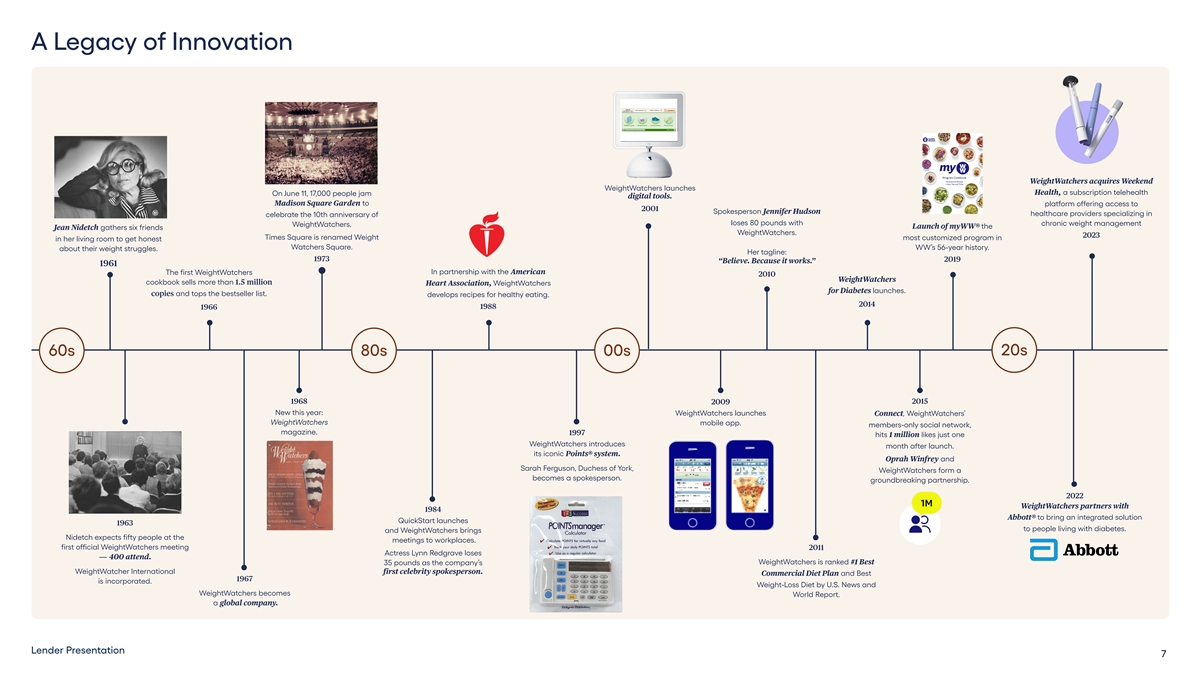

A Legacy of Innovation WeightWatchers acquires Weekend WeightWatchers launches Health, a subscription telehealth On June 11, 17,000 people jam digital tools. Madison Square Garden to platform offering access to 2001 Spokesperson Jennifer Hudson healthcare providers specializing in celebrate the 10th anniversary of loses 80 pounds with chronic weight management WeightWatchers. Launch of myWW® the Jean Nidetch gathers six friends WeightWatchers. 2023 Times Square is renamed Weight most customized program in in her living room to get honest Watchers Square. WW’s 56-year history. about their weight struggles. Her tagline: 1973 2019 “Believe. Because it works.” 1961 In partnership with the American The first WeightWatchers 2010 WeightWatchers cookbook sells more than 1.5 million Heart Association, WeightWatchers for Diabetes launches. copies and tops the bestseller list. develops recipes for healthy eating. 2014 1988 1966 20s 60s 80s 00s 1968 2015 2009 New this year: WeightWatchers launches Connect, WeightWatchers’ WeightWatchers mobile app. members-only social network, magazine. 1997 hits 1 million likes just one WeightWatchers introduces month after launch. its iconic Points® system. Oprah Winfrey and Sarah Ferguson, Duchess of York, WeightWatchers form a becomes a spokesperson. groundbreaking partnership. 2022 WeightWatchers partners with 1984 Abbott® to bring an integrated solution QuickStart launches 1963 to people living with diabetes. and WeightWatchers brings Nidetch expects fifty people at the meetings to workplaces. first official WeightWatchers meeting 2011 Actress Lynn Redgrave loses — 400 attend. WeightWatchers is ranked #1 Best 35 pounds as the company’s WeightWatcher International first celebrity spokesperson. Commercial Diet Plan and Best 1967 is incorporated. Weight-Loss Diet by U.S. News and WeightWatchers becomes World Report. a global company. Lender Presentation 7
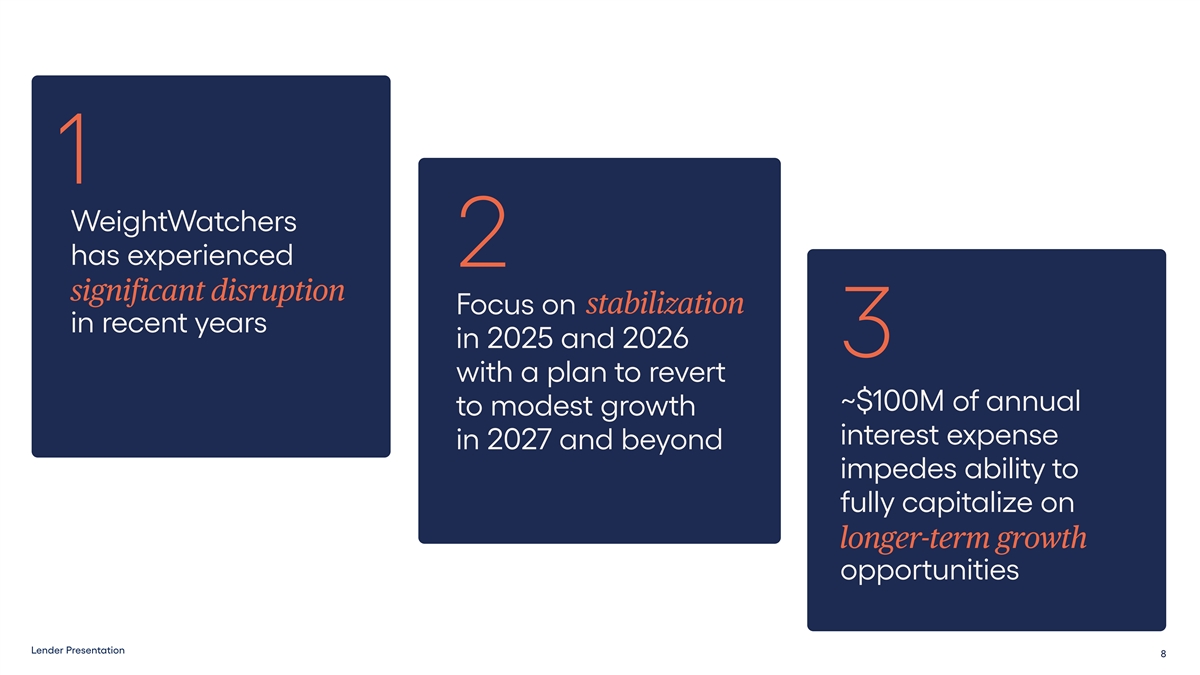

1 WeightWatchers has experienced 2 significant disruption significant disruption stabilization Focus on stabilization in recent years in 2025 and 2026 3 with a plan to revert ~$100M of annual to modest growth interest expense in 2027 and beyond impedes ability to fully capitalize on longer-term growth longer-term growth opportunities Lender Presentation 8


Company 2 Overview Lender Presentation
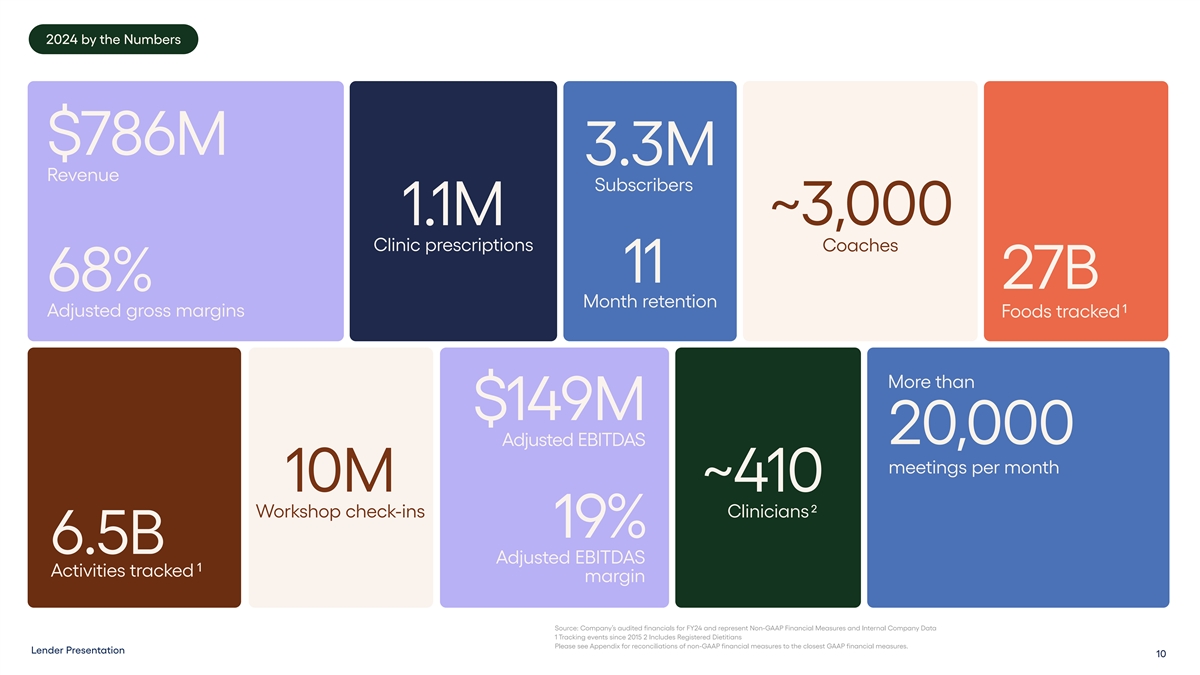

2024 by the Numbers $786M 3.3M Revenue Subscribers 1.1M ~3,000 Clinic prescriptions Coaches 11 27B 68% Month retention 1 Adjusted gross margins Foods tracked More than $149M 20,000 Adjusted EBITDAS meetings per month 10M ~410 2 Workshop check-ins Clinicians 19% 6.5B Adjusted EBITDAS 1 Activities tracked margin Source: Company’s audited financials for FY24 and represent Non-GAAP Financial Measures and Internal Company Data 1 Tracking events since 2015 2 Includes Registered Dietitians Please see Appendix for reconciliations of non-GAAP financial measures to the closest GAAP financial measures. Lender Presentation 10


62 years later and we're still the most effective most effectiv weight loss program #1 Best Weight-Loss Diet—for the 15th Year by U.S. News & #1 1 World Report 2 US doctor-recommended weight-loss program #1 More effective for weight loss than reliance on standard 3.5x 3 nutritional guidance 4 More effective for weight loss than physician counseling or 2x 5 do-it-yourself ® More weight loss by combining our Points program with 54% 6 weight-loss medication than medication alone Members who transitioned from Clinic program to Behavioral 1.8% 7 program continued to lose an additional 1.8% of their body weight 1 U.S. News (2024). 2 Based on a 2023 Cerner Inviza survey of 500 doctors who recommend weight-loss programs to patients. 3 Palacios et al. 4 Tate et al. 2022. 5 Jebb et al. 6 Based on a 12-week randomized controlled trial (n=101) that compared taking bupropion & naltrexone medications on their own to taking bupropion & naltrexone with the Ⓡ WeightWatchers behavioral program, including the Points Program. Jones et al. Manuscript in draft. Funded by WW International, Inc. 7 On average, after 13 weeks. Based on observational data from 200 individuals. Le Len nd de er r P Pr re es se en nt ta at tiio on n 11


...And the most recognized brand in weight management 1 Brand Consideration 1 1 Aided Awareness Unaided Awareness 6% 5% Ro 26% Found 5% 44% 4% MyFitnessPal Noom Hims & Hers Hims & Hers 17% 0% Ro 73% Found 45% 95% WeightWatchers WeightWatchers WeightWatchers 17% Hims 54% 1% 30% Ro 32% MyFitnessPal 78% Noom MyFitnessPal 2% Noom Found 1 Qualtrics Brand tracker, January 2025. Data is across Lapsed and Nevers Lender Presentation 12
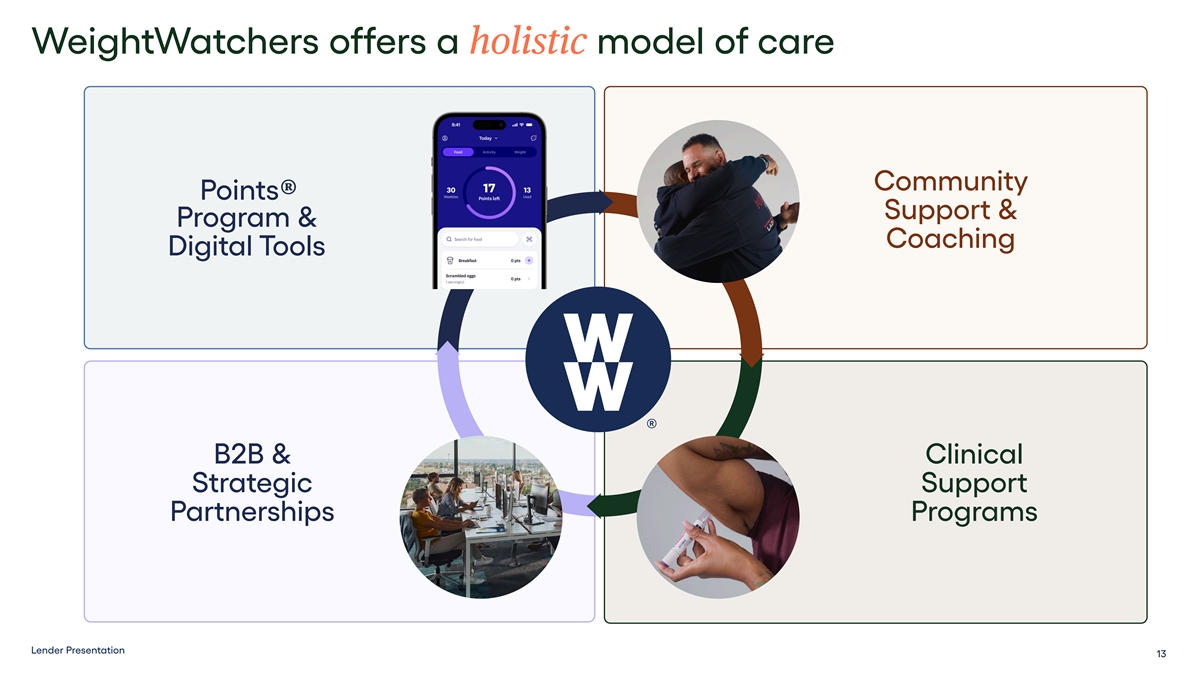

WeightWatchers offers a holistic model of care Community Points® Support & Program & Coaching Digital Tools B2B & Clinical Strategic Support Partnerships Programs Lender Presentation 13
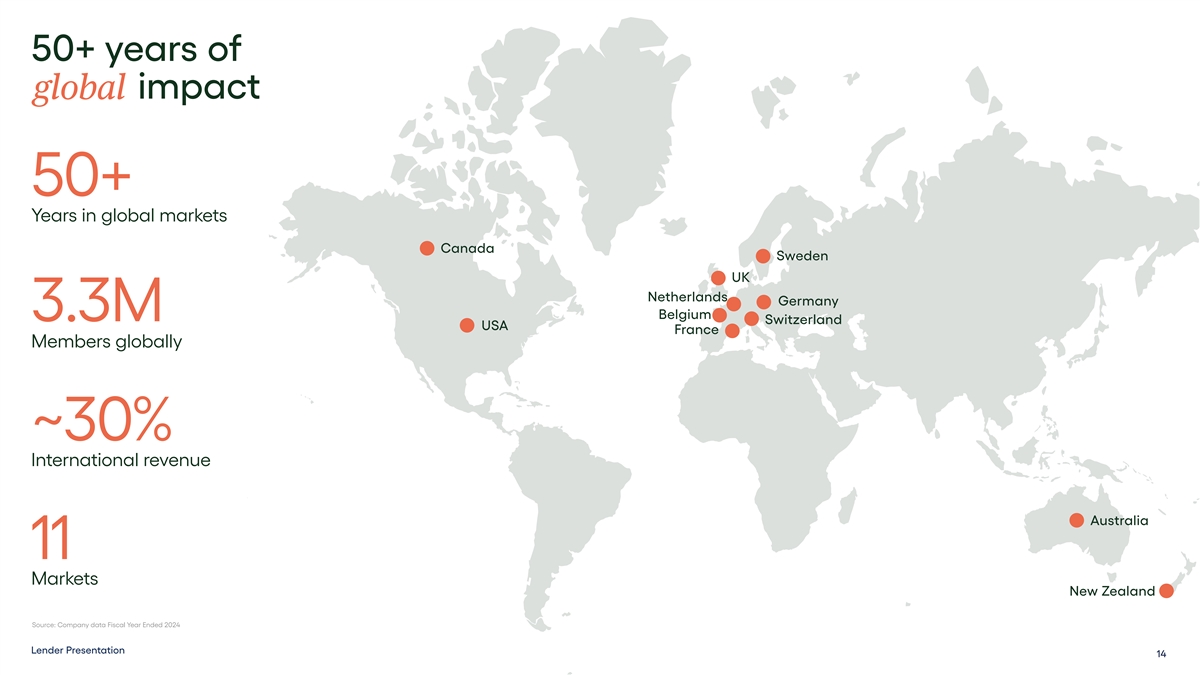

50+ years of impac global t 50+ Years in global markets Canada Sweden UK Netherlands Germany Belgium 3.3M Switzerland USA France Members globally ~30% International revenue Australia 11 Markets New Zealand Source: Company data Fiscal Year Ended 2024 Lender Presentation 14


® The Points program is the foundatio of our foundation behavior change program 1 Lose 4x more weight 4x Science-based, award-winning nutritional tracking Tailored plans for GLP-1 members and members living with diabetes Features to support day-to-day livability, e.g. AI-based photo tracking Thousands of inspirational recipes, wellness and fitness content Seamless activity tracking through connected devices Work 1:1 with a Registered Dietitian to personalize program (US) 1 Those who consistently track their food at least 5 days per week lose 4 times more weight than those who track less than 3 days per week; based on a 6 mo clinical study of the WW program. Xu R, Bannor R, Cardel MI, Foster GD, Pagoto S. How much food tracking during a digital weight-management program is enough to produce clinically significant weight loss?. Obesity (Silver Spring). 2023;31(7):1779-1786. doi:10.1002/oby.23795 Lender Presentation 15


Workshops are the center of ourcommunity Members lose 2x as much weight as those 2x 1 trying to lose weight on their own Over 20,000 coach Workshops (in-person and virtual) monthly ~3,000 expert coaches and direct-to-coach group chats 24/7 unlimited access to expert and community support Dynamic, evolving curriculum based on latest science Proven results in behavior change and weight-loss management Curated virtual events Flexible IRL & virtual workshops 1 Tate DF, et al. 12-month multi-country trial comparing weight loss between the WeightWatchers program and a Do-It-Yourself Approach where resource guides were provided. JAMA Netw Open. 2022. Funded by WW International, Inc. Lender Presentation 16
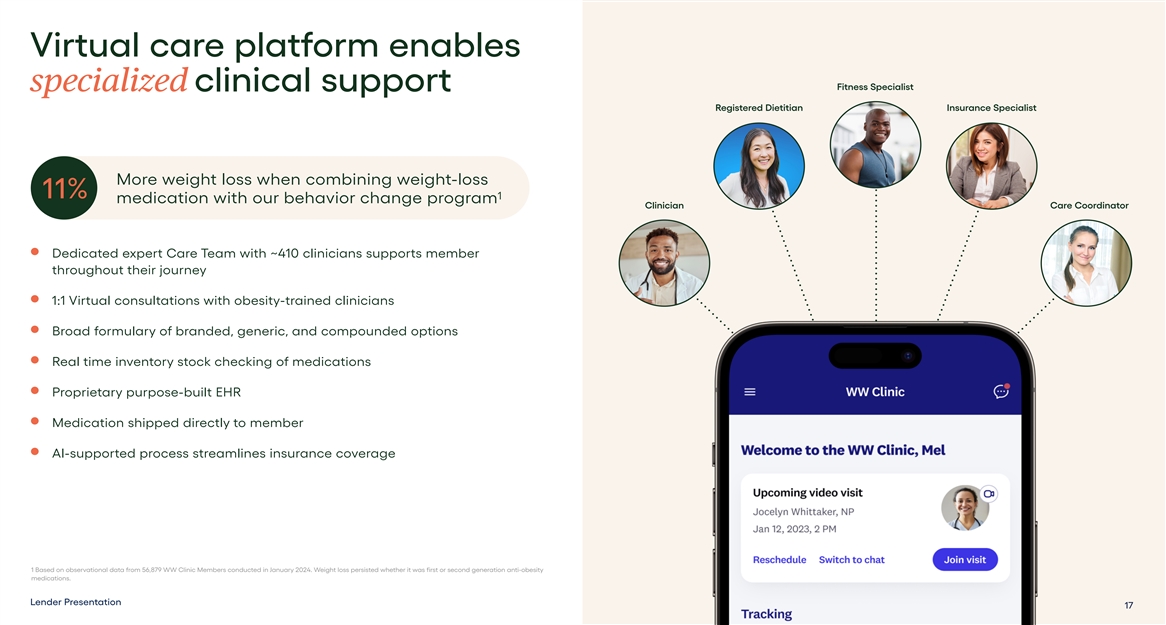

Virtual care platform enables Fitness Specialist specialized specializ clinical support Registered Dietitian Insurance Specialist More weight loss when combining weight-loss 11% 1 medication with our behavior change program Clinician Care Coordinator Dedicated expert Care Team with ~410 clinicians supports member throughout their journey 1:1 Virtual consultations with obesity-trained clinicians Broad formulary of branded, generic, and compounded options Real time inventory stock checking of medications Proprietary purpose-built EHR Medication shipped directly to member AI-supported process streamlines insurance coverage 1 Based on observational data from 56,879 WW Clinic Members conducted in January 2024. Weight loss persisted whether it was first or second generation anti-obesity medications. Lender Presentation 17


Extensive Clinical offering with price poin accessible ts Branded GLP-1s Compounded GLP-1s Oral AOMs Wegovy, Ozempic, Zepbound, Mounjaro, & Saxenda Compounded Semaglutide Metformin, Bupropion, & Naltrexone Available through Clinic Membership with copays as low as $25/mo Medication cost bundled with Clinic Membership, starting at $129/m Included in monthly Clinic Membership at no additional cost Lender Presentation 18


WW4B: Meeting the unique needs of emp emplo loy y er e s s and pay payer erss Tailored programming WeightWatchers for Business (WW4B) delivers a full- spectrum weight health platform designed to meet the dynamic needs of employers, health plans, and PBMs Flexible delivery model Members engage how, when, and where is convenient for them, digitally and in person Aligned with client strategies Employers and health plans approach GLP-1 coverage Kim Beck in varying ways—WW4B delivers best-in-class support Head of Health & Wellness, Labcorp whether their members are on or off medication Our goal was to offer our clients a singular “ solution for their weight management needs Impactful ROI —from meaningful behavior change for all, Clients realize a strong and 3rd party validated to the necessary and life-saving clinical return on their investment through enhanced interventions like medication for those who outcomes and enduring behavior changes qualify. WeightWatchers for Business helped us meet all those needs and more, all in one seamless experience. ” Lender Presentation 19


Leading obesity experts ground our program in the latest clinical evidence Clinical Research Partners Scientific Advisory Board Amy Ahern, Ph.D. Cheryl A.M. Anderson Gary G. Bennett, Ph.D. Ania Jastreboff, M.D., Ph.D. Ph.D., MPH, M.S. Duke University Yale University University of Cambridge UC San Diego Robert Kushner, M.D., M.S. Stephanie Faubion, Gary Foster, Ph.D. M.D., M.B.A Northwestern University University of Pennsylvania Mayo Clinic Lender Presentation 20


50 years Grounded in of scientific innovation 180+ 64 43 Scientific From Randomized Measured Impact Across Publications Controlled Trials (RCTs) Clinical and Behavioral Metrics Formative Pilots Agile research initiatives designed to answer key program development questions and drive continuous improvement of the WW program Internal Trials Rigorous, ethically conducted studies addressing emerging scientific questions to refine and validate program components External Trials Independent, scientifically robust evaluations confirming the efficacy and real-world effectiveness of the WW program Lender Presentation 21
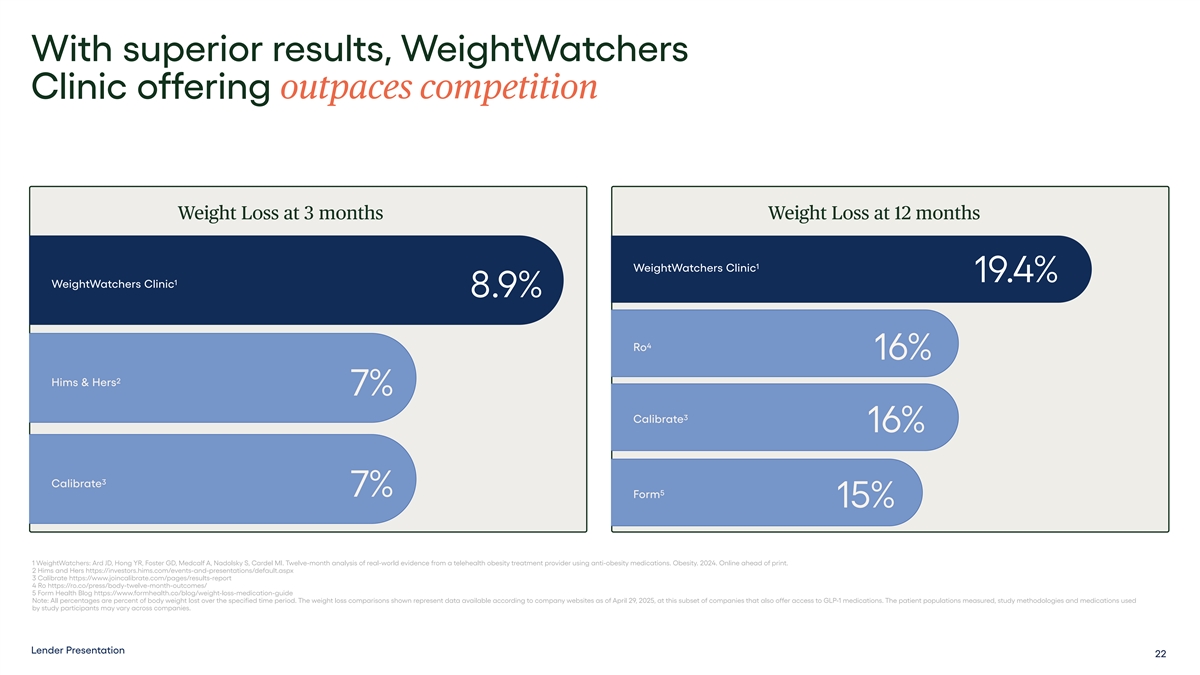

With superior results, WeightWatchers outpaces competition Clinic offering Weight Loss at 3 months Weight Loss at 12 months 1 WeightWatchers Clinic 19.4% 1 WeightWatchers Clinic 8.9% 4 Ro 16% 2 Hims & Hers 7% 3 Calibrate Hims 16% 7% 3 Calibrate 5 7% Form 15% 1 WeightWatchers: Ard JD, Hong YR, Foster GD, Medcalf A, Nadolsky S, Cardel MI. Twelve-month analysis of real-world evidence from a telehealth obesity treatment provider using anti-obesity medications. Obesity. 2024. Online ahead of print. 2 Hims and Hers https://investors.hims.com/events-and-presentations/default.aspx 3 Calibrate https://www.joincalibrate.com/pages/results-report 4 Ro https://ro.co/press/body-twelve-month-outcomes/ 5 Form Health Blog https://www.formhealth.co/blog/weight-loss-medication-guide Note: All percentages are percent of body weight lost over the specified time period. The weight loss comparisons shown represent data available according to company websites as of April 29, 2025, at this subset of companies that also offer access to GLP-1 medications. The patient populations measured, study methodologies and medications used by study participants may vary across companies. Lender Presentation 22
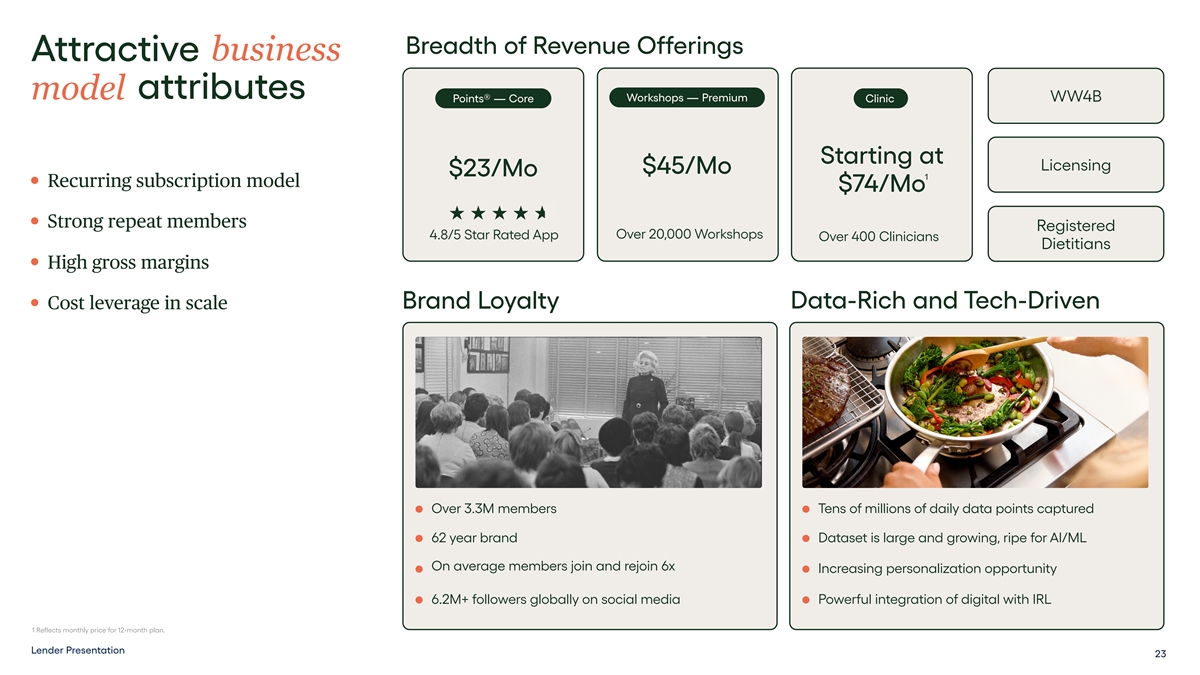

Breadth of Revenue Offerings business Attractive business attributes model Workshops — Premium WW4B Points® — Core Clinic Starting at Licensing $45/Mo $23/Mo 1 Recurring subscription model $74/Mo Strong repeat members Registered Over 20,000 Workshops 4.8/5 Star Rated App Over 400 Clinicians Dietitians High gross margins Data-Rich and Tech-Driven Brand Loyalty Cost leverage in scale Over 3.3M members Tens of millions of daily data points captured 62 year brand Dataset is large and growing, ripe for AI/ML On average members join and rejoin 6x Increasing personalization opportunity 6.2M+ followers globally on social media Powerful integration of digital with IRL 1 Reflects monthly price for 12-month plan. Lender Presentation 23


State of 3 the Union Lender Presentation
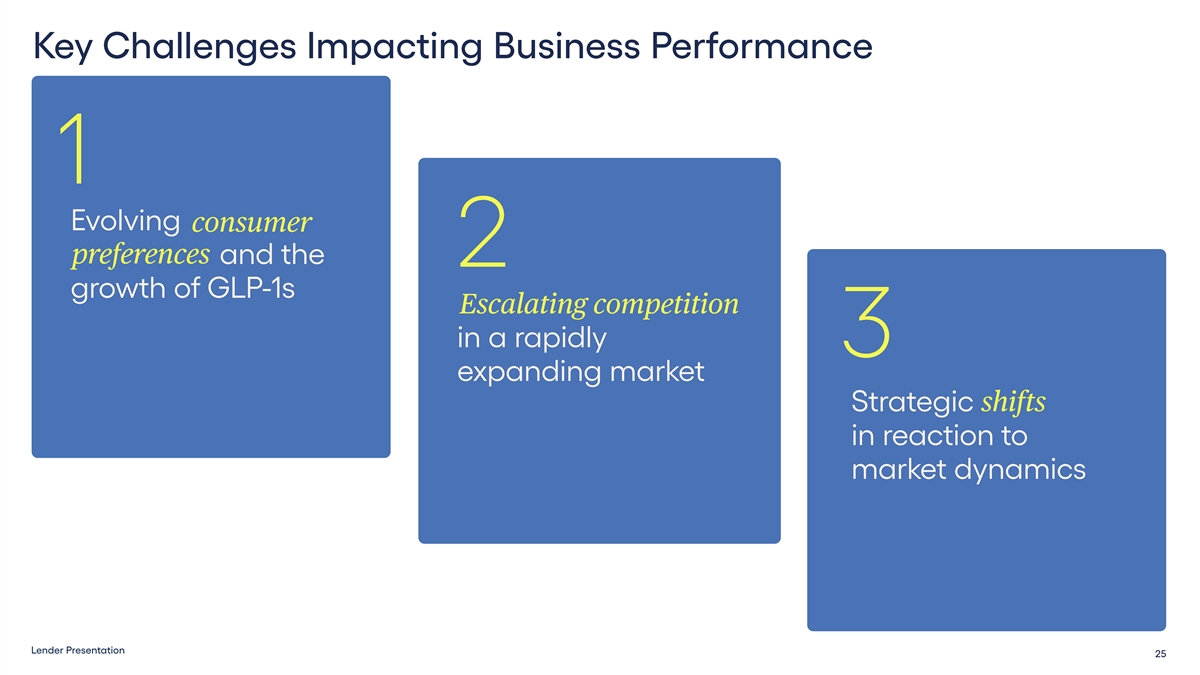

Key Challenges Impacting Business Performance 1 Evolving consumer consumer preferences behavior and the 2 growth of GLP-1s Es Esca calatin latin g c g ompetition in a rapidly 3 expanding market Strategic ov shifts erpivots in reaction to market dynamics Lender Presentation 25
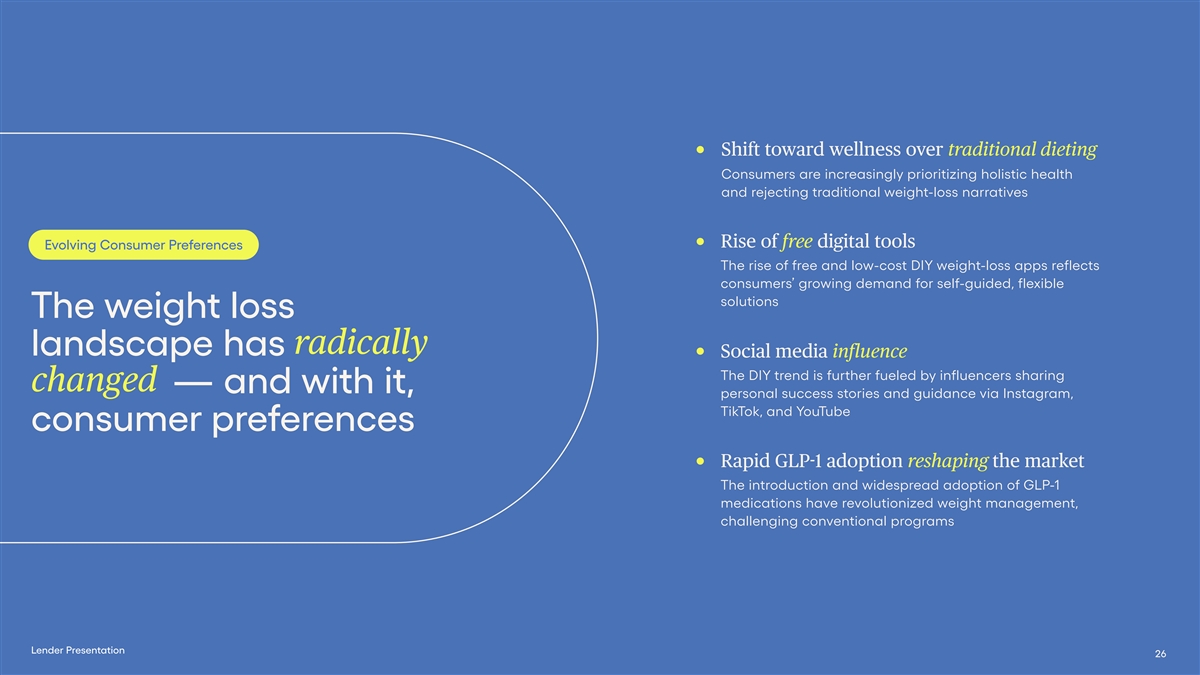

Shift toward wellness over traditional dieting Consumers are increasingly prioritizing holistic health and rejecting traditional weight-loss narratives Rise of free digital tools Evolving Consumer Preferences The rise of free and low-cost DIY weight-loss apps reflects consumers’ growing demand for self-guided, flexible solutions The weight loss radically landscape has radically Social media influence The DIY trend is further fueled by influencers sharing changed change — and with it, personal success stories and guidance via Instagram, TikTok, and YouTube consumer preferences Rapid GLP-1 adoption reshaping the market The introduction and widespread adoption of GLP-1 medications have revolutionized weight management, challenging conventional programs Lender Presentation 26
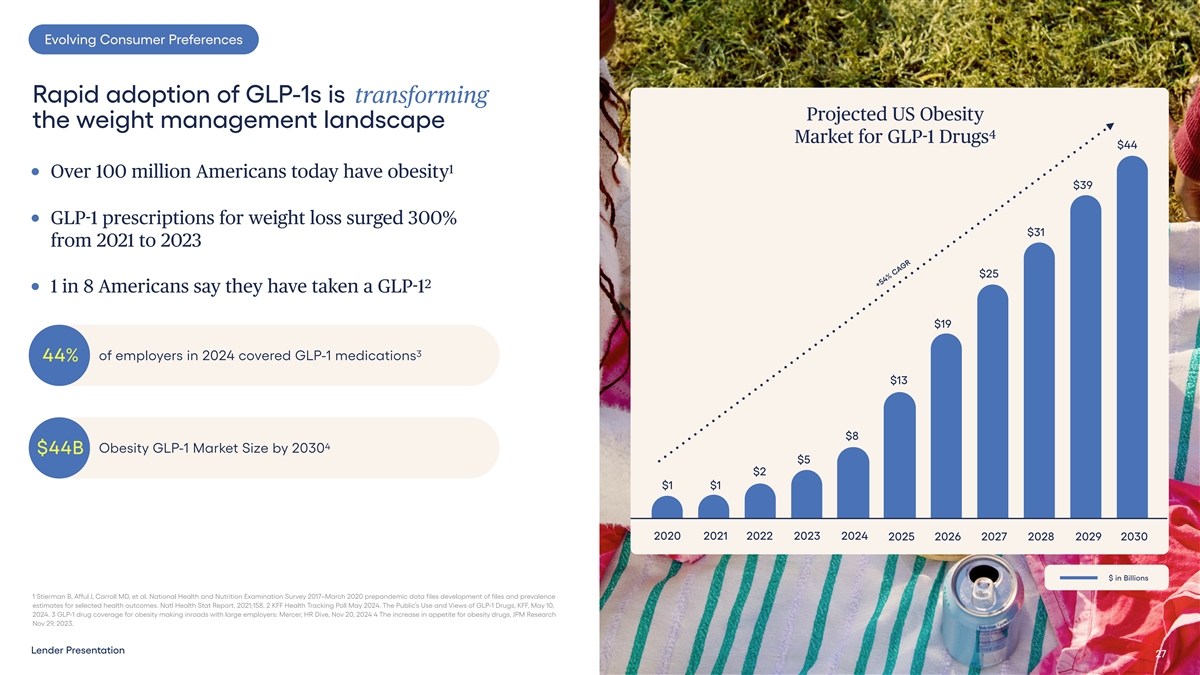

Evolving Consumer Preferences Rapid adoption of GLP-1s is tr trans ansfformin orming g Projected US Obesity the weight management landscape 4 Market for GLP-1 Drugs $44 1 Over 100 million Americans today have obesity $39 GLP-1 prescriptions for weight loss surged 300% $31 from 2021 to 2023 $25 2 1 in 8 Americans say they have taken a GLP-1 $19 3 of employers in 2024 covered GLP-1 medications 44% $13 $8 4 Obesity GLP-1 Market Size by 2030 $44B $5 $2 $1 $1 2020 2021 2022 2023 2024 2025 2026 2027 2028 2029 2030 $ in Billions 1 Stierman B, Afful J, Carroll MD, et al. National Health and Nutrition Examination Survey 2017–March 2020 prepandemic data files development of files and prevalence estimates for selected health outcomes. Natl Health Stat Report. 2021;158. 2 KFF Health Tracking Poll May 2024. The Public’s Use and Views of GLP-1 Drugs, KFF, May 10, 2024. 3 GLP-1 drug coverage for obesity making inroads with large employers: Mercer, HR Dive, Nov 20, 2024 4 The increase in appetite for obesity drugs, JPM Research Nov 29, 2023. Lender Presentation 27 +54% CAGR 4,245 4,423 4,169 3,546 3,798


Intensifying Competition New competitors and innovations are reshaping the weight management market The rise of wearables, social media content, free apps and prescription medications is rapidly changing Escalating competition consumer behavior in a r rapidly apidly expanding Increasingly fragmented market with explosive growth in competition market Lender Presentation 28
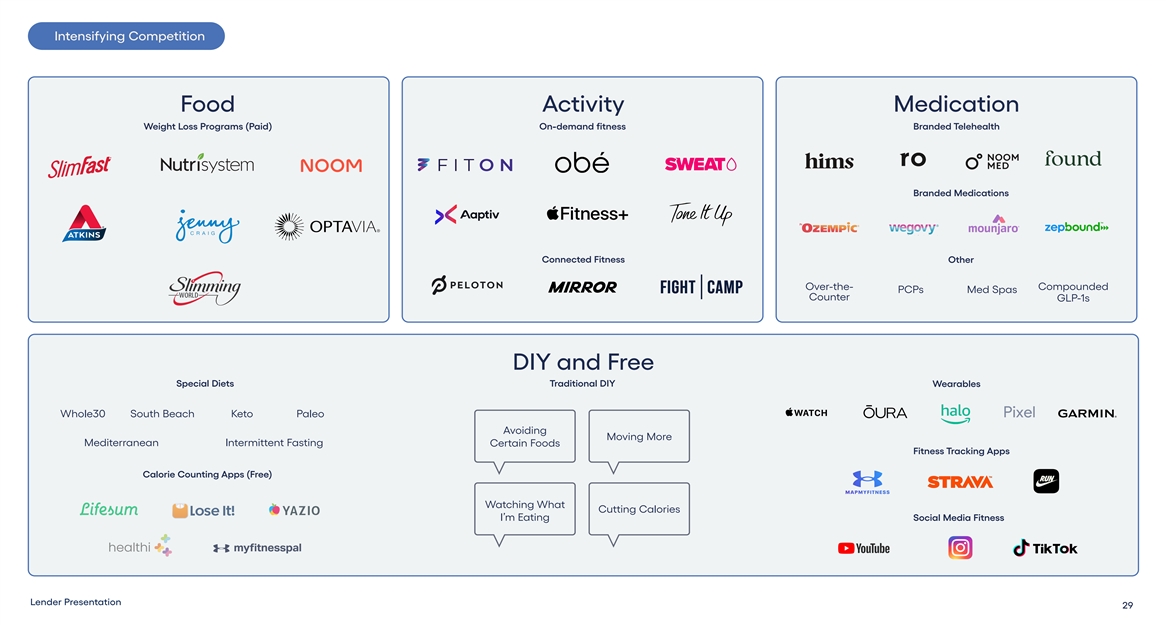

Intensifying Competition Food Activity Medication Weight Loss Programs (Paid) On-demand fitness Branded Telehealth Branded Medications Connected Fitness Other Over-the- Compounded PCPs Med Spas Counter GLP-1s DIY and Free Special Diets Traditional DIY Wearables Whole30 South Beach Keto Paleo Avoiding Moving More Mediterranean Intermittent Fasting Certain Foods Fitness Tracking Apps Calorie Counting Apps (Free) Watching What Cutting Calories I’m Eating Social Media Fitness Lender Presentation 29
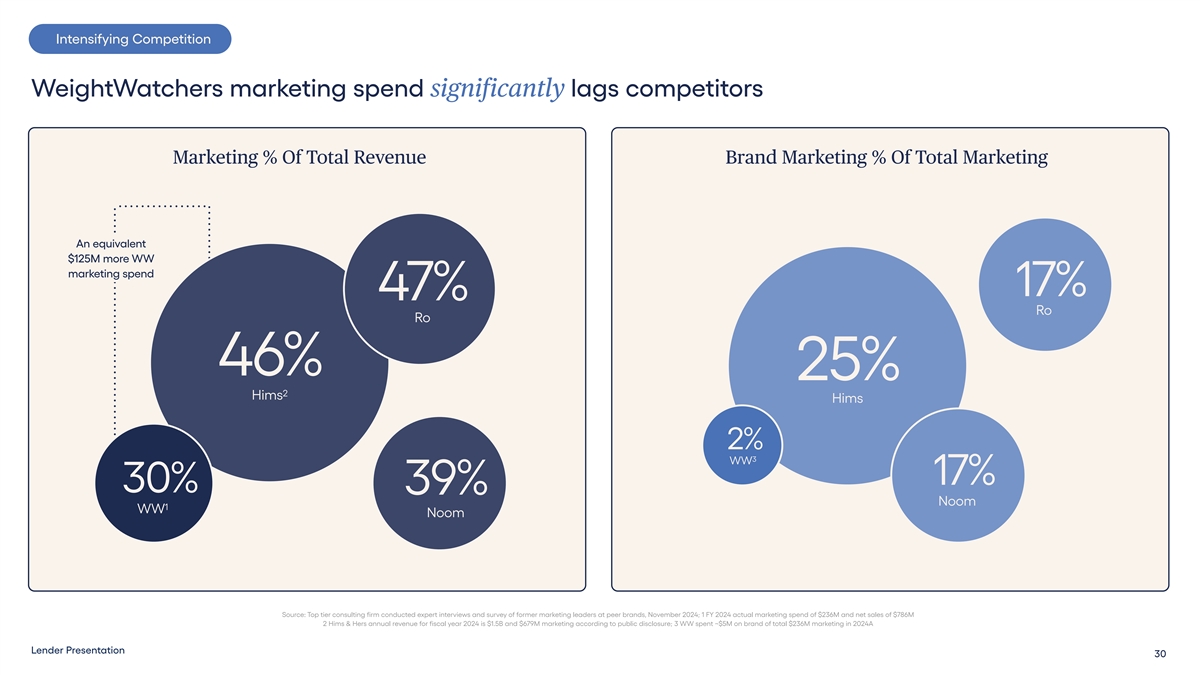

Intensifying Competition WeightWatchers marketing spend significantly lags competitors Marketing % Of Total Revenue Brand Marketing % Of Total Marketing An equivalent Hims & Hers $125M more WW marketing spend 17% 47% Ro Ro 46% 25% 2 Hims Hims 2% 3 WW 17% 30% 39% Noom 1 WW Noom Source: Top tier consulting firm conducted expert interviews and survey of former marketing leaders at peer brands, November 2024; 1 FY 2024 actual marketing spend of $236M and net sales of $786M 2 Hims & Hers annual revenue for fiscal year 2024 is $1.5B and $679M marketing according to public disclosure; 3 WW spent ~$5M on brand of total $236M marketing in 2024A Lender Presentation 30


Strategic Shifts Abrupt pivot from in-person workshops An exit from consumer products & licensing strategy shifts Reactive strategy shift Centralization of international operations have driven long-term Overreliance on performance marketing revenue headwinds and discounting Lender Presentation 31


Strategic Shifts Legacy business channels created significant brand awareness; organic growth strategy pivots under way Consumer products Celebrity endorsements Physical workshops Brand awareness Lender Presentation 32
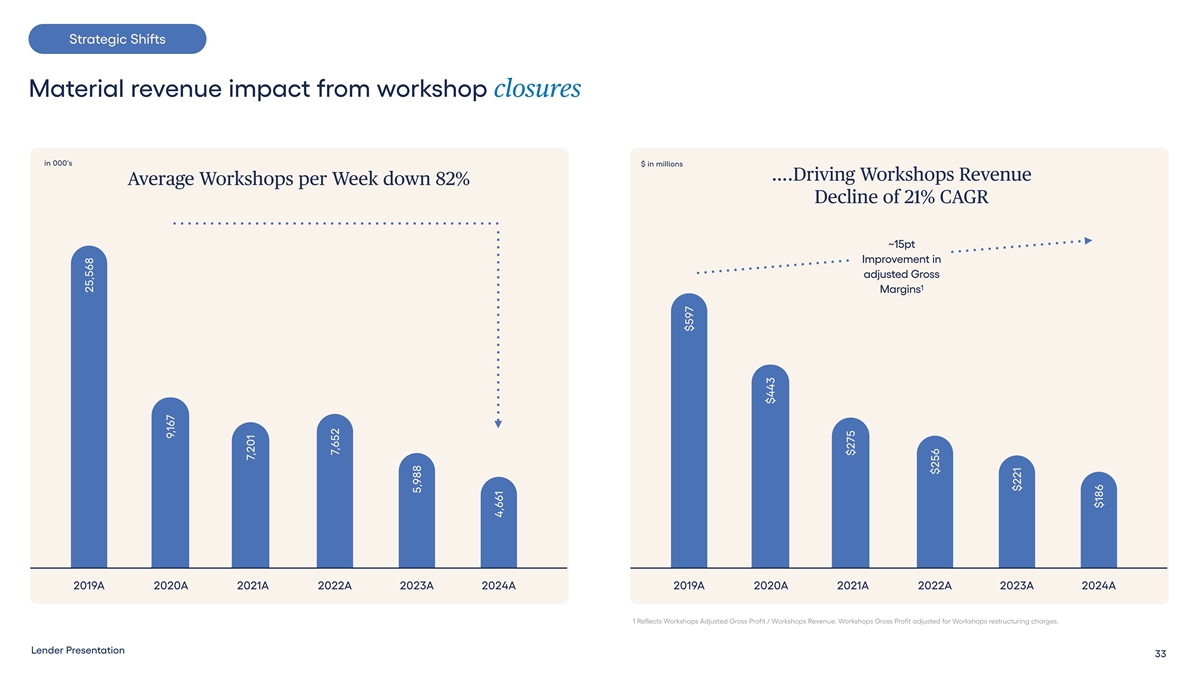

Strategic Shifts Material revenue impact from workshop closures in 000's $ in millions ….Driving Workshops Revenue Average Workshops per Week down 82% Decline of 21% CAGR ~15pt Improvement in adjusted Gross 1 Margins 2019A 2020A 2021A 2022A 2023A 2024A 2019A 2020A 2021A 2022A 2023A 2024A 1 Reflects Workshops Adjusted Gross Profit / Workshops Revenue. Workshops Gross Profit adjusted for Workshops restructuring charges. Lender Presentation 33 25,568 9,167 7,201 7,652 5,988 4,661 $597 $443 $275 $256 $221 $186


Strategic Shifts Exit from consumer products eliminated a material revenue stream Wound down the consumer products and e-commerce business due to margin profile and operational complexity Licensing scaled back as the brand moved away from artificial sweeteners and preservatives Consumer Products & Licensing Revenue Opportunity to extend WeightWatchers brand through premium partnerships 2012 >$300M Hims Hims 2024 $7M Lender Presentation 34


Strategic Shifts Led to headwind across key growth metrics… headwinds Subs in 000's $5. $5.14 14 $4.6 $4.67 7 $4.37 $4.37 $4.26 $4.26 $3. $3.97 97 $3. $3.9 95 5 2019 2019A A 2020 2020A A 2021A 2021A 2022 2022A A 2023 2023A A 2024 2024A A To Tot ta al l E Eo oP P S Su ub bs sc cr ri ib be er rs s Av Avg g. . R Re ev v P Pe er r P Pa aiid d W We ee ek k Le Len nd de er r P Pr re es se en nt ta at tiio on n 35 4,245 4,245 4, 4,423 423 4, 4,16 169 9 3,546 3,546 3, 3,79 798 8 3,335 3,336
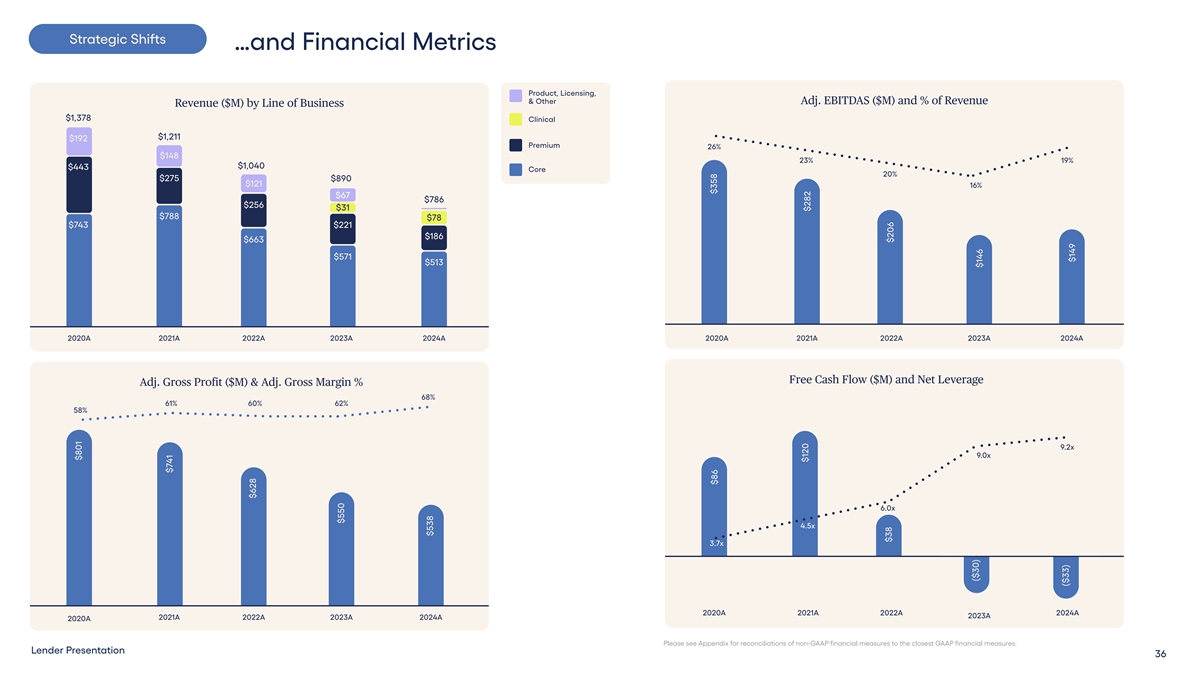

Strategic Shifts …and Financial Metrics Product, Licensing, & Other Adj. EBITDAS ($M) and % of Revenue Revenue ($M) by Line of Business $1,378 Clinical $1,211 $192 Premium 26% $148 23% 19% $1,040 $443 Core 20% $275 $890 $121 16% $67 $786 $256 $31 $788 $78 $743 $221 $186 $663 $571 $513 2020A 2021A 2022A 2023A 2024A 2020A 2021A 2022A 2023A 2024A Free Cash Flow ($M) and Net Leverage Adj. Gross Profit ($M) & Adj. Gross Margin % 68% 61% 60% 62% 58% 9.2x 9.0x 6.0x 4.5x 3.7x 2020A 2021A 2022A 2024A 2023A 2021A 2022A 2023A 2024A 2020A Please see Appendix for reconciliations of non-GAAP financial measures to the closest GAAP financial measures. Lender Presentation 36 $801 $741 $628 $550 $538 4,423 $358 $86 $120 $282 $38 $206 ($30) $146 ($33) $149


Path to Stabilization 4 Lender Presentation


The trus trust ted leade ed leader in weight management, combining science and commu science and community to help our millions o millions of member f member s live their healthiest lives Lender Presentation 38
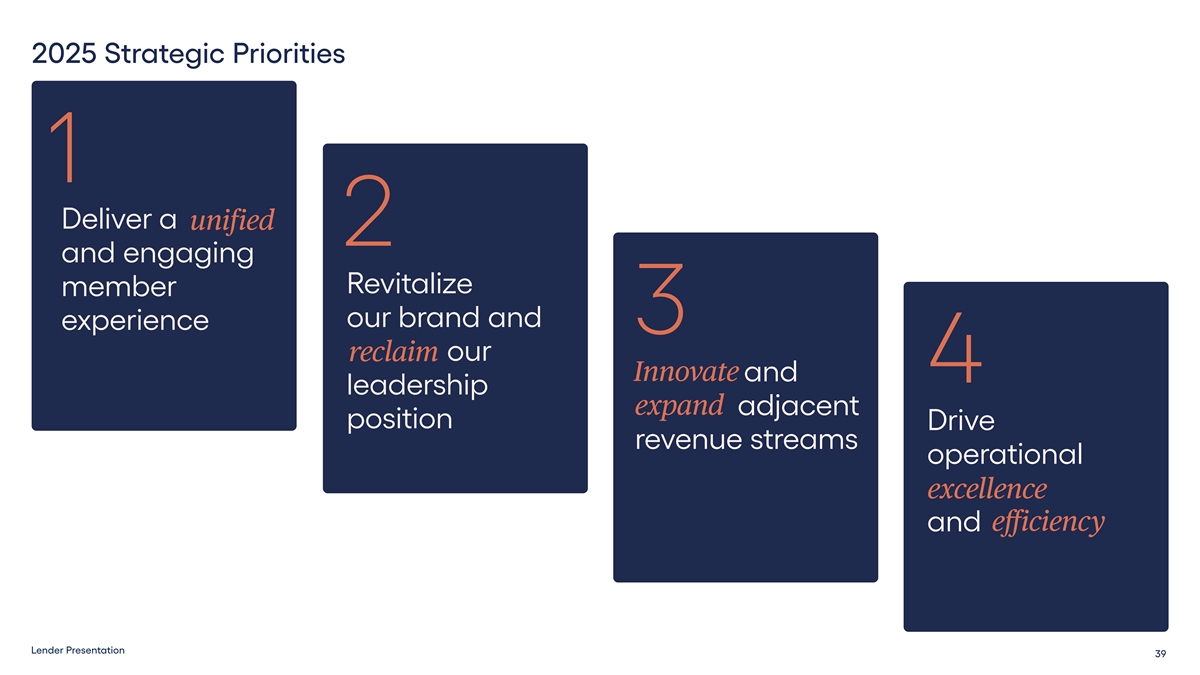

2025 Strategic Priorities 1 Deliver a unified unified 2 and engaging Revitalize member our brand and experience 3 reclaimour reclaim Innovate Innovat and 4 leadership expand expandadjacent position Drive revenue streams operational excellence excellence efficiency and efficiency Lender Presentation 39

Strategic Priorities 1 Deliver a unified unified 2 and engaging Revitalize member our brand and experience 3 reclaimour reclaim Innovate Innovat and 4 leadership expand expandadjacent position Drive revenue streams operational excellence excellence efficiency and efficiency Lender Presentation 40


Unify the Member Experience Rebuilding and op optimizin timizin g the website experience presents a major opportunity to drive new member signups Communicate breadth of offerings High-intent & SEO optimized landing pages Engaging lower-intent visitors Personalized plan matching Clear pricing & membership tiers Seamless & fast checkout Lender Presentation 41


Unify the Member Experience Innovative features that Streak Widget Targeted Interventions AI Food Scanner make weight management easie, more personalized, easier and sustainable sustainable Launched several new features with more fast follows in 2025: AI Food Scanner, Recipe Analyzer, Macronutrients, and 150+ new ZeroPoint Foods ` Approaching 2 million meals tracked using the AI food scanner Nearly 1 million recipes imported Macros drove a 5 percent increase in tracked foods since launch Highest activation rate for the start of a year since 2020 Keeps a gamified, habit- Personalized, in-the-moment An AI-powered tool building progress tracker interventions to help automatically converts top of mind members stay on track a photo to Points Lender Presentation 42


Unify the Member Experience Revitalize the Workshop program and expand member base Expand and advance Modernize digital Invest in Optimize workshop virtual programming workshop experience Coaches footprint Lender Presentation 43


Increased Member Engagement Unify the Member Experience power Unmatched scale of dataset to power and impr impro ov ve ou ed out tcomes comes Personalized Recommendations and Interventions Tens of millions of daily data points Opportunity for unmatched behavioral insights Product roadmap includes shift to increasingly personalized journeys Tens of Data-backed success correlations to drive Billions outcomes of aggregate data points Expand capabilities to ensure continuous ML-driven product improvement Additional Behavioral Insights to Power Smarter Recommendations Lender Presentation 44 44 Continuous Model and Program Improvement

Strategic Priorities 1 Deliver a unified unified 2 and engaging Revitalize member our brand and experience 3 reclaimour reclaim Innovate Innovat and 4 leadership expand expandadjacent position Drive revenue streams operational excellence excellence efficiency and efficiency Lender Presentation 45
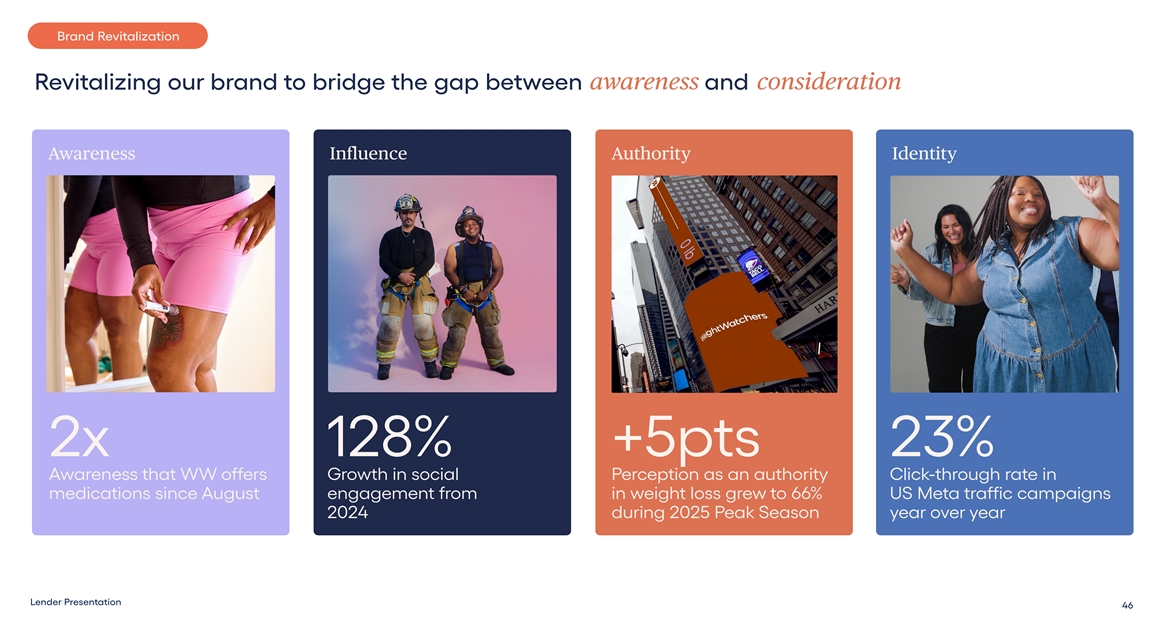

Brand Revitalization awareness consideration Revitalizing our brand to bridge the gap between awarenes and consideration Awareness Influence Authority Identity 2x 128% +5pts 23% Awareness that WW offers Growth in social Perception as an authority Click-through rate in medications since August engagement from in weight loss grew to 66% US Meta traffic campaigns 2024 during 2025 Peak Season year over year Lender Presentation 46


Brand Revitalization Amplifying our influence Celebrity strategy Top-of-funnel celebrity alignments tied to product and clinical innovation roadmap First effort in this space will debut tied to key late Summer/Fall launch Investing in influencer Multi-pronged influencer strategy WW Member Advocate Talent across wellness, menopause, fashion and “ I'd like to thank the woman in my beauty, and culinary before photos for helping to make me the woman I am today. ” Refocus on social Member stories drive top engagement Reimagination and modernization of creative and social strategy Celebrating our members and coaches, leveraging real-world WW stories Leveraging our clinicians as trusted experts in the field Lender Presentation 47


Brand Revitalization Expanding our Authority The Scientific Authority A new slate of initiatives—from medical myth-busting to pioneering studies Focus on the advancement of medication access and health equity Assert our trusted expertise and advocacy Food & Recipe Development Re-activate WW nutritional expertise in social channels WW Clinic Member Advocate Focus on everyday high-protein and high-fiber recipes You're going to reach a point where “ “ Convey modernity, livability, and the potential for scale someone believes you deserve treatment on social media and help in a way that's not stigmatizing.” Earned Media Refocused press and content strategy showing early positive results Top tier placements occurring almost weekly 3.8B press impressions since December ‘24 Lender Presentation 48

Strategic Priorities 1 Deliver a unified unified 2 and engaging Revitalize member our brand and experience 3 reclaimour reclaim Innovate Innovat and 4 leadership expand expandadjacent position Drive revenue streams operational excellence excellence efficiency and efficiency Lender Presentation 49
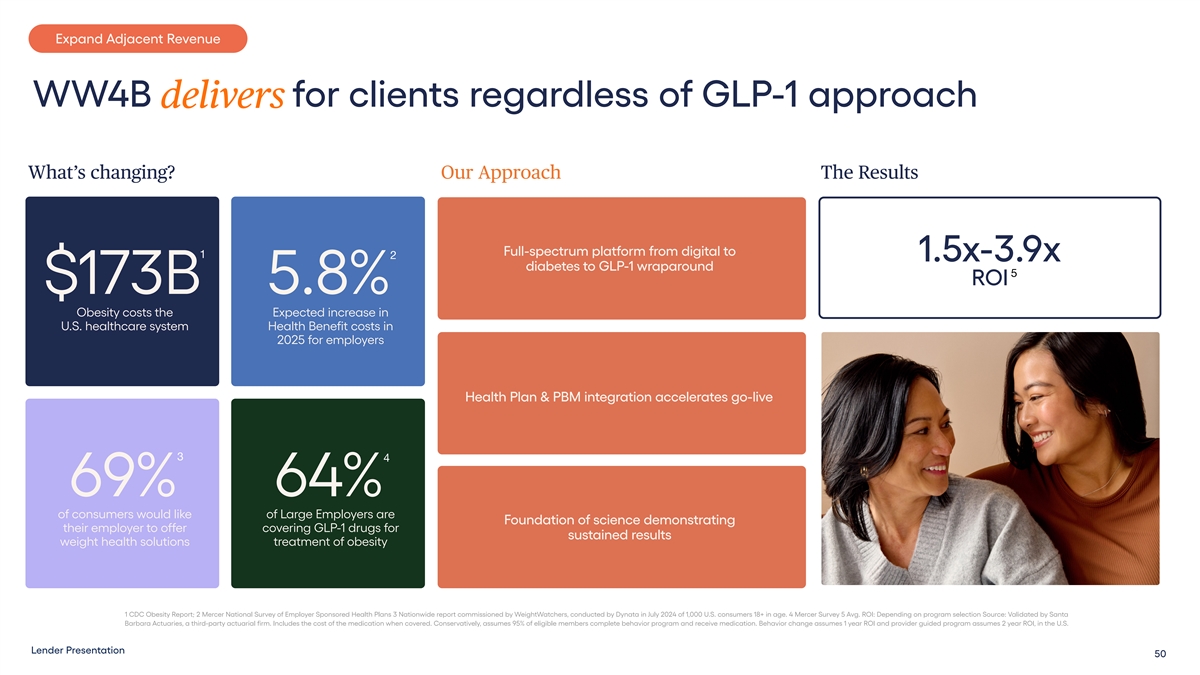

Expand Adjacent Revenue WW4B deliversfor clients regardless of GLP-1 approach delivers What’s changing? Our Approach The Results Full-spectrum platform from digital to 1 2 1.5x-3.9x diabetes to GLP-1 wraparound 5 ROI $173B 5.8% Obesity costs the Expected increase in U.S. healthcare system Health Benefit costs in 2025 for employers 5 Health Plan & PBM integration accelerates go-live 3 4 4 69% 64% of consumers would like of Large Employers are Foundation of science demonstrating their employer to offer covering GLP-1 drugs for sustained results weight health solutions treatment of obesity 1 CDC Obesity Report; 2 Mercer National Survey of Employer Sponsored Health Plans 3 Nationwide report commissioned by WeightWatchers, conducted by Dynata in July 2024 of 1,000 U.S. consumers 18+ in age. 4 Mercer Survey 5 Avg. ROI: Depending on program selection Source: Validated by Santa Barbara Actuaries, a third-party actuarial firm. Includes the cost of the medication when covered. Conservatively, assumes 95% of eligible members complete behavior program and receive medication. Behavior change assumes 1 year ROI and provider guided program assumes 2 year ROI, in the U.S. Lender Presentation 50


Expand Adjacent Revenue Direct to Employer Expanded channel options to unlock accelerating growth 300+ Enterprise clients 6.9M Covered lives Foundational Channels Health Plan PBM Channel Partnership Lender Presentation 51


Expand Adjacent Revenue R Re evit vita aliz lize and gr e and grow our global licensing business Unique legacy as a trusted brand Kickstart licensing rebuild leveraging agency relationships Resource-light approach High margin incremental business Support the needs of our members while enhancing brand value $357B 1 Global Sales of licensed brands 1 Global Licensing Industry Study January 2024 Lender Presentation 52


Expand Adjacent Revenue 1:1 visits with a Registered Dietitian now available to US members Personalized nutrition counseling on dietary and lifestyle modifications Patients have payment options (insurance-covered and cash-pay) Strong demand and positive reception: 4.9 out of 5 CSAT Showcases ability to scale ARPU through adjacent services Lender Presentation 53

Strategic Priorities 1 Deliver a unified unified 2 and engaging Revitalize member our brand and experience 3 reclaimour reclaim Innovate Innovat and 4 leadership expand expandadjacent position Drive revenue streams operational excellence excellence efficiency and efficiency Lender Presentation 54


Operational Excellence Complete Weekend Health integration to maximize efficiency, improve member experience and extend LTV Deliver efficiencies through systems, data and team integrations Consolidation of vendors and platforms Build a seamless member experience in a holistic model of care Leverage clinicians and coaches across a more integrated member experience Drive increased engagement and retention through personalized and expanded journeys Le Len nd de er r P Pr re es se en nt ta at tiio on n 55
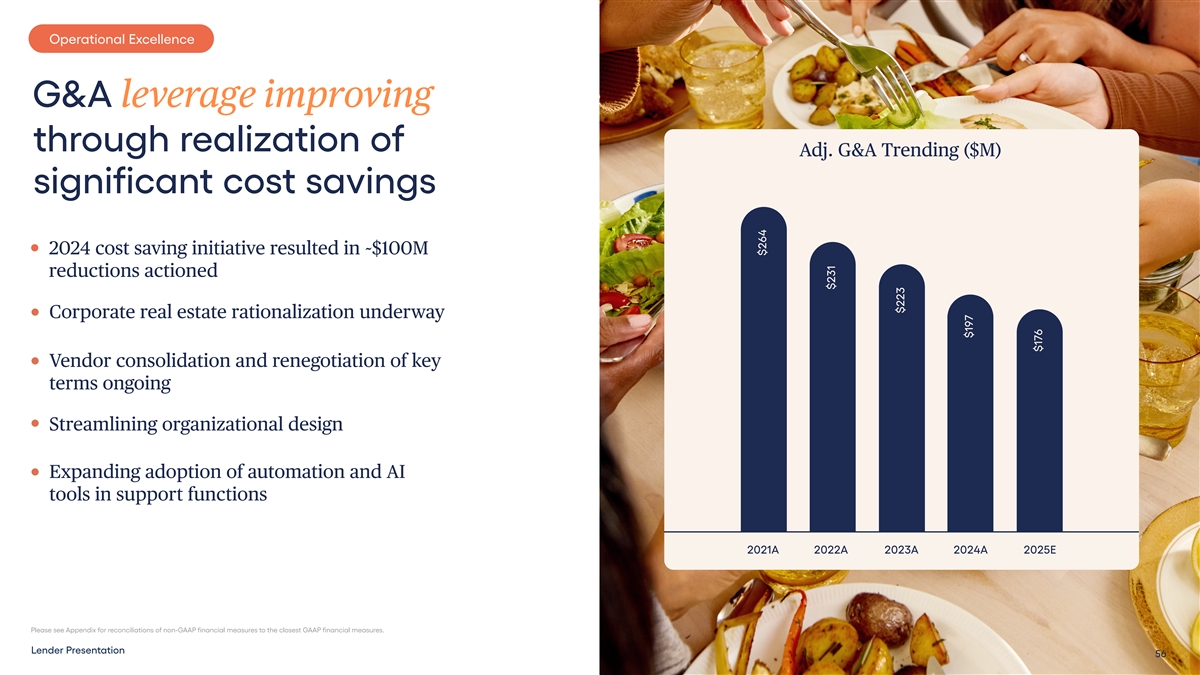

Operational Excellence G&A leverage improving Name for Chart through realization of Adj. G&A Trending ($M) significant cost savings Personalized Member Experience 2024 cost saving initiative resulted in ~$100M reductions actioned Corporate real estate rationalization underway Vendor consolidation and renegotiation of key terms ongoing Streamlining organizational design Expanding adoption of automation and AI Better Outcomes tools in support functions & Success More Data for Personalization 2021A 2022A 2023A 2024A 2025E Please see Appendix for reconciliations of non-GAAP financial measures to the closest GAAP financial measures. Lender Presentation 56 $264 3,798 $231 3,798 $223 3,798 $197 $176


5-Year Forecast 5 Lender Presentation


Business Plan reflects the priorities of stabilizing the business and returning to growth Subscribers projected to stabilize in 5-Year Forecast 2028 but revenue trough in 2025 as LTV shifts with Clinic mix 2029 Adjusted EBITDAS is projected to be $153M Lender Presentation 58
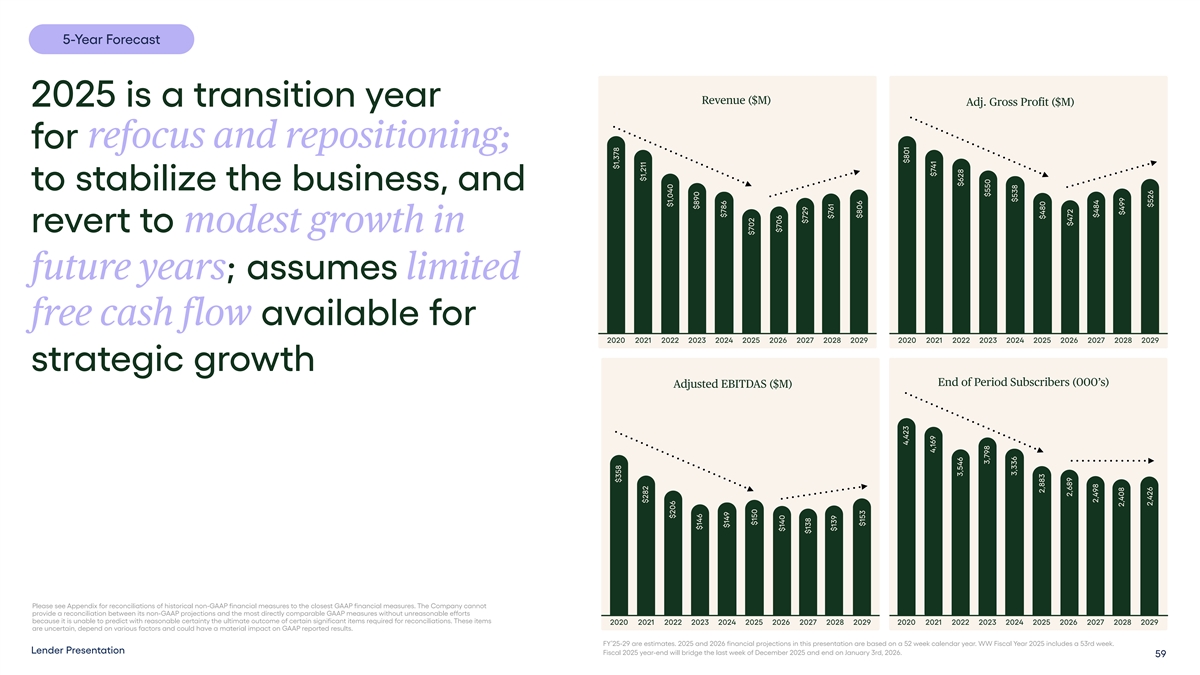

5-Year Forecast Revenue ($M) Adj. Gross Profit ($M) 2025 is a transition year refocus and repositioning; for refocus and repositioning; to stabilize the business, and revert to modest growth in future years; assumes limited free cash flow available for 2020 2021 2022 2023 2024 2025 2026 2027 2028 2029 2020 2021 2022 2023 2024 2025 2026 2027 2028 2029 strategic growth End of Period Subscribers (000’s) Adjusted EBITDAS ($M) Please see Appendix for reconciliations of historical non-GAAP financial measures to the closest GAAP financial measures. The Company cannot provide a reconciliation between its non-GAAP projections and the most directly comparable GAAP measures without unreasonable efforts because it is unable to predict with reasonable certainty the ultimate outcome of certain significant items required for reconciliations. These items 2020 2021 2022 2023 2024 2025 2026 2027 2028 2029 2020 2021 2022 2023 2024 2025 2026 2027 2028 2029 are uncertain, depend on various factors and could have a material impact on GAAP reported results. FY’25-29 are estimates. 2025 and 2026 financial projections in this presentation are based on a 52 week calendar year. WW Fiscal Year 2025 includes a 53rd week. Lender Presentation Fiscal 2025 year-end will bridge the last week of December 2025 and end on January 3rd, 2026. 59 $1,378 $358 3,798 3,798 $1,211 $282 3,798 3,798 $1,040 $206 $890 3,798 $146 3,798 $786 $149 3,798 3,798 $702 $150 $706 3,798 $140 3,798 $729 $138 3,798 3,798 $761 $139 $806 3,798 $153 3,798 4,423 $801 3,798 4,169 $741 3,798 3,546 $628 3,798 $550 3,798 3,336 $538 3,798 2,883 $480 2,689 $472 3,798 2,498 $484 3,798 2,408 $499 2,426 $526 3,798
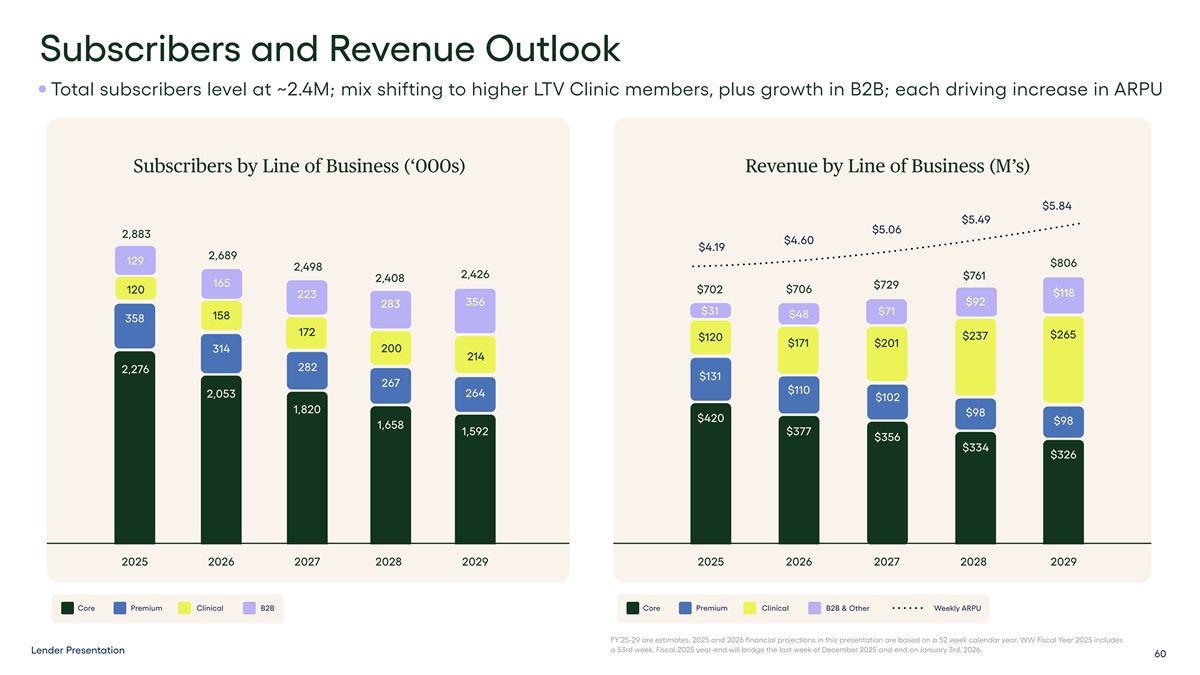

Subscribers and Revenue Outlook Total subscribers level at ~2.4M; mix shifting to higher LTV Clinic members, plus growth in B2B; each driving increase in ARPU Subscribers by Line of Business (‘000s) Revenue by Line of Business (M’s) $5.84 $5.49 $5.06 2,883 $4.60 $4.19 2,689 129 $806 2,498 2,426 $761 2,408 165 $729 $702 $706 120 $118 223 356 $92 283 $31 $71 $48 158 358 172 $265 $237 $120 $171 $201 200 314 214 282 2,276 $131 267 $110 264 2,053 $102 1,820 $98 $420 $98 1,658 1,592 $377 $356 $334 $326 2025 2026 2027 2028 2029 2025 2026 2027 2028 2029 Core Premium Clinical B2B Core Premium Clinical B2B & Other Weekly ARPU FY’25-29 are estimates. 2025 and 2026 financial projections in this presentation are based on a 52 week calendar year. WW Fiscal Year 2025 includes a 53rd week. Fiscal 2025 year-end will bridge the last week of December 2025 and end on January 3rd, 2026. Lender Presentation 60
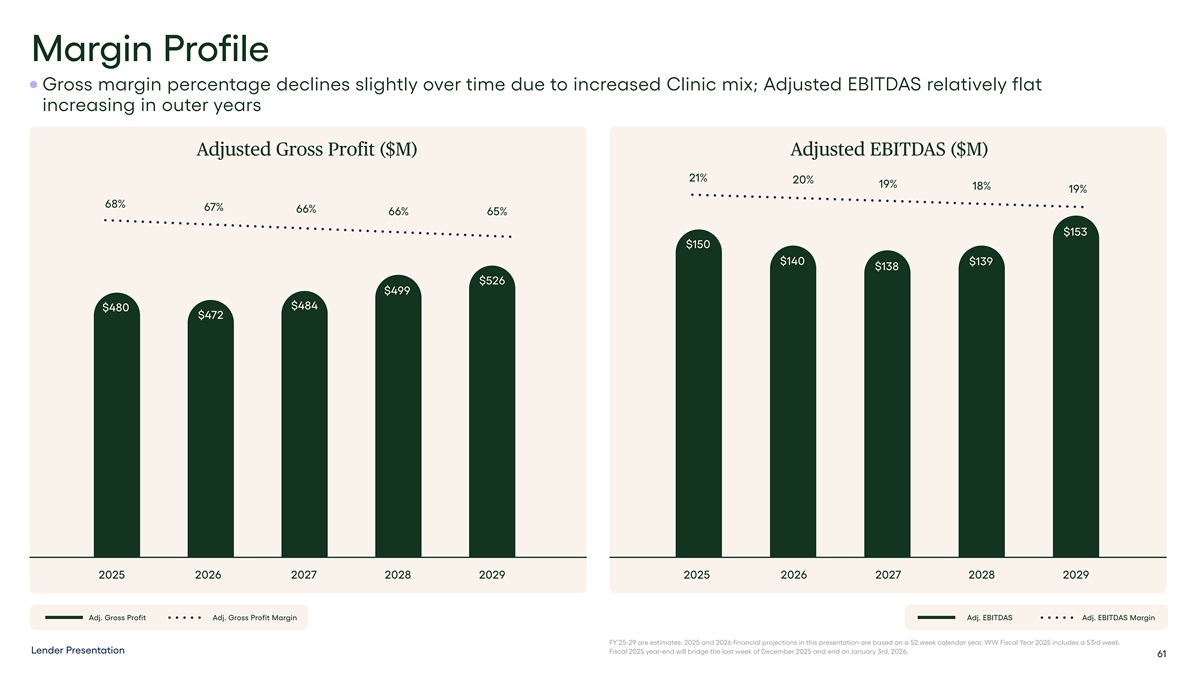

Margin Profile Gross margin percentage declines slightly over time due to increased Clinic mix; Adjusted EBITDAS relatively flat increasing in outer years Adjusted Gross Profit ($M) Adjusted EBITDAS ($M) 21% 20% 19% 18% 19% 68% 67% 66% 66% 65% $153 $150 $140 $139 $138 $138 $526 $499 $484 $480 $472 2025 2026 2027 2028 2029 2025 2026 2027 2028 2029 Adj. Gross Profit Adj. Gross Profit Margin Adj. EBITDAS Adj. EBITDAS Margin FY’25-29 are estimates. 2025 and 2026 financial projections in this presentation are based on a 52 week calendar year. WW Fiscal Year 2025 includes a 53rd week. Lender Presentation Fiscal 2025 year-end will bridge the last week of December 2025 and end on January 3rd, 2026. 61


6 Growth Levers Lender Presentation
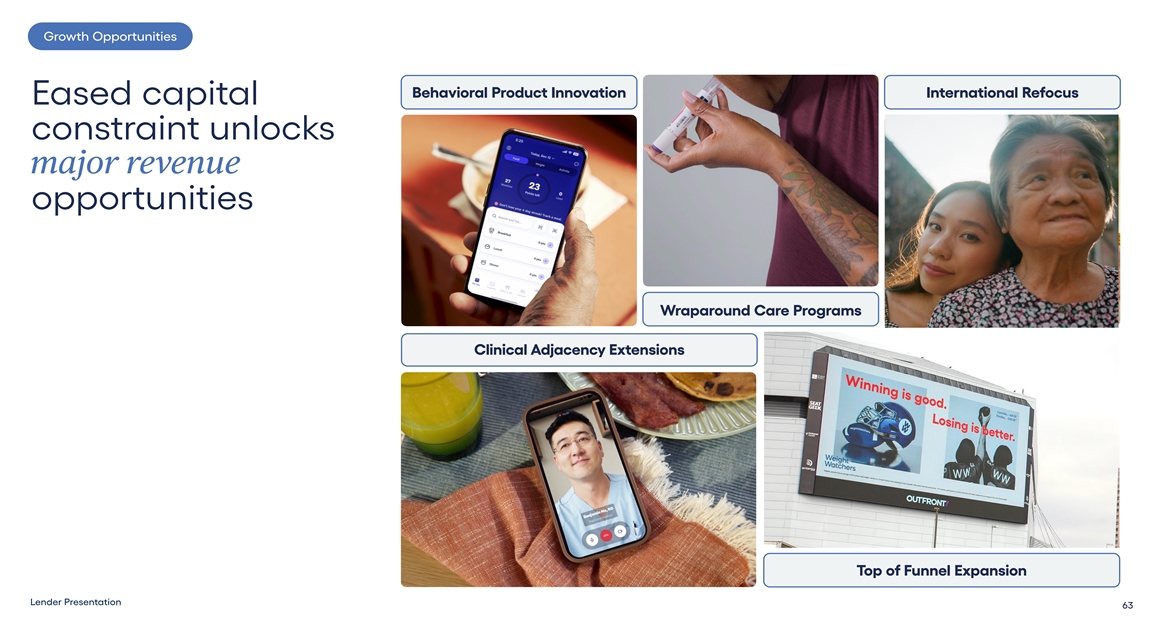

Growth Opportunities Behavioral Product Innovation International Refocus Eased capital constraint unlocks major revenue major revenue opportunities Wraparound Care Programs Clinical Adjacency Extensions Top of Funnel Expansion Lender Presentation 63


Lost 60 lbs You reach a point where “ someone believes you deserve help that is not demeaning or stigmatizing—and they recognize you’re a human being, that you deserve to be happy and healthy.” — WeightWatchers Member Lender Presentation 64


Thank You Lender Presentation


Appendix Lender Presentation
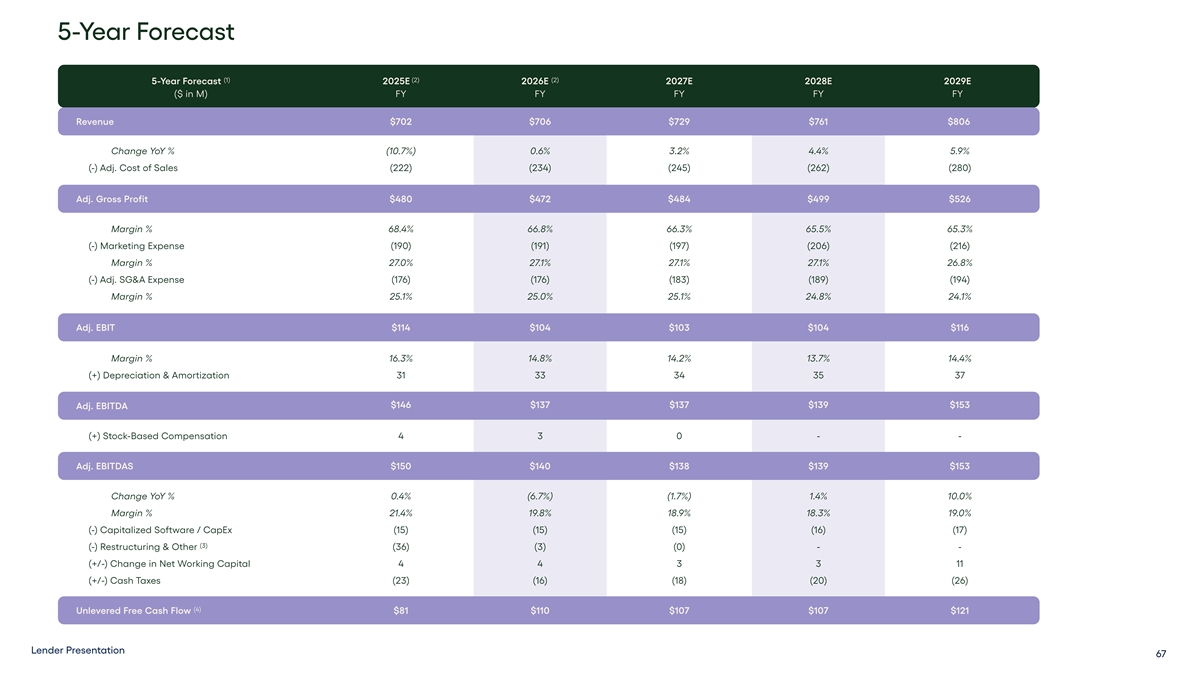

5-Year Forecast (1) (2) (2) 5-Year Forecast 2025E 2026E 2027E 2028E 2029E ($ in M) FY FY FY FY FY Revenue $702 $706 $729 $761 $806 Change YoY % (10.7%) 0.6% 3.2% 4.4% 5.9% (-) Adj. Cost of Sales (222) (234) (245) (262) (280) Adj. Gross Profit $480 $472 $484 $499 $526 Margin % 68.4% 66.8% 66.3% 65.5% 65.3% (-) Marketing Expense (190) (191) (197) (206) (216) Margin % 27.0% 27.1% 27.1% 27.1% 26.8% (-) Adj. SG&A Expense (176) (176) (183) (189) (194) Margin % 25.1% 25.0% 25.1% 24.8% 24.1% Adj. EBIT $114 $104 $103 $104 $116 Margin % 16.3% 14.8% 14.2% 13.7% 14.4% (+) Depreciation & Amortization 31 33 34 35 37 $146 $137 $137 $139 $153 Adj. EBITDA (+) Stock-Based Compensation 4 3 0 - - Adj. EBITDAS $150 $140 $138 $139 $153 Change YoY % 0.4% (6.7%) (1.7%) 1.4% 10.0% Margin % 21.4% 19.8% 18.9% 18.3% 19.0% (-) Capitalized Software / CapEx (15) (15) (15) (16) (17) (3) (-) Restructuring & Other (36) (3) (0) - - (+/-) Change in Net Working Capital 4 4 3 3 11 (+/-) Cash Taxes (23) (16) (18) (20) (26) (4) Unlevered Free Cash Flow $81 $110 $107 $107 $121 Lender Presentation 67


5-Year Forecast Note: Totals may not sum due to rounding. (1) Please see Appendix for reconciliations of historical non-GAAP financial measures to the closest GAAP financial measures. The Company cannot provide a reconciliation between its non-GAAP projections and the most directly comparable GAAP measures without unreasonable efforts because it is unable to predict with reasonable certainty the ultimate outcome of certain significant items required for reconciliations. These items are uncertain, depend on various factors and could have a material impact on GAAP reported results. (2) 2025 and 2026 financial projections in this presentation are based on a 52 week calendar year. WW Fiscal Year 2025 includes a 53rd week. Fiscal 2025 year-end will bridge the last week of December 2025 and end on January 3rd, 2026. (3) Includes Sequence anniversary payment, transaction costs, and restructuring payments. (4) Adjusted EBITDAS as further adjusted for capitalized software / capEx, restructuring & other, change in net working capital and provision for cash taxes. Lender Presentation 68
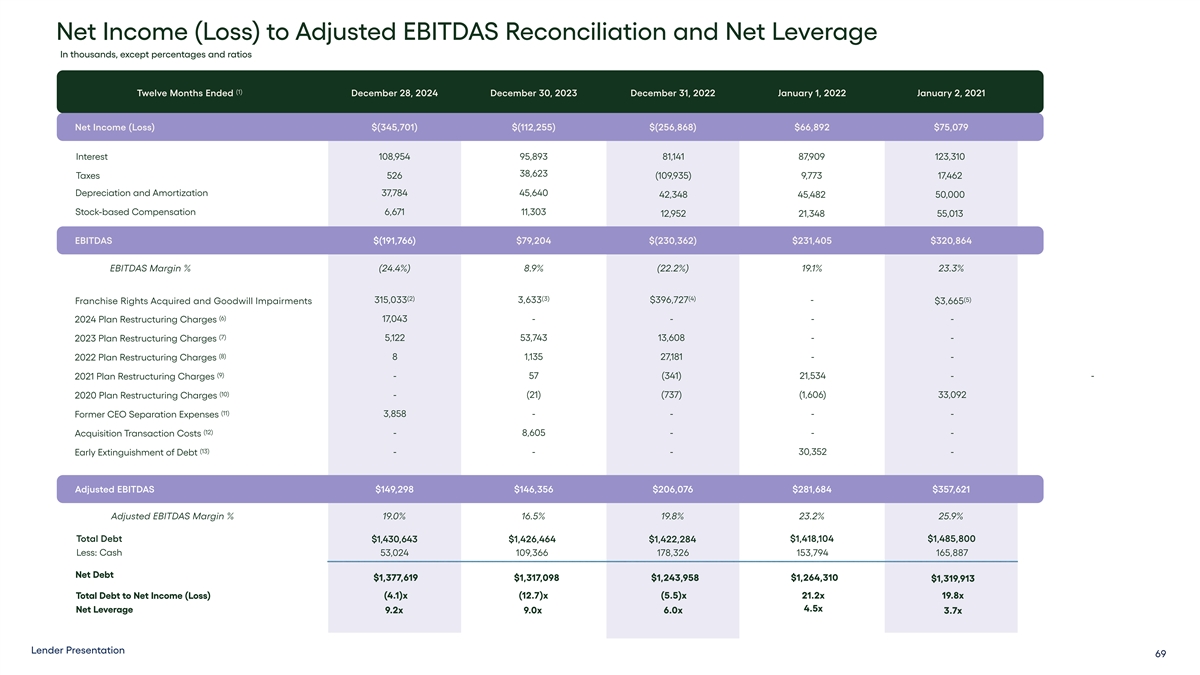

Net Income (Loss) to Adjusted EBITDAS Reconciliation and Net Leverage In thousands, except percentages and ratios (1) Twelve Months Ended December 28, 2024 December 30, 2023 December 31, 2022 January 1, 2022 January 2, 2021 Net Income (Loss) $(345,701) $(112,255) $(256,868) $66,892 $75,079 Interest 108,954 95,893 81,141 87,909 123,310 38,623 Taxes 526 (109,935) 9,773 17,462 Depreciation and Amortization 37,784 45,640 42,348 45,482 50,000 Stock-based Compensation 6,671 11,303 12,952 21,348 55,013 EBITDAS $(191,766) $79,204 $(230,362) $231,405 $320,864 EBITDAS Margin % (24.4%) 8.9% (22.2%) 19.1% 23.3% (2) (3) (4) (5) 315,033 3,633 $396,727 - Franchise Rights Acquired and Goodwill Impairments $3,665 (6) 17,043 - - - - 2024 Plan Restructuring Charges (7) 5,122 53,743 13,608 - - 2023 Plan Restructuring Charges (8) 8 1,135 27,181 - - 2022 Plan Restructuring Charges (9) - 57 (341) 21,534 - - 2021 Plan Restructuring Charges (10) - (21) (737) (1,606) 33,092 2020 Plan Restructuring Charges (11) 3,858 - - - - Former CEO Separation Expenses (12) - 8,605 - - - Acquisition Transaction Costs (13) - - - 30,352 - Early Extinguishment of Debt Adjusted EBITDAS $149,298 $146,356 $206,076 $281,684 $357,621 Adjusted EBITDAS Margin % 19.0% 16.5% 19.8% 23.2% 25.9% Total Debt $1,430,643 $1,426,464 $1,418,104 $1,485,800 $1,422,284 Less: Cash 53,024 109,366 178,326 153,794 165,887 Net Debt $1,377,619 $1,317,098 $1,243,958 $1,264,310 $1,319,913 Total Debt to Net Income (Loss) (4.1)x (12.7)x (5.5)x 21.2x 19.8x 4.5x Net Leverage 9.2x 9.0x 6.0x 3.7x Lender Presentation 69
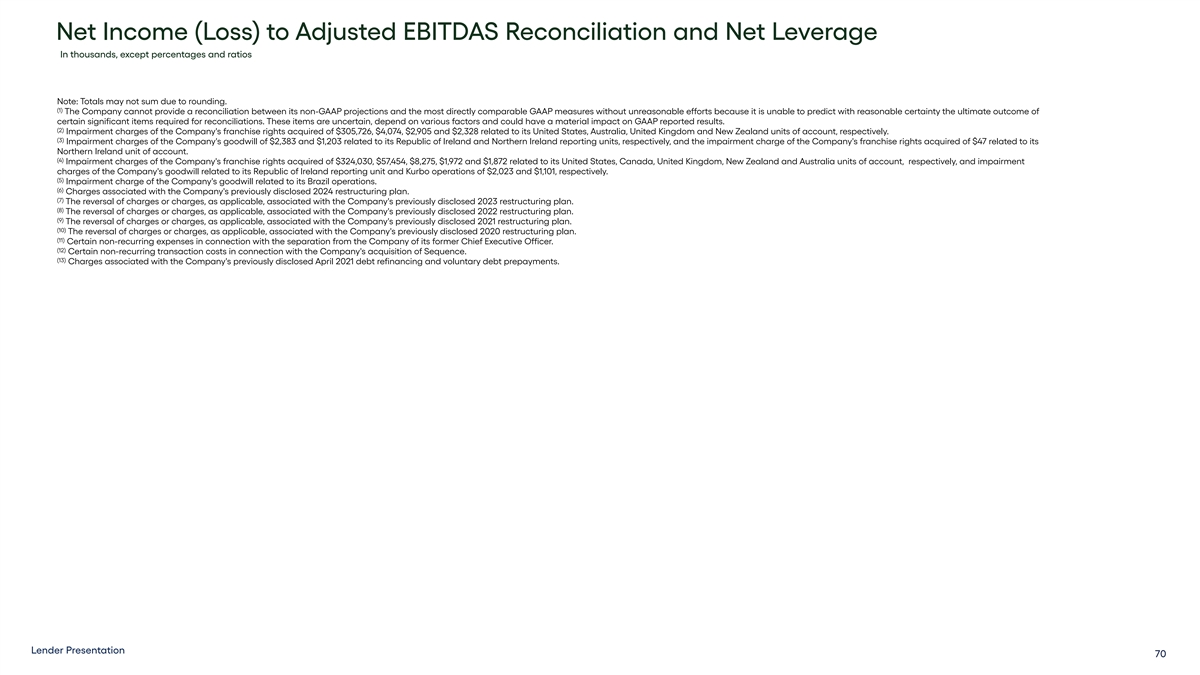

Net Income (Loss) to Adjusted EBITDAS Reconciliation and Net Leverage In thousands, except percentages and ratios Note: Totals may not sum due to rounding. (1) The Company cannot provide a reconciliation between its non-GAAP projections and the most directly comparable GAAP measures without unreasonable efforts because it is unable to predict with reasonable certainty the ultimate outcome of certain significant items required for reconciliations. These items are uncertain, depend on various factors and could have a material impact on GAAP reported results. (2) Impairment charges of the Company's franchise rights acquired of $305,726, $4,074, $2,905 and $2,328 related to its United States, Australia, United Kingdom and New Zealand units of account, respectively. (3) Impairment charges of the Company's goodwill of $2,383 and $1,203 related to its Republic of Ireland and Northern Ireland reporting units, respectively, and the impairment charge of the Company's franchise rights acquired of $47 related to its Northern Ireland unit of account. (4) Impairment charges of the Company's franchise rights acquired of $324,030, $57,454, $8,275, $1,972 and $1,872 related to its United States, Canada, United Kingdom, New Zealand and Australia units of account, respectively, and impairment charges of the Company's goodwill related to its Republic of Ireland reporting unit and Kurbo operations of $2,023 and $1,101, respectively. (5) Impairment charge of the Company's goodwill related to its Brazil operations. (6) Charges associated with the Company's previously disclosed 2024 restructuring plan. (7) The reversal of charges or charges, as applicable, associated with the Company's previously disclosed 2023 restructuring plan. (8) The reversal of charges or charges, as applicable, associated with the Company's previously disclosed 2022 restructuring plan. (9) The reversal of charges or charges, as applicable, associated with the Company's previously disclosed 2021 restructuring plan. (10) The reversal of charges or charges, as applicable, associated with the Company's previously disclosed 2020 restructuring plan. (11) Certain non-recurring expenses in connection with the separation from the Company of its former Chief Executive Officer. (12) Certain non-recurring transaction costs in connection with the Company's acquisition of Sequence. (13) Charges associated with the Company's previously disclosed April 2021 debt refinancing and voluntary debt prepayments. Lender Presentation 70
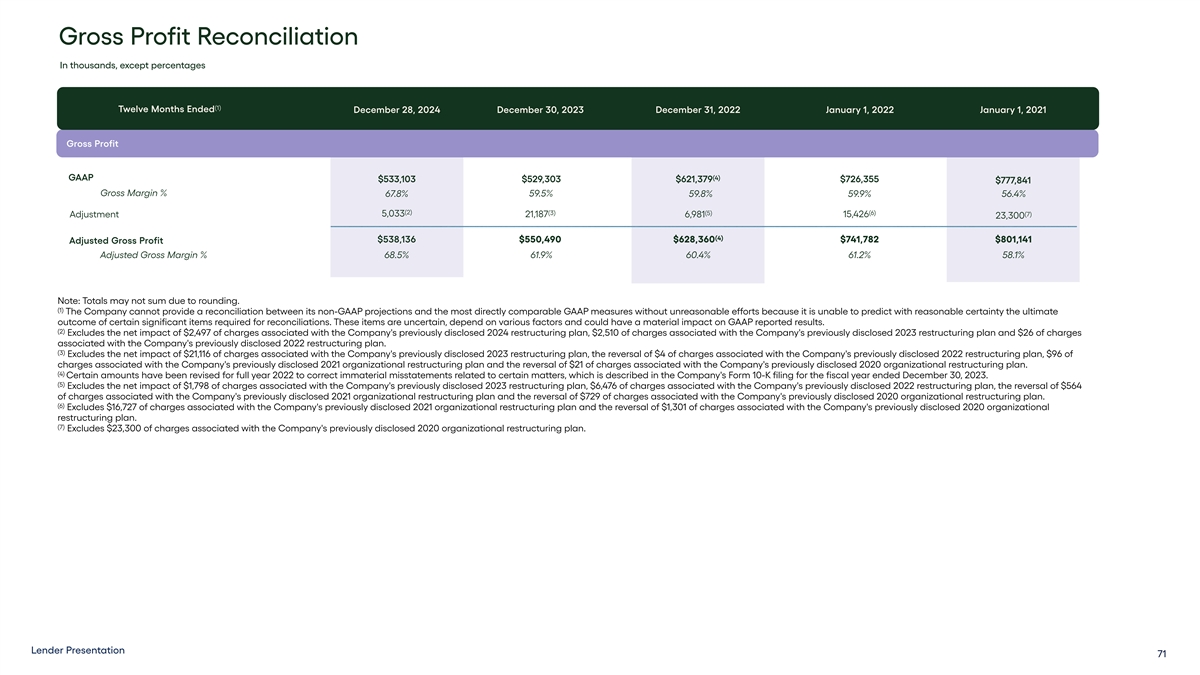

Gross Profit Reconciliation In thousands, except percentages (1) Twelve Months Ended December 28, 2024 December 30, 2023 December 31, 2022 January 1, 2022 January 1, 2021 December 31, 2022 Gross Profit (4) GAAP $533,103 $529,303 $621,379 $726,355 $777,841 Gross Margin % 59.5% 67.8% 59.8% 59.9% 56.4% (2) (3) (5) (6) 5,033 (7) 21,187 15,426 Adjustment 6,981 23,300 (4) $538,136 $550,490 $628,360 $741,782 $801,141 Adjusted Gross Profit Adjusted Gross Margin % 68.5% 61.9% 60.4% 61.2% 58.1% Note: Totals may not sum due to rounding. (1) The Company cannot provide a reconciliation between its non-GAAP projections and the most directly comparable GAAP measures without unreasonable efforts because it is unable to predict with reasonable certainty the ultimate outcome of certain significant items required for reconciliations. These items are uncertain, depend on various factors and could have a material impact on GAAP reported results. (2) Excludes the net impact of $2,497 of charges associated with the Company's previously disclosed 2024 restructuring plan, $2,510 of charges associated with the Company's previously disclosed 2023 restructuring plan and $26 of charges associated with the Company's previously disclosed 2022 restructuring plan. (3) Excludes the net impact of $21,116 of charges associated with the Company's previously disclosed 2023 restructuring plan, the reversal of $4 of charges associated with the Company's previously disclosed 2022 restructuring plan, $96 of charges associated with the Company's previously disclosed 2021 organizational restructuring plan and the reversal of $21 of charges associated with the Company's previously disclosed 2020 organizational restructuring plan. (4) Certain amounts have been revised for full year 2022 to correct immaterial misstatements related to certain matters, which is described in the Company's Form 10-K filing for the fiscal year ended December 30, 2023. (5) Excludes the net impact of $1,798 of charges associated with the Company's previously disclosed 2023 restructuring plan, $6,476 of charges associated with the Company's previously disclosed 2022 restructuring plan, the reversal of $564 of charges associated with the Company's previously disclosed 2021 organizational restructuring plan and the reversal of $729 of charges associated with the Company's previously disclosed 2020 organizational restructuring plan. (6) Excludes $16,727 of charges associated with the Company's previously disclosed 2021 organizational restructuring plan and the reversal of $1,301 of charges associated with the Company's previously disclosed 2020 organizational restructuring plan. (7) Excludes $23,300 of charges associated with the Company's previously disclosed 2020 organizational restructuring plan. Lender Presentation 71
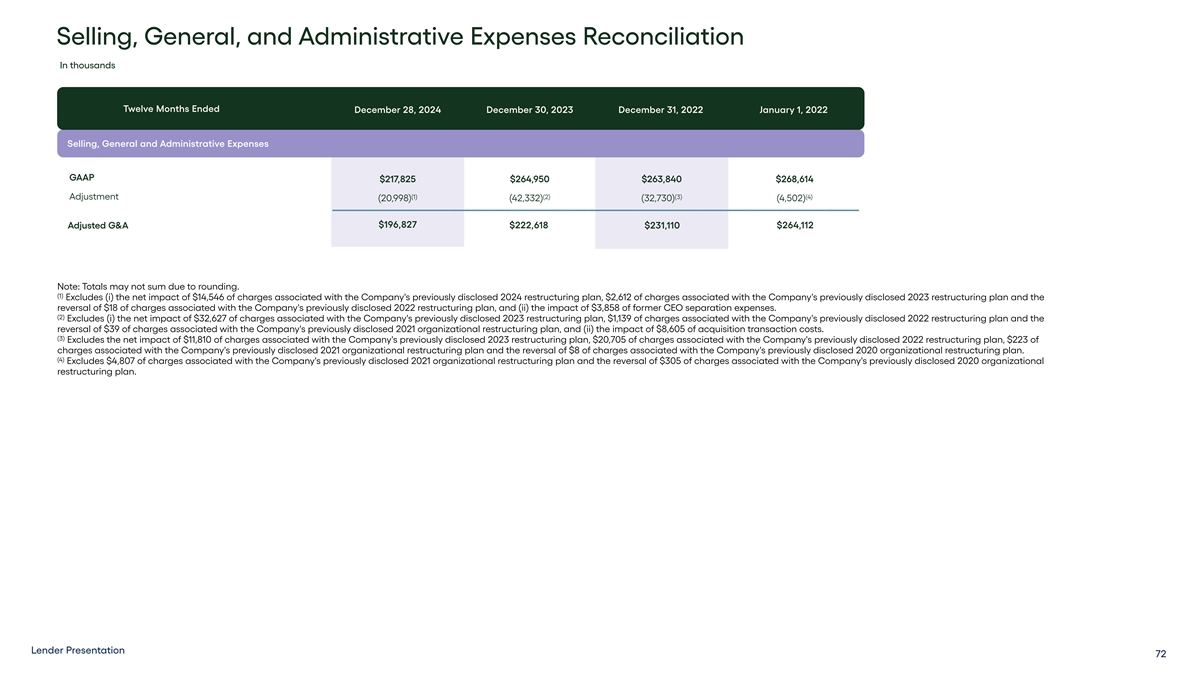

Selling, General, and Administrative Expenses Reconciliation In thousands Twelve Months Ended December 28, 2024 December 30, 2023 December 31, 2022 January 1, 2022 Selling, General and Administrative Expenses GAAP $217,825 $264,950 $263,840 $268,614 (1) (2) (3) (4) Adjustment (20,998) (42,332) (32,730) (4,502) $196,827 Adjusted G&A $222,618 $231,110 $264,112 Note: Totals may not sum due to rounding. (1) Excludes (i) the net impact of $14,546 of charges associated with the Company's previously disclosed 2024 restructuring plan, $2,612 of charges associated with the Company's previously disclosed 2023 restructuring plan and the reversal of $18 of charges associated with the Company's previously disclosed 2022 restructuring plan, and (ii) the impact of $3,858 of former CEO separation expenses. (2) Excludes (i) the net impact of $32,627 of charges associated with the Company's previously disclosed 2023 restructuring plan, $1,139 of charges associated with the Company's previously disclosed 2022 restructuring plan and the reversal of $39 of charges associated with the Company's previously disclosed 2021 organizational restructuring plan, and (ii) the impact of $8,605 of acquisition transaction costs. (3) Excludes the net impact of $11,810 of charges associated with the Company's previously disclosed 2023 restructuring plan, $20,705 of charges associated with the Company's previously disclosed 2022 restructuring plan, $223 of charges associated with the Company's previously disclosed 2021 organizational restructuring plan and the reversal of $8 of charges associated with the Company's previously disclosed 2020 organizational restructuring plan. (4) Excludes $4,807 of charges associated with the Company's previously disclosed 2021 organizational restructuring plan and the reversal of $305 of charges associated with the Company's previously disclosed 2020 organizational restructuring plan. Adjusted EBITDA Lender Presentation 72
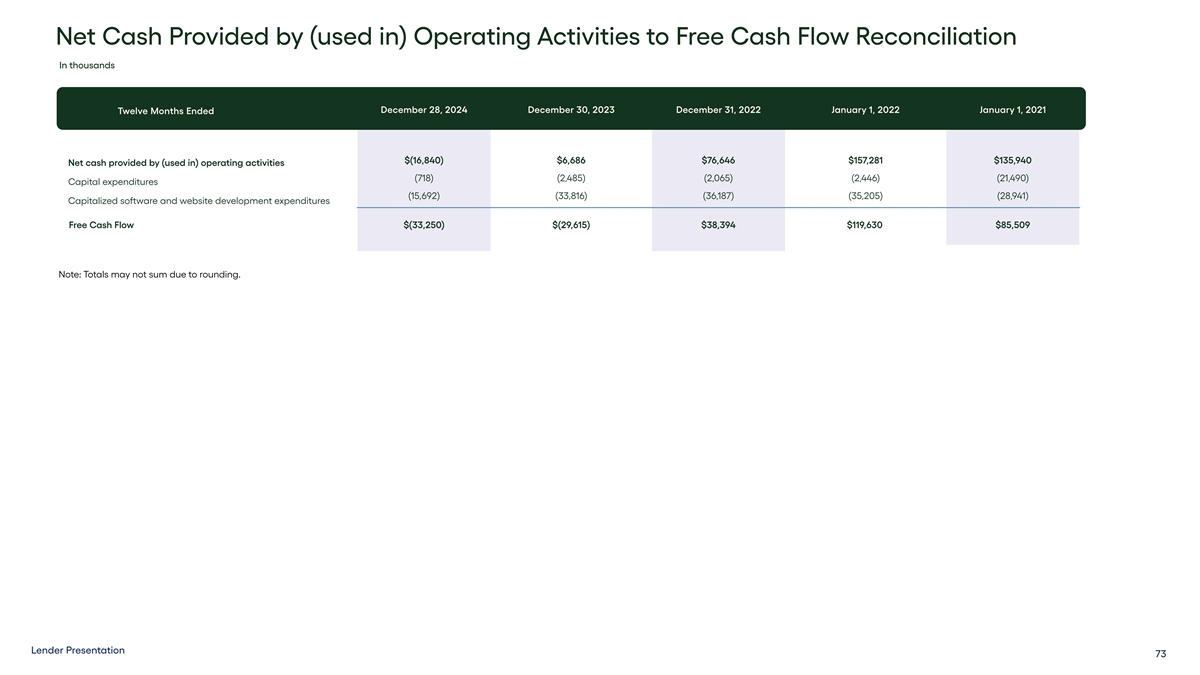

Net Cash Provided by (used in) Operating Activities to Free Cash Flow Reconciliation In thousands December 28, 2024 December 30, 2023 December 31, 2022 January 1, 2022 January 1, 2021 Twelve Months Ended December 31, 2022 Gross Profit $(16,840) $6,686 $76,646 $157,281 $135,940 Net cash provided by (used in) operating activities (718) (2,485) (2,065) (2,446) (21,490) Capital expenditures (15,692) (33,816) (36,187) (35,205) (28,941) Capitalized software and website development expenditures Free Cash Flow $(33,250) $(29,615) $38,394 $119,630 $85,509 Note: Totals may not sum due to rounding. Adjusted EBITDA Lender Presentation 73