false
--12-31
0001566044
0001566044
2026-07-24
2026-07-24
0001566044
dei:FormerAddressMember
2026-07-24
2026-07-24
iso4217:USD
xbrli:shares
iso4217:USD
xbrli:shares
UNITED STATES
SECURITIES AND EXCHANGE COMMISSION
Washington, D.C. 20549
FORM 8-K
CURRENT REPORT
Pursuant to Section 13 or 15(d) of the
Securities Exchange Act of 1934
Date of Report (Date of earliest event reported):
July 24, 2026
Yarrow Bioscience, Inc.
(Exact Name of Registrant as Specified in its
Charter)
| Delaware |
|
001-38356 |
|
45-3757789 |
(State
or Other Jurisdiction
of Incorporation) |
|
(Commission
File
Number) |
|
(IRS
Employer
Identification No.) |
| 470
James Street, Suite 007, New Haven, CT |
|
06513 |
| (Address of Principal Executive Offices) |
|
(Zip Code) |
Registrant’s telephone number, including area code: (203) 433-7577
VYNE Therapeutics Inc.
P.O. Box 125
Stewartsville, NJ 08886
(Former name or former address, if changed since last report)
Check the appropriate box below if the Form 8-K filing
is intended to simultaneously satisfy the filing obligation of the registrant under any of the following provisions:
| ¨ |
Written communications pursuant to Rule 425 under the Securities Act (17 CFR 230.425) |
| |
|
| ¨ |
Soliciting material pursuant to Rule 14a-12 under the Exchange Act (17
CFR 240.14a-12) |
| |
|
| ¨ |
Pre-commencement communications pursuant to Rule 14d-2(b) under
the Exchange Act (17 CFR 240.14d-2(b)) |
| |
|
| ¨ |
Pre-commencement communications pursuant to Rule 13e-4(c) under
the Exchange Act (17 CFR 240.13e-4(c)) |
Securities registered pursuant to Section 12(b) of the Act:
| Title
of each class |
|
Trading
symbol(s) |
|
Name
of each exchange
on which registered |
| Common
Stock, $0.0001 par value |
|
YARW |
|
The Nasdaq Capital Market |
Indicate by check mark whether the registrant is an emerging growth
company as defined in Rule 405 of the Securities Act of 1933 (§230.405 of this chapter) or Rule 12b-2 of the Securities
Exchange Act of 1934 (§240.12b-2 of this chapter).
Emerging growth company ¨
If an emerging growth company, indicate by check mark if the registrant
has elected not to use the extended transition period for complying with any new or revised financial accounting standards provided pursuant
to Section 13(a) of the Exchange Act. ¨
INTRODUCTORY NOTE
Agreement and Plan of Merger and Reorganization
On July 27, 2026 (the
“Closing Date”), Yarrow Bioscience, Inc., a Delaware corporation (formerly known as VYNE Therapeutics Inc., a Delaware corporation)
(prior to the Closing Date, unless context otherwise requires, “VYNE” and, after the Closing Date, the “Company”),
consummated the previously announced acquisition (the “Closing”) of Yarrow Bioscience, Inc., a Delaware corporation (“Pre-Merger
Yarrow”), in accordance with the terms of the Agreement and Plan of Merger and Reorganization, dated December 17, 2025 (the “Original
Merger Agreement”), as amended by Amendment No. 1 thereto on January 30, 2026 (“Amendment No. 1” and, together with
the Original Merger Agreement, the “Merger Agreement”), by and among the Company, Yellow Merger Sub Corp., a Delaware corporation
and wholly owned subsidiary of the Company (“Merger Sub”), and Pre-Merger Yarrow. Pursuant to the Merger Agreement, Merger
Sub merged with and into Pre-Merger Yarrow, with Pre-Merger Yarrow continuing as a wholly owned subsidiary of the Company and the surviving
corporation of the merger (the “Merger”) under the name “Yarrow Bioscience Operating Company Corp.” In connection
with the completion of the Merger, VYNE changed its name to “Yarrow Bioscience, Inc.” The Merger is intended to qualify for
federal income tax purposes as a tax-free reorganization under the provisions of Section 368(a) of the Internal Revenue Code of 1986,
as amended (the “Code”), and/or a transfer within the meaning of Section 351(a) of the Code.
Following the Reverse Stock Split (as defined below),
which occurred prior to the Closing, at the effective time of the Merger (the “Effective Time”), (i) each then-outstanding
share of Pre-Merger Yarrow capital stock (the “Yarrow Capital Stock”) (including shares of Yarrow Capital Stock issued pursuant
to the Pre-Closing Financing (as defined below) and Pre-Merger Yarrow’s Series A preferred financing described below and excluding
shares of Yarrow Capital Stock held as treasury stock immediately prior to the Effective Time and any dissenting shares) was converted
into the right to receive a number of shares of VYNE common stock, par value $0.0001 (the “Company Common Stock”), calculated
in accordance with the Merger Agreement (the “Exchange Ratio”), (ii) each option to purchase shares of Pre-Merger Yarrow common
stock that was outstanding and unexercised immediately prior to the Effective Time, whether vested or unvested, ceased to represent a
right to acquire shares of Pre-Merger Yarrow common stock and was converted into and became an option to purchase shares of Company Common
Stock on the existing terms and conditions (including with respect to vesting and accelerated vesting), subject to adjustment as set forth
in the Merger Agreement, and (iii) each then-outstanding and unexercised warrant to purchase shares of Pre-Merger Yarrow common stock
was converted into and became a warrant to purchase shares of Company Common Stock on the existing terms and conditions (including with
respect to vesting and accelerated vesting), subject to adjustment as set forth in the Merger Agreement. Under the terms of the Merger
Agreement, prior to the Effective Time, the board of directors of VYNE (the “Board”) accelerated the vesting of all options
to purchase VYNE common stock (the “Company Options”) and VYNE restricted stock units (the “Company Restricted Stock
Units”). Each then-outstanding Company Option with an exercise price per share equal to or less than the volume weighted average
closing trading price of a share of Company Common Stock on The Nasdaq Stock Market LLC (“Nasdaq”) for the five (5) consecutive
trading days ending three (3) trading days prior to the Calculation Date (as defined in the Merger Agreement), as reported by Bloomberg
L.P. (the “Company Closing Price” and such Company Options, “In-the-Money Company Options”), was cancelled at
the Effective Time and such holder thereof received an amount in cash, without interest, less any applicable tax withholding, equal to
the product obtained by multiplying the excess of the Company Closing Price over the exercise price per share of the Company Common Stock
underlying such Company Option by the number of shares of the Company Common Stock underlying such Company Option. Each Company Option
with an exercise price greater than the Company Closing Price was cancelled for no consideration. Immediately prior to the Effective Time,
each holder of an accelerated Company Restricted Stock Unit was entitled to receive a number of shares of Company Common Stock equal to
the number of vested and unsettled shares underlying such Company Restricted Stock Unit.
No fractional shares of Company Common Stock were
issued in connection with the Merger, and no certificates or scrip for any such fractional shares were issued. Any fractional shares of
Company Common Stock resulting from the conversion of shares of Yarrow Capital Stock (including shares of Pre-Merger Yarrow common stock
issued in the Pre-Closing Financing) were treated as follows: (i) one share of Company Common Stock if the aggregate amount of fractional
shares of Company Common Stock of any individual holder of Yarrow Capital Stock upon conversion equaled or exceeded 0.50 or (ii) no shares
of Company Common Stock if the aggregate amount of fractional shares of Company Common Stock of any individual holder of Yarrow Capital
Stock upon conversion was less than 0.50, with no cash paid for any fractional share eliminated by such rounding.
The Exchange Ratio was calculated using a formula
intended to allocate Pre-Merger Yarrow stockholders and VYNE stockholders a percentage of the Company. Based on VYNE’s valuation
of $8.5 million, Pre-Merger Yarrow’s valuation of $272.9 million (which included the amount of proceeds received by Pre-Merger Yarrow
in the Pre-Closing Financing and fair market value of the Pre-Merger Yarrow’s Series A preferred financing) and fully diluted capitalization
as of July 27, 2026, calculated using the treasury stock method (subject to certain adjustments), the Exchange Ratio was 0.7171 shares
of Company Common Stock for each share of Pre-Merger Yarrow common stock.
After giving effect to the Pre-Closing Financing
and Pre-Merger Yarrow’s Series A preferred financing, and immediately following the Closing, Pre-Merger Yarrow stockholders owned
approximately 97% of the combined company and VYNE stockholders owned approximately 3% of the combined company. For purposes of calculating
the Exchange Ratio, (i) shares of Company Common Stock underlying In-the-Money Company Options (other than such In-the-Money Company Options
cashed out in accordance with the Merger Agreement which would have reduced the calculation of the Company’s net cash), warrants
or other rights or commitments to receive shares of Company Common Stock, including the Company Restricted Stock Units, were deemed outstanding
and (ii) all shares of Yarrow Capital Stock underlying outstanding options, warrants or other rights or commitments to receive shares
of Yarrow Capital Stock were deemed outstanding, except as provided in the Merger Agreement.
In addition, on July 23, 2026 (the “Payment
Date”), the Company distributed a cash dividend to holders of VYNE common stock and warrants of record as of July 22, 2026 in an
aggregate amount of approximately $17.3 million and distributed approximately $0.40242 per share (the “VYNE Dividend”). Because
the VYNE Dividend exceeded 25% of the closing price of VYNE common stock on July 10, 2026, the declaration date, it was subject to an
ex-dividend date of one business day after the Payment Date pursuant to the rules of Nasdaq. Accordingly, Nasdaq set July 24, 2026 as
the ex-dividend date for the VYNE Dividend. VYNE common stock traded with “due bills” during the due bill period beginning
July 21, 2026 and through July 23, 2026 (the “Due Bill Period”). Therefore, investors who purchased VYNE common stock during
the Due Bill Period were entitled to receive the VYNE Dividend, and investors who sold VYNE common stock during the Due Bill Period were
not entitled to receive the VYNE Dividend. The due bill obligations were settled customarily between the brokers representing the buyers
and sellers of VYNE common stock. VYNE had no obligations for either the amount of the due bill or the processing of the due bill.
In addition, prior to the consummation of the Merger,
VYNE effected a 1-for-50 reverse stock split of VYNE common stock, which became legally effective on July 24, 2026 (the “Reverse
Stock Split”). The Company Common Stock commenced trading on a post-Reverse Stock Split basis at the open of trading on July 27,
2026, and a post-Merger basis at the open of trading on July 28, 2026.
The material provisions of the Merger Agreement
are described in the Company’s definitive proxy statement/prospectus filed on Form S-4 with the U.S. Securities and Exchange Commission
(the “SEC”), most recently amended on June 3, 2026 and declared effective on June 15, 2026 (as amended, the “Proxy Statement/Prospectus”),
in the section entitled “The Merger Agreement” beginning on page 166, and are incorporated herein by reference.
Pre-Merger Yarrow Series A Preferred Financing
In connection with the execution and delivery of
the Merger Agreement, certain new and existing institutional and accredited investors of Pre-Merger Yarrow entered into a Series A stock
purchase agreement with Pre-Merger Yarrow, pursuant to which such persons invested in a private placement of Pre-Merger Yarrow’s
Series A preferred stock for an aggregate purchase price of approximately $100.0 million.
Pre-Closing Financing
Concurrently with the execution and delivery of
the Merger Agreement, certain new and existing institutional and accredited investors of Pre-Merger Yarrow entered into a securities purchase
agreement (the “Securities Purchase Agreement”) with Pre-Merger Yarrow, pursuant to which such investors purchased, immediately
prior to the Merger, 1,096,125 shares of Pre-Merger Yarrow common stock and 13,068,176 Pre-Merger Yarrow pre-funded warrants
(the “PIPE Securities”), for gross proceeds of approximately $100.0 million (the “Pre-Closing Financing”).
Under the Securities Purchase Agreement, the number of shares of Pre-Merger Yarrow common stock and Pre-Merger Yarrow pre-funded warrants
were determined at a purchase price per share or pre-funded warrant equal to (i) a valuation for Pre-Merger Yarrow of approximately $172.9
million, (ii) divided by the number of fully diluted shares of Pre-Merger Yarrow common stock outstanding immediately prior to the Effective
Time (including the securities issued under the Securities Purchase Agreement).
The Pre-Merger Yarrow pre-funded warrants have
an exercise price per share equal to $0.0001 (as adjusted from time to time as provided in the form of pre-funded warrant) and may be
exercised at any time and from time to time after the original issue date. The Pre-Merger Yarrow pre-funded warrants do not expire.
The shares of Pre-Merger Yarrow common stock and
Pre-Merger Yarrow pre-funded warrants that were issued in the Pre-Closing Financing were or have the right to be, respectively, converted
into shares of Company Common Stock in the Merger. The Securities Purchase Agreement contains customary representations and warranties
of Pre-Merger Yarrow and also contains customary representations and warranties of the purchaser parties thereto.
The preceding descriptions of the Merger, Merger
Agreement, Pre-Closing Financing, Securities Purchase Agreement and Pre-Funded Warrant do not purport to be complete and are qualified
in their entirety by reference to the Original Merger Agreement, Amendment No. 1, the Securities Purchase Agreement and the Form of Pre-Funded
Warrant, which are attached hereto as Exhibits 2.1, 2.2, 10.1 and 4.1 and which are incorporated herein by reference.
The information set forth under the headings “Support
Agreements and Lock-Up Agreement” in Item 1.01 of the Company’s Current Report on Form 8-K filed with the SEC on December
17, 2025 is incorporated herein by reference.
| Item 1.01 | Entry into a Material Definitive Agreement. |
Indemnification Agreements
On July 27, 2026, the Company entered into indemnification
agreements (collectively, the “Indemnification Agreements”) with each of its directors and executive officers (collectively,
the “Indemnitees”), which replaced and superseded any previous indemnification agreements between the Company and each such
individual. The Indemnification Agreements provide for certain indemnification and advancement of expenses by the Company in connection
with actions or proceedings arising out of the Indemnitees’ service as directors or officers of the Company or service to other
entities at the Company’s request, on the terms and subject to the conditions set forth therein.
The foregoing description of the Indemnification
Agreements is not complete and is subject to and qualified in its entirety by reference to the complete text of the Indemnification Agreements,
the form of which is attached hereto as Exhibit 10.4 and incorporated herein by reference.
| Item 2.01 | Completion of Acquisition or Disposition of Assets. |
The disclosure set forth in the “Introductory
Note” above, including with respect to the Merger, is incorporated into this Item 2.01 by reference.
All of the proposals included in the Proxy Statement/Prospectus
were approved by VYNE stockholders at a special meeting of stockholders held on July 16, 2026 (the “Special Meeting”), other
than the proposal to adjourn the Special Meeting, which was not presented to the stockholders.
In connection with the consummation of the Merger,
on the Closing Date, all of the then-outstanding (i) 4,250,000 shares of Pre-Merger Yarrow common stock, (ii) 20,242,911 shares of Pre-Merger
Yarrow Series A preferred stock, (iii) 2,792,194 shares of Pre-Merger Yarrow common stock issuable upon the exercise of outstanding options,
(iv) 1,096,125 shares of Pre-Merger Yarrow common stock purchased in the Pre-Closing Financing and (v) 13,068,176 Pre-Merger Yarrow pre-funded
warrants purchased in the Pre-Closing Financing were converted into the right to receive shares of Company Common Stock and/or Company
pre-funded warrants, as applicable, equal to the Exchange Ratio.
Immediately following the application of the Exchange
Ratio (which was adjusted to give effect to the Reverse Stock Split described below), and following the consummation of the transactions
contemplated by the Merger Agreement, the Company had approximately 28,584,308 shares of Company Common Stock issued and outstanding (assuming
the exercise in full of all Company pre-funded warrants and excluding outstanding employee and director option awards), which was comprised
of:
| · | 2,803,078 shares of Company Common Stock (inclusive of issuances pursuant to the Merger Agreement and the Pre-Closing Financing);
and |
| · | 25,781,230 shares of Company Common Stock issuable upon the exercise of Company pre-funded warrants, each exercisable for one share
of Company Common Stock at a price of $0.0001 per share. |
Immediately prior to the consummation of the Merger,
VYNE effected the 1-for-50 Reverse Stock Split of VYNE common stock, which became legally effective on July 24, 2026. The Company Common
Stock commenced trading on a post-Reverse Stock Split basis at the open of trading on July 27, 2026, and on a post-Merger basis at the
open of trading on July 28, 2026.
| Item 2.02 | Results of Operations and Financial Condition. |
Pre-Merger Yarrow’s Management’s Discussion
and Analysis of Financial Condition and Results of Operations as of March 31, 2026 and for the period from October 3, 2025 (inception)
to March 31, 2026 is included in the Proxy Statement/Prospectus beginning on page 307 and is incorporated herein by reference.
| Item 3.02 | Unregistered Sales of Equity Securities. |
To the extent required by this Item, the information
included in Item 2.01 of this Current Report on Form 8-K is incorporated herein by reference. The PIPE Securities were offered and sold
in transactions exempt from registration under the Securities Act of 1933, as amended (the “Securities Act”), in reliance
on Section 4(a)(2) thereof. Each of the investors represented that it was an “accredited investor,” as defined in Regulation
D, and acquired the PIPE Securities for investment only and not with a view towards, or for resale in connection with, the public sale
or distribution thereof. Neither this Current Report on Form 8-K nor any of the exhibits attached hereto is an offer to sell or the solicitation
of an offer to buy the PIPE Securities or any other securities of the Company or Pre-Merger Yarrow.
| Item 3.03 | Material Modification to Rights of Security Holders. |
To the extent required by this Item, the information
included in Item 2.01 of this Current Report on Form 8-K is incorporated herein by reference.
VYNE held the Special Meeting on July 16, 2026
to present the proposals included in the Proxy Statement/Prospectus. At the Special Meeting, the VYNE stockholders approved, among other
matters, amendments to the Amended and Restated Certificate of Incorporation of the Company to (i) increase the number of authorized shares
of Company Common Stock from 150,000,000 shares to 300,000,000 shares (the “Authorized Share Increase”), (ii) effect the Reverse
Stock Split and (iii) change its name from “VYNE Therapeutics Inc.” to “Yarrow Bioscience, Inc.” (the “Name
Change”), in each case as described in the Proxy Statement/Prospectus. Following the Special Meeting, the Board approved the Reverse
Stock Split at a ratio of 1-for-50. To effect the Reverse Stock Split, the Company filed a Certificate of Amendment to the Company’s
Amended and Restated Certificate of Incorporation with the Secretary of State of the State of Delaware (the “Reverse Stock Split
Certificate of Amendment”), with an effective time of 8:45 a.m., Eastern Daylight Time, on July 24, 2026 (“Reverse Stock Split
Certificate of Amendment Effective Time”). To effect the Authorized Share Increase, the Company filed a Certificate of Amendment
to the Company’s Amended and Restated Certificate of Incorporation with the Secretary of State of the State of Delaware (the “Authorized
Share Increase Certificate of Amendment”), with an effective time of 12:01 a.m., Eastern Daylight Time, on July 27, 2026. To effect
the Name Change, the Company filed a Certificate of Amendment to the Company’s Amended and Restated Certificate of Incorporation
with the Secretary of State of the State of Delaware (the “Name Change Certificate of Amendment”), with an effective time
of 12:03 a.m., Eastern Daylight Time, on July 27, 2026.
As of the Reverse Stock Split Certificate of Amendment
Effective Time, every 50 shares of Company Common Stock issued and outstanding immediately prior to the Reverse Stock Split were automatically
and without further action on the part of the Company or any holders of such Company Common Stock, combined into one share of Company
Common Stock. Immediately following the Reverse Stock Split and Merger, there were approximately 2.8 million shares of Company Common
Stock issued and outstanding.
No fractional shares of Company Common Stock were
issued as a result of the Reverse Stock Split. Instead, any stockholder who would have otherwise been entitled to a fractional share of
Company Common Stock as a result of the Reverse Stock Split (after aggregating all fractions of a share to which such stockholder would
have otherwise been entitled) was, in lieu thereof, entitled to receive a cash payment equal to the product of such resulting fractional
interest in one share of Company Common Stock multiplied by the closing price per share as reported by Nasdaq on July 23, 2026. The Company
Common Stock commenced trading on a post-Reverse Stock Split basis on July 27, 2026, and a post-Merger basis on July 28, 2026. The Company
Common Stock is represented by a new CUSIP number (92941V407). The par value per share of the Company Common Stock remains unchanged.
The foregoing descriptions of the Authorized Share
Increase Certificate of Amendment, Reverse Stock Split Certificate of Amendment and Name Change Certificate of Amendment do not purport
to be complete and are subject to and qualified in their entirety by the full text of the Authorized Share Increase Certificate of Amendment,
Reverse Stock Split Certificate of Amendment and Name Change Certificate of Amendment, copies of which are attached hereto as Exhibits
3.1, 3.2 and 3.3, respectively, and are incorporated herein by reference.
| Item 5.01 | Changes in Control of Registrant. |
To the extent required by
this Item, the information included under the heading “Introductory Note” and in Item 2.01 of this Current Report on
Form 8-K is incorporated herein by reference.
| Item 5.02 | Departure of Directors or Certain Officers; Election of Directors; Appointment of Certain Officers;
Compensatory Arrangements of Certain Officers. |
Resignation of Directors and Certain Officers
In accordance with the Merger Agreement, at the
Effective Time, all of the Company’s directors resigned from the Board and any respective committee of the Board of which they were
members. The resignations were not the result of any disagreements with the Company relating to the Company’s operations, policies
or practices. The size of the Board was increased to six directors.
In addition, each of David Domzalski, VYNE’s
President and Chief Executive Officer, Iain Stuart, Ph.D., VYNE’s Chief Scientific Officer, and Mutya Harsch, VYNE’s Chief
Legal Officer and General Counsel, resigned as executive officers at the Closing and their employment was terminated effective July 27,
2026, which terminations are considered to be without “cause” related to a change in control for purposes of their offer letters
with VYNE. Subject to their execution and non-revocation of a release of claims, each of Mr. Domzalski, Mr. Stuart and Ms. Harsch will
be eligible for the separation benefits set forth under their offer letters, as previously disclosed in the Proxy Statement/Prospectus.
Stock Incentive Plan
On April 23, 2026, the Board approved the Yarrow
Bioscience, Inc. 2026 Stock Incentive Plan (the “2026 Stock Plan”), subject to stockholder approval and the consummation of
the Merger. On July 16, 2026, the Company’s stockholders approved the 2026 Stock Plan at the Special Meeting and on July 27, 2026,
the Board ratified the 2026 Stock Plan. The purpose of the 2026 Stock Plan is to promote and closely align the interests of employees,
officers, non-employee directors and other individual service providers of the Company and its stockholders by providing stock-based compensation
and other performance-based compensation. The initial share pool under the 2026 Stock Plan is 2,688,931. The shares that may be issued
under the 2026 Stock Plan will be automatically increased on January 1 of each year beginning in 2027 and ending with a final increase
on January 1, 2036, in an amount equal to 5% of the diluted stock (including Company Common Stock, preferred stock and unexercised pre-funded
warrants) on the preceding December 31, unless a lower (or no) increase is determined by the administrator. Only 100,000,000 shares of
Company Common Stock may be issued under the 2026 Stock Plan as incentive stock options.
The foregoing description of the 2026 Stock Plan
is not complete and is subject to and qualified in its entirety by reference to the complete text of the 2026 Stock Plan, a copy of which
is attached hereto as Exhibit 10.5 and incorporated herein by reference.
Employee Stock Purchase Plan
On April 23, 2026, the Board approved the Yarrow
Bioscience, Inc. 2026 Employee Stock Purchase Plan (the “2026 ESPP”), subject to stockholder approval and the consummation
of the Merger. On July 16, 2026, the Company’s stockholders approved the 2026 ESPP at the Special Meeting and on July 27, 2026,
the Board ratified the 2026 ESPP. The purpose of the 2026 ESPP is to provide employees of the Company and its designated subsidiaries
with an opportunity to purchase shares of the Company Common Stock through accumulated contributions. The 2026 ESPP, and the rights of
participants to make purchases thereunder, is intended to qualify under Section 423 of the Code. The initial share pool under the 2026
ESPP is 336,116. The shares that may be issued under the 2026 ESPP will be automatically increased on January 1 of each year beginning
in 2027 and ending with a final increase on January 1, 2036 in an amount equal to the lesser of 1% of the diluted stock (including Company
Common Stock, preferred stock and unexercised pre-funded warrants) on the preceding December 31 or 2,500,000, unless a lower (or no) increase
is determined by the compensation committee of the Board.
The foregoing description of the 2026 ESPP is not
complete and is subject to and qualified in its entirety by reference to the complete text of the 2026 ESPP, a copy of which is attached
hereto as Exhibit 10.6 and incorporated herein by reference.
Appointment of Directors and Certain Officers
On July 27, 2026, the Board appointed Rebecca Frey,
Pharm.D. as the Company’s Chief Executive Officer, Tyler Zeronda as the Company's Chief Financial Officer, Steven Ryder, M.D. as
the Company's Chief Medical Officer, Lori Payton, Ph.D. as the Company's Chief Development Officer and Rachael Alford, Ph.D. as the Company's
Chief Operating Officer, each to serve at the discretion of the Board.
On July 27, 2026, the Board set its size at six
members and appointed the following six individuals to the Board: Rebecca Frey, Mona Ashiya, Steven Hoerter, Bill Lundberg, Peter Silverman
and William White. In connection with his appointment to the Board, Bill Lundberg was also appointed as Chair of the Board.
Rebecca Frey and Steven Hoerter are Class I directors,
whose terms will expire at the Company's 2028 annual meeting of stockholders. Bill Lundberg and William White are Class II directors,
whose terms will expire at the Company's 2029 annual meeting of stockholders. Mona Ashiya and Peter Silverman are Class III directors,
whose terms will expire at the Company's 2027 annual meeting of stockholders.
Other than as disclosed in the section of the Proxy
Statement/Prospectus entitled “Certain Relationships and Related Party Transactions of the Combined Company,” beginning on
page 328 and incorporated herein by reference, none of the Company's newly appointed officers or directors has a direct or indirect material
interest in any transaction required to be disclosed pursuant to Item 404(a) of Regulation S-K.
Pursuant to a letter agreement dated April 15,
2026, by and among OrbiMed Advisors LLC (“OrbiMed”), Pre-Merger Yarrow and, following the Closing, the Company (the “Letter
Agreement”), OrbiMed is entitled to designate (i) up to two directors to the Board so long as OrbiMed holds at least 15% of the
outstanding shares of the Company Common Stock or a reference ownership percentage of at least 90% of its ownership immediately following
the Closing, and (ii) one such director as long as OrbiMed holds at least 7.5% of the outstanding shares or a reference ownership percentage
of at least 50% (the “OrbiMed Designee(s)”), in each case as calculated pursuant to the Letter Agreement. Mona Ashiya, a Member
at OrbiMed, was appointed to the Pre-Merger Yarrow board of directors in December 2025 in connection with the Pre-Merger Yarrow Series
A preferred financing and serves as an OrbiMed Designee. OrbiMed has the right to designate one additional director in the future after
the Closing.
Other than the Merger Agreement and the Letter
Agreement, there are no arrangements or understandings between the Company's officers or directors and any other person pursuant to which
such officers or directors were selected as an officer or a director. There are no family relationships among any of the Company's directors
and officers.
Each of the newly appointed principal officers’
and directors’ biographical information is set forth below.
Rebecca Frey. Ms. Frey, age 52, has served
as Pre-Merger Yarrow’s Chief Executive Officer and President since October 2025 and as a member of the Pre-Merger Yarrow board of
directors since December 2025. She was elected as an At-Large Director in accordance with the Pre-Merger Yarrow certificate of incorporation.
Prior to joining Pre-Merger Yarrow, Ms. Frey served as a Venture Partner at RTW, a leading life sciences investment firm, from February
2025 to January 2026 and served as a Venture Partner at Elm Street Ventures from February 2021 to December 2025. Ms. Frey also served
as the interim Chief Executive Officer of Prolium Bioscience, a biotechnology company, from February 2025 to July 2025. Prior to joining
RTW, Ms. Frey served as Chief Executive Officer of Siduma Therapeutics, a biotechnology company, from April 2021 to May 2024, Chief Operating
Officer at EvolveImmune Therapeutics, Inc., a biotechnology company, from February 2020 to December 2021, Chief Operating Officer at Cardurion
Pharmaceuticals, Inc., a biotechnology company, from 2018 to 2020, and Executive Vice President of Operations at Prevail Therapeutics
Inc. (formerly, Nasdaq: PRVL), a biotechnology company, from 2017 to 2018. Prior to joining Prevail, Ms. Frey held various operational
leadership roles at Alexion Pharmaceuticals, Inc. (formerly, Nasdaq: ALXN), a biopharmaceutical company, from October 2006 to September
2017. Prior to her service at Alexion Pharmaceuticals, Ms. Frey worked in development and medical affairs at Novartis Pharmaceuticals
and was an Assistant Professor at Northeastern University. Ms. Frey currently serves on the board of Octant Bio, a biotechnology company.
Ms. Frey previously served as Executive Chair of Artelis Biopharma from August 2024 to December 2025 and served on the board of directors
of Halda Therapeutics, a biopharmaceutical company, from 2019 until it was acquired by Johnson & Johnson in 2025. Ms. Frey served
as a director of Latinos in Bio, a 501(c)(3) nonprofit organization, from August 2023 to February 2025. Ms. Frey holds a Doctor of Pharmacy
degree from Northeastern University and completed a post-doctoral clinical research fellowship at Northeastern University and Tufts Medical
Center. Ms. Frey also holds an Executive Certificate in Management and Leadership from the MIT Sloan School of Management. Ms. Frey is
Directorship Certified by the National Association of Corporate Directors (NACD.DC).
The Company believes Ms. Frey is qualified to serve
as a member of the Board because of her extensive experience as a senior executive at numerous biotechnology companies and her operational
background and expertise as an investor in life sciences companies, as well as her scientific and medical background.
Tyler Zeronda. Mr. Zeronda, age 40, began
serving as the Company’s Chief Financial Officer upon the Closing. Mr. Zeronda served as Chief Financial Officer and Treasurer of
VYNE Therapeutics Inc. (Nasdaq: VYNE), a biopharmaceutical company, since March 2022 and previously served as VYNE’s Interim Chief
Financial Officer and Treasurer from June 2021 to March 2022. Mr. Zeronda previously served as Vice President of Finance of VYNE from
March 2020 to June 2021 and as Vice President of Finance of Foamix Pharmaceuticals Ltd. (formerly, Nasdaq: FOMX), a pharmaceutical company,
from April 2019 until its merger with VYNE in March 2020, where he helped lead the buildout of the company’s finance department
in the U.S. and was responsible for financial planning, commercial finance and supply chain. From April 2013 until April 2019, Mr. Zeronda
held positions across corporate and operational finance at Aerie Pharmaceuticals Inc. (formerly, Nasdaq: AERI), a pharmaceutical company,
where he helped the company scale and transition from a pre-IPO, clinical-stage company to a commercial-stage public company. Mr. Zeronda
began his career at Ernst & Young, LLP where he focused on assurance services in the healthcare industry. Mr. Zeronda received his
Master of Science in accounting from the University of Virginia, holds a Bachelor of Arts with a double major in economics and business
and history from Lafayette College and is a licensed CPA.
Steven Ryder, M.D. Dr. Ryder, age 75, has
served as Pre-Merger Yarrow’s Chief Medical Officer since April 2026. Prior to joining Pre-Merger Yarrow, Dr. Ryder served as Chief
Medical Officer of Rallybio Corp. (Nasdaq: RLYB), a biotechnology company, from December 2018 to March 2026, where he was responsible
for leading the company’s clinical development and medical strategy. Prior to Rallybio, Dr. Ryder served as Senior Vice President,
Chief Development Officer at Alexion Pharmaceuticals, Inc. (formerly, Nasdaq: ALXN), a biopharmaceutical company, from July 2013 to December
2018, where he led the global development, registration, and approval of new drug candidates for rare diseases and contributed to the
overall growth of the company. Previously, he was the founding President of Astellas Pharma Global Development and spent 21 years in development
at Pfizer. Dr. Ryder currently serves on the board of directors of MBX Biosciences, Inc. and Gaylord Specialty Healthcare. He received
his M.D. from the Icahn School of Medicine at Mount Sinai.
Lori Payton, Ph.D. Dr. Payton, age 60, has
served as Pre-Merger Yarrow’s Chief Development Officer since January 2026. Prior to joining Pre-Merger Yarrow, Dr. Payton served
as Principal Consultant and Chief Executive Officer at Harkness Consulting, LLC, a management consulting firm, from March 2024 to December
2025, where she was responsible for strategic planning and development consulting to several bioscience clients, and served as Senior
Vice President, Development Strategy & Operations at AlloVir, Inc. (formerly, Nasdaq: ALVR), a biotechnology company, from February
2022 to January 2024, where she was responsible for Strategic Planning, Clinical Operations, Program Management, Biometrics and Vendor
Management functions. In addition, Dr. Payton was a member of the executive leadership team and was accountable for achievement of critical
development milestones. Dr. Payton also served as the Vice President of Strategy and Business Development at Vista Life Innovations, a
nonprofit organization providing programs and services to individuals with disabilities, from July 2020 to August 2021, Senior Vice President,
Corporate Strategy, Portfolio & Program Management at Sage Therapeutics (formerly, Nasdaq: SAGE) from April 2019 to June 2020 and
Vice President, Global Development Team Leader at Alexion Pharmaceuticals, Inc. (formerly, Nasdaq: ALXN) from August 2014 to March 2019.
Dr. Payton held several positions in Research and Development during her tenure at Pfizer from 1993 to 2013. Dr. Payton currently serves
on the Long Term Planning Committee of the board of Vista Life Innovations. Dr. Payton received her B.A. in Biology from Wheaton College
Massachusetts and her Ph.D. in Pharmacology & Experimental Therapeutics from Boston University School of Medicine.
Rachael Alford, Ph.D. Dr. Alford, age 53,
has served as Pre-Merger Yarrow’s Chief Operating Officer since January 2026. Prior to joining Pre-Merger Yarrow, Dr. Alford served
as Head of Chemistry, Manufacturing and Controls at Rallybio Corporation (Nasdaq: RLYB), a biotechnology company, from May 2020 to January
2026, where she was responsible for leading the strategy, development and oversight of manufacturing processes for the company’s
drug candidates. Prior to joining Rallybio, Dr. Alford held various operational and developmental roles at Alexion Pharmaceuticals, Inc.
(formerly, Nasdaq: ALXN), a biopharmaceutical company, from November 2004 to May 2020, including Senior Director, Biochemical Process
Development, and Vice President of Global Process Development. Dr. Alford received her B.S. in Chemistry and Ph.D. in Biophysical Chemistry
from Imperial College London and was a postdoctoral research associate at Yale University.
Mona Ashiya, Ph.D. Dr. Ashiya, age 57, has
served as a member of the Pre-Merger Yarrow board of directors since December 2025. Dr. Ashiya is currently a General Partner at OrbiMed
Advisors LLC, an investment firm, where she has served in various roles of increasing responsibility since 2010. She currently serves
on the boards of directors of Shattuck Labs, Inc. (Nasdaq: STTK) and several private companies. Dr. Ashiya previously served on the boards
of directors of Disc Medicine, Inc. (Nasdaq: IRON) from September 2021 to October 2025 and Sierra Oncology, Inc. (formerly, Nasdaq: SRRA)
from November 2019 to July 2022. Dr. Ashiya received her B.A. from the University of California, Berkeley and her Ph.D. in Cellular, Molecular
and Developmental Biology from the University of Pittsburgh.
The Company believes Dr. Ashiya is qualified to
serve as a member of the Board because of her experience advising and serving as a director of biotechnology companies and her expertise
as an investor in life sciences companies, as well as her finance background.
Steven L. Hoerter. Mr. Hoerter, age 55,
has served as a member of Pre-Merger Yarrow’s board of directors since April 2026. Since July 2026, Mr. Hoerter has served as Chairman
and Chief Executive Officer of MBX Biosciences, Inc. (Nasdaq: MBX), a biopharmaceutical company. Mr. Hoerter served as President and Chief
Executive Officer of Deciphera Pharmaceuticals, Inc. (formerly, Nasdaq: DCPH), a biopharmaceutical company, from March 2019 to June 2024,
when Deciphera was acquired by ONO Pharmaceutical. He also served as a member of the board of directors of Deciphera from May 2018 to
June 2024. Prior to Deciphera, he served as Chief Commercial Officer of Agios Pharmaceuticals, Inc. (Nasdaq: AGIO), a biotechnology company,
from February 2016 to March 2019. From August 2011 to March 2015, Mr. Hoerter served as Senior Vice President, Commercial at Clovis Oncology,
Inc., a biotechnology company, and from March 2015 to February 2016, he served as Chief Commercial Officer. Prior to that, he held roles
of increasing responsibility at F. Hoffmann-La Roche, AG, Genentech, Inc. (acquired by Roche), Chiron Corporation (acquired by Novartis
AG) and Eli Lilly and Company. Mr. Hoerter has served as a member of the board of directors of ORIC Pharmaceuticals, Inc. (Nasdaq: ORIC)
since August 2021, C4 Therapeutics, Inc. (Nasdaq: CCCC) since November 2024 and MBX Biosciences, Inc. (Nasdaq: MBX) since April 2025.
Mr. Hoerter previously served on the board of directors of Constellation Pharmaceuticals, Inc. (formerly, Nasdaq: CNST) from September
2018 until it was acquired by MorphoSys AG in July 2021 and Ignyta, Inc. (formerly, Nasdaq: RXDX) from December 2016 until it was acquired
by Roche in February 2018. Mr. Hoerter received his B.A. from Bucknell University, his M.B.A. from Tilburg University and his M.S. in
management from Purdue University.
The Company believes Mr. Hoerter is qualified to
serve as a member of the Board because of his extensive management and commercial expertise in the biotechnology industry and his experience
serving as a director of public biotechnology companies.
Bill Lundberg, M.D. Dr. Lundberg, age 62,
has served as Chair of Pre-Merger Yarrow’s board of directors since April 2026. Since August 2018, Dr. Lundberg has served as a
Partner at Cold Spring Partners, LLC, an investment firm. Dr. Lundberg previously served as President and Chief Executive Officer of Merus
N.V. (formerly, Nasdaq: MRUS), a biotechnology company, from December 2019 until Merus was acquired by Genmab A/S in December 2025, and
as the Principal Financial Officer of Merus from December 2019 to June 2023. Dr. Lundberg also served as a member of the board of directors
of Merus from June 2019 to December 2025. Prior to joining Merus, he served as Chief Scientific Officer of CRISPR Therapeutics AG (Nasdaq:
CRSP), a biotechnology company, from January 2015 to February 2018. From February 2011 to January 2015, Dr. Lundberg served as Vice President
and Head of Translational Medicine at Alexion Pharmaceuticals, Inc. (formerly, Nasdaq: ALXN), a biopharmaceutical company. Prior to that,
he served as Director and Chief Medical Officer of Taligen Therapeutics, Inc., a biotechnology company acquired by Alexion in 2011. Prior
to joining Taligen, Dr. Lundberg held roles of increasing responsibility in clinical drug development and medical affairs at Xanthus Pharmaceuticals,
Inc. (acquired by Antisoma plc), Wyeth (acquired by Pfizer Inc.), and Genzyme Corporation (formerly, Nasdaq: GENZ). Dr. Lundberg has served
as a member of the board of directors of Q32 Bio Inc. (Nasdaq: QTTB) since September 2017 and previously served on the board of directors
of Vor Biopharma Inc. (Nasdaq: VOR) from July 2019 to July 2025. Dr. Lundberg received his M.D. from Stanford University and his M.B.A.
from the University of Massachusetts. He completed post-doctoral training at the Whitehead Institute/MIT and clinical training in Medicine
and Medical Oncology at Harvard Medical School and the Dana-Farber Cancer Institute.
The Company believes Dr. Lundberg is qualified
to serve as a member of the Board because of his experience advising and serving as an executive director of biotechnology companies and
his expertise in medicine and clinical drug development.
Peter B. Silverman, J.D. Mr. Silverman,
age 48, has served as a member of Pre-Merger Yarrow’s board of directors since April 2026. Mr. Silverman previously served as Chief
Operating Officer of Merus N.V. (formerly, Nasdaq: MRUS), a biotechnology company, from January 2023 until its acquisition by Genmab A/S
in December 2025. Prior to serving as Chief Operating Officer, Mr. Silverman held several leadership roles at Merus, including Head of
Utrecht from April 2020 to January 2023, General Counsel from February 2018 to December 2025, and Chief Intellectual Property Officer
and Head of U.S. Legal from February 2017 to February 2018. Before joining Merus, Mr. Silverman was a Partner at Kirkland & Ellis
LLP, an international law firm, where he represented numerous life sciences companies concerning an array of legal matters and technologies.
Previously, Mr. Silverman was an associate at Kaye Scholer LLP (now Arnold & Porter Kaye Scholer LLP), and prior to that Mr. Silverman
served as judicial law clerk to U.S. District Court Judge Anne E. Thompson of the District of New Jersey. He holds a J.D. from Fordham
University School of Law and a B.A. in biology from the University of Rochester.
The Company believes Mr. Silverman is qualified
to serve as a member of the Board because of his leadership, operational and business experience in the life sciences industry.
William White, J.D. Mr. White, age 53, has
served as a member of Pre-Merger Yarrow’s board of directors since April 2026. Since June 2026, Mr. White has served as Chief Financial
Officer & Head of Corporate Development of Avere Therapeutics, Inc., a privately-held biotechnology company. Mr. White served as the
Executive Vice President, Chief Financial Officer and Head of Corporate Development and Treasurer at Akero Therapeutics, Inc. (Nasdaq:
AKRO), a biotechnology company, from April 2019 until its acquisition by Novo Nordisk in December 2025. Before joining Akero, Mr. White
served as a Managing Director and Head of US Life Sciences Investment Banking at Deutsche Bank AG, an investment banking company, from
September 2017 until March 2019. Prior to that position, Mr. White was a Managing Director in Healthcare Investment Banking at Citigroup
Inc., a multinational investment bank and financial services company, from May 2006 until September 2017. Previously, he served as an
associate and later as a Vice President in Healthcare Investment Banking at Goldman, Sachs & Co., a global financial institution,
from November 2000 to March 2006. Mr. White has served as a member of the board of directors of Disc Medicine, Inc. (Nasdaq: IRON) since
December 2020 and previously served on the board of directors of Ventyx Biosciences, Inc. (formerly, Nasdaq: VTYX) from May 2021 until
its acquisition by Eli Lilly and Company in March 2026. Mr. White received an A.B. from Princeton University, an M.P.P. from Harvard University
and a J.D. from Columbia University.
The Company believes Mr. White is qualified to
serve as a member of the Board because of his extensive financial leadership experience in the life sciences industry and in healthcare
investment banking.
Board Committees
Audit Committee
In connection with the Closing, Mr. White (Chair),
Mr. Hoerter and Dr. Lundberg were appointed to the audit committee of the Board.
Compensation Committee
In connection with the Closing, Mr. Hoerter (Chair),
Dr. Ashiya and Mr. Silverman were appointed to the compensation committee of the Board.
Governance Committee
In connection with the Closing, Dr. Lundberg (Chair),
Mr. White and Mr. Silverman were appointed to the nominating and corporate governance committee of the Board.
Non-Employee Director Compensation Program
Non-employee members of the
Board are eligible to receive cash and equity compensation in accordance with our non-employee director compensation program. As of the
Closing, this program provides for the following annual cash retainers:
| | |
Annual
Retainer | |
| Board Retainers | |
| | |
| Chair | |
$ | 70,000 | |
| Non-Chair Member | |
$ | 40,000 | |
| Audit Committee Retainers: | |
| | |
| Chair | |
$ | 15,000 | |
| Non-Chair Member | |
$ | 7,500 | |
| Compensation Committee Retainers: | |
| | |
| Chair | |
$ | 12,000 | |
| Non-Chair Member | |
$ | 6,000 | |
| Nominating Committee Retainers | |
| | |
| Chair | |
$ | 10,000 | |
| Non-Chair Member | |
$ | 5,000 | |
In connection with the Company’s
annual meeting of stockholders, each non-employee member of the Board will receive an annual grant of options to purchase Company Common
Stock equal to 0.054% of the Company, which will vest on the earlier of the next annual stockholder meeting or the first anniversary of
the date of grant. In addition, in connection with a non-employee director’s initial appointment to the Board, they will receive
an initial grant of options to purchase Company Common Stock equal to 0.108% of the Company, in connection with a director’s appointment
to the Board, subject to vesting in equal monthly installments through the third anniversary of the date of grant.
Additionally, all members
of the Board are reimbursed for reasonable and documented out-of-pocket travel and lodging expenses incurred in connection with attending
meetings and activities of the Board and its committees.
Amended and Restated Offer Letters
On July 27, 2026, as approved
by the Compensation Committee of the Board, the Company entered into amended and restated offer letters (the “A&R Offer Letters”)
with each of Ms. Frey and Dr. Alford.
Under Ms. Frey’s A&R
Offer Letter, she will receive an annual base salary of $660,000 and a target annual bonus of 55% of base salary. In the event of Ms.
Frey’s termination without “cause” or resignation for “good reason,” she would be eligible for the following
severance benefits under the A&R Offer Letter, subject to a release of claims: (i) if such termination is more than three months prior
to more than 12 months after a change in control of the Company (the “CIC Protection Period”), 12 months of base salary continuation,
12 months of subsidized benefits continuation and a pro-rated annual bonus or (ii) if such termination is during the CIC Protection Period,
(a) 1.5 times the sum of her base salary and target bonus, payable in installments over 18 months, (b) 18 months of subsidized benefits
continuation, (c) a pro-rated annual bonus, and (d) full acceleration of all outstanding equity awards (with any performance criteria
based on the greater of target or actual performance). Additionally, in the event of Ms. Frey’s death or disability, she would receive
a pro-rated annual bonus.
Under Dr. Alford’s A&R
Offer Letter, she will receive an annual base salary of $470,000 and a target annual bonus of 40% of base salary. In the event of Dr.
Alford’s termination without “cause” or resignation for “good reason,” she would be eligible for the following
severance benefits under the A&R Offer Letter, subject to a release of claims: (i) if such termination outside of the CIC Protection
Period, nine months of base salary continuation and nine months of subsidized benefits continuation and a pro-rated annual bonus or (ii)
if such termination is during the CIC Protection Period, (a) the sum of her base salary and target bonus, payable in installments over
12 months, (b) 12 months of subsidized benefits continuation, and (c) full acceleration of all outstanding equity awards (with any performance
criteria based on the greater of target or actual performance).
The
foregoing description of the A&R Offer Letters does not purport to be complete and is subject to and qualified in its entirety by
reference to the full text of the A&R Offer Letters, copies of which are attached hereto as Exhibits 10.7 and 10.8.
| Item 5.03 | Amendments to Articles of Incorporation or Bylaws; Change in Fiscal Year. |
Amendments to Certificate of Incorporation
The information set forth in Item 3.03 of this
Current Report on Form 8-K is incorporated herein by reference.
Amended and Restated Bylaws
In connection with the Closing, on July 27, 2026,
the Board adopted the Amended and Restated Bylaws of the Company (the “Amended and Restated Bylaws”), which amended and restated
the Company’s bylaws as in effect immediately prior to the Closing in their entirety. The Amended and Restated Bylaws, among other
things:
| · | update various provisions regarding the order and conduct of meetings of stockholders and directors; |
| · | update the voting standard for most matters presented to stockholders other than the election of directors to the Delaware default
of a majority of the voting power of the shares present and entitled to vote on the matter; |
| · | increase the quorum requirement for stockholder meetings from one-third to a majority of the voting power of the stock outstanding
and entitled to vote at the meeting; |
| · | update the procedural and disclosure requirements for director nominations and business proposals submitted by stockholders (other
than proposals submitted pursuant to Rule 14a-8 under the Securities Exchange Act of 1934, as amended (the “Exchange Act”)); |
| · | opt out of General Corporation Law of the State of Delaware (the “DGCL”) Section 116 regarding electronic delivery of
documents or information; |
| · | clarify certain procedures and standards with respect to the rights to indemnification and advancement of expenses, including for
persons serving as directors and officers of subsidiaries of the Company; |
| · | designate the Delaware Court of Chancery, the federal district courts of the State of Delaware and federal district courts generally
as the sole forum for certain types of disputes, as allowed by law; |
| · | add new emergency bylaws provisions contemplated by Section 110 of the DGCL; |
| · | update provisions to align with the Company’s governance structure and the DGCL and remove provisions otherwise duplicative
with other Company documents or the DGCL; and |
| · | make various other updates, including clarifying, ministerial and conforming changes. |
The foregoing description of the Amended and Restated
Bylaws does not purport to be complete and is subject to and qualified in its entirety by reference to the full text of the Amended and
Restated Bylaws, a copy of which is attached hereto as Exhibit 3.5 and is incorporated herein by reference.
| Item 5.05 | Amendments to the Registrant’s Code of Ethics, or Waiver of a Provision of the Code of Ethics. |
On July 27, 2026, in connection with the Closing,
the Board adopted a new Code of Business Conduct and Ethics of the Company (the “Code of Conduct”), effective as of such date.
The Code of Conduct supersedes the existing Code of Business Conduct and Ethics, as previously adopted by VYNE’s board of directors
(the “Existing Code of Conduct”). The Code of Conduct applies to all directors, officers and employees of the Company and
is intended to enhance understanding of the Company’s standards of ethical business practices and promote awareness of ethical issues
that may be encountered in carrying out a director’s, officer’s or employee’s responsibilities. Among other things,
the Code of Conduct:
| · | establishes the Company’s policies and standards with respect to (i) conflicts of interest, gifts and corporate opportunities,
(ii) fair dealing, confidential information, privacy and use of Company assets and systems, (iii) legal and regulatory compliance,
insider trading and anti-corruption standards, including pursuant to the Foreign Corrupt Practices Act, (iv) the Company’s
disclosure obligations and recordkeeping procedures and (v) anti-discrimination, equal employment opportunity and health and safety; |
| · | establishes the Company’s whistleblower hotline and procedures for reporting potential violations; and |
| · | establishes the Company’s policies and procedures with respect to an amendment or waiver of the Code of Conduct. |
The adoption of the Code of Conduct did not result
in any explicit or implicit waiver of any provision of the Existing Code of Conduct. The foregoing description of the Code of Conduct
does not purport to be complete and is subject to and qualified in its entirety by reference to the full text of the Code of Conduct,
a copy of which is attached hereto as Exhibit 14.1 and is incorporated herein by reference.
| Item 7.01 | Regulation FD Disclosure. |
On July 27, 2026, the Company issued a press release
announcing the Closing, and made available the Company’s investor presentation to be used in general corporate communications and
investor communications. Copies of the press release and presentation are furnished as Exhibit 99.1 and Exhibit 99.2, respectively, to
this Current Report on Form 8-K and incorporated herein by reference, except that the information contained on the websites referenced
in the press release is not incorporated herein by reference.
The information in this Item 7.01, including Exhibits
99.1 and 99.2, shall not be deemed “filed” for purposes of Section 18 of the Exchange Act, or otherwise subject to the liabilities
of that section, nor shall it be deemed incorporated by reference in any filing under the Securities Act, or the Exchange Act, except
as expressly set forth by specific reference in such filing.
| Item 9.01 | Financial Statements and Exhibits. |
(a) Financial Statements of Business Acquired
The audited financial statements of Pre-Merger Yarrow as of December
31, 2025 and October 3, 2025 and for the period from October 3, 2025 (inception) to December 31, 2025, and the related notes thereto are
included in the Proxy Statement/Prospectus beginning on page F-46 and are incorporated herein by reference.
The unaudited financial statements of Pre-Merger Yarrow for the three
months ended March 31, 2026, and the related notes thereto are included in the Proxy Statement/Prospectus beginning on page F-61 and are
incorporated herein by reference.
(b) Pro Forma Financial Information
The unaudited pro forma condensed combined financial information of
VYNE and Pre-Merger Yarrow as of and for the quarter ended March 31, 2026 and the year ended December 31, 2025 and the related notes thereto
are included in the Proxy Statement/Prospectus beginning on page 332 and are incorporated herein by reference.
(d) Exhibits.
|
Exhibit
Number |
|
Description |
| |
|
|
| 2.1* |
|
Agreement and Plan of Merger and Reorganization, dated as of December 17, 2025, by and among VYNE Therapeutics Inc., Yarrow Bioscience, Inc., and Yellow Merger Sub Corp. (incorporated by reference to Exhibit 2.1 to the Company’s Current Report on Form 8-K filed with the SEC on December 17, 2025). |
| |
|
|
| 2.2 |
|
Amendment No. 1 to Agreement and Plan of Merger and Reorganization, dated as of January 30, 2026, by and among VYNE Therapeutics Inc., Yarrow Bioscience, Inc., and Yellow Merger Sub Corp. (incorporated by reference to Exhibit 10.1 to the Company’s Current Report on Form 8-K filed with the SEC on January 30, 2026). |
| |
|
|
| 3.1 |
|
Certificate of Amendment to the Amended and Restated Certificate of Incorporation of VYNE Therapeutics Inc., effective July 27, 2026 (Authorized Share Increase). |
| |
|
|
| 3.2 |
|
Certificate of Amendment to the Amended and Restated Certificate of Incorporation of VYNE Therapeutics Inc., effective July 24, 2026 (Reverse Stock Split). |
| |
|
|
| 3.3 |
|
Certificate of Amendment to the Amended and Restated Certificate of Incorporation of VYNE Therapeutics Inc., effective July 27, 2026 (Name Change). |
| |
|
|
| 3.4 |
|
Amended and Restated Certificate of Incorporation of Yarrow Bioscience, Inc. |
| 3.5 |
|
Amended and Restated Bylaws of Yarrow Bioscience, Inc. |
| |
|
|
| 4.1 |
|
Form of Pre-Funded Warrant. |
| |
|
|
| 10.1 |
|
Form of Securities Purchase Agreement (incorporated by reference to Exhibit 10.3 to the Company’s Current Report on Form 8-K filed with the SEC on December 17, 2025). |
| |
|
|
| 10.2 |
|
Form of Registration Rights Agreement (incorporated by reference to Exhibit 10.4 to the Company’s Current Report on Form 8-K filed with the SEC on December 17, 2025). |
| |
|
|
| 10.3 |
|
Form of Lock-Up Agreement (incorporated by reference to Exhibit 10.5 to the Company’s Current Report on Form 8-K filed with the SEC on December 17, 2025). |
| |
|
|
| 10.4 |
|
Form of Indemnification Agreement between Yarrow Bioscience, Inc. and its directors and executive officers (incorporated by reference to Exhibit 10.7 to VYNE Therapeutics Inc.’s Registration Statement on Form S-4 (File No. 333-294804) filed with the SEC on March 31, 2026). |
| |
|
|
| 10.5 |
|
Yarrow Bioscience, Inc. 2026 Stock Incentive Plan. |
| |
|
|
| 10.6 |
|
Yarrow Bioscience, Inc. 2026 Employee Stock Purchase Plan. |
| |
|
|
| 10.7 |
|
Amended and Restated Offer Letter, dated as of July 27, 2026, by and between Yarrow Bioscience, Inc. and Rebecca Frey. |
| |
|
|
| 10.8 |
|
Amended and Restated Offer Letter, dated as of July 27, 2026, by and between Yarrow Bioscience, Inc. and Rachael Alford. |
| |
|
|
| 14.1 |
|
Code of Business Conduct and Ethics of Yarrow Bioscience, Inc. |
| |
|
|
| 99.1 |
|
Press Release, issued on July 27, 2026. |
| |
|
|
| 99.2 |
|
Investor Presentation, dated July 2026. |
| |
|
|
| 104 |
|
Cover Page Interactive Data File (embedded within the Inline XBRL document). |
| * |
Schedules and exhibits to the Merger Agreement have been omitted pursuant to Item 601(b)(2) of Regulation S-K. A copy of any omitted schedule and/or exhibit will be furnished to the Securities and Exchange Commission upon request. |
SIGNATURES
Pursuant to the requirements
of the Securities Exchange Act of 1934, the registrant has duly caused this report to be signed on its behalf by the undersigned hereunto
duly authorized.
| |
YARROW BIOSCIENCE, INC. |
| |
|
|
| Date: July 28, 2026 |
By: |
/s/ Rebecca Frey |
| |
|
Rebecca Frey
Chief Executive Officer |
Exhibit 3.1
CERTIFICATE OF AMENDMENT
TO THE
AMENDED AND RESTATED CERTIFICATE OF INCORPORATION
OF
VYNE THERAPEUTICS INC.
VYNE THERAPEUTICS INC., a corporation organized
and existing under and by virtue of the Delaware General Corporation Law (the “Corporation”), does hereby certify:
FIRST: The current name of the Corporation is
VYNE Therapeutics Inc.
SECOND: The amendment set forth in this Certificate
of Amendment to the Amended and Restated Certificate of Incorporation of the Corporation (this “Certificate of Amendment”)
has been duly adopted in accordance with Section 242 of the Delaware General Corporation Law by the Board of Directors of the Corporation
and by the stockholders of the Corporation. This Certificate of Amendment hereby amends the Corporation’s Amended and Restated Certificate
of Incorporation, as currently in effect (the “Certificate of Incorporation”) as set forth below.
THIRD: Section 1 of Article IV of the Certificate
of Incorporation is hereby amended and restated in its entirety to read as set forth below:
“Section 1. This Corporation is authorized to
issue two classes of capital stock which shall be designated, respectively, “Common Stock” and “Preferred Stock.”
The total number of shares that the Corporation is authorized to issue is 320,000,000, of which 300,000,000 shares shall be Common Stock
and 20,000,000 shares shall be Preferred Stock. The Common Stock shall have a par value of $0.0001 per share and the Preferred Stock shall
have a par value of $0.0001 per share. Subject to the rights of the holders of any series of Preferred Stock, the number of authorized
shares of any of the Common Stock or Preferred Stock may be increased or decreased (but not below the number of shares thereof then outstanding)
by the affirmative vote of the holders of a majority in voting power of the stock of the Corporation with the power to vote thereon irrespective
of the provisions of Section 242(b)(2) of the Delaware General Corporation Law or any successor provision thereof, and no vote of the
holders of any of the Common Stock or Preferred Stock voting separately as a class shall be required therefor.”
FOURTH: Except as amended hereby, the provisions
of the Certificate of Incorporation shall remain in full force and effect.
FIFTH: This Certificate of Amendment shall be effective
at 12:01 a.m. (Eastern Daylight Time) as of July 27, 2026.
IN WITNESS WHEREOF, this Certificate of Amendment
has been signed by an authorized officer of the Corporation on the 24th day of July, 2026.
| |
VYNE THERAPEUTICS INC. |
| |
|
| |
By: |
/s/ David Domzalski |
| |
Name: David Domzalski |
| |
Title: Chief Executive Officer |
Exhibit 3.2
CERTIFICATE OF AMENDMENT
TO THE
AMENDED AND RESTATED CERTIFICATE OF INCORPORATION
OF
VYNE THERAPEUTICS INC.
VYNE THERAPEUTICS INC., a corporation organized
and existing under and by virtue of the Delaware General Corporation Law (the “Corporation”), does hereby certify:
FIRST: The current name of the Corporation is
VYNE Therapeutics Inc.
SECOND: The amendment set forth in this Certificate
of Amendment to the Amended and Restated Certificate of Incorporation of the Corporation (this “Certificate of Amendment”)
has been duly adopted in accordance with Section 242 of the Delaware General Corporation Law by the Board of Directors of the Corporation
and by the stockholders of the Corporation. This Certificate of Amendment hereby amends the Corporation’s Amended and Restated Certificate
of Incorporation, as currently in effect (the “Certificate of Incorporation”) as set forth below.
THIRD: Article IV of the Certificate of Incorporation
is hereby amended to add the following new Section 4 immediately following the existing Section 3 thereof:
“Section 4. Effective as of 8:45 a.m. (Eastern
Daylight Time) on July 24, 2026 (such time, the “Effective Time”), a one-for-fifty reverse stock split of the
shares of Common Stock, pursuant to which every fifty shares of the Common Stock issued and held of record by each stockholder of the
Corporation (including treasury shares) immediately prior to the Effective Time shall be reclassified and combined into one validly issued,
fully paid and non-assessable share of Common Stock from and after the Effective Time, without any action on the part of the Corporation
or the respective stockholders thereof (such reclassification and combination of shares, the “Reverse Stock Split”).
The par value of the Common Stock following the Reverse Stock Split shall remain at $0.0001 per share. No fractional shares of Common
Stock shall be issued as a result of the Reverse Stock Split. In lieu of any fractional shares, if upon aggregating all of the shares
of Common Stock held by a record holder immediately following the Reverse Stock Split such holder would otherwise be entitled to a fractional
share of Common Stock as a result of the Reverse Stock Split, the Corporation shall pay in cash (without interest) to each such holder
an amount equal to the product of such resulting fractional interest in one share of Common Stock multiplied by the closing trading price
on The Nasdaq Stock Market LLC of a share of Common Stock on the last trading day immediately prior to the date on which the Effective
Time occurs (with such price proportionately adjusted to give effect to the Reverse Stock Split).
Each stock certificate or book entry share that, immediately
prior to the Effective Time, represented shares of Common Stock that were issued and outstanding immediately prior to the Effective Time
shall, from and after the Effective Time, automatically and without the necessity of presenting the same for exchange, represent that
number of whole shares of Common Stock after the Effective Time into which the shares formerly represented by such certificate or book
entry share have been combined (as well as the right to receive cash in lieu of fractional shares of Common Stock after the Effective
Time); provided, however, that each stockholder of record holding a certificate that represented shares of Common Stock that were issued
and outstanding immediately prior to the Effective Time shall receive, upon surrender of such certificate, a new certificate evidencing
and representing the number of whole shares of Common Stock after the Effective Time into which the shares of Common Stock formerly represented
by such certificate shall have been combined.”
FOURTH: Except as amended hereby, the provisions
of the Certificate of Incorporation shall remain in full force and effect.
FIFTH: This Certificate of Amendment shall be
effective at 8:45 a.m. (Eastern Daylight Time) as of July 24, 2026.
IN WITNESS WHEREOF, this Certificate of Amendment
has been signed by an authorized officer of the Corporation on the 23rd day of July, 2026.
| |
VYNE THERAPEUTICS INC. |
| |
|
| |
By: |
/s/ David Domzalski |
| |
Name: David Domzalski |
| |
Title: Chief Executive Officer |
Exhibit 3.3
CERTIFICATE OF AMENDMENT
TO THE
AMENDED AND RESTATED CERTIFICATE OF INCORPORATION
OF
VYNE THERAPEUTICS INC.
VYNE THERAPEUTICS INC., a
corporation organized and existing under and by virtue of the Delaware General Corporation Law (the “Corporation”),
does hereby certify:
FIRST: The current name of
the Corporation is VYNE Therapeutics Inc.
SECOND:
The amendment set forth in this Certificate of Amendment to the Amended and Restated Certificate of Incorporation of the Corporation
(this “Certificate of Amendment”) has been duly adopted in accordance with Section 242 of the Delaware General
Corporation Law by the Board of Directors of the Corporation. This Certificate of Amendment hereby amends the Corporation’s Amended
and Restated Certificate of Incorporation, as currently in effect (the “Certificate of Incorporation”) as set
forth below.
THIRD:
Article I of the Certificate of Incorporation is hereby amended and restated in its entirety to read as set forth below:
“The name of the corporation
is Yarrow Bioscience, Inc. (the “Corporation”).”
FOURTH: Except
as amended hereby, the provisions of the Certificate of Incorporation shall remain in full force and effect.
FIFTH: This Certificate
of Amendment shall be effective at 12:03 a.m. (Eastern Daylight Time) as of July 27, 2026.
IN WITNESS WHEREOF, this Certificate of Amendment
has been signed by an authorized officer of the Corporation on the 24th day of July, 2026.
| |
VYNE THERAPEUTICS INC. |
| |
|
| |
By: |
/s/ Rebecca Frey |
| |
Name: Rebecca Frey |
| |
Title: Chief Executive Officer |
Exhibit 3.4
AMENDED
AND RESTATED CERTIFICATE OF INCORPORATION
OF
YARROW
BIOSCIENCE, INC.
Yarrow
Bioscience, Inc., a corporation organized and existing under
and by virtue of the Delaware General
Corporation Law,
does hereby certify:
| 1. | The name of the corporation is Yarrow Bioscience, Inc. The original Certificate of Incorporation of the
corporation was filed with the Secretary of State of the
State of Delaware on October 21, 2011 under the name Tigercat Pharma, Inc. |
| 2. | The corporation, formerly known as VYNE Therapeutics Inc., changed its name to Yarrow Bioscience, Inc. pursuant to a Certificate
of Amendment filed with the Secretary of State of the State of Delaware on July 24, 2026 and effective at 12:03 a.m. (Eastern
Daylight Time) on July 27, 2026. |
| 3. | The Amended and Restated Certificate of Incorporation in the form of Exhibit A attached hereto has been duly adopted in
accordance with the provisions of Sections 242 and 245 of the Delaware General Corporation Law. |
| 4. | The text of the Amended and Restated Certificate of Incorporation as heretofore amended or supplemented is hereby restated and further
amended to read in its entirety as set forth in Exhibit A attached hereto. |
| 5. | This Amended and Restated Certificate of Incorporation shall be effective immediately upon filing with the Secretary of State of the
State of Delaware. |
IN
WITNESS WHEREOF, this Amended and Restated Certificate of Incorporation has been signed on this 27th day of July, 2026.
| |
YARROW
BIOSCIENCE, INC. |
| |
|
| |
By:
|
/s/
Rebecca Frey |
| |
Rebecca
Frey |
| |
Chief
Executive Officer |
EXHIBIT A
AMENDED
AND RESTATED CERTIFICATE OF INCORPORATION OF YARROW BIOSCIENCE, INC.
ARTICLE I
NAME
The name of the corporation
is Yarrow Bioscience, Inc. (the “Corporation”).
ARTICLE II
REGISTERED
OFFICE AND AGENT
The address of the
Corporation’s registered office in the State of Delaware is 1521 Concord Pike Suite 201, in the City of Wilmington, County
of New Castle, 19803. The name of its registered agent at such address is United Agent Group Inc.
ARTICLE III
PURPOSE
AND DURATION
The
purpose of the Corporation is to engage in any lawful act or activity for which a corporation may be organized under the Delaware General
Corporation Law. The Corporation is to have a perpetual existence.
ARTICLE IV
CAPITAL
STOCK
Section 1.
This Corporation is authorized to issue two classes of capital stock which shall be designated, respectively, “Common Stock”
and “Preferred Stock.” The total number of shares that the Corporation is authorized to issue is 320,000,000, of which 300,000,000
shares shall be Common Stock and 20,000,000 shares shall be Preferred Stock. The Common Stock shall have a par value of $0.0001 per share
and the Preferred Stock shall have a par value of $0.0001 per share. Subject to the rights of the holders of any series of Preferred Stock,
the number of authorized shares of any of the Common Stock or Preferred Stock may be increased or decreased (but not below the number
of shares thereof then outstanding) by the affirmative vote of the holders of a majority in voting power of the stock of the Corporation
with the power to vote thereon irrespective of the provisions of Section 242(b)(2) of the Delaware General Corporation Law or
any successor provision thereof, and no vote of the holders of any of the Common Stock or Preferred Stock voting separately as a class
shall be required therefor.
Section 2.
Shares of Preferred Stock may be issued from time to time in one or more series. The Board of Directors of the Corporation (the “Board
of Directors”) is hereby authorized to provide from time to time by resolution or resolutions for the creation and issuance,
out of the authorized and unissued shares of Preferred Stock, of one or more series of Preferred Stock by filing a certificate (a “Certificate
of Designation”) pursuant to the Delaware General Corporation Law, setting forth such resolution and, with respect to each
such series, establishing the designation of such series and the number of shares to be included in such series and fixing the voting
powers (full or limited, or no voting power), preferences and relative, participating, optional or other special rights, and the qualifications,
limitations and restrictions thereof, of the shares of each such series. Without limiting the generality of the foregoing, the resolution
or resolutions providing for the establishment of any series of Preferred Stock may, to the extent permitted by law, provide that such
series shall be superior to, rank equally with or be junior to the Preferred Stock of any other series. The powers, preferences and relative,
participating, optional and other special rights of each series of Preferred Stock, and the qualifications, limitations or restrictions
thereof, if any, may be different from those of any and all other series at any time outstanding. Except as otherwise expressly provided
in the resolution or resolutions providing for the establishment of any series of Preferred Stock, no vote of the holders of shares of
Preferred Stock or Common Stock shall be a prerequisite to the issuance of any shares of any series of the Preferred Stock so authorized
in accordance with this Amended and Restated Certificate of Incorporation. Unless otherwise provided in the Certificate of Designation
establishing a series of Preferred Stock, the Board of Directors may, by resolution or resolutions, increase or decrease (but not below
the number of shares of such series then outstanding) the number of shares of such series and, if the number of shares of such series
shall be so decreased, the shares constituting such decrease shall resume the status that they had prior to the adoption of the resolution
originally fixing the number of shares of such series.
ARTICLE V
BOARD
OF DIRECTORS
For the management
of the business and for the conduct of the affairs of the Corporation it is further provided that:
Section 1.
(a) The
management of the business and the conduct of the affairs of the Corporation shall be vested in the Board of Directors. The number of
directors which shall constitute the whole Board of Directors shall be fixed exclusively by one or more resolutions adopted from time
to time by the Board of Directors. Except as otherwise expressly delegated by resolution of the Board of Directors, the Board of Directors
shall have the exclusive power and authority to appoint and remove officers of the Corporation.
(b) Other
than any directors elected by the separate vote of the holders of one or more series of Preferred Stock, the Board of Directors shall
be and is divided into three classes, designated as Class I, Class II and Class III, as nearly equal in number as possible.
Directors shall be assigned to each class in accordance with a resolution or resolutions adopted by the Board of Directors. At the first
annual meeting of stockholders following the effectiveness of this Amended and Restated Certificate of Incorporation (the “Qualifying
Record Date”), the term of office of the Class I directors shall expire and Class I directors shall
be elected for a full term of three years. At the second annual meeting of stockholders following the Qualifying Record Date, the term
of office of the Class II directors shall expire and Class II directors shall be elected for a full term of three years. At
the third annual meeting of stockholders following the Qualifying Record Date, the term of office of the Class III directors shall
expire and Class III directors shall be elected for a full term of three years. Subject to the special rights of the holders of one
or more series of Preferred Stock to elect directors, at each succeeding annual meeting of stockholders, directors shall be elected for
a full term of three years to succeed the directors of the class whose terms expire at such annual meeting.
Notwithstanding
the foregoing provisions of this Article V, Section l(b), each director shall serve until his or her successor is duly elected
and qualified or until his or her earlier death, resignation, disqualification, retirement or removal. No decrease in the number of directors
constituting the Board of Directors shall shorten the term of any incumbent director.
(c) Subject
to the special rights of the holders of one or more series of Preferred Stock to elect directors, the Board of Directors or any individual
director may be removed from office at any time, but only for cause and only by the affirmative vote of the holders of sixty-six and two-thirds
percent (66-2/3%) of the voting power of all the then outstanding shares of voting stock of the Corporation with the power to vote at
an election of directors (the “Voting Stock”).
(d) Subject
to the special rights of the holders of one or more series of Preferred Stock to elect directors, any vacancies on the Board of Directors
resulting from death, resignation, disqualification, retirement, removal or other causes and any newly created directorships resulting
from any increase in the number of directors shall, unless the Board of Directors determines by resolution that any such vacancies or
newly created directorships shall be filled by the stockholders, and except as otherwise provided by law, be filled only by the affirmative
vote of a majority of the directors then in office, even though less than a quorum, or by a sole remaining director, and shall not be
filled by the stockholders. Any director appointed in accordance with the preceding sentence shall hold office for a term that shall coincide
with the remaining term of the class to which the director shall have been appointed and until such director’s successor shall have
been elected and qualified or until his or her earlier death, resignation, disqualification, retirement or removal.
Section 2.
(a) In
furtherance and not in limitation of the powers conferred by statute, the Board of Directors is expressly authorized to make, alter or
repeal Bylaws of the Corporation. In addition to any vote of the holders of any class or series of stock of the Corporation required by
applicable law or by this Amended and Restated Certificate of incorporation (including any Certificate of Designation in respect of one
or more series of Preferred Stock), the adoption, amendment or repeal of the Bylaws of the Corporation by the stockholders of the Corporation
shall require the affirmative vote of the holders of at least sixty-six and two-thirds percent (66-2/3%) of the voting power of all the
then-outstanding shares of the Voting Stock, voting together as a single class.
(b) The directors
of the Corporation need not be elected by written ballot unless the Bylaws so provide.
ARTICLE VI
STOCKHOLDERS
Section 1.
Subject to the special rights of the holders of one or more series of Preferred Stock, any action required or permitted to be taken
by the stockholders of the Corporation must be effected at a duly called annual or special meeting of the stockholders of the Corporation,
and the taking of any action by written consent of the stockholders in lieu of a meeting of the stockholders is specifically denied.
Section 2.
Subject to the special rights of the holders of one or more series of Preferred Stock, special meetings of the stockholders of the
Corporation may be called, for any purpose or purposes, at any time by the Board of Directors, chairperson of the Board of Directors,
chief executive officer or president (in the absence of a chief executive officer), but such special meetings may not be called by stockholders
or any other person or persons.
Section 3.
Advance notice of stockholder nominations for the election of directors and of other business proposed to be brought by stockholders
before any meeting of the stockholders of the Corporation shall be given in the manner provided in the Bylaws of the Corporation.
ARTICLE VII
LIABILITY
AND INDEMNIFICATION
Section 1.
To the fullest extent permitted by the Delaware General Corporation Law, as the same exists or as may hereafter be amended, a director
of the Corporation shall not be personally liable to the Corporation or its stockholders for monetary damages for breach of fiduciary
duty as a director. If the Delaware General Corporation Law is amended after approval by the stockholders of this Article VII to
authorize corporate action further eliminating or limiting the personal liability of directors, then the liability of a director of the
Corporation shall be eliminated or limited to the fullest extent permitted by the Delaware General Corporation Law as so amended, automatically
and without further action, upon the date of such amendment.
Section 2.
The Corporation, to the fullest extent permitted by law, shall indemnify and advance expenses to any person made or threatened to
be made a party to an action, suit or proceeding, whether criminal, civil, administrative or investigative, by reason of the fact that
he or she, or his or her testator or intestate, is or was a director or officer of the Corporation or any predecessor of the Corporation,
or serves or served at any other enterprise as a director or officer at the request of the Corporation or any predecessor to the Corporation.
Section 3.
The Corporation, to the fullest extent permitted by law, may indemnify and advance expenses to any person made or threatened to be
made a party to an action, suit or proceeding, whether criminal, civil, administrative or investigative, by reason of the fact that he
or she, or his or her testator or intestate, is or was an employee or agent of the Corporation or any predecessor of the Corporation,
or serves or served at any other enterprise as an employee or agent at the request of the Corporation or any predecessor to the Corporation.
Section 4.
Neither any amendment nor repeal of this Article VII, nor the adoption by amendment of this certificate of incorporation of any
provision inconsistent with this Article VII, shall eliminate or reduce the effect of this Article VII in respect of any matter
occurring, or any action or proceeding accruing or arising (or that, but for this Article VII, would accrue or arise) prior to such
amendment or repeal or adoption of an inconsistent provision.
ARTICLE VIII
EXCLUSIVE
FORUM
Unless
the Corporation consents in writing to the selection of an alternative forum, the Court of Chancery of the State of Delaware shall, to
the fullest extent permitted by law, be the sole and exclusive forum for (I) any derivative action or proceeding brought on behalf
of the Corporation, (2) any action asserting a claim of breach of a fiduciary duty owed by any director, officer or other employee
of the Corporation to the Corporation or the Corporation’s stockholders, (3) any action asserting a claim arising pursuant
to any provision of the Delaware General Corporation Law, this Amended and Restated Certificate of Incorporation or the Bylaws, or (4) any
action asserting a claim governed by the internal affairs doctrine. Any person or entity purchasing or otherwise acquiring or holding
any interest in shares of capital stock of the Corporation shall be deemed to have notice of and consented to the provisions of this Article VIII.
ARTICLE IX
AMENDMENTS
Notwithstanding
any other provisions of this Amended and Restated Certificate of Incorporation or any provision of law which might otherwise permit a
lesser vote or no vote, but in addition to any affirmative vote of the holders of any particular class or series of the Voting Stock required
by law or by this Amended and Restated Certificate of Incorporation (including any Certificate of Designation in respect of one or more
series of Preferred Stock), the affirmative vote of the holders of at least sixty-six and two-thirds percent (66-2/3%) of the voting power
of all of the then-outstanding shares of the Voting Stock, voting together as a single class, shall be required to alter, amend or repeal
Articles V, VI, VII and VIII and this Article IX.
*
* * *
Exhibit 3.5
AMENDED AND RESTATED BYLAWS
OF
YARROW BIOSCIENCE, INC.
(a Delaware corporation)
Article I
CORPORATE OFFICES
Section 1.1 Registered
Office. The registered office of Yarrow Bioscience, Inc., a Delaware corporation (the “Corporation”), shall
be fixed in the Amended and Restated Certificate of Incorporation of the Corporation (as the same may be amended and/or restated from
time to time and including any certificate of designations relating to any series of Preferred Stock (each hereinafter referred to as
a “Preferred Stock Designation”), the “Certificate of Incorporation”).
Section 1.2 Other
Offices. The Corporation may also have an office or offices, and keep the books and records of the Corporation, except as may otherwise
be required by law, at such other place or places, either within or without the State of Delaware, as the Corporation may from time to
time determine or the business of the Corporation may require.
Article II
MEETINGS OF STOCKHOLDERS
Section 2.1 Annual
Meeting. An annual meeting of the stockholders of the Corporation, for the election of directors and for the transaction of such other
business as may properly come before the meeting, shall be held at such place, if any, either within or without the State of Delaware,
on such date, and at such time as the Board of Directors of the Corporation (the “Board of Directors” or the “Board”)
shall fix. The Board of Directors may postpone, reschedule or cancel any annual meeting of stockholders previously scheduled by the Board
of Directors.
Section 2.2 Special
Meeting. Except as otherwise required by law, and except as otherwise provided for or fixed pursuant to the Certificate of Incorporation,
a special meeting of the stockholders of the Corporation may be called at any time only by the Board of Directors, chair of the Board
of Directors, Chief Executive Officer or President (in the absence of a Chief Executive Officer). The Board of Directors may postpone,
reschedule or cancel any special meeting of stockholders previously scheduled by the Board of Directors. Only such business shall be conducted
at a special meeting of stockholders as shall have been brought before the meeting by or at the direction of the Board of Directors.
Section 2.3 Notice
of Stockholders’ Meetings.
(a) Whenever
stockholders are required or permitted to take any action at a meeting, a notice of the meeting specifying the place, if any, date and
time of the meeting of the stockholders, the record date for determining the stockholders entitled to vote at the meeting (if such date
is different from the record date for determining the stockholders entitled to notice of the meeting) and the means of remote communications,
if any, by which stockholders and proxyholders may be deemed to be present in person and vote at such meeting, shall be given, not less
than ten (10) nor more than sixty (60) days before the date on which the meeting is to be held, to each stockholder entitled to vote
at such meeting as of the record date for determining the stockholders entitled to notice of the meeting, except as otherwise provided
by law, the Certificate of Incorporation or these Bylaws. In the case of a special meeting, the purpose or purposes for which the meeting
is called also shall be set forth in the notice.
(b) Except
as otherwise required by law, notice may be given by or at the direction of the Board of Directors, the Chief Executive Officer or the
Secretary, in writing directed to a stockholder’s mailing address as it appears on the records of the Corporation and shall be given:
(i) if mailed, when notice is deposited in the U.S. mail, postage prepaid; and (ii) if delivered by courier service, the earlier
of when the notice is received or left at such stockholder’s address.
(c) So
long as the Corporation is subject to the Securities and Exchange Commission’s proxy rules set forth in Regulation 14A under
the Securities Exchange Act of 1934, as amended (the “Exchange Act”), notice shall be given in the manner required
by such rules. To the extent permitted by such rules, notice may be given by electronic transmission directed to the stockholder’s
electronic mail address, and if so given, shall be given when directed to such stockholder’s electronic mail address unless the
stockholder has notified the Corporation in writing or by electronic transmission of an objection to receiving notice by electronic mail
or such notice is prohibited by Section 232(e) of the General Corporation Law of the State of Delaware (as the same exists or
may hereafter be amended from time to time, the “DGCL”). If notice is given by electronic mail, such notice shall comply
with the applicable provisions of Sections 232(a) and 232(d) of the DGCL.
(d) Notice
may be given by other forms of electronic transmission with the consent of a stockholder in the manner permitted by Section 232(b) of
the DGCL and shall be deemed given as provided therein.
(e) An
affidavit that notice has been given, executed by the Secretary, Assistant Secretary or any transfer agent or other agent of the Corporation,
shall be, in the absence of fraud, prima facie evidence of the facts stated in the notice. Notice shall be deemed to have been
given to all stockholders who share an address if notice is given in accordance with the “householding” rules set forth
in Rule 14a-3(e) under the Exchange Act and Section 233 of the DGCL.
(f) When
a meeting is adjourned to another time or place (including an adjournment taken to address a technical failure to convene or continue
a meeting using remote communication), notice need not be given of the adjourned meeting if the place, if any, date and time thereof,
and the means of remote communications, if any, by which stockholders and proxyholders may be deemed to be present in person and vote
at such adjourned meeting are: (i) announced at the meeting at which the adjournment is taken; (ii) displayed, during the time
scheduled for the meeting, on the same electronic network used to enable stockholders and proxyholders to participate in the meeting by
means of remote communication; or (iii) set forth in the notice of meeting given in accordance with Section 2.3(a); provided,
however, that if the adjournment is for more than thirty (30) days, a notice of the adjourned meeting shall be given to each stockholder
of record entitled to vote at the meeting. If, after the adjournment, a new record date for stockholders entitled to vote is fixed for
the adjourned meeting, the Board of Directors shall fix a new record date for notice of such adjourned meeting in accordance with Section 7.6(a),
and shall give notice of the adjourned meeting to each stockholder of record entitled to vote at such adjourned meeting as of the record
date fixed for notice of such adjourned meeting.
Section 2.4 Organization.
(a) Unless
otherwise determined by the Board of Directors, meetings of stockholders shall be presided over by the Chair of the Board, or in his or
her absence and if separate, by the Chief Executive Officer or, in his or her absence, any other officer or director of the Corporation
designated by the Board of Directors (such presiding person, the “chair of the meeting”). The Secretary, or in his or her
absence, an Assistant Secretary, or in the absence of the Secretary and all Assistant Secretaries, a person whom the chair of the meeting
shall appoint, shall act as secretary of the meeting and keep a record of the proceedings thereof.
(b) The
date and time of the opening and the closing of the polls for each matter upon which the stockholders will vote at a meeting of stockholders
shall be announced at the meeting. The Board of Directors may adopt such rules and regulations for the conduct of any meeting of
stockholders as it shall deem appropriate. Except to the extent inconsistent with such rules and regulations as adopted by the Board
of Directors, the chair of the meeting shall have the authority to adopt and enforce such rules and regulations for the conduct of
any meeting of stockholders and the safety of those in attendance as, in the judgment of the chair of the meeting, are necessary, appropriate
or convenient for the conduct of the meeting. Such rules and regulations for the conduct of meetings of stockholders, whether adopted
by the Board of Directors or the chair of the meeting, may include, without limitation: (i) an agenda or order of business for the
meeting; (ii) rules and procedures for maintaining order at the meeting and the safety of those present; (iii) limitations
on attendance at or participation in the meeting to stockholders entitled to vote at the meeting, their duly authorized and constituted
proxies, qualified representatives (including rules around who qualifies as such) and such other persons as the chair of the meeting
shall permit; (iv) restrictions on entry to the meeting after the time fixed for the commencement thereof; (v) limitations on
the time allotted for consideration of each agenda item and for questions and comments by participants; (vi) regulation of the opening
and closing of the polls for balloting and matters which are to be voted on by ballot (if any); and/or (vii) procedures (if any)
requiring attendees to provide the Corporation advance notice of their intent to attend the meeting. Subject to any rules and regulations
adopted by the Board of Directors, the chair of the meeting may convene and, for any or no reason, from time to time, adjourn and/or recess
any meeting of stockholders pursuant to Section 2.7 of these Bylaws, without notice other than announcement at the meeting,
except as provided in Section 2.3(f) of these Bylaws. Unless and to the extent not otherwise determined by the Board of Directors
and subject to Section 2.10(c), the chair of the meeting, in addition to making any other determinations that may be appropriate
to the conduct of the meeting, shall, if the facts warrant, determine and declare to the meeting that a nomination or other business was
not properly brought before the meeting, and if such chair should so determine (including if a determination is made that a nomination
or other business was not made or proposed, as the case may be, in accordance with Section 2.10 of these Bylaws), such chair
shall so declare to the meeting and any such nomination not properly made or business not properly brought before the meeting shall not
be transacted or considered (and such nominee shall be disqualified from standing for election or re-election as a director).
Section 2.5 List
of Stockholders. The Corporation shall prepare, no later than the tenth (10th) day before each meeting of stockholders, a complete
list of the stockholders entitled to vote at the meeting; provided, however, that if the record date for determining the
stockholders entitled to vote is less than ten (10) days before the date of the meeting, the list shall reflect the stockholders
entitled to vote as of the tenth (10th) day before the meeting date. Such list shall be arranged in alphabetical order and shall show
the address of each stockholder and the number of shares registered in the name of each stockholder. Nothing in this Section 2.5
shall require the Corporation to include electronic mail addresses or other electronic contact information on such list. Such list shall
be open to the examination of any stockholder for any purpose germane to the meeting for ten (10) days ending on the day before the
meeting date: (a) on a reasonably accessible electronic network, provided that the information required to gain access to
such list is provided with the notice of meeting; or (b) during ordinary business hours at the principal place of business of the
Corporation. In the event that the Corporation determines to make the list available on an electronic network, the Corporation may take
reasonable steps to ensure that such information is available only to stockholders of the Corporation. Except as otherwise provided by
law, the stock ledger shall be the only evidence as to who are the stockholders entitled to examine the list of stockholders required
by this Section 2.5 or to vote in person or by proxy at any meeting of stockholders.
Section 2.6 Quorum.
Except as otherwise required by law, the Certificate of Incorporation or these Bylaws, at any meeting of stockholders, the holders of
a majority of the voting power of all issued and outstanding stock entitled to vote thereat, present in person or represented by proxy,
shall constitute a quorum for the transaction of business; provided, however, that where a separate vote by a class or series
or classes or series is required, the holders of a majority of the voting power of all issued and outstanding stock of such class or series
or classes or series entitled to vote on such matter, present in person or represented by proxy, shall constitute a quorum entitled to
take action with respect to such matter. If a quorum initially is present at any meeting of stockholders, the stockholders may continue
to transact business until adjournment or recess, notwithstanding the withdrawal of enough stockholders to leave less than a quorum, but
if a quorum is not present at least initially, no business other than adjournment or recess may be transacted.
Section 2.7 Adjourned
or Recessed Meeting. Any annual or special meeting of stockholders, whether or not a quorum is present, may be adjourned or recessed
for any or no reason, whether or not a quorum is present, from time to time by the chair of the meeting, subject to any rules and
regulations adopted by the Board of Directors pursuant to Section 2.4(b). Any such meeting
may be adjourned for any or no reason, whether or not a quorum is present, from time to time by the stockholder present in person or by
proxy thereat, by the affirmative vote of the holders of a majority of the voting power of the stock present in person or represented
by proxy and entitled to vote thereon. At any such adjourned or recessed meeting at which a quorum is present, any business may be transacted
that might have been transacted at the meeting as originally called.
Section 2.8 Voting;
Proxies.
(a) Except
as otherwise provided by law or the Certificate of Incorporation, each holder of stock of the Corporation entitled to vote at any meeting
of stockholders shall be entitled to one vote for each share of such stock held of record by such holder that has voting power upon the
matter in question.
(b) Except
as otherwise provided by law, the Certificate of Incorporation, these Bylaws, or any law, rule or regulation applicable to the Corporation
or its securities, at each meeting of stockholders at which a quorum is present, (i) all corporate actions to be taken by vote of
the stockholders (other than the election of directors) shall be approved by the affirmative vote of the holders of a majority of the
voting power of the stock present in person or represented by proxy and entitled to vote on the subject matter, and (ii) where a
separate vote by a class or series or classes or series is required, if a quorum of such class or series or classes or series is present,
such act shall be approved by the affirmative vote of the holders of a majority of the voting power of the stock of such class or series
or classes or series present in person or represented by proxy and entitled to vote on the subject matter. Voting at meetings of stockholders
need not be by written ballot.
(c) Every
stockholder entitled to vote for directors, or on any other matter, shall have the right to do so either in person or by one or more persons
authorized to act for such stockholder by a proxy, but no such proxy shall be voted or acted upon after three years from its date, unless
the proxy provides for a longer period. A proxy shall be irrevocable if it states that it is irrevocable and if, and only as long as,
it is coupled with an interest sufficient in law to support an irrevocable power. A proxy may be made irrevocable regardless of whether
the interest with which it is coupled is an interest in the stock itself or an interest in the Corporation generally. A stockholder may
revoke any proxy which is not irrevocable by attending the meeting and voting in person or by delivering to the Secretary a revocation
of the proxy or a new proxy bearing a later date.
Section 2.9 Submission
of Information Regarding Director Nominees.
(a) As
to each person whom a stockholder proposes to nominate for election or reelection as a director of the Corporation pursuant to Section 2.10,
the stockholder must deliver to the Secretary at the principal executive offices of the Corporation the following information:
(i) a
written representation and agreement (in the form to be provided by the Secretary upon written request of any stockholder of record within
five (5) business days of such request), which shall be signed by the person proposed to be nominated and pursuant to which such
person shall represent and agree that such person: (A) consents to being named as a nominee in a proxy statement and form of proxy
relating to the meeting at which directors are to be elected and to serving as a director if elected, and currently intends to serve as
a director for the full term for which such person is standing for election; (B) is not and will not become a party to any agreement,
arrangement or understanding with, and has not given any commitment or assurance to, any person or entity: (1) as to how the person,
if elected as a director, will act or vote on any issue or question, except as disclosed in such representation and agreement; or (2) that
could limit or interfere with the person’s ability to comply, if elected as a director, with such person’s fiduciary duties
under applicable law; (C) is not and will not become a party to any agreement, arrangement or understanding with any person or entity
other than the Corporation with respect to any direct or indirect compensation, reimbursement or indemnification in connection with service
or action as a director or nominee, except as disclosed in such representation and agreement; and (D) if elected as a director, will
comply with all of the Corporation’s corporate governance, policies and guidelines related to conflict of interest, confidentiality,
stock ownership and trading policies and guidelines, and any other Corporation policies and guidelines applicable to directors (which
will be provided by the Secretary to such person within five (5) business days following a request therefor);
(ii) fully
completed and signed questionnaire(s) prepared by the Corporation, with respect to such proposed nominee(s) in the form to be
provided by the Secretary within five (5) business days following a request therefor (the “Questionnaire(s)”);
and
(b) a
proposed nominee for election or reelection as a director of the Corporation pursuant to Section 2.10 will provide to the Corporation
such other information as the Corporation may reasonably request, including such information reasonably necessary for the Corporation
to determine whether such proposed nominee will satisfy any qualifications, requirements or standards imposed by the Certificate of Incorporation
or these Bylaws, any law, rule, regulation or listing standard that may be applicable to the Corporation, or relevant to a determination
whether such person can be considered an independent director of the Corporation.
(c) If
a stockholder has submitted notice of an intent to nominate a candidate for election or re-election as a director pursuant to Section 2.10,
all written and signed representations and agreements and all fully completed and signed Questionnaires described in Section 2.9(a) above
shall be provided to the Corporation at the same time as such notice for the notice to be considered timely, and the additional information
described in Section 2.9(b) above shall be provided to the Corporation promptly upon request by the Corporation, but in
any event within five (5) business days after such request (or by the day prior to the day of the annual meeting, if earlier). All
information provided pursuant to this Section 2.9 shall be deemed part of the stockholder’s notice submitted pursuant
to Section 2.10.
(d) Notwithstanding
the foregoing, if any information or communication submitted pursuant to this Section 2.9 is inaccurate or incomplete in
any material respect (as determined by the Board of Directors (or any authorized committee thereof)) in good faith, such information shall
be deemed not to have been provided in accordance with this Section 2.9.
Section 2.10 Notice
of Stockholder Business and Nominations.
(a) Annual
Meeting.
(i) Nominations
of persons for election to the Board of Directors and the proposal of business other than nominations to be considered by the stockholders
may be made at an annual meeting of stockholders only: (A) pursuant to the Corporation’s notice of meeting (or any supplement
thereto); (B) by or at the direction of the Board of Directors (or any authorized committee thereof); or (C) by any stockholder
of the Corporation who is a stockholder of record at the time the notice provided for in this Section 2.10(a) is
delivered to the Secretary, who is entitled to vote at the meeting and who complies with the notice procedures set forth in this Section 2.10(a).
For the avoidance of doubt, the foregoing clause (C) shall be the exclusive means for a stockholder to make director nominations
or propose other business at an annual meeting of stockholders (other than a proposal included in the Corporation’s proxy statement
pursuant to and in compliance with Rule 14a-8 under the Exchange Act).
(ii) For
nominations or other business to be properly brought before an annual meeting by a stockholder pursuant to clause (C) of the foregoing
paragraph, the stockholder must have given timely notice thereof in writing to the Secretary and, in the case of business other than nominations,
such business must be a proper subject for stockholder action under applicable law. To be timely, a stockholder’s notice must be
delivered to the Secretary at the principal executive offices of the Corporation not later than the close of business (as defined in Section 2.10(c)(iii) below)
on the ninetieth (90th) day nor earlier than the close of business on the one hundred twentieth (120th) day prior
to the first anniversary of the preceding year’s annual meeting; provided, however, that in the event that the date
of the annual meeting is more than thirty (30) days before or more than sixty (60) days after such anniversary date, or if no annual meeting
was held or deemed to have been held in the preceding year, notice by the stockholder to be timely must be so delivered not earlier than
the close of business on the one hundred twentieth (120th) day prior to such annual meeting and not later than the close of
business on the later of the ninetieth (90th) day prior to such annual meeting or the tenth (10th) day following
the date on which public announcement (as defined in Section 2.10(c)(iii) below)
of the date of such meeting is first made by the Corporation. In no event shall an adjournment or recess of an annual meeting, or a postponement
of an annual meeting for which notice of the meeting has already been given to stockholders or a public announcement of the meeting date
has already been made, or a public announcement of any of the foregoing, commence a new time period (or extend any time period) for the
giving of a stockholder’s notice as described above. A stockholder’s notice given in accordance with this Section 2.10
must contain the names of only the nominees for whom such stockholder (or beneficial owner, if any) intends to solicit proxies and any
substitute nominees in the event any such nominee is unable to serve or for good cause will not serve; provided that a stockholder shall
not be entitled to make or designate substitute nominees following the expiration of the time periods set forth in this Section 2.10(a);
and in the event that a stockholder’s notice includes one or more such substitute nominees, such stockholder must provide
timely notice of such substitute nominee(s) in accordance with the provisions of Section 2.9
and this Section 2.10 (including, without limitation, satisfaction of all applicable
informational requirements set forth therein). For the avoidance of doubt, the number of nominees a Proposing Stockholder may nominate
for election at the annual meeting shall not exceed the number of directors to be elected at such annual meeting. Such stockholder’s
notice shall set forth:
(A) as
to each person whom the stockholder proposes to nominate for election or re-election as a director:
(1) a
written statement, not to exceed 500 words, in support of such person;
(2) all
information relating to such person that is required to be disclosed in solicitations of proxies for election of directors in an election
contest, or is otherwise required, in each case pursuant to and in accordance with Regulation 14A under the Exchange Act; and
(3) the
information and documents required to be submitted regarding nominees pursuant to Section 2.9
above, including within the time periods specified in Section 2.9(c) above;
(B) as
to any other business that the stockholder proposes to bring before the meeting, (1) a brief description of the business desired
to be brought before the meeting, the text of the proposal or business (including the text of any resolutions proposed for consideration
and, in the event that such business includes a proposal to amend the Bylaws of the Corporation, the language of the proposed amendment),
and the reasons for conducting such business at the meeting and (2) any substantial interest (within the meaning of Item 5 of Schedule
14A under the Exchange Act) in such business of such Proposing Stockholder (as defined below), and if such Proposing Stockholder is an
entity, any related person (as defined below);
(C) as
to the stockholder giving the notice and the beneficial owner, if any, on whose behalf the nomination is made or the other business is
proposed:
(1) the
name and address of such stockholder, as they appear on the Corporation’s books, and the name and address of such beneficial owner;
(2) the
class or series and number of shares of stock of the Corporation which are owned of record by such stockholder and such beneficial owner;
and
(3) a
representation that the stockholder is a holder of record of stock of the Corporation entitled to vote at such meeting and the stockholder
(or a qualified representative of the stockholder) intends to appear in person or by proxy at the meeting to make such nomination or propose
such business; and
(D) as
to the stockholder giving the notice or, if the notice is given on behalf of a beneficial owner on whose behalf the nomination is made
or the other business is proposed, as to such beneficial owner (such stockholder or beneficial owner, a “Proposing Stockholder”),
and if such Proposing Stockholder is an entity, as to each individual who is a director, executive officer (as defined in Rule 3b-7
under the Exchange Act), general partner or managing member of such entity or of any other entity that has or shares control of such entity
(any such individual or entity, a “related person”):
(1) the
class or series and number of shares of stock of the Corporation which are beneficially owned (as defined in Section 2.10(c)(iii) below)
by the Proposing Stockholder and by any related person;
(2) a
description (which description shall include, in addition to all other information described in this clause (2), information identifying
all parties thereto) of (x) any plans or proposals that such Proposing Stockholder or related person may have with respect to securities
of the Corporation that would be required to be disclosed pursuant to Item 4 of the Exchange Act Schedule 13D and (y) any agreement,
arrangement or understanding with respect to the nomination or other proposed business between or among the Proposing Stockholder or related
person and any other person, including, without limitation, any agreements that would be required to be disclosed pursuant to Item 5 or
Item 6 of the Exchange Act Schedule 13D (in the case of either clause (x) or (y), regardless of whether the requirement to file a
Schedule 13D is applicable);
(3) a
description (which description shall include, in addition to all other information described in this clause (3), information identifying
all parties thereto) of any instrument, agreement, arrangement or understanding (including, without limitation, any option, warrant, forward
contract, swap, contract of sale, or other derivative or similar agreement or short positions, profit interests, convertible securities,
stock appreciation or similar rights, hedging or pledging transactions, voting rights, dividend rights, and/or borrowing or lending of
shares), whether such agreement, arrangement or understanding (or instrument evidencing the foregoing) is to be settled with shares or
with cash based on the notional amount or value of outstanding shares of stock, that has been entered into by, or on behalf of, such Proposing
Stockholder, or any related person, the effect or intent of which is to (x) mitigate loss to, or to manage the risk or benefit from
changes in the share price of any class or series of the Corporation’s stock or (y) maintain, increase or decrease the voting
power of the Proposing Stockholder or related person with respect to securities of the Corporation;
(4) a
representation as to whether such Proposing Stockholder, related person or any other participant (as defined in Item 4 of Schedule 14A
under the Exchange Act) will engage in a solicitation with respect to such nomination or proposal and, if so, the name of each participant
in such solicitation, and whether such solicitation will be conducted as an exempt solicitation under Rule 14a-2(b) of the Exchange
Act, and (x) in the case of a proposal of business other than nominations, whether such person or group intends to deliver a proxy
statement and form of proxy through means satisfying each of the conditions that would be applicable to the Corporation under either Rule 14a-16(a) under
the Exchange Act or Rule 14a-16(n) under the Exchange Act, to holders of at least the percentage of the Corporation’s
voting shares required under applicable law to carry the proposal, or (y) in the case of any non-exempt solicitation that is subject
to Rule 14a-19 of the Exchange Act, confirming that such person or group will deliver, through means satisfying each of the conditions
that would be applicable to the Corporation under either Exchange Act Rule 14a-16(a) or Exchange Act Rule 14a-16(n), a
proxy statement and form of proxy to holders of at least sixty-seven percent (67%) of the voting power of the Corporation’s stock
entitled to vote generally in the election of directors (for purposes of this clause (4), the term “holders” shall
include, in addition to stockholders of record, any beneficial owners pursuant to Rule 14b-1 and Rule 14b-2 of the Exchange
Act); and
(5) a
representation that promptly after a solicitation is made to the holders of the Corporation’s stock referred to in the representation
required under clause (a)(ii)(D)(4) of this Section 2.10, and in any event no later
than the tenth (10th) day before such meeting of stockholders, such Proposing Stockholder will provide the Corporation with documents,
which may take the form of a certified statement and documentation from a proxy solicitor, specifically demonstrating that the necessary
steps have been taken to deliver a proxy statement and form of proxy to holders of such percentage of the Corporation’s stock entitled
to vote generally in the election of directors.
(iii) In
addition, to be in proper written form, a stockholder’s notice to the Secretary must be updated and supplemented, and such update
and supplement must be delivered to the Secretary, to disclose the information contained in Section 2.10(a)(ii)(C)(2) and Section 2.10(a)(ii)(D)(1)-(3) as
of the record date for the meeting, not later than five (5) business days following the record date for such meeting.
(iv) Notwithstanding
anything in Section 2.9 and this Section 2.10(a) to
the contrary, if any information or communication submitted pursuant to Section 2.9
or this Section 2.10 is inaccurate or incomplete in any material respect (as determined
by the Board of Directors (or any authorized committee thereof)) in good faith, such information shall be deemed not to have been provided
in accordance with Section 2.9 or this Section 2.10.
For the avoidance of doubt, the obligation to update and supplement as set forth in Section 2.9,
this Section 2.10 or any other section of these Bylaws shall not limit the Corporation’s
rights with respect to any deficiencies in any notice provided by a stockholder, extend any applicable deadlines hereunder or under any
other provision of these Bylaws or enable or be deemed to permit a stockholder who has previously submitted notice hereunder or under
any other provision of these Bylaws to amend or update any nomination or other business proposal or to submit any new nomination or other
business proposal, including by changing or adding nominees, matters, business and/or resolutions proposed to be brought before a meeting
of stockholders.
(v) Notwithstanding
anything in Section 2.10(a)(ii) above or Section 2.10(b) below
to the contrary, if the record date for determining the stockholders entitled to vote at any meeting of stockholders is different from
the record date for determining the stockholders entitled to notice of the meeting, a stockholder’s notice required by this Section 2.10
shall set forth a representation that the stockholder will notify the Corporation in writing within five (5) business days after
the record date for determining the stockholders entitled to vote at the meeting, or by the opening of business on the date of the meeting
(whichever is earlier), of the information required under this Section 2.10(a),
and such information when provided to the Corporation shall be current as of the record date for determining the stockholders entitled
to vote at the meeting.
(vi) This
Section 2.10(a) shall not apply to a proposal proposed to be made by a stockholder
if the stockholder has notified the Corporation of his or her intention to present the proposal at an annual or special meeting only pursuant
to and in compliance with Rule 14a-8 under the Exchange Act and such proposal has been included in a proxy statement that has been
prepared by the Corporation to solicit proxies for such meeting.
(vii) Notwithstanding
anything in this Section 2.10(a) to the contrary, in the event that the number
of directors to be elected to the Board of Directors at an annual meeting is increased and there is no public announcement by the Corporation
naming all of the nominees proposed by the Board of Directors to be elected at such meeting or specifying the size of the increased Board
of Directors made by the Corporation at least ten (10) days prior to the last day a stockholder may deliver a notice in accordance
with Section 2.10(a)(ii) above, a stockholder’s notice required by this
Section 2.10(a) shall also be considered timely, but only with respect to nominees
for any new positions created by such increase, if it shall be delivered to the Secretary at the principal executive offices of the Corporation
not later than the close of business on the tenth (10th) day following the day on which such public announcement is first made by the
Corporation.
(b) Special
Meeting. Only such business shall be conducted at a special meeting of stockholders as shall have been brought before the meeting
pursuant to the Corporation’s notice of meeting (or any supplement thereto). Nominations of persons for election to the Board of
Directors may be made at a special meeting of stockholders at which directors are to be elected pursuant to the Corporation’s notice
of meeting: (i) by or at the direction of the Board of Directors (or any authorized committee thereof); or (ii) provided
that the Board of Directors has determined that one or more directors are to be elected at such meeting, by any stockholder of the Corporation
who: (x) is a stockholder of record at the time the notice provided for in this Section 2.10(b) is delivered to the
Secretary, who is entitled to vote at the meeting and upon such election, and (y) who delivers a timely notice thereof in writing
to the Secretary setting forth the information required by Section 2.10(a) above and provides the additional information
required by Section 2.9 above. In the event the Corporation calls a special meeting of stockholders for the purpose of electing
one or more directors to the Board of Directors, any stockholder entitled to vote in such election of directors may nominate a person
or persons (as the case may be) for election to such position(s) as specified in the Corporation’s notice of meeting, if the
notice required by this Section 2.10(b) shall be delivered to the Secretary at the principal executive offices of the Corporation
not earlier than the close of business on the one hundred twentieth (120th) day prior to such special meeting and not later than the close
of business on the later of the ninetieth (90th) day prior to such special meeting or the tenth (10th) day following the date on which
public announcement of the date of the special meeting and of the nominees proposed by the Board of Directors to be elected at such meeting
is first made by the Corporation. A stockholder’s notice given in accordance with this Section 2.10(b) must
contain the names of only the nominees for whom such stockholder (or beneficial owner, if any) intends to solicit proxies and any substitute
nominees; provided that a stockholder shall not be entitled to make or designate substitute nominees following the expiration of the time
periods set forth in this Section 2.10(b), and in the event that a stockholder’s notice includes one or more substitute
nominees, such stockholder must provide timely notice of such substitute nominee(s) in accordance with the provisions of this Section 2.10(b) (including,
without limitation, satisfaction of all applicable informational requirements set forth in Section 2.9 and by Section 2.10(a) above).
For the avoidance of doubt, the number of nominees a Proposing Stockholder may nominate for election at the special meeting shall not
exceed the number of directors to be elected at such special meeting. In no event shall an adjournment, recess or postponement of a special
meeting (or a public announcement thereof) commence a new time period (or extend any time period) for the giving of a stockholder’s
notice as described above.
(c) General.
(i) Except
as otherwise required by law, only such persons who are nominated in accordance with the procedures set forth in this Section 2.10
shall be eligible to be elected at any meeting of stockholders of the Corporation to serve as directors and only such other business shall
be conducted at a meeting of stockholders as shall have been brought before the meeting in accordance with the procedures set forth in
this Section 2.10. Notwithstanding any other provision of these Bylaws, a Proposing
Stockholder and any related person shall also comply with applicable law, including, without limitation, the requirements of the Exchange
Act and the rules and regulations promulgated thereunder with respect to the matters set forth in this Section 2.10;
provided, however, that any references in these Bylaws to the Exchange Act or the rules and regulations promulgated
thereunder are not intended to and shall not limit any requirements applicable to nominations or proposals as to any other business to
be considered pursuant to this Section 2.10. Except as otherwise provided by law,
the Board of Directors (or an authorized committee thereof), or, at any meeting of stockholders, the chair of the meeting or any other
person designated by the Board of Directors (subject to the supervision, discretion and control of the Board) shall determine whether
a nomination or any other business proposed to be brought before the meeting was made or proposed, as the case may be, in accordance with
the procedures set forth in this Section 2.10 (including whether a nominee or Proposing
Stockholder provided all information and complied with all representations required under Section 2.9
and/or this Section 2.10 and/or complied with the requirements of Rule 14a-19
under the Exchange Act). If any proposed nomination or other business is not in compliance with this Section 2.10,
including due to a failure to comply with the requirements of Rule 14a-19 under the Exchange Act, then except as otherwise required
by law, the Board of Directors (or an authorized committee thereof), or, at any meeting of stockholders, the chair of the meeting (subject
to the supervision, discretion and control of the Board of Directors) shall have the power and authority to declare that such nomination
shall be disregarded or that such other business shall not be transacted, notwithstanding that proxies and votes in respect of any such
nomination or other business may have been received by the Corporation. In furtherance and not by way of limitation of the foregoing provisions
of this Section 2.10, if the stockholder (or a qualified representative of the stockholder)
does not appear at the annual or special meeting of stockholders of the Corporation to present a nomination or other business, such nomination
shall be disregarded or such other business shall not be transacted, notwithstanding that proxies and votes in respect of such nomination
or other business may have been received by the Corporation.
(ii) To
be considered a qualified representative of a stockholder for purposes of these Bylaws, a person must be a duly authorized officer, manager
or partner of such stockholder or authorized by a writing executed by such stockholder (or a reliable reproduction or electronic transmission
of the writing) delivered to the Corporation prior to the making of such nomination or proposal at such meeting (and in any event not
fewer than five (5) business days before the meeting) stating that such person is authorized to act for such stockholder as proxy
at the meeting of stockholders.
(iii) For
purposes of this Section 2.10, the “close of business” shall
mean 6:00 p.m. local time at the principal executive offices of the Corporation on any calendar day, whether or not the day is a
business day, and a “public announcement” shall mean disclosure in a press release reported by the Dow Jones News Service,
Associated Press or a comparable national news service or in a document publicly filed by the Corporation with the Securities and Exchange
Commission pursuant to Sections 13, 14 or 15(d) of the Exchange Act. For purposes of clause (a)(ii)(D)(1) of this Section 2.10,
shares shall be treated as “beneficially owned” by a person if the person beneficially owns such shares, directly or
indirectly, for purposes of Section 13(d) of the Exchange Act and Regulations 13D and 13G thereunder or has or shares pursuant
to any agreement, arrangement or understanding (whether or not in writing): (A) the right to acquire such shares (whether such right
is exercisable immediately or only after the passage of time or the fulfillment of a condition or both); (B) sole or shared right
to vote such shares; provided, however, that a person shall not be deemed to beneficially own such shares if the right to
vote such shares arises solely from a revocable proxy or consent given to such person in response to a public proxy or consent solicitation
made pursuant to and in accordance with applicable rules and regulations promulgated under the Exchange Act; and/or (C) sole
or shared investment power with respect to such shares, including the power to dispose of, or to direct the disposition of, such shares.
(iv) Nothing
in this Section 2.10 shall be deemed to affect any rights (A) of stockholders
to request inclusion of proposals in the Corporation’s proxy statement pursuant to Rule 14a-8 promulgated under the Exchange
Act or (B) of the holders of any series of Preferred Stock to elect directors pursuant to any applicable provisions of the Certificate
of Incorporation.
(v) Any
stockholder directly or indirectly soliciting proxies from other stockholders must use a proxy card color other than white, which shall
be reserved for the exclusive use for solicitation by the Board of Directors.
Section 2.11 No
Action by Written Consent. Except as otherwise provided for or fixed pursuant to the Certificate of Incorporation, no action that
is required or permitted to be taken by the stockholders of the Corporation may be effected by consent of stockholders in lieu of a meeting
of stockholders.
Section 2.12 Inspectors
of Election. Before any meeting of stockholders, the Corporation may, and shall if required by law, appoint one or more inspectors
of election to act at the meeting and make a written report thereof. Inspectors may be employees of the Corporation. The Corporation may
designate one or more persons as alternate inspectors to replace any inspector who fails to act. If no inspector or alternate is able
to act at a meeting of stockholders, the chair of the meeting may, and shall if required by law, appoint one or more inspectors to act
at the meeting. Each inspector, before entering upon the discharge of his or her duties, shall take and sign an oath faithfully to execute
the duties of inspector with strict impartiality and according to the best of his or her ability. Inspectors need not be stockholders.
No director or nominee for the office of director at an election shall be appointed as an inspector at such election.
Such inspectors shall:
(a) determine
the number of shares outstanding and the voting power of each, the number of shares represented at the meeting, the existence of a quorum
and the validity of proxies and ballots;
(b) determine
and retain for a reasonable period a record of the disposition of any challenges made to any determination by the inspectors;
(c) count
and tabulate all votes and ballots; and
(d) certify
their determination of the number of shares represented at the meeting, and their count of all votes and ballots.
Section 2.13 Meetings
by Remote Communications. The Board of Directors may, in its sole discretion, determine that a meeting of stockholders shall not be
held at any place, but may instead be held solely by means of remote communication in accordance with Section 211(a)(2) of the
DGCL. If authorized by the Board of Directors in its sole discretion, and subject to such guidelines and procedures as the Board of Directors
may adopt, stockholders and proxyholders not physically present at a meeting of stockholders may, by means of remote communication: (a) participate
in a meeting of stockholders; and (b) be deemed present in person and vote at a meeting of stockholders whether such meeting is to
be held at a designated place or solely by means of remote communication, provided that: (i) the Corporation shall implement
reasonable measures to verify that each person deemed present and permitted to vote at the meeting by means of remote communication is
a stockholder or proxyholder; (ii) the Corporation shall implement reasonable measures to provide such stockholders and proxyholders
a reasonable opportunity to participate in the meeting and to vote on matters submitted to the stockholders, including an opportunity
to read or hear the proceedings of the meeting substantially concurrently with such proceedings; and (iii) if any stockholder or
proxyholder votes or takes other action at the meeting by means of remote communication, a record of such vote or other action shall be
maintained by the Corporation.
Section 2.14 Delivery
to the Corporation. Whenever this Article II requires one or more persons (including
a record or beneficial owner of stock) to deliver a document or information (other than a document authorizing another person to act for
a stockholder by proxy at a meeting of stockholders pursuant to Section 212 of the DGCL) to the Corporation or any officer, employee
or agent thereof (including any notice, request, questionnaire, revocation, representation or other document or agreement), the Corporation
shall not be required to accept delivery of such document or information unless the document or information is in writing exclusively
(and not in an electronic transmission) and delivered exclusively by hand (including, without limitation, overnight courier service) or
by certified or registered mail, return receipt requested. For the avoidance of doubt, the Corporation expressly opts out of Section 116
of the DGCL with respect to the delivery of information and documents (other than a document authorizing another person to act for a stockholder
by proxy at a meeting of stockholders pursuant to Section 212 of the DGCL) to the Corporation required by this Article II.
Article III
DIRECTORS
Section 3.1 Powers.
Except as otherwise required by the DGCL or as provided in the Certificate of Incorporation, the business and affairs of the Corporation
shall be managed by or under the direction of the Board of Directors. In addition to the powers and authorities these Bylaws expressly
confer upon it, the Board of Directors may exercise all such powers of the Corporation and do all such lawful acts and things as are not
by law, the Certificate of Incorporation or these Bylaws required to be exercised or done by the stockholders.
Section 3.2 Number
and Election. Except as otherwise provided for or fixed pursuant to the Certificate of Incorporation, the Board of Directors shall
consist of such number of directors as shall be determined from time to time solely by resolution adopted by the affirmative vote of a
majority of the Whole Board. For the purposes of these bylaws, the term “Whole Board” shall mean the total number of authorized
directors whether or not there exist any vacancies in previously authorized directorships. The directors shall hold office in the manner
provided in the Certificate of Incorporation. At any meeting of stockholders at which directors are to be elected, directors shall be
elected by a plurality of the votes cast. Each director shall hold office until the next election of the class for which such director
shall have been chosen and until his or her successor shall have been duly elected and qualified. Directors need not be stockholders unless
so required by the Certificate of Incorporation or these Bylaws, wherein other qualifications for directors may be prescribed.
Section 3.3 Vacancies
and Newly Created Directorships. Subject to the rights of the holders of any outstanding series of Preferred Stock, and unless otherwise
required by law, newly created directorships resulting from any increase in the authorized number of directors and any vacancies in the
Board of Directors resulting from death, resignation, retirement, disqualification, removal from office or other cause shall, unless the
Board of Directors determines by resolution that any such vacancies or newly created directorships shall be filled by the stockholders,
be filled solely by the affirmative vote of a majority of the remaining directors then in office, even though less than a quorum, or by
the sole remaining director, and any director so chosen shall hold office until the next election of the class for which such director
shall have been chosen and until his or her successor shall have been duly elected and qualified. No decrease in the authorized number
of directors shall shorten the term of any incumbent director.
Section 3.4 Resignations
and Removal.
(a) Any
director may resign at any time upon notice given in writing or by electronic transmission to the Board of Directors, the Chair of the
Board of Directors or the Secretary. Such resignation shall take effect upon delivery, unless the resignation specifies a later effective
date or time or an effective date or time determined upon the happening of an event or events. Unless otherwise specified therein, the
acceptance of such resignation shall not be necessary to make it effective.
(b) Except
for such additional directors, if any, as are elected by the holders of any series of Preferred Stock as provided for or fixed pursuant
to the Certificate of Incorporation, any director, or the entire Board of Directors, may be removed from office at any time, but only
for cause and only by the affirmative vote of the holders of at least sixty-six and two-thirds percent (66⅔%) of the voting power
of the stock outstanding and entitled to vote thereon.
Section 3.5 Regular
Meetings. Regular meetings of the Board of Directors shall be held at such place or places, within or without the State of Delaware,
on such date or dates and at such time or times, as shall have been established by the Board of Directors and publicized among all directors.
A notice of each regular meeting shall not be required.
Section 3.6 Special
Meetings. Special meetings of the Board of Directors for any purpose or purposes may be called at any time by the Chair of the Board
of Directors, the Chief Executive Officer (if separate) or at the request of a majority of the directors then in office. The person or
persons authorized to call special meetings of the Board of Directors may fix the place, within or without the State of Delaware, date
and time of such meetings. Notice of each such meeting shall be given to each director, if by mail, addressed to such director at his
or her residence or usual place of business, at least five (5) days before the day on which such meeting is to be held, or shall
be sent to such director by electronic transmission, or be delivered personally or by telephone, in each case at least twenty-four (24)
hours prior to the time set for such meeting. A notice of special meeting need not state the purpose of such meeting, and, unless indicated
in the notice thereof, any and all business may be transacted at a special meeting.
Section 3.7 Remote
Participation in Meetings. Members of the Board of Directors, or of any committee thereof, may participate in a meeting of such Board
of Directors or committee by means of conference telephone or other communications equipment by means of which all persons participating
in the meeting can hear each other, and such participation shall constitute presence in person at such meeting.
Section 3.8 Quorum
and Voting. Except as otherwise required by law, the Certificate of Incorporation or these Bylaws, a majority of the Whole Board shall
constitute a quorum for the transaction of business at any meeting of the Board of Directors, and the vote of a majority of the directors
present at a duly held meeting at which a quorum is present shall be regarded as the act of the Board of Directors. The chair of the meeting
or a majority of the directors present may adjourn the meeting to another time and place whether or not a quorum is present. At any adjourned
meeting at which a quorum is present, any business may be transacted which might have been transacted at the meeting as originally called.
Section 3.9 Board
of Directors Action by Written Consent Without a Meeting. Unless otherwise restricted by the Certificate of Incorporation or these
Bylaws, any action required or permitted to be taken at any meeting of the Board of Directors, or any committee thereof, may be taken
without a meeting, provided that all members of the Board of Directors or committee, as the case may be, consent in writing or
by electronic transmission to such action. After an action is taken, the consent or consents relating thereto shall be filed with the
minutes of proceedings of the Board of Directors or committee in the same paper or electronic form as the minutes are maintained. Any
person (whether or not then a director) may provide, whether through instruction to an agent or otherwise, that a consent to action shall
be effective at a future time (including a time determined upon the happening of an event), no later than sixty (60) days after such instruction
is given or such provision is made and such consent shall be deemed to have been given at such effective time so long as such person is
then a director and did not revoke the consent prior to such time. Any such consent shall be revocable prior to its becoming effective.
Section 3.10 Chair
of the Board. The Chair of the Board shall preside at meetings of stockholders (unless otherwise determined by the Board) in accordance
with Section 2.4(a) above and at meetings of directors and shall perform such other
duties as the Board of Directors may from time to time determine. If the Chair of the Board is not present at a meeting of the Board of
Directors, the Chief Executive Officer (if separate and serving as a director) or another director chosen by the Board of Directors shall
preside.
Section 3.11 Rules and
Regulations. The Board of Directors may adopt such rules and regulations not inconsistent with the provisions of law, the Certificate
of Incorporation or these Bylaws for the conduct of its meetings and management of the affairs of the Corporation as the Board of Directors
shall deem proper.
Section 3.12 Fees
and Compensation of Directors. Unless otherwise restricted by the Certificate of Incorporation, directors may receive such compensation,
if any, for their services on the Board of Directors and its committees, and such reimbursement of expenses, as may be fixed or determined
by resolution of the Board of Directors.
Section 3.13 Emergency
Bylaws. This Section 3.13 shall be operative during any emergency condition as contemplated
by Section 110 of the DGCL (an “Emergency”), notwithstanding any different or conflicting provisions in these
Bylaws, the Certificate of Incorporation or the DGCL. In the event of any Emergency, or other similar emergency condition, the director
or directors in attendance at a meeting of the Board of Directors or a standing committee thereof shall constitute a quorum. Such director
or directors in attendance may further take action to appoint one or more of themselves or other directors to membership on any standing
or temporary committees of the Board of Directors as they shall deem necessary and appropriate. Except as the Board of Directors may otherwise
determine, during any Emergency, the Corporation and its directors and officers, may exercise any authority and take any action or measure
contemplated by Section 110 of the DGCL.
Article IV
COMMITTEES
Section 4.1 Committees
of the Board of Directors. The Board of Directors may designate one or more committees, each such committee to consist of one or more
of the directors of the Corporation. The Board of Directors may designate one or more directors as alternate members of any committee
to replace any absent or disqualified member at any meeting of the committee. In the absence or disqualification of a member of a committee,
the member or members present at any meeting and not disqualified from voting, whether or not he, she or they constitute a quorum, may
unanimously appoint another member of the Board of Directors to act at the meeting in the place of any such absent or disqualified member.
Any such committee, to the extent permitted by law and provided in the resolution of the Board of Directors establishing such committee,
shall have and may exercise all the powers and authority of the Board of Directors in overseeing the business and affairs of the Corporation,
and may authorize the seal of the Corporation to be affixed to all papers that may require it; but no such committee shall have the power
or authority in reference to the following matters: (a) approving or adopting, or recommending to the stockholders, any action or
matter (other than the election or removal of directors) expressly required by the DGCL to be submitted to stockholders for approval;
or (b) adopting, amending or repealing any bylaw of the Corporation. All committees of the Board of Directors shall keep minutes
of their meetings and shall report their proceedings to the Board of Directors when requested or required by the Board of Directors.
Section 4.2 Meetings
and Action of Committees. Unless the Board of Directors provides otherwise by resolution, any committee of the Board of Directors
may adopt, alter and repeal such rules and regulations not inconsistent with the provisions of law, the Certificate of Incorporation
or these Bylaws for the conduct of its meetings as such committee may deem proper. A majority of the directors then serving on a committee
shall constitute a quorum for the transaction of business by the committee except as otherwise required by law, the Certificate of Incorporation
or these Bylaws, and except as otherwise provided in a resolution of the Board of Directors; provided, however, that in
no case shall a quorum be less than one-third of the directors then serving on the committee. Unless the Certificate of Incorporation,
these Bylaws or a resolution of the Board of Directors requires a greater number, the vote of a majority of the members of a committee
present at a meeting at which a quorum is present shall be the act of the committee.
Article V
OFFICERS
Section 5.1 Officers.
The officers of the Corporation shall include a Chief Executive Officer, a Chief Financial Officer and a Secretary, who shall be elected
by the Board of Directors. The Corporation may have such other officers as the Board of Directors or the Chief Executive Officer or another
authorized officer may determine and appoint from time to time. Officers shall have such authority, functions or duties as set forth in
these Bylaws or as determined by the Board of Directors or the Chief Executive Officer or another authorized officer. Each officer shall
hold office until such person’s successor shall have been duly elected and qualified, or until such person’s earlier death,
disqualification, resignation or removal. Any number of offices may be held by the same person. The Board of Directors may determine to
leave any office vacant.
Section 5.2 Additional
Positions and Titles. The Corporation may have assistants to officers, with such powers and duties as the Board of Directors, or the
Chief Executive Officer or another authorized officer may from time to time determine. Any officer or employee may be assigned any additional
title, with such powers and duties, as the Board of Directors or an authorized officer may from time to time determine. Any persons appointed
as assistant officers, and any persons upon whom such titles are conferred, shall not be deemed officers of the Corporation unless appointed
by the Board of Directors or the Chief Executive Officer pursuant to Section 5.1.
Section 5.3 Compensation.
The salaries of the officers of the Corporation shall be fixed from time to time by the Board of Directors or by a duly authorized officer.
Section 5.4 Removal,
Resignation and Vacancies. Any officer of the Corporation may be removed, with or without cause, by the Board of Directors or an authorized
officer. Any officer or assistant officer, if appointed by an officer, also may be removed by the officer authorized to appoint such officer
or assistant officer. Any officer may resign at any time upon notice given in writing or by electronic transmission to the Corporation.
Any resignation or removal shall be without prejudice to the rights, if any, of such officer under any contract to which it is a party.
Any vacancy occurring in any office of the Corporation may be filled by the Board of Directors or in accordance with Section 5.1
or Section 5.2, as applicable, by the Chief Executive Officer or another authorized
officer or such office may be left vacant.
Section 5.5 Chief
Executive Officer. The Chief Executive Officer shall have general supervision and direction of the business and affairs of the Corporation,
shall be responsible for corporate policy and strategy, and shall report directly to the Board of Directors.
Section 5.6 Chief
Financial Officer. The Chief Financial Officer shall exercise all the powers and perform the duties of the office of the Chief Financial
Officer and in general have overall supervision of the financial operations of the Corporation. The Chief Financial Officer shall perform
such other duties as the Board of Directors or the Chief Executive Officer may from time to time determine.
Section 5.7 Secretary.
The powers and duties of the Secretary shall include acting as Secretary at all meetings of the Board of Directors, of the committees
of the Board of Directors and of the stockholders, and performing all other duties incident to the office of Secretary. The Secretary
shall perform such other duties as the Board of Directors, the Chief Executive Officer or another authorized officer may from time to
time determine.
Section 5.8 Authority
and Duties of Other Officers. The Chief Executive Officer, Chief Financial Officer and the Secretary shall have such authority, functions
or duties as set forth in these Bylaws or as determined by the Board of Directors. Other officers shall have such authority, functions
or duties as set forth in these Bylaws or as determined by the Board of Directors, the Chief Executive Officer or another officer authorized
to prescribe the duties of such officer. To the extent not so set forth or determined, each such officer shall have such authority, functions
or duties as those that generally pertain to their respective offices, subject to the control of the Board of Directors. Unless otherwise
determined by the Board of Directors or otherwise provided by law or these Bylaws, contracts, evidences of indebtedness and other instruments
or documents of the Corporation may be executed, signed or endorsed: (i) by the Chief Executive Officer; or (ii) by other officers
of the Corporation, in each case only with regard to such instruments or documents that pertain to or relate to such person’s duties
or business functions.
Section 5.9 Action
with Respect to Securities of Other Corporations or Entities. The Chief Executive Officer, or any other person or persons to whom
the Board of Directors or the Chief Executive Officer has delegated such authority, is authorized to vote, represent and exercise on behalf
of the Corporation all rights incident to any and all shares or other equity interests of any other corporation or entity or corporations
or entities, standing in the name of the Corporation. The authority herein granted may be exercised either by such person directly or
by any other person authorized to do so by proxy or power of attorney duly executed by the person having such authority.
Section 5.10 Delegation.
The Board of Directors or an authorized officer may from time to time delegate the powers or duties of any officer to any other officers
or agents, notwithstanding the foregoing provisions of this Article V.
Article VI
INDEMNIFICATION AND ADVANCEMENT OF EXPENSES
Section 6.1 Right
to Indemnification.
(a) Each
person who was or is a party or is threatened to be made a party to, or was or is otherwise involved in, any action, suit, arbitration,
alternative dispute resolution mechanism, investigation, inquiry, judicial, administrative or legislative hearing, or any other threatened,
pending or completed proceeding, whether brought by or in the right of the Corporation or otherwise, including any and all appeals, whether
of a civil, criminal, administrative, legislative, investigative or other nature (hereinafter a “proceeding”), by reason
of the fact that he or she is or was a director or an officer of the Corporation or while a director or an officer of the Corporation
is or was serving at the request of the Corporation as a director, officer, employee, agent or trustee of another corporation or of a
partnership, joint venture, trust or other enterprise, including service with respect to an employee benefit plan (hereinafter an “indemnitee”),
or by reason of anything done or not done by him or her in any such capacity, shall be indemnified and held harmless by the Corporation
to the fullest extent authorized by the DGCL, as the same exists or may hereafter be amended, against all expense, liability and loss
(including attorneys’ fees, judgments, fines, ERISA excise taxes, penalties and amounts paid in settlement by or on behalf of the
indemnitee) actually and reasonably incurred by such indemnitee in connection therewith, all on the terms and conditions set forth in
these Bylaws; provided, however, that, except as otherwise required by law or provided in Section 6.4 with
respect to suits to enforce rights under this Article VI, the Corporation shall indemnify any such indemnitee in connection
with a proceeding, or part thereof, voluntarily initiated by such indemnitee (including claims and counterclaims, whether such counterclaims
are asserted by such indemnitee or the Corporation in a proceeding initiated by such indemnitee) only if such proceeding, or part thereof,
was authorized or ratified by the Board of Directors or the Board of Directors otherwise determines that indemnification or advancement
of expenses is appropriate.
(b) Any
reference to an officer of the Corporation in this Article VI shall be deemed to refer exclusively to the Chief Executive
Officer, Chief Financial Officer and Secretary and any officer of the Corporation appointed by the Board of Directors pursuant to Section 5.1
or designated by the Board of Directors as such for purposes of Section 16 of the Exchange Act, and any reference to an officer of
any other enterprise shall be deemed to refer exclusively to an officer appointed by the board of directors or equivalent governing body
of such other enterprise pursuant to the certificate of incorporation and bylaws (or equivalent organizational documents) of such other
enterprise. The fact that any person who is or was an employee of the Corporation or an employee of any other enterprise has been given
or has used the title of “Vice President” or any other title that could be construed to suggest or imply that such person
is or may be an officer of the Corporation or of such other enterprise shall not, by itself, result in such person being constituted as,
or being deemed to be, an officer of the Corporation or of such other enterprise for purposes of this Article VI.
Section 6.2 Right
to Advancement of Expenses.
(a) In
addition to the right to indemnification conferred in Section 6.1, an indemnitee shall, to the fullest extent permitted by law,
also have the right to be paid by the Corporation the expenses (including attorneys’ fees) incurred in defending any proceeding
in advance of its final disposition (hereinafter an “advancement of expenses”); provided, however, that
an advancement of expenses shall be made only upon delivery to the Corporation of an undertaking (hereinafter an “undertaking”),
by or on behalf of such indemnitee, to repay all amounts so advanced if it shall ultimately be determined by final judicial decision of
a court of competent jurisdiction from which there is no further right to appeal (hereinafter a “final adjudication”)
that such indemnitee is not entitled to be indemnified for such expenses under this Article VI or otherwise.
(b) Notwithstanding
the foregoing Section 6.2(a), the Corporation shall not make or continue to make advancements of expenses to an indemnitee if
a determination is reasonably made that the facts known at the time such determination is made demonstrate clearly and convincingly that
the indemnitee acted in bad faith or in a manner that the indemnitee did not reasonably believe to be in or not opposed to the best interests
of the Corporation, or, with respect to any criminal proceeding, that the indemnitee had reasonable cause to believe his or her conduct
was unlawful. Such determination shall be made: (i) by the Board of Directors by a majority vote of directors who are not parties
to such proceeding, whether or not such majority constitutes a quorum; (ii) by a committee of such directors designated by a majority
vote of such directors, whether or not such majority constitutes a quorum; or (iii) if there are no such directors, or if such directors
so direct, by independent legal counsel in a written opinion to the Board of Directors, a copy of which shall be delivered to the indemnitee.
Section 6.3 Indemnification
for Successful Defense. To the extent that an indemnitee has been successful on the merits or otherwise in defense of any proceeding
(or in defense of any claim, issue or matter therein), such indemnitee shall be indemnified under this Section 6.3
against expenses (including attorneys’ fees) actually and reasonably incurred in connection with such defense. Indemnification under
this Section 6.3 shall not be subject to satisfaction of a standard of conduct, and
the Corporation may not assert the failure to satisfy a standard of conduct as a basis to deny indemnification or recover amounts advanced,
including in a suit brought pursuant to Section 6.4 (notwithstanding anything to the
contrary therein).
Section 6.4 Right
of Indemnitee to Bring Suit. If a request for indemnification under Section 6.1 or
Section 6.3 is not paid in full by the Corporation within sixty (60) days, or if a request
for an advancement of expenses under Section 6.2 is not paid in full by the Corporation
within twenty (20) days, after a written request has been received by the Secretary of the Corporation, the indemnitee may at any time
thereafter bring suit against the Corporation in a court of competent jurisdiction in the State of Delaware seeking an adjudication of
entitlement to such indemnification or advancement of expenses. If successful in whole or in part in any such suit, or in a suit brought
by the Corporation to recover an advancement of expenses pursuant to the terms of an undertaking, the indemnitee shall be entitled to
be paid also the expense of prosecuting or defending such suit to the fullest extent permitted by law. In any suit brought by the indemnitee
to enforce a right to indemnification hereunder (but not in a suit brought by the indemnitee to enforce a right to an advancement of expenses)
it shall be a defense that the indemnitee has not met any applicable standard of conduct for indemnification set forth in Section 145(a) or
Section 145(b) of the DGCL. Further, in any suit brought by the Corporation to recover an advancement of expenses pursuant to
the terms of an undertaking, the Corporation shall be entitled to recover such expenses upon a final adjudication that the indemnitee
has not met any applicable standard of conduct for indemnification set forth in Section 145(a) or Section 145(b) of
the DGCL. Neither the failure of the Corporation (including its directors who are not parties to such action, a committee of such directors,
independent legal counsel or its stockholders) to have made a determination prior to the commencement of such suit that indemnification
of the indemnitee is proper in the circumstances because the indemnitee has met such applicable standard of conduct, nor an actual determination
by the Corporation (including its directors who are not parties to such action, a committee of such directors, independent legal counsel
or its stockholders) that the indemnitee has not met such applicable standard of conduct, shall create a presumption that the indemnitee
has not met the applicable standard of conduct or, in the case of such a suit brought by the indemnitee, be a defense to such suit. In
any suit brought by the indemnitee to enforce a right to indemnification or to an advancement of expenses hereunder, or brought by the
Corporation to recover an advancement of expenses pursuant to the terms of an undertaking, the burden of proving that the indemnitee is
not entitled to be indemnified, or to such advancement of expenses, under applicable law, this Article VI
or otherwise shall be on the Corporation.
Section 6.5 Non-Exclusivity
of Rights. The rights to indemnification and to the advancement of expenses conferred in this Article VI
shall not be exclusive of any other right that any person may have or hereafter acquire under any law, agreement, vote of stockholders
or disinterested directors, provisions of a certificate of incorporation or bylaws, or otherwise.
Section 6.6 Insurance.
The Corporation may maintain insurance, at its expense, to protect itself and any director, officer, employee or agent of the Corporation
or another corporation, partnership, joint venture, trust or other enterprise against any expense, liability or loss, whether or not the
Corporation would have the power to indemnify such person against such expense, liability or loss under the DGCL.
Section 6.7 Indemnification
of Employees and Agents of the Corporation; Service at Subsidiaries. The Corporation may, to the extent and in the manner permitted
by law, and to the extent authorized from time to time, grant rights to indemnification and to the advancement of expenses to any employee
or agent of the Corporation. Any person serving as a director or officer of a subsidiary of the Corporation shall be entitled to the rights
to indemnification conferred in this Article VI, and to the advancement of expenses,
as defined in Section 6.2, with respect to his or her service at such subsidiary;
provided, however, that the advancement of expenses to any person who is not an indemnitee as defined in Section 6.1(a) shall
be at the discretion of the Corporation. Any director or officer of a subsidiary is deemed to be serving such subsidiary at the request
of the Corporation, and the Corporation is deemed to be requesting such service. This Article VI
shall, to the fullest extent permitted by law, supersede any conflicting provisions contained in the corporate governance documents of
any other subsidiary of the Corporation. In addition, the Corporation may, to the extent and in the manner permitted by law, and to the
extent authorized from time to time, grant rights to indemnification and to the advancement of expenses to individuals with respect to
their service as an employee or agent of subsidiaries of the Corporation.
Section 6.8 Nature
of Rights. The rights conferred upon indemnitees in this Article VI shall be contract
rights and such rights shall continue as to an indemnitee who has ceased to be a director or officer and shall inure to the benefit of
the indemnitee’s heirs, executors and administrators. Any amendment, alteration or repeal of this Article VI
that adversely affects any right of an indemnitee or its successors shall be prospective only and shall not limit or eliminate any such
right with respect to any proceeding involving any occurrence or alleged occurrence of any action or omission to act that took place prior
to such amendment, alteration or repeal.
Section 6.9 Settlement
of Claims. Notwithstanding anything in this Article VI to the contrary, the Corporation
shall not be liable to indemnify any indemnitee under this Article VI for any amounts paid
in settlement of any proceeding effected without the Corporation’s written consent, which consent shall not be unreasonably withheld.
Section 6.10 Subrogation.
In the event of payment under this Article VI, the Corporation shall be subrogated to the
extent of such payment to all of the rights of recovery of the indemnitee (excluding insurance obtained on the indemnitee’s own
behalf), and the indemnitee shall execute all papers required and shall do everything that may be necessary to secure such rights, including
the execution of such documents necessary to enable the Corporation effectively to bring suit to enforce such rights.
Section 6.11 Severability.
If any provision or provisions of this Article VI shall be held to be invalid, illegal
or unenforceable as applied to any person or entity or circumstance for any reason whatsoever, then, to the fullest extent permitted by
law: (a) the validity, legality and enforceability of such provision in any other circumstance and of the remaining provisions of
this Article VI (including, without limitation, all portions of any paragraph of this Article VI
containing any such provision held to be invalid, illegal or unenforceable, that are not by themselves invalid, illegal or unenforceable)
and the application of such provision to other persons or entities or circumstances shall not in any way be affected or impaired thereby;
and (b) to the fullest extent possible, the provisions of this Article VI (including,
without limitation, all portions of any paragraph of this Article VI containing any such
provision held to be invalid, illegal or unenforceable, that are not themselves invalid, illegal or unenforceable) shall be construed
so as to give effect to the intent of the parties that the Corporation provide protection to the indemnitee to the fullest extent set
forth in this Article VI.
Article VII
CAPITAL STOCK
Section 7.1 Certificates
of Stock. Except to the extent required by applicable law or otherwise authorized by the Board of Directors, the shares of the Corporation
shall be uncertificated other than any shares represented by a certificate until such certificate is surrendered to the Corporation (at
which time such shares shall be uncertificated shares). Every holder of stock represented by certificates shall be entitled to have a
certificate signed by or in the name of the Corporation by any two authorized officers of the Corporation, including, without limitation,
the Chief Executive Officer, the Chief Financial Officer, the Treasurer, the Controller, the Secretary or an Assistant Treasurer or Assistant
Secretary representing the number of shares registered in certificated form. Any or all such signatures may be facsimiles or otherwise
electronic signatures. In case any officer, transfer agent or registrar who has signed or whose facsimile or otherwise electronic signature
has been placed upon a certificate has ceased to be such officer, transfer agent or registrar before such certificate is issued, it may
be issued by the Corporation with the same effect as if such person were such officer, transfer agent or registrar at the date of issue.
Section 7.2 Special
Designation on Certificates. If the Corporation is authorized to issue more than one class of stock or more than one series of any
class, then the powers, the designations, the preferences and the relative, participating, optional or other special rights of each class
of stock or series thereof and the qualifications, limitations or restrictions of such preferences and/or rights shall be set forth in
full or summarized on the face or back of the certificate that the Corporation shall issue to represent such class or series of stock;
provided, however, that, except as otherwise provided in Section 202 of the DGCL, in lieu of the foregoing requirements
there may be set forth on the face or back of the certificate that the Corporation shall issue to represent such class or series of stock
a statement that the Corporation will furnish without charge to each stockholder who so requests the powers, the designations, the preferences
and the relative, participating, optional or other special rights of each class of stock or series thereof and the qualifications, limitations
or restrictions of such preferences and/or rights. Within a reasonable time after the issuance or transfer of uncertificated stock, the
Corporation shall send to the registered owner thereof a notice, in writing or by electronic transmission, containing the information
required to be set forth or stated on certificates pursuant to this Section 7.2 or Sections 151, 156, 202(a) or 218(a) of
the DGCL or with respect to this Section 7.2 and Section 151 of the DGCL a statement that the Corporation will furnish without
charge to each stockholder who so requests the powers, the designations, the preferences and the relative, participating, optional or
other special rights of each class of stock or series thereof and the qualifications, limitations or restrictions of such preferences
and/or rights. Except as otherwise expressly provided by law, the rights and obligations of the holders of uncertificated stock and the
rights and obligations of the holders of certificates representing stock of the same class and series shall be identical.
Section 7.3 Transfers
of Stock. Transfers of shares of stock of the Corporation shall be made only on the books of the Corporation upon authorization by
the registered holder thereof or by such holder’s attorney thereunto authorized by a power of attorney duly executed and filed with
the Secretary or a transfer agent for such stock, and if such shares are represented by a certificate, upon surrender of the certificate
or certificates for such shares properly endorsed or accompanied by a duly executed stock transfer power and the payment of any taxes
thereon; provided, however, that the Corporation shall be entitled to recognize and enforce any lawful restriction on transfer.
Transfers may also be made in any manner authorized by the Corporation (or its authorized transfer agent) and permitted by Section 224
of the DGCL.
Section 7.4 Lost
Certificates. The Corporation may issue a new share certificate or uncertificated shares in the place of any certificate theretofore
issued by it, alleged to have been lost, stolen or destroyed, and the Corporation may require the owner of the lost, stolen or destroyed
certificate or the owner’s legal representative to give the Corporation a bond (or other adequate security) sufficient to indemnify
it against any claim that may be made against it (including any expense or liability) on account of the alleged loss, theft or destruction
of any such certificate or the issuance of such new certificate or uncertificated shares. The Board of Directors may adopt such other
provisions and restrictions with reference to lost certificates, not inconsistent with applicable law, as it shall in its discretion deem
appropriate.
Section 7.5 Registered
Stockholders. The Corporation shall be entitled to recognize the exclusive right of a person registered on its books as the owner
of shares to receive dividends, and to vote as such owner, and shall not be bound to recognize any equitable or other claim to or interest
in such share or shares on the part of any other person, whether or not it shall have express or other notice thereof, except as otherwise
required by law.
Section 7.6 Record
Date for Determining Stockholders.
(a) In
order that the Corporation may determine the stockholders entitled to notice of any meeting of stockholders or any adjourned meeting,
the Board of Directors may fix a record date, which record date shall not precede the date upon which the resolution fixing the record
date is adopted by the Board of Directors, and which record date shall, unless otherwise required by law, not be more than sixty (60)
nor less than ten (10) days before the date of such meeting. If the Board of Directors so fixes a date, such date shall also be the
record date for determining the stockholders entitled to vote at such meeting unless the Board of Directors determines, at the time it
fixes such record date, that a later date on or before the date of the meeting shall be the date for making such determination. If no
record date is fixed by the Board of Directors, the record date for determining stockholders entitled to notice of and to vote at a meeting
of stockholders shall be at the close of business (as defined in Section 2.10(c)(iii) above) on the day next preceding
the day on which notice is given, or, if notice is waived, at the close of business on the day next preceding the day on which the meeting
is held. A determination of stockholders of record entitled to notice of or to vote at a meeting of stockholders shall apply to any adjourned
meeting; and to any postponement of a meeting that is to a date not more than sixty (60) days after the record date; provided,
however, that the Board of Directors may fix a new record date for the determination of stockholders entitled to vote at any such
adjourned or postponed meeting, and in such case shall also fix as the record date for stockholders entitled to notice of such adjourned
or postponed meeting the same or an earlier date as that fixed for the determination of stockholders entitled to vote in accordance herewith
at such adjourned or postponed meeting.
(b) In
order that the Corporation may determine the stockholders entitled to receive payment of any dividend or other distribution or allotment
of any rights, or entitled to exercise any rights in respect of any change, conversion or exchange of stock or for the purpose of any
other lawful action, the Board of Directors may fix a record date, which record date shall not precede the date upon which the resolution
fixing the record date is adopted by the Board of Directors, and which record date shall not be more than sixty (60) days prior to such
action. If no such record date is fixed, the record date for determining stockholders for any such purpose shall be at the close of business
on the day on which the Board of Directors adopts the resolution relating thereto.
Section 7.7 Regulations.
To the extent permitted by applicable law, the Board of Directors may make such additional rules and regulations as it may deem expedient
concerning the issue, transfer and registration of shares of stock of the Corporation.
Section 7.8 Waiver
of Notice. Whenever notice is required to be given under any provision of the DGCL or the Certificate of Incorporation or these Bylaws,
a written waiver, signed by the person entitled to notice, or a waiver by electronic transmission by the person entitled to notice, whether
before or after the time stated therein, shall be deemed equivalent to notice. Attendance of a person at a meeting shall constitute a
waiver of notice of such meeting, except when the person attends a meeting for the express purpose of objecting at the beginning of the
meeting, to the transaction of any business because the meeting is not lawfully called or convened. Neither the business to be transacted
at, nor the purpose of, any regular or special meeting of the stockholders, the Board of Directors or a committee of the Board of Directors
need be specified in any written waiver of notice or any waiver by electronic transmission unless so required by the Certificate of Incorporation
or these Bylaws.
Article VIII
GENERAL MATTERS
Section 8.1 Fiscal
Year. The fiscal year of the Corporation shall begin on the first day of January of each year and end on the last day of December of
the same year, or shall extend for such other twelve (12) consecutive months as the Board of Directors may designate.
Section 8.2 Corporate
Seal. The Board of Directors may provide a suitable seal, containing the name of the Corporation, which seal, if any, shall be in
the charge of the Secretary. If and when so directed by the Board of Directors or a committee thereof, duplicates of the seal may be kept
and used by the Treasurer or by an Assistant Secretary or Assistant Treasurer.
Section 8.3 Reliance
upon Books, Reports and Records. Each director and each member of any committee designated by the Board of Directors shall, in the
performance of his or her duties, be fully protected in relying in good faith upon the books of account or other records of the Corporation
and upon such information, opinions, reports or statements presented to the Corporation by any of its officers or employees, or committees
of the Board of Directors so designated, or by any other person as to matters that such director or committee member reasonably believes
are within such other person’s professional or expert competence and who has been selected with reasonable care by or on behalf
of the Corporation.
Section 8.4 Subject
to Law and Certificate of Incorporation. All powers, duties and responsibilities provided for in these Bylaws, whether or not explicitly
so qualified, are qualified by the Certificate of Incorporation and applicable law.
Section 8.5 Electronic
Signatures, etc. Except as otherwise required by the Certificate of Incorporation or these Bylaws (including, without limitation,
as otherwise required by Section 2.14), any document, including, without limitation, any
consent, agreement, certificate or instrument, required by the DGCL, the Certificate of Incorporation or these Bylaws to be executed by
any officer, director, stockholder, employee or agent of the Corporation may be executed using a facsimile or other form of electronic
signature to the fullest extent permitted by applicable law. All other contracts, agreements, certificates or instruments to be executed
on behalf of the Corporation may be executed using a facsimile or other form of electronic signature to the fullest extent permitted by
applicable law. The terms “electronic mail,” “electronic mail address,” “electronic signature” and
“electronic transmission” as used herein shall have the meanings ascribed thereto in the DGCL.
Article IX
FORUM FOR ADJUDICATION OF DISPUTES
Section 9.1 Forum.
Unless the Corporation, in writing, selects or consents to the selection of an alternative forum: (A) (i) any derivative action
or proceeding brought on behalf of the Corporation, (ii) any action asserting a claim based upon a violation of a duty owed by any
director, officer, other employee of the Corporation to the Corporation or the Corporation’s stockholders, (iii) any action
asserting a claim arising pursuant to any provision of the DGCL, the Certificate of Incorporation or the Bylaws (as either may be amended
or restated) or as to which the DGCL confers jurisdiction on the Court of Chancery of the State of Delaware or (iv) any action asserting
a claim governed by the internal affairs doctrine of the law of the State of Delaware shall, to the fullest extent permitted by law, be
exclusively brought in the Court of Chancery of the State of Delaware or, if such court does not have subject matter jurisdiction thereof,
the federal district court of the State of Delaware; and (B) the federal district courts of the United States shall be the exclusive
forum for the resolution of any complaint asserting a cause of action arising under the Securities Act of 1933, as amended. Notwithstanding
anything herein to the contrary, and for the avoidance of doubt, this Article IX shall
not apply to suits brought to enforce a duty or liability created by the Exchange Act. To the fullest extent permitted by law, any person
or entity purchasing or otherwise acquiring or holding any interest in shares of stock of the Corporation shall be deemed to have notice
of and consented to the provisions of this Article IX.
Section 9.2 Enforceability.
If any provision of this Article IX shall be held to be invalid, illegal or unenforceable
as applied to any person or entity or circumstance for any reason whatsoever, then, to the fullest extent permitted by law, the validity,
legality and enforceability of such provision in any other circumstance and of the remaining provisions of this Article IX
(including, without limitation, each portion of any sentence of this Article IX containing
any such provision held to be invalid, illegal or unenforceable that is not itself held to be invalid, illegal or unenforceable), and
the application of such provision to other persons or entities or circumstances shall not in any way be affected or impaired thereby.
Article X
AMENDMENTS
Section 10.1 Amendments.
In furtherance and not in limitation of the powers conferred by the laws of the State of Delaware, the Board of Directors is expressly
authorized to adopt, amend or repeal these Bylaws. Except as otherwise provided in the Certificate of Incorporation or these Bylaws, and
in addition to any other vote required by law, the affirmative vote of the holders of at least sixty-six and two-thirds percent (66⅔%)
of the voting power of the stock outstanding and entitled to vote thereon, voting together as a single class, shall be required for the
stockholders to adopt, amend or repeal, or adopt any provision inconsistent with, any provision of these Bylaws.
The foregoing Amended and Restated Bylaws were
adopted by the Board of Directors on July 27, 2026.
Exhibit 4.1
Execution Version
THIS WARRANT AND THE SHARES OF COMMON STOCK
ISSUABLE UPON THE EXERCISE OF THIS WARRANT (THE “SECURITIES”) HAVE NOT BEEN REGISTERED UNDER THE SECURITIES ACT OF 1933, AS
AMENDED (THE “SECURITIES ACT”), OR THE SECURITIES LAWS OF ANY STATE OF THE UNITED STATES. THE SECURITIES HAVE BEEN ACQUIRED
FOR INVESTMENT AND MAY NOT BE SOLD, TRANSFERRED OR ASSIGNED UNLESS (I) SUCH SECURITIES HAVE BEEN REGISTERED FOR SALE PURSUANT TO THE SECURITIES
ACT, (II) SUCH SECURITIES MAY BE SOLD PURSUANT TO RULE 144 UNDER THE SECURITIES ACT, (III) THE COMPANY HAS RECEIVED AN OPINION OF COUNSEL
REASONABLY SATISFACTORY TO IT THAT SUCH TRANSFER MAY LAWFULLY BE MADE WITHOUT REGISTRATION UNDER THE SECURITIES ACT, OR (IV) THE SECURITIES
ARE TRANSFERRED WITHOUT CONSIDERATION TO AN AFFILIATE OF SUCH HOLDER OR A CUSTODIAL NOMINEE (WHICH FOR THE AVOIDANCE OF DOUBT SHALL REQUIRE
NEITHER CONSENT NOR THE DELIVERY OF AN OPINION).
FORM OF PRE-FUNDED WARRANT TO PURCHASE COMMON
STOCK
Number of Shares: [·]
(subject to adjustment)
| Warrant No. [·] |
Original Issue Date: [·],
20[ ] |
Yarrow
Bioscience, Inc., a Delaware corporation (the “Company”), hereby certifies that, for good and valuable consideration,
the receipt and sufficiency of which are hereby acknowledged, [·] or its registered assigns
(the “Holder”), is entitled, subject to the terms set forth below, to purchase from the Company up to a total of [·]
shares of common stock, $0.0001 par value per share (the “Common Stock”), of the Company (each such share, a “Warrant
Share” and all such shares, the “Warrant Shares”), as adjusted from time to time as provided in Section
9, at an exercise price per share equal to $0.0001
(the “Exercise Price”), upon surrender of this Pre-Funded Warrant to Purchase Common Stock (including any Warrants
to Purchase Common Stock issued in exchange, transfer or replacement hereof, the “Warrant”) at any time and from time
to time on or after the date hereof (the “Original Issue Date”), subject to the following terms and conditions:
This Warrant is one of a series
of similar warrants issued pursuant to that certain Securities Purchase Agreement, dated December 17, 2025, by and among the Company and
the Investors identified therein (the “Purchase Agreement”).
1. Definitions. For purposes of this Warrant, the following terms shall have the following meanings:
“Affiliate”
means, with respect to any Person, any other Person that, directly or indirectly through one or more intermediates, controls, is controlled
by or is under common control with such Person.
“Attribution Parties”
means, collectively, the following Persons and entities: (i) any direct or indirect Affiliates of the Holder, (ii) any investment vehicle,
including, any funds, feeder funds or managed accounts, currently, or from time to time after the date hereof, directly or indirectly
managed or advised by the Holder’s investment manager, (iii) any Person acting or who could be deemed to be acting as a Group together
with the Holder or any Attribution Parties and (iv) any other Persons whose beneficial ownership of the Company’s Common Stock would
or could be aggregated with the Holder’s and/or any other Attribution Parties for purposes of Section 13(d) or Section 16 of the
Exchange Act. For clarity, the purpose of the foregoing is to subject collectively the Holder and all other Attribution Parties to the
Maximum Percentage (as defined below).
“Closing Sale Price”
means, for any security as of any date, the last trade price for such security on the Principal Trading Market for such security, as reported
by Bloomberg Financial Markets, or, if such Principal Trading Market begins to operate on an extended hours basis and does not designate
the last trade price, then the last trade price of such security prior to 4:00 P.M., New York City time, as reported by Bloomberg Financial
Markets, or if the foregoing do not apply, the last trade price of such security in the over-the-counter market on the electronic bulletin
board for such security as reported by Bloomberg Financial Markets. If the Closing Sale Price cannot be calculated for a security on a
particular date on any of the foregoing bases, the Closing Sale Price of such security on such date shall be the fair market value as
mutually determined by the Company and the Holder. If the Company and the Holder are unable to agree upon the fair market value of such
security, then the Board of Directors of the Company shall use its good faith judgment to determine the fair market value. The Board of
Directors’ determination shall be binding upon all parties absent demonstrable error. All such determinations shall be appropriately
adjusted for any stock dividend, stock split, stock combination or other similar transaction during the applicable calculation period.
“Commission”
means the U.S. Securities and Exchange Commission.
“Exchange Act”
means the U.S. Securities Exchange Act of 1934, as amended, and all of the rules and regulations promulgated thereunder.
“Group”
shall have the meaning ascribed to it in Section 13(d) of the Exchange Act, and all related rules, regulations and jurisprudence.
“Person”
means an individual, partnership, corporation, limited liability company, business trust, joint stock company, trust, incorporated or
unincorporated association, joint venture, government (or an agency or subdivision thereof) or any other entity or organization.
“Principal Trading
Market” means the national securities exchange or other trading market on which the Common Stock is primarily listed on and
quoted for trading, which, as of the Original Issue Date, shall be the Nasdaq Capital Market.
“Securities Act” means the U.S. Securities
Act of 1933, as amended, and all of the rules and regulations promulgated thereunder.
“Standard Settlement
Period” means the standard settlement period, expressed in a number of Trading Days, for the Principal Trading Market with respect
to the Common Stock that is in effect on the date of delivery of an applicable Exercise Notice (as defined below), which as of the Original
Issue Date was “T+1.”
“Trading Day”
means any weekday on which the Principal Trading Market is normally open for trading.
“Transfer Agent”
means Equiniti Trust Company, LLC, the Company’s transfer agent and registrar for the Common Stock, and any successor appointed
in such capacity.
2. Issuance of Securities; Registration of Warrants. The Company shall register ownership of this Warrant, upon records
to be maintained by the Company for that purpose (the “Warrant Register”), in the name of the record Holder (which
shall include the initial Holder or, as the case may be, any assignee to which this Warrant is permissibly assigned hereunder) from time
to time. The Company may deem and treat the registered Holder of this Warrant as the absolute owner hereof for the purpose of any exercise
hereof or any distribution to the Holder, and for all other purposes, absent actual notice to the contrary.
3. Registration of Transfers. This Warrant and all rights hereunder (including, without limitation, any registration rights)
are transferable, in whole or in part, upon surrender of this Warrant at the principal office of the Company or its designated agent,
together with a written assignment of this Warrant substantially in the form attached hereto duly executed by the Holder or its agent
or attorney and funds sufficient to pay any transfer taxes payable upon the making of such transfer. Subject to compliance with all applicable
securities laws, the Company shall, or will cause its Transfer Agent to, register the transfer of all or any portion of this Warrant in
the Warrant Register, upon surrender of this Warrant, and payment for all applicable transfer taxes (if any). Upon any such registration
or transfer, a new warrant to purchase Common Stock in substantially the form of this Warrant (any such new warrant, a “New Warrant”)
evidencing the portion of this Warrant so transferred shall be issued to the transferee, and a New Warrant evidencing the remaining portion
of this Warrant not so transferred, if any, shall be issued to the transferring Holder. The acceptance of the New Warrant by the transferee
thereof shall be deemed the acceptance by such transferee of all of the rights and obligations in respect of the New Warrant that the
Holder has in respect of this Warrant. The Company shall, or will cause its Transfer Agent to, prepare, issue and deliver at the Company’s
own expense any New Warrant under this Section 3. Until due presentment for registration
of transfer, the Company may treat the registered Holder hereof as the owner and holder for all purposes, and the Company shall not be
affected by any notice to the contrary.
4. Exercise of Warrants.
(a) All or any part of this Warrant shall be exercisable by the registered Holder in any manner permitted by this Warrant (including
Section 11) at any time and from time to time on or after the Original Issue Date,
and such rights shall not expire until exercised in full.
(b) The Holder may exercise this Warrant by delivering to the Company (i) an exercise notice, in the form attached as Schedule 1
hereto (the “Exercise Notice”), completed and duly signed, and (ii) payment of the Exercise Price for the number of
Warrant Shares as to which this Warrant is being exercised (which may take the form of a “cashless exercise” if so indicated
in the Exercise Notice pursuant to Section 10 below), and the date on which the
last of such items is delivered to the Company (as determined in accordance with the notice provisions hereof) is an “Exercise
Date.” The Holder shall not be required to deliver the original Warrant in order to effect an exercise hereunder. Execution
and delivery of the Exercise Notice shall have the same effect as cancellation of the original Warrant and issuance of a New Warrant evidencing
the right to purchase the remaining number of Warrant Shares, if any. The delivery by (or on behalf of) the Holder of the Exercise Notice
and the applicable Exercise Price as provided above shall constitute the Holder’s certification to the Company that its representations
contained in Sections 4.1 and 4.3 through 4.14 of the Purchase Agreement are true and correct as of the Exercise Date as if remade in
their entirety (or, in the case of any transferee Holder that is not a party to the Purchase Agreement, such transferee Holder’s
certification to the Company that such representations are true and correct as to such transferee Holder as of the Exercise Date).
(c) The Holder and any assignee, by acceptance of this Warrant, acknowledge and agree that, by reason of the provisions of this section,
following the purchase of a portion of the Warrant Shares hereunder, the number of Warrant Shares available for purchase hereunder at
any given time may be less than the amount stated on the face hereof.
5. Delivery of Warrant Shares.
(a) Upon exercise of this Warrant, the Company shall promptly (but in no event later than the number of Trading Days comprising the
Standard Settlement Period following the Exercise Date), upon the request of the Holder, cause the Transfer Agent to credit such aggregate
number of shares of Common Stock specified by the Holder in the Exercise Notice and to which the Holder is entitled pursuant to such exercise
(the “Exercise Shares”) to (i) the Holder’s or its designee’s balance account with The Depository Trust
Company (“DTC”) through its Deposit Withdrawal At Custodian system or (ii) in book-entry form via a direct registration
system maintained by or on behalf of the Transfer Agent, in each case, so long as either (A) there is an effective registration statement
permitting the issuance of the Warrant Shares to or the resale of such Warrant Shares by the Holder or (B) the Exercise Shares are eligible
for resale by the Holder without volume or manner-of-sale restrictions pursuant to Rule 144 promulgated under the Securities Act (assuming
cashless exercise of this Warrant). If (A) and (B) above are not true, the Company shall cause the Transfer Agent to either (i) record
the Exercise Shares in the name of the Holder or its designee on the certificates reflecting the Exercise Shares with an appropriate legend
regarding restriction on transferability, which shall be issued and dispatched by overnight courier to the address as specified in the
Exercise Notice, and on the Company’s share register or (ii) issue such Exercise Shares in the name of the Holder or its designee
in restricted book-entry form in the Company’s share register. The Holder, or any Person so designated by the Holder to receive
Warrant Shares, shall be deemed to have become the holder of record of such Warrant Shares as of the Exercise Date, irrespective of the
date such Warrant Shares are credited to the Holder’s DTC account, the date of the book entry positions or the date of delivery
of the certificates evidencing such Exercise Shares, as the case may be.
(b) In addition to any other rights available to the Holder, if the Company fails to cause the Transfer Agent to deliver to the Holder
or its designee Exercise Shares in the manner required pursuant to Section 5(a)
within the Standard Settlement Period following the Exercise Date (other than a failure caused by incorrect or incomplete information
provided by Holder to the Company) and the Holder or the Holder’s broker on its behalf purchases (in an open market transaction
or otherwise) shares of Common Stock to deliver in satisfaction of a sale by the Holder of the Warrant Shares which the Holder anticipated
receiving upon such exercise (a “Buy-In”) but did not receive within the Standard Settlement Period, then the Company
shall, within two Trading Days after the Holder’s request and in the Holder’s sole discretion, promptly honor its obligation
to deliver to the Holder or its designee the Exercise Shares pursuant to Section 5(a)
and pay cash to the Holder in an amount equal to the excess (if any) of the Holder’s total purchase price (including brokerage commissions,
if any) for the shares of Common Stock so purchased in the Buy-In, less the product of (A) the number of shares of Common Stock purchased
in the Buy-In, times (B) the Closing Sale Price of a share of Common Stock on the Exercise Date. The Holder shall provide the Company
written notice promptly after the occurrence of a Buy-In, indicating the amounts payable to the Holder in respect of the Buy-In together
with applicable confirmations and other evidence reasonably requested by the Company.
(c) To the extent permitted by law and subject to Section 5(b), the Company’s
obligations to issue and deliver Warrant Shares in accordance with and subject to the terms hereof (including the limitations set forth
in Section 11 below) are absolute and unconditional, irrespective of any action
or inaction by the Holder to enforce the same, any waiver or consent with respect to any provision hereof, the recovery of any judgment
against any Person or any action to enforce the same, or any setoff, counterclaim, recoupment, limitation or termination, or any breach
or alleged breach by the Holder or any other Person of any obligation to the Company or any violation or alleged violation of law by the
Holder or any other Person, and irrespective of any other circumstance that might otherwise limit such obligation of the Company to the
Holder in connection with the issuance of Warrant Shares. Subject to Section 5(b),
nothing herein shall limit the Holder’s right to pursue any other remedies available to it hereunder, at law or in equity including,
without limitation, a decree of specific performance and/or injunctive relief with respect to the Company’s failure to timely deliver
Exercise Shares; provided, however, that the Holder shall not be entitled to both (i) require the Company to reinstate the portion of
the Warrant and equivalent number of Warrant Shares for which such exercise was not timely honored and (ii) receive the number of shares
of Common Stock that would have been issued if the Company had timely complied with its delivery requirements under Section 5(a).
6. Charges, Taxes and Expenses. Issuance and delivery of Exercise Shares shall be made without charge to the Holder
for any issue or transfer tax, transfer agent fee or other incidental tax or expense (excluding any applicable stamp duties) in respect
of the issuance of such shares, all of which taxes and expenses shall be paid by the Company; provided, however, that the Company shall
not be required to pay any tax that may be payable in respect of any transfer involved in the registration of any Warrant Shares or the
Warrants in a name other than that of the Holder or an Affiliate thereof. The Holder shall be responsible for all other tax liability
that may arise as a result of holding or transferring this Warrant or receiving Warrant Shares upon exercise hereof.
7. Replacement of Warrant. If this Warrant is mutilated, lost, stolen or destroyed, the Company shall issue or cause to
be issued in exchange and substitution for and upon cancellation hereof, or in lieu of and substitution for this Warrant, a New Warrant,
but only upon receipt of evidence reasonably satisfactory to the Company of such loss, theft or destruction (in such case) and, in each
case, a customary and reasonable contractual indemnity, if requested by the Company. If a New Warrant is requested as a result of a mutilation
of this Warrant, then the Holder shall deliver such mutilated Warrant to the Company as a condition precedent to the Company’s obligation
to issue the New Warrant.
8. Reservation of Warrant Shares. The Company covenants that it will, at all times while this Warrant is outstanding, reserve
and keep available out of the aggregate of its authorized but unissued and otherwise unreserved Common Stock, solely for the purpose of
enabling it to issue Warrant Shares upon exercise of this Warrant as herein provided, the number of Warrant Shares that are initially
issuable and deliverable upon the exercise of this entire Warrant, free from preemptive rights or any other contingent purchase rights
of Persons other than the Holder (taking into account the adjustments and restrictions of Section 9).
The Company covenants that all Warrant Shares so issuable and deliverable shall, upon issuance and the payment of the applicable Exercise
Price in accordance with the terms hereof, be duly and validly authorized, issued and fully paid and non-assessable. The Company will
take all such action as may be reasonably necessary to assure that such shares of Common Stock may be issued as provided herein without
violation of any applicable law or regulation, or of any requirements of any securities exchange or automated quotation system upon which
the Common Stock may be listed. The Company further covenants that it will not, without the prior written consent of the Holder, take
any actions to increase the par value of the Common Stock at any time while this Warrant is outstanding.
9. Certain Adjustments. The number of Warrant Shares issuable upon exercise of this Warrant (the “Number of Warrant
Shares”) is subject to adjustment from time to time as set forth in this Section 9.
(a) Stock Dividends and Splits. If the Company, at any time while this Warrant is outstanding, (i) pays a stock dividend on
its Common Stock or otherwise makes a distribution on any class of capital stock issued and outstanding on the Original Issue Date and
in accordance with the terms of such stock on the Original Issue Date or as amended, that is payable in shares of Common Stock, (ii) subdivides
its outstanding shares of Common Stock into a larger number of shares of Common Stock, (iii) combines its outstanding shares of Common
Stock into a smaller number of shares of Common Stock or (iv) issues by reclassification of shares of capital stock any additional shares
of Common Stock of the Company, then in each such case the Number of Warrant Shares shall be multiplied by a fraction, the numerator of
which shall be the number of shares of Common Stock outstanding immediately after such event and the denominator of which shall be the
number of shares of Common Stock outstanding immediately before such event. Any adjustment made pursuant to clause (i) of this paragraph
shall become effective immediately after the record date for the determination of stockholders entitled to receive such dividend or distribution,
provided, however, that if such record date shall have been fixed and such dividend is not fully paid on the date fixed therefor, the
Number of Warrant Shares shall be recomputed accordingly as of the close of business on such record date and thereafter the Number of
Warrant Shares shall be adjusted pursuant to this paragraph as of the time of actual payment of such dividends. Any adjustment pursuant
to clause (ii), (iii) or (iv) of this paragraph shall become effective immediately after the effective date of such subdivision, combination
or issuance.
(b) Pro Rata Distributions. If, on or after the Original Issue Date, the Company shall declare or make any dividend or other
pro rata distribution of its assets (or rights to acquire its assets) to holders of shares of Common Stock, by way of return of capital
or otherwise (including, without limitation, any distribution of cash, stock or other securities, property, options, evidence of indebtedness
or any other assets by way of a dividend, spin off, reclassification, corporate rearrangement, scheme of arrangement or other similar
transaction, but, for the avoidance of doubt, excluding any distribution of shares of Common Stock subject to Section 9(a),
any distribution of Purchase Rights (as defined below) subject to Section 9(c)
and any Fundamental Transaction (as defined below) subject to Section 9(d)) (a
“Distribution”) then, in each such case, the Holder shall be entitled to participate in such Distribution to the same
extent that the Holder would have participated therein if the Holder had held the number of shares of Common Stock acquirable upon complete
exercise of this Warrant (without regard to any limitations or restrictions on exercise of this Warrant, including without limitation,
the Maximum Percentage (as defined below)) immediately before the date on which a record is taken for such Distribution, or, if no such
record is taken, the date as of which the record holders of shares of Common Stock are to be determined for the participation in such
Distribution; provided, that to the extent that the Holder’s right to participate in any such Distribution would result
in the Holder and the other Attribution Parties exceeding the Maximum Percentage, then the Holder shall not be entitled to participate
in such Distribution to such extent (and shall not be entitled to beneficial ownership of such shares of Common Stock as a result of such
Distribution to such extent) and the portion of such Distribution shall be held in abeyance for the benefit of the Holder until such time
or times as its right thereto would not result in the Holder and the other Attribution Parties exceeding the Maximum Percentage, at which
time or times the Holder shall be granted such Distribution (and any Distributions declared or made on such initial Distribution or on
any subsequent Distribution held similarly in abeyance) to the same extent as if there had been no such limitation.
(c) Purchase Rights. If at any time on or after the Original Issue Date, the Company grants, issues or sells any Options, Convertible
Securities or rights to purchase stock, warrants, securities or other property, in each case pro rata to the record holders of any class
of Common Stock (the “Purchase Rights”), then the Holder will be entitled to acquire, upon the terms applicable to
such Purchase Rights, the aggregate Purchase Rights which the Holder could have acquired if the Holder had held the number of shares of
Common Stock acquirable upon complete exercise of this Warrant (without regard to any limitations or restrictions on exercise of this
Warrant, including without limitation, the Maximum Percentage) immediately before the date on which a record is taken for the grant, issuance
or sale of such Purchase Rights, or, if no such record is taken, the date as of which the record holders of Common Stock are to be determined
for the grant, issuance or sale of such Purchase Rights; provided, that to the extent that the Holder’s right to participate
in any such Purchase Right would result in the Holder and the other Attribution Parties exceeding the Maximum Percentage, then the Holder
shall not be entitled to participate in such Purchase Right to such extent (and shall not be entitled to beneficial ownership of such
Common Stock as a result of such Purchase Right (and beneficial ownership) to such extent) and at the Holder’s election, in its
sole discretion, either (1) such Purchase Right to such extent shall be held in abeyance for the benefit of the Holder until such time
or times as its right thereto would not result in the Holder and the other Attribution Parties exceeding the Maximum Percentage, at which
time or times the Holder shall be granted such right (and any Purchase Right granted, issued or sold on such initial Purchase Right or
on any subsequent Purchase Right to be held similarly in abeyance) to the same extent as if there had been no such limitation or (2) the
Company shall offer the Holder the right upon exercise of such Purchase Right to acquire a security (e.g. a pre-funded warrant) that would
not result in the Holder and the other Attribution Parties exceeding the Maximum Percentage but will otherwise to the extent possible
have economic and other rights, preferences and privileges substantially consistent and on par with the securities or other property issuable
upon exercise of the originally offered Purchase Rights. As used in this Section 9(c),
(i) “Options” means any rights, warrants or options to subscribe for or purchase shares of Common Stock or Convertible Securities
and (ii) “Convertible Securities” mean any stock or securities (other than Options) directly or indirectly convertible into
or exercisable or exchangeable for shares of Common Stock.
(d) Fundamental Transactions. If, at any time while this Warrant is outstanding (i) the Company effects any merger or consolidation
of the Company with or into another Person, in which the Company is not the surviving entity or in which the stockholders of the Company
immediately prior to such merger or consolidation do not own, directly or indirectly, at least 50% of the voting power of the surviving
entity immediately after such merger or consolidation, (ii) the Company effects any sale to another Person of all or substantially all
of its assets in one or a series of related transactions, (iii) pursuant to any tender offer or exchange offer (whether by the Company
or another Person), holders of capital stock tender shares representing more than 50% of the voting power of the capital stock of the
Company and the Company or such other Person, as applicable, accepts such tender for payment, (iv) the Company consummates a stock purchase
agreement or other business combination (including, without limitation, a reorganization, recapitalization, spin-off or scheme of arrangement)
with another Person whereby such other Person acquires more than 50% of the voting power of the capital stock of the Company (except for
any such transaction in which the stockholders of the Company immediately prior to such transaction maintain, in substantially the same
proportions, the voting power of such Person immediately after the transaction) or (v) the Company effects any reclassification of the
Common Stock or any compulsory share exchange pursuant to which the Common Stock is effectively converted into or exchanged for other
securities, cash or property (other than as a result of a subdivision or combination of shares of Common Stock covered by Section 9(a)
above) (in any such case, a “Fundamental Transaction”), then following such Fundamental Transaction the Holder shall
have the right to receive, upon exercise of this Warrant, the same amount and kind of securities, cash or property as it would have been
entitled to receive upon the occurrence of such Fundamental Transaction if it had been, immediately prior to such Fundamental Transaction,
the holder of the number of Warrant Shares then issuable upon exercise in full of this Warrant (including any Distributions or Purchase
Rights then held in abeyance pursuant to Sections 9(b) or 9(c)
above) without regard to any limitations on exercise contained herein (the “Alternate Consideration”). The Company
shall not effect any Fundamental Transaction in which the Company is not the surviving entity or the Alternate Consideration includes
securities of another Person unless (i) the Alternate Consideration is solely cash and the Company provides for the simultaneous “cashless
exercise” of this Warrant pursuant to Section 10 below or (ii) prior to
or simultaneously with the consummation thereof, any successor to the Company, surviving entity or other Person (including any purchaser
of assets of the Company) shall assume the obligation to deliver to the Holder such Alternate Consideration as, in accordance with the
foregoing provisions, the Holder may be entitled to receive, and the other obligations under this Warrant. The provisions of this paragraph
(d) shall similarly apply to subsequent transactions analogous to a Fundamental Transaction type.
(e) Calculations. All calculations under this Section 9 shall be to
the nearest share.
(f) Notice of Adjustments. Upon the occurrence of each adjustment pursuant to this Section 9,
the Company at its expense will, at the written request of the Holder, promptly compute such adjustment, in good faith, in accordance
with the terms of this Warrant and prepare a certificate setting forth such adjustment, including a statement of the adjusted number or
type of Warrant Shares or other securities issuable upon exercise of this Warrant (as applicable), describing the transactions giving
rise to such adjustments and showing in detail the facts upon which such adjustment is based. Upon written request, the Company will promptly
deliver a copy of each such certificate to the Holder and to the Transfer Agent.
(g) Notice of Corporate Events. If, while this Warrant is outstanding, the Company (i) declares a dividend or any other distribution
of cash, securities or other property in respect of its Common Stock, including, without limitation, any granting of rights or warrants
to subscribe for or purchase any capital stock of the Company or any subsidiary, (ii) authorizes or approves, enters into any agreement
contemplating or solicits stockholder approval for any Fundamental Transaction or (iii) authorizes the voluntary dissolution, liquidation
or winding up of the affairs of the Company, then the Company shall deliver to the Holder a notice of such transaction at least ten days
prior to the applicable record or effective date on which a Person would need to hold Common Stock in order to participate in or vote
with respect to such transaction; provided, however, that the failure to deliver such notice or any defect therein shall not affect the
validity of the corporate action required to be described in such notice. In addition, if while this Warrant is outstanding, the Company
authorizes or approves, enters into any agreement contemplating or solicits stockholder approval for any Fundamental Transaction contemplated
by Section 9(d), other than a Fundamental Transaction under clause (iii) of Section
9(d), the Company shall deliver to the Holder a notice of such Fundamental Transaction
at least 30 days prior to the date such Fundamental Transaction is consummated. Holder agrees to maintain any information disclosed pursuant
to this Section 9(g) in confidence until such information is publicly available,
and shall comply with applicable law with respect to trading in the Company’s securities following receipt of any such information.
10. Payment
of Exercise Price. Notwithstanding anything contained herein to the contrary, the Holder may, in its sole discretion, satisfy
its obligation to pay the Exercise Price through a “cashless exercise”, in which event the Company shall issue to the Holder
the number of Warrant Shares in an exchange of securities effected pursuant to Section 3(a)(9) of the Securities Act, determined as follows:
X = Y [(A-B)/A]
where:
“X” equals the number of Warrant Shares to be
issued to the Holder;
“Y” equals the total number of Warrant Shares
with respect to which this Warrant is then being exercised;
“A”
equals the Closing Sale Price of the shares of Common Stock (as reported by Bloomberg Financial Market) as of the Trading Day on
the date immediately preceding the Exercise Date; and
“B” equals the Exercise Price then in effect
for the applicable Warrant Shares at the time of such exercise.
For purposes of
Rule 144 promulgated under the Securities Act, it is intended, understood and acknowledged that the Warrant Shares issued in a “cashless
exercise” transaction shall be deemed to have been acquired by the Holder, and the holding period for the Warrant Shares shall be
deemed to have commenced, on the Original Issue Date (provided that the Commission continues to take the position that such treatment
is proper at the time of such exercise). In the event that a registration statement registering the issuance of Warrant Shares is, for
any reason, not effective at the time of exercise of this Warrant, then this Warrant may only be exercised through a cashless exercise,
as set forth in this Section 10. If the Warrant
Shares are issued in such a cashless exercise, the Company acknowledges and agrees that, in accordance with Section 3(a)(9) of the Securities
Act, the Exercise Shares issued in such exercise shall take on the registered characteristics of the Warrants being exercised and may
be tacked on to the holding period of the Warrants being exercised. Except as set forth in Section 5(b)
(Buy-In Remedy) and Section 12 (No Fractional
Shares), in no event will the exercise of this Warrant be settled in cash.
11. Limitations on Exercise.
(a) Notwithstanding anything to the contrary contained herein, the Company shall not effect the exercise of any portion of this Warrant,
and the Holder of this Warrant shall not have the right to exercise any portion of the Warrant, and any such exercise shall be null and
void ab initio and treated as if the exercise had not been made, to the extent that immediately prior to or following such exercise, the
Holder, together with the Attribution Parties, beneficially owns or would beneficially own as determined in accordance with Section 13(d)
of the Exchange Act and the rules promulgated thereunder, in excess of [4.99][9.99]% (the “Maximum Percentage”) of
the Common Stock that would be issued and outstanding following such exercise. For purposes of calculating beneficial ownership for determining
whether the Maximum Percentage is or will be exceeded, the aggregate number of shares of Common Stock held and/or beneficially owned by
the Holder together with the Attribution Parties, shall include the number of shares of Common Stock held and/or beneficially owned by
the Holder together with the Attribution Parties plus the number of shares of Common Stock issuable upon exercise of the relevant Warrant
with respect to which the determination is being made but shall exclude the number of shares of Common Stock which would be issuable upon
(i) exercise of the remaining, unexercised Warrant held and/or beneficially owned by the Holder or the Attribution Parties and (ii) exercise
or conversion of the unexercised or unconverted portion of any other securities of the Company held and/or beneficially owned by such
Holder or any Attribution Party (including, without limitation, any convertible notes, convertible stock or warrants) that are subject
to a limitation on conversion or exercise analogous to the limitation contained herein. For purposes of this Section 11(a),
beneficial ownership of the Holder or the Attribution Parties shall, except as set forth in the immediately preceding sentence, be calculated
and determined in accordance with Section 13(d) of the Exchange Act and the rules promulgated thereunder. For purposes of this Warrant,
in determining the number of outstanding shares of Common Stock, a Holder of this Warrant may rely on the number of outstanding shares
of Common Stock as reflected in (1) the Company’s most recent Form 10-K, Form 10-Q, Current Report on Form 8-K or other public filing
with the Securities and Exchange Commission, as the case may be, (2) a more recent public announcement by the Company or (3) any other
notice by the Company or the Transfer Agent setting forth the number of shares of Common Stock outstanding (such issued and outstanding
shares, the “Reported Outstanding Share Number”). For any reason at any time, upon the written or oral request of the
Holder, the Company shall within one business day confirm orally and in writing or by electronic mail to the Holder the number of shares
of Common Stock then outstanding. The Holder shall disclose to the Company the number of shares of Common Stock that it, together with
the Attribution Parties holds and/or beneficially owns and has the right to acquire through the exercise of derivative securities and
any limitations on exercise or conversion analogous to the limitation contained herein contemporaneously or immediately prior to submitting
an Exercise Notice for the relevant Warrant. If the Company receives an Exercise Notice from the Holder at a time when the actual number
of outstanding shares of Common Stock is less than the Reported Outstanding Share Number, the Company shall (i) notify the Holder in writing
of the number of shares of Common Stock then outstanding and, to the extent that such Exercise Notice would otherwise cause the Holder’s,
together with the Attribution Parties’, beneficial ownership, as determined pursuant to this Section 11(a),
to exceed the Maximum Percentage, the Holder must notify the Company of a reduced number of Warrant Shares to be purchased pursuant to
such Exercise Notice (the number of shares by which such purchase is reduced, the “Reduction Shares”) and (ii) as soon
as reasonably practicable, the Company shall return to the Holder any exercise price paid by the Holder for the Reduction Shares. In any
case, the number of outstanding shares of Common Stock shall be determined after giving effect to the conversion or exercise of securities
of the Company, including this Warrant, by the Holder and the Attribution Parties since the date as of which the Reported Outstanding
Share Number was reported. In the event that the issuance of Common Stock to the Holder upon exercise of this Warrant results in the Holder,
together with the Attribution Parties, being deemed to beneficially own, in the aggregate, more than the Maximum Percentage of the number
of outstanding shares of Common Stock (as determined under Section 13(d) of the Exchange Act), the number of shares so issued by which
the Holder’s, together with the Attribution Parties’, aggregate beneficial ownership exceeds the Maximum Percentage (the “Excess
Shares”) shall be deemed null and void and shall be cancelled ab initio, and the Holder and/or the Attribution Parties shall
not have the power to vote or to transfer the Excess Shares. As soon as reasonably practicable after the issuance of the Excess Shares
has been deemed null and void, the Company shall return to the Holder the exercise price paid by the Holder for the Excess Shares. By
written notice to the Company, a Holder of this Warrant may from time to time increase or decrease the Maximum Percentage to any other
percentage not in excess of 19.99% specified in such notice; provided that any increase in the Maximum Percentage will not be effective
until the 61st day after such notice is delivered to the Company and shall not negatively affect any partial exercise effected prior to
such change.
(b) This Section 11 shall not restrict the number of shares of Common Stock
which a Holder or the Attribution Parties may receive or beneficially own in order to determine the amount of securities or other consideration
that such Holder or the Attribution Parties may receive in the event of a Fundamental Transaction as contemplated in Section 9(c)
of this Warrant. For purposes of clarity, the shares of Common Stock issuable pursuant to the terms of this Warrant in excess of the Maximum
Percentage shall not be deemed to be beneficially owned by the Holder or the Attribution Parties for any purpose including for purposes
of Section 13(d) of the Exchange Act and the rules promulgated thereunder or Section 16 of the Exchange Act and the rules promulgated
thereunder, including Rule 16a-1(a)(1). No prior inability to exercise this Warrant pursuant to this paragraph shall have any effect on
the applicability of the provisions of this paragraph with respect to any subsequent determination of exercisability. The provisions of
this paragraph shall be construed and implemented in a manner otherwise than in strict conformity with the terms of this Section 11
to the extent necessary to correct this paragraph or any portion of this paragraph which may be defective or inconsistent with the intended
beneficial ownership limitation contained in this Section 11 or to make changes
or supplements necessary or desirable to properly give effect to such limitation. The limitation contained in this paragraph may not be
waived and shall apply to a successor holder of this Warrant.
12. No Fractional Shares. No fractional Warrant Shares will be issued in connection with any exercise of this Warrant. In
lieu of any fractional shares that would otherwise be issuable, the number of Warrant Shares to be issued shall be rounded down to the
next whole number and the Company shall pay the Holder in cash the fair market value (based on the Closing Sale Price) for any such fractional
shares.
13. Notices. Any and all notices or other communications or deliveries hereunder (including, without limitation, any Exercise
Notice) shall be in writing and shall be deemed given and effective on the earliest of (i) the date of transmission, if such notice or
communication is delivered confirmed e-mail at the e-mail address specified in the books and records of the Transfer Agent prior to 5:30
P.M., New York City time, on a Trading Day, (ii) the next Trading Day after the date of transmission, if such notice or communication
is delivered via confirmed e-mail at the e-mail address specified in the books and records of the Transfer Agent on a day that is not
a Trading Day or later than 5:30 P.M., New York City time, on any Trading Day, (iii) the Trading Day following the date of mailing, if
sent by nationally recognized overnight courier service specifying next business day delivery, or (iv) upon actual receipt by the Person
to whom such notice is required to be given, if by hand delivery.
14. Warrant Agent. The Company shall initially serve as warrant agent under this Warrant. Upon 30 days’ notice to
the Holder, the Company may appoint a new warrant agent. Any corporation into which the Company or any new warrant agent may be merged
or any corporation resulting from any consolidation to which the Company or any new warrant agent shall be a party or any corporation
to which the Company or any new warrant agent transfers substantially all of its corporate trust or shareholders services business shall
be a successor warrant agent under this Warrant without any further act. Any such successor warrant agent shall promptly cause notice
of its succession as warrant agent to be mailed (by first class mail, postage prepaid) to the Holder at the Holder’s last address
as shown on the Warrant Register.
15. Miscellaneous.
(a) No Rights as a Stockholder. Except as otherwise set forth in this Warrant, the Holder, solely in such Person’s capacity
as a holder of this Warrant, shall not be entitled to vote or receive dividends or be deemed the holder of share capital of the Company
for any purpose, nor shall anything contained in this Warrant be construed to confer upon the Holder, solely in such Person’s capacity
as the Holder of this Warrant, any of the rights of a stockholder of the Company or any right to vote, give or withhold consent to any
corporate action (whether any reorganization, issue of stock, reclassification of stock, consolidation, merger, amalgamation, conveyance
or otherwise), receive notice of meetings, receive dividends or subscription rights, or otherwise, prior to the issuance to the Holder
of the Warrant Shares which such Person is then entitled to receive upon the due exercise of this Warrant. In addition, nothing contained
in this Warrant shall be construed as imposing any liabilities on the Holder to purchase any securities (upon exercise of this Warrant
or otherwise) or as a stockholder of the Company, whether such liabilities are asserted by the Company or by creditors of the Company.
(b) Further Assurances. Except and to the extent as waived or consented to by the Holder, the Company shall not by any action,
including, without limitation, amending its certificate or articles of incorporation or through any reorganization, transfer of assets,
consolidation, merger, dissolution, issue or sale of securities or any other voluntary action, avoid or seek to avoid the observance or
performance of any of the terms of this Warrant, but will at all times in good faith assist in the carrying out of all such terms and
in the taking of all such actions as may be necessary or appropriate to protect the rights of Holder as set forth in this Warrant against
impairment. Without limiting the generality of the foregoing, the Company will (a) not increase the par value of any Warrant Shares above
the amount payable therefor upon such exercise immediately prior to such increase in par value, (b) take all such action as may be necessary
or appropriate in order that the Company may validly and legally issue fully paid and non-assessable Warrant Shares upon the exercise
of this Warrant, and (c) use commercially reasonable efforts to obtain all such authorizations, exemptions or consents from any public
regulatory body having jurisdiction thereof as may be necessary to enable the Company to perform its obligations under this Warrant. Before
taking any action which would result in an adjustment in the number of Warrant Shares for which this Warrant is exercisable, the Company
shall obtain all such authorizations or exemptions thereof, or consents thereto, as may be necessary from any public regulatory body or
bodies having jurisdiction thereof.
(c) Successors and Assigns. Subject to compliance with applicable securities laws, this Warrant may be assigned by the Holder.
This Warrant may not be assigned by the Company without the written consent of the Holder, except to a successor in the event of a Fundamental
Transaction. This Warrant shall be binding on and inure to the benefit of the Company and the Holder and their respective successors and
assigns. Subject to the preceding sentence, nothing in this Warrant shall be construed to give to any Person other than the Company and
the Holder any legal or equitable right, remedy or cause of action under this Warrant.
(d) Amendment and Waiver. This Warrant may be amended only in writing signed by the Company and the Holder, or their successors
and assigns. Except as otherwise provided herein, the Company may take any action herein prohibited, or omit to perform any act herein
required to be performed by it, only if the Company has obtained the written consent of the Holder.
(e) Acceptance. Receipt of this Warrant by the Holder shall constitute acceptance of and agreement to all of the terms and conditions
contained herein.
(f) Governing Law; Jurisdiction. ALL QUESTIONS CONCERNING THE CONSTRUCTION, VALIDITY, ENFORCEMENT AND INTERPRETATION OF THIS
WARRANT SHALL BE GOVERNED BY AND CONSTRUED AND ENFORCED IN ACCORDANCE WITH THE LAWS OF THE STATE OF NEW YORK WITHOUT REGARD TO THE PRINCIPLES
OF CONFLICTS OF LAW THEREOF. EACH OF THE COMPANY AND THE HOLDER HEREBY IRREVOCABLY SUBMITS TO THE EXCLUSIVE JURISDICTION OF THE STATE
AND FEDERAL COURTS SITTING IN THE CITY OF NEW YORK, BOROUGH OF MANHATTAN, FOR THE ADJUDICATION OF ANY DISPUTE HEREUNDER OR IN CONNECTION
HEREWITH OR WITH ANY TRANSACTION CONTEMPLATED HEREBY OR DISCUSSED HEREIN (INCLUDING WITH RESPECT TO THE ENFORCEMENT OF ANY OF THE TRANSACTION
DOCUMENTS), AND HEREBY IRREVOCABLY WAIVES, AND AGREES NOT TO ASSERT IN ANY SUIT, ACTION OR PROCEEDING, ANY CLAIM THAT IT IS NOT PERSONALLY
SUBJECT TO THE JURISDICTION OF ANY SUCH COURT. EACH OF THE COMPANY AND THE HOLDER HEREBY IRREVOCABLY WAIVES PERSONAL SERVICE OF PROCESS
AND CONSENTS TO PROCESS BEING SERVED IN ANY SUCH SUIT, ACTION OR PROCEEDING BY MAILING A COPY THEREOF VIA REGISTERED OR CERTIFIED MAIL
OR OVERNIGHT DELIVERY (WITH EVIDENCE OF DELIVERY) TO SUCH PERSON AT THE ADDRESS IN EFFECT FOR NOTICES TO IT AND AGREES THAT SUCH SERVICE
SHALL CONSTITUTE GOOD AND SUFFICIENT SERVICE OF PROCESS AND NOTICE THEREOF. NOTHING CONTAINED HEREIN SHALL BE DEEMED TO LIMIT IN ANY WAY
ANY RIGHT TO SERVE PROCESS IN ANY MANNER PERMITTED BY LAW. EACH OF THE COMPANY AND THE HOLDER HEREBY WAIVES ALL RIGHTS TO A TRIAL BY JURY.
(g) Headings. The headings herein are for convenience only, do not constitute a part of this Warrant and shall not be deemed
to limit or affect any of the provisions hereof.
(h) Severability. If any part or provision of this Warrant is held unenforceable or in conflict with the applicable laws or
regulations of any jurisdiction, the invalid or unenforceable part or provisions shall be replaced with a provision which accomplishes,
to the extent possible, the original business purpose of such part or provision in a valid and enforceable manner, and the remainder of
this Warrant shall remain binding upon the parties hereto.
[REMAINDER OF PAGE INTENTIONALLY LEFT BLANK]
IN WITNESS WHEREOF, the Company
has caused this Warrant to be duly executed by its authorized officer as of the date first indicated above.
| |
YARROW BIOSCIENCE, INC. |
| |
|
| |
By: |
|
| |
Name: |
| |
Title: |
Schedule 1
FORM OF EXERCISE NOTICE
[To be executed by the Holder to purchase shares
of Common Stock under the Warrant]
Ladies and Gentlemen:
(1) The undersigned is the Holder of Warrant No. __ (the “Warrant”)
issued by Yarrow Bioscience, Inc., a Delaware corporation (the “Company”). Capitalized terms used herein and not otherwise
defined herein have the respective meanings set forth in the Warrant.
(2) The undersigned hereby exercises its right to purchase _____ Warrant
Shares pursuant to the Warrant.
(3) The Holder intends that payment of the Exercise Price shall be
made as (check one):
| ¨ | “Cashless Exercise”
under Section 10 of the Warrant |
(4) If the Holder has elected a Cash Exercise, the Holder shall pay
the sum of $ _____ in immediately available funds to the Company in accordance with the terms of the Warrant.
(5) Pursuant to this Exercise Notice, the Company shall deliver to
the Holder Warrant Shares determined in accordance with the terms of the Warrant. The Warrant Shares shall be delivered (check one):
| ¨ | to the following DWAC Account
Number: _______________________________ |
| ¨ | in book-entry form via a direct
registration system |
| ¨ | by physical delivery of a certificate to: |
_________________________________________________________________________ |
| | | |
|
| | | |
_______________________________________________________________________________ |
| ¨ | in restricted book-entry form
in the Company’s share register |
(6) By its delivery of this Exercise Notice, the undersigned represents
and warrants to the Company that in giving effect to the exercise evidenced hereby the Holder (i) the Holder is an “accredited investor”
as defined in Regulation D promulgated under the Securities Act of 1933, as amended and (ii) will not beneficially own in excess of the
number of shares of Common Stock (as determined in accordance with Section 13(d) of the Securities Exchange Act of 1934, as amended)
permitted to be owned under Section 11(a) of the Warrant to which this notice relates.
| |
|
|
| Dated: |
|
|
| |
|
| Name of
Holder: |
|
|
| |
|
| By: |
|
|
| Name: |
|
|
| Title: |
|
|
(Signature must conform in all respects to name
of Holder as specified on the face of the Warrant)
Exhibit 10.5
YARROW BIOSCIENCE, INC.
2026
STOCK INCENTIVE PLAN
The purpose of this Yarrow Bioscience, Inc.
2026 Stock Incentive Plan (the “Plan”) is to promote and closely align the interests of employees, officers,
non-employee directors and other individual service providers of Yarrow Bioscience, Inc. and its stockholders by providing stock-based
compensation and other performance-based compensation. The objectives of the Plan are to attract and retain the best available employees,
officers, non-employee directors and other individual service providers for positions of substantial responsibility and to motivate Participants
to optimize the profitability and growth of the Company through incentives that are consistent with the Company’s goals and that
link the personal interests of Participants to those of the Company’s stockholders. The Plan provides for the grant of Options,
Stock Appreciation Rights, Restricted Stock, Restricted Stock Units and Other Stock-Based Awards and for Incentive Bonuses, which may
be paid in cash, Common Stock or a combination thereof, as determined by the Committee.
As used in the Plan, the following terms shall
have the meanings set forth below:
(a) “Act”
means the Securities Exchange Act of 1934, as amended.
(b) “Affiliate”
means any entity in which the Company has a substantial direct or indirect equity interest, as determined by the Committee from time to
time.
(c) “Award”
means an Option, Stock Appreciation Right, Restricted Stock, Restricted Stock Unit, Other Stock-Based Award or Incentive Bonus, or any
combination of these, granted to a Participant pursuant to the provisions of the Plan, any of which may be subject to performance conditions.
(d) “Award
Agreement” means a written or electronic agreement or other instrument as may be approved from time to time by the Committee
and designated as such implementing the grant of each Award. An Award Agreement may be in the form of an agreement to be executed by both
the Participant and the Company (or an authorized representative of the Company) or certificates, notices or similar instruments as approved
by the Committee and designated as such.
(e) “Beneficial
Owner” shall have the meaning set forth in Rule 13d-3 under the Act.
(f) “Board”
means the Board of Directors of the Company.
(g) “Cause”
has the meaning set forth in the written employment, offer, services or severance agreement or letter between the Participant and the
Company or an Affiliate, or in any severance plan in which the Participant participates, or if there is no such agreement or plan or no
such term is defined in such agreement or plan, means a Participant’s (i) dishonest statements or acts with respect to the
Company or any Affiliate, or any current or prospective customers, suppliers, vendors or other third parties with which such entity does
business that results in or is reasonably anticipated to result in material harm to the Company; (ii) conviction or plea of guilty
or no contest to: (A) a felony or (B) any misdemeanor involving moral turpitude, deceit, dishonesty or fraud; (iii) failure
to perform in all material respects the Participant’s assigned duties and responsibilities; (iv) gross negligence, willful
misconduct that results in or is reasonably anticipated to result in material harm to the Company; (v) violation of any material
provision of any agreement(s) between the Participant and the Company; or (vi) material violation of any written Company policies.
(h) “Change
in Control” means, except as otherwise provided in an Award Agreement, the occurrence of any one of the following events
following the Effective Date (and for the avoidance of doubt shall exclude the transactions contemplated by the Merger Agreement):
(i) any
Person is or becomes the Beneficial Owner, directly or indirectly, of securities of the Company (not including the securities beneficially
owned by such Person or any securities acquired directly from the Company or its Affiliates) representing 50% or more of the combined
voting power of the Company’s then outstanding securities, excluding any Person who becomes such a Beneficial Owner in connection
with a transaction described in Section 2(h)(iii)(A) below;
(ii) the
following individuals cease for any reason to constitute a majority of the number of directors then serving: (A) individuals who,
on the Effective Date (as defined below), constitute the Board and (B) any new director (other than a director whose initial assumption
of office is in connection with an actual or threatened election contest, including a consent solicitation, relating to the election of
directors of the Company) whose appointment or election by the Board or nomination for election by the Company’s stockholders was
approved or recommended by a vote of at least a majority of the directors then still in office who were either directors on the Effective
Date or whose appointment, election or nomination for election was previously so approved or recommended;
(iii) there
is consummated a merger or consolidation of the Company or any direct or indirect subsidiary of the Company with any other entity, other
than (A) a merger or consolidation which would result in the holders of the voting securities of the Company outstanding immediately
prior to such merger or consolidation continuing to represent (either by remaining outstanding or by being converted into voting securities
of the surviving entity or any parent thereof) at least 50% of the combined voting power of the securities of the Company or such surviving
entity or any parent thereof outstanding immediately after such merger or consolidation;
(iv) the
implementation of a plan of complete liquidation or dissolution of the Company; or
(v) there
is consummated a sale or disposition by the Company of all or substantially all of the Company’s assets, other than a sale or disposition
by the Company of all or substantially all of the Company’s assets to an entity, at least 50% of the combined voting power of the
voting securities of which is owned by stockholders of the Company in substantially the same proportions as their ownership of the Company
immediately prior to such sale.
(i) “Code”
means the Internal Revenue Code of 1986, as amended from time to time, and the rulings and regulations issued thereunder.
(j) “Committee”
means the Compensation Committee of the Board (or any successor committee) or such other committee as designated by the Board to administer
the Plan under Section 6.
(k) “Common
Stock” means the common stock of the Company, $0.0001 par value per share, or such other class or kind of shares or other
securities as may be applicable under Section 16.
(l) “Company”
means Yarrow Bioscience, Inc., a Delaware corporation, and except as utilized in the definition of Change in Control, any successor
corporation.
(m) “Disability”
has the meaning set forth in a written employment, offer, services or severance agreement or letter between the Participant and the Company
or an Affiliate, or in any severance plan in which the Participant participates, or if there is no such agreement or plan or no such term
is defined in such agreement or plan, means the inability of the Participant to engage in any substantial gainful activity by reason of
any medically determinable physical or mental impairment. A determination of Disability shall be made by the Committee on the basis of
such medical evidence as the Committee deems warranted under the circumstances, and in this respect, Participants shall submit to an examination
by a physician upon request by the Committee.
(n) “Dividend
Equivalent” means an amount payable in cash or Common Stock, as determined by the Committee, equal to the dividends that
would have been paid to the Participant if the share of Common Stock with respect to which the Dividend Equivalent relates had been owned
by the Participant.
(o) “Effective
Date” means the date on which the Plan takes effect, as defined pursuant to Section 4.
(p) “Eligible
Person” any current or prospective employee, officer, non-employee director or other individual service provider of the
Company or any Subsidiary; provided, however, that Incentive Stock Options may only be granted to employees of the Company or any
of its “subsidiary corporations” within the meaning of Section 424 of the Code.
(q) “Fair
Market Value” means as of any date, the value of the Common Stock determined as follows: (i) if the Common Stock is
listed on any established stock exchange, system or market, its Fair Market Value shall be the closing price of a share of Common Stock
as quoted on such exchange, system or market as reported in the Wall Street Journal or such other source as the Committee deems reliable
(or, if no sale of Common Stock is reported for such date, on the next preceding date on which any sale shall have been reported); and
(ii) in the absence of an established market for the Common Stock, the Fair Market Value thereof shall be determined in good faith
by the Committee by the reasonable application of a reasonable valuation method, taking into account factors consistent with Treas. Reg.
§ 409A-1(b)(5)(iv)(B) as the Committee deems appropriate.
(r) “Incentive
Bonus” means a bonus opportunity awarded under Section 12 pursuant to which a Participant may become entitled
to receive an amount based on satisfaction of such performance criteria established for a specified performance period as specified in
the Award Agreement.
(s) “Incentive
Stock Option” means an Option that is intended to qualify as an “incentive stock option” within the meaning
of Section 422 of the Code.
(t) “Merger
Agreement” means that certain Agreement and Plan of Merger and Reorganization dated as of December 17, 2025 by and
among the VYNE Therapeutics Inc., Yarrow Bioscience, Inc., a Delaware corporation, and Yellow Merger Sub Corp., a Delaware corporation.
(u) “Nonqualified
Stock Option” means an Option that is not intended to qualify as an “incentive stock option” within the meaning
of Section 422 of the Code.
(v) “Option”
means a right to purchase a number of shares of Common Stock at such exercise price, at such times and on such other terms and conditions
as are specified in or determined pursuant to an Award Agreement. Options granted pursuant to the Plan may be Incentive Stock Options
or Nonqualified Stock Options.
(w) “Other
Stock-Based Award” means an Award granted to an Eligible Person under Section 11.
(x) “Outstanding
Common Stock” means the sum of (i) the shares of Common Stock outstanding, (ii) the shares of Common Stock underlying
unexercised pre-funded warrants, and (iii) the shares of Common Stock underlying the Company’s preferred stock, par value $0.0001
(determined on an as-converted basis without regard to any limitations on such conversion).
(y) “Participant”
means any Eligible Person to whom Awards have been granted from time to time by the Committee and any authorized transferee of such individual.
(z) “Person”
shall have the meaning given in Section 3(a)(9) of the Act, as modified and used in Sections 14(d) and 15(d) thereof,
except that such term shall not include (i) the Company or any of its Affiliates, (ii) a trustee or other fiduciary holding
securities under an employee benefit plan of the Company or any of its Subsidiaries, (iii) an underwriter temporarily holding securities
pursuant to an offering of such securities or (iv) a corporation owned, directly or indirectly, by the stockholders of the Company
in substantially the same proportions as their ownership of stock of the Company.
(aa) “Restricted
Stock” means an Award or issuance of Common Stock the grant, issuance, vesting and/or transferability of which is subject
during specified periods of time to such conditions (including continued employment or engagement or performance conditions) and terms
as the Committee deems appropriate.
(bb) “Restricted
Stock Unit” means an Award denominated in units of Common Stock under which the issuance of shares of such Common Stock
(or cash payment in lieu thereof) is subject to such conditions (including continued employment or engagement or performance conditions)
and terms as the Committee deems appropriate.
(cc) “Separation
from Service” or “Separates from Service” means a Termination of Employment that constitutes a
“separation from service” within the meaning of Section 409A of the Code.
(dd) “Stock
Appreciation Right” or “SAR” means a right granted that entitles the Participant to receive, in
cash or Common Stock or a combination thereof, as determined by the Committee, value equal to the excess of (i) the Fair Market Value
of a specified number of shares of Common Stock at the time of exercise over (ii) the exercise price of the right, as established
by the Committee on the date of grant.
(ee) “Subsidiary”
means any business association (including a corporation or a partnership, other than the Company) in an unbroken chain of such associations
beginning with the Company if each of the associations other than the last association in the unbroken chain owns equity interests (including
stock or partnership interests) possessing 50% or more of the total combined voting power of all classes of equity interests in one of
the other associations in such chain.
(ff) “Substitute
Awards” means Awards granted or Common Stock issued by the Company in assumption of, or in substitution or exchange for,
awards previously granted, or the right or obligation to make future awards, by a company acquired by the Company or any Subsidiary or
with which the Company or any Subsidiary combines.
(gg) “Termination
of Employment” means ceasing to serve as an employee of the Company and its Subsidiaries or, with respect to a non-employee
director or other service provider, ceasing to serve as such for the Company and its Subsidiaries, except that with respect to all or
any Awards held by a Participant (i) the Committee may determine that a leave of absence (including as a result of a Participant’s
short-term or long-term disability or other medical leave) or employment on a less than full-time basis is considered a “Termination
of Employment,” (ii) the Committee may determine that a transition from employment to service with a partnership, joint venture
or corporation not meeting the requirements of a Subsidiary in which the Company or a Subsidiary is a party is not considered a “Termination
of Employment,” (iii) service as a member of the Board shall constitute continued service with respect to Awards granted to
a Participant while he or she served as an employee, (iv) service as an employee of the Company or a Subsidiary shall constitute
continued employment with respect to Awards granted to a Participant while he or she served as a member of the Board or other service
provider, and (v) the Committee may determine that a transition from employment with the Company or a Subsidiary to service to the
Company or a Subsidiary other than as an employee shall constitute a “Termination of Employment”. The Committee shall determine
whether any corporate transaction, such as a sale or spin-off of a division or Subsidiary that employs or engages a Participant, shall
be deemed to result in a Termination of Employment with the Company and its Subsidiaries for purposes of any affected Participant’s
Awards, and the Committee’s decision shall be final and binding.
Any Eligible Person is eligible for selection
by the Committee to receive an Award.
| 4. | Effective Date and Termination of Plan |
This Plan became effective on the Closing Date
(as defined in the Merger Agreement) (the “Effective Date”). The Plan shall remain available for the grant
of Awards until April 23, 2036. Notwithstanding the foregoing, the Plan may be terminated at such earlier time as the Board may determine.
Termination of the Plan will not affect the rights and obligations of the Participants and the Company arising under Awards theretofore
granted.
| 5. | Shares Subject to the Plan and to Awards |
(a) Aggregate
Limits. The aggregate number of shares of Common Stock issuable under the Plan shall be equal to (i) 8% of the total number of
shares of Outstanding Common Stock immediately following the closing of the transactions set forth in the Merger Agreement plus
(ii) any shares of Common Stock added as a result of the following sentence (collectively, the “Share Pool”).
The Share Pool will automatically increase on January 1 of each year beginning in 2027 and ending with a final increase on January 1,
2036 in an amount equal to 5% of the Outstanding Common Stock on the preceding December 31; provided, however, that the Committee
may provide that there will be no January 1 increase in the Share Pool for any such year or that the increase in the Share Pool for
any such year will be a smaller number of shares of Common Stock than would otherwise occur pursuant to this sentence. The aggregate number
of shares of Common Stock available for grant under this Plan and the number of shares of Common Stock subject to Awards outstanding at
the time of any event described in Section 16 shall be subject to adjustment as provided in Section 16. The shares
of Common Stock issued under this Plan may be shares that are authorized and unissued or shares that were reacquired by the Company, including
shares purchased in the open market or in private transactions.
(b) Issuance
of Shares. For purposes of Section 5(a), the aggregate number of shares of Common Stock issued under this Plan at any
time shall equal only the number of shares of Common Stock actually issued upon exercise or settlement of an Award. Shares of Common Stock
subject to Awards that have been canceled, expired, forfeited or otherwise not issued under an Award and shares of Common Stock subject
to Awards settled in cash shall not count as shares of Common Stock issued under this Plan. The aggregate number of shares available for
issuance under this Plan at any time shall not be reduced by (i) shares subject to Awards that have been terminated, expired unexercised,
forfeited or settled in cash, (ii) shares subject to Awards that have been retained or withheld by the Company in payment or satisfaction
of the exercise price, purchase price or tax withholding obligation of an Award, or (iii) shares subject to Awards that otherwise
do not result in the issuance of shares in connection with payment or settlement thereof. In addition, shares that have been delivered
(either actually or by attestation) to the Company in payment or satisfaction of the exercise price, purchase price or tax withholding
obligation of an Award shall be available for issuance under this Plan.
(c) Substitute
Awards. Substitute Awards shall not reduce the shares of Common Stock authorized for issuance under the Plan or authorized for grant
to a Participant in any calendar year. Additionally, in the event that a company acquired by the Company or any Subsidiary, or with which
the Company or any Subsidiary combines, has shares available under a pre-existing plan approved by stockholders and not adopted in contemplation
of such acquisition or combination, the shares available for grant pursuant to the terms of such pre-existing plan (as adjusted, to the
extent appropriate, using the exchange ratio or other adjustment or valuation ratio or formula used in such acquisition or combination
to determine the consideration payable to the holders of common stock of the entities party to such acquisition or combination) may be
used for Awards under the Plan and shall not reduce the shares of Common Stock authorized for issuance under the Plan; provided, however,
that Awards using such available shares (i) shall not be made after the date awards or grants could have been made under the terms
of the pre-existing plan, absent the acquisition or combination, (ii) shall only be made to individuals who were not employees or
service providers of the Company or its Affiliates at the time of such acquisition or combination, and (iii) shall comply with the
requirements of any stock exchange or market or quotation system on which the Common Stock is traded, listed or quoted.
(d) Tax
Code Limits. The aggregate number of shares of Common Stock that may be issued pursuant to the exercise of Incentive Stock Options
granted under this Plan shall be equal to 100,000,000 which number shall be calculated and adjusted pursuant to Section 16
only to the extent that such calculation or adjustment will not affect the status of any Option intended to qualify as an Incentive Stock
Option under Section 422 of the Code.
(e) Limits
on Non-Employee Director Compensation. The aggregate dollar value of equity-based (based on the grant date Fair Market Value of equity-based
Awards) and cash compensation granted under this Plan or otherwise to any non-employee director for service on the Board shall not exceed
$750,000 during any calendar year; provided, however, that in the calendar year in which a non-employee director first joins the
Board or during any calendar year in which a non-employee director is designated as Chairman of the Board or Lead Director, the maximum
aggregate dollar value of equity-based and cash compensation granted to the non-employee director may be up to $1,000,000.
| 6. | Administration of the Plan |
(a) Administrator
of the Plan. The Plan shall be administered by the Committee. The Board shall fill vacancies on, and from time to time may remove
or add members to, the Committee. The Committee shall act pursuant to a majority vote or unanimous written consent. Any power of the Committee
may also be exercised by the Board, except to the extent that the grant or exercise of such authority would cause any Award or transaction
to become subject to (or lose an exemption under) the short-swing profit recovery provisions of Section 16 of the Act. To the extent
that any permitted action taken by the Board conflicts with action taken by the Committee, the Board action shall control. To the maximum
extent permissible under applicable law, the Committee (or any successor) may by resolution delegate any or all of its authority to one
or more subcommittees composed of one or more directors and/or officers of the Company, and any such subcommittee shall be treated as
the Committee for all purposes under this Plan. Notwithstanding the foregoing, if the Board or the Committee (or any successor) delegates
to a subcommittee comprised of one or more officers of the Company the authority to grant Awards, no such subcommittee shall designate
any officer serving thereon or any officer (within the meaning of Section 16 of the Act) or non-employee director of the Company
as a recipient of any Awards granted under such delegated authority. The Committee hereby delegates to and designates the Chief Financial
Officer of the Company (or such other officer with similar authority), and to his or her delegates or designees, the authority to assist
the Committee in the day-to-day administration of the Plan and of Awards granted under the Plan, including those powers set forth in Section 6(b)(v) through
(xi) and to execute Award Agreements or other documents entered into under this Plan on behalf of the Committee or the Company.
The Committee may further designate and delegate to one or more additional officers or employees of the Company or any Subsidiary, and/or
one or more agents, authority to assist the Committee in any or all aspects of the day-to-day administration of the Plan and/or of Awards
granted under the Plan.
(b) Powers
of Committee. Subject to the express provisions of this Plan, the Committee shall be authorized and empowered to do all things that
it determines to be necessary or appropriate in connection with the administration of this Plan, including:
(i) to
prescribe, amend and rescind rules and regulations relating to this Plan and to define terms not otherwise defined herein;
(ii) to
determine which Persons are Eligible Persons, to which of such Eligible Persons, if any, Awards shall be granted hereunder and the timing
of any such Awards;
(iii) to
prescribe and amend the terms of the Award Agreements, to grant Awards and determine the terms and conditions thereof;
(iv) to
reduce the exercise price of a previously awarded Option or Stock Appreciation Right or cancel and re-grant or exchange such Option or
Stock Appreciation Right for cash or a new Award with a lower (or no) exercise price, with any such determination made by the Committee
in its sole discretion, in each case, without stockholder approval;
(v) to
adopt such procedures and sub-plans as are necessary or appropriate (A) to permit or facilitate participation in this Plan by Eligible
Persons who are not citizens of, or subject to taxation by, the United States or who are employed outside the United States or (B) to
allow Awards to qualify for special tax treatment in a jurisdiction other than the United States; provided, however, that Board
approval will not be necessary for immaterial modifications to this Plan or any Award Agreement that are required for compliance with
the laws of the relevant jurisdiction;
(vi) to
establish and verify the extent of satisfaction of any performance goals or other conditions applicable to the grant, issuance, retention,
vesting, exercisability or settlement of any Award;
(vii) to
prescribe and amend the terms of or form of any document or notice required to be delivered to the Company by Participants under this
Plan;
(viii) to
determine the extent to which adjustments are required pursuant to Section 16;
(ix) to
interpret and construe this Plan, any rules and regulations under this Plan and the terms and conditions of any Award granted hereunder,
and to make exceptions to any such provisions if the Committee, in good faith, determines that it is appropriate to do so;
(x) to
approve corrections in the documentation or administration of any Award; and
(xi) to
make all other determinations deemed necessary or advisable for the administration of this Plan.
Notwithstanding
anything in this Plan to the contrary, with respect to any Award that is “deferred compensation” under Section 409A of
the Code, the Committee shall exercise its discretion in a manner that causes such Awards to be compliant with or exempt from the requirements
of Section 409A of the Code. Without limiting the foregoing, unless expressly agreed to in writing by the Participant holding
such Award, the Committee shall not take any action with respect to any Award which constitutes (x) a modification of a stock right
within the meaning of Treas. Reg. § 1.409A-1(b)(5)(v)(B) so as to constitute the grant of a new stock right, (y) an extension
of a stock right, including the addition of a feature for the deferral of compensation within the meaning of Treas. Reg. § 1.409A-1
(b)(5)(v)(C), or (z) an impermissible acceleration of a payment date or a subsequent deferral of a stock right subject to Section 409A
of the Code within the meaning of Treas. Reg. § 1.409A-1(b)(5)(v)(E).
The Committee may,
in its sole and absolute discretion, without amendment to the Plan but subject to the limitations otherwise set forth in Section 20,
waive or amend the operation of Plan provisions respecting exercise after Termination of Employment. The Committee or any member
thereof may, in its sole and absolute discretion, except as otherwise provided in Section 20, waive, settle or adjust any
of the terms of any Award so as to avoid unanticipated consequences or address unanticipated events (including any temporary closure of
an applicable stock exchange, disruption of communications or natural catastrophe).
(c) Determinations
by the Committee. All decisions, determinations and interpretations by the Committee regarding the Plan, any rules and regulations
under the Plan, and the terms and conditions of, or operation of, any Award granted hereunder, shall be final and binding on all Participants,
beneficiaries, heirs, assigns or other persons holding or claiming rights under the Plan or any Award. The Committee shall consider such
factors as it deems relevant, in its sole and absolute discretion, to making such decisions, determinations and interpretations, including
the recommendations or advice of any officer or other employee of the Company and such attorneys, consultants and accountants as it may
select. Members of the Board and members of the Committee acting under the Plan shall be fully protected in relying in good faith upon
the advice of counsel and shall incur no liability except for as a result of gross negligence or willful misconduct in the performance
of their duties.
(d) Subsidiary
Awards. In the case of a grant of an Award to any Participant employed by a Subsidiary, such grant may, if the Committee so directs,
be implemented by the Company issuing any subject shares of Common Stock to the Subsidiary, for such lawful consideration as the Committee
may determine, upon the condition or understanding that the Subsidiary will transfer the shares of Common Stock to the Participant in
accordance with the terms of the Award specified by the Committee pursuant to the provisions of the Plan. Notwithstanding any other provision
hereof, such Award may be issued by and in the name of the Subsidiary and shall be deemed granted on such date as the Committee shall
determine.
(a) Terms
Set Forth in Award Agreement. Awards may be granted to Eligible Persons as determined by the Committee at any time and from time to
time prior to the termination of the Plan. The terms and conditions of each Award shall be set forth in an Award Agreement in a form approved
by the Committee for such Award, subject to and incorporating by reference or otherwise the applicable terms and conditions of the Plan,
which Award Agreement may contain such terms and conditions as specified from time to time by the Committee, provided such other terms
and conditions do not conflict with the Plan. The Award Agreement for any Award (other than Restricted Stock Awards) shall include the
time or times at or within which and the consideration, if any, for which any shares of Common Stock or cash, as applicable, may be acquired
from the Company. The terms of Awards may vary among Participants, and the Plan does not impose upon the Committee any requirement to
make Awards subject to uniform terms. Accordingly, the terms of individual Award Agreements may vary.
(b) Termination
of Employment. Subject to the express provisions of the Plan, the Committee shall specify before, at, or after the time of grant of
an Award the provisions governing the effect(s) upon an Award of a Participant’s Termination of Employment.
(c) Rights
of a Stockholder. A Participant shall have no rights as a stockholder with respect to shares of Common Stock covered by an Award (including
voting rights) until the date the Participant becomes the holder of record of such shares of Common Stock. No adjustment shall be made
for dividends or other rights for which the record date is prior to such date, except as provided in Sections 10(b), 11(b) or
16 of this Plan or as otherwise provided by the Committee.
(d) No
Fractional Shares. No fractional shares of Common Stock shall be issued pursuant to an Award or in settlement thereof.
(a) Grant,
Term and Price. The grant, issuance, retention, vesting and/or settlement of any Option shall occur at such time and be subject to
such terms and conditions as determined by the Committee or under criteria established by the Committee, which may include conditions
based on continued employment or engagement, passage of time, attainment of age and/or service requirements, and/or satisfaction of performance
conditions. The term of an Option shall in no event be greater than 10 years; provided, however, the term of an Option (other than
an Incentive Stock Option) shall be automatically extended if, at the time of its scheduled expiration, the Participant holding such Option
is prohibited by law or the Company’s insider trading policy from exercising the Option, which extension shall expire on the 30th
day following the date such prohibition no longer applies. The Committee will establish the price at which Common Stock may be purchased
upon exercise of an Option, which in no event will be less than the Fair Market Value of such shares on the date of grant; provided,
however, that the exercise price per share of Common Stock with respect to an Option that is granted as a Substitute Award may be
less than the Fair Market Value of the shares of Common Stock on the date such Option is granted if such exercise price is based on a
formula set forth in the terms of the options held by such optionees or in the terms of the agreement providing for such merger or other
acquisition that satisfies the requirements of (i) Section 409A of the Code, if such options held by such optionees are not
intended to qualify as “incentive stock options” within the meaning of Section 422 of the Code, and (ii) Section 424(a) of
the Code, if such options held by such optionees are intended to qualify as “incentive stock options” within the meaning of
Section 422 of the Code. The exercise price of any Option may be paid in cash to the Company or such other method as determined by
the Committee, including an irrevocable commitment by a broker to pay over such amount from a sale of the shares of Common Stock issuable
under an Option, the delivery of previously owned shares of Common Stock or withholding of shares of Common Stock otherwise deliverable
upon exercise.
(b) No
Reload Grants. Options shall not be granted under the Plan in consideration for, and shall not be conditioned upon the delivery of,
shares of Common Stock to the Company in payment of the exercise price and/or tax withholding obligation under any other employee stock
option.
(c) Incentive
Stock Options. Notwithstanding anything to the contrary in this Section 8, in the case of the grant of an Incentive Stock
Option, if the Participant owns stock possessing more than 10% of the combined voting power of all classes of stock of the Company, the
exercise price of such Option must be at least 110% of the Fair Market Value of the shares of Common Stock on the date of grant and the
Option must expire within a period of not more than five years from the date of grant. Notwithstanding anything in this Section 8
to the contrary, Options designated as Incentive Stock Options shall not be eligible for treatment under the Code as Incentive Stock Options
(and will be deemed to be Nonqualified Stock Options) to the extent that either (i) the aggregate Fair Market Value of shares of
Common Stock (determined as of the time of grant) with respect to which such Options are exercisable for the first time by the Participant
during any calendar year (under all plans of the Company and any Subsidiary) exceeds $100,000, taking Options into account in the order
in which they were granted, or (ii) such Options otherwise remain exercisable but are not exercised within three months (or such
other period of time provided in Section 422 of the Code) of separation of service (as determined in accordance with Section 3401(c) of
the Code and the regulations promulgated thereunder).
(d) No
Stockholder Rights. Participants shall have no voting rights and will have no rights to receive dividends or Dividend Equivalents
in respect of an Option or any shares of Common Stock subject to an Option until the Participant has become the holder of record of such
shares.
| 9. | Stock Appreciation Rights |
(a) General
Terms. The grant, issuance, retention, vesting and/or settlement of any Stock Appreciation Right shall occur at such time and be subject
to such terms and conditions as determined by the Committee or under criteria established by the Committee, which may include conditions
based on continued employment or engagement, passage of time, attainment of age and/or service requirements, and/or satisfaction of performance
conditions. The term of a Stock Appreciation Right shall in no event be greater than 10 years; provided, however, the term of a
Stock Appreciation Right shall be automatically extended if, at the time of its scheduled expiration, the Participant holding such Stock
Appreciation Right is prohibited by law or the Company’s insider trading policy from exercising the Stock Appreciation Right which
extension shall expire on the 30th day following the date such prohibition no longer applies. Stock Appreciation Rights may be granted
to Participants from time to time either in tandem with or as a component of Options granted under the Plan (“tandem SARs”)
or not in conjunction with other Awards (“freestanding SARs”). Upon exercise of a tandem SAR as to some or all
of the shares covered by the grant, the related Option shall be canceled automatically to the extent of the number of shares covered by
such exercise. Conversely, if the related Option is exercised as to some or all of the shares covered by the grant, the related tandem
SAR, if any, shall be canceled automatically to the extent of the number of shares covered by the Option exercise. Any Stock Appreciation
Right granted in tandem with an Option may be granted at the same time such Option is granted or at any time thereafter before exercise
or expiration of such Option, provided that the Fair Market Value of Common Stock on the date of the SAR’s grant is not greater
than the exercise price of the related Option. All freestanding SARs shall be granted subject to the same terms and conditions applicable
to Options as set forth in Section 8 and all tandem SARs shall have the same exercise price as the Option to which they relate.
Subject to the provisions of Section 8 and the immediately preceding sentence, the Committee may impose such other conditions
or restrictions on any Stock Appreciation Right as it shall deem appropriate. Stock Appreciation Rights may be settled in Common Stock,
cash, Restricted Stock or a combination thereof, as determined by the Committee and set forth in the applicable Award Agreement.
(b) No
Stockholder Rights. Participants shall have no voting rights and will have no rights to receive dividends or Dividend Equivalents
in respect of an Award of Stock Appreciation Rights or any shares of Common Stock subject to an Award of Stock Appreciation Rights until
the Participant has become the holder of record of such shares.
| 10. | Restricted Stock and Restricted Stock Units |
(a) Vesting
and Performance Criteria. The grant, issuance, vesting and/or settlement of any Award of Restricted Stock or Restricted Stock Units
shall occur at such time and be subject to such terms and conditions as determined by the Committee or under criteria established by the
Committee, which may include conditions based on continued employment or engagement, passage of time, attainment of age and/or service
requirements, and/or satisfaction of performance conditions. In addition, the Committee shall have the right to grant Restricted Stock
or Restricted Stock Unit Awards as the form of payment for grants or rights earned or due under other stockholder-approved compensation
plans or arrangements of the Company.
(b) Dividends
and Distributions. Participants in whose name Restricted Stock is granted shall be entitled to receive all dividends and other distributions
paid with respect to those shares of Common Stock, unless determined otherwise by the Committee. The Committee will determine whether
any such dividends or distributions will be automatically reinvested in additional shares of Restricted Stock and/or subject to the same
restrictions on transferability as the Restricted Stock with respect to which they were distributed or whether such dividends or distributions
will be paid in cash. Shares underlying Restricted Stock Units shall be entitled to dividends or distributions only to the extent provided
by the Committee.
| 11. | Other Stock-Based Awards |
(a) General
Terms. The Committee is authorized, subject to limitations under applicable law, to grant to Eligible Persons such other Awards that
may be denominated or payable in, valued in whole or in part by reference to, or otherwise based on, or related to, Common Stock, as deemed
by the Committee to be consistent with the purposes of the Plan. The Committee shall determine the terms and conditions of such Other
Stock-Based Awards. Common Stock delivered pursuant to an Other Stock-Based Award in the nature of a purchase right granted under this
Section 11 shall be purchased for such consideration, paid for at such times, by such methods, and in such forms, including
cash, Common Stock, other Awards, or other property, as the Committee shall determine.
(b) Dividends
and Distributions. Shares underlying Other Stock-Based Awards shall be entitled to dividends or distributions only to the extent provided
by the Committee.
(a) Vesting
Criteria. The Committee shall establish the vesting conditions applicable to an Incentive Bonus, including any performance criteria
and level of achievement versus such criteria that may determine the amount payable under an Incentive Bonus, which may include a target,
threshold and/or maximum amount payable and any formula for determining such achievement.
(b) Timing
and Form of Payment. The Committee shall determine the timing of payment of any Incentive Bonus. Payment of the amount due under
an Incentive Bonus may be made in cash or in Common Stock, as determined by the Committee.
(c) Discretionary
Adjustments. Notwithstanding satisfaction of any performance goals, the amount paid under an Incentive Bonus may be adjusted by the
Committee on the basis of such further considerations as the Committee shall determine.
The Committee may establish performance criteria
and level of achievement versus such criteria that shall determine the number of shares of Common Stock, Restricted Stock Units, Other
Stock-Based Awards or cash to be granted, retained, vested, issued or issuable under or in settlement of or the amount payable pursuant
to an Award (any such Award, a “Performance Award”). A Performance Award may be identified as “Performance
Share,” “Performance Equity,” “Performance Unit” or other such term as chosen by the Committee.
The Committee may,
in an Award Agreement or otherwise, provide for the deferred delivery of Common Stock or cash upon settlement, vesting or other events
with respect to Restricted Stock Units, Other Stock-Based Awards or in payment or satisfaction of an Incentive Bonus. Notwithstanding
anything herein to the contrary, in no event will any election to defer the delivery of Common Stock or any other payment with respect
to any Award be allowed if the Committee determines, in its sole discretion, that the deferral would result in the imposition of the additional
tax under Section 409A(a)(1)(B) of the Code. No Award shall provide for deferral of compensation that does not comply with Section 409A
of the Code. The Company, any Subsidiary or Affiliate which is in existence or hereafter comes into existence, the Board and the Committee
shall have no liability to a Participant, or any other party, if an Award that is intended to be exempt from, or compliant with, Section 409A
of the Code is not so exempt or compliant or for any action taken by the Board or the Committee in respect thereof.
| 15. | Conditions and Restrictions Upon Securities Subject to Awards |
The Committee may provide that the Common Stock
issued upon exercise of an Option or Stock Appreciation Right or otherwise subject to or issued under an Award shall be subject to such
further agreements, restrictions, conditions or limitations as the Committee in its discretion may specify prior to the exercise of such
Option or Stock Appreciation Right or the grant, vesting or settlement of such Award, including conditions on vesting or transferability,
forfeiture or repurchase provisions and method of payment for the Common Stock issued upon exercise, vesting or settlement of such Award
(including the actual or constructive surrender of Common Stock already owned by the Participant) or payment of taxes arising in connection
with an Award. Without limiting the foregoing, such restrictions may address the timing and manner of any resales by the Participant or
other subsequent transfers by the Participant of any shares of Common Stock issued under an Award, including (a) restrictions under
an insider trading policy or pursuant to applicable law, (b) restrictions designed to delay and/or coordinate the timing and manner
of sales by the Participant and holders of other Company equity compensation arrangements, (c) restrictions as to the use of a specified
brokerage firm for such resales or other transfers and (d) provisions requiring Common Stock be sold on the open market or to the
Company in order to satisfy tax withholding or other obligations.
| 16. | Adjustment of and Changes in the Stock |
(a) The
number and kind of shares of Common Stock available for issuance under this Plan (including under any Awards then outstanding), and the
number and kind of shares of Common Stock subject to the limits set forth in Section 5, shall be equitably adjusted by the
Committee to reflect any reorganization, reclassification, combination of shares, stock split, reverse stock split, spin-off, dividend
or distribution of securities, property or cash (other than regular, quarterly cash dividends), or any other event or transaction that
affects the number or kind of shares of Outstanding Common Stock. Such adjustment may be designed to comply with Section 424 of the
Code or may be designed to treat the shares of Common Stock available under the Plan and subject to Awards as if they were all outstanding
on the record date for such event or transaction or to increase the number of such shares of Common Stock to reflect a deemed reinvestment
in shares of Common Stock of the amount distributed to the Company’s securityholders. The terms of any outstanding Award shall also
be equitably adjusted by the Committee as to price, number or kind of shares of Common Stock subject to such Award, vesting, performance
criteria, and other terms to reflect the foregoing events, which adjustments need not be uniform as between different Awards or different
types of Awards. No fractional shares of Common Stock shall be issued or issuable pursuant to such an adjustment.
(b) In
the event there shall be any other change in the number or kind of outstanding shares of Common Stock, or any stock or other securities
into which such Common Stock shall have been changed, or for which it shall have been exchanged, by reason of a Change in Control, other
merger, consolidation or otherwise, then the Committee shall determine the appropriate and equitable adjustment to be effected, which
adjustments need not be uniform between different Awards or different types of Awards. In addition, in the event of such change described
in this paragraph, the Committee may accelerate the time or times at which any Award may be exercised, consistent with and as otherwise
permitted under Section 409A of the Code, and may provide for cancellation of such accelerated Awards that are not exercised within
a time prescribed by the Committee in its sole discretion.
(c) In
the event of a Change in Control, the Committee, acting in its sole discretion without the consent or approval of any Participant, may
take one or more of the following actions, which may vary among individual Participants and/or among Awards held by any individual Participant:
(i) arrange for the assumption of an outstanding Award by the successor or acquiring entity (if any) of such Change in Control (or
by its parents, if any), which assumption will be binding on all selected Participants; provided that the exercise price and the number
and nature of shares issuable upon exercise of any such Option or Stock Appreciation Right, or any Award that is subject to Section 409A
of the Code, will be adjusted appropriately pursuant to Section 424(a) of the Code; (ii) provide for the issuance of substitute
awards by the successor or acquiring entity (if any) of such Change in Control (or by its parents, if any) that will substantially preserve
the otherwise applicable terms of the outstanding Award as determined by the Committee in its sole discretion; (iii) accelerate vesting
or waive any forfeiture conditions; (iv) accelerate the time of exercisability of an Award so that such Award may be exercised in
full or in part for a limited period of time on or before a date specified by the Committee, after which specified date all unexercised
Awards and all rights of Participants thereunder shall terminate; or (v) make such other adjustments to Awards then outstanding as
the Committee deems appropriate to reflect such Change in Control. Notwithstanding anything herein to the contrary, in the event of a
Change in Control in which the acquiring or surviving company in the transaction does not assume or continue outstanding Awards or issue
substitute awards upon the Change in Control, unless determined otherwise by the Committee, immediately prior to the Change in Control,
all Awards that are not assumed, continued or substituted for shall be treated as follows effective immediately prior to the Change in
Control: (A) in the case of an Option or Stock Appreciation Right, the Participant shall have the ability to exercise such Option
or Stock Appreciation Right, including any portion of the Option or Stock Appreciation Right not previously exercisable, (B) in the
case of any Award the vesting of which is in whole or in part subject to performance criteria or an Incentive Bonus, all conditions to
the grant, issuance, retention, vesting or transferability of, or any other restrictions applicable to, such Award shall immediately lapse
and the Participant shall have the right to receive a payment based on target level achievement or actual performance through a date determined
by the Committee, and (C) in the case of outstanding Restricted Stock, Restricted Stock Units or Other Stock-Based Awards (other
than those referenced in subsection (B)), all conditions to the grant, issuance, retention, vesting or transferability of, or any other
restrictions applicable to, such Award shall immediately lapse. In no event shall any action be taken pursuant to this Section 16(c) that
would change the payment or settlement date of an Award in a manner that would result in the imposition of any additional taxes or penalties
pursuant to Section 409A of the Code.
(d) Notwithstanding
anything in this Section 16 to the contrary, in the event of a Change in Control, the Committee may provide for the cancellation
and cash settlement of all outstanding Awards upon such Change in Control (including the cancellation for no consideration of any Option
or Stock Appreciation Right with an exercise price that equals or exceeds the per share consideration in such transaction).
(e) Notwithstanding
anything in this Section 16 to the contrary, an adjustment to an Option or Stock Appreciation Right under this Section 16
shall be made in a manner that will not result in the grant of a new Option or Stock Appreciation Right under Section 409A of the
Code.
Each Award may not be sold, transferred for value,
pledged, assigned, or otherwise alienated or hypothecated by a Participant other than by will or the laws of descent and distribution,
and each Option or Stock Appreciation Right shall be exercisable only by the Participant during his or her lifetime. Notwithstanding the
foregoing, (a) outstanding Options may be exercised following the Participant’s death by the Participant’s beneficiaries
or as permitted by the Committee and (b) as permitted by the Committee, a Participant may transfer or assign an Award as a gift to
any “family member” (as such term is defined in the Registration Statement on Form S-8) (an “Assignee Entity”),
provided that such Assignee Entity shall be entitled to exercise assigned Options and Stock Appreciation Rights only during the lifetime
of the assigning Participant (or following the assigning Participant’s death, by the Participant’s beneficiaries or as otherwise
permitted by the Committee) and provided further that such Assignee Entity shall not further sell, pledge, transfer, assign or otherwise
alienate or hypothecate such Award.
| 18. | Compliance with Laws and Regulations |
(a) This
Plan, the grant, issuance, vesting, exercise and settlement of Awards hereunder, and the obligation of the Company to sell, issue or deliver
shares of Common Stock under such Awards, shall be subject to all applicable foreign, federal, state and local laws, rules and regulations,
stock exchange rules and regulations, and to such approvals by any governmental or regulatory agency as may be required. The Company
shall not be required to register in a Participant’s name or deliver Common Stock prior to the completion of any registration or
qualification of such shares under any foreign, federal, state or local law or any ruling or regulation of any government body which the
Committee shall determine to be necessary or advisable. To the extent the Company is unable to or the Committee deems it infeasible to
obtain authority from any regulatory body having jurisdiction, which authority is deemed by the Company’s counsel to be necessary
to the lawful issuance and sale of any shares of Common Stock hereunder, the Company and its Subsidiaries shall be relieved of any liability
with respect to the failure to issue or sell such shares of Common Stock as to which such requisite authority shall not have been obtained.
No Option shall be exercisable and no Common Stock shall be issued and/or transferable under any other Award unless a registration statement
with respect to the Common Stock underlying such Option is effective and current or the Company has determined, in its sole and absolute
discretion, that such registration is unnecessary.
(b) In
the event an Award is granted to or held by a Participant who is employed or providing services outside the United States, the Committee
may, in its sole discretion, modify the provisions of the Plan or of such Award as they pertain to such individual to comply with applicable
foreign law or to recognize differences in local law, currency or tax policy. The Committee may also impose conditions on the grant, issuance,
exercise, vesting, settlement or retention of Awards in order to comply with such foreign law and/or to minimize the Company’s obligations
with respect to tax equalization for Participants employed outside their home country.
To the extent required
by applicable federal, state, local or foreign law, the Committee may, and/or a Participant shall, make arrangements satisfactory to the
Company for the satisfaction of any withholding tax obligations that arise with respect to any Award or the issuance or sale of any shares
of Common Stock. The Company shall not be required to recognize any Participant rights under an Award, to issue shares of Common
Stock or to recognize the disposition of such shares of Common Stock until such obligations are satisfied. To the extent permitted or
required by the Committee, these obligations may or shall be satisfied by the Company withholding cash from any compensation otherwise
payable to or for the benefit of a Participant, the Company withholding a portion of the shares of Common Stock that otherwise would be
issued to a Participant under such Award or any other Award held by the Participant, or by the Participant tendering to the Company cash
or, if allowed by the Committee, shares of Common Stock.
| 20. | Amendment of the Plan or Awards |
The Board may amend, alter, suspend or terminate
this Plan, and the Committee may amend or alter any Award Agreement or other document evidencing an Award made under this Plan; however,
except as provided pursuant to the provisions of Section 16, no such amendment shall, without the approval of the stockholders
of the Company:
(a) increase
the maximum number of shares of Common Stock for which Awards may be granted under this Plan;
(b) extend
the term of this Plan;
(c) change
the class of Persons eligible to be Participants; or
(d) otherwise
amend the Plan in any manner requiring stockholder approval by law or the rules of any stock exchange or market or quotation system
on which the Common Stock is traded, listed or quoted.
No amendment or alteration to the Plan or an Award
or Award Agreement shall be made which would materially impair the rights of the holder of an Award without such holder’s consent;
provided, however, that no such consent shall be required if the Committee determines in its sole discretion and prior to
the date of any Change in Control that such amendment or alteration either (i) is required or advisable in order for the Company,
the Plan or the Award to satisfy any law or regulation or to meet the requirements of, or avoid adverse financial accounting consequences
under, any accounting standard, or (ii) is not reasonably likely to significantly diminish the benefits provided under such Award,
or that any such diminishment has been adequately compensated.
| 21. | No Liability of Company |
The Company, any Subsidiary or Affiliate which
is in existence or hereafter comes into existence, the Board, the Committee and any delegate thereof shall not be liable to a Participant
or any other person as to: (a) the non-issuance or sale of shares of Common Stock as to which the Company has been unable to obtain
from any regulatory body having jurisdiction the authority deemed by the Company’s counsel to be necessary to the lawful issuance
and sale of any shares of Common Stock hereunder; and (b) any tax consequence expected, but not realized, by any Participant or other
person due to the receipt, vesting, exercise or settlement of any Award granted hereunder.
| 22. | Non-Exclusivity of Plan |
Neither the adoption of this Plan by the Board
nor the submission of this Plan to the stockholders of the Company for approval shall be construed as creating any limitations on the
power of the Board or the Committee to adopt such other incentive arrangements as either may deem desirable, including the granting of
equity awards otherwise than under this Plan, and such arrangements may be either generally applicable or applicable only in specific
cases.
This Plan and any
agreements or other documents hereunder shall be interpreted and construed in accordance with the laws of the State of Delaware (without
regard to its choice of law provisions) and applicable Federal law. Any reference in this Plan or in the agreement or other document
evidencing any Awards to a provision of law or to a rule or regulation shall be deemed to include any successor law, rule or
regulation of similar effect or applicability.
| 24. | No Right to Employment, Reelection or Continued Service |
Nothing in this
Plan or an Award Agreement shall interfere with or limit in any way the right of the Company, its Subsidiaries and/or its Affiliates to
terminate any Participant’s employment, service on the Board or service at any time or for any reason not prohibited by law, nor
shall this Plan or an Award itself confer upon any Participant any right to continue his or her employment or service for any specified
period of time. Neither an Award nor any benefits arising under this Plan shall constitute an employment contract with the Company,
any Subsidiary and/or its Affiliates. Subject to Sections 4 and 20, this Plan and the benefits hereunder may be terminated
at any time in the sole and exclusive discretion of the Board without giving rise to any liability on the part of the Company, its Subsidiaries
and/or its Affiliates.
| 25. | Specified Employee Delay |
To the extent any
payment under this Plan is considered deferred compensation subject to the restrictions contained in Section 409A of the Code, such
payment may not be made to a specified employee (as determined in accordance with a uniform policy adopted by the Company with respect
to all arrangements subject to Section 409A of the Code) upon Separation from Service before the date that is six months after the
specified employee’s Separation from Service (or, if earlier, the specified employee’s death). Any payment that would
otherwise be made during this period of delay shall be accumulated and paid on the sixth month plus one day following the specified employee’s
Separation from Service (or, if earlier, as soon as administratively practicable after the specified employee’s death).
| 26. | No Liability of Committee Members |
No member of the
Committee shall be personally liable by reason of any contract or other instrument executed by such member or on his or her behalf in
his or her capacity as a member of the Committee nor for any mistake of judgment made in good faith, and the Company shall indemnify and
hold harmless each member of the Committee and each other employee, officer or director of the Company to whom any duty or power relating
to the administration or interpretation of the Plan may be allocated or delegated, against any cost or expense (including counsel fees)
or liability (including any sum paid in settlement of a claim) arising out of any act or omission to act in connection with the Plan,
unless arising out of such Person’s own fraud or willful bad faith; provided, however, that approval of the Board shall be
required for the payment of any amount in settlement of a claim against any such Person. The foregoing right of indemnification
shall not be exclusive of any other rights of indemnification to which such Persons may be entitled under the Company’s Certificate
of Incorporation and Bylaws (as each may be amended from time to time), as a matter of law, pursuant to any individual agreement or otherwise,
or any power that the Company may have to indemnify them or hold them harmless.
If any provision of the Plan or any Award is or
becomes or is deemed to be invalid, illegal, or unenforceable in any jurisdiction or as to any Person or Award, or would disqualify the
Plan or any Award under any law deemed applicable by the Committee, such provision shall be construed or deemed amended to conform to
the applicable laws, or if it cannot be construed or deemed amended without, in the determination of the Committee, materially altering
the intent of the Plan or the Award, such provision shall be stricken as to such jurisdiction, Person or Award, and the remainder of the
Plan and any such Award shall remain in full force and effect.
The Plan is intended
to be an unfunded plan. Participants are and shall at all times be general creditors of the Company with respect to their Awards.
If the Committee or the Company chooses to set aside funds in a trust or otherwise for the payment of Awards under the Plan, such funds
shall at all times be subject to the claims of the creditors of the Company in the event of its bankruptcy or insolvency.
Awards granted under this Plan will be subject
to recoupment in accordance with any clawback policy that the Company adopts or is required to adopt pursuant to the listing standards
of any national securities exchange or association on which the Company’s securities are listed or as is otherwise required by the
Rule 10D-1 under the Exchange Act or other applicable law. In addition, the Committee may impose such other clawback, recovery or
recoupment provisions in an Award Agreement as the Committee determines necessary or appropriate, including a reacquisition right in respect
of previously acquired shares of Common Stock or other cash or property upon the occurrence of misconduct. No recovery of compensation
under such a clawback policy will be an event giving rise to a right to resign for “good reason” or be deemed a “constructive
termination” (or any similar term) as such terms are used in any agreement between any Participant and the Company.
| 30. | Beneficiary Designation |
Participants may designate beneficiaries with
respect to Awards under the Plan in accordance with the procedures determined by the Committee. In the absence of a beneficiary designation,
a Participant’s estate will be the deemed beneficiary.
Headings are given to the Sections and subsections
of the Plan solely as a convenience to facilitate reference and shall not be deemed in any way material or relevant to the construction
or interpretation of the Plan or any provision thereof. Words in the masculine gender shall include the feminine gender, and where appropriate,
the plural shall include the singular and the singular shall include the plural. The use herein of the word “including” following
any general statement, term or matter shall not be construed to limit such statement, term or matter to the specific items or matters
set forth immediately following such word or to similar items or matters, whether or not non-limiting language (such as “without
limitation”, “but not limited to”, or words of similar import) is used with reference thereto, but rather shall be deemed
to refer to all other items or matters that could reasonably fall within the broadest possible scope of such general statement, term or
matter. References herein to any agreement, instrument or other document means such agreement, instrument or other document as amended,
supplemented and modified from time to time to the extent permitted by the provisions thereof and not prohibited by the Plan.
Exhibit 10.6
YARROW BIOSCIENCE, INC.
2026 EMPLOYEE STOCK PURCHASE PLAN
The purpose of this Yarrow Bioscience, Inc.
2026 Employee Stock Purchase Plan (the “Plan”) is to provide employees of the Company and its Designated Subsidiaries
with an opportunity to purchase Common Stock through accumulated Contributions. The Company’s intention is to have the Plan qualify
as an “employee stock purchase plan” under Section 423 of the Code. The provisions of the Plan, accordingly, will be
construed to extend and limit Plan participation in a uniform and nondiscriminatory basis consistent with the requirements of Section 423
of the Code.
As used in the Plan, the following terms shall have the meanings set
forth below:
(a) “Administrator”
means the Compensation Committee of the Board (or any successor committee), or such other committee as designated by the Board to administer
the Plan under Section 14.
(b) “Applicable
Laws” means the requirements relating to the administration of equity-based awards under U.S. state corporate laws, U.S.
federal and state securities laws, the Code, any stock exchange or quotation system on which the Common Stock is listed or quoted, and
the applicable laws of any foreign country or jurisdiction where options are, or will be, granted under the Plan.
(c) “Board”
means the Board of Directors of the Company.
(d) “Code”
means the Internal Revenue Code of 1986, as amended from time to time, and the rulings and regulations issued thereunder.
(e) “Common
Stock” means the common stock of the Company, $0.0001 par value per share.
(f) “Company”
means Yarrow Bioscience, Inc., a Delaware corporation, and any successor corporation.
(g) “Compensation”
means an Eligible Employee’s base salary or base hourly rate of pay before deduction for any salary deferral contributions made
by the Eligible Employee to any tax-qualified or nonqualified deferred compensation plan, but excluding commissions, overtime, incentive
compensation, bonuses and other forms of compensation. The Administrator, in its discretion, may, on a uniform and nondiscriminatory basis,
establish a different definition of Compensation for an Offering Period.
(h) “Contributions”
means the payroll deductions and any other additional payments that the Administrator may permit to be made by a Participant to fund the
exercise of options granted pursuant to the Plan, subject to Section 423 of the Code.
(i) “Designated
Subsidiary” means any Subsidiary that has been designated by the Administrator from time to time in its sole discretion
as eligible to participate in the Plan. As of the Effective Date, the Designated Subsidiaries consist exclusively of VYNE Pharmaceutics
Inc.
(j) “Effective
Date” means the Closing Date (as defined in the Merger Agreement).
(k) “Eligible
Employee” means any person, including an officer, who is customarily employed by the Company or a Designated Subsidiary
(i) for more than 20 hours per week and (ii) for more than five months in any calendar year. For purposes of the Plan, the employment
relationship shall be treated as continuing intact while the individual is on sick leave or other leave of absence approved by the Company.
Where the period of leave exceeds 90 days and the individual’s right to reemployment is not guaranteed either by statute or by contract,
the employment relationship shall be deemed to have terminated on the 91st day of such leave. “Eligible Employee” shall not
include any person who is a citizen or resident of a foreign jurisdiction if granting them an option under the Plan would violate the
law of such jurisdiction, or if compliance with the laws of the jurisdiction would cause the Plan to violate Section 423 of the Code.
(l) “Employer”
means the Company and each Designated Subsidiary.
(m) “Enrollment
Date” means the first Trading Day of each Offering Period.
(n) “Exchange
Act” means the Securities Exchange Act of 1934, as amended, including the rules and regulations promulgated thereunder.
(o) “Exercise
Date” means the last Trading Day of each Purchase Period.
(p) “Fair
Market Value” means as of any date, the value of the Common Stock determined as follows: (i) if the Common Stock is
listed on any established stock exchange, system or market, its Fair Market Value shall be the closing price for the Common Stock as quoted
on such exchange, system or market as reported in the Wall Street Journal or such other source as the Administrator deems reliable (or,
if no sale of Common Stock is reported for such date, on the next preceding date on which any sale shall have been reported); and (ii) in
the absence of an established market for the Common Stock, the Fair Market Value thereof shall be determined in good faith by the Administrator.
(q) “Merger
Agreement” means that certain Agreement and Plan of Merger and Reorganization dated as of December 17, 2025 by and
among the VYNE Therapeutics Inc., Yarrow Bioscience, Inc., a Delaware corporation, and Yellow Merger Sub Corp., a Delaware corporation.
(r) “New
Exercise Date” means a new Exercise Date if the Administrator shortens any Offering Period then in progress.
(s) “Offering”
means an offer under the Plan of an option that may be exercised during an Offering Period as further described in Section 4.
For purposes of the Plan, the Administrator may designate separate Offerings under the Plan (the terms of which need not be identical)
in which Eligible Employees of one or more Employers will participate, even if the dates of the applicable Offering Periods of each such
Offering are identical and the provisions of the Plan will separately apply to each Offering. To the extent permitted by Treasury Regulation
Section 1.423-2(a)(1), the terms of each Offering need not be identical; provided, however, that the terms of the Plan and
an Offering together satisfy Treasury Regulation Sections 1.423-2(a)(2) and (a)(3).
(t) “Offering
Periods” means the periods established by the Administrator (not to exceed 27 months) during which an option granted pursuant
to the Plan may be exercised. The duration and timing of Offering Periods may be changed pursuant to Sections 4, 18, and
19. The first Offering Period shall commence on a date established by the Administrator and end on the next June 8 or December 8
that follows such commencement date, and subsequent Offering Periods shall be each six-month period commencing the day after the prior
Offering Period ends and ending on each June 8 and December 8.
(u) “Outstanding
Common Stock” means the sum of (i) the shares of Common Stock outstanding, (ii) the shares of Common Stock underlying
unexercised pre-funded warrants, and (iii) the shares of Common Stock underlying the Company’s preferred stock, par value $0.0001
per share.
(v) “Parent”
means a “parent corporation,” whether now or hereafter existing, as defined in Section 424(e) of the Code.
(w) “Participant”
means an Eligible Employee who elects to participate in the Plan.
(x) “Purchase
Period” means the period during an Offering Period during which shares of Common Stock may be purchased on a Participant’s
behalf in accordance with the terms of the Plan, as established by the Administrator. Unless the Administrator determines otherwise, during
the first Offering Period, the Purchase Period will begin on the first date of such Offering Period and end on the last day of such Offering
Period, and subsequent Purchase Periods shall be each six-month period commencing thereafter. Unless the Administrator determines otherwise,
each Purchase Period following the first Purchase Period will be a six-month period.
(y) “Purchase
Price” means an amount equal to 85% of the Fair Market Value of a share of Common Stock on the Enrollment Date or on the
Exercise Date, whichever is lower; provided, however, that the Purchase Price may be determined for subsequent Offering Periods
by the Administrator subject to compliance with Section 423 of the Code (or any other Applicable Law) or pursuant to Section 18.
(z) “Subsidiary”
means a “subsidiary corporation,” whether now or hereafter existing, as defined in Section 424(f) of the Code.
(aa) “Trading
Day” means a day on which the national stock exchange upon which the Common Stock is listed is open for trading or, if the
Common Stock is not listed on a national stock exchange, a business day as determined by the Administrator in good faith.
(bb) “Treasury
Regulations” means the Treasury regulations of the Code. Reference to a specific Treasury Regulation or Section of
the Code shall include such Treasury Regulation or Section, any valid regulation promulgated under such Section, and any comparable provision
of any future legislation or regulation amending, supplementing or superseding such Section or regulation.
(a) Offering
Periods. Any Eligible Employee on a given Enrollment Date will be eligible to participate in the Plan if he or she was employed by
the Company for at least 30 calendar days (unless otherwise determined by the Administrator) immediately preceding the Enrollment Date,
subject to the requirements of Section 5; provided, however, that an Eligible Employee who commences employment with
the Company or a Designated Subsidiary following such 30-day period (or such other period as determined by the Administrator) will be
eligible to participate in the Plan at the beginning of the next Purchase Period to occur that is at least 30 calendar days (or such other
period as determined by the Administrator) following the commencement of his or her employment with the Company or a Designated Subsidiary.
Eligible Employees who do not elect to participate in the Plan on a given Enrollment Date may elect to participate in the Plan at the
beginning of any subsequent Purchase Period, as determined by the Administrator.
(b) Non-U.S.
Employees. Employees who are citizens or residents of a non-U.S. jurisdiction (without regard to whether they also are citizens or
residents of the United States or resident aliens (within the meaning of Section 7701(b)(1)(A) of the Code)) may be excluded
from participation in the Plan or an Offering if the participation of such employees is prohibited under the laws of the applicable jurisdiction
or if complying with the laws of the applicable jurisdiction would cause the Plan or an Offering to violate Section 423 of the Code.
In addition, as provided in Section 14, the Administrator may establish one or more sub-plans of the Plan (which may, but
are not required to, comply with the requirements of Section 423 of the Code) to provide benefits to employees of Designated Subsidiaries
located outside the United States in a manner that complies with local law. Any such sub-plan will be a component of the Plan and will
not be a separate plan.
(c) Limitations.
Any provisions of the Plan to the contrary notwithstanding, no Eligible Employee will be granted an option under the Plan (i) to
the extent that, immediately after the grant, such Eligible Employee (or any other person whose stock would be attributed to such Eligible
Employee pursuant to Section 424(d) of the Code) would own capital stock of the Company or any Parent or Subsidiary of the Company
and/or hold outstanding options to purchase such stock possessing 5% or more of the total combined voting power or value of all classes
of the capital stock of the Company or of any Parent or Subsidiary of the Company, or (ii) to the extent that his or her rights to
purchase stock under all employee stock purchase plans (as defined in Section 423 of the Code) of the Company or any Parent or Subsidiary
of the Company accrues at a rate that exceeds $25,000 worth of stock (determined at the Fair Market Value of the stock at the time such
option is granted) for each calendar year in which such option is outstanding at any time, as determined in accordance with Section 423
of the Code and the regulations thereunder.
The Plan will be implemented by consecutive Offering
Periods with new Offering Periods commencing at such times as determined by the Administrator. The Administrator will have the power to
change the duration of Offering Periods (including the commencement dates thereof) without stockholder approval.
An Eligible Employee may participate in the Plan
by (i) submitting to the Company’s Finance department (or its delegate), on or before a date determined by the Administrator
prior to an applicable Enrollment Date, a properly completed subscription agreement authorizing Contributions in the form provided by
the Administrator for such purpose, or (ii) following an electronic or other enrollment procedure determined by the Administrator.
(a) At
the time a Participant enrolls in the Plan pursuant to Section 5, such Participant will elect to have payroll deductions made
on each pay day or other Contributions (to the extent permitted by the Administrator) made during the Offering Period (or portion thereof)
in an amount equal to at least 1% but not exceeding 15% of the Compensation (or such other percentage of Compensation as determined by
the Administrator in its sole discretion, prior to the commencement of an applicable Offering Period), that the Participant receives on
each pay day during the Offering Period; provided, however, that should a pay day occur on an Exercise Date, a Participant will
have any payroll deductions made on such day applied to his or her notional account under the subsequent Purchase Period or Offering Period.
The maximum permissible Contribution by any Participant for all Offering Periods during any calendar year shall be $25,000. The Administrator,
in its sole discretion and to the extent permitted by Section 423 of the Code, may permit all Participants in a specified Offering
to contribute amounts to the Plan through payment by cash, check, or other means set forth in the subscription agreement prior to each
Exercise Date of each Purchase Period. A Participant’s subscription agreement will remain in effect for successive Offering Periods
unless terminated as provided in Section 10.
(b) Payroll
deductions for a Participant will commence on the first pay day following the Enrollment Date (or such later date on which a Participant
enrolls in the Plan pursuant to Section 5) and will end on the last pay day prior to the Exercise Date of such Purchase Period
to which such authorization is applicable, unless sooner terminated by the Participant as provided in Section 10; provided,
however, that with respect to the first Offering Period, payroll deduction for a Participant will not commence until such time as
determined by the Administrator.
(c) All
Contributions made for a Participant will be credited to his or her notional account under the Plan and payroll deductions will be made
in whole percentages only. Except to the extent permitted by the Administrator pursuant to Section 6(a), a Participant may
not make any additional payments into such notional account.
(d) A
Participant may discontinue his or her participation in the Plan as provided in Section 10. Participants shall not be permitted
to increase or to otherwise decrease their rates of Contributions during a Purchase Period unless otherwise determined by the Administrator
in its sole discretion; provided, however, that Participants shall be permitted to increase or decrease their rates of Contributions
effective as of the beginning of each Purchase Period.
(e) Notwithstanding
the foregoing, to the extent necessary to comply with Section 423(b)(8) of the Code, a Participant’s Contributions may
be decreased to 0% at any time during a Purchase Period. Subject to Section 423(b)(8) of the Code, Contributions will recommence
at the rate originally elected by the Participant effective as of the beginning of the first Purchase Period scheduled to end in the following
calendar year, unless terminated by the Participant as provided in Section 10.
(f) At
the time the option under the Plan is exercised, in whole or in part, or at the time some or all of the Common Stock issued under the
Plan is disposed of (or any other time that a taxable event related to the Plan occurs), the Participant must make adequate provision
for the Company’s or Employer’s federal, state, local, or any other tax liability payable to any authority including taxes
imposed by jurisdictions outside of the United States, national insurance, social security, or other tax withholding obligations, if any,
that arise upon the exercise of the option or the disposition of the Common Stock (or any other time that a taxable event related to the
Plan occurs). At any time, the Company or the Employer may, but will not be obligated to, withhold from the Participant’s compensation
the amount necessary for the Company or the Employer to meet applicable withholding obligations, including any withholding required to
make available to the Company or the Employer any tax deductions or benefits attributable to sale or early disposition of Common Stock
by the Eligible Employee. In addition, the Company or the Employer may, but will not be obligated to, withhold from the proceeds of the
sale of Common Stock or any other method of withholding the Company or the Employer deems appropriate to the extent permitted by Treasury
Regulation Section 1.423-2(f).
On the Enrollment Date of each Offering Period,
each Eligible Employee participating in such Offering Period (or any Purchase Period within such Offering Period) will be granted an option
to purchase on each Exercise Date during such Offering Period (at the applicable Purchase Price) up to a number of shares of Common Stock
determined by dividing (i) such Eligible Employee’s Contributions accumulated prior to such Exercise Date and retained in the
Eligible Employee’s notional account as of the Exercise Date by (ii) the applicable Purchase Price; provided, however,
that in no event will an Eligible Employee be permitted to purchase during each Purchase Period more than a number of shares of Common
Stock equal to $25,000 divided by the Fair Market Value of a share of Common Stock on the Enrollment Date (subject to any adjustment pursuant
to Section 18); provided, further, that such purchase will be subject to the limitations set forth in Sections 3(c) and
13. The Eligible Employee may accept the grant of such option by electing to participate in the Plan in accordance with the requirements
of Section 5. The Administrator may, for future Offering Periods, increase or decrease, in its absolute discretion, the maximum
number of shares of Common Stock that an Eligible Employee may purchase during each Purchase Period of an Offering Period. Exercise of
the option will occur as provided in Section 8, unless the Participant has withdrawn pursuant to Section 10. The
option will expire on the last day of the Offering Period.
(a) Unless
a Participant withdraws from the Plan as provided in Section 10, such Participant’s option for the purchase of shares
of Common Stock will be exercised automatically on the Exercise Date, and the maximum number of full shares subject to the option will
be purchased for such Participant at the applicable Purchase Price with the accumulated Contributions from his or her notional account.
No fractional shares of Common Stock will be purchased; unless determined by the Administrator, any Contributions accumulated in a Participant’s
notional account that are not sufficient to purchase a full share will be retained in the Participant’s notional account for the
subsequent Purchase Period or Offering Period, subject to earlier withdrawal by the Participant as provided in Section 10.
Any other funds left over in a Participant’s notional account after the Exercise Date will be returned to the Participant (without
interest thereon, except as otherwise required under local laws, as further set forth in Section 12). During a Participant’s
lifetime, a Participant’s option to purchase shares hereunder is exercisable only by him or her.
(b) If
the Administrator determines that, on a given Exercise Date, the number of shares of Common Stock with respect to which options are to
be exercised may exceed (i) the number of shares of Common Stock that were available for sale under the Plan on the Enrollment Date
of the applicable Offering Period, or (ii) the number of shares of Common Stock available for sale under the Plan on such Exercise
Date, the Administrator may in its sole discretion (x) provide that the Company will make a pro rata allocation of the shares of
Common Stock available for purchase on such Enrollment Date or Exercise Date, as applicable, in as uniform a manner as will be practicable
and as it will determine in its sole discretion to be equitable among all Participants exercising options to purchase Common Stock on
such Exercise Date, and continue all Offering Periods then in effect, or (y) provide that the Company will make a pro rata allocation
of the shares available for purchase on such Enrollment Date or Exercise Date, as applicable, in as uniform a manner as will be practicable
and as it will determine in its sole discretion to be equitable among all Participants exercising options to purchase Common Stock on
such Exercise Date, and terminate any or all Offering Periods then in effect pursuant to Section 19. The Company may make
a pro rata allocation of the shares available on the Enrollment Date of any applicable Offering Period pursuant to the preceding sentence,
notwithstanding any authorization of additional shares for issuance under the Plan by the Company’s stockholders subsequent to such
Enrollment Date.
As soon as reasonably practicable after each Exercise
Date on which a purchase of shares of Common Stock occurs, the Company will arrange the delivery to each Participant of the shares purchased
upon exercise of his or her option in a form determined by the Administrator (in its sole discretion) and pursuant to rules established
by the Administrator. The Company may permit or require that shares be deposited directly with a broker designated by the Company or to
a designated agent of the Company, and the Company may utilize electronic or automated methods of share transfer. The Company may require
that shares be retained with such broker or agent for a designated period of time and/or may establish other procedures to permit tracking
of disqualifying dispositions of such shares. No Participant will have any voting, dividend, or other stockholder rights with respect
to shares of Common Stock subject to any option granted under the Plan until such shares have been purchased and delivered to the Participant
as provided in this Section 9.
A Participant may withdraw all, but not less than
all, the Contributions credited to his or her notional account and not yet used to exercise his or her option under the Plan at any time
by (a) submitting to the Company’s Finance department (or its delegate) a written notice of withdrawal in the form determined
by the Administrator for such purpose, or (b) following an electronic or other withdrawal procedure determined by the Administrator.
All the Participant’s Contributions credited to his or her notional account will be paid to such Participant as soon as reasonably
practicable after receipt of notice of withdrawal and such Participant’s option for the Offering Period will be automatically terminated,
and no further Contributions for the purchase of shares will be made for such Offering Period. If a Participant withdraws from an Offering
Period, Contributions will not resume at the beginning of the succeeding Offering Period, unless the Participant re-enrolls in the Plan
in accordance with the provisions of Section 5.
| 11. | Termination of Employment |
Upon a Participant’s ceasing to be an Eligible
Employee, for any reason, he or she will be deemed to have elected to withdraw from the Plan and the Contributions credited to such Participant’s
notional account during the Offering Period but not yet used to purchase shares of Common Stock under the Plan will be returned to such
Participant or, in the case of his or her death, to the person or persons entitled thereto under Section 15, and such Participant’s
option will be automatically terminated. In no event may a Participant be granted an option under the Plan following his or her termination
of employment unless such Participant subsequently becomes an Eligible Employee again.
No interest will accrue on the Contributions of
a Participant in the Plan, except as may be required by Applicable Law, as determined by the Company, and if so required by the laws of
a particular jurisdiction, shall apply to all Participants in the relevant Offering except to the extent otherwise permitted by Treasury
Regulation Section 1.423-2(f).
(a) Subject
to adjustment upon changes in capitalization of the Company as provided in Section 18 hereof, the maximum number of shares
of Common Stock that will be made available for sale under the Plan shall be equal to (i) a number equal to the lesser of (x) 2,000,000
or (y) 1% of the total number of shares of Outstanding Common Stock immediately following the closing of the transactions set forth
in the Merger Agreement, plus (ii) any shares of Common Stock added as a result of the following sentence (collectively, the
“Share Pool”). The Share Pool will automatically increase on January 1 of each year beginning in 2027 and
ending with a final increase on January 1, 2036 in an amount equal to the lesser of (x) 2,500,000 or (y) 1% of the Outstanding
Common Stock on the preceding December 31; provided, however, that the Administrator may provide that there will be no January 1
increase in the Share Pool for any such year or that the increase in the Share Pool for any such year will be a smaller number of shares
of Common Stock than would otherwise occur pursuant to this sentence.
(b) Until
the shares are issued (as evidenced by the appropriate entry on the books of the Company or of a duly authorized transfer agent of the
Company), a Participant will only have the rights of an unsecured creditor with respect to such shares, and no right to vote or receive
dividends or any other rights as a stockholder will exist with respect to such shares.
(c) Shares
of Common Stock to be delivered to a Participant under the Plan will be registered in the name of the Participant or in the name of the
Participant and his or her spouse.
The Plan shall be administered by the Administrator.
The Board shall fill vacancies on, and from time to time may remove or add members to, the Administrator. Any power of the Administrator
may also be exercised by the Board. The Administrator will have full and exclusive discretionary authority to construe, interpret, and
apply the terms of the Plan, to designate separate Offerings under the Plan, to determine eligibility, to adjudicate all disputed claims
filed under the Plan, and to establish such procedures that it deems necessary for the administration of the Plan (including, without
limitation, to adopt such procedures and sub-plans as are necessary or appropriate to permit the participation in the Plan by employees
who are foreign nationals or employed outside the United States, the terms of which sub-plans may take precedence over other provisions
of this Plan, with the exception of Section 13(a), but unless otherwise superseded by the terms of such sub-plan, the provisions
of this Plan shall govern the operation of such sub-plan). Unless otherwise determined by the Administrator, the employees eligible to
participate in each sub-plan will participate in a separate Offering. Without limiting the generality of the foregoing, the Administrator
is specifically authorized to adopt rules and procedures regarding eligibility to participate, the definition of Compensation, handling
of Contributions, making of Contributions to the Plan (including, without limitation, in forms other than payroll deductions), establishment
of bank or trust accounts to hold Contributions, payment of interest, conversion of local currency, obligations to pay payroll tax, determination
of beneficiary designation requirements, withholding procedures, and handling of stock certificates that vary with applicable local requirements.
The Administrator also is authorized to determine that, to the extent permitted by Treasury Regulation Section 1.423-2(f), the terms
of an option granted under the Plan or an Offering to citizens or residents of a non-U.S. jurisdiction will be less favorable than the
terms of options granted under the Plan or the same Offering to employees resident solely in the United States. The Administrator hereby
delegates to and designates the Chief Financial Officer of the Company (or such other officer with similar authority), and to his or her
delegates or designates, the authority to assist the Administrator in the day-to-day administration of the Plan. The Administrator may
also delegate some or all of its responsibilities to one or more other persons (which may include Company personnel) and, to the extent
there has been any such delegation, any reference in the Plan to the Administrator shall include the delegate of the Administrator. Every
finding, decision, and determination made by the Administrator will, to the full extent permitted by Applicable Laws, be final and binding
upon all parties.
| 15. | Designation of Beneficiary |
(a) If
permitted by the Administrator, a Participant may file a designation of a beneficiary who is to receive any shares of Common Stock and
cash, if any, from the Participant’s notional account under the Plan in the event of such Participant’s death subsequent to
an Exercise Date on which the option is exercised but prior to delivery to such Participant of such shares and cash. In addition, if permitted
by the Administrator, a Participant may file a designation of a beneficiary who is to receive any cash from the Participant’s notional
account under the Plan in the event of such Participant’s death prior to exercise of the option. If a Participant is married and
the designated beneficiary is not the spouse, spousal consent will be required for such designation to be effective.
(b) Such
designation of beneficiary may be changed by the Participant at any time by notice in a form determined by the Administrator. In the event
of the death of a Participant and in the absence of a beneficiary validly designated under the Plan who is living at the time of such
Participant’s death, the Company will deliver such shares and/or cash to the executor or administrator of the estate of the Participant,
or if no such executor or administrator has been appointed (to the knowledge of the Company), the Company, in its discretion, may deliver
such shares and/or cash to the spouse or to any one or more dependents or relatives of the Participant, or if no spouse, dependent, or
relative is known to the Company, then to such other person as the Company may designate.
(c) All
beneficiary designations will be in such form and manner as the Administrator may designate from time to time. Notwithstanding Sections
15(a) and 15(b), the Company and/or the Administrator may decide not to permit such designations by Participants in non-U.S.
jurisdictions to the extent permitted by Treasury Regulation Section 1.423-2(f).
Neither Contributions credited to a Participant’s
notional account nor any rights with regard to the exercise of an option or to receive shares of Common Stock under the Plan may be assigned,
transferred, pledged, or otherwise disposed of in any way (other than by will, the laws of descent and distribution or as provided in
Section 15) by the Participant. Any such attempt at assignment, transfer, pledge, or other disposition will be without effect,
except that the Company may treat such act as an election to withdraw funds from an Offering Period in accordance with Section 10
hereof.
The Company may use all Contributions received
or held by it under the Plan for any corporate purpose, and the Company will not be obligated to segregate such Contributions except under
Offerings in which applicable local law requires that Contributions to the Plan by Participants be segregated from the Company’s
general corporate funds and/or deposited with an independent third party for Participants in non-U.S. jurisdictions. Until shares of Common
Stock are issued, Participants will only have the rights of an unsecured creditor with respect to such shares.
| 18. | Adjustments, Dissolution, Liquidation, Merger or Other Corporate Transaction |
(a) Adjustments.
In the event that any dividend or other distribution (whether in the form of cash, Common Stock, other securities, or other property),
recapitalization, stock split, reverse stock split, reorganization, merger, consolidation, split-up, spin-off, combination, repurchase,
or exchange of Common Stock or other securities of the Company, or other change in the corporate structure of the Company affecting the
Common Stock occurs, the Administrator, in order to prevent dilution or enlargement of the benefits or potential benefits intended to
be made available under the Plan, will, in such manner as it may deem equitable, adjust the number and class of Common Stock that may
be delivered under the Plan, the Purchase Price per share and the number of shares of Common Stock covered by each option under the Plan
that has not yet been exercised, and the numerical limits of Sections 7 and 13.
(b) Dissolution
or Liquidation. In the event of the proposed dissolution or liquidation of the Company, any Offering Period then in progress will
be shortened by setting a New Exercise Date, and will terminate immediately prior to the consummation of such proposed dissolution or
liquidation, unless provided otherwise by the Administrator. The New Exercise Date will be before the date of the Company’s proposed
dissolution or liquidation. The Administrator will notify each Participant in writing or electronically, prior to the New Exercise Date,
that the Exercise Date for the Participant’s option has been changed to the New Exercise Date and that the Participant’s option
will be exercised automatically on the New Exercise Date, unless prior to such date the Participant has withdrawn from the Offering Period
as provided in Section 10.
(c) Merger
or Other Corporate Transaction. In the event of a merger, sale, or other similar corporate transaction involving the Company, each
outstanding option will be assumed or an equivalent option substituted by the successor corporation or a Parent or Subsidiary of the successor
corporation. If the successor corporation refuses to assume or substitute for the option, the Offering Period with respect to which such
option relates will be shortened by setting a New Exercise Date on which such Offering Period shall end. The New Exercise Date will occur
before the date of the Company’s proposed merger, sale, or other similar corporate transaction. The Administrator will notify each
Participant in writing or electronically prior to the New Exercise Date, that the Exercise Date for the Participant’s option has
been changed to the New Exercise Date and that the Participant’s option will be exercised automatically on the New Exercise Date,
unless prior to such date the Participant has withdrawn from the Offering Period as provided in Section 10.
| 19. | Amendment or Termination |
(a) The
Administrator, in its sole discretion, may amend, suspend, or terminate the Plan, or any part thereof, at any time and for any reason.
If the Plan is terminated, the Administrator, in its discretion, may elect to terminate all outstanding Offering Periods either immediately
or upon completion of the purchase of shares of Common Stock on the next Exercise Date (which may be sooner than originally scheduled,
if determined by the Administrator in its discretion), or may elect to permit Offering Periods to expire in accordance with their terms
(and subject to any adjustment pursuant to Section 18). If the Offering Periods are terminated prior to expiration, all amounts
then credited to Participants’ notional accounts that have not been used to purchase shares of Common Stock will be returned to
the Participants (without interest thereon, except as otherwise required under local laws, as further set forth in Section 12)
as soon as administratively practicable.
(b) Without
stockholder consent and without limiting Section 19(a), the Administrator will be entitled to change the Offering Periods
or Purchase Periods, designate separate Offerings, limit the frequency and/or number of changes in the amount withheld during an Offering
Period, establish the exchange ratio applicable to amounts withheld in a currency other than U.S. dollars, permit payroll withholding
in excess of the amount designated by a Participant in order to adjust for delays or mistakes in the Company’s processing of properly
completed withholding elections, establish reasonable waiting and adjustment periods and/or accounting and crediting procedures to ensure
that amounts applied toward the purchase of Common Stock for each Participant properly correspond with Contribution amounts, and establish
such other limitations or procedures as the Administrator determines in its sole discretion advisable that are consistent with the Plan.
(c) In
the event the Administrator determines that the ongoing operation of the Plan may result in unfavorable financial accounting consequences,
the Administrator may, in its discretion and, to the extent necessary or desirable, modify, amend, or terminate the Plan to reduce or
eliminate such accounting consequence including, but not limited to:
(i) amending
the Plan to conform with the safe harbor definition under the Financial Accounting Standards Board Accounting Standards Codification Topic
718 (or any successor thereto), including with respect to an Offering Period underway at the time;
(ii) altering
the Purchase Price for any Offering Period or Purchase Period including an Offering Period or Purchase Period underway at the time of
the change in Purchase Price;
(iii) shortening
any Offering Period or Purchase Period by setting a New Exercise Date, including an Offering Period or Purchase Period underway at the
time of the Administrator action;
(iv) reducing
the maximum percentage of Compensation a Participant may elect to set aside as Contributions; and
(v) reducing
the maximum number of shares of Common Stock a Participant may purchase during any Offering Period or Purchase Period.
Such modifications or amendments will not require
stockholder approval or the consent of any Participants.
All notices or other communications by a Participant
to the Company under or in connection with the Plan will be deemed to have been duly given when received in the form and manner specified
by the Company at the location, or by the person, designated by the Company for the receipt thereof.
| 21. | Conditions Upon Issuance of Shares |
(a) Shares
of Common Stock will not be issued with respect to an option unless the exercise of such option and the issuance and delivery of such
shares pursuant thereto will comply with all applicable provisions of law, domestic or foreign, including the Securities Act of 1933,
as amended, the Exchange Act, the rules and regulations promulgated thereunder, and the requirements of any stock exchange upon which
the shares may then be listed, and will be further subject to the approval of counsel for the Company with respect to such compliance.
(b) As
a condition to the exercise of an option, the Company may require the person exercising such option to represent and warrant at the time
of any such exercise that the shares are being purchased only for investment and without any present intention to sell or distribute such
shares if, in the opinion of counsel for the Company, such a representation is required by any of the aforementioned applicable provisions
of Applicable Law.
The Plan will become effective upon the Effective
Date. It will continue in effect until terminated pursuant to Section 19.
The Plan will be subject to approval by the stockholders
of the Company within 12 months after the date the Plan is adopted by the Board. Such stockholder approval will be obtained in the manner
and to the degree required under Applicable Laws.
This Plan and any agreements or other documents
hereunder shall be interpreted and construed in accordance with the laws of State of Delaware (without regard to its choice of law provisions).
Any reference in this Plan or in any agreements or other documents hereunder to a provision of law or to a rule or regulation shall
be deemed to include any successor law, rule, or regulation of similar effect or applicability.
If any provision of the Plan is or becomes or
is deemed to be invalid, illegal, or unenforceable for any reason in any jurisdiction or as to any Participant, such invalidity, illegality,
or unenforceability shall not affect the remaining parts of the Plan, and the Plan shall be construed and enforced as to such jurisdiction
or Participant as if the invalid, illegal, or unenforceable provision had not been included.
Headings are given to the Sections and subsections
of the Plan solely as a convenience to facilitate reference and shall not be deemed in any way material or relevant to the construction
or interpretation of the Plan or any provision thereof. Words in the masculine gender shall include the feminine gender, and where appropriate,
the plural shall include the singular and the singular shall include the plural. The use herein of the word “including” following
any general statement, term, or matter shall not be construed to limit such statement, term, or matter to the specific items or matters
set forth immediately following such word or to similar items or matters, whether or not non-limiting language (such as “without
limitation”, “but not limited to”, or words of similar import) is used with reference thereto, but rather shall be deemed
to refer to all other items or matters that could reasonably fall within the broadest possible scope of such general statement, term,
or matter. References herein to any agreement, instrument, or other document means such agreement, instrument, or other document as amended,
supplemented, and modified from time to time to the extent permitted by the provisions thereof and not prohibited by the Plan.
EXHIBIT A
YARROW BIOSCIENCE, INC.
2026 EMPLOYEE STOCK PURCHASE PLAN
SUBSCRIPTION AGREEMENT
| _____ Original Application |
Offering Date: ________________________ |
| _____ Change in Payroll Deduction Rate |
|
1. hereby
elects to participate in the Yarrow Bioscience, Inc. 2026 Employee Stock Purchase Plan (the “Plan”) and
subscribes to purchase shares of the Company’s Common Stock in accordance with this Subscription Agreement and the Plan. Capitalized
terms used but not defined in this Subscription Agreement have the meanings provided under the Plan.
2. I
hereby authorize payroll deductions from each paycheck in the amount of ____% of my Compensation on each payday (from 1% to 15%) during
the Offering Period in accordance with the Plan, commencing with the next Offering Period; provided, however, that, in no event
may more than $25,000 of Common Stock be purchased under the Plan in any calendar year. (Please note that no fractional percentages are
permitted.)
3. I
understand that the payroll deductions will be accumulated for the purchase of shares of Common Stock at the applicable Purchase Price
determined in accordance with the Plan. I understand that if I do not withdraw from an Offering Period, any accumulated payroll deductions
will be used to automatically exercise my option and purchase Common Stock under the Plan.
4. I
have received a copy of the complete Plan and its accompanying prospectus. I understand that my participation in the Plan is in all respects
subject to the terms of the Plan.
5. Shares
of Common Stock purchased for me under the Plan should be issued in the name(s) of (Eligible
Employee or Eligible Employee and Spouse only).
6. I
understand that if I dispose of any shares received by me pursuant to the Plan within two years after the Offering Date (the first day
of the Offering Period during which I purchased such shares) or one year after the Exercise Date, I will be treated for federal income
tax purposes as having received ordinary income at the time of such disposition in an amount equal to the excess of the fair market value
of the shares at the time such shares were purchased by me over the price that I paid for the shares. The Company may, but will not be
obligated to, withhold from my compensation the amount necessary to meet any applicable withholding obligation including any withholding
necessary to make available to the Company any tax deductions or benefits attributable to sale or early disposition of Common Stock by
me. If I dispose of such shares at any time after the expiration of the holding period, I understand that I will be treated for federal
income tax purposes as having received income only at the time of such disposition, and that such income will be taxed as ordinary income
only to the extent of an amount equal to the lesser of (a) the excess of the fair market value of the shares at the time of such
disposition over the Purchase Price which I paid for the shares, or (b) 15% of the fair market value of the shares on the first day
of the Offering Period. The remainder of the gain, if any, recognized on such disposition will be taxed as capital gain.
7. I
hereby agree to be bound by the terms of the Plan. The effectiveness of this Subscription Agreement is dependent upon my eligibility to
participate in the Plan.
| Employee’s Social Security #: |
|
| |
|
| Employee’s Address: |
|
| |
|
| |
|
I UNDERSTAND THAT THIS SUBSCRIPTION
AGREEMENT WILL REMAIN IN EFFECT THROUGHOUT SUCCESSIVE OFFERING PERIODS UNLESS TERMINATED BY ME.
EXHIBIT B
YARROW BIOSCIENCE, INC.
2026 EMPLOYEE STOCK PURCHASE PLAN
NOTICE OF WITHDRAWAL
The undersigned Participant
in the Offering Period of the Yarrow Bioscience, Inc. 2026 Employee Stock Purchase Plan that began on ______________, ______ (the
“Offering Date”) hereby notifies the Company that he or she hereby withdraws from the Offering Period. He or
she hereby directs the Company to pay to the undersigned as soon as reasonably practicable all the payroll deductions credited to his
or her notional account with respect to such Offering Period. The undersigned understands and agrees that his or her option for such Offering
Period will be automatically terminated. The undersigned understands further that no further payroll deductions will be made for the purchase
of shares in the current Offering Period and the undersigned will be eligible to participate in succeeding Offering Periods only by delivering
to the Company a new Subscription Agreement.
| Participant’s Name: |
|
| |
|
| Participant’s Address: |
|
| |
|
| |
|
Exhibit 10.7
July 27, 2026
Rebecca Frey
[***]
Re: Amended and Restated Offer of Employment
Dear Rebecca:
On behalf of Yarrow Bioscience, Inc.
(f/k/a VYNE Therapeutics, Inc.) (the “Company”), we are very pleased to offer you continued employment as the
Chief Executive Officer of the Company (“CEO”) pursuant to this letter agreement (the “Agreement”).
This Agreement will amend and restate the January 6, 2026 letter agreement between you and the Company, provided you accept such
offer as indicated by your signature below, to be effective as of July 27, 2026 (the “Effective Date”).
1. Positions.
(a) As
CEO, you will report to the Board of Directors (the “Board”) of the Company, and you shall have all duties, authorities,
and responsibilities customarily associated with the CEO position. This is a full-time employment position. It is understood and agreed
that you will not engage in any other employment, consulting or other business activities (whether full-time or part-time), except as
expressly authorized in writing by the Company.
(b) As
of the Effective Date, you will be appointed as a member of the Board, and as the CEO, you will continue to be nominated by the Board,
subject to approval by the Company’s shareholders, to serve as a member of the Board. Upon termination of your employment for any
reason, you will be deemed to have resigned from the Board unless you and Board mutually agree otherwise.
2. Compensation.
(a) Base
Salary. The Company will pay you an annualized base salary of $660,000, payable in accordance with the Company’s standard payroll
schedule and subject to applicable deductions and withholdings. Your base salary will be subject to periodic review and potential adjustment
at the Company’s discretion. Your base salary in effect at any given time is referred to herein as the “Base Salary.”
(b) Annual
Bonus. You will be eligible to receive an annual performance bonus targeted at 55% of your Base Salary. The target annual bonus in
effect at any given time is referred to herein as “Target Bonus.” The actual bonus amount is discretionary and may
be subject to achievement of performance targets established by the Company for such year. To earn an annual bonus, you must be employed
by the Company through the end of the fiscal year to which such bonus relates. Any annual bonus, if awarded, will typically be paid within
two and one-half months following the end of the Company’s fiscal year. Your 2026 annual bonus will be determined on a blended basis,
accounting for your compensation levels before and after the Effective Date.
(c) Equity.
Subject to approval by the Board or a committee thereof, the Company may periodically grant you such equity awards as the Board or the
Compensation Committee of the Board may determine to be appropriate. If granted, such equity awards will be governed by the terms of the
related award agreements, the applicable plan and the terms and conditions approved by the Board or a committee thereof.
(d) Benefits/Vacation
Days. Commencing as of the Effective Date, you will be eligible, subject to the terms of the applicable plans and programs, to participate
in the employee benefits and insurance programs generally made available to the Company’s full-time employees. Details of such benefits
programs, including applicable employee contributions and waiting periods, if applicable, will be made available to you when such benefit(s) become
available. You will be entitled to vacation days, sick leave, and observed holidays consistent with the terms of the Company’s policies,
as in effect from time to time, provided that you will be entitled to no less than four weeks of vacation per year. The Company reserves
the right to modify, limit, amend or cancel any of its benefits plans or programs at any time.
3. Expense
Reimbursement. The Company will reimburse you for all reasonable and necessary expenses incurred by you in connection with performing
your duties in accordance with the policies and procedures then in effect and established by the Company.
4. Location.
Your primary work location will be remote in Connecticut, provided that you may be required to engage in reasonable travel for business,
consistent with the Company’s business needs.
5. At-Will
Employment; Date of Termination.
(a) At
all times, your employment with the Company is “at will,” meaning you or the Company may terminate it at any time for any
or no reason, subject to the terms of this Agreement; however, the Company requests that you provide at least 30 calendar days’
notice of your resignation. Although your compensation and benefits, as well as the Company’s benefit plans and personnel policies
and procedures, may change from time to time (subject to the terms of this Agreement), the “at will” nature of your employment
may only be changed in an express written agreement signed by you and an officer of the Company authorized by the Board or an authorized
committee thereof. Your last day of employment for any reason is referred to herein as the “Date of Termination.”
(b) To
the extent applicable, you shall be deemed to have resigned from all officer and board member positions that you hold with the Company
or any of its respective subsidiaries and affiliates upon the termination of your employment for any reason. You shall execute any documents
in reasonable form as may be requested to confirm or effectuate any such resignations.
6. Accrued
Obligations. In the event of the ending of your employment for any reason, the Company shall pay you (i) your Base Salary through
the Date of Termination, (ii) any earned but unpaid annual bonus for the year immediately preceding the year in which the Date of
Termination occurs, payable at the time such bonuses are paid to other Company executives, and (iii) the amount of any documented
expenses properly incurred by you on behalf of the Company prior to any such termination and not yet reimbursed (the “Accrued
Obligations”).
7. Severance
Pay and Benefits.
(a) Outside
of the Change in Control Period. In the event that the Company terminates your employment without Cause (and not as a result of your
death or Disability) or you resign for Good Reason outside of the Change in Control Period (as such capitalized terms are defined in Appendix
A), then, in addition to the Accrued Obligations, and subject to satisfaction of the Release Requirement (as defined below):
(i) The
Company shall pay you an amount equal to 12 months of your Base Salary (prior to any reduction that constitutes Good Reason), payable
in substantially equal installments over the 12-month period following the Date of Termination in accordance with the Company’s
regular payroll practices beginning on the Company’s first regularly scheduled payroll date following the date that is 60 days after
the Date of Termination; provided, however, that the first installment shall include any amounts that would have been paid following the
Date of Termination had such installments commenced on the first regularly scheduled payroll date following the Date of Termination.
(ii) The
Company shall pay you an annual bonus for the year in which the Date of Termination occurs, pro-rated based on the number of days in such
year preceding the Date of Termination over the total number of days in such year, payable at the time such bonuses are paid to other
Company executives but in no event later than two and one-half months following the fiscal year in which the Date of Termination occurs
(the “Pro-Rated Bonus”).
(iii) Subject
to your copayment of premium amounts at the applicable active employees’ rate and your proper election to receive benefits under
the Consolidated Omnibus Budget Reconciliation Act of 1985, as amended (“COBRA”), the Company shall pay to the group
health plan provider(s), the COBRA provider or you a monthly payment equal to the monthly employer contribution that the Company would
have made to provide health insurance to you if you had remained employed by the Company until the earliest of (A) the 12-month anniversary
of the Date of Termination; (B) your eligibility for group health plan benefits under any other employer’s group health plan;
or (C) the cessation of your continuation rights under COBRA; provided, however, that if the Company reasonably determines that it
cannot pay such amounts to the group health plan provider(s) or the COBRA provider (if applicable) without potentially violating
applicable law (including Section 2716 of the Public Health Service Act), then the Company shall convert such payments to payroll
payments directly to you for the time period specified above. Such payments, if to you, shall be subject to tax-related deductions and
withholdings and paid on the Company’s regular payroll dates.
(b) Within
the Change in Control Period. In the event that the Company terminates your employment without Cause (and not as a result of your
death or Disability) or you resign for Good Reason, in each case, within the Change in Control Period, then, in addition to you being
entitled to the Accrued Obligations, and subject to satisfaction of the Release Requirement:
(i) The
Company shall pay you an amount equal to (A) 1.5 times (B) the sum of your Base Salary and Target Bonus (in each case, prior
to any reduction that constitutes Good Reason), payable in substantially equal installments over the 18-month period following the Date
of Termination in accordance with the Company’s regular payroll practices beginning on the Company’s first regularly scheduled
payroll date following the date that is 60 days after the Date of Termination; provided however, that the first installment shall include
any amounts that would have been paid following the Date of Termination had such installments commenced on the first regularly scheduled
payroll date following the Date of Termination.
(ii) The
Company shall pay you the Pro-Rated Bonus.
(iii) Subject
to your copayment of premium amounts at the applicable active employees’ rate and your proper election to receive benefits under
COBRA, the Company shall pay to the group health plan provider(s), the COBRA provider or you a monthly payment equal to the monthly employer
contribution that the Company would have made to provide health insurance to you if you had remained employed by the Company until the
earliest of (A) the 18-month anniversary of the Date of Termination; (B) your eligibility for group health plan benefits under
any other employer’s group health plan; or (C) the cessation of your continuation rights under COBRA; provided, however, that
if the Company reasonably determines that it cannot pay such amounts to the group health plan provider(s) or the COBRA provider (if
applicable) without potentially violating applicable law (including Section 2716 of the Public Health Service Act), then the Company
shall convert such payments to payroll payments directly to you for the time period specified above. Such payments, if to you, shall be
subject to tax-related deductions and withholdings and paid on the Company’s regular payroll dates.
(iv) Notwithstanding
anything to the contrary in any applicable equity-based award agreement or plan, the unvested portion of your time-based equity awards
shall immediately accelerate and become vested or nonforfeitable, and exercisable if applicable, as of the later of (1) the Date
of Termination or (2) the effective date of the Release (as defined below) (such later date being the “Accelerated Vesting
Date”); provided that any termination or forfeiture of the unvested portion of such awards that would otherwise occur on the
Date of Termination in the absence of this Agreement will be delayed until the effective date of the Release and will only occur if the
vesting pursuant to this subsection does not occur due to the absence of the Release becoming fully effective within the time period set
forth therein.
(v) All
of your outstanding equity-based awards subject to performance-based vesting (the “Performance-Based Equity Awards”)
shall immediately accelerate and become vested or nonforfeitable, and exercisable if applicable, as of the Accelerated Vesting Date with
the performance criteria being deemed to have been met based on the greater of target or, if determinable, actual performance; provided,
however, that the applicable award agreement for any Performance-Based Equity Award may provide for alternative treatment with respect
to the satisfaction of the performance criteria (but not with respect to the satisfaction of the service vesting criteria).
(c) Release
Requirement. Your receipt of the separation payments and benefits under Section 7(a) and 7(b) is subject
to your execution and non-revocation of a separation agreement and release in a form acceptable to the Company, which shall include a
general release of claims against the Company and all related persons and entities and a reaffirmation of the Covenants (as defined below)
and shall provide that if you breach the Covenants as determined by a court of competent jurisdiction, all payments of the following severance
pay and benefits shall immediately cease (the “Release”), and the Release becoming irrevocable, all within 60 days
after the Date of Termination (or such shorter period as set forth in the Release), which shall include a seven-day revocation period
if required under applicable law (the “Release Requirement”).
(d) For
the avoidance of doubt, Sections 7(a) and 7(b) are mutually exclusive and in no event shall you be entitled to
payments or benefits pursuant to both Sections 7(a) and 7(b).
(e) Death
and Disability. In the event of your termination as a result of your death or Disability, the Company shall pay you (or your estate)
the Pro-Rated Bonus.
8. Continuing
Obligations.
(a) Restrictive
Covenant Agreement. You previously entered into a Proprietary Information, Inventions and Non-Solicitation/Non-Competition Agreement
dated as of January 6, 2026 (the “Covenant Agreement”). For purposes of this Agreement, the obligations in the
Covenant Agreement shall remain in full force and effect and shall collectively be referred to as the “Covenants.”
In entering into this Agreement, you acknowledge the continued effectiveness and enforceability of the Covenants, and you expressly reaffirm
your commitment to abide by, and agree that you will abide by, the terms of the Covenants. For the avoidance of doubt, nothing therein
prohibits you from participating in proceedings with or otherwise speaking to appropriate federal, state, or local enforcement agencies
(including the Equal Employment Opportunity Commission or the National Labor Relations Board (and any similar state or local entities
or departments, divisions or commissions on human rights) or attorneys general); making any truthful statements or disclosures permitted
or required by law; making other disclosures that are protected under whistleblower provisions of law; responding to inquiries from, or
otherwise cooperating with, any governmental or regulatory investigation; discussing or disclosing information about unlawful acts in
the workplace, such as harassment, or discrimination, or retaliation or any other conduct that you have reason to believe is unlawful;
or engaging in concerted activity protected under the National Labor Relations Act.
(b) Third
Party Agreements and Rights. You hereby confirm that you are not bound by the terms of any agreement with any previous employer or
other party which would prevent you from performing your obligations hereunder. You represent to the Company that your execution of this
Agreement, your employment with the Company and the performance of your proposed duties for the Company will not violate any obligations
you may have to any such previous employer or other party. In your work for the Company, you will not disclose or make use of any information
in violation of any agreements with or rights of any such previous employer or other party, and you will not bring to the premises of
the Company any copies or other tangible embodiments of non-public information belonging to or obtained from any such previous employment
or other party.
(c) Litigation
and Regulatory Cooperation. You shall cooperate fully with the Company in (i) the defense or prosecution of any claims or actions
now in existence or which may be brought in the future against or on behalf of the Company which relate to events or occurrences that
transpired while you were engaged or employed by the Company, and (ii) the investigation, whether internal or external, of any matters
about which the Company believes you may have knowledge or information. Your full cooperation in connection with such claims, actions
or investigations shall include being reasonably available to meet with counsel to answer questions or to prepare for discovery or trial
and to act as a witness on behalf of the Company at mutually convenient times. During and after your engagement and employment, you also
shall cooperate fully with the Company in connection with any investigation or review of any federal, state or local regulatory authority
as any such investigation or review relates to events or occurrences that transpired while you were employed by the Company. With respect
to requests for post-employment cooperation, such cooperation shall be provided at such times that do not reasonably interfere with your
personal or business obligations. The Company shall reimburse you for any reasonable out-of-pocket expenses incurred in connection with
your performance of obligations pursuant to this Section 8(c).
(d) Relief.
You agree that it would be difficult to measure any damages caused to the Company which might result from your breach of any of the Covenants,
and that in any event money damages would be an inadequate remedy for any such breach. Accordingly, you agree that if you breach, or propose
to breach, any portion of the Covenants, the Company shall be entitled, in addition to all other remedies that it may have, to seek an
injunction or other appropriate equitable relief to restrain any such breach without showing or proving any actual damage to the Company.
9. Golden
Parachute Taxes.
(a) Best
After-Tax Result. In the event that any payment or benefit received or to be received by you pursuant to this Agreement or otherwise
(“Payments”) would (i) constitute a “parachute payment” within the meaning of Section 280G of
the Code and (ii) but for this subsection (a), be subject to the excise tax imposed by Section 4999 of the Code, any successor
provisions, or any comparable federal, state, local or foreign excise tax (“Excise Tax”), then, subject to the provisions
of Section 10, such Payments shall be either (A) provided in full pursuant to the terms of this Agreement or any other
applicable agreement, or (B) provided as to such lesser extent which would result in the Payments being $1.00 less than the amount
at which any portion of the Payments would be subject to the Excise Tax, whichever of the foregoing amounts, taking into account the applicable
federal, state, local and foreign income, employment and other taxes and the Excise Tax (including any interest or penalties on such taxes),
results in the receipt, on an after-tax basis, of the greatest amount of payments and benefits provided for hereunder or otherwise, notwithstanding
that all or some portion of such Payments may be subject to the Excise Tax. Unless the Company and you otherwise agree in writing, any
determination required under this Section shall be made by independent tax counsel designated by the Company and reasonably acceptable
to you (“Independent Tax Counsel”), whose determination shall be conclusive and binding upon you and the Company for
all purposes. For purposes of making the calculations required under this Section, Independent Tax Counsel may make reasonable assumptions
and approximations concerning applicable taxes and may rely on reasonable, good faith interpretations concerning the application of Sections
280G and 4999 of the Code; provided that Independent Tax Counsel shall assume that you pay all taxes at the highest marginal rate. The
Company and you shall furnish to Independent Tax Counsel such information and documents as Independent Tax Counsel may reasonably request
in order to make a determination under this Section. The Company shall bear all costs that Independent Tax Counsel may reasonably incur
in connection with any calculations contemplated by this Section. In the event that Section 9(a)(ii)(B) above applies, then
based on the information provided to you and the Company by Independent Tax Counsel, the cutback described hereunder will apply as to
compensation not subject to Section 409A of the Code prior to compensation subject to Section 409A of the Code and will otherwise
apply on a reverse chronological basis from payments latest in time. If the Internal Revenue Service (the “IRS”) determines
that any Payment is subject to the Excise Tax, then Section 9(b) hereof shall apply, and the enforcement of Section 9(b) shall
be the exclusive remedy to the Company.
(b) Adjustments.
If, notwithstanding any reduction described in Section 9(a) hereof (or in the absence of any such reduction), the IRS
determines that you are liable for the Excise Tax as a result of the receipt of one or more Payments, then you shall be obligated to surrender
or pay back to the Company within 120 days after a final IRS determination, an amount of such payments or benefits equal to the “Repayment
Amount.” The Repayment Amount with respect to such Payments shall be the smallest such amount, if any, as shall be required
to be surrendered or paid to the Company so that your net proceeds with respect to such Payments (after taking into account the payment
of the Excise Tax imposed on such Payments) shall be maximized. Notwithstanding the foregoing, the Repayment Amount with respect to such
Payments shall be zero if a Repayment Amount of more than zero would not eliminate the Excise Tax imposed on such Payments or if a Repayment
Amount of more than zero would not maximize the net amount received from the Payments. If the Excise Tax is not eliminated pursuant to
this Section 9(b), you shall pay the Excise Tax. The Repayment Amount shall be calculated by Independent Tax Counsel, and
the Company shall bear all costs such Independent Tax Counsel may reasonably incur in connection with such calculations.
10. Section 409A.
(a) Anything
in this Agreement to the contrary notwithstanding, if at the time of your separation from service within the meaning of Section 409A
of the Code, the Company determines that you are a “specified employee” within the meaning of Section 409A(a)(2)(B)(i) of
the Code, then to the extent any payment or benefit that you become entitled to under this Agreement or otherwise on account of your separation
from service would be considered deferred compensation otherwise subject to the additional tax imposed pursuant to Section 409A(a) of
the Code as a result of the application of Section 409A(a)(2)(B)(i) of the Code, such payment shall not be payable and such
benefit shall not be provided until the date that is the earlier of (A) six months and one day after your separation from service,
or (B) your death. If any such delayed cash payment is otherwise payable on an installment basis, the first payment shall include
a catch-up payment covering amounts that would otherwise have been paid during the six-month period but for the application of this provision
(without interest), and the balance of the installments shall be payable in accordance with their original schedule.
(b) All
in-kind benefits provided and expenses eligible for reimbursement under this Agreement shall be provided by the Company or incurred by
you during the time periods set forth in this Agreement. All reimbursements shall be paid as soon as administratively practicable, but
in no event shall any reimbursement be paid after the last day of the taxable year following the taxable year in which the expense was
incurred. The amount of in-kind benefits provided or reimbursable expenses incurred in one taxable year shall not affect the in-kind benefits
to be provided or the expenses eligible for reimbursement in any other taxable year (except for any lifetime or other aggregate limitation
applicable to medical expenses). Such right to reimbursement or in-kind benefits is not subject to liquidation or exchange for another
benefit.
(c) To
the extent that any payment or benefit described in this Agreement constitutes “non-qualified deferred compensation” under
Section 409A of the Code, and to the extent that such payment or benefit is payable upon the termination of your employment, then
such payments or benefits shall be payable only upon your “separation from service.” The determination of whether and when
a separation from service has occurred shall be made in accordance with the presumptions set forth in Treasury Regulation Section 1.409A-l(h).
(d) The
parties intend that this Agreement will be administered in accordance with Section 409A of the Code. To the extent that any provision
of this Agreement is ambiguous as to its compliance with Section 409A of the Code, the provision shall be read in such a manner so
that all payments hereunder comply with Section 409A of the Code. Each payment pursuant to this Agreement is intended to constitute
a separate payment for purposes of Treasury Regulation Section 1.409A-2(b)(2). The parties agree that this Agreement may be amended,
as reasonably requested by either party, and as may be necessary to fully comply with Section 409A of the Code and all related rules and
regulations in order to preserve the payments and benefits provided hereunder without additional cost to either party.
(e) The
Company makes no representation or warranty and shall have no liability to you or any other person if any provisions of this Agreement
are determined to constitute deferred compensation subject to Section 409A of the Code but do not satisfy an exemption from, or the
conditions of, Section 409A of the Code.
11. Withholding;
Tax Effect. All forms of compensation referred to in this Agreement are subject to reduction to reflect applicable withholding and
payroll taxes and other deductions required by law. You hereby acknowledge that the Company does not have a duty to design its compensation
policies in a manner that minimizes your tax liabilities, and you will not make any claim against the Company or the Board related to
tax liabilities arising from your compensation.
12. Recoupment.
Amounts paid or payable under this Agreement shall be subject to the provisions of any applicable clawback or recoupment policies or procedures
approved by the Board or the Compensation Committee of the Board, which clawback or recoupment policies may provide for forfeiture and/or
recoupment of amounts paid or payable under this Agreement as a result of misconduct or a financial restatement. No forfeiture or recoupment
under such policies or procedures will give rise to a right to resign for Good Reason under this Agreement or any other agreement between
you and the Company.
13. Interpretation;
Entire Agreement. This Agreement, together with Appendix A, the Covenant Agreement and the other agreements referenced herein,
constitute the complete agreement between you and the Company, contains all of the terms of your employment with the Company and supersedes
any prior agreements, representations or understandings (whether written, oral or implied) between you and the Company. All references
to “including” shall be construed as meaning “including without limitation.”
14. Governing
Law; Enforcement. The terms of this Agreement and the resolution of any disputes as to the meaning, effect, performance or validity
of this Agreement or arising out of, related to, or in any way connected with this Agreement, your employment with the Company or any
other relationship between you and the Company (the “Disputes”) will be governed by federal law to the extent applicable
and otherwise by Connecticut law, excluding laws relating to conflicts or choice of law; however, Disputes arising in connection with
any equity incentive plan shall be governed by the terms of the applicable equity incentive plan. You and the Company submit to the exclusive
personal jurisdiction of the federal and state courts located in Connecticut in connection with any Dispute or any claim related to any
Dispute, except for Disputes arising under any equity incentive plan.
15. Assignment.
Neither you nor the Company may make any assignment of this Agreement or any interest in it, by operation of law or otherwise, without
the prior written consent of the other; provided, however, that the Company may assign its rights and obligations under this Agreement
without your consent to any affiliate or to any person or entity with whom the Company shall hereafter effect a reorganization, consolidate
with, or merge into or to whom it transfers all or substantially all of its properties or assets; provided further, that if you remain
employed or become employed by the Company, the purchaser or any of their affiliates in connection with any such transaction, then you
shall not be entitled to any payments, benefits or vesting pursuant to Section 7 solely as a result of such transaction. This
Agreement shall inure to the benefit of and be binding upon you and the Company, and each of your and its respective successors, executors,
administrators, heirs and permitted assigns.
16. Waiver;
Amendment. No waiver of any provision hereof shall be effective unless made in writing and signed by the waiving party. The failure
of any party to require the performance of any term or obligation of this Agreement, or the waiver by any party of any breach of this
Agreement, shall not prevent any subsequent enforcement of such term or obligation or be deemed a waiver of any subsequent breach. This
Agreement may be amended or modified only by a written instrument signed by you and by a duly authorized representative of the Company.
17. Enforceability.
If any portion or provision of this Agreement (including any portion or provision of any section of this Agreement) shall to any extent
be declared illegal or unenforceable by a court of competent jurisdiction, then the remainder of this Agreement, or the application of
such portion or provision in circumstances other than those as to which it is so declared illegal or unenforceable, shall not be affected
thereby, and each portion and provision of this Agreement shall be valid and enforceable to the fullest extent permitted by law.
18. Conditions.
You must submit satisfactory proof of your identity, your legal authorization to work in the United States on or prior to the Effective
Date, and successfully complete a criminal background check, which you hereby expressly authorize by your execution of this Agreement.
19. Employee
Representations. It is the policy of the Company not to solicit or accept proprietary information and/or trade secrets of other companies
or third parties. If you have or have had access to trade secrets or other confidential, proprietary information from your former employer
or another third party, the use of such information in performing your duties at the Company is prohibited. This may include confidential
or proprietary information in the form of documents, magnetic media, software, customer lists, and business plans or strategies. In making
this employment offer, the Company has relied on your representation that: (a) you are not currently a party to any agreement that
would restrict your ability to accept this offer or to perform services for the Company; (b) except as already provided to the Company,
you are not subject to any noncompetition or non-solicitation agreement or other restrictive covenants that might restrict your employment
by the Company as contemplated by this offer; (c) you have the full right, power and authority to execute and deliver the Agreement
and to perform all of your obligations thereunder; and (d) you will not bring with you to the Company or use in the performance of
your responsibilities at the Company any materials, documents or work product of a former employer or other third party that are not generally
available to the public, unless you have obtained written authorization from such former employer or third party for their possession
and use and have provided the Company with a copy of same.
20. Other
Terms. The provisions of this Agreement shall survive the termination of this Agreement and/or the termination of your employment
to the extent necessary to effectuate the terms contained herein. The headings and other captions in this Agreement are for convenience
and reference only and shall not be used in interpreting, construing or enforcing any of the provisions of this Agreement. This Agreement
may be executed in separate counterparts. When both counterparts are signed, they shall be treated together as one and the same document.
PDF copies of signed counterparts shall be equally effective as originals.
[The remainder of this page is intentionally
left blank.]
If you have any questions about this information, please contact me
at [***]. Otherwise, please confirm your acceptance of this offer of employment with the Company by signing below. I look forward to working
with you to make the Company a great success.
| |
Sincerely, |
| |
|
| |
/s/ Rachael Alford |
| |
|
| |
Rachael Alford |
| |
Chief Operating Officer |
| |
Yarrow Bioscience, Inc. |
| Accepted and acknowledged: |
|
| |
|
| |
|
| /s/ Rebecca Frey |
|
| Rebecca Frey |
|
| |
|
| Date: |
7/27/2026 |
|
| |
|
APPENDIX A
1. “Cause”
means (i) your dishonest statements or acts with respect to the Company or any affiliate of the Company, or any current or prospective
customers, suppliers, vendors or other third parties with which such entity does business that results in or is reasonably anticipated
to result in material harm to the Company; (ii) your conviction or plea of no contest to: (A) a felony or (B) any misdemeanor
involving moral turpitude, deceit, dishonesty, or fraud; (iii) your attempted commission of, or participation in, a fraud or act
of dishonesty or fraud against the Company; (iv) your willful failure or refusal to perform in all material respects your assigned
duties and responsibilities, which such willful failure or refusal remains uncured for 15 days after written notice is given to you by
the Board describing in detail such alleged failure or refusal; (v) your gross negligence or willful misconduct that results in or
is reasonably anticipated to result in material harm to the Company; or (vi) your violation of any material provision of any written
agreement between you and the Company or of any written Company policies, including the Covenants.
2. “Change
in Control” shall have the meaning set forth in the Company’s 2026 Stock Incentive Plan (or the meaning provided to any
word of similar import under any successor plan).
3. “Change
in Control Period” means the period beginning 3 months before the date of the consummation of the first event constituting a
Change in Control and ending 12 months thereafter.
4. “Code”
means the Internal Revenue Code of 1986, as amended.
5. “Disability”
means a permanent and total disability as defined in Section 22(e)(3) of the Code.
6. “Good
Reason” means that you have complied with the Good Reason Process following the occurrence, without your written consent, of
any of the following events: (i) a material reduction in your Base Salary or Target Bonus; (ii) a change in the geographic location
at which you are required to provide services to the Company by more than 50 miles that materially increases your commute; (iii) a
material diminution in your title, role, authority, duties or responsibilities (including ceasing reporting directly to the Board); or
(iv) a material breach of this Agreement by the Company.
7. “Good
Reason Process” means that (i) you reasonably determine in good faith that a “Good Reason” condition has occurred;
(ii) you notify the Company in writing of the first occurrence of the Good Reason condition within 30 days of the first occurrence
of such condition; (iii) you cooperate in good faith with the Company’s efforts, for a period not less than 30 days following
such notice (the “Cure Period”), to remedy the condition; (iv) notwithstanding such efforts, the Good Reason condition
continues to exist; and (v) you terminate your employment within 60 days after the end of the Cure Period. If the Company cures the
Good Reason condition during the Cure Period, Good Reason shall be deemed not to have occurred.
Exhibit 10.8
July 27, 2026
Rachael Alford
[***]
Re: Amended and Restated Offer of Employment
Dear Rachael:
On behalf of Yarrow Bioscience, Inc.
(f/k/a VYNE Therapeutics, Inc.) (the “Company”), we are very pleased to offer you continued employment as the
Chief Operating Officer of the Company (“COO”) pursuant to this letter agreement (the “Agreement”).
This Agreement will amend and restate the December 15, 2025 letter agreement between you and the Company, provided you accept such
offer as indicated by your signature below, to be effective as of July 27, 2026 (the “Effective Date”).
1. Positions.
As COO, you will report to the Chief Executive Officer of the Company (“CEO”) and you shall have all duties, authorities,
and responsibilities customarily associated with the COO position. This is a full-time employment position. It is understood and agreed
that you will not engage in any other employment, consulting or other business activities (whether full-time or part-time), except as
expressly authorized in writing by the Company.
2. Compensation.
(a) Base
Salary. The Company will pay you an annualized base salary of $470,000, payable in accordance with the Company’s standard payroll
schedule and subject to applicable deductions and withholdings. Your base salary will be subject to periodic review and potential adjustment
at the Company’s discretion. Your base salary in effect at any given time is referred to herein as the “Base Salary.”
(b) Annual
Bonus. You will be eligible to receive an annual performance bonus targeted at 40% of your Base Salary. The target annual bonus in
effect at any given time is referred to herein as “Target Bonus.” The actual bonus amount is discretionary and may
be subject to achievement of performance targets established by the Company for such year. To earn an annual bonus, you must be employed
by the Company through the end of the fiscal year to which such bonus relates. Any annual bonus, if awarded, will typically be paid within
two and one-half months following the end of the Company’s fiscal year. Your 2026 annual bonus will be pro-rated based on your original
start date and will be determined on a blended basis, accounting for your compensation levels before and after the Effective Date.
(c) Equity.
Subject to approval by the Board of Directors (the “Board”) of the Company or a committee thereof, the Company may
periodically grant you such equity awards as the Board or the Compensation Committee of the Board may determine to be appropriate. If
granted, such equity awards will be governed by the terms of the related award agreements, the applicable plan and the terms and conditions
approved by the Board or a committee thereof.
(d) Benefits/Vacation
Days. Commencing as of the Effective Date, you will be eligible, subject to the terms of the applicable plans and programs, to participate
in the employee benefits and insurance programs generally made available to the Company’s full-time employees. Details of such benefits
programs, including applicable employee contributions and waiting periods, if applicable, will be made available to you when such benefit(s) become
available. You will be entitled to vacation days, sick leave, and observed holidays consistent with the terms of the Company’s policies,
as in effect from time to time. The Company reserves the right to modify, limit, amend or cancel any of its benefits plans or programs
at any time.
3. Expense
Reimbursement. The Company will reimburse you for all reasonable and necessary expenses incurred by you in connection with performing
your duties in accordance with the policies and procedures then in effect and established by the Company.
4. Location.
Your primary work location will be remote in Connecticut, provided that you may be required to engage in reasonable travel for business,
consistent with the Company’s business needs.
5. At-Will
Employment; Date of Termination.
(a) At
all times, your employment with the Company is “at will,” meaning you or the Company may terminate it at any time for any
or no reason, subject to the terms of this Agreement; however, the Company requests that you provide at least 30 calendar days’
notice of your resignation. Although your compensation and benefits, as well as the Company’s benefit plans and personnel policies
and procedures, may change from time to time (subject to the terms of this Agreement), the “at will” nature of your employment
may only be changed in an express written agreement signed by you and an officer of the Company authorized by the Board or an authorized
committee thereof. Your last day of employment for any reason is referred to herein as the “Date of Termination.”
(b) To
the extent applicable, you shall be deemed to have resigned from all officer and board member positions that you hold with the Company
or any of its respective subsidiaries and affiliates upon the termination of your employment for any reason. You shall execute any documents
in reasonable form as may be requested to confirm or effectuate any such resignations.
6. Accrued
Obligations. In the event of the ending of your employment for any reason, the Company shall pay you (i) your Base Salary through
the Date of Termination, (ii) any earned but unpaid annual bonus for the year immediately preceding the year in which the Date of
Termination occurs, payable at the time such bonuses are paid to other Company executives, and (iii) the amount of any documented
expenses properly incurred by you on behalf of the Company prior to any such termination and not yet reimbursed (the “Accrued
Obligations”).
7. Severance
Pay and Benefits.
(a) Outside
of the Change in Control Period. In the event that the Company terminates your employment without Cause (and not as a result of your
death or Disability) or you resign for Good Reason outside of the Change in Control Period (as such capitalized terms are defined in Appendix
A), then, in addition to the Accrued Obligations, and subject to satisfaction of the Release Requirement (as defined below):
(i) The
Company shall pay you an amount equal to nine months of your Base Salary, payable in substantially equal installments over the 9-month
period following the Date of Termination in accordance with the Company’s regular payroll practices beginning on the Company’s
first regularly scheduled payroll date following the date that is 60 days after the Date of Termination; provided, however, that the first
installment shall include any amounts that would have been paid following the Date of Termination had such installments commenced on the
first regularly scheduled payroll date following the Date of Termination.
(ii) Subject
to your copayment of premium amounts at the applicable active employees’ rate and your proper election to receive benefits under
the Consolidated Omnibus Budget Reconciliation Act of 1985, as amended (“COBRA”), the Company shall pay to the group
health plan provider(s), the COBRA provider or you a monthly payment equal to the monthly employer contribution that the Company would
have made to provide health insurance to you if you had remained employed by the Company until the earliest of (A) the nine-month
anniversary of the Date of Termination; (B) your eligibility for group health plan benefits under any other employer’s group
health plan; or (C) the cessation of your continuation rights under COBRA; provided, however, that if the Company reasonably determines
that it cannot pay such amounts to the group health plan provider(s) or the COBRA provider (if applicable) without potentially violating
applicable law (including Section 2716 of the Public Health Service Act), then the Company shall convert such payments to payroll
payments directly to you for the time period specified above. Such payments, if to you, shall be subject to tax-related deductions and
withholdings and paid on the Company’s regular payroll dates.
(b) Within
the Change in Control Period. In the event that the Company terminates your employment without Cause (and not as a result of your
death or Disability) or you resign for Good Reason, in each case, within the Change in Control Period, then, in addition to you being
entitled to the Accrued Obligations, and subject to satisfaction of the Release Requirement:
(i) The
Company shall pay you an amount equal to (A) 12 months of your Base Salary, and (B) 100% of your Target Bonus, payable in substantially
equal installments over the 12-month period following the Date of Termination in accordance with the Company’s regular payroll practices
beginning on the Company’s first regularly scheduled payroll date following the date that is 60 days after the Date of Termination;
provided however, that the first installment shall include any amounts that would have been paid following the Date of Termination had
such installments commenced on the first regularly scheduled payroll date following the Date of Termination.
(ii) Subject
to your copayment of premium amounts at the applicable active employees’ rate and your proper election to receive benefits under
COBRA, the Company shall pay to the group health plan provider(s), the COBRA provider or you a monthly payment equal to the monthly employer
contribution that the Company would have made to provide health insurance to you if you had remained employed by the Company until the
earliest of (A) the 12-month anniversary of the Date of Termination; (B) your eligibility for group health plan benefits under
any other employer’s group health plan; or (C) the cessation of your continuation rights under COBRA; provided, however, that
if the Company reasonably determines that it cannot pay such amounts to the group health plan provider(s) or the COBRA provider (if
applicable) without potentially violating applicable law (including Section 2716 of the Public Health Service Act), then the Company
shall convert such payments to payroll payments directly to you for the time period specified above. Such payments, if to you, shall be
subject to tax-related deductions and withholdings and paid on the Company’s regular payroll dates.
(iii) Notwithstanding
anything to the contrary in any applicable equity-based award agreement or plan, the unvested portion of your time-based equity awards
shall immediately accelerate and become vested or nonforfeitable, and exercisable if applicable, as of the later of (1) the Date
of Termination or (2) the effective date of the Release (as defined below) (such later date being the “Accelerated Vesting
Date”); provided that any termination or forfeiture of the unvested portion of such awards that would otherwise occur on the
Date of Termination in the absence of this Agreement will be delayed until the effective date of the Release and will only occur if the
vesting pursuant to this subsection does not occur due to the absence of the Release becoming fully effective within the time period set
forth therein.
(iv) All
of your outstanding equity-based awards subject to performance-based vesting (the “Performance-Based Equity Awards”)
shall immediately accelerate and become vested or nonforfeitable, and exercisable if applicable, as of the Accelerated Vesting Date with
the performance criteria being deemed to have been met based on the greater of target or, if determinable, actual performance; provided,
however, that the applicable award agreement for any Performance-Based Equity Award may provide for alternative treatment with respect
to the satisfaction of the performance criteria (but not with respect to the satisfaction of the service vesting criteria).
(c) Release
Requirement. Your receipt of the separation payments and benefits under this Section 7 is subject to your execution and
non-revocation of a separation agreement and release in a form acceptable to the Company, which shall include a general release of claims
against the Company and all related persons and entities and a reaffirmation of the Covenants (as defined below) and shall provide that
if you breach the Covenants as determined by a court of competent jurisdiction, all payments of the following severance pay and benefits
shall immediately cease (the “Release”), and the Release becoming irrevocable, all within 60 days after the Date of
Termination (or such shorter period as set forth in the Release), which shall include a seven-day revocation period if required under
applicable law (the “Release Requirement”).
(d) For
the avoidance of doubt, Sections 7(a) and 7(b) are mutually exclusive and in no event shall you be entitled to
payments or benefits pursuant to both Sections 7(a) and 7(b).
8. Continuing
Obligations.
(a) Restrictive
Covenant Agreement. You previously entered into a Proprietary Information, Inventions and Non-Solicitation/Non-Competition Agreement
dated as of December 15, 2025 (the “Covenant Agreement”). For purposes of this Agreement, the obligations in the
Covenant Agreement shall remain in full force and effect and shall collectively be referred to as the “Covenants.”
In entering into this Agreement, you acknowledge the continued effectiveness and enforceability of the Covenants, and you expressly reaffirm
your commitment to abide by, and agree that you will abide by, the terms of the Covenants. For the avoidance of doubt, nothing therein
prohibits you from participating in proceedings with or otherwise speaking to appropriate federal, state, or local enforcement agencies
(including the Equal Employment Opportunity Commission or the National Labor Relations Board (and any similar state or local entities
or departments, divisions or commissions on human rights) or attorneys general); making any truthful statements or disclosures permitted
or required by law; making other disclosures that are protected under whistleblower provisions of law; responding to inquiries from, or
otherwise cooperating with, any governmental or regulatory investigation; discussing or disclosing information about unlawful acts in
the workplace, such as harassment, or discrimination, or retaliation or any other conduct that you have reason to believe is unlawful;
or engaging in concerted activity protected under the National Labor Relations Act.
(b) Third
Party Agreements and Rights. You hereby confirm that you are not bound by the terms of any agreement with any previous employer or
other party which would prevent you from performing your obligations hereunder. You represent to the Company that your execution of this
Agreement, your employment with the Company and the performance of your proposed duties for the Company will not violate any obligations
you may have to any such previous employer or other party. In your work for the Company, you will not disclose or make use of any information
in violation of any agreements with or rights of any such previous employer or other party, and you will not bring to the premises of
the Company any copies or other tangible embodiments of non-public information belonging to or obtained from any such previous employment
or other party.
(c) Litigation
and Regulatory Cooperation. You shall cooperate fully with the Company in (i) the defense or prosecution of any claims or actions
now in existence or which may be brought in the future against or on behalf of the Company which relate to events or occurrences that
transpired while you were engaged or employed by the Company, and (ii) the investigation, whether internal or external, of any matters
about which the Company believes you may have knowledge or information. Your full cooperation in connection with such claims, actions
or investigations shall include being reasonably available to meet with counsel to answer questions or to prepare for discovery or trial
and to act as a witness on behalf of the Company at mutually convenient times. During and after your engagement and employment, you also
shall cooperate fully with the Company in connection with any investigation or review of any federal, state or local regulatory authority
as any such investigation or review relates to events or occurrences that transpired while you were employed by the Company. With respect
to requests for post-employment cooperation, such cooperation shall be provided at such times that do not reasonably interfere with your
personal or business obligations. The Company shall reimburse you for any reasonable out-of-pocket expenses incurred in connection with
your performance of obligations pursuant to this Section 8(c).
(d) Relief.
You agree that it would be difficult to measure any damages caused to the Company which might result from your breach of any of the Covenants,
and that in any event money damages would be an inadequate remedy for any such breach. Accordingly, you agree that if you breach, or propose
to breach, any portion of the Covenants, the Company shall be entitled, in addition to all other remedies that it may have, to seek an
injunction or other appropriate equitable relief to restrain any such breach without showing or proving any actual damage to the Company.
9. Golden
Parachute Taxes.
(a) Best
After-Tax Result. In the event that any payment or benefit received or to be received by you pursuant to this Agreement or otherwise
(“Payments”) would (i) constitute a “parachute payment” within the meaning of Section 280G of
the Code and (ii) but for this subsection (a), be subject to the excise tax imposed by Section 4999 of the Code, any successor
provisions, or any comparable federal, state, local or foreign excise tax (“Excise Tax”), then, subject to the provisions
of Section 10, such Payments shall be either (A) provided in full pursuant to the terms of this Agreement or any other
applicable agreement, or (B) provided as to such lesser extent which would result in the Payments being $1.00 less than the amount
at which any portion of the Payments would be subject to the Excise Tax, whichever of the foregoing amounts, taking into account the applicable
federal, state, local and foreign income, employment and other taxes and the Excise Tax (including any interest or penalties on such taxes),
results in the receipt, on an after-tax basis, of the greatest amount of payments and benefits provided for hereunder or otherwise, notwithstanding
that all or some portion of such Payments may be subject to the Excise Tax. Unless the Company and you otherwise agree in writing, any
determination required under this Section shall be made by independent tax counsel designated by the Company and reasonably acceptable
to you (“Independent Tax Counsel”), whose determination shall be conclusive and binding upon you and the Company for
all purposes. For purposes of making the calculations required under this Section, Independent Tax Counsel may make reasonable assumptions
and approximations concerning applicable taxes and may rely on reasonable, good faith interpretations concerning the application of Sections
280G and 4999 of the Code; provided that Independent Tax Counsel shall assume that you pay all taxes at the highest marginal rate. The
Company and you shall furnish to Independent Tax Counsel such information and documents as Independent Tax Counsel may reasonably request
in order to make a determination under this Section. The Company shall bear all costs that Independent Tax Counsel may reasonably incur
in connection with any calculations contemplated by this Section. In the event that Section 9(a)(ii)(B) above applies, then
based on the information provided to you and the Company by Independent Tax Counsel, the cutback described hereunder will apply as to
compensation not subject to Section 409A of the Code prior to compensation subject to Section 409A of the Code and will otherwise
apply on a reverse chronological basis from payments latest in time. If the Internal Revenue Service (the “IRS”) determines
that any Payment is subject to the Excise Tax, then Section 9(b) hereof shall apply, and the enforcement of Section 9(b) shall
be the exclusive remedy to the Company.
(b) Adjustments.
If, notwithstanding any reduction described in Section 9(a) hereof (or in the absence of any such reduction), the IRS
determines that you are liable for the Excise Tax as a result of the receipt of one or more Payments, then you shall be obligated to surrender
or pay back to the Company within 120 days after a final IRS determination, an amount of such payments or benefits equal to the “Repayment
Amount.” The Repayment Amount with respect to such Payments shall be the smallest such amount, if any, as shall be required
to be surrendered or paid to the Company so that your net proceeds with respect to such Payments (after taking into account the payment
of the Excise Tax imposed on such Payments) shall be maximized. Notwithstanding the foregoing, the Repayment Amount with respect to such
Payments shall be zero if a Repayment Amount of more than zero would not eliminate the Excise Tax imposed on such Payments or if a Repayment
Amount of more than zero would not maximize the net amount received from the Payments. If the Excise Tax is not eliminated pursuant to
this Section 9(b), you shall pay the Excise Tax. The Repayment Amount shall be calculated by Independent Tax Counsel, and
the Company shall bear all costs such Independent Tax Counsel may reasonably incur in connection with such calculations.
10. Section 409A.
(a) Anything
in this Agreement to the contrary notwithstanding, if at the time of your separation from service within the meaning of Section 409A
of the Code, the Company determines that you are a “specified employee” within the meaning of Section 409A(a)(2)(B)(i) of
the Code, then to the extent any payment or benefit that you become entitled to under this Agreement or otherwise on account of your separation
from service would be considered deferred compensation otherwise subject to the additional tax imposed pursuant to Section 409A(a) of
the Code as a result of the application of Section 409A(a)(2)(B)(i) of the Code, such payment shall not be payable and such
benefit shall not be provided until the date that is the earlier of (A) six months and one day after your separation from service,
or (B) your death. If any such delayed cash payment is otherwise payable on an installment basis, the first payment shall include
a catch-up payment covering amounts that would otherwise have been paid during the six-month period but for the application of this provision
(without interest), and the balance of the installments shall be payable in accordance with their original schedule.
(b) All
in-kind benefits provided and expenses eligible for reimbursement under this Agreement shall be provided by the Company or incurred by
you during the time periods set forth in this Agreement. All reimbursements shall be paid as soon as administratively practicable, but
in no event shall any reimbursement be paid after the last day of the taxable year following the taxable year in which the expense was
incurred. The amount of in-kind benefits provided or reimbursable expenses incurred in one taxable year shall not affect the in-kind benefits
to be provided or the expenses eligible for reimbursement in any other taxable year (except for any lifetime or other aggregate limitation
applicable to medical expenses). Such right to reimbursement or in-kind benefits is not subject to liquidation or exchange for another
benefit.
(c) To
the extent that any payment or benefit described in this Agreement constitutes “non-qualified deferred compensation” under
Section 409A of the Code, and to the extent that such payment or benefit is payable upon the termination of your employment, then
such payments or benefits shall be payable only upon your “separation from service.” The determination of whether and when
a separation from service has occurred shall be made in accordance with the presumptions set forth in Treasury Regulation Section 1.409A-l(h).
(d) The
parties intend that this Agreement will be administered in accordance with Section 409A of the Code. To the extent that any provision
of this Agreement is ambiguous as to its compliance with Section 409A of the Code, the provision shall be read in such a manner so
that all payments hereunder comply with Section 409A of the Code. Each payment pursuant to this Agreement is intended to constitute
a separate payment for purposes of Treasury Regulation Section 1.409A-2(b)(2). The parties agree that this Agreement may be amended,
as reasonably requested by either party, and as may be necessary to fully comply with Section 409A of the Code and all related rules and
regulations in order to preserve the payments and benefits provided hereunder without additional cost to either party.
(e) The
Company makes no representation or warranty and shall have no liability to you or any other person if any provisions of this Agreement
are determined to constitute deferred compensation subject to Section 409A of the Code but do not satisfy an exemption from, or the
conditions of, Section 409A of the Code.
11. Withholding;
Tax Effect. All forms of compensation referred to in this Agreement are subject to reduction to reflect applicable withholding and
payroll taxes and other deductions required by law. You hereby acknowledge that the Company does not have a duty to design its compensation
policies in a manner that minimizes your tax liabilities, and you will not make any claim against the Company or the Board related to
tax liabilities arising from your compensation.
12. Recoupment.
Amounts paid or payable under this Agreement shall be subject to the provisions of any applicable clawback or recoupment policies or procedures
approved by the Board or the Compensation Committee of the Board, which clawback or recoupment policies may provide for forfeiture and/or
recoupment of amounts paid or payable under this Agreement as a result of misconduct or a financial restatement. No forfeiture or recoupment
under such policies or procedures will give rise to a right to resign for Good Reason under this Agreement or any other agreement between
you and the Company.
13. Interpretation;
Entire Agreement. This Agreement, together with Appendix A, the Covenant Agreement and the other agreements referenced herein,
constitute the complete agreement between you and the Company, contains all of the terms of your employment with the Company and supersedes
any prior agreements, representations or understandings (whether written, oral or implied) between you and the Company. All references
to “including” shall be construed as meaning “including without limitation.”
14. Governing
Law; Enforcement. The terms of this Agreement and the resolution of any disputes as to the meaning, effect, performance or validity
of this Agreement or arising out of, related to, or in any way connected with this Agreement, your employment with the Company or any
other relationship between you and the Company (the “Disputes”) will be governed by federal law to the extent applicable
and otherwise by Connecticut law, excluding laws relating to conflicts or choice of law; however, Disputes arising in connection with
any equity incentive plan shall be governed by the terms of the applicable equity incentive plan. You and the Company submit to the exclusive
personal jurisdiction of the federal and state courts located in Connecticut in connection with any Dispute or any claim related to any
Dispute, except for Disputes arising under any equity incentive plan.
15. Assignment.
Neither you nor the Company may make any assignment of this Agreement or any interest in it, by operation of law or otherwise, without
the prior written consent of the other; provided, however, that the Company may assign its rights and obligations under this Agreement
without your consent to any affiliate or to any person or entity with whom the Company shall hereafter effect a reorganization, consolidate
with, or merge into or to whom it transfers all or substantially all of its properties or assets; provided further, that if you remain
employed or become employed by the Company, the purchaser or any of their affiliates in connection with any such transaction, then you
shall not be entitled to any payments, benefits or vesting pursuant to Section 7 solely as a result of such transaction. This
Agreement shall inure to the benefit of and be binding upon you and the Company, and each of your and its respective successors, executors,
administrators, heirs and permitted assigns.
16. Waiver;
Amendment. No waiver of any provision hereof shall be effective unless made in writing and signed by the waiving party. The failure
of any party to require the performance of any term or obligation of this Agreement, or the waiver by any party of any breach of this
Agreement, shall not prevent any subsequent enforcement of such term or obligation or be deemed a waiver of any subsequent breach. This
Agreement may be amended or modified only by a written instrument signed by you and by a duly authorized representative of the Company.
17. Enforceability.
If any portion or provision of this Agreement (including any portion or provision of any section of this Agreement) shall to any extent
be declared illegal or unenforceable by a court of competent jurisdiction, then the remainder of this Agreement, or the application of
such portion or provision in circumstances other than those as to which it is so declared illegal or unenforceable, shall not be affected
thereby, and each portion and provision of this Agreement shall be valid and enforceable to the fullest extent permitted by law.
18. Conditions.
You must submit satisfactory proof of your identity, your legal authorization to work in the United States on or prior to the Effective
Date, and successfully complete a criminal background check, which you hereby expressly authorize by your execution of this Agreement.
19. Employee
Representations. It is the policy of the Company not to solicit or accept proprietary information and/or trade secrets of other companies
or third parties. If you have or have had access to trade secrets or other confidential, proprietary information from your former employer
or another third party, the use of such information in performing your duties at the Company is prohibited. This may include confidential
or proprietary information in the form of documents, magnetic media, software, customer lists, and business plans or strategies. In making
this employment offer, the Company has relied on your representation that: (a) you are not currently a party to any agreement that
would restrict your ability to accept this offer or to perform services for the Company; (b) except as already provided to the Company,
you are not subject to any noncompetition or non-solicitation agreement or other restrictive covenants that might restrict your employment
by the Company as contemplated by this offer; (c) you have the full right, power and authority to execute and deliver the Agreement
and to perform all of your obligations thereunder; and (d) you will not bring with you to the Company or use in the performance of
your responsibilities at the Company any materials, documents or work product of a former employer or other third party that are not generally
available to the public, unless you have obtained written authorization from such former employer or third party for their possession
and use and have provided the Company with a copy of same.
20. Other
Terms. The provisions of this Agreement shall survive the termination of this Agreement and/or the termination of your employment
to the extent necessary to effectuate the terms contained herein. The headings and other captions in this Agreement are for convenience
and reference only and shall not be used in interpreting, construing or enforcing any of the provisions of this Agreement. This Agreement
may be executed in separate counterparts. When both counterparts are signed, they shall be treated together as one and the same document.
PDF copies of signed counterparts shall be equally effective as originals.
[The remainder of this page is intentionally
left blank.]
If you have any questions about this information,
please contact me at [***]. Otherwise, please confirm your acceptance of this offer of employment with the Company by signing below. I
look forward to working with you to make the Company a great success.
| |
Sincerely, |
| |
|
| |
/s/
Rebecca Frey |
| |
|
| |
Rebecca Frey |
| |
CEO |
| |
Yarrow Bioscience, Inc. |
| Accepted and acknowledged: |
|
| |
|
| |
|
| /s/
Rachael Alford |
|
| Rachael Alford |
|
| |
|
| Date: |
7/27/2026 |
|
| |
|
APPENDIX A
1. “Cause”
means (i) your dishonest statements or acts with respect to the Company or any affiliate of the Company, or any current or prospective
customers, suppliers, vendors or other third parties with which such entity does business that results in or is reasonably anticipated
to result in material harm to the Company; (ii) your conviction or plea of no contest to: (A) a felony or (B) any misdemeanor
involving moral turpitude, deceit, dishonesty, or fraud; (iii) your attempted commission of, or participation in, a fraud or act
of dishonesty or fraud against the Company; (iv) your willful failure or refusal to perform in all material respects your assigned
duties and responsibilities, which such willful failure or refusal remains uncured for 15 days after written notice is given to you by
the Board describing in detail such alleged failure or refusal; (v) your gross negligence or willful misconduct that results in or
is reasonably anticipated to result in material harm to the Company; or (vi) your violation of any material provision of any written
agreement between you and the Company or of any written Company policies, including the Covenants.
2. “Change
in Control” shall have the meaning set forth in the Company’s 2026 Stock Incentive Plan (or the meaning provided to any
word of similar import under any successor plan).
3. “Change
in Control Period” means the period beginning 3 months before the date of the consummation of the first event constituting a
Change in Control and ending 12 months thereafter.
4. “Code”
means the Internal Revenue Code of 1986, as amended.
5. “Disability”
means a permanent and total disability as defined in Section 22(e)(3) of the Code.
6. “Good
Reason” means that you have complied with the Good Reason Process following the occurrence, without your written consent, of
any of the following events: (i) a material reduction in your Base Salary, except for a reduction in base salary that is implemented
on a generally consistent basis for the Company’s senior management team; (ii) a change in the geographic location at which
you are required to provide services to the Company by more than 50 miles that materially increases your commute; or (iii) a material
diminution in your title, role, authority, duties or responsibilities (including the assignment of duties materially inconsistent with
your position, other than any temporary assignment made in good faith due to exigent business circumstances).
7. “Good
Reason Process” means that (i) you reasonably determine in good faith that a “Good Reason” condition has occurred;
(ii) you notify the Company in writing of the first occurrence of the Good Reason condition within 30 days of the first occurrence
of such condition; (iii) you cooperate in good faith with the Company’s efforts, for a period not less than 30 days following
such notice (the “Cure Period”), to remedy the condition; (iv) notwithstanding such efforts, the Good Reason condition
continues to exist; and (v) you terminate your employment within 60 days after the end of the Cure Period. If the Company cures the
Good Reason condition during the Cure Period, Good Reason shall be deemed not to have occurred.
Exhibit 14.1
 |
Corporate Policy |
Doc. No.: POL-CO-011 |
| Code of Business Conduct and Ethics |
Version: 1.0 |
| Effective Date: 27Jul2026 |
| Page 1 of 13 |
This Code of Business Conduct and Ethics (this “Code”)
provides a general statement of the expectations of Yarrow Bioscience, Inc. (the “Company”) regarding the ethical standards
to which each director, officer and employee should adhere while acting on behalf of the Company. You are expected to read and become
familiar with the ethical standards described in this Code and will be required, from time to time, to affirm your agreement to adhere
to such standards.
We are proud of what the Company has accomplished to date,
and your commitment to continued excellence is crucial as the Company changes and grows. We expect all individuals associated with the
Company to conduct themselves with the highest degree of honesty and integrity at all times.
This Code should be read in conjunction with our other
policies and procedures, copies of which are available from Human Resources. This Code is not a substitute for those other documents.
Instead, this Code should be viewed as a general statement of the guiding principles that should help you keep our core values in mind
as you conduct business on behalf of the Company.
We consider any violation of this Code to be a serious
breach of our trust, and any violation may result in disciplinary action up to and including termination, as well as potential civil
or criminal penalties, depending on the nature of the violation and applicable law. Similarly, if you are aware of someone’s violation
of this Code, you have a duty to report the violation in accordance with the procedures detailed below. We depend on your commitment
to protect our culture and values and will view your reporting of violations in that context.
While this Code covers multiple scenarios and activities,
it does not address every situation that could arise. Therefore, if you are faced with an issue that you feel may not be covered specifically
by this Code and are making a decision to act, please keep the following in mind:
| · | Consider
whether your actions would conform to the intent of the Code. |
| Corporate Policy | Doc. No.: POL-CO-011 |
| Code of Business Conduct and Ethics | Version: 1.0 |
| Effective Date: 27Jul2026 |
| Page 2 of 13 |
| · | Consider
whether your actions could create even a perception of impropriety. |
| · | Make
sure you have all of the relevant facts. |
| · | Consider
discussing the matter with your supervisor, as applicable, or reporting the matter anonymously
as described below. |
| · | Consider
seeking help. It is always better to seek assistance before you act, rather than making a
preventable mistake. |
If you encounter a situation where you have a question
about the law, the Code or any Company policy or are unsure of the best course of action, you should always seek guidance. Except as
otherwise specifically noted in the Code, when you have a specific question, please contact your supervisor, Human Resources or the Chief
Financial Officer (“CFO”).
This Code applies to all directors, officers, and employees
of the Company.
2.1 No Rights Created
This Code is a statement of certain fundamental principles,
policies and procedures that govern the Company’s employees, officers and directors in the conduct of the Company’s business.
It is not intended to and does not create any rights in any employee, customer, client, visitor, supplier, competitor, shareholder or
any other person or entity.
If you know or reasonably believe that there has been a
violation of this Code or any illegal behavior, you must report such violation or illegal behavior to your supervisor, Human Resources
or the CFO. Additionally, employees, consultants and others may report any violations of this Code or any other illegal behavior anonymously
through the Company’s whistleblower hotline. There are two methods of logging complaints anonymously:
| · | Website:
https://www.whistleblowerservices.com/yarw |
Such complaints will be directed to the CFO. However, if
the complaint involves the CFO, or otherwise gives rise to a conflict of interest, such complaints will be directed to the Company’s
Audit Committee and/or outside counsel.
| Corporate Policy | Doc. No.: POL-CO-011 |
| Code of Business Conduct and Ethics | Version: 1.0 |
| Effective Date: 27Jul2026 |
| Page 3 of 13 |
Failure to report a known or suspected violation of this
Code is itself a violation and may result in disciplinary action up to and including termination.
Any director, officer or employee who obtains information
about a Code violation or illegal act has the responsibility to report the matter immediately to one of the above individuals. The Company
will not discharge, demote, suspend, threaten, harass or in any manner discriminate or tolerate discrimination or retaliation against
any director, officer or employee for reporting, in good faith, a potential violation, and any supervisor intimidating or imposing sanctions
on any such person for reporting a matter in good faith will be disciplined.
Nothing in this Code is intended, or should be understood,
to preclude employees from exercising their rights under the National Labor Relations Act.
| 4 | Personal Responsibility and Integrity |
4.1 Fair Dealing
You are expected to be ethical and should deal fairly with
customers, vendors, suppliers, business partners, service providers, competitors and employees. You should not take unfair advantage
of anyone through manipulation, concealment, abuse of privileged information, misrepresentation of material facts or any other unfair-dealing
practice.
4.2 Confidential Information and Privacy
The Company holds many types of confidential information
that must be carefully safeguarded. Protecting this information is essential to maintaining our relationships and protecting our intellectual
property. In addition, Company information, which includes confidential information and third-party information the Company has a duty
to keep confidential (such as patient and employee health information), should not be used other than for its intended use, and documents
that include such information should be disposed of properly and should not be copied or removed from the work area, except as required
for job performance. Confidential information should not be disclosed to outsiders without specific approval by the Company.
| Corporate Policy | Doc. No.: POL-CO-011 |
| Code of Business Conduct and Ethics | Version: 1.0 |
| Effective Date: 27Jul2026 |
| Page 4 of 13 |
Confidential information includes:
| · | Information
marked “Confidential,” “Private,” “For Internal Use Only”
or with a similar legend; |
| · | Technical
or scientific information relating to current and future product candidates, services or
research; |
| · | Business
or marketing plans, strategies, forecasts or projections; |
| · | Budgets,
earnings and other internal financial data; |
| · | Training
materials and methods; |
| · | Other
non-public information that, if disclosed, might be of use to the Company’s competitors
or harmful to the Company or its business partners; and |
| · | Other
non-public information that, if disclosed, would violate federal or state securities laws. |
Regardless of whether information is specifically marked
as confidential, it is each employee’s responsibility to keep confidential information in confidence (except as otherwise required,
if at all, by applicable law). You must not use, reveal or divulge any such information unless it is necessary for you to do so in the
performance of your duties (or except as otherwise required, if at all, by applicable law). Generally, access to confidential information
should be granted, provided or given on a “need-to-know” basis.
4.3 Use of Company Systems
The data and other information you use, send, receive and
store on the Company’s telecommunications equipment (including email, voicemail and the internet) are business records owned by
the Company. Therefore, subject to applicable laws and regulations, the Company has the right to access, read, monitor, inspect, review
and disclose the contents of, postings to and downloads from all of the Company’s information systems. In addition, your use of
the Company’s systems and equipment reflects on the Company as a whole, and at no time may you use the Company systems or equipment
to view, access, store, share or send illegal, derogatory, harassing or inappropriate information, including obscene, racist or sexually
explicit information, or engage in any activity that violates the intellectual property rights of others. We strongly encourage all directors,
officers and employees to avoid references to the Company on social networking sites or other Internet based communications sites, except
that you are encouraged to share, like or re-post content shared on official Company channels and may also utilize Company-provided content
that has been approved by the Company for personal social media use; provided that any use of social media and other Internet based communications
sites must comply with our Policy on Public Disclosures and Communications with the Investment Community (“Investment Community
Disclosure Policy”).
| Corporate Policy | Doc. No.: POL-CO-011 |
| Code of Business Conduct and Ethics | Version: 1.0 |
| Effective Date: 27Jul2026 |
| Page 5 of 13 |
4.4 Conflicts of Interest
Directors, officers and employees should avoid activities
that create or give the appearance of a conflict of interest between their personal interests and the Company’s interests. A conflict
of interest exists when a personal interest or activity of a director, officer or employee could influence or interfere with that person’s
performance of duties, responsibilities or commitments to the Company. A conflict of interest also exists when a director, officer or
employee (or member of his or her family) receives an improper personal benefit as a result of his or her position at the Company. Below
are some examples of situations that could result in a conflict of interest:
| · | Be
a consultant to, or a director, officer or employee of, or otherwise operate, an outside
business that is a significant competitor, supplier or customer of the Company; |
| · | Be
a consultant to, or a director, officer or employee of, or otherwise operate, an outside
business if the demands of the outside business would materially interfere with the director’s,
officer’s or employee’s responsibilities to the Company; |
| · | Take
personal advantage or obtain personal gain from an opportunity learned of or discovered during
the course and scope of your employment when that opportunity or discovery could be of benefit
or interest to the Company; |
| · | Have
significant financial interest, including direct stock ownership, in any outside business
that does or seeks to do a material amount of business with the Company; |
| · | Seek
or accept any personal loan or services from any such outside business, except from financial
institutions or service providers offering similar loans or services to third parties under
similar terms in the ordinary course of their respective businesses; |
| · | Accept
any personal loan or guarantee of obligations from the Company, except to the extent such
arrangements are legally permissible; or |
| Corporate Policy | Doc. No.: POL-CO-011 |
| Code of Business Conduct and Ethics | Version: 1.0 |
| Effective Date: 27Jul2026 |
| Page 6 of 13 |
| · | Conduct
business on behalf of the Company with immediate family members, which include spouses, children,
parents, siblings and persons sharing the same home whether or not legal relatives. |
Whether or not a conflict of interest exists or will exist
can be unclear. Persons other than directors and executive officers who have questions about a potential conflict of interest or who
become aware of an actual or potential conflict should discuss the matter with their supervisor, as applicable, or the CFO. Directors
and executive officers must consult and seek prior approval of potential conflicts of interest exclusively from the Audit Committee.
For avoidance of doubt, a director affiliated with an investment
firm shall not be presumed to have a conflict of interest due to such investment firm or the director acting on its behalf conducting
activities in the ordinary course of its business.
4.5 Proper Use of Company Assets
Directors, officers and employees are entrusted with numerous
Company assets and have a responsibility to protect them. The Company’s assets shall be used for their intended business purposes.
Personal use of the Company’s funds or property, including charging personal expenses as business expenses, inappropriate reporting
or overstatement of business or travel expenses and inappropriate usage of Company equipment or the personal use of supplies or facilities
without advance approval from an appropriate officer of the Company shall be considered a breach of the Code.
4.6 Corporate Opportunities
You owe a duty to the Company to advance its interests
when the opportunity to do so arises and are prohibited from taking for yourself opportunities that are discovered through the use of
Company property, information or position. You may not use Company property, information or position for personal gain. In addition,
you may not compete with the Company. If you become aware of any actual or potential business opportunity that relates to the Company,
you may not take advantage of the opportunity or share the opportunity with anyone outside the Company without first receiving the approval
of the CFO or the Board of Directors, as applicable. Notwithstanding the foregoing, the duties of directors and officers with respect
to corporate opportunities are subject to the terms of the Company’s certificate of incorporation.
| Corporate Policy | Doc. No.: POL-CO-011 |
| Code of Business Conduct and Ethics | Version: 1.0 |
| Effective Date: 27Jul2026 |
| Page 7 of 13 |
5.1 Regulatory Compliance
As a biopharmaceutical company seeking to develop transformative
therapies for autoimmune thyroid diseases, Yarrow is in one of the most heavily regulated industries in the world. Yarrow recognizes
this and accordingly supports, acknowledges and is committed to compliance with all applicable laws, rules and regulations governing
the pharmaceutical and biotechnology industries, including federal and state anti- kickback and fraud and abuse laws.
This means, among other things, that Yarrow’s:
| · | Research
and development procedures must abide by applicable regulatory requirements and be conducted
with respect for the research participants involved; |
| · | Advertising
and promotional efforts, if any, must comply with regulations, including, without limitation,
those governing pre-approval promotion and any discussion of off-label uses of our products.
Statements and/or claims that we make about our investigational or approved products will
be grounded in scientific data and evidence, accepted medical practice, and government-approved
labeling rules in all countries where we operate; and |
| · | Other
activities and functions including without limitation financial, environmental health and
safety, and product manufacturing, must comply with applicable regulations. |
5.2 Gifts
It is against Company policy for a director, officer or
employee of the Company to offer anything of value to an existing or potential clinical investigator, Institutional Review Board,
patient or other party that would inappropriately influence the design, conduct, enrollment or outcome of clinical studies. Similarly,
it is against Company policy for a director, officer or employee to offer anything of value to an existing or potential customer that
would inappropriately influence that consumer to select a Company product.
There are similar concerns involving potential conflicts
of interest in other external business relationships. Generally, giving or receiving gifts, meals or entertainment involving our external
business relationships should meet all of the following criteria:
| · | They
do not violate applicable law or fail to comply with Company policy; |
| Corporate Policy | Doc. No.: POL-CO-011 |
| Code of Business Conduct and Ethics | Version: 1.0 |
| Effective Date: 27Jul2026 |
| Page 8 of 13 |
| · | They
do not constitute a bribe, kickback or other improper payment; |
| · | They
have a valid business purpose; |
| · | They
are appropriate as to time, place and value (modest; not lavish or extravagant); |
| · | They
are infrequent; and |
| · | They
do not influence or appear to influence the behavior of the recipient. |
Gifts of cash or marketable securities may not be given
or accepted regardless of amount.
5.3 Dealing with Government Officials
All dealings with government officials, including, but
not limited to, lobbying, political contributions to candidates and meeting with government agencies, shall be in accordance with all
applicable national, state and local laws and regulations in each country in which the Company conducts business.
No director, officer or employee shall offer or promise
a payment or reward of any kind, directly or indirectly, to any federal, state, local or foreign government official (i) for or
because of an official act performed or to be performed by that official; or (ii) in order to secure preferential treatment for
the Company or its employees. No director, officer or employee shall offer or promise any federal, state, local or foreign government
official gifts, entertainment, gratuities, meals, lodging, travel or similar items that are designed to influence such officials. Further,
because of the potential for misunderstanding, no director, officer or employee of the Company may confer gifts, special favors, gratuities
or benefits to such an official even if there is no matter pending before that official. The Company also strictly prohibits any director,
officer or employee from making any payment or providing a thing of value if the person knows, or reasonably believes or suspects that
any portion of the payment or thing of value will be offered, given or promised, directly or indirectly, to any government official.
It is our policy to cooperate fully with all legal and
reasonable government investigations. Accordingly, the Company directors, officers and employees shall comply with any and all lawful
requests from government investigators and, consistent with preserving the Company’s legal rights, shall cooperate in lawful government
inquiries. No director, officer or employee shall make a false or misleading written or oral statement to a government official with
regard to any matter involving a government inquiry into the Company matters.
| Corporate Policy | Doc. No.: POL-CO-011 |
| Code of Business Conduct and Ethics | Version: 1.0 |
| Effective Date: 27Jul2026 |
| Page 9 of 13 |
Employees shall contact the CFO when presented with any
such government request or inquiry prior to responding to such inquiry. Employees with questions about contacts with government officials
should seek guidance from senior management. Officers and directors should contact the CFO prior to responding to any such inquiries.
5.4 Inside Information
Inside information is material, non-public information
about the Company or another company that, if made public, would be reasonably expected to affect the price of a company’s securities
or investment decisions regarding the purchase or sale of such securities. Directors, officers and employees must never use inside information
about the Company, another company with which the Company has a preexisting or prospective business relationship, or such company’s
securities to obtain any type of personal advantage and should not disclose any such inside information to any third parties without
the prior approval of senior management. For further information about the Company’s policy with respect to inside information,
please review our Insider Trading Policy and Investment Community Disclosure Policy.
5.5 Company Disclosure Obligations
The Company’s business affairs are also subject to
certain internal and external disclosure obligations and recordkeeping procedures. As a public company, we are committed to abiding by
our disclosure obligations in a full, fair, accurate, timely and understandable manner. Only with reliable records and clear disclosure
procedures can we make informed and responsible business decisions. When disclosing information to the public, it is Company policy to
provide consistent and accurate information. To maintain consistency and accuracy, specific Company spokespersons are designated to respond
to questions from the public. Only these individuals are authorized to release information to the public at appropriate times. All inquiries
from the media or investors should be forwarded immediately to the CFO or Chief Executive Officer (“CEO”). All press releases,
speeches, publications or other official Company disclosures must be approved in advance in accordance with our Investment Community
Disclosure Policy.
| Corporate Policy | Doc. No.: POL-CO-011 |
| Code of Business Conduct and Ethics | Version: 1.0 |
| Effective Date: 27Jul2026 |
| Page 10 of 13 |
We take seriously the reliance our investors place on us
to provide accurate and timely information about our business. In support of our disclosure obligations, it is Company policy to always:
| · | Comply
with generally accepted accounting principles; |
| · | Maintain
a system of internal accounting and disclosure controls and procedures designed to provide
management with reasonable assurances that transactions are properly recorded and that material
information is made known to management; |
| · | Maintain
books and records that accurately and fairly reflect transactions; and |
| · | Prohibit
establishment of material undisclosed or unrecorded funds or assets. |
5.6 Prohibition Against Discrimination; Equal Opportunity
Employment
The Company is committed to maintaining the highest integrity
in our work environment. Our employees must comply with all applicable employment laws and our policies addressing workplace conduct.
We base hiring, promotions and performance management decisions on qualifications and job performance. The Company’s policy is
to treat each employee and job applicant without regard to gender, sex, race, color, age, religion, national origin, sexual orientation,
ancestry, veteran status or any other category protected by law. Employees must refrain from acts that are intended to cause, or that
do cause, unlawful employment discrimination. The Company also accommodates qualified disabled employees and applicants consistent with
applicable laws.
The Company prohibits harassment in the workplace, including,
but not limited to, sexual harassment. Consistent with this policy, we will not tolerate harassment by any of our employees, customers
or other third parties. Harassment includes verbal or physical conduct that threatens, offends or belittles any individual because of
his or her gender, sex, race, color, age, religion, national origin, sexual orientation, ancestry, veteran status or any other category
protected by law. Retaliation against an employee for alleging a complaint of harassment or discrimination or for participating in an
investigation relating to such a complaint will also not be tolerated.
| Corporate Policy | Doc. No.: POL-CO-011 |
| Code of Business Conduct and Ethics | Version: 1.0 |
| Effective Date: 27Jul2026 |
| Page 11 of 13 |
5.7 Health and Safety
The Company is committed to providing a safe and healthy
work environment for its employees and all other individuals working on behalf of the Company. The Company also recognizes that the responsibilities
for a safe and healthy work environment are shared with you. The Company will continue to establish and implement appropriate health
and safety policies that managers and their employees are expected to uphold. Employees are expected to conduct their work in a safe
manner in compliance with all the Company policies and to report all safety or health concerns to your manager or Human Resources.
5.8 Foreign Corrupt Practices Act
All employees must comply with the Foreign Corrupt Practices
Act (the “FCPA”), which sets forth requirements for the Company’s relationships with non-U.S. government representatives,
which in many countries include individuals who would not be deemed government representatives in the United States (e.g., medical professionals
and employees of educational institutions). It is important to note that these limitations apply with respect to a government representative
at any level and not only with respect to senior or policy-making roles. As a U.S.-based company, the Company is required to adhere to
all standards set forth in the FCPA regardless of the nationality or overseas location of the individual acting on behalf of the Company,
whether an employee, officer or third party.
The FCPA requires that relations between U.S. businesses
and foreign government representatives conform to the standards that exist in the United States, even if a different business ethic is
prevalent in the other country. Accordingly, no employee or third-party person or enterprise acting on behalf of the Company, directly
or indirectly, may offer a gift, payment or bribe, or anything else of value, whether directly or indirectly, to any foreign official,
foreign political party or party official, or candidate for foreign political office, for the purpose of influencing an official act
or decision or seeking influence with a foreign government in order to obtain, retain or direct business to the Company or to any person
or to otherwise secure an improper advantage. In short, such activity cannot be used to improve the business environment for the Company
in any way. Thus, even if such payment is customary and generally thought to be legal in the host country, it is forbidden by the FCPA
and violates U.S. law, unless it is a reasonable and bona fide expenditure, such as entertainment or travel and lodging expenses, that
is directly related to (a) the promotion, demonstration or explanation of products or services or (b) the execution or performance
of a contract with a foreign government or government agency, and the payment was not made for an improper purpose.
| Corporate Policy | Doc. No.: POL-CO-011 |
| Code of Business Conduct and Ethics | Version: 1.0 |
| Effective Date: 27Jul2026 |
| Page 12 of 13 |
As is the case under U.S. law, even inexpensive gifts to
government or political party officials, such as tickets to sporting events, may constitute a violation of the FCPA. If questions arise
with respect to expenses to be incurred on behalf of foreign officials, consult with the CFO before the Company pays or agrees to pay
such expenses.
Some “expediting” payments are authorized under
the FCPA. Such payments must be directly related to non-discretionary conduct by lower level bureaucrats and unrelated to efforts by
a company to obtain significant concessions, permits or approvals. Examples include processing of visas and work orders, mail delivery
or loading and unloading of cargo. Such payments do not include payments of any kind relating to terms of continuing or new business
agreements. Consult with the CFO prior to making or authorizing any proposed expediting payment.
A violation of the FCPA can result in criminal and civil
charges against the Company, its officers, its managers and the individuals involved in the violation, regardless of the person’s
nationality or location.
5.9 International Trade Policy
The Company is committed to maintaining the highest possible
ethical standards and complying with all applicable laws in all countries in which it does business. The Company strictly prohibits doing
business with countries and persons prohibited by applicable U.S. laws governing international trade, including economic sanctions, export
control and anti-boycott laws and regulations (collectively, “International Trade Laws”), as described below:
| · | The
United States, through the U.S. Department of the Treasury’s Office of Foreign Assets
Control (“OFAC”), has imposed robust sanctions measures to cut off funding for
terrorists, illegitimate regimes, and others who seek to violate basic human rights. The
OFAC sanctions prohibit U.S. persons and businesses from engaging in transactions, directly
or indirectly, with certain specified targets, which may include business networks, entities,
individuals, geographic regions, or entire nations. OFAC broadly prohibits most transactions
between U.S. persons and persons or entities in (or ordinarily resident in) countries and
regions that are subject to comprehensive sanctions. |
| Corporate Policy | Doc. No.: POL-CO-011 |
| Code of Business Conduct and Ethics | Version: 1.0 |
| Effective Date: 27Jul2026 |
| Page 13 of 13 |
| · | U.S.
export controls are a means by which the United States implements international treaty obligations,
such as in the areas of nuclear, chemical and biological weapons proliferation, multilateral
sanctions, such as UN arms embargoes and sanctions on companies and individuals, and its
own national security and foreign policy interests. In some cases, U.S. export controls prohibit
U.S. persons from engaging in activities that support sensitive industries in countries that
pose U.S. national security concerns. |
| · | Anti-boycott
laws were adopted to encourage and, in specified cases, require U.S. firms to refuse to participate
in foreign boycotts that the United States does not sanction. Under the Commerce Department
anti-boycott regulations, U.S. persons and their controlled foreign affiliates must report
the receipt of boycott requests and are prohibited from agreeing to certain requests. |
| · | To
promote compliance with applicable sanctions, the Company is expected to screen proposed
counterparties against the restricted party lists set forth by OFAC and other regulators
and to avoid doing business with prohibited countries and regions. International Trade Laws
are complex restrictions that change from time to time as the result of new legislation,
regulations or executive orders. If you have questions about whether International Trade
Laws may apply to a particular transaction, please contact the CFO. |
Please contact the CFO if you believe that a waiver under
a provision of this Code is warranted. There shall be no substantive amendment or waiver of any provision of this Code except by a vote
of the Board of Directors or the Audit Committee of the Board of Directors, which will ascertain whether an amendment or waiver is appropriate
and ensure that any amendment or waiver is accompanied by appropriate controls designed to protect the Company. In the case of non-officer
employees or consultants of the Company, waivers may also be approved by the CEO. Any such waiver of a provision of this Code shall be
evaluated to determine whether timely public disclosure of such waiver is required under the rules and regulations of the Securities
and Exchange Commission or applicable exchange listing standards. Questions regarding this Code should be directed to the CFO.
| 7 | Policy Review and Updates |
The Company reserves the right to amend any provision of
this Code at any time, subject to the requirements for approval set forth above.
Version
Number |
Effective
Date |
Reason
for Revision |
| 1.0 |
27
Jul 2026 |
New
Policy |
Exhibit 99.1

Yarrow Bioscience
Announces Closing of Merger with VYNE Therapeutics and Initiation of Dosing in Phase 2a/2b Trial of YB-101, a Potential First-in-Class
Treatment for Graves’ Disease and Thyroid Eye Disease
Yarrow is advancing
YB-101—a potential first-in-class anti-TSHR antibody, designed to directly disrupt the central mechanism driving both Graves’
disease (“GD”) and thyroid eye disease (“TED”)
Dosing commenced
in Phase 2a/2b GD trial following FDA Fast Track Designation, with Phase 2a data expected in 2H 2027
Data from ongoing
Phase 1 multiple ascending dose (“MAD”) trial in patients with TED, conducted by partner, GenSci, in China expected in 2H
2027
Previously announced
private financings totaling $200 million expected to fund operations into 2028
Shares of combined
company common stock to trade on Nasdaq under ticker symbol “YARW”
New Haven, CT—July 27, 2026—Yarrow
Bioscience, Inc. (“Yarrow” or the “Company”) (Nasdaq: YARW), a clinical-stage biotechnology company focused on
developing transformative therapies for autoimmune thyroid diseases, today announced the completion of its merger with VYNE Therapeutics
Inc. (“VYNE”), and the previously announced private financings totaling approximately $200 million. The combined company
will operate as Yarrow Bioscience, Inc., with its shares expected to begin trading on the Nasdaq Capital Market on Tuesday, July 28,
2026, under the ticker symbol “YARW.”
Yarrow’s lead product candidate,
YB-101, is a potential first-in-class anti-thyroid stimulating hormone receptor (“TSHR”) monoclonal antibody designed to
directly disrupt the central mechanism of both GD and TED, offering a single targeted treatment to address both diseases. By blocking
TSHR, the common target of autoantibodies in both the thyroid and the eye, YB-101 has the potential to rapidly arrest the disease process
and provide improved efficacy and safety versus the current standard of care and other mechanisms in development. YB-101 is designed
for convenient subcutaneous administration, with the potential for infrequent dosing and future autoinjector presentation. The Company
has initiated dosing in a Phase 2a/2b trial evaluating YB-101 in patients with GD, with or without concurrent TED, and the molecule has
received Fast Track Designation from the U.S. Food and Drug Administration (“FDA”). Data from the Phase 2a portion of the
trial are expected in the second half of 2027.
The Company’s licensing partner,
Changchun GeneScience Pharmaceutical Co., Ltd. (“GenSci”), is currently developing YB-101, also known as GenSci-098, for
the treatment of GD and TED in China. YB-101 is currently being evaluated by GenSci in an ongoing Phase 1 single ascending dose (“SAD”)
and MAD trial in patients with TED and a Phase 1 SAD trial in patients with GD in China. In the SAD portion of the TED trial, YB-101
demonstrated a rapid, dose-dependent proof-of-mechanism and showed evidence of clinical responses in TED with a favorable safety profile.
There were no clinically meaningful safety differences versus placebo in the SAD. These safety data supported the initiation of the MAD
portion of the trial in China, as well as the initiation of the Company’s Phase 2a/2b trial in patients with GD. Data from the
MAD portion of GenSci’s Phase 1 TED trial are anticipated in the second half of 2027 and will inform future development plans for
YB-101 in TED globally.
“Yarrow is emerging with multiple
value drivers anchored by YB-101, our potentially first-in-class anti-TSHR antibody, and the opportunity to address two significant market
opportunities in GD and TED with a single product candidate,” said Rebecca V. Frey, PharmD, President and Chief Executive Officer
of Yarrow. “Current treatments for GD and TED are limited, and many carry serious toxicities or fail to directly address disease-driving
TSHR signaling. YB-101 offers an entirely new treatment approach through TSHR blockade, which we believe is the most direct way to disrupt
the underlying disease process and has the potential to meaningfully improve outcomes for patients living with GD and TED.”
“With multiple
clinical catalysts and cash runway into 2028, we believe Yarrow is well positioned to advance YB-101 and establish itself as a leader
in thyroid autoimmune disease,” Dr. Frey continued. “We look forward to executing across our development program and advancing
our mission to bring transformative therapies to patients.”
Leadership Team
Yarrow's leadership
team and Board combine extensive experience developing innovative medicines, leading biotechnology companies and guiding disciplined
capital allocation. Together, they are focused on advancing YB-101 and creating long-term value for patients and stockholders.
Executive Leadership
Rebecca V. Frey,
PharmD, President and Chief Executive Officer
Rachael Alford,
PhD, Chief Operating Officer
Lori Payton, PhD,
Chief Development Officer
Steve Ryder, MD,
Chief Medical Officer
Tyler Zeronda,
Chief Financial Officer
Board of Directors
Bill Lundberg,
MD, Board Chair, Former CEO at Merus
Rebecca V. Frey,
PharmD, President and CEO, Yarrow
Mona Ashiya, PhD,
General Partner at OrbiMed
Steve Hoerter,
Chairman and Chief Executive Officer at MBX Biosciences
Peter Silverman,
JD, Former Chief Operating Officer and General Counsel at Merus
Bill White, Chief
Financial Officer & Head of Corporate Development at Avere
Transaction Financial Information
As previously announced, Yarrow successfully
completed pre-closing private placements that resulted in total gross proceeds of approximately $200 million. The financings were led
by founding investor RTW Investments, with participation from OrbiMed, Janus Henderson Investors, venBio Partners, Logos Capital, LifeSci
Venture Partners, and Perceptive Advisors. Yarrow’s cash balance is expected to support the Company’s operations into 2028.
Pursuant to the terms of the previously
disclosed merger agreement, each outstanding share of Yarrow common stock was converted into 0.7171 shares of common stock of the combined
company, as adjusted for the reverse stock split of VYNE common stock at a ratio of 1-for-50 shares, effected on July 24, 2026. In the
reverse stock split, every 50 shares of VYNE common stock outstanding were combined and reclassified into 1 share of VYNE common stock.
The new CUSIP number for the combined company following the reverse stock split and merger is 92941V407.
In addition, on July 23, 2026 VYNE distributed
its previously announced special cash dividend in an aggregate amount of $17.3 million, or an estimated $0.40242 per share to VYNE’s
stockholders and warrant holders of record as of July 22, 2026, based on their holdings as of that date, subject to the Nasdaq due bill
procedures as previously disclosed. The previously announced special cash dividend was not affected by the reverse stock split. The per
share dividend is based on 42,989,506 shares of VYNE common stock and common stock equivalents outstanding as of July 22, 2026.
Following the completion of the reverse
stock split and merger, the combined company’s total issued and outstanding common stock is approximately 2.8 million shares, or
approximately 33.6 million shares on a fully-diluted basis, or approximately 28.6 million shares excluding shares underlying equity plans
and awards.
About the Phase 2a/2b Clinical Trial
of YB-101 in Patients with GD, with or without TED
The Phase 2a/2b clinical trial (NCT07682896)
is a randomized, blinded, placebo-controlled two-part trial evaluating YB-101 in patients with GD, with or without concurrent TED. The
Phase 2a (Part 1) is a proof-of-concept trial of YB-101 versus placebo aiming to enroll 32 patients across four cohorts. The trial will
evaluate safety, pharmacokinetics (“PK”), pharmacodynamics (“PD”), and efficacy endpoints through 24 weeks, including
the percentage of patients that are euthyroid and off of anti-thyroid drugs, as well as relevant measures of orbitopathy in patients
with concurrent TED. Data from the Phase 2a portion are expected in 2H 2027.
Part 2 is expected to be conducted as
a Phase 2b dose-finding trial and enroll approximately 200 patients. The selection of doses and dosing intervals for Part 2 is expected
to be informed by the safety, efficacy, PK, and PD data generated in Part 1 (Phase 2a). The Phase 2b is anticipated to commence in 1H
2028.
About Yarrow Bioscience
Yarrow Bioscience, Inc. is a clinical-stage
biotechnology company focused on developing transformative therapies for autoimmune thyroid diseases. The Company is developing YB-101,
a potentially first-in-class anti-thyroid stimulating hormone receptor (“TSHR”) monoclonal antibody designed to directly
and rapidly disrupt the central mechanism of both GD and TED. For more information, visit www.yarrowbioscience.com.
Forward-looking Statements
This communication contains forward-looking
statements (including within the meaning of Section 21E of the Exchange Act and Section 27A of the Securities Act) concerning the Company.
These forward-looking statements include express or implied statements relating to: the anticipated benefits of the Merger and the previously
announced private financings, including with respect to the combined company’s future financial and operating results; the expected
listing and trading of the combined company’s common stock on the Nasdaq Capital Market under the ticker symbol “YARW”;
the therapeutic potential of YB-101 to address both GD and TED with a single product candidate; the design, initiation, enrollment, progress,
timing and results of clinical trials of YB-101 conducted by the Company and by GenSci, including the expected timing of data from the
Phase 2a portion of the Company’s Phase 2a/2b trial, data from the MAD portion of GenSci’s Phase 1 TED trial, and the anticipated
commencement of the Phase 2b portion of the trial; the Company’s regulatory strategy and its ability to obtain and maintain regulatory
approvals, including the implications of YB-101’s Fast Track Designation; the sufficiency of the combined company’s capital
resources and its expectation that its cash balance will fund operations into 2028; the Company’s licensing partnership with GenSci
and future development plans for YB-101 in TED globally; the market opportunity for YB-101 in GD and TED; and the Company’s strategy,
plans, objectives and expectations for future operations. The words “anticipate,” “believe,” “contemplate,”
“continue,” “could,” “estimate,” “expect,” “intend,” “may,” “might,”
“plan,” “possible,” “potential,” “predict,” “project,” “should,”
“will,” “would” and similar expressions (including the negatives of these terms or variations of them) may identify
forward-looking statements, but the absence of these words does not mean that a statement is not forward-looking. These forward-looking
statements are based on current expectations and beliefs concerning future developments and their potential effects. There can be no
assurance that future developments affecting the Company will be those that have been anticipated.
The forward-looking statements contained
in this communication are based on current expectations and beliefs concerning future developments and their potential effects and therefore
are subject to other risks and uncertainties. These risks and uncertainties include, but are not limited to, risks associated with the
possible failure to realize certain anticipated benefits of the Merger, including with respect to future financial and operating results;
the effect of the completion of the Merger on the combined company’s business relationships, operating results and business generally;
risks associated with the combined company’s ability to manage expenses and unanticipated spending and costs that could reduce
the combined company’s cash resources; risks related to the combined company’s ability to correctly estimate its operating
expenses and other events; changes in capital resource requirements; risks related to the inability of the combined company to obtain
sufficient additional capital to continue to advance its product candidates or its preclinical programs; the outcome of any legal proceedings
that may be instituted against the combined company or any of its directors or officers related to the Merger Agreement or the transactions
contemplated thereby; the ability of the combined company to obtain, maintain and protect its intellectual property rights, in particular
those related to its product candidates; the combined company’s ability to advance the development of its product candidates or
preclinical activities under the timelines it anticipates in planned and future clinical trials; the combined company’s ability
to replicate in later clinical trials positive results found in preclinical studies and early-stage clinical trials of its product candidates;
the combined company’s ability to realize the anticipated benefits of its research and development programs, strategic partnerships,
licensing programs or other collaborations; regulatory requirements or developments and the combined company’s ability to obtain
necessary approvals from the FDA or other regulatory authorities; changes to clinical trial designs and regulatory pathways; competitive
responses to the Merger and changes in expected or existing competition; unexpected costs, charges or expenses resulting from the Merger;
potential adverse reactions or changes to business relationships resulting from the completion of the Merger; legislative, regulatory,
political and economic developments; and those risks and uncertainties and other factors more fully described in filings with the Securities
and Exchange Commission (the “SEC”), including reports filed on Form 10-K, 10-Q and 8-K and in other filings made by the
Company with the SEC from time to time and available at www.sec.gov. These forward-looking statements are based on current expectations,
management’s beliefs and certain assumptions made by the Company, all of which are subject to change. Such forward-looking statements
are made as of the date of this communication, and the parties undertake no obligation to update such statements to reflect subsequent
events or circumstances, except as otherwise required by securities and other applicable law.
For More Information
Investor Contact
Joyce Allaire
LifeSci Advisors
[email protected]
Media Contact
Michael Galfetti
Ten Bridge Communications
[email protected]
Exhibit 99.2

1 Bringing life into balance July 2026
2 Disclaimers The information contained in this presentation has been prepared by Yarrow Bioscience, Inc. and its affiliates (“Yarrow” or t he “Company”) and contains information pertaining to the business and operations of the Company. The information contained in this presentation: (a) is provided as of the date hereof, is subject to change without notice, a nd is based on publicly available information, internally developed data as well as third - party information from other sources; (b) does not purport to contain all the information that may be necessary or desirable to fully and accur ate ly evaluate an investment in the Company; (c) is not to be considered as a recommendation by the Company that any person make an investment in the Company; and (d) is for information purposes only and shall not constitute an offer to buy, sell, issue or subscribe for, or the solicitation of an offer to buy, sell or issue, or subscribe for any securities of the Company in any jurisdiction in which such offer, solicitation or sale would be unlawful. Whe re any opinion or belief is expressed in this presentation, it is based on certain assumptions and limitations and is an expression of present opinion or belief only. The information contained herein does not constitute inve stm ent, legal, accounting, regulatory, taxation or other advice, and the information does not take into account your investment objectives or legal, accounting, regulatory, taxation or financial situation or particular needs. Inv est ors must conduct their own investigation of the investment opportunity and evaluate the risks of acquiring securities of the Company based solely upon such investor’s independent examination and judgment as to the prospect s o f the Company as determined from information in the possession of such investor or obtained by such investor from the Company, including the merits and risks involved. Statements in this presentation are made as of the date hereof unless stated otherwise herein, and neither the delivery of this presentation at any time, nor any sale of securities, shall under any circumstances create an implication that the information contained h ere in is correct as of any time subsequent to such date. The Company is under no obligation to update or keep current the information contained in this document. No representation or warranty, express or implied, is made as to, an d no reliance should be placed on, the fairness, accuracy, completeness or correctness of the information or opinions contained herein, and any reliance you place on them will be at your sole risk. The Company, its affi lia tes and advisors do not accept any liability whatsoever for any loss howsoever arising, directly or indirectly, from the use of this document or its contents. Forward - Looking Statements Certain information set forth in this presentation contains “forward - looking statements” within the meaning of applicable United States securities legislation, including for purposes of the safe harbor provisions under the Private Securities Litigation Reform Act of 1995, concerning Yarrow. Except for statements of historical fact, certain inform ati on contained herein constitutes forward - looking statements which include but are not limited to statements regarding: our business strategy, including the development and commercialization of YB - 101 for Graves’ Disease and t hyroid eye disease; the efficacy, safety profile, dosing regime, convenience, and tolerability of YB - 101; Yarrow’s ongoing and future clinical development activities, including the expected timing of clinical trials and data r eadouts; the expected effects, perceived benefits or opportunities of the merger with VYNE Therapeutics Inc. (“VYNE”); expectations regarding the ownership structure of the combined company; estimated market sizes, p ote ntial growth opportunities, and potential value creation; the achievement of development, regulatory, manufacturing and sales - based milestones under the GenSci license agreement and any associated milestone payments a nd the length of time that the Company believes its existing cash resources will fund its operations. Forward - looking statements can often be identified by the use of words such as “may,” “will,” “could,” “would,” “ant icipate,” “believe,” “expect,” “intend,” “potential,” “estimate,” “plan,” “goal” and similar expressions or the negatives thereof. Forward - looking statements are neither historical facts nor assurances of future performan ce. Forward - looking statements are based on a number of factors and assumptions made by management and considered reasonable at the time such information is provided, and involve known and unknown risks, uncertain tie s and other factors that may cause the actual results, performance or achievements to be materially different from those expressed or implied by the forward - looking statements, including: risks related to the ability to correctly estimate operating expenses; the ability to obtain, maintain and protect intellectual property rights; the ability to advance product candidates under anticipated timelines; regulatory requirements or developmen ts; competitive responses; the implementation of changes in law or government policy; the expected or potential impact of macroeconomic conditions; and those uncertainties and factors described under the heading “Ri sk Factors” in VYNE’s most recent Annual Report on Form 10 - K, the Registration Statement on Form S - 4 filed with the SEC most recently on June 3, 2026 and subsequent SEC filings. All forward - looking statements are qualifi ed by these cautionary statements. The Company undertakes no obligation to update forward - looking statements if circumstances or management’s estimates or opinions should change except as required by applicable secu rit ies laws. The reader is cautioned not to place undue reliance on forward - looking statements. Market and Industry Data Certain information contained in this presentation relates to or is based on studies, publications and other data obtained fr om third - party sources as well as our own internal estimates and research. While we believe these third - party sources to be reliable as of the date of this presentation, we have not independently verified, and make no represen tation as to the adequacy, fairness, accuracy or completeness of, any information obtained from third - party sources. Forecasts and other forward - looking information obtained from these sources are subject to the same qualifi cations and uncertainties as the other forward - looking statements in this presentation. Statements as to our market and competitive position are based on market data currently available to us, as well as managemen t’s internal analyses and assumptions, which involve certain estimates. These internal analyses have not been verified by any independent sources and there can be no assurance that the assumptions or estimates are accurat e. While we are not aware of any misstatements regarding our industry data presented herein, our estimates involve risks and uncertainties and are subject to change based on various factors. This presentation concerns dru g candidates that are under clinical investigation and which have not yet been approved by the U.S. Food and Drug Administration. No representation is made as to their safety or effectiveness for the purposes for which t hey are being investigated.

3 Yarrow Bioscience is seeking to bring life into balance for patients suffering with Graves’ Disease and TED
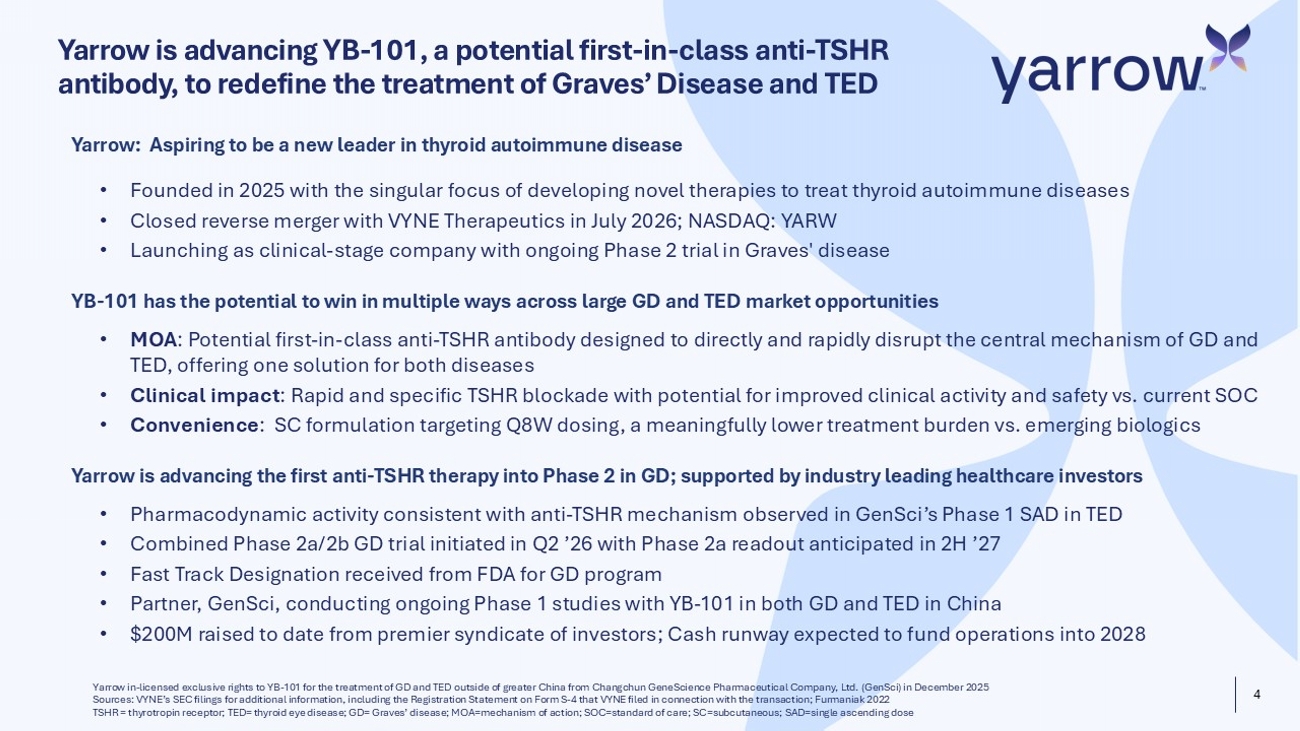
4 Yarrow is advancing YB - 101, a potential first - in - class anti - TSHR antibody, to redefine the treatment of Graves’ Disease and TED Yarrow in - licensed exclusive rights to YB - 101 for the treatment of GD and TED outside of greater China from Changchun GeneScience Pharmaceutical Company, Ltd. ( GenSci ) in December 2025 Sources: VYNE’s SEC filings for additional information, including the Registration Statement on Form S - 4 that VYNE filed in conn ection with the transaction; Furmaniak 2022 TSHR = thyrotropin receptor; TED= thyroid eye disease; GD= Graves’ disease; MOA=mechanism of action; SOC=standard of care; SC =su bcutaneous; SAD=single ascending dose Yarrow : Aspiring to be a new leader in thyroid autoimmune disease • Founded in 2025 with the singular focus of developing novel therapies to treat thyroid autoimmune diseases • Closed reverse merger with VYNE Therapeutics in July 2026; NASDAQ: YARW • Launching as clinical - stage company with ongoing Phase 2 trial in Graves' disease YB - 101 has the potential to win in multiple ways across large GD and TED market opportunities • MOA : Potential first - in - class anti - TSHR antibody designed to directly and rapidly disrupt the central mechanism of GD and TED, offering one solution for both diseases • Clinical impact : Rapid and specific TSHR blockade with potential for improved clinical activity and safety vs. current SOC • Convenience : SC formulation targeting Q8W dosing, a meaningfully lower treatment burden vs. emerging biologics Yarrow is advancing the first anti - TSHR therapy into Phase 2 in GD; supported by industry leading healthcare investors • Pharmacodynamic activity consistent with anti - TSHR mechanism observed in GenSci’s Phase 1 SAD in TED • Combined Phase 2a/2b GD trial initiated in Q2 ’26 with Phase 2a readout anticipated in 2H ’27 • Fast Track Designation received from FDA for GD program • Partner, GenSci , conducting ongoing Phase 1 studies with YB - 101 in both GD and TED in China • $200M raised to date from premier syndicate of investors; Cash runway expected to fund operations into 2028
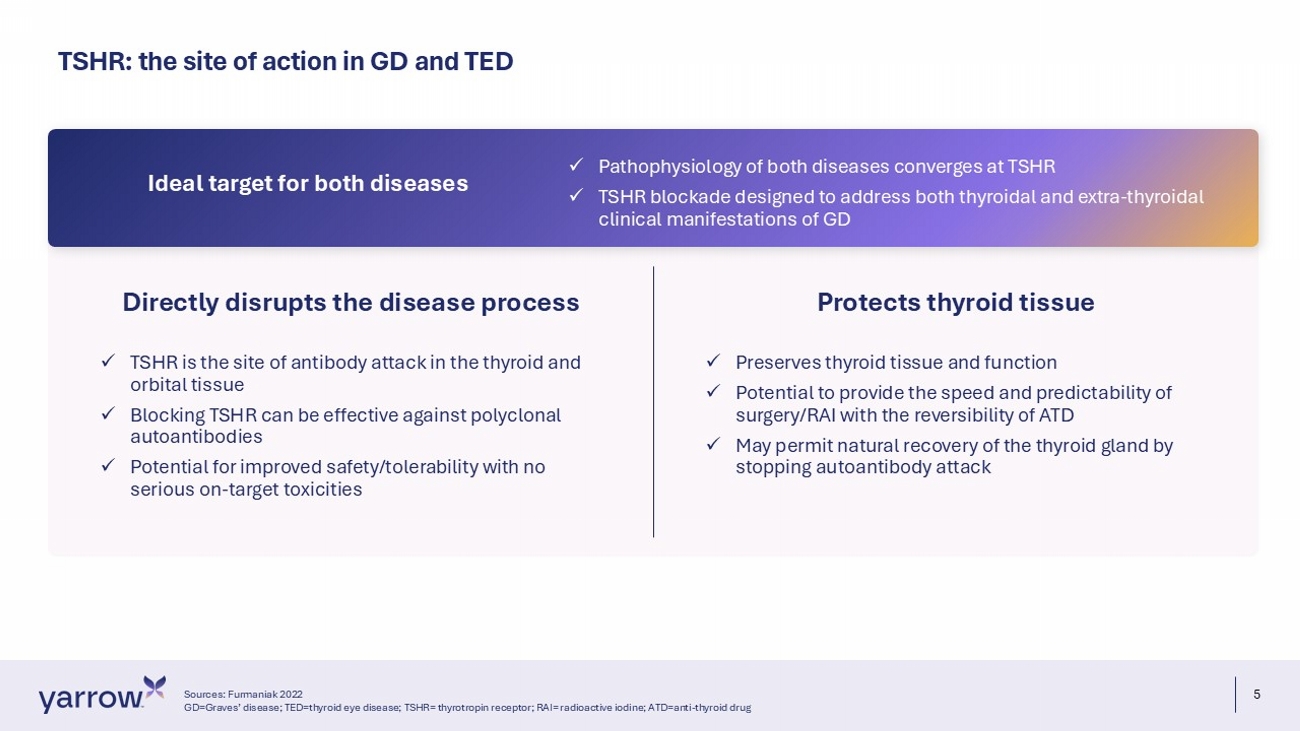
5 TSHR: the site of action in GD and TED Sources: Furmaniak 2022 GD=Graves’ disease; TED=thyroid eye disease; TSHR= thyrotropin receptor; RAI= radioactive iodine; ATD=anti - thyroid drug Directly disrupts the disease process x TSHR is the site of antibody attack in the thyroid and orbital tissue x Blocking TSHR can be effective against polyclonal autoantibodies x Potential for improved safety/tolerability with no serious on - target toxicities Protects thyroid tissue x Preserves thyroid tissue and function x Potential to provide the speed and predictability of surgery/RAI with the reversibility of ATD x May permit natural recovery of the thyroid gland by stopping autoantibody attack x Pathophysiology of both diseases converges at TSHR x TSHR blockade designed to address both thyroidal and extra - thyroidal clinical manifestations of GD Ideal target for both diseases
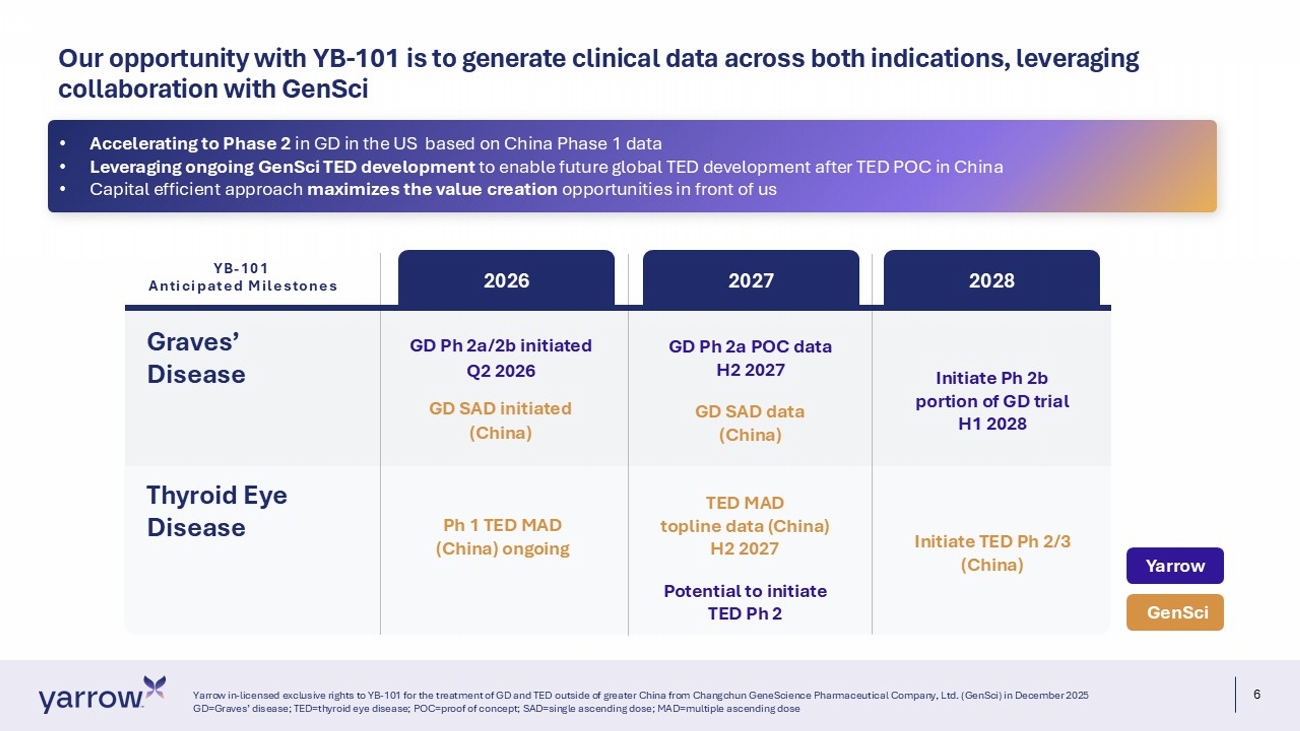
6 Our opportunity with YB - 101 is to generate clinical data across both indications, leveraging collaboration with GenSci Yarrow in - licensed exclusive rights to YB - 101 for the treatment of GD and TED outside of greater China from Changchun GeneScienc e Pharmaceutical Company, Ltd. (GenSci) in December 2025 GD=Graves’ disease; TED=thyroid eye disease; POC=proof of concept; SAD=single ascending dose; MAD=multiple ascending dose Graves’ Disease 2026 2027 2028 GD Ph 2a/2b initiated Q2 2026 GD SAD i nitiated (China) Ph 1 TED MAD (China) ongoing GD Ph 2a POC data H2 2027 GD SAD data (China) TED MAD topline data (China) H2 2027 Potential to initiate TED Ph 2 Initiate Ph 2b portion of GD trial H1 2028 Initiate TED Ph 2/3 (China) GenSci Yarrow Thyroid Eye Disease YB - 101 Anticipated Milestones • Accelerating to Phase 2 in GD in the US based on China Phase 1 data • Leveraging ongoing GenSci TED development to enable future global TED development after TED POC in China • Capital efficient approach maximizes the value creation opportunities in front of us
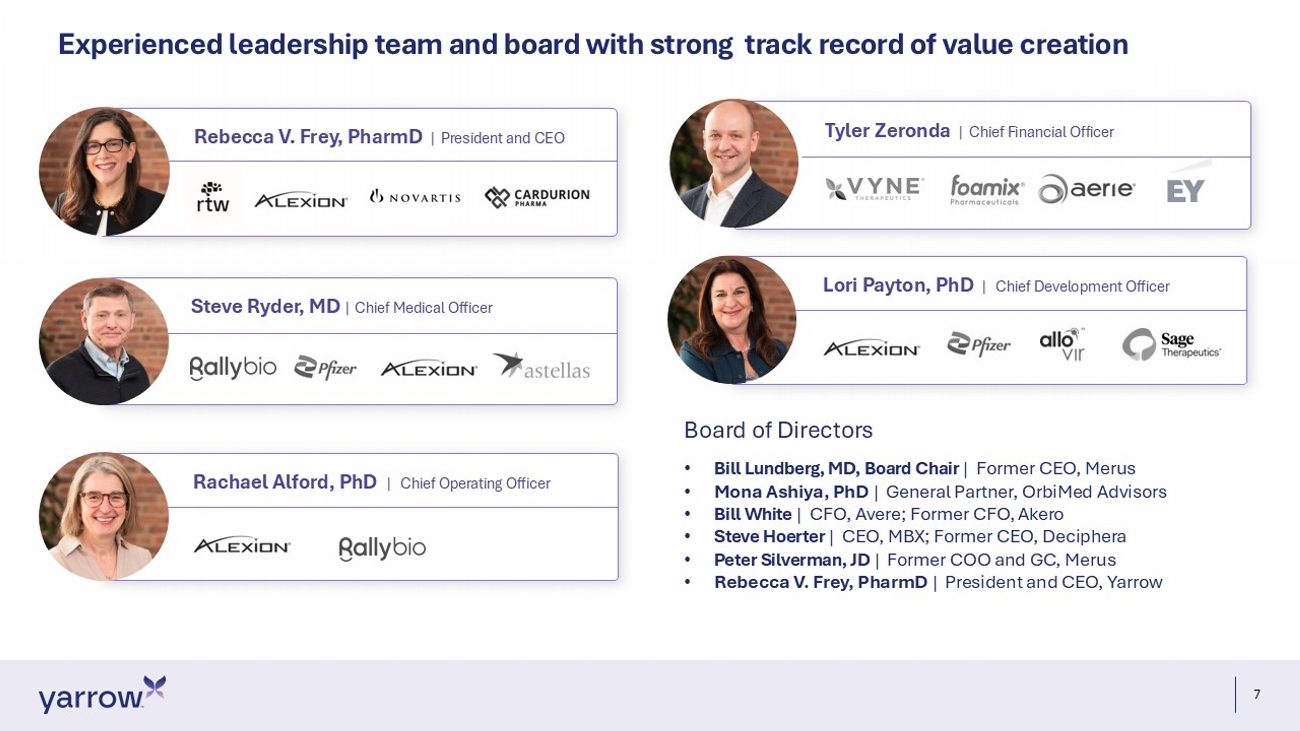
7 Experienced leadership team and board with strong track record of value creation Rebecca V. Frey, PharmD | President and CEO Lori Payton, PhD | Chief Development Officer Tyler Zeronda | Chief Financial Officer Rachael Alford, PhD | Chief Operating Officer Steve Ryder, MD | Chief Medical Officer Board of Directors • Bill Lundberg, MD, Board Chair | Former CEO, Merus • Mona Ashiya, PhD | General Partner, OrbiMed Advisors • Bill White | CFO, Avere; Former CFO, Akero • Steve Hoerter | CEO, MBX; Former CEO, Deciphera • Peter Silverman, JD | Former COO and GC, Merus • Rebecca V. Frey, PharmD | President and CEO, Yarrow

Significant unmet needs exist in current management of Graves’ Disease and TED
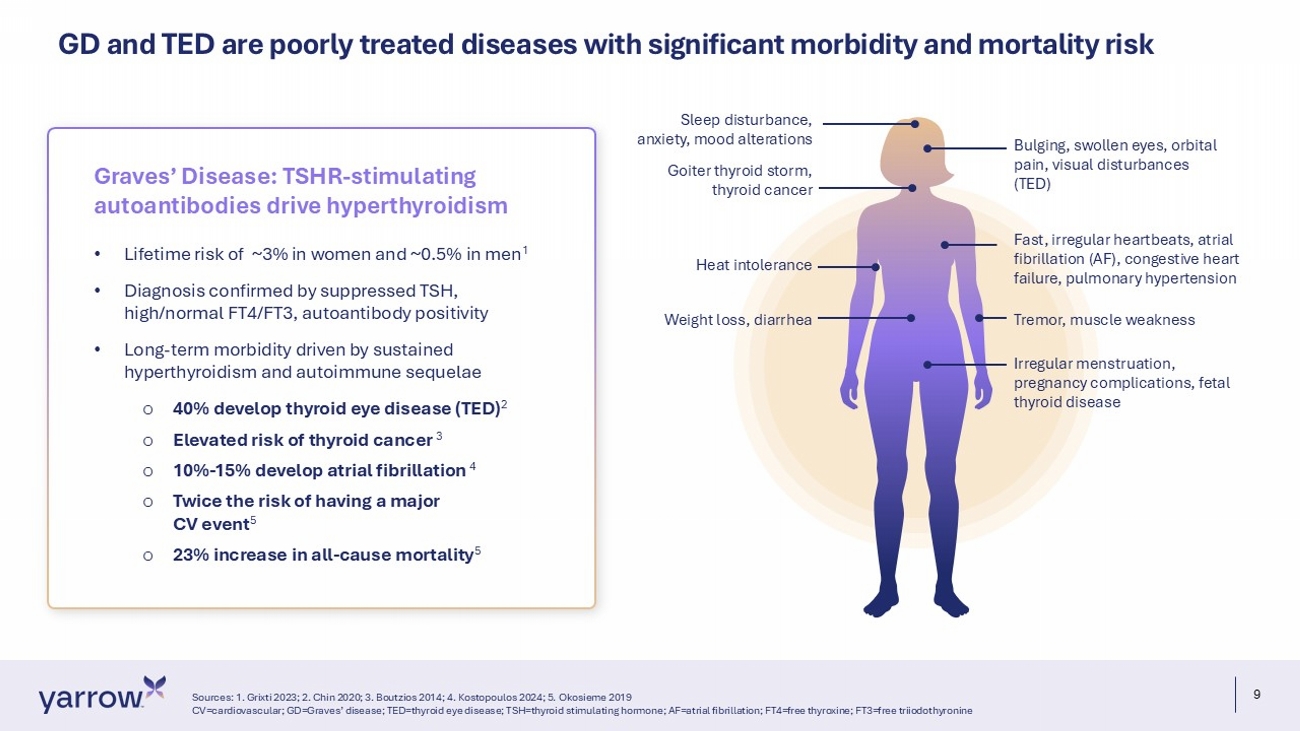
9 GD and TED are poorly treated diseases with significant morbidity and mortality risk Sources: 1. Grixti 2023; 2. Chin 2020; 3. Boutzios 2014; 4. Kostopoulos 2024; 5. Okosieme 2019 CV=cardiovascular; GD=Graves’ disease; TED=thyroid eye disease; TSH=thyroid stimulating hormone; AF=atrial fibrillation; FT4= fre e thyroxine; FT3=free triiodothyronine • Lifetime risk of ~3% in women and ~0.5% in men 1 • Diagnosis confirmed by suppressed TSH, high/normal FT4/FT3, autoantibody positivity • Long - term morbidity driven by sustained hyperthyroidism and autoimmune sequelae o 40% develop thyroid eye disease (TED) 2 o Elevated risk of thyroid cancer 3 o 10% - 15% develop atrial fibrillation 4 o Twice the risk of having a major CV event 5 o 23% increase in all - cause mortality 5 Graves’ Disease : TSHR - stimulating autoantibodies drive hyperthyroidism Goiter thyroid storm, thyroid cancer Bulging, swollen eyes, orbital pain, visual disturbances (TED) Fast, irregular heartbeats, atrial fibrillation (AF), congestive heart failure, pulmonary hypertension Tremor, muscle weakness Sleep disturbance, anxiety, mood alterations Weight loss, diarrhea Irregular menstruation, pregnancy complications, fetal thyroid disease Heat intolerance
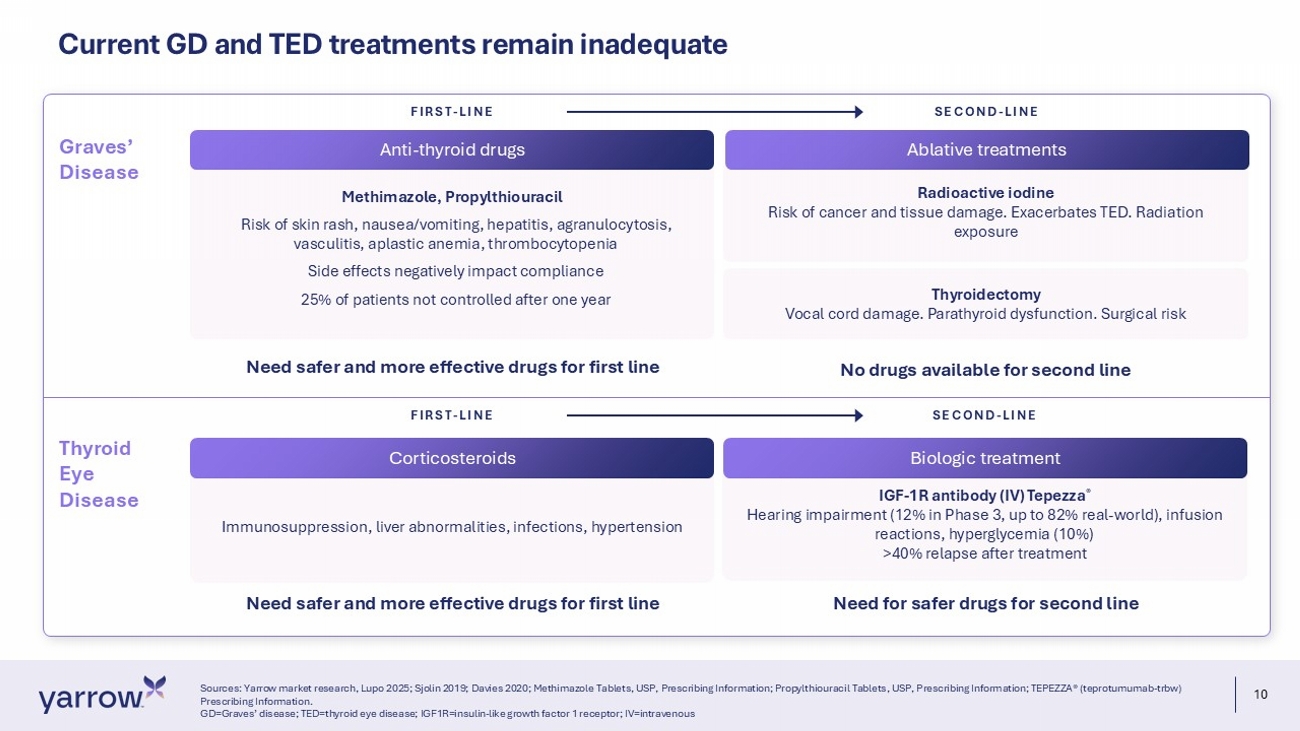
10 Radioactive iodine Risk of cancer and tissue damage. Exacerbates TED. Radiation exposure Current GD and TED treatments remain inadequate Sources: Yarrow market research, Lupo 2025; Sjolin 2019; Davies 2020; Methimazole Tablets, USP, Prescribing Information; Prop ylt hiouracil Tablets, USP, Prescribing Information; TEPEZZA® (teprotumumab - trbw ) Prescribing Information. GD=Graves’ disease; TED=thyroid eye disease; IGF1R=insulin - like growth factor 1 receptor; IV=intravenous Methimazole, Propylthiouracil Risk of skin rash, nausea/vomiting, hepatitis, agranulocytosis, vasculitis, aplastic anemia, thrombocytopenia Side effects negatively impact compliance 25% of patients not controlled after one year Thyroidectomy Vocal cord damage. Parathyroid dysfunction. Surgical risk No drugs available for second line IGF - 1R antibody (IV) Tepezza ® Hearing impairment (12% in Phase 3, up to 82% real - world), infusion reactions, hyperglycemia (10%) >40% relapse after treatment Need for safer drugs for second line Anti - thyroid drugs FIRST - LINE SECOND - LINE Graves’ Disease Thyroid Eye Disease Immunosuppression, liver abnormalities, infections, hypertension FIRST - LINE SECOND - LINE Need safer and more effective drugs for first line Need safer and more effective drugs for first line Ablative treatments Corticosteroids Biologic treatment
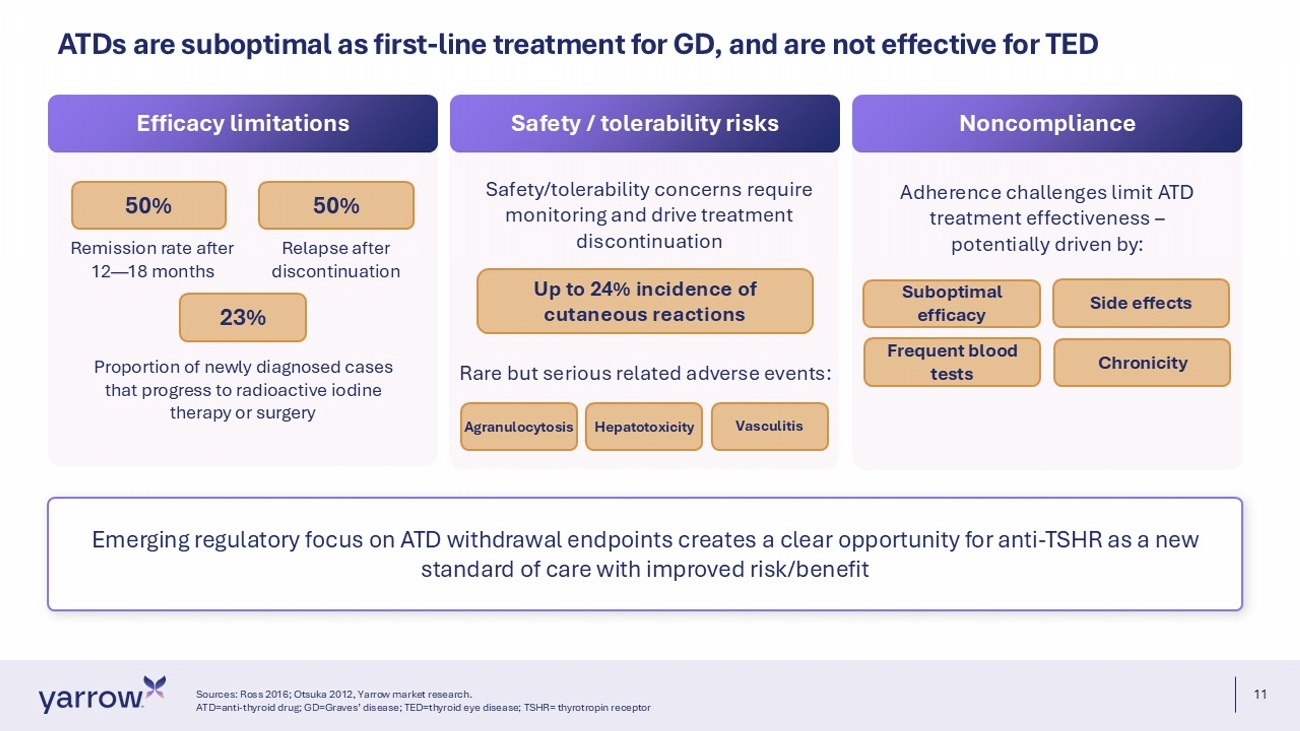
11 Emerging regulatory focus on ATD withdrawal endpoints creates a clear opportunity for anti - TSHR as a new standard of care with improved risk/benefit ATDs are suboptimal as first - line treatment for GD, and are not effective for TED Sources: Ross 2016; Otsuka 2012, Yarrow market research. ATD=anti - thyroid drug; GD=Graves’ disease; TED=thyroid eye disease; TSHR= thyrotropin receptor Efficacy limitations Safety / tolerability risks Noncompliance 50% 50% Remission rate after 12 — 18 months Relapse after discontinuation 23% Proportion of newly diagnosed cases that progress to radioactive iodine therapy or surgery Safety/ tolerability concerns require monitoring and drive treatment discontinuation Up to 24% incidence of cutaneous reactions Adherence challenges limit ATD treatment effectiveness – potentially driven by: Suboptimal efficacy Side effects Chronicity Frequent blood tests Rare but serious related adverse events: Agranulocytosis Hepatotoxicity Vasculitis

Yarrow’s potential first - in - class anti - TSHR offers a highly differentiated approach to treat GD and TED
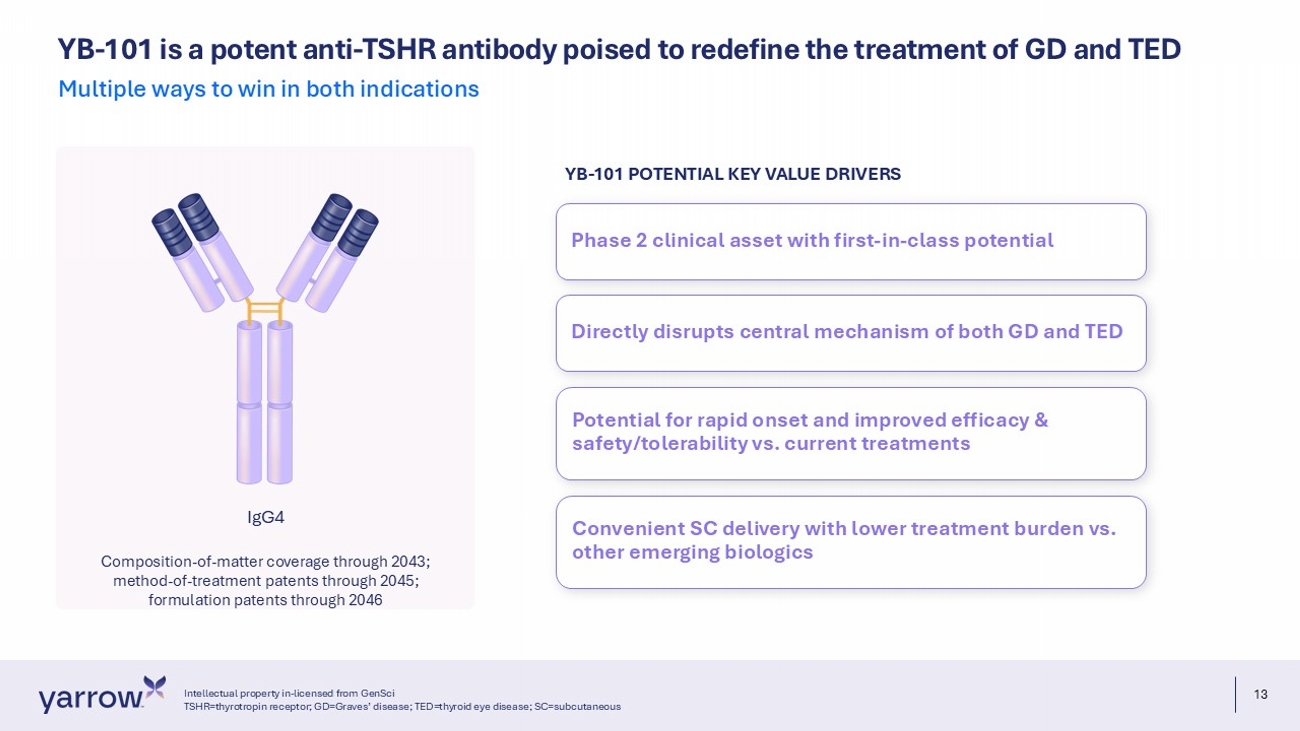
13 YB - 101 is a potent anti - TSHR antibody poised to redefine the treatment of GD and TED Multiple ways to win in both indications IgG4 Composition - of - matter coverage through 2043; method - of - treatment patents through 2045; formulation patents through 2046 Phase 2 clinical asset with first - in - class potential Directly disrupts central mechanism of both GD and TED Potential for rapid onset and improved efficacy & safety/tolerability vs. current treatments Convenient SC delivery with lower treatment burden vs. other emerging biologics YB - 101 POTENTIAL KEY VALUE DRIVERS Intellectual property in - licensed from GenSci TSHR=thyrotropin receptor; GD=Graves’ disease; TED=thyroid eye disease; SC=subcutaneous
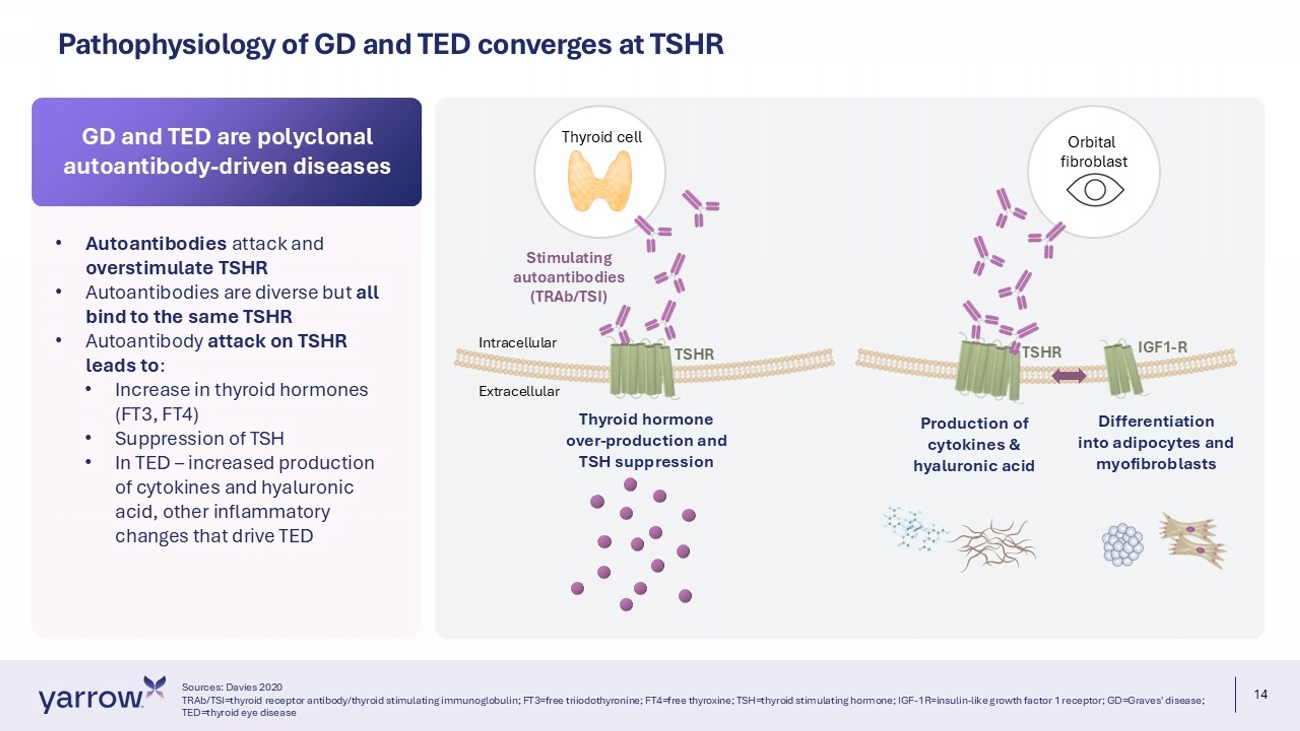
14 Pathophysiology of GD and TED converges at TSHR Thyroid cell Orbital fibroblast Stimulating autoantibodies (TRAb/TSI) TSHR Thyroid hormone over - production and TSH suppression P roduction of cytokines & hyaluronic acid Differentiation into adipocytes and myofibroblasts Intracellular Extracellular IGF1 - R TSHR • Autoantibodies attack and overstimulate TSHR • Autoantibodies are diverse but all bind to the same TSHR • Autoantibody attack on TSHR leads to : • Increase in thyroid hormones (FT3, FT4) • Suppression of TSH • In TED – increased production of cytokines and hyaluronic acid, other inflammatory changes that drive TED GD and TED are polyclonal autoantibody - driven diseases Sources: Davies 2020 TRAb/TSI=thyroid receptor antibody/thyroid stimulating immunoglobulin; FT3=free triiodothyronine; FT4=free thyroxine; TSH=thy roi d stimulating hormone; IGF - 1R=insulin - like growth factor 1 receptor; GD=Graves' disease; TED=thyroid eye disease
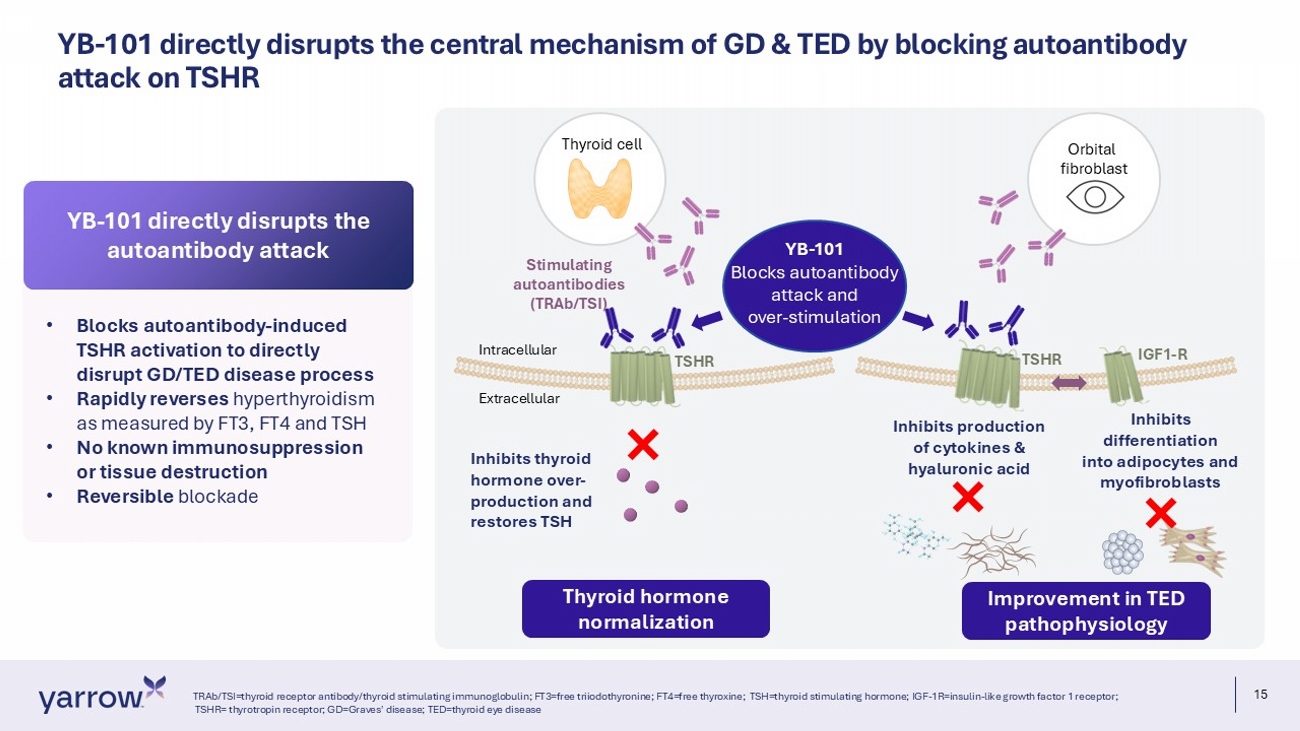
15 YB - 101 directly disrupts the central mechanism of GD & TED by blocking autoantibody attack on TSHR TRAb/TSI=thyroid receptor antibody/thyroid stimulating immunoglobulin; FT3=free triiodothyronine; FT4=free thyroxine; TSH=th yro id stimulating hormone; IGF - 1R=insulin - like growth factor 1 receptor; TSHR= thyrotropin receptor; GD=Graves' disease; TED=thyroid eye disease Thyroid cell Orbital fibroblast Stimulating autoantibodies (TRAb/TSI) TSHR Inhibits thyroid hormone over - production and restores TSH Inhibits production of cytokines & hyaluronic acid Inhibits d ifferentiation into adipocytes and myofibroblasts Intracellular Extracellular IGF1 - R TSHR YB - 101 Blocks autoantibody attack and over - stimulation Thyroid hormone normalization Improvement in TED pathophysiology • Blocks autoantibody - induced TSHR activation to directly disrupt GD/TED disease process • Rapidly reverses hyperthyroidism as measured by FT3, FT4 and TSH • No known immunosuppression or tissue destruction • Reversible blockade YB - 101 directly disrupts the autoantibody attack
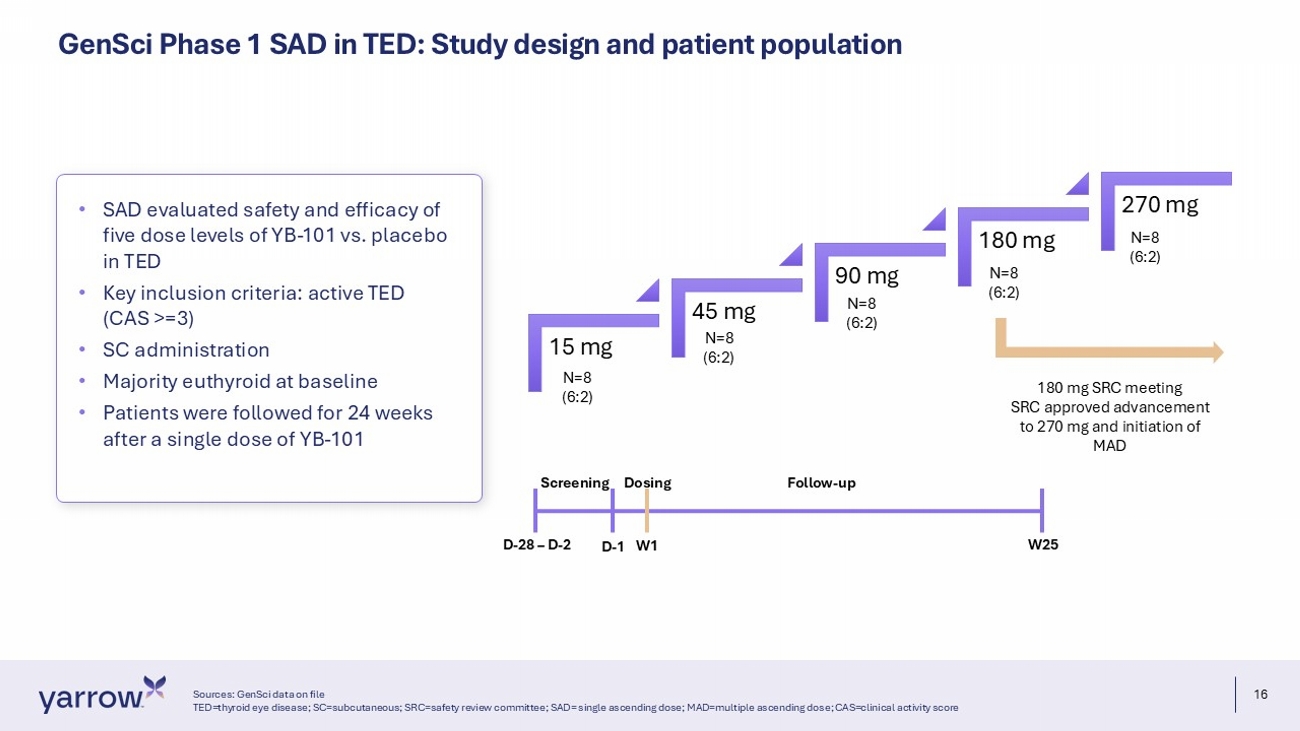
16 GenSci Phase 1 SAD in TED: Study design and patient population Sources: GenSci data on file TED=thyroid eye disease; SC=subcutaneous; SRC=safety review committee; SAD= single ascending dose; MAD=multiple ascending dos e; CAS=clinical activity score • SAD evaluated safety and efficacy of five dose levels of YB - 101 vs. placebo in TED • Key inclusion criteria: active TED (CAS >=3) • SC administration • Majority euthyroid at baseline • Patients were followed for 24 weeks after a single dose of YB - 101 Screening Dosing Follow - up D - 28 – D - 2 D - 1 W1 W25 N=8 (6:2) 15 mg 45 mg 90 mg 180 mg 270 mg N=8 (6:2) N=8 (6:2) N=8 (6:2) N=8 (6:2) 180 mg SRC meeting SRC approved advancement to 270 mg and initiation of MAD
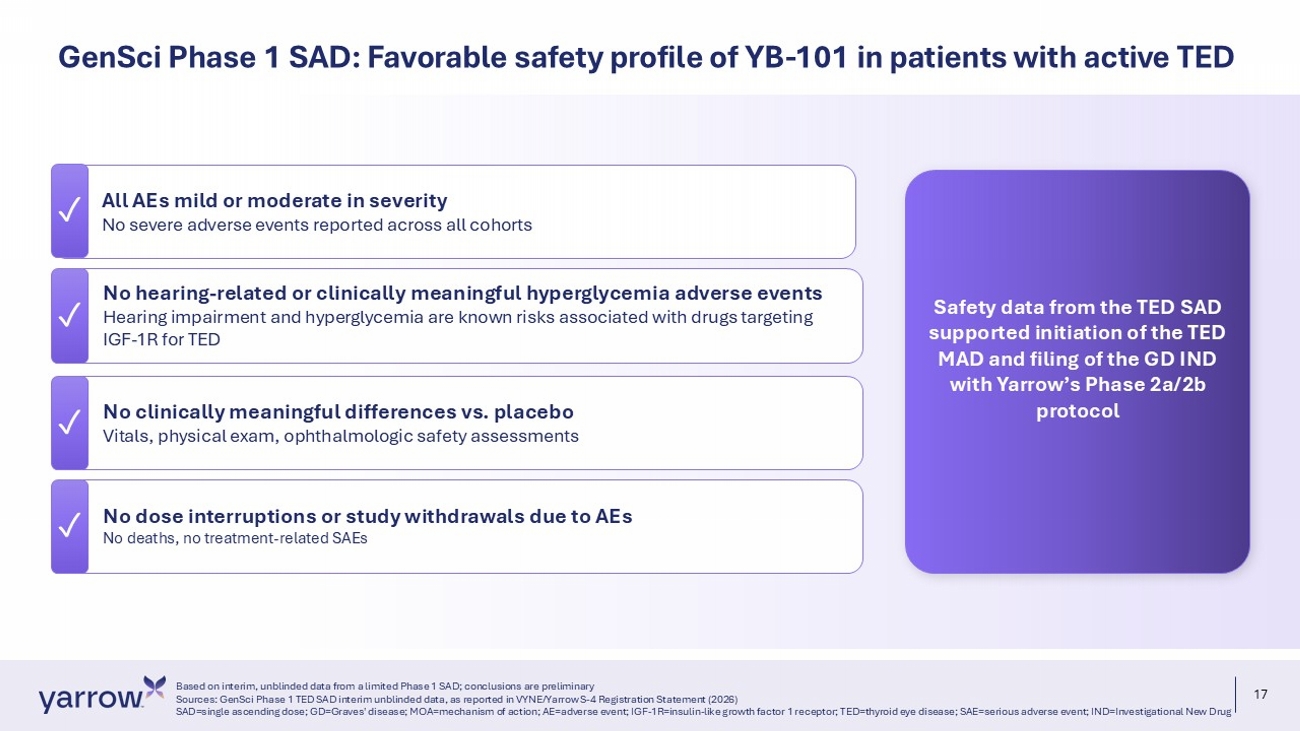
17 ✓ No dose interruptions or study withdrawals due to AEs No deaths, no treatment - related SAEs All AEs mild or moderate in severity No severe adverse events reported across all cohorts No hearing - related or clinically meaningful hyperglycemia adverse events Hearing impairment and hyperglycemia are known risks associated with drugs targeting IGF - 1R for TED No clinically meaningful differences vs. placebo Vitals, physical exam, ophthalmologic safety assessments Based on interim, unblinded data from a limited Phase 1 SAD; conclusions are preliminary Sources: GenSci Phase 1 TED SAD interim unblinded data, as reported in VYNE/Yarrow S - 4 Registration Statement (2026) SAD=single ascending dose; GD=Graves' disease; MOA=mechanism of action; AE=adverse event; IGF - 1R=insulin - like growth factor 1 re ceptor; TED=thyroid eye disease; SAE=serious adverse event; IND=Investigational New Drug GenSci Phase 1 SAD: Favorable safety profile of YB - 101 in patients with active TED ✓ ✓ ✓ Safety data from the TED SAD supported initiation of the TED MAD and filing of the GD IND with Yarrow’s Phase 2a/2b protocol
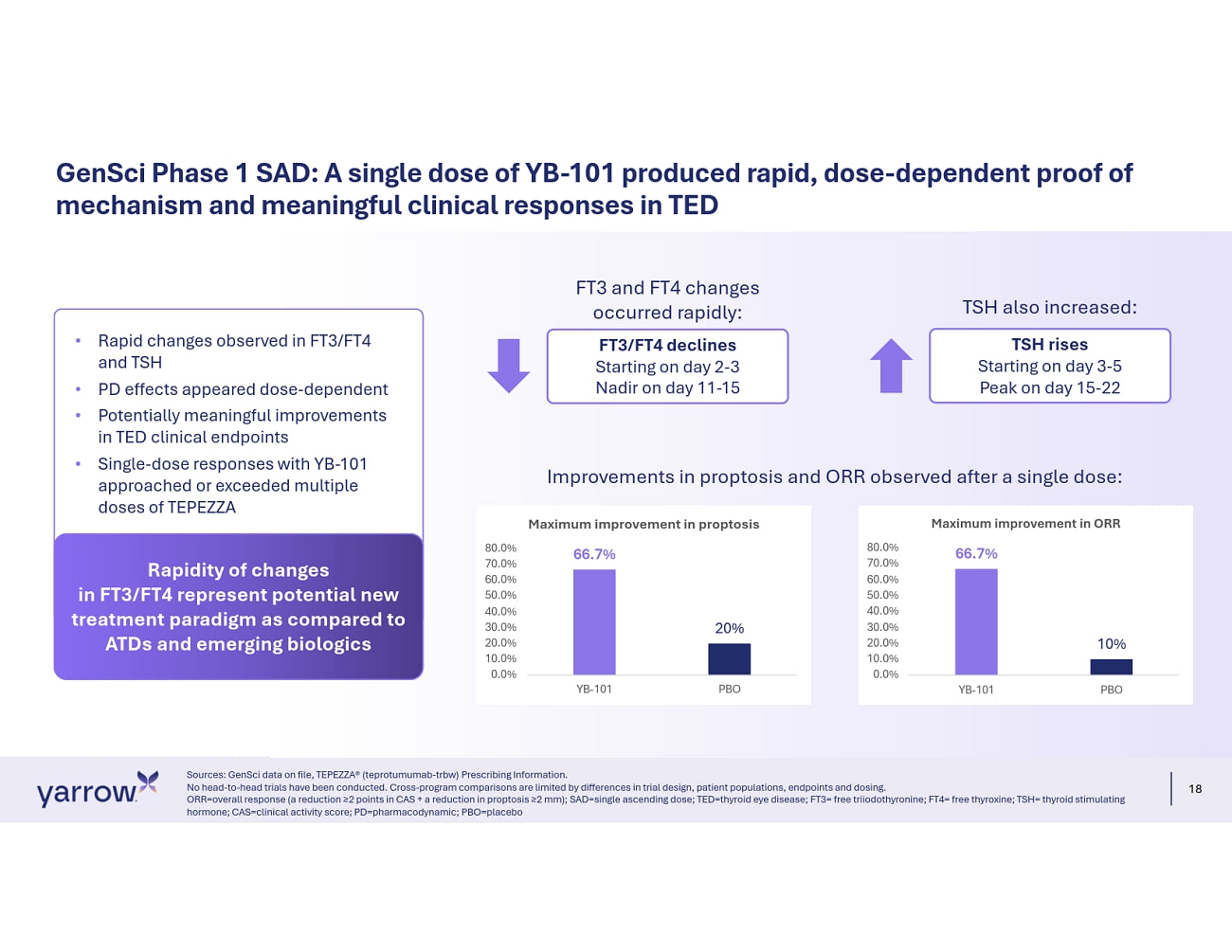
18 GenSci Phase 1 SAD: A single dose of YB - 101 produced rapid, dose - dependent proof of mechanism and meaningful clinical responses in TED Sources: GenSci data on file, TEPEZZA® (teprotumumab - trbw) Prescribing Information. No head - to - head trials have been conducted. Cross - program comparisons are limited by differences in trial design, patient popula tions, endpoints and dosing. ORR=overall response (a reduction ≥2 points in CAS + a reduction in proptosis ≥2 mm); SAD=single ascending dose; TED=thyroid eye disease; FT3= free triiodothyronine; FT4= free thyroxine; TSH= thyroid stimulating hormone; CAS=clinical activity score; PD=pharmacodynamic; PBO=placebo 66.7% 20% 0.0% 10.0% 20.0% 30.0% 40.0% 50.0% 60.0% 70.0% 80.0% YB-101 PBO Maximum improvement in proptosis 66.7% 10% 0.0% 10.0% 20.0% 30.0% 40.0% 50.0% 60.0% 70.0% 80.0% YB-101 PBO Maximum improvement in ORR FT3 and FT4 changes occurred rapidly: FT3/FT4 declines Starting on day 2 - 3 Nadir on day 11 - 15 TSH rises Starting on day 3 - 5 Peak on day 15 - 22 • Rapid changes observed in FT3/FT4 and TSH • PD effects appeared dose - dependent • Potentially meaningful improvements in TED clinical endpoints • Single - dose responses with YB - 101 approached or exceeded multiple doses of TEPEZZA Rapidity of changes in FT3/FT4 represent potential new treatment paradigm as compared to ATDs and emerging biologics Improvements in proptosis and ORR observed after a single dose:
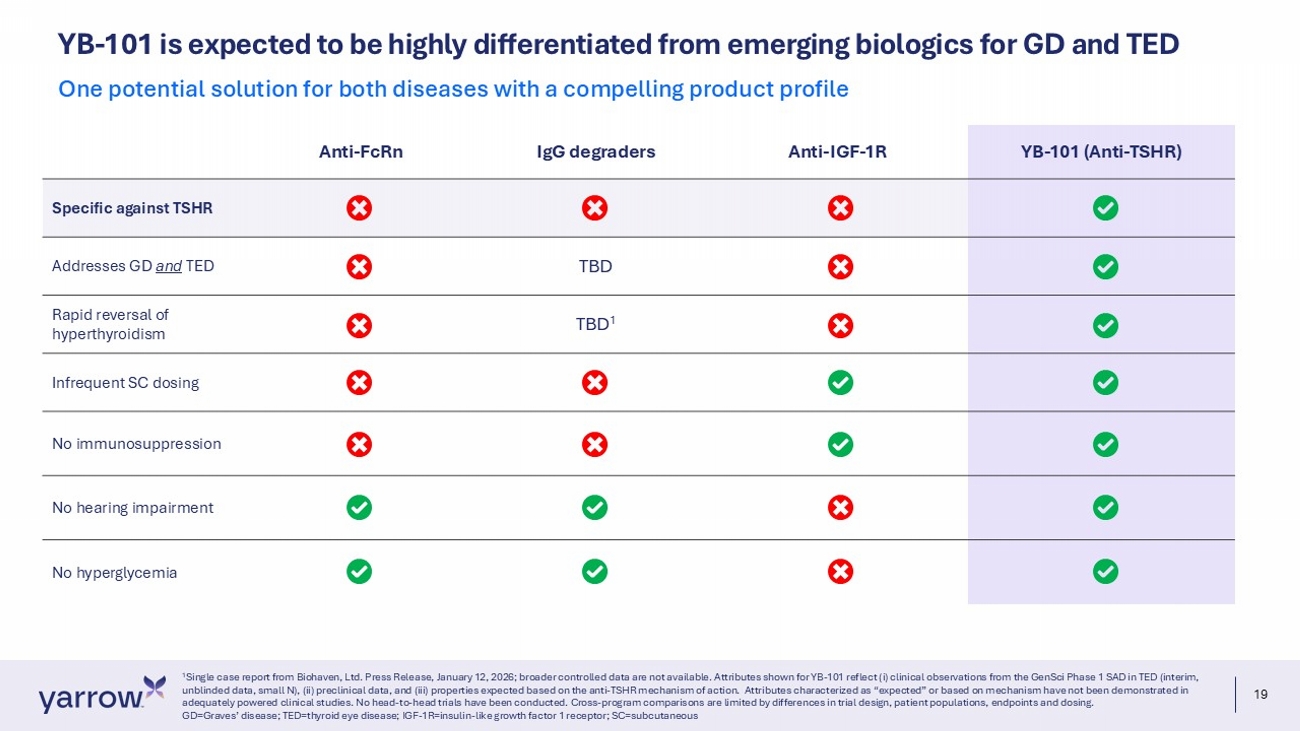
19 YB - 101 is expected to be highly differentiated from emerging biologics for GD and TED 1 Single case report from Biohaven, Ltd. Press Release, January 12, 2026; broader controlled data are not available. Attributes sh own for YB - 101 reflect (i) clinical observations from the GenSci Phase 1 SAD in TED (interim, unblinded data, small N), (ii) preclinical data, and (iii) properties expected based on the anti - TSHR mechanism of action. Attr ibutes characterized as “expected” or based on mechanism have not been demonstrated in adequately powered clinical studies. No head - to - head trials have been conducted. Cross - program comparisons are limited by differ ences in trial design, patient populations, endpoints and dosing. GD=Graves’ disease; TED=thyroid eye disease; IGF - 1R=insulin - like growth factor 1 receptor; SC=subcutaneous One potential solution for both diseases with a compelling product profile YB - 101 (Anti - TSHR) Anti - IGF - 1R IgG degraders Anti - FcRn Specific against TSHR TBD Addresses GD and TED TBD 1 Rapid reversal of hyperthyroidism Infrequent SC dosing No immunosuppression No hearing impairment No hyperglycemia
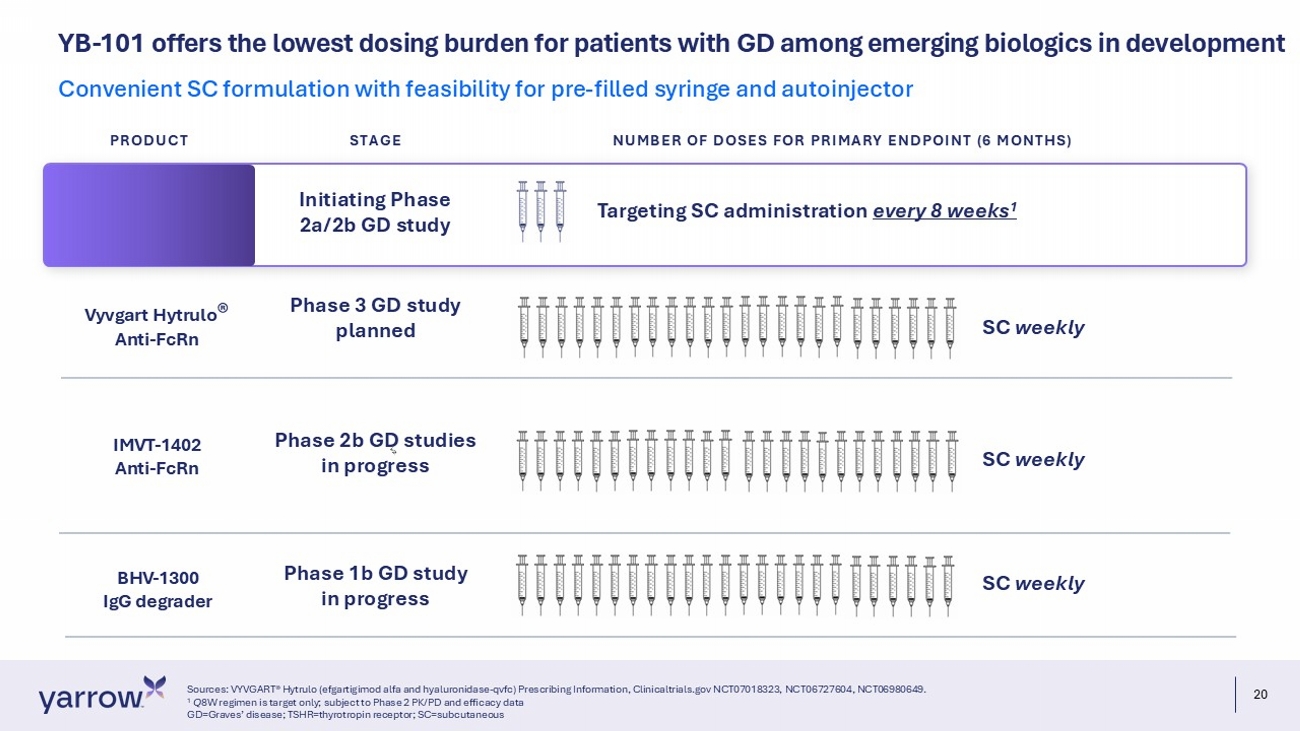
20 YB - 101 offers the lowest dosing burden for patients with GD among emerging biologics in development Sources: VYVGART® Hytrulo (efgartigimod alfa and hyaluronidase - qvfc) Prescribing Information, Clinicaltrials.gov NCT07018323, NC T06727604, NCT06980649. 1 Q 8W regimen is target only; subject to Phase 2 PK/PD and efficacy data GD=Graves’ disease; TSHR=thyrotropin receptor; SC=subcutaneous Convenient SC formulation with feasibility for pre - filled syringe and autoinjector IMVT - 1402 Anti - FcRn BHV - 1300 IgG degrader SC weekly SC weekly Phase 2b GD studies in progress Phase 1b GD study in progress Vyvgart Hytrulo ® Anti - FcRn Phase 3 GD study planned SC weekly Targeting SC administration every 8 weeks 1 Initiating Phase 2a/2b GD study PRODUCT STAGE NUMBER OF DOSES FOR PRIMARY ENDPOINT (6 MONTHS)

Yarrow is positioned for a unique value creation opportunity Pursuing rapid advancement of YB - 101 in GD with additional future upside in TED
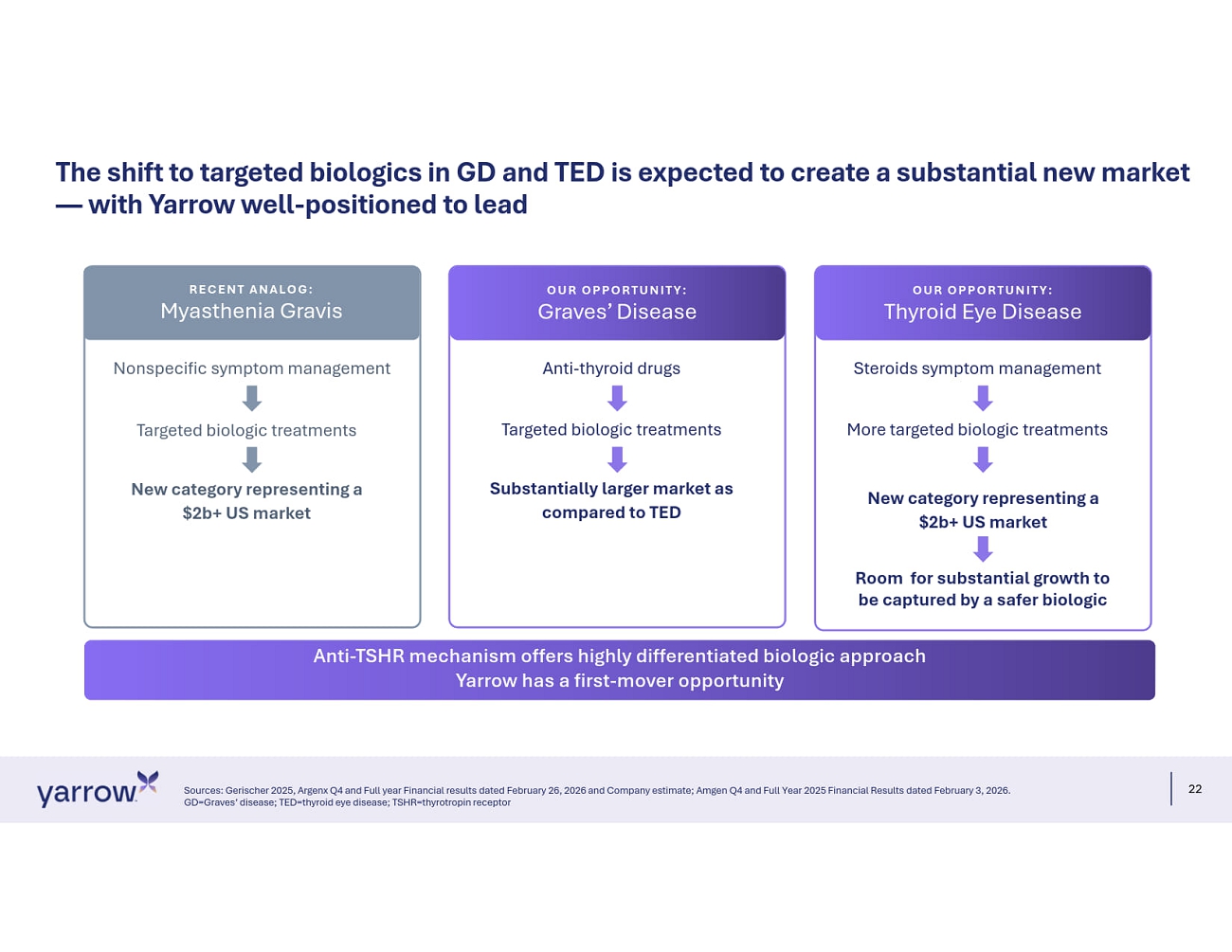
22 The shift to targeted biologics in GD and TED is expected to create a substantial new market — with Yarrow well - positioned to lead Sources: Gerischer 2025, Argenx Q4 and Full year Financial results dated February 26, 2026 and Company estimate; Amgen Q4 and Full Year 2025 Financial Result s dated February 3, 2026. GD=Graves’ disease; TED=thyroid eye disease; TSHR=thyrotropin receptor Anti - TSHR mechanism offers highly differentiated biologic approach Yarrow has a first - mover opportunity Nonspecific symptom management Targeted biologic treatments New category representing a $2b+ US market RECENT ANALOG: Myasthenia Gravis Anti - thyroid drugs Targeted biologic treatments Substantially larger market as compared to TED Steroids symptom management More targeted biologic treatments New category representing a $2b+ US market Room for substantial growth to be captured by a safer biologic
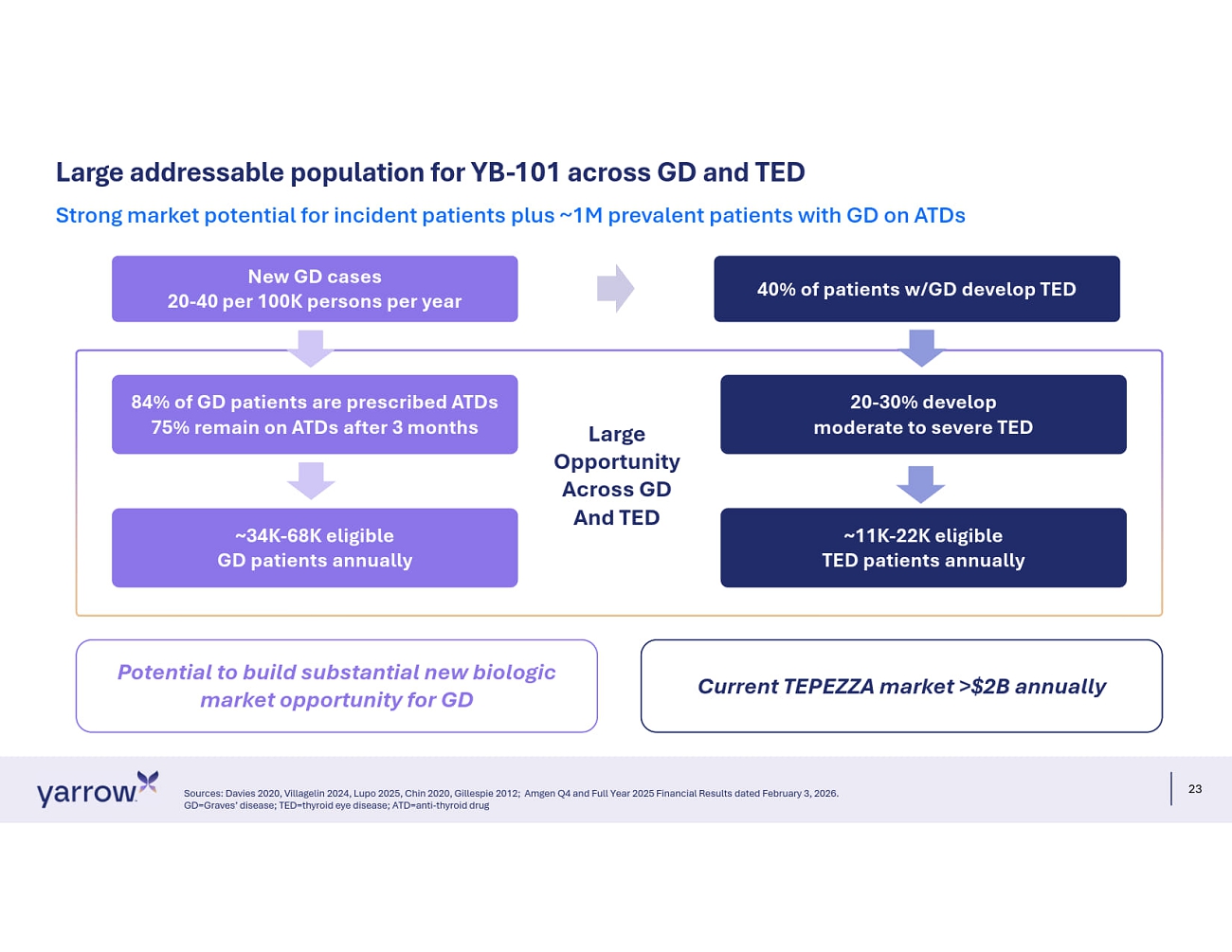
23 Potential to build substantial new biologic market opportunity for GD Large addressable population for YB - 101 across GD and TED Sources: Davies 2020, Villagelin 2024, Lupo 2025, Chin 2020, Gillespie 2012; Amgen Q4 and Full Year 2025 Financial Results dated February 3, 2026. GD=Graves’ disease; TED=thyroid eye disease; ATD=anti - thyroid drug Strong market potential for incident patients plus ~1M prevalent patients with GD on ATDs New GD cases 20 - 40 per 100K persons per year 84% of GD patients are prescribed ATDs 75% remain on ATDs after 3 months ~34K - 68K eligible GD patients annually 40% of patients w/GD develop TED 20 - 30% develop moderate to severe TED ~11K - 22K eligible TED patients annually Current TEPEZZA market >$2B annually Large Opportunity Across GD And TED
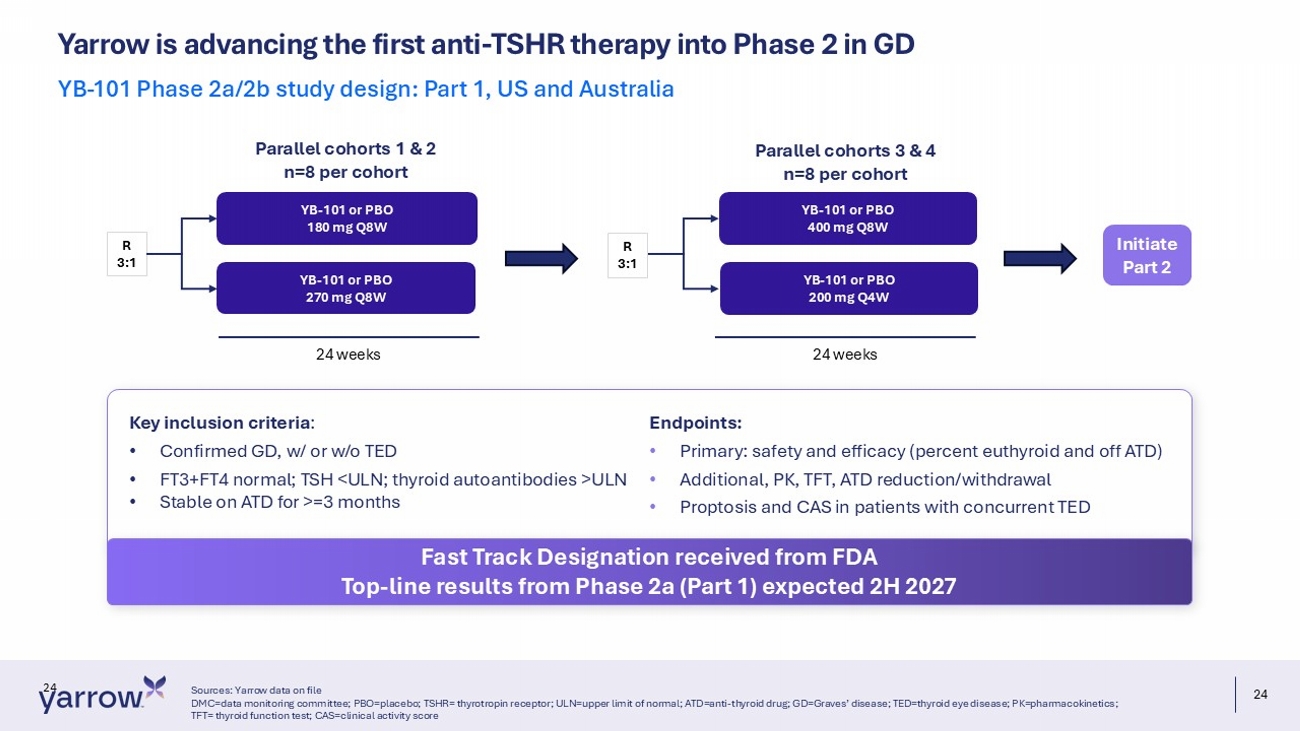
24 Yarrow is advancing the first anti - TSHR therapy into Phase 2 in GD Sources: Yarrow data on file DMC=data monitoring committee; PBO=placebo; TSHR= thyrotropin receptor; ULN=upper limit of normal; ATD=anti - thyroid drug; GD=Gra ves’ disease; TED=thyroid eye disease; PK=pharmacokinetics; TFT= thyroid function test; CAS=clinical activity score YB - 101 Phase 2a/2b study design: Part 1, US and Australia 24 YB - 101 or PBO 180 mg Q8W YB - 101 or PBO 270 mg Q8W YB - 101 or PBO 400 mg Q8W YB - 101 or PBO 200 mg Q4W R 3:1 R 3:1 Parallel cohorts 1 & 2 n=8 per cohort Parallel cohorts 3 & 4 n=8 per cohort Initiate Part 2 24 weeks 24 weeks Key inclusion criteria : • Confirmed GD, w/ or w/o TED • FT3+FT4 normal; TSH <ULN; thyroid autoantibodies >ULN • Stable on ATD for >=3 months Endpoints: • Primary: safety and efficacy (percent euthyroid and off ATD) • Additional, PK, TFT, ATD reduction/withdrawal • Proptosis and CAS in patients with concurrent TED Fast Track Designation received from FDA Top - line results from Phase 2a (Part 1) expected 2H 2027
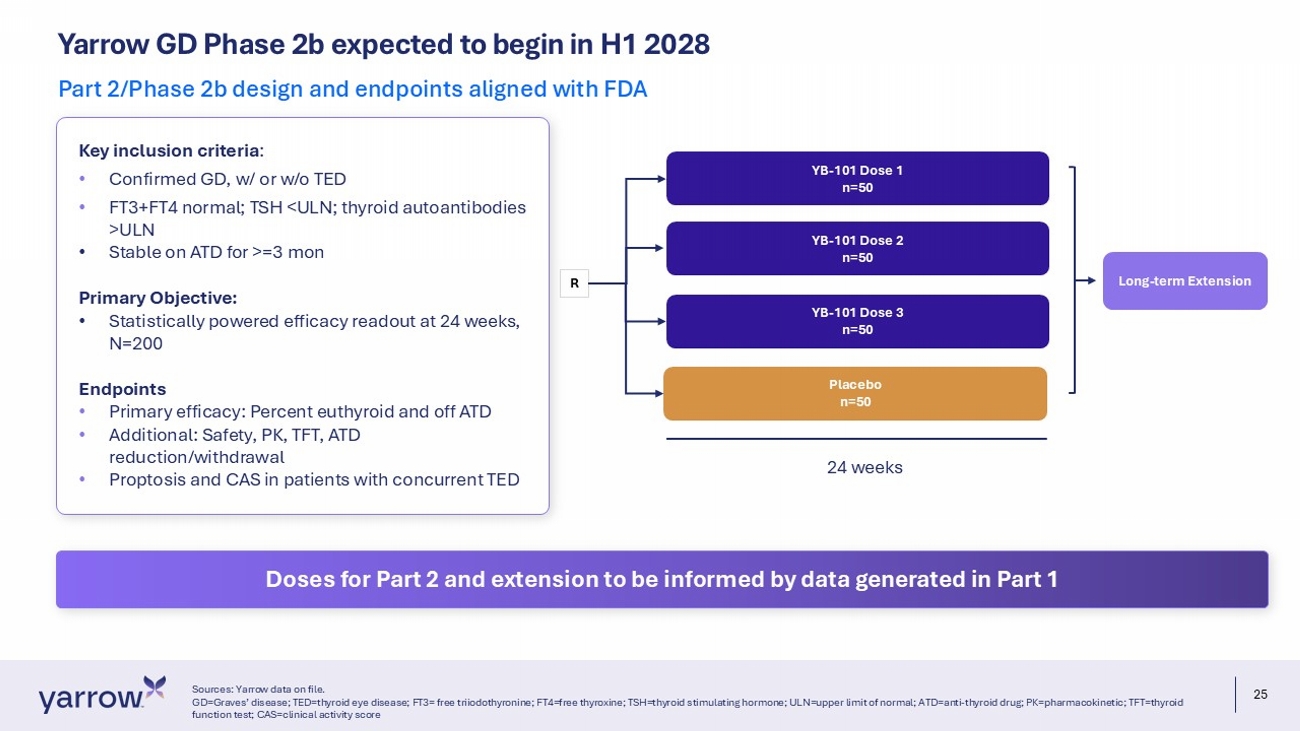
25 Yarrow GD Phase 2b expected to begin in H1 2028 Sources: Yarrow data on file. GD=Graves’ disease; TED=thyroid eye disease; FT3= free triiodothyronine; FT4=free thyroxine; TSH=thyroid stimulating hormone; UL N=upper limit of normal; ATD=anti - thyroid drug; PK=pharmacokinetic; TFT=thyroid function test; CAS=clinical activity score Part 2/Phase 2b design and endpoints aligned with FDA YB - 101 Dose 1 n=50 YB - 101 Dose 2 n=50 R Placebo n=50 YB - 101 Dose 3 n=50 24 weeks Long - term Extension Key inclusion criteria : • Confirmed GD, w/ or w/o TED • FT3+FT4 normal; TSH <ULN; thyroid autoantibodies >ULN • Stable on ATD for >=3 mon Primary Objective: • Statistically powered efficacy readout at 24 weeks, N=200 Endpoints • Primary efficacy: Percent euthyroid and off ATD • Additional: Safety, PK, TFT, ATD reduction/withdrawal • Proptosis and CAS in patients with concurrent TED Doses for Part 2 and extension to be informed by data generated in Part 1
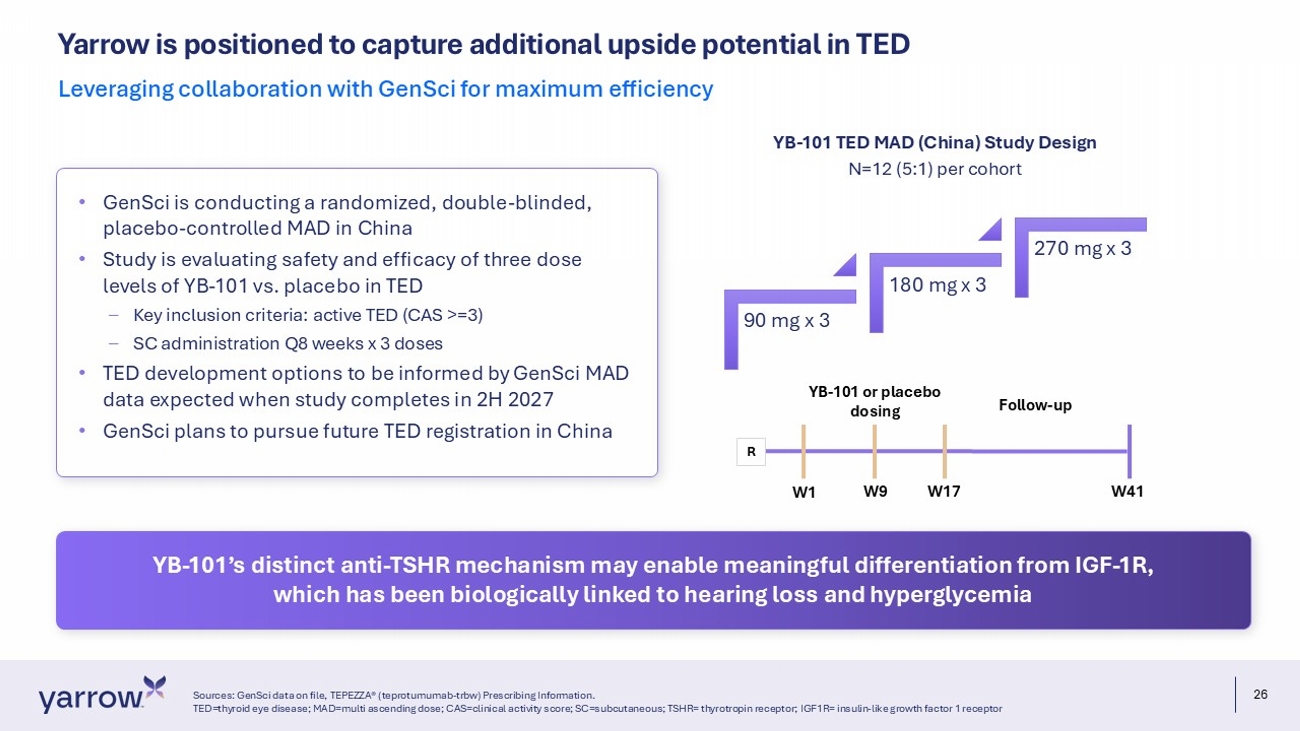
26 Yarrow is positioned to capture additional upside potential in TED Sources: GenSci data on file, TEPEZZA® (teprotumumab - trbw) Prescribing Information. TED=thyroid eye disease; MAD=multi ascending dose; CAS=clinical activity score; SC=subcutaneous; TSHR= thyrotropin receptor; IGF 1R= insulin - like growth factor 1 receptor Leveraging collaboration with GenSci for maximum efficiency 90 mg x 3 180 mg x 3 270 mg x 3 N=12 (5:1) per cohort YB - 101 TED MAD (China) Study Design YB - 101 or placebo dosing Follow - up W1 W41 W9 W17 R • GenSci is conducting a randomized, double - blinded, placebo - controlled MAD in China • Study is evaluating safety and efficacy of three dose levels of YB - 101 vs. placebo in TED – Key inclusion criteria: active TED (CAS >=3) – SC administration Q8 weeks x 3 doses • TED development options to be informed by GenSci MAD data expected when study completes in 2H 2027 • GenSci plans to pursue future TED registration in China YB - 101’s distinct anti - TSHR mechanism may enable meaningful differentiation from IGF - 1R, which has been biologically linked to hearing loss and hyperglycemia
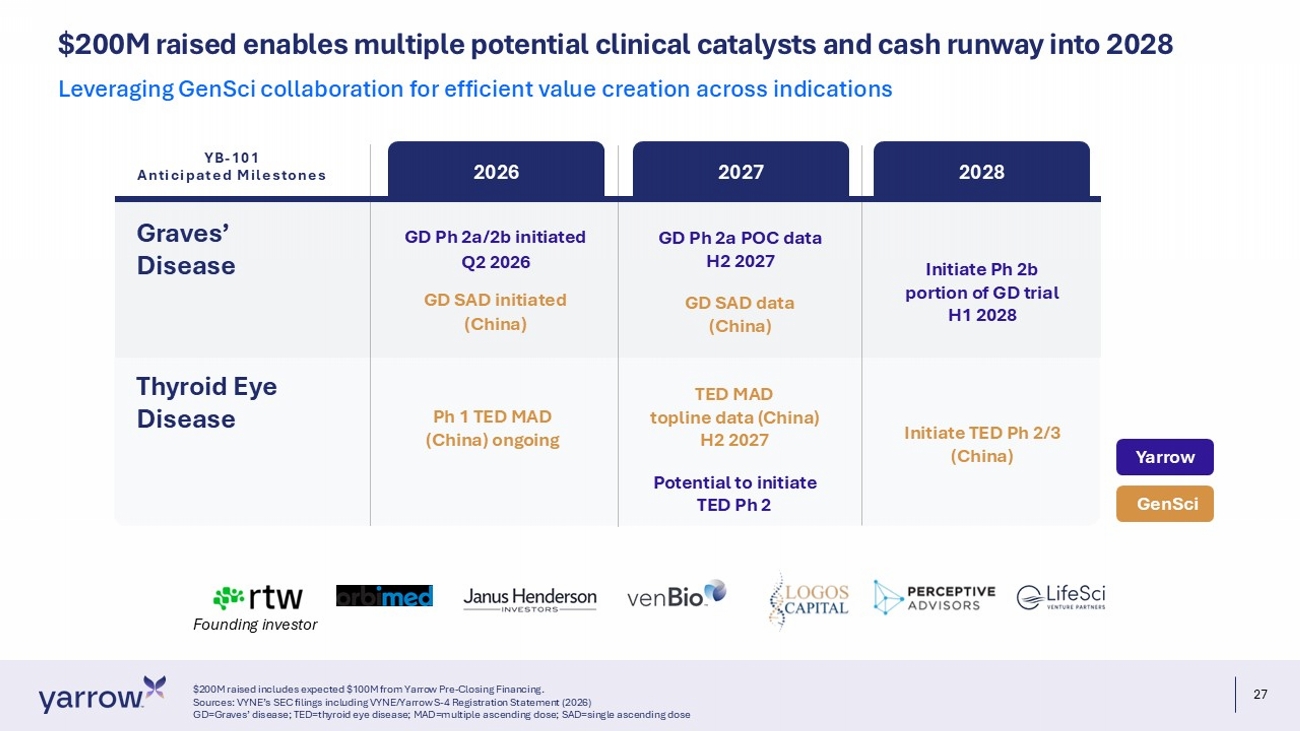
27 $ 200M raised enables multiple potential clinical catalysts and cash runway into 2028 $200M raised includes expected $100M from Yarrow Pre - Closing Financing. Sources: VYNE’s SEC filings including VYNE/Yarrow S - 4 Registration Statement (2026) GD=Graves’ disease; TED=thyroid eye disease; MAD=multiple ascending dose; SAD=single ascending dose Leveraging GenSci collaboration for efficient value creation across indications Founding investor Graves’ Disease 2026 2027 2028 GD Ph 2a/2b initiated Q2 2026 GD SAD initiated (China) Ph 1 TED MAD (China) ongoing GD Ph 2a POC data H2 2027 GD SAD data (China) TED MAD topline data (China) H2 2027 Potential to initiate TED Ph 2 Initiate Ph 2b portion of GD trial H1 2028 Initiate TED Ph 2/3 (China) GenSci Yarrow Thyroid Eye Disease YB - 101 Anticipated Milestones
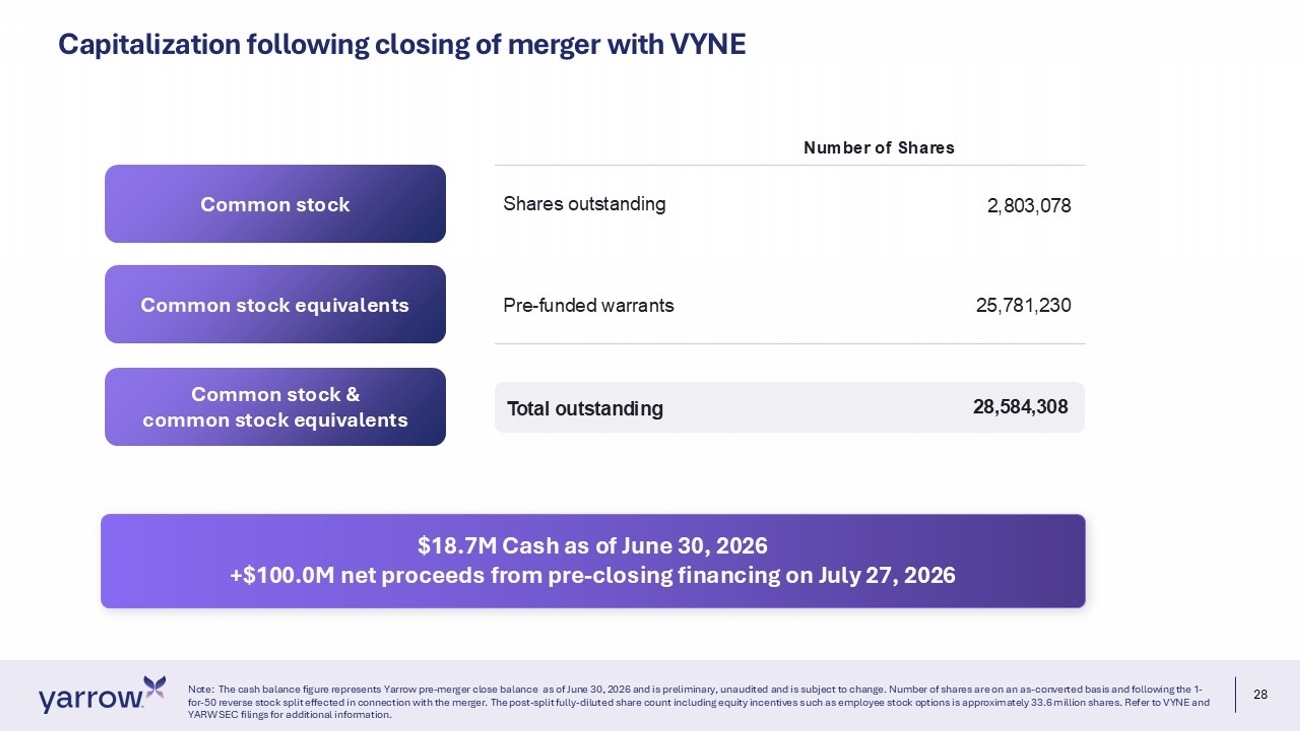
28 Note: The cash balance figure represents Yarrow pre - merger close balance as of June 30, 2026 and is preliminary, unaudited and is subject to change. Number of shares are on an as - converted basis and following the 1 - for - 50 reverse stock split effected in connection with the merger. The post - split fully - diluted share count including equity inc entives such as employee stock options is approximately 33.6 million shares. Refer to VYNE and YARW SEC filings for additional information. Common stock Common stock equivalents Common stock & common stock equivalents Number of Shares Shares outstanding 2,803,078 Pre - funded warrants 25,781,230 Total outstanding 28,584,308 Capitalization following closing of merger with VYNE $18.7M Cash as of June 30, 2026 +$100.0M net proceeds from pre - closing financing on July 27, 2026
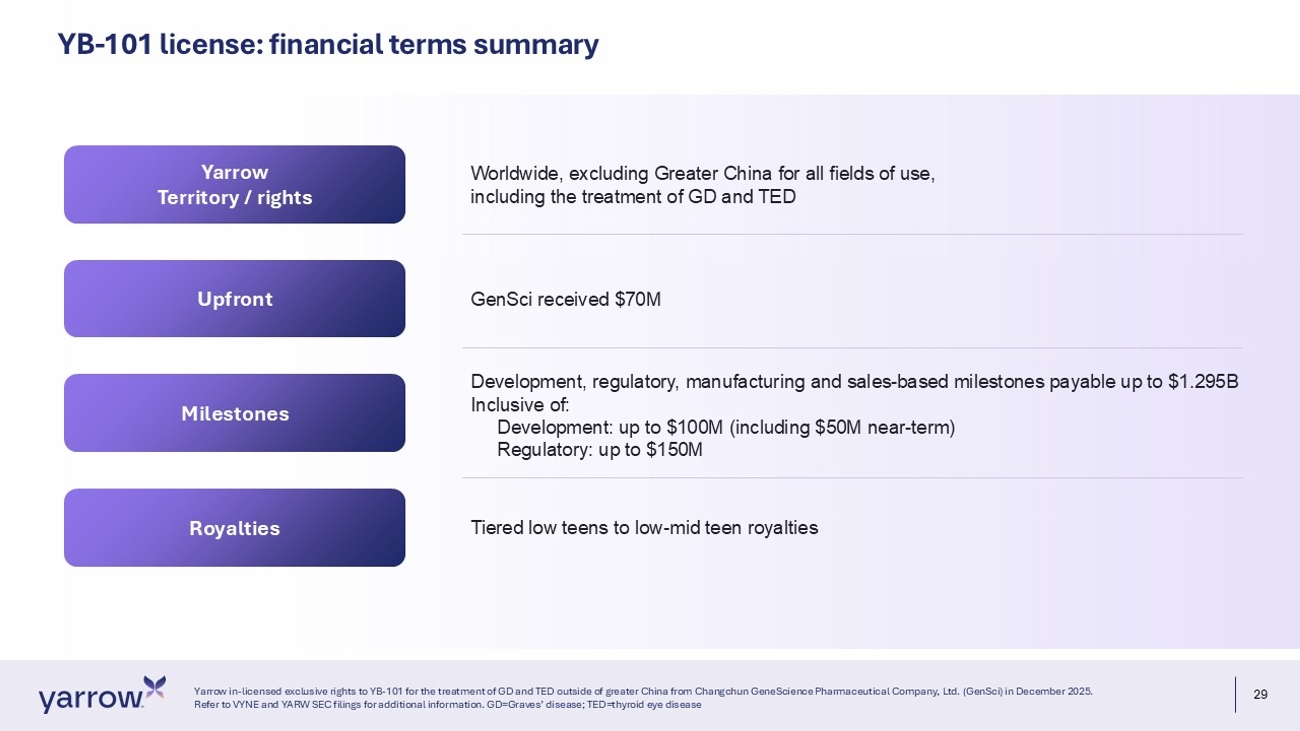
29 Yarrow in - licensed exclusive rights to YB - 101 for the treatment of GD and TED outside of greater China from Changchun GeneScience Pharmaceutical Company, Ltd. ( GenSci ) in December 2025. Refer to VYNE and YARW SEC filings for additional information. GD=Graves’ disease; TED=thyroid eye disease Yarrow Territory / rights Upfront Milestones Worldwide, excluding Greater China for all fields of use, including the treatment of GD and TED GenSci received $70M YB - 101 license: financial terms summary Royalties Development, regulatory, manufacturing and sales - based milestones payable up to $1.295B Inclusive of: Development: up to $100M (including $50M near - term) Regulatory: up to $150M Tiered low teens to low - mid teen royalties

30 yarrowbioscience.com Thank you