Exhibit 3.2
FOURTH AMENDED AND RESTATED BY-LAWS OF
J2 GLOBAL, INC.
ARTICLE I
Stockholders
Section 1.1. Annual Meetings. An annual meeting of stockholders shall be held within five months after the close of the fiscal year of the Corporation for the election of directors at such date, time and place either within or without the State of Delaware as may be designated by the Board of Directors from time to time. Any other proper business may be transacted at the annual meeting.
Section 1.2. Special Meetings. Special meetings of stockholders may be called at any time by the Chairman of the Board, if any, the Vice Chairman of the Board, if any, the President or the Board of Directors, to be held at such date, time and place either within or without the State of Delaware as may be stated in the notice of the meeting. A special meeting of stockholders shall be called by the Secretary upon the written request, stating the purpose of the meeting, of stockholders who together own of record a majority of the outstanding shares of each class of stock entitled to vote at such meeting.
Section 1.3. Notice of Meetings. Whenever stockholders are required or permitted to take any action at a meeting, a written notice of the meeting shall be given which shall state the place, date and hour of the meeting, and, in the case of a special meeting, the purpose or purposes for which the meeting is called. Unless otherwise provided by law, the written notice of any meeting shall be given not less than ten nor more than sixty days before the date of the meeting to each stockholder entitled to vote at such meeting. If mailed, such notice shall be deemed to be given when deposited in the United States mail, postage prepaid, directed to the stockholder at such stockholder’s address as it appears on the records of the Corporation.
Section 1.4. Adjournments. Any meeting of stockholders, annual or special, may be adjourned from time to time, to reconvene at the same or some other place, and notice need not be given of any such adjourned meeting if the time and place thereof are announced at the meeting at which the adjournment is taken. At the adjourned meeting the Corporation may transact any business which might have been transacted at the original meeting. If the adjournment is for more than thirty days, or if after the adjournment a new record date is fixed for the adjourned meeting, a notice of the adjourned meeting shall be given to each stockholder of record entitled to vote at the meeting.
Section 1.5. Quorum. At each meeting of stockholders, except where otherwise provided by law or the certificate of incorporation or these by-laws, the holders of a majority of the outstanding shares of stock entitled to vote on a matter at the meeting, present in person or represented by proxy, shall constitute a quorum. For purposes of the foregoing, where a separate vote by class or classes is required for any matter, the holders of a majority of the outstanding shares of such class or classes, present in person or represented by proxy, shall constitute a quorum to take action with respect to that vote on that matter. Two or more classes or series of stock shall be considered a single class if the holders thereof are entitled to vote together as a single class at the meeting. In the absence of a quorum of the holders of any class of stock entitled to vote on a matter, the holders of such class so present or represented may, by majority vote, adjourn the meeting of such class from time to time in the manner provided by Section 1.4 of these by-laws until a quorum of such class shall be so present or represented. Shares of its own capital stock belonging on the record date for the meeting to the Corporation or to another corporation, if a majority of the shares entitled to vote in the election of directors of such other corporation is held, directly or indirectly, by the Corporation, shall neither be entitled to vote nor be counted for quorum purposes; provided, however, that the foregoing shall not limit the right of the Corporation to vote stock, including but not limited to its own stock, held by it in a fiduciary capacity.
Section 1.6. Organization. Meetings of stockholders shall be presided over by the Chairman of the Board, if any, or in the absence of the Chairman of the Board by the Vice Chairman or any Co-Chairman of the Board, if any, or in the absence of the Vice Chairman or any Co- Chairman of the Board by the President, or in the absence
of the President by a Vice President, or in the absence of the foregoing persons by a chairman designated by the Board of Directors, or in the absence of such designation by a chairman chosen at the meeting. The Secretary, or in the absence of the Secretary an Assistant Secretary, shall act as secretary of the meeting, but in the absence of the Secretary and any Assistant Secretary the chairman of the meeting may appoint any person to act as secretary of the meeting.
The order of business at each such meeting shall be as determined by the chairman of the meeting. The chairman of the meeting shall have the right and authority to prescribe such rules, regulations and procedures and to do all such acts and things as are necessary or desirable for the proper conduct of the meeting, including, without limitation, the establishment of procedures for the maintenance of order and safety, limitations on the time allotted to questions or comments on the affairs of the Corporation, restrictions on entry to such meeting after the time prescribed for the commencement thereof and the opening and closing of the voting polls.
Section 1.7. Inspectors. Prior to any meeting of stockholders, the Board of Directors or the President shall appoint one or more inspectors to act at such meeting and make a written report thereof and may designate one or more persons as alternate inspectors to replace any inspector who fails to act. If no inspector or alternate is able to act at the meeting of stockholders, the person presiding at the meeting shall appoint one or more inspectors to act at the meeting. Each inspector, before entering upon the discharge of his or her duties, shall take and sign an oath faithfully to execute the duties of inspector with strict impartiality and according to the best of his or her ability. The inspectors shall ascertain the number of shares outstanding and the voting power of each, determine the shares represented at the meeting and the validity of proxies and ballots, count all votes and ballots, determine and retain for a reasonable period a record of the disposition of any challenges made to any determination by the inspectors and certify their determination of the number of shares represented at the meeting and their count of all votes and ballots. The inspectors may appoint or retain other persons to assist them in the performance of their duties. The date and time of the opening and closing of the polls for each matter upon which the stockholders will vote at a meeting shall be announced at the meeting. No ballot, proxy or vote, nor any revocation thereof or change thereto, shall be accepted by the inspectors after the closing of the polls. In determining the validity and counting of proxies and ballots, the inspectors shall be limited to an examination of the proxies, any envelopes submitted therewith, any information provided by a stockholder who submits a proxy by telegram, cablegram or other electronic transmission from which it can be determined that the proxy was authorized by the stockholder, ballots and the regular books and records of the corporation, and they may also consider other reliable information for the limited purpose of reconciling proxies and ballots submitted by or on behalf of banks, brokers, their nominees or similar persons which represent more votes than the holder of a proxy is authorized by the record owner to cast or more votes than the stockholder holds of record. If the inspectors consider other reliable information for such purpose, they shall, at the time they make their certification, specify the precise information considered by them, including the person or persons from whom they obtained the information, when the information was obtained, the means by which the information was obtained and the basis for the inspectors’ belief that such information is accurate and reliable.
Section 1.8. Voting; Proxies. Unless otherwise provided in the certificate of incorporation, each stockholder entitled to vote at any meeting of stockholders shall be entitled to one vote for each share of stock held by such stockholder which has voting power upon the matter in question. Each stockholder entitled to vote at a meeting of stockholders or to express consent or dissent to corporate action in writing without a meeting may authorize another person or persons to act for such stockholder by proxy, but no such proxy shall be voted or acted upon after three years from its date, unless the proxy provides for a longer period. A duly executed proxy shall be irrevocable if it states that it is irrevocable and if, and only as long as, it is coupled with an interest sufficient in law to support an irrevocable power, regardless of whether the interest with which it is coupled is an interest in the stock itself or an interest in the Corporation generally. A stockholder may revoke any proxy which is not irrevocable by attending the meeting and voting in person or by filing an instrument in writing revoking the proxy or another duly executed proxy bearing a later date with the Secretary of the Corporation. Voting at meetings of stockholders need not be by written ballot unless the holders of a majority of the outstanding shares of all classes of stock entitled to vote thereon present in person or represented by proxy at such meeting shall so determine. Unless otherwise provided by law or by the certificate of incorporation or these by-laws (including Section 2.2 hereof), the affirmative vote of the holders of a majority of the shares present in person or represented by proxy at the meeting and entitled to vote on the subject matter shall be the act of the stockholders. Where a separate vote by class or classes is required, the affirmative vote of the holders of a majority of the shares of such class or classes present in person or represented by proxy at the meeting shall be the act of such class or classes, except as otherwise provided by law or by the certificate of incorporation or these by-laws.
Section 1.9. Fixing Date for Determination of Stockholders of Record. In order that the Corporation may determine the stockholders entitled to notice of or to vote at any meeting of stockholders or any adjournment thereof, the Board of Directors may fix a record date, which record date shall not precede the date upon which the resolution fixing the record date is adopted by the Board of Directors, and which record date shall not be more than sixty nor less than ten days before the date of such meeting. If no record date is fixed by the Board of Directors, the record date for determining stockholders entitled to notice of or to vote at a meeting of stockholders shall be at the close of business on the day next preceding the day on which notice is given, or, if notice is waived, at the close of business on the day next preceding the day on which the meeting is held. A determination of stockholders of record entitled to notice of or to vote at a meeting of stockholders shall apply to any adjournment of the meeting; provided, however, that the Board of Directors may fix a new record date for the adjourned meeting.
In order that the Corporation may determine the stockholders entitled to consent to corporate action in writing without a meeting, the Board of Directors may fix a record date, which record date shall not precede the date upon which the resolution fixing the record date is adopted by the Board of Directors, and which date shall not be more than ten days after the date upon which the resolution fixing the record date is adopted by the Board of Directors. If no record date has been fixed by the Board of Directors, the record date for determining stockholders entitled to consent to corporate action in writing without a meeting, when no prior action by the Board of Directors is required by law, shall be the first date on which a signed written consent setting forth the action taken or proposed to be taken is delivered to the Corporation by delivery to its registered office in the State of Delaware, its principal place of business, or an officer or agent of the Corporation having custody of the book in which proceedings of meetings of stockholders are recorded. Delivery made to the Corporation’s registered office shall be by hand or by certified or registered mail, return receipt requested. If no record date has been fixed by the Board of Directors and prior action by the Board of Directors is required by law, the record date for determining stockholders entitled to consent to corporate action in writing without a meeting shall be at the close of business on the day on which the Board of Directors adopts the resolution taking such prior action. In order that the Corporation may determine the stockholders entitled to receive payment of any dividend or other distribution or allotment of any rights or the stockholders entitled to exercise any rights in respect of any change, conversion or exchange of stock, or for the purpose of any other lawful action, the Board of Directors may fix a record date, which record date shall not precede the date upon which the resolution fixing the record date is adopted, and which record date shall be not more than sixty days prior to such action. If no record date is fixed, the record date for determining stockholders for any such purpose shall be at the close of business on the day on which the Board of Directors adopts the resolution relating thereto.
Section 1.10. List of Stockholders Entitled to Vote. The Secretary shall prepare and make, at least ten days before every meeting of stockholders, a complete list of the stockholders entitled to vote at the meeting, arranged in alphabetical order, and showing the address of each stockholder and the number of shares registered in the name of each stockholder. Such list shall be open to the examination of any stockholder, for any purpose germane to the meeting, during ordinary business hours, for a period of at least ten days prior to the meeting, either at a place within the city where the meeting is to be held, which place shall be specified in the notice of the meeting, or, if not so specified, at the place where the meeting is to be held. The list shall also be produced and kept at the time and place of the meeting during the whole time thereof and may be inspected by any stockholder who is present.
Section 1.11. Consent of Stockholders in Lieu of Meeting. Unless otherwise provided in the certificate of incorporation or by law, any action required by law to be taken at any annual or special meeting of stockholders of the Corporation, or any action which may be taken at any annual or special meeting of such stockholders, may be taken without a meeting, without prior notice and without a vote, if a consent or consents in writing, setting forth the action so taken, shall be signed by the holders of outstanding stock having not less than the minimum number of votes that would be necessary to authorize or take such action at a meeting at which all shares entitled to vote thereon were present and voted and shall be delivered to the Corporation by delivery to (a) its registered office in the State of Delaware by hand or by certified mail or registered mail, return receipt requested, (b) its principal place of business, or (c) an officer or agent of the Corporation having custody of the book in which proceedings of meetings of stockholders are recorded. Every written consent shall bear the date of signature of each stockholder who signs the consent and no written consent shall be effective to take the corporate action referred to therein unless, within sixty days of the earliest dated consent delivered in the manner required by this
by-law to the Corporation, written consents signed by a sufficient number of holders to take action are delivered to the Corporation by delivery to (a) its registered office in the State of Delaware by hand or by certified or registered mail, return receipt requested, (b) its principal place of business, or (c) an officer or agent of the Corporation having custody of the book in which proceedings of meetings of stockholders are recorded. Prompt notice of the taking of the corporate action without a meeting by less than unanimous written consent shall be given to those stockholders who have not consented in writing and who, if the action had been taken at a meeting, would have been entitled to notice of the meeting if the record date for such meeting had been the date that written consents signed by a sufficient number of stockholders to take the action were delivered to the Corporation as provided in this Section 1.11.
Section 1.12. Advance Notice of Stockholder Proposals. At any annual or special meeting of stockholders, proposals by stockholders and persons nominated for election as directors by stockholders shall be considered only if advance notice thereof has been timely given as provided herein and such proposals or nominations are otherwise proper for consideration under applicable law and the certificate of incorporation and by-laws of the Corporation. Notice of any proposal to be presented by any stockholder or of the name of any person to be nominated by any stockholder for election as a director of the Corporation at any meeting of stockholders shall be delivered to the Secretary of the Corporation at its principal executive office not less than 60 nor more than 90 days prior to the date of the meeting; provided, however, that if the date of the meeting is first publicly announced or disclosed (in a public filing or otherwise) less than 70 days prior to the date of the meeting, such advance notice shall be given not more than ten days after such date is first so announced or disclosed. Public notice shall be deemed to have been given more than 70 days in advance of the annual meeting if the Corporation shall have previously disclosed, in these by- laws or otherwise, that the annual meeting in each year is to be held on a determinable date, unless and until the Board determines to hold the meeting on a different date. Any stockholder who gives notice of any such proposal shall deliver therewith the text of the proposal to be presented and a brief written statement of the reasons why such stockholder favors the proposal and setting forth such stockholder’s name and address, the number and class of all shares of each class of stock of the Corporation beneficially owned by such stockholder and any material interest of such stockholder in the proposal (other than as a stockholder). Any stockholder desiring to nominate any person for election as a director of the Corporation shall deliver with such notice a statement in writing setting forth the name of the person to be nominated, the number and class of all shares of each class of stock of the Corporation beneficially owned by such person, the information regarding such person required by paragraphs (a), (e) and (f) of Item 401 of Regulation S-K adopted by the Securities and Exchange Commission (or the corresponding provisions of any regulation subsequently adopted by the Securities and Exchange Commission applicable to the Corporation), such person’s signed consent to serve as a director of the Corporation if elected, such stockholder’s name and address and the number and class of all shares of each class of stock of the Corporation beneficially owned by such stockholder. As used herein, shares “beneficially owned” shall mean all shares as to which such person, together with such person’s affiliates and associates (as defined in Rule 12b-2 under the Securities Exchange Act of 1934), may be deemed to beneficially own pursuant to Rules 13d-3 and 13d-5 under the Securities Exchange Act of 1934, as well as all shares as to which such person, together with such person’s affiliates and associates, has the right to become the beneficial owner pursuant to any agreement or understanding, or upon the exercise of warrants, options or rights to convert or exchange (whether such rights are exercisable immediately or only after the passage of time or the occurrence of conditions). The person presiding at the meeting, in addition to making any other determinations that may be appropriate to the conduct of the meeting, shall determine whether such notice has been duly given and shall direct that proposals and nominees not be considered if such notice has not been given.
ARTICLE II
Board of Directors
Section 2.1. Powers; Number; Qualifications. The business and affairs of the Corporation shall be managed by or under the direction of the Board of Directors, except as may be otherwise provided by law or in the certificate of incorporation. The Board of Directors shall consist of one or more members, the number thereof to be determined from time to time by the Board. Directors need not be stockholders.
Section 2.2.
(a)Election. Except as may be otherwise required by the certificate of incorporation, each director shall be elected by the vote of the majority of the votes cast (meaning the number of shares voted “for” a
nominee must exceed the number of shares voted “against” such nominee) at any meeting for the election of directors at which a quorum is present, provided that the directors shall be elected by a plurality of the votes cast (instead of by votes cast for or against a nominee) at any meeting at which a quorum is present for which (i) the Secretary of the Corporation receives a notice pursuant to these by-laws that a stockholder intends to nominate a director or directors and (ii) such proposed nomination has not been withdrawn by such stockholder on or prior to the tenth day preceding the date the Corporation first mails its notice of meeting for such meeting to the stockholders.
(b)Term of Office; Resignation; Removal; Vacancies. Each director shall hold office until his or her successor is elected and qualified or until his or her earlier resignation or removal. Any director may resign at any time upon written notice to the Board of Directors or to the President or the Secretary of the Corporation. Such resignation shall take effect at the time or upon the event specified therein, and unless otherwise specified therein no acceptance of such resignation shall be necessary to make it effective. Any director or the entire Board of Directors may be removed, with or without cause, by the holders of a majority of the shares then entitled to vote at an election of directors. Whenever the holders of any class or series of stock, voting separately as a class, are entitled to elect one or more directors by the certificate of incorporation, the provisions of the preceding sentence shall apply, in respect to the removal without cause of a director or directors so elected, to the vote of the holders of the outstanding shares of that class or series and not to the vote of the outstanding shares as a whole. Unless otherwise provided in the certificate of incorporation or these by-laws, vacancies and newly created directorships resulting from any increase in the authorized number of directors elected by all of the stockholders having the right to vote as a single class or from any other cause may be filled by a majority of the directors then in office, although less than a quorum, or by the sole remaining director. Whenever the holders of any class or classes of stock or series thereof are entitled to elect one or more directors by the certificate of incorporation, vacancies and newly created directorships of such class or classes or series may be filled by a majority of the directors elected by such class or classes or series thereof then in office, or by the sole remaining director so elected. Any director elected or appointed to fill a vacancy shall hold office until the next annual meeting of the stockholders, and until his or her successor is elected and qualified or until his or her earlier resignation or removal.
Section 2.3. Regular Meetings. Regular meetings of the Board of Directors may be held at such places within or without the State of Delaware and at such times as the Board may from time to time determine, and if so determined notice thereof need not be given.
Section 2.4. Special Meetings. Special meetings of the Board of Directors may be held at any time or place within or without the State of Delaware whenever called by the Chairman of the Board, if any, by the Vice Chairman or any Co-Chairman of the Board, if any, by the President or by any two directors. Reasonable notice thereof shall be given by the person or persons calling the meeting.
Section 2.5. Participation in Meetings by Conference Telephone Permitted. Unless otherwise restricted by the certificate of incorporation or these by-laws, members of the Board of Directors, or any committee designated by the Board, may participate in a meeting of the Board or of such committee, as the case may be, by means of conference telephone or similar communications equipment by means of which all persons participating in the meeting can hear each other, and participation in a meeting pursuant to this by-law shall constitute presence in person at such meeting.
Section 2.6. Quorum; Vote Required for Action. At all meetings of the Board of Directors, one-third of the entire Board shall constitute a quorum for the transaction of business. The vote of a majority of the directors present at a meeting at which a quorum is present shall be the act of the Board unless the certificate of incorporation or these by-laws shall require a vote of a greater number. In case at any meeting of the Board a quorum shall not be present, the members of the Board present may adjourn the meeting from time to time until a quorum shall be present.
Section 2.7. Organization. Meetings of the Board of Directors shall be presided over by the Chairman of the Board, if any, or in the absence of the Chairman of the Board by the Vice Chairman or any Co-Chairman of the Board, if any, or in the absence of the Vice Chairman or any Co-Chairman of the Board by the President, or in their absence by a chairman chosen at the meeting. The Secretary, or in the absence of the Secretary an Assistant Secretary, shall act as secretary of the meeting, but in the absence of the Secretary and any Assistant Secretary the chairman of the meeting may appoint any person to act as secretary of the meeting.
Section 2.8. Action by Directors Without a Meeting. Unless otherwise restricted by the certificate of incorporation or these by-laws, any action required or permitted to be taken at any meeting of the Board of Directors, or of any committee thereof, may be taken without a meeting if all members of the Board or of such committee, as the case may be, consent thereto in writing, and the writing or writings are filed with the minutes of proceedings of the Board or committee.
Section 2.9. Compensation of Directors. Unless otherwise restricted by the certificate of incorporation or these by-laws, the Board of Directors shall have the authority to fix the compensation of directors.
ARTICLE III
Committees
Section 3.1. Committees. The Board of Directors may designate one or more committees, each committee to consist of one or more of the directors of the Corporation. The Board may designate one or more directors as alternate members of any committee, who may replace any absent or disqualified member at any meeting of the committee. In the absence or disqualification of a member of a committee, the member or members thereof present at any meeting and not disqualified from voting, whether or not such member or members constitute a quorum, may unanimously appoint another member of the Board to act at the meeting in the place of any such absent or disqualified member. Any such committee, to the extent provided in the resolution of the Board of Directors or in these by-laws, shall have and may exercise all the powers and authority of the Board of Directors in the management of the business and affairs of the Corporation, and may authorize the seal of the Corporation to be affixed to all papers which may require it; but no such committee shall have the power or authority in reference to the following matters: (i) approving or adopting, or recommending to the stockholders, any action or matter expressly required by law to be submitted to stockholders for approval, (ii) adopting, amending or repealing these By-Laws or (iii) removing or indemnifying directors.
Section 3.2. Committee Rules. Unless the Board of Directors otherwise provides, each committee designated by the Board may adopt, amend and repeal rules for the conduct of its business. In the absence of a provision by the Board or a provision in the rules of such committee to the contrary, a majority of the entire authorized number of members of such committee shall constitute a quorum for the transaction of business, the vote of a majority of the members present at a meeting at the time of such vote if a quorum is then present shall be the act of such committee, and in other respects each committee shall conduct its business in the same manner as the Board conducts its business pursuant to Article II of these by-laws.
ARTICLE IV
Officers
Section 4.1. Officers; Election. As soon as practicable after the annual meeting of stockholders in each year, the Board of Directors shall elect a President and a Secretary, and it may, if it so determines, elect from among its members a Chairman of the Board, or Co-Chairman of the Board, and a Vice Chairman of the Board. The Board may also elect one or more Vice Presidents, one or more Assistant Vice Presidents, one or more Assistant Secretaries, a Treasurer and one or more Assistant Treasurers and such other officers as the Board may deem desirable or appropriate and may give any of them such further designations or alternate titles as it considers desirable. Any number of offices may be held by the same person unless the certificate of incorporation or these by-laws otherwise provide.
Section 4.2. Term of Office; Resignation; Removal; Vacancies. Unless otherwise provided in the resolution of the Board of Directors electing any officer, each officer shall hold office until his or her successor is elected and qualified or until his or her earlier resignation or removal. Any officer may resign at any time upon written notice to the Board or to the President or the Secretary of the Corporation. Such resignation shall take effect at the time specified therein, and unless otherwise specified therein no acceptance of such resignation shall be necessary to make it effective. The Board may remove any officer with or without cause at any time. Any such removal shall be without prejudice to the contractual rights of such officer, if any, with the Corporation, but the election of an officer shall not of itself create contractual rights. Any vacancy occurring in any office of the Corporation by death, resignation, removal or otherwise may be filled by the Board at any regular or special meeting.
Section 4.3. Powers and Duties. The officers of the Corporation shall have such powers and duties in the management of the Corporation as shall be stated in these by-laws or in a resolution of the Board of Directors which is not inconsistent with these by-laws and, to the extent not so stated, as generally pertain to their respective offices, subject to the control of the Board. The Secretary shall have the duty to record the proceedings of the meetings of the stockholders, the Board of Directors and any committees in a book to be kept for that purpose. The Board may require any officer, agent or employee to give security for the faithful performance of his or her duties.
ARTICLE V
Stock
Section 5.1. Certificates. Every holder of stock in the Corporation shall be entitled to have a certificate signed by or in the name of the Corporation by the Chairman or Vice Chairman or a Co-Chairman of the Board of Directors, if any, or the President or a Vice President, and by the Treasurer or an Assistant Treasurer, or the Secretary or an Assistant Secretary, of the Corporation, representing the number of shares of stock in the Corporation owned by such holder. If such certificate is manually signed by one officer or manually countersigned by a transfer agent or by a registrar, any other signature on the certificate may be a facsimile. In case any officer, transfer agent or registrar who has signed or whose facsimile signature has been placed upon a certificate shall have ceased to be such officer, transfer agent or registrar before such certificate is issued, it may be issued by the Corporation with the same effect as if such person were such officer, transfer agent or registrar at the date of issue.
If the Corporation is authorized to issue more than one class of stock or more than one series of any class, the powers, designations, preferences and relative, participating, optional or other special rights of each class of stock or series thereof and the qualifications or restrictions of such preferences and/or rights shall be set forth in full or summarized on the face or back of the certificate which the Corporation shall issue to represent such class or series of stock, provided that, except as otherwise provided by law, in lieu of the foregoing requirements, there may be set forth on the face or back of the certificate which the Corporation shall issue to represent such class or series of stock a statement that the Corporation will furnish without charge to each stockholder who so requests the powers, designations, preferences and relative, participating, optional or other special rights of each class of stock or series thereof and the qualifications, limitations or restrictions of such preferences and/or rights.
Section 5.2. Lost, Stolen or Destroyed Stock Certificates; Issuance of New Certificates. The Corporation may issue a new certificate of stock in the place of any certificate theretofore issued by it, alleged to have been lost, stolen or destroyed, and the Corporation may require the owner of the lost, stolen or destroyed certificate, or such owner’s legal representative, to give the Corporation a bond sufficient to indemnify it against any claim that may be made against it on account of the alleged loss, theft or destruction of any such certificate or the issuance of such new certificate.
ARTICLE VI
Miscellaneous
Section 6.1. Fiscal Year. The fiscal year of the Corporation shall be determined by the Board of Directors.
Section 6.2. Seal. The Corporation may have a corporate seal which shall have the name of the Corporation inscribed thereon and shall be in such form as may be approved from time to time by the Board of Directors. The corporate seal may be used by causing it or a facsimile thereof to be impressed or affixed or in any other manner reproduced.
Section 6.3. Waiver of Notice of Meetings of Stockholders, Directors and Committees. Whenever notice is required to be given by law or under any provision of the certificate of incorporation or these by-laws, a written waiver thereof, signed by the person entitled to notice, whether before or after the time stated therein, shall be deemed equivalent to notice. Attendance of a person at a meeting shall constitute a waiver of notice of such meeting, except when the person attends a meeting for the express purpose of objecting, at the beginning of the meeting, to the transaction of any business because the meeting is not lawfully called or convened. Neither the business to be transacted at, nor the purpose of, any regular or special meeting of the stockholders, directors or members of a committee of directors need be specified in any written waiver of notice unless so required by the certificate of incorporation or these by-laws.
Section 6.4. Indemnification of Directors, Officers and Employees. The Corporation shall indemnify to the full extent permitted by law any person made or threatened to be made a party to any action, suit or proceeding, whether civil, criminal, administrative or investigative, by reason of the fact that such person or such person’s testator or intestate is or was a director, officer or employee of the Corporation or serves or served at the request of the Corporation any other enterprise as a director, officer or employee. Expenses, including attorneys’ fees, incurred by any such person in defending any such action, suit or proceeding shall be paid or reimbursed by the Corporation promptly upon receipt by it of an undertaking of such person to repay such expenses if it shall ultimately be determined that such person is not entitled to be indemnified by the Corporation. The rights provided to any person by this by-law shall be enforceable against the Corporation by such person who shall be presumed to have relied upon it in serving or continuing to serve as a director, officer or employee as provided above. No amendment of this by-law shall impair the rights of any person arising at any time with respect to events occurring prior to such amendment. For purposes of this by-law, the term “Corporation” shall include any predecessor of the Corporation and any constituent corporation (including any constituent of a constituent) absorbed by the Corporation in a consolidation or merger; the term “other enterprise” shall include any corporation, company, partnership, joint venture, trust or employee benefit plan; service “at the request of the Corporation” shall include service as a director, officer or employee of the Corporation which imposes duties on, or involves services by, such director, officer or employee with respect to an employee benefit plan, its participants or beneficiaries; any excise taxes assessed on a person with respect to an employee benefit plan shall be deemed to be indemnifiable expenses; and action by a person with respect to an employee benefit plan which such person reasonably believes to be in the interest of the participants and beneficiaries of such plan shall be deemed to be action not opposed to the best interests of the Corporation.
Section 6.5. Interested Directors; Quorum. No contract or transaction between the Corporation and one or more of its directors or officers, or between the Corporation and any other corporation, partnership, association or other organization in which one or more of its directors or officers are directors or officers, or have a financial interest, shall be void or voidable solely for this reason, or solely because the director or officer is present at or participates in the meeting of the Board of Directors or committee thereof which authorizes the contract or transaction, or solely because his or her or their votes are counted for such purpose, if: (1) the material facts as to his or her relationship or interest and as to the contract or transaction are disclosed or are known to the Board or the committee, and the Board or committee in good faith authorizes the contract or transaction by the affirmative votes of a majority of the disinterested directors, even though the disinterested directors be less than a quorum; or (2) the material facts as to his or her relationship or interest and as to the contract or transaction are disclosed or are known to the stockholders entitled to vote thereon, and the contract or transaction is specifically approved in good faith by vote of the stockholders; or (3) the contract or transaction is fair as to the Corporation as of the time it is authorized, approved or ratified, by the Board, a committee thereof or the stockholders. Common or interested directors may be counted in determining the presence of a quorum at a meeting of the Board of Directors or of a committee which authorizes the contract or transaction.
Section 6.6. Form of Records. Any records maintained by the Corporation in the regular course of its business, including its stock ledger, books of account and minute books, may be kept on, or be in the form of, punch cards, magnetic tape, photographs, microphotographs or any other information storage device, provided that the records so kept can be converted into clearly legible form within a reasonable time. The Corporation shall so convert any records so kept upon the request of any person entitled to inspect the same.
Section 6.7. Amendment of By-Laws. These by-laws may be amended or repealed, and new by-laws adopted, by the Board of Directors, but the stockholders entitled to vote may adopt additional by-laws and may amend or repeal any by-law whether or not adopted by them.
Section 6.8. Forum Selection. Unless the Corporation consents in writing to the selection of an alternative forum, the sole and exclusive forum for (a) any derivative action or proceeding brought on behalf of the Corporation, (b) any action asserting a claim of breach of a fiduciary duty owed by any director, officer or other employee or agent of the Corporation to the Corporation or the Corporation’s stockholders, (c) any action asserting a claim against the Corporation or any director, officer or other employee of the Corporation arising pursuant to any provision of the General Corporation Law of the State of Delaware or the certificate of incorporation or these by-laws (in each case, as they may be amended from time to time), or (d) any action asserting a claim against the Corporation or any director, officer or other employee of the Corporation governed by the internal affairs doctrine shall, in each case to the fullest extent permitted by law, be the Chancery Court of the State of Delaware (or if the Chancery Court of the State of Delaware does not have subject matter jurisdiction, a the federal district court for the District of Delaware). Notwithstanding the foregoing, unless the Corporation consents in writing to the selection of an alternative forum, the federal district courts of the United States of America shall be the exclusive forum for the resolution of any complaint asserting a cause of action arising under the Securities Act of 1933, as amended, or the rules and regulations thereunder. This Section 6.8 shall not apply to any action brought to enforce a duty or liability created by the Securities Exchange Act of 1934, as amended, or the rules and regulations thereunder. Any person or entity purchasing or otherwise acquiring any interest in shares of capital stock of the Corporation shall be deemed to have notice of and, to the fullest extent permitted by law, to have consented to the provisions of this Section 6.8.
J2 Global Reports First Quarter 2020 Results
Achieves Record First Quarter Revenues
LOS ANGELES -- J2 Global, Inc. (NASDAQ: JCOM) today reported financial results for the first quarter ended March 31, 2020.
“From the very beginning of this crisis, we have been focused on ensuring the safety and well-being of our employees; helping our customers and communities deal with the pandemic; and being a careful steward of our shareholders’ capital,” said Vivek Shah, CEO of J2 Global. “I am grateful and inspired by our organization’s response to this crisis and impressed by the tremendous resilience shown by our people and businesses.”
FIRST QUARTER 2020 RESULTS
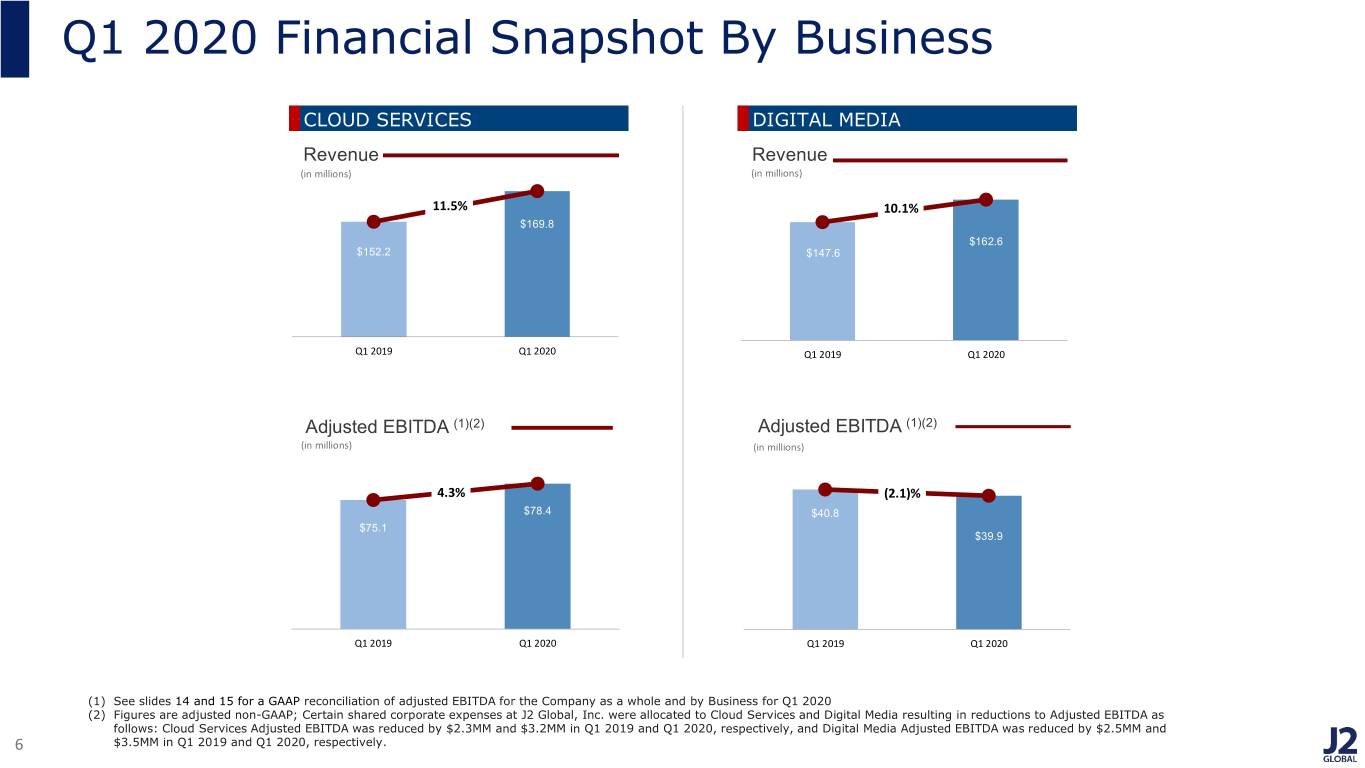
Q1 2020 quarterly revenues increased 10.8% to a first quarter record of $332.4 million compared to $299.9 million for Q1 2019.
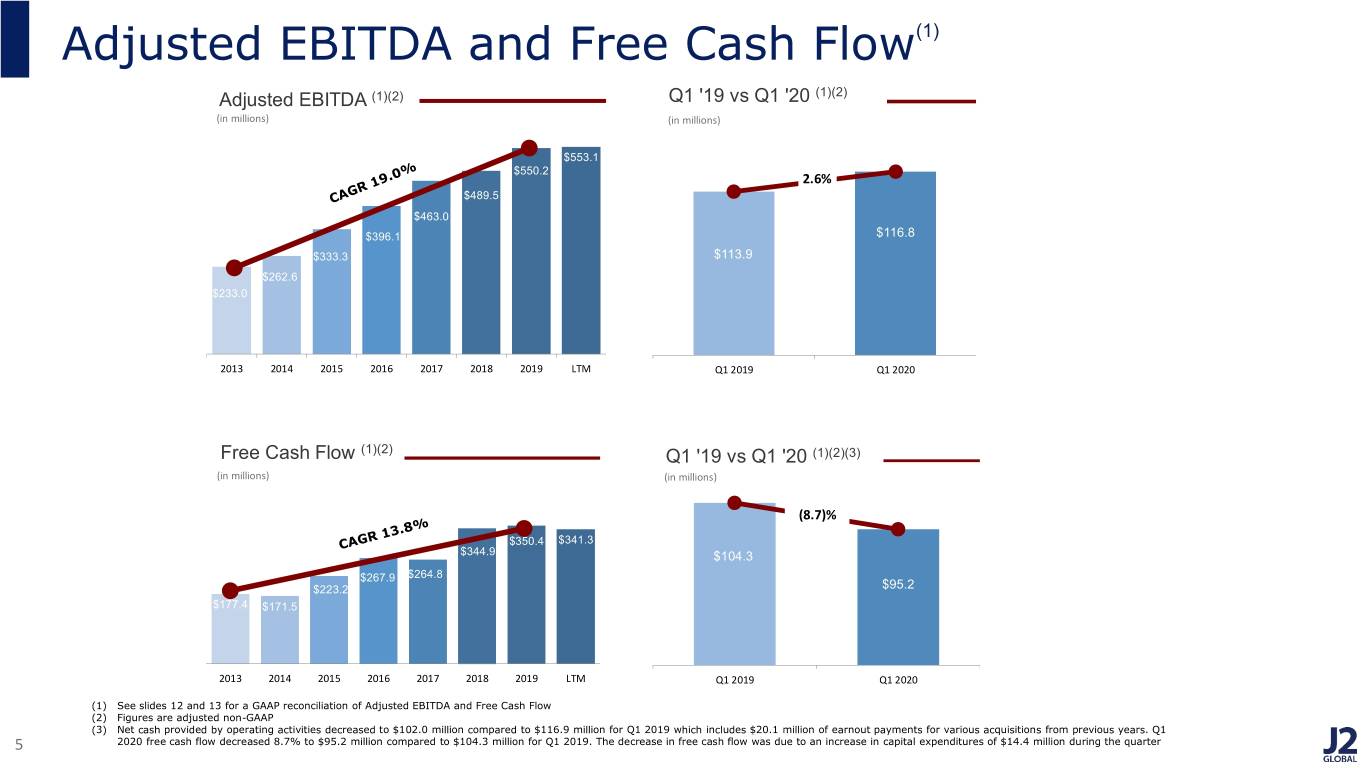
Net cash provided by operating activities decreased to $102.0 million (inclusive of $20.1 million of earn out payments for various acquisitions from previous years) compared to $116.9 million for Q1 2019. Q1 2020 free cash flow(2) decreased 8.7% to $95.2 million compared to $104.3 million for Q1 2019. The decrease in free cash flow(2) was due to an increase in capital expenditures of $14.4 million in comparison to Q1 2019.
GAAP net (loss) income decreased by 119.7% to $(6.4) million as compared to $32.4 million for Q1 2019. GAAP (loss) earnings per diluted share(3) decreased 119.7% to $(0.13) in Q1 2020 compared to $0.66 for Q1 2019. The Q1 2020 net loss and decrease in GAAP (loss) earnings per diluted share(3) is due to the write down of certain investments during the quarter, some of which were impacted in their operations by COVID-19.
Adjusted non-GAAP earnings per diluted share(3)(4) for the quarter remained at $1.40 as compared to Q1 2019.
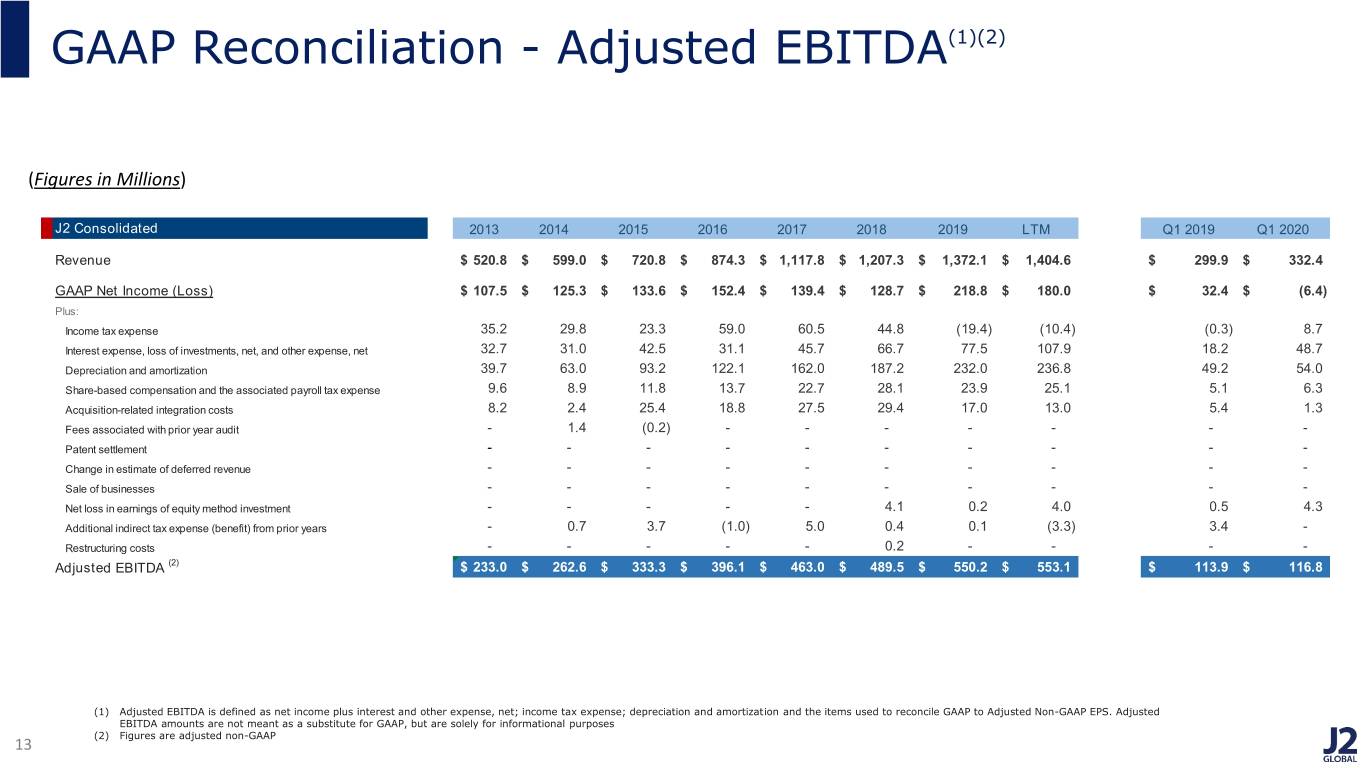
Quarterly Adjusted EBITDA(5) increased 2.6% to $116.8 million compared to $113.9 million for Q1 2019.
J2 ended the quarter with approximately $625 million in cash and investments after deploying approximately $19 million during the quarter for current period acquisitions and $36 million relating substantially to contingent consideration payments for acquisitions from previous years. In addition, J2 deployed approximately $56 million in respect of its share repurchase program.
Key financial results for Q1 2020 versus Q1 2019 are set forth in the following table (in millions, except per share amounts). Reconciliations of Adjusted non-GAAP earnings per diluted share, Adjusted EBITDA and free cash flow to their nearest comparable GAAP financial measures are attached to this Press Release.
| | | | | | | | | | | | |
| | Q1 2020 | Q1 2019 | | % Change |
| Revenues | | | | |
| Cloud Services | $169.8 million | $152.2 million | | 11.5% |
| Digital Media | $162.6 million | $147.6 million | | 10.1% |
Total Revenue: (1) | $332.4 million | $299.9 million | | 10.8% |
| Operating Income | $55.2 million | $50.9 million | | 8.6% |
| Net Cash Provided by Operating Activities | $102.0 million | $116.9 million | | (12.7)% |
Free Cash Flow (2) | $95.2 million | $104.3 million | | (8.7)% |
GAAP (Loss) Earnings per Diluted Share (3) | $(0.13) | $0.66 | | (119.7)% |
Adjusted Non-GAAP Earnings per Diluted Share (3) (4) | $1.40 | $1.40 | | —% |
| GAAP Net (Loss) Income | $(6.4) million | $32.4 million | | (119.7)% |
| Adjusted Non-GAAP Net Income | $67.5 million | $68.4 million | | (1.3)% |
Adjusted EBITDA (5) | $116.8 million | $113.9 million | | 2.6% |
Adjusted EBITDA Margin (5) | 35.1% | 38.0% | | (7.5)% |
BUSINESS OUTLOOK
Due to the global impact of COVID-19, the Company is withdrawing its previously issued financial guidance for fiscal 2020. Moreover, the Company believes that business projections should be evaluated on a near-term basis. Based on our current performance and expectations, we anticipate Q2 2020 revenues to be slightly down versus Q2 2019 and Adjusted EBITDA and Adjusted non-GAAP EPS to be down single digit percentages versus Q2 2019. At this time, we have limited visibility into the macroeconomic factors that would inform our financial projections for Q3 and Q4 2020.
The Company has not reconciled the Adjusted non-GAAP earnings per diluted share and any related tax rate information included in this release to the most directly comparable GAAP measure because this cannot be done without unreasonable effort due to the variability with respect to costs related to acquisitions and taxation, which are potential adjustments to future earnings. We expect the variability of these items to have a potentially unpredictable and significant impact on our future GAAP financial results.
Notes:
| | | | | | | | |
| (1) | | | The revenues associated with each of the businesses may not foot precisely since each is presented independently. |
| (2) | | | Free cash flow is defined as net cash provided by operating activities, less purchases of property, plant and equipment, plus contingent consideration. Free cash flow amounts are not meant as a substitute for GAAP, but are solely for informational purposes. |
| (3) | | | The estimated GAAP effective tax rates were approximately 132.5% for Q1 2020 and (0.9)% for Q1 2019. The estimated Adjusted non-GAAP effective tax rates were approximately 22.0% for Q1 2020 and 20.9% for Q1 2019. |
| (4) | | | Adjusted non-GAAP earnings per diluted share excludes certain non-GAAP items, as defined in the Reconciliation of GAAP to Adjusted non-GAAP Financial Measures, for the three months ended March 31, 2020 and 2019 totaled $1.53 and $0.74 per diluted share, respectively. |
| (5) | | | Adjusted EBITDA is defined as earnings before interest; loss on investments, net; other expense, net; income tax expense; net loss in earnings of equity method investments; depreciation and amortization; and the items used to reconcile EPS to Adjusted non-GAAP EPS, as defined in the Reconciliation of GAAP to Adjusted non-GAAP Financial Measures. Adjusted EBITDA amounts are not meant as a substitute for GAAP, but are solely for informational purposes. |
About J2 Global
J2 Global, Inc. (NASDAQ: JCOM) is a leading internet information and services company consisting of a portfolio of brands including IGN, Mashable, Humble Bundle, Speedtest, PCMag, Offers.com, Spiceworks, Everyday Health, BabyCenter and What To Expect in its Digital Media business and eFax, eVoice, iContact, Campaigner, Vipre, IPVanish and KeepItSafe in its Cloud Services business. J2 reaches in excess of 180 million people per month across its brands. As of December 31, 2019, J2 had achieved 24 consecutive fiscal years of revenue growth. For more information about J2, please visit www.J2global.com.
Contact:
Rebecca Wright
J2 Global, Inc.
800-577-1790
“Safe Harbor” Statement Under the Private Securities Litigation Reform Act of 1995: Certain statements in this Press Release are “forward-looking statements” within the meaning of The Private Securities Litigation Reform Act of 1995, including those contained in Vivek Shah’s quote and the “Business Outlook” portion regarding the Company’s expected fiscal 2020 financial performance. These forward-looking statements are based on management’s current expectations or beliefs and are subject to numerous assumptions, risks and uncertainties that could cause actual results to differ materially from those described in the forward-looking statements. These factors and uncertainties include, among other items: the Company’s ability to grow non-fax revenues, profitability and cash flows; the Company’s ability to identify, close and successfully transition acquisitions; subscriber growth and retention; variability of the Company’s revenue based on changing conditions in particular industries and the economy generally; protection of the Company’s proprietary technology or infringement by the Company of intellectual property of others; the risk of adverse changes in the U.S. or international regulatory environments, including but not limited to the imposition or increase of taxes or regulatory-related fees; and the numerous other factors set forth in J2 Global’s filings with the Securities and Exchange Commission (“SEC”). For a more detailed description of the risk factors and uncertainties affecting J2 Global, refer to the 2019 Annual Report on Form 10-K filed by J2 Global on March 2, 2020, and the other reports filed by J2 Global from time-to-time with the SEC, each of which is available at www.sec.gov. The forward-looking statements provided in this press release, including those contained in Vivek Shah’s quote and in the “Business Outlook” portion regarding the Company’s expected fiscal 2020 financial performance are based on limited information available to the Company at this time, which is subject to change. Although management’s expectations may change after the date of this press release, the Company undertakes no obligation to revise or update these statements.
About Non-GAAP Financial Measures
To supplement our consolidated financial statements, which are prepared and presented in accordance with GAAP, we use the following Adjusted non-GAAP financial measures: Adjusted non-GAAP net income, Adjusted non-GAAP earnings per diluted share, Adjusted EBITDA and free cash flow. The presentation of this financial information is not intended to be considered in isolation or as a substitute for, or superior to, the financial information prepared and presented in accordance with GAAP.
We use these Adjusted non-GAAP financial measures for financial and operational decision-making and as a means to evaluate period-to-period comparisons. Our management believes that these Adjusted non-GAAP financial measures provide meaningful supplemental information regarding our performance and liquidity by excluding certain expenses and expenditures that may not be indicative of our recurring core business operating results. We believe that both management and investors benefit from referring to these Adjusted non-GAAP financial measures in assessing our performance and when planning, forecasting, and analyzing future periods. These Adjusted non-GAAP financial measures also facilitate management’s internal comparisons to our historical performance and liquidity. We believe these Adjusted non-GAAP financial measures are useful to investors both because (1) they allow for greater transparency with respect to key metrics used by management in its financial and operational decision-making and (2) they are used by our institutional investors and the analyst community to help them analyze the health of our business.
For more information on these Adjusted non-GAAP financial measures, please see the appropriate GAAP to Adjusted non-GAAP reconciliation tables included within the attached Exhibit to this release.
J2 GLOBAL, INC. AND SUBSIDIARIES
CONDENSED CONSOLIDATED BALANCE SHEETS
(UNAUDITED, IN THOUSANDS)
| | | | | | | | | | | |
| March 31, 2020 | | December 31, 2019 |
| ASSETS | | | |
| Cash and cash equivalents | $ | 526,554 | | | $ | 575,615 | |
| | | |
| | | |
| Accounts receivable, net of allowances of $13,080 and $12,701, respectively | 204,783 | | | 261,928 | |
| Prepaid expenses and other current assets | 50,758 | | | 49,347 | |
| | | |
| Total current assets | 782,095 | | | 886,890 | |
| Long-term investments | 98,020 | | | | 100,079 | |
| Property and equipment, net | 136,439 | | | | 127,817 | |
| Operating lease right-of-use assets | 115,455 | | | | 125,822 | |
| Goodwill | 1,637,193 | | | 1,633,033 | |
| Other purchased intangibles, net | 526,656 | | | 556,553 | |
| Deferred income taxes, noncurrent | 58,573 | | | 59,976 | |
| Other assets | 14,462 | | | 15,676 | |
| | | |
| TOTAL ASSETS | $ | 3,368,893 | | | $ | 3,505,846 | |
| | | |
| LIABILITIES AND STOCKHOLDERS’ EQUITY | | | |
| Accounts payable and accrued expenses | $ | 162,656 | | | $ | 238,059 | |
| Income taxes payable, current | 16,732 | | | 17,758 | |
| Deferred revenue, current | 160,924 | | | 162,855 | |
| | | |
| | | |
| Operating lease liabilities, current | 26,715 | | | 26,927 | |
| | | |
| | | |
| Current portion of long-term debt | — | | | | 385,532 | |
| Other current liabilities | 1,654 | | | | 1,973 | |
| | | |
| Total current liabilities | 368,681 | | | 833,104 | |
| Long-term debt | 1,455,446 | | | | 1,062,929 | |
| Deferred revenue, noncurrent | 12,225 | | | | 12,744 | |
| | | |
| Operating lease liabilities, noncurrent | 93,687 | | | | 104,070 | |
| Income taxes payable, noncurrent | 11,675 | | | | 11,675 | |
| Liability for uncertain tax positions | 54,105 | | | | 52,451 | |
| Deferred income taxes, noncurrent | 105,257 | | | | 107,453 | |
| Other long-term liabilities | 26,736 | | | | 10,228 | |
| | | |
| TOTAL LIABILITIES | 2,127,812 | | | 2,194,654 | |
| Commitments and contingencies | — | | | | — | |
| Preferred stock | — | | | | — | |
| Common stock | 471 | | | | 476 | |
| Additional paid-in capital | 462,430 | | | | 465,652 | |
| | | |
| Retained earnings | 832,648 | | | | 891,526 | |
| Accumulated other comprehensive loss | (54,468) | | | | (46,462) | |
| TOTAL STOCKHOLDERS’ EQUITY | 1,241,081 | | | 1,311,192 | |
| TOTAL LIABILITIES AND STOCKHOLDERS’ EQUITY | $ | 3,368,893 | | | $ | 3,505,846 | |
J2 GLOBAL, INC. AND SUBSIDIARIES
CONDENSED CONSOLIDATED STATEMENTS OF OPERATIONS
(UNAUDITED, IN THOUSANDS EXCEPT SHARE AND PER SHARE DATA)
| | | | | | | | | | | | | | | |
| Three Months Ended
March 31, | | | | | | |
| 2020 | | 2019 | | | | |
| Total revenues | $ | 332,393 | | | $ | 299,893 | | | | | |
| | | | | | | |
Cost of revenues (1) | 59,131 | | | 51,013 | | | | | |
| Gross profit | 273,262 | | | 248,880 | | | | | |
| | | | | | | |
| Operating expenses: | | | | | | | |
Sales and marketing (1) | 99,438 | | | 86,880 | | | | | |
Research, development and engineering (1) | 15,406 | | | 12,984 | | | | | |
General and administrative (1) | 103,171 | | | 98,154 | | | | | |
| Total operating expenses | 218,015 | | | 198,018 | | | | | |
| Income from operations | 55,247 | | | 50,862 | | | | | |
| Interest expense, net | 20,971 | | | 16,019 | | | | | |
| Loss on investments, net | 20,832 | | | 13 | | | | | |
| Other expense, net | 6,876 | | | 2,202 | | | | | |
| Income before income taxes and net loss in earnings of equity method investment | 6,568 | | | 32,628 | | | | | |
| Income tax expense (benefit) | 8,703 | | | (295) | | | | | |
| Net loss in earnings of equity method investment | 4,269 | | | 474 | | | | | |
| Net (loss) income | $ | (6,404) | | | $ | 32,449 | | | | | |
| | | | | | | |
| Basic net (loss) income per common share: | | | | | | | |
| Net (loss) income attributable to J2 Global, Inc. common shareholders | $ | (0.13) | | | $ | 0.67 | | | | | |
| | | | | | | |
| Diluted net (loss) income per common share: | | | | | | | |
| Net (loss) income attributable to J2 Global, Inc. common shareholders | $ | (0.13) | | | $ | 0.66 | | | | | |
| | | | | | | |
| Basic weighted average shares outstanding | 47,620,774 | | | 47,560,749 | | | | | |
| Diluted weighted average shares outstanding | 47,620,774 | | | 48,509,181 | | | | | |
| | | | | | | |
(1) Includes share-based compensation expense as follows: | | | | | | | |
| Cost of revenues | $ | 134 | | | $ | 132 | | | | | |
| Sales and marketing | 398 | | | 404 | | | | | |
| Research, development and engineering | 431 | | | 358 | | | | | |
| General and administrative | 5,350 | | | 4,192 | | | | | |
| Total | $ | 6,313 | | | $ | 5,086 | | | | | |
J2 GLOBAL, INC. AND SUBSIDIARIES
CONDENSED CONSOLIDATED STATEMENTS OF CASH FLOWS
(UNAUDITED, IN THOUSANDS)
| | | | | | | | | | | |
| | Three Months Ended
March 31, | | |
| Cash flows from operating activities: | 2020 | | 2019 |
| Net (loss) income | $ | (6,404) | | | $ | 32,449 | |
| Adjustments to reconcile net (loss) income to net cash provided by operating activities: | | | |
| Depreciation and amortization | 53,980 | | | 49,209 | |
| | | |
| Amortization of financing costs and discounts | 6,997 | | | 2,965 | |
| Amortization of operating lease assets | 4,834 | | | 4,796 | |
| Share-based compensation | 6,313 | | | 5,086 | |
| Provision for doubtful accounts | 2,826 | | | 2,888 | |
| Deferred income taxes, net | (1,106) | | | 548 | |
| | | |
| | | |
| | | |
| | | |
| Changes in fair value of contingent consideration | (240) | | | 5,003 | |
| Foreign currency remeasurement loss | 7,801 | | | — | |
| Loss on equity method investments | 4,269 | | | 628 | |
| Loss on equity and debt investments | 20,826 | | | — | |
| Decrease (increase) in: | | | |
| Accounts receivable | 52,949 | | | 41,926 | |
| Prepaid expenses and other current assets | (8,169) | | | (2,143) | |
| Other assets | 2,612 | | | (144) | |
| Increase (decrease) in: | | | |
| Accounts payable and accrued expenses | (43,374) | | | (10,422) | |
| Income taxes payable | 1,616 | | | (2,333) | |
| Deferred revenue | (686) | | | (2,352) | |
| Operating lease liabilities | (5,062) | | | (4,526) | |
| Liability for uncertain tax positions | 1,654 | | | (5,464) | |
| Other long-term liabilities | 400 | | | (1,260) | |
| Net cash provided by operating activities | 102,036 | | | 116,854 | |
| Cash flows from investing activities: | | | |
| | | |
| | | |
| Purchases of equity method investment | (22,840) | | | (9,794) | |
| Purchases of equity investments | (843) | | | — | |
| | | |
| | | |
| Purchases of property and equipment | (26,885) | | | (12,531) | |
| Acquisition of businesses, net of cash received | (18,701) | | | (59,339) | |
| Proceeds from sale of assets | 226 | | | — | |
| Purchases of intangible assets | (19) | | | — | |
| Net cash used in investing activities | (69,062) | | | (81,664) | |
| Cash flows from financing activities: | | | |
| | | |
| | | |
| | | |
| | | |
| | | |
| | | |
| Repurchase of common stock | (62,966) | | | (1,177) | |
| | | |
| Exercise of stock options | 952 | | | 5,259 | |
| Dividends paid | — | | | (21,758) | |
| Deferred payments for acquisitions | (15,503) | | | (1,395) | |
| Other | (839) | | | (205) | |
| Net cash used in financing activities | (78,356) | | | (19,276) | |
| Effect of exchange rate changes on cash and cash equivalents | (3,679) | | | 1,224 | |
| Net change in cash and cash equivalents | (49,061) | | | 17,138 | |
| Cash and cash equivalents at beginning of period | 575,615 | | | 209,474 | |
| Cash and cash equivalents at end of period | $ | 526,554 | | | $ | 226,612 | |
J2 GLOBAL, INC. AND SUBSIDIARIES
RECONCILIATION OF GAAP TO ADJUSTED NON-GAAP FINANCIAL MEASURES
THREE MONTHS ENDED MARCH 31, 2020 AND 2019
(UNAUDITED, IN THOUSANDS, EXCEPT PER SHARE AMOUNTS)
Non-GAAP net income is GAAP net (loss) income with the following modifications: (1) elimination of share-based compensation and the associated payroll tax expense; (2) elimination of certain acquisition related integration costs; (3) elimination of interest costs in excess of the coupon rate associated with the convertible notes; (4) elimination of amortization of patents and intangible assets that we acquired; (5) elimination of change in value on investment; (6) elimination of additional tax expense/benefit from prior years; (7) elimination of gain on sale of assets; (8) elimination of intra-entity transfers; and (9) elimination of dilutive effect of the convertible debt.
| | | | | | | | | | | | | | | | | |
| Three Months Ended March 31, | | | | |
| 2020 | Per Diluted Share * | | 2019 | Per Diluted Share * |
| Net (loss) income | $ | (6,404) | | $ | (0.13) | | | $ | 32,449 | | $ | 0.66 | |
| Plus: | | | | | |
Share based compensation (1) | 4,808 | | 0.10 | | | 3,287 | | 0.07 | |
Acquisition related integration costs (2) | 1,095 | | 0.02 | | | 4,377 | | 0.09 | |
Interest costs (3) | 4,315 | | 0.09 | | | 1,296 | | 0.03 | |
Amortization (4) | 31,858 | | 0.67 | | | 25,504 | | 0.54 | |
Investments (5) | 25,094 | | 0.53 | | | 474 | | — | |
Tax expense from prior years (6) | 388 | | 0.01 | | | 1,009 | | 0.02 | |
Sale of assets (7) | (197) | | — | | | — | | — | |
Intra-entity transfers (8) | 6,563 | | 0.14 | | | — | | — | |
Convertible debt dilution (9) | — | | — | | | — | | 0.01 | |
| Adjusted non-GAAP net income | $ | 67,520 | | $ | 1.40 | | | $ | 68,396 | | $ | 1.40 | |
* The reconciliation of net (loss) income per share from GAAP to Adjusted non-GAAP may not foot since each is calculated independently.
J2 GLOBAL, INC. AND SUBSIDIARIES
RECONCILIATION OF GAAP TO ADJUSTED NON-GAAP FINANCIAL MEASURES
THREE MONTHS ENDED MARCH 31, 2020 AND 2019
(UNAUDITED, IN THOUSANDS, EXCEPT PER SHARE AMOUNTS)
Non-GAAP net income is GAAP net (loss) income with the following modifications: (1) elimination of share-based compensation and the associated payroll tax expense; (2) elimination of certain acquisition related integration costs; (3) elimination of interest costs in excess of the coupon rate associated with the convertible notes; (4) elimination of amortization of patents and intangible assets that we acquired; (5) elimination of change in value on investment; (6) elimination of additional tax expense/benefit from prior years; (7) elimination of gain on sale of assets; (8) elimination of intra-entity transfers; and (9) elimination of dilutive effect of the convertible debt.
| | | | | | | | | | | |
| Three Months Ended March 31, | | |
| 2020 | | 2019 |
| Cost of revenues | $ | 59,131 | | | $ | 51,013 | |
| Plus: | | | |
Share based compensation (1) | (134) | | | (132) | |
Acquisition related integration costs (2) | (55) | | | — | |
Amortization (4) | (450) | | | (523) | |
| Adjusted non-GAAP cost of revenues | $ | 58,492 | | | $ | 50,358 | |
| | | |
| Sales and marketing | $ | 99,438 | | | $ | 86,880 | |
| Plus: | | | |
Share based compensation (1) | (398) | | | (404) | |
Acquisition related integration costs (2) | (514) | | | 122 | |
| Adjusted non-GAAP sales and marketing | $ | 98,526 | | | $ | 86,598 | |
| | | |
| Research, development and engineering | $ | 15,406 | | | $ | 12,984 | |
| Plus: | | | |
Share based compensation (1) | (431) | | | (358) | |
| | | |
| Adjusted non-GAAP research, development and engineering | $ | 14,975 | | | $ | 12,626 | |
| | | |
| General and administrative | $ | 103,171 | | | $ | 98,154 | |
| Plus: | | | |
Share based compensation (1) | (5,350) | | | (4,192) | |
Acquisition related integration costs (2) | (729) | | | (5,487) | |
Amortization (4) | (38,713) | | | (37,320) | |
Tax expense from prior years (6) | — | | | (3,373) | |
| Adjusted non-GAAP general and administrative | $ | 58,379 | | | $ | 47,782 | |
| | | |
| Interest expense, net | $ | 20,971 | | | $ | 16,019 | |
| Plus: | | | |
Acquisition related integration costs (2) | — | | | 27 | |
Interest costs (3) | (5,934) | | | (2,242) | |
| | | |
| Adjusted non-GAAP interest expense, net | $ | 15,037 | | | $ | 13,804 | |
| | | |
| Loss on investments, net | $ | 20,832 | | | $ | 13 | |
| Plus: | | | |
Investments (5) | (20,825) | | | — | |
| Adjusted non-GAAP loss on investments, net | $ | 7 | | | $ | 13 | |
| | | |
| | | |
| | | |
| | | |
| | | |
| | | | | | | | | | | |
| Continued from previous page | | | |
| | | |
| | | |
| Other expense, net | $ | 6,876 | | | $ | 2,202 | |
| Plus: | | | |
Sale of assets (7) | 257 | | | — | |
Intra-entity transfers (8) | (6,702) | | | — | |
| Adjusted non-GAAP other expense, net | $ | 431 | | | $ | 2,202 | |
| | | |
| Income tax provision | $ | 8,703 | | | $ | (295) | |
| Plus: | | | |
Share based compensation (1) | 1,505 | | | 1,799 | |
Acquisition related integration costs (2) | 203 | | | 961 | |
Interest costs (3) | 1,619 | | | 946 | |
Amortization (4) | 7,305 | | | 12,339 | |
| | | |
Tax (benefit) expense from prior years (6) | (388) | | | 2,364 | |
| | | |
Sale of assets (7) | (60) | | | — | |
Intra-entity transfers (8) | 139 | | | — | |
| Adjusted non-GAAP income tax provision | $ | 19,026 | | | $ | 18,114 | |
| | | |
| Net loss in earnings of equity method investment | $ | 4,269 | | | $ | 474 | |
| Plus: | | | |
Investments (5) | (4,269) | | | (474) | |
| Adjusted non-GAAP net loss in earnings of equity method investment | $ | — | | | $ | — | |
| | | |
| Total adjustments | $ | (73,924) | | | $ | (35,947) | |
| | | |
| GAAP earnings per diluted share | $ | (0.13) | | | $ | 0.66 | |
| Adjustments * | $ | 1.53 | | | $ | 0.74 | |
| Adjusted non-GAAP earnings per diluted share | $ | 1.40 | | | $ | 1.40 | |
| | | |
| | | |
| | | |
| | | |
| | | |
| | | |
| | | |
| | | |
| | | |
| | | |
* The reconciliation of net (loss) income per share from GAAP to Adjusted non-GAAP may not foot since each is calculated independently.
The Company discloses Adjusted non-GAAP Earnings Per Share (“EPS”) as a supplemental Non-GAAP financial performance measure, as it believes it is a useful metric by which to compare the performance of its business from period to period. The Company also understands that this Adjusted non-GAAP measure is broadly used by analysts, rating agencies and investors in assessing the Company’s performance. Accordingly, the Company believes that the presentation of this Adjusted non-GAAP financial measure provides useful information to investors.
Adjusted non-GAAP EPS is not in accordance with, or an alternative to, net (loss) income per share and may be different from Non-GAAP measures with similar or even identical names used by other companies. In addition, this Adjusted non-GAAP measure is not based on any comprehensive set of accounting rules or principles. This Adjusted non-GAAP measure has limitations in that it does not reflect all of the amounts associated with the Company’s results of operations determined in accordance with GAAP.
Non-GAAP Financial Measures
To supplement its condensed consolidated financial statements, which are prepared and presented in accordance with US GAAP, the Company uses the following Non-GAAP financial measures: Adjusted EBITDA, Adjusted non-GAAP Net Income, and Adjusted non-GAAP Diluted EPS (collectively the “Non-GAAP financial measures”). The presentation of this financial information is not intended to be considered in isolation or as a substitute for, or superior to, the financial information prepared and presented in accordance with U.S. GAAP. The Company uses these Non-GAAP financial measures for financial and operational decision making and as a means to evaluate period-to-period comparisons. The Company believes that they provide useful information about core operating results, enhance the overall understanding of past financial performance and future prospects, and allow for greater transparency with respect to key metrics used by management in its financial and operational decision making.
(1) Share Based Compensation. The Company excludes stock-based compensation because it is non-cash in nature and because the Company believes that the Non-GAAP financial measures excluding this item provide meaningful supplemental information regarding operational performance. The Company further believes this measure is useful to investors in that it allows for greater transparency to certain line items in its financial statements. In addition, excluding this item from the Non-GAAP measures facilitates comparisons to historical operating results and comparisons to peers, many of which similarly exclude this item.
(2) Acquisition Related Integration Costs. The Company excludes certain acquisition and related integration costs such as adjustments to contingent consideration, severance, lease terminations, retention bonuses and other acquisition-specific items. The Company believes that the Non-GAAP financial measures excluding this item provide meaningful supplemental information regarding operational performance. In addition, excluding this item from the Non-GAAP measures facilitates comparisons to historical operating results and comparisons to peers, many of which similarly exclude this item.
(3) Interest Costs. In June 2014, the Company issued $402.5 million aggregate principal amount of 3.25% convertible senior notes and in November 2019, the Company issued $550.0 million aggregate principal amount of 1.75% convertible senior notes. In accordance with GAAP, the Company separately accounts for the value of the liability and equity features of its outstanding convertible senior notes in a manner that reflects the Company’s non-convertible debt borrowing rate. The value of the conversion feature, reflected as a debt discount, is amortized to interest expense over time. Accordingly, the Company recognizes imputed interest expense on its 3.25% and 1.75% convertible senior notes of approximately 5.8% and 5.5%, respectively, in its statement of operations. The Company excludes the difference between the imputed interest expense and the coupon interest expense of 3.25% and 1.75%, respectively, because it is non-cash in nature and because the Company believes that the Non-GAAP financial measures excluding this item provide meaningful supplemental information regarding core operational performance. The Company has determined excluding these items from the Non-GAAP measures facilitates comparisons to historical operating results and comparisons to peers, many of which similarly exclude this item.
(4) Amortization. The Company excludes amortization of patents and acquired intangible assets because it is non-cash in nature and because the Company believes that the Non-GAAP financial measures excluding this item provide meaningful supplemental information regarding operational performance. In addition, excluding this item from the Non-GAAP measures facilitates comparisons to historical operating results and comparisons to peers, many of which similarly exclude this item.
(5) Change in Value on Investments. The Company excludes the change in value on its investments. The Company believes that the Non-GAAP financial measures excluding this item provide meaningful supplemental information regarding operational performance. In addition, excluding this item from the Non-GAAP measures facilitates comparisons to historical operating results.
(6) Tax Expense/Benefit from Prior Years. The Company excludes certain income tax-related items in respect of income tax audit settlements and their related FIN48 accrual reversals. The Company believes that the Non-GAAP financial measures excluding these items provide meaningful supplemental information regarding operational performance. In addition, excluding these items from the Non-GAAP measures facilitates comparisons to historical operating results.
(7) Gain on Sale of Assets. The Company excludes the gain on sale of certain of its assets. The Company believes that the Non-GAAP financial measures excluding this item provide meaningful supplemental information regarding operational performance. In addition, excluding this item from the Non-GAAP measures facilitates comparisons to historical operating results.
(8) Intra-Entity Transfers. The Company excludes certain effects of intra-entity transfers to the extent the related tax asset or liability in the financial statement is not recovered or settled, respectively during the year. During December 2019, the
Company entered into an intra-entity asset transfer that resulted in the recording of a tax benefit and related tax asset representing tax deductible amounts to be realized in future years which is expected to be recovered over a period of up to 20 years. The Company believes that the Non-GAAP financial measures excluding the cumulative future unrealized benefit of the assets transferred and including the tax benefit in the year of realization provides meaningful supplemental information regarding operational performance. In addition, excluding this item from the Non-GAAP measures facilitates comparisons to historical operating results.
(9) Convertible Debt Dilution. The Company excludes convertible debt dilution from diluted EPS. The Company believes that the Non-GAAP financial measures excluding this item provide meaningful supplemental information regarding operational performance. In addition, excluding this item from the Non-GAAP measures facilitates comparisons to historical operating results.
The Company presents Adjusted non-GAAP Cost of Revenues, Adjusted non-GAAP Research, Development and Engineering, Adjusted non-GAAP Sales and Marketing, Adjusted non-GAAP General and Administrative, Adjusted non-GAAP Interest Expense, Adjusted non-GAAP Loss on Investments, Adjusted non-GAAP Other Expense, Adjusted non-GAAP Income Tax Provision, Adjusted non-GAAP Net Loss in Earnings of Equity Method Investment and Adjusted non-GAAP Net Income because the Company believes that these provide useful information about our operating results and enhance the overall understanding of past financial performance and future prospects.
J2 GLOBAL, INC. AND SUBSIDIARIES
NET INCOME TO ADJUSTED EBITDA RECONCILIATION
THREE MONTHS ENDED MARCH 31, 2020 AND 2019
(UNAUDITED, IN THOUSANDS)
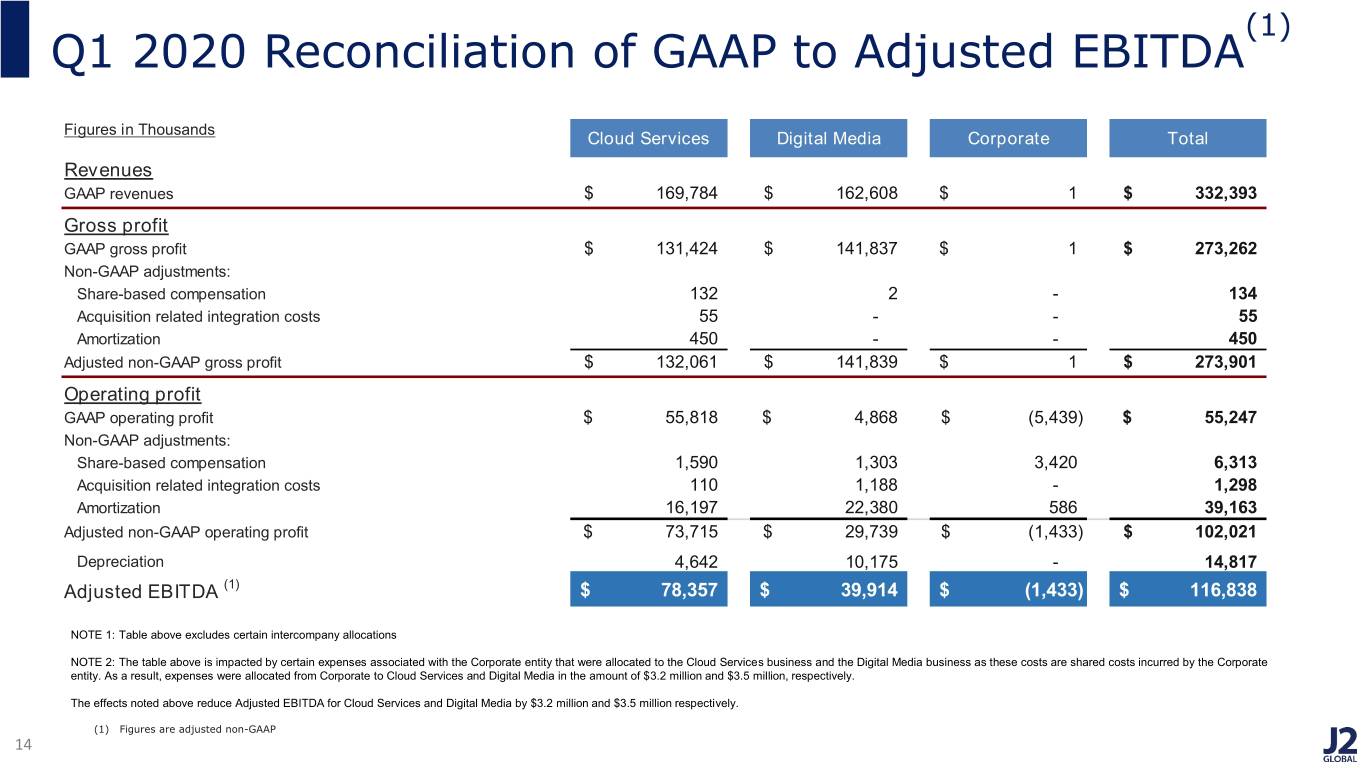
The following table sets forth a reconciliation of Adjusted EBITDA to net (loss) income, the most directly comparable GAAP financial measure.
| | | | | | | | | | | | | | | |
| Three Months Ended March 31, | | | | | | |
| 2020 | | 2019 | | | | |
| Net (loss) income | $ | (6,404) | | | $ | 32,449 | | | | | |
| Plus: | | | | | | | |
| Interest expense, net | 20,971 | | | 16,019 | | | | | |
| Loss on investments, net | 20,832 | | | 13 | | | | | |
| Other expense, net | 6,876 | | | 2,202 | | | | | |
| Income tax expense | 8,703 | | | (295) | | | | | |
| Net loss in earnings of equity method investment | 4,269 | | | 474 | | | | | |
| Depreciation and amortization | 53,980 | | | 49,209 | | | | | |
| Reconciliation of GAAP to Adjusted non-GAAP financial measures: | | | | | | | |
| Share-based compensation and the associated payroll tax expense | 6,313 | | | 5,086 | | | | | |
| Acquisition-related integration costs | 1,298 | | | 5,365 | | | | | |
| Additional indirect tax expense from prior years | — | | | 3,373 | | | | | |
| | | | | | | |
| Adjusted EBITDA | $ | 116,838 | | | $ | 113,895 | | | | | |
Adjusted EBITDA as calculated above represents earnings before interest, loss on investments, net, other expense, net, income tax expense, net loss in earnings of equity method investments, depreciation and amortization and the items used to reconcile GAAP to Adjusted non-GAAP financial measures, including (1) share-based compensation, (2) certain acquisition-related integration costs, (3) change in value on investments and (4) additional indirect tax expense from prior years. We disclose Adjusted EBITDA as a supplemental Non-GAAP financial performance measure as we believe it is a useful metric by which to compare the performance of our business from period to period. We understand that measures similar to Adjusted EBITDA are broadly used by analysts, rating agencies and investors in assessing our performance. Accordingly, we believe that the presentation of Adjusted EBITDA provides useful information to investors.
Adjusted EBITDA is not in accordance with, or an alternative to, net income, and may be different from Non-GAAP measures used by other companies. In addition, Adjusted EBITDA is not based on any comprehensive set of accounting rules or principles. This Adjusted non-GAAP measure has limitations in that it does not reflect all of the amounts associated with the Company’s results of operations determined in accordance with GAAP.
J2 GLOBAL, INC. AND SUBSIDIARIES
NON-GAAP FINANCIAL MEASURES
(UNAUDITED, IN THOUSANDS)
| | | | | | | | | | | | | | | | | | | | | | | | | | | | | |
| Q1 | | Q2 | | Q3 | | Q4 | | YTD |
| 2020 | | | | | | | | | |
| Net cash provided by operating activities | $ | 102,036 | | | $ | — | | | $ | — | | | $ | — | | | $ | 102,036 | |
| Less: Purchases of property and equipment | (26,885) | | | — | | | — | | | — | | | (26,885) | |
| Add: Contingent consideration* | 20,054 | | | — | | | — | | | — | | | 20,054 | |
| Free cash flows | $ | 95,205 | | | $ | — | | | $ | — | | | $ | — | | | $ | 95,205 | |
| | | | | | | | | |
| * Free Cash Flows of $95.2 million for Q1 2020 is before the effect of payments associated with certain contingent consideration associated with recent acquisitions. | | | | | | | | | |
| | | | | | | | | |
| | | | | | | | | |
| Q1 | | Q2 | | Q3 | | Q4 | | YTD |
| 2019 | | | | | | | | | |
| Net cash provided by operating activities | $ | 116,854 | | | $ | 95,357 | | | $ | 97,096 | | | $ | 103,232 | | | $ | 412,539 | |
| Less: Purchases of property and equipment | (12,531) | | | (18,260) | | | (18,692) | | | (21,105) | | | (70,588) | |
| Add: Contingent consideration* | — | | | 8,698 | | | (240) | | | — | | | 8,458 | |
| Free cash flows | $ | 104,323 | | | $ | 85,795 | | | $ | 78,164 | | | $ | 82,127 | | | $ | 350,409 | |
| | | | | | | | | |
| * Free Cash Flows of $85.8 million for Q2 2019 and $78.2 million for Q3 2019 is before the effect of payments associated with certain contingent consideration associated with recent acquisitions. | | | | | | | | | |
The Company discloses free cash flows as supplemental Non-GAAP financial performance measure, as it believes it is a useful metric by which to compare the performance of its business from period to period. The Company also understands that this Non-GAAP measure is broadly used by analysts, rating agencies and investors in assessing the Company’s performance. Accordingly, the Company believes that the presentation of this Non-GAAP financial measure provides useful information to investors.
Free cash flows is not in accordance with, or an alternative to, Cash Flows from Operating Activities, and may be different from Non-GAAP measures with similar or even identical names used by other companies. In addition, the Non-GAAP measure is not based on any comprehensive set of accounting rules or principles. This Non-GAAP measure has limitations in that it does not reflect all of the amounts associated with the Company’s results of operations determined in accordance with GAAP.
J2 GLOBAL, INC. AND SUBSIDIARIES
RECONCILIATION OF GAAP TO ADJUSTED NON-GAAP FINANCIAL MEASURES
THREE MONTHS ENDED MARCH 31, 2020
(UNAUDITED, IN THOUSANDS)
| | | | | | | | | | | | | | | | | | | | | | | |
| Cloud | | Digital | | | | |
| Services | | Media | | Corporate | | Total |
| Revenues | | | | | | | |
| GAAP revenues | $ | 169,784 | | | $ | 162,608 | | | $ | 1 | | | $ | 332,393 | |
| | | | | | | |
| Gross profit | | | | | | | |
| GAAP gross profit | $ | 131,424 | | | $ | 141,837 | | | $ | 1 | | | $ | 273,262 | |
| Non-GAAP adjustments: | | | | | | | |
| Share-based compensation | 132 | | | 2 | | | — | | | 134 | |
| Acquisition related integration costs | 55 | | | — | | | — | | | 55 | |
| Amortization | 450 | | | — | | | — | | | 450 | |
| Adjusted non-GAAP gross profit | $ | 132,061 | | | $ | 141,839 | | | $ | 1 | | | $ | 273,901 | |
| | | | | | | |
| Operating profit | | | | | | | |
| GAAP operating profit | $ | 55,818 | | | $ | 4,868 | | | $ | (5,439) | | | $ | 55,247 | |
| Non-GAAP adjustments: | | | | | | | |
| Share-based compensation | 1,590 | | | 1,303 | | | 3,420 | | | 6,313 | |
| Acquisition related integration costs | 110 | | | 1,188 | | | — | | | 1,298 | |
| Amortization | 16,197 | | | 22,380 | | | 586 | | | 39,163 | |
| | | | | | | |
| | | | | | | |
| Adjusted non-GAAP operating profit | $ | 73,715 | | | $ | 29,739 | | | $ | (1,433) | | | $ | 102,021 | |
| | | | | | | |
| Depreciation | 4,642 | | | 10,175 | | | — | | | 14,817 | |
| Adjusted EBITDA | $ | 78,357 | | | $ | 39,914 | | | $ | (1,433) | | | $ | 116,838 | |
| | | | | | | |
NOTE 1: Table above excludes certain intercompany allocations | | | | | | | |
NOTE 2: The table above is impacted by certain expenses associated with the Corporate entity that were allocated to the Cloud Services business and the Digital Media business as these costs are shared costs incurred by the Corporate entity. As a result, expenses were allocated from Corporate to Cloud Services and Digital Media in the amount of $3.2 million and $3.5 million, respectively.
The effects noted above reduce Adjusted EBITDA for Cloud Services and Digital Media by $3.2 million and $3.5 million, respectively. | | | | | | | |
J2 GLOBAL, INC. AND SUBSIDIARIES
RECONCILIATION OF GAAP TO ADJUSTED NON-GAAP FINANCIAL MEASURES
THREE MONTHS ENDED MARCH 31, 2019
(UNAUDITED, IN THOUSANDS)
| | | | | | | | | | | | | | | | | | | | | | | |
| Cloud | | Digital | | | | |
| Services | | Media | | Corporate | | Total |
| Revenues | | | | | | | |
| GAAP revenues | $ | 152,245 | | | $ | 147,647 | | | $ | 1 | | | $ | 299,893 | |
| | | | | | | |
| Gross profit | | | | | | | |
| GAAP gross profit | $ | 119,762 | | | | $ | 129,117 | | | | $ | 1 | | | $ | 248,880 | |
| Non-GAAP adjustments: | | | | | | | |
| Share-based compensation | 130 | | | | 2 | | | | — | | | 132 | |
| | | | | | | |
| Amortization | 523 | | | — | | | — | | | 523 | |
| Adjusted non-GAAP gross profit | $ | 120,415 | | | $ | 129,119 | | | $ | 1 | | | $ | 249,535 | |
| | | | | | | |
| Operating profit | | | | | | | |
| GAAP operating profit | $ | 58,569 | | | $ | (1,050) | | | $ | (6,657) | | | $ | 50,862 | |
| Non-GAAP adjustments: | | | | | | | |
| Share-based compensation | (143) | | | 1,271 | | | 3,958 | | | 5,086 | |
| Acquisition related integration costs | — | | | 5,365 | | | — | | | 5,365 | |
| Amortization | 10,581 | | | 26,581 | | | 681 | | | 37,843 | |
| Additional indirect tax expense from prior years | 3,373 | | | — | | | — | | | 3,373 | |
| Adjusted non-GAAP operating profit | $ | 72,380 | | | $ | 32,167 | | | $ | (2,018) | | | $ | 102,529 | |
| | | | | | | |
| Depreciation | 2,768 | | | 8,598 | | | — | | | 11,366 | |
| Adjusted EBITDA | $ | 75,148 | | | $ | 40,765 | | | $ | (2,018) | | | $ | 113,895 | |
| | | | | | | |
NOTE 1: Table above excludes certain intercompany allocations | | | | | | | |
NOTE 2: The table above is impacted by certain expenses associated with the Corporate entity that were allocated to the Cloud Services business and Digital Media business as these costs are shared costs incurred by the Corporate entity. As a result, expenses were allocated from Corporate to Cloud Services and Digital Media in the amount of $2.3 million and $2.5 million, respectively.
The effects noted above reduce Adjusted EBITDA for Cloud Services and Digital Media by $2.3 million and $2.5 million, respectively. | | | | | | | |