
AEBI 10-K
Aebi Schmidt Holding AG (AEBI)
10-K
2026-03-19
For: 2025-12-31
View Original
Added on
April 06, 2026
UNITED STATES
SECURITIES AND EXCHANGE COMMISSION
Washington, D.C. 20549
____________________________________
FORM 10-K
_____________________________________
(Mark One)
ANNUAL REPORT PURSUANT TO SECTION 13 OR 15(d) OF THE SECURITIES EXCHANGE ACT OF 1934 | |||||
For the fiscal year ended December 31 , 2025
OR
TRANSITION REPORT PURSUANT TO SECTION 13 OR 15(d) OF THE SECURITIES EXCHANGE ACT OF 1934 | |||||
For the transition period from ________ to ________
Commission file number 001-42663
____________________________________
(Exact name of registrant as specified in its charter)
_____________________________________
(State or other jurisdiction of incorporation or organization) | (I.R.S. Employer Identification No.) | ||||
(Address of Principal Executive Offices) | (Zip Code) | ||||
+41 44 -308-5800
Registrant’s telephone number, including area code
Securities registered pursuant to Section 12(b) of the Act:
Title of each class | Trading Symbol(s) | Name of each exchange on which registered | ||||||
Securities registered pursuant to section 12(g) of the Act: None
Indicate by check mark if the registrant is a well-known seasoned issuer, as defined in Rule 405 of the Securities Act.
Yes o No x
Indicate by check mark if the registrant is not required to file reports pursuant to Section 13 or Section 15(d) of the Act.
Yes o No x
Indicate by check mark whether the registrant (1) has filed all reports required to be filed by Section 13 or 15(d) of the Securities Exchange Act of 1934 during the preceding 12 months (or for such shorter period that the registrant was required to file such reports), and (2) has been subject to such filing requirements for the past 90 days.
Indicate by check mark whether the registrant has submitted electronically every Interactive Data File required to be submitted pursuant to Rule 405 of Regulation S-T (§ 232.405 of this chapter) during the preceding 12 months (or for such shorter period that the registrant was required to submit such files).
Indicate by check mark whether the registrant is a large accelerated filer, an accelerated filer, a non-accelerated filer, a smaller reporting company, or an emerging growth company. See the definitions of “large accelerated filer,” “accelerated filer,” “smaller reporting company,”and "emerging growth company" in Rule 12b-2 of the Exchange Act.
Large accelerated filer | o | Accelerated filer | o | |||||||||||
x | Smaller reporting company | |||||||||||||
Emerging growth company | ||||||||||||||
If an emerging growth company, indicate by check mark if the registrant has elected not to use the extended transition period for complying with any new or revised financial accounting standards provided pursuant to Section 13(a) of the Exchange Act.
o
Indicate by check mark whether the registrant has filed a report on and attestation to its management’s assessment of the effectiveness of its internal control over financial reporting under Section 404(b) of the Sarbanes-Oxley Act (15 U.S.C. 7262(b)) by the registered public accounting firm that prepared or issued its audit report.
If securities are registered pursuant to Section 12(b) of the Act, indicate by check mark whether the financial statements of the registrant included in the filing reflect the correction of an error to previously issued financial statements.
Indicate by check mark whether any of those error corrections are restatements that required a recovery analysis of incentive-based compensation received by any of the registrant’s executive officers during the relevant recovery period pursuant to §240.10D-1(b).
o
Indicate by check mark whether the registrant is a shell company (as defined in Rule 12b-2 of the Act).
Yes o No x
The aggregate market value of the registrant's Common Stock held by non-affiliates of the registrant (assuming only for purposes of this computation that directors and executive officers may be affiliates) as of June 30, 2025, the last business day of the registrant's most recently completed second fiscal quarter: Not applicable. The trading of the registrant's Common Stock on the Nasdaq Global Select Market did not commence until July 2, 2025.
As of March 17, 2026 there were 77,435,027 shares of Common Stock outstanding.
DOCUMENTS INCORPORATED BY REFERENCE
Certain portions of the definitive proxy statement for the registrant’s 2026 Annual General Meeting of Shareholders, to be filed with the Securities and Exchange Commission no later than 120 days after December 31, 2025, are incorporated by reference in Part III of this Annual Report.
Portions of our registration statement on Form S-4 filed May 12, 2025 are incorporated by reference in Part II, Item 7 of this Annual Report.
FORWARD-LOOKING STATEMENTS
This Annual Report on Form 10-K (this “Annual Report”) contains some statements that are not historical facts. These statements are called “forward-looking statements” within the meaning of Section 27A of the Securities Act of 1933, as amended (the “Securities Act”), and Section 21E of the Securities Exchange Act of 1934, as amended (the “Exchange Act”). These statements involve important known and unknown risks, uncertainties and other factors and generally can be identified by phrases using “estimate,” “anticipate,” “believe,” “project,” “expect,” “intend,” “predict,” “potential,” “future,” “may,” “will,” “should” or similar expressions or words. Aebi Schmidt Holding AG's (“Aebi Schmidt,” the “Company,” “we,” “us” or “our”) future results, performance or achievements may differ materially from the results, performance or achievements discussed in the forward-looking statements. These statements are not guarantees of future performance and involve certain risks, uncertainties and assumptions that are difficult to predict with regard to timing, extent, likelihood and degree of occurrence. Therefore, actual results and outcomes may materially differ from what may be expressed or forecasted in such forward-looking statements.
Factors that might cause future results to differ materially from those projected in the forward-looking statements include, but are not limited to, those described below in the section titled “Risk Factors” in Part I, Item 1A of this Annual Report, as well as risk factors that we have discussed in previous public reports and other documents filed with the Securities and Exchange Commission (the “SEC”). Such risk factors includes the primary risks our management believes could materially affect the potential results described by forward-looking statements contained in this Annual Report. However, these risks may not be the only risks we face. Our business, operations and financial performance could also be affected by additional factors that are not presently known to us or that we currently consider to be immaterial to our operations. In addition, new risk factors may emerge from time to time that may cause actual results to differ materially from those contained in any forward-looking statements. Given these risks and uncertainties, although we believe that the forward-looking statements contained in this Annual Report are reasonable, we cannot provide you with any guarantee that the results described in those forward-looking statements will be achieved. All forward-looking statements in this Annual Report are expressly qualified in their entirety by the cautionary statements contained in this section, and investors should not place undue reliance on forward-looking statements as a prediction of actual results. We undertake no obligation to update or revise any forward-looking statements to reflect developments or information obtained after the date this Annual Report is filed with the SEC.
RISK FACTORS SUMMARY
Investing in our securities involves a high degree of risk. The following is a summary of the principal factors that make an investment in our securities speculative or risky, all of which are further described below in the section titled “Risk Factors” in Part I, Item 1A of this Annual Report. This summary should be read in conjunction with the “Risk Factors” section and should not be relied upon as an exhaustive summary of the material risks facing our business. In addition to the following summary, you should consider the information set forth in the “Risk Factors” section and the other information contained in this Annual Report before investing in our securities. Terms used but not defined in this Risk Factors Summary have the meanings given to them further below in this Annual Report.
Risks Relating to Our Company and Business
•Changes in U.S. trade policy, including the imposition of tariffs and the resulting consequences, may have a material adverse impact on our business and results of operations.
•A disruption, termination or alteration of the supply of critical components from third-party suppliers could materially adversely affect the sales of our products.
•Increases in the price of commodities would impact the cost or price of our products, which may impact our ability to sustain and grow earnings.
•The unavailability, reduction, elimination or adverse application of government funding could have an adverse effect on our business, prospects, financial condition and operating results.
•The integration of businesses or assets we have acquired or may acquire in the future involves challenges that could disrupt our business and harm our financial condition.
•We may be unsuccessful in implementing our growth strategy.
•We may discover defects in our vehicles, potentially resulting in delaying new model launches, recall campaigns, increased warranty costs, liability or other costs.
•Increases in the cost of labor, deterioration in employee relations, union organizing activity and work stoppages at our facilities could have a negative effect on our business.
•Our ability to execute our strategy is dependent upon our ability to attract, retain, and develop qualified personnel, including our ability to execute proper succession plans for senior management and key employees.
•Risks associated with international sales and contracts could have a negative effect on our business.
•Our electric vehicles (“EVs”) rely on software and hardware that is highly technical, and if these systems contain errors, bugs, vulnerabilities, or design defects, or if we are unsuccessful in addressing or mitigating technical limitations in our systems, our EV business could be adversely affected.
•Our businesses are cyclical, and this can lead to fluctuations in our operating results.
•Fuel shortages, or higher prices for fuel, could have a negative effect on sales.
•Emerging issues related to the development and use of artificial intelligence could give rise to legal or regulatory action, damage our reputation or otherwise materially harm our business.
•Fluctuations in foreign currency exchange rates have adversely affected and could continue to adversely affect our operating results.
•Weather conditions, including conditions exacerbated by global climate change, present chronic and acute physical risks, have previously impacted, and may continue to impact, demand for some of our products and/or cause disruptions in our operations.
•Our business is subject to risks arising from our indebtedness, contingent obligations, liquidity and financial position.
•Our credit facilities agreement contains, and agreements governing future indebtedness may contain, restrictive covenants that may impair our ability to access sufficient capital and operate our business.
•We have identified material weaknesses in our internal control over financial reporting and may identify additional material weaknesses in the future or fail to maintain an effective system of internal control over financial reporting. If our remediation of the material weaknesses is not effective, or we fail to develop and maintain effective internal control over financial reporting, our ability to produce timely and accurate financial statements or comply with applicable laws and regulations could be impaired, which could harm our business and negatively impact the value of our Common Stock.
•Expectations relating to environmental, social and governance considerations expose us to potential liabilities, increased costs, reputational harm and other adverse effects on our business.
Risks Relating to Tax Matters
•The IRS may assert that Aebi Schmidt is a “domestic corporation” or a “surrogate foreign corporation” for U.S. federal income tax purposes.
•If Aebi Schmidt is a passive foreign investment company, U.S. holders of shares of our Common Stock could be subject to adverse U.S. federal income tax consequences.
•If a U.S. investor is treated for U.S. federal income tax purposes as owning directly or indirectly at least 10% of our Common Stock, such U.S. investor may be subject to adverse U.S. federal income tax consequences.
Risks Relating to the Recent Acquisition of Shyft
•Our future results may be adversely impacted if we do not effectively manage our expanded operations.
•We will incur increased costs as a result of operating as a public company, and our management will be required to devote substantial time to compliance with our public company responsibilities and corporate governance practices.
Risks Relating to our Common Stock
•Our Common Stock has only a short history of trading and the market price and trading volume may be volatile.
•We are parties to the Relationship Agreements with PCS Holdings AG and Peter Spuhler (the “PCS Parties”), Gebuka AG and Barend Fruithof, which provide them with certain rights over company matters.
•Aebi Schmidt is a Swiss corporation, so shareholders may not have the same rights and protections generally afforded to shareholders of U.S. corporation.
•The PCS Parties control a significant number of shares of our Common Stock, providing them substantial influence over our business.
•Dividends on shares of our capital stock may subject U.S. shareholders to Swiss withholding tax.
TABLE OF CONTENTS
| Page | ||||||||
i
Part I
Item 1. Business
Aebi Schmidt Holdings AG is a leading global manufacturer of specialty vehicles. We are headquartered in Switzerland and employ around 5,700 people. We operate in 17 countries through our own sales and service organizations, with more than 70 locations worldwide, including over a dozen production facilities and a dense network of upfitting and service centers. Through established partnerships with dealers, we are represented in more than 90 additional countries globally. Our core offerings include solutions and equipment for snow removal and de-icing, street and runway sweepers, truck and recreational vehicle (“RV”) chassis, as well as truck bodies and vehicle upfitting for a wide range of commercial fleets and vocations. Furthermore, we produce specialty vehicles and equipment for municipal and airport maintenance services as well as for the cultivation of steep and challenging terrain.
Brands
Our portfolio of product brands consists of Aebi, Schmidt, Monroe, Towmaster, MB, Utilimaster, Magnum, Strobes-R-Us, Swenson, Meyer, MB and Spartan RV Chassis – all well-established brands in their respective markets, some for more than 100 years.
•Aebi was founded in 1883 in Burgdorf, Switzerland, and is one of the world’s leading brands for vehicles that enable the safe mechanical cultivation and maintenance of extreme slopes and challenging terrain. In 1976, Aebi launched the first Terratrac slope tractor on the market, and remains a leader in its class. The current Aebi portfolio is supplemented by single-axle implement carriers and transporters with implement carrier functions which enable versatile and multifunctional bodies and attachments. This makes Aebi products attractive not only for agriculture, but also for the municipal sector.
•Schmidt was founded in 1920 in St. Blasien, Germany, and has shaped the technological development of winter maintenance equipment for over 100 years. In addition to plows, snow cutters, spreaders and sprayers, Schmidt has developed a wide range of sweeping machines since the 1960s.
•Monroe was founded in 1958 in Monroe, Wisconsin, and is an industry-leading truck equipment manufacturer, upfitter, and distributor with over 60 years of work truck expertise. Monroe has been part of Aebi Schmidt since December 2021. Monroe offers custom engineering, installation, manufacturing, and distribution of performance-driven municipal, commercial, and fleet vehicles.
•Towmaster joined Aebi Schmidt’s portfolio of brands in December 2021 as part of the Monroe acquisition. Over 40 years, Towmaster has built a reputation for high-quality heavy-duty industrial equipment and quality service and support.
•MB was founded in 1907 by three German craftsmen - the Meili brothers and Paul Blumberg - in a small workshop in New Holstein, Wisconsin where, along with other sites, MB is still located. MB is a leader in dedicated and multi-tasking airport equipment, offering snow removal products and a variety of attachments also for commercial and municipal use.
•Utilimaster was founded in 1973 and is a North American leader in walk-in van and truck body manufacturing and assembly, cargo van upfitter, and after-market service provider. With flagship models like the Aeromaster walk-in step-van and Velocity line of last mile vehicles, Utilimaster delivers quality driver ergonomics, route-optimizing storage, and proven uptime through its patented Work-Driven Design methodology. Since 2022, Blue Arc, our first all-electric brand, complemented the portfolio. Blue Arc is delivering commercial electric vehicles (“EVs”) for last-mile delivery. Featuring purpose-built Class 4 walk-in vans with up to 960 cubic feet of cargo space, Blue Arc integrates ergonomic cargo design, fleet telematics, and fast-charging capability.
•Magnum was established in 2010, and it enhances pickup trucks with quality, precision-crafted aluminum accessories. From its signature headache racks to bed rails and rear racks, Magnum products are known for easy installation, durable construction, and elevated truck style.
•Strobes-R-Us was founded in 1999 and is a trusted expert in emergency lighting and specialty vehicle upfits in the southeastern U.S. Featuring turn-key installs of light-emitting diode (LED) strobes, siren systems, and scene lights for fire, emergency medical services (EMS), and utility fleets, Strobes delivers high-visibility solutions engineered
1
for reliability and code compliance. Strobes-R-Us’ value proposition includes wireless communications, vehicle tracking solutions and camera systems.
•Swenson was founded in 1937 and has remained faithful to Illinois throughout the years, manufacturing today in Lindenwood, Illinois. Swenson is a preferred brand partner for winter road maintenance, highway construction and repair, landscaping and hauling. Swenson introduced its first hydraulic spreader in 1962 and is a pioneer of “smart spreading,” having introduced the first concept of controlled spreading in 1967. Today, its offering includes truck and dump bodies, V-box and tailgate spreaders, hydraulic systems and liquid application systems.
•Meyer was founded in 1926 in Newburgh, New York, but later moved to Cleveland, Ohio. Meyer has decades of innovation that has contributed to the evolution of snowplows. In its early years, Meyer introduced the first hydraulic lift to the North American market and later it invented power angling, which enabled operators to move the plow blade left or right without having to leave the comfort of the cab. Today, Meyer is the first choice of many private truck owners and contractors when it comes to quality plows and winter equipment.
•Spartan RV Chassis was founded in 1975 and has been engineering elite diesel platforms that power the world's top Class A motorhomes. With industry-leading platforms like the K3-605 and features including adaptive cruise, and advanced safety, Spartan delivers a confident, quiet, and commanding ride.
Lines of Business.
We have five lines of business that reflect different markets: Airport & Chassis; Commercial Trucks; Goods Transport; Municipal; and Agriculture, as summarized below:
•Airport & Chassis: We combine these two markets into one business line, as both markets demand precision, reliability, and dependability at their core. Where uptime is critical, MB and Schmidt provide multi-tasking machines, sweepers, sprayers, snow blowers, plows, and brushes to keep airport operations running smoothly. Spartan RV Chassis are the first choice for many RV purchasers.
•Commercial Trucks: We leverage decades of experience in custom truck upfits for specialized applications. Our commercial truck brands include Monroe, Magnum and Strobes-R-Us. Their range combines diverse configurations, materials, and regional considerations, offering flexibility for any operational requirement.
•Goods Transport: Utilimaster and Towmaster build transport tools tailored to the customer’s specific operations. These brands’ expertise lies in creating durable, reliable fleet and trailer solutions backed by an extensive support and service network throughout the lifespan of vans and trucks. A vocation-based approach prioritizes functionality and efficiency over price.
•Municipal: Monroe and Schmidt help municipalities and contractors operate more safely, efficiently, and cost-effectively while reducing their environmental impact. Sweepers, plows, spreaders, snow blowers, municipal transporters, municipal work trucks, and pavement marking solutions have been designed based on tested and refined technology over decades, in environments ranging from narrow streets to highways worldwide.
•Agriculture: Aebi provides solutions that enable safe, efficient cultivation of steep or challenging terrain. With a history spanning more than 140 years, Aebi remains a trusted partner for mountain farming families and businesses alike. Our motor mowers, slope tractors, and multipurpose transporters are versatile, delivering power, performance, ease of use, safety, reliability, and durability.
The Shyft Acquisition
On July 1, 2025 (the “Acquisition Date”), we acquired 100% of the outstanding equity interests of The Shyft Group, Inc., a Michigan corporation (“Shyft”), a niche market leader in specialty vehicle manufacturing and assembly for the commercial and recreational vehicle industries, through a merger (the “Merger”). The Merger involved 100% of the voting equity interests of Shyft, with the primary reasons for the combination being to enhance our product offerings in specialty vehicle solutions, develop our market share in North America, and to leverage Shyft's innovative design and manufacturing capabilities.
The Merger was accounted for as a business combination in accordance with U.S. GAAP, with Aebi Schmidt treated as the legal and accounting acquirer and Shyft as the legal and accounting acquiree for financial reporting purposes. As a result of the Merger, we expect to benefit from continued operational efficiency and cash flow generation from the combined company’s full suite of offerings, scaled platform, and expanded portfolio. The acquisition is expected to
2
facilitate our growth plans, including strengthening our financial profile and delivering value for our shareholders by unlocking synergies between Aebi Schmidt and Shyft. Refer to “Note 15 - Business Combination” of the Notes to Consolidated Financial Statements in Item 8 appearing in this Annual Report for further information regarding the Merger.
Aebi Schmidt’s Business Segments
We identify our reportable segments based on our geographical presence as represented by our management structure. We have two reportable segments: (i) North America and (ii) Europe and the Rest of the World (“ROW”). Sales by segment for fiscal years 2025, 2024 and 2023 are as illustrated in the graph below. In 2025, Shyft was integrated into the North America segment with sales of approximately $378 million for the period from the Acquisition Date through December 31, 2025.
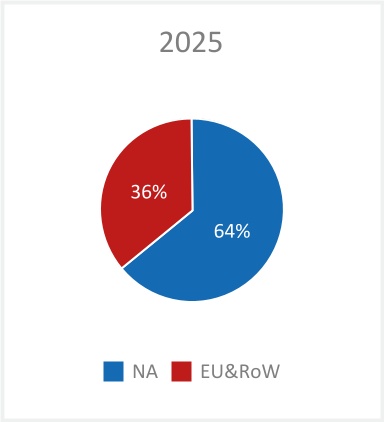
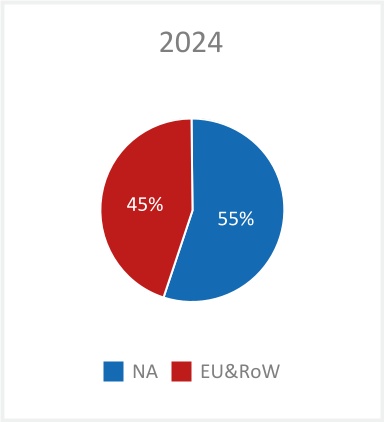
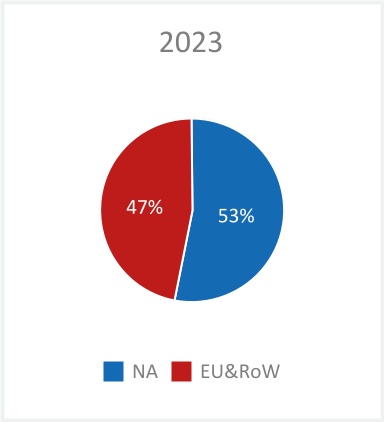
North America Business Segment
Aebi Schmidt North America offers a wide range of vehicles, equipment and services primarily across four of our five lines of business: Airport & Chassis, Commercial Trucks, Goods Transport, and Municipal.
•Airport & Chassis. MB and Schmidt provide equipment for airport runway maintenance, offering snow removal and de-icing solutions, multi-tasking machines, and runway sweepers. Spartan RV Chassis are also included in this line of business.
•Commercial Trucks. With a large variety of different value propositions, Monroe, Magnum, Strobes-R-Us and Meyer either build or upfit work trucks for commercial and municipal fleets and individual business owners.
•Goods Transport. Utilimaster designs and builds fleet solutions and offers a support and service network throughout the lifespan of vans and trucks. Our EV solutions are marketed under the Blue Arc brand. Towmaster equipment trailers are also included in this line.
•Municipal. Both Monroe and Swenson provide snow & ice control equipment and liquid anti-icing systems. Our Municipal line also include electric Sweepers from Schmidt, Pavement Marking Solutions from MB and ELP’s full range of snow removal equipment, dump bodies, interchangeable body system, and more.
Europe and the ROW Business Segment
In Europe and ROW, we offer a wide range of vehicles, equipment and services primarily across three of our five lines of business: Airport & Chassis, Municipal and Agriculture.
•Airport & Chassis. Airport maintenance teams have relied on Schmidt technology for decades. Our jet, compact and high-speed sweepers, sprayers and blowers support airport operations in both winter and summer. Almost all are equipped with advanced control systems, some of which allow automated or autonomous operations. Schmidt also offers hydraulic equipment and control systems for this line of business.
•Municipal. Schmidt combines a range of expertise across the many municipal requirements in both summer and winter. Schmidt launched its first sweeper in the 1960's and has since incorporated technologies like pre-wetted salt spreading from Nido, narrow-track multipurpose transporters from Ladog, Scandinavian plowing technologies
3
and more from Arctic or Tellefsdal. A growing number of vehicles and solutions also come with full electric drive, supporting municipalities to meet their emission targets.
•Agriculture. Aebi provides solutions to cultivate steep or challenging terrain efficiently and safely. Aebi Slope Tractors, Transporter or Motor Mowers are used by mountain farming businesses, municipalities and contractors.
Seasonality
Our performance in the second half of the year typically outperforms the first half of the year due to the seasonal nature of public procurement, particularly in the winter business segment. Many municipalities and government agencies finalize their budgets and issue tenders for winter maintenance equipment and services in preparation for the colder months. This leads to an increase in orders for snowplows, spreaders, and related infrastructure as customers secure their supplies ahead of winter. Additionally, our after sales business benefits from higher activity levels throughout the winter seasons, further amplifying this seasonal pattern.
The demand for snow and ice removal equipment can be influenced by general economic conditions in the regions in which we operate, as well as local economic conditions in the regions where we sell those products, predominantly snow-belt regions in North America and Europe. In stronger economic conditions, our end-users may choose to replace or upgrade existing equipment before its useful life has ended, while in weak economic conditions, end-users may seek to extend the useful life of equipment, decreasing our sales of new equipment but increasing sales of parts and accessories. However, in many locations, snow and ice removal is a non-discretionary service necessary to ensure public safety and continued personal and commercial mobility in populated areas that receive snowfall, so end-users cannot extend the useful life of snow and ice removal equipment indefinitely, and must replace equipment that has become too worn, unsafe or unreliable, regardless of economic conditions.
Competition
The principal methods we use to build competitive advantages include custom design capability, high product quality, superior customer service and quick delivery. We employ a solutions-based approach to offer specialized products tailored to customer needs across the spectrum of products. We compete with companies that manufacture for similar markets, including some divisions of large, diversified organizations that have total sales and financial resources exceeding ours.
We face competition in both the European and North American markets. In the airport sector, European competitors include Boschung, Overaasen, and Dammann, while in North America, companies like Fresia and Larue provide similar runway clearing solutions. For winter maintenance, European companies such as Bucher Municipal, Kupper-Weissert, and Rasco offer a range of products, while in the U.S., competitors like Douglas Dynamics, Henderson, SnowEx and Western have significant market share in the winter road maintenance segment. In the summer maintenance sector, European competition includes Fayat, Bucher Municipal, and Hako. In the agriculture segment, Reform and Lindner compete against Aebi Schmidt’s offerings in Europe. Meanwhile, in the specialty vehicles sector, U.S.-based competitors include Knapheide, Morgan Olsen and Reading Trucks, provide comparable truck equipment solutions.
Supplier Network and Procurement Strategy
We procure goods and services from a broad range of suppliers worldwide. In 2025, our supply chain stabilized and contributed to sustainable cost reductions, including post-merger synergies. Although uncertainties in sectors such as automotive, construction machinery, and agricultural technology caused selective supply disruptions, these did not result in significant production interruptions, as we implemented mitigation measures such as contractual agreements and alternative sourcing solutions.
We maintain long-term, mutually beneficial relationships with our suppliers to drive innovation, ensure high quality, reduce lead times, and optimize ramp-up processes for new vehicle introductions while lowering total costs. As appropriate, we strategically consolidate suppliers and enter into long-term agreements to secure pricing advantages and appropriate levels of quality and reliability.
The supplier base includes companies of all sizes and industries, delivering key product groups such as aluminum, steel, stainless steel, welded assemblies, motors, hydraulics, electronic components, and specialized finishing work. We generally adopt a balanced sourcing strategy. Suppliers for North American manufacturing are predominantly based in North America, while suppliers for European manufacturing are predominantly based in Europe. Global suppliers are used where required to ensure business continuity and meet customer needs.
Aluminum and stainless steel represent the largest commodities we use in production and are predominantly purchased under forecast-based and price-lock agreements, alongside other key materials such as lumber, plastics, and steel. Certain
4
components rely on single-source suppliers; associated risks are mitigated through contracts, supplier qualification processes, inspections, assistance programs, and ongoing performance monitoring.
Inventories are maintained primarily to support production and shipping schedules. We procure a limited number of chassis for airport equipment assembly in Europe, while the vast majority of vehicles we upfit are provided as third-party chassis by customers or original equipment manufacturers (“OEMs”) under bailment pool arrangements.
Incoming freight is managed through strategic logistics partners, enabling consolidated shipments to production sites and reducing total freight costs.
Research & Development
Our success depends on our ability to innovate and add new products and features ahead of changing market demands and new regulatory requirements. Thus, we emphasize research and development and commit resources to develop and adapt new products and production techniques. We spent approximately $27 million, $20 million and $17 million in 2025, 2024 and 2023, respectively, on research and development.
Product Warranties
We provide limited warranties against assembly and construction defects. These warranties generally provide for the replacement or repair of defective parts or workmanship for specified periods, ranging from one year to ten years, following the date of sale. With validation testing, predictive analysis tools and engineering and design standards, we strive continuously strive to improve product quality and durability and reduce our exposure to warranty claims. The end users may also receive limited warranties from suppliers of components that are incorporated into our chassis and vehicles.
Patents, Trademarks and Licenses
We have 53 patents in the United States, six patents in Canada and 20 patents in Europe. They include rights to the design and structure of snow and ice equipment (snowplows, spreaders), truck bodies and sweepers, certain peripheral equipment as well as their control and installation. We also have 23 pending patent applications. The existing patents will expire on various dates from 2025 through 2044 and utility patents are subject to payment of required maintenance fees.
We have more than 60 trademark rights, including protection for all of our product brands. The protection is mostly international, in individual cases national and/or with national restrictions of the scope of protection. The trademark rights are renewable under applicable laws, subject to payment of required fees and the filing of affidavits of use.
Our trademarks are valuable assets to both of our business segments. We are not aware of any infringing uses or any prior claims of ownership of our trademarks that could materially affect our business. Our policy is to pursue registration of our primary marks whenever possible and to vigorously defend our patents, trademarks and other proprietary marks against infringement or other threats to the extent practicable under applicable laws.
Human Capital Management
As of December 31, 2025, we employed approximately 5,700 employees and contractors. Approximately 5% of our total workforce consists of contractors, including all personnel at our Saltillo, Mexico operation. Our production processes leverage a combination of skilled tradespeople and high-touch assemblers working in body, electrical, mechanical, paint, and assembly operations. We strive to create a workplace of choice to attract, retain, and develop top talent to achieve our vision and deliver shareholder results.
As a globally active company operating in various countries, competent and satisfied employees are crucial to our long-term success. We offer an attractive working environment with country-specific benefits, and are committed to equal treatment. The health of our staff and workplace safety are top priorities. We believe our compensation packages provide the appropriate incentives to attract, retain and motivate our employees. We provide base pay that is competitive and aligns with employee positions, skill levels, experience and geographic location. In addition to base pay, we seek to reward employees with incentive awards, recognition programs, educational opportunities, paid time off, and equity awards for employees in certain roles.
Collaboration is one of our six key corporate values, and we incorporate flexibility and openness towards the different cultural and job-specific backgrounds of our employees. Open and honest interaction encourages employees to become actively involved in the company. We have implemented norms and standards to create a standardized framework for employees at all our locations. We regularly update employees by various means of internal corporate communication,
5
such as newsletters, intranet, CEO messages, roadshows, management calls and global townhalls. Finally, we account for employee needs when designing workplaces.
Customers
Our customers include local authorities and businesses in the public sector and various other sectors, including agricultural businesses, airports, the defense industry, specialty vehicles dealers, fleet, service and industrial companies. As a manufacturer of machinery and equipment, but increasingly also as a service provider, we are driven by the diverse wishes and needs of our customers. To be close to the market and our customers, we are represented directly in 17 countries with our own sales and service organization and in over 90 other countries via established sales partners.
We are a global leader in intelligent solutions for customers who care for clean and safe infrastructure and cultivate challenging grounds. Our unique range of products includes our vehicles, as well as innovative attachable and demountable devices for individual vehicle equipment. We tailor our support and service program to customer needs. With our competitive range of products, we strive for total solutions that will provide an economic, safe and traceable treatment. Our ultimate mission is to improve the performance of our customers. We believe that this focus has allowed us to build strong customer relationships and continue to develop new customers and markets. See related risk factors in the section of this Annual Report entitled “Risk Factors – Risks Relating to Our Company and Business.”
Sales to customers outside the United States were $592 million, $536 million and $515 million for the fiscal years ended December 31, 2025, 2024 and 2023, respectively, or 39%, 49% and 51%, respectively, of sales for those years. Substantially all our long-lived assets are located in the United States.
In 2025 and 2024, the top 10 customers in North America represented 18% and 13% of net sales, respectively, while in Europe, they accounted for approximately 17% and 14%, respectively. No single customer or small group of customers is responsible for a disproportionate share of our sales.
Website and Filings
We maintain a website address at www.aebi-schmidt.com that includes additional information about the Company. Our website and any reports or other information we make available through our website are not part of or incorporated by reference into this Annual Report. We make available through our website, free of charge, our filings with the SEC, including our annual reports on Form 10-K, our quarterly reports on Form 10-Q, our current reports on Form 8-K and our interactive data files, including amendments. These filings are available as soon as reasonably practicable after we have filed them with, or furnished them electronically to, the SEC, and are also available at www.sec.gov.
Information About Aebi Schmidt’s Executive Officers
Our executive officers, their business experience and their ages as of February 28, 2026, are as follows:
6
| Name | Position | Business Experience | Age | Executive Officer Since | ||||||||||
| Barend Fruithof | Group CEO | Vice Chair of Board since July 2025 and Group Chief Executive Officer since 2017. Head of Switzerland & Global Custody of Credit Suisse Group, from 2015 to 2016. Head of Corporate & Institutional Client of Credit Suisse Group from 2008 to 2015. | 58 | 2017 | ||||||||||
| Thomas Schenkirsch | Chief Group Services and Deputy CEO | Chief Group Services and Deputy CEO since July 2025. Head Group Strategic Development and Deputy CEO from October 2022 to June 2025. Group CFO from July 2016 to October 2022. | 50 | 2016 | ||||||||||
| Marco Portmann | Group CFO | Group CFO since April 2025. CFO of Swiss Steel Holding AG from April 2022 to June 2024. Vice President Corporate Accounting, Controlling, Tax and Risk Management of Swiss Steel Holding AG from October 2021 to March 2022. Vice President, Corporate Controlling of Swiss Steel Holding AG from April 2020 to September 2021. | 37 | 2025 | ||||||||||
| Steffen Schewerda | CEO, North America and President, Vehicle Solutions | CEO, North America and President Vehicle Solutions since July 2025. CEO, North America from January 2021 to July 2025. | 55 | 2021 | ||||||||||
| Henning Schröder | CEO, Europe and ROW | CEO, Europe and ROW since July 2025. Head Sales and Product Management Europe from April 2024 to June 2025. Head Group Technology from January 2021 to March 2024. | 48 | 2019 | ||||||||||
| Jacob Farmer | President, Commercial & Fleet and Deputy CEO, North America | President, Commercial & Fleet and Deputy CEO, North America since February 2026. President, Commercial & Fleet from July 2025 to February 2026. President, Fleet Vehicles and Services and Specialty Vehicles of Shyft from January 2023 to June 2025. President and Chief Executive Officer of Trialon Corporation from March 2020 to July 2023. | 48 | 2025 | ||||||||||
| Marcus Scherer | Chief Engineering | Chief Engineering since July 2025. Head of Group Technology from April 2024 to June 2025. VP Group Technologies North America from January 2023 to March 2024. CEO, Meyer Products from September 2020 to December 2022. | 51 | 2024 | ||||||||||
| Stefan Kaltenbach | Chief Supply Chain | Chief Supply Chain since July 2025. Head of Group Supply Chain Management and Procurement from March 2022 to June 2025. Head of Procurement Direct Spend from June 2019 to February 2022. | 50 | 2022 | ||||||||||
Item 1A. Risk Factors
Our business, financial condition, results of operations and cash flows are subject to various risks which may cause actual performance to differ materially from historical or projected future performance, many of which are not exclusively within our control. The risks described below are the primary risks known to us which we believe could materially affect our business, financial condition, results of operations, or cashflows. However, these risks may not be the only risks that could impact us. Our business could also be affected by other factors which are not presently known to us, factors we currently consider to be immaterial to our operations, or factors that could emerge as new risks in the future.
7
Risks Relating to Our Company and Business
Changes in U.S. trade policy, including the imposition of tariffs and the resulting consequences, may have a material adverse impact on our business and results of operations.
Changes in U.S. trade policy, including the imposition of tariffs and the resulting consequences of such imposition, may have a material adverse impact on our business and results of operations and of our business partners and suppliers. In particular, the U.S. government has adopted a new approach to trade policy and in many cases is renegotiating, or potentially terminating, certain existing bilateral or multi-lateral trade agreements. It has also imposed or is considering the imposition of tariffs on certain foreign goods, including certain products imported into the United States from Mexico, Canada, China and numerous other jurisdictions. These measures have resulted in, and are likely to continue to result in, increased costs for goods imported into the United States, particularly if these measures are implemented in regions where we or our suppliers source components or raw materials. This in turn has required and may continue to require us to increase the prices we charge to our customers, which may reduce demand, or, if we are unable to increase prices, result in lowering our margin on products sold. Further, changes in U.S. trade policy have resulted in, and likely will continue to result in one or more of the United States’ trading partners adopting responsive trade policies making it more difficult or costly for us to export our products to those countries. Countries may also adopt other measures, such as controls on imports or exports of goods, technology or data, which could adversely impact our operations and supply chain. Any such volatility and disruptions may adversely affect our business or the third parties on whom we rely. Political tensions as a result of trade policies could reduce trade volume, investment, technological exchange and other economic activities between major international economies, resulting in a material adverse effect on global economic conditions and the stability of global financial markets.
There is substantial uncertainty about the duration of existing tariffs and whether additional tariffs may be imposed, modified or suspended. We cannot predict future trade policy or the terms of any renegotiated trade agreements and their impact on our business. The adoption and expansion of trade restrictions, reciprocal tariffs, the occurrence of a trade war, or other governmental action related to tariffs or trade agreements or policies has the potential to adversely impact demand for our products, costs, customers, suppliers, and the U.S. economy, which in turn could adversely impact our business, financial condition and results of operations.
In February 2026, the U.S. Supreme Court (the “Court") issued a ruling holding that tariffs imposed under the International Emergency Economic Powers Act ("IEEPA") are not legally authorized. The Court only ruled on IEEPA tariffs and did not invalidate any other tariffs. Although the ruling has been issued, its implications for trade policy and related administrative actions remain uncertain. A number of tariff-related matters continue to be challenged that could impact the continued utilization of certain tariffs and the manner in which tariff costs. Adverse rulings, or the replacement or implementation of new tariffs or trade restrictions, could adversely impact our business, financial condition and results of operations.
A disruption, termination or alteration of the supply of critical components from third-party suppliers could materially adversely affect the sales of our products.
Our sales and manufacturing processes depend on the supply of critical components such as vehicle chassis, engines, transmissions, wire harnesses, axles and hydraulic pumps from major vehicle manufacturers and other suppliers. If our suppliers experience production delays, if the quality or design of their products change, if they implement recalls or change or discontinue the specific type of products they manufacture, or terminate their relationships with us, we could incur significant costs or disruptions to our business, which could have a material adverse effect on our sales, financial condition, profitability and/or cash flows. At various times, we may carry increased inventory to protect against these concerns, which may negatively impact our results of operations.
The steel, stainless steel, aluminum and other raw materials and components for our U.S. business are predominantly manufactured in the U.S. and purchased from U.S. domestic suppliers. However, to the extent tariffs increase the price of imported products, others in the industry may choose to increase their orders from U.S. domestic suppliers, which could strain the capacity of our U.S. domestic suppliers, putting the normal, uninterrupted supply of components to us at risk. In addition, U.S. domestic suppliers that currently incorporate imported components in their products may be subject to the same issues, i.e., increased costs of those imported components and limited availability of U.S. domestic supplier sources. Our suppliers could also experience operational delays or disruptions, including as a result of reacting to the imposition of tariffs, the outbreak of epidemics or other public health crises, which could in turn affect our manufacturing processes and sales. Additionally, certain important components that we use in our vehicles, such as engines and transmissions, are produced by a limited number of qualified suppliers and for some components may be limited to a single source of supply, so any disruption in their supply to us of such components could have a negative impact on our business.
8
Volatility in the financial markets generally, and in the truck and automotive sectors in particular, could impact the financial viability of certain of our key third-party suppliers, or could cause them to exit certain business lines, or change the terms on which they are willing to provide products. During 2018 and 2019, many of our suppliers encountered production issues and delivery delays due to factors including a vendor factory fire, new plant location inefficiencies, unplanned work stoppages and indirect impacts from the implementation of tariffs. A recurrence of any of these events or another similar development could lead to difficulties in meeting our customers’ demands and reduce our overall sales volume. Further, any changes in quality or design, capacity limitations, shortages of raw materials or other problems could result in shortages or delays in the supply of vehicle chassis or components to us. Our business, operating results and financial condition could suffer if our suppliers reduce output or make changes to chassis models that are unpopular with customers or are incompatible with current product designs or production process.
In addition, a growth in popularity of EVs without a significant expansion in battery cell production capacity could result in shortages, which could result in increased materials costs and could adversely impact our projected manufacturing and delivery timelines.
Increases in the price of commodities would impact the cost or price of our products, which may impact our ability to sustain and grow earnings.
Our manufacturing processes consume significant amounts of raw materials, the costs of which are subject to worldwide supply and demand factors, as well as other factors beyond our control, including continuing inflation. Raw material price fluctuations may adversely affect our results. We purchase, directly and indirectly through component purchases, significant amounts of aluminum, stainless steel, nickel (in particular as part of stainless steel), plastics and other resins, wood, electronic components, cables, and fiberglass products as well as other commodity-sensitive raw materials annually. In particular, in past years, steel and aluminum prices have experienced volatility which has been unforeseen and unexpected. Further, tariffs enacted or proposed by the U.S. government, or retaliatory tariffs, could further increase the price of components imported from international suppliers, and lift prices of certain commodities generally, regardless of origin. For example, tariffs increasing the cost of wood imported from Canada would likely lead to commercial and price pressures from U.S. producers as the result of consumers moving purchases to U.S. producers. Although at times we purchase steel, aluminum and other raw materials in advance to provide certainty regarding portions of our pricing and supply, for the majority of our raw material purchases, we do not typically enter into any fixed-price contracts and may not be able to accurately anticipate future raw material prices for those inputs, including the impacts of inflation. Commodity pricing has fluctuated significantly over the past few years and may continue to do so in the future. In addition, the cost of land and sea transportation is impacted by fluctuations in the cost of crude oil and diesel.
Such fluctuations in commodity prices could have a material effect on our results of operations, balance sheets and cash flows and impact the comparability of our results between financial periods.
Any negative change in our relationship with major customers could have significant adverse effects on revenues and profits.
Our financial success is directly related to customers continuing to purchase our products. Failure to fill customers’ orders in a timely manner or on the terms and conditions of sale could harm our relationships with customers. The importance of maintaining excellent relationships with our major customers may also give those customers leverage in their negotiations with us, including pricing and other supply terms, as well as post-sale disputes. This leverage may lead to increased costs or reduced profitability for us. Furthermore, if any of our major customers experience a significant downturn in their business or fail to remain committed to their products or brands, these customers may reduce or discontinue purchases from us, which could have an adverse effect on our business, results of operations and financial condition.
The unavailability, reduction, elimination or adverse application of government funding could have an adverse effect on our business, prospects, financial condition and operating results.
The risk associated with government customers is linked to fluctuations in their tax revenues and budgets. While many of our products are often prioritized - being either safety-critical equipment for street maintenance (e.g., ice and snow removal) or mission-critical airport equipment - there remains a risk that budget constraints could lead to delays in funding allocations, impacting order timelines. Although government and municipal customers typically are required by law to maintain these operations, financial pressures may result in postponed or deferred purchases.
9
The agricultural sector faces a similar risk related to funding. Farmers typically rely on subsidies from public institutions, and spending in this sector is heavily dependent on the availability of those funds. Any reduction or delay in subsidies could directly impact purchasing decisions, posing a risk to demand for our products. For example, the U.S. federal government recently has frozen or otherwise refused to honor certain promised payments and subsidies to farmers and others, which poses such a risk.
Our U.S. airport customers operate under FAA regulations, so any failure of our equipment could have significant operational consequences. Funding for airport improvements comes from the FAA’s Airport Improvement Program (“AIP”), which requires compliance with the Buy American Act. A government shutdown or budget cuts would pose a direct risk, leading to delays in funding approvals and project execution. The Airport & Airway Trust Fund (“AATF”), a key funding source within the AIP, is government-funded and closely tied to federal budget decisions. Any reductions in government spending could negatively impact AATF allocations, directly affecting purchase decisions and potentially delaying orders.
We may not be able to remain competitive in the rapidly changing markets in which we compete.
We operate in a highly competitive environment in each of the markets we serve, and face competition in each of our product segments from numerous competitors. We compete principally on the basis of customer loyalty and repeat buyers, client-specific customization, product quality and reliability, breadth of product offering, manufacturing capability and flexibility, technical capability, product innovation, customer service, after-sales support, delivery times and price.
The markets we serve are undergoing rapid transformation, particularly with respect to EVs and autonomous vehicles. Our current and potential competitors include companies that have significantly greater financial, technical, manufacturing, marketing and other resources than we do, including OEMs and certain of their customers who are highly motivated by market opportunities to deploy those resources to the design, development, manufacturing, distribution, promotion, sale and support of their products, including their EVs and autonomous vehicles. As a result of these market opportunities, OEMs and other companies have taken actions to reduce costs, including through in-sourcing, supply base consolidation and vertical integration. We expect these trends to continue and even accelerate. We expect competition for EVs and autonomous vehicles to intensify due to increased demand and a regulatory push for alternative fuel vehicles, continuing globalization, and consolidation in the worldwide vehicle industry. Increased competition may lead to lower vehicle unit sales and increased inventory, which may result in downward price pressure and adversely affect our business, financial condition, operating results, and prospects. Our business will be adversely affected if we are unable to adequately respond to these pressures or otherwise continue to compete in these markets.
Amounts included in order backlog may not result in actual revenue and are an uncertain indicator of our future revenue.
Backlog is generally comprised of agreements and purchase orders from customers that are subject to modification, cancellation, or rescheduling. We report these orders in our backlog at aggregate selling prices, net of discounts or allowances, and for certain products we recognize revenues based upon percentage completion. While realization of revenue related to order backlog has not been a major issue in the past, we cannot assure that we will recognize revenue with respect to each order included in order backlog. Should a cancellation occur, our order backlog and anticipated revenue would be reduced unless we are able to replace the cancelled order. As a result, the order backlog is not entirely within our control, and may not be indicative of future sales and can vary significantly from period to period. Reductions in our order backlog could negatively impact our future results of operations.
We evaluate our order backlog at least quarterly to determine if the orders continue to meet our criteria for inclusion in order backlog and to verify percentage of completion. We may adjust our reported order backlog to account for any changes, including those arising from continued customer intent and ability to fulfill order, supply base capacity, and changes in our ability, or the methodology used, to determine whether an order is likely to be completed. We cannot assure that our order backlog will result in revenue on a timely basis or at all, or that any cancelled contracts will be replaced. As a result, the order backlog may not be indicative of future sales and can vary significantly from period to period. In addition, it is possible that the methodology for determining the order backlog may not be comparable to methods used by other companies.
In addition, as a result of firm purchase orders from our customers, we may enter into agreements to produce and sell vehicles at a specified price with certain adjustments for changes and options based upon our estimation of the cost to produce and the timing of delivery. Due to the nature of these product cost estimates and the fluctuations in input costs and availability, we may underestimate the costs of production and therefore overestimate the profitability in the backlog. As a
10
result, the actual profitability of those sales in the future may differ materially from the initial estimates when we recorded the firm purchase orders in backlog.
Our ability to meet customer delivery schedules is dependent on a number of factors including, but not limited to, access to components and raw materials, an adequate and capable workforce, assembling/engineering expertise for certain projects and sufficient manufacturing capacity. The availability of these factors may in some cases be subject to conditions outside of our control. A failure by us to deliver in accordance with our performance obligations may result in financial penalties under certain of our contracts and damage to existing customer relationships, damage to our reputation and loss of future bidding opportunities, which could cause the loss of future business and could negatively impact our financial performance.
The integration of businesses or assets we have acquired or may acquire in the future involves challenges that could disrupt our business and harm our financial condition.
As part of our growth strategy, we have pursued and expect to continue to selectively pursue acquisitions of businesses or assets to diversify, expand our capabilities, enter new markets, or increase our market share. Integrating any newly acquired business or assets can be expensive and can require a great deal of management time and other resources. We cannot guarantee that we will be able to identify attractive acquisition targets or assets. If we are unable to successfully integrate newly acquired businesses (including Shyft) with our existing business, we will not realize the synergies we expect from the acquisition and our business and results of operations would be adversely impacted.
Reconfiguration or relocation of our production operations could negatively impact our earnings.
We may, from time to time, reconfigure our production lines or relocate production of products between buildings or locations or to new locations to maximize the efficient utilization of our existing production capacity or take advantage of opportunities to increase manufacturing efficiencies. Costs incurred to affect these reconfigurations or relocations may exceed our estimates, and the efficiencies gained may be less than anticipated, each of which may have a negative impact on our results of operations and financial position.
Unforeseen or recurring operational problems at any of our facilities, or a catastrophic loss of one of our key manufacturing facilities, may cause significant lost production and adversely affect our results of operations.
Our manufacturing process could be affected by operational problems that could impair our production capability. Many of our manufacturing facilities contain sophisticated machines that are used in our manufacturing process. Disruptions or shutdowns at any of our facilities could be caused by:
•maintenance outages to conduct maintenance activities that cannot be performed safely during operations;
•prolonged power failures or reductions;
•breakdown, failure or substandard performance of any of our machines or other equipment;
•noncompliance with, and liabilities related to, environmental requirements or permits;
•disruptions in the transportation infrastructure, including railroad tracks, bridges, tunnels or roads;
•fires, floods, earthquakes, tornadoes, hurricanes, microbursts or other catastrophic disasters, national emergencies, pandemics, political unrest, war or terrorist activities; or
•other operational problems.
If some of our facilities are shut down, they may experience prolonged startup periods, regardless of the reason for the shutdown. Those startup periods could range from several days to several weeks or longer, depending on the reason for the shutdown and other factors. Any prolonged disruption in operations at any of our facilities could cause a significant loss of production and adversely affect our results of operations and negatively impact our customers and dealers. Further, a catastrophic event could result in the loss of the use of all or a portion of one of our manufacturing facilities. Although we carry property and business interruption insurance, our coverage may not be adequate to compensate us for all losses that may occur. Any of these events individually or in the aggregate could have a material adverse effect on our business, financial condition and operating results.
Disruptions within our dealer network could adversely affect our business.
11
We rely, for certain of our products, on a network of independent dealers to market, stock, deliver, provide training for, and service our products to and for customers. Our business is influenced by our ability to initiate and manage new and existing relationships with dealers.
From time to time, we or an individual dealer may choose to terminate the relationship, or the dealership could face financial difficulty leading to bankruptcy or other failure, or difficulty in transitioning to new ownership, in each case leading to a temporary loss of distribution channels. In addition, our competitors could engage in a strategy to attempt to acquire or convert our dealers to carry their products. We do not believe our business is dependent on any single dealer, the loss of which would have a sustained material adverse effect on our business.
However, the disruption of dealer coverage within a specific local market could have an adverse impact on our business within the affected market. The loss or termination of a significant number of dealers could cause difficulties in marketing and distributing our products and have an adverse effect on our business, operating results or financial condition. If a dealer in a strategic market experiences financial difficulty, we may choose to provide financial support such as extending credit to a dealership, reducing the risk of disruption, but increasing our financial exposure.
Additionally, there is a competitive risk related to the distribution chain, as dealers operate independently and set their own pricing and conditions in the market. While we may seek to mitigate that risk through direct sales, we have no control over dealer pricing strategies. This risk could impact the competitiveness of our products in specific dealer markets.
We may be unsuccessful in implementing our growth strategy.
Our growth strategy includes expanding existing market share through product innovation, continued expansion into industrial and global markets and merger or acquisition related activities. We believe that our future success depends in part on our research and development and engineering efforts, our ability to manufacture or source the products and customer acceptance of our products. As it relates to new markets, our success also depends on our ability to create and implement local supply chain, sales, distribution and services strategies to reach these markets.
The potential inability to successfully implement and manage our growth strategy could adversely affect our business and our results of operations. The successful implementation of our growth strategy will depend, in part, on our ability to integrate operations with acquired companies.
We also make investments in new business development initiatives which could have a relatively high failure rate. We limit our investments in these initiatives and establish governance procedures to contain the associated risks, but losses could result and may be material. Our growth strategy also may involve acquisitions, joint venture alliances and additional arrangements of distribution. We may not be able to enter into acquisitions or joint venture arrangements on acceptable terms, and we may not successfully integrate these activities into our operations. We also may not be successful in implementing new distribution channels, and changes could create discord in our existing channels of distribution.
When we introduce new products, we may incur expenses that we did not anticipate, such as recall expenses, resulting in reduced earnings.
The introduction of new products is critical to our future success. We will have additional costs when we introduce new products, such as initial labor or purchasing inefficiencies and costs to identify and comply with product regulations applicable to the new products. But we may also incur unexpected expenses. For example, we may experience unexpected engineering or design issues that will force a recall of a new product, increase our warranty costs for the new product, or increase production costs of the product above levels needed to ensure profitability. In addition, we may make business decisions that include offering incentives to stimulate the sales of products not adequately accepted by the market, or to stimulate sales of older or less marketable products. The costs resulting from these types of problems could be substantial and have a significant adverse effect on our earnings.
We may discover defects in our vehicles, potentially resulting in delaying new model launches, recall campaigns, increased warranty costs, liability or other costs.
Meeting or exceeding many government-mandated safety standards is costly and often technologically challenging. Government safety standards require manufacturers to remedy defects related to motor vehicle safety through safety recall campaigns, and a manufacturer is obligated to recall vehicles if we determine that they do not comply with relevant safety standards. Should we or government safety regulators determine that a safety or other defect or noncompliance exists with respect to certain of our vehicles, there could be a delay in the launch of a new model, recalls of existing models or a significant increase in warranty claims, the costs of which could be substantial. Any actual or perceived defect or other
12
quality issue in our products could be costly to address and could also lead to potential liability or reputational damage. Additionally, the vehicles we manufacture for sale are subject to strict contractually established specifications using complex manufacturing processes. If we fail to meet the contractual requirements for a vehicle or a part, we could be subject to warranty costs to repair or replace the part itself and additional costs related to the investigation and inspection of non-complying parts. These potential warranty and repair and replacement costs are generally not covered by our insurance. We establish warranty reserves that represent our estimate of expected costs for fulfilling our warranty obligations. We base our estimate for warranty reserves on our historical experience and other related assumptions. If actual results materially differ from these estimates, our results of operations could be materially affected.
In addition, we may not be able to enforce warranties and extended warranties received or purchased from our suppliers if they refuse to honor such warranties or go out of business. Also, a customer may choose to pursue remedies directly under our contract with us over enforcing such supplier warranties. In such a case, we may not be able to recover our losses from the supplier.
Increases in the cost of labor, deterioration in employee relations, union organizing activity and work stoppages at our facilities could have a negative effect on our business.
While we believe our employee relations are generally positive, we cannot assure that our relations with our workforce will remain positive. A deterioration in these relations could have an adverse effect on our business. In addition, we conduct a large portion of our business in highly competitive labor markets. If we are unable to recruit and retain a sufficient workforce, or if the costs of doing so increase, our business could be materially adversely affected.
Union organizers may work to organize employees at some of our facilities. If union representation is implemented at such sites and we are unable to agree with the union on reasonable employment terms, including wages, benefits, and work rules, we could experience a significant disruption of our operations and incur higher ongoing labor costs. Further, if a location does experience organizing activity, our management and other personnel need to divert attention from operational and other business matters to devote substantial time to address such activity.
Our ability to execute our strategy is dependent upon our ability to attract, retain, and develop qualified personnel, including our ability to execute proper succession plans for senior management and key employees.
Our continued success depends, in part, on our ability to identify, attract, motivate, train and retain qualified personnel in key functions and geographic areas, including the members of our senior management team. In particular, we are dependent on our ability to identify, attract, motivate, train and retain qualified engineers and skilled labor with the requisite education, background and industry experience to assist in the development, enhancement, introduction and manufacture of our products and technology solutions.
Failure to attract, train and retain qualified personnel, whether as a result of an insufficient number of qualified local residents or the allocation of inadequate resources to train, integrate and retain, could impair our ability to execute our business strategy and could have an adverse effect on our business prospects. Our success also depends to a large extent upon our ability to attract and retain key executives and other key employees, as well as the existence of a succession plan for these employees. These employees have extensive experience in our markets and are familiar with our business, systems and processes. The loss of the services of one or more of these key employees could have an adverse effect, at least in the short to medium term, on significant aspects of our business, including the ability to manage our business effectively and the successful execution of our strategies, if transitions according to our succession plans are not successful. If certain of these employees decide to leave, we could incur disruptions to the completion of certain initiatives and could incur significant costs in hiring, training, developing and retaining their replacements if our succession plans are not adequate.
Risks associated with international sales and contracts could have a negative effect on our business.
We face numerous risks associated with conducting international operations, any of which could negatively affect our financial performance, including changes in foreign country regulatory requirements, the strength of the U.S. dollar and the Euro compared to other currencies, import/export restrictions, the imposition of tariffs and other trade barriers, disruptions in the shipping of exported products and other logistical challenges. In addition, when we introduce an existing product into a new market, we generally will incur additional costs to adapt that product to local markets, and to identify and comply with product regulations applicable to products in that jurisdiction.
13
Our EVs rely on software and hardware that is highly technical, and if these systems contain errors, bugs, vulnerabilities, or design defects, or if we are unsuccessful in addressing or mitigating technical limitations in our systems, our EV business could be adversely affected.
Our EVs rely on software and hardware that is highly technical and complex and will require modification and updates over the life of our vehicles. Our software and hardware may contain errors, bugs, vulnerabilities or design defects, and our systems are subject to certain technical limitations that may compromise our ability to meet our objectives. Some errors, bugs, vulnerabilities, or design defects inherently may be difficult to detect and may only be discovered after the product has been released. Although we will attempt to remedy any issues we observe in our vehicles effectively and rapidly, such efforts may not be timely, may hamper production or may not be to the satisfaction of our customers.
If we are unable to prevent or effectively remedy errors, bugs, vulnerabilities or defects in our software and hardware, or fail to deploy updates to our software properly, we would suffer damage to our reputation, loss of customers, loss of revenue or liability for damages, any of which could adversely affect our business, prospects, financial condition, results of operations, and cash flows.
There are complex software and technology systems that we must develop in coordination with vendors and suppliers to reach mass production for our EVs, and there can be no assurance that we will successfully develop or integrate them.
Our EVs and EV operations use a substantial amount of complex third-party and in-house software and hardware. The development and integration of such advanced technologies are inherently complex, and we will need to coordinate with our vendors and suppliers to reach mass production for our EVs. Defects and errors may be revealed over time and our control over the performance of third-party services and systems may be limited. As a result, our potential inability to develop and integrate the necessary software and technology systems may adversely affect our EV business.
We rely on third-party suppliers to develop a number of emerging technologies for use in our EVs, including battery technology and the use of different battery cell chemistries. Certain of these technologies and chemistries are not currently commercially viable, and they may never be commercially viable. There can be no assurances that our suppliers will be able to meet the technological requirements, production timing, and volume requirements to support our business plan. Competitors and their suppliers may develop cheaper or more efficient battery technology. Furthermore, if we experience delays from our third-party suppliers (including due to their financial viability or technology), we could experience delays in delivering on our timelines. In addition, the technology may not comply with the cost, performance useful life, and warranty characteristics we anticipate in our business plan. As a result, our business plan could be significantly impacted and we may incur significant liabilities under warranty claims which could materially and adversely affect our business, prospects, financial condition, results of operations, and cash flows.
General economic, market, and/or political conditions, whether on a global, national, or more regional scale, could have a negative effect on our business.
Wars, acts of terrorism, armed conflicts, natural disasters (including those caused by climate change), budget shortfalls, cybersecurity incidents, civil unrest, governmental actions, and epidemics have in the past and could in the future create significant uncertainties that may have material and adverse effects on consumer demand, shipping and transportation, the availability of manufacturing components, commodity prices and our ability to engage in overseas markets as tariffs are implemented. An economic recession, whether resulting from one of these events or others, would have a material adverse impact on our financial condition and results of operations.
If there is a rise in the frequency and size of product liability, warranty and other claims against us, including wrongful death claims, our business, results of operations and financial condition may be harmed.
We are frequently subject, in the ordinary course of business, to litigation involving product liability and other claims, including wrongful death claims, related to personal injury and warranties. We insure our product liability claims in the commercial insurance market. We cannot be certain that our insurance coverage will be sufficient to cover all future claims against us. Any increase in the frequency and size of these claims, as compared to our experience in prior years, may cause our insurance premiums to rise significantly. It may also increase the amount we pay in punitive damages, which our insurance may not cover. In addition, a major product recall or increased levels of warranty claims could have a material adverse effect on our results of operations.
Changes to laws and regulations governing our business could have a material impact on our operations.
14
Our manufactured products and the industries in which we operate are subject to extensive federal, state and local regulations in multiple jurisdictions. Changes to any of these regulations or the implementation of new regulations could significantly increase the costs of manufacturing, purchasing, operating or selling our products, managing our data and systems, and could have a material adverse effect on our results of operations. Our failure to comply with present or future regulations could result in fines, potential civil and criminal liability, suspension of sales or production, or cessation of operations.
Failure to comply with, and liabilities arising under, environmental and motor vehicle laws and regulations could have a material impact on our operations.
Our operations are subject to a variety of federal, state, local and international environmental regulations in the jurisdictions in which we operate relating to, among other matters, noise pollution and the use, generation, storage, treatment, emission and disposal of hazardous materials and wastes, some of which impose joint and several liability, regardless of fault. Our failure to comply with present or future regulations could result in fines, potential civil and criminal liability, suspension of production or operations, alterations to the manufacturing process, costly cleanup or capital expenditures. Climate change regulations at the federal, state or local level in the jurisdictions in which we operate could require us to change our manufacturing processes or product portfolio or undertake other activities that may require us to incur additional expenses, which may be material.
Our vehicles are subject to motor vehicle safety standards, and the failure to satisfy such mandated safety standards could have a material adverse effect on our business, financial condition, results of operations, and cash flows.
All vehicles sold must comply with applicable international, federal, state and local motor vehicle safety standards. In the United States, vehicles that meet or exceed all federally mandated safety standards are self-certified by the manufacturer under the federal regulations. Rigorous testing and the use of approved materials and equipment are among the requirements for achieving federal certification. Jurisdictions outside the United States require us to meet “Type Approval” requirements by proving to regulators that our vehicles meet those relevant safety standards in effect in those countries. Our failure to maintain compliance of our current vehicles or obtain certification of compliance for any future vehicle, including future EV models, with motor vehicle safety standards in the United States, Europe, Canada or other jurisdictions could have a material adverse effect on our business, prospects, financial condition, results of operations, and cash flows.
Our operating results may fluctuate significantly on a quarter-to-quarter basis.
Our quarterly operating results depend on a variety of factors including the timing and volume of orders, the completion of product inspections and acceptance by our customers, and various restructuring initiatives that may be undertaken from time to time. Accordingly, our financial results may be subject to significant and/or unanticipated quarter-to-quarter fluctuations.
Our businesses are cyclical, and this can lead to fluctuations in our operating results.
The industries in which we operate are highly cyclical and there can be substantial fluctuations in our manufacturing, shipments and operating results, and the results for any prior period may not be indicative of results for any future period. Companies within these industries are subject to volatility in operating results due to external factors such as economic, demographic and political changes. Factors affecting the manufacture of chassis, specialty vehicles and other products include but are not limited to:
•Commodity prices;
•Fuel availability and prices;
•Unemployment trends;
•International tensions and hostilities;
•General economic conditions;
•Various tax incentives;
•Strength of the U.S. dollar and Euro compared to other currencies;
•Overall consumer confidence and the level of discretionary consumer spending;
•Dealers’ and manufacturers’ inventory levels; and
•Interest rates and the availability of financing.
15
Economic, legal and other factors could impact our customers’ ability to pay accounts receivable balances due from them.
In the ordinary course of business, customers are granted terms related to the sale of goods and services delivered to them. These terms typically include a period between when the goods and services are tendered for delivery to the customer and when the customer must pay for these goods and services. The amounts due under these payment terms are listed as accounts receivable on our balance sheet. Prior to our collecting these accounts receivable, our customers could encounter drops in sales, unexpected increases in expenses, or other factors which could impact their ability to continue as a going concern, and which could affect the collectability of these amounts. Writing off uncollectible accounts receivable could have a material adverse effect on our earnings and cash flow as we have major customers with material accounts receivable balances at any given time.
Our business operations could be disrupted if our information technology systems fail to perform adequately or experience a cybersecurity incident.
We rely on our information technology systems and those of third-party business partners to effectively manage our business data, communications, supply chain, product engineering, manufacturing, accounting and other business processes. Increased cybersecurity threats, computer crime and cyberterrorism pose a risk to the security of our systems and networks, and those of our third-party business partners, and the confidentiality, availability and integrity of our data. Cybersecurity incidents and similar attacks vary in their form and can include the deployment of harmful malware or ransomware, denial-of-services attacks, employee or personnel failures, fraud, phishing or other social engineering attempts or other methods to cause confidential information, payments, account access or access credentials, or other data to be transmitted to an unintended recipient. Cybersecurity threat actors also may attempt to exploit vulnerabilities through software including that is software commonly used by companies in cloud-based services and bundled software. Depending on their nature and scope, such threats could potentially lead to the compromising of confidential information, including but not limited to confidential information relating to customer or employee data, improper use of our systems and networks, manipulation and destruction of data, and operational disruptions. A cybersecurity incident or failure or disruption relating to our information or systems, or that of our third-party business partners, or any failure by us or our third-party business partners to effectively address, enforce and maintain our information technology infrastructure and cybersecurity measures may result in substantial harm to our business strategy, results of operations and financial condition, including major disruptions to business operations, loss of intellectual property, release of confidential information, alteration or corruption of data or systems, costs related to remediation or the payment of ransom, and litigation, civil or criminal investigations or actions, regulatory intervention and sanctions or fines, investigation and remediation costs and possible prolonged negative publicity.
In addition, third-party providers of data hosting or cloud services, as well as our suppliers, may experience cybersecurity incidents that may involve data we share with them. There can be no assurance that cybersecurity incidents, whether with respect to us or such third-party providers, will not have a material adverse effect on us in the future. In order to mitigate risks to our information systems, we continue to make investments in personnel, technologies and training of personnel. Although we maintain a cyber insurance policy, there is no guarantee that such coverage will be sufficient to address costs, liabilities and damages we may incur in connection with a cybersecurity incident or that such coverage will continue to be available on commercially reasonable terms or at all.
Fuel shortages, or higher prices for fuel, could have a negative effect on sales.
Gasoline or diesel fuel is required for the operation of most of the specialty vehicles we manufacture. There can be no assurance that the supply of these petroleum products will continue uninterrupted, that rationing will not be imposed or that the price of, or tax on, these petroleum products will not significantly increase in the future. Increases in gasoline and diesel prices and speculation about potential fuel shortages may have had an unfavorable effect on consumer demand for certain we products. This, in turn, may have a material adverse effect on our sales volume. Increases in the price of oil also can result in significant increases in the price of many of the components in our products, which may have an adverse impact on margins or sales volumes.
We could incur asset impairment charges for goodwill, intangible assets or other long-lived assets.
We have a significant amount of goodwill, intangible assets and other long-lived assets. At least annually, we review goodwill and non-amortizing intangible assets for impairment. We will also review for impairment identifiable intangible
16
assets, goodwill and other long-lived assets whenever events or changes in circumstances indicate the carrying amount of an asset may not be recoverable from future cash flows. If the operating performance at one or more of our reporting units fails to meet future forecasts, or if future cash flow estimates decline, we could be required, under current U.S. accounting rules, to record impairment charges for our goodwill, intangible assets or other long-lived assets. Any write-off of a material portion of such assets could negatively affect our results of operations or financial position.
We may be unable to adequately protect our intellectual property.
While we believe that our patents, trademarks, know-how and other intellectual property have significant value, it is uncertain that this intellectual property or any intellectual property acquired or developed by us in the future will provide a meaningful competitive advantage. Our patents or pending patent applications may be challenged, invalidated or circumvented by competitors or rights granted thereunder may not provide meaningful proprietary protection. Moreover, competitors may infringe on our patents or successfully avoid them through design innovation. Policing unauthorized use of our intellectual property is difficult and expensive, and we may not be able to, or have the resources to, prevent misappropriation of our proprietary rights, particularly in countries where the laws may not protect such rights as fully as in the U.S. The cost of protecting our intellectual property may be significant and have a material adverse effect on our financial condition and future results of operations. In addition, because we operate in many countries throughout the world, our intellectual property may be subject to additional risks of infringement, sometimes in jurisdictions with weaker protections of intellectual property rights, and we must take steps to protect our intellectual property rights under the laws of multiple jurisdictions. This risk increases when the intellectual property rights relate to new technologies.
The unavailability, reduction, elimination or adverse application of government incentives could have an adverse effect on our business, prospects, financial condition and operating results.
The growth of our EV business depends in part on the availability and amounts of government incentives. Any reduction, elimination or discriminatory application of government incentives because of budgetary challenges, policy changes, the reduced need for such incentives due to the perceived success of EVs or other reasons may result in the diminished price competitiveness of the alternative fuel vehicle industry, which could have an adverse effect on our business, prospects, financial condition and operating results.
Emerging issues related to the development and use of artificial intelligence (“AI”) could give rise to legal or regulatory action, damage our reputation or otherwise materially harm our business.
Our development and use of AI technology in our products and operations remains in the early phases. While we aim to develop and use AI responsibly and attempt to mitigate ethical and legal issues presented by our use, we may ultimately be unsuccessful in identifying or resolving issues before they arise. AI technologies are complex and rapidly evolving and the technologies that we develop or use may ultimately be flawed. Moreover, AI technology is subject to rapidly evolving domestic and international laws and regulations, which could impose significant costs and obligations on the company. For example, the European Union’s Artificial Intelligence Act, which establishes broad obligations for the development and use of AI-based technologies made available in the European Union based on their potential risks and level of impact, came into force on August 1, 2024. Emerging regulations may pertain to data privacy, data protection, and the ethical use of AI, as well as clarifying intellectual property considerations. Our use of AI could give rise to legal or regulatory action, increased scrutiny or liability, damage our reputation or otherwise materially harm our business.
Our competitors or other third parties may incorporate AI into their products more quickly or more successfully than we do, which could impair our ability to compete effectively and could adversely affect our results of operations. In addition, there are significant risks in using AI, and there can be no assurance that the use of AI will enhance our business or be beneficial to our business operations, including our efficiency or our profitability.
We are subject to litigation in the ordinary course of business, and uninsured judgments, settlements or other costs, or a rise in insurance premiums may adversely impact our results of operations.
In the ordinary course of business, we are subject to various claims and litigation. Any such claims, whether with or without merit, could be time-consuming and expensive to defend, could divert management’s attention and resources, could result in reputational damage to us, could result in significant damages or other costs, and could otherwise have a material adverse effect on our business, financial condition and results of operations.
Some of our businesses have in the past and may in the future face claims and litigation regarding accidents involving their products, including accidents involving injuries and deaths, and the increasing amount of our vehicles on the road
17
may increase our exposure to such matters. In accordance with customary practice, we maintain insurance against some, but not all, of these potential claims. We may elect not to obtain insurance if we believe that the cost of available insurance is excessive relative to the risks presented. The levels of insurance we maintain may not be adequate to fully cover any and all losses or liabilities. Further, we may not be able to maintain insurance at commercially acceptable premium levels or at all.
If any significant accident, judgment, claim or other event is not fully insured or indemnified against, then in either case that could have a material adverse impact on our business, financial condition and results of operations. We cannot assure that the outcome of all current or future litigation will not have a material adverse impact on our business or results of operations.
Fluctuations in foreign currency exchange rates have adversely affected and could continue to adversely affect our operating results.
Because the functional currency of most of our foreign operations is the applicable local currency, but our financial reporting currency is the U.S. dollar, we are required to translate the assets, liabilities, expenses, and revenues of our non-U.S. operations into U.S. dollars at the applicable exchange rate in preparing our financial statements. Accordingly, we face foreign currency exchange rate risk arising from transactions in the normal course of business, such as sales and loans to wholly owned subsidiaries, sales to third-party customers, purchases from suppliers, and bank lines of credit with creditors denominated in foreign currencies.
Foreign currency exchange rates have affected our sales, net earnings, and operating results in the past and could affect them in the future, in some cases materially. Currency exchange rate fluctuations may also affect the comparative prices between products we sell and products our non-U.S. competitors sell in the same market, which may decrease demand for our products. Substantial exchange rate fluctuations caused by the strengthening of the U.S. dollar or otherwise, may have an adverse effect on our operating results, financial condition, and cash flows, as well as the comparability of our financial statements between reporting periods. While we actively manage our foreign currency market risk in the normal course of business by entering into various derivative instruments to hedge against such risk, these derivative instruments involve risks and may not effectively limit our underlying exposure to foreign currency exchange rate fluctuations or minimize our net earnings and cash volatility associated with foreign currency exchange rate changes. Further, the failure of one or more counterparties to our foreign currency exchange rate contracts to fulfill their obligations to us could adversely affect our operating results.
Weather conditions, including conditions exacerbated by global climate change, present chronic and acute physical risks, have previously impacted, and may continue to impact, demand for some of our products and/or cause disruptions in our operations.
Weather conditions in particular geographic regions have adversely affected, and in the future will likely adversely affect the sales, demand, and field inventory levels and seasonality trends of some of our products. Weather conditions also have disrupted our own manufacturing and distribution facilities and our supply chain, which has impacted our ability to manufacture products to fulfill customer demand, and such disruptions may occur in the future. For example, drought or unusually wet conditions have had, and may continue to have, an adverse effect on sales of certain mowing equipment products. Lower snowfall accumulations in key markets have had, and may continue to have, an adverse effect on sales of our snow and ice removal business. Similarly, adverse weather conditions in one season may negatively impact customer purchasing patterns and sales for some of our products in another season. For example, lower snowfall accumulations may result in lower winter season revenues for landscape contractor professionals, causing such customers to forego or postpone spring purchases of our mowing equipment products.
Our business is subject to risks arising from our indebtedness, contingent obligations, liquidity and financial position.
Our business has meaningful working capital requirements and a decline in operating results or access to financing may have an adverse impact on our liquidity position. Our $600.0 million credit facilities agreement entered into on March 10, 2025 (the "New Credit Facilities Agreement"), which we have used or will use to finance existing interest-bearing financial indebtedness, to pay costs and expenses incurred in connection with the Merger, and for general corporate and working capital purposes, went into effect on July 1, 2025. Our ability to make required payments of principal and interest on our debt will depend on our future performance, which, to a certain extent, is subject to general economic, financial, competitive, political and other factors, some of which are beyond our control. Accordingly, conditions could arise that could limit our ability to generate sufficient cash flows or to access borrowings to enable us to fund our liquidity needs, which could further limit our financial flexibility or impair our ability to obtain alternative financing sufficient to repay our debt at maturity.
18
We believe that our cash on hand, together with funds generated by our operations and borrowings under the New Credit Facilities Agreement, will provide us with sufficient liquidity and capital resources to meet our working capital, capital expenditures and other operating needs for the foreseeable future. This belief is based on significant assumptions including, among other things, assumptions relating to future sales volumes, the successful implementation of our business strategies, the continuing availability of trade credit from certain key suppliers and that there will be no material adverse developments in our competitive market position, business, liquidity or capital requirements. Any failure to achieve earnings expectations may have an adverse impact on our available liquidity. As a result, we cannot provide assurance that we will continue to have sufficient liquidity to meet our operating needs. In the event that we do not have sufficient liquidity, we may be required to seek additional capital, reduce or cut back our operating activities, capital expenditures or otherwise alter our business strategy. If we obtain additional capital by issuing equity, the interests of our existing stockholders will be diluted. If we incur additional debt, the agreements governing that debt may contain significant financial and other covenants that may materially restrict our operations. We cannot assure you that we could obtain refinancing or additional financing on favorable terms or at all.
The New Credit Facilities Agreement contains, and agreements governing future indebtedness may contain, restrictive covenants that may impair our ability to access sufficient capital and operate our business.
The New Credit Facilities Agreement contains various provisions that limit our ability (subject to a number of exceptions) to, among other things:
•incur additional indebtedness;
•incur certain liens;
•consolidate or merge with other parties;
•alter the business conducted by us and our subsidiaries taken as a whole;
•make investments, loans, advances, guarantees and acquisitions;
•sell, lease or transfer assets, including capital stock of our subsidiaries;
•enter into certain sale and leaseback transactions;
•repay any subordinated indebtedness we may issue in the future;
•amend the terms of certain unsecured or subordinated debt;
•engage in transactions with affiliates; and
•enter into agreements restricting our subsidiaries’ ability to pay dividends.
In addition, the restrictive covenants in the New Credit Facilities Agreement require us to maintain specified financial ratios and other business or financial conditions. Our ability to comply with these financial ratios or other covenants may be affected by events beyond our control, and our failure to comply with these ratios or other covenants could result in an event of default. These covenants may affect our ability to operate and finance our business as we deem appropriate. Our inability to meet obligations as they become due or to comply with various financial covenants contained in the instruments governing our current or future indebtedness could constitute an event of default under the instruments governing our indebtedness. If there were an event of default under the New Credit Facilities Agreement, or any future instruments governing our indebtedness, the holders of the affected indebtedness could declare all of the affected indebtedness immediately due and payable, which, in turn, could cause the acceleration of the maturity of all of our other indebtedness. We may not have sufficient funds available, or we may not have access to sufficient capital from other sources, to repay any accelerated debt. Even if we could obtain additional financing, the terms of the financing may not be favorable to us. In addition, we have pledged the equity securities of certain of our material subsidiaries as security for our obligations under the New Credit Facilities Agreement. If amounts outstanding under our Credit Facilities Agreement were accelerated, our lenders could foreclose on those pledges, and we could lose a substantial part of our assets. Any event of default under the instruments governing our indebtedness could have a material adverse effect on our business, financial condition and results of operations.
We have meaningful contingent obligations, which could negatively impact our results of operations.
We have meaningful contingent liabilities with respect to certain items that, if realized, could have a material adverse effect on our business, financial condition and operating results. In particular, we obtain certain vehicle chassis from automobile manufacturers under converter pool agreements. Chassis typically are converted and delivered to customers within 90 to 120 days of receipt. If the chassis are not converted within this timeframe of delivery, in certain cases we are obliged to purchase the chassis and record it as inventory or is obligated to begin paying an interest charge on this inventory until purchased. We also obtain vehicle chassis directly from our customers in connection with specific vehicle
19
orders. These vehicle chassis are stored at our various production facilities until the related value-added work is completed and the finished unit is shipped back to the customer. The customer does not transfer the vehicle chassis certificate of origin to us. If damage or theft were to occur to these chassis, we would be responsible for related costs incurred to repair or replace the customer-provided chassis. Further, in connection with dealers’ wholesale floor-plan vehicle financing programs, we enter into repurchase agreements with certain lending institutions, customary in the industries in which we operate, which may require us to repurchase previously sold vehicles. Although our exposure under these agreements is limited by the expected resale value of the inventory we may repurchase, we may receive less than anticipated on such resales and could collect payment on such resales later than originally expected. Additionally, we are party to multiple agreements whereby we guarantee indebtedness of others, including losses under pool agreements. Also, we are contingently liable under bid, performance and specialty bonds issued by our surety companies and has open standby letters of credit issued by our banks in favor of third parties. While we do not expect to experience material losses under these agreements, we cannot provide any assurance that these contingent liabilities will not be realized.
We have identified material weaknesses in our internal control over financial reporting and may identify additional material weaknesses in the future or fail to maintain an effective system of internal control over financial reporting. If our remediation of the material weaknesses is not effective, or we fail to develop and maintain effective internal control over financial reporting, our ability to produce timely and accurate financial statements or comply with applicable laws and regulations could be impaired, which could harm our business and negatively impact the value of our Common Stock.
In connection with the preparation of our consolidated financial statements as of December 31, 2025, 2024 and 2023 and for the years then ended, we identified material weaknesses in our internal control over financial reporting. A material weakness is a deficiency, or a combination of deficiencies, in internal control over financial reporting, such that there is a reasonable possibility that a material misstatement of our annual or interim consolidated financial statements will not be prevented or detected on a timely basis.
We are developing a plan to remediate the material weaknesses identified and have initiated certain remediation procedures. While we are working to remediate the identified material weaknesses as timely and efficiently as possible, at this time we cannot provide an estimate of the time we will take to complete this remediation plan. We cannot assure you that these remediation measures will significantly improve or remediate the material weaknesses above. As of the date of this Annual Report, the material weaknesses have not been remediated.
During the fiscal year ended December 31, 2025, we have not incurred material costs as part of our remediation efforts; however, we cannot provide an estimate of costs expected to be incurred in connection with the implementation of this remediation plan. We expect the remediation to be time-consuming and place significant demands on our financial and operational resources. The implementation of our remediation measures will require validation and testing of the design and operating effectiveness of our internal controls over a sustained period.
We cannot assure that we will be successful in remediating the material weaknesses identified above. The failure to correct the material weaknesses or the failure to discover and address any other material weaknesses or deficiencies could result in inaccuracies in the financial statements and impair the ability to comply with applicable financial reporting requirements and related regulatory filings on a timely basis.
For more information on these matters, please refer to Part II, Item 9A of this Annual Report.
Expectations relating to environmental, social and governance (“ESG”) considerations expose us to potential liabilities, increased costs, reputational harm and other adverse effects on our business.
Various regulatory authorities have imposed, and may continue to impose, mandatory substantive or disclosure requirements with respect to ESG and sustainability matters. These requirements are not uniform across jurisdictions and may conflict with legal requirements, particularly in certain U.S. states that seek to discourage or penalize consideration of ESG factors in business operations, which may result in increased complexity, and cost for compliance, as well as could lead to increased litigation risks related to disclosures made pursuant to these regulations and legal requirements, any of which could adversely affect our financial performance. Additionally, we make statements about our ESG goals and initiatives through information provided on our website, press statements and other communications, and in the future expect to report on ESG matters in line with mandatorily applicable reporting rules under Swiss law. Any failure, or perceived failure, by us to achieve our goals, further our initiatives, adhere to our public statements, comply with federal, state or international ESG laws and regulations, or meet evolving and varied stakeholder expectations and standards could
20
result in legal and regulatory proceedings against us and materially adversely affect our business, reputation, results of operations, financial condition and stock price.
Risks Relating to Tax Matters
The U.S. Internal Revenue Service may assert that Aebi Schmidt is a “domestic corporation” or a “surrogate foreign corporation” for U.S. federal income tax purposes as a result of the Transactions.
Under current U.S. federal income tax law, a corporation is generally considered for U.S. federal income tax purposes to be a tax resident in the jurisdiction of our organization or incorporation. Accordingly, under generally applicable U.S. federal income tax rules, Aebi Schmidt, which is incorporated under the laws of Switzerland and is a Swiss tax resident, would be classified as a non-U.S. corporation (and, therefore, not a U.S. tax resident) for U.S. federal income tax purposes. Section 7874 of the Internal Revenue Code of 1986, as amended, (the “Code”), however, contains rules that may cause a non-U.S. corporation to, in certain circumstances, be treated as a domestic corporation for U.S. federal income tax purposes. If we were treated as a domestic corporation for U.S. federal income tax purposes, we could be subject to substantial U.S. tax liability, in addition to tax liability in our country of residence, and the gross amount of any dividend payments to our non-U.S. holders could be subject to U.S. withholding tax. In addition, even if a non-U.S. corporation is not treated as a domestic corporation for U.S. federal income tax purposes, the non-U.S. corporation may be treated as a “surrogate foreign corporation” under Section 7874 of the Code, in which case the non-U.S. corporation would be subject to certain adverse U.S. federal income tax rules, including the ineligibility of dividends paid by the non-U.S. corporation for the reduced rates of tax that apply to qualified dividends.
We believe that we are not a “surrogate foreign corporation” within the meaning of Section 7874(a)(2)(B) of the Code or a “domestic corporation” pursuant to Section 7874(b) of the Code. However, the application of the rules under Section 7874 of the Code is complex and subject to uncertainty, and there is limited guidance regarding their application. Moreover, the application of Section 7874 of the Code to the facts and circumstances of the Transactions is uncertain.
If Aebi Schmidt is a passive foreign investment company, U.S. holders of shares of our Common Stock could be subject to adverse U.S. federal income tax consequences.
Aebi Schmidt, as a non-U.S. corporation, will be classified as a passive foreign investment company (“PFIC”) for any taxable year if either (1) at least 75% of our gross income for such year consists of certain types of “passive” income, or (2) at least 50% of the value of our assets (generally determined on the basis of a quarterly average) during such year is attributable to assets that produce passive income or are held for the production of passive income. Under certain “look-through” rules, a non-U.S. corporation is treated for purposes of determining whether it is a PFIC as owning a proportionate share of the assets, and receiving a proportionate share of the gross income, of subsidiaries in which it directly or indirectly owns a 25% or greater interest. Based on the current composition of our income, assets and operations, we believe that Aebi Schmidt was not a PFIC for the 2025 taxable year. Because determining PFIC status is a fact-intensive exercise made on an annual basis and depends on the composition of a non-U.S. corporation’s assets and income during each year, no assurance can be given that we are not, and we will not be, classified as a PFIC. If we were a PFIC for any taxable year, or portion thereof, that is included in the holding period of a U.S. holder of our Common Stock, such U.S. holder could be subject to certain adverse U.S. federal income tax consequences and could be subject to additional reporting requirements. There can be no assurance that we will not be a PFIC for U.S. federal income tax purposes for this or any future taxable year.
If a U.S. investor is treated for U.S. federal income tax purposes as owning directly or indirectly at least 10% of our Common Stock, such U.S. investor may be subject to adverse U.S. federal income tax consequences.
For U.S. federal income tax purposes, if a U.S. investor is treated for U.S. federal income tax purposes as owning (directly, indirectly or constructively) at least 10% of the value or voting power of our Common Stock, such U.S. investor may be treated as a “United States shareholder” with respect to Aebi Schmidt, or any of our non-U.S. subsidiaries, which could result in adverse U.S. federal income tax consequences to such U.S. investor if Aebi Schmidt or such subsidiary is a “controlled foreign corporation.” A non-U.S. corporation is considered a controlled foreign corporation if more than 50% of (1) the total combined voting power of all classes of stock of such corporation entitled to vote, or (2) the total value of the stock of such corporation is owned or is considered as owned by applying certain constructive ownership rules, by U.S. shareholders on any day during the taxable year of such non-U.S. corporation.
Under these rules, certain U.S. shareholders (that directly or indirectly own at least 10% of the value or voting power of our Common Stock) may be required to report annually and include in their U.S. federal taxable income their pro rata
21
share of our non-U.S. subsidiaries’ “Subpart F income” and, in computing their “global intangible low-taxed income,” “tested income” and a pro rata share of the amount of certain U.S. property held by the subsidiaries regardless of whether such subsidiaries make any distributions. Failure to comply with these reporting obligations (or related tax payment obligations) may subject such U.S. shareholder to significant monetary penalties and may extend the statute of limitations with respect to such U.S. shareholder’s U.S. federal income tax return for the year for which reporting (or payment of tax) was due. We do not intend to assist U.S. investors in determining whether we or any of our non-U.S. subsidiaries are treated as a controlled foreign corporation for U.S. federal income tax purposes or whether any U.S. investor is treated as a U.S. shareholder with respect to any of such controlled foreign corporations or furnish to any investor information that may be necessary to comply with reporting and tax paying obligations if we, or any of our non-U.S. subsidiaries, is treated as a controlled foreign corporation for U.S. federal income tax purposes. U.S. investors who directly or indirectly own 10% or more of the combined voting power or value of our Common Stock are strongly encouraged to consult their own tax advisors regarding the U.S. tax consequences of owning or disposing of our Common Stock.
Future changes to tax laws could adversely affect our effective tax rate, potential tax liability, operations or financial performance.
Any change in tax law, interpretation or practice, or in the terms of tax treaties, in a jurisdiction where we are subject to tax could increase the amount of tax payable by us. These changes could negatively affect our operations or financial performance.
We have operations in various countries that have differing tax laws and are subject to audit by domestic and foreign authorities. Our effective tax rate may change from year to year based on changes in the mix of activities and income earned among the different jurisdictions in which we operate; changes in tax laws in these jurisdictions; changes in the tax treaties between various countries in which they will operate; changes in eligibility for benefits under those tax treaties; and changes in the estimated values of deferred tax assets and liabilities. Tax laws, regulations and administrative practices in various jurisdictions may be subject to significant change, with or without notice, due to economic, political and other conditions, and significant judgment is required in evaluating and estimating the provision and accruals for these taxes. Such changes could result in a substantial increase in the effective tax rate on all or a portion of our income.
Tax authorities may disagree with certain positions we have taken and assess additional taxes, along with interest and penalties. We regularly assess the likely outcomes of these audits and assessments in order to assess the appropriateness of our tax assets and liabilities. However, the calculation of such liabilities involves significant judgment in the interpretation of complex and developing tax regulations in many jurisdictions. Therefore, any dispute with a taxing authority may result in a payment or outcome that is significantly different from current estimates. There can be no assurance that we will accurately predict the outcomes of these audits and the actual outcomes of these audits could have a material impact on our consolidated earnings and financial condition in the periods in which they are recognized.
Repurchases of shares of our capital stock could be subject to Swiss tax, and it may not be possible to manage such share repurchases efficiently at a sufficiently large scale.
The repurchase of shares of our capital stock for cancellation is treated as a partial liquidation, and the proceeds from any repurchase of shares of our capital stock are generally subject to Swiss withholding tax at a rate of 35% on any amount that cannot be allocated to share capital (as reported on the our annual standalone financial statements prepared pursuant to Swiss law) or capital contribution reserves (as reported on our annual standalone financial statements prepared pursuant to Swiss law and recognized as such by the Swiss Federal Tax Administration). Through the Merger, we created additional capital contribution reserves in the amount of the fair market value of Shyft. While the repurchase of shares of our capital stock for purposes other than for cancellation (such as to retain the repurchased shares of our capital stock as treasury shares for use in connection with acquisitions, equity incentive plans, convertible debt or other instruments) would generally not be subject to Swiss withholding tax, the repurchase of shares of our capital stock for purposes other than cancellation would also be treated as a partial liquidation if we repurchase shares of our capital stock in excess of certain thresholds or if it fails to sell or reissue such shares of our capital stock within the applicable time period after the repurchase.
In most instances, Swiss companies with shares listed on a Swiss trading venue will repurchase shares for cancellation through a second trading line on such Swiss trading venue. On the second trading line, the Swiss withholding tax of 35% is deducted from the portion of the purchase price that is subject to Swiss withholding tax as required by Swiss tax laws, and certain shareholders may subsequently apply for a full or partial refund of this Swiss withholding tax. Should we not deduct the Swiss withholding tax upon repurchase (for example, in the case of a repurchase on an ordinary trading line), we would have to pay the grossed-up Swiss withholding tax (53.8%) upon cancellation of the repurchased shares of our capital
22
stock, in case of the repurchase of the shares of our capital stock in excess of certain thresholds or failure to sell or reissue such shares of our capital stock within the applicable time period after the repurchase.
We do not expect to be able to use the customary second trading line process available on Swiss trading venues to repurchase shares of our capital stock because we do not expect to list the shares of our capital stock on any Swiss trading venues.
Risks Relating to the recent acquisition of Shyft
Our future results may be adversely impacted if we do not effectively manage our expanded operations.
As a result of the Merger, the size of our business is significantly larger than the size of either Shyft’s or our businesses immediately prior to the Merger. Our ability to successfully manage this expanded business will depend, in part, upon management’s ability to implement an effective integration of the two companies and our ability to manage the increased costs and complexities associated with a combined business that is significantly larger in size and scope. There can be no assurances that our management will be successful or that we will realize the expected operating efficiencies, cost savings and other benefits currently anticipated from the Merger.
We incurred substantial expenses related to the completion of the Merger, and we expect to incur substantial expenses related to the integration of the Shyft into our businesses.
We incurred substantial expenses in connection with the Merger, and we expect to incur substantial expenses to integrate a large number of processes, policies, procedures, operations, technologies and systems of Shyft into our business. The substantial majority of these costs will be non-recurring expenses related to the Merger, ancillary agreements and the facilities and systems consolidation costs. We may incur additional costs or suffer loss of business under third-party contracts that are terminated, may suffer losses of, or decreases in orders by, customers, and may incur costs to retain certain key management personnel and employees. We also have incurred and will continue to incur transaction fees and costs related to formulating and executing the integration plans for the combined business, and the execution of these plans may lead to additional unanticipated costs and time delays. These incremental transaction-related costs may exceed the savings we expect to achieve from the elimination of duplicative costs and the realization of other efficiencies related to the integration of the businesses, particularly in the near term and in the event of any material unanticipated costs. Factors beyond the parties’ control could affect the total amount or timing of these expenses, many of which, by their nature, are difficult to estimate accurately.
We will incur increased costs as a result of operating as a public company, and our management will be required to devote substantial time to compliance with our public company responsibilities and corporate governance practices.
As a public company, we will continue to incur significant legal, accounting, and other expenses that we did not incur as a private company. The Sarbanes-Oxley Act, the Dodd-Frank Wall Street Reform and Consumer Protection Act, the listing requirements of Nasdaq, and other applicable securities rules and regulations impose various requirements on public companies, including establishment and maintenance of effective disclosure and financial controls and corporate governance practices. We expect that the we will need to hire and train additional accounting, finance, and other personnel in connection with our efforts to comply with the requirements of being a public company, and our management and other personnel will need to devote a substantial amount of time towards maintaining compliance with these requirements. Our management and other personnel have and will also need to continue to devote a substantial amount of time to compliance with the additional reporting requirements of the Exchange Act. These requirements have and will continue to increase our legal and financial compliance costs and will make some activities more time-consuming and costly. These rules and regulations are often subject to varying interpretations, in many cases due to their lack of specificity, and, as a result, their application in practice may evolve over time as new guidance is provided by regulatory and governing bodies. This could result in continuing uncertainty regarding compliance matters and higher costs necessitated by ongoing revisions to disclosure and governance practices.
We may fail to realize the anticipated benefits and cost savings of the Merger, which could adversely affect the value of our Common Stock.
The success of the Merger will depend, in part, on our ability to realize the anticipated benefits, including synergies, cost savings and operational efficiencies from combining the businesses of Shyft and Aebi Schmidt. Our ability to realize these anticipated benefits and cost savings is subject to certain risks, including:
23
•our ability to successfully integrate Shyft into our business in a manner that permits these cost saving to be realized without adversely affecting current revenues and future growth;
•whether we will perform as expected; and
•the assumption of known and unknown liabilities of Shyft.
In addition, the actual cost saving of the Merger could be less than anticipated, the costs associated with effecting the Merger may be more than anticipated, and integration may result in additional and unforeseen expenses. If we are not able to successfully integrate Shyft into our business within the anticipated time frame, or at all, or the costs of such combination exceed the current expectation, the anticipated cost savings and other benefits of the Merger may not be realized fully (or at all) or may take longer to realize than expected, we may not perform as expected and the value of the shares of our Common Stock may be adversely affected.
In order to realize the anticipated benefits of the Merger such that we may perform as expected, certain issues must be considered in the course of integrating Shyft into our operations, including, among other things:
•integrating separate operational, financial, reporting and corporate functions, including with respect to differing U.S. and non-U.S. domicile and applicable law considerations;
•integrating Shyft’s products and services into our business;
•identifying and eliminating redundant and underperforming operations and assets;
•harmonizing our operating practices, employee development, compensation and benefit programs, internal controls and other policies, procedures and processes;
•addressing possible differences in business backgrounds, corporate cultures and management philosophies;
•consolidating corporate, administrative and information technology infrastructure;
•coordinating sales, distribution and marketing efforts;
•managing potential facility closures and the movement of certain businesses and positions to different locations;
•maintaining existing agreements with customers and suppliers and avoiding delays in entering into new agreements with prospective customers and suppliers;
•coordinating geographically dispersed organizations;
•consolidating offices that are currently in or near the same location;
•harmonizing and integrating supplier and logistic streams; and
•effecting potential actions that may be required in connection with obtaining regulatory approvals.
Some of these factors will be outside of our control, and any one of them could result in delays, increased costs, decreases in the amount of expected revenues and other adverse impacts which could materially affect our financial position, results of operations and cash flows.
Risks Relating to our Common Stock
Our Common Stock has a limited a history of trading and the market price and trading volume of our Common Stock may be volatile.
Because we were a private company prior to the Merger, our Common Stock has a limited trading history, and the market price and trading volume of our Common Stock may be volatile.
Our limited operating history as a publicly-traded company, and our inexperience could materially and adversely affect us and our stockholders.
We became a publicly-traded company in July 2025. Our senior management team lacks significant experience in operating a public company. As a publicly-traded company, we are required to develop and implement substantial control systems, policies and procedures in order to satisfy our periodic SEC reporting and Nasdaq obligations. We cannot guarantee that management’s past experience will be sufficient to successfully develop and implement these systems, policies and procedures and to operate our company. Failure to do so could jeopardize our status as a public company, and the loss of such status may materially and adversely affect us and our stockholders.
24
We are parties to certain Relationship Agreements, which provide certain Stockholders with certain rights over company matters.
In connection with the Merger, we entered into certain Relationship Agreements (the “Relationship Agreements”) with Mr. Peter Spuhler and PCS Holding AG (“PCS” and, together with Mr. Peter Spuhler, the “PCS Parties”), Gebuka AG and Barend Fruithof (collectively, the “Specified Stockholders”). The Relationship Agreements establish certain rights, restrictions and obligations of the Specified Stockholders, and set forth other arrangements relating to Aebi Schmidt, including the right of to designate up to four individuals for nomination to the our Board, subject to the PCS Parties maintaining certain beneficial ownership of shares of our Common Stock. Pursuant to the Relationship Agreements, after the second anniversary of the closing of the Merger, the Specified Stockholders may increase their respective stakes in the Company, which would lead to more influence of the Specified Stockholders in our general meeting of shareholders. Also, the PCS Parties’ Relationship Agreement can be terminated by PCS after the fourth anniversary of the closing of the Merger, and if the PCS Parties’ Relationship Agreement were to be terminated, the PCS Parties could nominate more members to our Board than what is envisaged by their Relationship Agreement. The interests of the parties to the Relationship Agreements may differ from those of other holders of our Common Stock.
We are a Swiss corporation, and our shareholders may not have the same rights and protections generally afforded to shareholders of U.S. corporations.
Swiss law and our Amended Articles of Association ("Amended Articles") may not grant our shareholders certain of the rights and protections generally afforded to shareholders of U.S. corporations. In particular, Swiss corporate law limits the ability of a shareholder to challenge resolutions or actions of the board of directors in court. Under Swiss law, shareholders generally cannot bring a suit to reverse a decision by the board of directors, but may seek damages for breaches of duty by the board of directors. Furthermore, remedies against transactions involving conflicts of interest or other procedural flaws may be limited if a claimant cannot prove that the benefits inuring to us are manifestly disproportionate to the consideration rendered in return.
The PCS Parties control a significant number of shares of our Common Stock, providing them with substantial influence over our business.
The PCS Parties beneficially own approximately 35% of the issued and outstanding shares of our Common Stock and four directors nominated by the PCS Parties serve on our Board, pursuant to the PCS Relationship Agreement. As a result, the PCS Parties may have substantial influence over matters requiring approval by our shareholders, including the election and removal of directors, amendments to the Amended Articles, any proposed merger, consolidation or sale of all or substantially all of our assets and other corporate transactions. The PCS Parties may have interests that are different from those of other stockholders.
The PCS Parties’ ownership of the shares of our Common Stock may adversely affect the trading price for our Common Stock to the extent investors perceive disadvantages in owning shares of a company with a significant stockholder or if the PCS Parties take any action with our shares that could result in an adverse impact on the price of our Common Stock, including a sale of any portion of their shares of our Common Stock.
Our shares are not listed in Switzerland, our home jurisdiction. As a result, shareholders may not benefit from certain provisions of Swiss law that are designed to protect shareholders in a public takeover offer or a change-of-control transaction.
Because our shares are listed exclusively on Nasdaq and not in Switzerland, our shareholders will not benefit from the protection afforded by certain provisions of Swiss law that are designed to protect shareholders in the event of a public takeover offer or a change-of-control transaction. For example, the Swiss takeover regime imposes a duty on any person or group of persons who acquires more than one-third of a company’s voting rights to make a mandatory offer for all of the company’s outstanding listed equity securities. In addition, the Swiss takeover regime imposes certain restrictions and obligations on bidders in a voluntary public takeover offer that are designed to protect shareholders. However, these protections are applicable only to issuers that list their equity securities in Switzerland, and because our shares are listed exclusively on Nasdaq, such Swiss law protections are not applicable to us. While the Amended Articles provide for clauses aiming to provide similar takeover protections, there is no guarantee that such clauses will result in the same or similar level of protection of minority shareholders as would be the case if Swiss law would apply directly. Furthermore, since Swiss law will restrict our ability to implement rights plans or U.S.-style “poison pills,” our ability to resist an unsolicited takeover attempt or to protect minority shareholders in the event of a change-of-control transaction may be
25
limited. Therefore, our shareholders may not be protected to the same degree in a public takeover offer or a change-of-control transaction as are shareholders in a Swiss company listed in Switzerland.
The Amended Articles designate the courts at the location of our registered seat as the exclusive forum for certain types of actions and proceedings that may be initiated by the our shareholders.
The Amended Articles provide that (except with respect to any disputes arising under the Securities Act, the Exchange Act and any rules and regulations promulgated thereunder) the exclusive jurisdiction for any disputes arising from company matters (including but not limited to disputes between individual shareholders and the Company or our corporate bodies, as well as between us and our corporate bodies, or between the corporate bodies themselves) is at our registered seat in Frauenfeld, Switzerland. Any person or entity purchasing or otherwise acquiring our shares will be deemed to have notice of and consented to the provisions of the Amended Articles, including the exclusive forum provision. As a result, our shareholders may be required to bring certain legal actions or proceedings exclusively in Swiss courts, which may be less convenient and more costly than courts in other jurisdictions, including the United States. Furthermore, the jurisdiction clause in the Amended Articles may limit the ability of our shareholders to initiate legal proceedings against us or our directors, officers, or other representatives in jurisdictions of their choosing. It may also discourage lawsuits or derivative actions, even if such claims would otherwise be permissible under applicable laws. Moreover, Swiss courts may apply legal principles or procedural rules that differ from those in U.S. courts, potentially leading to outcomes less favorable to shareholders compared to an action or proceeding brought in a U.S. court.
We cannot guarantee the timing, amount or payment of dividends on shares of our capital stock.
While we expect to pay dividends, the timing, declaration, amount and payment of any future dividends on shares of our capital stock will fall within the discretion of our Board. There can be no assurance that we will pay or declare dividends in the future. Under Swiss law, we may only pay dividends if (i) we have sufficient net income from the immediately preceding fiscal year, (ii) we have brought forward net income from prior fiscal years or (iii) we have otherwise freely distributable reserves, each as evidenced by our audited annual standalone financial statements prepared pursuant to Swiss law, after allocations of net income to statutory retained earnings as required by Swiss law and by the Amended Articles. Additionally, any decision by our Board to recommend the payment of a dividend will depend on many factors, such as our financial condition, earnings, corporate strategy, credit rating, capital requirements, debt service obligations, debt covenants, industry practice, legal requirements, regulatory constraints and other factors that our Board deems relevant. Additionally, the declaration, timing and amount of any dividends to be paid by us will be subject to approval by our shareholders at the relevant general meeting of shareholders. Our ability to pay dividends will depend on our ongoing ability to generate cash from operations and access to the capital markets. Further, under Swiss law, although shareholders must approve dividend distributions in advance, the determination of the record and payment dates may be delegated to the company’s board of directors. We currently anticipates that our Board will adopt a practice of recommending an annual dividend paid in equal quarterly installments. If our Board were to do so, Shyft expects that the policy would be effected by seeking approval of our shareholders at the annual general meeting for an annual dividend distribution to be paid in four quarterly installments on dates determined by our Board. However, any specific decisions in the future regarding dividends and dividend policy will be determined from time to time by our Board with the approval of the shareholders.
Dividends on shares of our capital stock may subject U.S. shareholders to Swiss withholding tax.
Dividends paid on shares of our capital stock generally will be subject to Swiss withholding tax at a rate of 35% on any amount that cannot be allocated to share capital as reported on the annual standalone financial statements prepared pursuant to Swiss law (i.e., would constitute a reduction of share capital) or capital contribution reserves as reported on our annual standalone financial statements prepared pursuant to Swiss law and recognized as such by the Swiss Federal Tax Administration. Through the Merger we created additional capital contribution reserves in the amount of the fair market value of Shyft. There can be no assurance our shareholders will approve dividends out of capital contribution reserves. It is also possible that Swiss withholding tax rules will be changed in the future or that a change in Swiss law will adversely affect us or our shareholders, in particular as a result of distributions out of capital contribution reserves becoming subject to additional corporate law or other restrictions. If we are unable to allocate any portion of a dividend to share capital or capital contribution reserves, we will not be able to make distributions without subjecting our shareholders to Swiss withholding tax.
Swiss law imposes certain restrictions on our ability to repurchase our Common Stock.
26
Swiss law limits our ability to hold or repurchase our shares of capital stock. We and our subsidiaries may only repurchase shares of our capital stock to the extent that (i) we have freely distributable reserves in the amount of the purchase price (as reported on the annual standalone financial statements prepared pursuant to Swiss law) and (ii) the aggregate nominal amount (par value) of all shares of our capital stock held by us and our subsidiaries does not exceed 10% of our share capital (excluding any treasury shares dedicated for cancellation pursuant to a shareholder-ratified repurchase program) registered in the Commercial Register. As a result, should we choose to repurchase shares of our capital stock in the future, our shareholders would be required to periodically approve a reduction in the share capital through the cancellation of designated blocks of repurchased shares held in treasury and may from time to time, as necessary, in a separate vote, have to approve share repurchase programs. If our shareholders do not approve the cancellation of repurchased shares or, if necessary, approve a proposed share repurchase program, we may be unable to return capital to shareholders through share repurchases.
Certain provisions of the Amended Articles and Swiss law may limit our flexibility to raise capital, issue dividends and otherwise manage ongoing capital needs.
The rights of our shareholders are governed by Swiss law and the Amended Articles. Swiss law requires approval by shareholders for certain corporate actions over which a board of directors would have authority in some other jurisdictions. For example, Swiss law provides that the payment of dividends and other distributions and the cancellation of treasury shares must be approved by shareholders. Swiss law also requires that shareholders resolve to, or authorize the board of directors to, increase the share capital. While shareholders may authorize a board of directors to increase or reduce the company’s share capital by introducing a capital band into the company’s articles of association, Swiss law limits this capital band to between 50% and 150% of the issued share capital as recorded in the Commercial Register at the time of the introduction of the capital band. The capital band, furthermore, has a limited duration of up to five years unless renewed by shareholders (by holders of at least two-thirds of the votes represented at a general meeting of shareholders) from time to time. According to the Amended Articles, our Board will be authorized to increase our share capital to a maximum of $116,299,384 and/or reduce it to a minimum of $62,080,000 without a shareholder vote. However, this capital band authorization will expire on February 12, 2030, at which point a new capital band must be approved by shareholders before our Board may increase and/or reduce our share capital under a capital band.
Additionally, Swiss law grants preemptive rights to existing shareholders to subscribe for new issuances of shares and advance subscription rights for convertible bonds or similar instruments with conversion or option rights.
Swiss law also does not provide as much flexibility in the various terms that can attach to different classes of shares as the laws of some other jurisdictions. These Swiss law requirements relating to our capital management may limit our flexibility, and situations may arise where greater flexibility would provide substantial benefits to our shareholders.
Certain provisions in the Amended Articles may limit or preclude shareholders’ ability to exercise control over us.
The Amended Articles contain provisions that are intended to limit the ability of shareholders to exercise control over the Company. For example, the Amended Articles provide that no person may, directly or indirectly, formally, constructively or beneficially own or otherwise control voting rights with respect to 49% or more of our share capital (as registered in the Commercial Register).
Shareholders may not be able to exercise preemptive rights in future issuances of equity or other securities that are convertible into equity.
Under Swiss law, shareholders may receive certain preemptive rights to subscribe on a pro rata basis to issuances of equity or other securities that are convertible into equity. Due to laws and regulations in their respective jurisdictions, however, non-Swiss shareholders may not be able to exercise such rights unless we take action to register or otherwise qualify the rights offering under the laws of such shareholders’ jurisdiction. We cannot give any assurance that we will register or otherwise qualify the offering of subscription rights or shares under the law of any jurisdiction where the offering of such rights is restricted. If shareholders in such jurisdictions were unable to exercise their subscription rights, their ownership interest in us would be diluted.
Holders of shares of our capital stock may not be able to exercise certain shareholder rights if they are not registered as shareholders of record on our Share Register.
Our capital stock is issued as uncertificated securities, which are held either in the name of Cede & Co. through the Depository Trust Company, the U.S. central securities depositary (“DTC”), or directly registered on our share register (our “Share Register”). Given that shares of our capital stock will primarily be held through DTC, SIX SIS AG, the national
27
central securities depository of the Swiss financial market and an international central securities depository (“SIX SIS”), will not serve as the primary central securities depositary for shares of our capital stock, and any shares of our capital stock held through SIX SIS, including those received in the Merger, will be derivatives of shares held through DTC. Therefore, and contrary to common practice for other Swiss companies with shares listed on the SIX Swiss, holders of our shares will not be eligible for automated registration on our Share Register under the system of SIX SIS (AREG-Data).
In relation to us, only those shareholders directly registered in our Share Register will be recognized as shareholders. Voting rights may only be exercised by holders of shares of our capital stock registered with voting rights in our Share Register. While holders of shares who are not registered as shareholders of record on our Share Register will be able to receive dividends and in certain cases, if duly authorized by a proxy issued by the relevant holder of record and depending on their bank or broker, vote their shares at general meetings of shareholders, certain other shareholder rights (such as the right to request that a general meeting of shareholders be called, the right to put items on the agenda of a general meeting of shareholders, the right to sue our corporate bodies, or the right to inspect our books and records) will not be available to such holders of shares who are not registered as shareholders of record on our Share Register.
U.S. shareholders may not be able to obtain judgments or enforce civil liabilities against us or our executive officers or members of our Board.
We are organized under the laws of Switzerland, and our jurisdiction of incorporation is Switzerland. In addition, certain of our directors and officers reside outside the United States and certain of our assets and the assets of such persons are located in jurisdictions outside the United States. As a result, it may not be possible for investors to effect service of process within the United States upon us or upon such persons, obtain documents or other discovery in connection with any legal proceedings against such persons in the United States or enforce against them judgments obtained in U.S. courts.
Switzerland and the United States do not have a treaty providing for reciprocal recognition and enforcement of judgments in civil and commercial matters. The recognition and enforcement in Switzerland of a judgment of the courts of the United States are governed by the principles set forth in the Swiss Federal Act on Private International Law. This statute provides in principle that a judgment rendered by a non-Swiss court may be enforced in Switzerland only if:
•the non-Swiss court had jurisdiction pursuant to the Swiss Federal Act on Private International Law;
•the judgment of such non-Swiss court has become final and non-appealable;
•the judgment does not contravene Swiss public policy;
•the court procedures and the service of documents leading to the judgment were in accordance with the due process of law; and
•no proceeding involving the same position and the same subject matter was first brought in Switzerland, or adjudicated in Switzerland, or was earlier adjudicated in a third state and this decision is recognizable in Switzerland.
In particular, there is doubt as to the enforceability in Switzerland of original actions, or in actions for enforcement of judgments of U.S. courts, of civil liabilities to the extent predicated upon the civil liability provisions of the federal and state securities laws of the United States. Some remedies available under the laws of U.S. jurisdictions, including some remedies available under the U.S. federal securities laws, may not be allowed in Swiss courts as contrary to public policy. Also, provisions of Swiss law may be applicable regardless of any other law that would otherwise apply.
Item 1B. Unresolved Staff Comments
None.
Item 1C. Cybersecurity
We rely on information technology systems across our operations, including for management, supply chain and financial information and various other processes and transactions. Our ability to effectively manage our business depends on the security, reliability and capacity of these systems. We maintain a comprehensive cybersecurity program to proactively assess our controls, identify and manage risks, and evaluate the overall effectiveness of our information security framework.
Our program is designed to support the confidentiality, integrity, and availability of our systems and data. We utilize internal and external security services to detect potential threats, conduct periodic third-party security assessments, and
28
provide cybersecurity awareness training for employees. We maintain an incident response plan to address cybersecurity incidents and maintain cybersecurity insurance. Such coverage may not fully cover potential losses.
We rely on third-party
While we have experienced cybersecurity incidents in the past, as of the date of the filing of this Annual Report, we do not believe that any risks from cybersecurity threats, including as a result of past cybersecurity incidents have had, or are reasonably likely to have, a material effect on the Company, including our business strategy, results of operations or financial position. We continue to invest in the cybersecurity and resiliency of our networks and to enhance our internal controls and processes, which are designed to help protect our systems and infrastructure, and the information they contain. For more information regarding the risks we face from cybersecurity threats, please see “Risk Factors - Risks Relating to Our Company and Business.”
Governance
Item 2. Properties
At December 31, 2025, we had about 70 locations in 17 countries.
Our sales and services facilities are located in the United Kingdom; Austria; Spain; Italy; Norway; Sweden; Denmark; Belgium; China; Switzerland (providing international coverage) and the United States.
Our production facilities are located in St. Blasien, Germany; Holten, The Netherlands; Kielce, Poland; Burgdorf, Switzerland; Jyvävasjtkä, Finland; Cleveland, Ohio; Lindenwood, Illinois; New Holstein, Wisconsin; Chilton, Wisconsin; Muncy, Pennsylvania; Monroe, Wisconsin; Litchfield, Minnesota; Bristol, Indiana; Charlotte and Roseville, Michigan; Landisville, Pennsylvania; Kansas City, Missouri; Carson and McClellan Park, California; Dallas and Weatherford, Texas; Mesa, Arizona; Waterville, Maine; Pompano Beach, West Palm Beach, Fort Myers and Miami, Florida; Lebanon, Tennessee; Oakland, Iowa; Saltillo, Mexico and Saint-Andre-Avellin (QC), Canada.
Our global logistics centers are located in Laatzen, Germany and Fond Du Lac, Wisconsin, USA.
Our properties located in North America are used by our North America segment and the properties outside of North America are used by our Europe and ROW segment. We consider our properties to generally be in good condition, well maintained, and suitable and adequate to meet our business requirements for the foreseeable future. Some of our properties are owned while others are leased. In the case of manufacturing facilities, we typically seek an approach that provides longer term control to minimize disruption of production processes, i.e., ownership or long-term lease. In any event, we do not anticipate difficulty in renewing existing leases as they expire or in finding adequate alternate facilities.
Item 3. Legal Proceedings
At December 31, 2025, we were party, both as plaintiff or defendant, to a number of lawsuits and claims arising out of the normal conduct of our businesses. Our management does not currently expect our financial position, future operating results or cash flows to be materially affected by the final outcome of these legal proceedings.
29
Item 4. Mine Safety Disclosures
Not applicable.
30
Part II
Item 5. Market for Registrant's Common Equity, Related Stockholder Matters and Issuer Purchases of Equity Securities
Market Information
Our common stock is traded on the Nasdaq Global Select Market under the symbol “AEBI.”
Holders
The number of shareholders of record of our common stock on March 17, 2026 was 223, provided that this includes 149 legacy Shyft shareholders of record (collectively holding approximately 0.07% of the outstanding shares) who have not yet exchanged their shares of Shyft common stock for shares of Aebi Schmidt common stock. This is not the actual number of beneficial owners of our common stock, because most shareholders hold their shares through a stockbroker, bank or other nominee rather than directly in their own names.
Dividends
From our public listing in July 2025 through December 31, 2025, we have paid dividends in quarterly installments on our common stock as shown in the table below. In each case, the dividends were paid by way of a distribution from capital contribution reserves.
| Date dividend declared | Record date | Payment date | Dividend per share ($) | ||||||||
| August 14, 2025 | August 29, 2025 | September 29, 2025 | $0.025 | ||||||||
| October 23, 2025 | November 17, 2025 | December 18, 2025 | $0.025 | ||||||||
No assurance can be given that any future dividends will be made or, if made, as to the amounts or timing of any future dividends, because any decision by the Board to recommend the payment of a dividend will depend on many factors, such as our financial condition, earnings, corporate strategy, credit rating, capital requirements, debt service obligations, debt covenants, industry practice, legal requirements, regulatory constraints and other factors that the Board deems relevant, and because payment of a dividend is subject to shareholder approval.
Securities authorized for issuance under equity compensation plans
See Item 12 below for information concerning our equity compensation plans.
Stock Performance Graph
The performance graph below shows the cumulative total return to our stockholders between July 2, 2025 (the date that our common stock commenced trading “regular way” on the Nasdaq Global Select Market) through December 31, 2025, in comparison to the Nasdaq Composite Index and the Dow Jones U.S. Commercial Vehicles & Trucks Total Stock Market Index. The graph assumes that $100 was invested in our common stock and each index at their closing prices on July 2, 2025 and assumes reinvestment of all dividends. The stock price performance shown in the graph represents past performance and is not necessarily indicative of future stock price performance.
31
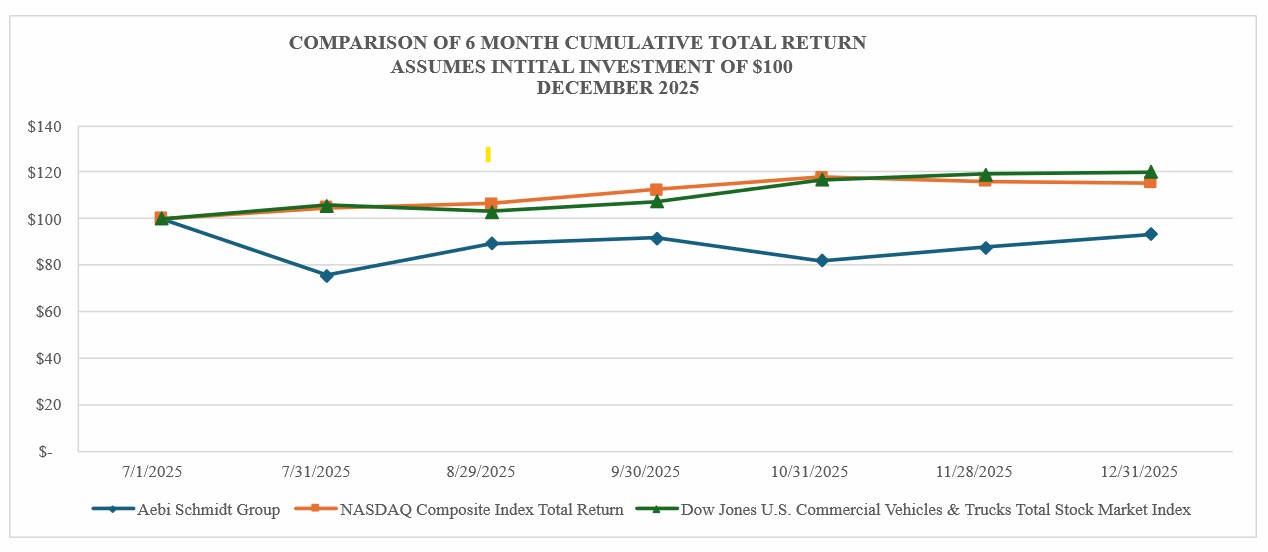
| 7/1/2025 | 7/31/2025 | 8/29/2025 | 9/30/2025 | 10/31/2025 | 11/28/2025 | 12/31/2025 | |||||||||||||||||||||||||||||||||||
| Aebi Schmidt Group | $ | 100 | $ | 76 | $ | 89 | $ | 92 | $ | 82 | $ | 88 | $ | 93 | |||||||||||||||||||||||||||
| NASDAQ Composite Index Total Return | $ | 100 | $ | 105 | $ | 106 | $ | 112 | $ | 118 | $ | 116 | $ | 115 | |||||||||||||||||||||||||||
| Dow Jones U.S. Commercial Vehicles & Trucks Total Stock Market Index | $ | 100 | $ | 106 | $ | 103 | $ | 108 | $ | 117 | $ | 119 | $ | 120 | |||||||||||||||||||||||||||
The stock price performance graph and related information shall not be deemed ‘‘filed’’ with the Securities and Exchange Commission, nor shall such information be incorporated by reference by any general statement incorporating by reference this Form 10-K into any filing under the Securities Act or the Exchange Act, except to the extent that we specifically incorporate this information by reference.
Recent Sales of Unregistered Securities
On June 24, 2025, we granted an aggregate of 250,000 shares of our Common Stock (such number is adjusted for the 1 to 7.5 forward stock split of our common stock effected on July 1, 2025) to members of our executive board and/or other senior executives of our group companies, to reward them for exceptional performance, help retain their services, and better align their interests with those of Aebi Schmidt. The shares used to settle these grants were issued on July 1, 2025. The grants were made in reliance on an exemption from the registration requirements of the Securities Act under Section 4(a)(2) thereof on the basis that the issuance of securities did not involve a public offering.
We made no other issuances of unregistered securities during the period covered by this Annual Report.
Issuer Purchases of Equity Securities
We do not have any publicly announced stock repurchase plans or programs, so did not engage in any share repurchases under any such plan or program during the fourth quarter of 2025, and we did not effect any other share repurchases during such period.
Item 6. [ Reserved ]
Item 7. Management's Discussion and Analysis of Financial Condition and Results of Operations
A discussion of changes in (i) our results of operations, (ii) our segment results of operations and (iii) our cash flows from operating, investing and financing activities for the year ended December 31, 2024 compared with the year ended December 31, 2023 has been omitted from this Annual Report but may be found under the headings (i) “Management's Discussion and Analysis of Financial Condition and Results of Operations - Results of Operations,” (ii) “Management's
32
Discussion and Analysis of Financial Condition and Results of Operations - Segment Results of Operations” and (iii) “Management's Discussion and Analysis of Financial Condition and Results of Operations - Cash Flows,” respectively, included in the Company's Registration Statement on Form S-4/A (File No. 333-286373) filed with the SEC on May 12, 2025.
Forward-Looking Statements
The following discussion and analysis of the financial condition and results of operations of Aebi Schmidt should be read together with Aebi Schmidt’s audited consolidated financial statements as of and for the years ended December 31, 2025, 2024 and 2023, and the related notes thereto, which are included elsewhere in this Annual Report. Unless the context requires otherwise, references to “Aebi Schmidt” in this section of the Annual Report refer to Aebi Schmidt and its consolidated subsidiaries. The information presented herein is based on management’s perspective of Aebi Schmidt’s results of operations. The following discussion contains forward-looking statements that reflect future plans, estimates, beliefs and expected performance. The forward-looking statements are dependent upon events, risks and uncertainties that may be outside of Aebi Schmidt’s control. Aebi Schmidt’s actual results may differ significantly from those projected in the forward-looking statements. Factors that might cause future results to differ materially from those projected in the forward-looking statements include, but are not limited to, those discussed in the sections entitled “Forward-Looking Statements” and “Risk Factors”.
Overview
Aebi Schmidt is a leading global manufacturer of specialty vehicles. We are headquartered in Switzerland and employ approximately 5,700 people. We operate in 17 countries through our own sales and service organizations, with more than 70 locations worldwide, including over a dozen production facilities and a dense network of upfitting and service centers. Through established partnerships with dealers, we are represented in more than 90 additional countries globally. Our core offerings include solutions and equipment for snow removal and de-icing, street and runway sweepers, truck and RV chassis, as well as truck bodies and vehicle upfitting for a wide range of commercial fleets and vocations. Furthermore, we produce specialty vehicles and equipment for municipal and airport maintenance services as well as for the cultivation of steep and challenging terrain.
On July 1, 2025, Aebi Schmidt acquired 100% of the outstanding equity interests of Shyft, a niche market leader in specialty vehicle manufacturing and assembly for the commercial and recreational vehicle industries, through the Merger. The Merger involved 100% of the voting equity interests of Shyft, with the primary reasons for the combination being to enhance our product offerings in specialty vehicle solutions, develop our market share in North America, and the leverage Shyft's innovative design and manufacturing capabilities.
Aebi Schmidt has a track record in continuous profitable growth. For the year ended December 31, 2025, its sales increased by $440.7 million, or 41%, to $1,526.6 million in comparison to the year ended December 31, 2024, due in part to the Merger with Shyft in July 2025. For the year ended December 31, 2024, its Sales increased by $70.4 million, or 7%, to $1,086.0 million in comparison to the year ended December 31, 2023. Operating income increased by $4.6 million, or 7%, to $73.1 million in the year ended December 31, 2025 in comparison to the year ended December 31, 2024, and increased by $9.5 million, or 16%, to $68.5 million in the year ended December 31, 2024 in comparison to the year ended December 31, 2023. Based on its strategy and strong customer orientation, Aebi Schmidt is prepared to continue the growth path in the foreseeable future.
North America
Aebi Schmidt North America segment offers a wide range of vehicles, equipment and services primarily across four of our five lines of business: Airport & Chassis, Commercial Trucks, Goods Transport, and Municipal. Aebi Schmidt operates as a key player in providing innovative solutions for snow removal, street cleaning, and other essential services that enhance infrastructure and public safety. The Merger with Shyft in July 2025 allowed Aebi Schmidt to penetrate additional markets and product lines, as well as combine Aebi Schmidt’s commercial business with Shyft’s fleet and commercial business, optimizing Aebi Schmidt’s purchasing and production capacity.
•Airport & Chassis. MB and Schmidt are both leading in equipment for airport runway maintenance, offering snow removal and de-icing solutions, multi-tasking machines, and runway sweepers. Spartan RV Chassis also fit into this line of business.
•Commercial Trucks. With an outstanding variety of different value propositions, Monroe, Magnum, Strobes-R-Us and Meyer either build or upfit work trucks for commercial and municipal fleets and individual business owners.
33
•Goods Transport. Utilimaster designs and builds fleet solutions and offers a support and service network throughout the life span of vans and trucks. Our EV solutions are marketed under the Blue Arc brand. Towmaster equipment trailers are also included in this line.
•Municipal. Both Monroe and Swenson provide snow & ice control equipment and liquid anti-icing systems. Our Municipal line also include electric Sweepers from Schmidt, Pavement Marking Solutions from MB and ELP’s full range of snow removal equipment, dump bodies, interchangeable body system, and more.
Europe and the ROW
In Europe and ROW, Aebi Schmidt offers a wide range of vehicles, equipment and services primarily across three of our five lines of business: Airport & Chassis, Municipal and Agriculture. Aebi Schmidt has long-lasting relationships with airports and municipalities across Europe and with international customers. Aebi Schmidt offers a wide range of products tailored to European and international markets, including snowplows, street sweepers, multifunctional vehicles, and specialized equipment for airport operations. Aebi Schmidt has established a strong reputation for quality and reliability, with innovative solutions that enhance efficiency and sustainability through its technological features.
•Airport & Chassis. Primarily Airport Maintenance Teams rely on Schmidt Technology for decades. Its jet, compact and high-speed sweepers, sprayers and blowers provide for airport operations in both winter and summer. Meanwhile they are almost all equipped with state-of-the-art control systems, some of which allow automated or autonomous operations. Schmidt also offers hydraulic equipment and control systems for this line of business .
•Municipal. Schmidt combines a powerful range of expertise across the many municipal requirements in both summer and winter. Schmidt launched its first sweeper in the 1960's and has since incorporated technologies like pre-wetted salt spreading from Nido, narrow-track multipurpose transporters from Ladog, Scandinavian plowing technologies and more from Arctic or Tellefsdal. A constantly growing number of vehicles and solutions do meanwhile also come with full electric drive, supporting municipalities to meet their emission targets.
•Agriculture. Aebi provides solutions to cultivate steep and challenging terrain efficiently and safely. Aebi Slope Tractors, Transporter or Motor Mowers are used by mountain farming businesses, municipalities and contractors.
Trends and Key Factors Affecting Performance
As a manufacturer of vehicles, equipment, and attachments for vehicles, Aebi Schmidt operates within the economic and regulatory environment surrounding the commercial trucks and trailers, snow and ice clearing, street sweeping, airport snow and ice clearing, and agriculture industries. Aebi Schmidt’s performance and results of operations are driven by key external trends and factors, including:
Growing Trucking Industry
Aebi Schmidt’s commercial trucks and trailers business is heavily dependent on the trucking industry. The growth of the business segment is partly driven by the overall growth of the economy. Aebi Schmidt’s ability to capitalize on the increased demand from the trucking industry will significantly impact its sales, sales growth, and financial performance.
Changes in Airport Traffic and Operating Airports
Aebi Schmidt’s airport snow and ice clearing business is dependent on overall airport traffic and the number of operating airports. As Aebi Schmidt provides critical infrastructure for airports to comply with strict safety and operational standards set by aviation authorities, Aebi Schmidt anticipates the need for its equipment to continue as failure by airports to meet these standards due to inadequate snow and ice clearing can result in penalties and operational restrictions. During slower periods of national and global travel, Aebi Schmidt’s business may experience decline due to fewer flights, and airport closures can cause lower demand for its products. However, as demand for air travel increases and airports are built or expanded, Aebi Schmidt expects to have an advantage over its competitors as Aebi Schmidt has existing relationships with airports and a proven track record for providing equipment that is compliant with aviation standards. Aebi Schmidt’s ability to maintain these relationships and provide equipment that meets the needs of airports in various jurisdictions may have a material impact on its future sales and sales growth. Additionally, Aebi Schmidt’s business relies on weather conditions and thrives during periods of heavy snow and icing.
Municipal Growth and Urbanization
Aebi Schmidt’s municipal snow and ice clearing business and municipal street sweeping business is expected to be impacted by increasing urbanization. As municipalities continue to develop and expand, Aebi Schmidt anticipates growth for its business due to increases in roads that require maintenance. As cities expand and populations increase, there is a
34
heightened need for effective infrastructure maintenance, including road cleaning, snow removal, and other municipal services. Aebi Schmidt expects that increased urbanization will lead to its ongoing collaboration with municipalities to address their unique needs. Aebi Schmidt’s ability to meet the needs of various municipalities depending on their location and infrastructure may have a material impact on its future sales and sales growth.
Climate Change and Weather Events
Demand for Aebi Schmidt’s snow and ice clearing products are in part affected by climate change and weather events. As temperatures rise, shorter winters and less snow fall could cause a decrease in demand for Aebi Schmidt’s equipment. Aebi Schmidt’s ability to monitor and adapt to different product needs based on the changing climate may have a material impact on its future sales and financial performance. At the same time, sustainability and efficiency play a crucial role in Aebi Schmidt’s operations. Aebi Schmidt’s machines are designed to optimize performance by applying the precise amount of additives needed, ensuring both environmental responsibility and cost-effectiveness.
Price of Raw Materials and Components
Aebi Schmidt sources its raw materials and manufactured components from suppliers both domestically and internationally. Aebi Schmidt’s business approach is based on local presence which is also reflected on its sourcing strategy: Aebi Schmidt sources primarily from North American suppliers for its North American business and from European suppliers for its European business. However, Aebi Schmidt’s supply chain may have tier 2 or tier 3 suppliers that are located in other geographic regions, such as China. The prices of key raw materials, including steel or aluminum may experience volatility due to economic conditions outside of Aebi Schmidt’s control, such as tariffs and which may impact its overall profitability. Aebi Schmidt’s ability to control its exposure to fluctuations in raw materials prices through long-term supply contracts and other instruments, as well as through its contract negotiations with suppliers, may have a material impact on its costs and financial performance.
Increasing Costs of Production
The performance of Aebi Schmidt’s manufacturing operations is driven by various factors influencing production. Unplanned downtime due to labor supply, safety incidents, or supply chain issues could significantly decrease production and impact the number of products Aebi Schmidt is able to produce and sell. Increasing labor costs and increasing energy costs could lead to an increased cost of production, which could negatively impact Aebi Schmidt’s results of operations if increased costs cannot be passed on to the markets. Supply chain challenges, including transportation delays and shortages of certain materials, may lead to increased costs for sourcing raw materials. Aebi Schmidt continues to monitor a variety of external factors, such as supply chain disruptions and labor pressures, and its ability to adapt to these factors may have a material impact on its costs and financial performance.
Changes in Global Market Conditions
Global market conditions, including inflation, recession, interest rates, tariffs, trade laws, ongoing conflicts in the Middle East and Ukraine, and governmental regulations, may create challenges for Aebi Schmidt’s business. The overall economic climate has a direct impact on Aebi Schmidt’s sales and revenue, including future top-line growth. Fluctuations in interest rates can influence Aebi Schmidt’s borrowing costs and consumer financing options. An increase in interest rates would lead to higher costs of capital, which may impact Aebi Schmidt’s investment strategies and expansion plans.
Tariffs and trade laws can affect Aebi Schmidt’s cost structure and market access. The imposition of tariffs on imported goods may increase Aebi Schmidt’s costs for raw material and components, which may materially impact its profitability. While sourcing primarily from local suppliers, such as U.S. suppliers for U.S. manufacturing, may provide some protection from tariffs and trade barriers, such tariffs and trade barriers may also increase the cost of locally sourced materials as the overall supply in the local market may be limited. Further, some local suppliers may not be able to supply their materials and components as they may rely on international sub-suppliers. To mitigate short-term price volatility, Aebi Schmidt seeks to lock in key raw materials for up to the next month to two years through selective and dedicated supplier contracts. Aebi Schmidt primarily sells products manufactured in the United States to customers in its North American segment and products manufactured in Europe to customers in Europe and other parts of the world. Tariffs and trade barriers may affect Aebi Schmidt’s business, directly or indirectly, through the general level of economic activity, the impact on local prices, and the availability of materials and components, among other factors.
Changes in Regulatory Environment
Aebi Schmidt operates in economies regulated by federal, state, and international environmental laws which may affect its operations, use and/or disposal of materials, and emissions. Changes in regulations require Aebi Schmidt to adapt its operations to comply with additional regulations, which may increase its costs and investments in new technologies. Aebi Schmidt must ensure that its products comply with emissions regulations set by governments and international bodies. Aebi Schmidt also incorporates safety features into its equipment to comply with industry and regulatory safety standards,
35
and the introduction of new standards may involve additional design and engineering efforts on Aebi Schmidt’s part, which could increase its research and development costs. Additional initiatives and legislation could also lead to increased legal, administrative, or environmental costs. As Aebi Schmidt expands its geographic footprint, Aebi Schmidt may be subject to additional regulations that are more stringent than the ones it is currently subject to.
Due to its established economies of scale, Aebi Schmidt expects to have a competitive advantage in its ability to adequately comply with any additional regulatory requirements, while new entrants into the industry or smaller competitors may struggle to comply with such environmental, safety, and other requirements. Aebi Schmidt’s ability to maintain this competitive advantage may have a significant impact on its ability to expand its geographic footprint and market share in existing markets. Furthermore, as a global supplier, Aebi Schmidt must navigate varying regulatory requirements across different countries. For example, the same product may need to be homologated multiple times to comply with different national regulations. Aebi Schmidt is seeing signs of deregulation or halted additional regulation in the U.S., while the EU continues to implement and enforce stricter regulations, adding further complexity to its regulatory compliance efforts.
Key Performance Indicators
Aebi Schmidt reviews the following key performance indicators on a regular basis in order to evaluate the financial and operating performance of its business, identify trends affecting its performance, prepare financial projections, and make strategic decisions. Aebi Schmidt’s key performance indicators are not based on any standardized industry methodology and are not necessarily calculated in the same manner or comparable to similarly titled measures presented by other companies. Similarly, Aebi Schmidt’s key metrics may differ from estimates published by third parties or from similarly titled metrics of its competitors due to differences in methodology. The numbers that Aebi Schmidt uses to calculate its key performance indicators are based on internal data. While these numbers are based on what Aebi Schmidt believes to be reasonable judgments and estimates for the applicable period of measurement, there are inherent challenges in measuring usage and engagement. Increases or decreases in Aebi Schmidt’s key performance indicators may not correspond with increases or decreases in its revenue. Aebi Schmidt regularly reviews and may adjust its processes for calculating its internal metrics to improve their accuracy. In addition to the key performance indicators summarized below, Aebi Schmidt also evaluates certain non-GAAP financial measures (e.g., Adjusted EBITDA and Adjusted EBITDA margin), which are further summarized in the Non-GAAP Financial Measures section below.
The following table presents a summary of Aebi Schmidt’s key performance indicators for the years ended December 31, 2025, December 31, 2024 and December 31, 2023.
| Year Ended December 31, | |||||||||||||||||
| (in thousands, except percentages) | 2025 | 2024 | 2023 | ||||||||||||||
| Sales | $ | 1,526,625 | $ | 1,085,958 | $ | 1,015,572 | |||||||||||
| Net income | 9,706 | 30,737 | 11,199 | ||||||||||||||
| Net income margin | 0.6 | % | 2.8 | % | 1.1 | % | |||||||||||
Adjusted EBITDA(1) | 132,840 | 98,997 | 86,408 | ||||||||||||||
Adjusted EBITDA margin(1) | 8.7 | % | 9.1 | % | 8.5 | % | |||||||||||
| Net cash provided by (used in) operating activities | 8,972 | 68,770 | 30,090 | ||||||||||||||
_________________
(1)Adjusted EBITDA and Adjusted EBITDA margin are non-GAAP financial measures. See the section titled “Non-GAAP Financial Measures” below for the definitions of these measures and the reconciliations to the most directly comparable U.S. GAAP financial measures.
Components of Results of Operations
Sales
Sales are comprised primarily of revenue from the sale of equipment for commercial vehicles and trailers, snow and ice clearing, airport runway clearing, street cleaning and marking, environmental maintenance, and agriculture, net of sales discounts, rebates, and commissions. Sales also include revenues generated from selling spare parts as well as repair and maintenance services for these machines. In general, these after-sales activities add 15% to 20% of the total annual sales of Aebi Schmidt’s Group. In accordance with Aebi Schmidt’s business segments, after sales activities in Europe and the ROW are directly linked to products sold in Europe and the ROW. Likewise, North America after sales services are only rendered in North America.
36
Cost of products sold
Cost of products sold consists of materials and supplies, personnel costs, outsourced services, depreciation and outgoing freight costs.
Research and development expense
Research and development expense primarily consists of compensation costs, external engineering service costs, and material costs for product development and prototyping, among other items.
Selling, general and administrative expense
Selling, general and administrative expense consists of sales, after sales, marketing, product management, and strategic purchasing expenses, as well as administrative expenses such as costs related to human resources, finance and information technology (including enterprise resource planning system). Amortization of intangible assets such as concessions, rights, licenses, and information technology software is also included in selling, general and administrative expense.
Amortization of purchased intangibles
Amortization of purchased intangibles consists of amortization of acquired brands, technology assets, customer relationships and other acquired finite-lived intangible assets.
Other operating (income) expense
Other operating income and expense consists primarily of foreign exchange income and expense. Aebi Schmidt’s functional currency is generally the applicable local currency. Aebi Schmidt’s reporting currency is the U.S. dollar, and a majority of its sales are received in U.S. dollars.
Interest expense
Interest expense primarily consists of interest paid and accrued on Aebi Schmidt’s short- and long-term debt.
Other income (expense)
Other income and expense was driven by transaction costs, restructuring expenses, as well as integration costs, proceeds from the sale of property, plant and equipment, other exceptional income and expense, and foreign exchange income and losses on financial positions. These positions were partially offset by income attributable to pension assets. Exceptional income and expense refer to unusual or non-recurring amounts that are outside Aebi Schmidt's normal operations.
Income tax expense (benefit)
Aebi Schmidt is subject to tax in multiple jurisdictions, including those in the United States, Switzerland, Canada and countries in the European Union, e.g. Germany, Netherlands or Poland. The tax jurisdictions in which Aebi Schmidt operates have different statutory tax rates. Accordingly, Aebi Schmidt’s effective tax rate will vary depending on the relative proportion of income in each jurisdiction, changes in the valuation allowance on its deferred tax assets, and changes in tax laws.
Results of Operations
Results for Aebi Schmidt for the year ended December 31, 2025, compared to results for the year ended December 31, 2024.
| For the Year Ended December 31, | |||||||||||||||||||||||
| 2025 | 2024 | $ Change | % Change | ||||||||||||||||||||
| Sales | $ | 1,526,625 | $ | 1,085,958 | $ | 440,667 | 41 | % | |||||||||||||||
| Cost of products sold | 1,222,571 | 857,721 | 364,850 | 43 | % | ||||||||||||||||||
| Gross profit | $ | 304,054 | $ | 228,237 | $ | 75,817 | 33 | % | |||||||||||||||
| Operating expenses: | |||||||||||||||||||||||
| Research and development | 26,494 | 19,556 | 6,938 | 35 | % | ||||||||||||||||||
| Selling, general and administrative | 180,647 | 124,660 | 55,987 | 45 | % | ||||||||||||||||||
| Amortization of purchased intangibles | 23,316 | 14,088 | 9,228 | 66 | % | ||||||||||||||||||
| Other operating (income) expense | 531 | 1,441 | (910) | -63 | % | ||||||||||||||||||
37
| For the Year Ended December 31, | |||||||||||||||||||||||
| 2025 | 2024 | $ Change | % Change | ||||||||||||||||||||
| Total operating expenses | $ | 230,988 | $ | 159,745 | $ | 71,243 | 45 | % | |||||||||||||||
| Operating income | $ | 73,066 | $ | 68,492 | $ | 4,574 | 7 | % | |||||||||||||||
| Other income (expense): | |||||||||||||||||||||||
| Interest expense | (41,794) | (34,106) | (7,688) | 23 | % | ||||||||||||||||||
| Other income (expense) | (20,080) | 7,278 | (27,358) | -376 | % | ||||||||||||||||||
| Total other income (expense) | $ | (61,874) | $ | (26,828) | $ | (35,046) | 131 | % | |||||||||||||||
| Income from continuing operations before income taxes | $ | 11,192 | $ | 41,664 | $ | (30,472) | -73 | % | |||||||||||||||
| Income tax expense (benefit) | 1,486 | 10,927 | (9,441) | -86 | % | ||||||||||||||||||
| Income from continuing operations | $ | 9,706 | $ | 30,737 | $ | (21,031) | -68 | % | |||||||||||||||
| Net income | 9,706 | 30,737 | (21,031) | -68 | % | ||||||||||||||||||
| Less: Net income attributable to non-controlling interest | (33) | 55 | (88) | -160 | % | ||||||||||||||||||
| Net income attributable to Aebi Schmidt Holding AG | $ | 9,739 | $ | 30,682 | $ | (20,943) | -68 | % | |||||||||||||||
Sales
Sales increased by $440.7 million, or 41%, to $1,526.6 million for the year ended December 31, 2025, from $1,086.0 million for the year ended December 31, 2024. The increase in sales was primarily driven by sales attributed to Shyft of $378.0 million, an increase in new business sales of $49.6 million, and an increase in after sales of $13.1 million.
Cost of products sold
Cost of products sold increased by $364.9 million, or 43%, to $1,222.6 million for the year ended December 31, 2025, from $857.7 million for the year ended December 31, 2024. The increase in cost of products sold was driven by $310.5 million in costs attributable to Shyft, an increase of $45.7 million in costs related to new business sales, and an increase of $9.0 million in costs related to after sales. This was partially offset by a decrease of $3.5 million due to lower overhead costs incurred compared to the prior year.
Research and development expense
Research and development expense increased by $6.9 million, or 35%, to $26.5 million for the year ended December 31, 2025, from $19.6 million for the year ended December 31, 2024 primarily driven by an increase of $5.2 million in activity attributable to Shyft and development of new product solutions by Aebi Schmidt.
Selling, general and administrative expense
Selling, general and administrative expense increased by $56.0 million, or 45%, to $180.6 million for the year ended December 31, 2025, from $124.7 million for the year ended December 31, 2024. The increase in selling, general and administrative expense was primarily driven by an increase of $55.8 million in costs attributable to Shyft, along with an increase in finance department costs of $4.6 million and an increase in IT costs of $2.2 million, partially offset by a decrease in general administrative costs of $7.4 million driven by the change in repurchase liability for our employee share plan and a decrease in management costs of $0.4 million.
Amortization of purchased intangibles
Amortization of purchased intangibles increased by $9.2 million, or 66%, to $23.3 million for the year ended December 31, 2025, from $14.1 million for the year ended December 31, 2024. The increase is primarily attributable to amortization of $9.0 million related to the intangible assets acquired as part of the Merger with Shyft.
Other operating (income) expense
Other operating expense decreased by $0.9 million, or 63%, to $0.5 million for the year ended December 31, 2025, from other operating expense of $1.4 million for the year ended December 31, 2024. The decrease in other operating expense was primarily driven by a decrease of net foreign exchange losses of $0.4 million and decrease of other expenses by $0.5 million.
38
Interest expense
Interest expense increased by $7.7 million, or 23%, to $41.8 million for the year ended December 31, 2025, from $34.1 million for the year ended December 31, 2024. The increase in interest expense was primarily driven by an increase in interest expense attributable to Shyft of $1.3 million, the incurrence of $4.8 million in costs related to the debt refinancing we undertook in connection with the Merger, and an increase in cash interest paid attributable to Aebi Schmidt of $1.7 million.
Other income (expense)
Other expense changed by $27.4 million to $20.1 million for the year ended December 31, 2025, from other income of $7.3 million for the year ended December 31, 2024. The change in other expense was mainly driven by an increase in transactions-related expense of $12.1 million, an increase in net foreign exchange losses on financial positions of $4.6 million, integration costs of $3.9 million, and a change attributable to the bargain purchase gain on acquisition by $6.8 million recorded in 2024, partially offset by other income attributable to Shyft of $2.2 million.
Income tax expense (benefit)
Income tax expense decreased by $9.4 million, or 86%, to $1.5 million for the year ended December 31, 2025, from $10.9 million for the year ended December 31, 2024. The change in income tax expense (benefit) was primarily driven by a $2.9 million benefit attributable to Shyft and a decrease in income tax expense of $6.6 million mainly driven by a change in the uncertain tax position of $5.4 million, as well as by lower taxable income for the year ended December 31, 2025.
Segment Results of Operations
Aebi Schmidt operates its business as two reportable segments: (i) North America and (ii) Europe and ROW. Both segments operate separately with limited cross-selling activities.
The information below includes sales and Adjusted EBITDA by segment, consistent with information presented for financial reporting purposes in “Note 17 - Segments” of the Notes to Consolidated Financial Statements included in Item 8 appearing in this Annual Report. Costs that are not allocated to either segment and intrasegment revenues and expenses are immaterial and are included within the figures shown below.
| For the Year Ended December 31, 2025 | |||||||||||||||||
| (in thousands) | North America | Europe and ROW | Total | ||||||||||||||
| Segment sales | $ | 975,102 | $ | 551,523 | $ | 1,526,625 | |||||||||||
| Segment Adjusted EBITDA | $ | 99,391 | $ | 33,449 | $ | 132,840 | |||||||||||
| For the Year Ended December 31, 2024 | |||||||||||||||||
| North America | Europe and ROW | Total | |||||||||||||||
| Segment sales | $ | 593,441 | $ | 492,517 | $ | 1,085,958 | |||||||||||
| Segment Adjusted EBITDA | $ | 68,700 | $ | 30,297 | $ | 98,997 | |||||||||||
North America
Sales for the North America segment increased by $381.7 million, or 64%, to $975.1 million for the year ended December 31, 2025, from $593.4 million for the year ended December 31, 2024. The increase in sales was primarily driven by sales attributable to Shyft of $378.0 million, as well as higher sales of new products of $0.9 million and an increase in after sales of $2.8 million.
Adjusted EBITDA for the North America segment increased by $30.7 million, or 45%, to $99.4 million in the year ending December 31, 2025, from $68.7 million in the year ending December 31, 2024. The increase in Adjusted EBITDA was primarily driven by the addition of $36.9 million in activity attributable to Shyft, along with an increase in other segment income of $0.7 million, and a decrease in research and development expenses of $0.4 million, partially offset by an increase in selling, general, and administrative expenses of $6.6 million and a decrease of gross margin of $0.7 million.
Europe and ROW
Sales for the Europe and ROW segment increased by $59.0 million, or 12%, to $551.5 million for the year ended December 31, 2025, from $492.5 million for the year ended December 31, 2024. The increase in sales was driven by an increase in sales of new products of $48.7 million and an increase in after sales of $10.3 million.
39
Adjusted EBITDA for the Europe and ROW segment increased by $3.2 million, or 10%, to $33.4 million for the year ended December 31, 2025, from $30.3 million for the year ended December 31, 2024. The increase in Adjusted EBITDA was driven by an increase in gross margin of $8.8 million and a decrease in selling, general and administrative expenses of $6.3 million, partially offset by an increase in expenses related to other segment items of $9.8 million and an increase in research and development expense of $2.2 million.
Non-GAAP Financial Measures
Aebi Schmidt utilizes non-GAAP financial measures, Adjusted EBITDA and Adjusted EBITDA margin to complement its U.S. GAAP reporting and to assist stakeholders in evaluating and comparing its financial and operational performance over multiple periods, identifying trends affecting its business, formulating business plans, and making strategic decisions. There can be no assurance that Aebi Schmidt will not modify the presentation of its non-GAAP measures in the future, and any such modification may be material.
Aebi Schmidt defines Adjusted EBITDA as net income before interest, taxes, depreciation, and amortization, further adjusted for foreign exchange gains and losses on external debt, restructuring and other related expenses, transaction related expenses, integration costs, bargain purchase gains on acquisitions, settlement of acquisition, changes in repurchase liabilities for Aebi Schmidt’s employee share plan, non-service cost related pension expenses, legacy legal matters, sales executive transition costs, changes in provisions for contingencies, non-cash stock based compensation expenses, and other non-recurring items. Aebi Schmidt defines as Adjusted EBITDA margin as a ratio of Adjusted EBITDA as a percentage of sales. Management uses Adjusted EBITDA to assess Aebi Schmidt’s financial performance because it allows management and stakeholders to compare its operating performance on a consistent basis across periods by removing the effects of its capital structure (such as varying levels of interest expense and income), asset base (such as depreciation and amortization) and other items (such as non-recurring costs) that impact the comparability of financial results from period to period.
In evaluating Adjusted EBITDA, you should be aware that in the future Aebi Schmidt may incur expenses that are the same as or similar to some of the adjustments in such presentation. Aebi Schmidt’s presentation of Adjusted EBITDA and Adjusted EBITDA margin should not be construed as an inference that future results will be unaffected by unusual or non-recurring items. Adjusted EBITDA and Adjusted EBITDA margin have important limitations as an analytical tool, and you should not consider these measures in isolation or as a substitute for analysis of Aebi Schmidt’s operating results as reported under U.S. GAAP. Adjusted EBITDA and Adjusted EBITDA margin may be defined differently by other
40
companies in its industry and may not be comparable to similarly titled measures of other companies, thereby diminishing their utility.
| For the year ended December 31, | |||||||||||||||||
| (in thousands, except percentages) | 2025 | 2024 | 2023 | ||||||||||||||
| Net income | $ | 9,706 | $ | 30,737 | $ | 11,199 | |||||||||||
Adjusted for: | |||||||||||||||||
| Income tax expense (benefit) | 1,486 | 10,927 | 6,147 | ||||||||||||||
| Interest expense | 41,794 | 34,106 | 38,031 | ||||||||||||||
| Foreign exchange (gain) / losses on external debt | 2,961 | (1,647) | 1,778 | ||||||||||||||
| Depreciation and amortization | 44,200 | 26,414 | 27,164 | ||||||||||||||
| Restructuring and other related expenses | 17,725 | 819 | (253) | ||||||||||||||
| Transaction related expenses | 14,765 | 4,404 | — | ||||||||||||||
| Bargain purchase gain on acquisition | — | (6,780) | — | ||||||||||||||
| Integration costs | 3,856 | — | — | ||||||||||||||
| Settlement of acquisition | 1,697 | — | — | ||||||||||||||
| Change in repurchase liability for employee share plan | (6,377) | 3,446 | 2,562 | ||||||||||||||
| Pension related income, net | (5,055) | (4,290) | (2,502) | ||||||||||||||
| Legacy legal matters | 1,281 | 180 | 501 | ||||||||||||||
| Sales executive transition | — | 266 | — | ||||||||||||||
| Change in provision for contingencies | (1,291) | (98) | 1,569 | ||||||||||||||
| Non-cash stock-based compensation expenses | 1,473 | — | — | ||||||||||||||
| Other non-operating one-off items | 4,619 | 513 | 212 | ||||||||||||||
| Adjusted EBITDA | $ | 132,840 | $ | 98,997 | $ | 86,408 | |||||||||||
| Sales | 1,526,625 | 1,085,958 | 1,015,572 | ||||||||||||||
| Net Income Margin | 0.6 | % | 2.8 | % | 1.1 | % | |||||||||||
| Adjusted EBITDA Margin | 8.7 | % | 9.1 | % | 8.5 | % | |||||||||||
Liquidity and Capital Resources
Aebi Schmidt’s primary liquidity needs are to fund general business requirements, including working capital, capital expenditures, restructuring costs and debt service requirements. Aebi Schmidt’s principal sources of liquidity are cash flows from operating activities, its revolving credit facility and other debt issuances, and existing cash balances of $98.5 million as of December 31, 2025. Aebi Schmidt actively manages its working capital and associated cash requirements and continually seeks more effective uses of cash.
As of December 31, 2025, Aebi Schmidt had $416.5 million of net working capital (i.e., current assets minus current liabilities), as compared to $251.0 million of net working capital as of December 31, 2024 and $252.6 million of net working capital as of December 31, 2023.
Aebi Schmidt believes that its available liquidity will be sufficient to meet its current obligations for at least 12 months from the date of this filing and for the foreseeable future thereafter, and its liquidity will be sufficient to finance its operating and capital needs, including day to day operations, capital expenditures, research and development, investments in information technology systems, dividends and potential future acquisitions.
Cash Flows
Aebi Schmidt’s cash flows from operating, investing and financing activities, as reflected in the Aebi Schmidt Consolidated Statements of Cash Flows for the year ended December 31, 2025 compared to the year ended December 31, 2024 are summarized in the following table.
41
| For the Year Ended December 31, | ||||||||||||||||||||||||||
| (in thousands) | 2025 | 2024 | $ Change | % Change | ||||||||||||||||||||||
| Net cash provided by (used in) operating activities | $ | 8,972 | $ | 68,770 | $ | (59,798) | -87 | % | ||||||||||||||||||
| Net cash provided by (used in) investing activities | 5,824 | (9,112) | 14,936 | -164 | % | |||||||||||||||||||||
| Net cash provided by (used in) financing activities | $ | 16,348 | (35,428) | 51,776 | -146 | % | ||||||||||||||||||||
| Translation adjustment on cash and cash equivalents | 2,195 | (1,755) | 3,950 | n.m. | ||||||||||||||||||||||
| Net increase (decrease) in cash and cash equivalents | 33,339 | 22,475 | 10,864 | 48 | % | |||||||||||||||||||||
| Cash and cash equivalents at beginning of year | 65,173 | $ | 42,698 | $ | 22,475 | 53 | % | |||||||||||||||||||
| Cash and cash equivalents at end of year | $ | 98,512 | 65,173 | 33,339 | 51 | % | ||||||||||||||||||||
_________________
n.m. – not meaningful
Net cash provided by operating activities
Net cash provided by operating activities decreased by $59.8 million, or 87%, to $9.0 million for the year ended December 31, 2025, from $68.8 million for the year ended December 31, 2024. The decrease in net cash provided by operating activities was primarily driven by a decrease in net income of $21.0 million, a decrease in collection of accounts receivable and contract assets of $61.4 million, a decrease of $19.2 million in other current liabilities and accrued expenses, an increase of $18.9 million in inventory levels, an increase in net other assets and liabilities of $15.0 million, and an increase in income taxes receivable of $11.7 million. This activity was partially offset by an increase in accounts payable and contract liabilities of $39.0 million due to increased costs of production and purchases of raw materials, and an increase in accrued compensation and related taxes of $14.0 million.
Net cash provided by (used in) investing activities
Net cash provided by investing activities increased by $14.9 million, or 164%, to $5.8 million for the year ended December 31, 2025, from cash used in investing activities of $9.1 million for the year ended December 31, 2024. The increase was primarily driven by an increase of $19.4 million of net cash acquired as part of the Merger with Shyft compared to the $4.4 million of net cash acquired in 2024 as part of the acquisition of Ladog.
Net cash provided by (used in) financing activities
Net cash provided by financing activities increased by $51.8 million, or 146%, to $16.3 million for the year ended December 31, 2025, from cash used in financing activities of $35.4 million for the year ended December 31, 2024. The increase was driven by the debt refinancing we undertook in connection with the Merger, which resulted in proceeds, net of payments, of $62.7 million. This increase was partially offset by an increase in dividend payments of $10.2 million and an increase in payments from the exercising and vesting of stock incentive awards of $2.0 million.
Capital Expenditures
For the year ending December 31, 2026, Aebi Schmidt anticipates approximately $24 million of capital expenditures to maintain the capacity of its manufacturing facilities and invest in emerging technologies. This level is comparable with previous years. In its budgeting process, Aebi Schmidt includes major capital expenditures projects for management to review. Aebi Schmidt closely monitors its capital expenditures in order to control its cash flow needs. Aebi Schmidt expects these expenditures to result in more productive and diversified operations. Evolving economic conditions, the potential for increased maintenance costs, and incorrect cash flow estimates from the capital expenditures could result in less-productive investments than Aebi Schmidt anticipates. Aebi Schmidt’s cash flow and operating results could be negatively impacted by the actual returns on its capital expenditures.
42
Debt
| In thousands | December 31, 2025 | December 31, 2024 | December 31, 2023 | ||||||||||||||
| Revolving credit facility, due 2030 | $ | 191,819 | $ | — | $ | — | |||||||||||
| Term loan, Facility A, due 2030 | 328,377 | — | — | ||||||||||||||
| Revolving credit facility, due 2026 | — | 152,787 | 164,737 | ||||||||||||||
| Term loan: | |||||||||||||||||
| Facility A, due 2026 | — | 20,778 | 33,150 | ||||||||||||||
| Facility B, due 2026 | — | 40,000 | 50,000 | ||||||||||||||
| Facility C, due 2026 | — | 119,715 | 121,605 | ||||||||||||||
| Shareholder loan | 59,101 | 51,982 | 55,743 | ||||||||||||||
| Other debt | 15,661 | 14,591 | 16,396 | ||||||||||||||
| Total debt | 594,958 | 399,853 | 441,631 | ||||||||||||||
| Less current portion of long-term debt | (46,908) | (23,259) | (25,120) | ||||||||||||||
| Total long-term debt | $ | 548,050 | $ | 376,594 | $ | 416,511 | |||||||||||
Refinancing Transaction
On March 10, 2025, the Company entered into the New Credit Facilities Agreement comprising:
•Term Loan, Facility A, due 2030
•Revolving Credit Facility, due 2030
The New Credit Facilities Agreement became effective with the closing of the Merger. As of July 1, 2025, the proceeds obtained ($572.1 million) were utilized to fully repay the outstanding amounts of:
•Term Loan, Facility A, B and C, due 2026 ($187.0 million)
•Revolving Credit Facility, due 2026 ($185.6 million)
•Bilateral Credit Lines ($21.1 million)
•Revolving Credit Facility of Shyft ($120.0 million)
Term Loan, Facility A, due 2030
The Term Loan, Facility A is a multicurrency senior secured amortizing term loan facility with a total commitment amount of $350.0 million. The interest rate is variable defined based on the applicable reference rate (SOFR, SARON, EURIBOR), plus a margin. The margin increases with the Company’s leverage ratio. The average interest rate for the six months ended December 31, 2025 was 6.633%.
The Company is subject to certain customary covenants that prohibit the Company from incurring additional indebtedness, limit certain acquisitions, investments, advances or loans and restrict substantial asset sales (all subject to certain exceptions and baskets). In addition, the New Credit Facilities Agreement also requires the Company to maintain certain financial ratios. For the period ended December 31, 2025, the Company was required to maintain a leverage ratio that did not exceed 3.25x. The Company was in compliance with all covenants as of December 31, 2025.
Revolving Credit Facility, due 2030
The revolving credit facility is a multicurrency senior secured revolving loan facility with a total commitment amount of up to $250.0 million The interest rate is variable and based on the applicable a reference rate (SOFR, SARON, EURIBOR), plus a margin. The margin increases with the Company’s leverage ratio. The average interest rate for the six months ended December 31, 2025 was 6.496%.
The Company is subject to certain customary covenants that prohibit the Company from incurring additional indebtedness, limit certain acquisitions, investments, advances or loans and restrict substantial asset sales (all subject to certain exceptions and baskets). In addition, the New Credit Facilities Agreement also requires the Company to maintain certain financial ratios. For the period ended December 31, 2025, the Company was required to maintain a leverage ratio that did not exceed 3.25x. The Company was in compliance with all covenants as of December 31, 2025.
43
Shareholder Loans
As of December 31, 2025 and December 31, 2024, there were subordinated shareholder loans with outstanding amounts of $17.1 million and $17.6 million from PCS Holding AG, as well as subordinated shareholder loans with amounts outstanding of $12.6 million and $11.7 million from Gebuka AG, respectively. The loans are originally granted for a fixed term, but the term will be extended if the loan agreement is not terminated 90 days prior to the end date or if an extension agreement is signed. These shareholder loans were renewed and amended in connection with the New Credit Facilities Agreement.
Other Debts
In connection with the expansion of the plant in Chilton, Wisconsin and certain US mortgage loans, the outstanding amount is about $10.0 million as of December 31, 2025.
Contingent Liabilities
Changes in Aebi Schmidt’s warranty liability during the years ended December 31, 2025, 2024 and 2023 were as follows:
| (in thousands) | 2025 | 2024 | 2023 | ||||||||||||||
| Balance of warranty liability, beginning of year | $ | 10,205 | $ | 8,022 | $ | 5,743 | |||||||||||
| Accruals for current period sales | 7,191 | 5,875 | 4,415 | ||||||||||||||
| Cash settlements | (4,643) | (3,226) | (2,292) | ||||||||||||||
| Changes in liability for pre-existing warranties | (244) | (293) | (161) | ||||||||||||||
| Acquisitions | 6,782 | 278 | — | ||||||||||||||
| Translation adjustment | 1,012 | (451) | 317 | ||||||||||||||
| Balance of warranty liability, end of year | $ | 20,303 | $ | 10,205 | $ | 8,022 | |||||||||||
Aebi Schmidt’s long-term warranty provisions amounting to $2.6 million, $1.6 million and $0.8 million for the years ended December 31, 2025, 2024 and 2023, respectively, is included within other non-current liabilities on its balance sheet.
Contractual and Other Obligations
Aebi Schmidt is party to contractual and other obligations involving commitments to make payments to third parties, and such commitments require a material amount of cash. As part of its normal course of business, Aebi Schmidt enters into contracts with suppliers for purchases of certain raw materials, components, and services to facilitate adequate supply of these materials and services. These arrangements may contain fixed or minimum quantity purchase requirements. Aebi Schmidt believes that its principal sources of liquidity will be sufficient to satisfy such contractual and other obligations.
Refer to “Note 8 - Commitments and Contingent Liabilities” of the Notes to Consolidated Financial Statements in Item 8 appearing in this Annual Report for details on its contractual obligations.
Off-Balance Sheet Arrangements
In the normal course of bidding for and executing certain projects, Aebi Schmidt has entered into bid/performance bonds and surety bonds (collectively “performance bonds”) with various financial institutions. Customers can draw on such performance bonds in the event that Aebi Schmidt does not fulfil its contractual obligations. The Company would then have an obligation to reimburse the financial institution for amounts paid under the performance bonds. At December 31, 2025, 2024 and 2023, the total outstanding performance bonds aggregated to $20.2 million, $13.2 million and $18.7 million, respectively. There have been no significant amounts reimbursed to financial institutions under these types of arrangements in 2025, 2024 and 2023.
Critical Accounting Policies and Estimates
The following discussion of critical accounting policies and estimates is intended to supplement “Note 1 - Nature of Operations and Basis of Presentation” of the Notes to Consolidated Financial Statements in Item 8 appearing in this Annual Report. These policies were selected because they are broadly applicable within Aebi Schmidt’s operating units and they involve additional management judgment due to the sensitivity of the methods, assumptions and estimates necessary in determining the related statement of income, asset and/or liability amounts.
44
Revenue recognition
Essentially all Aebi Schmidt’s revenue is generated through contracts with its customers. Aebi Schmidt may recognize revenue over time or at a point in time when or as obligations under the terms of a contract with its customer are satisfied, depending on the terms and features of the contract and the products supplied. Aebi Schmidt’s contracts generally do not have any significant variable consideration. The collectability of consideration on the contract is reasonably assured before revenue is recognized. On certain vehicles, payment may be received in advance of Aebi Schmidt satisfying its performance obligations. Such payments are recorded in Contract liabilities on the Consolidated Balance Sheets. The corresponding performance obligations are generally satisfied within one year of the contract inception. Aebi Schmidt has elected to utilize the practical expedient to recognize the incremental costs of obtaining a contract as an expense when incurred because the amortization period for the prepaid costs that would have otherwise been deferred and amortized is one year or less. Aebi Schmidt uses an observable price to allocate the stand-alone selling price to separate performance obligations within a contract or a cost-plus margin approach when an observable price is not available. The estimated costs to fulfil Aebi Schmidt’s base warranties are recognized as expense when the products are sold.
The assumptions used to recognize revenue over time are based on measure of progress. Measure of progress is derived from work in progress reports indicating the costs and/or labor hours applied to each project. Aebi Schmidt’s determination of the measure of progress is dependent on the accuracy of expected costs and labor hours for each project. To the extent Aebi Schmidt’s actual costs or labor hours differ from the expected amount, the revenue expected to be recognized over time may differ from the actual revenue recognized. Historically, the difference between expected and actual amounts have been immaterial, and Aebi Schmidt does not expect any material differences in the future.
Business combinations
When acquiring other businesses, Aebi Schmidt recognizes identifiable assets acquired and liabilities assumed at their acquisition date estimated fair values, and separately from any goodwill that may be required to be recognized. Goodwill, when recognizable, is measured as the excess amount of any consideration transferred, which is measured at fair value, over the acquisition date fair values of the identifiable assets acquired and liabilities assumed. Amounts recorded in a business combination may change during the measurement period, which is a period not to exceed one year from the date of acquisition, as additional information about conditions existing at the acquisition date becomes available.
Accounting for such acquisitions requires Aebi Schmidt to make significant assumptions and estimates and are adjusted during the measurement period for a period of up to one year after the acquisition date. Costs incurred to effect an acquisition, such as legal, accounting, valuation or other third-party costs, as well as internal general and administrative costs incurred are charged to expense in the periods incurred. There may be a material difference between the accounting estimates related to the fair value of the assets acquired and liabilities assumed at acquisition date and the final purchase price allocation.
Goodwill and Intangible Assets
In accordance with authoritative guidance on goodwill, it is tested for impairment at least annually, and written down when and to the extent impaired. Aebi Schmidt performs its annual impairment test for goodwill assets as of December 31 of each year, or more frequently if an event occurs or conditions change that would more likely than not reduce the fair value of the asset below its carrying value.
Aebi Schmidt estimates the fair value of acquired intangible assets using various valuation techniques. The primary valuation techniques used include forms of the income approach, specifically the relief-from-royalty and multi-period excess earnings valuation methods. Under these valuation approaches, Aebi Schmidt makes estimates and assumptions from a market participant perspective. Significant assumptions used in estimating future cash flows included projected revenue growth rates and discount rate for customer relationships and projected revenue growth rates, royalty rate and discount rate for brand. Under the multi-period excess earnings method, value is estimated as the present value of the benefits anticipated from ownership of the asset, in excess of the returns required on the investment in contributory assets that are necessary to realize those benefits. The intangible asset’s estimated earnings are determined as the residual earnings after quantifying estimated earnings from contributory assets. Under the relief-from-royalty method, Aebi Schmidt calculates the cost savings associated with owning rather than licensing the assets. Assumed royalty rates are applied to projected revenue for the remaining useful lives of the assets to estimate the royalty savings.
Aebi Schmidt first assesses qualitative factors including, but not limited to, macroeconomic conditions, industry conditions, the competitive environment, changes in the market for products and current and forecasted financial performance to determine whether it is more likely than not that the fair value of a reporting unit is less than its carrying amount. If it is determined that it is more likely than not that the fair value of the reporting unit is greater than its carrying
45
amount, it is not required to calculate the fair value of a reporting unit. Aebi Schmidt has the option to bypass this qualitative assessment and proceed to a quantitative goodwill impairment assessment. If Aebi Schmidt elects to bypass the qualitative assessment, or if after completing the assessment it is determined to be more likely than not that the fair value of a reporting unit is less than its carrying value, Aebi Schmidt performs an impairment test by comparing the fair value of a reporting unit with its carrying amount, including goodwill.
The fair value of the reporting unit is determined by estimating the future cash flows of the reporting unit to which the goodwill relates, and then discounting the future cash flows at a market-participant-derived weighted-average cost of capital (“WACC”). In determining the estimated future cash flows, Aebi Schmidt considers current and projected future levels of income based on the plans for that business; business trends, prospects and market and economic conditions; and market-participant considerations. If the fair value of a reporting unit exceeds its carrying amount, goodwill of the reporting unit is considered to not be impaired. If the carrying amount of the reporting unit exceeds its fair value, an impairment loss is recognized in an amount equal to the excess, up to the value of the goodwill.
Significant judgments inherent in these analyses include assumptions about appropriate sales growth rates, WACC and the EBITDA margin. The judgments and assumptions used in the estimate of fair value are generally consistent with the projections and assumptions that are used in current operating plans. Such assumptions are subject to change as a result of changing economic and competitive conditions. The determination of fair value is highly sensitive to differences between estimated and actual cash flows and changes in the related discount rate used to evaluate the fair value of the reporting units and trade name.
During the fourth quarter of 2025, the Company changed its reporting units. Under accounting standards, the Company is required to perform an impairment assessment of its prior reporting units immediately prior to the change and immediately after the change on its new reporting units. To the extent that a prior reporting unit was separated into more than one reporting unit, the allocation of goodwill between the components of the old reporting units was determined based on their relative fair value.
As of December 31, 2025, the most recent annual goodwill impairment assessment date, the Company performed a quantitative assessment of the fair value of its prior and new reporting units and concluded there was no impairment.
See “Note 4 – Goodwill and Intangible Assets” of the Notes to Consolidated Financial Statements in Item 8 appearing in this Annual Report for further details on our goodwill and indefinite-lived intangible assets.
Income taxes
Assumptions and estimates are required to determine the amount of current and deferred income tax assets and liabilities. Some of these estimates are based on the interpretation of existing tax legislation and regulations. Deferred income tax assets and liabilities are calculated based on the anticipated effective tax rate of the individual entity. Aebi Schmidt makes a variety of assumptions regarding the estimation of future taxable profit, tax regulations, and changes in the jurisdictions it operates in.
Valuation of deferred tax assets
The ability to realize deferred tax assets depends on the ability to generate sufficient taxable income within the carryback or carryforward periods provided for in the tax law for each applicable tax jurisdiction. The assessment regarding whether a valuation allowance is required or should be adjusted is based on an evaluation of possible sources of taxable income and also considers all available positive and negative evidence factors. Aebi Schmidt’s accounting for the valuation of deferred tax assets represents Aebi Schmidt’s best estimate of future events. Changes in current estimates of Aebi Schmidt, due to unanticipated market conditions, governmental legislative action or events, could have a material effect on Aebi Schmidt’s ability to utilize deferred tax assets.
At December 31, 2025 and December 31, 2024, valuation allowances against deferred tax assets were $11.5 million and $8.9 million, respectively, and primarily relate to entities that are in cumulative loss positions. Refer to “Note 7 - Income Taxes” of the Notes to Consolidated Financial Statements in Item 8 appearing in this Annual Report for additional information on the composition of these valuation allowances.
If, in the future, Aebi Schmidt generates taxable income in jurisdictions where it has recorded full valuation allowances, on a sustained basis, the conclusion of Aebi Schmidt regarding the need for full valuation allowances in these tax jurisdictions could change, resulting in the reversal of some or all of the valuation allowances. If the Aebi Schmidt operations generate taxable income prior to reaching profitability on a sustained basis, Aebi Schmidt would reverse a portion of the valuation allowance related to the corresponding realized tax benefit for that period, without changing the conclusions on the need for a full valuation allowance against the remaining net deferred tax assets.
46
Uncertain tax positions
Significant judgment is also required in evaluating uncertain tax positions of Aebi Schmidt. Although Aebi Schmidt believes that the tax return positions are sustainable, Aebi Schmidt recognizes tax benefits from uncertain tax positions in the financial statements only when it is more likely than not that the positions will be sustained upon examination, including resolution of any related appeals or litigation processes, based on the technical merits and a consideration of the relevant taxing authority’s administrative practices and precedents. To the extent that the final tax outcome of these matters is different from the amounts recorded, such differences will impact the provision for income taxes in the period in which such determination is made. The provision for income taxes includes the impact of reserve provisions and changes to reserves that are considered appropriate. Aebi Schmidt believes that it has provided adequate reserves for all uncertain tax positions.
Recently Issued and Adopted Accounting Standards
For more information regarding recent accounting pronouncements, refer to “Note 1 - Note 1 Nature of Operations and Basis of Presentation” of the Notes to Consolidated Financial Statements in Item 8 appearing in this Annual Report.
Item 7A. Quantitative and Qualitative Disclosures About Market Risk
Aebi Schmidt is exposed to market risks in the ordinary course of business, which primarily relate to fluctuations in foreign currency exchange and commodity prices:
Foreign exchange fluctuations
Aebi Schmidt transacts in multiple currencies around the world aside from the U.S. dollar, including the Swiss franc and the euro. While Aebi Schmidt aims to source, produce and sell in the same currency, there may be limitations to this alignment, including the fact that certain commodities are typically nominated in a particular currency and the resulting net impact of foreign currency fluctuations may be material. Accordingly, Aebi Schmidt faces foreign currency exchange rate risks arising from transactions in the normal course of business. In addition, because the functional currency of most of the reporting units is the respective local currency, the translation into the group’s reporting currency, the U.S. dollar, is subject to foreign exchange rate fluctuations. Foreign currency transactions and the translation into the reporting currency, the U.S. dollar, may have a material impact on the group’s net sales, net earnings and operating results. A hypothetical 10% weakening of the Swiss franc or euro against the U.S. dollar would cause a decrease of approximately $0.4 million and an increase of approximately $3.2 million to Aebi Schmidt’s net income for the year ended December 31, 2025, respectively. To date, Aebi Schmidt has not entered into any material hedging arrangements with respect to foreign currency risk. Aebi Schmidt will continue to reassess its approach to manage its risk relating to fluctuations in currency rates.
Commodity price changes
Aebi Schmidt purchases, directly and indirectly through component purchases, significant amounts of stainless steel, carbon steel, aluminum, plastics composite, materials, wood, electronic components, cables and other commodity-sensitive raw materials. In particular, the prices of stainless steel, carbon steel and aluminum have been volatile in recent years, and Aebi Schmidt aims to mitigate this risk of short-term volatility by contracting purchases of major raw material categories in advance. Stainless steel, carbon steel and aluminum are the category of direct raw materials with the highest purchase volume. A hypothetical 10% change in stainless steel, carbon steel and aluminum prices would have caused a $4.6 million change in Aebi Schmidt’s net income for the year ended December 31, 2025, respectively. As impacts to Aebi Schmidt’s results due to changes in commodity prices are difficult to quantify, the calculation of the above amounts includes only direct raw materials. Additionally, indirect effects of higher stainless steel, carbon steel and aluminum prices may result in higher prices for components, semi-finished and finished products. Aebi Schmidt continues to monitor the effects of commodity price changes and its mitigation strategies.
Interest rate changes
Aebi Schmidt has interest rate risk with respect to its indebtedness due to the variable interest rates related to its debt arrangements under the New Credit Facilities Agreement. As of December 31, 2025, Aebi Schmidt had an aggregate face value of $595.0 million of outstanding indebtedness. A one percent increase or decrease in the annual interest rate on Aebi Schmidt’s variable rate borrowings of $520.2 million would have increase or decrease its annual cash interest expense by approximately $5.2 million.
47
Item 8. Financial Statements and Supplementary Data
INDEX TO AEBI SCHMIDT HOLDING AG AUDITED ANNUAL
CONSOLIDATED FINANCIAL STATEMENTS
REPORT OF INDEPENDENT REGISTERED PUBLIC ACCOUNTING FIRM [PCAOB ID No. | |||||
48
Report of Independent Registered Public Accounting Firm
To the Board of Directors and shareholders of Aebi Schmidt Holding AG
Opinion on the Financial Statements
We have audited the accompanying consolidated balance sheets of Aebi Schmidt Holding AG and its subsidiaries (the “Company”) as of December 31, 2025 and 2024, and the related consolidated statements of operations, of comprehensive income, of equity and of cash flows for each of the three years in the period ended December 31, 2025, including the related notes (collectively referred to as the “consolidated financial statements”). In our opinion, the consolidated financial statements present fairly, in all material respects, the financial position of the Company as of December 31, 2025 and 2024, and the results of its operations and its cash flows for each of the three years in the period ended December 31, 2025 in conformity with accounting principles generally accepted in the United States of America.
Basis for Opinion
These consolidated financial statements are the responsibility of the Company’s management. Our responsibility is to express an opinion on the Company’s consolidated financial statements based on our audits. We are a public accounting firm registered with the Public Company Accounting Oversight Board (United States) (PCAOB) and are required to be independent with respect to the Company in accordance with the U.S. federal securities laws and the applicable rules and regulations of the Securities and Exchange Commission and the PCAOB.
We conducted our audits of these consolidated financial statements in accordance with the standards of the PCAOB. Those standards require that we plan and perform the audits to obtain reasonable assurance about whether the consolidated financial statements are free of material misstatement, whether due to error or fraud.
Our audits included performing procedures to assess the risks of material misstatement of the consolidated financial statements, whether due to error or fraud, and performing procedures that respond to those risks. Such procedures included examining, on a test basis, evidence regarding the amounts and disclosures in the consolidated financial statements. Our audits also included evaluating the accounting principles used and significant estimates made by management, as well as evaluating the overall presentation of the consolidated financial statements. We believe that our audits provide a reasonable basis for our opinion.
Critical Audit Matters
The critical audit matters communicated below are matters arising from the current period audit of the consolidated financial statements that were communicated or required to be communicated to the audit committee and that (i) relate to accounts or disclosures that are material to the consolidated financial statements and (ii) involved our especially challenging, subjective, or complex judgments. The communication of critical audit matters does not alter in any way our opinion on the consolidated financial statements, taken as a whole, and we are not, by communicating the critical audit matters below, providing separate opinions on the critical audit matters or on the accounts or disclosures to which they relate.
Acquisition of The Shyft Group, Inc. – Valuation of Customer Relationships and Brand
As described in Notes 1 and 15 to the consolidated financial statements, on July 1, 2025, the Company acquired all outstanding equity of The Shyft Group, Inc. (“Shyft”) for total purchase consideration of approximately $443 million. The Shyft acquisition was accounted for using the acquisition method of accounting with the purchase price allocated to the assets purchased and liabilities assumed based upon their estimated fair values at the date of acquisition. The determination of the estimated fair value of assets acquired and liabilities assumed requires management’s judgment and involves the use of significant estimates and assumptions. Of the total fair value of the acquired identifiable intangible assets of $183 million, approximately $91 million was assigned to customer relationships and approximately $61 million was assigned to brand. The fair value of customer relationships was determined using an income approach methodology, specifically the multi-period excess earnings method. The fair value of brand was determined using an income approach methodology, specifically the relief from royalty method. Significant assumptions used in estimating future cash flows included projected revenue growth rates and discount rate for customer relationships and projected revenue growth rates, royalty rate and discount rate for brand.
The principal considerations for our determination that performing procedures relating to the valuation of customer relationships and brand in the acquisition of The Shyft Group, Inc. is a critical audit matter are (i) the significant judgment
49
by management when developing the fair value estimates of the customer relationships and brand acquired, (ii) the high degree of auditor judgment, subjectivity, and effort in performing procedures and evaluating management’s significant assumptions related to projected revenue growth rates and discount rate for customer relationships and projected revenue growth rates, royalty rate and discount rate for brand; and (iii) the audit effort required, including the involvement of professionals with specialized skill and knowledge.
Addressing the matter involved performing procedures and evaluating audit evidence in connection with forming our overall opinion on the consolidated financial statements. These procedures included, among others (i) reading the merger agreement; (ii) testing management’s process for developing the fair value estimate of the customer relationships and brand acquired; (iii) evaluating the appropriateness of the multi-period excess earnings and relief from royalty valuation methods used by management; (iv) testing the completeness and accuracy of the underlying data used in the valuations; and (v) evaluating the reasonableness of significant assumptions used by management related to projected revenue growth rates and discount rate for customer relationships and projected revenue growth rates, royalty rate and discount rate for brand. Evaluating management’s assumptions related to projected revenue growth rates for customer relationships and brand involved considering the consistency with historical performance, the Company’s approved plans, and relevant market information. Professionals with specialized skill and knowledge were used to assist in evaluating (i) the appropriateness of the multi‑period excess earnings and relief from royalty valuation methods and (ii) the reasonableness of the projected revenue growth rates and discount rate for customer relationships and the projected revenue growth rates, royalty rate and discount rate for brand.
Goodwill Impairment Assessment– North America Reporting Unit
As described in Notes 1 and 4 to the consolidated financial statements, the Company’s goodwill balance associated with the North America reporting unit was $403 million as of December 31, 2025. Management tests goodwill for impairment at the reporting unit level on an annual basis as of year-end, or whenever an event or change in circumstances occurs that would more likely than not reduce the fair value of a reporting unit below its carrying amount. If the carrying amount of the reporting unit exceeds its estimated fair value, an impairment loss is recognized in an amount equal to the excess, up to the carrying value of the goodwill. The fair value of the reporting unit is determined by estimating the future cash flows of the reporting unit to which the goodwill relates and then discounting the future cash flows at a market-participant-derived weighted-average cost of capital (“WACC”). In determining the estimated future cash flows, management considers current and projected future levels of income based on the plans for that business; business trends, prospects and market and economic conditions; and market-participant considerations. Management’s cash flow analyses for the North America reporting unit included significant judgments and assumptions relating to revenue growth rates, EBITDA margins, and the WACC.
The principal considerations for our determination that performing procedures relating to the goodwill impairment assessment of the North America reporting unit is a critical audit matter are (i) the significant judgment by management when developing the fair value estimate of the North America reporting unit; (ii) a high degree of auditor judgment, subjectivity, and effort in performing procedures and evaluating management’s significant assumptions related to revenue growth rates, EBITDA margins, and the WACC; and (iii) the audit effort involved the use of professionals with specialized skill and knowledge.
Addressing the matter involved performing procedures and evaluating audit evidence in connection with forming our overall opinion on the consolidated financial statements. These procedures included, among others (i) testing management’s process for developing the fair value estimate of the North America reporting unit; (ii) evaluating the appropriateness of the discounted cash flow model used by management; (iii) testing the completeness and accuracy of underlying data used in the discounted cash flow model; and (iv) evaluating the reasonableness of the significant assumptions used by management related to revenue growth rates, EBITDA margins, and the WACC. Evaluating management’s assumptions related to revenue growth rates and EBITDA margins, involved evaluating whether the assumptions used by management were reasonable considering (i) relevant industry forecasts and macroeconomic conditions; (ii) the consistency with external market and industry data; and (iii) whether the assumptions were consistent with evidence obtained in other areas of the audit. Professionals with specialized skill and knowledge were used to assist in evaluating (i) the appropriateness of the discounted cash flow model and (ii) the reasonableness of significant assumptions, including revenue growth rates, EBITDA margins, and the WACC.
/s/ PricewaterhouseCoopers AG
March 19, 2026
We have served as the Company's auditor since 2014.
50
AEBI SCHMIDT HOLDING AG AND SUBSIDIARIES
CONSOLIDATED BALANCE SHEETS
(In thousands, except share data)
51
| December 31, 2025 | December 31, 2024 | ||||||||||
| Assets | |||||||||||
| Current assets: | |||||||||||
| Cash and cash equivalents | $ | $ | |||||||||
Accounts receivable, less allowance for credit losses of $ | |||||||||||
| Contract assets | |||||||||||
| Inventories | |||||||||||
| Prepaid expense and other current assets | |||||||||||
| Total current assets | |||||||||||
| Property, plant and equipment, net | |||||||||||
| Goodwill | |||||||||||
| Intangible assets, net | |||||||||||
| Deferred tax assets | |||||||||||
| Right of use assets operating leases | |||||||||||
| Other assets | |||||||||||
| TOTAL ASSETS | $ | $ | |||||||||
| LIABILITIES AND EQUITY | |||||||||||
| Current liabilities: | |||||||||||
| Accounts payable | $ | $ | |||||||||
| Accrued warranty | |||||||||||
| Accrued compensation and related taxes | |||||||||||
| Contract liabilities | |||||||||||
| Operating lease liabilities | |||||||||||
| Other current liabilities and accrued expenses | |||||||||||
| Current portion of long-term debt | |||||||||||
| Total current liabilities | |||||||||||
| Other non-current liabilities | |||||||||||
| Long-term operating lease liabilities | |||||||||||
| Long-term debt, less current portion | |||||||||||
| Long-term loans from shareholders | |||||||||||
| Deferred tax liabilities | |||||||||||
| Total liabilities | |||||||||||
| Commitments and contingent liabilities | |||||||||||
| Shareholders' Equity | |||||||||||
Common stock, $ | |||||||||||
| Additional paid-in capital | |||||||||||
| Treasury shares, at cost | ( | ( | |||||||||
| Retained earnings | |||||||||||
| Accumulated other comprehensive income | |||||||||||
| Total Shareholders’ equity attributable to Aebi Schmidt Holding AG | |||||||||||
| Non-controlling interest | |||||||||||
| Total Shareholders' equity | |||||||||||
| TOTAL LIABILITIES AND EQUITY | $ | $ | |||||||||
See accompanying Notes to Consolidated Financial Statements.
52
(Reflects the retrospective application of the 1-for-7.5 forward stock split effective July 1, 2025; see “Note 1 - Nature of Operations and Basis of Presentation”)
53
AEBI SCHMIDT HOLDING AG AND SUBSIDIARIES
CONSOLIDATED STATEMENTS OF OPERATIONS
(In thousands, except per share data)
| Year Ended December 31, | |||||||||||||||||
| 2025 | 2024 | 2023 | |||||||||||||||
| Sales | $ | $ | $ | ||||||||||||||
| Cost of products sold | ( | ( | ( | ||||||||||||||
| Gross profit | |||||||||||||||||
| Operating expenses: | |||||||||||||||||
| Research and development | ( | ( | ( | ||||||||||||||
| Selling, general and administrative | ( | ( | ( | ||||||||||||||
| Amortization of purchased intangibles | ( | ( | ( | ||||||||||||||
| Other operating income (expense) | ( | ( | |||||||||||||||
| Total operating expenses | ( | ( | ( | ||||||||||||||
| Operating income | |||||||||||||||||
| Other income (expense): | |||||||||||||||||
| Interest expense | ( | ( | ( | ||||||||||||||
| Other income (expense) | ( | ( | |||||||||||||||
| Total other expense | ( | ( | ( | ||||||||||||||
| Income before income taxes | |||||||||||||||||
| Income tax (expense) benefit | ( | ( | ( | ||||||||||||||
| Net income | |||||||||||||||||
| Less: Net income (loss) attributable to non-controlling interest | ( | ||||||||||||||||
| Net income attributable to Aebi Schmidt Holding AG | $ | $ | $ | ||||||||||||||
| Earnings per share | |||||||||||||||||
| Basic earnings per share | $ | $ | $ | ||||||||||||||
| Diluted earnings per share | $ | $ | $ | ||||||||||||||
| Basic weighted average common shares outstanding | |||||||||||||||||
| Diluted weighted average common shares outstanding | |||||||||||||||||
See accompanying Notes to Consolidated Financial Statements.
(Reflects the retrospective application of the 1-for-7.5 forward stock split effective July 1, 2025; see “Note 1 - Nature of Operations and Basis of Presentation”)
54
AEBI SCHMIDT HOLDING AG AND SUBSIDIARIES
CONSOLIDATED STATEMENTS OF COMPREHENSIVE INCOME
(In thousands)
| Year Ended December 31, | |||||||||||||||||
| 2025 | 2024 | 2023 | |||||||||||||||
| Net income | $ | $ | $ | ||||||||||||||
| Other comprehensive income: | |||||||||||||||||
| Foreign currency translation adjustments | |||||||||||||||||
| Pension (benefit) loss, net of tax | ( | ( | ( | ||||||||||||||
| Other comprehensive income (loss), net of tax | ( | ( | ( | ||||||||||||||
| Comprehensive income (loss) | |||||||||||||||||
| Less: Comprehensive income (loss) attributable to non-controlling interests | ( | ||||||||||||||||
| Comprehensive income (loss) attributable to Aebi Schmidt Holding AG | $ | $ | $ | ||||||||||||||
See accompanying Notes to Consolidated Financial Statements.
(Reflects the retrospective application of the 1-for-7.5 forward stock split effective July 1, 2025; see “Note 1 - Nature of Operations and Basis of Presentation”)
55
AEBI SCHMIDT HOLDING AG AND SUBSIDIARIES
CONSOLIDATED STATEMENTS OF EQUITY
(In thousands, except per share data)
| Number of shares | Common stock | Additional Paid-in Capital | Treasury shares | Retained earnings | Accumulated Other Comprehensive Income | Total Shareholders’ equity | Non- controlling interest | Total equity | |||||||||||||||||||||||||||||||||||||||||||||
| Balance at January 1, 2023 | $ | $ | $ | ( | $ | $ | $ | $ | $ | ||||||||||||||||||||||||||||||||||||||||||||
| Translation adjustments in the reporting period | |||||||||||||||||||||||||||||||||||||||||||||||||||||
| Pension benefit | ( | ( | ( | ||||||||||||||||||||||||||||||||||||||||||||||||||
| Net income | |||||||||||||||||||||||||||||||||||||||||||||||||||||
| Purchase of treasury shares | ( | ( | ( | ( | |||||||||||||||||||||||||||||||||||||||||||||||||
| Disposal of treasury shares | |||||||||||||||||||||||||||||||||||||||||||||||||||||
Dividends declared ($ | ( | ( | ( | ||||||||||||||||||||||||||||||||||||||||||||||||||
| Balance at December 31, 2023 | $ | $ | $ | $ | $ | $ | $ | $ | |||||||||||||||||||||||||||||||||||||||||||||
| Translation adjustments in the reporting period | |||||||||||||||||||||||||||||||||||||||||||||||||||||
| Capital increase | — | ||||||||||||||||||||||||||||||||||||||||||||||||||||
| Pension benefit | ( | ( | ( | ||||||||||||||||||||||||||||||||||||||||||||||||||
| Net income | |||||||||||||||||||||||||||||||||||||||||||||||||||||
| Purchase of treasury shares | ( | ( | ( | ( | |||||||||||||||||||||||||||||||||||||||||||||||||
Dividends declared ($ | ( | ( | ( | ||||||||||||||||||||||||||||||||||||||||||||||||||
| Balance at December 31, 2024 | $ | $ | $ | ( | $ | $ | $ | $ | |||||||||||||||||||||||||||||||||||||||||||||
| Translation adjustments in the reporting period | |||||||||||||||||||||||||||||||||||||||||||||||||||||
| Pension benefit | ( | ( | ( | ||||||||||||||||||||||||||||||||||||||||||||||||||
| Net income (loss) | ( | ||||||||||||||||||||||||||||||||||||||||||||||||||||
| Historical AEBI Employee Share Plan Reclassification to Equity | |||||||||||||||||||||||||||||||||||||||||||||||||||||
| Issuance of common stock related to the Merger | |||||||||||||||||||||||||||||||||||||||||||||||||||||
| Issuance of common stock for Aebi Schmidt RSAs and RSUs, net of tax and cancellations | |||||||||||||||||||||||||||||||||||||||||||||||||||||
| Stock based compensation expense for 2025 Retention Awards, net of cancellations | |||||||||||||||||||||||||||||||||||||||||||||||||||||
Dividends declared ($ | ( | ( | ( | ||||||||||||||||||||||||||||||||||||||||||||||||||
| Balance at December 31, 2025 | $ | $ | $ | ( | $ | $ | $ | $ | |||||||||||||||||||||||||||||||||||||||||||||
See accompanying Notes to Consolidated Financial Statements.
(Reflects the retrospective application of the 1-for-7.5 forward stock split effective July 1, 2025; see “Note 1 - Nature of Operations and Basis of Presentation”)
56
AEBI SCHMIDT HOLDING AG AND SUBSIDIARIES
CONSOLIDATED STATEMENTS OF CASH FLOWS
(In thousands)
| Year Ended December 31, | |||||||||||||||||
| 2025 | 2024 | 2023 | |||||||||||||||
| Cash flows from operating activities: | |||||||||||||||||
| Net income | $ | $ | $ | ||||||||||||||
| Adjustments to reconcile net income to net cash provided by operating activities: | |||||||||||||||||
| Depreciation and amortization | |||||||||||||||||
| Non-cash stock based compensation expense | |||||||||||||||||
| Bargain purchase gain | ( | ||||||||||||||||
| Foreign exchange (gains) losses on debt | ( | ||||||||||||||||
| Non-cash financing costs | |||||||||||||||||
| Changes in valuation of liability for employee share plan | ( | ||||||||||||||||
| Deferred taxes | ( | ( | |||||||||||||||
| Pension | ( | ( | ( | ||||||||||||||
| Other, net | ( | ||||||||||||||||
| Changes in operating assets and liabilities: | |||||||||||||||||
| Accounts receivable and contract assets | ( | ( | |||||||||||||||
| Inventories | ( | ( | |||||||||||||||
| Accounts payable | ( | ||||||||||||||||
| Contract liabilities | ( | ||||||||||||||||
| Income tax payable and receivable | ( | ||||||||||||||||
| Accrued compensation and related taxes | |||||||||||||||||
| Other current liabilities and accrued expenses | ( | ( | |||||||||||||||
| Other assets and liabilities | ( | ||||||||||||||||
| Net cash provided by (used in) operating activities | |||||||||||||||||
| Cash flows from investing activities: | |||||||||||||||||
| Purchases of property, plant and equipment | ( | ( | ( | ||||||||||||||
| Purchases of intangible assets | ( | ( | ( | ||||||||||||||
| Proceeds from sale of property, plant and equipment | |||||||||||||||||
| Acquisition of businesses, net of cash acquired | ( | ||||||||||||||||
| Net cash provided by (used in) investing activities | ( | ( | |||||||||||||||
| Cash flows from financing activities: | |||||||||||||||||
| Proceeds on long-term debt | |||||||||||||||||
| Payments on long-term debt | ( | ( | ( | ||||||||||||||
| Capital increase minority | |||||||||||||||||
| Deferred payments related to historical transactions | ( | ( | |||||||||||||||
| Payment of finance lease principal | ( | ( | ( | ||||||||||||||
| Payments of dividends | ( | ( | ( | ||||||||||||||
| Exercising and vesting of stock incentive awards | ( | ||||||||||||||||
| Purchase and sale of treasury shares | ( | ||||||||||||||||
| Net cash provided by (used in) financing activities | ( | ( | |||||||||||||||
| Effect of exchange rate changes on cash and cash equivalents | ( | ||||||||||||||||
| Net increase (decrease) in cash and cash equivalents | ( | ||||||||||||||||
| Cash and cash equivalents at beginning of period | |||||||||||||||||
57
| Cash and cash equivalents at end of period | $ | $ | $ | ||||||||||||||
| Supplemental disclosures of cash flow information | |||||||||||||||||
| Cash paid during the period for: | |||||||||||||||||
| Interest | |||||||||||||||||
| Income taxes, net of refunds | |||||||||||||||||
On July 1, 2025, the Company reclassified $9,144 of ESPP-related liabilities to equity under the employee share plan. Prior to reclassification, the liability was revalued to $9,144 , reducing compensation expense by $6,377 . This was a non-cash financing activity.
See accompanying Notes to Consolidated Financial Statements.
(Reflects the retrospective application of the 1-for-7.5 forward stock split effective July 1, 2025; see “Note 1 - Nature of Operations and Basis of Presentation”)
58
AEBI SCHMIDT HOLDING AG AND SUBSIDIARIES
NOTES TO CONSOLIDATED FINANCIAL STATEMENTS
(Dollar amounts in thousands, except per share data)
NOTE 1 – NATURE OF OPERATIONS AND BASIS OF PRESENTATION
As used herein, the terms the “Company”, “our,” or "Aebi Schmidt" refer to Aebi Schmidt Holding AG and its subsidiaries unless designated or identified otherwise.
Nature of Operations
The Company is a provider of innovative technical products for cleaning and clearing traffic areas as well as mowing green spaces in particularly challenging terrain. The range of products include vehicles, attachable and demountable devices for individual vehicle equipment as well as related services. In addition, the Company manufactures and assembles specialty vehicles for commercial and recreational applications, including walk-in vans, truck bodies for last-mile delivery, vocation-specific upfit solutions, and luxury motorhome chassis. It also offers replacement parts, repair, maintenance, and refurbishment services for these vehicles. Aebi Schmidt Holding AG covers the European and North American markets with its own sales organizations while clients outside of these markets are served either directly by the exporting subsidiary or indirectly by the worldwide dealer network.
The Shyft Merger
On December 16, 2024, the Company entered into an Agreement and Plan of Merger (the “Merger Agreement"), by and among The Shyft Group, Inc., a Michigan corporation (“Shyft”), the Company, ASH US Group, LLC, a Delaware limited liability company and direct, wholly owned subsidiary of Aebi Schmidt (“Holdco”), and Badger Merger Sub, Inc., a Michigan corporation and direct, wholly owned subsidiary of Holdco (“Merger Sub”), pursuant to which, on the terms and subject to the conditions set forth in the Merger Agreement, Merger Sub merged with and into Shyft (the “Merger”, and the time at which the Merger was effective, the “Effective Time”), with Shyft surviving the Merger as a direct, wholly owned subsidiary of Holdco and as an indirect, wholly owned subsidiary of Aebi Schmidt (the transactions contemplated by the Merger Agreement, the “Transactions”). “Combined Company” refers to Aebi Schmidt as of and following the Effective Time.
At the Effective Time (July 1, 2025), each share of common stock, no par value, of Shyft (“Shyft Common Stock”) that was issued and outstanding as of immediately prior to the Effective Time (other than any shares of Shyft Common Stock that was held as of immediately prior to the Effective Time by Holdco, Aebi Schmidt, Merger Sub or any of their respective subsidiaries) automatically converted into the right to receive 1.040166432 (the “Exchange Ratio”) shares of fully paid and nonassessable shares of common stock, par value $1.00 per share, of Aebi Schmidt (“Aebi Schmidt Common Stock”), on the terms and subject to the conditions set forth in the Merger Agreement.
Immediately following the Effective Time, the holders of shares of Shyft Common Stock as of immediately prior to the Effective Time owned approximately 48 % of the issued and outstanding shares of Aebi Schmidt Common Stock and the holders of shares of Aebi Schmidt Common Stock as of immediately prior to the Effective Time owned approximately 52 % of the issued and outstanding shares of Aebi Schmidt Common Stock
Immediately following the Effective Time, the Board of Directors of the Combined Company was comprised of eleven members, six of whom were designated by Aebi Schmidt and five of whom were designated by Shyft. James A. Sharman, the Chairman of the Shyft Board of Directors as of immediately prior to the Effective Time, serves as the Chairman of the Board of Directors of the Combined Company (the “Combined Company Board”) following the Effective Time. Barend Fruithof, current Chief Executive Officer of Aebi Schmidt, serves as Vice Chairman and Peter Spuhler, former Chairman of Aebi Schmidt, serves on the Combined Company Board.
The Merger is accounted for as a forward merger using the acquisition method of accounting, pursuant to Financial Accounting Standards Board (“FASB”) Accounting Standards Codification (“ASC”) Topic 805, Business Combinations (“ASC 805”), with Aebi Schmidt treated as the legal and accounting acquirer and Shyft treated as the legal and accounting acquiree. For further information regarding the Shyft Transaction please refer to “Note 15 - Business Combination.”
Basis of Presentation and Consolidation
The accompanying consolidated financial statements include the accounts of Aebi Schmidt Holding AG and its subsidiaries and have been prepared in accordance with accounting principles generally accepted (“GAAP”) in the United
59
States (“U.S.”) and include the accounts of Aebi Schmidt Holding AG and its subsidiaries. All inter-company transactions and balances have been eliminated.
Non-Controlling Interest. At December 31, 2025, the Company held an 85 % share in ASH Trading & Services (Beijing) Co., Ltd. and a 99.98 % share in Aebi & Co. AG Maschinenfabrik, Burgdorf. Accordingly, each was reported as a consolidated subsidiary of Aebi Schmidt Holding AG and the portion of the equity of each of these subsidiaries not owned by the Company is presented as non-controlling interest.
Forward Stock Split. On July 1, 2025, the Company effected a forward stock split of its issued and outstanding common stock, par value $1.00 per share, at a ratio of 1-for-7.5 (the “2025 Forward Stock Split”). Shares of common stock were proportionately increased.
All of the Company’s historical share and per share information related to issued and outstanding common stock in these consolidated financial statements have been adjusted, on a retroactive basis, to reflect the 2025 Forward Stock Split.
Revenue Recognition. A contract exists when it has approval and commitment from both parties, the rights of the parties are identified, payment terms are identified, the contract has commercial substance and collectability of the consideration is probable. Revenue is recognized when performance obligations under the terms of the contract with a customer are satisfied. Essentially all revenue is generated through contracts with the customers. The Company may recognize revenue over time or at a point in time when or as obligations under the terms of a contract with the customer are satisfied, depending on the terms and features of the contract and the products supplied. Our contracts generally do not have any significant variable consideration. The collectability of consideration on the contract is reasonably assured before revenue is recognized. On certain vehicles, payment may be received in advance of the Company’s satisfying the performance obligations. Such payments are recorded within Contract liabilities on the Consolidated Balance Sheets. The corresponding performance obligations are generally satisfied within one year of the contract inception. In such cases, the Company has elected to apply the practical expedient to not adjust the promised amount of consideration for the effects of a significant financing component. The financing impact on contracts that contain performance obligations that are not expected to be satisfied within one year are expected to be immaterial to the Consolidated Financial Statements.
The Company has elected to utilize the practical expedient to recognize the incremental costs of obtaining a contract as an expense when incurred because the amortization period for the prepaid costs that would have otherwise been deferred and amortized is one year or less. The Company use an observable price to allocate the stand-alone selling price to separate performance obligations within a contract or a cost-plus margin approach when an observable price is not available. The estimated costs to fulfil the base warranties are recognized as expense when the products are sold (see “Note 8 – Commitments and Contingent Liabilities” for further information on warranties). Once the customer accepts the products there is no right of return, therefore the contracts with customers do not contain an accrual for product returns, except for contracts related to certain parts sales.
Revenue for parts sales for all segments is recognized at the time that control and risk of ownership has passed to the customer. Historically, return rates on parts sales have been immaterial. Our receivables are generally collected in less than three months, in accordance with the underlying payment terms.
Distinct revenue recognition policies for sales channels are as follows:
New Business
New Business revenues arise from the sale of equipment and attachments, including the initial delivery of spare parts if sold in the same contract as the equipment.
60
Certain equipment is built on a chassis that is owned and controlled by the customer. Due to the customer ownership of the chassis, the performance obligation is satisfied as the vehicles are built. Accordingly, the revenue and corresponding cost of products sold associated with these contracts are recognized over time based on the inputs completed for a given performance obligation during the reporting period.
Certain contracts include equipment built on a chassis that the Company purchases and subsequently sells to the customer. The revenue for these contracts is recognized at the time that the performance obligation is satisfied, and control and risk of ownership has passed to the customer, which is generally upon shipment of the vehicle from the manufacturing facility to the customer or receipt of the vehicle by the customer, depending on contract terms. The Company has elected to account for shipping and handling costs after control has been transferred as fulfillment costs which are recognized in cost of products sold.
After Sales
After Sales revenues arise from the sales of spare parts, providing of repair and maintenance services, and proceeds from fixed maintenance and service contracts. The Company recognizes revenue from the rendering of repair and maintenance services when the services are performed, and control of the service is transferred to the customer. Revenue is measured based on the consideration to which the Company expects to be entitled in exchange for those services.
For fixed maintenance and services contracts, the Company recognizes revenue over the term of the contract on a straight-line basis, consistent with the pattern of the service being provided. The Company assesses the contract terms and conditions to determine the appropriate period and pattern for revenue recognition. Any payments received in advance of service performance are recorded as contract liabilities and recognized over the period of service delivery.
Revenues from spare parts sales are recognized at the time that the performance obligation is satisfied, and control is transferred to the customer, depending on contract terms. Revenues from repair and maintenance services are recognized over time, based on the inputs completed for a given performance obligation, as repairs and maintenance services enhance an asset that the customer controls.
Revenues from fixed maintenance and service contracts are recognized over the contract term, based on the inputs completed for a given performance obligation, as the customer consumes the benefits of the contract as the Company perform.
Revenues from transactions with external customers for each of the Company’s products would be impracticable to disclose and management does not view its business by product line. For revenue disaggregated by geographic area refer to “Note 2 - Revenue” and “Note 17 – Segments.”
Cost of Products Sold. Costs of products sold represent costs directly related to the manufacture and distribution of the Company’s products. Such costs include labor, raw materials, manufacturing costs, packaging, shipping and handling, and depreciation of manufacturing and distribution equipment and amortization of leasehold improvements.
Business Combinations. When acquiring other businesses, the Company recognizes identifiable assets acquired and liabilities assumed at their acquisition date estimated fair values and separately from any goodwill that may be required to be recognized. Goodwill, when recognizable, is measured as the excess amount of any consideration transferred, which is measured at fair value, over the acquisition date fair values of the identifiable assets acquired and liabilities assumed. Amounts recorded in a business combination may change during the measurement period, which is a period not to exceed one year from the date of acquisition, as additional information about conditions existing at the acquisition date becomes available.
Accounting for such acquisitions requires the Company to make significant assumptions and estimates and such amounts are adjusted during the measurement period. Acquired businesses are accounted for using the acquisition method of accounting, which requires, among other things, that most assets acquired, and liabilities assumed be recognized at their estimated fair values as of the acquisition date. The determination of the estimated fair value of assets acquired and liabilities assumed requires management’s judgment and involves the use of significant estimates and assumptions. Costs incurred to effect an acquisition, such as legal, accounting, valuation or other third-party costs, as well as internal general and administrative costs incurred are charged to expense in the periods incurred.
Refer to “Note 15 - Business Combinations” for additional information regarding the Company’s accounting for recent business combinations.
Shipping and Handling of Products. Costs incurred related to the shipment and handling of products are classified in cost of products sold. Amounts billed to customers for shipping and handling of products are included in sales.
61
Accounts Receivable. Our receivables are subject to credit risk, and the Company does not typically require collateral on its accounts receivable. The Company performs periodic credit evaluations of their customers’ financial condition and generally require a security interest in the products sold. Receivables generally are due within 30 to 90 days. The Company maintains an allowance for customer credit losses that reduces receivables to amounts that are expected to be collected. In estimating the allowance for credit losses consistent with it reflecting related lifetime expected credit losses, management considers relevant information about past events, current conditions and reasonable and supportable forecasts that affect the collectability of financial assets.
Inventories. The Company utilizes two inventory methods to account for and value its inventories depending upon the business, resulting in inventories that are recorded at the lower of cost or market or net realizable value, as appropriate.
•Aebi Schmidt - Inventories are stated at the lower of weighted average cost or net realizable value.
•Shyft - Inventories are stated at the lower of first-in, first-out cost or net realizable value.
Goodwill and Other Intangible Assets. Goodwill represents the excess of the cost of a business combination over the fair value of the net assets acquired. Goodwill is not amortized but is subject to impairment tests on an annual basis, or whenever events or changes in circumstances indicate that the carrying value may not be recoverable. Goodwill is allocated to the reporting unit from which it was created. A reporting unit is an operating segment or sub-segment to which goodwill is assigned when initially recorded.
Other intangible assets with finite lives are amortized over their estimated useful lives and are tested for impairment whenever events or changes in circumstances indicate that their carrying amounts may not be recoverable.
During the fourth quarter of 2025, the Company changed its financial reporting structure following the completion of the Merger with Shyft, to align with the executive structure following the Merger. The acquisition of Shyft impacted only the Company's North America business and did not affect the Europe and Rest of World ("ROW") operations accordingly, the Company's two operating segments: (i) North America and (ii) Europe and ROW remain unchanged. This aligns with the approach of the Chief Operating Decision Make ("CODM"), which was determined to be the Board of Directors, in allocating resources and evaluating performance in relation to the Company's key growth strategies. However, the reporting units with Goodwill (Monroe, MB Group, and Shyft), have been aggregated into one reporting unit North America. These reporting units were determined based on the level at which the performance is measured and reviewed by segment management. The North America reporting unit components have been aggregated into a single reporting unit because they have similar economic characteristics, including similarities in financial performance, nature of products or services, nature of production processes and types of customers. If the composition of the Company's reporting changes, goodwill is reassigned using the relative fair value allocation approach. As such, prior period reporting units and related disclosures
62
have been conformed to reflect the Company's current reporting units. Refer to “Note 4 - Goodwill and Other Intangible Assets” for additional information regarding this change.
The Company performs the annual goodwill and indefinite lived intangible assets impairment test as of year-end and monitor for interim triggering events on an ongoing basis. For goodwill, the Company first assesses qualitative factors to determine whether it is more likely than not that the fair value of a reporting unit is less than its carrying amount. Under authoritative guidance, the Company is not required to calculate the fair value of a reporting unit unless the Company determines that it is more likely than not that the fair value of the reporting unit is less than its carrying amount. The Company has the option to bypass the qualitative assessment and proceed to a quantitative impairment test.
If the Company elects to bypass the qualitative assessment for a reporting unit, or if after completing the assessment the Company determines that it is more likely than not that the fair value of a reporting unit is less than its carrying value, the Company performs a quantitative impairment test, whereby the Company compares the fair value of a reporting unit with its carrying amount, including goodwill. The fair value of the reporting unit is determined by estimating the future cash flows of the reporting unit to which the goodwill relates and then discounting the future cash flows at a market-participant-derived weighted-average cost of capital (“WACC”). In determining the estimated future cash flows, the Company considers current and projected future levels of income based on their plans for that business; business trends, prospects and market and economic conditions; and market-participant considerations. If the fair value of a reporting unit exceeds its carrying amount, goodwill of the reporting unit is considered to not be impaired. If the carrying amount of the reporting unit exceeds its estimated fair value, an impairment loss is recognized in an amount equal to the excess, up to the carrying value of the goodwill.
Research and Development. Our research and development costs, which consist of compensation costs, materials, external support services and overheads related to new product and technology development, are expensed as incurred.
The Company establishes valuation allowances for deferred income tax assets in accordance with U.S. GAAP, which provides that such valuation allowances shall be established unless realization of the income tax benefits is more likely than not. The ultimate realization of deferred tax assets is dependent upon the generation of future taxable income during the periods in which those temporary differences become deductible. At each reporting period, the Company considers the scheduled reversal of deferred tax liabilities, available taxes in carry back periods, tax planning strategies and projected future taxable income in making this assessment.
The Company recognizes the tax benefit from an uncertain tax position only if it is more likely than not that the tax position will be sustained on examination by the taxing authorities. The determination is based on the technical merits of
63
the position and presumes that each uncertain tax position will be examined by the relevant taxing authority that has full knowledge of all relevant information. Although the Company believes the estimates are reasonable, no assurance can be given that the final outcome of these matters will not be different than what is reflected in the historical income tax accruals.
Stock-Based Compensation. Stock based compensation cost for equity-based awards is measured at fair value on the grant date, and is recognized over the requisite service period, net of estimated forfeitures. For cost for service-based awards with graded vesting, the company has elected a policy to recognize the expense straight line. The grant date fair value of restricted stock awards and restricted stock units is based upon the quoted market price of the common stock on the date of grant. Our stock-based compensation plans are described in more detail in “Note 13 – Stock Based Compensation”.
Fair Value. A three-level valuation hierarchy, based upon observable and unobservable inputs, is used for fair value measurements. Observable inputs reflect market data obtained from independent sources, while unobservable inputs reflect market assumptions based on the best evidence available. These two types of inputs create the following fair value hierarchy:
Level 1 – Quoted prices for identical instruments in active markets.
Level 2 – Quoted prices for similar instruments in active markets, quoted prices for identical or similar instruments in markets that are not active and model-derived valuations whose significant inputs are observable.
Level 3 – Instruments whose significant inputs are unobservable.
The Company is required to disclose the estimated fair value of its financial instruments. The carrying value at December 31, 2025 and 2024 of cash and cash equivalents, accounts receivable and accounts payable approximate their fair value due to their short-term nature. The carrying value of variable rate debt instruments approximate their fair value based on their relative terms and market rates.
Foreign Currency Translation. The functional currency of the Company’s foreign operations is generally the applicable local currency. The functional currency is translated into U.S. dollars using the respective current exchange rate in effect as of the balance sheet date for assets and liabilities and the respective weighted-average exchange rate during the fiscal year for revenue and expense accounts. Equity is translated at historical rates. The resulting translation adjustments are deferred as a component of other comprehensive income within the Consolidated Statements of Comprehensive Income and the Consolidated Statements of Equity. Gains or losses resulting from transactions denominated in foreign currencies are included in Other income (expense), net in the Consolidated Statements of Operations.
Leases. The Company enters contracts that are, or contain, lease agreements that convey the Company’s right to direct the use of, and obtain substantially all of the economic benefits from, an identified asset for a defined period of time in exchange for consideration. The lease term begins and is determined upon lease commencement, which is the point in time when the Company takes possession of the identified asset and includes all non-cancellable periods. Renewal and extension options are considered in the lease term to the extent that is reasonably certain that those will be exercised.
Lease payments are determined at lease commencement and represent fixed lease payments as defined within the respective lease agreement or, in the case of certain lease agreements, variable lease payments that are measured as of the lease commencement date based on the prevailing index or market rate. Future adjustments to variable lease payments are
64
defined and scheduled within the respective lease agreement and are determined based upon the prevailing market or index rate at the time of the adjustment relative to the market or index rate determined at lease commencement. Certain other lease agreements contain variable lease payments that are determined based upon actual utilization of the identified asset. Such future adjustments to variable lease payments and variable lease payments based upon actual utilization of the identified asset are not included within the determination of lease payments at commencement but rather, are recorded as variable lease expense in the period in which the variable lease cost is incurred. For purposes of determining lease payments, the Company combines lease components and non-lease components. Minimum remaining lease payments are discounted to present value based on the estimated incremental borrowing rate at lease commencement.
Right of use assets represent the Company’s right to use an underlying asset throughout the lease term and are measured as the amount of the corresponding lease liability for the respective operating lease agreement, adjusted for prepaid or accrued lease payments, the remaining balance of any lease incentives received, unamortized initial direct costs, and impairment of the operating lease right of use asset, as applicable.
Lease expense for the Company’s operating leases is recognized on a straight-line basis over the lease term and is recorded within either cost of products sold or selling, general and administrative expense in the Consolidated Statements of Operations depending on the nature and use of the identified asset underlying the respective operating lease arrangement. For short-term operating leases which have a lease term of 12 months or less and do not include an option to purchase the underlying asset, the Company does not recognize right of use assets and lease liabilities but does recognize lease expense on a straight-line basis.
Finance Leases: Finance leases are initially recorded at the net present value of future minimum lease payments, which includes certain lease and non-lease components. A lease is classified as a finance lease if any one of the following criteria are met: the lease transfers ownership of the asset by the end of the lease term, the lease contains an option to purchase the asset that is reasonably certain to be exercised, the lease term is for a major part of the remaining useful life of the asset or the present value of the lease payments equals or exceeds substantially all of the fair value of the asset. Finance Lease Assets are presented separately on the Consolidated Balance Sheets. The Company depreciates Finance Lease Assets consistent with its useful life policy within Property, plant and equipment.
Sale and Leaseback transactions: The Company accounts for sale and leaseback transactions by evaluating whether control of the asset has been transferred to the buyer-lessor, thus qualifying as a sale. Upon a sale being recognized, the seller-lessee derecognizes the asset, records any gain or loss on the sale, and recognizes a lease liability and right of use asset for the leaseback arrangement, with subsequent expense recognition depending on whether the leaseback is classified as an operating or finance lease. If the sale criteria are not met, the transaction is accounted for as a financing arrangement.
Refer to “Note 6 - Leases” for additional information regarding the Company’s leases.
Defined Benefit Pension Plan.
Attribution, Methods and Assumptions: The cost of benefits provided by defined benefit pension plans is recorded in the period employees provide service. The cost of pension plan amendments that provide for benefits already earned by plan participants is amortized over the expected period of benefit which may be the duration of the applicable collective bargaining agreement specific to the plan, the expected future working lifetime or the life expectancy of the plan participants.
Expected return on plan assets represents the portion of net benefit cost attributable to the expected increase in the value of plan assets over the course of the year. The discount rate assumption is established for each of the defined benefit plans at their respective measurement dates. It results from a sample set of cash-flows and a yield curve fitted from a bond basket in the currency of the defined benefit plan. The cash-flows are modelled to match the duration of plan liabilities.
Plan Asset Valuation: Plan assets are measured at fair value on the measurement date.
Refer to “Note 10 - Defined Benefit Pension Plans” for additional information regarding the Company’s defined benefit pension plans.
New Accounting Standards.
Recently Adopted Accounting Pronouncements:
In December 2023, the FASB issued ASU 2023-09, Improvements to Income Tax Disclosures. The Company adopted ASU 2023-09 as of January 1, 2025 on a prospective basis. Adoption did not impact the Company's consolidated results of operations, financial position, or cash flows, but resulted in expanded disclosures, including disaggregation of the effective tax rate reconciliation and additional information regarding income taxes paid (e.g., by jurisdiction). The enhanced annual disclosures are included in these Consolidated Financial Statements; related interim disclosures will begin in 2026.
65
Recently Issued Accounting Pronouncements Not Yet Adopted:
In November 2024, the FASB issued ASU No. 2024-03, Disaggregation of Income Statement Expenses (Subtopic 220-40) (“ASU 2024-03”). The ASU requires the disaggregated disclosure of specific expense categories, including purchases of inventory, employee compensation, depreciation, and amortization, within relevant income statement captions. This ASU also requires disclosure of the total amount of selling expenses along with the definition of selling expenses. The ASU is effective for annual periods beginning after December 15, 2026, and interim periods within fiscal years beginning after December 15, 2027. Adoption of this ASU can either be applied prospectively to Consolidated Financial Statements issued for reporting periods after the effective date of this ASU or retrospectively to any or all prior periods presented in the Consolidated Financial Statements. Early adoption is also permitted. This ASU will result in the required additional disclosures being included in the Consolidated Financial Statements, once adopted. The Company is currently evaluating the impact of the adoption of ASU 2024-03 on the Consolidated Financial Statements.
In January 2025, the FASB issued ASU 2025-01, Income Statement - Reporting Comprehensive Income - Expense Disaggregation Disclosures (Subtopic 220-40): Clarifying the Effective Date ("ASU 2025-01"). ASU 2024-03 requires additional disclosure of the nature of expenses included in the income statement as well as disclosures about specific types of expenses included in the expense captions presented in the income statement. ASU 2024-03, as clarified by ASU 2025-01, is effective for the fiscal years beginning after December 15, 2026, and interim periods within fiscal years beginning after December 15, 2027, with early adoption permitted. The Company is currently evaluating the impact of these statements on the Consolidated Financial Statements.
In July 2025, the FASB issued ASU 2025-05, Financial Instruments—Credit Losses (Topic 326): Measurements of Credit Losses for Accounts Receivable and Contract Assets (“ASU 2025-05”). The amendments in this update provide a practical expedient related to the estimation of expected credit losses for current accounts receivable and current contract assets that arise from transactions accounted for under ASC 606. Under ASU 2025-05, an entity is required to disclose whether it has elected to use the practical expedient. An entity that makes the accounting policy election is required to disclose the date through which subsequent cash collections are evaluated. ASU 2025-05 is effective for the Company beginning in the fiscal year ending December 31, 2026. The Company is currently evaluating the impacts of the adoption of ASU 2025-05 on the Consolidated Financial Statements.
In September 2025, the FASB issued ASU 2025-06, Intangibles - Goodwill and Other - Internal-Use Software (Subtopic 350-40), Targeted Improvements to the Accounting for Internal-Use Software (“ASU 2025-06”). ASU 2025-06 clarified and modernizes the accounting for costs related to internal-use software. The amendments in ASU 2025-06 remove all references to project stages throughout Subtopic 350-40 and clarify the threshold entities apply to begin capitalizing costs. Entities must evaluate whether there is “significant development uncertainty,” such as unresolved novel functionality or substantially revised performance requirements, before meeting this capitalization threshold. ASU 2025-06 is effective for the Company for fiscal years beginning after December 15, 2027 and interim periods within those fiscal years. The Company is currently evaluating the impact of adoption of ASU 2025-06 on the consolidated Financial Statements.
66
NOTE 2 – REVENUE
Contract Assets and Liabilities
The tables below disclose changes in contract assets and liabilities for the years ended December 31, 2025 and 2024.
| Contract Assets | December 31, 2025 | December 31, 2024 | ||||||||||||
| Contract assets, beginning of period | $ | $ | ||||||||||||
Reclassification of contract assets to receivables, as the result of rights to consideration becoming unconditional (1) | ( | ( | ||||||||||||
Contract assets recognized, net of reclassification to receivables (1) | ||||||||||||||
| Contract assets, end of period | $ | $ | ||||||||||||
| Contract Liabilities | ||||||||||||||
| Contract liabilities, beginning of period | $ | $ | ||||||||||||
Reclassification of contract liabilities to revenue, as the result of performance obligations satisfied (2) | ( | ( | ||||||||||||
Cash received in advance and not recognized in revenue (2) | ||||||||||||||
| Contract liabilities, end of period | $ | $ | ||||||||||||
(1) Includes contract assets acquired in the Merger with Shyft in 2025. Refer to “Note 15 - Business Combination.”
(2) Includes contract liabilities acquired in the Merger with Shyft in 2025. Refer to “Note 15 - Business Combination.”
The aggregate amount of the transaction price allocated to remaining performance obligations in existing contracts that are yet to be completed in the North America and Europe and ROW segments are $1,031,200 and $180,600 respectively, with substantially all revenue expected to be recognized within one year as of December 31, 2025.
For performance obligations that are satisfied over time, revenue is expected to be recognized over the period to complete the contract. For performance obligations that are satisfied at a point in time, revenue is expected to be recognized when the customer obtains control of the product, which is generally upon shipment from our facility. No amounts have been excluded from the transaction prices above related to the guidance on constraining estimates of variable consideration.
67
In the following tables, revenue is disaggregated by primary geographical market and timing of revenue recognition. The tables also include a reconciliation of the disaggregated revenue with the reportable segments.
| Year Ended December 31, 2025 | |||||||||||||||||
| New Business | After Sales | Total | |||||||||||||||
| Primary geographical markets | |||||||||||||||||
| North America | $ | $ | $ | ||||||||||||||
| Europe and ROW | |||||||||||||||||
| Total Sales | $ | $ | $ | ||||||||||||||
| Timing of revenue recognition | |||||||||||||||||
| Products transferred at a point in time | $ | $ | $ | ||||||||||||||
| Products and services transferred over time | |||||||||||||||||
| Total Sales | $ | $ | $ | ||||||||||||||
| Year Ended December 31, 2024 | |||||||||||||||||
| New Business | After Sales | Total | |||||||||||||||
| Primary geographical markets | |||||||||||||||||
| North America | $ | $ | $ | ||||||||||||||
| Europe and ROW | |||||||||||||||||
| Total Sales | $ | $ | $ | ||||||||||||||
| Timing of revenue recognition | |||||||||||||||||
| Products transferred at a point in time | $ | $ | $ | ||||||||||||||
| Products and services transferred over time | |||||||||||||||||
| Total Sales | $ | $ | $ | ||||||||||||||
| Year Ended December 31, 2023 | |||||||||||||||||
| New Business | After Sales | Total | |||||||||||||||
| Primary geographical markets | |||||||||||||||||
| North America | $ | $ | $ | ||||||||||||||
| Europe and ROW | |||||||||||||||||
| Total Sales | $ | $ | $ | ||||||||||||||
| Timing of revenue recognition | |||||||||||||||||
| Products transferred at a point in time | $ | $ | $ | ||||||||||||||
| Products and services transferred over time | |||||||||||||||||
| Total Sales | $ | $ | $ | ||||||||||||||
NOTE 3 – INVENTORIES
Inventories are summarized as follows:
| As of December 31, | |||||||||||
| 2025 | 2024 | ||||||||||
| Finished goods | $ | $ | |||||||||
| Work in process | |||||||||||
| Raw materials and purchased components | |||||||||||
| Total Inventories | $ | $ | |||||||||
68
NOTE 4 – GOODWILL AND OTHER INTANGIBLE ASSETS
Goodwill
The Company tests goodwill for impairment at the reporting unit level on an annual basis as of year-end, or whenever an event or change in circumstances occurs that would more likely than not reduce the fair value of a reporting unit below its carrying amount. See “Goodwill and Other Intangible Assets” within “Note 1 - Nature of Operations and Basis of Presentation” for a description of the accounting policies regarding goodwill and other intangible assets and “Note 15 - Business Combination” for additional information regarding the assets acquired and liabilities assumed from the Shyft Transaction.
During the fourth quarter of 2025, the Company changed its reporting units. Under accounting standards, the Company is required to perform an impairment assessment of its prior reporting units immediately prior to the change and immediately after the change on its new reporting units. To the extent that a prior reporting unit was separated into more than one reporting unit, the allocation of goodwill between the components of the old reporting units was determined based on their relative fair value.
As of December 31, 2025, the most recent annual goodwill impairment assessment date, the Company performed a quantitative assessment of the fair value of its prior and new reporting units and concluded there was no impairment. As discussed in “Note 1 - Nature of Operations and Basis of Presentation,” there are significant judgments inherent in the impairment assessments and discounted cash flow analyses. These discounted cash flow analyses for the North America reporting unit included significant judgment and assumptions relating to revenue growth rates, EBITDA margins, and the WACC.
The changes in the carrying amount of goodwill by reportable segment for years ended December 31, 2025 and 2024, were as follows (in thousands):
| North America | Europe and ROW | Total | |||||||||||||||
| Balance at December 31, 2023 | $ | $ | $ | ||||||||||||||
| Acquisition and measurement period adjustment | |||||||||||||||||
| Balance at December 31, 2024 | $ | $ | $ | ||||||||||||||
| Acquisition and measurement period adjustment | |||||||||||||||||
| Balance at December 31, 2025 | $ | $ | $ | ||||||||||||||
Other Intangible Assets
As of December 31, 2025 and 2024, the Company had other intangible assets for the following: Concessions, rights and licenses, Customer relationships, Brands, Technology and Order backlog. These other intangible assets are amortized utilizing a straight-line approach over the estimated useful lives.
The following table provides information regarding other intangible assets:
| December 31, 2025 | December 31, 2024 | ||||||||||||||||||||||||||||||||||
| Gross carrying amount | Accumulated amortization | Net | Gross carrying amount | Accumulated amortization | Net | ||||||||||||||||||||||||||||||
| Concessions, rights, and licenses | $ | $ | ( | $ | $ | $ | ( | $ | |||||||||||||||||||||||||||
| Customer relationships | ( | ( | |||||||||||||||||||||||||||||||||
| Brands | ( | ( | |||||||||||||||||||||||||||||||||
| Technology | ( | ( | |||||||||||||||||||||||||||||||||
| Order backlog | ( | ||||||||||||||||||||||||||||||||||
| Total intangible assets | $ | $ | ( | $ | $ | $ | ( | $ | |||||||||||||||||||||||||||
The Company recorded intangible asset amortization expense of $23,621 , $14,325 , and $14,285 during the years ended December 31, 2025, 2024 and 2023, respectively..
69
The estimated remaining amortization associated with finite-lived intangible assets is expected to be expensed as follows:
| Amount | |||||
| 2026 | $ | ||||
| 2027 | |||||
| 2028 | |||||
| 2029 | |||||
| 2030 | |||||
| Thereafter | |||||
| Total intangible assets | $ | ||||
NOTE 5 – PROPERTY, PLANT AND EQUIPMENT
Property, plant and equipment are summarized by major classifications as follows:
| As of December 31, | |||||||||||
| 2025 | 2024 | ||||||||||
| Land and Building | $ | $ | |||||||||
| Technical installation and machinery | |||||||||||
| Plant and office equipment | |||||||||||
| Assets under construction | |||||||||||
| Subtotal | |||||||||||
| Less: accumulated depreciation | ( | ( | |||||||||
| Total Property, plant and equipment, net | $ | $ | |||||||||
The Company recorded depreciation expense of $19,903 , $12,089 , and $12,879 during the years ended December 31, 2025, 2024 and 2023, respectively.
NOTE 6 – LEASES
The Company has both operating and finance leases for land, buildings, machinery, vehicles and certain equipment. Our leases have remaining lease terms of 1 25 12 22,790 , $13,180 and $11,343 for the years ended December 31, 2025, 2024 and 2023, respectively.
Operating lease expenses are classified as cost of products sold and selling, general and administrative on the Consolidated Statements of Operations. The components of lease expense were as follows:
| Years Ended December 31, | |||||||||||||||||
| 2025 | 2024 | 2023 | |||||||||||||||
| Operating leases | $ | $ | $ | ||||||||||||||
| Finance leases | |||||||||||||||||
| Amortization of right of use assets | |||||||||||||||||
| Interest on lease liabilities | |||||||||||||||||
| Short-term leases | |||||||||||||||||
| Variable lease expense | |||||||||||||||||
| Sublease income | ( | ( | ( | ||||||||||||||
| Total lease expense | $ | $ | $ | ||||||||||||||
70
The weighted average remaining lease term and weighted average discount rate were as follows:
| Years Ended December 31, | |||||||||||
| 2025 | 2024 | ||||||||||
| Weighted average remaining lease term (in years) | |||||||||||
| Finance leases | |||||||||||
| Operating leases | |||||||||||
| Weighted average discount rate | |||||||||||
| Finance leases | % | % | |||||||||
| Operating leases | % | % | |||||||||
Supplemental cash flow information related to leases was as follows:
| Years Ended December 31, | |||||||||||||||||
| 2025 | 2024 | 2023 | |||||||||||||||
| Cash paid for amounts included in the measurement of lease liabilities: | |||||||||||||||||
| Finance leases - Financing cash flows | $ | $ | $ | ||||||||||||||
| Finance leases - Operating cash flows | |||||||||||||||||
| Operating leases - Operating cash flows | |||||||||||||||||
| Right of use assets obtained in exchange for lease obligations: | |||||||||||||||||
| Operating leases | |||||||||||||||||
| Finance leases | |||||||||||||||||
| $ | $ | $ | |||||||||||||||
Maturities of lease liabilities as of December 31, 2025, are as follows:
| Years ending December 31: | Finance | Operating | |||||||||
| 2026 | $ | $ | |||||||||
| 2027 | |||||||||||
| 2028 | |||||||||||
| 2029 | |||||||||||
| 2030 | |||||||||||
| Thereafter | |||||||||||
| Total lease payments | |||||||||||
| Less: imputed interest | ( | ( | |||||||||
| $ | $ | ||||||||||
NOTE 7 – INCOME TAXES
Income from continuing operations before income taxes for Swiss and foreign operations are as follows:
| Year Ended December 31, | |||||||||||||||||
| 2025 | 2024 | 2023 | |||||||||||||||
| Swiss income | $ | ( | $ | $ | |||||||||||||
| Foreign income | |||||||||||||||||
| $ | $ | $ | |||||||||||||||
71
Income taxes (expense) benefit from continuing operations consist of the following:
| Year Ended December 31, | |||||||||||||||||
| 2025 | 2024 | 2023 | |||||||||||||||
| Current tax: | |||||||||||||||||
| Swiss - Federal | $ | $ | $ | ||||||||||||||
| Swiss - Cantonal | |||||||||||||||||
| Foreign | |||||||||||||||||
| Total current | $ | $ | $ | ||||||||||||||
| Deferred tax (benefit): | |||||||||||||||||
| Swiss - Federal | $ | ( | $ | ( | $ | ||||||||||||
| Swiss - Cantonal | |||||||||||||||||
| Foreign | ( | ( | |||||||||||||||
| Total deferred | ( | ( | |||||||||||||||
| Total taxes on income | $ | $ | $ | ||||||||||||||
A reconciliation of income tax expense computed at the statutory Swiss federal corporate income tax rate of 7.83% to the effective income tax rate after the adoption of ASU 2023-09 for the year ended December 31, 2025 is as follows (amounts in thousands):
72
| Year Ended December 31, | |||||||||||
| 2025 | % | ||||||||||
| Profit before tax | $ | ||||||||||
| Swiss federal statutory income tax rate | % | ||||||||||
| Increase (decrease) in income taxes resulting from: | |||||||||||
| Cantonal and communal income taxes, net of federal income tax effect | % | ||||||||||
| Foreign tax effects: | |||||||||||
| United States | |||||||||||
| US state taxes | % | ||||||||||
| Non-deductible executive compensation charges | % | ||||||||||
| Non-deductible transaction costs | % | ||||||||||
| R&D tax credits | ( | ( | % | ||||||||
| Changes in unrecognized tax benefits | ( | ( | % | ||||||||
| Return-to-provision | % | ||||||||||
| Other | ( | ( | % | ||||||||
| Germany | |||||||||||
| Statutory tax rate difference between Germany and Switzerland | % | ||||||||||
| German trade tax | ( | ( | % | ||||||||
| Changes in unrecognized tax benefits | ( | ( | % | ||||||||
| Other | % | ||||||||||
| Netherlands | |||||||||||
| Statutory tax rate difference between the Netherlands and Switzerland | % | ||||||||||
| Other | ( | ( | % | ||||||||
| United Kingdom | |||||||||||
| Statutory tax rate difference between the UK and Switzerland | % | ||||||||||
| Other | ( | % | |||||||||
| Italy | |||||||||||
| Statutory tax rate difference between Italy and Switzerland | % | ||||||||||
| Other | % | ||||||||||
Other jurisdictions* | % | ||||||||||
| Changes in valuation allowances (Switzerland) | % | ||||||||||
| Change of applicable tax rate | ( | ( | % | ||||||||
| Tax impacts relating to different functional statutory currency | ( | ( | % | ||||||||
| Other | % | ||||||||||
| Total tax expense / (benefit) | $ | % | |||||||||
* This line item predominantly includes tax rate differences between the statutory Swiss federal corporate income tax rate of 7.83% and the national income tax rate of the corresponding jurisdiction. On an individual jurisdictional basis, the differences are immaterial.
The Company is subject to cantonal and communal taxes in Berne, Thurgovia and Zurich. The majority of cantonal and communal income taxes are due in the canton of Zurich.
A reconciliation of income tax expense computed at the statutory corporate income tax rate of 13.9% to the effective income tax rate prior to the adoption of ASU 2023-09 for the years ended December 31, 2024 and 2023 is as follows:
73
| Year Ended December 31, | |||||||||||
| 2024 | 2023 | ||||||||||
Income tax expense computed at the Swiss statutory rate of | $ | $ | |||||||||
| Increase (decrease) in income taxes resulting from: | |||||||||||
| Tax rate differences | |||||||||||
| Change in valuation allowance | |||||||||||
| Non-deductible expenses | |||||||||||
| U.S. state taxes | ( | ||||||||||
| Foreign exchange impacts | |||||||||||
| Tax credits | ( | ( | |||||||||
| Tax deductible impairment of subsidiaries | ( | ||||||||||
| Other impacts | ( | ||||||||||
| Total | $ | $ | |||||||||
74
Temporary differences which give rise to deferred income tax assets (liabilities) are as follows:
| As of December 31, | |||||||||||
| 2025 | 2024 | ||||||||||
| Deferred income tax assets: | |||||||||||
| Current assets | $ | $ | |||||||||
| Net pension liabilities | |||||||||||
| Short-term liabilities and accruals | |||||||||||
| Long-term liabilities | |||||||||||
| Property, plant and equipment | |||||||||||
| Lease liabilities | |||||||||||
| Intangible assets | |||||||||||
| Inventories | |||||||||||
| Capitalized R&D costs | |||||||||||
| Carry-forwards | |||||||||||
| Tax losses | |||||||||||
| Other items | |||||||||||
| Total deferred income tax assets | $ | $ | |||||||||
| Less: Valuation allowance | ( | ( | |||||||||
| Total deferred income tax assets | |||||||||||
| Netting of DTA and DTLs | ( | ( | |||||||||
| Total deferred income tax assets after valuation allowance | $ | $ | |||||||||
| Deferred income tax liabilities: | |||||||||||
| Property, plant and equipment | $ | $ | |||||||||
| Right of use assets | |||||||||||
| Short-term liabilities | |||||||||||
| Other liabilities | |||||||||||
| Current assets | |||||||||||
| Net pension assets | |||||||||||
| Intangible assets | |||||||||||
| Total deferred income tax liabilities | $ | $ | |||||||||
| Netting of DTAs and DTLs | ( | ( | |||||||||
| Total deferred income tax liabilities | |||||||||||
| Net deferred tax liability | $ | $ | |||||||||
The following table presents the changes in the valuation allowance for deferred tax assets for the periods indicated:
| As of December 31, | |||||||||||||||||
| 2025 | 2024 | 2023 | |||||||||||||||
| Changes in the valuation allowance of deferred tax assets: | |||||||||||||||||
| Balance at beginning of period | $ | ( | $ | ( | $ | ( | |||||||||||
| Charged to income tax provision | $ | ( | ( | ( | |||||||||||||
| Charged to other accounts | ( | ||||||||||||||||
| Balance at end of period | $ | ( | $ | ( | $ | ( | |||||||||||
As of December 31, 2025 and 2024, the Company had Swiss tax loss carry-forwards of $39,720 and $11,787 , respectively, which expire between years 2026 to 2032. As of December 31, 2025 and 2024, the Company had foreign tax loss carry forwards of $36,649 and $18,633 , respectively, which expire starting in year 2029.
75
No income taxes have been provided on indefinitely reinvested earnings of foreign subsidiaries at December 31, 2025. Only dividend payments from the United States and Canada to the Swiss parent company would lead to material income tax consequences. As of December 31, 2025, undistributed earnings in Canada and the United States are planned to be reinvested indefinitely. Quantification of the deferred tax liability, if any, associated with indefinitely reinvested earnings is not practicable.
The Organization for Economic Co-operation and Development (the “OECD”) Pillar Two global corporate minimum tax rate of 15% has been in effect since 2024 and applies for companies with revenues of at least €750 million. The Company is subject to the Pillar Two regulations. The Company has continued to evaluate the effect of this through the year-end 2025 and determined that it did not have any material impacts for 2025. The Company will continue to assess the impact of the Pillar Two minimum tax regulations, including the impact from additional clarifications that are published by OECD and local tax authorities.
A reconciliation of the change in the unrecognized tax benefits (“UTB”) for the years ended December 31, 2025 and 2024 is as follows:
| Year Ended December 31, | |||||||||||
| 2025 | 2024 | ||||||||||
| Balance at beginning of year | $ | $ | |||||||||
| Increase due to tax positions taken during the current year | |||||||||||
| Increase due to tax positions taken during a prior year | |||||||||||
| Decrease due to settlements with the tax authorities | ( | ||||||||||
| Reduction as a result of a lapse of the applicable statute of limitations | ( | ||||||||||
| Increase due to change of scope of consolidation | |||||||||||
| Foreign exchange implications | ( | ||||||||||
| Balance at end of year | $ | $ | |||||||||
As of December 31, 2025, the Company had an ending UTB balance of $4,645 along with $1,131 of interest and penalties, for a total liability of $5,776 which $5,062 is recorded as a non-current liability and $714 as a reduction of deferred tax assets. The change in interest and penalties amounted to a decrease of $667 in 2025 and an increase of $113 in 2024 and an increase of $103 in 2023, which were reflected in interest expense within the Consolidated Statements of Operations.
A summary of income taxes paid by jurisdiction, net of refunds, after the adoption of ASU 2023-09 for the year ended December 31, 2025 is as follows (in thousands):
| Year Ended December 31, | |||||
| 2025 | |||||
| Swiss federal taxes | $ | ||||
| Cantonal taxes | |||||
| Foreign | |||||
| United States - Federal and State | |||||
| Germany - Federal and Trade tax | |||||
| Netherlands | |||||
| Other | |||||
| Total Foreign | |||||
| Total income tax payments | $ | ||||
The cantonal taxes were predominantly paid in the canton of Zurich.
On July 4, 2025, the United States enacted the One Big Beautiful Bill Act of 2025 (the “OBBBA”) into law. The OBBBA includes provisions allowing accelerated tax deductions for qualified property and research expenditures and limitations on business interest deductions. The OBBBA has multiple effective dates, with certain provisions effective in 2025 and others being implemented through 2027. The enactment of the OBBBA did not have a material impact on the Company’s effective tax rate for the year ended December 31, 2025. Administrative guidance interpreting the OBBBA will be released, which the Company will continue to monitor.
76
NOTE 8 – COMMITMENTS AND CONTINGENT LIABILITIES
Warranty Related
We provide limited warranties against assembly or construction defects. These warranties generally provide for the replacement or repair of defective parts or workmanship for a specified period following the date of sale. The end users also may receive limited warranties from suppliers of components that are incorporated into our chassis and vehicles.
Certain warranty and other related claims involve matters of dispute that ultimately are resolved by negotiation, arbitration or litigation. Infrequently, a material warranty issue can arise which is beyond the scope of our historical experience. We provide for any such warranty issues as they become known and are estimable. It is reasonably possible that additional warranty and other related claims could arise from disputes or other matters beyond the scope of our historical experience. An estimate of possible penalty or loss, if any, cannot be made at this time.
Changes in the warranty liability during the years ended December 31, 2025 and 2024 were as follows:
| 2025 | 2024 | ||||||||||
| Balance of warranty liability, beginning of period | $ | $ | |||||||||
| Accruals for current period sales | |||||||||||
| Cash settlements | ( | ( | |||||||||
| Changes in liability for pre-existing warranties | ( | ( | |||||||||
| Acquisition | |||||||||||
| Translation adjustment | ( | ||||||||||
| Balance of warranty liability, end of period | $ | $ | |||||||||
Long-term warranty provision amounting to $2,634 and $1,628 as of December 31, 2025 and 2024 respectively is included within the Other non-current liabilities in the Consolidated Balance Sheets.
Chassis Pool Agreements
The Company has relationships with chassis manufacturers to obtain vehicle chassis for its walk-in vans, service bodies and specialty vehicles under chassis or bailment pool agreements. Chassis are obtained directly from the manufacturers based on orders from customers, and in some cases, for unallocated orders. The Company receives an allocation of chassis and pays interest expense on the allocated value of chassis based on the duration of the time they are on the Company’s premises. Bailment, which is the non-ownership transfer of chassis from the manufacturer to the Company, ends when the chassis is sold to an authorized dealer, or upon authorized return of the chassis to the manufacturer. The manufacturer transfers the chassis to the Company on a “restricted basis”, with the condition that the Company will store such chassis and will not move, sell, or otherwise dispose of such chassis except under the terms of the agreement. In addition, the manufacturer typically retains the sole authority to authorize commencement of work on the chassis and to make certain other decisions with respect to the chassis including the terms and pricing of sales of the chassis to the manufacturer’s dealers. The manufacturer also does not transfer the certificate of origin to the Company nor permit the Company to sell or transfer the chassis to anyone other than the manufacturer (for ultimate resale to a dealer).
As the Company does not control the chassis and does not pay a cash deposit to obtain the chassis, it does not recognize an asset, or a liability related to these chassis. Interest payments made to manufacturer-affiliated finance companies are classified as operating activities in the Consolidated Statements of Cash Flows.
Although the Company is party to related finance agreements with manufacturers, the Company has not historically settled related obligations in cash, except as required under the credit agreement. Instead, the obligation is settled by the manufacturer upon reassignment of the chassis to an accepted dealer, and the dealer is invoiced for the chassis by the manufacturer. Accordingly, the Company accounts for the chassis as consigned inventory belonging to the manufacturer. As of December 31, 2025 and 2024, chassis consigned inventory was approximately $119,091 and $36,573 , respectively. The Company incurred $2,436 , $1,847 and $2,209 of interest expense related to the chassis on hand during the years ended December 31, 2025, 2024 and 2023 respectively.
77
NOTE 9 – DEFINED CONTRIBUTION PLANS
The Company sponsors defined contribution retirement plans that cover all employees who meet length of service and minimum age requirements or are entitled based on the applicable legal regulations. Our matching contributions were $12,476 , $8,381 and $7,701 for the years ended December 31, 2025, 2024 and 2023, respectively. These amounts are expensed as incurred.
NOTE 10 – DEFINED BENEFIT PENSION PLANS
The Company has various defined benefit pension plans covering personnel being based largely in Switzerland. These plans provide benefits in the event of retirement, death, disability or termination of employment. Retirement benefits under the plans depend on age, contributions and salary. For its employees in Switzerland the Company sponsors defined benefit plans (the “Swiss Plans”) for retirement, death and long-term disability benefits, whereby the employee and the Company contribute a portion of the employee’s compensation to the plan. The Swiss Plans are set up in two independent pension foundations - “BVG Kasse der Firma Aebi & Co. AG” and “Vorsorgefonds für die Mitarbeiter der Firma Aebi & Co. AG” - and in one collective pension foundation - “Sammelstiftung Zusatzvorsorge Swiss Life’’. The Company-owned pension foundations are autonomous pension foundations. The underlying investment, longevity, disability and death risks are born by the pension foundations themselves. The collective pension foundation (Sammelstiftung Zusatzvorsorge Swiss Life) is fully reinsured. All risks of this foundation are reinsured with a life insurer.
The Company’s liability in respect of the Swiss Plans is the projected benefit obligation (“PBO”) calculated using the projected unit credit method. The PBO as of December 31, 2025, represents the actuarial present value of the estimated future payments required to settle the obligation that is attributable to employee service rendered before that date. The assets of the Swiss Plans are recorded at fair value. Pension expenses are presented in payroll expenses in the various functions in which the employees are engaged. Actuarial gains and losses arising from differences between the actual and the expected return on the Swiss Plans’ assets are recognized in accumulated other comprehensive income and amortized over the average remaining service period.
78
The Company’s defined benefit plans outside Switzerland are located in the United Kingdom, Germany, Italy and Austria. A reconciliation of the benefit obligations, plan assets, accrued benefit cost and the amounts recognized in the Consolidated Financial Statements for pension plans is as follows:
| Year Ended December 31, | |||||||||||
| 2025 | 2024 | ||||||||||
| Change in Benefit Obligation: | |||||||||||
| Benefit Obligation at beginning of year | $ | $ | |||||||||
| Net service cost | |||||||||||
| Employee contributions | |||||||||||
| Benefits paid | ( | ( | |||||||||
| Employer direct benefit payments | ( | ( | |||||||||
| Past service cost | |||||||||||
| Actuarial loss projected benefit obligation | |||||||||||
| Currency translation adjustment | ( | ||||||||||
| Benefit Obligation at end of year | $ | $ | |||||||||
| Change in plan assets: | |||||||||||
| Fair value of plan assets at beginning of year | $ | $ | |||||||||
| Employer contributions | |||||||||||
| Employer direct benefit payments | |||||||||||
| Employee contributions | |||||||||||
| Interest income | |||||||||||
| Benefits paid | ( | ( | |||||||||
| Administration expenses | ( | ( | |||||||||
| Return on assets excl. interest income | |||||||||||
| Currency translation adjustment | ( | ||||||||||
| Fair value of plan assets at end of year | |||||||||||
| Funded Status at end of year | $ | $ | |||||||||
| Total amount recognized: | |||||||||||
| Assets | |||||||||||
| Liabilities | |||||||||||
| Net amount recognized in the Consolidated Balance Sheets | $ | $ | |||||||||
| Accumulated Benefit Obligation at end of year (excluding estimated future salary increases) | $ | $ | |||||||||
The net actuarial loss included in the PBO for 2025 was primarily due to changes in insured population. The net actuarial loss included in the PBOs for 2024 was primarily due to lower discount rates. Net pension assets are recorded within Other assets in the Consolidated Balance Sheets. The unfunded plans are not material.
79
The following table summarizes the changes in accumulated other comprehensive income:
| Year Ended December 31, | |||||||||||||||||
| 2025 | 2024 | 2023 | |||||||||||||||
| Balance at beginning of year | $ | ( | $ | ( | $ | ( | |||||||||||
| Net actuarial gain amortized during the year | |||||||||||||||||
| Effect of settlement | |||||||||||||||||
| Net prior service cost | |||||||||||||||||
| Net actuarial loss/(gain) | ( | ||||||||||||||||
| Currency translation adjustment | ( | ( | |||||||||||||||
| Balance at end of year | $ | ( | $ | ( | $ | ( | |||||||||||
Net periodic pension costs include the following components:
| Year Ended December 31, | |||||||||||||||||
| 2025 | 2024 | 2023 | |||||||||||||||
| Service cost | $ | $ | $ | ||||||||||||||
| Interest cost | |||||||||||||||||
| Interest income | ( | ( | ( | ||||||||||||||
| ( | ( | ( | |||||||||||||||
| Administrative expenses | |||||||||||||||||
| ( | ( | ||||||||||||||||
| Total Benefit cost | $ | ( | $ | ( | $ | ( | |||||||||||
1 The settlement gain results from benefit payments, excluding pension payments, and primarily relates to employee turnover in Switzerland where savings accruals are transferred from the current pension foundation to the pension foundation of the new employer.
Net periodic pension cost for 2025 included a settlement gain of $1,456 due to benefit payments in Switzerland that exceeded the threshold values in accordance with ASC 715-30-35-82 (sum of Service cost and Interest cost). Net periodic pension cost for 2024 included a settlement gain of $1,709 due to benefit payments in Switzerland that exceeded the threshold values in accordance with ASC 715-30-35-82 (sum of Service cost and Interest cost).
The weighted average assumptions used in the valuation of pension benefits were as follows:
| Assumptions used to determine benefit obligations as of December 31: | 2025 | 2024 | 2023 | ||||||||||||||
| Discount rate | % | % | % | ||||||||||||||
| Expected return on assets | % | % | % | ||||||||||||||
| Salary increase | % | % | % | ||||||||||||||
| Pension increase | % | % | % | ||||||||||||||
Prior service cost is initially deferred and subsequently amortized as a component of net periodic pension cost. The amortization of prior service cost is determined using a straight-line amortization of the cost over the average remaining Service period of employees expected to receive benefits under the plans.
The discount rate reflects the current rate at which pension liabilities could be effectively settled at the end of the year. The discount rate used considers a yield derived from matching projected pension payments with maturities of a portfolio of available bonds that receive the highest rating given from recognized investments ratings agencies. The changes in the discount rates in 2025 and 2024 are due to changes in yields for these types of investments as a result of the economic environment.
In determining the expected return on plan assets using the calculated value of plan assets, the Company considers both historical performance and an estimate of future long-term rates of return on assets similar to those in the plans. The Company consults with and consider the opinions of financial and other professionals in developing appropriate return assumptions. The rate of salary increase is based on management’s estimates using historical experience and expected increases in rates.
Net actuarial gains or losses are amortized to expense when exceeding the accounting corridor, which is set at 10 percent of the greater of the plan assets or benefit obligations. Gains or losses within the corridor remain in other
80
comprehensive income and are retested in subsequent measurements. Gains or losses outside of the corridor are subject to amortization over the average remaining service period.
The allocation of pension plan assets as of December 31, 2025 and 2024 is as follows:
| 2025 | 2024 | ||||||||||
| Asset category: | |||||||||||
| Equity | % | % | |||||||||
| Bonds | % | % | |||||||||
| Liquidity | % | % | |||||||||
| Real estate | % | % | |||||||||
| Other | % | % | |||||||||
| Total | % | % | |||||||||
The fair values of the pension plan assets at December 31, 2025 and 2024, by asset category are in the table below:
| 2025 | 2024 | ||||||||||||||||||||||||||||||||||||||||||||||
| $ Total | Level 1 | Level 2 | Level 3 | $ Total | Level 1 | Level 2 | Level 3 | ||||||||||||||||||||||||||||||||||||||||
| Equities | |||||||||||||||||||||||||||||||||||||||||||||||
| Bonds | |||||||||||||||||||||||||||||||||||||||||||||||
| Liquidity | |||||||||||||||||||||||||||||||||||||||||||||||
| Other | |||||||||||||||||||||||||||||||||||||||||||||||
| Real estate collective funds | |||||||||||||||||||||||||||||||||||||||||||||||
| Total | $ | $ | |||||||||||||||||||||||||||||||||||||||||||||
The following valuation methodologies were used to measure these assets:
(1)Equity securities (equities) - Common Stocks and mutual funds are valued at the closing price reported on the active market on which the individual securities are traded and are classified as Level 1.
(2)Fixed income securities (bonds)- Debt securities include government and corporate bonds which are generally quoted in active markets or as units in mutual funds are classified as Level 1. Debt securities for which market prices are not available are valued based on yields reflecting the perceived risk of the issuer and the maturity of the security, recent disposals in the market or other modelling techniques, which may involve judgment. Units in mutual funds which are not directly quoted on a public stock exchange and/or for which a fair value is not readily determinable are measured at fair value using NAV. They are therefore classified as Level 2.
(3)Cash and cash equivalents (liquidity) - Cash and cash equivalents include money market instruments and commingled funds. Valuations are generally based on observable inputs. They are categorized as Level 1.
(4)Real estate – Real estate investments are classified as Level 2 and are measured at fair value using discounted cash flow.
The change in the fair value of the Company's Level 3 pension assets for the years ended December 31, 2025 and 2024 was as follows:
| Real estate collective funds | |||||
| Balance at January 1, 2024 | $ | ||||
| Unrealized gains/(losses) | |||||
| Impact of foreign currency | ( | ||||
| Balance at December 31, 2024 | $ | ||||
| Unrealized gains/(losses) | ( | ||||
| Impact of foreign currency | |||||
| Balance at December 31, 2025 | $ | ||||
81
Contributions to pension plans for 2026 are estimated to be approximately $3,321 .
Retiree pension benefit payments, which include expected future service, are anticipated to be paid as follows:
| Amount | |||||
| 2026 | $ | ||||
| 2027 | |||||
| 2028 | |||||
| 2029 | |||||
| 2030 | |||||
| 2031 - 2035 | |||||
NOTE 11– DEBT
Debt consists of the following:
| December 31, | |||||||||||
| 2025 | 2024 | ||||||||||
| Revolving credit facility, due 2030 | $ | $ | |||||||||
| Term loan, Facility A, due 2030 | |||||||||||
| Revolving credit facility, due 2026 | |||||||||||
| Term loan: | |||||||||||
| Facility A, due 2026 | |||||||||||
| Facility B, due 2026 | |||||||||||
| Facility C, due 2026 | |||||||||||
| Shareholder loan | |||||||||||
| Other debt | |||||||||||
| Total debt | |||||||||||
| Less current portion of long-term debt | ( | ( | |||||||||
| Total long-term debt | $ | $ | |||||||||
Refinancing Transaction
On March 10, 2025, the Company entered into the New Credit Facilities Agreement comprising:
•Term loan, Facility A, due 2030
•Revolving Credit Facility, due 2030
The New Credit Facilities Agreement became effective with the closing of the Merger. As of July 1, 2025, the proceeds obtained ($572,050 ) were utilized to fully repay the outstanding amounts of:
•Term loan, Facility A, B and C, due 2026 ($186,961 )
•Revolving Credit Facility, due 2026 ($185,639 )
•Bilaterial Credit Lines ($21,096 )
•Revolving Credit Facility of Shyft ($120,000 )
Following a creditor-by-creditor assessment, the Company determined that the New Credit Facilities Agreement constitutes a modification for continuing creditors and an extinguishment for leaving creditors, in accordance with ASC 470-50.
Term Loan Facility A, due 2030
Term Loan, Facility A is a multicurrency senior secured amortizing term loan facility with a total commitment amount of $350,000 . The interest rate is variable defined based on the applicable reference rate (SOFR, SARON, EURIBOR), plus
82
a margin. The margin increases with the Company's leverage ratio. The average interest rate for the six months ended December 31, 2025 was 6.633 %.
As of December 31, 2025, debt issuance costs of $4,800 are deferred and amortized based on the effective interest method and $1,161 have been written off in the year ended December 31, 2025 due to the debt modification accounting.
The Company is subject to certain customary covenants that prohibit the Company from incurring additional indebtedness, limit certain acquisitions, investments, advances or loans and restrict substantial asset sales (all subject to certain exceptions and baskets). In addition, the New Credit Facilities Agreement also requires the Company to maintain certain financial ratios. For the period ended December 31, 2025, the Company was required to maintain a leverage ratio that did not exceed 3.25 x. The Company was in compliance with all covenants as of December 31, 2025.
Revolving Credit Facility, due 2030
The revolving credit facility is a multicurrency senior secured revolving loan facility with a total commitment amount of up to $250,000 . The interest rate is variable and based on the applicable reference rate (SOFR, SARON, EURIBOR), plus a margin. The margin increases with the Company's leverage ratio. The average interest rate for the six months ended December 31, 2025 was 6.496 %.
As of December 31, 2025, debt issuance costs of $3,428 are deferred and amortized based on a straight-line basis over the term of the debt and $829 have been written off for the year ended December 31, 2025 due to the debt modification accounting.
The Company is subject to certain customary covenants that prohibit the Company from incurring additional indebtedness, limit certain acquisitions, investments, advances or loans and restrict substantial asset sales (all subject to certain exceptions and baskets). In addition, the New Credit Facilities Agreement also requires the Company to maintain certain financial ratios. For the period ended December 31, 2025, the Company was required to maintain a leverage ratio that did not exceed 3.25 x. The Company was in compliance with all covenants as of December 31, 2025.
Term Loan
In November 2021, the Company entered a syndicated loan agreement with various banks for financing acquisitions. The prior term loan was split into the following facilities:
Facility A - A senior amortizing term loan facility with a total commitment of EUR45,000 ($52,875 ).
Facility B - A senior amortizing term loan facility with a total commitment of $60,000 .
Facility C - A senior non-amortizing term loan facility with a total commitment of $90,000 and EUR28,602 ($33,607 ).
The interest rate was variable defined based on EURIBOR (EUR) compounded with SOFR (USD) plus a given interest margin. The average interest margin of Facility A and B was 2.183 % for the six months ended June 30, 2025, and 2.300 3.688 2.675 % for six months ended June 30, 2025, and 2.800 % and 3.688 % for the years ended December 31, 2024 and 2023, respectively. On July 1, 2025, the Company repaid the outstanding amount of $186,961 with the proceeds obtained under the Term loan, Facility A, due 2030 and each of Facility A, Facility B and Facility C were terminated.
The Company has been committed to fulfill certain financial covenants throughout the credit contract period and was in compliance with all covenants.
Revolving Credit Facility, due 2026
The aggregate of the revolving credit facility commitment of EUR165,000 ($193,875 ) was primarily used for refinancing existing debt obligations, excluding those related to Facility A. In addition, the revolving credit facility supported the broader financial needs of the Company, including general corporate purposes and working capital requirements, as well as funding permissible acquisitions aligned with the Company’s strategic objectives.
On July 1, 2025, the Company repaid the outstanding amount of $185,639 with the proceeds obtained under the revolving credit facility, and the revolving credit facility was terminated.
Shareholder loans
As of December 31, 2025, and December 31, 2024, there were subordinated shareholder loans totaling CHF13,563 17,110 , 2024: $14,970 ) and EUR15,000 17,626 , 2024: $15,584 ) from PCS Holding AG, as well as subordinated shareholder loans totaling CHF10,000 12,615 , 2024: $11,038 ) and EUR10,000 11,750 , 2024: $10,390 ) from Gebuka AG. The loans are originally granted for a fixed term, but the term will be extended if the loan agreement is not terminated 90 days prior to the end date or if an extension agreement is signed. The change in the loan
83
balance as of December 31, 2025, and 2024 is solely due to foreign exchange rate fluctuations. These shareholder loans were renewed and amended in connection with the New Credit Facilities Agreement.
Total principal payments by maturity
Scheduled maturities of the Company’s debt portfolio are summarized below:
| Succeeding fiscal year | Principal payments | |||||||
| 2026 | $ | |||||||
| 2027 | ||||||||
| 2028 | ||||||||
| 2029 | ||||||||
| 2030 | ||||||||
| Thereafter | ||||||||
| Total principal payments | $ | |||||||
Off-balance sheet arrangements
The contingent liabilities include guarantees amounting to $20,246 and $13,202 as of December 31, 2025, and 2024, respectively. Through the normal course of bidding for and executing certain projects, the Company has entered into bid/performance bonds and surety bonds (collectively “performance bonds”) with various financial institutions. Customers can draw on such performance bonds if the Company does not fulfil its contractual obligations. If a performance bond is drawn the Company would have an obligation to reimburse the financial institution for amounts paid. There have been no significant amounts reimbursed to financial institutions under these types of arrangements for the years ended December 31, 2025 and 2024.
NOTE 12 – ACCUMULATED OTHER COMPREHENSIVE INCOME
The components of AOCI, net of tax are as follows:
| As of December 31, | |||||||||||
| 2025 | 2024 | ||||||||||
| Foreign currency translation adjustments | $ | $ | |||||||||
| Pension benefits | |||||||||||
| Total accumulated other comprehensive income | $ | $ | |||||||||
NOTE 13 – STOCK BASED COMPENSATION AND EQUITY
We assumed the Shyft Stock Incentive Plan in connection with the Merger with Shyft. There were outstanding awards under that plan, and we may make additional awards under that plan to certain employees and non-employee directors. In addition, shortly prior to our acquisition of Shyft we made restricted stock grants in the form of “Retention Awards” to certain employees and non-employee directors as described below. Shares reserved for outstanding awards under these plans total 5,856,250 . Total shares remaining for stock incentive grants under these plans totaled 1,073,984 at December 31, 2025.
Restricted Stock - Retention Awards
On June 24, 2025, the Company granted 250,000 equity classified restricted stock awards (“2025 Retention Awards”) with a grant date fair value of $11.72 that cliff vest upon the satisfaction of both a three-year service condition and a performance condition based upon the Merger, which was satisfied at the Effective Time. At the Effective Time, the Company recorded a cumulative catch-up adjustment and will recognize remaining cost over the remaining requisite service period. The grant date fair value of Aebi's stock was calculated using the Shyft share price on June 24, 2025, adjusted by the Exchange Ratio. The 2025 Retention Award expense, net of forfeitures, and associated tax benefit for all outstanding awards for the year ended December 31, 2025 was $505 and $0 , respectively, for the year ended December 31, 2024, was $0 and $0 , respectively and for the year ended December 31, 2023 was $0 and $0 , respectively.
84
| Total Number of Non-vested Shares (000) | Weighted-Average Grant Date Fair Value per Award | |||||||||||||
| Non-vested as of December 31, 2024 | $ | |||||||||||||
| Granted | ||||||||||||||
| Vested | ||||||||||||||
| Forfeited | ||||||||||||||
| Non-vested as of December 31, 2025 | $ | |||||||||||||
As of December 31, 2025, there was $2,425 of remaining unrecognized compensation cost related to non-vested RSAs, which is expected to be recognized over a weighted-average period of 2.5 years.
2025 Restricted Stock Awards and Restricted Stock Units
At the Effective Time, each Shyft restricted stock award (“Shyft RSA”) and each Shyft restricted stock unit (“Shyft RSU”) that was held by an employee and did not vest on or prior to the Effective Time by its terms, was assumed by Aebi Schmidt and exchanged for a time-vested Aebi Schmidt restricted stock award (“Aebi Schmidt RSAs”) or a time-vesting Aebi Schmidt restricted stock unit (“Aebi Schmidt RSU”) of equivalent value and subject to substantially the same terms and conditions, including vesting and settlement terms, as applied to the corresponding Shyft RSA or Shyft RSU immediately prior to the Effective Time. The number of shares of Aebi Schmidt Common Stock subject to such Aebi Schmidt RSAs or Aebi Schmidt RSUs was equal to the product of (i) the total number of shares of Shyft Common Stock underlying each Shyft RSA or Shyft RSU prior to the Effective Time, multiplied by (ii) the Exchange Ratio. Pursuant to ASC 805, the acquisition date fair-value-based measured of the Shyft RSA or Shyft RSU being replaced was allocated to consideration transferred based on the ratio of pre-combination service over the greater of the total service period or the original service period. Post-combination compensation cost, which will be recognized straight line over the remaining requisite service period of the replacement awards following the Transactions, was calculated as the difference between the acquisition date fair-value-based measure of the replacement Aebi Schmidt RSAs and Aebi Schmidt RSUs and the amount allocated to consideration transferred. Each Shyft performance stock unit (“Shyft PSU”) was similarly converted to an Aebi Schmidt equity classified RSU at the Effective Time based on the Exchange Ratio.
Shares awarded entitle the shareholder to all rights of common stock ownership except for RSU's, which do not entitle the shareholder the right to vote and dividends are accrued, and all shares are subject to the risk of forfeiture and may not be sold, transferred, pledged, exchanged or otherwise disposed of during the vesting period, which is three years .
We received tax deductions during the period the restricted shares vested. The excess tax benefit (or tax shortfall) is determined by the excess (shortfall) of the market price of the stock on date of vesting over (under) the acquisition date fair value used to amortize the awards to compensation expense. As required, any excess tax benefits or shortfalls are reported in the Consolidated Statements of Cash Flows as operating cash flows.
The Aebi Schmidt RSA expense, net of forfeitures, and associated tax benefit for all outstanding awards for the year ended December 31, 2025, was $1,702 and $0 , respectively, for the year ended December 31, 2024 was $0 and $0 , respectively, and for the year ended December 31, 2023, was $0 and $0 , respectively.
The Aebi Schmidt RSU expense, net of forfeitures, and associated tax benefit for all outstanding awards for the year ended December 31, 2025 was $4,984 and $1,086 , respectively, for the year ended December 31, 2024 was $0 and $0 , respectively, and for the year ended December 31, 2023, was $0 and $0 , respectively.
The Aebi Schmidt RSA activity for the year ended December 31, 2025, is as follows:
| Total Number of Non-vested Shares (000) | Weighted-Average Grant Date Fair Value per share Award | |||||||||||||
| Non-vested as of December 31, 2024 | $ | |||||||||||||
| Granted | ||||||||||||||
| Vested | ( | |||||||||||||
| Forfeited | ( | |||||||||||||
| Non-vested as of December 31, 2025 | $ | |||||||||||||
85
As of December 31, 2025, there was $715 of remaining unrecognized compensation cost related to Aebi Schmidt RSAs, which is expected to be recognized over a weighted-average period of 2.5 years.
The Aebi Schmidt RSU activity for the year ended December 31, 2025, is as follows:
| Total Number of Non-vested RSUs (000) | Weighted-Average Grant Date Fair Value per Unit | |||||||||||||
| Non-vested as of December 31, 2024 | $ | |||||||||||||
| Granted | ||||||||||||||
| Vested | ( | |||||||||||||
| Forfeited | ( | |||||||||||||
| Non-vested as of December 31, 2025 | $ | |||||||||||||
As of December 31, 2025, there was $3,482 of remaining unrecognized compensation cost related to Aebi Schmidt RSUs, which is expected to be recognized over a weighted-average period of 1.7 years.
Aebi Schmidt Historical Employee Share Plan
Prior to the Transaction, we offered an employee share plan (the “Aebi Schmidt Historical Employee Share Plan”) whereby certain employees who met certain service requirements could purchase shares of the Company. Under the Aebi Schmidt Historical Employee Share Plan, the Human Resources and Compensation Committee granted participants stock awards (2025: — , 2024: — , 2023: 13,424 ). Awards of shares of the Company were granted and vested under the plan in exchange for consideration and the shares carried dividend and voting rights effective as of the grant date of the awards. The Human Resources and Compensation Committee had sole discretion in determining whether any shares were allocated to the Plan for purchase in any given year. In a year where the Human Resources and Compensation Committee had allocated shares for the Plan, plan participants purchased shares in the Company at a discount of 40 % to the fair value. As there are no post-purchase service requirements, the Company historically recognized the compensation cost for the awards at the time the participant purchased the shares, because the discount made it compensatory in nature, in scope of ASC 718. The final purchase window for the Aebi Schmidt Historical Employee Share Plan ended on July 1, 2025, and the plan is no longer in effect.
Under the Aebi Schmidt Historical Employee Share Plan, the Company, prior to its Common Stock being listed on an active stock exchange, had the right to repurchase all shares held by the participant using the last fair value calculated prior to termination if a participant terminated for any reason other than death or retirement. Therefore, the Company historically recognized a liability based on the repurchase provisions of the award. Upon successful completion of the Transaction, the repurchase right terminated, accordingly the awards under the employee share plan were re-valued using the share price of $12.06 on July 1, 2025 to fair value and reclassified from liability to equity. The liability as of June 30, 2025 was $13,734 , representing 757,140 shares following the 2025 Forward Stock Split; refer to “Note 1 – Nature of Operations and Basis of Presentation” for further information regarding the forward stock split. The revaluation of the liability, immediately prior to reclassification to equity, resulted in a reduction in compensation cost of $6,377 recognized in selling, general and administrative in our Consolidated Statement of Operations.
Treasury shares
Treasury shares generally consist of shares of the Company’s common stock repurchased under the Company’s Board authorized stock repurchase program. As of December 31, 2025, the Company had a total of 13,538 treasury shares at a total average cost of $257 . As of December 31, 2024, the Company had a total of 13,538 treasury shares at a total average cost of $257 .
NOTE 14– EARNINGS PER SHARE
Basic earnings per share is computed using the weighted-average number of outstanding shares of common stock during the period. Diluted earnings per share is computed using the weighted-average number of outstanding shares of common stock and, when dilutive, potential outstanding shares of common stock during the period. Potential shares of common stock are calculated using the treasury-stock method and consist of incremental shares issuable upon the vesting of the 2025 Retention Awards, Aebi Schmidt RSAs and the Aebi Schmidt RSUs. The computation of both earnings per share is as follows:
86
| Year Ended December 31, | |||||||||||||||||
| 2025 | 2024 | 2023 | |||||||||||||||
| ( in thousands, except per share data) | |||||||||||||||||
| Basic earnings per share: | |||||||||||||||||
| Net income | $ | $ | $ | ||||||||||||||
| Shares used in computation: | |||||||||||||||||
| Weighted-average shares of common stock outstanding | |||||||||||||||||
| Basic earnings per share | $ | $ | $ | ||||||||||||||
| Diluted earnings per share: | |||||||||||||||||
| Net income | $ | $ | $ | ||||||||||||||
| Shares used in computations: | |||||||||||||||||
| Weighted-average share of common stock outstanding | |||||||||||||||||
| Effect of dilutive stock-based awards | |||||||||||||||||
| Weighted-average number of shares | |||||||||||||||||
| Diluted earnings per share | $ | $ | $ | ||||||||||||||
NOTE 15 – BUSINESS COMBINATION
2025 Acquisition
On July 1, 2025 (the “Acquisition Date”), the Company acquired all outstanding equity of Shyft, a niche market leader in specialty vehicle manufacturing and assembly for the commercial and recreational vehicle industries, pursuant to the Merger Agreement. For further information regarding the Merger, please refer to “Note 1- Nature of Operations and Basis of Presentation.”
The Company acquired 100 % of Shyft’s voting equity interests, with the primary motivation being to enhance the Company’s product offerings in specialty vehicle solutions, expand market share in North America, and leverage Shyft’s innovative design and manufacturing capabilities. Shyft will expand the Company’s ability to provide customized vehicle solutions, including walk-in vans, truck bodies, and luxury Class A diesel motorhome custom chassis to a diverse clientele, including commercial users, original equipment manufacturers, dealers, and governmental entities, thereby providing a diversified portfolio that mitigates risk across various market cycles. Shyft was headquartered in Novi, Michigan, and is integrated into the North America Segment. Shyft’s annual sales in 2024 were $786,176 .
The total consideration transferred was approximately $443,103 . The Company will record the assets acquired and liabilities assumed at their fair values as of the Acquisition Date. The Shyft acquisition was accounted for using the acquisition method of accounting with the purchase price allocated to the assets purchased and liabilities assumed based upon their estimated fair values at the date of acquisition. Identifiable intangible assets include Brand, Technology, Customer relationships and Order backlog. The excess of the purchase price over the estimated fair values of assets acquired and liabilities assumed was recorded as goodwill. In accordance with ASC 805-30-50-1(a), the goodwill recognized in this acquisition is attributed to several qualitative factors, including expected synergies from the integration of the operations of the acquiree and the acquirer, intangible assets that do not qualify for separate recognition, and other relevant factors. All of the goodwill has been provisionally assigned to the Shyft reporting unit, which has been recognized as part of the acquisition, and is included in the North America reportable segment. Goodwill totaled $181,958 and is not deductible for tax purposes.
In accordance with ASC 805, the allocation of the purchase price for the acquisition of Shyft is preliminary and subject to adjustment during the measurement period, which may extend up to one year from the Acquisition Date. The initial allocation of assets acquired and liabilities assumed is based on preliminary estimates and assumptions, and as such, the values assigned to certain working capital balances, identifiable intangible assets, property, plant and equipment, taxes, and contingent liabilities may be adjusted as additional information becomes available. These adjustments could result in changes to the amounts recognized in the Consolidated Financial Statements, including potential adjustments to the goodwill recognized. The Company will continue to refine its estimates and assumptions as it obtains more information, and any adjustments identified during the measurement period will be recognized in the reporting period in which the adjustments are determined.
87
The Company (i) issued and delivered to Shyft shareholders an aggregate of 36,350,634 shares of Aebi Schmidt Common Stock at $12.06 per share, (ii) paid to Shyft fractional shareholders an aggregate amount in cash equal to $2 (the “Cash Consideration”) and (iii) replaced Shyft equity awards amounting to $4,866 that are allocated to consideration transferred as they relate to the pre-acquisition period. The $443,103 of common stock was entirely comprised of Aebi Schmidt Common Stock, par value $1.00 .
The purchase price was comprised of the following:
| Purchase price: | |||||
Aebi shares issued to Shyft shareholders on July 01, 2025 (1) | |||||
Shyft stock price on June 30, 2025 (2) | $ | ||||
| Exchange ratio | |||||
Share consideration ( | $ | ||||
| Add: Cash paid for fractional shares | |||||
Add: Fair value of Shyft Equity awards allocated to pre-acquisition period (3) | |||||
| Total purchase price | $ | ||||
(1) Includes vested Shyft Director RSU awards.
(2) The fair value of the share consideration and the replacement awards issued to Shyft employees was determined using Shyft's stock price, as it was considered more reliably measurable than the stock price of Aebi Schmidt. The measurement was based on Shyft's stock price as of June 30, 2025, the last trading day prior to delisting, which occurred on the Acquisition Date.
(3) Represents the estimated fair value of Shyft RSAs, Shyft RSUs (other than Shyft Director RSUs), and Shyft PSUs attributable to pre-combination services. $501 of Shyft RSAs, $1,585 of Shyft RSUs, and $2,780 of Shyft PSUs are attributed to pre-combination service.
The total number of shares of Aebi Schmidt Common Stock issued as consideration, after adjusting for unvested RSAs, vested Director RSUs, and excluding fractional shares settled in cash, was 36,696,981 shares. This total comprises 36,350,634 shares issued to Shyft shareholders, of which 105,874 relating to Aebi Schmidt RSA exchanged for Shyft RSA that have not fully vested, and 346,347 shares that accelerated vesting upon a termination and change in control (double trigger provision). For further information regarding stock based compensation please refer to “Note 13 - Stock Based Compensation and Equity.”
Acquisition costs in connection with the Merger incurred by the Company include acquisition-related legal and other professional fees in the total amount of $19,169 as of the Acquisition Date, which are recognized as $14,765 and $4,404 in the income statement for the year ended December 31, 2025 and 2024, respectively. All amounts were recorded within other income (expense) for the respective periods.
The table below presents the preliminary purchase price allocation to the estimated fair value of identifiable assets acquired and liabilities assumed as of the Acquisition Date. Measurement period adjustments were based upon information obtained about facts and circumstances that existed at the acquisition date that, if known, would have affected the measurement of the amounts recognized at that date. In the fourth quarter of 2025, the Company recorded measurement period adjustments to cash and cash equivalents, other current liabilities and accrued expenses, and intangible assets. We also adjusted deferred tax liabilities to reflect measurement‑period refinements to our estimated deferred tax calculation. The offset to these adjustments were recorded as a net decrease to goodwill.
The purchase price allocation to the fair value of assets acquired and liabilities assumed is as follows:
88
| Purchase Price Allocation | Measurement Period Adjustments | Purchase Price Allocation (As Adjusted) | |||||||||||||||
| Fair value of identifiable assets and liabilities: | |||||||||||||||||
| Cash and cash equivalents | $ | $ | ( | $ | |||||||||||||
| Accounts receivable | |||||||||||||||||
| Contract assets | |||||||||||||||||
| Inventories | |||||||||||||||||
| Prepaid expenses and other current assets | |||||||||||||||||
| Total current assets | ( | ||||||||||||||||
| Property, plant and equipment | |||||||||||||||||
| Goodwill | ( | ||||||||||||||||
| Intangible assets | |||||||||||||||||
| Right of use assets operating leases | |||||||||||||||||
| Other assets | |||||||||||||||||
| Total Assets | $ | $ | ( | $ | |||||||||||||
| Accounts payable | $ | $ | |||||||||||||||
| Accrued warranty | |||||||||||||||||
| Accrued compensation and related taxes | |||||||||||||||||
| Contract liabilities | |||||||||||||||||
| Operating lease liability | |||||||||||||||||
| Other current liabilities and accrued expenses | |||||||||||||||||
| Current portion of long-term debt | |||||||||||||||||
| Current liabilities | $ | $ | $ | ||||||||||||||
| Other non-current liabilities | |||||||||||||||||
| Long-term operating lease liability | |||||||||||||||||
| Long-term debt, less current portion | |||||||||||||||||
| Deferred tax liabilities | ( | ||||||||||||||||
| Total liabilities | ( | ||||||||||||||||
| Total fair value allocation of purchase price | $ | — | $ | ||||||||||||||
The value of accounts receivables acquired approximates the gross contractual amount of accounts receivable. The contractual amount not expected to be collected is immaterial.
As part of the business combination, the Company recognized contingent liabilities of $7,535 related to certain commitments. The Company measured these contingencies at fair value and the liabilities reflect management's best estimate of future payments related to these arrangements, which depends on final negotiated terms following the acquisition. The valuation incorporates probability-weighted scenarios based on expected outcomes. The Company continues to monitor these arrangements and will adjust the fair value as necessary in future reporting periods.
89
| Amount | Useful life (in years) | Weighted average amortization period (in years) | |||||||||||||||
| Brand | $ | ||||||||||||||||
| Technology | |||||||||||||||||
| Customer relationships | |||||||||||||||||
| Order backlog | |||||||||||||||||
| $ | |||||||||||||||||
The Company amortizes the Brand, Technology, Customer relationships and Order backlog utilizing a straight-line approach.
Shyft had revenue of $377,983 and generated an operating loss of ($2,202 ) for the period from the Acquisition Date through December 31, 2025, which is included in the accompanying consolidated financial statements.
The Company has applied the practical expedient in ASC 805-20-30-29 for contract assets and contract liabilities acquired in the business combination. Acquired contract assets and liabilities in the scope of ASC 606 are an exception to the ASC 805 fair value measurement principle and were measured as if Aebi Schmidt had originated the acquired contract. For each contract Aebi Schmidt reassessed the identification of performance obligations, determination of transaction price, allocation of transaction price, and measure of progress for each performance obligation as if Aebi Schmidt has been party to the original contract and recognized the resulting contract asset or liability as an asset acquired or a liability assumed. The application of this expedient aligns with the acquiree’s historical accounting and is not expected to materially affect the consolidated financial statements. The Company continues to evaluate the impact of these items in subsequent periods as part of its ongoing revenue recognition processes.
Supplemental Pro Forma (unaudited)
The following table summarizes the unaudited supplemental pro forma financial information for the years ended December 31, 2025 and 2024, as if the acquisition was completed on January 1, 2024. The unaudited pro forma information was prepared in accordance with the requirements of ASC 805. Pro forma adjustments have been made to reflect the impact of incremental non-recurring acquisition-related adjustments, including transaction costs of $14,765 , cash retention awards of $1,465 , share-based compensation of $6,674 , employee severance of $15,140 and adjustment related to fair value step-up to inventory of $936 . The adjustments also include the interest expense related to the debt modification, amortization of acquired intangible assets and lease remeasurement, depreciation of the fair-valued tangible assets, and the related tax effects of these adjustments.
| (In thousands amounts) | Year Ended December 31, | ||||||||||
| 2025 | 2024 | ||||||||||
| Revenue | $ | $ | |||||||||
| Net income (loss) | $ | $ | ( | ||||||||
The unaudited supplemental pro forma financial information is presented for illustration purposes only and is not necessarily indicative of the operating results that would have occurred had the transaction been completed on January 1, 2024, nor is it necessarily indicative of future operating results of the combined entity. The unaudited pro forma financial information for years ended December 31, 2025 and 2024, is a result of combining the consolidated income statement of the Company with the results of the net assets acquired from Shyft. The pro forma results do not include any cost savings and synergies anticipated as a result of the transaction. We believe the estimates and assumptions are reasonable, and the relative effects of the transaction are properly reflected.
2024 Acquisition
On November 21, 2024, the Company acquired 100 % of the outstanding membership interests of LADOG - Fahrzeugbau- und Vertriebs-GmbH (“Ladog”) for cash consideration of EUR5,000 ($5,441 ) and up to an additional EUR3,400 ($3,700 ) earn-out amount subject to Ladog shareholders remaining as employees of the Company for - and three-years post-acquisition. In the event the Ladog shareholders do not remain with the Company, the amount would be forfeited for the respective employee that leaves before the contractual vesting date. Accordingly, the Company has
90
classified the earn-out amount as compensation expense for post-combination services. Ladog is a manufacturer of municipal narrow-track vehicles and commercial vehicles based in Germany with $15,474 in revenue for 2023. Ladog’s products seamlessly fit into the Company’s product portfolio and expands the Companies business in Germany.
The Ladog acquisition was accounted for using the acquisition method of accounting with the purchase price allocated to the assets purchased and liabilities assumed based upon their estimated fair values at the date of acquisition. Identifiable intangible assets include brands, customer relationships and technology. The excess of the estimated fair values of assets acquired and liabilities assumed over the purchase price of $6,780 was recorded as bargain purchase within Other income (expense) in the 2024 Consolidated Statements of Operations. Major factors leading to the bargain purchase include the Acquiree’s motivation for a strategic business partner rather than to maximize price and the lack of consideration for intangible assets in negotiations. These elements collectively support the recognition of a bargain purchase gain.
The purchase price was comprised of the following:
| Purchase price: | |||||
| Cash paid | $ | ||||
| Total purchase price | $ | ||||
The Company did not record a contingent consideration liability for the earn out at the opening balance sheet date. Instead, the Company will recognize compensation expense over the - and three-year period in which the amounts are earned.
As of December 31, 2025, the purchase price allocation to the fair value of assets acquired and liabilities assumed is as follows:
| Fair value of identifiable assets and liabilities: | |||||
| Cash and cash equivalents | $ | ||||
| Accounts receivable | |||||
| Prepaid expenses and other current assets | |||||
| Inventories | |||||
| Intangible assets | |||||
| Property, plant and equipment | |||||
| Total Assets | $ | ||||
| Accounts payable | |||||
| Other current liabilities and accrued expenses | |||||
| Accrued compensation and related taxes | |||||
| Accrued warranty | |||||
| Other non-current liabilities | |||||
| Deferred tax liabilities | |||||
| Total Liabilities | $ | ||||
| Total fair value allocation of purchase price | $ | ||||
Intangible assets totaling $1,369 have provisionally been assigned to Brands, Concessions, rights and licenses, Technology and Customer relationships, as a result of the acquisition, and consist of the following:
| Amount | Useful life (in years) | Weighted average amortization period (in years) | |||||||||||||||
| Brands | $ | ||||||||||||||||
| Concessions, rights and licenses | |||||||||||||||||
| Technology | |||||||||||||||||
| Customer relationships | |||||||||||||||||
| $ | |||||||||||||||||
91
The Company amortizes the brands, concessions, rights and licenses, customer relationships and technology utilizing a straight-line approach. Amortization expense, as a part of Amortization of purchased intangibles as presented on the Consolidated Statements of Operations, was $248 and $24 for 2025 and 2024, respectively.
Ladog had revenue of $23,085 and generated operating income of $1,754 for the year ended December 31, 2025, which is included in the accompanying consolidated financial statements.
NOTE 16 – RELATED PARTY TRANSACTIONS
The tables below show the financial statement line items and amounts included in the Consolidated Statements of Operations and on the Consolidated Balance Sheets under various related party agreements or relationships:
| Year Ended December 31, | |||||||||||
| 2025 | 2024 | ||||||||||
| Assets: | |||||||||||
| Accounts receivable on account of sales to related party | $ | $ | |||||||||
| Liabilities: | |||||||||||
| Accounts payable of related party | $ | $ | |||||||||
| Long-term shareholder loans (subordinated) | $ | $ | |||||||||
| Year Ended December 31, | |||||||||||||||||
| 2025 | 2024 | 2023 | |||||||||||||||
| Sales: | $ | $ | $ | ||||||||||||||
| Sales to related parties | |||||||||||||||||
| Other expense: | |||||||||||||||||
| Interest expense from shareholder loans | $ | $ | $ | ||||||||||||||
| Other expenses | $ | $ | $ | ||||||||||||||
Terms and conditions of transactions with related parties
Outstanding balances at the year-end are unsecured and interest free and settlement occurs in cash. There have been no guarantees provided or received for any related party receivables or payables.
Subordinated Shareholder Loans
As of December 31, 2025, and 2024, there were subordinated shareholder loans totaling CHF13,563 17,110 , 2024:$14,970 ) and EUR15,000 17,626 , 2024: $15,584 ) from PCS Holding AG, as well as subordinated shareholder loans totaling CHF10,000 12,615 , 2024: $11,038 ) and EUR10,000 11,750 , 2024: $10,390 ) from Gebuka AG with a fixed interest rate of 2.5
NOTE 17– SEGMENTS
The Company identifies their operating and reportable segments based on the management structure and the financial data utilized by the CODM, which was determined to be the Board of Directors, to assess segment performance and allocate resources among the operating units.
The Company’s segment reporting policy identifies two
92
The CODM evaluates the performance of their reportable segments based on Segment Adjusted EBITDA (earnings before interest, taxes, depreciation and amortization), which is defined as net income before interest, taxes, depreciation and amortization, adjusted for non-recurring or unusual foreign exchange gains and losses on external debt, restructuring and other related expenses, transaction related expenses, bargain purchase gains on acquisitions, changes in repurchase liabilities for Aebi Schmidt's employee share plan, non-service cost related pension expenses, legacy legal matters, sales executive transition costs, changes in provisions for contingencies, and other non-recurring items.
Interest expense and taxes on income are not included in the information utilized by the CODM to assess segment performance and allocate resources, and accordingly, are excluded from the segment results presented below.
The Company’s Board of Directors assesses the Segment Adjusted EBITDA to compare to historical trends and the forecast to assess segment results, allocate capital, make strategic decisions and identify areas of opportunity.
Sales and other financial information by reportable segment are as follows:
Year Ended December 31, 2025
| North America | Europe and ROW | Total | |||||||||||||||
| New Business | $ | $ | $ | ||||||||||||||
| After Sales | |||||||||||||||||
| Segment sales | $ | $ | $ | ||||||||||||||
| Depreciation and amortization expense | $ | $ | $ | ||||||||||||||
| Segment assets | $ | $ | $ | ||||||||||||||
| Capital expenditures | $ | $ | $ | ||||||||||||||
Segment Adjusted EBITDA for the year ended December 31, 2025, is as follows:
| North America | Europe and ROW | ||||||||||
| Sales | $ | $ | |||||||||
| Cost of products sold | |||||||||||
| Research and development | |||||||||||
| Selling, general and administrative | |||||||||||
Other segment items1 | ( | ||||||||||
| Adjusted EBITDA | $ | $ | |||||||||
_________________
1.Other segment items include, other operating income and expenses, other income and expenses, depreciation and amortization, transaction related expenses, non-service cost related pension expense and legacy plan, foreign exchange gain on external debts and other non-recurring items.
93
The reconciliation of total Segment Adjusted EBITDA to income before income taxes for the year ended December 31, 2025, is as follows:
| Total Segment Adjusted EBITDA | $ | ||||
| Interest expense | ( | ||||
| Foreign exchange gains/losses on external debt | ( | ||||
| Depreciation and amortization | ( | ||||
| Restructuring and other related expenses | ( | ||||
| Transaction related expenses | ( | ||||
| Integration costs | ( | ||||
| Settlement of acquisition | ( | ||||
| Changes in valuation of liability for legacy Aebi Schmidt employee share plan | |||||
| Non-service cost related pension expense and legacy plan | |||||
| Legal matters | ( | ||||
| Change in provision for contingencies | |||||
| Non-cash stock-based compensation expenses | ( | ||||
| Other non-operating one-off items | ( | ||||
| Income before income taxes | $ | ||||
Year Ended December 31, 2024
| North America | Europe and ROW | Total | |||||||||||||||
| New Business | $ | $ | $ | ||||||||||||||
| After Sales | |||||||||||||||||
| Segment sales | $ | $ | $ | ||||||||||||||
| Depreciation and amortization expense | $ | $ | $ | ||||||||||||||
| Segment assets | $ | $ | $ | ||||||||||||||
| Capital expenditures | $ | $ | $ | ||||||||||||||
Segment Adjusted EBITDA for the year ended December 31, 2024, is as follows:
| North America | Europe and ROW | ||||||||||
| Sales | $ | $ | |||||||||
| Cost of products sold | |||||||||||
| Research and development | |||||||||||
| Selling, general and administrative | |||||||||||
Other segment items1 | ( | ( | |||||||||
| Segment Adjusted EBITDA | $ | $ | |||||||||
_________________
1.Other segment items include, other operating income and expenses, other income and expenses, depreciation and amortization, transaction related expenses, non-service cost related pension expense and legacy plan, foreign exchange gain on external debts and other non-recurring items.
94
The reconciliation of total Segment Adjusted EBITDA to income before income taxes for the year ended December 31, 2024, is as follows:
| Total Segment Adjusted EBITDA | $ | ||||
| Interest expense | ( | ||||
| Foreign exchange gains/losses on external debt | |||||
| Depreciation and amortization | ( | ||||
| Restructuring and other related expenses | ( | ||||
| Transaction related expenses | ( | ||||
| Bargain purchase gain on acquisition | |||||
| Settlement of acquisition | |||||
| Changes in evaluation of liability for legacy Aebi Schmidt employee share plan | ( | ||||
| Non-service cost related pension expense and legacy plan | |||||
| Legal matters | ( | ||||
| Sales executive transition | ( | ||||
| Change in provision for contingencies | |||||
| Non-cash stock-based compensation expenses | |||||
| Other non-operating one-off items | ( | ||||
| Income before income taxes | $ | ||||
Year Ended December 31, 2023
| North America | Europe and ROW | Total | |||||||||||||||
| New Business | $ | $ | $ | ||||||||||||||
| After Sales | |||||||||||||||||
| Segment sales | $ | $ | $ | ||||||||||||||
| Depreciation and amortization expense | $ | $ | $ | ||||||||||||||
| Segment assets | $ | $ | $ | ||||||||||||||
| Capital expenditures | $ | $ | $ | ||||||||||||||
Segment Adjusted EBITDA for the year ended December 31, 2023, is as follows:
| North America | Europe and ROW | ||||||||||
| Sales | $ | $ | |||||||||
| Cost of products sold | |||||||||||
| Research and development | |||||||||||
| Selling, general and administrative | |||||||||||
Other segment items 1 | ( | ( | |||||||||
| Segment Adjusted EBITDA | $ | $ | |||||||||
_________________
1.Other segment items include, other operating income and expenses, other income and expenses, depreciation and amortization, transaction related expenses, non-service cost related pension expense and legacy plan, foreign exchange gain on external debts and other non-recurring items.
The reconciliation of total Segment Adjusted EBITDA to income before income taxes for the year ended December 31, 2023, is as follows:
95
| Total Segment Adjusted EBITDA | $ | ||||
| Interest expense | ( | ||||
| Foreign exchange gains/losses on external debt | ( | ||||
| Depreciation and amortization | ( | ||||
| Restructuring and other related expenses | |||||
| Transaction related expenses | |||||
| Bargain purchase gain on acquisition | |||||
| Settlement of acquisition | |||||
| Changes in evaluation of liability for legacy Aebi Schmidt employee share plan | ( | ||||
| Non-service cost related pension expense and legacy plan | |||||
| Legal matters | ( | ||||
| Sales executive transition | |||||
| Change in provision for contingencies | ( | ||||
| Non-cash stock-based compensation expenses | |||||
| Other non-operating one-off items | ( | ||||
| Income before income taxes | $ | ||||
The following table presents sales disaggregated by geography that exceed 10% of total sales:
| Years Ended December 31, | |||||||||||||||||
| 2025 | 2024 | 2023 | |||||||||||||||
| U.S. | $ | $ | $ | ||||||||||||||
| Switzerland | |||||||||||||||||
| Other | |||||||||||||||||
| Total sales | $ | $ | $ | ||||||||||||||
| Years Ended December 31, | |||||||||||||||||
| 2025 | 2024 | 2023 | |||||||||||||||
| U.S. | % | % | % | ||||||||||||||
| Switzerland | % | % | % | ||||||||||||||
| Other | % | % | % | ||||||||||||||
| Total sales | % | % | % | ||||||||||||||
96
The following table presents assets disaggregated by geography that exceeds 10% of total assets:
| As of December 31, | |||||||||||
| 2025 | 2024 | ||||||||||
| U.S. | $ | $ | |||||||||
| Switzerland | |||||||||||
| Other | |||||||||||
| Total assets | $ | $ | |||||||||
| As of December 31, | |||||||||||
| 2025 | 2024 | ||||||||||
| U.S. | % | % | |||||||||
| Switzerland | % | % | |||||||||
| Other | % | % | |||||||||
| Total assets | % | % | |||||||||
97
Item 9. Changes in and Disagreements With Accountants on Accounting and Financial Disclosures
None.
Item 9A. Controls and Procedures
Disclosure Controls and Procedures
Our management, with the participation of our Chief Executive Officer and Chief Financial Officer, evaluated the effectiveness of our disclosure controls and procedures (as defined in Rules 13a‑15(e) and 15d‑15(e) under the Exchange Act) as of December 31, 2025. Based on that evaluation, our Chief Executive Officer and Chief Financial Officer concluded that, due to the material weaknesses in internal control over financial reporting described below, our disclosure controls and procedures were not effective.
Management’s Report on Internal Control Over Financial Reporting
This Annual Report does not include a report of management’s assessment regarding internal control over financial reporting or an attestation report of our independent registered public accounting firm due to a transition period established by the rules of the SEC for newly public companies.
Material Weakness in Internal Control over Financial Reporting
As previously reported, management identified material weaknesses in its internal control over financial reporting. A material weakness is a deficiency, or a combination of deficiencies, in internal control over financial reporting, such that there is a reasonable possibility that a material misstatement of Aebi Schmidt’s annual or interim consolidated financial statements will not be prevented or detected on a timely basis. The material weaknesses in its internal control over financial reporting are as follows:
i.A lack of designing and maintaining an effective control environment commensurate with Aebi Schmidt’s financial reporting requirements due to an insufficient number of professionals with an appropriate level of internal controls and technical U.S. GAAP knowledge, experience, and training to appropriately analyze, record, and disclose accounting matters, including complex, non‑routine transactions accurately and timely.
ii.A lack of maintaining formal accounting policies and procedures and designing and maintaining controls related to significant accounts and disclosures to achieve complete, accurate, and timely financial accounting, reporting, and disclosures.
iii.A lack of consistently establishing appropriate authorities and responsibilities related to the segregation of duties in Aebi Schmidt’s finance and accounting functions.
iv.A failure to design and maintain effective information technology (“IT”) general controls over user access, change management, and segregation of duties for SAP information systems in Europe that are relevant to the preparation of its financial statements.
v.A failure to design and maintain effective IT general controls over user access, change management, and segregation of duties for the remaining information systems that are relevant to the preparation of its financial statements.
The above control deficiencies did not result in a material misstatement to the financial statements. However, these IT general control deficiencies could impact maintaining effective segregation of duties, as well as the effectiveness of IT-dependent controls (such as automated controls that address the risk of material misstatement to one or more assertions, along with the IT controls and underlying data that support the effectiveness of system-generated data and reports) that could result in misstatements potentially impacting all financial statement accounts and disclosures that would not be prevented or detected.
Remediation Plan for Material Weaknesses
Our management is developing a plan to remediate the material weaknesses in the internal control over financial reporting described above. The remediation plan includes the following actions:
a.Enhancing the Company’s accounting and finance organization by hiring additional personnel with appropriate U.S. GAAP technical accounting and SEC financial reporting requirements expertise.
b.Providing targeted training to existing personnel on U.S. GAAP technical accounting, internal control over financial reporting, and SEC financial reporting requirements.
98
c.Designing and implementing a formal financial reporting control framework, including strengthening management review controls and documentation standards.
d.Designing and implementing IT general and application controls for all systems that materially impact financial reporting, including user access, change management, and segregation of duties controls.
As the Combined Company has not been subject to SOX requirements, management established a SOX compliant internal control framework and engaged experienced control resources to support integration activities and to assess internal control and U.S. GAAP requirements. The Company also expanded its business and IT personnel to strengthen accounting, reporting, and control capabilities and provided training on internal controls, system usage, and documentation standards.
Management is leveraging existing accounting policies and procedures as a foundation to further enhance the Company’s reporting and delegation of authority (“DoA”) framework. The Company maintains a formal DoA framework designed to define clear decision-making responsibilities, accountability, and oversight across the organization.
Management will continue to evaluate the effectiveness of these remediation efforts and will not consider the material weaknesses remediated until applicable controls are operational for a sufficient period and management concludes through testing that these controls are operating effectively.
Changes in Internal Control Over Financial Reporting
In the fourth quarter of 2025, management centralized governance over SAP and other key systems, completed risk and control evaluation activities, tested control design, enhanced risk and control matrices, and began reviews and remediation planning related to user access, change management, configuration, automated and segregation of duties control gaps.
Management is taking actions to remediate the material weaknesses in the Company’s internal control over financial reporting (as such term is defined in Rules 13a-15(f) and 15d-15(f) under the Exchange Act). Except as otherwise described herein, there was no change in our internal control over financial reporting that occurred during our quarter ended December 31, 2025 that has materially affected, or is reasonably likely to materially affect, our internal control over financial reporting.
Inherent Limitations on Effectiveness of Controls
An effective internal control system, regardless of design, has inherent limitations, including the possibility of human error, management override, system limitations, or the failure of controls to operate as intended. Accordingly, even once the remediation plan is completed, internal control over financial reporting can provide only reasonable, not absolute, assurance regarding the reliability of financial reporting.
Item 9B. Other Information
During the quarter ended December 31, 2025, no director of officer (as defined in Rule 16a-1(f) Under the Exchange Act) of the Company adopted terminated
Item 9C. Disclosure Regarding Foreign Jurisdictions that Prevent Inspections.
Not applicable.
99
Part III
Item 10. Directors, Executive Officers and Corporate Governance
Information regarding our executive officers is included in Part I of this Form 10-K under the heading “Information about our Executive Officers.”
The Company has adopted a “Code of Conduct for employees of our group” applicable to all directors, officers and employees, including the Company's principal executive, financial and accounting officers (the “Code of Ethics”). The Code of Ethics is available without charge on the “Corporate Governance” portion of the Company's website. A copy of our Code of Ethics is also filed as Exhibit 14.1 to this Annual Report.
We have adopted insider trading policies and procedures applicable to our directors, officers, and employees, and have implemented processes for the Company, which we believe are reasonably designed to promote compliance with insider trading laws, rules, and regulations, and the applicable stock exchange listing standards. A copy of our Insider Trading Policy is filed as Exhibit 19 to this Annual Report.
The information required by this item (other than as set forth above) is incorporated by reference from our definitive proxy statement for our 2026 annual meeting of shareholders (the “2026 Proxy Statement”).
Item 11. Executive Compensation
The information required by this item is incorporated by reference from the 2026 Proxy Statement.
Item 12. Security Ownership of Certain Beneficial Owners and Management and Related Stockholder Matters
The information required by this item is incorporated by reference from the 2026 Proxy Statement.
Item 13. Certain Relationships and Related Transactions, and Director Independence
The information required by this item is incorporated by reference from the 2026 Proxy Statement.
Item 14. Principal Accountant Fees and Services
The information required by this item about aggregate fees billed to us by our independent registered public accounting firm, PricewaterhouseCoopers AG, incorporated by reference from the 2026 Proxy Statement.
100
Part IV
Item 15. Exhibits, Financial Statement Schedules
(a)(1) Financial Statements are included in Part II, Item 8 of this Annual Report.
(a)(2) Schedules I, II, III, IV and V are not applicable to the Company and, therefore, have been omitted.
(a)(3) Exhibit List:
| Incorporated by Reference | ||||||||||||||||||||
| Exhibit No. | Description | Filed Herewith | Form | Original Number | Date Filed | |||||||||||||||
| 2.1 | S-4 | 2.1 | April 4, 2025 | |||||||||||||||||
| 3.1 | 8-K | 3.1 | July 1, 2025 | |||||||||||||||||
| 3.2 | 8-K | 3.2 | July 1, 2025 | |||||||||||||||||
| 4.1 | X | |||||||||||||||||||
| 10.1 | 8-K | 10.1 | July 1, 2025 | |||||||||||||||||
| 10.2 | 8-K | 10.2 | July 1, 2025 | |||||||||||||||||
| 10.3 | 8-K | 10.3 | July 1, 2025 | |||||||||||||||||
| 10.4 | 8-K | 10.4 | July 1, 2025 | |||||||||||||||||
| 10.5 | 8-K | 10.5 | July 1, 2025 | |||||||||||||||||
| 10.6 | 8-K | 10.6 | July 1, 2025 | |||||||||||||||||
| 10.7 | 8-K | 10.7 | July 1, 2025 | |||||||||||||||||
| 10.8 | 8-K | 10.8 | July 1, 2025 | |||||||||||||||||
| 10.9 | 8-K | 10.9 | July 1, 2025 | |||||||||||||||||
| 10.10 | 8-K | 10.10 | April , 2025 | |||||||||||||||||
| 10.11 | 8-K | 10.11 | July 1, 2025 | |||||||||||||||||
| 10.12 | S-4 | 10.10 | April 4, 2025 | |||||||||||||||||
101
| Incorporated by Reference | ||||||||||||||||||||
| Exhibit No. | Description | Filed Herewith | Form | Original Number | Date Filed | |||||||||||||||
| 10.13 | X | |||||||||||||||||||
| 10.14 | X | |||||||||||||||||||
| 10.15 | S-4 | 10.11 | April 4, 2025 | |||||||||||||||||
| 10.16 | X | |||||||||||||||||||
| 10.17 | S-4 | 10.12 | April 4, 2025 | |||||||||||||||||
| 10.18 | X | |||||||||||||||||||
| 10.19 | S-4 | 10.13 | April 4, 2025 | |||||||||||||||||
| 10.20 | X | |||||||||||||||||||
| 10.21 | X | |||||||||||||||||||
| 10.22 | X | |||||||||||||||||||
| 10.23 | X | |||||||||||||||||||
| 10.24 | X | |||||||||||||||||||
| 10.25 | S-8 | 10.1 | July 1, 2025 | |||||||||||||||||
| 10.26 | S-8 | 10.2 | July 1, 2025 | |||||||||||||||||
| 10.27 | S-8 | 10.3 | July 1, 2025 | |||||||||||||||||
| 10.28 | S-8 | 10.4 | July 1, 2025 | |||||||||||||||||
| 10.29 | S-8 | 10.5 | July 1, 2025 | |||||||||||||||||
102
| Incorporated by Reference | ||||||||||||||||||||
| Exhibit No. | Description | Filed Herewith | Form | Original Number | Date Filed | |||||||||||||||
| 10.30 | S-8 | 10.6 | July 1, 2025 | |||||||||||||||||
| 10.31 | 10-Q | 10.6 | June 27, 2025 | |||||||||||||||||
| 10.32 | X | |||||||||||||||||||
| 10.33 | S-4/A | 10.19 | May 5, 2025 | |||||||||||||||||
| 14.1 | 8-K | 14.1 | July 1, 2025 | |||||||||||||||||
| 19 | X | |||||||||||||||||||
| 21.1 | X | |||||||||||||||||||
| 23.1 | X | |||||||||||||||||||
| 31.1 | X | |||||||||||||||||||
| 31.2 | X | |||||||||||||||||||
| 32.1 | X | |||||||||||||||||||
| 32.2 | X | |||||||||||||||||||
| 97.1 | X | |||||||||||||||||||
| 101.INS | Inline XBRL Instance Document (the instance document does not appear in the Interactive Data File because its XBRL tags are embedded within the Inline XBRL document) | |||||||||||||||||||
| 101.SCH | Inline XBRL Taxonomy Extension Schema Document | |||||||||||||||||||
| 101.CAL | Inline XBRL Taxonomy Extension Calculation Linkbase Document | |||||||||||||||||||
| 101.DEF | Inline XBRL Taxonomy Extension Definition Linkbase Document | |||||||||||||||||||
| 101.LAB | Inline XBRL Taxonomy Extension Label Linkbase Document | |||||||||||||||||||
| 101.PRE | Inline XBRL Taxonomy Extension Presentation Linkbase Document | |||||||||||||||||||
| 104 | Cover Page Interactive Data File (formatted as inline XBRL and contained in Exhibit 101) | |||||||||||||||||||
| # | Schedules and exhibits have been omitted pursuant to Item 601(b)(2) of Regulation S-K. Aebi Schmidt agrees to furnish supplementally a copy of any omitted attachment to the Securities and Exchange Commission on a confidential basis upon request. | ||||
| * | Management contract, compensatory plan or arrangement. | ||||
Item 16. Form 10-K Summary
None.
103
SIGNATURES
Pursuant to the requirements of Section 13 or 15(d) of the Securities Exchange Act of 1934, the registrant has duly caused this report to be signed on its behalf by the undersigned, thereunto duly authorized.
| AEBI SCHMIDT HOLDING AG | |||||||||||
| March 19, 2026 | By: | /s/ Barend Fruithof | |||||||||
| Barend Fruithof | |||||||||||
| Group Chief Executive Officer | |||||||||||
| and | |||||||||||
| March 19, 2026 | By: | /s/ Marco Portmann | |||||||||
| Marco Portmann | |||||||||||
| Group Chief Financial Officer | |||||||||||
Pursuant to the requirements of the Securities Exchange Act of 1934, this report has been signed below by the following persons on behalf of the registrant and in the capacities and on the dates indicated.
| March 19, 2026 | By: | /s/ Barend Fruithof | ||||||
| Barend Fruithof | ||||||||
| Group Chief Executive Officer (Principal Executive Officer) and Vice Chairman of the Board | ||||||||
| March 19, 2026 | By: | /s/ Marco Portmann | ||||||
| Marco Portmann | ||||||||
| Group Chief Financial Officer (Principal Financial Officer) | ||||||||
| March 19, 2026 | By: | /s/ Joel Meury | ||||||
| Joel Meury | ||||||||
| Head Group Accounting (Principal Accounting Officer) | ||||||||
| March 19, 2026 | By: | /s/ James A. Sharman | ||||||
| James A. Sharman | ||||||||
| Chairman of the Board | ||||||||
| March 19, 2026 | By: | /s/ Michael Dinkins | ||||||
| Michael Dinkins | ||||||||
| Director | ||||||||
| March 19, 2026 | By: | /s/ Angela K. Freeman | ||||||
| Angela K. Freeman | ||||||||
| Director | ||||||||
104
| March 19, 2026 | By: | /s/ Paul Mascarenas | ||||||
| Paul Mascarenas | ||||||||
| Director | ||||||||
| March 19, 2026 | By: | /s/ Terri A. Pizzuto | ||||||
| Terri A. Pizzuto | ||||||||
| Director | ||||||||
| March 19, 2026 | By: | /s/ Andreas Rickenbacher | ||||||
| Andreas Rickenbacher | ||||||||
| Director | ||||||||
| March 19, 2026 | By: | /s/ Martin Ritter | ||||||
| Martin Ritter | ||||||||
| Director | ||||||||
| March 19, 2026 | By: | /s/ Patrick Schaub | ||||||
| Patrick Schaub | ||||||||
| Director | ||||||||
| March 19, 2026 | By: | /s/ Daniela Spuhler | ||||||
| Daniela Spuhler | ||||||||
| Director | ||||||||
| March 19, 2026 | By: | /s/ Peter Spuhler | ||||||
| Peter Spuhler | ||||||||
| Director | ||||||||
105
EXHIBIT 4.1
DESCRIPTION OF THE REGISTRANT’S SECURITIES
REGISTERED PURSUANT TO SECTION 12 OF THE
SECURITIES EXCHANGE ACT OF 1934
Aebi Schmidt Holding AG (“us” or “Aebi Schmidt”) is organized as a Swiss stock corporation (Aktiengesellschaft), and our Common Shares are the only class of our securities registered under Section 12 of the Securities and Exchange Act of 1934. The following is a summary of the material terms contained in our articles of association (the “Articles”) and under Swiss law. The summaries and descriptions below do not purport to be complete statements of the relevant provisions of the Articles or the applicable provisions of Swiss law, and are qualified in their entirety by reference to the full text of the Articles and the applicable provisions of Swiss law.
General
Issued Share Capital
Our issued share capital registered in the Commercial Register of the Canton of Thurgau, Switzerland (the “Thurgau Commercial Register”) is $79,300,000.00, divided into 79,300,000 registered shares with a nominal value (par value) of $1.00 each (the “Common Shares”). All of the outstanding Common Shares are validly issued and fully paid.
Capital Band
According to the Articles, our Board of Directors (the “Board”) is authorized to increase our share capital to a maximum of $116,299,384.00 and/or reduce it to a minimum of $62,080,000.00 without prior resolution of shareholders at a general meeting of shareholders. This capital band will expire on February 12, 2030, at which point a new capital band must be approved by shareholders before the Board may increase and/or reduce our share capital under a capital band.
In case of a capital increase, the Board determines the amount of share capital to be issued, the date of issue, the type of contributions, the conditions governing the exercise of subscription rights and the commencement of dividend entitlement.
In case of a capital reduction, the Board determines the number of Common Shares to be canceled and the use of the reduction amount.
Conditional Share Capital
The Articles also provide for a conditional share capital, whereby the share capital of Aebi Schmidt may be increased by up to $38,700,000.00 through the issuance of Common Shares upon the exercise of rights or entitlements to acquire Common Shares which are granted (i) to shareholders of Aebi Schmidt, (ii) to employees or members of the Board or other entities in which Aebi Schmidt has a direct or indirect stake of at least 50%, (iii) in connection with bonds or similar instruments, including convertible bonds or bonds with warrants, loans or other financing instruments of Aebi Schmidt or (iv) to any other persons (whether shareholders or third parties).
Preemptive Rights
Swiss law provides that any issuance of Common Shares, whether for cash or non-cash consideration, is subject to the prior approval of shareholders at a general meeting of shareholders. Shareholders are granted certain preemptive rights to subscribe for new issuances of shares and advance subscription rights to subscribe for warrants, convertible bonds or similar debt instruments with option rights in proportion to the nominal amount (par value) of shares held. Generally, a resolution adopted at a general meeting of shareholders by holders of two-thirds of the votes represented at the meeting is required to restrict or suspend preemptive rights.
According to the Articles, in certain circumstances including a capital increase under the capital band, the Board will be authorized to withdraw or limit the subscription rights of shareholders, in whole or in part, and to allocate subscription rights to individual shareholders, third parties or one of Aebi Schmidt’s controlled companies. Such circumstances include the use of the new shares (i) to acquire companies or parts thereof or to finance or refinance such transactions, (ii) for the conversion of loans or securities into shares, (iii) for the financing of new investment projects, (iv) to extend the shareholder base in connection with the listing of shares on a stock exchange, (v) for the issuance of shares in financing transactions in the international capital markets, (vi) for raising equity capital in a swift and flexible manner; (vii) for the participation of members of the Board, executive management, employees or other service providers; (viii) in connection with a shareholder, or a group of shareholders acting in concert, becoming a holder or holders directly or indirectly of shares in Aebi Schmidt in excess of 49% of the share capital registered in the Thurgau Commercial Register, without such person or persons having submitted to all other shareholders a takeover offer recommended by the Board, (ix) for the defense of an actual, threatened or potential takeover bid that the Board has not recommended or will not recommend; and (x) for certain other reasons in accordance with Swiss law.
In addition, preemptive rights of existing shareholders are excluded for capital increases out of conditional share capital as described above in the section “General – Conditional Share Capital.”
Form of Shares
Common Shares have a nominal amount (par value) of $1.00 each. Common Shares rank pari passu with each other in all respects, including entitlement to potential dividends, the right to share in the liquidation proceeds in case of liquidation of Aebi Schmidt and preemptive rights.
Common Shares are issued as uncertificated securities within the meaning of article 973c of the Swiss Code of Obligations (Schweizerisches Obligationenrecht) (the “Swiss Code”). In accordance with article 973c of the Swiss Code, we maintain a register of uncertificated securities (Wertrechtebuch).
Transfer of Shares
Under Swiss law, any disposition of uncertificated shares (including any transfer of title or the creation of a usufruct or pledge) must be effected by way of a written declaration of assignment and requires, as a condition for its validity, notice to be given to Aebi Schmidt, for which Aebi Schmidt may prescribe the use of applicable forms. This will apply to Common Shares registered in the Share Register, and shareholders acquiring such Common Shares should use the forms provided by the Share Registrar.
Share Register and Registration Restrictions
Common Shares are in registered form (Namenaktien). Our share register (the “Share Register”) is maintained by Continental Stock Transfer & Trust Company, as share registrar (the “Share Registrar”), in which the owners, usufructuaries and nominees of Common Shares will be registered with name, first name, domicile, address and nationality (in case of legal entities the registered seat). Only those shareholders, usufructuaries or nominees directly registered in the Share Register will be recognized as Aebi Schmidt’s shareholders, usufructuaries or nominees. Voting rights may only be exercised by holders of Common Shares registered with voting rights in the Share Register. Acquirers of Common Shares from holders that are registered in the Share Register should file a registration form with the Share Registrar.
The Board may register nominees in the Share Register (including central securities depositaries such as DTC) with the right to vote if the nominee (i) has entered into an agreement with Aebi Schmidt concerning its status and (ii) is subject to the supervision of a recognized bank or financial market regulator. The Board may, in special cases, allow exemptions from the rules concerning nominees.
The Board may delete entries in the Share Register retroactively as of the date of the entry, if a registration has been made on the basis of false information. The Board may give the registered shareholder or nominee the
opportunity to be heard in advance of such deletion, but in either case the Board must promptly inform the registered shareholder or nominee of any deletion.
Forms of Holding Common Shares
Common Shares may be held in the following forms:
• | Common Shares held in the name of Cede & Co. Holders may hold their entitlements to Common Shares in uncertificated form through DTC (through custody accounts with custodian banks or brokers that are direct participants in DTC). Such shares will be held in the name of Cede & Co. on the books of the Share Registrar. Such holders’ entitlements to Common Shares will be recorded in the records of their custodian bank or broker. Such holders may effect the transfer of their entitlements to Common Shares through their custodian bank or broker and will receive written confirmations of any purchase or sales of Common Shares and any periodic account statements from such custodian bank or broker. | ||||
• | Common Shares directly registered on the Share Register. Holders may directly hold their Common Shares in the form of uncertificated shares (Wertrechte) registered in the names of such holders in the Share Register. Holders will receive periodic account statements from the Share Registrar evidencing their holding of Common Shares. Through the Share Registrar and by observing the transfer requirements of Common Shares, holders may effect transfers of Common Shares to others, including to custodian banks or brokers that are participants in DTC. | ||||
Voting Rights and Voting Restrictions
Voting Rights
Each Common Share is entitled to one vote at general meetings of shareholders. However, voting rights may only be exercised by holders of Common Shares registered with voting rights in the Share Register on the record date for the relevant general meeting of shareholders and subject to the voting restrictions in the Articles. Holders of Common Shares held with a custodian bank or broker through DTC should contact their bank or broker for more information on how to exercise their voting rights.
Voting Restrictions
The Articles provide that no person may, directly or indirectly, formally, constructively or beneficially own or otherwise control voting rights with respect to 49% or more of Aebi Schmidt’s share capital (as registered in the Thurgau Commercial Register). If the Board refuses to register any person in the Share Register as a shareholder with voting rights on the grounds that such maximum voting limit would be exceeded, the Board will notify such person within 20 days of Aebi Schmidt’s receipt of their application to be recorded in the Share Register as a shareholder with voting rights, and such person will instead be entered into the Share Register as a shareholder without voting rights. If a shareholder is not registered with voting rights in the Share Register, such shareholder may not exercise voting rights in respect of their Common Shares or other related rights (such as requests for information at the general meeting of shareholders); however, such shareholder will continue to have the right to receive dividends and liquidation proceeds.
Legal entities linked to one another through capital, voting rights, management or in any other manner, as well as all natural persons or legal entities bound by contract, forming a syndicate or otherwise acting in concert to circumvent this voting restriction shall be counted as one shareholder. The Board has the authority to interpret the respective provisions of the Articles and to determine the ownership of Common Shares by any person so as to fully implement such voting restriction.
This voting restriction does not apply to central securities depositaries such as DTC, and their nominees such as Cede & Co., except to the extent that the voting rights represented by Common Shares held in the name of a central
securities depositary or its nominee are attributable to a beneficial owner who would, if such beneficial owner was directly registered in the Share Register, be subject to such restriction.
General Meetings of Shareholders
Convocation of General Meetings of Shareholders
Under Swiss law and the Articles, an annual general meeting of shareholders must be held within six months after the end of each fiscal year. Pursuant to the Articles, general meetings of shareholders are convened by the Board upon notice published in the Swiss Official Gazette of Commerce (Schweizerisches Handelsamtsblatt) at least 20 days before the date of the meeting. Holders of Common Shares that are registered in the Share Register may also be informed by regular mail to the address maintained in Share Register, by email or in other form that the Board deems appropriate.
Extraordinary general meetings of shareholders may be convened by the Board when required, upon request of the auditors or upon resolution of shareholders at a general meeting of shareholders. In addition, a general meeting of shareholders may be convened by one or several shareholders together representing at least 5% of the issued share capital or at least 5% of the Common Shares with voting rights. The applicable shareholders must convene such meeting in writing, stating any agenda items and proposals for such meeting, and, in the case of elections, the names of any proposed candidates. The Board must convene such meeting within 90 days.
Shareholders representing at least 0.5% of the issued share capital or of the voting rights may request that items be put on the agenda or that a proposal relating to an agenda item be included in the notice convening the general meeting of shareholders, provided the request is submitted to the Board at least 90 calendar days in advance of the relevant general meeting. According to the Articles, each request submitted by a shareholder for inclusion of an agenda item must be in written form and include with respect to each agenda item: (i) a brief description of the business desired to be brought before the general meeting and the reasons for conducting such business at the general meeting; (ii) the name and address, as they appear in the Share Register, of the shareholder(s) proposing such business; (iii) the number of Common Shares which are legally or beneficially owned by such shareholder, and the dates upon which the shareholder acquired such shares; and (iv) all other information required under the applicable laws, regulations and stock exchange rules. Nominations for the election of a member of the Board submitted by a shareholder shall be admitted if (i) the nominating shareholder provides certain specified information and information reasonably requested by Aebi Schmidt and (ii) the nominee completes written questionnaires and provides information for purposes of determining independence and his or her relationship (including financial arrangements) with the nominating shareholder.
No resolutions may be passed on motions concerning agenda items for which no proper notice was given, except for motions to convene an extraordinary general meeting of shareholders or to initiate a special audit upon a shareholders’ request. No prior notice is required to submit motions relating to items already on the agenda and to discuss matters on which no resolution is to be taken.
The general meetings of shareholders will be chaired by the Chairperson, or in their absence, by the vice-chair or by another member of the Board as appointed by the Board.
The Articles allow the Board to decide that shareholders who cannot be present at the venue of the general meeting of shareholders may exercise their rights through electronic means. The Board may also order that the general meeting of shareholders be held electronically without a venue.
Powers of the General Meeting of Shareholders
The general meeting of shareholders is the supreme corporate body of a Swiss company. Under Swiss law and the Articles, shareholders (acting at a general meeting of shareholders) have the following inalienable powers:
• | amending the Articles; | ||||
• | resolving a merger or the dissolution of Aebi Schmidt; | ||||
• | approving the annual management report prepared pursuant to Swiss law, the annual consolidated financial statements and the annual report regarding non-financial matters prepared pursuant to Swiss law; | ||||
• | approving Aebi Schmidt’s annual standalone financial statements prepared pursuant to Swiss law; | ||||
• | approving the use of the net income of Aebi Schmidt (as reported on the annual standalone financial statements prepared pursuant to Swiss law), including to declare dividends; | ||||
• | approving interim dividends and the interim financial statements required for such interim dividends; | ||||
• | resolving the repayment of Aebi Schmidt’s statutory capital reserves; | ||||
• | approving the compensation of the Board and the executive committee; | ||||
• | electing and removing members of the Board, the Chairperson, the members of the Compensation Committee, the auditors and the independent proxy; | ||||
• | granting discharge of liability to the members of the Board and management; | ||||
• | deciding on the delisting of Common Shares; and | ||||
• | passing resolutions on all matters reserved to the general meeting of the shareholders by law or the Articles or which are submitted to the general meeting of shareholders by the Board (subject to the inalienable powers of the Board) or the auditors. | ||||
Quorum and Majority Requirements
The Articles prescribe that a quorum for the general meetings of shareholders requires at least one-third of Aebi Schmidt’s shares to be present (in person or represented by proxy).
Except where Swiss law or the Articles provide otherwise, the general meeting of shareholders passes its resolutions and performs elections, regardless of the number of shareholders present or the number of Common Shares represented, by a simple majority of the votes cast (whereby abstentions, broker non-votes, blank or invalid ballots are disregarded for purposes of establishing the majority). Resolutions are taken and elections conducted by electronic or written ballot or by a show of hands. The chair of the meeting decides on the voting procedure.
According to Swiss law, a resolution approved by holders of at least two-thirds of the votes represented at a general meeting of shareholders is required for: (i) the alteration of the purpose of Aebi Schmidt; (ii) a consolidation of shares, unless such consolidation requires the approval of all affected shareholders; (iii) a capital increase out of Aebi Schmidt’s equity, against contributions in kind or by way of set-off against a receivable and the grant of special rights; (iv) a restriction or suspension of subscription rights; (v) an introduction of conditional share capital or a capital band; (vi) an introduction of restrictions on the transfer of shares registered in Share Register and the removal of such restrictions; (vii) the creation of shares with privileged voting powers; (viii) a change of currency of the share capital; (ix) the introduction of the deciding vote for the Chairperson at the general meetings of shareholders;
(x) the introduction or removal of a provision in the Articles allowing to hold the general meetings abroad; (xi) the delisting of Common Shares; (xii) the change of location of the registered seat of Aebi Schmidt in Frauenfeld, Switzerland; (xiii) the inclusion of arbitration clauses in the Articles; (xiv) approval of a merger, demerger or conversion of Aebi Schmidt according to the Swiss Merger Act; and (xv) the dissolution of Aebi Schmidt. In addition, the Articles require a resolution approved by holders of at least two-thirds of the votes represented at a general meeting of shareholders for the change, amendment or removal of PCS’s nomination rights to the Board. Provisions of the Articles which require higher majorities for the passing of certain resolutions than provided by law can only be adopted and removed with that same majority.
Use of Proxies; Independent Proxy
Holders of Common Shares may be represented at a general meeting of shareholders by a legal representative, by a representative of their choice (by means of a written proxy) or by the independent proxy. An independent proxy is elected annually at a general meeting of shareholders, for a term of office lasting until completion of the next annual general meeting of shareholders. If Aebi Schmidt does not have an independent proxy, the Board shall appoint the independent proxy for the next general meeting of shareholders.
Swiss law prohibits the representation of shareholders by corporate officers or other company representatives, as well as the institutional representation of shareholders by custodians. The Swiss Code further provides that a company’s board of directors must ensure that shareholders are able to electronically grant proxies and instruct the independent proxy on both (i) the agenda items included in the invitation to the general meeting of shareholders and (ii) new motions which were not disclosed in the invitation to the general meeting of shareholders. The independent proxy is obliged to exercise the voting rights granted by shareholders only in accordance with shareholder instructions. The independent proxy must treat the shareholder instructions confidentially until the general meeting of shareholders, except that the independent proxy may, no earlier than three days before the general meeting of shareholders, report the instructions in aggregated form to the company.
Communications to and Inspection Rights of Shareholders
We will make official publications in the Swiss Official Gazette of Commerce (currently: https://www.shab.ch). The Board may specify additional means of publication.
Notices to shareholders may be made either by official publications or by regular mail or email to the addresses recorded in the Share Register, or in any other form the Board deems appropriate.
The annual report (including the management report, the consolidated annual financial statements and standalone annual financial statements prepared pursuant to Swiss law) and the auditor’s report, as well as the annual report regarding non-financial matters prepared pursuant to Swiss law, must be made available to shareholders at least 20 calendar days prior to the annual general meeting of shareholders.
Under Swiss law, a shareholder may also, upon request submitted to Aebi Schmidt, inspect the minutes of general meetings of shareholders. In addition, the resolutions and results of elections, including the numbers of votes (ratios), must be made available electronically to the shareholders within 15 days of the respective general meeting of shareholders. At general meetings, shareholders may further request information from the Board regarding the business and operations of the company and may request information from the company’s auditors regarding the performance and results of their examination of the company’s financial statements. Aebi Schmidt may refuse to provide certain requested information to a shareholder if, in its opinion, the disclosure of the requested information would reveal confidential business secrets or infringe other protected interests. Such refusal must be justified in writing.
Shareholders holding in aggregate at least 5% of the issued share capital or at least 5% of Common Shares with voting rights have the right to inspect, at any time, company ledgers and files. The Board needs to respond to such inspection request within four months after receipt of such request. Denial of the request needs to be justified in
writing. In case an inspection or information request is denied by the Board, shareholders may, within 30 days after such denial, petition for a court to order an inspection or release of applicable information to the shareholder.
Shareholders’ Right to Bring Derivative Actions
Under Swiss law, an individual shareholder may bring an action in the shareholder’s own name, but for the benefit of the company, against the company’s directors, officers or liquidators, which seeks to recover any damages the company has suffered due to the intentional or negligent breach of their duties by such directors, officers or liquidators.
Dividends and Distributions
Under Swiss law, Aebi Schmidt may only pay dividends if (i) it has sufficient net income from the immediately preceding fiscal year, (ii) it has brought forward net income from prior fiscal years or (iii) it has otherwise freely distributable reserves, each as evidenced by its audited annual standalone financial statements prepared pursuant to Swiss law, after allocations of net income to statutory retained earnings as required by Swiss law and by the Articles.
Reserves are generally booked either as statutory retained earnings, voluntary retained earnings or statutory capital reserves (which include capital reserves from tax capital contributions). Swiss law requires that Aebi Schmidt books at least 5% of its net income in each year (as reported on the annual standalone financial statements prepared pursuant to Swiss law) as statutory retained earnings for so long as the statutory capital reserves and statutory retained earnings amount to less than 20% of the paid-in share capital registered in the Thurgau Commercial Register. Swiss law and the Articles permit Aebi Schmidt to book excess net income as voluntary retained earnings (i.e., to accrue additional freely distributable reserves).
A statutory net loss (as reported in the annual standalone financial statements prepared pursuant to Swiss law) in any fiscal year or loss carryover would reduce the amount of Aebi Schmidt’s freely distributable reserves. Furthermore, a purchase of Common Shares by Aebi Schmidt would reduce the amount of its freely distributable reserves in an amount corresponding to the purchase price of such repurchased Common Shares. Finally, Swiss law, under certain circumstances, requires the creation of revaluation reserves, which would further reduce Aebi Schmidt’s freely distributable reserves.
Under Swiss law, dividends are proposed by the Board and require approval by shareholders at a general meeting of shareholders. Aebi Schmidt’s auditors must also confirm that the dividend proposal is in accordance with Swiss law and the Articles. To the extent approved and subject to the resolution of the general meeting of shareholders, dividends are usually due and payable shortly after the shareholders have passed a resolution approving the payment. Dividends are paid to shareholders in proportion to the par value of the relevant shares held. There are no dividend restrictions or special procedures for non-resident shareholders under Swiss law or the Articles. Dividends that have not been claimed within five years after the dividend date are booked as statutory retained earnings.
Repurchase of Common Shares
Swiss law limits the right of a company to hold or repurchase its own shares. Aebi Schmidt may purchase Common Shares only if and to the extent that (i) Aebi Schmidt has freely distributable reserves in the amount of the purchase price and (ii) the aggregate nominal amount (par value) of all Common Shares held by Aebi Schmidt and its subsidiaries does not exceed 10% of its share capital registered in the Thurgau Commercial Register. However, it is accepted that Aebi Schmidt may repurchase Common Shares beyond the statutory limit of 10% if the repurchased Common Shares are clearly earmarked for cancellation and such repurchase has been approved by the shareholders. Furthermore, according to Swiss accounting rules (which apply to the annual standalone financial statements prepared pursuant to Swiss law), Aebi Schmidt is required to recognize a minus position for Common Shares acquired by it, and if its subsidiaries acquire Common Shares, Aebi Schmidt is required to create a special reserve on its balance sheet, in each case in the amount of the purchase price of Common Shares acquired.
Common Shares held by Aebi Schmidt or its subsidiaries do not carry any voting rights at general meetings of shareholders, but are entitled to the economic benefits, including dividends, preemptive rights in share capital increases and advance subscription rights in the case of issuance of debt instruments with option rights, applicable to Common Shares generally.
Under the Swiss Code, Aebi Schmidt may not cancel Common Shares held in treasury without approval by Aebi Schmidt’s shareholders at a general meeting of shareholders.
Ordinary Capital Increase, Conditional Share Capital and Capital Band
Under Swiss law, the share capital of a company may be increased in consideration for contributions in cash by a resolution approved by holders of a majority of the votes cast at a general meeting of shareholders. An increase of the share capital against a consideration out of equity, against contributions in kind or by way of set-off against a receivable or the grant of special rights, or a share capital increase involving the exclusion of the preemptive rights of the shareholders, requires a resolution approved by holders of two-thirds of the votes represented (in person or represented by proxy) at the general meeting of shareholders.
Furthermore, under Swiss law, the shareholders of a company may empower its board of directors, by passing a resolution approved by holders of two-thirds of the votes represented (in person or represented by proxy) at the general meeting of shareholders, to issue shares of a specific aggregate nominal amount (up to a maximum amount of 50% of the share capital registered in the Thurgau Commercial Register at the time of the introduction of the conditional share capital) in the form of conditional share capital for the purpose of issuing shares to grant, among other things, (i) conversion rights or warrants to holders of convertible bonds or (ii) rights to employees of a company or affiliated companies to subscribe for new shares. The shareholders of a company at a general meeting of shareholders may also authorize its board of directors to increase or reduce the company’s share capital by introducing a capital band into the company’s articles of association, at any time within a maximum five-year period, by a maximum amount of up to 50% of the issued share capital as recorded in the Thurgau Commercial Register at the time of the introduction of the capital band.
Liquidation Rights
Under Swiss law, a company may be dissolved at any time by way of liquidation, or in the case of a merger under the Swiss Merger Act, based on a resolution approved by holders of two-thirds of the votes represented at a general meeting of shareholders and the absolute majority of the nominal amount (par value) of the shares represented at such meeting.
Dissolution and liquidation by court order is also possible if, among other things, (i) the company becomes bankrupt or (ii) shareholders holding at least 10% of the company’s share capital or voting rights request dissolution and liquidation for certain specified reasons. Under Swiss law, any net proceeds arising out of a liquidation (after settlement of all the claims of the company’s creditors) are distributed in proportion to the paid-up nominal amount (par value) of shares held. Such proceeds are subject to Swiss withholding tax, except to the extent such proceeds are paid out of share capital (reducing the nominal amount (par value) of Common Shares) or capital reserves from tax capital contributions (as reported on the company’s annual standalone financial statements prepared pursuant to Swiss law).
Other Rights and Preferences
Our Common Shares have no sinking fund or redemption provisions or preemptive, conversion or exchange rights.
Listing
Our Common Shares are traded on The Nasdaq Stock Market LLC under the trading symbol “AEBI.”
Exclusive Forum
The Articles provide that, except as set forth below, the exclusive jurisdiction for any disputes arising from company matters (including but not limited to disputes between individual shareholders and Aebi Schmidt or its corporate bodies, as well as between Aebi Schmidt and its corporate bodies, or between the corporate bodies themselves) is at the registered seat of Aebi Schmidt in Frauenfeld, Switzerland. The exclusive place of jurisdiction for any disputes arising under the Securities Act, the Exchange Act and any rules and regulations promulgated thereunder is the United States District Court for the Southern District of New York, except that if the United States District Court for the Southern District of New York does not have jurisdiction over the claims assigned to it, any other federal district court of the United States of America may hear such claims. Any person or entity purchasing or otherwise acquiring Common Shares will be deemed to have notice of and consented to the provisions of the Articles, including the exclusive forum provision.
Shareholder Approval of Compensation for Board of Directors, Executive Committee and Advisory Board
Swiss law requires that the shareholders of a Swiss company with securities listed on a stock exchange vote on the compensation of members of the company’s board of directors, executive committee and advisory board (if any). The aggregate amount of compensation of the Board and the aggregate amount of compensation of Aebi Schmidt’s executive committee will be subject to a binding say-on-pay vote by the shareholders of Aebi Schmidt.

EXHIBIT 10.13
Regulation on short-term variable remuneration in the Aebi Schmidt Group (bonus)
Performance Multiple
Key areas
Principles of bonus, mechanism, specific regulations
Scope
Members of the Executive Board of the Aebi Schmidt Group as well as other functions and individuals defined by the Executive Board.
This document replaces all previous regulations on short-term variable compensation of the Performance Multiple model.
Drafted on: 5 December 2025
Valid from: 1 January 2026
Note:
In these regulations, the neutral form "Employees" is used for the most part. For reasons of legibility, male designations are sometimes used, which also apply to female employees.
1.
Regulation on short-term variable remuneration (Bonus) – Performance Multiple | |||||
1.Principles
With the short-term variable remuneration (bonus), the Aebi Schmidt Group seeks to create a remuneration component for the Executive Board as well as for other functions and persons defined by the Executive Board, which
•encourages an entrepreneurial mindset and approach
•takes into account the achievement of individual and corporate goals, and
•facilitates a competitive and attractive remuneration target.
The basic condition for entitlement to variable remuneration is that the employees have met their behavioural targets.
2.The Bonus-System
2.1.The Mechanism
The target bonus, which is defined for individual employees, forms the basis for the system. The bonus depends on the Group/Segment (G/S) performance on the one hand and on the Unit / Individual (U/I) performance on the other.
The annual G/S Performance is determined based on the achievement of G/S goals defined by the Executive Board.
The U/I performance is based on the achievement of the set goals, which are defined in the annual goal setting meeting.
2.2.Target Bonus
The target bonus represents the potential bonus if all goals are achieved with a factor of 1.
2.3.Group / Segment Performance – Group Factor
The annual G/S Performance is determined based on the achievement of Group and Segment goals defined by the Executive Board. The following parameters are set for the bonus relevant year (examples, not conclusive):
•1 up to 5 key performance indicators for the relevant financial year;
oexamples: Adjusted EBITDA, NWC, Order Intake, Net Sales
•Thresholds for underachievement or overachievement of targets
•Minimum adjusted EBITDA at the Group level of >5%. If this is not reached, no bonus will be paid.
•Compliance with banks' debt and equity ratio constraints. If the conditions are not met, no bonus will be paid
•If the Segment NWC targets are not achieved in Q1, Q2 and Q3 of 2026, a 3% target bonus deduction per quarter will be executed for those with a NWC target. If the budgeted net sales have a significant miss, the NWC targets will be adjusted accordingly.
Regulation on short-term variable remuneration (Bonus) – Performance Multiple | |||||
•Additional conditions for Europe and RoW:
oIf in any month under 35% of targeted invoices are delivered by day 15, the target bonus is reduced by 2% per failed month. Two months per year may be identified as exceptions and are exempt from this rule.
oIf quarterly quality costs exceed the budget by more than EUR 500K, the bonus target is reduced by 3% per quarter.
Using a performance matrix, an individual factor is determined depending on the performance evaluation. The factor is set to 1 if the goals are achieved. For missed targets, the factor drops until a lower threshold (floor). If a performance rating falls below this floor, the factor is zero (no bonus). For exceeded targets, the factor rises to a predefined upper threshold (cap).
2.4.Unit / Individual Performance – U/I Factor
The U/I performance goals are defined by the Line Manager or the respective Executive Board member during an annual goal setting meeting. The lower threshold (floor), the target performance as well as the upper threshold (cap) will also be defined.
The defined U/I goals are assessed at the end of the fiscal year. Depending on the extent to which targets have been met, an individual factor is determined using a second performance matrix. The parameters for this second matrix are not the same as for Group performance, but are based on the same principle. A floor and cap are therefore also provided here.
For illustrative purposes here is an example of the Goal achievement (linear):
-<90% Goal achievement Factor 0
- 90% Goal achievement Factor 0.5
-100% Goal achievement Factor 1.0
-110% Goal achievement Factor 1.15
-120% Goal achievement Factor 1.3
2.5.Overall Performance – Total Factor – Effective Bonus
The results of the G/S performance, along with the Unit/Individual performance make up the overall performance. The total factor is calculated by multiplying both factors. Both performance targets (G/S and U/I performance) are defined in such a way that the G/S performance can have a stronger influence than the Unit and Individual performance. The target bonus is multiplied by the total factor to determine the calculated bonus.
2.6.Available Funds
The available bonus pool is set annually according to the Chart of Competencies. This is defined on the basis of the funds available within the Aebi Schmidt Group (Basis is factor 1.0). Should the available pool be significantly lower or higher than the calculated bonuses (as decided in the Chart of Competencies), the bonuses will be adjusted linearly with the available funds.
2.7.Management Discretion
The Management Discretion component is designed to take extraordinary events and/or performance into account. Management discretion is authorized by the Group CEO (GCEO); for members of the Executive Board, it is authorized by the Board of Directors (BoD).
Regulation on short-term variable remuneration (Bonus) – Performance Multiple | |||||
Depending on the available funds and management discretion, the calculated bonus can be influenced within the specified range, resulting in the final and effective bonus.
After taking into account the goal achievement, the resulting calculated bonus may be higher or lower than the target bonus. These bonuses may be adjusted both upwards and downwards (disciplinary violations only) depending on available funds and management discretion.
The individual bonus amount is thus calculated using the following components:
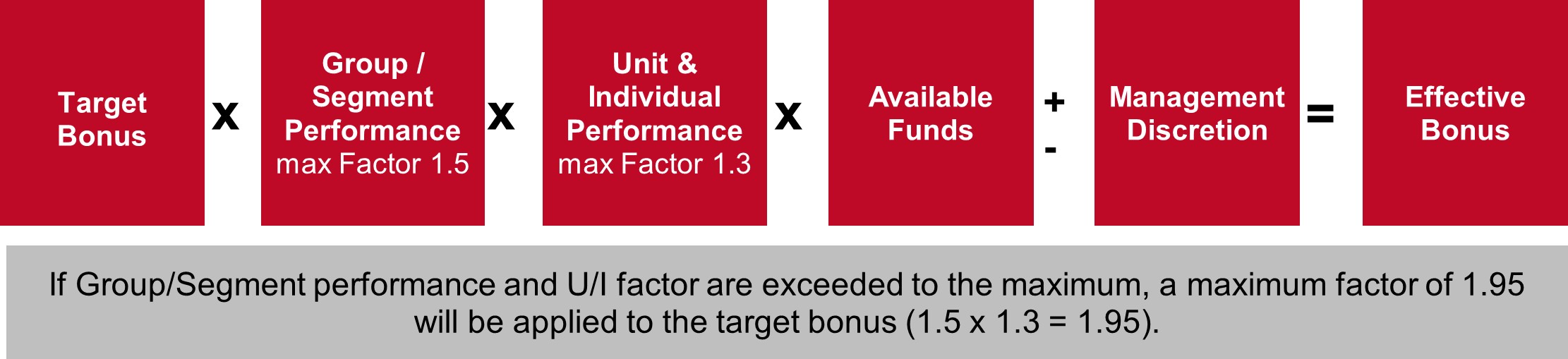
Example
Target Bonus EUR 10‘000
Goal achievement G/S performance 0.85
Goal achievement U/I performance 1.1
Available Funds 1.0
Management Discretion EUR 450,-
Calculation:
0.85 x 1.1 x 1.0 = 0.935
Target bonus x Factors x Available Funds + Management Discretion = Effective Bonus
10‘000 x 0.935 = 9’350.- + Management Discretion = EUR 9’800.-
3.Payment of Bonus
The bonus is a one-off annual sum that is typically paid out in February or March of the subsequent financial year, as soon as the company results are made available. The payout currency complies with that of the monthly salary payment. The amount can also be zero.
All bonus amounts are gross values. Payment is made after deducting the country-specific, legally prescribed social security, insurance contributions and taxes.
4.Eligibility
All members of the Executive Board of the Aebi Schmidt Group as well as other functions and persons defined by the Executive Board, who have an open-ended, unterminated contract of
Regulation on short-term variable remuneration (Bonus) – Performance Multiple | |||||
employment as of 31st December of the respective year and who demonstrate appropriate workplace conduct, are entitled to the bonus described in this regulation.
The bonus is paid out on a voluntary basis. Any current or past eligibility does not constitute automatic entitlement to a bonus in future fiscal years.
Employees in breach of their employment contract duties, especially but not conclusive
-Not compliant with the Code of Conduct
-Not compliant with group or local policies
-Not concluded trainings in the set deadline (i.e. IT awareness training)
-Not concluded employee performance reviews or own performance review in the set deadline
-Careless maintenance of tools i.e. data management in CRM system (not concluding)
may have their bonus revoked in whole or in part.
5.Regulations for Specific Situations
The decision to pay out a bonus is made following a careful analysis of each individual case.
5.1.New Joiners
Employees in the probationary period are essentially excluded from the bonus system. Eligible employees who started working during the year may receive a payment pro rata temporis if their goals are achieved, provided that they have an open-ended and unterminated contract of employment. If employees start after September 30th, they are not eligible for a bonus in the current year.
Entry | Targets | Target Bonus | ||||||
Start in Q1 | Yes | pro rata Target Bonus | ||||||
Start in Q2 | Yes | pro rata Target Bonus | ||||||
Start in Q3 | No | pro rata Target Bonus paid (fix 50% of pro-rata calculation) | ||||||
Start in Q4 | No | no Target Bonus for current year | ||||||
5.2.Absence from work
•For employees who are unable to contribute to the company result and individual performance to the required degree, the bonus for the relevant year is calculated pro rata temporis. This applies to employees who are absent for more than 3 months in the bonus-relevant financial year due to illness, accident, military, civil service, unpaid leave or parental leave.
If an employee is absent for the entire financial year, there is no entitlement to a bonus.
5.3.Change within the Group
In the event of a change of job within the Group, the bonus calculation will be based on the performance of goals as follows
-Q1 only goals of the new function
Regulation on short-term variable remuneration (Bonus) – Performance Multiple | |||||
-Q2/Q3 goals of the new and old function
-Q4 only goals of the old function
5.4.Ordinary termination of the employment contract
As soon as the employee hands in his/her notice of resignation, there is no entitlement to a bonus payment. In case of termination by the employer, the bonus will be paid pro rata temporis according to the aforementioned conditions. A possible bonus payout will be made as part of the regular bonus payments in the Spring of the following year.
5.5.Termination without notice
Where the employer justifiably terminates the employment without notice, all eligibility to a bonus payout is essentially excluded.
5.6.Retirement and other events
If the performance requirements are met pro rata, an appropriate share of the bonus may be paid out when the employment contract ends in the event of normal or early retirement.
6.Final Clauses
6.1.Amendment and annulment
The Aebi Schmidt Group reserves the right to amend these regulations or individual sections. The regulations can be changed, suspended or revoked at the end of a financial year with effect for the following financial year. Any and all changes, suspension or revocation will be communicated to the eligible parties in writing and with reasonable notice.
6.2.Effective date
These regulations shall come into effect on 1st January 2026 and supersede the preceding provisions relating thereto.
Zürich, 5 December 2025
Barend Fruithof Thomas Schenkirsch
Group CEO Chief Group Services
Regulation on short-term variable remuneration (Bonus) – Performance Multiple | |||||

EXHIBIT 10.14
Regulation on short-term variable remuneration in the Aebi Schmidt Group (Bonus)
Performance Cumulative
Key areas
Principles of bonus, mechanism, specific regulations
Scope
This generally applies to employees in Sales and Procurement. Additional persons may be defined by the Group CEO.
This document replaces all previous regulations on short-term variable compensation of the Performance Cumulative model.
Drafted on: 5 December 2025
Valid from: 1 January 2026
Table of Contents
Note:
In these regulations, the neutral form "Employees" is used for the most part. For reasons of legibility, male designations are sometimes used, which also apply to female employees.
1.Principles
Regulation on short-term variable remuneration (Bonus) – Performance Cumulative | |||||
With the short-term variable remuneration (bonus), the Aebi Schmidt Group seeks to create a remuneration component for the employees in the local organizations, which
•encourages an entrepreneurial mindset and approach
•takes into account the achievement of individual and corporate goals, and
•facilitates a competitive and attractive remuneration target.
The basic condition for entitlement to variable remuneration is that the employees have met their behavioural targets.
2.The Bonus-System
2.1.The Mechanism
The target bonus, which is defined for individual employees, forms the basis for the system. The bonus depends on the Group performance, the Org performance and the achievement of individual goals.
2.2.Target Bonus
The target bonus represents the potential bonus if all goals are achieved with a factor of 1.
2.3.Group / Segment Performance – Group Factor
The annual G/S Performance is determined based on the achievement of Group and Segment goals defined by the Executive Board. The following parameters are set for the bonus relevant year (examples, not conclusive):
•1 up to 5 key performance indicators for the relevant financial year;
oExamples: Adjusted EBITDA, NWC, Order Intake, Net Sales
•Thresholds for underachievement or overachievement of targets
•Minimum EBIT at the Group level of >5%. If this is not reached, no bonus will be paid.
•Compliance with banks' debt and equity ratio constraints. If the conditions are not met, no bonus will be paid
•If the Segment NWC targets are not achieved in Q1, Q2 and Q3 of 2026, a 3% target bonus deduction per quarter will be executed for those with a NWC target. If the budgeted net sales have a significant miss, the NWC targets will be adjusted accordingly.
•Additional conditions for Europe and RoW:
oIf in any month under 35% of targeted invoices are delivered by day 15, the target bonus is reduced by 2% per failed month. Two months per year may be identified as exceptions and are exempt from this rule.
oIf quarterly quality costs exceed the budget by more than EUR 500K, the bonus target is reduced by 3% per quarter.
Using a performance matrix, an individual factor is determined depending on the performance evaluation. The factor is set to 1 if the goals are achieved. For missed targets, the factor drops
Regulation on short-term variable remuneration (Bonus) – Performance Cumulative | |||||
until a lower threshold (floor). If a performance rating falls below this floor, the factor is zero (no bonus). For exceeded targets, the factor rises to a predefined upper threshold (cap).
2.4.Org Performance
The term Org Performance refers to the performance of an LSO or a sales and/or procurement unit. The Org goals and corresponding thresholds are set annually by the Group CEO. The following parameters may be set at the Org level for the bonus relevant year (examples, not conclusive):
-Adjusted EBITDA
-NWC Ratio
-New Business Revenue
-After Sales Revenue
-Sales Margin
2.5.Individual Goals
Individual goals are defined during an annual goal setting meeting by the respective Executive Board member and/or the Line Manager. The lower threshold (floor), the target performance as well as the upper threshold (cap) will also be defined.
In the course of the appraisal, the defined individual goals are assessed at the end of the fiscal year. Depending on the extent to which targets have been met, an individual factor is determined. The parameters are not the same as for Group performance, but are based on the same principle. A floor and cap are therefore also provided here.
For illustrative purposes here is an example of the Goal achievement (linear):
-<90% Goal achievement Factor 0
-90% Goal achievement Factor 0.5
-100% Goal achievement Factor 1.0
-110% Goal achievement Factor 1.25
-120% Goal achievement Factor 1.5
Regulation on short-term variable remuneration (Bonus) – Performance Cumulative | |||||
2.6.Overall Performance – Total Factor – Effective Bonus
The results of the Group performance, along with the Org and the individual performance make up the overall performance. The total factor is calculated by adding the three factors and determines the effective bonus.
The target bonus is multiplied by the total factor to determine the effective bonus. After taking into account the goal achievement, the resulting calculated bonus may be higher or lower than the target bonus. The individual bonus amount is thus calculated using the following components:
Group / Segment Targets 20%* (max factor 1.5) | + | Org Performance 40%* (max factor 1.5) | + | Individual Targets 40%* (max factor 1.5) | = | Effective Bonus | ||||||||||||||
If all targets are fully achieved, this results in a factor of 1.5 of the target bonus
* Weighting of the target bonus
Example
Target Bonus EUR 10‘000
Goal achievement G/S performance 0.85 (e.g.)
Goal achievement Org performance 1.1 (e.g.)
Goal achievement Individual performance 0.9 (e.g.)
Calculation:
(20% x 0.85) + (40% x 1.1) + (40% x 0.9) = 0.17 + 0.44 + 0.36 = 0.97
Target bonus x Factor = Effective Bonus 10‘000 x 0.97 = 9’700
3.Payment of Bonus
The bonus is a one-off annual sum that is typically paid out in March of the subsequent financial year, as soon as the company results are made available. The payout currency complies with that of the monthly salary payment. The amount can also be zero.
All bonus amounts are gross values. Payment is made after deducting the country-specific, legally prescribed social security, insurance contributions and taxes.
4.Eligibility
Employees of all country organizations, who have an open-ended, unterminated contract of employment as of 31st December of the respective year and who demonstrate appropriate workplace conduct, are entitled to the bonus described in this regulation.
The bonus is paid out on a voluntary basis. Any current or past eligibility does not constitute automatic entitlement to a bonus in future fiscal years.
Regulation on short-term variable remuneration (Bonus) – Performance Cumulative | |||||
Employees in breach of their employment contract duties, especially but not conclusive
-Not compliant with the Code of Conduct
-Not compliant with group or local policies
-Not concluded trainings in the set deadline (i.e. IT awareness training)
-Not concluded employee performance reviews or own performance review in the set deadline
-Careless maintenance of tools i.e. data management in CRM system (not concluding)
may have their bonus revoked in whole or in part.
5.Regulations for Specific Situations
The decision to pay out a bonus is made following a careful analysis of each individual case.
5.1.New Joiners
Employees in the probationary period are essentially excluded from the bonus system. Eligible employees who started working during the year may receive a payment pro rata temporis if their goals are achieved, provided that they have an open-ended and unterminated contract of employment. If employees start after September 30th, they are not eligible for a bonus in the current year.
| Entry | Targets | Target Bonus | ||||||
| Start in Q1 | yes | pro rata Target Bonus | ||||||
| Start in Q2 | yes | pro rata Target Bonus | ||||||
| Start in Q3 | no | pro rata Target Bonus paid (fix 50% of pro-rata calculation) | ||||||
| Start in Q4 | no | no Target Bonus for current year | ||||||
5.2.Absence from work
If employees are unable to contribute to the company result and required individual performance due to long time absence, the bonus for the relevant year is calculated pro rata temporis. This applies to employees who are absent for more than 3 months in the bonus-relevant financial year due to illness, accident, military, civil service, unpaid leave or parental leave.
If an employee is absent for the entire financial year, there is no entitlement to a bonus.
5.3.Change within the Group
In the event of a change of job within the Group, the bonus calculation will be based on the performance of goals as follows
-Q1 only goals of the new function
-Q2/Q3 goals of the new and old function
-Q4 only goals of the old function
5.4.Ordinary termination of the employment contract
As soon as the employee hands in his/her notice of resignation, there is no entitlement to a bonus payment. In case of termination by the employer, the bonus will be paid pro rata temporis according to the aforementioned conditions. A possible bonus payout will be made as part of the regular bonus payments in the Spring of the following year.
Regulation on short-term variable remuneration (Bonus) – Performance Cumulative | |||||
5.5.Termination without notice
Where the employer justifiably terminates the employment without notice, all eligibility to a bonus payout is essentially excluded.
5.6.Retirement and other events
If the performance requirements are met pro rata, an appropriate share of the bonus may be paid out when the employment contract ends in the event of normal or early retirement.
6.Final Clauses
6.1.Amendment and annulment
The Aebi Schmidt Group reserves the right to amend these regulations or individual sections. The regulations can be changed, suspended or revoked at the end of a financial year with effect for the following financial year. All changes, suspension or revocation will be communicated to the eligible parties in writing and with reasonable notice.
6.2.Effective date
These regulations shall come into effect on 1 January 2026 and supersede the preceding provisions relating thereto.
Zürich, 5 December 2025
Barend Fruithof Thomas Schenkirsch
Group CEO Chief Group Services
Regulation on short-term variable remuneration (Bonus) – Performance Cumulative | |||||
Aebi Schmidt Holding AG Lindbergh-Allee 1 | CH-8152 Glattpark | ||
EXHIBIT 10.16
Barend Fruithof [Redacted] | Glattpark, 4 December 2025 | ||||
Subject: compensation adjustment and targets 2026 | ||
Dear Barend,
As discussed and formally approved during the recent Board of Directors meeting on December 2nd, we are pleased to inform your salary adjustment, effective as of January 1st, 2026.
Your new total annual compensation will be CHF 2’100’000, divided into the following components:
Base salary: CHF 1’000’000
Cash bonus: CHF 600’000
Equity bonus: CHF 500’000
Additionally, your cash bonus targets for 2026 are defined as follows:
Adjusted EBITDA < USD 160m = no bonus payment
Adjusted EBITDA > USD 160m = CHF 300’000
Adjusted EBITDA > USD 180m = CHF 600’000
Adjusted EBITDA > USD 200m = CHF 800’000
Adjusted EBITDA > USD 220m = CHF 1’000’000 (cap)
We sincerely appreciate your continued dedication and commitment to the success of our company.
Best regards,
/s/ Andreas Rickenbacher Andreas Rickenbacher Chairman HR Committee | /s/ Thomas Schenkirsch Thomas Schenkirsch Chief Group Services | |||||||
Aebi Schmidt Holding AG Lindbergh-Allee 1 | CH-8152 Glattpark | ||
EXHIBIT 10.18
Steffen Schewerda Per email | Glattpark, 4 December 2025 | ||||
Subject: compensation adjustment | ||
Dear Steffen,
As discussed and formally approved during the recent Board of Directors meeting on December 2nd, we are pleased to inform your salary adjustment, effective as of January 1st, 2026.
Your new total annual compensation will be USD 1’100’000, divided into the following components:
Base salary: USD 550’000
Cash bonus: USD 300’000
Equity bonus: USD 250’000
We sincerely appreciate your continued dedication and commitment to the success of our company.
Best regards,
/s/ Andreas Rickenbacher Andreas Rickenbacher Chairman HR Committee | /s/ Barend Fruithof Barend Fruithof Group CEO | |||||||
Aebi Schmidt Holding AG Lindbergh-Allee 1 | CH-8152 Glattpark | ||
EXHIBIT 10.20
Thomas Schenkirsch [Redacted] | Glattpark, 4 December 2025 | ||||
Subject: compensation adjustment | ||
Dear Thomas,
As discussed and formally approved during the recent Board of Directors meeting on December 2nd, we are pleased to inform your salary adjustment, effective as of January 1st, 2026.
Your new total annual compensation will be CHF 650’000, divided into the following components:
Base salary: CHF 450’000
Cash bonus: CHF 125’000
Equity bonus: CHF 75’000
We sincerely appreciate your continued dedication and commitment to the success of our company.
Best regards,
/s/ Andreas Rickenbacher Andreas Rickenbacher Chairman HR Committee | /s/ Barend Fruithof Barend Fruithof Group CEO | |||||||
EXHIBIT 10.21
Employment Agreement
between
Aebi Schmidt Holding AG
Schulstrasse 4
CH-8500 Frauenfeld
(hereinafter referred to as the “Employer”)
and
Marco Portmann
[REDACTED]
(hereinafter referred to as the “GROUP CFO”)
I.Position of the GROUP CFO
1.The GROUP CFO reports to the GROUP CEO of the Employer and is, together with the members of the Group Executive Board, responsible for implementing the resolutions of the Board of Directors and executive management.
2.The GROUP CFO may bind the Employer with respect to third parties subject to the dual signature requirement.
II.Tasks and Duties of the GROUP CFO
3.The GROUP CFO has overall responsibility for the finances of the Aebi Schmidt Group.
4.The GROUP CFO is responsible for providing meaningful monthly controlling/reporting for financial matters to the GROUP CEO.
5.The tasks and duties of the GROUP CFO are governed by the requirements, directives and objectives of the GROUP CEO of the Employer.
6.In all other respects, the competencies and tasks are determined by the general directives and Organizational Regulations of the Employer. The GROUP CEO and the GROUP CFO may also agree on specific duties and/or a job description.
III.Duties of Loyalty and Care
7.The GROUP CFO must carry out the tasks assigned to him with due care and advance the interests of the Employer. He shall inform the GROUP CEO immediately of any circumstances that are contrary to the interests of the Employer or could cause the Employer to suffer financial or reputational harm. He must comply with the instructions of the GROUP CEO.
8.In connection with his professional activities, the GROUP CFO may, without the express permission of the Employer, only accept gifts, commissions or other benefits of any kind, whether directly or indirectly, to the extent they would be deemed to be customary with respect to business and local practices. The GROUP CFO is prohibited from engaging in any active or passive bribery. He must refrain from engaging in any unfair competitive activities with respect to third parties. If he becomes aware of any such attempt by other employees or third parties, he must immediately inform the GROUP CEO.
IV.Place of Work
9.The Employer shall determine the place of work. Until further notice, the GROUP CFO will carry out the majority of his activities at the Employer’s location in Zurich.
V.Working Hours and Workload
10.The GROUP CFO shall conform his efforts to the business and tasks to be accomplished.
11.Consistent with the leadership position of the GROUP CFO, no weekly working hours are agreed upon. The GROUP CFO shall perform such work as is necessary to achieve the Employer’s objectives. Any and all overtime and extra hours are covered by his salary and do not entitle the GROUP CFO to additional compensation or paid time off.
12.Workload 100%
VI.Salary
Base Salary
13.The annual base salary is CHF 400,000 (gross). The annual base salary shall be paid in 12 monthly installments.
Performance Bonus
14.Upon achievement of performance targets, a bonus pursuant to ,the Regulation on short-term variable remuneration in the Aebi Schmidt Group’ will be paid out, taking into consideration the model to be applied to the respective function at issue.
The annual target bonus amounts to CHF 400,000.
The details of the bonus (bonus calculation, performance targets, payments, etc.) are set out in the attached policies, which in their currently valid version, form an integral part of this Employment Agreement.
In the event of a termination by the GROUP CFO, the bonus for the current year shall automatically lapse.
In the event of a termination by the Employer, the GROUP CFO shall remain in the bonus program until the end of the notice period. If the employer relieves the GROUP CFO of his employment duties, the GROUP CFO shall no longer be entitled to a bonus as of the date of having been so relieved.
It is to be assumed that, due to the planned merger with The Shyft Group and the related stock market listing, part of the bonus may have to be paid in equity rather than in cash, possibly as early as and including fiscal year 2025.
The relevant policy will be provided to the GROUP CFO as soon as it is available. Until then, the above-mentioned ,Policy on Short-Term Variable Compensation of the Aebi Schmidt Group’ shall apply.
a.Social Security
15.Statutory/regulatory employee social security contributions shall be deducted from the annual base salary and the performance bonus.
b.Expenses
16.The GROUP CFO shall receive the following expense reimbursement:
A lump-sum expense reimbursement paid monthly in the maximum amount approved by the competent tax authorities, currently CHF 18,000.–annually.
VII.Company Vehicle
17.The GROUP CFO shall receive a company car pursuant to the Car Policy Europe.
VIII.Vacation
18.The GROUP CFO is entitled to 25 business days of vacation per year. The GROUP CFO’s vacation entitlement shall be prorated for any year in which he joins or leaves the Employer.
IX.Social Security – Continued Payment of Wages
19.The Employer shall include the GROUP CFO in its social security programs. Applicable laws and the Employer’s policies govern his participation in these programs.
20.The GROUP CFO acknowledges that he has taken (or can take) note of all social security policies and programs of the Employer and that he recognizes them as integral parts of this Employment Agreement.
21.If the GROUP CFO is prevented from working through no fault of his own, the Employer shall pay his salary in accordance with applicable law. To the extent the Employer has insured this risk, the insurance proceeds shall substitute the Employer’s obligation to pay (pursuant to the “Employment Contract Provisions”, see attachments), and the Employer shall be released from any further liability in this regard.
X.Executive Insurance
22.The GROUP CFO shall be enrolled in Aebi Schmidt Holding AG’s Executive Insurance.
XI.Outside Activities
23.The GROUP CFO shall devote his entire work time and efforts to the service of the Employer. The GROUP CFO’s undertaking of other (paid or unpaid) activities must be requested in writing and approved by the GROUP CEO. The GROUP CFO also confirms that these activities do not give rise to any conflicts of interest with the duties and obligations of the GROUP CFO under this Employment Agreement.
XII.D&O Insurance
24.The Employer has taken out D&O insurance for the benefit of the Board of Directors and Group Management.
XIII.Confidentiality
25.The GROUP CFO confirms that, in his capacity as GROUP CFO, he has or will have insight into the production, business and trade secrets as well as clients of the Employer, and that the use and disclosure of such information, including third parties’ knowledge thereof, will materially harm or may materially harm the Employer.
26.The GROUP CFO is obligated to keep the business and trade secrets as well as other internal information of the Employer confidential in a comprehensive fashion, both during and after his term of employment. This obligation also extends to the affairs of other companies with which the Employer is economically and organizationally affiliated or cooperates.
27.The GROUP CFO shall treat all confidential documents and other data, including any copies thereof, relating to the Employer and its customers and affiliated companies as strictly confidential. All such documents and data must be returned to the Employer immediately upon termination of employment or destroyed upon the Employer’s instruction.
XIV.Non-Competition
28.The GROUP CFO shall, in accordance with the following provisions, refrain from any activity that directly or indirectly competes with the Employer, in particular operating or establishing a business that pursues the same purpose as the Employer and/or is in competition with the Employer, being directly or indirectly active in any such business, or investing in any such business, or advising any such business or otherwise providing services to any such business in return for payment or no payment.
29.This non-competition clause applies:
a.Duration: during the term of this Employment Agreement and for one year after its termination.
b.Geographical Scope: In all markets in which the Employer is active, in particular all of Europe and the USA.
c.Subject Matter Scope: For all businesses in the areas of municipal, airport and agricultural equipment and vehicles.
The Employer may provide for exceptions to this non-competition clause by resolution of the Board of Directors and written notification to the GROUP CFO.
30.In the event of a breach of this non-competition clause, a conventional penalty in the amount of 50% of the annual base salary shall apply. The GROUP CFO shall also remain fully liable for any harm in excess of the conventional penalty. The Employer expressly reserves the right to demand removal of the conditions that led to the breach of this non-competition clause even if the conventional penalty is paid.
31.This non-competition clause also applies to the Employer’s subsidiaries.
XV.Start, Duration and Termination of the Employment Relationship
32.This Employment Agreement is effective as of April 14, 2025.
33.The probation period shall be 3 months. During the probation period, either party may terminate the employment relationship by giving 7 days’ notice.
34.After the probation period, either party may terminate this Employment Agreement upon 6 months’ notice, effective as of the applicable month’s end. Notice of termination must be delivered by certified mail or against confirmation of receipt. The notice of termination must be in the possession of the other party on the last working day before the start of the notice period.
35.The Employer is entitled, but not obligated, to relieve the GROUP CFO from the further fulfillment of his duties during the notice period. In this case, any unused vacation days as well as any other earnings of the GROUP CFO achieved during the notice period shall be offset against the Employer’s continued salary payment obligations.
XVI.Further Provisions
36.The members of the Executive Board are not subject to the “Agreement of the Engineering Industry” (Vereinbarung der Maschinenindustrie - GAV).
37.This Employment Agreement is subject to Swiss law. The place of jurisdiction is Zurich.
38.This Employment Agreement represents the entire agreement between the parties. Amendments to this Employment Agreement must be made in writing and must be signed by both contracting parties in order to be valid.
39.This Employment Agreement replaces all previous verbal and/or written agreements and employment agreements between the parties.
40.The enumerated attachments as well as subsequent amendments and/or supplements to these attachments (including verbal amendments and/or supplements) form an integral part of this Employment Agreement.
41.This Employment Agreement is executed in two copies; each party shall receive one copy of this Employment Agreement.
Place/Date: Zurich, April 2, 2025
Aebi Schmidt Holding AG
/s/ Barend Fruithof /s/ Dominique Christen
Barend Fruithof, GROUP CEO Dominique Christen, Head Group HR
Employee
Place/Date: April 2, 2025
/s/ Marco Portmann
Marco Portmann
Attachments
•Employment Contract Provisions
•the Regulation on short-term variable remuneration in the Aebi Schmidt Group
•Supplemental expense regulations for executive personnel
•Code of Conduct
•Regulations of the BVG Fund of Aebi & Co. AG Burgdorf
•Pension Fund for the Employees of Aebi & Co. AG Burgdorf
•Pension Plan Swiss Life
•Collective Supplementary Pension Provisions Swiss Life
•IT Security Policy
•Privacy Policy for Employees
Aebi Schmidt Holding AG Lindbergh-Allee 1 | CH-8152 Glattpark | ||
EXHIBIT 10.22
Marco Portmann [Redacted] | Glattpark, 4 December 2025 | ||||
Subject: compensation adjustment | ||
Dear Marco,
As discussed and formally approved during the recent Board of Directors meeting on December 2nd, we hereby confirm the adjusted structure of your annual compensation.
Your total annual compensation remains CHF 800’000. Effective as of January 1st, 2026 your total package will be divided into the following components:
Base salary: CHF 400’000
Cash bonus: CHF 300’000
Equity bonus: CHF 100’000
We sincerely appreciate your continued dedication and commitment to the success of our company.
Best regards,
/s/ Andreas Rickenbacher Andreas Rickenbacher Chairman HR Committee | /s/ Barend Fruithof Barend Fruithof Group CEO | |||||||
EXHIBIT 10.23
Employment Agreement
between
Aebi Schmidt Holding AG
Schulstrasse 4
CH-8500 Frauenfeld
(hereinafter referred to as the “Employer”)
and
Henning Schroeder
[REDACTED]
(hereinafter referred to as the “CPO”)
I.Position of the Chief Product Officer (CPO)
1.The CPO reports to the CEO of the Employer and is, together with the members of the Group Executive Board, responsible for implementing the resolutions of the Board of Directors and executive management.
2.The CPO may bind the Employer with respect to third parties subject to the dual signature requirement (after the probation period).
II.Tasks and Duties of the CPO
3.The CPO has overall responsibility for Product Management, R&D, Marketing, and Corporate Development.
4.The CPO is responsible for providing meaningful monthly controlling/reporting for product matters to the CEO and the Board of Directors.
5.The tasks and duties of the CPO are governed by the requirements, directives and objectives of the CEO of the Employer.
6.In all other respects, the competencies and tasks are determined by the general directives and Organizational Regulations of the Employer. The CEO and the CPO may also agree on specific duties and/or a job description.
III.Duties of Loyalty and Care
7.The CPO must carry out the tasks assigned to him with due care and advance the interests of the Employer. He must comply with the CEO’s instructions. He shall immediately report any problems and deficiencies of which he becomes aware.
8.In connection with his professional activities, the CPO is prohibited, without the express permission of the Employer, from accepting or being promised gifts, commissions, or other benefits, of any kind, whether directly or indirectly. The CPO is prohibited from engaging in any active or passive bribery. He must refrain from engaging in any unfair competitive activities with respect to third parties. If he becomes aware of any such attempt by other employees or third parties, he must immediately inform the CEO.
IV.Place of Work
9.The Employer’s registered office is in Frauenfeld, Thurgau, Switzerland. In addition, the CPO shall perform his duties at all operating locations of the Group and wherever the interests of the Group so require, in particular in Zurich-Oerlikon (Switzerland), St. Blasien (Germany), Burgdorf (Switzerland), Kielce (Poland), and Holten (the Netherlands). The administrative headquarters are located in Zurich-Oerlikon.
V.Working Hours
10.The CPO shall conform his efforts to the business and tasks to be accomplished.
11.Consistent with the leadership position of the CPO, the CPO is not bound by the Employer’s working-time rules or those of its subsidiaries, nor by the provisions of the labor law. He is therefore obligated to perform any additional work necessary to achieve the objectives set by the Board of Directors. Any and all overtime and extra hours are covered by his salary and do not entitle the CPO to additional compensation or paid time off.
VI.Salary
Base Salary
12.The annual base salary is CHF 192,500 (gross). The annual base salary shall be paid in 12 monthly installments.
Performance Bonus
13.Upon achievement of performance targets, a bonus pursuant to ,the Regulation on short-term variable remuneration in the ASH Group’ (hereinafter the Variable Compensation Policy) will be paid out. The current target bonus is CHF 95,000 per year. If employment begins during a year, the bonus shall apply pro rata.
With respect to the details of the bonus (bonus calculation, target agreements, payments, etc.), reference is made to the attached policy, which in their currently valid version, form an integral part of this Employment Agreement.
If you demonstrably lose all or part of your bonus payment from your former employer (in documented written form), we will pay the shortfall (in whole or in part) after successful completion of the probation period, based on a total bonus calculation of CHF 30,000 (thus up to a maximum of CHF 30,000). The bonus will be paid on a gross basis.
a.Social Security
14.Statutory/regulatory employee social security contributions shall be deducted from the annual base salary and the performance bonus.
b.Expenses
15.The CPO shall receive the following expense reimbursement:
a.A lump-sum expense reimbursement in the maximum amount approved from time to time by the competent tax authorities (currently CHF 1,500 a month for executive employees).
b.A company car fitting for the position, including all related costs, in accordance with the applicable policy in effect from time to time. If the CPO waives his right to a company car, he shall be reimbursed for business travel using his private car in accordance with the Employer’s applicable policy in effect from time to time.
c.Additional expenses as incurred, in accordance with the Employer’s applicable policy in effect from time to time.
VII.Relocation of Residency
The Employer shall pay the moving costs of the CPO from the United States to Switzerland (via sea transport). If needed, the Employer shall provide the CPO and his family with a furnished apartment in the Zurich area for the first 90 days of the employment relationship.
VIII.Employee Stock Plan
16.The Employer has an employee stock participation plan. With respect to the CPO’s participation, reference is made in full to this plan.
IX.Vacation
17.The CPO is entitled to 25 business days of vacation per year. The CPO’s vacation entitlement shall be prorated for any year in which he joins or leaves the Employer.
X.Executive Insurance/Social Security – Continued Payment of Wages
18.The Employer shall include the CPO in its social security programs. Applicable laws and the Employer’s policies govern his participation in these programs.
19.The CPO acknowledges that he has taken (or can take) note of all social security policies and programs of the Employer and that he recognizes them as integral parts of this Employment Agreement.
20.If the CPO is prevented from working through no fault of his own, the Employer shall pay his salary in accordance with applicable law. To the extent the Employer has insured this risk, the insurance proceeds shall substitute the Employer’s obligation to pay, and the Employer shall be released from any further liability in this regard.
XI.Outside Activities
21.The CPO shall devote his entire work time and efforts to the service of the Employer. The CPO’s undertaking of other (paid or unpaid) activities or secondary employment is permitted only to the extent that such activities do not affect the CPO’s duties under
this Employment Agreement, do not jeopardize the achievement of the Employer’s objectives, and do not prejudice the Employer’s interests.
22.As a matter of principle, before commencing any activity under the preceding clause, the CPO must inform the CEO and, in the case of a planned remunerated activity, obtain the CEO’s written consent. In doing so, the CPO confirms that such activities do not give rise to any conflicts of interest with the duties and obligations under this Employment Agreement.
XII.D&O Insurance
23.The Employer has taken out D&O insurance for the benefit of the Board of Directors and Group Management.
XIII.Confidentiality
24.The CPO confirms that, in his capacity as CPO, he has or will have insight into the production, business and trade secrets as well as clients of the Employer, and that the use and disclosure of such information, including third parties’ knowledge thereof, will materially harm or may materially harm the Employer.
25.The CPO is obligated to keep the business and trade secrets as well as other internal information of the Employer confidential in a comprehensive fashion, both during and after his term of employment. This obligation also extends to the affairs of other companies with which the Employer is economically and organizationally affiliated or cooperates.
26.The CPO shall treat all confidential documents and other data, including any copies thereof, relating to the Employer and its customers and affiliated companies as strictly confidential. All such documents and data must be returned to the Employer immediately upon termination of employment or destroyed upon the Employer’s instruction.
XIV.Non-Competition
27.The CPO shall, in accordance with the following provisions, refrain from any activity that directly or indirectly competes with the Employer, in particular operating or establishing a business that pursues the same purpose as the Employer and/or is in competition with the Employer, being directly or indirectly active in any such business, or investing in any such business, or advising any such business or otherwise providing services to any such business in return for payment or no payment.
28.This non-competition clause applies:
a.Duration: during the term of this Employment Agreement and for one year after its termination.
b.Geographical Scope: In all markets in which the Employer is active, in particular all of Europe and the USA.
c.Subject Matter Scope: For all businesses in the areas of municipal, airport and agricultural equipment and vehicles.
The Employer may provide for exceptions to this non-competition clause by resolution of the Board of Directors and written notification to the CPO.
29.In the event of a breach of this non-competition clause, a conventional penalty in the amount of 50% of the annual base salary shall apply. The CPO shall also remain fully liable for any harm in excess of the conventional penalty. The Employer expressly reserves the right to demand removal of the conditions that led to the breach of this non-competition clause even if the conventional penalty is paid.
30.This non-competition clause also applies to the Employer’s subsidiaries.
XV.Start, Duration and Termination of the Employment Relationship
31.This Employment Agreement is effective as of May 1, 2019 (or earlier per agreement).
32.The probation period shall be 3 months. During the probation period, either party may terminate this Employment Agreement upon one month’s notice.
33.After the probation period, either party may terminate this Employment Agreement upon 6 months’ notice, effective as of the applicable month’s end.
34.Notice of termination must be delivered by certified mail or against confirmation of receipt. The notice of termination must be in the possession of the other party on the last working day before the start of the notice period.
35.The Employer is entitled to relieve the CPO from the further fulfillment of his duties during the notice period. In this case, any unused vacation days as well as any other earnings of the CPO achieved during the notice period shall be offset against the Employer’s continued salary payment obligations.
XVI.Further Provisions
36.The members of the Executive Board are not subject to the “Agreement of the Engineering Industry” (Vereinbarung der Maschinenindustrie - GAV).
37.This Employment Agreement is subject to Swiss law. For claims arising out of or in connection with this Employment Agreement, jurisdiction lies with the court at the domicile or registered office of the defendant party, or at the place where the CPO ordinarily performs his work. This Employment Agreement represents the entire agreement between the parties. Amendments to this Employment Agreement must be made in writing and must be signed by both contracting parties in order to be valid.
38.The enumerated attachments as well as subsequent amendments and/or supplements to these attachments (including verbal amendments and/or supplements) form an integral part of this Employment Agreement.
39.This Employment Agreement is executed in two copies; each party shall receive one copy of this Employment Agreement.
Place/Date: __________________________
Aebi Schmidt Holding AG
/s/ Barend Fruithof /s/ Roger Weidmann
Barend Fruithof, CEO Director Group HR
Place/Date: Zurich, September 27, 2018
Chief Product Officer (CPO)
/s/ Henning Schroeder
Henning Schroeder
Attachments
•Employment Contract Provisions
•the Regulation on short-term variable remuneration in the ASH Group (Bonus)
•Expense Regulations
•Supplemental expense regulations for executive personnel
•Code of Conduct
•Confirmation of receipt of Code of Conduct
•Regulations of the BVG Fund of Aebi & Co. MF Burgdorf
•Pension Fund for the Employees of Aebi & Co. MF Burgdorf
•Pension Plan Swiss Life
•Collective Supplementary Pension Provisions Swiss Life
Aebi Schmidt Holding AG Lindbergh-Allee 1 | CH-8152 Glattpark | ||
EXHIBIT 10.24
Henning Schröder [Redacted] | Glattpark, 4 December 2025 | ||||
Subject: compensation adjustment | ||
Dear Henning,
As discussed and formally approved during the recent Board of Directors meeting on December 2nd, we are pleased to inform your salary adjustment, effective as of January 1st, 2026.
Your new total annual compensation will be CHF 500’000, divided into the following components:
Base salary: CHF 300’000
Cash bonus: CHF 125’000
Equity bonus: CHF 75’000
We sincerely appreciate your continued dedication and commitment to the success of our company.
Best regards,
/s/ Andreas Rickenbacher Andreas Rickenbacher Chairman HR Committee | /s/ Barend Fruithof Barend Fruithof Group CEO | |||||||
EXHIBIT 10.32
Mandate Agreement Mandatsvereinbarung | ||||||||
dated vom | [date] | |||||||
between zwischen | Aebi Schmidt Holding AG | |||||||
Schulstrasse 4 8500 Frauenfeld Switzerland | ||||||||
(hereinafter: "Company") (nachfolgend die "Gesellschaft") | ||||||||
and und | [Name] | |||||||
[Address] | ||||||||
(hereinafter: "Board Member") (nachfolgend "VR-Mitglied") | ||||||||
each a "Party" and collectively the "Parties" jeder eine "Partei" und gemeinsam die "Parteien" | ||||||||
2
Mandate Agreement Aebi Schmidt Holding AG
1Recitals
Präambel
Präambel
Subject to the articles of association and the organizational regulations of the Company, the Company and the Board Member wish to set forth the rights and obligations of the Board Member in relation to the mandate of the Board Member as a member of the Company's board of directors in this mandate agreement (the "Agreement").
Vorbehältlich der Statuten und dem Organisationsreglement der Gesellschaft möchten die Gesellschaft und das VR-Mitglied die Rechte und Pflichten des VR-Mitglieds in Bezug auf das Mandat des VR-Mitglieds als Mitglied des Verwaltungsrates der Gesellschaft in dieser Mandatsvereinbarung (die "Vereinbarung") festlegen.
Based on the above recitals, which form an integral part of this Agreement, the Parties agree as follows:
Auf der Grundlage der vorstehenden Präambel, welche integraler Bestandteil dieser Vereinbarung bildet, vereinbaren die Parteien Folgendes:
2Election, Re-Election and Constitution of the Board of Directors
Wahl, Wiederwahl und Konstituierung des Verwaltungsrates
Wahl, Wiederwahl und Konstituierung des Verwaltungsrates
The Board Member acknowledges that this Agreement and the rights and obligations set forth in this Agreement are subject to the election or re-election as a member of the Company's board of directors at a Company's ordinary or extraordinary shareholders' meeting.
Das VR-Mitglied anerkennt, dass diese Vereinbarung sowie die in dieser Vereinbarung festgelegten Rechte und Pflichten von der Wahl oder Wiederwahl als Mitglied des Verwaltungsrates an der ordentlichen oder ausserordentlichen Generalversammlung der Gesellschaft abhängig sind.
Further, the Board Member acknowledges and agrees that this Agreement will be adjusted to the extent required for this Agreement to comply with applicable law, the articles of association, organizational regulations and directives and policies of the Company.
Darüber hinaus anerkennt das VR-Mitglied und erklärt sich damit einverstanden, dass diese Vereinbarung insoweit angepasst wird, als dies für die Einhaltung des anwendbaren Rechts, der Statuten, des Organisationsreglements und der Weisungen und Richtlinien der Gesellschaft erforderlich ist.
The Board Member further acknowledges that the Board of Directors will constitute itself usually at a meeting following the ordinary shareholders' meeting.
Das VR-Mitglied nimmt ferner zur Kenntnis, dass sich der Verwaltungsrat in der Regel in einer Sitzung im Anschluss an die ordentliche Generalversammlung konstituieren wird.
3
Mandate Agreement Aebi Schmidt Holding AG
3Function and Duties
Funktion und Aufgaben
Funktion und Aufgaben
The Board Member shall exercise the role as a member of the board in accordance with applicable laws, the articles of association, organizational regulations, directives and policies of the Company, as in force and as amended from time to time.
Das VR-Mitglied übt die Funktion als Mitglied des Verwaltungsrates in Übereinstimmung mit dem anwendbaren Recht, den Statuten, dem Organisationsreglement, den Weisungen und den Richtlinien der Gesellschaft, in ihrer jeweils gültigen Fassung, aus.
The Board Member will perform all tasks personally and independently, based on professional and diligent judgment, with due care and in the best interest of the Company.
Das VR-Mitglied führt alle Aufgaben persönlich und unabhängig auf Grundlage fachlicher und gewissenhafter Beurteilung, mit der gebotenen Sorgfalt und im besten Interesse der Gesellschaft aus.
The Board Member shall devote sufficient time to carefully fulfil all duties under this Agreement.
Das VR-Mitglied wendet genügend Zeit auf, um alle Pflichten unter dieser Vereinbarung sorgfältig zu erfüllen.
4Conflict of Interest
Interessenskonflikt
Interessenskonflikt
The Board Member hereby confirms that [he/she] has disclosed to the Company any potential conflicts of interest.
Das VR-Mitglied bestätigt hiermit, dass es gegenüber der Gesellschaft alle potenziellen Interessenskonflikte offengelegt hat.
The Board Member shall disclose any potential conflict of interest arising in the future and shall, in case of a conflict of interest, not participate in discussions or a vote of the board of directors and not be entitled to receive any confidential information related to the conflicting matter.
Das VR-Mitglied ist verpflichtet, etwaige künftige Interessenkonflikte offenzulegen, soll im Falle eines Interessenkonflikts nicht an Diskussionen oder Abstimmungen des Verwaltungsrates teilnehmen und ist nicht berechtigt, vertrauliche Informationen in Bezug auf den Konfliktgegenstand zu erhalten.
5Confidentiality
Geheimhaltung
Geheimhaltung
All information acquired during the Board Member's term of office as a member of the board of directors that is not known to the public is strictly confidential and may not be made accessible to third parties or made use of for a personal benefit
4
Mandate Agreement Aebi Schmidt Holding AG
(or the benefit of related parties), neither during nor at any time after the Board Member's term of office without prior written approval from the Company.
Alle Informationen, die während der Amtszeit des VR-Mitglieds als Mitglied des Verwaltungsrates erworben werden und nicht öffentlich bekannt sind, sind streng vertraulich und dürfen ohne vorherige schriftliche Zustimmung der Gesellschaft Dritten nicht zugänglich gemacht oder zum persönlichen Vorteil (oder zum Vorteil nahestehender Personen) genutzt werden, weder während noch nach Ablauf der Amtszeit des VR-Mitglieds.
6Return of Items and Documents
Rückgabe von Gegenständen und Dokumenten
Rückgabe von Gegenständen und Dokumenten
Upon expiry of the term of office or at first request, the Board Member shall immediately return all (physical and electronic) items, documents and any other material pertaining to the Company. The Board Member is not entitled to keep copies. Where copies cannot be returned for technical reasons (e.g., digital copies, data carriers), they must be finally deleted per the time of returning and the final deletion shall be confirmed by the Board Member in writing.
Nach Ablauf der Amtszeit bzw. auf erste Aufforderung hin hat das VR-Mitglied unverzüglich alle (physischen und elektronischen) Gegenstände, Dokumente und sonstigen der Gesellschaft gehörenden Unterlagen zurückzugeben. Das VR-Mitglied ist nicht berechtigt, Kopien aufzubewahren. Können Kopien aus technischen Gründen (z. B. digitale Kopien, Datenträger) nicht zurückgegeben werden, so sind sie auf den Zeitpunkt der Rückgabe hin endgültig zu löschen und die endgültige Löschung ist vom VR-Mitglied schriftlich zu bestätigen.
7Compensation
Entschädigung
Entschädigung
7.1Remuneration
Vergütung
Vergütung
For a full mandate year (i.e., the period from one ordinary shareholders' meeting until the next ordinary shareholders' meeting) (the "Mandate Year"), the Board Member shall be entitled to a remuneration of CHF [●] gross (the "Remuneration Amount").
Für ein volles Mandatsjahr (d.h. für den Zeitraum von einer ordentlichen Generalversammlung zur nächsten ordentlichen Generalversammlung) (das "Mandatsjahr") hat das VR-Mitglied Anspruch auf eine Vergütung von brutto CHF [●] (der "Vergütungsbetrag").
If the Board Member is not serving during the entire relevant Mandate Year, the Remuneration Amount will be granted on a pro rata temporis basis to be calculated from the date of election to the date on which the board membership ends (as a result of dismissal, resignation, death, incapacity or otherwise) based on the actual days of office.
Sofern das VR-Mitglied nicht während des gesamten Mandatsjahres tätig ist, wird der Vergütungsbetrag pro rata temporis ab dem Tag der Wahl bis zum Tag des
5
Mandate Agreement Aebi Schmidt Holding AG
Ausscheidens aus der Tätigkeit des Verwaltungsrats (aufgrund von Entlassung, Rücktritt, Tod, Handlungsunfähigkeit oder aus anderen Gründen) auf der Grundlage der tatsächlichen Amtszeit gewährt.
The Remuneration Amount is paid in [monthly] instalments. Part of the remuneration may be drawn in shares of the Company in accordance with the regulations issued by the board of directors.
Der Vergütungsbetrag wird in [monatlichen] Raten ausbezahlt. Ein Teil der Vergütung kann nach Massagabe der vom Verwaltungsrat erlassenen Regelungen in Aktien der Gesellschaft bezogen werden.
7.2Expenses
Spesen
Spesen
The Company shall reimburse the Board Member for all documented expenses that the Board Member actually and reasonably incurred when performing the duties under this Agreement.
Die Gesellschaft erstattet dem VR-Mitglied alle dokumentierten Auslagen, die bei der Erfüllung seiner Pflichten aus dieser Vereinbarung tatsächlich und in vernünftiger Weise entstanden sind.
7.3Social Security Contributions, Taxes
Sozialversicherungsbeiträge, Steuern
Sozialversicherungsbeiträge, Steuern
The Board Member acknowledges that the Remuneration Amount pursuant to section 7.1 is subject to social security contributions and other charges and taxes (including, without limitation, OASI/DI, pension fund contributions, insurance premiums and withholding taxes, in each case as applicable), and that such contributions and other charges and taxes are deducted from the Remuneration Amount. The Board Member is obligated to provide all information and documents required by to Company to make all necessary filings and declarations.
Das VR-Mitglied nimmt zur Kenntnis, dass der Vergütungsbetrag gemäss Ziffer 7.1 Sozialversicherungsbeiträgen und sonstige Abgaben und Steuern (insbesondere AHV/IV, Pensionskassenbeiträge, Versicherungsprämien und Quellensteuern, jeweils sofern anwendbar) unterliegt, und dass diese Beiträge und sonstigen Abgaben und Steuern vom Vergütungsbetrag in Abzug gebracht werden. Das VR-Mitglied ist verpflichtet, alle benötigten Unterlagen und Informationen zur Verfügung zu stellen, damit die Gesellschaft alle notwendigen Meldungen und Erklärungen abgeben kann.
8Intellectual Property Rights
Rechte an geistigem Eigentum
Rechte an geistigem Eigentum
All computer-programs, inventions, designs, creations, data, findings, works, methods, documents and the like which the Board Member solely or jointly with others, makes, conceives or contributes to during the activities under this Agreement (collectively the "Work Results") belong exclusively to the Company, regardless of whether or not they are protected under applicable laws and regulations. The Board Member hereby assigns and transfers any and all rights to
6
Mandate Agreement Aebi Schmidt Holding AG
and in connection with the Work Results to the Company. The Company is free to exploit, change, modify and use the Work Results at its own discretion without referring to the Board Member as the creator or author of the Work Results. The Board Member is not entitled to any additional remuneration for the Work Results and the assignment of the rights therein.
Alle Computerprogramme, Erfindungen, Designs, Schöpfungen, Daten, Ergebnisse, Werke, Methoden, Dokumente und dergleichen, die das VR-Mitglied allein oder gemeinsam mit anderen im Rahmen seiner Tätigkeiten im Rahmen dieser Vereinbarung erstellt (gemeinsam die "Arbeitsergebnisse"), konzipiert oder mitgestaltet, gehören ausschliesslich der Gesellschaft, unabhängig davon, ob sie durch geltende Gesetze und Vorschriften geschützt sind oder nicht. Das VR-Mitglied tritt hiermit sämtliche Rechte an und im Zusammenhang mit den Arbeitsergebnissen ab und überträgt sie an die Gesellschaft. Es steht der Gesellschaft frei, die Arbeitsergebnisse nach eigenem Ermessen zu nutzen, zu ändern, zu modifizieren und zu verwenden, ohne das VR-Mitglied als Schöpfer oder Verfasser der Arbeitsergebnisse zu nennen. Das VR-Mitglied hat keinen Anspruch auf eine zusätzliche Vergütung für die Arbeitsergebnisse und die Übertragung seiner Rechte.
9Term and Termination
Dauer und Beendigung
Dauer und Beendigung
9.1Term
Dauer
Dauer
This Agreement shall start with the election of the Board Member as member of the Company's board of directors by the Company's shareholders' meeting and continue until the end of the next ordinary shareholders' meeting.
Diese Vereinbarung beginnt mit der Wahl des VR-Mitglieds als Mitglied des Verwaltungsrates der Gesellschaft durch die Generalversammlung der Gesellschaft und dauert bis zum Ende der nächsten ordentlichen Generalversammlung.
Provided that the Board Member is re-elected by subsequent ordinary shareholders' meeting(s), this Agreement shall be automatically renewed for consecutive terms of one year each lasting from the respective ordinary shareholders' meeting electing the Board Member until the end of the subsequent ordinary shareholders' meeting, subject always to prior resignation by the Board Member and dismissal by the Company's shareholders' meeting.
Sofern das VR-Mitglied von einer oder mehreren nachfolgenden ordentlichen Generalversammlung(en) wiedergewählt wird, verlängert sich diese Vereinbarung automatisch für die Dauer von jeweils einem Jahr ab der jeweiligen ordentlichen Generalversammlung, die das VR-Mitglied bis zum Ende der folgenden ordentlichen Generalversammlung wählt, jeweils vorbehaltlich eines vorherigen Rücktritts VR-Mitglieds und einer Abberufung durch die Generalversammlung der Gesellschaft.
7
Mandate Agreement Aebi Schmidt Holding AG
9.2Termination
Beendigung
Beendigung
This Agreement terminates automatically and with immediate effect if and when the board membership ends, namely:
Diese Vereinbarung endet automatisch und mit sofortiger Wirkung, wenn die Tätigkeit als Mitglied des Verwaltungsrats endet, namentlich:
•If the Board Member resigns as a member of the board of directors;
Wenn das VR-Mitglied als Mitglied des Verwaltungsrats zurücktritt;
Wenn das VR-Mitglied als Mitglied des Verwaltungsrats zurücktritt;
•If the Board Member is not re-elected by the ordinary shareholders' meeting;
Wenn das VR-Mitglied von der ordentlichen Gesellschafterversammlung nicht wiedergewählt wird;
Wenn das VR-Mitglied von der ordentlichen Gesellschafterversammlung nicht wiedergewählt wird;
•If the Board Member is removed by the shareholders' meeting;
Wenn das VR-Mitglied von der Gesellversammlung abgewählt wird;
Wenn das VR-Mitglied von der Gesellversammlung abgewählt wird;
•In case of incapacity or death of the Board Member.
Bei Handlungsunfähigkeit oder Tod des VR-Mitglieds.
Bei Handlungsunfähigkeit oder Tod des VR-Mitglieds.
10Personal Data
Personenbezogene Daten
Personenbezogene Daten
The Board Member accepts that the Company may store, transfer, modify and delete all data relating to the Board Member's person and that the Company has the right to transfer any data relating to the Board Member to affiliates of the Company within Switzerland and abroad.
Das VR-Mitglied erklärt sich damit einverstanden, dass die Gesellschaft alle Daten, die sich auf die Person des VR-Mitglieds beziehen, speichern, übertragen, ändern und löschen darf und dass die Gesellschaft das Recht hat, sämtliche das VR-Mitglied betreffende Daten an Tochtergesellschaften der Gesellschaft in der Schweiz und im Ausland zu übermitteln.
11Miscellaneous
Verschiedenes
Verschiedenes
11.1Amendments
Änderungen
Änderungen
This Agreement (including this section 11.1) may only be modified or amended by a document signed by the Parties. Any right contained in this Agreement may only be waived by a document signed by the Party waiving such right.
Diese Vereinbarung (einschliesslich dieser Ziffer 11.1) darf nur durch ein von den Parteien unterzeichnetes Dokument geändert oder ergänzt werden. Jedes Recht in dieser Vereinbarung kann nur durch ein Dokument aufgehoben werden, das von derjenigen Partei unterzeichnet wurde, welche auf dieses Recht verzichtet.
8
Mandate Agreement Aebi Schmidt Holding AG
11.2Severability
Salvatorische Klausel
Salvatorische Klausel
If any provision, or any portion of any provision, contained in this Agreement is invalid, illegal or unenforceable in any respect under any applicable law, the remaining provisions, and if a portion of any provision is unenforceable, the remaining portion of such provision, shall nevertheless remain in full force and effect. Instead of the invalid, illegal or unenforceable provision, a rule shall apply that achieves as closely as possible the initial intention of the Parties in drafting the respective provision.
Sollte eine Bestimmung oder ein Teil einer Bestimmung dieser Vereinbarung in irgendeiner Hinsicht ungültig, rechtswidrig oder nicht durchsetzbar sein, bleiben die übrigen Bestimmungen und falls ein Teil einer Bestimmung nicht durchsetzbar ist, der übrige Teil dieser Bestimmung, nichtsdestotrotz vollumfänglich gültig und wirksam. Anstelle der ungültigen, rechtswidrigen oder nicht durchsetzbaren Bestimmung gilt eine Regelung, welche dem von den Parteien mit der betreffenden Bestimmung ursprünglich verfolgten Zwecke möglichst nahe kommt.
11.3Governing Law and Jurisdiction
Anwendbares Recht und Gerichtsstand
Anwendbares Recht und Gerichtsstand
This Agreement shall be governed by, and construed in accordance with, the substantive laws of Switzerland, excluding its rules on conflict of laws and excluding international treaties.
Diese Vereinbarung unterliegt materiellem Schweizer Recht unter Ausschluss der Kollisionsnormen und unter Ausschluss von internationalen Verträgen.
Any dispute arising out of or in connection with this Agreement, including disputes on its conclusion, binding effect, amendment and termination, shall exclusively be resolved by the ordinary courts at the seat of the Company.
Für sämtliche Streitigkeiten aus oder im Zusammenhang mit dieser Vereinbarung, einschliesslich Streitigkeiten über deren Abschluss, Wirksamkeit, Änderung und Beendigung, sind ausschliesslich die ordentlichen Gerichte am Sitz der Gesellschaft zuständig.
11.4Discrepancies between the English and the German Version
Abweichungen zwischen der englisch- und deutschsprachigen Version
Abweichungen zwischen der englisch- und deutschsprachigen Version
In case of discrepancies, if any, between the English and German version of this Agreement, the English version shall prevail.
Bei allfälligen Abweichungen zwischen der englisch- und deutschsprachigen Version dieser Vereinbarung, geht die englischsprachige Version vor.
Signatures on next page
Unterschriften auf der nächsten Seite
9
Mandate Agreement Aebi Schmidt Holding AG
The Company / Die Gesellschaft: | |||||
_______________________________ | _______________________________ | ||||
[Name] | [Name] | ||||
The Board Member / Das VR-Mitglied: | |||||
________________________________ | |||||
[Name] | |||||

EXHIBIT 10.19

Policy Title | Insider Trading Policy | ||||
Responsible Department | Group Legal | ||||
Geographical Scope | Global (all entities of Aebi Schmidt Holding AG) | ||||
Effective Date | July 1, 2025 | ||||
Last Update | - | ||||
Approved by | Board of Directors | ||||
Audited by | - | ||||
Number/Version | 1.0 | ||||
Classification | Public | ||||
1/#NUM_PAGES# | public |  | ||||||
2/#NUM_PAGES# | public | | ||||||
1.Purpose
Aebi Schmidt Holding AG (together with its subsidiaries, “Aebi Schmidt”) has adopted this Insider Trading Policy (this “Policy”) to set forth the procedures and guidelines governing securities transactions by Aebi Schmidt directors, officers, and employees, to comply with applicable federal securities laws and regulations of the United States and Switzerland.
2.Scope
This Policy applies to (i) Aebi Schmidt’s directors, officers, and employees, (ii) others who gain access to non-public information, including contractors and consultants to Aebi Schmidt, (iii) such persons’ family members or others who reside with them and (iv) any other persons or entities whose securities transactions are directed by the foregoing persons or subject to their influence or control (collectively, “Insiders”). It is the responsibility of Aebi Schmidt’s directors, officers, and employees to ensure compliance with this Policy by their family members and other Insiders described in clauses (iii) and (iv) of this paragraph.
Because of their access to confidential information on a regular basis, this Policy subjects directors and certain employees (the “Window Group”) to additional restrictions on trading in Aebi Schmidt’s securities. The restrictions for the Window Group are discussed in this Policy, including Section 5.0 below.
3.General Rule
It is a violation of U.S. federal securities laws for any person who is in possession of material non-public information of a public company to (1) buy or sell securities, including without limitation, common stock, derivative securities, debt securities or any other securities of or relating to that public company or (2) pass that information to others outside that public company, including family and friends.
All directors, officers, and employees should pay particular attention to the laws against
trading on material non-public information. These laws are based upon the belief that all persons trading in a company’s securities should have equal access to all “material” information about that company. U.S. federal securities laws not only prohibit the purchase or sale of Aebi Schmidt securities by specified persons while aware of material non-public information about Aebi Schmidt, but also the disclosure of material non-public information about Aebi Schmidt by such persons to another person who might be expected to trade in Aebi Schmidt’s securities while in possession of that information.
Information is material if there is a reasonable likelihood that a reasonable investor would consider it important in deciding to buy, hold or sell Aebi Schmidt’s securities. Some examples of information, whether positive or negative, that should be assumed to be material are:
significant changes in Aebi Schmidt’s prospects;
changes earnings results;
projections of future earnings or losses;
significant write-down in assets or increases in reserves;
changes in earnings estimates or unusual gains or losses in major operations;
extraordinary borrowings;
changes in debt ratings;
pending or potential significant mergers, acquisitions, joint ventures, or sales of significant assets or subsidiaries;
offerings of Aebi Schmidt’s securities;
changes in senior management or control of Aebi Schmidt;
significant new products or technological advances;
significant changes in production schedules or product planning;
the gain or loss of a substantial customer or contract or entry into a joint venture;
3/#NUM_PAGES# | public | | ||||||
major changes in accounting methods or policies;
significant litigation or regulatory proceedings or actions;
any significant cybersecurity or other data privacy incident;
impending bankruptcy or financial liquidity problems;
major labor negotiations or disputes, including possible strikes;
significant changes in accounting treatment;
stock splits and significant stock repurchases; and
changes in the cadence or amount of dividends.
This list is merely illustrative; U.S. courts have given a broad interpretation to what is deemed “material” information. Information is considered “non-public” information if it has not been publicly disclosed in a manner making it available to investors generally on a broad-based, non-exclusionary basis, such as by press release or filing with the Securities and Exchange Commission (“SEC”), and/or the investing public has not had time to fully absorb the information.
Non-public information is an asset of Aebi Schmidt. The use of such information for personal benefit or the inappropriate disclosure of such information to others outside of Aebi Schmidt violates Aebi Schmidt’s interests and could damage Aebi Schmidt’s reputation.
If you have a question as to whether information is material or non-public, you should not trade on or communicate the information to anyone without the prior written approval of the Group General Counsel or other designated compliance officer (the “Compliance Officer”).
4.General Guidelines
The following guidelines should be followed to ensure compliance with applicable laws and with Aebi Schmidt’s policies:
4.1 Nondisclosure
Insiders are prohibited from disclosing material non-public information to anyone, unless such disclosure is made in accordance with Aebi Schmidt policy regarding the protection or authorized external disclosure of information and in compliance with the Insider’s confidentiality obligations to Aebi Schmidt.
4.2 Trading in Aebi Schmidt’s Securities
No Insider should engage in any transaction involving Aebi Schmidt securities, or recommend others engage in any transaction involving Aebi Schmidt’s securities, when the Insider has knowledge of material non-public information concerning Aebi Schmidt. From time to time, Aebi Schmidt may also require that all or certain Insiders refrain from engaging in transactions in Aebi Schmidt securities for a specified period due to material information known to Aebi Schmidt and not yet disclosed to the public.
4.3 Trading in Another Company’s
Securities
Securities
In addition, Insiders who learn of material non-public information about a company with which Aebi Schmidt does or may do business, including any customers, vendors, suppliers, or distributors, may not trade in that company’s securities until the information becomes public or is no longer material to that company. You are strictly prohibited from misappropriating such information to trade in the securities of the third party or otherwise and are obliged to keep all such information confidential, sharing it only as directly or indirectly authorized by such third party, pursuant to an agreement between Aebi Schmidt and such third party, or as required by applicable law.
5.Additional Restrictions Applicable To The Window Group
The following restrictions apply to members (or certain members, as applicable) of Aebi Schmidt’s Window Group. The Window Group consists of (i) directors, (ii) elected officers of Aebi Schmidt, (iii) such other persons as the Compliance Officer may
4/#NUM_PAGES# | public | | ||||||
designate from time to time and inform of such status, and (iv) for each of the foregoing persons, such persons’ family members or others who reside with them and any other persons or entities whose securities transactions are directed by the foregoing persons or subject to their influence or control. The Window Group is subject to the following additional restrictions on trading in Aebi Schmidt securities:
5.1 Trading Window
Trading is permitted only during a period referred to as the “Window.” The Window will generally open one full trading day following the date on which quarterly or year-end financial results are publicly released with respect to the preceding fiscal period (i.e., trades may be made beginning on the second trading day after the date on which earnings are released). The Window will generally close on the 14th calendar day prior to the end of the then current fiscal quarter (e.g., for a quarter ending on September 30, the Window will close at 11:59 p.m. on September 16), provided that if such 14th calendar day is not a trading day, the Window will close on the last trading day immediately prior to such 14th calendar day. Any exceptions to the Window period must be approved by the Compliance Officer. Trading in Aebi Schmidt securities during a Window should not be considered a “safe harbor,” and the Window Group and other persons should ensure their trades are not effected while they are in possession of material non-public information concerning Aebi Schmidt.
5.2 Closing of Trading Window; Event-Specific Blackouts
The regular quarterly Window may also be closed, depending upon events occurring at Aebi Schmidt. The Compliance Officer will make this determination and so advise the Window Group. The Compliance Officer is not required to, and may not provide reasons for this determination, and the closing of the Window itself should be considered material non-public information that should not be communicated other than to ensure compliance with this Policy.
5.3 Mandatory Pre-Clearance of Trades
All trades in Aebi Schmidt securities by officers (as defined in Rule 16a-1(f) under the Securities Exchange Act of 1934) and directors of Aebi Schmidt (collectively, “Covered Executives”) are subject to the prior review and written clearance by the Compliance Officer. Written clearance may take the form of an e-mail. If the Compliance Officer grants pre-clearance, the requestor may make the trade any time within the 5-day period following receipt of pre-clearance, as long as the Window is still open at the time of the trade and the Compliance Officer does not withdraw the pre-clearance during the 5-day period. If the requestor becomes aware of material non-public information concerning Aebi Schmidt before the trade is executed, the pre-clearance shall be void and the trade must not be completed. If a person seeks pre-clearance and permission to engage in the transaction is denied, then the person should refrain from initiating any transaction in Aebi Schmidt securities and should not inform any other person of the denial.
5.4 Reporting Requirements for Covered Executives
Covered Executives have additional reporting obligations under the U.S. securities laws and are generally subject to liability for all profits resulting from any purchase and sale of Aebi Schmidt securities within a six-month period. The reporting obligations under the U.S. securities laws generally include:
within 10 days of becoming a Covered Executive, filing a Form 3 regarding the Covered Executive’s beneficial ownership of Aebi Schmidt securities,
within 2 days after any stock transaction or other change in the Covered Executive’s beneficial ownership of Aebi Schmidt securities, filing a Form 4, and
within 45 days after the close of Aebi Schmidt’s fiscal year, filing a Form 5 covering previously unreported transactions.
Aebi Schmidt’s Compliance Officer will arrange for filing of the proper reports of
5/#NUM_PAGES# | public | | ||||||
behalf of Covered Executives who pre-clear transactions and provide notification of completion of a transaction. Aebi Schmidt must report late or missed filings in its annual proxy statement, and both Aebi Schmidt and the Covered Executive may have liability for late or missed filings.
5.5 Broker Notification
Covered Executives must advise any broker used in connection with a transaction covered by this Policy of the obligations under this Policy, including (x) not to execute any transaction in Aebi Schmidt securities without pre-clearance under Section 4.3, and (y) to report each transaction to the Compliance Officer immediately following the execution of a transaction.
6.Certain Transactions Not Subject To Trading Restrictions
The following guidelines should be followed to ensure compliance with applicable laws and with Aebi Schmidt’s policies:
6.1 10b5-1 Trading Plans
SEC Rule 10b5-1 allows Insiders to enter into written plans with a broker or other third party to effect the purchase or sale of securities outside of a Window. If done properly, the Insider will have an affirmative defense to insider trading allegations. The plan must be entered into during a Window and at a time when the Insider is not otherwise in possession of material non-public information. The plan must meet certain very specific requirements pursuant to Rule 10b5-1 as well as Aebi Schmidt’s “Guidelines for Rule 10b5-1 Plans,” which may be obtained from the Compliance Officer. All 10b5-1 trading plans entered into by Covered Executives must be reviewed and pre-cleared in writing by the Compliance Officer. Trades effected by a Covered Executive pursuant to an authorized 10b5 1 plan generally must still be reported on Form 4 within two trading days of the trade.
6.2 Withholding of Shares upon Vesting
This Policy generally does not apply to withholding of Aebi Schmidt shares solely
to satisfy a tax withholding requirement upon the vesting of stock appreciation rights, restricted stock, or restricted stock units. However, a Form 4 typically must be filed to reflect such withholding.
6.3 Employee Stock Purchase Plan
If Aebi Schmidt adopts an employee stock purchase plan (“ESPP”), neither the election to participate in the ESPP, nor the acquisition of stock under the ESPP, will be subject to the trading restrictions set forth in this Policy. However, shares of stock acquired under the ESPP by Covered Executives generally would have to be included on Forms 4 or 5.
6.4 Director Stock Purchase Plan
If Aebi Schmidt adopts a direct stock purchase plan (“DSPP”), neither the election to participate in the DSPP, nor the acquisition of stock under the DSPP, will be subject to the trading restrictions set forth in this Policy. However, shares of stock acquired under the DSPP by Covered Executives generally would have to be included on Forms 4 or 5.
6.5 Bona-Fide Gifts
This Policy does not prohibit bona-fide gifts (including to family members or charitable organizations) during time periods outside of a Window, unless the Covered Executive making the gift has reason to believe the recipient intends to sell the securities while the Covered Executive is in possession of material non-public information regarding Aebi Schmidt. However, all gifts of Aebi Schmidt securities by Covered Executives are subject to the pre-clearance requirements of Section 4.3 above. A disposition of securities pursuant to a bona-fide gift must still be reported on Form 4 within two trading days of the gift, while an acquisition of securities pursuant to a bona-fide gift is generally eligible to be reported on Form 5 instead of Form 4.
7.Other Prohibited Transactions
7.1 No Trading in Options
6/#NUM_PAGES# | public | | ||||||
Insiders are prohibited from trading in options (such as put and call options) on Aebi Schmidt’s securities.
7.2 No Short Sales
No Insider may engage in short sales of Aebi Schmidt securities.
7.3 No Hedging
No Insider may engage in any transaction intended to hedge or offset a decrease in the value of Aebi Schmidt securities, including, but not limited to, forward sale or purchase contracts, equity swaps, collars, or exchange funds.
7.4 No Margin Accounts or Pledging of Securities
Members of Aebi Schmidt’s Window Group are not permitted to purchase Aebi Schmidt securities on margin, hold Aebi Schmidt securities in a margin account or pledge Aebi Schmidt securities as collateral for a loan.
8.Penalties For Violations Of Insider Trading Laws
Individuals who trade on material non-public information (or tip information to others who trade) or otherwise violate this Policy can face jail terms, criminal fines, civil penalties and civil enforcement injunctions, in addition to legal and disciplinary action from Aebi Schmidt, including dismissal for cause. An Insider’s violation of this Policy can also subject Aebi Schmidt to liability.
9.Personal Responsibility For Compliance With This Policy
Any person who has any questions about specific transactions may obtain additional guidance from the Compliance Officer. However, the ultimate responsibility for adhering to this Policy, complying with all applicable laws and regulations, and avoiding improper transactions rests with the individual. Any action on the part of Aebi Schmidt or any employee pursuant to this Policy does not in any way constitute legal advice or insulate an Insider from liability under applicable securities laws.
Importantly, an individual is still responsible for ensuring a transaction in Aebi Schmidt securities is appropriate and fully compliant even if the transaction has received pre-clearance from Aebi Schmidt.
10.Responsibilities And Version History
The Compliance Officer is responsible for interpreting and applying this Policy. If the Compliance Officer is unavailable for any reason, authority delegated by this Policy to the Compliance Officer may be exercised by either the Chief Executive Officer or the Chief Financial Officer.
Any amendments to this Policy must be approved by the Board of Directors of Aebi Schmidt Holding AG.
11.Acknowledgment and Certification
Individuals that are covered by this Policy are required to sign the attached acknowledgment and certification.
Zürich, Switzerland
July 1, 2025
7/#NUM_PAGES# | public | | ||||||
8/#NUM_PAGES# | public | | ||||||
Exhibit 21.1
Subsidiaries of Aebi Schmidt Holding AG(1)(2)
| Name | Jurisdiction of Incorporation or Organization | ||||
| Aebi Schmidt Austria GmbH | Austria | ||||
| Aebi Schmidt Iberica S.A. | Spain | ||||
| Aebi Schmidt International AG | Switzerland | ||||
| Aebi Schmidt Norge AS | Norway | ||||
| Aebi Schmidt Danmark A/S | Denmark | ||||
| Aebi Schmidt Italia S.r.l. | Italy | ||||
| Aebi Schmidt Sweden AB | Sweden | ||||
| Aebi Schmidt UK Ltd. | UK | ||||
| ASH Trading & Services Co., Ltd. | China | ||||
| Aebi Schmidt Holding Canada Inc. | Canada | ||||
| Aebi Schmidt Canada Inc. | Canada | ||||
| Aebi Schmidt Deutschland GmbH | Germany | ||||
| LADOG – Fahrzeugbau- und Vertriebs-GmbH | Germany | ||||
| Aebi Schmidt Nederland BV | Netherlands | ||||
| Aebi & Co. AG Maschinenfabrik | Switzerland | ||||
| Aebi Schmidt Polska Sp.z.o.o. | Poland | ||||
| Arctic Machine Oy | Finland | ||||
| ASH North America, Inc. | Delaware, USA | ||||
| Meyer Products LLC | Ohio, USA | ||||
| Swenson Spreader LLC | Ohio, USA | ||||
| M-B Companies, Inc. | Wisconsin, USA | ||||
| Monroe Inc. | Delaware, USA | ||||
| Monroe Truck Equipment, Inc. | Wisconsin, USA | ||||
| Autotech, Inc. | North Carolina, USA | ||||
| Carolina Custom Center, Inc. | North Carolina, USA | ||||
| Monroe Towmaster LLC | Delaware, USA | ||||
| ASH US Group, LLC | Delaware, USA | ||||
| The Shyft Group, Inc. | Michigan, USA | ||||
| The Shyft Group USA, Inc. | South Dakota, USA | ||||
| The Shyft Group Services, LLC | Indiana, USA | ||||
| The Shyft Group Upfit Services, Inc. | Michigan, USA | ||||
| Royal Truck Body LLC | California, USA | ||||
| The Shyft Group DuraMag LLC | Michigan, USA | ||||
| The Shyft Group EV Solutions, LLC | Michigan, USA | ||||
| The Shyft Group EV Solutions Canada Inc. | Ontario, Canada | ||||
| Independent Truck Upfitters, LLC | Delaware, USA | ||||
| Lighting Wireless Solutions, LLC | Florida, USA | ||||
(1) Includes all “significant subsidiaries” as defined in Rule 1-02(w) of Regulation S-X, and other subsidiaries as determined by Aebi Schmidt’s management.
(2) Certain companies may also use trade names or other assumed names in the conduct of their business.
EXHIBIT 23.1
CONSENT OF INDEPENDENT REGISTERED PUBLIC ACCOUNTING FIRM
We hereby consent to the incorporation by reference in the Registration Statement on Form S-8 (No. 333-288446) of Aebi Schmidt Holding AG of our report dated March 19, 2026 relating to the financial statements, which appears in this Form 10-K.
/s/ PricewaterhouseCoopers AG
Zurich, Switzerland
March 19, 2026
March 19, 2026
EXHIBIT 31.1
CERTIFICATION OF CHIEF EXECUTIVE OFFICER
PURSUANT TO
SECTION 302 OF THE SARBANES-OXLEY ACT OF 2002
I, Barend Fruithof, certify that:
1.I have reviewed this Annual Report on Form 10-K of Aebi Schmidt Holding AG;
2.Based on my knowledge, this report does not contain any untrue statement of a material fact or omit to state a material fact necessary to make the statements made, in light of the circumstances under which such statements were made, not misleading with respect to the period covered by this report;
3.Based on my knowledge, the financial statements, and other financial information included in this report, fairly present in all material respects the financial condition, results of operations and cash flows of the registrant as of, and for, the periods presented in this report;
4.The registrant’s other certifying officer and I are responsible for establishing and maintaining disclosure controls and procedures (as defined in Exchange Act Rules 13a-15(e) and 15d-15(e)) for the registrant and have:
(a)Designed such disclosure controls and procedures, or caused such disclosure controls and procedures to be designed under our supervision, to ensure that material information relating to the registrant, including its consolidated subsidiaries, is made known to us by others within those entities, particularly during the period in which this report is being prepared;
(b)[Omitted in accordance with Rule 15d-14(a) of the Securities Exchange Act of 1934];
(c)Evaluated the effectiveness of the registrant’s disclosure controls and procedures and presented in this report our conclusions about the effectiveness of the disclosure controls and procedures, as of the end of the period covered by this report based on such evaluation; and
(d)Disclosed in this report any change in the registrant’s internal control over financial reporting that occurred during the registrant’s most recent fiscal quarter (the registrant's fourth fiscal quarter in the case of an annual report) that has materially affected, or is reasonably likely to materially affect, the registrant’s internal control over financial reporting; and
5.The registrant’s other certifying officer and I have disclosed, based on our most recent evaluation of internal control over financial reporting, to the registrant’s auditors and the audit committee of the registrant’s board of directors (or persons performing the equivalent functions):
(a)All significant deficiencies and material weaknesses in the design or operation of internal control over financial reporting which are reasonably likely to adversely affect the registrant’s ability to record, process, summarize and report financial information; and
(b)Any fraud, whether or not material, that involves management or other employees who have a significant role in the registrant’s internal control over financial reporting.
[SIGNATURE PAGE FOLLOWS]
March 19, 2026 | By: | /s/ Barend Fruithof | ||||||
Barend Fruithof | ||||||||
Group Chief Executive Officer | ||||||||
EXHIBIT 31.2
CERTIFICATION OF CHIEF FINANCIAL OFFICER
PURSUANT TO
SECTION 302 OF THE SARBANES-OXLEY ACT OF 2002
I, Marco Portmann, certify that:
1.I have reviewed this Annual Report on Form 10-K of Aebi Schmidt Holding AG;
2.Based on my knowledge, this report does not contain any untrue statement of a material fact or omit to state a material fact necessary to make the statements made, in light of the circumstances under which such statements were made, not misleading with respect to the period covered by this report;
3.Based on my knowledge, the financial statements, and other financial information included in this report, fairly present in all material respects the financial condition, results of operations and cash flows of the registrant as of, and for, the periods presented in this report;
4.The registrant’s other certifying officer and I are responsible for establishing and maintaining disclosure controls and procedures (as defined in Exchange Act Rules 13a-15(e) and 15d-15(e)) for the registrant and have:
(a)Designed such disclosure controls and procedures, or caused such disclosure controls and procedures to be designed under our supervision, to ensure that material information relating to the registrant, including its consolidated subsidiaries, is made known to us by others within those entities, particularly during the period in which this report is being prepared;
(b)[Omitted in accordance with Rule 15d-14(a) of the Securities Exchange Act of 1934];
(c)Evaluated the effectiveness of the registrant’s disclosure controls and procedures and presented in this report our conclusions about the effectiveness of the disclosure controls and procedures, as of the end of the period covered by this report based on such evaluation; and
(d)Disclosed in this report any change in the registrant’s internal control over financial reporting that occurred during the registrant’s most recent fiscal quarter (the registrant's fourth fiscal quarter in the case of an annual report) that has materially affected, or is reasonably likely to materially affect, the registrant’s internal control over financial reporting; and
5.The registrant’s other certifying officer and I have disclosed, based on our most recent evaluation of internal control over financial reporting, to the registrant’s auditors and the audit committee of the registrant’s board of directors (or persons performing the equivalent functions):
(a)All significant deficiencies and material weaknesses in the design or operation of internal control over financial reporting which are reasonably likely to adversely affect the registrant’s ability to record, process, summarize and report financial information; and
(b)Any fraud, whether or not material, that involves management or other employees who have a significant role in the registrant’s internal control over financial reporting.
[SIGNATURE PAGE FOLLOWS]
March 19, 2026 | By: | /s/ Marco Portmann | ||||||
Marco Portmann | ||||||||
Group Chief Financial Officer | ||||||||
EXHIBIT 32.1
CERTIFICATION OF CHIEF EXECUTIVE OFFICER
PURSUANT TO
18 U.C.S. SECTION 1350
AS ADOPTED PURSUANT TO
SECTION 906 OF THE SARBANES-OXLEY ACT OF 2002
The undersigned hereby certifies in his capacity as an officer of Aebi Schmidt Holding AG (the “Company”), pursuant to Section 906 of the Sarbanes-Oxley Act of 2002, 18 U.S.C. Section 1350 that, to his knowledge:
1.The Annual Report on Form 10-K of the Company for the year ended December 31, 2025 (the “Report”) fully complies with the requirements of Section 13(a) of the Securities Exchange Act of 1934 (15 U.S.C. 78m); and
2.The information contained in the Report fairly presents, in all material respects, the financial condition and results of operations of the Company.
[SIGNATURE PAGE FOLLOWS]
March 19, 2026 | By: | /s/ Barend Fruithof | ||||||
Barend Fruithof | ||||||||
Group Chief Executive Officer | ||||||||
EXHIBIT 32.2
CERTIFICATION OF CHIEF FINANCIAL OFFICER
PURSUANT TO
18 U.C.S. SECTION 1350
AS ADOPTED PURSUANT TO
SECTION 906 OF THE SARBANES-OXLEY ACT OF 2002
The undersigned hereby certifies in his capacity as an officer of Aebi Schmidt Holding AG (the “Company”), pursuant to Section 906 of the Sarbanes-Oxley Act of 2002, 18 U.S.C. Section 1350 that, to his knowledge:
1.The Annual Report on Form 10-K of the Company for the year ended December 31, 2025 (the “Report”) fully complies with the requirements of Section 13(a) of the Securities Exchange Act of 1934 (15 U.S.C. 78m); and
2.The information contained in the Report fairly presents, in all material respects, the financial condition and results of operations of the Company.
[SIGNATURE PAGE FOLLOWS]
March 19, 2026 | By: | /s/ Marco Portmann | ||||||
Marco Portmann | ||||||||
Group Chief Financial Officer | ||||||||
Exhibit 97.1
Aebi Schmidt Holding AG
Clawback Policy
(Effective July 1, 2025)
1.0PURPOSE
As required pursuant to the listing standards of the Nasdaq Stock Market LLC (the “Stock Exchange”), Section 10D of the Securities Exchange Act of 1934, as amended (the “Exchange Act”), and Rule 10D-1 under the Exchange Act, the Board of Directors (the “Board”) of Aebi Schmidt Holding AG (“Aebi Schmidt”) has adopted this Compensation Clawback Policy (the “Policy”) to empower Aebi Schmidt to recover Covered Compensation (as defined below) erroneously awarded to a Covered Officer (as defined below) in the event of an Accounting Restatement (as defined below).
Notwithstanding anything in this Policy to the contrary, at all times, this Policy remains subject to interpretation and operation in accordance with applicable law, including the final rules and regulations promulgated by the U.S. Securities and Exchange Commission (the “SEC”), the final listing standards adopted by the Stock Exchange, and any applicable SEC or Stock Exchange guidance or interpretations issued from time to time regarding such Covered Compensation recovery requirements (collectively, the “Final Guidance”). Questions regarding this Policy should be directed to Aebi Schmidt’s Aebi Schmidt’s Group General Counsel.
2.0POLICY STATEMENT
Unless a Clawback Exception (as defined below) applies, Aebi Schmidt will recover reasonably promptly from each Covered Officer the Covered Compensation Received (as defined below) by such Covered Officer in the event that Aebi Schmidt is required to prepare an accounting restatement due to the material noncompliance of Aebi Schmidt with any financial reporting requirement under the securities laws, including any required accounting restatement to correct an error in previously issued financial statements that is material to the previously issued financial statements, or that would result in a material misstatement if the error were corrected in the current period or left uncorrected in the current period (each, an “Accounting Restatement”). If a Clawback Exception applies with respect to a Covered Officer, Aebi Schmidt may forgo such recovery under this Policy from such Covered Officer.
3.0COVERED OFFICERS
For purposes of this Policy, “Covered Officer” is defined as any current or former “Section 16 officer” of Aebi Schmidt within the meaning of Rule 16a-1(f) under the Exchange Act, as determined by the Board or the Human Resources and Compensation Committee of the Board (the “Committee”). Covered Officers include, at a minimum,
Version 1.0Effective 1 July 2025Page 1 of #NUM_PAGES#
“executive officers” as defined in Rule 3b-7 under the Exchange Act and identified under Item 401(b) of Regulation S-K.
4.0COVERED COMPENSATION
For purposes of this Policy:
•“Covered Compensation” is defined as the amount of Incentive-Based Compensation (as defined below) Received during the applicable Recovery Period (as defined below) that exceeds the amount of Incentive-Based Compensation that otherwise would have been Received during such Recovery Period had it been determined based on the relevant restated amounts, and computed without regard to any taxes paid.
Incentive-Based Compensation Received by a Covered Officer will only qualify as Covered Compensation if: (i) it is Received after such Covered Officer begins service as a Covered Officer; (ii) such Covered Officer served as a Covered Officer at any time during the performance period for such Incentive-Based Compensation; and (iii) it is Received while Aebi Schmidt has a class of securities listed on a U.S. national securities exchange or national securities association.
For Incentive-Based Compensation based on stock price or total shareholder return, where the amount of erroneously awarded Covered Compensation is not subject to mathematical recalculation directly from the information in an Accounting Restatement, the amount of such Incentive-Based Compensation that is deemed to be Covered Compensation will be based on a reasonable estimate of the effect of the Accounting Restatement on the stock price or total shareholder return upon which the Incentive-Based Compensation was Received, and Aebi Schmidt will maintain and provide to the Stock Exchange documentation of the determination of such reasonable estimate.
•“Incentive-Based Compensation” is defined as any compensation that is granted, earned, or vested based wholly or in part upon the attainment of a Financial Reporting Measure (as defined below). For purposes of clarity, Incentive-Based Compensation includes compensation that is in any plan, other than tax-qualified retirement plans, including long term disability, life insurance, and supplemental executive retirement plans, and any other compensation that is based on such Incentive-Based Compensation, such as earnings accrued on notional amounts of Incentive-Based Compensation contributed to such plans.
•“Financial Reporting Measure” is defined as a measure that is determined and presented in accordance with the accounting principles used in preparing Aebi Schmidt’s financial statements, and any measures that are derived wholly or in part from such measures. Stock price and total shareholder return are also Financial Reporting Measures.
•Incentive-Based Compensation is deemed “Received” in Aebi Schmidt’s fiscal period during which the Financial Reporting Measure specified in the Incentive-Based Compensation award is attained, even if the payment or grant of the Incentive-Based Compensation occurs after the end of that period.
Version 1.0Effective 1 July 2025Page 2 of #NUM_PAGES#
5.0RECOVERY PERIOD
For purposes of this Policy, the applicable “Recovery Period” is defined as the three completed fiscal years immediately preceding the Trigger Date (as defined below) and, if applicable, any transition period resulting from a change in Aebi Schmidt’s fiscal year within or immediately following those three completed fiscal years (provided, however, that if a transition period between the last day of Aebi Schmidt’s previous fiscal year end and the first day of its new fiscal year comprises a period of nine to 12 months, such period would be deemed to be a completed fiscal year).
For purposes of this Policy, the “Trigger Date” as of which Aebi Schmidt is required to prepare an Accounting Restatement is the earlier to occur of: (i) the date that the Board, applicable Board committee, or officers authorized to take action if Board action is not required, concludes, or reasonably should have concluded, that Aebi Schmidt is required to prepare the Accounting Restatement or (ii) the date a court, regulator, or other legally authorized body directs Aebi Schmidt to prepare the Accounting Restatement.
6.0CLAWBACK EXCEPTIONS
The Company is required to recover all Covered Compensation Received by a Covered Officer in the event of an Accounting Restatement unless (i) one of the following conditions are met and (ii) the Committee has made a determination that recovery would be impracticable in accordance with Rule 10D-1 under the Exchange Act (under such circumstances, a “Clawback Exception” applies):
•the direct expense paid to a third party to assist in enforcing this Policy would exceed the amount to be recovered (and Aebi Schmidt has already made a reasonable attempt to recover such erroneously awarded Covered Compensation from such Covered Officer, has documented such reasonable attempt(s) to recover, and has provided such documentation to the Stock Exchange);
•recovery would violate a Covered Officer’s home country law that was adopted prior to November 28, 2022 (provided that, before making any final determination as to the recovery of any amounts erroneously awarded, Aebi Schmidt obtains an opinion of home country counsel, acceptable to the Stock Exchange, that recovery would result in such a violation, and provides such opinion to the Stock Exchange); or
•recovery would likely cause an otherwise tax-qualified retirement plan, under which benefits are broadly available to employees of Aebi Schmidt, to fail to meet the requirements of Section 401(a)(13) or Section 411(a) of the Internal Revenue Code and regulations thereunder. For purposes of clarity, this Clawback Exception only applies to tax-qualified retirement plans and does not apply to other plans, including long term disability, life insurance, and supplemental executive retirement plans, or any other compensation that is based on Incentive-Based Compensation in such plans, such as earnings accrued on notional amounts of Incentive-Based Compensation contributed to such plans.
Version 1.0Effective 1 July 2025Page 3 of #NUM_PAGES#
7.0PROHIBITIONS
The Company is prohibited from paying or reimbursing the cost of insurance for, or indemnifying, any Covered Officer against the loss of erroneously awarded Covered Compensation.
8.0ADMINISTRATION AND INTERPRETATION
The Committee will administer this Policy in accordance with the Final Guidance, and will have full and exclusive authority and discretion to supplement, amend, repeal, interpret, terminate, construe, modify, replace and/or enforce (in whole or in part) this Policy, including the authority to correct any defect, supply any omission or reconcile any ambiguity, inconsistency or conflict in the Policy, subject to the Final Guidance. The Committee will review the Policy from time to time and will have full and exclusive authority to take any action it deems appropriate.
The Committee will have the authority to offset any compensation or benefit amounts that become due to the applicable Covered Officers to the extent permissible under applicable law, including Section 409A of the Internal Revenue Code of 1986 and the Swiss Code of Obligations, each as amended, and as it deems necessary or desirable to recover any Covered Compensation.
Each Covered Officer, upon being so designated or assuming such position, is required to execute and deliver to Aebi Schmidt’s Chief Human Resources Officer an acknowledgment of and consent to this Policy, in a form reasonably acceptable to and provided by Aebi Schmidt from time to time, (i) acknowledging and consenting to be bound by the terms of this Policy, (ii) agreeing to fully cooperate with Aebi Schmidt in connection with any of such Covered Officer’s obligations to Aebi Schmidt pursuant to this Policy, and (iii) agreeing that Aebi Schmidt may enforce its rights under this Policy through any and all reasonable means permitted under applicable law as it deems necessary or desirable under this Policy.
9.0DISCLOSURE
This Policy, and any recovery of Covered Compensation by Aebi Schmidt pursuant to this Policy that is required to be disclosed in Aebi Schmidt’s filings with the SEC, will be disclosed as required by the Securities Act of 1933, as amended, the Exchange Act, and related rules and regulations, including the Final Guidance.
Version 1.0Effective 1 July 2025Page 4 of #NUM_PAGES#
AEBI SCHMIDT HOLDING AG
Clawback Policy Acknowledgment and Consent
The undersigned hereby acknowledges that he or she has received and reviewed a copy of Aebi Schmidt Holding AG (the “Company”) Clawback Policy (the “Policy”) and Supplement Clawback Policy (“Supplemental Policy”) (together, the “Policies”), effective as of July 1, 2025, as adopted by Aebi Schmidt’s Board of Directors.
Pursuant to such Policies, the undersigned hereby:
•acknowledges that he or she has been designated as (or assumed the position of) a “Covered Officer” as defined in the Policies;
•acknowledges and consents to the Policies;
•acknowledges and consents to be bound by the terms of the Policies;
•agrees to fully cooperate with Aebi Schmidt in connection with any of the undersigned’s obligations to Aebi Schmidt pursuant to the Policies; and
•agrees that Aebi Schmidt may enforce its rights under the Policies through any and all reasonable means permitted under applicable law as Aebi Schmidt deems necessary or desirable under the Policies.
Name: ____________________________________________________
Signature: _________________________________________________
Date: _____________________________________________________
Version 1.0Effective 1 July 2025Page 5 of #NUM_PAGES#