
Atlas Energy Solutions Inc 8-K/A, filed May 8, 2024
Atlas Energy Solutions Inc. (AESI)
About this 8-K/A
Atlas Energy Solutions Inc filed this 8-K/A on May 8, 2024, reporting on events of March 5, 2024.
Items reported
- Item 9.01: Financial statements and exhibits
UNITED STATES
SECURITIES AND EXCHANGE COMMISSION
Washington, D.C. 20549
FORM
(Amendment No. 1)
CURRENT REPORT
Pursuant to Section 13 or 15(d)
of the Securities Exchange Act of 1934
Date of Report (Date of earliest event reported):
(Exact name of registrant as specified in its charter)
| (State or other jurisdiction of incorporation) |
(Commission File Number) |
(IRS Employer Identification No.) |
| (Address of principal executive office) | (Zip Code) |
Registrant’s telephone
number, including area code: (
Not Applicable
(Former name or former address, if changed since last report)
Check the appropriate box below if the Form 8-K filing is intended to simultaneously satisfy the filing obligation of the registrant under any of the following provisions:
| Written communications pursuant to Rule 425 under the Securities Act (17 CFR 230.425) |
| Soliciting material pursuant to Rule 14a-12 under the Exchange Act (17 CFR 240.14a-12) |
| Pre-commencement communications pursuant to Rule 14d-2(b) under the Exchange Act (17 CFR 240.14d-2(b)) |
| Pre-commencement communications pursuant to Rule 13e-4(c) under the Exchange Act (17 CFR 240.13e-4(c)) |
Securities registered pursuant to Section 12(b) of the Securities Exchange Act of 1934:
| Title of each class | Trading Symbol(s) |
Name of
each exchange on which registered | ||
Indicate by check mark whether the registrant is an emerging growth company as defined in Rule 405 of the Securities Act of 1933 (§230.405 of this chapter) or Rule 12b-2 of the Securities Exchange Act of 1934 (§240.12b-2 of this chapter).
Emerging growth company
If an emerging growth company, indicate by check mark if the registrant
has elected not to use the extended transition period for complying with any new or revised financial accounting standards provided pursuant
to Section 13(a) of the Exchange Act.
Explanatory Note
This Amendment No. 1 on Form 8-K/A (this “Amendment”) is being filed by Atlas Energy Solutions Inc., a Delaware corporation (the “Company” or “Atlas”), to amend and supplement its Current Report on Form 8-K filed with the Securities and Exchange Commission (the “SEC”) on March 5, 2024 (the “Prior Form 8-K”). As previously disclosed in the Prior Form 8-K, on March 5, 2024, Atlas completed the acquisition of substantially all of the Permian Basin proppant production and logistics businesses and operations of Hi-Crush Inc. (“Hi-Crush”).
Pursuant to the requirements of Item 9.01 of Form 8-K, Atlas is filing this Amendment solely to supplement Item 9.01 of the Prior Form 8-K to include historical combined carve-out financial information of Hi-Crush and pro forma financial information. This Amendment also includes the audited reserve reports of Hi-Crush Operating, LLC, the successor to Hi-Crush, as of December 31, 2023, filed as exhibits 99.3 and 99.4 hereto. This Amendment should be read in conjunction with the Prior Form 8-K. Except as set forth herein, no modifications have been made to information contained in the Prior Form 8-K, and Atlas has not updated any information therein to reflect events that have occurred since the date of the Prior Form 8-K.
Item 9.01 Financial Statements and Exhibits.
(a) Financial Statements of Businesses or Funds Acquired.
The historical audited combined carve-out financial statements and related notes of the carve-out entities of Hi-Crush Inc. as of December 31, 2023 and 2022 and for the years ended December 31, 2023 and 2022 are filed herewith and attached hereto as Exhibit 99.1, and incorporated by reference herein.
(b) Pro Forma Financial Information.
The Unaudited Pro Forma Condensed Combined Balance Sheet as of December 31, 2023 and the Unaudited Pro Forma Condensed Combined Statements of Operations for the year ended December 31, 2023 are filed herewith and attached hereto as Exhibit 99.2.
The Unaudited Pro Forma Condensed Combined Statements of Operations combine the historical combined condensed consolidated statements of operations of Atlas and the historical combined carve-out statements of operations income of Hi-Crush. The Unaudited Pro Forma Condensed Combined Balance Sheet combines the historical condensed consolidated balance sheet of Atlas and the historical combined carve-out balance sheet of Hi-Crush Inc.
(d) Exhibits.
SIGNATURES
Pursuant to the requirements of the Securities Exchange Act of 1934, the registrant has duly caused this report to be signed on its behalf by the undersigned hereunto duly authorized.
| ATLAS ENERGY SOLUTIONS INC. | |||
| By: | /s/ John Turner | ||
| Name: | John Turner | ||
| Title: | President, Chief Executive Officer and Chief Financial Officer | ||
Date: May 8, 2024
Exhibit 23.1
CONSENT OF INDEPENDENT AUDITORS
We consent to the incorporation by reference in the Post-Effective Amendment No. 1 to the Registration Statement on Form S-8 (File No. 333-270507) pertaining to the Atlas Energy Solutions Inc. Long Term Incentive Plan of our report dated April 22, 2024, with respect to the combined carve-out financial statements of Hi-Crush Inc. which appears in this Current Report on Form 8-K/A.
Our report on the combined carve-out financial statements includes an emphasis of matter paragraph related to the “carve-out” basis of accounting.
/s/ Whitley Penn LLP
Houston, Texas
May 8, 2024
Exhibit 23.2

|
John
T. Boyd Company | |
Chairman James W. Boyd
President and CEO John T. Boyd II
Managing Director and COO Ronald L. Lewis
Vice Presidents Robert J. Farmer Jisheng (Jason) Han John L. Weiss Michael F. Wick William P. Wolf
Managing Director - Australia Jacques G. Steenekamp
Managing Director - China Rongjie (Jeff) Li
Managing Director – South America Carlos F. Barrera
Pittsburgh 4000 Town Center Boulevard, Suite 300 Canonsburg, PA 15317 (724) 873-4400 (724) 873-4401 Fax jtboydp@jtboyd.com
Denver (303) 293-8988 jtboydd@jtboyd.com
Brisbane 61 7 3232-5000 jtboydau@jtboyd.com
Beijing 86 10 6500-5854 jtboydcn@jtboyd.com
Bogota +57-3115382113 jtboydcol@jtboyd.com
www.jtboyd.com |
May 8, 2024 File: 3554.017
Atlas Energy Solutions Inc. 5918 W. Courtyard Drive, Suite 500 Austin, TX 78730
Subject: Consent to be Named in Registration Statement
Ladies and Gentlemen:
The undersigned hereby consents to the references to our firm in the form and context in which they appear in the Post-Effective Amendment No. 1 to the Registration Statement of Atlas Energy Solutions Inc. on Form S-8 (File No. 333-270507), including any amendment thereto, any related prospectus and any related prospectus supplement (the “Registration Statement”). We hereby further consent to (i) the use in such Registration Statement of information contained in our reports setting forth the estimates of reserves of the (a) OnCore Plants and (b) Kermit Mine, in each case, of Hi-Crush Operating, LLC (f/k/a Hi-Crush Inc.) and as of December 31, 2023, and (ii) the reference to us under the heading “Experts” in such Registration Statement.
Respectfully submitted,
JOHN T. BOYD COMPANY By:
Ronald L. Lewis Managing Director and COO | |
Exhibit 99.1
CARVE-OUT ENTITIES OF HI-CRUSH INC.
Combined Carve-Out Financial Statements
As of December 31, 2023 and 2022 and for the Years Ended December 31, 2023 and 2022
INDEX TO FINANCIAL STATEMENTS
| Page | |
| Report of Independent Auditors | 2 |
| Combined Carve-out Balance Sheets | 4 |
| Combined Carve-out Statements of Operations | 5 |
| Combined Carve-out Statements of Cash Flows | 6 |
| Combined Carve-out Statements of Changes in Parent’s Net Investment | 7 |
| Notes to Combined Carve-out Financial Statements | 8 |
 |
Houston Office |
| 3737 Buffalo Speedway | |
| Suite 1600 | |
| Houston, Texas 77098 | |
| 713.621.1515 Main | |
| whitleypenn.com |
REPORT OF INDEPENDENT AUDITORS
To the Sole Member and Sole Manager of
Hi-Crush Operating, LLC (f/k/a Hi-Crush Inc.)
Opinion
We have audited the accompanying combined carve-out financial statements of Hi-Crush Inc. (the “Company”), which comprise the combined carve-out balance sheets as of December 31, 2023 and 2022, and the related combined carve-out statements of operations, changes in Parent’s net investment, and cash flows for the years then ended, and the related notes to the carve-out combined financial statements.
In our opinion, the accompanying combined carve-out financial statements present fairly, in all material respects, the financial position of the Company as of December 31, 2023 and 2022, and the results of their operations and their cash flows for the years then ended in accordance with accounting principles generally accepted in the United States of America (“GAAP”).
Basis for Opinion
We conducted our audits in accordance with auditing standards generally accepted in the United States of America (“GAAS”). Our responsibilities under those standards are further described in the Auditor’s Responsibilities for the Audit of the Financial Statements section of our report. We are required to be independent of the Company and to meet our other ethical responsibilities, in accordance with the relevant ethical requirements relating to our audits. We believe that the audit evidence we have obtained is sufficient and appropriate to provide a basis for our audit opinion.
Emphasis of Matter
As discussed in Note 1, the financial statements been prepared on a “carve-out” basis from the consolidated financial statements of Hi-Crush, Inc. to reflect the assets, liabilities, revenues and expenses of the Company, as well as allocations deemed reasonable by management to present the results of operations, financial position and cash flows of the Company on a standalone basis and may not reflect the Company’s results of operations, financial position and cash flows had the Company operated as a standalone entity during the periods presented. Our opinion is not modified with respect to this matter.
Responsibilities of Management for the Financial Statements
Management is responsible for the preparation and fair presentation of the combined carve-out financial statements in accordance with GAAP, and for the design, implementation, and maintenance of internal control relevant to the preparation and fair presentation of combined carve-out financial statements that are free from material misstatement, whether due to fraud or error.
In preparing the combined carve-out financial statements, management is required to evaluate whether there are conditions or events, considered in the aggregate, that raise substantial doubt about the Company’s ability to continue as a going concern for one year after the date that the combined carve-out financial statements are issued.

Auditor’s Responsibilities for the Audit of the Financial Statements
Our objectives are to obtain reasonable assurance about whether the combined carve-out financial statements as a whole are free from material misstatement, whether due to fraud or error, and to issue an auditor’s report that includes our opinion. Reasonable assurance is a high level of assurance but is not absolute assurance and therefore is not a guarantee that an audit conducted in accordance with GAAS will always detect a material misstatement when it exists. The risk of not detecting a material misstatement resulting from fraud is higher than for one resulting from error, as fraud may involve collusion, forgery, intentional omissions, misrepresentations, or the override of internal control. Misstatements are considered material if there is a substantial likelihood that, individually or in the aggregate, they would influence the judgment made by a reasonable user based on the combined carve-out financial statements.
In performing an audit in accordance with GAAS, we:
| · | Exercise professional judgment and maintain professional skepticism throughout the audit. | |
| · | Identify and assess the risks of material misstatement of the combined carve-out financial statements, whether due to fraud or error, and design and perform audit procedures responsive to those risks. Such procedures include examining, on a test basis, evidence regarding the amounts and disclosures in the combined carve-out financial statements. | |
| · | Obtain an understanding of internal control relevant to the audit in order to design audit procedures that are appropriate in the circumstances, but not for the purpose of expressing an opinion on the effectiveness of the Company’s internal control. Accordingly, no such opinion is expressed. | |
| · | Evaluate the appropriateness of accounting policies used and the reasonableness of significant accounting estimates made by management, as well as evaluate the overall presentation of the combined carve-out financial statements. | |
| · | Conclude whether, in our judgment, there are conditions or events, considered in the aggregate, that raise substantial doubt about the Company’s ability to continue as a going concern for a reasonable period of time. |
We are required to communicate with those charged with governance regarding, among other matters, the planned scope and timing of the audit, significant audit findings, and certain internal control–related matters that we identified during the audit.
/s/ Whitley Penn LLP
Houston, Texas
April 22, 2024
CARVE-OUT ENTITIES OF HI-CRUSH INC.
Combined Carve-out Balance Sheets
(In thousands)
| December 31, 2023 | December 31, 2022 | |||||||
| Assets | ||||||||
| Current assets: | ||||||||
| Cash | $ | 30,475 | $ | 14,509 | ||||
| Accounts receivable, less allowance for credit | ||||||||
| losses of $288 and $34 | 68,169 | 68,882 | ||||||
| Inventories | 7,733 | 3,781 | ||||||
| Prepaid expenses and other current assets | 3,580 | 4,394 | ||||||
| Total current assets | 109,957 | 91,566 | ||||||
| Property, plant and equipment, net | 145,161 | 119,201 | ||||||
| Operating lease right-of-use assets | 23,625 | 16,413 | ||||||
| Intangible assets, net | 896 | 946 | ||||||
| Deferred tax assets | 2,617 | - | ||||||
| Other assets | 114 | 136 | ||||||
| Total assets | $ | 282,370 | $ | 228,262 | ||||
| Liabilities and Parent's Net Investment | ||||||||
| Current liabilities: | ||||||||
| Accounts payable | $ | 30,214 | $ | 34,077 | ||||
| Accrued and other current liabilities | 16,412 | 12,368 | ||||||
| Current portion of deferred revenues | 3,415 | 666 | ||||||
| Current portion of long-term debt | 3,121 | 2,943 | ||||||
| Current portion of operating lease liabilities | 12,824 | 8,483 | ||||||
| Total current liabilities | 65,986 | 58,537 | ||||||
| Deferred revenues | 10,514 | - | ||||||
| Long-term debt, net of current portion | 454 | 849 | ||||||
| Operating lease liabilities, net of current portion | 10,821 | 7,955 | ||||||
| Asset retirement obligations | 4,396 | 2,956 | ||||||
| Total liabilities | 92,171 | 70,297 | ||||||
| Commitments and contingencies | ||||||||
| Parent's net investment | 190,199 | 157,965 | ||||||
| Total liabilities and parent’s net investment | $ | 282,370 | $ | 228,262 | ||||
See Notes to Combined Carve-out Financial Statements.
4
CARVE-OUT ENTITIES OF HI-CRUSH INC.
Combined Carve-out Statements of Operations
(In thousands)
| Year Ended | Year Ended | |||||||
| December 31, 2023 | December 31, 2022 | |||||||
| Revenues | $ | 587,513 | $ | 427,851 | ||||
| Cost of goods sold | 420,323 | 324,528 | ||||||
| Gross profit | 167,190 | 103,323 | ||||||
| Operating costs and expenses: | ||||||||
| General and administrative | 24,062 | 20,824 | ||||||
| Depreciation, depletion and amortization | 18,621 | 14,379 | ||||||
| Accretion | 328 | 724 | ||||||
| Other operating expenses (income), net | 445 | (379 | ) | |||||
| Income from operations | 123,734 | 67,775 | ||||||
| Other income: | ||||||||
| Interest income | 1,236 | 430 | ||||||
| Income before income tax | 124,970 | 68,205 | ||||||
| Income tax expense (benefit) | (576 | ) | 974 | |||||
| Net income | $ | 125,546 | $ | 67,231 | ||||
See Notes to Combined Carve-out Financial Statements.
5
CARVE-OUT ENTITIES OF HI-CRUSH INC.
Combined Carve-out Statements of Cash Flows
(In thousands)
| Year Ended | Year Ended | |||||||
| December 31, 2023 | December 31, 2022 | |||||||
| Operating activities: | ||||||||
| Net income | $ | 125,546 | $ | 67,231 | ||||
| Adjustments to reconcile net income to net cash provided by operating activities: | ||||||||
| Depreciation, depletion and amortization | 18,621 | 14,379 | ||||||
| Deferred income tax expense | (2,617 | ) | - | |||||
| Provision for credit losses | 253 | (167 | ) | |||||
| Stock-based compensation | 305 | 168 | ||||||
| Accretion expense | 328 | 724 | ||||||
| Gain (loss) on disposal of property, plant and equipment | 662 | (464 | ) | |||||
| Non-cash lease expense | 12,266 | 5,638 | ||||||
| Changes in operating assets and liabilities: | ||||||||
| Accounts receivable | 619 | (37,477 | ) | |||||
| Inventories | (3,900 | ) | (1,495 | ) | ||||
| Prepaid expenses and other current assets | 841 | 147 | ||||||
| Accounts payable and other liabilities | 4,527 | 6,266 | ||||||
| Net cash provided by operating activities | 157,451 | 54,950 | ||||||
| Investing activities: | ||||||||
| Capital expenditures for property, plant and equipment | (45,454 | ) | (32,288 | ) | ||||
| Proceeds from sale of property, plant and equipment | 974 | 1,372 | ||||||
| Net cash used in investing activities | (44,480 | ) | (30,916 | ) | ||||
| Financing activities: | ||||||||
| Proceeds from long-term debt | 2,286 | 2,194 | ||||||
| Repayment of long-term debt | (5,979 | ) | (3,746 | ) | ||||
| Parent's net investment activity | (93,312 | ) | (44,432 | ) | ||||
| Net cash used in financing activities | (97,005 | ) | (45,984 | ) | ||||
| Net change in cash | 15,966 | (21,950 | ) | |||||
| Cash at beginning of year | 14,509 | 36,459 | ||||||
| Cash at end of year | $ | 30,475 | $ | 14,509 | ||||
See Notes to Combined Carve-out Financial Statements.
6
CARVE-OUT ENTITIES OF HI-CRUSH INC.
Combined Carve-out Statements of Changes in Parent’s Net Investment
(In thousands)
| Parent’s Net | ||||
| Investment | ||||
| Balance at December 31, 2021 | $ | 135,166 | ||
| Net decrease in Parent’s investment | (44,432 | ) | ||
| Net income | 67,231 | |||
| Balance at December 31, 2022 | $ | 157,965 | ||
| Net decrease in Parent’s investment | (93,312 | ) | ||
| Net income | 125,546 | |||
| Balance at December 31, 2023 | $ | 190,199 | ||
See Notes to Combined Carve-out Financial Statements.
7
CARVE-OUT ENTITIES OF HI-CRUSH INC.
Notes to Combined Carve-out Financial Statements
(Dollars in thousands, except where otherwise noted)
1. Business and Organization
Description of Business and Organization
Hi-Crush Inc. (together with its subsidiaries, the "Parent") is a fully-integrated provider of proppant and logistics services for hydraulic fracturing operations, offering frac sand production from both fixed and mobile mines, advanced wellsite storage systems, flexible last mile services, and innovative software for real-time visibility and management across the entire supply chain.
On February 26, 2024, Parent entered an agreement and plan of merger among Parent, Atlas Energy Solutions (“Atlas”), Atlas Sand Company, LLC and the other parties thereto, pursuant to which Parent agreed to sell all of Parent’s Permian Basin proppant production and logistics business and operations (the “Company”) to Atlas. The transaction closed on March 5, 2024. Prior to the closing of the transaction, on March 1, 2024, Parent entered into a contribution and distribution agreement, pursuant to which Parent spun off its Wisconsin mines and Northeast terminal network under HC Minerals Inc. (“HC Minerals”), a newly formed Delaware corporation.
During 2020, the Parent filed for voluntary reorganization under Chapter 11 of Title 11 of the United States Code in the United States Bankruptcy court and adopted fresh-start accounting in accordance with provisions of the Financial Accounting Standards Board’s (“FASB”) Account Standards and Codification (“ASC”) 852, Reorganizations (“ASC 852”), which resulted in all assets and liabilities being recorded at their fair values.
Basis of Presentation
The Company has historically operated as a component of the Parent’s consolidated entity and not as a standalone legal entity. The accompanying carve-out financial statements represent the historical operations of the Company (as that term has been defined by Rule 11-01(d) of Regulation S-X) and have been derived from that entity’s historical accounting records. The carve-out financial statements are prepared in accordance with accounting principles generally accepted in the United Stated (“GAAP”) and SEC rules and staff interpretations, including Rule 3-05 of Regulation S-X and Staff Accounting Bulletin 1.B. The combined carve-out financial statements of the Company reflect the assets, liabilities, revenue and expenses directly attributable to the Company, as well as allocations of certain costs (“corporate allocations”) deemed reasonable by management, to present the combined financial position, results of operations, changes in parent’s net investment and cash flows of the Company as a carved-out entity.
Corporate allocations include stock-based compensation from the Parent, depreciation, depletion and amortization related to corporate assets, and costs from centralized corporate functions associated with executive management, finance, accounting, legal, human resources, information technology and safety. These costs were allocated to the Company based on direct usage when identifiable and, when not directly identifiable, on a pro-rata basis. For corporate labor costs, the Parent allocated these costs to the Company based on the estimated time and effort spent on the carve-out entity’s operations. For all other allocated costs, the Parent allocated based on the carve-out entity’s gross profit as a percentage of the Parent’s consolidated gross profit. The financial information included herein may not necessarily reflect the Combined Carve-out financial position, results of operations, changes in parent’s net investment and cash flows of the Company in the future or what they would have been had the Company been a separate, stand-alone entity during the periods presented. Significant intercompany accounts and transactions have been eliminated in the combined carved-out financials of the Company.
2. Significant Accounting Policies
Use of Estimates
The preparation of the financial statements in conformity with GAAP requires management to make estimates and assumptions that affect the reported amount of assets and liabilities and disclosure of contingent liabilities at the date of the combined carve-out financial statements and the reported amount of revenues and expenses during the reporting period. The more significant estimates relate to fair value estimates, including the fair value of assets and liabilities recorded as a result of the adoption of fresh-start accounting, estimates and assumptions for mineral reserves and their impact on calculating depreciation and depletion expense under the units-of-production depreciation method, useful lives used in depreciation and amortization, estimates of fair value for reporting units and asset impairments (including impairments of intangibles and other long-lived assets), estimating potential loss contingencies, inventory valuation, valuation of allowance for credit losses, valuation of right-of-use assets (including potential impairments) and lease liabilities, stock-based compensation, the determination of income tax provisions and the estimated cost of future asset retirement obligations. Actual results could differ from those estimates.
8
CARVE-OUT ENTITIES OF HI-CRUSH INC.
Notes to Combined Carve-out Financial Statements
(Dollars in thousands, except where otherwise noted)
Parent’s Net Investment
The parent’s net investment represents the Parent’s contribution to and distribution from the Company and the allocation of shared costs.
Cash and Cash Equivalents
Cash and cash equivalents consist of all cash balances and highly liquid investments with an original maturity of three months or less.
Accounts Receivable
Accounts receivables, which relate to sales of frac sand and the performance of logistics and wellsite operations and services for which credit is extended based on the customer’s credit history, are recorded at the invoiced amount and generally do not bear interest. The Company regularly reviews the collectability of accounts receivable. Revenues recognized in advance of invoice issuance create assets referred to as “unbilled receivables.” Any portion of unbilled receivables for which the Company’s right to consideration is conditional on a factor other than the passage of time is considered a contract asset. Unbilled receivables are presented on a combined basis with accounts receivable and are converted to trade receivables once billed. The Company’s accounts receivable balance as of December 31, 2021 was $31,238. The Company recorded contract assets of $10,663, $10,853 and $796 as of December 31, 2023, 2022 and 2021, respectively.
Credit Losses
The Company is exposed to credit losses primarily through sales of products and services. The Company’s expected loss allowance methodology for accounts receivable is developed using various estimates and assumptions including historical collection experience, current and future economic and market conditions and a review of the current status of customers’ trade accounts receivables. Due to the short-term nature of such receivables, the estimate of accounts receivable that may not be collected is based on aging of the accounts receivable balances and the financial condition of customers. Additionally, specific allowance amounts are established to record the appropriate provision for customers that have a higher probability of default. The Company’s monitoring activities include timely account reconciliation, dispute resolution, payment confirmation, consideration of customers’ financial condition and macroeconomic conditions.
Inventories
Sand inventory is stated at the lower of cost or net realizable value using the average cost method.
Inventory manufactured at production facilities includes direct excavation costs, processing costs, overhead allocation, depreciation and depletion. Stockpile tonnages are calculated by measuring the number of tons added and removed from the stockpile and adjusted based on drone fly-over reports and analysis. Tonnages are also verified periodically by an independent surveyor. Costs are calculated on a per ton basis and are applied to the stockpile based on the number of tons in the stockpile.
Inventory transported for sale at terminal facilities or to the wellsite includes the cost of purchased or manufactured sand, plus transportation and handling related charges.
Spare parts inventory includes critical spares, materials and supplies. The Company accounts for spare parts on a first-in, first-out basis, and value the inventory at the lower of cost or net realizable value. Detailed reviews are performed related to the net realizable value of the spare parts inventory, giving consideration to quality, excessive levels, obsolescence and other factors.
Property, Plant and Equipment
Asset additions and improvements occurring through the normal course of business are capitalized at cost. When assets are retired or disposed of, the cost and the accumulated depreciation and depletion are eliminated from the accounts and any gain or loss is reflected on the Combined Carve-out Statements of Operations. Expenditures for normal repairs and maintenance are expensed as incurred. Construction-in-progress is primarily comprised of machinery and equipment which has not been placed in service.
Drilling and related costs are capitalized for deposits where proven and probable reserves exist and the activities are directed at obtaining additional information on the deposit or converting non-reserve minerals to proven and probable reserves and the benefit is to be realized over a period greater than one year. Mine development costs include engineering, mineralogical studies, drilling and other related costs to develop the mine, the removal of overburden to initially expose the mineral and building access ways. Exploration costs are expensed as incurred and classified as exploration expense. Capitalization of mine development project costs begins once the deposit is classified as proven and probable reserves.
9
CARVE-OUT ENTITIES OF HI-CRUSH INC.
Notes to Combined Carve-out Financial Statements
(Dollars in thousands, except where otherwise noted)
Mining property and development costs are depleted using the units-of-production method based on total estimated reserves and tonnage extracted each period. The impact of revisions to reserve estimates is recognized on a prospective basis. Stripping costs incurred during the production phase of a mine are expensed as incurred.
Property, plant and equipment, other than mining property and development costs, are carried at historical cost and are depreciated using the straight-line method over the estimated useful lives of the assets.
Capitalized costs incurred during the year for major improvement and capital projects that are not placed in service are recorded as construction-in-progress. Construction-in-progress is not depreciated until the related assets or improvements are ready to be placed in service. The Company capitalizes interest cost as part of the historical cost of constructing an asset and preparing it for its intended use. These interest costs are included in property, plant and equipment, net on the Combined Carve-out Balance Sheets. For the years ended December 31, 2023 and 2022, the Company’s capitalized interest costs were immaterial.
Impairment of Long-lived Assets
Recoverability of investments in long-lived assets, including property, plant and equipment is evaluated if events or circumstances indicate the impairment of an asset may exist, based on asset groups, which management has defined as the mine and terminal operations and the logistics and wellsite operations. Estimated future undiscounted net cash flows are calculated using estimates, including but not limited to estimates of proven and probable sand reserves, estimated future sales prices (considering historical and current prices, price trends and related factors), operating costs and anticipated capital expenditures.
Reductions in the carrying value of the Company’s long-lived assets in an asset group are only recorded if the asset group’s undiscounted cash flows are less than the book basis of that asset group and the extent to which the remaining carrying value of the Company’s long-lived assets exceeds the fair value, which is generally determined based upon the estimated future discounted net cash flows to be generated by the property, plant and equipment and other long-lived assets in the asset group.
Management’s estimates of future sales prices, recoverable proven and probable reserves, asset utilization and operating and capital costs, among other estimates, are subject to certain risks and uncertainties which may affect the recoverability of the Company’s investments in long-lived assets. Although management has made its best estimate of these factors based on current conditions, it is reasonably possible that changes could occur in the near term, which could adversely affect management’s estimate of the net cash flows expected to be generated from its operating assets.
No impairment charges related to long-lived assets were recorded during the years ended December 31, 2023 and 2022.
Leases
In accordance with ASC 842, Leases (“ASC 842”), at inception of a contract, the Company determines if it includes a lease. The Company evaluates the lease against the lease classification criteria within ASC 842. If the direct financing or sales-type classification criteria are met, then the lease is accounted for as a finance lease. All other leases are accounted for as operating leases. When a lease is identified, a right-of-use asset and the corresponding lease liability are recorded on the Combined Carve-out Balance Sheets. Right-of-use assets represent the Company’s right to use an underlying asset for the lease term and lease liabilities represent the Company’s obligation to make lease payments arising from the lease. Right-of-use assets and liabilities are recognized at commencement date based on the present value of lease payments over the lease term. In the event a lease does not provide an implicit rate, the Company uses its incremental borrowing rate based on the information available at the commencement date in determining the present value of lease payments. The operating lease right-of-use assets also include any lease prepayments made, initial direct costs incurred and excludes lease incentives received. The Company generally does not include renewal or termination options in its assessment of the leases unless extension or termination for certain assets is deemed to be reasonably certain. For all leases with a term of 12 months or less, the Company elected the practical expedient to not recognize lease assets and liabilities. For non-revenue contracts containing both lease and non-lease components, both components will be combined and accounted for as one lease component and accounted for under ASC 842; and for revenue contracts containing both lease and non-lease components, both components will be combined and accounted for as one component and accounted for under ASC 606, Revenue from Contracts with Customers.
Lease expense for lease payments is recognized on a straight-line basis over the lease term. Additionally, any variable payments, which are generally related to the corresponding utilization of the asset, are recognized in the period in which the obligation was incurred.
Right-of-use assets are assessed periodically for impairment if events or circumstances occur that indicate the carrying amount of the asset may not be recovered. The Company monitors events and modifications of existing lease agreements that would require reassessment of the lease. When a reassessment results in the remeasurement of a lease liability, a corresponding adjustment is made to the carrying amount of the corresponding right-of-use asset. No impairment charges related to right-of- use assets were recorded during the years ended December 31, 2023 and 2022.
10
CARVE-OUT ENTITIES OF HI-CRUSH INC.
Notes to Combined Carve-out Financial Statements
(Dollars in thousands, except where otherwise noted)
Intangible Assets
The Company amortizes the cost of definite-lived intangible assets on a straight line basis over their estimated useful lives, ranging from 2 to 21 years. An impairment assessment is performed if events or circumstances occur and may result in the change of the useful lives of the intangible assets. No impairment charges related to intangible assets were recorded during the years ended December 31, 2023 and 2022.
Asset Retirement Obligations
In accordance with ASC 410-20, Asset Retirement Obligations, the Company recognizes reclamation obligations when incurred and records them as liabilities at fair value. In addition, a corresponding increase in the carrying amount of the related asset is recorded and depreciated over such asset’s useful life. The reclamation liability is accreted to expense over the estimated productive life of the related asset and is subject to adjustments to reflect changes in value resulting from the passage of time and revisions to the estimates of either the timing or amount of the reclamation costs.
Revenue Recognition
The Company generates frac sand revenues from the sale of raw frac sand that its customers purchase for use in the oil and natural gas industry. A substantial portion of frac sand sales are sold to customers under long-term supply agreements, the current terms of which expire between 2024 and 2027. The agreements define, among other commitments, the volume of product that the Company must provide and the volume that the customer must purchase by the end of the defined periods. Pricing structures under these agreements are in many cases subject to certain contractual adjustments and consist of a combination of negotiated pricing and fixed pricing. These arrangements may undergo negotiations regarding pricing and volume requirements, which may occur in volatile market conditions. The Company also sells sand through individual purchase orders executed on the spot market at prices and other terms determined by the existing market conditions as well as the specific requirements of the customer. The Company typically invoices the frac sand customers as the product is delivered and title transfers to the customer, with standard collection terms of net 30 days.
Frac sand sales revenues are recognized at the point in time following the transfer of control to the customer when legal title passes, which may occur at the production facility, rail origin, terminal or wellsite. Revenue recognition is driven by the execution and delivery of frac sand by the Company to the customer, which is initiated by the customer placing an order for frac sand, the Company accepting and processing the order, and the physical delivery of sand at the location specified by the customer. At that point in time, delivery has occurred, evidence of a contractual arrangement exists and collectability is reasonably assured.
Revenue from make-whole provisions in customer contracts is recognized as other revenue at the end of the defined period when collectability is certain. Customer prepayments in excess of customer obligations remaining on account upon the expiration or termination of a contract are recognized as other operating income during the period in which the expiration or termination occurs.
The Company generates other revenues primarily through the performance of logistics and wellsite operations and services, which includes transportation, equipment rental, and labor services, as well as through activities performed at its in-basin terminals, including transloading sand for counterparties, and lease of storage space. Transportation services typically consist of transporting proppant from storage facilities to the wellsite and are contracted through work orders executed under established pricing agreements. The amount invoiced reflects the transportation services rendered. Equipment rental services provide customers with use of the Company's fleet equipment for either contractual periods defined through formal agreements or for work orders under established pricing agreements. The amounts invoiced reflect either the contractual monthly minimum, or the length of time the equipment was utilized in the billing period. Labor services provide customers with supervisory, logistics, or field personnel through formal agreements or work orders executed under established pricing agreements. The amounts invoiced reflect either the contractual monthly minimum, or the amount of time the Company's labor services were utilized in the billing period.
The Company typically invoices its customers as product is delivered and services are rendered, with standard collection terms of net 30 days. The Company recognizes revenue for logistics and wellsite operations and services and other revenues as title of the product transfers and the services have been rendered and completed. At that point in time, delivery of service has occurred, evidence of a contractual arrangement exists and collectability is reasonably assured.
Deferred Revenues
The Company occasionally receives prepayments from customers for future deliveries of frac sand or equipment. These prepayments represent consideration that is unconditional for which the Company has yet to transfer title to the sand or equipment. Amounts received from customers in advance of product deliveries are recorded as contract liabilities referred to as deferred revenues and recognized as revenue upon delivery of the product.
11
CARVE-OUT ENTITIES OF HI-CRUSH INC.
Notes to Combined Carve-out Financial Statements
(Dollars in thousands, except where otherwise noted)
Fair Value Measurements and Financial Instruments
The amounts reported on the Combined Carve-out Balance Sheets as current assets or liabilities, including cash, accounts receivable, accounts payable, and other current liabilities approximate fair value due to the short-term maturities of these instruments.
The Company's financial assets and liabilities are measured using inputs from the three levels of the fair value hierarchy, which are as follows:
| · | Level 1 - observable inputs such as quoted prices in active markets; |
| · | Level 2 - inputs other than quoted prices in active markets that can directly or indirectly be observed to the extent that the markets are liquid for the relevant settlement periods; and |
| · | Level 3 - unobservable inputs in which little or no market data exists, therefore inputs reflect the Company's assumptions. |
Intangible assets and long-lived assets, including right-of-use assets, are subject to nonrecurring fair value measurement upon acquisition as part of a business combination or when assessing potential impairment of an asset group. In addition, as a result of fresh-start accounting, the Company's assets and liabilities were recorded at their fair values. These assets and liabilities are generally categorized as Level 3 inputs in the fair value hierarchy.
Income Taxes
The Company is an entity treated as a corporation for U.S. federal income tax purposes and is therefore subject to U.S. federal, foreign, and state and local corporate income tax. The Company records its income taxes in accordance with ASC 740, Income Taxes ("ASC 740"), which results in the recognition of deferred tax assets and liabilities for the expected future tax consequences of temporary differences between the book carrying amounts and the tax basis of assets and liabilities.
Deferred Income Taxes
Income taxes are accounted for using the asset and liability method of accounting. Under this method, deferred tax assets and liabilities are recognized for the expected future tax consequences of differences between the carrying amounts of assets and liabilities and their respective tax basis, using tax rates in effect for the year in which the differences are expected to reverse. The effect on deferred assets and liabilities of a change in tax rates is recognized on the Combined Carve-out Statements of Operations in the period when the change is enacted.
For a particular tax-paying component of an entity and within a particular tax jurisdiction, deferred tax assets and liabilities are offset and presented as a single amount, as applicable, on the accompanying Combined Carve-out Balance Sheets.
3. Inventories
Inventories consisted of the following:
| December 31, 2023 | December 31, 2022 | |||||||
| Raw material | $ | 1,627 | $ | 830 | ||||
| Work-in-process | 3,140 | 1,536 | ||||||
| Finished goods | 199 | 43 | ||||||
| Spare parts | 2,767 | 1,372 | ||||||
| Inventories | $ | 7,733 | $ | 3,781 | ||||
12
CARVE-OUT ENTITIES OF HI-CRUSH INC.
Notes to Combined Carve-out Financial Statements
(Dollars in thousands, except where otherwise noted)
4. Property, Plant and Equipment
Property, plant and equipment consisted of the following:
| Estimated Useful Life | December 31, 2023 | December 31, 2022 | ||||||||
| Buildings | 3-15 years | $ | 2,378 | $ | 2,089 | |||||
| Mining property and mine development (a) | 51,148 | 50,822 | ||||||||
| Plant and equipment | 1-10 years | 108,711 | 67,997 | |||||||
| Transload facilities and equipment | 1-8 years | 7,513 | 8,545 | |||||||
| Transportation equipment | 1-7 years | 3,788 | 3,820 | |||||||
| Office furniture, fixtures and equipment | 1-5 years | 1,693 | 1,449 | |||||||
| Construction-in-progress | 10,094 | 7,474 | ||||||||
| Property, plant and equipment | 185,325 | 142,196 | ||||||||
| Less: Accumulated depreciation and depletion | (40,164 | ) | (22,995 | ) | ||||||
| Property, plant and equipment, net | $ | 145,161 | $ | 119,201 | ||||||
(a) Depletable properties that contain frac sand reserves are depleted using the units-of-production method.
Depreciation and depletion expense was $18,585 and $13,087 for the years ended December 31, 2023 and 2022, respectively, and is a recorded component of depreciation, depletion and amortization on the Combined Carve-out Statements of Operations.
5. Leases
Lessee
The Company has long-term operating leases, comprised primarily of container lease arrangements, as well as vehicles, equipment, office space and terminals. The Company's operating leases have remaining lease terms of 0.1 years to 3.9 years, some of which include automatic renewal options, options to extend the leases and options to terminate the leases.
The balance sheet information related to leases are as follows:
| Classification | December 31, 2023 | December 31, 2022 | ||||||||
| Right-of-use assets | ||||||||||
| Operating lease | Operating lease right-of-use assets | $ | 23,625 | $ | 16,413 | |||||
| Lease liabilities | ||||||||||
| Operating leases | Current portion of operating lease liabilities | $ | 12,824 | $ | 8,483 | |||||
| Operating leases | Operating lease liabilities | 10,821 | 7,955 | |||||||
| Total lease liabilities | $ | 23,645 | $ | 16,438 | ||||||
Operating lease liabilities are based on the net present value of the remaining lease payments over the remaining lease term. Upon adoption of fresh-start accounting, the Company’s lease obligations were recalculated using the incremental borrowing rate applicable to the Company upon emergence from Chapter 11 bankruptcy and commensurate with its new capital structure. Annually, the Company reviews and adjusts its incremental borrowing rate, which is used to calculate the net present value of new leases. The weighted average remaining lease term and discount rate as of December 31, 2023 and 2022 related to operating leases are as follows:
| December 31, 2023 | December 31, 2022 | |||||||
| Weighted average remaining lease term | 2.0 years | 2.1 years | ||||||
| Weighted average discount rate | 8.85% | 8.79% | ||||||
13
CARVE-OUT ENTITIES OF HI-CRUSH INC.
Notes to Combined Carve-out Financial Statements
(Dollars in thousands, except where otherwise noted)
The lease cost components on the Combined Carve-out Statements of Operations are as follows:
| Year Ended | Year Ended | |||||||||
| Classification | December 31, 2023 | December 31, 2022 | ||||||||
| Operating lease cost | Cost of goods sold | $ | 13,842 | $ | 6,756 | |||||
| Short-term lease cost | Cost of goods sold | 18,739 | 13,094 | |||||||
| Variable lease cost | Cost of goods sold | 600 | 1,815 | |||||||
| Operating lease cost | General and administrative expenses | 208 | 164 | |||||||
| Short-term lease cost | General and administrative expenses | 48 | 132 | |||||||
| Variable lease cost | General and administrative expenses | 257 | 175 | |||||||
| Total operating lease costs | $ | 33,694 | $ | 22,136 | ||||||
Supplemental cash flow information related to the Company's leases is as follows:
| Year Ended | Year Ended | |||||||
| December 31, 2023 | December 31, 2022 | |||||||
| Cash paid for amounts included in the measurement of operating lease liabilities | $ | 12,276 | $ | 5,654 | ||||
As of December 31, 2023, the maturities of lease liabilities are as follows:
| Fiscal Year | Operating Leases | |||
| 2024 | $ | 14,227 | ||
| 2025 | 8,033 | |||
| 2026 | 3,267 | |||
| 2027 | 202 | |||
| Total lease payments | $ | 25,729 | ||
| Less: interest | (2,084 | ) | ||
| Total lease liabilities | $ | 23,645 | ||
Lessor
The Company has operating lease arrangements as the lessor associated with the use of logistics and wellsite operations equipment. These leases are classified as operating leases and result in the recognition of lease income on a straight-line basis, while the underlying leased asset remains on the Combined Carve-out Balance Sheet and continues to depreciate. Lease income associated with these leases is not material.
6. Intangible Assets
As a result of the Parent’s emergence from Chapter 11 bankruptcy and the application of fresh-start accounting, the Company recorded definite-lived intangible assets which consisted of the following:
| Useful Life | December 31, 2021 | Amortization Expense | December 31, 2022 | |||||||||||
| Customer contracts and relationships | 2 years | $ | 2,829 | $ | - | $ | 2,829 | |||||||
| Trademarks | 21 years | 1,058 | - | 1,058 | ||||||||||
| Intangible assets | 3,887 | - | 3,887 | |||||||||||
| Less: Accumulated amortization | (1,634 | ) | (1,307 | ) | (2,941 | ) | ||||||||
| Intangible assets, net | $ | 2,253 | $ | (1,307 | ) | $ | 946 | |||||||
14
CARVE-OUT ENTITIES OF HI-CRUSH INC.
Notes to Combined Carve-out Financial Statements
(Dollars in thousands, except where otherwise noted)
| Useful | Amortization | |||||||||||||
| Life | December 31, 2022 | Expense | December 31, 2023 | |||||||||||
| Customer contracts and relationships | 2 years | $ | 2,829 | $ | - | $ | 2,829 | |||||||
| Trademarks | 21 years | 1,058 | - | 1,058 | ||||||||||
| Intangible assets | 3,887 | - | 3,887 | |||||||||||
| Less: Accumulated amortization | (2,941 | ) | (50 | ) | (2,991 | ) | ||||||||
| Intangible assets, net | $ | 946 | $ | (50 | ) | $ | 896 | |||||||
Amortization expense was $36 and $1,292 for the years ended December 31, 2023 and 2022, respectively, both adjusted for corporate allocations. The weighted average remaining life of intangible assets was 18 years as of December 31, 2023 and 19 years as of December 31, 2022.
As of December 31, 2023, future amortization is as follows:
| Fiscal Year | Amortization | |||
| 2024 | $ | 50 | ||
| 2025 | 50 | |||
| 2026 | 50 | |||
| 2027 | 50 | |||
| 2028 | 50 | |||
| Thereafter | 646 | |||
| $ | 896 | |||
7. Accrued and Other Current Liabilities
Accrued and other current liabilities consisted of the following:
| December 31, 2023 | December 31, 2022 | |||||||
| Accrued dividends | $ | 4,285 | $ | 3,200 | ||||
| Accrued taxes payable | 1,159 | 1,171 | ||||||
| Accrued compensation and benefit | 4,899 | 4,707 | ||||||
| Accrued mining costs | 1,366 | - | ||||||
| Accrued royalty payments | 1,200 | 818 | ||||||
| Accrued legal fees | 532 | 822 | ||||||
| Other current liabilities | 2,971 | 1,650 | ||||||
| $ | 16,412 | $ | 12,368 | |||||
8. Long-Term Debt
Long-term debt consisted of the following:
| December 31, 2023 | December 31, 2022 | |||||||
| Notes payable | $ | 3,575 | $ | 3,792 | ||||
| Less: Current portion of long-term debt | (3,121 | ) | (2,943 | ) | ||||
| Long-term debt | $ | 454 | $ | 849 | ||||
15
CARVE-OUT ENTITIES OF HI-CRUSH INC.
Notes to Combined Carve-out Financial Statements
(Dollars in thousands, except where otherwise noted)
Notes Payable
The Company entered into several equipment financing agreements during the year ended December 31, 2023 in the amount of $3,476 with terms ending in December 2024 through May 2025 and interest rates ranging from 1.99% to 2.25%. The Company entered into several equipment financing agreements during the year ended December 31, 2022 in the amount of $3,884 with terms ending from December 2023 to December 2024 and interest rates ranging from 1.25% to 3.24%. The Company made payments of $3,757 and $2,150, leaving a notes payable balance of $2,614 and $2,895 as of December 31, 2023 and 2022, respectively.
Other notes payable also includes short-term obligations, arising from insurance premium financing programs, which renew in July each year. As of December 31, 2023 and 2022, the Company had outstanding balances of $961 and $897, respectively, with interest rates of 8.40% and 5.25%, respectively.
Maturities
As of December 31, 2023, future minimum debt repayments are as follows:
| Fiscal Year | Amount | |||
| 2024 | $ | 3,121 | ||
| 2025 | 454 | |||
| Total future minimum debt repayments | $ | 3,575 | ||
9. Asset Retirement Obligations (“ARO”)
Although the ultimate amount of reclamation and closure costs to be incurred is uncertain, the Company maintained a post-closure reclamation and site restoration obligation for its mobile mine business as follows:
| Amount | ||||
| Balance at December 31, 2021 | $ | 877 | ||
| Addition to ARO | 1,906 | |||
| Accretion expense | 173 | |||
| Balance at December 31, 2022 | $ | 2,956 | ||
| Addition to ARO | 1,112 | |||
| Accretion expense | 328 | |||
| Balance at December 31, 2023 | $ | 4,396 | ||
10. Commitments and Contingencies
Royalty Agreements
The Company has entered into royalty agreements under which it is committed to pay royalties on sand sold from its production facilities for which the Company has received payment by the customer. Royalty expense is recorded as the sand is sold and is included in costs of goods sold. Royalty expense was $4,077 and $1,311 for the years ended December 31, 2023 and 2022, respectively.
Purchase Commitments
The Company has entered into purchase commitments for the construction of certain equipment through 2024. As of December 31, 2023, the Company expects to spend $96 related to this commitment.
Litigation
From time to time the Company may be subject to various claims and legal proceedings which arise in the normal course of business, including claims involving various governmental agencies, including but not limited to the Texas Commission on Environmental Quality and U.S. Environmental Protection Agency, among others. Management is not aware of any legal matters that are likely to have a material adverse effect on the Company’s financial position, results of operations or cash flows.
16
CARVE-OUT ENTITIES OF HI-CRUSH INC.
Notes to Combined Carve-out Financial Statements
(Dollars in thousands, except where otherwise noted)
11. Stock-Based Compensation
Management Incentive Program
On May 3, 2021, the Parent’s Board of Directors approved the grant of stock options to executives and certain employees pursuant to the terms of a Nonstatutory Stock Option Agreement (“2021 Awards”). As of December 31, 2023 and 2022, the Parent had authorized and granted 2021 Awards of 950 shares of time-based and performance-based stock options under the MIP. All options will expire on the tenth anniversary of the grant date. Stock-based compensation expense from stock options is amortized on a straight-line basis over the vesting period. The Parent has elected to recognize forfeitures as they are incurred, as this method best reflects actual stock-based compensation expense.
Time-Based Stock Options
There were no time-based options issued during the years ended December 31, 2023 and 2022. The time-based stock options are exercisable at any time, regardless of whether the options are vested. If the options are exercised before they are vested, the shares will remain subject to forfeiture until the applicable vesting date.
The vesting schedule for time-based stock options issued since inception is as follows:
| · | 1/3 vesting on November 30, 2021 and 1/36 vesting monthly thereafter; | |
| · | upon a change in control (“CIC”), all non-vested time-based stock options will vest immediately assuming continuous employment through the date of the CIC. |
Upon termination of employment for cause, all vested and non-vested awards will be forfeited. Upon termination of employment for any reason other than cause, however, only non-vested awards will be forfeited. All vested options may be repurchased by the Parent within one year after the date of termination of employment.
All time-based options were exercised as of December 31, 2022 and no new time-based stock options were issued. As such, there was no time-based stock option activity for the year ended December 31, 2023.
A summary of the Parent’s time-based stock option activity for the year ended December 31, 2022 is presented below:
| Shares | Weighted Average Exercise Price | Weighted Average Remaining Contractual Life (years) | ||||||||||
| Outstanding at January 1, 2022 | 93 | $ | 1,500 | 9.42 | ||||||||
| Granted | - | - | ||||||||||
| Exercised into restricted shares | (83 | ) | 1,500 | |||||||||
| Forfeited | (10 | ) | 1,500 | |||||||||
| Outstanding at December 31, 2022 | - | $ | - | - | ||||||||
| Non-vested at December 31, 2022 | - | |||||||||||
As time-based stock options are exercised, the employees are issued restricted shares subject to the same vesting terms described above. All holders of restricted shares are entitled to all the rights of absolute ownership of the Parent’s common shares, including the right to vote those shares and to receive dividends thereon if, as, and when declared by the Board. Any distributions payable with respect to shares of common stock that have not yet vested will be retained by the Parent and paid to the employee once the shares become vested.
17
CARVE-OUT ENTITIES OF HI-CRUSH INC.
Notes to Combined Carve-out Financial Statements
(Dollars in thousands, except where otherwise noted)
A summary of the Parent’s restricted share vesting activity related to time-based options for the years ended December 31, 2023 and 2022 is presented below:
| Weighted-Average Grant | ||||||||
| Shares | Date Fair Value | |||||||
| Non-vested at January 1, 2022 | 335 | $ | 1,500 | |||||
| MIP options exercised | 83 | 1,500 | ||||||
| Forfeited | (18 | ) | 1,500 | |||||
| Vested | (220 | ) | 1,500 | |||||
| Non-vested at December 31, 2022 | 180 | $ | 1,500 | |||||
| MIP options exercised | - | - | ||||||
| Forfeited | (2 | ) | 1,500 | |||||
| Vested | (178 | ) | 1,500 | |||||
| Non-vested at December 31, 2023 | $ | - | $ | - | ||||
As of December 31, 2023, the Parent had no time-based stock options or restricted shares outstanding. As of December 31, 2022, the Parent had 590 time-based stock options and restricted shares outstanding. The Company recognized stock-based compensation, including any allocation adjustments, of $168 and $168 from these awards for the years ended December 31, 2023 and 2022, respectively, and is included in general and administrative expense on the Combined Carve-out Statements of Operations. As of December 31, 2023, there was no unrecognized compensation related to these awards. As of December 31, 2022, there was $270 of total unrecognized compensation cost related to these awards that is expected to be recognized over a weighted-average period of 0.92 years.
The fair value of options that vested during the years ended December 31, 2023 and 2022 was $267 and $330, respectively.
Performance-Based Stock Options
There were no performance-based stock options issued during the years ended December 31, 2023 and 2022. The performance-based stock options are exercisable at any time, regardless of whether the options are vested. If the options are exercised before they are vested, the shares will remain subject to forfeiture until the applicable vesting date.
All performance-based stock options issued during the years ended December 31, 2023 and 2022 will vest based on Parent performance as follows:
| · | 50% of the options will vest if the Parent’s investors receive a “multiple on invested capital” (“MOIC”) of 2.0x or greater; | |
| · | the remaining 50% of the options will vest if the Parent’s investors receive a MOIC of 3.0x or greater. |
Upon termination of employment for cause, all vested and non-vested awards will be forfeited. Upon termination of employment for any reason other than cause, however, only non-vested awards will be forfeited. All vested options may be repurchased by the Parent within one year after the date of termination of employment.
To determine the fair value of the performance-based stock options, the Parent engaged a third party valuation company who utilized both an income approach and a market approach in their valuation. The grant date fair value of all performance-based options granted during the year ended December 31, 2022 was determined to be $1,000 per share.
All performance-based options were exercised as of December 31, 2022 and no new time-based stock options were issued. As such, there was no time-based stock option activity for the year ended December 31, 2023.
18
CARVE-OUT ENTITIES OF HI-CRUSH INC.
Notes to Combined Carve-out Financial Statements
(Dollars in thousands, except where otherwise noted)
A summary of the Parent’s performance-based stock option activity for the year ended December 31, 2022 is presented below:
| Shares | Weighted Average Exercise Value | Weighted Average Remaining Contractual Life (years) | ||||||||||
| Outstanding at January 1, 2022 | 40 | $ | 1,000 | 9.42 | ||||||||
| Granted | - | - | ||||||||||
| Exercised into restricted shares | (35 | ) | 1,000 | |||||||||
| Forfeited | (5 | ) | 1,000 | |||||||||
| Outstanding at December 31, 2022 | - | $ | - | - | ||||||||
| Unvested at December 31, 2022 | - | |||||||||||
As performance-based stock options are exercised, the employees are issued restricted shares subject to the same vesting terms described above. All holders of restricted shares are entitled to all the rights of absolute ownership of the Parent’s common shares, including the right to vote those shares and to receive dividends thereon if, as, and when declared by the Board. Any distributions payable with respect to shares of common stock that have not yet vested will be retained by the Parent and paid to the employee once the shares become vested.
A summary of the Parent’s restricted share vesting activity related to performance-based options for the years ended December 31, 2023 and 2022 is presented below:
| Shares | Weighted-Average Grant Date Fair Value | |||||||
| Non-vested at January 1, 2022 | 225 | $ | 1,000 | |||||
| MIP options exercised | 35 | 1,000 | ||||||
| Forfeited | (22 | ) | 1,000 | |||||
| Vested | - | - | ||||||
| Non-vested at December 31, 2022 | 238 | $ | 1,000 | |||||
| MIP options exercised | - | - | ||||||
| Forfeited | (8 | ) | 1,000 | |||||
| Vested | (230 | ) | 1,000 | |||||
| Non-vested at December 31, 2023 | - | $ | - | |||||
As of December 31, 2023, the Parent had no performance-based stock options or restricted shares outstanding. As of December 31, 2022, the Parent had 238 performance-based stock options and restricted stock outstanding. Stock-based compensation from these awards of $137 was accelerated during the year ended December 31, 2023 due to the change-in-control provision. There was no stock-based compensation from these awards for the year ended December 31, 2022. As of December 31, 2023 and 2022, there was $0 and $238, including any allocation adjustments, of total unrecognized compensation cost related to these awards, respectively.
Dividend Equivalent Rights
As of December 31, 2023 and 2022, the Company had accrued dividend equivalent rights (“DER’s”) of $4,285 and $3,200, respectively, under the MIP in conjunction with dividends declared by the Parent.
Upon forfeiture of any unexercised options, or exercised but unvested shares, by a MIP participant, the unpaid DER’s associated with such shares shall automatically be forfeited.
19
CARVE-OUT ENTITIES OF HI-CRUSH INC.
Notes to Combined Carve-out Financial Statements
(Dollars in thousands, except where otherwise noted)
Phantom Stock Plan
In June 2023, the Parent approved the grant of phantom equity-based awards to certain employees and directors, which represents the opportunity to receive cash payments in the event of future distributions made by the Parent. Each award recipient received a certain share equivalent which represents a percentage of any dividend, interest payment or other distribution paid by the Parent in respect to the common stock of the Parent. If employment is terminated for any reason, the recipient’s award will be automatically forfeited. In addition, upon a change-in-control, the award will be immediately forfeited; provided, however, that the award recipient will be entitled to their distribution percentage of any proceeds paid in connection with the change-in-control. Distributions will be paid through payroll as ordinary income, net of applicable payroll taxes. For the year ended December 31, 2023, the Company recorded $605 of compensation expense, relating to these awards, within general and administrative expense on the Combined Carve-out Statements of Operations.
12. Defined Contribution Retirement Plans
The Parent sponsors a 401(k) defined contribution retirement plans named the Hi-Crush 401(k) Plan (“the Plan”). The Company made matching contributions of up to 4% for 6% of eligible compensation in the Plan.
Eligible employees can make annual contributions to the Plan up to the maximum amount allowed by current federal regulations, as noted in the Plan documents. Contributions made by the Parent for the Company’s employees, including any allocated amounts, were $1,058 and $892 for the years ended December 31, 2023 and 2022, respectively.
13. Revenues
The Company recognizes revenue at the point in time control of the promised goods or services is transferred to the customer, in an amount that reflects the consideration expected to be entitled to the Company in exchange for those goods or services. A performance obligation is a promise in a contract to transfer a distinct good or service to the customer, and is the unit of account. A contract's transaction price is allocated to each distinct performance obligation and recognized as revenue when, or as, the performance obligation is satisfied.
The majority of contracts are frac sand contracts that have a single performance obligation, as the promise to transfer individual goods or services is not separately identifiable from other promises in the contracts and, therefore, not distinct. For the portion of contracts that contain multiple performance obligations, such as work orders containing a combination of product, transportation, equipment rentals, and labor services, the Company allocates the transaction price to each performance obligation identified in the contract based on relative stand-alone selling prices, or estimates of such prices, and recognize the related revenue as control of each individual product or service is transferred to the customer in satisfaction of the corresponding performance obligations.
Practical Expedients and Exemptions
The Company has elected to use the practical expedients, pursuant to which they have excluded disclosures of transaction prices allocated to remaining performance obligations and when it expects to recognize such revenue. The Company has various long-term contracts with minimum purchase and supply requirements with terms expiring between 2024 and 2027. The remaining performance obligations are primarily comprised of unfulfilled product, transportation service, and labor service orders, some of which hold a remaining duration of less than one year. The transaction price for volumes and services under these contracts is based on timing of customer orders, points of sale, mix of products sold, impact of market conditions and potential contract negotiations, which have not yet been determined and therefore the price is variable in nature. The long-term portion of deferred revenues represents customer prepayments for which related current performance obligations do not yet exist, but are expected to arise, before the expiration of the term.
Deferred Revenues
As a result of fresh-start accounting, the Company realized a step-down from the book value of the deferred revenues in the amount of $1,240 as of the Emergence Date. Accretion associated with the deferred revenues step-down is included in accretion expense on the Combined Carve-out Statements of Operations.
As of December 31, 2023 and 2022, the Company has recorded a total liability of $13,929 and $666, respectively, for prepayments of future deliveries of frac sand. Some prepayments are refundable in the event that the Company is unable to meet the minimum requirements under certain contracts. The Company expects to recognize these revenues through 2027.
20
CARVE-OUT ENTITIES OF HI-CRUSH INC.
Notes to Combined Carve-out Financial Statements
(Dollars in thousands, except where otherwise noted)
The following table reflects the changes in contract liabilities, which are classified as deferred revenues:
| Balance at December 31, 2021 | $ | 4,679 | ||
| Accretion expense | 551 | |||
| Revenue recognized | (4,564 | ) | ||
| Balance at December 31, 2022 | $ | 666 | ||
| Collection of prepayments | 16,400 | |||
| Revenue recognized | (3,137 | ) | ||
| Balance at December 31, 2023 | $ | 13,929 |
14. Related Party Transactions
Parent’s net investment activity
Parent’s net investment includes corporate allocations, along with the Parent’s contribution to and distribution from the Company. The components of this activity for the years ended December 31, 2023 and 2022 are as follows:
| Year Ended | Year Ended | |||||||
| December 31, 2023 | December 31, 2022 | |||||||
| Corporate allocations | $ | 9,682 | $ | 7,560 | ||||
| General financing activities | (102,994 | ) | (51,992 | ) | ||||
| Parent’s net investment activity | $ | (93,312 | ) | $ | (44,432 | ) | ||
Corporate Allocations – Corporate allocations relate to corporate functions and activity that support all of the Parent’s subsidiaries and have been allocated to the Company on a pro-rata basis. These corporate allocations include stock-based compensation from the Parent, depreciation and amortization related to corporate assets and corporate function expenses associated with executive management, finance, accounting, legal, human resources, information technology and safety.
General Financing Activities – General financing activities refer to historical transactions that occurred between the Parent and the Company, with the largest activity related to dividends paid by the Company on behalf of the Parent.
Sand Purchases
As mentioned in Note 1 – Business and Organization, the Company and HC Minerals were both wholly-owned subsidiaries of the Parent until the spin-off of HC Minerals in early 2024. As such, for the purposes of these carve-out financial statements, all activity between the two companies are considered to be related party transactions. The following table summarizes related party transactions associated with HC Minerals. During the years ended December 31, 2023 and 2022, the Company purchased sand from HC Minerals at rates no less favorable to the Company than the terms generally available to an unaffiliated third party under the same or similar arrangement.
| Year Ended | Year Ended | |||||||
| December 31, 2023 | December 31, 2022 | |||||||
| Cost of goods sold – HC Minerals | $ | 29,691 | $ | 17,097 | ||||
21
CARVE-OUT ENTITIES OF HI-CRUSH INC.
Notes to Combined Carve-out Financial Statements
(Dollars in thousands, except where otherwise noted)
Equipment Rentals
The following table summarizes related party transactions associated with Dune Sand Equipment LLC (“Dune”), an equipment rental company owned by one of the Company’s executive officers for the periods indicated. During the years ended December 31, 2023 and 2022, the Company rented trailers from Dune at rates no less favorable to the Company than the terms generally available to an unaffiliated third party under the same or similar arrangement. As of December 31, 2023 and 2022, there were no liabilities outstanding on the Combined Carve-out Balance Sheets associated with Dune.
| Year Ended | Year Ended | |||||||
| December 31, 2023 | December 31, 2022 | |||||||
| Cost of goods sold – Dune | $ | 275 | $ | 131 | ||||
15. Income Taxes
Income before income tax consists of the following:
| Year Ended | Year Ended | |||||||
| December 31, 2023 | December 31, 2022 | |||||||
| Income before income tax | $ | 124,970 | $ | 68,205 | ||||
Income tax expense consists of the following:
| Year Ended | Year Ended | |||||||
| December 31, 2023 | December 31, 2022 | |||||||
| Current tax expense | ||||||||
| Federal | $ | 912 | $ | 708 | ||||
| State | 1,129 | 266 | ||||||
| Current tax expense | 2,041 | 974 | ||||||
| Deferred tax (benefit) expense | ||||||||
| Federal | (935 | ) | - | |||||
| State | (1,682 | ) | - | |||||
| Deferred tax expense | (2,617 | ) | - | |||||
| Total income tax expense (benefit) | $ | (576 | ) | $ | 974 | |||
The Company's pre-tax income for the years ended December 31, 2023 and 2022 was subject to corporate tax at an estimated effective tax rate of approximately 0% and 1%, respectively. The effective tax rate differs from the statutory rate primarily due to the following: (i) state income taxes, (ii) the inclusion of a valuation allowance for U.S. federal and state deferred tax assets and (iii) certain book expenses that are not deductible for tax purposes.
Reconciliation of the U.S. federal statutory income tax rate to the Company’s effective tax rate is as follows:
| December 31, 2023 | December 31, 2022 | |||||||
| Statutory federal rate | 21 | % | 21 | % | ||||
| State taxes (net) | 1 | % | 0 | % | ||||
| Valuation allowance | (22 | )% | (19 | )% | ||||
| Effect of Permanent Differences | (0 | )% | (1 | )% | ||||
| Effective tax rate | (0 | )% | 1 | % | ||||
22
CARVE-OUT ENTITIES OF HI-CRUSH INC.
Notes to Combined Carve-out Financial Statements
(Dollars in thousands, except where otherwise noted)
For the year ended December 31, 2023, the Company was in a net deferred tax asset position. For the year ended December 31, 2022, the Company was in a net deferred tax asset position (before valuation allowance). Deferred tax assets are reduced by a valuation allowance when, in the opinion of management, it is more likely than not that some portion, or all, of the deferred tax assets will not be realized. Management assesses the available positive and negative evidence to estimate whether sufficient future taxable income will be generated to permit use of the existing deferred tax assets. During the fourth quarter of 2023, the Company performed a three-year cumulative income analysis. On the basis of this evaluation, as of December 31, 2023, the Company is no longer in a valuation allowance position, and a valuation allowance of $27,427 was released in the fourth quarter of 2023.
Significant components of deferred tax assets and liabilities are as follows:
| December 31, 2023 | December 31, 2022 | |||||||
| Deferred tax assets | ||||||||
| Intangible assets | $ | 7,826 | $ | 8,789 | ||||
| Operating lease liabilities | 5,276 | 3,643 | ||||||
| Asset retirement obligations | 530 | 214 | ||||||
| Net operating loss carryforwards | 15,152 | 22,143 | ||||||
| Other | 1,509 | 1,416 | ||||||
| Total deferred tax assets | 30,293 | 36,205 | ||||||
| Valuation allowance | - | (17,213 | ) | |||||
| Net deferred tax assets | 30,293 | 18,992 | ||||||
| Deferred tax liabilities | ||||||||
| Property, plant and equipment | 18,622 | 13,568 | ||||||
| Operating lease right-of-use assets | 9,032 | 5,424 | ||||||
| Other | 22 | - | ||||||
| Total deferred tax liabilities | 27,676 | 18,992 | ||||||
| Total net deferred tax assets | $ | 2,617 | $ | - | ||||
As of December 31, 2023, there are federal net operating loss ("NOL") carryforwards of $60,623 which can be carried forward indefinitely. The tax benefits of carryforwards are recorded as an asset to the extent that management assesses the utilization of such carryforwards to be more likely than not, and when the future utilization of some portion of the carryforwards is determined not to be more likely than not a valuation allowance is provided to reduce the recorded tax benefits from such assets. To the extent there are net operating loss carryforwards in 2024, these carryforwards will be assessed for realizability.
As of December 31, 2023, the Company does not have any unrecognized tax benefits and does not anticipate any unrecognized tax benefits during the next twelve months.
The tax years ended December 31, 2020 through 2022 remain open to examination under the applicable statute of limitations in the United States in which the Company files its tax returns.
16. Concentration of Credit Risk
The Company is a fully-integrated provider of proppant and logistics services for hydraulic fracturing operations, offering frac sand production, advanced wellsite storage systems, flexible last mile services, and innovative software for real-time visibility and management mainly used by the oil and natural gas industry. The Company’s business is, therefore, dependent upon economic activity within this market.
In the year ended December 31, 2023, the Company’s significant customers that had sales greater than 10%, each had sales of 24%, 15% and 11%, respectively. In the year ended December 31, 2022, the Company’s significant customers that had sales greater than 10%, each had sales of 32% and 20%, respectively.
During the years ended December 31, 2023 and 2022, the Company has maintained cash balances in excess of federally insured amounts on deposit with financial institutions. The Company has not experienced losses related to amounts in excess of these limits.
23
CARVE-OUT ENTITIES OF HI-CRUSH INC.
Notes to Combined Carve-out Financial Statements
(Dollars in thousands, except where otherwise noted)
17. Additional Cash Flow Disclosures
| Year Ended | Year Ended | |||||||
| December 31, 2023 | December 31, 2022 | |||||||
| Non-cash investing and financing activities: | ||||||||
| Changed in accrued capital expenditures | $ | (3,881 | ) | $ | 4,246 | |||
| Debt financed capital expenditures | 3,476 | 3,884 | ||||||
| Net additions to operating right-of-use assets and lease liabilities | 19,578 | 12,905 | ||||||
| Increase in property, plant and equipment for asset retirement obligations | 1,112 | 1,906 | ||||||
| Cash paid (received) for: | ||||||||
| Interest | $ | (1,236 | ) | $ | (105 | ) | ||
| Income taxes | $ | 6,520 | $ | 115 | ||||
18. Subsequent Events
In preparing the combined carve-out financial statements, the Company has evaluated all subsequent events and transactions for potential recognition or disclosure through April 22, 2024, the date the combined carve-out financial statements were available for issuance.
On February 23, 2024, in ordinary course and consistent with our quarterly disbursement practices, the Parent’s Board of Directors authorized a $15 million cash dividend to shareholders of record as of February 26, 2024. The Company distributed the funds on behalf of the Parent, with an offsetting entry to parent’s net investment on the Combined Carve-out Balance Sheets.
24
Exhibit 99.2
UNAUDITED PRO FORMA CONDENSED COMBINED FINANCIAL INFORMATION
Introduction
On March 5, 2024 (“Closing Date”), Atlas Energy Solutions Inc., a Delaware corporation (the “Company” or “Atlas”), consummated the previously announced transaction (the “Hi-Crush Transaction”) pursuant to that certain Agreement and Plan of Merger, dated February 26, 2024 (the “Merger Agreement”), by and among the Company, Atlas Sand Company, LLC (“Atlas LLC”), a Delaware limited liability company (“Purchaser”), Wyatt Merger Sub 1 Inc., a Delaware corporation and direct, wholly-owned subsidiary of Purchaser, Wyatt Merger Sub 2, LLC (“Merger Sub”), a Delaware limited liability company and direct, wholly-owned subsidiary of Purchaser, Hi-Crush Inc., a Delaware corporation (“Hi-Crush”), each stockholder that had executed the Merger Agreement or a joinder thereto (each a “Hi-Crush Stockholder” and, collectively, the “Hi-Crush Stockholders”), Clearlake Capital Partners V Finance, L.P., solely in its capacity as the Hi-Crush Stockholders’ representative and HC Minerals Inc., a Delaware corporation (collectively, the “Parties”), pursuant to which Atlas acquired substantially all of Hi-Crush’s Permian Basin proppant production and logistics businesses and operations in exchange for (i) cash consideration of $140.1 million, (ii) 9.7 million shares of Atlas’s Common Stock, par value $0.01 per share (the “Common Stock,” and such issuance, the “Stock Consideration”), issued at Closing (as defined below), and (iii) a secured paid-in-kind (“PIK”) toggle seller note in an initial aggregate principle amount of $111.8 million with a final maturity date of January 31, 2026 (the “Deferred Cash Consideration Note”).
In accordance with the Merger Agreement, Purchaser issued a secured seller promissory note in favor of the Hi-Crush Stockholders in the original aggregate principal amount of $111.8 million, subject to customary purchase price adjustments, and payable in cash or in kind, at the Purchaser’s election. The Deferred Cash Consideration Note will mature on January 31, 2026, and bears interest at a rate of 5.00% per annum if paid in cash, or 7.00% per annum if PIK by automatically increasing the principal amount of the Deferred Cash Consideration Note (in which case the principal owing to each Noteholder shall be ratably increased) by the amount of such PIK Interest on the interest payment date. Interest on the Deferred Cash Consideration Note is payable quarterly in arrears beginning March 29, 2024 through maturity.
Financing Transactions
First Amendment to ABL Credit Agreement
On February 22, 2023, the Company certain of its subsidiaries, as guarantors, Bank of America, N.A., as administrative agent (the “ABL Agent”), and certain financial institutions party thereto as lenders (the “2023 ABL Lenders”) entered into a Loan, Security and Guaranty Agreement (the “2023 ABL Credit Agreement”).
On February 26, 2024, Purchaser and certain other subsidiaries of the Company entered into that certain First Amendment to Loan, Security and Guaranty Agreement (the “ABL Amendment”), among Purchaser, the subsidiary guarantors party thereto, the lenders party thereto and Bank of America, N.A., as administrative agent (the “ABL Agent”). The ABL Amendment amends that certain Loan, Security and Guaranty Agreement dated as of February 22, 2023 (the “ABL Credit Agreement”), among Purchaser, the subsidiary guarantors party thereto from time to time, the lenders party thereto from time to time and the ABL Agent.
1
Among other things, the ABL Amendment (a) will, subject to certain conditions to be satisfied in connection with Closing, increase the revolving credit commitment amount under the ABL Credit Agreement from $75 million to $125 million and extend the maturity date of the ABL Credit Agreement from February 22, 2028 to February 26, 2029 and (b) modified certain other terms of the ABL Credit Agreement.
Borrowings under the 2023 ABL Credit Facility bear interest, at Atlas LLC’s option, at either a base rate or Term SOFR, as applicable, plus an applicable margin based on average availability as set forth in the 2023 ABL Credit Agreement. Term SOFR loans bear interest at Term SOFR for the applicable interest period plus an applicable margin, which ranges from 1.50% to 2.00% per annum based on average availability as set forth in the 2023 ABL Credit Agreement. Base rate loans bear interest at the applicable base rate, plus an applicable margin, which ranges from 0.50% to 1.00% per annum based on average availability as set forth in the 2023 ABL Credit Agreement. In addition to paying interest on outstanding principal under the 2023 ABL Credit Facility, Atlas LLC is required to pay a commitment fee which ranges from 0.375% per annum to 0.500% per annum with respect to the unutilized commitments under the 2023 ABL Credit Facility, based on the average utilization of the 2023 ABL Credit Facility. Atlas LLC is required to pay customary letter of credit fees, to the extent that one or more letter of credit is outstanding.
First Amendment to Term Loan Credit Agreement
On July 31, 2023, Atlas LLC entered into the 2023 Term Loan Credit Agreement (“Credit Agreement”).
On February 26, 2024, the Company, Purchaser, and certain other subsidiaries of the Company entered into that certain First Amendment to Credit Agreement (the “Term Loan Amendment”), among Company, Purchaser, the lenders party thereto and Stonebriar Commercial Finance, LLC, a Delaware limited liability company, as administrative agent (the “Term Agent”). The Term Loan Amendment amends that certain Credit Agreement dated as of July 31, 2023 (the “Term Loan Credit Agreement”), among Purchaser, the lenders party thereto from time to time and the Term Agent.
Among other things, the Term Loan Amendment (a) provided an incremental delayed draw term loan facility in the aggregate principal amount of up to $150 million at an interest rate expected to be approximately 10.86% and (b) modified certain other terms of the Term Loan Credit Agreement.
Corporate Reorganization
Up-C Simplification
On October 2, 2023, AESI Holdings Inc. (“Old Atlas”) and the Company completed the Up-C Simplification (the “Up-C Simplification”) as contemplated by the Master Reorganization Agreement in order to, among other things, reorganize under a new public holding company and eliminate Old Atlas’s “up-C” and dual-class stock structure. Pursuant to the Master Reorganization Agreement, (a) AESI Merger Sub Inc. (“PubCo Merger Sub”) merged with and into Old Atlas (“Pubco Merger”), as a result of which (i) each share of Old Atlas Class A Common Stock then issued and outstanding was exchanged for one share of Common Stock of the Company, (ii) all of the shares of Old Atlas Class B Common Stock then issued and outstanding were surrendered and cancelled for no consideration and (iii) Old Atlas survived the PubCo Merger as a direct, wholly-owned subsidiary of the Company; and (b) Atlas Operating Merger Sub, LLC, (“Opco Merger Sub”) merged with and into Atlas Operating, as a result of which (i) each Operating Unit then issued and outstanding, other than those Operating Units held by Old Atlas, was exchanged for one share of Common Stock of the Company and (ii) Atlas Operating became a wholly-owned subsidiary of the Company. After completion of the Up-C Simplification, the Company replaced Old Atlas as the publicly held entity and, through its subsidiaries, conducts operations previously conducted by Old Atlas, and Old Atlas remains the managing member of Atlas Operating. As a result of the Up-C Simplification, the Company’s previous dual class structure was eliminated, and the Company now trades under a single class of common stock. For further details regarding the Up-C Simplification, please refer to the Company’s quarterly financial statements for the period ended March 31, 2024.
2
Adjustments to Pro Forma Financial Statements
Adjustments included in the unaudited pro forma condensed combined financial statements include:
| · | the impact of presentation adjustments to conform Hi-Crush policies to those of Atlas and conform combined balances to presentation standards (“Reclassification Adjustments”) |
| · | the impact of the Hi-Crush Transaction, the initial public offering (“IPO”), and transactions occurring under the Up-C Simplification reorganization (collectively, the “Transactions”) (“Transaction Adjustments”) |
| · | the impact of financing transactions, including the ABL Amendment and Term Loan Amendment (“Financing Adjustments”) |
The unaudited pro forma condensed combined balance sheet combines the historical consolidated balance sheet of Atlas and the combined carve-out balance sheet of Hi-Crush giving effect to the Hi-Crush Transaction as if it had been consummated on December 31, 2023. The unaudited pro forma condensed combined statement of operations for the year ended December 31, 2023, combines the historical consolidated statement of operations of Atlas and the combined carve-out statement of operations of Hi-Crush giving effect to the Hi-Crush Transaction as if it had been consummated on January 1, 2023. In addition, the unaudited pro forma condensed combined statement of operations for the year ended December 31, 2023 gives effect to the IPO and transactions occurring under the Up-C Simplification reorganization (collectively, the “Corporate Reorganization Adjustments”) as if they had occurred on January 1, 2023.
The unaudited pro forma condensed combined financial statements have been prepared in accordance with Regulation S-X Article 11, Pro Forma Financial Information. The unaudited pro forma condensed combined financial information is derived from and should be read in conjunction with the historical consolidated and combined carve-out financial statements, and related notes thereto, of Atlas and Hi-Crush, respectively, for the periods presented.
In addition, the unaudited pro forma financial information does not reflect the costs of any integration activities or benefits that may result from the realization of future cost savings from operating efficiencies.
The unaudited pro forma condensed combined financial information is provided for illustrative purposes only and does not purport to represent what the actual consolidated results of operations or the consolidated financial position would have been had the Hi-Crush Transaction occurred on the dates presented, nor are they necessarily indicative of future consolidated results of operations or consolidated financial position.
3
UNAUDITED PRO FORMA COMBINED BALANCE SHEET
As of December 31, 2023
(in thousands of U.S. Dollars)
| Pro Forma Adjustments | |||||||||||||||||||||||||
| Atlas Energy Solutions Inc. | Hi- Crush Inc. | Reclassification Adjustments | (Note) | Transaction Adjustments | (Note) | Financing Adjustments | (Note) | Pro Forma Combined | |||||||||||||||||
| (Note 3) | (Note 4) | (Note 5) | |||||||||||||||||||||||
| Assets | |||||||||||||||||||||||||
| Current assets: | |||||||||||||||||||||||||
| Cash and cash equivalents | $ | 210,174 | 30,475 | $ | (159,673 | ) | (4a) | 197,862 | (5a) | $ | 278,838 | ||||||||||||||
| Accounts receivable | 71,170 | 68,169 | (19 | ) | 3(a) | - | 139,320 | ||||||||||||||||||
| Inventories | 6,449 | 4,966 | - | 11,415 | |||||||||||||||||||||
| Spare parts inventories | 15,408 | 2,767 | - | 18,175 | |||||||||||||||||||||
| Prepaid and other current assets | 15,485 | 3,580 | 19 | 3(a) | - | 19,084 | |||||||||||||||||||
| Total current assets | 318,686 | 109,957 | - | (159,673 | ) | 197,862 | 466,832 | ||||||||||||||||||
| Property, plant and equipment, net | 934,660 | 145,161 | 132,423 | (4b) | - | 1,212,244 | |||||||||||||||||||
| Goodwill | 87,272 | (4c) | - | 87,272 | |||||||||||||||||||||
| Intangible assets, net | - | 896 | 1,767 | 3(a) | 110,827 | (4d) | - | 113,490 | |||||||||||||||||
| Finance lease right-of-use assets | 424 | - | 7,311 | (4e) | - | 7,735 | |||||||||||||||||||
| Operating lease right-of-use assets | 3,727 | 23,625 | (12,757 | ) | (4e) | - | 14,595 | ||||||||||||||||||
| Deferred tax assets | - | 2,617 | (2,617 | ) | (4f) | - | - | ||||||||||||||||||
| Other long-term assets | 4,189 | 114 | (1,767 | ) | 3(a) | 454 | (5a) | 2,990 | |||||||||||||||||
| Total assets | $ | 1,261,686 | $ | 282,370 | $ | - | $ | 162,786 | $ | 198,316 | $ | 1,905,158 | |||||||||||||
| Liabilities & Members' Equity | |||||||||||||||||||||||||
| Current liabilities: | |||||||||||||||||||||||||
| Accounts payable | $ | 60,882 | 30,214 | $ | 91,096 | ||||||||||||||||||||
| Accounts payable - related parties | 277 | - | 277 | ||||||||||||||||||||||
| Accrued liabilities | 28,458 | 16,412 | (4,285 | ) | (4g) | - | 40,585 | ||||||||||||||||||
| Current portion of long-term debt | - | 3,121 | - | 17,419 | (5a) | 20,540 | |||||||||||||||||||
| Other current liabilities | 2,975 | 16,239 | 1,210 | 3(a) | 2,223 | (4e), (4k) | - | 22,647 | |||||||||||||||||
| Total current liabilities | 92,592 | 65,986 | 1,210 | (2,062 | ) | 17,419 | 175,145 | ||||||||||||||||||
| Long-term debt, net of discount and deferred financing costs | 172,820 | 454 | 109,161 | (4h) | 180,897 | (5a) | 463,332 | ||||||||||||||||||
| Deferred tax liabilities | 121,529 | - | 70,013 | (4f) | - | 191,542 | |||||||||||||||||||
| Deferred revenues | - | 10,514 | - | - | 10,514 | ||||||||||||||||||||
| Operating lease liabilities, net of current portion | - | 10,821 | (6,342 | ) | (4e) | - | 4,479 | ||||||||||||||||||
| Other long-term liabilities | 6,921 | 4,396 | (1,210 | ) | 3(a) | 3,499 | (4e), (4i) | - | 13,606 | ||||||||||||||||
| Total liabilities | 393,862 | 92,171 | - | 174,269 | 198,316 | 858,618 | |||||||||||||||||||
| Shareholders' / Members' equity: | |||||||||||||||||||||||||
| Parent's net investment | - | 55,717 | (55,717 | ) | 4(j) | - | - | ||||||||||||||||||
| Preferred Stock | - | - | - | - | - | ||||||||||||||||||||
| Common Stock | 1,000 | - | 97 | (4l) | - | 1,097 | |||||||||||||||||||
| Additional paid-in-capital | 908,079 | - | 188,985 | (4l) | - | 1,097,064 | |||||||||||||||||||
| Retained earnings (accumulated deficit) | (41,255 | ) | 134,482 | (144,848 | ) | (4m) | - | (51,621 | ) | ||||||||||||||||
| Total members' and stockholders' equity (deficit) | 867,824 | 190,199 | - | (11,483 | ) | - | 1,046,540 | ||||||||||||||||||
| Total liabilities, members' and stockholders' equity (deficit) | $ | 1,261,686 | $ | 282,370 | $ | - | $ | 162,786 | $ | 198,316 | $ | 1,905,158 | |||||||||||||
5
ATLAS ENERGY SOLUTIONS INC.
UNAUDITED PRO FORMA STATEMENT OF OPERATIONS
For the Year Ended December 31, 2023
(In thousands, except per share data)
| Atlas Energy Solutions Inc. | Hi-Crush Inc. | Reclassification Adjustments | (Note) | Transaction Adjustments | (Note) | Financing Adjustments | (Note) | Pro Forma Combined | (Note) | |||||||||||||||||||||||
| Product sales | $ | 468,119 | $ | 252,431 | (3b) | $ | 720,550 | |||||||||||||||||||||||||
| Service sales | 145,841 | 335,082 | (3b) | 480,923 | ||||||||||||||||||||||||||||
| Total sales | 613,960 | 587,513 | - | 1,201,473 | ||||||||||||||||||||||||||||
| Cost of sales (excluding depreciation, depletion and accretion expense) | 260,396 | 420,323 | (52 | ) | (3c) | (3,540 | ) | (4n) | 677,127 | |||||||||||||||||||||||
| Depreciation, depletion and accretion expense | 39,798 | 18,949 | (448 | ) | (3c) | 6,556 | (4o) | 64,855 | ||||||||||||||||||||||||
| Gross profit | 313,766 | 148,241 | 500 | (3,016 | ) | 459,491 | ||||||||||||||||||||||||||
| Selling, general and administrative expense | 48,636 | 24,062 | 314 | (3c) | 23,541 | (4p) | 96,553 | |||||||||||||||||||||||||
| Other operating (income) expenses, net | - | 445 | (445 | ) | (3c) | - | ||||||||||||||||||||||||||
| Operating income | 265,130 | 123,734 | 631 | (26,557 | ) | 362,938 | ||||||||||||||||||||||||||
| Interest (expense) income, net | (7,689 | ) | 1,236 | (7,225 | ) | (4q) | (20,148 | ) | (5b) | (33,826 | ) | |||||||||||||||||||||
| Other income (expenses), net | 430 | - | (418 | ) | (3c) | 12 | ||||||||||||||||||||||||||
| Income before income taxes | 257,871 | 124,970 | 213 | (33,782 | ) | (20,148 | ) | 329,124 | ||||||||||||||||||||||||
| Income tax expense (benefit) | 31,378 | (576 | ) | 213 | (3c) | 41,791 | (4r) | 72,806 | ||||||||||||||||||||||||
| Net income | $ | 226,493 | $ | 125,546 | $ | - | $ | (75,573 | ) | $ | (20,148 | ) | $ | 256,318 | ||||||||||||||||||
| Less: Pre-IPO net income attributable to Atlas Sand Company, LLC | 54,561 | (54,561 | ) | (4s) | - | |||||||||||||||||||||||||||
| Less: Net income attributable to redeemable noncontrolling interest | 66,503 | (66,503 | ) | (4s) | - | |||||||||||||||||||||||||||
| Net income attributable to Atlas Energy Solutions, Inc. | $ | 105,429 | $ | 125,546 | $ | - | $ | 45,491 | $ | (20,148 | ) | $ | 256,318 | |||||||||||||||||||
| Net income per common share | ||||||||||||||||||||||||||||||||
| Basic | $ | 1.50 | $ | 2.34 | (6) | |||||||||||||||||||||||||||
| Diluted | $ | 1.48 | $ | 2.32 | (6) | |||||||||||||||||||||||||||
| Weighted average common shares outstanding | ||||||||||||||||||||||||||||||||
| Basic | 70,450 | 39,286 | (6) | 109,736 | (6) | |||||||||||||||||||||||||||
| Diluted | 71,035 | 39,286 | (6) | 110,321 | (6) | |||||||||||||||||||||||||||
Notes to Pro Forma Financial Statements
(Amounts in Thousands, Unless Stated Otherwise)
Note 1. Basis of Presentation
The unaudited pro forma condensed combined financial information is prepared in accordance with accounting principles generally accepted in the United States of America (“U.S. GAAP”) and Article 11 of Regulation S-X.
The historical consolidated and combined carve-out financial statements of the Company and Hi-Crush, respectively, were prepared in accordance with U.S. GAAP and are presented in thousands. The unaudited pro forma condensed combined financial information has been derived from the historical consolidated financial statements of the Company and the combined carve-out financial statements of Hi-Crush. Certain Hi-Crush unaudited historical combined carve-out balances have been reclassified to conform to the Company’s financial statement presentation. The unaudited pro forma condensed combined balance sheet as of December 31, 2023 gives effect to the Hi-Crush Transaction as if it had occurred on December 31, 2023. The unaudited pro forma condensed combined statement of operations for the year ended December 31, 2023 gives effect to the Hi-Crush Transaction as if it had occurred on January 1, 2023.
The historical consolidated and combined carve-out financial statements have been adjusted in the unaudited pro forma condensed combined financial information for the Corporate Reorganization Adjustments as well as transaction accounting adjustments related to the Hi-Crush Transaction.
The pro forma adjustments represent management’s estimates based on information available as of the date of the filing of the unaudited pro forma condensed combined financial information and do not reflect possible adjustments related to integration activities that have yet to be determined or transaction or other costs following the Hi-Crush Transaction. No adjustments have been made to the unaudited pro forma condensed combined financial information to reflect potential synergies or cost savings that may result from the business combination.
As discussed in Note 3, certain reclassifications were made to align Hi-Crush with Atlas’s financial statement presentation. Atlas is currently in the process of evaluating Hi-Crush’s accounting policies with the information currently available and has determined that no significant adjustments are necessary to conform Hi-Crush’s combined carve-out financial statements to the accounting policies used by Atlas outside of the lease classification adjustment as described further in Note 4(e). Therefore, the only other changes noted herein are those related to presentation alignment.
The unaudited pro forma condensed combined financial information should be read in conjunction with the historical consolidated and combined carve-out financial statements, and related notes thereto, of the Company and Hi-Crush, respectively, for the periods presented.
Note 2. Purchase Price Allocation
Fair Value Estimate of Assets Acquired and Liabilities Assumed
The Hi-Crush Transaction is accounted for using the acquisition method of accounting in accordance with Accounting Standards Codification (“ASC”) Topic 805, “Business Combinations” (“Topic 805”). The Company is the accounting acquirer as the Company assumed control over Hi-Crush as of the Closing Date. Topic 805 requires, among other things, that the assets acquired, and liabilities assumed be recognized at their acquisition date fair values, with any excess of the purchase price over the estimated fair values of the identifiable net assets acquired recorded as goodwill.
6
The purchase price was determined as follows:
| Cash to sellers at close | $ | 140,146 | ||
| Company Transaction Expenses (sellers’ transaction expenses) (1) | 9,019 | |||
| Stock Consideration (2) | 189,082 | |||
| Deferred Cash Consideration Note (1), (3) | 109,253 | |||
| Adjustment Holdback Amount (1) | 5,338 | |||
| Stockholders' Representative's Expense Fund (1) | 50 | |||
| Total Purchase Consideration | $ | 452,888 |
| (1) | Refer to the Merger Agreement, a copy of which is filed as Exhibit 2.1 to the Company’s Quarterly Report on Form 10-Q for the period ended March 31, 2024, for definitions of these terms. | |
| (2) | Stock Consideration is measured at fair value as of the Closing Date by taking the product of (a) the Closing Shares of 9,711,432 as defined in the Merger Agreement and (b) the low price per share of $19.47 on March 5, 2024, which is in line with ASC 820, “Fair Value Measurement” and company policy as an accounting policy election under ASC 235, “Notes to Financial Statements”. | |
| (3) | Deferred Cash Consideration Note is measured at fair value by using an income approach, which involves taking the average of the present value of the cash flows discounted at the market rate using a coupon rate of 5.00% and 7.00%, respectively, as outlined in the underlying agreement and discussed in the Introduction of this Form 8-K. The market rate was sourced through analysis of the existing debt facilities of the Purchaser and prevailing market rates as of the issuance date (March 5, 2024). |
The table below summarized the preliminary allocation of the purchase price to the fair values of Hi-Crush tangible and intangible assets acquired and liabilities assumed as of December 31, 2023:
| Fair Value | ||||
| Cash and cash equivalents | 30,475 | |||
| Accounts receivable | 68,149 | |||
| Inventories | 4,966 | |||
| Spare parts inventories | 2,767 | |||
| Prepaid expenses and other current assets | 3,580 | |||
| Property, plant and equipment | 277,584 | |||
| Intangible assets | 111,723 | |||
| Finance lease right-of-use assets | 7,311 | |||
| Operating lease right-of-use assets | 10,868 | |||
| Accounts payable | (25,930 | ) | ||
| Accrued liabilities | (16,412 | ) | ||
| Current portion of long-term debt | (3,121 | ) | ||
| Other current liabilities | (12,989 | ) | ||
| Long-term debt, net of discount and deferred financing costs | (454 | ) | ||
| Deferred tax liabilities | (70,013 | ) | ||
| Other long-term liabilities | (22,888 | ) | ||
| Goodwill | 87,272 | |||
| Total Purchase Consideration | $ | 452,888 | ||
7
The acquisition method of accounting incorporates fair value measurements that can be highly subjective, and it is possible the application of reasonable judgment could develop different assumptions resulting in a range of alternative estimates using the same facts and circumstances.
The preliminary allocation of the total purchase price in the Hi-Crush Transaction, on a relative fair value basis, is based upon management’s estimates of and assumptions related to the fair value of assets to be acquired and liabilities to be assumed as of the date of the closing of the Hi-Crush Transaction using currently available information. Because the unaudited pro forma condensed combined financial information has been prepared based on these preliminary estimates, the final purchase price allocation and the resulting effect on our financial position and results of operations may differ significantly from the pro forma amounts included herein.
The preliminary purchase price allocation is subject to change due to several factors, including but not limited to changes in the estimated fair value of assets acquired and liabilities assumed as of the date of the closing of the Hi-Crush Transaction, which could result from changes in future oil and natural gas commodity prices, reserve estimates, interest rates, as well as other factors.
Note 3. Reclassification Adjustments
During the preparation of the unaudited pro forma condensed combined financial information, management performed a preliminary analysis of Hi-Crush’s combined carve-out financial information to identify differences in financial statement presentation compared to the presentation of the Company. Management also carried out an analysis of the combined financial statements of the Company and Hi-Crush to identify any additional presentation requirements resulting from newly combined balances. Certain reclassifications have been made to the presentation to conform to the Company’s financial statement presentation.
| a. | To conform Hi-Crush’s presentation of financial statements with that of Atlas, $19 of accounts receivable and $1,210 of other long-term liabilities representing the short-term portion of Hi-Crush’s asset retirement obligation as further discussed in Note 4(i) were reclassified to prepaid and other current assets and other current liabilities, respectively. In addition, in order to present intangible assets as a separate financial statement line item, $1,767 of Atlas’ other long-term assets were reclassified to intangible assets. In addition, the Company aligned the certain leases to conform with the Company ASC 842 leasing policy. This resulted in reclasses between operating lease and finance lease classification based on judgmental assessments of the ASC 842 criteria for finance leases. As these leases were additional impacted by acquisition day accounting and the use of an Atlas’s IBR; the adjustments are shown in Note 4(e). |
| b. | The adjustment reclasses Hi-Crush’s historical revenue presentation to conform to that of the Company, which breaks out Total sales between Product sales and Service sales. |
| c. | The following summarizes the net pro forma reclassification adjustment to the pro forma condensed combined statement of operations by financial statement line item to conform Hi-Crush’s historical presentation to that of the Company. |
| Cost of sales | $ | (52 | ) | |
| Depreciation, depletion and accretion expense | (448 | ) | ||
| Selling, general and administrative expense | 314 | |||
| Other operating (income) expenses, net | (445 | ) | ||
| Other income (expenses), net | (418 | ) | ||
| Income tax expense (benefit) | 213 | |||
| Net pro forma reclassification adjustment to statement of operations | - |
8
Note 4. Transaction Adjustments
Reflects the $159,673 adjustment to cash related to the proceeds used to pay the cash component of consideration transferred in connection with the Hi-Crush Transaction as described in Note 2 - Purchase Price Allocation. This includes the related transaction costs in connection with the Hi-Crush Transaction including the seller transaction costs of $9,019 paid by the Company and included in the purchase price as shown in Note 2 and $10,366 of the Company's transaction costs as further reflected in Note 4(p) below.
| a. |
| Cash Consideration | $ | (140,146 | ) | |
| Transaction Costs | (19,385 | ) | ||
| Deferred Cash Consideration Note Financing Fees | (92 | ) | ||
| Stockholders’ Representative’s Expense Fund | (50 | ) | ||
| Pro forma net adjustment to cash and cash equivalents | $ | (159,673 | ) |
| b. | The pro forma property, plant and equipment adjustments are calculated based on the fair value of the acquired assets and liabilities assumed as of the date of the Hi-Crush Transaction. The fair value of acquired property, plant and equipment was based on both available market data and a cost approach. Land was valued using the sales comparison approach, whereas the remainder of property, plant and equipment was valued using the cost approach. Under the cost approach, an estimate of the current replacement cost new (“RCN”) of the assets was developed by applying relevant trend indices. Estimates of depreciation and appropriate amounts (if applicable) for both functional and economic obsolescence were applied to the RCN of the assets to arrive at their indicated fair values. Reserves were valued using a form of the income approach known as the multi-period excess earnings method (“MPEEM”). The MPEEM is an approach where the net earnings attributable to the asset being measured are isolated from other “contributory assets” over the intangible asset’s remaining economic life. |
The table below sets forth Property and equipment (“PP&E”), including reserves, recognized as a result of the Hi-Crush Transaction in accordance with ASC 805.
| Property, plant, and equipment | Amount | Remaining Useful Life | Depreciation/ Depletion | |||||||
| Building | $ | 3,209 | 27 years | $ | 118 | |||||
| Land | 2,180 | Indefinite | - | |||||||
| Plant and equipment | 90,264 | 15 years | 6,099 | |||||||
| Equipment | 8,080 | 15 years | 546 | |||||||
| Transload Facilities and Equipment | 6,959 | 12 years | 566 | |||||||
| Vehicles | 3,105 | 7 years | 450 | |||||||
| Computer Hardware and Capitalized Software | 855 | 3 years | 305 | |||||||
| Furniture & Fixtures | 105 | 7 years | 15 | |||||||
| Asset Retirement Cost | 3,883 | 0 to 3 years | 2,734 | |||||||
| Reserves | 141,440 | Unis of production of reserves | 10,653 | |||||||
| Construction in Progress | 17,504 | - | ||||||||
| Removal of Hi-Crush’s historical depreciation expense | (18,169 | ) | ||||||||
| Removal of Hi-Crush’s historical PPE | (145,161 | ) | ||||||||
| Pro forma net adjustment to acquired PP&E | $ | 132,423 | $ | 3,317 | ||||||
9
| c. | Reflects the $87,272 adjustment to goodwill as a result of the Hi-Crush Transaction. |
| d. | The pro forma intangible adjustment is calculated based on the fair value of the acquired assets and liabilities as of the date of the Hi-Crush Transaction. The preliminary estimate of the fair value of the identifiable intangible assets was determined primarily using the income approach, which requires a forecast of all of the expected future cash flows either through the with or without method or relief-from-royalty (“RFR”) method. The fair value measurements were primarily based on significant inputs that are not observable in the market and thus represent Level 3 measurements of the fair value hierarchy as defined in ASC 820, “Fair Value Measurements.” Intangible assets consisting of the trade name and customer relationships were valued using the with or without method and the RFR method, respectively, both of which are forms of the income approach. |
| · | Customer relationships were valued using the with or without method. The with or without method is an approach that considers the hypothetical impact to the projected cash flows of the business if the intangibles asset were not put in place. |
| · | Trade name was valued using the RFR method. The RFR method of valuation suggests that in lieu of ownership, the acquirer can obtain comparable rights to use the subject asset via a license from a hypothetical third-party owner. The asset’s fair value is the present value of license fees avoided by owning it (i.e., the royalty savings). |
The table below sets forth intangible assets recognized as a result of the Hi-Crush Transaction in accordance with ASC 805.
| Intangible Assets | Amount | Useful Life | Amortization | |||||||
| Customer relationships | $ | 96,943 | 10 years | $ | 9,694 | |||||
| Trade name | 14,780 | 3 years | 4,927 | |||||||
| Removal of Hi-Crush’s historical intangible assets, net and amortization | (896 | ) | (36 | ) | ||||||
| Pro forma net adjustment to acquired intangible assets | $ | 110,827 | $ | 14,585 | ||||||
| e. | Represents the adjustment to reflect the impact of purchase accounting as well as reclassification the classification of certain leases to conform with the Company’s ASC 842 leasing policy. This resulted in reclasses between operating lease and finance lease classification based on judgmental assessments of the ASC 842 criteria for finance leases. In addition, the Company elected the package of practical expedients permitted under the guidance within ASC 842, including the option to not include leases with an initial term of less than 12 months in the lease assets and liabilities to conform Hi-Crush’s combined carve-out financial statements to the accounting policies used by Atlas. These leases were also impacted by acquisition day accounting and the use of an Atlas’s IBR. These adjustments include the following impacts: |
| · | Recognition of operating right-of-use assets of $10,868 and finance right-of-use assets of $7,311 with adjustments of ($12,757) and $7,311, respectively. |
| · | Recognition of operating lease liability, net of current portion of $ 4,479 and finance lease liability, net of current portion of $4,012 with adjustments of ($6,342) and $4,012, respectively. |
| · | Recognition of current operating lease obligations of $6,388 and current finance lease obligations of $3,299, with adjustments of ($6,414) and $3,299, respectively |
| f. | Reflects the $70,013 adjustment for deferred taxes, consisting of deferred tax liabilities resulting from pro forma fair value adjustments primarily related to fixed assets, intangibles, and leases based on the annual effective tax rate of approximately 18.2%. Historic deferred tax assets of $2,617 related to legacy Hi-Crush operations were removed with an offset to goodwill. |
| g. | Reflects adjustment to remove historical dividend payable of $4,285 associated with Hi-Crush that is no longer applicable as a result of the Transaction. |
10
| h. | Reflects Deferred Cash Consideration Note at fair value and financing fees. See table below: |
| Deferred Cash Consideration Note, net of discount (at fair value) | $ | 109,253 | ||
| Deferred Cash Consideration Note - Financing Costs | (92 | ) | ||
| Pro forma net adjustment to long-term debt, net of discounts and deferred financing costs | $ | 109,161 |
| i. | Reflects pro forma adjustment to other current liabilities for finance lease liability, net of current portion of $4,012 as outlined in Note 4(e) above and reflects pro forma net adjustment to fair value Hi-Crush’s asset retirement obligation under the Company’s assumptions. |
| Asset retirement obligation, long-term | $ | 2,673 | ||
| Asset retirement obligation, short-term | 1,210 | |||
| Fair value of asset retirement obligation | 3,883 | |||
| Less: Hi-Crush asset retirement obligation | (4,396 | ) | ||
| Pro forma net adjustment to asset retirement obligation | (513 | ) |
| j. | Reflects elimination of Hi-Crush’s historical equity. |
| k. | Reflects pro forma net adjustment to other current liabilities, including net current lease obligations of ($3,115) as outlined in Note 4(e) above and Adjustment Holdback Amount of $5,338 as outlined in Note 2 above. |
| l. | Reflects issuance of 9,711,432 shares of common stock par value $0.01 per share based on the low price per share of $19.47 on March 5, 2024, which is in line with ASC 820, “Fair Value Measurement”. |
| Shares | 9,711 | |||
| Price | $ | 19.47 | ||
| Equity consideration | $ | 189,082 | ||
| Par value – adjustment to Common Stock | 97 | |||
| Pro forma net adjustment to Additional paid-in-capital | $ | 188,985 |
| m. | The total pro forma adjustment to Atlas retained earnings is summarized below: |
| Elimination of historical equity balance of Hi-Crush | $ | (134,482 | ) | |
| Non-recurring Transaction-related expenses | (10,366 | ) | ||
| Pro forma net adjustment to retained earnings (accumulated deficit) | $ | (144,848 | ) |
| n. | Reflects reclass of deprecation, of $3,239, and interest of $301, associated with Hi-Crush finance leases as described in Note 4(o) and Note 4(q), respectively. This adjustment relates to reclassifications and purchase accounting as further discussed in Note 4(e). |
11
| o. | Reflects pro forma impact to depreciation expense: |
| Amount | ||||
| Reflects pro forma impact to depreciation expense related to PPE further described above in Note 4(b) | $ | 3,317 | ||
| Reflects pro forma impact to depreciation expense related to finance leases further described above in Note 4(e) | 3,239 | |||
| Pro forma net adjustment to depreciation, depletion and accretion expense | 6,556 | |||
| p. | Represents adjustments to Selling, general and administrative expense: |
| Recognition of amortization related to intangible assets acquired (see Note 4d) | $ | 14,585 | ||
| Atlas transaction costs | 10,366 | |||
| Removal of historical Hi-Crush stock-based compensation expense related to Hi-Crush equity awards | (910 | ) | ||
| Removal of historical depreciation and amortization related to SG&A | (500 | ) | ||
| Pro forma net adjustment to selling, general and administrative expense | $ | 23,541 |
| q. | Reflects adjustment to interest expense related to the Deferred Cash Consideration Note and Hi-Crush leases: |
| Debt Amount | Interest Rate | Interest Amount | ||||||||||
| Recognition of additional interest expense for deferred cash consideration note (see Note 4(h))(1) | $ | 109,253 | 0.05 | $ | (5,463 | ) | ||||||
| Recognition of the additional interest expense from the amortization of debt discount and deferred financing costs (see Note 4(h)) | (1,461 | ) | ||||||||||
| Recognition of interest expense related to finance leases | (301 | ) | ||||||||||
| Pro forma net adjustment to interest (expense) income, net | $ | (7,225 | ) | |||||||||
| r. | Reflects the income tax impact of the acquisition accounting adjustments utilizing an estimated blended statutory income tax rate of approximately 22% for the year ended December 31, 2023. The effective tax rate of the combined company could be significantly different (either higher or lower) depending on activities following the consummation of the Hi-Crush Transaction, including cash needs, the geographical mix of income and changes in tax law. |
| s. | Reflects the removal of pre-IPO net income attributable to Atlas LLC and redeemable noncontrolling interest as all Transactions deemed to have occurred as of January 1, 2023 for the purposes of this pro forma statement of operations presented. |
| (1) | The interest rate on this loan is fixed. |
12
Note 5. Financing Adjustments
| a. | The table below sets forth debt recognized to fund the Hi-Crush Transaction: |
| 2023 Term Loan Credit Facility | $ | 150,000 | ||
| 2023 ABL Credit Facility | 50,000 | |||
| Total debt | $ | 200,000 | ||
| Less: Current portion of long-term debt | (17,419 | ) | ||
| Less: Debt issuance costs and debt discount related to Term Loan | (1,684 | ) | ||
| Pro forma net adjustment to Long-term debt, net of discount and deferred financing costs | $ | 180,897 |
Also reflects deferred financing costs of $454 related to the 2023 ABL Credit Facility classified within other assets on the condensed combined balance sheet.
| b. | The adjustment to record interest expense assumes the Term Loan Credit Facility was obtained and ABL Credit Facility drawn on January 1, 2023. |
| Debt Amount | Interest Rate | Interest Amount | ||||||||||
| Recognition of additional interest expense for 2023 Term Loan Credit Facility(1) | $ | 150,000 | 0.11 | $ | (16,290 | ) | ||||||
| Recognition of additional interest expense from the 2023 ABL Credit Facility(2) | $ | 50,000 | 0.07 | $ | (3,466 | ) | ||||||
| Recognition of the additional interest expense from the amortization of debt issuance costs and debt discount | (392 | ) | ||||||||||
Pro forma net adjustment to interest (expense) income, net | $ | (20,148 | ) | |||||||||
Note 6. Pro Forma Earnings Per Share Information
Both the pro forma basic and diluted weighted average shares outstanding are inclusive of additional Class A Common Stock related to the Hi-Crush Transaction and Up-C Simplification. For the purposes of these pro forma financial statements, these transactions were deemed to have occurred as of January 1, 2023 and deemed outstanding for the year ended December 31, 2023.
| (in thousands, except per share data) | For the Year Ended December 31, 2023 | |||
| Pro forma net income attributable to Atlas Energy Solutions, Inc. | $ | 256,318 | ||
| Basic weighted average common shares outstanding | ||||
| Basic average common shares outstanding | 70,450 | |||
| Class A common shares issued related to the Hi-Crush Transaction | 9,711 | |||
| Additional weighted average impact of common shares as a result of the Up-C Simplification | 29,575 | |||
| Basic weighted average common shares outstanding used in pro forma net earnings per share | 109,736 | |||
| Pro forma net income per common share, basic | $ | 2.34 | ||
| Diluted weighted average common shares outstanding used in pro forma net earnings per share | 110,321 | |||
| Pro forma net income per common share, diluted | $ | 2.32 | ||
| (1) | This loan is fixed. | |
| (2) | The ABL Credit Facility has a variable rate at Term SOFR. A 1/8 increase in variance interest rates would result in a change in interest expense of approximately $60 for the year ended December 31, 2023. |
13
Exhibit 99.3
TECHNICAL REPORT SUMMARY
FRAC SAND RESOURCES AND RESERVES ONCORE PLANTS
West Texas
Prepared For
HI-CRUSH OPERATING, LLC (F/K/A HI-CRUSH INC.)
By
John T. Boyd Company
Mining and Geological Consultants
Pittsburgh, Pennsylvania, USA

Report No. 3554.018
APRIL 2024
 | John T. Boyd Company Mining and Geological Consultants |
Chairman
James W. Boyd
President and CEO
John T. Boyd II
Managing Director and COO
Ronald L. Lewis
Vice Presidents
Robert J. Farmer
Jisheng (Jason) Han
John L. Weiss
Michael F. Wick
William P. Wolf
Managing Director - Australia
Jacques G. Steenkamp
Managing Director - China
Rongjie (Jeff) Li
Managing Director – South America
Carlos F. Barrera
Pittsburgh
4000 Town Center Boulevard, Suite 300
Canonsburg, PA 15317
(724) 873-4400
(724) 873-4401 Fax
jtboydp@jtboyd.com
Denver
(303) 293-8988
jtboydd@jtboyd.com
Brisbane
61 7 3232-5000
jtboydau@jtboyd.com
Beijing
86 10 6500-5854
jtboydcn@jtboyd.com
Bogota
+57-3115382113
jtboydcol@jtboyd.com
www.jtboyd.com
April 26, 2024
File: 3554.018
Hi-Crush Operating, LLC (f/k/a Hi-Crush Inc.)
2777 Allen Pkwy #600
Houston, TX 77019
| Attention: | Mr. Stephen White |
| Authorized Person | |
| Subject: | Technical Report Summary |
| Frac Sand Resources and Reserves | |
| OnCore Plants | |
| West Texas | |
Ladies and Gentlemen:
The John T. Boyd Company (BOYD) was retained by Hi-Crush Operating, LLC (f/k/a Hi-Crush Inc. and hereinafter “Hi-Crush”) to independently prepare estimates of mineral resources and mineral reserves—hereafter referred to as frac sand resources and frac sand reserves, respectively—for the OnCore Plants (or “OnCore”) as of December 31, 2023.
This Technical Report Summary (TRS) has been prepared to support Hi-Crush’s disclosure of the subject frac sand resources and frac sand reserves in accordance with Subpart 1300 and Item 601(b)(96) of Regulation S-K (collectively, “S-K 1300”) as adopted by the U.S. Securities and Exchange Commission’s (SEC) on October 31, 2018.
Respectfully submitted,
| JOHN T. BOYD COMPANY | |
| By: | /s/ John T. Boyd II |
| John T. Boyd II | |
| President and CEO | |
TABLE OF CONTENTS
Page
LETTER OF TRANSMITTAL
TABLE OF CONTENTS
GLOSSARY AND ABBREVIATIONS
| 1.0 | EXECUTIVE SUMMARY | 1-1 | ||
| 1.1 | Introduction | 1-1 | ||
| 1.2 | Property Description and Location | 1-1 | ||
| 1.3 | Geology | 1-3 | ||
| 1.4 | Exploration | 1-4 | ||
| 1.5 | Frac Sand Reserves | 1-4 | ||
| 1.6 | Operations | 1-6 | ||
| 1.6.1 | Mining | 1-6 | ||
| 1.6.2 | Processing | 1-6 | ||
| 1.6.3 | Other Infrastructure | 1-7 | ||
| 1.7 | Financial Analysis | 1-8 | ||
| 1.7.1 | Market Analysis | 1-8 | ||
| 1.7.2 | Capital and Operating Cost Estimates | 1-9 | ||
| 1.7.3 | Economic Analysis | 1-10 | ||
| 1.8 | Permitting and Compliance | 1-11 | ||
| 1.9 | Conclusions | 1-12 | ||
| 2.0 | INTRODUCTION | 2-1 | ||
| 2.1 | Registrant | 2-1 | ||
| 2.2 | Purpose and Terms of Reference | 2-1 | ||
| 2.3 | Expert Qualifications | 2-2 | ||
| 2.4 | Principal Sources of Information | 2-3 | ||
| 2.4.1 | Personal Inspections | 2-3 | ||
| 2.4.2 | Reliance on Information Provided by the Registrant | 2-4 | ||
| 2.4.3 | Verification of Information | 2-4 | ||
| 2.4.4 | Other Relevant Data and Information | 2-5 | ||
| 2.5 | Report Version | 2-5 | ||
| 2.6 | Units of Measure | 2-5 | ||
| 3.0 | PROPERTY OVERVIEW | 3-1 | ||
| 3.1 | Description and Location | 3-1 | ||
| 3.2 | History | 3-2 | ||
| 3.3 | Property Control | 3-9 | ||
| 3.4 | Adjacent Properties | 3-10 | ||
| 3.5 | Regulation and Liabilities | 3-10 | ||
| 3.6 | Accessibility, Local Resources, and Infrastructure | 3-11 | ||
JOHN T. BOYD COMPANY
TABLE OF CONTENTS - Continued
| Page | ||||
| 3.7 | Physiography | 3-11 | ||
| 3.8 | Climate | 3-12 | ||
| 4.0 | GEOLOGY | 4-1 | ||
| 4.1 | Regional Geology | 4-1 | ||
| 4.2 | Property Geology | 4-1 | ||
| 4.2.1 | General Stratigraphy | 4-1 | ||
| 4.2.2 | Structural Geology | 4-3 | ||
| 4.2.3 | Frac Sand Geology | 4-4 | ||
| 5.0 | EXPLORATION DATA | 5-1 | ||
| 5.1 | Background | 5-1 | ||
| 5.2 | Exploration Procedures | 5-3 | ||
| 5.2.1 | Drilling and Sampling Methodologies | 5-3 | ||
| 5.2.2 | Proppant Sand Testing | 5-4 | ||
| 5.2.3 | Other Exploration Methods | 5-5 | ||
| 5.3 | Laboratory Testing Results | 5-5 | ||
| 5.3.1 | Grain Size Distribution | 5-6 | ||
| 5.3.2 | Quality Summary | 5-6 | ||
| 5.4 | Data Verification | 5-7 | ||
| 5.5 | Adequacy of Exploration and Sampling Data | 5-8 | ||
| 6.0 | FRAC SAND RESOURCES AND RESERVES | 6-1 | ||
| 6.1 | Applicable Standards and Definitions | 6-1 | ||
| 6.2 | Frac Sand Resources | 6-2 | ||
| 6.2.1 | Methodology | 6-2 | ||
| 6.2.2 | Classification | 6-4 | ||
| 6.2.3 | Estimation Criteria | 6-4 | ||
| 6.2.4 | Frac Sand Resource Estimate | 6-5 | ||
| 6.2.5 | Validation | 6-5 | ||
| 6.3 | Frac Sand Reserves | 6-6 | ||
| 6.3.1 | Methodology | 6-6 | ||
| 6.3.2 | Classification | 6-6 | ||
| 6.3.3 | Frac Sand Reserve Estimate | 6-7 | ||
| 6.3.4 | Significant Risks and Uncertainties | 6-8 | ||
| 7.0 | MINING OPERATIONS | 7-1 | ||
| 7.1 | Mining Method | 7-1 | ||
| 7.2 | Mine Schedule, Equipment, and Staffing | 7-2 | ||
| 7.3 | Engineering and Planning | 7-2 | ||
| 7.4 | Mining Sequence and Production | 7-3 | ||
| 7.5 | Mining Risks | 7-5 | ||
JOHN T. BOYD COMPANY
TABLE OF CONTENTS - Continued
| Page | ||||
| 8.0 | PROCESSING OPERATIONS | 8-1 | ||
| 8.1 | Overview | 8-1 | ||
| 8.2 | Processing Method | 8-2 | ||
| 8.2.1 | Wet Plant | 8-2 | ||
| 8.3 | Production | 8-3 | ||
| 8.4 | Processing Risks | 8-4 | ||
| 9.0 | MINE INFRASTRUCTURE | 9-1 | ||
| 9.1 | Overview | 9-1 | ||
| 9.2 | Transportation | 9-1 | ||
| 9.3 | Utilities | 9-1 | ||
| 9.4 | Tailings Disposal | 9-2 | ||
| 10.0 | MARKET ANALYSIS | 10-1 | ||
| 10.1 | Market Overview and Outlook | 10-1 | ||
| 10.2 | Historical Sales | 10-8 | ||
| 10.3 | Market Entry Strategies | 10-9 | ||
| 10.4 | Future Sales | 10-9 | ||
| 11.0 | CAPITAL AND OPERATING COSTS | 11-1 | ||
| 11.1 | Historical Financial Performance | 11-1 | ||
| 11.2 | Estimated Costs | 11-2 | ||
| 11.2.1 | Projected Capital Expenditures | 11-2 | ||
| 11.2.2 | Projected Operating Costs | 11-3 | ||
| 12.0 | ECONOMIC ANALYSIS | 12-1 | ||
| 12.1 | Approach | 12-1 | ||
| 12.2 | Assumptions and Limitations | 12-2 | ||
| 12.3 | Financial Model Results | 12-3 | ||
| 12.4 | Sensitivity Analysis | 12-5 | ||
| 13.0 | PERMITTING AND COMPLIANCE | 13-1 | ||
| 13.1 | Permitting Requirements and Status | 13-1 | ||
| 13.2 | Environmental Studies | 13-2 | ||
| 13.3 | Waste Disposal and Water Management | 13-2 | ||
| 13.4 | Compliance | 13-2 | ||
| 13.5 | Plans, Negotiations, or Agreements | 13-3 | ||
| 13.6 | Post-Mining Land Use and Reclamation | 13-3 | ||
| 13.7 | Local Procurement and Hiring | 13-4 | ||
| 14.0 | INTERPRETATION AND CONCLUSIONS | 14-1 | ||
| 14.1 | Findings | 14-1 | ||
| 14.2 | Significant Risks and Uncertainties | 14-1 | ||
| 14.3 | Recommendations | 14-2 | ||
JOHN T. BOYD COMPANY
TABLE OF CONTENTS - Continued
| Page | ||
| List of Tables | ||
| 1.1 | Property Control | 1-3 |
| 1.2 | Frac Sand Reserves (as of December 31, 2023) | 1-5 |
| 1.3 | Financial Results | 1-10 |
| 1.4 | DCF-NPV Analysis | 1-11 |
| 3.1 | OnCore Plant Locations | 3-1 |
| 3.2 | Property Status | 3-2 |
| 3.3 | Property Control | 3-9 |
| 4.1 | Surficial Geologic Units of the OnCore Properties | 4-2 |
| 5.1 | OnCore Drilling Summary | 5-2 |
| 5.2 | Weighted Average Particle Size Distribution, by Size | 5-6 |
| 5.3 | Proppant Performance Test Results | 5-7 |
| 6.1 | Frac Sand Resource Classification Criteria | 6-4 |
| 6.2 | Mining and Processing Recoveries | 6-6 |
| 6.3 | Frac Sand Reserves (as of December 31, 2023) | 6-7 |
| 7.1 | Annual Production Requirements and Expected Mine Life | 7-3 |
| 8.1 | Mobile OnCore Plant Commisioning Dates | 8-1 |
| 10.1 | Historical Sales Data | 10-8 |
| 10.2 | Frac Sand Sales Forecast | 10-9 |
| 11.1 | Historical Financials | 11-1 |
| 11.2 | Growth Capital Expenditures Budget for 2024 | 11-3 |
| 12.1 | Financial Results | 12-3 |
| 12.2 | Annual Production and Cash Flow Forecast OnCore Plants | 12-4 |
| 12.3 | DCF-NPV Analysis | 12-5 |
| 12.4 | After-Tax NPV10 Sensitivity Analysis ($ millions) | 12-5 |
| 13.1 | Permit/Registration Summary | 13-1 |
JOHN T. BOYD COMPANY
TABLE OF CONTENTS - Continued
| Page | ||
| List of Figures | ||
| 1.1 | General Location Map | 1-2 |
| 1.2 | Permian Basin HZ Permit Submissions | 1-8 |
| 1.3 | Oil Production (bbl/d) | 1-8 |
| 3.1 | Site Layout OnCore 1 and 2 Plants | 3-3 |
| 3.2 | Site Layout OnCore 2B Plant | 3-4 |
| 3.3 | Site Layout OnCore 3B and 6 Plants | 3-5 |
| 3.4 | Site Layout OnCore 4 Plant | 3-6 |
| 3.5 | Site Layout OnCore 5 and 6 Plants | 3-7 |
| 3.6 | Map Showing Site Layout OnCore 7 Plant | 3-8 |
| 4.1 | Generalized Stratigraphic Chart, Surficial Deposits of the OnCore Properties | 4-2 |
| 4.2 | Frac Sand Thickness Isopachs OnCore 1 and 2 Plants | 4-5 |
| 4.3 | Frac Sand Thickness Isopachs OnCore 2B Plant | 4-6 |
| 4.4 | Frac Sand Thickness Isopachs OnCore 3B and 6 Plants | 4-7 |
| 4.5 | Frac Sand Thickness Isopachs OnCore 4 Plant | 4-8 |
| 4.6 | Frac Sand Thickness Isopachs OnCore 5 and 8 Plants | 4-9 |
| 4.7 | Frac Sand Thickness Isopachs OnCore 7 Plant | 4-10 |
| 4.8 | Cross Section A-A’ OnCore 1 and 2 Plants | 4-11 |
| 4.9 | Cross Section B-B’ OnCore 2B Plant | 4-12 |
| 4.10 | Cross Section C-C’ OnCore 3B and 6 Plants | 4-13 |
| 4.11 | Cross Section D-D’ OnCore 4 Plant | 4-14 |
| 4.12 | Cross Section E-E’ OnCore 5 and 8 Plants | 4-15 |
| 4.13 | Cross Section F-F’ OnCore 7 Plant | 4-16 |
| 6.1 | Relationship Between Frac Sand Resources and Frac Sand Reserves | 6-2 |
| 6.2 | Reserve Classification OnCore 1 and 2 Plants | 6-9 |
| 6.3 | Reserve Classification OnCore 2B Plant | 6-10 |
| 6.4 | Reserve Classification OnCore 3B and 6 Plants | 6-11 |
| 6.5 | Reserve Classification OnCore 4 Plant | 6-12 |
| 6.6 | Reserve Classification OnCore 5 and 8 Plants | 6-13 |
| 6.7 | Reserve Classification OnCore 7 Plant | 6-14 |
| 7.1 | LOM Forecasted Mining Production | 7-4 |
| 8.1 | LOM Forecasted Processing Plant Production | 8-3 |
| 10.1 | WTI Crude Oil CME Futures Price | 10-2 |
| 10.2 | U.S. Global Horizontal Drilling Permits by Region and Type | 10-3 |
| 10.3 | Permian Region Horizontal Drilling Permits by Type | 10-3 |
| 10.4 | U.S. Horizontal Drilling Permits | 10-4 |
| 10.5 | Oil Production (bbl/d) | 10-5 |
| 10.6 | Natural Gas Production (Mcf/d) | 10-5 |
| 10.7 | U.S. Drilled but Uncompleted Wells (DUC) | 10-6 |
| 10.8 | Permian Drilled but Uncompleted Wells (DUC) | 10-6 |
| 10.9 | All U.S. Regions Mine Hours (Quarterly) | 10-7 |
| 10.10 | Permian Wide In-Basin Mine Hours (Quarterly) | 10-7 |
JOHN T. BOYD COMPANY
1
GLOSSARY OF ABBREVIATIONS AND DEFINITIONS
| 000 | : | Thousand(s) |
| $ | : | US dollar(s) |
| ACS | : | Average cost of goods sold |
| AMSL | : | Above mean sea level |
| API | : | American Petroleum Institute |
| API/ISO | : | API RP 19C/ISO 13503-2, Measurement of Properties of Proppants Used in Hydraulic Fracturing and Gravel-packing Operations |
| ASP | : | Average selling price |
| BBL | : | Bruce and Barr Ltd. |
| BOYD | : | John T. Boyd Company |
| DCF | : | Discounted cash flow |
| DDA | : | Depreciation, depletion, and amortization expenses |
| EBIT | : | Earnings before interest and taxes |
| EBIAT | : | Earnings before interest after taxes |
| EBITDA | : | Earnings before interest, taxes, depreciation, and amortization |
| E&P | : | Exploration and production |
| Frac Sand | : | Frac sand is a naturally occurring, high silica content quartz sand, with grains that are generally well rounded and exhibit high compressive strength characteristics relative to other silica sand. It is utilized as a prop or “proppant” in unconventional shale frac well completions. |
| Frac Sand Resource | : | A Frac Sand Resource is a concentration or occurrence of sand material of economic interest in or on the Earth’s crust in such form, grade or quality, and quantity that there are reasonable prospects for economic extraction. A Frac Sand Resource is a reasonable estimate of mineralization, taking into account relevant factors such as quality specifications, likely mining dimensions, location or continuity, that, with the assumed and justifiable technical and economic conditions, is likely to, in whole or in part, become economically extractable. It is not merely an inventory of all mineralization drilled or sampled. |
JOHN T. BOYD COMPANY
2
GLOSSARY OF ABBREVIATIONS AND DEFINITIONS - Continued
| Frac Sand Reserve | : | A Frac Sand Reserve is an estimate of tonnage and grade or quality of Frac Sand Resource that, in the opinion of the qualified person, can be the basis of an economically viable project. More specifically, it is the economically mineable part of a Frac Sand Resource, which includes diluting materials and allowances for losses that may occur when the material is mined or extracted. |
| Hi-Crush | : | Hi-Crush Operating, LLC (f/k/a Hi-Crush Inc.) and affiliated companies. |
| Indicated Frac Sand Resource | : | An Indicated Frac Sand Resource is that part of a Frac Sand Resource for which quantity, grade or quality, densities, shape, and physical characteristics are estimated with sufficient confidence to allow the application of Modifying Factors in sufficient detail to support mine planning and evaluation of the economic viability of the deposit. Geological evidence is derived from adequately detailed and reliable exploration, sampling and testing, and is sufficient to assume geological and grade or quality continuity between points of observation. An Indicated Frac Sand Resource has a lower level of confidence than that applying to a Measured Frac Sand Resource and may only be converted to a Probable Frac Sand Reserve. |
| Inferred Frac Sand Resource | : | That part of a Frac Sand Resource for which quantity and quality are estimated based on limited geological evidence and sampling. The level of geological uncertainty associated with an Inferred Frac Sand Resource is too high to apply relevant technical and economic factors likely to influence the prospects of economic extraction in a manner useful for evaluation of economic viability. Because an Inferred Frac Sand Resource has the lowest level of geological confidence of all Frac Sand Resources, which prevents the application of the modifying factors in a manner useful for evaluation of economic viability, an Inferred Frac Sand Resource may not be considered when assessing the economic viability of a mining project, and may not be converted to a Frac Sand Reserve. |
| IRR | : | Internal rate-of-return |
| ISO | : | International Organization for Standardization |
| LOM | : | Life-of-mine |
| Measured Frac Sand Resource | : | A Measured Frac Sand Resource is that part of a Frac Sand Resource for which quantity, grade or quality, densities, shape, and physical characteristics are estimated with confidence sufficient to allow the application of Modifying Factors to support detailed mine planning and final evaluation of the economic viability of the deposit. Geological evidence is derived from detailed and reliable exploration, sampling, and testing and is sufficient to confirm geological and grade or quality continuity between points of observation. A Measured Frac Sand Resource has a higher level of confidence than that applying to either an Indicated Frac Sand Resource or an Inferred Frac Sand Resource. It may be converted to a Proven Frac Sand Reserve or to a Probable Frac Sand Reserve. |
JOHN T. BOYD COMPANY
3
GLOSSARY OF ABBREVIATIONS AND DEFINITIONS - Continued
| Mesh | : | A measurement of particle size often used in determining the size distribution of granular material. In the US, standard mesh (or sieve) size is defined as the number of openings in one square inch of a screen. For example, a 36-mesh screen will have 36 openings while a 150-mesh screen will have 150 openings. Since the size of the screen (one square inch) is constant, the higher the mesh number the smaller the screen opening and the smaller the particle that will pass through. The following table provides mesh dimensions which are commonly referenced in frac sand specifications: |
| Opening Size | |||||||||||||||
| Mesh | inches | mm | microns | ||||||||||||
| 20 | 0.0331 | 0.850 | 850 | ||||||||||||
| 30 | 0.0232 | 0.600 | 600 | ||||||||||||
| 35 | 0.0197 | 0.500 | 500 | ||||||||||||
| 40 | 0.0165 | 0.425 | 425 | ||||||||||||
| 50 | 0.0117 | 0.300 | 300 | ||||||||||||
| 70 | 0.0083 | 0.212 | 212 | ||||||||||||
| 100 | 0.0059 | 0.180 | 180 | ||||||||||||
| 140 | 0.0041 | 0.105 | 105 | ||||||||||||
| 200 | 0.0029 | 0.075 | 75 | ||||||||||||
| Mineral Reserve | : | See “Frac Sand Reserve” |
| Mineral Resource | : | See “Frac Sand Resource” |
Modifying Factors
|
: | The factors that a qualified person must apply to Indicated and Measured Frac Sand Resources and then evaluate to establish the economic viability of Frac Sand Reserves. A qualified person must apply and evaluate modifying factors to convert Measured and Indicated Frac Sand Resources to Proven and Probable Frac Sand Reserves. These factors include, but are not restricted to: mining; processing; metallurgical; infrastructure; economic; marketing; legal; environmental compliance; plans, negotiations, or agreements with local individuals or groups; and governmental factors. The number, type and specific characteristics of the modifying factors applied will necessarily be a function of and depend upon the mineral, mine, property, or project. |
| MSHA | : | Mine Safety and Health Administration. A division of the U.S. Department of Labor. |
JOHN T. BOYD COMPANY
4
GLOSSARY OF ABBREVIATIONS AND DEFINITIONS - Continued
| NTU | : | Nephelometric turbidity units | ||
| NPV | : | Net present value | ||
| OnCore | : | OnCore Plants and related faciltities | ||
| Permian Basin | : | A large sedimentary shale basin in the southwestern part of the United States in mainly Texas and New Mexico. The basin produces approximately 4 million barrels per day of oil and holds some of the largest oil and gas reserves in the world. | ||
| PropTester | : | PropTester, Inc. | ||
| Probable Frac Sand Reserve | : | A Probable Frac Sand Reserve is the economically mineable part of an Indicated and, in some circumstances, a Measured Frac Sand Resource. The confidence in the Modifying Factors applying to a Probable Frac Sand Reserve is lower than that applying to a Proven Frac Sand Reserve. | ||
| Proppant Sand | : | See “Frac Sand” | ||
| Proven Frac Sand Reserve | : | A Proven Frac Sand Reserve is the economically mineable part of a Measured Frac Sand Resource. A Proven Frac Sand Reserve implies a high degree of confidence in the Modifying Factors. | ||
| PSI | : | Pounds per square inch | ||
| QP | : | Qualified Person | ||
| Qualified Person | : | An individual who is: | ||
| 1. | A mineral industry professional with at least five years of relevant experience in the type of mineralization and type of deposit under consideration and in the specific type of activity that person is undertaking on behalf of the registrant; and | |||
| 2. | An eligible member or licensee in good standing of a recognized professional organization at the time the technical report is prepared. For an organization to be a recognized professional organization, it must: | |||
| a. | Be either: | |||
| i. | An organization recognized within the mining industry as a reputable professional association; or | |||
| ii. | A board authorized by U.S. federal, state, or foreign statute to regulate professionals in the mining, geoscience, or related field; | |||
| b. | Admit eligible members primarily based on their academic qualifications and experience; | |||
JOHN T. BOYD COMPANY
5
GLOSSARY OF ABBREVIATIONS AND DEFINITIONS - Continued
| c. | Establish and require compliance with professional standards of competence and ethics; | ||
| d. | Require or encourage continuing professional development; | ||
| e. | Have and apply disciplinary powers, including the power to suspend or expel a member regardless of where the member practices or resides; and | ||
| f. | Provide a public list of members in good standing. | ||
| ROM | : | Run-of-mine. The as-mined including in-seam clay partings mined with the sand, and out-of-seam dilution. | |
| SEC | : | U.S. Securities and Exchange Commission | |
| S-K 1300 | : | Subpart 1300 and Item 601(b)(96) of the U.S. Securities and Exchange Commission’s Regulation S-K | |
| Surficial | : | Relating to the earth’s surface or the geology that is on the surface. | |
| TCEQ | : | Texas Commission on Environmental Quality | |
| Ton | : | Short ton. A unit of weight equal to 2,000 pounds-mass. | |
| tph | : | Tons per hour | |
| WIP | : | Work-in-progress | |
JOHN T. BOYD COMPANY
1-1
1.0 EXECUTIVE SUMMARY
1.1 Introduction
Hi-Crush’s OnCore Plants comprise seven small, built-for-purpose mobile processing plants and one larger modular processing plant (currently under construction) which produce wet (i.e., undried or damp) “100 mesh” frac sand—generally in the 40/140 to 40/200 mesh range—from leased or customer-owned properties. At each OnCore site, Hi-Crush is responsible for mining and processing the raw sand, selling the finished frac sand products, and reclaiming the disturbed land. The mobility of the OnCore Plants provides a great deal of flexibility not afforded to large-scale fixed-plant mining operations.
Hi-Crush retained BOYD to independently prepare estimates of frac sand resources and frac sand reserves for the OnCore Plants. The purpose of this TRS is threefold: (1) to summarize technical and scientific information for the subject mining properties, (2) to provide the conclusions of our review of the information for the properties, and (3) to provide statements of frac sand resources and frac sand reserves for the OnCore Plants in accordance with the disclosure requirements set forth in S-K 1300.
Information used in our assessment was obtained from: (1) data, reports, and other information provided by Hi-Crush, (2) discussions with Hi-Crush personnel, (3) records on file with regulatory agencies, (4) data, reports, and other information from public sources, and (5) nonconfidential information in BOYD’s possession.
Unless otherwise noted, the effective date of the information provided herein, including estimates of frac sand resources and frac sand reserves, is December 31, 2023.
1.2 Property Description and Location
The OnCore Plants are located in West Texas. Most are clustered around the City of Big Spring, Texas, about forty miles east of the Midland-Odessa metropolitan area. The OnCore 7 site is located in the opposite direction, approximately 90 miles west of Midland-Odessa. The general locations of the OnCore Plants are provided in Figure 1.1, following this page.
JOHN T. BOYD COMPANY
1-2
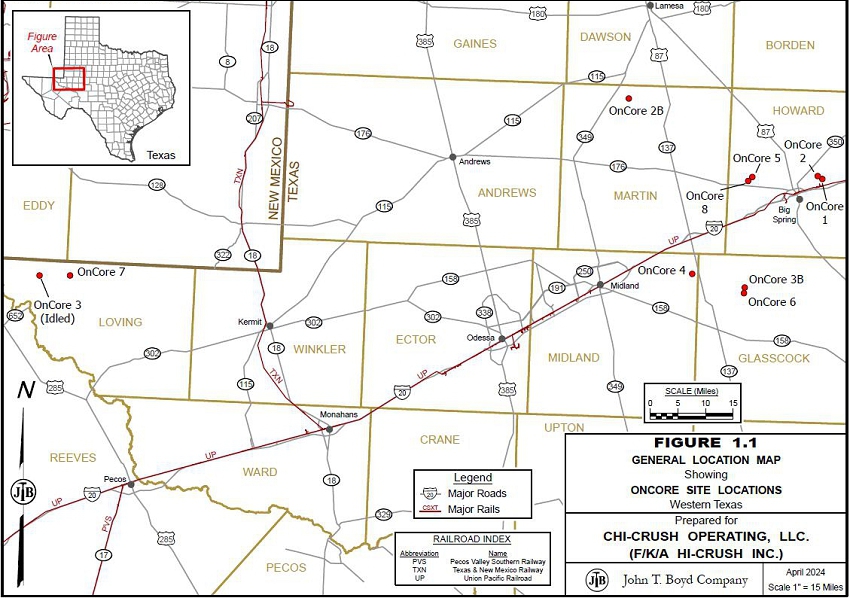
1-3
The OnCore sites comprise approximately 6,480 acres for which surface and sand mining rights are conveyed to Hi-Crush via contractual (“work order”) agreements with the customer-landowner or leases with third parties. These agreements provide Hi-Crush the right to mine, process, and dispose (i.e., sell) of frac sand from the properties.
| Table 1.1 Property Control | ||||||
| Plant | Control | Acreage | ||||
| OnCore 1 | Leased | 232.2 | ||||
| Work Order | 1,310.0 | |||||
| OnCore 2 | Leased | 391.6 | ||||
| OnCore 2B | Leased | 877.0 | ||||
| OnCore 3B | Work Order | 319.6 | ||||
| OnCore 4 | Leased | 640.0 | ||||
| OnCore 5 | Leased | 1,378.8 | ||||
| OnCore 6 | Leased | 481.0 | ||||
| OnCore 7 | Leased | 297.0 | ||||
| OnCore 8 | Leased | 552.8 | ||||
| 6,480.0 | ||||||
1.3 Geology
The OnCore Plants are all located within an active sand dune belt, in an area of West Texas where the High Plains and Trans-Pecos desert regions converge. The region’s surface is characterized by windblown Quaternary-aged sand formations, including sand dunes, undivided sand and silt deposits, and sheet sand deposits.
Most of the OnCore sites are covered by Quaternary sheet and dune sands generally consisting of fine- to medium-grained quartz sand grains mixed with varying degrees of silts, calcareous sands, and caliche nodules. Surficial sand deposition in the study areas may range in thickness from less than 5 ft to over 40 ft. Overburden (i.e., overlying waste) material is generally minimal and easily removed during mining and processing operations. Interbedded alluvial deposits consisting of pebble- to cobble-sized limestone and chert nodules, or caliche are not uncommon, but are easily segregated during mining.
JOHN T. BOYD COMPANY
1-4
The sand mined at each of the OnCore operations is processed on-site to produce frac sand. Frac sand is a naturally occurring, high silica content quartz sand with grains that are generally well-rounded. The main difference between frac sand and other sands is that frac sand grains are relatively pure in composition, consisting almost entirely of quartz; other sands have numerous impurities that may be cemented to the quartz grains. The pure quartz composition of frac sand grains, along with their homogenous size and well-rounded and spherical shape, gives these sands the characteristics (e.g., crush strength, low acid solubility, low turbidity) that are needed by oil and gas producers for use in developing wells.
1.4 Exploration
In developing the OnCore sites, Hi-Crush has completed numerous geologic exploration campaigns. A total of 227 drill holes have been completed across the subject OnCore sites. The results of these exploration programs comprise geologic logs and subsurface sand samples, grain size analyses of the samples, and proppant sand testing of composited samples. Exploration summaries were provided to BOYD for our review, along with the collected and analyzed exploration data, which together comprise the primary geologic data used in the evaluation of the frac sand resources and frac sand reserves reported herein.
BOYD’s review indicates that the exploration data: (1) were carefully and professionally collected, prepared, and documented, (2) conform with general industry standards, and (3) are appropriate for use in evaluating and estimating frac sand resources and reserves.
1.5 Frac Sand Reserves
This report provides estimates of frac sand reserves for Hi-Crush’s OnCore Plants in accordance with the requirements set forth in S-K 1300. These estimates were independently prepared by BOYD for the purpose of this report. The reserve estimates are the result of a thorough geologic investigation of the properties, appropriate modeling of the deposits, development of life-of-mine (LOM) plans, and consideration of the relevant processing, economic, marketing, legal, environmental, socio-economic, and regulatory factors.
It is BOYD’s independent opinion that the estimated frac sand reserves for the OnCore Plants as of December 31, 2023, total approximately 47.2 million saleable product (i.e., 40/140 to 40/200 mesh frac sand) tons, which are presently controlled by Hi-Crush.
JOHN T. BOYD COMPANY
1-5
Table 1.1, below, presents the estimated frac sand reserves by classification and mesh size, for the OnCore Plants.
| Table 1.2: Frac Sand Reserves (as of December 31, 2023) | ||||||||||||||||
| Mesh | Product Tons (000) by Classification | |||||||||||||||
| Plant | Size | Control | Proven | Probable | Total | |||||||||||
| OnCore 1 | 40/140 | Leased | 3,360 | - | 3,360 | |||||||||||
| Work Order | - | 1,149 | 1,149 | |||||||||||||
| Subtotal | 3,360 | 1,149 | 4,509 | |||||||||||||
| OnCore 2 | 40/140 | Leased | 375 | - | 375 | |||||||||||
| OnCore 2B | 40/140 | Leased | - | 5,130 | 5,130 | |||||||||||
| OnCore 3B | 40/140 | Work Order | - | 3,418 | 3,418 | |||||||||||
| OnCore 4 | 40/140 | Leased | 2,232 | 668 | 2,900 | |||||||||||
| Oncore 5 | 40/140 | Leased | 4,297 | 7,282 | 11,579 | |||||||||||
| OnCore 6 | 40/140 | Leased | 5,146 | - | 5,146 | |||||||||||
| OnCore 7 | 40/140 | Leased | 3,810 | 4,692 | 8,502 | |||||||||||
| OnCore 8 | 40/140 | Leased | 5,613 | - | 5,613 | |||||||||||
| Total - All OnCore Plants | 24,833 | 22,339 | 47,172 | |||||||||||||
Hi-Crush has a well-established history of mining, processing, and selling frac sand products from their regional operations. BOYD has concluded that sufficient studies have been undertaken to enable the frac sand resources to be converted to frac sand reserves based on established operating methods and forecasted costs and revenues. The forecasted sales prices used in the estimation of frac sand reserves for the OnCore Plants is $23.33 per ton of finished frac sand over the expected life of the reserves (refer to Section 10.5 and Table 12.1 for further details).
There are no reportable additional frac sand resources, excluding those converted to reserves, for the OnCore Plants. Quantities of frac sand controlled by Hi-Crush within the defined boundaries of the OnCore properties, which are not reported as frac sand reserves, are not considered to be technically, economically, and/or legally extractable at the time of determination; as such, they are not reportable as frac sand resources in addition to reserves.
JOHN T. BOYD COMPANY
1-6
| 1.6 | Operations |
| 1.6.1 | Mining |
Contractors are employed to excavate sand and overburden (i.e., overlying waste material) at each of the OnCore Plants. The target sand deposits are excavated using conventional truck and excavator surface mining techniques. Generally, the negligibly thin layer of overburden is mined with the underlying sand. The sand is unconsolidated and does not require drilling or blasting. Excavators and/or front-end loaders are used to load the excavated sand into articulated haul trucks. The haul trucks deliver raw sand material to run-of-mine (ROM) stockpiles located near the processing facilities.
| 1.6.2 | Processing |
The OnCore Plants comprise seven smaller mobile wet processing plants and one larger modular wet processing plant (currently under construction). The OnCore operations predominantly produce wet “100 mesh” (i.e., 40/140 to 40/200 mesh) frac sand—that is, the sand is not dried and particles larger than 40 mesh and smaller than 140-to-200 mesh are not considered finished product and are discarded as waste.
The small, built-for-purpose mobile OnCore Plants allow Hi-Crush to move sand mining and processing operations from site to site as deposits are depleted. Indeed, Hi-Crush plans to move two plants in 2024—one from the soon-to-be exhausted OnCore 2 site to the unmined OnCore 2B site, and one from the recently exhausted OnCore 3 site to the unmined OnCore 3B site.
The seven mobile plants were constructed by Superior Industries, Inc. (Superior). While the plants share nearly identical designs, the latter plants incorporate changes made to the early models to improve production. Each of the mobile processing plants has a nominal (or “nameplate”) capacity of 130 feed tons per hour (tph), which equates to approximately 700,000 to 900,000 tons of finished frac sand per year, depending on the expected processing yields of the sand deposits.
Hi-Crush’s modular OnCore 8 processing plant is currently under construction with a planned commissioning in June 2024. Designed by Superior, the OnCore 8 modular processing plant’s design consists of two 250-tph circuits providing a nameplate capacity of 500 tph of feed sand or approximately 3 million tons of finished frac sand per year. The parallel circuit arrangement offers a degree of flexibility as one plant circuit can be idled for maintenance, while the other is operating.
JOHN T. BOYD COMPANY
1-7
Each of the OnCore Plants’ processing operations comprise two major components which are typical in the production of wet frac sand. These components include:
| · | Wet Plant – ROM material from the pit is delivered to the wet plant where the coarse material (e.g., gravel) and fine material (e.g., fine sand and silt) is removed from the sand. |
| · | Storage and Loadout – Finished damp sand products are stored in stockpiles resting on a water decant system, where the sand is allowed to dry somewhat. The frac sand is then loaded into feed hoppers, conveyed to a discharge hopper, and loaded into trucks resting on weighing scales. |
| 1.6.3 | Other Infrastructure |
All of the basic infrastructure required for the ongoing operations is in place or under construction at each of the OnCore Plants. The mining and processing operations are supported by the various utilities and transportation networks needed to allow the production and transportation of finished frac sands.
BOYD is unaware of any reported interruptions, outages, shortages, or failures related to infrastructure requirements which have materially affected operations at any of the OnCore sites. Given the operation is well-established, we opine that there is low risk of such events materially affecting the estimates of frac sand reserves presented herein is low.
JOHN T. BOYD COMPANY
1-8
1.7 Financial Analysis
1.7.1 Market Analysis
Permit submissions for horizontal oil and gas wells in the Permian Basin indicate a continuation of strong drilling ahead. Utilizing data from Baker Hughes and the Railroad Commission of Texas (RRC), the total number of permits filed ranges between 1,000 and 1,600 per quarter in 2023, a strong rebound from the pandemic lows of 2020, as shown in Figure 1.2, below.
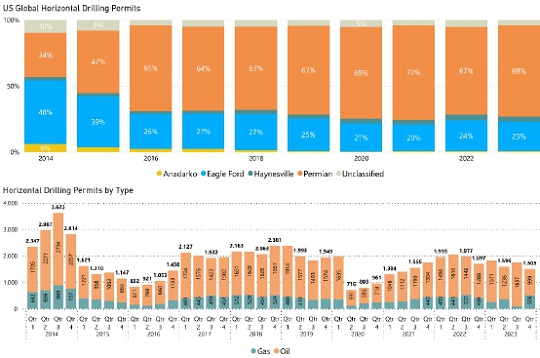
Figure 1.2: Permian Basin HZ Permit Submissions
Domestic oil production continues to increase with the Permian leading the way at almost 6 million barrels per day by late 2023, as shown below in Figure 1.3.
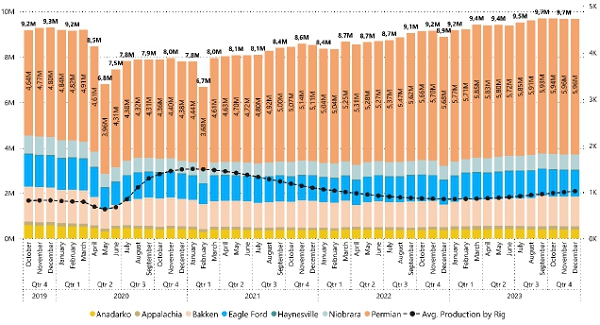
Source EIA (U.S. Energy Information Administration)
Figure 1.3: Oil Production (bbl/d)
JOHN T. BOYD COMPANY
1-9
Current frac sand production in the Permian Basin is estimated at 60 million to 65 million tons per year with fairly balanced demand and stable pricing. BOYD anticipates stable frac sand pricing substantially above those used to estimate frac sand reserves for the OnCore Plants. Additionally, we anticipate continued upward sand consumption in the basin due to economic and geopolitical influences on energy demand.
1.7.2 Capital and Operating Cost Estimates
The OnCore Plants’ recent financial performance is summarized as follows:
| · | The OnCore Plants sold approximately 4.7 million tons of finished frac sand in 2023—more than doubling the previous year’s sales. This was primarily due to the commissioning of three additional mobile plants. |
| · | Hi-Crush’s average selling price (ASP) for frac sand sold from the OnCore Plants was $21.04 per ton in 2023, increasing 24% from 2022. The four-year historical ASP was $17.62 per ton. |
| · | Average cost of goods sold (ACS) was $10.10 per ton sold in 2023, decreasing 20% year-over-year. |
| · | EBITDA margin (i.e., EBITDA as a percentage of gross revenue) has remained positive over the past three years and was 48% in 2023. |
| · | Capital expenditures totaled approximately $71.4 million (or $8.91 per ton sold) over the last four years. |
Forward-looking production and unit cost estimates are based on actual past performance and are subject to Hi-Crush’s customary internal budget review and approvals process. In BOYD’s opinion, operating volumes are well-defined and understood, as are mining and processing productivities.
The OnCore Plants and related facilities are fully developed or nearly constructed and should not require any near-term major capital investment beyond 2024’s budgeted $44.8 million to maintain full commercial production. Historically, the timing and amount of capital expenditures have been largely discretionary and within Hi-Crush’s control. BOYD projected sustaining capital expenditures is estimated to average $1.20 per ton sold, which includes maintenance of production equipment as well as other items needed for the ongoing operation. This unit cost is based on our judgment and experience with similar operations.
Operating cost estimates were developed based on recent actual costs and considering site specific operational activity levels and cost drivers. OnCore’s operating costs are expected to remain relatively consistent (on an uninflated basis) with 2023 results. As such, the projected total cash cost of goods sold over the life of the mine averages $11.57 per ton sold over the life of the mine. BOYD considers the future operating cost estimates to be reasonable and appropriate.
JOHN T. BOYD COMPANY
1-10
1.7.3 Economic Analysis
A consolidated economic analysis of the OnCore Plants was prepared by BOYD for the purpose of confirming the commercial viability of the reported frac sand reserves. Our financial model forecasts future free cash flow from frac sand production and sales over the life cycle of the operation using annual forecasts of production, sales revenues, and operating and capital costs.
Table 1.3, below, provides a summary of the estimated financial results (on an aggregate basis) for the remaining life of the OnCore Plants.
| Table 1.3: Financial Results | ||||||
| Remaining | ||||||
| Life of | ||||||
| Reserves | ||||||
| Units | Total | |||||
| Expected Remaining Life | years | 16 | ||||
| Production: | ||||||
| ROM Production | 000 tons | 67,963 | ||||
| Product Sales | 000 tons | 47,172 | ||||
| Total Revenues | $ millions | 1,100.5 | ||||
| Average Selling Price | $/t sold | 23.33 | ||||
| Total Cost of Goods Sold | $ millions | 545.8 | ||||
| Average Cost of Goods Sold | $/t sold | 11.57 | ||||
| Capital Expenditures | $ millions | 86.2 | ||||
| Average Capital Expenditures | $/t sold | 1.83 | ||||
| Pre-Tax: | ||||||
| Cash Flow | $ millions | 468.5 | ||||
| NPV10 | $ millions | 309.6 | ||||
| After-tax: | ||||||
| Cash Flow | $ millions | 378.5 | ||||
| NPV10 | $ millions | 245.8 | ||||
JOHN T. BOYD COMPANY
1-11
Table 1.4 summarizes the results of the pre-tax and after-tax discounted cash flows (DCF) and net present value (NPV) analyses for the OnCore Plants.
| Table 1.4: DCF-NPV Analysis | ||||||||||||
| NPV ($ millions) | ||||||||||||
| 8% | 10% | 12% | ||||||||||
| Pre-Tax | 332.9 | 309.6 | 289.0 | |||||||||
| After-Tax | 265.2 | 245.8 | 228.8 | |||||||||
The NPV estimate was made for the purpose of confirming the economic viability of the reported proppant sand reserves and not for purposes of valuing Hi-Crush, any of the OnCore operations, or their assets. Internal rate-of-return (IRR) and project payback were not calculated, as there was no initial investment considered in the financial analysis presented herein.
It is BOYD’s opinion that the financial model provides a reasonable and accurate reflection of the OnCore Plants’ expected economic performance based on the assumptions and information available at the time of our review.
1.8 Permitting and Compliance
Several permits are required by federal and state law for mining, processing, and related activities at each of the OnCore operations. BOYD reviewed the permits necessary to support continued operations at each of the OnCore sites. Such required permits appear to be valid and in good standing. The approved permits and certifications are adequate for the continued operation of the mine and processing facilities. New permits, permit revisions, and/or renewals may be necessary from time to time to facilitate future operations. Given sufficient time and planning, Hi-Crush should be able to secure new permits, as required, to maintain its planned operations within the context of current regulations.
Mine safety is regulated by the U.S. Department of Labor’s Mine Safety and Health Administration (MSHA). MSHA inspects the facilities a minimum of twice yearly. Hi-Crush’s safety record compares favorably with its regional peers.
BOYD is not aware of any regulatory violation or compliance issue which would materially impact the reported frac sand reserves.
JOHN T. BOYD COMPANY
1-12
1.9 Conclusions
It is BOYD’s overall conclusion that the estimates of frac sand reserves, as reported herein: (1) are reasonably supported by sufficient and reliable exploration data, and (2) are reasonably and appropriately supported by technical evaluations, which consider all relevant modifying factors. We are not aware of any other relevant data or information material to the OnCore Plants that would render this report misleading. Our conclusions represent only informed professional judgment.
Given the operating history and status of evolution, residual uncertainty (future risk) for this operation is considered minor under the current and foreseeable operating environment. It is BOYD’s opinion that extraction of the frac sand reserves reported herein is technically, legally, and economically achievable after the consideration of potentially material modifying factors. The ability of Hi-Crush, or any mine operator, to recover all the reported frac sand reserves is dependent on numerous factors that are beyond the control of, and cannot be anticipated by, BOYD. These factors include mining and geologic conditions, the capabilities of management and employees, the securing of required approvals and permits in a timely manner, future frac sand prices, etc. Unforeseen changes in regulations could also impact performance. None of the opinions presented herein are intended to represent that BOYD intends or is qualified to render opinions that are legal or accounting in nature.
JOHN T. BOYD COMPANY
2-1
2.0 INTRODUCTION
2.1 Registrant
Hi-Crush provides a combination of finished frac sand products and various logistics solutions to oil and gas companies engaged in exploration and production (E&P) of unconventional oil and natural gas resources throughout the US. Headquartered in Houston, Texas, Hi-Crush was established in 2010 and began operations at their two frac sand mines: the Wyeville Mine in Tomah, Wisconsin in 2011; and the Kermit Mine in Kermit, Texas in August 2017. The company also operates numerous OnCore mining and processing facilities in the Permian Basin, and their Pronghorn last mile sand delivery services.
Additional information regarding Hi-Crush can be found on their website at www.hicrushinc.com.
2.2 Purpose and Terms of Reference
Hi-Crush retained BOYD to independently prepare and present estimates of frac sand resources and frac sand reserves for the OnCore Plants in accordance with the disclosure requirements set forth in S-K 1300. As such, the purpose of this TRS is threefold: (1) to summarize technical and scientific information for the subject mining properties, (2) to provide the conclusions of our review of the information for the properties, and (3) to provide statements of frac sand resources and frac sand reserves for the OnCore Plants.
BOYD’s opinions and conclusions are based on our detailed review of the supporting geologic, technical, and economic information provided by Hi-Crush, which were used in formulating the estimates of frac sand resources and frac sand reserves disclosed in this report. We independently estimated the frac sand resources and frac sand reserves from first principles using exploration information provided by Hi-Crush or by third-party experts engaged by Hi-Crush. We employed standard engineering and geoscience methods, or a combination of methods, that we considered to be appropriate and necessary to establish the conclusions set forth herein. As in all aspects of mining property evaluation, there are uncertainties inherent in the interpretation of engineering and geoscience data; therefore, our conclusions necessarily represent only informed professional judgment.
JOHN T. BOYD COMPANY
2-2
The ability of Hi-Crush, or any mine operator, to recover all the estimated frac sand reserves presented in this report is dependent on numerous factors that are beyond the control of, and cannot be anticipated by, BOYD. These factors include mining and geologic conditions, the capabilities of management and employees, the securing of required approvals and permits in a timely manner, future sand prices, etc. Unforeseen changes in regulations could also impact performance. Opinions presented in this report apply to the site conditions and features as they existed at the time of BOYD’s investigations and those reasonably foreseeable.
This report is intended for use by Hi-Crush, subject to the terms and conditions of its professional services agreement with BOYD. We also consent to Hi-Crush filing this TRS with the SEC pursuant to S-K 1300. Except for the purposes legislated under US securities law, any other uses of or reliance on this report by any third party is at that party’s sole risk.
2.3 Expert Qualifications
BOYD is an independent consulting firm specializing in mining-related engineering and financial consulting services. Since 1943, BOYD has completed over 4,000 projects in the United States and more than 90 other countries. Our full-time staff comprises experts in: civil, environmental, geotechnical, and mining engineering; geology; mineral economics; and market analysis. Our extensive experience in frac sand resource and reserve estimation and our knowledge of the subject properties, provides BOYD an informed basis to opine on the frac sand resources and frac sand reserves available at the OnCore Plants. An overview of BOYD can be found on our website at www.jtboyd.com.
The individuals primarily responsible for the preparation of this report and the estimates of frac sand reserves presented herein are by virtue of their education, experience, and professional association considered qualified persons (QPs) as defined in S-K 1300.
Neither BOYD nor its staff employed in the preparation of this report have any beneficial interest in Hi-Crush, and are not insiders, associates, or affiliates of Hi-Crush. The results of our assignment were not dependent upon any prior agreements concerning the conclusions to be reached, nor were there any undisclosed understandings concerning any future business dealings between Hi-Crush and BOYD. This report was prepared in return for fees based on agreed-upon commercial rates, and the payment for our services was not contingent upon our opinions regarding the project or approval of our work by Hi-Crush and its representatives.
JOHN T. BOYD COMPANY
2-3
2.4 Principal Sources of Information
The information, estimates, opinions, and conclusions presented herein are informed by:
(1) data, reports, and other information provided by Hi-Crush, (2) discussions with Hi-Crush personnel, (3) records on file with regulatory agencies, (4) data, reports, and other information from public sources, and (5) nonconfidential information in BOYD’s possession.
The following information was provided by Hi-Crush:
| · | Exploration records (e.g., drill hole location maps, drilling logs, and lab testing summaries) |
| · | Mapping data, including: |
| - | Property control boundaries |
| - | Infrastructure locations |
| - | Easement and right-of-way boundaries |
| - | Topograhpic site surveys |
| - | Recent mining extents |
| · | Overview of processing operations and detailed flow diagrams |
| · | Preliminary business plans |
| · | Historical information, including: |
| - | Production reports and reconciliation statements |
| - | Financial statements |
| - | Product sales and pricing |
| - | Mine plans |
| - | Site plans |
| - | Operational data |
| · | Files related to mining and operating permits |
Any other information from sources external to BOYD and/or Hi-Crush is referenced accordingly.
The data and workpapers used in the preparation of this report are on file in our offices.
2.4.1 Personal Inspections
Due to time constraints, BOYD did not conduct personal inspections of the OnCore properties or facilities for this assignment. However, BOYD professionals—including the QPs and co-authors of this report—reviewed the OnCore operations with senior Hi-Crush operations and planning personnel via teleconference. During our meetings, we reviewed recent high-resolution aerial photography of the OnCore sites and discussed site geology, mining conditions and operations, and current and proposed processing operations. Additionally, the co-authors have visited many of the neighboring frac sand mining operations in the recent past.
JOHN T. BOYD COMPANY
2-4
2.4.2 Reliance on Information Provided by the Registrant
In the preparation of this report, BOYD has relied, exclusively and without independent verification, upon information furnished by Hi-Crush with respect to:
| · | Property title and status |
| · | Encumbrances, easements, and right-of-ways |
| · | Permits, bonds, and reclamation liability |
| · | Sustainability initiatives |
| · | Surface tailings management |
| · | Mine closure requirements and plans |
| · | Monitoring/compliance requirements for protected areas/species |
| · | Community relations |
| · | Market overview and strategy |
| · | Product specifications |
| · | Marketing and sales contracts |
| · | Income tax rates |
| · | Inflation and discount rates |
Our opinions and conclusions regarding this information are provided in the relevant sections of this report.
2.4.3 Verification of Information
BOYD exercised due care in reviewing the information provided by Hi-Crush within the scope of our expertise and experience (which is in technical and financial mining issues) and concluded the data are reasonable and reliable considering the status of the subject properties and the purpose for which this report was prepared.
We have no reason to believe that any material facts have been withheld or misstated, or that further analysis may reveal additional material information. However, the accuracy of the results and conclusions of this report are reliant on the accuracy of the information provided by Hi-Crush. While we are not responsible for any material omissions in the information provided for use in this report, we accept responsibility for the disclosure of information contained herein which is within the scope of our expertise.
JOHN T. BOYD COMPANY
2-5
2.4.4 Other Relevant Data and Information
BOYD is not aware of any additional information that would materially impact the frac sand resource and frac sand reserve estimates reported herein.
2.5 Report Version
The effective (i.e., “as of”) date of this TRS is December 31, 2023. The estimates of frac sand resources and frac sand reserves and supporting information presented in this report are effective as of December 31, 2023.
To BOYD’s knowledge, this is the first TRS completed for Hi-Crush’s OnCore Plants. The user of this document should ensure that this is the most recent disclosure of frac sand resources and frac sand reserves for the OnCore Plants as they are no longer valid if more recent estimates are available.
2.6 Units of Measure
The US customary measurement system has been used throughout this report. Tons are short tons of 2,000 pounds-mass. Unless otherwise stated, currency is expressed in US Dollars ($). Historic prices and costs are presented in nominal (unadjusted) dollars. Future dollar values are expressed on a constant (unescalated) basis as of the effective date of this report.
JOHN T. BOYD COMPANY
3-1
3.0 PROPERTY OVERVIEW
3.1 Description and Location
Hi-Crush’s OnCore operations are associated with ten locations spread across five counties—Glasscock, Howard, Loving, Martin, and Midland—in western Texas. Six of the seven mobile OnCore Plants—OnCore 1, 2, 4, 5, 6, and 7—are currently operating. The OnCore 3 site was idled in late-2023 and the mobile plant is moving to the OnCore 3B site in mid-2024. The OnCore 2 site will be decommissioned in mid-2024 and the mobile plant moved to the OnCore 2B site. A larger modular processing plant is currently being constructed on the OnCore 8 site and will be commissioned in mid-2024.
Each OnCore plant is located within the Permian Basin and operates in a relatively similar manner, mining and processing local sands to produce a damp “100 mesh” frac sand product, which is used in the hydraulic fracturing process (known as “fracking”) to produce petroleum fluids, such as oil, natural gas, and natural gas liquids.
The Midland-Odessa metropolitan area is somewhat central to all of the OnCore Plants. The western-most site—OnCore 7—is located approximately 95 miles west of Midland International Air & Space Port. The northern-most site—OnCore 2B—is located approximately 40 miles to the north-northeast; and the remaining sites located approximately 25 to 55 miles to the northeast of Midland International Air & Space Port.
The locations of operating and planned OnCore plants are shown in Table 3.1, below.
| Table 3.1: OnCore Plant Locations | ||||||||
| Geographic Coordinates | ||||||||
| Plant | County | Basin | Lattitude | Longitude | ||||
| OnCore 1 | Howard | Midland | 32° 17' 33" N | 101° 24' 06" W | ||||
| OnCore 2 | Howard | Midland | 32° 18' 02" N | 101° 24' 52" W | ||||
| OnCore 2B | Martin | Midland | 32° 29' 27" N | 102° 00' 00" W | ||||
| OnCore 3 | Loving | Delaware | 31° 57' 29" N | 103° 48' 21" W | ||||
| OnCore 3B | Glasscock | Midland | 32° 00' 03" N | 101° 37' 26" W | ||||
| OnCore 4 | Midland | Midland | 32° 02' 07" N | 101° 47' 41" W | ||||
| OnCore 5 | Howard | Midland | 32° 17' 41" N | 101° 37' 06" W | ||||
| OnCore 6 | Glasscock | Midland | 31° 59' 09" N | 101° 37' 57" W | ||||
| OnCore 7 | Loving | Delaware | 31° 57' 43" N | 103° 42' 42" W | ||||
| OnCore 8 | Howard | Midland | 32° 16' 49" N | 101° 37' 55" W | ||||
JOHN T. BOYD COMPANY
3-2
Figures 3.1 through 3.6, on the following pages, show the general layout of each OnCore site, including the locations of processing plants, loadout facilities, and current and former mining pits. Figure 1.1 (page 1-2) illustrates the general locations of the Hi-Crush OnCore Plants.
3.2 History
Extensive surface mining of frac sand has been conducted in the West Texas region since the first “in-basin” frac sand mine—Hi-Crush’s Kermit Mine—commenced production in August 2017, and began supplying locally sourced frac sand into the Permian Basin oil and gas industry. Since then, numerous in-basin frac sand mines have been opened across the region.
Hi-Crush developed the OnCore mobile mining and processing concept after completing a series of regional geologic exploration efforts across areas located outside of the historic Permian Basin frac sand mining activity centers. The first OnCore site (OnCore 1) opened in late-2020, and after seeing continued demand for locally sourced damp frac sand, Hi-Crush has now operated a total of seven different OnCore sites since commencing production at OnCore 1. OnCore 3 was recently idled. OnCore 2 is scheduled to be idled in mid-2024. Three new sites—OnCore 2B, 3B, and 8—are scheduled to be online mid-2024. The status of each site is provided in Table 3.2, below.
| Table 3.2: Property Status | ||||
| Plant | Status | Start Date | ||
| OnCore 1 | Producing | 9/1/2020 | ||
| OnCore 2 | Producing | 4/1/2021 | ||
| OnCore 2B | Development | 6/1/2024* | ||
| OnCore 3 | Idled | 2/1/2022 | ||
| OnCore 3B | Development | 5/15/2024* | ||
| OnCore 4 | Producing | 7/1/2025 | ||
| OnCore 5 | Producing | 5/1/2030 | ||
| OnCore 6 | Producing | 11/1/2026 | ||
| OnCore 7 | Producing | 9/1/2026 | ||
| OnCore 8 | Development | 6/1/2024* | ||
| * Estimated | ||||
JOHN T. BOYD COMPANY
3-3
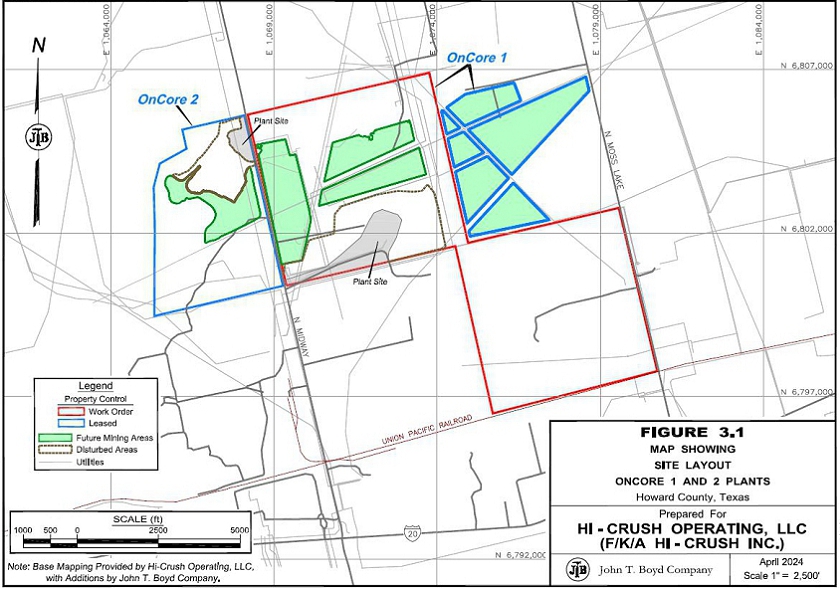
3-4
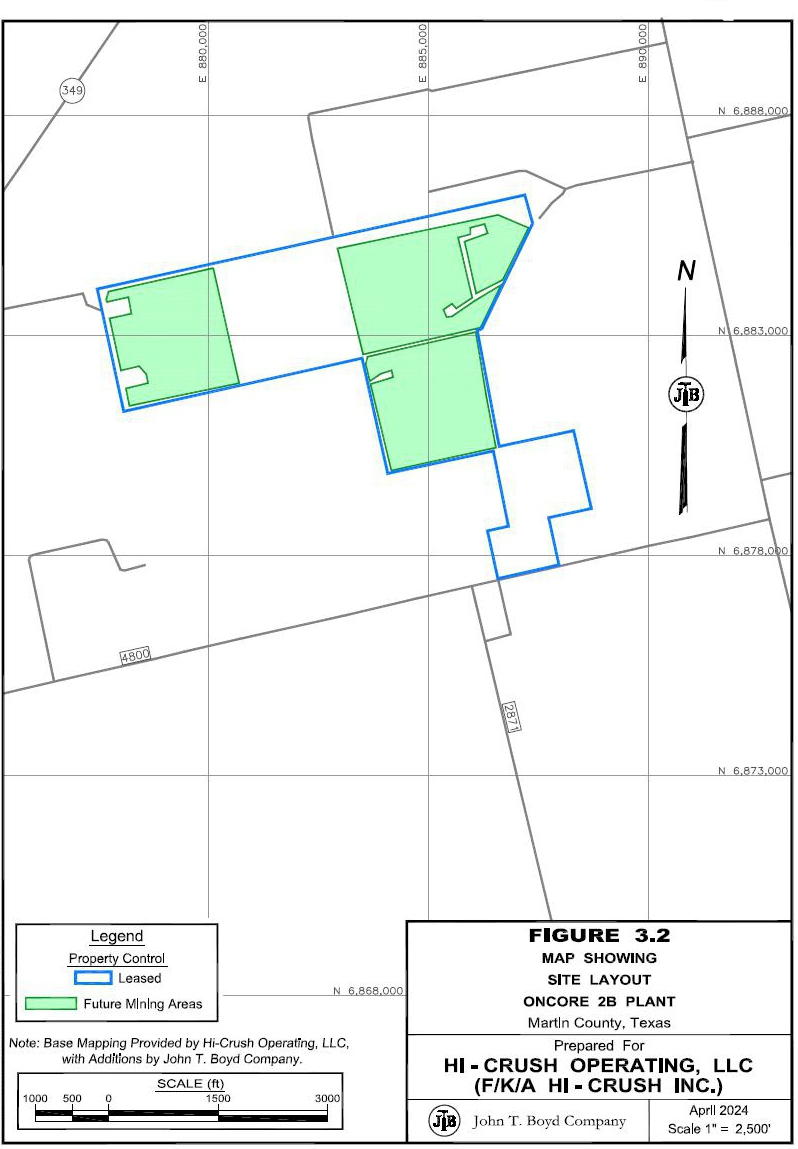
3-5
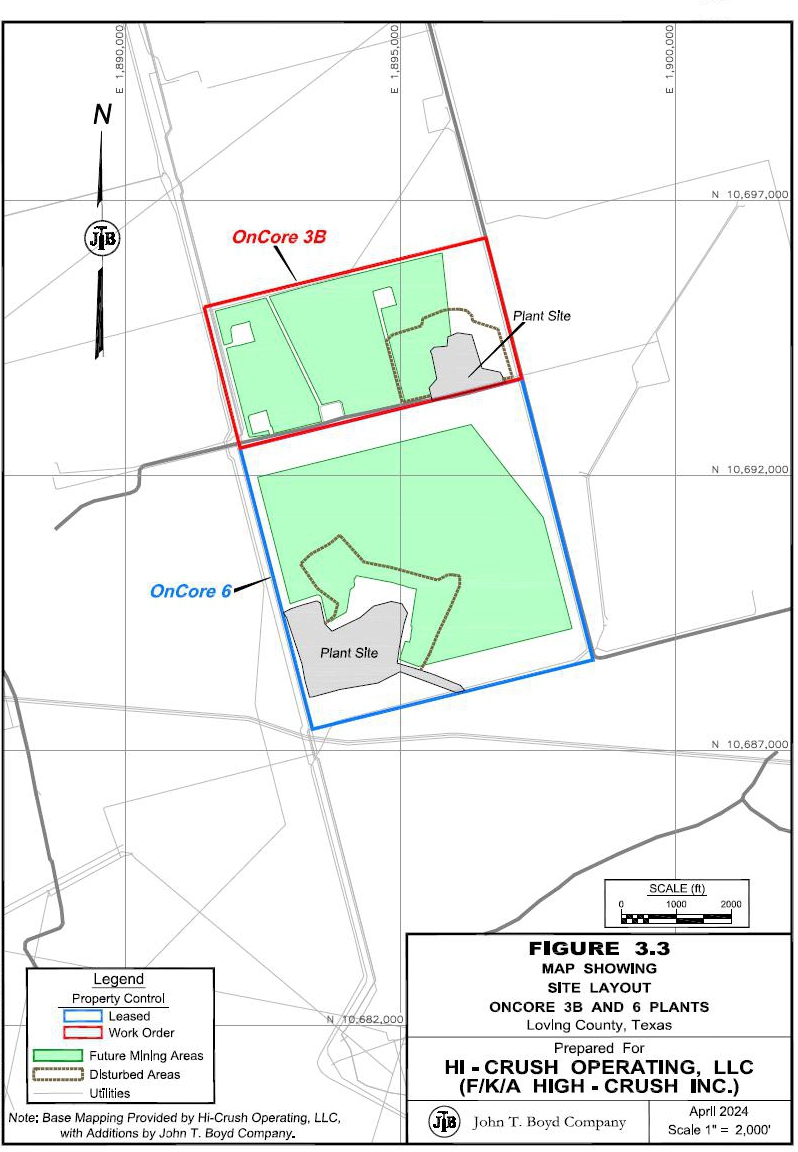
3-6
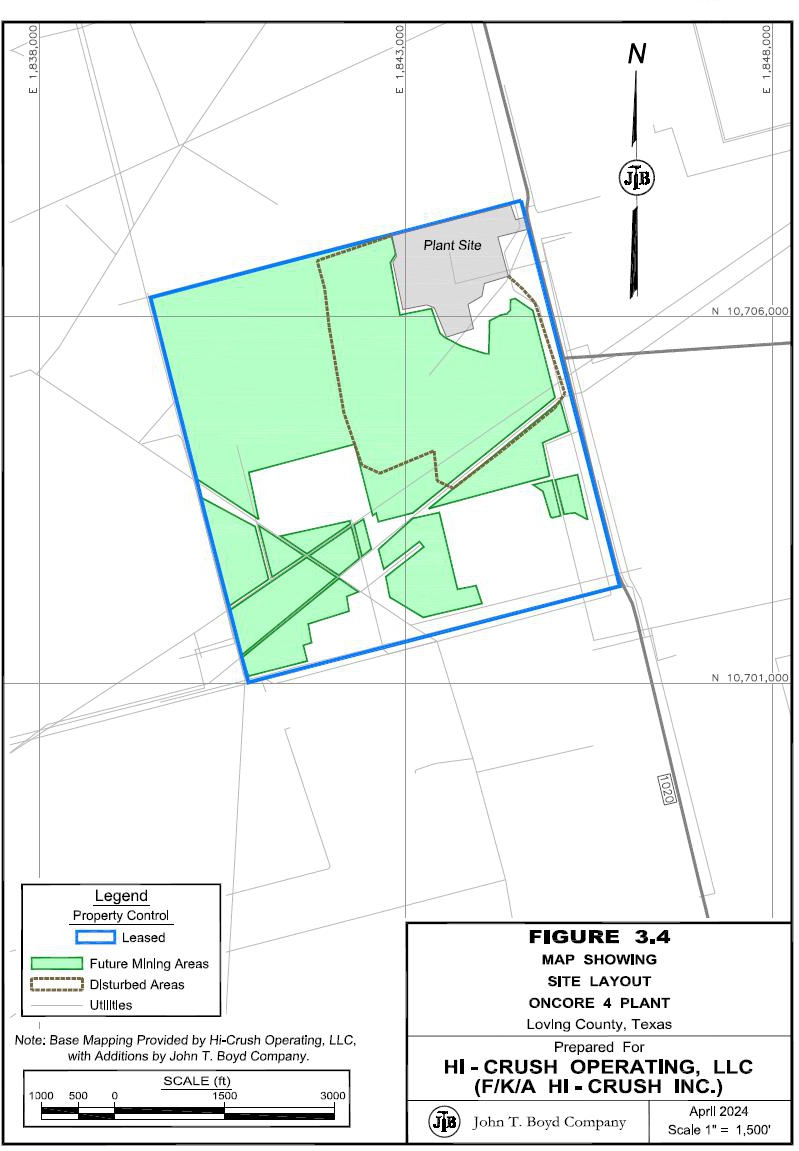
3-7
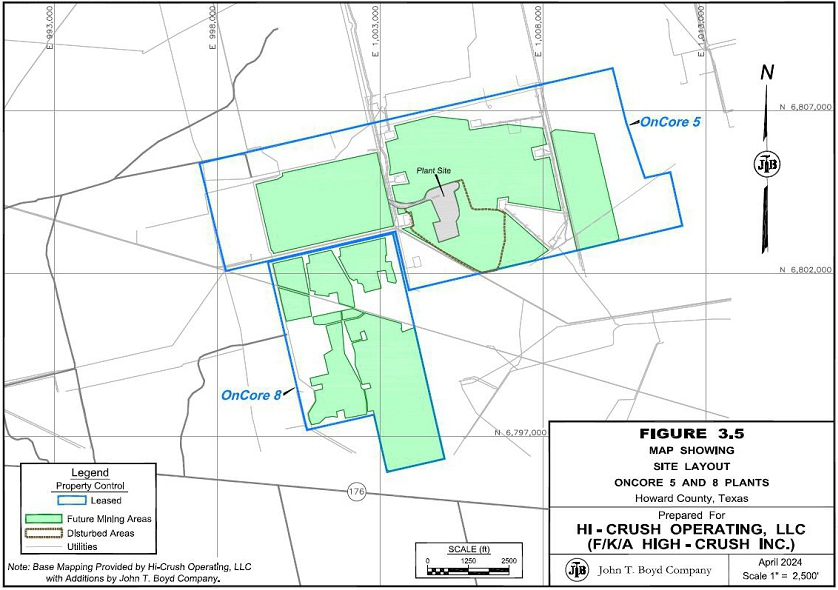
3-8
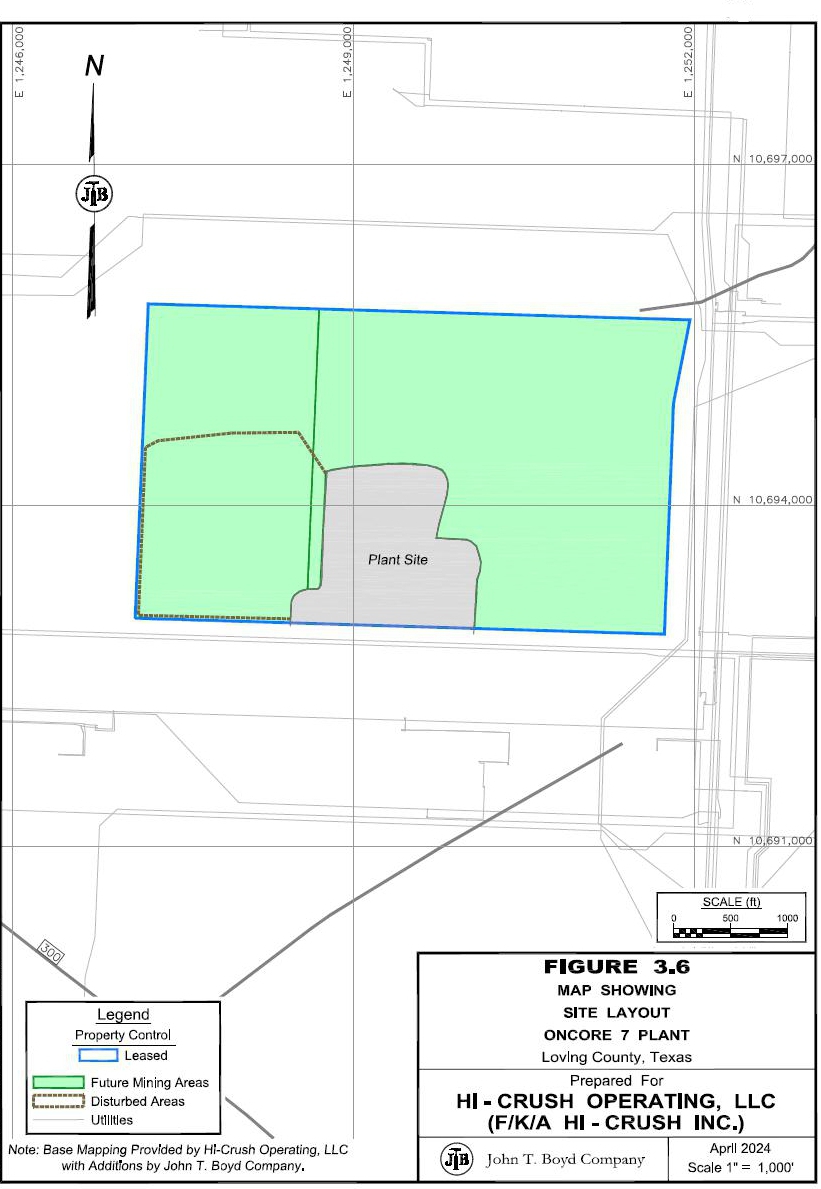
3-9
3.3 Property Control
The OnCore sites are primarily operated under lease agreements held between Hi-Crush and various private landowners. However, some OnCore sites are also located on land that is controlled by various Hi-Crush customers. These customers have agreed to allow Hi-Crush to mine sand from their properties under contracts, or “work orders”, that require Hi-Crush to supply minimum quantities of finished frac sand to the landowner at agreed upon prices paid to Hi-Crush.
Data provided to BOYD for the OnCore properties included mapping and lease agreements or work orders for each property, which have been accepted as being true and accurate for the purpose of this report.
Table 3.3, below, provides a brief overview of the property control status of each OnCore site.
| Table 3.3 Property Control | ||||||||
| Term | ||||||||
| Plant | Control | Acreage | Start | Length | ||||
| OnCore 1 | Leased | 232.2 | 7/18/2022 | 3 Years | ||||
| Work Order | 1,310.0 | 11/30/2023 | 3 Years | |||||
| OnCore 2 | Leased | 391.6 | 3/30/2020 | Indef. | ||||
| OnCore 2B | Leased | 877.0 | 8/28/2023 | Indef. | ||||
| OnCore 3B | Work Order | 319.6 | 8/1/2023 | 3 years | ||||
| OnCore 4 | Leased | 640.0 | 4/11/2022 | Indef. | ||||
| OnCore 5 | Leased | 1,378.8 | 10/8/2021 | Indef. | ||||
| OnCore 6 | Leased | 481.0 | 12/15/2022 | 4 years | ||||
| OnCore 7 | Leased | 297.0 | 7/18/2022 | 4 years | ||||
| OnCore 8 | Leased | 552.8 | 2/3/2023 | Indef. | ||||
| 6,480.0 | ||||||||
It is generally reasonable to assume that expired leases and work orders can be renewed in the ordinary course of business; as such, we do not believe there is any undue risk associated with surface and mineral control to the estimated reserves reported herein.
JOHN T. BOYD COMPANY
3-10
All third-party sales of frac sand produced from the OnCore properties is subject to a royalty payable to the landowners. The blended royalty for the frac sand reserves reported herein is $1.22 per ton sold.
3.4 Adjacent Properties
Several existing frac sand mining operations are located throughout the West Texas region, however much of the current frac sand mining activity is located near Kermit, Texas. Hi-Crush’s OnCore sites have been located away from the current frac sand mining activity center in an attempt to gain an advantage of shorter haul distances to their end use customers. The closest competitor operations to OnCore’s Delaware Basin sites are Independence Texas, LLC. Tree Dog and Z&T Ranch mines in Loving County, near the idled OnCore 3 site and the OnCore 7 site. OnCore’s Midland Basin operations are more widely distributed, and at present OnCore 2B, 3B, 4, 5, 6, and 8 have no nearby competitors. OnCore 1 and 2 have three nearby competitors: Nomad Proppant Services, LLC, and West Point Silica, LLC both operate on properties adjacent to OnCore 1 to the east and south, respectively. Big Spring Sands, LLC operates a mine 1.5 miles southwest of the OnCore 2 site.
There is no information used in this report that has been sourced from adjacent properties.
3.5 Regulation and Liabilities
The OnCore sites operate under several permits and must comply with other federal, state, and municipal law regulations that do not require a specific permit. Hi-Crush reports that necessary permits are in place or applied for to support immediate operations. New permits or permit revisions may be necessary from time to time to facilitate future operations. Given sufficient time and planning, Hi-Crush should be able to secure new permits, as required, to maintain its planned operations within the context of the current regulations.
To the extent known to BOYD, there are no current violations, fines, liens, or other significant factors and risks that may affect access, title, or the right or ability to perform work on the OnCore properties.
JOHN T. BOYD COMPANY
3-11
3.6 Accessibility, Local Resources, and Infrastructure
The OnCore sites all lie within rural regions of western Texas. The surrounding region has a well-established history of heavy oil and gas industry and agricultural development. The nearby Midland-Odessa metropolitan area has a population of 340,391 according to the 2020 U.S. Census. The surrounding counties have a combined population of over 200,000 people, according to 2020 population estimates by the U.S. Census.
Finished frac sand products from the OnCore Plants are sold at each site’s mine gate, where finished product is weighed and loaded into bulk trucks. General access to each site is via a well-developed network of primary and secondary roads serviced by local municipality, county, and state governments. These roads offer direct access to each site, and processing facilities and are generally open year-round. Primary vehicular access to the western sites is via Texas state highway TX-302 or U.S. Route 285; while primary access to the eastern sites is via Interstate 20, state highways TX-137, TX-176, TX-137, or TX-349. Each of these roadways provides primary access to various portions of the region’s oil and gas fields.
Several regional airports are located throughout the area, and the Midland International Airport is just over two-hours drive from the farthest OnCore location by road.
Reliable sources of electrical power, water, supplies, and materials are readily available. Electrical power is provided to the operation by regional utility companies. Water is supplied by the public water system, surface impoundments, and water wells. Additionally, each of the OnCore sites retain recycled processing water as much as possible.
3.7 Physiography
The western OnCore sites are located within Chihuahuan Basins ecoregion, while the eastern OnCore sites are located within the Arid Llano Estacado ecoregion. In general, the OnCore sites are located in an area of Texas where the southern High Plains and Trans-Pecos regions converge. The area is relatively flat lying with windblown sand hills and dunes in various locations. The surrounding areas generally consist of desert valleys covered with windblown sheet and dune sands, high plains covered with thick alluvium (the Llano Estacado or Staked Plains), or plateaus consisting of thin carbonate-based soils (the Caprock Escarpment). The plateau areas, typically covered by a weathering-resistant caliche (a hardened natural cement of calcium carbonate that binds other materials—such as gravel, sand, clay, and silt), may abruptly stand up to 1,000 ft above the plains.
JOHN T. BOYD COMPANY
3-12
Each of the OnCore sites themselves are relatively flat, with little topographic relief other than the peaks and troughs of sand dunes. Surface elevations between the OnCore sites range from approximately 2,500 ft above mean sea-level (AMSL) on the eastern sites, to approximately 3,100 ft AMSL on the western sites, however the Caprock Escarpment abruptly rises to an elevation of approximately 3,400 ft AMSL between the eastern and western OnCore site locations.
There are not any natural surface waters present on any of the properties.
Land cover in the immediate area consists predominantly of mixed shrubbery, grasses, and other various scrub vegetation.
3.8 Climate
In and around the OnCore sites, summers are long, humid, and hot; the winters are short, cold, and dry; and the skies are mostly clear year-round. Over the course of the year, the temperature typically varies from 32°F to 97°F and is rarely below 22°F or above 105°F.
The hot season lasts from mid-May to mid-September, with an average daily high temperature above 89°F. The hottest month of the year is July, with an average high of 97°F and low of 72°F. The cool season lasts from late-November to mid-February, with an average daily high temperature below 67°F. The coldest month of the year is January, with an average low of 33°F and a high of 61°F.
Annual precipitation in the area varies widely from year to year, but generally totals 5 to 12 inches of rain with little-to-no snow.
In general, the operating season for the OnCore mines is year-round. Adverse weather conditions seldom restrict or interfere with the mining, processing, and loading operations; however, extreme weather conditions may temporarily impact operations. Periodic flooding is possible during heavy rainfall.
JOHN T. BOYD COMPANY
4-1
4.0 GEOLOGY
4.1 Regional Geology
Hi-Crush’s eight operating OnCore Plants are located across five counties in West Texas, covering an area that spans approximately 140 miles between the western-most and eastern-most plant sites. The OnCore Plants are all located in relatively similar geologic settings where the High Plains and Trans-Pecos desert regions converge. Surficial geologic units are characterized by windblown Quaternary-aged sand formations, which include varying amounts of sand dunes, undivided sand and silt deposits, and sheet sand deposits. The region is bordered by the Caprock Escarpment of the Llano Estacado to the east and the basins and playas of the Chihuahuan Desert to the west and south.
The frac sand resources and frac sand reserves for each of the OnCore sites are hosted in the surficial sand deposits found across the region. The origins of these deposits are believed to be a combination of eroded bedrock material from the southern Rocky Mountains, and locally eroded sandstones. As portions of the southern Rockies were eroded via weathering, particles were carried to the Pecos River. Ancient flooding events of the Pecos River resulted in the suspended particles being deposited into flood plains. Once flood waters receded, winds took over, drying and further transporting these particles over the western Texas region.
The Caprock Escarpment of the Llano Estacado marks the eastern-most extent of the surficial sand deposits. Winds transporting particles into the area are thought to have collided with the escarpment, slowing and dropping particles out to where they have accumulated over time. Winnowing processes caused some degree of particle sorting throughout the region to occur. Due to the mechanisms and long distances of particle transport, sand grains were abraded and rounded as they reached their current locations.
4.2 Property Geology
4.2.1 General Stratigraphy
The surficial geologic units at each of the OnCore sites are comprised of undifferentiated Quaternary Age unconsolidated deposits that range in composition from aeolian (windblown) sheet sands and dunes to alluvial sands with silts, clays, and caliche to varying degrees. Geologic mapping in and around the subject properties indicates slight variations in surface geology; however, each OnCore site is in an area where Quaternary-age surficial sand deposits have accumulated. Table 4.1, below, shows the surficial geologic units found on each OnCore property.
JOHN T. BOYD COMPANY
4-2
| Table 4.1: Surficial Geologic Units of the OnCore Properties | ||
| Site | Surfical Geologic Unit(s) | |
| OnCore 1 | Windblown Sand Sheets, Dunes, and Dune Ridges Undivided | |
| OnCore 2 | Windblown Sand Sheets, Dunes, and Dune Ridges Undivided | |
| OnCore 2B | Windblown Sand and Silt; Caliche | |
| OnCore 3B | Windblown Sand and Silt; Blackwater Draw Formation | |
| OnCore 4 | Blackwater Draw Formation | |
| OnCore 5 | Windblown Sand Sheets, Dunes, and Dune Ridges Undivided; Blackwater Draw Formation | |
| OnCore 6 | Windblown Sand and Silt; Blackwater Draw Formation | |
| OnCore 7 | Windblown Sand and Silt; Caliche | |
| OnCore 8 | Windblown Sand Sheets, Dunes, and Dune Ridges Undivided; Blackwater Draw Formation | |
As shown, stratigraphic units across the OnCore sites range from generally undifferentiated, windblown sheet sands in the western sites, to Blackwater Draw Formation sand deposits in the eastern sites. A generalized stratigraphic chart of the geologic units found at the OnCore sites is presented in Figure 4.1.
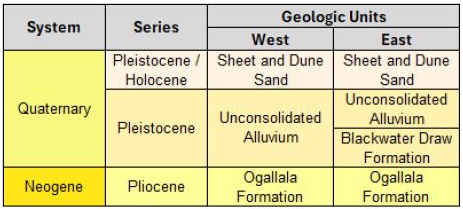
Figure 4.1: Generalized Stratigraphic Chart,
Surficial Deposits of the OnCore Properties
JOHN T. BOYD COMPANY
4-3
The following text discusses the strata encountered throughout the areas of the current OnCore sites, in depositional order:
Ogallala Formation
The Ogallala Formation is predominantly comprised of weakly cemented to unconsolidated fine- to medium-grained sands, which may be silty and calcareous in places. A caliche caprock is frequently exhibited, which resists weathering and forms ledges. The thickness of this formation has been recorded up to 550 ft. The Ogallala Formation is rarely encountered at any of the OnCore sites.
Blackwater Draw Formation
The Blackwater Draw Formation is a predominantly fine to medium-grained quartz sand containing silt, caliche, and calcareous nodules. Thickness is typically 25 ft or less and tends to feather out locally.
Quaternary Sheet and Dune Sands
Most of the OnCore sites are covered by Quaternary sheet and dune sands generally consisting of fine- to medium-grained quartz sand grains mixed with varying degrees of silts, calcareous sands, and caliche nodules. Surficial sand deposition in the study areas may range in thickness from less than 5 ft to over 40 ft. Overburden (i.e., overlying waste) material is generally minimal and easily removed during mining and processing operations. Interbedded alluvial deposits consisting of pebble- to cobble-sized limestone and chert nodules, or caliche are not uncommon, but are easily segregated during mining.
Figures 4.2 through 4.7 (pages 4-6 to 4-11) provide maps of the mineable sand thickness at each of the OnCore sites. Cross-sections through the subject sand deposits are provided in Figures 4.8 through 4.13 (pages 4-12 to 4-17).
4.2.2 Structural Geology
The structural features of the Quaternary sands in and around the OnCore properties are relatively non-descript. While the subject sand deposits exhibit variable thickness and extents, they are generally unaffected by folding or faulting. Due to the lack of structural features encountered, there are no known geological features that are believed to materially affect frac sand mining operations on the properties; as such, the deposits are considered to be of low geologic complexity.
JOHN T. BOYD COMPANY
4-4
4.2.3 Frac Sand Geology
The sand mined at the OnCore sites is processed into frac sand products. Frac sand is a naturally occurring silica sand—also known as quartz sand or white sand—which generally exhibit the following characteristics required by oil and gas producers for use in developing wells:
| · | High-purity – frac sand grains are relatively pure (typically, >95% silicon dioxide) in composition and almost entirely free from contaminants. Typical sand deposits have numerous impurities fused to the silica grains, such as iron, carbonate, potassium, and other trace elements/minerals, which can make them more susceptible to mechanical and chemical alteration. Mineralogical purity of silica content is a characteristic of mature sand, which has been highly reworked and well sorted, so that the mechanically and chemically less-resistant minerals and fine particles have been dissolved or winnowed away. |
| · | Homogeneous grain size – hydraulic fracturing procedures require sand in a relatively narrow range of grain sizes which are dependent on the specific geological conditions of the well and the fracking procedures used. Larger sand grains generally provide better permeability, but smaller sand grains are typically stronger. When describing frac sand, the product is frequently referred to as simply the sieve cut, e.g., 20/40 mesh sand—meaning that 90 percent of the sand is fine enough to pass through a 20-mesh sieve and is coarse enough to be retained on a 40-mesh sieve. Common frac sand sizes include 20/40 mesh, 30/50 mesh, 40/70 mesh, “100 mesh”, “200 mesh”, and finer. The size ranges for “100 mesh” and “200 mesh” vary significantly between manufacturers. As of the date of this report, finer sands such as 40/70 mesh and “100 mesh” have become more widely utilized in shale gas well fracturing. |
| · | High sphericity and roundness – Sphericity and roundness describe the overall shape of the sand grains. Sphericity measures how close the grains approach the shape of a sphere while roundness measures the relative sharpness of corners and curvatures of the grains. Greater sphericity and roundness provide better grain strength and porosity/permeability between grains, allowing better flow of oil and gas from the fractures to the wellhead. A more spherical shape also enables the grains to be carried in the fracking fluid with minimal turbulence. |
| · | High crush resistance – Crush resistance of frac sand is dependent upon the hardness and shape of the sand grain. Generally, a high percentage of silica in the sand increases its crush resistance. Additionally, monocrystalline grains are stronger than composite grains. Crush resistance is expressed as a K-value that indicates the highest pressure (rounded to the nearest 1,000 psi) that generates less than 10 weight percent fines (i.e., crushed sand grains). For example, a K-value of 7 means that, at 7,000 psi pressure, no more than 10 weight percent fines were generated, but more than 10 weight percent fines were generated at the next highest pressure. The higher the K-value, the more crush-resistant the sand is. |
| · | Low acid solubility – Acid solubility is an indication of the amount of soluble cement or soluble mineral grains (i.e., non-silica contaminants) in the frac sand; low solubility requires a high silica content, as pure quartz tends to be insoluble under normal conditions. |
| · | Low turbidity – Turbidity is a measure of the clay, silt, or other fine grains and impurities in the sand. Low turbidity is a result of mineralogical maturity and grain-size sorting in the natural depositional environment. Generally, fine suspended matter in the mined sand is washed out during processing, so this property can be somewhat controlled for the final product. |
Aeolian sand deposits, such as those found on the OnCore sites, which are predominantly comprised of silica sand grains meeting the abovementioned characteristics are well-suited to the commercial production frac sands.
JOHN T. BOYD COMPANY
4-5
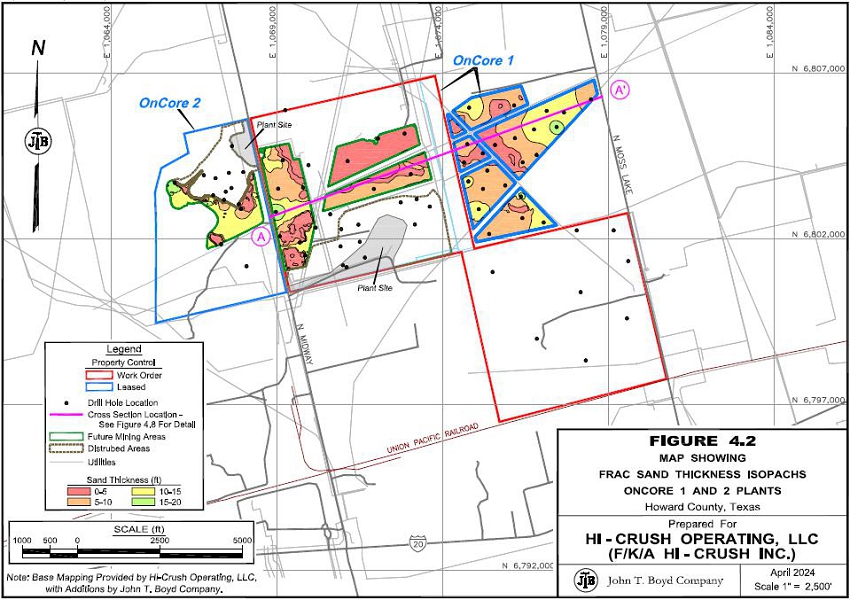
4-6
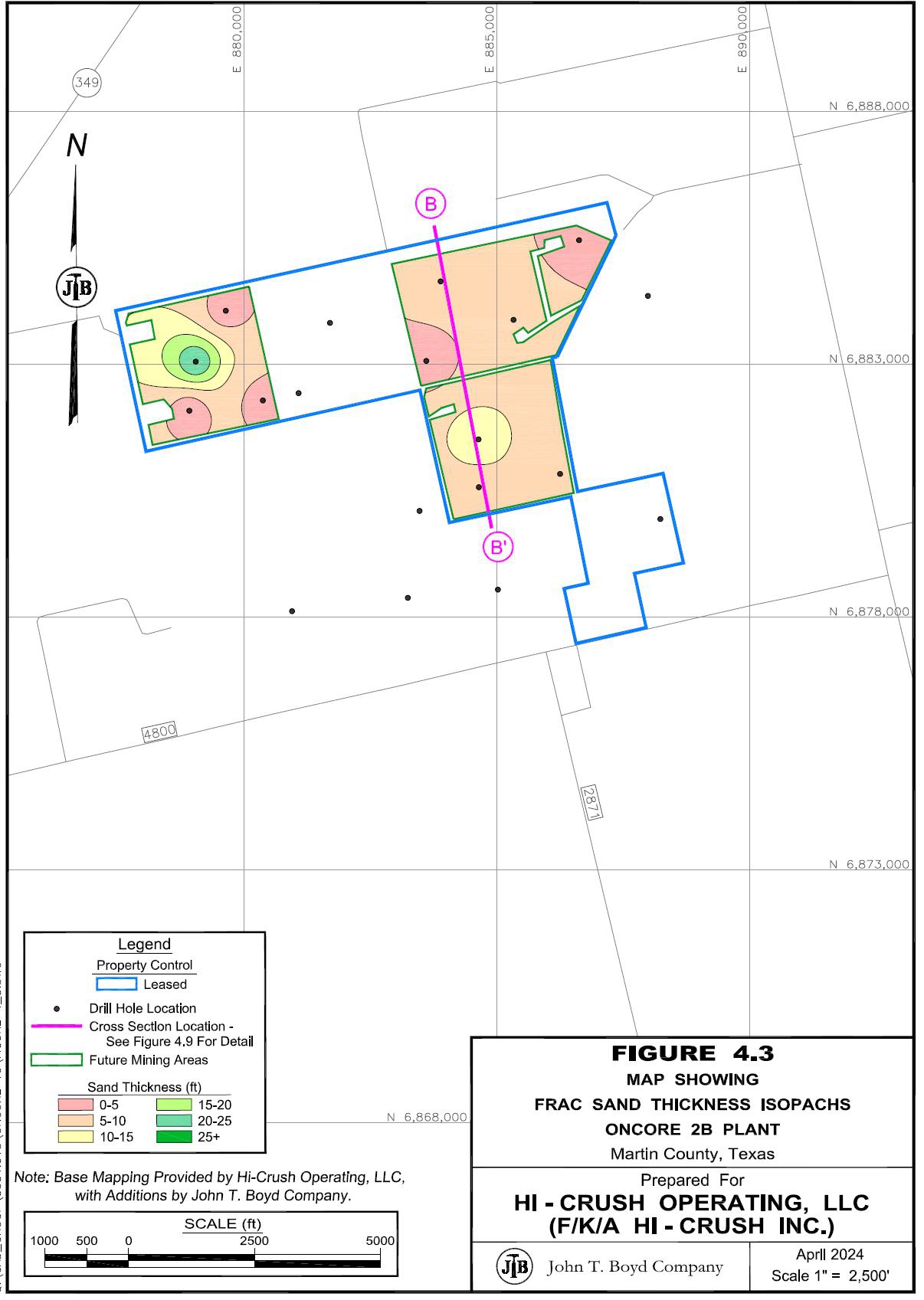
4-7
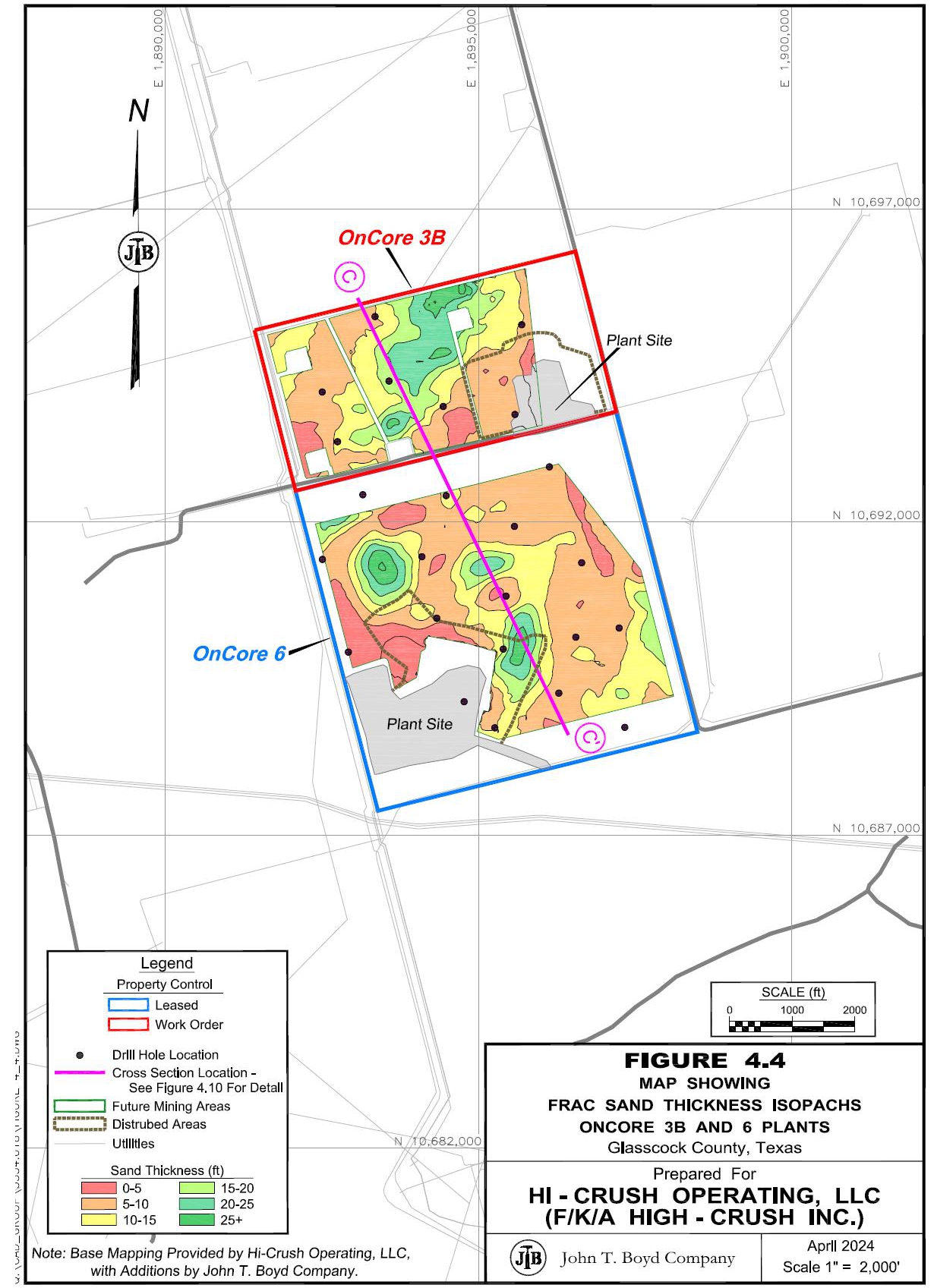
4-8
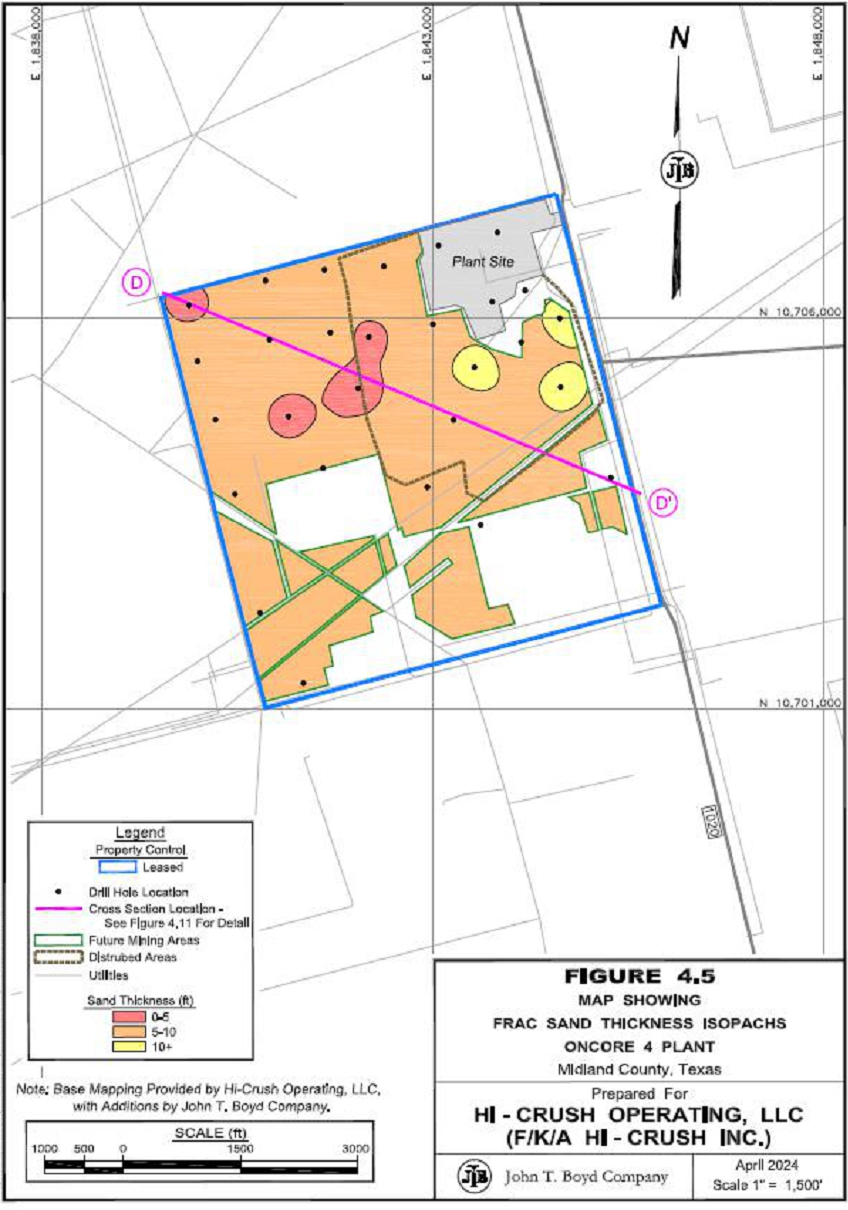
4-9
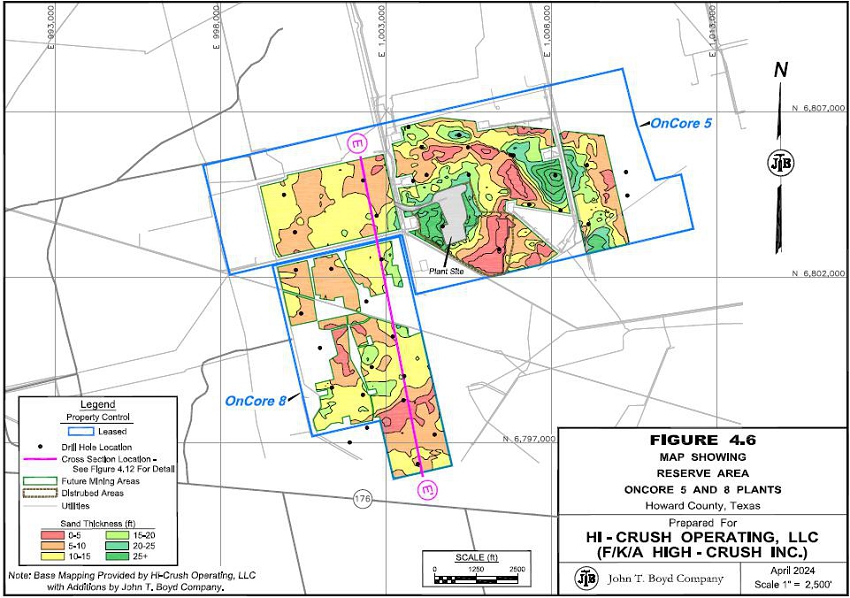
4-10
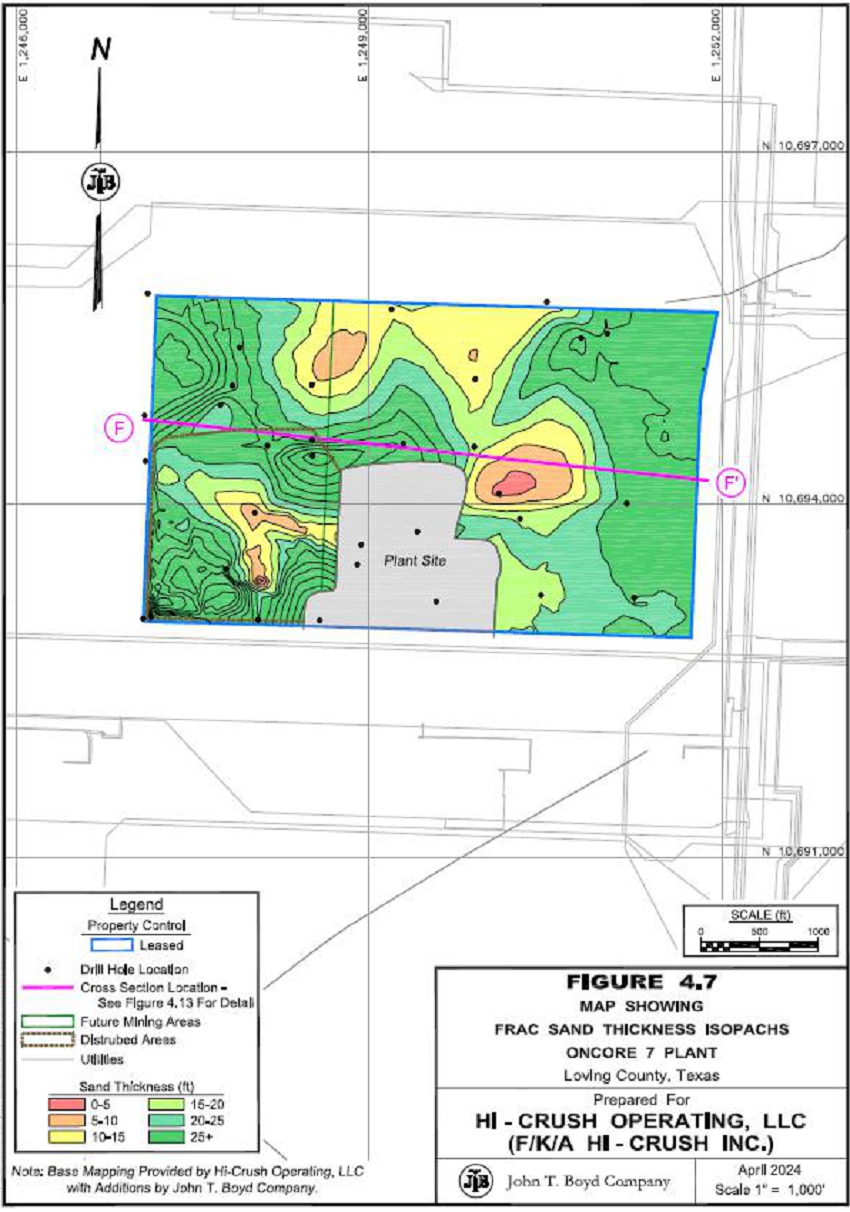
4-11
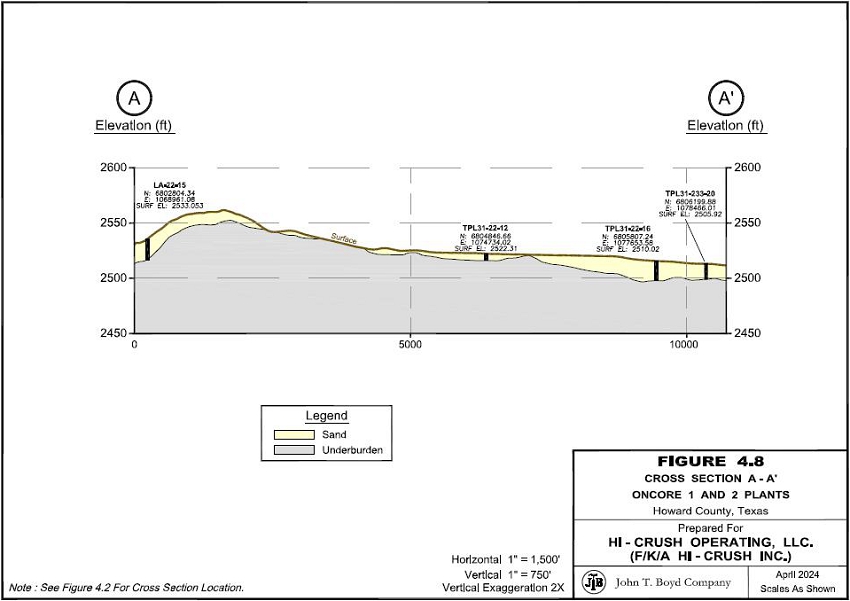
4-12
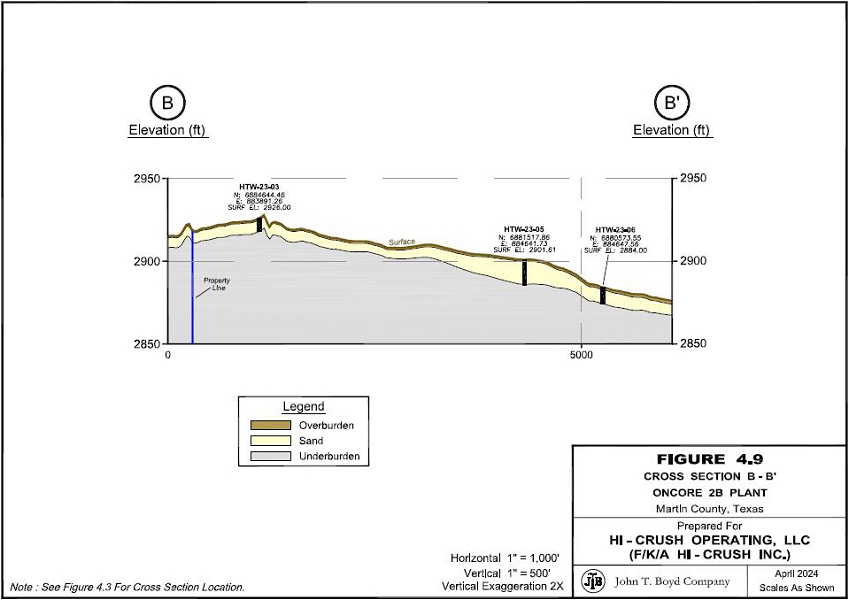
4-13
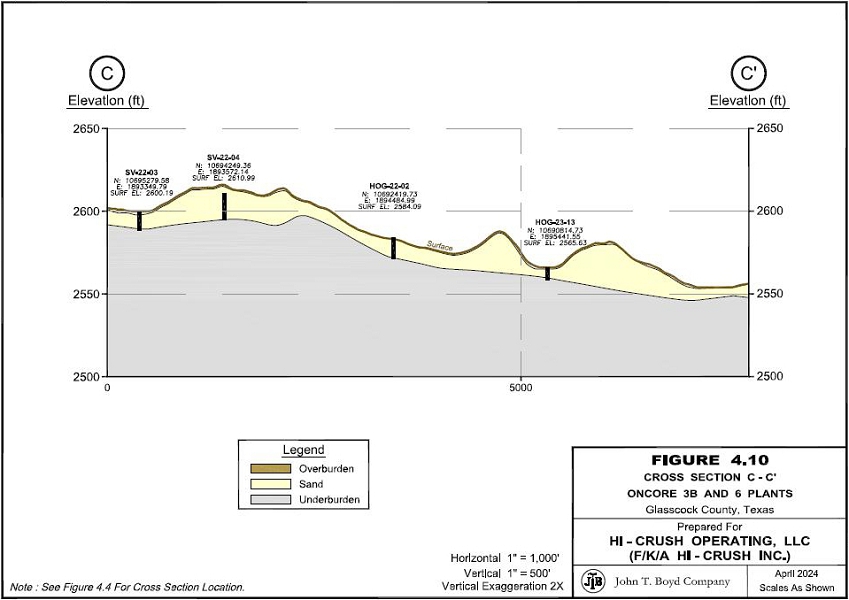
4-14
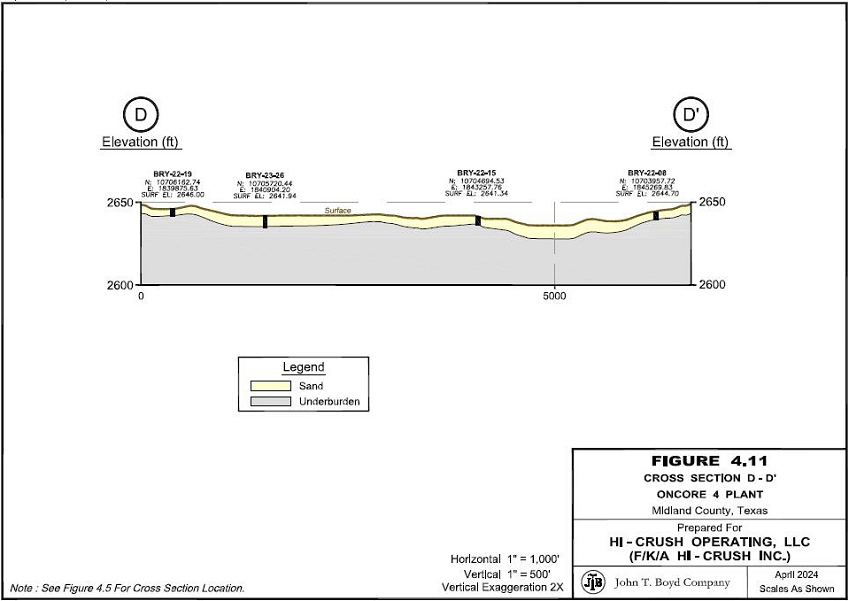
4-15
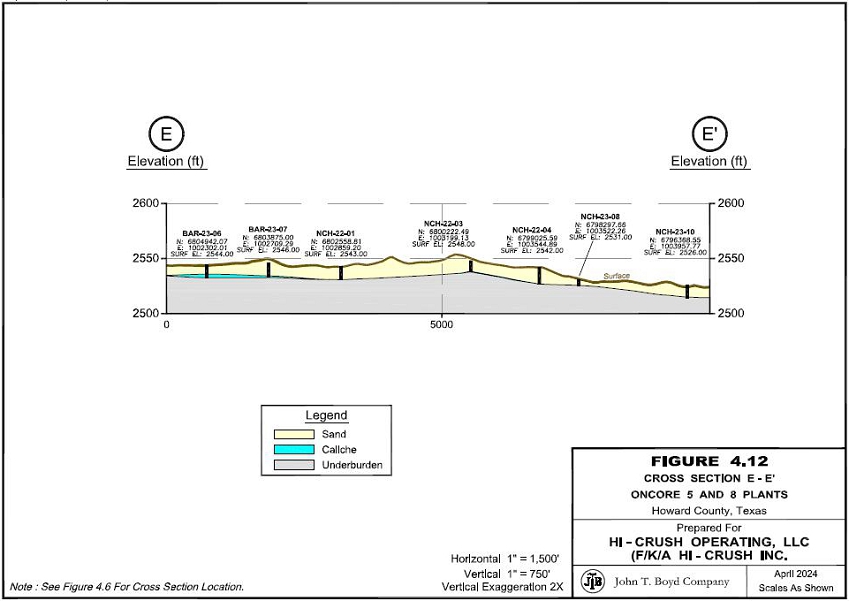
4-16
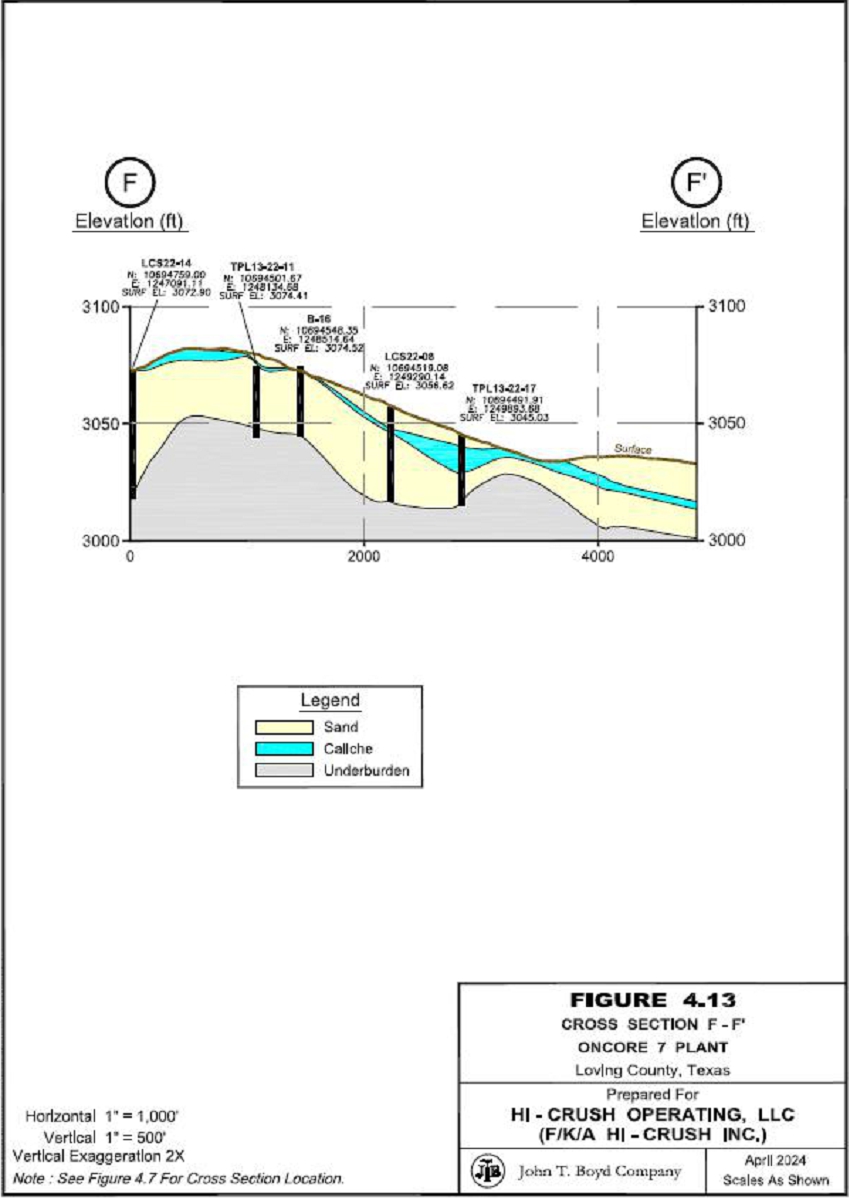
5-1
5.0 EXPLORATION DATA
5.1 Background
In developing the OnCore sites, Hi-Crush has completed numerous geologic exploration campaigns. A total of 227 drill holes have been completed across the subject OnCore sites. The results of these exploration programs comprise geologic logs and subsurface sand samples, grain size analyses of the samples, and proppant sand testing of composited samples. Exploration summaries were provided to BOYD for our review, along with the collected and analyzed exploration data, which together comprise the primary geologic data used in the evaluation of the frac sand resources and frac sand reserves reported herein.
Maps illustrating the extents of the sand deposits, along with electronic copies of drilling and sampling logs, as well as sampling procedures and laboratory testing summaries were provided for our review. The equipment utilized, and the sampling, logging, and field work performed, are noted as being appropriate for delineating the frac sand deposits. BOYD opines that the work done by Hi-Crush is thorough and complete for the purposes of evaluating and estimating frac sand resources and reserves on the subject sites.
Hi-Crush notes that the OnCore sites have been developed and operated by OnCore personnel from initial greenfield prospecting stages, through current operational status. Generally, each OnCore site has the subject of at least two separate exploration campaigns—the exception being new OnCore sites located adjacent to an operating OnCore site—including a widely-spaced “reconnaissance” exploration campaign to gauge the deposits potential followed by a infill exploration campaign if the initial campaign results are favorable.
JOHN T. BOYD COMPANY
5-2
Table 5.1, below, summarizes the drilling campaigns completed on each of the OnCore sites:
Table 5.1: OnCore Drilling Summary
| Drilling | Start / End | Drillhole | Driling | ||||||||||
| Site | Campaign | Property | Date(s) | Drillholes | Count | Method(s) | |||||||
| OnCore 1 | 1 | Vital | March 2021 | LA-21-01 - LA-21-10 | 10 | Rotosonic | |||||||
| 2 | Vital | January 2022 | LA-22-01 - LA-22-09 | 9 | Direct Push | ||||||||
| 3 | Vital | April 2022 | LA-22-10 - LA-22-17 | 8 | Direct Push | ||||||||
| 4 | Vital | March 2022 | LS-22-01 - LS-22-08 | 8 | Direct Push | ||||||||
| 5 | Vital | June 2022 | LS-22-09 - LS-22-14 | 6 | Direct Push | ||||||||
| 6 | TPL 31 | August 2022 | TPL31-22-01 - TPL31-22-16 | 16 | Direct Push | ||||||||
| 7 | TPL 31 | June 2023 | TPL31-23-17 - TPL31-23-23 | 7 | Direct Push | ||||||||
| 64 | |||||||||||||
| OnCore 2 | 1 | Ron White | 2020 | RW-20-01 - RW-20-03 | 3 | Manual Probe | |||||||
| 2 | Ron White | 2021 | RW-21-01 - RW-21-09 | 9 | Rotosonic | ||||||||
| 3 | Ron White | June 2023 | ONC2-23-01 - ONC2-23-08 | 8 | Auger | ||||||||
| 20 | |||||||||||||
| OnCore 2B | 1 | Hightower | May 2022 | HTW-23-01 - HTW-23-16 | 16 | Direct Push | |||||||
| 2 | Hightower | September 2023 | HTW-23-17 - HTW-23-19 | 3 | Auger | ||||||||
| 19 | |||||||||||||
| OnCore 3B | 1 | Shallow Valley | October 2022 | SV-22-01 - SV-22-07 | 7 | Direct Push | |||||||
| OnCore 4 | 1 | Bryant | March 2022 | BRY-22-01 - BRY-22-08 | 8 | Direct Push | |||||||
| 2 | Bryant | April 2022 | BRY-22-09 - BYR-22-15 | 7 | Direct Push | ||||||||
| 3 | Bryant | October 2022 | BRY-22-16 - BRY-22-20 | 5 | Direct Push | ||||||||
| 4 | Bryant | January 2023 | BRY-23-21 - BRY-23-28 | 8 | Direct Push | ||||||||
| 28 | |||||||||||||
| OnCore 5 | 1 | Barr | March 2021 | BA-20-01 - BA-20-03 | 3 | Manual Probe | |||||||
| 2 | Barr | 2021 | BA-21-01 - BA-21-11 | 11 | Rotosonic | ||||||||
| 3 | Barr | October 2022 | BAR-22-01 - BAR-22-03 | 3 | Direct Push | ||||||||
| 4 | Barr | July 2023 | BAR-23-04 - BAR-23-09 | 6 | Direct Push | ||||||||
| 5 | July 2023 | ONC5-23-01 - ONC5-23-03 | 3 | Direct Push | |||||||||
| 26 | |||||||||||||
| OnCore 6 | 1 | Hog Mountain | October 2022 | HOG-22-01 - HOG-22-09 | 9 | Direct Push/Auger | |||||||
| 2 | Hog Mountain | January 2023 | HOG-23-10 - HOG-23-17 | 8 | Direct Push | ||||||||
| 17 | |||||||||||||
| OnCore 7 | 1 | TPL 13 | February 202 | TPL13-22-01 - TPL13-22-05 | 5 | Auger | |||||||
| 2 | TPL 13 | May 2022 | LCS-22-06 - LCS-22-09 | 4 | Rotosonic | ||||||||
| 3 | TPL 13 | June 2022 | TPL13-22-10 - TPL13-22-21 | 12 | Auger | ||||||||
| 4 | TPL 13 | July 2022 | LCS-22-10 - LCS-22-16 | 7 | Rotosonic | ||||||||
| 28 | |||||||||||||
| OnCore 8 | 1 | Nichols | October 2022 | NCH-22-01 - NCH-22-05 | 5 | Direct Push | |||||||
| 2 | Nichols | Jauary 2023 | NCH-23-06 - NCH-23-16 | 11 | Direct Push | ||||||||
| 3 | Nichols | November 2023 | NCH-23-17 - NCH-23-28 | 2 | Manual Probe | ||||||||
| 18 | |||||||||||||
| Total | 31 | 227 | |||||||||||
JOHN T. BOYD COMPANY
5-3
| 5.2 | Exploration Procedures |
| 5.2.1 | Drilling and Sampling Methodologies |
Hi-Crush has completed substantial exploration drilling and sampling work across the various OnCore sites. In total, 227 drill holes were completed using the drilling methods specified in Table 5.1. Additional discussion of each drilling method, as well as provided sampling procedures, are presented below:
| · | Direct Push Coring: A skidsteer-mounted AMS Scientific 9520-SK drilling attachment was utilized to advance a 3-in diameter core barrel containing a 1¼ -in diameter, 4-ft long plastic core sleeve into the ground using a hydraulic hammer. Once the core barrel is fully advanced into the ground, the inner core sleeve is removed while the core barrel remains in-place. The sample sleeve is capped on both ends, labeled with drill hole name and interval depths, and the top and bottom of the obtained sample are marked on the core sleeve. A new length of plastic core sleeve is inserted, followed by adding an additional length of core barrel to the top of the drill string, and the hydraulic hammer drives the additional core barrel length into the ground. These procedures are repeated until either meeting refusal (the point at which the hammer cannot advance the drill core any deeper), or to a total depth of approximately 32 ft is reached. |
Direct push coring is Hi-Crush’s preferred method of exploration, as it provides an intact sample without compromising sample integrity as the drill hole sidewall cannot contaminate samples obtained at increasing depth. Labeled sample sleeves were taken to a secure storage facility, and later cut open for sample description and geologic logging.
| · | Auger Drilling: The AMS 9520-SK attachment is able to switch to utilizing an auger drill to advance through harder materials when required. This method consists of utilizing a 4-in diameter wide and 5-ft long auger flight. As depth increases, drill cuttings are lifted to the ground surface via rotation of the auger. After advancing a complete 5-ft auger length, cuttings from each run were cleaned away from the drill hole collar, quartered, and then sampled before adding another 5-ft length of auger and advancing the hole. Labeled sample sleeves were taken to a secure storage facility, and later cut open for sample description and geologic logging. |
Auger drilling was only utilized when direct push methods were unable to advance through harder intervals.
JOHN T. BOYD COMPANY
5-4
| · | Manual Probe: A JMC PN150 manual subsoil probe advanced a steel core barrel containing a 0.8-in diameter, 3-ft long core sleeve by manually lifting and dropping a slide-hammer mounted on a vertical rod. Once the core barrel is advanced into the ground, the core sleeve is retrieved using a manual step-jack, while the core barrel remains in the ground. The sample sleeve is capped on both ends, labeled with drill hole name and interval depths, and the top and bottom of the obtained sample are marked on the core sleeve before a new sleeve is inserted into the core barrel, and an additional length of core barrel is placed on top of the drill string. These procedures are repeated until either meeting refusal, or a total depth of approximately 15-ft is reached. Labeled sample sleeves were taken to a secure storage facility, and later cut open for sample description and geologic logging. |
| · | Rotosonic Drilling: A drilling contractor operates a track-mounted rotosonic drilling rig, which utilizes a combination of rotary core drilling and a vibratory drilling head to advance core barrels through poorly consolidated lithologies. Rotosonic drilling provides relatively undisturbed drilling cores with typically very high recoveries. After advancing 10-ft of drilling core into the ground, a 4-in diameter core is retrieved and extruded into plastic sleeves, which are labeled with the bottom depth of each drilling run. These sample bags were logged and sampled on-site, with sampling consisting of taking approximately one-quarter of the entire length of the drilled core in order to obtain a composited representative sample of the drilled interval. Obtained sample material is placed into heavy-mil sample bags, which are then labeled with drill hole name and sample top and bottom depths, and then taken to a secure storage facility. |
Please refer to Figures 4.2 through 4.7 (pages 4-6 to 4-11) for the locations of rotosonic drill holes completed by Hi-Crush on the various OnCore sites.
| 5.2.2 | Proppant Sand Testing |
Samples obtained throughout Hi-Crush’s OnCore exploration campaigns were transported by Hi-Crush personnel to secure storage facilities after completion of each drilling campaign. These facilities, owned by Hi-Crush, are located in either Dallas or Houston, Texas. Once samples arrived and were catalogued, any samples still in capped sample sleeves were cut open to be geologically logged at the storage facilities. Once all samples were geologically logged, mineable intervals were determined by a Hi-Crush geologist, and composite samples of the mineable sand intervals were created to be analyzed for particle size distributions. The composite samples were then transported by Hi-Crush, to either PropTester Inc’s. (PropTester) laboratory in Cypress, Texas, or Hi-Crush’s in-house sample trailer located at their Kermit Mine.
JOHN T. BOYD COMPANY
5-5
The general procedure for particle size distribution analyses was as follows:
| 1. | The sample was dried to remove moisture. |
| 2. | A 600- to 1,200-gram subsample was collected and weighed. |
| 3. | The subsample was placed in a blender for three minutes to break up the material as much as possible. |
| 4. | The blended subsample was then placed on a 200-mesh wash screen, and thoroughly washed to remove any fine materials (e.g., clays and silts). |
| 5. | The remaining larger than 200 mesh (+200 mesh) material is then dried and weighed to determine the mass of fines that were washed out (i.e., wash loss). |
| 6. | The cleaned subsample was then either placed into a sieve stack of different mesh sizes and agitated for a period of 20 minutes, or run through a high-speed photographic particle size analyzer (i.e., CAMSIZER) to determine the particle size distribution of the subsample. |
Hi-Crush also obtained various finished product and composite drill hole samples, which were delivered to PropTester for standard frac sand characteristic testing according to API RP 19C/ISO 13503-2, Measurement of Properties of Proppants Used in Hydraulic Fracturing and Gravel-packing Operations (API/ISO). Results on API/ISO testing are presented in Section 5.3.2.
| 5.2.3 | Other Exploration Methods |
To our knowledge, no other methods of exploration (such as airborne or ground geophysical surveys) were completed on the OnCore sites.
| 5.3 | Laboratory Testing Results |
The relatively uniform nature of the mineable portion of the sand deposits found on the various Hi-Crush OnCore sites, combined with the results of laboratory testing, indicate the subject properties can produce a combination of finished “100 mesh” frac sand products—typically in the 40/140 to 40/200 mesh size range—that meet various local Permian Basin customer specifications.
JOHN T. BOYD COMPANY
5-6
| 5.3.1 | Grain Size Distribution |
Grain size distribution was analyzed according to API/ISO, Section 6. A table of the weighted average particle size distribution of the in-situ sand deposit, as derived from laboratory testing results, is shown in Table 5.2 below.
| Table 5.2: Weighted Average Particle Size Distribution, by Site | ||||||||||||||||||||
| % Retained by Mesh Size | ||||||||||||||||||||
| Site | > 40 | 40/70 | 70/140 | 140/200 | < 200 | |||||||||||||||
| OnCore 1 | 4 | 54 | 28 | 2 | 12 | |||||||||||||||
| OnCore 2 | 5 | 43 | 25 | 3 | 24 | |||||||||||||||
| OnCore 2B | 1 | 28 | 46 | 7 | 18 | |||||||||||||||
| OnCore 3B | 1 | 47 | 40 | 4 | 8 | |||||||||||||||
| OnCore 4 | 4 | 46 | 24 | 6 | 20 | |||||||||||||||
| OnCore 5 | 2 | 33 | 38 | 5 | 22 | |||||||||||||||
| OnCore 6 | 4 | 38 | 34 | 6 | 18 | |||||||||||||||
| OnCore 7 | 2 | 55 | 27 | 2 | 14 | |||||||||||||||
| OnCore 8 | 5 | 45 | 33 | 3 | 14 | |||||||||||||||
The preceding table highlights the relative fineness of the sand found within the subject OnCore sites, indicating most of the sand particles are concentrated between the “passing 40 mesh” and “retained by 140 mesh” size fraction. Accordingly, the OnCore sites produce a principal marketable “100 mesh” product.
| 5.3.2 | Quality Summary |
As general customer specifications tend to adapt to the local sand characteristics, API/ISO testing for locally sourced frac sands has become less relevant over the past several years. However, it is still of value to be able to demonstrate that the frac sand produced at a mine meets specifications for certain well applications.
JOHN T. BOYD COMPANY
5-7
Hi-Crush obtained various finished product loadout samples of finished product and composite drill hole samples from each OnCore site. These samples were delivered to PropTester for API/ISO frac sand analysis of frac sand characteristics. Additional turbidity testing is conducted in-house by Hi-Cruch as part of their quality control measures. The resulting proppant performance test results for each OnCore site are summarized in Table 5.3, below.
| Table 5.3: Proppant Performance Test Results | ||||||||||||||||||||
| 100 Mesh* Sample Test Result | ||||||||||||||||||||
| Acid | ||||||||||||||||||||
| Solubility | Turbidity | K-Value | ||||||||||||||||||
| Site | Sphericity | Roundness | (%) | (NTU) | (000 psi) | |||||||||||||||
| OnCore 1 | 0.7 | 0.6 | 3.2 | 354 | 9 | |||||||||||||||
| OnCore 2 | 0.7 | 0.6 | 2.0 | 423 | 9 | |||||||||||||||
| OnCore 2B | 0.7 | 0.7 | 3.1 | 29 | 9 | |||||||||||||||
| OnCore 3B | 0.6 | 0.6 | 3.8 | 28 | 7 - 10 | |||||||||||||||
| OnCore 4 | 0.7 | 0.6 | 5.1 | 724 | 8 | |||||||||||||||
| OnCore 5 | 0.7 | 0.6 | 3.2 | 432 | 10 | |||||||||||||||
| OnCore 6 | 0.6 | 0.6 | 1.1 | 764 | 9 | |||||||||||||||
| OnCore 7 | 0.6 | 0.6 | 5.4 | 364 | 13 | |||||||||||||||
| OnCore 8 | 0.7 | 0.7 | 2.6 | 14 | 10 | |||||||||||||||
| *100 mesh proppant sand material does not have an API/ISO specification. |
While 100 mesh frac sands do not have API/ISO specifications, sample testing results, and Hi-Crush’s demonstrated commercial success producing and selling frac sands from their various OnCore sites to local Permian Basin oil and gas producers suggest the sand has been shown to meet customer specifications.
| 5.4 | Data Verification |
For purposes of this report, BOYD did not verify historic drill hole data by conducting independent drilling in areas already explored. It is customary in preparing frac sand resource and reserve estimates to accept basic drilling and quality testing data as provided by the client, subject to the reported results being judged representative and reasonable.
BOYD’s efforts to judge the appropriateness and reasonability of the source exploration data included reviewing provided drilling logs, sampling procedures, sand quality testing results, and discussing related aspects of the OnCore deposits and processing operations with Hi-Crush personnel.
JOHN T. BOYD COMPANY
5-8
| 5.5 | Adequacy of Exploration and Sampling Data |
BOYD’s review of the reported procedures indicate the exploration and sampling data obtained for the OnCore sites were: (1) carefully and professionally collected, prepared, and documented in conformance with general industry standards, and (2) are appropriate for use of evaluating and estimating frac sand resources and frac sand reserves. Similarly, BOYD’s review of testing data provided by Hi-Crush suggests that the analyses completed are generally appropriate to determine frac sand characteristics and determine the subsequent quality of finished frac sand products. As such, it is BOYD’s opinion that the sampling data are also suitable for use in the estimation of frac sand resources and frac sand reserves on the various OnCore sites.
JOHN T. BOYD COMPANY
6-1
6.0 FRAC SAND RESOURCES AND RESERVES
| 6.1 | Applicable Standards and Definitions |
Unless otherwise stated, frac sand resource and frac sand reserve estimates disclosed herein are completed in accordance with the standards and definitions provided by S-K 1300. It should be noted that BOYD considers the terms “mineral” and “frac sand” to be generally interchangeable within the relevant sections of S-K 1300.
Estimates of any mineral resources and reserves are always subject to a degree of uncertainty. The level of confidence that can be applied to a particular estimate is a function of, among other things: the amount, quality, and completeness of exploration data; the geological complexity of the deposit; and economic, legal, social, and environmental factors associated with mining the resource/reserve. By assignment, BOYD used the definitions provided in S-K 1300 to describe the degree of uncertainty associated with the estimates reported herein.
The definition of mineral (frac sand) resource provided by S-K 1300 is:
Mineral resource is a concentration or occurrence of material of economic interest in or on the Earth's crust in such form, grade or quality, and quantity that there are reasonable prospects for economic extraction. A mineral resource is a reasonable estimate of mineralization, taking into account relevant factors such as cut-off grade, likely mining dimensions, location or continuity, that, with the assumed and justifiable technical and economic conditions, is likely to, in whole or in part, become economically extractable. It is not merely an inventory of all mineralization drilled or sampled.
Estimates of frac sand resources are subdivided to reflect different levels of geological confidence into measured (highest geologic assurance), indicated, and inferred (lowest geologic assurance). Please refer to the Glossary of Abbreviations and Definitions for the meanings ascribed to these terms.
The definition of mineral (frac sand) reserve provided by S-K 1300 is:
Mineral reserve is an estimate of tonnage and grade or quality of indicated and measured mineral resources that, in the opinion of the qualified person, can be the basis of an economically viable project. More specifically, it is the economically mineable part of a measured or indicated mineral resource, which includes diluting materials and allowances for losses that may occur when the material is mined or extracted.
JOHN T. BOYD COMPANY
6-2
Estimates of frac sand reserves are subdivided to reflect geologic confidence, and potential uncertainties in the modifying factors, into proven (highest assurance) and probable. Please refer to the Glossary of Abbreviations and Definitions for the meanings ascribed to these terms.
Figure 6.1 shows the relationship between frac sand resources and frac sand reserves.
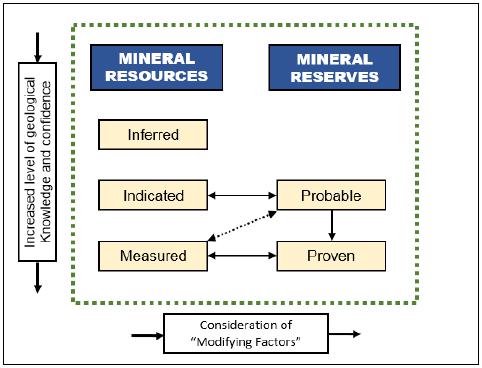
Figure 6.1: Relationship Between Frac Sand Resources and Frac Sand Reserves
In this report, the term “frac sand reserves” represent the tonnage of frac sand products that meet customer specifications and will be available for sale after processing of the ROM sand.
| 6.2 | Frac Sand Resources |
| 6.2.1 | Methodology |
BOYD independently prepared estimates of in-place frac sand for each of Hi-Crush’s OnCore sites by performing the following tasks:
| 1. | The top and bottom elevations of the mineable sand interval of each site was interpreted from drill hole records and sand particle size analyses. The sands mined at the various OnCore sites are generally present at the surface. As there is little-to-no overburden, the top of the mineable sand unit is considered to be the current ground surface or directly beneath a thin soil interval noted in drilling logs. The bottom of the mineable sand unit is delineated by the depth at which drilling was terminated, or an underlying caliche interval was encountered. |
JOHN T. BOYD COMPANY
6-3
| 2. | Interpreted drill hole records were compiled and validated. Strata thicknesses were aggregated, and sand particle size analyses of the sand unit were composited for each data point. The compiled drill hole data were then imported into either Carlson Software or Vulcan geologic modeling and mine planning software, both of which are geologic modeling and mine planning software suites that are widely used and accepted by the mining industry. |
| 3. | A geologic model of each site’s deposit was created using industry-standard grid modeling methods well-suited for simple stratigraphic deposits. The geologic models delineate the top and bottom of the mineable sand horizon and the distribution of the product size fractions across each of the OnCore site deposits. |
| 4. | After reviewing the continuity and variability of each deposit, suitable resource classification criteria were developed and applied as per the discussion in Section 6.2.2. |
| 5. | Contiguous areas of remaining mineable sand within the various OnCore sites were delineated using the criteria described in Section 6.2.3, in addition to utilizing mapping of remaining mineable areas as provided by Hi-Crush, as well as considering the following assumptions for each OnCore site: |
| a. | Pit wall slopes of 3:1 (approximately 19 degrees). |
| b. | Areas mined prior to December 31, 2023, were delineated from surveyed topography and/or aerial imagery and excluded from the estimates of frac sand resources. |
| 6. | In-place volumes for each of the remaining mining areas were calculated from the geologic model within the modeling software. A dry, in-place, bulk density of 100 pounds per cubic foot was used to calculate the in-place tonnage of frac sand. |
| 7. | Where warranted, adjustments are made to the estimates using production records to reconcile differences between the date of the ground survey/aerial imagery and the effective date of the estimates. |
JOHN T. BOYD COMPANY
6-4
| 6.2.2 | Classification |
Geologic assuredness is established by the availability of both structural (thickness and elevation) and quality (size fraction) information for the deposit. Resource classification is generally based on the concentration or spacing of exploration data which can be used to demonstrate the geologic continuity of the deposit. When material variations in thickness, depth, and/or sand quality occur between drill holes, the allowable spacing distance between drill holes is reduced. The drill hole spacing criteria established by BOYD after a review of the available exploration data and geologic models and used to classify the frac sand resources of each OnCore site are provided in Table 6.1, below.
| Table 6.1: Frac Sand
Resource Classification Criteria | ||||
| Nominal Maximum | ||||
| Classification | Spacing Requirment (ft) | |||
| Measured | 1,500 | |||
| Indicated | 2,500 | |||
| Inferred | 5,000 | |||
Extrapolation or projection of resources in any category beyond any data point does not exceed half the point spacing distance.
The surficial sand deposits located on the OnCore sites are considered to be of low geologic complexity. We believe these criteria appropriately reflect their implied levels of geologic assurance with respect to the estimation of frac sand resources. Since sufficient drilling and sampling has been performed within the remaining mineable portions of each site, BOYD is of the opinion that there is a low degree of uncertainty associated with the estimates of frac sand resources provided herein.
| 6.2.3 | Estimation Criteria |
Development of the frac sand resource estimates for each OnCore site assume mining and processing methods and equipment that have been utilized by Hi-Crush successfully at these types of operations for several years.
The target mining horizon at each of the OnCore sites generally manifests as a continuous, low rolling sand unit with relatively consistent depth, thickness, and quality on each site. There is little-to-no overburden, and the high-quality sand is easily distinguished from any waste units; as such, interpretation of the mineable horizon is relatively easy. The mined sand is processed to remove intervals of caliche and any out-sized material (i.e., sand which is either too coarse or silts/clays which are too fine to be sold) and produce saleable finished products. The amount of finished sand produced as a percentage of the raw sand mined is referred to as the processing yield (or plant yield), which is analogous to the “cut-off grade” of other mining operations. If the expected processing yield of the sand is too low, the costs of production will outweigh sales revenues and the deposit cannot be economically mined. The minimum economic processing yields range from approximately 30–40% based on Hi-Crush’s historical and forecasted economics (refer to Chapters 10 through 12); however, this is well below the expected processing yields of each of the OnCore sand deposits. Other limiting criteria, such as minimum mining thicknesses or maximum stripping ratios (the ratio of waste to sand excavated) are generally not considered in the estimation of frac sand resources for the OnCore sites.
JOHN T. BOYD COMPANY
6-5
The limits of the frac sand resources are constrained to those portions of the interpreted sand deposit that:
| · | Are reasonably defined by available drilling and sampling data. |
| · | Contain products that meet generally accepted specifications and can be sold at a profit (i.e., be economic). |
| · | Honor any legal mining constraints (e.g., property boundaries, environmental setbacks, utility and infrastructure setbacks, etc.). |
| · | Adhere to physical mining limitations. |
Frac sand resources for the OnCore sites are assessed for reasonable prospects for eventual economic extraction by reporting: (1) those resources which have been subsequently converted to proppant sand reserves after the application of all material modifying factors, and/or (2) those resources which have similar characteristics (i.e., mining conditions, and expected processing yields and qualities) to those converted to frac sand reserves.
The criteria employed in developing the estimates of frac sand resources for each OnCore site are supported by historical results and align with those employed at similar operations. As such, it is BOYD’s opinion that the stated criteria are reasonable and appropriate for the estimation of frac sand resources at the OnCore sites.
| 6.2.4 | Frac Sand Resource Estimate |
There are no reportable frac sand resources excluding those converted to frac sand reserves for all of the OnCore sites. Quantities of frac sand controlled by Hi-Crush within the defined boundaries of each OnCore site which are not reported as frac sand reserves, are not considered to have potential economic viability; as such, they are not reportable as frac sand resources.
| 6.2.5 | Validation |
BOYD independently estimated in-place frac sand resources for each OnCore site from the drilling, sampling, and testing data provided by Hi-Crush. We have reviewed this information, on a representative basis, by confirming the accuracy of geologic model inputs by comparison with drilling logs and laboratory reports. We have developed stratigraphic grid models of the subject sand deposits and compared these with the provided exploration data. It is BOYD’s opinion that the geologic models are representative of the informing data and that the data are of sufficient quality to support the frac sand resources estimate provided herein. Furthermore, it is our opinion that the resource estimation methods and criteria employed are both appropriate and reasonable for these deposit types and proposed extraction methods.
JOHN T. BOYD COMPANY
6-6
| 6.3 | Frac Sand Reserves |
| 6.3.1 | Methodology |
Estimates of frac sand reserves for the OnCore sites were derived contemporaneously with estimates of frac sand resources. To derive an estimate of saleable product tons (frac sand reserves), a mining recovery and a processing recovery were applied to the in-place resource estimate. The mining recovery factor will determine the ROM sand tonnage that will be delivered to the processing facilities, while the processing yield accounts for the removal of out-sized (i.e., larger than 40 mesh and smaller than 140 mesh) material and losses during processing due to minor inefficiencies. Recoveries for each OnCore site were derived from sample sizing data, expected operating performance, and historical operating results, and are shown in Table 6.2 below:
| Table 6.2: Mining and Processing Recoveries | ||||||||||||
| Recovery (%) | ||||||||||||
| Site | Mining | Processing | Overall | |||||||||
| OnCore 1 | 90 | 80 | 72 | |||||||||
| OnCore 2 | 90 | 81 | 73 | |||||||||
| OnCore 2B | 90 | 73 | 66 | |||||||||
| OnCore 3B | 90 | 67 | 60 | |||||||||
| OnCore 4 | 90 | 65 | 59 | |||||||||
| OnCore 5 | 90 | 69 | 62 | |||||||||
| OnCore 6 | 90 | 66 | 59 | |||||||||
| OnCore 7 | 90 | 64 | 58 | |||||||||
| OnCore 8 | 90 | 76 | 68 | |||||||||
| Average - All OnCore Plants | 90 | 69 | 62 | |||||||||
| 6.3.2 | Classification |
All of the estimated frac sand reserves are derived from either Measured frac sand resources or Indicated frac sand resources, in accordance with S-K 1300, and are therefore classified as either Proven or Probable frac sand reserves accordingly, after BOYD was satisfied that the frac sand reserve classification reflects the outcome of technical and economic studies. Figures 6.2 through 6.7, following this text, illustrate the reserve classifications of each OnCore site’s frac sand deposit.
JOHN T. BOYD COMPANY
6-7
| 6.3.3 | Frac Sand Reserve Estimate |
BOYD’s estimate of surface mineable frac sand reserves for the OnCore Plants totals nearly 47.2 million saleable product tons, as of December 31, 2023. The frac sand reserves reported in Table 6.2, below, are based on individual LOM plans which, in BOYD’s opinion, are technically achievable and economically viable after the consideration of all material modifying factors.
| Table 6.3: Frac Sand Reserves (as of December 31, 2023) | ||||||||||||||||
| Mesh | Product Tons (000) by Classification | |||||||||||||||
| Plant | Size | Control | Proven | Probable | Total | |||||||||||
| OnCore 1 | 40/140 | Leased | 3,360 | - | 3,360 | |||||||||||
| Work Order | - | 1,149 | 1,149 | |||||||||||||
| Subtotal | 3,360 | 1,149 | 4,509 | |||||||||||||
| OnCore 2 | 40/140 | Leased | 375 | - | 375 | |||||||||||
| OnCore 2B | 40/140 | Leased | - | 5,130 | 5,130 | |||||||||||
| OnCore 3B | 40/140 | Work Order | - | 3,418 | 3,418 | |||||||||||
| OnCore 4 | 40/140 | Leased | 2,232 | 668 | 2,900 | |||||||||||
| Oncore 5 | 40/140 | Leased | 4,297 | 7,282 | 11,579 | |||||||||||
| OnCore 6 | 40/140 | Leased | 5,146 | - | 5,146 | |||||||||||
| OnCore 7 | 40/140 | Leased | 3,810 | 4,692 | 8,502 | |||||||||||
| OnCore 8 | 40/140 | Leased | 5,613 | - | 5,613 | |||||||||||
| Total - All OnCore Plants | 24,833 | 22,339 | 47,172 | |||||||||||||
The frac sand reserves of the OnCore Plants are well-explored and defined. It is our conclusion that nearly 53% of the stated reserves can be classified in the Proven reliability category (the highest level of assurance) with the remainder classified as Probable.
Hi-Crush’s OnCore Plants, and other frac sand mining operations in the area, have a well-established history of mining and selling frac sand products into the local Permian Basin energy fields. BOYD has assessed that sufficient studies have been undertaken to enable the frac sand resources to be converted to frac sand reserves based on current and proposed operating methods and practices. Changes in the factors and assumptions employed in these studies may materially affect the frac sand reserve estimate.
JOHN T. BOYD COMPANY
6-8
The economic viability of the stated frac sand reserves is demonstrated by the production and financial projections and marketing information presented in Chapters 10 through 12 of this report. The forecasted sales prices used in the estimation of frac sand reserves for the OnCore Plants is $23.33 per ton of finished frac sand (refer to Section 10.5 and Table 12.1 for further details).
| 6.3.4 | Significant Risks and Uncertainties |
The extent to which the frac sand reserves may be affected by any known geological, operational, environmental, permitting, legal, title, variation, socio-economic, marketing, political, or other relevant issues has been reviewed. If and as warranted. It is the opinion of BOYD that Hi-Crush has appropriately mitigated, or has the operational acumen to mitigate, the risks associated with these factors. BOYD is not aware of any additional risks that could materially affect the development of the frac sand reserves.
Given the data available at the time this report was prepared, the estimates presented herein are considered reasonable. However, they should be accepted with the understanding that additional data and analysis available after the date of the estimate may result in a change to the current estimate. These revisions may be material.
Based on our independent estimate and operations review, we have a high degree of confidence that the estimates shown in this report accurately represent the available frac sand reserves controlled by Hi-Crush at the OnCore Plants, as of December 31, 2023.
JOHN T. BOYD COMPANY
6-9
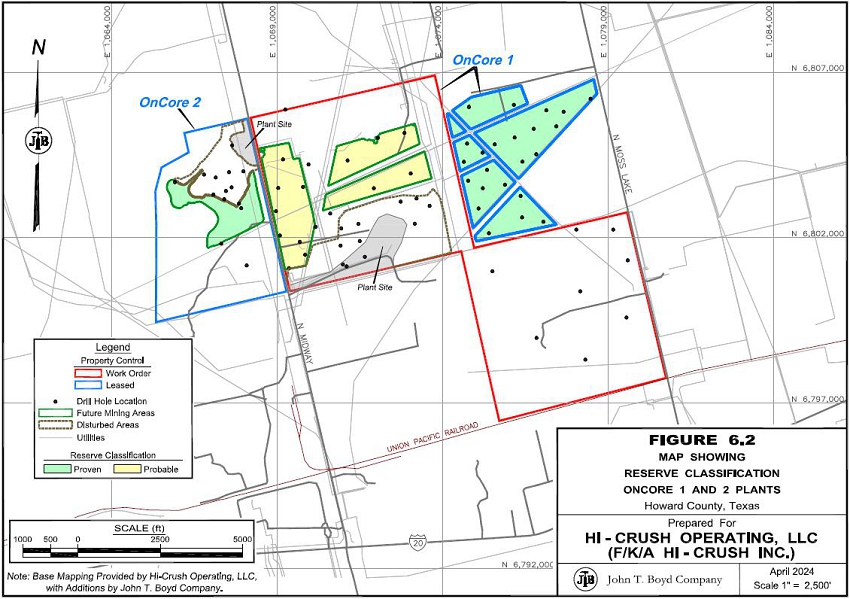
6-10
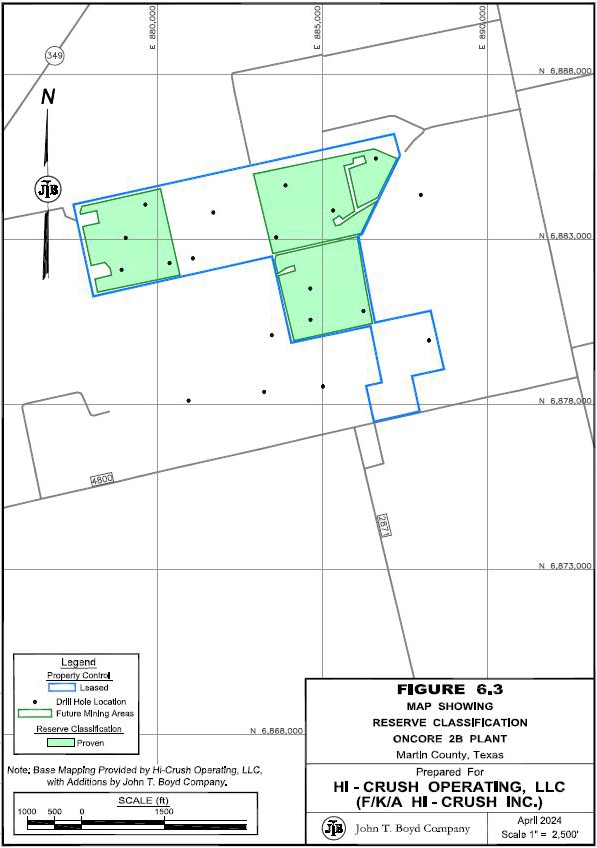
6-11
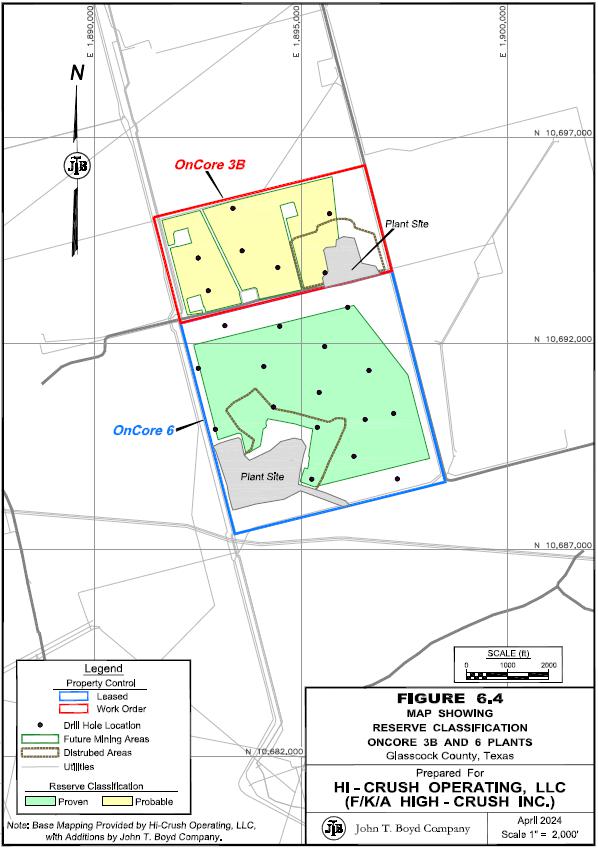
6-12
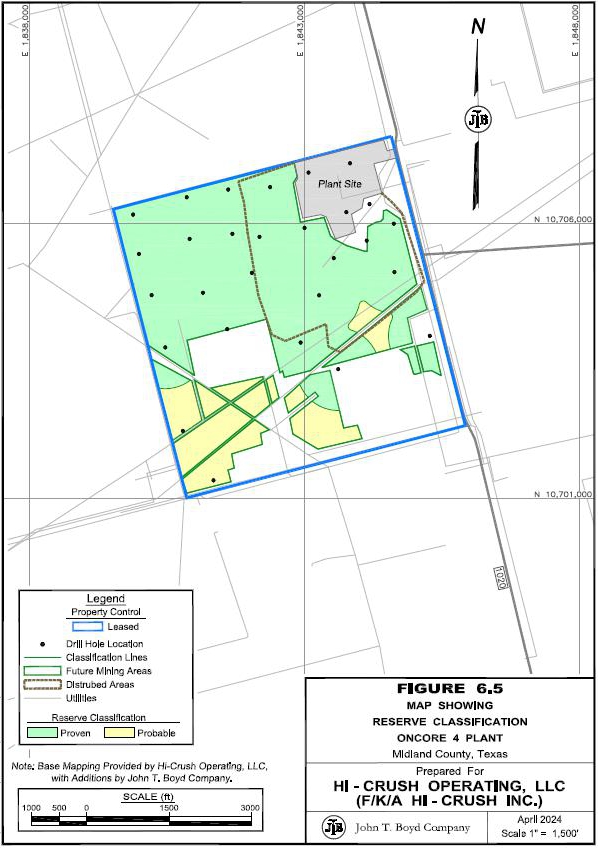
6-13
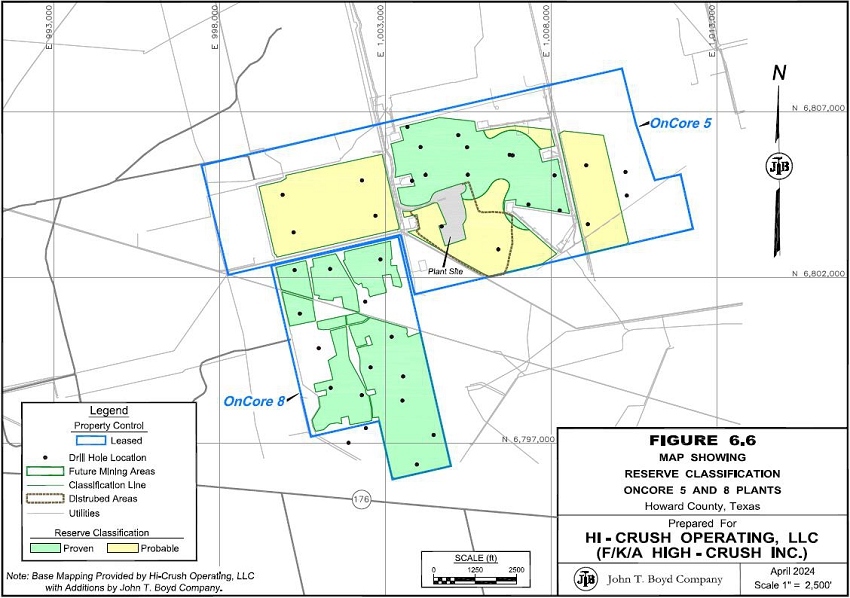
6-14
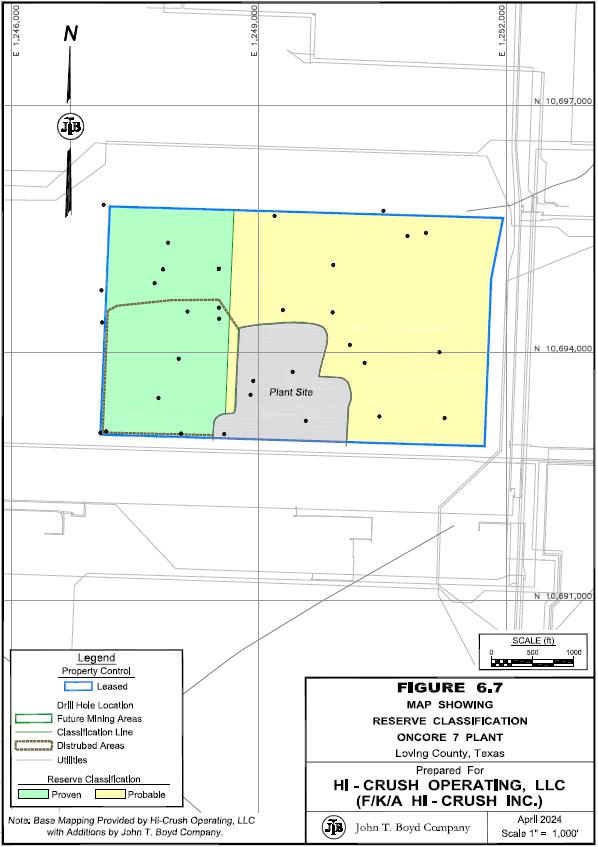
7-1
7.0 MINING OPERATIONS
7.1 Mining Method
The windblown sheet sands and sand dunes in and around the OnCore properties are loosely consolidated and generally overlain by very little overburden; characteristics which are amenable to the use of conventional surface mining techniques. Since most of the target sand formations are very shallow and do not extend below the water table, each is ‘dry-mined’ using medium-sized earthmoving equipment (i.e., haul trucks and excavators). Where the thickness of the sand deposits are greater than the digging depth of the excavating equipment, mining occurs in a series of benches arranged in a stair-like fashion to recover sand from the top of the formation (in elevation) down to the lowest practical elevation.
Most of the mineable areas have minimal overburden and vegetation; as such, sand excavation normally begins at the surface. Where present, overburden is stripped from the surface of the sand deposit utilizing bulldozers, loaders, excavators, and haul trucks. The overburden is placed away from the sand dunes in berms or stockpiles which will be planted (i.e., vegetated) to minimize erosion of the material after completion. Where present, interbedded waste material (e.g., caliche) is separably removed and stored elsewhere on the property or used in the construction of berms.
Drilling and blasting are not required for the loosely consolidated sand and waste material. Excavators and front-end loaders are used to load the mined or ROM sand material into articulated haul trucks, which transport the sand to a ROM stockpile near the processing plants.
Once the mineable interval of sand is excavated, some of the mined-out pits will be used to store reject material from the processing operations.
JOHN T. BOYD COMPANY
7-2
7.2 Mine Schedule, Equipment, and Staffing
Sand excavation at each of the OnCore operations is performed by outside earthmoving contractors. Each of the mining contractors is contractually obligated to supply their respective OnCore sand processing facilities with sufficient feed material to ensure continuous operations. Mining operations are conducted as required year-round but are generally restricted to 12 hours per day.
The primary mobile equipment involved in sand excavation, stockpiling, and hopper feeding includes:
| · | Excavators, |
| · | Articulated haul trucks, |
| · | Front end loaders, |
| · | Dozers, |
| · | Water truck, motor grader, and other ancillary equipment. |
Most of the mobile equipment fleets are owned and operated by the mining contractors. Regular and major repair maintenance of the fleets is also the contractors’ responsibility. If maintained in good condition, the mobile equipment fleets should be capable of achieving the production levels required by the LOM plans.
Staffing requirements for the mining operations are the responsibility of the earthmover contractors.
7.3 Engineering and Planning
The primary mine planning consideration for each operation is the safe, economical, and regular supply of raw high-quality sand feed to the processing plants. In commercial mining terms, the quantities of overburden removed, and sand mined each year at each of the OnCore Plants are considered modest. Each of the sand deposits affords easy access because of their shallow depth and large areal extent. As such, mining plans for the OnCore operations are relatively simple and very flexible; able to be modified based on demand in a relatively short time frame.
Geotechnically, the sand deposits are relatively competent, and the mining depths are so shallow that slumping, or collapsing, has not been and is not expected to be a detriment to the mining process. The pit design parameters utilized at each of the operations have been used with success at similar sand mining operations for many years.
JOHN T. BOYD COMPANY
7-3
Excessive inflow of groundwater into the mining pits is not expected. As such, dewatering before or during mining activities should be manageable with drainage ditches and sumps. Flood waters from localized flash floods are a manageable risk. Onsite water ponds can be used to hold any excessive ground or storm water.
7.4 Mining Sequence and Production
The areal extents of the remaining mining areas (as shown in Figures 6.2 to 6.7, on pages 6-9 to 6-14) and the geologic characteristics of the sand deposits afford the OnCore operations some degree of operational and planning flexibility. Generally, mining operations are expected to advance in blocks outwards from their respective processing plants to reduce haul distances and expand waste storage capacity.
As previously mentioned, the key driver of the mining operations is the adequate supply of feed material to the OnCore processing plants. Mine production requirements and expected mine life for each of the OnCore sites is shown in Table 7.1. below.
| Table 7.1: Annual Production Requirements and Expected Mine Life | ||||||||||||
| Expected | ||||||||||||
| Annual Tons (000) | Mine Life | |||||||||||
| Site | ROM | Product | (years) | |||||||||
| OnCore 1 | 939 | 750 | 7 | |||||||||
| OnCore 2 | 461 | 375 | 0.5 | |||||||||
| OnCore 2B | 1,029 | 750 | 8 | |||||||||
| OnCore 3B | 1,119 | 750 | 6 | |||||||||
| OnCore 4 | 1,152 | 750 | 4 | |||||||||
| OnCore 5 | 1,084 | 750 | 16 | |||||||||
| OnCore 6 | 1,138 | 750 | 7 | |||||||||
| OnCore 7 | 1,179 | 750 | 12 | |||||||||
| OnCore 8 | 1,966 | 1,500 | 5 | |||||||||
JOHN T. BOYD COMPANY
7-4
In 2023, almost 5.7 million tons of raw sand were excavated at the seven active OnCore operations. This was up 87% (or 2.6 million tons) from the previous year when only four OnCore sites were active. With the planned mid-year commissioning of OnCore 8, Hi-Crush plans to mine approximately 8 million tons of raw sand in 2024, as shown in Figure 7.1, below.
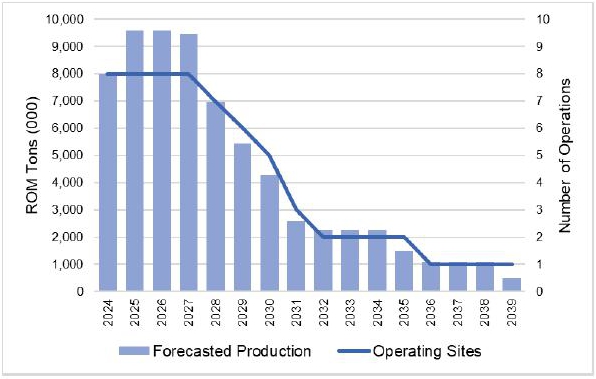
Figure 7.1: LOM Forecasted Mining Production
Future mine production, and hence the longevity of the mines, is directly related to the energy market demand for proppant sand. Actual yearly production volumes may, and are likely to, fluctuate significantly based on this demand. The presented LOM plans are based on Hi-Crush’s controlled (via lease or service agreement) frac sand reserves. Hi-Crush actively investigates additional sand deposits to utilize their OnCore fleet of mobile processing plants; however, there is no guarantee that additional frac resources or reserves will be available for Hi-Crush to acquire.
It is BOYD’s opinion that the forecasted production levels for the OnCore Plants—both individually and collectively—are reasonable, logical, and consistent with typical surface sand mining practices in the region.
JOHN T. BOYD COMPANY
7-5
7.5 Mining Risks
Surface mines face two primary types of operational risks. The first category of risk includes those daily variations in physical mining conditions, mechanical failures, and operational activities that can temporarily disrupt production activities. These conditions/circumstances can adversely affect production on any given day but are not regarded as “risk issues” relative to the long-term operation of the mine. Instead, these are considered “nuisances” that, while undesirable, are encountered on a periodic basis at many mining operations. BOYD does not regard these issues as being material to the OnCore Plants’ operations or otherwise compromising its forecasted performance.
The second type of risk is categorized as “event risk”. Items in this category are rare, but significant, occurrences that ultimately have a pronounced impact on production activities and corresponding financial outcomes. Examples of event risks are major fires or explosions, floods, or unforeseen geological anomalies that disrupt extensive areas of proposed or operating mine workings and require alterations of mining plans. Such an event can result in the cessation of production activities for an undefined but extended period (measured in months, and perhaps years) and/or result in the sterilization of frac sand reserves. This type of risk is minimal in a relatively simple surface frac sand mining operations such as those of the OnCore Plants.
JOHN T. BOYD COMPANY
8-1
8.0 PROCESSING OPERATIONS
8.1 Overview
The OnCore Plants comprise seven smaller mobile wet processing plants and one larger modular wet processing plant (currently under construction). The OnCore operations predominantly produce wet “100 mesh” (i.e., 40/140 to 40/200 mesh) frac sand—that is, the sand is not dried and particles larger than 40 mesh and smaller than 140-to-200 mesh are not considered finished product and are discarded as waste.
The small, built-for-purpose mobile OnCore Plants allow Hi-Crush to move sand mining and processing operations from site to site as deposits are depleted. Indeed, Hi-Crush plans to move two plants in 2024—one from the soon-to-be exhausted OnCore 2 site to the unmined OnCore 2B site, and one from the recently exhausted OnCore 3 site to the unmined OnCore 3B site. Table 7.1., below, provides the start-up (or commissioning) date for each of the mobile OnCore Plants.
| Table 8.1: Mobile OnCore
Plant Commisioning Dates | ||||
| Plant | Commisioned | |||
| OnCore 1 | September 2020 | |||
| OnCore 2 | April 2020 | |||
| OnCore 3 | February 2022 | |||
| OnCore 4 | July 2022 | |||
| OnCore 5 | October 2022 | |||
| OnCore 6 | May 2023 | |||
| OnCore 7 | July 2023 | |||
The seven mobile plants were constructed by Superior Industries, Inc. (Superior). While the plants share nearly identical designs, the latter plants incorporate changes made to the early models to improve production. Each of the mobile processing plants has a nominal (or “nameplate”) capacity of 130 feed tons per hour (tph), which equates to approximately 700,000 to 900,000 tons of finished frac sand per year, depending on the expected processing yields of the sand deposits.
Hi-Crush’s modular OnCore 8 processing plant is currently under construction with a planned commissioning in June 2024. Designed by Superior, the OnCore 8 modular processing plant’s design consists of two 250-tph circuits providing a nameplate capacity of 500 tph of feed sand or approximately 3 million tons of finished frac sand per year.
JOHN T. BOYD COMPANY
8-2
The parallel circuit arrangement offers a degree of flexibility as one plant circuit can be idled for maintenance, while the other is operating.
8.2 Processing Method
Each of the OnCore Plants’ processing operations comprise two major components which are typical in the production of wet frac sand. These components include:
| · | Wet Plant – ROM material from the pit is delivered to the wet plant where the coarse material (e.g., gravel) and fine material (e.g., fine sand and silt) is removed from the sand. |
| · | Storage and Loadout – Finished damp sand products are stored in stockpiles resting on a water decant system, where the sand is allowed to dry somewhat. The frac sand is then loaded into feed hoppers, conveyed to a discharge hopper, and loaded into trucks resting on weighing scales. |
| 8.2.1 | Wet Plant |
Each wet plant receives its raw sand feed from a ROM stockpile which is supplied by the mine. A front-end loader loads the ROM sand into a grizzly or scalping screen feed hopper. The oversized material is screened out and the remaining sand is mixed with water to be pumped to and processed through the wet plant.
The wet plants do not crush the material, but instead scrub (i.e., wash) and classify (i.e., size) the raw sand. During this process, a screen removes the plus 25 mesh top size or oversize material, and cyclones deslime and remove the minus 200 mesh material.
Dewatering screens are used to remove excess moisture. The resultant minus 200 mesh material is stockpiled on a water decant system which reduces the sand’s moisture content prior to shipping to the customer.
The waste wash/process water is directed to a thickener and then to one or more settling ponds. Chemical flocculant is added as the water is discharged into the retention ponds to aid with particle settling. Water used for the wet plant processing is recycled as it is sourced from a lined retention pond. The closed-loop process water circuit provides for efficient use of water as the majority is collected and recycled in the process. Water conservation is a high priority at the operation. The wet plants typically operate 24 hours per day, 7 days per week.
JOHN T. BOYD COMPANY
8-3
8.3 Production
Combined, the OnCore Plants have a nameplate capacity of over 7 million tons of wet 100 mesh frac sand per year based on operating 24 hours a day and nearly 365 days per year. Forecasted production over the expected life of the operations is provided in Figure 8.1, below.
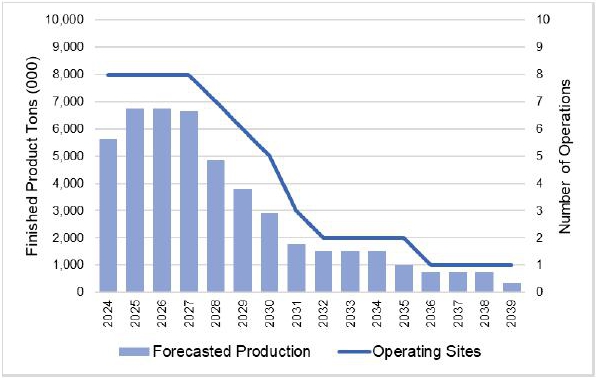
Figure 8.1: LOM Forecasted Processing Plant Production
As shown, the OnCore Plants plan to produce just under 7 million tons wet frac sand when all eight plants are active. However, annual finished product volumes will depend on market demand and may fluctuate substantially. The presented LOM production plans are based on Hi-Crush’s controlled (via lease or service agreement) frac sand reserves. Hi-Crush actively investigates additional sand deposits to exploit with their OnCore fleet of mobile processing plants; however, there is no guarantee that additional frac resources or reserves will be available for Hi-Crush to acquire.
JOHN T. BOYD COMPANY
8-4
8.4 Processing Risks
BOYD is unaware of any reported interruptions, outages, shortages, or failures related to processing operations that have materially affected the OnCore Plants. Given the operation is well-established, we believe the risk of such events materially affecting the estimates of frac sand reserves presented herein is low.
Based on our review, it is BOYD’s opinion that the processing methods and existing equipment at the plant are sufficient for the forecasted production of finished frac sand products.
JOHN T. BOYD COMPANY
9-1
9.0 MINE INFRASTRUCTURE
9.1 Overview
All of the basic infrastructure required for the ongoing operations at the active OnCore sites is in place. Construction or installation of infrastructure at OnCore 2B, OnCore 3B, and OnCore 8 is underway and is planned to be completed before operations commence. Figures 3.1 through 3.6 (pages 3-3 to 3-8) illustrate the general layout of the infrastructure at each of the OnCore operations.
Given the size and simplicity of the mining and processing operations at each of the OnCore sites, infrastructure requirements are relatively simple. Each site appears to have the necessary capacity/capabilities to support their respective near-term operating plans. Operational preference may lead to the upgrading of some existing facilities if warranted.
BOYD is unaware of any reported interruptions, outages, shortages, or failures related to infrastructure requirements that have materially affected the OnCore operations. Given Hi-Crush’s operational experience and that most of the operations are well-established, we believe the risk of such events materially affecting the estimates of frac sand reserves presented herein is low.
9.2 Transportation
Each of the OnCore sites is serviced by several roads maintained by the local municipality, county, and state governments. These roads are either paved or well-maintained graded roadways. Road access is available year-round.
There is not any rail infrastructure available at any of the OnCore sites. All products are shipped via bulk trucks. Transloading would be required to use existing rail networks. Hi-Crush plans to continue to transport their products from the OnCore Plants via road.
9.3 Utilities
The OnCore facilities are serviced by three-phase electric power. Substations access 138 kV lines and step voltage down to 12.5 kV lines which deliver power to each the processing plants.
JOHN T. BOYD COMPANY
9-2
The wash process water is recycled after fines are removed via settling with a flocculent in a series of constructed ponds. As the mine progresses, silt ponds are constructed in mined-out areas. Additional makeup water is obtained from wellfields near the plants or purchased from water suppliers.
Wastewater from offices and other buildings is collected via holding tanks and disposed of on a regular basis. Potable water is provided by the public water system.
9.4 Tailings Disposal
The mining and processing of frac sand at each of the OnCore operations creates a substantial volume of tailings (i.e., waste material). These tailings are typically a mixture of clay, very fine sand, and other non-silica minerals. Tailings are typically disposed of in ponds (i.e., former mining pits) where the solid materials settle to the bottom and water is recovered for reuse. As mining progresses, depleted pits will become new tailings disposal sites. Freshwater ponds are maintained on the property so water can be stored after processing through the tailings ponds.
JOHN T. BOYD COMPANY
10-1
10.0 MARKET ANALYSIS
| 10.1 | Market Overview and Outlook |
The Permian Basin’s (Permian) frac sand market is driven by unconventional horizontal drilling in the oil and gas industry. In the late 1990s, rapid advances in horizontal drilling and hydraulic fracturing (fracking) in North America ushered in large-scale commercial oil and gas production. This fracking technique has been increasingly successful and modified over time to extract oil and gas held in dense layers of shale rocks, whose low permeability had previously prevented the flow of hydrocarbons.
Hydraulic fracturing uses a mixture of water, chemicals, and proppant (natural sand or man-made sand-like substances) to fracture shale rock and release hydrocarbons such as oil, natural gas, and natural gas liquids. The proppant acts to keep the fractures open (prop) while the pressurized fluids flow back up the well piping. Wells have become more productive with the addition of horizontal drilling capabilities, longer lateral lengths, and multi-stage fracks.
North America’s shale oil industry’s growing competitiveness gained through continuous technology improvement and falling production costs have had major implications on the global energy market. Oilfield service companies, including frac sand producers, made significant efficiency gains in 2020 to survive lower commodity prices because of the COVID-19 pandemic. These gains have followed through to the present day.
JOHN T. BOYD COMPANY
10-2
Figure 10.1, on the following page, illustrates the CME Group’s West Texas Intermediate (WTI) Crude Oil Annual Average Futures Price. We estimate breakeven pricing for unconventional oil wells in the Permian to be in the $30 to $40 per barrel range. 2023 WTI futures estimate pricing to generally be in the $64 to $75 range through 2032. This cost and pricing combination supports positive wellfield economics and thus frac sand consumption.
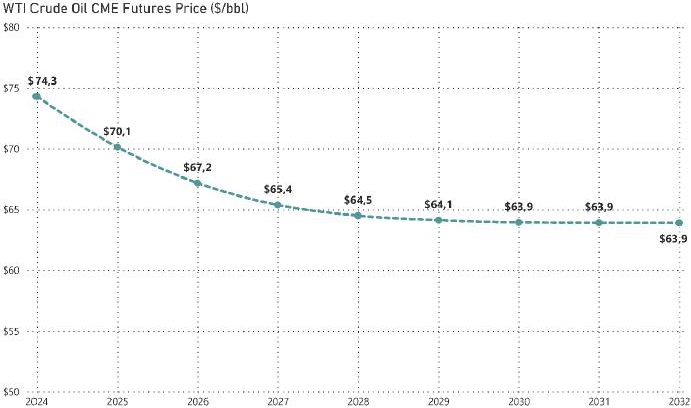
Source: CME Group
Figure 10.1: WTI Crude Oil CME Futures Price
Figure 10.2, on the following page, is compiled from downloaded and processed publicly available data from the Railroad Commission of Texas (RCC) for horizontal oil and gas permits in the U.S. This data shows a steady increment from the post-pandemic all-time low of 716 permits recorded in the 2nd quarter of 2020, to almost 2,000 permits in the 3rd quarter of 2022. From this period until the 4th quarter of 2023, a slow decreasing trend is shown with an average of 1,600 permits by quarter. It is important to note in this figure that most of the permits are based in the Permian region (with an average of 70% of all permits) followed next by permits in the Eagle Ford region (with an average of 21% of all permits) over the last 4 years.
JOHN T. BOYD COMPANY
10-3
From the 1st quarter of 2021 to the 4th quarter of 2023, the global distribution by permit type is 76% oil and 24% gas. Permit submissions for horizontal oil and gas wells in the Permian follow the same trend of the U.S. Global Permits which suggests a continuation of strong drilling ahead.
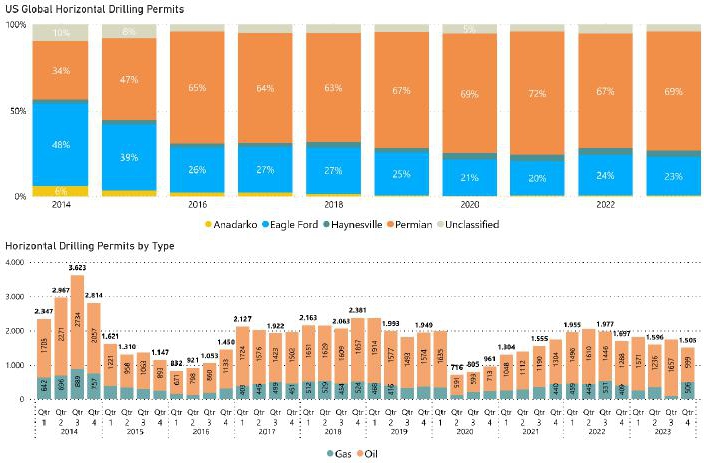
Source RCC
Figure 10.2: U.S. Global Horizontal Drilling Permits by Region and Type
A quarterly summary of Permian horizontal oil and gas well permits (from 2014 through 2023) is presented in Figure 10.3 below.
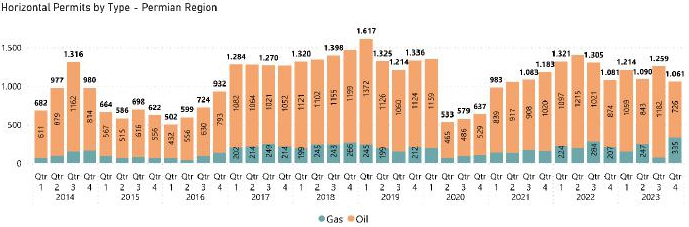
Source RCC
Figure 10.3: Permian Region Horizontal Drilling Permits by Type
JOHN T. BOYD COMPANY
10-4
Figure 10.4 was prepared combining data available for the current working rigs by region and the horizontal drilling permits. From September 2020 there is a noticeable and constant increase in the rig counts, reaching an all-time high number of permits since the COVID-19 pandemic in January 2023.
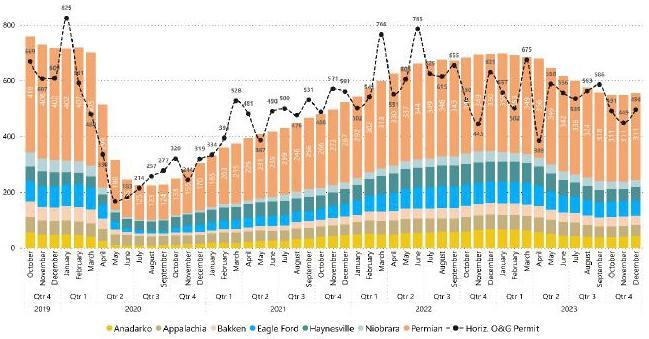
Source EIA and RCC
Figure 10.4: U.S. Horizontal Drilling Permits
During the previous 52 weeks, rig counts were down approximately 13%. However, the continuous growth through the last three years has led to increased production for both crude oil and natural gas. For the same period, crude oil (barrels per day) and natural gas production (thousand cubic feet per day) in the Permian are up 30% and 24%, respectively.
JOHN T. BOYD COMPANY
10-5
As figures 10.5 and 10.6 illustrate, Permian daily crude oil production is reaching multi-year highs, while daily natural gas production in the Permian continues to make new records, now standing at 24.1 million cubic feet per day.
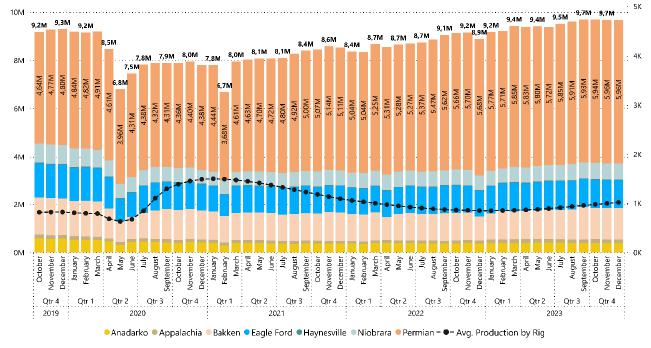
Source EIA
Figure 10.5: Oil Production (bbl/d)
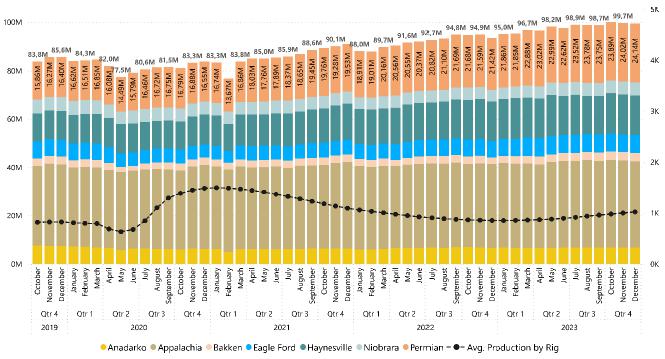
Source EIA
Figure 10.6: Natural Gas Production (Mcf/d)
JOHN T. BOYD COMPANY
10-6
The EIA’s Drilling Productivity Report reports that the inventory of drilled but uncompleted wells (DUCs) in all regions have declined 49% since peaking in July 2020 (refer to Figure 10.7 for all U.S. regions, and Figure 10.8 for the Permian). This data dovetails with increased crude oil and natural gas production.
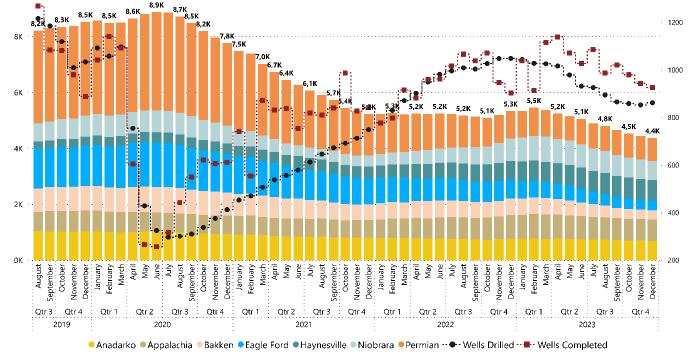
Source EIA
Figure 10.7: U.S. Drilled but Uncompleted Wells (DUC)
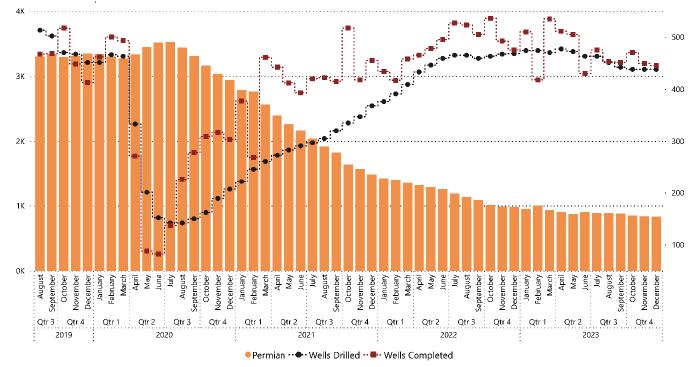
Source EIA
Figure 10.8: Permian Drilled but Uncompleted Wells (DUC)
JOHN T. BOYD COMPANY
10-7
Consequently, with increases in production and well completions, activity at frac sand mines has correspondingly increased throughout the U.S. According to MSHA, operating hours from 1st quarter of 2021 through 3rd quarter of 2023 were up 60% for Permian Basin frac sand mines. This data is presented in figures 10.9 (U.S.) and 10.10 (Permian).
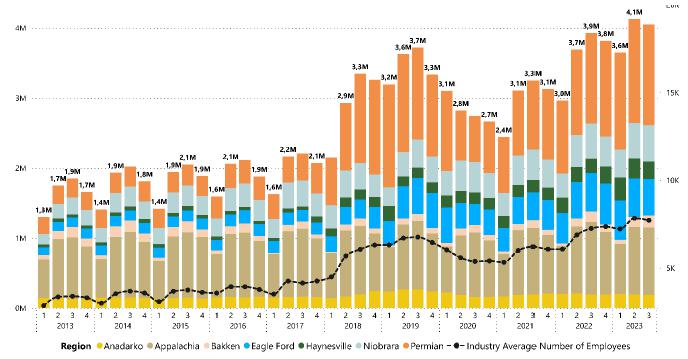
Source MSHA
Figure 10.9: All U.S. Regions Mine Hours (Quarterly)
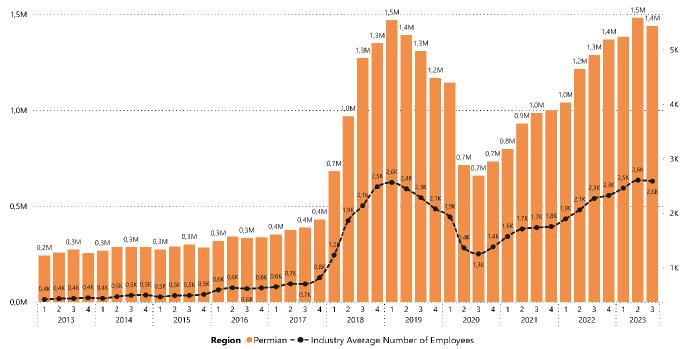
Source MSHA
Figure 10.10: Permian Wide In-Basin Mine Hours (Quarterly)
JOHN T. BOYD COMPANY
10-8
Industry research speculates that total in-basin mine hours, as of 2nd quarter 2023, are at the same level as the 2019 peak. Mine hours serve as a directional indicator that dovetails with previous crude oil and natural gas production and DUC data. Current frac sand production in the Permian is estimated to be in the 60 million to 65 million tons per year range, with fairly well-balanced demand and stable pricing. BOYD anticipates frac sand pricing stabilizing substantially above the pricing used in this report. Additionally, we anticipate continued upward sand consumption in the Permian due to economic and geopolitical influences on energy demand.
| 10.2 | Historical Sales |
Primarily, Hi-Crush supplies a range of frac sand products to major oilfield services companies and E&P companies operating in the Permian Basin. In addition to their flagship Kermit Mine, Hi-Crush operates seven smaller, built-for-purpose mobile processing plants and one modular processing facility, collectively referred to as the OnCore Plants. The OnCore Plants exclusively produce wet “100 mesh” frac sand—a damp (i.e., undried) frac sand in the 40/140 to 40/200 mesh range.
Recent historical sales data provided by Hi-Crush for the OnCore Plants are summarized in Table 10.1, below.
| Table 10.1: Historical Sales Data | ||||||||||||||||||
| Units | 2020 | 2021 | 2022 | 2023 | ||||||||||||||
| Operating OnCore Plants | 1 | 2 | 4 | 7 | ||||||||||||||
| Product Sales | 000 tons | 137 | 1,004 | 2,209 | 4,664 | |||||||||||||
| Average Selling Price | $/ton sold | 11.50 | 12.86 | 17.00 | 21.04 | |||||||||||||
Frac sand demand dropped in 2020, as compared to 2019, due to the COVID-19 pandemic. However, recovery began in the fourth quarter of 2020 and continued through 2023. Sales volumes and selling prices for the OnCore Plants’ frac sand have increased year-over-year for the last four years.
Hi-Crush has structured long-term contracts with most of its customers outlining volume commitments and, in some cases, fixed pricing. Hi-Crush also services customers on a spot basis where volume thresholds are not set, and orders are serviced on an as-available basis at prevailing market prices. The majority of tons sold from the individual OnCore Plants are delivered to one customer only—especially, when the mobile plant operates on the customer’s land. Historically, the top-five customers by sales revenue account for approximately 93% to 100% of total sales from the OnCore Plants annually.
JOHN T. BOYD COMPANY
10-9
| 10.3 | Market Entry Strategies |
As an existing producer with a lengthy commercial history and established customer base, it is BOYD’s opinion that market entry strategies are not required for continued sale of the OnCore Plants’ frac sand products.
| 10.4 | Future Sales |
BOYD’s projections of sales volumes and frac sand prices for the OnCore Plants are informed by Hi-Crush’s historical operating results, their short-term budget forecasts, and our knowledge of frac sand markets. Forecasted prices are based on sales of 100 mesh finished frac sand products. Our frac sand sales forecast for the OnCore Plants is provided in Table 10.2, below.
| Table 10.2: Frac Sand Sales Forecast | ||||||||||
| Sales | ASP | |||||||||
| Year(s) | (000 tons) | ($/ton) | ||||||||
| 2024 | 5,625 | 23.33 | ||||||||
| 2025 | 6,750 | 23.33 | ||||||||
| 2026 | 6,750 | 23.33 | ||||||||
| 2027 | 6,650 | 23.33 | ||||||||
| 2028 | 4,863 | 23.33 | ||||||||
| 2029–2039 | 16,534 | 23.33 | ||||||||
| Total | 47,172 | |||||||||
| Minimum | 23.33 | |||||||||
| Maximum | 23.33 | |||||||||
| Average | 23.33 | |||||||||
As previously mentioned, some of the OnCore Plants operate under service agreements to mine, process, and deliver finished frac sand to the landowner—an E&P company. These service agreements are structured long-term contracts outlining volume commitments and, in some cases, fixed pricing. Generally, the service agreements do not preclude the sale of finished frac sand to third parties, as long as contracted volume commitments are satisfied.
JOHN T. BOYD COMPANY
11-1
11.0 CAPITAL AND OPERATING COSTS
| 11.1 | Historical Financial Performance |
All the OnCore Plants operate in a common regional market and are in the same business division within Hi-Crush. Hi-Crush generally accounts for the historical and projected financial performance of the OnCore Plants on a consolidated basis; however, detailed financial records are maintained for each operation.
Table 11.1 summarizes the past four years of financial data for the OnCore Plants on a consolidated basis. It should be recognized that: (1) the first OnCore plant (OnCore 1) began operation in 2020, and (2) the COVID-19 pandemic caused severe economic, market, and other disruptions which affected frac sand sales during 2020 and 2021.
| Table 11.1: Historical Financials | ||||||||||||||||||
| Units | 2020 | 2021 | 2022 | 2023 | ||||||||||||||
| Frac Sand Sales | 000 tons | 137 | 1,004 | 2,209 | 4,664 | |||||||||||||
| Gross Revenues | $ 000 | 1,259 | 12,992 | 36,368 | 90,627 | |||||||||||||
| Average Selling Price | $/ton sold | 11.50 | 12.86 | 17.00 | 21.04 | |||||||||||||
| Cost of Goods Sold | $ 000 | 1,536 | 11,340 | 27,947 | 47,104 | |||||||||||||
| Average Cost of Goods Sold | $/ton sold | 11.21 | 11.29 | 12.65 | 10.10 | |||||||||||||
| Capital Expenditures | $ 000 | 2,417 | 4,926 | 31,573 | 32,482 | |||||||||||||
The total cash cost of goods sold includes operating costs (i.e., mining, ongoing reclamation, processing, product loadout, and other related costs), in addition to selling, general, and administrative expenses.
Based on the financial data presented above:
| · | ASP increased marginally from $11.50 per ton sold in 2020 to $21.04 per ton in 2023, averaging $17.62 per ton over the last four years. |
| · | ACS has remained relatively consistent, ranging from $10.10 to $12.65 per ton sold and averaging $10.97 per ton sold, over the last four years. |
| · | EBITDA margin was positive every year but 2020 (the first year if production) and was 48% in 2023. |
JOHN T. BOYD COMPANY
11-2
| 11.2 | Estimated Costs |
The production and unit cost estimates for the OnCore Plants are informed by Hi-Crush’s historical performance and internal budget forecasts, in combination with BOYD’s familiarity with mining costs at similar operations. Operating volumes are well-defined and understood, as are mining and processing productivities at the OnCore operations. As such, it is BOYD’s opinion that the production and financial projections are reasonable and are likely to be within ±20% accuracy level.
This section contains forward-looking information related to capital and operating cost estimates for the OnCore Plants. There are inherent known and unknown risks and uncertainties associated with all mining operations. These risks, uncertainties, and other factors are not quantifiable, but include, but are not limited to, adverse general economic conditions, operating hazards, inherent uncertainties in interpreting engineering and geologic data, fluctuations in commodity prices and prices for operational services, government regulation and political risks, as well as other risks commonly associated with the mining industry.
| 11.2.1 | Projected Capital Expenditures |
Projected capital expenditures for the OnCore Plants fall into two general categories:
(1) growth or expansion outlays to increase production, and (2) sustaining or maintenance expenses to replace or repair assets to ensure continued production. The timing and amount of these capital expenditures are expected to be largely discretionary and within Hi-Crush’s control.
Growth/expansion capital expenditures include allocations for: (1) completion of OnCore 8’s modular processing plant, and (2) sitework to prepare the OnCore 2B, 3B, and 8 sites for operations, and (3) demolition and reclamation of the OnCore 2 and 3 sites. Hi-Crush’s growth/expansion capital expenditure budget for 2024 is provided in Table 11.2, below.
JOHN T. BOYD COMPANY
11-3
| Table 11.2: Growth Capital Expenditures Budget for 2024 | ||||
| Budget | ||||
| Project/Site | ($ 000) | |||
| Construction/Sitework: | ||||
| Oncore 8 | 20,248 | |||
| Oncore 2B | 3,385 | |||
| Oncore 3B | 3,385 | |||
| Reclamation: | ||||
| Oncore 2 | 829 | |||
| Oncore 3 | 1,781 | |||
| Total | 29,628 | |||
OnCore’s seven mobile processing plants are already in-service and should not require any near-term major capital investment to maintain full commercial production. BOYD projected sustaining capital expenditures at a unit cost of $1.20 per ton sold, this includes maintenance of production equipment, as well as other items, for the operations. This factor is based on our professional judgment and experience with similar operations and reflects the expected life span of the OnCore mobile processing plants and related infrastructure.
| 11.2.2 | Projected Operating Costs |
Operating cost estimates were developed based on recent actual costs and considering specific operational activity levels and cost drivers. The estimates consider current and expected labor headcount and salaries, major consumables and unit prices, power costs, and equipment and maintenance costs. The total operating cost estimate includes all site costs related to mining, processing, loading, and general and administrative expenses (including non-income taxes, fees, and royalties).
Operating costs for the OnCore operations are expected to remain relatively consistent (on an uninflated basis) with 2023 results. As such, the projected total cash cost of goods sold over the life of the mine averages $11.57 per ton sold over the life of the mine. As the operation is in a steady state, BOYD considers the future operating cost estimates to be reasonable and appropriate.
JOHN T. BOYD COMPANY
12-1
12.0 ECONOMIC ANALYSIS
12.1 Approach
The economic analysis presented in this chapter was prepared by BOYD for the purpose of confirming the commercial viability of the OnCore Plants’ reported frac sand reserves and not for the purpose of valuing any of the OnCore operations, or their assets. The economic analysis contains forward-looking information related to the projected operating and financial performance of the OnCore Plants. This projection involves inherent known and unknown risks and uncertainties, some of which may be outside of Hi-Crush’s control. Hi-Crush, as with all mining companies, actively evaluates, changes, and modifies business and operating plans in response to various factors that may affect operational and/or financial results. Actual results, production levels, operating expenses, sales realizations, and all other modifying factors could vary significantly from the assumptions and estimates provided in this analysis. Risk is subjective, as such, BOYD recommends that each reader should evaluate the project based on their own investment criteria.
The financial model used for the purposes of the economic analysis forecasts future free cash flow from frac sand production and sales over the life cycle of the OnCore operations using the annual forecasts of production, sales revenues, and operating and capital costs discussed earlier in this report. A DCF analysis, in which future free cash flows are discounted to present value, is used to derive an NPV for the frac sand reserves. The use of DCF-NPV analysis is a standard method within the mining industry to assess the economic value of a project after allowing for the cost of capital invested.
The financial evaluation of the OnCore Plants has been undertaken on a simplified after-tax basis and does not reflect Hi-Crush’s corporate tax structure. NPV is calculated using an after-tax discount rate of 10% (NPV10). Cash flows were assumed to occur in the middle of each year and are discounted to January 1, 2024. Cost estimates and other inputs to the cash flow model for the project have been prepared using constant 2023 money terms, i.e., without provision for inflation. The internal rate of return and project payback were not calculated, as there was no initial investment (sunk costs) considered in the financial model provided herein.
A suite of sensitivities was calculated to evaluate the effect of the main drivers of economic performance (including variations in sales prices, operating costs, and capital costs).
JOHN T. BOYD COMPANY
12-2
It is BOYD’s opinion that the financial model provides a reasonable and accurate reflection of the OnCore Plants’ expected economic performance based on the assumptions and information available at the time of our review.
12.2 Assumptions and Limitations
Cash flow projections for the OnCore Plants have been generated from the annual forecasts of production, sales revenues, and operating and capital costs discussed earlier in this report. A summary of the key assumptions and limitations is provided below:
| · | Sales volumes of finished frac sand in 2024 are based on Hi-Crush’s budget projections and are expected to remain constant thereafter. Forecasted sales volumes are at or below the capacity of the OnCore processing facilities, both individually and in aggregate. |
| · | ROM production requirements are based on an expected processing yields at each property and will remain in line with expected sales volumes. Forecasted ROM production is at or below the capacity of the existing mining equipment and related infrastructure. |
| · | Forecasted revenues are based on sales of 100 mesh finished frac sand with a weighted average sales price of $23.33 per ton in 2024 and continuing for the expected life of the reserves (through 2039). |
| · | Projected operating costs are discussed in Chapter 11 and include all site costs related to mining, processing, loading, and general and administrative expenses (including non-income taxes, fees, and royalties). Unit operating costs are expected to remain relatively constant over the life of the operation. |
| · | Projected capital expenditures are discussed in Chapter 11 and costs for expansion/growth and sustaining/maintenance of operations. Unit sustaining capital expenditures are expected to remain relatively constant over the life of the operation. |
| · | Net working capital is not included in the valuation since the OnCore business unit is a going concern. |
| · | Current fixed assets are depreciated over remaining life of the operations using their carrying value as of December 31, 2023, and the straight-line method. |
| · | Depreciation expenses for new fixed assets are based on a straight-line depreciation calculation using an 8-year (sustaining/maintenance) or 10-year (expansion/growth) asset life. |
| · | Income taxes are based on a Federal Corporate Tax Rate of 21%. |
| · | Asset recovery/salvage values were not included in the valuation. |
| · | Post-mining cost of reclamation is not included in the valuation. |
JOHN T. BOYD COMPANY
12-3
12.3 Financial Model Results
Table 12.1, below, provides a summary of the estimated remaining life of reserves financial results for the OnCore Plants.
| Table 12.1: Financial Results | |||||||
| Remaining | |||||||
| Life of | |||||||
| Reserves | |||||||
| Units | Total | ||||||
| Expected Remaining Life | years | 16 | |||||
| Production: | |||||||
| ROM Production | 000 tons | 67,963 | |||||
| Product Sales | 000 tons | 47,172 | |||||
| Total Revenues | $ millions | 1,100.5 | |||||
| Average Selling Price | $/t sold | 23.33 | |||||
| Total Cost of Goods Sold | $ millions | 545.8 | |||||
| Average Cost of Goods Sold | $/t sold | 11.57 | |||||
| Capital Expenditures | $ millions | 86.2 | |||||
| Average Capital Expenditures | $/t sold | 1.83 | |||||
| Pre-Tax: | |||||||
| Cash Flow | $ millions | 468.5 | |||||
| NPV10 | $ millions | 309.6 | |||||
| After-tax: | |||||||
| Cash Flow | $ millions | 378.5 | |||||
| NPV10 | $ millions | 245.8 | |||||
Estimated LOM pre-tax and after-tax cash flows for frac sand production from the OnCore Plants are presented in Table 12.2, on the following page.
JOHN T. BOYD COMPANY
12-4
Table 12.2
ANNUAL PRODUCTION AND CASH FLOW FORECAST
ONCORE PLANTS
Prepared For
HI-CRUSH OPERATING, LLC (F/K/A HI-CRUSH INC.)
By
John T. Boyd Company
Mining and Geological Consultants
April 2024
| Description | Units | 2024 | 2025 | 2026 | 2027 | 2028 | 2029 to 2033 | 2034 to 2039 | Total | ||||||||||||||||||||||||||
| Production Statistics: | |||||||||||||||||||||||||||||||||||
| ROM Production | 000 tons | 8,010 | 9,606 | 9,606 | 9,452 | 6,964 | 16,855 | 7,470 | 67,963 | ||||||||||||||||||||||||||
| Process Yield | % | 70.2 | 70.3 | 70.3 | 70.4 | 69.8 | 68.0 | 68.0 | 69.4 | ||||||||||||||||||||||||||
| Product Sales | 000 tons | 5,625 | 6,750 | 6,750 | 6,650 | 4,863 | 11,453 | 5,081 | 47,172 | ||||||||||||||||||||||||||
| Total Revenues | $ 000 | 131,231 | 157,478 | 157,478 | 155,145 | 113,454 | 267,198 | 118,540 | 1,100,523 | ||||||||||||||||||||||||||
| Average Selling Price | $/ton sold | 23.33 | 23.33 | 23.33 | 23.33 | 23.33 | 23.33 | 23.33 | 23.33 | ||||||||||||||||||||||||||
| Cost of Goods Sold | $ 000 | 65,081 | 78,098 | 78,098 | 76,941 | 56,265 | 132,511 | 58,787 | 545,780 | ||||||||||||||||||||||||||
| Average Cost of Goods Sold | $/ton sold | 11.57 | 11.57 | 11.57 | 11.57 | 11.57 | 11.57 | 11.57 | 11.57 | ||||||||||||||||||||||||||
| EBITDA | $ 000 | 66,150 | 79,380 | 79,380 | 78,204 | 57,189 | 134,687 | 59,753 | 554,743 | ||||||||||||||||||||||||||
| DDA | $ 000 | 6,268 | 8,678 | 9,690 | 10,695 | 11,559 | 63,038 | 16,190 | 126,117 | ||||||||||||||||||||||||||
| EBIT/Operating Income | $ 000 | 59,882 | 70,702 | 69,690 | 67,509 | 45,630 | 71,649 | 43,563 | 428,625 | ||||||||||||||||||||||||||
| Taxes | $ 000 | 12,575 | 14,848 | 14,635 | 14,177 | 9,582 | 15,046 | 9,148 | 90,011 | ||||||||||||||||||||||||||
| EBIAT | $ 000 | 47,307 | 55,855 | 55,055 | 53,332 | 36,048 | 56,603 | 34,415 | 338,614 | ||||||||||||||||||||||||||
| Capital Expenditures | $ 000 | 36,378 | 8,100 | 8,100 | 7,980 | 5,836 | 13,744 | 6,097 | 86,234 | ||||||||||||||||||||||||||
| Net Income | $ 000 | 10,929 | 47,755 | 46,955 | 45,352 | 30,212 | 42,859 | 28,317 | 252,380 | ||||||||||||||||||||||||||
| Pre-tax Cash Flow | $ 000 | 29,772 | 71,280 | 71,280 | 70,224 | 51,353 | 120,944 | 53,655 | 468,508 | ||||||||||||||||||||||||||
| Discounted at 10% | $ 000 | 28,386 | 61,784 | 56,168 | 50,305 | 33,443 | 62,742 | 16,734 | 309,562 | ||||||||||||||||||||||||||
| After-tax Cash Flow | $ 000 | 17,197 | 56,432 | 56,645 | 56,047 | 41,771 | 105,897 | 44,507 | 378,497 | ||||||||||||||||||||||||||
| Discounted at 10% | $ 000 | 16,397 | 48,915 | 44,636 | 40,149 | 27,202 | 54,602 | 13,898 | 245,799 | ||||||||||||||||||||||||||
JOHN T. BOYD COMPANY
12-5
DCF-NPV on a pre-tax and after-tax basis, using discount rates of 8%, 10% (the base case), and 12%, were calculated utilizing the projected cash flows. Table 12.3 summarizes the results of the pre-tax and after-tax DCF-NPV analyses:
| Table 12.3: DCF-NPV Analysis | ||||||||||||
| NPV ($ millions) | ||||||||||||
| 8% | 10% | 12% | ||||||||||
| Pre-Tax | 332.9 | 309.6 | 289.0 | |||||||||
| After-Tax | 265.2 | 245.8 | 228.8 | |||||||||
As shown, the pre-tax DCF-NPV ranges from approximately $289 million to $323.9 million. The after-tax DCF-NPV ranges from approximately $228.8 million to $265.2 million.
The economic analysis confirms that the OnCore Plants generate positive pre- and after-tax financial results and a real NPV10 of $245.8 million. As such, it is BOYD’s opinion that the OnCore frac sand reserves have demonstrated economic viability.
12.4 Sensitivity Analysis
Table 12.4, below, shows the sensitivity of the project after-tax for a cash flow discounted at 10% (NPV10) to a variation over a range of 20% above and below the base case in:
(1) average selling prices and (2) operating costs.
| Table 12.4: After-Tax NPV10 Sensitivity Analysis ($ millions) | |||||||||||||||||||||||||||||||||||||||||
| Revenues | |||||||||||||||||||||||||||||||||||||||||
| -20% | -15% | -10% | -5% | 0% | 5% | 10% | 15% | 20% | |||||||||||||||||||||||||||||||||
| Cost
of Goods Sold |
-20% | 186.4 | 215.8 | 245.3 | 274.8 | 304.3 | 333.8 | 363.2 | 392.7 | 422.2 | |||||||||||||||||||||||||||||||
| -15% | 171.7 | 201.2 | 230.7 | 260.2 | 289.7 | 319.1 | 348.6 | 378.1 | 407.6 | ||||||||||||||||||||||||||||||||
| -10% | 157.1 | 186.6 | 216.1 | 245.6 | 275.0 | 304.5 | 334.0 | 363.5 | 393.0 | ||||||||||||||||||||||||||||||||
| -5% | 143.2 | 172.0 | 201.5 | 230.9 | 260.4 | 289.9 | 319.4 | 348.9 | 378.3 | ||||||||||||||||||||||||||||||||
| 0% | 130.9 | 157.3 | 186.8 | 216.3 | 245.8 | 275.3 | 304.8 | 334.2 | 363.7 | ||||||||||||||||||||||||||||||||
| 5% | 118.4 | 143.4 | 172.2 | 201.7 | 231.2 | 260.7 | 290.1 | 319.6 | 349.1 | ||||||||||||||||||||||||||||||||
| 10% | 106.0 | 131.1 | 157.6 | 187.1 | 216.6 | 246.0 | 275.5 | 305.0 | 334.5 | ||||||||||||||||||||||||||||||||
| 15% | 93.6 | 118.6 | 143.6 | 172.5 | 201.9 | 231.4 | 260.9 | 290.4 | 319.9 | ||||||||||||||||||||||||||||||||
| 20% | 81.1 | 106.2 | 131.3 | 157.8 | 187.3 | 216.8 | 246.3 | 275.8 | 305.2 | ||||||||||||||||||||||||||||||||
As expected, the project is most sensitive to changes in product pricing and operating costs. The project is less sensitive to capital costs. There is little to no impact varying the capital costs from 70% to 130% of the base case.
JOHN T. BOYD COMPANY
12-6
This analysis demonstrates the project value to be relatively robust, with positive NPVs reported across the range of values assessed.
JOHN T. BOYD COMPANY
13-1
13.0 PERMITTING AND COMPLIANCE
| 13.1 | Permitting Requirements and Status |
Several permits and compliance with federal, state, and municipal regulations are required for mining, processing, and related activities at each of the OnCore Plants. These activities are principally regulated by the Texas Commission on Environmental Quality (TCEQ). The predominant registration requirement is with the TCEQ’s Air New Source Review program for air pollution control. Under this program, each OnCore Plant is issued a permanent “Permit by Rule” registration for operation of the registered wet plant. A summary of the permits and registrations for the OnCore operations is provided in Table 13.1, below.
Table 13.1: Permit/Registration Summary
| Renewal | ||||||||
| Site | Program | Permit ID | Status | Date | ||||
| OnCore 1 | Aggregate Production Operation | Registration No. AP0003261 | Active | 4/1/2025 | ||||
| Air New Source | Registration No. 160814 | Active | N/A | |||||
| Industrial And Hazardous Waste | Solid Waste Registration No. 98312 | Active | N/A | |||||
| Petroleum Storage Tank | Registration No. 93457 | Active | N/A | |||||
| OnCore 2 | Aggregate Production Operation | Registration No. AP0003393 | Active | 10/16/2024 | ||||
| Air New Source | Registration No. 163015 | Active | N/A | |||||
| Industrial And Hazardous Waste | Solid Waste Registration No. 98355 | Active | N/A | |||||
| OnCore 3B | Aggregate Production Operation | Registration No. AP0003913 | Active | 2/1/2025 | ||||
| Stormwater | Permit No. TXR1514PU | Active | N/A | |||||
| OnCore 4 | Aggregate Production Operation | Registration No. AP0003719 | Active | 6/24/2024 | ||||
| Air New Source | Registration No. 169578 | Active | N/A | |||||
| Industrial And Hazardous Waste | Solid Waste Registration No. 98390 | Active | N/A | |||||
| Petroleum Storage Tank | Registration No. 93745 | Active | N/A | |||||
| OnCore 5 | Aggregate Production Operation | Registration No. AP0003729 | Active | 8/23/2024 | ||||
| Air New Source | Registration No. 169979 | Active | N/A | |||||
| Industrial And Hazardous Waste | Solid Waste Registration No. 98311 | Active | N/A | |||||
| OnCore 6 | Aggregate Production Operation | Registration No. AP0003804 | Active | 3/13/2025 | ||||
| Air New Source | Registration No. 172143 | Active | N/A | |||||
| Industrial And Hazardous Waste | Solid Waste Registration No. 98515 | Active | N/A | |||||
| Petroleum Storage Tank | Registration No. 93746 | Active | N/A | |||||
| OnCore 7 | Aggregate Production Operation | Registration No. AP0003833 | Active | 6/12/2024 | ||||
| Air New Source | Registration No. 173176 | Active | N/A | |||||
| Air New Source | Permit No. 175369L001 | Pending | N/A | |||||
| Industrial And Hazardous Waste | Solid Waste Registration No. 98625 | Active | N/A | |||||
| Petroleum Storage Tank | Registration No. 93566 | Active | N/A | |||||
| OnCore 8 | Aggregate Production Operation | Registration No. AP0003912 | Active | 2/1/2025 | ||||
| Air New Source | Registration No. 175610 | Active | N/A | |||||
| Stormwater | Permit No. TXR1510PU | Active | N/A |
JOHN T. BOYD COMPANY
13-2
BOYD reviewed the permits and registrations necessary to support continued operations at each of the OnCore Plants. Such required permits appear to be valid and in good standing. The approved permits, registrations, and certifications are adequate for the continued operation of the mining and processing facilities. New permits/registrations, revisions, and/or renewals may be necessary from time to time to facilitate future operations. Given sufficient time and planning, Hi-Crush should be able to secure new permits/registrations, as required, to maintain its planned operations within the context of current regulations.
| 13.2 | Environmental Studies |
It is BOYD’s understanding that no standalone environmental studies have been conducted for any of the OnCore sites. As part of the state and federal permitting process, various environmental assessments have been conducted and reviewed by the relevant local, state, and federal agencies. As the necessary permits for mining and processing operations have been issued, it is BOYD’s understanding that all environmental assessments have been accepted by the relevant regulatory bodies and no material issues were found.
| 13.3 | Waste Disposal and Water Management |
The coarse refuse generated from the sand processing operations is stockpiled and used in the construction of impoundment or backfilled into previously mined pits. The fine refuse generated from the sand processing operations is disposed of by pumping it into impoundment ponds. Waste disposal facilities are in place for current mining operations, with plans to expand the disposal facilities to meet life of reserve storage requirements.
Water control structures are in place and function as required by regulatory agencies.
| 13.4 | Compliance |
The OnCore operations are regulated by TCEQ on matters involving air and water pollution and inspected periodically by the state if issues arise.
Mine safety is regulated by MSHA. They inspect the facilities a minimum of twice a year. Hi-Crush’s safety record compares favorably with its regional peers.
JOHN T. BOYD COMPANY
13-3
Based on our review of information provided by Hi-Crush and available public information, it is BOYD’s opinion that the OnCore Plants’ record of compliance with applicable mining, water quality, and environmental regulations is generally typical for that of the industry. BOYD is not aware of any regulatory violation or compliance issue that would materially impact the estimated frac sand reserves.
| 13.5 | Plans, Negotiations, or Agreements |
New permits and certain permit amendments/revisions require public notification. The public is made aware of pending permits by advertisement in local newspapers. Additionally, a copy of the application is retained at the local county’s public library for review. A comment period follows the last advertisement date to allow the public to submit comments to the regulatory authority.
BOYD is not aware of any other community or stakeholder concerns, impacts, negotiations, or agreements that would materially impact the frac sand reserve estimate.
| 13.6 | Post-Mining Land Use and Reclamation |
Under current regulations, the State of Texas does not require reclamation or remediation of surface mined lands by aggregate (including frac sand) operations. However, OnCore Plants’ lease and work order agreements generally require the following reclamation requirements:
| · | Removal of all structures and equipment. |
| · | Refilling or grading of all mining pits to a flat bottom and sides sloped such that livestock or vehicles could easily traverse the property. |
| · | Stabilization and landscaping (including reseeding and revegetating) of disturbed areas to prevent water and wind erosion or the discharge of exposed materials off-site. |
| · | Disposal of hazardous wastes. |
As a matter of good mining practice, Hi-Crush seeks to conduct progressive reclamation (per the above requirements) throughout each operation’s mining life to minimize risk and costs at closure.
JOHN T. BOYD COMPANY
13-4
| 13.7 | Local Procurement and Hiring |
BOYD is not aware of any commitments for local procurement or hiring. Hi-Crush reports making efforts to source supplies and materials from regional vendors. The workforce is likewise located in the regional area.
Hi-Crush’s stated core values include making positive impacts in the communities in which it operates. In addition to the payment of income taxes and other local community taxes such as property taxes and royalties, Hi-Crush supports, financially and otherwise, local community endeavors.
JOHN T. BOYD COMPANY
14-1
14.0 INTERPRETATION AND CONCLUSIONS
| 14.1 | Findings |
BOYD’s independent technical assessment was conducted in accordance with S-K 1300 and concludes:
| · | Sufficient data have been obtained through site exploration and sampling programs and mining operations to support the geological interpretations of deposit thickness, grain size distribution, and frac sand quality for the portions of the sand underlying the controlled properties of the OnCore Plants. The data are of sufficient quantity and reliability to reasonably support the frac sand resource and frac sand reserve estimates presented in this report. |
| · | BOYD is of the opinion that our data validation efforts: (1) adequately confirm the reasonableness of the geologic interpretations, resource estimation criteria, and economic assumptions; and (2) support the use of the data in frac sand resource/reserve estimation. |
| · | The 47.2 million saleable product tons of frac sand reserves (as of December 31, 2023) identified on the property are reasonably and appropriately supported by technical studies, which consider expected geologic conditions, planned mining and processing operations, forecasted product revenues, and operating and capital cost estimates. As such, BOYD is of the opinion that there are reasonable expectations that the stated frac sand reserves for the OnCore Plants are technically, economically, and legally extractable as of December 31, 2023. |
| · | To our knowledge, there are no other relevant data or information material to the OnCore Plants that would materially impact or change this technical report summary. |
| 14.2 | Significant Risks and Uncertainties |
The ability of Hi-Crush, or any mining company, to achieve production and financial projections is dependent on numerous factors. These factors primarily include site-specific geological conditions, the capabilities of management and operational personnel, product sales prices and market conditions, environmental issues, securing permit renewals and bonds, and developing and operating mines in a safe and efficient manner. Unforeseen changes in legislation and new industry developments could substantially alter the performance of any mining company. It is our understanding that Hi-Crush continuously assesses these factors and adjusts operating plans as a matter of course.
JOHN T. BOYD COMPANY
14-2
As frac sand producing operations with an established history of commercial success, there is a high degree of certainty for the OnCore Plants under the current and foreseeable operating environment. However, it should be noted that frac sand is generally marketed exclusively to the energy sector which has historically faced more volatility than many other industries.
Subject specific assessments of risk are presented in the relevant sections of this report.
| 14.3 | Recommendations |
Based on the status of the OnCore Plants, BOYD has no recommendations for additional work relevant to the subject frac sand reserves at this time.
JOHN T. BOYD COMPANY
Exhibit 99.4
TECHNICAL REPORT SUMMARY
FRAC SAND RESOURCES AND RESERVES
KERMIT MINE
Winkler County, Texas
Prepared For
HI-CRUSH OPERATING, LLC (F/K/A HI-CRUSH INC.)
By
John T. Boyd Company
Mining and Geological Consultants
Pittsburgh, Pennsylvania

Report No. 3554.017
APRIL 2024
| |
John T. Boyd Company Mining and Geological Consultants |
Chairman
James W. Boyd
President and CEO
John T. Boyd II
Managing Director and COO
Ronald L. Lewis
Vice Presidents
Robert J. Farmer
Jisheng (Jason) Han
John L. Weiss
Michael F. Wick
William P. Wolf
Managing Director - Australia
Jacques G. Steenkamp
Managing Director - China
Rongjie (Jeff) Li
Managing Director – South America
Carlos F. Barrera
Pittsburgh
4000 Town Center Boulevard, Suite 300
Canonsburg, PA 15317
(724) 873-4400
(724) 873-4401 Fax
jtboydp@jtboyd.com
Denver
(303) 293-8988
jtboydd@jtboyd.com
Brisbane
61 7 3232-5000
jtboydau@jtboyd.com
Beijing
86 10 6500-5854
jtboydcn@jtboyd.com
Bogota
+57-3115382113
jtboydcol@jtboyd.com
www.jtboyd.com
April 25, 2024
File: 3554.017
Hi-Crush Operating, LLC (f/k/a Hi-Crush Inc.)
2777 Allen Pkwy #600
Houston, TX 77019
| Attention: | Mr. Stephen White |
| Authorized Person | |
| Subject: | Technical Report Summary |
| Frac Sand Resources and Reserves | |
| Kermit Mine | |
| Winkler County, Texas | |
Ladies and Gentlemen:
The John T. Boyd Company (BOYD) was retained by Hi-Crush Operating, LLC (f/k/a Hi-Crush Inc. and hereinafter “Hi-Crush”) to independently prepare estimates of mineral resources and mineral reserves—hereafter referred to as frac sand resources and frac sand reserves, respectively—for the Kermit Mine (or “Kermit”) as of December 31, 2023.
This Technical Report Summary (TRS) has been prepared to support Hi-Crush’s disclosure of the subject frac sand resources and frac sand reserves in accordance with Subpart 1300 and Item 601(b)(96) of Regulation S-K (collectively, “S-K 1300”) as adopted by the U.S. Securities and Exchange Commission’s (SEC) on October 31, 2018.
Respectfully submitted,
| JOHN T. BOYD COMPANY | |
| By: | /s/ John T. Boyd II |
| John T. Boyd II | |
| President and CEO | |
TABLE OF CONTENTS
Page
LETTER OF TRANSMITTAL
TABLE OF CONTENTS
GLOSSARY AND ABBREVIATIONS
| 1.0 | EXECUTIVE SUMMARY |
1-1 | ||
| 1.1 | Introduction | 1-1 | ||
| 1.2 | Property Description and Location | 1-1 | ||
| 1.3 | Geology | 1-3 | ||
| 1.4 | Exploration | 1-3 | ||
| 1.5 | Frac Sand Reserves | 1-4 | ||
| 1.6 | Operations | 1-5 | ||
| 1.6.1 | Mining | 1-5 | ||
| 1.6.2 | Processing | 1-5 | ||
| 1.6.3 | Other Infrastructure | 1-5 | ||
| 1.7 | Financial Analysis | 1-6 | ||
| 1.7.1 | Market Analysis | 1-6 | ||
| 1.7.2 | Capital and Operating Cost Estimates | 1-7 | ||
| 1.7.3 | Economic Analysis | 1-8 | ||
| 1.8 | Permitting and Compliance | 1-10 | ||
| 1.9 | Conclusions | 1-10 | ||
| 2.0 | INTRODUCTION | 2-1 | ||
| 2.1 | Registrant | 2-1 | ||
| 2.2 | Purpose and Terms of Reference | 2-1 | ||
| 2.3 | Expert Qualifications | 2-2 | ||
| 2.4 | Principal Sources of Information | 2-3 | ||
| 2.4.1 | Personal Inspections | 2-4 | ||
| 2.4.2 | Reliance on Information Provided by the Registrant | 2-4 | ||
| 2.4.3 | Verification of Information | 2-4 | ||
| 2.4.4 | Other Relevant Data and Information | 2-5 | ||
| 2.5 | Report Version | 2-5 | ||
| 2.6 | Units of Measure | 2-5 | ||
| 3.0 | PROPERTY OVERVIEW | 3-1 | ||
| 3.1 | Description and Location | 3-1 | ||
| 3.2 | History | 3-1 | ||
| 3.3 | Property Control | 3-3 | ||
| 3.4 | Adjacent Properties | 3-3 | ||
| 3.5 | Regulation and Liabilities | 3-3 | ||
| 3.6 | Accessibility, Local Resources, and Infrastructure | 3-4 | ||
JOHN T. BOYD COMPANY
TABLE OF CONTENTS - Continued
| Page | ||||
| 3.7 | Physiography | 3-5 | ||
| 3.8 | Climate | 3-5 | ||
| 4.0 | GEOLOGY | 4-1 | ||
| 4.1 | Regional Geology | 4-1 | ||
| 4.2 | Property Geology | 4-2 | ||
| 4.2.1 | General Stratigraphy | 4-2 | ||
| 4.2.2 | Structural Geology | 4-2 | ||
| 4.2.3 | Frac Sand Geology | 4-5 | ||
| 5.0 | EXPLORATION DATA | 5-1 | ||
| 5.1 | Background | 5-1 | ||
| 5.2 | Exploration Procedures | 5-1 | ||
| 5.2.1 | Preliminary Drilling and Sampling Campaign | 5-1 | ||
| 5.2.2 | 2017 Rotosonic Drilling and Sampling Campaign | 5-2 | ||
| 5.2.3 | 2023 Rotosonic Drilling and Sampling Campaign | 5-2 | ||
| 5.2.4 | Proppant Sand Testing | 5-3 | ||
| 5.2.5 | Other Exploration Methods | 5-3 | ||
| 5.3 | Laboratory Testing Results | 5-4 | ||
| 5.3.1 | Grain Size Distribution | 5-4 | ||
| 5.3.2 | Quality Summary | 5-4 | ||
| 5.4 | Data Verification | 5-5 | ||
| 5.5 | Adequacy of Exploration and Sampling Data | 5-5 | ||
| 6.0 | FRAC SAND RESOURCES AND RESERVES | 6-1 | ||
| 6.1 | Applicable Standards and Definitions | 6-1 | ||
| 6.2 | Frac Sand Resources | 6-2 | ||
| 6.2.1 | Methodology | 6-2 | ||
| 6.2.2 | Classification | 6-3 | ||
| 6.2.3 | Estimation Criteria | 6-4 | ||
| 6.2.4 | Frac Sand Resource Estimate | 6-5 | ||
| 6.2.5 | Validation | 6-5 | ||
| 6.3 | Frac Sand Reserves | 6-6 | ||
| 6.3.1 | Methodology | 6-6 | ||
| 6.3.2 | Classification | 6-6 | ||
| 6.3.3 | Frac Sand Reserve Estimate | 6-8 | ||
| 6.3.4 | Significant Risks and Uncertainties | 6-8 | ||
| 7.0 | MINING OPERATIONS | 7-1 | ||
| 7.1 | Mining Method | 7-1 | ||
| 7.2 | Mine Schedule, Equipment, and Staffing | 7-1 | ||
| 7.3 | Engineering and Planning | 7-2 | ||
| 7.4 | Mining Sequence and Production | 7-3 | ||
| 7.5 | Mining Risks | 7-4 | ||
JOHN T. BOYD COMPANY
TABLE OF CONTENTS - Continued
| Page | ||||
| 8.0 | PROCESSING OPERATIONS | 8-1 | ||
| 8.1 | Overview | 8-1 | ||
| 8.2 | Processing Method | 8-1 | ||
| 8.2.1 | Wet Plant | 8-1 | ||
| 8.2.2 | Dry Plant | 8-2 | ||
| 8.2.3 | Storage and Loadout | 8-2 | ||
| 8.3 | Production | 8-3 | ||
| 8.4 | Processing Risks | 8-3 | ||
| 9.0 | MINE INFRASTRUCTURE | 9-1 | ||
| 9.1 | Overview | 9-1 | ||
| 9.2 | Transportation | 9-1 | ||
| 9.3 | Utilities | 9-1 | ||
| 9.4 | Tailings Disposal | 9-2 | ||
| 9.5 | Other Structures | 9-2 | ||
| 10.0 | MARKET ANALYSIS | 10-1 | ||
| 10.1 | Market Overview and Outlook | 10-1 | ||
| 10.2 | Historical Sales | 10-8 | ||
| 10.3 | Market Entry Strategies | 10-9 | ||
| 10.4 | Future Sales | 10-9 | ||
| 11.0 | CAPITAL AND OPERATING COSTS | 11-1 | ||
| 11.1 | Historical Financial Performance | 11-1 | ||
| 11.2 | Estimated Costs | 11-1 | ||
| 11.2.1 | Projected Capital Expenditures | 11-2 | ||
| 11.2.2 | Projected Operating Costs | 11-2 | ||
| 12.0 | ECONOMIC ANALYSIS | 12-1 | ||
| 12.1 | Approach | 12-1 | ||
| 12.2 | Assumptions and Limitations | 12-2 | ||
| 12.3 | Financial Model Results | 12-3 | ||
| 12.4 | Sensitivity Analysis | 12-5 | ||
| 13.0 | PERMITTING AND COMPLIANCE | 13-1 | ||
| 13.1 | Permitting Requirements and Status | 13-1 | ||
| 13.2 | Environmental Studies | 13-2 | ||
| 13.3 | Waste Disposal and Water Management | 13-2 | ||
| 13.4 | Compliance | 13-2 | ||
| 13.5 | Plans, Negotiations, or Agreements | 13-2 | ||
| 13.6 | Post-Mining Land Use and Reclamation | 13-3 | ||
| 13.7 | Local Procurement and Hiring | 13-3 | ||
| 14.0 | INTERPRETATION AND CONCLUSIONS | 14-1 | ||
| 14.1 | Findings | 14-1 | ||
JOHN T. BOYD COMPANY
TABLE OF CONTENTS - Continued
| Page | |||
| 14.2 | Significant Risks and Uncertainties | 14-1 | |
| 14.3 | Recommendations | 14-2 |
JOHN T. BOYD COMPANY
TABLE OF CONTENTS - Continued
| Page | ||
| List of Tables | ||
| 1.1 | Frac Sand Reserves (as of December 31, 2023) | 1-4 |
| 1.2 | Financial Results | 1-9 |
| 1.3 | DCF-NPV Analysis | 1-9 |
| 5.1 | Weighted Average Particle Size Distribution | 5-4 |
| 5.2 | Proppant Performance Test Results | 5-5 |
| 6.1 | Frac Sand Resource Classification Criteria | 6-4 |
| 6.2 | Frac Sand Reserves (as of December 31, 2023) | 6-8 |
| 10.1 | Historical Sales Data | 10-8 |
| 10.2 | Frac Sand Sales Forecast | 10-9 |
| 11.1 | Historical Financials | 11-1 |
| 12.1 | Financial Results | 12-3 |
| 12.2 | Annual Production and Cash Flow Forecast Kermit Mine | 12-4 |
| 12.3 | DCF-NPV Analysis | 12-5 |
| 12.4 | After-Tax NPV10 Sensitivity Analysis ($ millions) | 12-5 |
| 13.1 | Permit/Registration Summary | 13-1 |
JOHN T. BOYD COMPANY
TABLE OF CONTENTS - Continued
| Page | ||
| List of Figures | ||
| 1.1 | General Location Map | 1-2 |
| 1.2 | Permian Basin HZ Permit Submissions | 1-6 |
| 1.3 | Oil Production (bbl/d) | 1-7 |
| 3.1 | Site Layout | 3-2 |
| 4.1 | Generalized Stratigraphic Chart, Surficial Deposits of the Kermit Mine | 4-2 |
| 4.2 | Frac Sand Thickness Isopachs | 4-3 |
| 4.3 | Geologic Cross Section A-A’ | 4-4 |
| 6.1 | Relationship Between Frac Sand Resources and Frac Sand Reserves | 6-2 |
| 6.2 | Reserve Classification | 6-7 |
| 7.1 | Recent Historical and LOM Forecasted Mining Production | 7-3 |
| 8.1 | Recent Historical and LOM Forecasted Processing Plant Production | 8-3 |
| 10.1 | WTI Crude Oil CME Futures Price | 10-2 |
| 10.2 | U.S. Global Horizontal Drilling Permits by Region and Type | 10-3 |
| 10.3 | Permian Region Horizontal Drilling Permits by Type | 10-3 |
| 10.4 | U.S. Horizontal Drilling Permits | 10-4 |
| 10.5 | Oil Production (bbl/d) | 10-5 |
| 10.6 | Natural Gas Production (Mcf/d) | 10-5 |
| 10.7 | U.S. Drilled but Uncompleted Wells (DUC) | 10-6 |
| 10.8 | Permian Drilled but Uncompleted Wells (DUC) | 10-6 |
| 10.9 | All U.S. Regions Mine Hours (Quarterly) | 10-7 |
| 10.10 | Permian Wide In-Basin Mine Hours (Quarterly) | 10-7 |
JOHN T. BOYD COMPANY
| 1 |
GLOSSARY OF ABBREVIATIONS AND DEFINITIONS
| 000 | : | Thousand(s) |
| $ | : | US dollar(s) |
| AMSL | : | Above mean sea level |
| API | : | American Petroleum Institute |
| API/ISO | : | API RP 19C/ISO 13503-2, Measurement of Properties of Proppants Used in Hydraulic Fracturing and Gravel-packing Operations |
| ASP | : | Average selling price |
| BBL | : | Bruce and Barr Ltd. |
| BOYD | : | John T. Boyd Company |
| Cascade | : | Cascade Environmental, Inc. |
| DCF | : | Discounted cash flow |
| DDA | : | Depreciation, depletion, and amortization expenses |
| EBIT | : | Earnings before interest and taxes |
| EBIAT | : | Earnings before interest after taxes |
| EBITDA | : | Earnings before interest, taxes, depreciation, and amortization |
| E&P | : | Exploration and production |
| Frac Sand | : | Frac sand is a naturally occurring, high silica content quartz sand, with grains that are generally well rounded and exhibit high compressive strength characteristics relative to other silica sand. It is utilized as a prop or “proppant” in unconventional shale frac well completions. |
| Frac Sand Resource | : |
A Frac Sand Resource is a concentration or occurrence of sand material of economic interest in or on the Earth’s crust in such form, grade or quality, and quantity that there are reasonable prospects for economic extraction. A Frac Sand Resource is a reasonable estimate of mineralization, taking into account relevant factors such as quality specifications, likely mining dimensions, location or continuity, that, with the assumed and justifiable technical and economic conditions, is likely to, in whole or in part, become economically extractable. It is not merely an inventory of all mineralization drilled or sampled. |
JOHN T. BOYD COMPANY
| 2 |
GLOSSARY OF ABBREVIATIONS AND DEFINITIONS - Continued
| Frac Sand Reserve | : | A Frac Sand Reserve is an estimate of tonnage and grade or quality of Frac Sand Resource that, in the opinion of the qualified person, can be the basis of an economically viable project. More specifically, it is the economically mineable part of a Frac Sand Resource, which includes diluting materials and allowances for losses that may occur when the material is mined or extracted. |
| FracTAL | : | FracTAL LLC |
| Hi-Crush | : | Hi-Crush Operating, LLC (f/k/a Hi-Crush Inc.) and affiliated companies. |
| Indicated Frac Sand Resource | : | An Indicated Frac Sand Resource is that part of a Frac Sand Resource for which quantity, grade or quality, densities, shape, and physical characteristics are estimated with sufficient confidence to allow the application of Modifying Factors in sufficient detail to support mine planning and evaluation of the economic viability of the deposit. Geological evidence is derived from adequately detailed and reliable exploration, sampling and testing, and is sufficient to assume geological and grade or quality continuity between points of observation. An Indicated Frac Sand Resource has a lower level of confidence than that applying to a Measured Frac Sand Resource and may only be converted to a Probable Frac Sand Reserve. |
| Inferred Frac Sand Resource | : | That part of a Frac Sand Resource for which quantity and quality are estimated based on limited geological evidence and sampling. The level of geological uncertainty associated with an Inferred Frac Sand Resource is too high to apply relevant technical and economic factors likely to influence the prospects of economic extraction in a manner useful for evaluation of economic viability. Because an Inferred Frac Sand Resource has the lowest level of geological confidence of all Frac Sand Resources, which prevents the application of the modifying factors in a manner useful for evaluation of economic viability, an Inferred Frac Sand Resource may not be considered when assessing the economic viability of a mining project, and may not be converted to a Frac Sand Reserve. |
| IRR | : | Internal rate-of-return |
| ISO | : | International Organization for Standardization |
| Kermit | : | Kermit Mine and its various facilities |
| LOM | : | Life-of-mine |
| Measured Frac Sand Resource | : | A Measured Frac Sand Resource is that part of a Frac Sand Resource for which quantity, grade or quality, densities, shape, and physical characteristics are estimated with confidence sufficient to allow the application of Modifying Factors to support detailed mine planning and final evaluation of the economic viability of the deposit. Geological evidence is derived from detailed and reliable exploration, sampling, and testing and is sufficient to confirm geological and grade or quality continuity between points of observation. A Measured Frac Sand Resource has a higher level of confidence than that applying to either an Indicated Frac Sand Resource or an Inferred Frac Sand Resource. It may be converted to a Proven Frac Sand Reserve or to a Probable Frac Sand Reserve. |
JOHN T. BOYD COMPANY
| 3 |
GLOSSARY OF ABBREVIATIONS AND DEFINITIONS - Continued
| Mesh | : | A measurement of particle size often used in determining the size distribution of granular material. In the US, standard mesh (or sieve) size is defined as the number of openings in one square inch of a screen. For example, a 36-mesh screen will have 36 openings while a 150-mesh screen will have 150 openings. Since the size of the screen (one square inch) is constant, the higher the mesh number the smaller the screen opening and the smaller the particle that will pass through. The following table provides mesh dimensions which are commonly referenced in frac sand specifications: |
| Opening Size | ||||||||||||||||
| Mesh | inches | mm | microns | |||||||||||||
| 20 | 0.0331 | 0.850 | 850 | |||||||||||||
| 30 | 0.0232 | 0.600 | 600 | |||||||||||||
| 35 | 0.0197 | 0.500 | 500 | |||||||||||||
| 40 | 0.0165 | 0.425 | 425 | |||||||||||||
| 50 | 0.0117 | 0.300 | 300 | |||||||||||||
| 70 | 0.0083 | 0.212 | 212 | |||||||||||||
| 100 | 0.0059 | 0.180 | 180 | |||||||||||||
| 140 | 0.0041 | 0.105 | 105 | |||||||||||||
| 200 | 0.0029 | 0.075 | 75 | |||||||||||||
| Mineral Reserve | : | See “Frac Sand Reserve” |
| Mineral Resource | : | See “Frac Sand Resource” |
| Modifying Factors | : | The factors that a qualified person must apply to Indicated and Measured Frac Sand Resources and then evaluate to establish the economic viability of Frac Sand Reserves. A qualified person must apply and evaluate modifying factors to convert Measured and Indicated Frac Sand Resources to Proven and Probable Frac Sand Reserves. These factors include, but are not restricted to: mining; processing; metallurgical; infrastructure; economic; marketing; legal; environmental compliance; plans, negotiations, or agreements with local individuals or groups; and governmental factors. The number, type and specific characteristics of the modifying factors applied will necessarily be a function of and depend upon the mineral, mine, property, or project. |
JOHN T. BOYD COMPANY
| 4 |
GLOSSARY OF ABBREVIATIONS AND DEFINITIONS - Continued
| MSHA | : | Mine Safety and Health Administration. A division of the U.S. Department of Labor. | |
| NTU | : | Nephelometric turbidity units | |
| NPV | : | Net present value | |
| PBSC | : | Permian Basin Sand Company, LLC | |
| Permian Basin | : | A large sedimentary shale basin in the southwestern part of the United States in mainly Texas and New Mexico. The basin produces approximately 4 million barrels per day of oil and holds some of the largest oil and gas reserves in the world. | |
| PropTester | : | PropTester, Inc. | |
| Probable Frac Sand Reserve | : | A Probable Frac Sand Reserve is the economically mineable part of an Indicated and, in some circumstances, a Measured Frac Sand Resource. The confidence in the Modifying Factors applying to a Probable Frac Sand Reserve is lower than that applying to a Proven Frac Sand Reserve. | |
| Proppant Sand | : | See “Frac Sand” | |
| Proven Frac Sand Reserve | : | A Proven Frac Sand Reserve is the economically mineable part of a Measured Frac Sand Resource. A Proven Frac Sand Reserve implies a high degree of confidence in the Modifying Factors. | |
| PSI | : | Pounds per square inch | |
| QP | : | Qualified Person | |
| Qualified Person | : | An individual who is: | |
| 1. | A mineral industry professional with at least five years of relevant experience in the type of mineralization and type of deposit under consideration and in the specific type of activity that person is undertaking on behalf of the registrant; and | ||
| 2. | An eligible member or licensee in good standing of a recognized professional organization at the time the technical report is prepared. For an organization to be a recognized professional organization, it must: | |||
| a. | Be either: | |||
| i. | An organization recognized within the mining industry as a reputable professional association; or |
JOHN T. BOYD COMPANY
| 5 |
GLOSSARY OF ABBREVIATIONS AND DEFINITIONS - Continued
| ii. | A board authorized by U.S. federal, state, or foreign statute to regulate professionals in the mining, geoscience, or related field; |
| b. | Admit eligible members primarily based on their academic qualifications and experience; |
| c. | Establish and require compliance with professional standards of competence and ethics; |
| d. | Require or encourage continuing professional development; |
| e. | Have and apply disciplinary powers, including the power to suspend or expel a member regardless of where the member practices or resides; and |
| f. | Provide a public list of members in good standing. |
| ROM | : | Run-of-mine. The as-mined including in-seam clay partings mined with the sand, and out-of-seam dilution. | |||
| SEC | : | U.S. Securities and Exchange Commission | |||
| S-K 1300 | : | Subpart 1300 and Item 601(b)(96) of the U.S. Securities and Exchange Commission’s Regulation S-K | |||
| Stim-Lab | : | Stim-Lab, Inc. | |||
| Surficial | : | Relating to the earth’s surface or the geology that is on the surface. | |||
| TCEQ | : | Texas Commission on Environmental Quality | |||
| Ton | : | Short ton. A unit of weight equal to 2,000 pounds-mass. | |||
| tph | : | Tons per hour | |||
| WIP | : | Work-in-progress | |||
JOHN T. BOYD COMPANY
| 1-1 |
1.0 EXECUTIVE SUMMARY
1.1 Introduction
Hi-Crush’s Kermit Mine hosts two active surface sand mining and processing operations that have been producing various finished frac sand products—generally in the 40/140 mesh size range—since August 2017.
Hi-Crush retained BOYD to independently prepare estimates of frac sand resources and frac sand reserves for the Kermit Mine. The purpose of this TRS is threefold: (1) to summarize technical and scientific information for the subject mining property, (2) to provide the conclusions of our review of the information for the property, and (3) to provide statements of frac sand resources and frac sand reserves for Kermit in accordance with the disclosure requirements set forth in S-K 1300.
Information used in our assessment was obtained from: (1) data, reports, and other information provided by Hi-Crush, (2) existing BOYD work files and reports, (3) discussions with Hi-Crush personnel, (4) records on file with regulatory agencies, (5) data, reports, and other information from public sources, and (6) nonconfidential information in BOYD’s possession.
Unless otherwise noted, the effective date of the information provided herein, including estimates of frac sand resources and frac sand reserves, is December 31, 2023.
1.2 Property Description and Location
The Kermit Mine is located in Winkler County, Texas, approximately nine miles northeast of the town of Kermit. The general location of the Kermit Mine is provided in Figure 1.1, following this page.
The Kermit property comprises approximately 1,226 acres of surface and subsurface (i.e., mineral) rights—entirely owned in fee by Hi-Crush.
JOHN T. BOYD COMPANY
| 1-2 |
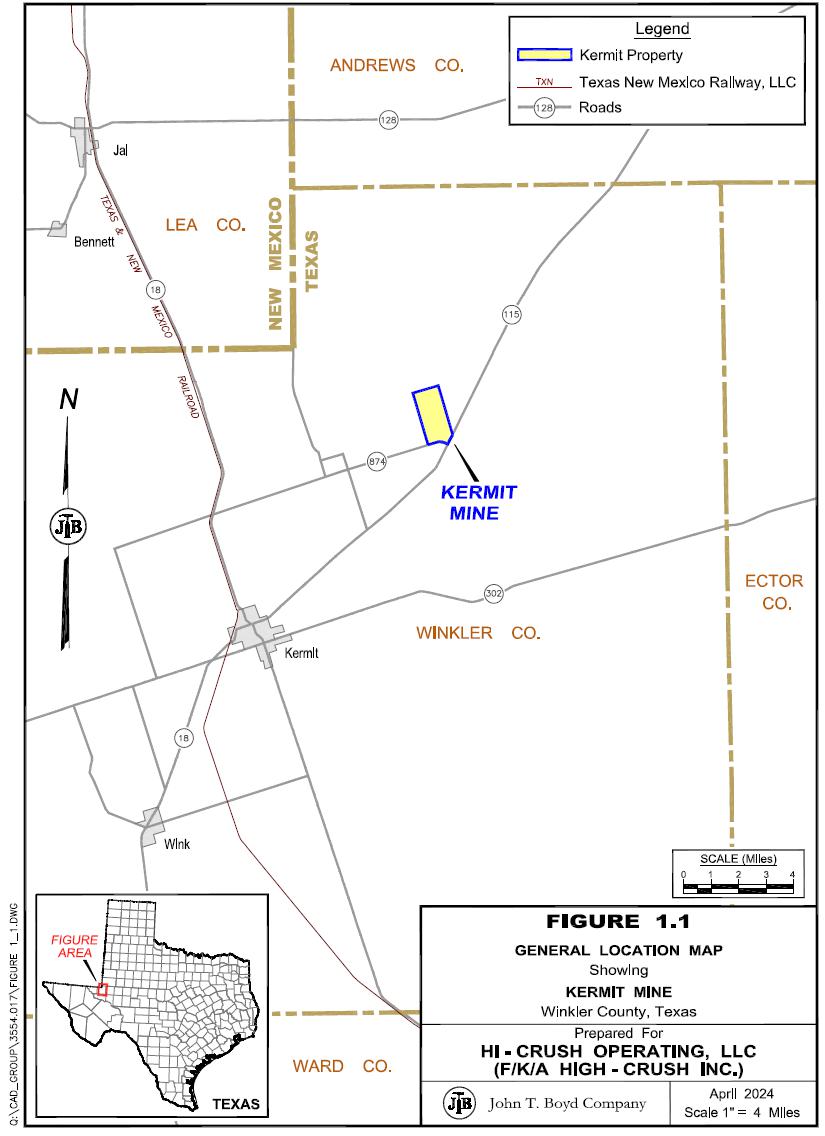
| 1-3 |
| 1.3 | Geology |
The Kermit Mine is located within an active sand dune belt, in an area of West Texas where the High Plains and Trans-Pecos desert regions converge. The region’s surface is characterized by windblown Quaternary-aged sand formations, including sand dunes, undivided sand and silt deposits, and sheet sand deposits.
Most of the Kermit property is uniformly covered by Quaternary age unconsolidated deposits, ranging from windblown dunes and sheet sands to alluvial sands, silts, clays, and caliche. Surficial sand deposition within the property boundaries indicate the mineable deposit ranges in thickness from approximately 10 ft to 90 ft, averaging approximately 60 ft across the property. There is no discernable overburden (i.e., overlying waste) material apart from sparse areas of vegetation and roots, which are easily removed during processing operations. The target sand deposit is considered to be of low geologic complexity.
The sand mined at the Kermit Mine is processed on-site to produce frac sand. Frac sand is a naturally occurring, high silica content quartz sand with grains that are generally well-rounded. The main difference between frac sand and other sands is that frac sand grains are relatively pure in composition, consisting almost entirely of quartz; other sands have numerous impurities that may be cemented to the quartz grains. The pure quartz composition of frac sand grains, along with their homogenous size and well-rounded and spherical shape, gives these sands the characteristics (e.g., crush strength, low acid solubility, low turbidity) that are needed by oil and gas producers for use in developing wells.
| 1.4 | Exploration |
In developing the Kermit property, Hi-Crush completed a series of comprehensive geologic exploration campaigns, totaling 42 drill holes—and roughly 2,300 ft of core drilling—across the Kermit property. The results of these exploration programs consist of geologic logs and subsurface sand samples, grain size analyses of the samples, and American Petroleum Institute (API) proppant sand testing of composited samples. These results were utilized to define the lateral extent, thickness, grain size distribution, and mineralogy of the target sand deposit at the Kermit Mine.
BOYD’s review indicates that the exploration data: (1) were carefully and professionally collected, prepared, and documented, (2) conform with general industry standards, and (3) are appropriate for use in evaluating and estimating frac sand resources and reserves.
JOHN T. BOYD COMPANY
1-4
| 1.5 | Frac Sand Reserves |
This report provides an estimate of frac sand reserves for Hi-Crush’s Kermit Mine in accordance with the requirements set forth in S-K 1300. These estimates were independently prepared by BOYD for the purpose of this report. The reserve estimate is the result of a thorough geologic investigation of the property, appropriate modeling of the deposit, development of life-of-mine (LOM) plans, and consideration of the relevant processing, economic, marketing, legal, environmental, socio-economic, and regulatory factors.
It is BOYD’s independent opinion that the estimated frac sand reserves for the Kermit Mine as of December 31, 2023, total approximately 60.9 million saleable product (i.e., 40/140 mesh size frac sand) tons, which are entirely owned by Hi-Crush. Table 1.1, below, presents the estimated frac sand reserves by classification and mesh size, for the Kermit Mine.
Table 1.1: Frac Sand Reserves (as of December 31, 2023)
| Mesh | Product Tons (000) by Classification | |||||||||||||||
| Mine | Size | Control | Proven | Probable | Total | |||||||||||
| Kermit | 40/140 | Owned | 56,630 | 4,245 | 60,875 | |||||||||||
Hi-Crush has a well-established history of mining, processing, and selling frac sand products from their regional operations. BOYD has concluded that sufficient studies have been undertaken to enable the frac sand resources to be converted to frac sand reserves based on established operating methods and forecasted costs and revenues. The forecasted sales prices used in the estimation of frac sand reserves for the Kermit Mine vary by year, ranging from $26.00 to 26.14 per ton, and averaging $26.04 per ton of finished frac sand over the expected life of the reserves (refer to Section 10.5 and Table 12.1 for further details).
There are no reportable additional frac sand resources, excluding those converted to reserves, for the Kermit Mine. Quantities of frac sand controlled by Hi-Crush within the defined boundaries of the Kermit property, which are not reported as frac sand reserves, are not considered to be technically, economically, and/or legally extractable at the time of determination; as such, they are not reportable as frac sand resources in addition to reserves.
JOHN T. BOYD COMPANY
1-5
| 1.6 | Operations |
| 1.6.1 | Mining |
Contractors are employed to excavate sand and overburden (i.e., overlying waste material) at the Kermit Mine. The target sand deposit is excavated using conventional truck and excavator surface mining techniques. Generally, the negligibly thin layer of overburden is mined with the underlying sand. The sand is unconsolidated and does not require drilling or blasting. Excavators and/or front-end loaders are used to load the excavated sand into articulated haul trucks. The haul trucks deliver raw sand material to run-of-mine (ROM) stockpiles located near the processing facilities.
| 1.6.2 | Processing |
Each of the Kermit Mine’s two processing operations comprise the following three major components, which are typical in the production of frac sand:
| · | Wet Plant – ROM material from the pit is initially processed in the wet plant where the coarse material (e.g., gravel) and fine material (e.g., fine sand and silt) is removed for the sand. |
| · | Dry Plant – The damp sand produced by the wet plant is dried and screened into finished products. |
| · | Storage and Loadout – Finished products are stored in silos and then discharged via gravity from the bottom of the silos into highway trucks for transport to the customer. |
The two Kermit processing facilities share very similar designs. Each of the Kermit processing facilities has a nominal (or “nameplate”) capacity of 3 million tons of finished frac sand per year for a combined production capacity at Kermit of 6 million tons per year. Hi-Crush plans to produce approximately 4.9 million tons per year of finished products or 82% of nameplate capacity. Based on our review, it is BOYD’s opinion that the processing methods and existing equipment at the processing plants will be sufficient for the forecasted production levels over the life of the operation.
| 1.6.3 | Other Infrastructure |
All of the basic infrastructure required for the ongoing operations is in place at the Kermit Mine. The mining and processing operations are supported by the various utilities and transportation networks needed to allow the production and transportation of finished frac sands.
BOYD is unaware of any reported interruptions, outages, shortages, or failures related to infrastructure requirements which have materially affected operations at the Kermit Mine.
JOHN T. BOYD COMPANY
1-6
Given the operation is well-established, we opine that the risk of such events materially affecting the estimates of frac sand reserves presented herein is low.
| 1.7 | Financial Analysis |
| 1.7.1 | Market Analysis |
Permit submissions for horizontal oil and gas wells in the Permian Basin indicate a continuation of strong drilling ahead. Utilizing data from Baker Hughes and the Railroad Commission of Texas (RRC), the total number of permits filed ranges between 1,000 and 1,600 per quarter in 2023, a strong rebound from the pandemic lows of 2020.
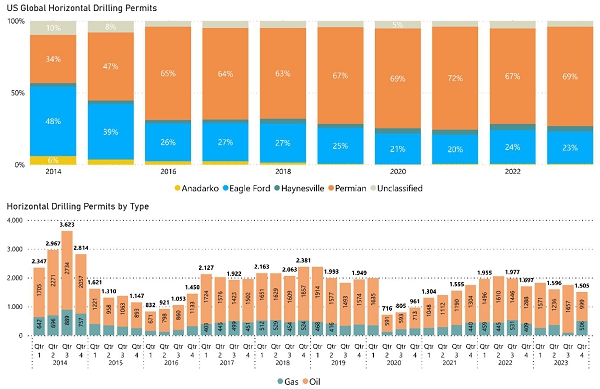
Figure 1.2: Permian Basin HZ Permit Submissions
JOHN T. BOYD COMPANY
1-7
Domestic oil production continues to increase with the Permian leading the way at almost 6 million barrels per day by late 2023.
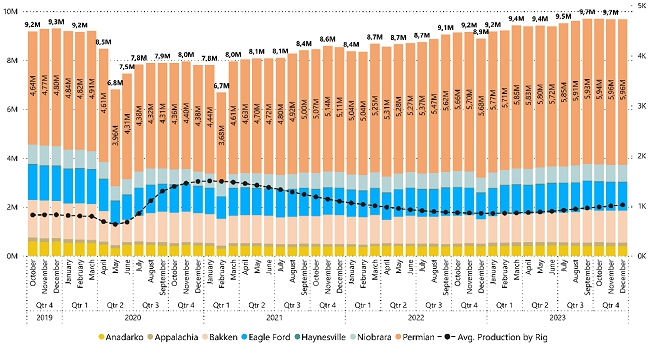
Source EIA (U.S. Energy Information Administration)
Figure 1.3: Oil Production (bbl/d)
Current frac sand production in the Permian Basin is estimated at 60 million to 65 million tons per year with fairly balanced demand and stable pricing. BOYD anticipates stable frac sand pricing substantially above those used to estimate frac sand reserves for the Kermit Mine. Additionally, we anticipate continued upward sand consumption in the basin due to economic and geopolitical influences on energy demand.
| 1.7.2 | Capital and Operating Cost Estimates |
The Kermit Mine’s recent financial performance is summarized as follows:
| · | The Kermit Mine sold approximately 4.6 million tons of finished frac sand in 2023— an increase of 11% from the previous year. |
| · | Hi-Crush’s ASP for frac sand sold from Kermit was $26.78 per ton in 2023, increasing 12% from 2022. The five-year historical ASP was $23.82 per ton. |
| · | Cost of Goods Sold was $12.85 per ton sold in 2023, increasing 23% from 2022. |
| · | EBITDA margin (i.e., EBITDA as a percentage of gross revenue) has remained positive over the past five years and was 56% in 2023. |
| · | Capital expenditures totaled approximately $22.4 million (or $1.21 per ton sold) over the last five years. |
JOHN T. BOYD COMPANY
1-8
Forward-looking production and unit cost estimates are based on actual past performance and are subject to Hi-Crush’s customary internal budget review and approvals process. In BOYD’s opinion, operating volumes are well-defined and understood, as are mining and processing productivities.
The Kermit Mine and related facilities are fully developed and should not require any near-term major capital investment to maintain full commercial production. Historically, the timing and amount of capital expenditures have been largely discretionary and within Hi-Crush’s control. BOYD projected sustaining capital expenditures is estimated to average $1.50 per ton sold, which includes maintenance of production equipment as well as other items needed for the ongoing operation. This unit cost is based on our judgment and experience with similar operations.
Operating cost estimates were developed based on recent actual costs and considering site specific operational activity levels and cost drivers. Kermit’s operating costs are expected to remain relatively consistent (on an uninflated basis) with 2023 results. As such, the projected total cash cost of goods sold averages $12.85 per ton sold over the life of the mine. As the operation is in a steady state, BOYD considers the future operating cost estimates to be reasonable and appropriate.
| 1.7.3 | Economic Analysis |
An economic analysis of the Kermit Mine was prepared by BOYD for the purpose of confirming the commercial viability of the reported frac sand reserves. Our financial model forecasts future free cash flow from frac sand production and sales over the life cycle of the operation using annual forecasts of production, sales revenues, and operating and capital costs.
JOHN T. BOYD COMPANY
1-9
Table 1.2, below, provides a summary of the estimated financial results for the remaining life of the Kermit Mine.
Table 1.2: Financial Results
| Remaining | ||||||
| Life of Mine | ||||||
| Units | Total | |||||
| Expected Remaining Life | years | 13 | ||||
| Production: | ||||||
| ROM Production | 000 tons | 73,348 | ||||
| Product Sales | 000 tons | 60,875 | ||||
| Total Revenues | $ millions | 1,585.2 | ||||
| Average Selling Price | $/t sold | 26.04 | ||||
| Total Cost of Goods Sold | $ millions | 782.0 | ||||
| Average Cost of Goods Sold | $/t sold | 12.85 | ||||
| Capital Expenditures | $ millions | 91.3 | ||||
| Average Capital Expenditures | $/t sold | 1.50 | ||||
| Pre-Tax: | ||||||
| Cash Flow | $ millions | 711.9 | ||||
| NPV10 | $ millions | 417.7 | ||||
| After-tax: | ||||||
| Cash Flow | $ millions | 570.0 | ||||
| NPV10 | $ millions | 332.8 |
Table 1.3 summarizes the results of the pre-tax and after-tax discounted cash flows (DCF) and net present value (NPV) analyses for the Kermit Mine.
Table 1.3: DCF-NPV Analysis
| NPV ($ millions) | ||||||||||||
| 8% | 10% | 12% | ||||||||||
| Pre-Tax | 458.8 | 417.7 | 382.5 | |||||||||
| After-Tax | 365.9 | 332.8 | 304.5 | |||||||||
The NPV estimate was made for the purpose of confirming the economic viability of the reported proppant sand reserves and not for purposes of valuing Hi-Crush, the Kermit Mine, or its assets. Internal rate-of-return (IRR) and project payback were not calculated, as there was no initial investment considered in the financial analysis presented herein.
JOHN T. BOYD COMPANY
1-10
It is BOYD’s opinion that the financial model provides a reasonable and accurate reflection of the Kermit Mine’s expected economic performance based on the assumptions and information available at the time of our review.
| 1.8 | Permitting and Compliance |
Several permits are required by federal and state law for mining, processing, and related activities at the Kermit Mine. BOYD reviewed the permits necessary to support continued operations at Kermit. Such required permits appear to be valid and in good standing. The approved permits and certifications are adequate for the continued operation of the mine and processing facilities. New permits, permit revisions, and/or renewals may be necessary from time to time to facilitate future operations. Given sufficient time and planning, Hi-Crush should be able to secure new permits, as required, to maintain its planned operations within the context of current regulations.
Mine safety is regulated by the U.S. Department of Labor’s Mine Safety and Health Administration (MSHA). MSHA inspects the facilities a minimum of twice yearly. Hi-Crush’s safety record compares favorably with its regional peers.
BOYD is not aware of any regulatory violation or compliance issue which would materially impact the reported frac sand reserves.
| 1.9 | Conclusions |
It is BOYD’s overall conclusion that the estimates of frac sand reserves, as reported herein: (1) are reasonably supported by sufficient and reliable exploration data, and (2) are reasonably and appropriately supported by technical evaluations, which consider all relevant modifying factors. We are not aware of any other relevant data or information material to the Kermit Mine that would render this report misleading. Our conclusions represent only informed professional judgment.
Given the operating history and status of evolution, residual uncertainty (future risk) for this operation is considered minor under the current and foreseeable operating environment. It is BOYD’s opinion that extraction of the frac sand reserves reported herein is technically, legally, and economically achievable after the consideration of potentially material modifying factors. The ability of Hi-Crush, or any mine operator, to recover all the reported frac sand reserves is dependent on numerous factors that are beyond the control of, and cannot be anticipated by, BOYD. These factors include mining and geologic conditions, the capabilities of management and employees, the securing of required approvals and permits in a timely manner, future frac sand prices, etc. Unforeseen changes in regulations could also impact performance. None of the opinions presented herein are intended to represent that BOYD intends or is qualified to render opinions that are legal or accounting in nature.
JOHN T. BOYD COMPANY
2-1
2.0 INTRODUCTION
| 2.1 | Registrant |
Hi-Crush provides a combination of finished frac sand products and various logistics solutions to oil and gas companies engaged in exploration and production (E&P) of unconventional oil and natural gas resources throughout the US. Headquartered in Houston, Texas, Hi-Crush was established in 2010 and began operations at their two frac sand mines: the Wyeville Mine in Tomah, Wisconsin in 2011; and the Kermit Mine in Kermit, Texas in August 2017. The company also operates numerous OnCore mining and processing facilities in the Permian Basin, and their Pronghorn last mile sand delivery services.
Additional information regarding Hi-Crush can be found on their website at www.hicrushinc.com.
| 2.2 | Purpose and Terms of Reference |
Hi-Crush retained BOYD to independently prepare and present estimates of frac sand resources and frac sand reserves for the Kermit Mine in accordance with the disclosure requirements set forth in S-K 1300. As such, the purpose of this TRS is threefold: (1) to summarize technical and scientific information for the subject mining property, (2) to provide the conclusions of our review of the information for the property, and (3) to provide statements of frac sand resources and frac sand reserves for the Kermit Mine.
BOYD’s opinions and conclusions are based on our detailed review of the supporting geologic, technical, and economic information provided by Hi-Crush, which were used in formulating the estimates of frac sand resources and frac sand reserves disclosed in this report. We independently estimated the frac sand resources and frac sand reserves from first principles using exploration information provided by Hi-Crush or by third-party experts engaged by Hi-Crush. We employed standard engineering and geoscience methods, or a combination of methods, that we considered to be appropriate and necessary to establish the conclusions set forth herein. As in all aspects of mining property evaluation, there are uncertainties inherent in the interpretation of engineering and geoscience data; therefore, our conclusions necessarily represent only informed professional judgment.
JOHN T. BOYD COMPANY
2-2
The ability of Hi-Crush, or any mine operator, to recover all the estimated frac sand reserves presented in this report is dependent on numerous factors that are beyond the control of, and cannot be anticipated by, BOYD. These factors include mining and geologic conditions, the capabilities of management and employees, the securing of required approvals and permits in a timely manner, future sand prices, etc. Unforeseen changes in regulations could also impact performance. Opinions presented in this report apply to the site conditions and features as they existed at the time of BOYD’s investigations and those reasonably foreseeable.
This report is intended for use by Hi-Crush, subject to the terms and conditions of its professional services agreement with BOYD. We also consent to Hi-Crush filing this TRS with the SEC pursuant to S-K 1300. Except for the purposes legislated under US securities law, any other uses of or reliance on this report by any third party is at that party’s sole risk.
| 2.3 | Expert Qualifications |
BOYD is an independent consulting firm specializing in mining-related engineering and financial consulting services. Since 1943, BOYD has completed over 4,000 projects in the United States and more than 90 other countries. Our full-time staff comprises experts in: civil, environmental, geotechnical, and mining engineering; geology; mineral economics; and market analysis. Our extensive experience in frac sand resource and reserve estimation and our knowledge of the subject property, provides BOYD an informed basis to opine on the frac sand resources and frac sand reserves available at the Kermit Mine. An overview of BOYD can be found on our website at www.jtboyd.com.
The individuals primarily responsible for the preparation of this report and the estimates of frac sand reserves presented herein are by virtue of their education, experience, and professional association considered qualified persons (QPs) as defined in S-K 1300.
Neither BOYD nor its staff employed in the preparation of this report have any beneficial interest in Hi-Crush, and are not insiders, associates, or affiliates of Hi-Crush. The results of our assignment were not dependent upon any prior agreements concerning the conclusions to be reached, nor were there any undisclosed understandings concerning any future business dealings between Hi-Crush and BOYD. This report was prepared in return for fees based on agreed-upon commercial rates, and the payment for our services was not contingent upon our opinions regarding the project or approval of our work by Hi-Crush and its representatives.
JOHN T. BOYD COMPANY
2-3
| 2.4 | Principal Sources of Information |
The information, estimates, opinions, and conclusions presented herein are informed by:
(1) data, reports, and other information provided by Hi-Crush, (2) existing BOYD work files and reports, (3) discussions with Hi-Crush personnel, (4) records on file with regulatory agencies, (5) data, reports, and other information from public sources, and (6) nonconfidential information in BOYD’s possession.
The following information was provided by Hi-Crush:
| · | Exploration records (e.g., drill hole location maps, drilling logs, and lab testing summaries) |
| · | Mapping data, including: |
| - | Property control boundaries |
| - | Infrastructure locations |
| - | Easement and right-of-way boundaries |
| - | Topograhpic site surveys |
| - | Recent mining extents |
| · | Overview of processing operations and detailed flow diagrams |
| · | Preliminary business plans |
| · | Historical information, including: |
| - | Production reports and reconciliation statements |
| - | Financial statements |
| - | Product sales and pricing |
| - | Mine plans |
| - | Site plans |
| - | Operational data |
| · | Files related to mining and operating permits |
Work files prepared for, and information contained, in the following BOYD report was utilized to prepare the estimates of frac sand resources and frac sand reserves disclosed herein:
Estimate of Resources and Reserves, Hi-Crush Proppants LLC, Kermit Proppant Sand Property, Winkler County, Texas; September 2017 (BOYD Report No. 3554.014).
Any other information from sources external to BOYD and/or Hi-Crush is referenced accordingly.
JOHN T. BOYD COMPANY
2-4
The data and workpapers used in the preparation of this report are on file in our offices.
| 2.4.1 | Personal Inspections |
Due to time constraints, BOYD did not conduct personal inspections of the Kermit facilities for this assignment. Various BOYD professionals—including the QPs and co-authors of this report—visited the Kermit property in August 2017. Additionally, the co-authors have visited many of the neighboring frac sand mining operations in the recent past.
| 2.4.2 | Reliance on Information Provided by the Registrant |
In the preparation of this report, BOYD has relied, exclusively and without independent verification, upon information furnished by Hi-Crush with respect to:
| · | Property title and status |
| · | Encumbrances, easements, and right-of-ways |
| · | Permits, bonds, and reclamation liability |
| · | Sustainability initiatives |
| · | Surface tailings management |
| · | Mine closure requirements and plans |
| · | Monitoring/compliance requirements for protected areas/species |
| · | Community relations |
| · | Market overview and strategy |
| · | Product specifications |
| · | Marketing and sales contracts |
| · | Income tax rates |
| · | Inflation and discount rates |
Our opinions and conclusions regarding this information are provided in the relevant sections of this report.
2.4.3 Verification of Information
BOYD exercised due care in reviewing the information provided by Hi-Crush within the scope of our expertise and experience (which is in technical and financial mining issues) and concluded the data are reasonable and reliable considering the status of the subject property and the purpose for which this report was prepared.
We have no reason to believe that any material facts have been withheld or misstated, or that further analysis may reveal additional material information. However, the accuracy of the results and conclusions of this report are reliant on the accuracy of the information provided by Hi-Crush. While we are not responsible for any material omissions in the information provided for use in this report, we accept responsibility for the disclosure of information contained herein which is within the scope of our expertise.
JOHN T. BOYD COMPANY
2-5
| 2.4.4 | Other Relevant Data and Information |
BOYD is not aware of any additional information which would materially impact the frac sand resource and frac sand reserve estimates reported herein.
| 2.5 | Report Version |
The effective (i.e., “as of”) date of this TRS is December 31, 2023. The estimates of frac sand resources and frac sand reserves and supporting information presented in this report are effective as of December 31, 2023.
To BOYD’s knowledge, this is the first TRS completed for Hi-Crush’s Kermit Mine. The user of this document should ensure that this is the most recent disclosure of frac sand resources and frac sand reserves for the Kermit Mine as it is no longer valid if more recent estimates are available.
| 2.6 | Units of Measure |
The US customary measurement system has been used throughout this report. Tons are short tons of 2,000 pounds-mass. Unless otherwise stated, currency is expressed in US Dollars ($). Historic prices and costs are presented in nominal (unadjusted) dollars. Future dollar values are expressed on a constant (unescalated) basis as of the effective date of this report.
JOHN T. BOYD COMPANY
3-1
3.0 PROPERTY OVERVIEW
| 3.1 | Description and Location |
The Kermit Mine comprises two active surface mining and processing operations— referred to as K1 (or Kermit South) and K2 (or Kermit North)—which both produce a “100 mesh” (i.e., 40/140 mesh) sized sand product for use in the hydraulic fracturing process (known as "fracking") to produce petroleum fluids, such as oil, natural gas, and natural gas liquids. Figure 3.1, on the following page, shows the general layout of the Kermit operations, including the locations of the mine offices, maintenance facilities, processing plants, loadout facilities, and current and former mining pits.
Hi-Crush’s Kermit operations are located on one contiguous property (the “Kermit property”) in Winkler County, Texas. The Town of Kermit is approximately nine miles south-southwest of the property and the Midland-Odessa metropolitan area lies approximately 40 miles to the east-southeast. The cities of Lubbock and San Antonio, Texas, are located approximately 125 miles northeast and 325 miles southeast, respectively, of the property. The Kermit property is located on the north side of State Route 115, with the Texas-New Mexico border approximately five miles from the property. Figure 1.1 (page 1-2) illustrates the general location of the Kermit Mine.
Geographically, the Kermit Mine’s K1 processing facilities are located at approximately 31° 57' 55" N latitude and 102° 58' 15" W longitude.
| 3.2 | History |
Extensive surface mining of frac sand has been conducted in the West Texas region since the Kermit Mine opened as the first “in-basin” mine in August 2017, and began selling frac sand into the Permian Basin oil and gas industry. Since then, numerous frac sand mines have been opened in the region.
The Kermit property was initially explored and developed by Permian Basin Sand Company, LLC (PBSC) in 2016. Hi-Crush purchased the Kermit property in early 2017 from PBSC and completed extensive exploration and sampling across the property from April to May 2017 while the K1 mining and processing facilities were being constructed.
JOHN T. BOYD COMPANY
3-2
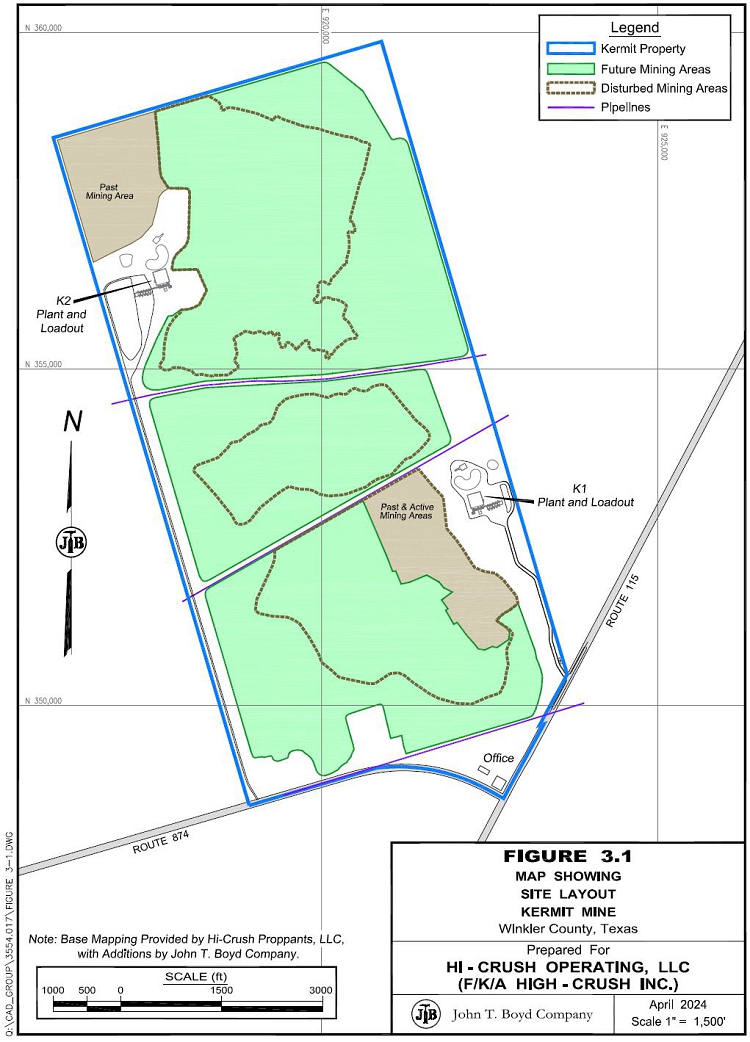
3-3
Site work and construction for the first processing facility (K1) began in February 2017 on the southeast portion of the Kermit property. The K1 wet and dry plants were commissioned in July 2017 and reached full operational capacity in August of the same year.
Due to increasing customer demand and favorable in-basin markets, Hi-Crush began construction of their second Kermit processing facilities (K2) in May 2018 on the northwestern portion of the property. The K2 facilities were fully commissioned and producing finished frac sand by January 2019.
| 3.3 | Property Control |
Property control data provided for the Kermit property included mapping and a purchase agreement, which have been accepted as being true and accurate for the purpose of this report.
The Kermit property comprises approximately 1,226 “gross” acres of surface and subsurface (i.e., mineral) rights—all of which are owned in fee by Hi-Crush. The property is contiguous apart from pre-existing easements for pipelines and roadways.
| 3.4 | Adjacent Properties |
Several existing frac sand mining operations are located in the general vicinity of Hi-Crush’s Kermit Mine, including: Atlas Energy Solutions’ Kermit and Monahans mines; Black Mountain’s Vest and El Dorado mines; High Roller Sand’s 115 Plant; ProFrac’s Kermit and Monahans mines; U.S. Silica’s Crane Plant; and Vista Minerals’ West Texas mine.
There is no information used in this report that has been sourced from adjacent properties.
| 3.5 | Regulation and Liabilities |
Mining and related activities for the Kermit mining and processing operations are predominantly regulated by the TCEQ. The Kermit Mine operates under several permits and must comply with other federal, state, and municipal law regulations that do not require a specific permit. Hi-Crush reports that necessary permits are in place or applied for to support immediate operations. New permits or permit revisions may be necessary from time to time to facilitate future operations. Given sufficient time and planning, Hi-Crush should be able to secure new permits, as required, to maintain its planned operations within the context of the current regulations.
JOHN T. BOYD COMPANY
3-4
To the extent known to BOYD, there are no current violations, fines, liens, or other significant factors and risks that may affect access, title, or the right or ability to perform work on the Kermit property.
| 3.6 | Accessibility, Local Resources, and Infrastructure |
The Kermit Mine lies within a rural region of western Texas. The surrounding region has a well-established history of heavy oil and gas industry and agricultural development. The nearby Town of Kermit has a population of 6,016 and the Midland-Odessa metropolitan area has a population of 340,391 according to the 2020 U.S. Census. The surrounding counties have a combined population of over 200,000 people, according to 2020 population estimates by the U.S. Census.
Finished frac sand products from the Kermit Mine are transported to customers by bulk truck and supported by the operation’s extensive on-site loading, storage, and handling facilities. General access to the property is via a well-developed network of primary and secondary roads serviced by local municipality, county, and state governments. These roads offer direct access to the mine and processing facilities and are generally open year-round. Primary vehicular access to the property is via Texas State Route 115, running northeast-southwest through the town of Kermit. Various state highways—TX-302, TX-18, and TX-128—are near the subject property and provide primary access to various portions of the region’s oil and gas fields.
Several regional airports are located within an hour’s drive from the mine, and the Midland International Airport is approximately an hour and a half away by road.
Reliable sources of electrical power, water, supplies, and materials are readily available. Electrical power is provided to the operation by regional utility companies. Water is supplied by the public water system, surface impoundments, and water wells. Additionally, the operation has an abundance of recycled processing water available.
JOHN T. BOYD COMPANY
3-5
| 3.7 | Physiography |
The Kermit property lies within the High Plains section of the Great Plains physiographic province and the Shinnery Sands ecoregion. This region is relatively flat, with windblown sand hills and dunes in various locations. The surrounding areas generally consist of desert valleys covered with windblown sheet and dune sands, high plains covered with thick alluvium (the Llano Estacado or Staked Plains), or plateaus consisting of thin carbonate-based soils (the Caprock Escarpment). The plateau areas, typically covered by a weathering-resistant caliche (a hardened natural cement of calcium carbonate that binds other materials—such as gravel, sand, clay, and silt), may abruptly stand up to 1,000 ft above the plains.
The property is relatively flat, with surface elevations ranging from 3,020 ft above mean sea-level (AMSL) to over 3,090 ft AMSL.
There are not any natural surface waters present on the property.
Land cover in the immediate area consists predominantly of a mixture of shinnery oak, grasses, and other various scrub vegetation.
| 3.8 | Climate |
In and around the Kermit Mine, the summers are long, humid, and hot; the winters are short, cold, and dry; and the skies are mostly clear year-round. Over the course of the year, the temperature typically varies from 32°F to 97°F and is rarely below 22°F or above 105°F. The hot season lasts from mid-May to mid-September, with an average daily high temperature above 89°F. The hottest month of the year is July, with an average high of 97°F and low of 72°F. The cool season lasts from late-November to mid-February, with an average daily high temperature below 67°F. The coldest month of the year is January, with an average low of 33°F and a high of 61°F.
Annual precipitation in the area varies widely from year to year, but generally totals 5 to 12 inches of rain with little-to-no snow.
In general, the operating season for the Kermit Mine is year-round. Adverse weather conditions seldom restrict or interfere with the mining, processing, and loading operations; however, extreme weather conditions may temporarily impact operations. Periodic flooding is possible during heavy rainfall.
JOHN T. BOYD COMPANY
4-1
4.0 GEOLOGY
| 4.1 | Regional Geology |
Hi-Crush’s Kermit Mine is located within an active sand dune belt, in an area of West Texas where the High Plains and Trans-Pecos desert regions converge. This region is bordered by the Caprock Escarpment of the Llano Estacado to the east and the basins and playas of the Chihuahuan Desert to the west and south. The region’s surface is characterized by windblown Quaternary-aged sand formations, including sand dunes, undivided sand and silt deposits, and sheet sand deposits. The frac sand resources and frac sand reserves of the Kermit property are hosted in these surficial sand deposits.
The origins of these deposits are believed to be a combination of eroded bedrock material from the southern Rocky Mountains, and locally eroded Ogallala Formation sandstone. As portions of the southern Rocky Mountains were eroded via weathering, particles were carried to the Pecos River. Ancient flooding events of the Pecos River resulted in the suspended particles being deposited into flood plains. Once flood waters receded, winds took over, drying and further transporting these particles over the western Texas region.
The Caprock Escarpment of the Llano Estacado marks the eastern-most extent of the surficial sand deposits. Winds transporting particles into the area are thought to have collided with the escarpment, slowing and dropping particles out to where they have accumulated over time. Winnowing processes caused some degree of particle sorting to occur. Due to the mechanisms and long distances of particle transport, sand grains were abraded and rounded as they reached their current locations.
JOHN T. BOYD COMPANY
4-2
| 4.2 | Property Geology |
| 4.2.1 | General Stratigraphy |
Surficial geologic units covering the area in and around the Kermit property are predominantly comprised of undifferentiated Quaternary Age unconsolidated deposits, ranging from aeolian (windblown) sheet sands and dunes to alluvial sands, silts, clays, and caliche. Geologic mapping shows additional surficial stratigraphic units present in the vicinity of the property; however, the surface geology in and around the mine is primarily comprised of these aeolian sand deposits.
A generalized stratigraphic chart of the geologic units in Winkler County, Texas is presented in Figure 4.1.
| System | Series | Geologic Unit |
| Quaternary | Pleistocene / Holocene | Sheet and Dune Sand |
| Pleistocene | Unconsolidated Alluvium | |
| Neogene | Pliocene | Ogallala Formation |
Figure 4.1: Generalized Stratigraphic Chart, Surficial Deposits of the Kermit Mine
The following text discusses the strata encountered in and around the Kermit property, in depositional order:
Ogallala Formation
The Ogallala Formation is predominantly comprised of weakly cemented to unconsolidated fine- to medium-grained sands, which may be silty and calcareous in places. A caliche caprock is frequently exhibited, which resists weathering and forms ledges. The thickness of this formation has been recorded up to 550 ft.
Quaternary Sheet and Dune Sands
Most of the Kermit property is uniformly covered by Quaternary sheet and dune sands generally consisting of fine- to medium-grained quartz sand grains mixed with varying degrees of silts, calcareous sands, and caliche nodules. Surficial sand deposition in the study area may range in thickness from less than 10 ft to over 300 ft. There is no discernable overburden (i.e., overlying waste) material apart from sparse areas of vegetation and roots, which are easily removed during processing operations. Unconsolidated alluvial deposits consisting of pebble- to cobble-sized limestone and chert nodules overlain by silts are found to the east of the property. Figure 4.2 (on the following page) provides a map of the sand thickness. A cross-section through the deposit is provided in Figure 4.3 (page 4-4).
| 4.2.2 | Structural Geology |
The structural features of the Quaternary sands in and around the Kermit property are relatively non-descript. While the unit exhibits variable thickness over the area, it is unaffected by folding or faulting. Due to the lack of structural features encountered, there are no known geological features that are believed to materially affect frac sand mining operations in the immediate area; as such, the deposit is considered to be of low geologic complexity.
JOHN T. BOYD COMPANY
4-3
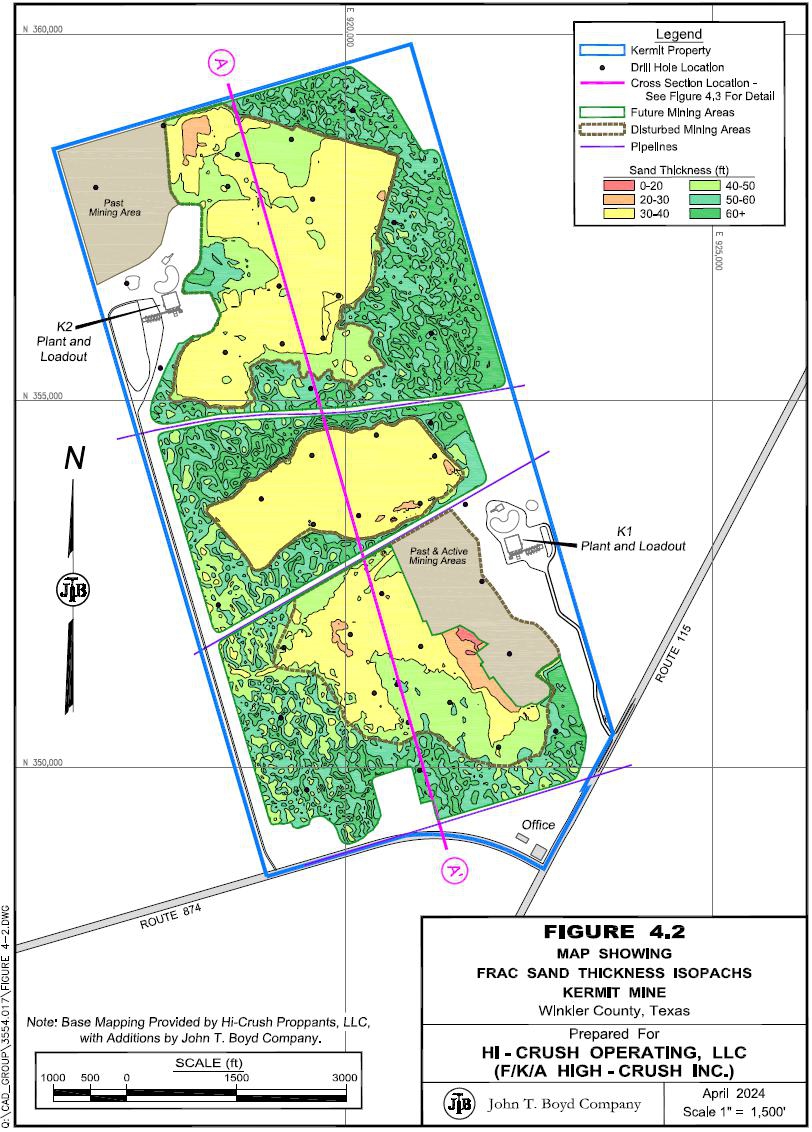
4-4
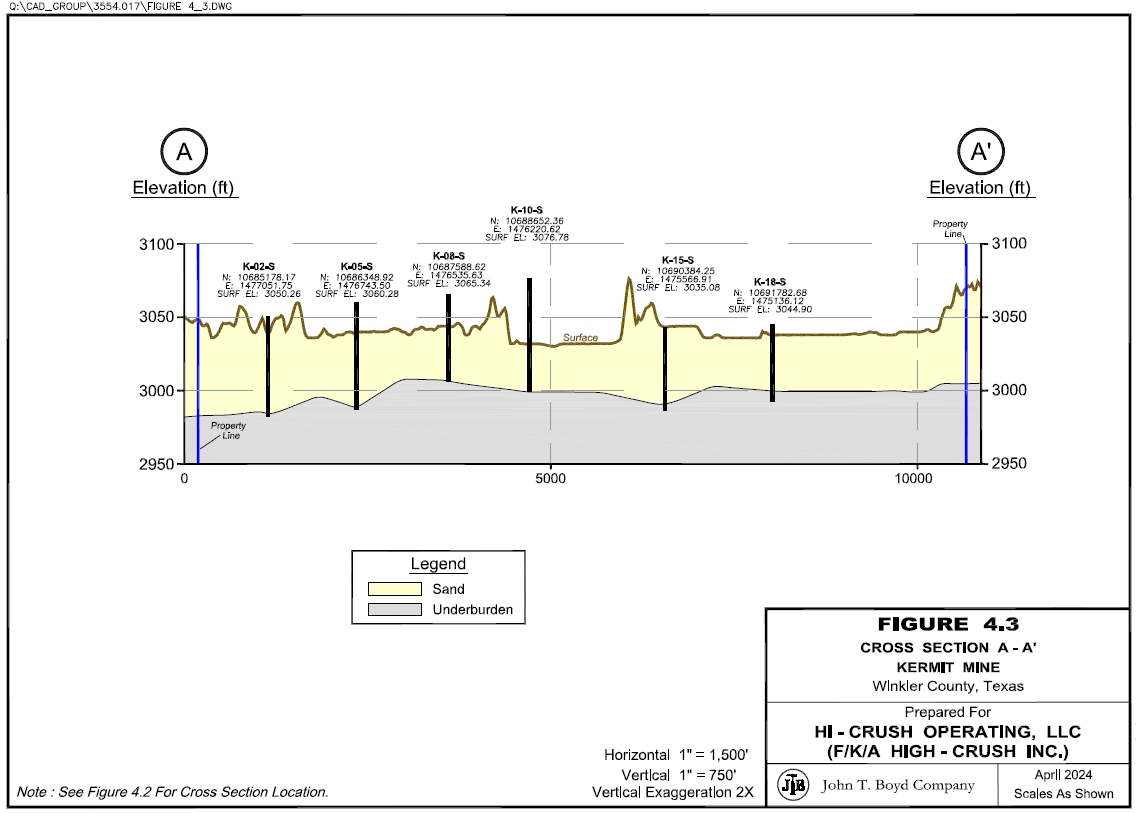
4-5
| 4.2.3 | Frac Sand Geology |
The sand mined at Kermit is processed into various frac sand products. Frac sand is a naturally occurring silica sand—also known as quartz sand or white sand—which generally exhibit the following characteristics required by oil and gas producers for use in developing wells:
| · | High-purity – frac sand grains are relatively pure (typically, >95% silicon dioxide) in composition and almost entirely free from contaminants. Typical sand deposits have numerous impurities fused to the silica grains, such as iron, carbonate, potassium, and other trace elements/minerals, which can make them more susceptible to mechanical and chemical alteration. Mineralogical purity of silica content is a characteristic of mature sand, which has been highly reworked and well sorted, so that the mechanically and chemically less-resistant minerals and fine particles have been dissolved or winnowed away. |
| · | Homogeneous grain size – hydraulic fracturing procedures require sand in a relatively narrow range of grain sizes which are dependent on the specific geological conditions of the well and the fracking procedures used. Larger sand grains generally provide better permeability, but smaller sand grains are typically stronger. When describing frac sand, the product is frequently referred to as simply the sieve cut, e.g., 20/40 mesh sand—meaning that 90 percent of the sand is fine enough to pass through a 20-mesh sieve and is coarse enough to be retained on a 40-mesh sieve. Common frac sand sizes include 20/40 mesh, 30/50 mesh, 40/70 mesh, “100 mesh”, “200 mesh”, and finer. The size ranges for “100 mesh” and “200 mesh” vary significantly between manufacturers. As of the date of this report, finer sands such as 40/70 mesh and “100 mesh” have become more widely utilized in shale gas well fracturing. |
| · | High sphericity and roundness – Sphericity and roundness describe the overall shape of the sand grains. Sphericity measures how close the grains approach the shape of a sphere while roundness measures the relative sharpness of corners and curvatures of the grains. Greater sphericity and roundness provide better grain strength and porosity/permeability between grains, allowing better flow of oil and gas from the fractures to the wellhead. A more spherical shape also enables the grains to be carried in the fracking fluid with minimal turbulence. |
| · | High crush resistance – Crush resistance of frac sand is dependent upon the hardness and shape of the sand grain. Generally, a high percentage of silica in the sand increases its crush resistance. Additionally, monocrystalline grains are stronger than composite grains. Crush resistance is expressed as a K-value that indicates the highest pressure (rounded to the nearest 1,000 psi) that generates less than 10 weight percent fines (i.e., crushed sand grains). For example, a K-value of 7 means that, at 7,000 psi pressure, no more than 10 weight percent fines were generated, but more than 10 weight percent fines were generated at the next highest pressure. The higher the K-value, the more crush-resistant the sand is. |
JOHN T. BOYD COMPANY
4-6
| · | Low acid solubility – Acid solubility is an indication of the amount of soluble cement or soluble mineral grains (i.e., non-silica contaminants) in the frac sand; low solubility requires a high silica content, as pure quartz tends to be insoluble under normal conditions. |
| · | Low turbidity – Turbidity is a measure of the clay, silt, or other fine grains and impurities in the sand. Low turbidity is a result of mineralogical maturity and grain-size sorting in the natural depositional environment. Generally, fine suspended matter in the mined sand is washed out during processing, so this property can be somewhat controlled for the final product. |
Aeolian sand deposits, such as those found at Kermit, which are predominantly comprised of silica sand grains meeting the abovementioned characteristics are well-suited to the commercial production frac sands.
JOHN T. BOYD COMPANY
5-1
5.0 EXPLORATION DATA
| 5.1 | Background |
In developing the Kermit Mine, Hi-Crush has completed a series of comprehensive geologic exploration campaigns, totaling 42 drill holes—and roughly 2,300 ft of core drilling—across the property. The results of these exploration programs consist of geologic logs and subsurface sand samples, grain size analyses of the samples, and proppant sand testing of composited samples. A detailed exploration report was provided to BOYD for our review, and comprises the primary geologic data used in the evaluation of the frac sand resources and frac sand reserves reported herein.
Maps illustrating the extents of the sand deposit along with electronic copies of drilling and sampling logs, as well as laboratory testing summaries, were provided for our review. The equipment utilized, and the sampling, logging, and field work performed are noted as being appropriate for delineating the frac sand deposit. BOYD opines that the work done by Hi-Crush is thorough and complete for the purposes of evaluating and estimating frac sand resources and reserves on the subject property.
| 5.2 | Exploration Procedures |
| 5.2.1 | Preliminary Drilling and Sampling Campaign |
Previous owners of the subject property aimed to investigate the potential to mine and produce frac sand material from the Kermit property for the local Permian Basin energy market, essentially leading the way for the current in-basin frac sand supply trend.
A track-mounted direct push Geoprobe was utilized to complete a total of 130 exploration holes in 2016; however, the equipment utilized proved inadequate to explore the entirety of the Kermit property’s deposit, as the direct push methods proved unable to advance sampling beyond an average depth of only 29 ft below ground surface. Recoveries during this campaign were sufficient overall, but there were also frequent intervals of no recovery recorded whenever more competent clays or caliches were encountered.
This preliminary work provided enough information on the potentially mineable frac sand resources available on the Kermit property for Hi-Crush to purchase, and subsequently further develop, the property in early 2017.
JOHN T. BOYD COMPANY
5-2
| 5.2.2 | 2017 Rotosonic Drilling and Sampling Campaign |
Between April and May 2017, Hi-Crush designed and completed their initial comprehensive exploration drilling and sampling campaign on the Kermit property. Drilling was performed by Cascade Environmental, Inc. (Cascade), utilizing a track mounted rotosonic core rig. A total of 22 drill holes were completed, with drill hole spacing ranging from approximately 1,000 to 2,000 ft on center, and drilling depths sometimes exceeding 80 ft in depth before encountering a red clay interval which defined the bottom of the mineable sand interval. Samples were taken, in duplicate, typically every 2–4 ft through the total depth drilled. Core loss was minimal throughout the duration of this campaign, providing detailed particle size distribution information.
Samples from this campaign were geologically logged and sampled by Hi-Crush personnel, who also secured the samples through the duration of drilling. One set of the obtained sample splits was sent to FracTAL LLC (FracTAL), St. Paul, Minnesota for sample preparation and grain size analyses, while the duplicate sample splits were kept in an on-site storage location for archival purposes.
Throughout Hi-Crush’s campaign, very few of the clayey and/or caliche-rich intervals were encountered, however a clay-rich sand interval was noted within the upper 30 ft of drilling in some drill hole locations, which corresponds to the average depth of the initial exploration campaign (direct push) completed on the property. With Hi-Crush achieving nearly 100% core recovery, and drilling to more than twice as deep as the initial direct push campaign was able to achieve, BOYD decided that: (1) data from Hi-Crush’s campaign provided the most representative delineation of the total mineable sand deposit, and (2) that using only the rotosonic drilling data, which utilized more appropriate drilling and sampling methods for this deposit type, would serve as a much better basis for evaluating the resources and reserves available on the Kermit property.
| 5.2.3 | 2023 Rotosonic Drilling and Sampling Campaign |
In December 2023, Hi-Crush completed an additional 20 rotosonic drill holes on the Kermit property. Drilling was again performed by Cascade, utilizing a track mounted rotosonic core rig. In total, an additional 20 rotosonic drill holes were completed, reducing overall drill hole spacing to approximately 600 ft to 1,200 ft throughout the infill drilling areas, which covered a majority of the Kermit property.
Similar methodologies to the previous rotosonic drilling campaign were conducted, in that drilling was terminated once encountering the underlying red clay beneath the mineable sand interval, and sampled intervals were taken in duplicate, with one set being sent for laboratory testing, and the other retained by Hi-Crush in a storage building on the Kermit property. Sample analyses for the 2023 campaign were split up between two labs, as Hi-Crush contracted both FracTAL and Phoenix Processing Equipment, Louisville, Kentucky to complete gradational analyses of 2023 drilling samples.
Please refer to Figure 3.1 (page 3-2) for the locations of rotosonic drill holes completed by Hi-Crush on the Kermit property.
JOHN T. BOYD COMPANY
5-3
| 5.2.4 | Proppant Sand Testing |
Samples obtained from Hi-Crush’s rotosonic exploration campaign were shipped to FracTAL’s laboratory, where they were prepared and analyzed for fines content and particle size distribution.
The general procedure for this particle size distribution analysis was as follows:
| 1. | The sample was dried to remove moisture. |
| 2. | A 600- to 1,200-gram subsample was collected and weighed. |
| 3. | The subsample was placed in a blender for three minutes to break up the material as much as possible. |
| 4. | The blended subsample was then placed on a 200-mesh wash screen, and thoroughly washed to remove any fine materials (e.g., clays and silts). |
| 5. | The remaining larger than 200 mesh (+200 mesh) material is then dried and weighed to determine the mass of fines that were washed out (i.e., wash loss). |
| 6. | The cleaned subsample was then either placed into a sieve stack of different mesh sizes and agitated for a period of 20 minutes, or run through a high-speed photographic particle size analyzer (i.e., CAMSIZER) to determine the particle size distribution of the subsample. |
FracTAL then prepared various composite samples for 40/70 mesh and 100 mesh product sizes, as directed by Hi-Crush, which were then sent to PropTester, Inc. (PropTester), Cypress, Texas, for API/ISO characteristic analyses. PropTester analyzed the composite samples for standard frac sand characteristic testing according to API RP 19C/ISO 13503-2, Measurement of Properties of Proppants Used in Hydraulic Fracturing and Gravel-packing Operations (API/ISO).
| 5.2.5 | Other Exploration Methods |
To our knowledge, no other methods of exploration (such as airborne or ground geophysical surveys) were completed on the Kermit property.
JOHN T. BOYD COMPANY
5-4
| 5.3 | Laboratory Testing Results |
The relatively uniform nature of the sand deposit underlying the Kermit property, combined with the results of laboratory testing, indicate the subject property deposit can produce various frac sand products—typically in the 40/140 mesh size fraction—that meet various local Permian Basin customer specifications.
| 5.3.1 | Grain Size Distribution |
Grain size distribution was analyzed according to API/ISO, Section 6. A table of the weighted average particle size distribution of the in-situ sand deposit, as derived from laboratory testing results, is shown in Table 5.1 below.
Table 5.1: Weighted Average Particle Size Distribution
| % Retained by Mesh Size | % Product | ||||||||||||||||||||
| >40 | 40/70 | 70/140 | <140 | 40/70 | 70/140 | ||||||||||||||||
| 2 | 44 | 42 | 12 | 51 | 49 | ||||||||||||||||
The preceding table highlights the relative fineness of the sand found within the Kermit deposit, indicating most of the sand particles are concentrated between the “passing 40 mesh” and “retained by 140 mesh” size fraction. Accordingly, the Kermit Mine’s principal marketable product comprises the 40/140 mesh size range frac sand.
| 5.3.3 | Quality Summary |
As general customer specifications tend to adapt to the local sand characteristics, API/ISO testing for locally sourced frac sands has become less relevant over the past several years. However, it is still of value to be able to demonstrate that the frac sand produced at a mine meets specifications for certain well applications.
Samples gathered during exploration were used to create composite product size samples that were tested by PropTester for API/ISO frac sand characteristics.
JOHN T. BOYD COMPANY
5-5
Averaged proppant performance test results for the Kermit frac sand deposit are summarized in Table 5.2, below.
Table 5.2: Proppant Performance Test Results
| Average API/ISO Test Result by Mesh Size | ||||||||||||
| 40/70 mesh | 100 mesh* | |||||||||||
| Sphericity | 0.7 | ≥ 0.6 | 0.7 | |||||||||
| Roundness | 0.6 | ≥ 0.6 | 0.6 | |||||||||
| Acid Solubility (%) | 2.5 | ≤ 3.0 | 2.6 | |||||||||
| Turbidity (NTU) | 11 | ≤ 250 | 14 | |||||||||
| K-Value (000 psi) | 7 | - | 12 | |||||||||
| *100 mesh proppant sand material does not have an API/ISO specification. | ||||||||||||
The composite sample testing suggests the Kermit Mine can produce frac sands which meet minimum API/ISO recommended specifications. Moreover, Hi-Crush has demonstrated commercial success producing and selling frac sand to Permian Basin oil and gas producers, where ultimately the sand has been shown to meet customer specifications.
| 5.4 | Data Verification |
For purposes of this report, BOYD did not verify historic drill hole data by conducting independent drilling in areas already explored. It is customary in preparing frac sand resource and reserve estimates to accept basic drilling and quality testing data as provided by the client, subject to the reported results being judged representative and reasonable.
BOYD’s efforts to judge the appropriateness and reasonability of the source exploration data included reviewing provided drilling logs, sampling procedures, sand quality testing results, and discussing related aspects of the Kermit deposit and processing operations with Hi-Crush personnel during our site visits.
| 5.5 | Adequacy of Exploration and Sampling Data |
BOYD’s review of the reported procedures indicate the exploration and sampling data obtained for the Kermit Mine were: (1) carefully and professionally collected, prepared, and documented in conformance with general industry standards, and (2) are appropriate for use of evaluating and estimating frac sand resources and frac sand reserves. Similarly, BOYD’s review of testing data provided by Hi-Crush suggests that the analyses completed are generally appropriate to determine frac sand characteristics and determine the subsequent quality of finished frac sand products. As such, it is BOYD’s opinion that the sampling data are also suitable for use in the estimation of frac sand resources and frac sand reserves for the Kermit Mine.
JOHN T. BOYD COMPANY
6-1
6.0 FRAC SAND RESOURCES AND RESERVES
| 6.1 | Applicable Standards and Definitions |
Unless otherwise stated, frac sand resource and frac sand reserve estimates disclosed herein are completed in accordance with the standards and definitions provided by S-K 1300. It should be noted that BOYD considers the terms “mineral” and “frac sand” to be generally interchangeable within the relevant sections of S-K 1300.
Estimates of any mineral resources and reserves are always subject to a degree of uncertainty. The level of confidence that can be applied to a particular estimate is a function of, among other things: the amount, quality, and completeness of exploration data; the geological complexity of the deposit; and economic, legal, social, and environmental factors associated with mining the resource/reserve. By assignment, BOYD used the definitions provided in S-K 1300 to describe the degree of uncertainty associated with the estimates reported herein.
The definition of mineral (frac sand) resource provided by S-K 1300 is:
Mineral resource is a concentration or occurrence of material of economic interest in or on the Earth's crust in such form, grade or quality, and quantity that there are reasonable prospects for economic extraction. A mineral resource is a reasonable estimate of mineralization, taking into account relevant factors such as cut-off grade, likely mining dimensions, location or continuity, that, with the assumed and justifiable technical and economic conditions, is likely to, in whole or in part, become economically extractable. It is not merely an inventory of all mineralization drilled or sampled.
Estimates of frac sand resources are subdivided to reflect different levels of geological confidence into measured (highest geologic assurance), indicated, and inferred (lowest geologic assurance). Please refer to the Glossary of Abbreviations and Definitions for the meanings ascribed to these terms.
The definition of mineral (frac sand) reserve provided by S-K 1300 is:
Mineral reserve is an estimate of tonnage and grade or quality of indicated and measured mineral resources that, in the opinion of the qualified person, can be the basis of an economically viable project. More specifically, it is the economically mineable part of a measured or indicated mineral resource, which includes diluting materials and allowances for losses that may occur when the material is mined or extracted.
JOHN T. BOYD COMPANY
6-2
Estimates of frac sand reserves are subdivided to reflect geologic confidence, and potential uncertainties in the modifying factors, into proven (highest assurance) and probable. Please refer to the Glossary of Abbreviations and Definitions for the meanings ascribed to these terms.
Figure 6.1 shows the relationship between frac sand resources and frac sand reserves.
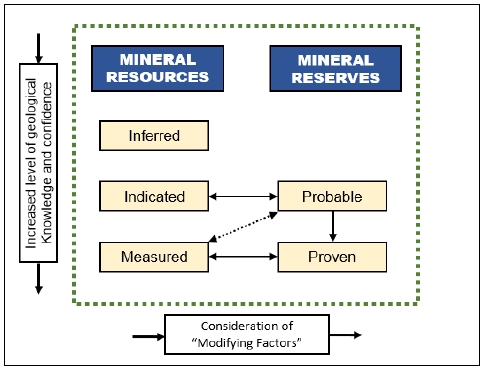
Figure 6.1: Relationship Between Frac Sand Resources and Frac Sand Reserves
In this report, the term “frac sand reserves” represent the tonnage of frac sand products that meet customer specifications and will be available for sale after processing of the ROM sand.
| 6.2 | Frac Sand Resources |
| 6.2.1 | Methodology |
BOYD independently prepared estimates of in-place frac sand for the Kermit property by performing the following tasks:
| 1. | The top and bottom elevations of the mineable sand interval was interpreted from drill hole records and sand particle size analyses. The sands mined at the Kermit operation are present at the surface. As there is little-to-no overburden, the top of the mineable sand unit is considered to be the current ground surface. The bottom of the mineable sand unit is delineated by the depth at which a characteristic red clay interval was encountered. |
JOHN T. BOYD COMPANY
6-3
| 2. | Interpreted drill hole records were compiled and validated. Strata thicknesses were aggregated, and sand particle size analyses of the sand unit were composited for each data point. The compiled drill hole data were then imported into Vulcan, a geologic modeling and mine planning software suite that is widely used and accepted by the mining industry. |
| 3. | A geologic model of the deposit was created in Vulcan using industry-standard grid modeling methods well-suited for simple stratigraphic deposits. The geologic model delineates the top and bottom of the mineable sand horizon and the distribution of the product size fractions across the deposit. |
| 4. | After reviewing the continuity and variability of the deposit, suitable resource classification criteria were developed and applied as per the discussion in Section 6.2.2. |
| 5. | Contiguous areas of remaining mineable sand within the Kermit property were delineated using the criteria described in Section 6.2.3, in addition to the following: |
| a. | 50-ft setbacks from property boundaries. |
| b. | 50-ft setbacks from pipelines. |
| c. | 50-ft buffer zones around the process plant areas and main access road/right of way. |
| d. | Pit wall slopes of 3:1 (approximately 19 degrees). |
| e. | Areas mined prior to December 31, 2023, were delineated from aerial imagery and excluded from the estimates of frac sand resources. |
| 6. | In-place volumes for each of the remaining mining areas were calculated from the geologic model within the Vulcan software. A dry, in-place, bulk density of 100 pounds per cubic foot was used to calculate the in-place tonnage of frac sand. |
| 7. | Where warranted, adjustments are made to the estimates using production records to reconcile differences between the date of the ground survey/aerial imagery and the effective date of the estimates. |
| 6.2.2 | Classification |
Geologic assuredness is established by the availability of both structural (thickness and elevation) and quality (size fraction) information for the deposit. Resource classification is generally based on the concentration or spacing of exploration data which can be used to demonstrate the geologic continuity of the deposit. When material variations in thickness, depth, and/or sand quality occur between drill holes, the allowable spacing distance between drill holes is reduced. The drill hole spacing criteria established by BOYD after a review of the available exploration data and geologic models and used to classify the frac sand resources of the Kermit Mine are provided in Table 6.1, below.
JOHN T. BOYD COMPANY
6-4
Table 6.1: Frac Sand Resource
Classification Criteria
| Nominal Maximum | |||||
| Classification | Spacing Requirment (ft) | ||||
| Measured | 1,500 | ||||
| Indicated | 2,500 | ||||
| Inferred | 5,000 | ||||
Extrapolation or projection of resources in any category beyond any data point does not exceed half the point spacing distance.
The surficial sand deposit on the Kermit property is of low geologic complexity. We believe these criteria appropriately reflect their implied levels of geologic assurance with respect to the estimation of frac sand resources. Since sufficient drilling and sampling has been performed within the remaining mineable portions of the Kermit property, BOYD is of the opinion that there is a low degree of uncertainty associated with the estimates of frac sand resources provided herein.
| 6.2.3 | Estimation Criteria |
Development of the frac sand resource estimate for the Kermit Mine assumes mining and processing methods and equipment that have been utilized successfully at the operation for several years.
The target mining horizon at Kermit is manifested as a continuous, low rolling sand unit with relatively consistent depth, thickness, and quality. There is little-to-no overburden, and the high-quality sand is easily distinguished from any waste units; as such, interpretation of the mineable horizon is relatively easy. Generally, all of the sand unit is mined and processed at the Kermit operation. The mined sand is processed to remove out-sized material (i.e., sand which is either too coarse or silts/clays which are too fine to be sold) and produce saleable finished products. The amount of finished sand produced as a percentage of the raw sand mined is referred to as the processing yield (or plant yield), which is analogous to the “cut-off grade” of other mining operations. If the expected processing yield of the sand is too low, the costs of production will outweigh sales revenues and the deposit cannot be economically mined. The minimum economic processing yield is approximately 42% based on Kermit’s historical and forecasted economics (refer to Chapters 10 through 12); however, this is well below the expected processing yields of the Kermit deposit. Other limiting criteria, such as minimum mining thicknesses or maximum stripping ratios (the ratio of waste to sand excavated) are generally not considered in the estimation of frac sand resources for the Kermit Mine.
JOHN T. BOYD COMPANY
6-5
The limits of the frac sand resources are constrained to those portions of the interpreted sand deposit that:
| · | Are reasonably defined by available drilling and sampling data. |
| · | Contain products that meet generally accepted specifications and can be sold at a profit (i.e., be economic). |
| · | Honor any legal mining constraints (e.g., property boundaries, environmental setbacks, utility and infrastructure setbacks, etc.). |
| · | Adhere to physical mining limitations. |
Frac sand resources for the Kermit Mine are assessed for reasonable prospects for eventual economic extraction by reporting: (1) those resources which have been subsequently converted to proppant sand reserves after the application of all material modifying factors, and/or (2) those resources which have similar characteristics (i.e., mining conditions, and expected processing yields and qualities) to those converted to frac sand reserves.
The criteria employed in developing the estimates of frac sand resources for Kermit are supported by historical results and align with those employed at similar operations. As such, it is BOYD’s opinion that the stated criteria are reasonable and appropriate for the estimation of frac sand resources at the Kermit Mine.
| 6.2.4 | Frac Sand Resource Estimate |
There are no reportable frac sand resources excluding those converted to frac sand reserves for the Kermit Mine. Quantities of frac sand controlled by Hi-Crush within the defined boundaries of the Kermit property which are not reported as frac sand reserves, are not considered to have potential economic viability; as such, they are not reportable as frac sand resources.
| 6.2.5 | Validation |
BOYD independently estimated in-place frac sand resources for the Kermit Mine from the drilling, sampling, and testing data provided by Hi-Crush. We have reviewed this information, on a representative basis, by confirming the accuracy of geologic model inputs by comparison with drilling logs and laboratory reports. We have developed a stratigraphic grid model of the sand deposit and compared this with the provided exploration data. It is BOYD’s opinion that the geologic model is representative of the informing data and that the data are of sufficient quality to support the frac sand resources estimate provided herein. Furthermore, it is our opinion that the resource estimation methods and criteria employed are both appropriate and reasonable for the deposit type and proposed extraction methods.
JOHN T. BOYD COMPANY
6-6
| 6.3 | Frac Sand Reserves |
| 6.3.1 | Methodology |
Estimates of frac sand reserves for the Kermit Mine were derived contemporaneously with estimates of frac sand resources. To derive an estimate of saleable product tons (frac sand reserves), the following modifying factors were applied to the in-place frac sand resources underlying the mine plan areas:
| · | A 95% mining recovery factor which assumes that 5% of the mineable (in-place) frac sand resource will not be recovered for various reasons. Applying this recovery factor to the in-place resource results in the estimated ROM sand tonnage that will be delivered to the processing facilities’ wet plant. |
| · | An overall 83% processing yield which accounts for the removal of out-sized (i.e., larger than 40 mesh and smaller than 140 mesh) material and losses during processing due to minor inefficiencies. |
The overall product yield (after mining and processing losses) at the Kermit Mine is estimated at 79%. That is, for every 100 tons of in-place sand mined, approximately 79 tons will be recovered and sold as product. Mining recovery and processing yield factors are derived from sample sizing data, expected operating performance, and historical operating results.
| 6.3.2 | Classification |
All of the estimated frac sand reserves are derived from either Measured frac sand resources or Indicated frac sand resources, in accordance with S-K 1300, and are therefore classified as either Proven or Probable frac sand reserves accordingly, after BOYD was satisfied that the frac sand reserve classification reflects the outcome of technical and economic studies. Figure 6.2, on the following page, illustrates the reserve classification of the Kermit frac sand deposit.
JOHN T. BOYD COMPANY
6-7
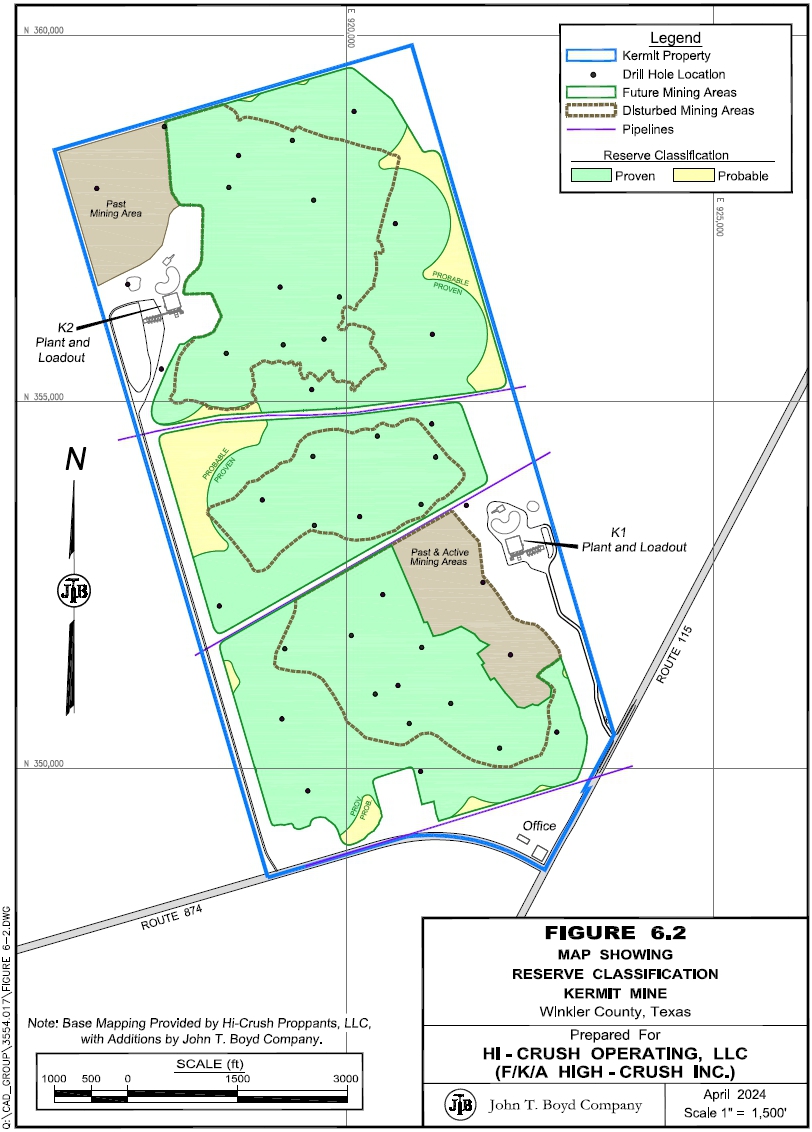
JOHN T. BOYD COMPANY
6-8
| 6.3.3 | Frac Sand Reserve Estimate |
BOYD’s estimate of surface mineable frac sand reserves for the Kermit Mine totals approximately 60.9 million saleable product tons, as of December 31, 2023. The frac sand reserves reported in Table 6.2, below, are based on a LOM plan which, in BOYD’s opinion, is technically achievable and economically viable after the consideration of all material modifying factors.
Table 6.2: Frac Sand Reserves (as of December 31, 2023)
| Mesh | Product Tons (000) by Classification | ||||||||||||||||||||
| Mine | Size | Control | Proven | Probable | Total | ||||||||||||||||
| Kermit | 40/140 | Owned | 56,630 | 4,245 | 60,875 | ||||||||||||||||
The frac sand reserves of the Kermit Mine are well-explored and defined. It is our conclusion that nearly 93% of the stated reserves can be classified in the Proven reliability category (the highest level of assurance) with the reminder classified as Probable.
The Kermit Mine, and other frac sand mining operations in the area, have a well-established history of mining and selling frac sand products into the local Permian Basin energy fields. BOYD has assessed that sufficient studies have been undertaken to enable the frac sand resources to be converted to frac sand reserves based on current and proposed operating methods and practices. Changes in the factors and assumptions employed in these studies may materially affect the frac sand reserve estimate.
The economic viability of the stated frac sand reserves is demonstrated by the production and financial projections and marketing information presented in Chapters 10 through 12 of this report. The forecasted sales prices used in the estimation of frac sand reserves for the Kermit Mine vary by year, ranging from $26.00 to $26.14 per ton, and averaging $26.04 per ton of finished frac sand over the expected life of the reserves (refer to Section 10.5 and Table 12.1 for further details).
| 6.3.4 | Significant Risks and Uncertainties |
The extent to which the frac sand reserves may be affected by any known geological, operational, environmental, permitting, legal, title, variation, socio-economic, marketing, political, or other relevant issues has been reviewed. If and as warranted. It is the opinion of BOYD that Hi-Crush has appropriately mitigated, or has the operational acumen to mitigate, the risks associated with these factors. BOYD is not aware of any additional risks that could materially affect the development of the frac sand reserves.
Given the data available at the time this report was prepared, the estimates presented herein are considered reasonable. However, they should be accepted with the understanding that additional data and analysis available after the date of the estimate may result in a change to the current estimate. These revisions may be material.
JOHN T. BOYD COMPANY
6-9
Based on our independent estimate and operations review, we have a high degree of confidence that the estimates shown in this report accurately represent the available frac sand reserves controlled by Hi-Crush at the Kermit Mine, as of December 31, 2023.
JOHN T. BOYD COMPANY
7-1
7.0 MINING OPERATIONS
7.1 Mining Method
The sheet sands and sand dunes in and around the Kermit property are loosely consolidated and overlain by minimal overburden; characteristics which are amenable to the use of conventional surface mining techniques. Since most of the target sand formation does not extend below the water table, the quarry is ‘dry-mined’ using medium-sized earthmoving equipment (i.e., haul trucks and excavators). Mining occurs in a series of benches arranged in a stair-like fashion to recover sand from the top of the formation (in elevation) down to the lowest practical elevation.
Most of the mineable area has minimal overburden and vegetation; as such, sand excavation normally begins at the surface throughout most of the mine plan area. Where present, overburden is stripped from the surface of the sand deposit utilizing bulldozers, loaders, excavators, and haul trucks. The overburden is placed away from the sand dunes in berms or stockpiles which will be planted (i.e., vegetated) to minimize erosion of the material after completion.
Drilling and blasting are not required for the loosely compacted sand. Excavators and front-end loaders are used to load the mined or ROM sand material into articulated haul trucks, which transport the sand to a ROM stockpile near the processing plants. Usually, the uppermost dune sand is mined in one bench, while the lower sheet sands are mined in up to three benches depending on the thickness of the deposit.
Once the mineable interval of sand is excavated, some of the mined-out pits will be used to store reject material from the processing operations.
7.2 Mine Schedule, Equipment, and Staffing
Sand excavation is performed by an outside earthmoving contractor who is obligated to supply the sand processing facilities with sufficient feed material to ensure continuous operations. Mining operations are conducted as required year-round but are generally restricted to 12 hours per day.
JOHN T. BOYD COMPANY
7-2
The primary mobile equipment involved in sand excavation, stockpiling, and hopper feeding includes:
| · | Excavators, |
| · | Articulated haul trucks, |
| · | Front end loaders, |
| · | Dozers, |
| · | Water truck, motor grader, and other ancillary equipment. |
Most of the mobile equipment fleet is owned and operated by the mining contractor. Regular and major repair maintenance of the fleet is also the contractor’s responsibility. If maintained in good condition, the mobile equipment fleet should be capable of achieving the production levels required by the LOM plan.
Staffing requirements for the mining operations are the responsibility of the earthmover contractor.
7.3 Engineering and Planning
The primary mine planning consideration is the safe, economical, and regular supply of raw high-quality sand feed to the processing plants. In commercial mining terms, the quantities of overburden removed, and sand mined each year at the Kermit Mine are considered modest. The sand deposit affords easy access as a result of its shallow depth and large areal extent. As such, mining plans for the Kermit operation are relatively simple and very flexible; able to be modified based on demand in a relatively short time frame.
Geotechnically, the sand deposit is relatively competent, and the mining depths are so shallow that slumping, or collapsing, has not been and is not expected to be a detriment to the mining process. The pit design parameters utilized at Kermit have been used with success at similar proppant sand operations for many years.
Excessive inflow of groundwater into the mining pits is not expected. As such, dewatering before or during mining activities should be manageable with drainage ditches and sumps. Flood waters from localized flash floods are a manageable risk. Onsite water ponds can be used to hold any excessive ground or storm water.
JOHN T. BOYD COMPANY
7-3
7.4 Mining Sequence and Production
Over the past five years, the Kermit operation has mined over 22 million tons of raw sand. During 2020, production was reduced from approximately 5.5 million tons per year to under 3 million tons in response to decreased customer demand due to the COVID-19 pandemic. Production rebounded in 2021 and 2022 and is forecasted to rise in the LOM plan as illustrated in Figure 7.1, below.
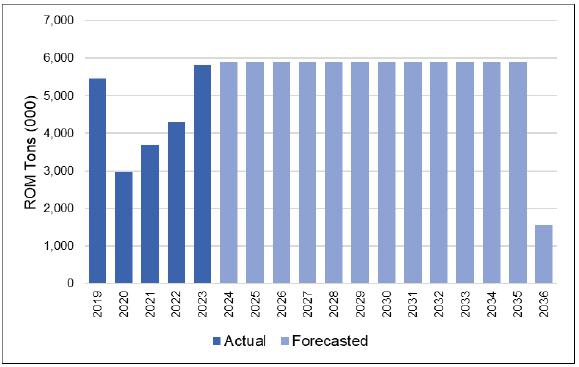
Figure 7.1: Recent Historical and LOM Forecasted Mining Production
As previously mentioned, the key driver of the mining operations is the adequate supply of feed material to Kermit’s two processing plants. Approximately 5.9 million ROM tons are required to produce 4.9 million tons of finished product annually. At this production rate, the Kermit operation has an expected life of 13 years. Future mine production, and hence the longevity of the mine, is directly related to the energy market demand for proppant sand. Actual yearly production volumes may, and are likely to, fluctuate significantly based on this demand.
The areal extents of the remaining mining areas (as shown in Figure 6.2, on page 6-7) and the geologic characteristics of the sand deposit afford the Kermit Mine a great deal of operational and planning flexibility. Generally, mining operations are expected to advance in blocks outwards from the two processing plants to reduce haul distances and expand waste storage capacity.
JOHN T. BOYD COMPANY
7-4
It is BOYD’s opinion that the forecasted production levels for the Kermit Mine are reasonable, logical, and consistent with typical sand surface mining practices in the region.
7.5 Mining Risks
Surface mines face two primary types of operational risks. The first category of risk includes those daily variations in physical mining conditions, mechanical failures, and operational activities that can temporarily disrupt production activities. These conditions/circumstances can adversely affect production on any given day but are not regarded as “risk issues” relative to the long-term operation of the mine. Instead, these are considered “nuisances” that, while undesirable, are encountered on a periodic basis at many mining operations. BOYD does not regard these issues as being material to the Kermit Mine’s operations or otherwise compromising its forecasted performance.
The second type of risk is categorized as “event risk”. Items in this category are rare, but significant, occurrences that ultimately have a pronounced impact on production activities and corresponding financial outcomes. Examples of event risks are major fires or explosions, floods, or unforeseen geological anomalies that disrupt extensive areas of proposed or operating mine workings and require alterations of mining plans. Such an event can result in the cessation of production activities for an undefined but extended period (measured in months, and perhaps years) and/or result in the sterilization of frac sand reserves. This type of risk is minimal in a relatively simple surface frac sand mining operation such as the Kermit Mine.
JOHN T. BOYD COMPANY
8-1
8.0 PROCESSING OPERATIONS
8.1 Overview
Hi-Crush operates two mining and processing facilities—K1 (or Kermit South) and K2 (or Kermit North)—at the Kermit Mine. The Kermit operations predominantly produce 40/140 mesh frac sand—that is, sand particles larger than 40 mesh and smaller than 140 mesh are not considered finished product and are discarded as waste.
Construction on the K1 frac sand processing facilities began in February 2017 and the plants were commissioned in July 2017. Construction on the K2 processing facilities began in May 2018 and the plants were commissioned in December 2018.
The two Kermit processing facilities share very similar designs. Each of the Kermit processing facilities has a nominal (or “nameplate”) capacity of 3 million tons of finished frac sand per year for a combined production capacity at Kermit of 6 million tons per year.
8.2 Processing Method
Each of the Kermit Mine’s processing operations comprise three major components which are typical in the production of frac sand. These components include:
| · | Wet Plant – ROM material from the pit is delivered to the wet plant where the coarse material (e.g., gravel) and fine material (e.g., fine sand and silt) is removed from the sand. |
| · | Dry Plant – The damp sand produced by the wet plant is dried and screened into finished products. |
| · | Storage and Loadout – Finished products are stored in silos and discharged via gravity from the bottom of the silos into highway trucks for transport to the customer. |
8.2.1 Wet Plant
The wet plant receives its raw sand feed from a ROM stockpile which is supplied by the mine. A front-end loader loads the ROM sand into a grizzly or scalping screen feed hopper. The oversized (greater than 6 or 8 mesh) material is screened out and the remaining sand is mixed with water to be pumped to and processed through the wet plant.
JOHN T. BOYD COMPANY
8-2
Each wet plant consists of two parallel wash circuits with a combined capacity of 750 tons per hour (tph). This arrangement offers a degree of flexibility as one plant circuit can be idled for maintenance, while the others are operating.
The wet plants do not crush the material, but predominantly scrubs (i.e., washes) and classifies (i.e., sizes) the sand feed material. Basically, a screen removes the 6–8 mesh top size or oversize material, and cyclones deslime and remove the minus 200 mesh material. Dewatering screens remove excess moisture. The resultant material— commonly referred to as Work-In-Progress (WIP)—is stockpiled as feed for the dry plant. The WIP stockpile rests on a water decant system which reduces the sand’s moisture content prior to entering the dry plant.
The waste wash/process water is directed to a thickener and then to a series of settling ponds. Chemical flocculant is added as the water is discharged into the retention ponds to aid with particle settling. Water used for the wet plant processing is recycled as it is sourced from a lined retention pond. The closed-loop process water circuit provides for efficient use of water as the majority is collected and recycled in the process. Water conservation is a high priority at the operation. The wet plant typically operates 24 hours per day, 7 days per week.
8.2.2 Dry Plant
A front-end loader is used to recover the WIP material from the decanted stockpile and feed it into each of the dry plants. The dry process plants each utilize three vibrating fluid bed dryers in parallel to dry the damp sand. After drying, the sand is classified (i.e., sized and sorted) using screens into a 40/140 mesh product. Any oversize material remaining at this point is screened off and deposited in the dry waste stockpile.
The K1 and K2 dry plants each have a nameplate capacity of 450 tph.
8.2.3 Storage and Loadout
Following the classification of the sand, the resulting products are stored in one of five product storage silos at each plant (10 storage silos in total). Each silo has a capacity of 3,000 tons for a total combined product storage of 30,000 tons at Kermit. Each silo has an under-silo loading point with truck scales for loading into on-highway trucks for transport to the well sites.
JOHN T. BOYD COMPANY
8-3
8.3 Production
Each of the Kermit processing facilities have a nameplate capacity of 3.0 million tons of finished “100 mesh” sand per year based on operating 24 hours a day and nearly 365 days per year. Recent annual production results and forecasted production over the expected life of the operation are provided in Figure 8.1, below.
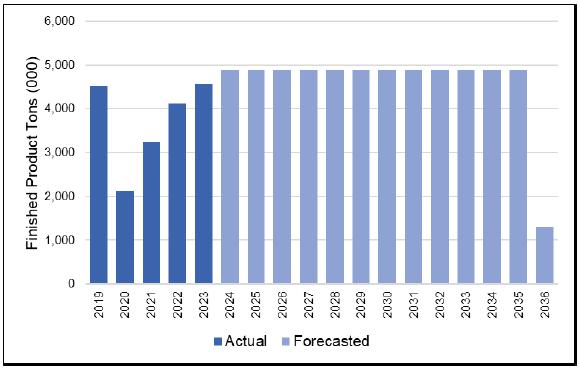
Figure 8.1: Recent Historical and LOM Forecasted Processing Plant Production
As shown, the Kermit Mine plans to produce on average 4.9 million tons per year of finished products or approximately 82% of nameplate capacity. However, annual finished product volumes will depend on market demand and may fluctuate substantially.
8.4 Processing Risks
BOYD is unaware of any reported interruptions, outages, shortages, or failures related to processing operations that have materially affected the Kermit Mine. Given the operation is well-established, we believe the risk of such events materially affecting the estimates of frac sand reserves presented herein is low.
Based on our review, it is BOYD’s opinion that the processing methods and existing equipment at the plant are sufficient for the forecasted production of finished proppant sand products.
JOHN T. BOYD COMPANY
9-1
9.0 MINE INFRASTRUCTURE
9.1 Overview
All of the basic infrastructure required for the ongoing operations is in place at the Kermit Mine. Figure 3.1 (page 3-2) illustrates the general layout of the infrastructure at the Kermit operations.
The surface facilities currently located at the operation are well constructed and have the necessary capacity/capabilities to support the Kermit Mine’s near-term operating plans. Operational preference may lead to the upgrading of some existing facilities if the operation expands in the future.
BOYD is unaware of any reported interruptions, outages, shortages, or failures related to infrastructure requirements that have materially affected the Kermit operations. Given the operations are well-established, we believe the risk of such events materially affecting the estimates of frac sand reserves presented herein is low.
9.2 Transportation
The Kermit Mine is serviced by several roads maintained by the local municipality, county, and state governments. These roads are either paved or well-maintained graded roadways. Road access is available year-round.
There is not any rail infrastructure available at Kermit. All products are shipped via bulk trucks. Transloading would be required to use existing rail networks. Hi-Crush plans to continue to transport their products from the Kermit operation via road.
9.3 Utilities
The K1 and K2 facilities are serviced by three-phase electric power. Substations access 138 kV lines and step voltage down to 12.5 kV lines which deliver power to the processing plants. Line natural gas is supplied to all dry plants. Natural gas line capacity and substation capacity is sufficient to serve much more than 100% of Kermit’s current requirements.
The wash process water is recycled after fines are removed via settling with a flocculent in a series of constructed ponds. As the mine progresses, silt ponds are constructed in mined-out areas. Additional makeup water is obtained from wellfields near the plants. The wells are only utilized as a backup water supply.
JOHN T. BOYD COMPANY
9-2
Wastewater from offices and other buildings is collected via holding tanks and disposed of on a regular basis. Potable water is provided by the public water system.
9.4 Tailings Disposal
The mining and processing of frac sand at the Kermit operations creates a substantial volume of tailings (i.e., waste material). These tailings are typically a mixture of clay, very fine sand, and other non-silica minerals. Tailings are typically disposed of in ponds (i.e., former mining pits) where the solid materials settle to the bottom and water is recovered for reuse. As mining progresses, depleted pits will become new tailings disposal sites. Freshwater ponds are maintained on the property so water can be stored after processing through the tailings ponds.
9.5 Other Structures
On-site facilities include a scale house, employee camp, garage, office buildings, maintenance shop, warehouse, and quality laboratories.
JOHN T. BOYD COMPANY
10-1
10.0 MARKET ANALYSIS
10.1 Market Overview and Outlook
The Permian Basin’s (Permian) frac sand market is driven by unconventional horizontal drilling in the oil and gas industry. In the late 1990s, rapid advances in horizontal drilling and hydraulic fracturing (fracking) in North America ushered in large-scale commercial oil and gas production. This fracking technique has been increasingly successful and modified over time to extract oil and gas held in dense layers of shale rocks, whose low permeability had previously prevented the flow of hydrocarbons.
Hydraulic fracturing uses a mixture of water, chemicals, and proppant (natural sand or man-made sand-like substances) to fracture shale rock and release hydrocarbons such as oil, natural gas, and natural gas liquids. The proppant acts to keep the fractures open (prop) while the pressurized fluids flow back up the well piping. Wells have become more productive with the addition of horizontal drilling capabilities, longer lateral lengths, and multi-stage fracks.
North America’s shale oil industry’s growing competitiveness gained through continuous technology improvement and falling production costs have had major implications on the global energy market. Oilfield service companies, including frac sand producers, made significant efficiency gains in 2020 to survive lower commodity prices because of the COVID-19 pandemic. These gains have followed through to the present day.
Figure 10.1, on the following page, illustrates the CME Group’s West Texas Intermediate (WTI) Crude Oil Annual Average Futures Price. We estimate breakeven pricing for unconventional oil wells in the Permian to be in the $30 to $40 per barrel range. 2023 WTI futures estimate pricing to generally be in the $64 to $75 range through 2032. This cost and pricing combination supports positive wellfield economics and thus frac sand consumption.
JOHN T. BOYD COMPANY
10-2
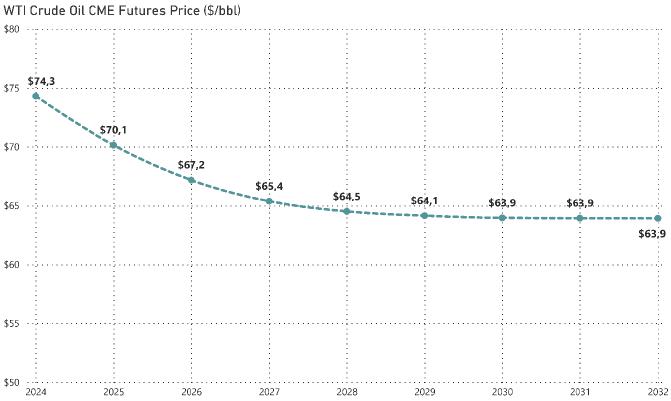
Source: CME Group
Figure 10.1: WTI Crude Oil CME Futures Price
Figure 10.2, on the following page, is compiled from downloaded and processed publicly available data from the Railroad Commission of Texas (RCC) for horizontal oil and gas permits in the U.S. This data shows a steady increment from the post-pandemic all-time low of 716 permits recorded in the 2nd quarter of 2020, to almost 2,000 permits in the 3rd quarter of 2022. From this period until the 4th quarter of 2023, a slow decreasing trend is shown with an average of 1,600 permits by quarter. It is important to note in this figure that most of the permits are based in the Permian region (with an average of 70% of all permits) followed next by permits in the Eagle Ford region (with an average of 21% of all permits) over the last 4 years.
JOHN T. BOYD COMPANY
10-3
From the 1st quarter of 2021 to the 4th quarter of 2023, the global distribution by permit type is 76% oil and 24% gas. Permit submissions for horizontal oil and gas wells in the Permian follow the same trend of the U.S. Global Permits which suggests a continuation of strong drilling ahead.
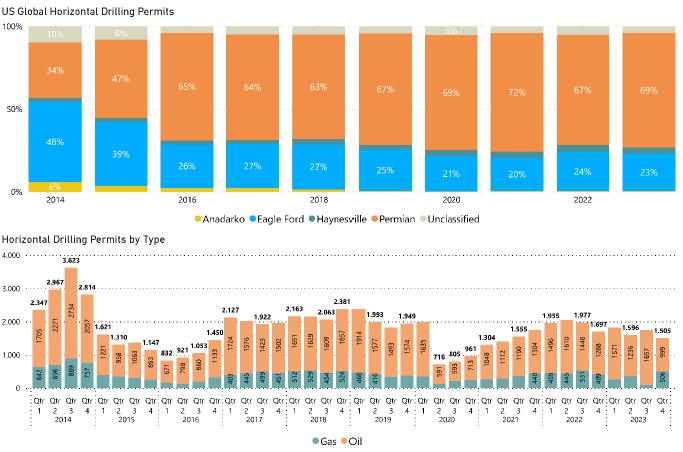
Source RCC
Figure 10.2: U.S. Global Horizontal Drilling Permits by Region and Type
A quarterly summary of Permian horizontal oil and gas well permits (from 2014 through 2023) is presented in Figure 10.3 below.
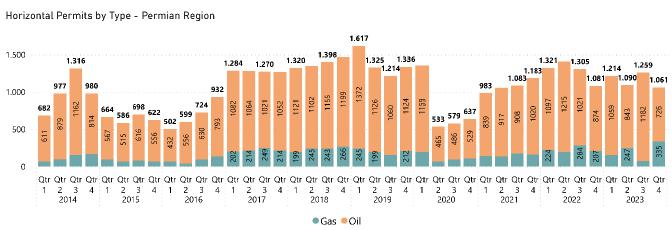
Source RCC
Figure 10.3: Permian Region Horizontal Drilling Permits by Type
JOHN T. BOYD COMPANY
10-4
Figure 10.4 was prepared combining data available for the current working rigs by region and the horizontal drilling permits. From September 2020 there is a noticeable and constant increase in the rig counts, reaching an all-time high number of permits since the COVID-19 pandemic in January 2023.
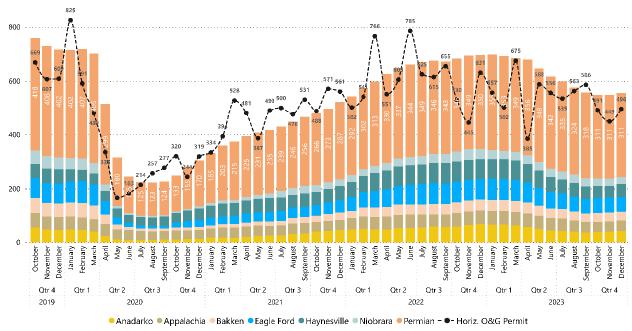
Source EIA and RCC
Figure 10.4: U.S. Horizontal Drilling Permits
During the previous 52 weeks, rig counts were down approximately 13%. However, the continuous growth through the last three years has led to increased production for both crude oil and natural gas. For the same period, crude oil (barrels per day) and natural gas production (thousand cubic feet per day) in the Permian are up 30% and 24%, respectively.
JOHN T. BOYD COMPANY
10-5
As figures 10.5 and 10.6 illustrate, Permian daily crude oil production is reaching multi-year highs, while daily natural gas production in the Permian continues to make new records, now standing at 24.1 million cubic feet per day.
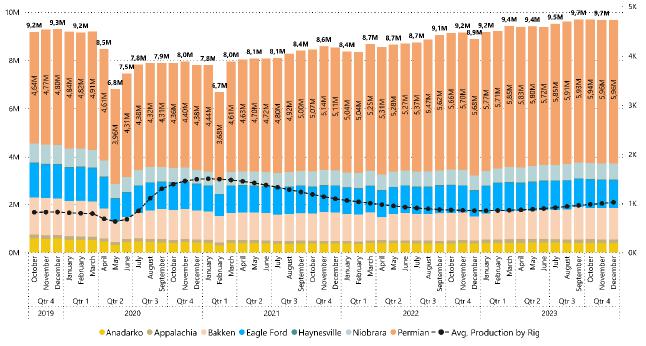
Source EIA
Figure 10.5: Oil Production (bbl/d)
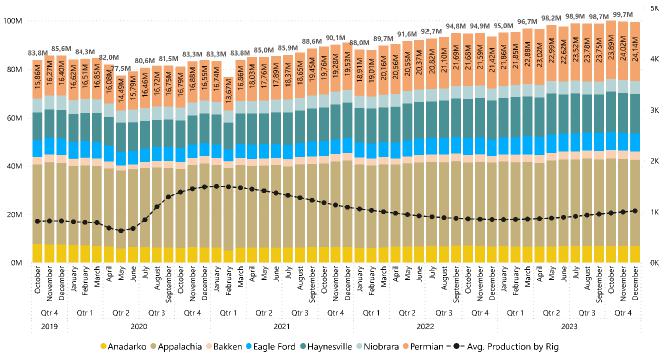
Source EIA
Figure 10.6: Natural Gas Production (Mcf/d)
JOHN T. BOYD COMPANY
10-6
The EIA’s Drilling Productivity Report reports that the inventory of drilled but uncompleted wells (DUCs) in all regions have declined 49% since peaking in July 2020 (refer to Figure 10.7 for all U.S. regions, and Figure 10.8 for the Permian). This data dovetails with increased crude oil and natural gas production.
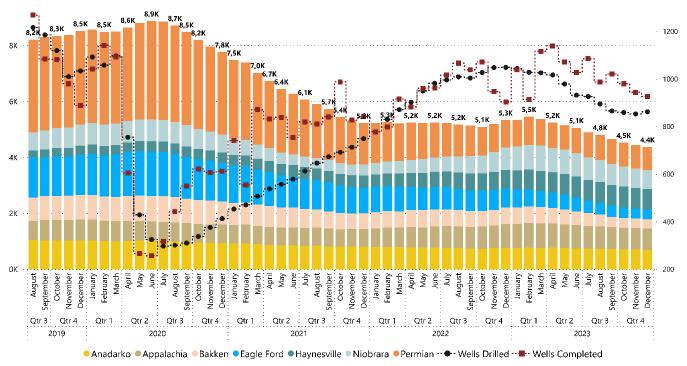
Source EIA
Figure 10.7: U.S. Drilled but Uncompleted Wells (DUC)
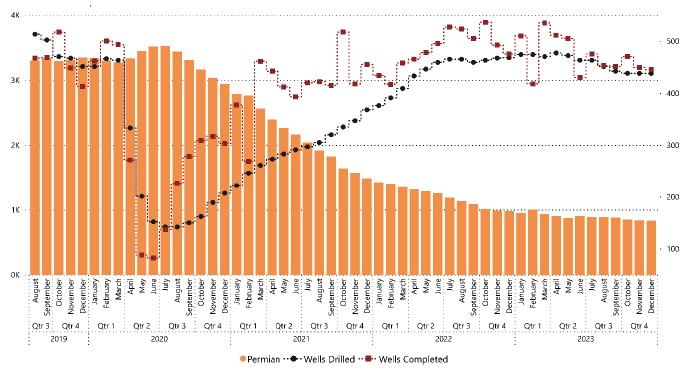
Source EIA
Figure 10.8: Permian Drilled but Uncompleted Wells (DUC)
JOHN T. BOYD COMPANY
10-7
Consequently, with increases in production and well completions, activity at frac sand mines has correspondingly increased throughout the U.S. According to MSHA, operating hours from 1st quarter of 2021 through 3rd quarter of 2023 were up 60% for Permian Basin frac sand mines. This data is presented in figures 10.9 (U.S.) and 10.10 (Permian).
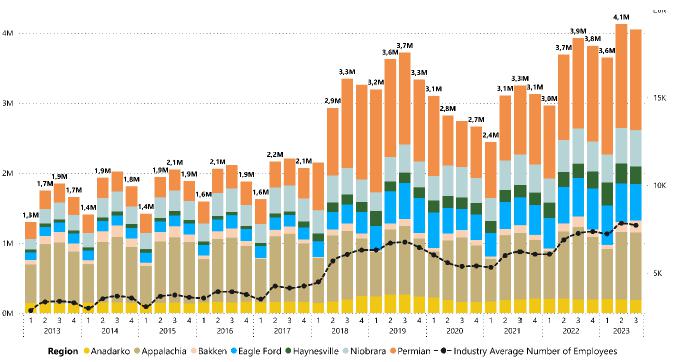
Source MSHA
Figure 10.9: All U.S. Regions Mine Hours (Quarterly)
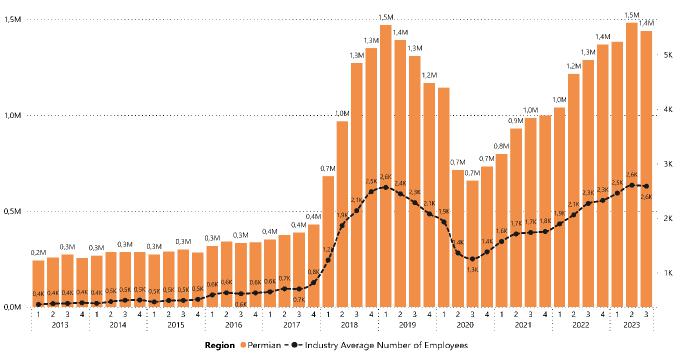
Source MSHA
Figure 10.10: Permian Wide In-Basin Mine Hours (Quarterly)
JOHN T. BOYD COMPANY
10-8
Industry research speculates that total in-basin mine hours, as of 2nd quarter 2023, are at the same level as the 2019 peak. Mine hours serve as a directional indicator that dovetails with previous crude oil and natural gas production and DUC data. Current frac sand production in the Permian is estimated to be in the 60 million to 65 million tons per year range, with fairly well-balanced demand and stable pricing. BOYD anticipates frac sand pricing stabilizing substantially above the pricing used in this report. Additionally, we anticipate continued upward sand consumption in the Permian due to economic and geopolitical influences on energy demand.
10.2 Historical Sales
Primarily, Hi-Crush supplies a range of frac sand products to major oilfield services companies and E&P companies operating in the Permian Basin. The Kermit Mine is Hi-Crush’s flagship operation in West Texas where they also operate several smaller, built-for-purpose mobile mining and processing facilities. Finished products supplied by the Kermit operation primarily consist of non-API standard “100 mesh” (i.e., 70/140 mesh) frac sand.
Recent historical sales data provided by Hi-Crush for the Kermit Mine are summarized in Table 10.1, below.
Table 10.1: Historical Sales Data
| Units | 2019 | 2020 | 2021 | 2022 | 2023 | |||||||||||||||||
| Product Sales | 000 tons | 4,530 | 2,124 | 3,234 | 4,115 | 4,556 | ||||||||||||||||
| Average Selling Price | $/ton sold | 25.11 | 17.24 | 14.03 | 23.91 | 26.78 | ||||||||||||||||
Frac sand demand dropped in 2020, as compared to 2019, due to the COVID-19 pandemic. However, recovery began in the fourth quarter of 2020 and continued through 2023. In 2020, the ASP for the Kermit operation’s finished frac sand products was $13.86 per ton. In 2021, the ASP decreased to $14.03 per ton. Despite rises in production, the Permian Basin’s demand for in-basin frac sand outstripped supply in 2022. Consequently, prices for in-basin finished frac sand products rose significantly during the year; Kermit’s ASP in 2022 was $23.91 per ton. Sales volumes were slightly up sequentially in 2023, resulting in an ASP of $26.78 per ton.
Hi-Crush has structured long-term contracts with some customers outlining volume commitments and, in some cases, fixed pricing. Hi-Crush also services customers on a spot basis where volume thresholds are not set, and orders are serviced on an as-available basis at prevailing market prices. Historically, the top-five customers by sales revenue account for approximately 81% to 97% of total sales from the Kermit Mine annually. Inter-company sales represent a significant portion of Kermit’s frac sand sales to date.
JOHN T. BOYD COMPANY
10-9
10.3 Market Entry Strategies
As an existing producer with a lengthy commercial history and established customer base, it is BOYD’s opinion that market entry strategies are not required for continued sale of the Kermit Mine’s frac sand products.
10.4 Future Sales
BOYD’s projections of sales volumes and frac sand prices for the Kermit Mine are informed by Hi-Crush’s historical operating results, their short-term budget forecasts, and our knowledge of frac sand markets. Forecasted prices are based on sales of 40/140 mesh finished frac sand. Our frac sand sales forecast for the Kermit Mine is provided in Table 10.2, below.
Table 10.2: Frac Sand Sales Forecast
| Sales | ASP | ||||||||
| Year(s) | (000 tons) | ($/ton) | |||||||
| 2024 | 4,900 | 26.36 | |||||||
| 2025 | 4,900 | 26.14 | |||||||
| 2026 | 4,900 | 26.00 | |||||||
| 2027 | 4,900 | 26.00 | |||||||
| 2028 | 4,900 | 26.00 | |||||||
| 2029–2036 | 36,375 | 26.00 | |||||||
| Total | 60,875 | ||||||||
| Minimum | 26.00 | ||||||||
| Maximum | 26.14 | ||||||||
| Average | 26.04 | ||||||||
BOYD is not aware of any material contracts for the sale of frac sand from the Kermit Sand Mine.
JOHN T. BOYD COMPANY
11-1
11.0 CAPITAL AND OPERATING COSTS
11.1 Historical Financial Performance
Table 11.1 summarizes the past five years of financial data for the Kermit operations. It should be recognized that the COVID-19 pandemic caused severe economic, market, and other disruptions which affected frac sand sales during 2020 and 2021.
Table 11.1: Historical Financials
| Units | 2019 | 2020 | 2021 | 2022 | 2023 | ||||||||||||||||||
| Frac Sand Sales | 000 tons | 4,530 | 2,124 | 3,234 | 4,115 | 4,556 | |||||||||||||||||
| Gross Revenues | $ 000 | 114,700 | 37,716 | 45,178 | 112,489 | 132,059 | |||||||||||||||||
| Average Selling Price | $/ton sold | 25.11 | 17.24 | 14.03 | 23.91 | 26.78 | |||||||||||||||||
| Cost of Goods Sold | $ 000 | 43,170 | 22,406 | 30,958 | 43,001 | 58,524 | |||||||||||||||||
| Average Cost of Goods Sold | $/ton sold | 9.53 | 10.55 | 9.57 | 10.45 | 12.85 | |||||||||||||||||
| Capital Expenditures | $ 000 | 2,434 | 29 | 1,056 | 7,506 | 11,366 |
The Cost of Goods Sold includes operating costs (i.e., mining, processing, product loadout, and other related costs) in addition to site-specific general and administrative expenses.
Based on the financial data presented above:
| · | The Kermit Mine sold approximately 4.6 million tons of finished frac sand in 2023— an increase of 11% from the previous year. |
| · | Hi-Crush’s ASP for frac sand sold from Kermit was $26.78 per ton in 2023, increasing 12% from 2022. The five-year historical ASP was $23.82 per ton. |
| · | Cost of Goods Sold was $12.85 per ton sold in 2023, increasing 23% from 2022. |
| · | EBITDA margin (i.e., EBITDA as a percentage of gross revenue) has remained positive over the past five years and was 56% in 2023. |
| · | Capital expenditures totaled approximately $22.4 million (or $1.21 per ton sold) over the last five years. |
11.2 Estimated Costs
The production and unit cost estimates for the Kermit Mine are informed by Hi-Crush’s historical performance and internal budget forecasts, in combination with BOYD’s familiarity with mining costs at similar operations. Operating volumes are well-defined and understood, as are mining and processing productivities at the Kermit operation. As such, it is BOYD’s opinion that the production and financial projections are reasonable and are likely to be within ±20% accuracy level.
JOHN T. BOYD COMPANY
11-2
This section contains forward-looking information related to capital and operating cost estimates for the Kermit Mine. There are inherent known and unknown risks and uncertainties associated with all mining operations. These risks, uncertainties, and other factors are not quantifiable, but include, but are not limited to, adverse general economic conditions, operating hazards, inherent uncertainties in interpreting engineering and geologic data, fluctuations in commodity prices and prices for operational services, government regulation and political risks, as well as other risks commonly associated with the mining industry.
11.2.1 Projected Capital Expenditures
The Kermit Mine and related facilities are fully developed and should not require any near-term major capital investment to maintain full commercial production. Historically, the timing and amount of capital expenditures have been largely discretionary and within Hi-Crush’s control. BOYD projected sustaining capital expenditures at a unit cost of $1.50 per ton sold, this includes maintenance of production equipment as well as other items, for the operation. This factor is based on our judgment and experience with similar operations.
11.2.2 Projected Operating Costs
Operating cost estimates were developed based on recent actual costs and considering specific operational activity levels and cost drivers. The estimates consider current and expected labor headcount and salaries, major consumables and unit prices, power costs, and equipment and maintenance costs. The total operating cost estimate includes all site costs related to mining, processing, loading, and general and administrative expenses (including non-income taxes, fees, and royalties).
Kermit’s operating costs are expected to remain relatively consistent (on an uninflated basis) with 2023 results. As such, the projected total cash cost of goods sold over the life of the mine averages $12.85 per ton sold over the life of the mine. As the operation is in a steady state, BOYD considers the future operating cost estimates to be reasonable and appropriate.
JOHN T. BOYD COMPANY
12-1
12.0 ECONOMIC ANALYSIS
12.1 Approach
The economic analysis presented in this chapter was prepared by BOYD for the purpose of confirming the commercial viability of the Kermit Mine’s reported frac sand reserves and not for the purpose of valuing the Kermit operations, or its assets. The economic analysis contains forward-looking information related to Kermit’s projected operating and financial performance. This projection involves inherent known and unknown risks and uncertainties, some of which may be outside of Hi-Crush’s control. Hi-Crush, as with all mining companies, actively evaluates, changes, and modifies business and operating plans in response to various factors that may affect operational and/or financial results. Actual results, production levels, operating expenses, sales realizations, and all other modifying factors could vary significantly from the assumptions and estimates provided in this analysis. Risk is subjective, as such, BOYD recommends that each reader should evaluate the project based on their own investment criteria.
The financial model used for the purposes of the economic analysis forecasts future free cash flow from frac sand production and sales over the life cycle of the Kermit operations using the annual forecasts of production, sales revenues, and operating and capital costs discussed earlier in this report. A DCF analysis, in which future free cash flows are discounted to present value, is used to derive an NPV for the frac sand reserves. The use of DCF-NPV analysis is a standard method within the mining industry to assess the economic value of a project after allowing for the cost of capital invested.
The financial evaluation of Kermit has been undertaken on a simplified after-tax basis and does not reflect Hi-Crush’s corporate tax structure. NPV is calculated using an after-tax discount rate of 10% (NPV10). Cash flows were assumed to occur in the middle of each year and are discounted to January 1, 2024. Cost estimates and other inputs to the cash flow model for the project have been prepared using constant 2023 money terms, i.e., without provision for inflation. The internal rate of return and project payback were not calculated, as there was no initial investment (sunk costs) considered in the financial model provided herein.
A suite of sensitivities was calculated to evaluate the effect of the main drivers of economic performance (including variations in sales prices, operating costs, and capital costs).
JOHN T. BOYD COMPANY
12-2
It is BOYD’s opinion that the financial model provides a reasonable and accurate reflection of Kermit’s expected economic performance based on the assumptions and information available at the time of our review.
12.2 Assumptions and Limitations
Cash flow projections for Kermit have been generated from the annual forecasts of production, sales revenues, and operating and capital costs discussed earlier in this report. A summary of the key assumptions and limitations is provided below:
| · | Sales volumes of finished frac sand in 2024 are based on Hi-Crush’s budget projections and are expected to remain constant thereafter. Forecasted sales volumes are below the capacity limit of the Kermit processing facilities (approximately 6 million tons of 40/140 mesh frac sand per year). |
| · | ROM production requirements are based on an expected processing yield of 83% and will remain in line with expected sales volumes. Forecasted ROM production is at or below the capacity of the existing mining equipment and related infrastructure. |
| · | Forecasted revenues are based on sales of 40/140 mesh finished frac sand with a weighted average sales price of $26.36 per ton in 2024, $26.14 per ton in 2025, and continuing thereafter at $26.00 per ton for the remaining expected life of the mine (through 2036). |
| · | Projected operating costs are discussed in Chapter 11 and include all site costs related to mining, processing, loading, and general and administrative expenses (including non-income taxes, fees, and royalties). Unit operating costs are expected to remain relatively constant over the life of the operation. |
| · | Projected capital expenditures are discussed in Chapter 11 and include sustaining/maintenance of operations costs. Unit capital expenditures are expected to remain relatively constant over the life of the operation. |
| · | Net working capital is not included in the valuation since the Kermit Mine is a going concern. |
| · | Current fixed assets are depreciated over remaining life of the operations using their carrying value as of December 31, 2023, and the straight-line method. |
| · | Depreciation expenses for new fixed assets (from sustaining/maintenance capital expenditures) are based on a straight-line depreciation calculation using an 8-year asset life. |
| · | Income taxes are based on a Federal Corporate Tax Rate of 21%. |
| · | Asset recovery/salvage values were not included in the valuation. |
| · | Post-mining cost of reclamation is not included in the valuation. |
JOHN T. BOYD COMPANY
12-3
12.3 Financial Model Results
Table 12.1, below, provides a summary of the estimated remaining life of mine financial results for the Kermit Mine.
Table 12.1: Financial Results
| Remaining | ||||
| Life of Mine | ||||
| Units | Total | |||
| Expected Remaining Life | years | 13 | ||
| Production: | ||||
| ROM Production | 000 tons | 73,348 | ||
| Product Sales | 000 tons | 60,875 | ||
| Total Revenues | $ millions | 1,585.2 | ||
| Average Selling Price | $/t sold | 26.04 | ||
| Total Cost of Goods Sold | $ millions | 782.0 | ||
| Average Cost of Goods Sold | $/t sold | 12.85 | ||
| Capital Expenditures | $ millions | 91.3 | ||
| Average Capital Expenditures | $/t sold | 1.50 | ||
| Pre-Tax: | ||||
| Cash Flow | $ millions | 711.9 | ||
| NPV10 | $ millions | 417.7 | ||
| After-tax: | ||||
| Cash Flow | $ millions | 570.0 | ||
| NPV10 | $ millions | 332.8 |
Estimated LOM pre-tax and after-tax cash flows for frac sand production from the Kermit Mine are presented in Table 12.2, on the following page.
JOHN T. BOYD COMPANY
12-4
Table 12.2
ANNUAL PRODUCTION AND CASH FLOW FORECAST
KERMIT MINE
Prepared For
HI-CRUSH INC.
By
John T. Boyd Company
Mining and Geological Consultants
April 2024
| Description | Units | 2024 | 2025 | 2026 | 2027 | 2028 | 2029 to 2033 | 2034 to 2036 | Total | ||||||||||||||||||||||||||
| Production Statistics: | |||||||||||||||||||||||||||||||||||
| ROM Production | 000 tons | 5,904 | 5,904 | 5,904 | 5,904 | 5,904 | 29,520 | 14,308 | 73,348 | ||||||||||||||||||||||||||
| Process Yield | % | 83.0 | 83.0 | 83.0 | 83.0 | 83.0 | 83.0 | 83.0 | 83.0 | ||||||||||||||||||||||||||
| Product Sales | 000 tons | 4,900 | 4,900 | 4,900 | 4,900 | 4,900 | 24,500 | 11,875 | 60,875 | ||||||||||||||||||||||||||
| Total Revenues | $ 000 | 129,182 | 128,086 | 127,400 | 127,400 | 127,400 | 637,000 | 308,750 | 1,585,218 | ||||||||||||||||||||||||||
| Average Selling Price | $/ton sold | 26.36 | 26.14 | 26.00 | 26.00 | 26.00 | 26.00 | 26.00 | 26.04 | ||||||||||||||||||||||||||
| Cost of Goods Sold | $ 000 | 62,943 | 62,943 | 62,943 | 62,943 | 62,943 | 314,714 | 152,540 | 781,969 | ||||||||||||||||||||||||||
| Average Cost of Goods Sold | $/ton sold | 12.85 | 12.85 | 12.85 | 12.85 | 12.85 | 12.85 | 12.85 | 12.85 | ||||||||||||||||||||||||||
| EBITDA | $ 000 | 66,239 | 65,143 | 64,457 | 64,457 | 64,457 | 322,286 | 156,210 | 803,249 | ||||||||||||||||||||||||||
| DDA | $ 000 | 5,190 | 6,109 | 7,028 | 7,947 | 8,865 | 56,270 | 35,978 | 127,387 | ||||||||||||||||||||||||||
| EBIT/Operating Income | $ 000 | 61,049 | 59,034 | 57,429 | 56,511 | 55,592 | 266,016 | 120,232 | 675,863 | ||||||||||||||||||||||||||
| Taxes | $ 000 | 12,820 | 12,397 | 12,060 | 11,867 | 11,674 | 55,863 | 25,249 | 141,931 | ||||||||||||||||||||||||||
| EBIAT | $ 000 | 48,228 | 46,637 | 45,369 | 44,643 | 43,918 | 210,152 | 94,983 | 533,932 | ||||||||||||||||||||||||||
| Capital Expenditures | $ 000 | 7,350 | 7,350 | 7,350 | 7,350 | 7,350 | 36,750 | 17,813 | 91,313 | ||||||||||||||||||||||||||
| Net Income | $ 000 | 40,878 | 39,287 | 38,019 | 37,293 | 36,568 | 173,402 | 77,171 | 442,619 | ||||||||||||||||||||||||||
| Pre-tax Cash Flow | $ 000 | 58,889 | 57,793 | 57,107 | 57,107 | 57,107 | 285,536 | 138,397 | 711,937 | ||||||||||||||||||||||||||
| Discounted at 10% | $ 000 | 56,148 | 50,094 | 45,000 | 40,909 | 37,190 | 140,978 | 47,424 | 417,743 | ||||||||||||||||||||||||||
| After-tax Cash Flow | $ 000 | 46,069 | 45,396 | 45,047 | 45,240 | 45,433 | 229,672 | 113,149 | 570,006 | ||||||||||||||||||||||||||
| Discounted at 10% | $ 000 | 43,925 | 39,349 | 35,496 | 32,408 | 29,587 | 113,337 | 38,717 | 332,819 | ||||||||||||||||||||||||||
JOHN T. BOYD COMPANY
12-5
DCF-NPV on a pre-tax and after-tax basis, using discount rates of 8%, 10% (the base case), and 12%, were calculated utilizing the projected cash flows. Table 12.3 summarizes the results of the pre-tax and after-tax DCF-NPV analyses:
Table 12.3: DCF-NPV Analysis
| NPV ($ millions) | ||||||||||||
| 8% | 10% | 12% | ||||||||||
| Pre-Tax | 458.8 | 417.7 | 382.5 | |||||||||
| After-Tax | 365.9 | 332.8 | 304.5 | |||||||||
As shown, the pre-tax DCF-NPV ranges from approximately $382.5 million to $458.8 million. The after-tax DCF-NPV ranges from approximately $304.5 million to $365.9 million.
The economic analysis confirms that the Kermit Mine generates positive pre- and after-tax financial results and a real NPV10 of $332.8 million. As such, it is BOYD’s opinion that the frac sand reserves of the Kermit Mine have demonstrated economic viability.
12.4 Sensitivity Analysis
Table 12.4, below, shows the sensitivity of the project after-tax for a cash flow discounted at 10% (NPV10) to a variation over a range of 20% above and below the base case in:
(1) average selling prices and (2) operating costs.
Table 12.4: After-Tax NPV10 Sensitivity Analysis ($ millions)
| Revenues | |||||||||||||||||||||||||||||||
| -20% | -15% | -10% | -5% | 0% | 5% | 10% | 15% | 20% | |||||||||||||||||||||||
| -20 | % | 258.4 | 295.1 | 331.8 | 368.5 | 405.2 | 441.9 | 478.6 | 515.3 | 552.0 | |||||||||||||||||||||
| -15 | % | 240.3 | 277.0 | 313.7 | 350.4 | 387.1 | 423.8 | 460.5 | 497.2 | 533.9 | |||||||||||||||||||||
| -10 | % | 222.2 | 258.9 | 295.6 | 332.3 | 369.0 | 405.7 | 442.4 | 479.1 | 515.8 | |||||||||||||||||||||
| -5 | % | 204.1 | 240.8 | 277.5 | 314.2 | 350.9 | 387.6 | 424.3 | 461.0 | 497.7 | |||||||||||||||||||||
| Cost of Goods Sold | 0 | % | 186.0 | 222.7 | 259.4 | 296.1 | 332.8 | 369.5 | 406.2 | 442.9 | 479.6 | ||||||||||||||||||||
| 5 | % | 167.9 | 204.6 | 241.3 | 278.0 | 314.7 | 351.4 | 388.1 | 424.8 | 461.5 | |||||||||||||||||||||
| 10 | % | 149.8 | 186.5 | 223.2 | 259.9 | 296.6 | 333.3 | 370.0 | 406.7 | 443.4 | |||||||||||||||||||||
| 15 | % | 131.8 | 168.5 | 205.2 | 241.9 | 278.6 | 315.3 | 352.0 | 388.7 | 425.4 | |||||||||||||||||||||
| 20 | % | 113.6 | 150.4 | 187.1 | 223.8 | 260.5 | 297.2 | 333.9 | 370.6 | 407.3 | |||||||||||||||||||||
JOHN T. BOYD COMPANY
12-6
As expected, the project is most sensitive to changes in product pricing and operating costs. The project is less sensitive to capital costs. There is little to no impact varying the capital costs from 70% to 130% of the base case.
This analysis demonstrates the project value to be relatively robust, with positive NPVs reported across the range of values assessed.
JOHN T. BOYD COMPANY
13-1
13.0 PERMITTING AND COMPLIANCE
| 13.1 | Permitting Requirements and Status |
Several permits and compliance with federal, state, and municipal regulations are required for mining, processing, and related activities at the Kermit Mine. These activities are principally regulated by the Texas Commission on Environmental Quality (TCEQ). The predominant permitting requirement is an active Air New Source Permit for air pollution control; however, several other permits and registrations are required. A summary of the permits and registrations for the Kermit operations is provided in Table 13.1, below.
Table 13.1: Permit/Registration Summary
| Renewal | ||||||
| Program | Permit ID | Status | Date | |||
| Industrial And Hazardous Waste | Solid Waste Registration No. 97093 | Active | N/A | |||
| Petroleum Storage Tank | Registration No. 93383 | Active | N/A | |||
| Public Water System/Supply | Registration No. 2480018 | Active | N/A | |||
| K1 Plant (Kermit South) | ||||||
| Aggregate Production Operation | Registration No. AP0002202 | Active | 4/4/2025 | |||
| Air New Source | Permit No. 150071 | Active | 7/9/2028 | |||
| On-Site Sewage Facility | Permit No. WKP-03-17 | Active | N/A | |||
| On-Site Sewage Facility | Permit No. WKP-04-17 | Active | N/A | |||
| On-Site Sewage Facility | Permit No. WKP-05-17 | Active | N/A | |||
| On-Site Sewage Facility | Permit No. WKP-06-18 | Active | N/A | |||
| On-Site Sewage Facility | Permit No. WKP-07-18 | Active | N/A | |||
| Petroleum Storage Tank | Registration No. 89626 | Active | N/A | |||
| K2 Plant (Kermit North) | ||||||
| Aggregate Production Operation | Registration No. AP0002879 | Active | 1/27/2025 | |||
| Air New Source | Permit No. 153152 | Active | 12/27/2028 | |||
| On-Site Sewage Facility | Permit No. WKP-31-18 | Active | N/A | |||
| On-Site Sewage Facility | Permit No. WKP-32-18 | Active | N/A |
BOYD reviewed the permits necessary to support continued operations at Kermit. Such required permits appear to be valid and in good standing. The approved permits and certifications are adequate for the continued operation of the mine and processing facilities. New permits, permit revisions, and/or renewals may be necessary from time to time to facilitate future operations. Given sufficient time and planning, Hi-Crush should be able to secure new permits, as required, to maintain its planned operations within the context of current regulations.
JOHN T. BOYD COMPANY
13-2
13.2 Environmental Studies
It is BOYD’s understanding that no standalone environmental studies have been conducted for the Kermit Mine. As part of the state and federal permitting process, various environmental assessments have been conducted and reviewed by the relevant local, state, and federal agencies. As the necessary permits for mining and processing operations have been issued, it is BOYD’s understanding that all environmental assessments have been accepted by the relevant regulatory bodies and no material issues were found.
13.3 Waste Disposal and Water Management
The coarse refuse generated from the sand processing operations is stockpiled and used in the construction of impoundment or backfilled into previously mined pits. The fine refuse generated from the sand processing operations is disposed of by pumping it into impoundment ponds. Waste disposal facilities are in place for current mining operations, with plans to expand the disposal facilities to meet life of reserve storage requirements.
Water control structures are in place and function as required by regulatory agencies.
13.4 Compliance
The Kermit operations are regulated by TCEQ on matters involving air and water pollution and inspected periodically by the state if issues arise.
Mine safety is regulated by MSHA. They inspect the facilities a minimum of twice a year. Hi-Crush’s safety record compares favorably with its regional peers.
Based on our review of information provided by Hi-Crush and available public information, it is BOYD’s opinion that the Kermit’s record of compliance with applicable mining, water quality, and environmental regulations is generally typical for that of the industry. BOYD is not aware of any regulatory violation or compliance issue that would materially impact the estimated frac sand reserves.
13.5 Plans, Negotiations, or Agreements
New permits and certain permit amendments/revisions require public notification. The public is made aware of pending permits by advertisement in local newspapers.
JOHN T. BOYD COMPANY
13-3
Additionally, a copy of the application is retained at the local county’s public library for review. A comment period follows the last advertisement date to allow the public to submit comments to the regulatory authority.
Hi-Crush voluntarily participates in a CCAA for the DSL with the U.S. Fish and Wildlife Service. By way of the CCAA, Hi-Crush commits to implementing conservation measures and to funding conservation actions that collectively reduce or eliminate threats to the DSL. The CCAA was approved in July 2021 and lasts for 23 years.
BOYD is not aware of any other community or stakeholder concerns, impacts, negotiations, or agreements that would materially impact the frac sand reserve estimate.
13.6 Post-Mining Land Use and Reclamation
Under current regulations, the State of Texas does not require reclamation or remediation of surface mined lands by aggregate (including frac sand) operations. However, general requirements of Kermit’s operating permits and licenses include:
| · | Stabilization of disturbed areas to prevent exposure of significant materials to stormwater which could discharge off-site. |
| · | Demolition of water wells and septic tanks. |
| · | Disposal of hazardous wastes. |
As a matter of good mining practice, Hi-Crush seeks to conduct progressive reclamation (per the above requirements) throughout the operation’s mining life to minimize risk and costs at closure.
13.7 Local Procurement and Hiring
BOYD is not aware of any commitments for local procurement or hiring. Hi-Crush reports making efforts to source supplies and materials from regional vendors. The workforce is likewise located in the regional area.
Hi-Crush’s stated core values include making positive impacts in the communities in which it operates. In addition to the payment of income taxes and other local community taxes such as property taxes and royalties, Hi-Crush supports, financially and otherwise, local community endeavors.
JOHN T. BOYD COMPANY
14-1
14.0 INTERPRETATION AND CONCLUSIONS
| 14.1 | Findings |
BOYD’s independent technical assessment was conducted in accordance with S-K 1300 and concludes:
| · | Sufficient data have been obtained through site exploration and sampling programs and mining operations to support the geological interpretations of deposit thickness, grain size distribution and frac sand quality for the portions of the sand underlying the controlled property of the Kermit Mine. The data are of sufficient quantity and reliability to reasonably support the frac sand resource and frac sand reserve estimates presented in this report. |
| · | BOYD is of the opinion that our data validation efforts: (1) adequately confirm the reasonableness of the geologic interpretations, resource estimation criteria, and economic assumptions; and (2) support the use of the data in frac sand resource/reserve estimation. |
| · | The 60.1 million saleable product tons of frac sand reserves (as of December 31, 2023) identified on the property are reasonably and appropriately supported by technical studies, which consider expected geologic conditions, planned mining and processing operations, forecasted product revenues, and operating and capital cost estimates. As such, BOYD is of the opinion that there are reasonable expectations that the stated frac sand reserves for the Kermit Mine are technically, economically, and legally extractable as of December 31, 2023. |
| · | To our knowledge, there are no other relevant data or information material to the Kermit Mine that would materially impact or change this technical report summary. |
| 14.2 | Significant Risks and Uncertainties |
The ability of Hi-Crush, or any mining company, to achieve production and financial projections is dependent on numerous factors. These factors primarily include site-specific geological conditions, the capabilities of management and operational personnel, product sales prices and market conditions, environmental issues, securing permit renewals and bonds, and developing and operating mines in a safe and efficient manner. Unforeseen changes in legislation and new industry developments could substantially alter the performance of any mining company. It is our understanding that Hi-Crush continuously assesses these factors and adjusts operating plans as a matter of course.
JOHN T. BOYD COMPANY
14-2
As a mining operation with an established history of commercial success, there is a high degree of certainty for the Kermit Mine under the current and foreseeable operating environment. However, it should be noted that frac sand is generally marketed exclusively to the energy sector which has historically faced more volatility than many other industries.
Subject specific assessments of risk are presented in the relevant sections of this report.
14.3 Recommendations
Based on the status of the Kermit Mine, BOYD has no recommendations for additional work relevant to the subject frac sand reserves at this time.
JOHN T. BOYD COMPANY