
AIDX 10-K
20/20 Biolabs, Inc. (AIDX)
UNITED STATES
SECURITIES AND EXCHANGE COMMISSION
Washington, D.C. 20549
FORM
(Mark One)
For
the fiscal year ended
or
For the transition period from ____________ to _____________
Commission
File No.
| (Exact name of registrant as specified in its charter) |
| (State or other jurisdiction of incorporation or organization) | (I.R.S. Employer Identification No.) | |
| (Address of principal executive offices) | (Zip Code) |
| (Registrant’s telephone number, including area code) |
Securities registered pursuant to Section 12(b) of the Act:
| Title of each class | Trading Symbol(s) | Name of each exchange on which registered | ||
Securities registered pursuant to Section 12(g) of the Act: None
Indicate
by check mark if the registrant is a well-known seasoned issuer, as defined in Rule 405 of the Securities Act. Yes ☐
Indicate
by check mark if the registrant is not required to file reports pursuant to Section 13 or Section 15(d) of the Act. Yes ☐
Indicate
by check mark whether the registrant (1) has filed all reports required to be filed by Section 13 or 15(d) of the Securities Exchange
Act of 1934 during the preceding 12 months (or for such shorter period that the registrant was required to file such reports), and (2)
has been subject to such filing requirements for the past 90 days. Yes ☐
Indicate
by check mark whether the registrant has submitted electronically every Interactive Data File required to be submitted pursuant to Rule
405 of Regulation S-T during the preceding 12 months (or for such shorter period that the registrant was required to submit such files).
Indicate by check mark whether the registrant is a large accelerated filer, an accelerated filer, a non-accelerated filer, a smaller reporting company, or emerging growth company. See the definitions of “large accelerated filer,” “accelerated filer,” “smaller reporting company,” and “emerging growth company” in Rule 12b-2 of the Exchange Act.
| Large accelerated filer | ☐ | Accelerated filer | ☐ |
| ☒ | Smaller reporting company | ||
| Emerging growth company |
If
an emerging growth company, indicate by check mark if the registrant has elected not to use the extended transition period for complying
with any new or revised financial accounting standards provided pursuant to Section 13(a) of the Exchange Act.
Indicate
by check mark whether the registrant has filed a report on and attestation to its management’s assessment of the effectiveness
of its internal control over financial reporting under Section 404(b) of the Sarbanes-Oxley Act by the registered public accounting firm
that prepared or issued its audit report.
If
securities are registered pursuant to Section 12(b) of the Act, indicate by check mark whether the financial statements of the registrant
included in the filing reflect the correction of an error to previously issued financial statements.
Indicate by check mark whether any of those error corrections are restatements that required a recovery analysis of incentive-based compensation received by any of the registrant’s executive officers during the relevant recovery period pursuant to §240.10D-1(b). ☐
Indicate
by check mark whether registrant is a shell company (as defined in Rule 12b-2 of the Act). Yes ☐ No
As
of June 30, 2025 (the last business day of the registrant’s most recently completed second fiscal quarter), the aggregate market
value of the registrant’s common stock held by non-affiliates could
As of March 30, 2026, there were a total of
DOCUMENTS INCORPORATED BY REFERENCE
20/20 Biolabs, Inc.
Annual Report on Form 10-K
Year Ended December 31, 2025
TABLE OF CONTENTS
i
INTRODUCTORY NOTES
Use of Terms
Except as otherwise indicated by the context and for the purposes of this report only, references in this report to “we,” “us,” “our” and “our company” are to 20/20 Biolabs, Inc., a Delaware corporation.
Special Note Regarding Forward-Looking Statements
This report contains forward-looking statements that are based on our management’s beliefs and assumptions and on information currently available to us. All statements other than statements of historical facts are forward-looking statements. These statements relate to future events or to our future financial performance and involve known and unknown risks, uncertainties and other factors that may cause our actual results, levels of activity, performance or achievements to be materially different from any future results, levels of activity, performance or achievements expressed or implied by these forward-looking statements. Forward-looking statements include, but are not limited to, statements about:
| ● | our goals and strategies; |
| ● | our future business development, financial condition and results of operations; |
| ● | expected changes in our revenue, costs or expenditures; |
| ● | growth of and competition trends in our industry; |
| ● | our expectations regarding demand for, and market acceptance of, our products; |
| ● | our expectations regarding our relationships with investors, institutional funding partners and other parties we collaborate with; |
| ● | fluctuations in general economic and business conditions in the market in which we operate; and |
| ● | relevant government policies and regulations relating to our industry. |
In some cases, you can identify forward-looking statements by terms such as “may,” “could,” “will,” “should,” “would,” “expect,” “plan,” “intend,” “anticipate,” “believe,” “estimate,” “predict,” “potential,” “project” or “continue” or the negative of these terms or other comparable terminology. These statements are only predictions. You should not place undue reliance on forward-looking statements because they involve known and unknown risks, uncertainties and other factors, which are, in some cases, beyond our control and which could materially affect results. Factors that may cause actual results to differ materially from current expectations include, among other things, those listed under Item 1A “Risk Factors” and elsewhere in this report. If one or more of these risks or uncertainties occur, or if our underlying assumptions prove to be incorrect, actual events or results may vary significantly from those implied or projected by the forward-looking statements. No forward-looking statement is a guarantee of future performance.
In addition, statements that “we believe” and similar statements reflect our beliefs and opinions on the relevant subject. These statements are based upon information available to us as of the date of this report, and while we believe such information forms a reasonable basis for such statements, such information may be limited or incomplete, and our statements should not be read to indicate that we have conducted an exhaustive inquiry into, or review of, all potentially available relevant information. These statements are inherently uncertain and investors are cautioned not to unduly rely upon these statements.
The forward-looking statements made in this report relate only to events or information as of the date on which the statements are made in this report. Except as expressly required by the federal securities laws, there is no undertaking to publicly update or revise any forward-looking statements, whether as a result of new information, future events, changed circumstances or any other reason.
ii
PART I
| ITEM 1. | BUSINESS. |
Overview
We develop and commercialize AI-powered, laboratory-based blood tests for the early detection and prevention of cancers and chronic diseases.
We offer two families of lab tests, both under our OneTest brand: (i) OneTest for Cancer, a multi-cancer early detection, or MCED, and (ii) OneTest for Longevity, which measures inflammatory biomarkers, that was launched in February 2026 (the Longevity test is also being branded “OneTest for Workplace Wellness” when marketed to self-insured employers). Both tests are run in our CAP (College of American Pathologists) accredited, CLIA (Clinical Laboratory Improvement Amendments) licensed laboratory in Gaithersburg, MD. This laboratory also hosts our Clinical Laboratory Innovation Accelerator, or CLIAx, which we believe is the country’s first shared CLIA laboratory for overseas diagnostics start-ups seeking to launch novel lab tests in the U.S. without the expense of establishing and operating their own independent lab.
Our legacy business also includes a pioneering field test kit for screening suspicious powders for bioterror agents known as BioCheck.
For the years ended December 31, 2025 and 2024, sales of OneTest for Cancer accounted for approximately 88% and 85% of our revenues respectively, while sales of BioCheck accounted for approximately 8% and 10% of our revenues, respectively, and our CLIAx accounted for approximately 4% and 5% of our revenues, respectively.
Corporate History
We were incorporated in the State of Delaware on August 7, 2000 under the name 20/20 BioSystems, Inc. On September 19, 2000, our name was changed to 20/20 Gene Systems, Inc., on June 27, 2021, our name was changed to 20/20 GeneSystems, Inc. and on March 19, 2025, our name was changed to 20/20 Biolabs, Inc. We do not have any subsidiaries.
Products
OneTest for Cancer
The Problem
Of the ten deadliest cancers in the U.S., only three — breast, colon, and prostate — have widely adopted screening modalities. This is despite growing evidence that early detection saves or extends lives for cancers of the lung, liver, pancreas, esophagus, and ovaries, which are not yet the subject of widespread asymptomatic screening. The survival rate for the deadliest cancers is closely linked to the stage at the time of diagnosis. With lung cancer, for example, some studies show a five-year survival rate approaching 90% for screen-detected Stage 1 cancers (see Henschke, et al. “Survival of patients with Stage 1 Lung Cancer Detected on CT Screening,” N. Engl. J. Med. 355 (2006)). That survival plummets to under 5% for cancers first diagnosed in Stage 4.
To address this void, a few MCEDs have entered the market in recent years and are generating significant enthusiasm among many medical practitioners, policymakers, employers, and consumers. On February 3, 2026, the Medicare Multi-Cancer Early Detection (MCED) Screening Coverage Act was signed into law. This law creates a pathway for Medicare coverage of MCEDs intended to begin in 2028. As discussed in the sections that follow, we intend to pursue Medicare coverage for our MCED, as we believe it offers compelling advantages over competing tests priced two to three times higher than our OneTest for Cancer.
Additionally, on February 26, 2025, the “Firefighter Investments to Recognize Exposure to Cancer Act of 2025” was reintroduced as H.R. 1610. If enacted, the legislation would allocate $700 million in grants to American firefighters to receive MCED tests through the Federal Emergency Management Administration, or FEMA. FEMA and several states, including Maryland, New Hampshire, Louisiana, Vermont, and New Jersey, already reimburse their firefighters for obtaining MCEDs, including our OneTest for Cancer (firefighters have proven higher incidence and death rates for several cancers and are a major segment of our customer base). We expect many more states to appropriate funding to reimburse their fire departments for MCED tests like our OneTest for Cancer in 2026 and 2027.
1
This focus on MCEDs has been further bolstered by the activities of high-profile companies offering or developing circulating tumor DNA, or ctDNA, based tests, such as Grail’s Galleri test, following technological advances in next-generation DNA sequencing and machine learning techniques. While ctDNA-based tests are newer and are seeing growing use by scientists, clinicians, and self-insured employers, they are significantly more expensive and tend to miss many earlier stage cancers, as evidenced by the interim results of a randomized clinical trial in the United Kingdom that was announced by Grail in February 2026. As discussed in the sections below, the best available balance of evidence suggests that protein tumor marker based MCEDs, like our OneTest for Cancer, may overcome the limitations of ctDNA based tests for earlier stage detection. Additionally, ctDNA tests use larger quantities of blood that require venipuncture whereas proteomic-based MCEDs, like our OneTest for Cancer, work well with smaller volumes of capillary blood that can be easily collected in retail locations or at home without a phlebotomist.
Our Solution
To address this market, we are offering what we believe to be the first MCED blood tests to enter the American market based mainly on a panel of protein tumor markers, or PTMs. PTMs have been extensively validated and are widely utilized in certain regions of the world for cancer screening (the Premium version of OneTest also includes inflammatory and metabolic biomarkers). Our patented approach improves upon the use of these biomarkers with various algorithms and is powered by AI. We believe that ours is the first and only MCED on the market in the U.S. that (i) is available at a starting price of under $200, (ii) can be accessed at home without painful needles, and (iii) has been demonstrated in studies conducted in 2024 by National Cancer Institute, or the NCI, to correctly identify significant numbers of otherwise deadly cancers at early stages. These cancers include those of the lung, pancreas, and ovaries, which, when detected at an earlier stage, give the best chance of survival.
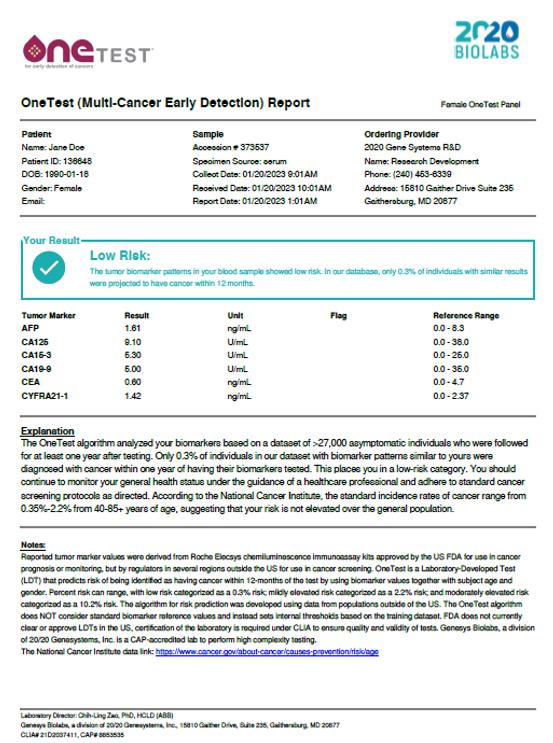
Our OneTest for Cancer algorithm combines the levels of protein biomarkers such as carcinoembryonic antigen, or CEA, alpha-fetoprotein, or AFP, prostate specific antigen, or PSA, and others, with patient information (e.g., age, gender, smoking history, etc.). We report the values of the biomarkers along with a proprietary score indicating the likelihood of being diagnosed with cancer within a year of the test date (a sample lab report for OneTest Standard is shown below).
2
OneTest Premium, introduced in late 2023, also includes inflammatory and metabolic biomarkers, which are essentially probing the affected individual’s immune and metabolic response to the cancer. Exclusively licensed from BioInfra Life Science, Inc., or BioInfra, OneTest Premium calculates the likelihood of eight specific tumor types rather than a pan-cancer likelihood score as is presented with OneTest Standard.
Since all the biomarkers tested in Standard are included in Premium, consumers of Premium, which comprise more than two-thirds of all OneTest customers, also get the Standard Report page.
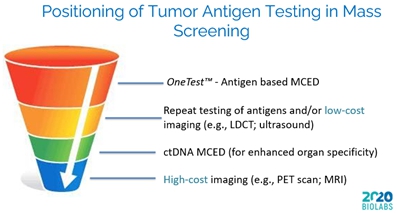
We have positioned OneTest as a “top of funnel” first screening test due to its relatively low cost, higher sensitivity for earlier stage cancers, and ease of access due to the small amount of blood required. Those with abnormal OneTest results should receive follow-up, which in many cases may be limited to repeat testing to establish biomarker baselines and assess changes in biomarker values over time. Significantly high values or concerning changes in these values can subsequently, under the auspices of a healthcare provider, be followed up by imaging and ctDNA based MCEDs, which can better pinpoint location and type of possible malignancies. By way of example, suspicious results on a “top of funnel” first screening test might be used to indicate a second screening test which could be a molecular (ctDNA sequencing) or imaging modality which in turn might lead to tissue biopsy as the definitive diagnostic. This approach very much differentiates OneTest from competing tests, including other MCED tests, whether based on ctDNA, protein biomarkers or other modalities. Most of these other screening tests are placed further down in the funnel and lead directly to more expensive and more invasive definitive diagnostic tests. As such, these competing modalities focus more on achieving the highest levels of specificity in order to reduce the number of false positive results that could lead directly to an expensive and invasive test. Because OneTest is positioned at the “top of the funnel,” immediate follow-up tests are less expensive and generally not invasive (beyond a second blood draw). The performance characteristics of OneTest are more focused on sensitivity and the detection of true positives, as a result of accepting a lower specificity, as false positives will be removed further down the testing funnel.
Key Competitive Advantages
Our patented MCED approach, based on PTMs versus ctDNA, provides the following advantages (we refer to these advantages as our Straight A’s): Affordability, Accuracy for Earlier Stage Cancers, Accessibility, Acceleration Over Time, AI Compatible, Assists Imaging, and Advisory Expertise.
Affordability. Since the analyzers and reagents we utilize in our lab are individually approved by U.S. Food and Drug Administration, or the FDA, and widely used around the world, and feature “walk-away” automation and robotics, the costs to run these tests are quite low compared to DNA sequencing. Since our labor and reagent costs are lower, we can pass these savings on to the customer. Furthermore, in most cases, follow-up testing of high biomarkers is covered by insurance if prescribed by the customer’s own healthcare provider and can be run by other labs in-network with the customer’s health insurance plan. Our OneTest Standard is priced at under $200 versus $950 for Grail’s Galleri, the only other MCED being widely marketed in the U.S. at this time.
3
Accuracy for Earlier Stage Cancers. Evidence suggests that tumor antigens (proteins) are more readily detectable in the blood at earlier stages than ctDNA. PTMs are produced in large quantities by living cancer cells as a part of their normal biological function. These proteins are subsequently released into the surrounding tissue and blood. On the other hand, ctDNA is derived from dying tumor cells at single copy number per cell and one would expect minimal cell death in early-stage cancers which consist of relatively few cells as the tumor is still quite small. While DNA detection methods are very sensitive, given the very low amount of ctDNA released into blood, a very large blood sample would need to be collected to expect the sample to actually contain the ctDNA. Indeed, clinical studies have demonstrated that the sensitivity of ctDNA-based MCEDs for early-stage cancers is less than 20% (see (i) Pons-Belda OD, Fernandez-Uriarte A, Diamandis EP. “Can Circulating Tumor DNA Support a Successful Screening Test for Early Cancer Detection? The Grail Paradigm.” Diagnostics (Basel). 2021 Nov 23;11(12):2171. doi: 10.3390/diagnostics11122171. PMID: 34943407; PMCID: PMC8700281; (ii) Pons-Belda OD, Fernandez-Uriarte A, Diamandis EP. “Multi Cancer Early Detection by Using Circulating Tumor DNA-The Galleri Test.” Reply to Klein et al. The Promise of Multicancer Early Detection. Comment on ‘Pons-Belda et al. Can Circulating Tumor DNA Support a Successful Screening Test for Early Cancer Detection? The Grail Paradigm. Diagnostics 2021, 11, 2171’. Diagnostics (Basel). 2022 May 17;12(5):1244. doi: 10.3390/diagnostics12051244. PMID: 35626399; PMCID: PMC9141547; and (iii) Bittla P, Kaur S, Sojitra V, Zahra A, Hutchinson J, Folawemi O, Khan S. “Exploring Circulating Tumor DNA (CtDNA) and Its Role in Early Detection of Cancer: A Systematic Review.” Cureus. 2023 Sep 22;15(9):e45784. doi: 10.7759/cureus.45784. PMID: 37745752; PMCID: PMC10516512).
On February 19, 2026, Grail announced results from the U.K.’s National Health Service trial which compared annual screening with the Galleri MCED based on ctDNA against routine screenings among 142,000 adults aged 50-77 years. The study found that adding Galleri to conventional screening failed to reduce later stage III-IV cancer diagnoses over three years. While there is no comparable prospective trial data for OneTest, the best available balance of evidence suggests that yearly screening with the biomarkers measured in OneTest, aided with machine learning, would reduce the numbers of late-stage diagnoses.
BioInfra, the developer of OneTest Premium, published data for their related test offered in Korea, iFINDER, which is only slightly different from the test we offer (“Diagnostic value of combining tumor and inflammatory biomarkers in detecting common cancers in Korea” (2021) Clinica Chimica Acta, 516, 169-178). At our request, the data was recalculated, restricting the biomarkers to those used in OneTest Premium and resetting the individual cutoffs to achieve greater than 98% specificity for each cancer type. This data is from case-control (retrospective) cohorts including 1199 subjects (607 cases and 592 controls). Resulting data from these training/validation cohorts are reported in the table below:
| Cancer | Stage | %
Sensitivity @98% Specificity | Cancer | Stage | %
Sensitivity @98% Specificity | |||||||||
| Lung | Overall | 51 | Prostate | Overall | 75.5 | |||||||||
| Stage I | 33.3 | Stage I | 100 | |||||||||||
| Stage II | 61.1 | Stage II | 58.3 | |||||||||||
| Stage Ill | 52.9 | Stage III | 88.9 | |||||||||||
| Stage IV | 90.5 | |||||||||||||
| Liver | Overall | 88.6 | Ovary | Overall | 73.7 | |||||||||
| Stage I | 85.7 | Stage I | 25 | |||||||||||
| Stage II | 90.9 | Stage II | 100 | |||||||||||
| Stage Ill | 100 | Stage III | 100 | |||||||||||
| Stage IV | 100 | Stage IV | 80 | |||||||||||
| Colorectal | Overall | 72.1 | Gastric | Overall | 33.3 | |||||||||
| Stage I | 64.3 | Stage I | 27.3 | |||||||||||
| Stage II | 80 | Stage II | 50 | |||||||||||
| Stage Ill | 75.9 | Stage III | 80 | |||||||||||
| Stage IV | 100 | Breast | Overall | 18.8 | ||||||||||
| Pancreas | Overall | 92.7 | Stage I | 15.4 | ||||||||||
| Stage I | 85.7 | Stage II | 15.4 | |||||||||||
| Stage II | 95.7 | Stage III | 57.1 | |||||||||||
| Stage Ill | 100 | |||||||||||||
| Stage IV | 85.7 | |||||||||||||
In the first quarter of 2023, BioInfra conducted a real-world analysis of their test performance based on data from Korean governmental cancer registries. It looked at results of the BioInfra test as reported in the health records of individual clients who purchased the test over several years (n=42,364) and correlated these results to health outcomes (cancer diagnoses) in the ensuing 12 months. The test performance was excellent compared to testing individual biomarkers alone, without our algorithms. BioInfra in their peer-reviewed publication, “Diagnostic value of combining tumor and inflammatory biomarkers in detecting common cancers in Korea” (2021) Clinica Chimica Acta, 516, 169-178, directly compared the area under the curve, or AUC, of the receiver operating characteristic curve for the MCED to that of single tumor markers (CEA for colon cancer, AFP for liver cancer, Cyfra 21.1 or CEA for lung cancer, PSA for prostate cancer). Note that a higher AUC indicates better performance and that the best possible AUC is 1.0.
4
| Cancer | MCED AUC | Single Marker AUC | ||||||
| Colon | 0.9603 | 0.7183 | ||||||
| Liver | 0.9685 | 0.7943 | ||||||
| Lung | 0.9424 | 0.7609 | ||||||
| Prostate | 0.9848 | 0.9635 | ||||||
Based on the retrospective (newly diagnosed cases) and prospective (pre-diagnostic cases) data available to date, the premium version is expected to have improved sensitivity and better organ specificity to help identify the tumor of origin. The following table summarizes the data available to date.
| Cancer | Sensitivity | Specificity | ||||||
| Liver | 47.1 | % | 98.7 | % | ||||
| Lung | 45.5 | % | 94.9 | % | ||||
| Pancreatic | 42.9 | % | 99.2 | % | ||||
| Prostate | 42.2 | % | 98.3 | % | ||||
| Colorectal | 34.0 | % | 97.8 | % | ||||
| Ovarian | 29.7 | % | 97.5 | % | ||||
| Breast | 20.2 | % | 96.5 | % | ||||
| Stomach | 8.6 | % | 98.4 | % | ||||
Typically, data generated from a pre-diagnostic cohort (i.e. specimens collected before a diagnosis) such as that shown above is less compelling data from newly diagnosed patients. It should also be noted that reducing the specificity to around 85% would substantially boost the sensitivity in a manner that would avoid missing many cancers while not a consequential number of false positives. We believe that with the “funnel” approach described above (i.e., repeating high biomarkers and utilizing ultrasound and other low-cost imaging technologies), a specificity of around 85% would identify most early stage cancer without causing too much expense to the healthcare system.
The following table demonstrates the performance of OneTest Premium for different cancer stages. The data is from case-control data provided by BioInfra (limiting to only the biomarkers used in OneTest Premium and holding the specificity for each cancer type at >98%). The specificity of our commercial test is approximately 95%, resulting in higher sensitivities than shown here. Please note that sensitivity is for single time point testing only. The sensitivity of most biomarkers in OneTest (CEA, carbohydrate antigen, or CA, 125, CA 19.9, AFP, PSA) have been shown in different studies to improve by 10-15% (absolute values) with serial (repeat) testing for cancers of the lung, ovaries, pancreas, liver and prostate.
| Sensitivity (@ >98% Specificity) | ||||
| Stage | OneTest | |||
| All | 62 | % | ||
| I | 44 | % | ||
| II | 61 | % | ||
| III | 77 | % | ||
| IV | 86 | % | ||
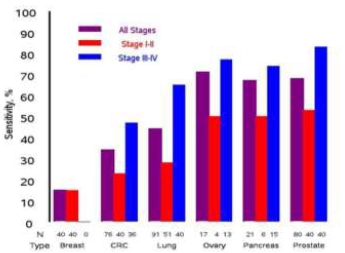
The OneTest data cited above was from an East Asian population. To assess our performance in an American cohort, in 2024, we participated in a blinded validation study of OneTest Premium sponsored and conducted by the NCI to compare the performance of various MCEDs. A more complete description of the study design can be found in LeeVan,E., et al., “Framework to Select Multi-Cancer Detection Assays in the National Cancer Institute’s Vanguard Study.” Cancer Epidemiol Biomarkers Prev (2025). We do not know which other companies were involved in this study, nor do we have access to the data from the other MCED tests to perform our own direct head-to-head comparison of the results. We were informed by several NCI staff scientists that our test was among the better performers in terms of sensitivity and specificity. Using blood specimens collected 18-30 years ago in healthy individuals up to six months prior to diagnosis as part of a prostate, lung, colorectal, and ovarian clinical trial, we correctly identified half of early stage pancreatic and ovarian cancers. The following graph was prepared by NCI’s new cancer screening research network team in May 2024. NCI estimated that the effective specificity of OneTest Premium was approximately 95%. For the purposes of this study, capillary collected samples were not available. However, as we have demonstrated equivalence in our labs between the use of capillary and venipuncture samples and as such the NCI study does inform on the performance of the capillary test by inference. Thus, we believe that the NCI study contributes to the validation of OneTest Standard and Premium.
5
Additional studies published in late 2025 using test panels nearly identical to OneTest build upon this evidence base. In a blinded validation study published in November 2025, investigators at MD Anderson Cancer Center reported that a protein based multicancer test—with most of the same biomarkers measured in OneTest (Standard version)—identified nearly 90% of early stage lung cancers and flagged multiple other cancers a median of 12–21 months prior to diagnosis, supporting the sensitivity of protein tumor markers during early oncogenesis. See “Validation of a blood test for multi-cancer risk stratification in a lung cancer screening cohort.” Fahrmann, et al. medRxiv preprint: https://doi.org/10.1101/2025.11.20.25340518.
A large, multicenter validation study published in October 2025 evaluated an AI enhanced blood test integrating seven well established protein tumor markers (6 of which are part of OneTest) across more than 15,000 participants from seven centers in three countries (USA, China, and Brazil). The study demonstrated consistent cancer signal detection across diverse populations, with measurable sensitivity even in Stage I disease and progressively higher detection rates as cancers advanced. See “A large-scale, multi-centre validation study of an AI-empowered blood-based test for multi-cancer early detection,” npj Precision Oncology volume 9, Article number: 321 (2025).
It should be noted that neither of the studies reported above use an identical product as our OneTest for Cancer. That said, they were close enough in terms of biomarkers analyzed and likely algorithm approach they support the validity of our test.
Accessibility. In 2024, our scientific and laboratory personnel successfully demonstrated equivalency in the performance of OneTest using capillary blood with that of venous blood. The requirement of engaging with a phlebotomist adds cost and burden to many of our customers, especially those who purchase OneTest online. Since our test requires only a fraction of the blood typically collected through venipuncture, we have shown that the test can function comparatively with capillary blood collected from fingerstick or the upper arm. Fortunately, several new devices are entering the market to improve capillary collection. Obviating the need for a phlebotomist should permit our test to be more easily accessed at pharmacy counters and even at home, thereby increasing uptake and adoption.
6
 |  |
The small quantities of blood required permits capillary (upper arm) blood collection that can be easily self-administered at home, at retail outlets including pharmacies, and at workplaces (e.g., fire stations), avoiding the need for special appointments with phlebotomists and painful needles. Ease of access boosts compliance with follow-up testing which aids in the earlier detection of more cancers.
Acceleration Over Time. Many studies suggest that annual screening with PTMs boosts sensitivity for many cancer types (lung, pancreatic, liver, etc.), as described in more detail in the table below.
| Tumor Antigen | Cancer Type | Evidence of Improvement in Detecting Early-Stage Cancers |
| CA125 | Ovarian | Early-stage detection improves from 10% to 50% in high-risk women if tested quarterly and from 25% to 40% in normal risk postmenopausal women if tested yearly. See Skates et al. CCR 2017, Rosenthal et. al. JCO 2017, Jacobs Menon et. al. Lancet 2015. |
| CA19-9 | Pancreatic | In a pre-diagnostic cohort (PLCO), levels of CA19-9 increased exponentially starting at 2 years prior to diagnosis with sensitivities reaching 60% at 99% specificity within 0-6 months prior to diagnosis for all cases and 50% at 99% specificity for cases diagnosed with early-stage disease. See Hanash et al. Lead-Time Trajectory of CA19-9 as an Anchor Marker for Pancreatic Cancer Early Detection - PubMed (nih.gov). |
| CA19-9 & CEA | Pancreatic | In a pre-diagnostic cohort (PLCO), levels of CA 19-9 and CEA demonstrated significant velocity related to time to diagnosis suggesting that serial measurements of these biomarkers may enhance panel performance. See Prediagnostic serum biomarkers as early detection tools for pancreatic cancer in a large prospective cohort study - PubMed (nih.gov). |
| CA-19-9 | Biliary Tract | CA19-9 remained stable in patients who were cancer-free but increased early in those who developed biliary tract cancer. See Regular CA19-9 measurement might improve early detection of these malignancies. https://doi.org/10.1111/apt.15146 |
| AFP | Liver | Most studies to date have evaluated AFP using a fixed threshold. We have found that algorithms that incorporate patient screening history increased the likelihood of earlier detection of hepatocellular carcinoma. The sensitivity of AFP alone was 59%. When we incorporate the trajectory, the sensitivity improves to 81%. See Tayob et al., Abstract #69, 11th NCI Early Detection Research Network Scientific Workshop (2019). |
| PSA | Prostate | The Maximum Likelihood Estimation-PSA, or MLE-PSA, model with a 50% cut-off probability has a sensitivity of 87%, specificity of 85%, positive predictive value, or PPV, of 89%, and negative predictive value, or NPV, of 82%. By contrast, a single PSA value with a 4ng/ml threshold has a sensitivity of 59%, specificity of 33%, PPV of 56%, and NPV of 36% using the same population of patients used to generate the MLE-PSA model. Based on serial PSA measurements, the use of the MLE-PSA model significantly (p-value < 0.0001) improves prostate cancer detection and reduces the need for prostate biopsy. See JDS-1173.pdf (jds-online.com). |
| CEA | Colorectal | In a study in the United Kingdom, CEA levels increased towards diagnosis in a significant proportion (1/3) of colorectal cancer cases (half of late-stage cases), whereas longitudinal profiles were static in both benign and non-cancer controls. Combining CEA with other biomarkers (e.g. CA-19.9) further improves detection capabilities for colorectal cancer according to various studies. See https://www.ncbi.nlm.nih.gov/pmc/articles/PMC4506388/. |
7
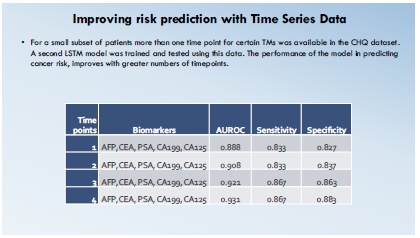
Throughout East Asia, tumor antigens are routinely tested as part of yearly health checkups. We obtained real-world data from a cohort 135,236 individuals tested with at least for tumor markers (AFP, CEA, PSA, CA 19-9, and CA 125) at Chongqing Hospital (CHQ) in China, of which 433 were subsequently diagnosed with cancer.
Computers in Biology and Medicine 144 (2022) 105362
Furthermore, repeat testing of slightly high biomarkers at ~2-month intervals substantially lowers false positive rates, according to the medical directors of health checkup centers at Chang Gung Memorial Hospital in Taiwan and Seoul National University Hospital in Korea. Both of these reputable medical institutions have at least two decades of experience offering PTMs for screening.
AI Compatible. We believe that analyzing well established biomarkers like tumor proteins and inflammatory biomarkers permits AI to be meaningfully leveraged both in test development and in the interpretation of results by end users. In certain regions of the world, especially East Asia, an aggressive cancer screening posture has been common for decades. Tens of millions of individuals in Japan, Korea, China, and Taiwan undertake 3-5 hour “health checks” each year that usually include blood tests for an array of cancers. Typically, these blood tests measure the levels of between three to eight tumor antigens, which are proteins secreted by tumors that can be detected using antibodies. Large-scale observational studies by our collaborators in Taiwan using data from cancer registries demonstrate that these tests are useful for detecting even early-stage cancers (see Y.-H. We et al., “Cancer screening through a multi-analyte serum biomarker panel during health check-up examinations: Results from a 12-year experience,” Clinica Chemica Acta 450 (2015)). However, using our patented methodology, this screening approach can be rendered significantly more accurate using machine learning algorithms that integrate the outcomes of tens of thousands of tested individuals together with clinical factors (e.g., age, gender, smoking history, etc.) with the biomarker levels (see “Improving Multi-Tumor Biomarker Health Check-up Tests with Machine Learning Algorithms,” Cancers, 2020 Jun 1;12(6):1442).
We have directly demonstrated this advantage in real-world population studies including 27,938 individuals performed in collaboration with researchers in East Asia, where tumor antigens are currently used to test millions of individuals without the added value of our AI-enhanced methods (see “Cancers Screening in an Asymptomatic Population by Using Multiple Tumour Markers.” PLoS One. 2016;11(6) and “Improving Multi-Tumor Biomarker Health Check-up Tests with Machine Learning Algorithms” Cancers 2020 Jun 1;12(6):1442). These studies/publications indicate clear and significant improvements in AUC, sensitivity, and specificity for overall cancers as well as individual cancers. This research and development collaboration was pursuant to an exclusive license, technology transfer and commercialization agreement that we entered into with Taiwan-based Chang Gung Medical Memorial Hospital, Linkou, or CGMH, on November 21, 2018, and an option agreement to obtain this license that we entered into with CGMH on April 17, 2017. Pursuant to this agreement, we obtained an exclusive license to make, have made, use, sell, import, commercialize and otherwise distribute any product or service, including but not limited to subscriptions to cloud-based software as a service, that contains, relies on or was developed by CGMH’s technology, which includes CGMH’s raw data (including biomarker values and clinical information from individuals screened for cancer with a blood test at CGMH’s facilities), code, software, algorithms, know-how and methodology associated with a multi-biomarker approach for the screening of at least three cancer types developed in part or entirely by the CGMH Department of Laboratory Medicine, as well as improvements and derivatives thereof; provided that CGMH has the right to improve and use its technology for experimental use and/or management of human patients at any CGMH facility in Taiwan. As consideration for this license, we paid an option fee of $75,000 and a license fee of $150,000 in cash and $300,000 in common stock (through the issuance of 92,025 shares of common stock) upon exercise of the option. As further consideration, we agreed to pay CGMH royalties in the amount of 6% of Net Sales (as defined in the agreement); provided that if we are required to pay royalties to a third party, then the royalty due to CGMH shall be reduced by 1% for each 1% due to such third party; and provided further, that such royalty shall not in any event be less than 3%. We also agreed to pay CGMH $100,000 in cash upon the earlier of (i) our reaching $2 million in net sales of the licensed products or (ii) when the cumulative profit margin due to sales directly attributable to CGMH’s technology is at least $450,000. Neither of these milestones has been met. This agreement also includes a transitional assistance project involving the provision of clinical data (including prospective data), algorithm improvements, serum sample testing services, and clinical consulting. The term of this agreement is for twenty years commencing on February 1, 2018 (the date that the option was exercised) and the last-to-expire licensed patent is scheduled to expire in 2036. As of December 31, 2025, we have paid $233,173 in royalties to CGMH pursuant to this agreement.
8
State-of-the-art machine learning and other AI based programs require large amounts of data. Because PTMs are widely used for screening and early used in East Asia there is much published and unpublished data that can be leveraged without the burden and expense of running our own large scale clinical trials. This advantage is covered in several of our issued patents and pending patent applications.
In addition to being embedded in OneTest, AI is used by our consumers to help them interpret test results. Competing tests like Galleri (Grail) and CancerGuard (Exact Sciences), which do not disclose the biomarkers or gene sequences analyzed, practice a so-called “black box” approach. In contrast, our lab reports clearly display the biomarkers and their levels as is common with routine lab tests. This permits consumers to optionally upload their lab results into their preferred large language models like Chat GPT or Claude along with other information about prior tests, health and family history, lifestyle, symptoms, etc. and receive interpretation or advice if they so desire.
Assists Imaging. Published studies conclude that PTMs like AFP, CEA, and CA 19.9 can help resolve ambiguous findings on an ultrasound or CT scan to aid in the early detection of liver, testicular, lung, and pancreatic cancers. This phenomenon would be especially helpful where customers are offered MCEDs, ultrasound, and LDCT scans. For example, a team led by Sam Hanash at the MD Anderson Cancer Center has demonstrated how the levels of CEA, CA-125, and Cyfra (all part of our MCED) can help determine whether a pulmonary nodule found on a low-dose CT scan is likely benign or malignant. Ostrin, E. J., et al. (2021). “Contribution of a Blood-Based Protein Biomarker Panel to the Classification of Indeterminate Pulmonary Nodules.” Journal of Thoracic Oncology, 16(2), 228–236. Additionally, a meta-analysis concluded that the addition of AFP to ultrasound significantly increases sensitivity for the early detection of liver cancer. Tzartzeva K, et al. (2018) “Surveillance Imaging and Alpha Fetoprotein for Early Detection of Hepatocellular Carcinoma in Patients With Cirrhosis: A Meta-analysis. Gastroenterology.” 154(6):1706-1718.e1.
Advisory Expertise. Unlike novel ctDNA targets, PTMs have been used clinically and in research studies for decades. This allows us to offer expert medical consultants who have vast experience in using these biomarkers over many years to help advise patients and their doctors. For example, our Medical Director Sean Wang, MD has over a decade of experience evaluating thousands of PTM screening reports in Taiwan.
The OneTest Machine Learning Algorithm
OneTest is built around the installed base of existing FDA approved tumor marker detection kits which run on automated instruments available from companies like Roche Diagnostics, Abbott Diagnostics, Siemens Diagnostics, and others. In the U.S., approval for most of these kits, except PSA, is for monitoring of disease recurrence, not screening. While we are using these approved kits in an off-label manner, this practice is permitted under the laboratory-developed test CLIA framework. One advantage to using these kits is that the analytical performance of these kits has been fully vetted by regulatory authorities ensuring the accuracy of individual marker value results. Furthermore, these tests and instruments are used in thousands of clinical testing labs worldwide, thereby permitting us to obtain data from around the world. Throughout East Asia in particular, millions of individuals have their tumor antigen levels tested each year at physical examination or health checkup centers. In many cases these tumor markers are tested using the same kits and instrumentation that we use in our CLIA laboratory. This has permitted us to develop machine learning algorithms based on historical outcome data from cancer registries that would otherwise require long and expensive prospective clinical trials if novel biomarkers are incorporated. One further advantage is that these markers are known and are meaningful to clinicians and specifically to oncologists. While their use in an MCED test is novel and proprietary, the individual marker values are always listed as a part of the OneTest standard report, and these values can help healthcare professionals to better guide follow-up testing and year-over-year monitoring.
9
In short, our unique technical approach involves the following three elements: (i) obtain “real-world” data from tens of thousands of apparently healthy individuals (i.e. no apparent signs of symptoms of cancer when tested) who are screened for cancer using blood tests that are routine in certain parts of the world (e.g. East Asia), (ii) use this data to build machine learning algorithms that improve the accuracy of those tests by integrating cancer outcomes and clinical factors (age, gender, etc.), and (iii) introduce those tests and algorithms worldwide, even in parts of the world where this testing approach is less common (e.g. North America), while examining variability across patient populations.
AI and machine learning are expected to transform healthcare by helping physicians diagnose and treat patients with greater accuracy and precision. As we continue to collect reliable outcome data (i.e., whether cancer was diagnosed) from individuals tested with the OneTest biomarkers (either from our customers or from research collaborators), our ability to leverage the latest and most powerful forms of machine learning will increase.
We have two issued U.S. patents, U.S. Patent No. 11,621,080 issued April 4, 2023, and U.S. Patent No. 12,051,509 issued July 30, 2024, titled “Methods and Machine Learning Systems for Predicting the Likelihood or Risk of Having Cancer” covering OneTest. Similar claim scope was granted in China on March 5, 2024. Additionally, on February 6, 2024, we were granted a patent in Japan titled “Cancer Classifier Models, Machine Learning and Methods of Use.” Our inventors were among the first to apply machine learning and AI to prospective outcome data from thousands of persons tested with protein tumor markers to predict a newly tested individual’s likelihood of having cancer. We expect to continue to build out our patent estate in this arena.
MCED Research, Development and Product Improvements
In October 2023, we introduced a “premium” version of OneTest at a higher price point. In connection with the development of OneTest Premium, in August 2022, we executed a technology license and access agreement with Korean-based BioInfra. BioInfra commercializes an MCED in Korea primarily based on the levels of tumor antigens, such as CEA, CA-125, etc. However, their panel also includes several inflammatory markers such as C-reactive protein, Transthyretin, Beta-2-Microglobulin, etc., that BioInfra has demonstrated to result in improved accuracy. This data is reported in the peer-reviewed journal article “Diagnostic value of combining tumor and inflammatory biomarkers in detecting common cancers in Korea,” Clinica Chimica Acta 516 (2021) 169–178. The license covers software, algorithms, and know-how, but no U.S. patents were or need to be licensed to us from BioInfra.
Under the terms of our agreement with BioInfra, we have the exclusive right to commercialize BioInfra’s test panel and algorithm in the United States, having paid the requisite up-front license fee of $300,000, which amount included $150,000 of pre-paid royalty credits, and commenced bridging studies to validate those algorithms on a Western population. In addition, we have agreed to pay per-test royalty fees in the range of $12-$25 per test for sales of our products using BioInfra’s technology. Our agreement with BioInfra is for a term of three (3) years and may be extended for an additional three (3) years if certain minimum royalties are met or if we conduct, or arrange for another party to conduct, a prospective clinical trial in the U.S. (we believe that the blinded validation study we conducted in 2024 with the NCI using prospectively collected blood specimens meets the criteria for a three year extension, but the agreement has not yet been formally extended). As of December 31, 2025, we have not paid any royalties under this agreement, other than the $150,000 of pre-paid royalty credits, which have not yet been exhausted.
OneTest for Longevity
The Problem
According to the U.S. Centers for Disease Control and Prevention, or the CDC, chronic diseases are the leading cause of premature death in America, responsible for eight out of the ten most common causes of mortality. These diseases, including cancer, type 2 diabetes, cardiovascular ailments, and dementia, are closely linked to chronic inflammation. A significant contributor to this inflammation is the consumption of processed foods, which are often high in sugars, unhealthy fats, and additives. We believe that new tools to measure and track chronic inflammation to inform and encourage better food and lifestyle choices are urgently needed.
10
Our Solution
In February 2026, we introduced and began promoting OneTest for Longevity, an AI powered blood test to measure and track biomarkers associated with chronic inflammation which, according to the CDC, is associated with 8 of 10 leading causes of death in America. We expect to maintain the Longevity test brand when marketing directly to consumers but will use OneTest for Workplace Wellness when marketing to self-insured employers (although we might also adopt other names when offering the test in conjunction with particular pharmaceuticals or medical devices.) The test offers specific and personalized diet and exercise changes proven to lower inflammation associated biomarker levels and the associated risk of type 2 diabetes, cancer, cardiovascular disease, dementia, mental health, and diseases associated with aging.
For this product, we are partnering with James R. Hébert, Ph.D. and his colleagues from the University of South Carolina. Hébert, a nutritional epidemiologist for over 30 years, is the author of Diet, Inflammation, and Health and the developer of the Dietary Inflammatory Index, or the DII, a numerical score that assesses a diet for its effect on several biomarkers linked to inflammation. The DII has been utilized in over 1,300 peer reviewed studies and validated in studies involving over 187,000 subjects. An AI avatar of Dr. Hébert is being developed, which is intended to permit users of this test to ask questions about improving their diet to lower levels of inflammation and improve health outcomes. Since he is an author of hundreds of peer-reviewed publications, this offers a corpus of published work which can be a rich training and reference dataset to train AI algorithms and create an authentic and scientifically accurate avatar for purposes of Q&A.
On February 14, 2025, we obtained exclusive rights to utilize, incorporate and report the DII score together with inflammatory biomarkers measured in a lab. Specifically, pursuant to a license agreement that we entered into with Connecting Health Innovations, or CHI, on February 14, 2025, we were granted an exclusive license in North America for the data, algorithms, programs, software and intellectual property rights developed by Dr. Hébert or others employed by or under contract with CHI for which CHI has intellectual property rights that calculates or displays, for individuals who inflammatory biomarker levels have been measured, (i) a numerical score associated with chronic inflammation that is calculated based on the biomarker levels, and (ii) specific dietary changes that can be made to lower inflammatory biomarker levels and associated risk for multiple chronic diseases. The license is limited to use in connection with clinical laboratory tests for the levels of biomarkers of inflammation and does not include stand-alone portals, websites, apps, or software that are not integrated or marketed with a clinical laboratory test. The license covers software, algorithms and know-how, but no patents were included. In exchange for the license, we agreed to pay CHI (i) a license fee of $30,000 payable within ten (10) business days of incorporation of the licensed subject matter into our laboratory information statement and (ii) royalties in the amount of ten percent (10%) of net sales of OneTest for Longevity. The term of the license is for three (3) years and may be terminated by us upon thirty (30) days’ notice; provided that either party may terminate the license immediately in the event of a material breach if such breach is not cured within thirty (30) days of written notice thereof. As of December 31, 2025, we have paid the license fee of $30,000, but no royalites have been paid.
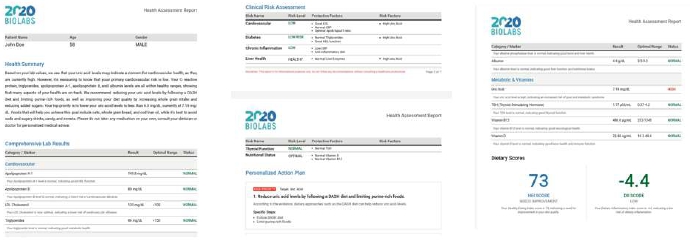
Below is a sample lab report that we expect to provide.
11
The Longevity test will be marketed directly to consumers—including through major supermarket chains beginning with Giant Foods, the largest supermarket chain in the Washington Metro region, through which we already offer OneTest for Cancer. It will also be marketed to self-insured employers under the brand name OneTest for Workplace Wellness.
In addition to direct marketing, we will also seek strategic partnerships with developers of drugs and medical devices that treat various chronic diseases. The effectiveness of many of these drugs may be enhanced for those patients who succeed in lowering their inflammatory biomarker levels over time through evidence-based diet and lifestyle improvements such as those we offer with the Longevity program. On March 18, 2026, we entered our first such arrangement through an exclusive U.S. license agreement with ROKIT Healthcare of Korea, or ROKIT. The license grants us the right to integrate ROKIT’s proprietary chronic kidney disease prediction algorithm into our Longevity test platform. Under the agreement, ROKIT agreed to reimburse us for one-third of mutually agreed sales and marketing expenses in exchange for a running royalty to ROKIT on net sales of the combined product. The companies also anticipate negotiating a separate agreement under which ROKIT may receive exclusive rights to commercialize our Longevity platform in Korea and potentially other East Asian markets. Clinical evidence suggests that patients with lower systemic inflammation, as measured by biomarkers such as CRP and IL-6, tend to experience more favorable biological responses to regenerative therapies such as ROKIT’s 3-D bio-printed tissue patches for burns, chronic kidney disease and heart failure.
In addition to providing biomarker levels and specific dietary recommendations, we also plan to offer electronic coupons for discounts for those suggested healthy food items. This has the dual benefit of motivating consumers to make better food selections while providing an ancillary revenue stream for both us and the participating supermarket (food manufacturers commonly remunerate distributors of redeemed coupons).
Key Competitive Advantages
Longevity tests on the market, such as those that measure telomere length or assess dozens of biomarkers or genetic mutations, tend to be expensive and rarely provide simple to understand, evidence based, practical and specific guidance for lifestyle changes proven to improve lifespan and health span. Microbiome testing has a further disadvantage in that it requires collecting stool specimens, which is unpopular with many consumers. Many of the labs that offer these tests also promote and sell dietary supplements, the safety and efficacy of which is often questionable.
We believe that OneTest for Longevity fills a compelling unmet need for an affordable, easily accessible test with actionable, evidence-based recommendations to reduce inflammation and the risk of most major chronic diseases. Our exclusive access to the DII for use with clinical lab test reporting, a unique food-frequency questionnaire, as well as the AI avatar from the developer of the DII, provides another level of distinctiveness.
Clinical Laboratory Innovation Accelerator (CLIAx)
To increase our menu of innovative tests faster and at a lower cost and risk than through internal development, in 2021 we established our CLIAx, which permits diagnostics start-up companies from around the world to launch their laboratory developed tests in our CLIA licensed laboratory using shared equipment and laboratory personnel. To date, we have enrolled the first company in our CLIAx, Minomic International, or Minomic, and helped it validate and launch its blood test to help determine whether PSA levels should be followed up with a biopsy. Our CLIAx, which we believe to be the first such shared CLIA laboratory facility in the U.S., reduces the costs and expense for start-up companies to launch their novel tests in the American market while providing us with sales and marketing rights to additional products. In 2022, it earned an “Honorable Mention” in Fast Company magazine’s list of “World Changing Ideas”.
12
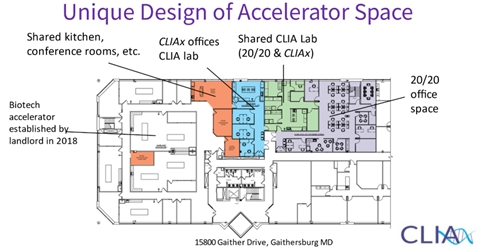
In July 2021, we entered a lab services and marketing agreement with Minomic under which its testing technology and reagents were transferred to our CLIA lab, installed, and validated under CLIA regulations. Under the agreement, Minomic maintains its ownership of all intellectual property. Minomic compensates us on a “cost plus” basis (i.e., our fully burdened costs for labor, materials, space and testing analyzers plus a 10% profit). Furthermore, we have the right, but not the obligation, to help market their test with a 25% commission. We have not yet opted to promote the Minomic test since it does not target our typical consumer base. However, we believe this framework will be apt for other lab tests that address the early detection, disease prevention and wellness market. The agreement with Minomic is for a term of three years and may be terminated by either party upon 30 days’ written notice if there has been a material breach of the agreement that has not been cured with 60 days of notice of such breach. Either party may also terminate the agreement in the event of insolvency, bankruptcy, assignment for the benefit of creditors of the other party or an admission of the party’s inability to pay its debts as they become due. While this agreement expired in July 2024, we continue to operate under the terms of the agreement although we have not promoted the Minomic test.
We plan to expand our capacity associated with our CLIAx. This would enable us to invest in, acquire, or transact with companies or academic medical centers that have tests that could add to our menu or technologies, products, testing components or intellectual property that strengthen our core business. We have identified a few companies that could be candidates for this CLIAx fund, but have no agreements, or letters of intent with any of them. Thus, there is no guarantee that we can identify or reach agreement in the near term with any such companies to meaningfully contribute to inorganic growth.
Field Tests for Screening Suspicious Powders
We have a longstanding business that makes and sells a proprietary test kit for screening suspicious powders called BioCheck. These kits are widely used by fire departments and other emergency responders to quickly screen unknown suspicious powders for compounds such as ricin, anthrax, and other bioweapon agents and to identify false alarms in minutes at the site of a suspected bioterror threat. The powder screening kit works by quickly identifying the presence or absence of protein, a biomolecule found in all living materials. It therefore provides a rapid screen for the possible presence of multiple bio-terrorism agents while ruling out most of the ordinary substances that citizens have frequently feared to be possible bio-agents of terror. Such ordinary substances include, for example, talc, ceiling tile dust, powdered sugar, etc., none of which are expected to contain detectable levels of protein. Though currently a small part of our revenue stream, this legacy business generates positive cash flow and provides leads and introductions for our MCED test due to overlapping fire department customers.
Lab Facility
We operate a high-complexity CLIA-licensed clinical laboratory facility where our lab tests are performed at our Gaithersburg facility. This clinical lab became accredited by CAP in 2022. Our CLIA lab is currently equipped with immunodiagnostic, clinic chemistry, and molecular (PCR) analyzers, extractors, and liquid-handling robots. CAP and CLIA regulations establish standards for proficiency testing, facility administration, general laboratory systems, preanalytic, analytic, and postanalytic systems, personnel qualifications and responsibilities, quality control, quality assessment, and specific cytology provisions for labs performing moderate to high complexity tests. Our laboratory is inspected biennially as part of its ongoing certification under the CLIA.
13
Supply Chain
For both OneTest for Cancer and OneTest for Longevity, we rely on a supply chain through Roche Diagnostics IVD kits for Cobas E411, with all reagents also available on other immunoassay platforms offered by major companies such as Abbott, Beckman, Siemens, and ThermoFisher (except for Cyfra and IL-6). Cyfra and IL-6 are only available in the United States on our current Roche equipment; however, as an alternative we could also source this assay on a Luminex system and various ELISA assay systems.
In addition to our OneTest, we also rely on a supply chain for general chemistry markers. Currently, these markers are run on Abbott Alinity C, but they are available through all major manufacturers, including Roche.
We have established reagent contracts with Roche and Abbott that guarantee pricing for all immunoassay and chemistry markers currently used in our diagnostic test panels. These contracts ensure that we can continue to provide our customers with high-quality diagnostic tests at predictable pricing. Additionally, these contracts provide us with supply chain stability and allow us to manage cost fluctuations associated with reagent pricing.
We depend on our suppliers and contract manufacturers to provide us and our customers with materials in a timely manner that meets our and their quality, quantity, and cost requirements. We have initiated a second source qualification process for most of these critical components, but we may not be successful in securing second sourcing for all of them on a timely basis. Moreover, while we are confident that other suppliers could meet our quality, quantity and cost requirements, the time required to transition to a new supplier could have negative impact on our ability to perform these tests until an alternative supplier could be validated. Our supply chain for OneTest is critical to our ability to deliver high-quality diagnostic tests to our customers.
Overall, we remain committed to building strong relationships with our suppliers and contract manufacturers to ensure that our supply chain for all our diagnostic tests is reliable, resilient, and able to meet the needs of our customers. We continuously monitor and improve our supply chain processes to minimize the risk of disruptions and ensure that we can provide high-quality diagnostic tests to our customers when they need them.
Please see Item 1A “Risk Factors—Risks Related to Our Business and Industry” for a description of the risks related to our supplier relationships.
Sales and Marketing Strategy
OneTest for Cancer
Sales of OneTest for Cancer have increased significantly in recent years, from $323,414 in 2022 to $1,803,707 in 2025. We utilize Business to Business (B2B) and Direct to Consumer (D2C) selling strategies to reach our customer base. For Employers, the largest subgroup is fire departments due to the proven higher cancer incidences in that population. Several states and at least one federal agency provide grants to reimburse fire departments for our test. Iraq war veterans are another growing customer segment, and our largest order in 2025 was from an organization supporting that community. In 2025, that organization used OneTest for Cancer to screen about 1,000 veterans and has informed us that at least 18 confirmed cancers were identified to date; many believed to be at earlier stages.
Occupational health is our largest physician specialty group ordering our tests. Penetration of this large occupational health market will require significant business-to-business sales and marketing campaigns as well as consumer-initiated test campaigns that must be coupled with convenient access to phlebotomy services and telemedicine practitioners to provide guidance on the test and its results. Retail (walk-in) clinics such as urgent care centers and pharmacy chains present the best opportunities to grow the consumer-initiated test market for OneTest.
We currently have engagements in place with over 1,000 retail clinics located throughout the U.S., mostly urgent care centers, to conduct blood draws for OneTest products and include over 200 locations of AnyLabTestNow. These clinics, coupled with a dedicated telemedicine service, have made it practical for us to initiate a consumer-initiated test campaign. In the future we expect to offer capillary collection options at retail venues and at home.
Furthermore, on January 6, 2025, we entered into a participation agreement and an amended and restated statement of work No. 2. with Ahold Delhaize USA Services LLC, an affiliate of Giant of Maryland, LLC, or Giant Food, the largest supermarket chain in the Washington, D.C. region. The participation agreement provides that we shall provide certain services as set forth in one or more statements of work. Pursuant to the amended and restated statement of work No. 2, we agreed to provide OneTest Standard and OneTest Premium testing to Giant Food customers at certain participating locations. We agreed to pay Giant Food $35 per individual participant. The participation agreement is for a term of three (3) months and will be reassessed for renewal for additional three (3) month terms on each anniversary of the effective date. Either party may terminate the participation agreement upon thirty (30) days’ written notice.
14
A new statement of work No. 3 is being finalized that is focused on offering our Longevity test at certain Giant Food supermarkets. For this product, consumers will be able to purchase in stores a kit for at-home, self-collection of capillary blood specimens. We anticipate that consumers of the Longevity test will receive discounts on nutritious groceries through Giant’s Loyalty Rewards App.
Several states are beginning to create large funds to reimburse their fire departments for multi-cancer screening tests. For example, New Hampshire’s program provides $5 million in funding over two years and Maryland increased their grant program for multi-cancer screening tests to $600,000 for their fiscal year beginning July 2025 from $400,000 in the prior year (typically, more than half of Maryland grants go to fire departments who elect to use our MCED). We expect more states to provide this type of reimbursement over the coming years. Additionally, in February 2025, the FIRE Cancer Act was reintroduced in Congress to provide $700 million in federal funding (through FEMA) for MCED testing.
As previously noted, on February 3, 2026, the Medicare Multi-Cancer Early Detection (MCED) Screening Coverage Act was signed into law. This law creates a pathway for Medicare coverage of MCEDs beginning in 2028. As discussed in the sections that follow, we intend to pursue Medicare coverage for our MCED as we believe it offers compelling advantages over competing tests.
OneTest for Longevity
We believe that nearly all Americans, from children through seniors, could benefit from OneTest for Longevity. This product clearly aligns with the “Make America Healthy Again” initiatives of the new Administration as it provides a unique and innovative tracking tool to encourage healthier eating to combat chronic diseases. On February 13, 2025, President Trump issued Executive Order 14212 “Establishing the President’s Make America Healthy Again Commission.” It noted in relevant part, that “[n]inety percent of the Nation’s $4.5 trillion in annual healthcare expenditures is for people with chronic and mental health conditions…To fully address the growing health crisis in America, we must re-direct our national focus, in the public and private sectors towards drastically lowering chronic disease rates…This includes fresh thinking on nutrition, physical activity, healthy lifestyles, over reliance on medication and treatments…[A]gencies shall ensure the…flexibility for health insurance coverage to provide benefits that support beneficial lifestyle changes and disease prevention…The Commission shall submit to the President a Make our Children Healthy Again Assessment, which shall…assess the threat that certain food ingredients…pose to children with respect to chronic inflammation and identify and report on the best practices for preventing childhood health issues, including proper nutrition and the promotion of healthy lifestyles.” (Emphasis added)
In recent years, millions of Americans have begun taking GLP-1 drugs like Ozempic, Wegovy, Mounjaro and Trulicity, and newer oral versions are in development. Our new blood test that tracks inflammatory biomarkers could be highly relevant for these patients in several ways:
| ● | Obesity and diabetes are inflammatory states: Adipose tissue secretes cytokines (IL-6, TNF-α, CRP) that drive systemic inflammation, worsening insulin resistance and vascular risk. |
| ● | GLP1 agonists reduce inflammation indirectly: By promoting weight loss, improving glycemic control, and possibly exerting direct anti-inflammatory effects on vascular endothelium, GLP-1 drugs reduce inflammation directly. |
| ● | Residual risk remains: Even with weight loss and glucose improvement, some patients still have elevated inflammatory biomarkers — a signal of ongoing cardiovascular risk. |
In addition to direct marketing, we will also seek to partner with developers of drugs and medical devices that treat various chronic diseases. The effectiveness of many of these drugs may be enhanced for those patients who succeed in lowering their inflammatory biomarker levels over time through evidence-based diet and lifestyle improvements such as those we offer with the Longevity program. Most notably, for those on GLP1 drugs, a blood test tracking chronic inflammation biomarkers could provide a new layer of insight into cardiovascular risk reduction. It would show whether therapy is not only lowering weight and glucose but also calming down the inflammatory processes that drive heart disease — helping clinicians personalize care and patients understand their progress more fully.
15
As discussed above, in March 2026, we entered our first agreement with a therapeutics company through an exclusive U.S. license agreement with ROKIT. Patients with lower systemic inflammation, as measured by biomarkers in our Longevity test, may respond more favorably and durably to ROKIT’s 3-D bio-printed tissue patches for burns, chronic kidney disease and heart failure. In addition to helping defray up to one-third of our sales and marketing expenses for the Longevity test, the ROKIT agreement might offer a precedent for partnering with other biotech and medtech companies to create companion diagnostics opportunities. ROKIT might also become a marking and distribution channel for us in Korea and perhaps other counties in East Asia.
Due to its broad market, we will utilize general advertising, both digital and traditional, to market OneTest for Longevity. We also plan to leverage our channel partnership with Giant Food to market to their customers. If the pilot with Giant is successful, we intend to expand to other national supermarket chains.
Considering both the profound change in public policy described above, coupled with the growing popularity of new weight-loss drugs, we are hopeful that reimbursement or other government backed incentives will be forthcoming. In the meantime, we believe that offering this test for around $189 (with subscription discounts of around $39 per month for four quarterly tests per year) coupled with easy, pain-free capillary blood collection accessible at home or local pharmacies will be met with widespread adoption.
Competition
Because of the substantial unmet medical need worldwide, many companies (and associated academic entities) are actively seeking to develop and commercialize tests of various types to detect cancer early, when it can be treated most effectively. Current approaches include in-vivo radiographic imaging as well as in-vitro tests using diverse bodily tissues and fluids including blood (serum or whole blood), urine, saliva, stool, sputum, and exhaled breath.
In the U.S., we know of no MCED blood tests that large numbers of Americans routinely utilize. Furthermore, there do not appear to currently be any companies in the U.S. that have adopted our approach of testing a panel of tumor antigens together with a machine learning algorithm. However, there is significant and growing competition in the MCED space with most tests using next-generation sequencing to analyze ctDNA. Most notably, Grail Inc., which was acquired by Illumina for $8 billion in 2020, introduced its Galleri test in the second quarter of 2021 at a price of $949. Additionally, Thrive, Inc. was acquired by Exact Sciences for $2 billion, but they have not publicly announced when they plan to launch their test CancerGuard MCED. These tests may present both competitive threats but also opportunities for OneTest. The fact that our test measures well known biomarkers creates several important competitive advantages. Our lower cost OneTest Standard with a list price of under $200 could be followed up with more expensive ctDNA tests and/or imaging for those individuals with high biomarkers levels or a high algorithm score.
In East Asia, where such biomarker tests are commonly offered as part of annual health check-ups, we are unaware of any widely used algorithms of the type we have developed, namely an algorithm built with real-world data from a large screening population with known cancer outcomes. However, there are many emerging companies seeking to use “liquid biopsy” and “next-gen sequencing” for pan-cancer testing. Furthermore, many companies are actively utilizing AI and machine learning to improve health outcomes, and at least some of those companies are likely seeking to use these techniques to improve cancer screening blood tests.
Regarding our longevity test, we are unaware of any labs offering a panel of inflammatory biomarkers together with specific dietary guidance directly linked to the biomarker levels. Some labs offer vague and generalized suggestions such as “eat more fruits and vegetables” but we will offer specific, evidence-based, quantitative guidance on how to lower CRP and IL-6 levels and what that yields in terms of improving lifespan and health outcomes.
Growth Strategies and Path to Profitability
We will strive to increase stockholder value by pursuing the following growth strategies:
| ● | Exploit our compelling advantage of at-home and retail collections. We believe that COVID-19 testing caused a paradigm shift in the way Americans seek access to testing. Previously, most testing was done at doctor’s offices and at specialty patient service centers maintained by the large national lab chains. During the pandemic, testing was conducted at retail establishments and at home. OneTest for Cancer utilizes small volume, capillary collected blood specimens that can easily be accessed at home and at retail venues such as pharmacies, health clubs, etc. This is a big advantage over most known competitors which need to utilize traditional venipuncture to obtain sufficient blood volumes to permit DNA sequencing. Requiring an in-person visit to a specimen collection site is a potential barrier for a person who needs testing. Our at-home specimen collection option may help eliminate these barriers. OneTest for Longevity also can utilize capillary collection. To date, we have demonstrated that this collection approach works well both at home and in retail environments (we are now offering our tests at pharmacies within Giant Food, the largest supermarket chain in the Washington, D.C. area). We also have a telemedicine provider available to authorize the test and be available to consult with the patient in the event of a high-risk score. We plan to expand direct-to-consumer marketing and build additional retail channel partnerships (supermarkets, pharmacies, health clubs, etc.) at which blood collection is not yet commonplace. |
16
| ● | Strategic partnerships and cooperative advertising. To facilitate scale while mitigating expenses, we have initiated an ambitious plan of marketing alliances and partnerships with an array of other companies, large and small, including suppliers, other clinical labs, and organizations that offer wellness and screening tests. In many cases we seek to introduce the cooperative advertising model where marketing expenses are shared pro rata based on revenue allotments. |
| ● | Leverage trending federal health initiatives. As stated, the Make America Healthy Again campaign of the Trump Administration, which is dedicated to reducing chronic disease through healthier diet, is expected to create numerous opportunities for OneTest for Longevity. We will closely follow and seek to make recommendations to and engage with the U.S. Department of Health and Human Services, or HHS, and its constituent agencies throughout 2026 to identify opportunities for government contracts, research grants, and other forms of support. |
| ● | Targeting higher-risk populations. We already target firefighters, due to their proven higher incidence and mortality rates for several types of cancer. Over 200 fire departments are OneTest customers to date, as are thousands of individual firefighters, and we expect to expand that number to over 2,500 fire departments, roughly 10% of all departments in the U.S. Additionally, in 2025 we sold over 1,005 tests to military veterans who served in Iraq or Afghanistan as it is believed that they were exposed to cancer causing toxins during their deployments. We will continue to explore other high-risk populations to target our tests. |
| ● | Strategic investments, acquisitions, and transactions. Utilizing our CLIAx as a platform, we plan to enter technology licensing and marketing agreements with companies that have intellectual property that improve our current tests or marketable tests that can be offered to our customers. In some cases, we hope to be positioned to make equity investments or acquisitions with one or more of these companies. |
Intellectual Property
The following table summarizes our patent portfolio. All of these patents and patent applications are owned by us.
| Description | Serial No./Patent No. | Jurisdiction | Projected Expiry | ||||
| Methods, Systems, Algorithms and AI for the Early Detection of Multi-Cancer and Lung Cancer | |||||||
| 1 | Algorithm for assessing the likelihood a patient has lung cancer | USPN 9,753,043 USPN 10,156,575 USPN 11,733,249 | US and CA | 2032 | |||
| 2 | Methods for aiding in distinguishing between benign and malignant pulmonary nodules | WO 2017/173428 | US and CN | 2037 | |||
| 3 | Algorithm for assessing the likelihood a patient has cancer | USPN 11,621,080 | US and CN | 2035-37 | |||
| 4 | Cancer Classifier Models | PCT/US19/40075 | US, CN and JP | 2039 | |||
| 5 | Methods and algorithms for identifying a patient for follow-up cancer diagnostic testing | WO 2021/247577 | US | 2041 | |||
| 6 | Pan cancer universal algorithm | WO 2022/015700 | US and CN | 2041 | |||
| 7 | Use of multiple tumor markers in a machine learning model for cancer detection | US 2018/0173847 | US and TW | 2036 | |||
No assurance is made that any pending patent applications within the portfolio will result in a granted patent.
To protect our intellectual property, we rely on a combination of laws and regulations, as well as contractual restrictions. We rely on Federal patent laws to protect our intellectual property, including our patented technology. We also rely on the protection of laws regarding unregistered copyrights for certain content we create and trade secret laws to protect our proprietary technology and know-how. To further protect our intellectual property, we enter into confidentiality agreements with our employees, executive officers and directors.
17
Employees
As of December 31, 2025, we had a total of 14 employees, including 4 full-time employees.
We believe that we maintain a satisfactory working relationship with our employees, and we have not experienced any significant labor disputes or any difficulty in recruiting staff for our operations. None of our employees are represented by a labor union.
Government Regulation
The healthcare industry, and thus our business, is subject to extensive federal, state, local and foreign regulations. Some of the pertinent laws and regulations have not been definitively interpreted by the regulatory authorities or the courts, and their provisions are open to a variety of subjective interpretations. In addition, these laws and their interpretations are subject to change.
Both U.S. federal and state governmental agencies continue to subject the healthcare industry to intense regulatory scrutiny, including heightened civil and criminal enforcement efforts. As indicated by work plans and reports issued by these agencies, the federal government will continue to scrutinize, among other things, the marketing, labeling, promotion, manufacturing, and export of diagnostic healthcare products. The federal government also has increased funding in recent years to fight healthcare fraud, and various agencies, such as the U.S. Department of Justice, the Office of Inspector General of HHS, and state Medicaid fraud control units, are coordinating their enforcement efforts.
FDA and CLIA
Based on widespread industry practice, we believe that our products do not require pre-market approval from the FDA. In the U.S., our current products are laboratory developed tests, or LDTs, regulated under the CLIA and the Maryland Department of Health. If in the future we elect to license or distribute software as a service those products would likely be deemed to be Clinical Decisions Support Software, or CDSS. As explained below, products in both of those categories do not require FDA pre-market approval but could become subject to the FDA’s policy of “enforcement discretion.”
Laboratory Developed Tests. LDTs are tests run in the laboratory of the company that developed them. With very rare exceptions, LDTs are not regulated by the FDA but rather under a different regulatory regime called CLIA (Clinical Laboratory Improvement Amendments), state law and regulations, and organizations such as CAP. Our laboratory is fully certified and compliant with CLIA as a “High Complexity Lab.” Furthermore, since 2022 our lab has been accredited by CAP.
Under current law there is no requirement for CLIA regulated LDTs to obtain approval or clearance from the FDA prior to being marketed (outside the context of tests used in response to a declared pandemic emergency under which the FDA has been given special statutory authorities). In November 2016, the FDA issued a formal statement clarifying that LDTs can be marketed without pre-market approval, but that the agency maintains “enforcement discretion” to require their approval for those LDTs that are marketed in a way that is unsafe or could mislead or cause harm to patients. Since November 2016, such enforcement discretion has been exercised very rarely, and when it has been exercised, the tests were not ordered by independent medical professionals. To reduce the likelihood that our tests will face enforcement discretion by the FDA, we request that our tests be ordered by a physician who is independent of our company and that the physician aid the patient/consumer in interpreting the test results.
On April 29, 2024, the FDA issued a final regulation under which they would begin to regulate LDTs starting in late 2027. The rule provides an exemption from premarket review for “currently marketed” LDTs that were “first marketed prior to the date of issuance of the final rule.” However, on March 31, 2025, a U.S. District Court in Texas ordered that FDA’s LDT final rule be vacated and set aside in its entirety. The FDA elected not to appeal the District Court decision. Thus, there is a consensus among legal experts that the FDA has no jurisdiction to regulate LDTs absent clear statutory authority from Congress. Heretofore bills to provide the FDA with this authority have failed to pass and we believe that there is very little likelihood of such a bill passing in the near future.
CDSS. On December 13, 2016, the 21st Century Cures Act, or the Cures Act, was signed into law. Among the many provisions of the Cures Act was the exclusion of certain medical decision support software from the FDA’s jurisdiction. On December 8, 2017, the FDA issued its first set of Draft Guidance to implement those provisions of the Cures Act relating to CDSS. Based on our reading of this Draft Guidance, we believe that there may be aspects of our current or planned OneTest software package that would be exempt from pre-market approval. If we elect to proceed with an independent software product in the U.S. (as we will likely do overseas), outside laboratories could run the OneTest biomarker panels (all of the detection instruments and kits are FDA approved).
18
Operating under the assumption that seeking FDA approval for our products is optional, but that approval could improve the adoption rates and permit greater scale, we may seek FDA approval when test volume exceeds the capacity of our CLIA laboratory. In so doing, we will seek regulatory counsel through a contracted firm and in conjunction with the FDA. We expect to present to the FDA real-world evidence, including data we continue to collect from tens of thousands of individuals tested with our products in the U.S. and overseas. On August 31, 2017, the FDA issued Guidance on the “Use of Real-World Evidence to Support Regulatory Decision-Making for Medical Devices.” This Guidance provides that “in some cases, a ‘traditional’ clinical trial may be impractical or excessively challenging to conduct” and that use of real-world data “may in some cases provide similar information with comparable or even superior characteristics to information collected and analyzed through a traditional clinical trial.” We believe that OneTest for Cancer, given its intended use as a “top-of-the-funnel” test to guide subjects to other diagnostic tests earlier, will fit into this category of tests for which real-world evidence is both acceptable and appropriate to support FDA approval, which will greatly reduce the costs associated with a regulatory filing.
Federal and State Fraud and Abuse Laws
We are subject to federal fraud and abuse laws such as the federal Anti-Kickback Statute, or AKS, the federal prohibition against physician self-referral, commonly known as the Stark Law, the Eliminating Kickbacks in Recovery Act, or EKRA, and the federal False Claims Act, or the FCA. We are also subject to similar state and foreign fraud and abuse laws.
The AKS prohibits knowingly and willfully offering, paying, soliciting, or receiving remuneration, directly or indirectly, overtly or covertly, in cash or in kind, in return for or to induce such person to refer an individual, or to purchase, lease, order, arrange for, or recommend purchasing, leasing or ordering, any item or service that may be reimbursable, in whole or in part, under a federal healthcare program, such as Medicare or Medicaid. There are a number of statutory exceptions and regulatory safe harbors to the AKS that provide protection from AKS liability to arrangements that fully satisfy the applicable requirements.
EKRA prohibits knowingly and willfully soliciting, receiving, offering or paying remuneration, directly or indirectly, in return for the referral of a patient to, or in exchange for an individual using the services of certain entities, including laboratories, if the services are covered by a health care benefit program. The term “health care benefit program” is broadly defined such that EKRA extends to referrals reimbursed by both governmental and commercial third-party payers. EKRA includes a number of statutory exceptions that provide protection from EKRA liability if the applicable requirements are met.
The Stark Law generally prohibits, among other things, clinical laboratories and other so-called “designated health services” entities from billing Medicare for any designated health services when the physician ordering the service, or any member of such physician’s immediate family, has a financial relationship, such as a direct or indirect investment interest in or compensation arrangement with the billing entity, unless the arrangement meets an exception to the prohibition. The Stark Law also prohibits physicians from making such referrals to a designated health services entity. There are also similar state laws that apply where Medicaid and/or commercial payers are billed.
The FCA imposes penalties against individuals or entities for, among other things, knowingly presenting, or causing to be presented, claims for payment to the government that are false or fraudulent, or knowingly making, using or causing to be made or used a false record or statement material to such a false or fraudulent claim, or knowingly concealing or knowingly and improperly avoiding, decreasing, or concealing an obligation to pay money to the federal government. This statute also permits a private individual acting as a “qui tam” whistleblower to bring actions on behalf of the federal government alleging violations of the FCA and to share in any monetary recovery. FCA liability is potentially significant in the healthcare industry because the statute provides for treble damages and mandatory penalties of $13,508 to $27,018 per false claim or statement for penalties assessed after January 30, 2023, with respect to violations occurring after November 2, 2015.
Other federal statutes pertaining to healthcare fraud and abuse include the civil monetary penalties statute, which prohibits, among other things, the offer or payment of remuneration to a Medicaid or Medicare beneficiary that the offeror or payer knows or should know is likely to influence the beneficiary to order or receive a reimbursable item or service from a particular provider, practitioner, or supplier, and contracting with an individual or entity that the person knows or should know is excluded from participation in a federal health care program. In addition, federal criminal statutes created by the Health Insurance Portability and Accountability Act of 1996, or HIPAA, prohibit, among other things, knowingly and willfully executing or attempting to execute a scheme to defraud any healthcare benefit program or obtain by means of false or fraudulent pretenses, representations or promises any money or property owned by or under the control of any healthcare benefit program in connection with the delivery of or payment for healthcare benefits, items or services.
19
In addition to these federal laws, there are often similar state anti-kickback and false claims laws that typically apply to arrangements involving reimbursement by a state-funded Medicaid or other health care program. Often, these laws closely follow the language of their federal law counterparts, although they do not always have the same exceptions or safe harbors. In some states, these anti-kickback laws apply with respect to all payers, including commercial payers.
A number of states have enacted laws that require pharmaceutical and medical device companies to monitor and report payments, gifts and other remuneration made to physicians and other healthcare providers, and, in some states, marketing expenditures. In addition, some state statutes impose outright bans on certain manufacturer gifts to physicians or other health care professionals. Some of these laws, referred to as “aggregate spend” or “gift” laws, carry substantial fines if they are violated.
Efforts to ensure that our business arrangements with third parties will comply with applicable healthcare laws and regulations will involve substantial costs and extensive annual trainings for all of our employees and contractors. If our operations are found to be in violation of any of these laws or any other governmental regulations that may apply to us, we may be subject to significant civil, criminal and administrative penalties, damages, fines, imprisonment, exclusion from participation in government-funded healthcare programs, such as Medicare and Medicaid, disgorgement, contractual damages, reputational harm, diminished profits and future earnings, additional reporting or oversight obligations if we become subject to a corporate integrity agreement or other agreement to resolve allegations of non-compliance with the law, and the curtailment or restructuring of our operations, any of which could adversely affect our ability to operate our business and our results of operations. If any of the physicians or other healthcare providers or entities with whom we do business is found to be not in compliance with applicable laws, they may be subject to criminal, civil or administrative sanctions, including exclusions from government-funded healthcare programs.
Anti-Corruption
The Foreign Corrupt Practices Act of 1977, or the FCPA, and similar international bribery laws make it unlawful for persons or entities to make payments to foreign government officials to assist in obtaining and maintaining business. Specifically, the anti-bribery provisions of the FCPA prohibit any offer, payment, promise to pay, or authorizing the payment of money or anything of value to any person, while knowing that all or a portion of such money or thing of value will be offered, given or promised, directly or indirectly, to a foreign official to do or omit to do an act in violation of his or her duty, or to secure any improper advantage in order to assist in obtaining or retaining business for or with, or directing business, to any person. In addition to the anti-bribery provisions of the FCPA, the statute also contains accounting requirements designed to operate in tandem with the anti-bribery provisions. Covered companies are required to make and keep books and records that accurately and fairly reflect the transactions of the company and devise and maintain an adequate system of internal accounting controls. With our international operations through our third-party partnerships, we could incur significant fines and penalties, as well as criminal liability, if we fail to comply with either the anti-bribery or accounting requirements of the FCPA, or similar international bribery laws. Even an unsuccessful challenge of our compliance with these laws could cause us to incur adverse publicity and significant legal and related costs.
Privacy and Data Protection Laws
Numerous federal and state laws and regulations, including HIPAA, as amended by the Health Information Technology for Economic and Clinical Health Act of 2009, or HITECH, govern the collection, dissemination, security, use and confidentiality of protected health information, or PHI, and personal information. In the course of performing our business we obtain personal information, including PHI. Laws and regulations relating to privacy, data protection, and consumer protection are evolving and, in some cases, particularly with regard to newer laws, may be subject to potentially differing interpretations. Under HIPAA and HITECH, the HHS issues regulations that establish uniform standards governing the conduct of certain electronic healthcare transactions and requirements for protecting the privacy and security of PHI, used or disclosed by covered entities, or CEs, and their authorized business associates, or BAs. Because we electronically transmit health care information, and we also provide certain services to CEs and receive PHI from them, we are at times either a CE or a BA, as defined by HIPAA. Our subcontractors that create, receive, maintain, transmit or otherwise process PHI on our behalf are HIPAA BAs and must also comply with HIPAA, as applicable.
20
HIPAA and HITECH include the privacy and security rules, breach notification requirements and electronic transaction standards. The privacy rule governs the use and disclosure of PHI, generally prohibits the use or disclosure of PHI except as permitted under the rule, and mandates certain safeguards to protect the privacy of PHI. The privacy rule also sets forth individual rights, such as the right to access or amend certain records containing such individual’s PHI, or to request restrictions on the use or disclosure of such individual’s PHI. The security rule requires CEs and BAs to safeguard the confidentiality, integrity, and availability of electronically transmitted or stored PHI (also referred to as ePHI) by implementing administrative, physical and technical safeguards. Under HIPAA’s breach notification rule, a CE must notify individuals, the Secretary of HHS, and in some circumstances, the media of certain breaches of unsecured PHI or ePHI, and similar breach notification provisions apply to certain BAs under HITECH.
Penalties for failure to comply with a requirement of HIPAA and HITECH vary depending on the number and nature of the violations and any history of prior violations but can be significant and include civil monetary or criminal penalties. HIPAA is enforced by the HHS, Office for Civil Rights, and HIPAA also authorizes state attorneys general to file suit on behalf of their residents for violations. Courts are able to award damages, costs and attorneys’ fees related to violations of HIPAA in such cases. While HIPAA does not create a private right of action allowing individuals to file suit in civil court for violations of HIPAA, its standards have been used as the basis for duty of care cases in state civil suits such as those for negligence or recklessness in improper use, access to or disclosure of PHI. In addition, HIPAA mandates that the Secretary of HHS conduct periodic compliance audits of HIPAA CEs, such as us, and their BAs for compliance with HIPAA privacy and security standards and breach notification rules. It also tasks HHS with establishing a methodology whereby harmed individuals who were the victims of breaches of unsecured PHI may receive a percentage of the civil monetary penalty paid by the violator.
In addition, we may be subject to state privacy, cybersecurity, and data breach notification laws, which may govern the collection, use, disclosure and protection of health-related and other personal information. California, for example, has enacted the Confidentiality of Medical Information Act, which, in addition to HIPAA and HITECH, sets forth standards with which all California health care providers must abide. Colorado has enacted the Colorado Privacy Act, and Virginia has enacted the Consumer Data Protection Act, both of which also have standards that must be complied with that supplement Federal data protection requirements. State laws may be more stringent, broader in scope or offer greater individual rights with respect to PHI than HIPAA, and state laws may differ from each other in regard to personal information treatment, which may complicate compliance efforts. For instance, the California Consumer Privacy Act, or CCPA, became effective on January 1, 2020 and was amended by the passage of the California Privacy Rights Act, or CPRA, in November of 2020, which amendments came into force on January 1, 2023. The CCPA, among other things, gives California residents expanded rights to access and delete their personal information, opt out of certain personal information sharing and receive detailed information about how their personal information is used by requiring covered companies to provide new disclosures to California consumers (as that term is broadly defined) and provide such consumers new ways to opt-out of certain sales of personal information. The CCPA provides for civil penalties for violations, as well as a private right of action for data breaches that is expected to increase data breach litigation. The CCPA has been amended from time to time, and it remains unclear what, if any, further modifications will be made to this legislation or how it will be interpreted. Although there are certain exemptions for PHI and clinical trial data, the CCPA’s implementation standards and enforcement practices are likely to remain uncertain for the foreseeable future and the CCPA may increase our compliance costs and potential liability. Additionally, the CPRA imposes additional data protection obligations on companies doing business in California, including additional consumer rights processes and opt outs for certain uses of sensitive data. It also creates a new California data protection agency – the California Privacy Protection Agency – specifically tasked to enforce the law, which would likely result in increased regulatory scrutiny of California businesses in the areas of data protection and security. Similar laws have been proposed in other states and at the federal level, and if passed, such laws may have potentially conflicting requirements that could continue to make compliance challenging and costly.
Additionally, the Federal Trade Commission, or the FTC, and state attorneys general enforce consumer protection laws that prohibit unfair and deceptive acts and practices and create standards for the collection, use, dissemination and security of health-related and other personal information. Claims of unfair or deceptive trade practices regarding privacy and security can lead to significant liabilities and consequences, including regulatory investigations, penalties, fines and orders as well as civil claims, which could impact our data practices and operations or cause reputational damage.
21
We may also be subject to laws and regulations in foreign countries covering data privacy and other protection of health and employee information that may add additional compliance burden and complexity. For example, in the European Economic Area, the collection and use of personal data is governed by the European Union’s General Data Protection Regulation, or the GDPR. In the United Kingdom, the GDPR has been adopted in substantially the same form, however the UK may potentially make revisions in the coming years. The GDPR, together with national legislation, regulations and guidelines of the European Union member states and the United Kingdom governing the processing of personal data, impose strict obligations and restrictions on the ability to collect, analyze, store, transfer and otherwise process personal data. European and United Kingdom data protection authorities may interpret the GDPR and national laws differently and impose additional requirements, which adds to the complexity of processing personal data in or from the European Economic Area or United Kingdom. Guidance on implementation and compliance practices is often updated or otherwise revised. The GDPR applies extra-territorially under certain circumstances and imposes stringent requirements on controllers and processors of personal data, including, for example, requirements to ensure a legal bases to process personal information, provide robust disclosures to individuals, facilitate data subject rights, provide data security breach notifications within 72 hours after discovering a breach in certain circumstances, limit retention of personal information and apply enhanced protections to health data and other categories of sensitive personal information. The GDPR also has requirements around international transfers of personal data. Requirements around transfers to the United States and other jurisdictions have increased since a July 2020 decision by the Court of Justice of the European Union invalidated the Privacy Shield as a basis to transfer personal data from Europe to the United States, and added requirements for reliance on Standard Contractual Clauses. Regulatory guidance on requirements for international transfers, and other GDPR compliance matters, continues to evolve. For example, the European Commission in December 2022 announced that it was beginning the process of drafting a new adequacy decision that would ease regulatory barriers for data transfers to the United States. However, it is widely expected that the new adequacy decision will itself face scrutiny from the Court of Justice, underscoring that GDPR compliance is an ongoing endeavor. Failure to comply with the requirements of the GDPR may result in fines of up to €20 million or up to 4% of the total worldwide annual turnover of our preceding fiscal year, whichever is higher, and other administrative penalties. To comply with the GDPR and other applicable international data protection laws and regulations, we may be required to put in place additional mechanisms ensuring compliance, which may result in other substantial expenditures.
Cybersecurity
Our business relies on secure and continuous processing of information and the availability of our information technology, or IT, networks and IT resources, as well as critical IT vendors that support our technology, research and other data processing operations. While we take steps to protect our systems and data, security incidents, data breaches, computer malware and computer hacking attacks have become more prevalent across industries, including the life sciences sector, and may occur on our systems or those of our third-party service providers. Unauthorized persons may in the future be able to exploit weaknesses in the security systems of our (or our third-party service providers) IT networks and gain access to PHI and other personal information, sensitive trade secrets, or other proprietary information. Any wrongful use or disclosure of PHI, other personal information, trade secrets or other proprietary information by us or our third-party service providers could subject us to regulatory fines or penalties, third-party claims or otherwise could adversely affect our business and results of operations. Although HIPAA and the regulations promulgated thereunder do not provide for a private right of action, failures to adequately protect PHI or our IT systems could be viewed as violations of HIPAA security rules or violations of other applicable information security laws, regulations, contractual obligations or industry standards, and could further result in costly data breach notification obligations that negatively impact our reputation.
Moreover, data security incidents or data breaches, as well as attacks on our IT systems, could result in operational disruptions or data loss or corruption that could adversely impact our business and operations, resulting in substantial investment of resources to investigate, recover and remediate and subject us to heightened regulatory scrutiny.
International Regulations
Many countries in which we may offer any of our diagnostic tests in the future have anti-kickback regulations prohibiting providers from offering, paying, soliciting or receiving remuneration, directly or indirectly, in order to induce business that is reimbursable under any national health care program. In situations involving physicians employed by state-funded institutions or national healthcare agencies, violation of the local anti-kickback law may also constitute a violation of the FCPA.
The FCPA prohibits any United States individual, business entity or employee of a United States business entity to offer or provide, directly or through a third party, including any potential distributors we may rely on in certain markets, anything of value to a foreign government official with corrupt intent to influence an award or continuation of business or to gain an unfair advantage, whether or not such conduct violates local laws. In addition, it is illegal for a company that reports to the U.S. Securities and Exchange Commission, or the SEC, to have false or inaccurate books or records or to fail to maintain a system of internal accounting controls. We will also be required to maintain accurate information and control over sales and distributors’ activities that may fall within the purview of the FCPA, its books and records provisions and its anti-bribery provisions.
The standard of intent and knowledge in anti-bribery cases is minimal. Intent and knowledge are usually inferred from that fact that bribery took place. The accounting provisions do not require intent. Violations of the FCPA’s anti-bribery provisions for corporations and other business entities are subject to a fine of up to $2 million and officers, directors, stockholders, employees, and agents are subject to a fine of up to $100,000 and imprisonment for up to five years. Other countries, including the United Kingdom and other OECD Anti-Bribery Convention members, have similar anti-corruption regulations, such as the United Kingdom Anti-Bribery Act.
22
When marketing our diagnostic tests outside of the United States, we may be subject to foreign regulatory requirements governing human clinical testing, prohibitions on the import of tissue necessary for us to perform our diagnostic tests or restrictions on the export of tissue imposed by countries outside of the United States or the import of tissue into the United States, and marketing approval. These requirements vary by jurisdiction, differ from those in the United States and may in some cases require us to perform additional pre-clinical or clinical testing. In many countries outside of the United States, coverage, pricing and reimbursement approvals are also required.
Market access, sales and marketing of medical devices in non-U.S. countries are subject to foreign regulatory requirements that vary widely from country to country. For example, in the European Economic Area, a medical device must meet the Medical Devices Directive’s/In Vitro Medical Devices Directive’s, or MDD/IVDD, Essential Requirements or, applicable on May 26, 2021, the Medical Devices Regulation’s, or MDR, or applicable on May 26, 2022, In Vitro Medical Devices Regulation’s, or IVDR, General Safety and Performance Requirements which apply to it, taking into account its intended purpose as defined by the data supplied by the manufacturer on the label, in the instructions for use or in promotional or sales materials or statements and as specified by the manufacturer in the clinical evaluation. Before placing a medical device on the European Economic Area market, the manufacturer must draw up a declaration of conformity, certifying that the device complies with the MDD/IVDD/MDR/IVDR, and must then affix the CE mark. For medium and high-risk devices as well as low risk devices that are placed on the market in sterile condition, have a measuring function, or are reusable surgical instruments, the manufacturer must obtain a CE certificate from a notified body. The notified body typically audits and examines the device’s technical documentation, including the clinical evaluation, and the quality system for the manufacture, design and final inspection of the relevant device before issuing a CE certificate. Following the issuance of this CE certificate, manufacturers may draw up the declaration of conformity and affix the CE mark to the devices covered by this CE certificate.
Manufacturers of medical devices must document in a clinical evaluation report, or CER, the evaluation of the clinical data related to the device. The CER is part of the device’s technical file. The evaluation shall document that the applicable Essential Requirements/General Safety and Performance Requirements are met and document the evaluation of the undesirable side-effects and the acceptability of the benefit-risk ratio. The CER must be updated based on information from the post-market surveillance and vigilance activities related to the device. The CER shall consist, inter alia, of analyzed clinical data collected from a clinical investigation of the device, or the results of other studies on substantially equivalent devices. Reliance on “substantially equivalent” devices is very restrictive and requires, inter alia, that the manufacturer has full access to the technical documentation of the equivalent device on an ongoing basis and, if the “equivalent device” is not its own, that the manufacture has in place a contract with the manufacturer of the “equivalent device.”
Environmental, Health and Safety Regulations
We are subject to various federal, state, local, and foreign environmental, health and safety laws and regulations and permitting and licensing requirements. Such laws include those governing laboratory practices, the generation, storage, use, manufacture, handling, transportation, treatment, remediation, release and disposal of, and exposure to, hazardous materials and wastes and worker health and safety. Our operations involve the generation, use, storage and disposal of hazardous materials, and the risk of injury, contamination or non-compliance with environmental, health and safety laws and regulations or permitting or licensing requirements cannot be eliminated. Compliance with environmental laws and regulations has not had a material effect on our capital expenditures, earnings or competitive position.
| ITEM 1A. | RISK FACTORS. |
An investment in our securities involves a high degree of risk. You should carefully read and consider all of the risks described below, together with all of the other information contained or referred to in this report, before making an investment decision with respect to our securities. If any of the following events occur, our financial condition, business and results of operations (including cash flows) may be materially adversely affected. In that event, the market price of our shares could decline, and you could lose all or part of your investment.
23
Risks Related to Our Business and Industry
With limited exceptions, we have incurred losses since our inception, and we expect to continue to generate losses for the foreseeable future.
While we achieved profitability in 2021 and 2022, such profitability was mainly a result of COVID-19 testing, which ceased in the second quarter of 2023. Prior to 2021, we incurred losses since inception. We have financed our operations through the sale of our securities, product revenues and government research grants and contracts. There is no assurance that we will be able to obtain adequate financing that we may need, or that any such financing that may become available will be on terms that are favorable to us and our stockholders. Ultimately, our ability to generate sufficient operating revenue to earn a profit depends upon our success in developing and marketing or licensing our diagnostic tests and technology. Any failure to do so could result in the possible closure of our business or force us to seek additional capital through loans or additional sales of our equity securities to continue business operations, which could dilute the value of any securities you hold, or could result in the loss of your entire investment.
We have incurred recent operating losses, which management anticipates may continue in the near term. To support ongoing operations and liquidity needs, subsequent to December 31, 2025 we have raised additional funding through a private placement of $5 million and convertible debt and bridge financing of $275,000. In addition, we have conducted a direct listing on Nasdaq as part of our capital-raising and strategic growth initiatives. Although management believes that the direct listing may enhance our access to public capital markets, there can be no assurance that such a transaction will be completed or that it will generate sufficient liquidity to fund operations.
Our company’s continuation as a going concern is dependent upon achieving continued revenue growth that exceeds spending increases, a trend that was achieved in 2025, with continued financial support from external financing to provide the necessary liquidity to meet its obligations as needed. Management believes that additional external financing can be obtained, including potential proceeds from other equity or debt financings. However, there can be no assurance of the success, timing, or terms of any future capital-raising activities. The sale of additional equity securities could result in dilution to our stockholders. The incurrence of indebtedness would result in increased debt service obligations and could require us to agree to operating and financial covenants that would restrict our operations. Financing may not be available in amounts or on terms acceptable to us, if at all. Any failure by us to raise additional funds on terms favorable to us, or at all, could limit our ability to expand our business operations and could harm our overall business prospects. If we cannot continue as a going concern, our stockholders would likely lose most or all of their investment in our company.
Our success will depend heavily on our cancer screening and longevity tests.
The bulk of our revenues depends almost entirely on the commercial success of our cancer tests unless we can also develop or acquire new tests for other diseases or chronic conditions. The commercial success and our ability to generate revenues will depend on a variety of factors, including the following:
| ● | competitive advantages |
| ● | patient acceptance of and demand for our tests; |
| ● | acceptance in the medical community; |
| ● | successful sales, marketing, and educational programs, including successful direct-to-patient marketing such as online advertising; |
| ● | the amount and nature of competition from other multi- cancer screening products and procedures; |
| ● | the ease of use of our ordering process for physicians; |
| ● | maintaining and defending patent protection of our intellectual property; and |
| ● | our ability to establish and maintain adequate commercial manufacturing, distribution, sales and CLIA laboratory testing capabilities. |
If we are unable to develop and maintain substantial sales of our tests or if we are significantly delayed or limited in doing so, our business prospects, financial condition and results of operation will be adversely affected.
24
We will need to attract additional capital to scale our business but have no assurance that we can do so successfully.
We will be incurring significant sales and marketing costs as we commercialize and scale up our diagnostic test products. We will need to raise additional capital to pay operating expenses until we are able to generate sufficient revenues from diagnostic test sales, royalties, and license fees, and we will need to sell additional equity or debt securities to meet those capital needs. Our ability to raise additional equity or debt capital will depend not only on progress made marketing and selling our diagnostic tests, but also will depend on access to capital and conditions in the capital markets. There is no assurance that we will be able to raise capital at times and in amounts needed to finance the development and commercialization of our diagnostic tests, maintenance of our CLIA certified diagnostic laboratory, and general operations. Even if capital is available, it may not be available on terms that we or our stockholders would consider favorable. Furthermore, sales of additional equity securities could result in the dilution of the interests of our stockholders.
We will spend a substantial amount of our capital on test validation, biomarker and data acquisitions, data analytics and algorithm development, but our products might not succeed in gaining widespread market acceptance.
We have developed and will continually refine new biomarker test panels and associated algorithms. The main focus of these products is on early detection of cancer. Our technologies may not prove to be sufficiently efficacious or medically useful to gain widespread adoption or market share. The diagnostics tests and software that we have introduced to the market to date have not yet generated significant revenues. Without diagnostic test sales or licensing fee revenues, we will not be able to operate at a profit, and we will not be able to cover our operating expenses without raising additional capital.
Medical organizations, physicians and employers may be reluctant to try a new diagnostic test due to the high degree of risk associated with the application of new technologies and diagnostic tests in the field of human medicine, especially if the new test differs from the current standard of care for detecting cancer in patients. Competing tests for the screening or initial diagnosis of cancer are being developed by more established and significantly better-financed diagnostics or biotech companies, and academic laboratories.
There also is a risk that our competitors may succeed in developing more accurate or more cost-effective diagnostic tests that could render our diagnostic tests and technologies obsolete or noncompetitive. Even if our tests are technically superior, we may not be able to differentiate our products sufficiently from our competition.
The success of our diagnostic tests depends on the degree of market acceptance by physicians, patients, government agencies and others who influence medical decision making.
The value of our diagnostic products is thus far proven mainly with real world evidence, rather than traditional clinical trials; and there is no assurance that real world evidence will gain wide acceptance by the medical establishment or regulators in the countries in which we conduct business. Also, there is no assurance that data derived from East Asia will be accepted in Western nations and generating data from Western populations could be time consuming and expensive. The value of machine learning and AI in our algorithms is novel, not entirely proven, and might not be widely embraced by the medical establishment or regulators in the countries in which we conduct business.
Our diagnostics tests may not gain market acceptance by physicians and others in the medical community. The degree of market acceptance of our tests will depend on a number of factors, including:
| ● | demonstrated sensitivity and specificity for detecting cancers; |
| ● | price; |
| ● | the availability and attractiveness of alternative screening methods; |
| ● | the willingness of physicians to recommend or prescribe our tests; |
| ● | the ease of use of our ordering process for physicians; and |
| ● | evidence that our tests confer a mortality benefit rather than merely shifting the stage of cancer at time of diagnosis. |
If our diagnostics tests do not achieve an adequate level of acceptance, we may not generate the substantial revenues we need to generate to remain profitable.
25
We are expecting patient self-pay to constitute a significant portion of our revenues for the foreseeable future and this revenue growth is contingent upon individuals’ willingness to pay out of pocket for our diagnostic tests.
We expect that a substantial portion of the patients for whom we will perform diagnostic tests will have Medicare as their primary medical insurance. Medicare coverage is not expected for several years. Patients who are not covered by Medicare will generally rely on health insurance provided by private health insurance companies. If we are considered a “non-contracted provider” by a third-party payer, that payer may not reimburse patients for diagnostic tests performed by us or doctors within the payer’s network of covered physicians may not use our services to perform diagnostic tests for their patients. As a result, we may need to enter into contracts with health insurance companies or other private payers to provide diagnostic tests to their insured patients at specified rates of reimbursement which may be lower than the rates we might otherwise collect.
Until our diagnostic tests are covered by Medicare or private insurance, we expect that self-pay will constitute a significant portion of our revenues for the foreseeable future. This revenue growth will be contingent on individuals’ willingness to pay out of pocket for our diagnostic tests.
The commercial potential of our longevity test is unknown and unproven.
While OneTest for Cancer has been on the market for several years, OneTest for Longevity remains in final development and has not yet been widely offered for sale or utilized outside of our organization. We do not know the costs of customer acquisition or whether the test will be embraced by the market. Despite the emphasis on chronic disease mitigation by the Secretary of HHS, we have no evidence that our test would ever be reimbursed or otherwise recommended by the Centers for Medicare & Medicaid Services, or the CMS, or any of the agencies that make up HHS. Our plans to introduce a subscription model may fail to be embraced by the marketplace and, if it is, we do not yet know what monthly or quarterly fee most consumers would be willing to pay. Our employer facing version of this test—OneTest for Workplace Wellness—might not get uptake by self-insured employers nor is it certain that it will generate enough return on investment to be a recurring purchase from these customers. The fact that we do not currently sell tests to large, self-insured employers provides sales and marketing risks.
The interface between the DII and our laboratory information system has not yet been implemented.
An important feature of OneTest for Longevity is the interface between the DII and our laboratory reports. A laboratory version of the DII for this purpose remains in the final stage of development by the team from CHI. We cannot guarantee that it will be ready in time for our product launch or that it will function through our portal and laboratory information system without technical issues.
The viability of offering automated, tailored coupons for grocery purchases is untested and unproven by us.
Part of our value proposition to consumers and revenue model for OneTest for Longevity includes automated coupons delivered to the customers’ mobile app for the foods recommended for them to lower inflammation. This concept remains mere conjecture at this stage, and we do not know whether food suppliers would be willing to share revenues with us when their coupons are redeemed, nor do we know how consumers will view this feature and what percentage will redeem the coupons.
Our CLIAx and CLIAx fund might not contribute to our growth.
Part of our growth strategy is to create a fund associated with our CLIAx. This would enable us to invest in, acquire, or transact with companies that have tests that could add to our menu or technologies, products, testing components or intellectual property that strengthen our core business. We have identified a few companies that could be candidates for this CLIAx fund but have no agreements or letters of intent with any of them. Thus, there is no guarantee that we can identify or reach agreement in the near term with any such companies to meaningfully contribute to inorganic growth.
We face substantial competition.
The development and commercialization of diagnostics tests, especially MCEDs, is highly competitive and subject to rapid technological advances. We face competition with respect to our current products and any product candidates we may seek to develop or commercialize in the future. Our competitors may develop comparable tests that are safer, more effective, more convenient or less costly than any products that we may develop or market or may obtain marketing approval for their products from the FDA or equivalent foreign regulatory bodies more rapidly than we may obtain approval for our product candidates. Our competitors may devote greater resources to market or sell their tests, research and development capabilities, adapt more quickly to new technologies, scientific advances or patient preferences and needs, initiate or withstand substantial price competition more successfully, or more effectively negotiate third-party licensing and collaborative arrangements. As a result, physicians and other key healthcare decision makers may choose other products over our products, switch from our products to new products or choose to use our products only in limited circumstances, which could adversely affect our business, financial condition, and results of operations.
26
Regarding our longevity test, we face many competitors that assess pathways of aging other than inflammation such as telomere length, methylation, microbiome, and others. Furthermore, many labs can test for C-reactive protein, the most important biomarker of inflammation. If consumers do not value the proprietary DII or grocery coupon components of our test, they may seek out alternative testing providers.
If our diagnostics tests do not perform as expected, are misused or misinterpreted, or the reliability of the technology is questioned, we could experience delayed or reduced market acceptance of the tests, increased costs and damage to our reputation. False positives or false negatives could cause harm to patients and could result in action taken against our company.
Our success depends on the market’s confidence that we can provide reliable, high-quality diagnostic tests. We believe that customers are likely to be particularly sensitive to product defects and errors. Our reputation and the public image of our diagnostic tests may be impaired if they fail to perform as expected or are perceived as difficult to use. Despite clinical verification studies, quality control and quality assurance testing, defects or errors could occur with tests.
In the future, if our diagnostic tests experience a material defect or error, this could result in loss or delay of revenues, delayed market acceptance, damaged reputation, diversion of development resources, legal claims, increased insurance costs or increased service and warranty costs, any of which could harm our business. Such defects or errors could also prompt us to amend certain warning labels or narrow the scope of the use of our diagnostic tests, either of which could hinder our success in the market. Even after any underlying concerns or problems are resolved, any widespread concerns regarding our technology or any manufacturing defects or performance errors in the test could result in lost revenue, delayed market acceptance, damaged reputation, increased service and warranty costs and claims against us.
Our inability to manage growth could harm our business.
We have added, and expect to continue to add, additional personnel in the areas of sales and marketing, laboratory operations, billing and collections, quality assurance and compliance. As we build our commercialization efforts and expand research and development activities, the scope and complexity of our operations is increasing significantly. As a result of our growth, our operating expenses and capital requirements have also increased, and we expect that they will continue to increase, significantly. Our ability to manage our growth effectively requires us to forecast expenses accurately, and to properly forecast and expand operational and testing facilities, if necessary, to expend funds to improve our operational, financial and management controls, reporting systems and procedures. As we move forward with commercializing our tests, we will also need to effectively manage our growing manufacturing, laboratory operations and sales and marketing needs. If we are unable to manage our anticipated growth effectively, our business could be harmed.
We currently manufacture our tests predominantly in one facility and perform our testing in one laboratory facility. As demand for our tests grows, we may lack adequate facility space and capabilities to meet increased processing requirements. Moreover, if these or any future facilities or our equipment were damaged or destroyed, or if we experience a significant disruption in our operations for any reason, our ability to continue to operate our business could be materially harmed.
We currently perform testing in a single laboratory facility in Gaithersburg, Maryland. Our headquarters and manufacturing facilities are also located in Maryland. As we expand sales and increase the number of tests processed by our laboratory facility, we may need to expand or modify our existing laboratory facility or acquire new laboratory facilities to increase our processing capacity. Any failure to do so on terms acceptable to us, if at all, may significantly delay our processing times and capabilities, which may adversely affect our business, financial condition, and results of operation.
If these, or any future facilities, were to be damaged, destroyed or otherwise unable to operate, whether due to fire, floods, storms, tornadoes, other inclement weather events or natural disasters, employee malfeasance, terrorist acts, power outages, or otherwise, our business could be severely disrupted. If our laboratory is disrupted, we may not be able to perform testing or generate test reports as promptly as patients and healthcare providers require or expect, or possibly not at all. If we are unable to perform testing or generate test reports within a timeframe that meets patient and healthcare provider expectations, our business, financial results, and reputation could be materially harmed.
27
We currently maintain insurance against damage to our property and equipment and against business interruption and research and development restoration expenses, subject to deductibles and other limitations. If we have underestimated our insurance needs with respect to an interruption, or if an interruption is not subject to coverage under our insurance policies, we may not be able to cover our losses.
There are a limited number of manufacturers of molecular diagnostic equipment and related chemical reagents necessary for the provision of our diagnostic tests.
The test panels and algorithms that we have developed and will continue to develop rely on certain analytic equipment. There are only a few manufacturers of the equipment we will need and the chemical reagents that are required for use with a particular manufacturer’s equipment will be available only from that equipment manufacturer. If the manufacturer of the equipment we acquire discontinues operation or if we and other testing laboratories experience supply or quality issues with their equipment or reagents, it may become necessary for us to adjust our products for different analytic equipment, which would require additional experiments to ensure reproducibility of our test results using the new equipment. As a result, we may be unable to provide our diagnostic products for a period of time.
Our suppliers may experience development or manufacturing problems or delays that could limit the growth of our revenue or increase our losses.
We may encounter unforeseen situations in the manufacturing of our diagnostic tests that could result in delays or shortfalls in production. Suppliers may also face similar delays or shortfalls. In addition, suppliers’ production processes may have to change to accommodate any significant future expansion of manufacturing capacity, which may increase suppliers’ manufacturing costs, delay production of diagnostic tests, reduce our product gross margin and adversely impact our business. If we are unable to keep up with demand for tests by successfully securing supply and shipping our diagnostic tests in a timely manner, our revenue could be impaired, market acceptance for the tests could be adversely affected and our customers might instead purchase our competitors’ diagnostic tests.
To achieve widespread use of our diagnostic test and commercial scale, some individual consumers may need convenient access to blood draw services, but we cannot guarantee that these service providers will be willing to perform them.
Currently, some of those who use our tests prefer traditional venous blood collected by a licensed phlebotomist. While our business customers, such as employers, typically have little difficulty finding phlebotomists, this can be a challenge for many of our individual consumers. To address this need, we have about 1,000 retail establishments that can draw blood for our test customers. These establishments perform these services based on contracts we have with the companies Any Lab Test Now and My One Medical Source. If those contracts were to terminate or expire or if they are unable to maintain their franchisees or networks of clinics willing to draw blood, this could limit our ability to serve our customers and grow.
Our capillary blood collection devices are manufactured by other companies, and we cannot guarantee that we will have a continued supply of these devices or that the costs for them will not rise significantly.
Since we began validating and offering capillary (upper arm) blood collection, about two-thirds of our customers have elected that approach over traditional venipuncture with high success and satisfaction rates. Currently, there are only three or four manufacturers with FDA cleared upper arm collection devices and not all reliably collect the required 0.5ml of whole blood needed for our cancer MCED. Thus, if these collection device suppliers go out of business, experience supply chain disruptions, or substantially raise their prices, this could significantly disrupt our business operations.
We have limited sales and marketing resources and few distribution resources for the commercialization of any diagnostic tests that we have developed.
We currently have limited sales and marketing resources. If we are successful in developing marketable diagnostic tests, we will need to build our own marketing and sales capability, which would require the investment of significant financial and management resources to recruit, train, and manage a sales force.
28
The sizes of the markets for our diagnostic tests and services and any future diagnostic tests and services may be smaller than we estimate and may decline.
Our estimates of the annual total addressable market for our diagnostic tests and services are based on a number of internal and third-party estimates and assumptions, including, without limitation, the assumed prices at which we can sell our diagnostic tests and services in the market. While we believe our assumptions and the data underlying our estimates are reasonable, these assumptions and estimates may not be correct and the conditions supporting our assumptions or estimates may change at any time, thereby reducing the predictive accuracy of these underlying factors. As a result, our estimates of the annual total addressable market for our diagnostic tests and services in different market segments may prove to be incorrect. If the actual number of patients who would benefit from our diagnostic tests, the price at which we can sell them or the annual total addressable market for them is smaller than we have estimated, it may impair our sales growth and negatively affect our business, financial condition and results of operations.
If we fail to enter into and maintain successful strategic alliances for diagnostic tests that we elect to co-develop, co-market, or out-license, we may have to reduce or delay our diagnostic test development or increase our expenditures.
To facilitate the development, manufacture, and commercialization of our diagnostic tests we may enter into strategic alliances with hospitals and biomedical research institutes, biotechnology and diagnostics companies, clinical testing reference laboratories, and marketing firms in many of the countries in which we do business. We will face significant competition in seeking appropriate alliances. We may not be able to negotiate alliances on acceptable terms, if at all. If we fail to create and maintain suitable alliances, we may have to limit the size or scope of, or delay, one or more of our product development or research programs, or we may have to increase our expenditures and may need to obtain additional funding, which may be unavailable or available only on unfavorable terms.
In some countries we may license marketing rights to diagnostics or clinical laboratory companies or to a joint venture company formed with those companies. Under such arrangements we might receive only a royalty on sales of the diagnostic tests developed or an equity interest in a joint venture company that develops the diagnostic test. As a result, our revenues from the sale of those diagnostic tests may be substantially less than the amount of revenues and gross profits that we might receive if we were to market and run the diagnostic tests ourselves.
We may become dependent on possible future collaborations to develop and commercialize many of our diagnostic test candidates and to provide the manufacturing, regulatory compliance, sales, marketing and distribution capabilities required for the success of our business.
We may enter into various kinds of collaborative research and development, manufacturing, and diagnostic test marketing agreements to develop and commercialize our diagnostic tests. There is a risk that we could become dependent upon one or more collaborative arrangements. A collaborative arrangement, upon which we might depend might be terminated by our collaboration partner or they might determine not to actively pursue the co-development of our diagnostic tests. A collaboration partner also may not be precluded from independently pursuing competing diagnostic tests or technologies.
The success of our business is substantially dependent upon the efforts of our senior management team and our ability to attract additional personnel.
Our success depends largely on the skills, experience, and performance of key members of our senior management team who are critical to directing and managing our growth and development in the future. Our success is substantially dependent upon our senior management’s ability to lead our company, implement successful corporate strategies and initiatives, develop key relationships, including relationships with collaborators and business partners, and successfully commercialize products and services. While our management team has significant experience developing diagnostic products, we have considerably less experience in commercializing these products or services. The efforts of our management team will be critical for us as we develop our technologies and seek to commercialize our tests and other products and services.
Our success also depends in large part on our ability to attract and retain managerial personnel. Competition for desirable personnel is intense, and there can be no assurance that we will be able to attract and retain the necessary staff. The failure to maintain management or to attract sales personnel could materially adversely affect our business, financial condition, and results of operations.
Certain jurisdictions in which we may do business may not provide the same level of legal protections and enforcement of contract and intellectual property rights to which investors are accustomed in the United States.
We may conduct business in China and other foreign jurisdictions. In order to do business in these countries, we will be required to comply with the laws of those countries, including restrictions on exporting currency, requirements for local partners, tax laws and other legal requirements. Doing business in such foreign jurisdictions also entails political risk over which we have no control and for which we are unable to obtain insurance on acceptable terms. These countries also have different judicial systems, which may not provide the same level of legal protections and enforcement of contract and intellectual property rights to which investors are accustomed in the United States. We can provide no assurance that the applicable laws of such foreign jurisdictions will not be changed in ways unfavorable to us, or that applicable laws will be adequately enforced in order to provide the same levels of protection accorded to us in the United States.
29
Adverse U.S. and global market, economic and political conditions, including the ongoing conflict between Ukraine and Russia, recent events in the Middle East and other events or circumstances beyond our control could have a material adverse effect on us.
Another economic or financial crisis or rapid decline of the consumer economy, significant concerns over energy costs, geopolitical issues, including the ongoing conflict between Ukraine and Russia, recent events in the Middle East, the availability and cost of credit, the U.S. mortgage market, or a declining real estate market in the U.S. can contribute to increased volatility, diminished expectations for the economy and the markets, and high levels of structural unemployment by historical standards. Market, political and economic challenges, including dislocations and volatility in the credit markets, general global economic uncertainty, uncertainty or volatility from matters such as the implementation of the governing agenda of President Donald J. Trump, and changes in governmental policy on a variety of matters such as trade, tariffs and manufacturing policies may adversely affect the economy and financial markets, our financial condition, results of operations, cash flows and our ability to pay distributions on, and the per share trading price of, our common stock.
The Russian invasion of Ukraine in February 2022 and the resulting global governmental responses, including international sanctions imposed on Russia and other countries that are supporting Russia’s invasion of Ukraine, have led to volatility in global markets, disruptions in the energy, agriculture and other industries and have created worldwide inflationary pressures. While the conflict has not caused material disruptions to our operations to date, further escalation of the war between Russia and Ukraine could result in a significant decline in global economic activities and impact our business.
The obligations associated with being a public company will require significant resources and management attention, and we will incur increased costs.
Prior to the completion of our direct listing in February 2026, we were required to publicly report on an ongoing basis under the reporting rules set forth in Regulation A of Section 3(6) of the Securities Act of 1933, as amended, or the Securities Act, for Tier 2 offerings. We are now required to publicly report on an ongoing basis under the reporting rules of the Securities Exchange Act of 1934, as amended, or the Exchange Act. The ongoing reporting requirements under Regulation A are more relaxed than for public companies reporting under the Exchange Act. For instance, we were previously required to file only annual and semiannual reports. The reporting requirements of the Exchange Act require that we file annual, quarterly and current reports with respect to our business and financial condition, and proxy and other information statements. We must also comply with rules and regulations implemented by the SEC, the Sarbanes-Oxley Act of 2002, or the Sarbanes-Oxley Act, the Dodd-Frank Wall Street Reform and Consumer Protection Act of 2010, the Public Company Accounting Oversight Board, and the listing requirements of the Nasdaq Stock Market LLC, or Nasdaq, each of which imposes additional reporting and other obligations on public companies.
We expect these rules and regulations, and any future changes in laws, regulations and standards relating to corporate governance and public disclosure, which have created uncertainty for public companies, to increase legal and financial compliance costs and make some activities more time consuming and costly. These laws, regulations and standards are subject to varying interpretations, in many cases, due to their lack of specificity, and, as a result, their application in practice may evolve over time as new guidance is provided by regulatory and governing bodies. This could result in continuing uncertainty regarding compliance matters and higher costs necessitated by ongoing revisions to disclosure and governance practices. Our investment in compliance with existing and evolving regulatory requirements will result in increased administrative expenses and a diversion of management’s time and attention from revenue-generating activities to compliance activities, which could have a material adverse effect on our business, financial condition and results of operations.
We may not complete our analysis of our internal control over financial reporting in a timely manner, or these internal controls may not be determined to be effective.
We will be required, pursuant to Section 404 of the Sarbanes-Oxley Act, to furnish a report by management on, among other things, the effectiveness of our internal control over financial reporting in the second annual report we file with the SEC. This assessment will need to include disclosure of any material weaknesses identified by our management in our internal control over financial reporting. However, our auditors will not be required to formally attest to the effectiveness of our internal control over financial reporting pursuant to Section 404 until we are no longer a non-accelerated filer, or no longer an emerging growth company if we take advantage of the exemptions available to us through the Jumpstart Our Business Startups Act of 2012, or the JOBS Act.
30
We are in the very early stages of the costly and challenging process of compiling the system and process documentation necessary to perform the evaluation needed to comply with Section 404. In this regard, we will need to continue to dedicate internal resources, engage outside consultants and adopt a detailed work plan to assess and document the adequacy of internal control over financial reporting, continue steps to improve control processes as appropriate, validate through testing that controls are functioning as documented and implement a continuous reporting and improvement process for internal control over financial reporting. As we transition to the requirements of reporting as a public company, we may need to add additional finance staff. We may not be able to remediate any future material weaknesses, or to complete our evaluation, testing and any required remediation in a timely fashion. During the evaluation and testing process, if we identify one or more material weaknesses in our internal control over financial reporting, we will be unable to assert that our internal controls are effective. If we are unable to assert that our internal control over financial reporting is effective, or if our auditors are unable to express an opinion on the effectiveness of our internal controls when they are required to issue such opinion, investors could lose confidence in the accuracy and completeness of our financial reports, which could harm our stock price.
We have previously restated our financial statements and may be required to restate our financial statements in the future, which could materially and adversely affect our business, financial condition, results of operations and the trading price of our securities.
During the preparation of our financial statements for the nine months ended September 30, 2025, we identified certain errors in the accounting for stock-based compensation expense related to vesting of stock option awards granted to certain employees and executives in 2024. Specifically, we calculated a 25% vesting of certain options at the end of year one instead of upon issuance of the stock option. These modifications resulted in additional stock-based compensation expense that was not properly recorded in the year ended December 31, 2024. As a result, we restated our previously issued financial statements for the year ended December 31, 2024. We continue to refine our accounting policies, procedures and systems but there can be no assurance that previously issued financial statements will not require further correction. If we discover new accounting errors or determine that additional adjustments are necessary, we may be obligated to restate our historical financial statements.
Restatements frequently provoke heightened scrutiny from the SEC, the Public Company Accounting Oversight Board, other federal or state regulatory authorities and Nasdaq. Regulatory inquiries or investigations typically consume significant management attention, require substantial legal and accounting expenditures, and may result in enforcement proceedings, monetary penalties or mandated changes to our governance and controls. Restatements also may result in litigation, including class actions and stockholder derivative suits, which can be costly to defend and, if resolved unfavorably, impose damages or injunctive relief that could restrict our operations. The announcement of a restatement may erode investor confidence in the reporting financial information, reduce trading liquidity and increase stock price volatility and cause the trading price of our common stock to decline. Any of these risks could have a material adverse effect on our business, financial condition, results of operations and the market price of our common stock.
Risks Related to Intellectual Property
If we are unable to obtain and enforce patents and to protect our trade secrets, others could use our technology to compete with us, which could create undue competition and pricing pressures. There is no certainty that our pending or future patent applications will result in the issuance of patents or that our issued patents will be deemed enforceable.
The success of our business depends significantly on our ability to operate without infringing patents and other proprietary rights of others. If the technology that we use infringes a patent held by others, we could be sued for monetary damages by the patent holder or its licensee, or we could be prevented from continuing research, development, and commercialization of diagnostic tests that rely on that technology, unless we are able to obtain a license to use the patent. The cost and availability of a license to a patent cannot be predicted, and the likelihood of obtaining a license at an acceptable cost would be lower if the patent holder or any of its licensees is using the patent to develop or market a diagnostic test with which our diagnostic test would compete. If we could not obtain a necessary license, we would need to develop or obtain rights to alternative technologies, which could prove costly and could cause delays in diagnostic test development, or we could be forced to discontinue the development or marketing of any diagnostic tests that were developed using the technology covered by the patent.
We have issued patents and patent applications pending worldwide that are owned by or exclusively licensed to us. We and our collaborators expect to continue to file and prosecute patent applications covering the products and technology that we commercialize. However, there is no assurance that any of our licensed patent applications, or any patent applications that we have filed or that we may file in the future in the United States or abroad, will result in the issuance of patents.
Our success will depend in part on our ability to obtain and enforce patents and maintain trade secrets in the United States and in other countries. If we are unsuccessful in obtaining and enforcing patents, our competitors could use our technology and create diagnostic tests that compete with our diagnostic tests, without paying license fees or royalties to us.
The relatively recent Supreme Court decisions in Mayo Collaborative Services v. Prometheus Laboratories, Inc. and Alice Corp. v. CLS Bank Int’l may adversely impact our ability to obtain strong patent protection for some or all of our diagnostic tests and associated algorithms.
31
The preparation, filing, and prosecution of patent applications can be costly and time consuming.
The preparation and filing of patent applications, and the maintenance of patents that are issued, may require substantial time and money. A patent interference proceeding may be instituted with the U.S. Patent and Trademark Office when more than one-person files a patent application covering the same technology, or if someone wishes to challenge the validity of an issued patent. Furthermore, our limited financial resources may not permit us to pursue patent protection of all of our technology and diagnostic tests throughout the world, even where we have legally binding patent protection and trade secret rights. Even if we are able to obtain issued patents covering our technology or diagnostic tests, we may have to incur substantial legal fees and other expenses to enforce our patent rights in order to protect our technology and diagnostic tests from infringing uses. We may not have the financial resources to finance the litigation required to preserve our patent and trade secret rights.
Our patents may not protect our diagnostic tests from competition.
We might not be able to obtain any patents beyond those that have been issued by the U.S. Patent and Trademark Office, and any patents that we do obtain might not be comprehensive enough to provide us with meaningful patent protection. There will always be a risk that our competitors might be able to successfully challenge the validity or enforceability of any patent issued to us.
If we fail to meet our obligations under various license, license option, and technology transfer agreements, we may lose our rights to key technologies or data sources on which our business depends.
Our business will depend on several critical technologies and data sources that have licenses from various domestic and overseas companies and research centers. Importantly, if we fail to meet our obligations under our technology access agreement with BioInfra, this would adversely impact our ability to introduce an enhanced or premium version of our MCED test. These and other license agreements typically impose obligations on us, including payment obligations and obligations to pursue development and commercialization of diagnostic tests under the licensed patents and technology. If licensors believe that we have failed to meet our obligations under a license agreement, they could seek to limit or terminate our license rights, which could lead to costly and time-consuming dispute resolution and, potentially, a loss of the licensed rights. During the period of any such litigation our ability to carry out the development and commercialization of potential diagnostic tests, and our ability to raise any capital that we might then need, could be significantly and negatively affected. If our license rights were restricted or ultimately lost, we would not be able to continue to use the licensed patents and technology in our business.
Risks Related to Healthcare Government Regulation, Reimbursement, Product Safety and Effectiveness
We have relied on and expect to continue to rely on third parties to conduct studies of our diagnostics tests that will be required to meet our obligations under CLIA, CAP and/or other regulatory authorities and those third parties may not perform satisfactorily.
We rely on third parties, such as academic, medical and commercial entities, to conduct studies for our diagnostics tests. These include, among others, the Chang Gung Memorial Hospital in Taiwan and BioInfra. Our reliance on these third parties will reduce our control over these activities. These third-party contractors may not complete activities on schedule or conduct studies in accordance with regulatory requirements or our study design. We cannot control whether they devote sufficient time, skill, and resources to our studies. Our reliance on third parties that we do not control will not relieve us of any applicable requirement to prepare, and ensure compliance with, various procedures required under good scientific and clinical practices. If these third parties do not successfully carry out their contractual duties or regulatory obligations or meet expected deadlines, if the third parties need to be replaced or if the quality or accuracy of the data they obtain is compromised due to their failure to adhere to our clinical protocols or regulatory requirements under the CLIA or the CAP, or for other reasons, our studies may be extended, delayed, suspended or terminated, and we may not be able to obtain regulatory approval for additional diagnostic tests.
32
We must successfully maintain and/or upgrade our information technology systems, and our failure to do so could have a material adverse effect on our business, financial condition or results of operations.
We rely on various information technology systems to manage our operations. Recently, we have implemented, and we continue to implement, modifications and upgrades to such systems and acquired new systems with new functionality. These types of activities subject us to inherent costs and risks associated with replacing and changing these systems, including impairment of our ability to fulfill customer orders, potential disruption of our internal control structure, substantial capital expenditures, additional administration and operating expenses, retention of sufficiently skilled personnel to implement and operate the new systems, demands on management time and other risks and costs of delays or difficulties in transitioning to or integrating new systems into our current systems. These implementations, modifications and upgrades may not result in productivity improvements at a level that outweighs the costs of implementation, or at all. In addition, the difficulties with implementing new technology systems may cause disruptions in our business operations and have a material adverse effect on our business, financial condition or results of operations.
Our business and operations could suffer in the event of system failures.
Despite the implementation of security measures, our internal computer systems and those of our contractors and consultants are vulnerable to damage from computer viruses, unauthorized access, natural disasters, terrorism, war and telecommunication and electrical failures. Such events could cause interruption of our operations. For example, the loss of data for our diagnostic test candidates could result in delays in our regulatory filings and development efforts and significantly increase our costs. To the extent that any disruption or security breach was to result in a loss of or damage to our data, or inappropriate disclosure of confidential or proprietary information, we could incur liability and the development of our diagnostic test candidates could be delayed.
International operations could subject us to risks and expenses that could adversely impact the business and results of operations.
To date, we have not undertaken substantial commercial activities outside the United States. We have evaluated commercialization in Asian countries. If we seek to expand internationally, or launch other products or services internationally, in the future, those efforts would expose us to risks from the failure to comply with foreign laws and regulations that differ from those under which we operate in the U.S., as well as U.S. rules and regulations that govern foreign activities such as the FCPA. In addition, we could be adversely affected by other risks associated with operating in foreign countries. Economic uncertainty in some of the geographic regions in which we might operate, including developing regions, could result in the disruption of commerce and negatively impact cash flows from our operations in those areas.
These and other factors may have a material adverse effect on any international operations we may seek to undertake and, consequently, on our financial condition and results of operations.
Our business is subject to various complex laws and regulations. We could be subject to significant fines and penalties if we or our partners fail to comply with these laws and regulations.
As a provider of clinical diagnostic products and services, we and our partners are subject to extensive and frequently changing federal, state, and local laws and regulations governing various aspects of our business. In particular, the clinical laboratory industry is subject to significant governmental certification and licensing regulations, as well as federal and state laws regarding:
| ● | test ordering and billing practices; |
| ● | marketing, sales and pricing practices; |
| ● | anti-bribery such as ERKA; |
| ● | health information privacy and security, including HIPAA, as amended by HITECH, and comparable state laws; |
| ● | anti-markup legislation; and |
| ● | consumer protection. |
We are also required to comply with FDA regulations, including with respect to our labeling and promotion activities. In addition, advertising of our tests is subject to regulation by the FTC. Violation of any FDA requirement could result in enforcement actions, such as seizures, injunctions, civil penalties and criminal prosecutions, and violation of any FTC requirement could result in injunctions and other associated remedies, all of which could have a material adverse effect on our business. Most states also have similar regulatory and enforcement authority for devices. Additionally, most foreign countries have authorities comparable to the FDA and processes for obtaining marketing approvals. Obtaining and maintaining these approvals, and complying with all laws and regulations, may subject us to similar risks and delays as those we could experience under FDA and FTC regulation. We incur various costs in complying and overseeing compliance with these laws and regulations.
33
Healthcare policy has been a subject of extensive discussion in the executive and legislative branches of the federal and many state governments and healthcare laws and regulations are subject to change. Development of the existing commercialization strategy for our tests has been based on existing healthcare policies. We cannot predict what additional changes, if any, will be proposed or adopted or the effect that such proposals or adoption may have on our business, financial condition and results of operations.
If we or our partners, including independent sales representatives, fail to comply with these laws and regulations, we could incur significant fines and penalties and our reputation and prospects could suffer. Additionally, our partners could be forced to cease offering our products and services in certain jurisdictions, which could materially disrupt our business.
New FDA regulations of lab tests could significantly impact our commercial operations.
Most of our products have the regulatory status of LDTs, which for several decades have been regulated federally by the CMS under the CLIA statute rather than by FDA. On April 29, 2024, the FDA issued a final regulation under which they would begin to regulate LDTs starting in late 2027. However, on March 31, 2025, a U.S. District Court in Texas ordered that FDA’s LDT final rule be vacated and set aside, in its entirety. The FDA elected not to appeal the District Court decision. Thus, there is a consensus among legal experts that the FDA has no jurisdiction to regulate LDTs absent clear statutory authority from Congress. Heretofore bills to provide the FDA with this authority have failed to pass. However, there could be attempts in the future to reintroduce this legislation, especially if Democrats gain control of both Chambers. If passed into law, FDA regulation would impose substantial expenses and delays in our ability to introduce new LDTs.
If we unexpectedly are required to obtain regulatory approval of our diagnostic test products, it may take two years or more to conduct the clinical studies and trials necessary to obtain pre-market approval from the FDA. Even if our clinical trials are completed as planned, we cannot be certain that the results will support our test claims or that the FDA will agree with our conclusions regarding our test results. Success in early clinical trials does not ensure that later clinical trials will be successful, and we cannot be sure that the later trials will replicate the results of prior clinical trials and studies. If we are required to conduct pre-market clinical trials, delays in the commencement or completion of clinical testing could significantly increase our test development costs and delay commercialization. Many of the factors that may cause or lead to a delay in the commencement or completion of clinical trials may also ultimately lead to delay or denial of regulatory clearance or approval. The clinical trial process may fail to demonstrate that our tests are effective for the proposed indicated uses, which could cause us to abandon a test candidate and may delay development of other tests.
We are required to comply with federal and state laws governing the privacy of health information, and any failure to comply with these laws could result in material criminal and civil penalties.
HIPAA sets forth security regulations that establish administrative, physical, and technical standards for maintaining the confidentiality, integrity and availability of protected health information in electronic form. We also may be required to comply with state laws that are more stringent than HIPAA or that provide individuals with greater rights with respect to the privacy or security of, and access to, their health care records. HITECH established certain health information security breach notification obligations that require covered entities to notify each individual whose protected health information is breached.
We may incur significant compliance costs related to HIPAA and HITECH privacy regulations and varying state privacy regulations and varying state privacy and security laws. Given the complexity of HIPAA and HITECH and their overlap with state privacy and security laws, and the fact that these laws are rapidly evolving and are subject to changing and potentially conflicting interpretation, our ability to comply with HIPAA, HITECH and state privacy requirements is uncertain and the costs of compliance are significant. The costs of complying with any changes to HIPAA, HITECH and state privacy restrictions may have a negative impact on our operations. Noncompliance could subject us to criminal penalties, civil sanctions and significant monetary penalties as well as reputational damage.
We are subject to federal and state healthcare fraud and abuse laws and regulations and could face substantial penalties if we are unable to fully comply with such laws.
We are subject to healthcare fraud and abuse regulation and enforcement by both the federal government and the states in which we conduct our business. These health care laws and regulations include the following:
| ● | ERKA; |
34
| ● | the federal Anti-Kickback Statute; |
| ● | the federal physician self-referral prohibition, commonly known as the Stark Law; |
| ● | the federal false claims and civil monetary penalties laws; |
| ● | the federal Physician Payment Sunshine Act requirements under the Affordable Care Act; and |
| ● | State law equivalents of each of the federal laws enumerated above. |
Any action brought against us for violation of these laws or regulations, even if we are in compliance and successfully defend against it, could cause us to incur significant legal expenses and divert our management’s attention from the operation of our business. If our operations are found to be in violation of any of these laws and regulations, we may be subject to applicable penalties associated with the violation, including, among others, administrative, civil and criminal penalties, damages and fines, and/or exclusion from participation in Medicare, Medicaid programs, including the California Medical Assistance Program (Medi-Cal—the California version of the Medicaid program) or other state or federal health care programs. Additionally, we could be required to refund payments received by us, and we could be required to curtail or cease our operations.
If we become subject to claims relating to the receipt and handling of bio-hazardous materials (including infected blood), we could incur significant cost and liability.
Our quality control quality assurance process might involve the receipt and handling of whole blood, serum, or plasma from one or more individuals. We are subject to federal, state and local regulations governing the use, manufacture, storage, handling and disposal of biological materials and waste products. We may incur significant costs complying with both existing and future environmental laws and regulations. In particular, we are subject to regulation by the Maryland Department of Health, the CLIA, Occupational Safety and Health Administration, or OSHA, and the Environmental Protection Agency, or EPA, and to regulation under the Toxic Substances Control Act and the Resource Conservation and Recovery Act in the United States. OSHA or the EPA may adopt additional regulations in the future that may affect our research and development programs. The risk of accidental contamination or injury from hazardous materials cannot be eliminated completely. In the event of an accident, we could be held liable for any damage that results, and any liability could exceed the limits or fall outside the coverage of our workers’ compensation insurance. We may not be able to maintain insurance on acceptable terms, if at all.
In the event that one or more lawsuits are filed against us, we could be subject to reputational risk.
Our diagnostic tests are intended for use only as screening devices, which trigger more in-depth diagnostic procedures. If our tests failed and the patient sued us, we could incur reputational damage if doctors or patients were dissuaded from using our tests. Repeated lawsuits could also precipitate regulatory scrutiny that could negatively impact our ability to sell our products.
Risks Related to Ownership of Our Common Stock
We may not be able to maintain a listing of our common stock on Nasdaq.
We must meet certain financial and liquidity criteria to maintain the listing of our common stock on Nasdaq. If we fail to meet any of Nasdaq’s continued listing standards or we violate Nasdaq listing requirements, our common stock may be delisted. In addition, our board of directors may determine that the cost of maintaining our listing on a national securities exchange outweighs the benefits of such listing. A delisting of our common stock from Nasdaq may materially impair stockholders’ ability to buy and sell our common stock and could have an adverse effect on the market price of, and the efficiency of the trading market for, our common stock. The delisting of our common stock could significantly impair our ability to raise capital and the value of your investment.
An active trading market may not develop or continue to be liquid, and the market price of our common stock may be volatile.
Prior to our direct listing on Nasdaq in February 2026, there was not a public market for our common stock, and an active market for our common stock may not develop or be sustained, which could depress the market price of our common stock and could affect the ability of our stockholders to sell our common stock. In the absence of an active public trading market, investors may not be able to liquidate their investments in our common stock. An inactive market may also impair our ability to raise capital by selling our common stock, our ability to motivate our employees through equity incentive awards and our ability to acquire other companies, products or technologies by using our common stock as consideration.
35
The public price of our common stock also could be subject to wide fluctuations in response to the risk factors described in this report and others beyond our control, including:
| ● | the number of shares of our common stock publicly owned and available for trading; |
| ● | overall performance of the equity markets and/or publicly-listed companies that offer competing products; |
| ● | actual or anticipated fluctuations in our revenue or other operating metrics; |
| ● | our actual or anticipated operating performance and the operating performance of our competitors; |
| ● | changes in the financial projections we provide to the public or our failure to meet these projections; |
| ● | failure of securities analysts to initiate or maintain coverage of us, changes in financial estimates by any securities analysts who follow our company, or our failure to meet the estimates or the expectations of investors; |
| ● | any major change in our board of directors, management, or key personnel; |
| ● | the economy as a whole and market conditions in our industry; |
| ● | rumors and market speculation involving us or other companies in our industry; |
| ● | announcements by us or our competitors of significant innovations, new products, services, features, integrations or capabilities, acquisitions, strategic investments, partnerships, joint ventures, or capital commitments; |
| ● | new laws or regulations or new interpretations of existing laws or regulations applicable to our business, in the U.S. or globally; |
| ● | lawsuits threatened or filed against us; |
| ● | other events or factors, including those resulting from war, incidents of terrorism, or responses to these events; and |
| ● | sales or expected sales of our common stock by us and our officers, directors and principal stockholders. |
In addition, stock markets have experienced price and volume fluctuations that have affected and continue to affect the market prices of equity securities of many companies. Stock prices of many companies have fluctuated in a manner often unrelated to the operating performance of those companies. In the past, stockholders have instituted securities class action litigation following periods of market volatility. If we were to become involved in securities litigation, it could subject us to substantial costs, divert resources and the attention of management from our business and harm our business, results of operations and financial condition.
We have never paid cash dividends on our common stock, and we do not intend to pay dividends for the foreseeable future.
We have paid no cash dividends on our common stock to date, and we do not anticipate paying cash dividends in the near term. For the foreseeable future, we intend to retain any earnings to finance the development and expansion of our business, and we do not anticipate paying any cash dividends on our stock. Accordingly, investors must be prepared to rely on sales of their common stock after price appreciation to earn an investment return, which may never occur. Investors seeking cash dividends should not purchase our common stock. Any determination to pay dividends in the future will be made at the discretion of our board of directors and will depend on our results of operations, financial condition, contractual restrictions, restrictions imposed by applicable law and other factors our board deems relevant.
36
Future issuances of our common stock or securities convertible into, or exercisable or exchangeable for, our common stock, could cause the market price of our common stock to decline and would result in the dilution of your holdings.
Future issuances of our common stock or securities convertible into, or exercisable or exchangeable for, our common stock, could cause the market price of our common stock to decline. Notably, we are obligated to issue 481,130 shares of common stock upon the conversion of our outstanding series E convertible preferred stock (excluding any increase as a result of antidilution adjustments), 3,656,172 shares of common stock upon the exercise of outstanding warrants, and 3,332,796 shares of common stock upon the exercise of outstanding stock options, and we have also reserved an additional 266,396 shares of common stock for issuance under our 2022 Stock Incentive Plan. We are also obliged to issue shares of common stock upon the conversion of secured convertible promissory notes in the aggregate principal amount of $570,000, which are convertible into shares of common stock at a conversion price of $6.80 (subject to adjustment). We cannot predict the effect, if any, of future issuances of our securities on the price of our common stock. In all events, future issuances of our common stock would result in the dilution of your holdings. In addition, the perception that new issuances of our securities could occur could adversely affect the market price of our common stock.
Future issuances of debt securities, which would rank senior to our common stock upon our bankruptcy or liquidation, and future issuances of preferred stock, which could rank senior to our common stock for the purposes of dividends and liquidating distributions, may adversely affect the level of return you may be able to achieve from an investment in our common stock.
In the future, we may attempt to increase our capital resources by offering debt securities. Upon bankruptcy or liquidation, holders of our debt securities, and lenders with respect to other borrowings we may make, would receive distributions of our available assets prior to any distributions being made to holders of our common stock. Moreover, the holders of our series E convertible preferred stock are entitled to preferences over holders of common stock in respect of the payment of dividends and the payment of liquidating distributions. We could also issue additional preferred stock with such preferences. Because our decision to issue debt or preferred stock in any future offering, or borrow money from lenders, will depend in part on market conditions and other factors beyond our control, we cannot predict or estimate the amount, timing or nature of any such future offerings or borrowings. Holders of our common stock must bear the risk that any future offerings we conduct or borrowings we make may adversely affect the level of return, if any, they may be able to achieve from an investment in our common stock.
Investors in our common stock may be unable to bring claims under Sections 11 and 12(a)(2) of the Securities Act due to the tracing requirement, which may limit the remedies available to investors in a direct listing.
In a traditional underwritten initial public offering, investors can generally trace their shares to the registration statement, enabling them to bring claims under Sections 11 and 12(a)(2) of the Securities Act for material misstatements or omissions. However, in a direct listing like ours that does not involve a firm commitment underwriting—where both registered and unregistered shares may be sold into the public market on the first day of trading—investors may be unable to establish that their shares were issued pursuant to the registration statement. As a result, liability under Section 11 and possibly Section 12(a)(2) may be unavailable to some investors, even in the event of a material misstatement or omission.
In June 2023, the U.S. Supreme Court held in Slack Technologies, LLC v. Pirani that shareholders asserting Section 11 claims must plead and prove that their shares are traceable to the allegedly defective registration statement. The U.S. Court of Appeals for the Ninth Circuit, in its 2025 opinion on remand, confirmed that the tracing requirement applies in the context of direct listings and that tracing shares to a registration statement is particularly difficult where registered and unregistered shares begin trading at the same time. While the scope of Section 12(a)(2) liability remains unresolved, courts may impose similar traceability requirements.
Accordingly, if you purchase our common stock in the open market, you may not be able to assert claims under Section 11 or Section 12(a)(2) of the Securities Act for any material misstatements or omissions in the registration statement relating to our direct listing. This limitation may reduce the potential remedies available to investors, limit recovery in the event of a violation of the federal securities laws, and adversely affect the market price of our common stock. Moreover, because our potential liability under the Securities Act may be reduced as compared to a traditional initial public offering, investors may face greater risk in the event of inaccurate or incomplete disclosures.
If securities industry analysts do not publish research reports on us, or publish unfavorable reports on us, then the market price and market trading volume of our common stock could be negatively affected.
Any trading market for our common stock may be influenced in part by any research reports that securities industry analysts publish about us. We do not currently have and may never obtain research coverage by securities industry analysts. If no securities industry analysts commence coverage of us, the market price and market trading volume of our common stock could be negatively affected. In the event we are covered by analysts, and one or more of such analysts downgrade our securities, or otherwise reports on us unfavorably, or discontinues coverage of us, the market price and market trading volume of our common stock could be negatively affected.
37
If our shares of common stock become subject to the penny stock rules, it would become more difficult to trade our shares.
The SEC has adopted rules that regulate broker-dealer practices in connection with transactions in penny stocks. Penny stocks are generally equity securities with a price of less than $5.00, other than securities registered on certain national securities exchanges or authorized for quotation on certain automated quotation systems, provided that current price and volume information with respect to transactions in such securities is provided by the exchange or system. If we do not maintain a listing on Nasdaq or another national securities exchange and if the price of our common stock is less than $5.00, our common stock could be deemed a penny stock. The penny stock rules require a broker-dealer, before a transaction in a penny stock not otherwise exempt from those rules, to deliver a standardized risk disclosure document containing specified information. In addition, the penny stock rules require that before effecting any transaction in a penny stock not otherwise exempt from those rules, a broker-dealer must make a special written determination that the penny stock is a suitable investment for the purchaser and receive (i) the purchaser’s written acknowledgment of the receipt of a risk disclosure statement; (ii) a written agreement to transactions involving penny stocks; and (iii) a signed and dated copy of a written suitability statement. These disclosure requirements may have the effect of reducing the trading activity in the secondary market for our common stock, and therefore stockholders may have difficulty selling their shares.
We are subject to ongoing public reporting requirements that are less rigorous than Exchange Act rules for companies that are not emerging growth companies and our stockholders could receive less information than they might expect to receive from more mature public companies.
We are required to publicly report on an ongoing basis as an “emerging growth company” (as defined in the JOBS Act) under the reporting rules set forth under the Exchange Act. For so long as we remain an emerging growth company, we may take advantage of certain exemptions from various reporting requirements that are applicable to other Exchange Act reporting companies that are not emerging growth companies, including but not limited to:
| ● | not being required to comply with the auditor attestation requirements of Section 404 of the Sarbanes-Oxley Act; |
| ● | being permitted to comply with reduced disclosure obligations regarding executive compensation in our periodic reports and proxy statements; and |
| ● | being exempt from the requirement to hold a non-binding advisory vote on executive compensation and stockholder approval of any golden parachute payments not previously approved. |
In addition, Section 107 of the JOBS Act also provides that an emerging growth company can take advantage of the extended transition period provided in Section 7(a)(2)(B) of the Securities Act for complying with new or revised accounting standards. In other words, an emerging growth company can delay the adoption of certain accounting standards until those standards would otherwise apply to private companies. We have elected to take advantage of the benefits of this extended transition period. Our financial statements may therefore not be comparable to those of companies that comply with such new or revised accounting standards.
We expect to take advantage of these reporting exemptions until we are no longer an emerging growth company. We will remain an emerging growth company until the earliest of (i) the last day of the fiscal year following the fifth anniversary of our direct listing, (ii) the last day of the first fiscal year in which our total annual gross revenues are $1.235 billion or more, (iii) the date that we become a “large accelerated filer” as defined in Rule 12b-2 under the Exchange Act, which would occur if the market value of our common stock that is held by non-affiliates exceeds $700 million as of the last business day of our most recently completed second fiscal quarter or (iv) the date on which we have issued more than $1 billion in non-convertible debt during the preceding three year period.
Because we will be subject to ongoing public reporting requirements that are less rigorous than Exchange Act rules for companies that are not emerging growth companies, our stockholders could receive less information than they might expect to receive from more mature public companies. We cannot predict if investors will find our common stock less attractive if we elect to rely on these exemptions, or if taking advantage of these exemptions would result in less active trading or more volatility in the price of our common stock.
38
We are also a smaller reporting company within the meaning of the Securities Act, and if we take advantage of certain exemptions from disclosure requirements available to smaller reporting companies, this could make our securities less attractive to investors and may make it more difficult to compare our performance with other public companies.
Rule 12b-2 of the Exchange Act defines a “smaller reporting company” as an issuer that is not an investment company, an asset-backed issuer, or a majority-owned subsidiary of a parent that is not a smaller reporting company and that:
| ● | had a public float of less than $250 million as of the last business day of its most recently completed second fiscal quarter, computed by multiplying the aggregate worldwide number of shares of its voting and non-voting common equity held by non-affiliates by the price at which the common equity was last sold, or the average of the bid and asked prices of common equity, in the principal market for the common equity; or |
| ● | in the case of an initial registration statement under the Securities Act or the Exchange Act for shares of its common equity, had a public float of less than $250 million as of a date within 30 days of the date of the filing of the registration statement, computed by multiplying the aggregate worldwide number of such shares held by non-affiliates before the registration plus, in the case of a Securities Act registration statement, the number of such shares included in the registration statement by the estimated public offering price of the shares; or |
| ● | in the case of an issuer whose public float as calculated under paragraph (1) or (2) of this definition was zero or whose public float was less than $700 million, had annual revenues of less than $100 million during the most recently completed fiscal year for which audited financial statements are available. |
As a smaller reporting company, we will not be required and may not include a compensation discussion and analysis section in our proxy statements, and we will provide only two years of financial statements. We also will have other “scaled” disclosure requirements that are less comprehensive than issuers that are not smaller reporting companies which could make our common stock less attractive to potential investors, which could make it more difficult for our stockholders to sell their shares.
Anti-takeover provisions in our charter documents and under Delaware law could make an acquisition of our company more difficult, and limit attempts by our stockholders to replace or remove our current management.
Provisions in our certificate of incorporation and bylaws may have the effect of delaying or preventing a change of control of our company or changes in our management. Our authorized but unissued shares of common stock are available for our board of directors to issue without stockholder approval, subject to Nasdaq’s rules. We may use these additional shares for a variety of corporate purposes, including raising additional capital, corporate acquisitions and employee stock plans. The existence of our authorized but unissued shares of common stock could render it more difficult or discourage an attempt to obtain control of our company by means of a proxy context, tender offer, merger or other transaction since our board of directors can issue large amounts of capital stock as part of a defense to a take-over challenge. In addition, we have authorized in our certificate of incorporation 20,000,000 shares of preferred stock. Our board acting alone and without approval of our stockholders, subject to Nasdaq’s rules, can designate and issue one or more series of preferred stock containing super-voting provisions, enhanced economic rights, rights to elect directors, or other dilutive features, that could be utilized as part of a defense to a take-over challenge.
In addition, various provisions of our bylaws may also have an anti-takeover effect. These provisions may delay, defer or prevent a tender offer or takeover attempt of our company that a stockholder might consider in his or her best interest, including attempts that might result in a premium over the market price for the shares held by our stockholders. Our bylaws contain limitations as to who may call special meetings as well as require advance notice of stockholder matters to be brought at a meeting. Additionally, our bylaws also provide that no director may be removed by less than a majority of the issued and outstanding shares entitled to vote on the removal. Our bylaws also permit the board of directors to establish the number of directors and fill any vacancies and newly created directorships. These provisions will prevent a stockholder from increasing the size of our board of directors and gaining control of our board of directors by filling the resulting vacancies with its own nominees.
Our bylaws also establish an advance notice procedure for stockholder proposals to be brought before an annual meeting of our stockholders, including proposed nominations of persons for election to the board of directors. Stockholders at an annual meeting will only be able to consider proposals or nominations specified in the notice of meeting or brought before the meeting by or at the direction of the board of directors or by a stockholder who was a stockholder of record on the record date for the meeting, who is entitled to vote at the meeting and who has given us timely written notice, in proper form, of the stockholder’s intention to bring that business before the meeting. Although our bylaws do not give the board of directors the power to approve or disapprove stockholder nominations of candidates or proposals regarding other business to be conducted at a special or annual meeting, our bylaws may have the effect of precluding the conduct of certain business at a meeting if the proper procedures are not followed or may discourage or deter a potential acquirer from conducting a solicitation of proxies to elect its own slate of directors or otherwise attempting to obtain control of our company.
39
Moreover, Section 203 of the General Corporation Law of the State of Delaware may discourage, delay or prevent a change in control of our company. Section 203 imposes certain restrictions on mergers, business combinations and other transactions between us and holders of 15% or more of our common stock. See Exhibit 4.1 to this report for additional information.
These provisions may frustrate or prevent any attempts by our stockholders to replace or remove our current management by making it more difficult for stockholders to replace members of our board of directors, which is responsible for appointing the members of our management.
| ITEM 1B. | UNRESOLVED STAFF COMMENTS. |
Not applicable.
| ITEM 1C. | CYBERSECURITY. |
As
part of our overall risk management process, we have established an Information Security Program designed to assess,
Risk Management and Strategy
We recognize the critical importance of developing, implementing, and maintaining robust cybersecurity measures to safeguard our information systems and protect the confidentiality, integrity, and availability of our data, including PHI. We have developed the following processes as part of our strategy for assessing, identifying, and managing material risks from cybersecurity threats.
Managing Material Risks & Integrated Overall Risk Management
We have integrated cybersecurity risk management into our risk management processes. This integration is intended to ensure that cybersecurity considerations are part of our decision-making processes. We continuously evaluate and address cybersecurity risks in alignment with our business objectives and operational needs.
Engaging Third-parties on Risk Management
Recognizing
the complexity and evolving nature of cybersecurity threats, we plan to engage external experts, including consultants and auditors,
in evaluating and testing our risk management systems. These services will enable us to leverage specialized knowledge
and insights, ensuring our cybersecurity strategies and processes remain at the forefront of industry best practices. Our collaboration
with these
Overseeing Third-Party Risk
Because we are aware of the risks associated with third-party service providers, we implement processes to oversee and manage these risks. We conduct thorough security assessments of all third-party providers before engagement and maintain ongoing monitoring to ensure compliance with our cybersecurity standards. This approach is designed to mitigate risks related to data breaches or other security incidents originating from third parties.
Risks from Cybersecurity Threats
We
have
40
Governance
Board of Directors Oversight
Our board of directors oversees the management of risks associated with cybersecurity threats.
Management’s Role Managing Risk
Management
is primarily
Monitoring Cybersecurity Incidents
Management is continually informed about the latest developments in cybersecurity, including potential threats and innovative risk management techniques. Management implements and oversees processes for the regular monitoring of our information systems. This includes the deployment of industry-standard security measures and regular system audits to identify potential vulnerabilities. In the event of a cybersecurity incident, management will implement an incident response plan. This plan includes immediate actions to mitigate the impact and long-term strategies for remediation and prevention of future incidents.
Reporting to Board of Directors
Significant cybersecurity matters, and strategic risk management decisions, will be escalated to the board of directors.
| ITEM 2. | PROPERTIES. |
On March 18, 2021, we entered into a lease agreement for a new office and laboratory space totaling 5,511 square feet in Gaithersburg, Maryland. The term of the lease commenced on December 1, 2021 and expires 88 months thereafter. The initial monthly rent is $10,676 with annual increases to $17,308 for the final year of the lease. We will also pay our 7.75% pro rata portion of the property taxes, operating expenses and insurance costs and are also responsible for paying for the utilities used on the premises.
We believe that all our properties have been adequately maintained, are generally in good condition, and are suitable and adequate for our business.
| ITEM 3. | LEGAL PROCEEDINGS. |
From time to time, we may become involved in various lawsuits and legal proceedings which arise in the ordinary course of business. However, litigation is subject to inherent uncertainties and an adverse result in these or other matters may arise from time to time that may harm our business. We are currently not aware of any such legal proceedings or claims that we believe will have a material adverse effect on our business, financial condition or operating results.
| ITEM 4. | MINE SAFETY DISCLOSURES. |
Not applicable.
41
PART II
| ITEM 5. | MARKET FOR REGISTRANT’S COMMON EQUITY, RELATED STOCKHOLDER MATTERS AND ISSUER PURCHASES OF EQUITY SECURITIES. |
Market Information
On February 19, 2026, our common stock began trading on the Nasdaq Capital Market under the symbol “AIDX.” Prior to that, there was not market for our common stock.
Number of Holders of Our Common Stock
As of March 30, 2026, there were approximately 8,351 stockholders of record of our common stock. In computing the number of holders of record of our common stock, each broker-dealer and clearing corporation holding shares on behalf of its customers is counted as a single stockholder.
Securities Authorized for Issuance Under Equity Compensation Plans
Please see Item 12 “Security Ownership of Certain Beneficial Owners and Management and Related Stockholder Matters.”
Dividend Policy
We have never declared or paid cash dividends on our common stock. We currently intend to retain all available funds and any future earnings for use in the operation of our business and do not anticipate paying any cash dividends on our common stock in the near future. We may also enter into credit agreements or other borrowing arrangements in the future that will restrict our ability to declare or pay cash dividends. Any future determination to declare dividends will be made at the discretion of our board of directors and will depend on our financial condition, operating results, capital requirements, contractual restrictions, general business conditions and other factors that our board of directors may deem relevant. See also Item 1A “Risk Factors—Risks Related to Ownership of Our Common Stock—We have never paid cash dividends on our common stock and we do not intend to pay dividends for the foreseeable future.”
Recent Sales of Unregistered Securities
We have not sold any equity securities during the 2025 fiscal year that were not previously disclosed in a quarterly report on Form 10-Q or a current report on Form 8-K that was filed during the 2025 fiscal year.
Purchases of Equity Securities
No repurchases of our common stock were made during the fourth quarter of 2025.
| ITEM 6. | [RESERVED] |
| ITEM 7. | MANAGEMENT’S DISCUSSION AND ANALYSIS OF FINANCIAL CONDITION AND RESULTS OF OPERATIONS. |
The following discussion and analysis summarizes the significant factors affecting our operating results, financial condition, liquidity and cash flows as of and for the periods presented below. The following discussion and analysis should be read in conjunction with our financial statements and the related notes thereto included elsewhere in this report. The discussion contains forward-looking statements that are based on the beliefs of management, as well as assumptions made by, and information currently available to, management. Actual results could differ materially from those discussed in or implied by forward-looking statements as a result of various factors, including those discussed below and elsewhere in this report, particularly in the sections titled “Risk Factors” and “Special Note Regarding Forward-Looking Statements.”
Overview
We develop and commercialize AI-powered, laboratory-based blood tests for the early detection and prevention of cancers and chronic diseases.
We offer two families of lab tests, both under our OneTest brand: (i) OneTest for Cancer, an MCED, and (ii) OneTest for Longevity, which measures inflammatory biomarkers, that was launched in February 2026 (the Longevity test is also being branded “OneTest for Workplace Wellness” when marketed to self-insured employers). Both tests are run in our CAP accredited, CLIA licensed laboratory in Gaithersburg, MD. This laboratory also hosts our CLIAx, which we believe is the country’s first shared CLIA laboratory for overseas diagnostics start-ups seeking to launch novel lab tests in the U.S. without the expense of establishing and operating their own independent lab.
Our legacy business also includes a pioneering field test kit for screening suspicious powders for bioterror agents known as BioCheck.
42
Recent Developments
Additional Closing of Bridge Financing
On February 9, 2026, we completed a second closing under the Note Purchase Agreement described under “—Liquidity and Capital Resources—Bridge Financing” below, pursuant to which we issued a secured convertible promissory note in the principal amount of $275,000 and a warrant to purchase 62,500 shares of common stock for a total purchase price of $250,000. The note and warrant have the same terms as those described below.
Filing of Certificate of Designation and Additional Closing of Private Placement
On February 13, 2026, we filed a certificate of designation, or the Certificate of Designation, with the Delaware Secretary of State to establish the rights and preferences of the series E convertible preferred stock described under “—Liquidity and Capital Resources—Private Placement” below. The following is a summary of the terms of the series E convertible preferred stock.
| ● | Number and Stated Value. Pursuant to the Certificate of Designation, we have designated 45,000 shares of our preferred stock as series E convertible preferred stock. Each share of series E convertible preferred stock has a stated value of $1,098.90, or the Stated Value; provided that upon the occurrence of an Event of Default (as defined in the Certificate of Designation), the Stated Value will automatically increase by ten percent (10%). |
| ● | Ranking. The series E convertible preferred stock ranks senior to all classes of our capital stock, including the common stock, with respect to preferences as to dividends, distributions and payments upon the liquidation, dissolution and winding up of our company. Without the prior express written consent of the holders of at least a majority of the outstanding shares of series E convertible preferred stock, voting separately as a single class, we shall not authorize or issue any additional or other shares of capital stock that is of senior or pari passu rank to the series E convertible preferred stock in respect of preferences as to dividends, distributions and payments upon the liquidation, dissolution and winding up of our company. |
| ● | Dividend Rights. Each share of series E convertible preferred stock shall accrue a rate of return on the Stated Value at a rate of 9% per annum, or the Preferred Return; provided that following the occurrence of an Event of Default (as defined in the Certificate of Designation), the Preferred Return will increase to 15% per annum until such Event of Default has been cured. The Preferred Return shall accrue on each share of series E convertible preferred stock from its issuance date, shall compound daily and be payable on a quarterly basis within five (5) trading days following the end of each calendar quarter, either in cash or via the issuance to the applicable holder of an additional number of shares of series E convertible preferred stock equal to the Preferred Return then accrued and unpaid, divided by the Stated Value, with the election as to payment in cash or via the issuance of additional shares of series E convertible preferred stock to be determined in our discretion. |
| ● | Liquidation Rights. In the event of any voluntary or involuntary liquidation, dissolution or winding up of our company or a Deemed Liquidation Event (as defined in the Certificate of Designation), each share of series E convertible preferred stock shall be entitled to be paid out of the assets of our company available for distribution to its stockholders, before any payment shall be made to the holders of junior securities, an amount per share of series E convertible preferred stock equal to the Stated Value at such time, plus any accrued and unpaid Preferred Return (which we refer to as the Series E Preferred Liquidation Amount). If upon any such liquidation, dissolution or winding up or Deemed Liquidation Event, our assets available for distribution to stockholders shall be insufficient to pay the Series E Preferred Liquidation Amount, the holders of the series E convertible preferred stock shall share ratably in any distribution of the assets available for distribution in proportion to the respective amounts which would otherwise be payable in respect of the shares held by them upon such distribution if all amounts payable on or with respect to such shares were paid in full. |
| ● | Voting Rights. The holders of the series E convertible preferred stock shall not have any voting rights and shall not vote on any matter submitted to the holders of common stock, or any class thereof, for a vote; provided that, we shall not amend or repeal the Certificate of Designation without the prior written consent of the holders of at least a majority of the outstanding shares of series E convertible preferred stock, voting separately as a single class, and any such act or transaction entered into without such vote or consent shall be null and void ab initio, and of no force or effect. |
| ● | Conversion Rights. Each share of series E convertible preferred stock will be convertible at any time at the option of the holder into a number of shares of common stock determined by dividing the Stated Value of the shares being converted by a conversion price of $11.42; provided that following the occurrence of a Trigger Event (as defined in the Certificate of Designation) or an Event of Default (as defined in the Certificate of Designation), such conversion price shall be equal to the lower of $11.42 and a price equal to 89% of the lowest daily volume weighted average price of our common stock on its principal market during the ten (10) trading day period prior to the conversion date, but in no event lower than a floor price of 20% of the “Minimum Price” as defined in Nasdaq Rule 5635 (subject to adjustment for stock splits, stock dividends, stock combinations, recapitalizations or other similar events), calculated as of the most recent issuance date. Notwithstanding the foregoing, we will not effect any conversion, and a holder will not have the right to convert, shares of series E convertible preferred stock to the extent that, after giving effect to the conversion, the holder (together with its affiliates) would beneficially own in excess of 9.99% of the number of shares of common stock outstanding immediately after giving effect to the issuance of shares of common stock upon such conversion. |
43
| ● | Redemption Rights. At any time after the date that is six (6) months from the applicable issuance date of the series E convertible preferred stock, we may elect, in the sole discretion of our board of directors, to redeem all or any portion of the series E convertible preferred stock then issued and outstanding from all of the holders by paying to the holders an amount in cash equal to the Series E Preferred Liquidation Amount then applicable to such shares of series E convertible preferred stock being redeemed multiplied by 120%. In addition, if an Event of Default (as defined in the Certificate of Designation) has occurred, the holders of at least a majority of the outstanding shares of series E convertible preferred stock may, by notice to us, force us to redeem all of the issued and outstanding shares of series E convertible preferred stock for a price equal to (i) the Stated Value of all such shares; plus (ii) any accrued and unpaid Preferred Return with respect to all such shares, provided that such Preferred Return shall be paid in cash in an amount equal to the number of shares otherwise issuable for the Preferred Return multiplied by the Stated Value; plus (iii) any and all other amounts due and payable to the holders pursuant to the Certificate of Designation. |
The Certificate of Designation also includes customary covenants and events of default, including a covenant that we will not, without the prior written consent of the holders of at least a majority of the outstanding shares of series E convertible preferred stock: (i) issue, incur or guaranty any debt or additional Liabilities (as defined in the Certificate of Designation) other than (a) trade payables incurred in the ordinary course of business, (b) indebtedness or Liabilities incurred pursuant to equipment leases, purchase money financings, or capital leases entered into in the ordinary course of business, (c) indebtedness or Liabilities incurred in connection with bona fide commercial banking or credit card arrangements on customary terms, or (d) intercompany indebtedness; or (ii) issue (a) any shares of common stock, preferred stock or any option, warrant, or right to subscribe for, acquire or purchase shares of common stock or preferred stock, or (b) any securities that are convertible into or exchangeable for shares of common stock or any class or series of preferred stock, subject to certain exceptions set forth in the Certificate of Designation.
On February 19, 2026, we completed a second closing under the Preferred Purchase Agreement described under “—Liquidity and Capital Resources—Private Placement” below, pursuant to which we issued 5,000 shares of series E convertible preferred stock and the Preferred Warrant (as defined below) for a purchase price of $5,000,000, less fees of $25,000.
Conversion of Preferred Stock
On February 19, 2026, (i) an aggregate of 846,368 shares of series A preferred stock were converted into an aggregate of 846,368 shares of common stock, (ii) an aggregate of 651,465 shares of series A-1 preferred stock were converted into an aggregate of 651,465 shares of common stock, (iii) an aggregate of 442,402 shares of series A-2 preferred stock were converted into an aggregate of 442,402 shares of common stock, (iv) an aggregate of 1,471,487 shares of series B preferred stock were converted into an aggregate of 1,471,487 shares of common stock, (v) an aggregate of 1,204,040 shares of series C preferred stock were converted into an aggregate of 1,204,040 shares of common stock and (vi) an aggregate of 101,565 shares of series D preferred stock were converted into an aggregate of 101,565 shares of common stock upon our direct listing on Nasdaq.
Conversion of Convertible Promissory Notes – Private Placement
On February 19, 2026, all principal and accrued interest in the aggregate amount of $73,857 due under the convertible promissory notes described under “—Liquidity and Capital Resources—Convertible Promissory Notes - Private Placement” below was converted into an aggregate of 14,151 shares of common stock.
Conversion of Convertible Promissory Notes – Equity Crowdfunding
On February 25, 2026, all principal and accrued interest in the aggregate amount of $760,955 due under the convertible promissory notes described under “—Liquidity and Capital Resources—Convertible Promissory Notes - Equity Crowdfunding” below was converted into an aggregate of 91,535 shares of common stock.
Principal Factors Affecting Our Financial Performance
Our operating results are primarily affected by the following factors:
| ● | our ability to access additional capital and the size and timing of subsequent financings; |
| ● | the costs of acquiring additional data, technology, and/or intellectual property to successfully reach our goals and to remain competitive; |
44
| ● | personnel and facilities costs in any region in which we seek to introduce and market our products; |
| ● | the costs of sales, marketing, and customer acquisition; |
| ● | the average price per test paid by consumers; |
| ● | the number of tests ordered per quarter; |
| ● | the costs of third-party laboratories to run our tests; |
| ● | the costs of compliance with any unforeseen regulatory obstacles or governmental mandates in any states or countries in which we seek to operate; and |
| ● | the costs of any additional clinical studies which are deemed necessary for us to remain viable and competitive in any region of the world. |
Emerging Growth Company
We qualify as an “emerging growth company” under the JOBS Act. As a result, we are permitted to, and intend to, rely on exemptions from certain disclosure requirements. For so long as we are an emerging growth company, we will not be required to:
| ● | have an auditor report on our internal controls over financial reporting pursuant to Section 404(b) of the Sarbanes-Oxley Act; |
| ● | comply with any requirement that may be adopted by the Public Company Accounting Oversight Board regarding mandatory audit firm rotation or a supplement to the auditor’s report providing additional information about the audit and the financial statements (i.e., an auditor discussion and analysis); |
| ● | submit certain executive compensation matters to stockholder advisory votes, such as “say-on-pay” and “say-on-frequency;” and |
| ● | disclose certain executive compensation related items such as the correlation between executive compensation and performance and comparisons of the chief executive officer’s compensation to median employee compensation. |
In addition, Section 107 of the JOBS Act also provides that an emerging growth company can take advantage of the extended transition period provided in Section 7(a)(2)(B) of the Securities Act for complying with new or revised accounting standards. In other words, an emerging growth company can delay the adoption of certain accounting standards until those standards would otherwise apply to private companies. We have elected to take advantage of the benefits of this extended transition period. Our financial statements may therefore not be comparable to those of companies that comply with such new or revised accounting standards.
We will remain an emerging growth company until the earliest of (i) the last day of the fiscal year following the fifth anniversary of the effective date of the registration statement of which this prospectus forms a part, (ii) the last day of the first fiscal year in which our total annual gross revenues are $1.235 billion or more, (iii) the date that we become a “large accelerated filer” as defined in Rule 12b-2 under the Exchange Act, which would occur if the market value of our common stock that is held by non-affiliates exceeds $700 million as of the last business day of our most recently completed second fiscal quarter or (iv) the date on which we have issued more than $1 billion in non-convertible debt during the preceding three year period.
45
Results of Operations
Comparison of Years Ended December 31, 2025 and 2024
The following table sets forth key components of our results of operations during the years ended December 31, 2025 and 2024, both in dollars and as a percentage of our revenues.
| December 31, 2025 | December 31, 2024 | |||||||||||||||
| Amount | % of Revenues | Amount | % of Revenues | |||||||||||||
| Revenues | $ | 2,045,133 | 100.00 | % | $ | 1,752,343 | 100.00 | % | ||||||||
| Cost of revenues | 1,440,592 | 70.44 | % | 1,392,032 | 79.44 | % | ||||||||||
| Gross profit | 604,541 | 29.56 | % | 360,311 | 20.56 | % | ||||||||||
| Operating expenses: | ||||||||||||||||
| Sales, general and administrative | 3,342,843 | 163.45 | % | 4,759,587 | 271.61 | % | ||||||||||
| Research and development | 592,569 | 28.97 | % | 1,261,781 | 72.01 | % | ||||||||||
| Loss on impairment of fixed assets | - | - | 16,356 | 0.93 | % | |||||||||||
| Total operating expenses | 3,935,412 | 192.43 | % | 6,037,724 | 344.55 | % | ||||||||||
| Operating loss | (3,330,871 | ) | (162.87 | )% | (5,677,413 | ) | (323.99 | )% | ||||||||
| Other income (expense): | ||||||||||||||||
| Interest expense | (156,207 | ) | (7.64 | )% | (12,646 | ) | (0.72 | )% | ||||||||
| Interest income | 21,399 | 1.05 | % | 79,467 | 4.53 | % | ||||||||||
| Gain on change in derivative liabilities | 7,737 | 0.38 | % | - | - | |||||||||||
| Loss on issuance of convertible note | (280,764 | ) | (13.73 | )% | - | - | ||||||||||
| Other income (expense), net | (115 | ) | (0.01 | )% | 58,925 | 3.36 | % | |||||||||
| Total other (income) expense | (407,950 | ) | (19.95 | )% | 125,746 | 7.18 | % | |||||||||
| Net loss | $ | (3,738,821 | ) | (182.82 | )% | $ | (5,551,667 | ) | (316.81 | )% | ||||||
Revenues. We generated revenues from sales of OneTest, BioCheck and from our CLIAx during the years ended December 31, 2025 and 2024. Our total revenues increased by $292,790, or 16.71%, to $2,045,133 for year ended December 31, 2025 from $1,752,343 for the year ended December 31, 2024. Such an increase was due to increases in our OneTest and CLIAx revenue streams, as described in more detail below. The following table summarizes our revenues by product:
| December 31, 2025 | December 31, 2024 | |||||||||||||||
| Amount | % of Revenues | Amount | % of Revenues | |||||||||||||
| OneTest | $ | 1,803,707 | 88.20 | % | $ | 1,490,881 | 85.08 | % | ||||||||
| BioCheck | 152,047 | 7.43 | % | 177,283 | 10.12 | % | ||||||||||
| CLIAx | 89,379 | 4.37 | % | 84,179 | 4.80 | % | ||||||||||
| Total revenues | $ | 2,045,133 | $ | 1,752,343 | ||||||||||||
Revenues from sales of OneTest increased by $312,826, or 20.98%, to $1,803,707 for the year ended December 31, 2025 from $1,490,881 for the year ended December 31, 2024. This increase resulted from several developments, including an increase in the proportion and volumes for our higher priced Premium Tests. We sold 3,192 Premium Tests during the year ended December 31, 2025, as compared to 2,369 tests during the year ended December 31, 2024, representing an increase of approximately 35%. We sold 5,411 Standard Tests during the year ended December 31, 2025, as compared to 4,806 during the year ended December 31, 2024. The increase in Premium Tests sold also contributed to the increase in total revenue given the higher retail price point of $345 compared to $199 for the Standard Test. In addition, we increased the sales prices of both tests in June 2024. Additionally, we began multi-cancer screenings of war veterans, a new market segment.
Revenues from sales of BioCheck decreased by $25,236, or 14.23%, to $152,047 for the year ended December 31, 2025 from $177,283 for the year ended December 31, 2024. This decrease continues a years-long decline since patents covering that product expired in 2021 and more direct competitors emerged.
Revenues from our CLIAx increased by $5,200, or 6.18%, to $89,379 for the year ended December 31, 2025 from $84,179 for the year ended December 31, 2024. The increase was driven by improvements in technical and managerial staffing and revenues attributable to biennial CLIA regulatory inspection, which took place in February 2025.
Cost of revenues. Our cost of revenues includes materials, labor, and laboratory expenses. Our cost of revenues increased by $48,560 or 3.49%, to $1,440,592 for the year ended December 31, 2025 from $1,392,032 for the year ended December 31, 2024. As a percentage of revenues, cost of revenues was 70.44% and 79.44% for the years ended December 31, 2025 and 2024, respectively. This decrease was primarily due to the change in product mix, as illustrated by the table below.
| December 31, 2025 | December 31, 2024 | |||||||||||||||||||||||||||||||
| Revenues | Cost of Revenues | Gross Profit | Gross Margin | Revenues | Cost of Revenues | Gross Profit | Gross Margin | |||||||||||||||||||||||||
| OneTest | $ | 1,803,707 | $ | 1,309,837 | $ | 493,870 | 27.38 | % | $ | 1,490,881 | $ | 1,282,123 | $ | 208,758 | 14.00 | % | ||||||||||||||||
| BioCheck | 152,047 | 100,042 | 52,005 | 34.20 | % | 177,283 | 86,445 | 90,838 | 51.24 | % | ||||||||||||||||||||||
| CLIAx | 89,379 | 30,713 | 58,666 | 65.64 | % | 84,179 | 23,464 | 60,715 | 72.13 | % | ||||||||||||||||||||||
| $ | 2,045,133 | $ | 1,440,592 | $ | 604,541 | 29.56 | % | $ | 1,752,343 | $ | 1,392,032 | $ | 360,311 | 20.56 | % | |||||||||||||||||
46
Gross profit and gross margin. As a result of the foregoing, our gross profit increased by $244,230, or 67.78%, to $604,541 for the year ended December 31, 2025 from $360,311 for the year ended December 31, 2024. Gross profit as a percentage of revenues (gross margin) was 29.56% and 20.56% for the years ended December 31, 2025 and 2024, respectively.
Sales, general and administrative expenses. Our sales, general and administrative expenses include sales, marketing, office leases, overhead, executive compensation, legal, regulatory, government relations, and similar expenses. Our sales, general and administrative expenses decreased by $1,416,744, or 29.77%, to $3,342,843 for the year ended December 31, 2025 from $4,759,587 for the year ended December 31, 2024. As a percentage of revenues, sales, general and administrative expenses were 163.45% and 271.61% for the years ended December 31, 2025 and 2024, respectively. Such a decrease was primarily due to optimizing the productivity and efficiency of our digital marketing campaigns by reducing spending on outside marketing agencies, moving more digital marketing efforts in-house, and achieving much better return on ad spending (ROAS) in 2025 than in 2024. Additionally, we eliminated redundancies in our operating personnel, improved productivity and output per employee, and reined in overspending on outside accounting services.
Research and development expenses. Our research and development expenses include clinical data acquisitions, laboratory validation and bridging studies, data analysis algorithms, and non-capitalizable machine learning software development. It also includes laboratory test validation and technical consultation. Our research and development expenses decreased by $669,212, or 53.04%, to $592,569 for the year ended December 31, 2025 from $1,261,781 for the year ended December 31, 2024. As a percentage of revenues, research and development expenses were 28.97% and 72.01% for the years ended December 31, 2025 and 2024, respectively. R&D spending in 2025 was significantly lower than in 2024 since the prior year included two important sets of studies, one in connection with a blinded validation of our MCED test with the NCI and the other relating to validating the test using capillary blood collection devices. Both of those studies in 2024 were successful and benefit us going forward. In contrast, R&D activities in 2025 were more limited and focused primarily on development and validation of the early version of the Longevity panel, with the work continuing into 2026.
Loss on impairment of fixed assets. In the year ended December 31, 2024, we recorded an impairment charge of $16,356 for certain lab equipment.
Total other income (expense). We had total other expense net, of $407,950 for the year ended December 31, 2025, as compared to other income, net, of $125,746 for the year ended December 31, 2024. Total other expense, net, for the year ended December 31, 2025 consisted of interest expense of $156,207, loss of issuance of convertible note of $280,764 and other expense of $115, offset by interest income of $21,399 and gain on change in derivative liabilities of $7,737, while total other income, net, for the year ended December 31, 2024 consisted of interest income of $79,467 and other income of $58,925 due to a refund of sales and use taxes from the State of Maryland, offset by interest expense of $12,646.
Net loss. As a result of the cumulative effect of the factors described above, we generated a net loss of $3,738,821 for the year ended December 31, 2025, as compared to $5,551,667 for the year ended December 31, 2024, a decrease of $1,812,846, or 32.65%.
Liquidity and Capital Resources
As of December 31, 2025, we had cash and cash equivalents of $1,025,987. Historically, our sources of cash have included offerings of equity securities and cash generated from revenues.
We have incurred recent operating losses, which management anticipates may continue in the near term. To support ongoing operations and liquidity needs, subsequent to December 31, 2025, we have raised additional funding through a private placement of $5 million and convertible debt and bridge financing of $275,000. In addition, we have conducted a direct listing on Nasdaq as part of our capital-raising and strategic growth initiatives. Although management believes that the direct listing may enhance our access to public capital markets, there can be no assurance that such a transaction will be completed or that it will generate sufficient liquidity to fund operations.
Our company’s continuation as a going concern is dependent upon achieving continued revenue growth that exceeds spending increases, a trend that was achieved in 2025, with continued financial support from external financing to provide the necessary liquidity to meet its obligations as needed. Management believes that additional external financing can be obtained, including potential proceeds from other equity or debt financings. However, there can be no assurance of the success, timing, or terms of any future capital-raising activities. The sale of additional equity securities could result in dilution to our stockholders. The incurrence of indebtedness would result in increased debt service obligations and could require us to agree to operating and financial covenants that would restrict our operations. Financing may not be available in amounts or on terms acceptable to us, if at all. Any failure by us to raise additional funds on terms favorable to us, or at all, could limit our ability to expand our business operations and could harm our overall business prospects.
47
Summary of Cash Flows
The following table provides detailed information about our net cash flow for the period indicated:
| Years Ended December 31, | ||||||||
| 2025 | 2024 | |||||||
| Net cash used in operating activities | $ | (1,919,720 | ) | $ | (2,598,785 | ) | ||
| Net cash used in investing activities | - | - | ||||||
| Net cash provided by financing activities | 1,161,698 | 293,333 | ||||||
| Net decrease in cash and cash equivalents | (758,022 | ) | (2,305,452 | ) | ||||
| Cash and cash equivalents at beginning of year | 1,784,009 | 4,089,461 | ||||||
| Cash and cash equivalent at end of year | $ | 1,025,987 | $ | 1,784,009 | ||||
Net cash used in operating activities was $1,919,720 for the year ended December 31, 2025, as compared to $2,598,785 for the year ended December 31, 2024. Cash used in operating activities for the year ended December 31, 2025 was mainly attributed to the net loss of $3,738,821 and the addition of non-cash adjustments that positively impact operating cashflows, which includes $516,180 of stock-based compensation. The remaining change was primarily attributed to net positive cash from changes in operating assets and liabilities of $836,734, including changes in accounts payable of $496,242 and accrued liabilities of $419,263. Cash used in operating activities for the year ended December 31, 2024 was mainly attributed to the net loss of $5,551,667 and the addition of non-cash adjustments that positively impact operating cashflows, which includes $2,176,098 of stock-based compensation and a loss on depreciation and amortization of $116,035. The remaining change was primarily attributed to net positive cash from changes in operating assets and liabilities of $619,693.
We had no investing activities for the years ended December 31, 2025 and 2024.
Net cash provided by financing activities was $1,161,698 for the year ended December 31, 2025, as compared to $293,333 for the year ended December 31, 2024. The net cash provided by financing activities for the year ended December 31, 2025 consisted of proceeds from the issuance of the convertible notes described below of $988,472, proceeds from the issuance of series D preferred stock of $192,338, and proceeds from the issuance of the Pre-Delivery Shares described below of $4,750, offset by deferred offering costs of $23,8562, while the net cash provided by financing activities for the year ended December 31, 2024 consisted entirely of proceeds from the issuance of series D preferred stock.
Bridge Financing
On November 17, 2025, we entered into a securities purchase agreement, or the Note Purchase Agreement, with Streeterville Capital, LLC, or the Investor, pursuant to which we agreed to offer and sell to the Investor a secured convertible promissory note in the principal amount of $295,000 and a warrant to purchase 62,500 shares of common stock for a total purchase price of $250,000, which, in addition to the original issue discount described below, includes $20,000 to pay the Investor’s fees. The secured convertible promissory note and the warrant were issued on November 17, 2025. The Note Purchase Agreement also provides that, upon the mutual agreement of the parties, the parties may complete a second closing, which was completed on February 9, 2026, as described above.
These notes carry an original issue discount of $25,000 and accrue interest at a rate of eight percent (8%) per annum with the principal amount and all accrued interest being due and payable six months (6) after issuance. We may prepay these notes upon ten (10) trading days’ notice; provided that if such prepayment is made after thirty (30) days following the issuance date, then we must pay a prepayment penalty in an amount equal to 110% of the amount being prepaid.
These notes are secured by all of our assets pursuant to a security agreement and an intellectual property security agreement, each entered into between the parties on November 17, 2025, and contain customary covenants and events of default for a loan of this type. Upon an event of default, the interest rate shall increase to fifteen percent (15%) per annum or the maximum rate permitted under applicable law. In addition, these notes contain certain triggering events that would increase the outstanding balance. Upon the occurrence of a Major Triggering Event (as defined in the notes), the outstanding balance would increase by an amount equal to fifteen percent (15%) of the then outstanding balance, and upon the occurrence of a Minor Triggering Event (as defined in the notes), the outstanding balance would increase by an amount equal to five percent (5%) of the then outstanding balance.
48
The Investor may, at its election, convert all or any portion of the outstanding balance of these notes into shares of common stock at a conversion price equal to $6.80 (subject to adjustments). Notwithstanding the foregoing, these notes provide that, on the date on which the Subsequent Registration Statement (as defined below) is declared effective by the SEC, the notes shall automatically be exchanged for a number of shares of series E convertible preferred stock equal to the outstanding balance of the notes divided by $1,000.
The warrants may be exercised at any time until February 28, 2027 at an exercise price of $8.00 (subject to standard adjustments for stock splits, stock dividends, recapitalizations and similar transactions).
The notes and the warrants also contain a beneficial ownership limitation which provides that we will not effect any conversion or exercise, and the Investor will not have the right to convert or exercise, any portion of the notes or the warrants to the extent that, after giving effect to the conversion or exercise, the Investor (together with the Investor’s affiliates) would beneficially own in excess of 9.99% of the number of shares of common stock outstanding immediately after giving effect to the issuance of shares upon such conversion or exercise.
The Note Purchase Agreement includes customary representations, warranties and covenants, including a covenant that we will not, without the Investor’s prior written consent: (i) issue, incur or guaranty any debt or additional Liabilities (as defined in the Note Purchase Agreement) other than (a) trade payables incurred in the ordinary course of business, (b) indebtedness or Liabilities incurred pursuant to equipment leases, purchase money financings, or capital leases entered into in the ordinary course of business, (c) indebtedness or Liabilities incurred in connection with bona fide commercial banking or credit card arrangements on customary terms, or (d) intercompany indebtedness; or (ii) issue (a) any shares of common stock, preferred stock or any option, warrant, or right to subscribe for, acquire or purchase shares of common stock or preferred stock, or (b) any securities that are convertible into or exchangeable for shares of common stock or any class or series of preferred stock, subject to certain exceptions set forth in the Note Purchase Agreement.
The Note Purchase Agreement also contains a most favored nation provision, which provides that, so long as the notes or the warrants are outstanding, upon our issuance of any security with any economic term or condition more favorable to the holder of such security or with a term in favor of the holder of such security that was not similarly provided to the Investor in the Transaction Documents (as defined in the Note Purchase Agreement), then we shall notify the Investor of such additional or more favorable term, which notice may be provided by means of a current report on Form 8-K or other filing with the SEC, and such term, at the Investor’s option, shall become a part of the Transaction Documents for the benefit of the Investor. The types of terms contained in another security that may be more favorable to the holder of such security include, but are not limited to, terms addressing conversion discounts, conversion lookback periods, interest rates, original issue discounts, floor prices, stock purchase prices, conversion prices, warrant coverage, warrant exercise prices, and anti-dilution/conversion and exercise price resets.
As of December 31, 2025, the outstanding principal amount of the note is $295,000 and it has accrued interest of $2,898.
Private Placement
On November 17, 2025, we entered another securities purchase agreement, or the Preferred Purchase Agreement, with the Investor, pursuant to which we agreed to offer and sell to the Investor (i) up to $40,000,000, or the Commitment Amount, in shares of newly designated series E convertible preferred stock at a purchase price of $1,000 per share; (ii) 50,000 shares of common stock, or the Commitment Shares; (iii) 475,000 shares of common stock, or the Pre-Delivery Shares; and (iv) a warrant to purchase 3,502,627 shares of common stock, or the Preferred Warrant.
The Preferred Purchase Agreement provides for closings in multiple tranches. At the first closing, which occurred on November 17, 2025, we issued the Commitment Shares and the Pre-Delivery Shares to the Investor for a purchase price of $4,750. The second closing occurred on February 19, 2026, as described above.
At any time and from time to time following the second closing and ending two (2) years thereafter, subject to the satisfaction of certain conditions set forth in the Preferred Purchase Agreement, which includes, among others, certain trading volume requirements, we may request that the Investor purchase additional shares of series E convertible preferred Stock, at a purchase price of $1,000 per share, in an amount of no more than the Maximum Purchase Amount and no less than $250,000 by providing a written notice of such request to the Investor. “Maximum Purchase Amount” means $40,000,000 less the total Stated Value (as defined above) of all outstanding shares of series E convertible preferred stock plus accrued but unpaid interest held by the Investor as of the applicable measurement date (which we refer to as the Preferred Share Outstanding Balance).
49
The Preferred Warrant may be exercised at any time until November 30, 2026 at an exercise price of $11.42 (subject to standard adjustments for stock splits, stock dividends, recapitalizations and similar transactions). Notwithstanding the foregoing, the Preferred Warrant also contains a beneficial ownership limitation which provides that we will not effect any exercise, and the Investor will not have the right to exercise, any portion of the Preferred Warrant to the extent that, after giving effect to the exercise, the Investor (together with the Investor’s affiliates) would beneficially own in excess of 9.99% of the number of shares of common stock outstanding immediately after giving effect to the issuance of shares upon such exercise.
Pursuant to the Preferred Purchase Agreement, we agreed to file with the SEC within fifteen (15) days of the first closing, a registration statement on Form S-1, or the Initial Registration Statement, registering at least 5,050,000 shares of common stock for the resale of the Commitment Shares and the shares of common stock issuable upon exercise of the Preferred Warrant. The Initial Registration Statement was declared effective by the SEC on February 17, 2026. In addition, we agreed to file another registration statement on Form S-1, or the Subsequent Registration Statement, registering at least 10,000,000 shares of common stock for the resale of the Pre-Delivery Shares, the shares of common stock issuable upon conversion of the series E convertible preferred stock, and any other shares of common stock issuable pursuant to the Preferred Purchase Agreement. We agreed to use commercially reasonable efforts and take all necessary actions to cause the Subsequent Registration Statement to be declared effective by the SEC within ninety (90) days of February 19, 2026. If the Subsequent Registration Statement has not been declared effective by such date, then we agreed to pay a cash fee to the Investor equal to one percent (1%) of the Preferred Share Outstanding Balance on such ninetieth (90th) day and continue to pay in cash a fee equal to one percent (1%) of the Preferred Share Outstanding Balance for each thirty (30) days that the Subsequent Registration Statement is not declared effective until the date that is six (6) months from February 19, 2026.
Pursuant to the Preferred Purchase Agreement, we shall have the right, at any time after the earlier of: (i) the Investor owning 250 or fewer shares of series E convertible preferred stock and the unfunded Commitment Amount equaling zero, or (ii) the date that is three (3) years from the first closing (provided that we are not in default under the Certificate of Designation), to repurchase the Pre-Delivery Shares upon a written request delivered to the Investor at a purchase price of $0.01 for each such Pre-Delivery Share (as adjusted for any stock splits, stock dividends, stock combinations, recapitalizations or other similar transactions).
Pursuant to the Preferred Purchase Agreement and subject to certain exceptions described therein, at any time during the period beginning on February 19, 2026 and ending on the date that is one (1) year thereafter, the Investor shall have the right to participate at its discretion in any debt or equity financing in an amount of up to twenty percent (20%) of the amount sold.
The Preferred Purchase Agreement also includes other customary representations, warranties and covenants, including a most favored nation provision, which provides that, so long as the Investor owns any shares of series E convertible preferred stock or the Preferred Warrant, upon our issuance of any security with any term or condition more favorable to the holder of such security or with a term in favor of the holder of such security that was not similarly provided to the Investor in the Transaction Documents (as defined in the Preferred Purchase Agreement), then we shall notify the Investor of such additional or more favorable term, which notice may be provided by means of a current report on Form 8-K or other filing with the SEC, and such term, at the Investor’s option, shall become a part of the Transaction Documents for the benefit of the Investor. The types of terms contained in another security that may be more favorable to the holder of such security include, but are not limited to, terms addressing fixed purchase prices, conversion discounts, conversion lookback periods, interest rates/preferred return rates, dividend rights, original issue discounts, floor prices, conversion prices, anti-dilution protection and exercise prices. Notwithstanding the foregoing, this provision shall not apply to certain exempt issuances set forth in the Preferred Purchase Agreement or to the issuance of debt securities.
Convertible Promissory Notes – Equity Crowdfunding
In May 2025 and November 2025, we launched equity crowdfundings offering under Section 4(a)(6) of the Securities Act and Regulation Crowdfunding promulgated thereunder, pursuant to which we offered convertible promissory notes. We issued convertible promissory notes in the aggregate principal amount of $712,256 for gross proceeds of $712,256 and net proceeds of approximately $668,472, of which $7,372 is subject to a holdback and will be released to us in April 2026.
50
These notes bear interest at a rate of fifteen percent (15%) per annum and are due and payable within ninety (90) days of written demand from the holder; provided that such written demand may not occur prior to the date that is twenty-four (24) months from the date of issuance. The notes may not be pre-paid by us without the prior written consent of the holders of a majority of the then outstanding principal amount of the notes. The notes are unsecured and contain customary events of default. The notes are convertible into common stock as follows:
| ● | If our company’s (or a successor to our company’s) shares are listed on a national securities exchange, including, without limitation, through a firm underwritten initial public offering, merger, reverse merger, or direct listing, all of the principal and accrued interest then outstanding under the notes shall be automatically converted, without any action by the holders, into a number of shares equal to the number that results from the following equation: dividing (i) all of the principal and accrued interest then outstanding under the notes by (ii) a conversion price equal to (A) eighty percent (80%) of the price per share sold to the public by the underwriters at the closing of the initial public offering, or (B) in the event of a merger, reverse merger, or direct listing, the volume weighted average price of our common stock during the five (5) trading days following such merger, reverse merger, or direct listing. |
| ● | If we consummate a financing transaction whereby any equity or equity-linked securities are sold to investors in exchange for cash in which we receive gross proceeds of at least four million dollars ($4,000,000) (including the conversion of the notes) (which is referred to as a Qualified Financing), then effective upon the closing of the Qualified Financing, all of the principal and accrued interest then outstanding under the notes shall be automatically converted, without any action by the holders, into a number of shares or units, as applicable, that were sold in such Qualified Financing at a conversion price equal to eighty percent (80%) of the price per share or unit, as applicable, sold in such Qualified Financing. |
| ● | If we consummate a financing transaction whereby any equity or equity-linked securities are sold to investors in exchange for cash in a transaction that does not constitute a Qualified Financing, then the holders of a majority of the then outstanding principal amount of the notes shall have the option to treat such equity financing as a Qualified Financing. |
The balance of these notes as of December 31, 2025 amounted to principal of $712,256 and accrued interest of $34,748, offset by the unamortized debt discounts of $185,832 for a net balance of $561,172. As described above, these notes were converted into common stock on February 25, 2026.
Convertible Promissory Notes – Private Placement
In January 2025, we issued convertible promissory notes in the aggregate principal amount of $70,000 for gross proceeds of $70,000. These notes bear interest at a rate of five percent (5%) per annum and are due and payable within thirty (30) days of written demand from the holder; provided that such written demand may not occur prior to the date that is thirty-six (36) months from the date of issuance. The notes are unsecured and contain customary events of default. The notes are convertible into our common stock as follows:
| ● | If our common stock is listed on a national stock exchange, including, without limitation, through a firm underwritten initial public offering, all of the principal and accrued interest then outstanding under the notes shall be automatically converted, without any action by the holder, into shares of common stock at a conversion price equal to eighty percent (80%) of the price per share sold to the public by the underwriters at the closing of the initial public offering; provided, however, that in no event shall the number of shares be less than the number of shares issuable pursuant to a conversion upon a Qualified Financing (as defined below). |
| ● | If we consummate a financing transaction whereby any equity or equity-linked securities are sold to investors in exchange for cash for gross proceeds of at least ten million dollars ($10,000,000) (which we refer to as a Qualified Financing), then effective upon the closing of the Qualified Financing, all of the principal and accrued interest then outstanding under the notes shall be automatically converted, without any action by the holder, into a number of shares or units, as applicable, that were sold in such Qualified Financing at a conversion price equal to eighty percent (80%) of the price per share or unit, as applicable, sold in such Qualified Financing; provided, however, that the conversion price per share or unit, as applicable, shall not exceed the quotient obtained by dividing $70,000,000 by the total number shares of common stock outstanding on a fully diluted basis (assuming conversion of all securities convertible into common stock and exercise of all outstanding options and warrants, but excluding the shares of equity securities issuable upon the conversion of the notes or other convertible securities issued for capital raising purposes (e.g., Simple Agreements for Future Equity)). |
51
| ● | If we consummate an equity financing pursuant to which we sell shares of equity or equity-linked securities in a transaction that does not constitute a Qualified Financing, then the holders of at least a majority in principal amount of the notes then outstanding shall have the option to treat such equity financing as a Qualified Financing. |
The balance of these notes as of December 31, 2025 amounted to principal of $70,000 and accrued interest of $3,377, offset by the unamortized debt discounts of $15,195 for a net balance of $58,182. As described above, these notes were converted into common stock on February 19, 2026.
Contractual Obligations
Our principal commitments consist mostly of obligations under the convertible notes described above and the operating leases described under Item 2 “Properties.” Other than indicated above, at December 31, 2025, we did not have other long-term debt obligations, capital (finance) lease obligations, operating lease obligations, purchase obligations or other long-term liabilities reflected on our balance sheet.
Off-Balance Sheet Arrangements
We have no off-balance sheet arrangements that have or are reasonably likely to have a current or future effect on our financial condition, changes in financial condition, revenues or expenses, results of operations, liquidity, capital expenditures or capital resources.
Critical Accounting Policies
The following discussion relates to critical accounting policies for our company. The preparation of financial statements in conformity with generally accepted accounting principles in the United States, or GAAP, requires our management to make assumptions, estimates and judgments that affect the amounts reported, including the notes thereto, and related disclosures of commitments and contingencies, if any. We have identified certain accounting policies that are significant to the preparation of our financial statements. These accounting policies are important for an understanding of our financial condition and results of operation. Critical accounting policies are those that are most important to the portrayal of our financial condition and results of operations and require management’s difficult, subjective, or complex judgment, often as a result of the need to make estimates about the effect of matters that are inherently uncertain and may change in subsequent periods. Certain accounting estimates are particularly sensitive because of their significance to financial statements and because of the possibility that future events affecting the estimate may differ significantly from management’s current judgments. We believe the following critical accounting policies involve the most significant estimates and judgments used in the preparation of our financial statements:
Revenue Recognition. In accordance with Accounting Standards Codification, or ASC, Topic 606, Revenue from Contracts with Customers, we recognize revenue when the customer obtains control of promised goods or services, in an amount that reflects the consideration which we expect to receive in exchange for those goods and services. To determine revenue recognition for arrangements that we deem are within the scope of ASC Topic 606, we perform the following five steps: (i) identify the contract(s) with a customer; (ii) identify the performance obligations in the contract; (iii) calculate transfer price; (iv) allocate the transaction price to the performance obligation in the contract; and (v) recognize revenue when (or as) the entity satisfies a performance obligation. Performance obligations for three different types of services are discussed below:
| ● | OneTest ‒ Revenues from the sale of OneTest are recognized when returned serum specimens are analyzed in our CLIA laboratory and the results are reported to the customer. The specific transaction price is provided to the customer at the time of purchase either through the on-line portal or via a sales quote for commercial clients, which may be discounted from list price based on volume of tests ordered. Periodically, discounts are provided to individuals when purchased through our online portal. No estimates or adjustments are made to the transaction price for returns or refunds, since these events rarely occur. There are three customer groups: (i) individuals who purchase tests through our online portal; (ii) commercial clients that pay upfront for test kits and (iii) professional health organizations that purchase collection kits and are all billed upon completion of testing and when results are reported to the customer. Contracts with customers do not contain significant financing components based on the typical period between performance of services and collection of consideration. There are very little requests for returns or refunds. We also license proprietary algorithms to customers under contracts that include usage-based per-case testing fees. Per-case testing fees represent variable consideration based on actual usage. Revenue from such fees is recognized at the point in time when the testing services are performed, as this is when our company satisfies its performance obligation and the customer obtains the benefits of the test results. Under the accounting convention known as “breakage,” tests for which blood specimens have not been received by us more than 12 months after purchase are deemed to be revenues. |
52
| ● | BioCheck ‒ Revenues for kits are recognized when kits are shipped to the customer. The specific transaction price is provided to the customer at the time of purchase, which may be discounted from list price based on the volume of tests ordered. No estimates or adjustments are made to the transaction price for returns or refunds, since these events rarely occur. Customers’ payment terms are due upon receipt and are not provided significant financing components based on the typical period between shipment of the product and collection of consideration. There are no requests for returns or refunds. |
| ● | CLIAx – Contractually, we can earn revenue in two ways: (i) by providing laboratory services and (ii) through co-marketing activities of the CLIAx client’s laboratory developed tests. Revenue for laboratory services is recognized monthly based on agreed laboratory activities for space, equipment use and contracted personnel. The revenue that can be earned through co-marketing activities would be recognized if we sell any of the customer’s products. As of December 31, 2025, the CLIAx customer is working through its marketing plan and we have not yet performed any co-marketing activities and as a result has not sold any CLIAx products or recognized any related revenue. |
Derivative Instruments. In connection with the issuances of equity instruments or debt, we may issue options, warrants, or other equity-linked instruments to purchase common stock. In certain circumstances, these instruments may be classified as liabilities rather than equity. In addition, debt instruments may contain embedded derivative features that require evaluation under ASC Topic 815, Derivatives and Hedging, to determine whether such features must be bifurcated from the host contract and accounted for separately as derivative liabilities.
During the periods presented, we evaluated the convertible notes issued to investors, which contain an embedded conversion feature that provides for automatic conversion at a discounted price upon the occurrence of a future qualified financing event. Because the conversion terms include a variable conversion price based on a percentage of the price in a future financing and the occurrence of that financing is outside our control, the feature is not considered to be clearly and closely related to the debt host instrument. As a result, we concluded that the conversion feature represents an embedded derivative that must be bifurcated and accounted for separately as a derivative liability under ASC 815. The derivative liability is initially measured at fair value on the issuance date of the notes and subsequently remeasured at fair value at each reporting date, with changes in fair value recognized in the accompanying statements of operations.
We account for warrants as either equity-classified or liability-classified instruments based on an assessment of the specific terms of the warrants in accordance with the applicable authoritative guidance in ASC Topic 480 and ASC Topic 815-40, “Contracts in Entity’s Own Equity.” The assessment, which requires the use of professional judgment, considers whether the warrants are freestanding financial instruments, meet the definition of a liability, and whether the warrants meet all of the requirements for equity classification, including whether the warrants are indexed to our own common shares and whether the warrant holders could potentially require net cash settlement in a circumstance outside of our control, among other conditions for equity classification.
Warrants that meet all the criteria for equity classification are recorded as a component of additional paid-in capital at the time of issuance. Warrants that do not meet all the criteria for equity classification are recorded at their initial fair value on the date of issuance, with changes in fair value recognized in the statement of operations each period.
| ITEM 7A. | QUANTITATIVE AND QUALITATIVE DISCLOSURES ABOUT MARKET RISK. |
Not applicable.
| ITEM 8. | FINANCIAL STATEMENTS AND SUPPLEMENTARY DATA. |
The full text of our audited financial statements begins on page F-1 of this report.
| ITEM 9. | CHANGES IN AND DISAGREEMENTS WITH ACCOUNTANTS ON ACCOUNTING AND FINANCIAL DISCLOSURE. |
None.
| ITEM 9A. | CONTROLS AND PROCEDURES. |
Disclosure Controls and Procedures
We maintain “disclosure controls and procedures,” as such term is defined in Rules 13a-15(e) and 15d-15(e) under the Exchange Act, that are designed to ensure information required to be disclosed in our reports that we file or furnish pursuant to the Exchange Act is recorded, processed, summarized, and reported within the time periods specified in the SEC’s rules and forms, and that such information is accumulated and communicated to our management, including our Chief Executive Officer (our principal executive officer) and Chief Financial Officer (our principal financial officer), as appropriate to allow for timely decisions regarding required disclosure. Our management, with the participation of our Chief Executive Officer and Chief Financial Officer, has evaluated the effectiveness of our disclosure controls and procedures as of December 31, 2025. Based on such evaluation, our Chief Executive Officer and Chief Financial Officer have concluded that, as of such date, our disclosure controls and procedures were not effective at a reasonable assurance level due to the material weaknesses described below.
53
Management’s Report on Internal Control Over Financial Reporting
This report does not include a report of management’s assessment regarding internal control over financial reporting or an attestation report of our registered public accounting firm due to a transition period established by rules of the SEC for newly public companies.
Changes in Internal Control Over Financial Reporting
In preparing our financial statements as of and for the year ended December 31, 2025, management identified material weaknesses in our internal control over financial reporting. The material weaknesses we identified related to (1) the lack of a sufficient number of trained professionals with the expertise to design, implement, and execute a formal risk assessment process and formal accounting policies, procedures, and controls over accounting and financial reporting to ensure the timely and accurate recording of financial transactions while maintaining a segregation of duties; and (2) the lack of a sufficient number of trained professionals with the appropriate GAAP technical expertise to identify, evaluate, and account for complex transactions and review valuation reports prepared by external specialists.
We are planning on implementing measures designed to improve our internal control over financial reporting to remediate these material weaknesses, including formalizing our processes and internal control documentation and strengthening supervisory reviews by our financial management and hiring additional qualified accounting and finance personnel and engaging financial consultants to enable the implementation of internal control over financial reporting and segregating duties amongst accounting and finance personnel.
While we are implementing these measures, we cannot assure you that these efforts will remediate our material weaknesses and significant deficiencies in a timely manner, or at all, or prevent restatements of our financial statements in the future. If we are unable to successfully remediate our material weaknesses, or identify any future significant deficiencies or material weaknesses, the accuracy and timing of our financial reporting may be adversely affected, we may be unable to maintain compliance with securities law requirements regarding timely filing of periodic reports, and the market price of our common stock may decline as a result.
In accordance with the provisions of the JOBS Act, we and our independent registered public accounting firm were not required to, and did not, perform an evaluation of our internal control over financial reporting as of December 31, 2025, nor any period subsequent in accordance with the provisions of the Sarbanes-Oxley Act. Accordingly, we cannot assure you that we have identified all material weaknesses or that we will not have additional material weaknesses in the future. Material weaknesses may still exist when we report on the effectiveness of our internal control over financial reporting as required under Section 404 of the Sarbanes-Oxley Act.
Inherent Limitations on Effectiveness of Controls
Our management does not expect that our disclosure controls and procedures or our internal control over financial reporting will prevent all errors and all fraud. Our management recognizes that any controls and procedures, no matter how well designed and operated, can provide only reasonable assurance of achieving the desired control objectives, and management necessarily is required to apply its judgment in evaluating the cost-benefit relationship of possible controls and procedures. Further, the design of a control system must reflect the fact that there are resource constraints, and the benefits of controls must be considered relative to their costs. Because of the inherent limitations in all control systems, no evaluation of controls can provide absolute assurance that all control issues and instances of fraud, if any, have been detected. These inherent limitations include the realities that judgments in decision-making can be faulty, and that breakdowns can occur because of a simple error or mistake. Additionally, controls can be circumvented by the individual acts of some persons, by collusion of two or more people, or by management override of the controls. The design of any system of controls is also based in part upon certain assumptions about the likelihood of future events, and there can be no assurance that any design will succeed in achieving its stated goals under all potential future conditions; over time, controls may become inadequate because of changes in conditions, or the degree of compliance with policies or procedures may deteriorate. Due to inherent limitations in a cost-effective control system, misstatements due to error or fraud may occur and not be detected.
| ITEM 9B. | OTHER INFORMATION. |
We have no information to disclose that was required to be in a report on Form 8-K during the fourth quarter of fiscal year 2025 but was not reported.
None of
our directors or executive officers
| ITEM 9C. | DISCLOSURE REGARDING FOREIGN JURISDICTIONS THAT PREVENT INSPECTIONS. |
Not applicable.
54
PART III
| ITEM 10. | DIRECTORS, EXECUTIVE OFFICERS AND CORPORATE GOVERNANCE. |
Directors and Executive Officers
Set forth below is information regarding our directors and executive officers as of the date of this report.
| Name | Age | Position | ||
| Jonathan Cohen | 63 | Chief Executive Officer, President and Director | ||
| Alan B. Bergman | 57 | Chief Financial Officer | ||
| Jiming Zhou, Ph.D. | 58 | Chief Operating Officer | ||
| Ron Baker | 75 | Chief Business Officer | ||
| Michael Lebowitz, Ph.D. | 58 | Chief Scientific Officer | ||
| John G. Compton, Ph.D. | 77 | Chairman of the Board | ||
| Richard M. Cohen | 75 | Director | ||
| Prasanth Reddy | 51 | Director | ||
| John W. Rollins | 81 | Director | ||
| Michael A. Ross, M.D. | 76 | Director |
Jonathan Cohen. Mr. Cohen is the founder of our company and has served as Chief Executive Officer, President, and a director since its inception. He is a co-inventor of two of our most successful products, OneTest and BioCheck, and has led the commercial launch and sales of both. He has also spearheaded license, research, technology transfer, investment, and sales and marketing agreements with Fortune 500 companies such as Eastman Kodak, Abbott Diagnostics, Johnson & Johnson, IBM, and Ping An, the largest health insurance company in China. Mr. Cohen has also been a leading advocate in Annapolis, MD and on Capitol Hill on behalf of small and emerging biotechnology and diagnostics companies. Before founding our company, Mr. Cohen was patent and general counsel for two publicly traded companies, Ventana Medical Systems Inc. (acquired by Roche diagnostics in 2008), from 1999 to 2000, and Oncor Inc., from 1997 to 1999. Mr. Cohen is a registered patent attorney with more than 25 years of experience in biotechnology patents and licensing matters. Mr. Cohen has a Master of Science Degree in Biotechnology from Johns Hopkins University and a law degree from the American University. We believe that Mr. Cohen is qualified to serve on our board of directors due to his experience in our industry and knowledge of our company.
Alan B. Bergman. Mr. Bergman has served as our Chief Financial Officer since February 2026 and was previously our Interim Chief Financial Officer from December 2025 to February 2026. Mr. Bergman’s expertise includes corporate financial management, mergers and acquisitions, corporate reorganizations, cost reduction and avoidance, financial analysis and reporting, IPO management, contract negotiations, ISO 9000 Quality Systems and SEC reporting and compliance. Prior to joining us, he served as the chief financial officer of Plethy, Inc., a private musculoskeletal med-tech company, from December 2024 to December 2025. From January 2021 to December 2024, he served as the chief financial officer of Smart for Life, Inc., a publicly traded company engaged in the sale of a broad spectrum of nutritional and related products with an emphasis on health and wellness. He previously served as chief financial officer and vice president finance at Bright Mountain Media, Inc. from June 2019 to December 2020. Prior to that, he served as vice president finance at Greenlane Holdings, Inc., from December 2018 to May 2019. He previously served as controller for Woodfield Distribution from October 2013 to February 2018 and as vice president finance at Latitude Solutions from May 2011 to March 2013. Mr. Bergman commenced his career in 2000 with Deloitte as a senior auditor and subsequently as audit manager at Mallah Furman, P.A. and as senior auditor at Weinberg & Company, P.A. In addition, Mr. Bergman has been an Adjunct Professor of Accounting at Florida Atlantic University and Millennia Atlantic University. Mr. Bergman received his Master’s Degree in Accounting from University of Miami.
Jiming Zhou, PhD. Dr. Zhou has served as our Chief Operating Officer since August 2020. He is an expert in healthcare and biotech industries, with over 20 years of experience in both academia and industry. Dr. Zhou began his academic career as an associate professor at Sichuan University in China, where he received his PhD of Biology. Afterward, he moved to the United States to conduct research at the University of Iowa, where he spent 7 years publishing over 30 peer-reviewed research papers and receiving numerous grants and patents. In 2005, Dr. Zhou transitioned into industrial R&D, where he led a joint pharmaceutical project that reached significant milestones totaling $330 million. He then went on to manage multiple clinical labs and co-founded companies, collaborating with prominent healthcare institutes both in the US and China. Prior to joining us in July 2019, Dr. Zhou held various leadership roles, including serving as president and co-founder of Baltimore-based biotech firm Firefox Pharmaceuticals, LLC from April 2017 to July 2019, partner and co-founder of Virginia-based Fairfax Medical Consulting International, LLC from October 2013, and managing director of Diagnostic Operation and Strategic Alliance of the Genetics and IVF Institute, an international company based in Virginia, from September 2009 to September 2013. Dr. Zhou’s extensive experience in the biotech industry, along with his research expertise, make him a valuable member of our team. He continues to play a crucial role in our success and growth.
55
Ron Baker. Mr. Baker has served as our Chief Business Officer since October 2019 and previously served as our Director of Sales from October 2019 to January 2023. Prior to joining us, he held executive management positions in clinical research, operations, technical, sales, marketing and business development with international, national and start-up companies, all related to specialized oncology laboratory services, including as executive director of U.S. sales for SGS Life Sciences (Belgium) from December 2006 to March 2018. He previously worked with Roche Diagnostics and Roche Clinical Labs, International Clinical Labs and Molecular Oncology (start-up sold to Dianon). Mr. Baker earned his BS in Biology from Loyola University.
Michael Lebowitz, Ph.D. Dr. Lebowitz has served as our Chief Scientific Officer since January 2020 and was previously our Director of Research & Development from 2009-2012. Dr. Lebowitz has more than 30 years of research experience, including 27 years in our industry and more than 25 years in research management. He has been directly involved in the commercial launch of six LDTs for the early detection of cancer and the establishment of two CLIA-certified labs. He has also spearheaded the R&D supporting an anti-cancer vaccine from discovery through phase I clinical development. He is concurrently chief scientific officer of Athanor Biosciences, Inc., a cancer therapeutics company he cofounded in 2020. Prior to his current positions, he was senior director and vice president of research at Sensei Biotherapeutics from 2014-2019. Dr. Lebowitz holds a Ph.D. from the Johns Hopkins University School of Medicine in biochemistry, cellular, and molecular biology where he subsequently completed a three-year fellowship in immunology in the department of pathology, division of immunopathology. He is currently an adjunct faculty at both Johns Hopkins University and University of Maryland, Baltimore County teaching in their respective Biotechnology programs.
John G. Compton, Ph.D. Dr. Compton has served as Chairman of the Board since July 2016. He has over 30 years of experience in the development and application of molecular biological techniques to answer questions about genetics and epidermal differentiation and has authored more than 80 publications in the field. Dr. Compton served as vice-president of BioReference Laboratories from 2007 to 2013. Previously, Dr. Compton was founder, and served as scientific director and co-president of GeneDx Inc, from 2000 to 2006, the assets of which were acquired by BioReference Laboratories (now part of Opko) in September 2006. Dr. Compton also serves as Mayor of the Town of Washington Grove, MD (2000-2008, 2018-present), on the Board of Directors of Quertle Inc. and chairs the Boards of the non-profit BlackRock Center for the Arts and the Pinkney Center for Science and Technology at Montgomery College Germantown Campus. Dr. Compton holds B.S. degrees in Physics and Biology from the Massachusetts Institute of Technology, received his Ph.D. from the University of California, Berkeley, in Biophysics, and was a Staff Scientist at the NIAMS, National Institutes of Health, Bethesda, from 1991-2000. In 2003, he was awarded the Entrepreneur of the Year award by the Technology Council of Maryland. We believe that Dr. Compton is qualified to serve on our board of directors due to his extensive experience in our industry.
Richard M. Cohen. Mr. Cohen has served as a member of our board of directors since July 2016. He is an experienced CEO/CFO at public and private companies. His professional experience includes biotech, financial services and diversified media and he maintains excellent contacts with capital financing sources on and off Wall Street. He has been the president of Richard M Cohen Consultants since 1995, a company providing financial consulting services to both public and private companies. From March 2012 to July 2015, he was the founder and managing partner of Chord Advisors, a firm providing outsourced CFO services to both public and private companies. He was the chief executive officer and chief financial officer of CorMedix Inc., a publicly traded medical device/biotechnology company with an intrapericardial therapy product targeted to markets in the U.S. and Europe, from 2010 to 2013. He has served on the board of directors and audit committees of Ondas Holdings Inc. (2018 to present), Helix BioMedix, Inc. (2006 to present), CorMedix Inc. (2010 to 2013), and Rodman & Renshaw (2008 to 2012). Mr. Cohen’s academic credentials include an MBA from Stanford University and B.S. with honors from Wharton School, University of Pennsylvania. We believe that Mr. Cohen is qualified to serve on our board of directors due to his extensive management and board experience.
Prasanth Reddy. Dr. Reddy has served as a member of our board of directors since November 2023. He is triple board-certified in internal medicine, medical oncology, and hematology, and practiced medicine and served in leadership positions for more than 14 years in various clinical settings including academia, private practice, managed care, and life sciences. Dr. Reddy was most recently senior vice president, global enterprise oncology head of Labcorp from January 2021 to July 2023. Previously he served as vice president of medical affairs at Foundation Medicine from February 2018 to December 2020. He currently serves in the Air Force Reserve as a Lt Colonel. Dr. Reddy earned a bachelor’s degree in microbiology and psychology from Kansas State University, and a medical degree from the University of Kansas Medical Center, where he also completed his internal medicine residency and clinical hematology and oncology fellowship. Dr. Reddy has a Master’s Degree in Public Health and is an alumnus of Harvard Business School. Additionally, he is a fellow of the American College of Physicians and is a Certified Physician Executive. We believe that Dr. Reddy is qualified to serve on our board of directors due to his extensive experience in our industry.
56
John W. Rollins. Mr. Rollins has served as a member of our board of directors since November 2017. He has served on multiple boards and chairs the board of directors of the MedStar Southern Maryland Hospital Center (2014 to present). From 2001 to 2010, he taught Entrepreneurship at the George Washington University School of Business and founded the GW New Venture Competition and served as its director from 2007 to 2014. In 2003, Mr. Rollins founded StreamCenter, Inc., a firm that pioneered online education using video streaming, and served as chair of the board of directors from 2003 to 2008, and chief executive officer from 2008 to 2010. Prior to 2001, he founded and served for three decades as the chief executive officer and chairman of AZTECH Software Corporation, the nation’s first specialized provider of information technology services to non-profit organizations. Mr. Rollins’s board experience has included serving as Trustee of the National Park Trust (Vice Chair and Treasurer) (1990 to present), Director of the MedStar Georgetown University Hospital (Vice Chair) (2002 to 2013), the Washington Hospital Center (Vice Chair and Treasurer) (1977 to 2002), and the U.S. Association for Small Business & Entrepreneurship (2004 to 2006). Mr. Rollins earned his A.B. in Mathematics from Dartmouth and his M.B.A. in Finance from the Stanford University Graduate School of Business. We believe that Mr. Rollins is qualified to serve on our board of directors due to his extensive board experience.
Michael A. Ross, M.D. Dr. Ross has served as a member of our board of directors since July 2016. He has served as the chairman and chief executive officer of Euclid Systems Corporation since 2015, where he led the growth of this ophthalmic medical device company from $3.1 million to over $20 million in five years. The bulk of Euclid’s sales are in China and East Asia where Dr. Ross visits 4-5 times per year. Prior to joining Euclid, he was chief executive officer of E-P Therapeutics from 2010 to 2012, and was a medical and scientific advisor to StemCyte, Inc. 2009 to 2010. He is Board-certified in Obstetrics and Gynecology and is a founding member of an OB-GYN-Infertility practice in Northern Virginia from 1980 to 2007. Dr. Ross has been a Clinical Professor of Obstetrics and Gynecology, George Washington University Medical Center since 1979, and has served on the boards of directors of several biotech and medical device companies. He has a B.S. in Chemistry and Biology from Dickinson College and an M.D. from George Washington University. We believe that Dr. Ross is qualified to serve on our board of directors due to his extensive experience in our industry.
Our directors currently have terms which will end at our next annual meeting of stockholders or until their successors are elected and qualify, subject to their prior death, resignation or removal. Officers serve at the discretion of the board of directors. There are no agreements or understandings for any of our executive officers or directors to resign at the request of another person and no officer or director is acting on behalf of, nor will any of them act at, the direction of any other person.
Family Relationships
There are no family relationships among any of our officers or directors.
Involvement in Certain Legal Proceedings
To the best of our knowledge, none of our directors or executive officers has, during the past ten years:
| ● | been convicted in a criminal proceeding or been subject to a pending criminal proceeding (excluding traffic violations and other minor offences); |
| ● | had any bankruptcy petition filed by or against the business or property of the person, or of any partnership, corporation or business association of which he was a general partner or executive officer, either at the time of the bankruptcy filing or within two years prior to that time; |
| ● | been subject to any order, judgment, or decree, not subsequently reversed, suspended or vacated, of any court of competent jurisdiction or federal or state authority, permanently or temporarily enjoining, barring, suspending or otherwise limiting, his involvement in any type of business, securities, futures, commodities, investment, banking, savings and loan, or insurance activities, or to be associated with persons engaged in any such activity; |
| ● | been found by a court of competent jurisdiction in a civil action or by the Securities and Exchange Commission or the Commodity Futures Trading Commission to have violated a federal or state securities or commodities law, and the judgment has not been reversed, suspended, or vacated; |
57
| ● | been the subject of, or a party to, any federal or state judicial or administrative order, judgment, decree, or finding, not subsequently reversed, suspended or vacated (not including any settlement of a civil proceeding among private litigants), relating to an alleged violation of any federal or state securities or commodities law or regulation, any law or regulation respecting financial institutions or insurance companies including, but not limited to, a temporary or permanent injunction, order of disgorgement or restitution, civil money penalty or temporary or permanent cease-and-desist order, or removal or prohibition order, or any law or regulation prohibiting mail or wire fraud or fraud in connection with any business entity; or |
| ● | been the subject of, or a party to, any sanction or order, not subsequently reversed, suspended or vacated, of any self-regulatory organization (as defined in Section 3(a)(26) of the Exchange Act (15 U.S.C. 78c(a)(26))), any registered entity (as defined in Section 1(a)(29) of the Commodity Exchange Act (7 U.S.C. 1(a)(29))), or any equivalent exchange, association, entity or organization that has disciplinary authority over its members or persons associated with a member. |
Corporate Governance
Governance Structure
We chose to appoint a separate Chairman of the Board who is not our Chief Executive Officer. Our board of directors has made this decision based on their belief that a separate Chairman of the Board can act as a balance to the Chief Executive Officer, who also serves as a non-independent director.
The Board’s Role in Risk Oversight
The board of directors oversees that the assets of our company are properly safeguarded, that the appropriate financial and other controls are maintained, and that our business is conducted wisely and in compliance with applicable laws and regulations and proper governance. Included in these responsibilities is the board’s oversight of the various risks facing our company. In this regard, our board seeks to understand and oversee critical business risks. Our board does not view risk in isolation. Risks are considered in virtually every business decision and as part of our business strategy. Our board recognizes that it is neither possible nor prudent to eliminate all risk. Indeed, purposeful and appropriate risk-taking is essential for our company to be competitive on a global basis and to achieve its objectives.
While the board oversees risk management, company management is charged with managing risk. Management communicates routinely with the board and individual directors on the significant risks identified and how they are being managed. Directors are free to, and indeed often do, communicate directly with senior management.
Our board administers its risk oversight function as a whole by making risk oversight a matter of collective consideration; however, much of the work is delegated to committees, which meet regularly and report back to the full board. We have established a standing audit committee, compensation committee and nominating and corporate governance committee of our board of directors. The audit committee oversees risks related to our financial statements, the financial reporting process, and accounting and legal matters, the compensation committee evaluates the risks and rewards associated with our compensation philosophy and programs, and the nominating and corporate governance committee evaluates risks associated with management decisions and strategic direction.
Independent Directors
Nasdaq’s rules generally require that a majority of an issuer’s board of directors must consist of independent directors. Our board has determined that all of our directors, other than Jonathan Cohen, qualify as “independent” directors in accordance with the rules and regulations of Nasdaq. In making its independence determinations, the board considered, among other things, relevant transactions between us and entities associated with the independent directors, as described under Item 13 “Certain Relationships and Related Party Transactions, and Director Independence,” and determined that none have any relationship with our company or other relationships that would impair the directors’ independence.
Committees of the Board of Directors
Our board has established an audit committee, a compensation committee and a nominating and corporate governance committee, each with its own charter approved by the board. Each committee’s charter is available on our website at 2020biolabs.com. In addition, our board of directors may, from time to time, designate one or more additional committees, which shall have the duties and powers granted to it by our board of directors.
58
Audit Committee
Richard M. Cohen, John G. Compton and Michael A. Ross, each of whom satisfies the “independence” requirements of Rule 10A-3 under the Exchange Act and Nasdaq’s rules, have been appointed to serve on our audit committee, with Mr. Cohen serving as the chair. Mr. Cohen qualifies as “audit committee financial expert.” The audit committee oversees our accounting and financial reporting processes and the audits of the financial statements of our company.
The audit committee is responsible for, among other things: (i) retaining and overseeing our independent accountants; (ii) assisting the board in its oversight of the integrity of our financial statements, the qualifications, independence and performance of our independent auditors and our compliance with legal and regulatory requirements; (iii) reviewing and approving the plan and scope of the internal and external audit; (iv) pre-approving any audit and non-audit services provided by our independent auditors; (v) approving the fees to be paid to our independent auditors; (vi) reviewing with our chief executive officer and chief financial officer and independent auditors the adequacy and effectiveness of our internal controls; (vii) reviewing hedging transactions; (viii) reviewing and approving related party transactions; (ix) evaluating enterprise risk issues, including those related to cybersecurity; and (ix) reviewing and assessing annually the audit committee’s performance and the adequacy of its charter.
Compensation Committee
Richard M. Cohen, John G. Compton, John W. Rollins and Michael A. Ross, each of whom satisfies the “independence” requirements of Nasdaq’s rules, have been appointed to serve on our compensation committee, with Mr. Ross serving as the chair. The members of the compensation committee are also “non-employee directors” within the meaning of Section 16 of the Exchange Act. The compensation committee assists the board in reviewing and approving the compensation structure, including all forms of compensation, relating to our directors and executive officers.
The compensation committee is responsible for, among other things: (i) reviewing and approving the remuneration of our executive officers; (ii) determining the compensation of our independent directors; (iii) making recommendations to the board regarding equity-based and incentive compensation plans, policies and programs; and (iv) reviewing and assessing annually the compensation committee’s performance and the adequacy of its charter.
Nominating and Corporate Governance Committee
Richard M. Cohen, John G. Compton and Michael A. Ross, each of whom satisfies the “independence” requirements of Nasdaq’s rules, have been appointed to serve on our nominating and corporate governance committee, with Mr. Compton serving as the chair. The nominating and corporate governance committee assists the board of directors in selecting individuals qualified to become our directors and in determining the composition of the board and its committees.
The nominating and corporate governance committee is responsible for, among other things: (i) recommending the number of directors to comprise our board; (ii) identifying and evaluating individuals qualified to become members of the board; (iii) recommending to the board the director nominees for each annual stockholders’ meeting; (iv) recommending to the board the candidates for filling vacancies that may occur between annual stockholders’ meetings; (v) reviewing independent director compensation and board processes, self-evaluations and policies; (vi) overseeing compliance with our code of ethics; and (vii) monitoring developments in the law and practice of corporate governance.
The nominating and corporate governance committee’s methods for identifying candidates for election to our board of directors (other than those proposed by our stockholders, as discussed below) will include the solicitation of ideas for possible candidates from a number of sources - members of our board of directors, our executives, individuals personally known to the members of our board of directors, and other research. The nominating and corporate governance committee may also, from time-to-time, retain one or more third-party search firms to identify suitable candidates.
In making director recommendations, the nominating and corporate governance committee may consider some or all of the following factors: (i) the candidate’s judgment, skill, experience with other organizations of comparable purpose, complexity and size, and subject to similar legal restrictions and oversight; (ii) the interplay of the candidate’s experience with the experience of other board members; (iii) the extent to which the candidate would be a desirable addition to the board and any committee thereof; (iv) whether or not the person has any relationships that might impair his or her independence; and (v) the candidate’s ability to contribute to the effective management of our company, taking into account the needs of our company and such factors as the individual’s experience, perspective, skills and knowledge of the industry in which we operate.
59
A stockholder may nominate one or more persons for election as a director at an annual meeting of stockholders if the stockholder complies with the notice and information provisions contained in our bylaws. Such notice must be in writing to our company not less than 90 days and not more than 120 days prior to the anniversary date of the preceding year’s annual meeting of stockholders or as otherwise required by requirements of the Exchange Act. In addition, stockholders furnishing such notice must be a holder of record on both (i) the date of delivering such notice and (ii) the record date for the determination of stockholders entitled to vote at such meeting.
Code of Ethics
We have adopted a code of ethics that applies to all of our directors, officers and employees, including our principal executive officer, principal financial officer and principal accounting officer. Such code of ethics addresses, among other things, honesty and ethical conduct, conflicts of interest, compliance with laws, regulations and policies, including disclosure requirements under the federal securities laws, and reporting of violations of the code.
We are required to disclose any amendment to, or waiver from, a provision of our code of ethics applicable to our principal executive officer, principal financial officer, principal accounting officer, controller, or persons performing similar functions. We intend to use our website as a method of disseminating this disclosure, as permitted by applicable SEC rules. Any such disclosure will be posted to our website within four (4) business days following the date of any such amendment to, or waiver from, a provision of our code of ethics.
Insider Trading Policy
We
have
Our insider trading policy restricts trading by directors, officers and certain key employees during blackout periods, which generally begin 15 calendar days before the end of each fiscal quarter and end two business days after the issuance of our earnings release for the quarter. Additional blackout periods may be imposed with or without notice, as the circumstances require.
Our insider trading policy also prohibits our directors, officers and employees from purchasing financial instruments (such as prepaid variable forward contracts, equity swaps, collars and exchange funds) designed to hedge or offset any decrease in the market value of our common stock they hold, directly or indirectly. In addition, directors, officers and employees are expressly prohibited from pledging our common stock to secure personal loans or other obligations, including by holding their shares in a margin account, unless such arrangement is specifically approved in advance by the administrator of our insider trading policy, or making short-sale transactions in our common stock.
| ITEM 11. | EXECUTIVE COMPENSATION. |
Summary Compensation Table - Years Ended December 31, 2025 and 2024
The following table sets forth information concerning all cash and non-cash compensation awarded to, earned by or paid to the named persons for services rendered in all capacities during the noted periods.
| Name and Principal Position | Year | Salary ($)(1) | Option Awards ($)(2) | All
Other Compensation ($)(3) | Total ($) | |||||||||||||
| Jonathan Cohen, | 2025 | 250,000 | - | 75,499 | 325,499 | |||||||||||||
| Chief Executive Officer | 2024 | 250,000 | 483,883 | 62,374 | 796,257 | |||||||||||||
| Jiming Zhou, | 2025 | 220,000 | - | 5,647 | 225,647 | |||||||||||||
| Chief Operating Officer | 2024 | 220,000 | 440,496 | 6,673 | 667,169 | |||||||||||||
| Michael Lebowitz, | 2025 | 89,600 | 62,000 | - | 151,600 | |||||||||||||
| Chief Scientific Officer | 2024 | 76,800 | 193,553 | - | 270,353 | |||||||||||||
| (1) | The officers agreed to defer compensation in fiscal years 2024 and 2025. The accumulated deferred amounts are as follows: $49,994 for Jonathan Cohen and $73,327 for Jiming Zhou. |
60
| (2) | The amount is equal to the aggregate grant-date fair value with respect to the awards, computed in accordance with Financial Accounting Standards Board Accounting Standards Codification Topic 718. |
| (3) | Other compensation represents fringe benefits for insurance and employer 401(k) matches. |
Employment Agreements
On May 6, 2019, we entered into an employment agreement with Jonathan Cohen, our founder, Chief Executive Officer and President, with an initial term commencing as of January 1, 2019 and ending on December 31, 2019, which automatically renews for additional one (1) year periods unless either party provides written notice at least sixty (60) days prior to the expiration of the initial term or any renewal period. Pursuant to the employment agreement, Mr. Cohen is entitled to an annual base salary of $250,000. Mr. Cohen will also be entitled to a cash bonus for 2019 of up to 30% of the base salary at the discretion of the compensation committee and based on certain criteria set forth in the employment agreement, which shall be paid within 60 days after year end. Following sharp increases in revenues resulting from COVID-19 testing, the cash bonus cap was increased to 60% and 80% of base salary for 2021 and 2022. Mr. Cohen is also permitted during the term, if and to the extent eligible, to participate in all employee benefit plans, policies and practices maintained by or on behalf of our company commensurate with Mr. Cohen’s position. Either party may terminate the employment agreement at any time without cause (as defined in the employment agreement) upon sixty (60) days’ written notice. In addition, we may terminate the employment agreement immediately for cause. If we terminate the employment agreement without cause, all compensation payable to Mr. Cohen under the employment agreement shall cease as of the date of termination, and we shall pay to Mr. Cohen the following sums: (i) the base salary on the termination date for twelve (12) months (the applicable period being referred to as the severance period), payable in equal installments in accordance with our normal payroll procedures beginning with the termination date; (ii) benefits under group health and life insurance plans in which Mr. Cohen participated prior to termination through the severance period; (iii) all previously earned, accrued, and unpaid benefits from us and our employee benefit plans, including any such benefits under our pension, disability, and life insurance plans, policies, and programs; and (iv) bonus, if any, at the discretion of the compensation committee; provided that if, prior to the date on which our foregoing obligations cease, Mr. Cohen violates certain covenants set forth in the employment agreement, then we shall have no obligation to make any of the payments that remain payable by us under clauses (i), (ii) and (iv) above on or after the date of such violation. The payment of severance may be conditioned by us on the delivery by Mr. Cohen of a release of any and all claims that he may have against our company. In addition, if the employment agreement is terminated by us for cause, then Mr. Cohen is only entitled to receive the amounts specified in clause (iii), and if the employment agreement is terminated by Mr. Cohen or due to his death or disability, then Mr. Cohen (or his estate or representative as applicable) shall receive only the amounts specified in clauses (iii) and (iv). In the event that the term expires and is not renewed by us, then Mr. Cohen shall receive the amounts specified in clauses (i), (ii), (iii) and (iv), provided however, that this shall not apply if we enter into a new employment agreement with Mr. Cohen. Finally, in the event that the employment agreement is terminated by us within one year following a change of control (as defined in the employment agreement), then Mr. Cohen shall receive, in addition to the amount of any accrued and unpaid salary then due Mr. Cohen, the amounts specified in clauses (i), (ii), (iii) and (iv). Mr. Cohen’s employment agreement contains restrictive covenants prohibiting him from owning or operating a business that competes with our company or soliciting our customers or employees for one year following the termination of his employment.
Commencing as of April 1, 2023, we have agreed to pay Jiming Zhou, our Chief Operating Officer, an annual salary of $220,000 and he is also eligible for (i) a bonus equal to 4% of our gross profit and (ii) a bonus equal to 20% of our revenues derived from China and Taiwan, each as determined by our independent registered public accounting firm in accordance with GAAP. He is also eligible for discretionary bonuses, as determined by our board of directors, for all investments or business endeavors in China and Taiwan, for all new products launched in 2023 and based on efficiency, execution, speed, and regulatory compliance of all clinical laboratory operations. Mr. Zhou is also permitted, if and to the extent eligible, to participate in all employee benefit plans, policies and practices maintained by or on behalf of our company commensurate with his position.
Retirement Benefits
We have not maintained, and do not currently maintain, a defined benefit pension plan or nonqualified deferred compensation plan. We currently make available a retirement plan intended to provide benefits under Section 401(k) of the Internal Revenue Code of 1986, as amended, or the Code, pursuant to which employees, including the executive officers named above, can make voluntary pre-tax contributions. We match 3.5% of the first 6% of employee contributions.
61
Potential Payments Upon Termination or Change in Control
As described under “—Employment Agreements” above, Mr. Cohen is entitled to severance under certain circumstances described above.
Outstanding Equity Awards at Fiscal Year-End
The following table includes certain information with respect to the value of all unexercised options and unvested shares of restricted stock previously awarded to the executive officers named above at the fiscal year ended December 31, 2025.
| Option Awards | ||||||||||||||||||
| Name | Number of Securities Underlying Unexercised Options (#) Exercisable | Number of Securities Underlying Unexercised Options (#) Unexercisable | Equity Incentive Plan Awards: Number of Securities Underlying Unexercised Unearned Options (#) | Option Exercise Price ($) | Option Expiration Date | |||||||||||||
| Jonathan Cohen | 388,000 | - | - | $ | 1.74 | 01/01/2033 | ||||||||||||
| Jonathan Cohen | 44,271 | 80,729 | - | $ | 2.55 | 07/01/2034 | ||||||||||||
| Jiming Zhou | 352,000 | - | - | $ | 1.74 | 01/01/2033 | ||||||||||||
| Jiming Zhou | 17,708 | 32,292 | - | $ | 2.55 | 07/01/2034 | ||||||||||||
| Jiming Zhou | 120,000 | - | - | $ | 2.55 | 11/01/2034 | ||||||||||||
| Michael Lebowitz | 50,000 | - | - | $ | 1.74 | 01/01/2033 | ||||||||||||
| Michael Lebowitz | 17,708 | 32,292 | - | $ | 2.55 | 07/01/2034 | ||||||||||||
Director Compensation
The table below sets forth the compensation paid to our independent directors during the fiscal year ended December 31, 2025.
| Name | Fees
Earned or Paid in Cash ($)(1) |
Total ($)(1) |
||||||
| John G. Compton | 20,000 | 20,000 | ||||||
| Richard M. Cohen | 17,500 | 17,500 | ||||||
| Prasanth Reddy | 15,000 | 15,000 | ||||||
| John W. Rollins | 17,500 | 17,500 | ||||||
| Michael A. Ross | 17,500 | 17,500 | ||||||
| (1) | All compensation described above was deferred during 2025. |
Effective as of January 1, 2022, our independent directors are entitled to a cash fee of $15,000 per year, payable quarterly, with the chairman receiving an additional $5,000 per year and the committee chairs receiving an additional $2,500 per year.
Effective as of April 1, 2026, our independent directors will be entitled to a cash fee of $30,000 per year, payable quarterly, with the chairman receiving an additional $7,000 per year and the committee chairs receiving an additional $5,000 per year. We also agreed to reimburse our independent directors for pre-approved reasonable business related expenses incurred in good faith in connection with the performance of their duties for our company.
Stock Incentive Plan
On January 26, 2022, our board of directors adopted our 2022 Stock Incentive Plan, or the Plan, which was approved by stockholders on June 15, 2022. Awards that may be granted include incentive stock options as described in section 422(b) of the Code, non-qualified stock options (i.e., options that are not incentive stock options) and awards of restricted stock. These awards offer our employees, consultants, advisors and outside directors the possibility of future value, depending on the long-term price appreciation of our common stock and the award holder’s continuing service with our company or one or more of its subsidiaries.
62
All of the permissible types of awards under the Plan are described in more detail as follows:
Purposes of Plan: The purpose of the Plan is to offer selected employees, consultants, advisors and outside directors the opportunity to acquire equity in our company.
Administration of the Plan: Administration of the Plan is entrusted to the compensation committee of the board of directors. Among other things, the committee has the authority to select persons who will receive awards, determine the types of awards and the number of shares to be covered by awards, and to establish the terms, conditions, restrictions and other provisions of awards.
Eligible Recipients: Persons eligible to receive awards under the Plan will be those employees, consultants, advisors and outside directors of our company and its subsidiaries who are selected by the compensation committee.
Shares Available Under the Plan: The maximum number of shares of common stock that may be delivered to participants under the Plan is 3,000,000, subject to adjustment for certain corporate changes affecting the shares, such as stock splits. Shares subject to an award under the Plan for which the award is canceled, forfeited or expires again become available for grants under the Plan. Shares subject to an award that is settled in cash will not again be made available for grants under the Plan.
Stock Options:
General. Subject to the provisions of the Plan, the compensation committee has the authority to determine all grants of stock options. That determination will include: (i) the number of shares subject to any option; (ii) the exercise price per share; (iii) the expiration date of the option; (iv) the manner, time and date of permitted exercise; (v) other restrictions, if any, on the option or the shares underlying the option; and (vi) any other terms and conditions as the compensation committee may determine.
Option Price. The exercise price for stock options will be determined at the time of grant. Normally, the exercise price will not be less than the fair market value on the date of grant, as determined in good faith by the compensation committee. As a matter of tax law, the exercise price for any incentive stock option awarded may not be less than the fair market value of the shares on the date of grant. However, incentive stock option grants to any person owning more than 10% of our voting stock must have an exercise price of not less than 110% of the fair market value on the grant date.
Exercise of Options. An option may be exercised only in accordance with the terms and conditions for the option agreement as established by the compensation committee at the time of the grant. The option must be exercised by notice to us, accompanied by payment of the exercise price. Payments may be made in cash or, at the option of the compensation committee, by actual or constructive delivery of shares of common stock to the holder of the option based upon the fair market value of the shares on the date of exercise.
Expiration or Termination. Options, if not previously exercised, will expire on the expiration date established by the compensation committee at the time of grant; provided that such term cannot exceed ten years and that such term of an incentive stock option granted to a holder of more than 10% of our voting stock cannot exceed five years. Options will terminate before their expiration date if the holder’s service with us terminates before the expiration date. The option may remain exercisable for specified periods after certain terminations of service, including terminations as a result of death, disability or retirement, with the precise period during which the option may be exercised to be established by the compensation committee and reflected in the grant evidencing the award.
Stock Awards: Stock awards can also be granted under the Plan. A stock award is a grant of shares of common stock. These awards will be subject to such conditions, restrictions and contingencies as the compensation committee shall determine at the date of grant. Those may include requirements for continuous service and/or the achievement of specified performance goals.
63
Other Material Provisions: Awards will be evidenced by a written agreement, in such form as may be approved by the compensation committee. In the event of various changes to the capitalization of our company, such as stock splits, stock dividends and similar re-capitalizations, an appropriate adjustment will be made by the compensation committee to the number of shares covered by outstanding awards or to the exercise price of such awards. The compensation committee is also permitted to include in the written agreement provisions that provide for certain changes in the award in the event of a change of control of our company, including acceleration of vesting. Except as otherwise determined by the compensation committee at the date of grant, awards will not be transferable, other than by will or the laws of descent and distribution. Prior to any award distribution, we are permitted to deduct or withhold amounts sufficient to satisfy any employee withholding tax requirements. The board also has the authority, at any time, to discontinue the granting of awards. The board also has the authority to alter or amend the Plan or any outstanding award or may terminate the Plan as to further grants, provided that no amendment will, without the approval of our stockholders, increase the number of shares available under the Plan or change the persons eligible for awards under the Plan. No amendment that would adversely affect any outstanding award made under the Plan can be made without the consent of the holder of such award.
Except as set forth above, we do not have any ongoing plan or arrangement for the compensation of directors and executive officers.
| ITEM 12. | SECURITY OWNERSHIP OF CERTAIN BENEFICIAL OWNERS AND MANAGEMENT AND RELATED STOCKHOLDER MATTERS. |
Security Ownership of Certain Beneficial Owners and Management
The following table sets forth certain information with respect to the beneficial ownership of our common stock as of March 30, 2026 for (i) each of our named executive officers and directors; (ii) all of our named executive officers and directors as a group; and (iii) each other shareholder known by us to be the beneficial owner of more than 5% of our outstanding common stock. Unless otherwise indicated, the address of each beneficial owner listed in the table below is c/o our company, 15810 Gaither Road, Suite 235, Gaithersburg, MD 20877.
| Name and Address of Beneficial Owner | Title of Class | Amount and Nature of Beneficial Ownership(1) | Percent of Class(2) | |||||||
| Jonathan Cohen, Chief Executive Officer and Director(3) | Common Stock | 1,833,750 | 16.81 | % | ||||||
| Alan B. Bergman, Chief Financial Officer | Common Stock | - | * | |||||||
| Jiming Zhou, Chief Operating Officer(4) | Common Stock | 494,917 | 4.52 | % | ||||||
| Ron Baker, Chief Business Officer(5) | Common Stock | 57,986 | * | |||||||
| Michael Lebowitz, Chief Scientific Officer(6) | Common Stock | 72,917 | * | |||||||
| John G. Compton, Chairman(7) | Common Stock | 277,252 | 2.59 | % | ||||||
| Richard M. Cohen, Director(8) | Common Stock | 270,617 | 2.53 | % | ||||||
| Prasanth Reddy, Director(9) | Common Stock | 30,000 | * | |||||||
| John W. Rollins, Director(10) | Common Stock | 293,192 | 2.74 | % | ||||||
| Michael A. Ross, Director(11) | Common Stock | 262,948 | 2.46 | % | ||||||
| All executive officers and directors (10 persons above) | Common Stock | 3,593,579 | 33.18 | % | ||||||
| Streeterville Capital, LLC(12) | Common Stock | 4,720,953 | 32.25 | % | ||||||
| Full Succeed International Limited(13) | Common Stock | 651,465 | 6.24 | % | ||||||
| * | Less than 1% |
| (1) | Beneficial ownership is determined in accordance with SEC rules and generally includes voting or investment power with respect to securities. For purposes of this table, a person or group of persons is deemed to have “beneficial ownership” of any shares that such person or any member of such group has the right to acquire within sixty (60) days. For purposes of computing the percentage of outstanding common stock held by each person or group of persons named above, any shares that such person or persons has the right to acquire within sixty (60) days of March 30, 2026 are deemed to be outstanding for such person, but not deemed to be outstanding for the purpose of computing the percentage ownership of any other person. The inclusion herein of any shares listed as beneficially owned does not constitute an admission of beneficial ownership by any person. |
| (2) | Based on 10,442,960 shares of common stock issued and outstanding as of March 30, 2026. |
| (3) | Includes 1,366,400 shares of common stock and 467,350 shares of common stock which Mr. Cohen has the right to acquire within 60 days through the exercise of vested options. |
| (4) | Includes 494,917 shares of common stock which Mr. Zhou has the right to acquire within 60 days through the exercise of vested options. |
64
| (5) | Includes 57,986 shares of common stock which Mr. Baker has the right to acquire within 60 days through the exercise of vested options. |
| (6) | Includes 72,917 shares of common stock which Mr. Lebowitz has the right to acquire within 60 days through the exercise of vested options. |
| (7) | Includes 16,677 shares of common stock and 260,575 shares of common stock which Mr. Compton has the right to acquire within 60 days through the exercise of vested options. |
| (8) | Includes 10,042 shares of common stock and 260,575 shares of common stock which Mr. Cohen has the right to acquire within 60 days through the exercise of vested options. |
| (9) | Includes 30,000 shares of common stock which Mr. Reddy has the right to acquire within 60 days through the exercise of vested options. |
| (10) | Includes 32,617 shares of common stock and 260,575 shares of common stock which Mr. Rollins has the right to acquire within 60 days through the exercise of vested options. |
| (11) | Includes 2,373 shares of common stock and 260,575 shares of common stock which Mr. Ross has the right to acquire within 60 days through the exercise of vested options. |
| (12) | Includes 525,000 shares of common stock, 481,130 shares of common stock issuable upon the conversion of 5,000 shares of series E convertible preferred stock, 3,627,627 shares issuable upon the exercise of warrants and up to 87,196 shares of common stock issuable upon the conversion of secured convertible promissory notes. John M. Fife, the President of Streeterville Capital, LLC, has voting and investment control of the securities held by Streeterville Capital, LLC and is the beneficial owner of such securities. The series E convertible preferred stock, warrants and secured convertible promissory notes contain beneficial ownership limitations, which provide that we will not effect any conversion or exercise, and the holder will not have the right to convert or exercise, any portion of the series E convertible preferred stock, warrants or secured convertible promissory notes to the extent that, after giving effect to the conversion or exercise, the holder (together with its affiliates) would beneficially own in excess of 9.99% of the number of shares of common stock outstanding immediately after giving effect to the issuance of shares of common stock upon such conversion or exercise. Accordingly, we have reduced the ownership percentage to 9.99%. |
| (13) | Nengyuan Pan and Wei Lu are the Directors of Full Succeed International Limited and have voting and investment power over the securities held by it. Mr. Pan and Ms. Lu disclaim beneficial ownership of the shares held by Full Succeed International Limited except to the extent of their pecuniary interest, if any, in such shares. The address of Full Succeed International Limited is 23F, 1333 Lujiazui Ring Road, Pudong New Area, Shanghai, People’s Republic of China. |
Changes in Control
We do not currently have any arrangements which if consummated may result in a change of control of our company.
Securities Authorized for Issuance Under Equity Compensation Plans
The following table sets forth certain information about the securities authorized for issuance under our incentive plans as of December 31, 2025.
| Plan Category | Number of securities to be issued upon exercise of outstanding options, warrants and rights (a) | Weighted-average exercise price of outstanding options, warrants and rights (b) | Number of securities remaining available for future issuance under equity compensation plans (excluding securities reflected in column (a)) (c) | |||||||||
| Equity compensation plans approved by security holders | 2,380,668 | $ | 1.91 | 619,332 | ||||||||
| Equity compensation plans not approved by security holders | - | - | - | |||||||||
| Total | 2,380,668 | $ | 1.91 | 619,332 | ||||||||
65
| ITEM 13. | CERTAIN RELATIONSHIPS AND RELATED TRANSACTIONS, AND DIRECTOR INDEPENDENCE. |
Transactions with Related Persons
Since the beginning of our 2024 fiscal year, we have not entered into any transactions, nor is there any currently proposed transaction, in which we were or are to be a participant and the amount involved exceeded or exceeds the lesser of $120,000 or one percent of the average of our total assets at year-end for the last two completed fiscal years, and in which any related person had or will have a direct or indirect material interest (other than compensation described under Item 11 “Executive Compensation” above).
Director Independence
Our board of directors has determined that all of our directors, other than Jonathan Cohen, qualify as “independent” directors in accordance with the rules and regulations of Nasdaq.
| ITEM 14. | PRINCIPAL ACCOUNTING FEES AND SERVICES. |
Independent Auditors’ Fees
The following is a summary of the fees billed to us for professional services rendered for the fiscal years ended December 31, 2025 and 2024.
| Years Ended December 31, | ||||||||
| 2025 | 2024 | |||||||
| Audit Fees | $ | 89,268 | $ | 45,975 | ||||
| Audit-Related Fees | - | - | ||||||
| Tax Fees | - | - | ||||||
| All Other Fees | - | - | ||||||
| TOTAL | $ | 89,268 | $ | 45,975 | ||||
“Audit Fees” consisted of fees billed for professional services rendered by the principal accountant for the audit of our annual financial statements and review of the financial statements included in our Form 10-K and 10-Q or services that are normally provided by the accountant in connection with statutory and regulatory filings or engagements.
“Audit-Related Fees” consisted of fees billed for assurance and related services by the principal accountant that were reasonably related to the performance of the audit or review of our financial statements and are not reported under the paragraph captioned “Audit Fees” above.
“Tax Fees” consisted of fees billed for professional services rendered by the principal accountant for tax returns preparation.
“All Other Fees” consisted of fees billed for products and services provided by the principal accountant, other than the services reported above.
Pre-Approval Policies and Procedures
Our audit committee charter provides that the audit committee must pre-approve all audit and permissible non-audit services to be provided by the independent registered public accounting firm. These services may include audit services, audit-related services, tax services and other services. Pre-approval would generally be requested annually, with any pre-approval detailed as to the particular service, which must be classified in one of the four categories of services listed above. The audit committee may also, on a case-by-case basis, pre-approve particular services that are not contained in the annual pre-approval request. In connection with this pre-approval policy, the audit committee also considers whether the categories of pre-approved services are consistent with the rules on accountant independence of the SEC and the Public Company Accounting Oversight Board. The audit committee has pre-approved all services performed since our policy on pre-approval of audit and non-audit services was adopted.
66
PART IV
| ITEM 15. | EXHIBITS AND FINANCIAL STATEMENT SCHEDULES. |
(a) List of Documents Filed as a Part of This Report:
(1) Index to Financial Statements:
(2) Index to Financial Statement Schedules:
All schedules have been omitted because the required information is included in the financial statements or the notes thereto, or because it is not required.
(3) Index to Exhibits:
See exhibits listed under Part (b) below.
(b) Exhibits:
67
| * | Filed herewith |
| ** | Furnished herewith |
| † | Executive compensation plan or arrangement |
| ITEM 16. | FORM 10-K SUMMARY. |
None.
68
FINANCIAL STATEMENTS
F-1
REPORT OF INDEPENDENT REGISTERED PUBLIC ACCOUNTING FIRM
To the Board of Directors and Stockholders
20/20 Biolabs, Inc.
Opinion on the Financial Statements
We have audited the accompanying balance sheets of 20/20 Biolabs, Inc. (the “Company”) as of December 31, 2025 and 2024, and the related statements of operations, stockholders’ equity (deficit), and cash flows for each of the years then ended, and the related notes (collectively referred to as the “financial statements”). In our opinion, the financial statements present fairly, in all material respects, the financial position of the Company as of December 31, 2025 and 2024, and the results of their operations and their cash flows for each of the years then ended, in conformity with accounting principles generally accepted in the United States of America.
Basis for Opinion
The financial statements are the responsibility of the Company’s management. Our responsibility is to express an opinion on the Company’s financial statements based on our audits. We are a public accounting firm registered with the Public Company Accounting Oversight Board (United States) (“PCAOB”) and are required to be independent with respect to the Company in accordance with the U.S. federal securities laws and the applicable rules and regulations of the Securities and Exchange Commission and the PCAOB.
We conducted our audits in accordance with the standards of the PCAOB. Those standards require that we plan and perform the audits to obtain reasonable assurance about whether the financial statements are free of material misstatement, whether due to error or fraud. The Company is not required to have, nor were we engaged to perform, an audit of its internal control over financial reporting. As part of our audits, we are required to obtain an understanding of internal control over financial reporting, but not for the purpose of expressing an opinion on the effectiveness of the Company’s internal control over financial reporting. Accordingly, we express no such opinion.
Our audits included performing procedures to assess the risks of material misstatement of the financial statements, whether due to error or fraud, and performing procedures that respond to those risks. Such procedures included examining, on a test basis, evidence regarding the amounts and disclosures in the financial statements. Our audits also included evaluating the accounting principles used and significant estimates made by management, as well as evaluating the overall presentation of the financial statements. We believe that our audits provide a reasonable basis for our opinion.
/s/ dbb
March 31, 2026
We have been the Company’s auditor since 2018.
F-2
20/20 BIOLABS, INC.
BALANCE SHEETS
DECEMBER 31, 2025 AND 2024
| 2025 | 2024 | |||||||
| Assets | ||||||||
| Current assets: | ||||||||
| Cash and cash equivalents | $ | $ | ||||||
| Accounts receivable, net | ||||||||
| Inventory | ||||||||
| Prepaid expenses and other current assets | ||||||||
| Total current assets | ||||||||
| License agreement, net | ||||||||
| Property and equipment, net | ||||||||
| Intangible assets, net | ||||||||
| Right-of-use asset, net | ||||||||
| Deferred offering costs | ||||||||
| Other assets | ||||||||
| Total assets | $ | $ | ||||||
| Liabilities and Stockholders’ equity | ||||||||
| Current liabilities: | ||||||||
| Accounts payable | $ | $ | ||||||
| Accrued liabilities | ||||||||
| Deferred revenue | ||||||||
| Derivative liability | ||||||||
| Convertible note | ||||||||
| Operating lease liability – current | ||||||||
| Total current liabilities | ||||||||
| Long-term liabilities: | ||||||||
| Convertible notes payable, net | ||||||||
| Deferred revenue – long-term | ||||||||
| Derivative liabilities – long-term | ||||||||
| Operating lease liability – long term | ||||||||
| Total long-term liabilities | ||||||||
| Total liabilities | ||||||||
| Commitments and contingencies (Note 8) | ||||||||
| Stockholders’ equity: | ||||||||
| Series D preferred stock, $ | ||||||||
| Series C preferred stock, $ | ||||||||
| Series B preferred stock, $ | ||||||||
| Series A-2 preferred stock, $ | ||||||||
| Series A-1 preferred stock, $ | ||||||||
| Series A preferred stock, $ | ||||||||
| Common stock, $ | ||||||||
| Subscription receivable | ( | ) | ||||||
| Additional paid-in capital | ||||||||
| Accumulated deficit | ( | ) | ( | ) | ||||
| Total stockholders’ (deficit) equity | ( | ) | ||||||
| Total liabilities and stockholders’ equity | $ | $ | ||||||
See accompanying notes to the financial statements
F-3
20/20 BIOLABS, INC.
STATEMENTS OF OPERATIONS
FOR THE YEARS ENDED DECEMBER 31, 2025 AND 2024
| 2025 | 2024 | |||||||
| Revenues | $ | $ | ||||||
| Cost of revenues | ||||||||
| Gross profit | ||||||||
| Operating expenses: | ||||||||
| Sales, general and administrative | ||||||||
| Research and development | ||||||||
| Loss on impairment of fixed assets | ||||||||
| Total operating expenses | ||||||||
| Operating loss | ( | ) | ( | ) | ||||
| Other (expense) income: | ||||||||
| Interest expense | ( | ) | ( | ) | ||||
| Interest income | ||||||||
| Change in fair value of derivative liabilities | ||||||||
| Loss on issuance of convertible note | ( | ) | ||||||
| Other (expense) income, net | ( | ) | ||||||
| Total other (expense) income | ( | ) | ||||||
| Provision for income taxes | ||||||||
| Net loss | $ | ( | ) | $ | ( | ) | ||
| Basic and diluted net loss per common share | $ | ( | ) | $ | ( | ) | ||
| Weighted-average common shares outstanding, basic and diluted | ||||||||
See accompanying notes to the financial statements
F-4
20/20 BIOLABS, INC.
STATEMENTS OF STOCKHOLDERS’ EQUITY (DEFICIT)
FOR THE YEARS ENDED DECEMBER 31, 2025 AND 2024
| Series D Preferred Stock | Series C Preferred Stock | Series B Preferred Stock | Series A-2 Preferred Stock | Series A-1 Preferred Stock | Series A Preferred Stock | Common Stock | Additional Paid-in | Subscription | Accumulated | Stockholders’ Equity | ||||||||||||||||||||||||||||||||||||||||||||||||||||||||||||||
| Shares | Amount | Shares | Amount | Shares | Amount | Shares | Amount | Shares | Amount | Shares | Amount | Shares | Amount | Capital | Receivable | Deficit | (Deficit) | |||||||||||||||||||||||||||||||||||||||||||||||||||||||
| Balance, December 31, 2023 | - | $ | $ | $ | $ | $ | $ | $ | $ | $ | $ | ( | ) | $ | ||||||||||||||||||||||||||||||||||||||||||||||||||||||||||
| Stock option expense | - | - | - | - | - | - | - | |||||||||||||||||||||||||||||||||||||||||||||||||||||||||||||||||
| Issuance of series D preferred | - | - | - | - | - | - | ( | ) | ||||||||||||||||||||||||||||||||||||||||||||||||||||||||||||||||
| Debt converted to common stock | - | - | - | - | - | - | ||||||||||||||||||||||||||||||||||||||||||||||||||||||||||||||||||
| Officer forgiveness of accrued compensation | - | - | - | - | - | - | - | |||||||||||||||||||||||||||||||||||||||||||||||||||||||||||||||||
| Net loss | - | - | - | - | - | - | - | ( | ) | ( | ) | |||||||||||||||||||||||||||||||||||||||||||||||||||||||||||||
| Balance, December 31, 2024 | $ | ( | ) | ( | ) | |||||||||||||||||||||||||||||||||||||||||||||||||||||||||||||||||||
| Stock option expense | - | - | - | - | - | - | - | |||||||||||||||||||||||||||||||||||||||||||||||||||||||||||||||||
| Issuance of common stock in private placement | - | - | - | - | - | - | ||||||||||||||||||||||||||||||||||||||||||||||||||||||||||||||||||
| Issuance of common stock for services | - | - | - | - | - | - | ||||||||||||||||||||||||||||||||||||||||||||||||||||||||||||||||||
| Issuance of warrants in conjunction with bridge loan | - | - | - | - | - | - | - | |||||||||||||||||||||||||||||||||||||||||||||||||||||||||||||||||
| Issuance of series D preferred | - | - | - | - | - | - | ||||||||||||||||||||||||||||||||||||||||||||||||||||||||||||||||||
| Net loss | - | - | - | - | - | - | - | ( | ) | ( | ) | |||||||||||||||||||||||||||||||||||||||||||||||||||||||||||||
| Balance, December 31, 2025 | $ | $ | $ | $ | $ | $ | $ | $ | $ | $ | ( | ) | $ | ( | ) | |||||||||||||||||||||||||||||||||||||||||||||||||||||||||
See accompanying notes to the financial statements
F-5
20/20 BIOLABS, INC.
STATEMENTS OF CASH FLOWS
FOR THE YEARS ENDED DECEMBER 31, 2025 AND 2024
| 2025 | 2024 | |||||||
| CASH FLOWS FROM OPERATING ACTIVITIES: | ||||||||
| Net loss | $ | ( |
) | $ | ( |
) | ||
| Adjustments to reconcile net loss to net cash used in operating activities: | ||||||||
| Depreciation and amortization | ||||||||
| Stock based compensation | ||||||||
| Amortization of license fees | ||||||||
| Amortization of right-of-use assets, net of liabilities | ( |
) | ( |
) | ||||
| Amortization of debt discount | ||||||||
| Change in fair value of derivative liability | ( |
) | ||||||
| Loss on issuance of convertible note | ||||||||
| Loss on impairment of fixed assets | ||||||||
| Changes in operating assets and liabilities: | ||||||||
| Accounts receivable | ( |
) | ( |
) | ||||
| Inventory | ( |
) | ||||||
| Prepaid expenses and other assets | ||||||||
| Accounts payable | ||||||||
| Accrued liabilities | ||||||||
| Interest payable | ||||||||
| Deferred revenue | ( |
) | ||||||
| Net cash used in operating activities | ( |
) | ( |
) | ||||
| CASH FLOWS FROM FINANCING ACTIVITIES: | ||||||||
| Proceeds from issuance of convertible notes payable | ||||||||
| Proceeds from issuance of Series D preferred stock | ||||||||
| Proceeds from issuance of pre-delivery shares | ||||||||
| Deferred offering costs | ( |
) | ||||||
| Net cash provided by financing activities | ||||||||
| Decrease in cash and cash equivalents | ( |
) | ( |
) | ||||
| Cash and cash equivalents, beginning of year | ||||||||
| Cash and cash equivalents, end of year | $ | $ | ||||||
| Supplemental disclosures of cash flow information: | ||||||||
| Cash paid for interest | $ | $ | ||||||
| Cash paid for income taxes | $ | $ | ||||||
| Non-cash disclosures of cash flow information: | ||||||||
| Deferred offering costs – issuance of common stock issued as offering costs | $ | $ | ||||||
| Derivative liabilities recognized as debt discounts | $ | $ | ||||||
| Conversion of convertible notes payable and accrued interest to common stock | $ | $ | ||||||
| Subscription receivable - Issuance of series D preferred | $ | $ | ||||||
| Officer forgiveness of accrued compensation | $ | $ | ||||||
See accompanying notes to the financial statements
F-6
20/20 BIOLABS, INC.
NOTES TO FINANCIAL STATEMENTS
DECEMBER 31, 2025 AND 2024
NOTE 1 – BUSINESS AND NATURE OF OPERATIONS
20/20 Biolabs, Inc. (formerly 20/20 GeneSystems, Inc.) (the “Company”), founded in May 2000, is a commercial stage diagnostics company with the core mission of developing and commercializing clinical laboratory tests for early disease detection and prevention and associated software that is powered by machine learning and real-world data to improve diagnostic accuracy and clinical utility.
For early cancer detection, the Company uses machine learning and real-world data analytics approaches to substantially improve the accuracy of tumor biomarkers that are currently tested in millions of individuals around the world. The Company’s cancer product, known as OneTest, is a multi-cancer test for screening at least five types of cancer from one blood sample.
The Company’s legacy business includes a patented field test kit for screening suspicious powders for bioterror agents that is used regularly by hundreds of first responder organizations worldwide, known as BioCheck.
To increase its menu of innovative tests faster and at a lower cost and risk than through internal development, in 2021, the Company established its Clinical Laboratory Innovation Accelerator (“CLIAx”), which permits diagnostics start-up companies from around the world to launch their laboratory developed tests in the Company’s CLIA (Clinical Laboratory Improvement Amendments) licensed laboratory using shared equipment and laboratory personnel.
Management Plans
The Company has incurred recent operating losses, which management
anticipates may continue in the near term. To support ongoing operations and liquidity needs, the Company has raised additional funding
through a private placement of $
The Company’s continuation as a going concern is dependent upon achieving continued revenue growth that exceeds spending increases, a trend that was achieved in 2025, while continued financial support from external financing to provide the necessary liquidity to meet its obligations as needed. Management believes that additional external financing can be obtained, including potential proceeds from other equity or debt financings. However, there can be no assurance of the success, timing, or terms of any future capital-raising activities.
NOTE 2 – SUMMARY OF SIGNIFICANT ACCOUNTING POLICIES
Basis of Presentation
The preparation of financial statements in conformity with United States generally accepted accounting principles (“U.S. GAAP”) requires management to make certain estimates and assumptions that affect the reported amounts of assets and liabilities at the date of the financial statements, and the reported amount of revenues and expenses during the reporting periods. Actual results could materially differ from these estimates. It is reasonably possible that changes in estimates will occur in the near term.
Business Segments
The
Company has determined that its current business and operations consist of
Fair Value of Financial Instruments
Fair value is defined as the exchange price that would be received for an asset or paid to transfer a liability (an exit price) in the principal or most advantageous market for the asset or liability in an orderly transaction between market participants as of the measurement date. Applicable accounting guidance provides an established hierarchy for inputs used in measuring fair value that maximizes the use of observable inputs and minimizes the use of unobservable inputs by requiring that the most observable inputs be used when available. Observable inputs are inputs that market participants would use in valuing the asset or liability and are developed based on market data obtained from sources independent of the Company. Unobservable inputs are inputs that reflect the Company’s assumptions about the factors that market participants would use in valuing the asset or liability. There are three levels of inputs that may be used to measure fair value:
Level 1 – Observable inputs that reflect quoted prices (unadjusted) for identical assets or liabilities in active markets.
Level 2 – Include other inputs that are directly or indirectly observable in the marketplace.
Level 3 – Unobservable inputs which are supported by little or no market activity.
F-7
20/20 BIOLABS, INC.
NOTES TO FINANCIAL STATEMENTS
DECEMBER 31, 2025 AND 2024
The fair value hierarchy also requires an entity to maximize the use of observable inputs and minimize the use of unobservable inputs when measuring fair value.
The following table presents the Company’s financial liabilities measured at fair value on a recurring basis as of December 31, 2025 and 2024. See Note 7 for a rollforward of the derivative liabilities.
| Fair value measured as of December 31, 2025 | ||||||||||||||||
| Description | Total | Quoted prices in active markets (Level 1) | Significant other observable inputs (Level 2) | Significant unobservable inputs (Level 3) | ||||||||||||
| Derivative liability – issuance of warrants | $ | $ | $ | $ | ||||||||||||
| Derivative liability – convertible debt conversion feature | ||||||||||||||||
| Total fair value | $ | $ | $ | $ | ||||||||||||
| Fair value measured as of December 31, 2024 | ||||||||||||||||
| Description | Total | Quoted prices in active markets (Level 1) | Significant other observable inputs (Level 2) | Significant unobservable inputs (Level 3 ) | ||||||||||||
| Derivative liability – issuance of warrants | $ | $ | $ | $ | ||||||||||||
| Derivative liability – convertible debt conversion feature | ||||||||||||||||
| Total fair value | $ | $ | $ | $ | ||||||||||||
Fair value estimates discussed herein are based upon certain market assumptions and pertinent information available to management as of December 31, 2025 and 2024. The respective carrying value of certain on-balance-sheet financial instruments approximated their fair values. These financial instruments include cash, accounts payable, accrued liabilities, deferred offering costs, and deferred revenue. Fair values for these items were assumed to approximate carrying values because of their short-term nature or they are payable on demand.
Significant Accounting Policies and Estimates
The preparation of the financial statements in conformity with U.S. GAAP requires management to make estimates and assumptions that affect the amounts reported in the financial statements and accompanying notes. Actual results could differ from the estimates.
Cash and Cash Equivalents
The Company considers time deposits, certificates of deposit, and certain investments with an original maturity of three months or less to be cash equivalents.
Accounts Receivable
Accounts receivable represents amounts due from commercial customers.
On December 31, 2025, 2024 and 2023, customer accounts receivable totaled $
F-8
20/20 BIOLABS, INC.
NOTES TO FINANCIAL STATEMENTS
DECEMBER 31, 2025 AND 2024
Inventories
Inventories are stated at the lower of cost or market using the first-in, first out (FIFO) method. Inventories consisted entirely of finished goods as of December 31, 2025 and 2024.
Property and Equipment
Property
and equipment are stated at cost, less accumulated depreciation. Depreciation is computed using the straight-line method over the estimated
useful life of
Intangible Assets – Patents
The
Company capitalizes patent filing fees, and it expenses legal fees, in connection with internally developed pending patents. The Company
also will capitalize patent defense costs to the extent these costs enhance the economic value of an existing patent. The Company evaluates
the capitalized costs annually to determine if any amounts should be written down. Patent costs begin amortizing upon approval by the
corresponding government and are generally amortized over the expected period to be benefitted, not to exceed the patent lives, which
may be as long as
Intangible Assets - License Agreements
In accordance with ASC 730-10-25-2.c, Topic 350-30 paragraph 805-50-30-2, license fees incurred through license agreements for technology supporting specific products to be sold are either expensed or recognized as intangible assets and treated as an asset acquisition when the following criteria are met: (1) the asset is identifiable, (2) the Company has control over the asset, (3) the cost of the asset can be measured reliably, and (4) it is probable that economic benefits will flow to the Company. In accordance with Topic 350-30 paragraph 805-50-30-2, the costs associated with the license agreement are analyzed to determine if they should be capitalized or expensed depending on if an alternative future use can be identified utilizing the technology. If the fees paid are attributed to an alternative future use, then those costs are capitalized and measured by the cash paid to the licensor for the licensing of their technology in accordance with the license agreement. Any costs incurred during the validation of the technology are expensed once incurred. The capitalized license fees are amortized either beginning when the technology is validated internally and is ready to be included within the Company’s product offerings over the period covered by the agreement which might include extensions or based on other terms specific to the agreement. Future milestone payments and royalties are expensed when incurred.
Impairment of Long-Lived Assets
The long-lived assets held and used by the Company
are reviewed for impairment no less frequently than annually or whenever events or changes in circumstances indicate that the carrying
amount of an asset may not be recoverable. In the event that facts and circumstances indicate that the cost of any long-lived assets may
be impaired, an evaluation of recoverability is performed. The impairment losses for the years ended December 31, 2025 and 2024 were
and $
Offering Costs
The Company complies with the requirements of ASC 340 with regards to offering costs. Prior to the completion of an offering, offering costs will be capitalized as deferred offering costs on the balance sheet. The deferred offering costs of $
F-9
20/20 BIOLABS, INC.
NOTES TO FINANCIAL STATEMENTS
DECEMBER 31, 2025 AND 2024
Derivative Instruments
In connection with the issuances of equity instruments or debt, the Company may issue options, warrants, or other equity-linked instruments to purchase common stock. In certain circumstances, these instruments may be classified as liabilities rather than equity. In addition, debt instruments may contain embedded derivative features that require evaluation under ASC Topic 815, Derivatives and Hedging, to determine whether such features must be bifurcated from the host contract and accounted for separately as derivative liabilities.
During the periods presented, the Company evaluated the convertible notes issued to investors, which contain an embedded conversion feature that provides for automatic conversion at a discounted price upon the occurrence of a future qualified financing event. Because the conversion terms include a variable conversion price based on a percentage of the price in a future financing and the occurrence of that financing is outside the Company’s control, the feature is not considered to be clearly and closely related to the debt host instrument. As a result, the Company concluded that the conversion feature represents an embedded derivative that must be bifurcated and accounted for separately as a derivative liability under ASC 815. The derivative liability is initially measured at fair value on the issuance date of the notes and subsequently remeasured at fair value at each reporting date, with changes in fair value recognized in the accompanying statements of operations.
The Company accounts for warrants as either equity-classified or liability-classified instruments based on an assessment of the specific terms of the warrants in accordance with the applicable authoritative guidance in ASC Topic 480 and ASC Topic 815-40, “Contracts in Entity’s Own Equity.” The assessment, which requires the use of professional judgment, considers whether the warrants are freestanding financial instruments, meet the definition of a liability, and whether the warrants meet all of the requirements for equity classification, including whether the warrants are indexed to the Company’s own common shares and whether the warrant holders could potentially require net cash settlement in a circumstance outside of the Company’s control, among other conditions for equity classification.
Warrants that meet all the criteria for equity classification are recorded as a component of additional paid-in capital at the time of issuance. Warrants that do not meet all the criteria for equity classification are recorded at their initial fair value on the date of issuance, with changes in fair value recognized in the statement of operations each period.
Debt Issuance Costs and Debt Discounts
The Company may record debt issue costs and/or debt discounts in connection with raising funds through the issuance of debt. These costs may be paid in the form of cash, equity or other financial instruments. These costs are amortized to interest expense over the life of the debt. If a conversion of the underlying debt occurs, a proportionate share of the unamortized amounts is immediately expensed.
Preferred Stock
ASC 480, Distinguishing Liabilities from Equity, includes standards for how an issuer of equity (including equity shares issued by consolidated entities) classifies and measures on its balance sheet certain financial instruments with characteristics of both liabilities and equity.
Management is required to determine the presentation for the Preferred Stock as a result of the redemption and conversion provisions, among other provisions in the agreement. Specifically, management is required to determine whether the embedded conversion feature in the Preferred Stock is clearly and closely related to the host instrument, and whether the bifurcation of the conversion feature is required and whether the conversion feature should be accounted for as a derivative instrument. If the host instrument and conversion feature are determined to be clearly and closely related (both more akin to equity), derivative liability accounting under ASC 815, Derivatives and Hedging, is not required. Management determined that the host contract of the Preferred Stock is more akin to equity, and accordingly, derivative liability accounting is not required by the Company.
Costs incurred directly for the issuance of the Preferred Stock are recorded as a reduction of gross proceeds received by the Company.
F-10
20/20 BIOLABS, INC.
NOTES TO FINANCIAL STATEMENTS
DECEMBER 31, 2025 AND 2024
Basic and Diluted Loss Per Share
The Company follows ASC 260, Earnings per Share, to account for earnings per share. Basic earnings per share calculations are determined by dividing net loss by the weighted average number of shares of common stock outstanding during the year. Diluted earnings per share calculations are determined by dividing net income by the weighted average number of common shares and dilutive common share equivalents outstanding. Dilutive common share equivalents include the dilutive effect of in-the-money share equivalents, which are calculated, based on the average share price for each period using the treasury stock method. Under the treasury stock method, the exercise price of an award, if any, the amount of compensation cost, if any, for future service that the Company has not yet recognized, and the estimated tax benefits that would be recorded in paid-in capital, if any, when an award is settled are assumed to be used to repurchase shares in the current period. During periods when common stock equivalents, if any, are anti-dilutive they are not considered in the computation.
The following table presents a summary of outstanding securities considered in the calculation of diluted net income (loss) per share, including a reconciliation of net income (loss) to net income (loss) available to common stockholders for the years ended December 31, 2025 and 2024, as well as securities whose potential dilutive effect was excluded from the computation of diluted net income (loss) per share because their inclusion would have been anti-dilutive.
| 2025 | 2024 | |||||||
| Weighted average common shares outstanding used in calculating basic earnings per share | ||||||||
| Warrants to purchase Common Stock | ||||||||
| Options to purchase Common Stock | ||||||||
| Convertible notes | ||||||||
| Series D Preferred Stock | ||||||||
| Series C Preferred Stock | ||||||||
| Series B Preferred Stock | ||||||||
| Series A-2 Preferred Stock | ||||||||
| Series A-1 Preferred Stock | ||||||||
| Series A Preferred Stock | ||||||||
| Dilutive effect excluded from earnings per share | ( | ) | ( | ) | ||||
| Weighted average common shares used in calculating diluted earnings per share | ||||||||
Revenue Recognition
In accordance with ASC Topic 606, Revenue from Contracts with Customers, the Company recognizes revenue when the customer obtains control of promised goods or services, in an amount that reflects the consideration which it expects to receive in exchange for those goods and services. To determine revenue recognition for arrangements that the Company deems are within the scope of ASC Topic 606, the Company performs the following five steps: (i) identify the contract(s) with a customer; (ii) identify the performance obligations in the contract; (iii) calculate transfer price; (iv) allocate the transaction price to the performance obligation in the contract; and (v) recognize revenue when (or as) the entity satisfies a performance obligation.
Disaggregated Revenue ‒ The Company disaggregates revenue from contracts with customers by contract type, as it believes it best depicts how the nature, amount, timing and uncertainty of revenue and cash flows are affected by economic factors.
The Company’s revenue by contract type is as follows:
| For
the Years Ended December 31, | ||||||||
| 2025 | 2024 | |||||||
| Revenues | ||||||||
| BioCheck | $ | $ | ||||||
| OneTest | ||||||||
| CLIAx | ||||||||
| Total revenues | $ | $ | ||||||
F-11
20/20 BIOLABS, INC.
NOTES TO FINANCIAL STATEMENTS
DECEMBER 31, 2025 AND 2024
Performance Obligations ‒ Performance obligations for the three different types of services are discussed below:
| ● | OneTest ‒ Revenues from the sale of OneTest are recognized when returned serum specimens are analyzed in the Company’s CLIA laboratory and the results are reported to the customer. The specific transaction price is provided to the customer at the time of purchase either through the on-line portal or via a sales quote for commercial clients, which may be discounted from list price based on volume of tests ordered. Periodically, discounts are provided to individuals when purchased through the Company’s online portal. No estimates or adjustments are made to the transaction price for returns or refunds, since these events rarely occur. There are three customer groups: (i) individuals who purchase tests through the Company’s online portal; (ii) commercial clients that pay upfront for test kits and (iii) professional health organizations that purchase collection kits and are all billed upon completion of testing and when results are reported to the customer. Contracts with customers do not contain significant financing components based on the typical period between performance of services and collection of consideration. There are very little requests for returns or refunds. The Company also licenses proprietary algorithms to customers under contracts that include usage-based per-case testing fees. Per-case testing fees represent variable consideration based on actual usage. Revenue from such fees is recognized at the point in time when the testing services are performed, as this is when the Company satisfies its performance obligation and the customer obtains the benefits of the test results. Under the accounting convention known as “breakage,” tests for which blood specimens have not been received by the Company more than 12 months after purchase are deemed to be revenues. |
| ● | BioCheck ‒ Revenues for kits are recognized when kits are shipped to the customer. The specific transaction price is provided to the customer at the time of purchase, which may be discounted from list price based on the volume of tests ordered. No estimates or adjustments are made to the transaction price for returns or refunds, since these events rarely occur. Customers’ payment terms are due upon receipt and are not provided significant financing components based on the typical period between shipment of the product and collection of consideration. There are no requests for returns or refunds. |
| ● | CLIAx – Contractually, the Company can earn revenue in two ways: (i) by providing laboratory services and (ii) through co-marketing activities of the CLIAx clients laboratory developed tests. Revenue for laboratory services is recognized monthly based on agreed laboratory activities for space, equipment use and contracted personnel. The revenue that can be earned through co-marketing activities would be recognized if the Company sells any of the customer’s products. As of December 31, 2025, the CLIAx customer is working through its marketing plan and the Company has not yet performed any co-marketing activities and as a result has not sold any CLIAx products or recognized any related revenue. |
Contract Liabilities
Deferred revenue represents contract liabilities that are recorded when cash payments are received or are due in advance of the Company’s satisfaction of performance obligations. The deferred revenue as of December 31, 2025 and 2024 was $
The following table provides information about contract liabilities from contracts with customers as of December 31, 2025 and 2024.
| 2025 | 2024 | |||||||
| OneTest ‒ commercial clients | $ | $ | ||||||
| OneTest ‒ individuals | ||||||||
| Royalty | ||||||||
| Total deferred revenue | $ | $ | ||||||
| Less: current portion | ( | ) | ( | ) | ||||
| Long-term deferred revenue | $ | |||||||
F-12
20/20 BIOLABS, INC.
NOTES TO FINANCIAL STATEMENTS
DECEMBER 31, 2025 AND 2024
Significant changes in the contract liabilities balance during the period are as follows:
| Contract Liabilities | ||||
| Balance, December 31, 2024 | $ | |||
| Non-cancelable contracts with customers entered during the period | ||||
| Revenue recognized related to non-cancelable contracts with customers during the period | ( | ) | ||
| Balance, December 31, 2025 | $ | |||
Shipping and Handling
Amounts
billed to a customer for shipping and handling are reported as revenues. Costs related to shipments to the Company are classified as
cost of sales and totaled $
Research and Development and Clinical Lab Validations
The
Company incurs research and development costs during the process of researching and developing the Company’s laboratory tests,
algorithms, information technologies, and other intellectual properties. The Company’s research and development costs consist primarily
of data acquisition and personnel costs of scientists and laboratory technicians. Additionally, before a new lab test, biomarker or assay
can be offered for clinical testing. CAP, CLIA, and certain states like New York require extensive clinical and analytical validations.
The Company expenses these costs as incurred until the resulting product has been completed, tested, validated, and made ready for commercial
use. Research and development expense for the years ended December 31, 2025 and 2024 was $
Advertising
The Company expenses advertising costs as incurred. Advertising expenses were $
Stock-Based Compensation
The Company accounts for stock awards issued under ASC 718, Compensation – Stock Compensation. Under ASC 718, stock-based compensation cost is measured at the grant date, based on the estimated fair value of the award. Stock-based compensation is recognized as expense over the employee’s requisite vesting period and over the nonemployee’s period of providing goods or services. The fair value of each stock option or warrant award is estimated on the date of grant using the Black-Scholes option valuation model.
Income Taxes
The Company applies ASC 740, Income Taxes. Deferred income taxes are recognized for the tax consequences in future years of differences between the tax bases of assets and liabilities and their financial statement reported amounts at each period end, based on enacted tax laws and statutory tax rates applicable to the periods in which the differences are expected to affect taxable income. Valuation allowances are established, when necessary, to reduce deferred tax assets to the amount expected to be realized. The provision for income taxes represents the tax expense for the period, if any, and the change during the period in deferred tax assets and liabilities. As of December 31, 2025 and 2024, the Company has a valuation allowance on the net deferred assets due to the continued likelihood that realization of any future benefit from deductible temporary differences and net operating loss carryforwards cannot be sufficiently assumed.
ASC 740 also provides criteria for the recognition, measurement, presentation, and disclosure of uncertain tax positions. A tax benefit from an uncertain position is recognized only if it is “more likely than not” that the position is sustainable upon examination by the relevant taxing authority based on its technical merit. Interest and penalties, if any, are accrued as a component of operating expenses when assessed.
Concentrations
The
Company maintains its cash at various financial institutions located in the United States of America which it believes to be credit worthy.
Balances are insured by the Federal Deposit Insurance Corporation up to $
F-13
20/20 BIOLABS, INC.
NOTES TO FINANCIAL STATEMENTS
DECEMBER 31, 2025 AND 2024
As
of December 31, 2025, approximately
Recent Accounting Pronouncements
From time to time, new accounting pronouncements are issued by the Financial Accounting Standards Board (“FASB”) or other standard setting bodies and adopted by the Company as of the specified effective date. Unless otherwise discussed, the impact of recently issued standards that are not yet effective will not have a material impact on the Company’s financial position or results of operations upon adoption.
In November 2024, the FASB issued the ASC 2024-03, Income Statement - Reporting Comprehensive Income - Expense Disaggregation Disclosures (Subtopic 220-04) Disaggregation of Income Statement Expenses, which requires additional disclosure of the nature of expenses included in the income statement in response to requests from investors for more information about an entity’s expenses. The new standard requires disclosures about specific types of expenses included in the expense captions presented on the face of the income statement as disclosures about selling expenses. The guidance is effective for annual reporting periods beginning after December 15, 2026 and interim reporting periods within annual reporting periods beginning after December 15, 2027. The requirements will be applied prospectively with the option for retrospective application. Early adoption is permitted. The Company is currently evaluating the impact this new guidance will have on its financial statements and disclosures.
In November 2023, the FASB issued ASU 2023-07, Segment Reporting (Topic 280): Improvements to Reportable Segment Disclosures. This update requires public business entities to disclose significant segment expenses that are regularly provided to the Chief Operating Decision Maker. The Company adopted this standard effective January 1, 2025. As the Company operates as a single reportable segment, the adoption impacted disclosures only and did not have a material effect on the Company’s financial position or results of operations.
In December 2023, the FASB issued ASU 2023-09, Income Taxes (Topic 740): Improvements to Income Tax Disclosures. This update requires disaggregated information about a reporting entity’s effective tax rate reconciliation as well as additional information on income taxes paid. The Company adopted this standard effective January 1, 2025. As the Company maintains a full valuation allowance against its deferred tax assets, the adoption did not have a material impact on the Company’s financial statements or disclosures.
F-14
20/20 BIOLABS, INC.
NOTES TO FINANCIAL STATEMENTS
DECEMBER 31, 2025 AND 2024
NOTE 3 – PROPERTY AND EQUIPMENT
Property and equipment as of December 31, 2025 and 2024 consisted of the following:
| 2025 | 2024 | |||||||
| Office equipment | $ | $ | ||||||
| Furniture and fixtures | ||||||||
| Laboratory equipment | ||||||||
| Vehicles | ||||||||
| Leasehold improvements | ||||||||
| Total property and equipment | ||||||||
| Less accumulated depreciation | ( | ) | ( | ) | ||||
| $ | $ | |||||||
In
the year ended December 31, 2024, the Company recorded an impairment charge of $
Depreciation
expense was $
NOTE 4 – INTANGIBLE ASSETS
Intangible assets as of December 31, 2025 and 2024 consisted of the following:
| 2025 | 2024 | |||||||
| Issued patents (amortized) | $ | $ | ||||||
| Unissued patents (unamortized) | ||||||||
| Software development costs | ||||||||
| Total patents | ||||||||
| Less accumulated amortization | ( | ) | ( | ) | ||||
| $ | $ | |||||||
Amortization
expense for intangible assets was $
NOTE 5 – OPERATING LEASES
On
March 18, 2021, the Company entered into a lease agreement with Shady Grove Development Park IX L.L.L.P. (the “Landlord”)
for a new office and laboratory space totaling
On
March 20, 2025, the Landlord agreed to partially defer fifty percent of three months’ rent and accrue interest at
On
September 29, 2022, the Company entered into a lease agreement with Abbott Laboratories, Inc. for laboratory equipment (analyzer). The
term of the lease commenced on December 1, 2022 and shall expire
F-15
20/20 BIOLABS, INC.
NOTES TO FINANCIAL STATEMENTS
DECEMBER 31, 2025 AND 2024
Supplemental balance sheet information related to these leases are as follows:
| December 31, 2025 | ||||
| Operating lease right-of-use lease asset | $ | |||
| Accumulated amortization | ( | ) | ||
| Net balance | $ | |||
| Operating lease liability, current | ||||
| Operating lease liability, long-term | ||||
| Total operating lease liabilities | $ | |||
| Weighted Average Remaining Lease Term – operating leases | ||||
| Weighted Average Discount Rate – operating leases | % | |||
Future minimum lease payments under this operating lease as of December 31, 2025 was as follows:
| 2026 | $ | |||
| 2027 | ||||
| 2028 | ||||
| 2029 | ||||
| Total lease payments | ||||
| Less imputed interest | ( | ) | ||
| Maturities of lease liabilities | $ |
Total operating lease expense is recorded in cost of goods sold and selling, general, and administrative expenses in the accompanying statements of operations.
Lease expense for the years ended December 31, 2025 and 2024 was comprised of the following:
| 2025 | 2024 | |||||||
| Operating lease expense | $ | $ | ||||||
NOTE 6 – CONVERTIBLE NOTE PAYABLE
Convertible Promissory Notes – Private Placement
In
January 2025, the Company commenced a private placement of convertible promissory notes, pursuant to which the Company issued notes in
the aggregate principal amount of $
| ● | If the Common Stock is listed on a national stock exchange, including, without limitation, through a firm underwritten initial public offering, all of the principal and accrued interest then outstanding under the notes shall be automatically converted, without any action by the holder, into shares of Common Stock at a conversion price equal to eighty percent ( |
F-16
20/20 BIOLABS, INC.
NOTES TO FINANCIAL STATEMENTS
DECEMBER 31, 2025 AND 2024
| ● | If the Company consummates a financing transaction whereby any equity or equity-linked securities are sold to investors in exchange for cash for gross proceeds of at least ten million dollars ($ |
| ● | If the Company consummates an equity financing pursuant to which it sells shares of equity or equity-linked securities in a transaction that does not constitute a Qualified Financing, then the holders of at least a majority in principal amount of the notes then outstanding shall have the option to treat such equity financing as a Qualified Financing. |
As of December 31, 2025, the balance of the convertible note payables amounted to principal of $
The
Company identified an embedded note feature within the convertible notes that qualifies as a derivative under ASC 815, Derivatives
and Hedging. The derivative liability was initially recognized at fair value upon issuance and is remeasured at each reporting date,
with changes in fair value recorded in the statement of operations. The fair value is determined using the Differential Valuation Approach,
comparing the note’s value with and without the redemption feature. A probability of
Convertible Promissory Notes – Equity Crowdfunding
In May 2025 and November 2025, the Company launched equity crowdfunding
offerings under Section 4(a)(6) of the Securities Act of 1933, as amended (the “Securities Act”) and Regulation Crowdfunding
promulgated thereunder, pursuant to which the Company offered convertible promissory notes. The Company issued notes in the aggregate
principal amount of $
These
notes bear interest at a rate of fifteen percent (
| ● | If the Company’s (or a successor to the Company’s) shares are listed on a national securities exchange, including, without limitation, through a firm underwritten initial public offering, merger, reverse merger, or direct listing (the “Public Company Stock”), all of the principal and accrued interest then outstanding under the notes shall be automatically converted, without any action by the holders, into a number of shares of Public Company Stock equal to the number that results from the following equation: dividing (i) all of the principal and accrued interest then outstanding under the notes by (ii) a conversion price equal to (A) eighty percent ( |
F-17
20/20 BIOLABS, INC.
NOTES TO FINANCIAL STATEMENTS
DECEMBER 31, 2025 AND 2024
| ● | If the Company consummates a financing transaction whereby any equity or equity-linked securities of the Company are sold to investors in exchange for cash in which the Company receives gross proceeds of at least four million dollars ($ |
| ● | If the Company consummates a financing transaction whereby any equity or equity-linked securities of the Company are sold to investors in exchange for cash in a transaction that does not constitute a Qualified Financing, then the Majority Holders shall have the option to treat such equity financing as a Qualified Financing. |
As of December 31, 2025, the balance of the convertible note payables
amounted to principal of $
The
Company identified an embedded note feature within the convertible notes that qualifies as a derivative under ASC 815, Derivatives
and Hedging. The derivative liability was initially recognized at fair value upon issuance, and is remeasured at each reporting date,
with changes in fair value recorded in the statement of operations. The fair value is determined using the Differential Valuation Approach,
comparing the note’s value with and without the redemption feature. A probability of
Convertible Promissory Notes – Prior Equity Crowdfunding
On
August 15, 2022, the Company launched an equity crowdfunding offering under Section 4(a)(6) of the Securities Act and Regulation Crowdfunding
promulgated thereunder, pursuant to which the Company issued convertible promissory notes in the aggregate principal amount of $
Secured Convertible Promissory Note
On
November 17, 2025, the Company entered into a securities purchase agreement (the “Note Purchase Agreement”) with Streeterville
Capital, LLC (the “Investor”), pursuant to which the Company agreed to offer and sell to the Investor, in a private placement
transaction, a secured convertible promissory note in the principal amount of $
The
note carries an original issue discount of $
F-18
20/20 BIOLABS, INC.
NOTES TO FINANCIAL STATEMENTS
DECEMBER 31, 2025 AND 2024
This note is secured by all of the Company’s assets pursuant
to a security agreement and an intellectual property security agreement, each entered into between the parties on November 17, 2025, and
contains customary covenants and events of default for a loan of this type. Upon an event of default, the interest rate shall increase
to fifteen percent (
At any time commencing on the first day that the
Company’s common stock commences trading on Nasdaq (the “Initial Listing Date”), the Investor may, at its election,
convert all or any portion of the outstanding balance of the note into shares of Common Stock at a conversion price equal to eighty-five
percent (
The warrants may be exercised at any time on or after the Initial Listing Date and until the last calendar day of the month in which the twelve-month anniversary thereof occurs at an exercise price equal to the lower of the Fixed Price and the Nasdaq Price (subject to standard adjustments for stock splits, stock dividends, recapitalizations and similar transactions) and may be exercised on a cashless basis if the Initial Registration Statement (as defined below) is not declared effective by the SEC within six (6) months from the issuance date of the warrants.
The note and the warrants also contain a beneficial
ownership limitation which provides that the Company will not effect any conversion or exercise, and the Investor will not have the right
to convert or exercise, any portion of the note or the warrants to the extent that, after giving effect to the conversion or exercise,
the Investor (together with the Investor’s affiliates) would beneficially own in excess of
The Note Purchase Agreement includes customary representations, warranties and covenants, including a covenant that the Company will not, without the Investor’s prior written consent: (i) issue, incur or guaranty any debt or additional Liabilities (as defined in the Note Purchase Agreement) other than (a) trade payables incurred in the ordinary course of business, (b) indebtedness or Liabilities incurred pursuant to equipment leases, purchase money financings, or capital leases entered into in the ordinary course of business, (c) indebtedness or Liabilities incurred in connection with bona fide commercial banking or credit card arrangements on customary terms, or (d) intercompany indebtedness; or (ii) issue (a) any shares of common stock, preferred stock or any option, warrant, or right to subscribe for, acquire or purchase shares of common stock or preferred stock, or (b) any securities that are convertible into or exchangeable for shares of common stock or any class or series of preferred stock, subject to certain exceptions set forth in the Note Purchase Agreement.
The Note Purchase Agreement also contains a most favored nation provision, which provides that, so long as the note or the warrants are outstanding, upon the Company’s issuance of any security with any economic term or condition more favorable to the holder of such security or with a term in favor of the holder of such security that was not similarly provided to the Investor in the Transaction Documents (as defined in the Note Purchase Agreement), then the Company shall notify the Investor of such additional or more favorable term, which notice may be provided by means of a current report on Form 8-K or other filing with the SEC, and such term, at the Investor’s option, shall become a part of the Transaction Documents for the benefit of the Investor. The types of terms contained in another security that may be more favorable to the holder of such security include, but are not limited to, terms addressing conversion discounts, conversion lookback periods, interest rates, original issue discounts, floor prices, stock purchase prices, conversion prices, warrant coverage, warrant exercise prices, and anti-dilution/conversion and exercise price resets.
In
connection with the issuance of the convertible debt, the Company issued a placement agent warrant to Maxim Partners LLC (“Maxim”)
to purchase
The Company recorded detachable warrants as a
derivative liability of $
As of December 31, 2025, the outstanding principal
balance of the note was $
F-19
20/20 BIOLABS, INC.
NOTES TO FINANCIAL STATEMENTS
DECEMBER 31, 2025 AND 2024
NOTE 7 – DERIVATIVE LIABILITIES
Convertible debt conversion feature:
During the year ended December 31, 2025, the Company
recorded derivative liabilities related to the embedded conversion features in its convertible promissory notes. The derivative liabilities
are remeasured at each reporting date, with changes in fair value recognized in earnings. There was no change in the underlying stock
price after initial recognition; therefore, no change in fair value was recorded for the year ended December 31, 2025. The fair value
is determined using the Differential Valuation Approach, comparing the note’s value with and without the redemption feature. A probability
of
Issuance of warrants:
The fair value of the warrant-related derivative
liabilities for the issuance and subsequent remeasurement was determined using the Black-Scholes option pricing model, a market-based
valuation technique that incorporates significant unobservable inputs: dividend yield:
See Note 6 for further details regarding the Company’s convertible notes and warrant issuances.
| December 31, 2025 | ||||
| Fair value at December 31, 2024 | $ | |||
| Derivative liability – convertible debt conversion feature | ||||
| Derivative liability – issuance of warrants | ||||
| Fair value adjustment to derivative liability – issuance of warrants | ( | ) | ||
| Fair value at December 31, 2025 | $ | |||
NOTE 8 – COMMITMENTS AND CONTINGENCIES
License Agreements
Licenses agreements as of December 31, 2025 and 2024 consisted of the following:
| 2025 | 2024 | |||||||
| International license agreement | $ | $ | ||||||
| Total license agreements | ||||||||
| Less accumulated amortization | ( | ) | ( | ) | ||||
| $ | $ | |||||||
In
November 2017, the Company executed a license agreement with a foreign entity to obtain and secure an exclusive license to certain
technology, intellectual property, and data relating to the Company’s OneTest in exchange for $
In
August 2022, the Company entered into a three-year agreement to obtain and secure an exclusive license to certain multi-cancer diagnostic
testing technology that incorporates additional biomarkers that were not part of the Company’s initial OneTest product. This product
is marketed as OneTest Premium. In addition to OneTest Premium, the license agreement provides access to other technology for tests that
assess various chronic diseases such as immune function, cardiovascular function and diabetic propensity that utilizes measurement of
additional biomarkers. The up-front license fee is $
F-20
20/20 BIOLABS, INC.
NOTES TO FINANCIAL STATEMENTS
DECEMBER 31, 2025 AND 2024
On
January 6, 2023, the Company entered into an option agreement to license certain proprietary technology from a leading cancer research
institute for their in vitro diagnostics in the field of lung cancer blood-based predisposition evaluation tool. The initial six-month
option costs the Company $
On
February 14, 2025, the Company entered into a license agreement with Connecting Health Innovations (“CHI”), pursuant to which
the Company was granted an exclusive license in North America for the data, algorithms, programs, software and intellectual property
rights developed by Dr. Hébert or others employed by or under contract with CHI for which CHI has intellectual property rights
that calculates or displays, for individuals who inflammatory biomarker levels have been measured, (i) a numerical score associated with
chronic inflammation that is calculated based on the biomarker levels, and (ii) specific dietary changes that can be made to lower inflammatory
biomarker levels and associated risk for multiple chronic diseases. The license is limited to use in connection with clinical laboratory
tests for the levels of biomarkers of inflammation and does not include stand-alone portals, websites, apps, or software that are not
integrated or marketed with a clinical laboratory test. In exchange for the license, the Company agreed to pay CHI (i) a license fee
of $
Settlement Liability
In
October 2025, the Company entered into a settlement agreement with a former employee to resolve all outstanding wage-related claims.
Under the terms of the agreement, the Company agreed to pay $
As security for the installment terms, the Company executed a Confessed Judgment and Promissory Note contemporaneously with the agreement. The Confessed Judgment provides for remedies in the event of default; however, it remains unfiled and will be destroyed upon full satisfaction of all settlement payments. This is included within accrued liabilities.
Direct Listing
On July 9, 2025, the Company entered into an engagement letter (the
“Maxim Engagement Letter”) with Maxim, pursuant to which the Company engaged Maxim to provide financial advisory and investment
banking services in connection with the Company’s planned direct listing on a national securities exchange (the “Direct Listing”).
As compensation for its services, on July 9, 2025, the Company issued
F-21
20/20 BIOLABS, INC.
NOTES TO FINANCIAL STATEMENTS
DECEMBER 31, 2025 AND 2024
Additionally, pursuant to the terms of the Maxim Engagement Letter, for a period of 12 months beginning on the date that the registration statement relating to the Direct Listing is effective, the Company has granted Maxim the right of first refusal to act as exclusive underwriter and book running manager, exclusive placement or sales agent, or exclusive advisor, as applicable, to the Company in connection with any and all public offerings of the Company’s securities, private placements of the Company’s securities or other such financing during such 12 month period. Such right of first refusal is subject to the Company’s termination of the Maxim Engagement Letter for gross negligence, willful misconduct or an uncured material breach of the Maxim Engagement Letter.
Should
the Company abandon the Direct Listing and instead pursue an initial public offering, Maxim would be entitled to a cash fee equal to
Preferred Purchase Agreement
On November 17, 2025, the Company entered a securities purchase agreement (the “Preferred Purchase Agreement”) with the Investor, pursuant to which the Company agreed to offer and sell to the Investor (i) up to $
The Preferred Purchase Agreement provides for closings in multiple tranches. At the first closing, which occurred on November 17, 2025, the Company issued the Commitment Shares and the Pre-Delivery Shares to the Investor for a purchase price of $
At any time and from time to time following the second closing and ending two (2) years thereafter, subject to the satisfaction of certain conditions set forth in the Preferred Purchase Agreement, which includes, among others, certain trading volume requirements, the Company may request that the Investor purchase additional shares of Series E Convertible Preferred Stock, at a purchase price of $
Upon
issuance, the Preferred Warrant may be exercised at any time on or after the Initial Listing Date and until the last calendar day of
the month in which the nine-month anniversary thereof occurs at an exercise price equal to the Nasdaq Price (subject to standard adjustments
for stock splits, stock dividends, recapitalizations and similar transactions) and may be exercised on a cashless basis if the Initial
Registration Statement is not declared effective by the SEC within six (6) months from the issuance date of the Preferred Warrant. Notwithstanding
the foregoing, the Preferred Warrant also contains a beneficial ownership limitation which provides that the Company will not effect
any exercise, and the Investor will not have the right to exercise, any portion of the Preferred Warrant to the extent that, after giving
effect to the exercise, the Investor (together with the Investor’s affiliates) would beneficially own in excess of
F-22
20/20 BIOLABS, INC.
NOTES TO FINANCIAL STATEMENTS
DECEMBER 31, 2025 AND 2024
Pursuant to the Preferred Purchase Agreement, the Company agreed to file with the SEC within fifteen (15) days of the first closing, a registration statement on Form S-1 (the “Initial Registration Statement”) registering at least
Pursuant
to the Preferred Purchase Agreement, the Company shall have the right, at any time after the earlier of: (i) the Investor owning
Pursuant
to the Preferred Purchase Agreement and subject to certain exceptions described therein, at any time during the period beginning on the
Initial Listing Date and ending on the date that is one (1) year thereafter, the Investor shall have the right to participate at its
discretion in any debt or equity financing in an amount of up to twenty percent (
The Preferred Purchase Agreement also includes other customary representations, warranties and covenants, including a most favored nation provision, which provides that, so long as the Investor owns any shares of Series E Convertible Preferred Stock or the Preferred Warrant, upon the Company’s issuance of any security with any term or condition more favorable to the holder of such security or with a term in favor of the holder of such security that was not similarly provided to the Investor in the Transaction Documents (as defined in the Preferred Purchase Agreement), then the Company shall notify the Investor of such additional or more favorable term, which notice may be provided by means of a current report on Form 8-K or other filing with the SEC, and such term, at the Investor’s option, shall become a part of the Transaction Documents for the benefit of the Investor. The types of terms contained in another security that may be more favorable to the holder of such security include, but are not limited to, terms addressing fixed purchase prices, conversion discounts, conversion lookback periods, interest rates/preferred return rates, dividend rights, original issue discounts, floor prices, conversion prices, anti-dilution protection and exercise prices. Notwithstanding the foregoing, this provision shall not apply to certain exempt issuances set forth in the Preferred Purchase Agreement or to the issuance of debt securities.
The Company issued the
Placement Agency Agreement
On November 18, 2025, the Company entered into a placement agency agreement (the “Placement Agreement”) with Maxim, pursuant to which the Company engaged Maxim to act as exclusive placement agent in connection with the offerings contemplated by the Note Purchase Agreement and the Preferred Purchase Agreement. As compensation for its services, the Company agreed to pay Maxim a cash fee equal to six percent (
F-23
20/20 BIOLABS, INC.
NOTES TO FINANCIAL STATEMENTS
DECEMBER 31, 2025 AND 2024
NOTE 9 – STOCKHOLDERS’ EQUITY
Preferred Stock
The
Company has authorized the issuance of up to
Below is a summary of the terms of the Designated Preferred Stock.
Ranking. With respect to dividend rights and rights on liquidation, winding up and dissolution, shares of Designated Preferred Stock rank pari passu to each other and senior to all shares of Common Stock.
Voting Rights. Shares of Designated Preferred Stock vote together with the holders of Common Stock on an as-converted basis on all matters for which the holders of Common Stock vote at an annual or special meeting of stockholders or act by written consent, except as required by law. For so long as shares of Designated Preferred Stock are outstanding, the holders of such shares vote together, as a separate class, to elect one director to the Company’s board, and for so long as shares of Series A-1 Preferred Stock are outstanding, the holders of Series A-1 Preferred Stock vote together, as a separate class, to elect one director to the Company’s board.
Conversion
Rights. Each share of Designated Preferred Stock is convertible at any time at the option of the holder at the then current conversion
rate. The conversion rate for the Designated Preferred Stock is currently one share of Common Stock for each share of Designated Preferred
Stock, calculated by dividing the liquidation preference of such share by the conversion price then in effect. In addition, all outstanding
shares of Designated Preferred Stock, plus accrued but unpaid dividends thereon, shall automatically be converted into shares of Common
Stock, at the then effective conversion rate, upon the earlier to occur of (a) the closing of the sale of shares of Common Stock to the
public at a price of at least $
Liquidation
Rights. In the event of any voluntary or involuntary liquidation, dissolution or winding up of the Company or a deemed liquidation
event, each holder of Designated Preferred Stock then outstanding shall be entitled to be paid out of the cash and other assets of the
Company available for distribution to its stockholders, prior and in preference to all shares of Common Stock, an amount in cash equal
to the aggregate liquidation preference of all shares held by such holder. The shares of Series A Preferred Stock, Series A-1 Preferred
Stock, Series A-2 Preferred Stock, Series B Preferred Stock and Series C Preferred Stock have a liquidation preference of $
F-24
20/20 BIOLABS, INC.
NOTES TO FINANCIAL STATEMENTS
DECEMBER 31, 2025 AND 2024
Dividends.
The Designated Preferred Stock will not be entitled to dividends or distributions unless and until the board declares a dividend or distribution
in cash or other property to holders of outstanding shares of Common Stock, in which event, the aggregate amount of such each distribution
shall be distributed as follows: (a) first, seventy percent (
Preemptive
Rights. Until the Company’s initial public offering of Common Stock occurs and unless otherwise waived by the prior express
written consent of the holders of the majority of the voting power of all then outstanding Designated Preferred Stock, voting together
on an as-converted to Common Stock basis, in the event that the Company proposes to issue any Common Stock or shares convertible or exercisable
for Common Stock, except for excluded issuances, the Company must first offer those additional equity securities to holders of Designated
Preferred Stock for a period of no less than thirty (30) days prior to selling or issuing any such additional equity securities to any
person, in accordance with the procedures set forth in the Company’s certificate of incorporation, as amended. For purposes hereof,
“excluded securities” means the issuance of shares of Common Stock or securities convertible into shares of Common Stock
(a) granted pursuant to or issued upon the exercise of stock options granted under an equity incentive plan to employees, officers, directors,
consultants or strategic partners, (b) granted to employees, officers, directors, consultants or strategic partners for services, including
in connection with an incentive plan, or other fair value received or committed, (c) in consideration for a transaction approved by the
board which does not result in the issuance for cash of more than five percent (
Redemption. Shares of each series of Designated Preferred Stock are not redeemable without the prior express written consent of the holders of the majority of the voting power of all then outstanding shares of such applicable series of Designated Preferred Stock, voting as a separate class.
Protective
Rights. So long as at least twenty-five percent (
(a) the authorization, creation and/or issuance of any equity security, other than shares of Common Stock or options to purchase Common Stock issued to investors, employees, managers, officers or directors of, or consultants or advisors to, the Company or any of its subsidiaries pursuant to a plan, agreement or arrangement approved by the board;
(b) the amendment, alteration or repeal of any provision of the certificate of incorporation or bylaws or otherwise alter or change any right, preference or privilege of any Designated Preferred Stock in a manner adverse to the holders thereof
(c) any increase or decrease in the size of the board;
(d) the purchase, redemption, or acquisition of any shares other than from a selling holder pursuant to the provisions of the certificate of incorporation or any other restriction provisions applicable to any shares in agreements approved by the board or in the operating agreement of any limited liability company utilized for the purpose of facilitating investment in the Company;
(e) the liquidation or dissolution of the Company or the sale, lease, pledge, mortgage, or other disposal of all or substantially all of its assets;
F-25
20/20 BIOLABS, INC.
NOTES TO FINANCIAL STATEMENTS
DECEMBER 31, 2025 AND 2024
(f) any election to engage in any business that deviates in any material respect from the Company’s business as contemplated under any operating plan approved by the board;
(g) the waiver of any adjustment to the conversion price applicable to the Designated Preferred Stock; or
(h) any declaration or payment of any cash dividend or other cash distribution to any holders of capital stock.
Series A Preferred Stock
As
of December 31, 2025 and 2024, there were
Series A-1 Preferred Stock
As
of December 31, 2025 and 2024, there were
Series A-2 Preferred Stock
As
of December 31, 2025 and 2024, there were
Series B Preferred Stock
As
of December 31, 2025 and 2024, there were
Series C Preferred Stock
As
of December 31, 2025 and 2024, there were
Series D Preferred Stock
On June 7, 2024, the Company filed a Certificate of Designation to establish the terms of its Series D Preferred Stock. Following is a summary of the terms of the Series D Preferred Stock.
Ranking. With respect to dividend rights and rights on liquidation, winding up and dissolution, shares of Series D Preferred Stock rank pari passu to the Designated Preferred Stock and senior to the Common Stock.
Voting
Rights. The Series D Preferred Stock shall not have any voting rights or powers of any type, and the consent of the holders thereof
shall not be required for the taking of any corporate action, except as otherwise provided by applicable law. Notwithstanding the foregoing,
so long as at least twenty-five percent (
F-26
20/20 BIOLABS, INC.
NOTES TO FINANCIAL STATEMENTS
DECEMBER 31, 2025 AND 2024
Conversion
Rights. Each share of Series D Preferred Stock is convertible at any time at the option of the holder at the then current conversion
rate. The conversion rate for the Series D Preferred Stock is currently one share of Common Stock for each share of Series D Preferred
Stock, calculated by dividing the liquidation preference of such share by the conversion price then in effect. In addition, all outstanding
shares of Series D Preferred Stock, plus accrued but unpaid dividends thereon, shall automatically be converted into shares of Common
Stock, at the then effective conversion rate, upon the earlier to occur of (a) the closing of the sale of shares of Common Stock to the
public at a price of at least $
Liquidation
Rights. In the event of any voluntary or involuntary liquidation, dissolution or winding up of the Company or a deemed liquidation
event, each holder of Series D Preferred Stock then outstanding shall be entitled to be paid out of the cash and other assets of the
Company available for distribution to its stockholders, prior and in preference to all shares of Common Stock and pari passu with
the Designated Preferred Stock, an amount in cash equal to the aggregate liquidation preference of all shares held by such holder. The
shares of Series D Preferred Stock have a liquidation preference of $
Dividends.
The Series D Preferred Stock will not be entitled to dividends or distributions unless and until the board declares a dividend or distribution
in cash or other property to holders of outstanding shares of Common Stock, in which event, the aggregate amount of such each distribution
shall be distributed as follows: (a) first, seventy percent (
Redemption. Shares of Series D Preferred Stock are not redeemable without the prior express written consent of the holders of the majority of the voting power of all then outstanding shares, voting as a separate class.
During the year ended December 31, 2025, the Company
issued
F-27
20/20 BIOLABS, INC.
NOTES TO FINANCIAL STATEMENTS
DECEMBER 31, 2025 AND 2024
Common Stock
The
Company is authorized to issue
On July 9, 2025, the Company issued
On November 17, 2025, the Company issued an aggregate of
On June 5, 2024, the Company issued
Stock Options
On
January 26, 2022, the board of directors adopted the 20/20 GeneSystems, Inc. 2022 Stock Incentive Plan (the “2022 Plan”),
which was approved by stockholders on June 15, 2022. Awards that may be granted include incentive stock options as described in section
422(b) of Internal Revenue Code of 1986, as amended, non-qualified stock options (i.e., options that are not incentive stock options)
and awards of restricted stock. Up to
On
November 1, 2024, the Company issued a non-qualified stock option for the purchase of
On
July 1, 2024, the Company issued non-qualified stock options for the purchase of an aggregate of
F-28
20/20 BIOLABS, INC.
NOTES TO FINANCIAL STATEMENTS
DECEMBER 31, 2025 AND 2024
The Company determined the fair market value of its stock underlying the stock options based on the most recent sale of the Company’s equity securities, which represents a Level 3 unobservable input due to the absence of an active market. Management considered this transaction to be the best indicator of fair value given its proximity to the grant dates and the lack of observable market data.
The risk-free interest rate assumption for options granted is based upon observed interest rates on the United States government securities appropriate for the expected term of the Company’s employee stock options.
The expected term of employee stock options is calculated using the simplified method because it has insufficient history upon which to base an assumption about the terms, which takes into consideration the contractual life and vesting terms of the options.
The Company determined the expected volatility assumption for options granted using the historical volatility of comparable public companies’ common stock. The Company will continue to monitor peer companies and other relevant factors used to measure expected volatility for future stock option grants, until such time that the Company’s Common Stock has enough market history to use historical volatility.
The dividend yield assumption for options granted is based on the Company’s history and expectation of dividend payouts. The Company has never declared or paid any cash dividends on its Common Stock, and the Company does not anticipate paying any cash dividends in the foreseeable future.
The Company recognizes stock option forfeitures as they occur as there is insufficient historical data to accurately determine future forfeitures rates.
During
the years ended December 31, 2025 and 2024, the Company recorded stock-based compensation of $
A summary of the Company’s non-qualified stock option activity is as follows:
| Total Options | Weighted Average Exercise Price Per Share | Total Weighted Average Remaining Contractual Life | ||||||||||
| Options outstanding, December 31, 2023 | $ | |||||||||||
| Granted | - | |||||||||||
| Exercised | - | |||||||||||
| Forfeited | ( | ) | - | |||||||||
| Expired | - | |||||||||||
| Options outstanding, December 31, 2024 | $ | |||||||||||
| Granted | - | |||||||||||
| Exercised | - | |||||||||||
| Forfeited | ( | ) | - | |||||||||
| Expired | - | |||||||||||
| Options outstanding, December 31, 2025 | $ | |||||||||||
| Options exercisable, December 31, 2025 | $ | |||||||||||
F-29
20/20 BIOLABS, INC.
NOTES TO FINANCIAL STATEMENTS
DECEMBER 31, 2025 AND 2024
The Company recognizes compensation expense for stock option awards on a straight-line basis over the applicable service period of the award. The service period is generally the vesting period. The following assumptions were used to calculate share-based compensation expense for years ended December 31, 2025 and 2024:
| 2025 | ||||
| Exercise price | ||||
| Share price | ||||
| Volatility | ||||
| Risk-free interest rate | ||||
| Dividend yield | ||||
| Expected term | ||||
Warrants
A summary of the Company’s warrant activity is as follows:
| Warrants | Weighted Average Exercise Price Per Share | Total Weighted Average Remaining Contractual Life | ||||||||||
| Warrants outstanding, December 31, 2023 | $ | |||||||||||
| Granted | - | |||||||||||
| Exercised | - | - | - | |||||||||
| Forfeited/Expired | ( | ) | - | |||||||||
| Warrants outstanding, December 31, 2024 | $ | |||||||||||
| Granted | ||||||||||||
| Exercised | - | - | - | |||||||||
| Forfeited/Expired | ( | ) | - | |||||||||
| Warrants outstanding, December 31, 2025 | ||||||||||||
| Warrants exercisable, December 31, 2025 | $ | |||||||||||
On
November 17, 2025, the Company issued a warrant to purchase a number of shares of Common Stock equal to $
On
November 17, 2025, the Company issued a Placement Agent Warrant to Maxim for the purchase of
The following assumptions were used to calculate the warrant values:
| 2025 | ||||
| Exercise price | $ | |||
| Share price | $ | |||
| Volatility | ||||
| Risk-free interest rate | ||||
| Dividend yield | ||||
| Expected term | ||||
NOTE 10 – RELATED PARTY TRANSACTIONS
During
the year ended December 31, 2024,
As
of December 31, 2025, the Company had an outstanding balance of $
The
Company utilizes the services of the brother of the Chief Executive Officer, who is trained as a computer engineer and has over seven
years’ experience with clinical lab operations, to oversee the Company’s laboratory information systems and patient/physician
portals. During the years ended December 31, 2025 and 2024, the Company paid $
The
Chief Executive Officer founded an organization in January 2021 to create an alliance of clinical labs, entrepreneurs, scientists, healthcare
providers, and concerned citizens who oppose Congressional legislation to require FDA pre-approval for new laboratory tests, known as
the VALID Act. The Company contributed $
F-30
20/20 BIOLABS, INC.
NOTES TO FINANCIAL STATEMENTS
DECEMBER 31, 2025 AND 2024
NOTE 11 – INCOME TAXES
The following table presents the current and deferred income tax provision for federal and state income taxes for the years ended December 31, 2025 and 2024:
| 2025 | 2024 | |||||||
| Current provision for income taxes | $ | $ | ||||||
| Deferred income tax benefit | ||||||||
| Total provision for income taxes | $ | $ |
The provision for federal income taxes differs from that computed by applying federal and state statutory rates to the loss before federal income tax provision, as indicated in the following analysis:
| For The Years Ended December 31, | ||||||||||||||||
| 2025 | 2024 | |||||||||||||||
| Expected federal tax (expense) benefit | $ | % | $ | % | ||||||||||||
| Expected state tax (expense) benefit | % | % | ||||||||||||||
| Nondeductible expenses and other | ||||||||||||||||
| Stock compensation | ( | ) | ( | )% | ( | ) | ( | )% | ||||||||
| Derivative liability related | ( | ) | ( | )% | ||||||||||||
| Other | ( | ) | ( | )% | ( | ) | ( | )% | ||||||||
| (Increase) decrease in valuation allowance | ( | ) | ( | )% | ( | ) | ( | )% | ||||||||
| Total provision for income taxes | $ | $ | ||||||||||||||
The major components of the deferred taxes are as follows at December 31, 2025 and 2024:
| 2025 | 2024 | |||||||
| Account receivable, net | $ | $ | ||||||
| Accumulated depreciation | ( | ) | ( | ) | ||||
| Intangible assets, net | ( | ) | ( | ) | ||||
| Accrued expenses | ||||||||
| Net operating loss | ||||||||
| Deferred tax asset valuation allowance | ( | ) | ( | ) | ||||
| $ | $ | |||||||
The Company files income tax returns for U.S. federal income tax purposes and in Maryland, Virginia, and Pennsylvania. Based on federal tax returns filed or to be filed through December 31, 2025, the Company had available approximately $
The Company annually conducts an analysis of its tax positions and has concluded that it has no uncertain tax positions as of December 31, 2025. The Company is currently not under audit in any jurisdiction. The 2021 through 2024 tax years are open to examination by the various federal and state jurisdictions in which the Company operates. The Company’s policy is to record uncertain tax positions as a component of income tax expense.
NOTE 12 – SUBSEQUENT EVENTS
The Company has evaluated subsequent events that occurred after December 31, 2025 through March 31, 2026, the issuance date of these financial statements.
F-31
20/20 BIOLABS, INC.
NOTES TO FINANCIAL STATEMENTS
DECEMBER 31, 2025 AND 2024
Additional Closing of Bridge Financing
On February 9, 2026, the Company completed a second
closing under the Note Purchase Agreement (see Note 6) and issued a secured convertible promissory note in the principal amount of $
In
connection with such closing, the Company issued a Placement Agent Warrant to Maxim for the purchase of
Filing of Certificate of Designation
On February 13, 2026, the Company filed a certificate of designation (the “Certificate of Designation”) with the Delaware Secretary of State to establish the rights and preferences of the Series E Convertible Preferred Stock (see Note 8). The following is a summary of the terms of the Series E Convertible Preferred Stock.
| ● | Number and Stated Value. Pursuant to the Certificate of Designation, the Company designated |
| ● | Ranking. The Series E Convertible Preferred Stock ranks senior to all classes of the Company’s capital stock, including the Common Stock, with respect to preferences as to dividends, distributions and payments upon the liquidation, dissolution and winding up of the Company. Without the prior express written consent of the holders of at least a majority of the outstanding shares of Series E Convertible Preferred Stock, voting separately as a single class, the Company shall not authorize or issue any additional or other shares of capital stock that is of senior or pari passu rank to the Series E Convertible Preferred Stock in respect of preferences as to dividends, distributions and payments upon the liquidation, dissolution and winding up of the Company. |
| ● | Dividend Rights. Each share of Series E Convertible Preferred Stock shall accrue a rate of return on the Stated Value at a rate of |
| ● | Voting Rights. The holders of the Series E Convertible Preferred Stock shall not have any voting rights and shall not vote on any matter submitted to the holders of Common Stock, or any class thereof, for a vote; provided that, the Company shall not amend or repeal the Certificate of Designation without the prior written consent of the holders of at least a majority of the outstanding shares of Series E Convertible Preferred Stock, voting separately as a single class, and any such act or transaction entered into without such vote or consent shall be null and void ab initio, and of no force or effect. |
| ● | Conversion Rights. Each share of Series E Convertible Preferred Stock will be convertible at any time at the option of the holder into a number of shares of Common Stock determined by dividing the Stated Value of the shares being converted by a conversion price equal to the Nasdaq Price; provided that following the occurrence of a Trigger Event (as defined in the Certificate of Designation) or an Event of Default (as defined in the Certificate of Designation), such conversion price shall be equal to the lower of the Nasdaq Price and a price equal to |
F-32
20/20 BIOLABS, INC.
NOTES TO FINANCIAL STATEMENTS
DECEMBER 31, 2025 AND 2024
| ● | Redemption Rights. At any time after the date that is six (6) months from the applicable issuance date of the Series E Convertible Preferred Stock, the Company may elect, in the sole discretion of its board of directors, to redeem all or any portion of the Series E Convertible Preferred Stock then issued and outstanding from all of the holders by paying to the holders an amount in cash equal to the Series E Preferred Liquidation Amount then applicable to such shares of Series E Convertible Preferred Stock being redeemed multiplied by |
The Certificate of Designation also includes customary covenants and events of default, including a covenant that the Company will not, without the prior written consent of the holders of at least a majority of the outstanding shares of Series E Convertible Preferred Stock: (i) issue, incur or guaranty any debt or additional Liabilities (as defined in the Certificate of Designation) other than (a) trade payables incurred in the ordinary course of business, (b) indebtedness or Liabilities incurred pursuant to equipment leases, purchase money financings, or capital leases entered into in the ordinary course of business, (c) indebtedness or Liabilities incurred in connection with bona fide commercial banking or credit card arrangements on customary terms, or (d) intercompany indebtedness; or (ii) issue (a) any shares of Common Stock, Preferred Stock or any option, warrant, or right to subscribe for, acquire or purchase shares of Common Stock or Preferred Stock, or (b) any securities that are convertible into or exchangeable for shares of Common Stock or any class or series of Preferred Stock, subject to certain exceptions set forth in the Certificate of Designation.
Completion of Direct Listing
On February 19, 2026, the Company’s Common
Stock began trading on the Nasdaq Capital Market, which is the “Initial Listing Date” referred to above. The Initial Registration
Statement relating to such direct listing was declared effective by the SEC on February 17, 2026. The “Nasdaq Price” referred
to above was $
Additional Closing of Private Placement
On February 19, 2026, the Company completed the
second closing under the Preferred Purchase Agreement (see Note 8) and issued
In connection with such closing, the Company paid Maxim a fee of $
Conversion of Preferred Stock
On
February 19, 2026, in connection with the Company’s direct listing on Nasdaq, (i) an aggregate of
Conversion of Convertible Promissory Notes – Private Placement
On February 19, 2026, all principal and accrued
interest in the aggregate amount of $
Conversion of Convertible Promissory Notes – Equity Crowdfunding
On February 25, 2026, all principal and accrued
interest in the aggregate amount of $
Issuance of Common Stock
On February 19, 2026, the Company issued
On
March 2, 2026, the Company issued
F-33
SIGNATURES
Pursuant to the requirements of Section 13 or 15(d) of the Securities Exchange Act of 1934, the registrant has duly caused this report to be signed on its behalf by the undersigned, thereunto duly authorized.
| Date: March 31, 2026 | 20/20 BIOLABS, INC. | |
| /s/ Jonathan Cohen | ||
| Name: | Jonathan Cohen | |
| Title: | Chief Executive Officer | |
| (Principal Executive Officer) | ||
| /s/ Alan B. Bergman | ||
| Name: | Alan B. Bergman | |
| Title: | Chief Financial Officer | |
| (Principal Financial and Accounting Officer) | ||
Pursuant to the requirements of the Securities Exchange Act of 1934, this report has been signed below by the following persons on behalf of the registrant and in the capacities and on the dates indicated.
| SIGNATURE | TITLE | DATE | ||
| /s/ Jonathan Cohen | Chief Executive Officer (principal executive officer) | March 31, 2026 | ||
| Jonathan Cohen | ||||
| /s/ Alan B. Bergman | Chief Financial Officer (principal financial and accounting officer) | March 31, 2026 | ||
| Alan B. Bergman | ||||
| /s/ John G. Compton | Chairman of the Board of Directors | March 31, 2026 | ||
| John G. Compton | ||||
| /s/ Richard M. Cohen | Director | March 31, 2026 | ||
| Richard M. Cohen | ||||
| /s/ John W. Rollins | Director | March 31, 2026 | ||
| John W. Rollins | ||||
| /s/ Michael A. Ross | Director | March 31, 2026 | ||
| Michael A. Ross |
69
Exhibit 3.4
|
State of Delaware Secretary of State Division of Corporations Delivered 02:14 PM 02/13/2026 FILED 02:14 PM 02/13/2026 SR 20260588677 - File Number 3256145 |
CERTIFICATE OF DESIGNATION OF
SERIES E CONVERTIBLE PREFERRED STOCK
OF
20/20 BIOLABS, INC.
Pursuant to Section 151 of the
General Corporation Law of the State of Delaware
The undersigned duly authorized officer of 20/20 Biolabs, Inc., a Delaware corporation (the “Corporation”), in accordance with the provisions of Section 151 of the General Corporation Law of the State of Delaware, hereby certifies that, pursuant to the authority conferred upon the board of directors of the Corporation (the “Board”) by the Article IV of the Second Amended and Restated Certificate of Incorporation of the Corporation (as such may be amended, modified or restated from time to time, the “Certificate of Incorporation”), the Board on November 12, 2025 adopted a resolution which creates a series of Preferred Stock of the Corporation designated as Series E Convertible Preferred Stock as follows:
RESOLVED, that pursuant to the provisions of the Certificate of Incorporation (which authorizes 20,000,000 shares of Preferred Stock), and the authority vested in the Board, a series of Preferred Stock be, and it hereby is, created, and that the designation and number of shares of such series, and the voting and other powers, preferences and relative, participating, optional or other rights, and the qualifications, limitations and restrictions thereof, are as set forth in the Certificate of Incorporation and this Certificate of Designation, as it may be amended from time to time, as follows:
Section 1. Definitions. Capitalized terms used but not otherwise defined herein shall have meanings set forth in Section 14 below.
Section 2. Designation, Number and Stated Value. There is hereby designated a class of Preferred Stock of the Corporation as Series E Convertible Preferred Stock, par value $0.01 per share, of the Corporation (the “Series E Stock”). The number of authorized shares of the Series E Stock is forty-five thousand (45,000) shares. Each share of Series E Stock shall have a stated value of $1,098.90 (the “Stated Value”). For purposes hereof, a holder of a share or shares of Series E Stock, with respect to their rights as related to the Series E Stock, shall be referred to as a “Series E Holder.”
Section 3. Ranking. Except to the extent that the holders of at least a majority of the outstanding Series E Stock (the “Required Holders”) expressly consent to the creation of Parity Stock (as defined below), all shares of capital stock of the Corporation shall be junior in rank to all Series E Stock with respect to the preferences as to dividends, distributions and payments upon the liquidation, dissolution and winding up of the Corporation (such junior stock is referred to herein collectively as “Junior Stock”). The rights of all such shares of capital stock of the Corporation shall be qualified by the rights, powers, preferences and privileges of the Series E Stock. Without limiting any other provision of this Certificate of Designation, without the prior express written consent of the Required Holders, voting separately as a single class, the Corporation shall not hereafter authorize or issue any additional or other shares of capital stock that is (i) of senior rank to the Series E Stock in respect of the preferences as to dividends, distributions and payments upon the liquidation, dissolution and winding up of the Corporation (collectively, the “Senior Preferred Stock”), or (ii) of pari passu rank to the Series E Stock in respect of the preferences as to dividends, distributions and payments upon the liquidation, dissolution and winding up of the Corporation (collectively, the “Parity Stock”). In the event of the merger or consolidation of the Corporation with or into another corporation wherein the Corporation is the surviving entity, the shares of Series E Stock shall maintain their relative rights, powers, designations, privileges and preferences provided for herein and no such merger or consolidation shall provide for a result inconsistent therewith, subject to the other terms and conditions herein.
Section 4. Preferred Return.
(a) Each share of Series E Stock shall accrue a rate of return on the Stated Value at the rate of 9% per annum, to be determined pro rata for any factional year periods (the “Preferred Return”). The Preferred Return shall accrue on each share of Series E Stock from its Issuance Date, and shall be payable or otherwise settled as set forth herein. Following the occurrence of an Event of Default (as defined below), the Preferred Return will increase to 15% per annum until such Event of Default has been cured.
(b) The Preferred Return shall compound daily and be payable on a quarterly basis, within five (5) Trading Days following the end of each calendar quarter, either in cash or via the issuance to the applicable Series E Holder of an additional number of shares of Series E Stock equal to (i) the Preferred Return then accrued and unpaid, divided by (ii) the Stated Value, with the election as to payment in cash or via the issuance of additional shares of Series E Stock to be determined in the discretion of the Corporation.
(c) In the event that the Corporation elects to pay any Preferred Return via the issuance of shares of Series E Stock, no fractional shares of Series E Stock shall be issued, and the Corporation shall pay in cash the Preferred Return that would otherwise be payable via the issuance of a fractional share of Series E Stock.
Section 5. Liquidation, Dissolution or Winding Up; Deemed Liquidation Events.
(a) Preferential Payments to Holders of Series E Stock. In the event of any voluntary or involuntary liquidation, dissolution or winding up of the Corporation or Deemed Liquidation Event (as defined below), each share of Series E Stock shall be entitled to be paid out of the assets of the Corporation available for distribution to its stockholders before any payment shall be made to the holders of Junior Stock equal to by reason of their ownership thereof, an amount per share of Series E Stock equal to the Stated Value at such time plus any accrued and unpaid Preferred Return (as applicable, the “Series E Preferred Liquidation Amount”). If upon any such liquidation, dissolution or winding up of the Corporation or Deemed Liquidation Event, the assets of the Corporation available for distribution to its stockholders shall be insufficient to pay the Series E Preferred Liquidation Amount, the Series E Holders with respect to their shares of Series E Stock shall share ratably in any distribution of the assets available for distribution in proportion to the respective amounts which would otherwise be payable in respect of the shares held by them upon such distribution if all amounts payable on or with respect to such shares were paid in full. Following the payment of the Series E Preferred Liquidation Amount, if there are any remaining assets of the Corporation available for distribution to its stockholders, the Series E Stock shall not participate in such distributions.
2
(b) Deemed Liquidation Events. Each of the following events shall be considered a “Deemed Liquidation Event”:
(i) a merger or consolidation in which the Corporation is a constituent party and in which the stockholders of the Corporation immediately prior to such merger or consolidation do not continue to hold a majority of the voting power of the Corporation or any successor entity following such merger or consolidation; or
(ii) the sale, lease, transfer, exclusive license or other disposition, in a single transaction or series of related transactions, by the Corporation or any subsidiary of the Corporation of all or substantially all the assets of the Corporation and its subsidiaries taken as a whole, or the sale or disposition (whether by merger, consolidation or otherwise) of one or more subsidiaries of the Corporation if substantially all of the assets of the Corporation and its subsidiaries taken as a whole are held by such subsidiary or subsidiaries, except where such sale, lease, transfer, exclusive license or other disposition is to a wholly owned subsidiary of the Corporation.
(c) Effecting a Deemed Liquidation Event. The Corporation shall not have the power to effect a Deemed Liquidation Event referred to in Section 5(b)(i) unless the agreement or plan of merger or consolidation for such transaction provides that the consideration payable to the Series E Stock shall be allocated in accordance with Section 5(a).
(d) Amount Deemed Paid or Distributed. The amount deemed paid or distributed to the Series E Holders upon any such merger, consolidation, sale, transfer, exclusive license, other disposition or redemption shall be the cash or the value of the property, rights or securities paid or distributed to such Series E Holders by the Corporation or the acquiring person, firm or other entity. The value of such property, right or securities shall be determined in good faith by the Board.
(e) Allocation of Escrow and Contingent Consideration. In the event of a Deemed Liquidation Event pursuant to Section 5(b)(i), if any portion of the consideration payable to the Series E Holders of the Corporation is payable only upon satisfaction of contingencies (the “Additional Consideration”), the merger agreement or other agreement related to such event shall provide that (i) the portion of such consideration that is not Additional Consideration (such portion, the “Initial Consideration”) shall be allocated among the Series E Holders in accordance with Section 5(a) as if the Initial Consideration were the only consideration payable in connection with such Deemed Liquidation Event; and (ii) any Additional Consideration which becomes payable to the Series E Holders upon satisfaction of such contingencies shall be allocated among the Series E Holders in accordance with Section 5(a) after taking into account the previous payment of the Initial Consideration as part of the same transaction.
3
Section 6. Conversions. The Series E Stock shall be convertible into Common Stock at any time or times following the applicable Issuance Date of such Series E Stock on the terms and conditions set forth in this Section 6.
(a) Conversion Right. Any Series E Holder shall be entitled to convert its Series E Stock into fully paid and non-assessable shares of Common Stock in accordance with this Section 6. The Corporation shall not issue any fraction of a share of Common Stock upon any conversion. If the issuance would result in the issuance of a fraction of a share of Common Stock, the Corporation shall round such fractional share up to the nearest whole share. The Corporation shall pay any and all fees, transfer, stamp and similar taxes that may be payable with respect to the issuance and delivery of Common Stock upon conversion of any Conversion Amount. Conversion notices in the form attached hereto as Exhibit A (a “Conversion Notice”) may be effectively delivered to the Corporation at the email or other address provided to such Series E Holder by the Corporation.
(b) Conversion Shares. The number of shares of Common Stock issuable upon conversion of any Conversion Amount shall be determined by dividing (x) such Conversion Amount by (y) the Conversion Price (the “Conversion Shares”).
(c) Method of Conversion Share Delivery. On or before the close of business on the second (2nd) Trading Day following the date of delivery of a Conversion Notice (the “Delivery Date”), the Corporation shall, deliver or cause its transfer agent to issue and deliver the applicable Conversion Shares electronically to the account designated by holder in the applicable Conversion Notice.
(d) Conversion Delays. If the Corporation fails to deliver Conversion Shares by the applicable Delivery Date, holder may at any time prior to receiving the applicable Conversion Shares rescind in whole or in part such conversion. In addition, for each conversion, in the event that Conversion Shares are not delivered by the Delivery Date, a late fee equal to 2% of the applicable Conversion Share Value rounded to the nearest multiple of $100.00 but with a floor of $500.00 per day (but in any event the cumulative amount of such late fees for each conversion shall not exceed 200% of the applicable Conversion Share Value) will be assessed for each day after the Delivery Date until Conversion Share delivery is made; and such late fees will be paid in cash to the Series E Holder.
(e) Ownership Limitation. Notwithstanding anything to the contrary contained in this Certificate of Designation or any other agreement between the Corporation and a Series E Holder, the Corporation shall not effect any conversion of Series E Stock to the extent that after giving effect to such conversion would cause the Series E Holder (together with its Affiliates) to beneficially own a number of shares of Common Stock exceeding 9.99% of the number of shares of Common Stock outstanding on such date (including for such purpose the shares of Common Stock issuable upon such issuance) (the “Maximum Percentage”). For purposes of this section, beneficial ownership of shares of Common Stock will be determined pursuant to Section 13(d) of the Exchange Act. The Maximum Percentage is enforceable, unconditional and non-waivable and shall apply to all affiliates and assigns of each Series E Holder.
Section 7. Trigger Events. The occurrence of any of the following events will be considered a “Trigger Event” hereunder:
(a) the Corporation receives a letter of non-compliance from the Principal Market or other similar correspondence;
4
(b) beginning forty-five (45) days following the Initial Listing Date, the average market capitalization of the Corporation during any three (3) Trading Day period is less than $125,000,000;
(c) in any quarter beginning from and after the Issuance Date, the Corporation’s: (i) stockholder equity is less than $4,000,000, or (ii) revenue is less than $1,000,000;
(d) any closing trade price of the Common Stock as reported by Bloomberg is fifty percent (50%) or more below the opening trade price of the Common Stock on the Initial Listing Date; or
(e) any shares of Series E Stock remain outstanding for the earlier of 180 days following the Initial Listing Date or 90 days following the effective date of the registration statement registering the Conversion Shares.
Section 8. Corporation Optional Redemption.
(a) Subject to the terms and conditions herein, at any time after the date that is six (6) months from the applicable Issuance Date, the Corporation may elect, in the sole discretion of the Board, to redeem all or any portion of the Series E Stock then issued and outstanding from all of the Series E Holders (a “Corporation Optional Redemption”) by paying to the applicable Series E Holders an amount in cash equal to the Series E Preferred Liquidation Amount then applicable to such shares of Series E Stock being redeemed in the Corporation Optional Redemption multiplied by 120% (the “Redemption Price”). For the avoidance of doubt, any redemptions made in connection with a Fundamental Transaction or Deemed Liquidation Event will be paid at the Redemption Price.
(b) The Corporation shall provide written notice of any Corporation Optional Redemption to the Series E Holder(s) within ten Trading Days following the determination of the Board to consummate the applicable Corporation Optional Redemption, and thereafter such Corporation Optional Redemption shall be completed on the tenth Trading Day following the delivery of such notice, and at such time the Corporation shall deliver to the Series E Holder(s) the Redemption Price in valid funds. Each Series E Holder agrees to execute and deliver to the Corporation such instruments and documents, and to take such actions, as reasonably required to consummate the Corporation Optional Redemption; provided, however, the Series E Holders will still have the right to exercise their right to convert the Series E Stock into Common Stock during the foregoing ten-day notice period.
Section 9. Dividends and Distributions. The Series E Stock shall not participate in any dividends, distributions or payments to the holders of the Common Stock.
Section 10. Vote; Amendment.
(a) Other than as set forth in Section 10(b), the Series E Stock shall not have any voting rights and shall not vote on any matter submitted to the holders of the Common Stock, or any class thereof, for a vote.
5
(b) The Corporation may not, and shall not, amend or repeal this Certificate of Designation without the prior written consent of the Required Holders, in which vote each share of Series E Stock then issued and outstanding shall have one vote, voting separately as a single class, in person or by proxy, either in writing without a meeting or at an annual or a special meeting of such Series E Holders, and any such act or transaction entered into without such vote or consent shall be null and void ab initio, and of no force or effect.
Section 11. Covenants. Until such time as no shares of Series E Stock remain outstanding, the Corporation will at all times comply with the following covenants:
(a) The Corporation will timely file on the applicable deadline all reports required to be filed with the SEC pursuant to Sections 13 or 15(d) of the Exchange Act, and will take all reasonable action under its control to ensure that adequate current public information with respect to the Corporation, as required in accordance with Rule 144 of the Securities Act, is publicly available, and will not terminate its status as an issuer required to file reports under the Exchange Act even if the Exchange Act or the rules and regulations thereunder would permit such termination.
(b) The Common Stock will be listed or quoted for trading on any of the New York Stock Exchange, NYSE American or the Nasdaq Stock Market.
(c) After the initial issuance of Series E Stock, the Corporation will not issue any new shares of Series E Stock without the prior written consent of the Required Holders, which consent may be granted or withheld in the Required Holders’ sole and absolute discretion.
(d) The Corporation will not increase the authorized shares of Common Stock or Series E Stock without the prior written consent of the Required Holders, which consent may be granted or withheld in the Required Holders’ sole and absolute discretion.
(e) Except for (i) a customary chill or similar restriction imposed in connection with a reverse split of the Company’s Common Stock, (iii) any suspension, halt, chill, freeze, or cessation of trading resulting from events outside the reasonable control of the Corporation (including, without limitation, temporary trading halts imposed in connection with volatile trading, force majeure events, technical failures, or market-wide trading halts), the Corporation will ensure that trading in the Common Stock will not be suspended, halted, chilled, frozen, reach zero bid or otherwise cease trading on the Corporation’s principal trading market.
(f) The Corporation will not make any Restricted Issuance other than an Exempt Issuance without the Required Holders’ prior written consent, which consent may be granted or withheld in the Required Holders’ sole and absolute discretion.
(g) The Corporation shall not enter into or extend any agreement or otherwise agree to any covenant, condition, or obligation that locks up, restricts in any way or otherwise prohibits the Corporation (i) from entering into a variable rate transaction with any Series E Holder or any Affiliate of any Series E Holder, or (ii) from issuing Common Stock, Preferred Stock, warrants, convertible notes, other debt securities, or any other of the Corporation’s securities to any Series E Holder or any Affiliate of any Series E Holder.
(h) The Corporation will not pledge or grant a security interest in any of its assets material assets outside the ordinary course of business without the Required Holders’ prior written consent, which consent may be granted or withheld in the Required Holders’ sole and absolute discretion.
6
(i) The Corporation will not, and will not enter into any agreement or commitment to, dispose of assets or operations that are material to the Corporation’s operations, taken as a whole, outside the ordinary course of business, without the Required Holders’ prior written consent, which consent may be granted or withheld in the Required Holders’ sole and absolute discretion. Notwithstanding the foregoing, the Corporation may dispose of obsolete, worn-out, or surplus property, or make sales of inventory in the ordinary course of business, without such consent.
(j) Except in connection with satisfaction of a deficiency notice from the Principal Market, the Corporation will not, and will not enter into any agreement or commitment to, undertake or complete any reverse split of any class of Common Stock or Preferred Stock without the Required Holders’ prior written consent, which consent may be granted on withheld in the Required Holders’ sole and absolute discretion.
(k) The Corporation will not, and will not enter into any agreement or commitment to, create, authorize, or issue any new class or series of Preferred Stock without the Required Holders’ prior written consent, which consent may be granted or withheld in the Required Holders’ sole and absolute discretion.
(l) The Corporation will not consummate a Fundamental Transaction or enter into an agreement to consummate a Fundamental Transaction without the Required Holders’ prior written consent, which consent may be granted on withheld in the Required Holders’ sole and absolute discretion. Notwithstanding the foregoing, no such consent shall be required for any merger, consolidation, or sale of assets in which the Series E Shares are redeemed or converted in full in connection with such Fundamental Transaction.
Section 12. Covenant Default.
(a) Event of Default. The Required Holders may elect to declare an “Event of Default” if any of the following conditions or events shall occur and be continuing:
(i) The Corporation fails to fully comply with any covenant, obligation or agreement of the Corporation in this Certificate of Designation (other than payment or issuance defaults which are addressed in subparagraph (ii) below) or a breach of any covenant owed to any Series E Holder in any other agreement between the Corporation and such Series E Holder, and such failure, if known to the Required Holders and reasonably possible of cure, is not cured within ten (10) Trading Days of the occurrence of such event;
(ii) The Corporation fails to pay any amount due and payable to the Series E Holders pursuant to and as required by this Certificate of Designation, or fails to issue any additional shares of Series E Stock or Common Stock to the Series E Holders pursuant to and as required by this Certificate of Designation, and such failure, if known to the Series E Holders and reasonably possible of cure, is not cured within five (5) Trading Days of the occurrence of such event;
(iii) The Corporation shall (1) apply for or consent to the appointment of, or the taking of possession by, a receiver, custodian, trustee or liquidator; (2) make a general assignment for the benefit of the Corporation’s creditors; or (3) commence a voluntary case under the U.S. Bankruptcy Code as now and hereafter in effect, or any successor statute; or
7
(iv) a proceeding or case shall be commenced, without the application or consent of the Corporation, in any court of competent jurisdiction, seeking (1) liquidation, reorganization or other relief with respect to it or its assets or the composition or readjustment of its debts, or (2) the appointment of a trustee, receiver, custodian, liquidator or the like of any substantial part of its assets, and, in each case, such proceedings or case shall continue undismissed, or an order, judgment or decree approving or ordering any of the foregoing shall be entered and continue unstayed and in effect, for a period of 60 days, if in the United States, or 90 days, if outside of the United States; or an order for relief against the Corporation shall be entered in an involuntary case under any bankruptcy, insolvency, composition, readjustment of debt, liquidation of assets or similar Law of any jurisdiction.
(b) Consequences of Events of Default. Upon the occurrence of an Event of Default, the Stated Value will automatically increase by ten percent (10%). If an Event of Default has occurred (i) the Required Holders may, by notice to the Corporation, force the Corporation to redeem all of the issued and outstanding shares of Series E Stock then held by the Series E Holders for a price equal to (A) the Stated Value of all such shares of Series E Stock; plus (B) any accrued and unpaid Preferred Return with respect to all such shares of Series E Stock, provided that such Preferred Return shall be paid in cash in an amount equal to the number of shares of Series E Stock otherwise issuable for the Preferred Return multiplied by the Stated Value; plus (C) any and all other amounts due and payable to the Series E Holders pursuant to this Certificate of Designation; (ii) the Series E Holders shall have the right to pursue any other remedies that the Required Holders may have under applicable law and/or in equity; and (iii) the Series E Holders shall have the right to seek and receive injunctive relief from a court or an arbitrator prohibiting the Corporation from issuing any of its Common Stock or Preferred Stock to any party unless all the shares of Series E Stock owned by the Series E Holders are redeemed in full simultaneously with such issuance.
(c) Expenses. In the event that any Series E Holder incurs expenses in the enforcement of its rights hereunder, including but not limited to reasonable attorneys’ fees, then the Corporation shall immediately reimburse such Series E Holder the reasonable costs thereof.
Section 13. Definitions. In addition to the terms defined elsewhere in this Certificate of Designation, the following terms, as used herein, have the following meanings:
(a) “Affiliate” means, with respect to a specified Person, any other Person that directly or indirectly Controls, is Controlled by or is under common Control with, the specified Person.
(b) “Common Stock” means the Common Stock, par value $0.01 per share, of the Corporation.
(c) “Control” means (i) the possession, directly or indirectly, of the power to vote 10% or more of the securities or other equity interests of a Person having ordinary voting power, (ii) the possession, directly or indirectly, of the power to direct or cause the direction of the management and policies of a Person, by contractor otherwise, or (iii) being a director, officer, executor, trustee or fiduciary (or their equivalents) of a Person or a Person that controls such Person.
(d) “Conversion Amount” means the number of shares of Series E Stock being converted multiplied by the then-current Stated Value.
8
(e) “Conversion Price” means: (i) prior to the occurrence of a Trigger Event or Event of Default, the Fixed Conversion Price, and (ii) following the occurrence of a Trigger Event or Event of Default, the lesser of (A) the Fixed Conversion Price, and (B) the Market Price.
(f) “Conversion Share Value” means the product of the number of Conversion Shares deliverable pursuant to any Conversion Notice multiplied by the daily VWAP on the Delivery Date for such conversion.
(g) “Equity Securities” means Common Stock of the Corporation, Preferred Stock of the Corporation and any option, warrant, or right to subscribe for, acquire or purchase Common Stock or Preferred Stock.
(h) “Exchange Act” means the Securities Exchange Act of 1934, as amended, and the rules and regulation promulgated thereunder.
(i) “Exempt Issuance” means the issuance of (i) Common Stock or options to employees, officers, directors or consultants of the Corporation pursuant to any stock or option plan duly adopted for such purpose, by a majority of the non-employee members of the Board or a majority of the members of a committee of non-employee directors established for such purpose for services rendered to the Corporation, (ii) securities upon the exercise or exchange of or conversion of any securities exercisable or exchangeable for or convertible into shares of Common Stock issued and outstanding on the date of this Certificate of Designation, provided that such securities have not been amended since the date of this Certificate of Designation to increase the number of such securities or to decrease the exercise price, exchange price or conversion price of such securities (other than in connection with stock splits or combinations) or to extend the term of such securities, (iii) securities issued at a price of at least $5.00 per share (as adjusted for any forward or reverse stock splits or similar events) pursuant to acquisitions or strategic transactions approved by a majority of the disinterested directors of the Corporation provided that any such issuance shall only be to a person (or to the equityholders of a person) which is, itself or through its subsidiaries, an operating company or an owner of an asset in a business synergistic with the business of the Corporation and shall provide to the Corporation additional benefits in addition to the investment of funds, but shall not include a transaction in which the Corporation is issuing securities primarily for the purpose of raising capital or to an entity whose primary business is investing in securities, (iv) shares of Common Stock, options or convertible securities issued to banks, equipment lessors or other financial institutions, or to real property lessors, pursuant to an equipment leasing or real property leasing transaction approved by a majority of the disinterested directors of the Corporation, (v) shares of Common Stock, options or convertible securities issued to in connection with the provision of goods or services pursuant to transactions approved by a majority of the disinterested directors of the Corporation, (vi) shares of Common Stock, options or convertible securities issued in connection with sponsored research, collaboration, technology license, development, marketing or other similar agreements or strategic partnerships approved a majority of the disinterested directors of the Corporation, and (vii) shares of Common Stock, options or convertible securities in connection with an equity financing following the date that is 120 days from the effective date of the registration statement registering the resale of the Conversion Shares, so long as such issuance price is at least $5.00 per share (as adjusted for any forward or reverse stock splits or similar events). Notwithstanding the foregoing, in no event will the issuance of any security containing a term or feature that varies with the market price of the Common Stock be considered an Exempt Issuance, and no issuances after the date that is 18 months following the Initial Issuance Date will be considered Exempt Issuances.
9
(j) “Fixed Conversion Price” means either (a) the Valuation based Bid Price or (b) Compelling Evidence-based Bid Price, as submitted by the Corporation and accepted by the Nasdaq Stock Market to satisfy its initial listing criteria for the Corporation’s direct listing onto the Nasdaq Stock Market, and calculated in accordance with Nasdaq Listing Rule IM-5505-1.
(k) “Floor Price” means $1.00 prior to the Initial Listing Date, and thereafter 20% of the “Minimum Price” as defined in Rule 5635 of the rules of the Nasdaq Stock Market (subject to adjustment for stock splits, stock dividends, stock combinations, recapitalizations or other similar events) calculated as of the most recent Issuance Date following the initial issuance of Series E Stock.
(l) “Fundamental Transaction” means that (i) (A) the Corporation or any of its subsidiaries shall, directly or indirectly, in one or more related transactions, consolidate or merge with or into (whether or not the Corporation or any of its subsidiaries is the surviving corporation) any other person or entity, (B) the Corporation or any of its subsidiaries shall, directly or indirectly, in one or more related transactions, sell, lease, license, assign, transfer, convey or otherwise dispose of all or substantially all of its respective properties or assets to any other person or entity, (C) the Corporation or any of its subsidiaries shall, directly or indirectly, in one or more related transactions, allow any other person or entity to make a purchase, tender or exchange offer that is accepted by the holders of more than 50% of the outstanding shares of voting stock of the Corporation (not including any shares of voting stock of the Corporation held by the person or persons making or party to, or associated or affiliated with the persons or entities making or party to, such purchase, tender or exchange offer), (D) the Corporation or any of its subsidiaries shall, directly or indirectly, in one or more related transactions, consummate a stock or share purchase agreement or other business combination (including, without limitation, a reorganization, recapitalization, spin-off or scheme of arrangement) with any other person or entity whereby such other person or entity acquires more than 50% of the outstanding shares of voting stock of the Corporation (not including any shares of voting stock of the Corporation held by the other persons or entities making or party to, or associated or affiliated with the other persons or entities making or party to, such stock or share purchase agreement or other business combination), (E) the Corporation or any of its subsidiaries shall, directly or indirectly, in one or more related transactions, reorganize, recapitalize or reclassify either class of the Common Stock, other than an increase in the number of authorized shares of either class of the Corporation’s Common Stock, (F) the Corporation transfers any material asset to any subsidiary, affiliate, person or entity under common ownership or control with the Corporation, or (G) the Corporation pays or makes any monetary or non-monetary dividend or distribution to its stockholders; or (ii) any “person” or “group” (as these terms are used for purposes of Sections 13(d) and 14(d) of the Exchange Act and the rules and regulations promulgated thereunder) is or shall become the “beneficial owner” (as defined in Rule 13d-3 under the Exchange Act), directly or indirectly, of 50% of the aggregate ordinary voting power represented by issued and outstanding voting stock of the Corporation.
(m) “Initial Listing Date” means the first day that shares of the Common Stock trade on the Nasdaq Stock Market.
10
(n) “Issuance Date” means the date that the applicable shares of Series E Stock are issued to a Series E Holder.
(o) “Liabilities” means with respect to the Corporation, only those liabilities or obligations of any nature whatsoever that are required to be recognized as liabilities in accordance with United States generally accepted accounting principles (GAAP), but excluding (i) any liabilities that are contingent, unasserted, or unknown unless and until such liabilities are required to be recognized as liabilities under GAAP or are specifically disclosed in writing to the Series E Holders, and (ii) any liabilities arising solely from changes in law or regulation after the date hereof, or from acts or omissions of any Series E Holder or its Affiliates.
(p) “Market Capitalization” means a number equal to (a) the average VWAP of the Common Stock for the immediately preceding fifteen (15) Trading Days, multiplied by (b) the aggregate number of outstanding Common Stock as reported on the Corporation’s most recently filed Form 10-Q or Form 10-K.
(q) “Market Price” means 89% multiplied by the lowest daily VWAP during the ten (10) Trading Day period prior to the applicable measurement date, but in no event lower than the Floor Price.
(r) “Person” means a natural person, a corporation, a limited liability company, a partnership, an association, a trust or any other entity or organization, including a government or political subdivision or any agency or instrumentality thereof.
(s) “Principal Market” means the Nasdaq Stock Market; provided however, that in the event Company’s Common Stock is ever listed or traded on the New York Stock Exchange or NYSE American, then the “Principal Market” shall mean such other market or exchange on which Company’s Common Stock is then listed or traded.
(t) “Restricted Issuance” means the (i) the issuance, incurrence or guaranty of any debt or additional Liabilities other than (a) trade payables incurred in the ordinary course of business, (b) indebtedness or Liabilities incurred pursuant to equipment leases, purchase money financings, or capital leases entered into in the ordinary course of business, (c) indebtedness or Liabilities incurred in connection with bona fide commercial banking or credit card arrangements on customary terms, and (d) intercompany indebtedness among the Corporation and its wholly owned subsidiaries, (ii) the issuance of (a) any Equity Securities of the Corporation, including, without limitation any Common Stock or any class or series of Preferred Stock; (b) any securities that are convertible into or exchangeable for shares of Common Stock or any class or series of Preferred Stock, other than in each of the foregoing clauses (i) and (ii), for any such issuances or sales to a Series E Holder as contemplated in this Certificate of Designation or otherwise to a Series E Holder or any of its Affiliates. For the avoidance of doubt, the issuance of Common Stock under, pursuant to, in exchange for or in connection with any contract or instrument, whether convertible or not, is deemed a Restricted Issuance for purposes hereof if the number of shares of Common Stock to be issued is based upon or related in any way to the market price of the Common Stock, including, but not limited to, Common Stock issued in connection with a Section 3(a)(9) exchange, a Section 3(a)(10) settlement, or any other similar settlement or exchange. Notwithstanding the foregoing, any issuance that is an Exempt Issuance will not be considered a Restricted Issuance if such Exempt Issuance is made during the 18-month period following the Initial Listing Date.
11
(u) “SEC” means the United States Securities and Exchange Commission.
(v) “Securities Act” means the United States Securities Act of 1933, as amended, and the rules and regulation promulgated thereunder.
(w) “Trading Day” means any day on which the Principal Market is open for trading.
(x) “VWAP” means the volume weighted average price of the Common Stock on the principal market for a particular Trading Day or set of Trading Days, as the case may be, as reported by Bloomberg, LP.
Section 14. Miscellaneous.
(a) Legend. Any certificates representing the Series E Stock shall bear a restrictive legend in substantially the following form (and a stop transfer order may be placed against transfer of such stock certificates):
THE SECURITIES REPRESENTED BY THIS CERTIFICATE HAVE NOT BEEN REGISTERED UNDER THE SECURITIES ACT OF 1933, AS AMENDED, NOR REGISTERED NOR QUALIFIED UNDER ANY STATE SECURITIES LAWS. SUCH SECURITIES MAY NOT BE OFFERED FOR SALE, SOLD, DELIVERED AFTER SALE, TRANSFERRED, PLEDGED, OR HYPOTHECATED UNLESS QUALIFIED AND REGISTERED UNDER APPLICABLE STATE AND FEDERAL SECURITIES LAWS OR UNLESS, IN THE OPINION OF COUNSEL REASONABLY SATISFACTORY TO THE COMPANY, SUCH QUALIFICATION AND REGISTRATION IS NOT REQUIRED. ANY TRANSFER OF THE SECURITIES REPRESENTED BY THIS CERTIFICATE IS FURTHER SUBJECT TO OTHER RESTRICTIONS, TERMS AND CONDITIONS WHICH ARE SET FORTH HEREIN.
(b) Uncertificated Shares Lost or Mutilated Series E Stock Certificate. The Series E Stock shall be issued to each Series E Holder in uncertificated (book entry) form by the stock transfer agent of the Corporation unless a Series E Holder requests such Series E Stock be issued to such Series E Holder in certificated form. If any certificate for the Series E Stock held by the Series E Holder thereof shall be mutilated, lost, stolen or destroyed, the Corporation shall execute and deliver, in exchange and substitution for and upon cancellation of a mutilated certificate, or in lieu of or in substitution for a lost, stolen or destroyed certificate, a new certificate for the share of Series E Stock so mutilated, lost, stolen or destroyed but only upon receipt of evidence of such loss, theft or destruction of such certificate, and of the ownership hereof, and indemnity, if requested, all reasonably satisfactory to the Corporation.
(c) Interpretation. If the Corporation or any Series E Holder shall commence an action or proceeding to enforce any provisions of this Certificate of Designation, then the prevailing party in such action or proceeding shall be reimbursed by the other party for its reasonable attorney’s fees and other costs and expenses incurred with the investigation, preparation and prosecution of such action or proceeding.
12
(d) Waiver. Any waiver by the Corporation or the Series E Holder of a breach of any provision of this Certificate of Designation shall not operate as or be construed to be a waiver of any other breach of such provision or of any breach of any other provision of this Certificate of Designation. The failure of the Corporation or the Series E Holder to insist upon strict adherence to any term of this Certificate of Designation on one or more occasions shall not be considered a waiver or deprive that party of the right thereafter to insist upon strict adherence to that term or any other term of this Certificate of Designation. Any waiver must be in writing.
(e) Severability. If any provision of this Certificate of Designation is invalid, illegal or unenforceable, the balance of this Certificate of Designation shall remain in effect, and if any provision is inapplicable to any Person or circumstance, it shall nevertheless remain applicable to all other Persons and circumstances.
IN WITNESS WHEREOF, 20/20 Biolabs, Inc., a Delaware corporation, has caused this Certificate of Designation to be signed by a duly authorized officer on this 13th day of February 2026.
| 20/20 Biolabs, Inc. | ||
| /s/ Jonathan Cohen | ||
| Name: | Jonathan Cohen | |
| Title: | Chief Executive Officer | |
2
EXHIBIT A
20/20 BIOLABS, INC.
CONVERSION NOTICE
Reference is made to the Certificate of Designation of Series E Convertible Preferred Stock of 20/20 Biolabs, Inc. (the “Certificate of Designation”). In accordance with and pursuant to the Certificate of Designation, the undersigned hereby elects to convert the number of shares of Series E Convertible Preferred Stock, par value $0.01 per share (the “Series E Preferred Shares”), of 20/20 Biolabs, Inc., a Delaware corporation (the “Corporation”), indicated below into shares of Common stock, par value $0.01, of the Corporation, as of the date specified below.
| A. | Date of Conversion: _________________________________ |
| B. | No. of Series E Preferred Shares Being Converted: _____________ |
| C. | Conversion Amount: _________________ |
| D. | Conversion Price: ___________________ |
| E. | Conversion Shares: _________________ (C divided by D) |
| F. | Remaining Series E Preferred Shares Held: _______________ |
Please transfer the Conversion Shares electronically to the following account:
| Broker: ________________________ | Address: | ||
| DTC#: ________________________ | |||
| Account #: ________________________ | |||
| Account Name: ________________________ |
| Series E Holder: | ||
| [________] | ||
| By: | ||
| [_____], [______] | ||
Exhibit 4.1
DESCRIPTION OF SECURITIES
General
The following is a summary of the material terms of our capital stock as of December 31, 2025. This summary does not purport to be complete and is qualified in its entirety by the provisions of our certificate of incorporation, the certificates of designation for our various series of preferred stock and our bylaws, which have been filed as exhibits to this report.
We are authorized to issue 50,000,000 shares of common stock, par value $0.01 per share, and 20,000,000 shares of preferred stock, $0.01 par value per share, of which 1,303,000 have been designated as series A preferred stock, 978,000 have been designated as series A-1 preferred stock, 800,000 have been designated as series A-2 preferred stock, 3,569,405 have been designated as series B preferred stock, 3,340,909 have been designated as series C preferred stock and 936,329 have been designated as series D preferred stock.
As of December 31, 2025, there were issued and outstanding 5,442,249 shares of common stock, 846,368 shares of series A preferred stock, 651,465 shares of series A-1 preferred stock, 442,402 shares of series A-2 preferred stock, 1,471,487 shares of series B preferred stock, 1,204,040 shares of series C preferred stock and 101,565 shares of series D preferred stock.
Common Stock
The holders of common stock are entitled to one (1) vote for each share held of record on all matters submitted to a vote of the stockholders. Under our certificate of incorporation and bylaws, any corporate action to be taken by vote of stockholders other than for election of directors shall be authorized by the affirmative vote of the majority of votes cast. Directors are elected by a plurality of votes. Stockholders do not have cumulative voting rights.
Subject to preferences that may be applicable to any then-outstanding preferred stock, holders of common stock are entitled to receive ratably those dividends, if any, as may be declared from time to time by the board of directors out of legally available funds. In the event of our liquidation, dissolution or winding up, holders of common stock will be entitled to share ratably in the net assets legally available for distribution to stockholders after the payment of all of our debts and other liabilities and the satisfaction of any liquidation preference granted to the holders of any then-outstanding shares of preferred stock.
Holders of common stock have no preemptive, conversion or subscription rights and there are no redemption or sinking fund provisions applicable to the common stock. The rights, preferences and privileges of the holders of common stock are subject to, and may be adversely affected by, the rights of the holders of shares of any series of preferred stock.
Preferred Stock
Our certificate of incorporation authorizes our board to issue up to 20,000,000 shares of preferred stock in one or more series, to determine the designations and the powers, preferences and rights and the qualifications, limitations and restrictions thereof, including the dividend rights, conversion or exchange rights, voting rights (including the number of votes per share), redemption rights and terms, liquidation preferences, sinking fund provisions and the number of shares constituting the series. Our board of directors could, without stockholder approval, issue preferred stock with voting and other rights that could adversely affect the voting power and other rights of the holders of common stock and which could have the effect of making it more difficult for a third party to acquire, or of discouraging a third party from attempting to acquire, a majority of our outstanding voting stock.
As noted above, we have designated multiple series of preferred stock. The terms of the series A preferred stock, series A-1 preferred stock, series A-2 preferred stock, series B preferred stock and series C preferred stock (collectively, the “Designated Preferred Stock”) are virtually identical. Below is a summary of the terms of the Designated Preferred Stock.
| ● | Ranking. With respect to dividend rights and rights on liquidation, winding up and dissolution, shares of Designated Preferred Stock rank pari passu to each other and senior to all shares of common stock. |
| ● | Voting Rights. Shares of Designated Preferred Stock vote together with the holders of common stock on an as-converted basis on all matters for which the holders of common stock vote at an annual or special meeting of stockholders or act by written consent, except as required by law. For so long as shares of Designated Preferred Stock are outstanding, the holders of such shares vote together, as a separate class, to elect one director to our board, and for so long as shares of series A-1 preferred stock are outstanding, the holders of series A-1 preferred stock vote together, as a separate class, to elect one director to our board. |
| ● | Conversion Rights. Each share of Designated Preferred Stock is convertible at any time at the option of the holder at the then current conversion rate. The conversion rate for the Designated Preferred Stock is currently one share of common stock for each share of Designated Preferred Stock, calculated by dividing the liquidation preference of such share by the conversion price then in effect. In addition, all outstanding shares of Designated Preferred Stock, plus accrued but unpaid dividends thereon, shall automatically be converted into shares of common stock, at the then effective conversion rate, upon the earlier to occur of (a) the closing of the sale of shares of common stock to the public at a price of at least $8.15 per share (subject to appropriate adjustment in the event of any stock dividend, stock split, combination or other similar recapitalization with respect to the common stock), in a public offering pursuant to an effective registration statement or offering statement under the Securities Act of 1933, as amended, or the Securities Act, resulting in at least $5,000,000 of gross proceeds to us, (b) the date on which the shares of common stock are listed on a national stock exchange, including without limitation the New York Stock Exchange or the Nasdaq Stock Market, or (c) the date and time, or the occurrence of an event, specified by vote or written consent of the holders of at least 67% of the then outstanding shares of Designated Preferred Stock, voting together on an as-converted to common stock basis (which vote or consent shall include the holders of at least 67% of the shares of series A-1 preferred stock outstanding voting as a separate class). |
| ● | Liquidation Rights. In the event of any voluntary or involuntary liquidation, dissolution or winding up of our company or a deemed liquidation event, each holder of Designated Preferred Stock then outstanding shall be entitled to be paid out of the cash and other assets of our company available for distribution to its stockholders, prior and in preference to all shares of common stock, an amount in cash equal to the aggregate liquidation preference of all shares held by such holder. The shares of series A preferred stock, series A-1 preferred stock, series A-2 preferred stock, series B preferred stock and series C preferred stock have a liquidation preference of $3.07, $3.07, $3.26, $3.53 and $4.40, respectively (subject to appropriate adjustment in the event of any stock dividend, stock split, combination or other similar recapitalization) plus any accrued and unpaid dividends. If upon any liquidation or deemed liquidation event the remaining assets available for distribution are insufficient to pay the holders of Designated Preferred Stock the full preferential amount to which they are entitled, the holders of Designated Preferred Stock shall share ratably in any distribution of the remaining assets and funds in proportion to the respective full preferential amounts which would otherwise be payable, and we shall not make or agree to make any payments to the holders of common stock. A “deemed liquidation event” means, unless otherwise determined by the holders of at least a majority of the Designated Preferred Stock then outstanding (voting together as a single class on an as-converted basis), (a) a sale of all or substantially all of our assets to a non-affiliate, (b) a merger, acquisition, change of control, consolidation or other transactions or series of transactions in which stockholders prior to such transaction or series of transactions do not retain a majority of the voting power of the surviving entity immediately following such transaction or series of transactions, or (c) the grant of an exclusive license to all or substantially all of our technology or intellectual property rights except where such exclusive license is made to one or more wholly-owned subsidiaries. |
| ● | Dividends. The Designated Preferred Stock will not be entitled to dividends or distributions unless and until the board declares a dividend or distribution in cash or other property to holders of outstanding shares of common stock, in which event, the aggregate amount of such each distribution shall be distributed as follows: (a) first, seventy percent (70%) of the distribution amount to the holders of shares of Designated Preferred Stock, on a pro rata basis, until such time as such holders have received an aggregate amount in distributions or other payments in respect of such holder’s shares that is equal to the number of shares owned by such holders multiplied by the liquidation preference stated above, and (b) second, thirty percent (30%) of the distribution amount to the holders of shares of common stock, on a pro rata basis. Notwithstanding the foregoing, at such time as the holders of Designated Preferred Stock and common stock have received the amounts described above, the holders of the Designated Preferred Stock shall receive Distributions pari passu with the holders of the common stock on an as-converted basis, using the then-current conversion rate of such shares of Designated Preferred Stock. |
2
| ● | Preemptive Rights. Until our initial public offering of common stock occurs and unless otherwise waived by the prior express written consent of the holders of the majority of the voting power of all then outstanding Designated Preferred Stock, voting together on an as-converted to common stock basis, in the event that the Company proposes to issue any Common Stock or shares convertible or exercisable for common stock, except for excluded issuances, we must first offer those additional equity securities to holders of Designated Preferred Stock for a period of no less than thirty (30) days prior to selling or issuing any such additional equity securities to any person, in accordance with the procedures set forth in our certificate of incorporation, as amended. For purposes hereof, “excluded securities” means the issuance of shares of common stock or securities convertible into shares of common stock (a) granted pursuant to or issued upon the exercise of stock options granted under an equity incentive plan to employees, officers, directors, consultants or strategic partners, (b) granted to employees, officers, directors, consultants or strategic partners for services, including in connection with an incentive plan, or other fair value received or committed, (c) in consideration for a transaction approved by the board which does not result in the issuance for cash of more than five percent (5%) of the outstanding shares of common stock, (d) in connection with an acquisition transaction approved by the board, (e) to vendors, commercial partners, financial institutions or lessors in connection with commercial credit transactions, equipment financings or similar transaction approved by the board (provided that such securities do not exceed 10% of the consideration in such transaction), (f) pursuant to conversion or exchange rights included in securities previously issued by us or (g) in connection with a stock split, stock division, reclassification, stock dividend or other recapitalization. |
| ● | Redemption. Shares of each series of Designated Preferred Stock are not redeemable without the prior express written consent of the holders of the majority of the voting power of all then outstanding shares of such applicable series of Designated Preferred Stock, voting as a separate class. |
| ● | Protective Rights. So long as at least twenty-five percent (25%) of the Designated Preferred Stock collectively remains outstanding, in addition to any other vote or consent of stockholders required by law, the vote or consent of the holders of at least a majority of all shares of Designated Preferred Stock then outstanding and entitled to vote thereon, voting together and on an as-converted to common stock basis, given in person or by proxy, either in writing without a meeting or by vote at any meeting called for the purpose, including the consent of the holders of series A-1 preferred stock, shall be necessary for effecting or validating, either directly or indirectly by amendment, merger, consolidation or otherwise: |
(a) the authorization, creation and/or issuance of any equity security, other than shares of common stock or options to purchase common stock issued to investors, employees, managers, officers or directors of, or consultants or advisors to, our company or any of its subsidiaries pursuant to a plan, agreement or arrangement approved by the board;
(b) the amendment, alteration or repeal of any provision of the certificate of incorporation or bylaws or otherwise alter or change any right, preference or privilege of any Designated Preferred Stock in a manner adverse to the holders thereof
(c) any increase or decrease in the size of the board;
(d) the purchase, redemption, or acquisition of any shares other than from a selling holder pursuant to the provisions of the certificate of incorporation or any other restriction provisions applicable to any shares in agreements approved by the board or in the operating agreement of any limited liability company utilized for the purpose of facilitating investment in our company;
(e) the liquidation or dissolution of our company or the sale, lease, pledge, mortgage, or other disposal of all or substantially all of its assets;
(f) any election to engage in any business that deviates in any material respect from our business as contemplated under any operating plan approved by the board;
(g) the waiver of any adjustment to the conversion price applicable to the Designated Preferred Stock; or
(h) any declaration or payment of any cash dividend or other cash distribution to any holders of capital stock.
Following is a summary of the terms of our series D preferred stock.
| ● | Ranking. With respect to dividend rights and rights on liquidation, winding up and dissolution, shares of series D preferred stock rank pari passu to the Designated Preferred Stock and senior to the common stock. |
3
| ● | Voting Rights. The series D preferred stock shall not have any voting rights or powers of any type, and the consent of the holders thereof shall not be required for the taking of any corporate action, except as otherwise provided by applicable law. Notwithstanding the foregoing, so long as at least twenty-five percent (25%) of the series D preferred stock remains outstanding, in addition to any other vote or consent of stockholders required by law or the certificate of designation, the vote or consent of the holders of at least a majority of all shares of the series D preferred stock then outstanding and entitled to vote thereon, given in person or by proxy, either in writing without a meeting or by vote at any meeting called for the purpose, shall be necessary for effecting or validating, either directly or indirectly by amendment, merger, consolidation or otherwise, (i) any amendment, alteration or repeal of any provision of the certificate of designation, our certificate of incorporation or bylaws or otherwise alter or change any right, preference or privilege of the series D preferred stock in a manner adverse to the series D preferred stock, or (ii) the liquidation or dissolution of our company or the sale, lease, pledge, mortgage, or other disposal of all or substantially all of our assets. |
| ● | Conversion Rights. Each share of series D preferred stock is convertible at any time at the option of the holder at the then current conversion rate. The conversion rate for the series D preferred stock is currently one share of common stock for each share of series D preferred stock, calculated by dividing the liquidation preference of such share by the conversion price then in effect. In addition, all outstanding shares of series D preferred stock, plus accrued but unpaid dividends thereon, shall automatically be converted into shares of common stock, at the then effective conversion rate, upon the earlier to occur of (a) the closing of the sale of shares of common stock to the public at a price of at least $8.15 per share (subject to appropriate adjustment in the event of any stock dividend, stock split, combination or other similar recapitalization with respect to the common stock), in a public offering pursuant to an effective registration statement or offering statement under the Securities Act resulting in at least $5,000,000 of gross proceeds to us, (b) the date on which the shares of common stock are listed on a national stock exchange, including without limitation the New York Stock Exchange or the Nasdaq Stock Market, or (c) the date and time, or the occurrence of an event, specified by vote or written consent of the holders of at least 67% of the then outstanding shares of series D preferred stock and Designated Preferred Stock, voting together on an as-converted to common stock basis (which vote or consent shall include the holders of at least 67% of the shares of series A-1 preferred stock outstanding voting as a separate class). |
| ● | Liquidation Rights. In the event of any voluntary or involuntary liquidation, dissolution or winding up of our company or a deemed liquidation event, each holder of series D preferred stock then outstanding shall be entitled to be paid out of the cash and other assets of available for distribution to its stockholders, prior and in preference to all shares of common stock and pari passu with the Designated Preferred Stock, an amount in cash equal to the aggregate liquidation preference of all shares held by such holder. The shares of series D preferred stock have a liquidation preference of $5.34 (subject to appropriate adjustment in the event of any stock dividend, stock split, combination or other similar recapitalization) plus any accrued and unpaid dividends. If upon any liquidation or deemed liquidation event the remaining assets available for distribution are insufficient to pay the holders of series D preferred stock and Designated Preferred Stock the full preferential amount to which they are entitled, the holders of series D preferred stock and Designated Preferred Stock shall share ratably in any distribution of the remaining assets and funds in proportion to the respective full preferential amounts which would otherwise be payable, and we shall not make or agree to make any payments to the holders of common stock. A “deemed liquidation event” means, unless otherwise determined by the holders of at least a majority of the series D preferred stock and Designated Preferred Stock then outstanding (voting together as a single class on an as-converted basis), (a) a sale of all or substantially all of our assets to a non-affiliate, (b) a merger, acquisition, change of control, consolidation or other transactions or series of transactions in which stockholders prior to such transaction or series of transactions do not retain a majority of the voting power of the surviving entity immediately following such transaction or series of transactions, or (c) the grant of an exclusive license to all or substantially all of our technology or intellectual property rights except where such exclusive license is made to one or more wholly-owned subsidiaries. |
4
| ● | Dividends. The series D preferred stock will not be entitled to dividends or distributions unless and until the board declares a dividend or distribution in cash or other property to holders of outstanding shares of common stock, in which event, the aggregate amount of such each distribution shall be distributed as follows: (a) first, seventy percent (70%) of the distribution amount to the holders of shares of series D preferred stock and Designated Preferred Stock, on a pro rata basis, until such time as such holders have received an aggregate amount in distributions or other payments in respect of such holder’s shares that is equal to the number of shares owned by such holders multiplied by the liquidation preference stated above, and (b) second, thirty percent (30%) of the distribution amount to the holders of shares of common stock, on a pro rata basis. Notwithstanding the foregoing, at such time as the holders of series D preferred stock, Designated Preferred Stock and Common Stock have received the amounts described above, the holders of the series D preferred stock shall receive distributions pari passu with the holders of Designated Preferred Stock and the common stock on an as-converted basis, using the then-current conversion rate of such shares of series D preferred stock and Designated Preferred Stock. |
| ● | Redemption. Shares of series D preferred stock are not redeemable without the prior express written consent of the holders of the majority of the voting power of all then outstanding shares, voting as a separate class. |
Stock Options
As December 31, 2025, we have issued options to purchase an aggregate of 2,979,860 shares of common stock at a weighted average exercise price of $1.72 per share.
Warrants
As of December 31, 2025, we have issued warrants to purchase an aggregate of 64,966 shares of common stock at a weighted average exercise price of $7.99 per share.
Convertible Promissory Notes
In January 2025, we issued convertible promissory notes in the aggregate principal amount of $70,000. The notes bear interest at a rate of five percent (5%) per annum and are due and payable within thirty (30) days of written demand from the holder; provided that such written demand may not occur prior to the date that is thirty-six (36) months from the date of issuance. The notes are unsecured and contain customary events of default. The notes are convertible into our common stock as follows:
| ● | If our common stock is listed on a national stock exchange, including, without limitation, through a firm underwritten initial public offering, all of the principal and accrued interest then outstanding under the notes shall be automatically converted, without any action by the holder, into shares of common stock at a conversion price equal to eighty percent (80%) of the price per share sold to the public by the underwriters at the closing of the initial public offering; provided, however, that in no event shall the number of shares be less than the number of shares issuable pursuant to a conversion upon a Qualified Financing (as defined below). |
| ● | If we consummate a financing transaction whereby any equity or equity-linked securities are sold to investors in exchange for cash for gross proceeds of at least ten million dollars ($10,000,000) (which we refer to as a Qualified Financing), then effective upon the closing of the Qualified Financing, all of the principal and accrued interest then outstanding under the notes shall be automatically converted, without any action by the holder, into a number of shares or units, as applicable, that were sold in such Qualified Financing at a conversion price equal to eighty percent (80%) of the price per share or unit, as applicable, sold in such Qualified Financing; provided, however, that the conversion price per share or unit, as applicable, shall not exceed the quotient obtained by dividing $70,000,000 by the total number shares of common stock outstanding on a fully diluted basis (assuming conversion of all securities convertible into common stock and exercise of all outstanding options and warrants, but excluding the shares of equity securities issuable upon the conversion of the notes or other convertible securities issued for capital raising purposes (e.g., Simple Agreements for Future Equity)). |
| ● | If we consummate an equity financing pursuant to which we sell shares of equity or equity-linked securities in a transaction that does not constitute a Qualified Financing, then the holders of at least a majority in principal amount of the notes then outstanding shall have the option to treat such equity financing as a Qualified Financing. |
In May 2025, we launched an equity crowdfunding offering under Section 4(a)(6) of the Securities Act and Regulation Crowdfunding promulgated thereunder, pursuant to which offered convertible promissory notes. The initial closing of this offering was completed in July 2025 and the offering terminated on August 14, 2025. In November 2025, we launched an additional equity crowdfunding offering under Section 4(a)(6) of the Securities Act and Regulation Crowdfunding promulgated thereunder, pursuant to which we offered additional convertible promissory notes. This offering was completed on December 26, 2025. In total, we issued convertible promissory notes in the aggregate principal amount of $708,086. The notes bear interest at a rate of fifteen percent (15%) per annum and are due and payable within ninety (90) days of written demand from the holder; provided that such written demand may not occur prior to the date that is twenty-four (24) months from the date of issuance. The notes may not be pre-paid by us without the prior written consent of the holders of a majority of the then outstanding principal amount of the notes. The notes are unsecured and contain customary events of default. The notes are convertible into common stock as follows:
| ● | If our company’s (or a successor to our company’s) shares are listed on a national securities exchange, including, without limitation, through a firm underwritten initial public offering, merger, reverse merger, or direct listing, all of the principal and accrued interest then outstanding under the notes shall be automatically converted, without any action by the holders, into a number of shares equal to the number that results from the following equation: dividing (i) all of the principal and accrued interest then outstanding under the notes by (ii) a conversion price equal to (A) eighty percent (80%) of the price per share sold to the public by the underwriters at the closing of the initial public offering, or (B) in the event of a merger, reverse merger, or direct listing, the volume weighted average price of our common stock during the five (5) trading days following such merger, reverse merger, or direct listing. |
5
| ● | If we consummate a financing transaction whereby any equity or equity-linked securities are sold to investors in exchange for cash in which we receive gross proceeds of at least four million dollars ($4,000,000) (including the conversion of the notes) (which is referred to as a Qualified Financing), then effective upon the closing of the Qualified Financing, all of the principal and accrued interest then outstanding under the notes shall be automatically converted, without any action by the holders, into a number of shares or units, as applicable, that were sold in such Qualified Financing at a conversion price equal to eighty percent (80%) of the price per share or unit, as applicable, sold in such Qualified Financing. |
| ● | If we consummate a financing transaction whereby any equity or equity-linked securities are sold to investors in exchange for cash in a transaction that does not constitute a Qualified Financing, then the holders of a majority of the then outstanding principal amount of the notes shall have the option to treat such equity financing as a Qualified Financing. |
On November 17, 2025, we issued a secured convertible promissory note in the principal amount of $295,000. This note carries an original issue discount of $25,000 and accrues interest at a rate of eight percent (8%) per annum with the principal amount and all accrued interest being due and payable six months (6) after issuance. We may prepay the note upon ten (10) trading days’ notice; provided that if such prepayment is made after thirty (30) days following the issuance date, then we must pay a prepayment penalty in an amount equal to 110% of the amount being prepaid. The note is secured by all of our assets and contains customary covenants and events of default for a loan of this type. Upon an event of default, the interest rate shall increase to fifteen percent (15%) per annum or the maximum rate permitted under applicable law. In addition, the note contains certain triggering events that would increase the outstanding balance. Upon the occurrence of a Major Triggering Event (as defined in the note), the outstanding balance would increase by an amount equal to fifteen percent (15%) of the then outstanding balance, and upon the occurrence of a Minor Triggering Event (as defined in the note), the outstanding balance would increase by an amount equal to five percent (5%) of the then outstanding balance. At any time commencing on the first day that our common stock commences trading on Nasdaq, the holder may, at its election, convert all or any portion of the outstanding balance of the note into shares of common stock at a conversion price equal to eighty-five percent (85%) of the lower of $8.00 and the Valuation based Bid Price or Compelling Evidence-based Bid Price, as submitted by us and accepted by Nasdaq in connection with our direct listing and calculated in accordance with Nasdaq Listing Rule IM-5505-1.
Anti-takeover Effects of Delaware Law and Charter Provisions
Provisions of the General Corporation Law of the State of Delaware, or the DGCL, our certificate of incorporation and our bylaws could have the effect of delaying or preventing a third-party from acquiring us, even if the acquisition would benefit our stockholders. Such provisions of the DGCL, our certificate of incorporation and our bylaws are intended to enhance the likelihood of continuity and stability in the composition of our board of directors and in the policies formulated by the board of directors and to discourage certain types of transactions that may involve an actual or threatened change of control of our company. These provisions are designed to reduce our vulnerability to an unsolicited proposal for a takeover that does not contemplate the acquisition of all of our outstanding shares, or an unsolicited proposal for the restructuring or sale of all or part of our company.
Our authorized but unissued shares of common stock are available for our board of directors to issue without stockholder approval, subject to Nasdaq’s rules. We may use these additional shares for a variety of corporate purposes, including raising additional capital, corporate acquisitions and employee stock plans. The existence of our authorized but unissued shares of common stock could render it more difficult or discourage an attempt to obtain control of our company by means of a proxy context, tender offer, merger or other transaction since our board of directors can issue large amounts of capital stock as part of a defense to a take-over challenge. In addition, we have authorized in our certificate of incorporation 20,000,000 shares of preferred stock. Our board acting alone and without approval of our stockholders, subject to Nasdaq’s rules, can designate and issue one or more series of preferred stock containing super-voting provisions, enhanced economic rights, rights to elect directors, or other dilutive features, that could be utilized as part of a defense to a take-over challenge.
In addition, various provisions of our bylaws may also have an anti-takeover effect. These provisions may delay, defer or prevent a tender offer or takeover attempt of our company that a stockholder might consider in his or her best interest, including attempts that might result in a premium over the market price for the shares held by our stockholders. Our bylaws may be adopted, amended or repealed by our board of directors. Our bylaws also contain limitations as to who may call special meetings as well as require advance notice of stockholder matters to be brought at a meeting. Additionally, our bylaws also provide that no director may be removed by less than a majority vote of the issued and outstanding shares entitled to vote on the removal. Our bylaws also permit the board of directors to establish the number of directors and fill any vacancies and newly created directorships. These provisions will prevent a stockholder from increasing the size of our board of directors and gaining control of our board of directors by filling the resulting vacancies with its own nominees.
6
Our bylaws also establish an advance notice procedure for stockholder proposals to be brought before an annual meeting of our stockholders, including proposed nominations of persons for election to the board of directors. Stockholders at an annual meeting will only be able to consider proposals or nominations specified in the notice of meeting or brought before the meeting by or at the direction of the board of directors or by a stockholder who was a stockholder of record on the record date for the meeting, who is entitled to vote at the meeting and who has given us timely written notice, in proper form, of the stockholder’s intention to bring that business before the meeting. Although our bylaws do not give the board of directors the power to approve or disapprove stockholder nominations of candidates or proposals regarding other business to be conducted at a special or annual meeting, our bylaws may have the effect of precluding the conduct of certain business at a meeting if the proper procedures are not followed or may discourage or deter a potential acquirer from conducting a solicitation of proxies to elect its own slate of directors or otherwise attempting to obtain control of our company.
We are subject to Section 203 of the DGCL, which regulates corporate acquisitions. Section 203 prevents an “interested stockholder,” which is defined generally as a person owning 15% or more of a corporation’s voting stock, or any affiliate or associate of that person, from engaging in a broad range of “business combinations” with the corporation for the three years after becoming an interested stockholder unless:
| ● | the board of directors of the corporation had previously approved either the business combination or the transaction that resulted in the stockholder’s becoming an interested stockholder; |
| ● | upon completion of the transaction that resulted in the stockholder’s becoming an interested stockholder, that person owned at least 85% of the voting stock of the corporation outstanding at the time the transaction commenced, other than statutorily excluded shares; or |
| ● | following the transaction in which that person became an interested stockholder, the business combination is approved by the board of directors of the corporation and holders of at least two-thirds of the outstanding voting stock not owned by the interested stockholder. |
Under Section 203, the restrictions described above also do not apply to specific business combinations proposed by an interested stockholder following the announcement or notification of designated extraordinary transactions involving the corporation and a person who had not been an interested stockholder during the previous three years or who became an interested stockholder with the approval of a majority of the corporation’s directors, if such extraordinary transaction is approved or not opposed by a majority of the directors who were directors prior to any person becoming an interested stockholder during the previous three years or were recommended for election or elected to succeed such directors by a majority of such directors.
Section 203 may make it more difficult for a person who would be an interested stockholder to effect various business combinations with our company for a three-year period. Section 203 also may have the effect of preventing changes in our management and could make it more difficult to accomplish transactions which our stockholders may otherwise deem to be in their best interests.
Transfer Agent and Registrar
VStock Transfer, LLC, 18 Lafayette Place, Woodmere, NY 11598, telephone 212-828-8436, is the transfer agent for our common stock.
7
Exhibit 4.2
THIS WARRANT AND THE COMMON STOCK ISSUABLE HEREUNDER HAVE NOT BEEN REGISTERED UNDER THE SECURITIES ACT OF 1933, AS AMENDED. THIS WARRANT AND THE COMMON STOCK ISSUABLE HEREUNDER MAY NOT BE SOLD, OFFERED FOR SALE, PLEDGED OR HYPOTHECATED IN THE ABSENCE OF AN EFFECTIVE REGISTRATION STATEMENT AS TO THIS WARRANT OR ANY SHARES ISSUABLE HEREUNDER UNDER SUCH ACT AND ANY APPLICABLE STATE SECURITIES LAW OR AN OPINION OF COUNSEL REASONABLY SATISFACTORY TO 20/20 BIOLABS, INC. OR ITS TRANSFER AGENT THAT SUCH REGISTRATION IS NOT REQUIRED.
20/20 BIOLABS, INC.
WARRANT TO PURCHASE SHARES OF COMMON STOCK
1. Issuance. For good and valuable consideration as set forth in the Purchase Agreement (as defined below), including without limitation the Second Closing Purchase Price (as defined in the Purchase Agreement), the receipt and sufficiency of which are hereby acknowledged by 20/20 BIOLABS, INC., a Delaware corporation (“Company”); STREETERVILLE CAPITAL, LLC, a Utah limited liability company, its successors and/or registered assigns (“Investor”), is hereby granted the right to purchase at any time on or after the Initial Listing Date until the date which is the last calendar day of the month in which the nine (9) month anniversary of the Initial Listing Date occurs (the “Expiration Date”), a number of fully paid and non-assessable shares (the “Warrant Shares”) of Company’s common stock, par value $0.01 per share (the “Common Stock”), equal to $40,000,000.00 divided by the Nasdaq Valuation Price, as such number may be adjusted from time to time pursuant to the terms and conditions of this Warrant to Purchase Shares of Common Stock (this “Warrant”).
This Warrant is being issued pursuant to the terms of that certain Securities Purchase Agreement dated November 17, 2025, to which Company and Investor are parties (as the same may be amended from time to time, the “Purchase Agreement”). Certain capitalized terms used herein are defined in Attachment 1 attached hereto and incorporated herein by this reference. Moreover, to the extent any defined terms used herein are defined in any other Transaction Document (as so noted herein), such defined term shall remain applicable in this Warrant even if the other Transaction Document has been released, satisfied, or is otherwise cancelled. This Warrant was issued to Investor on February 19, 2026 (the “Issue Date”).
2. Exercise of Warrant.
2.1. General.
(a) This Warrant is exercisable in whole or in part at any time and from time to time commencing on the Initial Listing Date and ending on the Expiration Date at a price equal to the Exercise Price. Such exercise shall be effectuated by submitting to Company (either by delivery to Company or by email or facsimile transmission) a completed and signed Notice of Exercise substantially in the form attached to this Warrant as Exhibit A (the “Notice of Exercise”). The date a Notice of Exercise is either faxed, emailed or delivered to Company shall be the “Exercise Date”. The Notice of Exercise shall be executed by Investor and shall indicate the number of Warrant Shares to be issued pursuant to such exercise.
(b) Notwithstanding any other provision contained herein or in any other Transaction Document to the contrary, if the Initial Registration Statement (as defined in the Purchase Agreement) is not declared effective by the U.S. Securities and Exchange Commission (the “SEC”) on or before the date that is six (6) months from the Issue Date, then at any time thereafter and during the Exercise Period, Investor may elect a “cashless” exercise of this Warrant for any Warrant Shares, in which event the Company shall issue to Investor a number of Warrant Shares computed using the following formula:
X = Y (A-B)
A
| Where | X = | the number of Warrant Shares to be issued to Investor. |
| Y = | the number of Warrant Shares that the Investor elects to purchase under this Warrant (at the date of such calculation). | |
| A = | the Closing Trade Price on the Trading Day immediately prior to the Exercise Date. | |
| B = | Exercise Price (as adjusted to the date of such calculation). |
(c) The Exercise Price per share of Common Stock for the Warrant Shares shall be payable, at the election of Investor, in cash or by certified or official bank check or by wire transfer in accordance with instructions provided by Company at the request of Investor.
(d) Upon the appropriate payment to Company of the Exercise Price for the Warrant Shares, Company shall promptly, but in no case later than the date that is three (3) Trading Days following the date the Exercise Price is received by the Company (or with respect to a “cashless exercise,” the date that is three (3) Trading Days following the Exercise Date) (the “Delivery Date”), and provided that the Registration Statement (as defined in the Purchase Agreement) has been declared effective, or the Warrant Shares are exempt from registration pursuant to Rule 144 or other applicable exemption, deliver or cause Company’s Transfer Agent to deliver the applicable Warrant Shares electronically via the DWAC system to the account designated by Investor on the Notice of Exercise (or issued in book entry form is such shares would be not be eligible for electronic transfer).
(e) If Warrant Shares are delivered later than as required under subsection (c) immediately above, Company agrees to pay, in addition to all other remedies available to Investor in the Transaction Documents, a late charge equal to the greater of (i) $500.00 and (ii) 2% of the product of (1) the number of shares of Common Stock not issued to Investor on a timely basis and to which Investor is entitled multiplied by (2) the Closing Trade Price of the Common Stock on the Trading Day immediately preceding the last possible date which Company could have issued such shares of Common Stock to Investor without violating this Warrant, rounded to the nearest multiple of $100.00 (such resulting amount, the “Warrant Share Value”) (but in any event the cumulative amount of such late fees for each exercise shall not exceed 200% of the Warrant Share Value), per Trading Day until such Warrant Shares are delivered (the “Late Fees”). Company acknowledges and agrees that the failure to timely deliver Warrant Shares hereunder is a material breach of this Warrant and that the Late Fees are properly charged as liquidated damages to compensate Investor for such breach. Company shall pay any Late Fees incurred under this subsection in immediately available funds upon demand. Furthermore, in the event that Company fails for any reason to effect delivery of the Warrant Shares as required under subsection (c) immediately above, Investor may revoke all or part of the relevant Warrant exercise by delivery of a notice to such effect to Company, whereupon Company and Investor shall each be restored to their respective positions immediately prior to the exercise of the relevant portion of this Warrant, except that the Late Fees described above shall be payable through the date notice of revocation or rescission is given to Company. Finally, in the event Company fails to deliver any Warrant Shares to Investor for a period of ninety (90) days from the Delivery Date, Investor may elect, in its sole discretion, to stop the accumulation of the Late Fees as of such date and require Company to pay to Investor a cash amount equal to (i) the total amount of all Late Fees that have accumulated prior to the date of Investor’s election, plus (ii) the product of the number of Warrant Shares deliverable to Investor on such date if it were to exercise this Warrant with respect to the remaining number of Warrant Shares as of such date multiplied by the Closing Trade Price of the Common Stock on the Delivery Date (the “Cash Settlement Amount”). At such time as Investor makes an election to require Company to pay to it the Cash Settlement Amount, such obligation of Company shall be a valid and binding obligation of Company and shall for all purposes be deemed to be a debt obligation of Company owed to Investor as of the date it makes such election. Upon Company’s payment of the Cash Settlement Amount to Investor, this Warrant shall be deemed to have been satisfied. In addition, and for the avoidance of doubt, even if Company could not deliver the number of Warrant Shares deliverable to Investor if it were to exercise this Warrant with respect to the remaining number of Warrant Shares on the date of repayment due to the provisions of Section 2.2, the provisions of Section 2.2 will not apply with respect to Company’s payment of the Cash Settlement Amount.
2
2.2. Ownership Limitation. Notwithstanding anything to the contrary contained in this Warrant or the other Transaction Documents, if at any time Investor shall or would be issued shares of Common Stock, but such issuance would cause Investor (together with its affiliates) to own a number of shares exceeding 9.99% of the number of shares of Common Stock outstanding on such date (the “Maximum Percentage”), Company must not issue to Investor shares of Common Stock which would exceed the Maximum Percentage. The foregoing Maximum Percentage is enforceable, unconditional and non-waivable and shall apply to all affiliates and assigns of Investor.
3. Mutilation or Loss of Warrant. Upon receipt by Company of evidence satisfactory to it of the loss, theft, destruction or mutilation of this Warrant, and (in the case of loss, theft or destruction) receipt of reasonably satisfactory indemnification, and (in the case of mutilation) upon surrender and cancellation of this Warrant, Company will execute and deliver to Investor a new Warrant of like tenor and date and any such lost, stolen, destroyed or mutilated Warrant shall thereupon become void.
4. Rights of Investor. Investor shall not, by virtue of this Warrant alone, be entitled to any rights of a stockholder in Company, either at law or in equity, and the rights of Investor with respect to or arising under this Warrant are limited to those expressed in this Warrant and are not enforceable against Company except to the extent set forth herein.
5. Protection Against Dilution and Other Adjustments.
5.1. Capital Adjustments. If Company shall at any time prior to the expiration of this Warrant subdivide the Common Stock, by split-up or stock split, or otherwise, or combine its Common Stock, or issue additional shares of its Common Stock as a dividend, the number of Warrant Shares issuable upon the exercise of this Warrant shall forthwith be automatically increased proportionately in the case of a subdivision, split or stock dividend, or proportionately decreased in the case of a combination. Appropriate adjustments shall also be made to the Exercise Price and other applicable amounts, but the aggregate purchase price payable for the total number of Warrant Shares purchasable under this Warrant (as adjusted) shall remain the same. Any adjustment under this Section 5.1 shall become effective automatically at the close of business on the date the subdivision or combination becomes effective, or as of the record date of such dividend, or in the event that no record date is fixed, upon the making of such dividend.
5.2. Reclassification, Reorganization and Consolidation. In case of any reclassification, capital reorganization, or change in the capital stock of Company (other than as a result of a subdivision, combination, or stock dividend provided for in Section 5.1 above), then Company shall make appropriate provision so that Investor shall have the right at any time prior to the expiration of this Warrant to purchase, at a total price equal to that payable upon the exercise of this Warrant, the kind and amount of shares of stock and other securities and property receivable in connection with such reclassification, reorganization, or change by a holder of the same number of shares of Common Stock as were purchasable by Investor immediately prior to such reclassification, reorganization, or change. In any such case appropriate provisions shall be made with respect to the rights and interest of Investor so that the provisions hereof shall thereafter be applicable with respect to any shares of stock or other securities and property deliverable upon exercise hereof, and appropriate adjustments shall be made to the purchase price per Warrant Share payable hereunder, provided the aggregate purchase price shall remain the same.
3
6. Certificate as to Adjustments. In each case of any adjustment or readjustment in the number or kind of shares issuable on the exercise of this Warrant, or in the Exercise Price, pursuant to the terms hereof, Company at its expense will promptly cause its Chief Financial Officer or other appropriate designee to compute such adjustment or readjustment in accordance with the terms of this Warrant and prepare a certificate setting forth such adjustment or readjustment and showing in detail the facts upon which such adjustment or readjustment is based, including a statement of (a) the consideration received or receivable by Company for any additional shares of Common Stock issued or sold or deemed to have been issued or sold, (b) the number of shares of Common Stock outstanding or deemed to be outstanding, and (c) the Exercise Price and the number of shares of Common Stock to be received upon exercise of this Warrant, in effect immediately prior to such adjustment or readjustment and as adjusted or readjusted as provided in this Warrant. Nothing in this Section 6 shall be deemed to limit any other provision contained herein.
7. Transfer to Comply with the Securities Act. This Warrant and the Warrant Shares have not been registered under the Securities Act of 1933, as amended (the “1933 Act”). Neither this Warrant nor the Warrant Shares may be sold, transferred, pledged or hypothecated without (a) an effective registration statement under the 1933 Act relating to such security or (b) an opinion of counsel reasonably satisfactory to Company that registration is not required under the 1933 Act; provided, however, that the foregoing restrictions on transfer shall not apply to the transfer of the Warrant to an affiliate of Investor. Until such time as registration has occurred under the 1933 Act, each certificate for this Warrant and any Warrant Shares shall contain a legend, in form and substance satisfactory to counsel for Company, setting forth the restrictions on transfer contained in this Section 7; provided, however, that Company acknowledges and agrees that any such legend shall be removed from all certificates for DTC Eligible Common Stock delivered hereunder as such Common Stock is cleared and converted into electronic shares by the DTC, and nothing contained herein shall be interpreted to the contrary. Upon receipt of a duly executed assignment of this Warrant, Company shall register the transferee thereon as the new holder on the books and records of Company and such transferee shall be deemed a “registered holder” or “registered assign” for all purposes hereunder, and shall have all the rights of Investor under this Warrant. Until this Warrant is transferred on the books of Company, Company may treat Investor as the absolute owner hereof for all purposes, notwithstanding any notice to the contrary.
8. Notices. Any notice required or permitted hereunder shall be given in the manner provided in the subsection titled “Notices” in the Purchase Agreement, the terms of which are incorporated herein by reference.
9. Supplements and Amendments; Entire Agreement. This Warrant may be amended or supplemented only by an instrument in writing signed by the parties hereto. This Warrant, together with the Purchase Agreement, contains the full understanding of the parties hereto with respect to the subject matter hereof and thereof and there are no representations, warranties, agreements or understandings with respect to the subject matter hereof and thereof other than as expressly contained herein and therein.
4
10. Purchase Agreement; Arbitration of Disputes; Calculation Disputes. This Warrant is subject to the terms, conditions and general provisions of the Purchase Agreement, including without limitation the Arbitration Provisions (as defined in the Purchase Agreement). In addition, notwithstanding the Arbitration Provisions, in the case of a dispute as to any Calculation (as defined in the Purchase Agreement), such dispute will be resolved in the manner set forth in the Purchase Agreement.
11. Governing Law; Venue. This Warrant shall be construed and enforced in accordance with, and all questions concerning the construction, validity, interpretation and performance of this Warrant shall be governed by, the internal laws of the State of Utah, without giving effect to any choice of law or conflict of law provision or rule (whether of the State of Utah or any other jurisdiction) that would cause the application of the laws of any jurisdiction other than the State of Utah. The provisions set forth in the Purchase Agreement to determine the proper venue for any disputes are incorporated herein by this reference.
12. Waiver of Jury Trial. COMPANY IRREVOCABLY WAIVES ANY AND ALL RIGHTS IT MAY HAVE TO DEMAND THAT ANY ACTION, PROCEEDING OR COUNTERCLAIM ARISING OUT OF OR IN ANY WAY RELATED TO THIS WARRANT OR THE RELATIONSHIPS OF THE PARTIES HERETO BE TRIED BY JURY. THIS WAIVER EXTENDS TO ANY AND ALL RIGHTS TO DEMAND A TRIAL BY JURY ARISING UNDER COMMON LAW OR ANY APPLICABLE STATUTE, LAW, RULE OR REGULATION. FURTHER, COMPANY ACKNOWLEDGES THAT IT IS KNOWINGLY AND VOLUNTARILY WAIVING ITS RIGHT TO DEMAND TRIAL BY JURY.
13. Remedies. The remedies at law of Investor under this Warrant in the event of any default or threatened default by Company in the performance of or compliance with any of the terms of this Warrant may not be adequate and, without limiting any other remedies available to Investor in the Transaction Documents, at law or equity, to the fullest extent permitted by law, such terms may be specifically enforced by a decree for the specific performance of any agreement contained herein or by an injunction against a violation of any of the terms hereof or otherwise without the obligation to post a bond.
14. Liquidated Damages. Company and Investor agree that in the event Company fails to comply with any of the terms or provisions of this Warrant, Investor’s damages would be uncertain and difficult (if not impossible) to accurately estimate because of the parties’ inability to predict future interest rates, future share prices, future trading volumes and other relevant factors. Accordingly, Investor and Company agree that any fees or other charges assessed under this Warrant are not penalties but instead are intended by the parties to be, and shall be deemed, liquidated damages (under Investor’s and Company’s expectations that any such liquidated damages will tack back to the Issue Date for purposes of determining the holding period under Rule 144 under the 1933 Act, if applicable).
15. Counterparts. This Warrant may be executed in any number of counterparts and each of such counterparts shall for all purposes be deemed to be an original, and all such counterparts shall together constitute but one and the same instrument. Signatures delivered via facsimile or email shall be considered original signatures for all purposes hereof.
5
16. Attorneys’ Fees. In the event of any arbitration, litigation or dispute arising from this Warrant, the parties agree that the unsuccessful party to such action agrees to pay to the prevailing party all costs and expenses, including reasonable attorneys’ fees incurred therein, including the same with respect to an appeal. The “prevailing party” shall be the party in whose favor a judgment is entered, regardless of whether judgment is entered on all claims asserted by such party and regardless of the amount of the judgment; or where, due to the assertion of counterclaims, judgments are entered in favor of and against both parties, then the arbitrator shall determine the “prevailing party” by taking into account the relative dollar amounts of the judgments or, if the judgments involve nonmonetary relief, the relative importance and value of such relief. Nothing herein shall restrict or impair an arbitrator’s or a court’s power to award fees and expenses for frivolous or bad faith pleading.
17. Severability. Whenever possible, each provision of this Warrant shall be interpreted in such a manner as to be effective and valid under applicable law, but if any provision of this Warrant shall be invalid or unenforceable in any jurisdiction, such provision shall be modified to achieve the objective of the parties to the fullest extent permitted and such invalidity or unenforceability shall not affect the validity or enforceability of the remainder of this Warrant or the validity or enforceability of this Warrant in any other jurisdiction.
18. Time is of the Essence. Time is expressly made of the essence with respect to each and every provision of this Warrant.
19. Descriptive Headings. Descriptive headings of the sections of this Warrant are inserted for convenience only and shall not control or affect the meaning or construction of any of the provisions hereof.
[Remainder of page intentionally left blank; signature page follows]
6
IN WITNESS WHEREOF, Company has caused this Warrant to be duly executed by an officer thereunto duly authorized as of the Issue Date.
| COMPANY: | ||
| 20/20 BIOLABS, INC. | ||
| By: | /s/ Jonathan Cohen | |
| Jonathan Cohen, Chief Executive Officer | ||
ATTACHMENT 1
DEFINITIONS
For purposes of this Warrant, the following terms shall have the following meanings:
A1. “Bloomberg” means Bloomberg L.P. (or if that service is not then reporting the relevant information regarding the Common Stock, a comparable reporting service of national reputation selected by Investor and reasonably satisfactory to Company).
A2. “Closing Bid Price” and “Closing Trade Price” means the last closing bid price and last closing trade price, respectively, for the Common Stock on its principal market, as reported by Bloomberg, or, if its principal market begins to operate on an extended hours basis and does not designate the closing bid price or the closing trade price (as the case may be) then the last bid price or last trade price, respectively, of the Common Stock prior to 4:00:00 p.m., New York time, as reported by Bloomberg, or, if its principal market is not the principal securities exchange or trading market for the Common Stock, the last closing bid price or last trade price, respectively, of the Common Stock on the principal securities exchange or trading market where the Common Stock is listed or traded as reported by Bloomberg, or if the foregoing do not apply, the last closing bid price or last trade price, respectively, of the Common Stock in the over-the-counter market on the electronic bulletin board for the Common Stock as reported by Bloomberg, or, if no closing bid price or last trade price, respectively, is reported for the Common Stock by Bloomberg, the average of the bid prices, or the ask prices, respectively, of any market makers for the Common Stock as reported by OTC Markets Group, Inc., and any successor thereto. If the Closing Bid Price or the Closing Trade Price cannot be calculated for the Common Stock on a particular date on any of the foregoing bases, the Closing Bid Price or the Closing Trade Price (as the case may be) of the Common Stock on such date shall be the fair market value as mutually determined by Investor and Company. If Investor and Company are unable to agree upon the fair market value of the Common Stock, then such dispute shall be resolved in accordance with the procedures in the Purchase Agreement governing Calculations. All such determinations shall be appropriately adjusted for any stock dividend, stock split, stock combination or other similar transaction during such period.
A3.”DTC” means the Depository Trust Company or any successor thereto.
A4. “DTC Eligible” means, with respect to the Common Stock, that such Common Stock is eligible to be deposited in certificate form at the DTC, cleared and converted into electronic shares by the DTC and held in the name of the clearing firm servicing Investor’s brokerage firm for the benefit of Investor.
A5. “DTC/FAST Program” means the DTC’s Fast Automated Securities Transfer program.
A6. “DWAC” means the DTC’s Deposit/Withdrawal at Custodian system.
A7. “DWAC Eligible” means that (a) Company’s Common Stock is eligible at DTC for full services pursuant to DTC’s operational arrangements, including without limitation transfer through DTC’s DWAC system, (b) Company has been approved (without revocation) by the DTC’s underwriting department, (c) Company’s transfer agent is approved as an agent in the DTC/FAST Program, (d) the Warrant Shares are otherwise eligible for delivery via DWAC; (e) Company has previously delivered all Warrant Shares to Investor via DWAC; and (f) Company’s transfer agent does not have a policy prohibiting or limiting delivery of the Warrant Shares via DWAC.
A8. “Exercise Price” means the Nasdaq Valuation Price.
A9. “Initial Listing Date” means the first date on which the shares of Company’s Common Stock are listed for trading on Nasdaq.
A10. “Nasdaq Valuation Price” means either (a) the Valuation based Bid Price or (b) Compelling Evidence-based Bid Price, as submitted by Company and accepted by Nasdaq to satisfy its initial listing criteria for Company’s direct listing onto Nasdaq, and calculated in accordance with Nasdaq Listing Rule IM-5505-1.
A11. “Trading Day” means any day Nasdaq is open for trading.
A12. “Transaction Documents” means the Purchase Agreement, the Pre-Paid Purchases (as defined in the Purchase Agreement), this Warrant, and all other documents, certificates, instruments and agreements entered into or delivered in conjunction therewith, as the same may be amended from time to time.
EXHIBIT A
NOTICE OF EXERCISE OF WARRANT
| TO: | 20/20 BIOLABS, INC. | ||
| ATTN:________________ | |||
| VIA FAX TO: ( )_________________ | EMAIL: | __________________ |
The undersigned hereby irrevocably elects to exercise the right, represented by the Warrant to Purchase Shares of Common Stock dated as of February 19, 2026 (the “Warrant”), to purchase shares of the Common Stock, $0.01 par value (“Common Stock”), of 20/20 Biolabs, Inc., and tenders herewith payment in accordance with Section 2 of the Warrant, as follows:
CASH EXERCISE:
Warrant Shares:
Exercise Price: $
Purchase Price: $ = (Exercise Price x Warrant Shares)
Payment is being made by:
enclosed check
wire transfer
other
CASHLESS EXERCISE:
Net number of Warrant Shares to be issued to Investor: _______*
* X = Y (A-B)
A
| Where | X = | the number of Warrant Shares to be issued to Investor. |
| Y = | the number of Warrant Shares that the Investor elects to purchase under this Warrant (at the date of such calculation). | |
| A = | the Closing Price (on the date two Trading Days prior to the Exercise Date). | |
| B = | Exercise Price (as adjusted to the date of such calculation). |
Capitalized terms used but not otherwise defined herein shall have the meanings ascribed to them in the Warrant.
It is the intention of Investor to comply with the provisions of Section 2.2 of the Warrant regarding certain limits on Investor’s right to receive shares thereunder. Investor believes this exercise complies with the provisions of such Section 2.2. Nonetheless, to the extent that, pursuant to the exercise effected hereby, Investor would receive more shares of Common Stock than permitted under Section 2.2, Company shall not be obligated and shall not issue to Investor such excess shares until such time, if ever, that Investor could receive such excess shares without violating, and in full compliance with, Section 2.2 of the Warrant.
As contemplated by the Warrant, this Notice of Exercise is being sent by email or by facsimile to the fax number and officer indicated above.
If this Notice of Exercise represents the full exercise of the outstanding balance of the Warrant, Investor will surrender (or cause to be surrendered) the Warrant to Company at the address indicated above by express courier within five (5) Trading Days after the Warrant Shares to be delivered pursuant to this Notice of Exercise have been delivered to Investor.
To the extent the Warrant Shares are not able to be delivered to Investor via the DWAC system, please deliver certificates representing the Warrant Shares to Investor via reputable overnight courier after receipt of this Notice of Exercise (by facsimile transmission or otherwise) to:
Dated:
Streeterville Capital, LLC
| By: | ||
| John M. Fife, President |
Exhibit 4.3
THIS WARRANT AND THE COMMON STOCK ISSUABLE HEREUNDER HAVE NOT BEEN REGISTERED UNDER THE SECURITIES ACT OF 1933, AS AMENDED. THIS WARRANT AND THE COMMON STOCK ISSUABLE HEREUNDER MAY NOT BE SOLD, OFFERED FOR SALE, PLEDGED OR HYPOTHECATED IN THE ABSENCE OF AN EFFECTIVE REGISTRATION STATEMENT AS TO THIS WARRANT OR ANY SHARES ISSUABLE HEREUNDER UNDER SUCH ACT AND ANY APPLICABLE STATE SECURITIES LAW OR AN OPINION OF COUNSEL REASONABLY SATISFACTORY TO 20/20 BIOLABS, INC. OR ITS TRANSFER AGENT THAT SUCH REGISTRATION IS NOT REQUIRED.
20/20 BIOLABS, INC.
WARRANT NO. 3 TO PURCHASE SHARES OF COMMON STOCK
1. Issuance. For good and valuable consideration as set forth in the Placement Agency Agreement (as defined below), the receipt and sufficiency of which are hereby acknowledged by 20/20 BIOLABS, INC., a Delaware corporation (“Company”); MAXIM PARTNERS LLC, a New York limited liability company, its successors and/or registered assigns (“Holder”), is hereby granted the right to purchase at any time on or after the date hereof (the “Initial Exercise Date”) until the 5:00 p.m. ET on February 19, 2031 (the “Expiration Date”), 24,057 shares (the “Warrant Shares”) of Company’s common stock, par value $0.01 per share (the “Common Stock”), as such number may be adjusted from time to time pursuant to the terms and conditions of this Warrant No. 3 to Purchase Shares of Common Stock (this “Warrant”).
This Warrant is being issued pursuant to the terms of that certain Placement Agency Agreement (the “Placement Agency Agreement”), dated November 17, 2025, by and between the Company and Maxim Group LLC and in connection with the sale of securities pursuant to that certain Securities Purchase Agreement, dated November 17, 2025, to which Company and Streeterville Capital, LLC are parties (as the same may be amended from time to time, the “Purchase Agreement”). Certain capitalized terms used herein are defined in Attachment 1 attached hereto and incorporated herein by this reference. Moreover, to the extent any defined terms used herein are defined in any other Agency Document (as so noted herein), such defined term shall remain applicable in this Warrant even if the other Agency Document has been released, satisfied, or is otherwise cancelled. This Warrant was issued to Holder on February 19, 2026 (the “Issue Date”).
2. Exercise of Warrant.
2.1. General.
(a) This Warrant is exercisable in whole or in part at any time and from time to time commencing on the Initial Exercise Date and ending on the Expiration Date at a price equal to the Exercise Price. Such exercise shall be effectuated by submitting to Company (either by delivery to Company or by email or facsimile transmission) a completed and signed Notice of Exercise substantially in the form attached to this Warrant as Exhibit A (the “Notice of Exercise”). The date a Notice of Exercise is either faxed, emailed or delivered to Company shall be the “Exercise Date”. The Notice of Exercise shall be executed by Holder and shall indicate the number of Warrant Shares to be issued pursuant to such exercise.
(b) Notwithstanding any other provision contained herein to the contrary, if a registration statement registering the resale of the Warrant Shares (a “Registration Statement”) is not declared effective by the U.S. Securities and Exchange Commission (the “SEC”) on or before the date that is six (6) months from the Issue Date, then at any time thereafter and during the Exercise Period, Holder may elect a “cashless” exercise of this Warrant for any Warrant Shares, in which event the Company shall issue to Holder a number of Warrant Shares computed using the following formula:
X = Y (A-B)
A
| Where | X = | the number of Warrant Shares to be issued to Holder. |
| Y = | the number of Warrant Shares that the Holder elects to purchase under this Warrant (at the date of such calculation). | |
| A = | the Closing Trade Price on the Trading Day immediately prior to the Exercise Date. | |
| B = | Exercise Price (as adjusted to the date of such calculation). |
(c) The Exercise Price per share of Common Stock for the Warrant Shares shall be payable, at the election of Holder, in cash or by certified or official bank check or by wire transfer in accordance with instructions provided by Company at the request of Holder.
(d) Upon the appropriate payment to Company of the Exercise Price for the Warrant Shares, Company shall promptly, but in no case later than the date that is three (3) Trading Days following the date the Exercise Price is received by the Company (or with respect to a “cashless exercise,” the date that is three (3) Trading Days following the Exercise Date) (the “Delivery Date”), and provided that a Registration Statement has been declared effective, or the Warrant Shares are exempt from registration pursuant to Rule 144 or other applicable exemption, deliver or cause Company’s Transfer Agent to deliver the applicable Warrant Shares electronically via the DWAC system to the account designated by Holder on the Notice of Exercise (or issued in book entry form is such shares would be not be eligible for electronic transfer).
(e) If Warrant Shares are delivered later than as required under subsection (c) immediately above, Company agrees to pay, in addition to all other remedies available to Holder in the Agency Documents, a late charge equal to the greater of (i) $500.00 and (ii) 2% of the product of (1) the number of shares of Common Stock not issued to Holder on a timely basis and to which Holder is entitled multiplied by (2) the Closing Trade Price of the Common Stock on the Trading Day immediately preceding the last possible date which Company could have issued such shares of Common Stock to Holder without violating this Warrant, rounded to the nearest multiple of $100.00 (such resulting amount, the “Warrant Share Value”) (but in any event the cumulative amount of such late fees for each exercise shall not exceed 200% of the Warrant Share Value), per Trading Day until such Warrant Shares are delivered (the “Late Fees”). Company acknowledges and agrees that the failure to timely deliver Warrant Shares hereunder is a material breach of this Warrant and that the Late Fees are properly charged as liquidated damages to compensate Holder for such breach. Company shall pay any Late Fees incurred under this subsection in immediately available funds upon demand. Furthermore, in the event that Company fails for any reason to effect delivery of the Warrant Shares as required under subsection (c) immediately above, Holder may revoke all or part of the relevant Warrant exercise by delivery of a notice to such effect to Company, whereupon Company and Holder shall each be restored to their respective positions immediately prior to the exercise of the relevant portion of this Warrant, except that the Late Fees described above shall be payable through the date notice of revocation or rescission is given to Company. Finally, in the event Company fails to deliver any Warrant Shares to Holder for a period of ninety (90) days from the Delivery Date, Holder may elect, in its sole discretion, to stop the accumulation of the Late Fees as of such date and require Company to pay to Holder a cash amount equal to (i) the total amount of all Late Fees that have accumulated prior to the date of Holder’s election, plus (ii) the product of the number of Warrant Shares deliverable to Holder on such date if it were to exercise this Warrant with respect to the remaining number of Warrant Shares as of such date multiplied by the Closing Trade Price of the Common Stock on the Delivery Date (the “Cash Settlement Amount”). At such time as Holder makes an election to require Company to pay to it the Cash Settlement Amount, such obligation of Company shall be a valid and binding obligation of Company and shall for all purposes be deemed to be a debt obligation of Company owed to Holder as of the date it makes such election. Upon Company’s payment of the Cash Settlement Amount to Holder, this Warrant shall be deemed to have been satisfied. In addition, and for the avoidance of doubt, even if Company could not deliver the number of Warrant Shares deliverable to Holder if it were to exercise this Warrant with respect to the remaining number of Warrant Shares on the date of repayment due to the provisions of Section 2.2, the provisions of Section 2.2 will not apply with respect to Company’s payment of the Cash Settlement Amount.
2
2.2. Ownership Limitation. Notwithstanding anything to the contrary contained in this Warrant or the other Agency Documents, if at any time Holder shall or would be issued shares of Common Stock, but such issuance would cause Holder (together with its affiliates) to own a number of shares exceeding 4.99% of the number of shares of Common Stock outstanding on such date (the “Maximum Percentage”), Company must not issue to Holder shares of Common Stock which would exceed the Maximum Percentage. The foregoing Maximum Percentage is enforceable, unconditional and non-waivable and shall apply to all affiliates and assigns of Holder.
3. Mutilation or Loss of Warrant. Upon receipt by Company of evidence satisfactory to it of the loss, theft, destruction or mutilation of this Warrant, and (in the case of loss, theft or destruction) receipt of reasonably satisfactory indemnification, and (in the case of mutilation) upon surrender and cancellation of this Warrant, Company will execute and deliver to Holder a new Warrant of like tenor and date and any such lost, stolen, destroyed or mutilated Warrant shall thereupon become void.
4. Rights of Holder. Holder shall not, by virtue of this Warrant alone, be entitled to any rights of a stockholder in Company, either at law or in equity, and the rights of Holder with respect to or arising under this Warrant are limited to those expressed in this Warrant and are not enforceable against Company except to the extent set forth herein.
5. Protection Against Dilution and Other Adjustments.
5.1. Capital Adjustments. If Company shall at any time prior to the expiration of this Warrant subdivide the Common Stock, by split-up or stock split, or otherwise, or combine its Common Stock, or issue additional shares of its Common Stock as a dividend, the number of Warrant Shares issuable upon the exercise of this Warrant shall forthwith be automatically increased proportionately in the case of a subdivision, split or stock dividend, or proportionately decreased in the case of a combination. Appropriate adjustments shall also be made to the Exercise Price and other applicable amounts, but the aggregate purchase price payable for the total number of Warrant Shares purchasable under this Warrant (as adjusted) shall remain the same. Any adjustment under this Section 5.1 shall become effective automatically at the close of business on the date the subdivision or combination becomes effective, or as of the record date of such dividend, or in the event that no record date is fixed, upon the making of such dividend.
3
5.2. Reclassification, Reorganization and Consolidation. In case of any reclassification, capital reorganization, or change in the capital stock of Company (other than as a result of a subdivision, combination, or stock dividend provided for in Section 5.1 above), then Company shall make appropriate provision so that Holder shall have the right at any time prior to the expiration of this Warrant to purchase, at a total price equal to that payable upon the exercise of this Warrant, the kind and amount of shares of stock and other securities and property receivable in connection with such reclassification, reorganization, or change by a holder of the same number of shares of Common Stock as were purchasable by Holder immediately prior to such reclassification, reorganization, or change. In any such case appropriate provisions shall be made with respect to the rights and interest of Holder so that the provisions hereof shall thereafter be applicable with respect to any shares of stock or other securities and property deliverable upon exercise hereof, and appropriate adjustments shall be made to the purchase price per Warrant Share payable hereunder, provided the aggregate purchase price shall remain the same.
6. Certificate as to Adjustments. In each case of any adjustment or readjustment in the number or kind of shares issuable on the exercise of this Warrant, or in the Exercise Price, pursuant to the terms hereof, Company at its expense will promptly cause its Chief Financial Officer or other appropriate designee to compute such adjustment or readjustment in accordance with the terms of this Warrant and prepare a certificate setting forth such adjustment or readjustment and showing in detail the facts upon which such adjustment or readjustment is based, including a statement of (a) the consideration received or receivable by Company for any additional shares of Common Stock issued or sold or deemed to have been issued or sold, (b) the number of shares of Common Stock outstanding or deemed to be outstanding, and (c) the Exercise Price and the number of shares of Common Stock to be received upon exercise of this Warrant, in effect immediately prior to such adjustment or readjustment and as adjusted or readjusted as provided in this Warrant. Nothing in this Section 6 shall be deemed to limit any other provision contained herein.
7. Transfer to Comply with the Securities Act. This Warrant and the Warrant Shares have not been registered under the Securities Act of 1933, as amended (the “1933 Act”). Neither this Warrant nor the Warrant Shares may be sold, transferred, pledged or hypothecated without (a) an effective registration statement under the 1933 Act relating to such security or (b) an opinion of counsel reasonably satisfactory to Company that registration is not required under the 1933 Act; provided, however, that the foregoing restrictions on transfer shall not apply to the transfer of the Warrant to an affiliate of Holder. Until such time as registration has occurred under the 1933 Act, each certificate for this Warrant and any Warrant Shares shall contain a legend, in form and substance satisfactory to counsel for Company, setting forth the restrictions on transfer contained in this Section 7; provided, however, that Company acknowledges and agrees that any such legend shall be removed from all certificates for DTC Eligible Common Stock delivered hereunder as such Common Stock is cleared and converted into electronic shares by the DTC, and nothing contained herein shall be interpreted to the contrary. Upon receipt of a duly executed assignment of this Warrant, Company shall register the transferee thereon as the new holder on the books and records of Company and such transferee shall be deemed a “registered holder” or “registered assign” for all purposes hereunder, and shall have all the rights of Holder under this Warrant. Until this Warrant is transferred on the books of Company, Company may treat Holder as the absolute owner hereof for all purposes, notwithstanding any notice to the contrary. For the avoidance of doubt, all transfers of this Warrant and the Warrant Shares shall be subject to the restrictions described in FINRA Rule 5110(e)(1).
8. Notices. Any notice required or permitted hereunder shall be given in the manner provided in the subsection titled “Notices” in the Placement Agency Agreement, the terms of which are incorporated herein by reference.
9. Supplements and Amendments; Entire Agreement. This Warrant may be amended or supplemented only by an instrument in writing signed by the parties hereto. This Warrant, together with the Placement Agency Agreement and the Letter Agreement (as defined in the Placement Agency Agreement), contains the full understanding of the parties hereto with respect to the subject matter hereof and thereof and there are no representations, warranties, agreements or understandings with respect to the subject matter hereof and thereof other than as expressly contained herein and therein.
4
10. Disputes. Any disputes related to this Warrant shall be resolved in accordance with the dispute resolution clauses, if any, in the Placement Agency Agreement and Letter Agreement.
11. Governing Law; Venue. This Warrant shall be construed and enforced in accordance with, and all questions concerning the construction, validity, interpretation and performance of this Warrant shall be governed by, the internal laws of the State of New York, without giving effect to any choice of law or conflict of law provision or rule (whether of the State of New York or any other jurisdiction) that would cause the application of the laws of any jurisdiction other than the State of New York. The provisions set forth in the Placement Agency Agreement to determine the proper venue for any disputes are incorporated herein by this reference.
12. Waiver of Jury Trial. COMPANY IRREVOCABLY WAIVES ANY AND ALL RIGHTS IT MAY HAVE TO DEMAND THAT ANY ACTION, PROCEEDING OR COUNTERCLAIM ARISING OUT OF OR IN ANY WAY RELATED TO THIS WARRANT OR THE RELATIONSHIPS OF THE PARTIES HERETO BE TRIED BY JURY. THIS WAIVER EXTENDS TO ANY AND ALL RIGHTS TO DEMAND A TRIAL BY JURY ARISING UNDER COMMON LAW OR ANY APPLICABLE STATUTE, LAW, RULE OR REGULATION. FURTHER, COMPANY ACKNOWLEDGES THAT IT IS KNOWINGLY AND VOLUNTARILY WAIVING ITS RIGHT TO DEMAND TRIAL BY JURY.
13. Remedies. The remedies at law of Holder under this Warrant in the event of any default or threatened default by Company in the performance of or compliance with any of the terms of this Warrant may not be adequate and, without limiting any other remedies available to Holder in the Agency Documents, at law or equity, to the fullest extent permitted by law, such terms may be specifically enforced by a decree for the specific performance of any agreement contained herein or by an injunction against a violation of any of the terms hereof or otherwise without the obligation to post a bond.
14. Liquidated Damages. Company and Holder agree that in the event Company fails to comply with any of the terms or provisions of this Warrant, Holder’s damages would be uncertain and difficult (if not impossible) to accurately estimate because of the parties’ inability to predict future interest rates, future share prices, future trading volumes and other relevant factors. Accordingly, Holder and Company agree that any fees or other charges assessed under this Warrant are not penalties but instead are intended by the parties to be, and shall be deemed, liquidated damages (under Holder’s and Company’s expectations that any such liquidated damages will tack back to the Issue Date for purposes of determining the holding period under Rule 144 under the 1933 Act, if applicable).
15. Counterparts. This Warrant may be executed in any number of counterparts and each of such counterparts shall for all purposes be deemed to be an original, and all such counterparts shall together constitute but one and the same instrument. Signatures delivered via facsimile or email shall be considered original signatures for all purposes hereof.
16. Attorneys’ Fees. In the event of any arbitration, litigation or dispute arising from this Warrant, the parties agree that the unsuccessful party to such action agrees to pay to the prevailing party all costs and expenses, including reasonable attorneys’ fees incurred therein, including the same with respect to an appeal. The “prevailing party” shall be the party in whose favor a judgment is entered, regardless of whether judgment is entered on all claims asserted by such party and regardless of the amount of the judgment; or where, due to the assertion of counterclaims, judgments are entered in favor of and against both parties, then the arbitrator shall determine the “prevailing party” by taking into account the relative dollar amounts of the judgments or, if the judgments involve nonmonetary relief, the relative importance and value of such relief. Nothing herein shall restrict or impair an arbitrator’s or a court’s power to award fees and expenses for frivolous or bad faith pleading.
5
17. Severability. Whenever possible, each provision of this Warrant shall be interpreted in such a manner as to be effective and valid under applicable law, but if any provision of this Warrant shall be invalid or unenforceable in any jurisdiction, such provision shall be modified to achieve the objective of the parties to the fullest extent permitted and such invalidity or unenforceability shall not affect the validity or enforceability of the remainder of this Warrant or the validity or enforceability of this Warrant in any other jurisdiction.
18. Time is of the Essence. Time is expressly made of the essence with respect to each and every provision of this Warrant.
19. Descriptive Headings. Descriptive headings of the sections of this Warrant are inserted for convenience only and shall not control or affect the meaning or construction of any of the provisions hereof.
20. Registration Rights. Subject to any limitations as set forth in FINRA Rule 5110(g)(8), the Company shall include the Warrant Shares in the Initial Registration Statement (as defined in the Purchase Agreement) to be filed pursuant to the Transaction Documents, and in any subsequent registration statements required to be filed thereunder, until such time as all Warrant Shares have been sold or the Expiration Date.
[Remainder of page intentionally left blank; signature page follows]
6
IN WITNESS WHEREOF, Company has caused this Warrant to be duly executed by an officer thereunto duly authorized as of the Issue Date.
| COMPANY: | ||
| 20/20 BIOLABS, INC. | ||
| By: | /s/ Jonathan Cohen | |
| Jonathan Cohen, Chief Executive Officer | ||
ATTACHMENT 1
DEFINITIONS
For purposes of this Warrant, the following terms shall have the following meanings:
A1. “Agency Documents” means the Placement Agency Agreement and the Letter Agreement.
A2. “Bloomberg” means Bloomberg L.P. (or if that service is not then reporting the relevant information regarding the Common Stock, a comparable reporting service of national reputation selected by Holder and reasonably satisfactory to Company).
A3. “Closing Bid Price” and “Closing Trade Price” means the last closing bid price and last closing trade price, respectively, for the Common Stock on its principal market, as reported by Bloomberg, or, if its principal market begins to operate on an extended hours basis and does not designate the closing bid price or the closing trade price (as the case may be) then the last bid price or last trade price, respectively, of the Common Stock prior to 4:00:00 p.m., New York time, as reported by Bloomberg, or, if its principal market is not the principal securities exchange or trading market for the Common Stock, the last closing bid price or last trade price, respectively, of the Common Stock on the principal securities exchange or trading market where the Common Stock is listed or traded as reported by Bloomberg, or if the foregoing do not apply, the last closing bid price or last trade price, respectively, of the Common Stock in the over-the-counter market on the electronic bulletin board for the Common Stock as reported by Bloomberg, or, if no closing bid price or last trade price, respectively, is reported for the Common Stock by Bloomberg, the average of the bid prices, or the ask prices, respectively, of any market makers for the Common Stock as reported by OTC Markets Group, Inc., and any successor thereto. If the Closing Bid Price or the Closing Trade Price cannot be calculated for the Common Stock on a particular date on any of the foregoing bases, the Closing Bid Price or the Closing Trade Price (as the case may be) of the Common Stock on such date shall be the fair market value as mutually determined by Holder and Company. If Holder and Company are unable to agree upon the fair market value of the Common Stock, then such dispute shall be resolved in accordance with the procedures in the Purchase Agreement governing Calculations. All such determinations shall be appropriately adjusted for any stock dividend, stock split, stock combination or other similar transaction during such period.
A4. “DTC” means the Depository Trust Company or any successor thereto.
A5. “DTC Eligible” means, with respect to the Common Stock, that such Common Stock is eligible to be deposited in certificate form at the DTC, cleared and converted into electronic shares by the DTC and held in the name of the clearing firm servicing Holder’s brokerage firm for the benefit of Holder.
A6. “DTC/FAST Program” means the DTC’s Fast Automated Securities Transfer program.
A7. “DWAC” means the DTC’s Deposit/Withdrawal at Custodian system.
A8. “DWAC Eligible” means that (a) Company’s Common Stock is eligible at DTC for full services pursuant to DTC’s operational arrangements, including without limitation transfer through DTC’s DWAC system, (b) Company has been approved (without revocation) by the DTC’s underwriting department, (c) Company’s transfer agent is approved as an agent in the DTC/FAST Program, (d) the Warrant Shares are otherwise eligible for delivery via DWAC; (e) Company has previously delivered all Warrant Shares to Holder via DWAC; and (f) Company’s transfer agent does not have a policy prohibiting or limiting delivery of the Warrant Shares via DWAC.
A9. “Exercise Price” means $13.704.
A10. “Trading Day” means any day Nasdaq is open for trading.
A11. “Transaction Documents” means the Purchase Agreement, the Notes (as defined in the Purchase Agreement), the Warrants (as defined in the Purchase Agreement), and all other documents, certificates, instruments and agreements entered into or delivered in conjunction therewith, as the same may be amended from time to time.
EXHIBIT A
NOTICE OF EXERCISE OF WARRANT
| TO: | 20/20 BIOLABS, INC. | ||
| ATTN:________________ | |||
| VIA FAX TO: ( )_________________ | EMAIL: | __________________ |
The undersigned hereby irrevocably elects to exercise the right, represented by the Warrant to Purchase Shares of Common Stock dated as of February 19, 2026 (the “Warrant”), to purchase shares of the Common Stock, $0.01 par value (“Common Stock”), of 20/20 Biolabs, Inc., and tenders herewith payment in accordance with Section 2 of the Warrant, as follows:
CASH EXERCISE:
Warrant Shares:
Exercise Price: $
Purchase Price: $ = (Exercise Price x Warrant Shares)
Payment is being made by:
enclosed check
wire transfer
other
CASHLESS EXERCISE:
Net number of Warrant Shares to be issued to Holder: _______*
* X = Y (A-B)
A
| Where | X = | the number of Warrant Shares to be issued to Holder. |
| Y = | the number of Warrant Shares that the Holder elects to purchase under this Warrant (at the date of such calculation). | |
| A = | the Closing Price (on the date two Trading Days prior to the Exercise Date). | |
| B = | Exercise Price (as adjusted to the date of such calculation). |
Capitalized terms used but not otherwise defined herein shall have the meanings ascribed to them in the Warrant.
It is the intention of Holder to comply with the provisions of Section 2.2 of the Warrant regarding certain limits on Holder’s right to receive shares thereunder. Holder believes this exercise complies with the provisions of such Section 2.2. Nonetheless, to the extent that, pursuant to the exercise effected hereby, Holder would receive more shares of Common Stock than permitted under Section 2.2, Company shall not be obligated and shall not issue to Holder such excess shares until such time, if ever, that Holder could receive such excess shares without violating, and in full compliance with, Section 2.2 of the Warrant.
As contemplated by the Warrant, this Notice of Exercise is being sent by email or by facsimile to the fax number and officer indicated above.
If this Notice of Exercise represents the full exercise of the outstanding balance of the Warrant, Holder will surrender (or cause to be surrendered) the Warrant to Company at the address indicated above by express courier within five (5) Trading Days after the Warrant Shares to be delivered pursuant to this Notice of Exercise have been delivered to Holder.
To the extent the Warrant Shares are not able to be delivered to Holder via the DWAC system, please deliver certificates representing the Warrant Shares to Holder via reputable overnight courier after receipt of this Notice of Exercise (by facsimile transmission or otherwise) to:
Dated:
| Maxim Partners LLC | ||
| By: | ||
Exhibit 4.4
THIS WARRANT AND THE COMMON STOCK ISSUABLE HEREUNDER HAVE NOT BEEN REGISTERED UNDER THE SECURITIES ACT OF 1933, AS AMENDED. THIS WARRANT AND THE COMMON STOCK ISSUABLE HEREUNDER MAY NOT BE SOLD, OFFERED FOR SALE, PLEDGED OR HYPOTHECATED IN THE ABSENCE OF AN EFFECTIVE REGISTRATION STATEMENT AS TO THIS WARRANT OR ANY SHARES ISSUABLE HEREUNDER UNDER SUCH ACT AND ANY APPLICABLE STATE SECURITIES LAW OR AN OPINION OF COUNSEL REASONABLY SATISFACTORY TO 20/20 BIOLABS, INC. OR ITS TRANSFER AGENT THAT SUCH REGISTRATION IS NOT REQUIRED.
20/20 BIOLABS, INC.
WARRANT NO. 2 TO PURCHASE SHARES OF COMMON STOCK
1. Issuance. For good and valuable consideration as set forth in the Purchase Agreement (as defined below), including without limitation the Initial Purchase Price (as defined in the Purchase Agreement), the receipt and sufficiency of which are hereby acknowledged by 20/20 BIOLABS, INC., a Delaware corporation (“Company”); STREETERVILLE CAPITAL, LLC, a Utah limited liability company, its successors and/or registered assigns (“Investor”), is hereby granted the right to purchase at any time on or after the Initial Listing Date until the date which is the last calendar day of the month in which the twelve month anniversary of the Initial Listing Date occurs (the “Expiration Date”), a number fully paid and non-assessable shares (the “Warrant Shares”) of Company’s common stock, par value $0.01 per share (the “Common Stock”), equal to $500,000.00 divided by the Nasdaq Valuation Price, as such number may be adjusted from time to time pursuant to the terms and conditions of this Warrant No. 2 to Purchase Shares of Common Stock (this “Warrant”).
This Warrant is being issued pursuant to the terms of that certain Securities Purchase Agreement dated November 17, 2025, to which Company and Investor are parties (as the same may be amended from time to time, the “Purchase Agreement”). Certain capitalized terms used herein are defined in Attachment 1 attached hereto and incorporated herein by this reference. Moreover, to the extent any defined terms used herein are defined in any other Transaction Document (as so noted herein), such defined term shall remain applicable in this Warrant even if the other Transaction Document has been released, satisfied, or is otherwise cancelled. This Warrant was issued to Investor on February 9, 2026 (the “Issue Date”).
2. Exercise of Warrant.
2.1. General.
(a) This Warrant is exercisable in whole or in part at any time and from time to time commencing on the Initial Listing Date and ending on the Expiration Date at a price equal to the Exercise Price. Such exercise shall be effectuated by submitting to Company (either by delivery to Company or by email or facsimile transmission) a completed and signed Notice of Exercise substantially in the form attached to this Warrant as Exhibit A (the “Notice of Exercise”). The date a Notice of Exercise is either faxed, emailed or delivered to Company shall be the “Exercise Date”. The Notice of Exercise shall be executed by Investor and shall indicate the number of Warrant Shares to be issued pursuant to such exercise.
(b) Notwithstanding any other provision contained herein or in any other Transaction Document to the contrary, if the Initial Registration Statement (as defined in the Purchase Agreement) is not declared effective by the U.S. Securities and Exchange Commission (the “SEC”) on or before the date that is six (6) months from the Issue Date, then at any time thereafter and during the Exercise Period, Investor may elect a “cashless” exercise of this Warrant for any Warrant Shares, in which event the Company shall issue to Investor a number of Warrant Shares computed using the following formula:
X = Y (A-B)
A
| Where | X = | the number of Warrant Shares to be issued to Investor. |
| Y = | the number of Warrant Shares that the Investor elects to purchase under this Warrant (at the date of such calculation). | |
| A = | the Closing Trade Price on the Trading Day immediately prior to the Exercise Date. | |
| B = | Exercise Price (as adjusted to the date of such calculation). |
(c) The Exercise Price per share of Common Stock for the Warrant Shares shall be payable, at the election of Investor, in cash or by certified or official bank check or by wire transfer in accordance with instructions provided by Company at the request of Investor.
(d) Upon the appropriate payment to Company of the Exercise Price for the Warrant Shares, Company shall promptly, but in no case later than the date that is three (3) Trading Days following the date the Exercise Price is received by the Company (or with respect to a “cashless exercise,” the date that is three (3) Trading Days following the Exercise Date) (the “Delivery Date”), and provided that the Registration Statement (as defined in the Purchase Agreement) has been declared effective, or the Warrant Shares are exempt from registration pursuant to Rule 144 or other applicable exemption, deliver or cause Company’s Transfer Agent to deliver the applicable Warrant Shares electronically via the DWAC system to the account designated by Investor on the Notice of Exercise (or issued in book entry form is such shares would be not be eligible for electronic transfer).
(e) If Warrant Shares are delivered later than as required under subsection (c) immediately above, Company agrees to pay, in addition to all other remedies available to Investor in the Transaction Documents, a late charge equal to the greater of (i) $500.00 and (ii) 2% of the product of (1) the number of shares of Common Stock not issued to Investor on a timely basis and to which Investor is entitled multiplied by (2) the Closing Trade Price of the Common Stock on the Trading Day immediately preceding the last possible date which Company could have issued such shares of Common Stock to Investor without violating this Warrant, rounded to the nearest multiple of $100.00 (such resulting amount, the “Warrant Share Value”) (but in any event the cumulative amount of such late fees for each exercise shall not exceed 200% of the Warrant Share Value), per Trading Day until such Warrant Shares are delivered (the “Late Fees”). Company acknowledges and agrees that the failure to timely deliver Warrant Shares hereunder is a material breach of this Warrant and that the Late Fees are properly charged as liquidated damages to compensate Investor for such breach. Company shall pay any Late Fees incurred under this subsection in immediately available funds upon demand. Furthermore, in the event that Company fails for any reason to effect delivery of the Warrant Shares as required under subsection (c) immediately above, Investor may revoke all or part of the relevant Warrant exercise by delivery of a notice to such effect to Company, whereupon Company and Investor shall each be restored to their respective positions immediately prior to the exercise of the relevant portion of this Warrant, except that the Late Fees described above shall be payable through the date notice of revocation or rescission is given to Company. Finally, in the event Company fails to deliver any Warrant Shares to Investor for a period of ninety (90) days from the Delivery Date, Investor may elect, in its sole discretion, to stop the accumulation of the Late Fees as of such date and require Company to pay to Investor a cash amount equal to (i) the total amount of all Late Fees that have accumulated prior to the date of Investor’s election, plus (ii) the product of the number of Warrant Shares deliverable to Investor on such date if it were to exercise this Warrant with respect to the remaining number of Warrant Shares as of such date multiplied by the Closing Trade Price of the Common Stock on the Delivery Date (the “Cash Settlement Amount”). At such time as Investor makes an election to require Company to pay to it the Cash Settlement Amount, such obligation of Company shall be a valid and binding obligation of Company and shall for all purposes be deemed to be a debt obligation of Company owed to Investor as of the date it makes such election. Upon Company’s payment of the Cash Settlement Amount to Investor, this Warrant shall be deemed to have been satisfied. In addition, and for the avoidance of doubt, even if Company could not deliver the number of Warrant Shares deliverable to Investor if it were to exercise this Warrant with respect to the remaining number of Warrant Shares on the date of repayment due to the provisions of Section 2.2, the provisions of Section 2.2 will not apply with respect to Company’s payment of the Cash Settlement Amount.
1
2.2. Ownership Limitation. Notwithstanding anything to the contrary contained in this Warrant or the other Transaction Documents, if at any time Investor shall or would be issued shares of Common Stock, but such issuance would cause Investor (together with its affiliates) to own a number of shares exceeding 9.99% of the number of shares of Common Stock outstanding on such date (the “Maximum Percentage”), Company must not issue to Investor shares of Common Stock which would exceed the Maximum Percentage. The foregoing Maximum Percentage is enforceable, unconditional and non-waivable and shall apply to all affiliates and assigns of Investor.
3. Mutilation or Loss of Warrant. Upon receipt by Company of evidence satisfactory to it of the loss, theft, destruction or mutilation of this Warrant, and (in the case of loss, theft or destruction) receipt of reasonably satisfactory indemnification, and (in the case of mutilation) upon surrender and cancellation of this Warrant, Company will execute and deliver to Investor a new Warrant of like tenor and date and any such lost, stolen, destroyed or mutilated Warrant shall thereupon become void.
4. Rights of Investor. Investor shall not, by virtue of this Warrant alone, be entitled to any rights of a stockholder in Company, either at law or in equity, and the rights of Investor with respect to or arising under this Warrant are limited to those expressed in this Warrant and are not enforceable against Company except to the extent set forth herein.
5. Protection Against Dilution and Other Adjustments.
5.1. Capital Adjustments. If Company shall at any time prior to the expiration of this Warrant subdivide the Common Stock, by split-up or stock split, or otherwise, or combine its Common Stock, or issue additional shares of its Common Stock as a dividend, the number of Warrant Shares issuable upon the exercise of this Warrant shall forthwith be automatically increased proportionately in the case of a subdivision, split or stock dividend, or proportionately decreased in the case of a combination. Appropriate adjustments shall also be made to the Exercise Price and other applicable amounts, but the aggregate purchase price payable for the total number of Warrant Shares purchasable under this Warrant (as adjusted) shall remain the same. Any adjustment under this Section 5.1 shall become effective automatically at the close of business on the date the subdivision or combination becomes effective, or as of the record date of such dividend, or in the event that no record date is fixed, upon the making of such dividend.
2
5.2. Reclassification, Reorganization and Consolidation. In case of any reclassification, capital reorganization, or change in the capital stock of Company (other than as a result of a subdivision, combination, or stock dividend provided for in Section 5.1 above), then Company shall make appropriate provision so that Investor shall have the right at any time prior to the expiration of this Warrant to purchase, at a total price equal to that payable upon the exercise of this Warrant, the kind and amount of shares of stock and other securities and property receivable in connection with such reclassification, reorganization, or change by a holder of the same number of shares of Common Stock as were purchasable by Investor immediately prior to such reclassification, reorganization, or change. In any such case appropriate provisions shall be made with respect to the rights and interest of Investor so that the provisions hereof shall thereafter be applicable with respect to any shares of stock or other securities and property deliverable upon exercise hereof, and appropriate adjustments shall be made to the purchase price per Warrant Share payable hereunder, provided the aggregate purchase price shall remain the same.
6. Certificate as to Adjustments. In each case of any adjustment or readjustment in the number or kind of shares issuable on the exercise of this Warrant, or in the Exercise Price, pursuant to the terms hereof, Company at its expense will promptly cause its Chief Financial Officer or other appropriate designee to compute such adjustment or readjustment in accordance with the terms of this Warrant and prepare a certificate setting forth such adjustment or readjustment and showing in detail the facts upon which such adjustment or readjustment is based, including a statement of (a) the consideration received or receivable by Company for any additional shares of Common Stock issued or sold or deemed to have been issued or sold, (b) the number of shares of Common Stock outstanding or deemed to be outstanding, and (c) the Exercise Price and the number of shares of Common Stock to be received upon exercise of this Warrant, in effect immediately prior to such adjustment or readjustment and as adjusted or readjusted as provided in this Warrant. Nothing in this Section 6 shall be deemed to limit any other provision contained herein.
7. Transfer to Comply with the Securities Act. This Warrant and the Warrant Shares have not been registered under the Securities Act of 1933, as amended (the “1933 Act”). Neither this Warrant nor the Warrant Shares may be sold, transferred, pledged or hypothecated without (a) an effective registration statement under the 1933 Act relating to such security or (b) an opinion of counsel reasonably satisfactory to Company that registration is not required under the 1933 Act; provided, however, that the foregoing restrictions on transfer shall not apply to the transfer of the Warrant to an affiliate of Investor. Until such time as registration has occurred under the 1933 Act, each certificate for this Warrant and any Warrant Shares shall contain a legend, in form and substance satisfactory to counsel for Company, setting forth the restrictions on transfer contained in this Section 7; provided, however, that Company acknowledges and agrees that any such legend shall be removed from all certificates for DTC Eligible Common Stock delivered hereunder as such Common Stock is cleared and converted into electronic shares by the DTC, and nothing contained herein shall be interpreted to the contrary. Upon receipt of a duly executed assignment of this Warrant, Company shall register the transferee thereon as the new holder on the books and records of Company and such transferee shall be deemed a “registered holder” or “registered assign” for all purposes hereunder, and shall have all the rights of Investor under this Warrant. Until this Warrant is transferred on the books of Company, Company may treat Investor as the absolute owner hereof for all purposes, notwithstanding any notice to the contrary.
8. Notices. Any notice required or permitted hereunder shall be given in the manner provided in the subsection titled “Notices” in the Purchase Agreement, the terms of which are incorporated herein by reference.
3
9. Supplements and Amendments; Entire Agreement. This Warrant may be amended or supplemented only by an instrument in writing signed by the parties hereto. This Warrant, together with the Purchase Agreement, contains the full understanding of the parties hereto with respect to the subject matter hereof and thereof and there are no representations, warranties, agreements or understandings with respect to the subject matter hereof and thereof other than as expressly contained herein and therein.
10. Purchase Agreement; Arbitration of Disputes; Calculation Disputes. This Warrant is subject to the terms, conditions and general provisions of the Purchase Agreement, including without limitation the Arbitration Provisions (as defined in the Purchase Agreement). In addition, notwithstanding the Arbitration Provisions, in the case of a dispute as to any Calculation (as defined in the Purchase Agreement), such dispute will be resolved in the manner set forth in the Purchase Agreement.
11. Governing Law; Venue. This Warrant shall be construed and enforced in accordance with, and all questions concerning the construction, validity, interpretation and performance of this Warrant shall be governed by, the internal laws of the State of Utah, without giving effect to any choice of law or conflict of law provision or rule (whether of the State of Utah or any other jurisdiction) that would cause the application of the laws of any jurisdiction other than the State of Utah. The provisions set forth in the Purchase Agreement to determine the proper venue for any disputes are incorporated herein by this reference.
12. Waiver of Jury Trial. COMPANY IRREVOCABLY WAIVES ANY AND ALL RIGHTS IT MAY HAVE TO DEMAND THAT ANY ACTION, PROCEEDING OR COUNTERCLAIM ARISING OUT OF OR IN ANY WAY RELATED TO THIS WARRANT OR THE RELATIONSHIPS OF THE PARTIES HERETO BE TRIED BY JURY. THIS WAIVER EXTENDS TO ANY AND ALL RIGHTS TO DEMAND A TRIAL BY JURY ARISING UNDER COMMON LAW OR ANY APPLICABLE STATUTE, LAW, RULE OR REGULATION. FURTHER, COMPANY ACKNOWLEDGES THAT IT IS KNOWINGLY AND VOLUNTARILY WAIVING ITS RIGHT TO DEMAND TRIAL BY JURY.
13. Remedies. The remedies at law of Investor under this Warrant in the event of any default or threatened default by Company in the performance of or compliance with any of the terms of this Warrant may not be adequate and, without limiting any other remedies available to Investor in the Transaction Documents, at law or equity, to the fullest extent permitted by law, such terms may be specifically enforced by a decree for the specific performance of any agreement contained herein or by an injunction against a violation of any of the terms hereof or otherwise without the obligation to post a bond.
14. Liquidated Damages. Company and Investor agree that in the event Company fails to comply with any of the terms or provisions of this Warrant, Investor’s damages would be uncertain and difficult (if not impossible) to accurately estimate because of the parties’ inability to predict future interest rates, future share prices, future trading volumes and other relevant factors. Accordingly, Investor and Company agree that any fees or other charges assessed under this Warrant are not penalties but instead are intended by the parties to be, and shall be deemed, liquidated damages (under Investor’s and Company’s expectations that any such liquidated damages will tack back to the Issue Date for purposes of determining the holding period under Rule 144 under the 1933 Act, if applicable).
15. Counterparts. This Warrant may be executed in any number of counterparts and each of such counterparts shall for all purposes be deemed to be an original, and all such counterparts shall together constitute but one and the same instrument. Signatures delivered via facsimile or email shall be considered original signatures for all purposes hereof.
4
16. Attorneys’ Fees. In the event of any arbitration, litigation or dispute arising from this Warrant, the parties agree that the unsuccessful party to such action agrees to pay to the prevailing party all costs and expenses, including reasonable attorneys’ fees incurred therein, including the same with respect to an appeal. The “prevailing party” shall be the party in whose favor a judgment is entered, regardless of whether judgment is entered on all claims asserted by such party and regardless of the amount of the judgment; or where, due to the assertion of counterclaims, judgments are entered in favor of and against both parties, then the arbitrator shall determine the “prevailing party” by taking into account the relative dollar amounts of the judgments or, if the judgments involve nonmonetary relief, the relative importance and value of such relief. Nothing herein shall restrict or impair an arbitrator’s or a court’s power to award fees and expenses for frivolous or bad faith pleading.
17. Severability. Whenever possible, each provision of this Warrant shall be interpreted in such a manner as to be effective and valid under applicable law, but if any provision of this Warrant shall be invalid or unenforceable in any jurisdiction, such provision shall be modified to achieve the objective of the parties to the fullest extent permitted and such invalidity or unenforceability shall not affect the validity or enforceability of the remainder of this Warrant or the validity or enforceability of this Warrant in any other jurisdiction.
18. Time is of the Essence. Time is expressly made of the essence with respect to each and every provision of this Warrant.
19. Descriptive Headings. Descriptive headings of the sections of this Warrant are inserted for convenience only and shall not control or affect the meaning or construction of any of the provisions hereof.
[Remainder of page intentionally left blank; signature page follows]
5
IN WITNESS WHEREOF, Company has caused this Warrant to be duly executed by an officer thereunto duly authorized as of the Issue Date.
| COMPANY: | ||
| 20/20 BIOLABS, INC. | ||
| By: | /s/ Jonathan Cohen | |
| Jonathan Cohen, Chief Executive Officer | ||
[Signature Page to Warrant No. 2]
ATTACHMENT 1
DEFINITIONS
For purposes of this Warrant, the following terms shall have the following meanings:
A1. “Bloomberg” means Bloomberg L.P. (or if that service is not then reporting the relevant information regarding the Common Stock, a comparable reporting service of national reputation selected by Investor and reasonably satisfactory to Company).
A2. “Closing Bid Price” and “Closing Trade Price” means the last closing bid price and last closing trade price, respectively, for the Common Stock on its principal market, as reported by Bloomberg, or, if its principal market begins to operate on an extended hours basis and does not designate the closing bid price or the closing trade price (as the case may be) then the last bid price or last trade price, respectively, of the Common Stock prior to 4:00:00 p.m., New York time, as reported by Bloomberg, or, if its principal market is not the principal securities exchange or trading market for the Common Stock, the last closing bid price or last trade price, respectively, of the Common Stock on the principal securities exchange or trading market where the Common Stock is listed or traded as reported by Bloomberg, or if the foregoing do not apply, the last closing bid price or last trade price, respectively, of the Common Stock in the over-the-counter market on the electronic bulletin board for the Common Stock as reported by Bloomberg, or, if no closing bid price or last trade price, respectively, is reported for the Common Stock by Bloomberg, the average of the bid prices, or the ask prices, respectively, of any market makers for the Common Stock as reported by OTC Markets Group, Inc., and any successor thereto. If the Closing Bid Price or the Closing Trade Price cannot be calculated for the Common Stock on a particular date on any of the foregoing bases, the Closing Bid Price or the Closing Trade Price (as the case may be) of the Common Stock on such date shall be the fair market value as mutually determined by Investor and Company. If Investor and Company are unable to agree upon the fair market value of the Common Stock, then such dispute shall be resolved in accordance with the procedures in the Purchase Agreement governing Calculations. All such determinations shall be appropriately adjusted for any stock dividend, stock split, stock combination or other similar transaction during such period.
A3. “DTC” means the Depository Trust Company or any successor thereto.
A4. “DTC Eligible” means, with respect to the Common Stock, that such Common Stock is eligible to be deposited in certificate form at the DTC, cleared and converted into electronic shares by the DTC and held in the name of the clearing firm servicing Investor’s brokerage firm for the benefit of Investor.
A5. “DTC/FAST Program” means the DTC’s Fast Automated Securities Transfer program.
A6. “DWAC” means the DTC’s Deposit/Withdrawal at Custodian system.
A7. “DWAC Eligible” means that (a) Company’s Common Stock is eligible at DTC for full services pursuant to DTC’s operational arrangements, including without limitation transfer through DTC’s DWAC system, (b) Company has been approved (without revocation) by the DTC’s underwriting department, (c) Company’s transfer agent is approved as an agent in the DTC/FAST Program, (d) the Warrant Shares are otherwise eligible for delivery via DWAC; (e) Company has previously delivered all Warrant Shares to Investor via DWAC; and (f) Company’s transfer agent does not have a policy prohibiting or limiting delivery of the Warrant Shares via DWAC.
A8. “Exercise Price” means the Nasdaq Valuation Price.
A9. “Initial Listing Date” means the first date on which the shares of Company’s Common Stock are listed for trading on Nasdaq.
A10. “Nasdaq Valuation Price” means the lower of (a) $8.00; and (b)(i) the Valuation based Bid Price, or (b)(ii) the Compelling Evidence-based Bid Price, as submitted by Company and accepted by Nasdaq in Company’s direct listing application with Nasdaq, and calculated in accordance with Nasdaq Listing Rule IM-5405-1.
A11. “Trading Day” means any day Nasdaq is open for trading.
A12. “Transaction Documents” means the Purchase Agreement, the Notes (as defined in the Purchase Agreement), the Warrants (as defined in the Purchase Agreement), and all other documents, certificates, instruments and agreements entered into or delivered in conjunction therewith, as the same may be amended from time to time.
Attachment 1 to Warrant No. 2, Page1
EXHIBIT A
NOTICE OF EXERCISE OF WARRANT
| TO: | 20/20 BIOLABS, INC. | ||
| ATTN:________________ | |||
| VIA FAX TO: ( )_________________ | EMAIL: | __________________ |
The undersigned hereby irrevocably elects to exercise the right, represented by the Warrant No. 2 to Purchase Shares of Common Stock dated as of February 9, 2026 (the “Warrant”), to purchase shares of the Common Stock, $0.01 par value (“Common Stock”), of 20/20 Biolabs, Inc., and tenders herewith payment in accordance with Section 2 of the Warrant, as follows:
CASH EXERCISE:
Warrant Shares:
Exercise Price: $
Purchase Price: $ = (Exercise Price x Warrant Shares)
Payment is being made by:
enclosed check
wire transfer
other
CASHLESS EXERCISE:
Net number of Warrant Shares to be issued to Investor: _______*
* X = Y (A-B)
A
| Where | X = | the number of Warrant Shares to be issued to Investor. |
| Y = | the number of Warrant Shares that the Investor elects to purchase under this Warrant (at the date of such calculation). | |
| A = | the Closing Price (on the date two Trading Days prior to the Exercise Date). | |
| B = | Exercise Price (as adjusted to the date of such calculation). |
Capitalized terms used but not otherwise defined herein shall have the meanings ascribed to them in the Warrant.
It is the intention of Investor to comply with the provisions of Section 2.2 of the Warrant regarding certain limits on Investor’s right to receive shares thereunder. Investor believes this exercise complies with the provisions of such Section 2.2. Nonetheless, to the extent that, pursuant to the exercise effected hereby, Investor would receive more shares of Common Stock than permitted under Section 2.2, Company shall not be obligated and shall not issue to Investor such excess shares until such time, if ever, that Investor could receive such excess shares without violating, and in full compliance with, Section 2.2 of the Warrant.
Exhibit A to Warrant, Page 1
As contemplated by the Warrant, this Notice of Exercise is being sent by email or by facsimile to the fax number and officer indicated above.
If this Notice of Exercise represents the full exercise of the outstanding balance of the Warrant, Investor will surrender (or cause to be surrendered) the Warrant to Company at the address indicated above by express courier within five (5) Trading Days after the Warrant Shares to be delivered pursuant to this Notice of Exercise have been delivered to Investor.
To the extent the Warrant Shares are not able to be delivered to Investor via the DWAC system, please deliver certificates representing the Warrant Shares to Investor via reputable overnight courier after receipt of this Notice of Exercise (by facsimile transmission or otherwise) to:
Dated:
| Streeterville Capital, LLC | ||
| By: | ||
| John M. Fife, President | ||
Exhibit A to Warrant, Page 2
Exhibit 4.5
THIS WARRANT AND THE COMMON STOCK ISSUABLE HEREUNDER HAVE NOT BEEN REGISTERED UNDER THE SECURITIES ACT OF 1933, AS AMENDED. THIS WARRANT AND THE COMMON STOCK ISSUABLE HEREUNDER MAY NOT BE SOLD, OFFERED FOR SALE, PLEDGED OR HYPOTHECATED IN THE ABSENCE OF AN EFFECTIVE REGISTRATION STATEMENT AS TO THIS WARRANT OR ANY SHARES ISSUABLE HEREUNDER UNDER SUCH ACT AND ANY APPLICABLE STATE SECURITIES LAW OR AN OPINION OF COUNSEL REASONABLY SATISFACTORY TO 20/20 BIOLABS, INC. OR ITS TRANSFER AGENT THAT SUCH REGISTRATION IS NOT REQUIRED.
20/20 BIOLABS, INC.
WARRANT NO. 2 TO PURCHASE SHARES OF COMMON STOCK
1. Issuance. For good and valuable consideration as set forth in the Placement Agency Agreement (as defined below), the receipt and sufficiency of which are hereby acknowledged by 20/20 BIOLABS, INC., a Delaware corporation (“Company”); MAXIM PARTNERS LLC, a New York limited liability company, its successors and/or registered assigns (“Holder”), is hereby granted the right to purchase at any time on or after the date hereof (the “Initial Exercise Date”) until the 5:00 p.m. ET on February 9, 2031 (the “Expiration Date”), 2,022 shares (the “Warrant Shares”) of Company’s common stock, par value $0.01 per share (the “Common Stock”), as such number may be adjusted from time to time pursuant to the terms and conditions of this Warrant No. 2 to Purchase Shares of Common Stock (this “Warrant”).
This Warrant is being issued pursuant to the terms of that certain Placement Agency Agreement (the “Placement Agency Agreement”), dated November 17, 2025, by and between the Company and Maxim Group LLC and in connection with the sale of securities pursuant to that certain Securities Purchase Agreement, dated November 17, 2025, to which Company and Streeterville Capital, LLC are parties (as the same may be amended from time to time, the “Purchase Agreement”). Certain capitalized terms used herein are defined in Attachment 1 attached hereto and incorporated herein by this reference. Moreover, to the extent any defined terms used herein are defined in any other Agency Document (as so noted herein), such defined term shall remain applicable in this Warrant even if the other Agency Document has been released, satisfied, or is otherwise cancelled. This Warrant was issued to Holder on February 9, 2026 (the “Issue Date”).
2. Exercise of Warrant.
2.1. General.
(a) This Warrant is exercisable in whole or in part at any time and from time to time commencing on the Initial Exercise Date and ending on the Expiration Date at a price equal to the Exercise Price. Such exercise shall be effectuated by submitting to Company (either by delivery to Company or by email or facsimile transmission) a completed and signed Notice of Exercise substantially in the form attached to this Warrant as Exhibit A (the “Notice of Exercise”). The date a Notice of Exercise is either faxed, emailed or delivered to Company shall be the “Exercise Date”. The Notice of Exercise shall be executed by Holder and shall indicate the number of Warrant Shares to be issued pursuant to such exercise.
(b) Notwithstanding any other provision contained herein to the contrary, if a registration statement registering the resale of the Warrant Shares (a “Registration Statement”) is not declared effective by the U.S. Securities and Exchange Commission (the “SEC”) on or before the date that is six (6) months from the Issue Date, then at any time thereafter and during the Exercise Period, Holder may elect a “cashless” exercise of this Warrant for any Warrant Shares, in which event the Company shall issue to Holder a number of Warrant Shares computed using the following formula:
X = Y (A-B)
A
| Where | X = | the number of Warrant Shares to be issued to Holder. |
| Y = | the number of Warrant Shares that the Holder elects to purchase under this Warrant (at the date of such calculation). | |
| A = | the Closing Trade Price on the Trading Day immediately prior to the Exercise Date. | |
| B = | Exercise Price (as adjusted to the date of such calculation). |
(c) The Exercise Price per share of Common Stock for the Warrant Shares shall be payable, at the election of Holder, in cash or by certified or official bank check or by wire transfer in accordance with instructions provided by Company at the request of Holder.
(d) Upon the appropriate payment to Company of the Exercise Price for the Warrant Shares, Company shall promptly, but in no case later than the date that is three (3) Trading Days following the date the Exercise Price is received by the Company (or with respect to a “cashless exercise,” the date that is three (3) Trading Days following the Exercise Date) (the “Delivery Date”), and provided that a Registration Statement has been declared effective, or the Warrant Shares are exempt from registration pursuant to Rule 144 or other applicable exemption, deliver or cause Company’s Transfer Agent to deliver the applicable Warrant Shares electronically via the DWAC system to the account designated by Holder on the Notice of Exercise (or issued in book entry form is such shares would be not be eligible for electronic transfer).
(e) If Warrant Shares are delivered later than as required under subsection (c) immediately above, Company agrees to pay, in addition to all other remedies available to Holder in the Agency Documents, a late charge equal to the greater of (i) $500.00 and (ii) 2% of the product of (1) the number of shares of Common Stock not issued to Holder on a timely basis and to which Holder is entitled multiplied by (2) the Closing Trade Price of the Common Stock on the Trading Day immediately preceding the last possible date which Company could have issued such shares of Common Stock to Holder without violating this Warrant, rounded to the nearest multiple of $100.00 (such resulting amount, the “Warrant Share Value”) (but in any event the cumulative amount of such late fees for each exercise shall not exceed 200% of the Warrant Share Value), per Trading Day until such Warrant Shares are delivered (the “Late Fees”). Company acknowledges and agrees that the failure to timely deliver Warrant Shares hereunder is a material breach of this Warrant and that the Late Fees are properly charged as liquidated damages to compensate Holder for such breach. Company shall pay any Late Fees incurred under this subsection in immediately available funds upon demand. Furthermore, in the event that Company fails for any reason to effect delivery of the Warrant Shares as required under subsection (c) immediately above, Holder may revoke all or part of the relevant Warrant exercise by delivery of a notice to such effect to Company, whereupon Company and Holder shall each be restored to their respective positions immediately prior to the exercise of the relevant portion of this Warrant, except that the Late Fees described above shall be payable through the date notice of revocation or rescission is given to Company. Finally, in the event Company fails to deliver any Warrant Shares to Holder for a period of ninety (90) days from the Delivery Date, Holder may elect, in its sole discretion, to stop the accumulation of the Late Fees as of such date and require Company to pay to Holder a cash amount equal to (i) the total amount of all Late Fees that have accumulated prior to the date of Holder’s election, plus (ii) the product of the number of Warrant Shares deliverable to Holder on such date if it were to exercise this Warrant with respect to the remaining number of Warrant Shares as of such date multiplied by the Closing Trade Price of the Common Stock on the Delivery Date (the “Cash Settlement Amount”). At such time as Holder makes an election to require Company to pay to it the Cash Settlement Amount, such obligation of Company shall be a valid and binding obligation of Company and shall for all purposes be deemed to be a debt obligation of Company owed to Holder as of the date it makes such election. Upon Company’s payment of the Cash Settlement Amount to Holder, this Warrant shall be deemed to have been satisfied. In addition, and for the avoidance of doubt, even if Company could not deliver the number of Warrant Shares deliverable to Holder if it were to exercise this Warrant with respect to the remaining number of Warrant Shares on the date of repayment due to the provisions of Section 2.2, the provisions of Section 2.2 will not apply with respect to Company’s payment of the Cash Settlement Amount.
2
2.2. Ownership Limitation. Notwithstanding anything to the contrary contained in this Warrant or the other Agency Documents, if at any time Holder shall or would be issued shares of Common Stock, but such issuance would cause Holder (together with its affiliates) to own a number of shares exceeding 4.99% of the number of shares of Common Stock outstanding on such date (the “Maximum Percentage”), Company must not issue to Holder shares of Common Stock which would exceed the Maximum Percentage. The foregoing Maximum Percentage is enforceable, unconditional and non-waivable and shall apply to all affiliates and assigns of Holder.
3. Mutilation or Loss of Warrant. Upon receipt by Company of evidence satisfactory to it of the loss, theft, destruction or mutilation of this Warrant, and (in the case of loss, theft or destruction) receipt of reasonably satisfactory indemnification, and (in the case of mutilation) upon surrender and cancellation of this Warrant, Company will execute and deliver to Holder a new Warrant of like tenor and date and any such lost, stolen, destroyed or mutilated Warrant shall thereupon become void.
4. Rights of Holder. Holder shall not, by virtue of this Warrant alone, be entitled to any rights of a stockholder in Company, either at law or in equity, and the rights of Holder with respect to or arising under this Warrant are limited to those expressed in this Warrant and are not enforceable against Company except to the extent set forth herein.
5. Protection Against Dilution and Other Adjustments.
5.1. Capital Adjustments. If Company shall at any time prior to the expiration of this Warrant subdivide the Common Stock, by split-up or stock split, or otherwise, or combine its Common Stock, or issue additional shares of its Common Stock as a dividend, the number of Warrant Shares issuable upon the exercise of this Warrant shall forthwith be automatically increased proportionately in the case of a subdivision, split or stock dividend, or proportionately decreased in the case of a combination. Appropriate adjustments shall also be made to the Exercise Price and other applicable amounts, but the aggregate purchase price payable for the total number of Warrant Shares purchasable under this Warrant (as adjusted) shall remain the same. Any adjustment under this Section 5.1 shall become effective automatically at the close of business on the date the subdivision or combination becomes effective, or as of the record date of such dividend, or in the event that no record date is fixed, upon the making of such dividend.
5.2. Reclassification, Reorganization and Consolidation. In case of any reclassification, capital reorganization, or change in the capital stock of Company (other than as a result of a subdivision, combination, or stock dividend provided for in Section 5.1 above), then Company shall make appropriate provision so that Holder shall have the right at any time prior to the expiration of this Warrant to purchase, at a total price equal to that payable upon the exercise of this Warrant, the kind and amount of shares of stock and other securities and property receivable in connection with such reclassification, reorganization, or change by a holder of the same number of shares of Common Stock as were purchasable by Holder immediately prior to such reclassification, reorganization, or change. In any such case appropriate provisions shall be made with respect to the rights and interest of Holder so that the provisions hereof shall thereafter be applicable with respect to any shares of stock or other securities and property deliverable upon exercise hereof, and appropriate adjustments shall be made to the purchase price per Warrant Share payable hereunder, provided the aggregate purchase price shall remain the same.
6. Certificate as to Adjustments. In each case of any adjustment or readjustment in the number or kind of shares issuable on the exercise of this Warrant, or in the Exercise Price, pursuant to the terms hereof, Company at its expense will promptly cause its Chief Financial Officer or other appropriate designee to compute such adjustment or readjustment in accordance with the terms of this Warrant and prepare a certificate setting forth such adjustment or readjustment and showing in detail the facts upon which such adjustment or readjustment is based, including a statement of (a) the consideration received or receivable by Company for any additional shares of Common Stock issued or sold or deemed to have been issued or sold, (b) the number of shares of Common Stock outstanding or deemed to be outstanding, and (c) the Exercise Price and the number of shares of Common Stock to be received upon exercise of this Warrant, in effect immediately prior to such adjustment or readjustment and as adjusted or readjusted as provided in this Warrant. Nothing in this Section 6 shall be deemed to limit any other provision contained herein.
7. Transfer to Comply with the Securities Act. This Warrant and the Warrant Shares have not been registered under the Securities Act of 1933, as amended (the “1933 Act”). Neither this Warrant nor the Warrant Shares may be sold, transferred, pledged or hypothecated without (a) an effective registration statement under the 1933 Act relating to such security or (b) an opinion of counsel reasonably satisfactory to Company that registration is not required under the 1933 Act; provided, however, that the foregoing restrictions on transfer shall not apply to the transfer of the Warrant to an affiliate of Holder. Until such time as registration has occurred under the 1933 Act, each certificate for this Warrant and any Warrant Shares shall contain a legend, in form and substance satisfactory to counsel for Company, setting forth the restrictions on transfer contained in this Section 7; provided, however, that Company acknowledges and agrees that any such legend shall be removed from all certificates for DTC Eligible Common Stock delivered hereunder as such Common Stock is cleared and converted into electronic shares by the DTC, and nothing contained herein shall be interpreted to the contrary. Upon receipt of a duly executed assignment of this Warrant, Company shall register the transferee thereon as the new holder on the books and records of Company and such transferee shall be deemed a “registered holder” or “registered assign” for all purposes hereunder, and shall have all the rights of Holder under this Warrant. Until this Warrant is transferred on the books of Company, Company may treat Holder as the absolute owner hereof for all purposes, notwithstanding any notice to the contrary. For the avoidance of doubt, all transfers of this Warrant and the Warrant Shares shall be subject to the restrictions described in FINRA Rule 5110(e)(1).
3
8. Notices. Any notice required or permitted hereunder shall be given in the manner provided in the subsection titled “Notices” in the Placement Agency Agreement, the terms of which are incorporated herein by reference.
9. Supplements and Amendments; Entire Agreement. This Warrant may be amended or supplemented only by an instrument in writing signed by the parties hereto. This Warrant, together with the Placement Agency Agreement and the Letter Agreement (as defined in the Placement Agency Agreement), contains the full understanding of the parties hereto with respect to the subject matter hereof and thereof and there are no representations, warranties, agreements or understandings with respect to the subject matter hereof and thereof other than as expressly contained herein and therein.
10. Disputes. Any disputes related to this Warrant shall be resolved in accordance with the dispute resolution clauses, if any, in the Placement Agency Agreement and Letter Agreement.
11. Governing Law; Venue. This Warrant shall be construed and enforced in accordance with, and all questions concerning the construction, validity, interpretation and performance of this Warrant shall be governed by, the internal laws of the State of New York, without giving effect to any choice of law or conflict of law provision or rule (whether of the State of New York or any other jurisdiction) that would cause the application of the laws of any jurisdiction other than the State of New York. The provisions set forth in the Placement Agency Agreement to determine the proper venue for any disputes are incorporated herein by this reference.
12. Waiver of Jury Trial. COMPANY IRREVOCABLY WAIVES ANY AND ALL RIGHTS IT MAY HAVE TO DEMAND THAT ANY ACTION, PROCEEDING OR COUNTERCLAIM ARISING OUT OF OR IN ANY WAY RELATED TO THIS WARRANT OR THE RELATIONSHIPS OF THE PARTIES HERETO BE TRIED BY JURY. THIS WAIVER EXTENDS TO ANY AND ALL RIGHTS TO DEMAND A TRIAL BY JURY ARISING UNDER COMMON LAW OR ANY APPLICABLE STATUTE, LAW, RULE OR REGULATION. FURTHER, COMPANY ACKNOWLEDGES THAT IT IS KNOWINGLY AND VOLUNTARILY WAIVING ITS RIGHT TO DEMAND TRIAL BY JURY.
13. Remedies. The remedies at law of Holder under this Warrant in the event of any default or threatened default by Company in the performance of or compliance with any of the terms of this Warrant may not be adequate and, without limiting any other remedies available to Holder in the Agency Documents, at law or equity, to the fullest extent permitted by law, such terms may be specifically enforced by a decree for the specific performance of any agreement contained herein or by an injunction against a violation of any of the terms hereof or otherwise without the obligation to post a bond.
14. Liquidated Damages. Company and Holder agree that in the event Company fails to comply with any of the terms or provisions of this Warrant, Holder’s damages would be uncertain and difficult (if not impossible) to accurately estimate because of the parties’ inability to predict future interest rates, future share prices, future trading volumes and other relevant factors. Accordingly, Holder and Company agree that any fees or other charges assessed under this Warrant are not penalties but instead are intended by the parties to be, and shall be deemed, liquidated damages (under Holder’s and Company’s expectations that any such liquidated damages will tack back to the Issue Date for purposes of determining the holding period under Rule 144 under the 1933 Act, if applicable).
15. Counterparts. This Warrant may be executed in any number of counterparts and each of such counterparts shall for all purposes be deemed to be an original, and all such counterparts shall together constitute but one and the same instrument. Signatures delivered via facsimile or email shall be considered original signatures for all purposes hereof.
4
16. Attorneys’ Fees. In the event of any arbitration, litigation or dispute arising from this Warrant, the parties agree that the unsuccessful party to such action agrees to pay to the prevailing party all costs and expenses, including reasonable attorneys’ fees incurred therein, including the same with respect to an appeal. The “prevailing party” shall be the party in whose favor a judgment is entered, regardless of whether judgment is entered on all claims asserted by such party and regardless of the amount of the judgment; or where, due to the assertion of counterclaims, judgments are entered in favor of and against both parties, then the arbitrator shall determine the “prevailing party” by taking into account the relative dollar amounts of the judgments or, if the judgments involve nonmonetary relief, the relative importance and value of such relief. Nothing herein shall restrict or impair an arbitrator’s or a court’s power to award fees and expenses for frivolous or bad faith pleading.
17. Severability. Whenever possible, each provision of this Warrant shall be interpreted in such a manner as to be effective and valid under applicable law, but if any provision of this Warrant shall be invalid or unenforceable in any jurisdiction, such provision shall be modified to achieve the objective of the parties to the fullest extent permitted and such invalidity or unenforceability shall not affect the validity or enforceability of the remainder of this Warrant or the validity or enforceability of this Warrant in any other jurisdiction.
18. Time is of the Essence. Time is expressly made of the essence with respect to each and every provision of this Warrant.
19. Descriptive Headings. Descriptive headings of the sections of this Warrant are inserted for convenience only and shall not control or affect the meaning or construction of any of the provisions hereof.
20. Registration Rights. Subject to any limitations as set forth in FINRA Rule 5110(g)(8), the Company shall include the Warrant Shares in the Initial Registration Statement (as defined in the Purchase Agreement) to be filed pursuant to the Transaction Documents, and in any subsequent registration statements required to be filed thereunder, until such time as all Warrant Shares have been sold or the Expiration Date.
[Remainder of page intentionally left blank; signature page follows]
5
IN WITNESS WHEREOF, Company has caused this Warrant to be duly executed by an officer thereunto duly authorized as of the Issue Date.
| COMPANY: | ||
| 20/20 BIOLABS, INC. | ||
| By: | /s/ Jonathan Cohen | |
|
Jonathan Cohen, Chief Executive Officer | ||
ATTACHMENT 1
DEFINITIONS
For purposes of this Warrant, the following terms shall have the following meanings:
A1. “Agency Documents” means the Placement Agency Agreement and the Letter Agreement.
A2. “Bloomberg” means Bloomberg L.P. (or if that service is not then reporting the relevant information regarding the Common Stock, a comparable reporting service of national reputation selected by Holder and reasonably satisfactory to Company).
A3. “Closing Bid Price” and “Closing Trade Price” means the last closing bid price and last closing trade price, respectively, for the Common Stock on its principal market, as reported by Bloomberg, or, if its principal market begins to operate on an extended hours basis and does not designate the closing bid price or the closing trade price (as the case may be) then the last bid price or last trade price, respectively, of the Common Stock prior to 4:00:00 p.m., New York time, as reported by Bloomberg, or, if its principal market is not the principal securities exchange or trading market for the Common Stock, the last closing bid price or last trade price, respectively, of the Common Stock on the principal securities exchange or trading market where the Common Stock is listed or traded as reported by Bloomberg, or if the foregoing do not apply, the last closing bid price or last trade price, respectively, of the Common Stock in the over-the-counter market on the electronic bulletin board for the Common Stock as reported by Bloomberg, or, if no closing bid price or last trade price, respectively, is reported for the Common Stock by Bloomberg, the average of the bid prices, or the ask prices, respectively, of any market makers for the Common Stock as reported by OTC Markets Group, Inc., and any successor thereto. If the Closing Bid Price or the Closing Trade Price cannot be calculated for the Common Stock on a particular date on any of the foregoing bases, the Closing Bid Price or the Closing Trade Price (as the case may be) of the Common Stock on such date shall be the fair market value as mutually determined by Holder and Company. If Holder and Company are unable to agree upon the fair market value of the Common Stock, then such dispute shall be resolved in accordance with the procedures in the Purchase Agreement governing Calculations. All such determinations shall be appropriately adjusted for any stock dividend, stock split, stock combination or other similar transaction during such period.
A4. “DTC” means the Depository Trust Company or any successor thereto.
A5. “DTC Eligible” means, with respect to the Common Stock, that such Common Stock is eligible to be deposited in certificate form at the DTC, cleared and converted into electronic shares by the DTC and held in the name of the clearing firm servicing Holder’s brokerage firm for the benefit of Holder.
A6. “DTC/FAST Program” means the DTC’s Fast Automated Securities Transfer program.
A7. “DWAC” means the DTC’s Deposit/Withdrawal at Custodian system.
A8. “DWAC Eligible” means that (a) Company’s Common Stock is eligible at DTC for full services pursuant to DTC’s operational arrangements, including without limitation transfer through DTC’s DWAC system, (b) Company has been approved (without revocation) by the DTC’s underwriting department, (c) Company’s transfer agent is approved as an agent in the DTC/FAST Program, (d) the Warrant Shares are otherwise eligible for delivery via DWAC; (e) Company has previously delivered all Warrant Shares to Holder via DWAC; and (f) Company’s transfer agent does not have a policy prohibiting or limiting delivery of the Warrant Shares via DWAC.
A9. “Exercise Price” means $8.16.
A10. “Trading Day” means any day Nasdaq is open for trading.
A11. “Transaction Documents” means the Purchase Agreement, the Notes (as defined in the Purchase Agreement), the Warrants (as defined in the Purchase Agreement), and all other documents, certificates, instruments and agreements entered into or delivered in conjunction therewith, as the same may be amended from time to time.
EXHIBIT A
NOTICE OF EXERCISE OF WARRANT
| TO: | 20/20 BIOLABS, INC. | ||
| ATTN:________________ | |||
| VIA FAX TO: ( )_________________ | EMAIL: | __________________ |
The undersigned hereby irrevocably elects to exercise the right, represented by the Warrant to Purchase Shares of Common Stock dated as of February 9, 2026 (the “Warrant”), to purchase shares of the Common Stock, $0.01 par value (“Common Stock”), of 20/20 Biolabs, Inc., and tenders herewith payment in accordance with Section 2 of the Warrant, as follows:
CASH EXERCISE:
Warrant Shares:
Exercise Price: $
Purchase Price: $ = (Exercise Price x Warrant Shares)
Payment is being made by:
enclosed check
wire transfer
other
CASHLESS EXERCISE:
Net number of Warrant Shares to be issued to Holder: _______*
* X = Y (A-B)
A
| Where | X = | the number of Warrant Shares to be issued to Holder. |
| Y = | the number of Warrant Shares that the Holder elects to purchase under this Warrant (at the date of such calculation). | |
| A = | the Closing Price (on the date two Trading Days prior to the Exercise Date). | |
| B = | Exercise Price (as adjusted to the date of such calculation). |
Capitalized terms used but not otherwise defined herein shall have the meanings ascribed to them in the Warrant.
It is the intention of Holder to comply with the provisions of Section 2.2 of the Warrant regarding certain limits on Holder’s right to receive shares thereunder. Holder believes this exercise complies with the provisions of such Section 2.2. Nonetheless, to the extent that, pursuant to the exercise effected hereby, Holder would receive more shares of Common Stock than permitted under Section 2.2, Company shall not be obligated and shall not issue to Holder such excess shares until such time, if ever, that Holder could receive such excess shares without violating, and in full compliance with, Section 2.2 of the Warrant.
As contemplated by the Warrant, this Notice of Exercise is being sent by email or by facsimile to the fax number and officer indicated above.
If this Notice of Exercise represents the full exercise of the outstanding balance of the Warrant, Holder will surrender (or cause to be surrendered) the Warrant to Company at the address indicated above by express courier within five (5) Trading Days after the Warrant Shares to be delivered pursuant to this Notice of Exercise have been delivered to Holder.
To the extent the Warrant Shares are not able to be delivered to Holder via the DWAC system, please deliver certificates representing the Warrant Shares to Holder via reputable overnight courier after receipt of this Notice of Exercise (by facsimile transmission or otherwise) to:
Dated:
| Maxim Partners LLC | ||
| By: | ||
Exhibit 4.7
THIS WARRANT AND THE COMMON STOCK ISSUABLE HEREUNDER HAVE NOT BEEN REGISTERED UNDER THE SECURITIES ACT OF 1933, AS AMENDED. THIS WARRANT AND THE COMMON STOCK ISSUABLE HEREUNDER MAY NOT BE SOLD, OFFERED FOR SALE, PLEDGED OR HYPOTHECATED IN THE ABSENCE OF AN EFFECTIVE REGISTRATION STATEMENT AS TO THIS WARRANT OR ANY SHARES ISSUABLE HEREUNDER UNDER SUCH ACT AND ANY APPLICABLE STATE SECURITIES LAW OR AN OPINION OF COUNSEL REASONABLY SATISFACTORY TO 20/20 BIOLABS, INC. OR ITS TRANSFER AGENT THAT SUCH REGISTRATION IS NOT REQUIRED.
20/20 BIOLABS, INC.
WARRANT NO. 1 TO PURCHASE SHARES OF COMMON STOCK
1. Issuance. For good and valuable consideration as set forth in the Placement Agency Agreement (as defined below), the receipt and sufficiency of which are hereby acknowledged by 20/20 BIOLABS, INC., a Delaware corporation (“Company”); MAXIM PARTNERS LLC, a New York limited liability company, its successors and/or registered assigns (“Holder”), is hereby granted the right to purchase at any time on or after the date hereof (the “Initial Exercise Date”) until the 5:00 p.m. ET on November 17, 2030 (the “Expiration Date”), 2,169 shares (the “Warrant Shares”) of Company’s common stock, par value $0.01 per share (the “Common Stock”), as such number may be adjusted from time to time pursuant to the terms and conditions of this Warrant No. 1 to Purchase Shares of Common Stock (this “Warrant”).
This Warrant is being issued pursuant to the terms of that certain Placement Agency Agreement (the “Placement Agency Agreement”), dated November 17, 2025, by and between the Company and Maxim Group LLC and in connection with the sale of securities pursuant to that certain Securities Purchase Agreement, dated November 17, 2025, to which Company and Streeterville Capital, LLC are parties (as the same may be amended from time to time, the “Purchase Agreement”). Certain capitalized terms used herein are defined in Attachment 1 attached hereto and incorporated herein by this reference. Moreover, to the extent any defined terms used herein are defined in any other Agency Document (as so noted herein), such defined term shall remain applicable in this Warrant even if the other Agency Document has been released, satisfied, or is otherwise cancelled. This Warrant was issued to Holder on November 17, 2025 (the “Issue Date”).
2. Exercise of Warrant.
2.1. General.
(a) This Warrant is exercisable in whole or in part at any time and from time to time commencing on the Initial Exercise Date and ending on the Expiration Date at a price equal to the Exercise Price. Such exercise shall be effectuated by submitting to Company (either by delivery to Company or by email or facsimile transmission) a completed and signed Notice of Exercise substantially in the form attached to this Warrant as Exhibit A (the “Notice of Exercise”). The date a Notice of Exercise is either faxed, emailed or delivered to Company shall be the “Exercise Date”. The Notice of Exercise shall be executed by Holder and shall indicate the number of Warrant Shares to be issued pursuant to such exercise.
(b) Notwithstanding any other provision contained herein to the contrary, if a registration statement registering the resale of the Warrant Shares (a “Registration Statement”) is not declared effective by the U.S. Securities and Exchange Commission (the “SEC”) on or before the date that is six (6) months from the Issue Date, then at any time thereafter and during the Exercise Period, Holder may elect a “cashless” exercise of this Warrant for any Warrant Shares, in which event the Company shall issue to Holder a number of Warrant Shares computed using the following formula:
X = Y (A-B)
A
| Where | X = | the number of Warrant Shares to be issued to Holder. |
| Y = | the number of Warrant Shares that the Holder elects to purchase under this Warrant (at the date of such calculation). | |
| A = | the Closing Trade Price on the Trading Day immediately prior to the Exercise Date. | |
| B = | Exercise Price (as adjusted to the date of such calculation). |
(c) The Exercise Price per share of Common Stock for the Warrant Shares shall be payable, at the election of Holder, in cash or by certified or official bank check or by wire transfer in accordance with instructions provided by Company at the request of Holder.
(d) Upon the appropriate payment to Company of the Exercise Price for the Warrant Shares, Company shall promptly, but in no case later than the date that is three (3) Trading Days following the date the Exercise Price is received by the Company (or with respect to a “cashless exercise,” the date that is three (3) Trading Days following the Exercise Date) (the “Delivery Date”), and provided that a Registration Statement has been declared effective, or the Warrant Shares are exempt from registration pursuant to Rule 144 or other applicable exemption, deliver or cause Company’s Transfer Agent to deliver the applicable Warrant Shares electronically via the DWAC system to the account designated by Holder on the Notice of Exercise (or issued in book entry form is such shares would be not be eligible for electronic transfer).
(e) If Warrant Shares are delivered later than as required under subsection (c) immediately above, Company agrees to pay, in addition to all other remedies available to Holder in the Agency Documents, a late charge equal to the greater of (i) $500.00 and (ii) 2% of the product of (1) the number of shares of Common Stock not issued to Holder on a timely basis and to which Holder is entitled multiplied by (2) the Closing Trade Price of the Common Stock on the Trading Day immediately preceding the last possible date which Company could have issued such shares of Common Stock to Holder without violating this Warrant, rounded to the nearest multiple of $100.00 (such resulting amount, the “Warrant Share Value”) (but in any event the cumulative amount of such late fees for each exercise shall not exceed 200% of the Warrant Share Value), per Trading Day until such Warrant Shares are delivered (the “Late Fees”). Company acknowledges and agrees that the failure to timely deliver Warrant Shares hereunder is a material breach of this Warrant and that the Late Fees are properly charged as liquidated damages to compensate Holder for such breach. Company shall pay any Late Fees incurred under this subsection in immediately available funds upon demand. Furthermore, in the event that Company fails for any reason to effect delivery of the Warrant Shares as required under subsection (c) immediately above, Holder may revoke all or part of the relevant Warrant exercise by delivery of a notice to such effect to Company, whereupon Company and Holder shall each be restored to their respective positions immediately prior to the exercise of the relevant portion of this Warrant, except that the Late Fees described above shall be payable through the date notice of revocation or rescission is given to Company. Finally, in the event Company fails to deliver any Warrant Shares to Holder for a period of ninety (90) days from the Delivery Date, Holder may elect, in its sole discretion, to stop the accumulation of the Late Fees as of such date and require Company to pay to Holder a cash amount equal to (i) the total amount of all Late Fees that have accumulated prior to the date of Holder’s election, plus (ii) the product of the number of Warrant Shares deliverable to Holder on such date if it were to exercise this Warrant with respect to the remaining number of Warrant Shares as of such date multiplied by the Closing Trade Price of the Common Stock on the Delivery Date (the “Cash Settlement Amount”). At such time as Holder makes an election to require Company to pay to it the Cash Settlement Amount, such obligation of Company shall be a valid and binding obligation of Company and shall for all purposes be deemed to be a debt obligation of Company owed to Holder as of the date it makes such election. Upon Company’s payment of the Cash Settlement Amount to Holder, this Warrant shall be deemed to have been satisfied. In addition, and for the avoidance of doubt, even if Company could not deliver the number of Warrant Shares deliverable to Holder if it were to exercise this Warrant with respect to the remaining number of Warrant Shares on the date of repayment due to the provisions of Section 2.2, the provisions of Section 2.2 will not apply with respect to Company’s payment of the Cash Settlement Amount.
2
2.2. Ownership Limitation. Notwithstanding anything to the contrary contained in this Warrant or the other Agency Documents, if at any time Holder shall or would be issued shares of Common Stock, but such issuance would cause Holder (together with its affiliates) to own a number of shares exceeding 4.99% of the number of shares of Common Stock outstanding on such date (the “Maximum Percentage”), Company must not issue to Holder shares of Common Stock which would exceed the Maximum Percentage. The foregoing Maximum Percentage is enforceable, unconditional and non-waivable and shall apply to all affiliates and assigns of Holder.
3. Mutilation or Loss of Warrant. Upon receipt by Company of evidence satisfactory to it of the loss, theft, destruction or mutilation of this Warrant, and (in the case of loss, theft or destruction) receipt of reasonably satisfactory indemnification, and (in the case of mutilation) upon surrender and cancellation of this Warrant, Company will execute and deliver to Holder a new Warrant of like tenor and date and any such lost, stolen, destroyed or mutilated Warrant shall thereupon become void.
4. Rights of Holder. Holder shall not, by virtue of this Warrant alone, be entitled to any rights of a stockholder in Company, either at law or in equity, and the rights of Holder with respect to or arising under this Warrant are limited to those expressed in this Warrant and are not enforceable against Company except to the extent set forth herein.
5. Protection Against Dilution and Other Adjustments.
5.1. Capital Adjustments. If Company shall at any time prior to the expiration of this Warrant subdivide the Common Stock, by split-up or stock split, or otherwise, or combine its Common Stock, or issue additional shares of its Common Stock as a dividend, the number of Warrant Shares issuable upon the exercise of this Warrant shall forthwith be automatically increased proportionately in the case of a subdivision, split or stock dividend, or proportionately decreased in the case of a combination. Appropriate adjustments shall also be made to the Exercise Price and other applicable amounts, but the aggregate purchase price payable for the total number of Warrant Shares purchasable under this Warrant (as adjusted) shall remain the same. Any adjustment under this Section 5.1 shall become effective automatically at the close of business on the date the subdivision or combination becomes effective, or as of the record date of such dividend, or in the event that no record date is fixed, upon the making of such dividend.
3
5.2. Reclassification, Reorganization and Consolidation. In case of any reclassification, capital reorganization, or change in the capital stock of Company (other than as a result of a subdivision, combination, or stock dividend provided for in Section 5.1 above), then Company shall make appropriate provision so that Holder shall have the right at any time prior to the expiration of this Warrant to purchase, at a total price equal to that payable upon the exercise of this Warrant, the kind and amount of shares of stock and other securities and property receivable in connection with such reclassification, reorganization, or change by a holder of the same number of shares of Common Stock as were purchasable by Holder immediately prior to such reclassification, reorganization, or change. In any such case appropriate provisions shall be made with respect to the rights and interest of Holder so that the provisions hereof shall thereafter be applicable with respect to any shares of stock or other securities and property deliverable upon exercise hereof, and appropriate adjustments shall be made to the purchase price per Warrant Share payable hereunder, provided the aggregate purchase price shall remain the same.
6. Certificate as to Adjustments. In each case of any adjustment or readjustment in the number or kind of shares issuable on the exercise of this Warrant, or in the Exercise Price, pursuant to the terms hereof, Company at its expense will promptly cause its Chief Financial Officer or other appropriate designee to compute such adjustment or readjustment in accordance with the terms of this Warrant and prepare a certificate setting forth such adjustment or readjustment and showing in detail the facts upon which such adjustment or readjustment is based, including a statement of (a) the consideration received or receivable by Company for any additional shares of Common Stock issued or sold or deemed to have been issued or sold, (b) the number of shares of Common Stock outstanding or deemed to be outstanding, and (c) the Exercise Price and the number of shares of Common Stock to be received upon exercise of this Warrant, in effect immediately prior to such adjustment or readjustment and as adjusted or readjusted as provided in this Warrant. Nothing in this Section 6 shall be deemed to limit any other provision contained herein.
7. Transfer to Comply with the Securities Act. This Warrant and the Warrant Shares have not been registered under the Securities Act of 1933, as amended (the “1933 Act”). Neither this Warrant nor the Warrant Shares may be sold, transferred, pledged or hypothecated without (a) an effective registration statement under the 1933 Act relating to such security or (b) an opinion of counsel reasonably satisfactory to Company that registration is not required under the 1933 Act; provided, however, that the foregoing restrictions on transfer shall not apply to the transfer of the Warrant to an affiliate of Holder. Until such time as registration has occurred under the 1933 Act, each certificate for this Warrant and any Warrant Shares shall contain a legend, in form and substance satisfactory to counsel for Company, setting forth the restrictions on transfer contained in this Section 7; provided, however, that Company acknowledges and agrees that any such legend shall be removed from all certificates for DTC Eligible Common Stock delivered hereunder as such Common Stock is cleared and converted into electronic shares by the DTC, and nothing contained herein shall be interpreted to the contrary. Upon receipt of a duly executed assignment of this Warrant, Company shall register the transferee thereon as the new holder on the books and records of Company and such transferee shall be deemed a “registered holder” or “registered assign” for all purposes hereunder, and shall have all the rights of Holder under this Warrant. Until this Warrant is transferred on the books of Company, Company may treat Holder as the absolute owner hereof for all purposes, notwithstanding any notice to the contrary. For the avoidance of doubt, all transfers of this Warrant and the Warrant Shares shall be subject to the restrictions described in FINRA Rule 5110(e)(1).
8. Notices. Any notice required or permitted hereunder shall be given in the manner provided in the subsection titled “Notices” in the Placement Agency Agreement, the terms of which are incorporated herein by reference.
9. Supplements and Amendments; Entire Agreement. This Warrant may be amended or supplemented only by an instrument in writing signed by the parties hereto. This Warrant, together with the Placement Agency Agreement and the Letter Agreement (as defined in the Placement Agency Agreement), contains the full understanding of the parties hereto with respect to the subject matter hereof and thereof and there are no representations, warranties, agreements or understandings with respect to the subject matter hereof and thereof other than as expressly contained herein and therein.
10. Disputes. Any disputes related to this Warrant shall be resolved in accordance with the dispute resolution clauses, if any, in the Placement Agency Agreement and Letter Agreement.
4
11. Governing Law; Venue. This Warrant shall be construed and enforced in accordance with, and all questions concerning the construction, validity, interpretation and performance of this Warrant shall be governed by, the internal laws of the State of New York, without giving effect to any choice of law or conflict of law provision or rule (whether of the State of New York or any other jurisdiction) that would cause the application of the laws of any jurisdiction other than the State of New York. The provisions set forth in the Placement Agency Agreement to determine the proper venue for any disputes are incorporated herein by this reference.
12. Waiver of Jury Trial. COMPANY IRREVOCABLY WAIVES ANY AND ALL RIGHTS IT MAY HAVE TO DEMAND THAT ANY ACTION, PROCEEDING OR COUNTERCLAIM ARISING OUT OF OR IN ANY WAY RELATED TO THIS WARRANT OR THE RELATIONSHIPS OF THE PARTIES HERETO BE TRIED BY JURY. THIS WAIVER EXTENDS TO ANY AND ALL RIGHTS TO DEMAND A TRIAL BY JURY ARISING UNDER COMMON LAW OR ANY APPLICABLE STATUTE, LAW, RULE OR REGULATION. FURTHER, COMPANY ACKNOWLEDGES THAT IT IS KNOWINGLY AND VOLUNTARILY WAIVING ITS RIGHT TO DEMAND TRIAL BY JURY.
13. Remedies. The remedies at law of Holder under this Warrant in the event of any default or threatened default by Company in the performance of or compliance with any of the terms of this Warrant may not be adequate and, without limiting any other remedies available to Holder in the Agency Documents, at law or equity, to the fullest extent permitted by law, such terms may be specifically enforced by a decree for the specific performance of any agreement contained herein or by an injunction against a violation of any of the terms hereof or otherwise without the obligation to post a bond.
14. Liquidated Damages. Company and Holder agree that in the event Company fails to comply with any of the terms or provisions of this Warrant, Holder’s damages would be uncertain and difficult (if not impossible) to accurately estimate because of the parties’ inability to predict future interest rates, future share prices, future trading volumes and other relevant factors. Accordingly, Holder and Company agree that any fees or other charges assessed under this Warrant are not penalties but instead are intended by the parties to be, and shall be deemed, liquidated damages (under Holder’s and Company’s expectations that any such liquidated damages will tack back to the Issue Date for purposes of determining the holding period under Rule 144 under the 1933 Act, if applicable).
15. Counterparts. This Warrant may be executed in any number of counterparts and each of such counterparts shall for all purposes be deemed to be an original, and all such counterparts shall together constitute but one and the same instrument. Signatures delivered via facsimile or email shall be considered original signatures for all purposes hereof.
5
16. Attorneys’ Fees. In the event of any arbitration, litigation or dispute arising from this Warrant, the parties agree that the unsuccessful party to such action agrees to pay to the prevailing party all costs and expenses, including reasonable attorneys’ fees incurred therein, including the same with respect to an appeal. The “prevailing party” shall be the party in whose favor a judgment is entered, regardless of whether judgment is entered on all claims asserted by such party and regardless of the amount of the judgment; or where, due to the assertion of counterclaims, judgments are entered in favor of and against both parties, then the arbitrator shall determine the “prevailing party” by taking into account the relative dollar amounts of the judgments or, if the judgments involve nonmonetary relief, the relative importance and value of such relief. Nothing herein shall restrict or impair an arbitrator’s or a court’s power to award fees and expenses for frivolous or bad faith pleading.
17. Severability. Whenever possible, each provision of this Warrant shall be interpreted in such a manner as to be effective and valid under applicable law, but if any provision of this Warrant shall be invalid or unenforceable in any jurisdiction, such provision shall be modified to achieve the objective of the parties to the fullest extent permitted and such invalidity or unenforceability shall not affect the validity or enforceability of the remainder of this Warrant or the validity or enforceability of this Warrant in any other jurisdiction.
18. Time is of the Essence. Time is expressly made of the essence with respect to each and every provision of this Warrant.
19. Descriptive Headings. Descriptive headings of the sections of this Warrant are inserted for convenience only and shall not control or affect the meaning or construction of any of the provisions hereof.
20. Registration Rights. Subject to any limitations as set forth in FINRA Rule 5110(g)(8), the Company shall include the Warrant Shares in the Initial Registration Statement (as defined in the Purchase Agreement) to be filed pursuant to the Transaction Documents, and in any subsequent registration statements required to be filed thereunder, until such time as all Warrant Shares have been sold or the Expiration Date.
[Remainder of page intentionally left blank; signature page follows]
6
IN WITNESS WHEREOF, Company has caused this Warrant to be duly executed by an officer thereunto duly authorized as of the Issue Date.
| COMPANY: | ||
| 20/20 BIOLABS, INC. | ||
| By: | /s/ Jonathan Cohen | |
| Jonathan Cohen, Chief Executive Officer | ||
ATTACHMENT 1
DEFINITIONS
For purposes of this Warrant, the following terms shall have the following meanings:
A1. “Agency Documents” means the Placement Agency Agreement and the Letter Agreement.
A2. “Bloomberg” means Bloomberg L.P. (or if that service is not then reporting the relevant information regarding the Common Stock, a comparable reporting service of national reputation selected by Holder and reasonably satisfactory to Company).
A3. “Closing Bid Price” and “Closing Trade Price” means the last closing bid price and last closing trade price, respectively, for the Common Stock on its principal market, as reported by Bloomberg, or, if its principal market begins to operate on an extended hours basis and does not designate the closing bid price or the closing trade price (as the case may be) then the last bid price or last trade price, respectively, of the Common Stock prior to 4:00:00 p.m., New York time, as reported by Bloomberg, or, if its principal market is not the principal securities exchange or trading market for the Common Stock, the last closing bid price or last trade price, respectively, of the Common Stock on the principal securities exchange or trading market where the Common Stock is listed or traded as reported by Bloomberg, or if the foregoing do not apply, the last closing bid price or last trade price, respectively, of the Common Stock in the over-the-counter market on the electronic bulletin board for the Common Stock as reported by Bloomberg, or, if no closing bid price or last trade price, respectively, is reported for the Common Stock by Bloomberg, the average of the bid prices, or the ask prices, respectively, of any market makers for the Common Stock as reported by OTC Markets Group, Inc., and any successor thereto. If the Closing Bid Price or the Closing Trade Price cannot be calculated for the Common Stock on a particular date on any of the foregoing bases, the Closing Bid Price or the Closing Trade Price (as the case may be) of the Common Stock on such date shall be the fair market value as mutually determined by Holder and Company. If Holder and Company are unable to agree upon the fair market value of the Common Stock, then such dispute shall be resolved in accordance with the procedures in the Purchase Agreement governing Calculations. All such determinations shall be appropriately adjusted for any stock dividend, stock split, stock combination or other similar transaction during such period.
A4. “DTC” means the Depository Trust Company or any successor thereto.
A5. “DTC Eligible” means, with respect to the Common Stock, that such Common Stock is eligible to be deposited in certificate form at the DTC, cleared and converted into electronic shares by the DTC and held in the name of the clearing firm servicing Holder’s brokerage firm for the benefit of Holder.
A6. “DTC/FAST Program” means the DTC’s Fast Automated Securities Transfer program.
A7. “DWAC” means the DTC’s Deposit/Withdrawal at Custodian system.
A8. “DWAC Eligible” means that (a) Company’s Common Stock is eligible at DTC for full services pursuant to DTC’s operational arrangements, including without limitation transfer through DTC’s DWAC system, (b) Company has been approved (without revocation) by the DTC’s underwriting department, (c) Company’s transfer agent is approved as an agent in the DTC/FAST Program, (d) the Warrant Shares are otherwise eligible for delivery via DWAC; (e) Company has previously delivered all Warrant Shares to Holder via DWAC; and (f) Company’s transfer agent does not have a policy prohibiting or limiting delivery of the Warrant Shares via DWAC.
A9. “Exercise Price” means $8.16.
A10. “Trading Day” means any day Nasdaq is open for trading.
A11. “Transaction Documents” means the Purchase Agreement, the Notes (as defined in the Purchase Agreement), the Warrants (as defined in the Purchase Agreement), and all other documents, certificates, instruments and agreements entered into or delivered in conjunction therewith, as the same may be amended from time to time.
EXHIBIT A
NOTICE OF EXERCISE OF WARRANT
| TO: | 20/20 BIOLABS, INC. | ||
| ATTN:________________ | |||
| VIA FAX TO: ( )_________________ | EMAIL: | __________________ |
The undersigned hereby irrevocably elects to exercise the right, represented by the Warrant to Purchase Shares of Common Stock dated as of November 17, 2025 (the “Warrant”), to purchase shares of the Common Stock, $0.01 par value (“Common Stock”), of 20/20 Biolabs, Inc., and tenders herewith payment in accordance with Section 2 of the Warrant, as follows:
CASH EXERCISE:
Warrant Shares:
Exercise Price: $
Purchase Price: $ = (Exercise Price x Warrant Shares)
Payment is being made by:
enclosed check
wire transfer
other
CASHLESS EXERCISE:
Net number of Warrant Shares to be issued to Holder: _______*
* X = Y (A-B)
A
| Where | X = | the number of Warrant Shares to be issued to Holder. |
| Y = | the number of Warrant Shares that the Holder elects to purchase under this Warrant (at the date of such calculation). | |
| A = | the Closing Price (on the date two Trading Days prior to the Exercise Date). | |
| B = | Exercise Price (as adjusted to the date of such calculation). |
Capitalized terms used but not otherwise defined herein shall have the meanings ascribed to them in the Warrant.
It is the intention of Holder to comply with the provisions of Section 2.2 of the Warrant regarding certain limits on Holder’s right to receive shares thereunder. Holder believes this exercise complies with the provisions of such Section 2.2. Nonetheless, to the extent that, pursuant to the exercise effected hereby, Holder would receive more shares of Common Stock than permitted under Section 2.2, Company shall not be obligated and shall not issue to Holder such excess shares until such time, if ever, that Holder could receive such excess shares without violating, and in full compliance with, Section 2.2 of the Warrant.
As contemplated by the Warrant, this Notice of Exercise is being sent by email or by facsimile to the fax number and officer indicated above.
If this Notice of Exercise represents the full exercise of the outstanding balance of the Warrant, Holder will surrender (or cause to be surrendered) the Warrant to Company at the address indicated above by express courier within five (5) Trading Days after the Warrant Shares to be delivered pursuant to this Notice of Exercise have been delivered to Holder.
To the extent the Warrant Shares are not able to be delivered to Holder via the DWAC system, please deliver certificates representing the Warrant Shares to Holder via reputable overnight courier after receipt of this Notice of Exercise (by facsimile transmission or otherwise) to:
Dated:
| Maxim Partners LLC | ||
| By: | ||
Exhibit 10.2
SECURED CONVERTIBLE PROMISSORY NOTE NO . 2
| Effective Date: February 9, 2026 | U.S. $275,000.00 |
FOR VALUE RECEIVED, 20/20 BIOLABS, INC., a Delaware corporation (“Borrower”), promises to pay to STREETERVILLE CAPITAL, LLC, a Utah limited liability company, or its successors or assigns (“Lender”), $275,000.00 and any interest, fees, charges, and late fees accrued hereunder on the date that is six (6) months after the Purchase Price Date (the “Maturity Date”) in accordance with the terms set forth herein. This Secured Convertible Promissory Note No. 2 (this “Note”) is issued and made effective as of February 9, 2026 (the “Effective Date”). This Note is issued pursuant to that certain Securities Purchase Agreement dated November 17, 2025, as the same may be amended from time to time, by and between Borrower and Lender (the “Purchase Agreement”). Certain capitalized terms used herein are defined in Attachment 1 attached hereto and incorporated herein by this reference.
This Note carries an original issue discount of $25,000.00 (the “OID”). The OID is included in the initial principal balance of this Note and is deemed to be fully earned and non-refundable as of the Purchase Price Date. The purchase price for this Note shall be $250,000.00 (the “Purchase Price”), computed as follows: $275,000.00 original principal balance, less the OID. The Purchase Price shall be payable by Lender by wire transfer of immediately available funds.
1. Payment Terms.
1.1. Interest. Interest shall accrue on the Outstanding Balance at the rate of eight percent (8%) per annum from the Purchase Price Date until the same is paid in full. All interest calculations hereunder shall be computed based on a 360-day year comprised of twelve (12) thirty (30) day months, shall compound daily, and shall be payable in accordance with the terms of this Note
1.2. Payment. All payments owing hereunder shall be in lawful money of the United States of America or Conversion Shares (as defined below), as provided for herein, and delivered to Lender at the address or bank account furnished to Borrower for that purpose. All payments shall be applied first to (a) costs of collection, if any, then to (b) fees and charges, if any, then to (c) accrued and unpaid interest, and thereafter, to (d) principal.
1.3. Prepayment. Notwithstanding the foregoing, with ten (10) Trading Days’ prior written notice, Borrower may prepay all or any portion of the Outstanding Balance (less such portion of the Outstanding Balance for which Borrower has received a Conversion Notice (as defined below) from Lender where the applicable Conversion Shares have not yet been delivered). For the avoidance of doubt, during the ten (10) Trading Day prepayment notice period Lender shall retain the right to submit Conversion Notices, if applicable. If Borrower exercises its right to prepay this Note after the date that is thirty (30) days following the Effective Date, Borrower shall make payment to Lender of an amount in cash equal to 110% multiplied by the portion of the Outstanding Balance Borrower elects to prepay. Borrower will lose the right to prepay this Note if: (a) an Event of Default (as defined below) occurs hereunder; or (b) Borrower elects to prepay this Note and fails to do so on the date set forth in the prepayment notice sent to Lender.
1.4. Special Prepayment Right. Borrower may prepay this Note in full at any time without penalty or premium during the thirty (30) day period immediately following the Effective Date, but only so long as the Initial Listing Date (as defined in the Purchase Agreement) has not yet occurred.
2. Automatic Exchange. Notwithstanding anything to the contrary contained herein or any other Transaction Document (as defined in the Purchase Agreement) or the Pre-Paid Purchase Agreement, on the date the Subsequent Registration Statement (as defined in the Pre-Paid Purchase Agreement) is declared effective by the U.S. Securities and Exchange Commission, this Note shall automatically, and without any further action by Borrower or Lender, be exchanged for a number of Series E Shares equal to the Outstanding Balance divided by $1,000.00 rounded to the nearest whole number (the “Automatic Exchange”, and such Series E Shares, the “Exchange Shares”). The Automatic Exchange will take place in accordance with the provisions of Section 3(a)(9) of the 1933 Act (as defined in the Purchase Agreement).
Upon the occurrence of the Automatic Exchange:
(a) Borrower and Lender shall be deemed to have exchanged this Note for the Exchange Shares as of the date of the Automatic Exchange;
(b) This Note will be cancelled and the remaining obligations owed will be evidenced solely by the Exchange Shares; and
(c) Borrower and Lender shall execute and deliver such further instruments and take such further actions as may be reasonably necessary to evidence and effectuate the Automatic Exchange, provided, however, that the failure to do so by either party shall not affect the validity or effectiveness of the Automatic Exchange as provided herein.
3. Security. This Note is secured by the following: (a) the Security Agreement (as defined in the Purchase Agreement); and (b) the IP Security Agreement (as defined in the Purchase Agreement).
4. Conversions. Lender has the right at any time beginning on the Initial Listing Date, until the Outstanding Balance has been paid in full, at its election, to convert (each instance of conversion is referred to herein as a “Conversion”) all or any portion of the Outstanding Balance into fully paid and non-assessable Common Shares (“Conversion Shares”) as per the following conversion formula: the number of Conversion Shares equals the amount of the Outstanding Balance being converted (the “Conversion Amount”) divided by the Conversion Price. Conversion notices in the form attached hereto as Exhibit A (each, a “Conversion Notice”) may be effectively delivered to Borrower by any method set forth in the “Notices” section of the Purchase Agreement, and all Conversions shall be cashless and not require further payment from Lender. Borrower shall deliver the Conversion Shares from any Conversion to Lender in accordance with Section 9 below.
5.Trigger Events; Defaults; and Remedies.
5.1. Trigger Events. The following are trigger events under this Note (each, a “Trigger Event”): (a) Borrower fails to pay any principal, interest, fees, charges, or any other amount when due and payable hereunder; (b) a receiver, trustee or other similar official shall be appointed over Borrower or a material part of its assets and such appointment shall remain uncontested for twenty (20) days or shall not be dismissed or discharged within sixty (60) days; (c) Borrower becomes insolvent or generally fails to pay, or admits in writing its inability to pay, its debts as they become due, subject to any applicable grace period; (d) Borrower makes a general assignment for the benefit of creditors; (e) Borrower files a petition for relief under any bankruptcy, insolvency or similar law (domestic or foreign); (f) an involuntary bankruptcy proceeding is commenced or filed against Borrower; (g) Borrower fails to timely establish and maintain the Share Reserve (as defined in the Purchase Agreement); (h) Borrower fails to observe or perform any covenant set forth in Section 4 of the Purchase Agreement; (i) the occurrence of a Fundamental Transaction without Lender’s prior written consent; unless this Note is repaid in full in connection with such Fundamental Transaction ; (j) Borrower fails to deliver any Conversion Shares in accordance with the terms hereof; (k) Borrower or any pledgor, trustor, or guarantor of this Note defaults or otherwise fails to observe or perform any covenant, obligation, condition or agreement of Borrower or such pledgor, trustor, or guarantor contained herein or in any other Transaction Document (as defined in the Purchase Agreement), other than those specifically set forth in this Section 5.1 and Section 4 of the Purchase Agreement; (l) any representation, warranty or other statement made or furnished by or on behalf of Borrower or any pledgor, trustor, or guarantor of this Note to Lender herein, in any Transaction Document, or otherwise in connection with the issuance of this Note is false, incorrect, incomplete or misleading in any material respect when made or furnished; (m) Borrower effectuates a reverse split, ratio change or other similar event with respect to its Common Shares without twenty (20) Trading Days prior written notice to Lender; (n) any money judgment, writ or similar process is entered or filed against Borrower or any subsidiary of Borrower or any of its property or other assets for more than $250,000.00, and shall remain unsatisfied, unvacated, unbonded or unstayed for a period of twenty (20) calendar days unless otherwise consented to by Lender; (o) Borrower fails to be DWAC Eligible at any time after the Initial Listing Date; (p) at any time during the period beginning on the effective date of the Registration Statement (as defined in the Purchase Agreement) and ending on the six (6) month anniversary of the Purchase Price Date, the Registration Statement is suspended, halted, declared ineffective or otherwise unavailable for Lender to sell Conversion Shares and Warrant Shares; or (q) Borrower, any subsidiary of Borrower, or any pledgor, trustor, or guarantor of this Note breaches any covenant or other term or condition contained in any Other Agreements.
2
5.2. Trigger Event Remedies. At any time following the occurrence of any Trigger Event, Lender may, at its option, increase the Outstanding Balance by applying the Trigger Effect (subject to the limitation set forth below).
5.3. Defaults. At any time following the occurrence of a Trigger Event, Lender may, at its option, send written notice to Borrower demanding that Borrower cure the Trigger Event within five (5) Trading Days. If Borrower fails to cure the Trigger Event within the required five (5) Trading Day cure period, the Trigger Event will automatically become an event of default hereunder (each, an “Event of Default”).
5.4. Default Remedies. At any time and from time to time following the occurrence of any Event of Default, Lender may accelerate this Note by written notice to Borrower, with the Outstanding Balance becoming immediately due and payable in cash at the Mandatory Default Amount. Notwithstanding the foregoing, upon the occurrence of any Trigger Event described in clauses (b) – (f) of Section 5.1, an Event of Default will be deemed to have occurred and the Outstanding Balance as of the date of the occurrence of such Trigger Event shall become immediately and automatically due and payable in cash at the Mandatory Default Amount, without any written notice required by Lender for the Trigger Event to become an Event of Default. At any time following the occurrence of any Event of Default, upon written notice given by Lender to Borrower, interest shall accrue on the Outstanding Balance beginning on the date the applicable Event of Default occurred at an interest rate equal to the lesser of fifteen percent (15%) per annum or the maximum rate permitted under applicable law (“Default Interest”). For the avoidance of doubt, Lender may continue making Conversions at any time following a Trigger Event or Event of Default until such time as the Outstanding Balance is paid in full. In connection with acceleration described herein, Lender need not provide, and Borrower hereby waives, any presentment, demand, protest or other notice of any kind, and Lender may immediately subject to expiration of any applicable grace period enforce any and all of its rights and remedies hereunder and all other remedies available to it under applicable law. Such acceleration may be rescinded and annulled by Lender at any time prior to payment hereunder and Lender shall have all rights as a holder of the Note until such time, if any, as Lender receives full payment of this Note. No such rescission or annulment shall affect any subsequent Trigger Event or Event of Default or impair any right consequent thereon. Nothing herein shall limit Lender’s right to pursue any other remedies available to it at law or in equity including, without limitation, a decree of specific performance and/or injunctive relief with respect to Borrower’s failure to timely deliver Conversion Shares upon Conversion of the Note as required pursuant to the terms hereof.
6. Unconditional Obligation; No Offset. Borrower acknowledges that this Note is an unconditional, valid, binding and enforceable obligation of Borrower not subject to offset, deduction or counterclaim of any kind. Borrower hereby waives any rights of offset it now has or may have hereafter against Lender, its successors and assigns, and agrees to make the payments or Conversions called for herein in accordance with the terms of this Note.
7. Waiver. No waiver of any provision of this Note shall be effective unless it is in the form of a writing signed by the party granting the waiver. No waiver of any provision or consent to any prohibited action shall constitute a waiver of any other provision or consent to any other prohibited action, whether or not similar. No waiver or consent shall constitute a continuing waiver or consent or commit a party to provide a waiver or consent in the future except to the extent specifically set forth in writing.
3
8. Rights Upon Issuance of Securities. Without limiting any provision hereof, if Borrower at any time on or after the Effective Date subdivides (by any stock split, stock dividend, recapitalization, or otherwise) one or more classes of its outstanding Common Shares into a greater number of Common Shares, the Conversion Price in effect immediately prior to such subdivision will be proportionately reduced. Without limiting any provision hereof, if Borrower at any time on or after the Effective Date combines (by combination, reverse stock split, or otherwise) one or more classes of its outstanding Common Shares into a smaller number of Common Shares, the Conversion Price in effect immediately prior to such combination will be proportionately increased. Any adjustment pursuant to this Section 8 shall become effective immediately after the effective date of such subdivision or combination.
9. Method of Conversion Share Delivery. On or before the close of business on the second (2nd) Trading Day following the date of delivery of a Conversion Notice (the “Delivery Date”), Borrower shall, provided it is DWAC Eligible at such time and such Conversion Shares are eligible for delivery via DWAC, deliver or cause its transfer agent to issue and deliver the applicable Conversion Shares electronically via DWAC to the account designated by Lender in the applicable Conversion Notice. Moreover, and notwithstanding anything to the contrary herein or in any other Transaction Document, in the event Borrower or its transfer agent is unable to deliver any Conversion Shares without a restrictive securities legend to Lender on grounds that such issuance is in violation of Rule 144 under the Securities Act of 1933, as amended (“Rule 144”), Borrower shall deliver or cause its transfer agent to deliver the applicable Conversion Shares to Lender with a restricted securities legend, but otherwise in accordance with the provisions of this Section 9. In conjunction therewith, Borrower will also deliver to Lender a written explanation from its counsel or its transfer agent’s counsel opining as to why the issuance of the applicable Conversion Shares violates Rule 144.
10. Conversion Delays. If Borrower fails to deliver Conversion Shares by the applicable Delivery Date, Lender may at any time prior to receiving the applicable Conversion Shares rescind in whole or in part such Conversion, with a corresponding increase to the Outstanding Balance (any returned amount will tack back to the Purchase Price Date for purposes of determining the holding period under Rule 144). In addition, for each Conversion, in the event that Conversion Shares are not delivered by the Delivery Date, a late fee equal to 2% of the applicable Conversion Share Value rounded to the nearest multiple of $100.00 but with a floor of $500.00 per day (but in any event the cumulative amount of such late fees for each Conversion shall not exceed 200% of the applicable Conversion Share Value) will be assessed for each day after the Delivery Date until Conversion Share delivery is made; and such late fees will be added to the Outstanding Balance (such fees, the “Conversion Delay Late Fees”).
11. Sales Limitation. Lender agrees that so long as no Trigger Event has occurred, Lender will limit its sales of Common Shares on the open market in any given calendar week to 12.5% of the weekly trading volume of the Common Shares on all trading markets (including regular and extended trading) for such week (the “Weekly Sales Cap”). In the event Lender breaches such covenant, Borrower’s sole and exclusive remedy shall be the reduction of the Outstanding Balance by the amount that Lender’s sales of Common Shares in any such week exceeded the Weekly Sales Cap less the trading fees and costs associated with such sales. For the avoidance of doubt, both the Weekly Sales Cap and Borrower’s remedy related to such limitation shall expire thirty (30) days after satisfaction in full of the Note. Up to one (1) time per month, Borrower may request Lender’s trading records to monitor compliance with the Weekly Sales Cap.
4
12. Ownership Limitation. Notwithstanding anything to the contrary contained in this Note or the other Transaction Documents, Borrower shall not effect any Conversion of this Note, in whole or in part, to the extent that after giving effect to such Conversion would cause Lender (together with its affiliates) to beneficially own a number of shares exceeding 9.99% of the number of Common Shares outstanding on such date (including for such purpose the Common Shares issuable upon such issuance) (the “Maximum Percentage”). For purposes of this section, beneficial ownership of Common Shares will be determined pursuant to Section 13(d) of the 1934 Act. The foregoing Maximum Percentage is enforceable, unconditional and non-waivable and shall apply to all affiliates and assigns of Lender.
13. Reserved
14. Opinion of Counsel. In the event that an opinion of counsel is needed for any Conversion under this Note, Lender has the right to have any such opinion provided by its counsel.
15. Governing Law; Venue. This Note shall be construed and enforced in accordance with, and all questions concerning the construction, validity, interpretation and performance of this Note shall be governed by, the internal laws of the State of Utah, without giving effect to any choice of law or conflict of law provision or rule (whether of the State of Utah or any other jurisdiction) that would cause the application of the laws of any jurisdiction other than the State of Utah. The provisions set forth in the Purchase Agreement to determine the proper venue for any disputes are incorporated herein by this reference.
16. Arbitration of Disputes. By its issuance or acceptance of this Note, each party agrees to be bound by the Arbitration Provisions (as defined in the Purchase Agreement) set forth as an exhibit to the Purchase Agreement.
17. Cancellation. After repayment or conversion of the entire Outstanding Balance, this Note shall be deemed paid in full, shall automatically be deemed canceled, and shall not be reissued.
18. Amendments. The prior written consent of both parties hereto shall be required for any change or amendment to this Note.
19. Assignments. Borrower may not assign this Note without the prior written consent of Lender. This Note and any Conversion Shares issued upon conversion of this Note may be offered, sold, assigned or transferred by Lender without the consent of Borrower, so long as such transfer is in accordance with applicable federal and state securities laws.
20. Notices. Whenever notice is required to be given under this Note, unless otherwise provided herein, such notice shall be given in accordance with the subsection of the Purchase Agreement titled “Notices.”
21. Liquidated Damages. Lender and Borrower agree that in the event Borrower fails to comply with any of the terms or provisions of this Note, Lender’s damages would be uncertain and difficult (if not impossible) to accurately estimate because of the parties’ inability to predict future interest rates, future share prices, future trading volumes and other relevant factors. Accordingly, Lender and Borrower agree that any fees, balance adjustments, Default Interest or other charges assessed under this Note are not penalties but instead are intended by the parties to be, and shall be deemed, liquidated damages (under Lender’s and Borrower’s expectations that any such liquidated damages will tack back to the Purchase Price Date for purposes of determining the holding period under Rule 144). Therefore, no additional penalty claims, lost profits or liquidated damages shall be claimed in excess of agreed liquidated damage amounts under this Note.
22. Severability. If any part of this Note is construed to be in violation of any law, such part shall be modified to achieve the objective of Borrower and Lender to the fullest extent permitted by law and the balance of this Note shall remain in full force and effect.
[Remainder of page intentionally left blank; signature page follows]
5
IN WITNESS WHEREOF, Borrower has caused this Note to be duly executed as of the Effective Date.
| BORROWER: | ||
| 20/20 BIOLABS, INC. | ||
| By: | /s/ Jonathan Cohen | |
| Jonathan Cohen, Chief Executive Officer | ||
| ACKNOWLEDGED, ACCEPTED AND AGREED: LENDER: | ||
| Streeterville Capital, LLC | ||
| By: | /s/ John M. Fife | |
| John M. Fife, President | ||
[Signature Page to Secured Convertible Promissory Note No. 2]
ATTACHMENT 1
DEFINITIONS
For purposes of this Note, the following terms shall have the following meanings:
A1. “Common Shares” means Borrower’s shares of common stock, par value $0.01. A2. “Conversion Price” means 85% of the Nasdaq Valuation Price.
A3. “Conversion Share Value” means the product of the number of Conversion Shares deliverable pursuant to any Conversion Notice multiplied by the daily VWAP of the Common Shares on the Delivery Date for such Conversion.
A4. “DTC” means the Depository Trust Company or any successor thereto.
A5. “DTC/FAST Program” means the DTC’s Fast Automated Securities Transfer program.
A6. “DWAC” means the DTC’s Deposit/Withdrawal at Custodian system.
A7. “DWAC Eligible” means that (a) Borrower’s Common Shares are eligible at DTC for full services pursuant to DTC’s operational arrangements, including without limitation transfer through DTC’s DWAC system; (b) Borrower has been approved (without revocation) by DTC’s underwriting department; (c) Borrower’s transfer agent is approved as an agent in the DTC/FAST Program; (d) the Conversion Shares are otherwise eligible for delivery via DWAC; and (e) Borrower’s transfer agent does not have a policy prohibiting or limiting delivery of the Conversion Shares via DWAC.
A8. “Fixed Price” means $8.00.
A9. “Fundamental Transaction” means that (a) (i) Borrower or any of its subsidiaries shall, directly or indirectly, in one or more related transactions, consolidate or merge with or into (whether or not Borrower or any of its subsidiaries is the surviving corporation) any other person or entity, (ii) Borrower or any of its subsidiaries shall, directly or indirectly, in one or more related transactions, sell, lease, license, assign, transfer, convey or otherwise dispose of all or substantially all of its respective properties or assets to any other person or entity, (iii) Borrower or any of its subsidiaries shall, directly or indirectly, in one or more related transactions, allow any other person or entity to make a purchase, tender or exchange offer that is accepted by the holders of more than 50% of the outstanding shares of voting stock of Borrower (not including any shares of voting stock of Borrower held by the person or persons making or party to, or associated or affiliated with the persons or entities making or party to, such purchase, tender or exchange offer), (iv) Borrower or any of its subsidiaries shall, directly or indirectly, in one or more related transactions, consummate a stock or share purchase agreement or other business combination (including, without limitation, a reorganization, recapitalization, spin-off or scheme of arrangement) with any other person or entity whereby such other person or entity acquires more than 50% of the outstanding shares of voting stock of Borrower (not including any shares of voting stock of Borrower held by the other persons or entities making or party to, or associated or affiliated with the other persons or entities making or party to, such stock or share purchase agreement or other business combination), (v) Borrower or any of its subsidiaries shall, directly or indirectly, in one or more related transactions, reorganize, recapitalize or reclassify the Common Shares or Common Shares, other than an increase in the number of authorized shares of Borrower’s Common Shares, (vi) Borrower transfers any material asset to any subsidiary, affiliate, person or entity under common ownership or control with Borrower, or (vii) Borrower pays or makes any monetary or non-monetary dividend or distribution to its shareholders; or (b) any “person” or “group” (as these terms are used for purposes of Sections 13(d) and 14(d) of the 1934 Act and the rules and regulations promulgated thereunder) is or shall become the “beneficial owner” (as defined in Rule 13d-3 under the 1934 Act), directly or indirectly, of 50% of the aggregate ordinary voting power represented by issued and outstanding voting stock of Borrower. For the avoidance of doubt, Borrower or any of its subsidiaries entering into a definitive agreement that contemplates a Fundamental Transaction will be deemed to be a Fundamental Transaction unless such agreement contains a closing condition that this Note is repaid in full upon consummation of the transaction.
A10. “Major Trigger Event” means any Trigger Event occurring under Sections 5.1(a) – (i).
A11. “Mandatory Default Amount” means the Outstanding Balance following the application of the Trigger Effect.
A12. “Minor Trigger Event” means any Trigger Event that is not a Major Trigger Event.
Attachment 1 to Secured Convertible Promissory Note No. 2, Page 1
A13. “Nasdaq Valuation Price” means the lower of (a) the Fixed Price, and (b)(i) the Valuation based Bid Price, or (b)(ii) the Compelling Evidence-based Bid Price, as submitted by Borrower and accepted by Nasdaq in Borrower’s direct listing application with Nasdaq, and calculated in accordance with Nasdaq Listing Rule IM-5405-1.
A14. “Other Agreements” means, collectively, (a) all existing and future agreements and instruments between, among or by Borrower (or a subsidiary), on the one hand, and Lender (or an affiliate), on the other hand, and
(b) any financing agreement or a material agreement that affects Borrower’s ongoing business operations.
A15. “Outstanding Balance” means as of any date of determination, the Purchase Price, as reduced or increased, as the case may be, pursuant to the terms hereof for payment, Conversion, offset, or otherwise, plus the OID, plus accrued but unpaid interest, collection and enforcements costs (including attorneys’ fees) incurred by Lender, transfer, stamp, issuance and similar taxes and fees related to Conversions, and any other fees or charges (including without limitation Conversion Delay Late Fees) incurred under this Note.
A16. “Pre-Paid Purchase Agreement” means the Securities Purchase Agreement, dated as of November 17, 2025, by and between Borrower and Lender in connection with, among other things, the issuance and purchase of Series E Shares.
A17. “Purchase Price Date” means the date the Purchase Price is delivered by Lender to Borrower. A18. “Series E Shares” means shares of Borrower’s Series E Convertible Preferred Stock, par value $0.01 per share.
A19. “Trading Day” means any day on which Nasdaq (or such other principal market for the Common Shares) is open for trading.
A20. “Trigger Effect” means multiplying the Outstanding Balance as of the date the applicable Event of Default occurred by (a) fifteen percent (15%) for each occurrence of any Major Trigger Event, or (b) five percent (5%) for each occurrence of any Minor Trigger Event, and then adding the resulting product to the Outstanding Balance as of the date the applicable Event of Default occurred, with the sum of the foregoing then becoming the Outstanding Balance under this Note as of the date the applicable Event of Default occurred; provided, however, that the Trigger Effect may only be applied two (2) times for Major Trigger Events and two (2) times for Minor Trigger Events.
A21. “VWAP” means the volume weighted average price of the Common Shares on the principal market for a particular Trading Day or set of Trading Days, as the case may be, as reported by Bloomberg.
[Remainder of page intentionally left blank]
Attachment 1 to Secured Convertible Promissory Note No. 2, Page 2
EXHIBIT A
CONVERSION NOTICE
Streeterville Capital, LLC (“Lender”) hereby gives notice to 20/20 Biolabs, Inc. (the “Borrower”), pursuant to that certain Secured Convertible Promissory Note No. 2 made by Borrower in favor of Lender on February 9, 2026 (the “Note”), that Lender elects to convert the portion of the Note balance set forth below into fully paid and non-assessable Common Shares of Borrower as of the date of conversion specified below. Said conversion shall be based on the Conversion Price set forth below. In the event of a conflict between this Conversion Notice and the Note, the Note shall govern, or, in the alternative, at the election of Lender in its sole discretion, Lender may provide a new form of Conversion Notice to conform to the Note. Capitalized terms used in this notice without definition shall have the meanings given to them in the Note.
| A. | Date of Conversion: |
| B. | Conversion #: |
| C. | Conversion Amount: |
| D. | Conversion Price: |
| E. | Conversion Shares: (C divided by D) |
| F. | Remaining Outstanding Balance of Note: * |
| * | Subject to adjustments for corrections, defaults, interest and other adjustments permitted by the Transaction Documents (as defined in the Purchase Agreement), the terms of which shall control in the event of any dispute between the terms of this Conversion Notice and such Transaction Documents. |
Please transfer the Conversion Shares electronically (via DWAC) to the following account:
| Broker: ________________________ | Address: | |||
| DTC#: ________________________ | ||||
| Account #: ________________________ | ||||
| Account Name: ________________________ |
| Lender: | ||
| Streeterville Capital, LLC | ||
| By: | ||
| John M. Fife, President | ||
Exhibit 14.1
20/20 BIOLABS, INC.
CODE OF BUSINESS CONDUCT AND ETHICS
| 1. | INTRODUCTION |
This Code of Business Conduct and Ethics (this “Code”) has been adopted by the Board of Directors (the “Board”) of 20/20 Biolabs, Inc. (together with its subsidiaries, “we,” “us,” “our” or the “Company”) for its directors, officers, and other employees. As used herein, the principal executive officer, principal financial officer, principal accounting officer or controller, or persons performing similar functions are sometimes also referred to as the “Senior Financial Officers.”
All persons subject to this Code are expected to foster a culture of honesty, integrity, fairness, professionalism, and accountability. The guiding principles in this Code are designed to deter wrongdoing and to help us adhere to the highest level of ethical conduct in all our activities, including our relationships with other directors, officers and other employees, and with customers, suppliers, competitors, the government, and the public, including job candidates and our stockholders.
| 2. | COMPLIANCE WITH LAWS, RULES, AND REGULATIONS |
We are committed to conducting our business affairs in compliance with all applicable laws, rules, and regulations. In line with our culture of accountability, each person subject to this Code is expected to have a basic understanding of the major laws and regulations that apply to their work. If you are unsure about a situation or practice, or applicable law, rule, or regulation, please contact the Chief Financial Officer for assistance.
While it is impractical to list all pertinent laws in this Code, a few widely applicable legal requirements are described here:
Insider Trading Laws
Using any non-public Company information to trade in securities (e.g. buying or selling stock, including derivatives), or providing a family member, friend or any other person with a “tip” about this information, could constitute insider trading. Insider trading is illegal, and it violates this Code and our Insider Trading Policy. You should familiarize yourself with the Insider Trading Policy, which describes company-wide measures designed to mitigate insider trading risks such as blackout periods and preclearance procedures.
You should also remember that complying with securities laws extends beyond the Company – you should not buy or sell stock of any other company using material non-public information you have learned about that company through the scope of your employment or otherwise. Please contact the Administrator of the Insider Trading Policy with any specific questions about trading in securities.
Anti-corruption and Anti-bribery Laws
We do not tolerate corruption in connection with any of our business dealings. We strictly prohibit bribes, kickbacks, illegal payments and any other offer of items of value that may improperly influence or reward any individual, whether that individual is a government official or a private party, and whether provided directly or through a third party such as a supplier, customs broker or other agent.
You should be careful when you give gifts and pay for meals, entertainment, or other business courtesies on behalf of the Company. Anything of value can be considered a gift, and a gift should not be given or received unless all of the following conditions are met: (i) it is of nominal value (less than $150); (ii) it is customary under the circumstances (cash is never customary); (iii) it is not designed to obtain special or favored treatment; (iv) it is legal in the location and under the circumstances where given and (v) the recipient is not a government official. The best approach to complying with this policy is to exercise good judgment – gifts and other business courtesies should not become a regular occurrence, should not be excessive in value and should not impact business objectivity.
You should be especially careful when dealing with a governmental official. “Government officials” include any government employee; candidate for public office; or employee of government-owned or -controlled companies, public international organizations, or political parties. Several laws around the world, including the U.S. Foreign Corrupt Practices Act, specifically prohibit offering or giving anything of value to government officials to influence official action or to secure an improper advantage. This includes not only traditional gifts, but also things like meals, travel, political or charitable contributions, and job offers for government officials’ relatives. To prevent violations, before extending any gift or other business courtesy involving a government official, please consult our Anti-Corruption Policy and if you still have questions, please contact the Chief Financial Officer.
Antitrust and Competition Laws
You should treat business partners, competitors and other stakeholders and decision-makers fairly. This means we should not take unfair advantages through manipulation, concealment, abuse of privileged information, misrepresentation of material facts or other unfair practices. Antitrust and competition law is a complex subject, but in general, these laws prohibit activities aimed at preventing or restricting free competition, abusing intellectual property rights or using market power to unfairly disadvantage competitors. If there is a question as to the appropriateness of a particular business decision or course of action, you should seek advice from the Chief Financial Officer.
2
| 3. | CONFLICTS OF INTEREST |
A conflict of interest is any activity that is inconsistent with or opposed to our best interest, or that gives the appearance of impropriety or divided loyalty. When considering a course of action, ask yourself whether the action you’re considering could create an incentive for you, or appear to others to create an incentive for you, to benefit yourself, your friends or family, or an associated business at the expense of the Company. If the answer is “yes,” the action you’re considering is likely to create a conflict of interest situation, and you should avoid it. A common conflict of interest scenario involves business opportunities found through work, such as a product, service, app, customer, supplier or other opportunity we may want to pursue. You may not compete with the Company, and any business opportunities discovered through your work at the Company belong first to the Company. A few other places where conflicts of interest often arise include: making personal investments; purchasing or selling products for personal gain; hiring, promoting or selecting contractors or vendors; accepting outside employment, advisory roles and board seats and starting your own business; inventions; friends and relatives; workplace relationships; and gifts, entertainment and other business courtesies. Use good judgment, and if you are unsure about a potential conflict of interest, please consult our Related Party Transactions Policy and if you still have questions, please contact the Chief Financial Officer.
| 4. | PROTECTION AND PROPER USE OF COMPANY ASSETS AND PERSONAL INFORMATION |
Employees use Company assets every day, including computers, phones, software, vehicles, facilities, supplies, data, and intellectual property. You should protect these assets against loss, damage or theft and use them only for legal, appropriate reasons in accordance with Company guidelines.
Confidential proprietary information and intellectual property generated and gathered in our business is also a valuable Company asset. Protecting these assets plays a vital role in our continued growth and ability to compete. Intellectual property includes copyrights, patents, trademarks, product and package designs, brand names and logos, inventions, and trade secrets. At all times, you should take precautions to protect our intellectual property and confidential business information including not talking about or sharing information about these things in public places or forums (such as social media). As part of our day-to-day operations, we also come into contact with the personal information of customers, job candidates, business partners and other employees. It is critical that you keep personal information safe and follow all applicable data privacy laws and Company policies for collecting, storing, using, sharing, and disposing of personal information. Please contact the Chief Financial Officer with any questions about privacy or data protection.
| 5. | PUBLIC DISCLOSURE |
Senior Financial Officers are responsible for ensuring that the disclosure in the Company’s periodic reports is full, fair, accurate, timely and understandable. To fulfill our legal, financial and management obligations, you should follow the Company’s policies and make sure our financial records are complete and accurate and internal controls are honored. Inaccurate financial reporting could undermine stockholder confidence, impact our reputation, and subject the Company to fines and penalties.
3
| 6. | EQUAL OPPORTUNITY, NON-DISCRIMINATION AND FAIR EMPLOYMENT |
We are committed to diversity and inclusion in all aspects of our business. We do not tolerate discrimination based on characteristics such as race, sex, age, religion, gender identity or expression, sexual orientation, national origin, genetic information, pregnancy or related conditions, ancestry, marital status, mental or physical disability, medical condition, veteran status or any other basis protected by local law. We also make all reasonable accommodations to meet our obligations under laws protecting the rights of the disabled. Our policies are designed to ensure that all personnel are treated, and treat each other, fairly and with respect and dignity. This applies to interactions with employees, customers, contractors, suppliers and applicants for employment, and any other interactions where you represent the Company.
We also have a zero-tolerance policy on harassment, violence or any verbal or physical conduct that creates an intimidating, offensive or hostile work environment. Any behavior or incident that violates this Code should be immediately reported to your manager, HR, the Chief Financial Officer, or any combination thereof. We will promptly and thoroughly investigate any complaints and take appropriate action.
| 7. | WORKPLACE SAFETY |
We are committed to providing a safe and healthy workplace. You are expected to follow all applicable health and safety rules and practices and to report accidents, injuries and unsafe conditions, procedures, or behaviors. You are also expected to report to work in a condition to perform your duties, free from the influence of drugs or alcohol.
| 8. | COMPLIANCE WITH THIS CODE AND REPORTING OF ANY ILLEGAL OR UNETHICAL BEHAVIOR |
All directors, officers and other employees, as well as independent contractors, consultants and others who do business with us are expected to comply with this Code. Failure to comply with this Code, or failure to report a violation, may result in disciplinary action up to and including termination of employment or the end of your working relationship with the Company. You have a responsibility to speak up when you are in a situation or are aware of a situation that you believe may violate or lead to a violation of this Code, Company policy or the law. If you have knowledge of a possible violation, you must notify either your manager (provided your manager is not involved in the violation), HR or the Chief Financial Officer. You can also report violations in writing to the Chief Financial Officer at c/o the Company, 15810 Gaither Road, Suite 235, Gaithersburg, MD 20877. If you would be more comfortable doing so, you may submit your reports anonymously. Your information will be shared only with those who have a need to know, such as those involved in answering your questions or investigating and correcting issues you raise. If your report involves accounting, internal accounting controls, finance, or auditing matters, we may be required to share such information with the Audit Committee of the Board. We will not retaliate, and will not tolerate any kind of retaliation, for reporting a concern in good faith.
| 9. | WAIVERS AND AMENDMENTS |
Amendments to this Code must be approved by the Board and will be promptly disclosed as required by law. Any waivers of the provisions in this Code for Senior Financial Officers may only be granted by the Board and will be promptly disclosed as required by law.
4
Exhibit 19.1
20/20 BIOLABS, INC.
INSIDER TRADING POLICY
| 1. | PURPOSE |
This Insider Trading Policy (this “Policy”) states the policy with respect to transactions in the securities of 20/20 Biolabs, Inc. (the “Company”), and the handling of confidential information about the Company and other companies with which the Company does business. The Company’s Board of Directors has adopted this Policy to promote compliance with federal and state securities laws that prohibit certain persons who are aware of material nonpublic information about a company from (i) trading in securities of that company, or (ii) providing material nonpublic information to other persons who may trade on the basis of that information.
| 2. | PERSONS SUBJECT TO THE POLICY |
This Policy applies to all members of the Company’s Board of Directors (collectively, “directors” and each, a “director”), officers and employees of the Company and its subsidiaries. The Company may also determine that other persons should be subject to this Policy, such as contractors or consultants who have access to material nonpublic information about the Company. With respect to any person covered by this Policy, this Policy also applies to that person’s family members, other members of that person’s household, and entities controlled by that person, as described below under “Transactions by Family Members and Others” and “Transactions by Entities That You Influence or Control.”
| 3. | TRANSACTIONS SUBJECT TO THE POLICY |
This Policy applies to transactions in the Company’s securities (collectively, “Company Securities”), including the Company’s common stock, preferred stock, options to purchase common stock, or any other type of security the Company may issue, including (but not limited to) convertible debentures and warrants. In addition, this Policy applies to derivative securities that are not issued by the Company, but which relate to Company Securities, such as exchange-traded put or call options or swaps. This Policy similarly applies to transactions in or relating to the securities of certain other companies with which the Company does business.
| 4. | INDIVIDUAL RESPONSIBILITY |
Persons subject to this Policy have ethical and legal obligations to maintain the confidentiality of information about the Company and to not engage in transactions in Company Securities while in possession of material nonpublic information. Each individual is responsible for making sure that he or she complies with this Policy, and that any family member, household member or related entity whose transactions are subject to this Policy, as discussed below, also comply with this Policy. In all cases, the responsibility for determining whether an individual is in possession of material nonpublic information rests with that individual, and any action on the part of the Company, the Administrator (as defined below) or any other employee or director pursuant to this Policy (or otherwise) does not in any way constitute legal advice or insulate an individual from liability under applicable securities laws. You could be subject to severe legal penalties and disciplinary action by the Company for any conduct prohibited by this Policy or applicable securities laws, as described below under “Consequences of Violations.”
-1-
| 5. | ADMINISTRATION OF THE POLICY |
The “Administrator” of this Policy is the Company’s Chief Financial Officer, or such other individual designated by the Company’s Board of Directors from time to time. All determinations and interpretations by the Administrator are final and not subject to further review.
| 6. | PRINCIPAL STATEMENT OF POLICY |
(a) Trading in Company Securities and Disclosure of Nonpublic Information. No director, officer, or other employee of the Company (or any other person designated by this Policy or by the Administrator as subject to this Policy) who is aware of material nonpublic information relating to the Company may, directly or indirectly through family members or other persons or entities:
(i) engage in transactions in Company Securities, except as otherwise specified in this Policy under the heading “Limited Exceptions;”
(ii) recommend the purchase or sale of any Company Securities;
(iii) disclose material nonpublic information to persons within the Company whose jobs do not require them to have that information, or to persons outside of the Company, including, but not limited to, family, friends, business associates, investors, and consultants, except as required in the performance of regular corporate duties and only to the extent appropriate confidentiality protections are effective and the disclosure conforms to Company policies; or
(iv) assist anyone engaged in the above activities.
(b) Trading in Securities of Other Companies. No director, officer or other employee of the Company (or any other person designated by this Policy or by the Administrator as subject to this Policy) who, in the course of working for the Company, learns of material nonpublic information about a company with which the Company does or intends to do business, including a customer, supplier or service provider of the Company, may trade in that company’s securities until the information becomes public or is no longer material.
(c) No Exceptions. There are no exceptions to this Policy, except as specifically noted herein. Transactions that may be necessary or justifiable for independent reasons (such as the need to raise money for an emergency expenditure), or small transactions, are not excluded from this Policy. The securities laws do not recognize any mitigating circumstances, and, in any event, even the appearance of an improper transaction must be avoided to preserve the Company’s reputation for adhering to the highest standards of conduct.
| 7. | DEFINITION OF MATERIAL NONPUBLIC INFORMATION |
(a) Material Information. Information is considered “material” if a reasonable investor would consider that information important in making a decision to buy, hold or sell securities. Any information that could be expected to impact the Company’s stock price, whether it is positive or negative, is considered material. There is no bright-line standard for assessing materiality; rather, materiality is based on an assessment of all of the facts and circumstances, and is often evaluated by enforcement authorities with the benefit of hindsight. While it is not possible to define all categories of material information, some examples of information that ordinarily would be regarded as material are:
| ● | operating or financial results or projections, including earnings guidance; |
| ● | analyst upgrades or downgrades of the Company or one of its securities; |
| ● | corporate transactions, such as mergers, acquisitions or restructurings; |
-2-
| ● | dividend, stock repurchase or recapitalization matters; |
| ● | debt or equity financing matters; |
| ● | regulatory matters; |
| ● | a change in the Board of Directors or senior management; |
| ● | a change in auditors or disagreements with auditors; |
| ● | impending bankruptcy or the existence of severe liquidity problems; |
| ● | litigation or regulatory proceedings and investigations; |
| ● | the imposition of a ban on trading in Company Securities or other securities; |
| ● | intellectual property and other proprietary information; and |
| ● | significant corporate developments, including with respect to research and development activities. |
(b) Nonpublic Information. Information is considered “nonpublic” if that information has not been broadly disclosed to the marketplace, such as by press release or a filing with the U.S. Securities and Exchange Commission (the “SEC”), and/or the investing public has not had time to fully absorb that information. Nonpublic information may include:
| ● | information available to a select group of persons subject to confidentiality obligations to the Company; |
| ● | undisclosed facts that are the subject of rumors, even if the rumors are widely circulated; and |
| ● | information that has been entrusted to the Company on a confidential basis. |
As a general rule, information should not be considered fully absorbed by the investing public until the second business day after the day on which the information is released. If, for example, the Company makes an announcement at 9 am ET on Monday, a person subject to this Policy should not trade in Company Securities until the market opens on Wednesday. If such an announcement were made at 6 pm ET on Monday, the person subject to this Policy should not trade in Company Securities until the market opens on Thursday. Depending on the particular circumstances, the Company may determine that a longer or shorter period should apply.
| 8. | TRANSACTIONS BY FAMILY MEMBERS AND OTHERS |
This Policy applies to your family members who reside with you, anyone else who lives in your household and any family members who do not live in your household but whose transactions in Company Securities are directed by you or are subject to your influence or control, such as parents or children who consult with you before they trade in Company Securities (collectively, “Family Members”). You are responsible for the transactions of your Family Members and therefore should make them aware of the need to confer with you before they trade in Company Securities, and you should treat all such transactions for the purposes of this Policy and applicable securities laws as if the transactions were for your own account. This Policy does not, however, apply to personal securities transactions of Family Members where the purchase or sale decision is made by a third party not controlled by, influenced by or related to you or your Family Members.
| 9. | TRANSACTIONS BY ENTITIES THAT YOU INFLUENCE OR CONTROL |
This Policy applies to any entities that you influence or control, including any corporations, partnerships, or trusts (collectively, “Controlled Entities”), and transactions by these Controlled Entities should be treated for the purposes of this Policy and applicable securities laws as if they were for your own account.
-3-
| 10. | LIMITED EXCEPTIONS |
This Policy does not apply in the case of the following transactions (although these transactions may nevertheless be subject to the requirements of Section 16 of the Securities Exchange Act of 1934, as amended (the “Exchange Act”), applicable to directors and executive officers):
(a) Option Exercises. This Policy does not apply generally to the exercise of an option, including a cashless exercise solely through the Company or the exercise of a tax withholding right through the Company to satisfy tax withholding requirements. However, this Policy does apply to any sale of shares received upon exercise of an option, including any deemed sale caused by an election to make a cashless exercise through a broker, or any other market sale for the purpose of generating the cash necessary to pay the option exercise price.
(b) Rule 10b5-1 Plans. Rule 10b5-1 under the Exchange Act provides a defense from insider trading liability under Rule 10b-5. In order to be eligible to rely on this defense, a person subject to this Policy must enter into a Rule 10b5-1 plan for transactions in Company Securities that meets certain conditions specified in the Rule (a “Rule 10b5-1 Plan”). If the plan meets the requirements of Rule 10b5-1, Company Securities may be purchased or sold without regard to certain insider trading restrictions. To comply with this Policy, a Rule 10b5-1 Plan must be approved by the Administrator and meet the requirements of Rule 10b5-l and the Company’s “Guidelines for Rule 10b5-l Plans,” which are set forth in Appendix 10(b) to this Policy. In general, to ensure that a Rule 10b5-1 Plan is entered into at a time when the person entering into the plan is not aware of material nonpublic information, it must be entered into during an Open Trading Window. Once the plan is adopted, the person must not exercise any influence over the amount of securities to be traded, the price at which they are to be traded or the date of the trade. The plan must either specify the amount, pricing and timing of transactions in advance or delegate discretion on these matters to an independent third party. Any Rule 10b5-l Plan must be submitted for approval at least five (5) business days prior to the entry into the Rule 10b5-l Plan. No further pre-approval of transactions conducted pursuant to the Rule 10b5-l Plan will be required.
(c) 401(k) Plan. This Policy does not apply to purchases of Company Securities in the Company’s 401(k) plan resulting from your periodic contribution of money to the plan pursuant to your payroll deduction election. This Policy does apply, however, to certain elections you may make under the 401(k) plan, including: (i) an election to increase or decrease the percentage of your periodic contributions that will be allocated to any Company stock fund; (ii) an election to make an intra-plan transfer of an existing account balance into or out of any Company stock fund; (iii) an election to borrow money against your 401(k) plan account if the loan will result in a liquidation of some or all of any Company stock fund balance; and (iv) an election to pre-pay a plan loan if the pre-payment will result in allocation of loan proceeds to any Company stock fund.
(d) Transactions Not Involving a Purchase or Sale. Bona fide gifts are not transactions subject to this Policy, unless the person making the gift has reason to believe that the recipient intends to sell the Company Securities while the director, officer or employee is aware of material nonpublic information, or the person making the gift is subject to the trading restrictions specified below under “Additional Procedures” and the sales by the recipient of the Company Securities occur outside an Open Trading Window (as defined below). Further, transactions in mutual funds that are invested in Company Securities are not transactions subject to this Policy.
-4-
| 11. | SPECIAL AND PROHIBITED TRANSACTIONS |
The Company has determined that there is a heightened legal risk and/or the appearance of improper or inappropriate conduct if the persons subject to this Policy engage in certain types of transactions. Therefore, it is the Company’s policy that any persons covered by this Policy may not engage in any of the following transactions, or should otherwise consider the Company’s preferences as described below:
(a) Short-Term Trading. Short-term trading of Company Securities may be distracting to the person and may unduly focus the person on the Company’s short-term stock market performance instead of the Company’s long-term business objectives. For these reasons, all persons subject to this Policy who purchase Company Securities in the open market are discouraged from selling any Company Securities of the same class during the six months following the purchase (or vice versa). Furthermore, such short-term trading by directors or executive officers (as defined by Rule 16a-l) may result in short-swing profit liability under Section 16(b) of the Exchange Act.
(b) Short Sales. Short sales of Company Securities (i.e., the sale of a security that the seller does not own) may evidence an expectation on the part of the seller that the securities will decline in value, and therefore have the potential to signal to the market that the seller lacks confidence in the Company’s prospects. In addition, short sales may reduce a seller’s incentive to seek to improve the Company’s performance. For these reasons, short sales of Company Securities are prohibited. Furthermore, Section 16(c) of the Exchange Act prohibits directors and executive officers (as defined by Rule 16a-l) from engaging in short sales. Short sales arising from certain types of hedging transactions are subject to the paragraph below captioned “Hedging Transactions.”
(c) Publicly-Traded Options. Given the relatively short term of publicly-traded options, transactions in options may imply that a director, officer or employee is trading based on material nonpublic information and focus that director’s, officer’s or other employee’s attention on short-term performance at the expense of the Company’s long-term objectives. Accordingly, transactions in put options, call options or other derivative securities, on an exchange or in any other organized market, are prohibited by this Policy. Option positions arising from certain types of hedging transactions are subject to the paragraph below captioned “Hedging Transactions.”
(d) Hedging Transactions. Hedging or monetization transactions can be accomplished through a number of possible mechanisms, including through the use of financial instruments such as prepaid variable forwards, equity swaps, collars and exchange funds. Such hedging transactions may permit a director, officer, or employee to continue to own Company Securities, but without the full risks and rewards of ownership. When that occurs, the director, officer or employee may no longer have the same objectives as the Company’s other stockholders. Therefore, directors, officers and employees are prohibited from engaging in any such transactions.
(e) Margin Accounts and Pledged Securities. Securities held in a margin account as collateral for a margin loan may be sold by the broker without the customer’s consent if the customer fails to meet a margin call. Similarly, securities pledged (or hypothecated) as collateral for a loan may be sold in foreclosure if the borrower defaults on the loan. Because a margin sale or foreclosure sale may occur at a time when the pledgor is aware of material nonpublic information or otherwise is not permitted to trade in Company Securities, directors, officers, and other employees are prohibited from holding Company Securities in a margin account or otherwise pledging Company Securities as collateral for a loan unless the arrangement is specifically approved in advance by the Administrator. Pledges of Company Securities arising from certain types of hedging transactions are subject to the paragraph above captioned “Hedging Transactions.”
(f) Standing and Limit Orders. Standing and limit orders (except standing and limit orders under approved Rule 10b5-1 Plans, as described above) create heightened risks for insider trading violations similar to the use of margin accounts. There is no control over the timing of purchases or sales that result from standing instructions to a broker, and as a result the broker could execute a transaction when a director, officer or other employee is in possession of material nonpublic information. The Company therefore discourages placing standing or limit orders on Company Securities. If a person subject to this Policy determines that they must use a standing order or limit order, the order should be limited to short duration and should otherwise comply with the restrictions and procedures outlined below under the heading “Additional Procedures.”
-5-
| 12. | ADDITIONAL PROCEDURES |
The Company has established additional procedures in order to assist the Company in the administration of this Policy, to facilitate compliance with laws prohibiting insider trading while in possession of material nonpublic information, and to avoid the appearance of any impropriety. These additional procedures are applicable only to those individuals described below.
(a) Pre-Clearance Procedures. All directors, officers and key employees of the Company and its subsidiaries, as well as the Family Members and Controlled Entities of such persons (“Restricted Persons”), may not engage in any transaction in Company Securities without first obtaining pre-clearance of the transaction from the Administrator. A “key employee” is an individual that has been designated as such by the Administrator due to their position in the Company and possible access to material nonpublic information. Key employees generally include senior employees in human resources, accounting, and finance functions, but may include other employees as designated by the Administrator. The list of Restricted Persons is updated periodically by the Administrator. You will be notified by the Administrator if you are considered a Restricted Person for purposes of this Policy. Restricted Persons should submit a request for pre-clearance to the Administrator at least two business days in advance of the proposed transaction. The Administrator is under no obligation to approve a transaction submitted for pre-clearance and may determine not to permit the transaction. If a Restricted Person seeks pre-clearance and permission to engage in the transaction is denied, then he or she should refrain from initiating any transaction in Company Securities and should not inform any other person of the restriction.
When a request for pre-clearance is made, the requestor should carefully consider whether he or she may be aware of any material nonpublic information about the Company and should describe fully those circumstances to the Administrator. The requestor should also indicate whether he or she has effected any non-exempt “opposite-way” transactions (e.g., an open market sale would be “opposite” any open market purchase, and vice versa) within the past six months, and should be prepared to report the proposed transaction on an appropriate Form 4 or Form 5. The requestor should also be prepared to comply with SEC Rule 144 and file Form 144, if necessary, at the time of any sale.
A request for pre-clearance must be made in writing, preferably by submission of a completed Request for Pre-Clearance in the form of Exhibit A to this Policy. Pre-cleared transactions should be effected promptly. Requestors are required to refresh the request for pre-clearance if a pre-cleared transaction is not effected within five business days after pre-clearance is received.
Furthermore, requestors must immediately notify the Administrator following the execution of any transaction.
(b) Quarterly Trading Restrictions. Restricted Persons may not conduct any transactions involving the Company’s Securities (other than as specified by this Policy) except during an Open Trading Window. An “Open Trading Window” generally begins on the second business day following the day of public release of the Company’s quarterly (or annual) earnings and ends 15 calendar days prior to the end of the then current quarter. The Administrator will notify Restricted Persons of the opening and closing of the trading window.
-6-
(c) Event-Specific Trading Restriction Periods. From time to time, an event may occur that is material to the Company and is known by only a few directors, officers and/or employees. So long as the event remains material and nonpublic, the persons designated by the Administrator may not trade Company Securities. In addition, material developments impacting the Company may occur in a particular fiscal quarter that, in the judgment of the Administrator, make it advisable that designated persons should refrain from trading in Company Securities even during the ordinary Open Trading Window described above. In that situation, the Administrator may notify these persons that they should not trade in the Company’s Securities, without disclosing the reason for the restriction. The existence of an event-specific trading restriction period or the closing of the Open Trading Window will be announced by the Administrator to persons designated by the Administrator. Even if the Administrator has not designated you a person who should not trade due to an event-specific restriction, you may not trade while aware of material nonpublic information. Exceptions will not be granted during an event-specific trading restriction period.
(d) Exceptions.
(i) The quarterly trading restrictions and event-driven trading restrictions do not apply to those transactions to which this Policy does not apply, as described above under the heading “Limited Exceptions,” nor do they apply to an election to participate in an employer plan during an open enrollment period.
(ii) The Administrator in his or her discretion may approve other or further exceptions to these requirements on a case-by-case basis in extraordinary circumstances. Any request for an exception pursuant to this paragraph must be submitted in advance and in writing, and any approval must be in writing.
| 13. | POST-TERMINATION TRANSACTIONS |
This Policy continues to apply to transactions in Company Securities even after termination of service to the Company. If an individual is in possession of material nonpublic information when his or her service terminates, that individual may not trade in Company Securities until that information has become public or is no longer material. The pre-clearance procedures specified under the heading “Additional Procedures” above and applicable to Restricted Persons will continue to apply for a period of six months after a termination of service, in order to facilitate compliance with Section 16 of the Exchange Act.
| 14. | CONSEQUENCES OF VIOLATIONS |
The purchase or sale of securities while aware of material nonpublic information, or the disclosure of material nonpublic information to others who then trade in the Company’s Securities, is prohibited by federal and state laws. Insider trading violations are pursued vigorously by the SEC, the U.S. Department of Justice and state enforcement authorities. Punishment for insider trading violations is severe and could include significant fines and imprisonment. While the regulatory authorities concentrate their efforts on the individuals who trade, or who tip inside information to others who trade, the federal securities laws also impose potential liability on companies and other “controlling persons” if they fail to take reasonable steps to prevent insider trading by company personnel.
In addition, an individual’s failure to comply with this Policy may subject the individual to Company-imposed sanctions, up to and including termination of employment, whether or not the employee’s failure to comply results in a violation of law. Needless to say, a violation of law, or even an SEC investigation that does not result in prosecution, can tarnish a person’s reputation and irreparably damage a career.
-7-
| 15. | REPORTING OF VIOLATIONS |
Any person who violates this Policy or any federal or state law governing insider trading or tipping, or who knows of or reasonably suspects any such violation by another person, should report the matter immediately to his or her supervisor and/or to the Administrator identified in Section 5. Employees are obligated to report suspected and actual violations of Company policy or the law. Doing so brings the concern into the open so that it can be resolved quickly, and more serious harm can be prevented. Failure to do so could result in disciplinary action up to and including termination of employment.
If you encounter a situation or are considering a course of action and its appropriateness is unclear, do not hesitate to reach out the Administrator with any questions; even the appearance of impropriety can be very damaging and should be avoided, and the Administrator may be in the best position to provide helpful information or other resources.
| 16. | CERTIFICATION |
All persons subject to this Policy may be required to certify and re-certify, from time to time, their understanding of, and intent to comply with, this Policy.
| 17. | AMENDMENT |
This Policy may be amended by the Board of Directors or any committee or designee to which the Board of Directors delegates this authority.
The Administrator has the authority to make determinations under, and interpretations of, this Policy, as specified in this Policy under the heading “Administration of the Policy.” In addition, the Administrator is authorized to approve amendments to this Policy that: (i) correct obvious errors (e.g., typographical or grammatical errors); (ii) are necessitated by changes in legal requirements; (iii) are necessary to clarify the meaning of this Policy; or (iv) are administrative in nature, such as the provisions of this Policy under the heading “Additional Procedures.”
-8-
Appendix 10(b)
Guidelines for Rule 10b5-1 Plans
Rule 10b5-1 under the Exchange Act provides a defense from insider trading liability under Rule 10b-5. In order to be eligible to rely on this defense, a person subject to our Insider Trading Policy must enter into a Rule 10b5-l Plan for transactions in Company Securities (as defined in the Insider Trading Policy) that meets certain conditions specified in the Rule. If the plan meets the requirements of Rule 10b5-l, Company Securities may be purchased or sold without regard to certain insider trading restrictions. In general, a Rule 10b5-l Plan must be entered into at a time when the person entering into the plan is not aware of material nonpublic information. Once the plan is adopted, the person must not exercise any influence over the amount of securities to be traded, the price at which they are to be traded or the date of the trade. The plan must either specify the amount, pricing and timing of transactions in advance or delegate discretion on these matters to an independent third party.
As specified in the Company’s Insider Trading Policy, a Rule 10b5-l Plan must be approved by the Administrator and meet the requirements of Rule 10b5-l and these guidelines. Any Rule 10b5-l Plan must be submitted for approval at least five business days prior to the entry into the Rule 10b5-l Plan. Once a 10b5-1 Plan is approved, no further pre-approval of transactions conducted pursuant to the plan will be required.
The following guidelines apply to all Rule 10b5-l Plans:
| ● | You may not enter into, modify or terminate a trading program outside of an Open Trading Window or while in possession of material nonpublic information. |
| ● | All Rule 10b5-l Plans must have a duration of at least six months and no more than two years. |
| ● | If a Rule 10b5-l Plan is terminated, you must wait at least 30 days before trading outside of the Rule 10b5-l Plan. |
| ● | If a trading program is terminated, you must wait until the commencement of the next Open Trading Window before a new Rule 10b5-l Plan may be adopted. |
| ● | You may not commence sales under a trading program until at least 30 days following the date of establishment of a trading program. Any modification of a trading program must not take effect for at least 30 days from the date of modification. |
| ● | You may not enter into any transaction in Company Securities while the Rule 10b5- l Plan is in effect. |
The approval or adoption of a Rule 10b5-l Plan in no way reduces or eliminates a person’s obligations under Section 16 of the Exchange Act, including disclosure obligations and liability for short-swing profits. Persons subject to Section 16 of the Exchange Act should consult with their own counsel in implementing a Rule 10b5-l Plan.
Exhibit A
Request for Pre-Clearance⁎
For pre-clearance to transact in Company Securities.
Upon executing a transaction, Restricted Persons must immediately notify the Company.
| Transaction Vehicle (check one) | Transaction Initiated By (check one) | |||||
| ☐ Open Market Transaction | ☐ Employee or immediate family member directly | |||||
| ☐ Equity Compensation Plan | ☐ Court or government decree (e.g., divorce decree) | |||||
| ☐ Other (specify): | ☐ Broker (provide name, firm, telephone and e-mail): | |||||
|
Type of Transaction (check one)
| ||||||
| ☐ Purchase or acquire common stock | ||||||
| ☐ Sell or dispose common stock | ||||||
| ☐ Move Company Securities from one account to another (e.g., in or out of a trust) | ||||||
| ☐ Dispose of fractional shares | ||||||
| ☐ Pledge Company Securities for margin account, or otherwise | ||||||
| ☐ Exercise options without subsequent sale | ||||||
| ☐ Exercise options with subsequent sale (e.g., a “cashless exercise”) | ||||||
| Other (describe): | ||||||
|
Transaction Detail (provide the following information)
| ||||||
| Number of securities: | ||||||
| Estimated stock price: | ||||||
| Contemplated execution date: | ||||||
| Date of your last “opposite way” transaction⁎⁎: | ||||||
Certification
I certify that I have fully disclosed the information requested in this form, I have read the 20/20 Biolabs, Inc. Insider Trading Policy, I am not in possession of material nonpublic information, and to the best of my knowledge and belief the proposed transaction will not violate the 20/20 Biolabs, Inc. Insider Trading Policy.
| (Sign Above) | |
| (Print Name Above) | |
| (Date) |
| ⁎ | Capitalized terms used but not defined herein have the meanings ascribed to them in the 20/20 Biolabs, Inc. Insider Trading Policy. |
| ⁎ ⁎ | If a Section 16 insider buys and sells (or sells and buys) Company Securities within a six-month time frame and such transactions are not exempt under SEC rules, the two transactions can be “matched” for purposes of Section 16. The insider may be sued and will be strictly liable for any profits made, regardless of whether the insider was in possession of material nonpublic information. |
Exhibit 31.1
CERTIFICATIONS
I, Jonathan Cohen, certify that:
| 1. | I have reviewed this annual report on Form 10-K of 20/20 Biolabs, Inc.; |
| 2. | Based on my knowledge, this report does not contain any untrue statement of a material fact or omit to state a material fact necessary to make the statements made, in light of the circumstances under which such statements were made, not misleading with respect to the period covered by this report; |
| 3. | Based on my knowledge, the financial statements, and other financial information included in this report, fairly present in all material respects the financial condition, results of operations and cash flows of the registrant as of, and for, the periods presented in this report; |
| 4. | The registrant’s other certifying officer(s) and I are responsible for establishing and maintaining disclosure controls and procedures (as defined in Exchange Act Rules 13a-15(e) and 15d-15(e)) and internal control over financial reporting (as defined in Exchange Act Rules 13a-15(f) and 15d-15(f)) for the registrant and have: |
| a) | Designed such disclosure controls and procedures, or caused such disclosure controls and procedures to be designed under our supervision, to ensure that material information relating to the registrant, including its consolidated subsidiaries, is made known to us by others within those entities, particularly during the period in which this report is being prepared; |
| b) | Designed such internal control over financial reporting, or caused such internal control over financial reporting to be designed under our supervision, to provide reasonable assurance regarding the reliability of financial reporting and the preparation of financial statements for external purposes in accordance with generally accepted accounting principles; | |
| c) | Evaluated the effectiveness of the registrant’s disclosure controls and procedures and presented in this report our conclusions about the effectiveness of the disclosure controls and procedures, as of the end of the period covered by this report based on such evaluation; and | |
| d) | Disclosed in this report any change in the registrant’s internal control over financial reporting that occurred during the registrant’s most recent fiscal quarter (the registrant’s fourth fiscal quarter in the case of an annual report) that has materially affected, or is reasonably likely to materially affect, the registrant’s internal control over financial reporting; and |
| 5. | The registrant’s other certifying officer(s) and I have disclosed, based on our most recent evaluation of internal control over financial reporting, to the registrant’s auditors and the audit committee of the registrant’s board of directors (or persons performing the equivalent functions): |
| a) | All significant deficiencies and material weaknesses in the design or operation of internal control over financial reporting which are reasonably likely to adversely affect the registrant’s ability to record, process, summarize and report financial information; and |
| b) | Any fraud, whether or not material, that involves management or other employees who have a significant role in the registrant’s internal control over financial reporting. |
Date: March 31, 2026
| /s/ Jonathan Cohen | |
| Jonathan Cohen | |
| Chief Executive Officer | |
| (Principal Executive Officer) |
Exhibit 31.2
CERTIFICATIONS
I, Alan B. Bergman, certify that:
| 1. | I have reviewed this annual report on Form 10-K of 20/20 Biolabs, Inc.; |
| 2. | Based on my knowledge, this report does not contain any untrue statement of a material fact or omit to state a material fact necessary to make the statements made, in light of the circumstances under which such statements were made, not misleading with respect to the period covered by this report; |
| 3. | Based on my knowledge, the financial statements, and other financial information included in this report, fairly present in all material respects the financial condition, results of operations and cash flows of the registrant as of, and for, the periods presented in this report; |
| 4. | The registrant’s other certifying officer(s) and I are responsible for establishing and maintaining disclosure controls and procedures (as defined in Exchange Act Rules 13a-15(e) and 15d-15(e)) and internal control over financial reporting (as defined in Exchange Act Rules 13a-15(f) and 15d-15(f)) for the registrant and have: |
| a) | Designed such disclosure controls and procedures, or caused such disclosure controls and procedures to be designed under our supervision, to ensure that material information relating to the registrant, including its consolidated subsidiaries, is made known to us by others within those entities, particularly during the period in which this report is being prepared; |
| b) | Designed such internal control over financial reporting, or caused such internal control over financial reporting to be designed under our supervision, to provide reasonable assurance regarding the reliability of financial reporting and the preparation of financial statements for external purposes in accordance with generally accepted accounting principles; | |
| c) | Evaluated the effectiveness of the registrant’s disclosure controls and procedures and presented in this report our conclusions about the effectiveness of the disclosure controls and procedures, as of the end of the period covered by this report based on such evaluation; and | |
| d) | Disclosed in this report any change in the registrant’s internal control over financial reporting that occurred during the registrant’s most recent fiscal quarter (the registrant’s fourth fiscal quarter in the case of an annual report) that has materially affected, or is reasonably likely to materially affect, the registrant’s internal control over financial reporting; and |
| 5. | The registrant’s other certifying officer(s) and I have disclosed, based on our most recent evaluation of internal control over financial reporting, to the registrant’s auditors and the audit committee of the registrant’s board of directors (or persons performing the equivalent functions): |
| a) | All significant deficiencies and material weaknesses in the design or operation of internal control over financial reporting which are reasonably likely to adversely affect the registrant’s ability to record, process, summarize and report financial information; and |
| b) | Any fraud, whether or not material, that involves management or other employees who have a significant role in the registrant’s internal control over financial reporting. |
Date: March 31, 2026
| /s/ Alan B. Bergman | |
| Alan B. Bergman | |
| Chief Financial Officer | |
| (Principal Financial and Accounting Officer) |
Exhibit 32.1
CERTIFICATION PURSUANT TO 18 U.S.C. SECTION 1350,
AS ADOPTED
PURSUANT TO SECTION 906
OF THE SARBANES-OXLEY ACT OF 2002
The undersigned Chief Executive Officer of 20/20 BIOLABS, INC. (the “Company”), DOES HEREBY CERTIFY that:
| 1. | The Company’s Annual Report on Form 10-K for the year ended December 31, 2025 (the “Report”) fully complies with the requirements of Section 13(a) or 15(d) of the Securities Exchange Act of 1934; and |
| 2. | Information contained in the Report fairly presents, in all material respects, the financial condition and results of operation of the Company. |
IN WITNESS WHEREOF, the undersigned has executed this statement on March 31, 2026.
| /s/ Jonathan Cohen | |
| Jonathan Cohen | |
| Chief Executive Officer | |
| (Principal Executive Officer) |
A signed original of this written statement required by Section 906 has been provided to 20/20 Biolabs, Inc. and will be retained by 20/20 Biolabs, Inc. and furnished to the Securities and Exchange Commission or its staff upon request.
The forgoing certification is being furnished to the Securities and Exchange Commission pursuant to § 18 U.S.C. Section 1350. It is not being filed for purposes of Section 18 of the Securities Exchange Act of 1934, as amended, and is not to be incorporated by reference into any filing of the Company, whether made before or after the date hereof, regardless of any general incorporation language in such filing.
Exhibit 32.2
CERTIFICATION PURSUANT TO 18 U.S.C. SECTION 1350,
AS ADOPTED
PURSUANT TO SECTION 906
OF THE SARBANES-OXLEY ACT OF 2002
The undersigned Chief Financial Officer of 20/20 BIOLABS, INC. (the “Company”), DOES HEREBY CERTIFY that:
| 1. | The Company’s Annual Report on Form 10-K for the year ended December 31, 2025 (the “Report”) fully complies with the requirements of Section 13(a) or 15(d) of the Securities Exchange Act of 1934; and |
| 2. | Information contained in the Report fairly presents, in all material respects, the financial condition and results of operation of the Company. |
IN WITNESS WHEREOF, the undersigned has executed this statement on March 31, 2026.
| /s/ Alan B. Bergman | |
| Alan B. Bergman | |
| Chief Financial Officer | |
| (Principal Financial and Accounting Officer) |
A signed original of this written statement required by Section 906 has been provided to 20/20 Biolabs, Inc. and will be retained by 20/20 Biolabs, Inc. and furnished to the Securities and Exchange Commission or its staff upon request.
The forgoing certification is being furnished to the Securities and Exchange Commission pursuant to § 18 U.S.C. Section 1350. It is not being filed for purposes of Section 18 of the Securities Exchange Act of 1934, as amended, and is not to be incorporated by reference into any filing of the Company, whether made before or after the date hereof, regardless of any general incorporation language in such filing.
Exhibit 97.1
20/20 BIOLABS, INC.
CLAWBACK POLICY
| A. | OVERVIEW |
In accordance with the applicable rules of Nasdaq (the “Nasdaq Rules”), Section 10D and Rule 10D-1 (“Rule 10D-1”) of the Securities Exchange Act of 1934, as amended (the “Exchange Act”), the Board of Directors (the “Board”) of 20/20 Biolabs, Inc. (the “Company”) has adopted this Policy (the “Policy”) to provide for the recovery of erroneously awarded Incentive-based Compensation from Executive Officers. All capitalized terms used and not otherwise defined herein shall have the meanings set forth in Section H, below.
| B. | RECOVERY OF ERRONEOUSLY AWARDED COMPENSATION |
(1) In the event of an Accounting Restatement, the Company will reasonably promptly recover the Erroneously Awarded Compensation Received in accordance with the Nasdaq Rules and Rule 10D-1 as follows:
| (i) | After an Accounting Restatement, the Compensation Committee of the Board (the “Committee”) shall determine the amount of any Erroneously Awarded Compensation Received by each Executive Officer and shall promptly notify each Executive Officer with a written notice containing the amount of any Erroneously Awarded Compensation and a demand for repayment or return of such compensation, as applicable. For Incentive-based Compensation based on (or derived from) the Company’s common stock price or total stockholder return, where the amount of Erroneously Awarded Compensation is not subject to mathematical recalculation directly from the information in the applicable Accounting Restatement: |
| (a) | The amount to be repaid or returned shall be determined by the Committee based on a reasonable estimate of the effect of the Accounting Restatement on the Company’s common stock price or total stockholder return upon which the Incentive-based Compensation was Received; and |
| (b) | The Company shall maintain documentation of the determination of such reasonable estimate and provide the relevant documentation as required to Nasdaq. |
| (ii) | The Committee shall have discretion to determine the appropriate means of recovering Erroneously Awarded Compensation based on the particular facts and circumstances. Notwithstanding the foregoing, except as set forth in Section B(2) below, in no event may the Company accept an amount that is less than the amount of Erroneously Awarded Compensation in satisfaction of an Executive Officer’s obligations hereunder. |
| (iii) | To the extent that the Executive Officer has already reimbursed the Company for any Erroneously Awarded Compensation Received under any duplicative recovery obligations established by the Company or applicable law, it shall be appropriate for any such reimbursed amount to be credited to the amount of Erroneously Awarded Compensation that is subject to recovery under this Policy. |
| (iv) | To the extent that an Executive Officer fails to repay all Erroneously Awarded Compensation to the Company when due, the Company shall take all actions reasonable and appropriate to recover such Erroneously Awarded Compensation from the applicable Executive Officer. The applicable Executive Officer shall be required to reimburse the Company for any and all expenses reasonably incurred (including legal fees) by the Company in recovering such Erroneously Awarded Compensation in accordance with the immediately preceding sentence. |
Page | 1
(2) Notwithstanding anything herein to the contrary, the Company shall not be required to take the actions contemplated by Section B(1) above if the Committee determines that recovery would be impracticable and any of the following two conditions are met:
| (i) | The Committee has determined that the direct expenses paid to a third party to assist in enforcing the Policy would exceed the amount to be recovered. Before making this determination, the Company must make a reasonable attempt to recover the Erroneously Awarded Compensation, document such attempt(s) and provide such documentation to Nasdaq. |
| (ii) | Recovery would likely cause an otherwise tax-qualified retirement plan, under which benefits are broadly available to employees of the Company, to fail to meet the requirements of Section 401(a)(13) or Section 411(a) of the Internal Revenue Code of 1986, as amended, and regulations thereunder. |
| C. | DISCLOSURE REQUIREMENTS |
The Company shall file all disclosures with respect to this Policy required by applicable U.S. Securities and Exchange Commission (“SEC”) filings and rules.
| D. | PROHIBITION OF INDEMNIFICATION |
The Company shall not be permitted to insure or indemnify any Executive Officer against (i) the loss of any Erroneously Awarded Compensation that is repaid, returned or recovered pursuant to the terms of this Policy, or (ii) any claims relating to the Company’s enforcement of its rights under this Policy. Further, the Company shall not enter into any agreement that exempts any Incentive-based Compensation that is granted, paid or awarded to an Executive Officer from the application of this Policy or that waives the Company’s right to recovery of any Erroneously Awarded Compensation, and this Policy shall supersede any such agreement (whether entered into before, on or after the Effective Date of this Policy). It is hereby acknowledged that Rule 10D-1(b)(1)(v) and Nasdaq Rule 5608 provide that the Company is prohibited from indemnifying any executive officer or former executive officer against the loss of erroneously awarded compensation. It is therefore acknowledged that such indemnification is prohibited by applicable law for all purposes, including any and all such agreements.
| E. | ADMINISTRATION AND INTERPRETATION |
This Policy shall be administered by the Committee, and any determinations made by the Committee shall be final and binding on all affected individuals.
The Committee is authorized to interpret and construe this Policy and to make all determinations necessary, appropriate, or advisable for the administration of this Policy and for the Company’s compliance with the Nasdaq Rules, Section 10D, Rule 10D-1 and any other applicable law, regulation, rule or interpretation of the SEC or Nasdaq promulgated or issued in connection therewith.
| F. | AMENDMENT; TERMINATION |
The Committee may amend this Policy from time to time in its discretion and shall amend this Policy as it deems necessary. Notwithstanding anything in this Section F to the contrary, no amendment or termination of this Policy shall be effective if such amendment or termination would (after taking into account any actions taken by the Company contemporaneously with such amendment or termination) cause the Company to violate any federal securities laws, SEC rule or the Nasdaq Rules.
| G. | OTHER RECOVERY RIGHTS |
This Policy shall be binding and enforceable against all Executive Officers and, to the extent required by applicable law or guidance from the SEC or Nasdaq, their beneficiaries, heirs, executors, administrators or other legal representatives. The Committee intends that this Policy will be applied to the fullest extent required by applicable law. Any employment agreement, equity award agreement, compensatory plan or any other agreement or arrangement with an Executive Officer shall be deemed to include, as a condition to the grant of any benefit thereunder, an agreement by the Executive Officer to abide by the terms of this Policy. Any right of recovery under this Policy is in addition to, and not in lieu of, any other remedies or rights of recovery that may be available to the Company under applicable law, regulation or rule or pursuant to the terms of any policy of the Company or any provision in any employment agreement, equity award agreement, compensatory plan, agreement or other arrangement.
Page | 2
| H. | DEFINITIONS |
For purposes of this Policy, the following capitalized terms shall have the meanings set forth below.
(1) “Accounting Restatement” means an accounting restatement due to the material noncompliance of the Company with any financial reporting requirement under the securities laws, including any required accounting restatement to correct an error in previously issued financial statements that is material to the previously issued financial statements (a “Big R” restatement), or that would result in a material misstatement if the error were corrected in the current period or left uncorrected in the current period (a “little r” restatement).
(2) “Clawback Eligible Incentive Compensation” means all Incentive-based Compensation Received by an Executive Officer (i) on or after the effective date of the Nasdaq Rules, (ii) after beginning service as an Executive Officer, (iii) who served as an Executive Officer at any time during the applicable performance period relating to any Incentive-based Compensation (whether or not such Executive Officer is serving at the time the Erroneously Awarded Compensation is required to be repaid to the Company), (iv) while the Company has a class of securities listed on a national securities exchange or a national securities association, and (v) during the applicable Clawback Period (as defined below).
(3) “Clawback Period” means, with respect to any Accounting Restatement, the three completed fiscal years of the Company immediately preceding the Restatement Date (as defined below), and if the Company changes its fiscal year, any transition period of less than nine months within or immediately following those three completed fiscal years.
(4) “Erroneously Awarded Compensation” means, with respect to each Executive Officer in connection with an Accounting Restatement, the amount of Clawback Eligible Incentive Compensation that exceeds the amount of Incentive-based Compensation that otherwise would have been Received had it been determined based on the restated amounts, computed without regard to any taxes paid.
(5) “Executive Officer” means each individual who is currently or was previously designated as an “officer” of the Company as defined in Rule 16a-1(f) under the Exchange Act. For the avoidance of doubt, the identification of an executive officer for purposes of this Policy shall include each executive officer who is or was identified pursuant to Item 401(b) of Regulation S-K or Item 6.A of Form 20-F, as applicable, as well as the principal financial officer and principal accounting officer (or, if there is no principal accounting officer, the controller).
(6) “Financial Reporting Measures” means measures that are determined and presented in accordance with the accounting principles used in preparing the Company’s financial statements, and all other measures that are derived wholly or in part from such measures. Common stock price and total stockholder return (and any measures that are derived wholly or in part from common stock price or total stockholder return) shall, for purposes of this Policy, be considered Financial Reporting Measures. For the avoidance of doubt, a Financial Reporting Measure need not be presented in the Company’s financial statements or included in a filing with the SEC.
(7) “Incentive-based Compensation” means any compensation that is granted, earned or vested based wholly or in part upon the attainment of a Financial Reporting Measure.
(8) “Nasdaq” means The Nasdaq Stock Market LLC.
(9) “Received” means, with respect to any Incentive-based Compensation, actual or deemed receipt, and Incentive-based Compensation shall be deemed received in the Company’s fiscal period during which the Financial Reporting Measure specified in the Incentive-based Compensation award is attained, even if the payment or grant of the Incentive-based Compensation to the Executive Officer occurs after the end of that period.
(10) “Restatement Date” means the earlier to occur of (i) the date the Board, a committee of the Board or the officers of the Company authorized to take such action if Board action is not required, concludes, or reasonably should have concluded, that the Company is required to prepare an Accounting Restatement, or (ii) the date a court, regulator or other legally authorized body directs the Company to prepare an Accounting Restatement.
Page | 3