
AMCR 8-K
Amcor plc (AMCR)
8-K
2020-05-11
For: 2020-05-11
View Original
Added on
April 10, 2026
UNITED STATES
SECURITIES AND EXCHANGE COMMISSION
Washington, D.C. 20549
FORM 8-K
| CURRENT REPORT Pursuant to Section 13 OR 15(d) of The Securities Exchange Act of 1934 | ||
Date of Report (Date of earliest event reported): May 11, 2020
| AMCOR PLC | ||
| (Exact name of registrant as specified in its charter) | ||
| Jersey (Channel Islands) | 3990 | 98-1455367 | ||||||
| (State or other jurisdiction of incorporation) | (Commission File Number) | (IRS Employer Identification No.) | ||||||
| 83 Tower Road North | |||||
| Warmley, Bristol | |||||
| United Kingdom | BS30 8XP | ||||
| (Address of principal executive offices) | (Zip Code) | ||||
| +44 117 9753200 | ||
| (Registrant’s telephone number, including area code) | ||
Check the appropriate box below if the Form 8-K filing is intended to simultaneously satisfy the filing obligation of the registrant under any of the following provisions:
| ☐ | Written communications pursuant to Rule 425 under the Securities Act (17 CFR 230.425) | ||||
| ☐ | Soliciting material pursuant to Rule 14a-12 under the Exchange Act (17 CFR 240.14a-12) | ||||
| ☐ | Pre-commencement communications pursuant to Rule 14d-2(b) under the Exchange Act (17 CFR 240.14d-2(b)) | ||||
| ☐ | Pre-commencement communications pursuant to Rule 13e-4(c) under the Exchange Act (17 CFR 240.13e-4(c)) | ||||
Securities registered pursuant to Section 12(b) of the Act:
| Title of each class | Trading symbol(s) | Name of each exchange on which registered | ||||||
| Ordinary Shares, par value $0.01 per share | AMCR | The New York Stock Exchange | ||||||
Indicate by check mark whether the registrant is an emerging growth company as defined in Rule 405 of the Securities Act of 1933 (§230.405 of this chapter) or Rule 12b-2 of the Securities Exchange Act of 1934 (§240.12b-2 of this chapter).
| ☐ | Emerging growth company | ||||
If an emerging growth company, indicate by check mark if the registrant has elected not to use the extended transition period for complying with any new or revised financial accounting standards provided pursuant to Section 13(a) of the Exchange Act. ☐
Item 2.02. Results of Operations and Financial Condition.
On May 11, 2020, Amcor plc (the “Company”) issued a press release regarding results for the first nine months of fiscal year 2020. The press release is furnished as Exhibit 99.1 hereto. The Company is also furnishing an investor presentation relating to its first nine months of fiscal year 2020 (the “Presentation”), which will be used by management for presentations to investors and others. A copy of the Presentation is attached hereto as Exhibit 99.2 and incorporated into this Item 2.02 by reference. The Presentation is also available on the Company’s website at https://www.amcor.com/investors.
The information in this Current Report on Form 8-K shall not be deemed “filed” for purposes of Section 18 of the Securities Exchange Act of 1934, as amended (the “Exchange Act”), or incorporated by reference in any filing under the Securities Act of 1933, as amended (the “Securities Act”), or the Exchange Act, except as shall be expressly set forth by specific reference in such a filing.
Item 9.01. Financial Statements and Exhibits.
Exhibit Index
| Exhibit No. | Description | ||||
| 99.1 | |||||
| 99.2 | |||||
Cautionary Statement Regarding Forward-Looking Statements
This Current Report on Form 8-K (including the Exhibits hereto) contains certain statements that are “forward-looking statements” within the meaning of Section 27A of the Securities Act and Section 21E of the Exchange Act. The Company has identified some of these forward-looking statements with words like “believe,” “may,” “could,” “would,” “might,” “possible,” “will,” “should,” “expect,” “intend,” “plan,” “anticipate,” “estimate,” “potential,” “outlook” or “continue,” the negative of these words, other terms of similar meaning or the use of future dates. Such statements are based on the current expectations of the management of the Company, and are qualified by the inherent risks and uncertainties surrounding future expectations generally. Actual results could differ materially from those currently anticipated due to a number of risks and uncertainties. None of the Company or any of its respective directors, executive officers or advisors, provide any representation, assurance or guarantee that the occurrence of the events expressed or implied in any forward-looking statements will actually occur. Risks and uncertainties that could cause results to differ from expectations include, but are not limited to, those discussed in the Company’s disclosures to the Australian Securities Exchange (“ASX”), including the “2019 Principal Risks” section of the Company’s Annual Report 2019; and other risks and uncertainties discussed in the Company’s filings with the U.S. Securities and Exchange Commission (the “SEC”), including the “Risk Factors” section of the Company’s annual report on Form 10-K for the fiscal year ended June 30, 2019 and subsequent filings. Forward looking statements included herein are made only as of the date hereof and the Company does not undertake any obligation to update any forward-looking statements, or any other information in this Current Report on Form 8-K, as a result of new information, future developments or otherwise, or to correct any inaccuracies or omissions in them which become apparent. All forward-looking statements in this Current Report on Form 8-K are qualified in their entirety by this cautionary statement.
SIGNATURES
Pursuant to the requirements of the Securities Exchange Act of 1934, as amended, the registrant has duly caused this report to be signed on its behalf by the undersigned hereunto duly authorized.
| AMCOR PLC | |||||||||||
| Date | May 11, 2020 | /s/ Damien Clayton | |||||||||
| Name: | Damien Clayton | ||||||||||
| Title: | Company Secretary | ||||||||||
| Exhibit 99.1 | ||||||||
 | ||||||||
May 11, 2020 US; May 12, 2020 Australia
Amcor reports year to date results and raises outlook for fiscal 2020
Highlights - Nine Months Ended March 31, 2020(1)
•GAAP net income of $433 million and earnings per share (EPS) of 26.9 cents per share;
•Adjusted EBIT of $1,059 million, up 6.9% in constant currency terms;
•Adjusted EPS of 44.7 cents per share, up 13.7% in constant currency terms;
•Bemis integration progressing well with year to date pre-tax synergy benefits of $55 million;
•Adjusted free cash flow of $367 million, up $217 million;
•Quarterly dividend of 11.5 cents per share declared;
•3.2% of outstanding shares repurchased year to date; and
•Fiscal 2020 outlook for adjusted EPS growth in constant currency terms increased to 11-12%.
| Well positioned and demonstrating resilience | ||
| Amcor’s CEO Mr. Ron Delia said: "During this period of unprecedented challenge, the vital role that primary packaging plays in the supply of essential food, beverage and healthcare products has never been clearer. Right now, consumers are especially focused on product safety, hygiene, shelf life and convenience, and Amcor is helping meet those needs around the world with packaging for consumer staples. I am extremely proud of the commitment and dedication our 50,000 co-workers are demonstrating every day to continue supplying our customers during these difficult times and we cannot thank them enough." | ||
| “While we are not immune from the current challenges, Amcor remains relatively well positioned and defensive, given our sales are almost entirely weighted to essential consumer staples end markets and we have broad geographic diversification and global scale. For the second consecutive quarter we have increased guidance for the 2020 fiscal year. Earnings growth has remained strong due to momentum in the base business and faster than expected synergies from our acquisition of Bemis last year. Amcor continues to deliver consistent cash flow and the Board remains committed to a compelling dividend." | ||
| "While the near term environment remains uncertain, we are confident in the defensiveness and underlying potential of the business. We have visibility to organic growth from defensive end markets, cost synergies from the Bemis acquisition and the EPS benefits from shares repurchased this year. Amcor has a strong balance sheet and we expect to generate over $1 billion of annual free cash flow, enabling continued investment in the business and cash returns to shareholders.” | ||
Key Financials(1)
| Nine Months Ended March 31, | ||||||||||||||||||||||||||
| GAAP results | 2019 | 2020 | ||||||||||||||||||||||||
| Net sales | 6,855 | 9,325 | ||||||||||||||||||||||||
| Net income | 350 | 433 | ||||||||||||||||||||||||
| EPS (diluted US cents) | 30.1 | 26.9 | ||||||||||||||||||||||||
| Nine Months Ended March 31, | Reported ∆% | Constant Currency ∆% | ||||||||||||||||||||||||
| Adjusted non-GAAP results | Combined 2019 | 2020 | ||||||||||||||||||||||||
| Net sales | 9,663 | 9,325 | (3.5) | (1.8) | ||||||||||||||||||||||
| EBITDA | 1,346 | 1,378 | 2.4 | 4.0 | ||||||||||||||||||||||
| EBIT | 1,007 | 1,059 | 5.2 | 6.9 | ||||||||||||||||||||||
| Net income | 649 | 719 | 10.8 | 12.7 | ||||||||||||||||||||||
| EPS (diluted US cents) | 40.0 | 44.7 | 11.7 | 13.7 | ||||||||||||||||||||||
| Free cash flow (before dividends) | 150 | 367 | 144.7 | |||||||||||||||||||||||
(1) GAAP results for the prior year reflects the legacy Amcor business only. Adjusted non-GAAP results exclude items which management considers as not representative of ongoing operations. Adjusted non-GAAP combined results for the prior period are presented as if the Company's acquisition of Bemis had been consummated as of July 1, 2018 and also exclude items which management considers not representative of ongoing operations. See "Presentation of Prior Year Financial Information" for more information. In addition, reconciliations of these non-GAAP measures to their most comparable GAAP measures, including pro forma measures prepared in accordance with SEC Regulation S-X Article 11, are included in the "Reconciliation of Non-GAAP Measures" section of this release.
Note: All amounts referenced throughout this document are in US dollars unless otherwise indicated and numbers may not add up precisely to the totals provided due to rounding.
 | |||||||||||
COVID-19 update
Amcor's operations have been recognized as 'essential' by governments and authorities around the world given the role the Company plays in the supply chains for critical food and healthcare products. In dealing with the exceptional challenges posed by COVID-19, Amcor has established three guiding principles:
•Keeping our employees healthy - The health and safety of our co-workers is one of our values and always Amcor's first priority. Around the world, local teams have implemented a range of practices including more frequent cleaning and disinfection, increased physical distancing in work and break out spaces, restricted visitor access, temperature screening, protective masks and flexible working from home arrangements.
•Keeping our operations running - To support our business partners, every Amcor plant and office has business continuity plans in place which address infection prevention measures, incident response, return to work protocols and supply chain risks.
•Contributing to relief efforts in our communities - Amcor has launched a global program to help mitigate the impact of COVID-19 by donating food and healthcare packaging products and by funding local community initiatives to improve access to healthcare, education or food and other essential products.
From the start of the COVID-19 outbreak to the current point in time, the Company has operated its 250 plants around the world with minimal disruption and has not experienced significant business continuity issues related to accessing raw materials. To date, operating costs have also not been materially impacted.
The extent to which the global pandemic influenced overall demand for the Company's products in the third quarter is unclear as certain regions and segments appear to have benefited while others were constrained. For example, the Company has seen good demand for healthcare globally and most food and beverage end markets were relatively strong in the developed world but weaker in emerging markets including China and India. Volumes in the Flexibles North America business were 4% higher than the March quarter last year. In the Specialty Cartons and Flexibles Latin America businesses, volumes improved compared with the first six months of the year, but remain below the prior year on a year to date basis.
The ultimate near-term impact of the pandemic on the Company's businesses, including the fourth quarter, will depend on the extent and nature of any future disruptions across the supply chain, the duration of social distancing measures and other government imposed restrictions and the nature and pace of macroeconomic recovery in key global economies.
Longer term, notwithstanding the current uncertainty, Amcor's business is expected to remain defensive as the Company continues to play an important role in the supply chain for essential consumer goods. Combined with a strong balance sheet, a global plant network and dedicated workforce, the business is expected to continue demonstrating resilience and remain well positioned to generate value for all stakeholders.
Presentation of Prior Year Financial Information
On June 11, 2019, the all-stock acquisition of Bemis Company, Inc. was completed. Amcor was determined to be the acquirer for accounting purposes and, as a result, financial information prepared under U.S. generally accepted accounting principles ("U.S. GAAP") for periods prior to the completion date reflects the historical financial information for the legacy Amcor business only.
Financial information included in this release and described as “Combined” is being presented to allow shareholders to more easily compare the current year results with the prior year results. The Combined results represent non-GAAP measures that provide stakeholders with an additional perspective on the Company’s financial and operational performance and trends. The Combined results are presented as if the Company’s acquisition of Bemis had been consummated as of July 1, 2018 and exclude the impact of non-recurring acquisition and integration related costs, acquisition related amortization expenses, and other items management considers as not representative of ongoing operations.
The presentation of non-GAAP combined measures is not meant to be considered in isolation or as a substitute for results prepared and presented in accordance with U.S. GAAP. Reconciliations of non-GAAP combined measures to their most comparable GAAP measures, including pro forma measures, prepared in accordance with SEC Regulation S-X Article 11, are included in the "Reconciliation of Non-GAAP Measures" section of this release.
Bemis Acquisition Update
Progress on the integration of Bemis, acquired in an all-stock transaction in June 2019, continues ahead of initial expectations for the first year.
| |||||||||||
The Company has delivered approximately $55 million (pre-tax) of cost synergies year to date, primarily from overhead and procurement initiatives, of which $40 million was recognized in the Flexibles segment and $15 million in Other. Amcor continues to expect synergy benefits of approximately $80 million (pre-tax) in fiscal 2020, and remains on track to achieve $180 million (pre-tax) in synergy benefits by the end of fiscal 2022.
Cash restructuring and integration costs of approximately $69 million have been incurred year to date out of approximately $100 million expected in fiscal 2020. Total cash integration costs by the end of fiscal 2022 are estimated to be $150 million.
Capital Returns to Shareholders
$500 Million On-Market Share Buy-Back
Amcor repurchased 51.5 million shares (3.2% of outstanding shares) during the nine months ended March 31, 2020 for a total cost of $478 million. The Company expects to complete the $500 million buy-back program by the end of fiscal 2020.
Dividend
The Amcor Board of Directors today declared a quarterly cash dividend of 11.5 cents per share. The dividend will be paid in US dollars to holders of Amcor’s ordinary shares trading on the NYSE. Holders of CDIs trading on the ASX will receive an unfranked dividend of 17.7 Australian cents per share, which reflects the quarterly dividend of 11.5 cents per share converted at an average AUD:USD exchange rate of 0.6481 over the five trading days ended May 4, 2020.
The ex-dividend date will be May 27, 2020, the record date will be May 28, 2020 and the payment date will be June 17, 2020. Amcor has received a waiver from the ASX’s settlement operating rules, which will allow Amcor to defer processing conversions between its ordinary share and CDI registers from May 27, 2020 to May 28, 2020, inclusive.
Year-to-date results (nine months ended March 31, 2020)(1)
Segment Information
| Combined | ||||||||||||||||||||||||||
| Nine Months Ended March 31, 2019 | Nine Months Ended March 31, 2020 | |||||||||||||||||||||||||
| Adjusted Result | Net sales $ million | EBIT $ million | EBIT / Sales % | EBIT / Average funds employed %(2) | Net sales $ million | EBIT $ million | EBIT / Sales % | EBIT / Average funds employed %(2) | ||||||||||||||||||
| Flexibles | 7,526 | 863 | 11.5 | 13.1 | 7,280 | 947 | 13.0 | 14.5 | ||||||||||||||||||
| Rigid Packaging | 2,138 | 218 | 10.2 | 18.1 | 2,047 | 202 | 9.8 | 16.6 | ||||||||||||||||||
| Other | (1) | (75) | (2) | (89) | ||||||||||||||||||||||
| Total Amcor | 9,663 | 1,007 | 10.4 | 12.9 | 9,325 | 1,059 | 11.4 | 13.7 | ||||||||||||||||||
(1) Adjusted non-GAAP measures exclude items which management considers as not representative of ongoing operations. Adjusted non-GAAP results for the prior period are based on unaudited combined financial information. Further details related to non-GAAP measures and reconciliations to GAAP measures can be found under "Presentation of non-GAAP financial information” and in the tables included in this release. All amounts referenced throughout this document are in US dollars unless otherwise indicated.
(2) Average funds employed includes shareholders equity and net debt, calculated using a four quarter average and LTM adjusted EBIT.
Year to date net sales for Amcor of $9,325 million were 1.8% lower than the prior period in constant currency terms, or 0.5% lower after excluding a 1.3% unfavorable impact from the pass through of lower raw material costs. Overall year to date volumes were 0.2% higher with the remaining 0.7% representing unfavorable price/mix.
| Flexibles | Nine Months Ended March 31, | Reported ∆% | Constant Currency ∆% | |||||||||||||||||||||||
| Combined 2019 | 2020 | |||||||||||||||||||||||||
| Net sales | 7,526 | 7,280 | (3.3) | (1.4) | ||||||||||||||||||||||
| Adjusted EBIT | 863 | 947 | 9.7 | 11.3 | ||||||||||||||||||||||
| Adjusted EBIT / Sales % | 11.5 | 13.0 | ||||||||||||||||||||||||
| Adjusted EBIT / Average funds employed % | 13.1 | 14.5 | ||||||||||||||||||||||||
Year to date net sales for the Flexibles segment were 1.4% lower than the prior period in constant currency terms, or 0.7% lower after excluding a 0.7% unfavorable impact from the pass through of lower raw material costs. Overall year to date segment volumes were 0.2% lower than the prior year, with higher volumes in the Flexibles North America and
| |||||||||||
Flexibles Europe, Middle East and Africa businesses offset by lower volumes in Flexibles Latin America and for specialty carton products. The remaining 0.5% represents unfavorable price/mix.
In North America, year to date volumes grew in the low single digit range, mainly driven by strength in the high value healthcare, pet care, protein, liquids and home and personal care end markets as well as specialty folding carton products. In Europe, low single digit year to date volume growth was driven by higher volumes in dairy, pet care, coffee, medical, ready meal and snack products. Sales of specialty folding carton products in Europe improved sequentially in the third quarter but remained lower than the prior nine month period, driven by weaker volumes in the first half of the fiscal year reflecting an increase in the prevalence of illicit trade and customer destocking in Eastern Europe.
In Asia Pacific, year to date volumes continued to grow across the Asian emerging markets notwithstanding lower volumes in China through January and February and lower volumes in India in March. In Latin America, volumes improved sequentially in the third quarter but were lower than the prior nine month period reflecting challenging economic conditions across the region and the impact of volumes lost within the legacy Bemis business prior to the acquisition close in June 2019.
Year to date adjusted EBIT of $947 million was 11.3% higher than last year in constant currency terms and includes approximately $40 million of synergy benefits related to the Bemis acquisition. The remaining 7% organic growth primarily reflects strong cost and operational performance across all operating segments.
Adjusted EBIT margins of 13.0% increased 150 bps compared to the prior year period.
| Rigid Packaging | Nine Months Ended March 31, | Reported ∆% | Constant Currency ∆% | |||||||||||||||||||||||
| 2019 | 2020 | |||||||||||||||||||||||||
| Net sales | 2,138 | 2,047 | (4.3) | (3.4) | ||||||||||||||||||||||
| Adjusted EBIT | 218 | 202 | (7.7) | (6.8) | ||||||||||||||||||||||
| Adjusted EBIT / Sales % | 10.2 | 9.8 | ||||||||||||||||||||||||
| Adjusted EBIT / Average funds employed % | 18.1 | 16.6 | ||||||||||||||||||||||||
In line with expectations, Rigid Packaging adjusted EBIT grew 4% in the March quarter with growth in North America and Latin America.
Year to date net sales for the Rigid Packaging segment were 3.4% lower than the prior period in constant currency terms, or 0.2% higher than the prior period in constant currency terms after excluding a 3.6% unfavorable impact from the pass through of lower raw material costs. The 0.2% increase was driven by volume growth of 1.5% partly offset by unfavorable price/mix of 1.3%.
In North America, year to date beverage volumes were 1.7% higher than the same period last year with hot fill container volumes up 5%, driven by market growth and share gains as a range of customers launched new products in the PET format. In Latin America, year to date volumes were 3.4% higher compared with the prior period.
On a year to date basis and in constant currency terms, adjusted EBIT of $202 million was 6.8% lower against a particularly strong comparative in the first half of last year primarily related to exceptionally strong mix in North America and the early recovery of cost inflation in Argentina.
| Other | Nine Months Ended March 31, | |||||||||||||
| Adjusted EBIT | Combined 2019 | 2020 | ||||||||||||
| Equity earnings in affiliates, net of tax | 13 | 8 | ||||||||||||
| Corporate expenses | (88) | (97) | ||||||||||||
| Total Other | (75) | (89) | ||||||||||||
Year to date corporate expenses of $97 million include approximately $15 million of synergy benefits related to the Bemis acquisition.
| |||||||||||
Net interest and income tax expense
Net interest expense for the nine months ended March 31, 2020 was $140 million compared with combined net interest expense of $203 million in the prior period, driven primarily by lower borrowing costs.
Excluding amounts related to non-GAAP adjustments, adjusted income tax expense for the nine months ended March 31, 2020 was $194 million, representing an effective tax rate of 21.1% which compares with 18.6% in the nine months ended March 31, 2019.
Cash flow
Adjusted free cash flow (before dividends) was $367 million, in line with expected seasonality. The $217 million increase over the prior year period primarily reflects higher earnings and improved working capital performance.
Balance sheet
Net debt was $5,984 million at March 31, 2020, an increase from June 30, 2019 due primarily to the seasonality of cash flow generation and dividend payments. Leverage, measured as net debt divided by adjusted trailing twelve month EBITDA, was 3.1 times as of March 31, 2020, in line with 3.1 times in the prior year period.
Amcor has a solid investment grade balance sheet, rated BBB/Baa2. The Company has $538 million of cash and cash equivalents, access to $1.4 billion of liquidity in the form of undrawn committed bank facilities, and no material refinancing to complete during the next 12 months.
Fiscal year ending June 30, 2020 outlook
The COVID-19 pandemic creates significantly higher degrees of uncertainty and additional complexity with regard to estimating future financial results. Assuming the Company and its supply chain partners and customers are able to continue operating with minimal disruption, Amcor expects:
•Adjusted constant currency EPS growth in fiscal 2020 of approximately 11-12% (previously 7-10%).
◦Compared with adjusted combined EPS of 58.2 US cents per share in fiscal 2019 and assuming fiscal 2019 average exchange rates, this implies a constant currency EPS range of 64.6 - 65.2 US cents per share (previously 62.0 - 64.0 US cents per share).
◦Assuming current exchange rates prevail for the remainder of the year, currency would have an unfavorable impact on reported EPS of approximately 1.0 to 1.5 US cents per share.
◦This range includes pre-tax synergy benefits associated with the Bemis acquisition of approximately $80 million.
•Free cash flow (before dividends) of over $1 billion before approximately $100 million of cash integration costs.
◦Equivalent to $300 - $400 million after dividends.
The Company also expects:
◦Corporate expenses before synergies of $160 - $170 million in constant currency terms;
◦Net interest costs of $190 - $200 million (previously $210 - $230 million) in constant currency terms ; and
◦Adjusted effective tax rate of 21% - 23%.
Conference Call
Amcor is hosting a conference call with investors and analysts to discuss these results on Monday May 11, 2020 at 6:00pm US Eastern Daylight Time / Tuesday May 12, 2020 at 8.00 am Australian Eastern Standard Time. Investors are invited to listen to a live webcast of the conference call at our website, www.amcor.com, in the “Investors” section.
Those wishing to access the call should use the following toll-free numbers, with the Conference ID 2478808:
•US & Canada – 866 211 4133
•Australia – 1800 287 011
•United Kingdom – 0800 051 7107
•Singapore – 800 852 6506
•Hong Kong – 800 901 563
From all other countries, the call can be accessed by dialing +1 647 689 6614 (toll).
| |||||||||||
A replay of the webcast will also be available on www.amcor.com following the call.
About Amcor
Amcor is a global leader in developing and producing responsible packaging for food, beverage, pharmaceutical, medical, home and personal-care, and other products. Amcor works with leading companies around the world to protect their products and the people who rely on them, differentiate brands, and improve supply chains through a range of flexible and rigid packaging, specialty cartons, closures, and services. The company is focused on making packaging that is increasingly light-weighted, recyclable and reusable, and made using an increasing amount of recycled content. Around 50,000 Amcor people generate $13 billion in sales from operations that span about 250 locations in 40-plus countries. NYSE: AMCR; ASX: AMC
www.amcor.com I LinkedIn I Facebook I Twitter I YouTube
Contact Information
| Investors | ||||||||||||||
| Tracey Whitehead | Damien Bird | Jay Koval | ||||||||||||
| Head of Investor Relations | Vice President Investor Relations | Vice President Investor Relations | ||||||||||||
| Amcor | Amcor | Amcor | ||||||||||||
| +61 3 9226 9028 | +61 3 9226 9070 | +1 224 313 7127 | ||||||||||||
| [email protected] | [email protected] | [email protected] | ||||||||||||
| Media - Australia | Media - Europe | Media - North America | ||||||||||||
| James Strong | Ernesto Duran | Daniel Yunger | ||||||||||||
| Head of Global Communications | ||||||||||||||
| Citadel-MAGNUS | Amcor | Kekst CNC | ||||||||||||
| +61 448 881 174 | +41 78 698 69 40 | +1 212 521 4879 | ||||||||||||
| [email protected] | [email protected] | [email protected] | ||||||||||||
Amcor plc UK Establishment Address: 83 Tower Road North, Warmley, Bristol, England, BS30 8XP, United Kingdom
UK Overseas Company Number: BR020803
Registered Office: 3rd Floor, 44 Esplanade, St Helier, JE4 9WG, Jersey
Jersey Registered Company Number: 126984, Australian Registered Body Number (ARBN): 630 385 278
| |||||||||||
Cautionary Statement Regarding Forward-Looking Statements
This document contains certain statements that are “forward-looking statements” within the meaning of the safe harbor provisions of the U.S. Private Securities Litigation Reform Act of 1995. Forward-looking statements are generally identified with words like “believe,” “expect,”, “target”, “project”, “may,” “could,” “would,” “approximately,” “possible,” “will,” “should,” “expect,” “intend,” “plan,” “anticipate,” “estimate,” “potential,” “outlook” or “continue,” the negative of these words, other terms of similar meaning or the use of future dates. Such statements are based on the current expectations of the management of Amcor and are qualified by the inherent risks and uncertainties surrounding future expectations generally. Actual results could differ materially from those currently anticipated due to a number of risks and uncertainties. None of Amcor or any of its respective directors, executive officers or advisors, provide any representation, assurance or guarantee that the occurrence of the events expressed or implied in any forward-looking statements will actually occur. Risks and uncertainties that could cause actual results to differ from expectations include, but are not limited to: the continued financial and operational impacts of the COVID-19 pandemic on Amcor and its customers, suppliers, employees and the geographic markets in which it and its customers operate; fluctuations in consumer demand patterns; the loss of key customers or a reduction in production requirements of key customers; significant competition in the industries and regions in which Amcor operates; failure to realize the anticipated benefits of the acquisition of Bemis Company, Inc. (“Bemis”), and the cost synergies related thereto; failure to successfully integrate Bemis’ business and operations in the expected time frame or at all; integration costs related to the acquisition of Bemis; failure by Amcor to expand its business; the potential loss of intellectual property rights; various risks that could affect our business operations and financial results due to the international operations; price fluctuations or shortages in the availability of raw materials, energy and other inputs; disruptions to production, supply and commercial risks, including counterparty credit risks, which may be exacerbated in times of economic downturn; the possibility of labor disputes; fluctuations in our credit ratings; disruptions to the financial or capital markets; and other risks and uncertainties identified from time to time in Amcor’s filings with the U.S. Securities and Exchange Commission (the “SEC”), including without limitation, those described under Item 1A. “Risk Factors” of Amcor’s annual report on Form 10-K for the fiscal year ended June 30, 2019 as supplemented by the risk factor contained in Amcor’s Current Report on Form 8-K filed on March 9, 2020. You can obtain copies of Amcor’s filings with the SEC for free at the SEC’s website (www.sec.gov). Forward-looking statements included herein are made only as of the date hereof and Amcor does not undertake any obligation to update any forward-looking statements, or any other information in this communication, as a result of new information, future developments or otherwise, or to correct any inaccuracies or omissions in them which become apparent, except as expressly required by law. All forward-looking statements in this communication are qualified in their entirety by this cautionary statement.
Basis of Preparation of Supplemental Unaudited Combined Financial Information
The fiscal 2019 unaudited combined financial information presented in the release gives effect to Amcor's acquisition of Bemis as if the combination had been consummated on July 1, 2018. The Supplemental Unaudited Combined Financial Information includes adjustments for (1) accounting policy alignment, (2) elimination of the effect of events that are directly attributable to the combination (e.g., one-time transaction costs), (3) elimination of the effect of consummated and identifiable divestitures agreed to with certain regulatory agencies as a condition of approval for the transaction, and (4) items which management considers are not representative of ongoing operations. The Supplemental Unaudited Combined Financial Information does not include the preliminary purchase accounting impact, which has not been finalized at the date of the release and does not reflect any cost or growth synergies that Amcor may achieve as a result of the transaction, future costs to combine the operations of Amcor and Bemis or the costs necessary to achieve any cost or growth synergies. The Supplemental Unaudited Combined Financial Information has been presented for informational purposes only and is not necessarily indicative of what Amcor’s results of operations actually would have been had the combination been completed as of July 1, 2018, nor is it indicative of the future operating results of Amcor. The Supplemental Unaudited Combined Financial Information should be read in conjunction with the separate historical financial statements and accompanying notes contained in each of the Amcor and Bemis periodic reports, as available. For avoidance of doubt, the Supplemental Unaudited Combined Financial Information is not intended to be, and was not, prepared on a basis consistent with the unaudited condensed combined financial information in Amcor’s Registration Statement on Form S-4 filed March 25, 2019 with the SEC (the “S-4 Pro Forma Statements”), which provides the pro forma financial information required by Article 11 of Regulation S-X. For instance, the Supplemental Unaudited Combined Financial Information does not give effect to the combination under the acquisition method of accounting in accordance with Financial Accounting Standards Board (“FASB”) Accounting Standard Codification Topic 805, Business Combinations (“ASC Topic 805”), with Amcor treated as the legal and accounting acquirer. The Supplemental Unaudited Combined Financial Information has not been adjusted to give effect to pro forma events that are (1) directly attributable to the combination, (2) factually supportable, or (3) expected to have a continuing impact on the combined results of Amcor and Bemis. More specifically, other than excluding Amcor’s divested plants and one-time transaction costs, the Supplemental Unaudited Combined Financial Information does not reflect the types of pro forma adjustments set forth in S-4 Pro Forma Statements. Consequently, the Supplemental Unaudited Combined Financial Information is intentionally different from, but does not supersede, the pro forma financial information set forth in S-4 Pro Forma Statements.
Reconciliations of non-GAAP combined measures to their most comparable GAAP measures and reconciliations of pro forma net income in accordance with Article 11 of Regulation S-X to combined net income are included in the "Reconciliation of Non-GAAP Measures" section of this release.
Presentation of non-GAAP financial information
Included in this release are measures of financial performance that are not calculated in accordance with U.S. GAAP. These measures include adjusted EBIT (calculated as earnings before interest and tax), adjusted net income, adjusted earnings per share, adjusted free cash flow before dividends, adjusted cash flow after dividends, net debt and the Supplemental Unaudited Combined Financial Information including adjusted earnings before interest, tax, amortization and depreciation, adjusted earnings before interest and tax, and adjusted earnings per share and any ratios related thereto. In arriving at these non-GAAP measures, we exclude items that either have a non-recurring impact on the income statement or which, in the judgment of our management, are items that, either as a result of their nature or size, could, were they not singled out, potentially cause investors to extrapolate future performance from an improper base. While not all inclusive, examples of these items include:
•material restructuring programs, including associated costs such as employee severance, pension and related benefits, impairment of property and equipment and other assets, accelerated depreciation, termination payments for contracts and leases, contractual obligations and any other qualifying costs related to the restructuring plan;
•earnings from discontinued operations and any associated profit on sale of businesses or subsidiaries;
•consummated and identifiable divestitures agreed to with certain regulatory agencies as a condition of approval for Amcor’s acquisition of Bemis;
•impairments in goodwill and equity method investments;
•material acquisition compensation and transaction costs such as due diligence expenses, professional and legal fees and integration costs;
•material purchase accounting adjustments for inventory;
•amortization of acquired intangible assets from business combinations;
•impact of economic net investment hedging activities not qualifying for hedge accounting;
| |||||||||||
•payments or settlements related to legal claims; and
•impacts from hyperinflation accounting.
Management has used and uses these measures internally for planning, forecasting and evaluating the performance of the company’s reporting segments and certain of the measures are used as a component of Amcor’s board of directors’ measurement of Amcor’s performance for incentive compensation purposes. Amcor also evaluates performance on a constant currency basis, which measures financial results assuming constant foreign currency exchange rates used for translation based on the rates in effect for the comparable prior-year period. In order to compute constant currency results, we multiply or divide, as appropriate, current-year U.S. dollar results by the current-year average foreign exchange rates and then multiply or divide, as appropriate, those amounts by the prior-year average foreign exchange rates. Amcor believes that these non-GAAP measures are useful to enable investors to perform comparisons of current and historical performance of the company. For each of these non-GAAP financial measures, a reconciliation to the most directly comparable U.S. GAAP financial measure has been provided herein. These non-GAAP financial measures should not be construed as an alternative to results determined in accordance with U.S. GAAP. The company provides guidance on a non-GAAP basis as we are unable to predict with reasonable certainty the ultimate outcome and timing of certain significant items without unreasonable effort. These items include but are not limited to the impact of foreign exchange translation, restructuring program costs, asset impairments, possible gains and losses on the sale of assets and certain tax related events. These items are uncertain, depend on various factors and could have a material impact on U.S. GAAP earnings and cash flow measures for the guidance period.
| |||||||||||
U.S. GAAP Condensed Consolidated Statement of Income (Unaudited)
| Three Months Ended March 31, | Nine Months Ended March 31, | |||||||||||||||||||||||||
| ($ million) | 2019 | 2020 | 2019 | 2020 | ||||||||||||||||||||||
| Net sales | 2,310 | 3,141 | 6,855 | 9,325 | ||||||||||||||||||||||
| Cost of sales | (1,890) | (2,489) | (5,591) | (7,509) | ||||||||||||||||||||||
| Gross profit | 420 | 652 | 1,264 | 1,816 | ||||||||||||||||||||||
| Selling, general and administrative expenses | (221) | (353) | (624) | (1,033) | ||||||||||||||||||||||
| Research and development expenses | (16) | (25) | (47) | (74) | ||||||||||||||||||||||
| Restructuring and related expenses | (9) | (20) | (61) | (62) | ||||||||||||||||||||||
| Other income, net | 6 | 17 | 48 | 38 | ||||||||||||||||||||||
| Operating income | 181 | 271 | 580 | 684 | ||||||||||||||||||||||
| Interest expense, net | (48) | (41) | (148) | (140) | ||||||||||||||||||||||
| Other non-operating income (loss), net | 1 | 5 | 4 | 17 | ||||||||||||||||||||||
| Income from continuing operations before income taxes and equity in income (loss) of affiliated companies | 135 | 236 | 437 | 562 | ||||||||||||||||||||||
| Income tax expense | (28) | (56) | (81) | (123) | ||||||||||||||||||||||
| Equity in income (loss) of affiliated companies, net of tax | 6 | 4 | (1) | 8 | ||||||||||||||||||||||
| Income from continuing operations | 112 | 184 | 355 | 447 | ||||||||||||||||||||||
Income (loss) from discontinued operations, net of tax(1) | — | — | — | (8) | ||||||||||||||||||||||
| Net income | 112 | 184 | 355 | 439 | ||||||||||||||||||||||
| Net (income) loss attributable to non-controlling interests | — | (2) | (5) | (6) | ||||||||||||||||||||||
| Net income attributable to Amcor plc | 113 | 182 | 350 | 433 | ||||||||||||||||||||||
| USD:EUR FX rate | 0.8799 | 0.9070 | 0.8721 | 0.9032 | ||||||||||||||||||||||
| Basic earnings per share attributable to Amcor | 0.097 | 0.114 | 0.302 | 0.269 | ||||||||||||||||||||||
| Diluted earnings per share attributable to Amcor | 0.097 | 0.114 | 0.301 | 0.269 | ||||||||||||||||||||||
| Weighted average number of shares outstanding – Basic | 1,155 | 1,594 | 1,154 | 1,610 | ||||||||||||||||||||||
| Weighted average number of shares outstanding - Diluted | 1,158 | 1,595 | 1,158 | 1,611 | ||||||||||||||||||||||
(1) Represents loss generated from three former Bemis plants located in the United Kingdom and Ireland from July 1, 2019 to August 8, 2019. Amcor announced the disposal of these assets to Kohlberg & Company on June 25, 2019. This divestment was required by the European Commission at the time of approving Amcor’s acquisition of Bemis on February 11, 2019.
| |||||||||||
U.S. GAAP Condensed Consolidated Statement of Cash Flows (Unaudited)
| Nine Months Ended March 31, | ||||||||||||||
| ($ million) | 2019 | 2020 | ||||||||||||
| Net income | 355 | 439 | ||||||||||||
| Depreciation, amortization and impairment | 270 | 499 | ||||||||||||
| Changes in operating assets and liabilities | (548) | (441) | ||||||||||||
| Other non-cash items | 45 | (28) | ||||||||||||
| Net cash provided from operating activities | 121 | 470 | ||||||||||||
| Purchase of property, plant and equipment and other intangible assets | (251) | (313) | ||||||||||||
| Proceeds from sale of property, plant and equipment and other intangible assets | 69 | 4 | ||||||||||||
| Proceeds from divestiture | — | 425 | ||||||||||||
| Net debt (repayments) proceeds | 323 | 469 | ||||||||||||
| Dividends paid | (292) | (574) | ||||||||||||
| Share buy-back | — | (478) | ||||||||||||
| Other, including effects of exchange rate on cash and cash equivalents | (43) | (67) | ||||||||||||
| Net (decrease) increase in cash and cash equivalents | (72) | (64) | ||||||||||||
| Cash and cash equivalents at the beginning of the period | 621 | 602 | ||||||||||||
| Cash and cash equivalents at the end of the period | 549 | 538 | ||||||||||||
U.S. GAAP Condensed Consolidated Balance Sheet (Unaudited)
| ($ million) | June 30, 2019 | March 31, 2020 | ||||||||||||
| Cash and cash equivalents | 602 | 538 | ||||||||||||
| Trade receivables, net | 1,864 | 1,731 | ||||||||||||
| Inventories, net | 1,954 | 1,820 | ||||||||||||
Assets held for sale(1) | 416 | — | ||||||||||||
| Property, plant and equipment, net | 3,975 | 3,633 | ||||||||||||
| Goodwill and other intangible assets, net | 7,463 | 7,264 | ||||||||||||
| Other assets | 891 | 1,436 | ||||||||||||
| Total assets | 17,165 | 16,421 | ||||||||||||
| Trade payables | 2,303 | 1,861 | ||||||||||||
| Short-term debt and current portion of long-term debt | 794 | 313 | ||||||||||||
| Long-term debt, less current portion | 5,309 | 6,209 | ||||||||||||
Liabilities held for sale(1) | 21 | — | ||||||||||||
| Accruals and other liabilities | 3,063 | 3,235 | ||||||||||||
| Shareholders equity | 5,675 | 4,803 | ||||||||||||
| Total liabilities and shareholders equity | 17,165 | 16,421 | ||||||||||||
(1) Represents the net asset value related to three former Bemis plants located in the United Kingdom and Ireland. Amcor announced the disposal of these assets to Kohlberg & Company on June 25, 2019 and the transaction closed on August 8, 2019. This divestment was required by the European Commission at the time of approving Amcor’s acquisition of Bemis on February 11, 2019.
| |||||||||||
Reconciliation of Non-GAAP Measures
Reconciliation of Pro Forma Net income under Article 11 to combined adjusted Net income
| ($ million) | Nine Months Ended March 31, 2019 | |||||||
| Pro forma net income under Article 11 | 479 | |||||||
| Restructuring costs | 62 | |||||||
| Impairment of equity method investments | 14 | |||||||
| Transaction related and other costs | 33 | |||||||
| Amortization of acquired intangibles | 127 | |||||||
| Reversal of purchase accounting adjustments for backlog and property, plant and equipment valuation | (14) | |||||||
| Legacy Bemis adjustments | (21) | |||||||
| Impact of hyperinflationary accounting and other | 13 | |||||||
| Tax effect of above items | (44) | |||||||
| Combined adjusted net income | 649 | |||||||
Reconciliation of adjusted Earnings before interest, tax, depreciation and amortization (EBITDA), Earnings before interest and tax (EBIT), Net income and Earnings per share (EPS)
| Nine Months Ended March 31, 2019 | Nine Months Ended March 31, 2020 | |||||||||||||||||||||||||||||||||||||||||||||||||
| ($ million) | EBITDA | EBIT | Net Income | EPS (Diluted US cents) | EBITDA | EBIT | Net Income | EPS (Diluted US cents) | ||||||||||||||||||||||||||||||||||||||||||
| Net income attributable to Amcor | 350 | 350 | 350 | 30.1 | 433 | 433 | 433 | 26.9 | ||||||||||||||||||||||||||||||||||||||||||
| Net income attributable to non-controlling interests | 5 | 5 | 6 | 6 | ||||||||||||||||||||||||||||||||||||||||||||||
| (Income) loss from discontinued operations | — | — | 8 | 8 | 8 | 0.5 | ||||||||||||||||||||||||||||||||||||||||||||
| Tax expense | 81 | 81 | 123 | 123 | ||||||||||||||||||||||||||||||||||||||||||||||
| Interest expense, net | 148 | 148 | 140 | 140 | ||||||||||||||||||||||||||||||||||||||||||||||
| Depreciation and amortization | 248 | 469 | ||||||||||||||||||||||||||||||||||||||||||||||||
| EBITDA, EBIT, Net income and EPS | 831 | 583 | 350 | 30.1 | 1,178 | 710 | 441 | 27.4 | ||||||||||||||||||||||||||||||||||||||||||
| Material restructuring and related costs | 45 | 45 | 45 | 3.9 | 60 | 60 | 60 | 3.7 | ||||||||||||||||||||||||||||||||||||||||||
| Impairment in equity method investments | 14 | 14 | 14 | 1.2 | — | — | — | — | ||||||||||||||||||||||||||||||||||||||||||
| Net investment hedge not qualifying for hedge accounting | (1) | (1) | (1) | (0.1) | — | — | — | — | ||||||||||||||||||||||||||||||||||||||||||
Material transaction and other costs(1) | 55 | 55 | 55 | 4.7 | 116 | 116 | 116 | 7.2 | ||||||||||||||||||||||||||||||||||||||||||
| Material impact of hyperinflation | 29 | 29 | 29 | 2.5 | 23 | 23 | 23 | 1.5 | ||||||||||||||||||||||||||||||||||||||||||
| Net legal settlements | (15) | (15) | (15) | (1.3) | — | — | — | — | ||||||||||||||||||||||||||||||||||||||||||
Amortization of acquired intangibles(2) | 14 | 14 | 1.2 | 150 | 150 | 9.3 | ||||||||||||||||||||||||||||||||||||||||||||
| Tax effect of above items | (15) | (1.3) | (71) | (4.4) | ||||||||||||||||||||||||||||||||||||||||||||||
| Adjusted EBITDA, EBIT, Net income and EPS | 957 | 724 | 476 | 40.9 | 1,378 | 1,059 | 719 | 44.7 | ||||||||||||||||||||||||||||||||||||||||||
Combined Adjustments(3) | 389 | 283 | 174 | (0.9) | — | — | — | — | ||||||||||||||||||||||||||||||||||||||||||
| Combined Adjusted EBITDA, EBIT, Net income and EPS | 1,346 | 1,007 | 649 | 40.0 | 1,378 | 1,059 | 719 | 44.7 | ||||||||||||||||||||||||||||||||||||||||||
(1) Includes costs associated with the Bemis acquisition. The nine months ended March 31, 2020 includes $58 million of acquisition related inventory fair value step-up recognized in the September 2019 quarter.
(2) The nine months ended March 31, 2020 includes $26 million of sales backlog amortization related to the Bemis acquisition recognized in the September 2019 quarter.
(3) Includes Bemis and remedy adjustments. EPS also adjusts for new shares issued to complete the Bemis combination.
| |||||||||||
Reconciliation of adjusted EBIT by reporting segment
| Nine Months Ended March 31, 2019 | Nine Months Ended March 31, 2020 | |||||||||||||||||||||||||||||||||||||||||||||||||
| ($ million) | Flexibles | Rigid Packaging | Other(1) | Total | Flexibles | Rigid Packaging | Other(1) | Total | ||||||||||||||||||||||||||||||||||||||||||
| Net income attributable to Amcor | 350 | 433 | ||||||||||||||||||||||||||||||||||||||||||||||||
| Net income attributable to non-controlling interests | 5 | 6 | ||||||||||||||||||||||||||||||||||||||||||||||||
| (Income) loss from discontinued operations | — | 8 | ||||||||||||||||||||||||||||||||||||||||||||||||
| Tax expense | 81 | 123 | ||||||||||||||||||||||||||||||||||||||||||||||||
| Interest expense, net | 148 | 140 | ||||||||||||||||||||||||||||||||||||||||||||||||
| EBIT | 525 | 142 | (84) | 583 | 683 | 158 | (131) | 710 | ||||||||||||||||||||||||||||||||||||||||||
| Material restructuring and related costs | — | 45 | — | 45 | 42 | 14 | 4 | 60 | ||||||||||||||||||||||||||||||||||||||||||
| Impairment in equity method investments | — | — | 14 | 14 | — | — | — | — | ||||||||||||||||||||||||||||||||||||||||||
| Net investment hedge not qualifying for hedge accounting | — | — | (1) | (1) | — | — | — | — | ||||||||||||||||||||||||||||||||||||||||||
Material transaction and other costs(2) | 5 | 2 | 48 | 55 | 76 | 2 | 38 | 116 | ||||||||||||||||||||||||||||||||||||||||||
| Material impact of hyperinflation | 4 | 26 | — | 29 | — | 23 | — | 23 | ||||||||||||||||||||||||||||||||||||||||||
| Net legal settlement | — | — | (15) | (15) | — | — | — | — | ||||||||||||||||||||||||||||||||||||||||||
Amortization of acquired intangibles(3) | 10 | 4 | — | 14 | 146 | 4 | — | 150 | ||||||||||||||||||||||||||||||||||||||||||
| Adjusted EBIT | 544 | 218 | (38) | 724 | 947 | 202 | (89) | 1,059 | ||||||||||||||||||||||||||||||||||||||||||
Combined Adjustments(4) | 320 | — | (37) | 283 | — | |||||||||||||||||||||||||||||||||||||||||||||
| Combined Adjusted EBIT | 863 | 218 | (75) | 1,007 | 947 | 202 | (89) | 1,059 | ||||||||||||||||||||||||||||||||||||||||||
| Adjusted EBIT / sales % | 11.5 | % | 10.2 | % | 10.4 | % | 13.0 | % | 9.8 | % | 11.4 | % | ||||||||||||||||||||||||||||||||||||||
Average funds employed(5) | 9,470 | 1,782 | 9,009 | 1,774 | ||||||||||||||||||||||||||||||||||||||||||||||
| Adjusted EBIT / average funds employed % | 13.1 | % | 18.1 | % | 12.9 | % | 14.5 | % | 16.6 | % | 13.7 | % | ||||||||||||||||||||||||||||||||||||||
(1) Other includes equity in income (loss) of affiliated companies, net of tax and general corporate expenses.
(2) Includes costs associated with the Bemis acquisition. The nine months ended March 31, 2020 includes $58 million of acquisition related inventory fair value step-up recognized in the September 2019 quarter.
(3) The nine months ended March 31, 2020 includes $26 million of sales backlog amortization related to the Bemis acquisition recognized in the September 2019 quarter.
(4) Includes Bemis and remedy adjustments.
(5) Average funds employed includes shareholders equity and net debt, calculated using a four quarter average and LTM adjusted EBIT.
Reconciliations of adjusted free cash flow and cash flow after dividends
| Nine Months Ended March 31, | ||||||||||||||
| ($ million) | 2019 | 2020 | ||||||||||||
| Net cash provided from operating activities | 121 | 470 | ||||||||||||
| Net capital expenditure | (182) | (308) | ||||||||||||
| Operating cash flow related to divested operations | — | 60 | ||||||||||||
Material transaction and integration related costs(1) | 30 | 145 | ||||||||||||
Adjusted free cash flow (before dividends)(2) | (31) | 367 | ||||||||||||
Combined adjustments(3) (before dividends) | 181 | — | ||||||||||||
| Combined adjusted free cash flow (before dividends) | 150 | 367 | ||||||||||||
Dividends(4) | (378) | (574) | ||||||||||||
| Combined adjusted cash flow after dividends | (228) | (207) | ||||||||||||
(1) The nine months ended March 31, 2020 includes cash integration costs of $69 million.
(2) Adjusted free cash flow excludes material transaction related costs because these cash flows are not considered to be directly related to the underlying business.
(3) Includes Bemis and remedy adjustments.
(4) The nine months ended March 31, 2019 includes dividends paid to former Bemis shareholders of $86 million.
| |||||||||||
| Nine Months Ended March 31, | ||||||||||||||
| ($ million) | 2019 | 2020 | ||||||||||||
| Adjusted EBITDA | 957 | 1,378 | ||||||||||||
| Interest and tax payments | (216) | (247) | ||||||||||||
| Net capital expenditure | (182) | (308) | ||||||||||||
| Movement in working capital | (511) | (370) | ||||||||||||
| Other | (79) | (86) | ||||||||||||
Adjusted free cash flow (before dividends)(1) | (31) | 367 | ||||||||||||
Combined adjustments(2) (before dividends) | 181 | — | ||||||||||||
| Combined adjusted free cash flow (before dividends) | 150 | 367 | ||||||||||||
(1) Adjusted free cash flow excludes material transaction related costs because these cash flows are not considered to be directly related to the underlying business.
(2) Includes Bemis and remedy adjustments.
Reconciliation of net debt
| ($ million) | June 30, 2019 | March 31, 2020 | ||||||||||||
| Cash and cash equivalents | (602) | (538) | ||||||||||||
| Short-term debt | 789 | 310 | ||||||||||||
| Current portion of long-term debt | 5 | 3 | ||||||||||||
| Long-term debt excluding current portion of long-term debt | 5,309 | 6,209 | ||||||||||||
| Net debt | 5,502 | 5,984 | ||||||||||||
Bemis synergies
| Cash Integration Costs | Pre-tax Benefits | |||||||||||||||||||||||||
| ($ million) | Flexibles | Other | Total | |||||||||||||||||||||||
| Recognized nine months ended 31 March 2020 | 69 | 40 | 15 | 55 | ||||||||||||||||||||||
| Expected balance to be recognized in 4Q20 | ~30 | 25 | ||||||||||||||||||||||||
| Expected to be recognized in FY21 & FY22 | ~50 | 100 | ||||||||||||||||||||||||
| Cumulative costs and benefits | ~150 | 180 | ||||||||||||||||||||||||
| |||||||||||
Exhibit 99.2 Fiscal 2020 year to date results (nine months ended March 31, 2020) Ron Delia CEO Michael Casamento CFO May 11, 2020 US May 12, 2020 Australia NYSE: AMCR | ASX: AMC
Disclaimers Cautionary Statement Regarding Forward-Looking Statements This presentation contains certain statements that are “forward-looking statements” within the meaning of the safe harbor provisions of the U.S. Private Securities Litigation Reform Act of 1995. Forward-looking statements are generally identified with words like “believe,” “expect,”, “target”, “project”, “may,” “could,” “would,” “approximately,” “possible,” “will,” “should,” “expect,” “intend,” “plan,” “anticipate,” “estimate,” “potential,” “outlook” or “continue,” the negative of these words, other terms of similar meaning or the use of future dates. Such statements are based on the current expectations of the management of Amcor and are qualified by the inherent risks and uncertainties surrounding future expectations generally. Actual results could differ materially from those currently anticipated due to a number of risks and uncertainties. None of Amcor or any of its respective directors, executive officers or advisors, provide any representation, assurance or guarantee that the occurrence of the events expressed or implied in any forward-looking statements will actually occur. Risks and uncertainties that could cause actual results to differ from expectations include, but are not limited to: the continued financial and operational impacts of the COVID-19 pandemic on Amcor and its customers, suppliers, employees and the geographic markets in which it and its customers operate; fluctuations in consumer demand patterns; the loss of key customers or a reduction in production requirements of key customers; significant competition in the industries and regions in which Amcor operates; failure to realize the anticipated benefits of the acquisition of Bemis Company, Inc. (“Bemis”), and the cost synergies related thereto; failure to successfully integrate Bemis’ business and operations in the expected time frame or at all; integration costs related to the acquisition of Bemis; failure by Amcor to expand its business; the potential loss of intellectual property rights; various risks that could affect our business operations and financial results due to the international operations; price fluctuations or shortages in the availability of raw materials, energy and other inputs; disruptions to production, supply and commercial risks, including counterparty credit risks, which may be exacerbated in times of economic downturn; the possibility of labor disputes; fluctuations in our credit ratings; disruptions to the financial or capital markets; and other risks and uncertainties identified from time to time in Amcor’s filings with the U.S. Securities and Exchange Commission (the “SEC”), including without limitation, those described under Item 1A. “Risk Factors” of Amcor’s annual report on Form 10-K for the fiscal year ended June 30, 2019 as supplemented by the risk factor contained in Amcor’s Current Report on Form 8-K filed on March 9, 2020. You can obtain copies of Amcor’s filings with the SEC for free at the SEC’s website (www.sec.gov). Forward-looking statements included herein are made only as of the date hereof and Amcor does not undertake any obligation to update any forward-looking statements, or any other information in this communication, as a result of new information, future developments or otherwise, or to correct any inaccuracies or omissions in them which become apparent, except as expressly required by law. All forward-looking statements in this communication are qualified in their entirety by this cautionary statement. Basis of Preparation of Supplemental Unaudited Combined Financial Information The fiscal 2018 unaudited combined financial information presented in the release gives effect to Amcor's acquisition of Bemis as if the combination had been consummated on July 1, 2018. The Supplemental Unaudited Combined Financial Information includes adjustments for (1) accounting policy alignment, (2) elimination of the effect of events that are directly attributable to the combination (e.g., one-time transaction costs), (3) elimination of the effect of consummated and identifiable divestitures agreed to with certain regulatory agencies as a condition of approval for the transaction, and (4) items which management considers are not representative of ongoing operations. The Supplemental Unaudited Combined Financial Information does not include the preliminary purchase accounting impact, which has not been finalized at the date of the release and does not reflect any cost or growth synergies that Amcor may achieve as a result of the transaction, future costs to combine the operations of Amcor and Bemis or the costs necessary to achieve any cost or growth synergies. The Supplemental Unaudited Combined Financial Information has been presented for informational purposes only and is not necessarily indicative of what Amcor’s results of operations actually would have been had the combination been completed as of July 1, 2018, nor is it indicative of the future operating results of Amcor. The Supplemental Unaudited Combined Financial Information should be read in conjunction with the separate historical financial statements and accompanying notes contained in each of the Amcor and Bemis periodic reports, as available. For avoidance of doubt, the Supplemental Unaudited Combined Financial Information is not intended to be, and was not, prepared on a basis consistent with the unaudited condensed combined financial information in Amcor’s Registration Statement on Form S-4 filed March 25, 2019 with the SEC (the “S-4 Pro Forma Statements”), which provides the pro forma financial information required by Article 11 of Regulation S-X. For instance, the Supplemental Unaudited Combined Financial Information does not give effect to the combination under the acquisition method of accounting in accordance with Financial Accounting Standards Board (“FASB”) Accounting Standard Codification Topic 805, Business Combinations (“ASC Topic 805”), with Amcor treated as the legal and accounting acquirer. The Supplemental Unaudited Combined Financial Information has not been adjusted to give effect to pro forma events that are (1) directly attributable to the combination, (2) factually supportable, or (3) expected to have a continuing impact on the combined results of Amcor and Bemis. More specifically, other than excluding Amcor’s divested plants and one-time transaction costs, the Supplemental Unaudited Combined Financial Information does not reflect the types of pro forma adjustments set forth in S-4 Pro Forma Statements. Consequently, the Supplemental Unaudited Combined Financial Information is intentionally different from, but does not supersede, the pro forma financial information set forth in S-4 Pro Forma Statements. Reconciliations of non-GAAP combined measures to their most comparable GAAP measures and reconciliations of pro forma net income in accordance with Article 11 of Regulation S-X to combined net income is included in the "Reconciliation of Non-GAAP Measures" section of this release. Presentation of non-GAAP financial information Included in this release are measures of financial performance that are not calculated in accordance with U.S. GAAP. These measures include adjusted EBIT (calculated as earnings before interest and tax), adjusted net income, adjusted earnings per share, adjusted free cash flow before dividends, adjusted cash flow after dividends, net debt and the Supplemental Unaudited Combined Financial Information including adjusted earnings before interest, tax, amortization and depreciation, adjusted earnings before interest and tax, and adjusted earnings per share and any ratios related thereto. In arriving at these non-GAAP measures, we exclude items that either have a non-recurring impact on the income statement or which, in the judgment of our management, are items that, either as a result of their nature or size, could, were they not singled out, potentially cause investors to extrapolate future performance from an improper base. While not all inclusive, examples of these items include: • material restructuring programs, including associated costs such as employee severance, pension and related benefits, impairment of property and equipment and other assets, accelerated depreciation, termination payments for contracts and leases, contractual obligations and any other qualifying costs related to the restructuring plan; • earnings from discontinued operations and any associated profit on sale of businesses or subsidiaries; • consummated and identifiable divestitures agreed to with certain regulatory agencies as a condition of approval for Amcor’s acquisition of Bemis; • impairments in goodwill and equity method investments; • material acquisition compensation and transaction costs such as due diligence expenses, professional and legal fees and integration costs; • material purchase accounting adjustments for inventory; • amortization of acquired intangible assets from business combinations; • impact of economic net investment hedging activities not qualifying for hedge accounting; • payments or settlements related to legal claims; and • impacts from hyperinflation accounting. Management has used and uses these measures internally for planning, forecasting and evaluating the performance of the company’s reporting segments and certain of the measures are used as a component of Amcor’s board of directors’ measurement of Amcor’s performance for incentive compensation purposes. Amcor also evaluates performance on a constant currency basis, which measures financial results assuming constant foreign currency exchange rates used for translation based on the rates in effect for the comparable prior-year period. In order to compute constant currency results, we multiply or divide, as appropriate, current-year U.S. dollar results by the current-year average foreign exchange rates and then multiply or divide, as appropriate, those amounts by the prior-year average foreign exchange rates. Amcor believes that these non-GAAP measures are useful to enable investors to perform comparisons of current and historical performance of the company. For each of these non-GAAP financial measures, a reconciliation to the most directly comparable U.S. GAAP financial measure has been provided herein. These non-GAAP financial measures should not be construed as an alternative to results determined in accordance with U.S. GAAP. The company provides guidance on a non-GAAP basis as we are unable to predict with reasonable certainty the ultimate outcome and timing of certain significant items without unreasonable effort. These items include but are not limited to the impact of foreign exchange translation, restructuring program costs, asset impairments, possible gains and losses on the sale of assets and certain tax related events. These items are uncertain, depend on various factors and could have a material impact on U.S. GAAP earnings and cash flow measures for the guidance period. 2
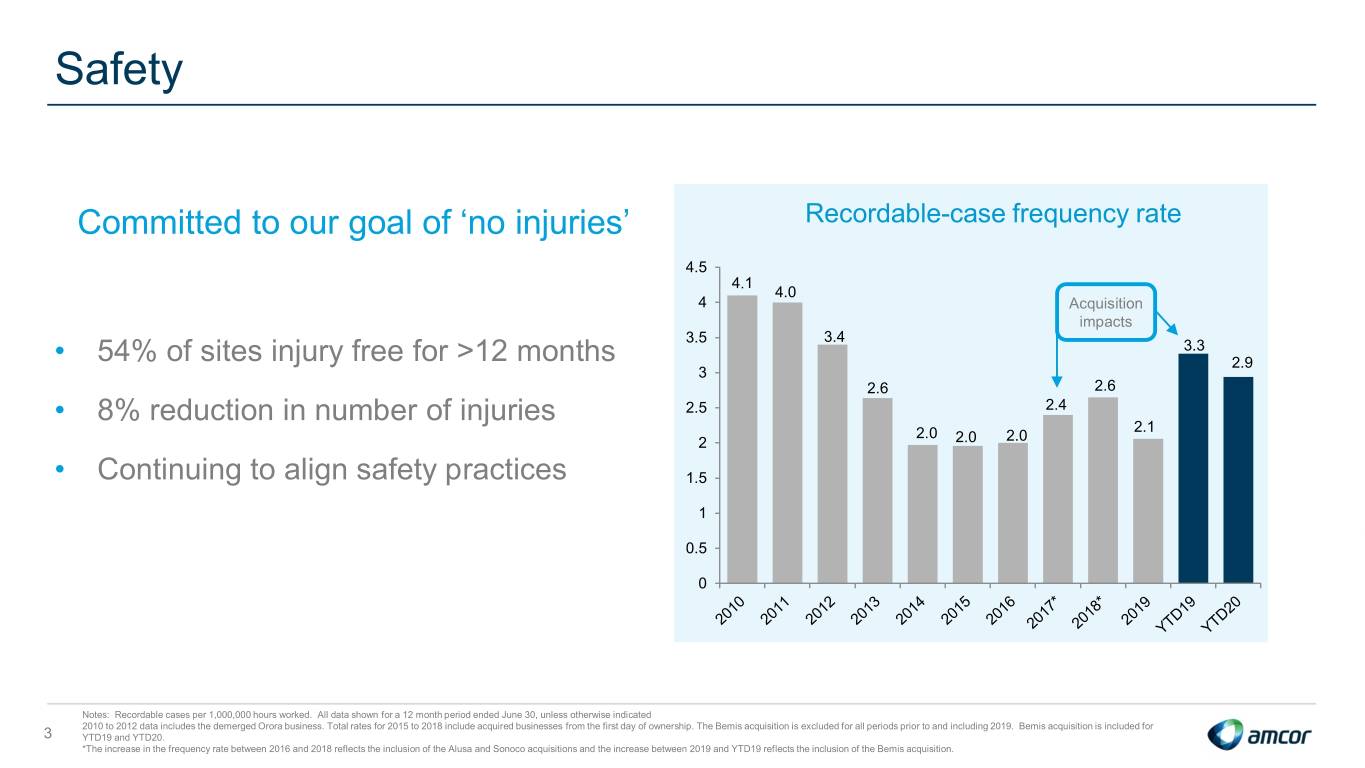
Safety Committed to our goal of ‘no injuries’ Recordable-case frequency rate 4.5 4.1 4.0 4 Acquisition impacts 3.5 3.4 3.3 • 54% of sites injury free for >12 months 2.9 3 2.6 2.6 • 8% reduction in number of injuries 2.5 2.4 2.0 2.1 2 2.0 2.0 • Continuing to align safety practices 1.5 1 0.5 0 Notes: Recordable cases per 1,000,000 hours worked. All data shown for a 12 month period ended June 30, unless otherwise indicated 2010 to 2012 data includes the demerged Orora business. Total rates for 2015 to 2018 include acquired businesses from the first day of ownership. The Bemis acquisition is excluded for all periods prior to and including 2019. Bemis acquisition is included for 3 YTD19 and YTD20. *The increase in the frequency rate between 2016 and 2018 reflects the inclusion of the Alusa and Sonoco acquisitions and the increase between 2019 and YTD19 reflects the inclusion of the Bemis acquisition.
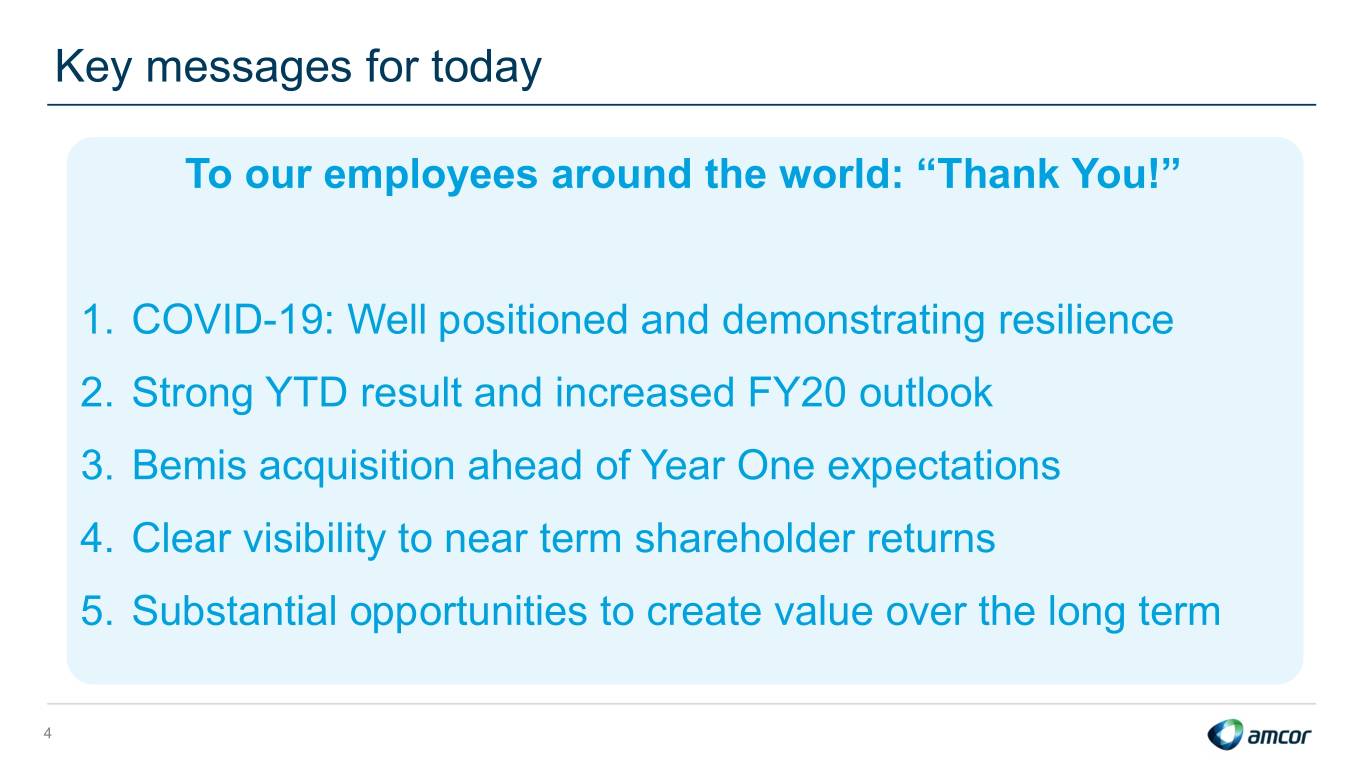
Key messages for today To our employees around the world: “Thank You!” 1. COVID-19: Well positioned and demonstrating resilience 2. Strong YTD result and increased FY20 outlook 3. Bemis acquisition ahead of Year One expectations 4. Clear visibility to near term shareholder returns 5. Substantial opportunities to create value over the long term 4
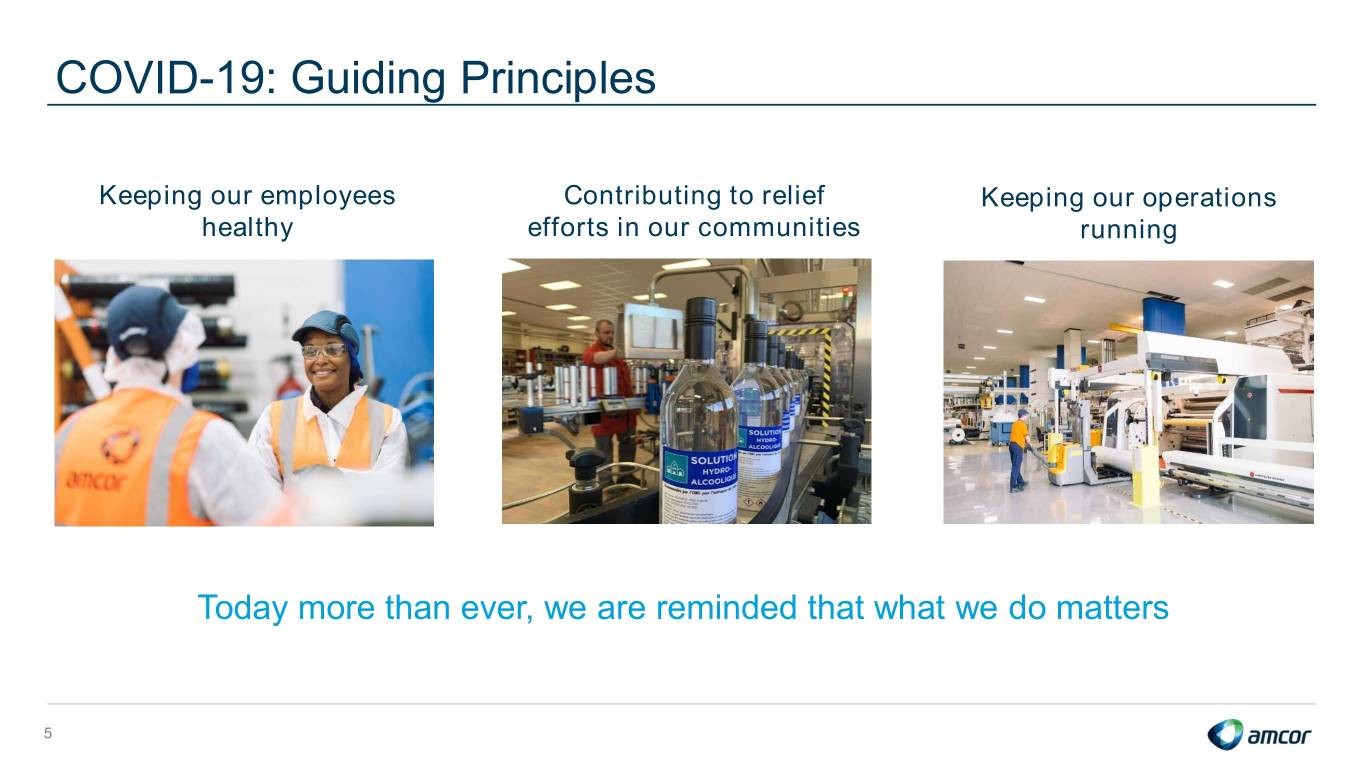
COVID-19: Guiding Principles Keeping our employees Contributing to relief Keeping our operations healthy efforts in our communities running Today more than ever, we are reminded that what we do matters 5
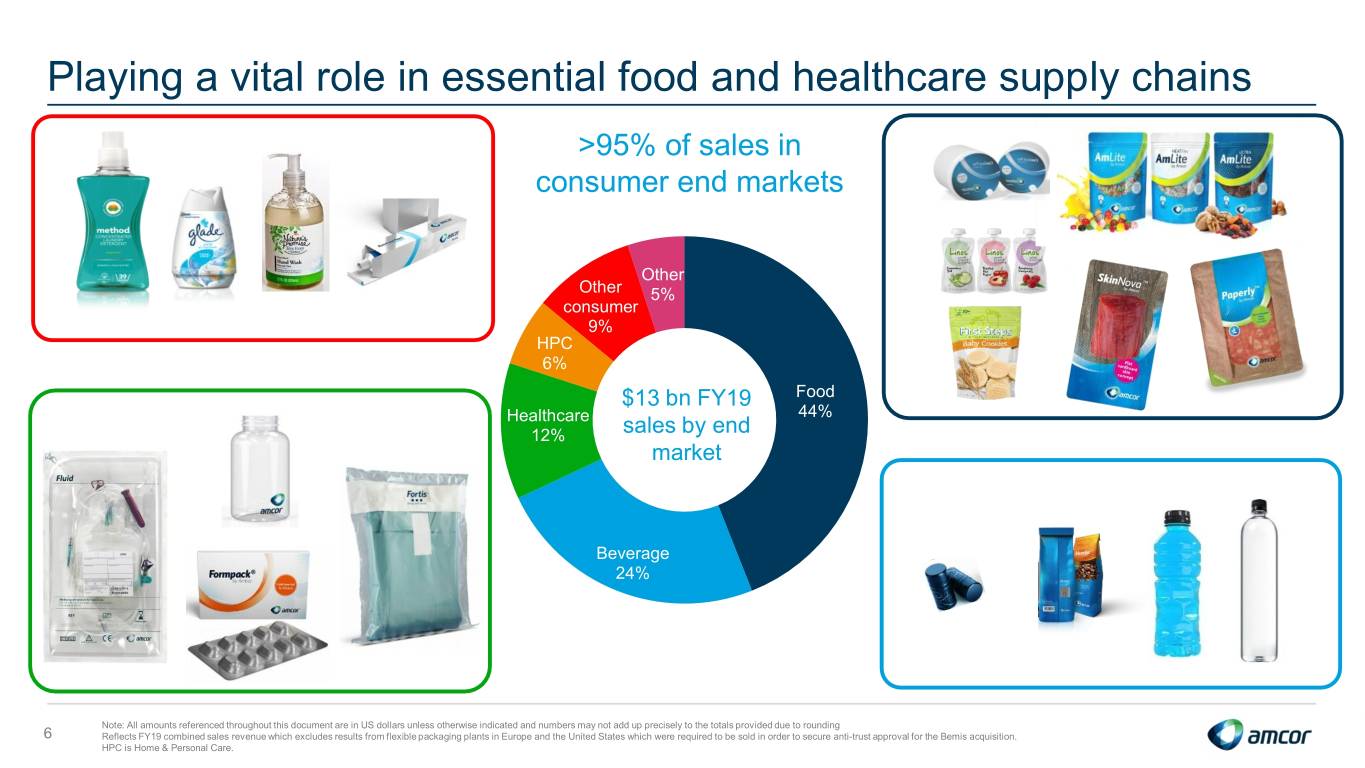
Playing a vital role in essential food and healthcare supply chains >95% of sales in consumer end markets Other Other 5% consumer 9% HPC 6% $13 bn FY19 Food Healthcare 44% 12% sales by end market Beverage 24% Note: All amounts referenced throughout this document are in US dollars unless otherwise indicated and numbers may not add up precisely to the totals provided due to rounding 6 Reflects FY19 combined sales revenue which excludes results from flexible packaging plants in Europe and the United States which were required to be sold in order to secure anti-trust approval for the Bemis acquisition. HPC is Home & Personal Care.
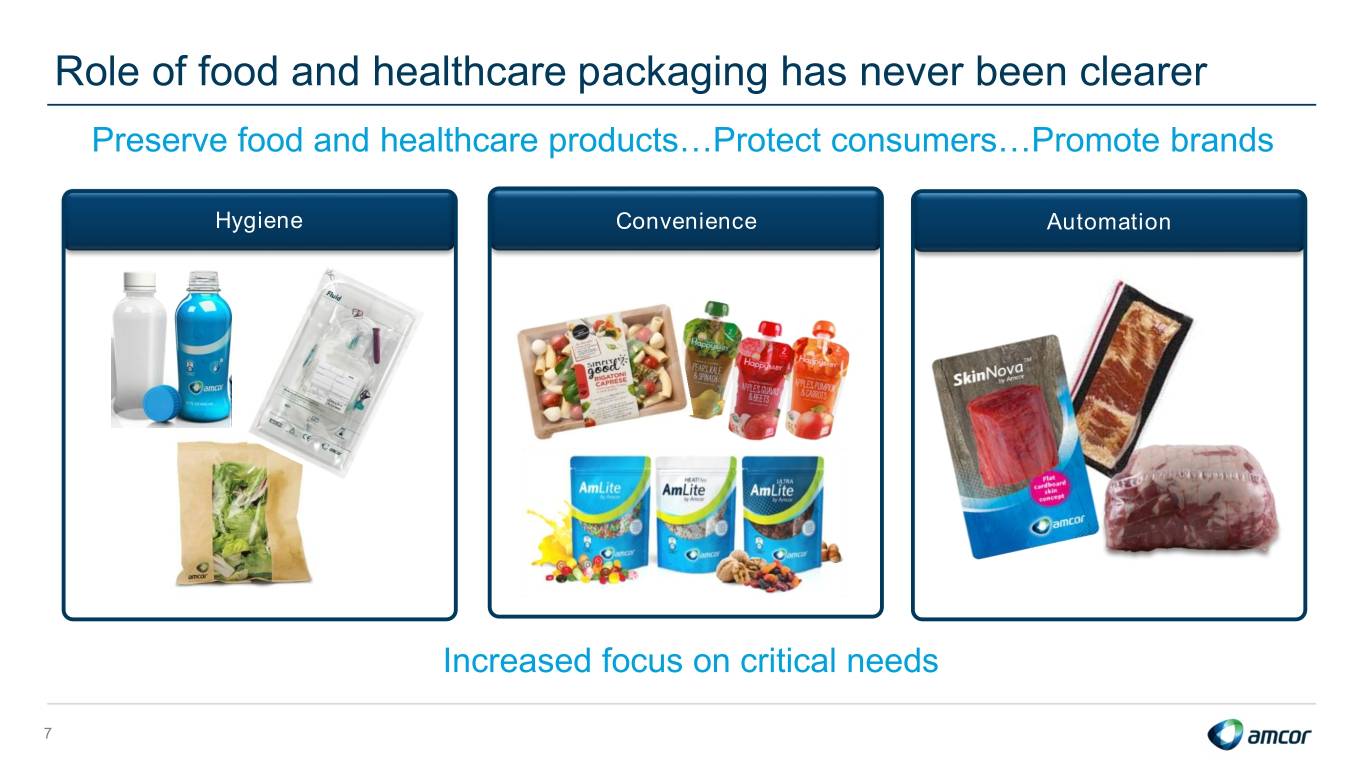
Role of food and healthcare packaging has never been clearer Preserve food and healthcare products…Protect consumers…Promote brands Hygiene Convenience Automation Increased focus on critical needs 7
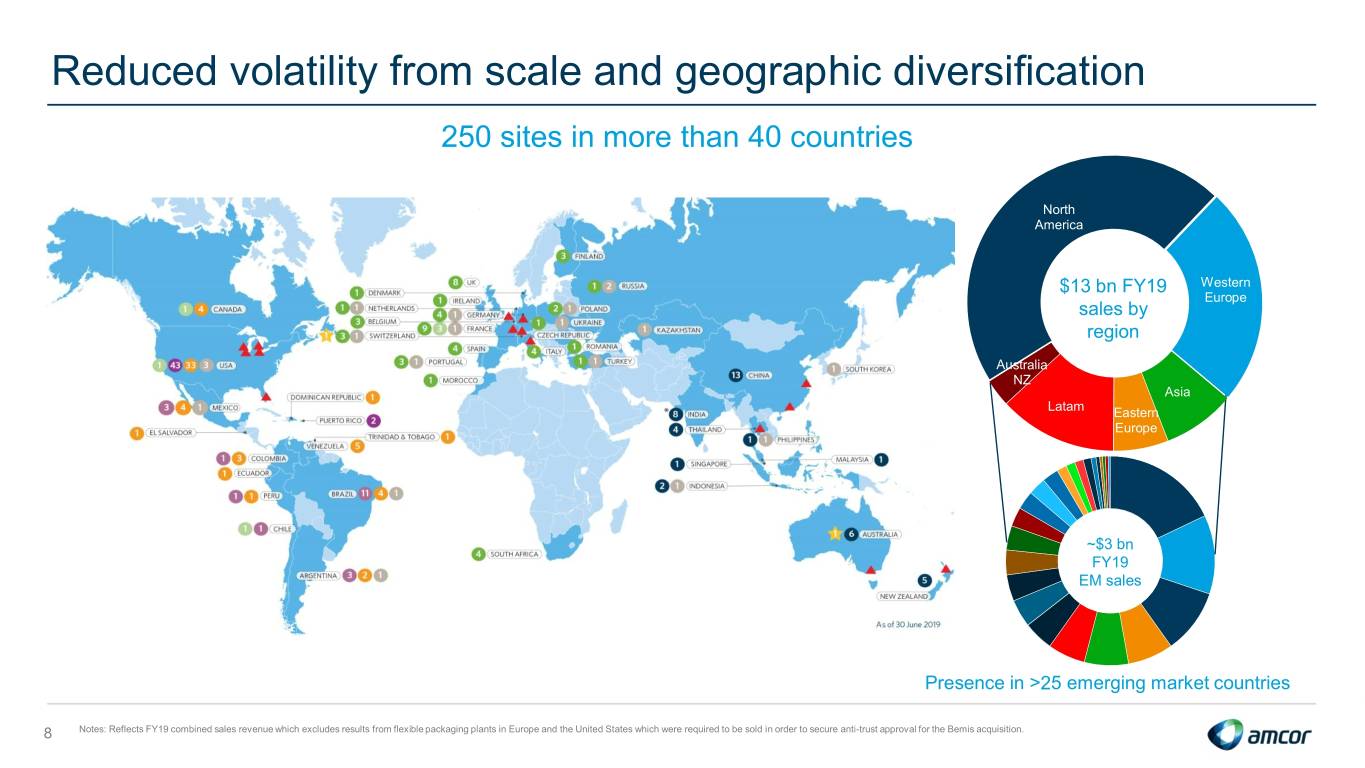
Reduced volatility from scale and geographic diversification 250 sites in more than 40 countries North America $13 bn FY19 Western Europe sales by region Australia NZ Asia Latam Eastern Europe ~$3 bn FY19 EM sales Presence in >25 emerging market countries 8 Notes: Reflects FY19 combined sales revenue which excludes results from flexible packaging plants in Europe and the United States which were required to be sold in order to secure anti-trust approval for the Bemis acquisition.
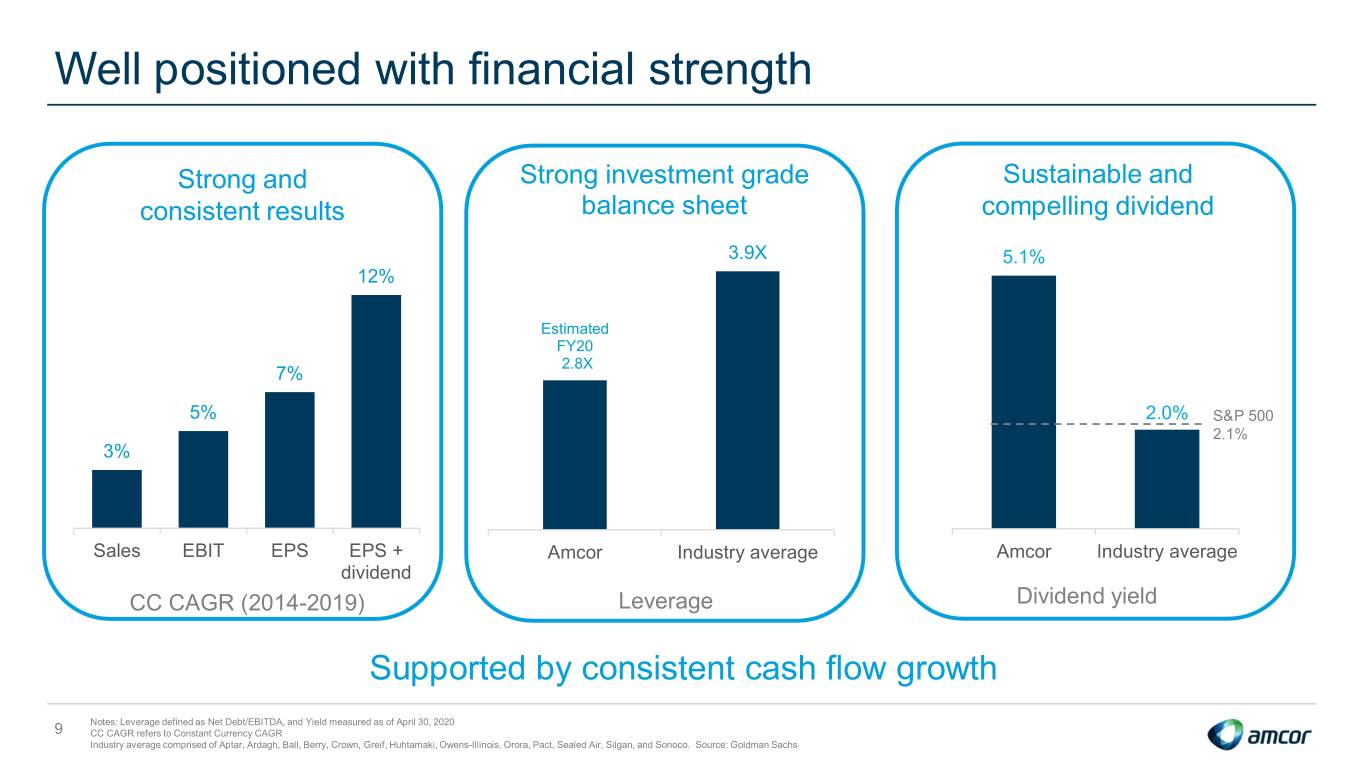
Well positioned with financial strength Strong and Strong investment grade Sustainable and consistent results balance sheet compelling dividend 3.9X 5.1% 12% Estimated FY20 2.8X 7% 5% 2.0% S&P 500 2.1% 3% Sales EBIT EPS EPS + Amcor Industry average Amcor Industry average dividend CC CAGR (2014-2019) Leverage Dividend yield Supported by consistent cash flow growth Notes: Leverage defined as Net Debt/EBITDA, and Yield measured as of April 30, 2020 9 CC CAGR refers to Constant Currency CAGR Industry average comprised of Aptar, Ardagh, Ball, Berry, Crown, Greif, Huhtamaki, Owens-Illinois, Orora, Pact, Sealed Air, Silgan, and Sonoco. Source: Goldman Sachs
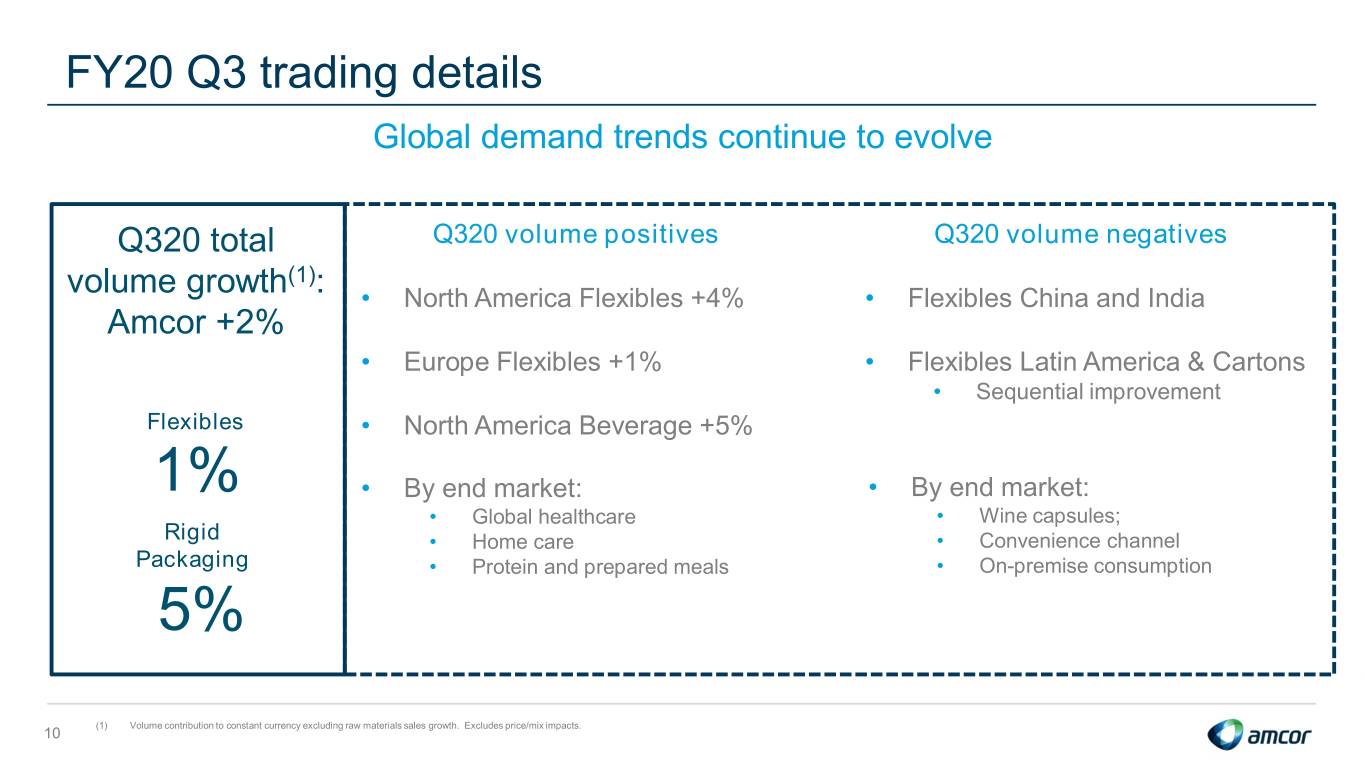
FY20 Q3 trading details Global demand trends continue to evolve Q320 total Q320 volume positives Q320 volume negatives (1) volume growth : • North America Flexibles +4% • Flexibles China and India Amcor +2% • Europe Flexibles +1% • Flexibles Latin America & Cartons • Sequential improvement Flexibles • North America Beverage +5% 1% • By end market: • By end market: • Global healthcare • Wine capsules; Rigid • Home care • Convenience channel Packaging • Protein and prepared meals • On-premise consumption 5% (1) Volume contribution to constant currency excluding raw materials sales growth. Excludes price/mix impacts. 10
Fiscal 2020 year to date financial results (nine months ended March 31, 2020)
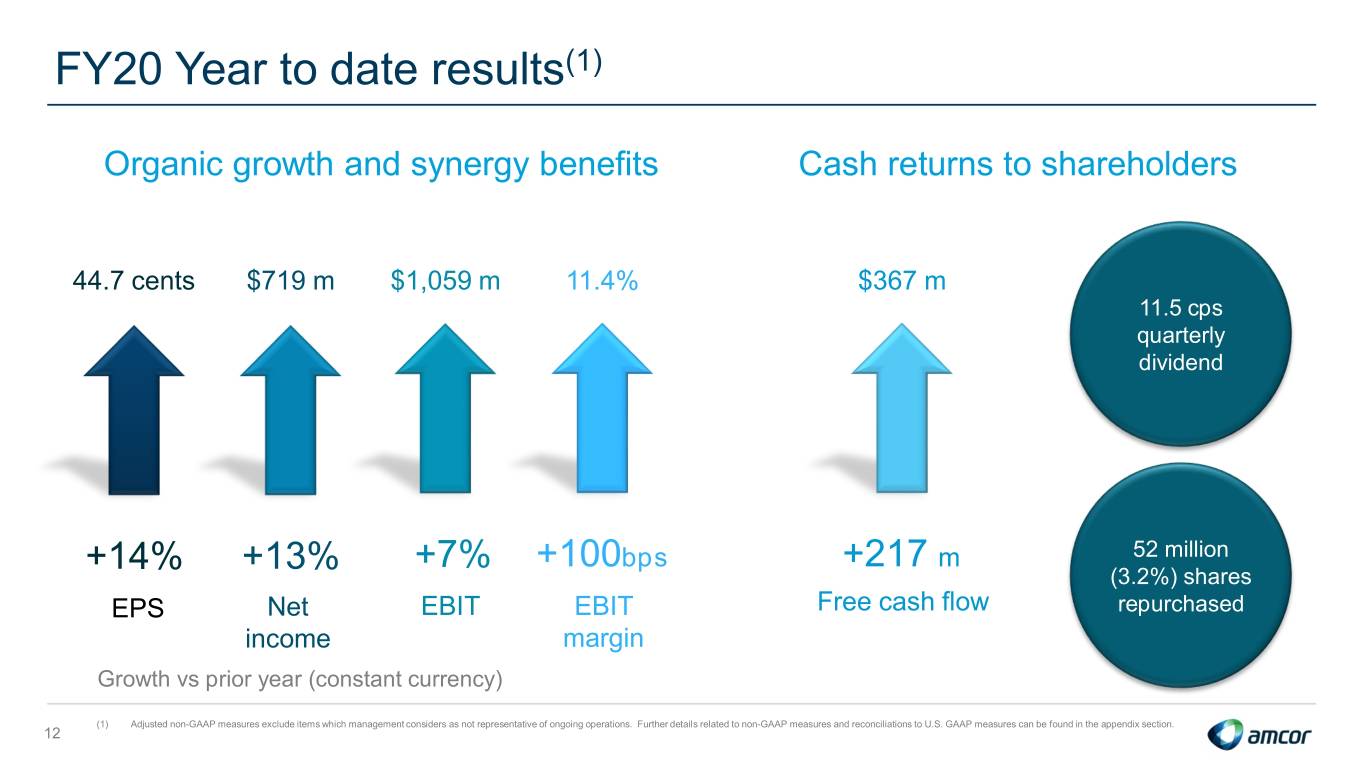
FY20 Year to date results(1) Organic growth and synergy benefits Cash returns to shareholders 44.7 cents $719 m $1,059 m 11.4% $367 m 11.5 cps quarterly dividend +14% +13% +7% +100bps +217 m 52 million (3.2%) shares EPS Net EBIT EBIT Free cash flow repurchased income margin Growth vs prior year (constant currency) (1) Adjusted non-GAAP measures exclude items which management considers as not representative of ongoing operations. Further details related to non-GAAP measures and reconciliations to U.S. GAAP measures can be found in the appendix section. 12
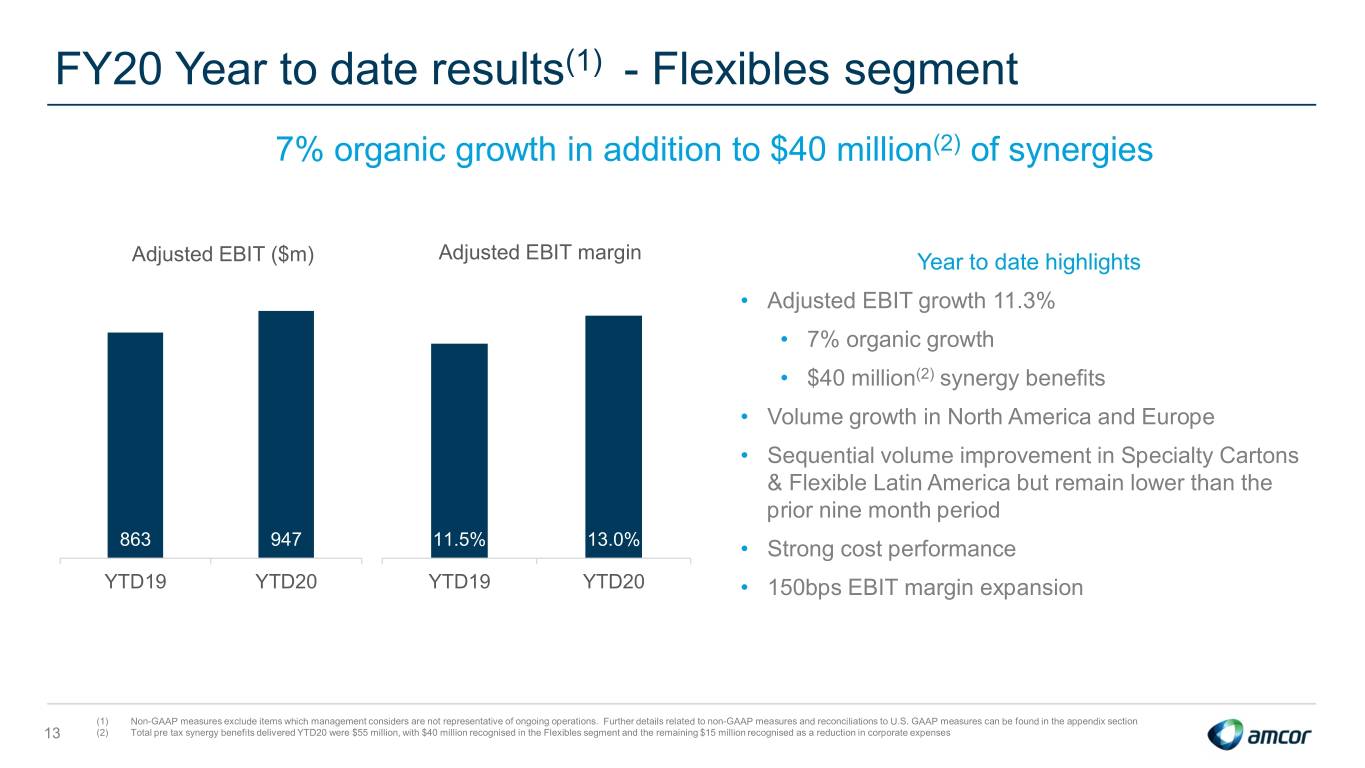
FY20 Year to date results(1) - Flexibles segment 7% organic growth in addition to $40 million(2) of synergies Adjusted EBIT ($m) Adjusted EBIT margin Year to date highlights • Adjusted EBIT growth 11.3% • 7% organic growth • $40 million(2) synergy benefits • Volume growth in North America and Europe • Sequential volume improvement in Specialty Cartons & Flexible Latin America but remain lower than the prior nine month period 863 947 11.5% 13.0% • Strong cost performance YTD19 YTD20 YTD19 YTD20 • 150bps EBIT margin expansion (1) Non-GAAP measures exclude items which management considers are not representative of ongoing operations. Further details related to non-GAAP measures and reconciliations to U.S. GAAP measures can be found in the appendix section 13 (2) Total pre tax synergy benefits delivered YTD20 were $55 million, with $40 million recognised in the Flexibles segment and the remaining $15 million recognised as a reduction in corporate expenses
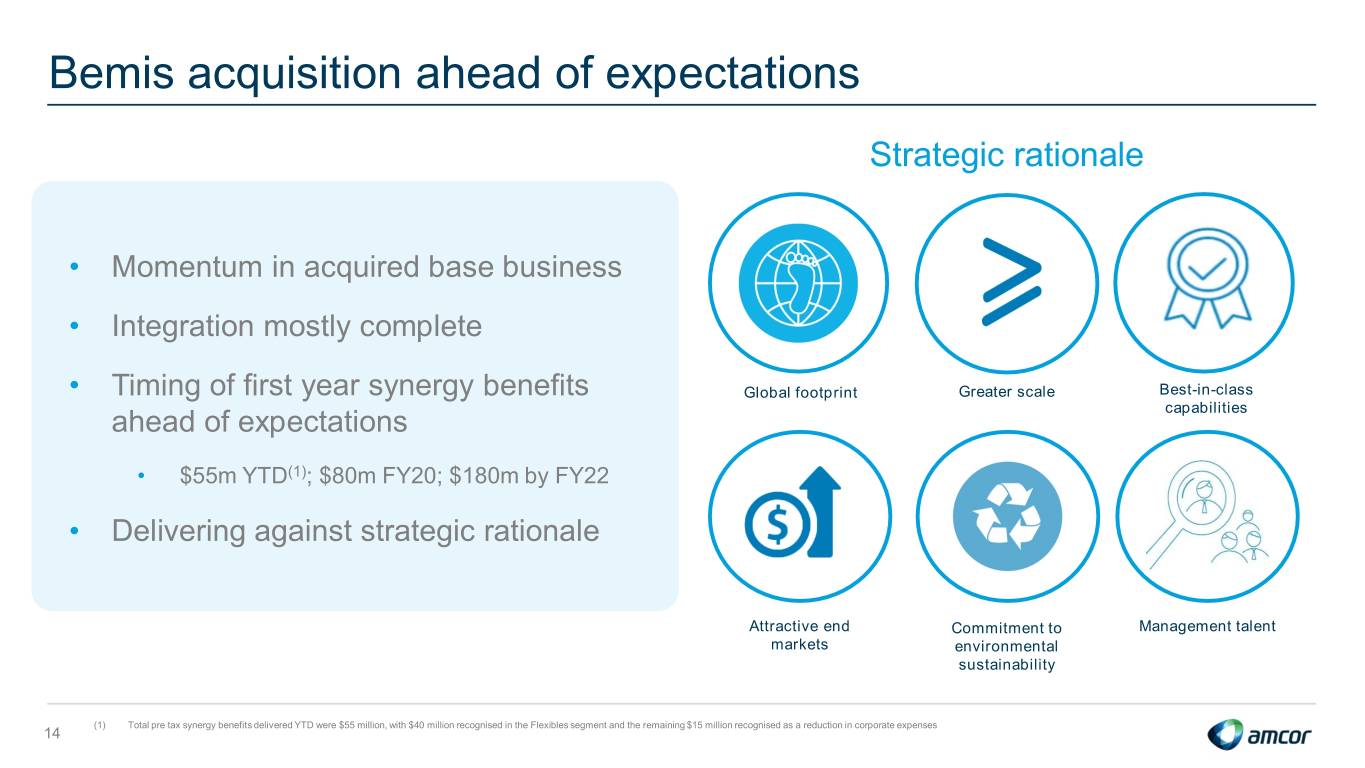
Bemis acquisition ahead of expectations Strategic rationale • Momentum in acquired base business • Integration mostly complete • Timing of first year synergy benefits Global footprint Greater scale Best-in-class ahead of expectations capabilities • $55m YTD(1); $80m FY20; $180m by FY22 • Delivering against strategic rationale Attractive end Commitment to Management talent markets environmental sustainability (1) Total pre tax synergy benefits delivered YTD were $55 million, with $40 million recognised in the Flexibles segment and the remaining $15 million recognised as a reduction in corporate expenses 14
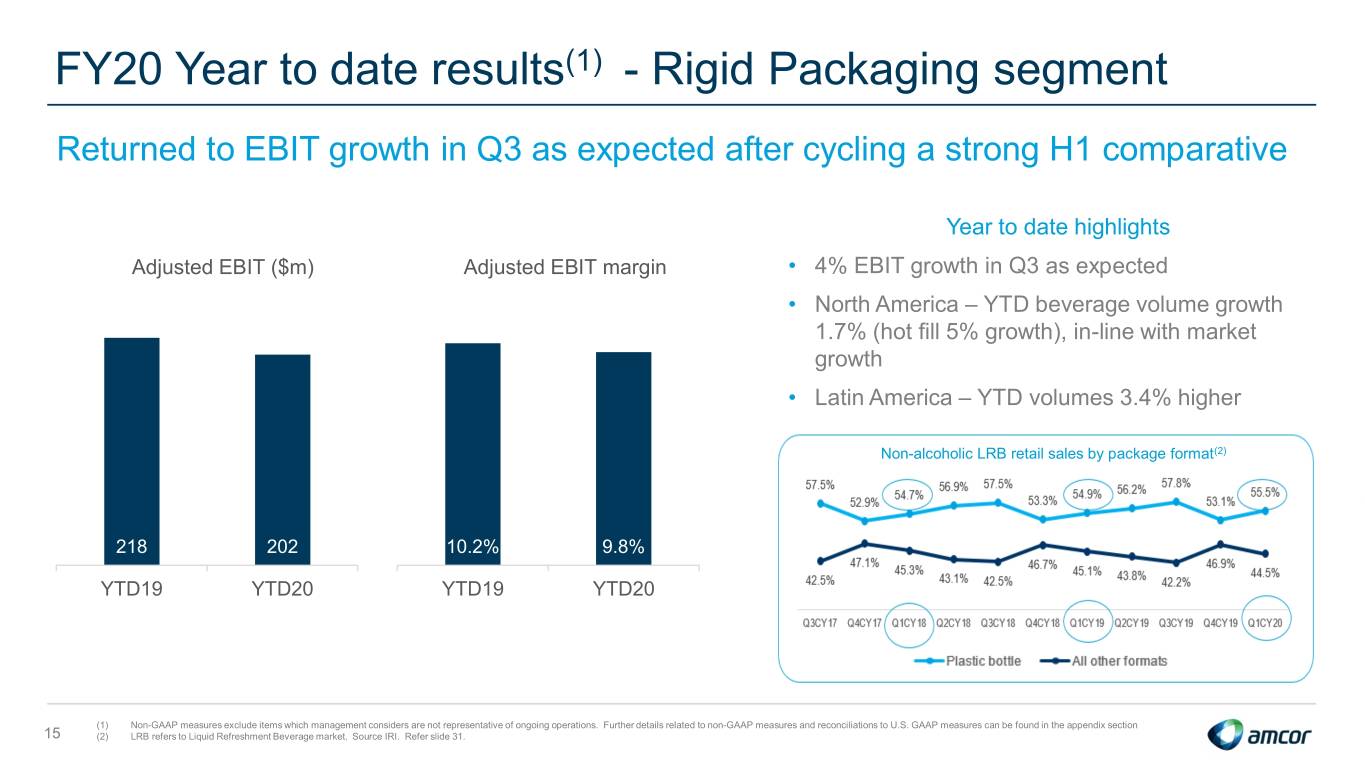
FY20 Year to date results(1) - Rigid Packaging segment Returned to EBIT growth in Q3 as expected after cycling a strong H1 comparative Year to date highlights Adjusted EBIT ($m) Adjusted EBIT margin • 4% EBIT growth in Q3 as expected • North America – YTD beverage volume growth 1.7% (hot fill 5% growth), in-line with market growth • Latin America – YTD volumes 3.4% higher Non-alcoholic LRB retail sales by package format(2) 218 202 10.2% 9.8% YTD19 YTD20 YTD19 YTD20 (1) Non-GAAP measures exclude items which management considers are not representative of ongoing operations. Further details related to non-GAAP measures and reconciliations to U.S. GAAP measures can be found in the appendix section 15 (2) LRB refers to Liquid Refreshment Beverage market. Source IRI. Refer slide 31.
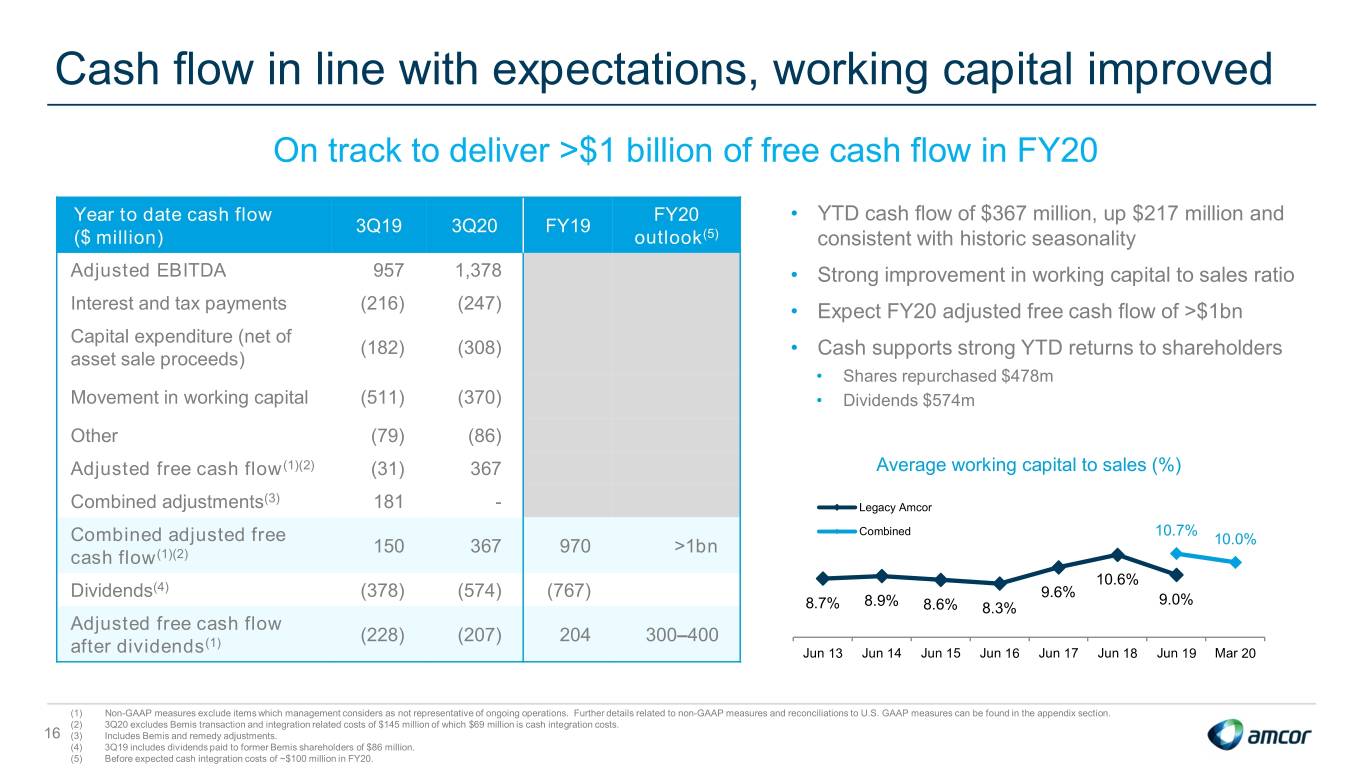
Cash flow in line with expectations, working capital improved On track to deliver >$1 billion of free cash flow in FY20 Year to date cash flow FY20 • YTD cash flow of $367 million, up $217 million and 3Q19 3Q20 FY19 ($ million) outlook(5) consistent with historic seasonality Adjusted EBITDA 957 1,378 • Strong improvement in working capital to sales ratio Interest and tax payments (216) (247) • Expect FY20 adjusted free cash flow of >$1bn Capital expenditure (net of (182) (308) • Cash supports strong YTD returns to shareholders asset sale proceeds) • Shares repurchased $478m Movement in working capital (511) (370) • Dividends $574m Other (79) (86) Adjusted free cash flow(1)(2) (31) 367 Average working capital to sales (%) (3) Combined adjustments 181 - Legacy Amcor Combined adjusted free Combined 10.7% 150 367 970 >1bn 10.0% cash flow(1)(2) (4) 10.6% Dividends (378) (574) (767) 9.6% 9.0% 8.7% 8.9% 8.6% 8.3% Adjusted free cash flow (1) (228) (207) 204 300–400 after dividends Jun 13 Jun 14 Jun 15 Jun 16 Jun 17 Jun 18 Jun 19 Mar 20 (1) Non-GAAP measures exclude items which management considers as not representative of ongoing operations. Further details related to non-GAAP measures and reconciliations to U.S. GAAP measures can be found in the appendix section. (2) 3Q20 excludes Bemis transaction and integration related costs of $145 million of which $69 million is cash integration costs. 16 (3) Includes Bemis and remedy adjustments. (4) 3Q19 includes dividends paid to former Bemis shareholders of $86 million. (5) Before expected cash integration costs of ~$100 million in FY20.
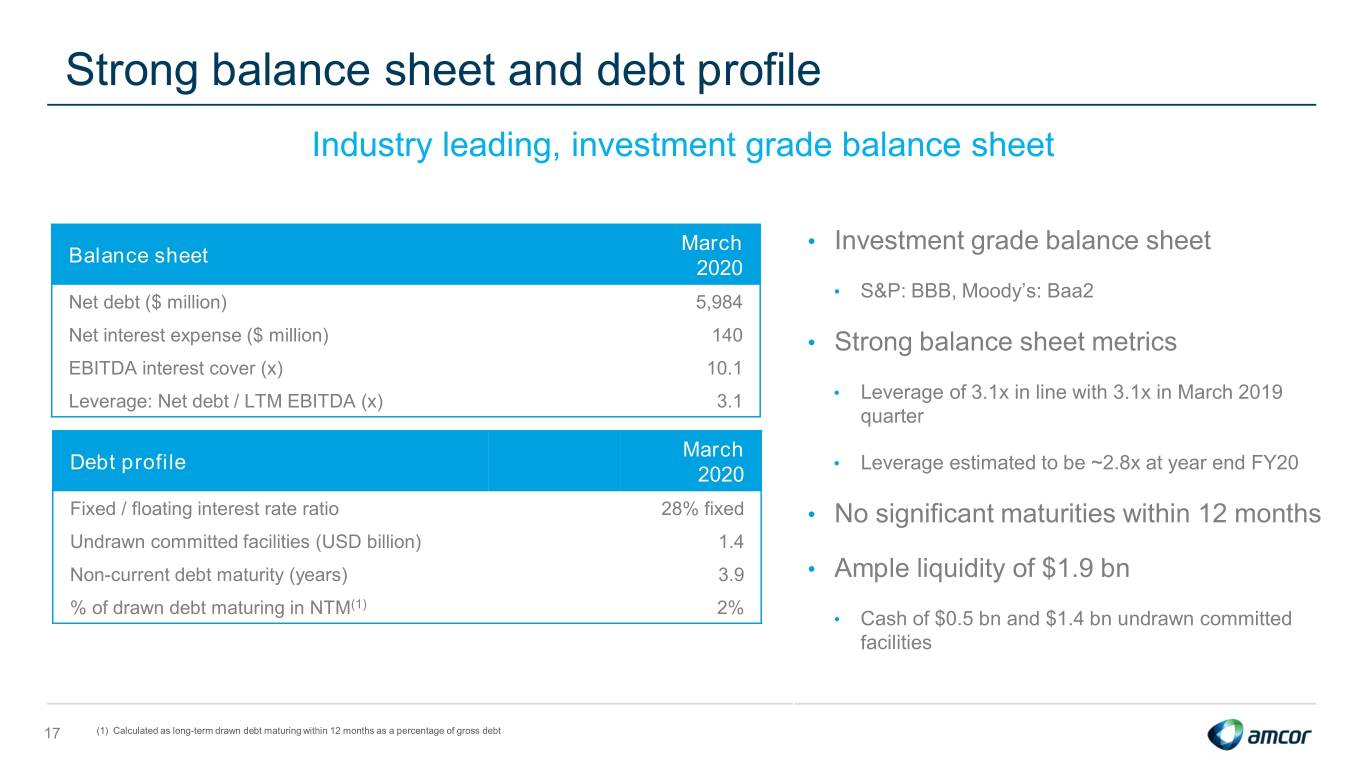
Strong balance sheet and debt profile Industry leading, investment grade balance sheet March • Investment grade balance sheet Balance sheet 2020 • S&P: BBB, Moody’s: Baa2 Net debt ($ million) 5,984 Net interest expense ($ million) 140 • Strong balance sheet metrics EBITDA interest cover (x) 10.1 Leverage: Net debt / LTM EBITDA (x) 3.1 • Leverage of 3.1x in line with 3.1x in March 2019 quarter March Debt profile • Leverage estimated to be ~2.8x at year end FY20 2020 Fixed / floating interest rate ratio 28% fixed • No significant maturities within 12 months Undrawn committed facilities (USD billion) 1.4 Non-current debt maturity (years) 3.9 • Ample liquidity of $1.9 bn % of drawn debt maturing in NTM(1) 2% • Cash of $0.5 bn and $1.4 bn undrawn committed facilities 17 (1) Calculated as long-term drawn debt maturing within 12 months as a percentage of gross debt
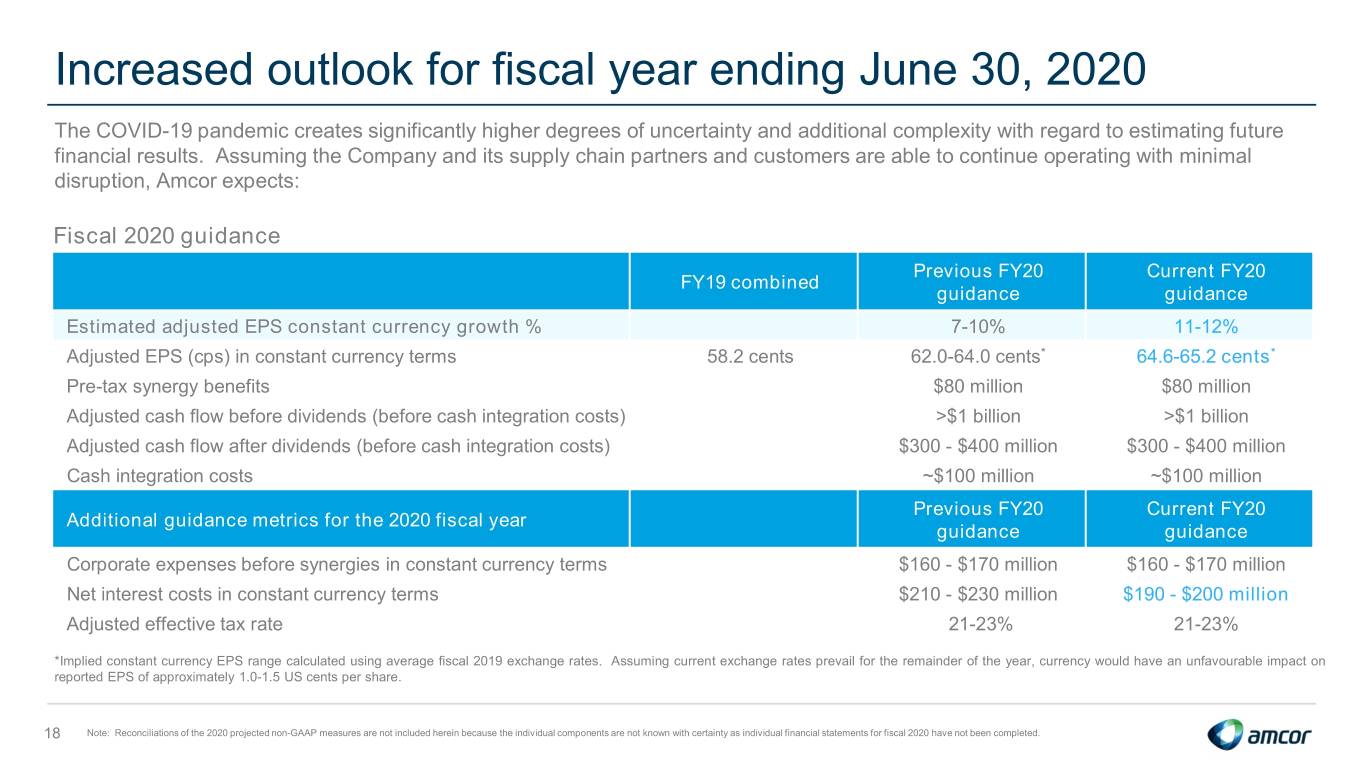
Increased outlook for fiscal year ending June 30, 2020 The COVID-19 pandemic creates significantly higher degrees of uncertainty and additional complexity with regard to estimating future financial results. Assuming the Company and its supply chain partners and customers are able to continue operating with minimal disruption, Amcor expects: Fiscal 2020 guidance Previous FY20 Current FY20 FY19 combined guidance guidance Estimated adjusted EPS constant currency growth % 7-10% 11-12% Adjusted EPS (cps) in constant currency terms 58.2 cents 62.0-64.0 cents* 64.6-65.2 cents* Pre-tax synergy benefits $80 million $80 million Adjusted cash flow before dividends (before cash integration costs) >$1 billion >$1 billion Adjusted cash flow after dividends (before cash integration costs) $300 - $400 million $300 - $400 million Cash integration costs ~$100 million ~$100 million Previous FY20 Current FY20 Additional guidance metrics for the 2020 fiscal year guidance guidance Corporate expenses before synergies in constant currency terms $160 - $170 million $160 - $170 million Net interest costs in constant currency terms $210 - $230 million $190 - $200 million Adjusted effective tax rate 21-23% 21-23% *Implied constant currency EPS range calculated using average fiscal 2019 exchange rates. Assuming current exchange rates prevail for the remainder of the year, currency would have an unfavourable impact on reported EPS of approximately 1.0-1.5 US cents per share. 18 Note: Reconciliations of the 2020 projected non-GAAP measures are not included herein because the individual components are not known with certainty as individual financial statements for fiscal 2020 have not been completed.
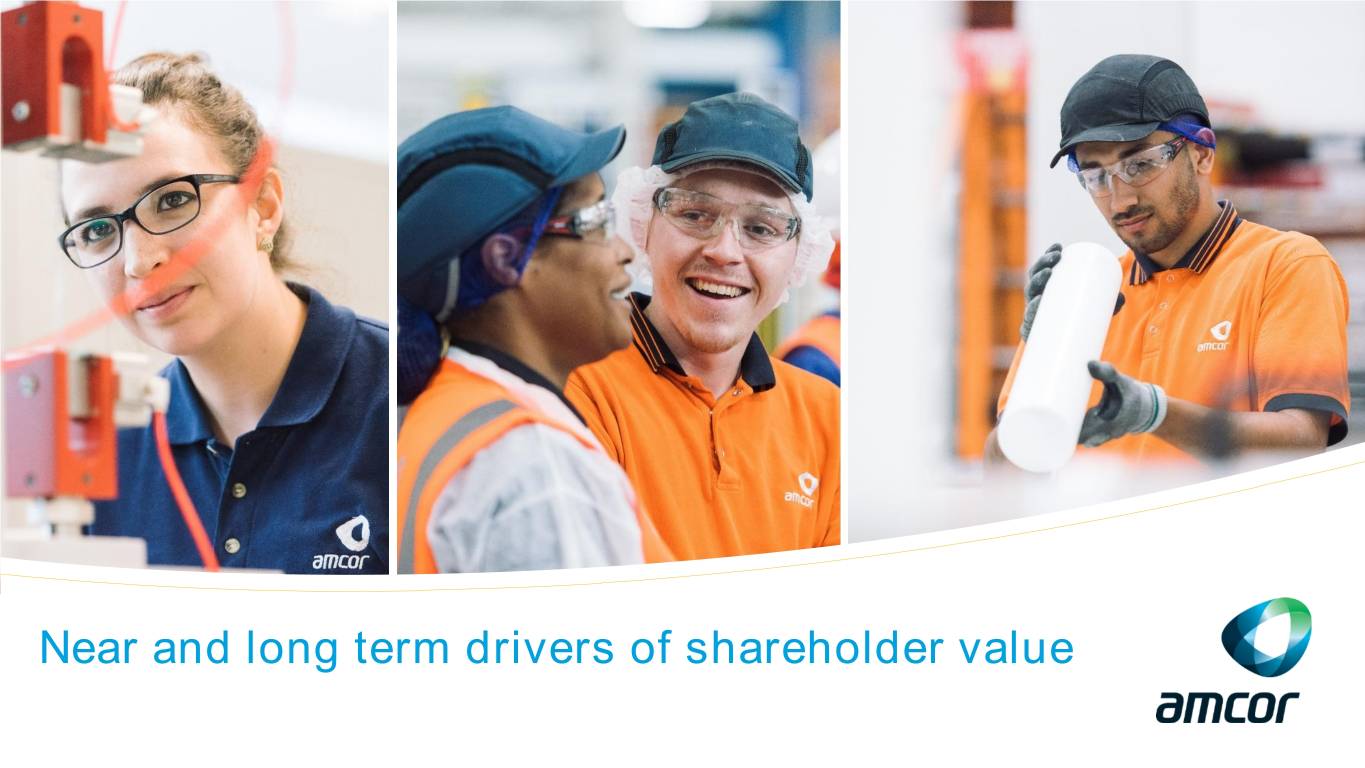
Near and long term drivers of shareholder value
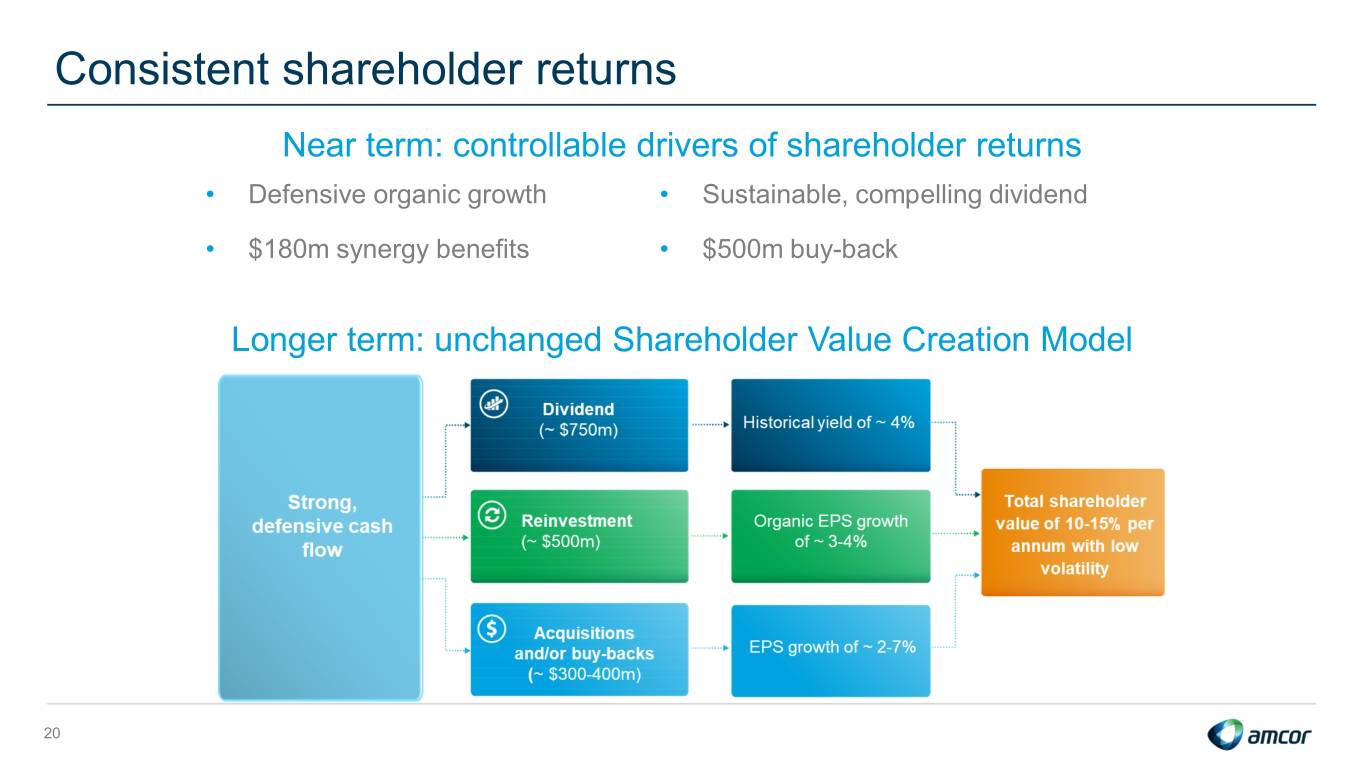
Consistent shareholder returns Near term: controllable drivers of shareholder returns • Defensive organic growth • Sustainable, compelling dividend • $180m synergy benefits • $500m buy-back Longer term: unchanged Shareholder Value Creation Model 20
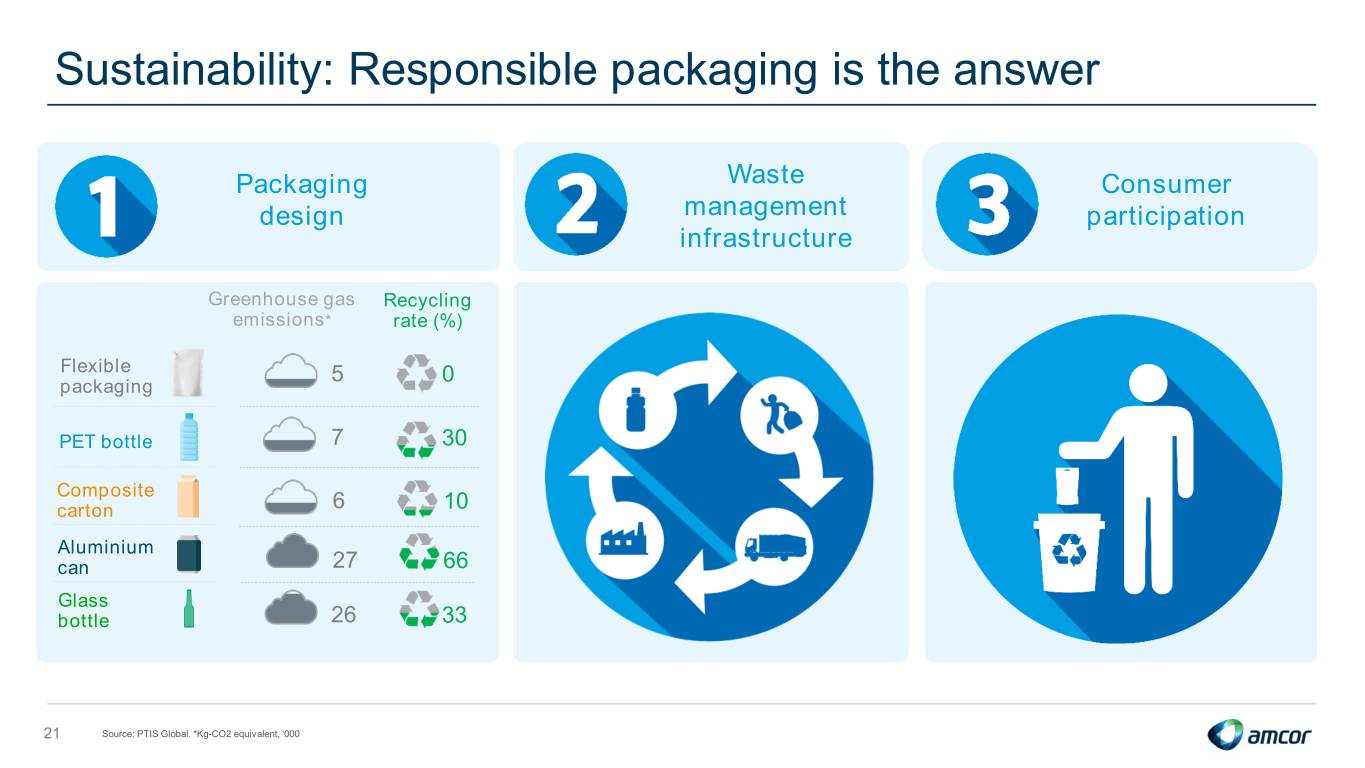
Sustainability: Responsible packaging is the answer Packaging Waste Consumer design management participation infrastructure Greenhouse gas Recycling emissions* rate (%) Flexible 5 0 packaging PET bottle 7 30 Composite carton 6 10 Aluminium can 27 66 Glass bottle 26 33 21 Source: PTIS Global. *Kg-CO2 equivalent, ‘000
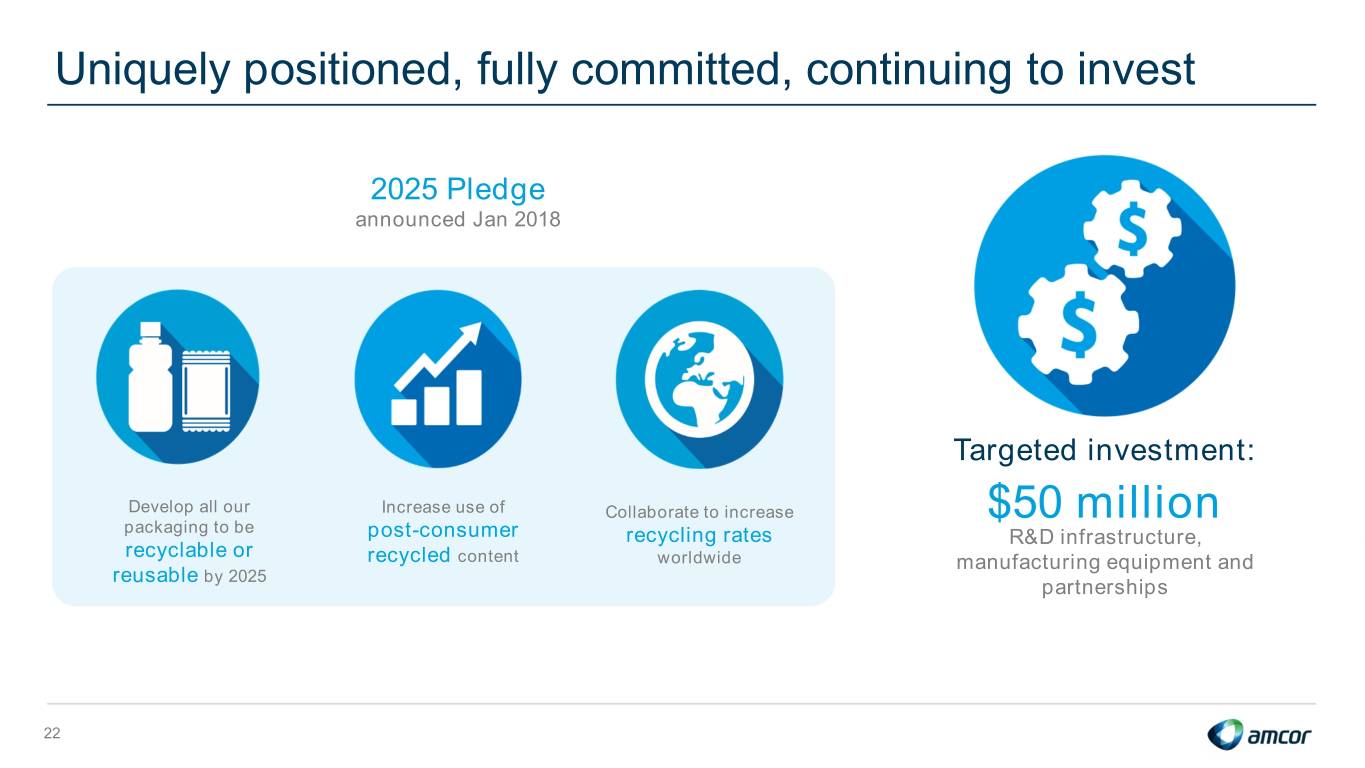
Uniquely positioned, fully committed, continuing to invest 2025 Pledge announced Jan 2018 Targeted investment: Develop all our Increase use of Collaborate to increase $50 million packaging to be post-consumer recycling rates R&D infrastructure, recyclable or recycled content worldwide manufacturing equipment and reusable by 2025 partnerships 22
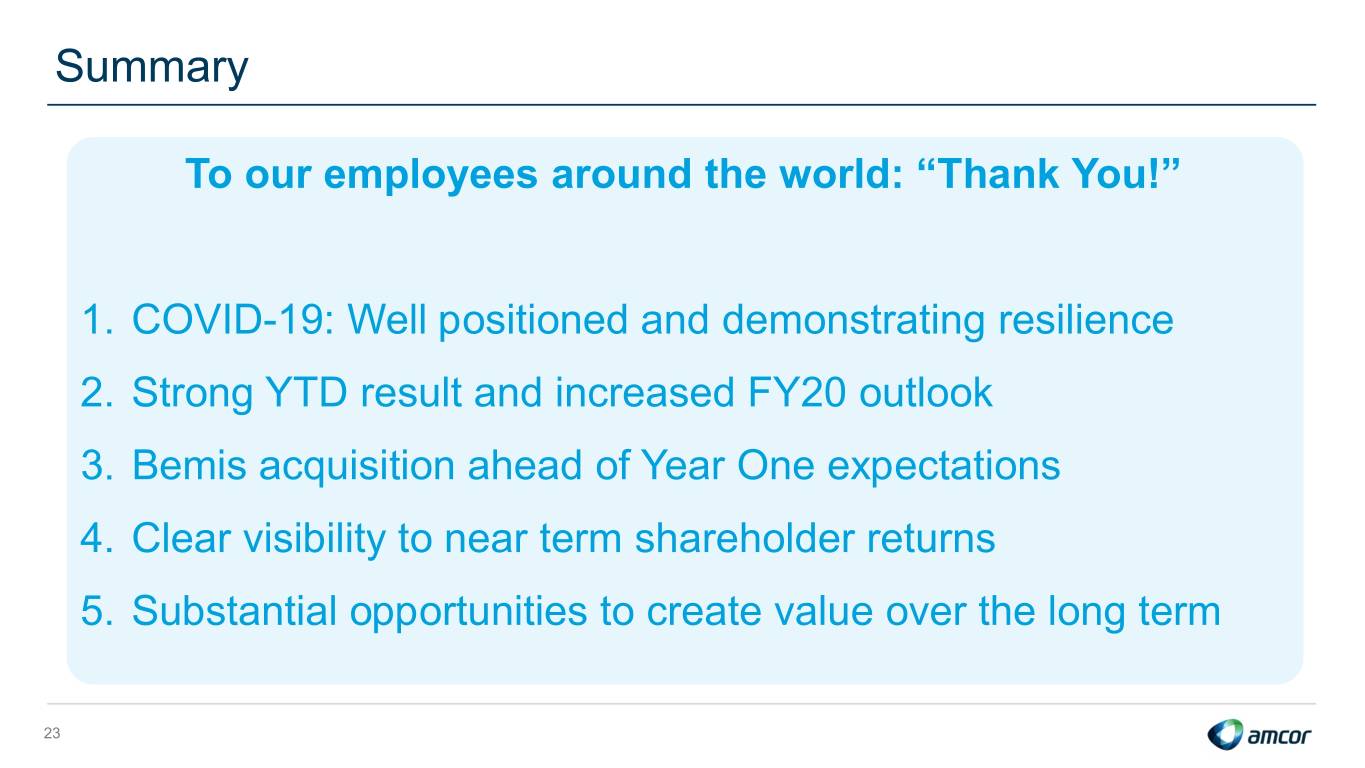
Summary To our employees around the world: “Thank You!” 1. COVID-19: Well positioned and demonstrating resilience 2. Strong YTD result and increased FY20 outlook 3. Bemis acquisition ahead of Year One expectations 4. Clear visibility to near term shareholder returns 5. Substantial opportunities to create value over the long term 23
Appendix slides Amcor profile
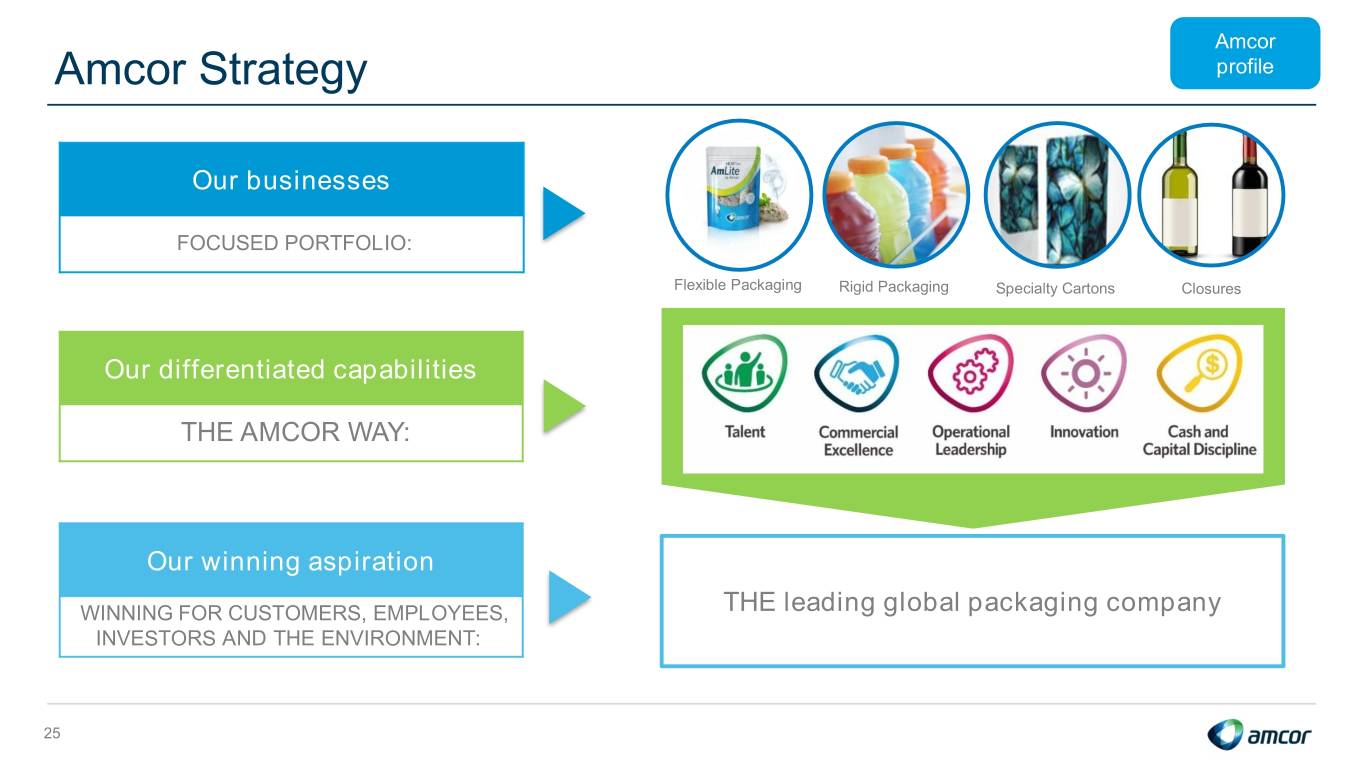
Amcor Amcor Strategy profile Our businesses FOCUSED PORTFOLIO: Flexible Packaging Rigid Packaging Specialty Cartons Closures Our differentiated capabilities THE AMCOR WAY: Our winning aspiration Significant growth opportunities WINNING FOR CUSTOMERS, EMPLOYEES, THE leading global packaging company INVESTORS AND THE ENVIRONMENT: 25
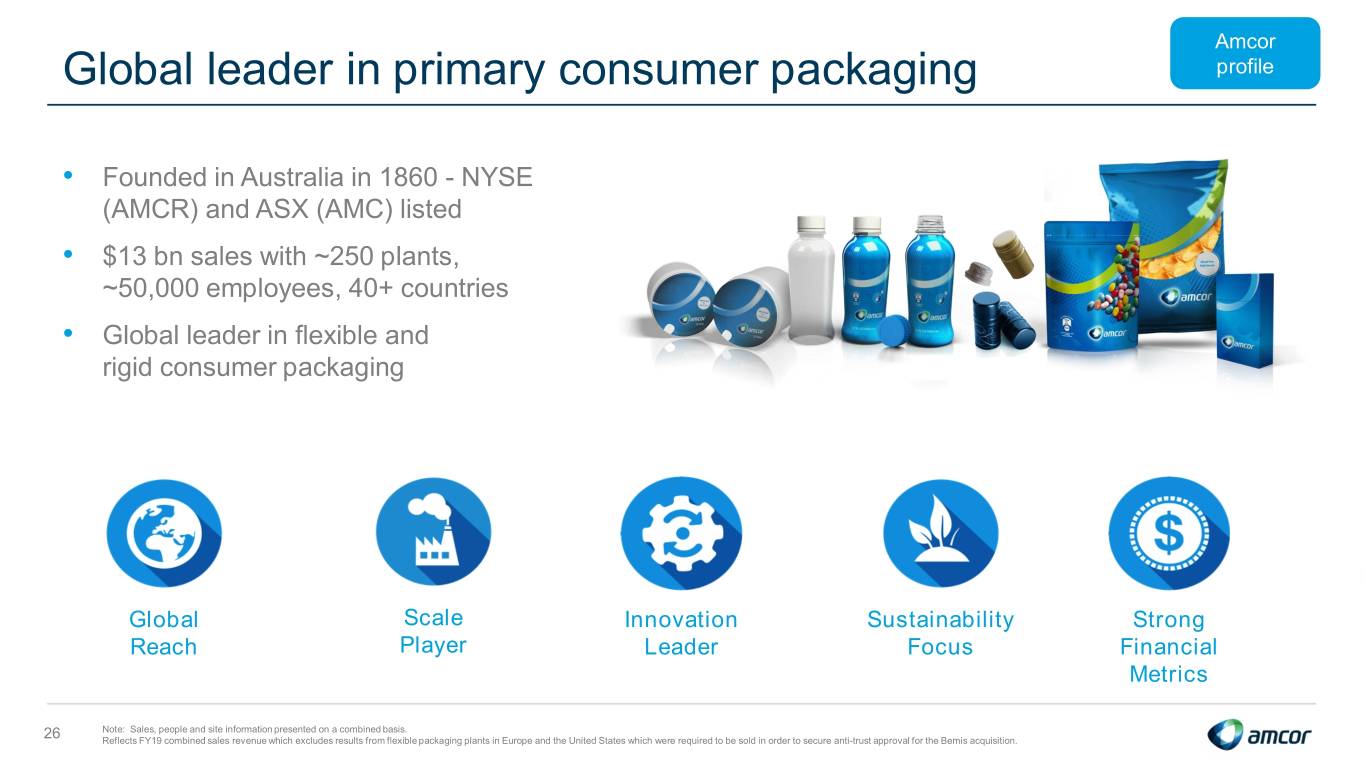
Amcor Global leader in primary consumer packaging profile • Founded in Australia in 1860 - NYSE (AMCR) and ASX (AMC) listed • $13 bn sales with ~250 plants, ~50,000 employees, 40+ countries • Global leader in flexible and rigid consumer packaging Global Scale Innovation Sustainability Strong Reach Player Leader Focus Financial Metrics Note: Sales, people and site information presented on a combined basis. 26 Reflects FY19 combined sales revenue which excludes results from flexible packaging plants in Europe and the United States which were required to be sold in order to secure anti-trust approval for the Bemis acquisition.
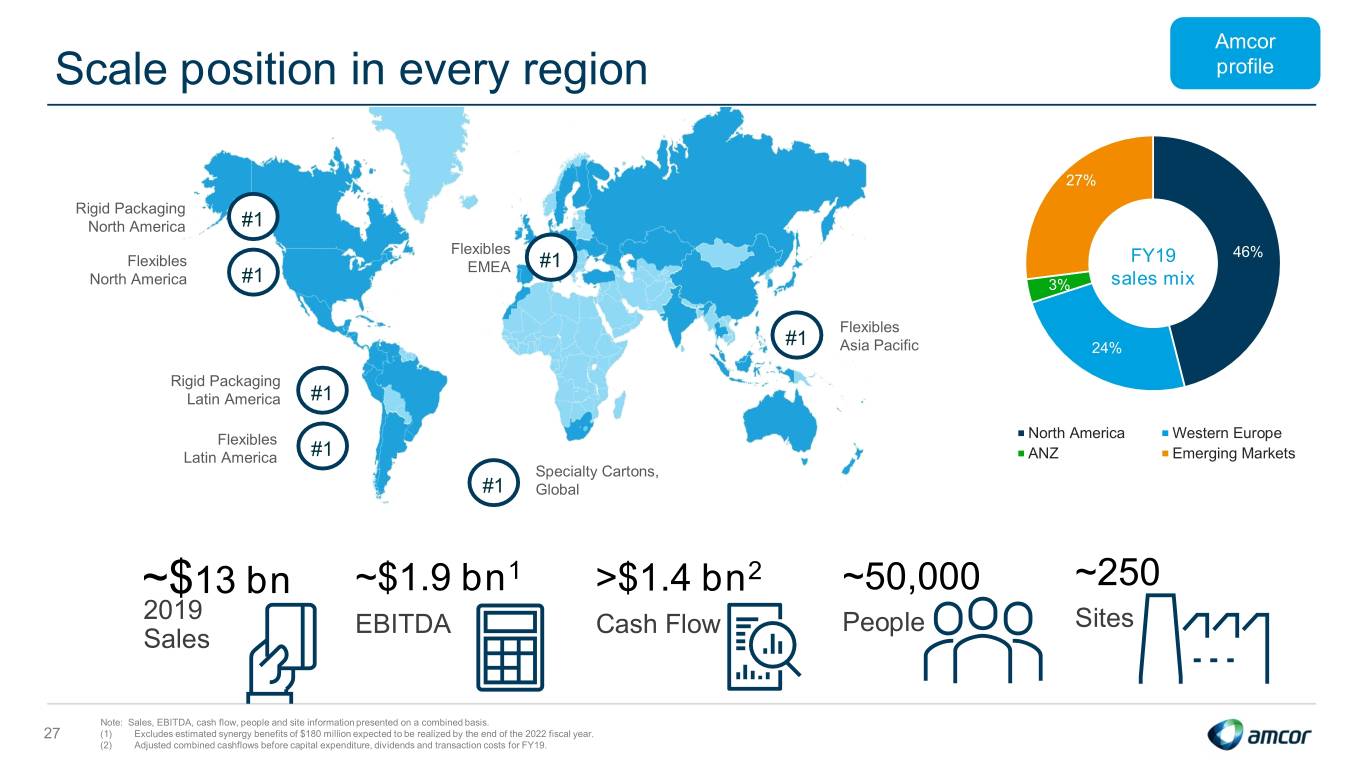
Amcor Scale position in every region profile 27% Rigid Packaging North America #1 Flexibles FY19 46% Flexibles EMEA #1 North America #1 3% sales mix Flexibles #1 Asia Pacific 24% Rigid Packaging Latin America #1 Flexibles North America Western Europe Latin America #1 ANZ Emerging Markets Specialty Cartons, #1 Global ~$13 bn ~$1.9 bn1 >$1.4 bn2 ~50,000 ~250 2019 EBITDA Cash Flow People Sites Sales Note: Sales, EBITDA, cash flow, people and site information presented on a combined basis. 27 (1) Excludes estimated synergy benefits of $180 million expected to be realized by the end of the 2022 fiscal year. (2) Adjusted combined cashflows before capital expenditure, dividends and transaction costs for FY19.
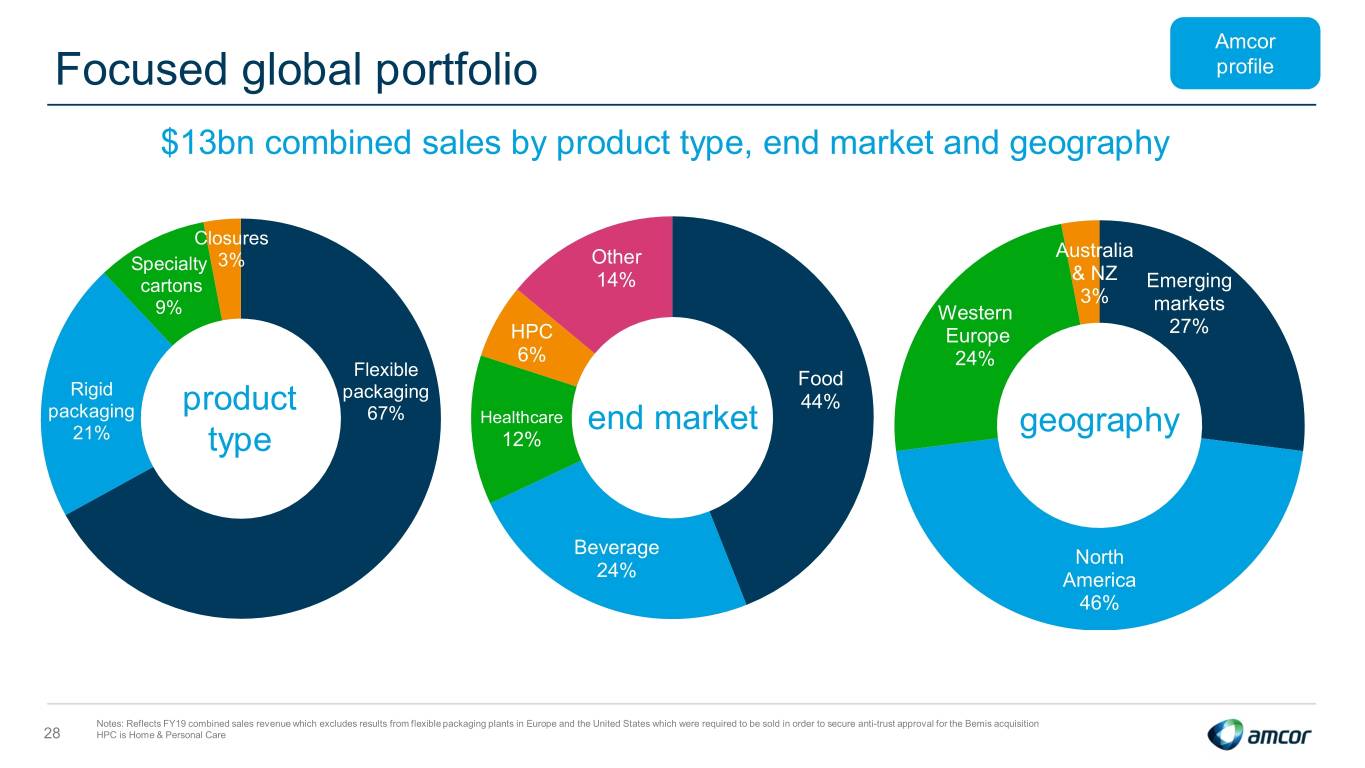
Amcor Focused global portfolio profile $13bn combined sales by product type, end market and geography Closures 3% Other Australia Specialty & NZ cartons 14% Emerging 3% 9% Western markets HPC Europe 27% 6% 24% Flexible Food Rigid packaging product 44% packaging 67% Healthcare end market geography 21% type 12% Beverage North 24% America 46% Notes: Reflects FY19 combined sales revenue which excludes results from flexible packaging plants in Europe and the United States which were required to be sold in order to secure anti-trust approval for the Bemis acquisition 28 HPC is Home & Personal Care
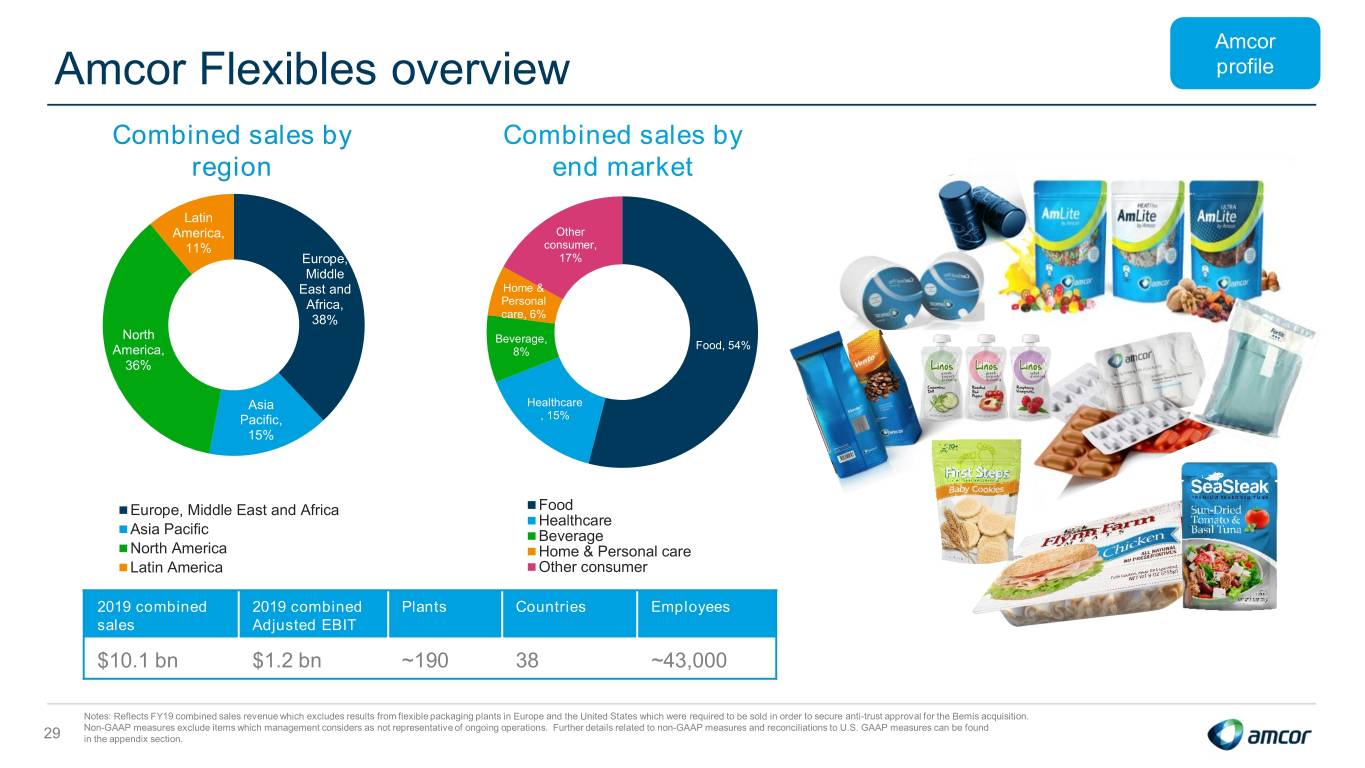
Amcor Amcor Flexibles overview profile Combined sales by Combined sales by region end market Latin America, Other 11% consumer, Europe, 17% Middle East and Home & Africa, Personal 38% care, 6% North Beverage, Food, 54% America, 8% 36% Asia Healthcare Pacific, , 15% 15% Europe, Middle East and Africa Food Healthcare Asia Pacific Beverage North America Home & Personal care Latin America Other consumer 2019 combined 2019 combined Plants Countries Employees sales Adjusted EBIT $10.1 bn $1.2 bn ~190 38 ~43,000 Notes: Reflects FY19 combined sales revenue which excludes results from flexible packaging plants in Europe and the United States which were required to be sold in order to secure anti-trust approval for the Bemis acquisition. Non-GAAP measures exclude items which management considers as not representative of ongoing operations. Further details related to non-GAAP measures and reconciliations to U.S. GAAP measures can be found 29 in the appendix section.
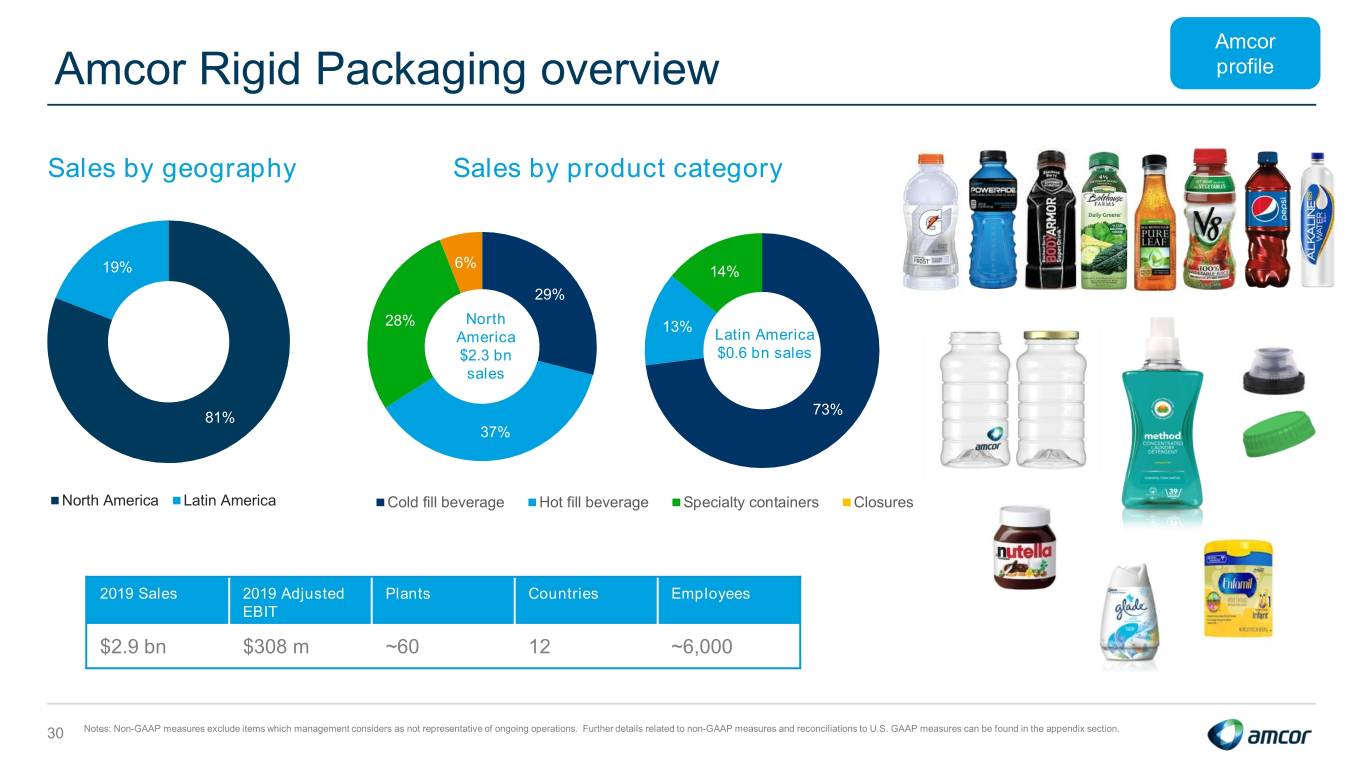
Amcor Amcor Rigid Packaging overview profile Sales by geography Sales by product category 6% 19% 14% 29% North 28% 13% America Latin America $2.3 bn $0.6 bn sales sales 73% 81% 37% North America Latin America Cold fill beverage Hot fill beverage Specialty containers Closures 2019 Sales 2019 Adjusted Plants Countries Employees EBIT $2.9 bn $308 m ~60 12 ~6,000 30 Notes: Non-GAAP measures exclude items which management considers as not representative of ongoing operations. Further details related to non-GAAP measures and reconciliations to U.S. GAAP measures can be found in the appendix section.
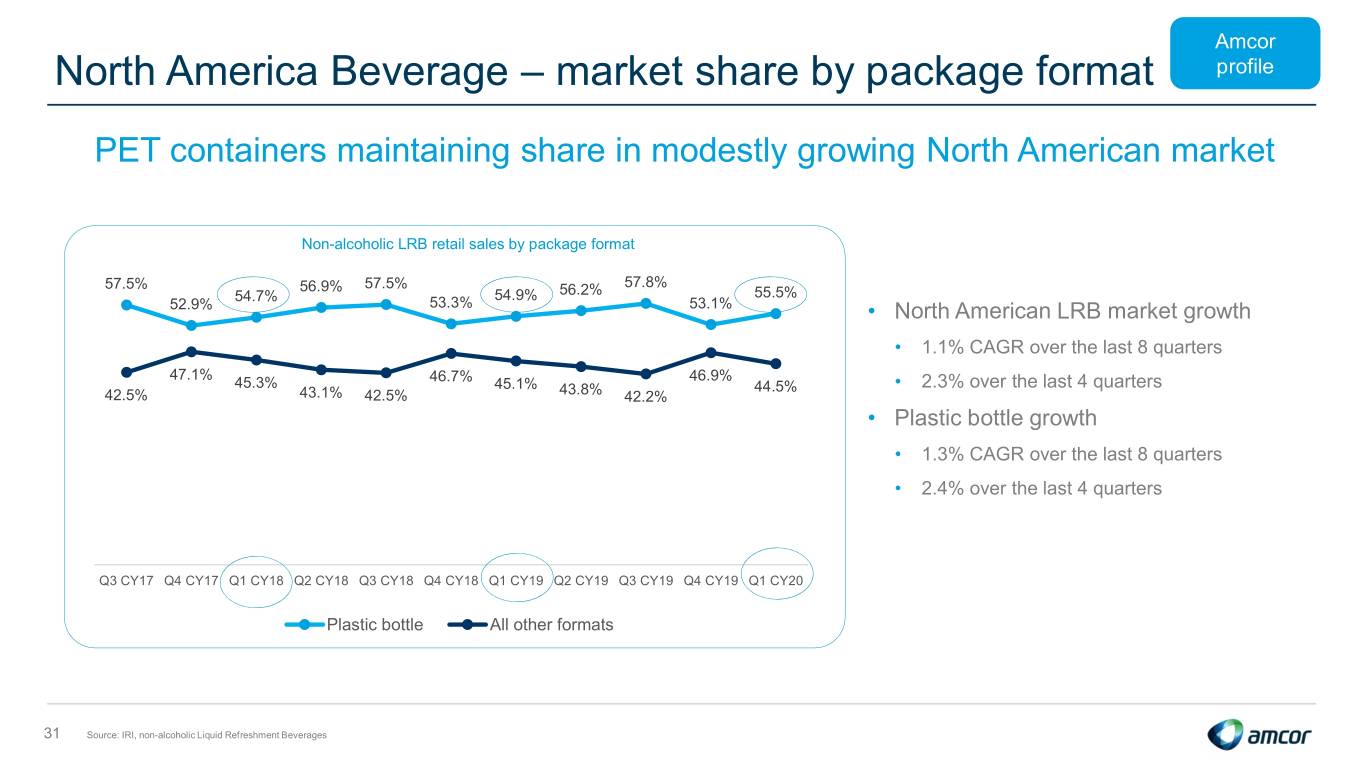
Amcor North America Beverage – market share by package format profile PET containers maintaining share in modestly growing North American market Non-alcoholic LRB retail sales by package format 57.5% 56.9% 57.5% 57.8% 54.7% 54.9% 56.2% 55.5% 52.9% 53.3% 53.1% • North American LRB market growth • 1.1% CAGR over the last 8 quarters 47.1% 46.7% 46.9% 45.3% 45.1% 44.5% • 2.3% over the last 4 quarters 42.5% 43.1% 42.5% 43.8% 42.2% • Plastic bottle growth • 1.3% CAGR over the last 8 quarters • 2.4% over the last 4 quarters Q3 CY17 Q4 CY17 Q1 CY18 Q2 CY18 Q3 CY18 Q4 CY18 Q1 CY19 Q2 CY19 Q3 CY19 Q4 CY19 Q1 CY20 Plastic bottle All other formats 31 Source: IRI, non-alcoholic Liquid Refreshment Beverages
Appendix slides Sustainability
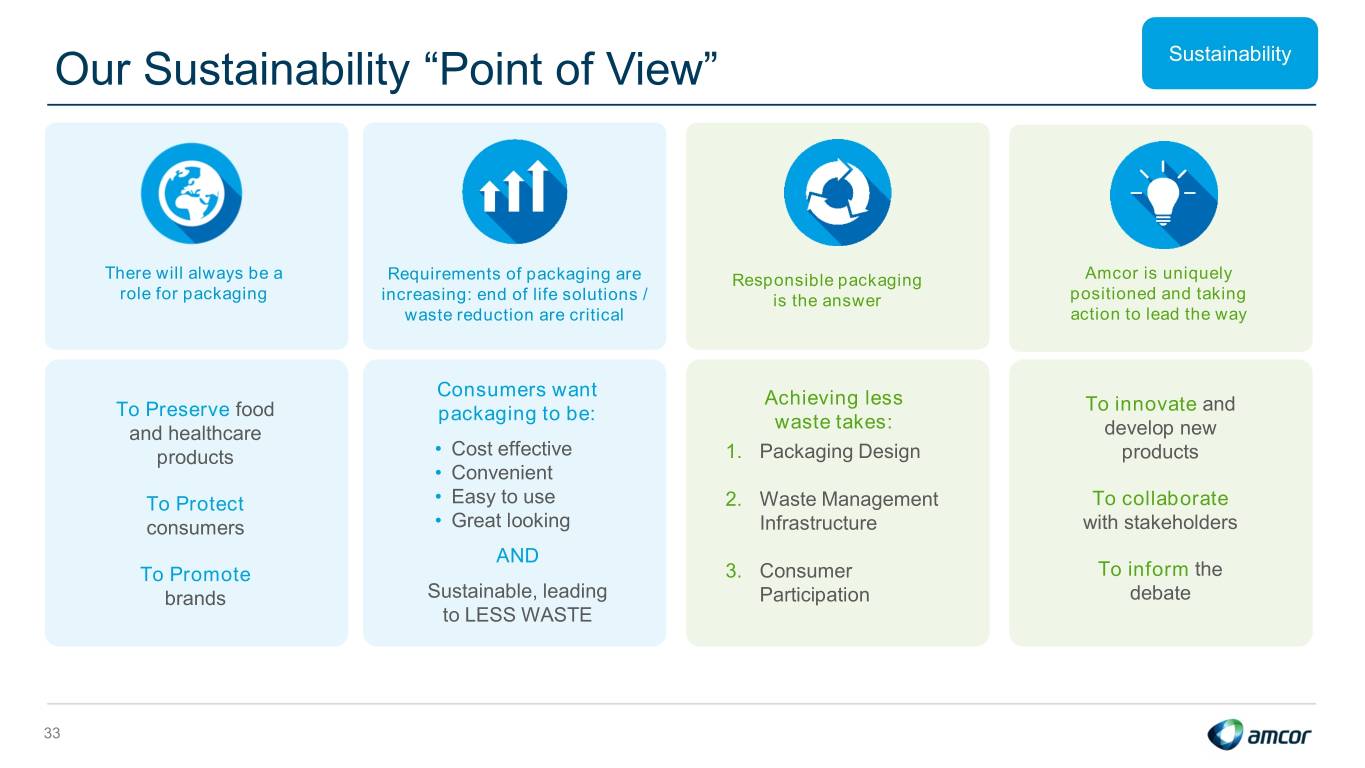
Our Sustainability “Point of View” Sustainability There will always be a Requirements of packaging are Responsible packaging Amcor is uniquely role for packaging increasing: end of life solutions / is the answer positioned and taking waste reduction are critical action to lead the way Consumers want Achieving less To Preserve food To innovate and packaging to be: waste takes: and healthcare develop new products • Cost effective 1. Packaging Design products • Convenient To Protect • Easy to use 2. Waste Management To collaborate consumers • Great looking Infrastructure with stakeholders AND To Promote 3. Consumer To inform the brands Sustainable, leading Participation debate to LESS WASTE 33
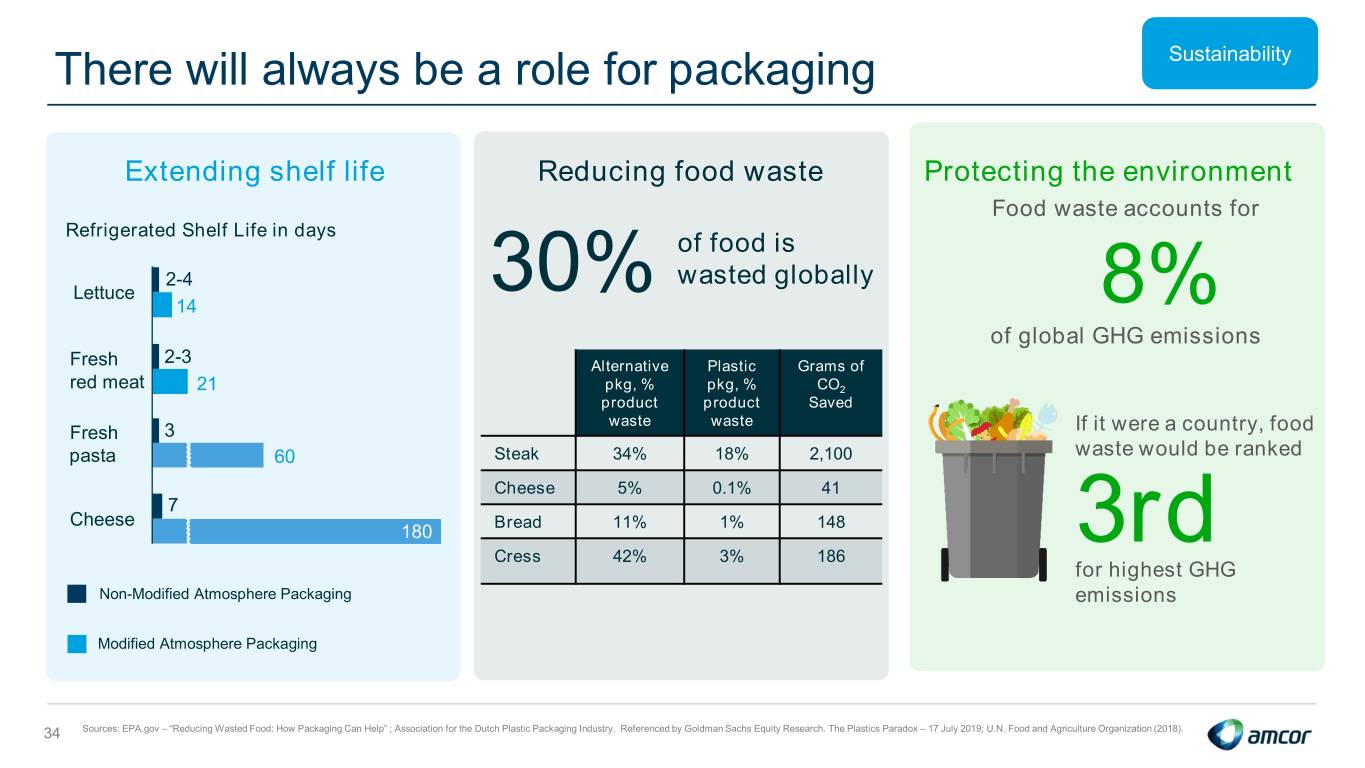
There will always be a role for packaging Sustainability Extending shelf life Reducing food waste Protecting the environment Food waste accounts for Refrigerated Shelf Life in days of food is 2-4 wasted globally Lettuce 30% 14 8% of global GHG emissions Fresh 2-3 Alternative Plastic Grams of red meat 21 pkg, % pkg, % CO2 product product Saved waste waste Fresh 3 If it were a country, food pasta 60 Steak 34% 18% 2,100 waste would be ranked Cheese 5% 0.1% 41 7 Cheese Bread 11% 1% 148 180 3rd Cress 42% 3% 186 for highest GHG Non-Modified Atmosphere Packaging emissions Modified Atmosphere Packaging 34 Sources: EPA.gov – “Reducing Wasted Food: How Packaging Can Help” ; Association for the Dutch Plastic Packaging Industry. Referenced by Goldman Sachs Equity Research. The Plastics Paradox – 17 July 2019; U.N. Food and Agriculture Organization (2018).
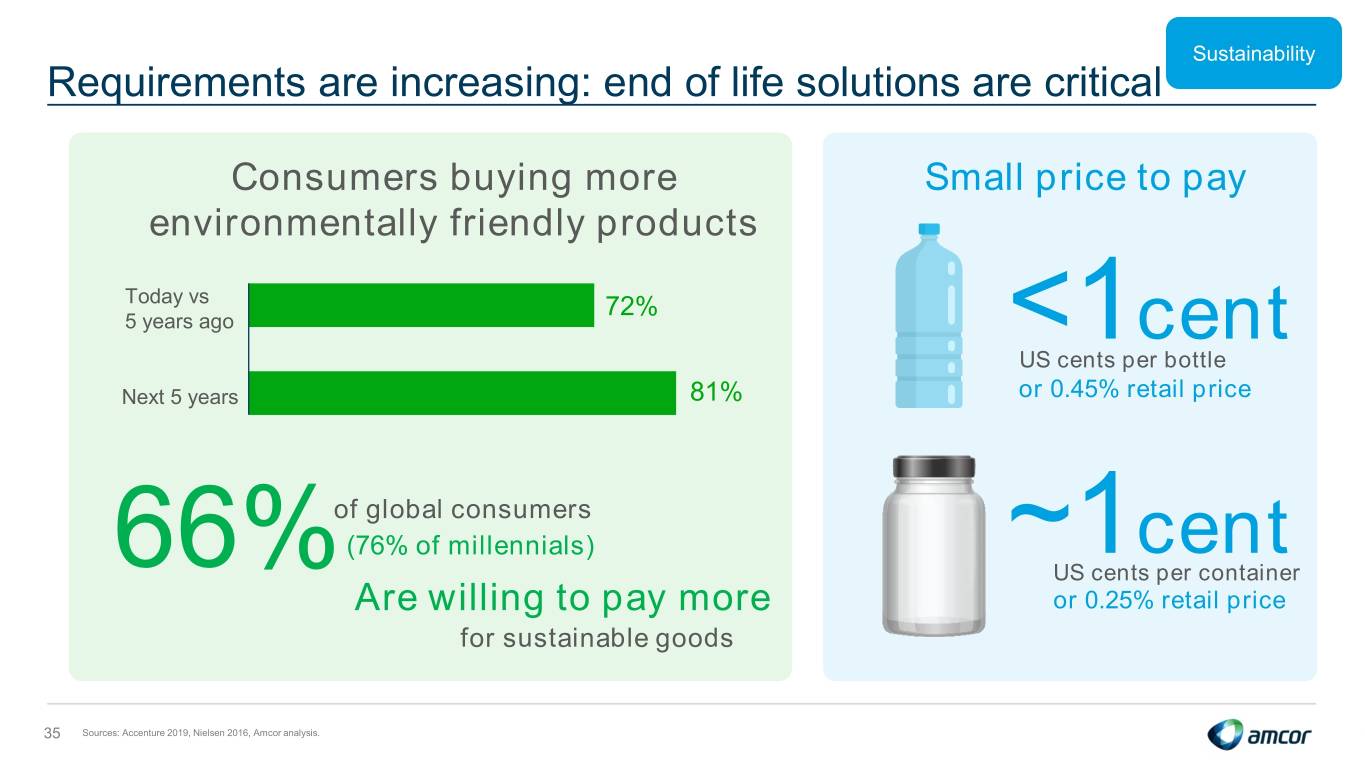
Sustainability Requirements are increasing: end of life solutions are critical Consumers buying more Small price to pay environmentally friendly products Today vs 72% 5 years ago <1cent US cents per bottle Next 5 years 81% or 0.45% retail price of global consumers (76% of millennials) ~1cent 66% US cents per container Are willing to pay more or 0.25% retail price for sustainable goods 35 Sources: Accenture 2019, Nielsen 2016, Amcor analysis.
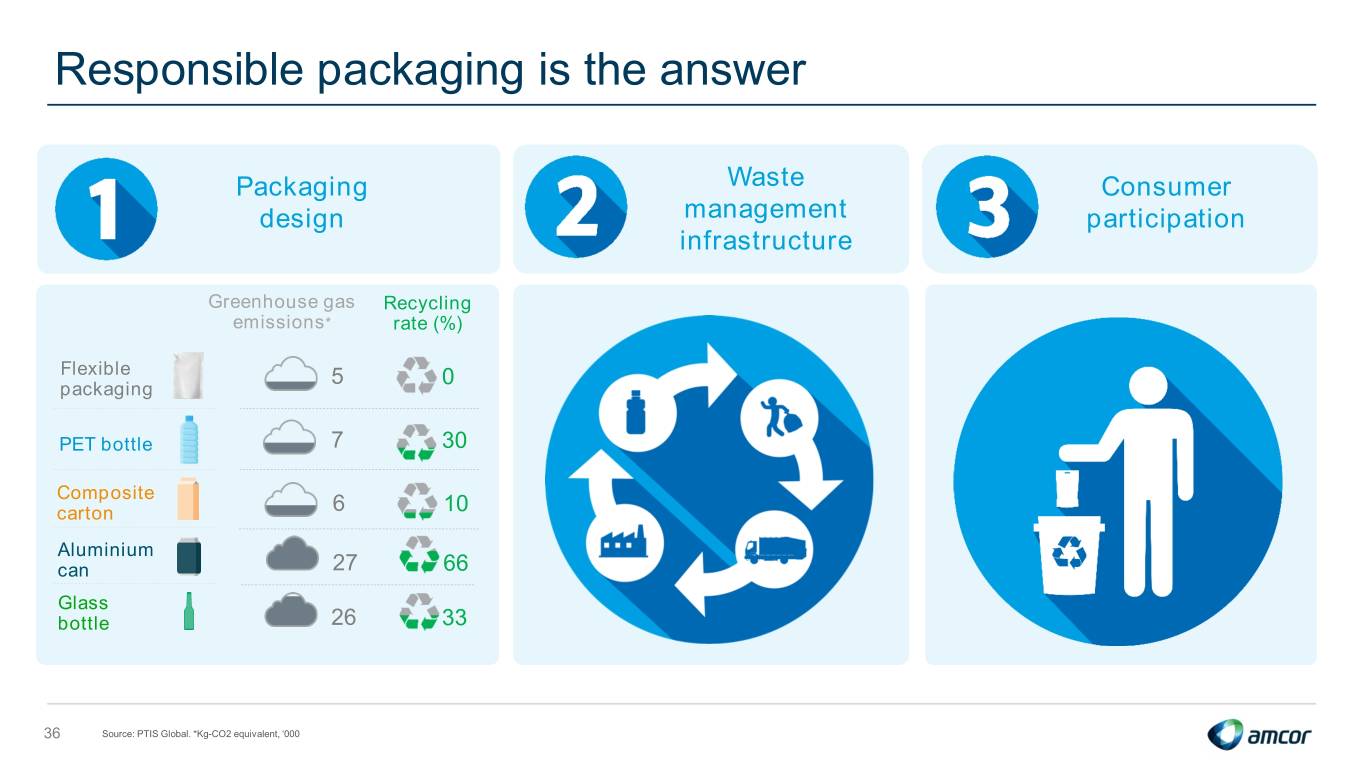
Responsible packaging is the answer Packaging Waste Consumer design management participation infrastructure Greenhouse gas Recycling emissions* rate (%) Flexible 5 0 packaging PET bottle 7 30 Composite carton 6 10 Aluminium can 27 66 Glass bottle 26 33 36 Source: PTIS Global. *Kg-CO2 equivalent, ‘000
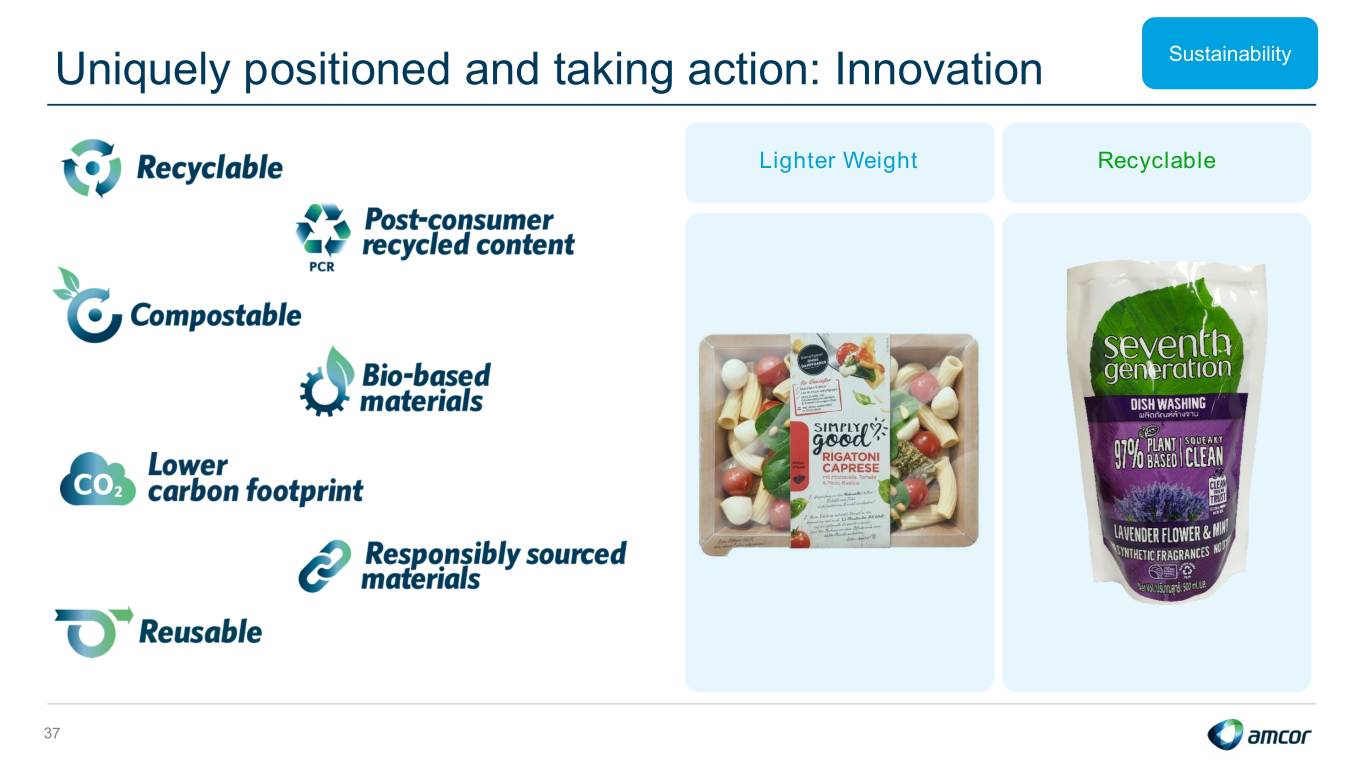
Uniquely positioned and taking action: Innovation Sustainability Lighter Weight Recyclable 37
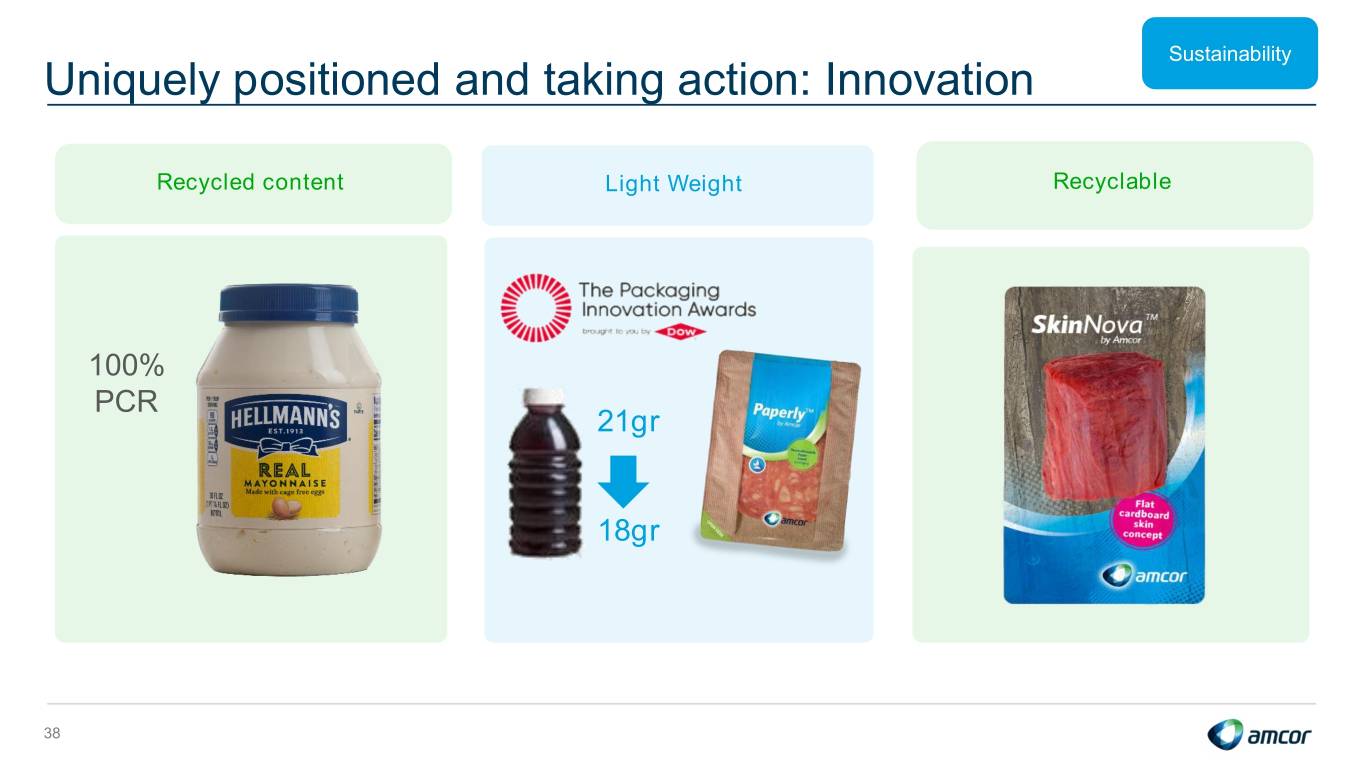
Sustainability Uniquely positioned and taking action: Innovation Recycled content Light Weight Recyclable 100% PCR 21gr 18gr 38
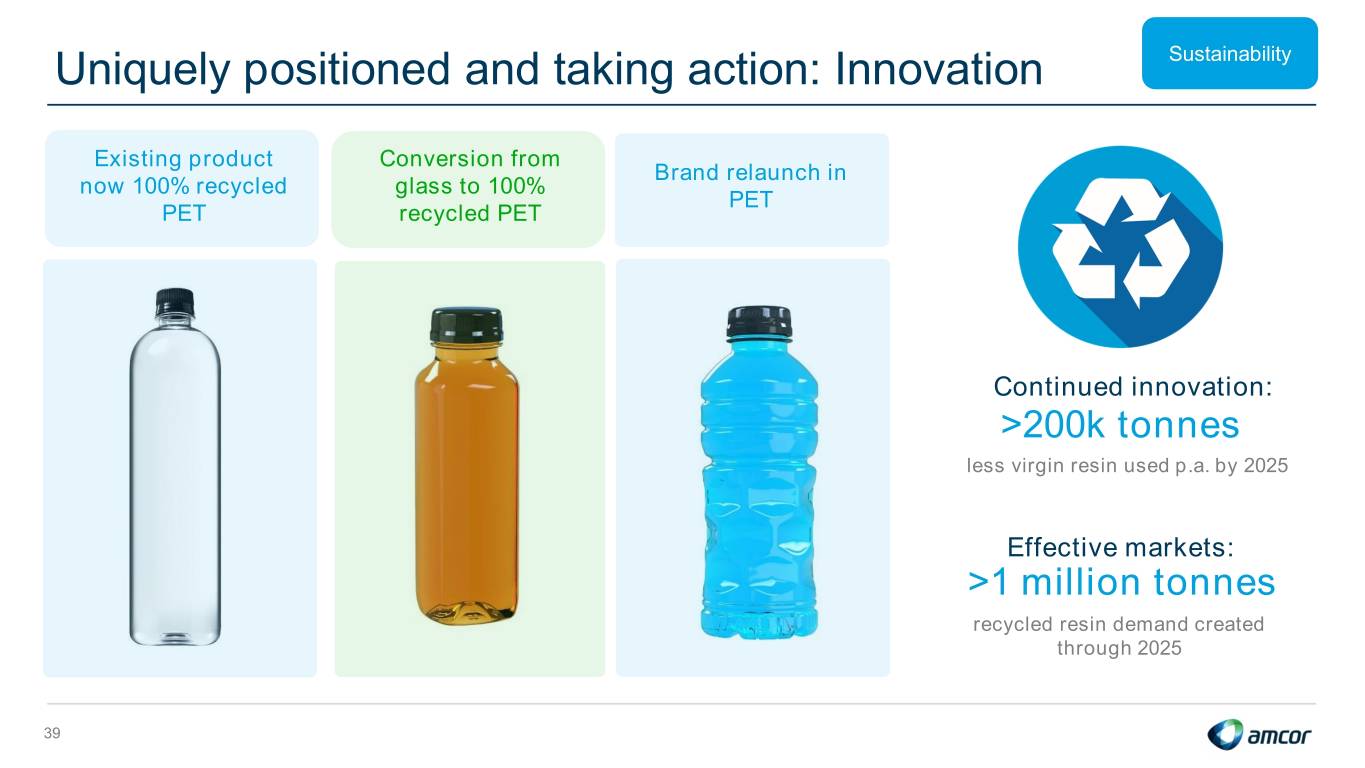
Uniquely positioned and taking action: Innovation Sustainability Existing product Conversion from Brand relaunch in now 100% recycled glass to 100% PET PET recycled PET Continued innovation: >200k tonnes less virgin resin used p.a. by 2025 Effective markets: >1 million tonnes recycled resin demand created through 2025 39
Uniquely positioned and taking action: Collaborating and informing Sustainability Bilateral top-to-top customer summits 40
Appendix slides Fiscal 2020 YTD results – supplementary schedules and reconciliations
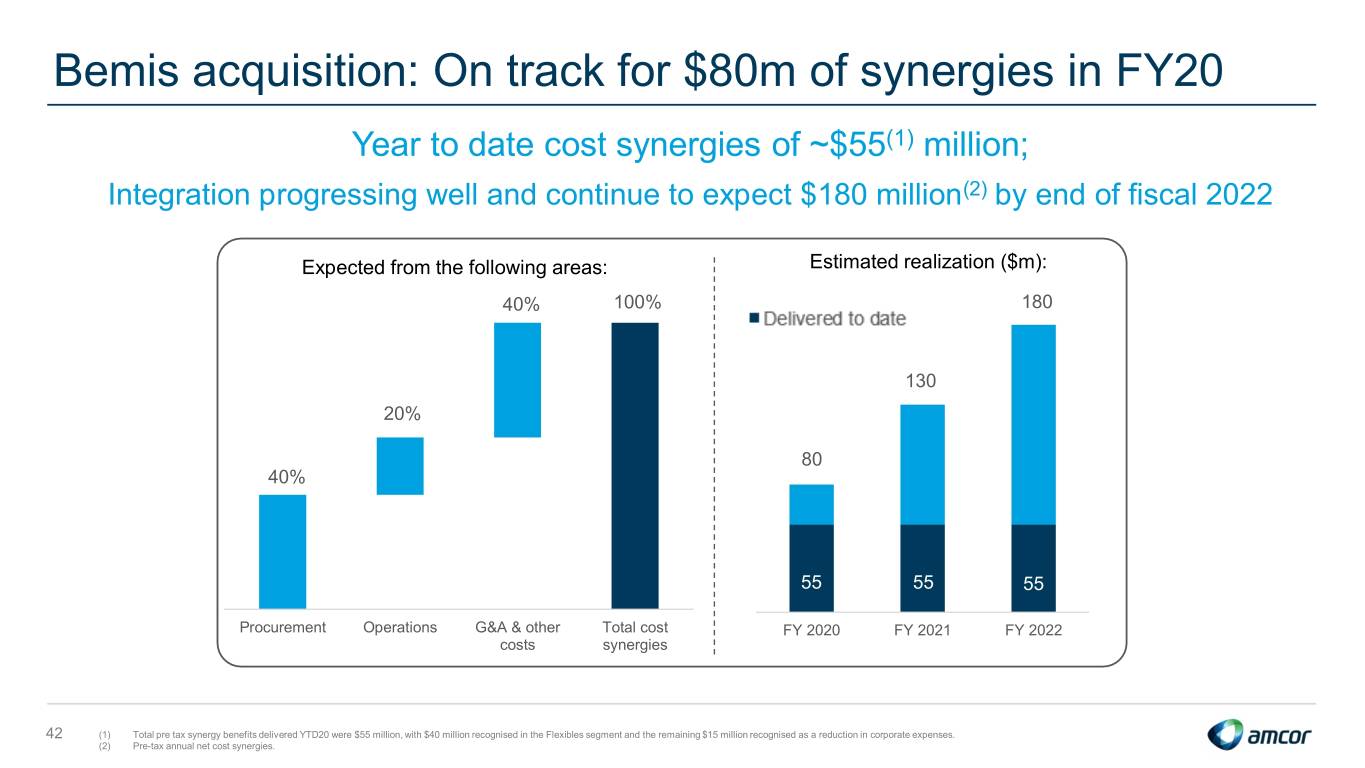
Bemis acquisition: On track for $80m of synergies in FY20 Year to date cost synergies of ~$55(1) million; Integration progressing well and continue to expect $180 million(2) by end of fiscal 2022 Expected from the following areas: Estimated realization ($m): 40% 100% 180 130 20% 80 40% 55 55 55 Procurement Operations G&A & other Total cost FY 2020 FY 2021 FY 2022 costs synergies 42 (1) Total pre tax synergy benefits delivered YTD20 were $55 million, with $40 million recognised in the Flexibles segment and the remaining $15 million recognised as a reduction in corporate expenses. (2) Pre-tax annual net cost synergies.
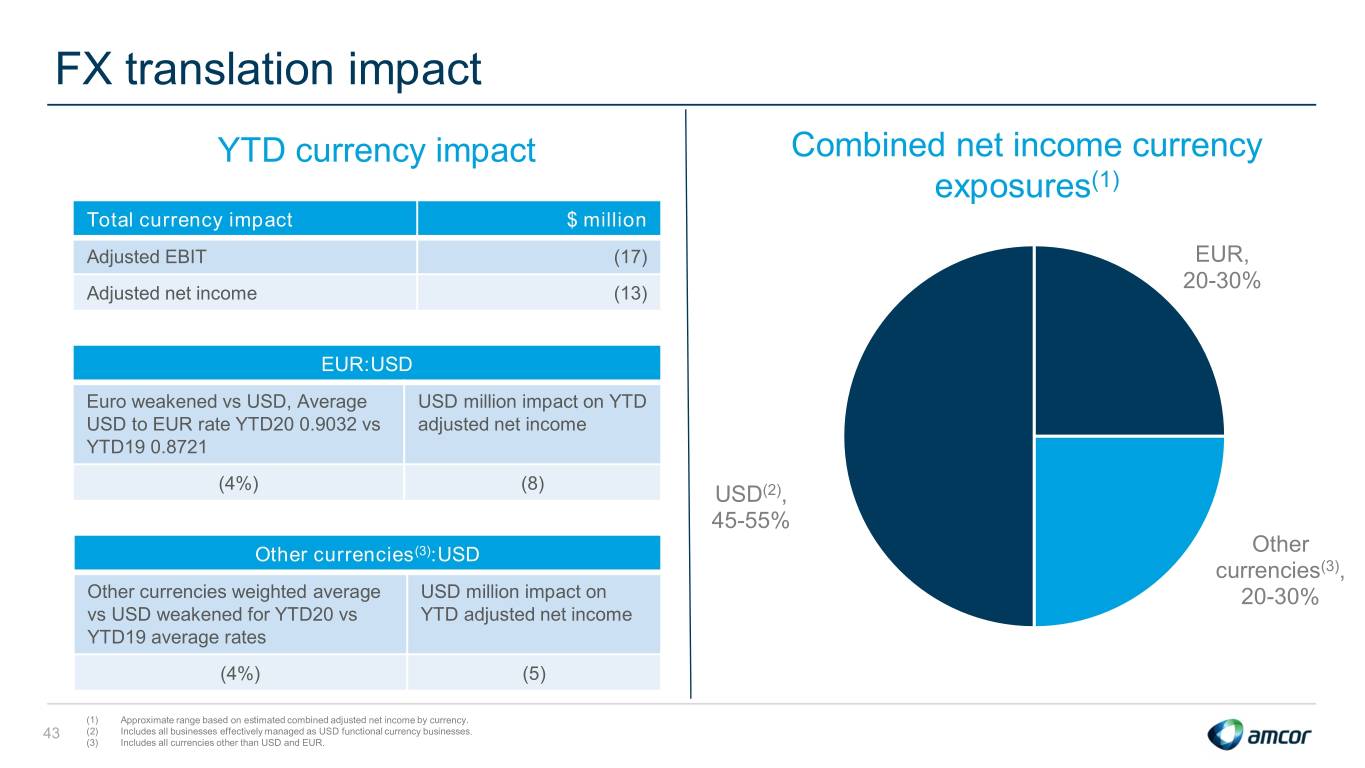
FX translation impact YTD currency impact Combined net income currency exposures(1) Total currency impact $ million Adjusted EBIT (17) EUR, 20-30% Adjusted net income (13) EUR:USD Euro weakened vs USD, Average USD million impact on YTD USD to EUR rate YTD20 0.9032 vs adjusted net income YTD19 0.8721 (4%) (8) USD(2), 45-55% Other currencies(3):USD Other currencies(3), Other currencies weighted average USD million impact on 20-30% vs USD weakened for YTD20 vs YTD adjusted net income YTD19 average rates (4%) (5) (1) Approximate range based on estimated combined adjusted net income by currency. 43 (2) Includes all businesses effectively managed as USD functional currency businesses. (3) Includes all currencies other than USD and EUR.
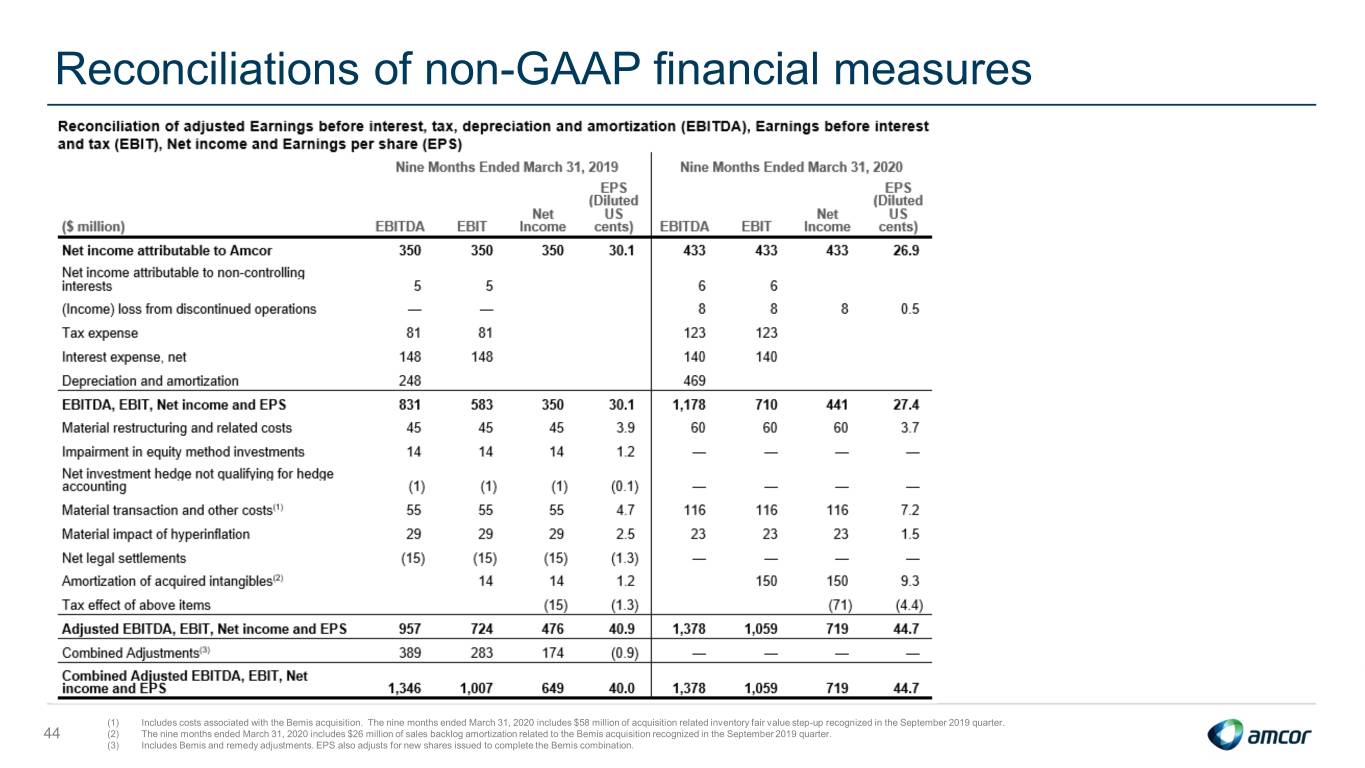
Reconciliations of non-GAAP financial measures (1) Includes costs associated with the Bemis acquisition. The nine months ended March 31, 2020 includes $58 million of acquisition related inventory fair value step-up recognized in the September 2019 quarter. 44 (2) The nine months ended March 31, 2020 includes $26 million of sales backlog amortization related to the Bemis acquisition recognized in the September 2019 quarter. (3) Includes Bemis and remedy adjustments. EPS also adjusts for new shares issued to complete the Bemis combination.
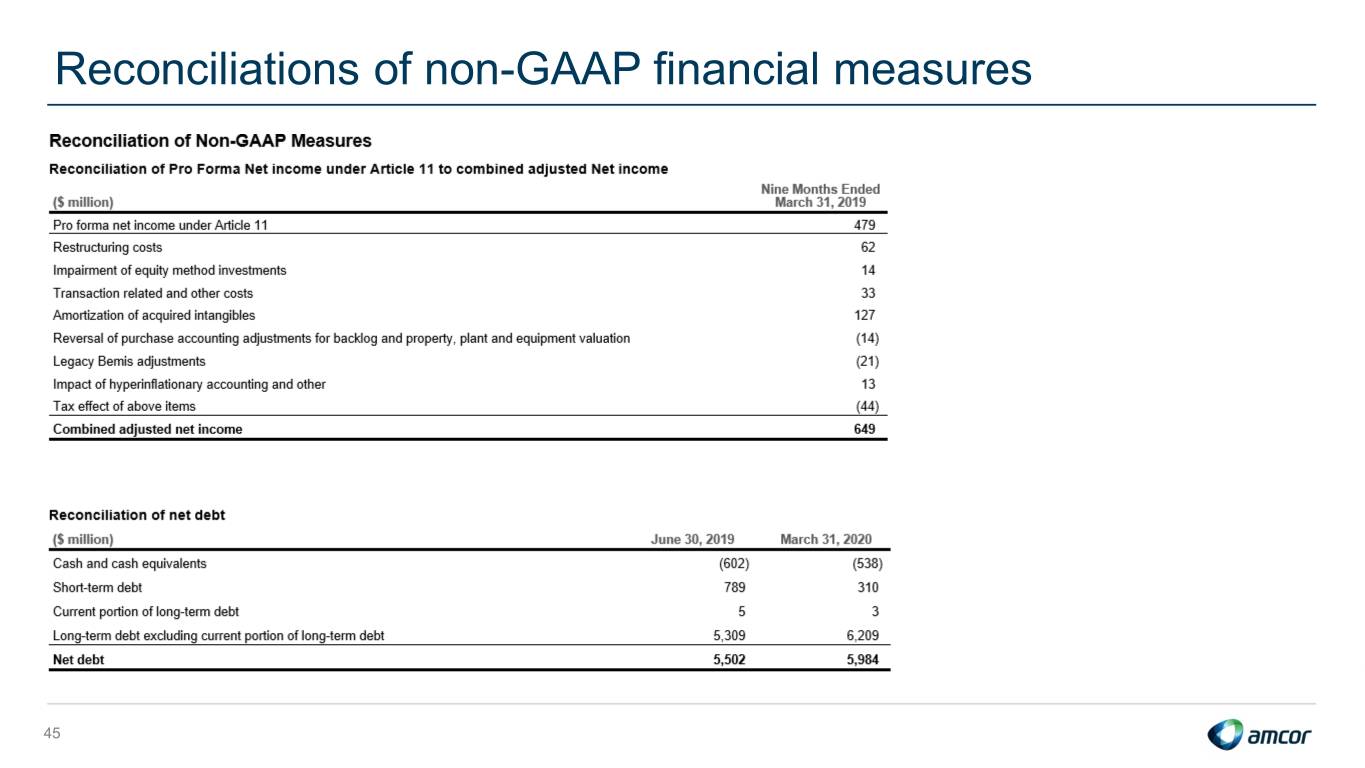
Reconciliations of non-GAAP financial measures 45
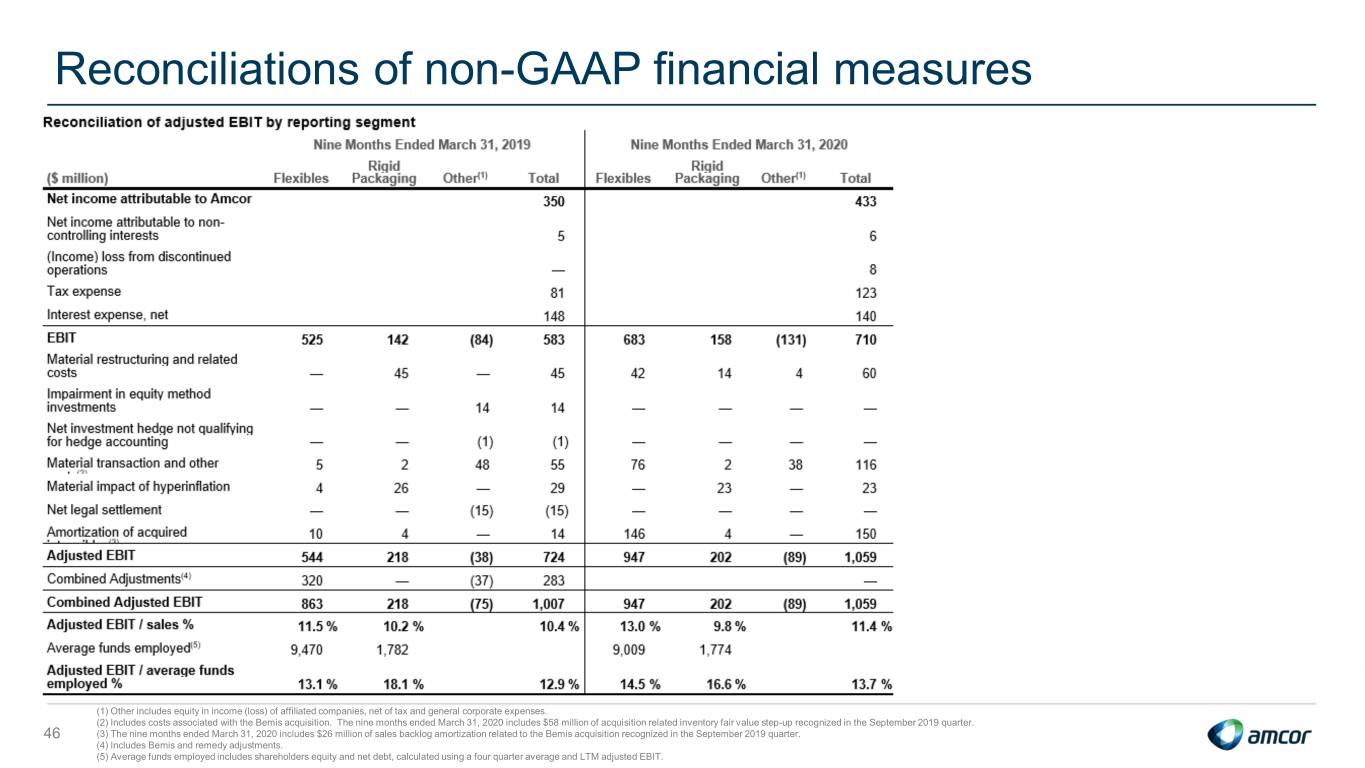
Reconciliations of non-GAAP financial measures (1) Other includes equity in income (loss) of affiliated companies, net of tax and general corporate expenses. (2) Includes costs associated with the Bemis acquisition. The nine months ended March 31, 2020 includes $58 million of acquisition related inventory fair value step-up recognized in the September 2019 quarter. 46 (3) The nine months ended March 31, 2020 includes $26 million of sales backlog amortization related to the Bemis acquisition recognized in the September 2019 quarter. (4) Includes Bemis and remedy adjustments. (5) Average funds employed includes shareholders equity and net debt, calculated using a four quarter average and LTM adjusted EBIT.
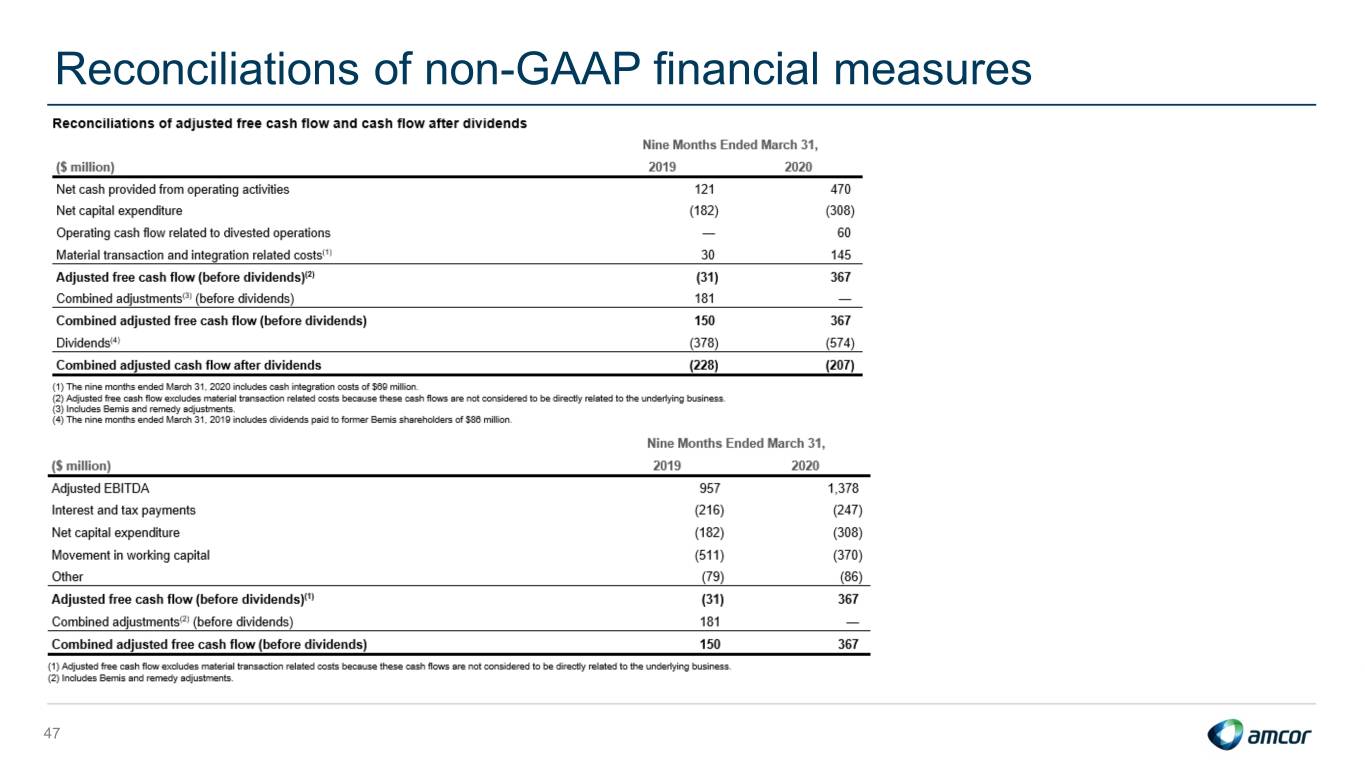
Reconciliations of non-GAAP financial measures 47