
BH-A 8-K/A
Biglari Holdings Inc. (BH-A)
8-K/A
2022-11-30
For: 2022-09-14
View Original
Added on
April 04, 2026
UNITED STATES
SECURITIES AND EXCHANGE COMMISSION
WASHINGTON, D.C. 20549
____________________
FORM 8-K/A
(Amendment No. 1)
CURRENT REPORT
Pursuant to Section 13 or 15(d) of the
Securities Exchange Act of 1934
Date of Report (Date of earliest event reported): September 14, 2022
| (Exact Name of Registrant as Specified in Charter) | ||
| (State or Other Jurisdiction of Incorporation) | (Commission File Number) | (IRS Employer Identification No.) | ||||||||||||
| (Address of Principal Executive Offices) | (Zip Code) | ||||||||||
Registrant’s telephone number, including area code: (210 ) 344-3400
| 17802 IH 10 West, Suite 400, San Antonio, TX 78257 | ||
| (Former Name or Former Address, if Changed Since Last Report.) | ||
Check the appropriate box below if the Form 8-K filing is intended to simultaneously satisfy the filing obligation of the registrant under any of the following provisions:
Securities registered pursuant to Section 12(b) of the Act:
| Title of Each Class | Trading Symbol(s) | Name of Each Exchange on Which Registered | ||||||
Indicate by check mark whether the registrant is an emerging growth company as defined in Rule 405 of the Securities Act of 1933 (§230.405 of this chapter) or Rule 12b-2 of the Securities Exchange Act of 1934 (§240.12b-2 of this chapter).
Emerging growth company ☐
If an emerging growth company, indicate by check mark if the registrant has elected not to use the extended transition period for complying with any new or revised financial accounting standards provided pursuant to Section 13(a) of the Exchange Act. ☐
EXPLANATORY NOTE
In its Current Report on Form 8-K filed on September 26, 2022 (the “Initial 8-K”), Biglari Holdings Inc. (the “Company”) reported that it had completed the purchase of 685,505 shares of Series A Preferred Stock (the “Preferred Shares”) of Abraxas Petroleum Corporation (“Abraxas”) for a purchase price of $80 million (the “Acquisition”).
As permitted by Item 9.01 of Form 8-K, this amendment is being filed to amend and supplement the Initial 8-K to include financial statements of Abraxas and pro forma financial information reflecting the effect of the Acquisition. This amendment does not otherwise update, modify, or amend the Initial 8-K and should be read in conjunction with the Initial 8-K.
Item 9.01. Financial Statements and Exhibits.
(a)Financial Statements of Business Acquired
The audited consolidated financial statements of Abraxas as of and for the year ended December 31, 2021 are attached as Exhibit 99.1 to this report.
The unaudited condensed consolidated financial statements of Abraxas as of and for the nine months ended September 30, 2022 are attached as Exhibit 99.2 to this report.
(b)Pro Forma Financial Information
The unaudited pro forma condensed combined statements of earnings of the Company and Abraxas for the nine months ended September 30, 2022 and for the year ended December 31, 2021 are attached as Exhibit 99.3 to this report.
(d)Exhibits
| Exhibit No. | Description | |||||||
| 23.1 | ||||||||
| 99.1 | ||||||||
| 99.2 | ||||||||
| 99.3 | ||||||||
| 104 | Cover Page Interactive Data File (embedded within the Inline XBRL document) | |||||||
SIGNATURE
Pursuant to the requirements of the Securities Exchange Act of 1934, the registrant has duly caused this report to be signed on its behalf by the undersigned hereunto duly authorized.
| November 30, 2022 | BIGLARI HOLDINGS INC. | ||||||||||
| By: | /s/ Bruce Lewis | ||||||||||
| Name: | Bruce Lewis | ||||||||||
| Title: | Controller | ||||||||||
EXHIBIT 23.1
CONSENT OF INDEPENDENT REGISTERED PUBLIC ACCOUNTING FIRM
We consent to the incorporation by reference in the Form 8-K/A of Biglari Holdings Inc. of our report dated March 31, 2022 with respect to the consolidated financial statements of Abraxas Petroleum Corporation as of and for the year ended December 31, 2021.
| /s/ ADKF, P.C. | |||||
| ADKF, P.C. | |||||
| San Antonio, Texas | |||||
| November 30, 2022 | |||||

Exhibit 99.1 AUDITED CONSOLIDATED FINANCIAL STATEMENTS OF ABRAXAS PETROLEUM CORPORATION AS OF AND FOR THE YEAR ENDED DECEMBER 31, 2021
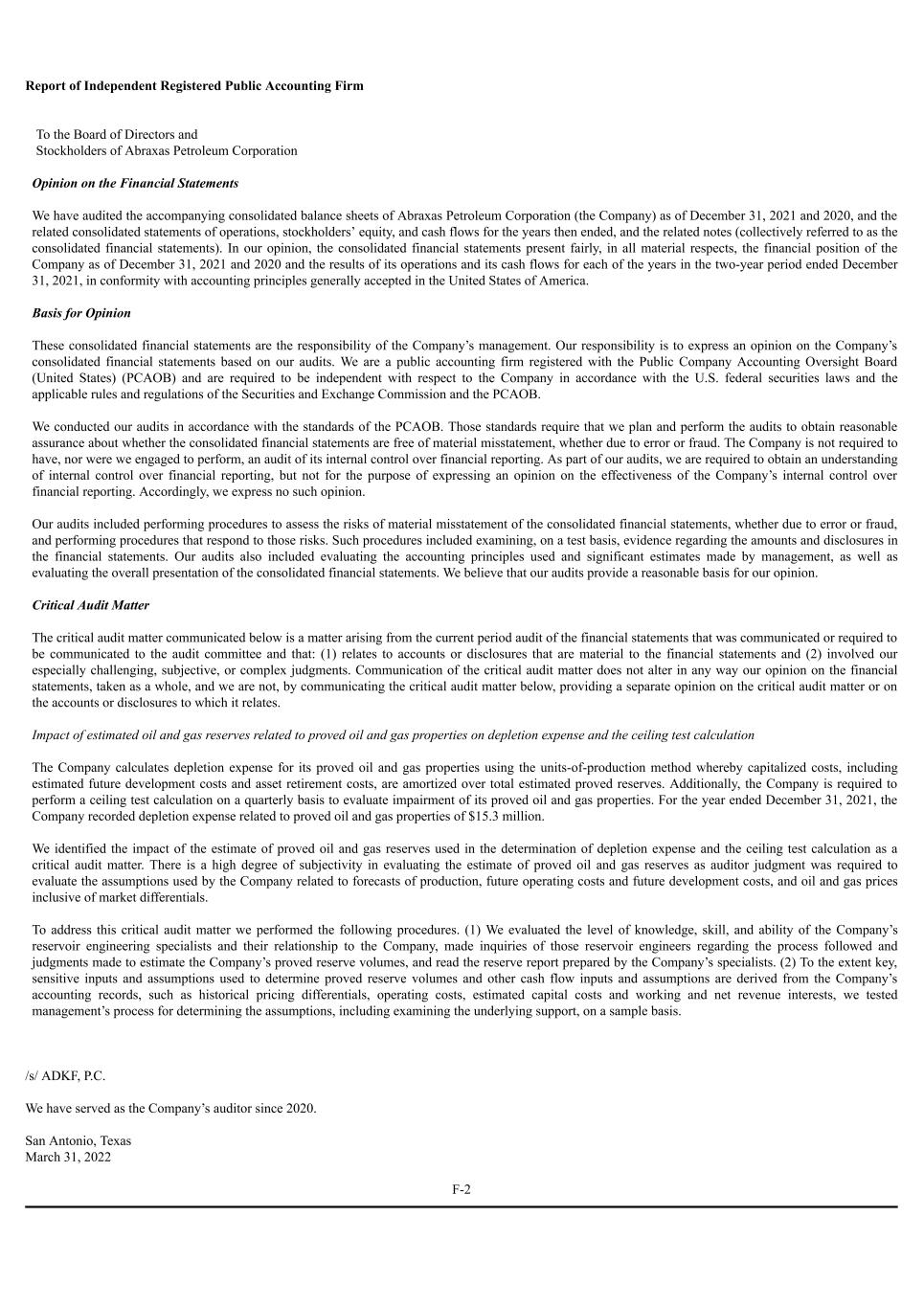
Report of Independent Registered Public Accounting Firm To the Board of Directors and Stockholders of Abraxas Petroleum Corporation Opinion on the Financial Statements We have audited the accompanying consolidated balance sheets of Abraxas Petroleum Corporation (the Company) as of December 31, 2021 and 2020, and the related consolidated statements of operations, stockholders’ equity, and cash flows for the years then ended, and the related notes (collectively referred to as the consolidated financial statements). In our opinion, the consolidated financial statements present fairly, in all material respects, the financial position of the Company as of December 31, 2021 and 2020 and the results of its operations and its cash flows for each of the years in the two-year period ended December 31, 2021, in conformity with accounting principles generally accepted in the United States of America. Basis for Opinion These consolidated financial statements are the responsibility of the Company’s management. Our responsibility is to express an opinion on the Company’s consolidated financial statements based on our audits. We are a public accounting firm registered with the Public Company Accounting Oversight Board (United States) (PCAOB) and are required to be independent with respect to the Company in accordance with the U.S. federal securities laws and the applicable rules and regulations of the Securities and Exchange Commission and the PCAOB. We conducted our audits in accordance with the standards of the PCAOB. Those standards require that we plan and perform the audits to obtain reasonable assurance about whether the consolidated financial statements are free of material misstatement, whether due to error or fraud. The Company is not required to have, nor were we engaged to perform, an audit of its internal control over financial reporting. As part of our audits, we are required to obtain an understanding of internal control over financial reporting, but not for the purpose of expressing an opinion on the effectiveness of the Company’s internal control over financial reporting. Accordingly, we express no such opinion. Our audits included performing procedures to assess the risks of material misstatement of the consolidated financial statements, whether due to error or fraud, and performing procedures that respond to those risks. Such procedures included examining, on a test basis, evidence regarding the amounts and disclosures in the financial statements. Our audits also included evaluating the accounting principles used and significant estimates made by management, as well as evaluating the overall presentation of the consolidated financial statements. We believe that our audits provide a reasonable basis for our opinion. Critical Audit Matter The critical audit matter communicated below is a matter arising from the current period audit of the financial statements that was communicated or required to be communicated to the audit committee and that: (1) relates to accounts or disclosures that are material to the financial statements and (2) involved our especially challenging, subjective, or complex judgments. Communication of the critical audit matter does not alter in any way our opinion on the financial statements, taken as a whole, and we are not, by communicating the critical audit matter below, providing a separate opinion on the critical audit matter or on the accounts or disclosures to which it relates. Impact of estimated oil and gas reserves related to proved oil and gas properties on depletion expense and the ceiling test calculation The Company calculates depletion expense for its proved oil and gas properties using the units-of-production method whereby capitalized costs, including estimated future development costs and asset retirement costs, are amortized over total estimated proved reserves. Additionally, the Company is required to perform a ceiling test calculation on a quarterly basis to evaluate impairment of its proved oil and gas properties. For the year ended December 31, 2021, the Company recorded depletion expense related to proved oil and gas properties of $15.3 million. We identified the impact of the estimate of proved oil and gas reserves used in the determination of depletion expense and the ceiling test calculation as a critical audit matter. There is a high degree of subjectivity in evaluating the estimate of proved oil and gas reserves as auditor judgment was required to evaluate the assumptions used by the Company related to forecasts of production, future operating costs and future development costs, and oil and gas prices inclusive of market differentials. To address this critical audit matter we performed the following procedures. (1) We evaluated the level of knowledge, skill, and ability of the Company’s reservoir engineering specialists and their relationship to the Company, made inquiries of those reservoir engineers regarding the process followed and judgments made to estimate the Company’s proved reserve volumes, and read the reserve report prepared by the Company’s specialists. (2) To the extent key, sensitive inputs and assumptions used to determine proved reserve volumes and other cash flow inputs and assumptions are derived from the Company’s accounting records, such as historical pricing differentials, operating costs, estimated capital costs and working and net revenue interests, we tested management’s process for determining the assumptions, including examining the underlying support, on a sample basis. /s/ ADKF, P.C. We have served as the Company’s auditor since 2020. San Antonio, Texas March 31, 2022 F-2
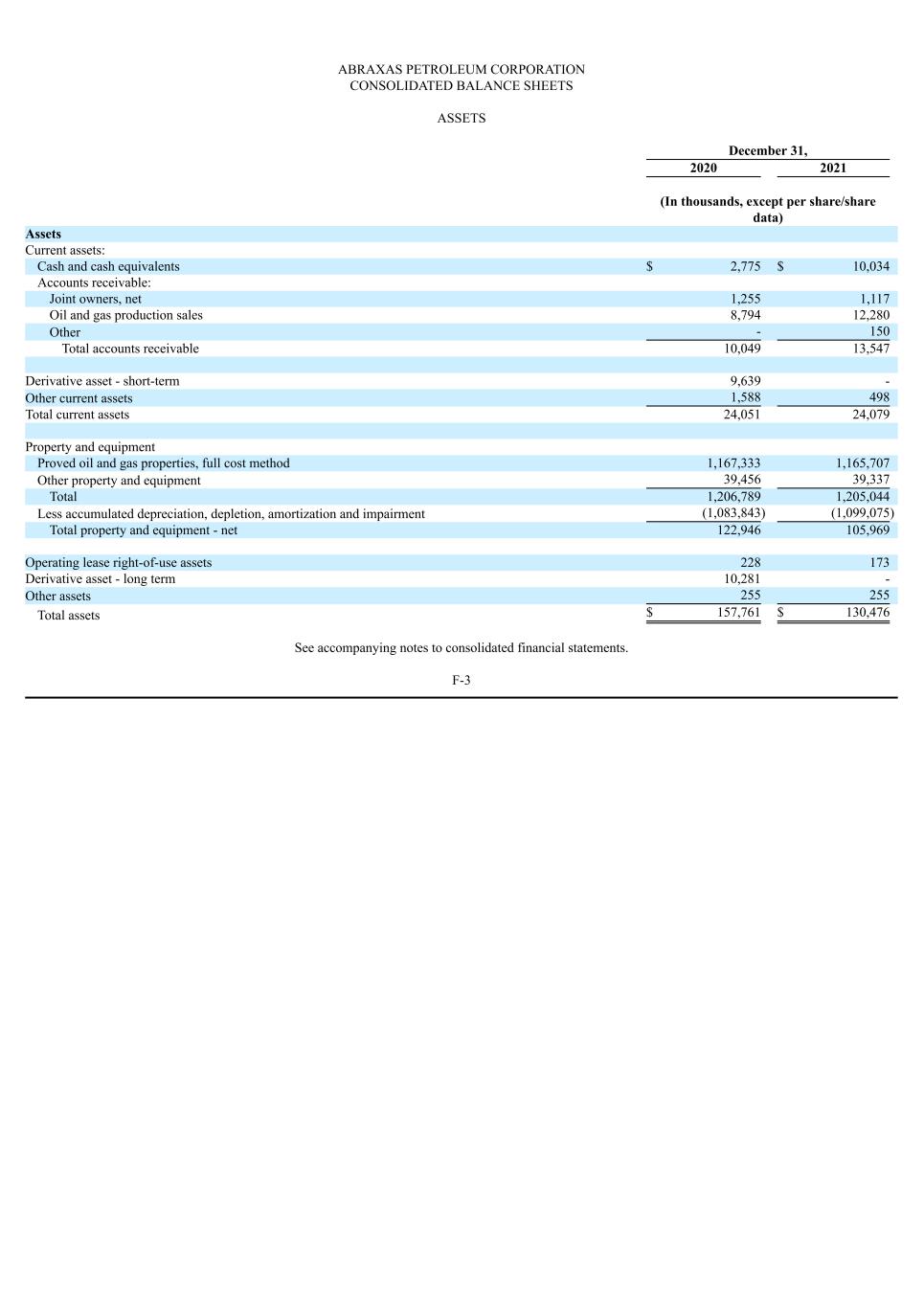
ABRAXAS PETROLEUM CORPORATION CONSOLIDATED BALANCE SHEETS ASSETS December 31, 2020 2021 (In thousands, except per share/share data) Assets Current assets: Cash and cash equivalents $ 2,775 $ 10,034 Accounts receivable: Joint owners, net 1,255 1,117 Oil and gas production sales 8,794 12,280 Other - 150 Total accounts receivable 10,049 13,547 Derivative asset - short-term 9,639 - Other current assets 1,588 498 Total current assets 24,051 24,079 Property and equipment Proved oil and gas properties, full cost method 1,167,333 1,165,707 Other property and equipment 39,456 39,337 Total 1,206,789 1,205,044 Less accumulated depreciation, depletion, amortization and impairment (1,083,843) (1,099,075) Total property and equipment - net 122,946 105,969 Operating lease right-of-use assets 228 173 Derivative asset - long term 10,281 - Other assets 255 255 Total assets $ 157,761 $ 130,476 See accompanying notes to consolidated financial statements. F-3
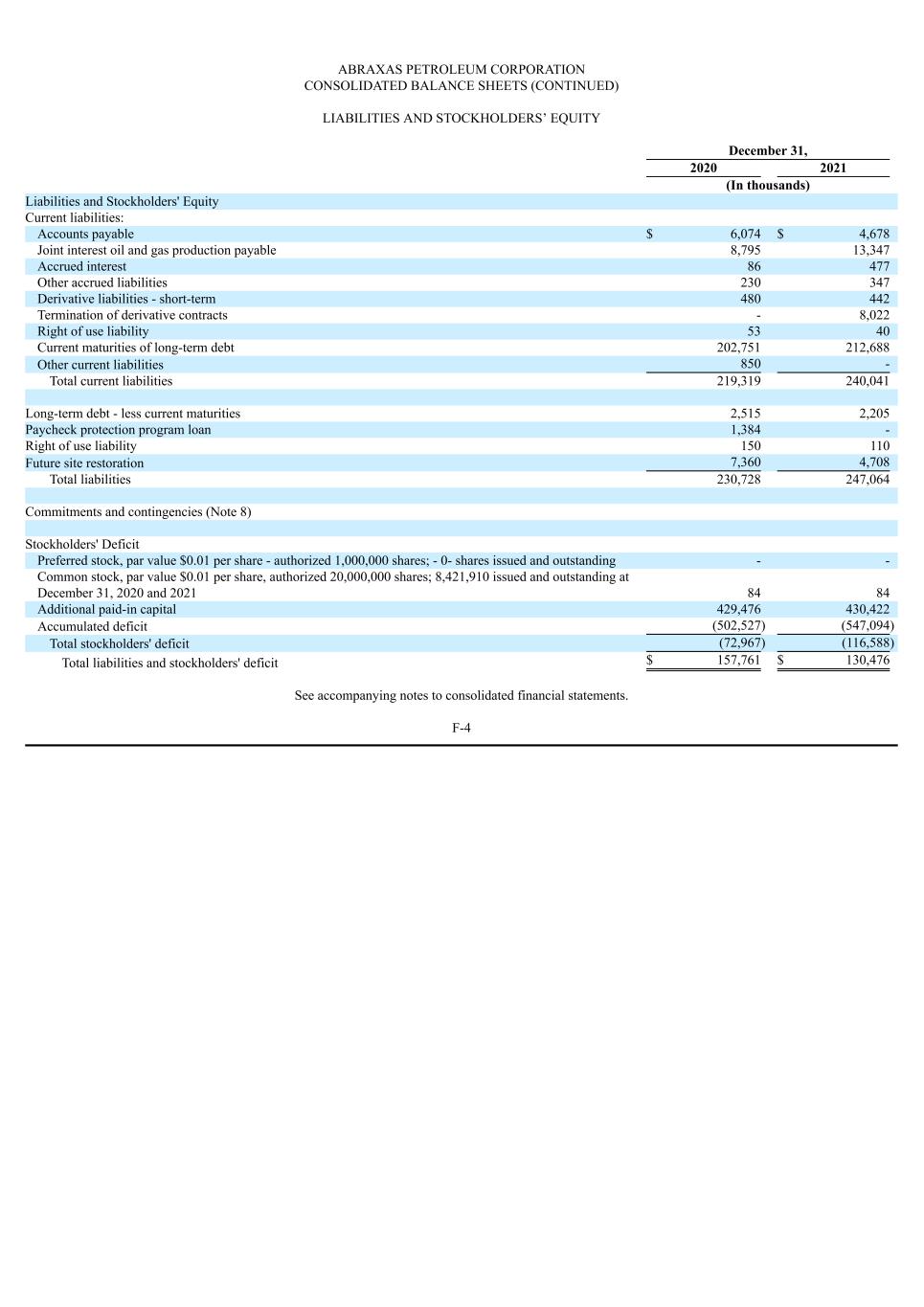
ABRAXAS PETROLEUM CORPORATION CONSOLIDATED BALANCE SHEETS (CONTINUED) LIABILITIES AND STOCKHOLDERS’ EQUITY December 31, 2020 2021 (In thousands) Liabilities and Stockholders' Equity Current liabilities: Accounts payable $ 6,074 $ 4,678 Joint interest oil and gas production payable 8,795 13,347 Accrued interest 86 477 Other accrued liabilities 230 347 Derivative liabilities - short-term 480 442 Termination of derivative contracts - 8,022 Right of use liability 53 40 Current maturities of long-term debt 202,751 212,688 Other current liabilities 850 - Total current liabilities 219,319 240,041 Long-term debt - less current maturities 2,515 2,205 Paycheck protection program loan 1,384 - Right of use liability 150 110 Future site restoration 7,360 4,708 Total liabilities 230,728 247,064 Commitments and contingencies (Note 8) Stockholders' Deficit Preferred stock, par value $0.01 per share - authorized 1,000,000 shares; - 0- shares issued and outstanding - - Common stock, par value $0.01 per share, authorized 20,000,000 shares; 8,421,910 issued and outstanding at December 31, 2020 and 2021 84 84 Additional paid-in capital 429,476 430,422 Accumulated deficit (502,527) (547,094) Total stockholders' deficit (72,967) (116,588) Total liabilities and stockholders' deficit $ 157,761 $ 130,476 See accompanying notes to consolidated financial statements. F-4
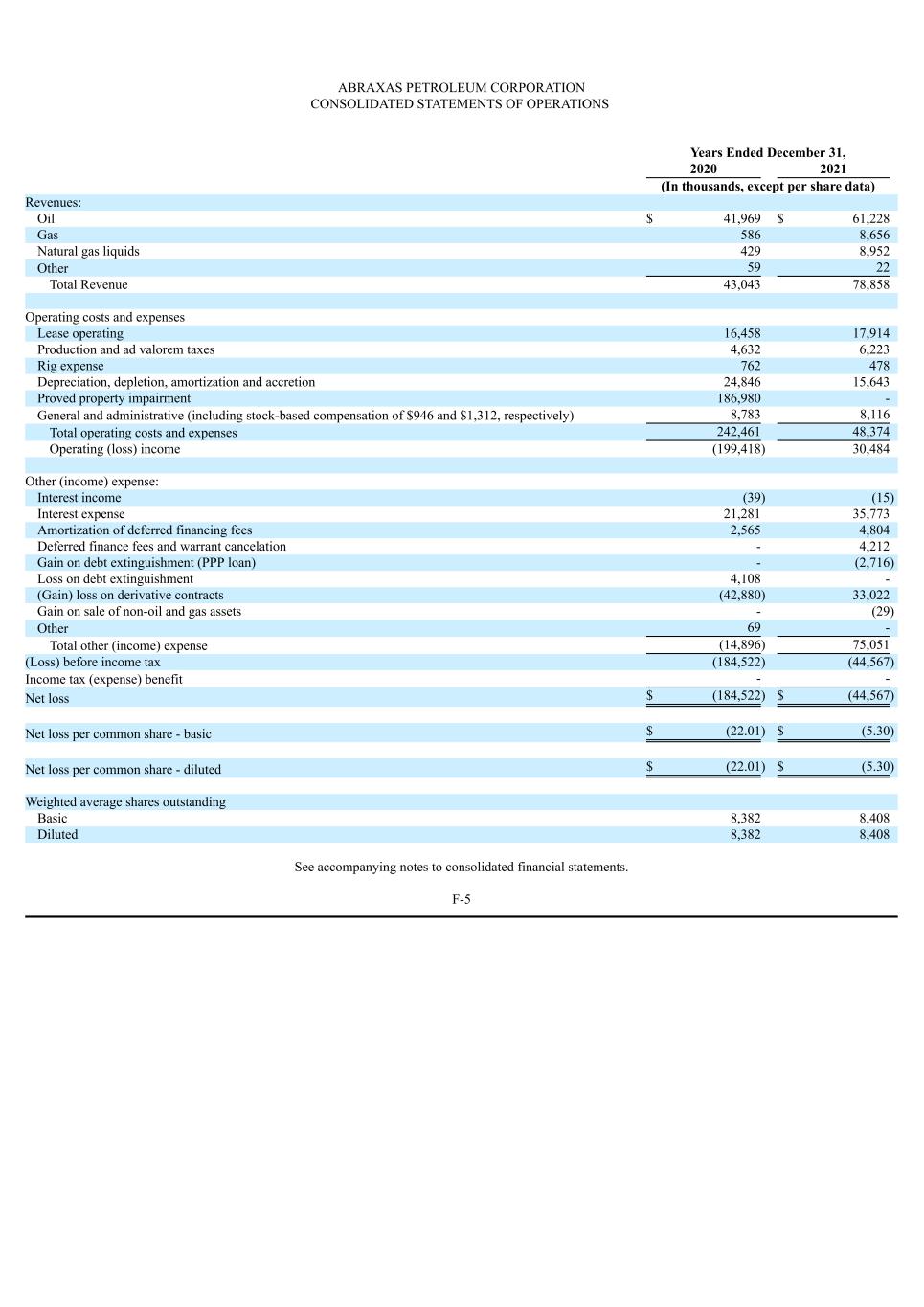
ABRAXAS PETROLEUM CORPORATION CONSOLIDATED STATEMENTS OF OPERATIONS Years Ended December 31, 2020 2021 (In thousands, except per share data) Revenues: Oil $ 41,969 $ 61,228 Gas 586 8,656 Natural gas liquids 429 8,952 Other 59 22 Total Revenue 43,043 78,858 Operating costs and expenses Lease operating 16,458 17,914 Production and ad valorem taxes 4,632 6,223 Rig expense 762 478 Depreciation, depletion, amortization and accretion 24,846 15,643 Proved property impairment 186,980 - General and administrative (including stock-based compensation of $946 and $1,312, respectively) 8,783 8,116 Total operating costs and expenses 242,461 48,374 Operating (loss) income (199,418) 30,484 Other (income) expense: Interest income (39) (15) Interest expense 21,281 35,773 Amortization of deferred financing fees 2,565 4,804 Deferred finance fees and warrant cancelation - 4,212 Gain on debt extinguishment (PPP loan) - (2,716) Loss on debt extinguishment 4,108 - (Gain) loss on derivative contracts (42,880) 33,022 Gain on sale of non-oil and gas assets - (29) Other 69 - Total other (income) expense (14,896) 75,051 (Loss) before income tax (184,522) (44,567) Income tax (expense) benefit - - Net loss $ (184,522) $ (44,567) Net loss per common share - basic $ (22.01) $ (5.30) Net loss per common share - diluted $ (22.01) $ (5.30) Weighted average shares outstanding Basic 8,382 8,408 Diluted 8,382 8,408 See accompanying notes to consolidated financial statements. F-5
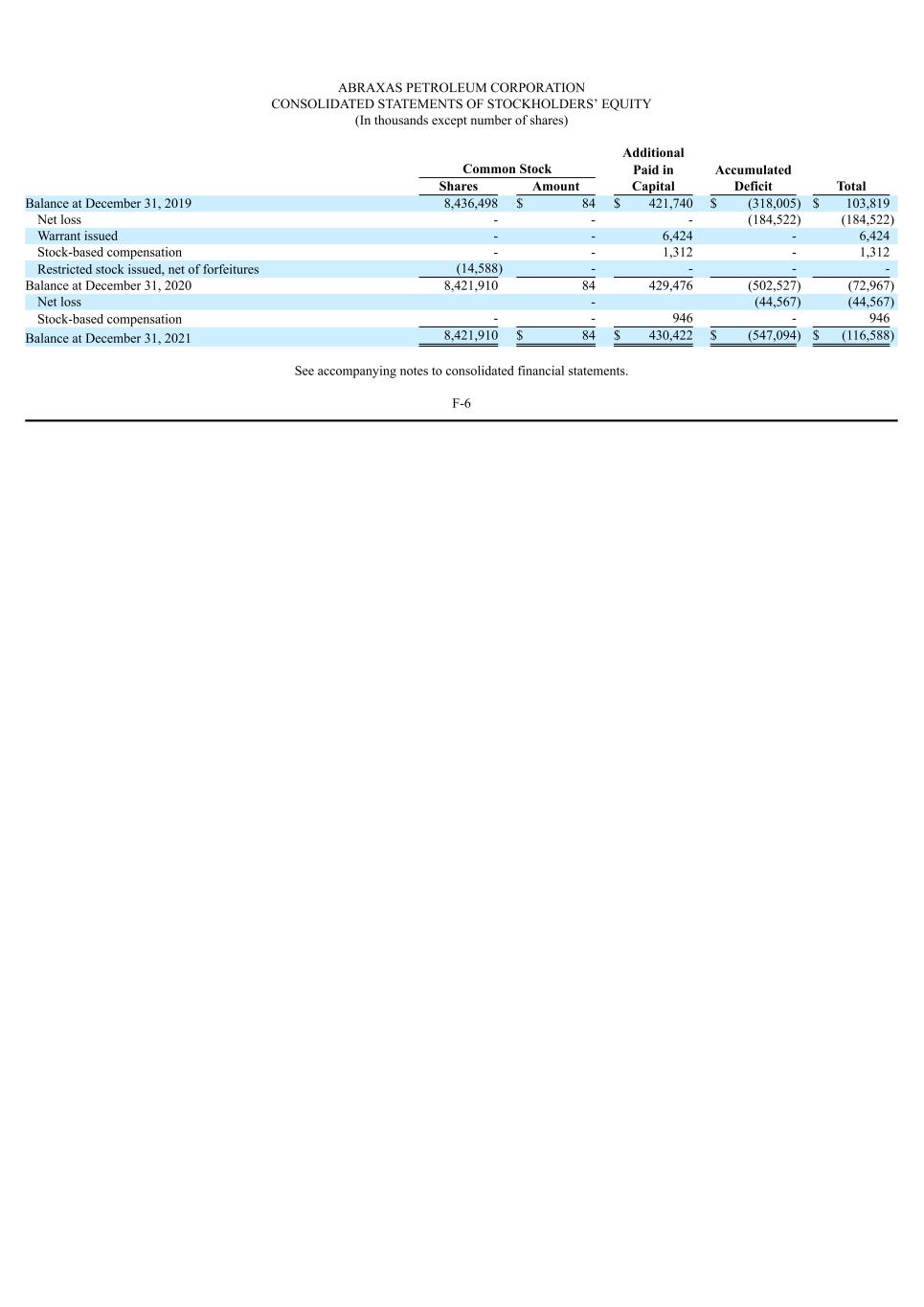
ABRAXAS PETROLEUM CORPORATION CONSOLIDATED STATEMENTS OF STOCKHOLDERS’ EQUITY (In thousands except number of shares) Additional Common Stock Paid in Accumulated Shares Amount Capital Deficit Total Balance at December 31, 2019 8,436,498 $ 84 $ 421,740 $ (318,005) $ 103,819 Net loss - - - (184,522) (184,522) Warrant issued - - 6,424 - 6,424 Stock-based compensation - - 1,312 - 1,312 Restricted stock issued, net of forfeitures (14,588) - - - - Balance at December 31, 2020 8,421,910 84 429,476 (502,527) (72,967) Net loss - (44,567) (44,567) Stock-based compensation - - 946 - 946 Balance at December 31, 2021 8,421,910 $ 84 $ 430,422 $ (547,094) $ (116,588) See accompanying notes to consolidated financial statements. F-6
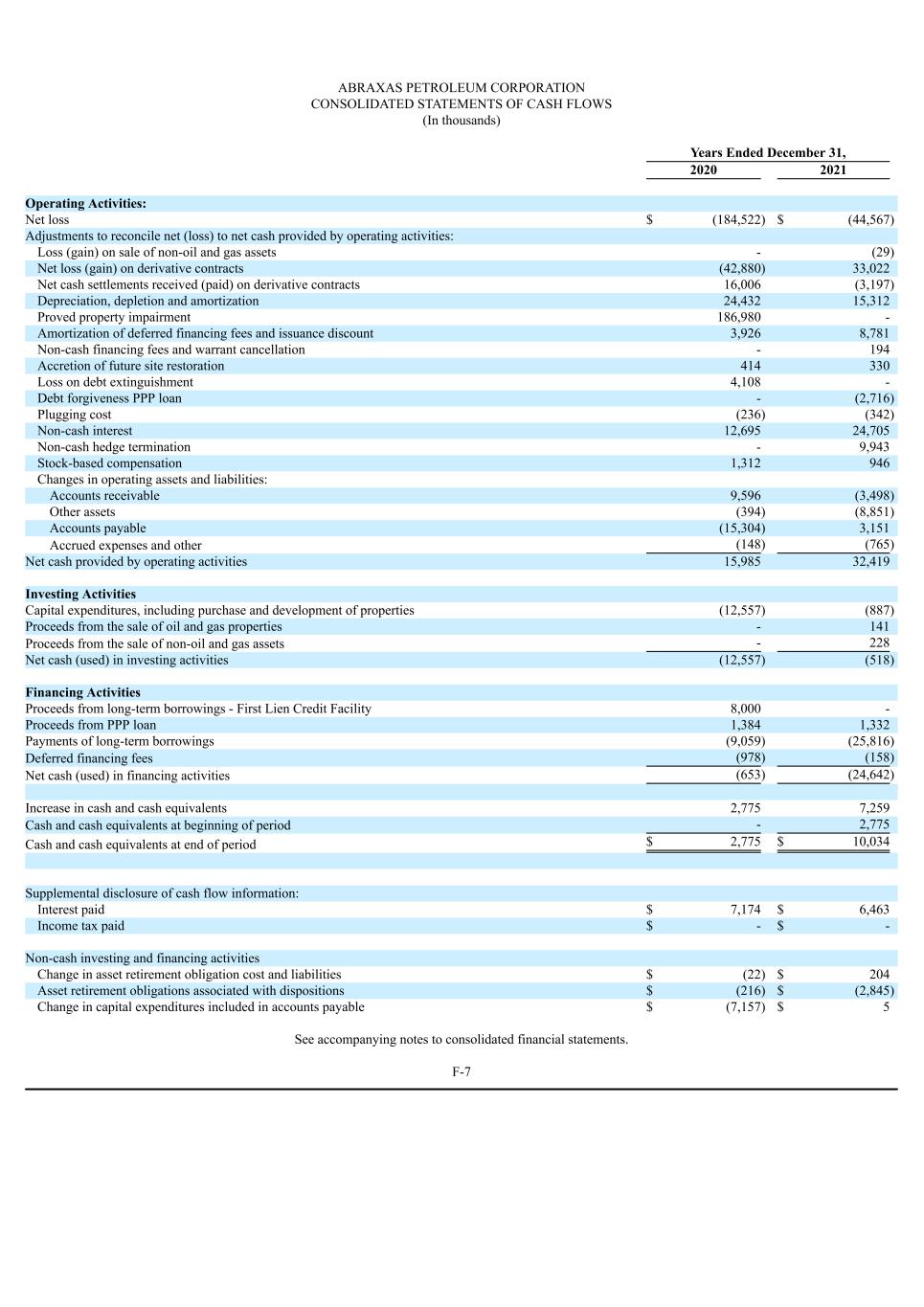
ABRAXAS PETROLEUM CORPORATION CONSOLIDATED STATEMENTS OF CASH FLOWS (In thousands) Years Ended December 31, 2020 2021 Operating Activities: Net loss $ (184,522) $ (44,567) Adjustments to reconcile net (loss) to net cash provided by operating activities: Loss (gain) on sale of non-oil and gas assets - (29) Net loss (gain) on derivative contracts (42,880) 33,022 Net cash settlements received (paid) on derivative contracts 16,006 (3,197) Depreciation, depletion and amortization 24,432 15,312 Proved property impairment 186,980 - Amortization of deferred financing fees and issuance discount 3,926 8,781 Non-cash financing fees and warrant cancellation - 194 Accretion of future site restoration 414 330 Loss on debt extinguishment 4,108 - Debt forgiveness PPP loan - (2,716) Plugging cost (236) (342) Non-cash interest 12,695 24,705 Non-cash hedge termination - 9,943 Stock-based compensation 1,312 946 Changes in operating assets and liabilities: Accounts receivable 9,596 (3,498) Other assets (394) (8,851) Accounts payable (15,304) 3,151 Accrued expenses and other (148) (765) Net cash provided by operating activities 15,985 32,419 Investing Activities Capital expenditures, including purchase and development of properties (12,557) (887) Proceeds from the sale of oil and gas properties - 141 Proceeds from the sale of non-oil and gas assets - 228 Net cash (used) in investing activities (12,557) (518) Financing Activities Proceeds from long-term borrowings - First Lien Credit Facility 8,000 - Proceeds from PPP loan 1,384 1,332 Payments of long-term borrowings (9,059) (25,816) Deferred financing fees (978) (158) Net cash (used) in financing activities (653) (24,642) Increase in cash and cash equivalents 2,775 7,259 Cash and cash equivalents at beginning of period - 2,775 Cash and cash equivalents at end of period $ 2,775 $ 10,034 Supplemental disclosure of cash flow information: Interest paid $ 7,174 $ 6,463 Income tax paid $ - $ - Non-cash investing and financing activities Change in asset retirement obligation cost and liabilities $ (22) $ 204 Asset retirement obligations associated with dispositions $ (216) $ (2,845) Change in capital expenditures included in accounts payable $ (7,157) $ 5 See accompanying notes to consolidated financial statements. F-7

ABRAXAS PETROLEUM CORPORATION NOTES TO CONSOLIDATED FINANCIAL STATEMENTS 1. Organization and Significant Accounting Policies Nature of Operations We are an independent energy company primarily engaged in the acquisition, exploitation, development and production of oil and gas in the United States. Our oil and gas assets are located primarily in two operating regions in the United States: the Rocky Mountains and Permian/Delaware Basin. The terms “Abraxas,” “Abraxas Petroleum,” “we,” “us,” “our” or the “Company” refer to Abraxas Petroleum Corporation and all of its subsidiaries, including Raven Drilling LLC (“Raven Drilling”).
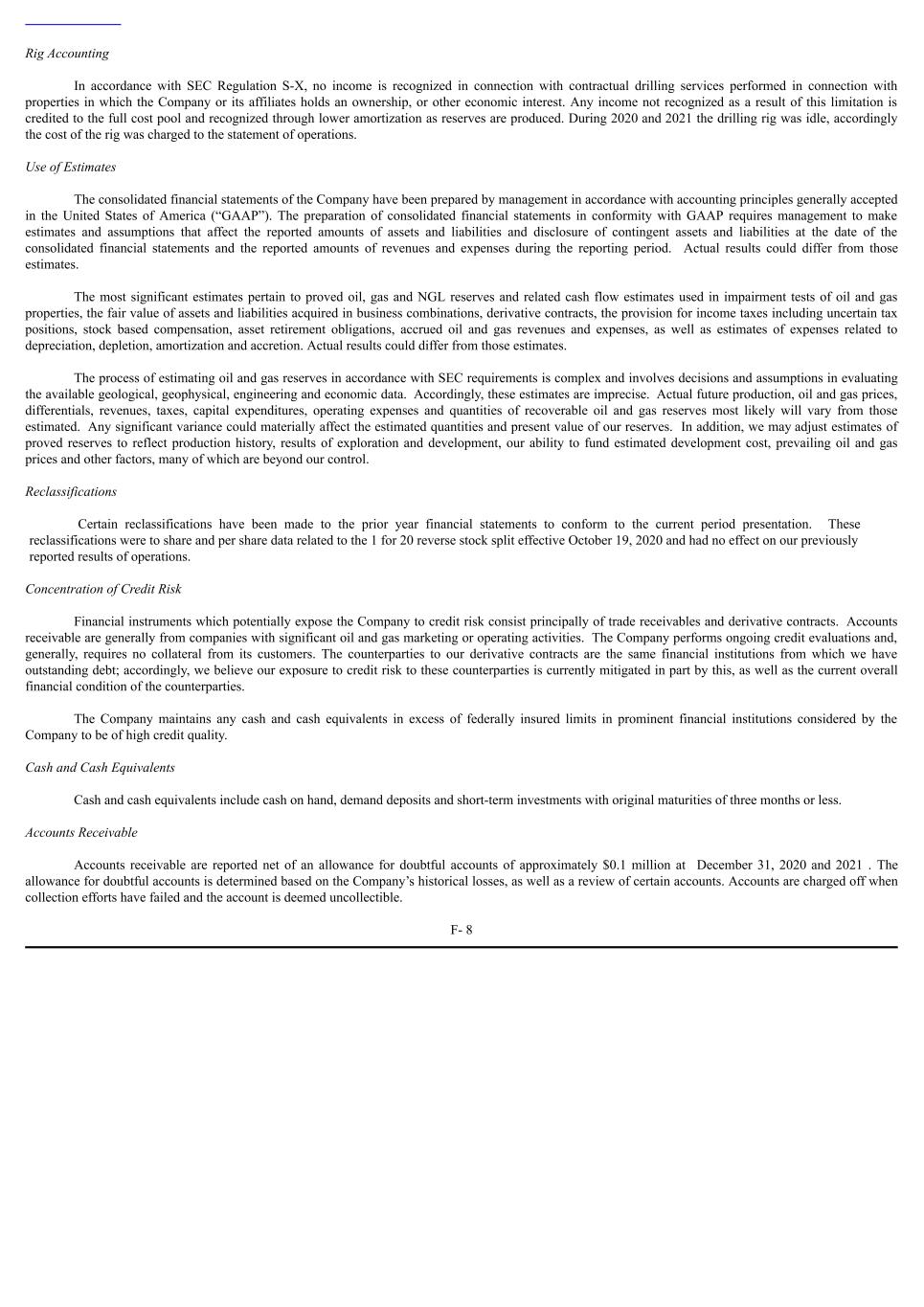
Rig Accounting In accordance with SEC Regulation S-X, no income is recognized in connection with contractual drilling services performed in connection with properties in which the Company or its affiliates holds an ownership, or other economic interest. Any income not recognized as a result of this limitation is credited to the full cost pool and recognized through lower amortization as reserves are produced. During 2020 and 2021 the drilling rig was idle, accordingly the cost of the rig was charged to the statement of operations. Use of Estimates The consolidated financial statements of the Company have been prepared by management in accordance with accounting principles generally accepted in the United States of America (“GAAP”). The preparation of consolidated financial statements in conformity with GAAP requires management to make estimates and assumptions that affect the reported amounts of assets and liabilities and disclosure of contingent assets and liabilities at the date of the consolidated financial statements and the reported amounts of revenues and expenses during the reporting period. Actual results could differ from those estimates. The most significant estimates pertain to proved oil, gas and NGL reserves and related cash flow estimates used in impairment tests of oil and gas properties, the fair value of assets and liabilities acquired in business combinations, derivative contracts, the provision for income taxes including uncertain tax positions, stock based compensation, asset retirement obligations, accrued oil and gas revenues and expenses, as well as estimates of expenses related to depreciation, depletion, amortization and accretion. Actual results could differ from those estimates. The process of estimating oil and gas reserves in accordance with SEC requirements is complex and involves decisions and assumptions in evaluating the available geological, geophysical, engineering and economic data. Accordingly, these estimates are imprecise. Actual future production, oil and gas prices, differentials, revenues, taxes, capital expenditures, operating expenses and quantities of recoverable oil and gas reserves most likely will vary from those estimated. Any significant variance could materially affect the estimated quantities and present value of our reserves. In addition, we may adjust estimates of proved reserves to reflect production history, results of exploration and development, our ability to fund estimated development cost, prevailing oil and gas prices and other factors, many of which are beyond our control. Reclassifications Certain reclassifications have been made to the prior year financial statements to conform to the current period presentation. These reclassifications were to share and per share data related to the 1 for 20 reverse stock split effective October 19, 2020 and had no effect on our previously reported results of operations. Concentration of Credit Risk Financial instruments which potentially expose the Company to credit risk consist principally of trade receivables and derivative contracts. Accounts receivable are generally from companies with significant oil and gas marketing or operating activities. The Company performs ongoing credit evaluations and, generally, requires no collateral from its customers. The counterparties to our derivative contracts are the same financial institutions from which we have outstanding debt; accordingly, we believe our exposure to credit risk to these counterparties is currently mitigated in part by this, as well as the current overall financial condition of the counterparties. The Company maintains any cash and cash equivalents in excess of federally insured limits in prominent financial institutions considered by the Company to be of high credit quality. Cash and Cash Equivalents Cash and cash equivalents include cash on hand, demand deposits and short-term investments with original maturities of three months or less. Accounts Receivable Accounts receivable are reported net of an allowance for doubtful accounts of approximately $0.1 million at December 31, 2020 and 2021 . The allowance for doubtful accounts is determined based on the Company’s historical losses, as well as a review of certain accounts. Accounts are charged off when collection efforts have failed and the account is deemed uncollectible. F- 8
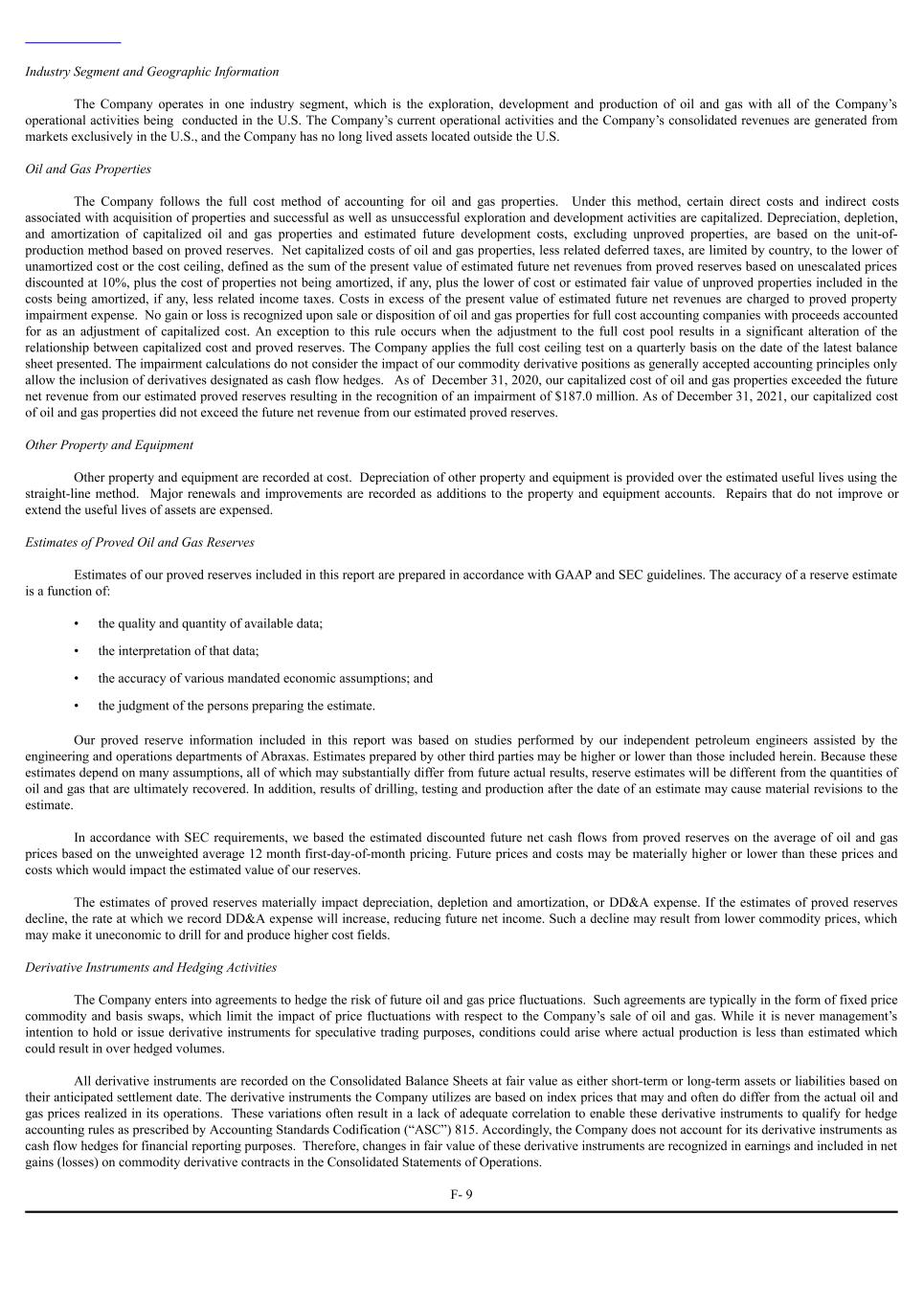
Industry Segment and Geographic Information The Company operates in one industry segment, which is the exploration, development and production of oil and gas with all of the Company’s operational activities being conducted in the U.S. The Company’s current operational activities and the Company’s consolidated revenues are generated from markets exclusively in the U.S., and the Company has no long lived assets located outside the U.S. Oil and Gas Properties The Company follows the full cost method of accounting for oil and gas properties. Under this method, certain direct costs and indirect costs associated with acquisition of properties and successful as well as unsuccessful exploration and development activities are capitalized. Depreciation, depletion, and amortization of capitalized oil and gas properties and estimated future development costs, excluding unproved properties, are based on the unit-of- production method based on proved reserves. Net capitalized costs of oil and gas properties, less related deferred taxes, are limited by country, to the lower of unamortized cost or the cost ceiling, defined as the sum of the present value of estimated future net revenues from proved reserves based on unescalated prices discounted at 10%, plus the cost of properties not being amortized, if any, plus the lower of cost or estimated fair value of unproved properties included in the costs being amortized, if any, less related income taxes. Costs in excess of the present value of estimated future net revenues are charged to proved property impairment expense. No gain or loss is recognized upon sale or disposition of oil and gas properties for full cost accounting companies with proceeds accounted for as an adjustment of capitalized cost. An exception to this rule occurs when the adjustment to the full cost pool results in a significant alteration of the relationship between capitalized cost and proved reserves. The Company applies the full cost ceiling test on a quarterly basis on the date of the latest balance sheet presented. The impairment calculations do not consider the impact of our commodity derivative positions as generally accepted accounting principles only allow the inclusion of derivatives designated as cash flow hedges. As of December 31, 2020, our capitalized cost of oil and gas properties exceeded the future net revenue from our estimated proved reserves resulting in the recognition of an impairment of $187.0 million. As of December 31, 2021, our capitalized cost of oil and gas properties did not exceed the future net revenue from our estimated proved reserves. Other Property and Equipment Other property and equipment are recorded at cost. Depreciation of other property and equipment is provided over the estimated useful lives using the straight-line method. Major renewals and improvements are recorded as additions to the property and equipment accounts. Repairs that do not improve or extend the useful lives of assets are expensed. Estimates of Proved Oil and Gas Reserves Estimates of our proved reserves included in this report are prepared in accordance with GAAP and SEC guidelines. The accuracy of a reserve estimate is a function of: • the quality and quantity of available data; • the interpretation of that data; • the accuracy of various mandated economic assumptions; and • the judgment of the persons preparing the estimate. Our proved reserve information included in this report was based on studies performed by our independent petroleum engineers assisted by the engineering and operations departments of Abraxas. Estimates prepared by other third parties may be higher or lower than those included herein. Because these estimates depend on many assumptions, all of which may substantially differ from future actual results, reserve estimates will be different from the quantities of oil and gas that are ultimately recovered. In addition, results of drilling, testing and production after the date of an estimate may cause material revisions to the estimate. In accordance with SEC requirements, we based the estimated discounted future net cash flows from proved reserves on the average of oil and gas prices based on the unweighted average 12 month first-day-of-month pricing. Future prices and costs may be materially higher or lower than these prices and costs which would impact the estimated value of our reserves. The estimates of proved reserves materially impact depreciation, depletion and amortization, or DD&A expense. If the estimates of proved reserves decline, the rate at which we record DD&A expense will increase, reducing future net income. Such a decline may result from lower commodity prices, which may make it uneconomic to drill for and produce higher cost fields. Derivative Instruments and Hedging Activities The Company enters into agreements to hedge the risk of future oil and gas price fluctuations. Such agreements are typically in the form of fixed price commodity and basis swaps, which limit the impact of price fluctuations with respect to the Company’s sale of oil and gas. While it is never management’s intention to hold or issue derivative instruments for speculative trading purposes, conditions could arise where actual production is less than estimated which could result in over hedged volumes. All derivative instruments are recorded on the Consolidated Balance Sheets at fair value as either short-term or long-term assets or liabilities based on their anticipated settlement date. The derivative instruments the Company utilizes are based on index prices that may and often do differ from the actual oil and gas prices realized in its operations. These variations often result in a lack of adequate correlation to enable these derivative instruments to qualify for hedge accounting rules as prescribed by Accounting Standards Codification (“ASC”) 815. Accordingly, the Company does not account for its derivative instruments as cash flow hedges for financial reporting purposes. Therefore, changes in fair value of these derivative instruments are recognized in earnings and included in net gains (losses) on commodity derivative contracts in the Consolidated Statements of Operations. F- 9
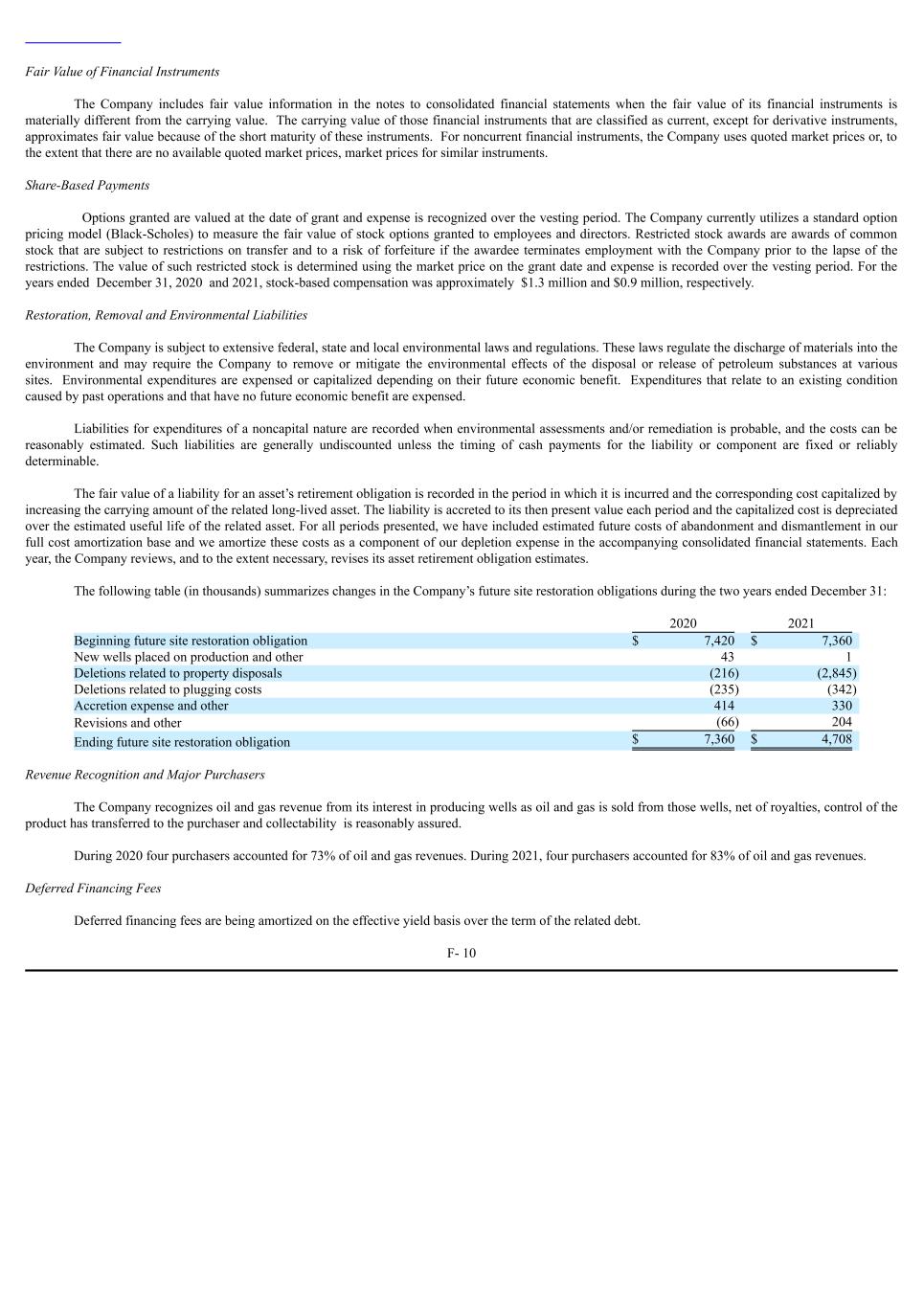
Fair Value of Financial Instruments The Company includes fair value information in the notes to consolidated financial statements when the fair value of its financial instruments is materially different from the carrying value. The carrying value of those financial instruments that are classified as current, except for derivative instruments, approximates fair value because of the short maturity of these instruments. For noncurrent financial instruments, the Company uses quoted market prices or, to the extent that there are no available quoted market prices, market prices for similar instruments. Share-Based Payments Options granted are valued at the date of grant and expense is recognized over the vesting period. The Company currently utilizes a standard option pricing model (Black-Scholes) to measure the fair value of stock options granted to employees and directors. Restricted stock awards are awards of common stock that are subject to restrictions on transfer and to a risk of forfeiture if the awardee terminates employment with the Company prior to the lapse of the restrictions. The value of such restricted stock is determined using the market price on the grant date and expense is recorded over the vesting period. For the years ended December 31, 2020 and 2021, stock-based compensation was approximately $1.3 million and $0.9 million, respectively. Restoration, Removal and Environmental Liabilities The Company is subject to extensive federal, state and local environmental laws and regulations. These laws regulate the discharge of materials into the environment and may require the Company to remove or mitigate the environmental effects of the disposal or release of petroleum substances at various sites. Environmental expenditures are expensed or capitalized depending on their future economic benefit. Expenditures that relate to an existing condition caused by past operations and that have no future economic benefit are expensed. Liabilities for expenditures of a noncapital nature are recorded when environmental assessments and/or remediation is probable, and the costs can be reasonably estimated. Such liabilities are generally undiscounted unless the timing of cash payments for the liability or component are fixed or reliably determinable. The fair value of a liability for an asset’s retirement obligation is recorded in the period in which it is incurred and the corresponding cost capitalized by increasing the carrying amount of the related long-lived asset. The liability is accreted to its then present value each period and the capitalized cost is depreciated over the estimated useful life of the related asset. For all periods presented, we have included estimated future costs of abandonment and dismantlement in our full cost amortization base and we amortize these costs as a component of our depletion expense in the accompanying consolidated financial statements. Each year, the Company reviews, and to the extent necessary, revises its asset retirement obligation estimates. The following table (in thousands) summarizes changes in the Company’s future site restoration obligations during the two years ended December 31: 2020 2021 Beginning future site restoration obligation $ 7,420 $ 7,360 New wells placed on production and other 43 1 Deletions related to property disposals (216) (2,845) Deletions related to plugging costs (235) (342) Accretion expense and other 414 330 Revisions and other (66) 204 Ending future site restoration obligation $ 7,360 $ 4,708 Revenue Recognition and Major Purchasers The Company recognizes oil and gas revenue from its interest in producing wells as oil and gas is sold from those wells, net of royalties, control of the product has transferred to the purchaser and collectability is reasonably assured. During 2020 four purchasers accounted for 73% of oil and gas revenues. During 2021, four purchasers accounted for 83% of oil and gas revenues. Deferred Financing Fees Deferred financing fees are being amortized on the effective yield basis over the term of the related debt. F- 10
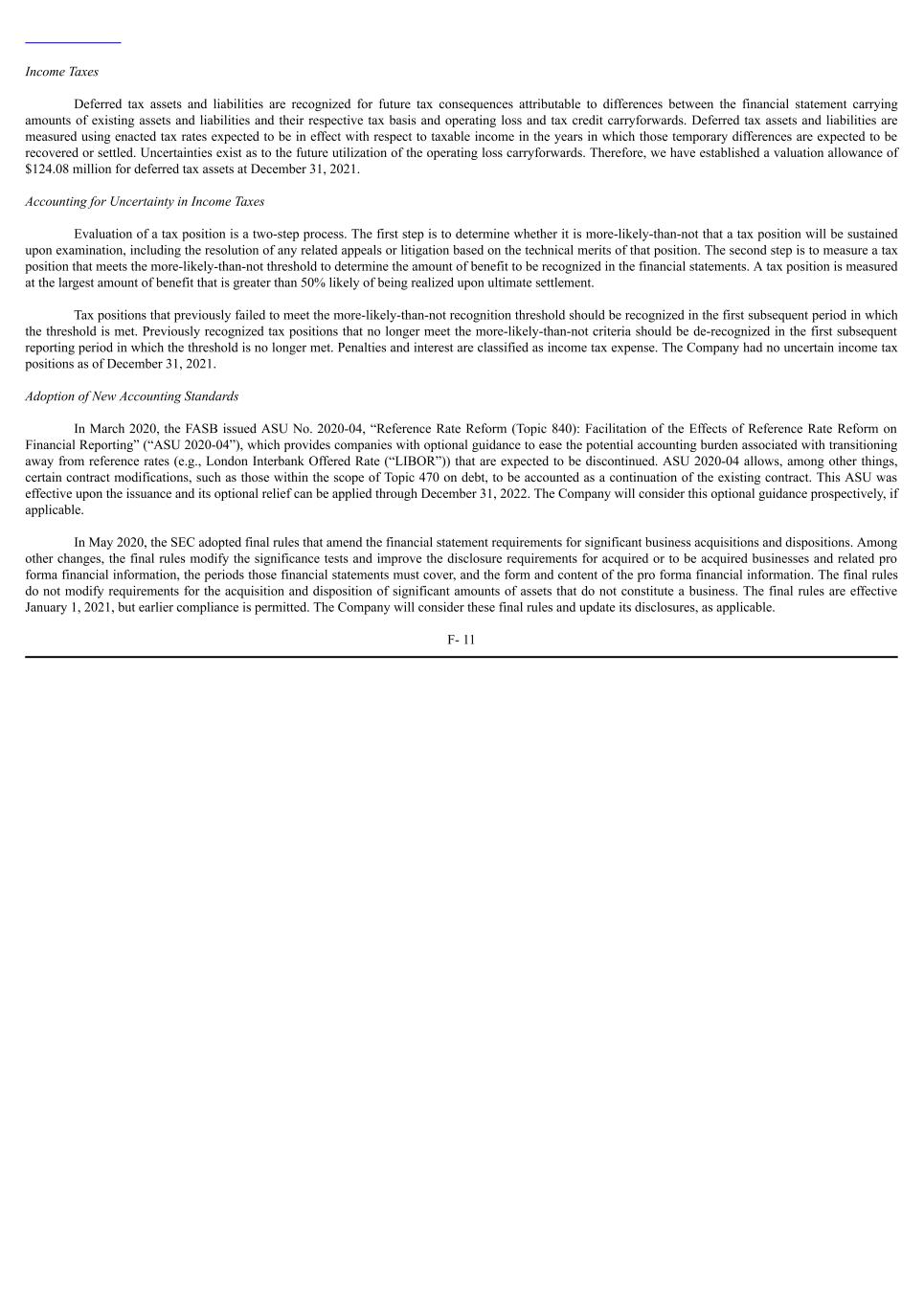
Income Taxes Deferred tax assets and liabilities are recognized for future tax consequences attributable to differences between the financial statement carrying amounts of existing assets and liabilities and their respective tax basis and operating loss and tax credit carryforwards. Deferred tax assets and liabilities are measured using enacted tax rates expected to be in effect with respect to taxable income in the years in which those temporary differences are expected to be recovered or settled. Uncertainties exist as to the future utilization of the operating loss carryforwards. Therefore, we have established a valuation allowance of $124.08 million for deferred tax assets at December 31, 2021. Accounting for Uncertainty in Income Taxes Evaluation of a tax position is a two-step process. The first step is to determine whether it is more-likely-than-not that a tax position will be sustained upon examination, including the resolution of any related appeals or litigation based on the technical merits of that position. The second step is to measure a tax position that meets the more-likely-than-not threshold to determine the amount of benefit to be recognized in the financial statements. A tax position is measured at the largest amount of benefit that is greater than 50% likely of being realized upon ultimate settlement. Tax positions that previously failed to meet the more-likely-than-not recognition threshold should be recognized in the first subsequent period in which the threshold is met. Previously recognized tax positions that no longer meet the more-likely-than-not criteria should be de-recognized in the first subsequent reporting period in which the threshold is no longer met. Penalties and interest are classified as income tax expense. The Company had no uncertain income tax positions as of December 31, 2021. Adoption of New Accounting Standards In March 2020, the FASB issued ASU No. 2020-04, “Reference Rate Reform (Topic 840): Facilitation of the Effects of Reference Rate Reform on Financial Reporting” (“ASU 2020-04”), which provides companies with optional guidance to ease the potential accounting burden associated with transitioning away from reference rates (e.g., London Interbank Offered Rate (“LIBOR”)) that are expected to be discontinued. ASU 2020-04 allows, among other things, certain contract modifications, such as those within the scope of Topic 470 on debt, to be accounted as a continuation of the existing contract. This ASU was effective upon the issuance and its optional relief can be applied through December 31, 2022. The Company will consider this optional guidance prospectively, if applicable. In May 2020, the SEC adopted final rules that amend the financial statement requirements for significant business acquisitions and dispositions. Among other changes, the final rules modify the significance tests and improve the disclosure requirements for acquired or to be acquired businesses and related pro forma financial information, the periods those financial statements must cover, and the form and content of the pro forma financial information. The final rules do not modify requirements for the acquisition and disposition of significant amounts of assets that do not constitute a business. The final rules are effective January 1, 2021, but earlier compliance is permitted. The Company will consider these final rules and update its disclosures, as applicable. F- 11
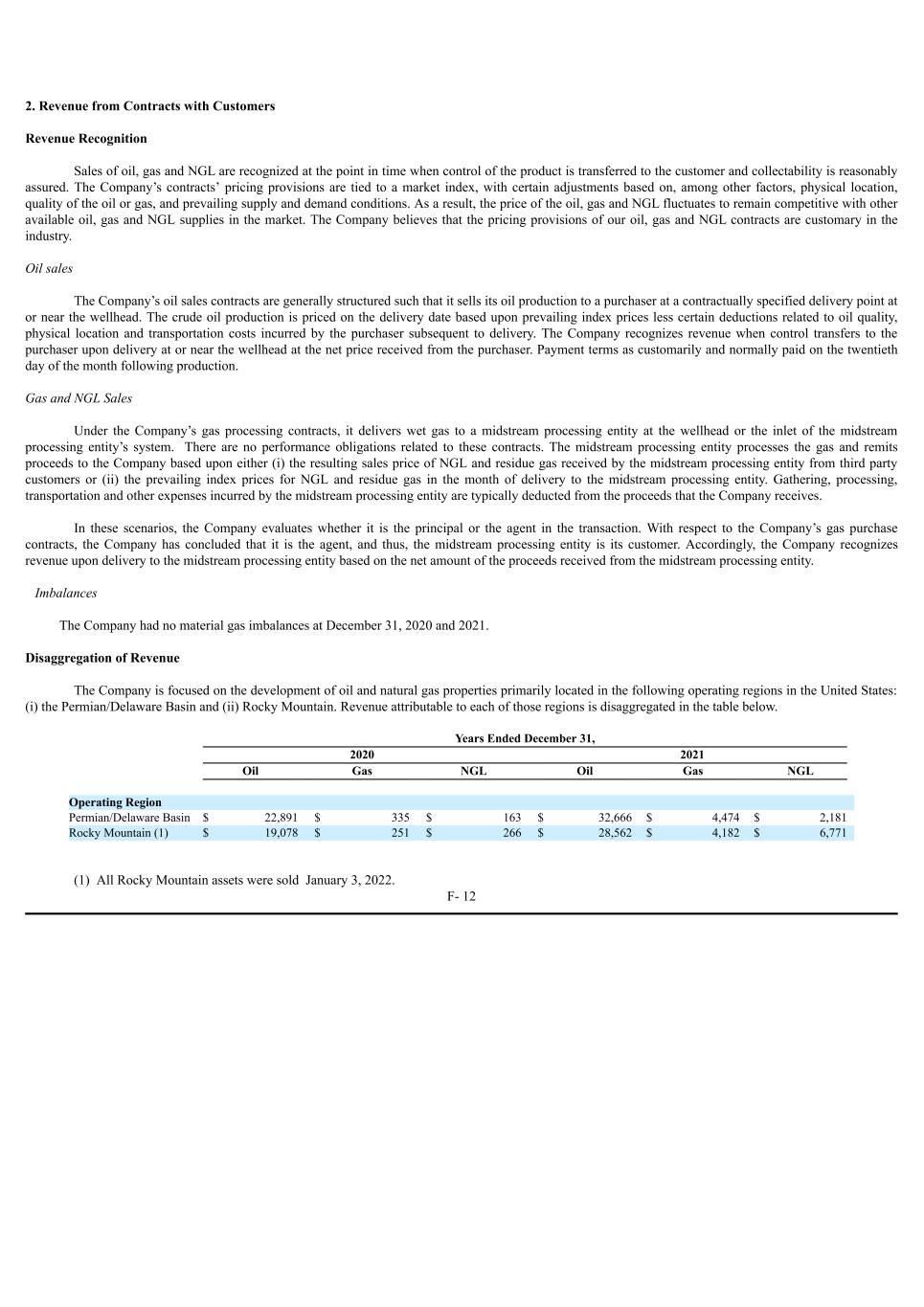
2. Revenue from Contracts with Customers Revenue Recognition Sales of oil, gas and NGL are recognized at the point in time when control of the product is transferred to the customer and collectability is reasonably assured. The Company’s contracts’ pricing provisions are tied to a market index, with certain adjustments based on, among other factors, physical location, quality of the oil or gas, and prevailing supply and demand conditions. As a result, the price of the oil, gas and NGL fluctuates to remain competitive with other available oil, gas and NGL supplies in the market. The Company believes that the pricing provisions of our oil, gas and NGL contracts are customary in the industry. Oil sales The Company’s oil sales contracts are generally structured such that it sells its oil production to a purchaser at a contractually specified delivery point at or near the wellhead. The crude oil production is priced on the delivery date based upon prevailing index prices less certain deductions related to oil quality, physical location and transportation costs incurred by the purchaser subsequent to delivery. The Company recognizes revenue when control transfers to the purchaser upon delivery at or near the wellhead at the net price received from the purchaser. Payment terms as customarily and normally paid on the twentieth day of the month following production. Gas and NGL Sales Under the Company’s gas processing contracts, it delivers wet gas to a midstream processing entity at the wellhead or the inlet of the midstream processing entity’s system. There are no performance obligations related to these contracts. The midstream processing entity processes the gas and remits proceeds to the Company based upon either (i) the resulting sales price of NGL and residue gas received by the midstream processing entity from third party customers or (ii) the prevailing index prices for NGL and residue gas in the month of delivery to the midstream processing entity. Gathering, processing, transportation and other expenses incurred by the midstream processing entity are typically deducted from the proceeds that the Company receives. In these scenarios, the Company evaluates whether it is the principal or the agent in the transaction. With respect to the Company’s gas purchase contracts, the Company has concluded that it is the agent, and thus, the midstream processing entity is its customer. Accordingly, the Company recognizes revenue upon delivery to the midstream processing entity based on the net amount of the proceeds received from the midstream processing entity. Imbalances The Company had no material gas imbalances at December 31, 2020 and 2021. Disaggregation of Revenue The Company is focused on the development of oil and natural gas properties primarily located in the following operating regions in the United States: (i) the Permian/Delaware Basin and (ii) Rocky Mountain. Revenue attributable to each of those regions is disaggregated in the table below. Years Ended December 31, 2020 2021 Oil Gas NGL Oil Gas NGL Operating Region Permian/Delaware Basin $ 22,891 $ 335 $ 163 $ 32,666 $ 4,474 $ 2,181 Rocky Mountain (1) $ 19,078 $ 251 $ 266 $ 28,562 $ 4,182 $ 6,771 (1) All Rocky Mountain assets were sold January 3, 2022. F- 12
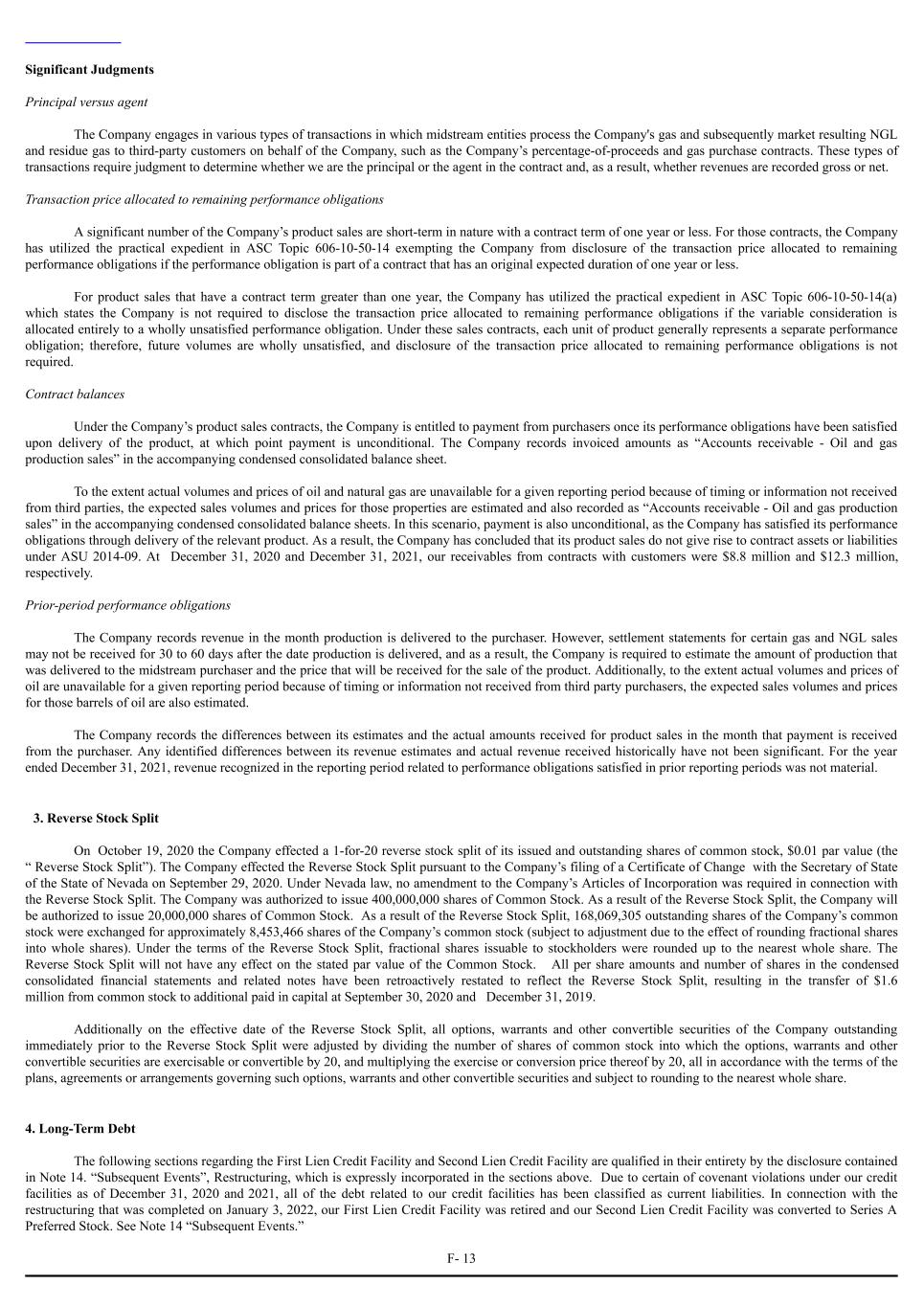
Significant Judgments Principal versus agent The Company engages in various types of transactions in which midstream entities process the Company's gas and subsequently market resulting NGL and residue gas to third-party customers on behalf of the Company, such as the Company’s percentage-of-proceeds and gas purchase contracts. These types of transactions require judgment to determine whether we are the principal or the agent in the contract and, as a result, whether revenues are recorded gross or net. Transaction price allocated to remaining performance obligations A significant number of the Company’s product sales are short-term in nature with a contract term of one year or less. For those contracts, the Company has utilized the practical expedient in ASC Topic 606-10-50-14 exempting the Company from disclosure of the transaction price allocated to remaining performance obligations if the performance obligation is part of a contract that has an original expected duration of one year or less. For product sales that have a contract term greater than one year, the Company has utilized the practical expedient in ASC Topic 606-10-50-14(a) which states the Company is not required to disclose the transaction price allocated to remaining performance obligations if the variable consideration is allocated entirely to a wholly unsatisfied performance obligation. Under these sales contracts, each unit of product generally represents a separate performance obligation; therefore, future volumes are wholly unsatisfied, and disclosure of the transaction price allocated to remaining performance obligations is not required. Contract balances Under the Company’s product sales contracts, the Company is entitled to payment from purchasers once its performance obligations have been satisfied upon delivery of the product, at which point payment is unconditional. The Company records invoiced amounts as “Accounts receivable - Oil and gas production sales” in the accompanying condensed consolidated balance sheet. To the extent actual volumes and prices of oil and natural gas are unavailable for a given reporting period because of timing or information not received from third parties, the expected sales volumes and prices for those properties are estimated and also recorded as “Accounts receivable - Oil and gas production sales” in the accompanying condensed consolidated balance sheets. In this scenario, payment is also unconditional, as the Company has satisfied its performance obligations through delivery of the relevant product. As a result, the Company has concluded that its product sales do not give rise to contract assets or liabilities under ASU 2014-09. At December 31, 2020 and December 31, 2021, our receivables from contracts with customers were $8.8 million and $12.3 million, respectively. Prior-period performance obligations The Company records revenue in the month production is delivered to the purchaser. However, settlement statements for certain gas and NGL sales may not be received for 30 to 60 days after the date production is delivered, and as a result, the Company is required to estimate the amount of production that was delivered to the midstream purchaser and the price that will be received for the sale of the product. Additionally, to the extent actual volumes and prices of oil are unavailable for a given reporting period because of timing or information not received from third party purchasers, the expected sales volumes and prices for those barrels of oil are also estimated. The Company records the differences between its estimates and the actual amounts received for product sales in the month that payment is received from the purchaser. Any identified differences between its revenue estimates and actual revenue received historically have not been significant. For the year ended December 31, 2021, revenue recognized in the reporting period related to performance obligations satisfied in prior reporting periods was not material. 3. Reverse Stock Split On October 19, 2020 the Company effected a 1-for-20 reverse stock split of its issued and outstanding shares of common stock, $0.01 par value (the “ Reverse Stock Split”). The Company effected the Reverse Stock Split pursuant to the Company’s filing of a Certificate of Change with the Secretary of State of the State of Nevada on September 29, 2020. Under Nevada law, no amendment to the Company’s Articles of Incorporation was required in connection with the Reverse Stock Split. The Company was authorized to issue 400,000,000 shares of Common Stock. As a result of the Reverse Stock Split, the Company will be authorized to issue 20,000,000 shares of Common Stock. As a result of the Reverse Stock Split, 168,069,305 outstanding shares of the Company’s common stock were exchanged for approximately 8,453,466 shares of the Company’s common stock (subject to adjustment due to the effect of rounding fractional shares into whole shares). Under the terms of the Reverse Stock Split, fractional shares issuable to stockholders were rounded up to the nearest whole share. The Reverse Stock Split will not have any effect on the stated par value of the Common Stock. All per share amounts and number of shares in the condensed consolidated financial statements and related notes have been retroactively restated to reflect the Reverse Stock Split, resulting in the transfer of $1.6 million from common stock to additional paid in capital at September 30, 2020 and December 31, 2019. Additionally on the effective date of the Reverse Stock Split, all options, warrants and other convertible securities of the Company outstanding immediately prior to the Reverse Stock Split were adjusted by dividing the number of shares of common stock into which the options, warrants and other convertible securities are exercisable or convertible by 20, and multiplying the exercise or conversion price thereof by 20, all in accordance with the terms of the plans, agreements or arrangements governing such options, warrants and other convertible securities and subject to rounding to the nearest whole share. 4. Long-Term Debt The following sections regarding the First Lien Credit Facility and Second Lien Credit Facility are qualified in their entirety by the disclosure contained in Note 14. “Subsequent Events”, Restructuring, which is expressly incorporated in the sections above. Due to certain of covenant violations under our credit facilities as of December 31, 2020 and 2021, all of the debt related to our credit facilities has been classified as current liabilities. In connection with the restructuring that was completed on January 3, 2022, our First Lien Credit Facility was retired and our Second Lien Credit Facility was converted to Series A Preferred Stock. See Note 14 “Subsequent Events.” F- 13
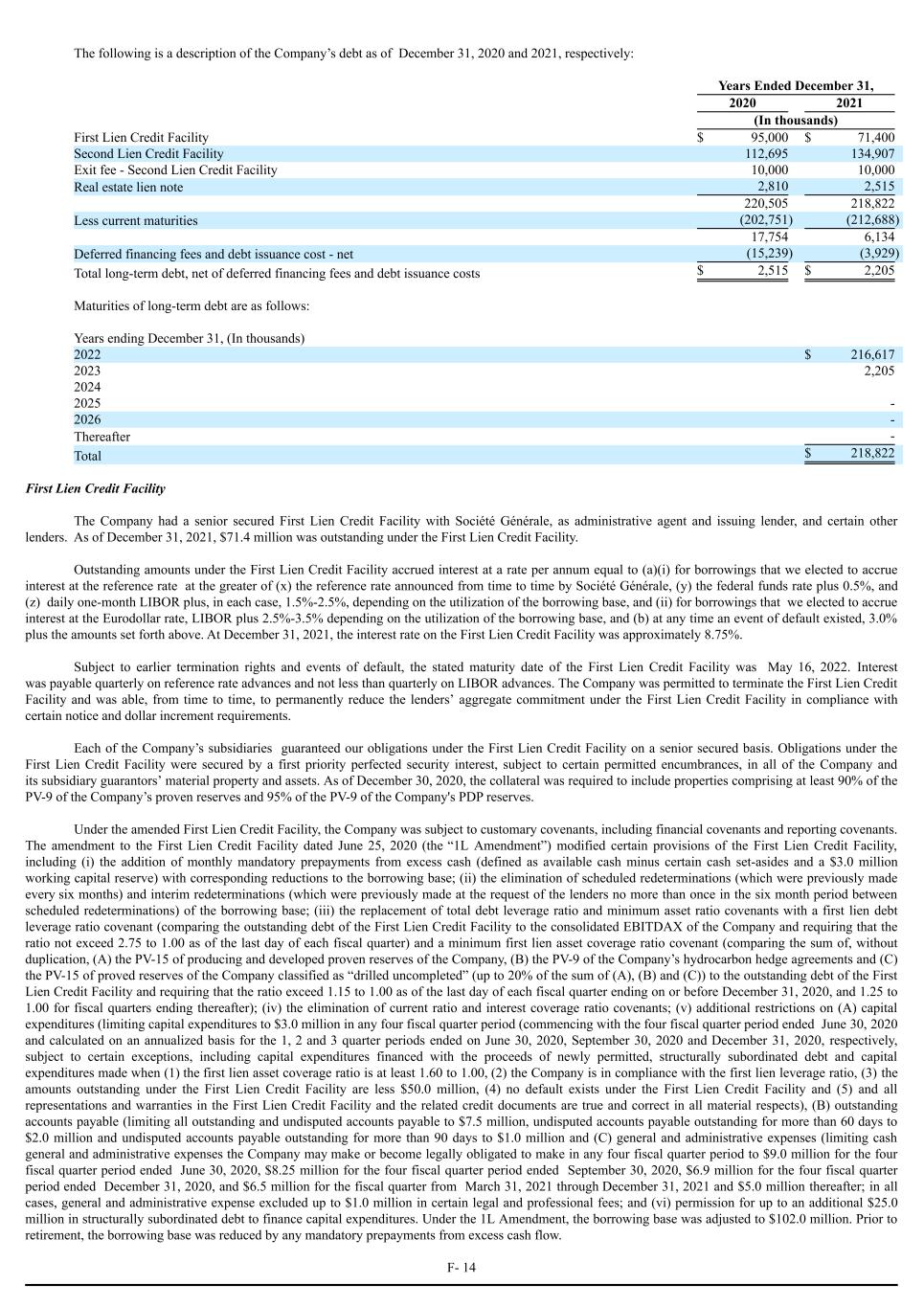
The following is a description of the Company’s debt as of December 31, 2020 and 2021, respectively: Years Ended December 31, 2020 2021 (In thousands) First Lien Credit Facility $ 95,000 $ 71,400 Second Lien Credit Facility 112,695 134,907 Exit fee - Second Lien Credit Facility 10,000 10,000 Real estate lien note 2,810 2,515 220,505 218,822 Less current maturities (202,751) (212,688) 17,754 6,134 Deferred financing fees and debt issuance cost - net (15,239) (3,929) Total long-term debt, net of deferred financing fees and debt issuance costs $ 2,515 $ 2,205 Maturities of long-term debt are as follows: Years ending December 31, (In thousands) 2022 $ 216,617 2023 2,205 2024 2025 - 2026 - Thereafter - Total $ 218,822 First Lien Credit Facility The Company had a senior secured First Lien Credit Facility with Société Générale, as administrative agent and issuing lender, and certain other lenders. As of December 31, 2021, $71.4 million was outstanding under the First Lien Credit Facility. Outstanding amounts under the First Lien Credit Facility accrued interest at a rate per annum equal to (a)(i) for borrowings that we elected to accrue interest at the reference rate at the greater of (x) the reference rate announced from time to time by Société Générale, (y) the federal funds rate plus 0.5%, and (z) daily one-month LIBOR plus, in each case, 1.5%-2.5%, depending on the utilization of the borrowing base, and (ii) for borrowings that we elected to accrue interest at the Eurodollar rate, LIBOR plus 2.5%-3.5% depending on the utilization of the borrowing base, and (b) at any time an event of default existed, 3.0% plus the amounts set forth above. At December 31, 2021, the interest rate on the First Lien Credit Facility was approximately 8.75%. Subject to earlier termination rights and events of default, the stated maturity date of the First Lien Credit Facility was May 16, 2022. Interest was payable quarterly on reference rate advances and not less than quarterly on LIBOR advances. The Company was permitted to terminate the First Lien Credit Facility and was able, from time to time, to permanently reduce the lenders’ aggregate commitment under the First Lien Credit Facility in compliance with certain notice and dollar increment requirements. Each of the Company’s subsidiaries guaranteed our obligations under the First Lien Credit Facility on a senior secured basis. Obligations under the First Lien Credit Facility were secured by a first priority perfected security interest, subject to certain permitted encumbrances, in all of the Company and its subsidiary guarantors’ material property and assets. As of December 30, 2020, the collateral was required to include properties comprising at least 90% of the PV-9 of the Company’s proven reserves and 95% of the PV-9 of the Company's PDP reserves. Under the amended First Lien Credit Facility, the Company was subject to customary covenants, including financial covenants and reporting covenants. The amendment to the First Lien Credit Facility dated June 25, 2020 (the “1L Amendment”) modified certain provisions of the First Lien Credit Facility, including (i) the addition of monthly mandatory prepayments from excess cash (defined as available cash minus certain cash set-asides and a $3.0 million working capital reserve) with corresponding reductions to the borrowing base; (ii) the elimination of scheduled redeterminations (which were previously made every six months) and interim redeterminations (which were previously made at the request of the lenders no more than once in the six month period between scheduled redeterminations) of the borrowing base; (iii) the replacement of total debt leverage ratio and minimum asset ratio covenants with a first lien debt leverage ratio covenant (comparing the outstanding debt of the First Lien Credit Facility to the consolidated EBITDAX of the Company and requiring that the ratio not exceed 2.75 to 1.00 as of the last day of each fiscal quarter) and a minimum first lien asset coverage ratio covenant (comparing the sum of, without duplication, (A) the PV-15 of producing and developed proven reserves of the Company, (B) the PV-9 of the Company’s hydrocarbon hedge agreements and (C) the PV-15 of proved reserves of the Company classified as “drilled uncompleted” (up to 20% of the sum of (A), (B) and (C)) to the outstanding debt of the First Lien Credit Facility and requiring that the ratio exceed 1.15 to 1.00 as of the last day of each fiscal quarter ending on or before December 31, 2020, and 1.25 to 1.00 for fiscal quarters ending thereafter); (iv) the elimination of current ratio and interest coverage ratio covenants; (v) additional restrictions on (A) capital expenditures (limiting capital expenditures to $3.0 million in any four fiscal quarter period (commencing with the four fiscal quarter period ended June 30, 2020 and calculated on an annualized basis for the 1, 2 and 3 quarter periods ended on June 30, 2020, September 30, 2020 and December 31, 2020, respectively, subject to certain exceptions, including capital expenditures financed with the proceeds of newly permitted, structurally subordinated debt and capital expenditures made when (1) the first lien asset coverage ratio is at least 1.60 to 1.00, (2) the Company is in compliance with the first lien leverage ratio, (3) the amounts outstanding under the First Lien Credit Facility are less $50.0 million, (4) no default exists under the First Lien Credit Facility and (5) and all representations and warranties in the First Lien Credit Facility and the related credit documents are true and correct in all material respects), (B) outstanding accounts payable (limiting all outstanding and undisputed accounts payable to $7.5 million, undisputed accounts payable outstanding for more than 60 days to $2.0 million and undisputed accounts payable outstanding for more than 90 days to $1.0 million and (C) general and administrative expenses (limiting cash general and administrative expenses the Company may make or become legally obligated to make in any four fiscal quarter period to $9.0 million for the four fiscal quarter period ended June 30, 2020, $8.25 million for the four fiscal quarter period ended September 30, 2020, $6.9 million for the four fiscal quarter period ended December 31, 2020, and $6.5 million for the fiscal quarter from March 31, 2021 through December 31, 2021 and $5.0 million thereafter; in all cases, general and administrative expense excluded up to $1.0 million in certain legal and professional fees; and (vi) permission for up to an additional $25.0 million in structurally subordinated debt to finance capital expenditures. Under the 1L Amendment, the borrowing base was adjusted to $102.0 million. Prior to retirement, the borrowing base was reduced by any mandatory prepayments from excess cash flow. F- 14
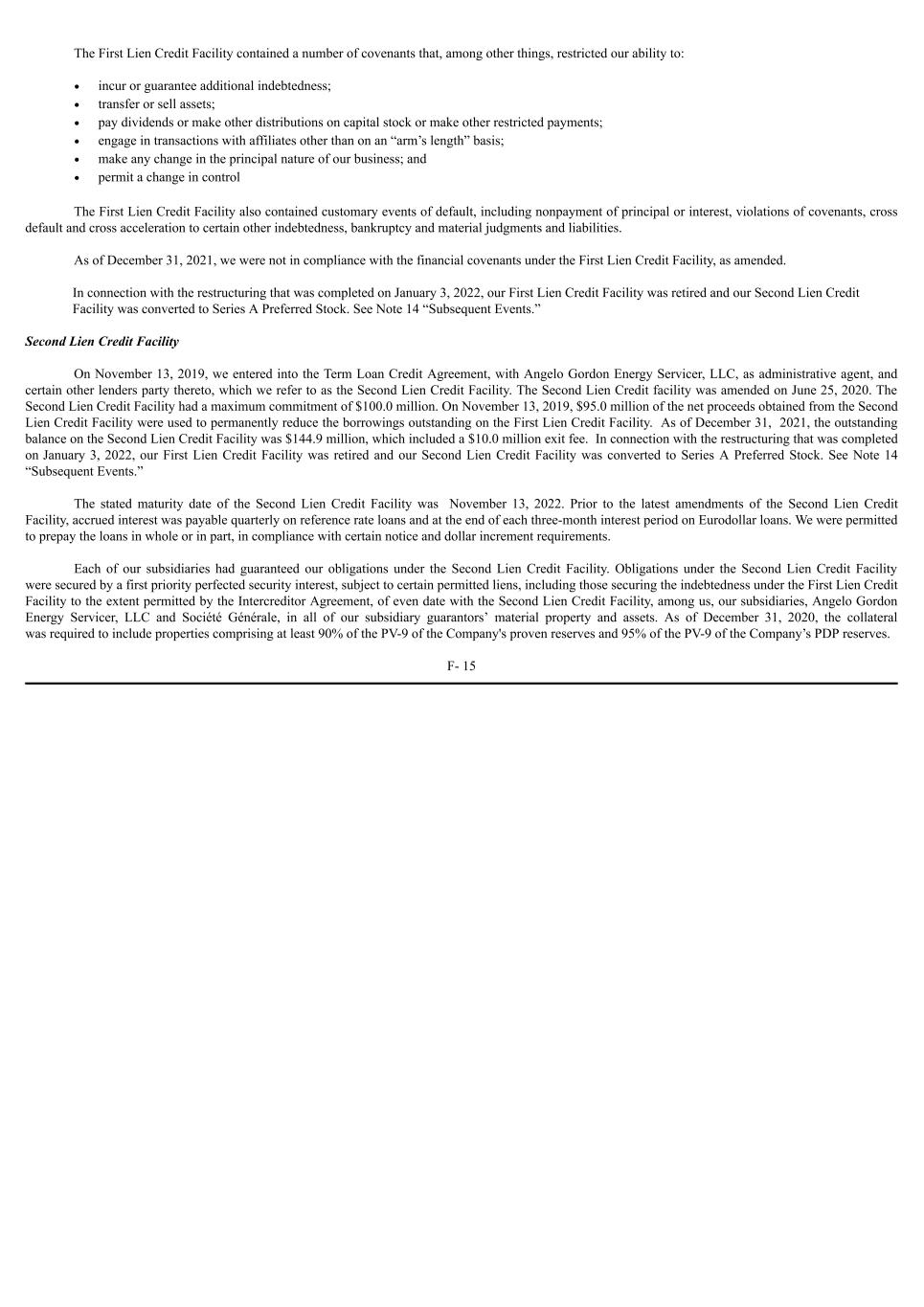
The First Lien Credit Facility contained a number of covenants that, among other things, restricted our ability to: • incur or guarantee additional indebtedness; • transfer or sell assets; • pay dividends or make other distributions on capital stock or make other restricted payments; • engage in transactions with affiliates other than on an “arm’s length” basis; • make any change in the principal nature of our business; and • permit a change in control The First Lien Credit Facility also contained customary events of default, including nonpayment of principal or interest, violations of covenants, cross default and cross acceleration to certain other indebtedness, bankruptcy and material judgments and liabilities. As of December 31, 2021, we were not in compliance with the financial covenants under the First Lien Credit Facility, as amended. In connection with the restructuring that was completed on January 3, 2022, our First Lien Credit Facility was retired and our Second Lien Credit Facility was converted to Series A Preferred Stock. See Note 14 “Subsequent Events.” Second Lien Credit Facility On November 13, 2019, we entered into the Term Loan Credit Agreement, with Angelo Gordon Energy Servicer, LLC, as administrative agent, and certain other lenders party thereto, which we refer to as the Second Lien Credit Facility. The Second Lien Credit facility was amended on June 25, 2020. The Second Lien Credit Facility had a maximum commitment of $100.0 million. On November 13, 2019, $95.0 million of the net proceeds obtained from the Second Lien Credit Facility were used to permanently reduce the borrowings outstanding on the First Lien Credit Facility. As of December 31, 2021, the outstanding balance on the Second Lien Credit Facility was $144.9 million, which included a $10.0 million exit fee. In connection with the restructuring that was completed on January 3, 2022, our First Lien Credit Facility was retired and our Second Lien Credit Facility was converted to Series A Preferred Stock. See Note 14 “Subsequent Events.” The stated maturity date of the Second Lien Credit Facility was November 13, 2022. Prior to the latest amendments of the Second Lien Credit Facility, accrued interest was payable quarterly on reference rate loans and at the end of each three-month interest period on Eurodollar loans. We were permitted to prepay the loans in whole or in part, in compliance with certain notice and dollar increment requirements. Each of our subsidiaries had guaranteed our obligations under the Second Lien Credit Facility. Obligations under the Second Lien Credit Facility were secured by a first priority perfected security interest, subject to certain permitted liens, including those securing the indebtedness under the First Lien Credit Facility to the extent permitted by the Intercreditor Agreement, of even date with the Second Lien Credit Facility, among us, our subsidiaries, Angelo Gordon Energy Servicer, LLC and Société Générale, in all of our subsidiary guarantors’ material property and assets. As of December 31, 2020, the collateral was required to include properties comprising at least 90% of the PV-9 of the Company's proven reserves and 95% of the PV-9 of the Company’s PDP reserves. F- 15
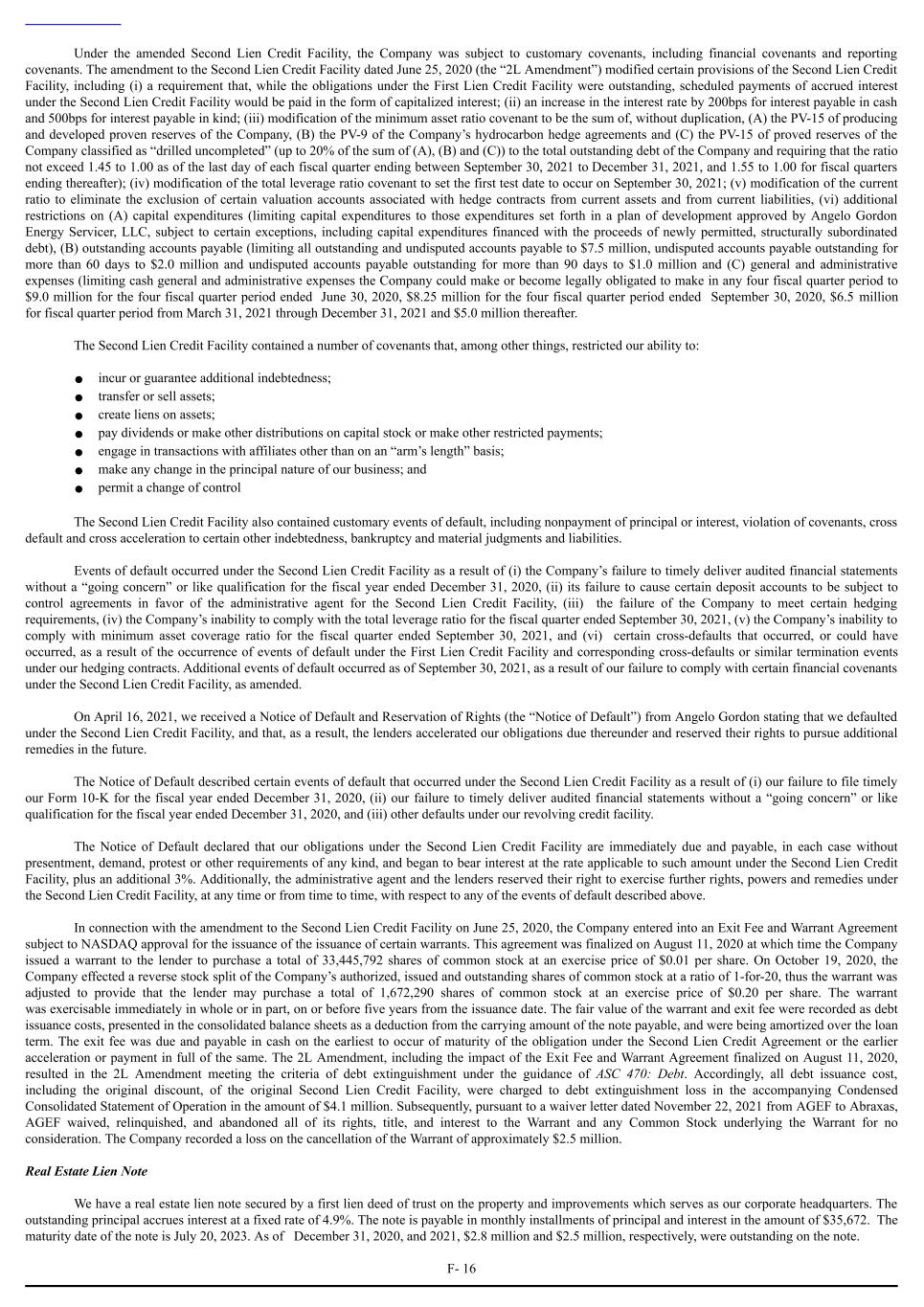
Under the amended Second Lien Credit Facility, the Company was subject to customary covenants, including financial covenants and reporting covenants. The amendment to the Second Lien Credit Facility dated June 25, 2020 (the “2L Amendment”) modified certain provisions of the Second Lien Credit Facility, including (i) a requirement that, while the obligations under the First Lien Credit Facility were outstanding, scheduled payments of accrued interest under the Second Lien Credit Facility would be paid in the form of capitalized interest; (ii) an increase in the interest rate by 200bps for interest payable in cash and 500bps for interest payable in kind; (iii) modification of the minimum asset ratio covenant to be the sum of, without duplication, (A) the PV-15 of producing and developed proven reserves of the Company, (B) the PV-9 of the Company’s hydrocarbon hedge agreements and (C) the PV-15 of proved reserves of the Company classified as “drilled uncompleted” (up to 20% of the sum of (A), (B) and (C)) to the total outstanding debt of the Company and requiring that the ratio not exceed 1.45 to 1.00 as of the last day of each fiscal quarter ending between September 30, 2021 to December 31, 2021, and 1.55 to 1.00 for fiscal quarters ending thereafter); (iv) modification of the total leverage ratio covenant to set the first test date to occur on September 30, 2021; (v) modification of the current ratio to eliminate the exclusion of certain valuation accounts associated with hedge contracts from current assets and from current liabilities, (vi) additional restrictions on (A) capital expenditures (limiting capital expenditures to those expenditures set forth in a plan of development approved by Angelo Gordon Energy Servicer, LLC, subject to certain exceptions, including capital expenditures financed with the proceeds of newly permitted, structurally subordinated debt), (B) outstanding accounts payable (limiting all outstanding and undisputed accounts payable to $7.5 million, undisputed accounts payable outstanding for more than 60 days to $2.0 million and undisputed accounts payable outstanding for more than 90 days to $1.0 million and (C) general and administrative expenses (limiting cash general and administrative expenses the Company could make or become legally obligated to make in any four fiscal quarter period to $9.0 million for the four fiscal quarter period ended June 30, 2020, $8.25 million for the four fiscal quarter period ended September 30, 2020, $6.5 million for fiscal quarter period from March 31, 2021 through December 31, 2021 and $5.0 million thereafter. The Second Lien Credit Facility contained a number of covenants that, among other things, restricted our ability to: ● incur or guarantee additional indebtedness; ● transfer or sell assets; ● create liens on assets; ● pay dividends or make other distributions on capital stock or make other restricted payments; ● engage in transactions with affiliates other than on an “arm’s length” basis; ● make any change in the principal nature of our business; and ● permit a change of control The Second Lien Credit Facility also contained customary events of default, including nonpayment of principal or interest, violation of covenants, cross default and cross acceleration to certain other indebtedness, bankruptcy and material judgments and liabilities. Events of default occurred under the Second Lien Credit Facility as a result of (i) the Company’s failure to timely deliver audited financial statements without a “going concern” or like qualification for the fiscal year ended December 31, 2020, (ii) its failure to cause certain deposit accounts to be subject to control agreements in favor of the administrative agent for the Second Lien Credit Facility, (iii) the failure of the Company to meet certain hedging requirements, (iv) the Company’s inability to comply with the total leverage ratio for the fiscal quarter ended September 30, 2021, (v) the Company’s inability to comply with minimum asset coverage ratio for the fiscal quarter ended September 30, 2021, and (vi) certain cross-defaults that occurred, or could have occurred, as a result of the occurrence of events of default under the First Lien Credit Facility and corresponding cross-defaults or similar termination events under our hedging contracts. Additional events of default occurred as of September 30, 2021, as a result of our failure to comply with certain financial covenants under the Second Lien Credit Facility, as amended. On April 16, 2021, we received a Notice of Default and Reservation of Rights (the “Notice of Default”) from Angelo Gordon stating that we defaulted under the Second Lien Credit Facility, and that, as a result, the lenders accelerated our obligations due thereunder and reserved their rights to pursue additional remedies in the future. The Notice of Default described certain events of default that occurred under the Second Lien Credit Facility as a result of (i) our failure to file timely our Form 10-K for the fiscal year ended December 31, 2020, (ii) our failure to timely deliver audited financial statements without a “going concern” or like qualification for the fiscal year ended December 31, 2020, and (iii) other defaults under our revolving credit facility. The Notice of Default declared that our obligations under the Second Lien Credit Facility are immediately due and payable, in each case without presentment, demand, protest or other requirements of any kind, and began to bear interest at the rate applicable to such amount under the Second Lien Credit Facility, plus an additional 3%. Additionally, the administrative agent and the lenders reserved their right to exercise further rights, powers and remedies under the Second Lien Credit Facility, at any time or from time to time, with respect to any of the events of default described above. In connection with the amendment to the Second Lien Credit Facility on June 25, 2020, the Company entered into an Exit Fee and Warrant Agreement subject to NASDAQ approval for the issuance of the issuance of certain warrants. This agreement was finalized on August 11, 2020 at which time the Company issued a warrant to the lender to purchase a total of 33,445,792 shares of common stock at an exercise price of $0.01 per share. On October 19, 2020, the Company effected a reverse stock split of the Company’s authorized, issued and outstanding shares of common stock at a ratio of 1-for-20, thus the warrant was adjusted to provide that the lender may purchase a total of 1,672,290 shares of common stock at an exercise price of $0.20 per share. The warrant was exercisable immediately in whole or in part, on or before five years from the issuance date. The fair value of the warrant and exit fee were recorded as debt issuance costs, presented in the consolidated balance sheets as a deduction from the carrying amount of the note payable, and were being amortized over the loan term. The exit fee was due and payable in cash on the earliest to occur of maturity of the obligation under the Second Lien Credit Agreement or the earlier acceleration or payment in full of the same. The 2L Amendment, including the impact of the Exit Fee and Warrant Agreement finalized on August 11, 2020, resulted in the 2L Amendment meeting the criteria of debt extinguishment under the guidance of ASC 470: Debt. Accordingly, all debt issuance cost, including the original discount, of the original Second Lien Credit Facility, were charged to debt extinguishment loss in the accompanying Condensed Consolidated Statement of Operation in the amount of $4.1 million. Subsequently, pursuant to a waiver letter dated November 22, 2021 from AGEF to Abraxas, AGEF waived, relinquished, and abandoned all of its rights, title, and interest to the Warrant and any Common Stock underlying the Warrant for no consideration. The Company recorded a loss on the cancellation of the Warrant of approximately $2.5 million. Real Estate Lien Note We have a real estate lien note secured by a first lien deed of trust on the property and improvements which serves as our corporate headquarters. The outstanding principal accrues interest at a fixed rate of 4.9%. The note is payable in monthly installments of principal and interest in the amount of $35,672. The maturity date of the note is July 20, 2023. As of December 31, 2020, and 2021, $2.8 million and $2.5 million, respectively, were outstanding on the note. F- 16
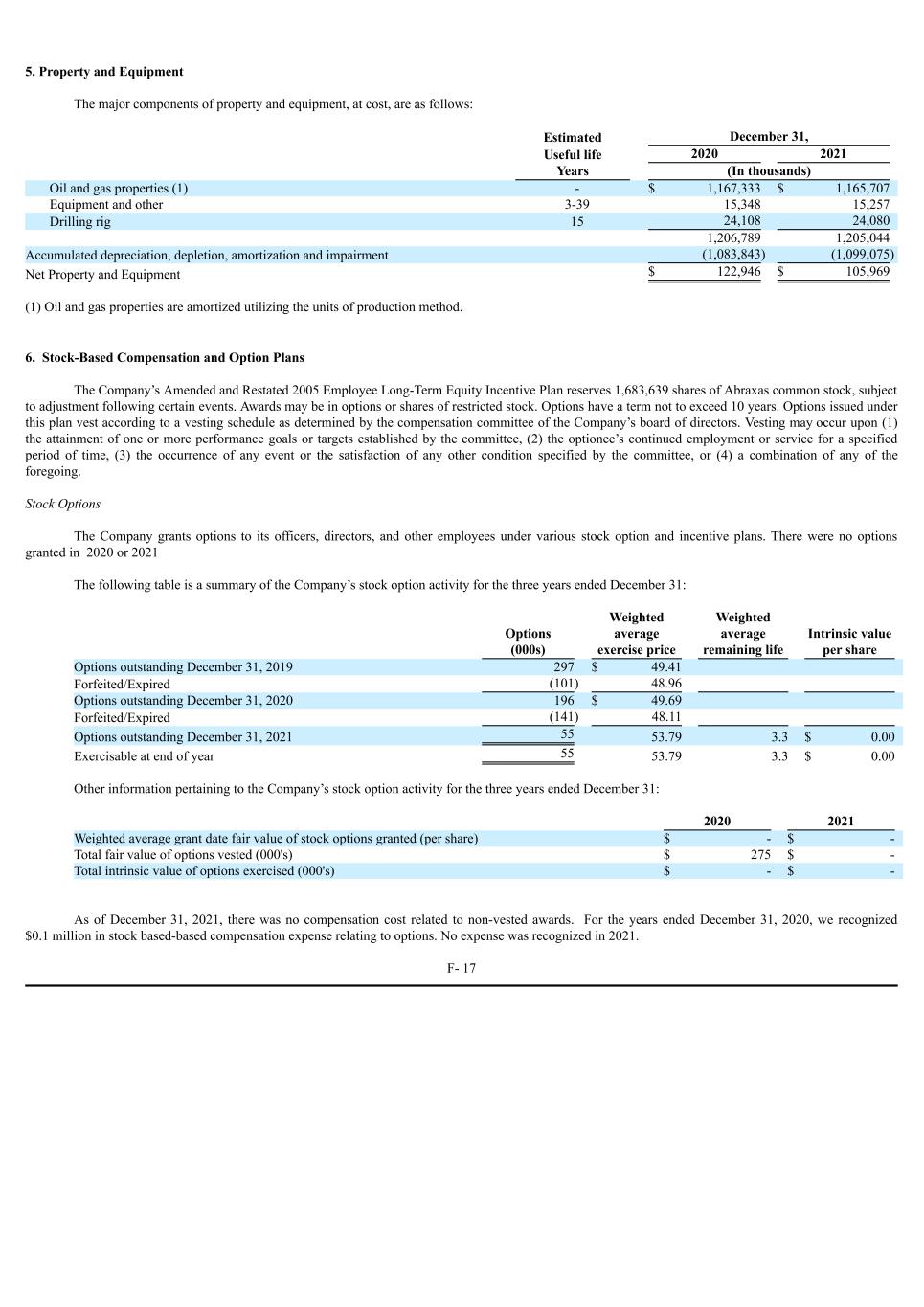
5. Property and Equipment The major components of property and equipment, at cost, are as follows: Estimated December 31, Useful life 2020 2021 Years (In thousands) Oil and gas properties (1) - $ 1,167,333 $ 1,165,707 Equipment and other 3-39 15,348 15,257 Drilling rig 15 24,108 24,080 1,206,789 1,205,044 Accumulated depreciation, depletion, amortization and impairment (1,083,843) (1,099,075) Net Property and Equipment $ 122,946 $ 105,969 (1) Oil and gas properties are amortized utilizing the units of production method. 6. Stock-Based Compensation and Option Plans The Company’s Amended and Restated 2005 Employee Long-Term Equity Incentive Plan reserves 1,683,639 shares of Abraxas common stock, subject to adjustment following certain events. Awards may be in options or shares of restricted stock. Options have a term not to exceed 10 years. Options issued under this plan vest according to a vesting schedule as determined by the compensation committee of the Company’s board of directors. Vesting may occur upon (1) the attainment of one or more performance goals or targets established by the committee, (2) the optionee’s continued employment or service for a specified period of time, (3) the occurrence of any event or the satisfaction of any other condition specified by the committee, or (4) a combination of any of the foregoing. Stock Options The Company grants options to its officers, directors, and other employees under various stock option and incentive plans. There were no options granted in 2020 or 2021 The following table is a summary of the Company’s stock option activity for the three years ended December 31: Options Weighted average Weighted average Intrinsic value (000s) exercise price remaining life per share Options outstanding December 31, 2019 297 $ 49.41 Forfeited/Expired (101) 48.96 Options outstanding December 31, 2020 196 $ 49.69 Forfeited/Expired (141) 48.11 Options outstanding December 31, 2021 55 53.79 3.3 $ 0.00 Exercisable at end of year 55 53.79 3.3 $ 0.00 Other information pertaining to the Company’s stock option activity for the three years ended December 31: 2020 2021 Weighted average grant date fair value of stock options granted (per share) $ - $ - Total fair value of options vested (000's) $ 275 $ - Total intrinsic value of options exercised (000's) $ - $ - As of December 31, 2021, there was no compensation cost related to non-vested awards. For the years ended December 31, 2020, we recognized $0.1 million in stock based-based compensation expense relating to options. No expense was recognized in 2021. F- 17
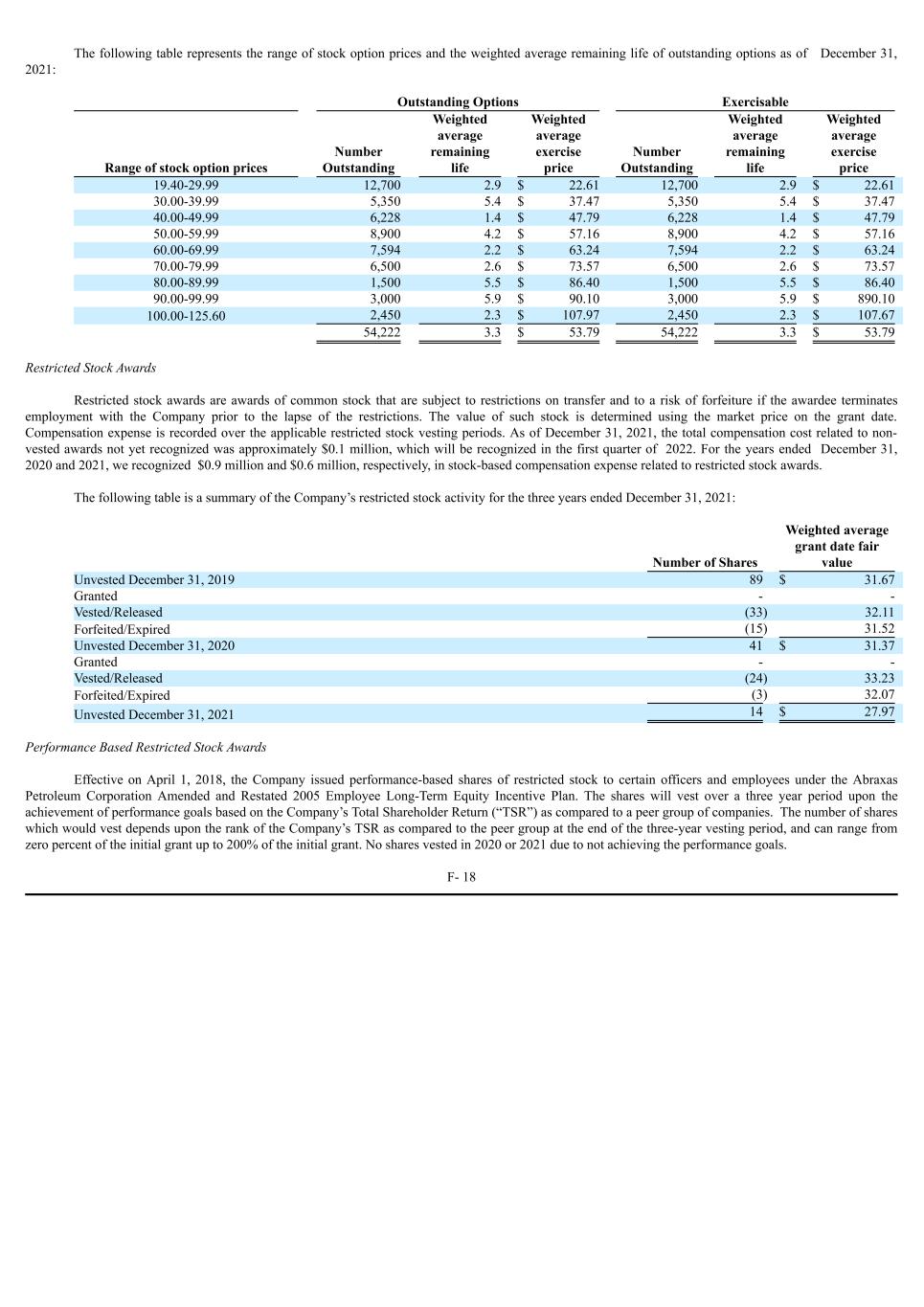
The following table represents the range of stock option prices and the weighted average remaining life of outstanding options as of December 31, 2021: Outstanding Options Exercisable Weighted Weighted Weighted Weighted average average average average Number remaining exercise Number remaining exercise Range of stock option prices Outstanding life price Outstanding life price 19.40-29.99 12,700 2.9 $ 22.61 12,700 2.9 $ 22.61 30.00-39.99 5,350 5.4 $ 37.47 5,350 5.4 $ 37.47 40.00-49.99 6,228 1.4 $ 47.79 6,228 1.4 $ 47.79 50.00-59.99 8,900 4.2 $ 57.16 8,900 4.2 $ 57.16 60.00-69.99 7,594 2.2 $ 63.24 7,594 2.2 $ 63.24 70.00-79.99 6,500 2.6 $ 73.57 6,500 2.6 $ 73.57 80.00-89.99 1,500 5.5 $ 86.40 1,500 5.5 $ 86.40 90.00-99.99 3,000 5.9 $ 90.10 3,000 5.9 $ 890.10 100.00-125.60 2,450 2.3 $ 107.97 2,450 2.3 $ 107.67 54,222 3.3 $ 53.79 54,222 3.3 $ 53.79 Restricted Stock Awards Restricted stock awards are awards of common stock that are subject to restrictions on transfer and to a risk of forfeiture if the awardee terminates employment with the Company prior to the lapse of the restrictions. The value of such stock is determined using the market price on the grant date. Compensation expense is recorded over the applicable restricted stock vesting periods. As of December 31, 2021, the total compensation cost related to non- vested awards not yet recognized was approximately $0.1 million, which will be recognized in the first quarter of 2022. For the years ended December 31, 2020 and 2021, we recognized $0.9 million and $0.6 million, respectively, in stock-based compensation expense related to restricted stock awards. The following table is a summary of the Company’s restricted stock activity for the three years ended December 31, 2021: Number of Shares Weighted average grant date fair value Unvested December 31, 2019 89 $ 31.67 Granted - - Vested/Released (33) 32.11 Forfeited/Expired (15) 31.52 Unvested December 31, 2020 41 $ 31.37 Granted - - Vested/Released (24) 33.23 Forfeited/Expired (3) 32.07 Unvested December 31, 2021 14 $ 27.97 Performance Based Restricted Stock Awards Effective on April 1, 2018, the Company issued performance-based shares of restricted stock to certain officers and employees under the Abraxas Petroleum Corporation Amended and Restated 2005 Employee Long-Term Equity Incentive Plan. The shares will vest over a three year period upon the achievement of performance goals based on the Company’s Total Shareholder Return (“TSR”) as compared to a peer group of companies. The number of shares which would vest depends upon the rank of the Company’s TSR as compared to the peer group at the end of the three-year vesting period, and can range from zero percent of the initial grant up to 200% of the initial grant. No shares vested in 2020 or 2021 due to not achieving the performance goals. F- 18
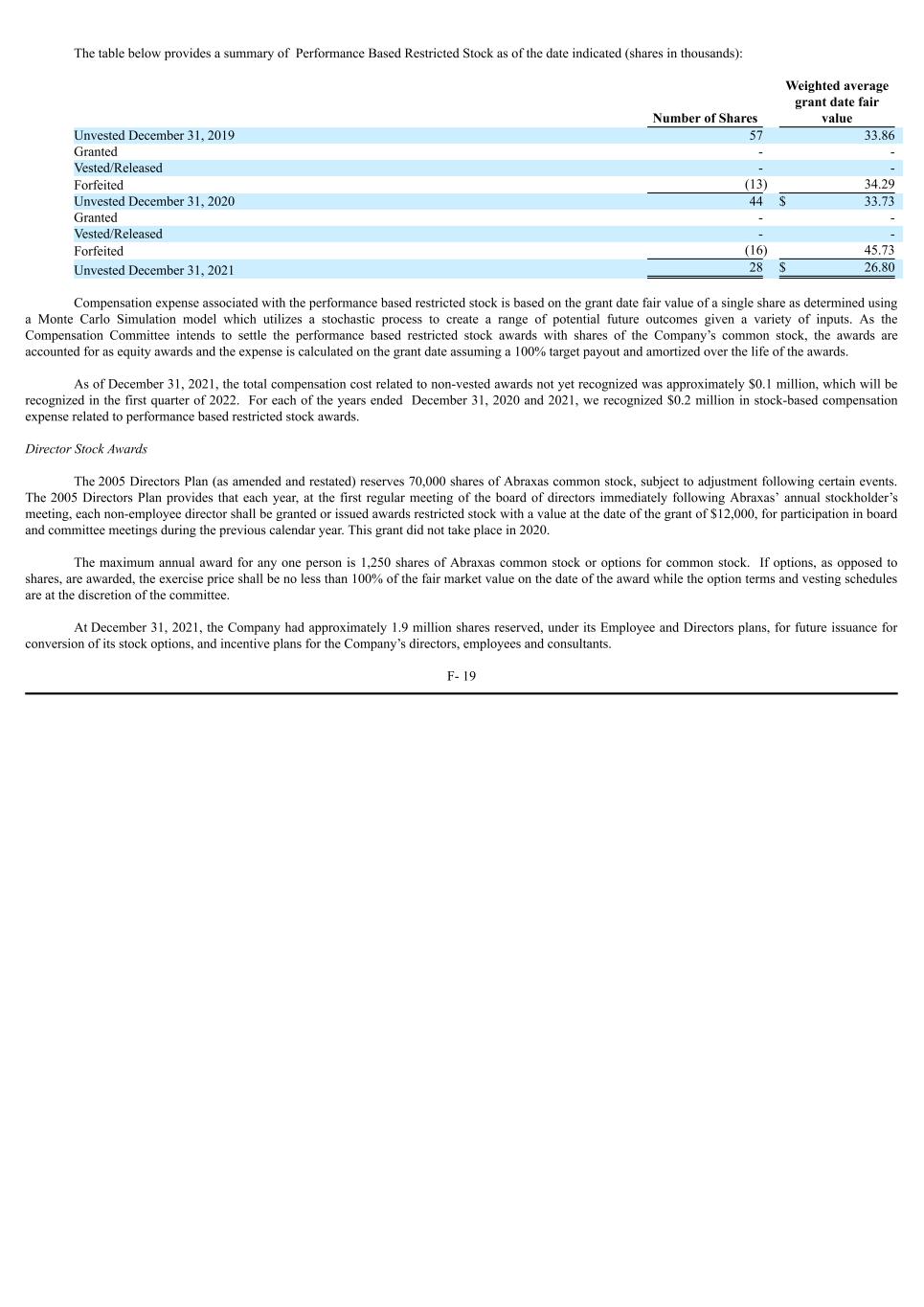
The table below provides a summary of Performance Based Restricted Stock as of the date indicated (shares in thousands): Number of Shares Weighted average grant date fair value Unvested December 31, 2019 57 33.86 Granted - - Vested/Released - - Forfeited (13) 34.29 Unvested December 31, 2020 44 $ 33.73 Granted - - Vested/Released - - Forfeited (16) 45.73 Unvested December 31, 2021 28 $ 26.80 Compensation expense associated with the performance based restricted stock is based on the grant date fair value of a single share as determined using a Monte Carlo Simulation model which utilizes a stochastic process to create a range of potential future outcomes given a variety of inputs. As the Compensation Committee intends to settle the performance based restricted stock awards with shares of the Company’s common stock, the awards are accounted for as equity awards and the expense is calculated on the grant date assuming a 100% target payout and amortized over the life of the awards. As of December 31, 2021, the total compensation cost related to non-vested awards not yet recognized was approximately $0.1 million, which will be recognized in the first quarter of 2022. For each of the years ended December 31, 2020 and 2021, we recognized $0.2 million in stock-based compensation expense related to performance based restricted stock awards. Director Stock Awards The 2005 Directors Plan (as amended and restated) reserves 70,000 shares of Abraxas common stock, subject to adjustment following certain events. The 2005 Directors Plan provides that each year, at the first regular meeting of the board of directors immediately following Abraxas’ annual stockholder’s meeting, each non-employee director shall be granted or issued awards restricted stock with a value at the date of the grant of $12,000, for participation in board and committee meetings during the previous calendar year. This grant did not take place in 2020. The maximum annual award for any one person is 1,250 shares of Abraxas common stock or options for common stock. If options, as opposed to shares, are awarded, the exercise price shall be no less than 100% of the fair market value on the date of the award while the option terms and vesting schedules are at the discretion of the committee. At December 31, 2021, the Company had approximately 1.9 million shares reserved, under its Employee and Directors plans, for future issuance for conversion of its stock options, and incentive plans for the Company’s directors, employees and consultants. F- 19
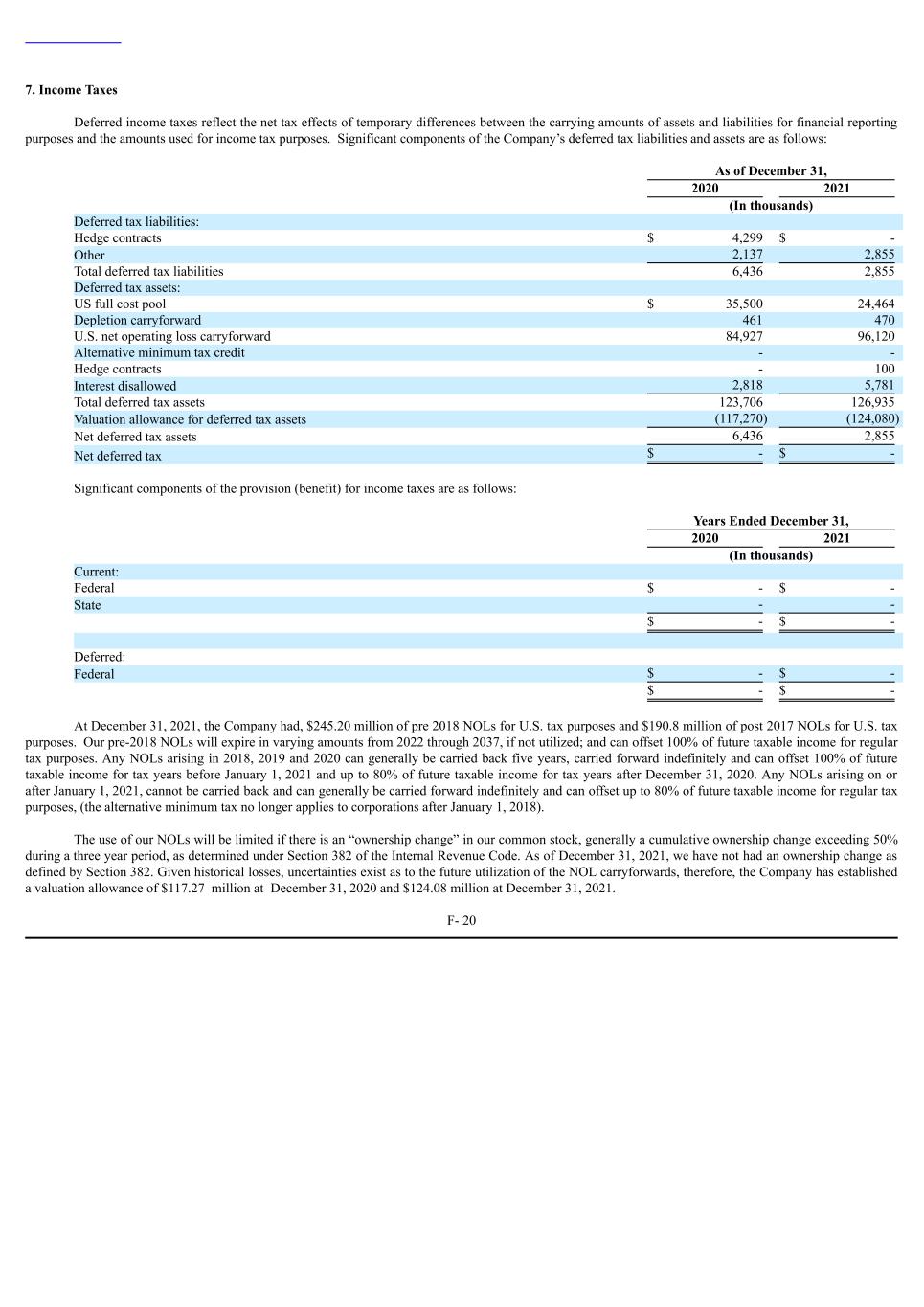
for financial reporting 7. Income Taxes Deferred income taxes reflect the net tax effects of temporary differences between the carrying amounts of assets and liabilities purposes and the amounts used for income tax purposes. Significant components of the Company’s deferred tax liabilities and assets are as follows: As of December 31, 2020 2021 (In thousands) Deferred tax liabilities: Hedge contracts $ 4,299 $ - Other 2,137 2,855 Total deferred tax liabilities 6,436 2,855 Deferred tax assets: US full cost pool $ 35,500 24,464 Depletion carryforward 461 470 U.S. net operating loss carryforward 84,927 96,120 Alternative minimum tax credit - - Hedge contracts - 100 Interest disallowed 2,818 5,781 Total deferred tax assets 123,706 126,935 Valuation allowance for deferred tax assets (117,270) (124,080) Net deferred tax assets 6,436 2,855 Net deferred tax $ - $ - Significant components of the provision (benefit) for income taxes are as follows: Years Ended December 31, 2020 2021 (In thousands) Current: Federal $ - $ - State - - $ - $ - Deferred: Federal $ - $ - $ - $ - At December 31, 2021, the Company had, $245.20 million of pre 2018 NOLs for U.S. tax purposes and $190.8 million of post 2017 NOLs for U.S. tax purposes. Our pre-2018 NOLs will expire in varying amounts from 2022 through 2037, if not utilized; and can offset 100% of future taxable income for regular tax purposes. Any NOLs arising in 2018, 2019 and 2020 can generally be carried back five years, carried forward indefinitely and can offset 100% of future taxable income for tax years before January 1, 2021 and up to 80% of future taxable income for tax years after December 31, 2020. Any NOLs arising on or after January 1, 2021, cannot be carried back and can generally be carried forward indefinitely and can offset up to 80% of future taxable income for regular tax purposes, (the alternative minimum tax no longer applies to corporations after January 1, 2018). The use of our NOLs will be limited if there is an “ownership change” in our common stock, generally a cumulative ownership change exceeding 50% during a three year period, as determined under Section 382 of the Internal Revenue Code. As of December 31, 2021, we have not had an ownership change as defined by Section 382. Given historical losses, uncertainties exist as to the future utilization of the NOL carryforwards, therefore, the Company has established a valuation allowance of $117.27 million at December 31, 2020 and $124.08 million at December 31, 2021. F- 20
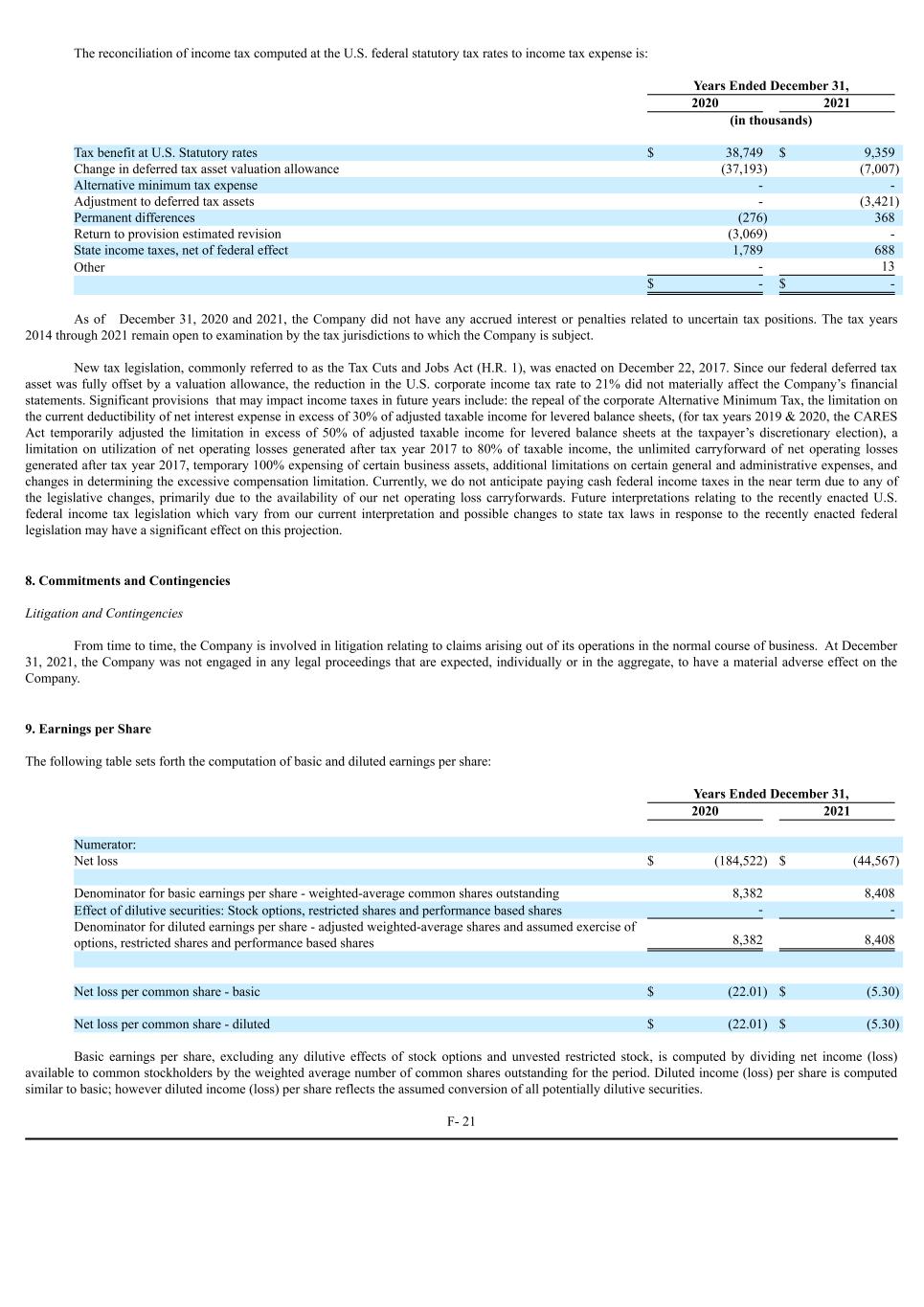
The reconciliation of income tax computed at the U.S. federal statutory tax rates to income tax expense is: Years Ended December 31, 2020 2021 (in thousands) Tax benefit at U.S. Statutory rates $ 38,749 $ 9,359 Change in deferred tax asset valuation allowance (37,193) (7,007) Alternative minimum tax expense - - Adjustment to deferred tax assets - (3,421) Permanent differences (276) 368 Return to provision estimated revision (3,069) - State income taxes, net of federal effect 1,789 688 Other - 13 $ - $ - As of December 31, 2020 and 2021, the Company did not have any accrued interest or penalties related to uncertain tax positions. The tax years 2014 through 2021 remain open to examination by the tax jurisdictions to which the Company is subject. New tax legislation, commonly referred to as the Tax Cuts and Jobs Act (H.R. 1), was enacted on December 22, 2017. Since our federal deferred tax asset was fully offset by a valuation allowance, the reduction in the U.S. corporate income tax rate to 21% did not materially affect the Company’s financial statements. Significant provisions that may impact income taxes in future years include: the repeal of the corporate Alternative Minimum Tax, the limitation on the current deductibility of net interest expense in excess of 30% of adjusted taxable income for levered balance sheets, (for tax years 2019 & 2020, the CARES Act temporarily adjusted the limitation in excess of 50% of adjusted taxable income for levered balance sheets at the taxpayer’s discretionary election), a limitation on utilization of net operating losses generated after tax year 2017 to 80% of taxable income, the unlimited carryforward of net operating losses generated after tax year 2017, temporary 100% expensing of certain business assets, additional limitations on certain general and administrative expenses, and changes in determining the excessive compensation limitation. Currently, we do not anticipate paying cash federal income taxes in the near term due to any of the legislative changes, primarily due to the availability of our net operating loss carryforwards. Future interpretations relating to the recently enacted U.S. federal income tax legislation which vary from our current interpretation and possible changes to state tax laws in response to the recently enacted federal legislation may have a significant effect on this projection. 8. Commitments and Contingencies Litigation and Contingencies From time to time, the Company is involved in litigation relating to claims arising out of its operations in the normal course of business. At December 31, 2021, the Company was not engaged in any legal proceedings that are expected, individually or in the aggregate, to have a material adverse effect on the Company. 9. Earnings per Share The following table sets forth the computation of basic and diluted earnings per share: Years Ended December 31, 2020 2021 Numerator: Net loss $ (184,522) $ (44,567) Denominator for basic earnings per share - weighted-average common shares outstanding 8,382 8,408 Effect of dilutive securities: Stock options, restricted shares and performance based shares - - Denominator for diluted earnings per share - adjusted weighted-average shares and assumed exercise of options, restricted shares and performance based shares 8,382 8,408 Net loss per common share - basic $ (22.01) $ (5.30) Net loss per common share - diluted $ (22.01) $ (5.30) Basic earnings per share, excluding any dilutive effects of stock options and unvested restricted stock, is computed by dividing net income (loss) available to common stockholders by the weighted average number of common shares outstanding for the period. Diluted income (loss) per share is computed similar to basic; however diluted income (loss) per share reflects the assumed conversion of all potentially dilutive securities. F- 21
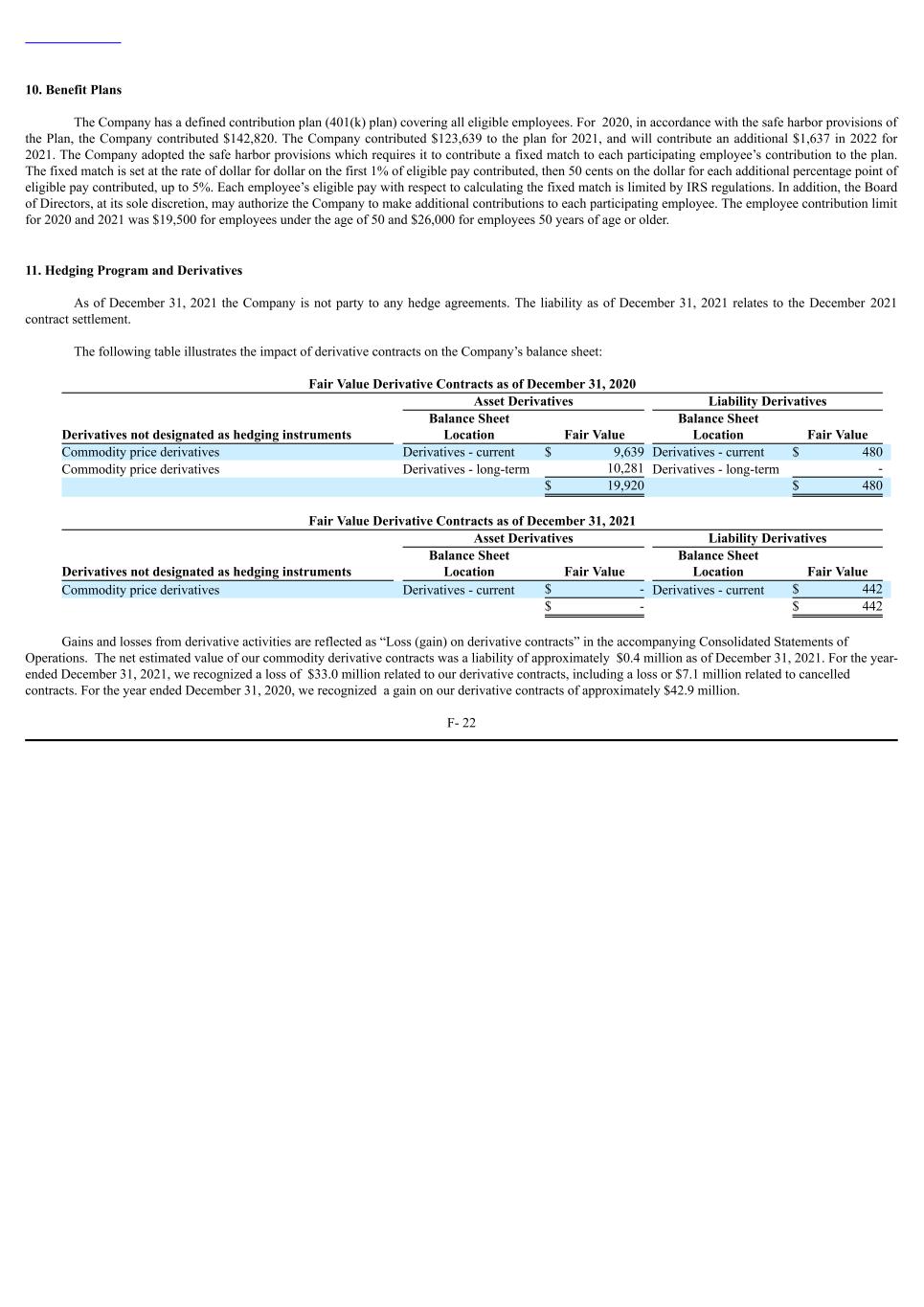
10. Benefit Plans The Company has a defined contribution plan (401(k) plan) covering all eligible employees. For 2020, in accordance with the safe harbor provisions of the Plan, the Company contributed $142,820. The Company contributed $123,639 to the plan for 2021, and will contribute an additional $1,637 in 2022 for 2021. The Company adopted the safe harbor provisions which requires it to contribute a fixed match to each participating employee’s contribution to the plan. The fixed match is set at the rate of dollar for dollar on the first 1% of eligible pay contributed, then 50 cents on the dollar for each additional percentage point of eligible pay contributed, up to 5%. Each employee’s eligible pay with respect to calculating the fixed match is limited by IRS regulations. In addition, the Board of Directors, at its sole discretion, may authorize the Company to make additional contributions to each participating employee. The employee contribution limit for 2020 and 2021 was $19,500 for employees under the age of 50 and $26,000 for employees 50 years of age or older. 11. Hedging Program and Derivatives As of December 31, 2021 the Company is not party to any hedge agreements. The liability as of December 31, 2021 relates to the December 2021 contract settlement. The following table illustrates the impact of derivative contracts on the Company’s balance sheet: Fair Value Derivative Contracts as of December 31, 2020 Asset Derivatives Liability Derivatives Derivatives not designated as hedging instruments Balance Sheet Location Fair Value Balance Sheet Location Fair Value Commodity price derivatives Derivatives - current $ 9,639 Derivatives - current $ 480 Commodity price derivatives Derivatives - long-term 10,281 Derivatives - long-term - $ 19,920 $ 480 Fair Value Derivative Contracts as of December 31, 2021 Asset Derivatives Liability Derivatives Derivatives not designated as hedging instruments Balance Sheet Location Fair Value Balance Sheet Location Fair Value Commodity price derivatives Derivatives - current $ - Derivatives - current $ 442 $ - $ 442 Gains and losses from derivative activities are reflected as “Loss (gain) on derivative contracts” in the accompanying Consolidated Statements of Operations. The net estimated value of our commodity derivative contracts was a liability of approximately $0.4 million as of December 31, 2021. For the year- ended December 31, 2021, we recognized a loss of $33.0 million related to our derivative contracts, including a loss or $7.1 million related to cancelled contracts. For the year ended December 31, 2020, we recognized a gain on our derivative contracts of approximately $42.9 million. F- 22
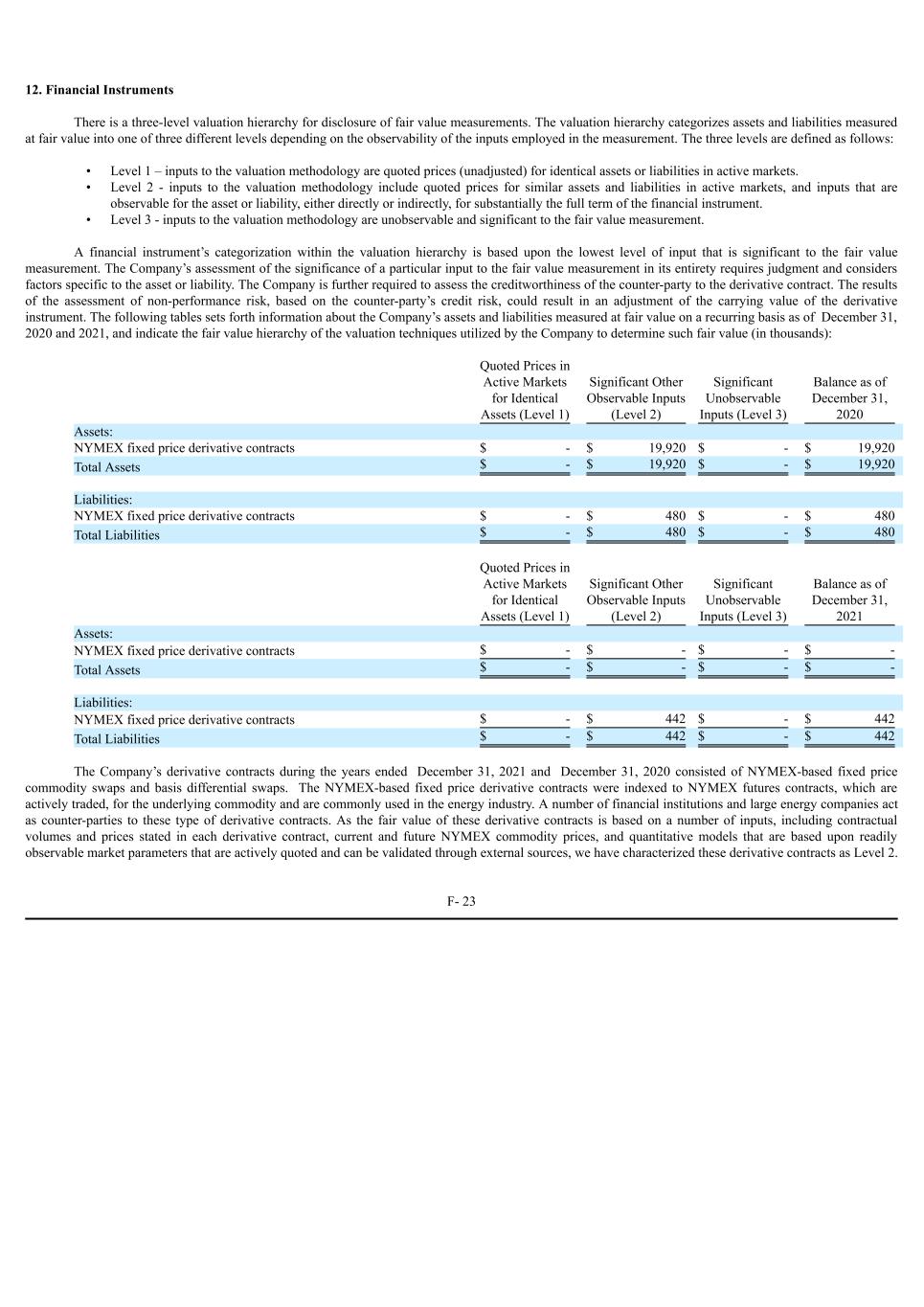
12. Financial Instruments There is a three-level valuation hierarchy for disclosure of fair value measurements. The valuation hierarchy categorizes assets and liabilities measured at fair value into one of three different levels depending on the observability of the inputs employed in the measurement. The three levels are defined as follows: • Level 1 – inputs to the valuation methodology are quoted prices (unadjusted) for identical assets or liabilities in active markets. • Level 2 - inputs to the valuation methodology include quoted prices for similar assets and liabilities in active markets, and inputs that are observable for the asset or liability, either directly or indirectly, for substantially the full term of the financial instrument. • Level 3 - inputs to the valuation methodology are unobservable and significant to the fair value measurement. A financial instrument’s categorization within the valuation hierarchy is based upon the lowest level of input that is significant to the fair value measurement. The Company’s assessment of the significance of a particular input to the fair value measurement in its entirety requires judgment and considers factors specific to the asset or liability. The Company is further required to assess the creditworthiness of the counter-party to the derivative contract. The results of the assessment of non-performance risk, based on the counter-party’s credit risk, could result in an adjustment of the carrying value of the derivative instrument. The following tables sets forth information about the Company’s assets and liabilities measured at fair value on a recurring basis as of December 31, 2020 and 2021, and indicate the fair value hierarchy of the valuation techniques utilized by the Company to determine such fair value (in thousands): Quoted Prices in Active Markets for Identical Assets (Level 1) Significant Other Observable Inputs (Level 2) Significant Unobservable Inputs (Level 3) Balance as of December 31, 2020 Assets: NYMEX fixed price derivative contracts $ - $ 19,920 $ - $ 19,920 Total Assets $ - $ 19,920 $ - $ 19,920 Liabilities: NYMEX fixed price derivative contracts $ - $ 480 $ - $ 480 Total Liabilities $ - $ 480 $ - $ 480 Quoted Prices in Active Markets for Identical Assets (Level 1) Significant Other Observable Inputs (Level 2) Significant Unobservable Inputs (Level 3) Balance as of December 31, 2021 Assets: NYMEX fixed price derivative contracts $ - $ - $ - $ - Total Assets $ - $ - $ - $ - Liabilities: NYMEX fixed price derivative contracts $ - $ 442 $ - $ 442 Total Liabilities $ - $ 442 $ - $ 442 The Company’s derivative contracts during the years ended December 31, 2021 and December 31, 2020 consisted of NYMEX-based fixed price commodity swaps and basis differential swaps. The NYMEX-based fixed price derivative contracts were indexed to NYMEX futures contracts, which are actively traded, for the underlying commodity and are commonly used in the energy industry. A number of financial institutions and large energy companies act as counter-parties to these type of derivative contracts. As the fair value of these derivative contracts is based on a number of inputs, including contractual volumes and prices stated in each derivative contract, current and future NYMEX commodity prices, and quantitative models that are based upon readily observable market parameters that are actively quoted and can be validated through external sources, we have characterized these derivative contracts as Level 2. F- 23
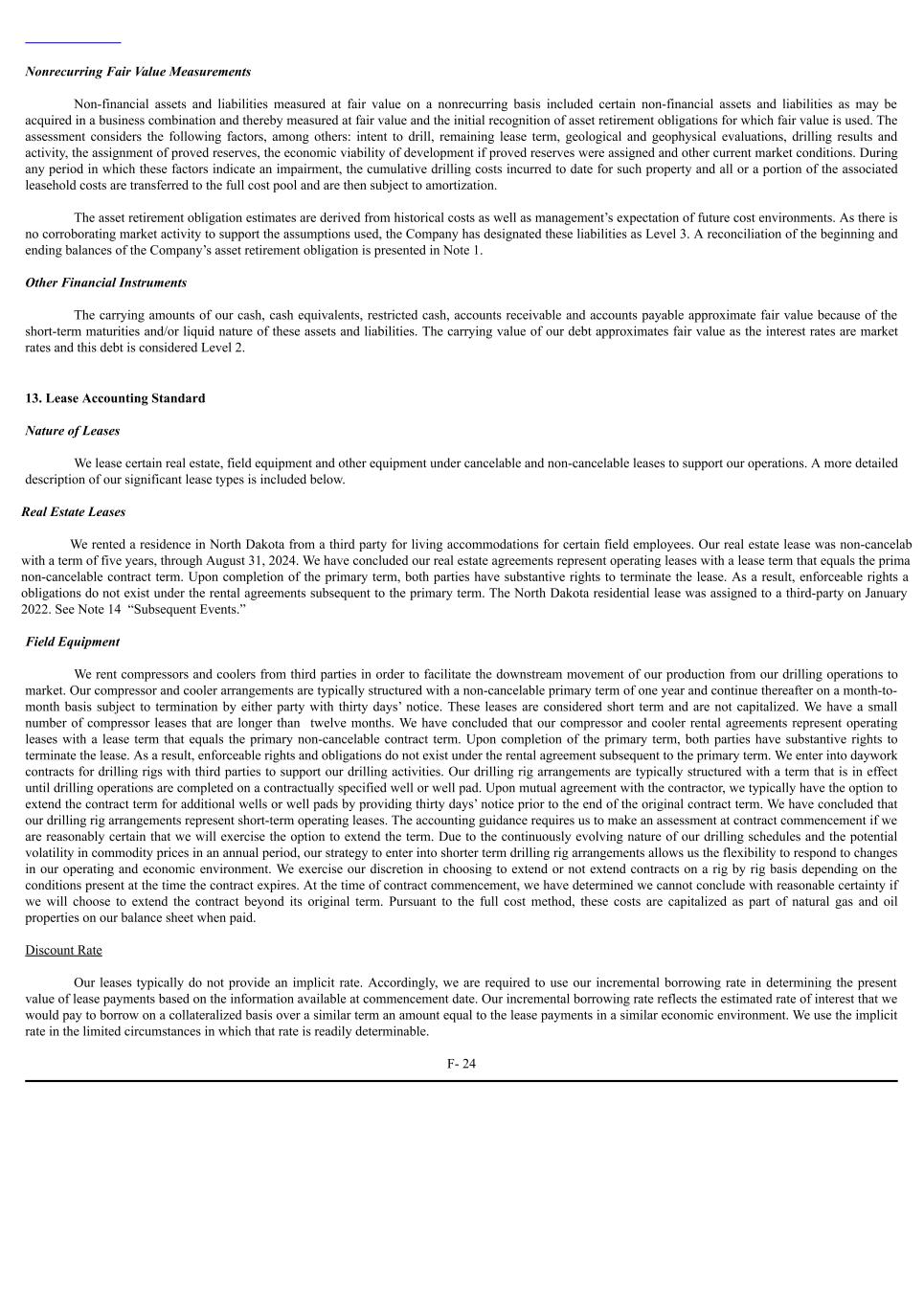
Nonrecurring Fair Value Measurements Non-financial assets and liabilities measured at fair value on a nonrecurring basis included certain non-financial assets and liabilities as may be acquired in a business combination and thereby measured at fair value and the initial recognition of asset retirement obligations for which fair value is used. The assessment considers the following factors, among others: intent to drill, remaining lease term, geological and geophysical evaluations, drilling results and activity, the assignment of proved reserves, the economic viability of development if proved reserves were assigned and other current market conditions. During any period in which these factors indicate an impairment, the cumulative drilling costs incurred to date for such property and all or a portion of the associated leasehold costs are transferred to the full cost pool and are then subject to amortization. The asset retirement obligation estimates are derived from historical costs as well as management’s expectation of future cost environments. As there is no corroborating market activity to support the assumptions used, the Company has designated these liabilities as Level 3. A reconciliation of the beginning and ending balances of the Company’s asset retirement obligation is presented in Note 1. Other Financial Instruments The carrying amounts of our cash, cash equivalents, restricted cash, accounts receivable and accounts payable approximate fair value because of the short-term maturities and/or liquid nature of these assets and liabilities. The carrying value of our debt approximates fair value as the interest rates are market rates and this debt is considered Level 2. 13. Lease Accounting Standard Nature of Leases We lease certain real estate, field equipment and other equipment under cancelable and non-cancelable leases to support our operations. A more detailed description of our significant lease types is included below. Real Estate Leases We rented a residence in North Dakota from a third party for living accommodations for certain field employees. Our real estate lease was non-cancelab with a term of five years, through August 31, 2024. We have concluded our real estate agreements represent operating leases with a lease term that equals the prima non-cancelable contract term. Upon completion of the primary term, both parties have substantive rights to terminate the lease. As a result, enforceable rights a obligations do not exist under the rental agreements subsequent to the primary term. The North Dakota residential lease was assigned to a third-party on January 2022. See Note 14 “Subsequent Events.” Field Equipment We rent compressors and coolers from third parties in order to facilitate the downstream movement of our production from our drilling operations to market. Our compressor and cooler arrangements are typically structured with a non-cancelable primary term of one year and continue thereafter on a month-to- month basis subject to termination by either party with thirty days’ notice. These leases are considered short term and are not capitalized. We have a small number of compressor leases that are longer than twelve months. We have concluded that our compressor and cooler rental agreements represent operating leases with a lease term that equals the primary non-cancelable contract term. Upon completion of the primary term, both parties have substantive rights to terminate the lease. As a result, enforceable rights and obligations do not exist under the rental agreement subsequent to the primary term. We enter into daywork contracts for drilling rigs with third parties to support our drilling activities. Our drilling rig arrangements are typically structured with a term that is in effect until drilling operations are completed on a contractually specified well or well pad. Upon mutual agreement with the contractor, we typically have the option to extend the contract term for additional wells or well pads by providing thirty days’ notice prior to the end of the original contract term. We have concluded that our drilling rig arrangements represent short-term operating leases. The accounting guidance requires us to make an assessment at contract commencement if we are reasonably certain that we will exercise the option to extend the term. Due to the continuously evolving nature of our drilling schedules and the potential volatility in commodity prices in an annual period, our strategy to enter into shorter term drilling rig arrangements allows us the flexibility to respond to changes in our operating and economic environment. We exercise our discretion in choosing to extend or not extend contracts on a rig by rig basis depending on the conditions present at the time the contract expires. At the time of contract commencement, we have determined we cannot conclude with reasonable certainty if we will choose to extend the contract beyond its original term. Pursuant to the full cost method, these costs are capitalized as part of natural gas and oil properties on our balance sheet when paid. Discount Rate Our leases typically do not provide an implicit rate. Accordingly, we are required to use our incremental borrowing rate in determining the present value of lease payments based on the information available at commencement date. Our incremental borrowing rate reflects the estimated rate of interest that we would pay to borrow on a collateralized basis over a similar term an amount equal to the lease payments in a similar economic environment. We use the implicit rate in the limited circumstances in which that rate is readily determinable. F- 24
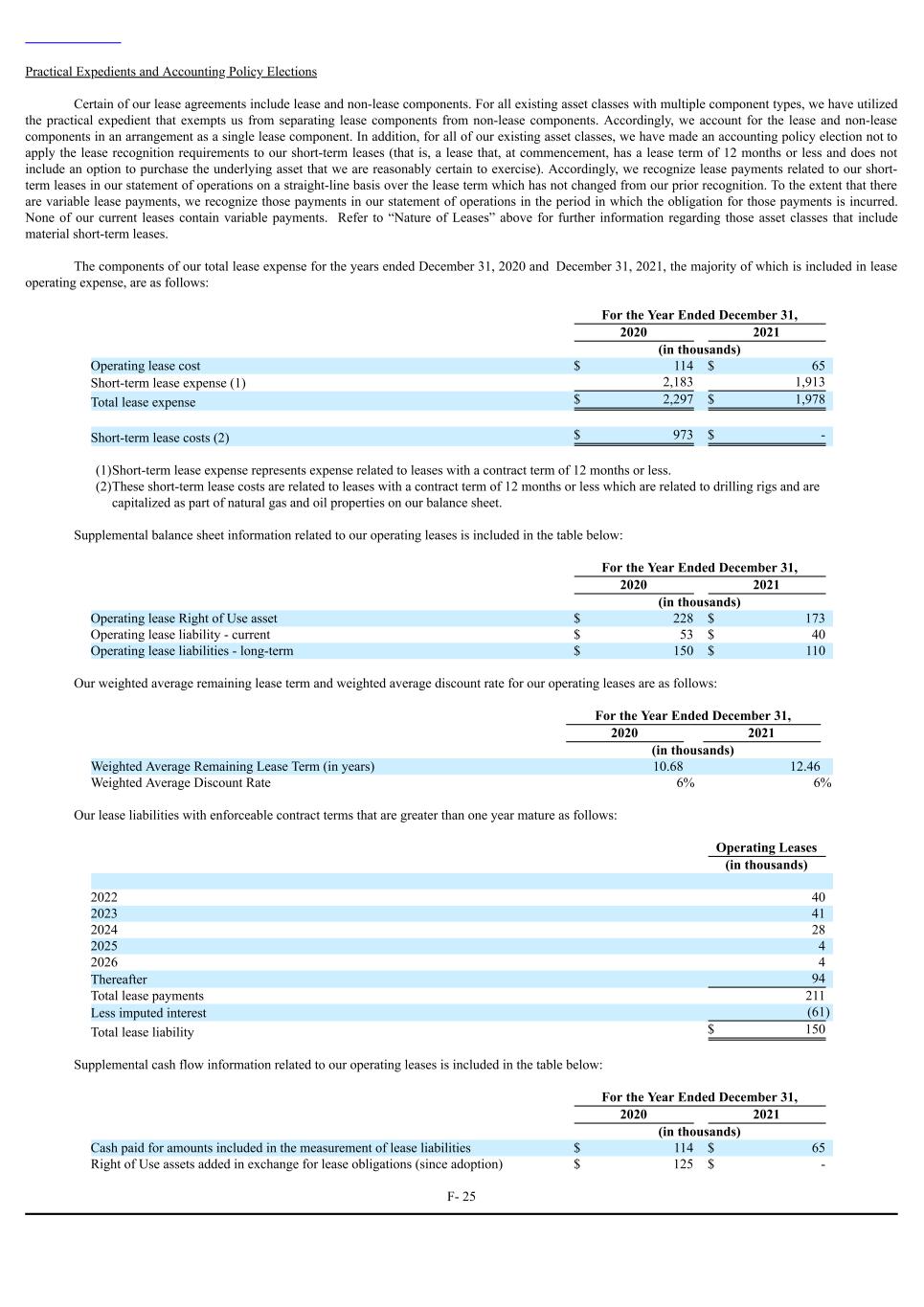
component types, we have utilized account for the lease and non-lease an accounting policy election not to of 12 months or less and does not lease payments related to our short- Practical Expedients and Accounting Policy Elections Certain of our lease agreements include lease and non-lease components. For all existing asset classes with multiple the practical expedient that exempts us from separating lease components from non-lease components. Accordingly, we components in an arrangement as a single lease component. In addition, for all of our existing asset classes, we have made apply the lease recognition requirements to our short-term leases (that is, a lease that, at commencement, has a lease term include an option to purchase the underlying asset that we are reasonably certain to exercise). Accordingly, we recognize term leases in our statement of operations on a straight-line basis over the lease term which has not changed from our prior recognition. To the extent that there are variable lease payments, we recognize those payments in our statement of operations in the period in which the obligation for those payments is incurred. None of our current leases contain variable payments. Refer to “Nature of Leases” above for further information regarding those asset classes that include material short-term leases. The components of our total lease expense for the years ended December 31, 2020 and December 31, 2021, the majority of which is included in lease operating expense, are as follows: For the Year Ended December 31, 2020 2021 (in thousands) Operating lease cost $ 114 $ 65 Short-term lease expense (1) 2,183 1,913 Total lease expense $ 2,297 $ 1,978 Short-term lease costs (2) $ 973 $ - (1)Short-term lease expense represents expense related to leases with a contract term of 12 months or less. (2)These short-term lease costs are related to leases with a contract term of 12 months or less which are related to drilling rigs and are capitalized as part of natural gas and oil properties on our balance sheet. Supplemental balance sheet information related to our operating leases is included in the table below: For the Year Ended December 31, 2020 2021 (in thousands) Operating lease Right of Use asset $ 228 $ 173 Operating lease liability - current $ 53 $ 40 Operating lease liabilities - long-term $ 150 $ 110 Our weighted average remaining lease term and weighted average discount rate for our operating leases are as follows: For the Year Ended December 31, 2020 2021 (in thousands) Weighted Average Remaining Lease Term (in years) 10.68 12.46 Weighted Average Discount Rate 6% 6% Our lease liabilities with enforceable contract terms that are greater than one year mature as follows: Operating Leases (in thousands) 2022 40 2023 41 2024 28 2025 4 2026 4 Thereafter 94 Total lease payments 211 Less imputed interest (61) Total lease liability $ 150 Supplemental cash flow information related to our operating leases is included in the table below: For the Year Ended December 31, 2020 2021 (in thousands) Cash paid for amounts included in the measurement of lease liabilities $ 114 $ 65 Right of Use assets added in exchange for lease obligations (since adoption) $ 125 $ - F- 25
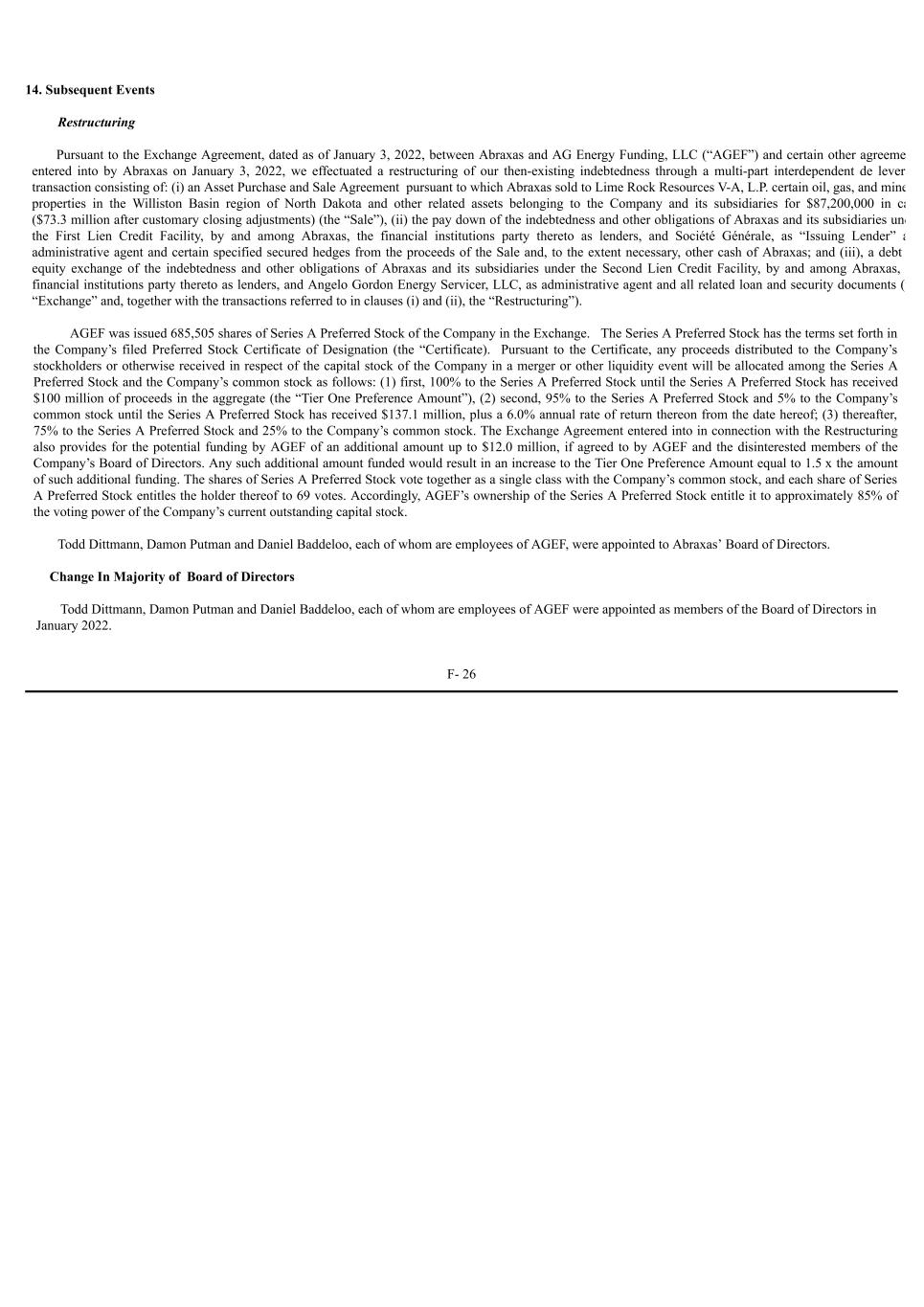
14. Subsequent Events Restructuring Pursuant to the Exchange Agreement, dated as of January 3, 2022, between Abraxas and AG Energy Funding, LLC (“AGEF”) and certain other agreeme entered into by Abraxas on January 3, 2022, we effectuated a restructuring of our then-existing indebtedness through a multi-part interdependent de leveri transaction consisting of: (i) an Asset Purchase and Sale Agreement pursuant to which Abraxas sold to Lime Rock Resources V-A, L.P. certain oil, gas, and mine properties in the Williston Basin region of North Dakota and other related assets belonging to the Company and its subsidiaries for $87,200,000 in ca ($73.3 million after customary closing adjustments) (the “Sale”), (ii) the pay down of the indebtedness and other obligations of Abraxas and its subsidiaries und the First Lien Credit Facility, by and among Abraxas, the financial institutions party thereto as lenders, and Société Générale, as “Issuing Lender” a administrative agent and certain specified secured hedges from the proceeds of the Sale and, to the extent necessary, other cash of Abraxas; and (iii), a debt equity exchange of the indebtedness and other obligations of Abraxas and its subsidiaries under the Second Lien Credit Facility, by and among Abraxas, financial institutions party thereto as lenders, and Angelo Gordon Energy Servicer, LLC, as administrative agent and all related loan and security documents (t “Exchange” and, together with the transactions referred to in clauses (i) and (ii), the “Restructuring”). AGEF was issued 685,505 shares of Series A Preferred Stock of the Company in the Exchange. The Series A Preferred Stock has the terms set forth in the Company’s filed Preferred Stock Certificate of Designation (the “Certificate). Pursuant to the Certificate, any proceeds distributed to the Company’s stockholders or otherwise received in respect of the capital stock of the Company in a merger or other liquidity event will be allocated among the Series A Preferred Stock and the Company’s common stock as follows: (1) first, 100% to the Series A Preferred Stock until the Series A Preferred Stock has received $100 million of proceeds in the aggregate (the “Tier One Preference Amount”), (2) second, 95% to the Series A Preferred Stock and 5% to the Company’s common stock until the Series A Preferred Stock has received $137.1 million, plus a 6.0% annual rate of return thereon from the date hereof; (3) thereafter, 75% to the Series A Preferred Stock and 25% to the Company’s common stock. The Exchange Agreement entered into in connection with the Restructuring also provides for the potential funding by AGEF of an additional amount up to $12.0 million, if agreed to by AGEF and the disinterested members of the Company’s Board of Directors. Any such additional amount funded would result in an increase to the Tier One Preference Amount equal to 1.5 x the amount of such additional funding. The shares of Series A Preferred Stock vote together as a single class with the Company’s common stock, and each share of Series A Preferred Stock entitles the holder thereof to 69 votes. Accordingly, AGEF’s ownership of the Series A Preferred Stock entitle it to approximately 85% of the voting power of the Company’s current outstanding capital stock. Todd Dittmann, Damon Putman and Daniel Baddeloo, each of whom are employees of AGEF, were appointed to Abraxas’ Board of Directors. Change In Majority of Board of Directors Todd Dittmann, Damon Putman and Daniel Baddeloo, each of whom are employees of AGEF were appointed as members of the Board of Directors in January 2022. F- 26
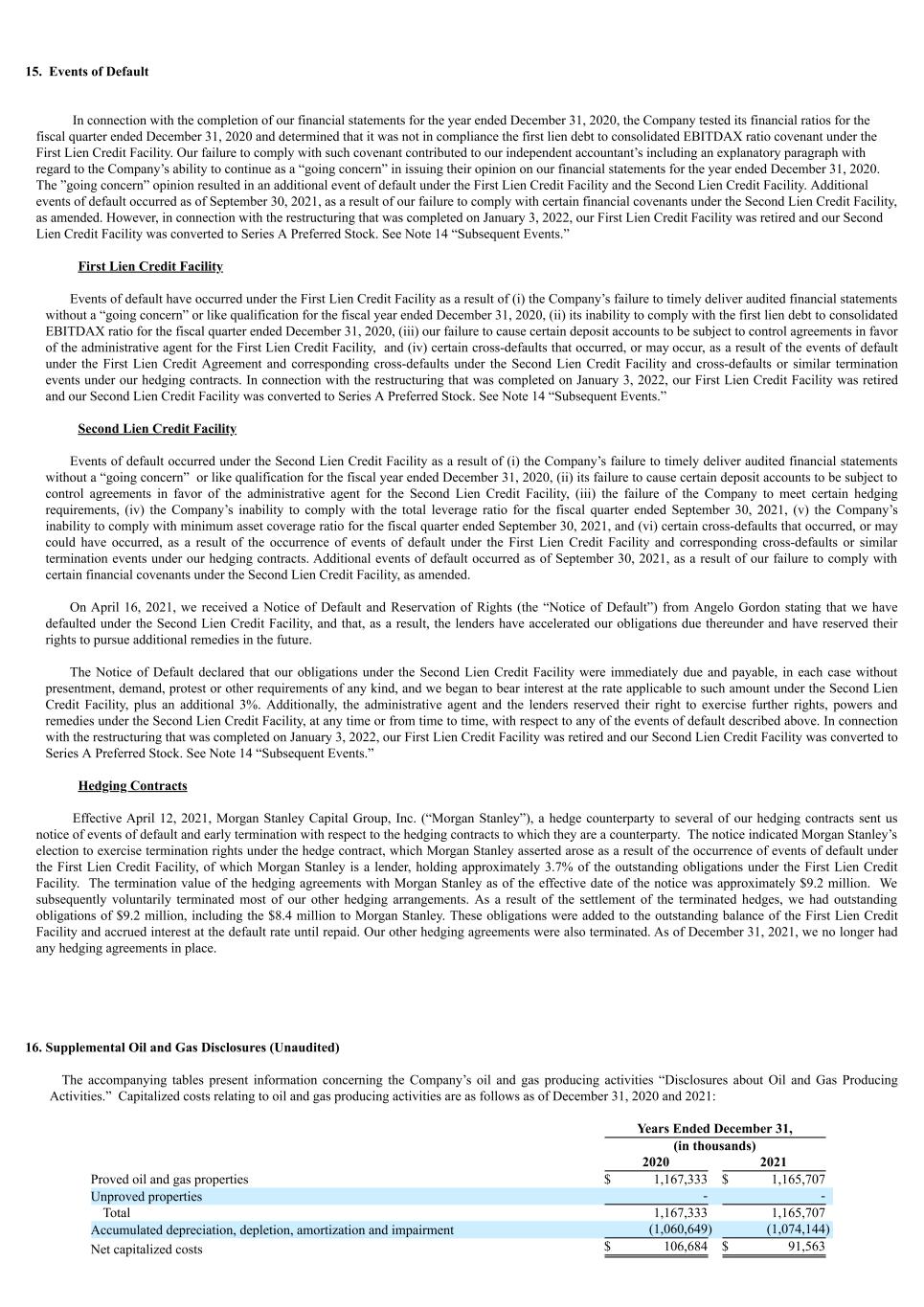
15. Events of Default In connection with the completion of our financial statements for the year ended December 31, 2020, the Company tested its financial ratios for the fiscal quarter ended December 31, 2020 and determined that it was not in compliance the first lien debt to consolidated EBITDAX ratio covenant under the First Lien Credit Facility. Our failure to comply with such covenant contributed to our independent accountant’s including an explanatory paragraph with regard to the Company’s ability to continue as a “going concern” in issuing their opinion on our financial statements for the year ended December 31, 2020. The ”going concern” opinion resulted in an additional event of default under the First Lien Credit Facility and the Second Lien Credit Facility. Additional events of default occurred as of September 30, 2021, as a result of our failure to comply with certain financial covenants under the Second Lien Credit Facility, as amended. However, in connection with the restructuring that was completed on January 3, 2022, our First Lien Credit Facility was retired and our Second Lien Credit Facility was converted to Series A Preferred Stock. See Note 14 “Subsequent Events.” First Lien Credit Facility Events of default have occurred under the First Lien Credit Facility as a result of (i) the Company’s failure to timely deliver audited financial statements without a “going concern” or like qualification for the fiscal year ended December 31, 2020, (ii) its inability to comply with the first lien debt to consolidated EBITDAX ratio for the fiscal quarter ended December 31, 2020, (iii) our failure to cause certain deposit accounts to be subject to control agreements in favor of the administrative agent for the First Lien Credit Facility, and (iv) certain cross-defaults that occurred, or may occur, as a result of the events of default under the First Lien Credit Agreement and corresponding cross-defaults under the Second Lien Credit Facility and cross-defaults or similar termination events under our hedging contracts. In connection with the restructuring that was completed on January 3, 2022, our First Lien Credit Facility was retired and our Second Lien Credit Facility was converted to Series A Preferred Stock. See Note 14 “Subsequent Events.” Second Lien Credit Facility Events of default occurred under the Second Lien Credit Facility as a result of (i) the Company’s failure to timely deliver audited financial statements without a “going concern” or like qualification for the fiscal year ended December 31, 2020, (ii) its failure to cause certain deposit accounts to be subject to control agreements in favor of the administrative agent for the Second Lien Credit Facility, (iii) the failure of the Company to meet certain hedging requirements, (iv) the Company’s inability to comply with the total leverage ratio for the fiscal quarter ended September 30, 2021, (v) the Company’s inability to comply with minimum asset coverage ratio for the fiscal quarter ended September 30, 2021, and (vi) certain cross-defaults that occurred, or may could have occurred, as a result of the occurrence of events of default under the First Lien Credit Facility and corresponding cross-defaults or similar termination events under our hedging contracts. Additional events of default occurred as of September 30, 2021, as a result of our failure to comply with certain financial covenants under the Second Lien Credit Facility, as amended. On April 16, 2021, we received a Notice of Default and Reservation of Rights (the “Notice of Default”) from Angelo Gordon stating that we have defaulted under the Second Lien Credit Facility, and that, as a result, the lenders have accelerated our obligations due thereunder and have reserved their rights to pursue additional remedies in the future. The Notice of Default declared that our obligations under the Second Lien Credit Facility were immediately due and payable, in each case without presentment, demand, protest or other requirements of any kind, and we began to bear interest at the rate applicable to such amount under the Second Lien Credit Facility, plus an additional 3%. Additionally, the administrative agent and the lenders reserved their right to exercise further rights, powers and remedies under the Second Lien Credit Facility, at any time or from time to time, with respect to any of the events of default described above. In connection with the restructuring that was completed on January 3, 2022, our First Lien Credit Facility was retired and our Second Lien Credit Facility was converted to Series A Preferred Stock. See Note 14 “Subsequent Events.” Hedging Contracts Effective April 12, 2021, Morgan Stanley Capital Group, Inc. (“Morgan Stanley”), a hedge counterparty to several of our hedging contracts sent us notice of events of default and early termination with respect to the hedging contracts to which they are a counterparty. The notice indicated Morgan Stanley’s election to exercise termination rights under the hedge contract, which Morgan Stanley asserted arose as a result of the occurrence of events of default under the First Lien Credit Facility, of which Morgan Stanley is a lender, holding approximately 3.7% of the outstanding obligations under the First Lien Credit Facility. The termination value of the hedging agreements with Morgan Stanley as of the effective date of the notice was approximately $9.2 million. We subsequently voluntarily terminated most of our other hedging arrangements. As a result of the settlement of the terminated hedges, we had outstanding obligations of $9.2 million, including the $8.4 million to Morgan Stanley. These obligations were added to the outstanding balance of the First Lien Credit Facility and accrued interest at the default rate until repaid. Our other hedging agreements were also terminated. As of December 31, 2021, we no longer had any hedging agreements in place. 16. Supplemental Oil and Gas Disclosures (Unaudited) The accompanying tables present information concerning the Company’s oil and gas producing activities “Disclosures about Oil and Gas Producing Activities.” Capitalized costs relating to oil and gas producing activities are as follows as of December 31, 2020 and 2021: Years Ended December 31, (in thousands) 2020 2021 Proved oil and gas properties $ 1,167,333 $ 1,165,707 Unproved properties - - Total 1,167,333 1,165,707 Accumulated depreciation, depletion, amortization and impairment (1,060,649) (1,074,144) Net capitalized costs $ 106,684 $ 91,563
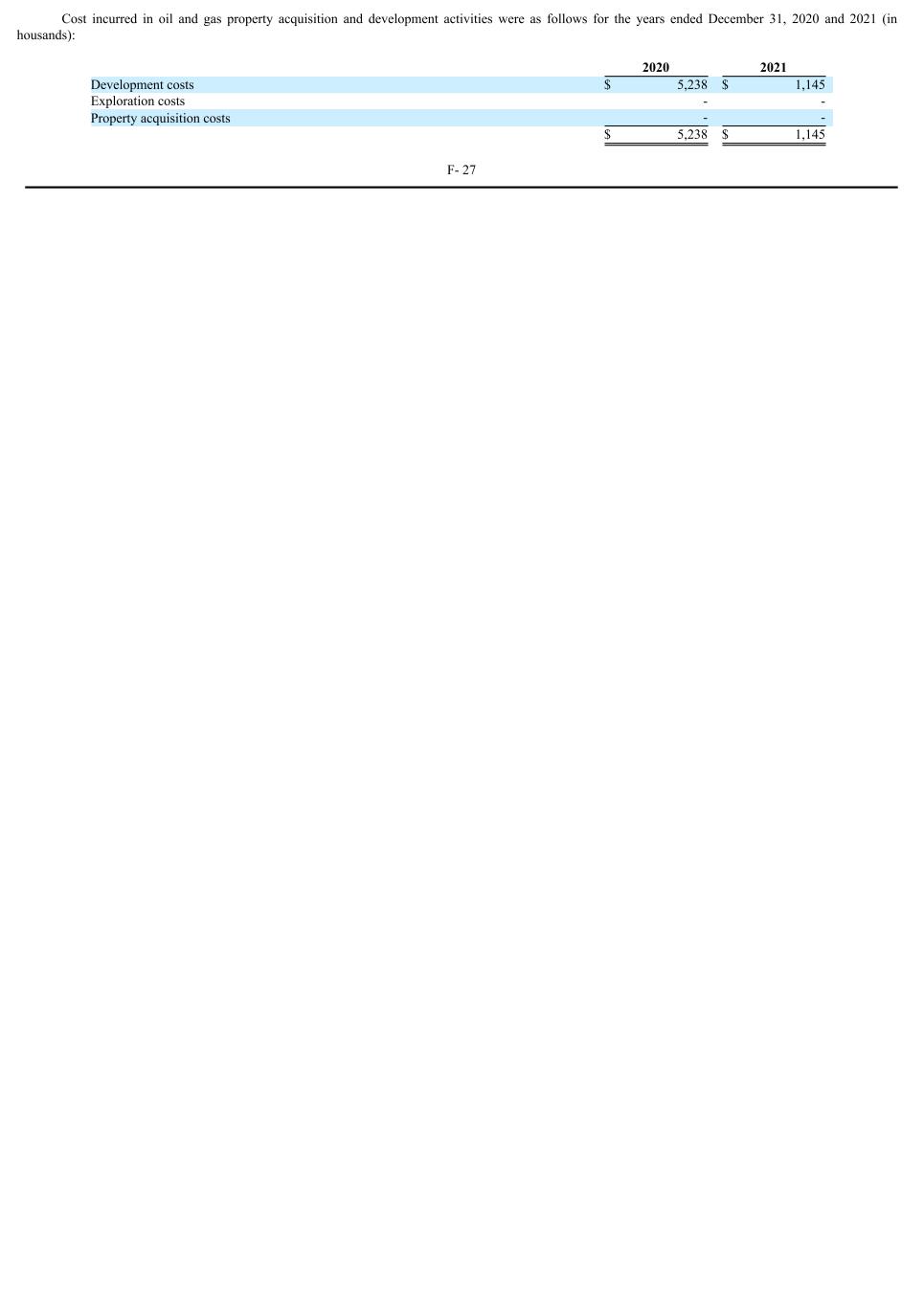
Cost incurred in oil and gas property acquisition and development activities were as follows for the years ended December 31, 2020 and 2021 (in housands): 2020 2021 Development costs $ 5,238 $ 1,145 Exploration costs - - Property acquisition costs - - $ 5,238 $ 1,145 F- 27
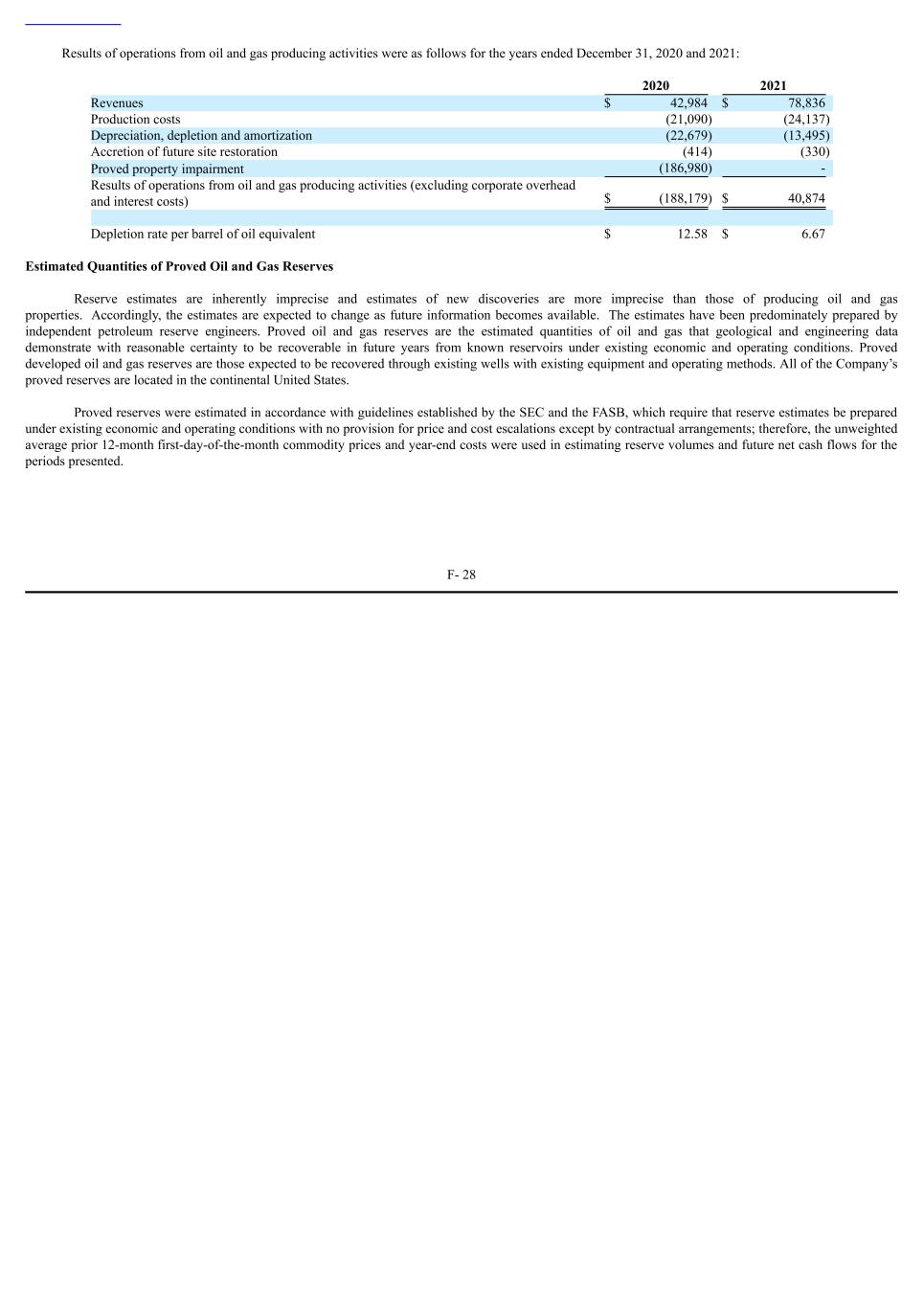
Results of operations from oil and gas producing activities were as follows for the years ended December 31, 2020 and 2021: 2020 2021 Revenues $ 42,984 $ 78,836 Production costs (21,090) (24,137) Depreciation, depletion and amortization (22,679) (13,495) Accretion of future site restoration (414) (330) Proved property impairment (186,980) - Results of operations from oil and gas producing activities (excluding corporate overhead and interest costs) $ (188,179) $ 40,874 Depletion rate per barrel of oil equivalent $ 12.58 $ 6.67 Estimated Quantities of Proved Oil and Gas Reserves Reserve estimates are inherently imprecise and estimates of new discoveries are more imprecise than those of producing oil and gas properties. Accordingly, the estimates are expected to change as future information becomes available. The estimates have been predominately prepared by independent petroleum reserve engineers. Proved oil and gas reserves are the estimated quantities of oil and gas that geological and engineering data demonstrate with reasonable certainty to be recoverable in future years from known reservoirs under existing economic and operating conditions. Proved developed oil and gas reserves are those expected to be recovered through existing wells with existing equipment and operating methods. All of the Company’s proved reserves are located in the continental United States. Proved reserves were estimated in accordance with guidelines established by the SEC and the FASB, which require that reserve estimates be prepared under existing economic and operating conditions with no provision for price and cost escalations except by contractual arrangements; therefore, the unweighted average prior 12-month first-day-of-the-month commodity prices and year-end costs were used in estimating reserve volumes and future net cash flows for the periods presented. F- 28
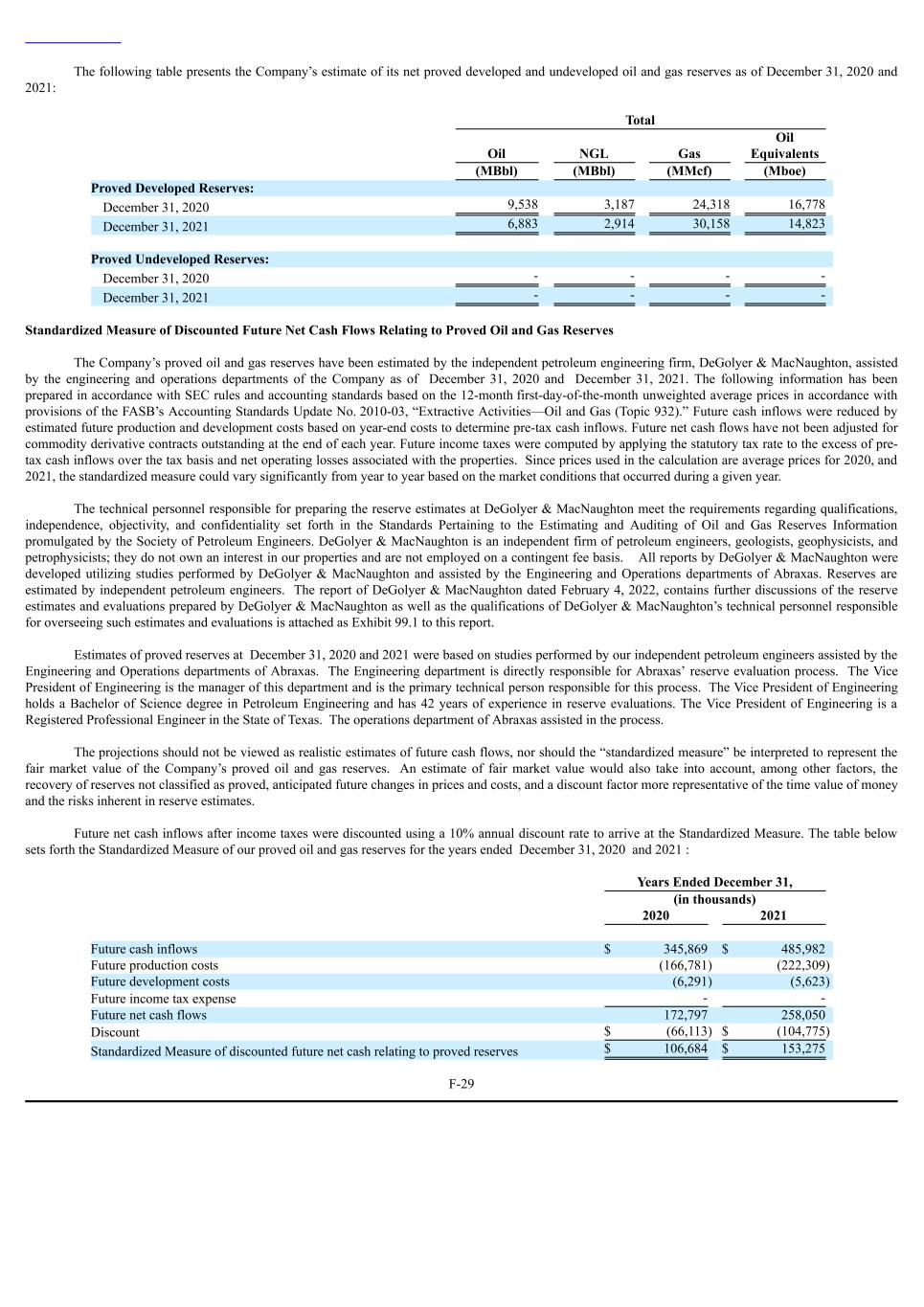
The following table presents the Company’s estimate of its net proved developed and undeveloped oil and gas reserves as of December 31, 2020 and 2021: Total Oil Oil NGL Gas Equivalents (MBbl) (MBbl) (MMcf) (Mboe) Proved Developed Reserves: December 31, 2020 9,538 3,187 24,318 16,778 December 31, 2021 6,883 2,914 30,158 14,823 Proved Undeveloped Reserves: December 31, 2020 - - - - December 31, 2021 - - - - Standardized Measure of Discounted Future Net Cash Flows Relating to Proved Oil and Gas Reserves The Company’s proved oil and gas reserves have been estimated by the independent petroleum engineering firm, DeGolyer & MacNaughton, assisted by the engineering and operations departments of the Company as of December 31, 2020 and December 31, 2021. The following information has been prepared in accordance with SEC rules and accounting standards based on the 12-month first-day-of-the-month unweighted average prices in accordance with provisions of the FASB’s Accounting Standards Update No. 2010-03, “Extractive Activities—Oil and Gas (Topic 932).” Future cash inflows were reduced by estimated future production and development costs based on year-end costs to determine pre-tax cash inflows. Future net cash flows have not been adjusted for commodity derivative contracts outstanding at the end of each year. Future income taxes were computed by applying the statutory tax rate to the excess of pre- tax cash inflows over the tax basis and net operating losses associated with the properties. Since prices used in the calculation are average prices for 2020, and 2021, the standardized measure could vary significantly from year to year based on the market conditions that occurred during a given year. The technical personnel responsible for preparing the reserve estimates at DeGolyer & MacNaughton meet the requirements regarding qualifications, independence, objectivity, and confidentiality set forth in the Standards Pertaining to the Estimating and Auditing of Oil and Gas Reserves Information promulgated by the Society of Petroleum Engineers. DeGolyer & MacNaughton is an independent firm of petroleum engineers, geologists, geophysicists, and petrophysicists; they do not own an interest in our properties and are not employed on a contingent fee basis. All reports by DeGolyer & MacNaughton were developed utilizing studies performed by DeGolyer & MacNaughton and assisted by the Engineering and Operations departments of Abraxas. Reserves are estimated by independent petroleum engineers. The report of DeGolyer & MacNaughton dated February 4, 2022, contains further discussions of the reserve estimates and evaluations prepared by DeGolyer & MacNaughton as well as the qualifications of DeGolyer & MacNaughton’s technical personnel responsible for overseeing such estimates and evaluations is attached as Exhibit 99.1 to this report. Estimates of proved reserves at December 31, 2020 and 2021 were based on studies performed by our independent petroleum engineers assisted by the Engineering and Operations departments of Abraxas. The Engineering department is directly responsible for Abraxas’ reserve evaluation process. The Vice President of Engineering is the manager of this department and is the primary technical person responsible for this process. The Vice President of Engineering holds a Bachelor of Science degree in Petroleum Engineering and has 42 years of experience in reserve evaluations. The Vice President of Engineering is a Registered Professional Engineer in the State of Texas. The operations department of Abraxas assisted in the process. The projections should not be viewed as realistic estimates of future cash flows, nor should the “standardized measure” be interpreted to represent the fair market value of the Company’s proved oil and gas reserves. An estimate of fair market value would also take into account, among other factors, the recovery of reserves not classified as proved, anticipated future changes in prices and costs, and a discount factor more representative of the time value of money and the risks inherent in reserve estimates. Future net cash inflows after income taxes were discounted using a 10% annual discount rate to arrive at the Standardized Measure. The table below sets forth the Standardized Measure of our proved oil and gas reserves for the years ended December 31, 2020 and 2021 : Years Ended December 31, (in thousands) 2020 2021 Future cash inflows $ 345,869 $ 485,982 Future production costs (166,781) (222,309) Future development costs (6,291) (5,623) Future income tax expense - - Future net cash flows 172,797 258,050 Discount $ (66,113) $ (104,775) Standardized Measure of discounted future net cash relating to proved reserves $ 106,684 $ 153,275 F-29

Exhibit 99.2 UNAUDITED CONDENSED CONSOLIDATED FINANCIAL STATEMENTS OF ABRAXAS PETROLEUM CORPORATION AS OF AND FOR THE NINE MONTHS ENDED SEPTEMBER 30, 2022
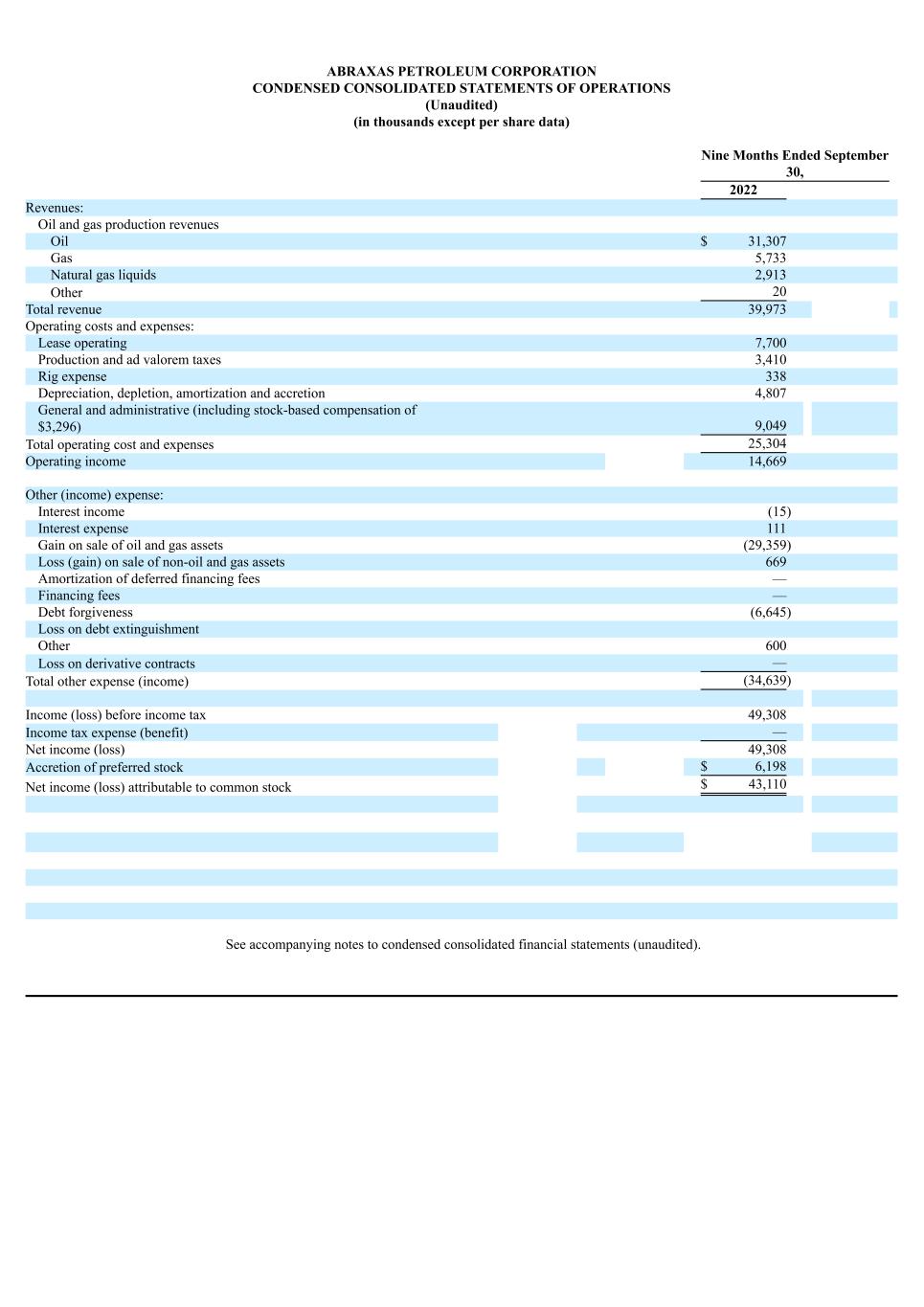
ABRAXAS PETROLEUM CORPORATION CONDENSED CONSOLIDATED STATEMENTS OF OPERATIONS (Unaudited) (in thousands except per share data) Nine Months Ended September 30, 2022 Revenues: Oil and gas production revenues Oil $ 31,307 Gas 5,733 Natural gas liquids 2,913 Other 20 Total revenue 39,973 Operating costs and expenses: Lease operating 7,700 Production and ad valorem taxes 3,410 Rig expense 338 Depreciation, depletion, amortization and accretion 4,807 General and administrative (including stock-based compensation of $3,296) 9,049 Total operating cost and expenses 25,304 Operating income 14,669 Other (income) expense: Interest income (15) Interest expense 111 Gain on sale of oil and gas assets (29,359) Loss (gain) on sale of non-oil and gas assets 669 Amortization of deferred financing fees — Financing fees — Debt forgiveness (6,645) Loss on debt extinguishment Other 600 Loss on derivative contracts — Total other expense (income) (34,639) Income (loss) before income tax 49,308 Income tax expense (benefit) — Net income (loss) 49,308 Accretion of preferred stock $ 6,198 Net income (loss) attributable to common stock $ 43,110 See accompanying notes to condensed consolidated financial statements (unaudited).
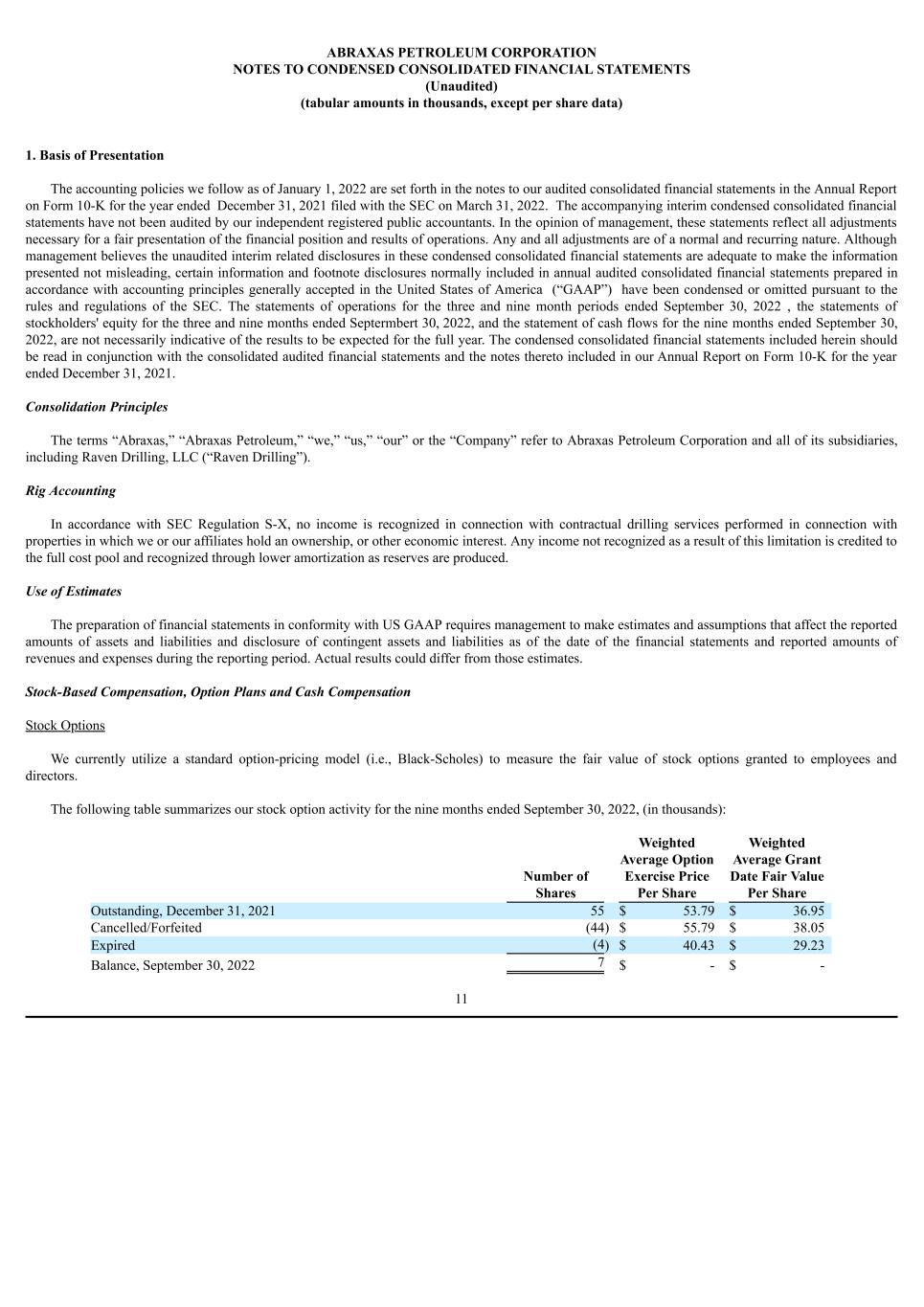
ABRAXAS PETROLEUM CORPORATION NOTES TO CONDENSED CONSOLIDATED FINANCIAL STATEMENTS (Unaudited) (tabular amounts in thousands, except per share data) 1. Basis of Presentation The accounting policies we follow as of January 1, 2022 are set forth in the notes to our audited consolidated financial statements in the Annual Report on Form 10-K for the year ended December 31, 2021 filed with the SEC on March 31, 2022. The accompanying interim condensed consolidated financial statements have not been audited by our independent registered public accountants. In the opinion of management, these statements reflect all adjustments necessary for a fair presentation of the financial position and results of operations. Any and all adjustments are of a normal and recurring nature. Although management believes the unaudited interim related disclosures in these condensed consolidated financial statements are adequate to make the information presented not misleading, certain information and footnote disclosures normally included in annual audited consolidated financial statements prepared in accordance with accounting principles generally accepted in the United States of America (“GAAP”) have been condensed or omitted pursuant to the rules and regulations of the SEC. The statements of operations for the three and nine month periods ended September 30, 2022 , the statements of stockholders' equity for the three and nine months ended Septermbert 30, 2022, and the statement of cash flows for the nine months ended September 30, 2022, are not necessarily indicative of the results to be expected for the full year. The condensed consolidated financial statements included herein should be read in conjunction with the consolidated audited financial statements and the notes thereto included in our Annual Report on Form 10-K for the year ended December 31, 2021. Consolidation Principles The terms “Abraxas,” “Abraxas Petroleum,” “we,” “us,” “our” or the “Company” refer to Abraxas Petroleum Corporation and all of its subsidiaries, including Raven Drilling, LLC (“Raven Drilling”). Rig Accounting In accordance with SEC Regulation S-X, no income is recognized in connection with contractual drilling services performed in connection with properties in which we or our affiliates hold an ownership, or other economic interest. Any income not recognized as a result of this limitation is credited to the full cost pool and recognized through lower amortization as reserves are produced. Use of Estimates The preparation of financial statements in conformity with US GAAP requires management to make estimates and assumptions that affect the reported amounts of assets and liabilities and disclosure of contingent assets and liabilities as of the date of the financial statements and reported amounts of revenues and expenses during the reporting period. Actual results could differ from those estimates. Stock-Based Compensation, Option Plans and Cash Compensation Stock Options We currently utilize a standard option-pricing model (i.e., Black-Scholes) to measure the fair value of stock options granted to employees and directors. The following table summarizes our stock option activity for the nine months ended September 30, 2022, (in thousands): Number of Shares Weighted Average Option Exercise Price Per Share Weighted Average Grant Date Fair Value Per Share Outstanding, December 31, 2021 55 $ 53.79 $ 36.95 Cancelled/Forfeited (44) $ 55.79 $ 38.05 Expired (4) $ 40.43 $ 29.23 Balance, September 30, 2022 7 $ - $ - 11
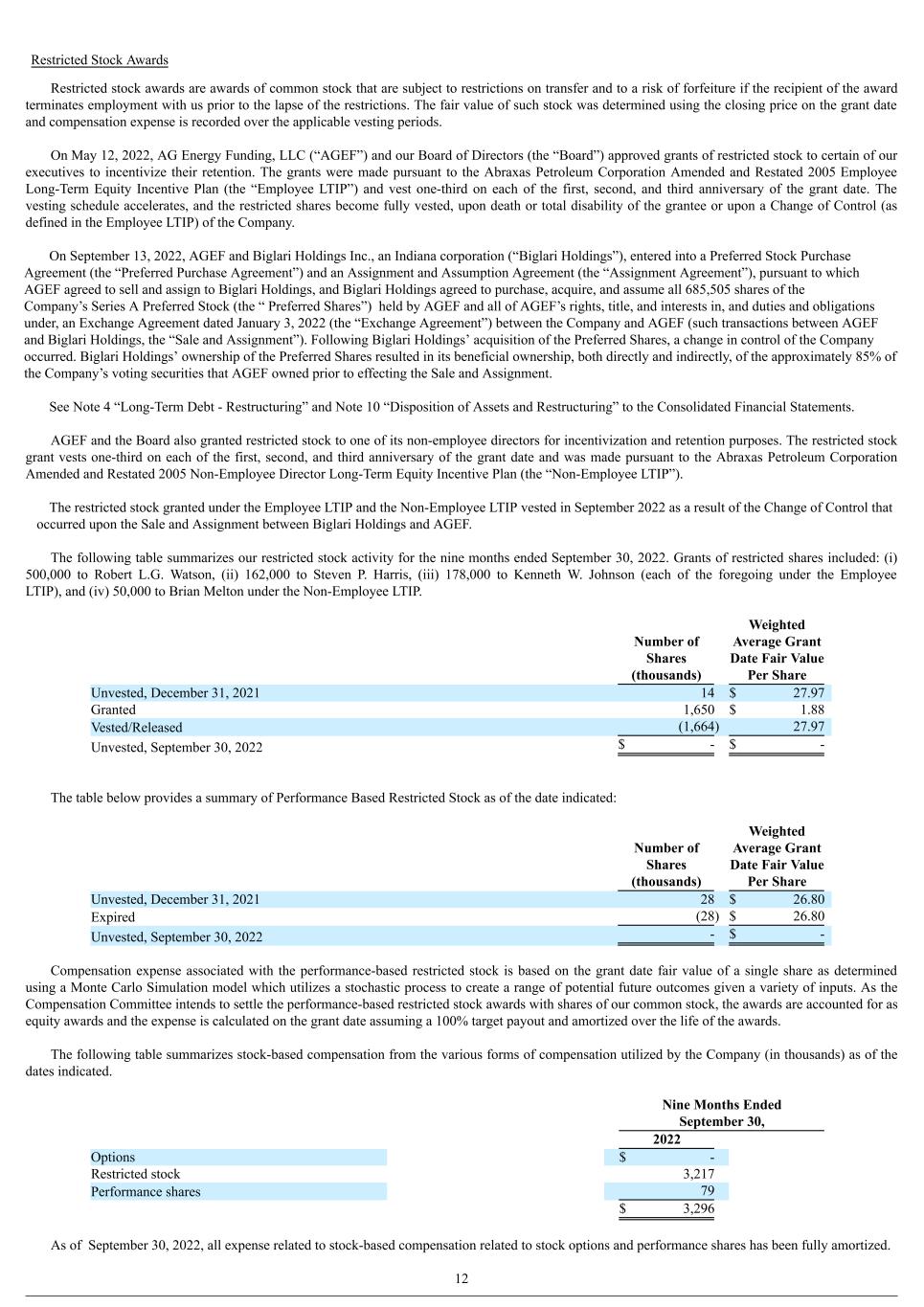
Restricted Stock Awards Restricted stock awards are awards of common stock that are subject to restrictions on transfer and to a risk of forfeiture if the recipient of the award terminates employment with us prior to the lapse of the restrictions. The fair value of such stock was determined using the closing price on the grant date and compensation expense is recorded over the applicable vesting periods. On May 12, 2022, AG Energy Funding, LLC (“AGEF”) and our Board of Directors (the “Board”) approved grants of restricted stock to certain of our executives to incentivize their retention. The grants were made pursuant to the Abraxas Petroleum Corporation Amended and Restated 2005 Employee Long-Term Equity Incentive Plan (the “Employee LTIP”) and vest one-third on each of the first, second, and third anniversary of the grant date. The vesting schedule accelerates, and the restricted shares become fully vested, upon death or total disability of the grantee or upon a Change of Control (as defined in the Employee LTIP) of the Company. On September 13, 2022, AGEF and Biglari Holdings Inc., an Indiana corporation (“Biglari Holdings”), entered into a Preferred Stock Purchase Agreement (the “Preferred Purchase Agreement”) and an Assignment and Assumption Agreement (the “Assignment Agreement”), pursuant to which AGEF agreed to sell and assign to Biglari Holdings, and Biglari Holdings agreed to purchase, acquire, and assume all 685,505 shares of the Company’s Series A Preferred Stock (the “ Preferred Shares”) held by AGEF and all of AGEF’s rights, title, and interests in, and duties and obligations under, an Exchange Agreement dated January 3, 2022 (the “Exchange Agreement”) between the Company and AGEF (such transactions between AGEF and Biglari Holdings, the “Sale and Assignment”). Following Biglari Holdings’ acquisition of the Preferred Shares, a change in control of the Company occurred. Biglari Holdings’ ownership of the Preferred Shares resulted in its beneficial ownership, both directly and indirectly, of the approximately 85% of the Company’s voting securities that AGEF owned prior to effecting the Sale and Assignment. See Note 4 “Long-Term Debt - Restructuring” and Note 10 “Disposition of Assets and Restructuring” to the Consolidated Financial Statements. AGEF and the Board also granted restricted stock to one of its non-employee directors for incentivization and retention purposes. The restricted stock grant vests one-third on each of the first, second, and third anniversary of the grant date and was made pursuant to the Abraxas Petroleum Corporation Amended and Restated 2005 Non-Employee Director Long-Term Equity Incentive Plan (the “Non-Employee LTIP”). The restricted stock granted under the Employee LTIP and the Non-Employee LTIP vested in September 2022 as a result of the Change of Control that occurred upon the Sale and Assignment between Biglari Holdings and AGEF. The following table summarizes our restricted stock activity for the nine months ended September 30, 2022. Grants of restricted shares included: (i) 500,000 to Robert L.G. Watson, (ii) 162,000 to Steven P. Harris, (iii) 178,000 to Kenneth W. Johnson (each of the foregoing under the Employee LTIP), and (iv) 50,000 to Brian Melton under the Non-Employee LTIP. Number of Shares (thousands) Weighted Average Grant Date Fair Value Per Share Unvested, December 31, 2021 14 $ 27.97 Granted 1,650 $ 1.88 Vested/Released (1,664) 27.97 Unvested, September 30, 2022 $ - $ - The table below provides a summary of Performance Based Restricted Stock as of the date indicated: Number of Shares (thousands) Weighted Average Grant Date Fair Value Per Share Unvested, December 31, 2021 28 $ 26.80 Expired (28) $ 26.80 Unvested, September 30, 2022 - $ - Compensation expense associated with the performance-based restricted stock is based on the grant date fair value of a single share as determined using a Monte Carlo Simulation model which utilizes a stochastic process to create a range of potential future outcomes given a variety of inputs. As the Compensation Committee intends to settle the performance-based restricted stock awards with shares of our common stock, the awards are accounted for as equity awards and the expense is calculated on the grant date assuming a 100% target payout and amortized over the life of the awards. The following table summarizes stock-based compensation from the various forms of compensation utilized by the Company (in thousands) as of the dates indicated. Nine Months Ended September 30, 2022 Options $ - Restricted stock 3,217 Performance shares 79 $ 3,296 As of September 30, 2022, all expense related to stock-based compensation related to stock options and performance shares has been fully amortized. 12
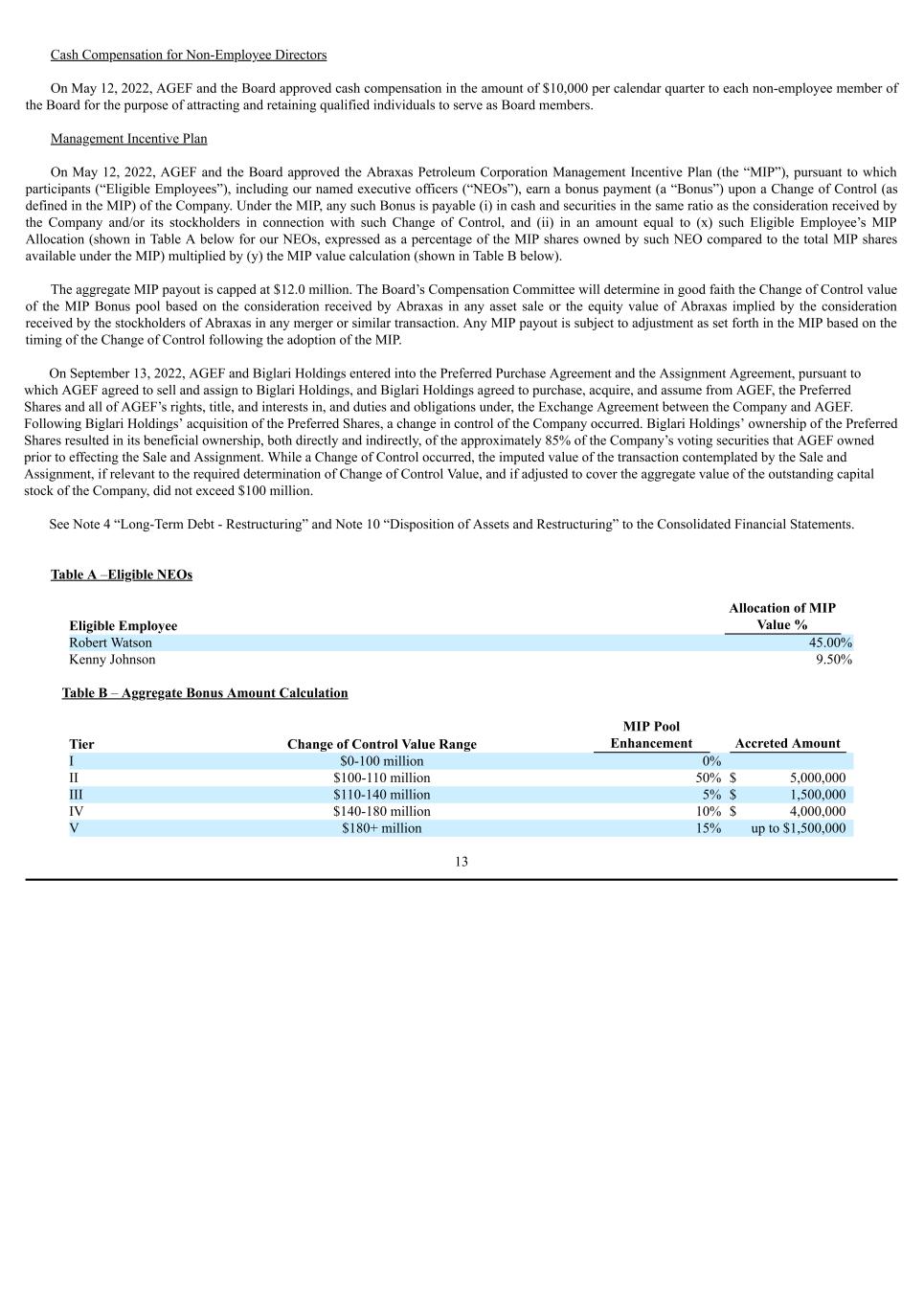
Cash Compensation for Non-Employee Directors On May 12, 2022, AGEF and the Board approved cash compensation in the amount of $10,000 per calendar quarter to each non-employee member of the Board for the purpose of attracting and retaining qualified individuals to serve as Board members. Management Incentive Plan On May 12, 2022, AGEF and the Board approved the Abraxas Petroleum Corporation Management Incentive Plan (the “MIP”), pursuant to which participants (“Eligible Employees”), including our named executive officers (“NEOs”), earn a bonus payment (a “Bonus”) upon a Change of Control (as defined in the MIP) of the Company. Under the MIP, any such Bonus is payable (i) in cash and securities in the same ratio as the consideration received by the Company and/or its stockholders in connection with such Change of Control, and (ii) in an amount equal to (x) such Eligible Employee’s MIP Allocation (shown in Table A below for our NEOs, expressed as a percentage of the MIP shares owned by such NEO compared to the total MIP shares available under the MIP) multiplied by (y) the MIP value calculation (shown in Table B below). The aggregate MIP payout is capped at $12.0 million. The Board’s Compensation Committee will determine in good faith the Change of Control value of the MIP Bonus pool based on the consideration received by Abraxas in any asset sale or the equity value of Abraxas implied by the consideration received by the stockholders of Abraxas in any merger or similar transaction. Any MIP payout is subject to adjustment as set forth in the MIP based on the timing of the Change of Control following the adoption of the MIP. On September 13, 2022, AGEF and Biglari Holdings entered into the Preferred Purchase Agreement and the Assignment Agreement, pursuant to which AGEF agreed to sell and assign to Biglari Holdings, and Biglari Holdings agreed to purchase, acquire, and assume from AGEF, the Preferred Shares and all of AGEF’s rights, title, and interests in, and duties and obligations under, the Exchange Agreement between the Company and AGEF. Following Biglari Holdings’ acquisition of the Preferred Shares, a change in control of the Company occurred. Biglari Holdings’ ownership of the Preferred Shares resulted in its beneficial ownership, both directly and indirectly, of the approximately 85% of the Company’s voting securities that AGEF owned prior to effecting the Sale and Assignment. While a Change of Control occurred, the imputed value of the transaction contemplated by the Sale and Assignment, if relevant to the required determination of Change of Control Value, and if adjusted to cover the aggregate value of the outstanding capital stock of the Company, did not exceed $100 million. See Note 4 “Long-Term Debt - Restructuring” and Note 10 “Disposition of Assets and Restructuring” to the Consolidated Financial Statements. Table A –Eligible NEOs Eligible Employee Allocation of MIP Value % Robert Watson 45.00% Kenny Johnson 9.50% Table B – Aggregate Bonus Amount Calculation Tier Change of Control Value Range MIP Pool Enhancement Accreted Amount I $0-100 million 0% II $100-110 million 50% $ 5,000,000 III $110-140 million 5% $ 1,500,000 IV $140-180 million 10% $ 4,000,000 V $180+ million 15% up to $1,500,000 13
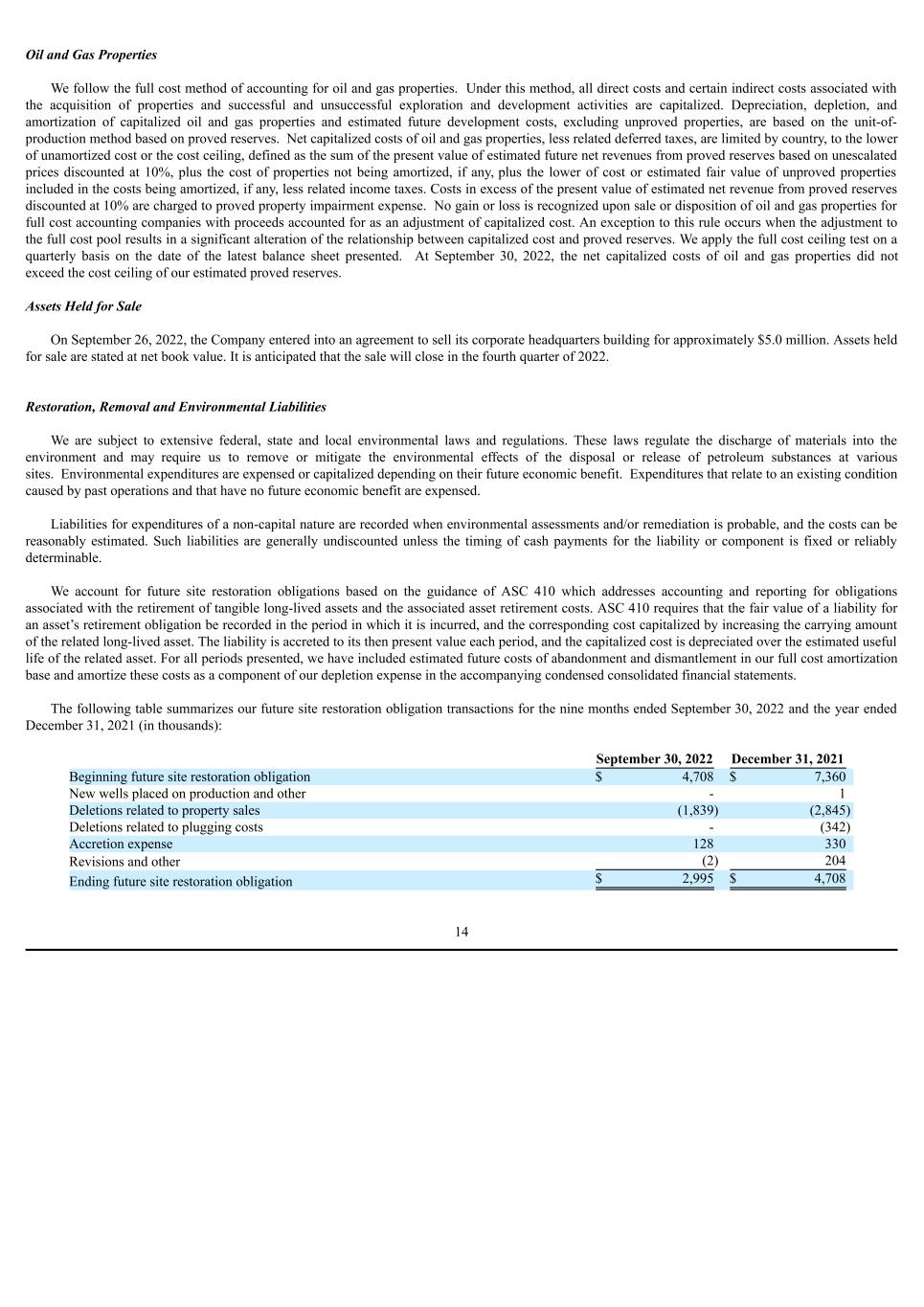
Oil and Gas Properties We follow the full cost method of accounting for oil and gas properties. Under this method, all direct costs and certain indirect costs associated with the acquisition of properties and successful and unsuccessful exploration and development activities are capitalized. Depreciation, depletion, and amortization of capitalized oil and gas properties and estimated future development costs, excluding unproved properties, are based on the unit-of- production method based on proved reserves. Net capitalized costs of oil and gas properties, less related deferred taxes, are limited by country, to the lower of unamortized cost or the cost ceiling, defined as the sum of the present value of estimated future net revenues from proved reserves based on unescalated prices discounted at 10%, plus the cost of properties not being amortized, if any, plus the lower of cost or estimated fair value of unproved properties included in the costs being amortized, if any, less related income taxes. Costs in excess of the present value of estimated net revenue from proved reserves discounted at 10% are charged to proved property impairment expense. No gain or loss is recognized upon sale or disposition of oil and gas properties for full cost accounting companies with proceeds accounted for as an adjustment of capitalized cost. An exception to this rule occurs when the adjustment to the full cost pool results in a significant alteration of the relationship between capitalized cost and proved reserves. We apply the full cost ceiling test on a quarterly basis on the date of the latest balance sheet presented. At September 30, 2022, the net capitalized costs of oil and gas properties did not exceed the cost ceiling of our estimated proved reserves. Assets Held for Sale On September 26, 2022, the Company entered into an agreement to sell its corporate headquarters building for approximately $5.0 million. Assets held for sale are stated at net book value. It is anticipated that the sale will close in the fourth quarter of 2022. Restoration, Removal and Environmental Liabilities We are subject to extensive federal, state and local environmental laws and regulations. These laws regulate the discharge of materials into the environment and may require us to remove or mitigate the environmental effects of the disposal or release of petroleum substances at various sites. Environmental expenditures are expensed or capitalized depending on their future economic benefit. Expenditures that relate to an existing condition caused by past operations and that have no future economic benefit are expensed. Liabilities for expenditures of a non-capital nature are recorded when environmental assessments and/or remediation is probable, and the costs can be reasonably estimated. Such liabilities are generally undiscounted unless the timing of cash payments for the liability or component is fixed or reliably determinable. We account for future site restoration obligations based on the guidance of ASC 410 which addresses accounting and reporting for obligations associated with the retirement of tangible long-lived assets and the associated asset retirement costs. ASC 410 requires that the fair value of a liability for an asset’s retirement obligation be recorded in the period in which it is incurred, and the corresponding cost capitalized by increasing the carrying amount of the related long-lived asset. The liability is accreted to its then present value each period, and the capitalized cost is depreciated over the estimated useful life of the related asset. For all periods presented, we have included estimated future costs of abandonment and dismantlement in our full cost amortization base and amortize these costs as a component of our depletion expense in the accompanying condensed consolidated financial statements. The following table summarizes our future site restoration obligation transactions for the nine months ended September 30, 2022 and the year ended December 31, 2021 (in thousands): September 30, 2022 December 31, 2021 Beginning future site restoration obligation $ 4,708 $ 7,360 New wells placed on production and other - 1 Deletions related to property sales (1,839) (2,845) Deletions related to plugging costs - (342) Accretion expense 128 330 Revisions and other (2) 204 Ending future site restoration obligation $ 2,995 $ 4,708 14
2. Revenue from Contracts with Customers Revenue Recognition Sales of oil, gas and natural gas liquids (“NGL”) are recognized at the point in time when control of the product is transferred to the customer and collectability is reasonably assured. Our contracts’ pricing provisions are tied to a market index, with certain adjustments based on, among other factors, physical location, quality of the oil or gas, and prevailing supply and demand conditions. As a result, the price of the oil, gas and NGL fluctuates to remain competitive with other available oil, gas and NGL supplies in the market. We believe that the pricing provisions of our oil, gas and NGL contracts are customary in the industry. Oil sales Our oil sales contracts are generally structured such that we sell our oil production to a purchaser at a contractually specified delivery point at or near the wellhead. The crude oil production is priced on the delivery date based upon prevailing index prices less certain deductions related to oil quality, physical location and transportation costs incurred by the purchaser subsequent to delivery. We recognize revenue when control transfers to the purchaser upon delivery at or near the wellhead at the net price received from the purchaser. Gas and NGL Sales Under our gas processing contracts, we deliver wet gas to a midstream processing entity at the wellhead or the inlet of the midstream processing entity’s system. The midstream processing entity processes the natural gas and remits proceeds to us based upon either (i) the resulting sales price of NGL and residue gas received by the midstream processing entity from third party customers, or (ii) the prevailing index prices for NGL and residue gas in the month of delivery to the midstream processing entity. Gathering, processing, transportation and other expenses incurred by the midstream processing entity are typically deducted from the proceeds that we receive. In these scenarios, we evaluate whether the midstream processing entity is the principal or the agent in the transaction. In our gas purchase contracts, we have concluded that the midstream processing entity is the agent, and thus, the midstream processing entity is our customer. Accordingly, we recognize revenue upon delivery to the midstream processing entity based on the net amount of the proceeds received from the midstream processing entity. 15
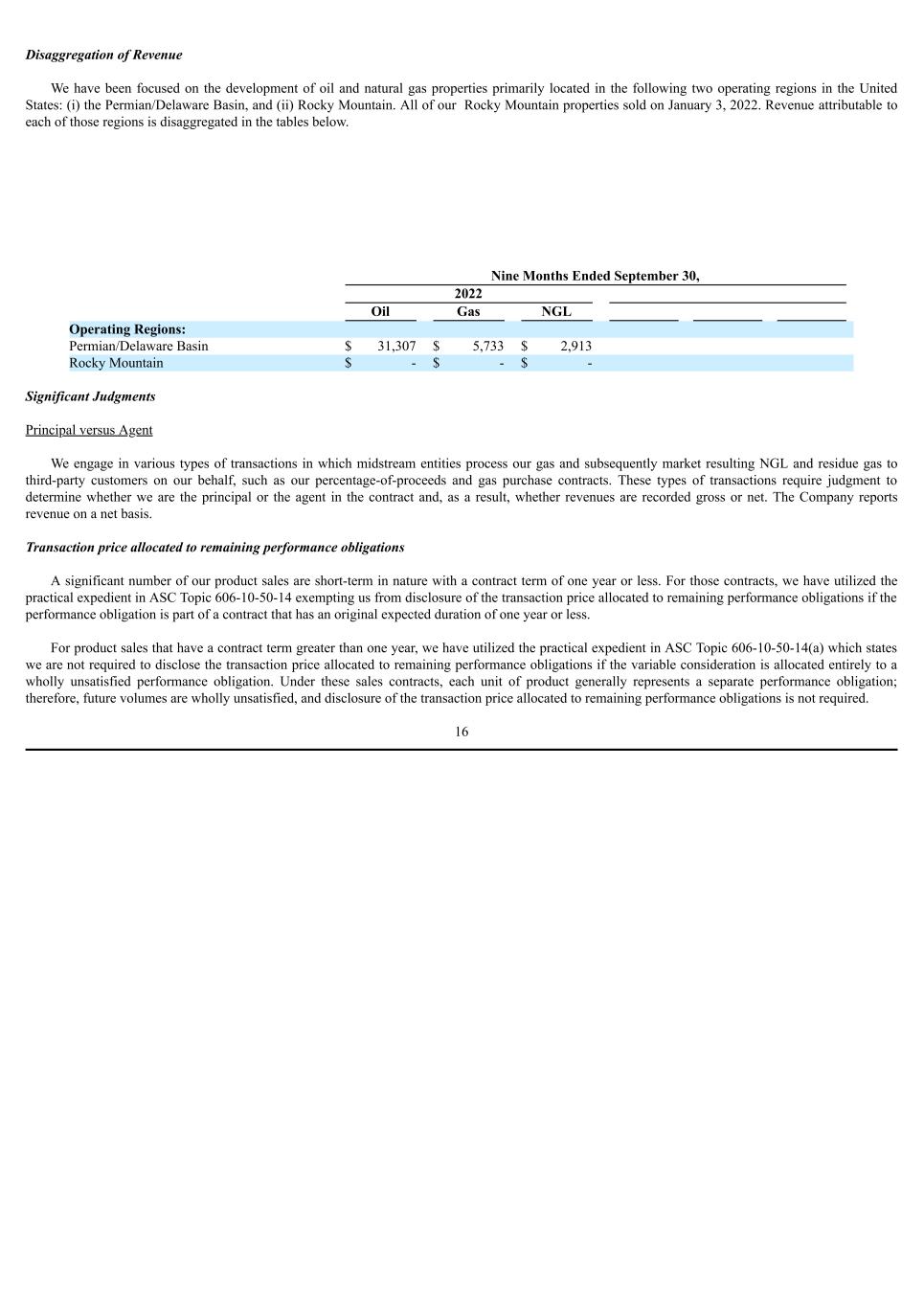
Disaggregation of Revenue We have been focused on the development of oil and natural gas properties primarily located in the following two operating regions in the United States: (i) the Permian/Delaware Basin, and (ii) Rocky Mountain. All of our Rocky Mountain properties sold on January 3, 2022. Revenue attributable to each of those regions is disaggregated in the tables below. Nine Months Ended September 30, 2022 Oil Gas NGL Operating Regions: Permian/Delaware Basin $ 31,307 $ 5,733 $ 2,913 Rocky Mountain $ - $ - $ - Significant Judgments Principal versus Agent We engage in various types of transactions in which midstream entities process our gas and subsequently market resulting NGL and residue gas to third-party customers on our behalf, such as our percentage-of-proceeds and gas purchase contracts. These types of transactions require judgment to determine whether we are the principal or the agent in the contract and, as a result, whether revenues are recorded gross or net. The Company reports revenue on a net basis. Transaction price allocated to remaining performance obligations A significant number of our product sales are short-term in nature with a contract term of one year or less. For those contracts, we have utilized the practical expedient in ASC Topic 606-10-50-14 exempting us from disclosure of the transaction price allocated to remaining performance obligations if the performance obligation is part of a contract that has an original expected duration of one year or less. For product sales that have a contract term greater than one year, we have utilized the practical expedient in ASC Topic 606-10-50-14(a) which states we are not required to disclose the transaction price allocated to remaining performance obligations if the variable consideration is allocated entirely to a wholly unsatisfied performance obligation. Under these sales contracts, each unit of product generally represents a separate performance obligation; therefore, future volumes are wholly unsatisfied, and disclosure of the transaction price allocated to remaining performance obligations is not required. 16
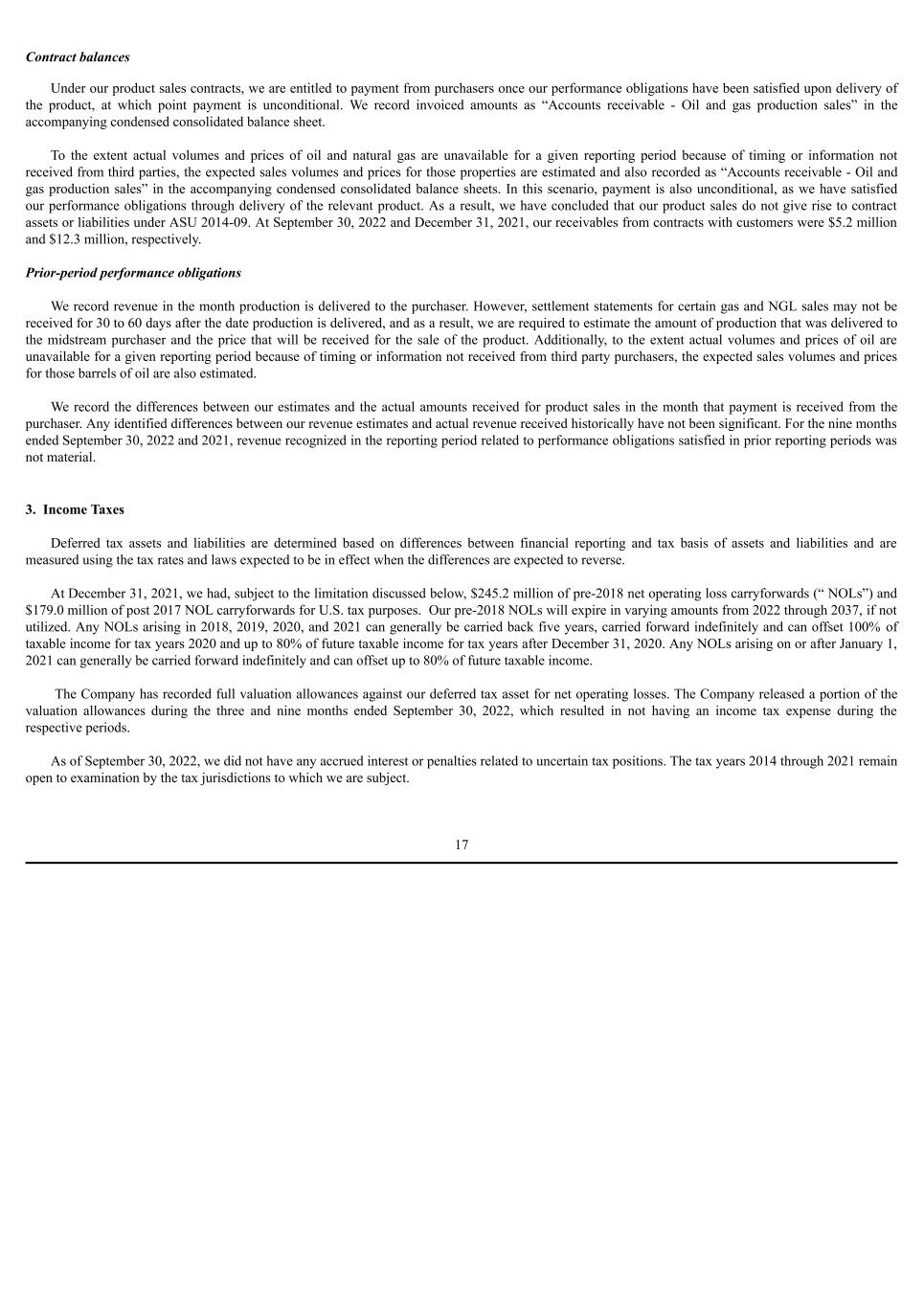
Contract balances Under our product sales contracts, we are entitled to payment from purchasers once our performance obligations have been satisfied upon delivery of the product, at which point payment is unconditional. We record invoiced amounts as “Accounts receivable - Oil and gas production sales” in the accompanying condensed consolidated balance sheet. To the extent actual volumes and prices of oil and natural gas are unavailable for a given reporting period because of timing or information not received from third parties, the expected sales volumes and prices for those properties are estimated and also recorded as “Accounts receivable - Oil and gas production sales” in the accompanying condensed consolidated balance sheets. In this scenario, payment is also unconditional, as we have satisfied our performance obligations through delivery of the relevant product. As a result, we have concluded that our product sales do not give rise to contract assets or liabilities under ASU 2014-09. At September 30, 2022 and December 31, 2021, our receivables from contracts with customers were $5.2 million and $12.3 million, respectively. Prior-period performance obligations We record revenue in the month production is delivered to the purchaser. However, settlement statements for certain gas and NGL sales may not be received for 30 to 60 days after the date production is delivered, and as a result, we are required to estimate the amount of production that was delivered to the midstream purchaser and the price that will be received for the sale of the product. Additionally, to the extent actual volumes and prices of oil are unavailable for a given reporting period because of timing or information not received from third party purchasers, the expected sales volumes and prices for those barrels of oil are also estimated. We record the differences between our estimates and the actual amounts received for product sales in the month that payment is received from the purchaser. Any identified differences between our revenue estimates and actual revenue received historically have not been significant. For the nine months ended September 30, 2022 and 2021, revenue recognized in the reporting period related to performance obligations satisfied in prior reporting periods was not material. 3. Income Taxes Deferred tax assets and liabilities are determined based on differences between financial reporting and tax basis of assets and liabilities and are measured using the tax rates and laws expected to be in effect when the differences are expected to reverse. At December 31, 2021, we had, subject to the limitation discussed below, $245.2 million of pre-2018 net operating loss carryforwards (“ NOLs”) and $179.0 million of post 2017 NOL carryforwards for U.S. tax purposes. Our pre-2018 NOLs will expire in varying amounts from 2022 through 2037, if not utilized. Any NOLs arising in 2018, 2019, 2020, and 2021 can generally be carried back five years, carried forward indefinitely and can offset 100% of taxable income for tax years 2020 and up to 80% of future taxable income for tax years after December 31, 2020. Any NOLs arising on or after January 1, 2021 can generally be carried forward indefinitely and can offset up to 80% of future taxable income. The Company has recorded full valuation allowances against our deferred tax asset for net operating losses. The Company released a portion of the valuation allowances during the three and nine months ended September 30, 2022, which resulted in not having an income tax expense during the respective periods. As of September 30, 2022, we did not have any accrued interest or penalties related to uncertain tax positions. The tax years 2014 through 2021 remain open to examination by the tax jurisdictions to which we are subject. 17
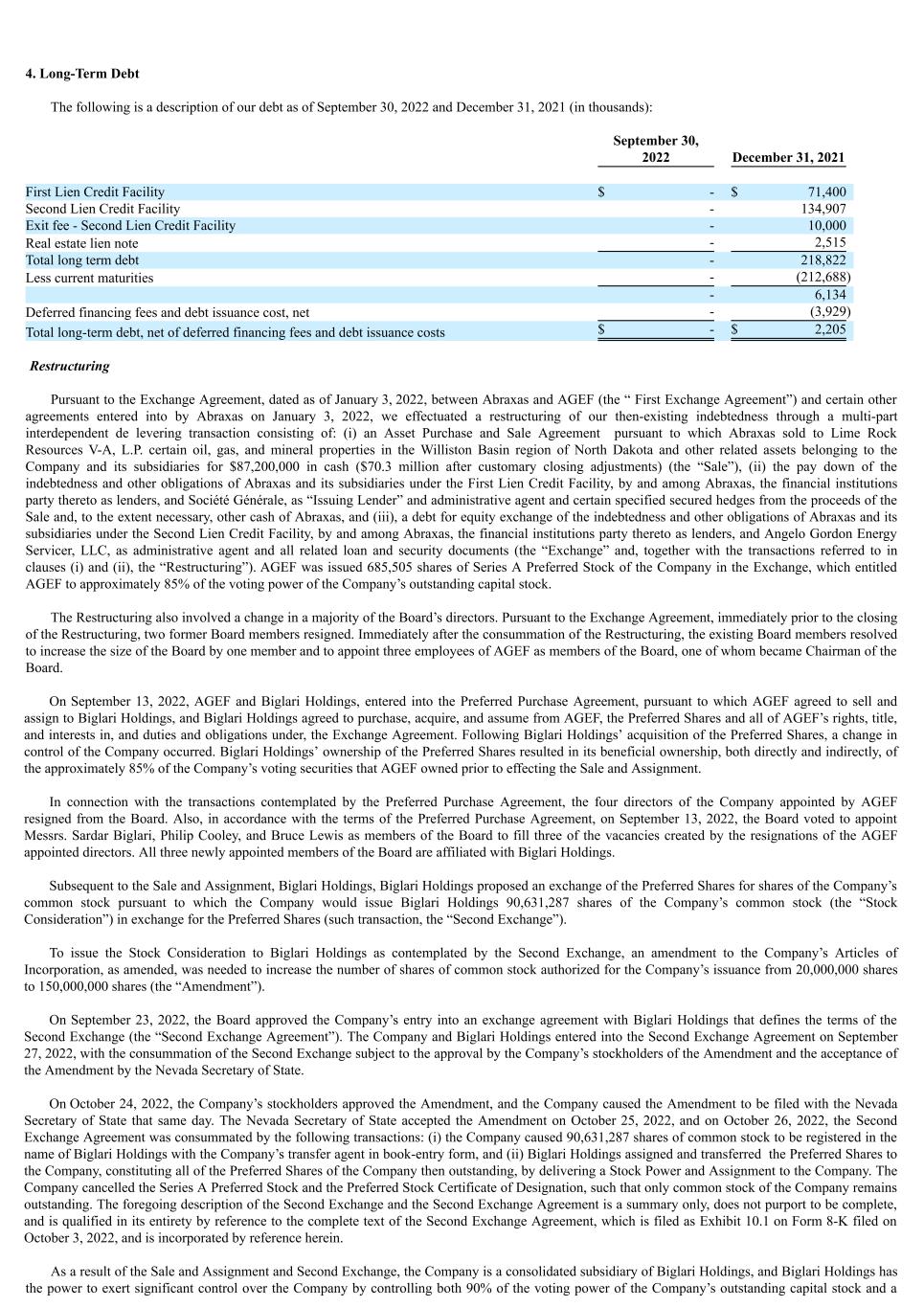
4. Long-Term Debt The following is a description of our debt as of September 30, 2022 and December 31, 2021 (in thousands): September 30, 2022 December 31, 2021 First Lien Credit Facility $ - $ 71,400 Second Lien Credit Facility - 134,907 Exit fee - Second Lien Credit Facility - 10,000 Real estate lien note - 2,515 Total long term debt - 218,822 Less current maturities - (212,688) - 6,134 Deferred financing fees and debt issuance cost, net - (3,929) Total long-term debt, net of deferred financing fees and debt issuance costs $ - $ 2,205 Restructuring Pursuant to the Exchange Agreement, dated as of January 3, 2022, between Abraxas and AGEF (the “ First Exchange Agreement”) and certain other agreements entered into by Abraxas on January 3, 2022, we effectuated a restructuring of our then-existing indebtedness through a multi-part interdependent de levering transaction consisting of: (i) an Asset Purchase and Sale Agreement pursuant to which Abraxas sold to Lime Rock Resources V-A, L.P. certain oil, gas, and mineral properties in the Williston Basin region of North Dakota and other related assets belonging to the Company and its subsidiaries for $87,200,000 in cash ($70.3 million after customary closing adjustments) (the “Sale”), (ii) the pay down of the indebtedness and other obligations of Abraxas and its subsidiaries under the First Lien Credit Facility, by and among Abraxas, the financial institutions party thereto as lenders, and Société Générale, as “Issuing Lender” and administrative agent and certain specified secured hedges from the proceeds of the Sale and, to the extent necessary, other cash of Abraxas, and (iii), a debt for equity exchange of the indebtedness and other obligations of Abraxas and its subsidiaries under the Second Lien Credit Facility, by and among Abraxas, the financial institutions party thereto as lenders, and Angelo Gordon Energy Servicer, LLC, as administrative agent and all related loan and security documents (the “Exchange” and, together with the transactions referred to in clauses (i) and (ii), the “Restructuring”). AGEF was issued 685,505 shares of Series A Preferred Stock of the Company in the Exchange, which entitled AGEF to approximately 85% of the voting power of the Company’s outstanding capital stock. The Restructuring also involved a change in a majority of the Board’s directors. Pursuant to the Exchange Agreement, immediately prior to the closing of the Restructuring, two former Board members resigned. Immediately after the consummation of the Restructuring, the existing Board members resolved to increase the size of the Board by one member and to appoint three employees of AGEF as members of the Board, one of whom became Chairman of the Board. On September 13, 2022, AGEF and Biglari Holdings, entered into the Preferred Purchase Agreement, pursuant to which AGEF agreed to sell and assign to Biglari Holdings, and Biglari Holdings agreed to purchase, acquire, and assume from AGEF, the Preferred Shares and all of AGEF’s rights, title, and interests in, and duties and obligations under, the Exchange Agreement. Following Biglari Holdings’ acquisition of the Preferred Shares, a change in control of the Company occurred. Biglari Holdings’ ownership of the Preferred Shares resulted in its beneficial ownership, both directly and indirectly, of the approximately 85% of the Company’s voting securities that AGEF owned prior to effecting the Sale and Assignment. In connection with the transactions contemplated by the Preferred Purchase Agreement, the four directors of the Company appointed by AGEF resigned from the Board. Also, in accordance with the terms of the Preferred Purchase Agreement, on September 13, 2022, the Board voted to appoint Messrs. Sardar Biglari, Philip Cooley, and Bruce Lewis as members of the Board to fill three of the vacancies created by the resignations of the AGEF appointed directors. All three newly appointed members of the Board are affiliated with Biglari Holdings. Subsequent to the Sale and Assignment, Biglari Holdings, Biglari Holdings proposed an exchange of the Preferred Shares for shares of the Company’s common stock pursuant to which the Company would issue Biglari Holdings 90,631,287 shares of the Company’s common stock (the “Stock Consideration”) in exchange for the Preferred Shares (such transaction, the “Second Exchange”). To issue the Stock Consideration to Biglari Holdings as contemplated by the Second Exchange, an amendment to the Company’s Articles of Incorporation, as amended, was needed to increase the number of shares of common stock authorized for the Company’s issuance from 20,000,000 shares to 150,000,000 shares (the “Amendment”). On September 23, 2022, the Board approved the Company’s entry into an exchange agreement with Biglari Holdings that defines the terms of the Second Exchange (the “Second Exchange Agreement”). The Company and Biglari Holdings entered into the Second Exchange Agreement on September 27, 2022, with the consummation of the Second Exchange subject to the approval by the Company’s stockholders of the Amendment and the acceptance of the Amendment by the Nevada Secretary of State. On October 24, 2022, the Company’s stockholders approved the Amendment, and the Company caused the Amendment to be filed with the Nevada Secretary of State that same day. The Nevada Secretary of State accepted the Amendment on October 25, 2022, and on October 26, 2022, the Second Exchange Agreement was consummated by the following transactions: (i) the Company caused 90,631,287 shares of common stock to be registered in the name of Biglari Holdings with the Company’s transfer agent in book-entry form, and (ii) Biglari Holdings assigned and transferred the Preferred Shares to the Company, constituting all of the Preferred Shares of the Company then outstanding, by delivering a Stock Power and Assignment to the Company. The Company cancelled the Series A Preferred Stock and the Preferred Stock Certificate of Designation, such that only common stock of the Company remains outstanding. The foregoing description of the Second Exchange and the Second Exchange Agreement is a summary only, does not purport to be complete, and is qualified in its entirety by reference to the complete text of the Second Exchange Agreement, which is filed as Exhibit 10.1 on Form 8-K filed on October 3, 2022, and is incorporated by reference herein. As a result of the Sale and Assignment and Second Exchange, the Company is a consolidated subsidiary of Biglari Holdings, and Biglari Holdings has the power to exert significant control over the Company by controlling both 90% of the voting power of the Company’s outstanding capital stock and a

majority of the Company’s Board. Real Estate Lien Note We had a real estate lien note secured by a first lien deed of trust on the property and improvements which serves as our corporate headquarters. The note was paid in full in August 2022. 18
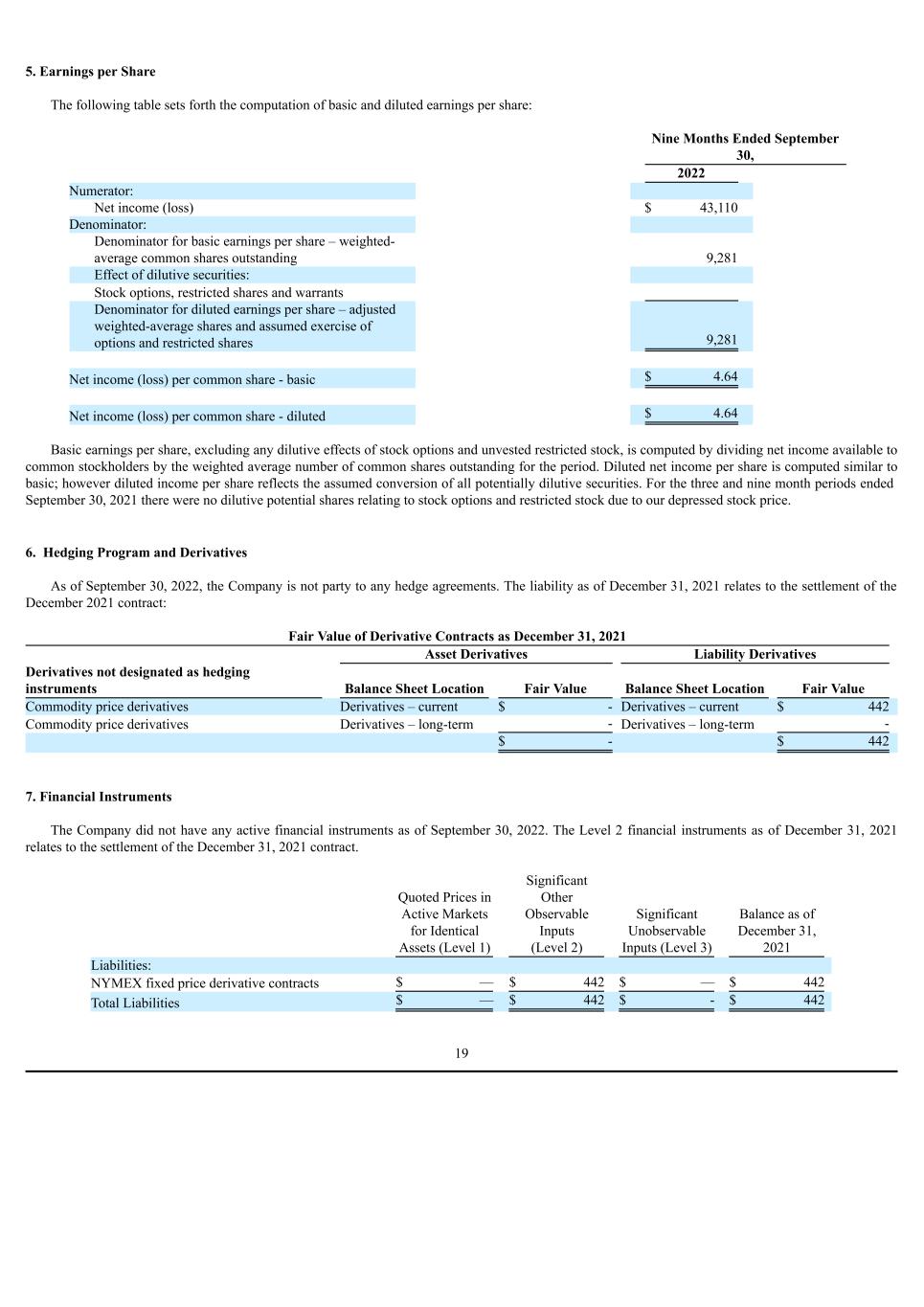
5. Earnings per Share The following table sets forth the computation of basic and diluted earnings per share: Nine Months Ended September 30, 2022 Numerator: Net income (loss) $ 43,110 Denominator: Denominator for basic earnings per share – weighted- average common shares outstanding 9,281 Effect of dilutive securities: Stock options, restricted shares and warrants Denominator for diluted earnings per share – adjusted weighted-average shares and assumed exercise of options and restricted shares 9,281 Net income (loss) per common share - basic $ 4.64 Net income (loss) per common share - diluted $ 4.64 Basic earnings per share, excluding any dilutive effects of stock options and unvested restricted stock, is computed by dividing net income available to common stockholders by the weighted average number of common shares outstanding for the period. Diluted net income per share is computed similar to basic; however diluted income per share reflects the assumed conversion of all potentially dilutive securities. For the three and nine month periods ended September 30, 2021 there were no dilutive potential shares relating to stock options and restricted stock due to our depressed stock price. 6. Hedging Program and Derivatives As of September 30, 2022, the Company is not party to any hedge agreements. The liability as of December 31, 2021 relates to the settlement of the December 2021 contract: Fair Value of Derivative Contracts as December 31, 2021 Asset Derivatives Liability Derivatives Derivatives not designated as hedging instruments Balance Sheet Location Fair Value Balance Sheet Location Fair Value Commodity price derivatives Derivatives – current $ - Derivatives – current $ 442 Commodity price derivatives Derivatives – long-term - Derivatives – long-term - $ - $ 442 7. Financial Instruments The Company did not have any active financial instruments as of September 30, 2022. The Level 2 financial instruments as of December 31, 2021 relates to the settlement of the December 31, 2021 contract. Quoted Prices in Active Markets for Identical Assets (Level 1) Significant Other Observable Inputs (Level 2) Significant Unobservable Inputs (Level 3) Balance as of December 31, 2021 Liabilities: NYMEX fixed price derivative contracts $ — $ 442 $ — $ 442 Total Liabilities $ — $ 442 $ - $ 442 19
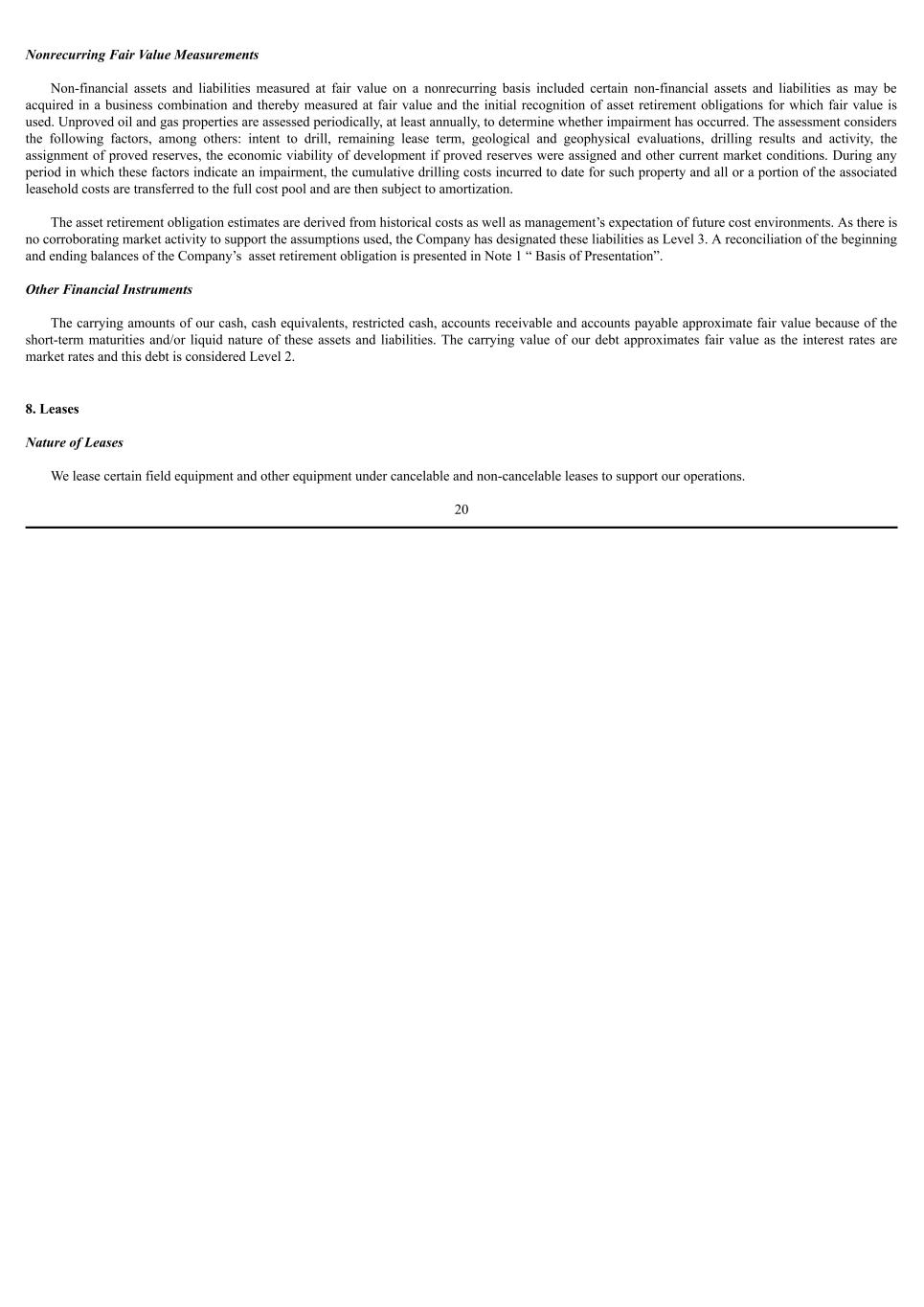
Nonrecurring Fair Value Measurements Non-financial assets and liabilities measured at fair value on a nonrecurring basis included certain non-financial assets and liabilities as may be acquired in a business combination and thereby measured at fair value and the initial recognition of asset retirement obligations for which fair value is used. Unproved oil and gas properties are assessed periodically, at least annually, to determine whether impairment has occurred. The assessment considers the following factors, among others: intent to drill, remaining lease term, geological and geophysical evaluations, drilling results and activity, the assignment of proved reserves, the economic viability of development if proved reserves were assigned and other current market conditions. During any period in which these factors indicate an impairment, the cumulative drilling costs incurred to date for such property and all or a portion of the associated leasehold costs are transferred to the full cost pool and are then subject to amortization. The asset retirement obligation estimates are derived from historical costs as well as management’s expectation of future cost environments. As there is no corroborating market activity to support the assumptions used, the Company has designated these liabilities as Level 3. A reconciliation of the beginning and ending balances of the Company’s asset retirement obligation is presented in Note 1 “ Basis of Presentation”. Other Financial Instruments The carrying amounts of our cash, cash equivalents, restricted cash, accounts receivable and accounts payable approximate fair value because of the short-term maturities and/or liquid nature of these assets and liabilities. The carrying value of our debt approximates fair value as the interest rates are market rates and this debt is considered Level 2. 8. Leases Nature of Leases We lease certain field equipment and other equipment under cancelable and non-cancelable leases to support our operations. 20
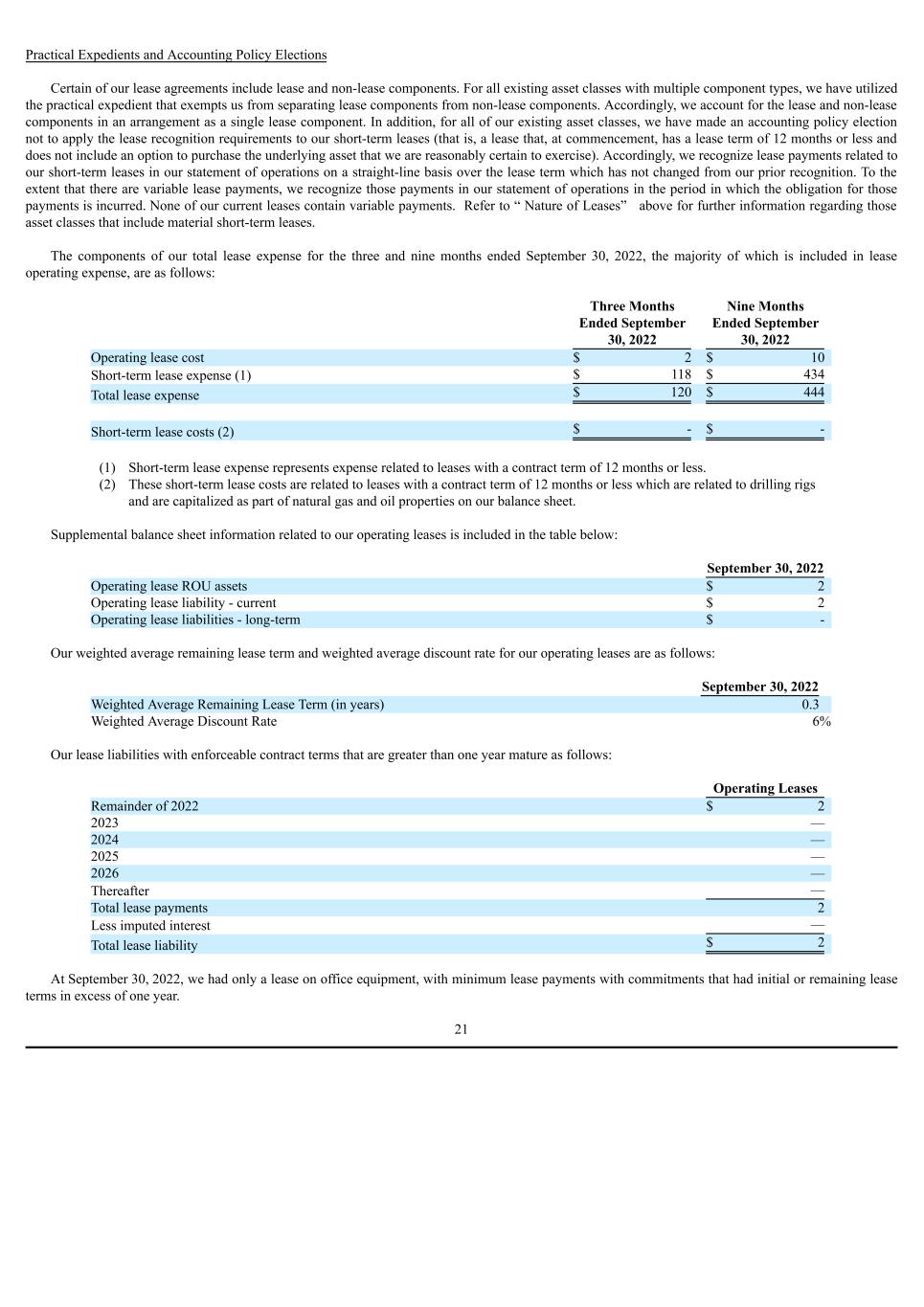
Practical Expedients and Accounting Policy Elections Certain of our lease agreements include lease and non-lease components. For all existing asset classes with multiple component types, we have utilized the practical expedient that exempts us from separating lease components from non-lease components. Accordingly, we account for the lease and non-lease components in an arrangement as a single lease component. In addition, for all of our existing asset classes, we have made an accounting policy election not to apply the lease recognition requirements to our short-term leases (that is, a lease that, at commencement, has a lease term of 12 months or less and does not include an option to purchase the underlying asset that we are reasonably certain to exercise). Accordingly, we recognize lease payments related to our short-term leases in our statement of operations on a straight-line basis over the lease term which has not changed from our prior recognition. To the extent that there are variable lease payments, we recognize those payments in our statement of operations in the period in which the obligation for those payments is incurred. None of our current leases contain variable payments. Refer to “ Nature of Leases” above for further information regarding those asset classes that include material short-term leases. The components of our total lease expense for the three and nine months ended September 30, 2022, the majority of which is included in lease operating expense, are as follows: Three Months Ended September 30, 2022 Nine Months Ended September 30, 2022 Operating lease cost $ 2 $ 10 Short-term lease expense (1) $ 118 $ 434 Total lease expense $ 120 $ 444 Short-term lease costs (2) $ - $ - (1) Short-term lease expense represents expense related to leases with a contract term of 12 months or less. (2) These short-term lease costs are related to leases with a contract term of 12 months or less which are related to drilling rigs and are capitalized as part of natural gas and oil properties on our balance sheet. Supplemental balance sheet information related to our operating leases is included in the table below: September 30, 2022 Operating lease ROU assets $ 2 Operating lease liability - current $ 2 Operating lease liabilities - long-term $ - Our weighted average remaining lease term and weighted average discount rate for our operating leases are as follows: September 30, 2022 Weighted Average Remaining Lease Term (in years) 0.3 Weighted Average Discount Rate 6% Our lease liabilities with enforceable contract terms that are greater than one year mature as follows: Operating Leases Remainder of 2022 $ 2 2023 — 2024 — 2025 — 2026 — Thereafter — Total lease payments 2 Less imputed interest — Total lease liability $ 2 At September 30, 2022, we had only a lease on office equipment, with minimum lease payments with commitments that had initial or remaining lease terms in excess of one year. 21
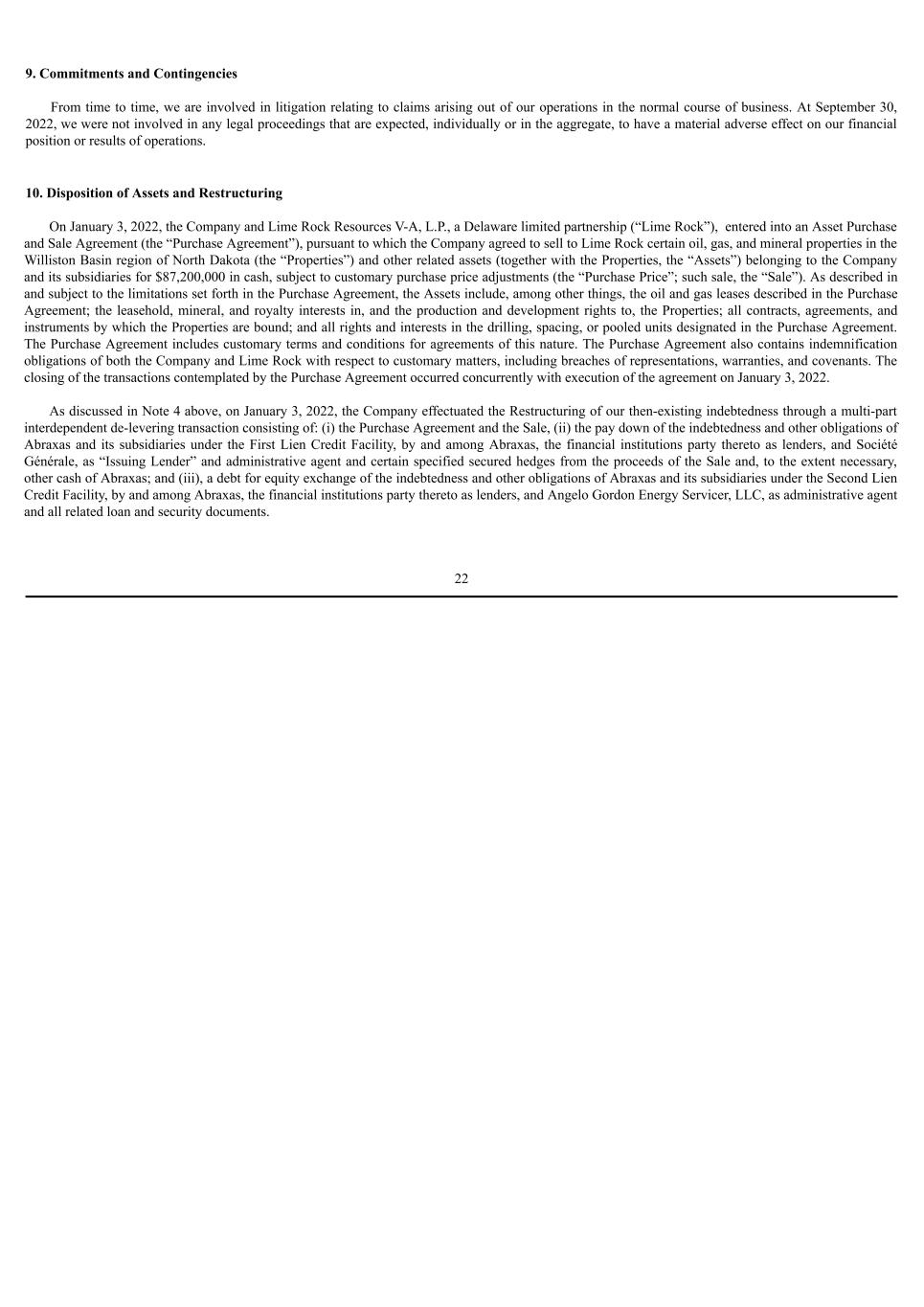
9. Commitments and Contingencies From time to time, we are involved in litigation relating to claims arising out of our operations in the normal course of business. At September 30, 2022, we were not involved in any legal proceedings that are expected, individually or in the aggregate, to have a material adverse effect on our financial position or results of operations. 10. Disposition of Assets and Restructuring On January 3, 2022, the Company and Lime Rock Resources V-A, L.P., a Delaware limited partnership (“Lime Rock”), entered into an Asset Purchase and Sale Agreement (the “Purchase Agreement”), pursuant to which the Company agreed to sell to Lime Rock certain oil, gas, and mineral properties in the Williston Basin region of North Dakota (the “Properties”) and other related assets (together with the Properties, the “Assets”) belonging to the Company and its subsidiaries for $87,200,000 in cash, subject to customary purchase price adjustments (the “Purchase Price”; such sale, the “Sale”). As described in and subject to the limitations set forth in the Purchase Agreement, the Assets include, among other things, the oil and gas leases described in the Purchase Agreement; the leasehold, mineral, and royalty interests in, and the production and development rights to, the Properties; all contracts, agreements, and instruments by which the Properties are bound; and all rights and interests in the drilling, spacing, or pooled units designated in the Purchase Agreement. The Purchase Agreement includes customary terms and conditions for agreements of this nature. The Purchase Agreement also contains indemnification obligations of both the Company and Lime Rock with respect to customary matters, including breaches of representations, warranties, and covenants. The closing of the transactions contemplated by the Purchase Agreement occurred concurrently with execution of the agreement on January 3, 2022. As discussed in Note 4 above, on January 3, 2022, the Company effectuated the Restructuring of our then-existing indebtedness through a multi-part interdependent de-levering transaction consisting of: (i) the Purchase Agreement and the Sale, (ii) the pay down of the indebtedness and other obligations of Abraxas and its subsidiaries under the First Lien Credit Facility, by and among Abraxas, the financial institutions party thereto as lenders, and Société Générale, as “Issuing Lender” and administrative agent and certain specified secured hedges from the proceeds of the Sale and, to the extent necessary, other cash of Abraxas; and (iii), a debt for equity exchange of the indebtedness and other obligations of Abraxas and its subsidiaries under the Second Lien Credit Facility, by and among Abraxas, the financial institutions party thereto as lenders, and Angelo Gordon Energy Servicer, LLC, as administrative agent and all related loan and security documents. 22
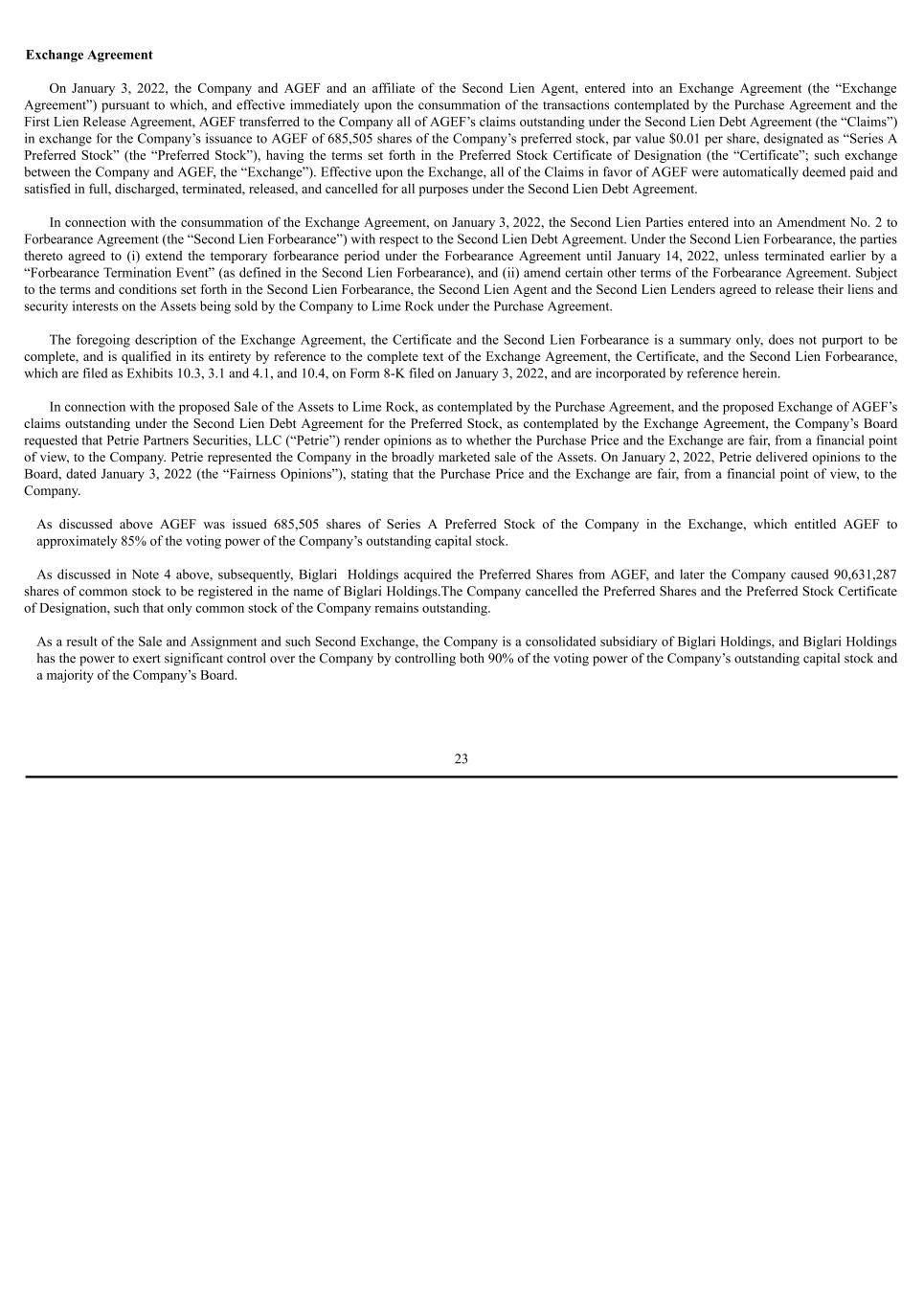
Exchange Agreement On January 3, 2022, the Company and AGEF and an affiliate of the Second Lien Agent, entered into an Exchange Agreement (the “Exchange Agreement”) pursuant to which, and effective immediately upon the consummation of the transactions contemplated by the Purchase Agreement and the First Lien Release Agreement, AGEF transferred to the Company all of AGEF’s claims outstanding under the Second Lien Debt Agreement (the “Claims”) in exchange for the Company’s issuance to AGEF of 685,505 shares of the Company’s preferred stock, par value $0.01 per share, designated as “Series A Preferred Stock” (the “Preferred Stock”), having the terms set forth in the Preferred Stock Certificate of Designation (the “Certificate”; such exchange between the Company and AGEF, the “Exchange”). Effective upon the Exchange, all of the Claims in favor of AGEF were automatically deemed paid and satisfied in full, discharged, terminated, released, and cancelled for all purposes under the Second Lien Debt Agreement. In connection with the consummation of the Exchange Agreement, on January 3, 2022, the Second Lien Parties entered into an Amendment No. 2 to Forbearance Agreement (the “Second Lien Forbearance”) with respect to the Second Lien Debt Agreement. Under the Second Lien Forbearance, the parties thereto agreed to (i) extend the temporary forbearance period under the Forbearance Agreement until January 14, 2022, unless terminated earlier by a “Forbearance Termination Event” (as defined in the Second Lien Forbearance), and (ii) amend certain other terms of the Forbearance Agreement. Subject to the terms and conditions set forth in the Second Lien Forbearance, the Second Lien Agent and the Second Lien Lenders agreed to release their liens and security interests on the Assets being sold by the Company to Lime Rock under the Purchase Agreement. The foregoing description of the Exchange Agreement, the Certificate and the Second Lien Forbearance is a summary only, does not purport to be complete, and is qualified in its entirety by reference to the complete text of the Exchange Agreement, the Certificate, and the Second Lien Forbearance, which are filed as Exhibits 10.3, 3.1 and 4.1, and 10.4, on Form 8-K filed on January 3, 2022, and are incorporated by reference herein. In connection with the proposed Sale of the Assets to Lime Rock, as contemplated by the Purchase Agreement, and the proposed Exchange of AGEF’s claims outstanding under the Second Lien Debt Agreement for the Preferred Stock, as contemplated by the Exchange Agreement, the Company’s Board requested that Petrie Partners Securities, LLC (“Petrie”) render opinions as to whether the Purchase Price and the Exchange are fair, from a financial point of view, to the Company. Petrie represented the Company in the broadly marketed sale of the Assets. On January 2, 2022, Petrie delivered opinions to the Board, dated January 3, 2022 (the “Fairness Opinions”), stating that the Purchase Price and the Exchange are fair, from a financial point of view, to the Company. As discussed above AGEF was issued 685,505 shares of Series A Preferred Stock of the Company in the Exchange, which entitled AGEF to approximately 85% of the voting power of the Company’s outstanding capital stock. As discussed in Note 4 above, subsequently, Biglari Holdings acquired the Preferred Shares from AGEF, and later the Company caused 90,631,287 shares of common stock to be registered in the name of Biglari Holdings.The Company cancelled the Preferred Shares and the Preferred Stock Certificate of Designation, such that only common stock of the Company remains outstanding. As a result of the Sale and Assignment and such Second Exchange, the Company is a consolidated subsidiary of Biglari Holdings, and Biglari Holdings has the power to exert significant control over the Company by controlling both 90% of the voting power of the Company’s outstanding capital stock and a majority of the Company’s Board. 23
Exhibit 99.3
BIGLARI HOLDINGS INC.
UNAUDITED PRO FORMA CONDENSED COMBINED FINANCIAL INFORMATION
Introduction
On September 14, 2022, Biglari Holdings Inc. (the “Company”) completed the purchase of 685,505 shares of Series A Preferred Stock (the “Preferred Shares”) of Abraxas Petroleum Corporation (“Abraxas”) for a purchase price of $80 million. The Preferred Shares were purchased pursuant to a Preferred Stock Purchase Agreement between the Company and AG Energy Funding, LLC. On October 26, 2022, the Company converted the Preferred Shares to 90% of the outstanding common stock of Abraxas.
The Company used working capital including its line of credit to fund the purchase of the Preferred Shares. The unaudited pro forma condensed combined statements of earnings for the nine months ended September 30, 2022 and December 31, 2021, gives effect to the acquisition as if it had occurred on January 1, 2021.
The historical consolidated financial statements of the Company and Abraxas have been prepared in accordance with accounting principles generally accepted in the United States of America. The historical consolidated financial information has been adjusted to give effect to pro forma events that are (i) directly attributable to the acquisition, (ii) factually supportable, and (iii) with respect to the statement of earnings, expected to have a continuing impact on the combined results.
The data is solely for the purpose of providing the unaudited pro forma financial information presented below and is not necessarily indicative of the combined results of operations or financial position that would have occurred if the acquisition had occurred on January 1, 2021, nor is it necessarily indicative of future operating results or financial position of the combined companies.
The purchase price allocations are preliminary, subject to further adjustments as additional information becomes available and as additional analyses are performed. The unaudited pro forma financial information was prepared using the acquisition method of accounting with the Company treated as the acquiring entity. Accordingly, consideration paid by the Company has been allocated to Abraxas’s assets and liabilities based upon their estimated fair values as of the date of completion of the acquisition. The Company estimated the fair value of Abraxas’s assets and liabilities. These fair values are provisional and subject to revision as the related valuations are completed.
BIGLARI HOLDINGS INC.
UNAUDITED PRO FORMA CONDENSED COMBINED STATEMENTS OF EARNINGS
(dollars in thousands, except per share amounts)
| Nine Months ended September 30, 2022 | |||||||||||||||||||||||||||||
| Biglari Holdings Inc. | Abraxas Petroleum Corporation | Activity September 15 to September 30, 2022 | Pro Forma Adjustments | Pro Forma Combined | |||||||||||||||||||||||||
| Revenues | |||||||||||||||||||||||||||||
| Restaurant operations | $ | 179,608 | $ | — | $ | — | $ | 179,608 | |||||||||||||||||||||
| Insurance premiums and other | 47,745 | — | — | $ | 47,745 | ||||||||||||||||||||||||
| Oil and gas | 38,632 | 39,973 | (1,692) | — | $ | 76,913 | |||||||||||||||||||||||
| Licensing and media | 3,788 | — | — | $ | 3,788 | ||||||||||||||||||||||||
| 269,773 | 39,973 | (1,692) | — | 308,054 | |||||||||||||||||||||||||
| Cost and expenses | |||||||||||||||||||||||||||||
| Restaurant cost of sales | 107,469 | — | — | $ | 107,469 | ||||||||||||||||||||||||
| Insurance losses and underwriting expenses | 40,812 | — | — | $ | 40,812 | ||||||||||||||||||||||||
| Oil and gas production costs | 11,752 | 11,448 | (606) | — | $ | 22,594 | |||||||||||||||||||||||
| Licensing and media costs | 1,975 | — | — | $ | 1,975 | ||||||||||||||||||||||||
| Selling, general and administrative | 48,275 | 10,303 | (280) | (3,296) | D | $ | 55,002 | ||||||||||||||||||||||
| Impairments | 20 | — | — | $ | 20 | ||||||||||||||||||||||||
| Depreciation, depletion, and amortization | 24,127 | 4,807 | (360) | 1,875 | B | $ | 30,449 | ||||||||||||||||||||||
| Interest expense on leases | 4,169 | — | — | $ | 4,169 | ||||||||||||||||||||||||
| Interest expense on borrowings | 67 | — | — | $ | 67 | ||||||||||||||||||||||||
| 238,666 | 26,558 | (1,246) | (1,421) | 262,557 | |||||||||||||||||||||||||
| Other income | |||||||||||||||||||||||||||||
| Investment gains (losses) | (4,184) | — | — | $ | (4,184) | ||||||||||||||||||||||||
| Investment partnership gains (losses) | (82,244) | — | — | $ | (82,244) | ||||||||||||||||||||||||
| Other income (expense) | — | 35,893 | (35,893) | F | $ | — | |||||||||||||||||||||||
| Total other income (expenses) | (86,428) | 35,893 | — | (35,893) | (86,428) | ||||||||||||||||||||||||
| Earnings (loss) before income taxes | (55,321) | 49,308 | (446) | (34,472) | (40,931) | ||||||||||||||||||||||||
| Income tax expense (benefit) | (13,282) | — | 3,310 | E | (9,972) | ||||||||||||||||||||||||
| Net earnings (loss) | (42,039) | 49,308 | (446) | (37,782) | (30,959) | ||||||||||||||||||||||||
| Accretion of preferred stock | — | 6,198 | (6,198) | A | — | ||||||||||||||||||||||||
| Net earnings (loss) | (42,039) | 43,110 | (446) | (31,584) | (30,959) | ||||||||||||||||||||||||
| Earnings attributable to noncontrolling interest | 34 | — | 1,108 | C | 1,142 | ||||||||||||||||||||||||
| Net earnings (loss) attributable to Biglari Holdings Inc. shareholders | $ | (42,073) | $ | 43,110 | $ | (446) | $ | (32,692) | $ | (32,101) | |||||||||||||||||||
| Net earnings (loss) per equivalent Class A share* | $ | (140.30) | $ | (107.05) | |||||||||||||||||||||||||
| Equivalent Class A common stock | 299,881 | 299,881 | |||||||||||||||||||||||||||
*Net earnings (loss) per equivalent Class B share outstanding are one-fifth of the equivalent Class A share or $(28.06) for Biglari Holdings and $(21.41) for the pro forma combined company.
BIGLARI HOLDINGS INC.
UNAUDITED PRO FORMA CONDENSED COMBINED STATEMENTS OF EARNINGS
(dollars in thousands, except per share amounts)
| Year ended December 31, 2021 | |||||||||||||||||||||||
| Biglari Holdings Inc. | Abraxas Petroleum Corporation | Pro Forma Adjustments | Pro Forma Combined | ||||||||||||||||||||
| Revenues | |||||||||||||||||||||||
| Restaurant operations | $ | 271,290 | $ | — | $ | — | $ | 271,290 | |||||||||||||||
| Insurance premiums and other | 58,609 | — | — | 58,609 | |||||||||||||||||||
| Oil and gas | 33,004 | 78,858 | — | 111,862 | |||||||||||||||||||
| Licensing and media | 3,203 | — | — | 3,203 | |||||||||||||||||||
| 366,106 | 78,858 | — | 444,964 | ||||||||||||||||||||
| Cost and expenses | |||||||||||||||||||||||
| Restaurant cost of sales | 167,491 | — | — | 167,491 | |||||||||||||||||||
| Insurance losses and underwriting expenses | 43,094 | — | — | 43,094 | |||||||||||||||||||
| Oil and gas production costs | 10,470 | 24,615 | — | 35,085 | |||||||||||||||||||
| Licensing and media costs | 2,275 | — | — | 2,275 | |||||||||||||||||||
| Selling, general and administrative | 76,018 | 8,072 | (1,312) | D | 82,778 | ||||||||||||||||||
| Impairments | 4,635 | — | — | 4,635 | |||||||||||||||||||
| Depreciation, depletion, and amortization | 30,050 | 15,643 | 3,000 | B | 48,693 | ||||||||||||||||||
| Interest expense on leases | 6,039 | — | — | 6,039 | |||||||||||||||||||
| Interest expense on borrowings | 1,121 | — | — | 1,121 | |||||||||||||||||||
| 341,193 | 48,330 | 1,688 | 391,211 | ||||||||||||||||||||
| Other income | |||||||||||||||||||||||
| Investment gains (losses) | 6,401 | (33,022) | — | (26,621) | |||||||||||||||||||
| Investment partnership gains | 10,953 | — | — | 10,953 | |||||||||||||||||||
| Other income (expense) | — | (42,073) | 42,073 | F | — | ||||||||||||||||||
| Total other income (expenses) | 17,354 | (75,095) | 42,073 | (15,668) | |||||||||||||||||||
| Earnings (loss) before income taxes | 42,267 | (44,567) | 40,385 | 38,085 | |||||||||||||||||||
| Income tax expense | 6,789 | — | (962) | E | 5,827 | ||||||||||||||||||
| Net earnings (loss) | 35,478 | (44,567) | 41,347 | 32,258 | |||||||||||||||||||
| Accretion of preferred stock | — | — | — | — | |||||||||||||||||||
| Net earnings (loss) | 35,478 | (44,567) | 41,347 | 32,258 | |||||||||||||||||||
| Earnings attributable to noncontrolling interest | — | — | (322) | C | (322) | ||||||||||||||||||
| Net earnings (loss) attributable to Biglari Holdings Inc. shareholders | $ | 35,478 | $ | (44,567) | $ | 41,669 | $ | 32,580 | |||||||||||||||
| Net earnings (loss) per equivalent Class A share* | $ | 111.83 | $ | 102.69 | |||||||||||||||||||
| Equivalent Class A common stock | 317,251 | 317,251 | |||||||||||||||||||||
*Net earnings per equivalent Class B share outstanding are one-fifth of the equivalent Class A share or $22.37 for Biglari Holdings and $20.54 for the pro forma combined company.
BIGLARI HOLDINGS INC.
NOTES TO UNAUDITED PRO FORMA CONDENSED COMBINED FINANCIAL INFORMATION
(dollars in thousands)
Note 1. Basis of Presentation
The accompanying unaudited pro forma condensed combined financial information presents the pro forma condensed combined results of operations of the consolidated company based upon the historical financial statements of the Company and Abraxas.
The summary unaudited pro forma financial information has been derived from, or prepared on a basis consistent with, the unaudited pro forma condensed combined financial statements.
This data is presented for illustrative purposes only and is not necessarily indicative of the combined results of operations or financial position that would have occurred if the acquisition had occurred on January 1, 2021, nor is it necessarily indicative of future operating results or financial position of the combined company.
The purchase price allocation included within the accompanying unaudited pro forma financial information is based upon a purchase price of $80,000. The purchase price allocation is provisional and subject to revision as the related valuations are completed.
| September 14, 2022 | |||||
| (in thousands) | (Unaudited) | ||||
| Cash and cash equivalents | $ | 25,101 | |||
| Receivables | 5,402 | ||||
| Other current assets | 3,943 | ||||
| Property and equipment | 75,025 | ||||
| Other assets | 257 | ||||
| Total identifiable assets acquired | 109,728 | ||||
| Accounts payable and accrued expenses | (12,638) | ||||
| Asset retirement obligation | (3,587) | ||||
| Deferred taxes | (4,614) | ||||
| Total liabilities assumed | (20,839) | ||||
| Minority interest | (8,889) | ||||
| Total consideration | $ | 80,000 | |||
Note 2. Unaudited Pro Forma Adjustments
A.To eliminate accretion expense associated with historical preferred shares.
B.To record estimated depreciation and depletion expense using the straight-line amortization method based on the fair value of oil and gas properties and equipment acquired.
C.To record the estimated earnings (loss) attributable to noncontrolling interests.
D.To eliminate historical stock compensation expense.
E.To record the income tax effects of including Abraxas Petroleum in Biglari Holdings’ consolidated tax group and the impact of the unaudited pro forma adjustments.
F.To eliminate nonrecurring items including the following:
–Abraxas recorded $35,773 in interest expense, $2,716 gain on debt extinguishment, $4,804 amortization of deferred financing fees and $4,212 deferred finance fees and warrant cancellations during the year ended December 31, 2021 and recorded interest expense of $111 and a gain on debt extinguishment of $6,645 during the nine months ended September 30, 2022 on credit facilities and loans that no longer existed at the date of acquisition.
–Abraxas recorded a gain on sale of oil and gas assets of $29,359 during the nine months ended September 30, 2022.