
BXC 8-K
BlueLinx Holdings Inc. (BXC)
8-K
2021-03-03
For: 2021-03-03
View Original
Added on
April 09, 2026
UNITED STATES
SECURITIES AND EXCHANGE COMMISSION
Washington, D.C. 20549
FORM 8-K
CURRENT REPORT
Pursuant to Section 13 or 15(d) of
The Securities Exchange Act of 1934
Date of Report (Date of earliest event reported): March 3, 2021
(Exact name of registrant specified in its charter)
| (State or other | (Commission | (I.R.S. Employer | ||||||
| jurisdiction of incorporation) | File Number) | Identification No.) | ||||||
| (Address of principal executive offices) | (Zip Code) | ||||
Registrant's telephone number, including area code: (770 ) 953-7000
_________________________________________________
(Former name or former address, if changed since last report.)
Check the appropriate box below if the Form 8-K filing is intended to simultaneously satisfy the filing obligation of the registrant under any of the following provisions (see General Instruction A.2. below):
| Written communications pursuant to Rule 425 under the Securities Act (17 CFR 230.425) | |||||
| Soliciting material pursuant to Rule 14a-12 under the Exchange Act (17 CFR 240.14a-12) | |||||
| Pre-commencement communications pursuant to Rule 14d-2(b) under the Exchange Act (17 CFR 240.14d-2(b)) | |||||
| Pre-commencement communications pursuant to Rule 13e-4(c) under the Exchange Act (17 CFR 240.13e-4(c)) | |||||
Indicate by check mark whether the registrant is an emerging growth company as defined in Rule 405 under the Securities Act of 1933 (§230.405 of this chapter) or Rule 12b-2 of the Securities Exchange Act of 1934 (§240.12b-2 of this chapter).
Emerging growth company ☐
If an emerging growth company, indicate by check mark if the registrant has elected not to use the extended transition period for complying with any new or revised financial accounting standards provided pursuant to Section 13(a) of the Exchange Act. ☐
Securities registered pursuant to Section 12(b) of the Act:
| Title of each class | Trading Symbol(s) | Name of each exchange on which registered | ||||||
Item 2.02 Results of Operations and Financial Condition
On March 3, 2021, BlueLinx Holdings Inc. ("BlueLinx" or "the Company”) issued a press release announcing its financial results for the fiscal fourth quarter and year ended January 2, 2021. A copy of BlueLinx's press release is furnished as Exhibit 99.1 hereto.
On March 4, 2021, as previously announced, BlueLinx will hold a teleconference and audio webcast to discuss its financial results from the fiscal fourth quarter and year ended January 2, 2021. A copy of supplementary materials that will be referred to in the teleconference and webcast, and which will be posted to the Company's website, is furnished as Exhibit 99.2 hereto.
The information included in this Item 2.02, as well as Exhibits 99.1 and 99.2, shall not be deemed "filed" for purposes of Section 18 of the Securities Exchange Act of 1934, nor shall it be deemed incorporated by reference in any filing under the Securities Act of 1933.
Item 9.01 Financial Statements and Exhibits
(d) Exhibits:
The following exhibits are attached with this Current Report on Form 8-K:
| Exhibit No. | Exhibit Description | |||||||
| 99.1 | ||||||||
| 99.2 | ||||||||
| 104 | Cover Page Interactive Data File (embedded within the Inline XBRL document) | |||||||
SIGNATURE
Pursuant to the requirements of the Securities Exchange Act of 1934, the Registrant has duly caused this report to be signed on its behalf by the undersigned hereunto duly authorized.
| BlueLinx Holdings Inc. | |||||||||||
| (Registrant) | |||||||||||
| Dated: March 3, 2021 | By: | /s/ Kelly C. Janzen | |||||||||
| Kelly C. Janzen | |||||||||||
| Senior Vice President and Chief Financial Officer | |||||||||||
Exhibit 99.1
BlueLinx Announces Fourth Quarter and Full Year 2020 Results
Strong Finish to a Record Year with Net Sales of $865 Million and Net Income of $20 Million in Q4’20
Full Year Adjusted EBITDA of $170 Million, Highest in BlueLinx’s History
Significant Balance Sheet Transformation - 30% decrease in Total Bank Debt in 2020
MARIETTA, Ga., March 3, 2021 - BlueLinx Holdings Inc. (NYSE:BXC), a leading U.S. wholesale distributor of building products, today reported financial results for the three and twelve months ended January 2, 2021.
Fourth Quarter 2020 Results
(all comparisons versus the prior-year period unless otherwise noted)
•Net sales increased $252 million, or 41%, to $865 million
•Gross margin 14.4%, an increase of 90 basis points
•Net income of $20 million was $30 million higher than prior period
•Adjusted EBITDA was $39 million, compared to $11 million
•Excess availability and cash on hand $184 million, an increase of $104 million
Full-Year 2020 Results
(all comparisons versus the prior-year period unless otherwise noted)
•Net sales increased $460 million, or 17%, to $3.1 billion
•Gross margin increased 190 basis points, to 15.4%
•Net income of $81 million, an increase of $99 million
•Adjusted EBITDA of $170 million improved by $99 million
•Reduced total bank debt by $142 million, or 30%
“The fourth quarter was a fantastic conclusion to a historic year for BlueLinx, one where improved execution, pricing discipline, effective inventory management and market tailwinds resulted in record financial performance for the Company and significant debt reduction,” said Mitch Lewis, President and CEO. “We again recorded significant increases in net sales along with strong margins as current market conditions remain favorable, supported by strong demand for new residential construction and increased home renovation activity. Our operational improvements that began in 2019 continued to yield significant benefits as they led to excellent customer service, sales growth, margin expansion and disciplined working capital management. We are enthusiastic about the year as we are motivated to take advantage of our greater financial flexibility and build on our success in 2020.”
Supply-demand imbalances within the commodity wood markets have continued to persist into the first quarter of 2021, resulting in elevated prices for commodity lumber and panels,” continued Lewis. “While higher commodity wood prices have benefited our business over the near-term, we capitalized on initiatives to enhance margins and profitability while taking preemptive actions to mitigate potential downside commodity price risk. As supply conditions normalize, we anticipate commodity wood prices reverting back toward long-term market averages.”
“Our 2020 financial performance was exceptional, and the transformation of our balance sheet provides the opportunity to increasingly invest in and support the growth of the Company,” stated Kelly Janzen, Chief Financial Officer. “We ended the fourth quarter with $104 million more excess availability under our revolving credit facility compared to last year and a net leverage ratio of 3.5x. On March 1, 2021, we reduced outstanding indebtedness under our term loan by an additional $25 million, leaving a remaining term loan balance of approximately $18 million.”
1
Fourth Quarter 2020 Results
The Company reported net sales of $865 million in the fourth quarter, compared to $613 million in the prior year period and gross profit of $124 million, compared to $83 million in the prior year period. Fourth quarter net sales for specialty products, which includes products such as engineered wood, cedar, moulding, siding, metal products and insulation, accounted for $498 million of net sales in the period with a related gross margin of 17.4% which increased 130 basis points compared to the fourth quarter of 2019. Net sales of structural products, which includes products such as lumber, plywood, oriented strand board, rebar, and remesh, were $367 million, which we believe was a result of continued wood-based commodity price inflation. The impact of wood-based commodity price inflation is estimated to have increased structural product net sales by approximately $105 million to $115 million for the quarter. Structural product gross margin increased by 150 basis points year over year to 10.2% for the fourth quarter.
The Company reported net income of $20 million in the fourth quarter, or $2.04 per diluted share, compared to a net loss of $10 million, or $(1.09) per diluted share, in the prior-year period. Excluding the impact of non-recurring items, including approximately $4 million of integration and restructuring expenses in 2019, net income increased by $24 million, or $2.53 per diluted share, on a year-over-year basis. In addition, the fourth quarter 2020 effective tax rate was 0%, due primarily to the release of valuation allowances associated with state net operating losses.
Adjusted EBITDA, a non-GAAP measure, was $39 million in the fourth quarter, compared to $11 million in the prior-year period. Investments in key strategic inventory categories such as cedar, siding and millwork contributed to cash used in operating activities of $19 million in the fourth quarter, while cash provided by operating activities during the prior year period was $27 million.
Full-Year 2020 Results
The Company recorded net sales of $3.1 billion and gross profit of $478 million for 2020 compared to $2.6 billion of net sales and $357 million of gross profit in the prior year period. Full-year specialty products net sales, which includes products such as engineered wood, cedar, moulding, siding, metal products and insulation, accounted for $1.9 billion for the year and specialty gross margin was 17.1%, an increase of 120 basis points when compared to last year. Net sales for structural products, which includes products such as lumber, plywood, oriented strand board, rebar, and remesh, were $1.2 billion and the impact of the record wood-based commodity price inflation occurring in the second half of the year is estimated to have increased net sales by approximately $210 million to $230 million. Structural product gross margin increased 410 basis points year over year, also as a result of the wood-based commodity inflation, from 8.7% to 12.8%.
The Company reported net income of $81 million in the 2020 fiscal year, or $8.55 per diluted share, compared to a net loss of $18 million, or $(1.89) per diluted share, in the prior-year period. 2020 net income benefited from $3 million, or $0.32 per diluted share, of non-recurring items, versus a negative impact from $10 million of non-recurring items, or ($1.06) per diluted share in the prior year period. Excluding these non-recurring items, net income increased by $86 million, or $9.05 per diluted share, on a year-over-year basis, when compared to the fiscal year 2019.
Adjusted EBITDA, a non-GAAP measure, was $170 million for the 2020 fiscal year, an increase of $99 million compared to $71 million in the prior-year period. Cash provided by operating activities was $55 million for 2020, compared to cash used in operating activities of $10 million in the prior-year period. The increase was primarily attributable to the year-over-year increase in Adjusted EBITDA offset by an increase in accounts receivable attributable to a significant increase in December sales compared to the prior year period.
Business Update
The Company remains committed to strategic priorities that include sales growth, margin expansion, improved operating efficiency, and a disciplined approach for capital allocation.
•Sales growth and margin expansion. The Company increased the full year total net sales by nearly 10% year over year, excluding the estimated impact of wood-based commodity inflation, due mainly to improved pricing discipline. In addition, the Company expanded its national sales leadership, and added new resources to the product category management team, including general manager roles with overall responsibility for high growth categories including cedar and outdoor living during 2020.
•Improved operating efficiency. The Company reduced fourth quarter selling, general and administrative as a percent of net sales by 160 basis points on a year over year basis to 10.3% of net sales. 30 basis points of that improvement are
2
attributable to cost out actions, primarily labor reductions occurring earlier in the year. Actual selling, general and administrative costs for the fourth quarter increased year over year as a result of $12 million in variable incentives that were a direct result of the strong financial performance as well as the inclusion of an additional fiscal week in 2020. The Company continues to contain its selling, general and administrative costs while increasing its investments in its fleet, facilities, and technologies to improve productivity. The Company also made improvements in working capital management throughout the year, reducing Days Sales of Inventory (DSI) by 18 days in the fourth quarter when compared to the prior year period.
•Disciplined capital allocation. During the twelve months ended January 2, 2021, the Company meaningfully reduced net leverage from 9.2x to 3.5x and expanded excess availability on its revolving credit facility to $184 million. The Company reduced bank debt by $142 million, which was made possible through the Company’s strong performance and by completing 15 sale leaseback transactions for net proceeds of approximately $80 million during the year. On March 1, 2021, the Company reduced outstanding indebtedness under its term loan by an additional $25 million, leaving a remaining term loan balance of approximately $18 million.
Market and Business Outlook
Domestic new residential construction and residential home renovation markets were robust during the fourth quarter 2020 and remain strong into the first quarter 2021.
•Single-family housing starts, a key economic indicator with a high historical correlation to the Company’s business, continue to show strength and increased nearly 30% on a quarter-over-quarter basis, and on an annual basis, were at the highest level since 2007.
•Annualized single-family housing starts for 2020 are approximately 42% below the peak cyclical levels and remain below the last 50-year average. Total U.S. monthly supply of homes remained constrained, with housing inventory at the end of the fourth quarter at approximately 26% below the 20-year average.
•February 2021 Builders’ Confidence Index, according to the National Association of Home Builders (NAHB), while down slightly from the all-time highs experienced in November, remains positive, which indicates a likelihood of a strong first half of 2021.
•Existing home sales and remodeling expenditures continued to increase on a quarter-over-quarter basis. According to the NAHB, the Remodeling Market Index (RMI) remains strong with the fourth quarter 2020 index equal to 79, an increase of 65% when compared to the first quarter RMI of 48.
Fourth Quarter 2020 Conference Call Details
BlueLinx will host a conference call on March 4, 2021, at 10:00 a.m. Eastern Time, accompanied by a supporting slide presentation. Participants can access the live conference call via telephone at (877) 873-5864, using Conference ID # 7526639. Investors will also be able to access an archived audio recording of the conference call for one week following the live call by dialing (404) 537-3406, Conference ID # 7526639.
Investors can also listen to the live audio of the conference call and view the accompanying slide presentation by visiting the BlueLinx website, www.BlueLinxCo.com, and selecting the conference link on the Investor Relations page. After the conference call has concluded, an archived recording will be available on the BlueLinx website.
Use of Non-GAAP Measures
The Company reports its financial results in accordance with GAAP. The Company also believes that presentation of certain non-GAAP measures may be useful to investors and may provide a more complete understanding of the factors and trends affecting the business than using reported GAAP results alone. Any non-GAAP measures used herein are reconciled to their most directly comparable GAAP measures herein or in the financial tables accompanying this news release. The Company cautions that non-GAAP measures should be considered in addition to, but not as a substitute for, the Company’s reported GAAP results.
Adjusted EBITDA
BlueLinx defines Adjusted EBITDA as an amount equal to net income plus interest expense and all interest expense related items, income taxes, depreciation and amortization, and further adjusted for certain non-cash items and other special items, including compensation expense from share-based compensation, one-time charges associated with the legal and professional fees and integration costs related to the Cedar Creek acquisition, and gains on sales of properties including amortization of deferred gains.
3
The Company presents Adjusted EBITDA because it is a primary measure used by management to evaluate operating performance. Management believes this metric helps to enhance investors’ overall understanding of the financial performance and cash flows of the business. Management also believes Adjusted EBITDA is helpful in highlighting operating trends. Adjusted EBITDA is frequently used by securities analysts, investors, and other interested parties in their evaluation of companies, many of which present an Adjusted EBITDA measure when reporting their results. However, Adjusted EBITDA is not a presentation made in accordance with GAAP and is not intended to present a superior measure of our financial condition from those measures determined under GAAP. Adjusted EBITDA, as used herein, is not necessarily comparable to other similarly titled captions of other companies due to differences in methods of calculation. This non-GAAP measure is reconciled in the “Reconciliation of Non-GAAP Measurements” table later in this release.
ABOUT BLUELINX HOLDINGS
BlueLinx (NYSE: BXC) is a leading U.S. wholesale distributor of residential and commercial building products with both branded and private-label SKUs across product categories such as lumber, panels, engineered wood, siding, millwork, metal building products, and other construction materials. With a strong market position, broad geographic coverage footprint servicing 40 states, and the strength of a locally focused sales force, we distribute our comprehensive range of products to over 15,000 national, regional, and local dealers, specialty distributors, national home centers, and manufactured housing customers. BlueLinx is able to provide a wide range of value added services and solutions to our customers and suppliers. We are headquartered in Georgia, with executive offices located at 1950 Spectrum Circle, Marietta, Georgia, and we operate our distribution business through a broad network of distribution centers. BlueLinx encourages investors to visit its website, www.BlueLinxCo.com, which is updated regularly with financial and other important information about BlueLinx.
CONTACT
Mary Moll
Investor Relations
(866) 671-5138
4
FORWARD-LOOKING STATEMENTS
This press release contains forward-looking statements. Forward-looking statements include, without limitation, any statement that predicts, forecasts, indicates or implies future results, performance, liquidity levels or achievements, and may contain the words “believe,” “anticipate,” “expect,” “estimate,” “intend,” “project,” “plan,” “will be,” “will likely continue,” “will likely result” or words or phrases of similar meaning. The forward-looking statements in this press release include statements about our strategic imperatives and priorities, and our focus thereon; our ability to capitalize on our geographic footprint to grow our national dealer and home center customer markets; our local entrepreneurial initiatives; our focus on reducing non-essential costs and our ability to, and the potential success of, investing in resources to support strategic sales growth; our market and business outlook, including the outlook for the residential housing construction markets, and trends in wood-based commodity prices; our efforts to manage commodity price volatility and the potential success thereof; and the COVID-19 pandemic and our response thereto, including statements about the potential trajectory of the pandemic and its potential effects.
Forward-looking statements in this press release are based on estimates and assumptions made by our management that, although believed by us to be reasonable, are inherently uncertain. Forward-looking statements involve risks and uncertainties that may cause our business, strategy, or actual results to differ materially from the forward-looking statements. These risks and uncertainties include those discussed in greater detail in our filings with the Securities and Exchange Commission. We operate in a changing environment in which new risks can emerge from time to time. It is not possible for management to predict all of these risks, nor can it assess the extent to which any factor, or a combination of factors, may cause our business, strategy, or actual results to differ materially from those contained in forward-looking statements. Factors that may cause these differences include, among other things: fluctuations in commodity prices; inventory management; changes in the prices, supply and/or demand for products that we distribute; adverse housing market conditions; levels of new residential housing starts and residential repair and remodeling activity; the COVID-19 pandemic and other contagious illness outbreaks and their potential effects on our industry, suppliers and supply chain, and customers, and our business, results of operations, cash flows, financial condition, and future prospects; our ability to integrate and realize anticipated synergies from acquisitions; loss of material customers, suppliers, or product lines in connection with acquisitions; operational disruption in connection with the integration of acquisitions; our indebtedness and its related limitations; sufficiency of cash flows and capital resources; our ability to monetize real estate assets; disintermediation by customers and suppliers; competitive industry pressures; industry consolidation; product shortages; loss of and dependence on key suppliers and manufacturers; import taxes and costs, including new or increased tariffs, anti-dumping duties, countervailing duties, or similar duties; our ability to successfully implement our strategic initiatives; fluctuations in operating results; sale-leaseback transactions and their effects; real estate leases; changes in interest rates; exposure to product liability claims; our ability to complete offerings under our shelf registration statement on favorable terms, or at all; changes in our product mix; petroleum prices; information technology security and business interruption risks; litigation and legal proceedings; natural disasters and unexpected events; activities of activist stockholders; labor and union matters; limits on net operating loss carryovers; pension plan assumptions and liabilities; risks related to our internal controls; retention of associates and key personnel; federal, state, local and other regulations, including environmental laws and regulations; and changes in accounting principles. Given these risks and uncertainties, we caution you not to place undue reliance on forward-looking statements. We expressly disclaim any obligation to update or revise any forward-looking statement as a result of new information, future events or otherwise, except as required by law.
5
BLUELINX HOLDINGS INC.
CONSOLIDATED STATEMENTS OF OPERATIONS
| Three Months Ended | Fiscal Year Ended | ||||||||||||||||||||||
| January 2, 2021 | December 28, 2019 | January 2, 2021 | December 28, 2019 | ||||||||||||||||||||
| (In thousands, except per share data) | |||||||||||||||||||||||
| Net sales | $ | 865,419 | $ | 613,454 | $ | 3,097,328 | $ | 2,637,268 | |||||||||||||||
| Cost of sales | 741,174 | 530,464 | 2,619,594 | 2,280,353 | |||||||||||||||||||
| Gross profit | 124,245 | 82,990 | 477,734 | 356,915 | |||||||||||||||||||
| Gross margin | 14.4 | % | 13.5 | % | 15.4 | % | 13.5 | % | |||||||||||||||
| Operating expenses: | |||||||||||||||||||||||
| Selling, general, and administrative | 88,971 | 73,224 | 314,228 | 291,526 | |||||||||||||||||||
| Depreciation and amortization | 7,116 | 7,824 | 28,901 | 30,232 | |||||||||||||||||||
| Amortization of deferred gains on real estate | (1,057) | (988) | (4,008) | (3,960) | |||||||||||||||||||
| Gains from sales of property | (1,320) | (3,284) | (10,529) | (13,082) | |||||||||||||||||||
| Other operating expenses | 165 | 3,983 | 6,901 | 17,045 | |||||||||||||||||||
| Total operating expenses | 93,875 | 80,759 | 335,493 | 321,761 | |||||||||||||||||||
| Operating income | 30,370 | 2,231 | 142,241 | 35,154 | |||||||||||||||||||
| Non-operating expenses (income): | |||||||||||||||||||||||
| Interest expense, net | 10,723 | 13,691 | 47,414 | 54,218 | |||||||||||||||||||
| Other (income) expense, net | (196) | 2,756 | (254) | 2,544 | |||||||||||||||||||
| Income (loss) before provision for (benefit from) income taxes | 19,843 | (14,216) | 95,081 | (21,608) | |||||||||||||||||||
| Provision for (benefit from) income taxes | (15) | (4,021) | 14,199 | (3,952) | |||||||||||||||||||
| Net income (loss) | $ | 19,858 | $ | (10,195) | $ | 80,882 | $ | (17,656) | |||||||||||||||
| Basic income (loss) per share | $ | 2.10 | $ | (1.09) | $ | 8.58 | $ | (1.89) | |||||||||||||||
| Diluted income (loss) per share | $ | 2.04 | $ | (1.09) | $ | 8.55 | $ | (1.89) | |||||||||||||||
6
BLUELINX HOLDINGS INC.
CONSOLIDATED BALANCE SHEETS
| January 2, 2021 | December 28, 2019 | ||||||||||
| (In thousands, except share data) | |||||||||||
| ASSETS | |||||||||||
| Current assets: | |||||||||||
| Cash | $ | 82 | $ | 11,643 | |||||||
Receivables, less allowances of $4,123 and $3,236, respectively | 293,643 | 192,872 | |||||||||
| Inventories, net | 342,108 | 345,806 | |||||||||
| Other current assets | 32,581 | 27,718 | |||||||||
| Total current assets | 668,414 | 578,039 | |||||||||
| Property and equipment, net | 178,712 | 195,768 | |||||||||
| Operating lease right-of-use assets | 51,142 | 54,408 | |||||||||
| Goodwill | 47,772 | 47,772 | |||||||||
| Intangible assets, net | 18,889 | 26,384 | |||||||||
| Deferred tax assets | 62,899 | 53,993 | |||||||||
| Other non-current assets | 20,302 | 15,061 | |||||||||
| Total assets | $ | 1,048,130 | $ | 971,425 | |||||||
| LIABILITIES AND STOCKHOLDERS' EQUITY (DEFICIT) | |||||||||||
| Current liabilities: | |||||||||||
| Accounts payable | $ | 165,163 | $ | 132,348 | |||||||
| Accrued compensation | 24,751 | 7,639 | |||||||||
Current maturities of long-term debt, net of debt issuance costs of $74 and $74, respectively | 1,171 | 2,176 | |||||||||
| Finance lease liabilities - short-term | 5,675 | 6,486 | |||||||||
| Operating lease liabilities - short-term | 6,076 | 7,317 | |||||||||
| Real estate deferred gains - short-term | 4,040 | 3,935 | |||||||||
| Other current liabilities | 22,156 | 11,222 | |||||||||
| Total current liabilities | 229,032 | 171,123 | |||||||||
| Non-current liabilities: | |||||||||||
Long-term debt, net of debt issuance costs of $8,936 and $12,481, respectively | 321,270 | 458,439 | |||||||||
| Finance lease liabilities - long-term | 267,443 | 191,525 | |||||||||
| Operating lease liabilities - long-term | 44,965 | 47,091 | |||||||||
| Real estate deferred gains - long-term | 78,009 | 81,886 | |||||||||
| Pension benefit obligation | 22,684 | 23,420 | |||||||||
| Other non-current liabilities | 25,635 | 24,024 | |||||||||
| Total liabilities | 989,038 | 997,508 | |||||||||
| Commitments and contingencies | |||||||||||
| STOCKHOLDERS' EQUITY (DEFICIT): | |||||||||||
Common Stock, $0.01 par value, 20,000,000 shares authorized, 9,462,774 and 9,365,768 outstanding on January 2, 2021 and December 28, 2019, respectively | 95 | 94 | |||||||||
| Additional paid-in capital | 266,695 | 260,974 | |||||||||
| Accumulated other comprehensive loss | (35,992) | (34,563) | |||||||||
| Accumulated stockholders’ deficit | (171,706) | (252,588) | |||||||||
| Total stockholders’ equity (deficit) | 59,092 | (26,083) | |||||||||
| Total liabilities and stockholders’ equity (deficit) | $ | 1,048,130 | $ | 971,425 | |||||||
7
BLUELINX HOLDINGS INC.
CONSOLIDATED STATEMENTS OF CASH FLOWS
(Unaudited)
| Three Months Ended | Fiscal Year Ended | ||||||||||||||||||||||
| January 2, 2021 | December 28, 2019 | January 2, 2021 | December 28, 2019 | ||||||||||||||||||||
| (In thousands) | |||||||||||||||||||||||
| Cash flows from operating activities: | |||||||||||||||||||||||
| Net income (loss) | $ | 19,858 | $ | (10,195) | $ | 80,882 | $ | (17,656) | |||||||||||||||
| Adjustments to reconcile net income (loss) to cash (used in) provided by operations: | |||||||||||||||||||||||
| Provision for (benefit from) income taxes | (15) | (4,021) | 14,199 | (3,952) | |||||||||||||||||||
| Depreciation and amortization | 7,116 | 7,824 | 28,901 | 30,232 | |||||||||||||||||||
| Amortization of debt issuance costs | 993 | 858 | 3,881 | 3,323 | |||||||||||||||||||
| Gains from sales of property | (1,320) | (3,284) | (10,529) | (13,082) | |||||||||||||||||||
| Pension expense | 197 | 2,851 | 896 | 3,011 | |||||||||||||||||||
| Share-based compensation | 3,077 | 95 | 5,992 | 2,592 | |||||||||||||||||||
| Amortization of deferred gain from real estate | (1,057) | (988) | (4,008) | (3,960) | |||||||||||||||||||
| Changes in operating assets and liabilities: | |||||||||||||||||||||||
| Accounts receivable | 14,941 | 51,033 | (100,771) | 15,562 | |||||||||||||||||||
| Inventories | (36,078) | 16,583 | 3,698 | (3,955) | |||||||||||||||||||
| Accounts payable | (13,785) | (47,028) | 32,815 | (16,840) | |||||||||||||||||||
| Prepaid and other current assets | (8,166) | 14,357 | (9,546) | 6,282 | |||||||||||||||||||
| Pension contributions | (613) | (539) | (755) | (1,791) | |||||||||||||||||||
| Other assets and liabilities | (4,525) | (227) | 9,364 | (10,070) | |||||||||||||||||||
| Net cash (used in) provided by operating activities | (19,377) | 27,319 | 55,019 | (10,304) | |||||||||||||||||||
| Cash flows from investing activities: | |||||||||||||||||||||||
| Acquisition of business, net of cash acquired | — | — | — | 6,009 | |||||||||||||||||||
| Proceeds from sale of assets | 2,107 | 6,232 | 12,849 | 19,931 | |||||||||||||||||||
| Property and equipment investments | (1,746) | (1,470) | (3,689) | (4,791) | |||||||||||||||||||
| Net cash provided by investing activities | 361 | 4,762 | 9,160 | 21,149 | |||||||||||||||||||
| Cash flows from financing activities: | |||||||||||||||||||||||
| Borrowings on revolving credit facilities | 302,205 | 137,409 | 843,905 | 649,788 | |||||||||||||||||||
| Repayments on revolving credit facilities | (276,934) | (165,754) | (882,155) | (656,596) | |||||||||||||||||||
| Repayments on term loan | (14,609) | (527) | (103,470) | (32,426) | |||||||||||||||||||
| Proceeds from real estate financing transactions | — | 189 | 78,263 | 44,914 | |||||||||||||||||||
| Debt financing costs | (367) | (1,259) | (3,350) | (3,618) | |||||||||||||||||||
| Repurchase of shares to satisfy employee tax withholdings | (16) | (3) | (271) | (211) | |||||||||||||||||||
| Principal payments on finance lease liabilities | (1,335) | (3,340) | (8,662) | (9,992) | |||||||||||||||||||
| Net cash provided by (used in) financing activities | 8,944 | (33,285) | (75,740) | (8,141) | |||||||||||||||||||
| Net change in cash | (10,072) | (1,204) | (11,561) | 2,704 | |||||||||||||||||||
| Cash at beginning of period | 10,154 | 12,847 | 11,643 | 8,939 | |||||||||||||||||||
| Cash at end of period | $ | 82 | $ | 11,643 | $ | 82 | $ | 11,643 | |||||||||||||||
8
BLUELINX HOLDINGS INC.
RECONCILIATION OF NON-GAAP MEASUREMENTS
(Unaudited)
The following schedule reconciles net income (loss) to Adjusted EBITDA:
| Quarter Ended | Fiscal Year Ended | ||||||||||||||||||||||
| January 2, 2021 | December 28, 2019 | January 2, 2021 | December 28, 2019 | ||||||||||||||||||||
| (In thousands) | |||||||||||||||||||||||
| Net income (loss) | $ | 19,858 | $ | (10,195) | $ | 80,882 | $ | (17,656) | |||||||||||||||
| Adjustments: | |||||||||||||||||||||||
| Depreciation and amortization | 7,116 | 7,824 | 28,901 | 30,232 | |||||||||||||||||||
| Interest expense, net | 10,723 | 13,691 | 47,414 | 54,218 | |||||||||||||||||||
| Provision for (benefit from) income taxes | (15) | (4,021) | 14,199 | (3,952) | |||||||||||||||||||
| Share-based compensation expense | 3,077 | 95 | 5,992 | 2,592 | |||||||||||||||||||
| Amortization of deferred gain on real estate | (1,057) | (988) | (4,008) | (3,960) | |||||||||||||||||||
Gain from sales of property(1) | (1,320) | (3,284) | (10,529) | (13,082) | |||||||||||||||||||
Pension settlement and withdrawal costs(1) | (115) | 3,529 | (115) | 4,483 | |||||||||||||||||||
Merger and acquisition costs (1)(2) | 106 | 2,970 | 1,924 | 14,224 | |||||||||||||||||||
Restructuring and other (1)(3) | 173 | 1,298 | 5,734 | 4,331 | |||||||||||||||||||
| Adjusted EBITDA | $ | 38,546 | $ | 10,919 | $ | 170,394 | $ | 71,430 | |||||||||||||||
(1) Reflects non-recurring items of approximately $1 million in benefit to the current quarter, $5 million in non-beneficial items to the same quarterly period of the prior year, $3 million in benefit to current fiscal year period, and $10 million non-beneficial items to the prior fiscal year period.
(2) Reflects primarily legal, professional, technology and other integration costs related to the Cedar Creek acquisition
(3) Reflects costs related to our restructuring efforts, such as severance, net of other one-time non-operating items
9

Divider slide 29 September, 2020 Fourth Quarter & Full-Year 2020 Results Conference Call March 4, 2021
1 Safe Harbor Statement -1- Note to Our Investors This presentation contains forward-looking statements. Forward-looking statements include, without limitation, any statement that predicts, forecasts, indicates or implies future results, performance, liquidity levels or achievements, and may contain the words “ believe,”“ anticipate,”“ expect,”“ estimate,”“ intend,”“ project,” “plan,” “will be, ”be, ”will likely continue, ”continue,” “will likely result” or words or phrases of similar meaning. The forward-looking statements in this presentation include statements about single-family residential housing demand and the drivers of demand; general economic conditions, including unemployment and mortgage rates; management priorities and areas of focus; future trends in wood-based commodity prices; trends in deurbanization, housing inventory and prices; trends in residential repair and remodel activity; the influence of wood-based commodity price inflation on specialty product sales; trends in working capital performance; our estimated annual cash commitments; and the ability of our balance sheet to support operating initiatives and growth strategy. Forward-looking statements are based on estimates and assumptions made by our management that, although believed by us to be reasonable, are inherently uncertain. Forward-looking statements involve risks and uncertainties that may cause our business, strategy, or actual results to differ materially from the forward-looking statements. These risks and uncertainties include those discussed in greater detail in our filings with the Securities and Exchange Commission. . We operate in a changing environment in which new risks can emerge from time to time It is not possible for management to predict all of these risks, nor can it assess the extent to which any factor, or a combination of factors, may cause our business, strategy, or actual results to differ materially from those contained in forward-looking statements. Factors that may cause these differences include, among other things: fluctuations in commodity prices; inventory management; changes in the prices, supply and/or demand for products that we distribute; adverse housing market conditions; levels of new residential housing starts and residential repair and remodeling activity; the COVID-19 pandemic and other contagious illness outbreaks and their potential effects on our industry, suppliers and supply chain, and customers, and our business, results of operations, cash flows, financial condition, and future prospects; our ability to integrate and realize anticipated synergies from acquisitions; loss of material customers, suppliers, or product lines in connection with acquisitions; operational disruption in connection with the integration of acquisitions; our indebtedness and its related limitations; sufficiency of cash flows and capital resources; our ability to monetize real estate assets; disintermediation by customers and suppliers; competitive industry pressures; industry consolidation; product shortages; loss of and dependence on key suppliers and manufacturers; import taxes and costs, including new or increased tariffs, anti-dumping duties, countervailing duties, or similar duties; our ability to successfully implement our strategic initiatives; fluctuations in operating results; sale-leaseback transactions and their effects; real estate leases; changes in interest rates; exposure to product liability claims; our ability to complete offerings under our shelf registration statement on favorable terms, or at all; changes in our product mix; petroleum prices; information technology security and business interruption risks; litigation and legal proceedings; natural disasters and unexpected events; activities of activist stockholders; labor and union matters; limits on net operating loss carryovers; pension plan assumptions and liabilities; risks related to our internal controls; retention of associates and key personnel; federal, state, local and other regulations, including environmental laws and regulations; and changes in accounting principles. Given these risks and uncertainties, we caution you not to place undue reliance on forward-looking statements. We expressly disclaim any obligation to update or revise any forward-looking statement as a result of new information, future events or otherwise, except as required by law. Non-GAAP Financial Measures. BlueLinx reports its financial results in accordance with accounting principles generally accepted in the United States (“GAAP”). We also believe that presentation of certain non-GAAP measures, such as Adjusted EBITDA, the ratio of our total net debt to Adjusted EBITDA, and free cash flow, may be useful to investors and may provide a more complete understanding of the factors and trends affecting the business than using reported GAAP results alone. Explanations of these non-GAAP measures are included in the accompanying Appendix to this presentation, and any non-GAAP measures used herein are reconciled herein or in the financial tables in the Appendix to their most directly comparable GAAP measures. We caution that non-GAAP measures should be considered in addition to, but not as a substitute for, our reported GAAP results. Immaterial Rounding Differences. Immaterial rounding adjustments and differences may exist between slides, press releases, and previously issued presentations. This presentation and the associated remarks made during this conference call are integrally related and are intended to be presented and understood together.
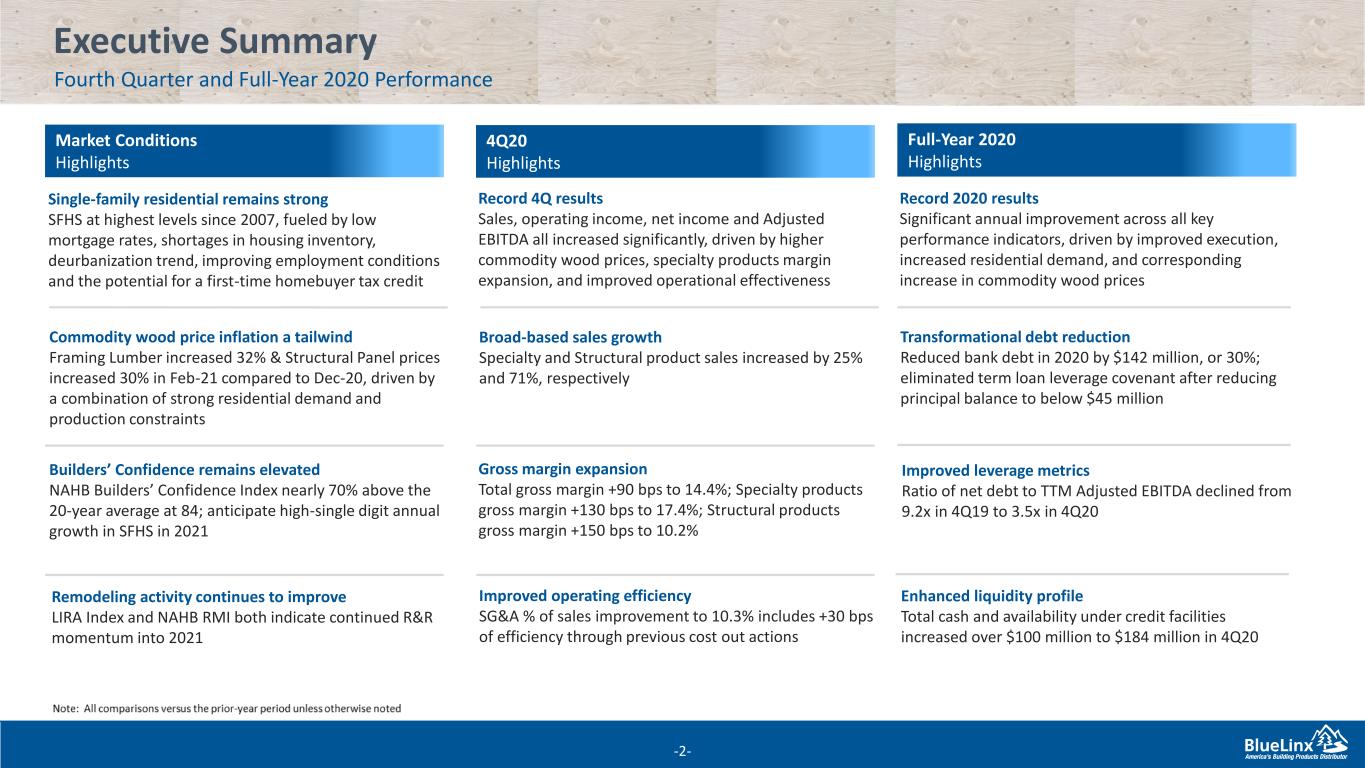
2 -2- Executive Summary Fourth Quarter and Full-Year 2020 Performance Market Conditions Highlights 4Q20 Highlights Full-Year 2020 Highlights Single-family residential remains strong SFHS at highest levels since 2007, fueled by low mortgage rates, shortages in housing inventory, deurbanization trend, improving employment conditions and the potential for a first-time homebuyer tax credit Commodity wood price inflation a tailwind Framing Lumber increased 32% & Structural Panel prices increased 30% in Feb-21 compared to Dec-20, driven by a combination of strong residential demand and production constraints Builders’ Confidence remains elevated NAHB Builders’ Confidence Index nearly 70% above the 20-year average at 84; anticipate high-single digit annual growth in SFHS in 2021 Remodeling activity continues to improve LIRA Index and NAHB RMI both indicate continued R&R momentum into 2021 Record 4Q results Sales, operating income, net income and Adjusted EBITDA all increased significantly, driven by higher commodity wood prices, specialty products margin expansion, and improved operational effectiveness Broad-based sales growth Specialty and Structural product sales increased by 25% and 71%, respectively Gross margin expansion Total gross margin +90 bps to 14.4%; Specialty products gross margin +130 bps to 17.4%; Structural products gross margin +150 bps to 10.2% Improved operating efficiency SG&A % of sales improvement to 10.3% includes +30 bps of efficiency through previous cost out actions Record 2020 results Significant annual improvement across all key performance indicators, driven by improved execution, increased residential demand, and corresponding increase in commodity wood prices Transformational debt reduction Reduced bank debt in 2020 by $142 million, or 30%; eliminated term loan leverage covenant after reducing principal balance to below $45 million Improved leverage metrics Ratio of net debt to TTM Adjusted EBITDA declined from 9.2x in 4Q19 to 3.5x in 4Q20 Enhanced liquidity profile Total cash and availability under credit facilities increased over $100 million to $184 million in 4Q20
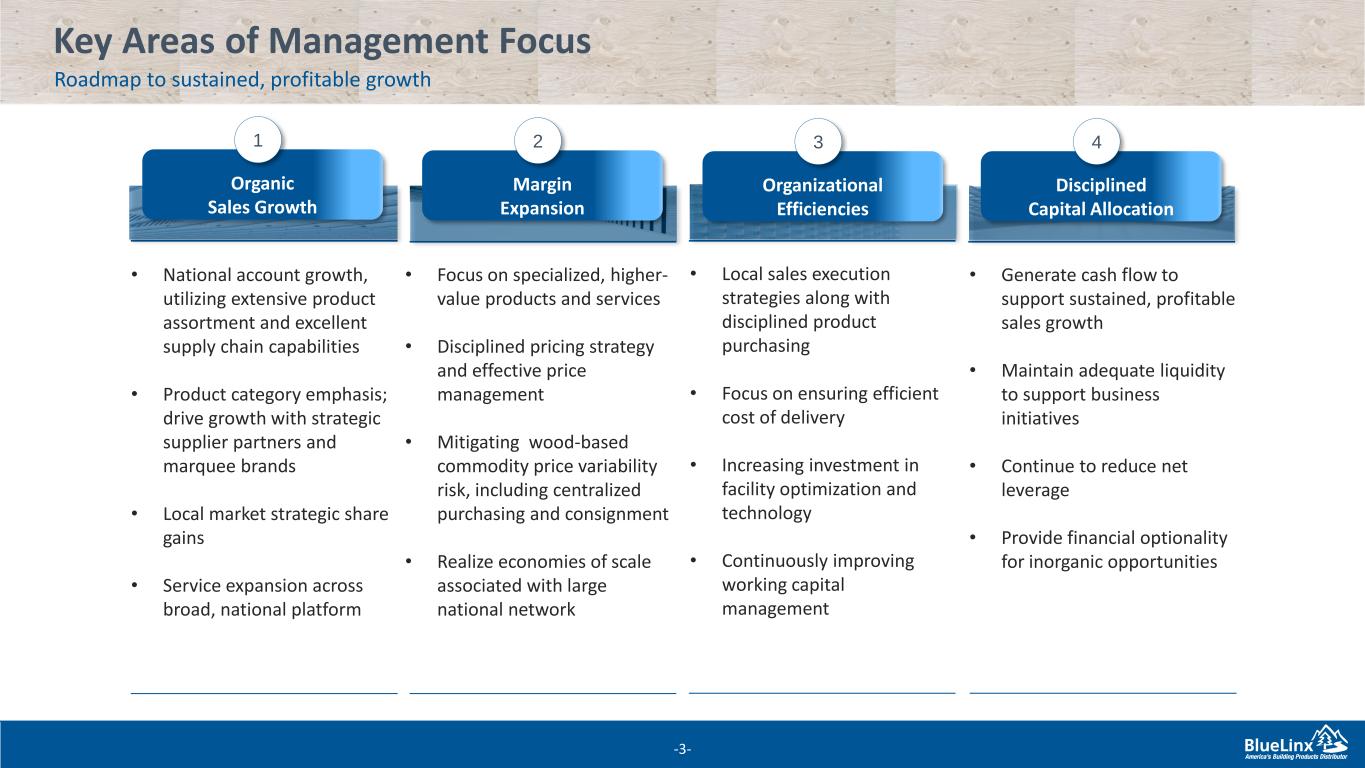
3 Key Areas of Management Focus Roadmap to sustained, profitable growth -3- • National account growth, utilizing extensive product assortment and excellent supply chain capabilities • Product category emphasis; drive growth with strategic supplier partners and marquee brands • Local market strategic share gains • Service expansion across broad, national platform • Focus on specialized, higher- value products and services • Disciplined pricing strategy and effective price management • Mitigating wood-based commodity price variability risk, including centralized purchasing and consignment • Realize economies of scale associated with large national network • Local sales execution strategies along with disciplined product purchasing • Focus on ensuring efficient cost of delivery • Increasing investment in facility optimization and technology • Continuously improving working capital management • Generate cash flow to support sustained, profitable sales growth • Maintain adequate liquidity to support business initiatives • Continue to reduce net leverage • Provide financial optionality for inorganic opportunities Organic Sales Growth 1 Margin Expansion 2 Organizational Efficiencies 3 Disciplined Capital Allocation 4
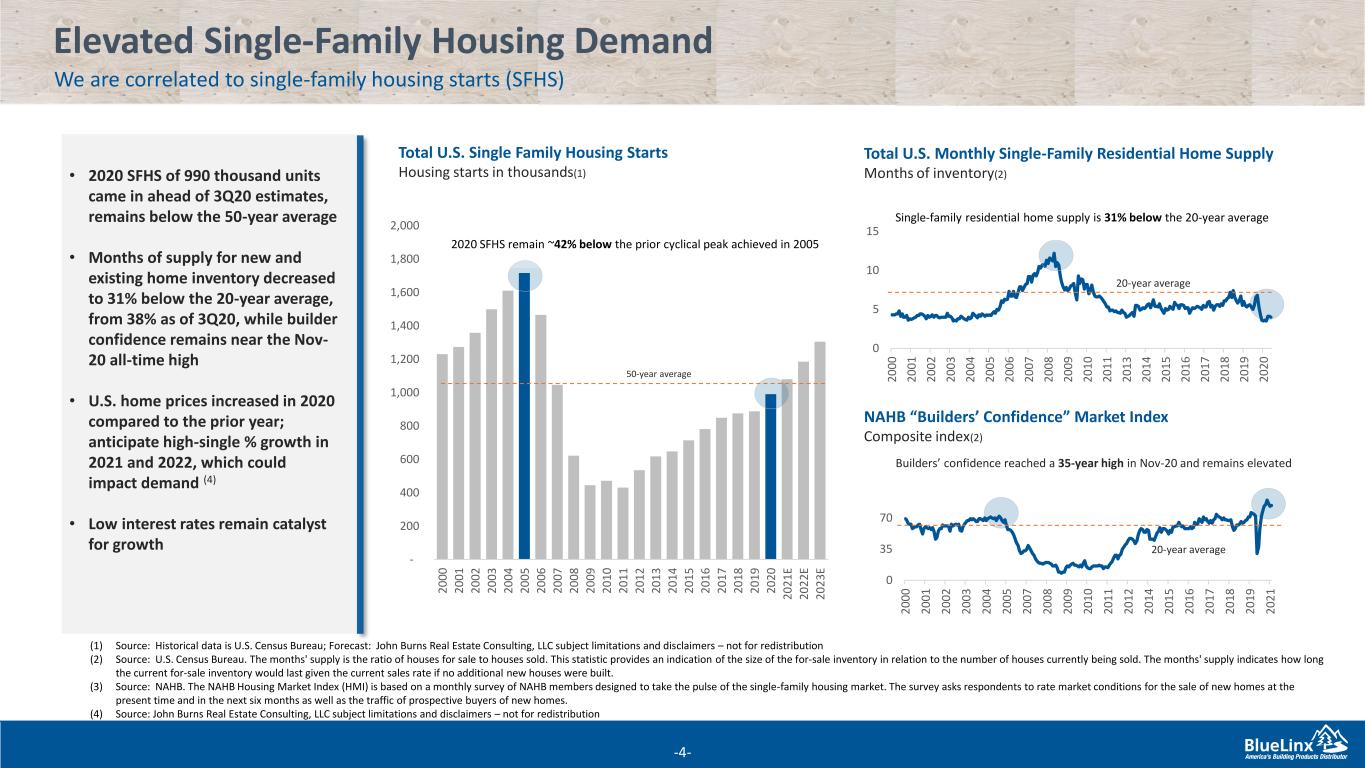
4 - 200 400 600 800 1,000 1,200 1,400 1,600 1,800 2,000 2 0 0 0 2 0 0 1 2 0 0 2 2 0 0 3 2 0 0 4 2 0 0 5 2 0 0 6 2 0 0 7 2 0 0 8 2 0 0 9 2 0 1 0 2 0 1 1 2 0 1 2 2 0 1 3 2 0 1 4 2 0 1 5 2 0 1 6 2 0 1 7 2 0 1 8 2 0 1 9 2 0 2 0 2 0 2 1 E 2 0 2 2 E 2 0 2 3 E 0 5 10 15 2 0 0 0 2 0 0 1 2 0 0 2 2 0 0 3 2 0 0 4 2 0 0 5 2 0 0 6 2 0 0 7 2 0 0 8 2 0 0 9 2 0 1 0 2 0 1 1 2 0 1 3 2 0 1 4 2 0 1 5 2 0 1 6 2 0 1 7 2 0 1 8 2 0 1 9 2 0 2 0 (1) Source: Historical data is U.S. Census Bureau; Forecast: John Burns Real Estate Consulting, LLC subject limitations and disclaimers – not for redistribution (2) Source: U.S. Census Bureau. The months' supply is the ratio of houses for sale to houses sold. This statistic provides an indication of the size of the for-sale inventory in relation to the number of houses currently being sold. The months' supply indicates how long the current for-sale inventory would last given the current sales rate if no additional new houses were built. (3) Source: NAHB. The NAHB Housing Market Index (HMI) is based on a monthly survey of NAHB members designed to take the pulse of the single-family housing market. The survey asks respondents to rate market conditions for the sale of new homes at the present time and in the next six months as well as the traffic of prospective buyers of new homes. (4) Source: John Burns Real Estate Consulting, LLC subject limitations and disclaimers – not for redistribution Elevated Single-Family Housing Demand We are correlated to single-family housing starts (SFHS) -4- Total U.S. Single Family Housing Starts Housing starts in thousands(1) Total U.S. Monthly Single-Family Residential Home Supply Months of inventory(2) NAHB “Builders’ Confidence” Market Index Composite index(2) Builders’ confidence reached a 35-year high in Nov-20 and remains elevated 50-year average 2020 SFHS remain ~42% below the prior cyclical peak achieved in 2005 Single-family residential home supply is 31% below the 20-year average 20-year average 0 35 70 2 0 0 0 2 0 0 1 2 0 0 2 2 0 0 3 2 0 0 4 2 0 0 5 2 0 0 7 2 0 0 8 2 0 0 9 2 0 1 0 2 0 1 1 2 0 1 2 2 0 1 4 2 0 1 5 2 0 1 6 2 0 1 7 2 0 1 8 2 0 1 9 2 0 2 1 20-year average • 2020 SFHS of 990 thousand units came in ahead of 3Q20 estimates, remains below the 50-year average • Months of supply for new and existing home inventory decreased to 31% below the 20-year average, from 38% as of 3Q20, while builder confidence remains near the Nov- 20 all-time high • U.S. home prices increased in 2020 compared to the prior year; anticipate high-single % growth in 2021 and 2022, which could impact demand (4) • Low interest rates remain catalyst for growth
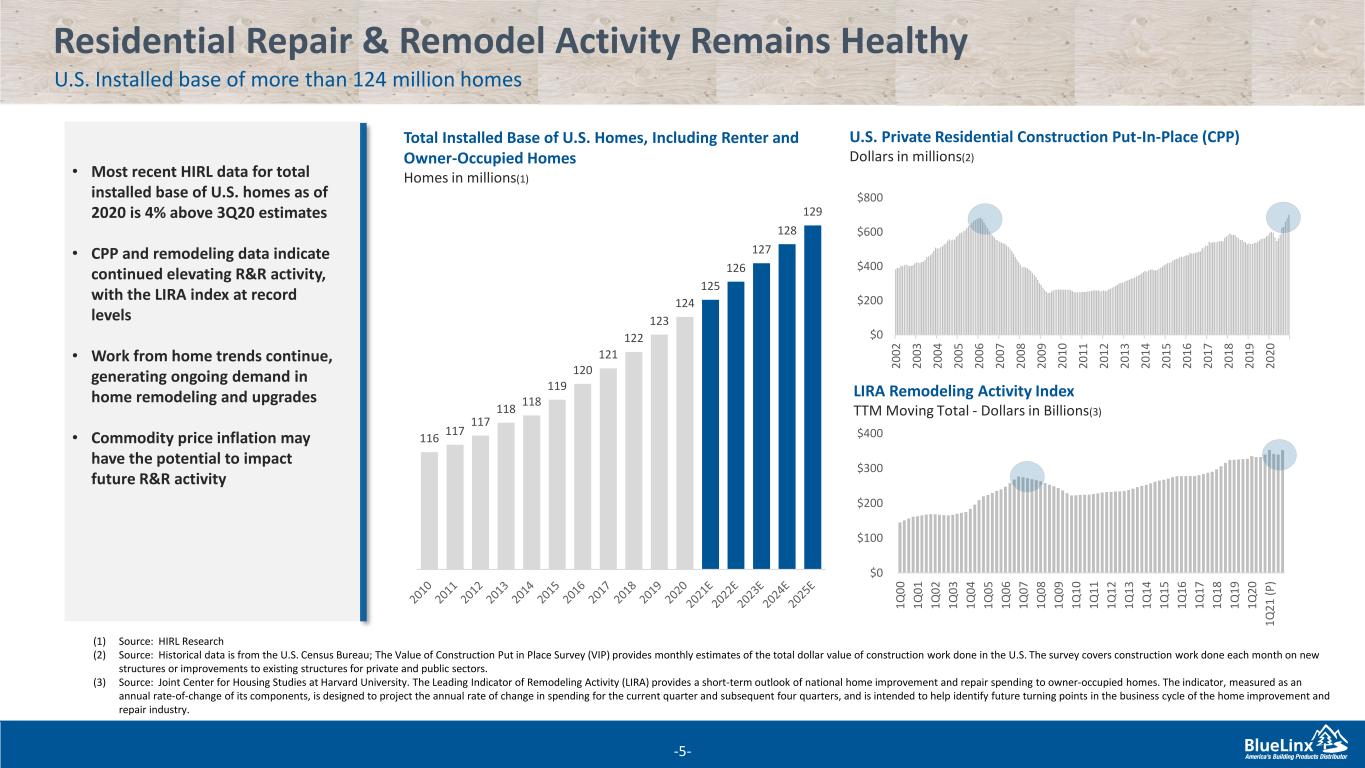
5 (1) Source: HIRL Research (2) Source: Historical data is from the U.S. Census Bureau; The Value of Construction Put in Place Survey (VIP) provides monthly estimates of the total dollar value of construction work done in the U.S. The survey covers construction work done each month on new structures or improvements to existing structures for private and public sectors. (3) Source: Joint Center for Housing Studies at Harvard University. The Leading Indicator of Remodeling Activity (LIRA) provides a short-term outlook of national home improvement and repair spending to owner-occupied homes. The indicator, measured as an annual rate-of-change of its components, is designed to project the annual rate of change in spending for the current quarter and subsequent four quarters, and is intended to help identify future turning points in the business cycle of the home improvement and repair industry. Residential Repair & Remodel Activity Remains Healthy U.S. Installed base of more than 124 million homes -5- U.S. Private Residential Construction Put-In-Place (CPP) Dollars in millions(2) LIRA Remodeling Activity Index TTM Moving Total - Dollars in Billions(3) Total Installed Base of U.S. Homes, Including Renter and Owner-Occupied Homes Homes in millions(1) $0 $200 $400 $600 $800 2 0 0 2 2 0 0 3 2 0 0 4 2 0 0 5 2 0 0 6 2 0 0 7 2 0 0 8 2 0 0 9 2 0 1 0 2 0 1 1 2 0 1 2 2 0 1 3 2 0 1 4 2 0 1 5 2 0 1 6 2 0 1 7 2 0 1 8 2 0 1 9 2 0 2 0 $0 $100 $200 $300 $400 1 Q 0 0 1 Q 0 1 1 Q 0 2 1 Q 0 3 1 Q 0 4 1 Q 0 5 1 Q 0 6 1 Q 0 7 1 Q 0 8 1 Q 0 9 1 Q 1 0 1 Q 1 1 1 Q 1 2 1 Q 1 3 1 Q 1 4 1 Q 1 5 1 Q 1 6 1 Q 1 7 1 Q 1 8 1 Q 1 9 1 Q 2 0 1 Q 2 1 ( P ) • Most recent HIRL data for total installed base of U.S. homes as of 2020 is 4% above 3Q20 estimates • CPP and remodeling data indicate continued elevating R&R activity, with the LIRA index at record levels • Work from home trends continue, generating ongoing demand in home remodeling and upgrades • Commodity price inflation may have the potential to impact future R&R activity 116 117 117 118 118 119 120 121 122 123 124 125 126 127 128 129
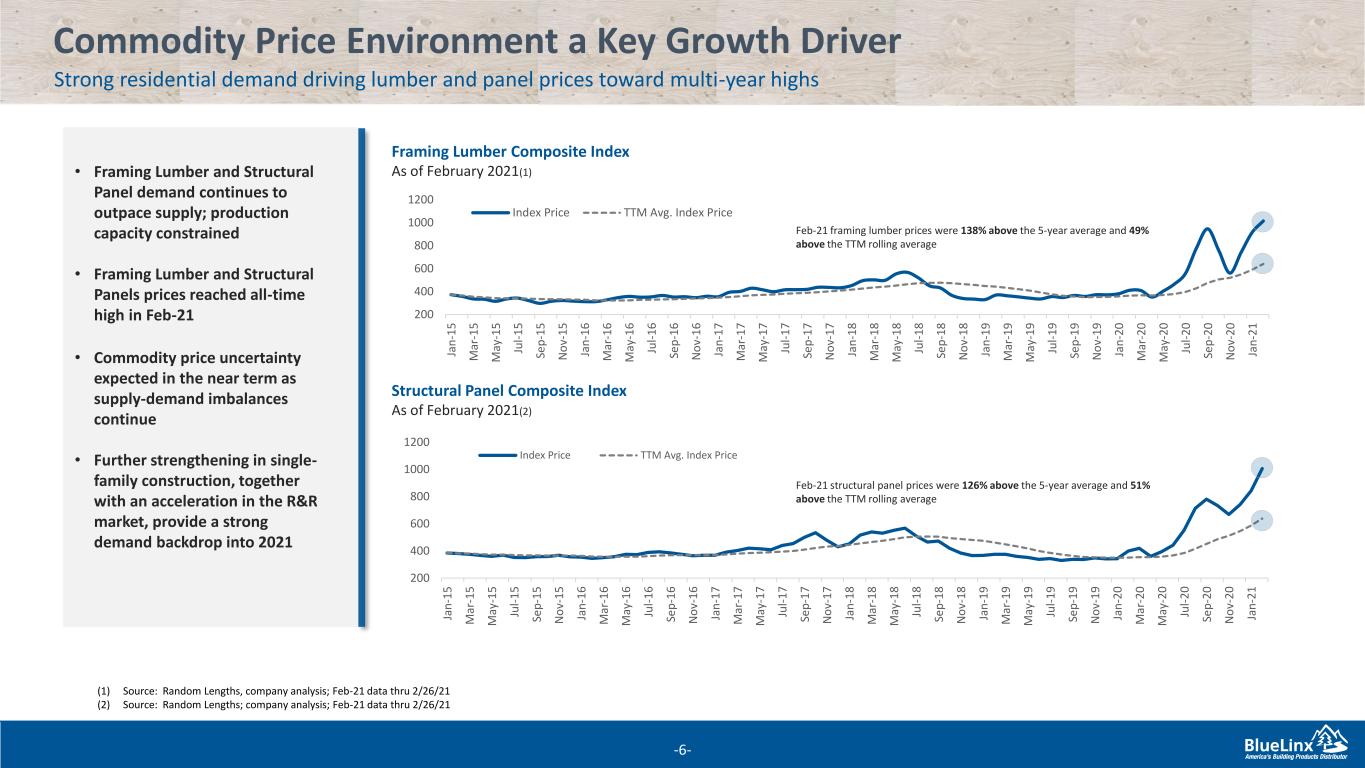
6 (1) Source: Random Lengths, company analysis; Feb-21 data thru 2/26/21 (2) Source: Random Lengths; company analysis; Feb-21 data thru 2/26/21 Commodity Price Environment a Key Growth Driver Strong residential demand driving lumber and panel prices toward multi-year highs -6- Framing Lumber Composite Index As of February 2021(1) Structural Panel Composite Index As of February 2021(2) 200 400 600 800 1000 1200 Ja n -1 5 M a r- 1 5 M a y -1 5 Ju l- 1 5 S e p -1 5 N o v -1 5 Ja n -1 6 M a r- 1 6 M a y -1 6 Ju l- 1 6 S e p -1 6 N o v -1 6 Ja n -1 7 M a r- 1 7 M a y -1 7 Ju l- 1 7 S e p -1 7 N o v -1 7 Ja n -1 8 M a r- 1 8 M a y -1 8 Ju l- 1 8 S e p -1 8 N o v -1 8 Ja n -1 9 M a r- 1 9 M a y -1 9 Ju l- 1 9 S e p -1 9 N o v -1 9 Ja n -2 0 M a r- 2 0 M a y -2 0 Ju l- 2 0 S e p -2 0 N o v -2 0 Ja n -2 1 Index Price TTM Avg. Index Price 200 400 600 800 1000 1200 Ja n -1 5 M a r- 1 5 M a y -1 5 Ju l- 1 5 S e p -1 5 N o v -1 5 Ja n -1 6 M a r- 1 6 M a y -1 6 Ju l- 1 6 S e p -1 6 N o v -1 6 Ja n -1 7 M a r- 1 7 M a y -1 7 Ju l- 1 7 S e p -1 7 N o v -1 7 Ja n -1 8 M a r- 1 8 M a y -1 8 Ju l- 1 8 S e p -1 8 N o v -1 8 Ja n -1 9 M a r- 1 9 M a y -1 9 Ju l- 1 9 S e p -1 9 N o v -1 9 Ja n -2 0 M a r- 2 0 M a y -2 0 Ju l- 2 0 S e p -2 0 N o v -2 0 Ja n -2 1 Index Price TTM Avg. Index Price Feb-21 structural panel prices were 126% above the 5-year average and 51% above the TTM rolling average • Framing Lumber and Structural Panel demand continues to outpace supply; production capacity constrained • Framing Lumber and Structural Panels prices reached all-time high in Feb-21 • Commodity price uncertainty expected in the near term as supply-demand imbalances continue • Further strengthening in single- family construction, together with an acceleration in the R&R market, provide a strong demand backdrop into 2021 Feb-21 framing lumber prices were 138% above the 5-year average and 49% above the TTM rolling average
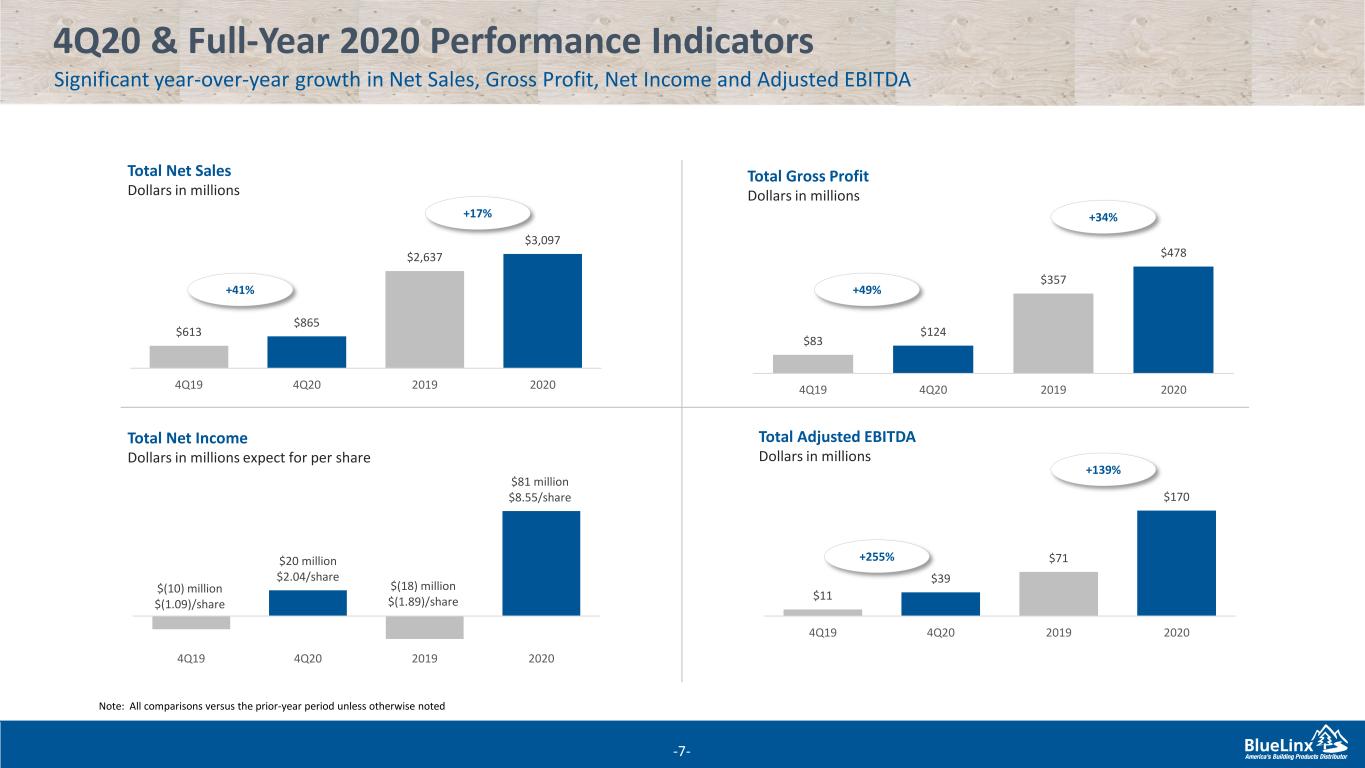
7 4Q20 & Full-Year 2020 Performance Indicators Significant year-over-year growth in Net Sales, Gross Profit, Net Income and Adjusted EBITDA -7- Total Net Sales Dollars in millions Total Gross Profit Dollars in millions Total Adjusted EBITDA Dollars in millions Total Net Income Dollars in millions expect for per share $613 $865 $2,637 $3,097 4Q19 4Q20 2019 2020 +41% +17% $83 $124 $357 $478 4Q19 4Q20 2019 2020 +49% +34% $11 $39 $71 $170 4Q19 4Q20 2019 2020 +255% +139% $(10) million $(1.09)/share $20 million $2.04/share $(18) million $(1.89)/share $81 million $8.55/share 4Q19 4Q20 2019 2020 Note: All comparisons versus the prior-year period unless otherwise noted
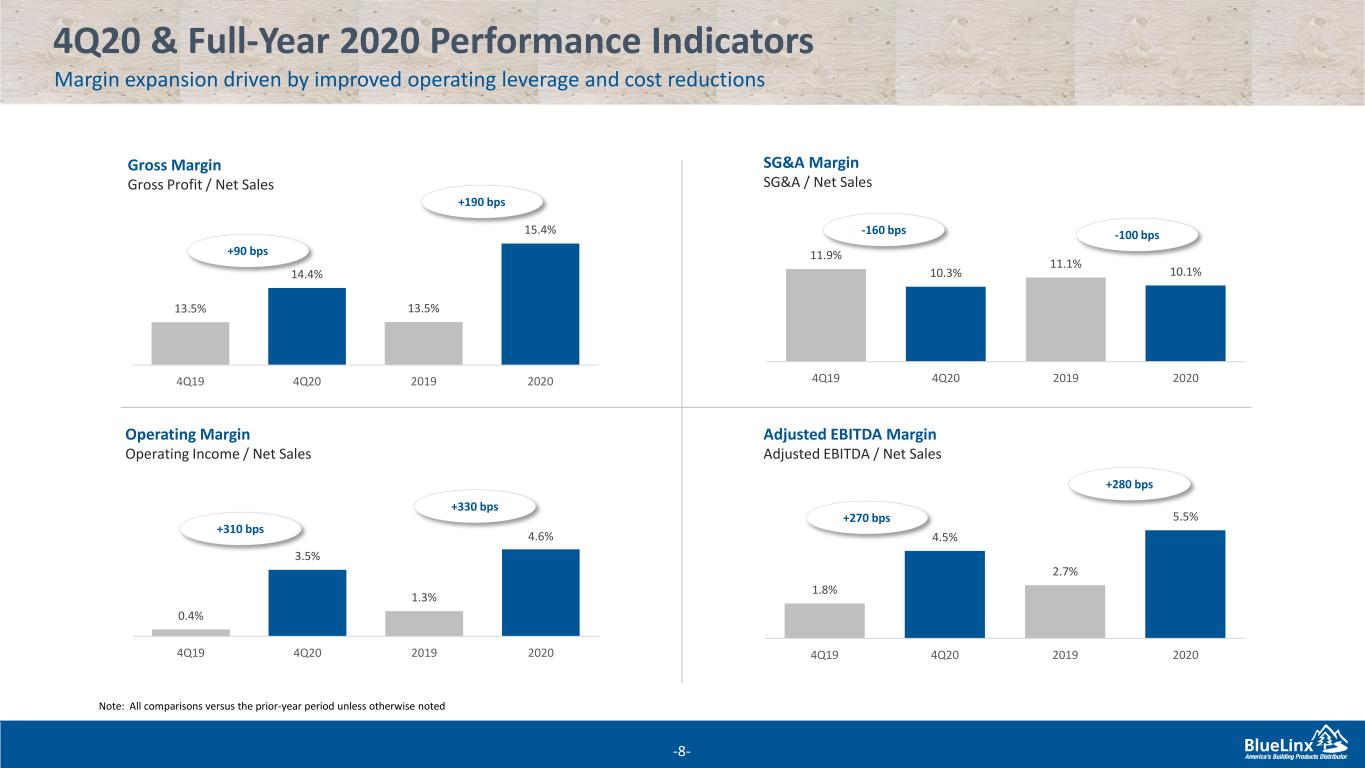
8 -8- 4Q20 & Full-Year 2020 Performance Indicators Margin expansion driven by improved operating leverage and cost reductions Gross Margin Gross Profit / Net Sales Adjusted EBITDA Margin Adjusted EBITDA / Net Sales Operating Margin Operating Income / Net Sales SG&A Margin SG&A / Net Sales 13.5% 14.4% 13.5% 15.4% 4Q19 4Q20 2019 2020 +90 bps +190 bps 11.9% 10.3% 11.1% 10.1% 4Q19 4Q20 2019 2020 -160 bps -100 bps 0.4% 3.5% 1.3% 4.6% 4Q19 4Q20 2019 2020 +310 bps +330 bps 1.8% 4.5% 2.7% 5.5% 4Q19 4Q20 2019 2020 +270 bps +280 bps Note: All comparisons versus the prior-year period unless otherwise noted
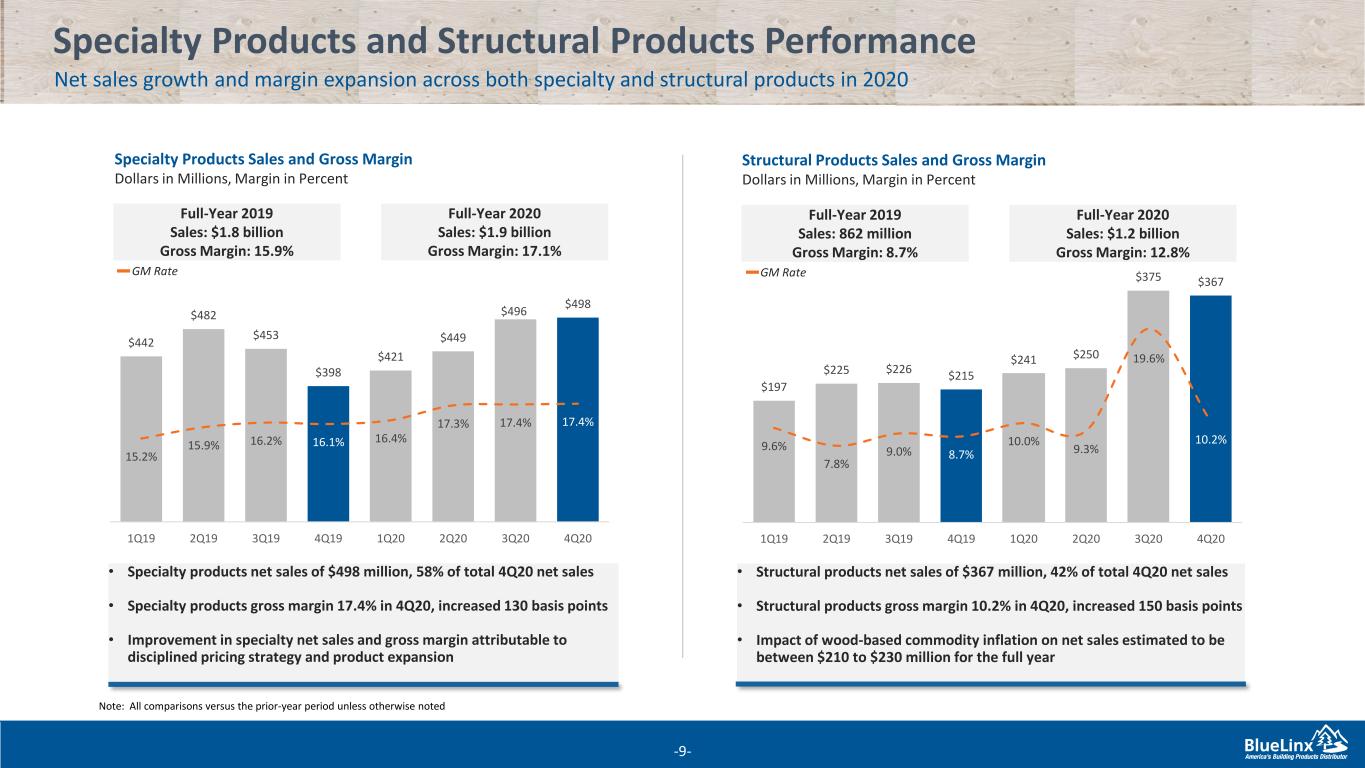
9 Specialty Products and Structural Products Performance Net sales growth and margin expansion across both specialty and structural products in 2020 -9- Specialty Products Sales and Gross Margin Dollars in Millions, Margin in Percent Structural Products Sales and Gross Margin Dollars in Millions, Margin in Percent $442 $482 $453 $398 $421 $449 $496 $498 15.2% 15.9% 16.2% 16.1% 16.4% 17.3% 17.4% 17.4% 10.0% 12.0% 14.0% 16.0% 18.0% 20.0% 22.0% 24.0% 200.0 250.0 300.0 350.0 400.0 450.0 500.0 550.0 1Q19 2Q19 3Q19 4Q19 1Q20 2Q20 3Q20 4Q20 Full-Year 2019 Sales: $1.8 billion Gross Margin: 15.9% Full-Year 2020 Sales: $1.9 billion Gross Margin: 17.1% Full-Year 2019 Sales: 862 million Gross Margin: 8.7% Full-Year 2020 Sales: $1.2 billion Gross Margin: 12.8% • Specialty products net sales of $498 million, 58% of total 4Q20 net sales • Specialty products gross margin 17.4% in 4Q20, increased 130 basis points • Improvement in specialty net sales and gross margin attributable to disciplined pricing strategy and product expansion • Structural products net sales of $367 million, 42% of total 4Q20 net sales • Structural products gross margin 10.2% in 4Q20, increased 150 basis points • Impact of wood-based commodity inflation on net sales estimated to be between $210 to $230 million for the full year Note: All comparisons versus the prior-year period unless otherwise noted $197 $225 $226 $215 $241 $250 $375 $367 9.6% 7.8% 9.0% 8.7% 10.0% 9.3% 19.6% 10.2% 0.0% 5.0% 10.0% 15.0% 20.0% 25.0% - 50.0 100.0 150.0 200.0 250.0 300.0 350.0 400.0 1Q19 2Q19 3Q19 4Q19 1Q20 2Q20 3Q20 4Q20 GM Rate GM Rate
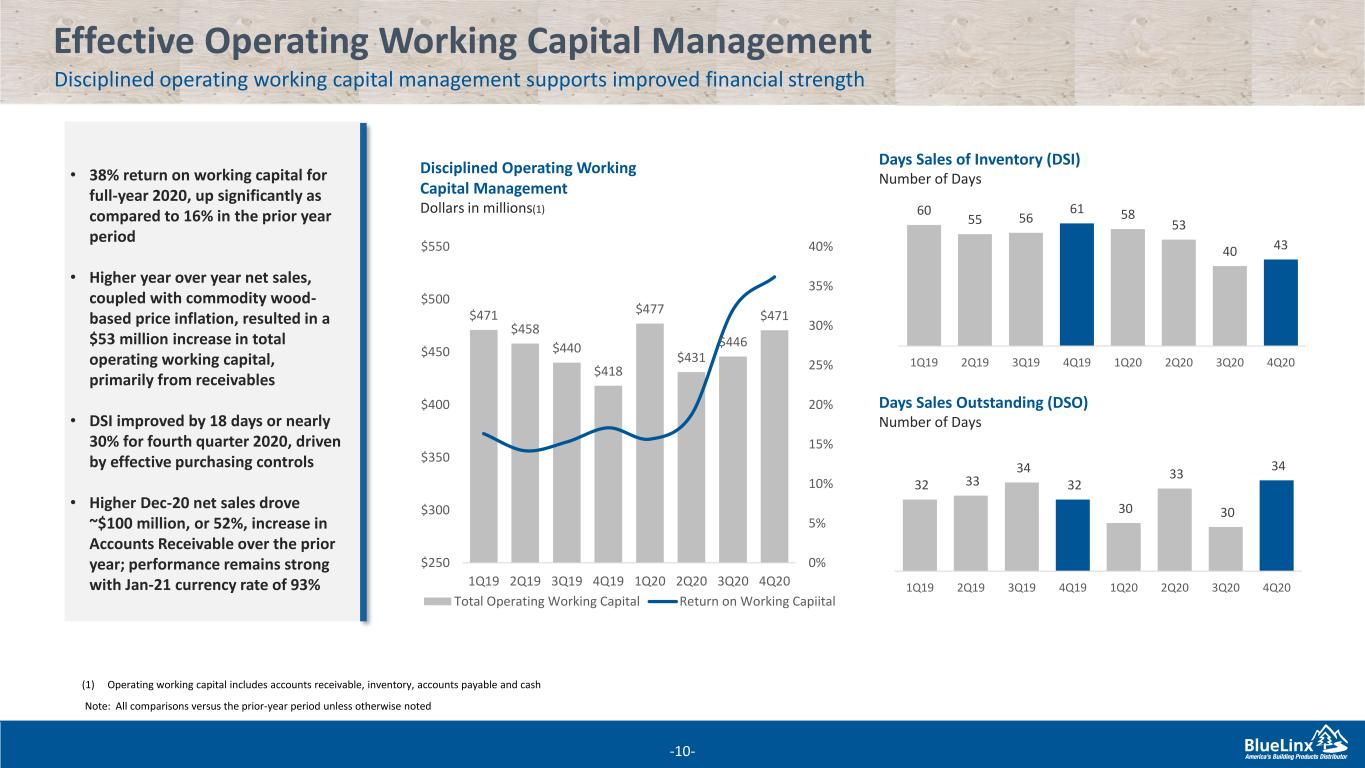
10 Effective Operating Working Capital Management Disciplined operating working capital management supports improved financial strength -10- Days Sales of Inventory (DSI) Number of Days Days Sales Outstanding (DSO) Number of Days (1) Operating working capital includes accounts receivable, inventory, accounts payable and cash • 38% return on working capital for full-year 2020, up significantly as compared to 16% in the prior year period • Higher year over year net sales, coupled with commodity wood- based price inflation, resulted in a $53 million increase in total operating working capital, primarily from receivables • DSI improved by 18 days or nearly 30% for fourth quarter 2020, driven by effective purchasing controls • Higher Dec-20 net sales drove ~$100 million, or 52%, increase in Accounts Receivable over the prior year; performance remains strong with Jan-21 currency rate of 93% 60 55 56 61 58 53 40 43 1Q19 2Q19 3Q19 4Q19 1Q20 2Q20 3Q20 4Q20 32 33 34 32 30 33 30 34 1Q19 2Q19 3Q19 4Q19 1Q20 2Q20 3Q20 4Q20 Note: All comparisons versus the prior-year period unless otherwise noted $471 $458 $440 $418 $477 $431 $446 $471 0% 5% 10% 15% 20% 25% 30% 35% 40% $250 $300 $350 $400 $450 $500 $550 1Q19 2Q19 3Q19 4Q19 1Q20 2Q20 3Q20 4Q20 Total Operating Working Capital Return on Working Capiital Disciplined Operating Working Capital Management Dollars in millions(1)
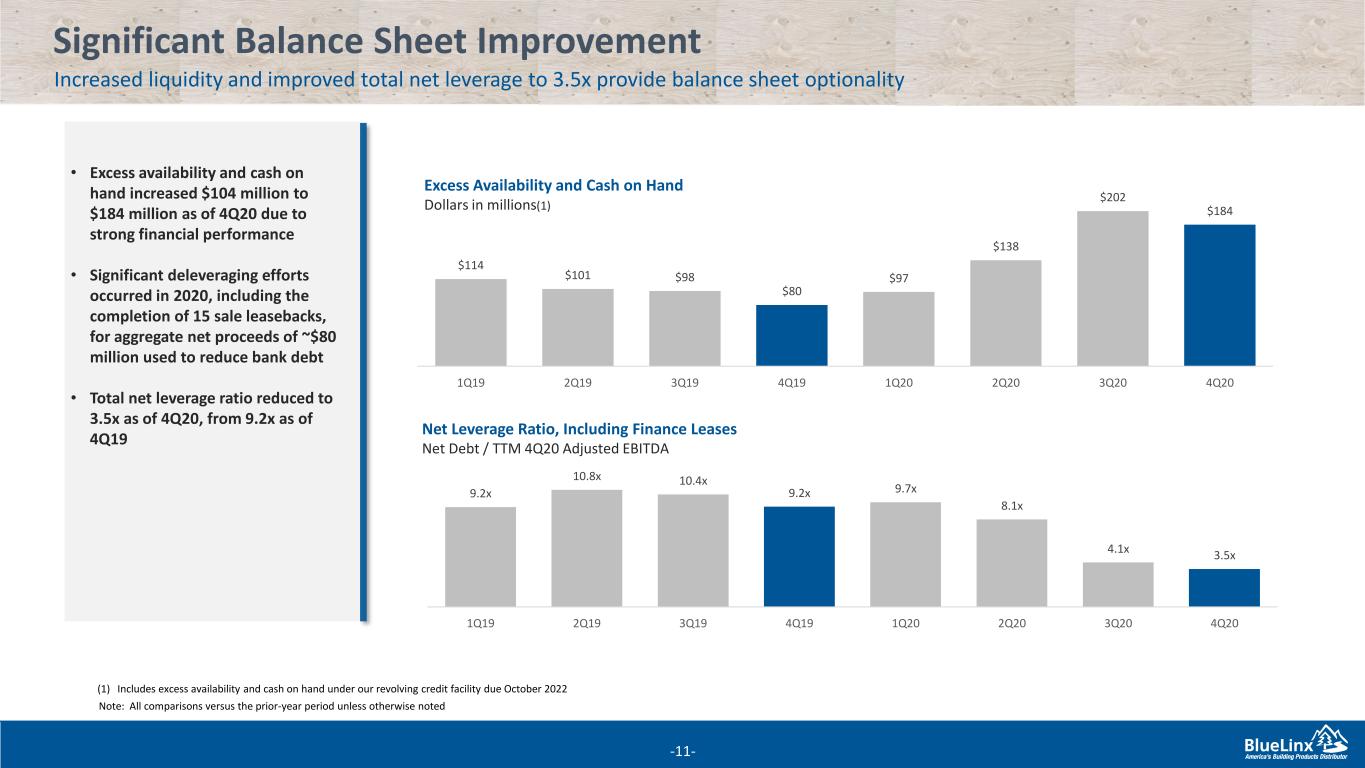
11 $114 $101 $98 $80 $97 $138 $202 $184 1Q19 2Q19 3Q19 4Q19 1Q20 2Q20 3Q20 4Q20 Significant Balance Sheet Improvement Increased liquidity and improved total net leverage to 3.5x provide balance sheet optionality -11- Excess Availability and Cash on Hand Dollars in millions(1) (1) Includes excess availability and cash on hand under our revolving credit facility due October 2022 Net Leverage Ratio, Including Finance Leases Net Debt / TTM 4Q20 Adjusted EBITDA Note: All comparisons versus the prior-year period unless otherwise noted • Excess availability and cash on hand increased $104 million to $184 million as of 4Q20 due to strong financial performance • Significant deleveraging efforts occurred in 2020, including the completion of 15 sale leasebacks, for aggregate net proceeds of ~$80 million used to reduce bank debt • Total net leverage ratio reduced to 3.5x as of 4Q20, from 9.2x as of 4Q19 9.2x 10.8x 10.4x 9.2x 9.7x 8.1x 4.1x 3.5x 1Q19 2Q19 3Q19 4Q19 1Q20 2Q20 3Q20 4Q20
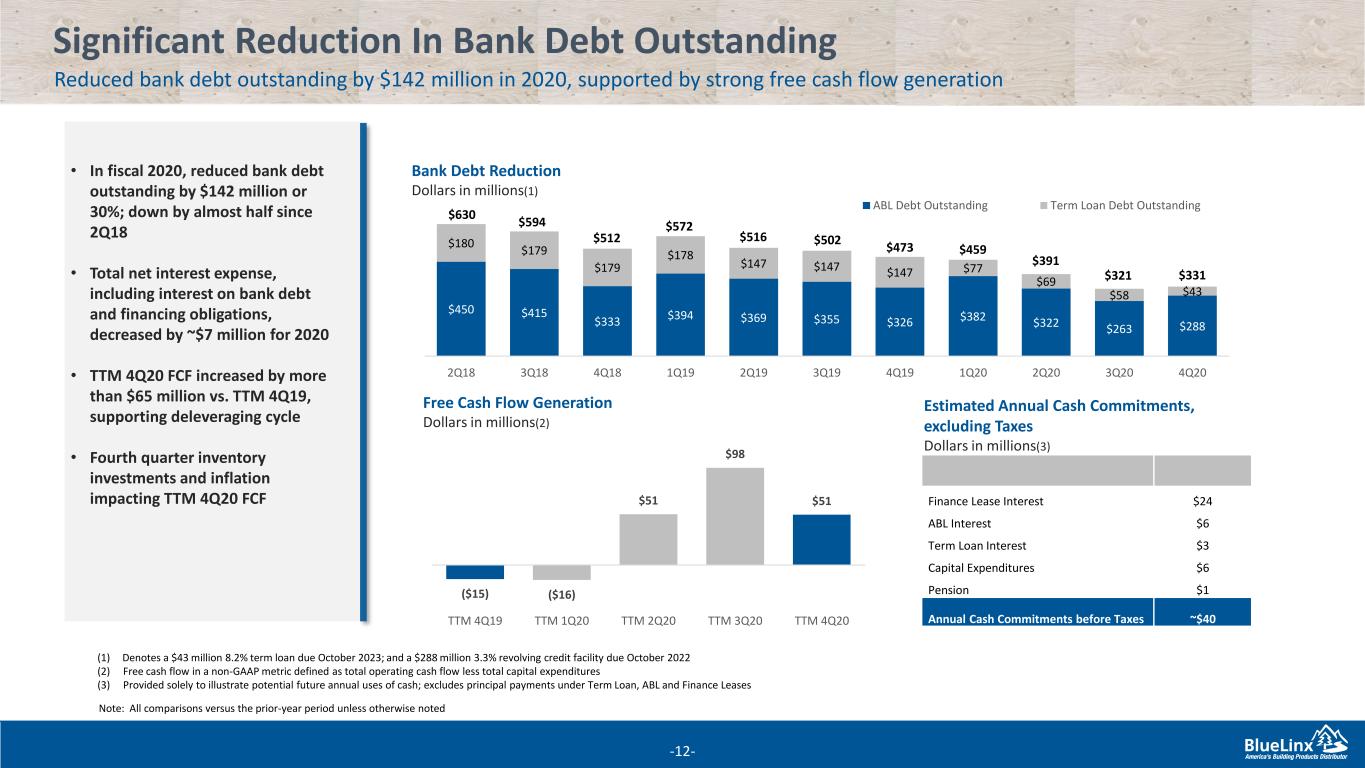
12 Significant Reduction In Bank Debt Outstanding Reduced bank debt outstanding by $142 million in 2020, supported by strong free cash flow generation -12- Free Cash Flow Generation Dollars in millions(2) Bank Debt Reduction Dollars in millions(1) 14 asset sales Estimated Annual Cash Commitments, excluding Taxes Dollars in millions(3) (1) Denotes a $43 million 8.2% term loan due October 2023; and a $288 million 3.3% revolving credit facility due October 2022 (2) Free cash flow in a non-GAAP metric defined as total operating cash flow less total capital expenditures (3) Provided solely to illustrate potential future annual uses of cash; excludes principal payments under Term Loan, ABL and Finance Leases Note: All comparisons versus the prior-year period unless otherwise noted • In fiscal 2020, reduced bank debt outstanding by $142 million or 30%; down by almost half since 2Q18 • Total net interest expense, including interest on bank debt and financing obligations, decreased by ~$7 million for 2020 • TTM 4Q20 FCF increased by more than $65 million vs. TTM 4Q19, supporting deleveraging cycle • Fourth quarter inventory investments and inflation impacting TTM 4Q20 FCF $450 $415 $333 $394 $369 $355 $326 $382 $322 $263 $288 $180 $179 $179 $178 $147 $147 $147 $77 $69 $58 $43 2Q18 3Q18 4Q18 1Q19 2Q19 3Q19 4Q19 1Q20 2Q20 3Q20 4Q20 ABL Debt Outstanding Term Loan Debt Outstanding $630 $594 $512 $572 $516 $502 $459$473 $391 $321 $331 ($15) ($16) $51 $98 $51 TTM 4Q19 TTM 1Q20 TTM 2Q20 TTM 3Q20 TTM 4Q20 Finance Lease Interest $24 ABL Interest $6 Term Loan Interest $3 Capital Expenditures $6 Pension $1 Annual Cash Commitments before Taxes ~$40

Divider slide 29 September, 2020App ndix
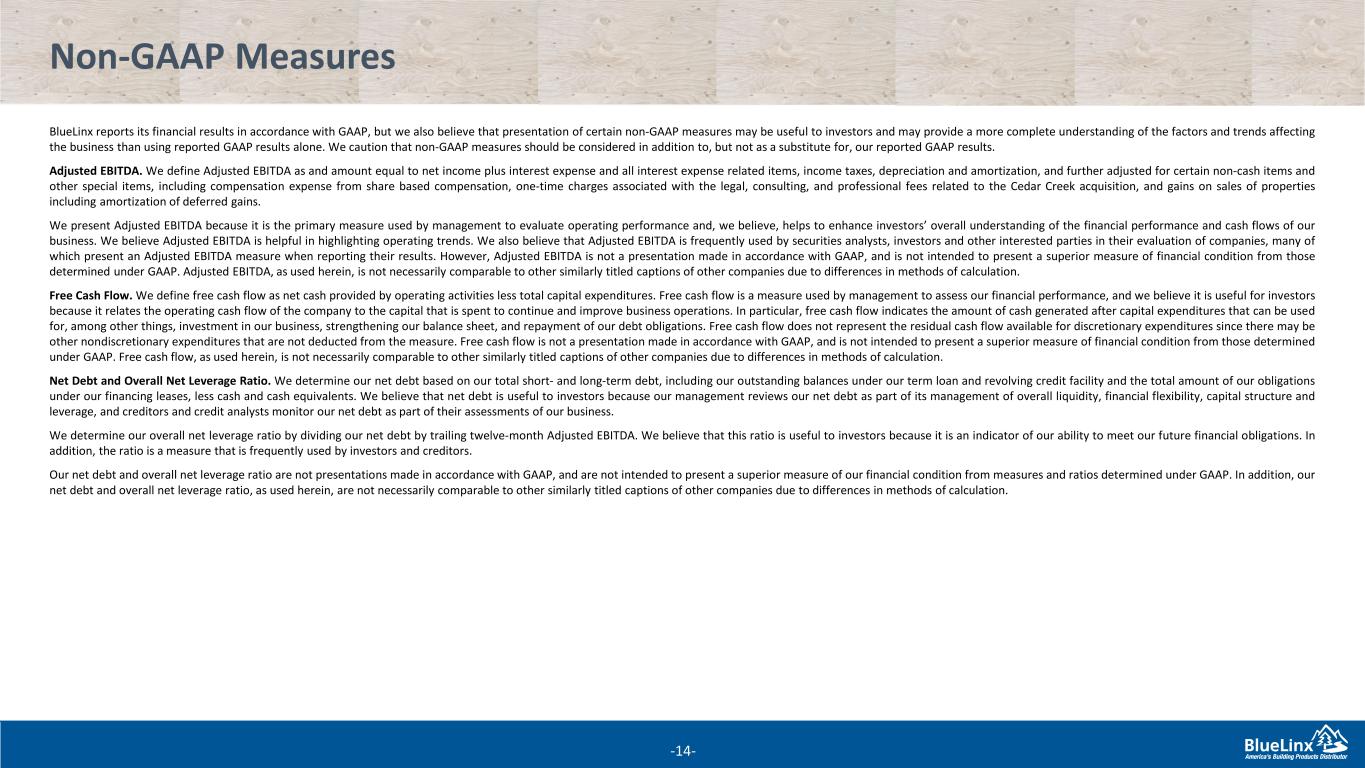
14 Non-GAAP Measures -14- BlueLinx reports its financial results in accordance with GAAP, but we also believe that presentation of certain non-GAAP measures may be useful to investors and may provide a more complete understanding of the factors and trends affecting the business than using reported GAAP results alone. We caution that non-GAAP measures should be considered in addition to, but not as a substitute for, our reported GAAP results. Adjusted EBITDA. We define Adjusted EBITDA as and amount equal to net income plus interest expense and all interest expense related items, income taxes, depreciation and amortization, and further adjusted for certain non-cash items and other special items, including compensation expense from share based compensation, one-time charges associated with the legal, consulting, and professional fees related to the Cedar Creek acquisition, and gains on sales of properties including amortization of deferred gains. We present Adjusted EBITDA because it is the primary measure used by management to evaluate operating performance and, we believe, helps to enhance investors’ overall understanding of the financial performance and cash flows of our business. We believe Adjusted EBITDA is helpful in highlighting operating trends. We also believe that Adjusted EBITDA is frequently used by securities analysts, investors and other interested parties in their evaluation of companies, many of which present an Adjusted EBITDA measure when reporting their results. However, Adjusted EBITDA is not a presentation made in accordance with GAAP, and is not intended to present a superior measure of financial condition from those determined under GAAP. Adjusted EBITDA, as used herein, is not necessarily comparable to other similarly titled captions of other companies due to differences in methods of calculation. Free Cash Flow. We define free cash flow as net cash provided by operating activities less total capital expenditures. Free cash flow is a measure used by management to assess our financial performance, and we believe it is useful for investors because it relates the operating cash flow of the company to the capital that is spent to continue and improve business operations. In particular, free cash flow indicates the amount of cash generated after capital expenditures that can be used for, among other things, investment in our business, strengthening our balance sheet, and repayment of our debt obligations. Free cash flow does not represent the residual cash flow available for discretionary expenditures since there may be other nondiscretionary expenditures that are not deducted from the measure. Free cash flow is not a presentation made in accordance with GAAP, and is not intended to present a superior measure of financial condition from those determined under GAAP. Free cash flow, as used herein, is not necessarily comparable to other similarly titled captions of other companies due to differences in methods of calculation. Net Debt and Overall Net Leverage Ratio. We determine our net debt based on our total short- and long-term debt, including our outstanding balances under our term loan and revolving credit facility and the total amount of our obligations under our financing leases, less cash and cash equivalents. We believe that net debt is useful to investors because our management reviews our net debt as part of its management of overall liquidity, financial flexibility, capital structure and leverage, and creditors and credit analysts monitor our net debt as part of their assessments of our business. We determine our overall net leverage ratio by dividing our net debt by trailing twelve-month Adjusted EBITDA. We believe that this ratio is useful to investors because it is an indicator of our ability to meet our future financial obligations. In addition, the ratio is a measure that is frequently used by investors and creditors. Our net debt and overall net leverage ratio are not presentations made in accordance with GAAP, and are not intended to present a superior measure of our financial condition from measures and ratios determined under GAAP. In addition, our net debt and overall net leverage ratio, as used herein, are not necessarily comparable to other similarly titled captions of other companies due to differences in methods of calculation.
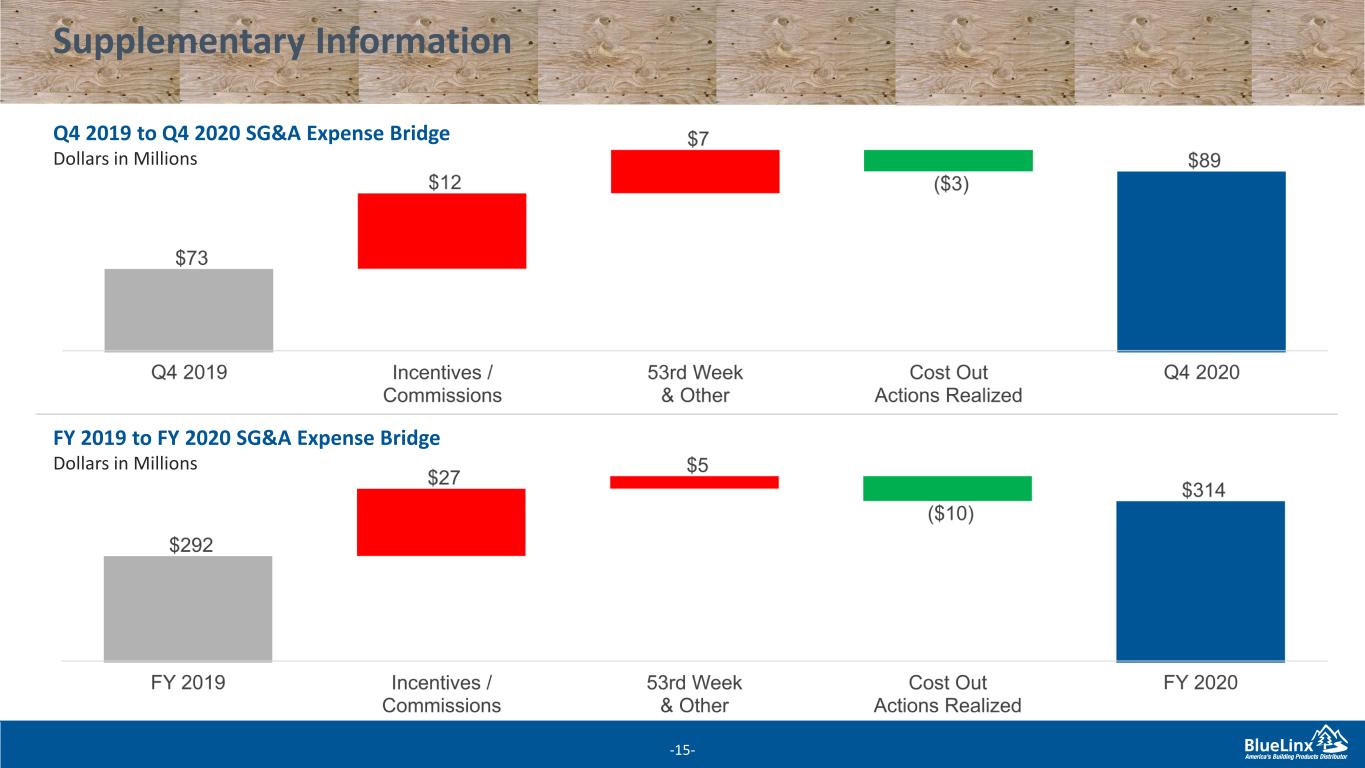
15 Q4 2019 to Q4 2020 SG&A Expense Bridge Dollars in Millions -15- Supplementary Information FY 2019 to FY 2020 SG&A Expense Bridge Dollars in Millions
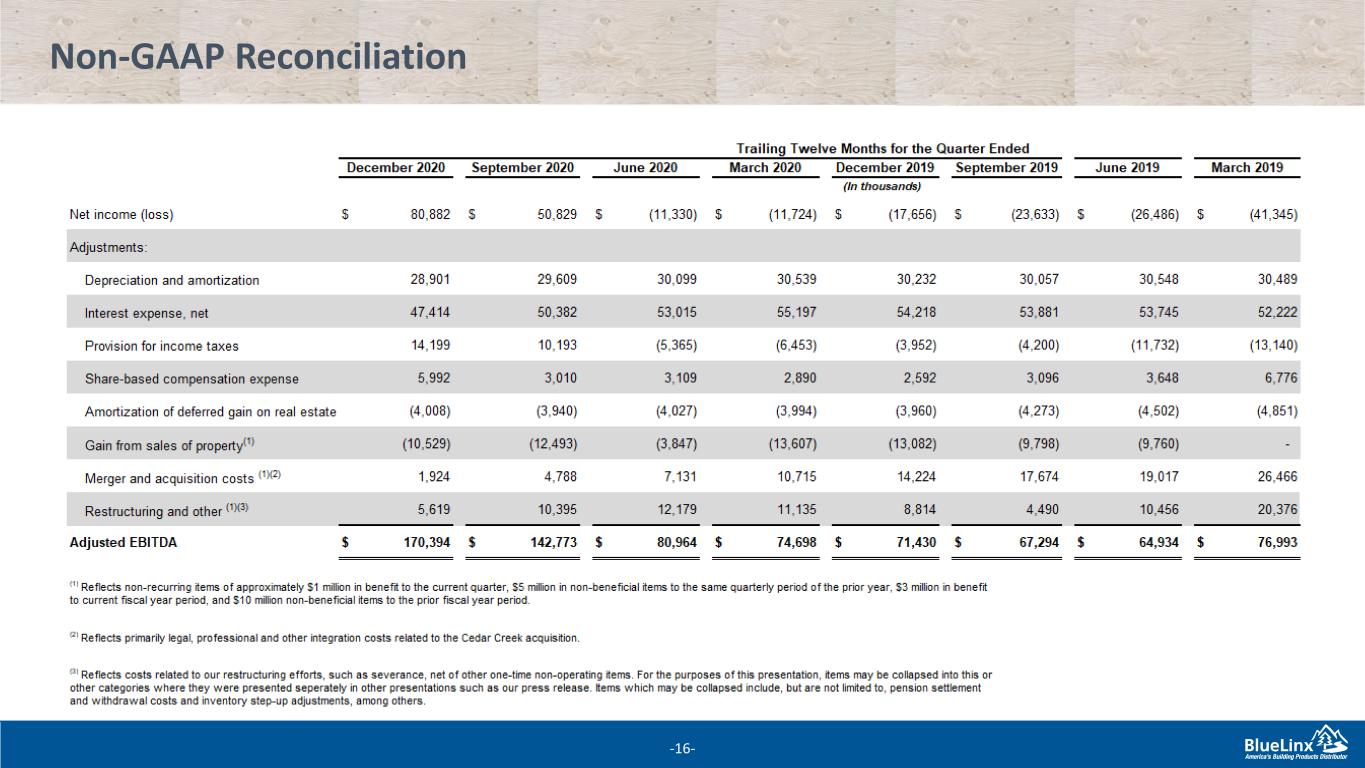
16 Non-GAAP Reconciliation -16-
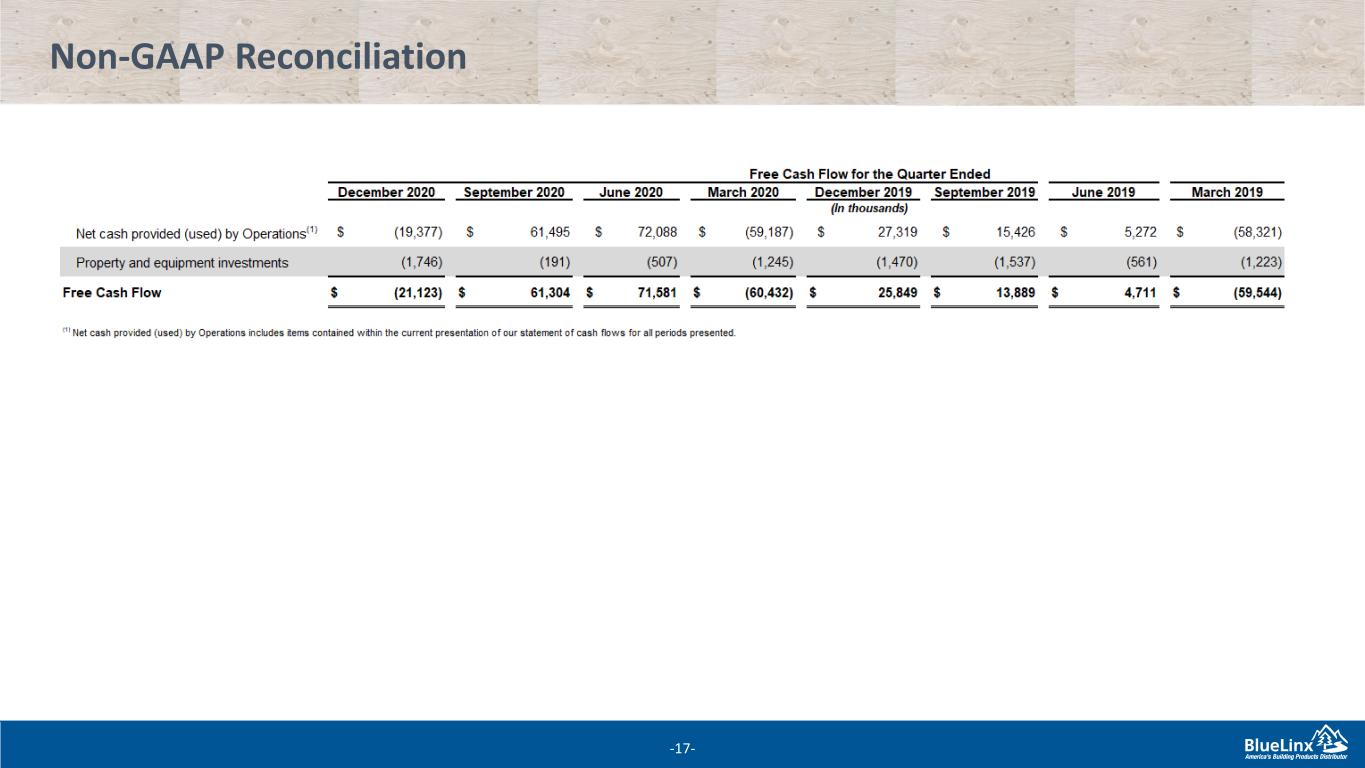
17 Non-GAAP Reconciliation -17-
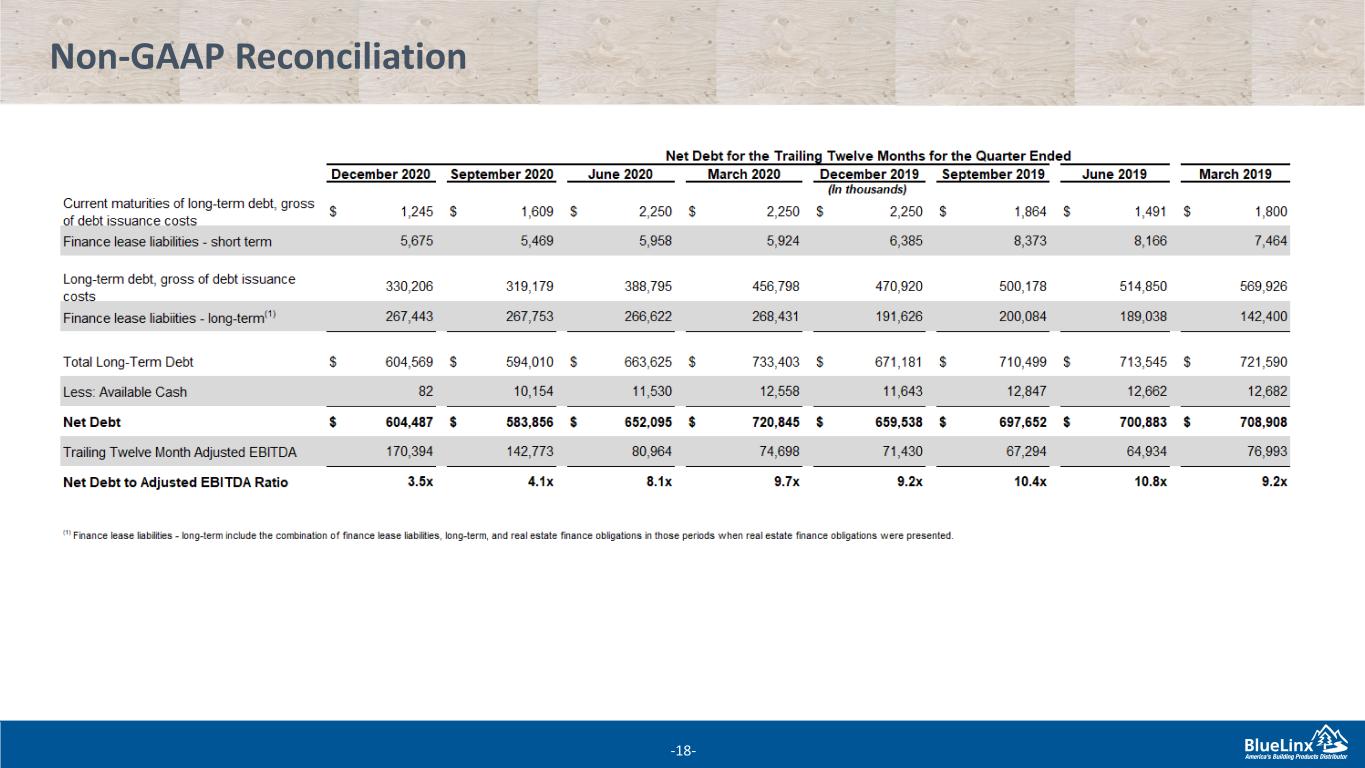
18 Non-GAAP Reconciliation -18-