Operator
Good day, and thank you for standing by. Welcome to the Carlyle Credit Income Fund Second Quarter 2026 Financial Results and Investor Conference Call. At this time, all participants are in a listen-only mode. After the speaker's presentation, there will be a question and answer session. To ask a question during the session, you will need to press star 11 on your telephone. You will then hear an automated message advising that your hand is raised. To withdraw your question, please press star 11 again. Please be advised that today's conference is being recorded. I would now like to hand the conference over to your first speaker today, Joseph Castilla. Please go ahead.
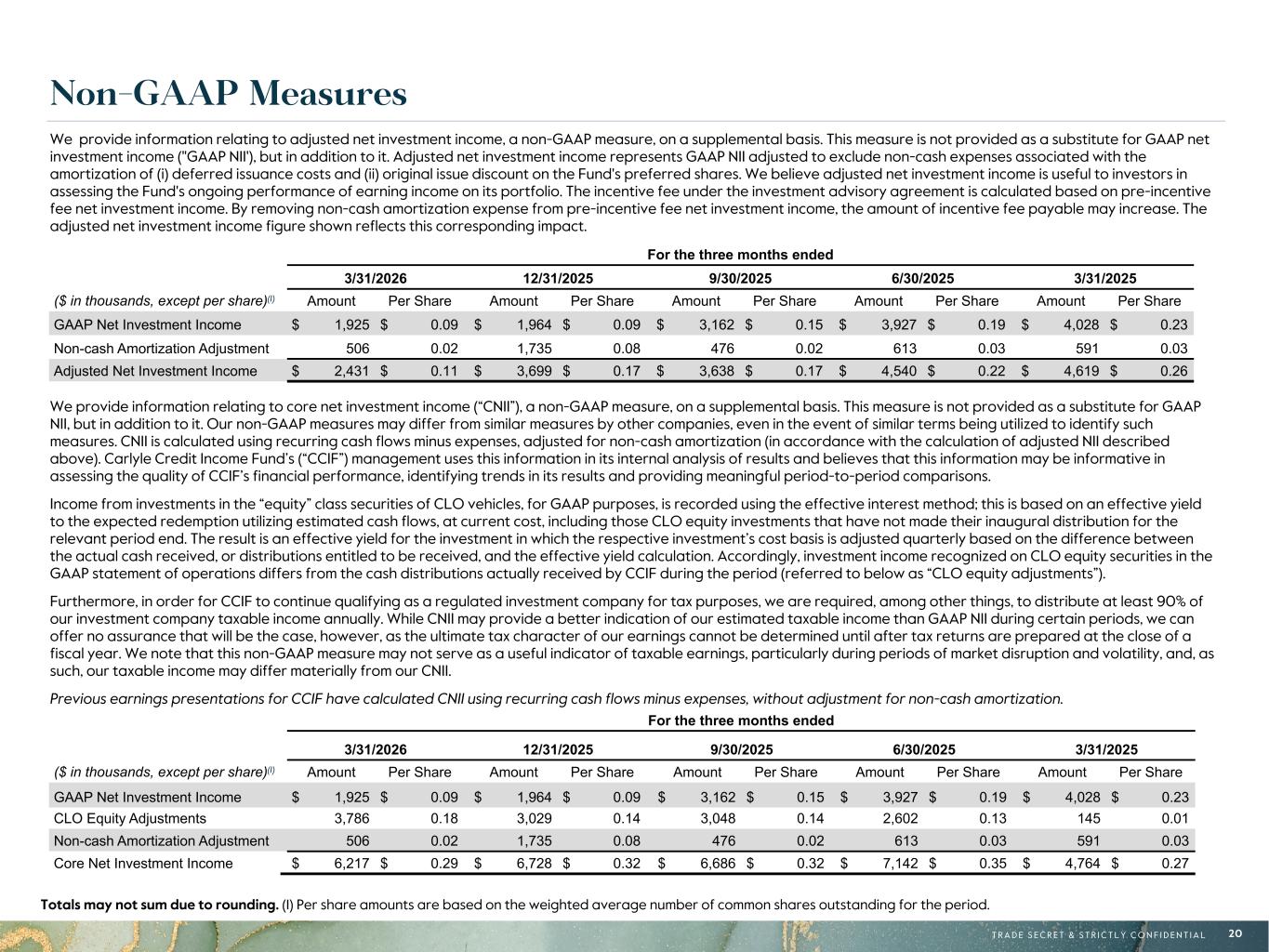
Good morning, and welcome to Carlyle Credit Income Fund's second quarter 2026 earnings call. With me on the call today is Nisho Mehta, CCIF's Principal Executive Officer and President, Lauren Bazmajan, CCIF's Chair and Carlyle's Global Head of Liquid Credit, and Nelson Joseph, CCIF's Principal Financial Officer. Last night, we issued our Q2 financial statements and a corresponding press release and earnings presentation discussing our results, which are available on the investor relations section of our website. Following our remarks today, we will hold a question and answer session for analysts and institutional investors. This call is being webcast and a replay will be available on our website. Any forward-looking statements made today do not guarantee future performance and any undue reliance should not be placed on them. These statements are based on current management expectations and involve inherent risks and uncertainties, including those identified in the risk factors section of our annual report on the Form N-CSR. These risks and uncertainties could cause actual results to differ materially from those indicated. Carlisle Credit Income Fund assumes no obligation to update any forward-looking statements at any time. During the conference call, we may discuss adjusted net investment income per common share and core net investment income per common share which are calculated and presented on a basis other than in accordance with gap we use these non-gap financial measures internally to analyze and evaluate financial results and performance and we believe these non-gap financial measures are useful to investors gauging the quality of the fund's financial performance identifying trends in its results and providing meaningful period-to-period comparisons. The presentation of this non-GAAP measure is not intended to be a substitute for financial results prepared in accordance with GAAP and should not be considered in isolation. With that, I'll turn the call over to Nisho.
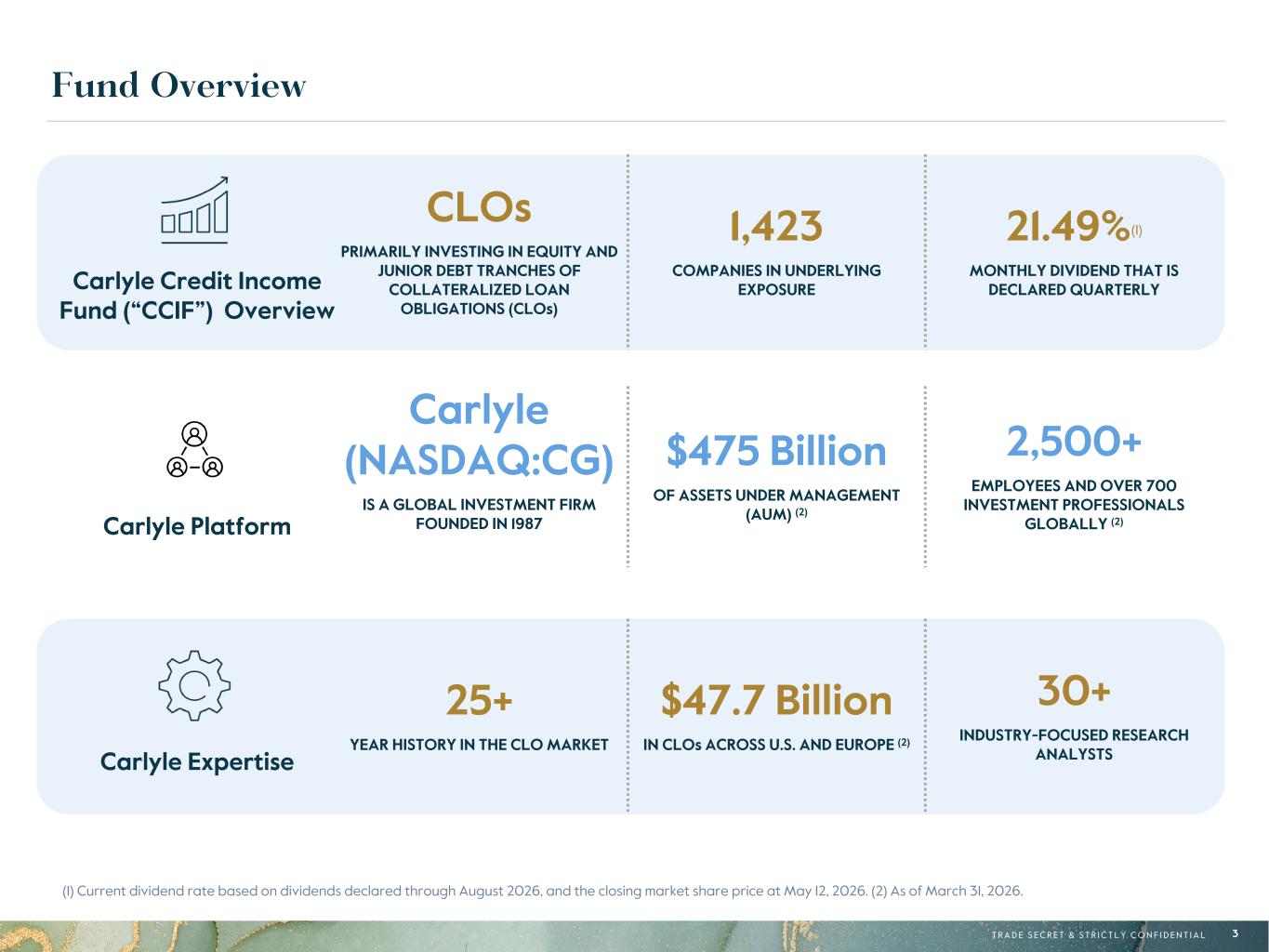
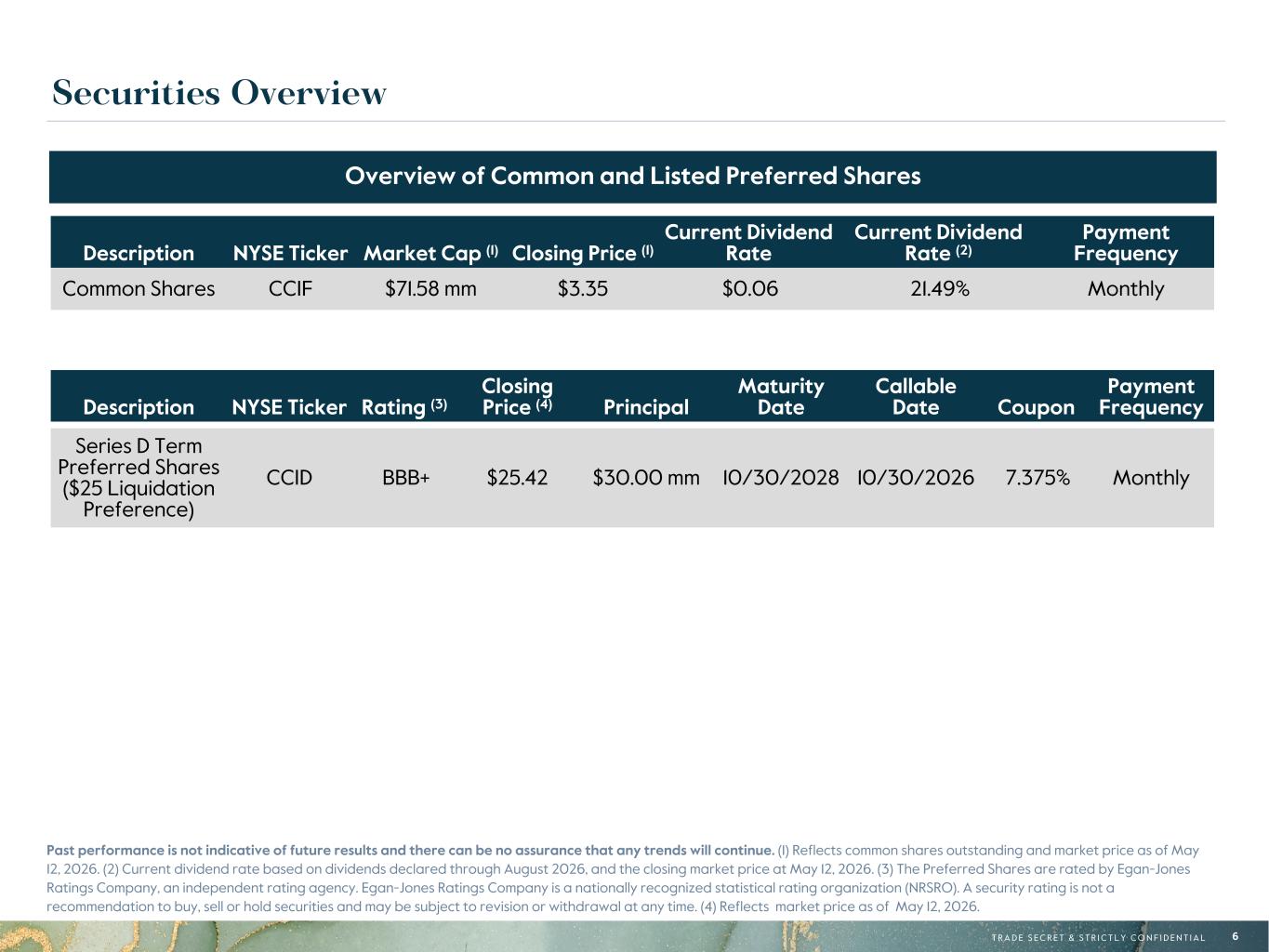
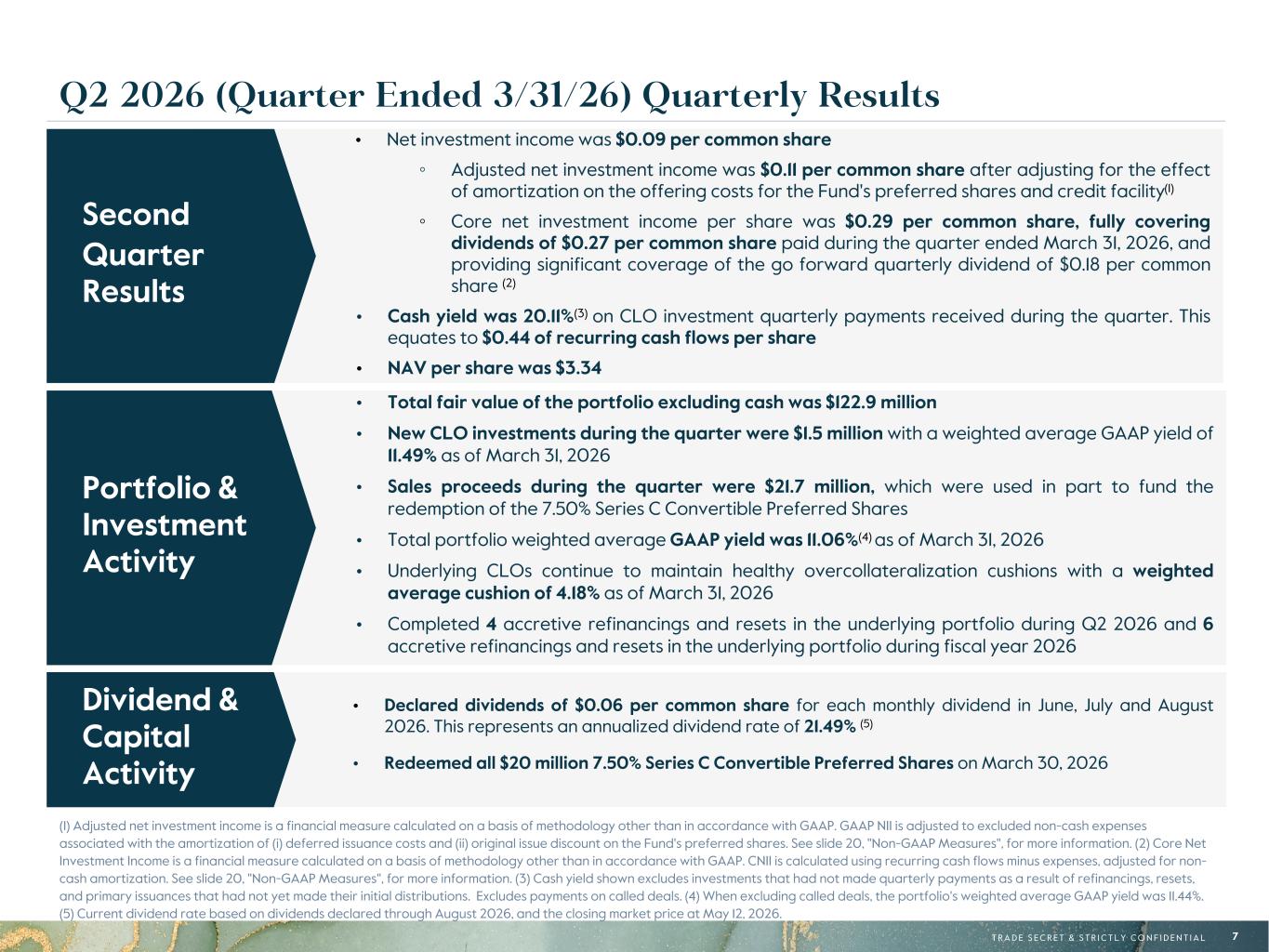
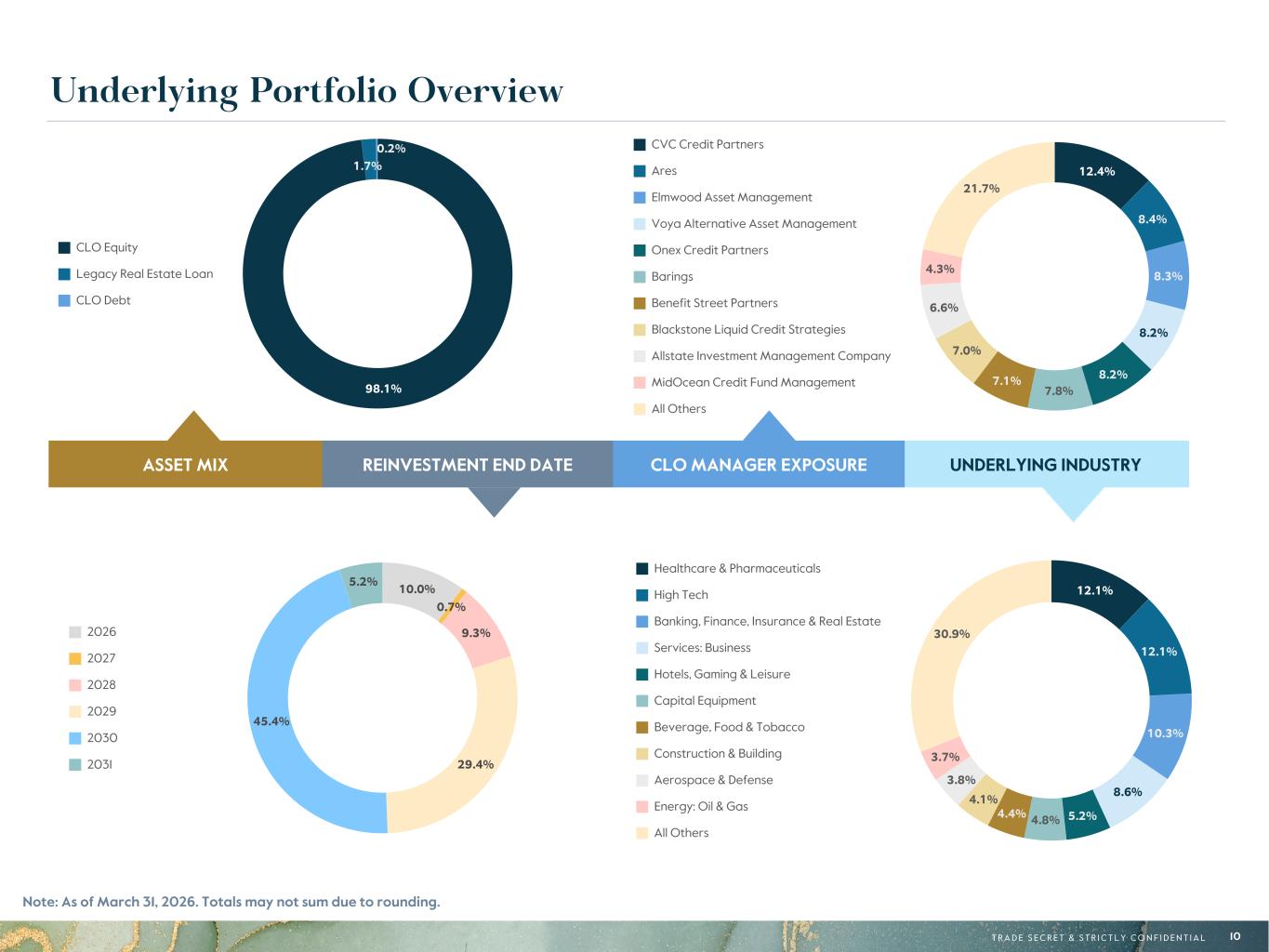
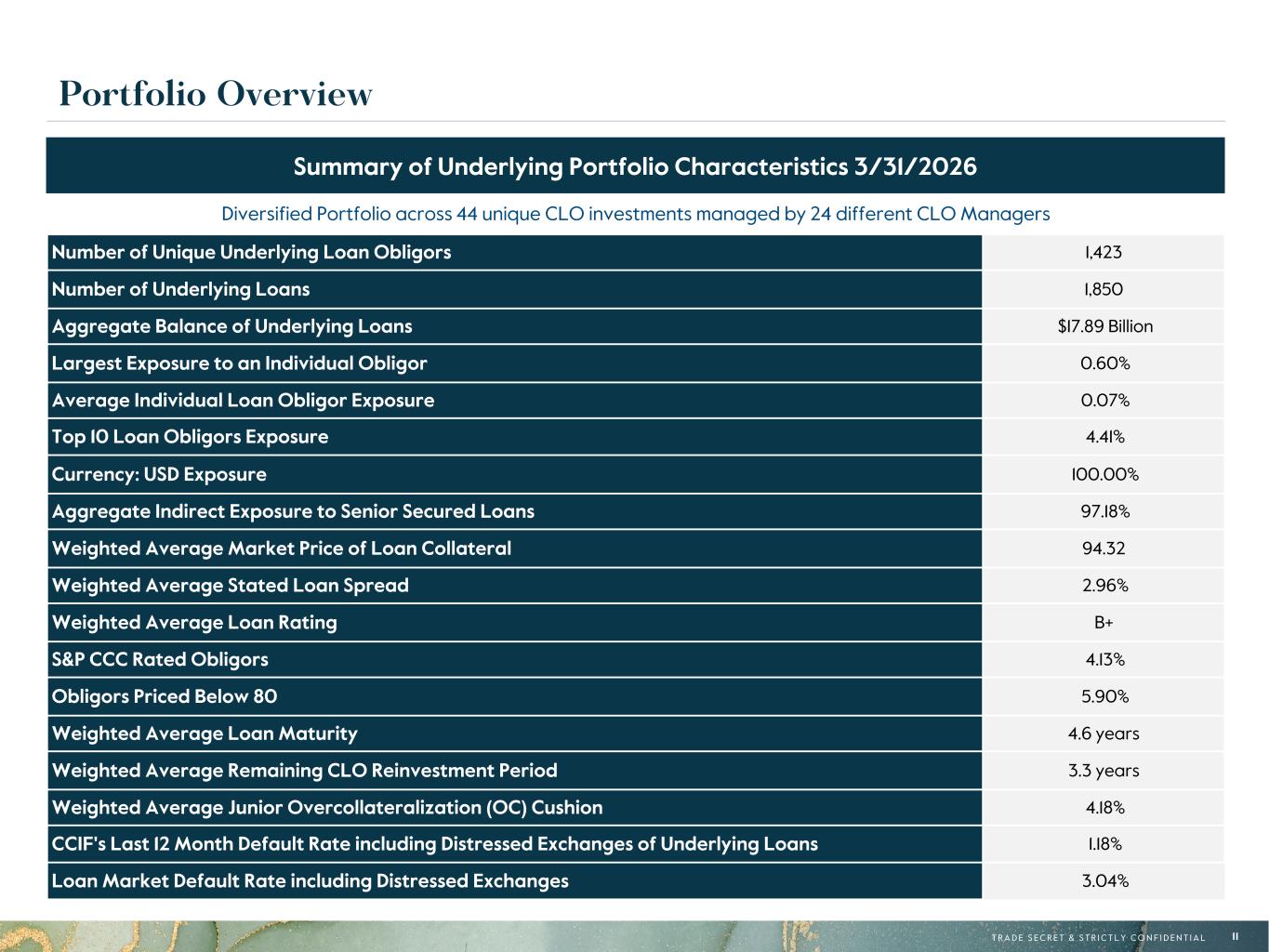
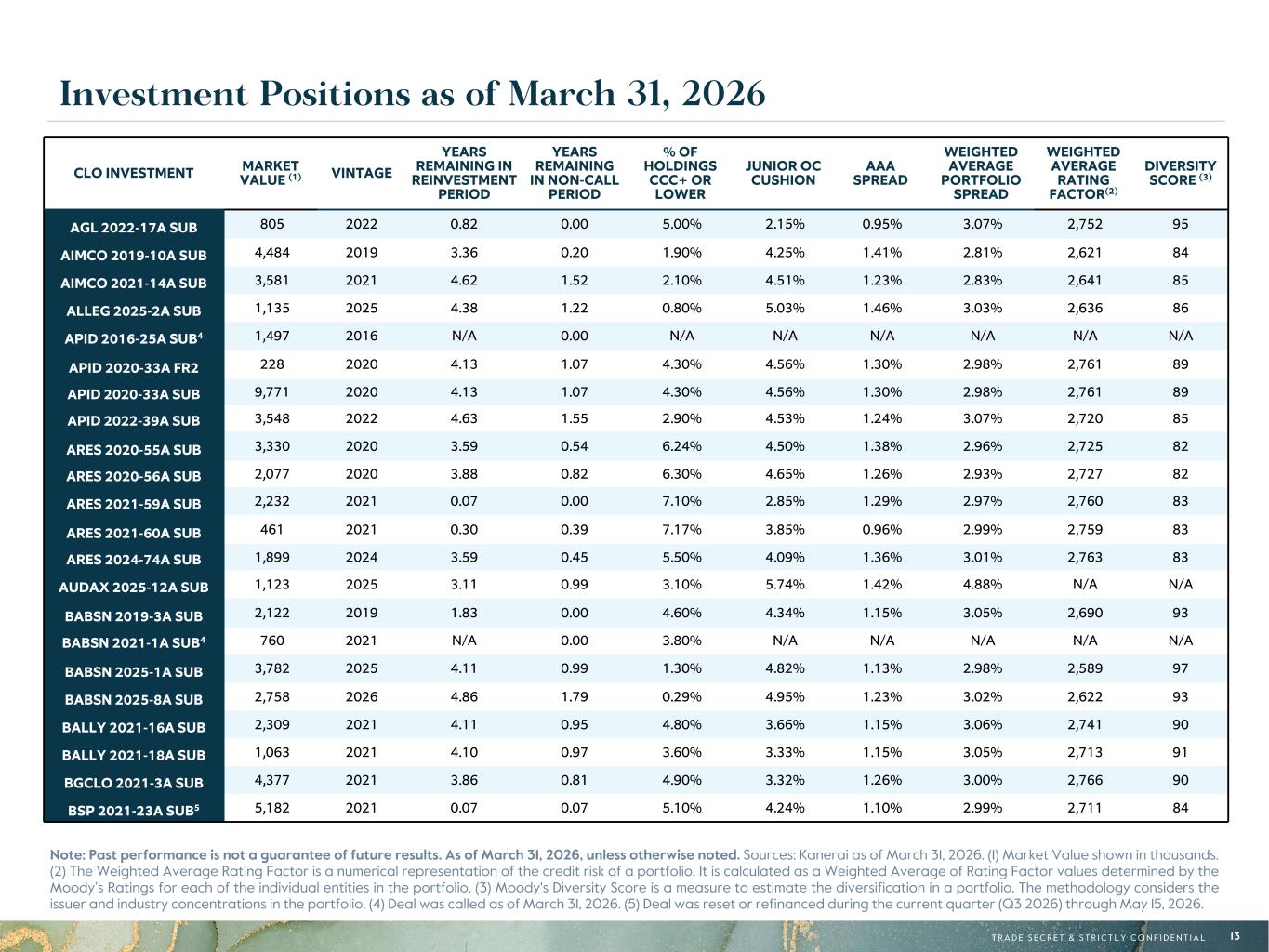
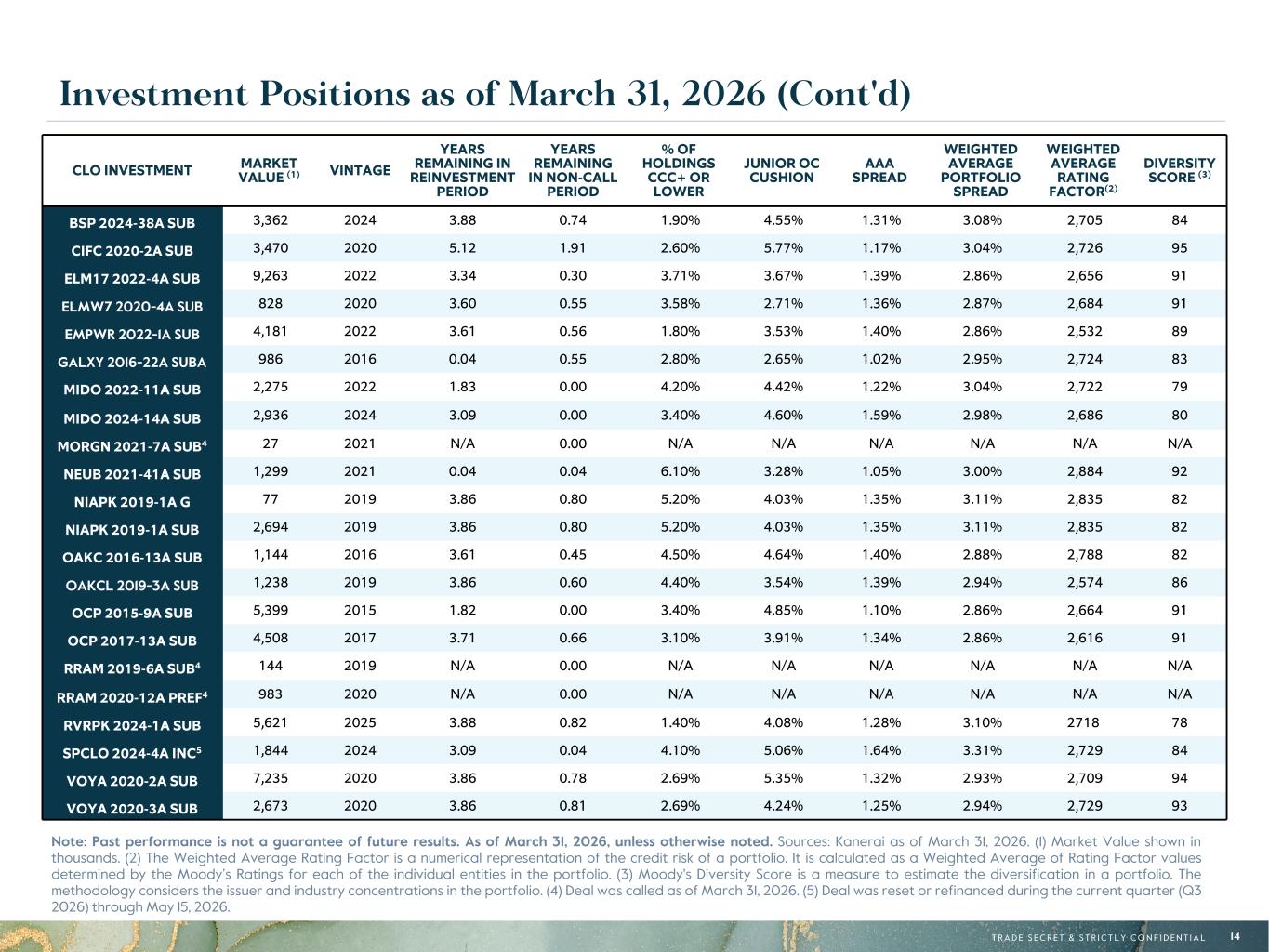
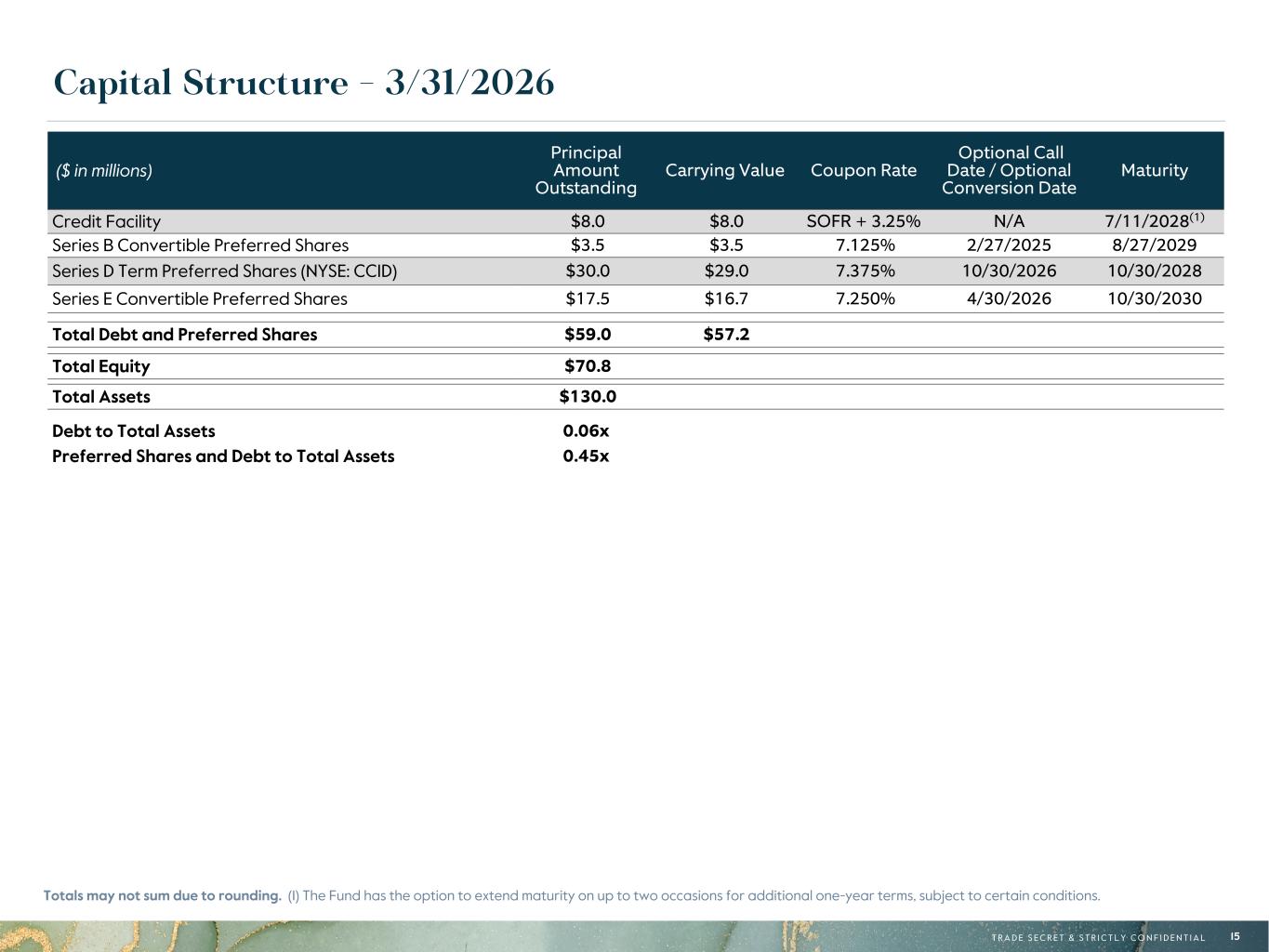
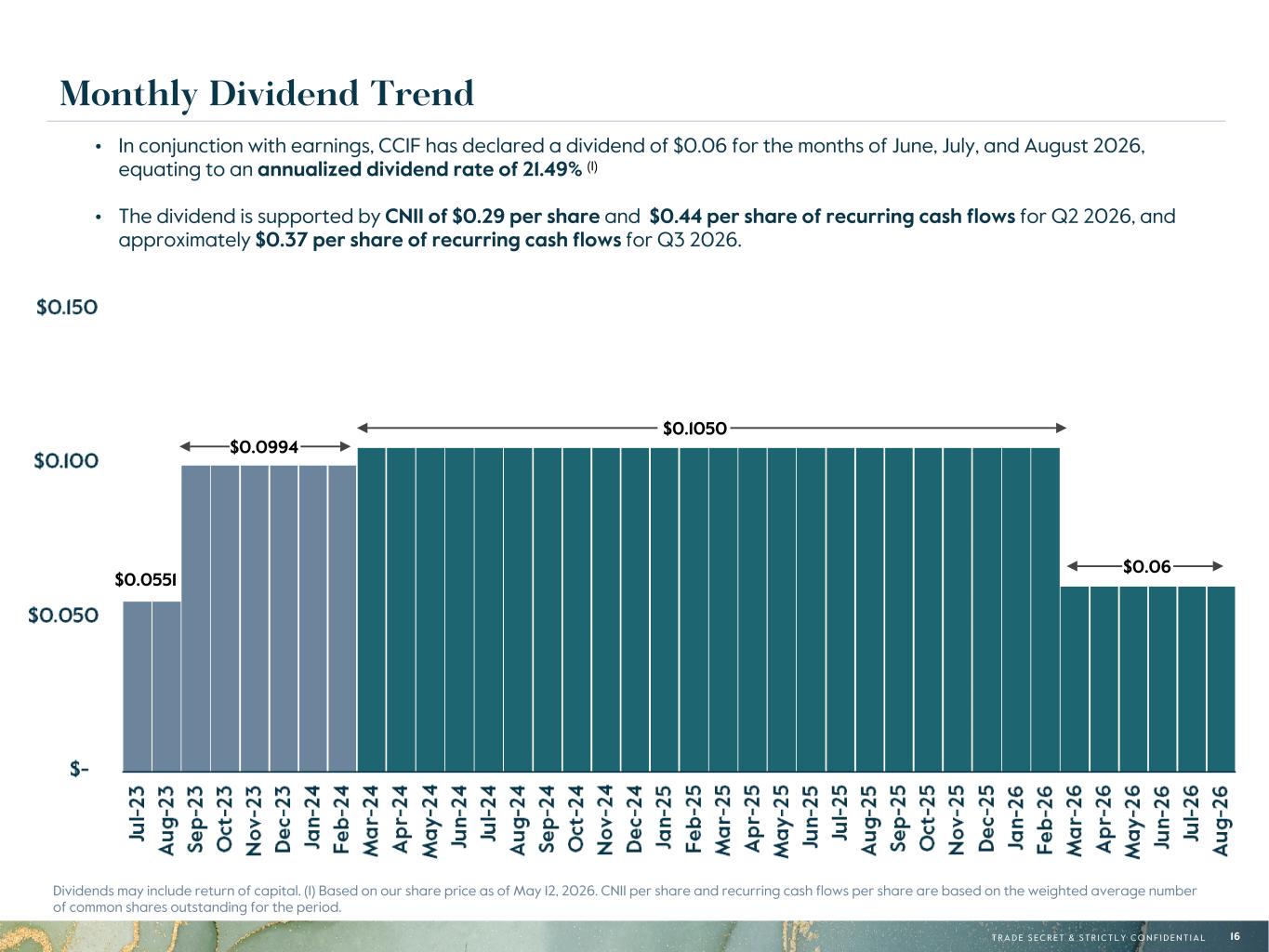
Thanks, Joe. Good morning, everyone, and thank you all for joining CCAS Quarterly Earnings Club. Steel equity market continued to face pressure during the quarter due to a combination of a repricing wave in January, which led to further declines in red-average spreads, weakness in certain software-related loans due to concerns regarding AI disintermediation, and volatility from the conflict in the Middle These factors weighed on loan prices, CELO equity valuations, and CELO equity cash flows across the market and within CCS portfolio. However, underlying credit fundamentals remained broadly stable during the quarter, and the volatility created better balance in the market with very limited repricings in February and March. To navigate this market environment, we continue to focus on optimizing the portfolio, including selectively completing refinancings and restats, and defensively position CCIF with experienced CEO managers and transactions with longer reinvestment periods. I'd like to highlight the fund activities over the last quarter and key stats on the portfolio as of March 31st. We maintain a monthly dividend of $0.06 per share, or 21.5% annualized based on the share price as of May 12th, which is now declared through August 2026. CCIS underlying COO investments generate an annualized cash and cash yield of 20.11% for the quarter, which resulted in $0.44 of recurring cash flows and $0.29 of core net investment income for the quarter at the fund level. Core net investment income provided dividend coverage of 161%, a revised monthly dividend of $0.06 per share. New COO investments during the quarter totaled $1.5 million, with a weighted average gap yield of 11.5%. Total sales proceeds during the quarter totaled $21.7 million, as we used the proceeds to redeem $20 million of the 7.5% Series C convertible preferred shares in cash to reduce leverage. Within CCI's portfolio, we completed four resets in Q2, 2026, in addition to the 26 refinancings and resets completed in calendar year 2025. Refinancings and resets reduce the cost of liabilities in extended investment periods across CELOs and bolster equity cash flows. We expect to continue to refinance and reset the portfolio to enhance returns. The weight average years left during the investment period is decreasing slightly from approximately 3.4 years to 3.3 years. This provides CLI managers the opportunity to capitalize on periods of volatility through active management. There were also zero CLIs in the portfolio that were post reinvestment period as of March 31st. We believe the portfolio weighted average junior over colorization cushion of 4.18% is healthy and offsets potential defaults and losses in the underlying loan portfolios. And the average percentage of loans rated CCC by S&P was 4.1%, below the 7.5% triple C limit in the sale. The weight average spread of the earning loan portfolio was 2.96%, a 10 basis point decline from the prior quarter. The continued decline in weight average spread reflects the cumulative impact of elevated repricing activity over the last several quarters, particularly the very high level of repricing activity experienced in January. Lower loan spreads continue to pressure the earnings for our seal equity as resets and refinancings have not fully offset the spread compression. Importantly, our knowing credit fundamentals across CCS portfolio remain broadly stable. We believe recent COE equity performance has been driven more by valuation and technical factors than broad-based credit deterioration. We remain confident in the resilience of our portfolio, which is diversified across high-quality managers and structured to navigate evolving market conditions. While liability costs have increased and equity distributions have moderated, we believe resilient credit fundamentals and continued demand for floating rate assets will support CELA performance over time. We saw a stabilization of NAVs in April as loan prices partly retraced the declines from earlier this year, and we saw very limited loan repricing. Now, I will switch gears to discuss our outlook. CELA equity continues to benefit from historically attractive liability costs. Any normalization in loan spreads or increase in loan spike improve excess spread generation over time, particularly for deals with longer reinvestment costs. With approximately 17% of the loan market maturing by the end of 2028, we expect heightened refancing activity, which could also lead to spread widening, benefiting SEAL equity. Looking ahead, we believe SEAL equity performance will continue to depend on manager selection, reinvestment discipline, and active credit management. We continue to position CCIF conservatively while selectively deploying capital into opportunities where we believe valuations appropriately compensate investors for underlying risk. We also continue to leverage Carlyle's in-house credit research platform to conduct a detailed bottom-up analysis across underlying loan portfolios, including software-related exposures and involving AI-related risk. CCI's portfolio remains highly diversified across approximately 1,850 underlying loans with exposure to any single issuer representing less than 1% of the portfolio. In addition, the portfolio is predominantly compromised of first lien to use for loans, representing over 97% exposure, which we believe provides meaningful downtime protection and structural resilience. With that, I will now hand a call over to Lauren to discuss the current market advice.
Thank you, Nishal. I'd now like to provide an update on the recent developments across both the loan and CLO market. CLO liability spreads widened modestly across the capital staff, with AAA spreads widening by about five basis points quarter over quarter and BB spreads widening by about 150 basis points. New-issue CLO volume totaled approximately 47 billion during the quarter, compared to 44 billion in the prior year. COO resets and refinancings totaled $28 billion and $23 billion, respectively, down from $57 billion and $37 billion in the first quarter of 2025, as wider liability spreads and increased market volatility reduced refinancing and reset activity during the quarter. The share of U.S. COO loans out of their reinvestment period has declined to roughly 11%, down from about 40% in 2023, reflecting a market with expanded reinvestment capacity. Turning to the low market, leveraged loans experienced modest weakness in the first quarter of 2026 as market volatility increased during this period. The LSTA U.S. Leverage Loan Index declined 60 basis points during the quarter as loan prices declined 2.1%. Similar to prior quarters, issuance activity was largely driven by opportunistic refinance and a significant number of food pricings in January. However, the market also saw an increase in LBO and M&A activity during the quarter, most notably the Electronic Arts LBO, contributing to about $51 billion of quarterly LBO and M&A volumes in the broadly syndicated loan market, the highest quarterly total in more than four years. Credit fundamentals within the U.S. portfolio of over 550 borrowers remained resilient in the fourth quarter of 2025. Free cash flow generation continues to be a key focus, with over 75% of borrowers producing positive free cash flow, supported by the benefit of prior rate cuts and lower spreads on corporate loans. Revenue and EBITDA growth remained positive at 5% and 6% year-over-year, which is similar to what we saw in the third quarter. Interest coverage remained healthy at 3.8 times, with only a small portion of the portfolio below one-time interest coverage. Overall, borrower performance and the credit quality remain broadly stable. While Chapter 11 activity remains moderate relative to historical averages, liability management exercises continue across the market. The broadly syndicated loan default rate, inclusive of liability management exercises, has declined from a recent cycle peak of 4.4% at the end of 2024 to approximately 3% in March and further to 2.8% in April for trading closer to historical averages. With about 70% of the loan market return before the end of 2028, we think the next year will be busy with refinancing transactions. But unlike the last two plus years, some of these transactions should be spread additive. We have not yet seen software companies look to extend their maturities, but we anticipate activity among some of the larger companies with 2028 maturity which should show the market where the true profit capital is for performing software. As capital for data centers remains in high demand we are beginning to see companies access to leverage loan market for financing creating a new source of collateral. Overall given the current geopolitical AI and inflationary risks, we think 2026 will continue to be a year of dispersion with the have and have not experiencing very different outcomes. I will now turn the call to Nelson, our CFO, to discuss the financial results.
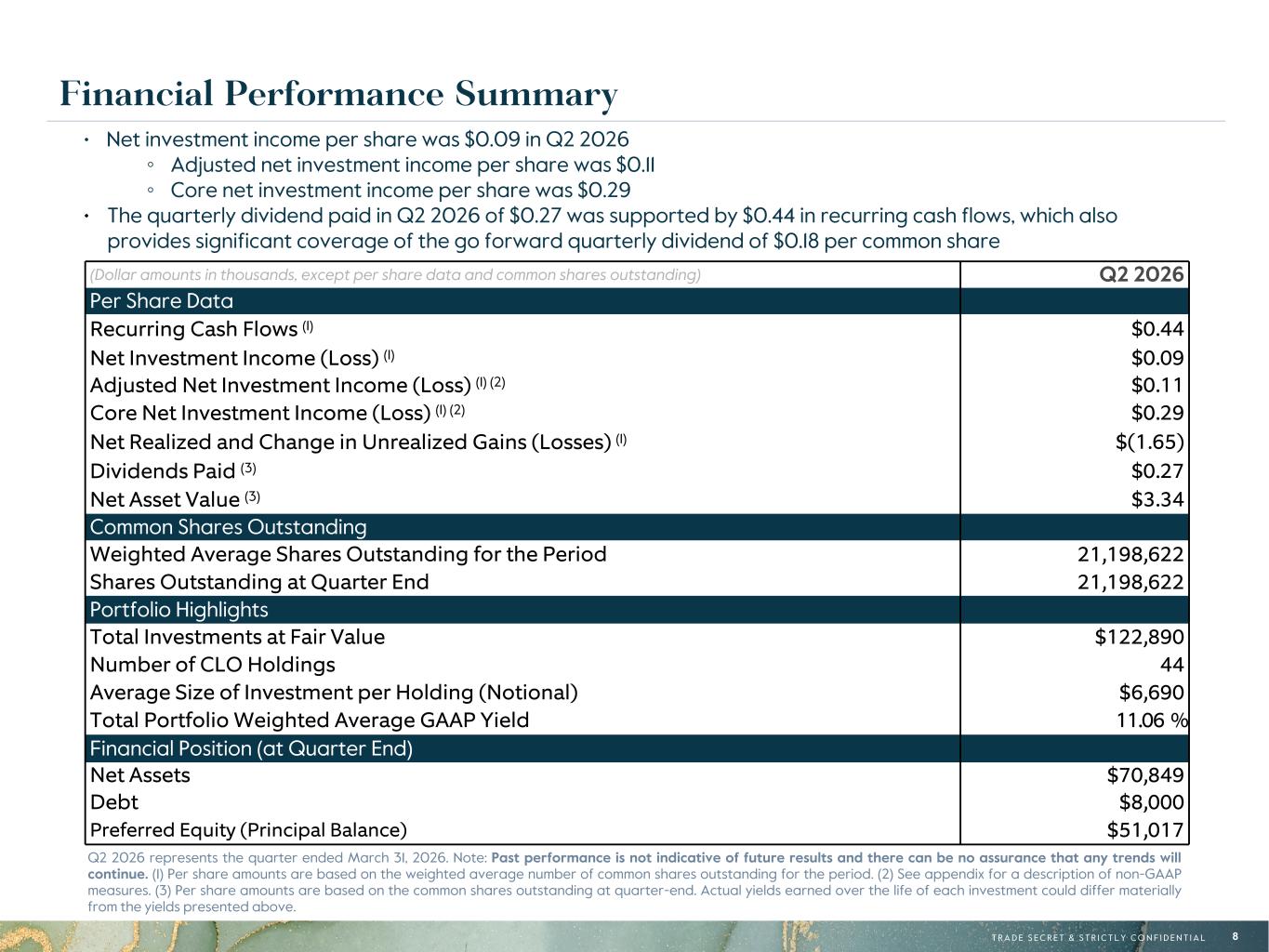
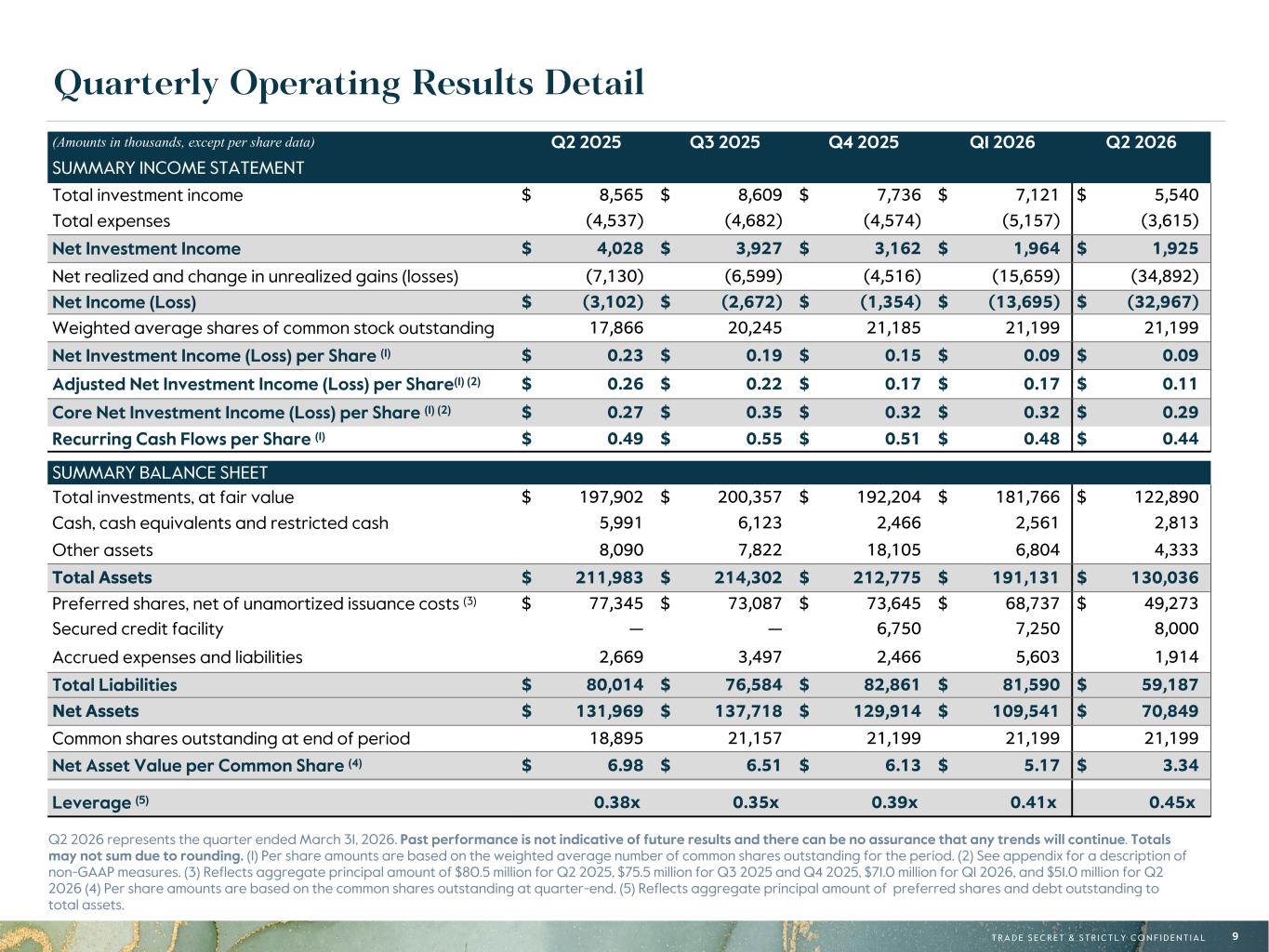
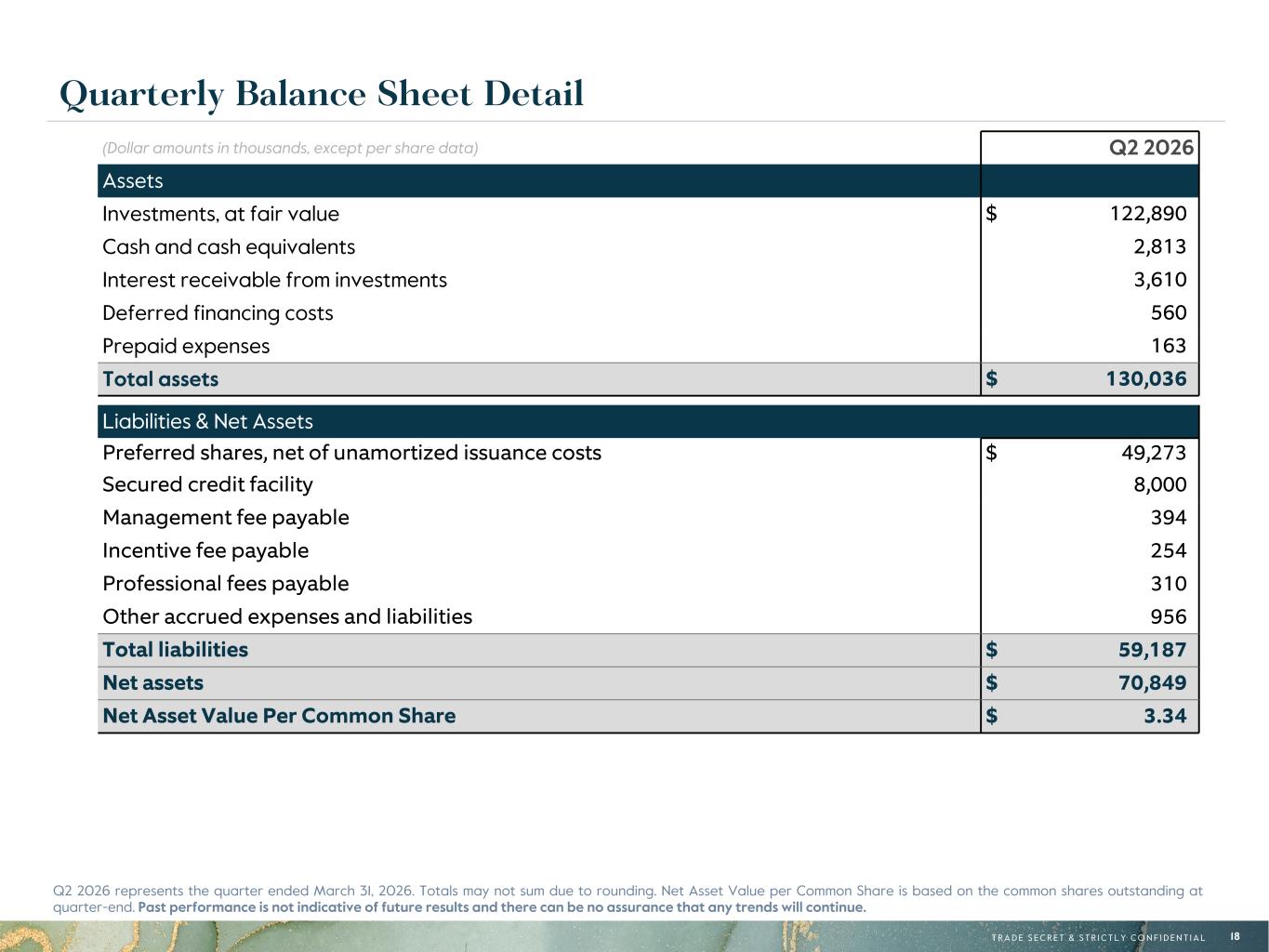
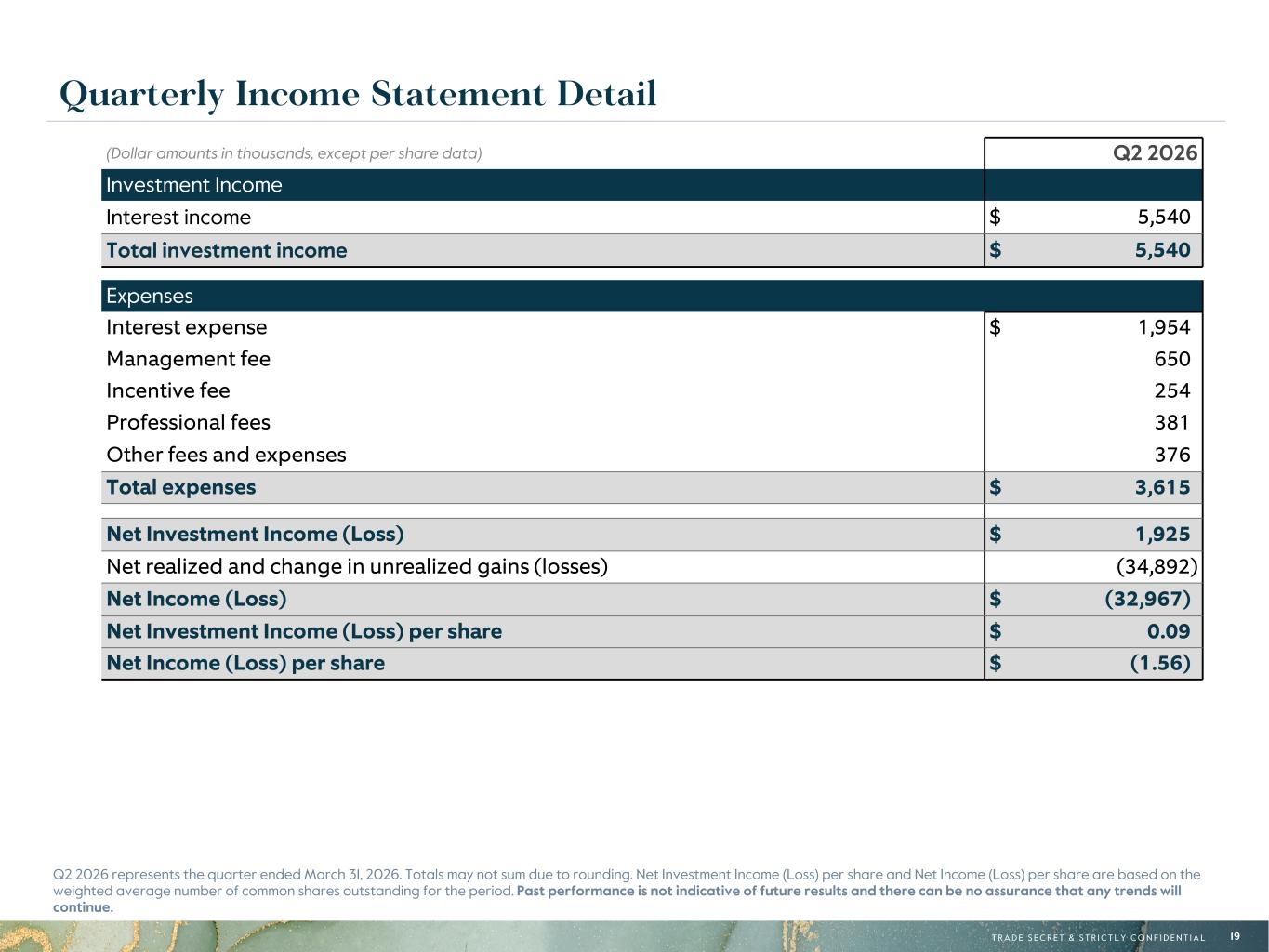
Thank you, Lauren. Today I will begin with a review of our second quarter earnings. Total investment income for the second quarter was $5.5 million or $0.26 per share. Total expenses for the quarter were $3.6 million. Total net investment income for the second quarter was $1.9 million or $0.09 per share. Adjusted net investment income for the second quarter was $2.4 million or $0.11 per share. Adjusted NII adjusts for the $0.02 per share impact and the amortization of the OID and issuance costs for the fund's preferred shares and credit facility. Core net investment income for the second quarter was $0.29 per share, providing dividend coverage of 161% on a revised monthly dividend of $0.06 per share. We believe core net investment income is a more accurate representation of CCIF's distribution requirement. Net asset value as of March 31st was $3.34 per share. Our net asset value and valuations are based on the bid size mark we receive from a third party of 100% of the CLO portfolio. We continue to hold one legacy real estate asset in the portfolio. The fair market value of the loan is $2.2 million. With that, I'll turn it back to initial.
Thanks, Nelson. We remain confident in the fundamentals of CCI's portfolio, which remains the Feds of Lee position in the current market environment. We remain focused on experienced managers and transactions that demonstrate durable power build, strong underlying collateral quality, and a disciplined credit underwriting, including ongoing evaluation of evolving AI-related risk across certain sectors. We are deploying capital selectively, prioritizing opportunities that offer attractive relative value across both new issue and seasoned transactions. We continue to leverage the depth of the Carlisle Liquid Credit platform and are collaborative one-car-all platform to source and invest in high-quality COO portfolios through a disciplined, bottom-up, 15-step investment.
Operator
As a reminder, to ask a question, you'll need to press star-11 on your telephone and wait for your name to be announced. To withdraw your question, please press star-11 again. Please stand by while we compile our Q&A roster. And our first question will be coming from the line of Gaurav Mehta of AGP Alliance Global Partners. your line is open.
Thank you. Good morning. I wanted to ask on the trends you guys are seeing in April. I think you talked about stabilization of NAV and improvement in loan prices. Just want to get some more color on what you guys are seeing in loan repricing and any comments on spreads and yields.
Sorry. I'll talk about the loan repricing. We had seen a period where they stopped, including up until April, but I will say that in May they have started again.
And I would add to that that we have seen the loan market kind of stabilize over the past couple months and as a result we've seen some stabilization in NAV as well.
Second question on recess and refi, can you maybe provide some color on how much opportunity do you have for resets and replies in your portfolio for this year?
Yeah, so look, it's something that we continue to focus on because the best way to offset loan repricings is completing the accretive refinancings and resets. We completed four in the first quarter, and now that CELO debt spreads have tightened in line with kind of overall succinctive market tightening. We expect to continue to be very active in refinancing and resend the portfolio.
All right. Thank you. That's a lot.
Operator
And as a reminder, to ask a question, please press star one one on your telephone. Our next question will be coming from the line of Eric Wick of Lucid Capital Markets. Your line is open, Eric.
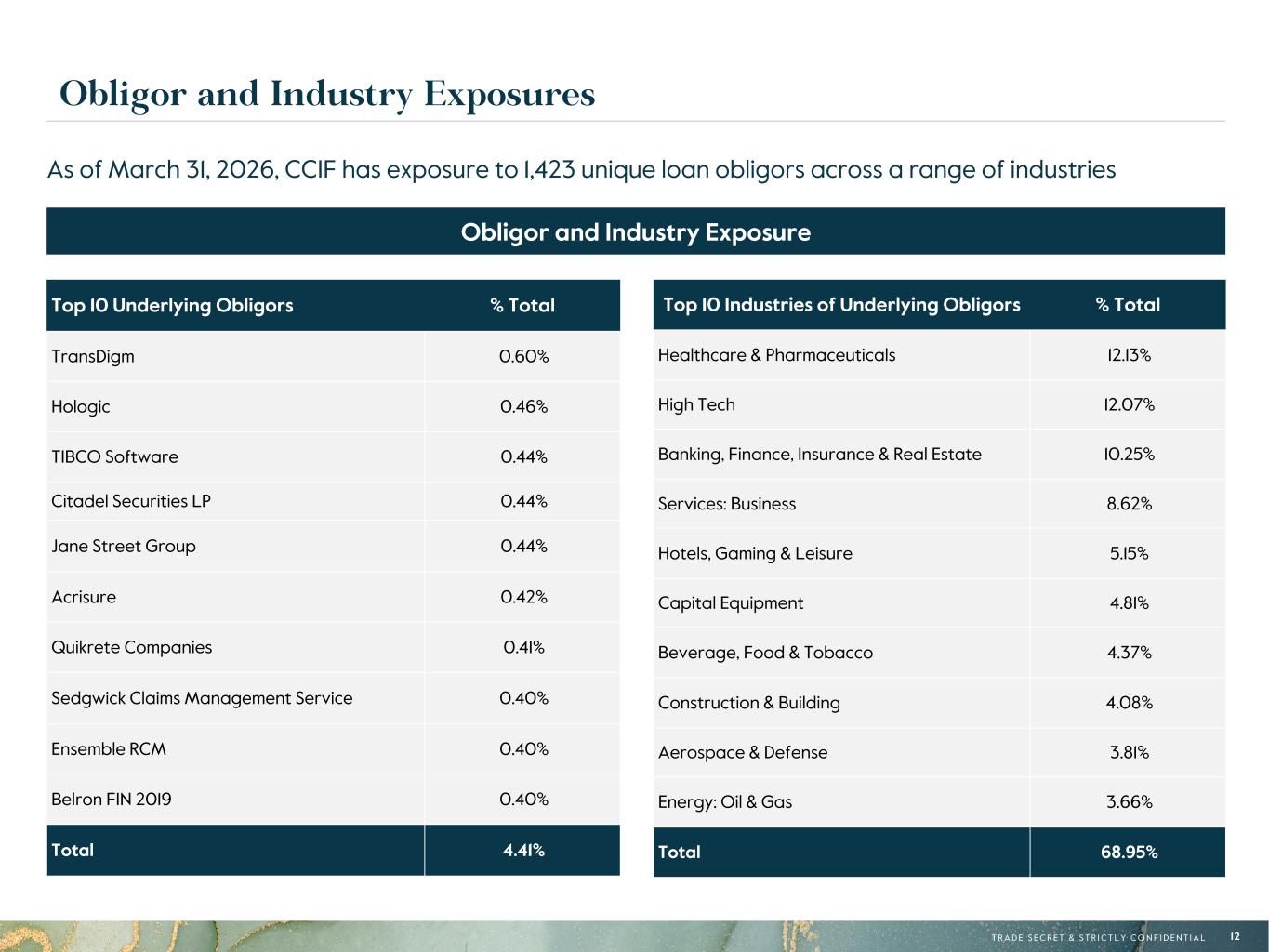
Thanks. Good morning. I wanted to start with a question on software, and I guess it may be a multi-part question. So, if I look at your slide 12 in the right-hand side, I guess the first question is, you know, most of your software exposure in that high-tech category, and then – or is there spillover into other some maybe kind of tangential businesses that utilize software heavily as well? And then kind of the second question is, you know, if you decided you wanted to reduce software exposure in the portfolio, how easy is that to accomplish? Can you have discussions with the CLO issuers or the CLO, you know, primarily just reflective of overall leverage loan issuance? Just kind of curious how, you know, if you wanted to reduce that or change, you know, any sector, how easy is that to accomplish?
Sure. So maybe on the second part, I'll touch upon that. So software right now is around 12% to 13% of the overall loan market, BSL market. And right now, I think for CCIF, it's around 12%. So the way that we can adjust our software exposure, there's two ways. One, we're always looking to optimize our portfolios. So if we see a portfolio where it's not necessarily the amount of software exposure, it's utilizing our in-house credit experts and analysts to do kind of a line-by-line review of each of the loans, really looking at the quality of the software names within each COO. So we can always rotate out of the position if we don't like the risk profile and credit profile of those underlying software names. And then two, we do have discussions with our managers on kind of software exposure, their views on software and kind of what their strategies on software. So we won't necessarily dictate to them in terms of changing their strategy because ultimately they have ultimate discretion, but we can always rotate out of positions and see with managers accordingly. And I think the third is, I think what you're naturally going to see is software exposure decline over time. And that's going to be a market-wide phenomenon. One, you're probably going to see less activity in the software space, less capital markets activity just given everything going on. And then two, as new CLOs are created, we're already seeing that software exposure in newer CLOs are typically closer to half of what the current exposure is. So maybe mid to high single digits.
Thanks, Nisho. That's very helpful and insightful. And second one for me, just what was the driver of realized losses in the most recent quarter?
Yeah, so the one thing that we did is, I think, just prudent management of the capital structure. So given the decline in NAV, our leverage was higher than kind of what our target range is. And so we proactively sold some of our positions and used a proceeds to redeem our CRC, which is around $20 million.
Thanks for taking my questions. Thanks, Eric.
Operator
And I am sharing no further questions. I would now like to turn it back to management for closing remarks.
Thank you all for joining. We look forward to speaking to everyone next quarter, if not sooner. Please feel free to reach out if you have any questions, and thank you again for your support.
Operator
And this concludes today's program. Thank you for participating. You may now disconnect.