
CPOP 20-F
Pop Culture Group Co., Ltd (CPOP)
UNITED STATES
SECURITIES AND EXCHANGE COMMISSION
WASHINGTON, D.C. 20549
FORM
OR
For the fiscal year ended
OR
OR
Date of event requiring this shell company report
For the transition period from to
Commission file number:
(Exact name of Registrant as specified in its charter)
N/A
(Translation of Registrant’s name into English)
(Jurisdiction of incorporation or organization)
The People’s Republic
of
+ 86-0592-5968169
(Address of principal executive offices)
Telephone:
At the address of the Company set forth above
(Name, Telephone, E-mail and/or Facsimile number and Address of Company Contact Person)
Securities registered or to be registered pursuant to Section 12(b) of the Act.
| Title of each class | Trading Symbol(s) | Name of each exchange on which registered | ||
Securities registered or to be registered pursuant to Section 12(g) of the Act.
None
(Title of Class)
Securities for which there is a reporting obligation pursuant to Section 15(d) of the Act.
None
(Title of Class)
Indicate the number of outstanding shares of each of the issuer’s classes of capital or common stock as of the close of the period covered by the annual report.
An aggregate of
Indicate by check mark if the registrant is a well-known seasoned issuer, as defined in Rule 405 of the Securities Act.
Yes ☐
If this report is an annual or transition report, indicate by check mark if the registrant is not required to file reports pursuant to Section 13 or 15(d) of the Securities Exchange Act of 1934.
Yes ☐
Indicate by check mark whether the registrant (1) has filed all reports required to be filed by Section 13 or 15(d) of the Securities Exchange Act of 1934 during the preceding 12 months (or for such shorter period that the registrant was required to file such reports), and (2) has been subject to such filing requirements for the past 90 days.
Indicate by check mark whether the registrant has submitted electronically every Interactive Data File required to be submitted pursuant to Rule 405 of Regulation S-T (§232.405 of this chapter) during the preceding 12 months (or for such shorter period that the registrant was required to submit such files).
Indicate by check mark whether the registrant is a large accelerated filer, an accelerated filer, a non-accelerated filer, or an emerging growth company. See definition of “large accelerated filer,” “accelerated filer,” and “emerging growth company” in Rule 12b-2 of the Exchange Act.
| Large accelerated filer | ☐ | Accelerated filer | ☐ | |
| ☒ | Emerging growth company |
If an emerging growth company that prepares its
financial statements in accordance with U.S. GAAP, indicate by check mark if the registrant has elected not to use the extended transition
period for complying with any new or revised financial accounting standards provided pursuant to Section 13(a) of the Exchange
Act.
Indicate by check mark whether the registrant
has filed a report on and attestation to its management’s assessment of the effectiveness of its internal control over financial
reporting under Section 404(b) of the Sarbanes-Oxley Act (15 U.S.C. 7262(b)) by the registered public accounting firm that
prepared or issued its audit report.
If securities are registered pursuant to Section
12(b) of the Act, indicate by check mark whether the financial statements of the registrant included in the filing reflect the correction
of an error to previously issued financial statements.
Indicate by check mark whether any of those error corrections are restatements that required a recovery analysis of incentive-based compensation received by any of the registrant’s executive officers during the relevant recovery period pursuant to §240.10D 1(b). ☐
Indicate by check mark which basis of accounting the registrant has used to prepare the financial statements included in this filing:
International Financial Reporting Standards as issued by the International Accounting Standards Board ☐ | Other ☐ |
| * | If “Other” has been checked in response to the previous question, indicate by check mark which financial statement item the registrant has elected to follow. Item 17 ☐ Item 18 ☐ |
If this is an annual report, indicate by check
mark whether the registrant is a shell company (as defined in Rule 12b-2 of the Exchange Act). Yes ☐ No
TABLE OF CONTENTS
| INTRODUCTION | iii | |||
| FORWARD-LOOKING INFORMATION | v | |||
| PART I | 1 | |||
| ITEM 1. | IDENTITY OF DIRECTORS, SENIOR MANAGEMENT AND ADVISERS | 1 | ||
| ITEM 2. | OFFER STATISTICS AND EXPECTED TIMETABLE | 1 | ||
| ITEM 3. | KEY INFORMATION | 1 | ||
| ITEM 4. | INFORMATION ON THE COMPANY | 46 | ||
| ITEM 4A. | UNRESOLVED STAFF COMMENTS | 83 | ||
| ITEM 5. | OPERATING AND FINANCIAL REVIEW AND PROSPECTS | 83 | ||
| ITEM 6. | DIRECTORS, SENIOR MANAGEMENT AND EMPLOYEES | 96 | ||
| ITEM 7. | MAJOR SHAREHOLDERS AND RELATED PARTY TRANSACTIONS | 104 | ||
| ITEM 8. | FINANCIAL INFORMATION | 108 | ||
| ITEM 9. | THE OFFER AND LISTING | 111 | ||
| ITEM 10. | ADDITIONAL INFORMATION | 111 | ||
| ITEM 11. | QUANTITATIVE AND QUALITATIVE DISCLOSURES ABOUT MARKET RISK | 119 | ||
| ITEM 12. | DESCRIPTION OF SECURITIES OTHER THAN EQUITY SECURITIES | 120 | ||
i
| PART II | ||||
| ITEM 13. | DEFAULTS, DIVIDEND ARREARAGES AND DELINQUENCIES | 121 | ||
| ITEM 14. | MATERIAL MODIFICATIONS TO THE RIGHTS OF SECURITY HOLDERS AND USE OF PROCEEDS | 121 | ||
| ITEM 15. | CONTROLS AND PROCEDURES | 121 | ||
| ITEM 16. | [RESERVED] | 122 | ||
| ITEM 16A. | AUDIT COMMITTEE FINANCIAL EXPERT | 122 | ||
| ITEM 16B. | CODE OF ETHICS | 122 | ||
| ITEM 16C. | PRINCIPAL ACCOUNTANT FEES AND SERVICES | 122 | ||
| ITEM 16D. | EXEMPTIONS FROM THE LISTING STANDARDS FOR AUDIT COMMITTEES | 122 | ||
| ITEM 16E. | PURCHASES OF EQUITY SECURITIES BY THE ISSUER AND AFFILIATED PURCHASERS | 122 | ||
| ITEM 16F. | CHANGE IN REGISTRANT’S CERTIFYING ACCOUNTANT | 122 | ||
| ITEM 16G. | CORPORATE GOVERNANCE | 123 | ||
| ITEM 16H. | MINE SAFETY DISCLOSURE | 123 | ||
| ITEM 16I. | DISCLOSURE REGARDING FOREIGN JURISDICTIONS THAT PREVENT INSPECTIONS | 123 | ||
| ITEM 16J. | INSIDER TRADING POLICIES | 123 | ||
| ITEM 16K | CYBERSECURITY | 123 | ||
| PART III | ||||
| ITEM 17. | FINANCIAL STATEMENTS | 124 | ||
| ITEM 18. | FINANCIAL STATEMENTS | 124 | ||
| ITEM 19. | EXHIBITS | 124 | ||
ii
INTRODUCTION
In this annual report on Form 20-F, unless the context otherwise requires, references to:
| ● | “China” or the “PRC” are to the People’s Republic of China; |
| ● | “Class A Ordinary Shares” or “Class A ordinary shares” are to Class A ordinary shares of Pop Culture Group (defined below), par value $0.01 per share. On October 26, 2023, we effected a 10-to-1 Share Consolidation (as defined below), as a result of which the par value of Class A Ordinary Shares of the Company increased from $0.001 per share to $0.01 per share; | |
| ● | “Class B Ordinary Shares” or “Class B ordinary shares” are to Class B ordinary shares of Pop Culture Group, par value $0.01 per share. On October 26, 2023, we effected a 10-to-1 Share Consolidation, as a result of which the par value of Class B Ordinary Shares of the Company increased from $0.001 per share to $0.01 per share; | |
| ● | “Class C Ordinary Shares” or “Class C ordinary shares” are to Class C ordinary shares of Pop Culture Group, par value $0.01 per share. On February 5, 2024, shareholders of the Company held an extraordinary general meeting and approved the creation of a new class of shares, Class C Ordinary Shares. The terms of the Class C ordinary shares are the same as Class A ordinary shares, except that holders of Class C ordinary shares are not entitled to vote; | |
| ● | “Heliheng” or “Original WFOE” are to Heliheng Culture Co., Ltd., a limited liability company organized under the laws of the PRC, which is wholly owned by Pop Culture HK (defined below); | |
| ● | “Hualiu” are to Fujian Hualiu Culture & Sports Industry Development Co., Ltd., a limited liability company organized under the laws of the PRC, which is wholly owned by Pop Culture HK (defined below); | |
| ● | “Ordinary Shares” or “ordinary shares” are to are to Class A Ordinary Shares, Class B Ordinary Shares, and Class C Ordinary Shares, as the context requires; | |
| ● | “PRC operating entities” are to Xiamen Pop Culture (defined below) and its subsidiaries; | |
| ● | “Pop Culture Group,” “we,” “us,” “our Company,” or the “Company” are to Pop Culture Group Co., Ltd, an exempted company limited by shares incorporated under the laws of Cayman Islands and when describing the group’s consolidated financial information, also includes the Company’s subsidiaries, the VIE, and the VIE’s subsidiaries; | |
| ● | “Pop Culture HK” are to Pop Culture (HK) Holding Limited, a Hong Kong corporation and wholly owned subsidiary of Pop Culture Group; | |
| ● | “PRC laws and regulations” are to the laws and regulations of mainland China; | |
| ● | “Renminbi” or “RMB” are to the legal currency of China; | |
| ● | “U.S. dollars,” “$,” and “dollars” are to the legal currency of the United States; | |
| ● | “VIE” are to variable interest entity; | |
| ● | “VIE Agreements” are to the contractual arrangements among Hualiu, Xiamen Pop Culture, and the Xiamen Pop Culture Shareholders (defined below); | |
| ● | “WFOE” are to Hualiu, a wholly owned subsidiary of Pop Culture HK; | |
| ● | “Xiamen Pop Culture” or the “VIE” are to Xiamen Pop Culture Co., Ltd., a limited liability company organized under the laws of the PRC; and | |
| ● | “Xiamen Pop Culture Shareholders” are to Zhuoqin Huang, Weiyi Lin, Rongdi Zhang, Chunxiao Cui, Xiayu Cui, Junlong He, Azhen Lin, and Wuyang Chen, who collectively hold 100% of the equity interests in Xiamen Pop Culture. |
iii
On October 9, 2023, we held an extraordinary meeting of shareholders (the “Meeting”), during which the shareholders approved a proposal to effect a share consolidation of each 10 ordinary shares with par value of $0.001 each in our issued and unissued share capital into one ordinary share with par value of $0.01 each (the “Share Consolidation”). The Share Consolidation became effective on October 26, 2023, and the Class A Ordinary Shares began trading on a post-Share Consolidation basis on the Nasdaq Capital Market when the market opened on October 27, 2023 under the same symbol “CPOP” but under a new CUSIP number of G71700 119. No fractional shares were issued in connection with the Share Consolidation. All fractional shares were rounded up to the whole number of shares. Each 10 pre-split ordinary shares outstanding were automatically consolidated to one issued and outstanding ordinary share without any action on the part of the shareholders.
Immediately following the Share Consolidation, the authorized share capital of the Company became $50,000.00 divided into 4,400,000 Class A Ordinary Shares of par value $0.01 each and 600,000 Class B Ordinary Shares of par value $0.01 each.
From a Cayman Islands legal perspective, the Share Consolidation does not have any retroactive effect on our shares prior to the effective date on October 26, 2023. However, references to our ordinary shares in this annual report are stated as having been retroactively adjusted and restated to give effect to the Share Consolidation, as if the Share Consolidation had occurred by the relevant earlier date.
On February 5, 2024, shareholders of the Company held an extraordinary general meeting and approved (1) the increase of the authorized share capital of the Company from $50,000 divided into 4,400,000 Class A ordinary shares of par value $0.01 each and 600,000 Class B ordinary shares of par value $0.01 each, to $60,000 divided into 5,400,000 Class A ordinary shares of par value $0.01 each and 600,000 Class B ordinary shares of par value $0.01 each, and (2) the re-designation and re-classification of 1,000,000 of its authorized but unissued Class A ordinary shares into Class C ordinary shares such that the Company’s authorized share capital is $60,000 divided into 4,400,000 Class A ordinary shares of par value $0.01 each, 600,000 Class B ordinary share of par value $0.01 each, and 1,000,000 Class C ordinary shares of par value $0.01 each. The terms of the Class C ordinary shares are the same as Class A ordinary shares, except that holders of Class C ordinary shares are not entitled to vote.
On March 26, 2024, shareholders of the Company held an extraordinary general meeting at which (1) holders of Class A ordinary shares passed a special resolution approving the variation of the rights of each class of shares currently issued by the Company in such manner and to such extent such that each holder of Class B ordinary shares shall be entitled to exercise 100 votes for each Class B ordinary share they hold (the “Class B Variation”), (2) all shareholders (voting as one class) passed an ordinary resolution approving the increase of the authorized share capital of the Company from $60,000 divided into 4,400,000 Class A ordinary shares of par value $0.01 each, 600,000 Class B ordinary shares of par value $0.01 each and 1,000,000 Class C ordinary shares of par value $0.01 each, to $760,000 divided into 64,400,000 Class A ordinary shares of par value $0.01 each, 10,600,000 Class B ordinary shares of par value $0.01 each and 1,000,000 Class C ordinary shares of par value $0.01 each (the “Share Capital Increase”), and (3) all shareholders (voting as one class) passed a special resolution approving the Company’s adoption of amended and restated memorandum and articles of association reflecting the Class B Variation and Share Capital Increase. The Company separately received written consent from the sole holder of Class B ordinary shares to the Class B variation on January 8, 2024.
On February 10, 2025, shareholders of the Company held an extraordinary general meeting at which (1) it is resolved as an Ordinary Resolution that the authorized share capital of the Company be increased from US$760,000 divided into 64,400,000 Class A Ordinary Shares of par value US$0.01 each, 10,600,000 Class B Ordinary Shares of par value US$0.01 each and 1,000,000 Class C Ordinary Shares of par value US$0.01 each, to US$2,960,000 divided into 264,400,000 Class A Ordinary Shares of par value US$0.01 each, 30,600,000 Class B Ordinary Shares of par value US$0.01 each and 1,000,000 Class C Ordinary Shares of par value US$0.01 each (the “Share Capital Increase”), (2) it is resolved as a Special Resolution that subject to and immediately following the Share Capital Increase being effected, the Company adopt an amended and restated memorandum of association in substitution for, and to the exclusion of, the Company’s current amended and restated memorandum of association to reflect the Share Capital Increase, (3) it is resolved as an Ordinary Resolution that Zhuoqin Huang be re-elected as a director of the Company to hold office in accordance with the articles of association of the Company until the next annual general meeting of the Company, (4) it is resolved as an Ordinary Resolution that Wenjuan Qiu be re-elected as a director of the Company to hold office in accordance with the articles of association of the Company until the next annual general meeting of the Company, (5) it is resolved as an Ordinary Resolution that Azhen Lin be re-elected as a director of the Company to hold office in accordance with the articles of association of the Company until the next annual general meeting of the Company, (6) it is resolved as an Ordinary Resolution that Haiquan Hu be re-elected as a director of the Company to hold office in accordance with the articles of association of the Company until the next annual general meeting of the Company, (7) it is resolved as an Ordinary Resolution that Zhidi Lin be re-elected as a director of the Company to hold office in accordance with the articles of association of the Company until the next annual general meeting of the Company, and (8) it is resolved as an Ordinary Resolution that the re-appointment of WWC, P.C. as the Company’s independent registered public accounting firm for the fiscal year ending 30 June 2025 be confirmed, ratified and approved.
This annual report on Form 20-F includes our audited consolidated financial statements for the fiscal years ended June 30, 2025, 2024, and 2023. In this annual report, we refer to assets, obligations, commitments, and liabilities in our consolidated financial statements in United States dollars. These dollar references are based on the exchange rate of RMB to United States dollars, determined as of a specific date or for a specific period. Changes in the exchange rate will affect the amount of our obligations and the value of our assets in terms of United States dollars which may result in an increase or decrease in the amount of our obligations and the value of our assets.
This annual report contains translations of certain RMB amounts into U.S. dollars at specified rates. Unless otherwise stated, the following exchange rates are used in this annual report:
| June 30, | ||||||||||||
| US$ Exchange Rate | 2025 | 2024 | 2023 | |||||||||
| At the end of the year - RMB | RMB | 7.1636 to $1.00 | RMB | 7.2672 to $1.00 | RMB | 7.2513 to $1.00 | ||||||
| Average rate for the year - RMB | RMB | 7.2143 to $1.00 | RMB | 7.2248 to $1.00 | RMB | 6.9536 to $1.00 | ||||||
iv
FORWARD-LOOKING INFORMATION
This annual report contains statements that constitute forward-looking statements. Many of the forward-looking statements contained in this annual report can be identified by the use of forward-looking words such as “anticipate,” “believe,” “could,” “expect,” “should,” “plan,” “intend,” “estimate,” and “potential,” among others.
Forward-looking statements appear in a number of places in this annual report and include, but are not limited to, statements regarding our intent, belief or current expectations. Forward-looking statements are based on our management’s beliefs and assumptions and on information currently available to our management. Such statements are subject to risks and uncertainties, and actual results may differ materially from those expressed or implied in the forward-looking statements due to of various factors, including, but not limited to, those identified under the section entitled “Item 3. Key Information—3.D. Risk Factors” in this annual report. These risks and uncertainties include factors relating to:
| ● | assumptions about our future financial and operating results, including revenue, income, expenditures, cash balances, and other financial items; |
| ● | our ability to execute our growth, and expansion, including our ability to meet our goals; |
| ● | current and future economic and political conditions; |
| ● | our ability to compete in the highly-competitive Chinese Pop Culture industry; |
| ● | our capital requirements and our ability to raise any additional financing that we may require; |
| ● | our ability to attract clients and further enhance our brand recognition; |
| ● | our ability to hire and retain qualified management personnel and key employees in order to enable us to develop our business; |
| ● | trends and competition in the Chinese Pop Culture industry; and |
| ● | other assumptions described in this annual report underlying or relating to any forward-looking statements. |
These forward-looking statements involve various risks and uncertainties. Although we believe that our expectations expressed in these forward-looking statements are reasonable, our expectations may later be found to be incorrect. Our actual results could be materially different from our expectations. Other sections of this annual report include additional factors that could adversely impact our business and financial performance. Moreover, we operate in an evolving environment. New risk factors and uncertainties emerge from time to time and it is not possible for our management to predict all risk factors and uncertainties, nor can we assess the impact of all factors on our business or the extent to which any factor, or combination of factors, may cause actual results to differ materially from those contained in any forward-looking statements. You should read thoroughly this annual report and the documents that we refer to with the understanding that our actual future results may be materially different from, or worse than, what we expect. We qualify all of our forward-looking statements by these cautionary statements.
The forward-looking statements made in this annual report relate only to events or information as of the date on which the statements are made in this annual report. Except as required by law, we undertake no obligation to update or revise publicly any forward-looking statements, whether as a result of new information, future events or otherwise, after the date on which the statements are made or to reflect the occurrence of unanticipated events. You should read this annual report and the documents that we refer to in this annual report and exhibits to this annual report completely and with the understanding that our actual future results may be materially different from what we expect.
v
Part I
Item 1. IDENTITY OF DIRECTORS, SENIOR MANAGEMENT AND ADVISERS
Not Applicable.
Item 2. OFFER STATISTICS AND EXPECTED TIMETABLE
Not Applicable.
Item 3. KEY INFORMATION
We are a holding company incorporated in the Cayman Islands as an exempted company on January 3, 2020 and not a Chinese operating company. As a holding company, we conduct most of our operations through the VIE and its subsidiaries in the PRC. As of the date of this annual report, the Cayman holding company has conducted certain business operations, include contracting with third-party companies for developing metaverse platforms and operating live music concerts of two popular mandarin singers during 2022 to 2025. For accounting purposes, we control and receive the economic benefits of the business operations of the VIE and its subsidiaries through the VIE Agreements, which enables us to consolidate the financial results of the VIE and its subsidiaries in our consolidated financial statements under generally accepted accounting principles in the United States (“U.S. GAAP”), and the structure involves unique risks to investors. Our securities are securities of Pop Culture Group, the offshore holding company in the Cayman Islands, instead of securities of the VIE or its subsidiaries in the PRC. The VIE structure provides contractual exposure to foreign investment in China-based companies where PRC laws and regulations prohibit direct foreign investment in the operating companies. As a result of our use of the VIE structure, investors may never hold equity interests in the VIE or its subsidiaries.
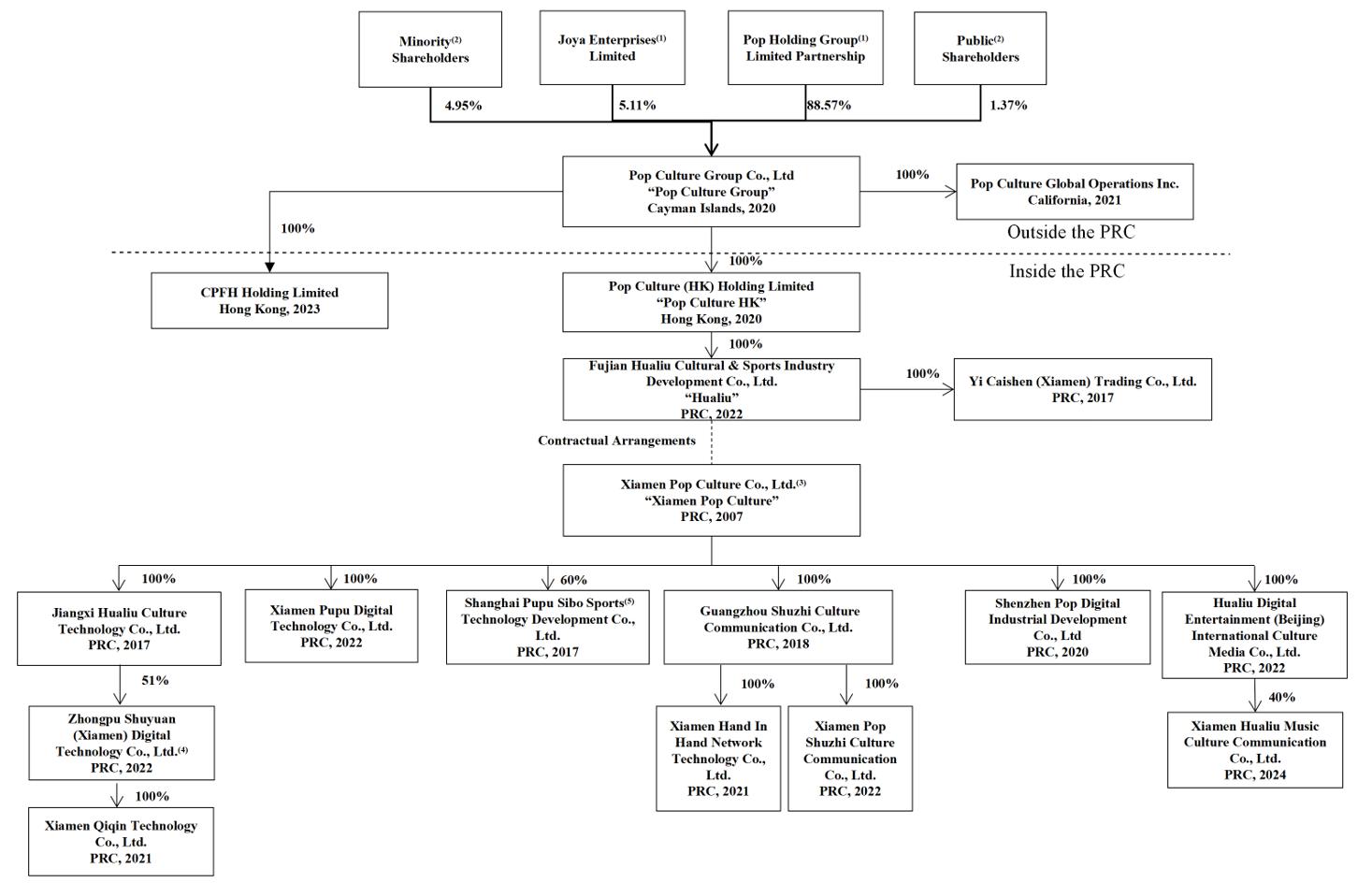
The following diagram illustrates our corporate structure, including our subsidiaries and the VIE and its subsidiaries, as of November 17, 2025:
1
Notes: All percentages reflect the voting ownership interests instead of the equity interests held by each of our shareholders given that each holder of Class B Ordinary Shares is entitled to 100 votes per one Class B Ordinary Share and each holder of Class A Ordinary Shares is entitled to one vote per one Class A Ordinary Share. Holders of our Class C Ordinary Shares carry no vote. As of the date of this annual report, there is no shareholder holding our Class C Ordinary Shares.
| (1) | Represents 1,057,630,800 votes underlying (i) 576,308 Class B Ordinary Shares indirectly held by Zhuoqin Huang, the sole owner of Joya Enterprises Limited, and (ii) 10,000,000 Class B Ordinary Shares indirectly held by Zhuoqin Huang, as the general partner of Pop Holding Group Limited Partnership, as of the date of this annual report. |
| (2) | Represents 71,362,733 votes underlying an aggregate of 71,362,733 Class A Ordinary Shares held by 38 shareholders of Pop Culture Group, each one of which holds less than 5% of our voting ownership interests, as of the date of this annual report. |
| (3) | As of the date of this annual report, Xiamen Pop Culture is held by Zhuoqin Huang as to 64.00%, Weiyi Lin as to 10.02%, Rongdi Zhang as to 9.10%, Chunxiao Cui as to 6.11%, Xiayu Cui as to 6.11%, Junlong He as to 4.42%, Azhen Lin as to 0.12%, and Wuyang Chen as to 0.12%, respectively, together holding 100% of the shares. |
| (4) | Zhongpu Shuyuan (Xiamen) Digital Technology Co., Ltd. is held by Jiangxi Hualiu Culture Technology Co., Ltd. (“Jiangxi Hualiu”), Junpu Jiyuan (Xiamen) Digital Industry Co., Ltd. (“Junpu Jiyuan”) and two unrelated parties. Jiangxi Hualiu holds 30% of the equity interests in Junpu Jiyuan. | |
| (5) | Lei Wang, an employee of the Company, holds 40% of the equity interests in Shanghai Pupu Sibo Sports Technology Development Co., Ltd. (“Pupu Sibo”). |
The VIE Agreements
Neither we nor our subsidiaries own any share in Xiamen Pop Culture or its subsidiaries. Instead, for accounting purposes, we control and receive the economic benefits of the business operations of the VIE and its subsidiaries through the VIE Agreements, which enables us to consolidate the financial results of the VIE and its subsidiaries in our consolidated financial statements under U.S. GAAP. Heliheng, Xiamen Pop Culture, and the Xiamen Pop Culture Shareholders entered into the Original VIE Agreements on March 30, 2020, which were amended and restated on February 19, 2021. The Original VIE Agreements are designed to provide Heliheng with the power, rights, and obligations with respect to Xiamen Pop Culture as set forth under the VIE Agreements. We have evaluated the guidance in Financial Accounting Standards Board Accounting Standards Codification 810 and determined that we are regarded as the primary beneficiary of the VIE for accounting purposes, as a result of our direct ownership in Heliheng and the provisions of the VIE Agreements.
On April 3, 2025, Heliheng Culture Co., Ltd. (the “Original WFOE”), with the approval of the audit committee of the board of directors (the “Audit Committee”) of the Company, entered into a series of termination agreements with Xiamen Pop Culture Co., Ltd. (the “VIE”) and its shareholders (the “Termination Agreements”) to terminate that certain series of variable interest agreements among the Original WFOE, the VIE, and its shareholders, which were entered into on February 19, 2021 (the “Original VIE Agreements”). Pursuant to the Termination Agreements, the Original WFOE no longer has the power, rights, and obligations with respect to the VIE as set forth under the Original VIE Agreements, including (a) an Amended and Restated Exclusive Services Agreement, (b) an Amended and Restated Exclusive Option Agreement, (c) an Amended and Restated Share Pledge Agreement, and (d) Powers of Attorney. Furthermore, the Original WFOE releases the VIE shareholders of their equity pledges.
Entry into New Variable Interest Entity Agreements
On April 3, 2025, Fujian Hualiu Culture & Sports Industry Development Co., Ltd. (the “New WFOE”), an indirect wholly owned subsidiary of the Company, with the approval of the Audit Committee of the Company, entered into a series of variable interest agreements with the VIE and its shareholders (the “VIE Agreements”), including (a) an Exclusive Services Agreement, (b) an Exclusive Option Agreement, (c) a Share Pledge Agreement, (d) Powers of Attorney, and (e) Spousal Consents. The VIE Agreements are designed to provide the New WFOE with the power, rights, and obligations with respect to the VIE as set forth under the VIE Agreements.
2
Each of the VIE Agreements is described in detail below.
Exclusive Services Agreement
Pursuant to the Exclusive Services Agreement between the VIE and the New WFOE, the New WFOE provides the VIE with marketing services, management consultation services, technical support, and other services relating to its day-to-day business operations and management, on an exclusive basis, utilizing its advantages in technology, human resources, and information. For services rendered to the VIE by the New WFOE under the Exclusive Services Agreement, the New WFOE is entitled to collect a service fee equal to 100% of the net income of the VIE, which is the VIE’s earnings before tax after deducting relevant costs and reasonable expenses.
The Exclusive Services Agreement became effective on April 3, 2025 and will remain effective unless otherwise terminated as required by laws or regulations, or by relevant governmental or regulatory authorities. Nevertheless, the Exclusive Services Agreement will be terminated after all shares in the VIE held by the VIE shareholders and/or all the assets of the VIE have been legally transferred to the New WFOE and/or its designee in accordance with the Exclusive Option Agreement executed by and among the New WFOE, the VIE, and its shareholders.
Share Pledge Agreement
Under the Share Pledge Agreement among the New WFOE and the VIE shareholders, together holding 100% of the shares in the VIE, the VIE shareholders pledged their shares in the VIE to the New WFOE to guarantee the performance of the VIE’s obligations under the Exclusive Services Agreement. Under the terms of the Share Pledge Agreement, in the event that the VIE or the VIE shareholders breach their respective contractual obligations under the Exclusive Services Agreement, the New WFOE, as pledgee, will be entitled to certain rights, including, but not limited to, the right to dispose of the pledged shares in accordance with applicable the People’s Republic of China (“PRC”) laws and regulations. The VIE shareholders further agreed not to dispose of the pledged shares or take any action that would prejudice the New WFOE’s interest.
The Share Pledge Agreement is effective until the full payment of the service fees under the Exclusive Services Agreement and upon termination of the VIE’s obligations under the Exclusive Services Agreement, or upon the transfer of shares under the Exclusive Option Agreement executed by and among the New WFOE, the VIE, and its shareholders.
Exclusive Option Agreement
Under the Exclusive Option Agreement, the VIE shareholders, together holding 100% of the shares in the VIE, irrevocably granted the New WFOE (or its designee) an exclusive option to purchase, to the extent permitted under PRC laws and regulations, once or at multiple times, at any time, part or all of their shares in the VIE. The option purchase price is RMB10 or the minimum amount to the extent permitted under PRC laws and regulations, whichever is lower.
The Exclusive Option Agreement remains effective until all the equity of the VIE is legally transferred under the name of the New WFOE and/or other entity or individual designated by it, unless terminated earlier by the New WFOE with a 30-day prior notice.
Shareholders’ Powers of Attorney
Under each of the Powers of Attorney, the VIE shareholders authorized the New WFOE to act on their behalf as their exclusive agent and attorney with respect to all rights as shareholders, including but not limited to: (a) attending shareholders’ meetings, (b) exercising all the shareholder’s rights, including voting, that shareholders are entitled to under PRC laws and regulations and the Articles of Association, including but not limited to the sale or transfer or pledge or disposition of shares in part or in whole, and (c) designating and appointing on behalf of shareholders the legal representative, the executive director, supervisor, the chief executive officer, and other senior management members of the VIE.
The Powers of Attorney are irrevocable and continuously valid from the date of execution of the Powers of Attorney, so long as the VIE shareholders are shareholders of the VIE.
Spousal Consents
The spouses of certain of the VIE shareholders agreed, via a spousal consent, to the execution of the transaction documents as part of the VIE Agreements (the “Transaction Documents”), including: (a) an Exclusive Option Agreement, (b) a Share Pledge Agreement, and (c) Powers of Attorney; and the disposal of the shares of the VIE held by the VIE shareholders and registered in their names.
The spouses of certain of the VIE shareholders undertook not to make any assertions in connection with the shares of the VIE which are held by the VIE shareholders. The spouses of certain of the VIE shareholders confirmed that the VIE shareholders can perform, amend, or terminate the Transaction Documents without their authorization or consent. They undertook to execute all necessary documents and take all necessary actions to ensure appropriate performance of the agreements. The spouses of certain of the VIE shareholders also undertook that if they obtain any share of the VIE which are held by the VIE shareholders for any reasons, they will be bound by the Transaction Documents and comply with the obligations thereunder as shareholders of the VIE. For this purpose, upon the New WFOE’s request, they will sign a series of written documents in substantially the same format and content as the Transaction Documents (as amended from time to time).
3
Risks Associated with Our Corporate Structure and the VIE Agreements
Because we do not directly hold equity interests in the VIE and its subsidiaries, we are subject to risks and uncertainties of the interpretations and applications of PRC laws and regulations, including but not limited to, regulatory review of overseas listing of companies in the PRC through special purpose vehicles and the validity and enforcement of the VIE Agreements. We are also subject to the risks and uncertainties about any future actions of the PRC government in this regard that could disallow the VIE structure, which would likely result in a material change in the VIE’s operations, and the value of our Class A Ordinary Shares may depreciate significantly or become worthless. See “—D. Risk Factors—Risks Relating to Our Corporate Structure,” “—D. Risk Factors—Risks Relating to Doing Business in the PRC,” and “—D. Risk Factors—Risks Relating to Our Class A Ordinary Shares and the Trading Market.” The VIE Agreements have not been tested in a court of law in the PRC as of the date of this annual report.
The VIE Agreements may not be as effective as direct ownership in providing operational control. For instance, Xiamen Pop Culture and the Xiamen Pop Culture Shareholders could breach the VIE Agreements, by, among other things, failing to conduct their operations in an acceptable manner or taking other actions that are detrimental to our interests. The Xiamen Pop Culture Shareholders may not act in the best interests of our Company or may not perform their obligations under these contracts. Such risks exist throughout the period in which we intend to operate certain portions of our business through the VIE Agreements. In the event that Xiamen Pop Culture or the Xiamen Pop Culture Shareholders fail to perform their respective obligations under the VIE Agreements, we may have to incur substantial costs and expend additional resources to enforce such arrangements. In addition, even if legal actions are taken to enforce such arrangements, there is uncertainty as to whether the courts of the PRC would recognize or enforce judgments of U.S. courts against us or such persons predicated upon the civil liability provisions of the securities laws of the U.S. or any state. See “—D. Risk Factors—Risks Relating to Our Corporate Structure—If the PRC government determines that the VIE Agreements do not comply with PRC regulatory restrictions on foreign investment in the relevant industries, or if these regulations or the interpretation of existing regulations change in the future, we could be subject to severe penalties or be forced to relinquish our interests in those operations,” “—D. Risk Factors—Risks Relating to Doing Business in the PRC—Uncertainties in the interpretation and enforcement of PRC laws and regulations could limit the legal protection available to you and us,” “—D. Risk Factors—Risks Relating to Our Corporate Structure—The VIE Agreements may not be effective in providing control over Xiamen Pop Culture,” and “—D. Risk Factors—Risks Relating to Our Corporate Structure—The VIE Agreements are governed by the laws of the PRC and we may have difficulty in enforcing any rights we may have under the VIE Agreements.”
Risks Associated with being based in the PRC
We are subject to certain legal and operational risks associated with being based in the PRC, which could result in a material change in the PRC operating entities’ operations and/or the value of our securities, or could significantly limit or completely hinder our ability to offer or continue to offer securities to investors and cause the value of such securities to significantly decline or be worthless. PRC laws and regulations governing our current business operations are sometimes vague and uncertain. Recently, the PRC government adopted a series of regulatory actions and issued statements to regulate business operations in the PRC with little advance notice, including cracking down on illegal activities in the securities market, adopting new measures to extend the scope of cybersecurity reviews, and expanding the efforts in anti-monopoly enforcement. For example, the General Office of the Central Committee of the Communist Party of China and the General Office of the State Council jointly issued the Opinions on Severely Cracking Down on Illegal Securities Activities According to Law, or the Opinions, which were made available to the public on July 6, 2021. The Opinions emphasized the need to strengthen the administration over illegal securities activities and the need to strengthen the supervision over overseas listings by Chinese companies. On December 28, 2021, the Cyberspace Administration of China, together with 12 other governmental departments of the PRC, jointly promulgated the Measures for Cybersecurity Review (2021 version) (the “Cybersecurity Review Measures”), which became effective on February 15, 2022. The Cybersecurity Review Measures requires that an online platform operator which possesses the personal information of at least one million users must apply for a cybersecurity review by the Cyberspace Administration of China, or the “CAC,” if it intends to be listed in foreign countries. In addition, if a critical information infrastructure operator (“CIIO”) purchases Internet products and services that affect or may affect national security, it should be subject to cybersecurity review by the CAC. In addition, on March 22, 2024, the CAC issued the Provisions on Promoting and Standardizing Cross-Border Data Flows, which set forth the circumstances exempted from performing the security assessment or filing procedures for cross-border data transfer and further clarify the thresholds and scenarios for data processors to go through these procedures as stipulated under the aforementioned measures. As of the date of this annual report, we, our subsidiaries, and the PRC operating entities have not been involved in any investigations on cybersecurity review initiated by any PRC regulatory authority, nor has any of them received any inquiry, notice, or sanction. As confirmed by our PRC counsel, AllBright Law Offices (Xiamen) (“AllBright”), as of the date of this annual report, we are not subject to cybersecurity review with the CAC, under the Cybersecurity Review Measures, or national security review under the Security Administration, as illustrated below, or any other security assessment or filing procedures for cross-border data transfer, since (i) as companies that provide Chinese Pop Culturerelated services to corporate clients, we and the PRC operating entities are unlikely to be classified as CIIOs by the PRC regulatory agencies; (ii) we and the PRC operating entities currently possess personal information of a relatively small number of users in their business operations, significantly less than the one million user threshold set for a data processing operator applying for listing on a foreign exchange that may be required to pass such cybersecurity review, and they do not anticipate that they will be collecting over one million users’ personal information in the foreseeable future; (iii) we and the PRC operating entities do not conduct cross-border transfer of any sensitive personal information or more than one hundred thousand user’s personal information during our business operations, and (iv) since we and the PRC operating entities are in the Chinese Pop Culture industry, data processed in their business is unlikely to have a bearing on national security and therefore is unlikely to be classified as core or important data by the authorities.There remains uncertainty, however, as to how the Cybersecurity Review Measures and the Security Administration will be interpreted or implemented and whether the PRC regulatory agencies, including the CAC, may adopt new laws, regulations, rules, or detailed implementation and interpretation related to the Cybersecurity Review Measures and the Security Administration. See “—D. Risk Factors—Risks Relating to Doing Business in the PRC—Recent greater oversight by the Cyberspace Administration of China over data security, particularly for companies seeking to list on a foreign exchange, could adversely impact our business and our offering.”
4
On February 17, 2023, the China Securities Regulatory Commission (the “CSRC”) promulgated the Trial Administrative Measures of Overseas Securities Offering and Listing by Domestic Companies (the “Trial Measures”) and five supporting guidelines, which came into effect on March 31, 2023. As our registration statement on Form F-1 in connection with our initial public offering was declared effective on June 29, 2021 and we completed our initial public offering and listing on July 2, 2021, we are currently not required to complete the filing procedures pursuant to the Trial Measures. However, in the event that we undertake new offerings or fundraising activities in the future, we may be required to complete the filing procedures. In connection with the Acquisition of Yi Caishen (as defined below in “Item 4. Information on the Company—A. History and Development of the Company”) and the August 2024 PIPE, we are required to complete the filing procedures. According to the Trial Measures, those Chinese companies failing to complete filing procedures may receive a warning from CSRC and be required to rectify the situation, accompanied by a fine ranging from RMB1 million to RMB10 million. The person in charge may receive a warning and be imposed by a fine between RMB500 thousand and RMB5 million. If the controlling shareholder or actual controller of such companies orchestrates or instructs the commission of non-compliance with filing procedures, they will be fined between RMB1 million and RMB10 million. If a securities company or securities service provider fails to perform its duty to urge companies to comply with filing procedures as required by the Trial Measures, it may be warned and face a fine ranging from RMB500 thousand to RMB5 million. The responsible managers and other directly liable personnel may receive a warning and be fined between RMB200 thousand and RMB2 million. As of the date of this annual report, we have not completed the filing procedures for the above transactions nor received any related warnings or fines. Other than the foregoing, as of the date of this annual report, according to AllBright, our PRC legal counsel, no relevant PRC laws or regulations in effect require that we obtain permission from any PRC authorities to issue securities to foreign investors, and we have not received any inquiry, notice, warning, sanction, or any regulatory objection to our offerings from the CSRC, the CAC, or any other PRC authorities that have jurisdiction over our operations. The Standing Committee of the National People’s Congress (the “SCNPC”) or PRC regulatory authorities may in the future promulgate additional laws, regulations, or implementing rules that require us, our subsidiaries, the VIE, and/or the VIE’s subsidiaries to obtain regulatory approval from Chinese authorities for our continued listing in the U.S. If we do not receive or maintain such approval, or inadvertently conclude that such approval is not required, or applicable laws, regulations, or interpretations change such that we are required to obtain approval in the future, we may be subject to an investigation by competent regulators, fines or penalties, or an order prohibiting us from conducting a subsequent offering, and these risks could result in a material adverse change in our operations and the value of our Class A Ordinary Shares, significantly limit or completely hinder our ability to offer or continue to offer securities to investors, or cause such securities to significantly decline in value or become worthless. See “—D. Risk Factors—Risks Relating to Doing Business in the PRC—The Chinese government may exert more oversight and control over overseas public offerings conducted by China-based issuers, which could significantly limit or completely hinder our ability to offer or continue to offer our securities to investors and could cause the value of our securities to significantly decline or become worthless.”
Since 2021, the Chinese government has strengthened its anti-monopoly supervision, mainly in three aspects: (i) establishing the National Anti-Monopoly Bureau; (ii) revising and promulgating anti-monopoly laws and regulations, including: the Anti-Monopoly Law of the PRC (amended on June 24, 2022 and effective on August 1, 2022), the anti-monopoly guidelines for various industries, and the Detailed Rules for the Implementation of the Fair Competition Review System; and (iii) expanding the anti-monopoly law enforcement targeting Internet companies and large enterprises. As of the date of this annual report, the Chinese government’s recent statements and regulatory actions related to anti-monopoly concerns have not impacted our or the PRC operating entities’ ability to conduct business, our ability to accept foreign investments or issue our securities to foreign investors because neither we and our subsidiaries, nor the PRC operating entities engage in monopolistic behaviors that are subject to these statements or regulatory actions.
Permissions Required from PRC Authorities
As of the date of this annual report, we, our PRC subsidiaries, and the PRC operating entities, (i) are not covered by additional permissions or approval requirements from any governmental agency that is required to approve the PRC operating entities’ operations, (ii) have received from PRC authorities all requisite licenses, permissions, and approvals needed to engage in the businesses currently conducted in the PRC, and (iii) no such permission or approval has been denied. These licenses, permissions, and approvals, which have been successfully obtained, are: (i) business licenses; (ii) the Electronic Data Interchange (“EDI”) and Internet Content Provider (“ICP”) Licenses; (iii) the Commercial Performance License; and (iv) the filing-for-record procedures before engaging in non-commercial Internet content service operations.
As advised by our PRC counsel, AllBright, as of the date of this annual report, our Company, our subsidiaries, and the PRC operating entities, (i) are not required to obtain additional permissions or approvals to operate their current business, (ii) are not required to obtain permission from the CSRC, the CAC, or any other Chinese authorities to maintain our listing status on U.S. exchange based on PRC laws and regulations currently in effect, and (iii) have not received or were denied such permission by any Chinese authorities. However, we cannot assure you that the PRC regulatory agencies, including the CAC or the CSRC, would take the same view as we do, and there is no assurance that our PRC subsidiaries and the PRC operating entities are always able to successfully update or renew the licenses or permits required for the relevant business in a timely manner or that these licenses or permits are sufficient to conduct all of their present or future business. If our PRC subsidiaries or the PRC operating entities (i) do not receive or maintain required permissions or approvals, (ii) inadvertently conclude that such permissions or approvals are not required, or (iii) applicable laws, regulations, or interpretations change and our PRC subsidiaries and the PRC operating entities are required to obtain such permissions or approvals in the future, they could be subject to fines, legal sanctions, or an order to suspend their relevant services, which may materially and adversely affect our financial condition and results of operations and cause our securities to significantly decline in value or become worthless.
5
Recently, the General Office of the Central Committee of the Communist Party of China and the General Office of the State Council jointly issued the Opinions, which were made available to the public on July 6, 2021. The Opinions emphasized the need to strengthen the administration over illegal securities activities and the need to strengthen the supervision over overseas listings by Chinese companies. See “—D. Risk Factors—Risks Relating to Doing Business in the PRC—The Chinese government may exert more oversight and control over overseas public offerings conducted by China-based issuers, which could significantly limit or completely hinder our ability to offer or continue to offer our securities to investors and could cause the value of our securities to significantly decline or become worthless.”
According to the Notice on the Administrative Arrangements for the Filing of the Overseas Securities Offering and Listing by Domestic Companies from the CSRC, or “the CSRC Notice,” the domestic companies that have already been listed overseas before the effective date of the Trial Measures (namely, March 31, 2023) shall be deemed as existing issuers (the “Existing Issuers”). Existing Issuers are not required to complete the filing procedures immediately, and they shall be required to file with the CSRC for any subsequent offerings. Further, according to the CSRC Notice, domestic companies that have obtained approval from overseas regulatory authorities or securities exchanges (for example, the effectiveness of a registration statement for offering and listing in the U.S. has been obtained) for their indirect overseas offering and listing prior to March 31, 2023 but have not yet completed their indirect overseas issuance and listing, are granted a six-month transition period from March 31, 2023 to September 30, 2023. Those that complete their indirect overseas offering and listing within such six-month period are deemed as Existing Issuers and are not required to file with the CSRC for their indirect overseas offerings and listings. Within such six-month transition period, however, if such domestic companies fail to complete their indirect overseas issuance and listing, they shall complete the filing procedures with the CSRC.
Based on the foregoing, as our registration statement on Form F-1 in connection with our initial public offering was declared effective on June 29, 2021 and we completed our initial public offering and listing on July 2, 2021, we are currently not required to complete the filing procedures pursuant to the Trial Measures. However, in the event that we undertake new offerings or fundraising activities in the future, we may be required to complete the filing procedures. In connection with the Acquisition of Yi Caishen and the August 2024 PIPE, and the offering made pursuant to the Company’s existing shelf registration statement on Form F-3, which was declared effective on November 18, 2022 by the U.S. Securities and Exchange Commission, the base prospectus filed as part of the Registration Statement, and the prospectus supplement dated September 30, 2025, we are required to complete the filing procedures. According to the Trial Measures, those Chinese companies failing to complete filing procedures may receive a warning from CSRC and be required to rectify the situation, accompanied by a fine ranging from RMB1 million to RMB10 million. The person in charge may receive a warning and be imposed by a fine between RMB500 thousand and RMB5 million. If the controlling shareholder or actual controller of such companies orchestrates or instructs the commission of non-compliance with filing procedures, they will be fined between RMB1 million and RMB10 million. If a securities company or securities service provider fails to perform its duty to urge companies to comply with filing procedures as required by the Trial Measures, it may be warned and face a fine ranging from RMB500 thousand to RMB5 million. The responsible managers and other directly liable personnel may receive a warning and be fined between RMB200 thousand and RMB2 million. As of the date of this annual report, we have completed the filing procedures for the above transactions.
On February 24, 2023, the CSRC, together with the MOF, National Administration of State Secrets Protection and National Archives Administration of China, revised the Provisions on Strengthening Confidentiality and Archives Administration for Overseas Securities Offering and Listing, which were issued by the CSRC and National Administration of State Secrets Protection and National Archives Administration of China in 2009, or the “Provisions.” The revised Provisions were issued under the title the “Provisions on Strengthening Confidentiality and Archives Administration of Overseas Securities Offering and Listing by Domestic Companies,” and came into effect on March 31, 2023 together with the Trial Measures. One of the major revisions to the revised Provisions is expanding their application to cover indirect overseas offering and listing, as is consistent with the Trial Measures. The revised Provisions require that, among other things, (a) a domestic company that plans to, either directly or indirectly through its overseas listed entity, publicly disclose or provide to relevant individuals or entities, including securities companies, securities service providers, and overseas regulators, any documents and materials that contain state secrets or working secrets of government agencies, shall first obtain approval from competent authorities according to law, and file with the secrecy administrative department at the same level; and (b) a domestic company that plans to, either directly or indirectly through its overseas listed entity, publicly disclose or provide to relevant individuals and entities, including securities companies, securities service providers, and overseas regulators, any other documents and materials that, if leaked, will be detrimental to national security or public interest, shall strictly fulfill relevant procedures stipulated by applicable national regulations. Any failure or perceived failure by our Company, our subsidiaries, the VIE, or the VIE’s subsidiaries to comply with the above confidentiality and archives administration requirements under the revised Provisions and other PRC laws and regulations may result in the relevant entities being held legally liable by competent authorities, and referred to the judicial organ to be investigated for criminal liability if suspected of committing a crime.
As there are still uncertainties regarding the interpretation and implementation of such regulatory guidance, we cannot assure you that we will be able to comply with new regulatory requirements relating to our future overseas capital-raising activities and we may become subject to more stringent requirements with respect to matters such as cross-border investigation, data privacy, and enforcement of legal claims. See “—D. Risk Factors—Risks Relating to Doing Business in the PRC—The Opinions, the Trial Measures, and the revised Provisions recently issued by the PRC authorities may subject us to additional compliance requirements in the future.”
6
Other than the foregoing, as of the date of this annual report, we are not aware of any other PRC laws or regulations in effect requiring that we obtain permission or approval from any PRC authorities for our subsidiaries or the PRC operating entities’ operations and to issue securities to foreign investors, and we have not received any inquiry, notice, warning, sanction, or any regulatory objection to our offerings from the CSRC, the CAC, or any other PRC authorities that have jurisdiction over our operations.
In addition, our securities may be prohibited from trading on a national exchange or over-the-counter under the Holding Foreign Companies Accountable Act, as amended by the Consolidated Appropriations Act (as defined below), if the Public Company Accounting Oversight Board (United States), or the “PCAOB,” is unable to inspect our auditor for two consecutive years. Our auditor, WWC, P.C., is an independent registered public accounting firm with the PCAOB, and as an auditor of publicly traded companies in the U.S., is subject to laws in the U.S., pursuant to which the PCAOB conducts regular inspections to assess its compliance with the applicable professional standards. The PCAOB currently has access to inspect the working papers of our auditor and our auditor is not subject to the determinations announced by the PCAOB on December 16, 2021. If trading in our Class A Ordinary Shares is prohibited under the Holding Foreign Companies Accountable Act in the future because the PCAOB determines that it cannot inspect or fully investigate our auditor at such future time, Nasdaq may determine to delist our Class A Ordinary Shares. On June 22, 2021, the U.S. Senate passed the Accelerating Holding Foreign Companies Accountable Act, and on December 29, 2022, legislation entitled “Consolidated Appropriations Act, 2023” (the “Consolidated Appropriations Act”) was signed into law by President Biden, which contained, among other things, an identical provision to the Accelerating Holding Foreign Companies Accountable Act and amended the Holding Foreign Companies Accountable Act by requiring the U.S. Securities and Exchange Commission (the “SEC”) to prohibit an issuer’s securities from trading on any U.S. stock exchanges if its auditor is not subject to PCAOB inspections for two consecutive years instead of three, thus reducing the time period for triggering the prohibition on trading. On August 26, 2022, the CSRC, the Ministry of Finance of the PRC (the “MOF”), and the PCAOB signed a Statement of Protocol (the “Protocol”) governing inspections and investigations of audit firms based in mainland China and Hong Kong, taking the first step toward opening access for the PCAOB to inspect and investigate registered public accounting firms headquartered in mainland China and Hong Kong. Pursuant to the fact sheet with respect to the Protocol disclosed by the SEC, the PCAOB shall have independent discretion to select any issuer audits for inspection or investigation and has the unfettered ability to transfer information to the SEC. On December 15, 2022, the PCAOB Board determined that the PCAOB was able to secure complete access to inspect and investigate registered public accounting firms headquartered in mainland China and Hong Kong and voted to vacate its previous determinations to the contrary. However, should PRC authorities obstruct or otherwise fail to facilitate the PCAOB’s access in the future, the PCAOB Board will consider the need to issue a new determination. See “—D. Risk Factors—Risks Relating to Doing Business in the PRC—Joint statement by the SEC and the PCAOB, rule changes by Nasdaq, and the Holding Foreign Companies Accountable Act all call for additional and more stringent criteria to be applied to emerging market companies upon assessing the qualification of their auditors, especially the non-U.S. auditors who are not inspected by the PCAOB. These developments could add uncertainties to our continued listing or future offerings of our securities in the U.S.”
Asset Transfers Between Our Company, Our Subsidiaries, and the VIE
As of the date of this annual report, our Company, our subsidiaries, and the VIE have not distributed any earnings or settled any amounts owed under the VIE Agreements. Our Company, our subsidiaries, and the VIE do not have any plan to distribute earnings or settle amounts owed under the VIE Agreements in the foreseeable future.
The Company’s management is directly supervising cash management. Our finance department is responsible for establishing the cash management policies and procedures among our subsidiaries and departments and the PRC operating entities. Each subsidiary, department, or PRC operating entity initiates a cash request by putting forward a cash demand plan, which explains the specific amount and timing of cash requested, and submitting it to designated management members of the Company, based on the amount and the use of cash requested. The designated management member examines and approves the allocation of cash based on the sources of cash and the priorities of the needs, and submit it to the cashier specialists of our finance department for a second review. Other than the above, we currently do not have other cash management policies or procedures that dictate how funds are transferred.
During the fiscal years ended June 30, 2025, 2024, and 2023, cash transfers and transfers of other assets between our Company, our subsidiaries, and the VIE were as follows: in September 2022 and January 2023, Pop Culture Group transferred approximately $3,807,000 to Pop Culture HK. In September 2022, October 2022, November 2022, December 2022, February 2023, and April 2023, Heliheng transferred approximately $1,766,000 to Xiamen Pop Culture. During the fiscal year ended June 30, 2024, Pop Culture Group transferred $703,000 to Pop Culture HK and Pop Culture HK transferred $900,000 to Pop Culture Group. During the fiscal year ended June 30, 2024, Xiamen Pop Culture transferred RMB4,972,000 (approximately $684,170) to Heliheng, and Heliheng transferred RMB10,220,000 (approximately $1,415,572) to Xiamen Pop Culture. During the fiscal year ended June 30, 2025, Pop Culture Group transferred $501,000 to Pop Culture HK, Pop Culture HK transferred $500,000 to Hualiu, Pop Culture Group transferred $6,520 to Pop Culture Global, Pop Culture Global transferred $30,000 to Pop Culture Group, Heliheng transferred approximately $1,431,463 to Xiamen Pop Culture, and Xiamen Pop Culture transferred approximately $1,411,433 to Heliheng
7
Dividends or Distributions Made to Our Company and U.S. Investors and Tax Consequences
As of the date of this annual report, none of our subsidiaries or the VIE have made any dividends or distributions to our Company and our Company has not made any dividends or distributions to our shareholders. We intend to keep any future earnings to finance the expansion of our business, and we do not anticipate that any cash dividends will be paid in the foreseeable future. Subject to the passive foreign investment company (“PFIC”) rules, the gross amount of distributions we make to investors with respect to our securities (including the amount of any taxes withheld therefrom) will be taxable as a dividend, to the extent that the distribution is paid out of our current or accumulated earnings and profits, as determined under U.S. federal income tax principles.
Under Cayman Islands law, a Cayman Islands company may pay a dividend on its shares out of either profit or share premium amount, provided that in no circumstances may a dividend be paid if this would result in the company being unable to pay its debts due in the ordinary course of business.
Cash is transferred among our Company, our subsidiaries, and the VIE, in the following manners: (i) funds are transferred to our WFOE, from our Company as needed through Pop Culture HK, our Hong Kong subsidiary, in the form of capital contributions or shareholder loans, as the case may be; (ii) funds may be paid by the VIE to WFOE, as service fees according to the VIE Agreements; (iii) dividends or other distributions may be paid by WFOE, to our Company through Pop Culture HK; and (iv) WFOE and the VIE, lend to and borrow from each other from time to time for business operation purposes.
Relevant PRC laws and regulations permit the companies in the PRC to pay dividends only out of their retained earnings, if any, as determined in accordance with PRC accounting standards and regulations. Additionally, each of the companies in the PRC are required to set aside at least 10% of its after-tax profits each year, if any, to fund a statutory reserve until such reserve reaches 50% of its registered capital. The companies in the PRC are also required to further set aside a portion of their after-tax profits to fund the employee welfare fund, although the amount to be set aside, if any, is determined at their discretion. These reserves are not distributable as cash dividends. Furthermore, in order for us to pay dividends to our shareholders, we will rely on payments made from Xiamen Pop Culture to WFOE, pursuant to the VIE Agreements, and the distribution of such payments to Pop Culture HK as dividends from WFOE, and then to our Company. If our PRC subsidiaries and the PRC operating entities incur debt on their own behalf in the future, the instruments governing the debt may restrict their ability to pay dividends or make other payments to us.
Our cash dividends, if any, will be paid in U.S. dollars. If we are considered a tax resident enterprise of the PRC for tax purposes, any dividends we pay to our overseas shareholders may be regarded as PRC-sourced income and as a result may be subject to PRC withholding tax. See “—D. Risk Factors—Risks Relating to Doing Business in the PRC—Under the PRC Enterprise Income Tax Law, we may be classified as a PRC ‘resident enterprise’ for PRC enterprise income tax purposes. Such classification would likely result in unfavorable tax consequences to us and our non-PRC shareholders and have a material adverse effect on our results of operations and the value of your investment.”
The PRC government also imposes controls on the convertibility of Renminbi into foreign currencies and, in certain cases, the remittance of currency out of the PRC. The majority of our and the PRC operating entities’ income is received in Renminbi and shortages in foreign currencies may restrict our ability to pay dividends or other payments, or otherwise satisfy our foreign currency denominated obligations, if any. Under existing PRC foreign exchange regulations, payments of current account items, including profit distributions, interest payments and expenditures from trade-related transactions, can be made in foreign currencies without prior approval from the State Administration of Foreign Exchange as long as certain procedural requirements are met. Approval from appropriate government authorities is required if Renminbi is converted into foreign currency and remitted out of the PRC to pay capital expenses such as the repayment of loans denominated in foreign currencies. The PRC government may, at its discretion, impose restrictions on access to foreign currencies for current account transactions and if this occurs in the future, we may not be able to pay dividends in foreign currencies to our shareholders.
Any limitation on the ability of our PRC subsidiaries and the PRC operating entities to distribute dividends or other payments to their respective shareholders could materially and adversely limit our ability to conduct operations, make investments, engage in acquisitions, or undertake other activities requiring working capital. However, our operations and business, including investment and/or acquisitions by our PRC subsidiaries and the PRC operating entities within the PRC, will not be affected as long as the capital is not transferred in or out of the PRC.
8
Selected Condensed Consolidating Financial Schedule
As a holding company, we conduct most of our operations through our subsidiaries and the VIE and its subsidiaries in the PRC. As of the date of this annual report, the operations conducted by us, the Cayman holding company, include contracting third-party companies for developing metaverse platforms and operating live music concerts of two popular mandarin singers during 2022 to 2025. Our subsidiaries and the VIE and its subsidiaries as of the date of June 30, 2025 are described below
| Name of Entity | Date of Incorporation/ | Place of Incorporation/ | Effective Interest Held Through Equity Ownership/ Contractual Arrangements | Principal Activities | ||||
| Pop Culture Group | January 3, 2020 | Cayman Islands | 100% | Parent Holding | ||||
| Subsidiaries | ||||||||
| Pop Culture HK | January 20, 2020 | Hong Kong | 100% | Investment holding | ||||
| Heliheng | March 13, 2020 | PRC | 100% | WFOE, consultancy and information technology support | ||||
| Yi Caishen (Xiamen) Trading Co., Ltd. | December 5, 2017 | PRC | 100% | Consultancy and information technology support | ||||
| Huaya Time (Xiamen) Real Estate Management Co., Ltd. | November 27, 2024 | PRC | 100% | Real estate consulting and management | ||||
| Pop Culture Global Operations Inc. (“Pop Culture Global”) | December 3, 2021 | California | 100% | Overseas Chinese Pop Culture resource integration and business development | ||||
| CPFH Holding Limited | December 21, 2023 | Hong Kong | 100% | Digital collection and digital currency | ||||
| Fujian Hualiu Culture & Sports Industry Development Co., Ltd. (“Hualiu”) | July 21, 2022 | PRC | 100% | Holding sports performance activities | ||||
| VIE | ||||||||
| Xiamen Pop Culture | March 29, 2007 | PRC | VIE | Event planning, execution, and hosting | ||||
| VIE’s subsidiaries | ||||||||
| Pupu Sibo | March 30, 2017 | PRC | 60% owned by the VIE | Event planning and execution | ||||
| Jiangxi Hualiu | June 6, 2017 | PRC | 100% owned by the VIE | Marketing |
9
| Guangzhou Shuzhi Culture Communication Co., Ltd. (“Guangzhou Shuzhi”) | December 19, 2018 | PRC | 100% owned by the VIE | Event planning and execution | ||||
| Shenzhen Pop Digital Industrial Development Co., Ltd. (“Shenzhen Pop”) | January 17, 2020 | PRC | 100% owned by the VIE | Event planning and execution | ||||
| Xiamen Pupu Digital Technology Co., Ltd. (“Pupu Digital”) | June 20, 2022 | PRC | 100% owned by the VIE | Cultural technology | ||||
| Hualiu Digital Entertainment (Beijing) International Culture Media Co., Ltd. (“Hualiu Digital”) | April 14, 2022 | PRC | 100% owned by the VIE | Acting broker and self-branding development | ||||
| Zhongpu Shuyuan (Xiamen) Digital Technology Co., Ltd. (“Zhongpu Shuyuan”)* | March 30, 2022 | PRC | 54% owned by the VIE * | Digital collection and Metaverse | ||||
| Xiamen Qiqin Technology Co., Ltd. (“Xiamen Qiqin”) | October 18, 2021 | PRC | 54% owned by the VIE | IPC License | ||||
| Xiamen Pop Shuzhi Culture Communication Co., Ltd. (“Pop Shuzhi”) | May 16, 2022 | PRC | 100% owned by the VIE | Online and offline advertising marketing and exhibitions | ||||
| Xiamen Hand In Hand Network Technology Co., Ltd. | October 25, 2021 | PRC | 99% owned by the VIE | Online digital marketing activities business | ||||
| Xiamen Hualiu Music Culture Communication Co., Ltd. (“Hualiu Music”)** | May 29, 2024 | PRC | 40% owned by the VIE | Cultural and artistic exchange activities, entertainment agent services and public relations services |
| * | Zhongpu Shuyuan is 51% owned by Jiangxi Hualiu and 10% owned by Junpu Jiyuan. Junpu Jiyuan is 30% owned by Jiangxi Hualiu. |
| ** | Through an act in concert arrangement with another shareholder, the Company obtained 20% additional voting rights, combined with its 40% equity investment in Hualiu Music, the Company can control Hualiu Music. |
10
The following tables present selected condensed consolidated financial data of Pop Culture Group and its subsidiaries and the VIE and its subsidiaries for the fiscal years ended June 30, 2025, 2024, and 2023, and balance sheet data as of June 30, 2025 and 2024.
SELECTED CONDENSED CONSOLIDATED STATEMENTS OF INCOME AND COMPREHENSIVE INCOME (LOSS)
| For the Fiscal Year Ended June 30, 2025 | ||||||||||||||||||||
| Pop Culture Group | Subsidiaries | VIE and its Subsidiaries | Eliminations | Consolidated Total | ||||||||||||||||
| Revenue | $ | 2,229,471 | $ | 2,313,921 | $ | 103,089,377 | $ | - | $ | 107,632,769 | ||||||||||
| Cost of revenue | $ | 1,846,249 | $ | 2,072,090 | $ | 99,394,531 | $ | - | $ | 103,312,870 | ||||||||||
| Gross profit | $ | 383,222 | $ | 241,831 | $ | 3,694,846 | $ | - | $ | 4,319,899 | ||||||||||
| Net income | $ | (129,134 | ) | $ | (412,206 | ) | $ | (6,366,796 | ) | $ | 14,645 | $ | (6,893,491 | ) | ||||||
| Comprehensive income | $ | (129,134 | ) | $ | (271,212 | ) | $ | (6,456,394 | ) | $ | 84,314 | $ | (6,772,426 | ) | ||||||
| For the Fiscal Year Ended June 30, 2024 | ||||||||||||||||||||
| Pop Culture Group | Subsidiaries | VIE and its Subsidiaries | Eliminations | Consolidated Total | ||||||||||||||||
| Revenue | $ | 150,000 | $ | 60,066 | $ | 47,171,852 | $ | - | $ | 47,381,918 | ||||||||||
| Cost of revenue | $ | 139,414 | $ | 897 | $ | 44,360,887 | $ | - | $ | 44,501,198 | ||||||||||
| Gross profit | $ | 10,586 | $ | 59,169 | $ | 2,810,965 | $ | - | $ | 2,880,720 | ||||||||||
| Net income | $ | (6,277,109 | ) | $ | (379,370 | ) | $ | (5,975,636 | ) | $ | - | $ | (12,632,115 | ) | ||||||
| Comprehensive income | $ | (6,277,109 | ) | $ | (396,456 | ) | $ | (5,939,998 | ) | $ | (82,236 | ) | $ | (12,695,799 | ) | |||||
| For the Fiscal Year Ended June 30, 2023 | ||||||||||||||||||||
| Pop Culture Group | Subsidiaries | VIE and its Subsidiaries | Eliminations | Consolidated Total | ||||||||||||||||
| Revenue | $ | 257,169 | $ | - | $ | 18,286,074 | $ | - | $ | 18,543,243 | ||||||||||
| Cost of revenue | $ | 150,000 | $ | 312,198 | $ | 21,743,860 | $ | - | $ | 22,206,058 | ||||||||||
| Gross profit | $ | 107,169 | $ | (312,198 | ) | $ | (3,457,786 | ) | $ | - | $ | (3,662,815 | ) | |||||||
| Net income | $ | (25,257,696 | ) | $ | (1,273,299 | ) | $ | (14,053,844 | ) | $ | 15,327,143 | $ | (25,257,696 | ) | ||||||
| Comprehensive income | $ | (25,257,696 | ) | $ | (2,065,384 | ) | $ | (14,936,399 | ) | $ | 15,327,143 | $ | (26,932,336 | ) | ||||||
SELECTED CONDENSED CONSOLIDATED BALANCE SHEETS
| As of June 30, 2025 | ||||||||||||||||||||
| Pop Culture Group | Subsidiaries | VIE and its Subsidiaries | Eliminations | Consolidated Total | ||||||||||||||||
| Cash | $ | 1,356,601 | $ | 727,222 | $ | 842,494 | $ | - | $ | 2,926,317 | ||||||||||
| Receivable from the VIE | $ | 8,117,149 | $ | - | $ | - | $ | (8,117,149 | ) | $ | - | |||||||||
| Total current assets | $ | 21,931,263 | $ | 28,449,213 | $ | 50,962,517 | $ | (33,803,156 | ) | $ | 67,539,837 | |||||||||
| Investments in subsidiaries and the VIE | $ | (266,366 | ) | $ | - | $ | - | $ | 266,366 | $ | - | |||||||||
| Total assets | $ | 21,664,897 | $ | 85,719,001 | $ | 51,503,354 | $ | (44,002,558 | ) | $ | 114,884,694 | |||||||||
| Total liabilities | $ | 83,271 | $ | 65,044,107 | $ | 59,919,371 | $ | (31,775,520 | ) | $ | 93,271,229 | |||||||||
| Total shareholders’ equity | $ | 21,581,626 | $ | 20,674,894 | $ | (8,416,016 | ) | $ | (12,227,039 | ) | $ | 21,613,465 | ||||||||
| Total liabilities and shareholders’ equity | $ | 21,664,897 | $ | 85,719,001 | $ | 51,503,355 | $ | (44,002,559 | ) | $ | 114,884,694 | |||||||||
11
| As of June 30, 2024 | ||||||||||||||||||||
| Pop Culture Group | Subsidiaries | VIE and its Subsidiaries | Eliminations | Consolidated Total | ||||||||||||||||
| Cash | $ | 10,711 | $ | 25,390 | $ | 194,462 | $ | - | $ | 230,563 | ||||||||||
| Receivable from the VIE | $ | 4,408,299 | $ | - | $ | - | $ | (4,408,299 | ) | $ | - | |||||||||
| Total current assets | $ | 8,969,510 | $ | 11,212,627 | $ | 54,695,177 | $ | (33,213,926 | ) | $ | 40,932,053 | |||||||||
| Investments in subsidiaries and the VIE | $ | 6,372,217 | $ | - | $ | - | $ | (6,372,217 | ) | $ | - | |||||||||
| Total assets | $ | 15,341,727 | $ | 21,870,052 | $ | 55,345,910 | $ | (50,322,932 | ) | $ | 42,234,757 | |||||||||
| Total liabilities | $ | 32,795 | $ | 2,768,155 | $ | 57,307,054 | $ | (33,198,421 | ) | $ | 26,909,583 | |||||||||
| Total shareholders’ equity | $ | 15,308,932 | $ | 19,101,897 | $ | (1,961,144 | ) | $ | (17,124,511 | ) | $ | 15,325,174 | ||||||||
| Total liabilities and shareholders’ equity | $ | 15,341,727 | $ | 21,870,052 | $ | 55,345,910 | $ | (50,322,932 | ) | $ | 42,234,757 | |||||||||
SELECTED CONDENSED CONSOLIDATED STATEMENTS OF CASH FLOWS
| For the Fiscal Year Ended June 30, 2025 | ||||||||||||||||||||
| Pop Culture Group | Subsidiaries | VIE and its Subsidiaries | Eliminations | Consolidated Total | ||||||||||||||||
| Net cash used in operating activities | $ | 1,405,078 | $ | 529,607 | $ | (1,741,850 | ) | $ | - | $ | 192,835 | |||||||||
| Net used in investing activities | $ | (9,999,600 | ) | $ | 182,956 | $ | 642,102 | $ | - | $ | (9,174,542 | ) | ||||||||
| Net cash used in (provided by) financing activities | $ | 9,940,412 | $ | (6,279 | ) | $ | 1,740,433 | $ | - | $ | 11,674,566 | |||||||||
| For the Fiscal Year Ended June 30, 2024 | ||||||||||||||||||||
| Pop Culture Group | Subsidiaries | VIE and its Subsidiaries | Eliminations | Consolidated Total | ||||||||||||||||
| cash used in operating activities | $ | (3,384,519 | ) | $ | 2,334,157 | $ | (4,106,484 | ) | $ | - | $ | (5,156,846 | ) | |||||||
| Net used in investing activities | $ | - | $ | (539,915 | ) | $ | (132,899 | ) | $ | - | $ | (672,814 | ) | |||||||
| Net cash used in (provided by) financing activities | $ | 2,300,223 | $ | (2,658,102 | ) | $ | 3,731,488 | $ | - | $ | 3,373,609 | |||||||||
| For the Fiscal Year Ended June 30, 2023 | ||||||||||||||||||||
| Pop Culture Group | Subsidiaries | VIE and its Subsidiaries | Eliminations | Consolidated Total | ||||||||||||||||
| Net cash used in operating activities | $ | (3,390,075 | ) | $ | 100,151 | $ | (2,672,557 | ) | $ | - | $ | (5,962,481 | ) | |||||||
| Net used in investing activities | $ | (4,600,000 | ) | $ | (885,824 | ) | $ | (680,272 | ) | $ | $ | (6,166,096 | ) | |||||||
| Net cash used in (provided by) financing activities | $ | - | $ | - | $ | 683,277 | $ | - | $ | 683,277 | ||||||||||
A. [Reserved]
B. Capitalization and Indebtedness
Not applicable.
C. Reasons for the Offer and Use of Proceeds
Not applicable.
12
D. Risk Factors
Risks Relating to Our Corporate Structure
Our corporate structure, in particular the VIE Agreements, is subject to significant risks, as set forth in the following risk factors.
If the PRC government determines that the VIE Agreements do not comply with PRC regulatory restrictions on foreign investment in the relevant industries, or if these regulations or the interpretation of existing regulations change in the future, we could be subject to severe penalties or be forced to relinquish our interests in those operations.
Foreign ownership of Internet content services and radio and television program production and distribution business is prohibited under current PRC laws and regulations. See “Item 4. Information on the Company—B. Business Overview—Regulations.” Accordingly, we currently operate our radio and television program production and distribution business through Xiamen Pop Culture, a VIE, pursuant to the VIE Agreements. For a description of the VIE Agreements, see “Item 4. Information on the Company—A. History and Development of the Company—The VIE Agreements.”
According to our PRC counsel, AllBright, based on its understandings of the relevant PRC laws and regulations, (i) the ownership structure of Xiamen Pop Culture and Hualiu is currently not in violation of applicable PRC laws and regulations currently in effect; and (ii) each of the VIE Agreements is legal, valid, binding, and enforceable in accordance with its terms and applicable PRC laws and regulations. Our PRC counsel, AllBright, however, has also advised us that there are substantial uncertainties regarding the interpretation and application of current or future PRC laws and regulations. The VIE Agreements have not been tested in a court of law in the PRC as of the date of this annual report. Accordingly, the PRC regulatory authorities may ultimately take a view contrary to the opinion of our PRC counsel. It is uncertain whether any new PRC laws or regulations relating to VIE structures will be adopted or, if adopted, what they would provide.
If our corporate structure and the VIE Agreements are determined as illegal or invalid by the competent court in the PRC, arbitral tribunal, or regulatory authorities, we may be unable to consolidate the financial results of the VIE and its subsidiaries in our consolidated financial statements under U.S. GAAP and have to modify such structure to comply with regulatory requirements. However, there can be no assurance that we can achieve this without material disruption to our business. Further, if our corporate structure and the VIE Agreements are found to be in violation of any existing or future PRC laws or regulations, or we or Xiamen Pop Culture fails to obtain or maintain any required permits or approvals, the relevant regulatory authorities would have broad discretion in dealing with such violations, including:
| ● | revoking the business and/or operating licenses of Hualiu or Xiamen Pop Culture; | |
| ● | discontinuing or restricting the operations of Hualiu or Xiamen Pop Culture; | |
| ● | imposing conditions or requirements with which we, Hualiu, or Xiamen Pop Culture may not be able to comply; | |
| ● | requiring us, Hualiu, or Xiamen Pop Culture to change our corporate structure and the VIE Agreements; | |
| ● | restricting or prohibiting our use of the proceeds from our public offering to finance the PRC operating entities’ business and operations in the PRC; and | |
| ● | imposing fines. |
The imposition of any of these penalties would result in a material and adverse effect on the PRC operating entities’ ability to conduct their business. In addition, it is unclear what impact the PRC government actions would have on us and on our ability to consolidate the financial results of Xiamen Pop Culture in our consolidated financial statements, if the PRC government authorities were to find our legal structure and the VIE Agreements to be in violation of PRC laws and regulations. If the imposition of any of these government actions causes us to lose our right to direct the activities of Xiamen Pop Culture or our right to receive substantially all the economic benefits and residual returns from Xiamen Pop Culture and we are not able to restructure our ownership structure and operations in a satisfactory manner, we would no longer be able to consolidate the financial results of Xiamen Pop Culture in our consolidated financial statements. Either of these results, or any other significant penalties that might be imposed on us in this event, would have a material adverse effect on our financial condition and results of operations, and our securities may significantly decline in value or become worthless.
The VIE Agreements may not be effective in providing control over Xiamen Pop Culture.
We are a holding company incorporated in the Cayman Islands and not a Chinese operating entity. As a holding company, we conduct a substantial majority of our operations through the PRC operating entities. As of the date of this annual report, the operations conducted by us, the Cayman holding company, include contracting third-party companies for develop metaverse platforms and operating live music concerts of two popular mandarin singers during 2022 to 2025. For accounting purposes, we control and receive the economic benefits of the PRC operating entities’ business operations through the VIE Agreements, which enables us to consolidate the financial results of Xiamen Pop Culture in our consolidated financial statements under U.S. GAAP. Our Class A Ordinary Shares are shares of our offshore holding company instead of shares of the PRC operating entities.
13
The VIE Agreements, however, may not be as effective in providing us with the necessary control over Xiamen Pop Culture and its operations. For example, Xiamen Pop Culture and the Xiamen Pop Culture Shareholders could breach the VIE Agreements by, among other things, failing to conduct their operations in an acceptable manner or taking other actions that are detrimental to our interests. If we had direct ownership of Xiamen Pop Culture, we would be able to exercise our rights as a shareholder to effect changes in the board of directors of Xiamen Pop Culture, which in turn could implement changes, subject to any applicable fiduciary obligations, at the management and operational level. Under the current VIE Agreements, however, we rely on the performance by Xiamen Pop Culture and the Xiamen Pop Culture Shareholders of their respective obligations under the contracts to exercise control over Xiamen Pop Culture for accounting purposes. The Xiamen Pop Culture Shareholders may not act in the best interests of our company or may not perform their obligations under these contracts. Such risks exist throughout the period in which we intend to operate certain portions of our business through the VIE Agreements with Xiamen Pop Culture. If any disputes relating to these contracts remain unresolved, we will have to enforce our rights under these contracts through the operations of PRC law and arbitration, litigation, and other legal proceedings and therefore will be subject to uncertainties in the PRC legal system. Therefore, the VIE Agreements may not be as effective in ensuring our control over the relevant portion of our business operations as direct ownership would be.
The VIE Agreements are governed by the laws of the PRC and we may have difficulty in enforcing any rights we may have under the VIE Agreements.
As the VIE Agreements are governed by PRC laws and provide for the resolution of disputes through arbitration in the PRC, they would be interpreted in accordance with PRC law and any disputes would be resolved in accordance with PRC legal procedures. Disputes arising from the VIE Agreements will be resolved through arbitration in the PRC, although these disputes do not include claims arising under the United States federal securities law and thus do not prevent you from pursuing claims under the United States federal securities law. The legal environment in the PRC is not as developed as in the United States. As a result, uncertainties in the PRC legal system could further limit our ability to enforce the VIE Agreements, through arbitration, litigation, and other legal proceedings remain in the PRC, which could limit our ability to enforce the VIE Agreements, and we may not be deemed to have a controlling financial interest in, or be the primary beneficiary of Xiamen Pop Culture for accounting purposes. Furthermore, these contracts may not be enforceable in the PRC if the PRC government authorities or courts take a view that such contracts contravene PRC laws and regulations or are otherwise not enforceable for public policy reasons. In the event we are unable to enforce the VIE Agreements, we may not be able to exert effective control over Xiamen Pop Culture for accounting purposes, and our ability to conduct our business may be materially and adversely affected.
We may not be able to consolidate the financial results of Xiamen Pop Culture or such consolidation could materially and adversely affect our operating results and financial condition.
Our business is conducted through Xiamen Pop Culture, which currently is considered for accounting purposes as a VIE, and we are considered the primary beneficiary, enabling us to consolidate the financial results of Xiamen Pop Culture in our consolidated financial statements. In the event that in the future Xiamen Pop Culture would no longer meet the definition of a VIE, or we are deemed not to be the primary beneficiary, we would not be able to consolidate line by line its financial results in our consolidated financial statements for PRC purposes. Also, if in the future an affiliate company becomes a VIE and we become the primary beneficiary, we would be required to consolidate that entity’s financial results in our consolidated financial statements for PRC purposes. If such entity’s financial results were negative, this could have a corresponding negative impact on our operating results for PRC purposes. However, any material variations in the accounting principles, practices, and methods used in preparing financial statements for PRC purposes from the principles, practices, and methods generally accepted in the United States and in the SEC accounting regulations must be discussed, quantified, and reconciled in financial statements for the U.S. GAAP and SEC purposes.
The VIE Agreements may result in adverse tax consequences.
PRC laws and regulations emphasize the requirement of an arm’s length basis for transfer pricing arrangements between related parties. The laws and regulations also require enterprises with related party transactions to prepare transfer pricing documentation to demonstrate the basis for determining pricing, the computation methodology, and detailed explanations. Related party arrangements and transactions may be subject to challenge or tax inspection by the PRC tax authorizes.
14
Under a tax inspection, if our transfer pricing arrangements between Hualiu and Xiamen Pop Culture are judged as tax avoidance, or related documentation does not meet the requirements, Hualiu and Xiamen Pop Culture may be subject to material adverse tax consequences, such as transfer pricing adjustment. A transfer pricing adjustment could result in a reduction, for PRC tax purpose, of adjustments recorded by Hualiu, which could adversely affect us by (i) increasing Xiamen Pop Culture’s tax liabilities without reducing Hualiu’s tax liabilities, which could further result in interest being levied to us for unpaid taxes; or (ii) imposing late payment fees and other penalties on Xiamen Pop Culture for the adjusted but unpaid taxes according to the applicable regulations. In addition, if Hualiu requests the Xiamen Pop Culture Shareholders to transfer their shares in Xiamen Pop Culture at nominal or no value pursuant to the VIE Agreements, such transfer may be viewed as a gift and subject Hualiu to PRC income tax. As a result, our financial position could be materially and adversely affected if Xiamen Pop Culture’s tax liabilities increase or if it is required to pay late payment fees and other penalties.
The Xiamen Pop Culture Shareholders have potential conflicts of interest with our Company which may adversely affect our business and financial condition.
The Xiamen Pop Culture Shareholders may have potential conflicts of interest with us. These shareholders may not act in the best interest of our Company or may breach, or cause Xiamen Pop Culture to breach the VIE Agreements, which would have a material and adverse effect on our ability to effectively control Xiamen Pop Culture and receive economic benefits from it for accounting purposes. For example, the shareholders may be able to cause the VIE Agreements to be performed in a manner adverse to us by, among other things, failing to remit payments due under the VIE Agreements to us on a timely basis. We cannot assure you that when conflicts of interest arise, any or all of these shareholders will act in the best interests of our Company or such conflicts will be resolved in our favor.
Currently, we do not have any arrangements to address potential conflicts of interest between these shareholders and our Company, except that we could exercise our purchase option under the exclusive option agreements with these shareholders to request them to transfer all of their equity interests in Xiamen Pop Culture to a PRC entity or individual designated by us, to the extent permitted by PRC law. If we cannot resolve any conflicts of interest or disputes between us and those shareholders, we would have to rely on legal proceedings, which may materially disrupt our business. There is also substantial uncertainty as to the outcome of any such legal proceeding.
We rely on the approvals, certificates, and business licenses held by Xiamen Pop Culture and any deterioration of the relationship between Hualiu and Xiamen Pop Culture could materially and adversely affect our overall business operations.
Pursuant to the VIE Agreements, most of our business in the PRC will be undertaken on the basis of the approvals, certificates, business licenses, and other requisite licenses held by Xiamen Pop Culture. See “Item 3. Key Information—Permissions Required from PRC Authorities.” There is no assurance that Xiamen Pop Culture will be able to renew its licenses or certificates when their terms expire with substantially similar terms as the ones they currently hold.
Further, our relationship with Xiamen Pop Culture is governed by the VIE Agreements, which are intended to enable us, through our indirect ownership of Hualiu, to have a controlling financial interest in, and be the primary beneficiary of, Xiamen Pop Culture for accounting purposes. The VIE Agreements, however, may not be effective in providing control over the applications for and maintenance of the licenses required for our business operations. Xiamen Pop Culture could violate the VIE Agreements, go bankrupt, suffer from difficulties in its business, or otherwise become unable to perform its obligations under the VIE Agreements and, as a result, our operations, reputation, business, and stock price could be severely harmed.
The exercise of our option to purchase part or all of the shares in Xiamen Pop Culture under the exclusive option agreement might be subject to certain limitations and substantial costs.
Our exclusive option agreement with Xiamen Pop Culture and the Xiamen Pop Culture Shareholders gives Hualiu the option to purchase up to 100% of the shares in Xiamen Pop Culture. Such transfer of shares may be subject to approvals from, filings with, or reporting to competent PRC authorities, such as the Ministry of Commerce of the PRC (“MOFCOM”), the State Administration for Market Regulation, and/or their local competent branches. In addition, the shares transfer price may be subject to review and tax adjustment by the relevant tax authorities. The shares transfer price to be received by Xiamen Pop Culture under the VIE Agreements may also be subject to enterprise income tax, and these amounts could be substantial.
15
Risks Relating to Doing Business in the PRC
There are uncertainties under the Foreign Investment Law relating to the status of businesses in China controlled by foreign invested projects primarily through contractual arrangements, such as our business.
MOFCOM and the National Development and Reform Commission, or the “NDRC,” promulgated the Special Measures for Foreign Investment Access (2024 version), or the “Negative List,” on September 6, 2024, which became effective on November 1, 2024. According to the Negative List, the value-added telecommunication businesses covered by EDI and ICP, in which the PRC operating entities engage, falls in the “restrictions” category for foreign investors. To comply with PRC laws and regulations, we rely on the VIE Agreements to operate such business in China.
On March 15, 2019, the National People’s Congress approved the Foreign Investment Law of the PRC, which came into effect on January 1, 2020, repealing simultaneously the Law of the PRC on Sino-foreign Equity Joint Ventures, the Law of the PRC on Wholly Foreign-owned Enterprises, and the Law of the PRC on Sino-foreign Cooperative Joint Ventures, together with their implementation rules and ancillary regulations. Pursuant to the Foreign Investment Law, foreign investment refers to any investment activity directly or indirectly carried out by foreign natural persons, enterprises, or other organizations, including investment in new construction project, establishment of foreign funded enterprise or increase of investment, merger and acquisition, and investment in any other way stipulated under laws, administrative regulations, or provisions of the State Council of the PRC (the “State Council”). The Foreign Investment Law does not explicitly stipulate the contractual arrangements as a form of foreign investment. On December 26, 2019, the State Council promulgated the Implementation Regulations on the Foreign Investment Law, which came into effect on January 1, 2020. However, the Implementation Regulations on the Foreign Investment Law still remain silent on whether contractual arrangements should be deemed as a form of foreign investment. Though these regulations do not explicitly classify contractual arrangements as a form of foreign investment, there is still uncertainty regarding whether the VIE would be identified as a foreign-invested enterprise in the future. As a result, there is no assurance that foreign investment via contractual arrangements would not be interpreted as a type of indirect foreign investment activities under the definition in the future.
If we are deemed to have a non-PRC entity as a controlling shareholder, the provisions regarding control through contractual arrangements could apply to the VIE Agreements, and as a result Xiamen Pop Culture could become subject to restrictions on foreign investment, which may materially impact the viability of its current and future operations. Specifically, we may be required to modify our corporate structure, change the PRC operating entities’ current scope of operations, obtain approvals, or face penalties or other additional requirements, compared to entities which do have PRC controlling shareholders. Uncertainties exist with respect to the interpretation and implementation of the Foreign Investment Law and how it may impact the viability of our current corporate structure, corporate governance, and business operations.
It is uncertain whether we would be considered as ultimately controlled by Chinese parties. Mr. Zhuoqin Huang, our chief executive officer, director, and chairman of our board of directors and a PRC citizen, beneficially and indirectly owns and controls 10,576,308 Class B Ordinary Shares, representing approximately 93.68% of the voting rights in our Company. It is uncertain, however, if these factors would be sufficient to give him control over us under the Foreign Investment Law. If future revisions or implementation rules of the Foreign Investment Law mandate further actions, such as the MOFCOM market entry clearance or certain restructuring of our corporate structure and operations, there may be substantial uncertainties as to whether we can complete these actions in a timely manner, if at all, and our business and financial condition may be materially and adversely affected.
16
Changes in China’s economic, political, or social conditions or government policies could have a material adverse effect on the PRC operating entities’ business and operations.
Substantially all of the PRC operating entities’ assets and operations are currently located in China. Accordingly, the PRC operating entities’ business, financial condition, results of operations, and prospects may be influenced to a significant degree by political, economic, and social conditions in China generally. The Chinese economy differs from the economies of most developed countries in many respects, including the level of government involvement, level of development, growth rate, control of foreign exchange, and allocation of resources. Although the Chinese government has implemented measures emphasizing the utilization of market forces for economic reform, including the reduction of state ownership of productive assets and the establishment of improved corporate governance in business enterprises, a substantial portion of productive assets in China is still owned by the government. In addition, the Chinese government continues to play a significant role in regulating industry development by imposing industrial policies. The Chinese government also exercises significant control over China’s economic growth by allocating resources, controlling payment of foreign currency-denominated obligations, setting monetary policy, and providing preferential treatment to particular industries or companies.
While the Chinese economy has experienced significant growth over the past decades, growth has been uneven, both geographically and among various sectors of the economy. Any adverse changes in economic conditions in China, in the policies of the Chinese government, or in the laws and regulations in China could have a material adverse effect on the overall economic growth of China. Such developments could adversely affect the PRC operating entities’ business and operating results, reduce demand for their products, and weaken their competitive position. The Chinese government has implemented various measures to encourage economic growth and guide the allocation of resources. Some of these measures may benefit the overall Chinese economy, but may have a negative effect on the PRC operating entities. For example, the PRC operating entities’ financial condition and results of operations may be adversely affected by government control over capital investments or changes in tax regulations. In addition, in the past the Chinese government has implemented certain measures, including interest rate adjustments, to control the pace of economic growth. These measures may cause decreased economic activities in China, which may adversely affect the PRC operating entities’ business and operating results.
Furthermore, our Company, the PRC operating entities, and our investors may face uncertainty about future actions by the government of China that could significantly affect the PRC operating entities’ financial performance and operations, including the enforceability of the VIE Agreements. As of the date of this annual report, neither our Company nor the VIE has received or was denied permission from Chinese authorities to list on U.S. exchanges. However, there is no guarantee that our Company or the VIE will receive or not be denied permission from Chinese authorities to list on U.S. exchanges in the future.
Uncertainties in the interpretation and enforcement of PRC laws and regulations and changes in policies, rules, and regulations in China, which may be quick with little advance notice, could limit the legal protection available to you and us.
There are substantial uncertainties regarding the interpretation and application of PRC laws and regulations including, but not limited to, the laws and regulations governing our business and the enforcement and performance of our arrangements with third parties in certain circumstances. The laws and regulations are sometimes vague and may be subject to future changes, and their official interpretation and enforcement could be unpredictable, with little advance notice. The effectiveness and interpretation of newly enacted laws or regulations, including amendments to existing laws and regulations, may be delayed, and our business may be affected if we rely on laws and regulations which are subsequently adopted or interpreted in a manner different from our current understanding of these laws and regulations. New laws and regulations that affect existing and proposed future businesses may also be applied retroactively. We cannot predict what effect the interpretation of existing or new PRC laws or regulations may have on our business.
The legal system in the PRC is a civil law system based on written statutes. Unlike the common law system, prior court decisions under the civil law system may be cited for reference but have limited precedential value. In addition, any new or changes in PRC laws and regulations related to foreign investment in the PRC could affect the business environment and our ability to operate our business in the PRC.
From time to time, we may have to resort to administrative and court proceedings to enforce our legal rights. Any administrative and court proceedings in the PRC may be protracted, resulting in substantial costs and diversion of resources and management attention. Since PRC administrative and court authorities have significant discretion in interpreting and implementing statutory and contractual terms, however, it may be more difficult to evaluate the outcome of administrative and court proceedings and the level of legal protection we enjoy in the legal system in the PRC than in more developed legal systems. Furthermore, the legal system in the PRC is based in part on government policies, internal rules, and regulations (some of which are not published in a timely manner or at all) that may have retroactive effect and may change quickly with little advance notice. As a result, we may not be aware of our violation of these policies and rules until sometime after the violation. Such uncertainties, including uncertainties over the scope and effect of our contractual, property (including intellectual property), and procedural rights, and any failure to respond to changes in the regulatory environment in the PRC could materially and adversely affect our business and impede our ability to continue our operations.
Such uncertainties, including the promulgation of new laws, or changes to existing laws or the interpretation or enforcement thereof, could limit the legal protections available to us and our investors, including you.
17
You may experience difficulties in effecting service of legal process, enforcing foreign judgments, or bringing actions in China against us or our management named in this annual report based on foreign laws. It may also be difficult for you or overseas regulators to conduct investigations or collect evidence within China.
As a company incorporated under the laws of the Cayman Islands, we conduct a majority of our operations in China and a majority of our assets are located in China. In addition, all of our senior executive officers reside within China for a significant portion of the time and are PRC nationals. As a result, it may be difficult for you to effect service of process upon those persons inside mainland China. It may be difficult for you to enforce judgements obtained in U.S. courts based on civil liability provisions of the U.S. federal securities laws against us and our officers and directors who do not currently reside in the U.S. or have substantial assets in the U.S. In addition, there is uncertainty as to whether the courts of the Cayman Islands or the PRC would recognize or enforce judgments of U.S. courts against us or such persons predicated upon the civil liability provisions of the securities laws of the U.S. or any state.
The recognition and enforcement of foreign judgments are provided for under the PRC Civil Procedures Law. PRC courts may recognize and enforce foreign judgments in accordance with the requirements of the PRC Civil Procedures Law based either on treaties between China and the country where the judgment is made or on principles of reciprocity between jurisdictions. China does not have any treaties or other forms of written arrangement with the United States that provide for the reciprocal recognition and enforcement of foreign judgments. In addition, according to the PRC Civil Procedures Law, the PRC courts will not enforce a foreign judgment against us or our directors and officers if they decide that the judgment violates the basic principles of PRC laws or national sovereignty, security, or public interest. As a result, it is uncertain whether and on what basis a PRC court would enforce a judgment rendered by a court in the United States.
It may also be difficult for you or overseas regulators to conduct investigations or collect evidence within China. For example, in China, there are significant legal and other obstacles to obtaining information needed for shareholder investigations or litigation outside China or otherwise with respect to foreign entities. Although the authorities in China may establish a regulatory cooperation mechanism with its counterparts of another country or region to monitor and oversee cross border securities activities, such regulatory cooperation with the securities regulatory authorities in the United States may not be efficient in the absence of a practical cooperation mechanism. Furthermore, according to Article 177 of the PRC Securities Law, or “Article 177,” which became effective in March 2020, no overseas securities regulator is allowed to directly conduct investigations or evidence collection activities within the territory of the PRC. Article 177 further provides that Chinese entities and individuals are not allowed to provide documents or materials related to securities business activities to foreign agencies without prior consent from the securities regulatory authority of the State Council and the competent departments of the State Council. While detailed interpretation of or implementing rules under Article 177 have yet to be promulgated, the inability for an overseas securities regulator to directly conduct investigation or evidence collection activities within China may further increase difficulties faced by you in protecting your interests.
18
Given the Chinese government’s significant oversight and discretion over the conduct of our business, the Chinese government may intervene or influence our operations at any time, which could result in a material change in our operations and/or the value of our securities.
The Chinese government has exercised and continues to exercise substantial control over virtually every sector of the Chinese economy through regulation and state ownership. Substantially all of our operations are located in the PRC. Our ability to operate in the PRC may be harmed by changes in its laws and regulations, including those relating to taxation, foreign investment, information security, Internet, and other matters. The central or local governments of the PRC may impose new, stricter regulations or interpretations of existing regulations that would require additional expenditures and efforts on our part to ensure our compliance with such regulations or interpretations. Accordingly, government actions in the future, including any decision not to continue to support recent economic reforms and to return to a more centrally planned economy or regional or local variations in the implementation of economic policies, could have a significant effect on economic conditions in the PRC or particular regions thereof, and could require us to divest ourselves of any interest we then hold in Chinese properties.
For example, the Chinese cybersecurity regulator announced on July 2, 2021, that it had begun an investigation of Didi Global Inc. and two days later ordered that the company’s app be removed from smartphone app stores. On July 24, 2021, the General Office of the Central Committee of the Communist Party of China and the General Office of the State Council jointly released the Guidelines for Further Easing the Burden of Excessive Homework and Off-campus Tutoring for Students at the Stage of Compulsory Education, pursuant to which foreign investment in such firms via mergers and acquisitions, franchise development, and variable interest entities are banned from this sector. We cannot rule out the possibility that the Chinese government will in the future release regulations or policies regarding our industry that could adversely affect our business, financial condition, and results of operations.
As such, the PRC operating entities’ business segments may be subject to various government and regulatory interference, and they could be subject to new regulation by various political and regulatory entities, including various local and municipal agencies and government sub-divisions. The PRC operating entities may incur increased costs necessary to comply with existing and newly adopted laws and regulations or penalties for any failure to comply. As a result, we face uncertainty about future actions by the PRC government that could significantly affect our ability to offer or continue to offer securities to investors and cause the value of our securities to significantly decline or be worthless.
Any actions by the Chinese government, including any decision to intervene or influence the operations of the PRC operating entities or to exert control over any offering of securities conducted overseas and/or foreign investment in China-based issuers, may cause us to make material changes to the operations of the PRC operating entities, may limit or completely hinder our ability to offer or continue to offer securities to investors, and may cause the value of such securities to significantly decline or be worthless.
The Chinese government has exercised and continues to exercise substantial control over virtually every sector of the Chinese economy through regulation and state ownership. The ability of the PRC operating entities to operate in China may be impaired by changes in its laws and regulations, including those relating to taxation, environmental regulations, land use rights, foreign investment limitations, and other matters. The central or local governments of China may impose new, stricter regulations or interpretations of existing regulations that would require additional expenditures and efforts on our part to ensure the PRC operating entities’ compliance with such regulations or interpretations. As such, the PRC operating entities may be subject to various government and regulatory interference in the provinces in which they operate. They could be subject to regulation by various political and regulatory entities, including various local and municipal agencies and government sub-divisions. They may incur increased costs necessary to comply with existing and newly adopted laws and regulations or penalties for any failure to comply.
Furthermore, it is uncertain when and whether we will be required to obtain permission from the PRC government to list on U.S. exchanges in the future, and even when such permission is obtained, whether it will be denied or rescinded. Although we believes our Company and the PRC operating entities are currently not required to obtain permission from any Chinese authorities and have not received any notice of denial of permission to list on the U.S. exchange, our operations could be adversely affected, directly or indirectly, by existing or future laws and regulations relating to our business or industry, particularly in the event permission to list on U.S. exchanges may be later required, or withheld or rescinded once given.
Accordingly, government actions in the future, including any decision to intervene or influence the operations of the PRC operating entities at any time or to exert control over an offering of securities conducted overseas and/or foreign investment in China-based issuers, may cause us to make material changes to the operations of the PRC operating entities, may limit or completely hinder our ability to offer or continue to offer securities to investors, and/or may cause the value of such securities to significantly decline or be worthless.
19
The Chinese government may exert more oversight and control over overseas public offerings conducted by China-based issuers, which could significantly limit or completely hinder our ability to offer or continue to offer our securities to investors and could cause the value of our securities to significantly decline or become worthless.
Recent statements made by the Chinese government have indicated an intent to increase the government’s oversight and control over offerings of companies with significant operations in the PRC that are to be conducted in foreign markets, as well as foreign investment in China-based issuers. For example, the General Office of the Central Committee of the Communist Party of China and the General Office of the State Council jointly issued the Opinions, which were made available to the public on July 6, 2021. The Opinions emphasized the need to strengthen the administration over illegal securities activities and the need to strengthen the supervision over overseas listings by Chinese companies.
On February 17, 2023, the CSRC promulgated the Trial Measures and five supporting guidelines, which came into effect on March 31, 2023. Pursuant to the Trial Measures, domestic companies that seek to offer or list securities overseas, both directly and indirectly, shall complete filing procedures with the CSRC pursuant to the requirements of the Trial Measures within three working days following its submission of initial public offerings or listing application. If a domestic company fails to complete required filing procedures or conceals any material fact or falsifies any major content in its filing documents, such domestic company may be subject to administrative penalties, such as an order to rectify, warnings, fines, and its controlling shareholders, actual controllers, the person directly in charge and other directly liable persons may also be subject to administrative penalties, such as warnings and fines. See “Item 4. Information on the Company—B. Business Overview—Regulations—Regulations on Mergers & Acquisitions and Overseas Listings.”
According to the CSRC Notice, the domestic companies that have already been listed overseas before the effective date of the Trial Measures (namely, March 31, 2023) shall be deemed as Existing Issuers. Existing Issuers are not required to complete the filing procedures immediately, and they shall be required to file with the CSRC for any subsequent offerings. Further, according to the CSRC Notice, domestic companies that have obtained approval from overseas regulatory authorities or securities exchanges (for example, the effectiveness of a registration statement for offering and listing in the U.S. has been obtained) for their indirect overseas offering and listing prior to March 31, 2023 but have not yet completed their indirect overseas issuance and listing, are granted a six-month transition period from March 31, 2023 to September 30, 2023. Those that complete their indirect overseas offering and listing within such six-month period are deemed as Existing Issuers and are not required to file with the CSRC for their indirect overseas offerings and listings. Within such six-month transition period, however, if such domestic companies fail to complete their indirect overseas issuance and listing, they shall complete the filing procedures with the CSRC.
Based on the foregoing, as our registration statement on Form F-1 in connection with our initial public offering was declared effective on June 29, 2021, and we completed our initial public offering and listing on July 2, 2021, we are currently not required to complete the filing procedures pursuant to the Trial Measures. However, in the event that we undertake new offerings or fundraising activities in the future, we may be required to complete the filing procedures. In connection with the Acquisition of Yi Caishen and the August 2024 PIPE, and the offering made pursuant to the Company’s existing shelf registration statement on Form F-3, which was declared effective on November 18, 2022 by the U.S. Securities and Exchange Commission, the base prospectus filed as part of the Registration Statement, and the prospectus supplement dated September 30, 2025, we are required to complete the filing procedures. According to the Trial Measures, those Chinese companies failing to complete filing procedures may receive a warning from CSRC and be required to rectify the situation, accompanied by a fine ranging from RMB1 million to RMB10 million. The person in charge may receive a warning and be imposed by a fine between RMB500 thousand and RMB5 million. If the controlling shareholder or actual controller of such companies orchestrates or instructs the commission of non-compliance with filing procedures, they will be fined between RMB1 million and RMB10 million. If a securities company or securities service provider fails to perform its duty to urge companies to comply with filing procedures as required by the Trial Measures, it may be warned and face a fine ranging from RMB500 thousand to RMB5 million. The responsible managers and other directly liable personnel may receive a warning and be fined between RMB200 thousand and RMB2 million. As of the date of this annual report, we have completed the filing procedures for the above transactions.
20
On February 24, 2023, the CSRC, together with the MOF, National Administration of State Secrets Protection and National Archives Administration of China, revised the Provisions issued by the CSRC and National Administration of State Secrets Protection and National Archives Administration of China in 2009. The revised Provisions were issued under the title the “Provisions on Strengthening Confidentiality and Archives Administration of Overseas Securities Offering and Listing by Domestic Companies,” and came into effect on March 31, 2023 together with the Trial Measures. One of the major revisions to the revised Provisions is expanding their application to cover indirect overseas offering and listing, as is consistent with the Trial Measures. The revised Provisions require that, among other things, (a) a domestic company that plans to, either directly or indirectly through its overseas listed entity, publicly disclose or provide to relevant individuals or entities, including securities companies, securities service providers, and overseas regulators, any documents and materials that contain state secrets or working secrets of government agencies, shall first obtain approval from competent authorities according to law, and file with the secrecy administrative department at the same level; and (b) a domestic company that plans to, either directly or indirectly through its overseas listed entity, publicly disclose or provide to relevant individuals and entities, including securities companies, securities service providers, and overseas regulators, any other documents and materials that, if leaked, will be detrimental to national security or public interest, shall strictly fulfill relevant procedures stipulated by applicable national regulations. Any failure or perceived failure by our Company, our subsidiaries, or the PRC operating entities to comply with the above confidentiality and archives administration requirements under the revised Provisions and other PRC laws and regulations may result in the relevant entities being held legally liable by competent authorities, and referred to the judicial organ to be investigated for criminal liability if suspected of committing a crime.
The Opinions, the Trial Measures, the revised Provisions and any related implementing rules to be enacted may subject us to additional compliance requirements in the future. As there are still uncertainties regarding the interpretation and implementation of such regulatory guidance, we cannot assure you that we will be able to comply with all new regulatory requirements of the Opinions, the Trial Measures, the revised Provisions, or any future implementing rules on a timely basis, or at all.
Recent greater oversight by the CAC over data security, particularly for companies seeking to list on a foreign exchange, could adversely impact our business and our offering.
On December 28, 2021, the CAC and other relevant PRC governmental authorities jointly promulgated the Cybersecurity Review Measures, which became effective on February 15, 2022. The Cybersecurity Review Measures provide that, in addition to CIIOs that intend to purchase Internet products and services, online platform operators engaging in data processing activities that affect or may affect national security must be subject to cybersecurity review by the Cybersecurity Review Office of the PRC. According to the Cybersecurity Review Measures, a cybersecurity review assesses potential national security risks that may be brought about by any procurement, data processing, or overseas listing. The Cybersecurity Review Measures require that an online platform operator which possesses the personal information of at least one million users must apply for a cybersecurity review by the CAC if it intends to be listed in foreign countries.
On September 30, 2024, the State Council of the PRC promulgated the Regulations on the Security Administration of Network Data (“Security Administration”), which becomes effective on January 1, 2025. According to the Security Administration, network data processing operators engaging in network data processing activities that affect or may affect national security must be subject to national security review. “Network data processors” refer to individuals or organizations that independently determine the purpose and method of processing in network data processing activities.
As of the date of this annual report, we have not received any notice from any authorities identifying our PRC subsidiaries or the PRC operating entities as CIIOs or requiring us to go through cybersecurity review or network data security review by the CAC. As confirmed by our PRC counsel, AllBright, neither the operations of our PRC subsidiaries, nor of the PRC operating entities, nor our offerings are expected to be affected, and that we will not be subject to cybersecurity review by the CAC under the Cybersecurity Review Measures, nor will any such entity be subject to the Security Administration, given that our PRC subsidiaries and the PRC operating entities possess personal data of fewer than one million individual clients and do not collect data that affects or may affect national security in their business operations as of the date of this annual report and do not anticipate that they will be collecting over one million users’ personal information or data that affects or may affect national security in the near future. In general, we believe we are compliant with the regulations or policies that have been issued by the CAC to date. There remains uncertainty, however, as to how the Cybersecurity Review Measures and the Security Administration will be interpreted or implemented and whether the PRC regulatory agencies, including the CAC, may adopt new laws, regulations, rules, or detailed implementation and interpretation related to the Cybersecurity Review Measures and the Security Administration. If any such new laws, regulations, rules, or implementation and interpretation come into effect, we will take all reasonable measures and actions to comply and to minimize the adverse effect of such laws on us. We cannot assure you that PRC regulatory agencies, including the CAC, would take the same view as we do. In the event that we are subject to any mandatory cybersecurity review and other specific actions required by the CAC, we face uncertainty as to whether any clearance or other required actions can be timely completed, or at all. If we inadvertently conclude that such approval is not required, fail to obtain and maintain such approvals, licenses, or permits required for our business or respond to changes in the regulatory environment, we could be subject to liabilities, penalties and operational disruption, which may materially and adversely affect our business, operating results, financial condition, and the value of our securities, significantly limit or completely hinder our ability to offer or continue to offer securities to investors, or cause such securities to significantly decline in value or become worthless.
21
Joint statement by the SEC and the PCAOB, rule changes by Nasdaq, and the Holding Foreign Companies Accountable Act all call for additional and more stringent criteria to be applied to emerging market companies upon assessing the qualification of their auditors, especially the non-U.S. auditors who are not inspected by the PCAOB. These developments could add uncertainties to our continued listing or future offerings of our securities in the U.S.
On April 21, 2020, SEC Chairman Jay Clayton and PCAOB Chairman William D. Duhnke III, along with other senior SEC staff, released a joint statement highlighting the risks associated with investing in companies based in or have substantial operations in emerging markets including China. The joint statement emphasized the risks associated with lack of access for the PCAOB to inspect auditors and audit work papers in China and higher risks of fraud in emerging markets.
On May 18, 2020, Nasdaq filed three proposals with the SEC to (i) apply a minimum offering size requirement for companies primarily operating in a “Restrictive Market,” (ii) adopt a new requirement relating to the qualification of management or the board of directors for Restrictive Market companies, and (iii) apply additional and more stringent criteria to an applicant or listed company based on the qualifications of the company’s auditor. On October 4, 2021, the SEC approved Nasdaq’s revised proposal for the rule changes.
On May 20, 2020, the U.S. Senate passed the Holding Foreign Companies Accountable Act requiring a foreign company to certify it is not owned or controlled by a foreign government if the PCAOB is unable to audit specified reports because the company uses a foreign auditor not subject to PCAOB inspection. If the PCAOB is unable to inspect the company’s auditors for three consecutive years, the issuer’s securities are prohibited to trade on a national exchange. On December 2, 2020, the U.S. House of Representatives approved the Holding Foreign Companies Accountable Act. On December 18, 2020, the Holding Foreign Companies Accountable Act was signed into law.
On March 24, 2021, the SEC adopted interim final rules relating to the implementation of certain disclosure and documentation requirements of the Holding Foreign Companies Accountable Act.
On September 22, 2021, the PCAOB adopted a final rule implementing the Holding Foreign Companies Accountable Act, which provides a framework for the PCAOB to use when determining, as contemplated under the Holding Foreign Companies Accountable Act, whether the board of directors of a company is unable to inspect or investigate completely registered public accounting firms located in a foreign jurisdiction because of a position taken by one or more authorities in that jurisdiction.
On December 2, 2021, the SEC adopted amendments to finalize rules implementing the submission and disclosure requirements in the Holding Foreign Companies Accountable Act.
On December 16, 2021, the PCAOB issued a report on its determinations that it is unable to inspect or investigate completely PCAOB-registered public accounting firms headquartered in the PRC and in Hong Kong because of positions taken by the PRC and Hong Kong authorities in those jurisdictions.
On August 26, 2022, the CSRC, the MOF, and the PCAOB signed the Protocol governing inspections and investigations of audit firms based in mainland China and Hong Kong, taking the first step toward opening access for the PCAOB to inspect and investigate registered public accounting firms headquartered in mainland China and Hong Kong. Pursuant to the fact sheet with respect to the Protocol disclosed by the SEC, the PCAOB shall have independent discretion to select any issuer audits for inspection or investigation and has the unfettered ability to transfer information to the SEC. On December 15, 2022, the PCAOB Board determined that the PCAOB was able to secure complete access to inspect and investigate registered public accounting firms headquartered in mainland China and Hong Kong and voted to vacate its previous determinations to the contrary. However, should PRC authorities obstruct or otherwise fail to facilitate the PCAOB’s access in the future, the PCAOB Board will consider the need to issue a new determination.
22
Our auditor, WWC, P.C., is an independent registered public accounting firm with the PCAOB, and as an auditor of publicly traded companies in the U.S., is subject to laws in the U.S., pursuant to which the PCAOB conducts regular inspections to assess its compliance with the applicable professional standards. The PCAOB currently has access to inspect the working papers of our auditor and our auditor is not subject to the determinations announced by the PCAOB on December 16, 2021. However, the recent developments would add uncertainties to our offering and we cannot assure you whether the national securities exchange we apply to for listing or regulatory authorities would apply additional and more stringent criteria to us after considering the effectiveness of our auditors’ audit procedures and quality control procedures, adequacy of personnel and training, or sufficiency of resources, geographic reach, or experience as it relates to our audit. In addition, the Holding Foreign Companies Accountable Act, which requires that the PCAOB be permitted to inspect an issuer’s public accounting firm within three years, may result in the delisting of our Company or prohibition of trading in our Class A Ordinary Shares in the future if the PCAOB is unable to inspect our accounting firm at such future time. On June 22, 2021, the U.S. Senate passed the Accelerating Holding Foreign Companies Accountable Act, and on December 29, 2022, the Consolidated Appropriations Act was signed into law by President Biden, which contained, among other things, an identical provision to the Accelerating Holding Foreign Companies Accountable Act and amended the Holding Foreign Companies Accountable Act by requiring the SEC to prohibit an issuer’s securities from trading on any U.S. stock exchanges if its auditor is not subject to PCAOB inspections for two consecutive years instead of three, thus reducing the time period for triggering the prohibition on trading.
Increases in labor costs in the PRC may adversely affect the PRC operating entities’ business and profitability.
China’s economy has experienced increases in labor costs in recent years. China’s overall economy and the average wage in China are expected to continue to grow. The average wage level for the PRC operating entities’ employees has also increased in recent years. We expect that their labor costs, including wages and employee benefits, will continue to increase. Unless the PRC operating entities are able to pass on these increased labor costs to their customers by increasing prices for their products or services, their profitability and results of operations may be materially and adversely affected.
In addition, the PRC operating entities have been subject to stricter regulatory requirements in terms of entering into labor contracts with their employees and paying various statutory employee benefits, including pensions, housing fund, medical insurance, work-related injury insurance, unemployment insurance, and maternity insurance to designated government agencies for the benefit of their employees. Pursuant to the PRC Labor Contract Law, or the “Labor Contract Law,” that became effective in January 2008 and its amendments that became effective in July 2013 and its implementing rules that became effective in September 2008, employers are subject to stricter requirements in terms of signing labor contracts, minimum wages, paying remuneration, determining the term of employees’ probation, and unilaterally terminating labor contracts. In the event that the PRC operating entities decide to terminate some of their employees or otherwise change their employment or labor practices, the Labor Contract Law and its implementation rules may limit their ability to effect those changes in a desirable or cost-effective manner, which could adversely affect their business and results of operations.
23
As the interpretation and implementation of labor-related laws and regulations are still evolving, we cannot assure you that the PRC operating entities’ employment practice does not and will not violate labor-related laws and regulations in China, which may subject the PRC operating entities to labor disputes or government investigations. If the PRC operating entities are deemed to have violated relevant labor laws and regulations, they could be required to provide additional compensation to their employees and their business, financial condition, and results of operations could be materially and adversely affected.
If the PRC operating entities fail to obtain or renew any of the requisite approvals, licenses, or permits applicable to their business, it could materially and adversely affect their business and results of operations.
In accordance with the relevant PRC laws and regulations, the PRC operating entities are required to maintain various approvals, licenses, and permits and complete certain statutory procedures to operate their business, including the business license, the Value-added Telecommunications Business Operation License, or the EDI and ICP Licenses, the Commercial Performance License, and the filing-for-record procedures before engaging in Internet information service operations. In particular, the EDI and ICP Licenses and the Commercial Performance License the PRC operating entities hold are subject to periodic renewal. In addition, evolving laws and regulations and inconsistent enforcement thereof could lead to their failure to obtain or maintain licenses and permits to do business in China. If the PRC operating entities fail to obtain or renew approvals, licenses, or permits required for their business or to respond to changes in the regulatory environment, they may be subject to fines or the suspension of operations, which could adversely affect their business and results of operations.
The PRC operating entities have not made adequate social insurance and housing fund contributions for all employees as required by PRC regulations, which may subject them to penalties.
According to the PRC Social Insurance Law and the Administrative Regulations on the Housing Funds, companies operating in China are required to participate in pension insurance, work-related injury insurance, medical insurance, unemployment insurance, maternity insurance (collectively known as “social insurance”), and housing funds plans, and the employers must pay all or a portion of the social insurance premiums and housing funds for their employees. For more details, please see “Item 4. Information on the Company—B. Business Overview—Regulations—Regulations Related to Employment and Social Welfare—Social Insurance and Housing Fund.” The requirement of social insurance and housing fund has not been implemented consistently by the local governments in China given the different levels of economic development in different locations.
The PRC operating entities have not made adequate social insurance and housing fund contributions for all employees. The PRC operating entities may be required to make up the social insurance contributions as well as to pay late fees at the rate of 0.05% per day of the outstanding amount from the due date. If they fail to make up for the shortfalls within the prescribed time limit, the relevant administrative authorities will impose a fine of one to three times the outstanding amount upon them. With respect to housing fund plans, the PRC operating entities may be required to pay and deposit housing funds in full and on time within the prescribed time limit. If they fail to do so, relevant authorities could file applications to competent courts for compulsory enforcement of payment and deposit. Accordingly, if the relevant PRC authorities determine that the PRC operating entities shall make supplemental social insurance and housing fund contributions or that they are subject to fines and legal sanctions in relation to their failure to make social insurance and housing fund contributions in full for their employees, their business, financial condition, and results of operations may be adversely affected. As of the date of this annual report, however, no records of violation were found on the PRC operating entities for social insurance and/or housing fund contribution obligations.” Further, the PRC operating entities have never received any demand or order from the competent authorities. Therefore, our PRC counsel, AllBright, believes that the risk that the relevant authorities may impose regulatory penalty on the PRC operating entities for our underpayment of social insurance and housing funds is remote.
24
PRC regulations relating to offshore investment activities by PRC residents may subject our PRC resident beneficial owners or our PRC subsidiaries to liability or penalties, limit our ability to inject capital into our PRC subsidiaries, limit our PRC subsidiaries’ ability to increase its registered capital or distribute profits to us, or may otherwise adversely affect us.
On July 4, 2014, State Administration of Foreign Exchange (“SAFE”) issued the Circular on Issues Concerning Foreign Exchange Control over the Overseas Investment and Financing and Round-trip Investment by Domestic Residents via Special Purpose Vehicles, or “SAFE Circular 37.” According to SAFE Circular 37, prior registration with the local SAFE branch is required for PRC residents, (including PRC individuals and PRC corporate entities as well as foreign individuals that are deemed as PRC residents for foreign exchange administration purpose), in connection with their direct or indirect contribution of domestic assets or interests to offshore special purpose vehicles, or “SPVs.” SAFE Circular 37 further requires amendments to the SAFE registrations in the event of any changes with respect to the basic information of the offshore SPV, such as change of a PRC individual shareholder, name, and operation term, or any significant changes with respect to the offshore SPV, such as an increase or decrease of capital contribution, share transfer or exchange, or mergers or divisions. SAFE Circular 37 is applicable to our shareholders who are PRC residents and may be applicable to any offshore acquisitions that we make in the future. In February 2015, SAFE promulgated a Circular on Further Simplifying and Improving Foreign Exchange Administration Policy on Direct Investment, or “SAFE Circular 13,” effective in June 2015. Under SAFE Circular 13, applications for foreign exchange registration of inbound foreign direct investments and outbound overseas direct investments, including those required under SAFE Circular 37, will be filed with qualified banks instead of SAFE. The qualified banks will directly examine the applications and accept registrations under the supervision of SAFE.
In addition to SAFE Circular 37 and SAFE Circular 13, our ability to conduct foreign exchange activities in China may be subject to the interpretation and enforcement of the Implementation Rules of the Administrative Measures for Individual Foreign Exchange promulgated by SAFE in January 2007 (as amended and supplemented, the “Individual Foreign Exchange Rules”). Under the Individual Foreign Exchange Rules, any PRC individual seeking to make a direct investment overseas or engage in the issuance or trading of negotiable securities or derivatives overseas must make the appropriate registrations in accordance with SAFE provisions, the failure of which may subject such PRC individual to warnings, fines, or other liabilities.
As of the date of this annual report, all of the Xiamen Pop Culture Shareholders who are subject to the SAFE Circular 37 and Individual Foreign Exchange Rules have completed the initial registrations with the qualified banks as required by the regulations. We may not be informed of the identities of all the PRC residents holding direct or indirect interest in our company, however, and we have no control over any of our future beneficial owners. Thus, we cannot provide any assurance that our current or future PRC resident beneficial owners will comply with our request to make or obtain any applicable registrations or continuously comply with all registration procedures set forth in these SAFE regulations. Such failure or inability of our PRC residents beneficial owners to comply with these SAFE regulations may subject us or our PRC resident beneficial owners to fines and legal sanctions, restrict our cross-border investment activities, or limit our PRC subsidiaries’ ability to distribute dividends to or obtain foreign-exchange-dominated loans from us, or prevent us from being able to make distributions or pay dividends, as a result of which our business operations and our ability to distribute profits to you could be materially and adversely affected.
PRC regulation of parent/subsidiary loans and direct investment by offshore holding companies to PRC entities may delay or prevent us from using the proceeds of offshore offerings to make loans or additional capital contributions to our PRC subsidiaries and to make loans to Xiamen Pop Culture, which could materially and adversely affect their liquidity and their ability to fund and expand their business.
We are an offshore holding company conducting our operations in China through our PRC subsidiaries, Xiamen Pop Culture, and subsidiaries of Xiamen Pop Culture. We may make loans to these entities, or we may make additional capital contributions to Hualiu, or we may establish new PRC subsidiaries and make capital contributions to these new PRC subsidiaries.
Most of these ways are subject to PRC regulations and approvals or registration. For example, any loans to Hualiu, which is treated as a foreign-invested enterprise under PRC law, are subject to PRC regulations and foreign exchange loan registrations. For example, loans by us to Hualiu to finance its activities cannot exceed statutory limits and must be registered with the local counterpart of SAFE, or filed with SAFE in its information system. Pursuant to relevant PRC regulations, we may provide loans to Hualiu up to the larger amount of (i) the balance between the registered total investment amount and registered capital of Hualiu, or (ii) twice the amount of the net assets of Hualiu calculated in accordance with the Circular on Full-Coverage Macro-Prudent Management of Cross-Border Financing, or the “PBOC Circular 9.” Moreover, any medium or long-term loan to be provided by us to Hualiu or other domestic PRC entities must also be filed and registered with the NDRC. We may also decide to finance Hualiu by means of capital contributions. These capital contributions are subject to registration with the State Administration for Market Regulation or its local branch, reporting of foreign investment information with MOFCOM, or registration with other governmental authorities in China. Due to the restrictions imposed on loans in foreign currencies extended to PRC domestic companies, we are not likely to make such loans to Xiamen Pop Culture, which is a PRC domestic company. Further, we are not likely to finance the activities of Xiamen Pop Culture and its subsidiaries by means of capital contributions due to regulatory restrictions relating to foreign investment in PRC domestic enterprises engaged in certain business.
25
On March 30, 2015, SAFE issued the Circular of the State Administration of Foreign Exchange on Reforming the Administrative Approach Regarding the Settlement of the Foreign Exchange Capital of Foreign-invested Enterprises, or “SAFE Circular 19,” which took effect and replaced previous regulations effective on June 1, 2015, and was amended on December 30, 2019. Pursuant to SAFE Circular 19, up to 100% of foreign currency capital of a foreign-invested enterprise may be converted into RMB capital according to the actual operation, and within the business scope, of the enterprise at its will. Although SAFE Circular 19 allows for the use of RMB converted from the foreign currency-denominated capital for equity investments in the PRC, the restrictions continue to apply as to foreign-invested enterprises’ use of the converted RMB for purposes beyond their business scope, for entrusted loans or for inter-company RMB loans. On June 9, 2016, SAFE promulgated the Notice of the State Administration of Foreign Exchange on Reforming and Standardizing the Foreign Exchange Settlement Management Policy of Capital Account, or “SAFE Circular 16,” effective on June 9, 2016, which reiterates some rules set forth in Circular 19, but changes the prohibition against using RMB capital converted from foreign currency-denominated registered capital of a foreign-invested company to issue RMB entrusted loans to a prohibition against using such capital to issue loans to non-affiliated enterprises. SAFE Circular 19 and SAFE Circular 16 may significantly limit our ability to transfer any foreign currency we hold, including the net proceeds from our offshore offerings, to Hualiu, which may adversely affect our liquidity and our ability to fund and expand our business in China. On October 23, 2019, the SAFE issued the Notice of the State Administration of Foreign Exchange on Further Facilitating Cross-border Trade and Investment, or “SAFE Circular 28,” which, among other things, expanded the use of foreign exchange capital to domestic equity investment area. Non-investment foreign-funded enterprises are allowed to lawfully make domestic equity investments by using their capital on the premise without violation to prevailing special administrative measures for access of foreign investments (negative list) and the authenticity and compliance with the regulations of domestic investment projects. However, since SAFE Circular 28 is newly promulgated, it is unclear how SAFE and competent banks will carry it out in practice.
In light of the various requirements imposed by PRC regulations on loans to and direct investment in PRC entities by offshore holding companies, including SAFE Circular 19, SAFE Circular 16, and other relevant rules and regulations, we cannot assure you that we will be able to complete the necessary registrations or obtain the necessary government approvals on a timely basis, if at all, with respect to future loans to Hualiu, Xiamen Pop Culture, or subsidiaries of Xiamen Pop Culture, or future capital contributions by us to Hualiu. As a result, uncertainties exist as to our ability to provide prompt financial support to Hualiu, Xiamen Pop Culture, or subsidiaries of Xiamen Pop Culture when needed. If we fail to complete such registrations or obtain such approvals, our ability to use the proceeds we received or expect to receive from our offshore offerings and to capitalize or otherwise fund our PRC operations may be negatively affected, which could materially and adversely affect the PRC operating entities’ business, including their liquidity and their ability to fund and expand their business.
Fluctuations in exchange rates could have a material and adverse effect on our results of operations and the value of your investment.
The value of the RMB against the U.S. dollar and other currencies may fluctuate and is affected by, among other things, changes in political and economic conditions in China and by China’s foreign exchange policies. On July 21, 2005, the PRC government changed its decade-old policy of pegging the value of the RMB to the U.S. dollar, and the RMB appreciated more than 20% against the U.S. dollar over the following three years. Between July 2008 and June 2010, this appreciation halted and the exchange rate between the RMB and the U.S. dollar remained within a narrow band. Since June 2010, the RMB has fluctuated against the U.S. dollar, at times significantly and unpredictably. It is difficult to predict how market forces or PRC or U.S. government policy may impact the exchange rate between the RMB and the U.S. dollar in the future.
26
Our business is conducted in the PRC by the PRC operating entities, and the PRC operating entities’ books and records are maintained in RMB, which is the currency of the PRC. The financial statements that we file with the SEC and provide to our shareholders are presented in U.S. dollars. Changes in the exchange rates between the RMB and U.S. dollar affect the value of the PRC operating entities’ assets and results of operations, when presented in U.S. dollars. The value of the RMB against the U.S. dollar and other currencies may fluctuate and is affected by, among other things, changes in the PRC’s political and economic conditions and perceived changes in the economy of the PRC and the United States. Any significant revaluation of the RMB may materially and adversely affect our cash flows, revenue, and financial condition. Further, our Class A Ordinary Shares offered in the U.S. are offered in U.S. dollars, we need to convert the net proceeds we receive into RMB in order to use the funds for the PRC operating entities’ business. Changes in the conversion rate between the U.S. dollar and the RMB will affect the amount of proceeds we will have available for the PRC operating entities’ business.
Very limited hedging options are available in China to reduce our exposure to exchange rate fluctuations. To date, we have not entered into any hedging transactions in an effort to reduce our exposure to foreign currency exchange risk. While we may decide to enter into more hedging transactions in the future, the availability and effectiveness of these hedges may be limited and we may not be able to adequately hedge our exposure or at all. In addition, our currency exchange losses may be magnified by PRC exchange control regulations that restrict our ability to convert RMB into foreign currency. As a result, fluctuations in exchange rates may have a material adverse effect on your investment.
Under the PRC Enterprise Income Tax Law, we may be classified as a PRC “resident enterprise” for PRC enterprise income tax purposes. Such classification would likely result in unfavorable tax consequences to us and our non-PRC shareholders and have a material adverse effect on our results of operations and the value of your investment.
Under the PRC Enterprise Income Tax Law, or the “EIT Law,” that became effective in January 2008, an enterprise established outside the PRC with “de facto management bodies” within the PRC is considered a “resident enterprise” for PRC enterprise income tax purposes and is generally subject to a uniform 25% enterprise income tax rate on its worldwide income. Under the implementation rules to the EIT Law, a “de facto management body” is defined as a body that has material and overall management and control over the manufacturing and business operations, personnel and human resources, finances, and properties of an enterprise. In April 2009, the State Administration of Taxation, or the “SAT,” issued the Circular on Issues Concerning the Identification of Chinese-Controlled Overseas Registered Enterprises as Resident Enterprises in Accordance with the Actual Standards of Organizational Management, or “SAT Circular 82,” which was amended in December 2017. SAT Circular 82 specifies that certain offshore incorporated enterprises controlled by PRC enterprises or PRC enterprise groups will be classified as PRC resident enterprises if the following are located or resident in the PRC: senior management personnel and departments that are responsible for daily production, operation and management; financial and personnel decision making bodies; key properties, accounting books, company seal, and minutes of board meetings and shareholders’ meetings; and half or more of the senior management or directors having voting rights. Further to SAT Circular 82, the SAT issued the Measures for the Administration of Enterprise Income Tax of Chinese-Controlled Overseas Registered Enterprises as Resident Enterprises (for Trial Implementation), or “SAT Bulletin 45,” which took effect in September 2011 and was amended in April 2015, to provide more guidance on the implementation of SAT Circular 82 and clarify the reporting and filing obligations of such “Chinese-controlled offshore incorporated resident enterprises.” SAT Bulletin 45 provides procedures and administrative details for the determination of resident status and administration on post-determination matters. Although both SAT Circular 82 and SAT Bulletin 45 only apply to offshore enterprises controlled by PRC enterprises or PRC enterprise groups, not those controlled by PRC individuals or foreign individuals, the determining criteria set forth in SAT Circular 82 and SAT Bulletin 45 may reflect the SAT’s general position on how the “de facto management body” test should be applied in determining the tax resident status of offshore enterprises, regardless of whether they are controlled by PRC enterprises, PRC enterprise groups, or by PRC or foreign individuals.
If the PRC tax authorities determine that the actual management organ of Pop Culture Group is within the territory of China, Pop Culture Group may be deemed to be a PRC resident enterprise for PRC enterprise income tax purposes and a number of unfavorable PRC tax consequences could follow. First, we will be subject to the uniform 25% enterprise income tax on our world-wide income, which could materially reduce our net income. In addition, we will also be subject to PRC enterprise income tax reporting obligations. Finally, dividends payable by us to our investors and gains on the sale of our shares may become subject to PRC withholding tax, at a rate of 10% in the case of non-PRC enterprises or 20% in the case of non-PRC individuals (in each case, subject to the provisions of any applicable tax treaty), if such gains are deemed to be from PRC sources. It is unclear whether non-PRC shareholders of our company would be able to claim the benefits of any tax treaties between their country of tax residence and the PRC in the event that we are treated as a PRC resident enterprise. Any such tax may reduce the returns on your investment in our shares. Although up to the date of this annual report, Pop Culture Group has not been notified or informed by the PRC tax authorities that it has been deemed to be a resident enterprise for the purpose of the EIT Law, we cannot assure you that it will not be deemed to be a resident enterprise in the future.
27
We face uncertainty with respect to indirect transfers of equity interests in PRC resident enterprises by their non-PRC holding companies.
In February 2015, SAT issued a Public Notice Regarding Certain Corporate Income Tax Matters on Indirect Transfer of Properties by Non-Tax Resident Enterprises, or “SAT Circular 7.” SAT Circular 7 provides comprehensive guidelines relating to indirect transfers of PRC taxable assets (including equity interests and real properties of a PRC resident enterprise) by a non-resident enterprise. In addition, in October 2017, SAT issued an Announcement on Issues Relating to Withholding at Source of Income Tax of Non-resident Enterprises, or “SAT Circular 37,” effective in December 2017, which, among others, amended certain provisions in SAT Circular 7 and further clarify the tax payable declaration obligation by non-resident enterprise. Indirect transfer of equity interest and/or real properties in a PRC resident enterprise by their non-PRC holding companies are subject to SAT Circular 7 and SAT Circular 37.
SAT Circular 7 provides clear criteria for an assessment of reasonable commercial purposes and has introduced safe harbors for internal group restructurings and the purchase and sale of equity through a public securities market. As stipulated in SAT Circular 7, indirect transfers of PRC taxable assets are considered as reasonable commercial purposes if the shareholding structure of both transaction parties falls within the following situations: i) the transferor directly or indirectly owns 80% or above equity interest of the transferee, or vice versa; ii) the transferor and the transferee are both 80% or above directly or indirectly owned by the same party; iii) the percentages in bullet points i) and ii) shall be 100% if over 50% the share value of a foreign enterprise is directly or indirectly derived from PRC real properties. Furthermore, SAT Circular 7 also brings challenges to both foreign transferor and transferee (or other person who is obligated to pay for the transfer) of taxable assets. Where a non-resident enterprise transfers PRC taxable assets indirectly by disposing of the equity interests of an overseas holding company, which is an indirect transfer, the non-resident enterprise as either transferor or transferee, or the PRC entity that directly owns the taxable assets, may report such indirect transfer to the relevant tax authority and the PRC tax authority may disregard the existence of the overseas holding company if it lacks a reasonable commercial purpose and was established for the purpose of reducing, avoiding, or deferring PRC tax. As a result, gains derived from such indirect transfer may be subject to PRC enterprise income tax, and the transferee or other person who is obligated to pay for the transfer is obligated to withhold the applicable taxes, currently at a rate of 10% for the transfer of equity interests in a PRC resident enterprise. Both the transferor and the transferee may be subject to penalties under PRC tax laws if the transferee fails to withhold the taxes and the transferor fails to pay the taxes.
According to SAT Circular 37, where the non-resident enterprise fails to declare the tax payable pursuant to Article 39 of the EIT Law, the tax authority may order it to pay the tax due within required time limits, and the non-resident enterprise shall declare and pay the tax payable within such time limits specified by the tax authority. If the non-resident enterprise, however, voluntarily declares and pays the tax payable before the tax authority orders it to do so within required time limits, it shall be deemed that such enterprise has paid the tax in time.
We face uncertainties as to the reporting and assessment of reasonable commercial purposes and future transactions where PRC taxable assets are involved, such as offshore restructuring, sale of the shares in our offshore subsidiaries, and investments. In the event of being assessed as having no reasonable commercial purposes in an indirect transfer transaction, we may be subject to filing obligations or taxed if we are a transferor in such transactions, and may be subject to withholding obligations (to be specific, a 10% withholding tax for the transfer of equity interests) if we are a transferee in such transactions, under SAT Circular 7 and SAT Circular 37. For transfer of shares by investors who are non-PRC resident enterprises, our PRC subsidiaries may be requested to assist in the filing under the SAT circulars. As a result, we may be required to expend valuable resources to comply with the SAT circulars or to request the relevant transferors from whom we purchase taxable assets to comply with these circulars, or to establish that we should not be taxed under these circulars, which may have a material adverse effect on our financial condition and results of operations.
28
Our PRC subsidiaries are subject to restrictions on paying dividends or making other payments to us, which may have a material adverse effect on our ability to conduct our business.
We are a holding company incorporated in the Cayman Islands. We may need dividends and other distributions on equity from our PRC subsidiaries to satisfy our liquidity requirements, including the funds necessary to pay dividends and other cash distributions to our shareholders and service any debt we may incur. If our PRC subsidiaries incur debt on their own behalf in the future, the instruments governing the debt may restrict its ability to pay dividends or make other distributions to us. In addition, the PRC tax authorities may require our PRC subsidiaries to adjust their taxable income under the contractual agreements. Hualiu currently has in place with Xiamen Pop Culture in a manner that would materially and adversely affect its ability to pay dividends and other distribution to us. See “—Risks Relating to Our Corporate Structure—The VIE Agreements may result in adverse tax consequences.”
Current PRC regulations permit our PRC subsidiaries to pay dividends to us only out of their respective accumulated profits, if any, determined in accordance with PRC accounting standards and regulations. In addition, our PRC subsidiaries are required to set aside at least 10% of its respective accumulated profits each year, if any, to fund certain reserve funds until the total amount set aside reaches 50% of their respective registered capital. Our PRC subsidiaries may also allocate a portion of their respective after-tax profits based on PRC accounting standards to employee welfare and bonus funds at their discretion. These reserves are not distributable as cash dividends. These limitation on the ability of our PRC subsidiaries to pay dividends or make other distributions to us could materially and adversely limit our ability to grow, make investments, or acquisitions that could be beneficial to our business, pay dividends, or otherwise fund and conduct our business.
Governmental control of currency conversion may affect the value of your investment and our payment of dividends.
The PRC government imposes controls on the convertibility of the RMB into foreign currencies and, in certain cases, the remittance of currency out of China. We receive substantially all of our revenue in RMB. Under our current corporate structure, Pop Culture Group may rely on dividend payments from our PRC subsidiaries to fund any cash and financing requirements we may have. Under existing PRC foreign exchange regulations, payments of current account items, such as profit distributions and trade and service-related foreign exchange transactions, can be made in foreign currencies without prior approval from SAFE by complying with certain procedural requirements. Therefore, our PRC subsidiaries are able to pay dividends in foreign currencies to us without prior approval from SAFE, subject to the condition that the remittance of such dividends outside of the PRC complies with certain procedures under PRC foreign exchange regulation, such as the overseas investment registrations by our shareholders or the ultimate shareholders of our corporate shareholders who are PRC residents. Approval from or registration with appropriate government authorities is, however, required where the RMB is to be converted into foreign currency and remitted out of China to pay capital expenses such as the repayment of loans denominated in foreign currencies. The PRC government may also at its discretion restrict access in the future to foreign currencies for current account transactions. If the foreign exchange control system prevents us from obtaining sufficient foreign currencies to satisfy our foreign currency demand, we may not be able to pay dividends in foreign currencies to our shareholders.
To the extent cash or assets of our business, of our subsidiaries, or of the PRC operating entities, are in the PRC, such cash or assets may not be available to fund operations or for other use outside of the PRC, due to interventions in or the imposition of restrictions and limitations by the PRC government to the transfer of case or assets.
Relevant PRC laws and regulations permit companies in the PRC to pay dividends only out of their retained earnings, if any, as determined in accordance with PRC accounting standards and regulations. Additionally, each of the companies in the PRC are required to set aside at least 10% of its after-tax profits each year, if any, to fund a statutory reserve until such reserve reaches 50% of its registered capital. Companies in the PRC are also required to further set aside a portion of their after-tax profits to fund the employee welfare fund, although the amount to be set aside, if any, is determined at their discretion. These reserves are not distributable as cash dividends. If we determine to pay dividends on any of our Class A Ordinary Shares in the future, as a holding company, we will be dependent on receipt of funds from our subsidiaries or the PRC operating entities. As a result, in the event that any of our subsidiaries or the PRC operating entities incurs debt on their own behalf in the future, the instruments governing the debt may restrict any such entity’s ability to pay dividends or make other distributions to us.
Our cash dividends, if any, will be paid in U.S. dollars. If we are considered a tax resident enterprise of the PRC for tax purposes, any dividends we pay to our overseas shareholders may be regarded as China-sourced income and as a result may be subject to PRC withholding tax.
The PRC government also imposes controls on the convertibility of RMB into foreign currencies and, in certain cases, the remittance of currency out of the PRC. The majority of our, our subsidiaries’, and the PRC operating entities’ income is received in RMB and shortages in foreign currencies may restrict our ability to pay dividends or other payments, or otherwise satisfy our foreign currency denominated obligations, if any. Under existing PRC foreign exchange regulations, payments of current account items, including profit distributions, interest payments, and expenditures from trade-related transactions, can be made in foreign currencies without prior approval from SAFE as long as certain procedural requirements are met. Approval from appropriate government authorities is required if RMB is converted into foreign currency and remitted out of the PRC to pay capital expenses such as the payment of loans denominated in foreign currencies. The PRC government may, at its discretion, impose restrictions on access to foreign currencies for current account transactions and if this occurs in the future, we may not be able to pay dividends in foreign currencies to our shareholders.
29
There are significant uncertainties under the EIT Law relating to the withholding tax liabilities of our PRC subsidiaries, and dividends payable by our PRC subsidiaries to our offshore subsidiaries may not qualify to enjoy certain treaty benefits.
Under the EIT Law and its implementation rules, the profits of a foreign-invested enterprise generated through operations, which are distributed to its immediate holding company outside the PRC, will be subject to a withholding tax rate of 10%. Pursuant to the Arrangement between the Mainland China and the Hong Kong Special Administrative Region for the Avoidance of Double Taxation and Tax Evasion on Income, or the “Double Tax Avoidance Arrangement,” a withholding tax rate of 10% may be lowered to 5% if the PRC enterprise is at least 25% held by a Hong Kong enterprise for at least 12 consecutive months prior to distribution of the dividends and is determined by the relevant PRC tax authority to have satisfied other conditions and requirements under the Double Tax Avoidance Arrangement and other applicable PRC laws.
However, based on the Circular on Certain Issues with Respect to the Enforcement of Dividend Provisions in Tax Treaties, or the “SAT Circular 81,” which became effective on February 20, 2009, if the relevant PRC tax authorities determine, in their discretion, that a company benefits from such reduced income tax rate due to a structure or arrangement that is primarily tax-driven, such PRC tax authorities may adjust the preferential tax treatment. According to Circular on Several Issues regarding the “Beneficial Owner” in Tax Treaties, which became effective as of April 1, 2018, when determining an applicant’s status as the “beneficial owner” regarding tax treatments in connection with dividends, interests, or royalties in the tax treaties, several factors will be taken into account. Such factors include whether the business operated by the applicant constitutes actual business activities, and whether the counterparty country or region to the tax treaties does not levy any tax, grant tax exemption on relevant incomes, or levy tax at an extremely low rate. This circular further requires any applicant who intends to be proved of being the “beneficial owner” to file relevant documents with the relevant tax authorities. Our PRC subsidiaries are wholly owned by our Hong Kong subsidiary. However, we cannot assure you that our determination regarding our qualification to enjoy the preferential tax treatment will not be challenged by the relevant PRC tax authority or we will be able to complete the necessary filings with the relevant PRC tax authority and enjoy the preferential withholding tax rate of 5% under the Double Tax Avoidance Arrangement with respect to dividends to be paid by our PRC subsidiaries to our Hong Kong subsidiary, in which case, we would be subject to the higher withdrawing tax rate of 10% on dividends received.
If we become directly subject to the scrutiny, criticism, and negative publicity involving U.S.-listed Chinese companies, we may have to expend significant resources to investigate and resolve the matter which could harm our business operations, stock price, and reputation.
U.S. public companies that have substantially all of their operations in China have been the subject of intense scrutiny, criticism, and negative publicity by investors, financial commentators, and regulatory agencies, such as the SEC. Much of the scrutiny, criticism, and negative publicity has centered on financial and accounting irregularities and mistakes, a lack of effective internal controls over financial accounting, inadequate corporate governance policies or a lack of adherence thereto and, in many cases, allegations of fraud. As a result of the scrutiny, criticism, and negative publicity, the publicly traded stock of many U.S. listed Chinese companies sharply decreased in value and, in some cases, has become virtually worthless. Many of these companies are now subject to shareholder lawsuits and SEC enforcement actions and are conducting internal and external investigations into the allegations. It is not clear what effect this sector-wide scrutiny, criticism, and negative publicity will have on us, our business, and the price of our Class A Ordinary Shares. If we become the subject of any unfavorable allegations, whether such allegations are proven to be true or untrue, we will have to expend significant resources to investigate such allegations and/or defend our company. This situation will be costly and time consuming and distract our management from developing our business. If such allegations are not proven to be groundless, we and our business operations will be severely affected and you could sustain a significant decline in the value of our Class A Ordinary Shares.
The disclosures in our reports and other filings with the SEC and our other public pronouncements are not subject to the scrutiny of any regulatory bodies in the PRC.
We are regulated by the SEC, and our reports and other filings with the SEC are subject to SEC review in accordance with the rules and regulations promulgated by the SEC under the Securities Act and the Exchange Act. Our SEC reports and other disclosure and public pronouncements are not subject to the review or scrutiny of any PRC regulatory authority. For example, the disclosure in our SEC reports and other filings are not subject to the review by the CSRC, a PRC regulator that is responsible for oversight of the capital markets in China. Accordingly, you should review our SEC reports, filings, and our other public pronouncements with the understanding that no local regulator has done any review of us, our SEC reports, other filings, or any of our other public pronouncements.
30
The approval of the CSRC may be required in connection with our offerings under a regulation adopted in August 2006, and, if required, we cannot assure you that we will be able to obtain such approval, in which case we may face sanctions by the CSRC or other PRC regulatory agencies for failure to seek the CSRC approval for our offerings.
The Regulations on Mergers and Acquisitions of Domestic Companies by Foreign Investors, or the “M&A Rules,” adopted by six PRC regulatory agencies in 2006 and amended in 2009, requires an overseas SPV formed for listing purposes through acquisitions of PRC domestic companies and controlled by PRC companies or individuals to obtain the approval of the CSRC, prior to the listing and trading of such SPV’s securities on an overseas stock exchange. In September 2006, the CSRC published a notice on its official website specifying documents and materials required to be submitted to it by an SPV seeking the CSRC approval of its overseas listings. The application of the M&A Rules remains unclear.
Our PRC legal counsel, AllBright, has advised us based on their understanding of the current PRC law, rules, and regulations that the CSRC’s approval is not required for the listing and trading of our Class A Ordinary Shares on the Nasdaq Capital Market in the context of our offerings under the M&A Rules, given that:
| ● | we established Heliheng and Hualiu by means of direct investment rather than by merger with or acquisition of PRC domestic companies as defined in the M&A Rules; and | |
| ● | no explicit provision in the M&A Rules classifies the VIE Agreements as a type of acquisition transaction subject to the M&A Rules. |
Our PRC legal counsel, however, has further advised us that there remains some uncertainty as to how the M&A Rules will be interpreted or implemented in the context of an overseas offering and its opinions summarized above are subject to any new laws, rules and regulations or detailed implementations and interpretations in any form relating to the M&A Rules. We cannot assure you that relevant PRC governmental agencies, including the CSRC, would reach the same conclusion as we do. If it is determined that the CSRC approval is required for our offerings in the U.S., we may face sanctions by the CSRC or other PRC regulatory agencies for failure to seek the CSRC approval for our offerings in the U.S. These sanctions may include fines and penalties on our operations in the PRC, limitations on our operating privileges in the PRC, delays in or restrictions on the repatriation of the proceeds from our offerings in the U.S. into the PRC, restrictions on or prohibition of the payments or remittance of dividends by our PRC subsidiaries, or other actions that could have a material and adverse effect on our business, financial condition, results of operations, reputation, and prospects, as well as the trading price of our Class A Ordinary Shares. The CSRC or other PRC regulatory agencies may also take actions requiring us, or making it advisable for us, to halt our offerings in the U.S. before the settlement and delivery of the Class A Ordinary Shares that we are offering. Consequently, if you engage in market trading or other activities in anticipation of and prior to the settlement and delivery of the shares we are offering, you would be doing so at the risk that the settlement and delivery may not occur.
The M&A Rules and certain other PRC regulations establish complex procedures for certain acquisitions of Chinese companies by foreign investors, which could make it more difficult for us to pursue growth through acquisitions in China.
The M&A Rules and recently adopted PRC regulations and rules concerning mergers and acquisitions established additional procedures and requirements that could make merger and acquisition activities by foreign investors more time consuming and complex. For example, the M&A Rules require that MOFCOM be notified in advance of any change-of-control transaction in which a foreign investor takes control of a PRC domestic enterprise, if (i) any important industry is concerned, (ii) such transaction involves factors that have or may have impact on the national economic security, or (iii) such transaction will lead to a change in control of a domestic enterprise which holds a famous trademark or PRC time-honored brand. Mergers or acquisitions that allow one market player to take control of or to exert decisive impact on another market player must also be notified in advance to MOFCOM when the threshold under the Provisions on Thresholds for Prior Notification of Concentrations of Undertakings, or the “Prior Notification Rules,” issued by the State Council in August 2008 is triggered. In addition, the Provisions of the Ministry of Commerce on the Implementation of the Security Review System for Mergers and Acquisitions of Domestic Enterprises by Foreign Investors (the “Security Review Rules”) issued by MOFCOM that became effective in September 2011 specify that mergers and acquisitions by foreign investors that raise “national defense and security” concerns and mergers and acquisitions through which foreign investors may acquire de facto control over domestic enterprises that raise “national security” concerns are subject to strict review by MOFCOM, and the Security Review Rules prohibit any activities attempting to bypass a security review, including by structuring the transaction through a proxy or contractual control arrangement. In the future, we may grow our business by acquiring complementary businesses. Complying with the requirements of the above-mentioned regulations and other relevant rules to complete such transactions could be time consuming, and any required approval processes, including obtaining approval from MOFCOM or its local counterparts may delay or inhibit our ability to complete such transactions. It is clear that our business would not be deemed to be in an industry that raises “national defense and security” or “national security” concerns. MOFCOM or other government agencies, however, may publish explanations in the future determining that our business is in an industry subject to the security review, in which case our future acquisitions in the PRC, including those by way of entering into contractual control arrangements with target entities, may be closely scrutinized or prohibited. Our ability to expand our business or maintain or expand our market share through future acquisitions would as such be materially and adversely affected.
31
Risks Related to Our Business
The PRC operating entities have in recent years shifted their focus to the Live Entertainment and Digital Entertainment business, which makes it difficult to predict our prospects and our business and financial performance.
The PRC operating entities have in recent years shifted their focus to the Live Entertainment and Digital Entertainment business. During the fiscal years ended June 30, 2025, revenue from the Live Entertainment business accounted for 9.3% of our total revenue, while revenue from the Digital Entertainment business accounted for 88.6% of our total revenue. The recent operation results of the PRC operating entities in this business may not serve as an adequate basis for evaluating our prospect and operating results, including gross billings, net revenue, cash flows, and operating margins for the Live Entertainment and Digital Entertainment business. The PRC operating entities have encountered, and may continue to encounter in the future, risks, challenges, and uncertainties associated with the development of their Live and Digital Entertainment business, such as adapting to the fast-evolving Chinese Pop Culture ecosystem, addressing regulatory compliance and uncertainty, engaging, training, and retaining high-quality employees, and improving and expanding their Chinese Pop Culture intellectual property portfolio. If the PRC operating entities do not manage these risks successfully, our operating and financial results may differ materially from our expectations and our business and financial performance may suffer.
If the PRC operating entities are unable to retain the existing clients for their Live Entertainment and Digital Entertainment businesses, our results of operations will be materially and adversely affected.
The PRC operating entities provide Live Entertainment and Digital Entertainment services to corporate clients primarily pursuant to service agreements with typical terms ranging from one to six months but usually less than three months. These contracts may not be renewed or, if renewed, may not be renewed on the same or more favorable terms for the PRC operating entities. The PRC operating entities may not be able to accurately predict future trends in corporate client renewals, and their corporate clients’ renewal rates may decline or fluctuate due to factors such as level of satisfaction with their services and solutions and their fees and charges, as well as factors beyond their control, such as level of competition faced by their corporate clients, their level of success in marketing efforts, and their spending levels. In particular, some of the existing corporate clients of the PRC operating entities, including Xiamen Maisite Education Technology Co., Ltd and Guangzhou Taiji Advertising Co., Ltd., have been their clients for many years and the PRC operating entities generated a significant portion of their revenue through services provided to them. If some of the existing corporate clients of the PRC operating entities, in particular historic corporate clients, terminate or do not renew their business relationships with the PRC operating entities, renew on less favorable terms or for fewer services and solutions, and the PRC operating entities do not acquire replacement corporate clients or otherwise grow their corporate client base, our results of operations may be materially and adversely affected.
A substantial portion of the PRC operating entities’ revenue and accounts receivable are currently derived from a small number of customers. If any of these customers experiences a material business disruption, the PRC operating entities would likely incur substantial losses of revenue.
For the fiscal year ended June 30, 2025, three major customers, Lianzhang Digital Designing (Xiamen) Co., Ltd., Zhongyun Technology Co., Ltd., and Lianzhang (Xiamen) Audio and Video Technology Co., Ltd, accounted for approximately 21%, 20% and 12% of the operating entities’ total revenue, respectively. For the fiscal year ended June 30, 2024, two major customers, Lianzhang Digital Designing (Xiamen) Co., Ltd. and Xiamen Maisite Education Technology Co., Ltd., accounted for approximately 34% and 10% of the PRC operating entities’ total revenue, respectively. For the fiscal year ended June 30, 2023, three major customers, Zhejiang Liangxiao Culture Media Co., Ltd., Guangzhou Taiji Advertising Co., Ltd., and Guangdong Hongshi Digital Media Co., Ltd., accounted for approximately 10%, 10%, and 9% of the PRC operating entities’ total revenue, respectively. As of June 30, 2025, the PRC operating entities’ top five customers accounted for approximately 70% of their accounts receivable balance, with each customer representing 19%, 18%, 16%, 10%, and 7% of the accounts receivable balance, respectively. As of June 30, 2024, the PRC operating entities’ top five customers accounted for approximately 75% of their accounts receivable balance, with each customer representing 27%, 17%, 16%, 10%, and 5% of the accounts receivable balance, respectively. As of June 30, 2023, the PRC operating entities’ top five customers accounted for approximately 68% of their accounts receivable balance, with each customer representing 31%, 19%, 7%, 6%, and 5% of the accounts receivable balance, respectively. The PRC operating entities’ major customers may change as they adjust marketing strategies or business focus, and any material business disruption affecting their major customers or any decrease in sales to their major customers may negatively impact the PRC operating entities’ operations and cash flows if the PRC operating entities fail to increase their sales to other customers.
32
The PRC operating entities’ success is tied to events generally and, in particular, to changes in popularity of Chinese Pop Culture events on which they choose to focus.
The PRC operating entities are largely dependent on the continued popularity of corporate, marketing, and entertainment events in China generally and, in particular, the popularity of Chinese Pop Culture events upon which they have chosen to focus. Changes in the popularity of Chinese Pop Culture in China or in particular cities or regions in China could be influenced by competition from other forms of entertainment. A change in fans’ tastes, or a change in perception relating to Chinese Pop Culture, could result in the PRC operating entities’ Chinese Pop Culture events becoming less popular or otherwise reduce the value of their Chinese Pop Culture focused intellectual property portfolio. This, in turn, could reduce sponsorship or other advertising demand relating to their Chinese Pop Culture events. Adverse developments or scandals relating to stars or key stakeholders in the Chinese Pop Culture industry could affect the PRC operating entities’ ability to monetize acquired rights or possibly recover investments they have made in the relationships with the rights owners, and to the extent that any such star or stakeholder is material to their revenue, could have a material adverse effect on their business, results of operations, or prospects.
The PRC operating entities may be unable to maintain or enhance their portfolio of concerts, which is a key component of their growth strategy.
The PRC operating entities own, or otherwise have contractual rights to, an extensive portfolio of concerts and Chinese Pop Culture events from which they seek to generate revenue through sponsorships and ticket sales for those concerts and events. The portfolio of concerts is derived from the PRC operating entities’ performance agreements with artists and music companies, which generally are for fixed terms and specific concerts. The PRC operating entities are dependent upon relationships with these artists and music companies to maintain or obtain new rights. The PRC operating entities have in the past been, and may in the future be, subject to risks that their partners in hosting concerts cease to work with them, develop their own service offerings instead of using those of the PRC operating entities, use alternative intermediaries for certain services, or fail to renew existing contracts on terms favorable to the PRC operating entities, or at all, and to the extent that any such partner is material to the revenue of the PRC operating entities, it could have a material adverse effect on the business, results of operations, or prospects of the PRC operating entities.
The service agreements and performance agreements for the PRC operating entities’ Live Entertainment businesses impose numerous obligations on them.
In the PRC operating entities’ Live Entertainment business, the PRC operating entities rely on contractual arrangements to provide a comprehensive suite of event-related services through their execution and marketing capabilities, and otherwise to obtain the right to host concerts they can then monetize.
The contracts with their clients and artists or music companies that underpin these arrangements are complex, come in a number of different forms and impose numerous obligations on the PRC operating entities, including the obligations to:
| ● | provide future payment obligations and minimum attendance guarantees for entertainment events; | |
| ● | take adequate measures to monitor and prevent third parties from infringing or misusing intellectual property of our clients or partners; | |
| ● | meet detailed and event specific minimum transmission, live coverage quality, host broadcaster, and media production requirements; | |
| ● | maintain records of financial activities and grant clients or partners access to and rights to audit the records of the PRC operating entities; and | |
| ● | comply with certain security and technical specifications. |
33
If the PRC operating entities are unable to meet their obligations or if they breach any of the other terms of their contractual arrangements, they could be subject to monetary penalties and their rights under such arrangements could be terminated, or could be subject to other remedies including obligations to renegotiate terms. Any of the foregoing could have a material adverse effect on their business, results of operations, financial condition, or prospects.
The PRC operating entities depend on the success of live entertainment events, which are inherently susceptible to risks, and their exposure to such risks is potentially heightened as a result of the nature of entertainment events and the fan experiences they seek to create.
Live entertainment events, and, in particular those involving large numbers of performers or fans, require significant logistical capabilities, including substantial resources for safety and security, and sufficient infrastructure, which can be complex, difficult to coordinate, and costly to have in place. Even where logistics and infrastructure have been appropriately planned for, public live events, including events owned by the PRC operating entities, involve risks that may be beyond the PRC operating entities’ control or the control of the relevant organizer (if not the PRC operating entities). Such risks may include terrorist attacks, gun violence, or other security threats, travel interruption or accidents, traffic incidents, weather-related interruptions, natural catastrophes, the spread of illness, equipment malfunction, labor strikes, or other disturbances. Any of these could result in personal injuries or deaths, canceled events, and other disruptions to events adversely affecting the success of the events or the PRC operating entities’ ability to stage events in the future (such as if host cities or organizations choose not to partner with the PRC operating entities given event-related risks). The realization of these risks could also otherwise impact the profitability of the PRC operating entities’ events and the PRC operating entities could also be exposed to liability or other losses for which they may not have insurance or suffer reputational harm.
The PRC operating entities focus on creating memorable entertainment event experiences for fans and cultivating highly-engaged and dedicated communities of fans. As a result, factors adversely impacting the enjoyment of fans during their entertainment events, even relatively minor issues, such as adverse weather conditions or poorly functioning infrastructure, to the extent they become associated with, and undercut, the PRC operating entities’ events or, more generally, the PRC operating entities’ brands, could lead to declining popularity of the PRC operating entities’ events in future periods. As the PRC operating entities coordinate all aspects of these events, including executing the events on-site, and undertaking the many items in preparation for each event, poor execution could also lead to declining popularity of these events in the future. In addition, these events typically require the PRC operating entities to obtain permits from the relevant host cities or municipalities, and restrictive permit conditions, poor delivery of services including those not directly under their control or cancellation of entertainment events could also harm their brands.
The PRC operating entities use third-party services in connection with their business, and any disruption to these services could result in a disruption to their business, negative publicity, and a slowdown in the growth of their customer base, materially and adversely affecting their business, financial condition, and results of operations.
The PRC operating entities’ business depends on services provided by, and relationships with, various third parties, including advertising companies and media companies, among others. In particular, for the fiscal year ended June 30, 2025, the PRC operating entities purchased 20.2% of their services from two major suppliers; for the fiscal year ended June 30, 2024, the PRC operating entities purchased 27.00% of their services from two major suppliers; and for the fiscal year ended June 30, 2023, the PRC operating entities purchased 40.08% of their services from three major suppliers. The failure of these parties to perform in compliance with their agreements may negatively impact the PRC operating entities’ business.
In addition, if such third parties increase the prices of their services, fail to provide their services effectively, terminate their services or agreements, or discontinue their relationships with the PRC operating entities, the PRC operating entities could suffer service interruptions, reduced revenue, or increased costs, any of which may have a material adverse effect on their business, financial condition, and results of operations.
34
The PRC operating entities’ business could be harmed if the relationships on which they depend were to change adversely or terminate.
Some of the PRC operating entities’ events involves an exhaustive check-list of items to be organized and coordinated among numerous parties. Therefore, good relationships with these parties are key to a successful event. In particular, for the successful operation and execution of their Chinese Pop Culture events, the PRC operating entities often are dependent on relationships with local authorities and government agencies, which provide the PRC operating entities essential services that are integral to the success of the event, such as police and security services, traffic control, and assistance in obtaining the required approvals and permits. For the operation of many of the PRC operating entities’ Chinese Pop Culture events, they use third-party providers and may also rely on the support of volunteers. If the PRC operating entities are unable to rely on providers or volunteers in their event operations, it could cause disruptions to their events or otherwise adversely impact their relationships with their community of fans. Any adverse changes in or termination of any of these relationships could have a material adverse effect on their business, results of operations, financial condition, or prospects.
The PRC operating entities’ business depends on the continued success of their brands, and if they fail to maintain and enhance the recognition of their brands, they may face difficulty increasing their network of partners and clients, and their reputation and operating results may be harmed.
We believe that market awareness of the PRC operating
entities’ brands, including  ,
,  ,
and Hip Hop Master, have contributed significantly to the success of their business. Maintaining and enhancing their brands is critical
to the PRC operating entities’ efforts to increase their network of sponsors, clients, and fans.
,
and Hip Hop Master, have contributed significantly to the success of their business. Maintaining and enhancing their brands is critical
to the PRC operating entities’ efforts to increase their network of sponsors, clients, and fans.
The PRC operating entities’ ability to attract new sponsors, clients, and fans depends not only on investment in their brands, their marketing efforts, and the success of their sales force, but also on the perceived value of their services versus competing alternatives among their client base. In addition, a failure by their clients to distinguish between the PRC operating entities’ brands and the different services provided by their competitors may result in a reduction in sales volume, revenue, and margins. If the PRC operating entities’ marketing initiatives are not successful or become less effective, if they are unable to further enhance their brand recognition, or if they incur excessive marketing and promotion expenses, they may not be able to attract new clients successfully or efficiently, and their business and results of operations may be materially and adversely affected.
In addition, negative publicity about the PRC operating entities’ business, shareholders, affiliates, directors, officers, and other employees, and the industry in which the PRC operating entities operate, can harm the recognition of their brands. Negative publicity, regardless of merits, concerning the foregoing, could be related to a wide variety of matters, including but not limited to:
| ● | alleged misconduct or other improper activities committed by the PRC operating entities’ directors, officers, and other employees, including misrepresentation made by their employees to potential partners, clients, and fans during sales and marketing activities, and other fraudulent activities to artificially inflate the popularity of their service offerings; | |
| ● | false or malicious allegations or rumors about the PRC operating entities or their directors, shareholders, affiliates, officers, and other employees; | |
| ● | complaints by fans, clients, sponsors, or partners about the PRC operating entities’ events, services, sales, and marketing activities; | |
| ● | security breaches of confidential partner, client, or employee information; | |
| ● | employment-related claims relating to alleged employment discrimination, wage, and hour violations; and |
| ● | governmental and regulatory investigations or penalties resulting from the PRC operating entities’ failure to comply with applicable laws and regulations. |
35
In addition to traditional media, there has been an increasing use of social media platforms and similar devices in China, including instant messaging applications, social media websites, and other forms of Internet-based communications that provide individuals with access to a broad audience of consumers and other interested persons. The availability of information on instant messaging applications and social media platforms is virtually immediate as is its impact without affording the PRC operating entities an opportunity for redress or correction. The opportunity for dissemination of information, including inaccurate information, is readily available. Information concerning the PRC operating entities, and their shareholders, affiliates, directors, officers, and other employees, may be posted on such platforms at any time. The risks associated with any such negative publicity or incorrect information cannot be completely eliminated by the PRC operating entities’ strategies to maintain their brand and may materially harm the recognition of their brand, their reputation, business, financial condition, and results of operations.
The PRC operating entities could be adversely affected by a failure to protect their intellectual property or the intellectual property of their partners.
The PRC operating entities have significant intellectual
property rights, in particular with respect to their event brands, such as  ,
and related events, as well as their business brands, such as the Hip Hop Master brand. See also “—The PRC operating entities’
business depends on the continued success of their brands, and if they fail to maintain and enhance the recognition of their brands,
they may face difficulty increasing their network of partners and clients, and their reputation and operating results may be harmed”
and “Item 4. Information on the Company—B. Business Overview—Intellectual Property.” The PRC operating entities
regard their intellectual properties as critical to their success, and they depend, to a large extent, on their ability to develop and
maintain their intellectual property rights. To do so, they rely upon a combination of trade secrets, confidential policies, nondisclosure,
and other contractual arrangements and copyrights, software copyrights, trademarks, and other intellectual property laws. The PRC operating
entities also make use of the intellectual property rights from partners, such as artists and music companies, to monetize the concerts
they host. Despite their efforts to protect their or their partners’ intellectual property rights, the steps the PRC operating
entities take in this regard might not be adequate to prevent, or deter, infringement or other misappropriation of their or their partners’
intellectual property by competitors, former employees, or other third parties.
,
and related events, as well as their business brands, such as the Hip Hop Master brand. See also “—The PRC operating entities’
business depends on the continued success of their brands, and if they fail to maintain and enhance the recognition of their brands,
they may face difficulty increasing their network of partners and clients, and their reputation and operating results may be harmed”
and “Item 4. Information on the Company—B. Business Overview—Intellectual Property.” The PRC operating entities
regard their intellectual properties as critical to their success, and they depend, to a large extent, on their ability to develop and
maintain their intellectual property rights. To do so, they rely upon a combination of trade secrets, confidential policies, nondisclosure,
and other contractual arrangements and copyrights, software copyrights, trademarks, and other intellectual property laws. The PRC operating
entities also make use of the intellectual property rights from partners, such as artists and music companies, to monetize the concerts
they host. Despite their efforts to protect their or their partners’ intellectual property rights, the steps the PRC operating
entities take in this regard might not be adequate to prevent, or deter, infringement or other misappropriation of their or their partners’
intellectual property by competitors, former employees, or other third parties.
Monitoring and preventing any unauthorized use of the PRC operating entities’ or their partners’ intellectual property is difficult and costly, and any of their or their partners’ intellectual property rights could be challenged, invalidated, circumvented, or misappropriated, or such intellectual property may not be sufficient to provide the PRC operating entities with competitive advantages. Litigation or proceedings before governmental authorities, or administrative and judicial bodies may be necessary to enforce their intellectual property rights and to determine the validity and scope of their rights. The PRC operating entities’ efforts to protect their intellectual property in such litigation and proceedings may be ineffective and could result in substantial costs and diversion of resources and management time, each of which could substantially harm their operating results. Any failure in protecting or enforcing their or their partners’ intellectual property rights could have a material adverse effect on their business, results of operations, financial condition, or prospects.
Advertisements shown during the PRC operating entities’ events may subject them to penalties and other administrative actions.
Under PRC advertising laws and regulations, the PRC operating entities are obligated to monitor the advertising content shown during their events to ensure that such content is true, accurate, and in full compliance with applicable laws and regulations. In addition, where a special government review is required for specific types of advertisements prior to posting, such as advertisements relating to pharmaceuticals, medical instruments, agrochemicals, and veterinary pharmaceuticals, they are obligated to confirm that such review has been performed and approval has been obtained from competent governmental authority. To fulfill these monitoring functions, the PRC operating entities include clauses in all of their service contracts requiring that all advertising content provided by advertising agencies and advertisers must comply with relevant laws and regulations. Under PRC law, the PRC operating entities may have claims against advertising agencies and advertisers for all damages to the PRC operating entities caused by their breach of such representations. Violation of these laws and regulations may subject the PRC operating entities to penalties, including fines, confiscation of our advertising income, orders to cease dissemination of the advertisements, and orders to publish an announcement correcting the misleading information. In circumstances involving serious violations, such as posting a pharmaceutical product advertisement without approval, or posting an advertisement for fake pharmaceutical product, PRC governmental authorities may force the PRC operating entities to terminate their advertising operation or revoke their licenses.
36
A majority of the advertisements shown during the PRC operating entities’ events are provided to them by third parties. Although significant efforts have been made to ensure that the advertisements shown during their events are in full compliance with applicable laws and regulations, the PRC operating entities cannot assure you that all the content contained in such advertisements is true and accurate as required by the advertising laws and regulations, especially given the large number of advertisements and the uncertainty in the application of these laws and regulations. The inability of the PRC operating entities’ procedures to adequately and timely discover such evasions may subject them to regulatory penalties or administrative sanctions. Although the PRC operating entities have not been subject to any penalties or administrative sanctions in the past for the advertisements shown during their events, if they are found to be in violation of applicable PRC advertising laws and regulations in the future, the PRC operating entities may be subject to penalties and their reputation may be harmed, which may have a material and adverse effect on their business, financial condition, results of operations, and prospects.
The markets in which the PRC operating entities operate are highly competitive.
In providing event planning and execution and brand promotion services, the PRC operating entities seek to build strong connections, raise the value of services they provide, create effective communication platforms for brands, events, and organizations, and ultimately provide the vital link between events and consumers. The PRC operating entities face competition in acquiring corporate clients. Notwithstanding prior relationships, corporate clients might choose alternative service providers. If the PRC operating entities are unable to maintain current clients or acquire new clients, their ability to grow their business will be limited. In a competitive environment, they may lose existing business to their competitors or they may win less profitable business, including to the extent they may be required to lower the service fees they charge to their clients. In China, a number of companies have already engaged in event planning and execution and brand promotion services, and certain large companies, such as Alibaba, Tencent, and Baidu, are increasingly investing in entertainment businesses, including in Chinese Pop Culture-related content and media channel development. In addition, partners of the PRC operating entities may expand their internal capabilities or otherwise integrate themselves vertically and more systematically, which could result in a reduction in opportunities available to the PRC operating entities or otherwise lead to potential new competitors.
In the case of concerts, Chinese Pop Culture events, and online Chinese Pop Culture programs, the PRC operating entities face competition principally from other hosts or creator of concerts, Chinese Pop Culture events, and online Chinese Pop Culture programs. The events, concerts, or online programs offered by other hosts may offer fans the ability to participate in events that represent or are perceived to represent better value for money than what the PRC operating entities offer. The PRC operating entities may face competition in cities or markets from competitors that have or are able to establish a more significant local presence than they can. In addition, the PRC operating entities face competition from other entertainment and non-entertainment events that may be more attractive or appealing to potential fans.
The PRC operating entities may be unable to expand successfully into new cities or markets or expand within cities or markets in which they are already present.
The PRC operating entities currently operate mainly in the coastal provinces of China. Expansion into new cities or markets or expansion within cities or markets in which they are already present could expose the PRC operating entities to significant legal and regulatory challenges, political, and economic instability or other adverse consequences. Such expansion may require the building of new relationships with stakeholders, which may have different interests or standards than stakeholders for which the PRC operating entities’ operations have otherwise been designed and for which they may have limited capabilities to leverage. Their lack of experience and operational expertise in these cities or markets could put the PRC operating entities in a disadvantageous position relative to their competitors with more experience or capabilities to address the relevant challenges. These factors, among others, could cause their expansion into new cities or markets to be unsuccessful or less profitable than what they are otherwise able to achieve, could cause their operating costs to increase unexpectedly or their revenue to decrease, or, in general, could otherwise negatively affect their expansion ambitions.
37
The PRC operating entities may be unable to pursue strategic partnership, acquisitions, and investment opportunities to further complement their service offerings.
The PRC operating entities may selectively partner with, invest in, or acquire companies that complement or enhance their existing operations as well as those that are strategically beneficial to their long-term goals, including opportunities that help broaden their corporate client base, expand their service offerings, and grow the number of their events. The costs of identifying and consummating partnerships, acquisitions, and investments may be significant, and the PRC operating entities may not be able to find suitable opportunities at reasonable prices, or at all, in the future. Finding and consummating partnerships, acquisitions, or investments requires management time and effort, and finding and consummating such opportunities in new markets can be affected by availability of suitable targets and uncertain business cases in ways that pose greater risk than initiatives that target established markets. More broadly, opportunities in markets in which the PRC operating entities have limited or no prior experience may pose a greater risk. Failure to further expand their service offerings through strategic partnerships, acquisitions, and investment opportunities could have a material adverse effect on their business, results of operations, financial condition, or prospects.
Failure to maintain the quality of customer services could harm the PRC operating entities’ reputation and their ability to retain existing clients and attract new clients, which may materially and adversely affect their business, financial condition, and results of operations.
The PRC operating entities depend on their customer service representatives to provide assistance to clients using their services. As such, the quality of customer services is critical to retaining their existing clients and attracting new clients. If their customer service representatives fail to satisfy clients’ individual needs, the PRC operating entities may incur reputational harms and lose potential or existing business opportunities with their existing clients, which could have a material adverse effect on their business, financial condition, and results of operations.
We rely on the skills, experience, and relationships of our senior management team and other key personnel, the loss of which could adversely affect us.
We believe that our future success depends significantly on our continuing ability to attract, develop, motivate, and retain our senior management and a sufficient number of Chinese Pop Culture, event planning and execution, and brand promotion specialists and other experienced and skilled employees. We benefit from the track record of our senior management team, including Mr. Zhuoqin Huang, in building strategic personal relationships with key stakeholders throughout the Chinese Pop Culture ecosystem and successfully growing our operations through strategic partnerships. Our senior management team works closely with seasoned Chinese Pop Culture, event planning and execution, and brand promotion specialists who offer deep execution and operational experience combined with their relationships with various stakeholders. Our combined team offers deep industry experience throughout the Chinese Pop Culture ecosystem, as well as in-depth knowledge of the Chinese Chinese Pop Culture market.
Qualified individuals are in high demand, particularly in the Chinese Pop Culture ecosystem, and the PRC operating entities may have to incur significant costs to attract and retain them. The loss of any member of the senior management team or such specialists could be highly disruptive and adversely affect our business operations in respect of a particular stakeholder or more broadly impact our future growth. Moreover, if any of these individuals joins a competitor or undertakes a competing business, the PRC operating entities may lose crucial business secrets, personal relationships, technological know-how, and other valuable resources, notwithstanding their contractual arrangements designed to mitigate this loss.
A decline in general economic conditions or a disruption of financial markets may affect entertainment markets or the discretionary income of consumers, which in turn could adversely affect the PRC operating entities’ profitability.
The PRC operating entities’ operations are affected by general economic conditions and, in particular, conditions that have a direct impact on the demand for entertainment and leisure activities. Declines in general economic conditions could reduce the level of discretionary income that their fans have to spend on attending or participating in entertainment events or on entertainment-related programs or consumer products more generally (thereby potentially reducing sponsorship and advertising spending), any of which could adversely impact their revenue. Adverse economic conditions, including volatility and disruptions in financial markets, may also affect other stakeholders in the Chinese Pop Culture ecosystem, thereby reducing their engagement. For example, declines in consumer spending more broadly could affect advertising spend, which in turn could adversely affect broadcasters. These factors could reduce the prices the PRC operating entities can obtain in their arrangements with partners and clients.
Demand for the PRC operating entities’ content would be adversely affected by unauthorized distribution of that content.
To the extent that live Chinese Pop Culture events are made available on the Internet by pirates or other unauthorized re-broadcasters and these are illegally streamed, demand for the PRC operating entities’ services could decline and they could lose the benefit of any associated revenue, which could have a material adverse effect on their reputation, business, results of operations, financial conditions, or prospects.
38
The PRC operating entities’ current insurance policies may not provide adequate levels of coverage against all claims and they may incur losses that are not covered by their insurance.
We believe the PRC operating entities maintain insurance coverage that is customary for businesses of their size and type. However, they may be unable to insure against certain types of losses or claims, or the cost of such insurance may be prohibitive. Uninsured losses or claims, if they occur, could have a material adverse effect on their reputation, business, results of operations, financial condition, or prospects.
Content related to Chinese Pop Culture produced and/or distributed by the PRC operating entities may be found objectionable by PRC regulatory authorities, which may have an adverse effect on their business.
PRC laws and regulations impose certain restrictions on content of commercial performances, radio and television programs, and advertisements. See “Item 4. Information on the Company—B. Business Overview—Regulations.” These regulations provide that content is prohibited to, among other things, violate PRC laws and regulations, impair the national dignity of China or the public interest, or incite ethnic hatred, propagate cults and superstition, disturb social order, spread obscenity, gambling, or violence. In addition, PRC regulatory authorities may find any content objectionable, and accordingly such content may be limited or eliminated. For example, since the outset of 2018, the Chinese government has tightened its crackdown on content it deemed to be “vulgar” or “low taste,” which caused certain rap songs to be deleted or their lyrics redacted since the government deemed them inappropriate. The PRC operating entities currently engage in street dance, another area of Chinese Pop Culture culture, which we do not believe has been deemed to be offensive or vulgar. However, the PRC operating entities also own an extensive portfolio of intellectual property rights related to Chinese Pop Culture events, including a stage play, three dance competitions or events, two cultural and musical festivals, and two promotional parties, and online Chinese Pop Culture programs, which usually feature rap songs. As of the date of this annual report, the PRC operating entities have not received any notice of warning or been subject to penalties or other disciplinary action regarding content we currently produce or distribute. However, we cannot assure you that content the PRC operating entities produce, promote, or distribute will not be found objectionable by regulatory authorities in the future. In the event that the PRC regulatory authorities find any content the PRC operating entities produce and/or distribute objectionable, such content may be deleted or restricted. As a result, the PRC operating entities’ business, financial condition, and results of operations may be affected.
Risks Relating to Our Class A Ordinary Shares and the Trading Market
Substantial future sales of our Class A Ordinary Shares or the anticipation of future sales of our Class A Ordinary Shares in the public market could cause the price of our Class A Ordinary Shares to decline.
Sales of substantial amounts of our Class A Ordinary Shares in the public market, or the perception that these sales could occur, could cause the market price of our Class A Ordinary Shares to decline. An aggregate of 71,362,733 Class A Ordinary Shares are outstanding as of the date of this annual report. Sales of these shares into the market could cause the market price of our Class A Ordinary Shares to decline.
We do not intend to pay dividends for the foreseeable future.
We currently intend to retain any future earnings to finance the operation and expansion of our business, and we do not expect to declare or pay any dividends in the foreseeable future. As a result, you may only receive a return on your investment in our Class A Ordinary Shares if the market price of our Class A Ordinary Shares increases.
39
If securities or industry analysts do not publish research or reports about our business, or if the publish a negative report regarding our Class A Ordinary Shares, the price of our Class A Ordinary Shares and trading volume could decline.
Any trading market for our Class A Ordinary Shares may depend in part on the research and reports that industry or securities analysts publish about us or our business. We do not have any control over these analysts. If one or more of the analysts who cover us downgrade us, the price of our Class A Ordinary Shares would likely decline. If one or more of these analysts cease coverage of our company or fail to regularly publish reports on us, we could lose visibility in the financial markets, which could cause the price of our Class A Ordinary Shares and the trading volume to decline.
The market price of our Class A Ordinary Shares may be volatile or may decline regardless of our operating performance, and you may not be able to resell your shares at or above the public offering price.
The trading price of our Class A Ordinary Shares is likely to continue to be volatile and could fluctuate widely due to factors beyond our control. This may happen because of broad market and industry factors, including the performance and fluctuation of the market prices of other companies with business operations located mainly in China that have listed their securities in the United States. The securities of some of these companies have experienced significant volatility since their initial public offerings, including, in some cases, substantial price declines in their trading prices. The trading performances of other Chinese companies’ securities after their offerings may affect the attitudes of investors toward Chinese companies listed in the United States in general and consequently may impact the trading performance of our Class A Ordinary Shares, regardless of our actual operating performance.
The market price of our Class A Ordinary Shares may fluctuate significantly in response to numerous factors, many of which are beyond our control, including:
| ● | actual or anticipated fluctuations in our revenue and other operating results; | |
| ● | the financial projections we may provide to the public, any changes in these projections or our failure to meet these projections; | |
| ● | actions of securities analysts who initiate or maintain coverage of us, changes in financial estimates by any securities analysts who follow our company, or our failure to meet these estimates or the expectations of investors; | |
| ● | announcements by us or our competitors of significant products or features, technical innovations, acquisitions, strategic partnerships, joint ventures, or capital commitments; |
| ● | price and volume fluctuations in the overall stock market, including as a result of trends in the economy as a whole; | |
| ● | lawsuits threatened or filed against us; and | |
| ● | other events or factors, including those resulting from war or incidents of terrorism, or responses to these events. |
In addition, the stock markets have experienced extreme price and volume fluctuations that have affected and continue to affect the market prices of equity securities of many companies. Stock prices of many companies have fluctuated in a manner unrelated or disproportionate to the operating performance of those companies. In the past, shareholders have filed securities class action litigation following periods of market volatility. If we were to become involved in securities litigation, it could subject us to substantial costs, divert resources and the attention of management from our business, and adversely affect our business.
40
If we cease to qualify as a foreign private issuer, we would be required to comply fully with the reporting requirements of the Exchange Act applicable to U.S. domestic issuers, and we would incur significant additional legal, accounting, and other expenses that we would not incur as a foreign private issuer.
As a foreign private issuer, we are exempt from the rules under the Exchange Act prescribing the furnishing and content of proxy statements, and our officers, directors, and principal shareholders are exempt from the reporting and short-swing profit recovery provisions contained in Section 16 of the Exchange Act. In addition, we are not required under the Exchange Act to file periodic reports and financial statements with the SEC as frequently or as promptly as United States domestic issuers, and we are not required to disclose in our periodic reports all of the information that United States domestic issuers are required to disclose. While we currently are deemed as a foreign private issuer, we may cease to qualify as a foreign private issuer in the future, in which case we would incur significant additional expenses that could have a material adverse effect on our results of operations.
Because we are a foreign private issuer and have taken advantage of exemptions from certain Nasdaq corporate governance standards applicable to U.S. issuers, you will have less protection than you would have if we were a domestic issuer.
As a Cayman Islands company listed on the Nasdaq Capital Market, we are subject to the Nasdaq corporate governance listing standards. Nasdaq rules, however, permit a foreign private issuer like us to follow the corporate governance practices of its home country. Certain corporate governance practices in the Cayman Islands, which is our home country, may differ significantly from the Nasdaq corporate governance listing standards.
Nasdaq Listing Rule 5635 generally provides that shareholder approval is required of U.S. domestic companies listed on Nasdaq prior to issuance (or potential issuance) of securities (i) equaling 20% or more of the company’s common stock or voting power for less than the greater of market or book value (ii) resulting in a change of control of the company; and (iii) which is being issued pursuant to a stock option or purchase plan to be established or materially amended or other equity compensation arrangement made or materially amended. Notwithstanding this general requirement, Nasdaq Listing Rule 5615(a)(3)(A) permits foreign private issuers to follow their home country practice rather than these shareholder approval requirements. The Cayman Islands do not require shareholder approval prior to any of the foregoing types of issuances. We, therefore, are not required to obtain such shareholder approval prior to entering into a transaction with the potential to issue securities as described above. Specifically, our board of directors has elected to follow our home country rules and be exempt from the requirements to obtain shareholder approval for (1) shareholder approval for the issuance of securities in connection with the acquisition of the stock or assets of another company under the Nasdaq Listing Rule 5635(a), (2) the issuance of securities when the issuance or potential issuance will result in a change of control of our Company under Nasdaq Listing Rule 5635(b), (3) shareholder approval for share incentive plans under the Nasdaq Listing Rule 5635(c), and (4) the issuance of 20% or more of our outstanding ordinary shares under the Nasdaq Listing Rule 5635(d).
Nasdaq Listing Rule 5605(b)(1) requires listed companies to have, among other things, a majority of its board members be independent. As a foreign private issuer, however, we are permitted to, and we may follow home country practice in lieu of the above requirement. The corporate governance practice in our home country, the Cayman Islands, does not require a majority of our board to consist of independent directors. Currently, we have three independent directors. See “Item 6. Directors, Senior Management and Employees—A. Directors and Senior Management.” Our shareholders may be afforded less protection than they would otherwise enjoy under Nasdaq’s corporate governance requirements applicable to U.S. domestic issuers.
Although as a foreign private issuer we are exempt from certain corporate governance standards applicable to U.S. issuers, if we cannot satisfy, or continue to satisfy, the continued listing requirements and other rules of the Nasdaq Capital Market, our securities may not be listed or may be delisted, which could negatively impact the price of our securities and your ability to sell them.
Our Class A Ordinary Shares are listed on the Nasdaq Capital Market. In order to maintain our listing on the Nasdaq Capital Market, we are required to comply with certain rules of the Nasdaq Capital Market, including those regarding minimum stockholders’ equity, minimum share price, minimum market value of publicly held shares, and various additional requirements. Even if we currently meet the listing requirements and other applicable rules of the Nasdaq Capital Market, we may not be able to continue to satisfy these requirements and applicable rules. If we are unable to satisfy the Nasdaq Capital Market criteria for maintaining our listing, our securities could be subject to delisting.
If the Nasdaq Capital Market subsequently delists our securities from trading, we could face significant consequences, including:
| ● | a limited availability for market quotations for our securities; | |
| ● | reduced liquidity with respect to our securities; |
41
| ● | a determination that our Class A Ordinary Share is a “penny stock,” which will require brokers trading in our Class A Ordinary Share to adhere to more stringent rules and possibly result in a reduced level of trading activity in the secondary trading market for our Class A Ordinary Share; | |
| ● | limited amount of news and analyst coverage; and | |
| ● | a decreased ability to issue additional securities or obtain additional financing in the future. |
Our board of directors may decline to register transfers of Class A Ordinary Shares in certain circumstances.
Our board of directors may, in its sole discretion, decline to register any transfer of any Class A Ordinary Share which is not fully paid up or on which we have a lien. Our directors may also decline to register any transfer of any share unless (i) the instrument of transfer is lodged with us, accompanied by the certificate for the shares to which it relates and such other evidence as our board of directors may reasonably require to show the right of the transferor to make the transfer; (ii) the instrument of transfer is in respect of only one class of shares; (iii) the instrument of transfer is properly stamped, if required; (iv) in the case of a transfer to joint holders, the number of joint holders to whom the share is to be transferred does not exceed four; (v) the shares transferred are free of any lien in favor of us; or (vi) a fee of such maximum sum as the Nasdaq Capital Market may determine to be payable, or such lesser sum as our board of directors may from time to time require, is paid to us in respect thereof.
If our directors refuse to register a transfer they shall, within three months after the date on which the instrument of transfer was lodged, send to each of the transferor and the transferee notice of such refusal. The registration of transfers may, on 14 days’ notice being given by advertisement in one or more newspapers or by electronic means, be suspended and the register closed at such times and for such periods as our board of directors may from time to time determine, provided, however, that the registration of transfers shall not be suspended nor the register closed for more than 30 days in any year.
This, however, is unlikely to affect market transactions of the Class A Ordinary Shares purchased by investors in our public offerings. The legal title to such Class A Ordinary Shares and the registration details of those Class A Ordinary Shares in our register of members remains with the Depository Trust Company. All market transactions with respect to those Class A Ordinary Shares are carried out without the need for any kind of registration by the directors, as the market transactions will all be conducted through the Depository Trust Company systems.
We are an “emerging growth company” within the meaning of the Securities Act, and if we take advantage of certain exemptions from disclosure requirements available to emerging growth companies, this will make it more difficult to compare our performance with other public companies.
We are an “emerging growth company” within the meaning of the Securities Act, as modified by the JOBS Act. Section 102(b)(1) of the JOBS Act exempts emerging growth companies from being required to comply with new or revised financial accounting standards until private companies (that is, those that have not had a Securities Act registration statement declared effective or do not have a class of securities registered under the Exchange Act) are required to comply with the new or revised financial accounting standards. The JOBS Act provides that a company can elect to opt out of the extended transition period and comply with the requirements that apply to non-emerging growth companies but any such an election to opt out is irrevocable. We have elected not to opt out of such extended transition period, which means that when a standard is issued or revised and it has different application dates for public or private companies, we, as an emerging growth company, can adopt the new or revised standard at the time private companies adopt the new or revised standard. This will make comparison of our financial statements with another public company which is neither an emerging growth company nor an emerging growth company which has opted out of using the extended transition period difficult or impossible because of the potential differences in accounting standards used.
Because we are an “emerging growth company,” we may not be subject to requirements that other public companies are subject to, which could affect investor confidence in us and our Class A Ordinary Shares.
For as long as we remain an “emerging growth company,” as defined in the JOBS Act, we will elect to take advantage of certain exemptions from various reporting requirements that are applicable to other public companies that are not “emerging growth companies,” including, but not limited to, not being required to comply with the auditor attestation requirements of Section 404 of the Sarbanes-Oxley Act of 2002, reduced disclosure obligations regarding executive compensation in our periodic reports and proxy statements, and exemptions from the requirements of shareholder approval of any golden parachute payments not previously approved. Because of these lessened regulatory requirements, our shareholders would be left without information or rights available to shareholders of more mature companies. If some investors find our Class A Ordinary Shares less attractive as a result, there may be a less active trading market for our Class A Ordinary Shares and our share price may be more volatile.
42
The laws of the Cayman Islands may not provide our shareholders with benefits comparable to those provided to shareholders of corporations incorporated in the United States.
Our corporate affairs are governed by our amended and restated memorandum and articles of association, by the Companies Act (Revised) of the Cayman Islands and by the common law of the Cayman Islands. The rights of shareholders to take action against our directors, actions by minority shareholders and the fiduciary responsibilities of our directors to us under Cayman Islands law are to a large extent governed by the common law of the Cayman Islands. The common law in the Cayman Islands is derived in part from comparatively limited judicial precedent in the Cayman Islands and from English common law. Appeals from the Cayman Islands Courts to the Privy Council (which is the final Court of Appeal for British overseas territories such as the Cayman Islands) are binding on a court in the Cayman Islands. Decisions of the English courts, and particularly the Supreme Court and the Court of Appeal are generally of persuasive authority but are not binding in the courts of the Cayman Islands. Decisions of courts in other Commonwealth jurisdictions are similarly of persuasive but not binding authority. The rights of our shareholders and the fiduciary responsibilities of our directors under Cayman Islands law are not as clearly established as they would be under statutes or judicial precedents in the United States. In particular, the Cayman Islands has a less developed body of securities laws relative to the United States. Therefore, our public shareholders may have more difficulty protecting their interests in the face of actions by our management, directors, or controlling shareholders than would shareholders of a corporation incorporated in a jurisdiction in the United States.
You may be unable to present proposals before annual general meetings or extraordinary general meetings not called by shareholders.
Cayman Islands law provides shareholders with only limited rights to requisition a general meeting, and does not provide shareholders with any right to put any proposal before a general meeting. These rights, however, may be provided in a company’s articles of association. Our articles of association allow our shareholders holding shares representing in aggregate not less than 10% of our voting share capital in issue, to requisition a general meeting of our shareholders, in which case our directors are obliged to call such meeting. Advance notice of at least 21 clear days is required for the convening of our annual general shareholders’ meeting and at least 14 clear days’ notice any other general meeting of our shareholders. A quorum required for a meeting of shareholders consists of at least one shareholder present or by proxy, representing not less than one-third of the total issued shares carrying the right to vote at a general meeting of our Company.
If we are classified as a PFIC, United States taxpayers who own our Class A Ordinary Shares may have adverse United States federal income tax consequences.
A non-U.S. corporation such as ourselves will be classified as a PFIC, for any taxable year if, for such year, either:
| ● | At least 75% of our gross income for the year is passive income; or | |
| ● | The average percentage of our assets (determined at the end of each quarter) during the taxable year which produce passive income or which are held for the production of passive income is at least 50%. |
Passive income generally includes dividends, interest, rents and royalties (other than rents or royalties derived from the active conduct of a trade or business), and gains from the disposition of passive assets.
If we are determined to be a PFIC for any taxable year (or portion thereof) that is included in the holding period of a U.S. taxpayer who holds our Class A Ordinary Shares, the U.S. taxpayer may be subject to increased U.S. federal income tax liability and may be subject to additional reporting requirements.
Depending on the amount of cash we have and any other assets held for the production of passive income, it is possible that, for our current taxable year or for any subsequent year, more than 50% of our assets may be assets which produce passive income, in which case we would be deemed a PFIC, which could have adverse U.S. federal income tax consequences for U.S. taxpayers who are shareholders. We will make this determination following the end of any particular tax year.
Although the law in this regard is unclear, we treat the PRC operating entities as being owned by us for United States federal income tax purposes, not only because we exercise effective control over the operations of such entities but also because we are entitled to substantially all of their economic benefits, and, as a result, we consolidate their operating results in our consolidated financial statements. For purposes of the PFIC analysis, in general, a non-U.S. corporation is deemed to own its pro rata share of the gross income and assets of any entity in which it is considered to own at least 25% of the equity by value.
For a more detailed discussion of the application of the PFIC rules to us and the consequences to U.S. taxpayers if we were or are determined to be a PFIC, see “Item 10. Additional Information—E. Taxation—United States Federal Income Taxation—PFIC Consequences.”
43
Our shareholders may be held liable for claims by third parties against us to the extent of distributions received by them upon redemption of their shares.
If we are forced to enter into an insolvent liquidation, any distributions received by shareholders could be viewed as an unlawful payment if it was proved that immediately following the date on which the distribution was made, we were unable to pay our debts as they fall due in the ordinary course of business. As a result, a liquidator could seek to recover some or all amounts received by our shareholders. Furthermore, our directors may be viewed as having breached their fiduciary duties to us or our creditors and/or may have acted in bad faith, thereby exposing themselves and our company to claims, by paying public shareholders from the trust account prior to addressing the claims of creditors. We cannot assure you that claims will not be brought against us for these reasons. We and our directors and officers who knowingly and willfully authorized or permitted any distribution to be paid out of our share premium account while we were unable to pay our debts as they fall due in the ordinary course of business would be guilty of an offence and may be liable to a fine of Cayman Islands $15,000 and to imprisonment for five years in the Cayman Islands.
Anti-takeover provisions in our amended and restated memorandum and articles of association may discourage, delay, or prevent a change in control.
Some provisions of our amended and restated memorandum and articles of association may discourage, delay, or prevent a change in control of our company or management that shareholders may consider favorable, including, among other things, the following:
| ● | provisions that authorize our board of directors to issue shares with preferred, deferred or other special rights or restrictions without any further vote or action by our shareholders; and | |
| ● | provisions that restrict the ability of our shareholders to call meetings and to propose special matters for consideration at shareholder meetings. |
The triple class structure of our ordinary shares has the effect of concentrating voting control with our chief executive officer and chairman, and his interests may not be aligned with the interests of our other shareholders.
We have a triple-class structure consisting of Class A Ordinary Shares, Class B Ordinary Shares, and Class C Ordinary Shares. Under this structure, holders of Class A Ordinary Shares are entitled to one vote per one Class A Ordinary Share, holders of Class B Ordinary Shares are entitled to 100 votes per one Class B Ordinary Share, and holders of Class C Ordinary Shares do not have voting power, which may cause the holders of Class B Ordinary Shares to have an unbalanced, higher concentration of voting power. Mr. Zhuoqin Huang, our chief executive officer and chairman, indirectly holds 10,576,308, or 100% of our issued Class B Ordinary Shares, representing approximately 93.68% of the voting rights in our Company as of the date of this annual report. As a result, until such time as his collective voting power is below 50%, Mr. Huang as the controlling shareholder has substantial influence over our business, including decisions regarding mergers, consolidations and the sale of all or substantially all of our assets, election of directors, and other significant corporate actions. He may take actions that are not in the best interests of us or our other shareholders. These corporate actions may be taken even if they are opposed by our other shareholders. Further, such concentration of voting power may discourage, prevent, or delay the consummation of recent change of control transactions that shareholders may consider favorable, including transactions in which shareholders might otherwise receive a premium for their shares. Future issuances of Class B Ordinary Shares may also be dilutive to the holders of Class A Ordinary Shares or Class C Ordinary Shares. As a result, the market price of our Class A Ordinary Shares could be adversely affected. As of the date of this annual report, we have not issued any Class C Ordinary Shares, and our Class C Ordinary Shares are not listed on Nasdaq, or any other stock exchange.
44
The triple-class structure of our ordinary shares may adversely affect the trading market for our Class A Ordinary Shares.
Several shareholder advisory firms have announced their opposition to the use of multiple class structures. As a result, the triple class structure of our ordinary shares may cause shareholder advisory firms to publish negative commentary about our corporate governance practices or otherwise seek to cause us to change our capital structure. Any actions or publications by shareholder advisory firms critical of our corporate governance practices or capital structure could also adversely affect the value of our Class A Ordinary Shares.
We are a “controlled company” within the meaning of the Nasdaq listing rules, and may follow certain exemptions from certain corporate governance requirements that could adversely affect our public shareholders.
Our largest shareholder, Mr. Zhuoqin Huang, owns more than a majority of the voting power of our outstanding ordinary shares. Under the Nasdaq listing rules, a company of which more than 50% of the voting power is held by an individual, group, or another company is a “controlled company” and is permitted to phase in its compliance with the independent committee requirements. Although we do not intend to rely on the “controlled company” exemptions under the Nasdaq listing rules even if we are deemed a “controlled company,” we could elect to rely on these exemptions in the future. If we were to elect to rely on the “controlled company” exemptions, a majority of the members of our board of directors might not be independent directors and our nominating and corporate governance and compensation committees might not consist entirely of independent directors. Accordingly, if we rely on the exemptions, during the period we remain a controlled company and during any transition period following a time when we are no longer a controlled company, you would not have the same protections afforded to shareholders of companies that are subject to all of the corporate governance requirements of Nasdaq.
During the course of the audit of our consolidated financial statements, we and our independent registered public accounting firm identified a material weakness in our internal control over financial reporting. If we fail to establish and maintain an effective system of internal control over financial reporting, our ability to accurately and timely report our financial results or prevent fraud may be adversely affected, and investor confidence and the market price of our Class A Ordinary Shares may be adversely impacted.
We are subject to reporting obligations under U.S. securities laws. The SEC adopted rules pursuant to Section 404 of the Sarbanes-Oxley Act of 2002 requiring every public company to include a management report on such company’s internal control over financial reporting in its annual report, which contains management’s assessment of the effectiveness of its internal control over financial reporting.
We and our independent registered public accounting firm, in connection with the preparation and external audit of our consolidated financial statements for the fiscal year ended June 30, 2024, identified a material weakness in our internal control over financial reporting, that is, we do not have sufficient in-house personnel in our accounting department with sufficient knowledge of U.S. GAAP and SEC reporting rules. See “Item 15. Controls and Procedures—Disclosure Controls and Procedures.” Our management is currently in the process of evaluating the steps necessary to remediate the ineffectiveness, such as (i) hiring more qualified accounting personnel with relevant U.S. GAAP and SEC reporting experience and qualifications to strengthen the financial reporting function and to set up a financial and system control framework, and (ii) implementing regular and continuous U.S. GAAP accounting and financial reporting training programs for our accounting and financial reporting personnel. Measures that we implement may not fully address the material weakness in our internal control over financial reporting and we may not be able to conclude that the material weakness has been fully remedied.
Failure to correct the material weakness and other control deficiencies or failure to discover and address any other control deficiencies could result in inaccuracies in our consolidated financial statements and could also impair our ability to comply with applicable financial reporting requirements and make related regulatory filings on a timely basis. As a result, our business, financial condition, results of operations, and prospects, as well as the trading price of our Class A Ordinary Shares, may be materially and adversely affected. Due to the material weakness in our internal control over financial reporting as described above, our management concluded that our internal control over financial reporting was not effective as of June 30, 2024. This could adversely affect the market price of our Class A Ordinary Shares due to a loss of investor confidence in the reliability of our reporting processes.
45
Item 4. INFORMATION ON THE COMPANY
A. History and Development of the Company
On January 25, 2022, Heliheng and Xiamen Pop Culture established a subsidiary, Xiamen Pupu Investment Co., Ltd (“Xiamen Pupu Investment”), under PRC laws and regulations. Heliheng holds 60% equity interests in Xiamen Pupu Investment and Xiamen Pop Culture holds 40%. Xiamen Pupu Investment planned to engage in cross-border funds management for our Company. In March 2024, Heliheng and Xiamen Pop Culture transferred their equity interests in Xiamen Pupu Investment to Zhuoqin Huang and Jiaming Wu, respectively. As of the date of this annual report, Xiamen Pupu Investment is no longer a subsidiary of the Company.
On December 1, 2022, Shenzhen Pop transferred 4% of the equity interests it held in Shenzhen JamBox Technology Co., Ltd. (“Shenzhen JamBox”) to Wanquan Yi, the legal representative and executive director of Shenzhen Pop, for a consideration of RMB200,000 (approximately $27,333). The equity transfer was declared effective by the local authority on January 11, 2023. In January 2024, Shenzhen Pop sold out a 36% equity interest in Shenzhen JamBox and became a 20% equity shareholder of Shenzhen JamBox. Wanquan Yi, the legal representative and executive director of Shenzhen Pop, Shenzhen HipHopJust Information Technology Co., Ltd., and Zhaowei Wu, two unrelated third parties, collectively hold 80% of the equity interests in Shenzhen JamBox. Shenzhen JamBox is not considered as a subsidiary of Pop Culture as of the date of this annual report.
On October 9, 2023, we held an extraordinary general meeting of shareholders, during which our shareholders passed an ordinary resolution to approve a share consolidation of each 10 ordinary shares with a par value of $0.001 each in our issued and unissued share capital into one ordinary share with a par value of $0.01, effective on such date as our board of directors of the Company shall determine.
On October 12, 2023, our board of directors adopted resolutions to set the effective date of the Share Consolidation to October 26, 2023, and the Share Consolidation was reflected with the Nasdaq Stock Market and in the marketplace at the opening of business on October 27, 2023.
On February 5, 2024, shareholders of the Company held an extraordinary general meeting and approved (1) the increase of the authorized share capital of the Company from $50,000 divided into 4,400,000 Class A ordinary shares of par value $0.01 each and 600,000 Class B ordinary shares of par value $0.01 each, to $60,000 divided into 5,400,000 Class A ordinary shares of par value $0.01 each and 600,000 Class B ordinary shares of par value $0.01 each, and (2) the re-designation and re-classification of 1,000,000 of its authorized but unissued Class A ordinary shares into Class C ordinary shares such that the Company’s authorized share capital is $60,000 divided into 4,400,000 Class A ordinary shares of par value $0.01 each, 600,000 Class B ordinary share of par value $0.01 each, and 1,000,000 Class C ordinary shares of par value $0.01 each. The terms of the Class C ordinary shares are the same as Class A ordinary shares, except that holders of Class C ordinary shares are not entitled to vote.
On March 19, 2024, the Company entered into a series of subscription agreements (collectively, the “March 2024 Subscription Agreements”) with three purchasers, each an unrelated third party to the Company (collectively, the “Purchasers”). Pursuant to the March 2024 Subscription Agreements, the Purchasers agreed to subscribe for and purchase, and the Company agreed to issue and sell to the Purchasers, an aggregate of 1,500,000 Class A ordinary shares of the Company, par value $0.01 per share (the “Shelf Takedown Shares”), at a purchase price of $2.86 per share, for an aggregate purchase price of $4,290,000 (the “Shelf Takedown”). The Shelf Takedown Shares were offered under the Company’s registration statement on Form F-3 (File No. 333-266130), initially filed with the U.S. Securities and Exchange Commission on July 14, 2022 and declared effective on November 18, 2022 (the “F-3 Registration Statement”). A prospectus supplement to the F-3 Registration Statement in connection with this Shelf Takedown was filed with the U.S. Securities and Exchange Commission on March 19, 2024. The March 2024 Subscription Agreements, the transactions contemplated thereby, and the issuance of the Shelf Takedown Shares were approved by the Company’s board of directors. The closing of the transactions contemplated by the March 2024 Subscription Agreements took place on March 21, 2024. These transactions are collectively referred to as the “March 2024 Shelf Takedown.”
On March 26, 2024, shareholders of the Company held an extraordinary general meeting at which (1) holders of Class A ordinary shares passed a special resolution approving the Class B Variation, (2) all shareholders (voting as one class) passed an ordinary resolution approving the approved the Share Capital Increase, and (3) all shareholders (voting as one class) passed a special resolution approving the Company’s adoption of amended and restated memorandum and articles of association reflecting the Class B Variation and Share Capital Increase. The Company separately received written consent from the sole holder of Class B ordinary shares to the Class B variation on 8 January 2024.
46
On May 29, 2024, Hualiu Digital established a subsidiary, Xiamen Hualiu Music Culture Communication Co., Ltd. (“Hualiu Music”), under PRC laws and regulations. Hualiu Digital holds 40% equity interests in Hualiu Music. As of the date of this annual report, Hualiu Music has not been operative, nor has it generated any revenue.
On May 29, 2024, the Company, through its wholly owned subsidiary Pop Culture HK, entered into a stock purchase agreement (the “Stock Purchase Agreement”) with Shaorong Zheng, a former shareholder of Yi Caishen (Xiamen) Trading Co., Ltd., a limited liability company incorporated in China (“Yi Caishen”), with respect to the Target Company. Pursuant to the Stock Purchase Agreement, Pop Culture HK agreed to acquire 98% of the equity interests in the Target Company (the “Target Equity”) from Shaorong Zheng. In consideration of the sale of the Target Equity, the Company agreed to issue to Shaorong Zheng 1,000,000 Class A ordinary shares, par value $0.01 per share, of the Company with an aggregate value of $1,100,000. This transaction is referred to as the “Acquisition of Yi Caishen.” As of the date of this annual report, the Acquisition of Yi Caishen has been completed.
On June 25, 2024, Xiamen Pop Culture transferred 40% equity interests it held in Pupu Sibo to Lei Wang. As of the date of this annual report, Xiamen Pop Culture holds 60% equity interests in Pupu Sibo.
On August 6, 2024, the Company, entered into the August 2024 Subscription Agreements with Subscribers. Pursuant to the August 2024 Subscription Agreements and in reliance on Rule 902 of Regulation S, the Company agreed to sell and the Subscribers agreed to purchase an aggregate of 10,000,000 Class A Ordinary Shares, par value $0.01 per share, of the Company at a price of $1.00 per Class A Ordinary Share. On August 23, 2024, the Company closed this transaction. This transaction is referred to as the “August 2024 PIPE.”
On August 23, 2024, the Company closed a private placement (the “Private Placement”) pursuant to certain subscription agreements dated August 6, 2024 with 12 investors (the “Subscribers”). The Company issued and sold an aggregate of 10,000,000 Class A ordinary shares, par value $0.01 per share, to the Subscribers at a price of $1.00 per share and received gross proceeds of $10 million.
On July 11, 2024, the Company closed the acquisition of 98% of the issued share capital in Yi Caishen (Xiamen) Trading Co., Ltd., a limited liability company incorporated in China (the “Target Company”), pursuant to a share purchase agreement (the “Share Purchase Agreement”), dated May 29, 2024, by and between the Company’s wholly owned subsidiary, Pop HK, and Shaorong Zheng, a shareholder of the Target Company. The Company issued an aggregate of 1,000,000 Class A ordinary shares, par value US$0.01 per share, with an aggregate value of $1,100,000, to Shaorong Zheng as consideration for 98% of the issued share capital in the Target Company. The Company completed the acquisition of 100% of the Target Company on February 5, 2025.
On January 1, 2025, the Company entered into that certain Agreement for the Acquisition of Equity through the Issuance of Shares (the “Acquisition Agreement”) with Ling Yang, a current shareholder of Xiamen Hand in Hand Network Technology Co., Ltd, a limited liability company incorporated in China (the “Target Company”), with respect to the Target Company.
Pursuant to the Acquisition Agreement, Guangzhou Shuzhi Culture Communication Co., Ltd., a private company incorporated under the laws of the People’s Republic of China, wholly owned by the Company’s variable interest entity (“Guangzhou Shuzhi”), agreed to acquire 99% of the equity interests in the Target Company (the “Target Equity”) from Ling Yang, with the remaining 1% of the equity interests retained by one current shareholder of the Target Company. In consideration of the sale of the Target Equity, the Company agreed to issue to Ling Yang 2,000,000 Class A ordinary shares, par value US$0.01 per share, of the Company with an aggregate value of $2,000,000. The acquisition of 100% of the Target Company has been completed on September 8, 2025.
On February 10, 2025, shareholders of the Company held an extraordinary general meeting at which (1) it is resolved as an Ordinary Resolution that the authorized share capital of the Company be increased from US$760,000 divided into 64,400,000 Class A Ordinary Shares of par value US$0.01 each, 10,600,000 Class B Ordinary Shares of par value US$0.01 each and 1,000,000 Class C Ordinary Shares of par value US$0.01 each, to US$2,960,000 divided into 264,400,000 Class A Ordinary Shares of par value US$0.01 each, 30,600,000 Class B Ordinary Shares of par value US$0.01 each and 1,000,000 Class C Ordinary Shares of par value US$0.01 each (the “Share Capital Increase”), (2) it is resolved as a Special Resolution that subject to and immediately following the Share Capital Increase being effected, the Company adopt an amended and restated memorandum of association in substitution for, and to the exclusion of, the Company’s current amended and restated memorandum of association to reflect the Share Capital Increase.
47
On July 8, 2025, Pop Culture Group Co., Ltd, a Cayman Islands company (the “Company”), entered into certain subscription agreements (the “Subscription Agreements”) with 10 investors (the “Subscribers”). Pursuant to the Subscription Agreements and in reliance on Rule 902 of Regulation S (“Regulation S”) promulgated under the Securities Act of 1933, as amended (the “Securities Act”), the Company agreed to sell and the Subscribers agreed to purchase an aggregate of 50,000,000 Class A ordinary shares, par value $0.01 per share, of the Company (“Class A Ordinary Shares”) at a price of $0.50 per Class A Share; and an aggregate of 10,000,000 Class B ordinary shares, par value $0.01 per share, of the Company (“Class B Ordinary Shares”) at a price of $0.55 per Class B Share (collectively, the “Private Placement”). The Subscribers represented that they were not residents of the United States and were not “U.S. persons” as defined in Rule 902(k) of Regulation S and were not acquiring the Ordinary Shares for the account or benefit of any U.S. person.
The Private Placement closed on July 8, 2025 and received gross proceeds of $30.5 million. The Class A Ordinary Shares and Class B Ordinary Shares issued in the Private Placement are not subject to the registration requirements of the Securities Act, pursuant to Regulation S promulgated thereunder. The management of the Company will have sole and absolute discretion concerning the use of the proceeds from the Private Placement.
The shareholders of Pop Culture Group Co., Ltd (the “Company”) held an extraordinary general meeting on August 25, 2025, where a proposal to change the dual foreign name of the Company to 华流文化集团有限公司 (the “Change of Name”) was approved. On September 8, 2025, the Cayman Islands Registrar of Companies issued a Certificate of Incorporation on Change of Name in accordance with the requirements of Companies Act (Revised) of the Cayman Islands to reflect the Change of Name.
On September 25, 2025, Pop Culture Group Co., Ltd (the “Company”) entered into securities purchase agreements (the “Purchase Agreements”) with certain institutional accredited investors named therein (the “Investors”), pursuant to which the Company agreed to sell and issue 5,000,000 Class A ordinary shares of a par value of US$0.01 each (the “Class A Ordinary Shares”) to the Investors at a purchase price of US$1.20 per share, in a registered direct offering of $6 million of its securities (the “Offering”).
The Offering was made pursuant to the Company’s existing shelf registration statement on Form F-3 (File No. 333-266130) (the “Registration Statement”), which was declared effective on November 18, 2022 by the U.S. Securities and Exchange Commission (the “Commission”), the base prospectus filed as part of the Registration Statement, and the prospectus supplement dated September 29, 2025. The Registration Statement, the base prospectus and the prospectus supplement relating are available on the SEC’s website at www.sec.gov.
The closing of the Offering occurred on September 29, 2025, raising gross proceeds of $6 million before deducting offering fees and expenses.
The Company also entered into a Placement Agency Agreement dated as of September 26, 2025 (the “PAA”) with FT Global Capital, Inc. as an exclusive best efforts placement agent in connection with the Offering (“FT Global”). Pursuant to the terms of the PAA, the Company agreed to pay FT Global a cash transaction fee equal to 7.5% of the gross proceeds of the Offering, and reimburse FT Global’s out-of-pocket expenses, including, for its travel and due diligence expenses in the amount of up to $30,000 and for its legal expense up to $70,000.
In connection with this offering, each of the Company’s executive officers, directors, and 5% shareholders, has agreed, subject to certain exceptions set forth in the lock-up agreements, without the prior written consent of the Placement Agent, they will not, during the period commencing on the date of the final prospectus (the “Prospectus”) relating to the Offering and ending 90 days thereafter (the “Lock-Up Period”), (1) offer, pledge, sell, contract to sell, grant, lend, or otherwise transfer or dispose of, directly or indirectly, any Shares, any securities convertible into or exercisable or exchangeable for Shares, whether now owned or hereafter acquired by the undersigned or with respect to which the undersigned has or hereafter acquires the power of disposition (collectively, the “Lock-Up Securities”); (2) enter into any swap or other arrangement that transfers to another, in whole or in part, any of the economic consequences of ownership of the Lock-Up Securities, whether any such transaction described in clause (1) or (2) above is to be settled by delivery of Lock-Up Securities, in cash or otherwise; (3) make any demand for or exercise any right with respect to the registration of any Lock-Up Securities; or (4) publicly disclose the intention to make any offer, sale, pledge or disposition, or to enter into any transaction, swap, hedge or other arrangement relating to any Lock-Up Securities
48
Corporate Information
Our principal executive offices are located at Room 1207-08, No. 2488, Huandao East Road, Huli District, Xiamen City, Fujian Province, the PRC, and our phone number is +86-0592-5968169. Our registered office in the Cayman Islands is located at 4th Floor, Harbour Place, 103 South Church Street, P.O. Box 10240, Grand Cayman KY1-1002, Cayman Islands, and the phone number of our registered office is +1-3459498599. We maintain a corporate website at http://cpop.cn/. The information contained in, or accessible from, our website or any other website does not constitute a part of this annual report. Our agent for service of process in the United States is Cogency Global Inc., located at 122 East 42nd Street, 18th Floor, New York, NY 10168.
The SEC maintains a website at www.sec.gov that contains reports, proxy, and information statements, and other information regarding issuers that file electronically with the SEC using its EDGAR system.
For information regarding our principal capital expenditures, see “Item 5. Operating and Financial Review and Prospects—B. Liquidity and Capital Resources—Capital Expenditures.”
B. Business Overview
Through services of the PRC operating entities, we aim to promote Chinese Pop Culture and its values and to promote cultural exchange with respect to Chinese Pop Culture between the United States and China. The PRC operating entities do this mainly by delivering event experiences with significant Chinese Pop Culture elements to the younger generation.
Overview
We primarily conduct our business in mainland China through the People’s Republic of China (the “PRC”) operating entities, while gradually expanding a modest presence in Hong Kong and overseas through our offshore entities. The PRC operating entities have in recent years focused on providing Event Hosting, Event Planning and Execution and Brand Promotion services (defined as below). The PRC operating entities own an extensive portfolio of intellectual property rights related to hip-hop events, including a stage play, three dance competitions or events, two cultural and musical festivals, and two promotional parties that feature live hip-hop performances in karaoke bars or amusement parks to promote hip-hop culture, and they cooperate with music companies and artists to host various concerts in China; starting from March 2020, the PRC operating entities have been developing and operating hip-hop related online programs (collectively, “Event Hosting”). The PRC operating entities help corporate clients with the design, logistics, and layout of events, coordinate and supervise the actual event set-up and implementation, and generate revenue through service fees (“Event Planning and Execution”). Their services feature significant hip-hop elements and cover each aspect of corporate and marketing events, including communication, planning, design, production, reception, execution, and analysis. The PRC operating entities have been providing brand promotion services, such as online marketing and promotion, trademark and logo design, visual identity system design, brand positioning, brand personality design, and digital solutions, to corporate clients for service fees (“Brand Promotion”).
With the rapid rise of Chineses Pop in recent years, our business has expanded beyond a focus on Chinese Hip-Hop to encompass the broader Chinese Pop industry. Leveraging our extensive experience and deep expertise accumulated in related fields, we have evolved into a diversified performing arts and entertainment group, dedicated to promoting pan-Chinese pop culture. Our integrated ecosystem spans both online and offline platforms, and encompasses the following: (1) live entertainment events (“Live Entertainment”) (originally represents event hosting, and event planning and execution) (including concerts, music festivals, street dance competitions, and other performances); (2) digital entertainment services (“Digital Entertainment”) (originally mainly represents brand promotion); (3) other services.
For live entertainment services, the operating entities deliver high-quality and immersive cultural experiences to clients and end-users primarily by providing artist management and agency services, and in limited cases by organizing concerts, music festivals, street dance competitions, Chinese Pop events, and other live activities. During the year ended June 30, 2025, the operating entities participated in eight large-scale concerts and touring projects, serving 15 corporate clients. These events collectively attracted approximately 600,000 social media engagements, representing an increase from 520,000 social media engagements in the same period of 2024.
For digital entertainment services, the operating entities offer customized digital marketing solutions services to clients by leveraging extensive internet media resources, enabling effective brand promotion campaigns. Revenue from digital entertainment increased by 140.6% from $39.6 million for the year ended June 30, 2024 to $95.3 million for the year ended June 30, 2025, primarily attributable to (i) the changing consumer trends that increase the public dependence on digital channels (especially short-form video platforms) for brand and product information; and (ii) the budget reallocation by clients, the material expansion in corporate online marketing expenditures directed toward our internet media-based solutions.
For other services, the operating entities generate service revenue through digital collectible sales to individual collectors, SaaS software services to hip-hop dance training institutions, property subleasing of company-leased facilities to third parties, and other ancillary service offerings for service fees. Other revenue for the year ended June 30, 2025 was US$2.32 million, which represents a increase of US$2.04 million, or 729.4%, compared to that in the year ended June 30, 2024.
49
The PRC operating entities provide Live Entertainment service that deliver high-quality and immersive cultural experiences to clients and end-users primarily by providing artist management and agency services, and in limited cases by organizing concerts, music festivals, street dance competitions, Chinese Pop events, and other live activities. The operating entities generate revenue from offering sponsorship packages to advertisers in exchange for sponsorship fees, and providing related services.
The PRC operating entities also provide Digital Entertainment services, such as offering customized digital marketing solutions services to clients by leveraging extensive internet media resources, enabling effective brand promotion campaigns.
We believe that the main reason corporate clients hire the PRC operating entities to provide Live Entertainment and Digital Entertainment services geared towards the younger generation is for their deep understanding of the taste and preferences of this generation.
For the fiscal years ended June 30, 2025, 2024, and 2023, we had total revenue of $107,632,769, $47,381,918, and $18,543,243, and net loss of $6,893,491, $12,632,115, and $25,257,696, respectively. Revenue derived from the Live Entertainment business accounted for 9%, 16%, and 45% of our total revenue for those fiscal years, respectively. Revenue derived from the Digital Entertainment business accounted for 89%, 83%, and 53% of our total revenue for those fiscal years, respectively. Revenue derived from Other Services accounted for 2%, 1%, and 2% of our total revenue for those fiscal years, respectively.
Our Competitive Strengths
We believe the following competitive strengths are essential for the PRC operating entities’ success and differentiate them from their competitors:
An Extensive Portfolio of Iconic Chinese Pop Culture Events
The PRC operating entities have a large pool of creative talents within their companies who incubate original Chinese Pop Culture event ideas. Over the years, the PRC operating entities have developed an extensive portfolio of iconic Chinese Pop Culture events, including, without limitation: China Battle Championships, an annual street dance competition with a 13-year history; Move It, the first street dance stage play in China; Cross-Strait Hip-Hop Culture Festival, an annual cultural festival focusing on hip-hop culture, with support from Department of Culture and Department of Education of Fujian Province; Hip-Hop Party and Popcity Music Festival, a series of Chinese Pop Culture music events in Fujian Province; and Mini Master and Super Chinese Pop Culture Dream, street dance events to promote street dance and Chinese Pop Culture among kids and teenagers. For details on the PRC operating entities’ hip-hop events and related intellectual property, see “—The Business Model—Event Hosting—Representative Chinese Pop Culture Events” and “—Intellectual Property.” These events have been well received by the audience and generated sponsorship fees from a large number of sponsors.
A Deep Understanding of the Younger Generation
The PRC operating entities began organizing Chinese Pop Culture events and marketing campaigns in Chinese universities and colleges in 2007. For instance, the PRC operating entities planned and organized Pino Chinese University Street Dance Competition (“品诺全国高校街舞大赛”) in 2010, 2011, and 2012, respectively, which attracted the participation of approximately 20,000 university students in total. Given their long operating history, the PRC operating entities have a deep understanding of the younger generation’s preferences and behavior, which enables them to plan creative events and design attractive marketing campaigns tailored to this audience group. Event planners, creatives, and other members of the PRC operating entities are mostly young professionals who are enthusiastic about Chinese Pop Culture, and they empathically understand and click with the younger generation. To keep up with the evolving trends among the younger generation, the PRC operating entities maintain and enhance engagement with this target audience by posting Chinese Pop Culture-related content and interacting with followers on various digital channels, such as WeChat and Weibo, other social network groups, and online platforms.
A Highly-Recognized Brand Name in the Chinese Pop Culture Culture and Street Dance Industries
The PRC operating entities have built a highly-recognized brand name in China as a promoter of Chinese Pop Culture culture by providing services with significant Chinese Pop Culture elements to corporate clients and by hosting concerts and Chinese Pop Culture events. On September 22, 2016, the VIE, Xiamen Pop Culture was listed in China on the National Equities Exchange and Quotations Co., Ltd., or the “NEEQ,” which made Xiamen Pop Culture the first Chinese Pop Culture related company to be listed on the NEEQ. To facilitate our initial public offering in the U.S., Xiamen Pop Culture applied to have itself delisted from the NEEQ in March 2019. On June 30, 2021, our Class A Ordinary Shares commenced trading on the Nasdaq Global Market, which further increased the awareness of the PRC operating entities’ brand name.
50
In addition, the PRC operating entities benefit from sponsorship and support from our shareholders, some of whom have extensive experience in the entertainment industry in China, including host Nic Li, talent agent Yamo Zhao, and street dancer and disc jockey Hailong Huang. These shareholders may use their presence and reputation to enhance the PRC operating entities’ position in the growing Chinese Chinese Pop Culture market and accelerate growth in their business.
A Strong and Loyal Corporate Client Base
The PRC operating entities’ brand name and reputation have enabled them to develop and retain a strong and loyal corporate client base for their Live Entertainment and Digital Entertainment businesses. The PRC operating entities’ corporate client base mainly covers industries such as consumer goods, advertising and marketing, and media. From the start of the PRC operating entities’ operations in 2007 to June 2025, the PRC operating entities had provided event planning and execution and brand promotion services to an aggregate of 442 corporate clients, of which 211 were returning clients to whom we provided services more than once. Our corporate clients include, to name a few, Xiamen Maisite Education Technology Co., Ltd., Fujian Yunbang Culture Communication Co., Ltd., Lianzhang Digital Marketing Designing (Xiamen) Co., Ltd., Tianjin Lemen Hudong Technology Co., Ltd., and Fujian Maibo Culture Communication Co., Ltd.
An Experienced Management Team Able to Leverage the Capabilities of Our Organization
The PRC operating entities’ senior management team is led by Mr. Zhuoqin Huang, our chief executive officer, director, and chairman of the board of directors, who has over 20 years of experience in the marketing industry. Mr. Huang also has considerable experience in the Chinese Pop Culture industry—he began learning street dance in 1998, cofounded JWM Crew Dance Club, a street dance club based in Fujian Province, in 2002, and was an advisor to the M-ZONE National Street Dance Competition held in 2008. The PRC operating entities’ management team is comprised of highly skilled and dedicated professionals with wide ranging experience in event planning and execution, services, business development, and marketing. In addition, members of the PRC operating entities’ management team have built extensive network in the entertainment industry over the years. We believe that the PRC operating entities’ management will be able to effectively grow their business through continued operating improvement and relationship building.
The PRC operating entities have cultivated an experienced and skilled work force, emphasizing collaboration, individual accountability, flexibility, and willingness to deliver high-quality services to their clients. The PRC operating entities’ senior management team is able to leverage the capabilities of this broader work force to facilitate their ongoing and long-term relationships that are key to their Live Entertainment and Digital Entertainment services and Chinese Pop Culture events. The PRC operating entities’ combined team offers substantial industry experience and in-depth knowledge of the Chinese Chinese Pop Culture related markets.
Our Strategies
The PRC operating entities seek to be a leader in the promotion of Chinese Pop Culture culture and its values in China, creating long-term value for fans, artists, corporate clients, and sponsors. Specially, the PRC operating entities plan to implement the following strategies:
Expand and Enhance the PRC operating entities’ Portfolio of Concerts and Chinese Pop Culture Events
As the PRC operating entities have shifted their focus to developing the Event Hosting business in recent years, we believe that continually expanding and enhancing their portfolio of concerts and Chinese Pop Culture events is essential to maintaining their growth momentum. The PRC operating entities intend to enter into performance agreements with artists and music companies with greater influence to attract a larger audience. The PRC operating entities plan to continue to increase the size and influence of their existing Chinese Pop Culture events and develop new Chinese Pop Culture intellectual property in-house based on participant, sponsor, and sales staff feedback and their in-house industry research. In March 2024, the PRC operating entities held a Super Music Hero concert at the Fuzhou Strait Olympic Sports Center Gymnasium, with an audience of over 25,000. In June 2024, the PRC operating entities held a Super Music Hero concert at the Chongqing Olympic Sports Center Gymnasium, with an audience of over 35,000.
51
Exploit Revenue-Generating Opportunities for the PRC operating entities’ Chinese Pop Culture Related Intellectual Property Portfolio
The PRC operating entities have primarily monetized their Chinese Pop Culture related intellectual property portfolio by hosting Chinese Pop Culture events and receiving sponsorship fees from advertisers. To maximize the potential of their Chinese Pop Culture related intellectual property portfolio, the PRC operating entities intend to cooperate with third parties to develop a street dance training business and to create and monetize derivative works of their current intellectual property. For instance, the PRC operating entities plan to work with publishers and comics companies to create picture books, comics, and textbooks for teenagers based on “Hip Hop Master (image)” trademark. In addition, the PRC operating entities intend to enter into co-branding partnerships with manufacturers of shoes, clothing, food, and beverages, and create co-branded products.
Develop and Deepen Relationships with Corporate Clients
As more companies seek to expand their brand presence among the younger generation, the PRC operating entities intend to leverage their deep understanding of this generation and develop cooperation relationships with new corporate clients. The PRC operating entities plan to focus on companies in fast-moving consumer goods, communications, automobile, Internet product, and fashion industries. For example, Pupu Sibo had an event hosting agreement with COFCO Coca-Cola Beverages (Beijing) Limited during July 1, 2022 to June 30, 2024 under which Pupu Sibo was commissioned to host company events for COFCO Coca-Cola Beverages (Beijing) Limited.
The PRC operating entities strive to continuously exceed their corporate clients’ expectations of their performance and will continue to bring their expertise and creative vision to refine and enhance their clients’ event and marketing strategies. We believe this deepens the PRC operating entities’ relationships with existing corporate clients and helps the PRC operating entities continue to be their trusted partner and their first choice for hosting events and executing marketing strategies.
Attract and Recruit Highly-Qualified Professionals to Join the PRC operating entities
In order to expand and grow their business, the PRC operating entities need to aggressively recruit and attract highly-qualified professionals to join their team. The events and marketing in the Chinese Pop Culture industry are labor-intensive and they require experienced and skilled planning and design personnel. Further, given that the Chinese Pop Culture event development and hosting require great creativity and a good insight about emerging cultural trends, it is even harder for companies to recruit and retain talents with necessary experience and skills.
Further Enhance the PRC operating entities’ Brand Recognition
The PRC operating entities will continue to enhance their brand recognition in the Chinese Pop Culture industry. The PRC operating entities plan to continue bidding for and carrying out corporate and marketing events in strategically selected locations to showcase their strong event planning and execution capabilities. The PRC operating entities plan to develop and host more Chinese Pop Culture events to attract fans and enhance their brand recognition. Their branding strategy will fully embrace the latest trends in social-based marketing activities, in a cost-effective manner by leveraging their word-of-mouth reputation.
The Business Model
The PRC operating entities generate revenue from the following principal businesses:
| ● | Live Entertainment. Originally representing event hosting, and event planning and execution, the PRC operating entities’ Live Entertainment services deliver high-quality and immersive cultural experiences to clients and end-users primarily by providing artist management and agency services, and in limited cases by organizing concerts, music festivals, street dance competitions, Chinese Pop events, and other live activities. The operating entities generate revenue from offering sponsorship packages to advertisers in exchange for sponsorship fees, and providing related services. |
| ● | Digital Entertainment. Originally representing brand promotion services, the PRC operating entities’ Digital Entertainment business including offering customized digital marketing solutions services to clients by leveraging extensive internet media resources, enabling effective brand promotion campaigns. It focuses on maximizing the potential of their experience in the marketing industry and their long-term relationship with advertising companies by assisting their clients in the creation and promotion of brands, especially among the younger generation. |
| ● | Other Services. The PRC operating entities have expanded their business into digital collection sales, software development services,SaaS software services,and Rental services. |
52
The following table presents our revenue and gross profit for the fiscal years ended June 30, 2025, 2024, and 2023. See also “Item 5. Operating and Financial Review and Prospects—A. Results of Operations.”
| Revenue | Gross Profit | |||||||||||||||||||||||
| Fiscal Year Ended June 30, | Fiscal Year Ended June 30, | |||||||||||||||||||||||
| 2025 | 2024 | 2023 | 2025 | 2024 | 2023 | |||||||||||||||||||
| Live Entertainment | $ | 10,000,465 | $ | 7,490,861 | $ | 8,480,780 | $ | 808,561 | $ | 995,083 | $ | (4,177,897 | ) | |||||||||||
| Digital Entertainment | 95,316,211 | 39,611,817 | 9,650,274 | 3,281,753 | 1,885,670 | 227,178 | ||||||||||||||||||
| Other services | 2,316,093 | 279,240 | 412,189 | 229,586 | (33 | ) | 287,904 | |||||||||||||||||
| Total | $ | 107,632,769 | $ | 47,381,918 | $ | 18,543,243 | $ | 4,319,899 | $ | 2,880,720 | $ | (3,662,815 | ) | |||||||||||
Digital Entertainment
Corporate clients seek the PRC operating entities’ Digital Entertainment services because of their rich experience in organizing brand promotion campaigns, particularly among the younger generation. The PRC operating entities enter into service agreements with their brand promotion clients, and provide different brand promotion solutions depending on their specific needs, target markets, and potential customers. If a company does not currently have a brand, the PRC operating entities systematically create a brand that fits its products and core value; if a company already has an established brand but wants to enter a new business or market, the PRC operating entities work with the company to add new elements to its brand, making it more attractive and memorable to the target customers. As of June 30, 2025, the PRC operating entities had eleven employees dedicated to the Digital Entertainment business.
Clients of the PRC operating entities’ Digital Entertainment business are typically consumer goods companies and advertising and media service providers, including Lianzhang Digital Marketing Planning (Xiamen) Co., Ltd, Xiamen Maisite Education Technology Co., Ltd, Fujian Yunbang Culture Communication Co., Ltd., and Xiamen Shanghexie Culture Communication Co., Ltd. The PRC operating entities provided Digital Entertainment services to 92, 33, and 27 clients during the fiscal years ended June 30, 2025, 2024, and 2023 respectively. Revenue from the PRC operating entities’ Digital Entertainment business was $95,316,211, $39,611,817, and $9,650,274for the fiscal years ended June 30, 2025, 2024, and 2023, respectively, which accounted for 89%, 83%, and 53% of our total revenue for those fiscal years, respectively.
The Digital Entertainment service the PRC operating entities offer is Online marketing and promotion. The PRC operating entities provide integrated marketing and promotion services to clients, such as providing marketing plans to clients, integrating online resources of marketing and promotion, and purchasing resources of flows.
Live Entertainment
The PRC operating entities deliver high-quality and immersive cultural experiences to clients and end-users primarily by providing artist management and agency services, and in limited cases by organizing concerts, music festivals, street dance competitions, Chinese Pop events, and other live activities. The operating entities generate revenue from offering sponsorship packages to advertisers in exchange for sponsorship fees, and providing related services.
Revenue from the PRC operating entities’ Live Entertainment business was $10,000,465, $7,490,861, and $8,480,780 for the fiscal years ended June 30, 2025, 2024, and 2023, respectively, which accounted for 9%,16%, and 45% of our total revenue for those fiscal years, respectively.
53
Concerts
The PRC operating entities enter into performance agreements with artists or music companies, pursuant to which the PRC operating entities pay performance fees and arrange for the execution of concerts, in exchange for the right to ticket sales revenue and to sponsorship revenue for such concerts. Instead of selling concert tickets directly to fans, the PRC operating entities typically sell them through third parties, such as ticketing platforms, media companies, and marketing companies, or include them as part of the sponsorship packages provided to advertisers. The price of these concert tickets is generally between $26 and $188.
Sponsors and Sponsorship Packages
Advertisers that sponsor the PRC operating entities’ concerts, Chinese Pop Culture events, and online Chinese Pop Culture programs include consumer goods companies, advertising and marketing companies, and media companies. During the fiscal years ended June 30, 2025, 2024, and 2023, the PRC operating entities received sponsorship fees from 2, 12, and 10 sponsors in an aggregate amount of $674,342, $1,821,504, and $385,076, respectively. The price of the PRC operating entities’ sponsorship packages ranges from approximately $174,273 to $1,549,091.
The sponsorship packages the PRC operating entities provide to sponsors of a Chinese Pop Culture event, concert, or online Chinese Pop Culture program typically include different sponsorship levels and consist of one or a combination of the following sponsorship benefits:
| ● | exclusive “Presented By” sponsorship distinction on event signage, program, and power point presentation; | |
| ● | on-stage speaking opportunities to highlight presenting sponsorship; | |
| ● | opportunities to present event awards; | |
| ● | acknowledgement from podium; | |
| ● | acknowledgment and promotion on social media and event websites; | |
| ● | standing banners announcing sponsorship; | |
| ● | recognition as sponsor in publications sent to event participants; | |
| ● | onsite marketing opportunities; | |
| ● | seats at the event dinners; | |
| ● | complimentary tickets; | |
| ● | advertising spots; | |
| ● | logo recognition in all event collateral materials; and | |
| ● | right to use event-related images and videos for marketing purposes. |
Marketing of Concerts, Chinese Pop Culture Events, and Online Chinese Pop Culture Programs
The PRC operating entities promote their concerts, Chinese Pop Culture events, and online Chinese Pop Culture programs through multiple advertising channels, including:
| ● | social media, principally WeChat and Weibo; | |
| ● | advertisements on outdoor billboard or through radio broadcasts; | |
| ● | advertisements on televisions and LED screens in elevators; and | |
| ● | alternative media advertising. |
54
The PRC operating entities acquire sponsors of concerts, Chinese Pop Culture events, and online Chinese Pop Culture programs directly and through referrals from their existing corporate clients and sponsors. The PRC operating entities also assign the rights to acquire sponsors to third-party agencies and rely on these agencies to find sponsors for their concerts, Chinese Pop Culture events, and online Chinese Pop Culture programs.
Live Entertainment Team
As of June 30, 2025, the PRC operating entities had five employees dedicated to the Live Entertainment business, including one managers, two designers, and two event planners. An offline event typically requires the participation of about two to 10 employees and one to five independent contractors depending on the size of the event.
In addition, the PRC operating entities draw from their in-house event planning and execution capabilities and cooperate with third parties to provide services to advertisers and cooperative partners. Please refer to “—Event Planning and Execution—Event Planning and Execution Team and Third-Party Service Providers” below.
Client Acquisition Channels
We believe the PRC operating entities have built up strong connections within the events industry and, as a result, their existing clients and cooperative third-party service providers regularly refer potential clients to them. In addition, some sponsors of the PRC operating entities’ concerts, Chinese Pop Culture events, and online Chinese Pop Culture programs have become clients of their event planning and execution services after they cooperated with the PRC operating entities and experienced the PRC operating entities’ planning and execution capabilities.
Some of the PRC operating entities’ potential clients publish request for tender notices of proposed marketing or corporate events on their official websites or third-party websites. The PRC operating entities have a dedicated team conducting routine searches on these websites, especially those of our targeted regions.
Services
Depending the goal of each event, the PRC operating entities’ Live Entertainment services may include one or a combination of the following responsibilities:
| ● | Communication. The PRC operating entities communicate with clients to understand the goal of their events, connect clients with third-party service providers, and assist in their communication with event participants and third-party service providers. | |
| ● | Planning. The PRC operating entities help clients plan the details of their events, including logistics, budget, venue, entertainment, catering, and contingency plans. | |
| ● | Design. The PRC operating entities provide design services, including event logo and mascot creation, concept, and appearance, exhibition model design, and venue dressing. |
| ● | Production. Through third-party event material producers, the PRC operating entities produce event materials such as signs and banners, badges and name-tags, promotional items, and gift and award items. |
55
| ● | Reception. The PRC operating entities arrange the invitation and reception of key participants of an event, and provide transportation and hospitality services. | |
| ● | Execution. The PRC operating entities arrange the building of event stages, decoration of venues, distribution of event materials, and supervise the execution of other aspects of events. | |
| ● | Analysis. The PRC operating entities provide after-event marketing services and collect event participant feedback, summarize the results of event execution, and issue detailed reports to clients for evaluation purposes. |
Depending on the needs of the PRC operating entities’ clients and the length of the events, the length of service can range from one to six months, but usually is less than three months.
The PRC operating entities’ fee for providing Live Entertainment services for an event is negotiated with the client on a case-by-case basis, depending on the scale and length of the event, the number of employees and independent contractors involved, and the desired effect of the event. The range of the PRC operating entities’ fee is usually between $1,000 and $3,500,000 and the PRC operating entities usually extend to their customers credit terms around 90 days after they successfully provide services. See “Item 5. Operating and Financial Review and Prospects—B. Liquidity and Capital Resources.”
Clients
Clients of the PRC operating entities’ event Live Entertainment services include advertising and media service providers, industry associations, and companies in a wide range of industries such as consumer goods, real estate, tourism, entertainment, technology, e-commerce, education, and sports. The PRC operating entities’ repeat customers, among others, include Fujian Maibo communication culture Co., Ltd, Xiamen Many Idea Interactive Co., Ltd., Guangzhou Taiji Advertising Co., Ltd., COFCO Coca-Cola Beverages (Beijing) Limited, and Fujian Yunbang Culture Communication Co., Ltd.
For the fiscal year ended June 30, 2025, the PRC operating entities’ top five Live Entertainment (originally represents event planning and execution) clients were as follows:
| Client Name | Revenue | Percentage of Total Revenue | ||||||||
| 1 | Xiamen Pupu Investment Co., Ltd. | $ | 2,615,351 | 2.43 | % | |||||
| 2 | Chengle Promotion Excution Co., Ltd. | $ | 490,378 | 0.46 | % | |||||
| 3 | Shishi Hongwei Trading Co., Ltd. | $ | 353,072 | 0.33 | % | |||||
| 4 | Guangdong Hongshi Number Media Co., Ltd. | $ | 297,974 | 0.28 | % | |||||
| 5 | Xiamen Ha Ha Online Cultural Tourism Operation Co., LTD | $ | 201,304 | 0.19 | % | |||||
| Total | $ | 3,958,079 | 3.69 | % | ||||||
For the fiscal year ended June 30, 2024, the PRC operating entities’ top five Event Planning and Execution clients were as follows:
| Client Name | Revenue | Percentage of Total Revenue |
||||||||
| 1 | Xiamen Pupu Investment Co., Ltd. | $ | 2,670,310 | 5.64 | % | |||||
| 2 | Chengle Marketing Planning Co., Ltd | $ | 378,675 | 0.80 | % | |||||
| 3 | Xiamen Aozhi Advertising Co., Ltd | $ | 82,264 | 0.17 | % | |||||
| 4 | Guangzhou Taiji Advertising Co., Ltd | $ | 75,474 | 0.16 | % | |||||
| 5 | COFCO Coca-Cola Beverages (Beijing) Limited | $ | 70,898 | 0.15 | % | |||||
| Total | $ | 3,277,621 | 6.92 | % | ||||||
For the fiscal year ended June 30, 2023, the PRC operating entities’ top five event planning and execution clients were as follows:
| Client Name | Revenue | Percentage
of Total Revenue |
||||||||
| 1 | Guangzhou Taiji Advertising Co., Ltd. | $ | 1,286,087 | 6.94 | % | |||||
| 2 | Guangzhou Blue Door Digital Marketing Consultants Ltd. | $ | 1,096,630 | 5.91 | % | |||||
| 3 | Fujian Yunbang Culture Communication Co., Ltd. | $ | 760,838 | 4.10 | % | |||||
| 4 | Fujian Tourism Co., Ltd. | $ | 252,341 | 1.36 | % | |||||
| 5 | Beijing Weimeng Chuangke Network Technology Co., Ltd. | $ | 169,235 | 0.91 | % | |||||
| Total | $ | 3,565,131 | 19.22 | % | ||||||
56
Case Study—Selected Clients
Heng’an (China) Paper Industry Co., Ltd.
Heng’an (China) Paper Industry Co., Ltd. (“Heng’an Paper”) is a subsidiary of Hengan International Group Co., Ltd. (SEHK:1044), a producer of sanitary napkins and baby diapers in China. In 2010, Heng’an Paper engaged the PRC operating entities to plan and execute its marketing events because of their event-related experience and industry knowledge. Since then, the PRC operating entities have helped Heng’an Paper successfully organize multiple entertainment and marketing events.

October to December 2020—2020 The Sixth Mind Act Upon Mind Paper Fashion College Music Gathering (2020年第六季心相印纸时尚青春音乐汇). As the general manager of offline events of the music gathering, the PRC operating entities planned the timeline of and ran all the offline events, including pre-event marketing in 50 colleges and universities in China, applications, eight city-level competitions, and finals and concerts in the southern and northern divisions.
May to August 2021—2021 The Seventh Mind Act Upon Mind Paper Fashion College Music Gathering (2021年第七季心相印纸时尚青春音乐汇). As the general manager of offline events of the music gathering, the PRC operating entities planned the timeline of and ran all the offline events, including pre-event marketing in 16 colleges and universities in China, applications, eight city-level competitions, and finals and concerts in the southern and northern divisions.
57
22nd China International Fair for Investment and Trade
Fujian Shuzhi planned, designed, and constructed the Fujian Pavilion at the 22nd China International Fair for Investment and Trade (“CIFIT”) that opened in Xiamen on September 8, 2022. With the theme of “Global Development: Sharing Digital Opportunities and Investing in a Green Future,” CIFIT is a four-day exhibition hosted by the Ministry of Commerce of China. CIFIT is committed to creating international investment opportunities, releasing authoritative information, and discussing the international investment trend. CIFIT has become one of the most influential international investment events.
Super Music Hero Concerts
In March 2024, Xiamen Pop Culture planned, designed, and held a Super Music Hero concert at the Fuzhou Strait Olympic Sports Center Gymnasium, with an audience of over 25,000. In June 2024, Xiamen Pop Culture planned, designed, and held a Super Music Hero concert at the Chongqing Olympic Sports Center Gymnasium, with an audience of over 35,000.

58
Representative Events
Most of the events the PRC operating entities plan and execute for corporate clients are marketing events with an emphasis on the younger generation, such as university students and young professionals. The following charts summarize the PRC operating entities’ top 10 events in terms of contract amount in the Event Planning and Execution business during the fiscal years ended June 30, 2025, 2024, and 2023.
Representative Events for the Fiscal Year Ended June 30, 2025
| Duration | Client | Location | Event | Approximate Contract Amount |
Services Provided | |||||||
| July 16, 2024 | Xiamen Pupu Investment Co.,Ltd. | Chongqing Olympic Sports Center Stadium | Super Audio Heroes Mega Concert · Chongqing Stop | $ | 2,772,271.74 | Concert Planning and Execution: Stage setup, ticketing promotion, etc. | ||||||
| February 22, 2025 | Guizhou Xiaomuduxian Liquor Industry Sales Co., Ltd. | Quanzhou Jinjiang Second Sports Center Gymnasium | Xiao Hutuxian Classic Moments All-Star Concert · Quanzhou Stop | $ | 815,047.89 | Concert Planning and Execution: Stage setup, brand promotion, etc. | ||||||
| October, 2024 to February 2025 | Xiamen Haha Online Cultural and Tourism Operations Co., Ltd. | Xiamen Jimei Station | Mushroom Fairy Tale Carnival | $ | 213,381.76 | Event On-site Setup, Activity Planning, etc. | ||||||
| September1, 2024 to November 30, 2024 | Chengle Marketing Planning Co., Ltd. | West Lake in Hangzhou, Zhejiang, Weifang, Shandong, Zhuji City, Zhejiang Province, Chenhe Village, Yanshi District, Luoyang City, and Yanshan, Fangshan District, Beijing | Intangible Cultural Heritage Video Shooting Project | $ | 187,128.34 | Event Planning, Shooting, Production | ||||||
| July 20, 2024 | Chengle Marketing Planning Co., Ltd. | Huangdao District Carnival Hisense Plaza | Jianchun Young Singer Competition Finals | $ | 169,108.58 | Event On-site Setup, Activity Planning, etc. | ||||||
| November 16, 2024 | Chengle Marketing Planning Co., Ltd. | ,Shenzhen City, Guangdong Province | Herbal Technology for a Healthy Future - Mao Pu Herbal China Tour Season 2 Shenzhen Stop | $ | 94,257.24 | Event On-site Setup, Activity Planning, etc. | ||||||
| March 22, 2025 | Chengle Marketing Planning Co., Ltd. | ,Xiamen City, Fujian Province | In 2025, Earth Hour will have a little less ‘carbon’ and ‘zero’ will move towards green. | $ | 69,306.79 | Event On-site Setup, Activity Planning, etc. | ||||||
| December 4, 2024 | Fuzhou Maibo Culture Communication Co., Ltd. | ,Xiamen City, Fujian Province | Xtep 260x2.0 New Product Launch Event | $ | 55,445.43 | Event On-site Setup, Activity Planning, etc. | ||||||
| October 11, 2024 | Xingtel Xiamen Group Co., Ltd. | ,Xiamen City, Fujian Province | Xinglian Group 30th Anniversary Celebration | $ | 20,514.81 | Event On-site Setup, Activity Planning, etc. | ||||||
| September 30, 2024 | COFCO COCA-COLA Beverage (Beijing) Limited. | ,Beijing Province | 2024 September Double Festival Kick-off Meeting Event | $ | 13,668.98 | Event On-site Setup, Activity Planning, etc. | ||||||
59
Representative Events for the Fiscal Year Ended June 30, 2024
| Duration | Client | Location | Event | Approximate Contract Amount |
Services Provided | |||||||
| March 2, 2024 | Xiamen Pupu Investment | Fuzhou, Fujian | Super Music Hero Concert (Fuzhou) |
$ | 2,830,528 | Event planning and execution | ||||||
| December 19, 2023 to December 21, 2023 | Chengle Marketing Planning Co., Ltd | Hohhot, Inner Mongolia | Yin Mountain Winter Media Drive | $ | 249,142 | Event planning and execution | ||||||
| September 9, 2023 to October 1, 2023 | Chengle Marketing Planning Co., Ltd | Shanghai, Beijing, Zhengzhou, Qingdao | QQ & Fanta Snack House Flash Mob | $ | 152,253 | Event site constructing, activity part planning | ||||||
| May 1, 2023 to September 30, 2023; November 1, 2023 to February 29, 2024 | Xiamen Aozhi Advertising Co., Ltd. | Xiamen | CMCC Project | $ | 87,200 | Planning and designing service | ||||||
| October 26, 2023 | Beijing Lulu Meige Cultural Media Co., Ltd | Changzhou | Planning Services on Honeycomb Battery Day | $ | 55,365 | Exhibition hall layout and activity part planning | ||||||
| April 11, 2023 to April 10, 2024; January 19 to March 20, 2024 | Guangzhou Bluedoor Digital Marketing Consultants Ltd. | Online | 2023 Dongfeng Fengshen Private Domain Position Virtual Community Development and Operation Service Project | $ | 45,128 | Private domain position virtual community development and operation | ||||||
| January 19, 2024, to May 24, 2024 | COFCO Coca-Cola Beverages (Beijing) Limited | Beijing | MIT | $ | 28,942 | Setting up the event area and arranging materials | ||||||
| October 17, 2023 | Fujian Cross-Strait Cultural Exchange Center | Nanping, Fujian | The Seventh Cross-Strait Shuyuan Forum | $ | 16,947 | Event planning and execution | ||||||
| September 30, 2023 to November 30, 2023 | Guangzhou Taiji Advertising Co., Ltd | Foshan, Hangzhou, Shanghai and 12 other cities | GAC Toyota Flash Mob Tour | $ | 16,333 | Event planning and execution | ||||||
60
Representative Events for the Fiscal Year Ended June 30, 2023
| Duration | Client | Location | Event | Approximate Contract Amount |
Services Provided | |||||||
| 04/2022 to 10/2022 | Guangzhou Blue Door Digital Marketing Consultants Ltd. | Online | 2022 Dongfeng Fengshen Private Domain Position Virtual Community Development and Operation Service Project | $ | 464,111 | Development and operation services, video shooting | ||||||
| 04/2022 to 12/2022 | Guangzhou Blue Door Digital Marketing Consultants Ltd. | Online | 2022 Dongfeng Fengshen Private Domain Position Virtual Community Development and Operation Service Project | $ | 431,142 | Data analysis, marketing strategy plans | ||||||
| 06/2022 to 07/2022 | Guangzhou Taiji Advertising Co., Ltd. | Guangzhou Conghua | 2022 Guangqi Honda ZR-V professional media test drive project | $ | 333,640 | Activity planning, on-site construction, and implementation | ||||||
| 05/2023 to 05/2023 | Fujian Yunbang Culture Communication Co., Ltd. | Fuzhou | Changle Xiasha Music Festival | $ | 302,002 | Activity planning, on-site construction, and implementation | ||||||
| 09/2022 to 09/2022 | Guangzhou Taiji Advertising Co., Ltd. | Ningbo | 2022 Guangqi Honda ZR-V professional media test drive project | $ | 245,916 | Activity planning, on-site construction, and implementation | ||||||
| 12/2022 | Fujian Yunbang Culture Communication Co., Ltd. | Fuzhou | The first Fukujiu High-quality Development Summit | $ | 221,468 | Activity planning, on-site construction, and implementation | ||||||
| 09/2022 | Fujian Tourism Co., Ltd. | Xiamen | The 22nd CIFIT Fujian Pavilion Design and Decoration Exhibition | $ | 204,584 | Activity planning, on-site construction, and implementation | ||||||
| 09/2022 to 09/2022 | Guangzhou Taiji Advertising Co., Ltd. | Xiamen | 2022 Guangqi Honda HEV professional media test drive event | $ | 201,335 | Activity planning, on-site construction, and implementation | ||||||
| 10/2022 to 10/2022 | Guangzhou Taiji Advertising Co., Ltd. | Zhuhai | 2022 Guangqi Honda’s all-new Binzhi professional media test drive | $ | 194,144 | Activity planning, on-site construction, and implementation | ||||||
| 09/2022 to 09/2022 | Fujian Yunbang Culture Communication Co., Ltd. | Jianou | The first “China Wuyi” bamboo industry high-quality development summit event | $ | 191,555 | Activity planning, on-site construction, and implementation | ||||||
61
Third-Party Service Providers
As of June 30, 2025, the PRC operating entities had five employees dedicated to the Live Entertainment business, including one event planners, two creative staff,one operational staff, and one customer service agents. An offline event typically requires the participation of about two to ten employees and one to five independent contractors depending on the size of the event.
To ensure that the PRC operating entities only cooperate and work with qualified third-party service providers, their management formed a standard process to evaluate these companies and control the quality of their services, which include the following steps:
| ● | Selection. The PRC operating entities select the third-party service providers for an event based on quality of products and services, prices, delivery time, customer services, and ability to fulfill contracts. The PRC operating entities request potential service providers interested in an event to submit an application form with copies of business registration certificates. | |
| ● | Inspection. After a third-party service provider begins cooperating with the PRC operating entities on an event, they regularly inspect its performance during different stages of the event according to detailed specifications and timeline for products or services in our agreement with the service provider. | |
| ● | Review. The PRC operating entities review performance of each third-party service provider after an event, and rate them according to quantity and quality of products and services, timeliness, prices, and customer services. Depending on the performance of a service provider, the PRC operating entities will increase, decrease, or even terminate their cooperation with it. |
The PRC operating entities typically do not enter into long-term supplying contracts with these third-party service providers, but only enter into event execution contracts for specific events after they finish the planning and design of the events. The PRC operating entities’ event execution contracts with third-party service providers specify quantity and specifications of products or services, unit price of each product or service, delivery time, and payment date, among other things.
Other Services
The PRC operating entities provide other services, including apartment leasing income, digital collection sales, software development, SaaS software services, and advertisement distribution. Revenue from the PRC operating entities’ other services was $2,316,093, $279,240, and $412,189 for the fiscal years ended June 30, 2025, 2024, and 2023, respectively, which accounted for 2%, 1%, and 2% of our total revenue for those fiscal years, respectively.
62
Advertisement Distribution
The PRC operating entities cooperate with third-party advertising companies to distribute advertisements for their clients in multiple cities in the PRC, including Guangzhou, Shenzhen, Kunming, Harbin, Shenyang, Changchun, among others, usually through formats such as bus advertising, in which advertisements are placed on the inside or outside of buses, and television advertising. For bus advertising, the PRC operating entities determine the amount of service fees charged to a client based on the size of advertisements, the number of bus lines, the number of buses, and the length of display periods. For television advertising, the PRC operating entities determine the amount of service fees charged to a client based on the television channels, the length of advertisements, the position of display, the frequency of display, and the programs before or after the advertisements.
Competition
The Chinese Pop Culture industry in China is highly-competitive and rapidly evolving, with many new companies joining the competition in recent years and few nationwide leading companies.
| ● | Live Entertainment. The PRC operating entities compete against other providers of Chinese Pop Culture events, hosts of concerts, and creators of online Chinese Pop Culture programs in particular, and providers and hosts of entertainment events in general, such as Beijing Hedgehog Brothers Culture Media Co., Ltd. The PRC operating entities compete primarily on the basis of the following factors: (i) quantity and quality of concerts, events, and online programs, (ii) quantity and quality of sponsorship packages to advertisers, (iii) costs of carrying out concerts and events, and (iv) brand recognition.
The PRC operating entities also compete against advertising and marketing companies that operate offline events, such as Spearhead Integrated Marketing Communication Group. The PRC operating entities compete on the basis of the following factors: (i) types and quality of services provided, (ii) costs of planning and running events, and (iii) brand recognition. | |
| ● | Digital Entertainment. The PRC operating entities compete against advertising and marketing companies that offer brand promotion solutions for corporate clients, such as BlueFocus Communication Group Co. Ltd. The PRC operating entities compete on the basis of the following factors: (i) types and quality of services provided, (ii) costs of offering brand promotion services, and (iii) brand recognition. | |
| ● | Other Services. The PRC operating entities compete against (i) other issuers and sellers of digital collections, (ii) other providers of music recording services and dance training institution administration SaaS software, and (iii) advertising and marketing companies that distribute advertisements for corporate clients. The PRC operating entities compete on the basis of the following factors: (i) attractiveness of digital collections, (ii) functions and performance of software, (iii) types and quality of services provided, (iv) costs of offering brand promotion services, and (v) brand recognition. |
We believe that the PRC operating entities are well-positioned to effectively compete in these businesses based on the factors listed above. However, some of their current or future competitors may have longer operating histories, greater brand recognition, or greater financial, technical, or marketing resources than the PRC operating entities do. For a discussion of risks relating to competition, see “Item 3. Key Information—D. Risk Factors—Risks Related to Our Business—The markets in which the PRC operating entities operate are highly competitive.”
Employees
The PRC operating entities had 61, 26, and 67 full-time employees as of June 30, 2025, 2024, and 2023, respectively. The following table sets forth the number of their full-time employees as of June 30, 2025:
| Function: | Number | |||
| Financial Department | 9 | |||
| Human Resources Department | 1 | |||
| Finance and Investment Department | 1 | |||
| Property Department | 21 | |||
| Live Entertainment Department | 5 | |||
| Promotion Department | 3 | |||
| Digital Entertainment Department | 11 | |||
| General Management Department | 6 | |||
| Office of General Manager Department | 4 | |||
| Total | 61 | |||
The PRC operating entities enter into employment contracts with their full-time employees and standalone non-compete agreements with some of their key employees.
As required by regulations in China, the PRC operating entities participate in various employee social security plans that are organized by municipal and provincial governments for their full-time employees, including pension, unemployment insurance, childbirth insurance, work-related injury insurance, medical insurance, and housing insurance. The PRC operating entities are required under PRC law to make contributions from time to time to employee benefit plans for their full-time employees at specified percentages of the salaries, bonuses, and certain allowances of such employees, up to a maximum amount specified by the local governments in China.
63
We believe that the PRC operating entities maintain a good working relationship with their employees, and they have not experienced material labor disputes in the past. None of their employees are represented by labor unions.
Facilities
Pupu Digital leases an office in Xiamen from an independent third party with an area of approximately 200 square meters. The lease term is one year, from June 1, 2025 to May 31, 2026, with a monthly rent of RMB5,550 (approximately $775).
Hualiu Music leases an office in Xiamen from an independent third party with an area of approximately 580 square meters. The lease term is one year, from May 16, 2025 to May 15, 2026, with a monthly rent of RMB16,095 (approximately $2,247).
Hualiu Music leases an office in Beijing from an independent third party with an area of approximately 200 square meters. The lease term is three years and a month, from November 1, 2024 to November 29, 2027, with a monthly rent of RMB19,467 (approximately $ 2,717).
Huaya leases an office in Xiamen from an independent third party with an area of approximately 121 square meters. The lease term is one year, from November 15, 2024 to November 14, 2025, with a monthly rent of RMB7,000 (approximately $977).
Heliheng leases an apartment building in Xiamen from an independent third party, with an area of approximately 167,472.83 square meters, for subleasing purposes. The lease term is nineteen years, from November 30, 2024 to November 29, 2043
Intellectual Property
The PRC operating entities are the owners of a portfolio of iconic brands in the PRC across a range of Chinese Pop Culture events and related areas. For instance, the PRC operating entities hold the copyrights to the logo “CBC” for a dance competition. The PRC operating entities own additional trademarks “Hip Hop Master” (“嘻哈大师”), “Hip-Hop Lion” (“嘻哈大狮”), and their logos related to street dance education. Their trademarks are in the form of plain-text words or design logos. As of the date of this annual report, Xiamen Pop Culture and its subsidiaries own 69 trademarks in the PRC.
Our chief executive officer, Mr. Zhuoqin Huang, has licensed two trademarks, “CBC” and “潮圣,” exclusively to Xiamen Pop Culture for free for a term from January 1, 2020 to December 31, 2029. The licensing contract will be automatically renewed for 10 years unless Mr. Huang and Xiamen Pop Culture terminate the agreement by mutual consent.
Xiamen Pop Culture has licensed trademarks,”
“ ,” “嘻哈大师,”
and “嘻哈大狮,” non-exclusively to
Xiamen Hip Hop Master Education Services Co., Ltd. for a term from January 1, 2020 to December 31, 2029 for a total consideration of
RMB6.6 million (approximately $0.9 million), which are to be paid in installments over the 10 years.
,” “嘻哈大师,”
and “嘻哈大狮,” non-exclusively to
Xiamen Hip Hop Master Education Services Co., Ltd. for a term from January 1, 2020 to December 31, 2029 for a total consideration of
RMB6.6 million (approximately $0.9 million), which are to be paid in installments over the 10 years.
In addition, as of the date of this annual report, the PRC operating entities have registered 12 domain names relating to their business, 42 software copyrights, and 17 literature work copyrights in the PRC.
The PRC operating entities rely on a combination of copyright and trademark law, and confidentiality agreements with employees to protect their intellectual property rights. In addition, under the employment agreements the PRC operating entities enter into with their employees, their employees acknowledge that the intellectual property made by them in connection with their employment with the PRC operating entities are the PRC operating entities’ property. The PRC operating entities also regularly monitor any infringement or misappropriation of their intellectual property rights.
64
Insurance
The PRC operating entities maintain employer’s liability insurance for executive officers and some employees of Xiamen Pop Culture, to protect the PRC operating entities from financial loss if a worker has a job-related injury or illness not covered by workers’ compensation. The PRC operating entities do not maintain other property insurance, business interruption insurance, or general third-party liability insurance. We believe the insurance coverage the PRC operating entities maintain is in line with the industry practice. For risk factors relating to the PRC operating entities’ insurance policies, please see “Item 3. Key Information—D. Risk Factors—Risks Relating to Our Business—The PRC operating entities’ current insurance policies may not provide adequate levels of coverage against all claims and they may incur losses that are not covered by their insurance.”
Seasonality
The PRC operating entities’ Live Entertainment businesses have demonstrated seasonal fluctuations as they typically organize more events between April and June each year due to higher seasonal demand.
Legal Proceedings
From time to time, we may become a party to various legal or administrative proceedings arising in the ordinary course of our business, including actions with respect to intellectual property infringement, violation of third-party licenses or other rights, breach of contract, and labor and employment claims. We are currently not a party to, and we are not aware of any threat of, any legal or administrative proceedings that, in the opinion of our management, are likely to have any material and adverse effect on our business, financial condition, cash flow, or results of operations.
Regulations
This section sets forth a summary of the principal PRC laws, regulations, and rules relevant to the PRC operating entities’ business and operations in China.
Regulation Related to Commercial Performances
The Administrative Regulations on Commercial Performances was promulgated by the State Council on August 11, 1997 and most recently amended on November 11, 2020. According to the administrative regulations, to legally engage in commercial performances, a culture and arts performance group shall have full-time performers and equipment in line with its performance business, and file an application with the culture administrative department of the people’s government at the county level for approval. To legally engage in commercial performances, a performance brokerage agency shall have three or more full-time performance brokers and funds for the relevant business, and file an application with the culture administrative department of the people’s government of a province, autonomous region, or municipality directly under the central government. The culture administrative department shall decide whether to approve such an application within 20 days from the date of receipt, and if decides to approve it, will issue a performance permit. Anyone or any entity engaging in commercial performance activities without approval will be ordered to cease action, and a penalty may be imposed. Such a penalty may include confiscation of performance equipment and illegal proceeds, and a fine in the amount of eight to ten times of the illegal proceeds. Where there are no illegal proceeds or the illegal proceeds are less than RMB10,000 (approximately $1,466), a fine in the amount of RMB50,000 (approximately $7,328) to RMB100,000 (approximately $14,655) will be imposed.
65
The administrative regulations set certain content requirements for commercial performances in China. Any commercial performance is prohibited to, among other things, endanger national security, impair national interests, incite ethnic hatred, disturb social order, undermine social morality or national excellent cultural tradition, propagate obscenity, superstition, or violence, insult or defame others, or infringe other lawful rights and interests of other people. Where a commercial performance contains any of the preceding content, the hosting entity shall take immediate measures to prevent such performance from performing and report to governmental authorities. Failure to stop the performance may lead to an imposition of a penalty, which may include warnings and a fine in the amount of RMB50,000 (approximately $7,328) to RMB100,000 (approximately $14,655). Failure to stop the performance may lead to an imposition of a penalty on the performance venue operating entity and the host, which may include warnings and a fine in the amount of RMB50,000 (approximately $7,328) to RMB100,000 (approximately $14,655). Failure to report to the authorities, the hosting entity may be subject to certain penalties, including warnings, and a fine of RMB5,000 (approximately $733) to RMB10,000 (approximately $1,466).
Currently, Xiamen Pop Culture holds a valid Commercial Performance License issued by the Xiamen Bureau of Culture and Tourism.
Regulations Related to Security Administration of Large-Scale Public Activities
Pursuant to Regulations on Security Administration of Large-Scale Public Activities, which were promulgated on September 14, 2007 and became effective on October 1, 2007, large-scale mass activities refer to activities such as sports competitions, concerts, and other performance activities that legal persons and other organizations hold for the public with 1,000 or more expected participants. The organizer of a large-scale mass activity shall be responsible for such activity’s security, with the principal of the organizer serving as the person in charge of the security. The public security bureau of the people’s government at the county level is responsible for security management of large-scale mass activities. Other related competent authorities of the people’s government at the county level are responsible for the relevant security work for large-scale mass activities according to their respective functions and duties.
The public security bureau grants safety permit on large-scale mass activities. The organizer shall apply for a security permit 20 days before the activity is held. If a large-scale mass activity is expected to have more than 1,000 but less than 5,000 participants, the safety permit shall be granted by the county level public security authorities, and if more than 5,000 participants, by the municipal level public security authorities. If a large-scale mass activity is held in multiple provinces, autonomous regions, or municipalities, the security permit shall be granted by the public security department of the State Council. Where any large-scale mass activity is held without a security permit granted by public security authorities, the activity shall be banned by the public security authorities and a fine in the amount of RMB100,000 (approximately $14,655) to RMB300,000 (approximately $43,966) shall be imposed on the organizer.
66
Regulations on Advertising Business
The State Administration for Market Regulation (formerly known as the State Administration of Industry and Commerce, the “SAMR”) is the primary governmental authority regulating advertising activities in China. Regulations that apply to advertising business primarily include: (i) Advertisement Law of the PRC, promulgated by the SCNPC, on October 27, 1994 and most recently amended on April 29, 2021 and (ii) the Administrative Regulations for Advertising, promulgated by the State Council on October 26, 1987 and which has been effective since December 1, 1987.
According to the above regulations, companies that engage in advertising activities must obtain, from the SAMR or its local branches, a business license, which specifically includes operating an advertising business in its business scope. Enterprises engaged in the advertising business with such advertising business in their business scope do not need to apply for an advertising operation license, but such enterprises cannot be a radio station, a television station, a newspaper and magazine publishing house, or any entity otherwise specified in the relevant laws or administrative regulations. The business license of an advertising company is valid for the duration of its existence, unless the license is suspended or revoked due to a violation of any relevant laws and regulations.
PRC advertising laws and regulations set certain content requirements for advertisements in China, including, among other things, prohibitions on false or misleading content, superlative wording, socially destabilizing content, or content involving obscenities, superstition, violence, discrimination, or infringement of public interest. Advertisements for anesthetic, psychotropic, toxic, or radioactive drugs are prohibited, and the dissemination of advertisements of certain other products, such as tobacco, patented products, pharmaceuticals, medical instruments, agrochemicals, foodstuff, alcohol, and cosmetics, are also subject to specific restrictions and requirements.
Advertisers, advertising agencies, and advertising distributors are required to ensure that the content of the advertisements they prepare or distribute is true and in complete compliance with applicable laws. When providing advertising services, advertising operators and advertising distributors must review the supporting documents provided by advertisers for advertisements and verify that the content of the advertisements complies with applicable PRC laws and regulations. Prior to distributing advertisements that are subject to government censorship and approval, advertising distributors are obligated to confirm that such censorship has been performed and approval has been obtained. Violation of these regulations may result in penalties, including fines, confiscation of advertising income, orders to cease dissemination of the advertisements, and orders to publish an advertisement correcting the misleading information. Where serious violations occur, the SAMR or its local branches may revoke the offenders’ licenses or permits for their advertising business operations. See “Item 3. Key Information—D. Risk Factors—Risk Related to Our Business—Advertisements shown during the PRC operating entities’ events may subject them to penalties and other administrative actions.”
On July 4, 2016, the State Administration for Industry and Commerce, or the “SAIC,” issued the Interim Measures for the Administration of Internet Advertising, which became effective on September 1, 2016,which was later replaced by the Measures for the Administration of Online Advertising, or the Internet Advertising Measures, effective on May 1, 2023 According to the Internet Advertising Measures, Internet advertising refers to the commercial advertising for direct or indirect marketing goods or services in the form of text, image, audio, video, or others means through websites, webpages, Internet applications, or other Internet media. The Internet Advertising Measures specifically sets out the following requirements: (a) advertising operators and advertising distributors shall examine relevant supporting documents and verify the content of the advertisements; they shall not design, produce, act as agents, or publish those advertisements with content which is inconsistent with the supporting documents or the supporting documents are incomplete; (b) advertisements must be identifiable and marked with the word “advertisement” enabling consumers to distinguish them from non-advertisement information; sponsored search results must be clearly distinguished from organic search results; and (c) it is forbidden to send advertisements or advertisement links by email without the recipient’s permission or induce Internet users to click on an advertisement in a deceptive manner. Violation of the Internet Advertising Measures may result in certain penalties, including mandatory corrective measures and fines.
67
Regulations Related to Foreign Investment
Companies established and operating in the PRC are subject to the Company Law of the PRC, or the “PRC Company Law,” which was promulgated on December 29, 1993 and newly amended on December 29, 2023.The PRC Company Law provides general regulations for companies established and operating in the PRC, including foreign-invested enterprises.
On March 15, 2019, the National People’s Congress promulgated the Foreign Investment Law, which came into effect on January 1, 2020 and replaced the trio of existing laws regulating foreign investment in China, the Sino-foreign Equity Joint Venture Enterprise Law, the Sino-foreign Cooperative Joint Venture Enterprise Law, and the Wholly Foreign-invested Enterprise Law, together with their implementation rules and ancillary regulations. The existing foreign-invested enterprises established prior to the effective date of the Foreign Investment Law may keep their corporate forms, among other things, within five years after January 1, 2020. Pursuant to the Foreign Investment Law, “foreign investors” means natural persons, enterprises, or other organizations of foreign countries; “foreign-invested enterprises” means any enterprise established under PRC laws that is wholly or partially invested by foreign investors; “foreign investment” means any foreign investor’s direct or indirect investment in mainland China, including: (i) establishing foreign-invested enterprises in mainland China either individually or jointly with other investors; (ii) obtaining stock shares, stock equity, property shares, or other similar interests in Chinese domestic enterprises; (iii) investing in new projects in mainland China either individually or collectively with other investors; and (iv) making investment through other means provided by laws, administrative regulations, or State Council provisions.
The Foreign Investment Law stipulates that China implements the management system of pre-establishment national treatment plus a negative list. The system of pre-establishment national treatment requires treatment given to foreign investors and their investments during the market access stage shall not be inferior to treatment afforded to PRC domestic investors and their investments except where a foreign investment falls into the negative list. Foreign investors are forbidden from investing in prohibited industries on the negative list and must comply with the specific requirements when investing in restricted industries on the list.
In addition, the Foreign Investment Law provides several protective rules and principles for foreign investors and their investments in the PRC, including, among others, that local government shall abide by their policy commitments to the foreign investors and perform all contracts entered into in accordance with the law; the government generally does not expropriate foreign investments, except under special circumstances, in which case statutory procedures shall be followed and fair and reasonable compensation shall be made in a timely manner; and mandatory technology transfer is prohibited.
However, there are uncertainties about issues and matters involving details of governmental administration, for detailed discussion of the risk related to the Foreign Investment Law, see “Item 3. Key Information—D. Risk Factors—Risks Relating to Doing Business in the PRC—There are uncertainties under the Foreign Investment Law relating to the status of businesses in China controlled by foreign invested projects primarily through contractual arrangements, such as our business.”
Regulations Related to Foreign Investment Restrictions
Investment activities in the PRC by foreign investors are principally governed by the Guidance Catalogue of Industries for Foreign Investment, or the “Guidance Catalog,” and the Negative List, which were promulgated and are amended from time to time by MOFCOM and the NDRC. The Guidance Catalog and the Negative List lay out the basic framework for foreign investment in China, classifying businesses into three categories with regard to foreign investment: “encourage,” “restricted,” and “prohibited.” Industries that are not listed in any of these three categories are generally open to foreign investment unless otherwise specifically restricted by other PRC laws and regulations.
According to the Negative List, proportion of foreign equity in value-added telecommunications services (except for e-commerce, domestic multi-party communications, store-and-forward, and call centers), or the VATS, shall not exceed 50%. In addition, foreign investments in Internet news and information services, Internet publishing services, Internet audio-visual program services, Internet culture operations (except for music), Internet information services to the public, radio and television program production and operation business, and editing, publishing, and production of audio-video products and/or electronic publications are prohibited. However, foreign investors are allowed to hold up to 100% of equity interests in an online data processing and transaction processing business (including e-commerce business operation) in China.
68
Foreign direct investment in telecommunications companies in China is governed by the Provisions on the Administration of Foreign-Invested Telecommunications Enterprises, or the FITE Regulations, which was promulgated by the State Council on December 11, 2001 and most recently amended in March 29, 2022. The FITE Regulations require that foreign-invested telecommunications enterprises in China, or the FITEs, must be established as Sino-foreign equity joint ventures and that the foreign investors may acquire up to 50% equity interests in such joint ventures. In addition, a major foreign investor in a value-added telecommunications business in China must demonstrate a good track record and experience in operating value-added telecommunications businesses. Moreover, foreign investors that meet these requirements must obtain approvals from the MIIT, to provide VATS in China and the MIIT retains considerable discretion in granting such approvals. On June 30, 2016, the MIIT issued an Announcement of the MIIT on Issues concerning the Provision of Telecommunication Services in the Mainland by Service Providers from Hong Kong and Macao, or the MIIT Announcement, which provides that investors from Hong Kong and Macau may hold more than 50% of the equity in FITEs engaging in certain specified categories of VATS.
On July 13, 2006, the Ministry of Information Industry, or the MII, which was the predecessor to the MIIT, released the Notice on Strengthening the Administration of Foreign Investment in the Operation of Value-added Telecommunications Business, or the MII Notice, pursuant to which, for any foreign investor to invest in telecommunications businesses in China, a foreign-invested telecommunications enterprise must be established and such enterprise must apply for the relevant telecommunications business operation licenses. Furthermore, under the MII Notice, domestic telecommunications enterprises may not rent, transfer, or sell a telecommunications business operation license to foreign investors in any form, and they may not provide any resources, premises, facilities, and other assistance in any form to foreign investors for their illegal operation of any telecommunications business in China. In addition, under the MII Notice, the internet domain names and registered trademarks used by a value-added telecommunication service operator shall be legally owned by such operator or its shareholders.
The PRC operating entities engage in Internet information services, radio and television program production and distribution business, which falls in the prohibited category under the Special Administrative Measures. To comply with PRC laws and regulations, we rely on the VIE Agreements to operate such business in China. However, there remain uncertainties with respect to the interpretation and application of existing or future PRC laws and regulations on foreign investment. See “Item 3. Key Information—D. Risk Factors—Risks Relating to Doing Business in the PRC—There are uncertainties under the Foreign Investment Law relating to the status of businesses in China controlled by foreign invested projects primarily through contractual arrangements, such as our business.”
Regulations Related to Value-added Telecommunications Services
On September 25, 2000, the State Council promulgated the Telecommunications Regulations of the PRC, or the Telecom Regulations, which was most recently amended on February 6, 2016. The Telecom Regulations are the primary PRC law governing telecommunications services and set out the general regulatory framework for telecommunications services provided by PRC companies. The Telecom Regulations distinguish between “basic telecommunications services” and VATS. The Telecom Regulations define VATS as telecommunications and information services provided through public network infrastructures. Pursuant to the Telecom Regulations, commercial operators of VATS must first obtain an operating license from the MIIT, or its provincial level counterparts. The Catalog of Telecommunications Business, or the Catalog, which was issued as an attachment to the Telecom Regulations and most recently amended on June 6, 2019, identifies online data processing and transaction processing services, and information services as VATS.
On July 3, 2017, the MIIT issued the Measures on the Administration of Telecommunications Business Operating Permits, or the Telecom License Measures, which became effective on September 1, 2017, to supplement the Telecom Regulations and further regulate the telecommunications business permits. The Telecom License Measures provide requirements and procedures for obtaining licenses for VATS, and stipulate that the competent governmental authorities will mandate improved credit management mechanisms for telecommunication business operators. The Telecom License Measures also confirm that there are two types of telecom operating licenses for operators in China, one for basic telecommunications services and one for VATS. A distinction is also made as to whether a license is granted for “intra-provincial” or “trans-regional” (inter-provincial) activities. An appendix to each license granted will detail the permitted activities of the enterprise to which it was granted. An approved telecommunication services operator must conduct its business (whether basic or value-added) in accordance with the specifications recorded in its license.
69
The PRC operating entities engage in business activities that are VATS as defined in the Telecom Regulations and the Catalog. To comply with the relevant laws and regulations, Xiamen Qiqin and Zhongpu Shuyuan have each obtained the Value-added Telecommunications Business Operation License covering (i) online data processing and transaction processing business (operating e-commerce), and (ii) information services (Internet content-related services), or the EDI and ICP Licenses, on March 29, 2022 and May 11, 2022, respectively, which will all remain effective for five years.
Regulations Related to Internet Information Services
The Administrative Measures on Internet Information Services, or the Internet Information Measures, which were issued by the State Council on September 25, 2000 and amended on December 6, 2024, set out guidelines on the provision of Internet information services. Pursuant to the Internet Information Measures, “Internet information services” are defined as services that provide information to online users through the Internet. The Internet Information Measures classify Internet information services into commercial Internet information services and non-commercial Internet information services. Commercial Internet information services refer to compensatory services which provide information to or create web pages for online users through the Internet. Non-commercial Internet information services refer to non-compensatory services which supply, through the internet, to online users, information that is open to and shared by the general public. The Internet Information Measures require commercial internet information service operators to obtain a value-added telecommunications business operating license, or the ICP License, from the relevant government authorities, and require non-commercial internet information service operators to complete the filing-for-record procedures, before engaging in any Internet information service operations in China.
In addition, Internet information service providers are required to monitor their websites to ensure that they do not contain content prohibited by laws or regulations. Internet information service providers are prohibited from producing, copying, publishing, or distributing information that is humiliating or defamatory to others or that infringes the legal rights of others. The relevant PRC government may require corrective actions to address the non-compliance or may impose penalties, such as temporarily or permanently closing relevant websites, suspending relevant businesses for re-organization, or revoking relevant operation licenses. Furthermore, the Notice of the Ministry of Industry and Information Technology on Regulating the Use of Domain Names in Internet Information Services, which was issued on November 27, 2017 and took effect on January 1, 2018, requires Internet information service providers to register and own the domain names they use in providing Internet information services.
Shenzhen JamBox operated an online mini program named “JamBox.” As a non-commercial Internet information service operator, “JamBox” completed the filing-for-record procedures before engaging in Internet information service operations. From January 2024 through the date of this annual report, Shenzhen JamBox is not considered as a subsidiary of Pop Culture. See “Item 4. Information on the Company—A. History and Development of the Company.”
Regulations Related to Internet Cultural Activities
On February 17, 2011, the Ministry of Culture, or the MOC, promulgated the Interim Administrative Provisions on Internet Culture, or the Internet Culture Provisions, which became effective on April1, 2011 and were most recently amended on December 15, 2017. Pursuant to the Internet Culture Provisions, Internet cultural activities include: (i) production, reproduction, import, release, or broadcast of Internet culture products (such as online music, online game, online performance, and cultural products by certain technical means and copied to the Internet for spreading); (ii) distribution or publication of cultural products on the Internet; and (iii) exhibitions, competitions, and other similar activities concerning Internet culture products. The Internet Culture Provisions further classify Internet cultural activities into commercial Internet cultural activities and non-commercial Internet cultural activities. Entities engaging in commercial Internet cultural activities must apply to the relevant authorities for an Internet culture business operating license, while non-commercial cultural entities are only required to report to related culture administration authorities within 60 days of the establishment of such entity. If any entity engages in commercial Internet cultural activities without approval, the cultural administration authorities or other relevant government may order such entity to cease to operate Internet cultural activities as well as levy penalties including administrative warning, fines up to RMB30,000, and listing such entity on the cultural market blacklist to impose credit penalty in case of continued non-compliance.
70
Regulations Related to Internet Publishing
On February 4, 2016, the State Administration of Press, Publication, Radio, Film and Television (currently known as the National Press and Publication Administration, or the NPPA), and the MIIT jointly issued the Administrative Provisions on Internet Publishing Service, or the Internet Publishing Regulation, which took effect on March 10, 2016, and replaced the Interim Provisions for the Administration of Internet Publishing promulgated in 2002. The Internet Publishing Regulation requires that any entity engaged in the provision of online publications to the public via information networks obtain an Internet publication license from the NPPA. Online publications refer to digital works with editing, production, processing, and other publishing features, provided to the public via information networks, which mainly include: (i) informative and thoughtful text, pictures, maps, games, animation, audio, and video digitizing books and other original digital works in fields such as literature, art, and science, (ii) digital works consistent with the content of published books, newspapers, periodicals, audio-visual products, and electronic publications, (iii) the network literature database or other digital works formed through aforementioned works by selecting, organizing, compiling, and other means, and (iv) other types of digital works determined by the NPPA. If any entity provides Internet publishing services without approval, the publishing authority or other relevant government may order such services to cease, order the shutdown of the website, or impose other penalties, such as deleting all the relevant Internet publications, confiscating all illegal income and major equipment, specialized tools used in illegal publishing activities, as well as fines less than 10 times of the illegal income. In severe cases, criminal liabilities may be pursued.
Regulations Related to Blockchain Information Services
On January 10, 2019, the CAC issued the Administrative Regulations on Blockchain Information Services, or the Blockchain Information Regulation, which took effect on February 15, 2019. Pursuant to the Blockchain Information Regulation, blockchain information services refer to information services provided to the public through Internet sites, applications, etc. based on blockchain technology or systems; the blockchain information services suppliers refer to the subjects or nodes that provide blockchain information services to the public, and the organizations or institutions that provide subjects of blockchain information services with technical support. The Blockchain Information Regulation requires a blockchain information services supplier to complete the filing-for-record procedures through the CAC’s filing management system for blockchain information services within 10 working days from the date of providing the service. If any blockchain information services supplier fails to make the filings accordingly or fills in false filing information, the related cyberspace administration authority may order it to make corrections within a time limit; if such supplier refuses to make corrections or the circumstances are serious, it may be given a warning and imposed a fine of not less than RMB10,000 yuan but not more than RMB30,000.
Regulations Related to Artworks Business
On January 18, 2016, the MOC issued the Administrative Measures for Artworks Business, or the Artworks Business Measures, which took effect on March 15, 2016. Pursuant to the Artworks Business Measures, artworks refer to works of paintings, calligraphies and seal cuttings, sculptures and carvings, artistic photographs, installation artworks, and industrial artworks and limited replicas of the above-mentioned works, but does not include cultural relics. Artworks related business activities include: (i) purchase, sale, or lease; (ii) brokerage; (iii) import and export; (iv) appraisal, evaluation, commercial exhibition, and other services; and (v) investment, business activities, and services with artworks as subject matters. Artworks related business activities by use of information networks are also subject to the Artworks Business Measures. Organizations to be engaged in artworks related business activities are required to complete the filing-for-record procedures with local cultural administrative authorities within 15 days upon receipt of their business license. Whoever fails to make the filings accordingly, may be ordered to make corrections and may be fined not more than RMB10,000 depending on the seriousness of the circumstances by related cultural administrative authorities.
71
Regulations Related to Information Security and Privacy Protection
The PRC Constitution states that PRC law protects the freedom and privacy of communications of citizens and prohibits infringement of these rights. In recent years, the PRC government authorities have enacted legislation on the Internet use to protect personal information from any unauthorized disclosure. Under the Several Provisions on Regulating the Market Order of Internet Information Services, which was promulgated by the Ministry of Industry and Information Technology (the “MIIT”) on December 29, 2011, an Internet content service operator may not collect any user personal information or provide any such information to third parties without the consent of a user, unless otherwise stipulated by laws and administrative regulations. An Internet content service operator must expressly inform the users of the method, content, and purpose of the collection and processing of such user personal information and may only collect such information necessary for the provision of its services. An Internet content service operator is also required to properly keep the user personal information, and in case of any leak or likely leak of the user personal information, the Internet content service operator must take immediate remedial measures and, in severe circumstances, to make an immediate report to the telecommunication regulatory authority.
In addition, the Decision on Strengthening Network Information Protection, which was promulgated by the SCNPC on December 28, 2012, provides that electronic information that is able to identify personal identities of citizens or that is concerned with personal privacy of citizens is protected by law and shall not be unlawfully obtained or provided. Internet content service operators collecting or using personal electronic information of citizens shall specify purposes, manners, and scopes of information collection and use, obtain the consent of citizens concerned, and strictly keep confidential personal information collected. Internet content service operators are prohibited from disclosing, tampering with, damaging, selling, or illegally providing others with personal information collected. Technical and other measures are required to be taken by Internet content service operators to prevent personal information collected from unauthorized disclosure, damage, or being lost. Internet content service operators are subject to legal liability, including warnings, fines, confiscation of illegal gains, revocation of licenses or filings, closing of websites concerned, public security administration punishment, criminal liabilities, or civil liabilities, if they violate relevant provisions on Internet privacy.
Pursuant to the Order for the Protection of Telecommunication and Internet User Personal Information, which was promulgated by the MIIT on July 16, 2013, any collection and use of users’ personal information must be subject to the consent of the users, abide by the principles of legality, rationality, and necessity, and be within the specified purposes, methods, and scopes. Pursuant to the Ninth Amendment to the Criminal Law of the PRC, which was issued by the SCNPC on August 29, 2015 and became effective on November 1, 2015, any Internet service provider that fails to fulfill obligations to manage information and network security as required by applicable laws and refuses to rectify upon orders from government authorities, will be subject to the criminal penalty if such failure (i) causes dissemination of illegal information in large scale; (ii) causes user information leaks resulting in severe consequences; (iii) causes serious loss of evidence to criminal investigations; or (iv) implicates other severe circumstances. Moreover, any individual or entity that (i) sells or provides personal information to others in violation of applicable laws, or (ii) steals or illegally obtains any personal information, in either case implicating severe circumstances, will be subject to the criminal penalty. The PRC government, however, has the power and authority to order Internet content service operators to turn over personal information if an Internet user posts any prohibited content or engages in illegal activities on the Internet.
To further regulate cybersecurity and privacy protection, the Cybersecurity Law of the PRC, which was promulgated by the SCNPC on November 7, 2016 and took effect on June 1, 2017, provides that: subject to certain exceptions, (i) to collect and use personal information, network operators must follow the principles of legitimacy, rightfulness, and necessity, disclose their rules of data collection and use, clearly express the purposes, means, and scope of collecting and using the information, and obtain the consent of the persons whose data is gathered; (ii) network operators can neither gather personal information unrelated to the services they provide, nor gather or use personal information in violation of the provisions of laws and administrative regulations or beyond the scopes of consent given by the persons whose data is gathered, and must dispose of personal information they have saved in accordance with the provisions of laws and administrative regulations and agreements reached with users; (iii) network operators cannot divulge, tamper with, or damage the personal information they have collected, and cannot provide the personal information to others without the consent of persons whose data is collected. According to the Cybersecurity Law of the PRC, personal information refers to all kinds of information that are recorded electronically or that can otherwise be used to independently identify or be combined with other information to identify natural persons’ personal information, including but not limited to natural persons’ names, dates of birth, identification numbers, biologically identified personal information, addresses, and telephone numbers. Any internet information services provider that violates these privacy protection requirements under the Cybersecurity Law of the PRC and related laws and regulations may be ordered to turn in illegal gains generated from unlawful operations and pay a fine of no less than one but no more than 10 times of the illegal gains and may be ordered to cease the relevant business operations when the violation is serious.
72
On June 28, 2016, the CAC issued the Administrative Provisions on Mobile Internet Applications Information Services, which became effective on August 1, 2016 and amended on June 14, 2022, to further strengthen the regulation of the mobile app information services. Pursuant to these provisions, owners or operators of mobile apps that provide information services are required to be responsible for information security management, establish and improve the protective mechanism for user information, observe the principles of legality, rightfulness, and necessity, and expressly state the purpose, method and scope of, and obtain user consent to, the collection and use of users’ personal information.
On May 8, 2017, the Supreme People’s Court and the Supreme People’s Procuratorate issued the Interpretations of the Supreme People’s Court and the Supreme People’s Procuratorate on Several Issues Concerning the Application of Law in the Handling of Criminal Cases Involving Infringement of Citizens’ Personal Information, or the Personal Information Interpretations, which became effective on June 1, 2017. The Personal Information Interpretations provides more practical conviction and sentencing criteria for the infringement of citizens’ personal information.
On January 23, 2019, the Office of the Central Cyberspace Affairs Commission and other three authorities jointly issued the Circular on the Special Campaign of Correcting Unlawful Collection and Usage of Personal Information via Apps. Pursuant to this circular, (i) app operators are prohibited from collecting any personal information irrelevant to their services; (ii) information collection and usage policy should be presented in a simple and clear way, and such policy should be consented to by the users voluntarily, and; (iii) authorization from users should not be obtained by coercing users with default or bundling clauses or making consent a condition of service. App operators violating these rules can be ordered by authorities to correct their noncompliance within a given period of time, be publicly reported, or be ordered to quit its operation or cancel its business license or operational permits.
On April 10, 2019, the Ministry of Public Security, or the MPS, promulgated the Guidelines for Internet Personal Information Security Protection, which establishes the management mechanism, security technical measures, and business workflows for personal information security protection. On August 22, 2019, the CAC promulgated the Provisions on the Cyber Protection of Children’s Personal Information, which requires, among others, that network operators who collect, store, use, transfer, and disclose personal information of children under the age of 14 shall establish special rules and user agreements for the protection of children’s personal information, inform the children’s guardians in a noticeable and clear manner, and shall obtain the consent of the children’s guardians.
On November 28, 2019, the CAC, the MIIT, the MPS, and the SAMR jointly promulgated the Measures for the Determination of the Collection and Use of Personal Information by Apps in Violation of Laws and Regulations, which provides guidance for the regulatory authorities to identify the illegal collection and use of personal information through mobile apps, and for the app operators to conduct self-examination and self-correction and social supervision by citizens.
On May 28, 2020, the NPC approved the Civil Code of the PRC, or the Civil Code, which came into effect on January 1, 2021. Pursuant to the Civil Code, the personal information of a natural person shall be protected by the law. Any organization or individual that needs to obtain personal information of others shall obtain such information legally and ensure the safety of such information, and shall not illegally collect, use, process, or transmit personal information of others, or illegally purchase or sell, provide, or make public personal information of others. Furthermore, information processors shall not divulge or tamper with personal information collected or stored by them; without the consent of a natural person, information processors shall not illegally provide personal information of such person to others, except for information that has been processed so that specific persons cannot be identified and that cannot be restored. In addition, an information processor shall take technical measures and other necessary measures to ensure the security of the personal information that is collected and stored and to prevent the information from being divulged, tampered with, or lost; where personal information has been or may be divulged, tampered with or lost, the information processor shall take remedial measures in a timely manner, inform the natural person concerned in accordance with the provisions and report the case to the relevant competent department.
73
On June 10, 2021, the SCNPR promulgated the Data Security Law of the PRC, or the Data Security Law, which took effect on September 1, 2021. Under the Data Security Law, data refers to any record of information that is kept electronically or otherwise, and data processing includes the collection, storage, use, processing, transmission, provision, and disclosure of data. Pursuant to the Data Security Law, any individual or entity shall collect data in a legitimate and proper manner. A data security review mechanism will be established by the State, and any data processing activity that endangers or may endanger national security shall be subject to national security review. The security management for the cross-border transfer of important data collected and produced during operation by CIIOs or other data processors within the territory of the PRC shall be subject to the Cyber Security Law and other regulations and rules that promulgated by the CAC and the State Council. In case of any non-compliance under the Data Security Law, a data processor may be ordered to make corrections, and under certain serious circumstances, such as severe data divulgence, may be subject to penalties, including the revocation of business license or other permits.
On July 6, 2021, the General Office of the Central Committee of the Communist Party of China and the General Office of the State Council jointly issued the Opinions, which were made available to the public on July 6, 2021. The Opinions emphasized the need to strengthen the administration over illegal securities activities and the need to strengthen the supervision over overseas listings by Chinese companies. Effective measures, such as promoting the construction of relevant regulatory systems, will be taken to deal with the risks and incidents of China-concept overseas listed companies, cybersecurity, data privacy protection requirements, and similar matters.
On August 20, 2021, the SCNPC adopted the Personal Information Protection Law of the PRC, or the PIP Law, which took effect on November 1, 2021. The PIP Law includes the basic rules for personal information processing, the rules for cross-border provision of personal information, the rights of individuals in personal information processing activities, the obligations of personal information processors, and the legal responsibilities for illegal collection, processing, and use of personal information. As the first systematic and comprehensive law specifically for the protection of personal information in the PRC, the PIP Law provides, among others, that (i) an individual’s consent shall be obtained to use sensitive personal information, such as biometric characteristics and individual location tracking, (ii) personal information operators using sensitive personal information shall notify individuals of the necessity of such use and impact on the individual’s rights, and (iii) where personal information operators reject an individual’s request to exercise his or her rights, the individual may file a lawsuit with a People’s Court.
On December 28, 2021, 13 PRC authorities, including the NDRC, the MOFCOM, the MIIT, the CAC, and several other authorities jointly promulgated the revised Cybersecurity Review Measures, which came into effect on February 15, 2022. The Cybersecurity Review Measures provide that, in addition to CIIOs that intend to purchase Internet products and services, online platform operators engaging in data processing activities that affect or may affect national security must be subject to cybersecurity review by the Cybersecurity Review Office of the PRC. According to the Cybersecurity Review Measures, a cybersecurity review assesses potential national security risks that may be brought about by any procurement, data processing, or overseas listing. The Cybersecurity Review Measures require that an online platform operator which possesses the personal information of at least one million users must apply for a cybersecurity review by the CAC if it intends to be listed in foreign countries.
Regulations Related to Intellectual Property Rights
Copyright
The PRC Copyright Law, or the “Copyright Law,” which became effective on June 1, 1991 and was amended in 2001, 2010, and most recently on November 11, 2020 and effective on June 1, 2021, and the implementing regulations of which were adopted in 2002 and amended in 2011 and 2013, provide that Chinese citizens, legal persons, or other organizations will, whether published or not, enjoy copyright in their copyrightable works, which include, among others, works of literature, art, natural science, social science, engineering technology, and computer software. Copyright owners enjoy certain legal rights, including but not limited to right of publication, right of authorship, and right of reproduction. The Copyright Law extends copyright protection to Internet activities, products disseminated over the Internet, and software products. In addition, the Copyright Law provides for a voluntary registration system administered by the China Copyright Protection Center, or the “CPCC.” According to the Copyright Law, an infringer of copyrights shall be subject to various civil liabilities, which include ceasing infringement activities, apologizing to the copyright owners, and compensating the loss of copyright owners. Infringers of copyrights may also be subject to fines and/or administrative or criminal liabilities in severe situations.
74
Pursuant to the Computer Software Copyright Protection Regulations promulgated by the State Council in 1991 and amended in 2001, 2011, and 2013, Chinese citizens, legal persons, and other organizations shall enjoy copyright on software they develop, regardless of whether the software is released publicly. Software copyright commences from the date on which the development of the software is completed. The protection period for software copyright of a legal person or other organizations shall be 50 years, concluding on December 31 of the 50th year after the software’s initial release. The software copyright owner may go through the registration formalities with a software registration authority recognized by the State Council’s copyright administrative department. The software copyright owner may authorize others to exercise that copyright, and is entitled to receive remuneration.
As of the date of this annual report, the PRC operating entities have registered 59 copyrights in the PRC.
Trademark
Trademarks are protected by the Trademark Law of the PRC, which was adopted in 1982 and subsequently amended in 1993, 2001, 2013, and 2019, and by the Implementation Regulations of the PRC Trademark Law adopted by the State Council in 2002 and most recently amended on April 29, 2014. The Trademark Office of National Intellectual Property Administration, or the “Trademark Office,” under the SAIC handles trademark registrations. The Trademark Office grants a 10-year term to registered trademarks and the term may be renewed for another 10-year period upon request by the trademark owner. A trademark registrant may license its registered trademarks to another party by entering into trademark license agreements, which must be filed with the Trademark Office for its record. The Trademark Law has adopted a first-to-file principle with respect to trademark registration. If a trademark applied for is identical or similar to another trademark which has already been registered or subject to a preliminary examination and approval for use on the same or similar kinds of products or services, such trademark application may be rejected. Any person applying for the registration of a trademark may not injure existing trademark rights first obtained by others, nor may any person register in advance a trademark that has already been used by another party and has already gained a “sufficient degree of reputation” through such party’s use.
As of the date of this annual report, the PRC operating entities have registered 73 trademarks in the PRC.
Domain name
The domain names are protected under the Administrative Measures on the Internet Domain Names promulgated by the MIIT effective in November 2017. The MIIT is the major regulatory body responsible for the administration of the PRC Internet domain names. China Internet Network Information Center, or “CNNIC,” is responsible for the daily administration of CN domain names and PRC domain names under the supervision of MITT. CNNIC promulgated the Implementation Rules of Registration of Country Code Top-Level Domain Name, or the “CNNIC Rules,” effective in June, 2019. Pursuant to the Administrative Measures on the Internet Domain Names and the CNNIC Rules, the registration of domain names adopts a first-to-file principle and the registrant shall complete the registration via the domain name registration service institutions. In the event of a domain name dispute, the disputed parties may lodge a complaint to the designated domain name dispute resolution institution to trigger the domain name dispute resolution procedure in accordance with the CNNIC Measures on Resolution of the Domain Name Disputes, file a suit to the People’s Court, or initiate an arbitration procedure.
As of the date of this annual report, the PRC operating entities are the registered holders of 14 domain names in the PRC
Regulations Related to Foreign Exchange
The principal regulations governing foreign currency exchange in China are the Foreign Exchange Administration Regulations, promulgated by the State Council in 1996 and most recently amended in 2008. Under the PRC foreign exchange regulations, payments of current account items, such as profit distributions and trade and service-related foreign exchange transactions, can be made in foreign currencies without prior approval from SAFE by complying with certain procedural requirements. By contrast, approval from or registration with appropriate governmental authorities is required where RMB is to be converted into foreign currency and remitted out of China to pay capital expenses such as the repayment of foreign currency-denominated loans.
75
In November 2012, SAFE promulgated the Circular of Further Improving and Adjusting Foreign Exchange Administration Policies on Foreign Direct Investment (“SAFE Circular 59”), which was most recently amended in 2015 to substantially amend and simplify the current foreign exchange procedures. Pursuant to SAFE Circular 59, the opening of various special purpose foreign exchange accounts, such as pre-establishment expenses accounts, foreign exchange capital accounts, and guarantee accounts, the reinvestment of RMB proceeds derived by foreign investors in China, and remittance of foreign exchange profits and dividends by a foreign-invested enterprise to its foreign shareholders no longer require the approval or verification of SAFE, and multiple capital accounts for the same entity may be opened in different provinces, which was not possible previously.
In February 2015, SAFE promulgated the Circular on Further Simplifying and Improving the Administration of the Foreign Exchange Concerning Direct Investment (“SAFE Circular 13”) and later partially abolished it on December 30, 2019, pursuant to which, instead of applying for approval from SAFE regarding foreign exchange registrations of foreign direct investment and overseas direct investment, entities and individuals may apply for such foreign exchange registrations from qualified banks. The qualified banks, under the supervision of SAFE, may directly review the applications and conduct the registration.
In March 2015, SAFE issued SAFE Circular 19, which was amended on December 30, 2019. Pursuant to SAFE Circular 19, a foreign-invested enterprise may, according to its actual business needs, settle with a bank the portion of the foreign exchange capital in its capital account for which the relevant foreign exchange administration has confirmed monetary capital contribution rights and interests (or for which the bank has registered the injection of the monetary capital contribution into the account). In addition, for the time being, foreign-invested enterprises are allowed to settle 100% of their foreign exchange capital on a discretionary basis. A foreign-invested enterprise shall truthfully use its capital for its own operational purposes within its scope of business. Where an ordinary foreign-invested enterprise makes domestic equity investment with the amount of foreign exchanges settled, the invested enterprise must first go through domestic re-investment registration and open a corresponding account for foreign exchange settlement pending payment with the foreign exchange administration or the bank at the place where it is registered.
In June 2016, SAFE promulgated SAFE Circular 16, pursuant to which, in addition to foreign currency capital, enterprises registered in China may also convert their foreign debts, as well as repatriated fund raised through overseas listing, from foreign currency to RMB on a discretional basis. SAFE Circular 16 also reiterates that the use of capital so converted shall follow “the principle of authenticity and self-use” within the business scope of the enterprise. According to SAFE Circular 16, the RMB funds so converted shall not be used for the purposes of, whether directly or indirectly, (i) paying expenditures beyond the business scope of the enterprises or prohibited by laws and regulations; (ii) making securities investment or other investments (except for banks’ principal-secured products); (iii) granting loans to non-affiliated enterprises, except as expressly permitted in the business license; and (iv) purchasing non-self-used real estate (except for the foreign-invested real estate enterprises).
In January 2017, SAFE promulgated SAFE Circular 3, which stipulates several capital control measures with respect to the outbound remittance of profit from domestic entities to offshore entities, including (i) under the principle of genuine transaction, banks shall check board resolutions regarding profit distribution, the original version of tax filing records, and audited financial statements; and (ii) domestic entities shall hold income to account for previous years’ losses before remitting the profits. Further, pursuant to SAFE Circular 3, domestic entities shall make detailed explanations of the sources of capital and utilization arrangements, and provide board resolutions, contracts and other proof when completing the registration procedures in connection with an outbound investment.
On October 23, 2019, SAFE issued the Circular of the State Administration of Foreign Exchange on Further Promoting the Facilitation of Cross-border Trade and Investment (“SAFE Circular 28”), which allows non-investment foreign-invested enterprises to make domestic equity investment with their capital funds in accordance with the law under the premise that such investment does not violate the existing special administrative measures (negative list) for foreign investment and the project invested in China is authentic and compliant. Pursuant to SAFE Circular 28, upon receiving the payment of consideration from a foreign investor for the equity transfer under foreign direct investment, the domestic transferor, with relevant registration certificates, may process the formalities for account opening, fund receipt, and foreign exchange settlement and use directly at the bank. The foreign investor’s deposit remitted from overseas or transferred from domestic accounts may be directly used for its lawful domestic capital contribution as well as domestic and overseas payment after the transaction is concluded.
76
On April 10, 2020, SAFE issued the Circular on Optimizing Administration of Foreign Exchange to Support the Development of Foreign-related Business, pursuant to which eligible enterprises are allowed to use the income under their capital account, from sources such as capital funds, foreign debts, and proceeds from overseas listing, for domestic payment without having to provide supporting authentication materials to the banks for every transaction in advance, but the use of funds must be true and compliant as well as conform to the existing administration regulations regarding use of income under the capital account. The relevant bank shall conduct spot checking in accordance with the relevant requirements.
Regulations Related to Dividend Distribution
The principal regulations governing the distribution of dividends paid by WFOEs include the PRC Company Law. Under the PRC Company Law, WFOEs in China may pay dividends only out of their accumulated profits, if any, as determined in accordance with the PRC accounting standards and regulations. In addition, a WFOE in China is required to set aside at least 10% of its after-tax profits based on PRC accounting standards each year to its general reserves until its cumulative total reserve funds reaches 50% of its registered capital. These reserve funds, however, may not be distributed as cash dividends.
Regulations Related to Foreign Exchange Registration of Offshore Investment by PRC Residents
In July 2014, SAFE issued SAFE Circular 37, which regulates foreign exchange matters in relation to the use of SPVs by PRC residents or entities to seek offshore investment and financing or conduct round trip investment in China. Under SAFE Circular 37, an SPV refers to an offshore entity established or controlled, directly or indirectly, by PRC residents or entities for the purpose of seeking offshore financing or making offshore investment, using legitimate domestic or offshore assets or interests, while “round trip investment” refers to the direct investment in China by PRC residents or entities through SPVs, namely, establishing foreign-invested enterprises (namely, Heliheng) to obtain the ownership, control rights, and management rights of Xiamen Pop Culture. Circular 37 requires that, before making contributions to an SPV, PRC residents or entities are required to complete foreign exchange registration with SAFE or its local branch.
The 2015 SAFE Circular 13 has amended SAFE Circular 37 by requiring PRC residents or entities to register with qualified banks instead of SAFE or its local branch in connection with their establishment of an SPV.
In addition, pursuant to SAFE Circular 37, an amendment to registration or subsequent filing with qualified banks by such PRC resident is also required if there is a material change with respect to the capital of the offshore company, such as any change of basic information (including change of such PRC residents, change of name, and operation term of the SPV), increases or decreases in investment amount, transfers or exchanges of shares, or mergers or divisions. Failure to comply with these registration requirements as set forth in SAFE Circular 37 and SAFE Circular 13, and misrepresentation on or failure to disclose controllers of foreign-invested enterprises that are established by round-trip investment may result in bans on the foreign exchange activities of the relevant onshore company, including the payment of dividends and other distributions to its offshore parent or affiliates, and may also subject relevant PRC residents to penalties under the Foreign Exchange Administration Regulations of the PRC.
As of the date of this annual report, all of the Xiamen Pop Culture Shareholders who are subject to the SAFE Circular 37 have completed the initial registrations with the qualified banks as required by SAFE Circular 37. See “Item 3. Key Information—D. Risk Factors—Risks Relating to Doing Business in the PRC—PRC regulations relating to offshore investment activities by PRC residents may subject our PRC resident beneficial owners or our PRC subsidiaries to liability or penalties, limit our ability to inject capital into our PRC subsidiaries, limit our PRC subsidiaries’ ability to increase its registered capital or distribute profits to us, or may otherwise adversely affect us.”
77
Regulations Related to Foreign Debt
As an offshore holding company, we may make additional capital contributions to Hualiu subject to approval from the local department of commerce and SAFE, with no limitation on the amount of capital contributions. We may also make loans to Hualiu subject to the approval from SAFE or its local office and the limitation on the amount of loans.
Hualiu is subject to the relevant PRC laws and regulation relating to foreign debts. On January 8, 2003, the NDRC, SAFE, and the MOF jointly promulgated the Circular on the Interim Provisions on the Management of Foreign Debts, or the “Foreign Debts Provisions,” which became effective on March 1, 2003, and was lately amended on July 26, 2022. Pursuant to the Foreign Debts Provisions, the total amount of foreign loans received by a foreign-invested enterprise shall not exceed the difference between the total investment in projects as approved by MOFCOM or its local counterpart and the amount of registered capital of such foreign-invested enterprise. In addition, on January 12, 2017, the PBOC issued the PBOC Circular 9, which sets out the statutory upper limit on the foreign debts for PRC non-financial entities, including both foreign-invested enterprises and domestic-invested enterprises. Pursuant to the PBOC Circular 9, the foreign debt upper limit for both foreign-invested enterprises and domestic-invested enterprises is calculated as twice the net assets of such enterprises, and the macro-prudential adjustment parameter is 1. As to net assets, the enterprises shall take the net assets value stated in their latest audited financial statements. On March 11, 2020, the PBOC and SAFE promulgated the Circular of the People’s Bank of China and the State Administration of Foreign Exchange on Adjusting the Macro-prudential Regulation Parameter for Full-covered Cross-border Financing, which provides that based on the current macro economy and international balance of payments, the macro-prudential regulation parameter as set forth in the PBOC Circular 9 is updated from 1 to 1.25. On January 7, 2021, the macro-prudential regulation parameter was lowered to 1 from 1.25.
The PBOC Circular 9 does not supersede the Foreign Debts Provisions, but rather serve as a supplement to it. It provides a one-year transitional period from January 11, 2017, for foreign-invested enterprises, during which foreign-invested enterprises, such as Hualiu, could adopt their calculation method of foreign debt upper limit based on either the Foreign Debts Provisions or the PBOC Circular 9. The transitional period ended on January 11, 2018. Upon its expiry, pursuant to the PBOC Circular 9, the PBOC and SAFE shall re-evaluate the calculation method for foreign-invested enterprises and determine what the applicable calculation method should be. As of the date of this annual report, neither the PBOC nor SAFE has promulgated and made public any further rules, regulations, notices, or circulars in this regard.
See “Item 3. Key Information—D. Risk Factors—Risks Relating to Doing Business in the PRC—PRC regulation of parent/subsidiary loans and direct investment by offshore holding companies to PRC entities may delay or prevent us from using the proceeds of offshore offerings to make loans or additional capital contributions to our PRC subsidiaries and to make loans to Xiamen Pop Culture, which could materially and adversely affect their liquidity and their ability to fund and expand their business.”
78
Regulations Related to Tax
Enterprise Income Tax
On March 16, 2007, the SCNPC promulgated the EIT Law, which was recently amended on December 29, 2018, and on December 6, 2007, the State Council enacted the Regulations for the Implementation of the Law on Enterprise Income Tax, which was amended on April 23, 2019. Under the EIT Law and relevant implementing regulations, both resident enterprises and non-resident enterprises are subject to tax in the PRC. Resident enterprises are defined as enterprises that are established in China in accordance with PRC laws, or that are established in accordance with the laws of foreign countries but are actually or in effect controlled from within the PRC. Non-resident enterprises are defined as enterprises that are organized under the laws of foreign countries and whose actual management is conducted outside the PRC, but have established institutions or premises in the PRC, or have no such established institutions or premises but have income generated from inside the PRC. Under the EIT Law and relevant implementing regulations, a uniform enterprise income tax rate of 25% is applied to these enterprises. If non-resident enterprises have not formed permanent establishments or premises in the PRC, or if they have formed permanent establishment or premises in the PRC but there is no actual relationship between the relevant income derived in the PRC and the established institutions or premises set up by them, however, enterprise income tax is set at the rate of 10% with respect to their income generated from inside the PRC.
On August 2, 2023, the MOF and SAT jointly promulgated the Announcement on Relevant Tax Policies for Further Supporting the Development of Micro and Small-sized Enterprises and Individually Owned Businesses (“MOF and SAT Circular 12), which is effective from January 1, 2023 to December 31, 2027. According to MOF and SAT Circular 12, small and low profit enterprises are subject to the preferential income tax rate of 5% (only 25% of such taxable income shall be subject to enterprises income tax at a tax rate of 20%). A small and low profit enterprise, according to the above Circulars12, refers to enterprises engaging in industries which are not restricted or prohibited by the PRC government and satisfying three conditions, namely, the annual taxable income amount does not exceed RMB3 million, the staff headcount does not exceed 300, and the total amount of assets do not exceed RMB50 million.
As of June 30, 2025, Heliheng, Xiamen Pop Culture, and Guangzhou Shuzhi were subject to enterprise income tax at the rate of 25%, and the rest of our PRC subsidiaries and the PRC operating entities were subject to preferential tax rates because they were recognized as small-scale and low-profit enterprises.
Value-Added Tax (“VAT”)
The Provisional Regulations of the PRC on Value-added Tax were promulgated by the State Council on December 13, 1993, and were most recently amended on November 19, 2017. The Detailed Rules for the Implementation of the Provisional Regulations of the PRC on Value-added Tax (Revised in 2011) were promulgated by MOF on December 25, 1993, and were recently amended on October 28, 2011 (together with the VAT Regulations, the “VAT Law”). On April 4, 2018, MOF and SAT jointly promulgated the Circular on Adjustment of Value-Added Tax Rates, or “MOF and SAT Circular 32.” On March 20, 2019, MOF, SAT, and General Administration of Customs, or “GAC,” jointly issued a Circular on Relevant Polices for Deepening Value-added Tax Reform, which became effective on April 1, 2019. According to the abovementioned laws and circulars, all enterprises and individuals engaged in the sale of goods, the provision of processing, repair and replacement services, sales of services, intangible assets, real property, and the importation of goods within the territory of the PRC are taxpayers of VAT. The VAT rates generally applicable are simplified as 13%, 9%, 6%, and 0%, and the VAT rate applicable to the small-scale taxpayers is 3%. As of June 30, 2025, Zhongpu Shuyuan,Yi Caishen, Hualiu Digital, Shenzhen Pop, Hualiu, and Xiamen Qiqin were subject to the VAT rate of 3% because of their small-scale taxpayer status, and the rest of our PRC subsidiaries and the PRC operating entities were subject to VAT at the rate of 6% for services provided.
Withholding Tax
The EIT Law provides that, beginning from January 1, 2008, an income tax rate of 10% will normally be applicable to dividends declared to non-PRC resident investors which do not have an establishment or place of business in the PRC, or which have such establishment or place of business but the relevant income is not effectively connected with the establishment or place of business, to the extent such dividends are derived from sources within the PRC.
79
Pursuant to the Double Tax Avoidance Arrangement and other applicable PRC laws, if a Hong Kong resident enterprise is determined by the competent PRC tax authority to have satisfied the relevant conditions and requirements under such Double Tax Avoidance Arrangement and other applicable laws, the 10% withholding tax on the dividends the Hong Kong resident enterprise receives from a PRC resident enterprise may be reduced to 5%. Based on the SAT Circular 81 issued on February 20, 2009 by the SAT, however, if the relevant PRC tax authorities determine, in their discretion, that a company benefits from such reduced income tax rate due to a structure or arrangement that is primarily tax-driven, such PRC tax authorities may adjust the preferential tax treatment. According to the Circular on Several Questions Regarding the “Beneficial Owner” in Tax Treaties, which was issued on February 3, 2018 by the SAT and took effect on April 1, 2018, when determining the applicant’s status of the “beneficial owner” regarding tax treatments in connection with dividends, interests, or royalties in the tax treaties, several factors, including without limitation, whether the applicant is obligated to pay more than 50% of his or her income in 12 months to residents in third country or region, whether the business operated by the applicant constitutes the actual business activities, and whether the counterparty country or region to the tax treaties does not levy any tax or grant tax exemption on relevant incomes or levy tax at an extremely low rate, will be taken into account, and it will be analyzed according to the actual circumstances of the specific cases. This circular further provides that an applicant who intends to prove his or her status of the “beneficial owner” shall submit the relevant documents to the relevant tax bureau according to the Announcement on Issuing the Measures for the Administration of Non-Resident Taxpayers’ Enjoyment of the Treatment under Tax Agreements.
Tax on Indirect Transfer
On February 3, 2015, the SAT issued SAT Circular 7. Pursuant to SAT Circular 7, an “indirect transfer” of assets, including equity interests in a PRC resident enterprise, by non-PRC resident enterprises, may be reclassified and treated as a direct transfer of PRC taxable assets, if such arrangement does not have a reasonable commercial purpose and was established for the purpose of avoiding payment of PRC enterprise income tax. As a result, gains derived from such indirect transfer may be subject to PRC enterprise income tax. When determining whether there is a “reasonable commercial purpose” of the transaction arrangement, features to be taken into consideration include, inter alia, whether the main value of the equity interest of the relevant offshore enterprise derives directly or indirectly from PRC taxable assets; whether the assets of the relevant offshore enterprise mainly consist of direct or indirect investment in China or if its income is mainly derived from China; and whether the offshore enterprise and its subsidiaries directly or indirectly holding PRC taxable assets have real commercial nature which is evidenced by their actual function and risk exposure. According to SAT Circular 7, where the transferee fails to withhold any or sufficient tax, the transferor shall declare and pay such tax to the tax authority by itself within the statutory time limit. Late payment of applicable tax will subject the transferor to default interest. SAT Circular 7 does not apply to transactions of sale of shares by investors through a public stock exchange where such shares were acquired on a public stock exchange. On October 17, 2017, the SAT issued SAT Circular 37, which further elaborates the relevant implemental rules regarding the calculation, reporting, and payment obligations of the withholding tax by the non-resident enterprises. Nonetheless, there remain uncertainties as to the interpretation and application of SAT Circular 7. SAT Circular 7 may be determined by the tax authorities to be applicable to our offshore transactions or sale of our shares or those of our offshore subsidiaries where non-resident enterprises, being the transferors, were involved. See “Item 3. Key Information—D. Risk Factors—Risks Relating to Doing Business in the PRC—We face uncertainty with respect to indirect transfers of equity interests in PRC resident enterprises by their non-PRC holding companies.”
Regulations Related to Employment and Social Welfare
Employment
The Labor Law of the PRC, which was promulgated on July 5, 1994, effective since January 1, 1995, and most recently amended on December 29, 2018, the Labor Contract Law of the PRC, which was promulgated on June 29, 2007, and amended on December 28, 2012, and the Implementation Regulations of the Labor Contract Law of the PRC, which was promulgated on September 18, 2008, are the principal regulations that govern employment and labor matters in the PRC. Under the above regulations, labor contracts shall be concluded in writing if labor relationships are to be or have been established between employers and the employees. Employers are prohibited from forcing employees to work above certain time limit and employers shall pay employees for overtime work in accordance to national regulations. In addition, wages may not be lower than the local minimum wage. Employers must establish a system for labor safety and sanitation, strictly abide by state standards, and provide relevant education to its employees. Employees are also required to work in safe and sanitary conditions.
80
Social Insurance and Housing Fund
Under the Social Insurance Law of the PRC that was promulgated by the SCNPC on October 28, 2010 and came into force as of July 1, 2011, and most recently amended on December 29, 2018, together with other laws and regulations, employers are required to pay basic pension insurance, unemployment insurance, basic medical insurance, employment injury insurance, maternity insurance, and other social insurance for its employees at specified percentages of the salaries of the employees, up to a maximum amount specified by the local government regulations from time to time. On July 20, 2018, the General Office of the State Council issued the Plan for Reforming the State and Local Tax Collection and Administration Systems, which stipulated that the SAT will become solely responsible for collecting social insurance premiums. When an employer fails to fully pay social insurance premiums, relevant social insurance collection agency shall order it to make up for any shortfall within a prescribed time limit, and may impose a late payment fee at the rate of 0.05% per day of the outstanding amount from the due date. If such employer still fails to make up for the shortfalls within the prescribed time limit, the relevant administrative authorities shall impose a fine of one to three times the outstanding amount upon such employer.
In accordance with the Regulations on the Management of Housing Fund which was promulgated by the State Council in 1999 and recently amended in 2019, employers must register at the designated administrative centers and open bank accounts for depositing employees’ housing funds. Employer and employee are also required to pay and deposit housing funds, with an amount no less than 5% of the monthly average salary of the employee in the preceding year in full and on time.
As of the date of this annual report, the PRC operating entities have not made adequate social insurance and housing fund contributions for all employees. See “Item 3. Key Information—D. Risk Factors—Risks Relating to Doing Business in the PRC—The PRC operating entities have not made adequate social insurance and housing fund contributions for all employees as required by PRC regulations, which may subject them to penalties.”
Regulations Related to Mergers and Acquisitions and Overseas Listings
On August 8, 2006, six PRC governmental and regulatory agencies, including MOFCOM and the CSRC, promulgated the M&A Rules governing the mergers and acquisitions of domestic enterprises by foreign investors, which became effective on September 8, 2006 and was amended on June 22, 2009. The M&A Rules, among other things, require that offshore SPVs that are controlled by PRC companies or individuals and that have been formed for overseas listing purposes through acquisitions of PRC domestic interest held by such PRC companies or individuals, to obtain the approval of the CSRC prior to publicly listing their securities on an overseas stock exchange.
Our PRC counsel, AllBright, has advised us that, based on its understanding of current PRC laws, rules, and regulations, and the M&A Rules, the CSRC approval is not required for the listing and trading of our Class A Ordinary Shares on the Nasdaq Capital Market in the context of our initial public offering because: (i) Heliheng and Hualiu were established by means of direct investment rather than by a merger with or an acquisition of any PRC domestic companies as defined under the M&A Rules, and was not a PRC domestic company as defined under the M&A Rules, and (ii) no explicit provision in the M&A Rules classifies the respective the VIE Agreements as a type of acquisition transaction falling under the M&A Rules. Notwithstanding the above opinion, our PRC counsel, AllBright, has further advised us that uncertainties still exist as to how the M&A Rules will be interpreted and implemented and its opinions summarized above are subject to any new laws, rules, and regulations or detailed implementations and interpretations in any form relating to the M&A Rules. If the CSRC or other PRC regulatory agencies subsequently determine that prior CSRC approval was required, we may face regulatory actions or other sanctions from the CSRC or other PRC regulatory agencies. See “Item 3. Key Information—D. Risk Factors—Risks Relating to Doing Business in the PRC—The approval of the CSRC may be required in connection with our offerings under a regulation adopted in August 2006, and, if required, we cannot assure you that we will be able to obtain such approval, in which case we may face sanctions by the CSRC or other PRC regulatory agencies for failure to seek the CSRC approval for our offerings.”
81
On February 17, 2023, the CSRC promulgated the Trial Measures and five supporting guidelines, which came into effect on March 31, 2023. Pursuant to the Trial Measures, domestic companies that seek to offer or list securities overseas, both directly and indirectly, shall complete filing procedures with the CSRC pursuant to the requirements of the Trial Measures within three working days following its submission of initial public offerings or listing application. If a domestic company fails to complete required filing procedures or conceals any material fact or falsifies any major content in its filing documents, such domestic company may be subject to administrative penalties, such as an order to rectify, warnings, fines, and its controlling shareholders, actual controllers, the person directly in charge and other directly liable persons may also be subject to administrative penalties, such as warnings and fines.
The Trial Measures establish a list outlining the circumstances where a PRC enterprise is prohibited from offering and listing securities overseas, and the CSRC has the authority to block offshore listings that: (i) are explicitly prohibited by laws; (ii) may endanger national security as determined by relevant competent departments under the State Council; (iii) involve criminal offenses that disrupting PRC economy such as corruption, bribery, embezzlement, or misappropriation of property by the issuer, the controlling shareholder, and/or actual controller in the recent three years; (iv) involve the issuer under investigations for suspicion of criminal offenses or major violations of laws and regulations; or (v) involve material ownership disputes over the shares held by the controlling shareholder or by other shareholders that are controlled by the controlling shareholder and/or actual controller. An issuer seeking direct or indirect overseas listing is also required to undergo national security review or obtain clearance from relevant authorities if necessary before making any application with overseas regulator or listing venue. Where an overseas securities regulator investigates and collects evidence relating to the overseas offering and listing of a PRC enterprise and related activities, and requests the CSRC for cooperation in accordance with the cross-border supervision and management cooperation mechanism, the CSRC may provide necessary assistance according to law and based on the principle of reciprocity. Our application for listing in Nasdaq does not fall under the circumstance that such overseas listing is prohibited by the Trial Measures, nor do we need to go through the review such as security review or clearance approval from relevant authorities.
According to the CSRC Notice, the domestic companies that have already been listed overseas before the effective date of the Trial Measures (namely, March 31, 2023) shall be deemed as Existing Issuers. Existing Issuers are not required to complete the filing procedures immediately, and they shall be required to file with the CSRC for any subsequent offerings.
Based on the foregoing, as our registration statement on Form F-1 in connection with our initial public offering was declared effective on June 29, 2021 and we completed our initial public offering and listing on July 2, 2021, we are currently not required to complete the filing procedures pursuant to the Trial Measures. However, in the event that we undertake new offerings or fundraising activities in the future, we may be required to complete the filing procedures. In connection with the Acquisition of Yi Caishen and the August 2024 PIPE, we are required to complete the filing procedures. According to the Trial Measures, those Chinese companies failing to complete filing procedures may receive a warning from CSRC and be required to rectify the situation, accompanied by a fine ranging from RMB1 million to RMB10 million. The person in charge may receive a warning and be imposed by a fine between RMB500 thousand and RMB5 million. If the controlling shareholder or actual controller of such companies orchestrates or instructs the commission of non-compliance with filing procedures, they will be fined between RMB1 million and RMB10 million. If a securities company or securities service provider fails to perform its duty to urge companies to comply with filing procedures as required by the Trial Measures, it may be warned and face a fine ranging from RMB500 thousand to RMB5 million. The responsible managers and other directly liable personnel may receive a warning and be fined between RMB200 thousand and RMB2 million. As of the date of this annual report, we have completed the filing procedures for the above transactions.
On February 24, 2023, the CSRC, together with the MOF, National Administration of State Secrets Protection, and National Archives Administration of China, revised the Provisions issued by the CSRC and National Administration of State Secrets Protection and National Archives Administration of China in 2009. The revised Provisions were issued under the title the “Provisions on Strengthening Confidentiality and Archives Administration of Overseas Securities Offering and Listing by Domestic Companies,” and came into effect on March 31, 2023 together with the Trial Measures. One of the major revisions to the revised Provisions is expanding their application to cover indirect overseas offering and listing, as is consistent with the Trial Measures. The revised Provisions require that, among other things, (a) a domestic company that plans to, either directly or indirectly through its overseas listed entity, publicly disclose or provide to relevant individuals or entities, including securities companies, securities service providers, and overseas regulators, any documents and materials that contain state secrets or working secrets of government agencies, shall first obtain approval from competent authorities according to law, and file with the secrecy administrative department at the same level; and (b) a domestic company that plans to, either directly or indirectly through its overseas listed entity, publicly disclose or provide to relevant individuals and entities, including securities companies, securities service providers, and overseas regulators, any other documents and materials that, if leaked, will be detrimental to national security or public interest, shall strictly fulfill relevant procedures stipulated by applicable national regulations. Any failure or perceived failure by our Company, our subsidiaries, or the VIE and its subsidiaries to comply with the above confidentiality and archives administration requirements under the revised Provisions and other PRC laws and regulations may result in the relevant entities being held legally liable by competent authorities, and referred to the judicial organ to be investigated for criminal liability if suspected of committing a crime.
The Opinions, the Trial Measures, the revised Provisions, and any related implementing rules to be enacted may subject us to additional compliance requirements in the future.
See “Item 3. Key Information—D. Risk Factors—Risks Relating to Doing Business in the PRC—The Chinese government may exert more oversight and control over overseas public offerings conducted by China-based issuers, which could significantly limit or completely hinder our ability to offer or continue to offer our securities to investors and could cause the value of our securities to significantly decline or become worthless.”
82
C. Organizational Structure
See “—A. History and Development of the Company.”
D. Property, Plants and Equipment
See “—B. Business Overview—Facilities.”
Item 4A. UNRESOLVED STAFF COMMENTS
Not applicable.
Item 5. OPERATING AND FINANCIAL REVIEW AND PROSPECTS
The following discussion of our financial condition and results of operations is based upon and should be read in conjunction with our consolidated financial statements and their related notes included in this annual report. This report contains forward-looking statements. In evaluating our business, you should carefully consider the information provided under the caption “Item 3. Key Information—D. Risk Factors” in this annual report. We caution you that our businesses and financial performance are subject to substantial risks and uncertainties.
A. Operating Results
Results of Operations for the Fiscal Years Ended June 30, 2025, 2024, and 2023
| For the Fiscal Years Ended June 30, | ||||||||||||
| 2025 | 2024 | 2023 | ||||||||||
| REVENUE, NET | $ | 107,632,769 | $ | 47,381,918 | $ | 18,543,243 | ||||||
| Cost of revenue | 103,312,870 | 44,501,198 | 22,206,058 | |||||||||
| GROSS PROFIT | 4,319,899 | 2,880,720 | (3,662,815 | ) | ||||||||
| Selling and marketing | 62,057 | 262,328 | 4,646,875 | |||||||||
| General and administrative | 1,960,974 | 2,731,596 | 3,513,236 | |||||||||
| Allowance for credit loss | 8,667,483 | 8,330,357 | 2,795,662 | |||||||||
| Impairment | 586 | 5,200,000 | 1,109,194 | |||||||||
| Research and development Expenses | - | - | 8,694,836 | |||||||||
| Total operating expenses | 10,691,100 | 16,524,281 | 20,759,803 | |||||||||
| LOSS FROM OPERATIONS | (6,371,201 | ) | (13,643,561 | ) | (24,422,618 | ) | ||||||
| Other (expenses) income: | ||||||||||||
| Interest expenses, net | (265,692 | ) | (237,403 | ) | (216,558 | ) | ||||||
| Gain on disposal of subsidiaries | - | 1,242,400 | - | |||||||||
| Other income (income) , net | 66,696 | 130,868 | 56,044 | |||||||||
| Total other income (income), net | (198,996 | ) | 1,135,865 | (160,514 | ) | |||||||
| LOSS BEFORE INCOME TAX PROVISION | (6,570,197 | ) | (12,507,696 | ) | (24,583,132 | |||||||
| Provision for income taxes | 323,294 | 124,419 | 674,564 | |||||||||
| NET LOSS | (6,893,491 | ) | (12,632,115 | ) | (25,257,696 | ) | ||||||
83
Comparison of Results of Operations for the Fiscal Years Ended June 30, 2025 and 2024
Revenue
Our revenue for the fiscal years ended June 30, 2025 and 2024 was derived from the following sources:
| For the Fiscal Years Ended June 30, | Change | |||||||||||||||||||||||
| 2025 | % | 2024 | % | Amount | % | |||||||||||||||||||
| Live Entertainment | $ | 10,000,465 | 9.3 | % | $ | 7,490,861 | 15.8 | % | $ | 2,509,604 | 33.5 | % | ||||||||||||
| Digital Entertainment | 95,316,211 | 88.6 | % | 39,611,817 | 83.6 | % | 55,704,394 | 140.6 | % | |||||||||||||||
| Other Services | 2,316,093 | 2.1 | % | 279,240 | 0.6 | % | 2,036,853 | 729.4 | % | |||||||||||||||
| Total revenue | $ | 107,632,769 | 100 | % | $ | 47,381,918 | 100.0 | % | $ | 60,250,851 | 127.2 | % | ||||||||||||
Total revenue increased by $60.2 million, or 127.2%, from $47.4 million for the fiscal year ended June 30, 2024 to $107.6 million for the fiscal year ended June 30, 2025. The increase in revenue of $60.2 million mainly resulted from an increase in revenue for digital entertainment of $55.7 million and increase in revenue for live entertainment and revenue for other services with an aggregate amount of $4.5 million.
Revenue for live entertainment (originally represents event hosting, and event planning and execution) increased by 33.5% from $7.5 million for the fiscal year ended June 30, 2024 to $10.0 million for the fiscal year ended June 30, 2025, primarily due to the Company’s efforts to promote such services, especially for hosting music festival and promotional party.
Revenue for digital entertainment (originally mainly represents brand promotion) increased by 140.6% from $39.6 million for the fiscal year ended June 30, 2024 to $95.3 million for the fiscal year ended June 30, 2025, primarily attributable to following reasons: (i) the Company modified its marketing strategy to take more market share of this service by accepting lower margin selling price, which resulted in a significant increase in this segment; and (ii) the PRC operating entities also benefited from the trend of an increase in advertisers’ online promotion budgets.
Other revenue for the fiscal year ended June 30, 2025 was $2.3 million, which represents an increase of $2.0 million, or 729.4%, as compared to that in the fiscal year ended June 30, 2024. Other revenue includes apartment lease income, software development services, digital collection sales, and SAAS services. The increase mainly resulted from the reason that the Company started to lease apartment to a related party, which generated lease income of $2.3 million.
84
Cost of revenue
The cost of revenue for the fiscal year ended June 30, 2025 increased by 132.2% to $103.3 million from $44.5 million of the prior year.
Our cost of revenue for the fiscal years ended June 30, 2025 and 2024 was derived from the following sources:
| For the Fiscal Years Ended June 30, | Change | |||||||||||||||||||||||
| 2025 | % | 2024 | % | Amount | % | |||||||||||||||||||
| Live Entertainment | $ | 9,191,905 | 8.9 | % | $ | 6,495,778 | 14.6 | % | $ | 2,696,127 | 41.5 | % | ||||||||||||
| Digital Entertainment | 92,034,458 | 89.1 | % | 37,726,147 | 84.8 | % | 54,308,311 | 144.0 | % | |||||||||||||||
| Other Services | 2,086,507 | 2.0 | % | 279,273 | 0.6 | % | 1,807,234 | 647.1 | % | |||||||||||||||
| Total Cost of Revenue | $ | 103,312,870 | 100.0 | % | $ | 44,501,198 | 100.0 | % | $ | 58,811,672 | 132.2 | % | ||||||||||||
Cost of Live Entertainment
Cost of live entertainment increased by 41.5% from $6.5 million for the fiscal year ended June 30, 2024 to $9.2 million for the fiscal year ended June 30, 2025, which was due to the increase in the revenue for live entertainment, and higher cost involved to make the live concerts, music festivals or other events more attractive.
Cost of digital entertainment
Cost of digital entertainment increased by 144.0% from $37.7 million for the fiscal year ended June 30, 2024 to $92.0 million for the fiscal year ended June 30, 2025, which was in line with the growth ratio of 140.6% in the revenue for digital entertainment.
Cost of other services
Cost of other services revenue increased by 647.7% from $0.3 million for the fiscal year ended June 30, 2024 to $2.1 million for the fiscal year ended June 30, 2025, which was in line with the increase of other revenue of $2.1 million.
Gross profit and gross margin
Gross profit increased by $1.4 million from $2.9 million in the fiscal year ended June 30, 2024 to $4.3 million in the fiscal year ended June 30, 2025. Gross margin was positive 4.0% in the fiscal year ended June 30, 2025 compared to 6.1% in the fiscal year ended June 30, 2024. The lower gross margin in 2025 is mainly due to the percentage of digital entertainment gross profit increase from 65.5% in 2024 to 76.0% in 2025, which generated lower gross margin of 3.4% and 4.8% in 2025 and 2024, respectively. In addition, the gross margin of live entertainment revenue decreased from 13.3% in 2024 to 8.1% in 2025, which is mainly due to higher cost involved to make the live concerts, music festivals or other events more attractive. The increase of gross profit of other services is mainly due to the reason that the Company started to lease apartment to a related party, which generated lease income of $2.3 million in 2025.
Our gross profit and gross margins for the fiscal years ended June 30, 2025 and 2024 are shown in the following table
| For the Fiscal Years Ended June 30, | ||||||||||||||||||||||||||||||||
| 2025 | 2024 | Change | ||||||||||||||||||||||||||||||
| Amount | % | GP% | Amount | % | GP % | Amount | % | |||||||||||||||||||||||||
| Live Entertainment | $ | 808,560 | 18.7 | % | 8.1 | % | $ | 995,083 | 34.5 | % | 13.3 | % | $ | (186,523 | ) | (18.7 | )% | |||||||||||||||
| Digital Entertainment | 3,281,753 | 76.0 | % | 3.4 | % | 1,885,670 | 65.5 | % | 4.8 | % | 1,396,083 | 74.0 | % | |||||||||||||||||||
| Other services | 229,586 | 5.3 | % | 9.9 | % | (33 | ) | 0.0 | % | 0.0 | % | 229,619 | (695,815.2 | )% | ||||||||||||||||||
| Total gross profit | $ | 4,319,899 | 100.0 | % | 4.0 | % | $ | 2,880,720 | 100.0 | % | 6.1 | % | $ | 1,439,179 | 50.0 | % | ||||||||||||||||
Operating expenses
Total operating expenses for the fiscal year ended June 30, 2025 decreased by 35.3% to $10.6 million from $16.5 million for the fiscal year ended June 30, 2024. Operating expenses as a percentage of total revenue decreased to 9.9% in 2025 from 35.0% in the same period of last fiscal year.
The following table sets forth the breakdown of our operating expenses for the fiscal years ended June 30, 2025 and 2024:
| For the Fiscal Years Ended June 30, | Change | |||||||||||||||||||||||
| 2025 | % | 2024 | % | Amount | % | |||||||||||||||||||
| Selling and marketing expenses | $ | 62,057 | 1 | % | $ | 262,328 | 2 | % | $ | (200,271 | ) | (76.3 | )% | |||||||||||
| General and administrative expenses | 1,960,974 | 18 | % | 2,731,596 | 17 | % | (770,622 | ) | (28.2 | )% | ||||||||||||||
| Allowance for credit loss | 8,667,483 | 81 | % | 8,330,357 | 50 | % | 337,126 | 4.0 | % | |||||||||||||||
| Impairment loss | 586 | 0 | % | 5,200,000 | 31 | % | (5,199,414 | ) | (100.0 | )% | ||||||||||||||
| Total expenses | $ | 10,691,100 | 100 | % | $ | 16,524,281 | 100 | % | $ | (5,833,181 | ) | (35.3 | )% | |||||||||||
85
Selling and marketing expenses
Selling and marketing expenses for the fiscal year ended June 30, 2025 were $0.1 million, representing a decrease of 76.3% from $0.3 million in the last fiscal year. This decrease was primarily due to the reason that the Company laid off some employees of the department responsible for event planning and execution to control the overall expense burden.
General and administrative expenses
General and administrative expenses for the fiscal year ended June 30, 2025 were $2.0 million, representing a decrease of 28.2%, or $0.8 million, from $2.7 million in the previous fiscal year. The decrease was mainly due to certain measures taken by the PRC operating entities to cut down expenses to make the operation more profitable.
Allowance for credit loss
Allowance for credit loss for the fiscal year ended June 30, 2025 was $8.7 million, representing an increase of 4.0%, or $0.3 million, from $8.3 million in the previous fiscal year. The slight increase was mainly due to increase in accounts receivable balance while the overall turnover days of the debtors decreased from 281 days in 2024 to 158 days in 2025.
Impairment loss
Impairment loss during the fiscal year ended June 30, 2025 represent the impairment of digital assets of $140,586 offset by a reverse of impairment of prepayment for other long-term assets of $140,000. Impairment loss during the fiscal year ended June 30, 2024 represent the impairment of prepayment for other long-term assets of $4.6 million and impairment of digital assets of $0.6 million.
Income tax expenses
Income tax expenses amounted to $323,294 and $124,419 for the fiscal years ended June 30, 2025 and 2024, respectively.
The income tax expenses for the fiscal years ended June 30, 2025 and 2024 were both current income tax expenses.
Net income
As a result of the foregoing, our net loss for the fiscal years ended June 30, 2025 was $6.9 million compared to net loss of $12.6 million last year.
Non-Current Assets
We recorded non-current assets of $47,344,857 as of June 30, 2025. The table below sets forth our non-current assets as of the dates indicated.
| As of June 30, | ||||||||
| 2025 | 2024 | |||||||
| Non-current assets: | ||||||||
| Property and equipment, net | $ | 1,196,399 | $ | 465,378 | ||||
| Goodwill | 2,042,611 | - | ||||||
| Investment in films-non-current | - | 535,857 | ||||||
| Operating right-of-use assets | 42,253,187 | 35,273 | ||||||
| Deferred operating lease income receivable non-current - related parties | 1,060,756 | - | ||||||
| Other non-current assets | 791,904 | 266,196 | ||||||
| Total non-current assets | 47,344,857 | 1,302,704 | ||||||
Our non-current assets increased from $1.3 million as of June 30, 2024 to $47.3 million as of June 30, 2025, mainly because of the following reasons:
| (i) | Increase of operating right-of-use assets of $42.2 million due to increase of leasing an apartment building. |
| (ii) | Increase of deferred operating lease income receivable non-current of $1.1 million, from a leasing income of the apartment due from a related party, incurred in fiscal year ended June 30, 2025. | |
| (iii) | Increase of a goodwill of $2.0 million resulted from acquisition of Hand in Hand during the fiscal year ended June 30, 2025. |
86
Comparison of Results of Operations for the Fiscal Years Ended June 30, 2024 and 2023
Revenue
Our revenue for the fiscal years ended June 30, 2024 and 2023 was derived from the following sources:
| For the Fiscal Years Ended June 30, | Change | |||||||||||||||||||||||
| 2024 | % | 2023 | % | Amount | % | |||||||||||||||||||
| Event Hosting | $ | 4,094,200 | 8.6 | % | $ | 4,348,303 | 23.5 | % | $ | (254,103 | ) | (5.8 | )% | |||||||||||
| Brand Promotion | 39,611,817 | 83.6 | % | 9,650,274 | 52.0 | % | 29,961,543 | 310.5 | % | |||||||||||||||
| Event Planning and Execution | 3,396,661 | 7.2 | % | 4,132,477 | 22.3 | % | (735,816 | ) | (17.8 | )% | ||||||||||||||
| Other Services | 279,240 | 0.6 | % | 412,189 | 2.2 | % | (132,949 | ) | (32.3 | )% | ||||||||||||||
| Total revenue | $ | 47,381,918 | 100.0 | % | $ | 18,543,243 | 100.0 | % | $ | 28,838,675 | 155.5 | % | ||||||||||||
Total revenue increased by $28.9 million, or 155.5%, from $18.5 million for the fiscal year ended June 30, 2023 to $47.4 million for the fiscal year ended June 30, 2024. The increase in revenue of $28.9 million mainly resulted from an increase in revenue for brand promotion service of $30.0 million offset by a decrease in revenue for event hosting, revenue for event planning and execution, and event for other services of an aggregate of $1.1 million.
Revenue for event hosting and event planning and execution decreased by 5.8% and 17.8% from $4.3 million and $4.1 million for the fiscal year ended June 30, 2023 to $4.1 million and $3.4 million for the fiscal year ended June 30, 2024, respectively, primarily due to the trend of online promotions and the economic downturn in general in China. As a result of the trends, more and more of the PRC operating entities’ clients reduced their offline event budgets, which resulted in a decrease in the demand on event planning and execution.
Revenue for brand promotion increased by 310.5% from $9.7 million for the fiscal year ended June 30, 2023 to $39.6 million for the fiscal year ended June 30, 2024, primarily attributable to following reasons: (i) the PRC operating entities started to cooperate with key opinion leaders (“KOLs”) to conduct online promotion businesses in early 2023, with a combined audience of approximately 45 million followers or viewers through 122 KOLs as of June 30, 2024; and (ii) the PRC operating entities also benefited from the trend of an increase in advertisers’ online promotion budgets.
Other revenue for the fiscal year ended June 30, 2024 was $0.3 million, which represents a decrease of $0.1 million, or 32.3%, as compared to that in the fiscal year ended June 30, 2023. Other revenue includes software development services, digital collection sales, and SAAS services. The decrease mainly resulted from the drop in software development services revenue of $0.2 million, as the PRC operating entities did not allocate enough resources in this sector during the fiscal year ended June 30, 2024. The increase in revenue of digital collection sales was offset by the decrease in revenue of SAAS services.
87
Cost of revenue
The cost of revenue for the fiscal year ended June 30, 2024 increased by 100.4% to $44.5 million from $22.2 million of the prior year.
Cost of Event Hosting Revenue
Cost of event hosting revenue decreased by 62.6% from $9.2 million for the fiscal year ended June 30, 2023 to $3.5 million for the fiscal year ended June 30, 2024, which was due to the decrease in the revenue for event hosting, and higher investment in the promotion and implementation in the segment during the fiscal year ended June 30, 2023 to maintain a high level of scale and quality of the PRC operating entities’ intellectual property.
Cost of Event Planning and Execution Revenue
Cost of event planning and execution revenue decreased by 11.3% from $3.4 million for the fiscal year ended June 30, 2023 to $3.0 million for the fiscal year ended June 30, 2024, which was generally in line with the decrease in the revenue for event planning and execution.
Cost of Brand Promotion Revenue
Cost of brand promotion revenue increased by 300.4% from $9.4 million for the fiscal year ended June 30, 2023 to $37.7 million for the fiscal year ended June 30, 2024, which was in line with the growth in the revenue for brand promotion.
Cost of other services
Cost of other services revenue increased by 124.7% from $0.1 million for the fiscal year ended June 30, 2023 to $0.3 million for the fiscal year ended June 30, 2024, which resulted from higher labor costs in the segment during the fiscal year ended June 30, 2024.
Our cost of revenue for the fiscal years ended June 30, 2024 and 2023 was derived from the following sources:
| For the Fiscal Years Ended June 30, | Change | |||||||||||||||||||||||
| 2024 | % | 2023 | % | Amount | % | |||||||||||||||||||
| Event Hosting | $ | 3,457,879 | 7.8 | % | $ | 9,235,071 | 41.6 | % | $ | (5,777,192 | ) | (62.6 | )% | |||||||||||
| Brand Promotion | 37,726,147 | 84.8 | % | 9,423,096 | 42.4 | % | 28,303,051 | 300.4 | % | |||||||||||||||
| Event Planning and Execution | 3,037,899 | 6.8 | % | 3,423,606 | 15.4 | % | (385,707 | ) | (11.3 | )% | ||||||||||||||
| Other Services | 279,273 | 0.6 | % | 124,285 | 0.6 | % | 154,988 | 124.7 | % | |||||||||||||||
| Total Cost of Revenue | $ | 44,501,198 | 100.0 | % | $ | 22,206,058 | 100.0 | % | $ | 22,295,140 | 100.4 | % | ||||||||||||
Gross profit and gross margin
Gross profit increased by $6.5 million from negative $3.7 million in the fiscal year ended June 30, 2023 to positive $2.8 million in the fiscal year ended June 30, 2024. Gross margin was positive 6.1% in the fiscal year ended June 30, 2024 compared to negative 19.8% in the fiscal year ended June 30, 2023. The negative margin during the fiscal year ended June 30, 2023 primarily resulted from the negative margin in the segment of event hosting. During the fiscal year ended June 30, 2024, brand promotion contributed 65.5% of the total gross profit, which mainly resulted from the 83.6% revenue contribution of this segment. The gross margin of brand promotion service was still at a low level of 4.8% and 2.4% in fiscal year ended June 30, 2024 and 2023, respectively. The gross margin of event planning and execution decreased from 17.2% to 10.6%, which was mainly due to 4% low margin business for Super Music Hero concerts executed, which took 79% of total revenue of this segment during the fiscal year ended June 30, 2024. The low gross margin of other services is mainly due to the reason that software development services was in early stage, which incurred a lot of cost to satisfy varied requirements from customers.
Our gross profit and gross margins for the fiscal years ended June 30, 2024 and 2023 are shown in the following table:
| For the Fiscal Years Ended June 30, | ||||||||||||||||||||||||||||||||
| 2024 | 2023 | Change | ||||||||||||||||||||||||||||||
| Amount | % | GP% | Amount | % | GP % | Amount | % | |||||||||||||||||||||||||
| Event Hosting | $ | 636,321 | 22.1 | % | 15.5 | % | $ | (4,886,768 | ) | 133.4 | % | (112.4 | )% | $ | 5,523,089 | (113.0 | )% | |||||||||||||||
| Brand Promotion | 1,885,670 | 65.5 | % | 4.8 | % | 227,178 | (6.2 | )% | 2.4 | % | 1,658,492 | 730.0 | % | |||||||||||||||||||
| Event Planning and Execution | 358,762 | 12.5 | % | 10.6 | % | 708,871 | (19.4 | )% | 17.2 | % | (350,109 | ) | (49.4 | )% | ||||||||||||||||||
| Other services | (33 | ) | (0.0 | )% | (0.0 | )% | 287,904 | (7.8 | )% | 69.8 | % | (287,937 | ) | (100.0 | )% | |||||||||||||||||
| Total gross profit | $ | 2,880,720 | 100.0 | % | 6.1 | % | $ | (3,662,815 | ) | 100.0 | % | (19.8 | )% | $ | 6,543,535 | (178.6 | )% | |||||||||||||||
88
Operating expenses
Total operating expenses for the fiscal year ended June 30, 2024 decreased by 20.4% to $16.5 million from $20.8 million for the fiscal year ended June 30, 2023. Operating expenses as a percentage of total revenue decreased to 35.0% from 112% in the same period of last fiscal year.
The following table sets forth the breakdown of our operating expenses for the fiscal years ended June 30, 2024 and 2023:
| For the Fiscal Years Ended June 30, | Change | |||||||||||||||||||||||
| 2024 | % | 2023 | % | Amount | % | |||||||||||||||||||
| Selling and marketing expenses | $ | 262,328 | 1.6 | % | $ | 4,646,876 | 22.4 | % | $ | (4,384,548 | ) | (94.4 | )% | |||||||||||
| General and administrative expenses | 2,731,596 | 16.5 | % | 3,513,236 | 16.9 | % | (781,640 | ) | (22.2 | )% | ||||||||||||||
| Allowance for credit loss | 8,330,357 | 50.4 | % | 2,795,662 | 13.5 | % | 5,534,695 | 198.0 | % | |||||||||||||||
| Impairment loss | 5,200,000 | 31.5 | % | 1,109,194 | 5.3 | % | 4,090,806 | 368.8 | % | |||||||||||||||
| Research and development expenses | - | - | % | 8,694,836 | 41.9 | % | (8,694,836 | ) | (100.0 | )% | ||||||||||||||
| Total expenses | $ | 16,524,281 | 100.0 | % | $ | 20,759,424 | 100.0 | % | $ | (4,235,523 | ) | (20.4 | )% | |||||||||||
Selling and marketing expenses
Selling and marketing expenses for the fiscal year ended June 30, 2024 were $0.3 million, representing a decrease of 94.4% from $4.6 million in the last fiscal year. This decrease was primarily due to following reasons: (i) during fiscal year ended June 30, 2023, the Company spent $4.6 million on multi-channel network (“MCN”) promotion costs, which were expenses to promote the PRC operating entities’ future business plan related to MCN; (ii) during fiscal year ended June 30, 2024, the Company laid off some employees of the department responsible for event planning and execution to adapt to the reduced demand in this segment (see —Revenue”).
General and administrative expenses
General and administrative expenses for the fiscal year ended June 30, 2024 were $2.7 million, representing a decrease of 22%, or $0.8 million, from $3.5 million in the previous fiscal year. The decrease was mainly due to certain measures taken by the PRC operating entities, such as closing or disposal of certain loss making subsidiaries, to cut down expenses to make the operation more profitable.
Allowance for credit loss
Allowance for credit loss for the fiscal year ended June 30, 2024 was $8.3 million, representing an increase of 198%, or $5.5 million, from $2.8 million in the previous fiscal year. The increase was mainly due to increase in gross accounts receivable and the PRC operating entities’ inability to collect more receivables as a result of the reduction in demand in event planning and execution industry. Furthermore, from the fiscal year ended June 30, 2024, we adopted ASC 326 to measure the expected credit loss, which is more prudent than the method we used before to calculate the allowance.
89
Impairment loss
Impairment loss during the fiscal year ended June 30, 2024 represent the impairment of prepayment for other long-term assets of $4.6 million and impairment of digital assets of $0.6 million.
Income tax expenses
Income tax expenses amounted to $124,419 and $674,564 for the fiscal years ended June 30, 2024 and 2023, respectively.
The difference in the income tax expenses for fiscal year 2024 compared to the income tax expenses for fiscal year 2023 resulted primarily from no deferred tax effect in fiscal year 2024, while net deferred tax expenses were charged in income tax expenses in fiscal year 2023.
Net income
As a result of the foregoing, our net loss for the fiscal years ended June 30, 2024 was $15.2 million compared to net loss of $25.26 million last year.
Non-Current Assets
We recorded non-current assets of $1,302,704 as of June 30, 2024. The table below sets forth our non-current assets as of the dates indicated.
| As of June 30, | ||||||||
| 2024 | 2023 | |||||||
| Non-current assets: | ||||||||
| Property and equipment, net | $ | 465,378 | $ | 844,614 | ||||
| Intangible assets, net | - | 119,519 | ||||||
| Investment in films-non-current | 535,857 | - | ||||||
| Operating right-of-use assets | 35,273 | 84,892 | ||||||
| Prepaid Taxes | - | 621,990 | ||||||
| Other non-current assets | 266,196 | 5,120,599 | ||||||
| Total non-current assets | 1,302,704 | 6,791,614 | ||||||
Our non-current assets decreased from $6.8 million as of June 30, 2023 to $1.3 million as of June 30, 2024, mainly because of the following reasons:
| (i) | Other non-current assets decreased from $5.1 million as of June 30, 2023 to $0.3 million as of June 30, 2024 because the following two entrusting development projects were completed in fiscal year 2023: (a) prepayment for brand authorization in the amount of $4.6 million as of June 30, 2023 was fully impaired during fiscal year 2024, and (b) prepaid expenses and other prepayment decreased by $0.2 million as compared to last fiscal year end. |
| (ii) | Property and equipment, net decreased by $0.4 million due to depreciation effect. | |
| (iii) | Prepaid tax decreased by $0.6 million due to its current nature in fiscal year ended June 30, 2024. |
90
Factors Affecting Our Results of Operations
The PRC operating entities’ operating results are subject to general conditions typically affecting the Chinese Pop Culture industry, including changes in governmental policies and laws, uneven economic development, competition from other companies in the same industry, and increases in operating costs and expenses due to inflation and other factors such as an unusual large-scale epidemic which prevents the PRC operating entities from hosting live events and concerts and providing related services. Unfavorable changes in any of these general conditions could negatively affect the PRC operating entities’ events undertaking and otherwise adversely affect their results of operations. See “Item 3. Key Information—D. Risk Factors—Risks Relating to Doing Business in the PRC—Changes in China’s economic, political, or social conditions or government policies could have a material adverse effect on the PRC operating entities’ business and operations,” “Item 3. Key Information—D. Risk Factors—Risks Related to Our Business—The markets in which we operate are highly competitive,” and “Item 3. Key Information—D. Risk Factors—Risks Related to Our Business—The PRC operating entities depend on the success of live entertainment events, which are inherently susceptible to risks, and their exposure to such risks is potentially heightened as a result of the nature of entertainment events and the fan experiences they seek to create.”
While the PRC operating entities’ business is influenced by general factors affecting their industry, their operating results are more directly affected by company-specific factors, including the following key factors:
| ● | their ability to retain the existing clients and increase new clients; | |
| ● | their ability to maintain and enhance the recognition of their brands; and | |
| ● | their ability to protect and develop their intellectual property. |
See “Item 3. Key Information—D. Risk Factors—Risks Related to Our Business—If the PRC operating entities are unable to retain the existing clients for their Event Planning and Execution and Brand Promotion businesses, our results of operations will be materially and adversely affected,” “Item 3. Key Information—D. Risk Factors—Risks Related to Our Business—The PRC operating entities’ business depends on the continued success of their brands, and if they fail to maintain and enhance the recognition of their brands, they may face difficulty increasing their network of partners and clients, and their reputation and operating results may be harmed,” and “Item 3. Key Information—D. Risk Factors—Risks Related to Our Business—The PRC operating entities could be adversely affected by a failure to protect their intellectual property or the intellectual property of their partners.”
B. Liquidity and Capital Resources
Cash Flows for the Fiscal Year Ended June 30, 2025, 2024, and 2023
As of June 30, 2025, we had cash and cash equivalents of $2,605,111, a total working capital of $21,578,344, and we had several short-term bank borrowings amounting to $4,778,324. For the fiscal year ended June 30, 2025, we had a positive cash flow of $192,835 in operating activities, compared with the negative cash flow of $5,156,846 for the fiscal year ended June 30, 2024.
The turnover days for accounts receivable for the fiscal years ended June 30, 2025 and 2024 were 158 days and 281 days, respectively, which was calculated as the average of the beginning and ending balance of the accounts receivable for the fiscal year ended June 30 divided by our revenue during that period, multiplied by 365 days. The timeline of the PRC operating entities’ collection can be influenced by economic environment, market liquidity, customers’ financial conditions, and their collection effort.
The PRC operating entities have accrued additional allowances on those accounts receivable that we believe are unlikely to be collected. For the remaining accounts receivable that were aged over the PRC operating entities’ normal credit terms, the PRC operating entities evaluated the credit conditions of the related customers and they are continuing their efforts to collect the accounts receivable. We believe the PRC operating entities should be able to collect those accounts receivable as scheduled. The PRC operating entities will closely monitor the collection progress and assess periodically if any additional allowance on their outstanding accounts receivable is necessary.
91
On August 23, 2024, the Company issued and sold an aggregate of 10,000,000 Class A ordinary shares, par value $0.01 per share, to investors at a price of $1.00 per share and received gross proceeds of $10 million. We will make efforts to raise capital from time to time to maintain the normal operation. Accordingly, we believe we have sufficient cash to fund our operations for at least the next 12 months from the date of this annual report.
The following table provides the information about our working capital as of June 30, 2025 and 2024:
| As of | Change | |||||||||||||||
| June 30, | June 30, | |||||||||||||||
| 2025 | 2024 | Amount | % | |||||||||||||
| Current assets | $ | 67,539,837 | $ | 40,932,053 | $ | 26,607,784 | 65 | % | ||||||||
| Current liabilities | 45,961,493 | 25,391,116 | 20,570,377 | 81 | % | |||||||||||
| Working capital | $ | 21,578,344 | $ | 15,540,937 | $ | 6,037,407 | 39 | % | ||||||||
As of June 30, 2025, we had working capital of $21,578,344, an increase of $6,037,407, or 39%, from $15,540,937 as of June 30, 2024.
As of June 30, 2025, our total current assets amounted to $67,539,837, which primarily included $2,605,111 in cash, $35,914,321 in accounts receivable, $13,867,174 in advances to suppliers, $1,077,457 in investment in film, $9,999,600 in assets held for sale, $1,012,131 in deferred lease income receivable, and $2,650,250 in other current assets. Our total current liabilities were $45,961,493 as of June 30, 2025, which primarily included $5,509,800 in short-term bank loans and long-term loan current portion, $4,531,714 in tax payable, $32,373,981 in accounts payable, $1,460,589 in accrued liabilities and other payables for third parties and related parties, and $1,872,503 in contract liability.
As of June 30, 2024, we had working capital of $15,540,937, a decrease of $3,885,231, or 20%, from $19,426,168 as of June 30, 2023.
As of June 30, 2024, our total current assets amounted to $40,932,053, which primarily included $230,563 in cash, $24,302,942 in accounts receivable, $12,697,192 in advances to suppliers, $885,800 in investment in film, and $2,025,820 in other current assets. Our total current liabilities were $25,391,116 as of June 30, 2024, which primarily included $4,667,548 in short-term bank loans and long-term loan current portion, $4,117,521 in tax payable, $11,807,997 in accounts payable, $1,580,995 in accrued liabilities and other payables for third parties and related parties, $45,269 in operating lease liability-current, and $3,171,786 in contract liability.
The following table summarizes our cash flows for the fiscal years ended June 30, 2024, 2023, and 2022:
| For the Fiscal Years Ended June 30 | ||||||||||||
| 2025 | 2024 | 2023 | ||||||||||
| Net cash provided by (used in) operating activities | $ | 192,835 | $ | (5,156,846 | ) | $ | (5,962,481 | ) | ||||
| Net cash used in by investing activities | (9,174,542 | ) | (672,814 | ) | (6,166,096 | ) | ||||||
| Net cash provided by financing activities | 11,674,566 | 3,373,609 | 683,277 | |||||||||
| Effect of exchange rate fluctuation on cash | 2,895 | (64,695 | ) | (199,423 | ) | |||||||
| Net increase (decrease) in cash restricted cash | $ | 2,695,754 | $ | (2,520,746 | ) | $ | (11,644,723 | ) | ||||
92
Cash flow used in operating activities
The cash inflow of $192,835 in operating activities for the fiscal year ended June 30, 2025 was primarily due to the allowance for doubtful accounts of $8,667,483, non-cash operating lease expenses of $2,103,636, an increase in accounts payable of $20,252,046, and a decrease in other current assets of $570,566, offset by net loss of $6,893,491, and an increase in accounts receivable of $21,890,382 and advance to suppliers of $1,020,486, and a decrease in contract liability of $1,335,700.
The cash outflow of $5,156,846 in operating activities for the fiscal year ended June 30, 2024 was primarily due to the net loss of $12,632,115, an increase in accounts receivable of $15,051,073, an increase in advances to suppliers of $5,877,685, an increase in other current assets of $905,077, and a non-cash gain on disposal of subsidiaries of $1,242,400, offset by non-cash expenses of allowance for doubtful accounts $8,330,357 and impairment of $5,200,000, and an increase in accounts payable of $11,434,763 and contract liability of $2,919,807.
For the fiscal year ended June 30, 2023, net cash used in operating activities was $5,962,481, mainly derived from the net loss of $25,257,696, a decrease in other non-current assets of $8,024,450, a decrease in accounts receivable, net of $2,034,125, and an increase in accounts payable of $1,881,259.
Cash flow used in investing activities
For the fiscal year ended June 30, 2025, net cash used in investing activities was $9,174,542, which mainly derived from investment in equity investment of $10,026,560, lending to related parties of $94,340, and purchase of property and equipment of $12,568, offset by proceeds from related party on disposal of subsidiaries of $249,504, proceeds on equity investment and investment in films of $200,000, repayment from related party of $486,755, and cash increased by acquisition of a new subsidiary of $10,677.
For the fiscal year ended June 30, 2024, net cash used in investing activities was $672,814, which mainly derived from investment in films of $535,834, lending to related parties of $98,273, and investment in equity investment of $44,292, offset by proceeds from related party on disposal of equity investment of $13,841.
For the fiscal year ended June 30, 2023, net cash used in investing activities was $6,166,096, which consisted of advance paid for agent licenses, property and equipment purchases, and investment in films.
Cash flow provided by financing activities
For the fiscal year ended June 30, 2025, net cash provided by financing activities was $11,674,566, consisting of proceeds from short-term bank loans and long-term bank loans in the amount of $5,267,316 and $1,538,611, respectively, capital contribution from shareholders of $10,000,000, proceeds from related parties of $7,157,411, offset by repayment for short-term bank loans and long-term bank loans of $4,805,733 and $449,801, respectively, repayment of related parties loan of $6,963,650 and payment of offering cost of $59,588.
For the fiscal year ended June 30, 2024, net cash provided by financing activities was $3,373,609, consisting of proceeds from short-term bank loans and long-term bank loans in the amount of $4,318,459 and $2,090,237, respectively, capital contribution from shareholders of $4,290,000, offset by repayment for short-term bank loans and long-term bank loans of $4,027,793 and $1,307,303, respectively, and payment of offering cost of $1,989,777.
For the fiscal year ended June 30, 2023, net cash provided by financing activities was $683,277, consisting of proceeds from bank loans in the amount of $4,141,736 and repayment for bank loans of $3,307,636.
Contractual Obligations
Lease Commitments
The PRC operating entities entered into several leases for office spaces and,apartments for sublease and the amortization of right-of-use assets charged to operations under operating lease for the fiscal years ended June 30, 2025 and 2024, amounted to $2,103,636 and $50,881, respectively.
93
As of June 30, 2025, the future minimum rent payable under the non-cancelable operating lease were:
| 2026 | $ | 1,117,330 | ||
| 2027 | 2,873,920 | |||
| 2028 | 3,471,357 | |||
| 2029 | 3,513,180 | |||
| 2030 | 3,513,180 | |||
| Thereafter | 53,060,177 | |||
| Total lease payments | 67,549,144 | |||
| Less: imputed interest | (23,477,665 | ) | ||
| Add: lease payments accrued | 939,059 | |||
| Present value of lease liabilities | $ | 45,010,538 |
Off-Balance Sheet Arrangements
As of June 30, 2025 and 2024, there were no off-balance sheet arrangements.
C. Research and Development, Patents and Licenses, etc.
See “Item 4. Information on the Company—B. Business Overview—Intellectual Property.”
D. Trend Information
Other than as disclosed elsewhere in this annual report on Form 20-F, we are not aware of any trends, uncertainties, demands, commitments, or events for the period from July 1, 2024 to June 30, 2025 that are reasonably likely to have a material adverse effect on our net revenue, income, profitability, liquidity, or capital resources, or that caused the disclosed financial information to be not necessarily indicative of future operating results or financial condition.
E. Critical Accounting Estimates
Our discussion and analysis of our financial condition and results of operations are based upon our consolidated financial statements. These financial statements are prepared in accordance with U.S. GAAP, which requires us to make estimates and assumptions that affect the reported amounts of our assets and liabilities and revenue and expenses, to disclose contingent assets and liabilities on the date of the consolidated financial statements, and to disclose the reported amounts of revenue and expenses incurred during the financial reporting period. The most significant estimates and assumptions include the collection of accounts receivable, the useful lives and impairment of our long-lived assets, and the provisions for income taxes. We continue to evaluate these estimates and assumptions that we believe to be reasonable under the circumstances. We rely on these evaluations as the basis for making judgments about the carrying values of assets and liabilities that are not readily apparent from other sources. Since the use of estimates is an integral component of the financial reporting process, actual results could differ from those estimates. Some of our accounting policies require higher degrees of judgment than others in their application. We believe critical accounting policies as disclosed in this report reflect the more significant judgments and estimates used in preparation of our consolidated financial statements. We believe there have been no material changes to our critical accounting policies and estimates.
The following critical accounting policies rely upon assumptions and estimates and were used in the preparation of our consolidated financial statements:
Credit losses
The Company adopted ASU 2016-13, “Financial Instruments — Credit Losses (Topic 326): Measurement on Credit Losses on Financial Instruments” on July 1, 2023, including certain subsequent amendments, transitional guidance and other interpretive guidance within ASU 2018-19, ASU 2019-04, ASU 2019-05, ASU 2019-11, ASU 2020-02 and ASU 2020-03 (collectively, including ASU 2016-13, “ASC 326”). ASC 326 introduces an approach based on expected losses to estimate the allowance for doubtful accounts, which replaces the previous incurred loss impairment model. The expected credit loss impairment model requires the entity to recognize its estimate of expected credit losses for affected financial assets using an allowance for credit losses and requires consideration of a broader range of reasonable and supportable information to inform credit loss estimates.
94
Our account receivables, due from related parties and other receivables are within the scope of ASC Topic 326. We use the roll-rate method to measure expected credit losses of account receivables, on a collective basis when similar risk characteristics exist. The roll-rate method stratifies the receivables balance by delinquency stages and projected forward in one-year increments using historical roll rate. In each year of the simulation, losses on the receivables are captured, and the ending delinquency stratification serves as the beginning point of the next iteration. This process is repeated on a yearly rolling basis. The loss rate calculated for each delinquency stage is then applied to respective receivables balance. The management adjusts the allowance that is determined by the roll-rate method for both current conditions and forecasts of economic conditions. For due from related parties and other receivables, we use the loss-rate method to evaluate the expected credit losses on an individual basis. When establishing the loss rate, we make the assessment on various factors, including historical experience, credit-worthiness of debtors, current economic conditions, reasonable and supportable forecasts of future economic conditions, and other factors that may affect its ability to collect from the debtors. We also provide specific provisions for allowance when facts and circumstances indicate that the receivable is unlikely to be collected.
Valuation of deferred tax assets
Deferred income taxes are provided using assets and liabilities method, which requires the recognition of deferred tax assets and liabilities for the expected future tax consequences of events that have been included in the financial statements. Under this method, deferred tax assets and liabilities are determined on the basis of the differences between financial statements and tax basis of assets and liabilities using enacted tax rates in effect for the year in which the differences are expected to reverse. Deferred tax assets are recognized to the extent that these assets are more likely than not to be realized. In making such a determination, the management consider all positive and negative evidence, including future reversals of projected future taxable income and results of recent operation. Deferred tax assets are then reduced by a valuation allowance through a charge to income tax expense when, in the opinion of management, it is more likely than not that a portion of or all of the deferred tax assets will not be realized.
The ultimate realization of deferred tax assets is dependent upon the generation of future taxable income during the periods in which those temporary differences become deductible. Recovery of substantially all of the Company’s deferred tax assets is dependent upon the generation of future income, exclusive of reversing taxable temporary differences. Based upon the level of historical taxable income and projections for future taxable income over the periods in which the deferred tax assets are recoverable, management is not able to assure that the results of future operations will generate sufficient taxable income to realize the deferred tax assets as of June 30, 2025 and June 30, 2024. However, since the deferred tax assets arising from operating loss has a limited window of use, to be conservative, as a result, management decided to record a full valuation allowance as of June 30, 2025 and 2024. The deferred tax assets could be utilized in the future years if we make profits in the future, the valuation allowance shall be reversed.
Impairment of assets
We took impairment tests on digital assets, investment in films, goodwill, intangible assets, property and equipment and other non-financial assets. These assets are reviewed for impairment whenever events or changes in circumstances indicate that the carrying amount of an asset may not be recoverable. If the estimated cash flows from the use of the asset and its eventual disposition are below the asset’s carrying value, then the asset is deemed to be impaired and written down to its fair value. We recorded the impairment charge, in a net amount of $586, $5.2 million and $1.1 million for the fiscal years ended June 30, 2025, 2024, and 2023, respectively.
Recent Accounting Pronouncements
In October 2023, the FASB issued ASU No. 2023-06, “Disclosure Improvements: Codification Amendments in Response to the SEC’s Disclosure Update and Simplification Initiative.” This standard was issued in response to the SEC’s disclosure update and simplification initiative, which affects a variety of topics within the Accounting Standards Codification. The amendments apply to all reporting entities within the scope of the affected topics unless otherwise indicated. This ASU will become effective for each amendment on the date on which the SEC removes the related disclosure from its regulations. However, if by June 30, 2027, the SEC has not removed the related disclosure from its regulations, the amendments will be removed from the Codification and not become effective for any entity. The Company is currently evaluating the impact of adopting this ASU on its financial statements.
In December 2023, the FASB issued ASU No. 2023-09, “Income Taxes (Topic 740): Improvements to Income Tax Disclosures.” This ASU requires additional quantitative and qualitative income tax disclosures to enable financial statements users better assess how an entity’s operations and related tax risks and tax planning and operational opportunities affect its tax rate and prospects for future cash flows. The ASU is effective for annual reporting periods beginning after December 15, 2024, with early adoption permitted and can be applied on either a prospective or retroactive basis. The Company is currently evaluating the impact of adopting this ASU on its financial statements.
Recently issued ASUs by the FASB, except for the ones mentioned above, are not expected to have a significant impact on our consolidated results of operations or financial position. Other accounting standards that have been issued or proposed by FASB that do not require adoption until a future date are not expected to have a material impact on the consolidated financial statements upon adoption. We do not discuss recent pronouncements that are not anticipated to have an impact on or are unrelated to our consolidated financial condition, results of operations, cash flows, or disclosures.
95
Item 6. DIRECTORS, SENIOR MANAGEMENT AND EMPLOYEES
A. Directors and Senior Management
The following table sets forth information regarding our directors and executive officers as of the date of this annual report. The business address of all of our directors and executive officers is Room 1207-08, No. 2488, Huandao East Road, Huli District, Xiamen City, Fujian Province, the PRC.
| Name | Age | Position(s) | ||
| Zhuoqin Huang | 47 | Chief Executive Officer, Director, and Chairman of the Board of Directors | ||
| Wenjuan Qiu | 39 | Vice President and Director | ||
| Yunzhu Chen | 44 | Chief Financial Officer | ||
| Zhidi Lin | 41 | Independent Director | ||
| Azhen Lin | 38 | Independent Director | ||
| Haiquan Hu | 50 | Independent Director |
The following is a brief biography of each of our executive officers and directors:
Mr. Zhuoqin Huang has been our chief executive officer and chairman of the board of directors since May 6, 2020 and director since January 3, 2020. Mr. Huang has served as the chairman of Xiamen Pop Culture since May 2016 and its chief executive officer since August 2008. From March 2005 to August 2008, Mr. Huang served as the chief executive officer of Fujian Zhongtian Chuanxun Advertising Co., Ltd. Xiamen Branch Office, an advertising company. From August 2002 to March 2005, Mr. Huang worked as a brand manager of Swire Coca-Cola Beverages Xiamen Ltd., a manufacturer of non-alcohol beverages. Mr. Huang received his bachelor’s degree in Tourism Economic Management from Huaqiao University in 2002.
Ms. Wenjuan Qiu has served as the Vice President and Director of our Company since May 2024, and the Director of General Manager’s Office of Xiamen Pop Culture, responsible for proposing and implementing business strategies of Xiamen Pop Culture, since July 2013. She has also served as the general manager of Hualiu Digital since April 14, 2022. Before joining Xiamen Pop Culture and Hualiu Digital, she worked at the Market Development Department of Bang Meng Hui Jun Consulting Co. Ltd., a consulting firm, from July 2009 to June 2013. Ms. Qiu holds a bachelor’s degree in e-commerce from Yango University of Fuzhou University.
Ms. Yunzhu Chen has served as the Chief Financial Officer of our Company since May 2024 and Financial Manager of Xiamen Pop Culture since July 2017. Before joining in Xiamen Pop Culture, she had approximately 12 years of experience in finance and accounting. Ms. Chen was the Deputy General Manager of the Finance Department at Gao Qing (Xiamen) Venture Capital Co., Ltd., an investment company, from October 2015 to June 2017, financial manager with Xiamen South Keyu Technology Co., LTD, a company in the software industry, from January 2010 to September 2015, and an accountant with Xiamen Taikeluo Superhard Tools Co., LTD, a company engaging in the metal work industry, from November 2005 to November 2009. Ms. Chen holds a bachelor’s degree in accounting from Jimei University.
Mr. Zhidi Lin has served as an independent director of our Company since December 2023. Mr. Lin has served as the Chief Financial Officer and Secretary of the Board of Directors of Xiamen Kaopu Cloud Co. (“Kaopu Cloud”), a cloud service provider, since May 2019. His experience focuses on financial management and risk management. At Kaopu Cloud, Mr. Lin leads the development of a financial management system and the establishment of an integrated financial control system for budgeting, funding, expense reimbursement, and financial analysis. He also formulates Kaopu Cloud’s internal control system and participates in the operation and management of Kaopu Cloud. Before joining Kaopu Cloud, from July 2018 to May 2019, Mr. Lin served as the Chief Financial Officer and Secretary of the Board of Directors of Yew Wah Landscape Co. (“Yew Wah”), a company providing landscape design, planting, and construction services. Mr. Lin was responsible for Yew Wah’s financial management, including initial public offering (“IPO”) financial standardization, tax planning, internal control construction, investment, and financing. He was also in charge of equity financing, bank financing, foreign investment, and IPO, and coordinating the daily work of Yew Wah’s Board of Directors. Mr. Lin holds a bachelor’s degree in food science and engineering from Jimei University in 2007, and a master’s degree in economics from Fujian Normal University in 2010.
96
Ms. Azhen Lin has served as an independent director of our Company since December 2023. Ms. Lin has also served as the general manager of the general management department at Xiamen Bojie Industrial Co., Ltd (“Xiamen Bojie”), a retailer of hardware and construction materials, since May 2014. She coordinates and manages the human resources department, the administration department, and the procurement department at Xiamen Bojie. She holds a junior college degree in finance accounting from Xiamen Huaxia University.
Mr. Haiquan Hu has served as an independent director of our Company since December 2023. Mr. hu has also served as the general manager of Giant Master Culture Development Co., Ltd (“Giant Master”), a culture development company, since October 2008, the general manager of Hangzhou Jujiang Star Electronic Commerce Co., LTD (“Jujiang Star”), a multi-channel network provider collaborating with influencers to provide audience development, content programming, creator collaborations, digital rights management, monetization, and/or sales, since June 2020, and the founder of Haiquan Fund, a venture capital fund focusing on artificial intelligence, healthcare, and entertainment areas, since 2013. Mr. Hu is responsible for formulating strategic planning and management policies at both Giant Master and Jujiang Star. At Haiquan Fund, Mr. Hu determines the investment direction of the fund, and is one of the members of the investment committee. He has rich experience in the entertainment and culture industries. Mr. Hu holds a bachelor’s degree in foreign trade from Shenyang Radio and Television University.
Board Diversity
The table below provides certain information regarding the diversity of our board of directors as of the date of this annual report.
| Board Diversity Matrix | ||
| Country of Principal Executive Offices: | China | |
| Foreign Private Issuer | Yes | |
| Disclosure Prohibited under Home Country Law | No | |
| Total Number of Directors | 5 |
| Female | Male | Non- Binary | Did Not Disclose Gender | |||||
| Part I: Gender Identity | ||||||||
| Directors | 2 | 3 | 0 | 0 | ||||
| Part II: Demographic Background | ||||||||
| Underrepresented Individual in Home Country Jurisdiction | 0 | |||||||
| LGBTQ+ | 0 | |||||||
| Did Not Disclose Demographic Background | 0 | |||||||
Family Relationships
None of our directors or executive officers has a family relationship as defined in Item 401 of Regulation S-K.
Controlled Company
Mr. Zhuoqin Huang, our chief executive officer, director, and chairman, currently beneficially own approximately 93.68% of the aggregate voting power of our outstanding ordinary shares. As a result, we are a “controlled company” within the meaning of the Nasdaq listing rules. As a controlled company, we are permitted to elect to rely on certain exemptions from the obligations to comply with certain corporate governance requirements, including:
| ● | the requirement that a majority of the board of directors consist of independent directors; | |
| ● | the requirement that our director nominees be selected or recommended solely by independent directors; and | |
97
| ● | the requirement that we have a nominating and corporate governance committee and a compensation committee that are composed entirely of independent directors with a written charter addressing the purposes and responsibilities of the committees. |
Although we do not intend to rely on the controlled company exemptions under the Nasdaq listing rules even if we are a controlled company, we could elect to rely on these exemptions in the future, and if so, you would not have the same protection afforded to shareholders of companies that are subject to all of the corporate governance requirements of Nasdaq.
B. Compensation
For the fiscal year ended June 30, 2025, we paid an aggregate of $149,453 as compensation to our executive officers and directors. None of our non-employee directors have any service contracts with us that provide for benefits upon termination of employment. We have not set aside or accrued any amount to provide pension, retirement, or other similar benefits to our directors and executive officers. Our PRC subsidiaries and the PRC operating entities are required by law to make contributions equal to certain percentages of each employee’s salary for his or her pension insurance, medical insurance, unemployment insurance, and other statutory benefits and a housing provident fund. The PRC operating entities have not made adequate social insurance and housing fund contributions for all employees as required by PRC regulations as of the date of this prospectus, which may subject them to penalties. See “Item 3. Key Information—D. Risk Factors—Risks Relating to Doing Business in the PRC—The PRC operating entities have not made adequate social insurance and housing fund contributions for all employees as required by PRC regulations, which may subject them to penalties.”
C. Board Practices
Pursuant to our amended and restated articles of association, the minimum number of directors shall consist of not less than one person unless otherwise determined by the shareholders in a general meeting. Unless removed or re-appointed, each director shall be appointed for a term expiring at the next annual general meeting, if any is held. At any annual general meeting held, our directors will be elected by a majority vote of shareholders eligible to vote at that meeting. At each annual general meeting, each director so elected shall hold office for a one-year term and until the election of their respective successors in office or removed.
Board of Directors
Our board of directors consists of five directors.
98
Duties of Directors
Under Cayman Islands law, all of our directors owe three types of duties to us: (i) statutory duties, (ii) fiduciary duties, and (iii) common law duties. The Companies Act (Revised) of the Cayman Islands imposes a number of statutory duties on a director. A Cayman Islands director’s fiduciary duties are not codified, however, the courts of the Cayman Islands have held that a director owes the following fiduciary duties: (a) a duty to act in what the director bona fide considers to be in the best interests of the company, (b) a duty to exercise their powers for the purposes they were conferred, (c) a duty to avoid fettering his or her discretion in the future and (d) a duty to avoid conflicts of interest and of duty. The common law duties owed by a director are those to act with skill, care and diligence that may reasonably be expected of a person carrying out the same functions as are carried out by that director in relation to the company and, also, to act with the skill, care and diligence in keeping with a standard of care commensurate with any particular skill they have which enables them to meet a higher standard than a director without those skills. In fulfilling their duty of care to us, our directors must ensure compliance with our amended and restated articles of association. We have the right to seek damages if a duty owed by any of our directors is breached.
Subject to the provisions of the Companies Act (Revised) of the Cayman Islands and our amended and restated memorandum and articles of association, the business of the Company shall be managed by our directors who may for that purpose exercise all the powers of the Company.
Terms of Directors and Executive Officers
Unless removed from office pursuant to our amended and restated articles of association, each of our directors holds office until the next following annual meeting of shareholders at which time such director is eligible for re-election. All of our executive officers are appointed by and serve at the discretion of our board of directors.
Qualification
There is currently no shareholding qualification for directors, although a shareholding qualification for directors may be fixed by our shareholders by ordinary resolution.
Employment Agreements
We have entered into employment agreements with each of our executive officers. Pursuant to these employment agreements, we agree to employ each of our executive officers for a specified time period, which may be renewed upon both parties’ agreement 30 days before the end of the current employment term. We may terminate the employment for cause, at any time, without notice or remuneration, for certain acts of the executive officer, including but not limited to, the commitments of any serious or persistent breach or non-observance of the terms and conditions of the employment, conviction of a criminal offense, willful disobedience of a lawful and reasonable order, fraud or dishonesty, receipt of bribery, or severe neglect of his or her duties. An executive officer may terminate his or her employment at any time with a one-month prior written notice. Each executive officer agrees to hold, both during and after the employment agreement expires, in strict confidence and not to use or disclose to any person, corporation or other entity without written consent, any confidential information.
Insider Participation Concerning Executive Compensation
Our director, Mr. Zhuoqin Huang, was making all determinations regarding executive officer compensation from the inception of the Company until our Compensation Committee was set up in June 2021.
Committees of the Board of Directors
We have established three committees under the board of directors: an audit committee, a compensation committee, and a nominating and corporate governance committee. Our independent directors serve on each of the committees and the charters we have adopted for each of the three committees apply. Each committee’s members and functions are described below.
99
Audit Committee. Our audit committee consists of three independent directors, Ms. Azhen Lin, Mr. Zhidi Lin, and Mr. Haiquan Hu. We have determined that each of our independent directors satisfies the “independence” requirements of Rule 10A-3 under the Securities Exchange Act. Our board has also determined that Mr. Zhidi Lin qualifies as an audit committee financial expert within the meaning of the SEC rules or possesses financial sophistication within the meaning of the Nasdaq listing rules. The audit committee oversees our accounting and financial reporting processes and the audits of the financial statements of our company. The audit committee is responsible for, among other things:
| ● | appointing the independent auditors and pre-approving all auditing and non-auditing services permitted to be performed by the independent auditors; |
| ● | reviewing with the independent auditors any audit problems or difficulties and management’s response; | |
| ● | discussing the annual audited financial statements with management and the independent auditors; | |
| ● | reviewing the adequacy and effectiveness of our accounting and internal control policies and procedures and any steps taken to monitor and control major financial risk exposures; | |
| ● | reviewing and approving all proposed related party transactions; | |
| ● | meeting separately and periodically with management and the independent auditors; and | |
| ● | monitoring compliance with our code of business conduct and ethics, including reviewing the adequacy and effectiveness of our procedures to ensure proper compliance. |
Compensation Committee. Our compensation committee consists of three independent directors, Ms. Azhen Lin, Mr. Zhidi Lin, and Mr. Haiquan Hu. Ms. Azhen Lin is the chairperson of our compensation committee. The compensation committee assists the board in reviewing and approving the compensation structure, including all forms of compensation, relating to our directors and executive officers. Our chief executive officer may not be present at any committee meeting during which his compensation is deliberated. The compensation committee is responsible for, among other things:
| ● | reviewing and approving the total compensation package for our most senior executive officers; | |
| ● | approving and overseeing the total compensation package for our executives other than the most senior executive officers; | |
| ● | reviewing periodically and approving any long-term incentive compensation or equity plans; | |
| ● | selecting compensation consultants, legal counsel or other advisors after taking into consideration all factors relevant to that person’s independence from management; and | |
| ● | reviewing programs or similar arrangements, annual bonuses, employee pension and welfare benefit plans. |
Nominating and Corporate Governance Committee. Our nominating and corporate governance committee consists of three independent directors, Ms. Azhen Lin, Mr. Zhidi Lin, and Mr. Haiquan Hu. Mr. Haiquan Hu is the chairperson of our nominating and corporate governance committee. The nominating and corporate governance committee assists the board of directors in selecting individuals qualified to become our directors and in determining the composition of the board and its committees. The nominating and corporate governance committee is responsible for, among other things:
| ● | identifying and recommending nominees for election or re-election to our board of directors or for appointment to fill any vacancy; | |
100
| ● | reviewing annually with our board of directors its current composition in light of the characteristics of independence, age, skills, experience and availability of service to us; | |
| ● | identifying and recommending to our board the directors to serve as members of committees; | |
| ● | advising the board periodically with respect to significant developments in the law and practice of corporate governance as well as our compliance with applicable laws and regulations, and making recommendations to our board of directors on all matters of corporate governance and on any corrective action to be taken; and | |
| ● | monitoring compliance with our code of business conduct and ethics, including reviewing the adequacy and effectiveness of our procedures to ensure proper compliance. |
Code of Business Conduct and Ethics
Our board of directors has adopted a code of business conduct and ethics, which is applicable to all of our directors, officers, and employees. Our code of business conduct and ethics is publicly available on our website.
Our board of directors has also adopted a compensation recovery policy required by the Nasdaq Listing Rule 5608, which is attached as Exhibit 97.1 to this annual report.
D. Employees
See “Item 4. Information on the Company—B. Business Overview—Employees.”
E. Share Ownership
The following table sets forth information with respect to the beneficial ownership, within the meaning of Rule 13d-3 under the Exchange Act, of our Class A Ordinary Shares Class B Ordinary Shares, and Class C Ordinary Shares as of the date of this annual report for:
| ● | each of our directors and executive officers; and | |
| ● | each person known to us to own beneficially more than 5% of our Class A Ordinary Shares, Class B Ordinary Shares, or Class C Ordinary Shares. As of the date of this annual report, there is no shareholder holding our Class C Ordinary Shares. |
Beneficial ownership includes voting or investment power with respect to the securities. Except as indicated below, and subject to applicable community property laws, the persons named in the table have sole voting and investment power with respect to all Class A Ordinary Shares, Class B Ordinary Shares, or Class C Ordinary Shares shown as beneficially owned by them. Percentage of beneficial ownership of each listed person is based on 71,362,733 Class A Ordinary Shares, 10,576,308 Class B Ordinary Shares outstanding, and 0 Class C Ordinary Shares as of the date of this annual report.
101
Information with respect to beneficial ownership has been furnished by each director, officer, or beneficial owner of 5% or more of our Class A Ordinary Shares, Class B Ordinary Shares, or Class C Ordinary Shares. Beneficial ownership is determined in accordance with the rules of the SEC and generally requires that such person have voting or investment power with respect to securities. In computing the number of Class A Ordinary Shares beneficially owned by a person listed below and the percentage ownership of such person, Class A Ordinary Shares underlying options, warrants, or convertible securities, including Class B Ordinary Shares, held by each such person that are exercisable or convertible within 60 days of the date of this annual report are deemed outstanding, but are not deemed outstanding for computing the percentage ownership of any other person.
| Ordinary Shares Beneficially Owned | Total Voting | |||||||||||||||||||||||||||
| Class A | Class B | Class C | Power* | |||||||||||||||||||||||||
| Number of Shares | % | Number of Shares | % | Number of Shares | % | % | ||||||||||||||||||||||
| Directors and Executive Officers(1) | ||||||||||||||||||||||||||||
| Zhuoqin Huang(2) | - | - | 10,576,308 | 100 | - | - | 93.68 | |||||||||||||||||||||
| Wenjuan Qiu | - | - | - | - | - | - | - | |||||||||||||||||||||
| Yunzhu Chen | - | - | - | - | - | - | - | |||||||||||||||||||||
| Zhidi Lin | - | - | - | - | - | - | - | |||||||||||||||||||||
| Azhen Lin | - | - | - | - | - | - | - | |||||||||||||||||||||
| Haiquan Hu | - | - | - | - | - | - | - | |||||||||||||||||||||
| All directors and executive officers as a group (six persons) | - | - | 10,576,308 | 100 | - | - | 93.68 | |||||||||||||||||||||
| 5% Shareholders | ||||||||||||||||||||||||||||
| Joya Enterprises Limited(2) | - | - | 576,308 | 5.45 | - | - | 5.10 | |||||||||||||||||||||
| Pop Holding Group Limited Partnership(2) | 10,000,000 | 94.55 | 88.57 | |||||||||||||||||||||||||
| Chinainvest International Group Co., Ltd(3) | 10,000,000 | 14.01 | 0.89 | |||||||||||||||||||||||||
| Shaorong Zheng(4) | 6,000,000 | 8.41 | 0.53 | |||||||||||||||||||||||||
| Xiaoyan Chen(5) | 5,000,000 | 7.01 | 0.44 | |||||||||||||||||||||||||
| Junhui Liao(6) | 5,000,000 | 7.01 | 0.44 | |||||||||||||||||||||||||
| Hongmei Zhang(7) | 5,000,000 | 7.01 | 0.44 | |||||||||||||||||||||||||
| Cpop International Operations Inc(8) | 5,000,000 | 7.01 | 0.44 | |||||||||||||||||||||||||
| Popjay Internationa Industry Limited(9) | 5,000,000 | 7.01 | 0.44 | |||||||||||||||||||||||||
| Caisen Su(10) | 5,000,000 | 7.01 | 0.44 | |||||||||||||||||||||||||
| Bobo Worldwide Holding Limited(11) | 5,000,000 | 7.01 | 0.44 | |||||||||||||||||||||||||
| * | Represents the voting power with respect to all of our Class A Ordinary Shares and Class B Ordinary Shares, voting as a single class. Each holder of Class A Ordinary Shares is entitled to one vote per one Class A Ordinary Share and each holder of Class B Ordinary Shares is entitled to 100 votes per one Class B Ordinary Share. Class C Ordinary Shares carries no voting power. |
| (1) | Unless otherwise indicated, the business address of each of the individuals is Room 1207-08, No. 2488, Huandao East Road, Huli District, Xiamen City, Fujian Province, the PRC. |
102
| (2) | Represents 576,308 Class B Ordinary Shares held by Joya Enterprises Limited, a British Virgin Islands company, which is 100% owned by Zhuoqin Huang. The registered address of Joya Enterprises Limited is Mandar House, 3rd Floor, P.O. Box 2196, Johnson’s Ghut, Tortola, VG1110, British Virgin Islands. And 10,000,000 Class B Ordinary Shares held by Pop Holding Group Limited Partnership, whose general partner is Zhuoqin Huang, who has the power and authority to act on behalf of the Limited Partnership. |
| (3) | The business address of Chinainvest International Group Co., Ltd is AY1, 2/F, Phase 1, New City Commercial Center, Babosha Avenue, Macao. |
| (4) | The business address of Shaorong Zheng is Room 1104, No. 223 Lehai Beili, Jimei District, Xiamen, Fujian Province, China. |
| (5) | The business address of Xiaoyan Chen is Room 2604, No. 4 Riyuan Sanli, Huli District, Xiamen, Fujian Province, China. |
| (6) | The business address of Junhui Liao is Room 402, No. 23 Tiejie, Donghu District, Nanchang, Jiangxi Province, China. |
| (7) | The business address of Hongmei Zhang is Room 903, No. 9 Huizhan Beili, Siming District, Xiamen, Fujian Province, China. |
| (8) | The business address of Cpop International Operations Inc is Shop AY1,2/F, New City Commercial Center, Papo Sha Road, Macau. |
| (9) | The business address of Popjay Internationa Industry Limited is Flat/Rm 604, 6/F Easey Commercial Building, 253-261 Hennessy Road, Wanchai, Hong Kong. |
| (10) | The business address of Caisen Su is No. 19 Xinggou, Yumei Village, Changkeng Township, Anxi County, Quanzhou, Fujian Province, China. |
| (11) | The business address of Bobo Worldwide Holding Limited is Wickhams Cay 1, Road Town, Tortola, British Virgin Islands. |
As of the date of this annual report, 20,510,205, or approximately 28.74% of our issued and outstanding Class A Ordinary Shares are held in the United States by 22 record holders (CEDE & CO and others) and none of our issued and outstanding Class B Ordinary Shares are held by record holders in the United States. As of the date of this annual report, we do not have Class C Ordinary Shares issued and outstanding.
We are not aware of any arrangement that may, at a subsequent date, result in a change of control of our Company.
F. Disclosure of a Registrant’s Action to Recover Erroneously Awarded Compensation
Not applicable.
103
Item 7. MAJOR SHAREHOLDERS AND RELATED PARTY TRANSACTIONS
A. Major Shareholders
See “Item 6. Directors, Senior Management and Employees—E. Share Ownership.”
B. Related Party Transactions
The VIE Agreements
See “Item 4. Information on the Company—A. History and Development of the Company—The VIE Agreements.”
Employment Agreements
See “Item 6. Directors, Senior Management and Employees—C. Board Practices—Employment Agreements.”
Material Transactions with Related Parties
| Name of Related Party | Relationship to Us | |
| Zhuoqin Huang | Chairman of the board of the Company | |
| Shenzhen HipHopJust Information Technology Co., Ltd. | Minority shareholder of Shenzhen JamBox | |
| Weiyi Lin | Former Director of the Company | |
| Lei Wang | Director of Pupu Sibo | |
| Wanquan Yi | Minority shareholder of Shenzhen JamBox | |
| Shenzhen JamBox | A company where the Company holds minority interest | |
| Xiamen Hualiu Boying Film & Media Co., Ltd. (“Hualiu Boying”). | A company where the Company holds minority interest | |
| Xiamen Pupu Investment | A company former controlled by Zhuoqin Huang | |
| Xinchengxin (Xiamen) Property Management Co., Ltd. | A company’s Director is Henda Gao | |
| Xiamen Wandefu Trading Co., Ltd. | A company’s Director is Henda Gao | |
| Henda Gao | Chief representative of a subsidiary of the Company | |
| Wenjuan Qiu | Director of the Company | |
| Jiaming Wu | Minority shareholder of Xiamen Pupu Investment | |
| Xiamen Pengqian Culture Communication Co., Ltd. | A company controlled by Weiyi Lin | |
| Xiamen Roppongi Culture Media Co., Ltd. | A subsidiary of a company where Liya Wei holds a minority interest | |
| Digital Intelligence (Guangzhou) Era Culture Development Co., Ltd. | A subsidiary of a company where Liya Wei holds a minority interest | |
| Zhuhai Hengqin Aosi Culture Communication Co., Ltd. | A subsidiary of a company where Liya Wei holds a minority interest | |
| AOSI Production Co Ltd | A subsidiary of a company where Liya Wei holds a minority interest | |
| Liya Wei | Wife of the Chairman of the board of the Company |
As of June 30, 2025 and 2024, due from related parties consisted of the following:
| As of June 30, | ||||||||||
| 2025 | 2024 | |||||||||
| Lei Wang | Receivable on disposal of a subsidiary | - | $ | 11,903 | ||||||
| Wanquan Yi | Receivable on disposal of a subsidiary | - | 247,688 | |||||||
| Shenzhen JamBox | Outstanding balance on date of disposal of this subsidiary and further loan to this company | - | 389,559 | |||||||
| Total | - | 649,150 | ||||||||
| Allowance for credit loss | - | - | ||||||||
| Due from related parties, net | - | $ | 649,150 | |||||||
Due from related parties of Lei Wang, Wanqun Yi, and Shenzhen JamBox have been settled in amount of $11,903, $247,688, and $389,559, respectively, by June 30, 2025.
104
As of June 30, 2025 and 2024, accounts receivable, net - related parties consisted of the following:
| As of June 30, | ||||||||||
| 2025 | 2024 | |||||||||
| Shenzhen JamBox | Outstanding balance for sales and on date of disposal of this subsidiary, respectively | $ | 214,557 | $ | 2,121,725 | |||||
| Hualiu Boying | - | 8,373 | ||||||||
| Xiamen Pupu Investment | - | 165 | ||||||||
| Total | 214,557 | 2,130,263 | ||||||||
| Allowance for credit loss | (44,503) | (1,513 | ) | |||||||
| Accounts receivable, net-related parties | $ | 170,054 | $ | 2,128,750 | ||||||
As of June 30, 2025 and 2024, Operating lease income receivable - related parties consisted of the following:
| As of June 30, | ||||||||||
| 2025 | 2024 | |||||||||
| Xinchengxin (Xiamen) Property Management Co., Ltd. | Operating lease income receivable | 92,587 | - | |||||||
| Total | 92,587 | $ | - | |||||||
As of June 30, 2025 and 2024, Deferred operating lease income receivable - related parties consisted of the following:
| As of June 30, | ||||||||||
| 2025 | 2024 | |||||||||
| Xinchengxin (Xiamen) Property Management Co., Ltd. | Deferred operating lease income receivable, current portion | 1,012,131 | - | |||||||
| Xinchengxin (Xiamen) Property Management Co., Ltd. | Deferred operating lease income receivable, non-current portion | 1,060,756 | - | |||||||
| Total | 2,072,887 | $ | - | |||||||
As of June 30, 2025 and 2024, advance to suppliers - related parties consisted of the following:
| As of June 30, | ||||||||||
| 2025 | 2024 | |||||||||
| Xiamen Liubengmu Culture Media Co., Ltd. | Advance payment for service fee | 446,703 | - | |||||||
| Xiamen Hualiu Boying Video Media Co., Ltd. | Advance payment for service fee | 8,376 | - | |||||||
| Total | 455,079 | $ | - | |||||||
105
As of June 30, 2025 and 2024, Prepaid expenses and other current assets - related parties consisted of the following:
| As of June 30, | ||||||||||
| 2025 | 2024 | |||||||||
| Lei Wang | Employees’ advance for business purpose | 113 | - | |||||||
| Wenjuan Qiu | Employees’ advance for business purpose | 955 | - | |||||||
| Total | 1,068 | $ | - | |||||||
As of June 30, 2025 and 2024, accounts payable - related parties consisted of the following:
| As of June 30, | ||||||||||
| 2025 | 2024 | |||||||||
| Xiamen Pupu Investment | Purchase service payable | 105,395 | - | |||||||
| AOSI PRODUCTION CO LTD | Purchase service payable | 52,249 | - | |||||||
| Total | 157,644 | $ | - | |||||||
As of June 30, 2025 and 2024, contract liability - related parties consisted of the following:
| As of June 30, | ||||||||||
| 2025 | 2024 | |||||||||
| Xiamen Pupu Investment | Prepayment from the company for the service provided to | - | 2,906,209 | |||||||
| Total | - | $ | 2,906,209 | |||||||
Contract liability of Xiamen Pupu Investment were partially settled by services rendered from the Company. As of June 30, 2025, contract liability was $nil.
As of June 30, 2025 and 2024, accrued liabilities and other payables - related parties consisted of the following:
| As of June 30, | ||||||||||
| 2025 | 2024 | |||||||||
| Xiamen Pupu Investment | Outstanding balance on date of disposal of this subsidiary | - | 1,390,515 | |||||||
| Wenjuan Qiu | 1,755 | - | ||||||||
| Jiaming Wu | 7,399 | - | ||||||||
| Weiyi Lin | 3,528 | - | ||||||||
| Total | 12,682 | $ | 1,390,515 | |||||||
Other payable of Xiamen Pupu Investment were fully settled by November 14, 2024.
As of June 30, 2025 and 2024, due to related parties consisted of the following:
| As of June 30, | ||||||||
| 2025 | 2024 | |||||||
| Henda Gao | 150,250 | - | ||||||
| Xiamen Wandefu Trading Co., Ltd. | 2,373 | - | ||||||
| Xinchengxin (Xiamen) Property Management Co., Ltd. | 32,439 | - | ||||||
| Total | 185,062 | $ | - | |||||
Related party transaction during the fiscal year ended June 30, 2023:
In February, March, April, and June of 2023, Pop Shuzhi paid RMB96,300 (equivalent to $13,280) in total to Weiyi Lin, then vice president and director of the Company, for live broadcasting projects.
In February, March, April, and May of 2023, the Company paid $95,993 in total to Weiyi Lin for petty cash and project borrowings.
Shenzhen JamBox repaid the loan of RMB1,000,000 (approximately $143,810) to Shenzhen HipHopJust Information Technology Co., Ltd. in November 2022.
106
Related party transaction during the fiscal year ended June 30, 2024:
The Company loaned to Shenzhen JamBox RMB710,000 (approximately $98,273). Together with the original balance of receivable from Shenzhen JamBox, the total receivable as of June 30, 2024 was RMB2,831,000, or $389,559.
The Company sold 40% equity interests in Pupu Sibo to Lei Wang with a total consideration of RMB186,500, of which, RMB100,000 ($13,841) was received, and the remaining balance of RMB86,500 ($11,903) was still outstanding as a receivable as of June 30, 2024.
The Company sold 36% equity interests in Shenzhen JamBox to Wanquan Yi with a consideration of RMB1,800,000 or $249,142, which was still outstanding as a receivable as of June 30, 2024.
The Company sold 60% equity interests in Xiamen Pupu Investment to Mr. Huang, the Chairman of the Company, with nil consideration. The Company sold 40% equity interests in Xiamen Pupu Investment to Mr. Jiaming Wu, an employee of the Company with nil consideration.
The Company provided event hosting services to Xiamen Pupu Investment in the amount of RMB19,292,452.83, or $2,670,310.
The Company provided technical services to Hualiu Boying in the amount of RMB127,139, or $18,598.
Weiyi Lin repaid loan amount of RMB96,300, or $13,329, to the Company.
Related party transaction during the fiscal year ended June 30, 2025:
The company recognized RMB14,150.94 or $1,961.51 of digital entertainment sales to Xiamen Pengqian Culture Communication Co., Ltd.
The company recognized RMB 3,497,169.82 or $484,755.25 of digital entertainment sales to Shenzhen Jambox.
The company recognized RMB 18,867,924.53 or $2,615,350.70 from live entertainment sales to Xiamen Pupu Investment.
The company provided short video services to Xiamen Hualiu Boying Video Media Co. Ltd. in the amount of RMB175,802.76 or $24,368.65.
The company recognized sponsorship revenue from the concert of Xiamen Roppongi Culture Media Co., Ltd. in the amounted of RMB 4,716,981.13 or $653,837.67.
The company recognized rental income of RMB 16,387,317.50 or $ 2,271,504.86 from Xinchengxin (Xiamen) Property Management Co., Ltd.
The company purchased services from Digital Intelligence (Guangzhou) Era Culture Development Co., Ltd. in the amount of RMB 735,849.05 or $101,998.68.
The company purchased from Xiamen Roppongi Culture Media Co., Ltd. was RMB70,483,490.62 or $9,769,969.45.
The company purchased services from Zhuhai Hengqin Aosi Culture Communication Co., Ltd. in the amount of RMB4,056,603.78 or $562,300.40
The company purchased services from AOSI Production Co Ltd in the amount of $ 64,248.65.
107
The company loaned to Shenzhen Jambox RMB390,600 ($54,142.47), and Shenzhen Jambox repaid to the company RMB 3,221,600 ($ 446,557.53).
The company received RMB 86,499.9 ($11,990.06) from Lei Wang for the equity transfer.
The company loaned to Xiamen Hualiu Boying Video Media Co. Ltd RMB 290,000($40,197.94), and Xiamen Hualiu Boying Video Media Co. Ltd repaid to the company RMB290,000($40,197.94).
The company borrowed RMB 310,000 ($42,970.21) from Xiamen Pupu Investment Co., Ltd., and repaid the loan of RMB 310,000 ($ 42,970.21)
The company received RMB 1,800,000 ($249,504.46) from Wanquan Yi for the disposal of a subsidiary.
The company borrowed RMB 17,000 ($2,356.43) from Xiamen Wandefu Trading Co., Ltd.
The company borrowed RMB 1,076,331.36 ($149,194.15) from Hengda Gao.
The company borrowed RMB 50,232,380 ($6,962,890.37) from Xinchengxin (Xiamen) Property Management Co., Ltd., and repaid RMB 50,000,000 ($6,930,679.35) of the loan.
Loan guarantees for the Company provided by Mr. Huang, the Chairman of the Company, and his spouse, please refer to “Note 13—Bank Loans.”
Trademark Licensing
Our chief executive officer, Mr. Zhuoqin Huang, has licensed two trademarks, “CBC” and “潮圣,” to Xiamen Pop Culture for a term from January 1, 2020 to December 31, 2029 for free. The licensing contract will be automatically renewed for 10 years unless Mr. Huang and Xiamen Pop Culture terminated the agreement by mutual consent.
Intellectual Property Transfer
On January 19, 2022, Shenzhen HipHopJust Information Technology Co., Ltd. transferred its all software, applets, program source code, and trademarks required to operate the JamBox system indefinitely to Shenzhen JamBox for the amount of RMB1,000,000 (equivalent to $154,909). The software transferred included JamBox store management system, JAMYO software on Android platform mobile phones, and Hip Dance Jam software on Android platform mobile phones.
A. Interests of Experts and Counsel
Not applicable.
Item 8. FINANCIAL INFORMATION
A. Consolidated Statements and Other Financial Information
We have appended consolidated financial statements filed as part of this annual report. See “Item 18. Financial Statements.”
108
Legal Proceedings
From time to time, we may become a party to various legal or administrative proceedings arising in the ordinary course of our business, including actions with respect to intellectual property infringement, violation of third-party licenses or other rights, breach of contract, and labor and employment claims. We are currently not a party to, and we are not aware of any threat of, any legal or administrative proceedings that, in the opinion of our management, are likely to have any material and adverse effect on our business, financial condition, cash flow, or results of operations.
Dividend Policy
Asset Transfers Between our Company, our Subsidiaries, and the VIE
As of the date of this annual report, our Company, our subsidiaries, and the VIE have not distributed any earnings or settled any amounts owed under the VIE Agreements. Our Company, our subsidiaries, and the VIE do not have any plan to distribute earnings or settle amounts owed under the VIE Agreements in the foreseeable future.
During the fiscal years ended June 30, 2025, 2024, and 2023, cash transfers and transfers of other assets between our Company, our subsidiaries, and the VIE were as follows: in May and June 2022, Pop Culture Group transferred approximately $3,019,000 to Pop Culture HK, which in turn transferred approximately $3,008,400 to Heliheng; and in September 2022 and January 2023, Pop Culture Group transferred approximately $3,807,000 to Pop Culture HK. In September 2022, October 2022, November 2022, December 2022, February 2023, and April 2023, Heliheng transferred approximately $1,766,000 to Xiamen Pop Culture. During the fiscal year ended June 30, 2024, Pop Culture Group transferred $703,000 to Pop Culture HK and Pop Culture HK transferred $900,000 to Pop Culture Group. During the fiscal year ended June 30, 2024, Xiamen Pop Culture transferred RMB4,972,000 (approximately $684,170) to Heliheng, and Heliheng transferred RMB10,220,000 (approximately $1,415,572) to Xiamen Pop Culture. During the fiscal year ended June 30, 2025, Pop Culture Group transferred $501,000 to Pop Culture HK, Pop Culture HK transferred $500,000 to Hualiu, Pop Culture Group transferred $6,520 to Pop Culture Global, Pop Culture Global transferred $30,000 to Pop Culture Group, Heliheng transferred approximately $1,431,463 to Xiamen Pop Culture, and Xiamen Pop Culture transferred approximately $1,411,433 to Heliheng.
Dividends or Distributions Made to our Company and U.S. Investors and Tax Consequences
As of the date of this annual report, none of our subsidiaries or the VIE have made any dividends or distributions to our Company and our Company has not made any dividends or distributions to our shareholders. We intend to keep any future earnings to finance the expansion of our business, and we do not anticipate that any cash dividends will be paid in the foreseeable future. Subject to the PFIC rules, the gross amount of distributions we make to investors with respect to our Class A Ordinary Shares (including the amount of any taxes withheld therefrom) will be taxable as a dividend, to the extent that the distribution is paid out of our current or accumulated earnings and profits, as determined under U.S. federal income tax principles.
Under Cayman Islands law, a Cayman Islands company may pay a dividend on its shares out of either profit or share premium amount, provided that in no circumstances may a dividend be paid if this would result in the company being unable to pay its debts as they fall due in the ordinary course of business.
Current PRC regulations permit our PRC subsidiaries to pay dividends to Pop Culture HK only out of their respective accumulated profits, if any, determined in accordance with Chinese accounting standards and regulations. In addition, each of our PRC subsidiaries and the PRC operating entities in China is required to set aside at least 10% of its after-tax profits each year, if any, to fund a statutory reserve until such reserve reaches 50% of its registered capital.
The PRC government also imposes controls on the conversion of RMB into foreign currencies and the remittance of currencies out of the PRC. For instance, the Circular on Promoting the Reform of Foreign Exchange Management and Improving Authenticity and Compliance Review, or “SAFE Circular 3,” issued on January 26, 2017, provides that banks shall, when dealing with dividend remittance transactions from a domestic enterprise to its offshore shareholders of more than $50,000, review the relevant board resolutions, original tax filing form, and audited financial statements of such domestic enterprise based on the principal of genuine transaction. Furthermore, if our PRC subsidiaries and the PRC operating entities incur debt on their own in the future, the instruments governing the debt may restrict their ability to pay dividends or make other payments. If we or our PRC subsidiaries are unable to receive all of the revenue from our operations, we may be unable to pay dividends on our Class A Ordinary Shares or Class B Ordinary Shares.
Cash dividends, if any, on our Class A Ordinary Shares or Class B Ordinary Shares will be paid in U.S. dollars. Pop Culture HK may be considered a non-resident enterprise for tax purposes, so that any dividends Hualiu pays to Pop Culture HK may be regarded as China-sourced income and as a result may be subject to PRC withholding tax at a rate of up to 10%. See “Item 10. Additional Information—E. Taxation—People’s Republic of China Enterprise Taxation.”
109
If we determine to pay dividends on any of our Class A Ordinary Shares or Class B Ordinary Shares in the future, as a holding company, we will be dependent on receipt of funds from our Hong Kong subsidiary, Pop Culture HK, and our subsidiary in California, Pop Culture Global Operations Inc. Pop Culture HK will rely on the distribution of payments as dividends from (i) Shuzi Sports, (ii) Xiamen Pupu Investment, and (iii) Hualiu, which will rely on payments from Xiamen Pop Culture pursuant to the VIE Agreements. If Xiamen Pop Culture or its subsidiaries incur debt on their own behalves in the future, the instruments governing the debt may restrict its ability to pay dividends or make other distributions to us.
Pursuant to the Arrangement between Mainland China and the Hong Kong Special Administrative Region for the Avoidance of Double Taxation and Tax Evasion on Income, or the Double Tax Avoidance Arrangement, the 10% withholding tax rate may be lowered to 5% if a Hong Kong resident enterprise owns no less than 25% of a PRC project. The 5% withholding tax rate, however, does not automatically apply and certain requirements must be satisfied, including without limitation that (a) the Hong Kong project must be the beneficial owner of the relevant dividends; and (b) the Hong Kong project must directly hold no less than 25% share ownership in the PRC project during the 12 consecutive months preceding its receipt of the dividends. In current practice, a Hong Kong project must obtain a tax resident certificate from the Hong Kong tax authority to apply for the 5% lower PRC withholding tax rate. As the Hong Kong tax authority will issue such a tax resident certificate on a case-by-case basis, we cannot assure you that we will be able to obtain the tax resident certificate from the relevant Hong Kong tax authority and enjoy the preferential withholding tax rate of 5% under the Double Taxation Arrangement with respect to any dividends paid by our PRC subsidiaries to its immediate holding company, Pop Culture HK. As of the date of this annual report, we have not applied for the tax resident certificate from the relevant Hong Kong tax authority. Pop Culture HK intends to apply for the tax resident certificate if and when Hualiu plans to declare and pay dividends to Pop Culture HK. See “Item 3. Key Information—D. Risk Factors—Risks Relating to Doing Business in the PRC—There are significant uncertainties under the EIT Law relating to the withholding tax liabilities of our PRC subsidiaries, and dividends payable by our PRC subsidiaries to our offshore subsidiaries may not qualify to enjoy certain treaty benefits.”
Our Company’s ability to settle amounts owed under the VIE Agreements relies upon payments made from Xiamen Pop Culture to Hualiu in accordance with the VIE Agreements. For services rendered to Xiamen Pop Culture by Hualiu under the Exclusive Services Agreement, Hualiu is entitled to collect a service fee equal to 100% of the net income of Xiamen Pop Culture. Pursuant to the Exclusive Option Agreement, Hualiu may at any time under any circumstances, purchase or have its designee purchase, at its discretion, to the extent permitted under PRC law, all or part of the Xiamen Pop Culture Shareholders’ shares in Xiamen Pop Culture. For restrictions and limitations on our ability to settle amounts owed under the VIE Agreements, please see “Item 3. Key Information—D. Risk Factors—Risks Relating to Our Corporate Structure—The VIE Agreements may not be effective in providing control over Xiamen Pop Culture” and “Item 3. Key Information—D. Risk Factors—Risks Relating to Our Corporate Structure—If the PRC government determines that the VIE Agreements do not comply with PRC regulatory restrictions on foreign investment in the relevant industries, or if these regulations or the interpretation of existing regulations change in the future, we could be subject to severe penalties or be forced to relinquish our interests in those operations.”
B. Significant Changes
Except as disclosed elsewhere in this annual report, we have not experienced any significant changes since the date of our audited consolidated financial statements included in this annual report.
110
Item 9. THE OFFER AND LISTING
A. Offer and Listing Details.
Our Class A Ordinary Shares have been listed on the Nasdaq Capital Market since May 18, 2023, and prior to that were listed on the Nasdaq Global Market from June 30, 2021 to May 17, 2023, both under the symbol “CPOP.”
B. Plan of Distribution
Not applicable.
C. Markets
Our Class A Ordinary Shares have been listed on the Nasdaq Capital Market since May 18, 2023, and prior to that were listed on the Nasdaq Global Market from June 30, 2021 to May 17, 2023, both under the symbol “CPOP.”
D. Selling Shareholders
Not applicable.
E. Dilution
Not applicable.
F. Expenses of the Issue
Not applicable.
Item 10. ADDITIONAL INFORMATION
A. Share Capital
Not applicable.
B. Memorandum and Articles of Association
We are filing our amended and restated memorandum and articles of association as Exhibits 1.1 and 1.2 to this annual report. Please refer to Exhibit 2.3 to this annual report for a description of our amended and restated memorandum and articles of association and differences in corporate laws.
C. Material Contracts
We have not entered into any material contracts other than in the ordinary course of business and other than those described in “Item 4. Information on the Company” or elsewhere in this annual report.
D. Exchange Controls
See “Item 4. Information on the Company—B. Business Overview—Regulations—Regulations Related to Foreign Exchange” and “Item 4. Information on the Company—B. Business Overview—Regulations—Regulations Related to Foreign Exchange Registration of Offshore Investment by PRC Residents.”
111
E. Taxation
People’s Republic of China Enterprise Taxation
The following brief description of Chinese enterprise income taxation is designed to highlight the enterprise-level taxation on our earnings, which will affect the amount of dividends, if any, we are ultimately able to pay to our shareholders. See “Item 8. Financial Information—A. Consolidated Statements and Other Financial Information—Dividend Policy.”
According to the EIT Law, which was promulgated by the SCNPC on March 16, 2007, became effective on January 1, 2008, and was then last amended on December 29, 2018, and the Implementation Rules of the EIT Law, which were promulgated by the State Council on December 6, 2007, and became effective on January 1, 2008, enterprises are divided into resident enterprises and non-resident enterprises. Resident enterprises pay enterprise income tax on their incomes obtained in and outside the PRC at the rate of 25%. Non-resident enterprises setting up institutions in the PRC pay enterprise income tax on the incomes obtained by such institutions in and outside the PRC at the rate of 25%. Non-resident enterprises with no institutions in the PRC, and non-resident enterprises with income having no substantial connection with their institutions in the PRC, pay enterprise income tax on their income obtained in the PRC at a reduced rate of 10%.
We are a holding company incorporated in the Cayman Islands and we gain substantial income by way of dividends paid to us from our PRC subsidiaries. The EIT Law and its implementation rules provide that China-sourced income of foreign enterprises, such as dividends paid by PRC subsidiaries to their equity holders that are non-resident enterprises, will normally be subject to PRC withholding tax at a rate of 10%, unless any such foreign investor’s jurisdiction of incorporation has a tax treaty with China that provides for a preferential tax rate or a tax exemption.
Under the EIT Law, an enterprise established outside of China with a “de facto management body” within China is considered a “resident enterprise,” which means that it is treated in a manner similar to a Chinese enterprise for enterprise income tax purposes. Although the implementation rules of the EIT Law define “de facto management body” as a managing body that actually, comprehensively manage and control the production and operation, staff, accounting, property, and other aspects of an enterprise, the only official guidance for this definition currently available is set forth in SAT Notice 82, which provides guidance on the determination of the tax residence status of a Chinese-controlled offshore incorporated enterprise, defined as an enterprise that is incorporated under the laws of a foreign country or territory and that has a PRC enterprise or enterprise group as its primary controlling shareholder. Although Pop Culture Group does not have a PRC enterprise or enterprise group as our primary controlling shareholder and is therefore not a Chinese-controlled offshore incorporated enterprise within the meaning of SAT Notice 82, in the absence of guidance specifically applicable to us, we have applied the guidance set forth in SAT Notice 82 to evaluate the tax residence status of Pop Culture Group and its subsidiaries organized outside the PRC.
According to SAT Notice 82, a Chinese-controlled offshore incorporated enterprise will be regarded as a PRC tax resident by virtue of having a “de facto management body” in China and will be subject to PRC enterprise income tax on its worldwide income only if all of the following criteria are met: (i) the places where senior management and senior management departments that are responsible for daily production, operation and management of the enterprise perform their duties are mainly located within the territory of China; (ii) financial decisions (such as money borrowing, lending, financing and financial risk management) and personnel decisions (such as appointment, dismissal and salary and wages) are decided or need to be decided by organizations or persons located within the territory of China; (iii) main property, accounting books, corporate seal, the board of directors and files of the minutes of shareholders’ meetings of the enterprise are located or preserved within the territory of China; and (iv) one half (or more) of the directors or senior management staff having the right to vote habitually reside within the territory of China.
We believe that we do not meet some of the conditions outlined in the immediately preceding paragraph. For example, as a holding company, the key assets and records of Pop Culture Group, including the resolutions and meeting minutes of our board of directors and the resolutions and meeting minutes of our shareholders, are located and maintained outside the PRC. In addition, we are not aware of any offshore holding companies with a corporate structure similar to ours that has been deemed a PRC “resident enterprise” by the PRC tax authorities. Accordingly, we believe that Pop Culture Group and its offshore subsidiaries should not be treated as a “resident enterprise” for PRC tax purposes if the criteria for “de facto management body” as set forth in SAT Notice 82 were deemed applicable to us. However, as the tax residency status of an enterprise is subject to determination by the PRC tax authorities and uncertainties remain with respect to the interpretation of the term “de facto management body” as applicable to our offshore entities, we will continue to monitor our tax status.
112
The implementation rules of the EIT Law provide that, (i) if the enterprise that distributes dividends is domiciled in the PRC or (ii) if gains are realized from transferring equity interests of enterprises domiciled in the PRC, then such dividends or gains are treated as China-sourced income. It is not clear how “domicile” may be interpreted under the EIT Law, and it may be interpreted as the jurisdiction where the enterprise is a tax resident. Therefore, if we are considered as a PRC tax resident enterprise for PRC tax purposes, any dividends we pay to our overseas shareholders which are non-resident enterprises as well as gains realized by such shareholders from the transfer of our shares may be regarded as China-sourced income and as a result become subject to PRC withholding tax at a rate of up to 10%. Our PRC counsel is unable to provide a “will” opinion because it believes that it is more likely than not that we and our offshore subsidiaries would be treated as non-resident enterprises for PRC tax purposes because we do not meet some of the conditions outlined in SAT Notice 82. In addition, our PRC counsel is not aware of any offshore holding companies with a corporate structure similar to ours that has been deemed a PRC “resident enterprise” by the PRC tax authorities as of the date of the annual report. Therefore, our PRC counsel believes that it is possible but highly unlikely that the income received by our overseas shareholders will be regarded as China-sourced income.
See “Item 3. Key Information—D. Risk Factors—Risks Relating to Doing Business in the PRC—Under the PRC Enterprise Income Tax Law, we may be classified as a PRC ‘resident enterprise’ for PRC enterprise income tax purposes. Such classification would likely result in unfavorable tax consequences to us and our non-PRC shareholders and have a material adverse effect on our results of operations and the value of your investment.”
Currently, as resident enterprises in the PRC, Hualiu and its subsidiaries as well as Xiamen Pop Culture and its subsidiaries in PRC are subject to the enterprise income tax at the rate of 25%, except that once an enterprise meets certain requirements and is identified as a small-scale minimal profit enterprise, the part of its taxable income not more than RMB3 million is subject to a reduced rate of 5%. The EIT is calculated based on the entity’s global income as determined under PRC tax laws and accounting standards. If the PRC tax authorities determine that Pop Culture Group is a PRC resident enterprise for enterprise income tax purposes, we may be required to withhold a 10% withholding tax from dividends we pay to our shareholders that are non-resident enterprises. In addition, non-resident enterprise shareholders may be subject to a 10% PRC withholding tax on gains realized on the sale or other disposition of our Class A Ordinary Shares or Class B Ordinary Shares, if such income is treated as sourced from within the PRC. It is unclear whether our non-PRC individual shareholders would be subject to any PRC tax on dividends or gains obtained by such non-PRC individual shareholders in the event we are determined to be a PRC resident enterprise. If any PRC tax were to apply to dividends or gains realized by non-PRC individuals, it would generally apply at a rate of 20% unless a reduced rate is available under an applicable tax treaty. However, it is also unclear whether our non-PRC shareholders would be able to claim the benefits of any tax treaties between their country of tax residence and the PRC in the event that we are treated as a PRC resident enterprise. There is no guidance from the PRC government to indicate whether or not any tax treaties between the PRC and other countries would apply in circumstances where a non-PRC company was deemed to be a PRC tax resident, and thus there is no basis for expecting how tax treaty between the PRC and other countries may impact non-resident enterprises.
Hong Kong Taxation
No tax is imposed in Hong Kong in respect of capital gains from the sale of property, such as our Class A Ordinary Shares. Generally, gains arising from disposal of the Class A Ordinary Shares which are held more than two years are considered capital in nature. However, trading gains from the sale of property by persons carrying on a trade, profession or business in Hong Kong where such gains are derived from or arise in Hong Kong from such trade, profession or business will be chargeable to Hong Kong profit tax. Liability for Hong Kong profits tax would therefore arise in respect of trading gains from the sale of Class A Ordinary Shares realized by persons in the course of carrying on a business of trading or dealing in securities in Hong Kong where the purchase or sale contracts are effected (being negotiated, concluded and/or executed) in Hong Kong. Effective from April 1, 2018, profits tax is levied on a two-tiered profits tax rate basis, with the first HK$2 million of profits being taxed at 8.25% for corporations and 7.5% for unincorporated businesses, and profits exceeding the first HK$2 million being taxed at 16.5% for corporations and 15% for unincorporated businesses.
In addition, Hong Kong does not impose withholding tax on gains derived from the sale of stock in Hong Kong companies and does not impose withholding tax on dividends paid outside of Hong Kong by Hong Kong companies. Accordingly, investors will not be subject to Hong Kong withholding tax with respect to a disposition of their Class A ordinary shares or with respect to the receipt of dividends on their Class A Ordinary Shares, if any. No income tax treaty relevant to the acquiring, withholding or dealing in the Class A Ordinary Shares exists between Hong Kong and the United States.
Cayman Islands Taxation
The Cayman Islands currently levies no taxes on individuals or corporations based upon profits, income, gains, or appreciation and there is no taxation in the nature of inheritance tax or estate duty. There are no other taxes likely to be material to us levied by the Government of the Cayman Islands except for stamp duties which may be applicable on instruments executed in, or, after execution, brought within the jurisdiction of the Cayman Islands. No stamp duty is payable in the Cayman Islands on the issue of shares by, or any transfers of shares of, Cayman Islands companies (except those which hold interests in land in the Cayman Islands). There are no exchange control regulations or currency restrictions in the Cayman Islands.
113
Payments of dividends and capital in respect of our Class A Ordinary Shares or Class B Ordinary Shares will not be subject to taxation in the Cayman Islands and no withholding will be required on the payment of a dividend or capital to any holder of our Class A Ordinary Shares or Class B Ordinary Shares, as the case may be, nor will gains derived from the disposal of our Class A Ordinary Shares or Class B Ordinary Shares be subject to Cayman Islands income or corporation tax.
United States Federal Income Taxation
The following does not address the tax consequences to any particular investor or to persons in special tax situations such as:
| ● | banks; | |
| ● | financial institutions; | |
| ● | insurance companies; | |
| ● | regulated investment companies; | |
| ● | real estate investment trusts; | |
| ● | broker-dealers; |
| ● | persons that elect to mark their securities to market; | |
| ● | U.S. expatriates or former long-term residents of the U.S.; | |
| ● | governments or agencies or instrumentalities thereof; | |
| ● | tax-exempt entities; | |
| ● | persons liable for alternative minimum tax; | |
| ● | persons holding our Class A Ordinary Shares as part of a straddle, hedging, conversion or integrated transaction; | |
| ● | persons that actually or constructively own 10% or more of our voting power or value (including by reason of owning our Class A Ordinary Shares); | |
| ● | persons who acquired our Class A Ordinary Shares pursuant to the exercise of any employee share option or otherwise as compensation; | |
| ● | persons holding our Class A Ordinary Shares through partnerships or other pass-through entities; | |
| ● | beneficiaries of a Trust holding our Class A Ordinary Shares; or | |
| ● | persons holding our Class A Ordinary Shares through a trust. |
The discussion set forth below is addressed only to U.S. Holders that purchase Class A Ordinary Shares. Prospective purchasers are urged to consult their own tax advisors about the application of the U.S. federal income tax rules to their particular circumstances as well as the state, local, foreign, and other tax consequences to them of the purchase, ownership, and disposition of our Class A Ordinary Shares.
Material Tax Consequences Applicable to U.S. Holders of Our Class A Ordinary Shares
The following sets forth the material U.S. federal income tax consequences related to the ownership and disposition of our Class A Ordinary Shares. It is directed to U.S. Holders (as defined below) of our Class A Ordinary Shares and is based upon laws and relevant interpretations thereof in effect as of the date of this annual report, all of which are subject to change. This description does not deal with all possible tax consequences relating to ownership and disposition of our Class A Ordinary Shares or U.S. tax laws, other than the U.S. federal income tax laws, such as the tax consequences under non-U.S. tax laws, state, local, and other tax laws.
114
The following brief description applies only to U.S. Holders that hold Class A Ordinary Shares as capital assets and that have the U.S. dollar as their functional currency. This brief description is based on the federal income tax laws of the United States in effect as of the date of this annual report and on U.S. Treasury regulations in effect or, in some cases, proposed, as of the date of this annual report, as well as judicial and administrative interpretations thereof available on or before such date. All of the foregoing authorities are subject to change, which change could apply retroactively and could affect the tax consequences described below.
The brief description below of the U.S. federal income tax consequences to “U.S. Holders” will apply to you if you are a beneficial owner of Class A Ordinary Shares and you are, for U.S. federal income tax purposes,
| ● | an individual who is a citizen or resident of the United States; | |
| ● | a corporation (or other entity taxable as a corporation for U.S. federal income tax purposes) organized under the laws of the United States, any state thereof or the District of Columbia; | |
| ● | an estate whose income is subject to U.S. federal income taxation regardless of its source; or | |
| ● | a trust that (1) is subject to the primary supervision of a court within the United States and the control of one or more U.S. persons for all substantial decisions or (2) has a valid election in effect under applicable U.S. Treasury regulations to be treated as a U.S. person. |
If a partnership (or other entities treated as a partnership for United States federal income tax purposes) is a beneficial owner of our Class A Ordinary Shares, the tax treatment of a partner in the partnership will depend upon the status of the partner and the activities of the partnership. Partnerships and partners of a partnership holding our Class A Ordinary Shares are urged to consult their tax advisors regarding an investment in our Class A Ordinary Shares.
An individual is considered a resident of the U.S. for federal income tax purposes if he or she meets either the “Green Card Test” or the “Substantial Presence Test” described as follows:
The Green Card Test: You are a lawful permanent resident of the United States, at any time, if you have been given the privilege, according to the immigration laws of the United States, of residing permanently in the United States as an immigrant. You generally have this status if the U.S. Citizenship and Immigration Services issued you an alien registration card, Form I-551, also known as a “green card.”
The Substantial Presence Test: If an alien is present in the United States on at least 31 days of the current calendar year, he or she will (absent an applicable exception) be classified as a resident alien if the sum of the following equals 183 days or more (See §7701(b)(3)(A) of the Internal Revenue Code and related Treasury Regulations):
| 1. | The actual days in the United States in the current year; plus |
| 2. | One-third of his or her days in the United States in the immediately preceding year; plus |
| 3. | One-sixth of his or her days in the United States in the second preceding year. |
Taxation of Dividends and Other Distributions on Our Class A Ordinary Shares
Subject to the PFIC rules discussed below, the gross amount of distributions made by us to you with respect to the Class A Ordinary Shares (including the amount of any taxes withheld therefrom) will generally be includable in your gross income as dividend income on the date of receipt by you, but only to the extent that the distribution is paid out of our current or accumulated earnings and profits (as determined under U.S. federal income tax principles). With respect to corporate U.S. Holders, the dividends will not be eligible for the dividends-received deduction allowed to corporations in respect of dividends received from other U.S. corporations. We have not declared any dividends to our shareholders as of the date of this annual report.
With respect to non-corporate U.S. Holders, including individual U.S. Holders, dividends will be taxed at the lower capital gains rate applicable to qualified dividend income, provided that (1) the Class A Ordinary Shares are readily tradable on an established securities market in the United States, or we are eligible for the benefits of an approved qualifying income tax treaty with the United States that includes an exchange of information program, (2) we are not a PFIC for either our taxable year in which the dividend is paid or the preceding taxable year, and (3) certain holding period requirements are met. Because there is no income tax treaty between the United States and the Cayman Islands, clause (1) above can be satisfied only if the Class A Ordinary Shares are readily tradable on an established securities market in the United States. Under U.S. Internal Revenue Service authority, Class A Ordinary Shares are considered for purpose of clause (1) above to be readily tradable on an established securities market in the United States if they are listed on certain exchanges, which presently include the NYSE and the Nasdaq Stock Market. Our Class A Ordinary Shares are presently traded on the Nasdaq Capital Market. You are urged to consult your tax advisors regarding the availability of the lower rate for dividends paid with respect to our Class A Ordinary Shares, including the effects of any change in law after the date of this annual report.
115
Dividends will constitute foreign source income for foreign tax credit limitation purposes. If the dividends are taxed as qualified dividend income (as discussed above), the amount of the dividend taken into account for purposes of calculating the foreign tax credit limitation will be limited to the gross amount of the dividend, multiplied by the reduced rate divided by the highest rate of tax normally applicable to dividends. The limitation on foreign taxes eligible for credit is calculated separately with respect to specific classes of income. For this purpose, dividends distributed by us with respect to our Class A Ordinary Shares will constitute “passive category income” but could, in the case of certain U.S. Holders, constitute “general category income.”
To the extent that the amount of the distribution exceeds our current and accumulated earnings and profits (as determined under U.S. federal income tax principles), it will be treated first as a tax-free return of your tax basis in your Class A Ordinary Shares, and to the extent the amount of the distribution exceeds your tax basis, the excess will be taxed as capital gain. We do not calculate our earnings and profits under U.S. federal income tax principles. Therefore, a U.S. Holder should expect that a distribution will be treated as a dividend even if that distribution would otherwise be treated as a non-taxable return of capital or as capital gain under the rules described above.
Taxation of Dispositions of Class A Ordinary Shares
Subject to the PFIC rules discussed below, you will recognize taxable gain or loss on any sale, exchange, or other taxable disposition of a share equal to the difference between the amount realized (in U.S. dollars) for the share and your tax basis (in U.S. dollars) in the Class A Ordinary Shares. The gain or loss will be capital gain or loss. If you are a non-corporate U.S. Holder, including an individual U.S. Holder, who has held the Class A Ordinary Shares for more than one year, you will generally be eligible for reduced tax rates. The deductibility of capital losses is subject to limitations. Any such gain or loss that you recognize will generally be treated as United States source income or loss for foreign tax credit limitation purposes which will generally limit the availability of foreign tax credits.
PFIC Consequences
A non-U.S. corporation is considered a PFIC, as defined in Section 1297(a) of the US Internal Revenue Code, for any taxable year if either:
| ● | at least 75% of its gross income for such taxable year is passive income; or | |
| ● | at least 50% of the value of its assets (based on an average of the quarterly values of the assets during a taxable year) is attributable to assets that produce or are held for the production of passive income (the “asset test”). |
Passive income generally includes dividends, interest, rents and royalties (other than rents or royalties derived from the active conduct of a trade or business) and gains from the disposition of passive assets. We will be treated as owning our proportionate share of the assets and earning our proportionate share of the income of any other corporation in which we own, directly or indirectly, at least 25% (by value) of the stock. In determining the value and composition of our assets for purposes of the PFIC asset test, (1) the cash we raise in our offerings will generally be considered to be held for the production of passive income and (2) the value of our assets must be determined based on the market value of our Class A Ordinary Shares from time to time, which could cause the value of our non-passive assets to be less than 50% of the value of all of our assets on any particular quarterly testing date for purposes of the asset test.
Based on our operations and the composition of our assets, it appears that we are not a PFIC under the current PFIC rules. We must make a separate determination each year as to whether we are a PFIC, however, and there can be no assurance with respect to our status as a PFIC for any future taxable year. Depending on the amount of cash and any other assets held for the production of passive income, it is possible that, for any subsequent taxable year, more than 50% of our assets may be assets held for the production of passive income. We will make this determination following the end of any particular tax year. Although the law in this regard is unclear, we are treating the VIE as being owned by us for United States federal income tax purposes, not only because we control their management decisions, but also because we are entitled to the economic benefits associated with the VIE, and as a result, we are treating the VIE as our wholly-owned subsidiary for U.S. federal income tax purposes. If we are not treated as owning the VIE for United States federal income tax purposes, we would likely be treated as a PFIC. In addition, because the value of our assets for purposes of the asset test will generally be determined based on the market price of our Class A Ordinary Shares and because cash is generally considered to be an asset held for the production of passive income, our PFIC status will depend in large part on the market price of our Class A Ordinary Shares and the amount of cash we raise in our offerings. Accordingly, fluctuations in the market price of the Class A Ordinary Shares may cause us to become a PFIC. In addition, the application of the PFIC rules is subject to uncertainty in several respects and the composition of our income and assets will be affected by how, and how quickly, we spend the cash we raise in our offerings. We are under no obligation to take steps to reduce the risk of our being classified as a PFIC, and as stated above, the determination of the value of our assets will depend upon material facts (including the market price of our Class A Ordinary Shares from time to time and the amount of cash we raise in our offerings) that may not be within our control. If we are a PFIC for any year during which you hold Class A Ordinary Shares, we will continue to be treated as a PFIC for all succeeding years during which you hold Class A Ordinary Shares. If we cease to be a PFIC and you did not previously make a timely “mark-to-market” election as described below, you may avoid some of the adverse effects of the PFIC regime by making a “purging election” (as described below) with respect to the Class A Ordinary Shares.
116
If we are a PFIC for your taxable year(s) during which you hold Class A Ordinary Shares, you will be subject to special tax rules with respect to any “excess distribution” that you receive and any gain you realize from a sale or other disposition (including a pledge) of the Class A Ordinary Shares, unless you make a “mark-to-market” election as discussed below. Distributions you receive in a taxable year that are greater than 125% of the average annual distributions you received during the shorter of the three preceding taxable years or your holding period for the Class A Ordinary Shares will be treated as an excess distribution. Under these special tax rules:
| ● | the excess distribution or gain will be allocated ratably over your holding period for the Class A Ordinary Shares; | |
| ● | the amount allocated to your current taxable year, and any amount allocated to any of your taxable year(s) prior to the first taxable year in which we were a PFIC, will be treated as ordinary income, and | |
| ● | the amount allocated to each of your other taxable year(s) will be subject to the highest tax rate in effect for that year and the interest charge generally applicable to underpayments of tax will be imposed on the resulting tax attributable to each such year. |
The tax liability for amounts allocated to years prior to the year of disposition or “excess distribution” cannot be offset by any net operating losses for such years, and gains (but not losses) realized on the sale of the Class A Ordinary Shares cannot be treated as capital, even if you hold the Class A Ordinary Shares as capital assets.
A U.S. Holder of “marketable stock” (as defined below) in a PFIC may make a mark-to-market election under Section 1296 of the US Internal Revenue Code for such stock to elect out of the tax treatment discussed above. If you make a mark-to-market election for first taxable year which you hold (or are deemed to hold) Class A Ordinary Shares and for which we are determined to be a PFIC, you will include in your income each year an amount equal to the excess, if any, of the fair market value of the Class A Ordinary Shares as of the close of such taxable year over your adjusted basis in such Class A Ordinary Shares, which excess will be treated as ordinary income and not capital gain. You are allowed an ordinary loss for the excess, if any, of the adjusted basis of the Class A Ordinary Shares over their fair market value as of the close of the taxable year. Such ordinary loss, however, is allowable only to the extent of any net mark-to-market gains on the Class A Ordinary Shares included in your income for prior taxable years. Amounts included in your income under a mark-to-market election, as well as gain on the actual sale or other disposition of the Class A Ordinary Shares, are treated as ordinary income. Ordinary loss treatment also applies to any loss realized on the actual sale or disposition of the Class A Ordinary Shares, to the extent that the amount of such loss does not exceed the net mark-to-market gains previously included for such Class A Ordinary Shares. Your basis in the Class A Ordinary Shares will be adjusted to reflect any such income or loss amounts. If you make a valid mark-to-market election, the tax rules that apply to distributions by corporations which are not PFICs would apply to distributions by us, except that the lower applicable capital gains rate for qualified dividend income discussed above under “—Taxation of Dividends and Other Distributions on our Class A Ordinary Shares” generally would not apply.
The mark-to-market election is available only for “marketable stock,” which is stock that is traded in other than de minimis quantities on at least 15 days during each calendar quarter (“regularly traded”) on a qualified exchange or other market (as defined in applicable U.S. Treasury regulations), including the Nasdaq Capital Market. If the Class A Ordinary Shares are regularly traded on the Nasdaq Capital Market and if you are a holder of Class A Ordinary Shares, the mark-to-market election would be available to you were we to be or become a PFIC. Our Class A Ordinary Shares are presently traded on the Nasdaq Capital Market.
117
Alternatively, a U.S. Holder of stock in a PFIC may make a “qualified electing fund” election under Section 1295(b) of the U.S. Internal Revenue Code with respect to such PFIC to elect out of the tax treatment discussed above. A U.S. Holder who makes a valid qualified electing fund election with respect to a PFIC will generally include in gross income for a taxable year such holder’s pro rata share of the corporation’s earnings and profits for the taxable year. The qualified electing fund election, however, is available only if such PFIC provides such U.S. Holder with certain information regarding its earnings and profits as required under applicable U.S. Treasury regulations. We do not prepare or provide the information that would enable you to make a qualified electing fund election. If you hold Class A Ordinary Shares in any taxable year in which we are a PFIC, you will be required to file U.S. Internal Revenue Service Form 8621 in each such year and provide certain annual information regarding such Class A Ordinary Shares, including regarding distributions received on the Class A Ordinary Shares and any gain realized on the disposition of the Class A Ordinary Shares.
If you do not make a timely “mark-to-market” election (as described above), and if we were a PFIC at any time during the period you hold our Class A Ordinary Shares, then such Class A Ordinary Shares will continue to be treated as stock of a PFIC with respect to you even if we cease to be a PFIC in a future year, unless you make a “purging election” for the year we cease to be a PFIC. A “purging election” creates a deemed sale of such Class A Ordinary Shares at their fair market value on the last day of the last year in which we are treated as a PFIC. The gain recognized by the purging election will be subject to the special tax and interest charge rules treating the gain as an excess distribution, as described above. As a result of the purging election, you will have a new basis (equal to the fair market value of the Class A Ordinary Shares on the last day of the last year in which we are treated as a PFIC) and holding period (which new holding period will begin the day after such last day) in your Class A Ordinary Shares for tax purposes.
IRC Section 1014(a) provides for a step-up in basis to the fair market value for our Class A Ordinary Shares when inherited from a decedent that was previously a holder of our Class A Ordinary Shares. However, if we are determined to be a PFIC and a decedent that was a U.S. Holder did not make either a timely qualified electing fund election for our first taxable year as a PFIC in which the U.S. Holder held (or was deemed to hold) our Class A Ordinary Shares, or a mark-to-market election and ownership of those Class A Ordinary Shares are inherited, a special provision in IRC Section 1291(e) provides that the new U.S. Holder’s basis should be reduced by an amount equal to the Section 1014 basis minus the decedent’s adjusted basis just before death. As such if we are determined to be a PFIC at any time prior to a decedent’s passing, the PFIC rules will cause any new U.S. Holder that inherits our Class A Ordinary Shares from a U.S. Holder to not get a step-up in basis under Section 1014 and instead will receive a carryover basis in those Class A Ordinary Shares.
You are urged to consult your tax advisors regarding the application of the PFIC rules to your investment in our Class A Ordinary Shares and the elections discussed above.
Information Reporting and Backup Withholding
Dividend payments with respect to our Class A Ordinary Shares and proceeds from the sale, exchange, or redemption of our Class A Ordinary Shares may be subject to information reporting to the U.S. Internal Revenue Service and possible U.S. backup withholding under Section 3406 of the U.S. Internal Revenue Code with at a current flat rate of 24%. Backup withholding will not apply, however, to a U.S. Holder who furnishes a correct taxpayer identification number and makes any other required certification on U.S. Internal Revenue Service Form W-9 or who is otherwise exempt from backup withholding. U.S. Holders who are required to establish their exempt status generally must provide such certification on U.S. Internal Revenue Service Form W-9. U.S. Holders are urged to consult their tax advisors regarding the application of the U.S. information reporting and backup withholding rules.
Backup withholding is not an additional tax. Amounts withheld as backup withholding may be credited against your U.S. federal income tax liability, and you may obtain a refund of any excess amounts withheld under the backup withholding rules by filing the appropriate claim for refund with the U.S. Internal Revenue Service and furnishing any required information. We do not intend to withhold taxes for individual shareholders. Transactions effected through certain brokers or other intermediaries, however, may be subject to withholding taxes (including backup withholding), and such brokers or intermediaries may be required by law to withhold such taxes.
118
Under the Hiring Incentives to Restore Employment Act of 2010, certain U.S. Holders are required to report information relating to our Class A Ordinary Shares, subject to certain exceptions (including an exception for Class A Ordinary Shares held in accounts maintained by certain financial institutions), by attaching a complete Internal Revenue Service Form 8938, Statement of Specified Foreign Financial Assets, with their tax return for each year in which they hold Class A Ordinary Shares. Failure to report such information could result in substantial penalties. You should consult your own tax advisor regarding your obligation to file a Form 8938.
F. Dividends and Paying Agents
Not applicable.
G. Statement by Experts
Not applicable.
H. Documents on Display
We are subject to the periodic reporting and other informational requirements of the Exchange Act. Under the Exchange Act, we are required to file reports and other information with the SEC. Specifically, we are required to file annually a Form 20-F within four months after the end of each fiscal year. The SEC maintains a website at http://www.sec.gov that contains reports, proxy and information statements, and other information regarding registrants that make electronic filings with the SEC using its EDGAR system. As a foreign private issuer, we are exempt from the rules of the Exchange Act prescribing, among other things, the furnishing and content of proxy statements to shareholders, and our executive officers, directors and principal shareholders are exempt from the reporting and short-swing profit recovery provisions contained in Section 16 of the Exchange Act.
I. Subsidiary Information
For a listing of our subsidiaries, see “Item 4. Information on the Company—A. History and Development of the Company.”
J. Annual Report to Security Holders
If we are required to provide an annual report to security holders in response to the requirements of Form 6-K, we will submit the annual report to security holders in electronic format in accordance with the EDGAR Filer Manual.
Item 11. QUANTITATIVE AND QUALITATIVE DISCLOSURES ABOUT MARKET RISK
Foreign Exchange Risk
Our business is conducted in the PRC by the PRC operating entities, and the PRC operating entities’ books and records are maintained in RMB. The financial statements that we file with the SEC and provide to our shareholders are presented in U.S. dollars. Changes in the exchange rates between the RMB and U.S. dollar affect the value of the PRC operating entities’ assets and results of operations, when presented in U.S. dollars.
The value of the RMB against the U.S. dollar and other currencies may fluctuate and is affected by, among other things, changes in the PRC’s political and economic conditions and perceived changes in the economy of the PRC and the United States. Any significant revaluation of the RMB may materially and adversely affect our cash flows, revenue, and financial condition. Further, our Class A Ordinary Shares offered in the U.S. are offered in U.S. dollars, and we need to convert the net proceeds we receive into RMB in order to use the funds for the PRC operating entities’ business. Changes in the conversion rate among the U.S. dollar and the RMB will affect the amount of proceeds we will have available for the PRC operating entities’ business.
Very limited hedging options are available in China to reduce our exposure to exchange rate fluctuations. To date, we have not entered into any hedging transactions in an effort to reduce our exposure to foreign currency exchange risk. While we may decide to enter into more hedging transactions in the future, the availability and effectiveness of these hedges may be limited and we may not be able to adequately hedge our exposure or at all. In addition, our currency exchange losses may be magnified by PRC exchange control regulations that restrict our ability to convert RMB into foreign currency. As a result, fluctuations in exchange rates may have a material adverse effect on your investment.
119
Credit Risk
Financial instruments that potentially subject us to significant concentrations of credit risk consist primarily of cash. As of June 30, 2025 and 2024, $1,045,776.00 and $218,727.00 of our cash was maintained with state-owned banks within the PRC, respectively. Per PRC regulations, the maximum insured bank deposit amount is approximately $76,500 (RMB500,000) for each financial institution. According to press release of China Securities Times and China News on July 13, 2023, Hong Kong Monetary Authority proposed that the upper limit of deposit protection in Hong Kong be enhanced to HK$800,000 from HK$500,000. While management believes that these financial institutions are of high credit quality, it also continually monitors their credit worthiness.
Accounts receivable are typically unsecured and derived from revenue earned from customers, thereby exposed to credit risk. The risk is mitigated by our assessment of its customers’ creditworthiness and its ongoing monitoring of outstanding balances.
Interest Rate Risk
We have not used derivative financial instruments to hedge interest risk. Interest-earning instruments carry a degree of interest rate risk. We have not been exposed, nor do we anticipate being exposed to material risks due to changes in market interest rates. However, our future interest income may fall short of expectations due to changes in market interest rates.
Inflation Risk
In recent years, inflation has not had a material impact on our results of operations. According to the National Bureau of Statistics of China, the consumer price index in China increased by 0.3%, 0.2%, and 0.9%, in first three quarters of 2024, and calendar years of 2023 and 2022, respectively. Although we have not in the past been materially affected by inflation since our inception, we can provide no assurance that we will not be affected in the future by higher rates of inflation in China. If inflation rises, it may materially and adversely affect our business.
Item 12. DESCRIPTION OF SECURITIES OTHER THAN EQUITY SECURITIES
A. Debt Securities
Not applicable.
B. Warrants and Rights
Not applicable.
C. Other Securities
Not applicable.
D. American Depositary Shares
Not applicable.
120
Part II
Item 13. DEFAULTS, DIVIDEND ARREARAGES AND DELINQUENCIES
None.
Item 14. MATERIAL MODIFICATIONS TO THE RIGHTS OF SECURITY HOLDERS AND USE OF PROCEEDS
See “Item 10. Additional Information” for a description of the rights of securities holders, which remain unchanged.
Use of Proceeds
The following “Use of Proceeds” information relates to the registration statement on Form F-1, as amended (File Number 333-253777) for our initial public offering, which was declared effective by the SEC on June 29, 2021. In July 2021, we completed our initial public offering in which we issued and sold an aggregate of 6,200,000 Class A Ordinary Shares, at a price of $6.00 per share for $37.2 million. Network 1 Financial Securities, Inc. was the representative of the underwriters of our initial public offering.
We incurred approximately $2,360,602 in expenses in connection with our initial public offering, which included approximately $1,524,000 in underwriting discounts, approximately $414,783 in expenses paid to or for underwriters, and approximately $421,819 in other expenses. None of the transaction expenses included payments to directors or officers of our company or their associates, persons owning more than 10% or more of our equity securities or our affiliates. None of the net proceeds we received from the initial public offering were paid, directly or indirectly, to any of our directors or officers or their associates, persons owning 10% or more of our equity securities or our affiliates. The net proceeds raised from the initial public offering were $34,839,398 after deducting underwriting discounts and the offering expenses payable by us. As of June 30, 2025, we had used up the proceeds for working capital and research and development costs.
Item 15. CONTROLS AND PROCEDURES
Disclosure Controls and Procedures
Under the supervision and with the participation of our management, including our chief executive officer and chief financial officer, we carried out an evaluation of the effectiveness of our disclosure controls and procedures, which is defined in Rules 13a-15(e) of the Exchange Act, as of June 30, 2025.
Based on that evaluation, our management has concluded that, due to the material weaknesses described below, as of June 30, 2025, our disclosure controls and procedures were not effective. Our conclusion is based on the fact that we do not have sufficient in-house personnel in our accounting department with sufficient knowledge of the U.S. GAAP and SEC reporting rules. Our management is currently in the process of evaluating the steps necessary to remediate the ineffectiveness, such as (i) hiring more qualified accounting personnel with relevant U.S. GAAP and SEC reporting experience and qualifications to strengthen the financial reporting function and to set up a financial and system control framework, and (ii) implementing regular and continuous U.S. GAAP accounting and financial reporting training programs for our accounting and financial reporting personnel.
Management’s Annual Report on Internal Control over Financial Reporting
Our management is responsible for establishing and maintaining adequate internal control over financial reporting, as such term is defined in Exchange Act Rule 13a-15(f). Our internal control over financial reporting is a process designed to provide reasonable assurance regarding the reliability of financial reporting and the preparation of financial statements for external purposes in accordance with U.S. GAAP. Under the supervision and with the participation of our management, including our chief executive officer and chief financial officer, we conducted an assessment of the effectiveness of our internal control over financial reporting as of June 30, 2024. The assessment was based on criteria established in the framework Internal Control—Integrated Framework (2013), issued by the Committee of Sponsoring Organizations of the Treadway Commission. Based on this assessment, management concluded that our internal control over financial reporting was not effective as of June 30, 2024. Our management identified the material weakness(es) in our internal control over financial reporting as insufficient in-house personnel in our accounting department with sufficient knowledge of the U.S. GAAP and SEC reporting rules.
Because of its inherent limitations, internal control over financial reporting may not prevent or detect misstatements. Also, projections of any evaluation of effectiveness to future periods are subject to the risk that controls may become inadequate because of changes in conditions or because the degree of compliance with policies or procedures may deteriorate.
121
Attestation Report of the Registered Public Accounting Firm
This annual report on Form 20-F does not include an attestation report of our registered public accounting firm regarding internal control over financial reporting. Management’s report was not subject to attestation by our registered public accounting firm pursuant to rules of the SEC where domestic and foreign registrants that are non-accelerated filers, which we are, and “emerging growth companies,” which we also are, are not required to provide the auditor attestation report.
Changes in Internal Control over Financial Reporting
There were no changes in our internal controls over financial reporting that occurred during the period covered by this annual report on Form 20-F that have materially affected, or are reasonably likely to materially affect, our internal control over financial reporting.
Item 16. [RESERVED]
Item 16A. AUDIT COMMITTEE FINANCIAL EXPERT
Mr. Zhidi Lin qualifies as an “audit committee financial expert” as defined in Item 16A of Form 20-F. Mr. Zhidi Lin satisfies the “independence” requirements of Section 5605(a)(2) of the NASDAQ Listing Rules as well as the independence requirements of Rule 10A-3 under the Exchange Act.
Item 16B. CODE OF ETHICS
Our board of directors has adopted a code of business conduct and ethics, which is applicable to all of our directors, officers, and employees. Our code of business conduct and ethics is publicly available on our website.
Item 16C. PRINCIPAL ACCOUNTANT FEES AND SERVICES
The following table sets forth the aggregate fees by categories specified below in connection with certain professional services rendered and billed by WWC, P.C., our independent registered public accounting firm, for the periods indicated.
| For the Fiscal Years Ended June 30, | ||||||||
| 2025 | 2024 | |||||||
| Audit fees (1) | 206,000 | $ | 168,000 | |||||
| Audit-Related fees | - | - | ||||||
| Tax fees | - | - | ||||||
| All other fees | - | - | ||||||
| Total | 206,000 | $ | 168,000 | |||||
| (1) | Audit fees include the aggregate fees billed for each of the fiscal years for professional services rendered by our independent registered public accounting firm for the audit of our annual financial statements or for the audits of our financial statements. |
The policy of our audit committee is to pre-approve all audit and non-audit services provided by our independent registered public accounting firm, including audit services, audit-related services, tax services, and other services as described above.
Item 16D. EXEMPTIONS FROM THE LISTING STANDARDS FOR AUDIT COMMITTEES
Not applicable.
Item 16E. PURCHASES OF EQUITY SECURITIES BY THE ISSUER AND AFFILIATED PURCHASERS
None.
Item 16F. CHANGE IN REGISTRANT’S CERTIFYING ACCOUNTANT
There has been no change in independent accountants for our Company during the two most recent fiscal years or any subsequent interim period. There have been no disagreements of the type required to be disclosed by Item 16F(b).
122
Item 16G. CORPORATE GOVERNANCE
As a Cayman Islands company listed on the Nasdaq Capital Market, we are subject to the Nasdaq corporate governance listing standards. Nasdaq rules, however, permit a foreign private issuer like us to follow the corporate governance practices of its home country. Certain corporate governance practices in the Cayman Islands, which is our home country, may differ significantly from the Nasdaq corporate governance listing standards.
Nasdaq Listing Rule 5635 generally provides that shareholder approval is required of U.S. domestic companies listed on Nasdaq prior to issuance (or potential issuance) of securities (i) equaling 20% or more of the company’s common stock or voting power for less than the greater of market or book value (ii) resulting in a change of control of the company; and (iii) which is being issued pursuant to a stock option or purchase plan to be established or materially amended or other equity compensation arrangement made or materially amended. Notwithstanding this general requirement, Nasdaq Listing Rule 5615(a)(3)(A) permits foreign private issuers to follow their home country practice rather than these shareholder approval requirements. The Cayman Islands do not require shareholder approval prior to any of the foregoing types of issuances. We, therefore, are not required to obtain such shareholder approval prior to entering into a transaction with the potential to issue securities as described above. Specifically, our board of directors has elected to follow our home country rules and be exempt from the requirements to obtain shareholder approval for (i) the issuance 20% or more of our outstanding ordinary shares or voting power in a private offering, (ii) the issuance of securities pursuant to a stock option or purchase plan to be established or materially amended or other equity compensation arrangement made or materially amended, (iii) the issuance of securities when the issuance or potential issuance will result in a change of control of our Company, and (iv) certain issuances of securities in connection with the acquisition of the stock or assets of another company.
Nasdaq Listing Rule 5605(b)(1) requires listed companies to have, among other things, a majority of its board members be independent. As a foreign private issuer, however, we are permitted to, and we may follow home country practice in lieu of the above requirements. The corporate governance practice in our home country, the Cayman Islands, does not require a majority of our board to consist of independent directors. Currently, a majority of our board members are independent. However, if we change our board composition such that independent directors do not constitute a majority of our board of directors, our shareholders may be afforded less protection than they would otherwise enjoy under Nasdaq’s corporate governance requirements applicable to U.S. domestic issuers. See “Item 3. Key Information—D. Risk Factors—Risks Relating to Our Class A Ordinary Shares and the Trading Market—Because we are a foreign private issuer and intend to take advantage of exemptions from certain Nasdaq corporate governance standards applicable to U.S. issuers, you will have less protection than you would have if we were a domestic issuer.”
Other than those described above, there are no significant differences between our corporate governance practices and those followed by U.S. domestic companies under Nasdaq corporate governance listing standards.
Item 16H. MINE SAFETY DISCLOSURE
Not applicable.
Item 16I. DISCLOSURE REGARDING FOREIGN JURISDICTIONS THAT PREVENT INSPECTIONS.
Not applicable.
Item 16J. INSIDER TRADING POLICIES
We have
Item 16K. CYBERSECURITY
123
Part III
Item 17. FINANCIAL STATEMENTS
We have elected to provide financial statements pursuant to Item 18.
Item 18. FINANCIAL STATEMENTS
The consolidated financial statements of Pop Culture Group, and its operating entities are included at the end of this annual report.
Item 19. EXHIBITS
EXHIBIT INDEX
124
125
| * | Filed with this annual report on Form 20-F |
126
SIGNATURES
The registrant hereby certifies that it meets all of the requirements for filing on Form 20-F and that it has duly caused and authorized the undersigned to sign this annual report on its behalf.
| Pop Culture Group Co., Ltd | ||
| By: | /s/ Zhuoqin Huang | |
| Zhuoqin Huang | ||
| Chief Executive Officer, Director, and | ||
| Chairman of the Board of Directors | ||
| Date: November 17, 2025 | ||
127
POP CULTURE GROUP CO., LTD
INDEX TO CONSOLIDATED FINANCIAL STATEMENTS
TABLE OF CONTENTS
F-1
REPORT OF INDEPENDENT REGISTERED PUBLIC ACCOUNTING FIRM

REPORT OF INDEPENDENT REGISTERED PUBLIC ACCOUNTING FIRM
| To: | The Board of Directors and Shareholders |
Pop Culture Group Co., Ltd
Opinion on the Financial Statements
We have audited the accompanying consolidated balance sheets of Pop Culture Group Co., Ltd and its subsidiaries (collectively the “Company”) as of June 30, 2025 and 2024, and the related consolidated statements of operations and comprehensive income (loss), changes in shareholders’ equity, and cash flows for each of the three years in the period ended June 30, 2025, and the related notes (collectively referred to as the financial statements). In our opinion, the financial statements present fairly, in all material respects, the financial position of the Company as of June 30, 2025 and 2024, and the results of its operations and its cash flows for each of the three years in the period ended June 30, 2025, in conformity with accounting principles generally accepted in the United States of America.
Basis for Opinion
These financial statements are the responsibility of the Company’s management. Our responsibility is to express an opinion on the Company’s financial statements based on our audits. We are a public accounting firm registered with the Public Company Accounting Oversight Board (United States) (PCAOB) and are required to be independent with respect to the Company in accordance with the U.S. federal securities laws and the applicable rules and regulations of the Securities and Exchange Commission and the PCAOB.
We conducted our audits in accordance with the standards of the PCAOB. Those standards require that we plan and perform the audit to obtain reasonable assurance about whether the financial statements are free of material misstatement, whether due to error or fraud. The Company is not required to have, nor were we engaged to perform, an audit of its internal control over financial reporting. As part of our audits, we are required to obtain an understanding of internal control over financial reporting, but not for the purpose of expressing an opinion on the effectiveness of the Company’s internal control over financial reporting. Accordingly, we express no such opinion.
Our audits included performing procedures to assess the risks of material misstatement of the financial statements, whether due to error or fraud, and performing procedures that respond to those risks. Such procedures included examining, on a test basis, evidence regarding the amounts and disclosures in the financial statements. Our audits also included evaluating the accounting principles used and significant estimates made by management, as well as evaluating the overall presentation of the financial statements. We believe that our audits provide a reasonable basis for our opinion.
/s/ WWC, P.C.
Certified Public Accountants
PCAOB ID No.
We have served as the Company’s auditor since April 2022.
November 17, 2025

F-2
POP CULTURE GROUP CO., LTD
CONSOLIDATED BALANCE SHEETS
(In U.S. dollars, except share data)
| As of June 30, | ||||||||
| 2025 | 2024 | |||||||
| ASSETS | ||||||||
| CURRENT ASSETS: | ||||||||
| Cash | $ | |||||||
| Restricted cash | ||||||||
| Investment in films-current | ||||||||
| Accounts receivable – third parties, net | ||||||||
| Accounts receivable - related parties, net | ||||||||
| Operating lease income receivable - related parties | ||||||||
| Deferred operating lease income receivable current - related parties | ||||||||
| Advances to suppliers – third parties | ||||||||
| Advances to suppliers – related parties | ||||||||
| Due from related parties | ||||||||
| Digital assets | ||||||||
| Asset held for sale | ||||||||
| Prepaid expenses and other current assets – third parties | ||||||||
| Prepaid expenses and other current assets – related parties | ||||||||
| TOTAL CURRENT ASSETS | ||||||||
| Property and equipment, net | ||||||||
| Investment in films - non-current | ||||||||
| Goodwill | ||||||||
| Deferred operating lease income receivable non-current - related parties | ||||||||
| Operating right-of-use assets | ||||||||
| Other non-current assets | ||||||||
| TOTAL ASSETS | $ | |||||||
| LIABILITIES AND SHAREHOLDERS’ EQUITY | ||||||||
| CURRENT LIABILITIES: | ||||||||
| Short-term bank loans | $ | |||||||
| Long-term bank loans -current portion | ||||||||
| Accounts payable – third parties | ||||||||
| Accounts payable – related parties | ||||||||
| Contract liability – third parties | ||||||||
| Contract liability - related parties | ||||||||
| Taxes payable | ||||||||
| Due to related parties | ||||||||
| Accrued liabilities and other payables – third parties | ||||||||
| Accrued liabilities and other payables - related parties | ||||||||
| Operating lease liability - current | ||||||||
| TOTAL CURRENT LIABILITIES | ||||||||
| Long-term bank loans | ||||||||
| Operating lease liability - non-current | ||||||||
| TOTAL LIABILITIES | ||||||||
| Commitments and contingencies | ||||||||
| - | - | |||||||
| SHAREHOLDERS’ EQUITY | ||||||||
| Ordinary shares (par value $ | ||||||||
| Subscription receivable | ( | ) | ( | ) | ||||
| Additional paid-in capital | ||||||||
| Statutory reserve | ||||||||
| Accumulated deficit | ( | ) | ( | ) | ||||
| Accumulated other comprehensive loss | ( | ) | ( | ) | ||||
| TOTAL POP CULTURE GROUP CO., LTD SHAREHOLDERS’ EQUITY | ||||||||
| Non-controlling interests | ||||||||
| TOTAL SHAREHOLDERS’ EQUITY | ||||||||
| TOTAL LIABILITIES AND SHAREHOLDERS’ EQUITY | $ | |||||||
| * |
The accompanying notes are an integral part of these consolidated financial statements.
F-3
POP CULTURE GROUP CO., LTD
CONSOLIDATED STATEMENTS OF OPERATIONS AND COMPREHENSIVE INCOME (LOSS)
(In U.S. dollars, except share data)
| For the fiscal years ended June 30, | ||||||||||||
| 2025 | 2024 | 2023 | ||||||||||
| Live entertainment | $ | $ | $ | |||||||||
| Digital entertainment | ||||||||||||
| Other revenue | ||||||||||||
| REVENUE, NET | $ | $ | $ | |||||||||
| Cost of revenue | ||||||||||||
| GROSS PROFIT (LOSS) | ( | ) | ||||||||||
| Selling and marketing expenses | ||||||||||||
| General and administrative expenses | ||||||||||||
| Allowance for expected credit loss | ||||||||||||
| Impairment loss | ||||||||||||
| Research and development expenses | ||||||||||||
| Total operating expenses | ||||||||||||
| LOSS FROM OPERATIONS | ( | ) | ( | ) | ( | ) | ||||||
| Other income (expenses): | ||||||||||||
| Interest expenses, net | ( | ) | ( | ) | ( | ) | ||||||
| Gain on disposal of subsidiaries | ||||||||||||
| Other income (expenses), net | ||||||||||||
| Total other (expenses) income, net | ( | ) | ( | ) | ||||||||
| LOSS BEFORE INCOME TAX PROVISION | ( | ) | ( | ) | ( | ) | ||||||
| PROVISION FOR INCOME TAXES | ||||||||||||
| - | ||||||||||||
| NET LOSS | ( | ) | ( | ) | ( | ) | ||||||
| Less: net loss attributable to non-controlling interests | ( | ) | ( | ) | ( | ) | ||||||
| NET LOSS ATTRIBUTABLE TO POP CULTURE GROUP CO., LTD SHAREHOLDERS | ( | ) | ( | ) | ( | ) | ||||||
| Other comprehensive income (loss): | ||||||||||||
| Foreign currency translation adjustment | ( | ) | ( | ) | ||||||||
| COMPREHENSIVE LOSS | ( | ) | ( | ) | ( | ) | ||||||
| Less: comprehensive loss attributable to non-controlling interest | ( | ) | ( | ) | ( | ) | ||||||
| COMPREHENSIVE LOSS ATTRIBUTABLE TO POP CULTURE GROUP CO., LTD SHAREHOLDERS | $ | ( | ) | $ | ( | ) | $ | ( | ) | |||
| Net (loss) income per share | ||||||||||||
| Basic and diluted | ( | ) | $ | ( | ) | $ | ( | ) | ||||
| Weighted average shares used in calculating net income per share* | ||||||||||||
| Basic and diluted | ||||||||||||
| * |
The accompanying notes are an integral part of these consolidated financial statements.
F-4
POP CULTURE GROUP CO., LTD AND SUBSIDIARIES
CONSOLIDATED STATEMENTS OF CHANGES IN SHAREHOLDERS’ EQUITY
(In U.S. dollars, except share data)
| Ordinary shares | Subscription | Additional paid-in | Statutory | (Accumulated deficit) Retained | Accumulated other comprehensive | Total Pop Culture Group Co., Ltd’s Shareholders’ | Non- Controlling | Total shareholders’ | ||||||||||||||||||||||||||||||||
| Shares* | Amount | receivable | capital | reserve | earnings | (loss) income | Equity | Interests | Equity | |||||||||||||||||||||||||||||||
| Balance as of June 30, 2022 | $ | $ | $ | ( | ) | $ | $ | $ | $ | $ | $ | $ | ||||||||||||||||||||||||||||
| Capital contribution from shareholders | - | |||||||||||||||||||||||||||||||||||||||
| Acquisition of Non-controlling interests | - | ( | ) | |||||||||||||||||||||||||||||||||||||
| Net loss for the period | - | - | ( | ) | ( | ) | ( | ) | ( | ) | ||||||||||||||||||||||||||||||
| Appropriation of statutory reserve | - | ( | ) | |||||||||||||||||||||||||||||||||||||
| Foreign currency translation adjustment | - | ( | ) | ( | ) | ( | ) | |||||||||||||||||||||||||||||||||
| Balance June 30, 2023 | $ | $ | $ | ( | ) | $ | $ | $ | ( | ) | $ | ( | ) | $ | $ | ( | ) | $ | ||||||||||||||||||||||
| Cumulative effect adjustment upon adoption of ASC 326 | $ | ( | ) | ( | ) | ( | ) | |||||||||||||||||||||||||||||||||
| Balance July 1, 2023 | $ | $ | $ | ( | ) | $ | $ | $ | ( | ) | $ | ( | ) | $ | $ | ( | ) | $ | ||||||||||||||||||||||
| Fractional shares on reverse stock split | ( | ) | ||||||||||||||||||||||||||||||||||||||
| Issuance of Class A Ordinary Shares | ||||||||||||||||||||||||||||||||||||||||
| Net loss for the period | - | ( | ) | ( | ) | ( | ) | ( | ) | |||||||||||||||||||||||||||||||
| A wholly owned subsidiary changes to controlled subsidiary | ||||||||||||||||||||||||||||||||||||||||
| Disposal of a subsidiary | ||||||||||||||||||||||||||||||||||||||||
| Appropriation of statutory reserve | - | ( | ) | |||||||||||||||||||||||||||||||||||||
| Foreign currency translation adjustment | - | ( | ) | ( | ) | ( | ) | ( | ) | |||||||||||||||||||||||||||||||
| Balance June 30, 2024 | $ | $ | $ | ( | ) | $ | $ | $ | ( | ) | $ | ( | ) | $ | $ | $ | ||||||||||||||||||||||||
| Issuance of Class A Ordinary Shares | ||||||||||||||||||||||||||||||||||||||||
| Offering cost paid | - | ( | ) | ( | ) | ( | ) | |||||||||||||||||||||||||||||||||
| Shares issued for acquisition of subsidiaries | ||||||||||||||||||||||||||||||||||||||||
| Net loss for the period | - | ( | ) | ( | ) | ( | ) | ( | ) | |||||||||||||||||||||||||||||||
| Appropriation of statutory reserve | - | ( | ) | |||||||||||||||||||||||||||||||||||||
| Foreign currency translation adjustment | ||||||||||||||||||||||||||||||||||||||||
| Balance June 30, 2025 | ( | ) | ( | ) | ( | ) | ||||||||||||||||||||||||||||||||||
| * |
The accompanying notes are an integral part of these consolidated financial statements.
F-5
POP CULTURE GROUP CO., LTD
CONSOLIDATED STATEMENTS OF CASH FLOWS
(In U.S. dollars)
| For the fiscal years ended June 30, | ||||||||||||
| 2025 | 2024 | 2023 | ||||||||||
| Cash flows from operating activities: | ||||||||||||
| Net Loss | $ | ( | ) | $ | ( | ) | $ | ( | ) | |||
| Adjustments to reconcile net (loss) income to net cash used in operating activities: | ||||||||||||
| Allowance for credit loss | ||||||||||||
| Impairment loss | ||||||||||||
| Depreciation and amortization | ||||||||||||
| Non-cash lease expenses | ||||||||||||
| Loss from equity method investments | ||||||||||||
| Loss on investment of films | ||||||||||||
| Deferred tax expense (benefit) | ||||||||||||
| Gain on disposal of subsidiaries | ( | ) | ||||||||||
| Changes in assets and liabilities: | ||||||||||||
| Accounts receivable | ( | ) | ( | ) | ||||||||
| Advances to suppliers | ( | ) | ( | ) | ||||||||
| Prepaid expenses and other current assets | ( | ) | ||||||||||
| Digital assets | ( | ) | ||||||||||
| Other non-current assets | ( | ) | ( | ) | ||||||||
| Accounts payable | ||||||||||||
| Contract liability | ( | ) | ||||||||||
| Taxes payable | ( | ) | ||||||||||
| Accrued liabilities and other payables | ( | ) | ( | ) | ||||||||
| Operating lease liability | ( | ) | ( | ) | ( | ) | ||||||
| Net cash provided by (used in) operating activities | ( | ) | ( | ) | ||||||||
| CASH FLOWS FROM INVESTING ACTIVITIES: | ||||||||||||
| Purchase of property and equipment | ( | ) | ( | ) | ( | ) | ||||||
| Advances paid for brand authorization | ( | ) | ||||||||||
| Refunds of (investments in) film, net | ( | ) | ( | ) | ||||||||
| Increase on acquisition of subsidiaries | ||||||||||||
| Proceeds on disposal of equity investment | ||||||||||||
| Cash disposed on disposal of subsidiaries | ( | ) | ||||||||||
| Proceeds from related party on disposal of subsidiary | ||||||||||||
| Repayments from related party | ||||||||||||
| Lending to related party | ( | ) | ( | ) | ( | ) | ||||||
| Investment of equity investments | ( | ) | ( | ) | ( | ) | ||||||
| Net cash used in investing activities | ( | ) | ( | ) | ( | ) | ||||||
| CASH FLOWS FROM FINANCING ACTIVITIES: | ||||||||||||
| Proceeds from short-term bank loans | ||||||||||||
| Repayments of short-term bank loans | ( | ) | ( | ) | ( | ) | ||||||
| Proceeds from long-term bank loans | ||||||||||||
| Repayments of long-term bank loans | ( | ) | ( | ) | ( | ) | ||||||
| Proceeds from third party loans | ||||||||||||
| Repayments of third party loans | ( | ) | ||||||||||
| Issuance of class A ordinary shares | ||||||||||||
| Proceeds from related party loan | ||||||||||||
| Repayments of related party loan | ( | ) | ( | ) | ||||||||
| Payment for offering costs | ( | ) | ( | ) | ||||||||
| Net cash provided by financing activities | ||||||||||||
| Effect of exchange rate changes | ( | ) | ( | ) | ||||||||
| Net increase (decrease) in cash and restricted cash | ( | ) | ( | ) | ||||||||
| Cash and restricted cash at beginning of year | $ | $ | $ | |||||||||
| Cash and restricted cash at end of year | $ | $ | $ | |||||||||
| SUPPLEMENTAL DISCLOSURE OF CASH FLOW INFORMATION: | ||||||||||||
| Income tax paid | $ | $ | $ | |||||||||
| Interest expenses paid | $ | $ | $ | |||||||||
| Non-cash investing and financing activities: | ||||||||||||
| Payment for R&D services received in the current period, funded through a prior period deposit designated as an investment. | $ | $ | $ | |||||||||
| Shares issued for acquisition of subsidiaries | ||||||||||||
| ROU assets exchange for operating lease liability | ||||||||||||
| Proceeds on disposal of a subsidiary not received by a related party | $ | $ | $ | |||||||||
The accompanying notes are an integral part of these consolidated financial statements.
F-6
POP CULTURE GROUP CO., LTD
NOTES TO CONSOLIDATED FINANCIAL STATEMENTS
(In U.S. dollars, except share data)
| 1. | ORGANIZATION AND PRINCIPAL ACTIVITIES |
Xiamen Pop Culture Co., Ltd (“Pop
Culture” or the “VIE”) was incorporated in Xiamen on
Reorganization
On January 3, 2020, Pop Culture Group Co., Ltd (“Pop Culture Group” or the “Company”) was incorporated as an exempted company with limited liability under the laws of the Cayman Islands.
On January 20, 2020, Pop Culture (HK) Holding Limited (“Pop HK”) was established as a wholly-owned subsidiary of Pop Culture Group formed in accordance with laws and regulations of Hong Kong. Pop HK is a holding company and holds all the equity interests of Heliheng Culture Co., Ltd. (“Former WFOE”), which was established in the PRC on March 13, 2020.
On March 30, 2020, Former WFOE entered
into a series of agreements with Pop Culture and the shareholders of Pop Culture who collectively held
Between February and May 2020, the Company and its shareholders undertook a series of corporate actions, including share issuances in February 2020, re-designation of ordinary shares of the Company into Class A and Class B ordinary shares in April 2020, and share issuances and transfers in May 2020. See “Note 18—Ordinary Shares.”
The above-mentioned transactions,
including the incorporation of Pop Culture Group, Pop HK, and Former WFOE, the entry into the VIE Agreements, the share issuances, share
re-designation, and share transfers, were considered a reorganization of the Company (the “Reorganization”). After the Reorganization,
Pop Culture Group ultimately owns
On April 3, 2025, the Former WFOE, an indirect wholly owned subsidiary of the Company, with the approval of the audit committee of the board of directors (the “Audit Committee”) of the Company, entered into a series of termination agreements with Xiamen Pop Culture Co., Ltd. (the “VIE”) and its shareholders (the “Termination Agreements”) to terminate that certain series of variable interest agreements among the Former WFOE, the VIE, and its shareholders, which were entered into on February 19, 2021 (the “Original VIE Agreements”). Pursuant to the Termination Agreements, the Former WFOE no longer has the power, rights, and obligations with respect to the VIE as set forth under the Original VIE Agreements, including (a) an Amended and Restated Exclusive Services Agreement, (b) an Amended and Restated Exclusive Option Agreement, (c) an Amended and Restated Share Pledge Agreement, and (d) Powers of Attorney. Furthermore, the Former WFOE releases the VIE shareholders of their equity pledges.
F-7
On April 3, 2025, Fujian Hualiu Culture & Sports Industry Development Co., Ltd. (the “New WFOE”), an indirect wholly owned subsidiary of the Company, with the approval of the Audit Committee of the Company, entered into a series of variable interest agreements with the VIE and its shareholders (the “New VIE Agreements”), including (a) an Exclusive Services Agreement, (b) an Exclusive Option Agreement, (c) a Share Pledge Agreement, (d) Powers of Attorney, and (e) Spousal Consents. The New VIE Agreements are designed to provide the New WFOE with the power, rights, and obligations with respect to the VIE as set forth under the New VIE Agreements.
In accordance with ASC 805-50-25, the Reorganization has been accounted for as a recapitalization among entities under common control since the same controlling shareholder controls all these entities before and after the Reorganization. The consolidation of the Company and its subsidiaries and the VIE have been accounted for at historical cost and prepared on the basis as if the aforementioned transactions had become effective as of the beginning of the first period presented in the accompanying consolidated financial statements. Furthermore, ASC 805-50-45-5 indicates that the financial statements and financial information presented for prior years shall also be retrospectively adjusted to furnish comparative information.
Acquisition of non-controlling interest in the VIE
On February 9, 2021, the Company
issued
The consolidated financial statements of the Company included the following entities:
| Date of incorporation | Place of incorporation | Percentage of ownership | Principal activities | |||||
| The Company | ||||||||
| Wholly owned subsidiaries | ||||||||
| Pop HK | ||||||||
| Heliheng | ||||||||
| Pop Culture Global Operations Inc. | ||||||||
| CPFH Holding Limited | ||||||||
| Fujian Hualiu Culture & Sports Industry Development Co., Ltd. (formerly known as “Fujian Pupu Shuzhi Sports Industry Development Co., Ltd.”) | ||||||||
| Yi Caishen (Xiamen) Trading Co., Ltd. (“Yi Caishen”) | ||||||||
| Huaya Time (Xiamen) Real Estate Management Co., Ltd. (“Huaya”) | ||||||||
| VIE | ||||||||
| Pop Culture |
F-8
| VIE’s subsidiaries | ||||||||
| Shanghai Pupu Sibo Sports Technology Development Co., Ltd. (“Pupu Sibo”) | ||||||||
| Jiangxi Hualiu Culture Technology Co., Ltd. (former name “Xiamen Pop Network Technology Co., Ltd.”) (“Jiangxi Hualiu”) | ||||||||
| Guangzhou Shuzhi Culture Communication Co., Ltd. (“Guangzhou Shuzhi”) | ||||||||
| Shenzhen Pop Digital Industrial Development Co., Ltd. (“Shenzhen Pop”) | ||||||||
| Xiamen Pupu Digital Technology Co., Ltd. (“Pupu Digital”) | ||||||||
| Hualiu Digital Entertainment (Beijing) International Culture Media Co., Ltd. (“Hualiu Digital”) | ||||||||
| Zhongpu Shuyuan (Xiamen) Digital Technology Co., Ltd. (“Zhongpu Shuyuan”)* | ||||||||
| Xiamen Qiqin Technology Co., Ltd. (“Xiamen Qiqin”) | ||||||||
| Xiamen Pop Shuzhi Culture Communication Co., Ltd. (“Pop Shuzhi”) | ||||||||
| Xiamen Hualiu Music Culture Communication Co., Ltd. (“Hualiu Music”) ** | ||||||||
| Xiamen Hand in Hand Network Technology Co., Ltd. (“Hand in Hand”) | ||||||||
| VIE’s subsidiaries disposed of or deregistration | ||||||||
| Fujian Shuzhi Fuxin Exhibition Co., Ltd. | Deregistration on | |||||||
| Shenzhen JamBox Technology Co., Ltd. (“Shenzhen JamBox”) | Disposed of on | |||||||
| Xiamen Pupu Investment Co., Ltd. (“Xiamen Pupu Investment”) | Disposed of on |
| * |
| ** |
F-9
Risks in relation to the VIE structure
The Company believes that the VIE Agreements are in compliance with PRC laws and regulations and are legally enforceable. However, uncertainties in the PRC legal system could limit the Company’s ability to enforce the VIE Agreements. If the legal structure and the VIE Agreements were found to be in violation of PRC laws and regulations, the PRC government could:
| ● | revoke the business and operating licenses of WFOE and the VIE; | |
| ● | discontinue or restrict the operations of any related-party transactions between WFOE and the VIE; | |
| ● | limit the Company’s business expansion in China by way of entering into contractual arrangements; | |
| ● | impose fines or other requirements with which WFOE and the VIE may not be able to comply; | |
| ● | require the Company or WFOE and the VIE to restructure the relevant ownership structure or operations; or | |
| ● | restrict or prohibit the Company’s use of the proceeds of the additional public offering to finance. |
The following financial statement amounts and balances of the VIE and its subsidiaries were included in the accompanying consolidated financial statements after elimination of intercompany transactions:
| As of June 30, | ||||||||
| 2025 | 2024 | |||||||
| Total assets | $ | |||||||
| Total liabilities | $ | |||||||
| For the fiscal years ended June 30, | ||||||||||||
| 2025 | 2024 | 2023 | ||||||||||
| Total revenue | $ | $ | ||||||||||
| Net loss | ( | ) | $ | ( | ) | $ | ( | ) | ||||
| Net cash (used in) provided by operating activities | ( | ) | $ | ( | ) | $ | ( | ) | ||||
| Net cash used in investing activities | $ | ( | ) | $ | ( | ) | ||||||
| Net cash provided by (used in) financing activities | $ | $ | ||||||||||
The Company believes that there are no assets in Pop Culture that can be used only to settle specific obligations of Pop Culture except for the registered capital of Pop Culture and non-distributable statutory reserves. As Pop Culture is incorporated as a limited liability company under the PRC Company Law, creditors of Pop Culture do not have recourse to the general credit of the Company for any of the liabilities of Pop Culture. There are no terms in any arrangements, explicitly or implicitly, requiring the Company or its subsidiaries to provide financial support to Pop Culture. However, if Pop Culture were ever to need financial support, the Company may, at its discretion and subject to statutory limits and restrictions, provide financial support to Pop Culture through loans.
Basis of presentation
The accompanying consolidated financial statements are prepared in accordance with U.S. GAAP. The consolidated financial statements include the financial statements of the Company, its subsidiaries, the VIE, and subsidiaries of the VIE. All inter-company transactions and balances have been eliminated upon consolidation.
Use of estimates
The preparation of the consolidated financial statements in conformity with U.S. GAAP requires the Company to make estimates and assumptions that affect the reported amounts of assets and liabilities and disclosure of contingent assets and liabilities at the date of the financial statements and the reported amounts of revenue and expenses during the reporting period and accompanying notes, including but are not limited to, allowance for credit loss, valuation of investments, advances to suppliers and digital assets, the useful lives of property and equipment and intangible asset, impairment of long-lived assets, deferred cost, and valuation for deferred tax assets. Actual results could differ from those estimates.
F-10
Fair value measurements
The Company applies ASC Topic 820, Fair Value Measurements and Disclosures, which defines fair value, establishes a framework for measuring fair value, and expands financial statement disclosure requirements for fair value measurements.
ASC Topic 820 defines fair value as the price that would be received from the sale of an asset or paid to transfer a liability (an exit price) on the measurement date in an orderly transaction between market participants in the principal or most advantageous market for the asset or liability.
ASC Topic 820 specifies a hierarchy of valuation techniques, which is based on whether the inputs into the valuation technique are observable or unobservable. The hierarchy is as follows:
Level 1 inputs to the valuation methodology are quoted prices (unadjusted) for identical assets or liabilities in active markets.
Level 2 inputs to the valuation methodology include quoted prices for similar assets and liabilities in active markets, and inputs that are observable for the assets or liability, either directly or indirectly, for substantially the full term of the financial instruments.
Level 3 inputs to the valuation methodology are unobservable and significant to the fair value. Unobservable inputs are valuation technique inputs that reflect the Company’s own assumptions about the assumptions that market participants would use in pricing an asset or liability.
Management of the Company is responsible for considering the carrying amount of cash and restricted cash, accounts receivable, other receivable, short-term bank loans, accounts payable, taxes payable, and accrued liabilities and other payables based on the short-term maturity of these instruments to approximate their fair values because of their short-term nature.
Cash
Cash consists of cash on hand and
cash in banks. The Company maintains certain cash with various financial institutions in mainland China, Hong Kong, and Cayman. As of
June 30, 2025 and 2024, cash balances of the Company were $
Restricted cash
Cash that is restricted as to withdrawal is reported separately on the Consolidated Balance Sheets and is included in total cash in the Consolidated Statements of Cash Flows. Restricted cash mainly is required cash deposits reserved for bank promissory note.
Credit losses
From July 1, 2023, the Company
adopted ASU 2016-13 Financial Instruments - Credit Losses (ASC Topic 326): Measurement of Credit Losses on Financial Instruments,
which replaced the incurred loss methodology with an expected loss methodology that is referred to as the current expected credit
loss (“CECL”) methodology. The measurement of expected credit losses under CECL is applicable to financial assets
measured at amortized cost, including accounts receivable and other receivables. The Company uses the roll-rate method to measure
the expected credit losses of account receivables on a collective basis when similar risk characteristics
exist. The roll-rate method stratifies the receivables balance by delinquency stages and projected forward in one-year
increments using historical roll rate. In each period end of the simulation, losses on the receivables are captured, and the ending
delinquency stratification serves as the beginning point of the next iteration. This process is repeated on a yearly rolling basis.
The loss rate calculated for each delinquency stage is then applied to respective receivables balance. The management adjusts the
allowance that is determined by the roll-rate method for both current conditions and forecasts of economic conditions. The Company
adopted ASC Topic 326 using the modified retrospective method in scope of the standard. Results for reporting periods beginning
after July 1, 2023 are presented under ASC Topic 326, while prior period amounts continue to be reported in accordance with
previously applicable GAAP. The Company recorded a decrease to opening retained earnings of $
Expected provision for credit losses are included in the consolidated statements of operations and comprehensive income (loss). After all attempts to collect a receivable have failed, the receivable is written off against the allowance.
F-11
Investment in films
Investment in films represents the investment into film projects with the expectation that the capital gain upon liquidating the projects when the total tickets income of the films are collected and cost are paid. Investment in films is initially measured at cost and subsequently considered impairment if necessary.
Accounts receivable, net
Accounts receivable, net represent
the amounts that the Company has an unconditional right to consideration, which are stated at the original amount less an allowance for
credit losses. Allowance for credit losses for accounts receivable amounted to $
Operating lease income receivable and deferred operating income receivable
The contractual lease payment increases are recognized evenly over the term of the lease. The uncollected balance for the contractual lease payment is recorded as “operating lease income receivable”. The periodic difference between lease revenue recognized under this method and contractual lease payment terms is recorded as “Deferred operating lease income receivable ” on the Company’s consolidated balance sheets.
Digital assets
Digital assets primarily consist of
Non-Fungible Token (“NFT”) developed by the Company. For the fiscal year ended June 30, 2024, the Company built NFTs through
its own upload-chain work and based on the unique pictures purchased from third parties. Digital assets held are accounted for as intangible
assets with indefinite useful lives and are subject to impairment losses if the fair value of digital assets decreases below the carrying
value at any time during the period. During the fiscal year ended June 30, 2025 and 2024, the impairment charge were $
Advances to suppliers
Advances to suppliers primarily consist of the prepayments to the service and materials suppliers for the Company’s event hosting, planning, and execution, and brand promotion. The Company maintains an allowance for credit loss to state prepayments at their estimated realizable value based on a variety of factors, including the possibility of releasing the prepayments into services and materials, significant one-time events, and historical experience.
Property and equipment, net
Property and equipment comprise
office building, equipment, motor vehicles, and leasehold improvement. They are recorded at cost less accumulated depreciation and
impairment loss, if any, and depreciated on a straight-line basis over the estimated useful lives of the assets. Cost represents the
purchase price of the asset and other costs incurred to bring the asset into its existing use. The cost of repairs and maintenance
is expensed as incurred; major replacements and improvements are capitalized. When assets are retired or disposed of, the cost and
accumulated depreciation are removed from the accounts, and any resulting gains or losses are included in income/loss in the year of
disposition.
| Estimated Useful Life | ||
| Building | ||
| Office equipment | ||
| Motor vehicles | Years | |
| Leasehold improvement |
F-12
Intangible asset, net
Intangible asset is stated at cost
less accumulated amortization and impairment loss, if any, and amortized in a method which reflects the pattern in which the economic
benefits of the intangible asset are expected to be consumed or otherwise used up. The balance of intangible asset represents a software
that the Company purchased externally and is amortized straight-line over
Assets held for sale
Assets held for sale represents the advance payment for equity investment in China Ailia International Holdings Co. Ltd. (“China Ailia”), which was determined by the management to sell out.
Goodwill
Goodwill represents the excess of the fair value of consideration given over the fair value of the tangible assets and liabilities and identifiable intangible assets of businesses acquired. The Company review goodwill annually for impairment or more frequently if events or circumstances indicate that assets might be impaired. We have the option to bypass the qualitative assessment for any reporting unit and proceed directly to performing the quantitative goodwill impairment test. Where we perform the quantitative test, we determine the fair value using the income approach. In the income approach, we utilize a discounted cash flow analysis, which involves estimating the expected after-tax cash flows that will be generated by each reporting unit and then discounting those cash flows to present value, reflecting the relevant risks associated with each reporting unit and the time value of money. This approach requires the use of significant estimates and assumptions, including forecasted revenue growth rates, forecasted EBITDA margins, and discount rates. Our forecasts are based on historical experience, current backlog, expected market demand, and other industry information.
Impairment of long-lived assets other than goodwill
In accordance with ASC Topic 360,
the Company reviews long-lived assets for impairment whenever events or changes in circumstances indicate that the carrying amount of
the assets may not be fully recoverable, or at least annually. The Company recognizes an impairment loss when the sum of expected undiscounted
future cash flows is less than the carrying amount of the asset. The amount of impairment is measured as the difference between the asset’s
estimated fair value and its book value. The Company recorded the impairment charge of $, $
Right-of-use assets
The Company has several operating leases for office and apartments for sublease, including an option to renew which is not at the Company’s sole discretion. The renewal to extend the lease term is not included in the Company’s right-of-use (“ROU”) assets and lease liability as it is not reasonably certain of exercise. The Company regularly evaluates the renewal option, and, when it is reasonably certain of exercise, the Company will include the renewal period in its lease term. New lease modifications result in re-measurement of the ROU assets and lease liability. The Company’s lease agreement does not contain any material residual value guarantees or material restrictive covenants.
F-13
Effective July 1, 2017, the Company adopted ASC 842, Leases using a modified retrospective transition method. In addition, the Company elected the package of practical expedients, which allowed the Company to not reassess whether any existing contracts contain a lease, to not reassess historical lease classification as operating or finance leases, and to not reassess initial direct costs. The Company has not elected the practical expedient to use hindsight to determine the lease term for its leases at transition. Adoption of ASC 842 resulted in the recording of operating lease ROU assets and corresponding operating lease liability as disclosed in “Note 16—Lease” and had no impact on accumulated profit as of July 1, 2017. ROU assets and related lease obligation are recognized at commencement date based on the present value of remaining lease payments over the lease term.
The Company’s lease is classified as operating lease for the office space and apartments for sublease. Operating lease ROU assets are presented within non-current assets on the consolidated balance sheet and the operating lease liability is classified as current and non-current on the consolidated balance sheet.
Value added tax (“VAT”)
The Company’s affiliated entities
in the Hong Kong, United States, PRC, including WFOE, Pop Culture, and subsidiaries of Pop Culture, are subject to PRC VAT for providing
services. The applicable VAT rate for these companies was
The amount of VAT liability is determined by applying the applicable tax rates to the invoiced amount of services provided (output VAT) less VAT paid on purchases made with the relevant supporting invoices (input VAT). The Company reports revenue net of PRC VAT for all the periods presented in the consolidated statements of operations.
Operating lease liability
Lease where substantially all the reward and risk of ownership of asset remain with the leasing company is accounted for as operating lease. Payments made under operating leases are charged to the consolidated statements of operations on a straight-line basis over the lease period.
Revenue recognition
On July 1, 2017, the Company adopted ASC 606, Revenue from Contracts with Customers, using the modified retrospective approach. The adoption of ASC 606 did not have a material impact on the Company’s consolidated financial statements.
ASC 606 establishes principles for reporting information about the nature, amount, timing, and uncertainty of revenue and cash flows arising from the Company’s contracts to provide services to customers. The core principle of ASC 606 is that a company should recognize revenue to depict the transfer of promised goods or services to customers in an amount that reflects the consideration to which the company expects to be entitled in exchange for those goods or services. The following five steps are applied to achieve that core principle:
Step 1: Identify the contract with the customer;
Step 2: Identify the performance obligations in the contract;
Step 3: Determine the transaction price;
Step 4: Allocate the transaction price to the performance obligations in the contract; and
Step 5: Recognize revenue when the company satisfies a performance obligation.
F-14
The Company mainly generates revenue from live entertainment, digital entertainment, and other services.
| 1. | Live entertainment – |
| (i) | Event hosting: The Company regularly hosts live concerts and Chinese Pop Culture events, and operates Chinese Pop Culture related online programs. The portfolio of Chinese Pop Culture events includes a stage play, dance competitions, cultural and musical festivals, and promotional parties. The Company started to operate online Chinese Pop Culture programs since 2020. The portfolio of online Chinese Pop Culture programs includes street dance tutorial programs, collections of street dance performances videos, and collections of short music videos on trendy shoes and clothes related to Chinese Pop Culture. The Company generates revenue from concerts, Chinese Pop Culture events, and online Chinese Pop Culture programs by providing sponsorship packages to advertisers in exchange for sponsorship fees or by selling tickets for those concerts. |
| (ii) | Event planning and execution: The Company provides customized event planning and execution services upon requests from its customers, including design, logistics, layout of events, and coordination and supervision of the actual event set-up and implementation, and generates revenue through service fees. |
| (iii) | Singer performance or singer facilitating: The Company co-ordinates singers to perform in certain concerts or events as request by the customers. The singers coordinated may be the Company’s signed-off singers or other companies’ signed-off singers. Either way, the Company can receive the proceeds from customers for the service rendered. |
Digital entertainment (formerly named “Brand promotion”) –
The Company provides integrated branding services primarily including the tailor-made digital marketing strategy design and placement on different media platforms based on the customers’ needs in different industries, such as consumer goods, advertising and marketing, and media, as the single performance obligation.
| 2. | Other services – |
The Company sells digital collections to individual collectors, provides Software-as-a-Service (“SaaS”) software services to Chinese Pop Culture dance training institutions for service fees, and develop software for customers. The Company also provides other offline promotion agent services to customers in connection with entertainment activities. The Company also provides lease space to customers to collect cash stream.
| 3. | Revenue recognition |
The Company accounts for a contract of live entertainment, digital entertainment when it has legally enforceable rights and obligations and collectability of consideration is probable. Each contract typically contains one single performance obligation, which is to deliver a successful event, activity. Media product, qualified online program or video, or brand solution, and the contract price is fixed. Contract terms typically include a customary requirement for payment within 90 days after the Company successfully provides services, which is indicated by the customer’s signed acknowledgement of completion on such event, activity, online program, or brand solution by providing the Company with completion confirmation forms.
For event hosting and event planning and execution, revenue is recognized at a point of time when services are successfully provided (e.g., upon successful carryout of an event), which is indicated by the customer’s acknowledgement of completion on such event, activity, online program, or video, as the customer neither simultaneously receives the benefits provided by the Company’s performance nor controls an increasingly enhanced asset or an asset with an alternative use to the customer as the Company performs. Event hosting and event planning and execution are generally short term, which usually take less than three months. As the Company need to arrange and integrate all components to host or execute an event, which indicates the Company controls the event before transferred to customers, the Company is identified as a principal and recognize the revenue on a gross basis.
F-15
For singer performance and singer facilitating service, revenue is recognized at a point of time when services are successfully provided (e.g. singer successfully performed in a concert), which is indicated by the customer’s acknowledgement of receiving of singer’s performance as agreed upon, because the customer neither simultaneously receives the benefits provided by the Company’s service nor controls an increasingly enhanced asset or an asset with an alternative use to the customer during the period the Company and singer is preparing or conducting the performance until performance is completed. In certain cases, the singers as agreed in the contract is the sign-off singer of the Company, which means the Company need to spend cost to train and cultivate the singer, and in return, the Company has the exclusive right to request the singers to perform as agreed upon. In this case, as the Company takes the risk of singer and has the exclusive right, which indicates the Company controls the service from singer before transferred to customers, the Company is identified as a principal and recognize the revenue on a gross basis. While in other cases, if the singers are not the sign-off singers of the Company, and the Company did not have additional input (other than facilitating service) into the service deliver to the customers, the Company is identified as an agent and recognize the revenue on a net basis.
For digital entertainment, revenue is recognized over time during the contract period under input method according to the actual placement. The Company is the primary obligator and bearing the service risk of the branding promotion services, and has discretion in establishing the price for the service. Therefore, the Company is identified as a principal and recognize the revenue on a gross basis.
For lease income, operating lease income is recognized on the straight-line method of accounting generally from the date the lessee takes possession of the space. Accordingly, contractual lease payment increases are recognized evenly over the term of the lease. The periodic difference between lease revenue recognized under this method and contractual lease payment terms is recorded as “Deferred operating lease income receivable, net” on the Company’s consolidated balance sheets.
For digital collections, the operating entities sell digital collections through its own digital collection sales platform. After the customer purchases the digital collection issued on the platform and the digital collection is delivered to the customer, the revenue is recognized.
For SaaS software services, revenue is recognized after the completion of the service provision. The PRC operating entities reach an annual framework service contract with the customer and charge a one-time service fee. Revenue is recognized on a monthly average basis within the service period.
For software development, revenue is recognized upon customer acceptance. The Company contracts with customers to develop customized software for them, and contracts with third parties to undertake the development.
For offline promotion services, revenue is recognized upon customer acceptance. The Company outsourced the whole service work to a third party.
The Company reports revenue on a gross basis for living entertainment and digital entertainment, and other services (except for software development, non-sign-off singer facilitating service and offline promotion service), as the Company takes risk and control of the event, activities, online program, or brand solution before they are transferred to customers. While in terms of software development, non-sign-off singer facilitating service and offline promotion service, the Company reports revenue on a net basis since it only arranges third parties to provide the services, instead of taking the risk and control of the development resources or service procedures.
The Company applies a practical expedient to make no adjustment for the promised amount of consideration for the effects of a significant financing component as the Company expects, at contract inception, that the period between when the Company transfers a promised service to a customer and when the customer pays for that service will be one year or less.
F-16
The following table identifies the disaggregation of the Company’s revenue for the fiscal years ended June 30, 2025, 2024, and 2023 respectively:
| For the fiscal years ended June 30, | ||||||||||||
| 2025 | 2024 | 2023 | ||||||||||
| Revenue from operations: | ||||||||||||
| Live entertainment | $ | $ | ||||||||||
| Digital entertainment | ||||||||||||
| Other revenue | ||||||||||||
| Total revenue | $ | $ | ||||||||||
| 4. | Contract liability |
The Company presents the consideration
that a customer pays before the Company transfers a service to the customer as a contract liability when the payment is made. Contract
liability is the Company’s obligation to transfer services to a customer for which the Company has received consideration from
the customer.
| Amount | ||||
| June 30, 2022 | $ | |||
| Addition | ||||
| Recognized as revenue within the fiscal year ended June 30, 2023 | ( | ) | ||
| June 30, 2023 | ||||
| Addition | ||||
| Recognized as revenue within the fiscal year ended June 30, 2024 | ( | ) | ||
| June 30, 2024 | ||||
| Addition | ||||
| Recognized as revenue within the fiscal year ended June 30, 2025 | ( | ) | ||
| June 30, 2025 | $ | |||
The Company applies a practical expedient to expense costs as incurred for costs to obtain a contract with a customer when the amortization period would have been one year or less. The Company has no material incremental costs of obtaining contracts with customers that the Company expects the benefit of those costs to be longer than one year which need to be recognized as assets.
(v) Cost of revenue
Cost of revenue consists primarily of event design costs, online program production costs, date promotion fee, salary and benefits expenses, materials costs, and other related expenses.
(w) Selling and marketing expenses
Selling and marketing expenses consist
primarily of travelling expenses, advertising expenses and salaries, and other compensation-related expenses to sales and marketing personnel.
The Company expenses all advertising costs as incurred. For the fiscal years ended June 30, 2025, 2024, and 2023, advertising expenses
amounted to $, $
General and administrative expenses
General and administrative expenses consist primarily of salaries, bonuses and benefits for employees involved in general corporate functions and those not specifically dedicated to research and development activities, depreciation and amortization of fixed assets which are not used in research and development activities, legal and other professional services fees, rental, and other general corporate related expenses.
F-17
Income taxes
The Company accounts for income taxes under ASC 740. Deferred tax assets and liabilities are recognized for the future tax consequences attributable to differences between the consolidated financial statement carrying amounts of existing assets and liabilities and their respective tax bases.
Deferred tax assets and liabilities are measured using enacted tax rates expected to apply to taxable income in the years in which those temporary differences are expected to be recovered or settled. The effect on deferred tax assets and liabilities of a change in tax rates is recognized in income in the period including the enactment date. Valuation allowances are established, when necessary, to reduce deferred tax assets to the amount expected to be realized.
The provisions of ASC 740-10-25, “Accounting for Uncertainty in Income Taxes,” prescribe a more-likely-than-not threshold for consolidated financial statement recognition and measurement of a tax position taken (or expected to be taken) in a tax return. This interpretation also provides guidance on the recognition of income tax assets and liabilities, classification of current and deferred income tax assets and liabilities, accounting for interest and penalties associated with tax positions, and related disclosures. The Company does not believe that there was any uncertain tax position as of June 30, 2025 and 2024.
The Company’s affiliated entities
in the PRC are subject to examination by the relevant tax authorities. According to the PRC Tax Administration and Collection Law, the
statute of limitations is
Foreign currency translation
The reporting currency of the Company is the U.S. dollar (“USD”). The functional currency of the Company’s affiliated entities located in China is the Renminbi (“RMB”). For the entities whose functional currency is RMB, results of operations and cash flows are translated at average exchange rates during the period, assets and liabilities are translated at the unified exchange rate at the end of the period, and equity is translated at historical exchange rates. As a result, amounts relating to assets and liabilities reported on the statements of cash flows may not necessarily agree with the changes in the corresponding balances on the balance sheets. Translation adjustments resulting from the process of translating the local currency financial statements into USD are included in determining comprehensive income/loss. Transactions denominated in foreign currencies are translated into the functional currency at the exchange rates prevailing on the transaction dates. Assets and liabilities denominated in foreign currencies are translated into the functional currency at the exchange rates prevailing at the balance sheet date with any transaction gains and losses that arise from exchange rate fluctuations on transactions denominated in a currency other than the functional currency are included in the results of operations as incurred.
The consolidated balance sheet amounts,
with the exception of equity, at June 30, 2025 and 2024 were translated at RMB
Earnings per share
The Company computes earnings per share (“EPS”) in accordance with ASC 260, “Earnings per Share” (“ASC 260”). ASC 260 requires companies with complex capital structures to present basic and diluted EPS. Basic EPS is measured as net income divided by the weighted average common shares outstanding for the period. Diluted EPS is similar to basic EPS but presents the dilutive effect on a per share basis of potential common shares (for example, convertible securities, options and warrants) as if they had been converted at the beginning of the periods presented, or issuance date, if later. The Company had no dilutive securities as of and for the fiscal years ended June 30, 2025, 2024, and 2023.
F-18
Comprehensive income (loss)
Comprehensive income (loss) consists of two components, net income (loss) and other comprehensive income (loss). The foreign currency translation gain or loss resulting from translation of the financial statements expressed in RMB to USD is reported in other comprehensive income (loss) in the consolidated statements of operations and comprehensive income (loss).
Commitments and contingencies
In the normal course of business, the Company is subject to contingencies, such as legal proceedings and claims arising out of its business, which cover a wide range of matters. Liabilities for contingencies are recorded when it is probable that a liability has been incurred and the amount of the assessment can be reasonably estimated.
If the assessment of a contingency indicates that it is probable that a material loss is incurred and the amount of the liability can be estimated, then the estimated liability is accrued in the Company’s financial statements. If the assessment indicates that a potentially material loss contingency is not probable, but is reasonably possible, or is probable but cannot be estimated, then the nature of the contingent liability, together with an estimate of the range of possible loss, if determinable and material, would be disclosed.
Loss contingencies considered remote are generally not disclosed unless they involve guarantees, in which case the nature of the guarantee would be disclosed.
Concentration and credit risk
Substantially all of the Company’s operating activities are transacted in RMB, which is not freely convertible into foreign currencies. All foreign exchange transactions take place either through the People’s Bank of China or other banks authorized to buy and sell foreign currencies at the exchange rates quoted by the People’s Bank of China. Approval of foreign currency payments by the People’s Bank of China or other regulatory institutions require submitting a payment application form together with suppliers’ invoices, shipping documents, and signed contracts.
The Company maintains certain bank
accounts in the PRC, Hong Kong, and Cayman Islands. In China, a company’s deposits at one bank are insured for a maximum of RMB
Accounts receivable are typically unsecured and derived from revenue earned from customers, thereby exposed to credit risk. The risk is mitigated by the Company’s assessment of its customers’ creditworthiness and its ongoing monitoring of outstanding balances.
The Company’s sales are
made to customers that are located primarily in China. The Company has a concentration of its revenue and accounts receivable with
specific customers. For the fiscal year ended June 30, 2025 three major customers accounted for approximately
F-19
For the fiscal year ended June 30,
2025, the Company purchased approximately
Segment reporting
The Company uses the management approach to determine operating segments. The management approach considers the internal organization and reporting used by the Company’s chief operating decision maker (“CODM”) for making decisions, allocating resources, and assessing performance. The Company’s CODM has been identified as the chief executive officer, who reviews consolidated results when making decisions about allocating resources and assessing performance of the Company.
The Company’s CODM reviews the consolidated financial results when making decisions about allocating resources and assessing the performance of the Company as a whole and hence, the Company has only one reportable segment. The Company operates and manages its business as a single segment. As the Company’s long-lived assets are substantially all located in the PRC and substantially all of the Company’s revenue is derived from within the PRC, no geographical segments are presented.
Related parties
Parties are considered to be related to the Company if the parties, directly or indirectly, through one or more intermediaries, control, are controlled by, or are under common control with the Company. Related parties also include principal owners of the Company, its management, members of the immediate families of principal owners of the Company and its management, other parties with which the Company may deal with if one party controls or can significantly influence the management or operating policies of the other to an extent that one of the transacting parties might be prevented from fully pursuing its own separate interests, and other parties that can significantly influence the management or operating policies of the transacting parties or that have an ownership interest in one of the transacting parties and can significantly influence the other to an extent that one or more of the transacting parties might be prevented from fully pursuing its own separate interests. The Company discloses all significant related party transactions in “Note 16—Related Party Transactions.”
Non-controlling interests
A non-controlling interest in the VIE represents the portion of the equity (net assets) in the VIE that has not been pledged to WFOE, consequently not directly or indirectly attributable to the Company. Non-controlling interests are presented as a separate component of equity on the consolidated balance sheet and net income and other comprehensive income are attributed to controlling and non-controlling interests respectively.
On February 9, 2021, the Company issued
On March 30, 2022, Zhongpu Shuyuan
was incorporated,
F-20
On October 18, 2021, Xiamen Qiqin
was incorporated,
On May 18, 2022, Fujian Shuzhi was incorporate. Fujian Shuzhi was dissolved and deregistered on October 7, 2023. Therefore, as of June 30, 2025, no non-controlling-interest of Fujian Shuzhi was included in the balance sheet of non-controlling interest.
On May 29, 2024, Hualiu Music was
incorporated. The Company owns
On June 28, 2024, the Company sold
On February 10, 2025, Hand in Hand
was acquired by the Company,
Recent accounting pronouncements
In October 2023, the FASB issued ASU No. 2023-06, “Disclosure Improvements: Codification Amendments in Response to the SEC’s Disclosure Update and Simplification Initiative.” This standard was issued in response to the SEC’s disclosure update and simplification initiative, which affects a variety of topics within the Accounting Standards Codification. The amendments apply to all reporting entities within the scope of the affected topics unless otherwise indicated. This ASU will become effective for each amendment on the date on which the SEC removes the related disclosure from its regulations. However, if by June 30, 2027, the SEC has not removed the related disclosure from its regulations, the amendments will be removed from the Codification and not become effective for any entity. The Company is currently evaluating the impact of adopting this ASU on its financial statements.
In December 2023, the FASB issued ASU No. 2023-09, “Income Taxes (Topic 740): Improvements to Income Tax Disclosures.” This ASU requires additional quantitative and qualitative income tax disclosures to enable financial statements users better assess how an entity’s operations and related tax risks and tax planning and operational opportunities affect its tax rate and prospects for future cash flows. The ASU is effective for annual reporting periods beginning after December 15, 2024, with early adoption permitted and can be applied on either a prospective or retroactive basis. The Company is currently evaluating the impact of adopting this ASU on its financial statements.
Recently issued ASUs by the FASB, except for the ones mentioned above, are not expected to have a significant impact on the Company’s consolidated results of operations or financial position. Other accounting standards that have been issued or proposed by FASB that do not require adoption until a future date are not expected to have a material impact on the consolidated financial statements upon adoption. The Company does not discuss recent pronouncements that are not anticipated to have an impact on or are unrelated to its consolidated financial condition, results of operations, cash flows, or disclosures.
| 3. | INVESTMENTS IN FILM |
| As of June 30, | ||||||||
| 2025 | 2024 | |||||||
| Investments in film- current | $ | |||||||
| Investments in film- non current | ||||||||
| Total | $ | |||||||
The investments in film represent
investments in two films, which are expected to liquidate by June 2026. The Company made impairment of $
F-21
| 4. | ACCOUNTS RECEIVABLE, NET |
As of June 30, 2025 and 2024, accounts receivable consisted of the following:
| As of June 30, | ||||||||
| 2025 | 2024 | |||||||
| Accounts receivable | ||||||||
| - third parties | $ | |||||||
| - related parties | ||||||||
| Less: allowance for credit losses | ||||||||
| - third parties | ( | ) | ( | ) | ||||
| - related parties | ( | ) | ( | ) | ||||
| Accounts receivable, net | $ | |||||||
An analysis of the allowance for credit losses for accounts receivable – third parties was as follows:
| As of June 30, | ||||||||
| 2025 | 2024 | |||||||
| Balance at beginning of the year | $ | |||||||
| Adoption ASU 2016-13 | ||||||||
| Additional provision charged to expense | ||||||||
| Written-off | ( | ) | ||||||
| Decrease on disposal of a subsidiary | ( | ) | ||||||
| Foreign exchange | ( | ) | ||||||
| Balance at the end of the year | $ | |||||||
An analysis of the allowance for credit losses for accounts receivable – related parties was as follows:
| As of June 30, | ||||||||
| 2025 | 2024 | |||||||
| Balance at beginning of the year | $ | |||||||
| Provision | ||||||||
| Foreign exchange | ( | ) | ||||||
| Balance at the end of the year | $ | |||||||
The Company recorded expected
credit loss of $
| 5. | ADVANCES TO SUPPLIERS |
| As of June 30, | ||||||||
| 2025 | 2024 | |||||||
| Advances to suppliers | ||||||||
| - third parties | $ | $ | ||||||
| - related parties | ||||||||
| Less: allowance for credit losses | ||||||||
| Advances to suppliers, net | $ | $ | ||||||
The Company did not make any allowance for credit loss for the advances to suppliers during the year ended June 30, 2025, 2024 and 2023.
F-22
| 6. | DIGITAL ASSETS |
As of June 30, 2025 and 2024, digital assets consisted of the following:
| As of June 30, | ||||||||
| 2025 | 2024 | |||||||
| NFT A | $ | |||||||
| NFT B | ||||||||
| Total | ||||||||
| Impairment | ( | ) | ( | ) | ||||
| Digital assets, net | $ | |||||||
NFT A and NFT B were built during the fiscal year ended June 30, 2024. Considering that NFT B did not generate any sales although it was uploaded to sell for more than 10 months, the Company made full impairment of NFT B as of June 30, 2024. Considering that NFT A did not generate any sales during 2025, the Company made full impairment of NFT A as of June 30, 2025.
| 7. | PREPAID EXPENSES AND OTHER CURRENT ASSETS |
As of June 30, 2025 and 2024, prepaid expenses and other current assets consisted of the following:
| As of June 30, | ||||||||
| 2025 | 2024 | |||||||
| Deferred costs (1) | $ | |||||||
| Prepaid tax | ||||||||
| Prepaid expenses | ||||||||
| Deposit (2) | ||||||||
| Lease payment accrued (3) | ||||||||
| Other receivables – third parties (4) | ||||||||
| Other receivables – related parties | ||||||||
| Allowance for credit losses (5) | ||||||||
| - third parties | ( | ) | ( | ) | ||||
| - related parties | ||||||||
| Total | $ | |||||||
An analysis of the allowance for credit losses was as follows:
| As of June 30, | ||||||||
| 2025 | 2024 | |||||||
| Balance at beginning of the year | $ | |||||||
| Provision | ||||||||
| Foreign exchange | ( | ) | ||||||
| Balance at the end of the year | $ | |||||||
| (1) |
| (2) |
|
| (3) | Lease payments accrued represent the amount of the discounted lease liability less than the non-current lease liability, which results from the significant discount of lease payment during the first year (around |
F-23
| (4) | |
| (5) |
| 8. | PROPERTY AND EQUIPMENT |
As of June 30, 2025 and 2024, property and equipment consisted of the following:
| As of June 30, | ||||||||
| 2025 | 2024 | |||||||
| Leasehold improvement | $ | $ | ||||||
| Building | ||||||||
| Motor vehicle | ||||||||
| Office equipment | ||||||||
| Total | ||||||||
| Less: accumulated depreciation | ( | ) | ( | ) | ||||
| Property and equipment, net | $ | $ | ||||||
For the fiscal years ended June 30,
2025, 2024, and 2023, depreciation expenses amounted to $
| 9. | INTANGIBLE ASSET, NET |
As of June 30, 2025 and 2024, intangible assets, net consisted of the following:
| As of June 30, | ||||||||
| 2025 | 2024 | |||||||
| Copyright licenses | $ | |||||||
| Total | ||||||||
| Less: accumulated amortization | ( | ) | ( | ) | ||||
| Less: impairment for production copyright | ( | ) | ( | ) | ||||
| Intangible asset, net | $ | |||||||
Copyright Licenses of Move it
Currently, the MOVE IT project is losing money, and the carrying value of the amortizable intangible asset could not be recoverable due to the poor financial performance, including declining customer numbers. As of June 30, 2025, the production copyright was fully impaired.
For the fiscal years ended June 30,
2025, 2024, and 2023, amortization expense amounted to $, $
| 10. | GOODWILL |
As of June 30, 2025 and 2024, goodwill consisted of the following:
| As of June 30, | ||||||||
| 2025 | 2024 | |||||||
| Goodwill on acquisition of Hand in Hand | $ | |||||||
| Total | ||||||||
| Less: impairment | ||||||||
| Goodwill | $ | |||||||
On February
10, 2025, the Company acquired
F-24
Following table illustrates the FV of the assets and liabilities of Hand in Hand as of the acquisition date and the goodwill on acquisition:
| As of acquisition date | ||||
| Fair value of identical assets and liabilities as of acquisition date | $ | |||
| Cash | ||||
| Receivables | ||||
| Payables | ( | ) | ||
| Net assets at acquisition | ||||
| less: | ||||
| Foreign currency exchange loss | ( | ) | ||
| Less: | ||||
| Non-controlling interest | ( | ) | ||
| Total consideration paid for acquisition | ( | ) | ||
| Goodwill | $ | |||
| 11. | OTHER NON-CURRENT ASSETS |
| As of June 30, | ||||||||
| 2025 | 2024 | |||||||
| Equity investment (1) | ||||||||
| Prepayment of brand authorization (2) | ||||||||
| Prepaid consulting fees or other expenses | ||||||||
| Security deposit (3) | ||||||||
| Other long-term receivables (4) | ||||||||
| Total | $ | |||||||
| Impairment | ( | ) | ( | ) | ||||
| Other non-current assets, net | ||||||||
| (1) |
| (2) | |
| (3) |
| (4) |
F-25
| 12. | ACCRUED LIABILITIES AND OTHER PAYABLES |
As of June 30, 2025 and 2024, accrued liabilities and other payables consisted of the following:
| As of June 30, | ||||||||
| 2025 | 2024 | |||||||
| Payroll payables | $ | |||||||
| Other payables – third parties | ||||||||
| Accrued liabilities and other payables – third parties | $ | |||||||
| Other payables – related parties | $ | |||||||
| 13. | TAXES PAYABLE |
As of June 30, 2025 and 2024, taxes payable consisted of the following:
| As of June 30, | ||||||||
| 2025 | 2024 | |||||||
| Corporate income tax | $ | |||||||
| VAT | ||||||||
| Related surcharges on VAT payable | ||||||||
| IIT | ||||||||
| Other tax | ||||||||
| Taxes payable | $ | |||||||
| 14. | BANK LOANS |
Bank loans represent the amounts due to various banks. As of June 30, 2025 and 2024, short-term and long-term bank loans consisted of the following:
| a) |
Annual Interest | As of June 30, | |||||||||||||
| Rate | Maturities | 2025 | 2024 | |||||||||||
| Short-term loans: | ||||||||||||||
| ICBC (4) | % | |||||||||||||
| ICBC (4) | % | |||||||||||||
| Xiamen International Bank (1) | % | |||||||||||||
| Xiamen International Bank (1) | % | |||||||||||||
| Bank of Communication(5) | % | |||||||||||||
| Industrial Bank Co., Ltd. (1) | % | |||||||||||||
| Industrial Bank Co., Ltd. (1) | % | |||||||||||||
| Xiamen Bank (1) | % | |||||||||||||
| Xiamen Bank (3) | % | |||||||||||||
| Bank of China Ltd. (2) | % | |||||||||||||
| Xiamen Rural Bank (6) | % | |||||||||||||
| Xiamen International Bank (1) | % | |||||||||||||
| Xiamen International Bank (1) | % | |||||||||||||
| ICBC | % | |||||||||||||
| ICBC | % | |||||||||||||
| Subtotal | ||||||||||||||
| Long-term loans-current portion: | ||||||||||||||
| Bank of China Ltd.(2) | % | |||||||||||||
| Bank of China Ltd. (2) | % | |||||||||||||
| Bank of China Ltd. (2) | % | |||||||||||||
| Bank of China Ltd.(2) | % | |||||||||||||
| Bank of China Ltd.(2) | % | |||||||||||||
| Total | $ | |||||||||||||
F-26
| b) |
Annual Interest | As of June 30, | |||||||||||||
| Rate | Maturities | 2025 | 2024 | |||||||||||
| Long-term loans: | ||||||||||||||
| Bank of China Ltd. (2) | % | |||||||||||||
| Bank of China Ltd. (2) | % | |||||||||||||
| Bank of China Ltd. (2) | % | |||||||||||||
| Bank of China Ltd. (2) | % | |||||||||||||
| Bank of China Ltd. (2) | % | |||||||||||||
| Total | $ | |||||||||||||
The weighted average interest rate
on short-term bank loans outstanding as of June 30, 2025 and 2024 and
| (1) |
| (2) |
| (3) |
| (4) |
| (5) | |
| (6) |
As of June 30, 2025, the Company’s future long-term loan obligations according to the terms of the loan agreement were as follows:
| USD | ||||
| Within 1 year | ||||
| 1-2 year | ||||
| 2-3 year | ||||
| Total | ||||
F-27
| 15. | RELATED PARTY BALANCES AND TRANSACTIONS |
| Name of Related Party | Relationship to Us | |
| Zhuoqin Huang | ||
| Shenzhen HipHopJust Information Technology Co., Ltd. | ||
| Weiyi Lin | ||
| Lei Wang | ||
| Wanquan Yi | ||
| Shenzhen JamBox | ||
| Xiamen Hualiu Boying Film & Media Co., Ltd. (“Hualiu Boying”). | ||
| Xiamen Pupu Investment | ||
| Xinchengxin (Xiamen) Property Management Co., Ltd. | ||
| Xiamen Wandefu Trading Co., Ltd. | ||
| Henda Gao | ||
| Wenjuan Qiu | ||
| Jiaming Wu | ||
| Xiamen Pengqian Culture Communication Co., Ltd. | ||
| Xiamen Roppongi Culture Media Co., Ltd. | ||
| Digital Intelligence (Guangzhou) Era Culture Development Co., Ltd. | ||
| Zhuhai Hengqin Aosi Culture Communication Co., Ltd. | ||
| AOSI Production Co Ltd | ||
| Liya Wei | ||
F-28
As of June 30, 2025 and 2024, due from related parties consisted of the following:
| As of June 30, | ||||||||||
| 2025 | 2024 | |||||||||
| Lei Wang | Receivable on disposal of a subsidiary | $ | ||||||||
| Wanquan Yi | Receivable on disposal of a subsidiary | |||||||||
| Shenzhen JamBox | Outstanding balance on date of disposal of this subsidiary and further loan to this company | |||||||||
| Total | ||||||||||
| Allowance for credit loss | ||||||||||
| Due from related parties, net | $ | |||||||||
Due from related parties of Lei Wang,
Wanqun Yi, and Shenzhen JamBox have been settled in amount of $
As of June 30, 2025 and 2024, accounts receivable, net - related parties consisted of the following:
| As of June 30, | ||||||||||
| 2025 | 2024 | |||||||||
| Shenzhen JamBox | Outstanding balance for sales and on date of disposal of this subsidiary, respectively | $ | $ | |||||||
| Hualiu Boying | ||||||||||
| Xiamen Pupu Investment | ||||||||||
| Total | ||||||||||
| Allowance for credit loss | ( |
( |
) | |||||||
| Accounts receivable, net-related parties | $ | $ | ||||||||
As of June 30, 2025 and 2024, Operating lease income receivable - related parties consisted of the following:
| As of June 30, | ||||||||||
| 2025 | 2024 | |||||||||
| Xinchengxin (Xiamen) Property Management Co., Ltd. | Operating lease income receivable | |||||||||
| Total | $ | |||||||||
As of June 30, 2025 and 2024, Deferred operating lease income receivable - related parties consisted of the following:
| As of June 30, | ||||||||||
| 2025 | 2024 | |||||||||
| Xinchengxin (Xiamen) Property Management Co., Ltd. | Deferred operating lease income receivable, current portion | |||||||||
| Xinchengxin (Xiamen) Property Management Co., Ltd. | Deferred operating lease income receivable, non-current portion | |||||||||
| Total | $ | |||||||||
As of June 30, 2025 and 2024, advance to suppliers - related parties consisted of the following:
| As of June 30, | ||||||||||
| 2025 | 2024 | |||||||||
| Xiamen Liubengmu Culture Media Co., Ltd. | Advance payment for service fee | |||||||||
| Xiamen Hualiu Boying Video Media Co., Ltd. | Advance payment for service fee | |||||||||
| Total | $ | |||||||||
F-29
As of June 30, 2025 and 2024, Prepaid expenses and other current assets - related parties consisted of the following:
| As of June 30, | ||||||||||
| 2025 | 2024 | |||||||||
| Lei Wang | Employees’ advance for business purpose | |||||||||
| Wenjuan Qiu | Employees’ advance for business purpose | |||||||||
| Total | $ | |||||||||
As of June 30, 2025 and 2024, accounts payable - related parties consisted of the following:
| As of June 30, | ||||||||||
| 2025 | 2024 | |||||||||
| Xiamen Pupu Investment | Purchase service payable | |||||||||
| AOSI PRODUCTION CO LTD | Purchase service payable | |||||||||
| Total | $ | |||||||||
As of June 30, 2025 and 2024, contract liability - related parties consisted of the following:
| As of June 30, | ||||||||||
| 2025 | 2024 | |||||||||
| Xiamen Pupu Investment | Prepayment from the company for the service provided to | |||||||||
| Total | $ | |||||||||
Contract liability of Xiamen Pupu Investment were partially settled by services rendered from the Company. As of June 30, 2025, contract liability was $.
As of June 30, 2025 and 2024, accrued liabilities and other payables - related parties consisted of the following:
| As of June 30, | ||||||||||
| 2025 | 2024 | |||||||||
| Xiamen Pupu Investment | Outstanding balance on date of disposal of this subsidiary | |||||||||
| Wenjuan Qiu | ||||||||||
| Jiaming Wu | ||||||||||
| Weiyi Lin | ||||||||||
| Total | $ | |||||||||
Other payable of Xiamen Pupu Investment were fully settled by November 14, 2024.
As of June 30, 2025 and 2024, due to related parties consisted of the following:
| As of June 30, | ||||||||
| 2025 | 2024 | |||||||
| Henda Gao | - | |||||||
| Xiamen Wandefu Trading Co., Ltd. | - | |||||||
| Xinchengxin (Xiamen) Property Management Co., Ltd. | - | |||||||
| Total | $ | - | ||||||
Related party transaction during the fiscal year ended June 30, 2023:
In February, March, April, and June
of 2023, Pop Shuzhi paid RMB
F-30
In February, March, April, and May
of 2023, the Company paid $
Shenzhen JamBox repaid the loan of
RMB
Related party transaction during the fiscal year ended June 30, 2024:
The Company loaned to Shenzhen JamBox
RMB
The Company sold
The Company sold
The Company sold
The Company provided event hosting
services to Xiamen Pupu Investment in the amount of RMB
The Company provided technical services
to Hualiu Boying in the amount of RMB
Weiyi Lin repaid loan amount of RMB
Related party transaction during the fiscal year ended June 30, 2025:
The company recognized RMB
The company recognized RMB
The company recognized RMB
The company provided short video services
to Xiamen Hualiu Boying Video Media Co. Ltd. in the amount of RMB
The company recognized sponsorship
revenue from the concert of Xiamen Roppongi Culture Media Co., Ltd. in the amounted of RMB
The company recognized rental income
of RMB
The company purchased from Digital
Intelligence (Guangzhou) Era Culture Development Co., Ltd. was RMB
F-31
The company purchased from Xiamen
Roppongi Culture Media Co., Ltd. was RMB
The company purchased from Zhuhai
Hengqin Aosi Culture Communication Co., Ltd. was RMB
The company purchased from AOSI Production
Co Ltd was $
The company loaned to Shenzhen Jambox
RMB
The company received RMB
The company loaned to Xiamen Hualiu
Boying Video Media Co. Ltd RMB
The company borrowed RMB
The company received RMB
The company borrowed RMB
The company borrowed RMB
The company borrowed RMB
Loan guarantees for the Company provided by Mr. Huang, the Chairman of the Company, and his spouse, please refer to “Note 13—Bank Loans.”
| 16. | INCOME TAXES |
Cayman Islands
The Company was incorporated in the Cayman Islands. Under the current laws of the Cayman Islands, the Company is not subject to income or capital gains taxes. In addition, dividend payments are not subject to withholdings tax in the Cayman Islands.
Hong Kong
On March 21, 2018, the Hong Kong Legislative
Council passed The Inland Revenue (Amendment) (No. 7) Bill 2017 (the “Bill”) which introduces the two-tiered profits tax
rates regime. The Bill was signed into law on March 28, 2018 and was announced on the following day. Under the two-tiered profits tax
rates regime, the first
PRC
Generally, WFOE, VIE, and VIE subsidiaries,
which were incorporated in PRC, are subject to enterprise income tax on their taxable income as determined under PRC tax laws and accounting
standards at a rate of
F-32
According to Taxation 2023 No. 6,
which was effective from January 1, 2023 to December 31, 2024, an enterprise is recognized as a small-scale and low-profit enterprise
when its taxable income is less than RMB
| i) |
| For the fiscal years ended June 30, | ||||||||||||
| 2025 | 2024 | 2023 | ||||||||||
| Current income tax provision | $ | $ | ||||||||||
| Deferred income tax expense(benefit) | ||||||||||||
| Total | $ | $ | ||||||||||
The following table reconciles the statutory rate to the Company’s effective tax rate for the fiscal years ended June 30, 2025, 2024, and 2023:
| For the fiscal years ended June 30, | ||||||||||||
| 2025 | 2024 | 2023 | ||||||||||
| China Statutory income tax rate | % | % | % | |||||||||
| Temporary difference | ( | )% | ||||||||||
| Permanent difference | ( | )% | % | ( | )% | |||||||
| Effect of different tax jurisdiction | ( | )% | ( | )% | ( | )% | ||||||
| Effect of favorable tax rates on small-scale and low-profit entities | ( | )% | ( | )% | % | |||||||
| Change in valuation allowance | ( | )% | ( | )% | ( | )% | ||||||
| Effective tax rate | ( | )% | ( | )% | ( | )% | ||||||
The tax effect of temporary difference under ASC 740 “Accounting for Income Taxes” that gives rise to deferred tax asset as of June 30, 2025 and 2024 was as follows:
| As of June 30, | ||||||||
| 2025 | 2024 | |||||||
| Deferred tax assets: | ||||||||
| Net operating loss carry forwards | $ | |||||||
| Allowance for credit loss | ||||||||
| Total deferred tax assets | ||||||||
| Valuation allowance | ( | ) | ( | ) | ||||
| Total deferred tax assets, net | $ | |||||||
| 17. | LEASE |
Operating leases as lessor
The Company has entered into lease agreement with a customer
for rental of apartments. The leases are fixed payment and the lease terms are
| For the fiscal years ended June 30, | ||||||||||||
| 2025 | 2024 | 2023 | ||||||||||
| Operating lease income | $ | $ | $ | |||||||||
F-33
The operating lease term is
| As of June 30, | ||||||||
| 2025 | 2024 | |||||||
| Less than 1 year | $ | |||||||
| 1-2 years | ||||||||
| 2-3 years | ||||||||
| 3-4 years | ||||||||
| 4-5 year | ||||||||
| Thereafter | ||||||||
| Total | $ | |||||||
Operating leases as lessee
Supplemental balance sheet information related to the operating lease was as follows:
| As of June 30, | As of June 30, | |||||||
| 2025 | 2024 | |||||||
| Right-of-use assets | $ | $ | ||||||
| Lease payments accrued * | ||||||||
| Operating lease liabilities - current | $ | $ | ||||||
| Operating lease liabilities - non-current | ||||||||
| Total operating lease liabilities | $ | $ | ||||||
| * |
The weighted average remaining lease terms and discount rates for the operating lease as of June 30, 2025 were as follows:
Remaining lease term and discount rate:
| Weighted average remaining lease term (years) | ||||
| Weighted average discount rate | % |
During the fiscal years ended June
30, 2025, 2024, and 2023, the Company incurred total operating lease expenses of $
As of June 30, 2025, the future minimum rent payable under the non-cancelable operating lease for fiscal years ended June 30 were:
| 2026 | $ | |||
| 2027 | ||||
| 2028 | ||||
| 2029 | ||||
| 2030 | ||||
| Thereafter | ||||
| Total lease payments | ||||
| Less: imputed interest | ( | ) | ||
| Add: lease payments accrued | ||||
| Present value of lease liabilities | $ |
F-34
| 18. | ORDINARY SHARES |
On January 3, 2020,
On April 28, 2020, shareholders of the
Company approved the re-designation of
On May 30, 2020, the Company issued
On May 30, 2020, the Company also
issued an aggregate of
On February 9, 2021, the Company issued
The subscription receivable presents the receivable for the issuance of ordinary shares of the Company and is reported as a deduction of equity. Subscription receivable has no payment terms nor any interest receivable accrual.
On July 2, 2021, the Company closed
its initial public offering of
On October 9, 2023, the Company
held an extraordinary meeting of shareholders, during which the shareholders approved a proposal to effect a share consolidation of
each
F-35
On March 21, 2024, the Company issued
On July 11, 2024, the Company issued
an aggregate of
On August 23, 2024, the Company closed
the Private Placement pursuant to certain subscription agreements dated August 6, 2024 with the Subscribers. The Company issued and sold
an aggregate of
On February 21, 2025, the Company
issued
| 19. | STATUTORY RESERVE |
WFOE, VIE, and VIE subsidiaries, which
are incorporated in PRC, are required to reserve
For the fiscal years ended June 30, 2025, 2024, and 2023, the Company provided statutory reserve as follows:
| Balance - June 30, 2022 | $ | |||
| Appropriation to statutory reserve | ||||
| Balance - June 30, 2023 | ||||
| Appropriation to statutory reserve | ||||
| Balance - June 30, 2024 | ||||
| Appropriation to statutory reserve | ||||
| Balance - June 30, 2025 | $ |
| 20. | RESTRICTED NET ASSETS |
Relevant PRC laws and regulations
restrict WFOE, Pop Culture, and subsidiaries of Pop Culture from transferring a portion of their net assets, equivalent to the balance
of their paid-in-capital, additional paid-in-capital and statutory reserves to the Company in the form of loans, advances, or cash dividends.
Relevant PRC statutory laws and regulations permit the payments of dividends by WFOE, Pop Culture, and subsidiaries of Pop Culture from
their respective retained earnings, if any, as determined in accordance with PRC accounting standards and regulations. As of June 30,
2025 and 2024, the balance of restricted net assets was $
F-36
| 21. | SUBSEQUENT EVENTS |
The Company has evaluated events subsequent to the balance sheet date of June 30, 2025 through November 17, 2025, the date on which the consolidated financial statements were issued, and concluded that there are no other material reportable subsequent events except disclosed below that would have required adjustment or disclosure in the financial statements.
On July 8, 2025, the Company closed
a private placement (the “Private Placement”) pursuant to certain subscription agreements dated July 8, 2025 with 10 investors
(the “Subscribers”). The Company issued and sold an aggregate of
In August 2025, Pop Culture Group exchanged its prepayment for purchase
In August 2025, a third party were going to invest into Heliheng to make Heliheng being a controlled company of the third party. In this case, Heliheng is not a controlled subsidiary of the Company and is not consolidated.
On September 10, 2025, the Company
completed of a strategic investment totaling approximately $
The Company held an extraordinary general meeting on August 25, 2025, where a proposal to change the dual foreign name of the Company to 华流文化集团有限公司 (the “Change of Name”) was approved. On September 8, 2025, the Cayman Islands Registrar of Companies issued a Certificate of Incorporation on Change of Name in accordance with the requirements of Companies Act (Revised) of the Cayman Islands to reflect the Change of Name.
On September 18, 2025, the Company
approved a strategic investment in the crypto asset XPOP. The investment will be made through the issuance of
Pop Culture Group Co., Ltd 2025 Equity Incentive Plan (the “Plan”) became effective on September 17, 2025.
On September 25, 2025, the Company
entered into securities purchase agreements (the “Purchase Agreements”) with certain institutional accredited investors named
therein (the “Investors”), pursuant to which the Company agreed to sell and issue
On October 9, 2025, Xiamen Pupu Culture
Co., Ltd., Guangzhou Shuzhi Culture Communication Co., Ltd., and Heliheng Culture Co., Ltd., as transferors, entered into a Non-Performing
Accounts Receivable Asset Disposal Agreement with Nan’an Zhiying Microfinance Co., Ltd., the transferee. It was agreed that the three
transferors would sell their non-performing accounts receivable assets with a book original value of RMB
Guangzhou Shuzhi, a subsidiary of
the Company, obtained a short-term bank loan of RMB
F-37
| 24. | PARENT COMPANY ONLY CONDENSED FINANCIAL INFORMATION |
The Company performed a test on the restricted net assets of its consolidated subsidiaries, the VIE, and the VIE’s subsidiaries in accordance with Securities and Exchange Commission Regulation S-X Rule 4-08 (e)(3), “General Notes to Financial Statements” and concluded that it was applicable for the Company to disclose the financial information for the parent company only.
The subsidiaries did not pay any dividend to the Company for the years presented. Certain information and footnote disclosures generally included in financial statements prepared in accordance with U.S. GAAP have been condensed and omitted. The footnote disclosures contain supplemental information relating to the operations of the Company, as such, these statements should be read in conjunction with the notes to the consolidated financial statements of the Company.
As of June 30, 2025, the Company did not have significant capital commitments and other significant commitments, or guarantees, except for those which have been separately disclosed in the consolidated financial statements.
Condensed Balance Sheets
| As of June 30, | ||||||||
| 2025 | 2024 | |||||||
| ASSETS | ||||||||
| CURRENT ASSETS | ||||||||
| Cash | $ | |||||||
| Digital assets, net | ||||||||
| Prepaid expenses and other current assets | ||||||||
| Due from subsidiaries and the VIE | ||||||||
| Assets held for sale | ||||||||
| TOTAL CURRENT ASSETS | ||||||||
| Other non-current assets | ||||||||
| (Deficits) Investments in subsidiaries, consolidated VIE, and VIE’s subsidiaries | ( | ) | ||||||
| TOTAL ASSETS | ||||||||
| LIABILITIES AND SHAREHOLDERS’ EQUITY | ||||||||
| Other Payable | $ | |||||||
| TOTAL CURRENT LIABILITIES | $ | |||||||
| TOTAL LIABILITIES | ||||||||
| SHAREHOLDERS’ EQUITY | ||||||||
| Ordinary shares (par value $ | ||||||||
| Subscription receivable | ( | ) | ( | ) | ||||
| Additional paid-in capital | ||||||||
| Retained earnings | ( | ) | ( | ) | ||||
| Accumulated other comprehensive (loss) income | ( | ) | ( | ) | ||||
| TOTAL SHAREHOLDERS’ EQUITY | ||||||||
| TOTAL LIABILITIES AND SHAREHOLDERS’ EQUITY | $ | |||||||
| * | Retroactively restated to reflect 1-for-10 share consolidation effective on October 26, 2023 |
F-38
Condensed Statements of Operations and Comprehensive Income (Loss)
| For the fiscal years ended June 30, | ||||||||||||
| 2025 | 2024 | 2023 | ||||||||||
| Revenue | $ | $ | $ | |||||||||
| Cost of Revenue | ||||||||||||
| Gross profit | $ | |||||||||||
| Selling expenses | ||||||||||||
| General and administrative expenses | $ | $ | ||||||||||
| Financial expenses (income), net | ( | ) | ( | ) | ( | ) | ||||||
| Research and development expenses | ||||||||||||
| Loss from operation | ( | ) | ( | ) | ( | ) | ||||||
| Other loss | ( | ) | ( | ) | ||||||||
| Share of (loss) income of subsidiaries, consolidated VIE, and VIE’s subsidiaries | ( | ) | ( | ) | ( | ) | ||||||
| (Loss) Income before income tax expenses | ( | ) | ( | ) | ( | ) | ||||||
| Income tax expenses | ||||||||||||
| Net (loss) income | ( | ) | $ | ( | ) | $ | ( | ) | ||||
| Other Comprehensive income (loss) | ||||||||||||
| Foreign currency translation adjustment | ( | ) | ( | ) | ||||||||
| Total comprehensive loss | $ | ( | ) | $ | ( | ) | $ | ( | ) | |||
Condensed Statements of Cash Flows
| For the fiscal years ended June 30, | ||||||||||||
| 2025 | 2024 | 2023 | ||||||||||
| CASH FLOWS FROM OPERATING ACTIVITIES: | ||||||||||||
| Net loss | $ | ( | ) | $ | ( | ) | $ | ( | ) | |||
| Depreciation and amortization | ||||||||||||
| Impairment | ||||||||||||
| Equity loss of subsidiaries | ||||||||||||
| Other current assets | ( | ) | ||||||||||
| Other payable | ( | ) | ( | ) | ( | ) | ||||||
| Due from subsidiaries and the VIE | ( | ) | ||||||||||
| Other non-current assets | ( | ) | ( | ) | ||||||||
| Net cash provided by (used) in operating activities | $ | $ | ( | ) | $ | ( | ) | |||||
| CASH FLOWS FROM INVESTING ACTIVITIES: | ||||||||||||
| Investment in a subsidiary | ( | ) | ||||||||||
| Purchase of intangible assets | ||||||||||||
| Advance paid for agent license | ( | ) | ||||||||||
| Net cash used in investing activities | ( | ) | ( | ) | ||||||||
| CASH FLOWS FROM FINANCING ACTIVITIES: | ||||||||||||
| Proceeds from issuance of shares | ||||||||||||
| Payment for deferred offering costs | ( | ) | ( | ) | ||||||||
| Net cash provided by financing activities | ||||||||||||
| Effect of exchange rate changes | ||||||||||||
| Net increase (decrease) increase in cash | ( | ) | ( | ) | ||||||||
| Cash at beginning of year | ||||||||||||
| Cash at end of year | $ | $ | $ | |||||||||
| SUPPLEMENTAL DISCLOSURE OF CASH FLOW INFORMATION: | ||||||||||||
| Non-cash investing and financing activities: | ||||||||||||
| Shares issued for acquisition of subsidiaries | $ | $ | $ | |||||||||
F-39
Exhibit 2.1
SHARE CERTIFICATE
Number
|
Shares |
POP CULTURE GROUP CO., LTD
普普文化集团有限公司
THIS SHARE CERTIFICATE CERTIFIES THAT as of [Transfer date], [Name] of [Address] is the registered holder of [Number] fully paid Class A Ordinary Share(s) of USD0.01 par value per share in the above named Company which are held subject to, and transferable in accordance with, the Memorandum and Articles of Association of the Company (as Revised).
In Witness Whereof the Company has authorised this certificate to be issued on [Transfer date].
| By | ||
| Director |
Exhibit 2.3
Description of Rights of Each Class of Securities
Registered under Section 12 of the Securities Exchange Act of 1934, as Amended (the “Exchange Act”)
Class A ordinary shares, par value $0.01 per share (“Class A Ordinary Shares”), of Pop Culture Group Co., Ltd (“we,” “our,” “our company,” or “us”) are listed and traded on the Nasdaq Capital Market, and in connection with this listing (but not for trading), its Class A Ordinary Shares are registered under Section 12(b) of the Exchange Act. This exhibit contains a description of the rights of the holders of Class A Ordinary Shares.
Description of Class A Ordinary Shares
The following is a summary of material provisions of our currently effective amended and restated memorandum of association and articles of association (the “Memorandum and Articles of Association”), as well as the Companies Act (Revised) of the Cayman Islands (the “Cayman Companies Act”) insofar as they relate to the material terms of our Class A Ordinary Shares. Notwithstanding this, because it is a summary, it may not contain all the information that you may otherwise deem important. For more complete information, you should read the entire Memorandum and Articles of Association, which have been filed with the U.S. Securities and Exchange Commission as exhibits to our Annual Report on Form 20-F (File No. 001-40543), filed with the U.S. Securities and Exchange Commission on November 15, 2024 (the “2024 Form 20-F”).
Type and Class of Securities (Item 9.A.5 of Form 20-F)
Each Class A Ordinary Share has a par value of $0.01 each. The number of Class A Ordinary Shares that were issued as of the last day of the financial year ended June 30, 2024 is provided on the cover of the 2024 Form 20-F. Our Class A Ordinary Shares may be held in either certificated or uncertificated form.
Preemptive Rights (Item 9.A.3 of Form 20-F)
Our Class A Ordinary Shares are not subject to any pre-emptive or similar rights under the Cayman Companies Act or pursuant to the Memorandum and Articles of Association.
Limitations or Qualifications (Item 9.A.6 of Form 20-F)
We have a multi-class voting structure such that our ordinary shares consist of Class A Ordinary Shares, Class B ordinary shares of par value US$0.01 each (“Class B Ordinary Shares”) and Class C ordinary shares of par value US$0.01 each (“Class C Ordinary Shares”). In respect of matters requiring a shareholder vote, each holder of Class A Ordinary Shares will be entitled to one vote per one Class A Ordinary Share and each holder of Class B Ordinary Shares will be entitled to one-hundred votes per one Class B Ordinary Share. Holders of Class C Ordinary Shares are not entitled to vote at general meetings of the Company. The Class A Ordinary Shares and Class C Ordinary Shares are not convertible into shares of any other class. The Class B Ordinary Shares are convertible into Class A Ordinary Shares at any time after issuance at the option of the holder on a one-to-one basis. Due to the super voting power of holders of Class B Ordinary Shares, the voting power of the Class A Ordinary Shares may be materially limited.
Rights of Other Types of Securities (Item 9.A.7 of Form 20-F)
Not applicable.
Rights of Class A Ordinary Shares (Item 10.B.3 of Form 20-F)
Classes of Ordinary Shares
Our authorized share capital is $760,000 divided into 64,400,000 Class A Ordinary Shares, par value $0.01 per share, 10,600,000 Class B Ordinary Shares, par value $0.01 per share, and 1,000,000 Class C Ordinary Shares, par value $0.01 per share. Holders of Class A Ordinary Shares, Class B Ordinary Shares and Class C Ordinary Shares have the same rights except for voting and conversion rights.
Dividends
Subject to the provisions of the Cayman Companies Act and any rights attaching to any class or classes of shares under and in accordance with the articles:
| (a) | the directors may declare dividends or distributions out of our funds which are lawfully available for that purpose; and |
| (b) | our shareholders may, by ordinary resolution, declare dividends but no such dividend shall exceed the amount recommended by the directors. |
Subject to the requirements of the Cayman Companies Act regarding the application of a company’s share premium account and with the sanction of an ordinary resolution, dividends may also be declared and paid out of any share premium account. The directors when paying dividends to shareholders may make such payment either in cash or in specie.
Unless provided by the rights attached to a share, no dividend shall bear interest.
Voting Rights
On a poll, every shareholder who is present in person and every person representing a shareholder by proxy shall have one vote for each Class A Ordinary Share and one-hundred votes for each Class B Ordinary Share of which he or the person represented by proxy is the holder. In addition, all shareholders holding shares of a particular class are entitled to vote at a meeting of the holders of that class of shares. Votes may be given either personally or by proxy. Class C Ordinary Shares have no voting rights.
Conversion Rights
Class A Ordinary Shares and Class C Ordinary Shares are not convertible. Class B Ordinary Shares are convertible, at the option of the holder thereof, into Class A Ordinary Shares on a one-to-one basis.
Calls on shares and forfeiture
Subject to the terms of allotment, the directors may make calls on the shareholders in respect of any monies unpaid on their shares including any premium and each shareholder shall (subject to receiving at least 14 clear days’ notice specifying when and where payment is to be made), pay to us the amount called on his shares. Shareholders registered as the joint holders of a share shall be jointly and severally liable to pay all calls in respect of the share. If a call remains unpaid after it has become due and payable the person from whom it is due and payable shall pay interest on the amount unpaid from the day it became due and payable until it is paid at the rate fixed by the terms of allotment of the share or in the notice of the call or if no rate is fixed, at the rate of ten percent per annum. The directors may waive payment of the interest wholly or in part.
We have a first and paramount lien on all shares (whether fully paid up or not) registered in the name of a shareholder (whether solely or jointly with others). The lien is for all monies payable to us by the shareholder or the shareholder’s estate:
| (a) | either alone or jointly with any other person, whether or not that other person is a shareholder; and |
| (b) | whether or not those monies are presently payable. |
At any time the directors may declare any share to be wholly or partly exempt from the lien on shares provisions of the articles.
We may sell, in such manner as the directors may determine, any share on which the sum in respect of which the lien exists is presently payable, if due notice that such sum is payable has been given (as prescribed by the articles) and, within 14 days of the date on which the notice is deemed to be given under the articles, such notice has not been complied with.
2
Unclaimed Dividend
A dividend that remains unclaimed for a period of six years after it became due for payment shall be forfeited to, and shall cease to remain owing by, the company.
Forfeiture or Surrender of Shares
If a shareholder fails to pay any call, the directors may give to such shareholder not less than 14 clear days’ notice requiring payment and specifying the amount unpaid including any interest which may have accrued, any expenses which have been incurred by us due to that person’s default and the place where payment is to be made. The notice shall also contain a warning that if the notice is not complied with, the shares in respect of which the call is made will be liable to be forfeited.
If such notice is not complied with, the directors may, before the payment required by the notice has been received, resolve that any share the subject of that notice be forfeited (which forfeiture shall include all dividends or other monies payable in respect of the forfeited share and not paid before such forfeiture).
A forfeited share may be sold, re-allotted or otherwise disposed of on such terms and in such manner as the directors determine and at any time before a sale, re-allotment or disposition the forfeiture may be cancelled on such terms as the directors think fit.
A person whose shares have been forfeited shall cease to be a shareholder in respect of the forfeited shares, but shall, notwithstanding such forfeiture, remain liable to pay to us all monies which at the date of forfeiture were payable by him to us in respect of the shares, together with all expenses and interest from the date of forfeiture or surrender until payment, but his liability shall cease if and when we receive payment in full of the unpaid amount.
A declaration, whether statutory or under oath, made by a director or the secretary shall be conclusive evidence that the person making the declaration is a director or secretary and that the particular shares have been forfeited or surrendered on a particular date.
Subject to the execution of an instrument of transfer, if necessary, the declaration shall constitute good title to the shares.
Share Premium Account
The directors shall establish a share premium account and shall carry the credit of such account from time to time to a sum equal to the amount or value of the premium paid on the issue of any share or capital contributed or such other amounts required by the Cayman Companies Act.
Redemption and Purchase of Own Shares
Subject to the Cayman Companies Act and any rights for the time being conferred on the shareholders holding a particular class of shares, we may by action of our directors:
| (a) | issue shares that are to be redeemed or liable to be redeemed, at our option or the shareholder holding those redeemable shares, on the terms and in the manner our directors determine before the issue of those shares; |
| (b) | with the consent by special resolution of the shareholders holding shares of a particular class, vary the rights attaching to that class of shares so as to provide that those shares are to be redeemed or are liable to be redeemed at our option on the terms and in the manner which the directors determine at the time of such variation; and |
| (c) | purchase all or any of our own shares of any class including any redeemable shares on the terms and in the manner which the directors determine at the time of such purchase. |
3
We may make a payment in respect of the redemption or purchase of its own shares in any manner authorized by the Cayman Companies Act, including out of any combination of capital, our profits and the proceeds of a fresh issue of shares.
When making a payment in respect of the redemption or purchase of shares, the directors may make the payment in cash or in specie (or partly in one and partly in the other) if so authorized by the terms of the allotment of those shares or by the terms applying to those shares, or otherwise by agreement with the shareholder holding those shares.
Transfer of Shares
Provided that a transfer of Class A Ordinary Shares complies with applicable rules of the Nasdaq Capital Market, a shareholder may transfer Class A Ordinary Shares, Class B Ordinary Shares or Class C Ordinary Shares to another person by completing an instrument of transfer in a common form or, with respect to Class A Ordinary Shares, in a form prescribed by Nasdaq, or in any other form approved by the directors, executed:
| (a) | where the Class A Ordinary Shares, Class B Ordinary Shares or Class C Ordinary Shares are fully paid, by or on behalf of that shareholder; and |
| (b) | where the Class A Ordinary Shares, Class B Ordinary Shares or Class C Ordinary Shares are partly paid, by or on behalf of that shareholder and the transferee. |
The transferor shall be deemed to remain the holder of a Class A Ordinary Share, Class B Ordinary Share or Class C Ordinary Share until the name of the transferee is entered into the register of members of the Company.
Our board of directors may, in its absolute discretion, decline to register any transfer of any Class A Ordinary Share, Class B Ordinary Share or Class C Ordinary Share that has not been fully paid up or is subject to a company lien. Our board of directors may also decline to register any transfer of such Class A Ordinary Share, Class B Ordinary Share or Class C Ordinary Share unless:
| (a) | the instrument of transfer is lodged with the Company, accompanied by the certificate for the Class A Ordinary Shares, Class B Ordinary Shares or Class C Ordinary Shares to which it relates and such other evidence as our board of directors may reasonably require to show the right of the transferor to make the transfer; |
| (b) | the instrument of transfer is in respect of only one class of shares; |
| (c) | the instrument of transfer is properly stamped, if required; |
| (d) | the Class A Ordinary Share, Class B Ordinary Share or Class C Ordinary Share transferred is fully paid and free of any lien in favor of us; |
| (e) | any fee related to the transfer has been paid to us; and |
| (f) | the transfer is not to more than four joint holders. |
If our directors refuse to register a transfer, they are required, within three months after the date on which the instrument of transfer was lodged, to send to each of the transferor and the transferee notice of such refusal.
This, however, is unlikely to affect market transactions of the Class A Ordinary Shares because the legal title to such Class A Ordinary Shares and the registration details of those Class A Ordinary Shares in our register of members will remain with DTC/Cede & Co. All market transactions with respect to those Class A Ordinary Shares will then be carried out without the need for any kind of registration by the directors, as the market transactions will all be conducted through the DTC systems.
The registration of transfers may, on 14 calendar days’ notice being given by advertisement in such one or more newspapers or by electronic means, be suspended and our register of members closed at such times and for such periods as our board of directors may from time to time determine. The registration of transfers, however, may not be suspended, and the register may not be closed, for more than 30 days in any year.
4
Capitalization of Profits
The directors may resolve to capitalize:
| (a) | any part of our profits not required for paying any preferential dividend (whether or not those profits are available for distribution); or |
| (b) | any sum standing to the credit of our share premium account or capital redemption reserve, if any. |
The amount resolved to be capitalized must be appropriated to the shareholders who would have been entitled to it had it been distributed by way of dividend and in the same proportions.
Liquidation Rights
If we are wound up, the shareholders may, subject to the articles and any other sanction required by the Cayman Companies Act, pass a special resolution allowing the liquidator to do either or both of the following:
| (a) | to divide in specie among the shareholders the whole or any part of our assets and, for that purpose, to value any assets and to determine how the division shall be carried out as between the shareholders or different classes of shareholders; and |
| (b) | to vest the whole or any part of the assets in trustees for the benefit of shareholders and those liable to contribute to the winding up. |
The directors have the authority to present a petition for our winding up to the Grand Court of the Cayman Islands on our behalf without the sanction of a resolution passed at a general meeting.
Requirements to Change the Rights of Holders of Ordinary Shares (Item 10.B.4 of Form 20-F)
Variations of Rights of Shares
Whenever our capital is divided into different classes of shares, the rights attaching to any class of share (unless otherwise provided by the terms of issue of the shares of that class) may be varied either with the consent in writing of the holders of not less than two-thirds of the issued shares of that class, or with the sanction of a resolution passed by a majority of not less than two-thirds of the holders of shares of the class present in person or by proxy at a separate general meeting of the holders of shares of that class.
Unless the terms on which a class of shares was issued state otherwise, the rights conferred on the shareholder holding shares of any class shall not be deemed to be varied by the creation or issue of further shares ranking pari passu with the existing shares of that class.
Limitations on the Rights to Own Ordinary Shares (Item 10.B.6 of Form 20-F)
There are no limitations under the laws of the Cayman Islands or under the Memorandum and Articles of Association that limit the right of non-resident or foreign owners to hold or vote ordinary shares.
Provisions Affecting Any Change of Control (Item 10.B.7 of Form 20-F)
Anti-Takeover Provisions
Some provisions of the Memorandum and Articles of Association may discourage, delay, or prevent a change in control of our company or management that shareholders may consider favorable, including, among other things, the following:
| ● | provisions that authorize our board of directors to issue shares with preferred, deferred, or other special rights or restrictions without any further vote or action by our shareholders; and |
| ● | provisions that restrict the ability of our shareholders to call meetings and to propose special matters for consideration at shareholder meetings. |
5
Under the Cayman Companies Act, our directors may only exercise the rights and powers granted to them under our articles for what they believe in good faith to be in the best interests of our company and for a proper purpose.
Ownership Threshold (Item 10.B.8 of Form 20-F)
There are no provisions under the Cayman Companies Act or under the Memorandum and Articles of Association that govern the ownership threshold above which shareholder ownership must be disclosed.
Differences Between the Law of Different Jurisdictions (Item 10.B.9 of Form 20-F)
The Cayman Companies Act is derived, to a large extent, from the older Companies Acts of England and Wales but does not follow recent United Kingdom statutory enactments, and accordingly there are significant differences between the Cayman Companies Act and the current Companies Act of the UK. In addition, the Cayman Companies Act differs from laws applicable to United States corporations and their shareholders. Set forth below is a summary of certain significant differences between the provisions of the Cayman Companies Act applicable to us and the comparable laws applicable to companies incorporated in the State of Delaware in the United States.
| Delaware | Cayman Islands | |||
| Title of Organizational Documents | Certificate of Incorporation and Bylaws | Certificate of Incorporation and Memorandum and Articles of Association | ||
| Duties of Directors | Under Delaware law, the business and affairs of a corporation are managed by or under the direction of its board of directors. In exercising their powers, directors are charged with a fiduciary duty of care to protect the interests of the corporation and a fiduciary duty of loyalty to act in the best interests of its shareholders. The duty of care requires that directors act in an informed and deliberative manner and inform themselves, prior to making a business decision, of all material information reasonably available to them. The duty of care also requires that directors exercise care in overseeing and investigating the conduct of the corporation’s employees. The duty of loyalty may be summarized as the duty to act in good faith, not out of self-interest, and in a manner which the director reasonably believes to be in the best interests of the shareholders. | As a matter of Cayman Islands law, a director owes three types of duties to the company: (i) statutory duties, (ii) fiduciary duties, and (iii) common law duties. The Cayman Companies Act imposes a number of statutory duties on a director. A Cayman Islands director’s fiduciary duties are not codified, however the courts of the Cayman Islands have held that a director owes the following fiduciary duties (a) a duty to act in what the director bona fide considers to be in the best interests of the company, (b) a duty to exercise their powers for the purposes they were conferred, (c) a duty to avoid fettering his or her discretion in the future and (d) a duty to avoid conflicts of interest and of duty. The common law duties owed by a director are those to act with skill, care and diligence that may reasonably be expected of a person carrying out the same functions as are carried out by that director in relation to the company and, also, to act with the skill, care and diligence in keeping with a standard of care commensurate with any particular skill they have which enables them to meet a higher standard than a director without those skills. In fulfilling their duty of care to us, our directors must ensure compliance with our amended articles of association, as amended and restated from time to time. We have the right to seek damages if a duty owed by any of our directors is breached. |
6
| Limitations on Personal Liability of Directors | Subject to the limitations described below, a certificate of incorporation may provide for the elimination or limitation of the personal liability of a director to the corporation or its shareholders for monetary damages for a breach of fiduciary duty as a director. Such provision cannot limit liability for breach of loyalty, bad faith, intentional misconduct, unlawful payment of dividends or unlawful share purchase or redemption. In addition, the certificate of incorporation cannot limit liability for any act or omission occurring prior to the date when such provision becomes effective. | The Cayman Islands law does not limit the extent to which a company’s articles of association may provide for indemnification of Officers and directors, except to the extent any such provision may be held by the Cayman Islands courts to be contrary to public policy, such as to provide indemnification against the consequences of committing a crime, or against the indemnified person’s own fraud or dishonesty. |
| Indemnification of Directors, Officers, Agents, and Others | A corporation has the power to indemnify any director, officer, employee, or agent of corporation who was, is, or is threatened to be made a party who acted in good faith and in a manner he believed to be in the best interests of the corporation, and if with respect to a criminal proceeding, had no reasonable cause to believe his conduct would be unlawful, against amounts actually and reasonably incurred. |
Cayman Islands law does not limit the extent to which a company’s memorandum and articles of association may provide for indemnification of directors and officers, except to the extent any such provision may be held by the Cayman Islands courts to be contrary to public policy, such as to provide indemnification against the consequences of committing a crime, or against the indemnified person’s own fraud or dishonesty.
Our amended and restated articles of association provide to the extent permitted by law, we shall indemnify each existing or former secretary, director (including alternate director), and any of our other officers (including an investment adviser or an administrator or liquidator) and their personal representatives against: (a) all actions, proceedings, costs, charges, expenses, losses, damages or liabilities incurred or sustained by the existing or former director (including alternate director), secretary or officer in or about the conduct of our business or affairs or in the execution or discharge of the existing or former director (including alternate director), secretary’s or officer’s duties, powers, authorities or discretions; and (b) without limitation to paragraph (a) above, all costs, expenses, losses or liabilities incurred by the existing or former director (including alternate director), secretary or officer in defending (whether successfully or otherwise) any civil, criminal, administrative or investigative proceedings (whether threatened, pending or completed) concerning us or our affairs in any court or tribunal, whether in the Cayman Islands or elsewhere.
No such existing or former director (including alternate director), secretary or officer, however, shall be indemnified in respect of any matter arising out of his own dishonesty.
To the extent permitted by law, we may make a payment, or agree to make a payment, whether by way of advance, loan or otherwise, for any legal costs incurred by an existing or former director (including alternate director), secretary or any of our officers in respect of any matter identified in above on condition that the director (including alternate director), secretary or officer must repay the amount paid by us to the extent that it is ultimately found not liable to indemnify the director (including alternate director), the secretary or that officer for those legal costs. |
7
| Interested Directors | Under Delaware law, a transaction in which a director who has an interest in such transaction would not be voidable if (i) the material facts as to such interested director’s relationship or interests are disclosed or are known to the board of directors and the board in good faith authorizes the transaction by the affirmative vote of a majority of the disinterested directors, even though the disinterested directors are less than a quorum, (ii) such material facts are disclosed or are known to the shareholders entitled to vote on such transaction and the transaction is specifically approved in good faith by vote of the shareholders, or (iii) the transaction is fair as to the corporation as of the time it is authorized, approved or ratified. Under Delaware law, a director could be held liable for any transaction in which such director derived an improper personal benefit. | Interested director transactions are governed by the terms of a company’s memorandum and articles of association. |
| Voting Requirements |
The certificate of incorporation may include a provision requiring supermajority approval by the directors or shareholders for any corporate action.
In addition, under Delaware law, certain business combinations involving interested shareholders require approval by a supermajority of the non-interested shareholders. |
For the protection of shareholders, certain matters must be approved by special resolution of the shareholders as a matter of Cayman Islands law, including alteration of the memorandum or articles of association, appointment of inspectors to examine company affairs, reduction of share capital (subject, in relevant circumstances, to court approval), change of name, authorization of a plan of merger or transfer by way of continuation to another jurisdiction or consolidation or voluntary winding up of the company.
The Cayman Islands Companies Act requires that a special resolution be passed by a majority of at least two-thirds or such higher percentage as set forth in the memorandum and articles of association, of shareholders being entitled to vote and do vote in person or by proxy at a general meeting, or by unanimous written consent of shareholders entitled to vote at a general meeting. |
| Voting for Directors | Under Delaware law, unless otherwise specified in the certificate of incorporation or bylaws of the corporation, directors shall be elected by a plurality of the votes of the shares present in person or represented by proxy at the meeting and entitled to vote on the election of directors. | The Cayman Islands Companies Act defines “special resolutions” only. A company’s memorandum and articles of association can therefore tailor the definition of “ordinary resolutions” as a whole, or with respect to specific provisions. |
8
| Cumulative Voting | No cumulative voting for the election of directors unless so provided in the certificate of incorporation. | No cumulative voting for the election of directors unless so provided in the memorandum and articles of association. | ||
| Directors’ Powers Regarding Bylaws | The certificate of incorporation may grant the directors the power to adopt, amend or repeal bylaws. | The memorandum and articles of association may only be amended by a special resolution of the shareholders. | ||
| Nomination and Removal of Directors and Filling Vacancies on Board | Shareholders may generally nominate directors if they comply with advance notice provisions and other procedural requirements in company bylaws. Holders of a majority of the shares may remove a director with or without cause, except in certain cases involving a classified board or if the company uses cumulative voting. Unless otherwise provided for in the certificate of incorporation, directorship vacancies are filled by a majority of the directors elected or then in office. | Nomination and removal of directors and filling of board vacancies are governed by the terms of the memorandum and articles of association. |
| Mergers and Similar Arrangements |
Under Delaware law, with certain exceptions, a merger, consolidation, exchange or sale of all or substantially all the assets of a corporation must be approved by the board of directors and a majority of the outstanding shares entitled to vote thereon. Under Delaware law, a shareholder of a corporation participating in certain major corporate transactions may, under certain circumstances, be entitled to appraisal rights pursuant to which such shareholder may receive cash in the amount of the fair value of the shares held by such shareholder (as determined by a court) in lieu of the consideration such shareholder would otherwise receive in the transaction. |
Cayman Islands Companies Act permits mergers and consolidations between Cayman Islands companies and between Cayman Islands companies and non-Cayman Islands companies. For these purposes, (a) “merger” means the merging of two or more constituent companies and the vesting of their undertaking, property and liabilities in one of such companies as the surviving company, and (b) a “consolidation” means the combination of two or more constituent companies into a consolidated company and the vesting of the undertaking, property and liabilities of such companies to the consolidated company. In order to effect such a merger or consolidation, the directors of each constituent company must approve a written plan of merger or consolidation, which must then be authorized by (a) a special resolution of the shareholders of each constituent company, and (b) such other authorization, if any, as may be specified in such constituent company’s articles of association. The plan must be filed with the Registrar of Companies together with a declaration as to the solvency of the consolidated or surviving company, a list of the assets and liabilities of each constituent company and an undertaking that a copy of the certificate of merger or consolidation will be given to the shareholders and creditors of each constituent company and that notification of the merger or consolidation will be published in the Cayman Islands Gazette. Court approval is not required for a merger or consolidation which is effected in compliance with these statutory procedures. | ||
| Delaware law also provides that a parent corporation, by resolution of its board of directors, may merge with any subsidiary, of which it owns at least 90% of each class of capital stock without a vote by shareholders of such subsidiary. Upon any such merger, dissenting shareholders of the subsidiary would have appraisal rights. | A merger between a Cayman Islands parent company and its Cayman Islands subsidiary or subsidiaries does not require authorization by a resolution of shareholders. For this purpose a subsidiary is a company of which at least 90% of the issued shares entitled to vote are owned by the parent company. | |||
| The consent of each holder of a fixed or floating security interest of a constituent company is required unless this requirement is waived by a court in the Cayman Islands. | ||||
| Except in certain limited circumstances, a dissenting shareholder of a Cayman Islands constituent company is entitled to payment of the fair value of his or her shares upon dissenting from a merger or consolidation. The exercise of such dissenter rights will preclude the exercise by the dissenting shareholder of any other rights to which he or she might otherwise be entitled by virtue of holding shares, except for the right to seek relief on the grounds that the merger or consolidation is void or unlawful. |
9
|
In addition, there are statutory provisions that facilitate the reconstruction and amalgamation of companies, provided that the arrangement is approved by a majority in number of each class of shareholders and creditors with whom the arrangement is to be made, and who must, in addition, represent three-fourths in value of each such class of shareholders or creditors, as the case may be, that are present and voting either in person or by proxy at a meeting, or meetings, convened for that purpose. The convening of the meetings and subsequently the arrangement must be sanctioned by the Grand Court of the Cayman Islands. While a dissenting shareholder has the right to express to the court the view that the transaction ought not to be approved, the court can be expected to approve the arrangement if it determines that: (a) the statutory provisions as to the required majority vote have been met; (b) the shareholders have been fairly represented at the meeting in question and the statutory majority are acting bona fide without coercion of the minority to promote interests adverse to those of the class; (c) the arrangement is such that may be reasonably approved by an intelligent and honest man of that class acting in respect of his interest; and (d) the arrangement is not one that would more properly be sanctioned under some other provision of the Cayman Islands Companies Act. | ||||
| When a takeover offer is made and accepted by holders of 90% of the shares affected within four months the offeror may, within a two-month period commencing on the expiration of such four month period, require the holders of the remaining shares to transfer such shares on the terms of the offer. An objection can be made to the Grand Court of the Cayman Islands but this is unlikely to succeed in the case of an offer which has been so approved unless there is evidence of fraud, bad faith or collusion. | ||||
| If an arrangement and reconstruction is thus approved, or if a takeover offer is made and accepted, a dissenting shareholder would have no rights comparable to appraisal rights, which would otherwise ordinarily be available to dissenting shareholders of Delaware corporations, providing rights to receive payment in cash for the judicially determined value of the shares. |
10
| Shareholder Suits | Class actions and derivative actions generally are available to shareholders under Delaware law for, among other things, breach of fiduciary duty, corporate waste and actions not taken in accordance with applicable law. In such actions, the court generally has discretion to permit the winning party to recover attorneys’ fees incurred in connection with such action. | In principle, we will normally be the proper plaintiff and as a general rule a derivative action may not be brought by a minority shareholder. However, based on English authorities, which would in all likelihood be of persuasive authority in the Cayman Islands, the Cayman Islands courts can be expected to follow and apply the common law principles (namely the rule in Foss v. Harbottle and the exceptions thereto) so that a non-controlling shareholder may be permitted to commence a class action against or derivative actions in the name of the company to challenge: (a) an act which is illegal or ultra vires with respect to the company and is therefore incapable of ratification by the shareholders; (b) an act which, although not ultra vires, requires authorization by a qualified (or special) majority (that is, more than a simple majority) which has not been obtained; and (c) an act which constitutes a “fraud on the minority” where the wrongdoers are themselves in control of the company. | ||
| Inspection of Corporate Records | Under Delaware law, shareholders of a Delaware corporation have the right during normal business hours to inspect for any proper purpose, and to obtain copies of list(s) of shareholders and other books and records of the corporation and its subsidiaries, if any, to the extent the books and records of such subsidiaries are available to the corporation. | Shareholders of a Cayman Islands exempted company have no general right under Cayman Islands law to inspect or obtain copies of a list of shareholders or other corporate records of the company (other than copies of the memorandum and articles of association, register of mortgages and charges, and any special resolutions passed by our shareholders). However, these rights may be provided in the company’s memorandum and articles of association. |
11
| Shareholder Proposals | Unless provided in the corporation’s certificate of incorporation or bylaws, Delaware law does not include a provision restricting the manner in which shareholders may bring business before a meeting. | The Cayman Islands Companies Act provides shareholders with only limited rights to requisition a general meeting, and does not provide shareholders with any right to put any proposal before a general meeting. However, these rights may be provided in a company’s articles of association. Our articles provide that general meetings shall be convened on the written requisition of one or more of the shareholders entitled to attend and vote at our general meetings who (together) hold not less than 10 percent of the rights to vote at such general meeting in accordance with the notice provisions in the articles, specifying the purpose of the meeting and signed by each of the shareholders making the requisition. If the directors do not convene such meeting for a date not later than twenty-one clear days’ after the date of receipt of the written requisition, those shareholders who requested the meeting may convene the general meeting themselves within three months after the end of such period of twenty-one clear days in which case reasonable expenses incurred by them as a result of the directors failing to convene a meeting shall be reimbursed by us. Our articles provide no other right to put any proposals before annual general meetings or extraordinary general meetings. As a Cayman Islands exempted company, we are not obligated by law to call shareholders’ annual general meetings. However, our corporate governance guidelines require us to call such meetings every year. |
| Approval of Corporate Matters by Written Consent | Delaware law permits shareholders to take actions by written consent signed by the holders of outstanding shares having not less than the minimum number of votes that would be necessary to authorize or take such action at a meeting of shareholders. | The Cayman Islands Companies Act allows a special resolution to be passed in writing if signed by all the voting shareholders (if authorized by the memorandum and articles of association). | ||
| Calling of Special Shareholders Meetings | Delaware law permits the board of directors or any person who is authorized under a corporation’s certificate of incorporation or bylaws to call a special meeting of shareholders. | The Cayman Islands Companies Act does not have provisions governing the proceedings of shareholders meetings which are usually provided in the memorandum and articles of association. Please see above. | ||
| Dissolution; Winding Up | Under the Delaware General Corporation Law, unless the board of directors approves the proposal to dissolve, dissolution must be approved by shareholders holding 100% of the total voting power of the corporation. Only if the dissolution is initiated by the board of directors may it be approved by a simple majority of the corporation’s outstanding shares. Delaware law allows a Delaware corporation to include in its certificate of incorporation a supermajority voting requirement in connection with dissolutions initiated by the board of directors. | Under the Cayman Islands Companies Act and our articles, the Company may be wound up by a special resolution of our shareholders, or if the winding up is initiated by our board of directors, by either a special resolution of our members or, if our company is unable to pay its debts as they fall due, by an ordinary resolution of our members. In addition, a company may be wound up by an order of the courts of the Cayman Islands. The court has authority to order winding up in a number of specified circumstances including where it is, in the opinion of the court, just and equitable to do so. |
12
Changes in Capital (Item 10.B.10 of Form 20-F)
Subject to the Cayman Companies Act, we may, by ordinary resolution:
| (a) | increase our share capital by new shares of the amount fixed by that ordinary resolution and with the attached rights, priorities and privileges set out in that ordinary resolution; |
| (b) | consolidate and divide all or any of our share capital into shares of larger amount than our existing shares; |
| (c) | convert all or any of our paid up shares into stock, and reconvert that stock into paid up shares of any denomination; |
| (d) | sub-divide our shares or any of them into shares of an amount smaller than that fixed, so, however, that in the sub-division, the proportion between the amount paid and the amount, if any, unpaid on each reduced share shall be the same as it was in case of the share from which the reduced share is derived; and |
| (e) | cancel shares which, at the date of the passing of that ordinary resolution, have not been taken or agreed to be taken by any person and diminish the amount of our share capital by the amount of the shares so cancelled or, in the case of shares without nominal par value, diminish the number of shares into which our capital is divided. |
Subject to the Cayman Companies Act and to any rights for the time being conferred on the shareholders holding a particular class of shares, we may, by special resolution, reduce our share capital in any way.
Debt Securities (Item 12.A of Form 20-F)
Not applicable.
Warrants and Rights (Item 12.B of Form 20-F)
Not applicable.
Other Securities (Item 12.C of Form 20-F)
Not applicable.
Description of American Depositary Shares (Items 12.D.1 and 12.D.2 of Form 20-F)
Not applicable.
13
Exhibit 4.28
Please note that these documents are English translations of the original Chinese versions prepared only for your convenience. In the case of any discrepancy between the translation and the Chinese original, the latter shall prevail.
Xiame Software Park Housing
Lease Contract
Party A (lessor): Xiamen Information Group Co., LTD
Party B (lessee): Xiamen Pop Network Technology Co., LTD
In accordance with relevant laws and regulations, party A and Party B reach an agreement through friendly negotiation and hereby conclude this Contract for mutual compliance.
Article 1 Location, area, function and use of the lease
1.1 Party A leases Unit 304 (hereinafter referred to as the Lease), Floor 3,168, Fengqi Road, Software Park, Torch High-tech Zone, Xiamen to Party B. The building area of the leased property is jointly confirmed by both parties to be 500.91 square meters, and agrees to take this as the basis for calculating and collecting the lease fees. If it is found that the actual building area is different from the agreed building area after the signing of this Contract, the monthly rent standard agreed herein and the fees hereunder shall not be adjusted.
Page 1 of 20 pages
1.2 Functions and uses of the leased property: Office building, to be used by Party B as an office. Without the written permission of Party A, Party B shall not change the purpose of the lease.
1.3 Party B confirms that it has investigated the current situation of the leased property and its surrounding environment before the signing of this Contract, and will voluntarily lease the premises based on its independent judgment.
Article 2 Lease term
2.1 The lease term is one year, from March 21,2024 to March 20,2025.
Article 3 Lease fee and payment method
3.1 Rent standard
The unit price of the lease item is RMB two hundred and five yuan / square meter ● month (RMB 25 yuan / square meter ● month), and þ will not increase during the contract period.
The specific rent standard is as follows:
| Year of lease | Unit Price (Yuan / m² ● month) | Monthly rent (RMB) | Quarterly rent Gold (yuan) | Current rent (RMB) | Pricing time |
| the first year | 25 | 12522.75 | 37568.25 | 150273 | 21 March 2024 to 20 March 2025 |
| amount to | 150273 | ||||
Page 2 of 20 pages
The contract price is RMB one hundred and fifty-two hundred and seventy-three only (¥: RMB 150,273), excluding tax amount of RMB one hundred and forty-three thousand one hundred and seventeen four (¥: RMB 143117.14), RMB seven one hundred and fifty-six (¥: RMB 7 155.86), and VAT tax rate of 5%. This contract is calculated at the price including tax. During the term of this contract, in case of any change in the national tax policy, the tax price and VAT excluding tax shall be recalculated by the applicable national tax policy when the invoice is issued.
3.2 Payment method
3.2.1 Rent is one payment period for every three months. Within 5 working days from the date of signing this Contract, Party B shall pay the first rent to Party A, and after which Party B shall pay the current rent to Party A to the following account designated by Party A (or the account confirmed by Party A in writing) before the 15th of the first month of each period:
Account: Xiamen
Information Group Co., Ltd.
Bank: Xiamen
Branch, China
Construction Bank
Account No.: 35101535001059595959
3.2.2 During the lease term, Party B shall bear the property management fee, public maintenance fee, water and electricity fee, and the payment standards are as follows:
3.2.2.1 The property management fee shall be paid at the fee standard published by the property management company designated by Party A;
3.2.2.2 Housing public maintenance gold to Xiamen City price Bureau announced the fee standard payment;
Page 3 of 20 pages
3.2.2.3 The water and electricity charges generated by Party B in renting the leased property and the shared water and electricity charges generated during the lease term shall be paid according to the fee standard published by Xiamen Municipal Water Bureau and Electric Power Bureau.
The above property management fee, public maintenance fee and water and electricity fee shall be paid by Party B to the property company designated by Party A on time according to the payment time notified by the property company designated by Party A.
3.2.3 During the lease term, Party A shall pay the relevant operation tax according to law, and Party B shall specify the type of VAT invoice issued by Party A:
☐ 1. VAT general invoice Company / individual name:
identification number of the taxpayer:
þ 2. Special VAT invoice
When issuing the VAT special invoice,
Party B shall provide the following
information: Company name: Xiamen Pupu
Network Technology Co., LTD
Taxpayer identification number: 91350200MA2YAA5R62
Page 4 of 20 pages
Address: Unit 208, No.168, Fengqi Road,
Phase III, Xiamen Software Park
Tel: 0592-5968189
Bank: China Merchants Bank Co., Ltd.
Xiamen Software Park Sub-branch
Account number: 592904705310701
3.2.4 Tax: Party B shall pay the taxes and administrative fees due by itself in strict accordance with the government regulations. If Party B fails to perform the tax obligations according to the provisions, all responsibilities shall be borne by Party B.
Article 4 Performance security deposit
4.1 Party B shall pay the performance security of RMB 30,8008 (¥: RMB 38,000) to Party A within 5 working days from the date of signing of this Contract. If Party B breaches the contract during the performance of this Contract, Party A shall have the right to directly deduct the compensation and related expenses from the performance deposit. If the deposit is insufficient to deduct, Party A shall have the right to recover from Party B.
4.2 After Party A deducthe performance bond to Party A, and the performance bond paid by Party B to Party A is insufficient for the amount of the performance bond agreed in the contract, Party B shall make up the amount within 3 days after receiving the notice from Party A. Otherwise, Party B shall be deemed to breach the contract and Party A shall have the right to hold Party B liable for breach of contract according to party Bs overdue payment of rent.
4.3 at the termination of this contract (including early termination), if party b pay all the rent, and settle the property management fees and the lease of all expenses, and return the lease to party a according to this contract and there is no other default, party a after the termination of this contract, and the handover formalities within 20 working days, the performance deposit without interest. In case of breach of contract, Party A shall refund the balance of the performance bond without interest after Party B assumes the full liability for breach of contract.
Page 5 of 20 pages
4.4 If the contract is terminated in advance or within 3 days after the expiration of this Contract, Party B shall go to the commercial registration authority for the cancellation of the registration of the business site of the leased property, otherwise Party A has the right not to return the performance deposit.
Article 5 Delivery of the lease item
5.1 Party A shall deliver the leased property to Party B for use according to the current situation, and Party B agrees to lease the leased property according to the current situation of the leased property and facilities.
5.2 Water and electricity supply facilities shall be delivered to Party B according to the current situation. If Party B needs to install self-use water and electricity facilities or expand the capacity (there shall be independent metering facilities), it shall apply to the property company designated by Party A in advance. After written approval, it shall be responsible for the installation and bear the relevant expenses, which shall be put into use after on-site review by the property company.
Article 6 Requirements for the use of the lease item
6.1 Party B shall use the leased item in strict accordance with the purpose and scope agreed herein and shall not be used for assembly and processing For other production purposes, there shall be no production assembly workshop and warehouse, shall not change the use without authorization, and shall not occupy public parts.
Page 6 of 20 pages
6.2 party b shall strictly implement the provisions of the Xiamen fire management regulations, safety with fire, electricity, gas, set up fire control facilities, shall not use, blocking safe evacuation channel, safety exit, and strictly implement the corresponding management system, if the fire safety accident occurred during the lease term, party b shall bear all responsibility.
6.3 If Party B needs to set up billboards, signs, light boxes and other outdoor advertisements outside the leased property, it shall abide by the relevant management system of the park.
6.4 In case of destructive accidents of the premises and ancillary facilities caused by improper use or management of Party B, resulting in property loss or personal injury, Party B shall bear all legal liabilities, and Party A shall not bear any liabilities.
6.5 Party B shall be responsible for the interior decoration of the leased item and shall bear all costs.
6.6 During the lease term, without the written consent of Party A, Party B shall not sublet all or any part of the leased property or in the form of cooperative operation. If Party B really needs to sublease, it shall submit the written sublease application, the secondary lessee subject information / identity information and the sublease contract to Party A one month in advance. The sublease shall be made only after Party B meets the following conditions and obtains the written approval of Party A:
6.6.1 The sublease term shall not exceed the lease term agreed herein;
6.6.2 The lessee shall meet the following conditions: 1. There is no malicious breach of contract, a large amount of rent or the liability for breach of contract determined by the judicial organ; 2. in line with the industrial development direction of the park; 3. There is no bad operation record or other matters that may affect the performance of the lease contract.
Page 7 of 20 pages
6.6.3 The sublease use shall not violate the use of the leased premises agreed herein;
6.6.4 Party B shall not sublet the price difference by simply earning the price difference.
Party a to party b sublease requirements and examination and approval of the lessee (including sublease contract) review or approval, as not agree to party b to sublet the rights and obligations of the transfer, more not as party a directly with the lessee lease (or direct management) relationship, party b still for the rights and obligations, shall not be the lessee did not pay (or delay payment) rent or not return the leased premises, refused to pay (or delay payment) lease fees or refuse to return (or delay teng return) rental premises. Party B shall ensure that the provisions of this Contract on the use requirements of the lease property are also applicable to the sub-lessee (including natural persons, legal persons, other organizations, etc.). Party B shall be responsible for handling and assuming any disputes and responsibilities caused by the illegal sublease. Party B shall bear any claims and debts arising during the lease term and handle the relevant disputes. Party B shall deal with any loss or disputes caused by Party B or the sub-lessee.follow If Party B violates the contract and causes losses to Party A or Party A pays reasonable fees for handling such disputes, including but not limited to, litigation (arbitration) fees, investigation fees, attorney fees, travel expenses, Party A shall have the right to claim compensation from Party B.
Page 8 of 20 pages
6.7 Party B shall submit the internal decoration plan (including but not limited to the general level design drawing, strong and weak electricity layout drawing, etc.) to Party A for review, and shall enter the site for decoration only after Party As written confirmation. The main structure of the leased property shall not be changed during the decoration process.
6.8 Party B shall abide by the Xiamen Software Park Enterprise Management Regulations and other park management systems and relevant property management regulations, as well as the newly issued park management system and property management regulations promulgated after the signing of this Contract.
6.9 Party B shall not use the leased property for illegal activities, and shall not endanger party As interests of Party A or damage the public interests. Otherwise, Party B shall bear all legal liabilities, and Party A shall have the right to terminate this Contract and confiscate the performance security.
6.10 Upon expiration of the lease term or other termination of the contract, Party A shall have the option of the ownership of the decoration and expansion part of the leased property. If Party A requires that the decoration and extension parts of the leased property attached to the leased property be owned by Party A, Party B shall not dismantle the leased property by itself and maintain the current use status of the leased property. If Party A requests Party B in writing to restore the original state of the leased property, Party B shall dismantle the attached part of the decoration, decoration and expansion of the premises and bear the corresponding expenses. If the decoration, decoration and expansion of Party B are not the supplementary part of the premises, Party B shall have the right to dismantle the premises. Party A shall not compensate and Party B shall not damage the structure of the premises. If the leased property is damaged caused by the demolition of Party B, Party A shall have the right to ask Party B to compensate for the corresponding losses.
Page 9 of 20 pages
6.11 If Party B violates the relevant provisions of this clause, Party A shall have the right to supervise its correction.
6.12 Party B shall handle the property insurance and third-party liability insurance in the leased property. If Party B is not insured and the property stored by Party B in the leased item suffers from water leakage, theft, fire, flood and other accidents or disasters, Party B shall be liable therefor.
Article 7 Repair and maintenance of the leased property and ancillary facilities and sites
7.1 Party B shall have the exclusive right to use the leased property and its attached facilities during the lease term. Party B shall be responsible for the maintenance, maintenance and annual review of the leased property and special facilities, and guarantee that upon termination of this Contract, the special facilities shall be returned to Party A along with the leased property except for natural losses during the lease term. Party A has the right to inspect this matter.
7.2 Party B shall be responsible for the proper use and maintenance of the leased property and its affiliated facilities, and shall eliminate all possible faults and dangers in time to remove all possible hidden dangers. For any destructive accident, property loss or personal injury caused by party Bs failure to repair it in time, Party B shall be liable liability to pay compensation.
Page 10 of 20 pages
7.3 Party B shall take good care of the lease item during the lease term. If the lease item is damaged caused by non-natural losses, Party B shall be responsible for maintenance and expenses. If it is difficult to repair, Party B shall compensate for the corresponding losses.
Article 8. Return of the lease property
8.1 Upon the expiration of the lease term or the early termination of the contract, Party B shall empty the items in the leased property, clean up the site and return them to Party A. When Party B returns the leased property, both parties shall jointly participate in the acceptance inspection.
8.2 If Party B fails to move out the leased item within the time limit, Party A shall have the right not to provide or guarantee the water, electricity, gas, communication of the leased item and other conditions that affect the applicability of the leased item.
Party A shall also have the right to take back the leased property by itself from the overdue date, and all the articles within the leased scope shall be deemed to be abandoned by Party B. Party A shall have the right to dispose of all the articles within the leased scope at party B, and all losses caused thereby shall be borne by Party B. At the same time, Party A shall have the right to charge Party B the house use fee during the period of calculating twice the monthly rent of the current month upon the termination of the contract.
Page 11 of 20 pages
Article 9 Modification and termination of the contract
9.1 If Party B has any of the following circumstances, Party A shall have the right to issue a notice requiring Party B to correct the breach of contract immediately. If the rectification is not completed within the time limit required by Party A, Party A shall have the right not to provide or guarantee the water, electricity, gas, communication of the leased property and other conditions that affect the applicability of the leased property. Party A shall also have the right to confiscate the performance security deposit, terminate the contract, take back the lease item by itself, and hold Party B liable for breach of contract. This Contract shall be terminated on the date when Party A notifies Party B in writing by fax or letter. Party B shall return the leased property to Party A according to this Contract; If Party A causes losses due to the termination of this Contract, it shall compensate Party A for such losses:
9.1.1 Failing to pay the rent payable by Party B or the relevant expenses incurred during the lease term for more than 15 days.
9.1.2 During the lease term, change the structure or purpose of the lease item without authorization.
9.1.3 During the lease term, without written approval or consent of Party A, sell, transfer, mortgage or take any other ownership of Party A.
9.1.4 Party B shall, during the lease term, use the leased property to store dangerous goods or engage in illegal business operations or illegal and criminal activities or damage the public interest.
9.1.5 Party B shall sublet or close all or any part of the leased property without the written consent of Party A
Make management and other means of disguised sublease.
9.1.6 Damage to the lease item, or other acts of breach hereof.
Page 12 of 20 pages
9.1.7 Party B has major violations, violations or other events, which cause adverse effects to Party A and the software park.
This Contract shall be terminated on the date when Party A notifies Party B in writing by fax or letter.
9.2 If Party A has any of the following circumstances, Party B shall have the right to unilaterally terminate the Contract and hold Party A liable for breach of contract:
9.2.1 Party A fails to deliver or delays delivery of the leased item for more than 15 days, and Party B does not receive the leased item.
9.2.2 The main structure of the leased property is defective, which endangers the safety.
9.3 During the lease term, both parties may modify or terminate the Contract under any of the following circumstances:
9.3.1 Party A and Party B agree to modify or terminate this Contract in writing.
9.3.2 The leased property and its ancillary facilities are seriously damaged due to force majeure, and the contract cannot be further performed further.
Article 10 Liability for breach of contract
10.1 Both parties shall abide by the contract during the lease term. If either party breaches this Contract and causes losses to the other party, it shall be liable for compensation.
10.2 During the lease term, if Party B delays to pay the rent incurred by Party B and the lease process, Party A has the right to require Party B to pay the penalty; if the delay exceeds 15 days, Party A shall have the right to terminate the Contract in advance.
10.3 If Party B breaches this Contract and causes the early termination of the Contract (except as stipulated in Article 12.2), Party A shall have the right to confiscate the performance deposit and require Party B to pay the liquidated damages for the previous months rent upon the early termination of this contract. If the contract is terminated in advance due to Party Bs breach of contract or other reasons, Party A shall not compensate Party B for the decoration expenses.
10.4 During the lease term, if either party breaches the contract and causes losses to the other party or is investigated by a third party or subject to administrative punishment, the breaching party shall, in addition to making compensation according to this clause, compensate the reasonable expenses paid to the non-breaching party, including but not limited to:
10.4.1 Litigation costs, preservation costs, execution fees, arbitration fees, and other taxes and fees paid to the relevant government departments;
10.4.2 Lawyers fee, notary fee and evaluation fee;
10.4.3 Evidence preservation fee and other reasonable expenses incurred in the process of investigation and evidence collection;
Page 13 of 20 pages
10.4.4 Travel expenses and business trip allowance.
10.5 If Party B fails to go through the cancellation registration procedures of the leased property with the commercial registration authority as agreed herein, party B shall pay party A liquidated damages of 0.5% of the total contract amount for each day overdue.
Article 11 Conditions of exemption
11.1 Party A and Party B shall not be liable for the failure to perform this Contract due to force majeure. Force majeure means the unforeseeable, unavoidable and insurmountable objective circumstances resulting in the uncontinued performance of this Contract, including but not limited to earthquake and war.
11.2 In any of the following circumstances, Party A shall have the right to unilaterally terminate the Contract:
11.2.1 Demolition, reconstruction, requisition and expropriation;
11.2.2 Land allocation and transfer;
11.2.3 Planning adjustment, design change or change or change of the specific use of the land;
11.2.4 Party A is restructured or no longer assumes operation and management responsibilities due to other reasons;
11.2.5 party committees at all levels, government, general office, the relevant administrative departments, government temporary coordination agencies, office, headquarters and head (including deputy), party as holdings with special documents, resolutions, meeting minutes, instructions, instructions or instructions form of land, building for other purposes or require party a to recover the land, building decision;
11.2.6 Party A decides to dismantle and rebuild, permanently dismantle and structural transform the leased property or make major changes to its use:
11.2.7 Changes, modifications or other changes in laws, regulations and normative documents shall lead to the unsuitability of leasing of the leased property;
Page 14 of 20 pages
11.2.8 The administrative Committee of the Municipal Software Park, the institutions undertaking its functions and powers, or its superior authorities, and the subject qualification requirements of the leased property have changed.
Party B has no objection to Party As exercise of the termination right specified in this Agreement; Party B has fully recognized and is willing to accept the losses caused by signing this Contract. Party B irrevocably waives its defense that,
The right to stop
Party B shall return the leased item within three months after receiving the notice from Party A without any conditions and waive the first performance or simultaneous performance of the defense. Both parties agree that Party A has the right to terminate the Contract without assuming any liability.
11.3 If either party is unable to perform this Contract due to force majeure, the party with the above force majeure shall immediately notify the other party by mail or fax, and shall provide the details of the force majeure within 30 days Failure to perform the contract, or in part, or the reasons for delay of performance.
Page 15 of 20 pages
11.4 During the lease period of Party B, Party A shall not be liable for the temporary interruption of water, electricity and public facilities due to the normal maintenance or other reasons not attributable to Party A. However, Party A shall notify Party B in advance before the normal maintenance.
Article 12 Termination of the contract in advance
12.1 During the lease term, neither party shall terminate this Contract in advance without authorization, except for force majeure factors.
12.2 If Party B is really necessary to terminate the Contract in advance, it shall notify Party A in writing 60 days in advance with the written consent of Party A, and Party B shall complete the following procedures:
12.2.1 Return the leased property to Party A;
12.2.2 Pay the rent of the real lease term and other expenses incurred by this Contract;
12.2.3 Party B shall pay liquidated damages to Party A before the early termination of this Contract, which shall be the monthly rent of the current month upon the early termination of the contract;
12.2.4 Go through the registration procedures for the cancellation of the leased property with the commercial registration authority.
12.3 If Party B fails to terminate the contract in advance and cancel the lease as mentioned in the preceding paragraph, Party A shall have the right to confiscate all the performance deposit and recover all losses caused to Party A by the early lease cancellation from Party B.
12.4 If Party B terminates the contract in advance due to breach of contract or other reasons, Party A shall not compensate Party B for the decoration, decoration and other expenses.
Page 16 of 20 pages
12.5 If Party A really needs to terminate the Contract in advance, it shall notify Party B in writing 30 days in advance. Party A shall pay party B liquidated damages, which is the monthly rent of the current month when the contract is terminated in advance, as compensation for the losses caused by the early termination. In addition, Party A shall not bear any liability and expenses.
Article 13 Termination of the contract
13.1 If the Contract is terminated in advance or upon expiration, Party B shall move out of the leased property on the date of early termination or expiration of the lease term and perform the contract in accordance with the provisions hereof.
13.2 Prior to the early termination of the Contract or the expiration of the term of validity, Party A shall determine the new rent standard and issue a new rental announcement according to the public lease. In the case of public leasing, Party B shall participate in the competition and exercise the legal rights in accordance with the rules formulated or implemented by Party A. If Party B does not participate, it shall be deemed to have waived the relevant rights.
Page 17 of 20 pages
Article 14 Supplementary Provisions
14.1 Dispute settlement measures
14.1.1 Any dispute arising from or in connection with this Contract shall be settled by both parties through friendly negotiation; If no agreement can be reached, either party shall submit to Xiamen Arbitration Commission for arbitration in accordance with the Arbitration Rules (2020) (unless otherwise agreed in this Contract 2020). The arbitral award is final and binding on both parties. However, the parties agree to make the following changes to the arbitration rules:
14.1.1.1 Arbitration in accordance with Chapter VIII of the Rules shall not be subject to the limitation that the amount of dispute in Article 60 (1) of the Rules shall not exceed RMB 2 million yuan (RMB, the same below), and the right to apply for such change shall be waived.
14.1.1.2 Both parties agree that the Xiamen Arbitration Commission shall appoint an arbitrator as the sole arbitrator to arbitrate any dispute arising from or in connection with this Contract.
14.1.1.3 The time limit for submitting the defense and identity documents and filing a counterclaim (if any) shall be three days; the time limit for presenting evidence shall be five days.
14.1.1.4 Both parties agree that no arbitration shall be held. The arbitration tribunal may hear and make a ruling in writing according to the arbitration application, defense letter and other materials submitted by both parties.
14.1.1.5 Documents related to arbitration may be delivered by express delivery. The service addresses confirmed by both parties are as follows:
The address of service is: 5th floor, No.33, Guanri Road, Phase II, Xiamen Software Park
The address of Party B is: Unit 304,3, Floor, No.168 Fengqi Road, Software Park, Phase III, Jimei District
Page 18 of 20 pages
In the event of any change in the service address of service, it shall notify the other party in writing, and the changed address shall be the valid service address from the date when the other party receives the notice of change.
Express delivery shall be deemed on the second day from the date of delivery; the relocation, rejection or no receipt shall not affect the effect of delivery. Neither party shall claim under the above pretext that it has not received the documents, notices or materials.
14.1.2 In case of any dispute and settlement by the above means, the parties shall continue to perform their other obligations under this Agreement except for the matters in dispute.
14.2 Other
14.2.1 Party B shall cooperate with Party As management personnel when inspecting the work. In case of emergency, party A shall timely notify Party A.
14.2.2 Xiamen innovation software park management co., LTD. Is a subsidiary of party a, according to the asset entrusted management agreement signed by party a and Xiamen innovation software park management co., LTD., the second and third phase assets leasing business and daily management maintenance entrust Xiamen innovation software park management co., LTD During the lease term, Party B agrees and accepts the management of the lease by Xiamen Innovation Software Park Management Co., Ltd., knowing that the company has the right to exercise the rights of the lessor and perform the obligations of the lessor without objection.
Page 19 of 20 pages
14.2.3 The annexes hereto shall be an integral part of this Contract.
14.2.4. Upon signing this Contract, Party B shall submit a valid copy of the business license, a copy of the ID card of the legal representative, or a copy of the ID card of the lessee.
14.2.5 Service of relevant legal documents including, but not limited to, notices, collection and relevant legal documents under this Contract may be made as per 14.1.1.5 Service by treaty.
14.2.6 This Contract is made in two originals, with Party A holding one copy each; this Contract shall come into force after being signed by both parties.
14.2.7 For matters not covered herein, both parties may sign a supplementary agreement separately.
| Party A: Xiamen Information Group Co., LTD | Party B: Xiamen Pupu Network Technology Co., LTD |
|
Address: No.33, Guanri Road, Phase II, Software Park, Xiamen
a storied building Tax registration No.: 913502005750305265 |
representative;
Address: Fengqi Road, Phase III, Software Park, Torch High-tech Zone, Xiamen
168 N. C. 3rd Floor Tax registration No.: 91350200MA2YAA5R62 |
| On March 21,2024 | On March 21,2024 |
| Signing place: Xiamen | |
| |

Page 20 of 20 pages
Exhibit 4.32
Please note that these documents are English translations of the original Chinese versions prepared only for your convenience. In the case of any discrepancy between the translation and the Chinese original, the latter shall prevail.
No.: Z2437LN15655480
Working capital loan contract
1
Bank of Communications Co., LTD., Xiamen Branch
2
No.: Z2437LN15655480
Working capital loan contract
Important tips
The borrower and the co-borrower, please read the full text of this contract carefully, especially the terms marked
with ▲▲. If there is any doubt, please request the lender for explanation.
|
Whereas the Borrower and the co-borrower apply for the working capital loan amount from the Lender, in order to clarify the rights and obligations of both parties, the borrower, the co-borrower and the Lender hereby enter into this Contract through negotiation.
The first definition
“Co-Borrower” means the natural person who assumes the joint repayment responsibility with the contract borrower.
3
“Limit” means the maximum amount of the loan balance (under the revolving amount) that the lender may extend to the Borrower as agreed herein.
“Circular amount” means that the borrower may apply for the loan amount for several times to obtain the loan as agreed herein, but the loan balance shall not exceed the agreed amount.
“Loan Balance” means the sum of the principal amount of the Loan obtained under this Contract.
“Limit Balance” means the amount after the limit of the loan balance.
“Credit Term” means the application of the Lender under the Borrower and the Contract The term of the loan issued by the directed borrower belongs to the occurrence period of the loan rather than the term of the loan.
4
“Loan Term” means the term of each loan determined by both parties in the corresponding Application for Use of Loan Limit of Bank of Communications (hereinafter referred to as “Application for Use of Loan Limit”).
“Loan Market Quote Rate (LPR) ℽ refers to the loan market quoted rate applicable to RMB loans issued by the National Interbank Lending Center on the 20th day of each month (postponed in case of holidays).
“Enterprise online banking online self-help withdrawals”, refers to the opening of the borrower bank of communications co., LTD. (hereinafter referred to as the “enterprise online banking”) online bank online self-help withdrawal channels open, the borrower submit the relevant amount using the application materials, the relevant conditions approved by the lender and the borrower through enterprise online banking signed the line use application approved by the lender, the function of the corresponding loan withdrawal application, hereinafter referred to as the “online self-help withdrawals”.
5
“Bank receipt” means the valid vouchers provided by the lender to the borrower as the basis for accounting treatment after issuing the loan.
“Bank working days” and “working days” refer to the opening day of the banks corporate business where the lender is located, excluding statutory holidays and rest days (except for business adjustments due to holidays). If the loan date, repayment date, coupon payment date and maturity date meet the non-bank working day, it shall be postponed to the following bank working day accordingly.
“Related person” refers to the authorized agent, agent, legal representative, responsible person, controlling shareholder or actual controller, and the beneficial owner of the borrower Receiving or indirectly with related persons.
6
“Business stakeholders” means the parties to the transaction and other than the parties and the parties related to the transaction Body, as well as the parties to the transaction, the authorized agent, the agent, the legal representative, the responsible person, the controlling shareholder or the actual controller, the beneficial owner, etc.
The words of related parties, related party transactions and individual major investors have the same meaning as the accounting Standards for Business Enterprises No.36-Related Party Disclosure (Accounting [2006] No.3) and the same words in the subsequent revision of the standards.
Article 2. Use of the quota
▲▲ 2.1 When applying, the borrower shall fill in the Application form for the Use of the Limit, which can be used after the examination and approval of the lender. If the borrower uses the online self-service withdrawal function, the Application Form for Limit Use shall be signed through the enterprise online bank. For the relevant matters of signing the Application Form for Limit Use through the enterprise online bank, the borrower and the co-borrower promise as follows:
(1) the borrower shall, according to the requirements of the lender opened the bank of communications enterprise online banking, and submit the application of enterprise online banking signing application and enterprise signed the agreement signing business authorization and specify the borrower authorized personnel (hereinafter referred to as the “authorized person “) on behalf of the borrower and at the same time, and the application signed, the borrower enterprise online silver display online self-help withdrawal channels open.
7
(2) The authorized person shall log in the enterprise e-banking with the customer number and user number stipulated in Article 21.1 as stipulated in the Letter of Authorization for Business Agreement, and fill in the relevant information according to the requirements of the lender to complete the quota use application Request for signing operation. The borrower agrees to and confirm that all use this contract 21.1 of the enterprise net silver customer number, user number login enterprise net silver to complete the operation, are regarded as the authorized person himself, the financing business and documents signed are regarded as the borrower, the line use application of the borrower and the borrower signed column will load the borrower and common borrower electronic seal. The Borrower and the co-borrower shall bear all legal consequences arising therefrom and indemnify the Lender for all losses incurred thereby.
(3) due to force majeure and/or national policy changes, IT system failure, communication system failure, power system failure, loss of the borrower or its services or obstruction or delay (including but not limited to the borrower cannot log in enterprise online banking or login temporarily unable to handle the relevant business), the lender shall not take responsibility for this, the parties except otherwise agreed in the supplementary agreement. The foregoing agreement does not exempt the liability caused by the fault of the lender.
▲▲ 2.2 Each use of the quota is subject to meeting all of the following conditions:
(1) The loan balance does not exceed the amount;
8
(2) The loan amount applied for shall not exceed the balance of the amount;
(3) The application date and the loan date are within the credit extension period;
(4) The loan term and the maturity date of the loan are in accordance with the provisions herein;
(5) The security contract (if any) under this Contract has come into force and remained valid. If the security contract is a mortgage contract and/or pledge contract, the real right of security has been established and continuously valid;
(6) When the borrower has completed the government permission, approval and registration procedures required by the lender when applying for the loan, and such permission, approval or registration shall be valid;
9
(7) After this Contract comes into force, there is no material adverse changes in the borrowers operating and financial conditions, and the credit of the joint borrower has not deteriorated or any major changes or other events that have or may have a significant adverse impact on the repayment ability;
(8) The borrowers application meets the requirements of the relevant rules and regulations of the lender;
(9) The borrower and the co-borrower have not violated the provisions hereof;
(10) If the payment method of the loan is in accordance with the provisions of this contract and the lender is entrusted with the payment, the lender agrees to pay;
▲▲ 2.3 If the lender agrees to issue the loan, the final loan information shall be subject to the bank receipt. “Application for the use of the quota” as the “loan certificate”.
▲▲ 2.4 If the currency of the Application for the Use of the Limit is inconsistent with the currency of the quota, only for the purpose of determining the balance, the quota shall be converted according to the daily exchange rate published by the Bank of Communications Co., Ltd. If there is no directly applicable exchange rate, it shall be converted at the exchange rate determined in a reasonable manner.
10
▲▲ 2.5 After the Borrower becomes the shareholder of the Guarantor or the “actual controller” as defined in the Company Law, the Lender has the right to suspend or cancel the unused loan amount of the Borrower before the guarantor provides the resolution of the shareholders meeting (shareholders meeting) accepted by the Lender on the agreement to provide guarantee for the Borrower.
Article 3 Planning and payment of interest rate and interest
3.1 Basic rules for determining interest rates
3.1.1 The annual interest rate (single interest) of the loan under this Contract shall be agreed by both parties in the Application form for the Use of the Limit after each negotiation of the quota. If the annual interest rate is determined according to the pricing benchmark, the annual interest rate shall be based on the Application form The agreed pricing benchmark plus (minus) points (1 basis point is 0.01 percent, 1 percentage point is 100 basis points) is calculated.
11
3.1.2 both parties in the quota use application agreement applicable fixed rate, the fixed rate value bar recorded specific value, each loan specific rate to the amount of the fixed rate value of recorded value, the specific value in the quota use application agreed pricing benchmark applicable date applicable loan market quotation rate (LPR) specific value (hereinafter referred to as: “LPR value”), according to the quota use application of the plus (minus) point value. If the column of the fixed interest rate value does not record the specific value, the specific interest rate of each loan shall be determined according to the value of addition (minus) points agreed in the Application for Limit Use on the basis of the LPR value applicable to the pricing benchmark agreed in the Application for Use of Limit.
Both parties in the quota use application agreement applicable floating interest rate, the specific interest rate of each loan in the quota using the application form agreed pricing benchmark applicable date on the basis of LPR value, according to the quota use application agreement plus (minus) point value, interest rate floating rules, interest rate floating cycle, interest rate floating cycle unit and specific date floating starting date (if necessary).
3.1.3 day interest rate = monthly interest rate/30, monthly interest rate = annual interest rate/12.
▲▲ 3.2 Lending interest rate
The loan interest rate at the time of each loan shall be determined on the basis of the LPR value applicable to the Application Date of the Pricing Benchmark as stipulated in the Application for Limit Use. The “applicable date of the pricing benchmark” is taken as the T day, and the applicable LPR value on the T date is the loan market quoted rate (LPR) value most recently released by the date of T.
12
3.3 Adjustment of interest rates
3.3.1 If the Application form for the Use of the Limit is recorded as a fixed interest rate, the loan shall implement the recorded interest rate during the loan term.
▲▲ 3.3.2 the line use application records for floating interest rate, the loan according to the line use application of the interest rate floating rules, interest rate floating cycle, interest rate floating cycle unit and specific date floating starting date (if necessary) and the contract to determine the loan interest rate adjustment date, since the loan interest rate adjustment from the date of the adjusted interest rate.
3.3.2.1 During the loan period, the period of loan rate adjustment shall be calculated from the “loan entry date” or “specific start date” according to the “selected at the” interest rate floating rule “. Interest rate floating cycle Fill in the number of interest rate floating cycles, the unit of interest rate floating cycle can choose on a daily or monthly basis. If the floating cycle number of the interest rate is filled in “1”, Floating cycle unit select “daily”, From the “loan entry date” or “specific date floating start date”, Daily is the loan interest rate adjustment day; If the floating cycle number of the interest rate is filled in “3”, Floating cycle unit select “daily”, From the “loan entry date” or “specific date floating start date”, Every 3 days is the loan interest rate adjustment date; If the floating cycle number of the interest rate is filled in “1”, Floating cycle unit selects month by month, From the “loan entry date” or “specific date floating start date”, Each full 1 month day is the loan interest rate adjustment date; If the floating cycle number of the interest rate is filled in “3”, Floating cycle unit selects month by month, From the “loan entry date” or “specific date floating start date”, Every 3 months is the loan interest rate adjustment date, the rest may be deduced by analogy.
13
3.3.2.2 loan interest rate adjustment date of the loan interest rate adjustment day on the basis of the applicable LPR value, unless otherwise agreed in this contract or both parties agree to adjust the interest rate plus (minus) point value, interest rate plus (minus) points still according to the loan corresponding line use application in the agreed rate plus (minus) point value. Taking the “loan rate adjustment date” as T and T, the applicable LPR value is the loan market quoted rate (LPR) value recently released by T.
▲▲ 3.3.3 If the Loan Market Rate Rate (LPR) is cancelled according to the regulatory requirements or the corresponding issuing agency stops issuing according to the regulatory requirements, the parties shall adjust the loan interest rate, but the adjusted interest rate shall not be lower than the applicable interest rate at the time; however, the lender has the right to announce the early maturity of the loan.
▲▲ 3.3.4 Both parties may adjust the value of the plus (minus) point of the corresponding loan rate after the adjustment of each loan rate.
3.4 The penalty interest rate of overdue loans shall be increased by 50% according to the interest rate agreed herein, and the penalty interest rate of misappropriated loans shall be increased by 100% according to the interest rate agreed herein. If the floating rate loan is adjusted in the loan market quoted interest rate (LPR), the lender shall have the right to adjust the penalty interest rate applicable to each loan accordingly, and the new penalty interest rate shall be applied from the date of adjustment of the loan interest rate agreed in the corresponding Application for the Use of the Limit.
3.5 The calculation of the interest
3.5.1 Normal interest = the number of days occupied by the interest rate loan amount agreed herein.
14
The number of days of occupation shall be calculated from the loan date (including) to the maturity date (excluding), and the maturity date shall be extended on non-working days. The extension period shall be included in the number of days, and the interest shall still be calculated as agreed herein.
3.5.2 The penalty interest for overdue loans and misappropriated loans shall be calculated according to the overdue or misappropriated amount and the actual number of days (from the date of overdue or misappropriation (including) to the date of repayment of principal and interest (excluding)).
3.5.3 In case of the calculated interest/penalty decimal point, the lender will keep the two decimal places according to the rounding method.
▲▲ 3.6 If the borrower pays the loan in advance or the lender recovers the loan in advance according to the contract, the corresponding interest rate shall not be adjusted and the interest rate agreed herein shall still be implemented.
15
Article 4 Payment of the loan
4.1 The loan account designated by the borrower shall be subject to the provisions in the Application for Limit Use. If the loan account designated by the borrower is opened in a special loan issuance account of the lender, the issuance and payment of the loan shall be handled through the account. The account is only used for the issuance of loan funds and external payment, and only sells the “settlement business application” voucher. It may not handle checks, draft, bank acceptance bill and other businesses, and shall not be used for other settlement. When the borrower pays the loan funds independently, it must handle them at the counter of the account opening outlet. The deposit interest of this account is credited to the borrowers repayment account.
4.2 When the borrower draws the loan in accordance with the provisions hereof, it shall specify the payment method (the lender makes entrusted payment or the borrower pays independently), and only one payment method can be used for each withdrawal.
16
4.3 Entrusted payment by the Lender means the lenders entrusted payment according to the borrower Power of attorney, after issuing the loan as agreed herein, the loan funds shall be directly paid through the borrowers account to the borrowers counterparties in accordance with the purpose agreed herein.
If the amount of a single payment exceeds the limit of independent payment or meets one of the conditions stipulated in Article 18.3, the loan entrusted payment method shall be adopted.
Using the lender entrusted payment, the borrower shall submit to the lender using the amount of application, the corresponding entrusted to pay the power of attorney and the lender required by other information (including but not limited to business contracts, invoices and receiving documents such as transaction data), clear the use of the loan amount and payment object and amount, the loan amount should be equal to the total amount of payment.
▲▲ If the payment proposed by the Borrower is not in conformity with this Contract or the corresponding business contract or has other defects, the Lender shall have the right to refuse to pay and return the power of attorney for entrusted payment submitted by the Borrower.
17
▲▲ If the Lender agrees to pay, if the Lender fails to pay the refund due to the incorrect information provided by the borrower, the Borrower shall resubmit the relevant documents and materials containing the correct information within the time limit specified by the Lender, and the Lender shall not be liable for the delay or failure of the payment.
4.4 Independent payment by the borrower means that after the lender issues the loan funds to the borrowers account according to the contract, the borrower shall independently pay the counterparty to the borrower conforming to the purposes agreed herein.
If the borrower makes independent payment, the borrower shall submit to the lender an application for the use of the amount, instructions for the use of funds and other materials required by the lender. The borrower shall summarize and report the payment of the loan funds to the lender on time. The lender has the right to check whether the loan payment conforms to the agreed purpose by means of account analysis, voucher inspection, on- site investigation, etc. The borrower and the co- borrower shall cooperate with the lender in the verification.
18
Article 5 Repayment of loans
5.1 The repayment account of the borrower shall be subject to the provisions in the Application form for The Use of the Limit. If multiple repayment accounts are agreed, the lender may use the funds in any account for the repayment of the loan. The borrower and the co-borrower shall make the repayment according to the repayment date and amount recorded in the corresponding Application for the Use of the Limit.
▲▲ 5.2 The repayment arrangements of the principal and interest agreed by the borrower, the co-borrower and the lender in the Application for the Use of the Limit are the true intention reached by the three parties on a voluntary basis after negotiation. Under the repayment arrangement chosen by the three parties, whether the principal has been repaid before the interest shall not affect the repayment liability of the borrower and the co- borrower for the interest payable, and the borrower and the co-borrower shall not defend against the repayment of the interest payable. Under any repayment arrangement, both the borrower and the joint borrower shall bear the repayment responsibility for all the principal and interest payable.
19
▲▲ 5.3 If the borrower and the joint borrower repay the amount (including the active repayment of the borrower and the joint borrower and the deduction of the lender in accordance with this contract) and fail to fully repay all the debts:
(1) It shall be used to pay off the expenses due and unpaid. If the principal and interest are less than 90 days overdue, the balance after the offset fee shall be used to offset the unpaid interest or penalty interest or compound interest and then to offset the unpaid principal; if the principal or interest is more than 90 days overdue, the balance after the offset fee shall be used to offset the unpaid principal and then to offset the unpaid interest or penalty interest or compound interest;
(2) If the borrower has multiple debts (including the debts of the borrower to the Lender under other contracts), the lender shall have the right to decide the repayment order of the borrower, as long as the repayment order does not violate the applicable laws, regulations, rules and regulations of the Lender and relevant regulatory requirements. The lender shall Notify the borrower of the result of the debt payment. Unless otherwise agreed by the parties on this paragraph.
20
Article 6 Representations and warranties of the borrower and the co-borrower
6.1 The Borrower is established and legally existing according to law. Both the Borrower and the co-borrower have all the necessary rights and capabilities, and are able to perform the obligations under this Contract and bear civil liabilities in their own name.
6.2 The signing and performance of this Contract is the true expression of the intention of the borrower and the co-borrower, and through all necessary consent, approval and authorization, without any legal defects.
6.3 The production and operation of the borrower and the co-borrower are legal and compliant, have the ability to continue the operation, have legal sources of repayment, involve no major environmental and social risks, and have no major bad credit record. The borrowers senior management staff has no bad record.
21
6.4 All the documents, statements, materials and information provided by the Borrower and the joint Borrower in the process of signing and performance of this Contract are true, accurate, complete and effective, do not conceal any information from the lender that may affect its financial position and repayment ability, and the financial condition of the Borrower has not had significant adverse changes since the latest financial statements.
▲▲ 6.5 The Borrower and the co-borrower, their related persons and business parties are not included in the sanctions list issued by the United Nations and the corresponding countries, organizations and institutions and in the list of fear-related and anti-money laundering related risks issued by the Chinese government departments or competent authorities; they are not located in the countries or regions sanctioned by the United Nations and the corresponding countries, organizations and institutions.
▲▲ 6.6 The Borrower and the co-Borrower guarantee to comply with the national Anti- money laundering law Law, laws and regulations and related policy requirements, not engaged in assisting others in money laundering, terrorist financing, tax evasion, cash evasion of bank debt, cash, telecom fraud, illegal fund raising and other illegal activities, actively cooperate with the lender to carry out customer identity, transaction record keeping, customer identity and transaction background due diligence, large and suspicious transaction report the anti-money laundering work, and provide the relevant documents according to the lender.
22
Article 7 The Rights and Obligations of the Lender
7.1 The Lender shall have the right to recover the principal and interest of the loan (including compound interest, overdue interest and misappropriation of the loan, etc.) as agreed herein, collect the fees payable by the borrower and the co- borrower, have the right to recover the loan in advance according to the withdrawal of the borrower, and exercise other rights stipulated by law or agreed herein.
▲▲ 7.2 During the performance of this Contract, the Lender shall only conduct a formal review of the information provided by the borrower and the co-borrower. The Lender shall not be liable for the failure to complete the entrusted payment in time due to the untrue, inaccurate or incomplete materials provided by the borrower and the co- borrower or the payment by the borrower in violation of this Contract.
23
▲▲ 7.3 The Lender shall issue the loan and make the payment as agreed herein. If the Lender fails to issue the loan or handle the payment on time due to any of the following reasons, the Lender shall not be liable, but shall promptly notify the borrower that the loan account designated by the borrower has been frozen, the account of the payment object has been frozen, force majeure, communication or network failure, the lenders system failure, etc. Unless otherwise agreed upon in this contract.
▲▲ 7.4 According to the regulatory requirements that the lender needs to follow, the lender will conduct dynamic assessment of money laundering, terrorist financing, tax evasion and other risks of the borrower, and believe that the borrower and the borrowers transaction instructions involved in money laundering, terrorist financing, When the risk of tax evasion is high, they have the right to adopt one or all of the measures set out in Treaty 9.2.
24
Article 8 Obligations of the borrower and the co-borrower
8.1 The Borrower and the co-borrower shall repay the principal of the loan and pay the interest according to the time, amount, currency and interest rate specified in this Contract and the corresponding Application for the Use of the Limit.
If the fund withdrawal account designated by the borrower is used to collect the corresponding sales revenue or planned repayment funds, and the corresponding sales income is settled in a non-cash way, the borrower shall ensure that the amount is transferred to the fund withdrawal account in time after receiving the funds. The Borrower shall provide the in flow and exit of the funds withdrawal account as required by the Lender.
8.2 The borrower shall use the loan according to the purposes specified in the corresponding Application for Use of quota, and shall not use the loan for other purposes, and shall not transfer the loan for fixed assets investment, equity investment, purchase of other financial products arbitrage and the fields and purposes prohibited by the state.
25
The borrower shall use the loan funds in the agreed manner and shall not avoid the entrusted payment by the lender. If the borrower pays the loan independently, the borrower shall use the loan within a reasonable time as required by the lenders regulatory authority, and the payment of the loan funds shall comply with the provisions hereof.
▲▲ 8.3 The Borrower and the co-borrower shall bear the settlement fees (if any) of the loan funds payment (including the entrusted payment of the Lender and the independent payment of the borrower). The specific fees shall be implemented in accordance with the laws, regulations, rules, regulatory regulations and the List of BOCOM Service Fees published by the lender at the time.
The loan account is a special loan issuance account. When the loan fund payment (including the entrusted payment by the lender and the independent payment by the borrower), the collection account does not belong to the account opened in the Bank of Communications, and the fund payment may be paid through the Peoples Bank of China Unified or same-city exchange system handling.
26
If the loan account is not a special loan issuance account, when the loan funds are paid (including the entrusted payment of the lender and the independent payment of the borrower), if the collection account is an account of another bank in other places, the fund payment shall be handled through the payment system of the Peoples Bank of China.
▲▲ 8.4 The Borrower and the joint Borrower shall cooperate with the Lender in loan payment management and supervise and inspect the use of the loan and the operation situation of the borrower, timely provide the financial statements, records and data of the loan funds, related parties, environmental and social risk reports, and other materials and information, and ensure the authenticity, completeness and accuracy of the documents, materials and information provided.
27
▲▲ 8.5 The Borrower or co-Borrower shall notify the Lender in writing of any of the following matters and shall not take any action until paying off all the principal and interest of the Loan under this Contract or providing the repayment scheme and guarantee approved by the Lender:
(1) Sell, gift, lease, lend, transfer, mortgage, pledge or otherwise dispose of all or most of the assets or important assets;
(2) Major changes have taken place in the management system or property rights organization form, including but not limited to the implementation of contracting, leasing, joint venture, company system transformation, stock cooperative system transformation, enterprise sale, merger (merger), joint venture (cooperation), division, establishment of subsidiaries, equity transfer, property right transfer, capital reduction, etc.
(3) Foreign investment or increased debt financing exceeds the agreed limit.
28
▲▲ 8.6 The Borrower shall notify the Lender in writing within 7 days from the date of occurrence or possibility of the following matters and submit relevant certificates in accordance with laws and regulations, regulatory provisions and requirements of the Lender:
(1) The borrower or its affiliated party shall amend the articles of association, change the name of the enterprise, legal representative (responsible person), domicile, mailing address, business scope and other industrial and commercial registration items, or make a decision that has a significant impact on the financial and personnel affairs;
(2) The borrower, its affiliates or guarantor intends to apply for bankruptcy or may or has been filed for bankruptcy by the creditor;
(3) the borrower or its affiliates involved in major litigation, arbitration, administrative measures, or the main assets or collateral under the contract is taken property preservation or other compulsory measures, or the main assets or the security under the security of this contract or may be affected or value reduced or may decrease;
(4) The Borrower or its affiliated party provides security for a third party and thus has a material adverse impact on its economic condition, financial position or its ability to perform its obligations hereunder;
(5) A contract signed by the borrower or its affiliates that has a material impact on its operation and financial condition;
29
(6) The Borrower shall pay off outstanding debts in advance or other maturing debts, add collateral for other existing debts, or make any similar arrangement or sign relevant documents;
(7) The borrower, its affiliated party or the guarantor stops production, closes business, disbanded, stops business for rectification, is revoked or its business license is revoked;
(8) The borrower or its affiliates, the main investor of the borrower or its affiliated parties, the legal representative (responsible person), director or principal managers of the borrower or its affiliates are missing, involved in violation of laws and regulations or violation of the applicable exchange rules or have abnormal changes;
30
(9) The borrower or its affiliated parties have serious difficulties in business operation, or deterioration of financial condition, or other events that have a negative impact on the operation, financial position or solvency or economic situation of the borrower or its affiliated parties;
(10) Related party transactions occur, and the transaction amount reaches or exceeds 10% of the recently audited net assets;
(11) Where the Borrower becomes or may become a guarantor shareholder or an “actual controller” as defined in the Company Act before paying off all debts under this Contract;
(12) The borrower or its affiliated parties cause liability accidents or are exposed by the media for violation of laws and regulations, regulatory regulations, national policies or industry standards;
(13) Safety or environmental accidents occur to the borrower or its related parties;
(14) The control or controlled relationship between the borrower and the borrower changes;
(15) Major equity change of the borrower or its related party;
31
(16) The audit opinion of the borrowers external auditor on its financial statements is not standard unqualified;
(17) The Borrower is or may be investigated, punished or take other similar measures by competent authorities for violation of laws, regulations and/or regulatory requirements;
(18) The Borrower or its related persons and business related parties are included in the sanctions list issued by the United Nations and corresponding countries, organizations, and institutions, and the risk list related to terrorism and anti-money laundering issued by Chinese government departments or competent authorities; or the Borrower or its related parties or the business related parties are included in the list of sanctions countries and regions issued by the United Nations and corresponding countries, organizations and institutions;
(19) other material adverse events affecting the solvency of the borrower or its related parties.
32
▲▲ 8.7 In case the guarantee under this Contract is not conducive to the creditors rights of the Lender, the Borrower shall timely provide other guarantees approved by the Lender as required by the Lender.
The “change” mentioned in this paragraph includes but is not limited to: merger, division, suspension, suspension of business, dissolution, suspension of business for rectification, cancellation, revocation of business license, application or application for bankruptcy; Significant changes in the operating or financial position of the guarantor; The guarantor is involved in major litigation, arbitration, administrative measures, Or the main assets are taken for property preservation or other compulsory measures; The safe and sound condition of the collateral is affected or may be affected; The value of the security is reduced or may be reduced or compulsory measures such as property preservation are taken; The guarantor or its legal representative (responsible person) or the main management personnel is involved in the violation or the violation of the applicable exchange rules; Where the guarantor is an individual, Missing or death of the guarantor (declared death); The guarantor violates the contract under the guarantee contract; A dispute arises between the guarantor and the borrower; The guarantor requests the termination of the guarantee contract; The guarantee contract is not effective or invalid or revoked; The security real right is not established or invalid; Or other events affecting the security of the lenders creditors rights.
33
▲▲ 8.8 The Borrower undertakes that from the date of signing this Contract and up to the completion of all loan principal, interest and related expenses under this Contract, the borrowers financial indicators, rating of external agencies and production and operation qualification/license shall always conform to the contract. If the production and operation qualification/license needs annual examination, it shall pass the annual examination on time.
8.9 the borrower and the borrower guarantee that the borrower, the borrower and the borrower staff and agent does not provide, give, claim, or accept any kind of material benefits (including but not limited to cash, physical card, travel, etc.) or other intangible benefits Benefit; do not use the funds or services provided by the Lender directly or indirectly for activities related to corruption or bribery; if the Borrower and the co-borrower are aware of any violation of this Treaty, they shall provide the lender with clues and relevant information, truthfully, completely and accurately, in accordance with the Lender.
8.10 The co-borrower and the Borrower bear the same repayment liability. Once the Lender makes the loan in accordance herein, the Lender may claim all the creditors rights to the Borrower or either party of the co-borrower. Neither the borrower or the joint borrower shall refuse to perform the repayment obligation to the lender with any internal agreement or any other objection to the debt undertaking. The borrower shall not refuse to perform the repayment obligation on the grounds that the loan is used or misappropriated by the joint borrower, and the joint borrower shall not refuse to perform the repayment obligation on the grounds that the loan is used or misappropriated by the borrower.
34
8.11 The Joint Borrower shall notify the Lender in writing within 7 days from the occurrence or possible occurrence of the following events:
(1) Litigation, arbitration, administrative measures, property preservation measures, enforcement measures or other major adverse events that have or may have significant adverse effects on the repayment ability of the joint borrower;
(2) Major changes in the work and income of the co-borrower or his/her family members;
(3) The name/name, residence, contact information, business scope and mode of the joint borrower are changed;
(4) The residence, amount of investment, and investment method of the trade account and other investors are changed;
35
(5) The co-borrower sells, leases, transfers or otherwise dispose of all or most of the firms assets;
(6) The transaction of the loan is negative or the transaction progress is abnormal.
(7) other circumstances of loss or possible loss of the ability to repay.
▲▲ Article 9 Adjustment of quota, early maturity of loans and repricing of risks
9.1 Any of the following events shall be considered as “early expiration events” of the Contract:
(1) The borrower and the co-borrower fail to repay the loan principal or pay the interest as agreed in the Application for Limit Use herein;
(2) The representations and warranties made by the borrower and the co-borrower under this Contract are not true;
(3) Any one of the matters listed in Article 8.6 and Article 8.11 actually occurs and affects or may affect the security of the lenders claims;
(4) The loan made by the lender in this Contract constitutes or may constitute violations or regulations due to changes in laws, regulations and regulatory policies;
36
(5) The borrower and the co-borrower have defaulted or have debts that may or have been declared due early when performing other contracts concluded with the lender or contracts concluded with a third party;
(6) The borrower and the co-borrower violate any other provisions of this Contract.
9.2 In case of any “early maturity event”, the Lender has the right to take any one, multiple or all of the following measures:
(1) Reduce, suspend or cancel the amount under this contract;
(2) Stop issuing the loans that have not yet been used by the borrower;
37
(3) Stop the payment of the loans that have been used by the borrower but that have not yet been used;
(4) Require the borrower to negotiate with the lender on supplementary loan issuance and payment conditions within a limited time limit;
(5) Require the borrower to change the payment method as required by the lender;
(6) The risk repricing of the loan is executed according to Article 9.3;
(7) Unilaterally declare that all the principal of the loan issued under the contract is due in advance and require the borrower and the co-borrower to immediately repay all the due loan principal and settle the interest.
9.3 According to the production and operation situation of the borrower at the time of signing this Contract, both parties determine the agreed interest rate and its adjustment after mutual agreement through negotiation. The Borrower and the Co-Borrower agree that in the event of the Lender shall have the right to reprice the risk of the Loan as defined in this Agreement.
9.3.1 Risk repricing includes two ways: negotiating repricing and directly raising the loan interest rate. The risk repricing method adopted in this contract shall be agreed upon by both parties in Article 19.
38
9.3.2 “Negotiated Repricing” means that the Lender has the right to require the borrower and the co-borrower to negotiate with the lender to raise the loan interest rate within a limited time limit, and both parties shall determine the “Repricing date” and the relevant interest rate in the form of supplementary agreement.
9.3.3 “Direct increase in the Loan interest rate” means that the Lender has the right to directly raise the loan interest rate in accordance with this Article and Article 19.
9.3.3.1 As of the “Repricing Date” on which the lender in writing notifies the Borrower and the co- borrower, the increased loan interest rate shall be implemented to the borrower and the co-borrower as of the Repricing Date.
39
9.3.3.2 If the loan currency is RMB, the increased loan interest rate of each loan shall be determined on the basis of the LPR value applicable to the “Repricing Date” according to the addition (minus) value stipulated in Article 19.2. Taking the “repricing date” as day T and day T, the applicable LPR value is the loan market quoted rate (LPR) value recently released by day T.
9.3.4 After the lender implements the risk repricing according to the aforementioned agreement, the new interest rate shall be implemented starting from the “repricing date”. On the basis of this interest rate, the fluctuation shall be adjusted in accordance with Article 3 of this Contract. If both parties agree to change the relevant agreement through negotiation, the agreed agreement shall be followed. If the loan is overdue (including the borrower and the co-borrower fail to repay on time or the lender announces the early maturity) or misappropriated, the overdue and misappropriated penalty interest rate shall be determined on the basis of the new interest rate (including the floating adjusted interest rate agreed herein), and the interest rate calculated compound interest shall be adjusted accordingly.
40
9.3.5 The execution of “risk repricing” shall not be deemed or construed as a waiver of other rights stipulated by laws and regulations and agreed herein. The Lender shall have the right to take other protective measures for creditors rights, including, but not limited to, any according to the measures specified in Article 9.2.
▲▲ Article 10 for breach of contract
10.1 the borrower or common borrower did not timely repay the loan principal, pay interest or not according to the contract and the quota use application purpose use the loan, the lender according to the overdue loan penalty rate or misappropriate loan penalty interest rate, penalty interest rate adjustment in accordance with the contract, calculate the compound interest rate also adjust accordingly.
10.2 If the borrower or the co-borrower fails to repay the loan principal and pay the interest in full and on time, it shall jointly bear the collection paid by the lender to realize the creditors rights Fees, legal costs (or arbitration fees), preservation fees, announcement fees, execution fees, attorney fees, travel expenses and other expenses.
41
▲▲ Article 11 The deduction agreement
11.1 If the Borrower and the co-borrower authorize the loan principal, interest, penalty interest, compound interest or other expenses due and payable, the Lender has the right to deduct the funds from any account opened by the Borrower or the co-borrower in all branches of Bank of Communications Co., Ltd. for repayment.
11.2 After the deduction, the lender shall notify the borrower of the account number, the contract number, the number of the Application for the Use of the Limit, the amount deducted and the remaining debt amount.
11.3 If the deducted proceeds are insufficient to pay off all the debts of the borrower, the debts to be repaid shall be determined as agreed in accordance with this contract.
42
11.4 If the currency of the deducted proceeds is inconsistent with the debt to be repaid, it shall be converted into the amount to offset the debt according to the exchange rate announced by Bank of Communications Co., Ltd. at the time of deduction. If it is necessary to go through the procedures of foreign exchange settlement, sale or foreign exchange exchange, the borrower and the co-borrower shall be obliged to assist the lender in handling the procedures as required by the lender, and the exchange rate risk shall be borne by the borrower and the co-borrower.
▲▲ Article 12 Notice
12.1 The contact information (including mailing address, contact telephone number, fax number, etc.) filled in by the borrower and the co-borrower in this Contract is all true and valid. Ren 1 In case of any change of contact information, the borrower or the co-borrower shall immediately send/send the change information in writing to the mailing address of the lender for filling in this Contract. Such change in information shall take effect after the Lender receives a notice of the change.
43
12.2 Unless otherwise expressly agreed herein, the Lender applies to the borrower or jointly Any notice of the Borrower that the Lender has the right to proceed by any of the following. The Lender has the right to choose the form of notification it thinks fit and shall not be liable for error, omissions or delay in mail, fax, telephone or any other communications system. If the lender chooses a variety of notification methods at the same time, the faster arrival of the borrower or the co-borrower shall prevail. In the same event, the lender issues more than one notice to the borrower or the joint borrower, unless otherwise specified in the notice, only after the time of the notice is given.
(1) Announcement, the date on which the lender issues the announcement on its website, online banking, telephone banking or business outlets shall be regarded as the date of service;
(2) Delivery by special person, and the earlier date of receipt by the borrower or the co-borrower shall be deemed as the date of delivery;
(3) Mail (including express mail, express mail, express mail, registered mail) to the mailing address of the borrower or co-borrower recently known to the lender, and the third day (in the city)/5th day (in other places) shall be deemed as the date of delivery;
44
(4) If fax, mobile phone SMS or other electronic communication means shall be delivered to the fax number of the borrower or the borrower or the mobile phone number or email address designated by the borrower or the borrower, the date of delivery shall be deemed as the date of delivery. The aforementioned service means that the relevant information enters the server terminal of the service provider without the actual display of the relevant information on the customer terminal.
12.3 The Borrower and the co-Borrower agree that unless the Lender receives a written notice from the Borrower and the co-Borrower regarding the change of mailing address, the mailing address that the Borrower and the co-Borrower fill in this Contract is the address where the court serves judicial documents and other written documents to the Borrower and the co-Borrower. The scope of application of the above service address includes but is not limited to the first instance of civil action, objection to jurisdiction and reply to it Discussion, second instance, retrial, rehearing and execution procedures, etc. If the borrower and the co-borrower respond to the lawsuit and directly submit the confirmation of service address to the court, and the confirmation address is inconsistent with the correspondence address known by the lender, the court has the right to serve the address on the confirmation of service address.
45
During the dispute settlement of this Contract, the court may serve the written judgment, order and conciliation statement to the borrower and the co-borrower by any of the following means:
(1) By mail delivery (including express mail, plain mail, registered mail), the date of receipt of the borrower or the co-borrower on the service return certificate;
(2) It shall be delivered by special person on the date of the receipt of the receipt shall be regarded as the date of service.
Court by mail service (including express mail, ordinary mail, registered mail), such as the borrower or the borrower in receipt or the borrower and the mailing address or the actual mailing address change but the lender has not received the borrower or the borrower changing the address about the written notice, judgment, orders, conciliation statement is returned, to the date of the document is returned as the date of service.
46
If the court adopts the method of special service, if the borrower or the co-borrower fails to sign on the receipt, the date of the delivery of the record of the receipt on the spot shall be the date of service.
In addition to the judgment, order, conciliation statement, any notice of the court to the borrower or the co-borrower, the court has the power to proceed through any means of communication as stipulated in Article 12.2. The court shall have the power to choose the mode of communication that it thinks fit and shall not be liable for any error, omission or delay in mail, fax, telephone, telex or any other communication system. The court simultaneously chooses multiple modes of communication, The faster arrival of the borrower or the co- borrower shall prevail.
47
12.4 This Treaty is an independent dispute resolution clause in the Contract. The invalidity, cancellation or termination of this Contract shall not affect the validity of this clause.
▲▲ Article 13 Information disclosure and Confidentiality
13.1 For acquisition and knowledge of the borrower and the undisclosed information and information, the borrower to the use of relevant information and data (including but not limited to collection, storage, use, processing, transmission, provide, open, etc.) shall not violate the laws, regulations and regulatory requirements, and shall be the confidentiality responsibility according to law, do not disclose such information and information to a third party, except the following circumstances:
(1) Disclosure is required by applicable laws and regulations;
(2) Disclosure required by judicial departments or regulatory authorities according to law;
(3) If the borrower and the co-borrower fail to repay the loan principal and/or pay the interest in full and on time, the lender needs to disclose to the external professional consultant of the lender and allow the use of the lender on the basis of confidentiality to realize the claims under this Contract;
48
(4) reasonably performing other acts in order to safeguard the public interests or the legitimate rights and interests of the borrower and the co-borrower;
(5) The Borrower or the co-borrower agrees to or authorizes the lender to make the disclosure.
13.2 The Borrower and the co-borrower confirm that they have signed the credit information inquiry and provision letter of authorization. The lender shall inquire, use and keep the credit information of the borrower and the co-borrower within the scope specified in the authorization letter.
13.3 Under the circumstances specified in Articles
13.1 and 13.2 of this Contract Money and the borrower further agreed to the bank of communications co., LTD. In the following circumstances can use or disclose the borrower and the common borrower information and information, including but not limited to the basic information of the borrower and the borrower, credit transaction information, bad information and other relevant information and information, willing to bear all the resulting consequences:
To the business outsourcing institutions, third-party service providers, other financial institutions and other institutions or individuals deemed necessary by the lender for the following purposes, Including but not limited to other branches of Bank of Communications Limited, Or subsidiaries wholly or partially owned by Bank of Communications Limited, Disclosure and permission to use such information and materials on the basis of confidentiality: ① For the purpose of conducting the bank credit business or related to the bank credit business, For example, promote the credit business of Bank of Communications Co., Ltd., the collection of borrowers and co-borrowers, and the transfer of bank credit business claims; ② Provide or may provide new products or services or further services to the Lender to the Borrower and co-borrowers.
49
Whether this Article 13.3 applies is subject to the parties stipulated in Article 21.2 hereof.
Article 14 App lication of law and dispute resolution
This Contract shall be governed by the laws of the Peoples Republic of China (excluding the laws of Hong Kong, Macao and Taiwan for the purposes of this Contract). The dispute hereunder shall be brought to the court of jurisdiction where the lender is located, except as otherwise agreed herein. During the dispute period, the parties shall continue to perform the provisions without the dispute.
Article 15 The effectiveness and composition of the contract
15.1 This Contract shall come into force upon being signed by the Borrower, the co-borrower and the Lender. It means that the Borrower appoints the authorized person to represent the Borrower and also act as a party Fill in and confirm the relevant information according to the prompts of the enterprise e- banking interface, sign and submit with the electronic signature successfully, and the lender completes the verification and confirmation of the contract submitted by the borrower and the co-borrower, and sign with the electronic signature. Borrower and common borrower know, the lender to the borrowers enterprise name, certificate type, certificate number and the joint of the borrowers name, identity document type, identity document number sent to have legal electronic signature authentication service qualification of third party institutions, used to make digital certificate, to generate legal and valid electronic signature. The foregoing digital certificate is limited to the use of this time, but the third party will store the relevant information of the borrower and the co-borrower sent by the Lender for subsequent authentication. Borborrower and the borrower has known and agree to sign the contract in the electronic signature way and the loan contract under the green credit supplementary agreement the line use application and the entrusted payment power of attorney, the corresponding electronic signature is the borrower and the borrower know this contract content and agree to sign the true meaning of this contract. The Borrower and the co-borrower shall bear all legal consequences arising therefrom and indemnify the Lender for all losses incurred thereby.
50
15.2 The Application Form for the Use of the Limit and other relevant documents and materials signed when using the limit under this Contract shall be an integral part of this Contract.
15.3 The Application form for the Use of the Limit is a supplement to this Contract. Unless otherwise agreed in the Application for the Use of quota, the rights and obligations and related matters between the borrower and the co-borrower and the lender shall still be subject to the provisions hereof of this Contract.
Article 16 Specific contents of the quota
16.1 Currency: RMB; in words: three million only; only for RMB loans; this line is a revolving line.
51
16.2 The credit term is from September 09,2024 solstice September 09,2027.
Article 17 Interest rate agreement
If the currency of the loan is foreign currency, the determination of interest rate, the adjustment of interest rate and the relevant agreements of the penalty interest rate for overdue and misappropriated loan are as follows:
/
Article 18 Specific agreements on the issuance, payment and repayment of loans
18.1 The term of each loan used under this contract shall not be longer than December months☑
☐ Days, and the maturity date of all loans is no later than 2027-12-09.
18.2 The limit of independent payment under this contract is RMB 3,00.00 million.
18.3 If one of the following conditions is met, the entrusted payment method of the lender shall be adopted:
/
18.4 If the borrower makes an independent payment, the borrower shall summarize and report the payment situation of the loan funds to the lender within 15 days after the issuance of the loan.
52
▲▲ Article 19 Specific provisions on risk repricing
19.1 This contract adopts the following (1) risk repricing method: (1) negotiate repricing; (2) directly raise the loan interest rate.
19.2 In the way of “directly raising the loan interest rate”: the plus (minus) point value of the raised interest rate is: ☐ no plus or minus point ☐ plus percentage point ☐ minus percentage point. If a loan is otherwise agreed, the interest rate after the loan is increased (minus) The point value shall be subject to the records in the applicable application.
Article 20 Contact information
Contact between the borrower and the co- borrower to receiving the notice agreed in Article 12
53
The methods include:
| Address: | Room 2,304, No.168, Fengqi Road, Phase III, Software Park, Torch High-tech | ||
Zone, Jimei District, Xiamen, Xiamen, Fujian, China | |||
| To: Huang Zhuoqin | |||
| Postal code: 361000 | |||
| Tel.: 13599518650 | |||
Mobile phone number: 13599518650 Fax: e mail address: | |||
Article 21 Other agreed matters
21.1 The customer number of enterprise online banking stipulated in Article 2.1 (2) hereof is 0020290021 and the user number is 00001.
21.2 The parties agree that the applicable contract ☐ shall not apply to clause 13.3.☑
21.3 The clause of “Limit Balance” in Article 1 is amended to read: (reversed by the system according to the actual business situation of the borrower)
“Limit Balance” means the amount after the following amount:
☑ Loan balance under this Contract.
☐ The loan balance under this Contract and the loan balance under the Working Capital Loan Contract signed by both parties at No.
54
Borrower: Xiamen Pupu Digital Technology Co., LTD Legal representative (responsible person): Huang Zhuoqin Legal address: Room 2,304, No.168, Fengqi Road, Phase III, Software Park, Torch High-tech Zone, Jimei District, Xiamen City, Fujian Province, China
Co-borrower: Huang Zhuoqin
Certificate name: the second-generation of resident identity card
Certificate No.: 362201197808210813
Address: No.99, Jinhu Road, Huli District, Xiamen City, Fujian Province
Lender: Xiamen Branch of Bank of Communications Person in charge: Gao Gan
Address: No.9, Hubin Middle Road, Siming District, Xiamen City
55
| The Borrower and the co-borrower have read through all the terms of the contract, and the Lender has made a detailed explanation at the request of the Borrower and the co-borrower. The Borrower and the co-borrower will undoubtedly ask and disagree with all the contents when signing this Contract, and understand the meaning of the contract terms, especially the ▲▲ marked clause, and its legal consequences. |
(No text below on this page)
56
| Borrower and Lender (Special Seal for Contract) | |
 |
 |

coborrower:
Signature Date: September 09,2024 Signature Date: September 09,2024
57
Exhibit 8.1
| Subsidiaries | Place of Incorporation | |
| Pop Culture (HK) Holding Limited | Hong Kong | |
| Heliheng Culture Co., Ltd. | PRC | |
| Pop Culture Global Operations Inc. | California | |
| CPFH Holding Limited | Hong Kong | |
| Fujian Hualiu Culture & Sports Industry Development Co., Ltd. (formerly known as “Fujian Pupu Shuzhi Sports Industry Development Co., Ltd.”) | PRC | |
| Yi Caishen (Xiamen) Trading Co., Ltd. | PRC | |
| Huaya Time (Xiamen) Real Estate Management Co., Ltd. | PRC | |
| VIE | ||
| Xiamen Pop Culture Co., Ltd. | PRC | |
| VIE’s subsidiaries | ||
| Shanghai Pupu Sibo Sports Technology Development Co., Ltd. | PRC | |
| Jiangxi Hualiu Culture Technology Co., Ltd. (formerly known as “Xiamen Pupu Network Technology Co., Ltd.”) | PRC | |
| Guangzhou Shuzhi Culture Communication Co., Ltd. | PRC | |
| Shenzhen Pop Digital Industrial Development Co., Ltd. | PRC | |
| Xiamen Pupu Digital Technology Co., Ltd. | PRC | |
| Hualiu Digital Entertainment (Beijing) International Culture Media Co., Ltd. | PRC | |
| Zhongpu Shuyuan (Xiamen) Digital Technology Co., Ltd. | PRC | |
| Xiamen Qiqin Technology Co., Ltd. | PRC | |
| Xiamen Pop Shuzhi Culture Communication Co., Ltd. | PRC | |
| Xiamen Hand In Hand Network Technology Co., Ltd. | PRC | |
| Xiamen Hualiu Music Culture Communication Co., Ltd. | PRC |
Exhibit 12.1
CERTIFICATION OF THE CHIEF EXECUTIVE OFFICER PURSUANT TO SECTION 302 OF THE
SARBANES-OXLEY ACT OF 2002
I, Zhuoqin Huang, certify that:
| 1. | I have reviewed this annual report on Form 20-F of Pop Culture Group Co., Ltd (the “Company”); |
| 2. | Based on my knowledge, this report does not contain any untrue statement of a material fact or omit to state a material fact necessary to make the statements made, in light of the circumstances under which such statements were made, not misleading with respect to the period covered by this report; |
| 3. | Based on my knowledge, the financial statements, and other financial information included in this report, fairly present in all material respects the financial condition, results of operations and cash flows of the Company as of, and for, the periods presented in this report; |
| 4. | The Company’s other certifying officer and I are responsible for establishing and maintaining disclosure controls and procedures (as defined in Exchange Act Rules 13a-15(e) and 15d-15(e)) and internal control over financial reporting (as defined in Exchange Act Rules 13a-15(f) and 15d-15(f)) for the Company and have: |
| (a) | Designed such disclosure controls and procedures, or caused such disclosure controls and procedures to be designed under our supervision, to ensure that material information relating to the Company, including its consolidated subsidiaries, is made known to us by others within those entities, particularly during the period in which this report is being prepared; |
| (b) | Designed such internal control over financial reporting, or caused such internal control over financial reporting to be designed under our supervision, to provide reasonable assurance regarding the reliability of financial reporting and the preparation of financial statements for external purposes in accordance with generally accepted accounting principles; |
| (c) | Evaluated the effectiveness of the Company’s disclosure controls and procedures and presented in this report our conclusions about the effectiveness of the disclosure controls and procedures, as of the end of the period covered by this report based on such evaluation; and |
| (d) | Disclosed in this report any change in the Company’s internal control over financial reporting that occurred during the period covered by the annual report that has materially affected, or is reasonably likely to materially affect, the Company’s internal control over financial reporting; and |
| 5. | The Company’s other certifying officer and I have disclosed, based on our most recent evaluation of internal control over financial reporting, to the Company’s auditors and the audit committee of the Company’s board of directors (or persons performing the equivalent functions): |
| (a) | All significant deficiencies and material weaknesses in the design or operation of internal control over financial reporting which are reasonably likely to adversely affect the Company’s ability to record, process, summarize, and report financial information; and |
| (b) | Any fraud, whether or not material, that involves management or other employees who have a significant role in the Company’s internal control over financial reporting. |
Date: November 17, 2025
| By: | /s/ Zhuoqin Huang | ||
| Name: | Zhuoqin Huang | ||
| Title: | Chief Executive Officer | ||
Exhibit 12.2
CERTIFICATION OF THE CHIEF FINANCIAL OFFICER PURSUANT TO SECTION 302 OF THE
SARBANES-OXLEY ACT OF 2002
I, Yunzhu Chen, certify that:
| 1. | I have reviewed this annual report on Form 20-F of Pop Culture Group Co., Ltd (the “Company”); |
| 2. | Based on my knowledge, this report does not contain any untrue statement of a material fact or omit to state a material fact necessary to make the statements made, in light of the circumstances under which such statements were made, not misleading with respect to the period covered by this report; |
| 3. | Based on my knowledge, the financial statements, and other financial information included in this report, fairly present in all material respects the financial condition, results of operations and cash flows of the Company as of, and for, the periods presented in this report; |
| 4. | The Company’s other certifying officer and I are responsible for establishing and maintaining disclosure controls and procedures (as defined in Exchange Act Rules 13a-15(e) and 15d-15(e)) and internal control over financial reporting (as defined in Exchange Act Rules 13a-15(f) and 15d-15(f)) for the Company and have: |
| (a) | Designed such disclosure controls and procedures, or caused such disclosure controls and procedures to be designed under our supervision, to ensure that material information relating to the Company, including its consolidated subsidiaries, is made known to us by others within those entities, particularly during the period in which this report is being prepared; |
| (b) | Designed such internal control over financial reporting, or caused such internal control over financial reporting to be designed under our supervision, to provide reasonable assurance regarding the reliability of financial reporting and the preparation of financial statements for external purposes in accordance with generally accepted accounting principles; |
| (c) | Evaluated the effectiveness of the Company’s disclosure controls and procedures and presented in this report our conclusions about the effectiveness of the disclosure controls and procedures, as of the end of the period covered by this report based on such evaluation; and |
| (d) | Disclosed in this report any change in the Company’s internal control over financial reporting that occurred during the period covered by the annual report that has materially affected, or is reasonably likely to materially affect, the Company’s internal control over financial reporting; and |
| 5. | The Company’s other certifying officer and I have disclosed, based on our most recent evaluation of internal control over financial reporting, to the Company’s auditors and the audit committee of the Company’s board of directors (or persons performing the equivalent function): |
| (a) | All significant deficiencies and material weaknesses in the design or operation of internal control over financial reporting which are reasonably likely to adversely affect the Company’s ability to record, process, summarize, and report financial information; and |
| (b) | Any fraud, whether or not material, that involves management or other employees who have a significant role in the Company’s internal control over financial reporting. |
Date: November 17, 2025
| By: | /s/ Yunzhu Chen | ||
| Name: | Yunzhu Chen | ||
| Title: | Chief Financial Officer | ||
Exhibit 13.1
CERTIFICATION OF THE CHIEF EXECUTIVE OFFICER PURSUANT TO SECTION 906 OF
THE SARBANES-OXLEY ACT OF 2002
In connection with the Annual Report of Pop Culture Group Co., Ltd (the “Company”) on Form 20-F for the year ended June 30, 2025, as filed with the Securities and Exchange Commission on the date hereof (the “Report”), I, Zhuoqin Huang, Chief Executive Officer of the Company, certify, pursuant to 18 U.S.C. Section 1350, as adopted pursuant to Section 906 of the Sarbanes-Oxley Act of 2002, that to my knowledge:
| (1) | The Report fully complies with the requirements of Section 13(a) or 15(d) of the Securities Exchange Act of 1934; and |
| (2) | The information contained in the Report fairly presents, in all material respects, the financial condition and results of operations of the Company. |
Date: November 17, 2025
| By: | /s/ Zhuoqin Huang | ||
| Name: | Zhuoqin Huang | ||
| Title: | Chief Executive Officer | ||
Exhibit 13.2
CERTIFICATION OF THE CHIEF FINANCIAL OFFICER PURSUANT TO SECTION 906 OF
THE SARBANES-OXLEY ACT OF 2002
In connection with the Annual Report of Pop Culture Group Co., Ltd (the “Company”) on Form 20-F for the year ended June 30, 2025, as filed with the Securities and Exchange Commission on the date hereof (the “Report”), I, Yunzhu Chen, Chief Financial Officer of the Company, certify, pursuant to 18 U.S.C. Section 1350, as adopted pursuant to Section 906 of the Sarbanes-Oxley Act of 2002, that to my knowledge:
| (1) | The Report fully complies with the requirements of Section 13(a) or 15(d) of the Securities Exchange Act of 1934; and |
| (2) | The information contained in the Report fairly presents, in all material respects, the financial condition and results of operations of the Company. |
Date: November 17, 2025
| By: | /s/ Yunzhu Chen | ||
| Name: | Yunzhu Chen | ||
| Title: | Chief Financial Officer | ||
Exhibit 15.1

Consent of Independent Registered Public Accounting Firm
We hereby consent to the incorporation by reference in the Registration Statement on Form F-3 (File No. 333-266130), as amended, of our report dated November 17, 2025 with respect to the consolidated balance sheets of Pop Culture Group Co., Ltd, its subsidiaries, and its variable interest entity as of June 30, 2025, and the related consolidated statements of operation and comprehensive income (loss), changes in shareholders’ equity, and cash flows for the fiscal year ended June 30, 2025, and the related notes included in the Annual Report on Form 20-F for the fiscal year ended June 30, 2025.
We also consent to the reference to our firm under the heading “Experts” in such Registration Statement.
| /s/ WWC, P.C. | |
| San Mateo, California | WWC, P.C. |
| November 17, 2025 | Certified Public Accountants |
| PCAOB ID: 1171 |

Exhibit 15.2

12,13/F, Block B, China Resources Building,
No.95 Hubin East
Road,
Siming District, Xiamen, Fujian, 361000, P.R.China
Tel:(86592)2613-399、2966-066
Fax:(86592)2965-566
https://www.allbrightlaw.com/
November 17, 2025
Pop Culture Group Co., Ltd
Room 1207-08, No. 2488 Huandao East Road
Huli District, Xiamen
City, Fujian Province
The People’s Republic of China
RE: Consent of the People’s Republic of China Counsel
Dear Sirs/Madams,
We consent to the references to our name under the captions “Item 3. Key Information—Risks Associated with being based in the PRC”, “Item 3. Key Information—Permissions Required from PRC Authorities”, “Item 3. Key Information—D. Risk Factors”, “Item 4. Information on the Company—B. Business Overview—Regulations”, and “Item 10. Additional Information—E. Taxation—People’s Republic of China Enterprise Taxation” in the annual report of Pop Culture Group Co., Ltd on Form 20-F for the year ended June 30, 2025(the “Annual Report”), which is filed with the U.S. Securities and Exchange Commission (the “SEC”) on the date hereof. We also consent to the filing with the SEC of this consent letter as an exhibit to the Annual Report. In giving such consent, we do not thereby admit that we fall within the category of the person whose consent is required under Section 7 of the U.S. Securities Act of 1933, or under the Securities Exchange Act of 1934, in each case, as amended, or the regulations promulgated thereunder.
Yours faithfully,
| /s/ AllBright Law Offices (Xiamen) | |
| AllBright Law Offices (Xiamen) |