
EIX 8-K
Edison International (EIX)
8-K
2025-07-31
For: 2025-07-31
View Original
Added on
April 08, 2026
UNITED STATES
SECURITIES AND EXCHANGE COMMISSION
Washington, D.C. 20549
FORM 8-K
CURRENT REPORT
Pursuant to Section 13 or 15(d) of the Securities Exchange Act of 1934
Date of Report (Date of earliest event reported): July 31, 2025
Commission File Number | Exact Name of Registrant as specified in its charter | State or Other Jurisdiction of Incorporation or Organization | IRS Employer Identification Number | |||||||||||||||||
 |  | ||||||||||||||||
| R | R | ||||||||||||||||
| (Address of principal executive offices) | (Address of principal executive offices) | ||||||||||||||||
| (Registrant's telephone number, including area code) | (Registrant's telephone number, including area code) | ||||||||||||||||
Check the appropriate box below if the Form 8-K filing is intended to simultaneously satisfy the filing obligation of the registrant under any of the following provisions: | ||||||||||||||
[ | ||||||||||||||
[ | ||||||||||||||
[ | ||||||||||||||
[ | ||||||||||||||
Securities registered pursuant to Section 12(b) of the Act: | |||||||||||
| Edison International: | |||||||||||
| Title of each class | Trading Symbol(s) | Name of each exchange on which registered | |||||||||
| LLC | |||||||||||
Southern California Edison Company: None | ||||||||
Indicate by check mark whether the registrant is an emerging growth company as defined in Rule 405 of the Securities Act of 1933 (§230.405 of this chapter) or Rule 12b-2 of the Securities Exchange Act of 1934 (§240.12b-2 of this chapter). | ||||||||
| Emerging growth company | Edison International | |||||||
| Emerging growth company | Southern California Edison Company | |||||||
If an emerging growth company, indicate by check mark if the registrant has elected not to use the extended transition period for complying with any new or revised financial accounting standards provided pursuant to Section 13(a) of the Exchange Act. | |||||
| Edison International | ☐ | ||||
| Southern California Edison Company | ☐ | ||||
This current report and its exhibits include forward-looking statements. Edison International and Southern California Edison Company ("SCE") based these forward-looking statements on their current expectations and projections about future events in light of their knowledge of facts as of the date of this current report and their assumptions about future circumstances. These forward-looking statements are subject to various risks and uncertainties that may be outside the control of Edison International and SCE. Edison International and SCE have no obligation to publicly update or revise any forward-looking statements, whether due to new information, future events, or otherwise. This current report should be read with Edison International's and SCE's combined Annual Report on Form 10-K for the year ended December 31, 2024 and subsequent quarterly Reports on Form 10-Q. Additionally, Edison International and SCE provide direct links to Edison International and SCE presentations, documents and other information at www.edisoninvestor.com (Presentations and Updates) in order to publicly disseminate such information.
Item 2.02 Results of Operations and Financial Condition
On July 31, 2025, Edison International issued a press release reporting its financial results and the financial results for its subsidiary, Southern California Edison Company, for the quarter ended June 30, 2025. A copy of the press release is attached as Exhibit 99.1. On the same day, members of Edison International's management will speak to investors via a financial teleconference. Senior management's prepared remarks and accompanying presentation are attached as Exhibit 99.2 and Exhibit 99.3 to this report. The information furnished in this Item 2.02 and Exhibits 99.1, 99.2, and 99.3 shall not be deemed to be “filed” for purposes of the Securities Exchange Act of 1934, nor shall it be deemed to be incorporated by reference in any filing under the Securities Act of 1933.
Item 7.01 Regulation FD Disclosure
Members of Edison International management will use the information in the presentation furnished as Exhibit 99.3 to this report in meetings with institutional investors and analysts and at investor conferences. The attached presentation will also be posted on www.edisoninvestor.com.
Item 9.01 Financial Statements and Exhibits
| (d) | Exhibits | ||||
EXHIBIT INDEX
| Exhibit No. | Description | ||||
| 99.1 | |||||
| 99.2 | |||||
| 99.3 | |||||
| 104 | Cover Page Interactive Data File (embedded within the Inline XBRL document) | ||||
SIGNATURES
Pursuant to the requirements of the Securities Exchange Act of 1934, the registrants have duly caused this report to be signed on its behalf by the undersigned hereunto duly authorized.
| EDISON INTERNATIONAL | |||||
| (Registrant) | |||||
| /s/ Kara G. Ryan | |||||
| Kara G. Ryan | |||||
| Vice President, Chief Accounting Officer and Controller | |||||
Date: July 31, 2025
| SOUTHERN CALIFORNIA EDISON COMPANY | |||||
| (Registrant) | |||||
| /s/ Kara G. Ryan | |||||
| Kara G. Ryan | |||||
| Vice President, Chief Accounting Officer and Controller | |||||
Date: July 31, 2025
Exhibit 99.1
 | NEWS | |||||||
Investor Relations: Sam Ramraj, (626) 302-2540
Media Relations: (626) 302-2255
Edison International Reports Second-Quarter 2025 Results
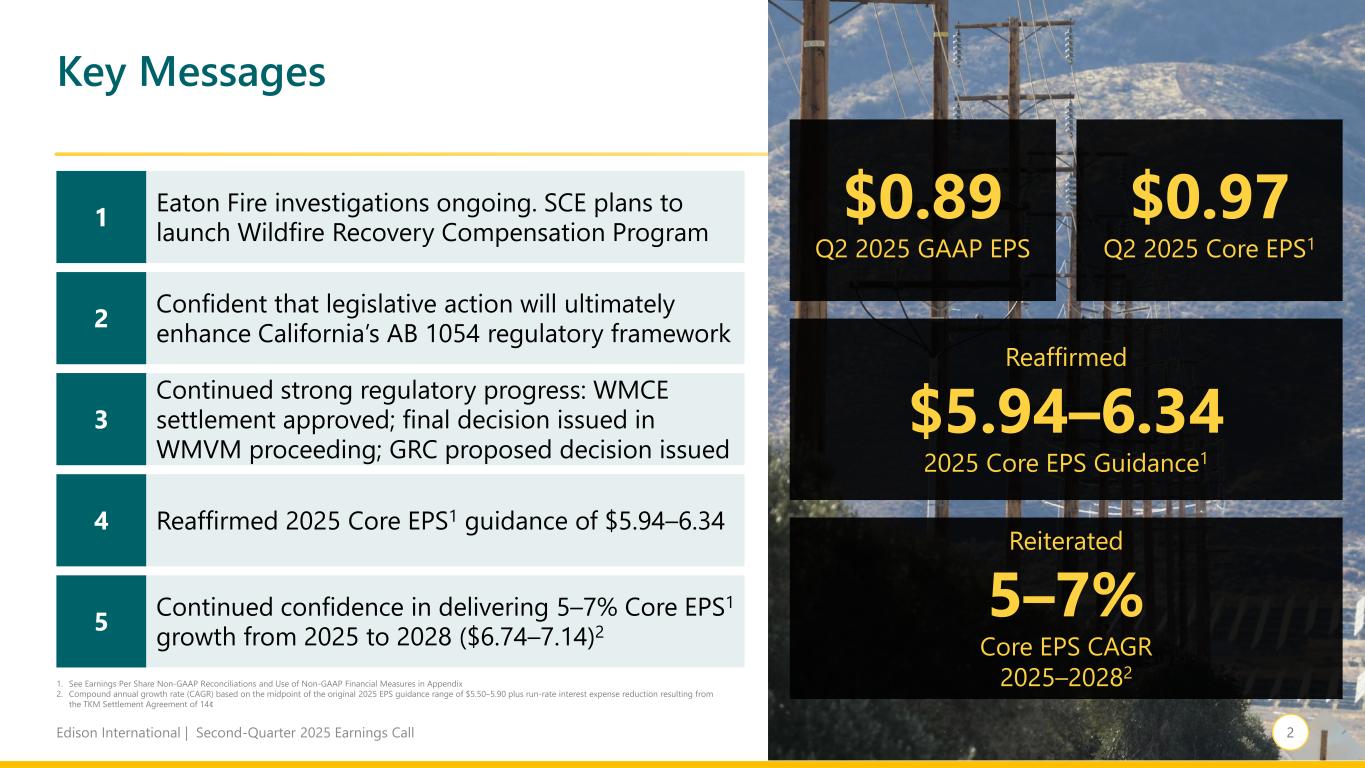
•Second-quarter 2025 GAAP EPS of $0.89; Core EPS of $0.97
•Eaton Fire investigations ongoing; SCE plans to launch Wildfire Recovery Compensation Program
•Confident that legislative action will ultimately enhance California’s AB 1054 regulatory framework
•Continued strong regulatory progress: WMCE settlement approved; final decision issued in WM/VM proceeding; GRC proposed decision issued
•Reaffirmed 2025 Core EPS guidance of $5.94-$6.34
•Continued confidence in delivering 5-7% Core EPS growth from 2025 to 2028 ($6.74-$7.14)
ROSEMEAD, Calif., July 31, 2025 — Edison International (NYSE: EIX) today reported second-quarter net income of $343 million, or $0.89 per share, compared to net income of $439 million, or $1.14 per share, in the second quarter of last year. As adjusted, second-quarter core earnings were $374 million, or $0.97 per share, compared to core earnings of $475 million, or $1.23 per share, in the second quarter of last year.
In the absence of a 2025 GRC decision, since January 1, 2025, and until a GRC decision is issued, SCE is recognizing revenue based on the 2024 authorized revenue requirement, adjusted to reflect the 2025 CPUC-authorized ROE.
Southern California Edison’s second-quarter 2025 core earnings per share (EPS) decreased year over year, primarily due to higher operations and maintenance expense and the net impact of regulatory decisions received in each period.
Edison International Parent and Other’s second-quarter 2025 core loss per share increased year over year, primarily due to higher interest expense.
"We are encouraged by the continuing discussions with legislative leaders to enhance California’s industry-leading AB 1054 regulatory framework,” said Pedro J. Pizarro, president and CEO of Edison International. “We remain confident that policymakers will act to strengthen and restore confidence in California’s wildfire framework during the current legislative session.”
Pizarro added, “The January wildfires underscore the importance of mitigation plans and the need for continuous and evolving tools to maintain infrastructure resiliency. SCE continues to invest in new and innovative solutions to reduce wildfire risk.”
Edison International uses core earnings internally for financial planning and analysis of performance. Core earnings are also used when communicating with investors and analysts regarding Edison International’s earnings results to facilitate comparisons of the company’s performance from period to period. Please see the attached tables to reconcile core earnings to basic GAAP earnings.
2025 Earnings Guidance
The company reaffirmed its earnings guidance range for 2025 as summarized in the following chart. See the presentation accompanying the company’s conference call for further information and assumptions.
2025 Earnings Guidance as of April 29, 2025 | 2025 Earnings Guidance as of July 31, 2025 | |||||||||||||||||||
| Low | High | Low | High | |||||||||||||||||
EIX Basic EPS | $ | 8.30 | $ | 8.70 | $ | 8.22 | $ | 8.62 | ||||||||||||
Less: Non-Core Items | 2.36 | 2.36 | 2.28 | 2.28 | ||||||||||||||||
EIX Core EPS | $ | 5.94 | $ | 6.34 | $ | 5.94 | $ | 6.34 | ||||||||||||
*There were $877 million, or $2.28 per share, of non-core items recorded for the six months ended June 30, 2025. Basic EPS guidance only incorporates non-core items to June 30, 2025.
Second-Quarter 2025 Earnings Conference Call and Webcast Details
When: | Thursday, July 31, 1:30-2:30 p.m. (PDT) | ||||
| Telephone Numbers: | 1-888-673-9780 (U.S.) and 1-312-470-0178 (Int'l) — Passcode: Edison | ||||
| Telephone Replay: | 1-800-685-6667 (U.S.) and 1-203-369-3864 (Int’l) — Passcode: 6728 | ||||
Telephone replay available through Aug. 14 at 6 p.m. (PDT) | |||||
Webcast | www.edisoninvestor.com | ||||
Edison International has posted its earnings conference call prepared remarks by the CEO and CFO, the teleconference presentation, and Form 10-Q to the company’s investor relations website. These materials are available at www.edisoninvestor.com.
About Edison International
Edison International (NYSE: EIX) is one of the nation’s largest electric utility holding companies, focused on providing clean and reliable energy and energy services through its independent companies. Headquartered in Rosemead, California, Edison International is the parent company of Southern California Edison Company, a utility delivering electricity to 15 million people across Southern, Central and Coastal California. Edison International is also the parent company of Trio (formerly Edison Energy), a portfolio of nonregulated competitive businesses providing integrated sustainability and energy advisory services to large commercial, industrial and institutional organizations in North America and Europe.
Appendix
Use of Non-GAAP Financial Measures
Edison International’s earnings are prepared in accordance with generally accepted accounting principles used in the United States and represent the company’s earnings as reported to the Securities and Exchange Commission. Our management uses core earnings and core earnings per share (EPS) internally for financial planning and for analysis of performance of Edison International and Southern California Edison. We also use core earnings and core EPS when communicating with analysts and investors regarding our earnings results to facilitate comparisons of the Company’s performance from period to period. Financial measures referred to as net income, basic EPS, core earnings, or core EPS also apply to the description of earnings or earnings per share.
Core earnings and core EPS are non-GAAP financial measures and may not be comparable to those of other companies. Core earnings and core EPS are defined as basic earnings and basic EPS excluding income or loss from discontinued operations and income or loss from significant discrete items that management does not consider representative of ongoing earnings. Basic earnings and losses refer to net income or losses attributable to Edison International shareholders. Core earnings are reconciled to basic earnings in the attached tables. The impact of participating securities (vested awards that earn dividend equivalents that may participate in undistributed earnings with common stock) for the principal operating subsidiary is not material to the principal operating subsidiary’s EPS and is therefore reflected in the results of the Edison International holding company, which is included in Edison International Parent and Other.
Safe Harbor Statement
Statements contained in this release about future performance, including, without limitation, operating results, capital expenditures, rate base growth, dividend policy, financial outlook, and other statements that are not purely historical, are forward-looking statements. These forward-looking statements reflect our current expectations; however, such statements involve risks and uncertainties. Actual results could differ materially from current expectations. These forward-looking statements represent our expectations only as of the date of this release, and Edison International assumes no duty to update them to reflect new information, events or circumstances. Important factors that could cause different results include, but are not limited to the:
•ability of SCE to recover its costs through regulated rates, timely or at all, including uninsured wildfire-related and debris flow-related costs (including amounts paid for self-insured retention and co-insurance, and amounts not recoverable from the Wildfire Insurance Fund), and costs incurred for wildfire restoration efforts and to mitigate the risk of utility equipment causing future wildfires;
•the cybersecurity of Edison International's and SCE's critical information technology systems for grid control and business, employee and customer data, and the physical security of Edison International's and SCE's critical assets and personnel;
•risks associated with the operation and maintenance of electrical facilities, including worker, contractor, and public safety issues, the risk of utility assets causing or contributing to wildfires, failure, availability, efficiency, and output of equipment and facilities, and availability and cost of spare parts;
•impact of affordability of customer rates on SCE's ability to execute its strategy, including the impact of affordability on SCE’s ability to obtain regulatory approval of, or cost recovery for, operations and maintenance expenses, proposed capital investment projects, and increased costs due to supply chain constraints, tariffs, inflation and rising interest rates and the impact of legislative actions on affordability;
•ability of SCE to update its grid infrastructure to maintain system integrity and reliability, and meet electrification needs;
•ability of SCE to implement its operational and strategic plans, including its Wildfire Mitigation Plan and capital investment program, including challenges related to project site identification, public opposition, environmental mitigation, construction, permitting, contractor performance, changes in the California Independent System Operator's (“CAISO”) transmission plans, and governmental approvals;
•risks of regulatory or legislative restrictions that would limit SCE's ability to implement operational measures to mitigate wildfire risk, including Public Safety Power Shutoff (“PSPS”) and fast curve settings, when conditions warrant or would otherwise limit SCE's operational practices relative to wildfire risk mitigation;
•ability of SCE to obtain safety certifications from the Office of Energy Infrastructure Safety of the California Natural Resources Agency (“OEIS“);
•risk that California Assembly Bill 1054 (“AB 1054“) or other new California legislation does not effectively mitigate the significant exposure faced by California investor-owned utilities related to liability for damages arising from catastrophic wildfires where utility facilities are alleged to be a substantial cause, including the longevity of the Wildfire Insurance Fund and the California Public Utilities Commission (“CPUC”) interpretation of and actions under AB 1054, including its interpretation of the prudency standard clarified by AB 1054;
•ability of Edison International and SCE to effectively attract, manage, develop and retain a skilled workforce, including its contract workers;
•decisions and other actions by the CPUC, the Federal Energy Regulatory Commission, and the United States Nuclear Regulatory Commission, the California legislature and other governmental authorities, including decisions and actions related to nationwide or statewide crisis, approval of regulatory proceeding settlements, determinations of authorized rates of return or return on equity, the recoverability of wildfire-related and debris flow-related costs, issuance of SCE's wildfire safety certification, reforming wildfire-related liability protections available to California investor-owned utilities, wildfire mitigation efforts, approval and implementation of electrification programs, and delays in executive, regulatory and legislative actions;
•governmental, statutory, regulatory, or administrative changes or initiatives affecting the electricity industry, including the market structure rules applicable to each market adopted by the North American Electric Reliability Corporation, CAISO, Western Electricity Coordinating Council, and similar regulatory bodies in adjoining regions, and changes in the United States' and California's environmental priorities that lessen the importance placed on greenhouse gas reduction and other climate related priorities;
•potential for penalties or disallowances for non-compliance with applicable laws and regulations, including fines, penalties and disallowances related to wildfires where SCE's equipment is alleged to be associated with ignition;
•extreme weather-related incidents (including events caused, or exacerbated, by climate change), such as wildfires, debris flows, flooding, droughts, high wind events and extreme heat events and other natural disasters (such as earthquakes), which could cause, among other things, worker and public safety issues, property damage, outages and other operational issues (such as issues due to damaged infrastructure), PSPS activations and unanticipated costs;
•risks associated with the decommissioning of San Onofre, including those related to worker and public safety, public opposition, permitting, governmental approvals, on-site storage of spent nuclear fuel and other radioactive material, delays, contractual disputes, and cost overruns;
•risks associated with cost allocation resulting in higher rates for utility bundled service customers because of possible customer bypass or departure for other electricity providers such as Community Choice Aggregators (“CCA,” which are cities, counties, and certain other public agencies with the authority to generate and/or purchase electricity for their local residents and businesses) and Electric Service Providers (entities that offer electric power and ancillary services to retail customers, other than electrical corporations (like SCE) and CCAs);
•actions by credit rating agencies to downgrade Edison International or SCE’s credit ratings or to place those ratings on negative watch or negative outlook.
Other important factors are discussed under the headings “Forward-Looking Statements”, “Risk Factors” and “Management’s Discussion and Analysis” in Edison International’s Form 10-K and other reports filed with the Securities and Exchange Commission, which are available on our website: www.edisoninvestor.com. These filings also provide additional information on historical and other factual data contained in this release.
Second Quarter Reconciliation of Basic Earnings Per Share to Core Earnings Per Share
| Three Months Ended June 30, | Six Months Ended June 30, | ||||||||||||||||||||||||||||||||||
| 2025 | 2024 | Change | 2025 | 2024 | Change | ||||||||||||||||||||||||||||||
Earnings (loss) per share available to Edison International | |||||||||||||||||||||||||||||||||||
SCE | $ | 1.15 | $ | 1.36 | $ | (0.21) | $ | 5.22 | $ | 1.52 | $ | 3.70 | |||||||||||||||||||||||
Edison International Parent and Other | (0.26) | (0.22) | (0.04) | (0.60) | (0.41) | (0.19) | |||||||||||||||||||||||||||||
Edison International | 0.89 | 1.14 | (0.25) | 4.62 | 1.11 | 3.51 | |||||||||||||||||||||||||||||
Less: Non-core items | |||||||||||||||||||||||||||||||||||
SCE | (0.08) | (0.09) | 0.01 | 2.38 | (1.26) | 3.64 | |||||||||||||||||||||||||||||
Edison International Parent and Other | — | — | — | (0.10) | — | (0.10) | |||||||||||||||||||||||||||||
Total non-core items | (0.08) | (0.09) | 0.01 | 2.28 | (1.26) | 3.54 | |||||||||||||||||||||||||||||
Core earnings (loss) per share | |||||||||||||||||||||||||||||||||||
SCE | 1.23 | 1.45 | (0.22) | 2.84 | 2.78 | 0.06 | |||||||||||||||||||||||||||||
Edison International Parent and Other | (0.26) | (0.22) | (0.04) | (0.50) | (0.41) | (0.09) | |||||||||||||||||||||||||||||
Edison International | $ | 0.97 | $ | 1.23 | $ | (0.26) | $ | 2.34 | $ | 2.37 | $ | (0.03) | |||||||||||||||||||||||
Note: Diluted earnings were $0.89 and $1.13 per share for the three months ended June 30, 2025 and 2024, respectively. Diluted earnings were $4.61 and $1.11 per share for the six months ended June 30, 2025 and 2024, respectively.
Second Quarter Reconciliation of Basic Earnings to Core Earnings (in millions)
| Three Months Ended June 30, | Six Months Ended June 30, | ||||||||||||||||||||||||||||||||||
(in millions) | 2025 | 2024 | Change | 2025 | 2024 | Change | |||||||||||||||||||||||||||||
Net income (loss) available to Edison International | |||||||||||||||||||||||||||||||||||
SCE | $ | 443 | $ | 523 | $ | (80) | $ | 2,010 | $ | 588 | $ | 1,422 | |||||||||||||||||||||||
Edison International Parent and Other | (100) | (84) | (16) | (231) | (160) | (71) | |||||||||||||||||||||||||||||
Edison International | 343 | 439 | (96) | 1,779 | 428 | 1,351 | |||||||||||||||||||||||||||||
| Less: Non-core items | |||||||||||||||||||||||||||||||||||
SCE 1,2,3 | (31) | (36) | 5 | 916 | (484) | 1,400 | |||||||||||||||||||||||||||||
Edison International Parent and Other4 | — | — | — | (39) | (1) | (38) | |||||||||||||||||||||||||||||
Total non-core items | (31) | (36) | 5 | 877 | (485) | 1,362 | |||||||||||||||||||||||||||||
Core earnings (losses) | |||||||||||||||||||||||||||||||||||
SCE | 474 | 559 | (85) | 1,094 | 1,072 | 22 | |||||||||||||||||||||||||||||
Edison International Parent and Other | (100) | (84) | (16) | (192) | (159) | (33) | |||||||||||||||||||||||||||||
Edison International | $ | 374 | $ | 475 | $ | (101) | $ | 902 | $ | 913 | $ | (11) | |||||||||||||||||||||||
1.Includes net earnings recorded in the six months ended June 30, 2025 related to TKM Settlement Agreement, including ongoing activities after the initial implementation: $1,341 million ($966 million after-tax) of claim costs and $58 million ($42 million after-tax) of legal expenses authorized for recovery, partially offset by shareholder-funded wildfire mitigation expenses of $50 million ($36 million after-tax) and impairment of incremental restoration-related assets of $8 million ($6 million after-tax). Charges of $1 million ($1 million after-tax) and $4 million ($3 million after-tax) recorded in the three and six months ended June 30, 2025, respectively, and $11 million ($8 million after-tax) and $478 million ($344 million after-tax) recorded in the three and six months ended June 30, 2024, respectively, related to 2017/2018 Wildfire/Mudslide Events claim costs and related legal expenses, net of expected regulatory recoveries.
2.Includes charges for Other Wildfires claims and related legal expenses, net of expected insurance and regulatory recoveries of $6 million ($4 million after-tax) and $2 million ($2 million after-tax), for the three months ended June 30, 2025 and 2024, respectively. Includes net earnings of $6 million ($5 million after-tax) recorded in the six months ended June 30, 2025, which consisted of $14 million insurance reimbursements for costs incurred in previous years, partially offset by $8 million legal expenses, net of expected regulatory recoveries, and charges of $121 million ($88 million after-tax) recorded in the six months ended June 30, 2024, for Other Wildfire Events claims and related legal expenses, net of expected insurance and regulatory recoveries.
3.Includes amortization of SCE's Wildfire Insurance Fund expenses of $36 million ($26 million after-tax) and $37 million ($26 million after-tax) for the three months ended June 30, 2025 and 2024, respectively, and $72 million ($52 million after-tax) and $73 million ($52 million after-tax) for the six months ended June 30, 2025 and 2024, respectively.
4.Includes wildfire claims insured by EIS of $50 million ($39 million after-tax) and $1 million ($1 million after-tax) for the six months ended June 30, 2025 and 2024, respectively.
| Condensed Consolidated Statements of Income | Edison International | ||||||||||||||||||||||
| Three months ended June 30, | Six months ended June 30, | ||||||||||||||||||||||
| (in millions, except per-share amounts, unaudited) | 2025 | 2024 | 2025 | 2024 | |||||||||||||||||||
| Operating revenue | $ | 4,543 | $ | 4,336 | $ | 8,354 | $ | 8,414 | |||||||||||||||
| Purchased power and fuel | 1,157 | 1,234 | 2,204 | 2,242 | |||||||||||||||||||
| Operation and maintenance | 1,580 | 1,285 | 2,563 | 2,602 | |||||||||||||||||||
| Wildfire-related claims, net of (recoveries) | — | — | (1,305) | 615 | |||||||||||||||||||
| Wildfire Insurance Fund expense | 36 | 37 | 72 | 73 | |||||||||||||||||||
| Depreciation and amortization | 826 | 726 | 1,568 | 1,428 | |||||||||||||||||||
| Property and other taxes | 168 | 154 | 334 | 309 | |||||||||||||||||||
| Other | 1 | — | 9 | — | |||||||||||||||||||
| Total operating expenses | 3,768 | 3,436 | 5,445 | 7,269 | |||||||||||||||||||
| Operating income | 775 | 900 | 2,909 | 1,145 | |||||||||||||||||||
| Interest expense | (504) | (480) | (805) | (924) | |||||||||||||||||||
| Other income, net | 113 | 148 | 220 | 286 | |||||||||||||||||||
| Income before income taxes | 384 | 568 | 2,324 | 507 | |||||||||||||||||||
| Income tax (benefit) expense | (14) | 59 | 434 | (54) | |||||||||||||||||||
| Net income | 398 | 509 | 1,890 | 561 | |||||||||||||||||||
| Less: Preference stock dividend requirements of SCE | 33 | 49 | 67 | 90 | |||||||||||||||||||
| Preferred stock dividend requirements of Edison International | 22 | 21 | 44 | 43 | |||||||||||||||||||
| Net income available to Edison International common shareholders | $ | 343 | $ | 439 | $ | 1,779 | $ | 428 | |||||||||||||||
| Basic earnings per share: | |||||||||||||||||||||||
| Weighted average shares of common stock outstanding | 385 | 385 | 385 | 385 | |||||||||||||||||||
| Basic earnings per common share available to Edison International common shareholders | $ | 0.89 | $ | 1.14 | $ | 4.62 | $ | 1.11 | |||||||||||||||
| Diluted earnings per share: | |||||||||||||||||||||||
| Weighted average shares of common stock outstanding, including effect of dilutive securities | 386 | 388 | 386 | 387 | |||||||||||||||||||
| Diluted earnings per common share available to Edison International common shareholders | $ | 0.89 | $ | 1.13 | $ | 4.61 | $ | 1.11 | |||||||||||||||
| Condensed Consolidated Balance Sheets | Edison International | ||||||||||
| (in millions, unaudited) | June 30, 2025 | December 31, 2024 | |||||||||
| ASSETS | |||||||||||
| Cash and cash equivalents | $ | 140 | $ | 193 | |||||||
Receivables, less allowances of $314 and $352 for uncollectible accounts at respective dates | 1,902 | 2,169 | |||||||||
| Accrued unbilled revenue | 927 | 848 | |||||||||
| Inventory | 523 | 538 | |||||||||
| Prepaid expenses | 96 | 103 | |||||||||
| Regulatory assets | 2,805 | 2,748 | |||||||||
| Wildfire Insurance Fund contributions | 138 | 138 | |||||||||
| Other current assets | 419 | 418 | |||||||||
| Total current assets | 6,950 | 7,155 | |||||||||
| Nuclear decommissioning trusts | 4,324 | 4,286 | |||||||||
| Other investments | 63 | 57 | |||||||||
| Total investments | 4,387 | 4,343 | |||||||||
Utility property, plant and equipment, less accumulated depreciation and amortization of $14,587 and $14,207 at respective dates | 60,797 | 59,047 | |||||||||
Nonutility property, plant and equipment, less accumulated depreciation of $125 and $124 at respective dates | 202 | 207 | |||||||||
| Total property, plant and equipment | 60,999 | 59,254 | |||||||||
Receivables, less allowances $47 and $43 for uncollectible accounts at respective dates | 61 | 62 | |||||||||
Regulatory assets (include $1,488 and $1,512 related to a Variable Interest Entity ("VIE") at respective dates) | 10,487 | 8,886 | |||||||||
| Wildfire Insurance Fund contributions | 1,809 | 1,878 | |||||||||
| Operating lease right-of-use assets | 1,156 | 1,180 | |||||||||
| Long-term insurance receivables | 365 | 418 | |||||||||
| Other long-term assets | 2,599 | 2,403 | |||||||||
| Total other assets | 16,477 | 14,827 | |||||||||
| Total assets | $ | 88,813 | $ | 85,579 | |||||||
| Condensed Consolidated Balance Sheets | Edison International | ||||||||||
| (in millions, except share amounts, unaudited) | June 30, 2025 | December 31, 2024 | |||||||||
LIABILITIES AND EQUITY | |||||||||||
| Short-term debt | $ | 700 | $ | 998 | |||||||
| Current portion of long-term debt | 2,699 | 2,049 | |||||||||
| Accounts payable | 1,962 | 2,000 | |||||||||
| Wildfire-related claims | 169 | 60 | |||||||||
| Accrued interest | 520 | 422 | |||||||||
| Regulatory liabilities | 490 | 1,347 | |||||||||
| Current portion of operating lease liabilities | 120 | 124 | |||||||||
| Other current liabilities | 1,305 | 1,439 | |||||||||
| Total current liabilities | 7,965 | 8,439 | |||||||||
Long-term debt (includes $1,444 and $1,468 related to a VIE at respective dates) | 34,971 | 33,534 | |||||||||
| Deferred income taxes and credits | 7,884 | 7,180 | |||||||||
| Pensions and benefits | 371 | 384 | |||||||||
| Asset retirement obligations | 2,549 | 2,580 | |||||||||
| Regulatory liabilities | 11,066 | 10,159 | |||||||||
| Operating lease liabilities | 1,036 | 1,056 | |||||||||
| Wildfire-related claims | 568 | 941 | |||||||||
| Other deferred credits and other long-term liabilities | 3,542 | 3,566 | |||||||||
| Total deferred credits and other liabilities | 27,016 | 25,866 | |||||||||
| Total liabilities | 69,952 | 67,839 | |||||||||
Preferred stock (50,000,000 shares authorized; 1,159,317 shares of Series A and 503,454 shares of Series B issued and outstanding at respective dates) | 1,645 | 1,645 | |||||||||
Common stock, no par value (800,000,000 shares authorized; 384,786,397 and 384,784,719 shares issued and outstanding at respective dates) | 6,330 | 6,353 | |||||||||
| Accumulated other comprehensive income | 2 | — | |||||||||
| Retained earnings | 8,709 | 7,567 | |||||||||
| Total Edison International's shareholders' equity | 16,686 | 15,565 | |||||||||
| Noncontrolling interests – preference stock of SCE | 2,175 | 2,175 | |||||||||
| Total equity | 18,861 | 17,740 | |||||||||
| Total liabilities and equity | $ | 88,813 | $ | 85,579 | |||||||
| Condensed Consolidated Statements of Cash Flows | Edison International | ||||||||||
| Six months ended June 30, | |||||||||||
| (in millions, unaudited) | 2025 | 2024 | |||||||||
Cash flows from operating activities: | |||||||||||
| Net income | $ | 1,890 | $ | 561 | |||||||
| Adjustments to reconcile to net cash provided by operating activities: | |||||||||||
| Depreciation and amortization | 1,568 | 1,454 | |||||||||
| Equity allowance for funds used during construction | (93) | (96) | |||||||||
| Deferred income taxes | 420 | (52) | |||||||||
| Wildfire Insurance Fund amortization expense | 72 | 73 | |||||||||
| Other | 77 | 21 | |||||||||
| Nuclear decommissioning trusts | (102) | (41) | |||||||||
| Changes in operating assets and liabilities: | |||||||||||
| Receivables | 248 | (66) | |||||||||
| Inventory | 12 | (10) | |||||||||
| Accounts payable | 50 | 101 | |||||||||
| Other current assets and liabilities | (247) | (444) | |||||||||
| Derivative assets and liabilities, net | 44 | (25) | |||||||||
| Regulatory assets and liabilities, net | (1,600) | (106) | |||||||||
| Wildfire-related insurance receivable | 53 | — | |||||||||
| Wildfire-related claims | (264) | (148) | |||||||||
| Other noncurrent assets and liabilities | (22) | 150 | |||||||||
| Net cash provided by operating activities | 2,106 | 1,372 | |||||||||
| Cash flows from financing activities: | |||||||||||
Long-term debt issued, net of discount and issuance costs of $49 and $34 for the respective periods | 3,501 | 4,216 | |||||||||
| Long-term debt repaid | (726) | (1,725) | |||||||||
| Short-term debt issued | 18 | — | |||||||||
| Short-term debt repaid | — | (396) | |||||||||
| Common stock repurchased | (29) | — | |||||||||
| Preference stock issued, net of issuance cost | — | 345 | |||||||||
| Preferred stock repurchased | — | (378) | |||||||||
| Commercial paper (repayments) borrowing, net | (1,012) | 114 | |||||||||
| Dividends and distribution to noncontrolling interests | (67) | (88) | |||||||||
| Common stock dividends paid | (637) | (595) | |||||||||
| Preferred stock dividends paid | (44) | (45) | |||||||||
| Other | (13) | 117 | |||||||||
| Net cash provided by financing activities | 991 | 1,565 | |||||||||
| Cash flows from investing activities: | |||||||||||
| Capital expenditures | (3,120) | (2,700) | |||||||||
| Proceeds from sale of nuclear decommissioning trust investments | 2,680 | 2,477 | |||||||||
| Purchases of nuclear decommissioning trust investments | (2,580) | (2,455) | |||||||||
| Other | 18 | 8 | |||||||||
| Net cash used in investing activities | (3,002) | (2,670) | |||||||||
| Net increase in cash, cash equivalents and restricted cash | 95 | 267 | |||||||||
| Cash, cash equivalents and restricted cash at beginning of period | 684 | 532 | |||||||||
| Cash, cash equivalents and restricted cash at end of period | $ | 779 | $ | 799 | |||||||
Exhibit 99.2
Prepared Remarks of Edison International CEO and CFO
Second Quarter 2025 Earnings Teleconference
July 31, 2025, 1:30 p.m. (PT)
Pedro Pizarro, President and Chief Executive Officer, Edison International
Today, I will address three key topics for our investors: an update on the Eaton Fire; our confidence that California’s legislature will support healthy investor-owned utilities; and an update on regulatory decisions and future actions that position SCE well to deliver on its commitments for customers and other stakeholders.
Let me start with a brief comment on earnings. Today, Edison International reported second-quarter core earnings per share of 97 cents compared to $1.23 a year ago. However, as I have mentioned before, this year-over-year comparison is not particularly meaningful because SCE has not received a final decision in its 2025 General Rate Case. Nonetheless, we remain confident in our ability to meet our 2025 EPS guidance and deliver a 5 to 7% core EPS CAGR through 2028. I will touch on the GRC proposed decision in a few minutes, and Maria will discuss our financial performance in her remarks.
On the Eaton Fire, the investigations by SCE and the LA County Fire Department remain ongoing. There are no additional disclosures on the ignition or estimated cost at this point. To recap, SCE is not aware of evidence pointing to another possible source of ignition. Absent additional evidence, we believe that SCE equipment could have been associated with the ignition. In addition, numerous lawsuits have already been brought against SCE. If it is determined that SCE’s transmission equipment was associated with the ignition of the Eaton Fire, based on the information we have reviewed thus far, we remain confident that SCE would make a good faith showing that its conduct with respect to its transmission facilities in the Eaton Canyon area was consistent with actions of a reasonable utility.
As we know from prior wildfire events, engaging with — and helping — the community is critical. That’s why we announced last week the Wildfire Recovery Compensation Program, which SCE will launch this fall. The program will provide direct payments to eligible individuals
1
and businesses. Resolving claims quickly allows the community to focus on recovery and minimizes the overall cost by mitigating the impacts of interest expense and inflation. This will also help use the wildfire fund efficiently and have more of the cash support impacted community members instead of being spent on higher legal costs.
On the legislative front, we are encouraged by the continuing discussions with the Governor’s office and legislators to enhance California’s industry-leading AB 1054 regulatory framework. Given the economywide consequences of inaction, we believe policymakers will strengthen California’s wildfire framework during the current legislative session. The issue of wildfires is not just a utility regulation issue — the full solution must include broader actions across multiple sectors, and could be addressed during next year’s legislative session. Separately, a number of affordability bills are being discussed. Our track record on cost management, which I will discuss in a few minutes, shows our commitment to affordability. There are good steps the legislature can consider to improve affordability like right-sizing public purpose programs and NEM, and streamlining siting and permitting. However, provisions like securitizing capital may be well-intentioned but in fact would actually raise customer costs by deteriorating credit quality. We will continue to engage with legislators to help them make decisions that are grounded in the facts.
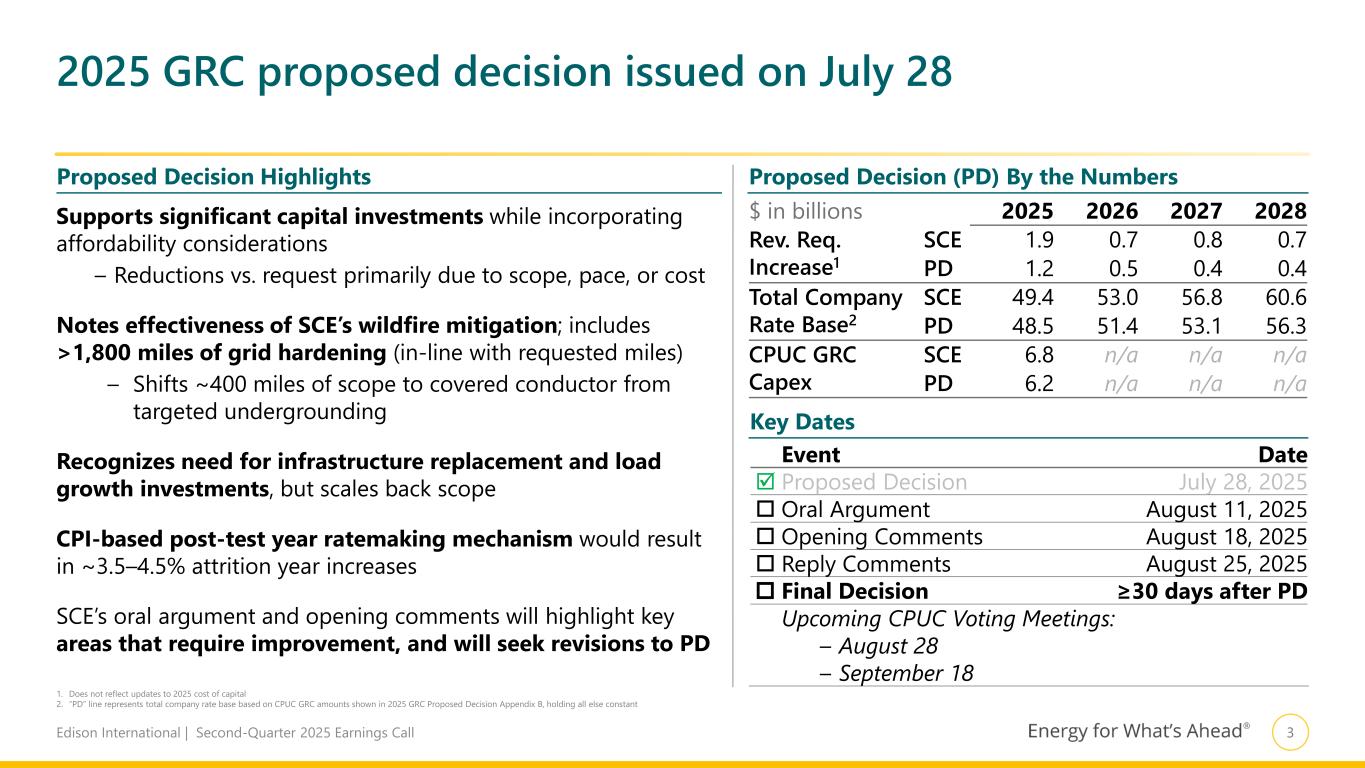
Moving to the regulatory front, SCE continues to build on its progress across multiple proceedings, further de-risking our financial outlook. Maria will expand on several of those proceedings in her remarks, but let me touch on the proposed decision in SCE’s 2025 GRC issued by the administrative law judge on Monday. Page 3 provides a summary.
The PD overall generally aligns with our range case rate base forecast. We share the ALJ’s view that critical investments are needed to maintain a safe, reliable, and increasingly clean electric grid. On the other hand, key areas of the PD require improvement, so SCE will seek revisions.
The PD would authorize base revenue of $9.8 billion, or 93% of SCE’s requested revenue requirement. It also supports significant capital investments in wildfire mitigation, grid modernization, and infrastructure replacement — while incorporating affordability
2
considerations for customers. The reductions from SCE’s request primarily relate to scope, pacing, or cost — not to the underlying need or effectiveness of the programs. Most notably, the PD finds that covered conductor has been a highly effective wildfire mitigation strategy and that no party recommended a reduction to SCE’s request. It also notes that no party disputed that targeted undergrounding is an effective tool for SCE, although it would authorize fewer miles than SCE proposed. The PD affirms the reasonableness of the utility’s base load growth forecast and recognizes the importance of SCE’s planning methodology, which integrates statewide forecasts with local system knowledge. This supports our long-term strategy to ensure the grid is ready for California’s electrified future. However, there are some areas where the PD is not fully aligned with customer needs and will be part of the utility’s opening comments. Maria will say more in her remarks.
The January wildfires underscore the importance of mitigation plans and the need for continuous and evolving tools to maintain infrastructure resiliency. SCE submitted its 2026 through 2028 Wildfire Mitigation Plan in May, outlining a comprehensive strategy to address both immediate and long-term wildfire risks with new and innovative solutions. The plan reflects the utility’s commitment to public safety, risk reduction, and affordability, and builds on foundational mitigations such as covered conductor, targeted undergrounding, and enhanced vegetation management. Over the 2026 through 2028 period, SCE anticipates investing $6.2 billion. The plan also supports continued use of aerial firefighting assets, including the world’s largest helitankers with nighttime capabilities, and aims to inspect approximately 1 million trees annually. Public Safety Power Shutoffs remain a critical tool in wildfire prevention. This year’s PSPS updates include revised criteria and windspeed thresholds, expanded circuit coverage, and broader boundaries around high fire risk areas. As always, SCE remains focused on customer support and outreach to enhance safety and reduce the impact of PSPS events. Additional details can be found on page 4.
As you will recall, a year ago we shared our projection that even with 100% of SCE’s GRC request, the utility expects its system average rate to grow on average at an inflation-like level through 2028. Based on where things stand today, that is still the expectation, which is further enabled by SCE’s enduring focus on operational excellence and efficiently managing costs for customers. SCE has a more than 15-year track record with the lowest system average rate
3
among California’s major investor-owned utilities, thanks to successfully executing on its operational excellence initiatives and taking proactive measures to address customer affordability.
Technology is a major driver of better affordability, safety, reliability, and resiliency. For example, last month, EEI once again selected EIX and SCE as the winner of their prestigious Edison Award, recognizing distinguished leadership, innovation, and contribution to the advancement of the electric industry for the benefit of all. Our winning project, SCE’s Advanced Waveform Anomaly Recognition Engine, or AWARE for short, uses real-time grid sensor data, AI, and machine learning to proactively predict potential system issues and pinpoint where failures take place within SCE’s service territory. Customers benefit from higher safety and reliability, faster restoration times, and higher affordability through optimized crew time. I’m proud of our team for their steadfast commitment to operational excellence and for creating this AI-driven solution to help make the grid safer and more resilient for our communities.
I will conclude my remarks by reiterating the key messages. First, SCE is continuing with its investigation on the origin and cause of the Eaton Fire, and there are no new disclosures about the ignition or cost estimate at this time; when we have additional relevant information, we will share it with you and importantly will continue our transparency with our community. Second, we are confident that legislative action will ultimately enhance California’s AB 1054 regulatory framework. Third, SCE is well positioned from a regulatory standpoint to deliver for customers and investors.
4
Maria Rigatti, Executive Vice President and Chief Financial Officer, Edison International
In my comments today, I will cover second-quarter 2025 results, provide additional insight into key regulatory proceedings, and update you on other financial topics.
Starting with the second quarter, EIX reported core EPS of 97 cents compared to $1.23 last year. Page 5 provides the year-over-year quarterly variance analysis. As Pedro mentioned, the year-over-year comparison is not particularly meaningful because SCE has not received a final decision in its 2025 GRC. SCE continues to book revenues at 2024 authorized levels, adjusted for the change in ROE, and will record a true-up when it receives a final decision. SCE’s core EPS variance was primarily driven by higher O&M expense and the net impact of regulatory decisions received in each period. EIX Parent and Other’s variance was primarily driven by higher interest expense.
I’d like to expand on Pedro’s comments on the Wildfire Recovery Compensation Program for the Eaton Fire. As SCE resolves claims, we would not expect to see actual or estimated costs run through the income statement, aside from the small shareholder contribution associated with self-insurance. The costs would be offset by SCE’s customer-funded self-insurance for the first $1 billion and then by receivables or regulatory assets associated with the Wildfire Fund and regulation put in place by AB 1054. An efficient reimbursement process from the Wildfire Fund also means SCE would not have to issue long-term debt to fund payments.
On SCE’s 2025 General Rate Case, if adopted, the PD would result in base rate revenue requirements of $9.8 billion in 2025, $10.2 billion in 2026, $10.6 billion in 2027, and $11 billion in 2028. Translating the rate base numbers shown in the proposed decision into total company rate base, and holding all else constant, the results would be generally in line with our current range case. Following a final decision, we will incorporate all aspects of the GRC into our long-term plans and refresh our projections.
5
In SCE’s opening comments, it will outline areas where it believes revisions are warranted to deliver better outcomes for customers and ensure the decision aligns with the evidentiary record, applicable law, and established regulatory principles. Let me expand on a couple of areas.
On wildfire mitigation, the decision would authorize more than 1,800 miles of grid hardening, consistent with SCE’s total hardening request. However, it shifts about 400 miles from targeted undergrounding to the covered conductor program. While the PD reflects a significant increase to the historical level of targeted undergrounding, it falls short of SCE’s well-supported request. This reduction limits SCE’s ability to appropriately mitigate wildfire risk in the most vulnerable areas.
On infrastructure replacement, the PD would approve the majority of the proposed programs, but scales back the scope. The decision recognizes the importance of resuming infrastructure replacement after several years of wildfire-focused spending, but we believe the gradual ramp up does not fully reflect the urgency of today’s reliability and electrification needs.
As for the next steps, oral argument is scheduled for August 11 and SCE will file its opening comments on August 18 and reply comments are due August 25. The earliest the Commission can vote on the proposed decision is at its August 28 voting meeting. During oral argument and in comments, SCE will advocate for adjustments that better align with the state’s climate objectives and the safety and resiliency needs of the communities we serve. As we’ve said before, we understand the Commission’s desire to balance safety, reliability, and affordability, and will continue to work collaboratively to ensure the utility’s programs deliver value to customers.
Continuing on to the regulatory front, SCE has advanced other regulatory proceedings and outcomes, ultimately de-risking our financial outlook. I will highlight a few updates.
6
•First, the CPUC issued final decisions in SCE’s WMCE and WM/VM proceedings, providing certainty on the timing of cost recovery and contribution to our 2025 earnings guidance. On the WMCE settlement agreement, the CPUC authorized recovery of more than $300 million of O&M and $700 million of capital for historical wildfire mitigation and restoration. In SCE’s 2022 WM/VM proceeding, the CPUC authorized the recovery of about $290 million of O&M and $99 million of capital, while disallowing about $65 million of O&M. I’ll note that SCE has filed an application for rehearing to address certain legal and factual errors that resulted in incorrect disallowances of costs incurred to make SCE’s system and communities safer and more resilient to wildfire threats.
•Second, as another step toward recovering historical costs, in April, SCE filed its application for authority to issue securitized bonds to finance the recovery of about $1.6 billion related to the TKM proceeding. This securitization allows for the issuance of recovery bonds with the highest possible credit rating, which reduces financing costs for SCE’s customers. The ALJ recently issued a proposed decision, which would approve the financing order, and the schedule calls for a final decision in August.
•Third, on the Woolsey cost recovery application, SCE recently filed its rebuttal testimony. The schedule includes a motion for consideration of a settlement agreement or joint statement of stipulations of issues due on August 12. As always, SCE is open to settlement discussions if a fair and reasonable outcome can be achieved, benefiting customers and shareholders.
•Lastly, the 2026 cost of capital proceeding continues to progress, with intervenors submitting their testimony yesterday evening. During the quarter, the ALJ also issued a scoping memo, with a schedule that calls for a proposed decision in November.
Turning to pages 6 and 7, SCE’s capital expenditure and rate base forecasts remain unchanged while we await a final GRC decision. The utility continues to make investments in safety, reliability, and resiliency. The rate case request supports investments that are essential to meet customer needs both today and through the end of 2028. This includes critical work in infrastructure replacement and wildfire mitigation, as well as investments to meet the growing
7
demand in our service area. As we have highlighted before, we continue to see substantial additional capital needs beyond the GRC that are incremental to the plan.
Moving on to our EPS guidance, outlined on pages 8 and 9, we are confident in reaffirming the 2025 range of $5.94 to $6.34 and our long-term EPS growth expectations of 5 to 7% from 2025 to 2028. As a reminder, we will refresh our financial guidance six weeks after SCE receives a final decision in its 2025 GRC. This will include our capital and rate base projections, 2025 Core EPS range, long-term Core EPS growth, and financing plan.
8
JULY 31, 2025 SECOND-QUARTER 2025 FINANCIAL RESULTS Exhibit 99.3
1Edison International | Second-Quarter 2025 Earnings Call Statements contained in this presentation about future performance, including, without limitation, operating results, capital expenditures, rate base growth, dividend policy, financial outlook, and other statements that are not purely historical, are forward-looking statements. These forward-looking statements reflect our current expectations; however, such statements involve risks and uncertainties. Actual results could differ materially from current expectations. These forward-looking statements represent our expectations only as of the date of this presentation, and Edison International assumes no duty to update them to reflect new information, events or circumstances. Important factors that could cause different results include, but are not limited to the: • ability of SCE to recover its costs through regulated rates, timely or at all, including uninsured wildfire-related and debris flow-related costs (including amounts paid for self-insured retention and co-insurance, and amounts not recoverable from the Wildfire Insurance Fund), and costs incurred for wildfire restoration efforts and to mitigate the risk of utility equipment causing future wildfires; • the cybersecurity of Edison International's and SCE's critical information technology systems for grid control and business, employee and customer data, and the physical security of Edison International's and SCE's critical assets and personnel; • risks associated with the operation and maintenance of electrical facilities, including worker, contractor, and public safety issues, the risk of utility assets causing or contributing to wildfires, failure, availability, efficiency, and output of equipment and facilities, and availability and cost of spare parts; • impact of affordability of customer rates on SCE's ability to execute its strategy, including the impact of affordability on SCE’s ability to obtain regulatory approval of, or cost recovery for, operations and maintenance expenses, proposed capital investment projects, and increased costs due to supply chain constraints, tariffs, inflation and rising interest rates and the impact of legislative actions on affordability; • ability of SCE to update its grid infrastructure to maintain system integrity and reliability, and meet electrification needs; • ability of SCE to implement its operational and strategic plans, including its Wildfire Mitigation Plan and capital investment program, including challenges related to project site identification, public opposition, environmental mitigation, construction, permitting, contractor performance, changes in the California Independent System Operator's (“CAISO”) transmission plans, and governmental approvals; • risks of regulatory or legislative restrictions that would limit SCE's ability to implement operational measures to mitigate wildfire risk, including Public Safety Power Shutoff (“PSPS”) and fast curve settings, when conditions warrant or would otherwise limit SCE's operational practices relative to wildfire risk mitigation; • ability of SCE to obtain safety certifications from the Office of Energy Infrastructure Safety of the California Natural Resources Agency (“OEIS“); • risk that California Assembly Bill 1054 (“AB 1054“) or other new California legislation does not effectively mitigate the significant exposure faced by California investor-owned utilities related to liability for damages arising from catastrophic wildfires where utility facilities are alleged to be a substantial cause, including the longevity of the Wildfire Insurance Fund and the California Public Utilities Commission (“CPUC”) interpretation of and actions under AB 1054, including its interpretation of the prudency standard clarified by AB 1054; • ability of Edison International and SCE to effectively attract, manage, develop and retain a skilled workforce, including its contract workers; • decisions and other actions by the CPUC, the Federal Energy Regulatory Commission, and the United States Nuclear Regulatory Commission, the California legislature and other governmental authorities, including decisions and actions related to nationwide or statewide crisis, approval of regulatory proceeding settlements, determinations of authorized rates of return or return on equity, the recoverability of wildfire-related and debris flow-related costs, issuance of SCE's wildfire safety certification, reforming wildfire-related liability protections available to California investor-owned utilities, wildfire mitigation efforts, approval and implementation of electrification programs, and delays in executive, regulatory and legislative actions; • governmental, statutory, regulatory, or administrative changes or initiatives affecting the electricity industry, including the market structure rules applicable to each market adopted by the North American Electric Reliability Corporation, CAISO, Western Electricity Coordinating Council, and similar regulatory bodies in adjoining regions, and changes in the United States' and California's environmental priorities that lessen the importance placed on greenhouse gas reduction and other climate related priorities; • potential for penalties or disallowances for non-compliance with applicable laws and regulations, including fines, penalties and disallowances related to wildfires where SCE's equipment is alleged to be associated with ignition; • extreme weather-related incidents (including events caused, or exacerbated, by climate change), such as wildfires, debris flows, flooding, droughts, high wind events and extreme heat events and other natural disasters (such as earthquakes), which could cause, among other things, worker and public safety issues, property damage, outages and other operational issues (such as issues due to damaged infrastructure), PSPS activations and unanticipated costs; • risks associated with the decommissioning of San Onofre, including those related to worker and public safety, public opposition, permitting, governmental approvals, on-site storage of spent nuclear fuel and other radioactive material, delays, contractual disputes, and cost overruns; • risks associated with cost allocation resulting in higher rates for utility bundled service customers because of possible customer bypass or departure for other electricity providers such as Community Choice Aggregators (“CCA,” which are cities, counties, and certain other public agencies with the authority to generate and/or purchase electricity for their local residents and businesses) and Electric Service Providers (entities that offer electric power and ancillary services to retail customers, other than electrical corporations (like SCE) and CCAs); • actions by credit rating agencies to downgrade Edison International or SCE’s credit ratings or to place those ratings on negative watch or negative outlook. Other important factors are discussed under the headings “Forward-Looking Statements”, “Risk Factors” and “Management’s Discussion and Analysis” in Edison International’s Form 10-K and other reports filed with the Securities and Exchange Commission, which are available on our website: www.edisoninvestor.com. These filings also provide additional information on historical and other factual data contained in this presentation. Forward-Looking Statements
2Edison International | Second-Quarter 2025 Earnings Call Key Messages $0.89 Q2 2025 GAAP EPS $0.97 Q2 2025 Core EPS1 Reiterated 5–7% Core EPS CAGR 2025–20282 Reaffirmed $5.94–6.34 2025 Core EPS Guidance1 Eaton Fire investigations ongoing. SCE plans to launch Wildfire Recovery Compensation Program Continued strong regulatory progress: WMCE settlement approved; final decision issued in WMVM proceeding; GRC proposed decision issued Reaffirmed 2025 Core EPS1 guidance of $5.94–6.34 1. See Earnings Per Share Non-GAAP Reconciliations and Use of Non-GAAP Financial Measures in Appendix 2. Compound annual growth rate (CAGR) based on the midpoint of the original 2025 EPS guidance range of $5.50–5.90 plus run-rate interest expense reduction resulting from the TKM Settlement Agreement of 14¢ Continued confidence in delivering 5–7% Core EPS1 growth from 2025 to 2028 ($6.74–7.14)2 1 3 4 5 Confident that legislative action will ultimately enhance California’s AB 1054 regulatory framework2
3Edison International | Second-Quarter 2025 Earnings Call 2025 GRC proposed decision issued on July 28 Proposed Decision Highlights Proposed Decision (PD) By the Numbers Key Dates Event Date Proposed Decision July 28, 2025 Oral Argument August 11, 2025 Opening Comments August 18, 2025 Reply Comments August 25, 2025 Final Decision ≥30 days after PD Upcoming CPUC Voting Meetings: – August 28 – September 18 $ in billions 2025 2026 2027 2028 Rev. Req. Increase1 SCE 1.9 0.7 0.8 0.7 PD 1.2 0.5 0.4 0.4 Total Company Rate Base2 SCE 49.4 53.0 56.8 60.6 PD 48.5 51.4 53.1 56.3 CPUC GRC Capex SCE 6.8 n/a n/a n/a PD 6.2 n/a n/a n/a 1. Does not reflect updates to 2025 cost of capital 2. “PD” line represents total company rate base based on CPUC GRC amounts shown in 2025 GRC Proposed Decision Appendix B, holding all else constant Supports significant capital investments while incorporating affordability considerations – Reductions vs. request primarily due to scope, pace, or cost Notes effectiveness of SCE’s wildfire mitigation; includes >1,800 miles of grid hardening (in-line with requested miles) – Shifts ~400 miles of scope to covered conductor from targeted undergrounding Recognizes need for infrastructure replacement and load growth investments, but scales back scope CPI-based post-test year ratemaking mechanism would result in ~3.5–4.5% attrition year increases SCE’s oral argument and opening comments will highlight key areas that require improvement, and will seek revisions to PD
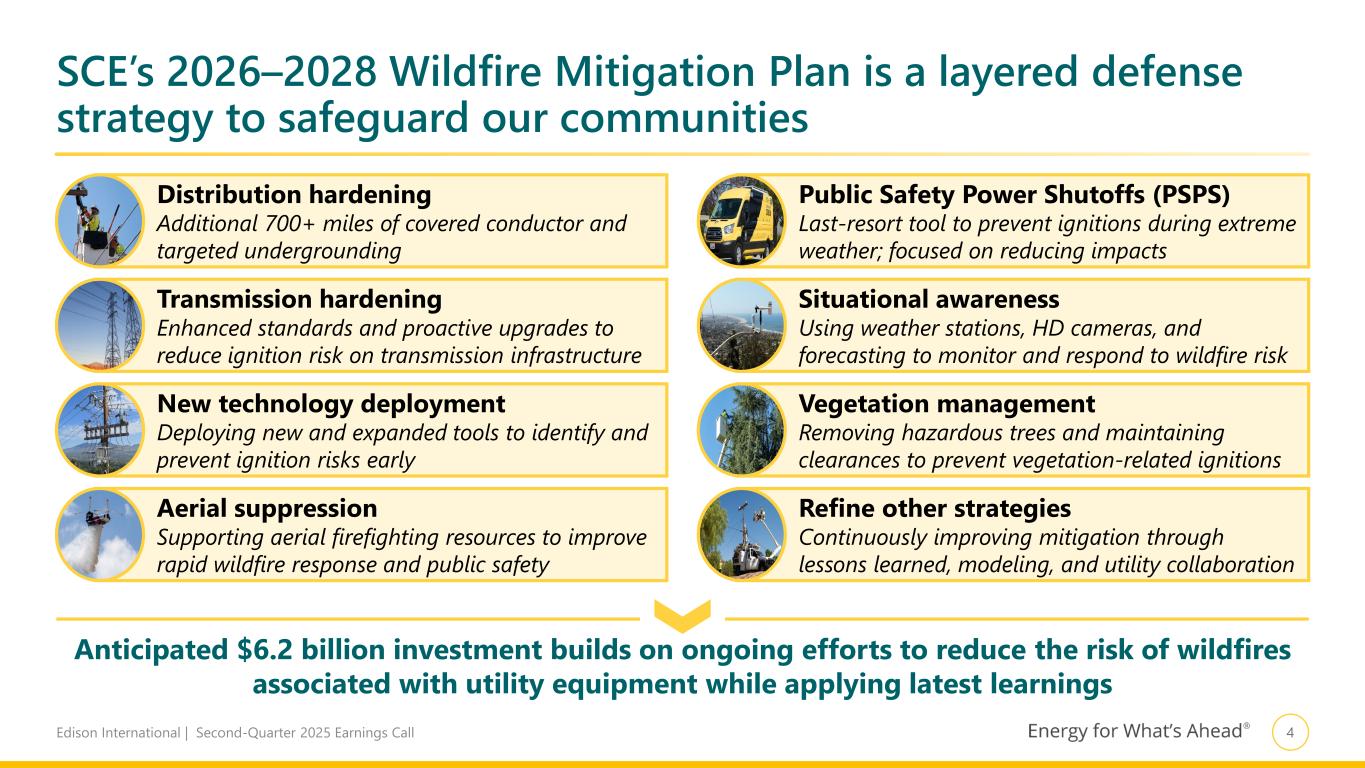
4Edison International | Second-Quarter 2025 Earnings Call SCE’s 2026–2028 Wildfire Mitigation Plan is a layered defense strategy to safeguard our communities Distribution hardening Additional 700+ miles of covered conductor and targeted undergrounding Transmission hardening Enhanced standards and proactive upgrades to reduce ignition risk on transmission infrastructure New technology deployment Deploying new and expanded tools to identify and prevent ignition risks early Public Safety Power Shutoffs (PSPS) Last-resort tool to prevent ignitions during extreme weather; focused on reducing impacts Situational awareness Using weather stations, HD cameras, and forecasting to monitor and respond to wildfire risk Anticipated $6.2 billion investment builds on ongoing efforts to reduce the risk of wildfires associated with utility equipment while applying latest learnings Vegetation management Removing hazardous trees and maintaining clearances to prevent vegetation-related ignitions Aerial suppression Supporting aerial firefighting resources to improve rapid wildfire response and public safety Refine other strategies Continuously improving mitigation through lessons learned, modeling, and utility collaboration
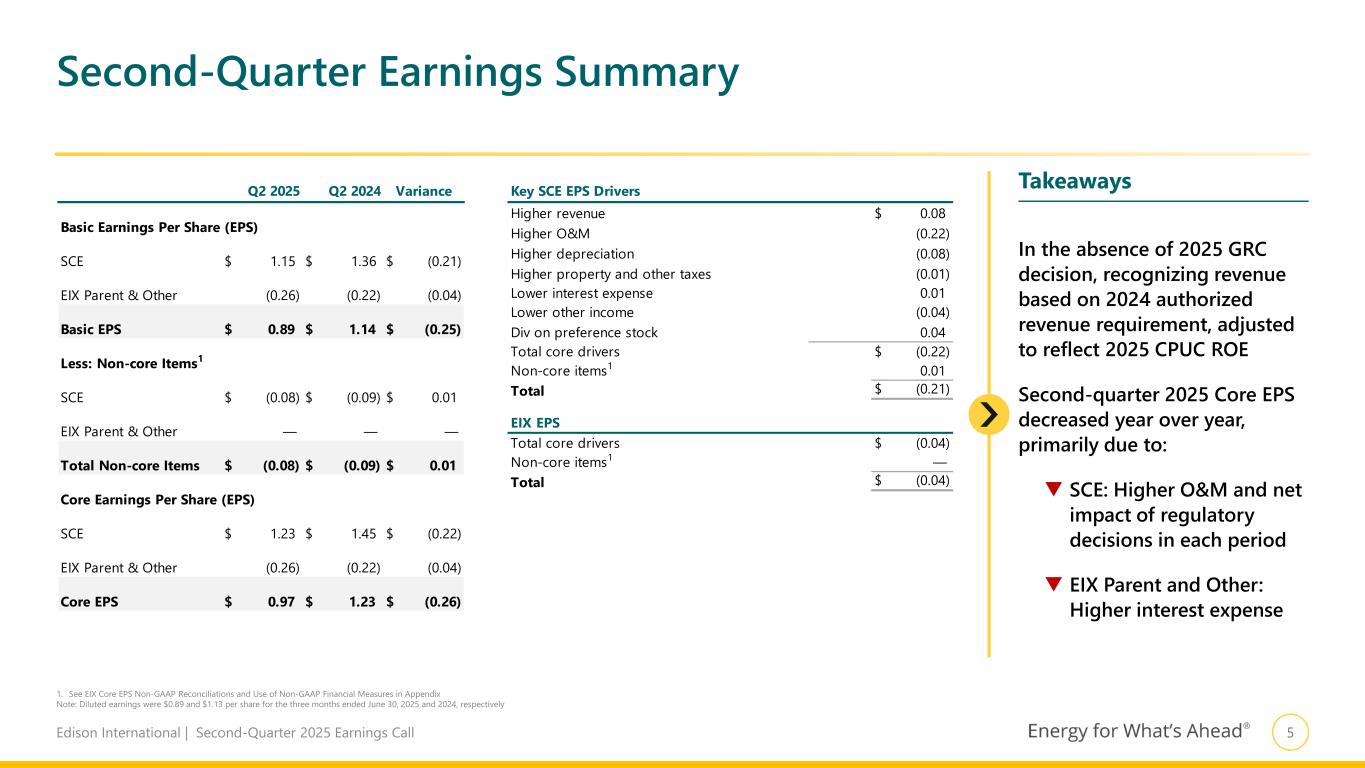
5Edison International | Second-Quarter 2025 Earnings Call Key SCE EPS Drivers Higher revenue 0.08$ Higher O&M (0.22) Higher depreciation (0.08) Higher property and other taxes (0.01) Lower interest expense 0.01 Lower other income (0.04) Div on preference stock 0.04 Total core drivers (0.22)$ Non-core items1 0.01 Total (0.21)$ Total core drivers (0.04)$ Non-core items1 — Total (0.04)$ EIX EPS Q2 2025 Q2 2024 Variance Basic Earnings Per Share (EPS) SCE 1.15$ 1.36$ (0.21)$ EIX Parent & Other (0.26) (0.22) (0.04) Basic EPS 0.89$ 1.14$ (0.25)$ Less: Non-core Items1 SCE (0.08)$ (0.09)$ 0.01$ EIX Parent & Other — — — Total Non-core Items (0.08)$ (0.09)$ 0.01$ Core Earnings Per Share (EPS) SCE 1.23$ 1.45$ (0.22)$ EIX Parent & Other (0.26) (0.22) (0.04) Core EPS 0.97$ 1.23$ (0.26)$ Second-Quarter Earnings Summary 1. See EIX Core EPS Non-GAAP Reconciliations and Use of Non-GAAP Financial Measures in Appendix Note: Diluted earnings were $0.89 and $1.13 per share for the three months ended June 30, 2025 and 2024, respectively In the absence of 2025 GRC decision, recognizing revenue based on 2024 authorized revenue requirement, adjusted to reflect 2025 CPUC ROE Second-quarter 2025 Core EPS decreased year over year, primarily due to: SCE: Higher O&M and net impact of regulatory decisions in each period EIX Parent and Other: Higher interest expense Takeaways
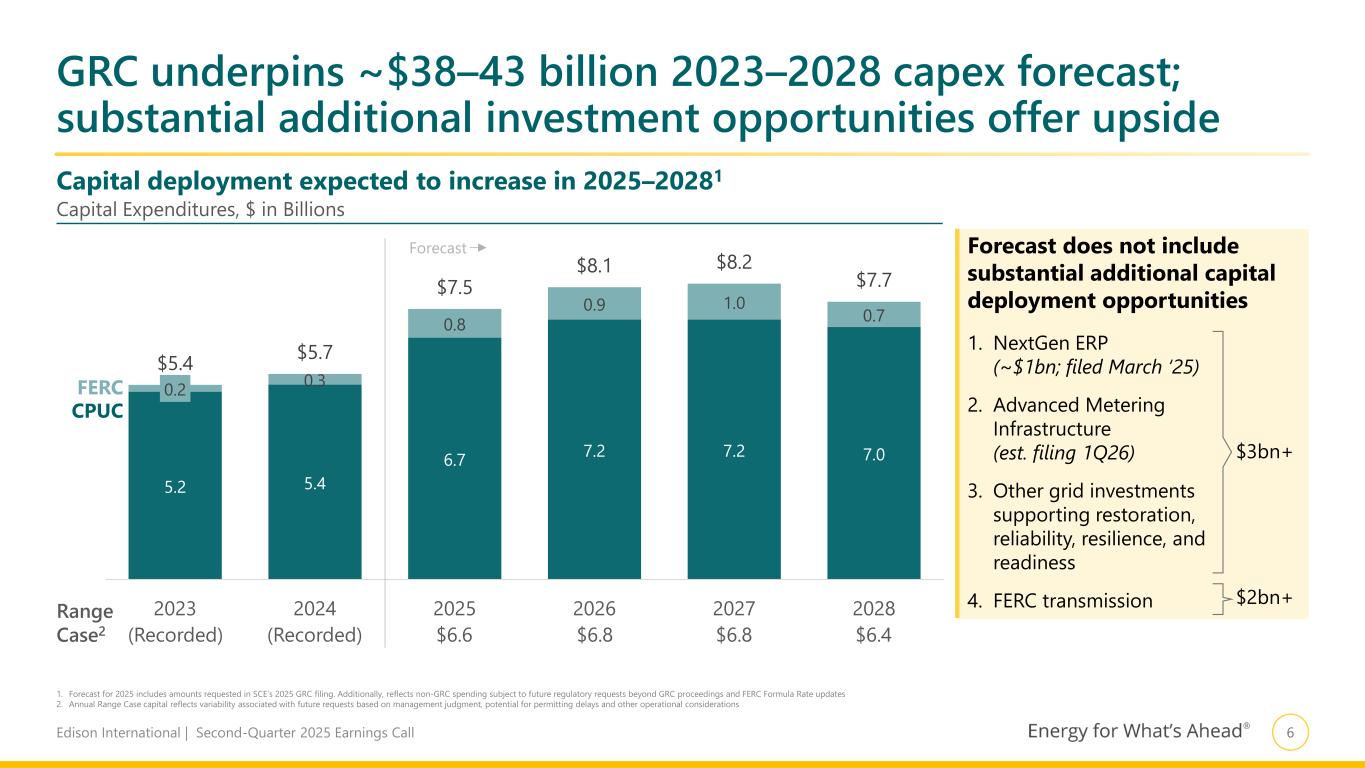
6Edison International | Second-Quarter 2025 Earnings Call 5.2 5.4 6.7 7.2 7.2 7.0 0.2 0.3 0.8 0.9 1.0 0.7 $5.4 $5.7 $7.5 $8.1 $8.2 $7.7 2023 2024 2025 2026 2027 2028 Capital deployment expected to increase in 2025–20281 Range Case2 (Recorded) (Recorded) $6.6 $6.8 $6.8 $6.4 GRC underpins ~$38–43 billion 2023–2028 capex forecast; substantial additional investment opportunities offer upside CPUC FERC Capital Expenditures, $ in Billions Forecast does not include substantial additional capital deployment opportunities 1. NextGen ERP (~$1bn; filed March ‘25) 2. Advanced Metering Infrastructure (est. filing 1Q26) 3. Other grid investments supporting restoration, reliability, resilience, and readiness 4. FERC transmission $3bn+ $2bn+ Forecast 1. Forecast for 2025 includes amounts requested in SCE’s 2025 GRC filing. Additionally, reflects non-GRC spending subject to future regulatory requests beyond GRC proceedings and FERC Formula Rate updates 2. Annual Range Case capital reflects variability associated with future requests based on management judgment, potential for permitting delays and other operational considerations
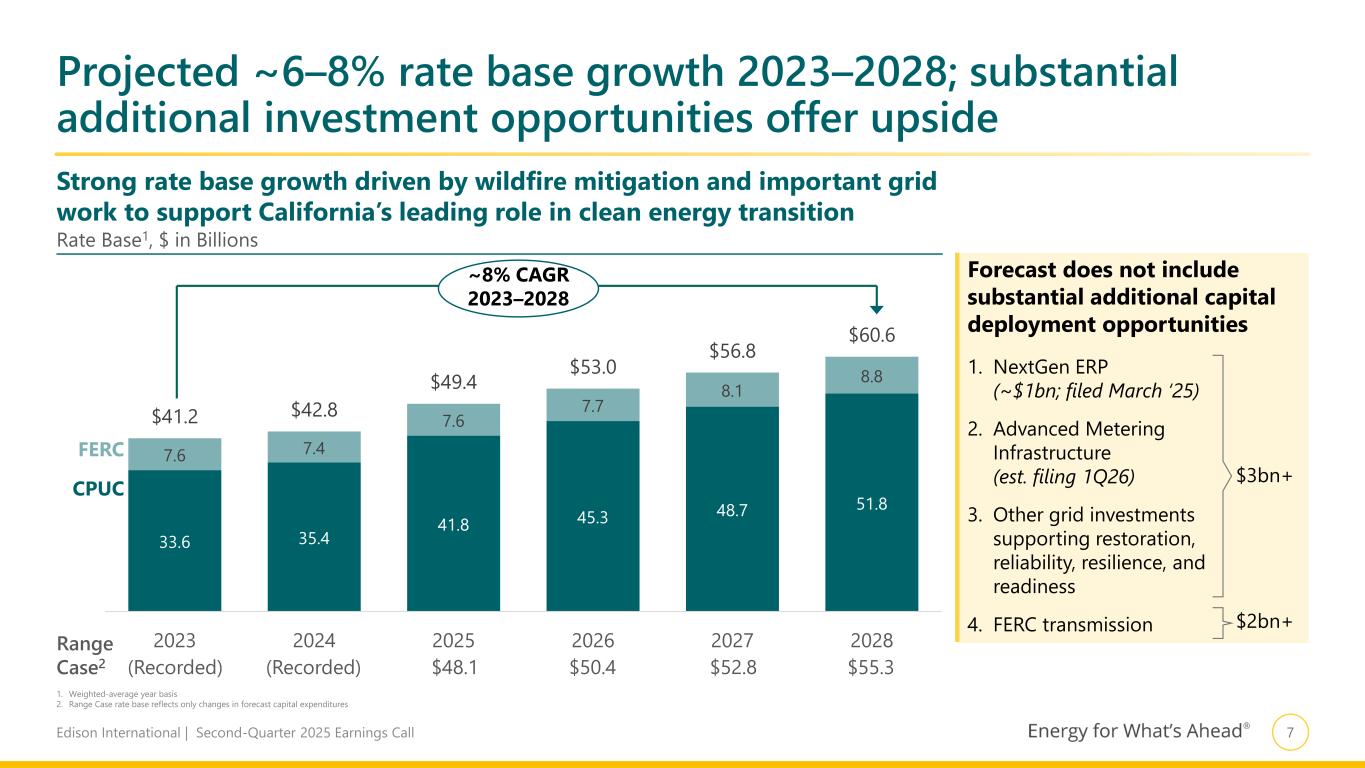
7Edison International | Second-Quarter 2025 Earnings Call 33.6 35.4 41.8 45.3 48.7 51.8 7.6 7.4 7.6 7.7 8.1 8.8 $41.2 $42.8 $49.4 $53.0 $56.8 $60.6 2023 2024 2025 2026 2027 2028 Projected ~6–8% rate base growth 2023–2028; substantial additional investment opportunities offer upside CPUC FERC ~8% CAGR 2023–2028 Rate Base1, $ in Billions Strong rate base growth driven by wildfire mitigation and important grid work to support California’s leading role in clean energy transition Range Case2 (Recorded) (Recorded) $48.1 $50.4 $52.8 $55.3 1. Weighted-average year basis 2. Range Case rate base reflects only changes in forecast capital expenditures Forecast does not include substantial additional capital deployment opportunities 1. NextGen ERP (~$1bn; filed March ‘25) 2. Advanced Metering Infrastructure (est. filing 1Q26) 3. Other grid investments supporting restoration, reliability, resilience, and readiness 4. FERC transmission $3bn+ $2bn+
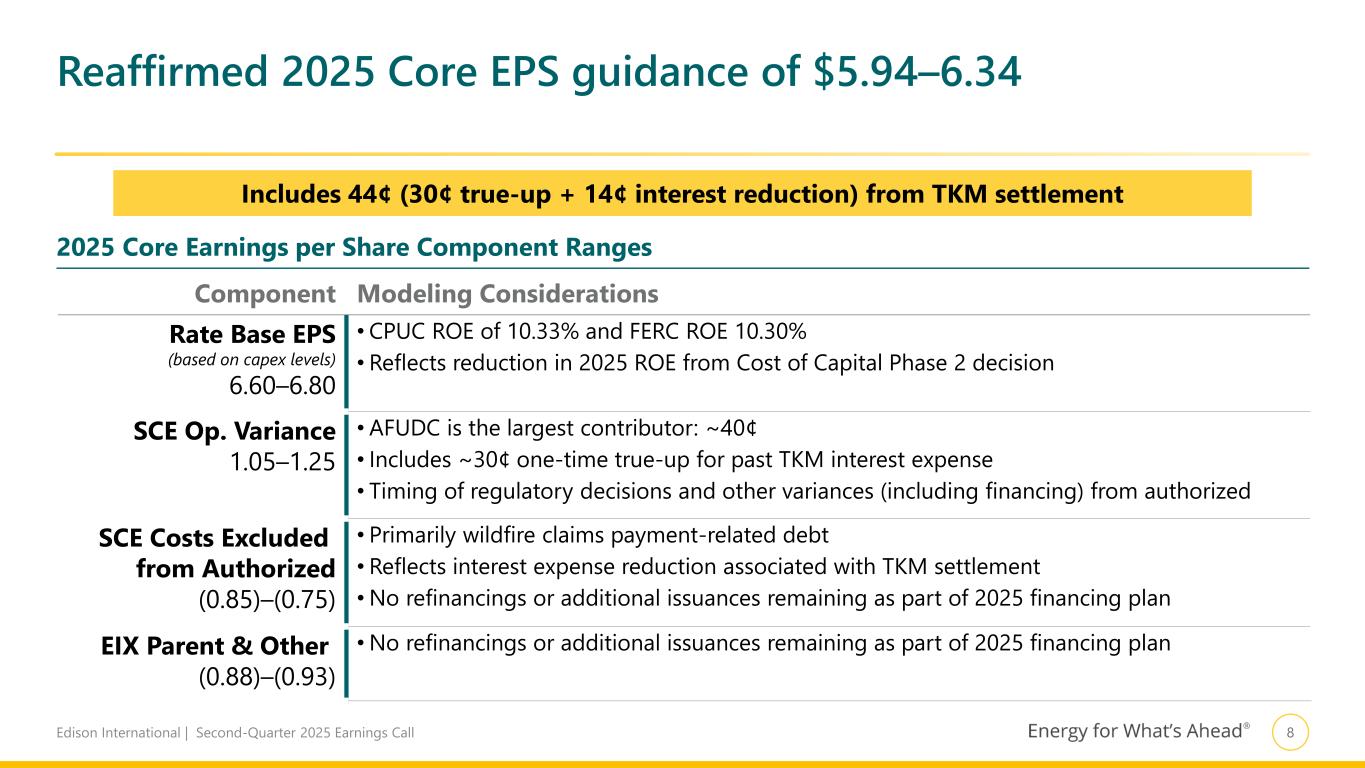
8Edison International | Second-Quarter 2025 Earnings Call Reaffirmed 2025 Core EPS guidance of $5.94–6.34 Component Modeling Considerations Rate Base EPS (based on capex levels) 6.60–6.80 • CPUC ROE of 10.33% and FERC ROE 10.30% • Reflects reduction in 2025 ROE from Cost of Capital Phase 2 decision SCE Op. Variance 1.05–1.25 • AFUDC is the largest contributor: ~40¢ • Includes ~30¢ one-time true-up for past TKM interest expense • Timing of regulatory decisions and other variances (including financing) from authorized SCE Costs Excluded from Authorized (0.85)–(0.75) • Primarily wildfire claims payment-related debt • Reflects interest expense reduction associated with TKM settlement • No refinancings or additional issuances remaining as part of 2025 financing plan EIX Parent & Other (0.88)–(0.93) • No refinancings or additional issuances remaining as part of 2025 financing plan 2025 Core Earnings per Share Component Ranges Includes 44¢ (30¢ true-up + 14¢ interest reduction) from TKM settlement
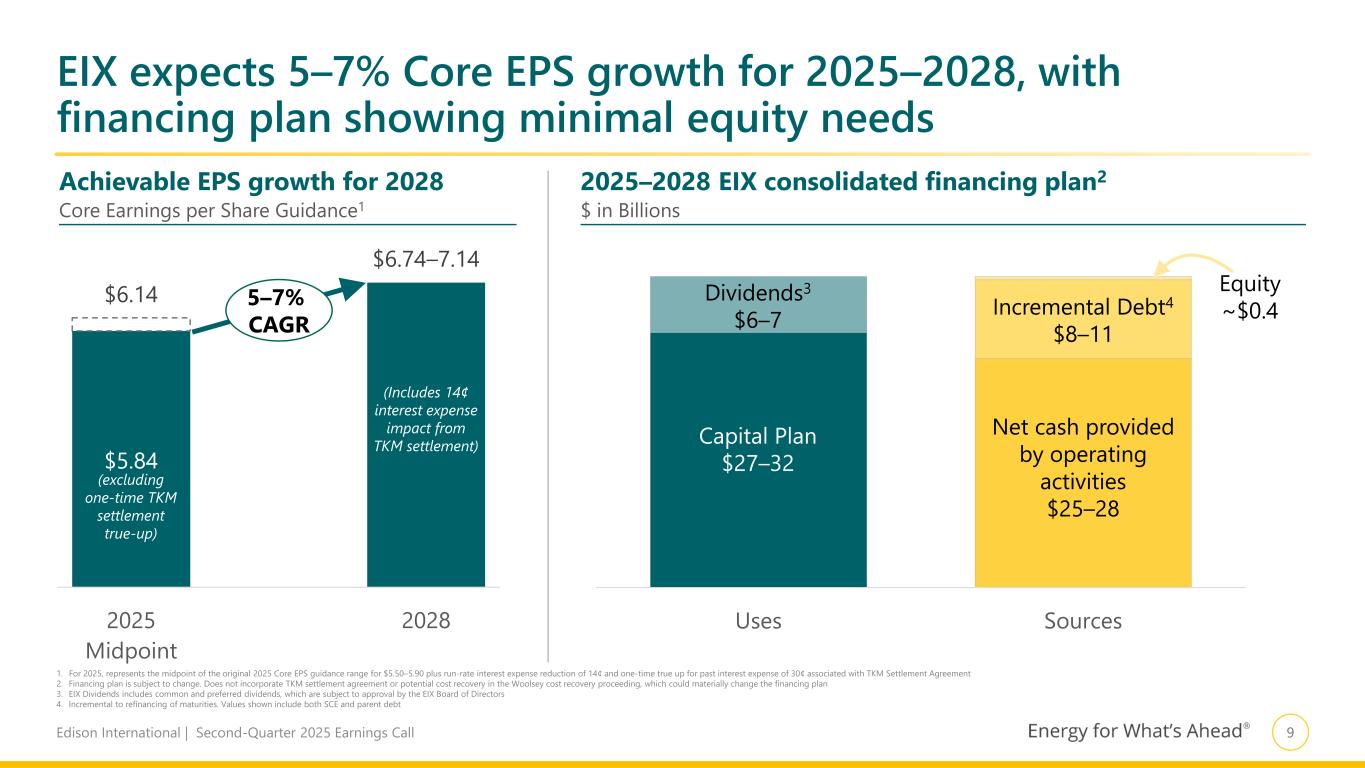
9Edison International | Second-Quarter 2025 Earnings Call EIX expects 5–7% Core EPS growth for 2025–2028, with financing plan showing minimal equity needs 1. For 2025, represents the midpoint of the original 2025 Core EPS guidance range for $5.50–5.90 plus run-rate interest expense reduction of 14¢ and one-time true up for past interest expense of 30¢ associated with TKM Settlement Agreement 2. Financing plan is subject to change. Does not incorporate TKM settlement agreement or potential cost recovery in the Woolsey cost recovery proceeding, which could materially change the financing plan 3. EIX Dividends includes common and preferred dividends, which are subject to approval by the EIX Board of Directors 4. Incremental to refinancing of maturities. Values shown include both SCE and parent debt $5.84 $6.14 $6.74–7.14 2025 Midpoint 2028 Achievable EPS growth for 2028 Core Earnings per Share Guidance1 5–7% CAGR Uses Sources 2025–2028 EIX consolidated financing plan2 $ in Billions Capital Plan $27–32 Dividends3 $6–7 Net cash provided by operating activities $25–28 Incremental Debt4 $8–11 Equity ~$0.4 (excluding one-time TKM settlement true-up) (Includes 14¢ interest expense impact from TKM settlement)
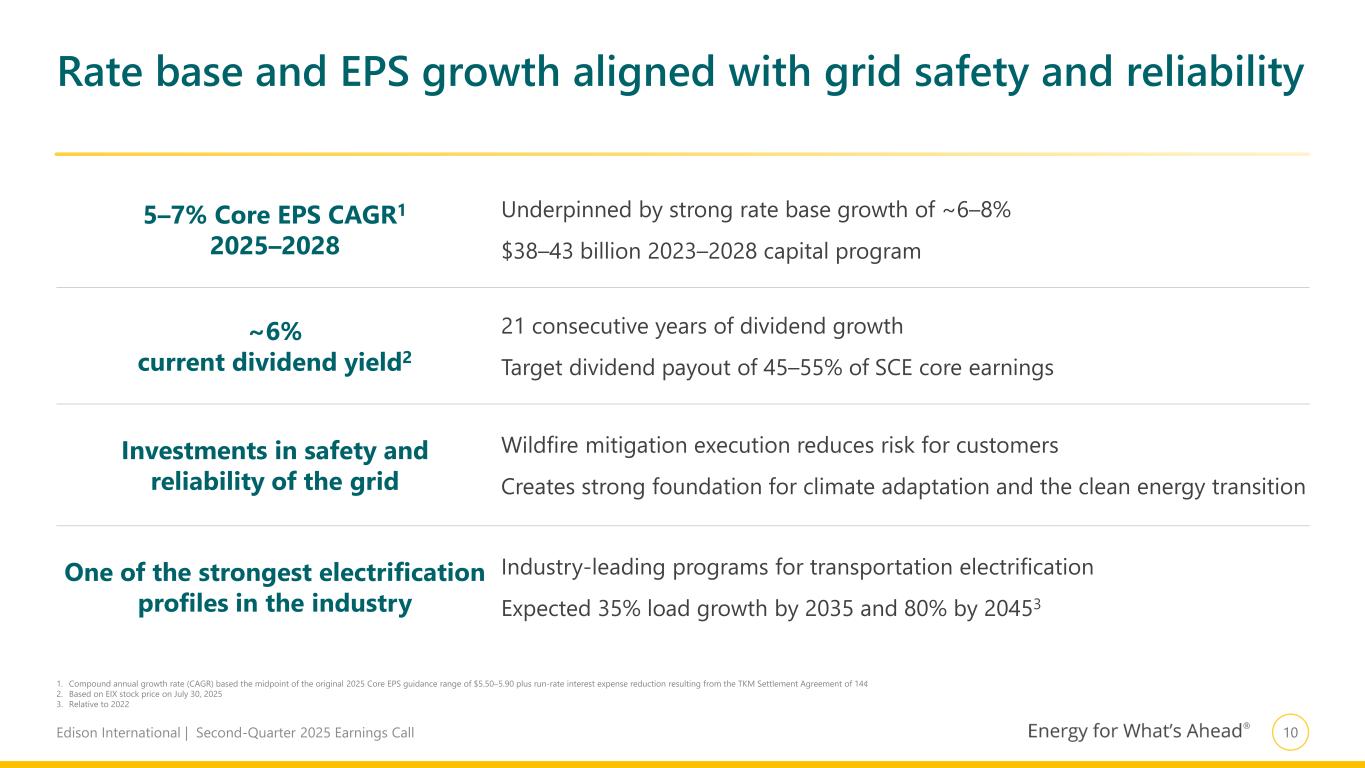
10Edison International | Second-Quarter 2025 Earnings Call Rate base and EPS growth aligned with grid safety and reliability 1. Compound annual growth rate (CAGR) based the midpoint of the original 2025 Core EPS guidance range of $5.50–5.90 plus run-rate interest expense reduction resulting from the TKM Settlement Agreement of 14¢ 2. Based on EIX stock price on July 30, 2025 3. Relative to 2022 5–7% Core EPS CAGR1 2025–2028 Underpinned by strong rate base growth of ~6–8% $38–43 billion 2023–2028 capital program ~6% current dividend yield2 21 consecutive years of dividend growth Target dividend payout of 45–55% of SCE core earnings Investments in safety and reliability of the grid Wildfire mitigation execution reduces risk for customers Creates strong foundation for climate adaptation and the clean energy transition One of the strongest electrification profiles in the industry Industry-leading programs for transportation electrification Expected 35% load growth by 2035 and 80% by 20453
ADDITIONAL INFORMATION
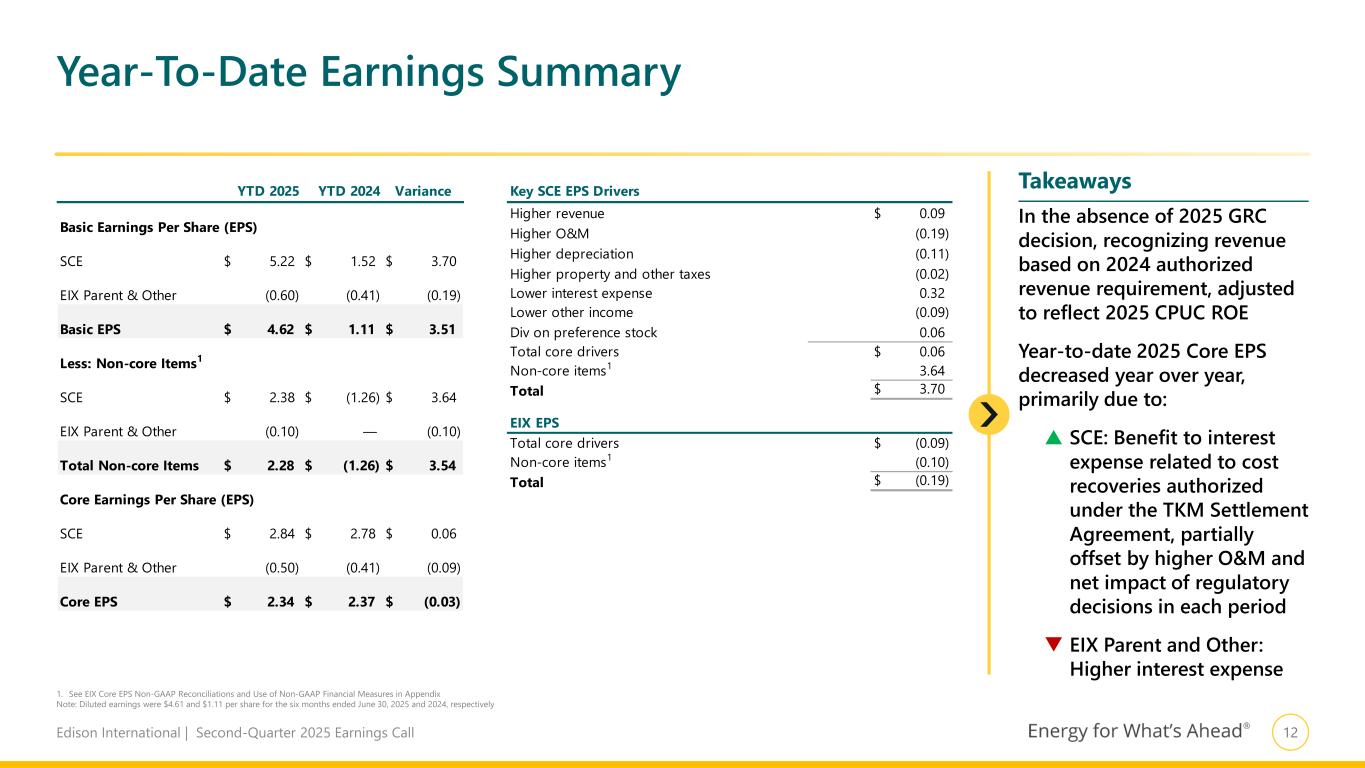
12Edison International | Second-Quarter 2025 Earnings Call Key SCE EPS Drivers Higher revenue 0.09$ Higher O&M (0.19) Higher depreciation (0.11) Higher property and other taxes (0.02) Lower interest expense 0.32 Lower other income (0.09) Div on preference stock 0.06 Total core drivers 0.06$ Non-core items1 3.64 Total 3.70$ Total core drivers (0.09)$ Non-core items1 (0.10) Total (0.19)$ EIX EPS YTD 2025 YTD 2024 Variance Basic Earnings Per Share (EPS) SCE 5.22$ 1.52$ 3.70$ EIX Parent & Other (0.60) (0.41) (0.19) Basic EPS 4.62$ 1.11$ 3.51$ Less: Non-core Items1 SCE 2.38$ (1.26)$ 3.64$ EIX Parent & Other (0.10) — (0.10) Total Non-core Items 2.28$ (1.26)$ 3.54$ Core Earnings Per Share (EPS) SCE 2.84$ 2.78$ 0.06$ EIX Parent & Other (0.50) (0.41) (0.09) Core EPS 2.34$ 2.37$ (0.03)$ Year-To-Date Earnings Summary 1. See EIX Core EPS Non-GAAP Reconciliations and Use of Non-GAAP Financial Measures in Appendix Note: Diluted earnings were $4.61 and $1.11 per share for the six months ended June 30, 2025 and 2024, respectively In the absence of 2025 GRC decision, recognizing revenue based on 2024 authorized revenue requirement, adjusted to reflect 2025 CPUC ROE Year-to-date 2025 Core EPS decreased year over year, primarily due to: SCE: Benefit to interest expense related to cost recoveries authorized under the TKM Settlement Agreement, partially offset by higher O&M and net impact of regulatory decisions in each period EIX Parent and Other: Higher interest expense Takeaways
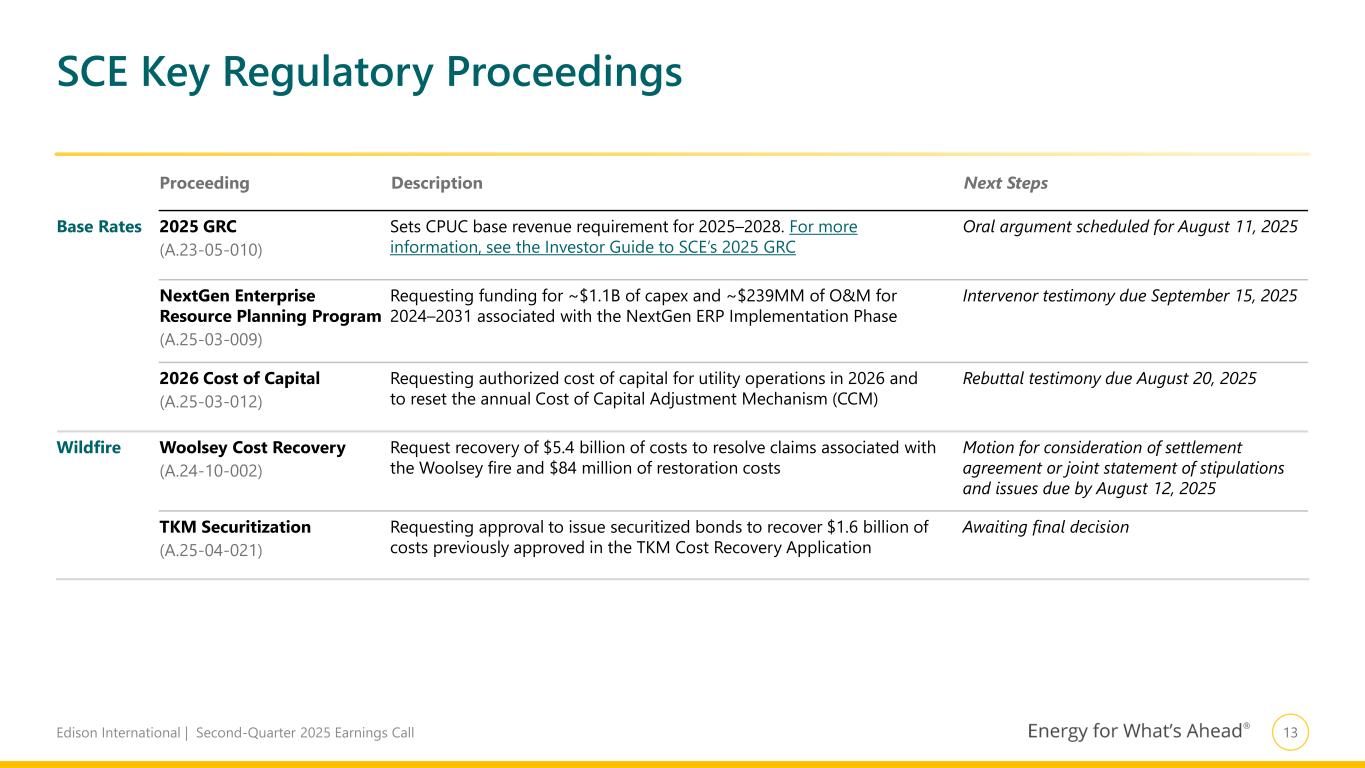
13Edison International | Second-Quarter 2025 Earnings Call SCE Key Regulatory Proceedings Proceeding Description Next Steps Base Rates 2025 GRC (A.23-05-010) Sets CPUC base revenue requirement for 2025–2028. For more information, see the Investor Guide to SCE’s 2025 GRC Oral argument scheduled for August 11, 2025 NextGen Enterprise Resource Planning Program (A.25-03-009) Requesting funding for ~$1.1B of capex and ~$239MM of O&M for 2024–2031 associated with the NextGen ERP Implementation Phase Intervenor testimony due September 15, 2025 2026 Cost of Capital (A.25-03-012) Requesting authorized cost of capital for utility operations in 2026 and to reset the annual Cost of Capital Adjustment Mechanism (CCM) Rebuttal testimony due August 20, 2025 Wildfire Woolsey Cost Recovery (A.24-10-002) Request recovery of $5.4 billion of costs to resolve claims associated with the Woolsey fire and $84 million of restoration costs Motion for consideration of settlement agreement or joint statement of stipulations and issues due by August 12, 2025 TKM Securitization (A.25-04-021) Requesting approval to issue securitized bonds to recover $1.6 billion of costs previously approved in the TKM Cost Recovery Application Awaiting final decision
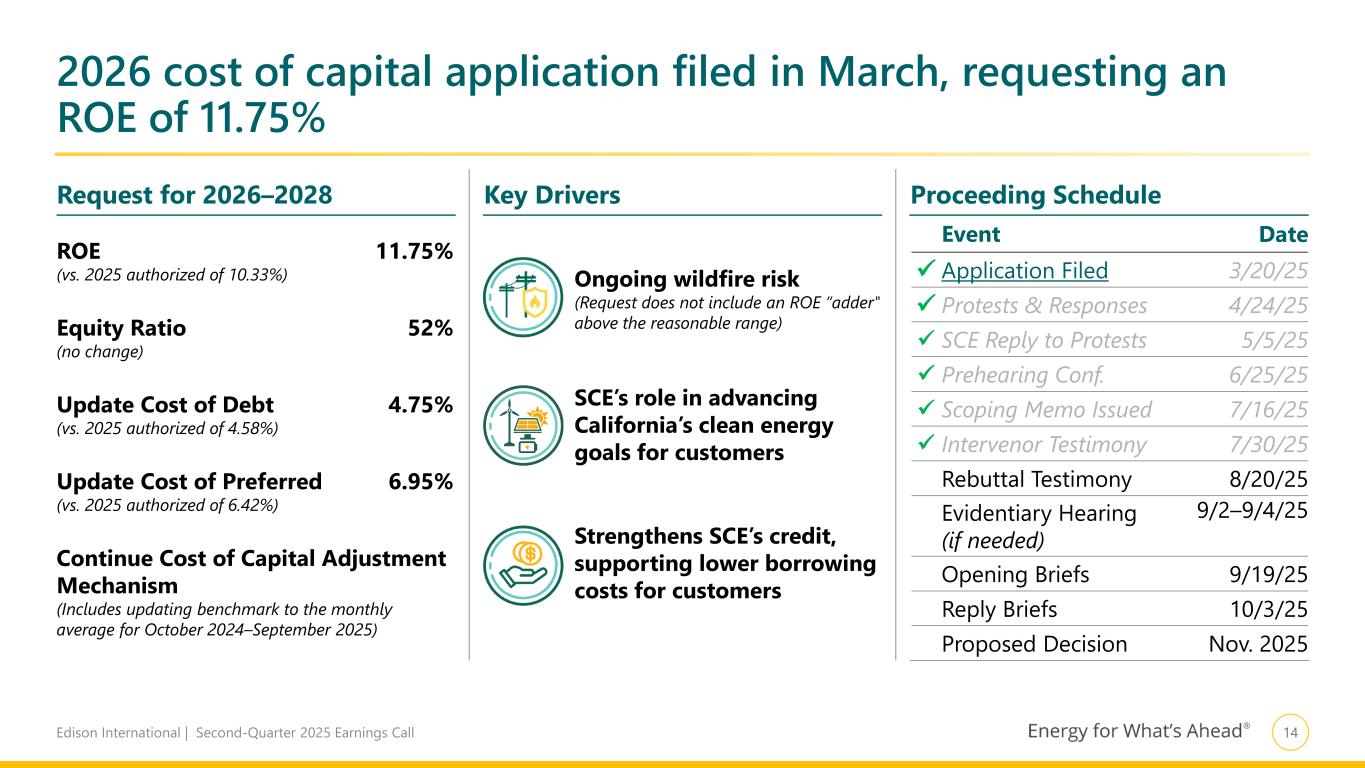
14Edison International | Second-Quarter 2025 Earnings Call Ongoing wildfire risk (Request does not include an ROE “adder" above the reasonable range) SCE’s role in advancing California’s clean energy goals for customers Strengthens SCE’s credit, supporting lower borrowing costs for customers 2026 cost of capital application filed in March, requesting an ROE of 11.75% Request for 2026–2028 ROE (vs. 2025 authorized of 10.33%) 11.75% Equity Ratio (no change) 52% Update Cost of Debt (vs. 2025 authorized of 4.58%) 4.75% Update Cost of Preferred (vs. 2025 authorized of 6.42%) 6.95% Continue Cost of Capital Adjustment Mechanism (Includes updating benchmark to the monthly average for October 2024–September 2025) Key Drivers Proceeding Schedule Event Date Application Filed 3/20/25 Protests & Responses 4/24/25 SCE Reply to Protests 5/5/25 Prehearing Conf. 6/25/25 Scoping Memo Issued 7/16/25 Intervenor Testimony 7/30/25 Rebuttal Testimony 8/20/25 Evidentiary Hearing (if needed) 9/2–9/4/25 Opening Briefs 9/19/25 Reply Briefs 10/3/25 Proposed Decision Nov. 2025
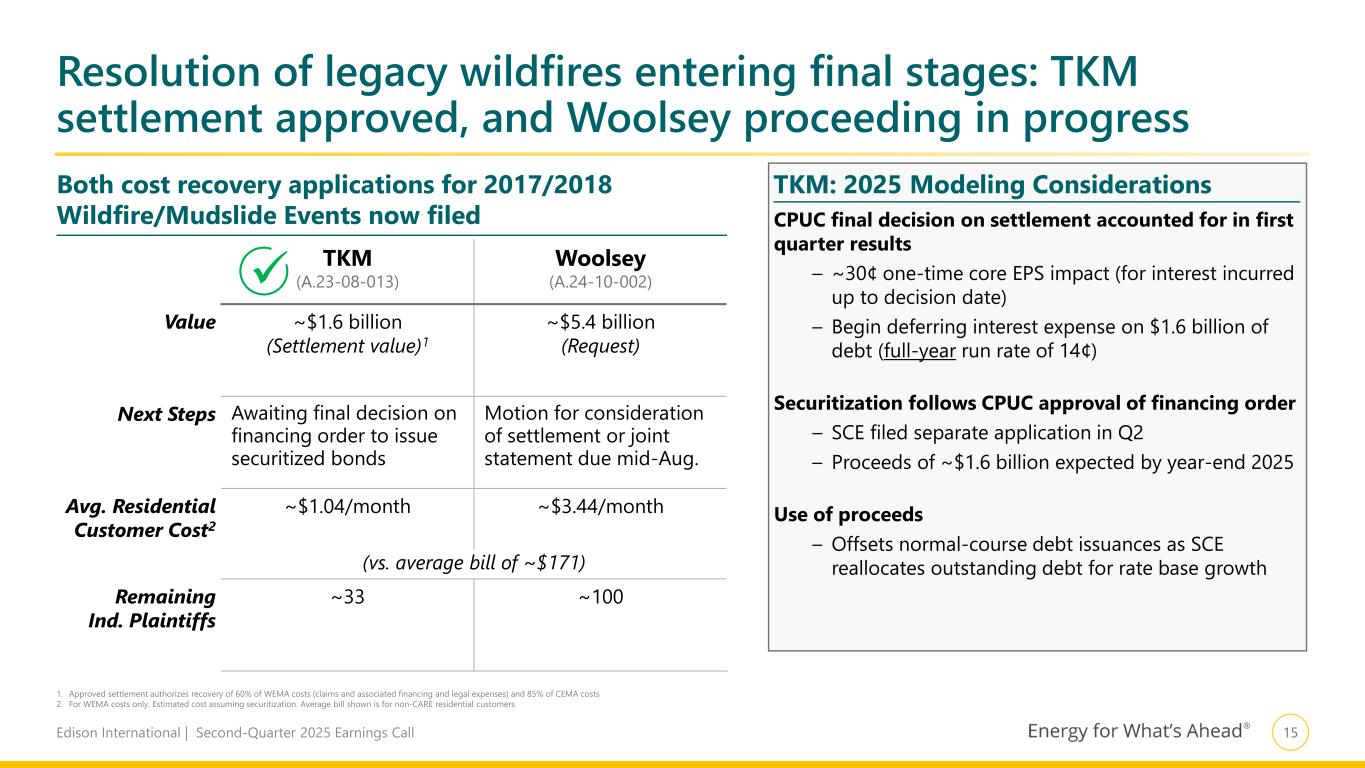
15Edison International | Second-Quarter 2025 Earnings Call Resolution of legacy wildfires entering final stages: TKM settlement approved, and Woolsey proceeding in progress TKM (A.23-08-013) Woolsey (A.24-10-002) Value ~$1.6 billion (Settlement value)1 ~$5.4 billion (Request) Next Steps Awaiting final decision on financing order to issue securitized bonds Motion for consideration of settlement or joint statement due mid-Aug. Avg. Residential Customer Cost2 ~$1.04/month ~$3.44/month (vs. average bill of ~$171) Remaining Ind. Plaintiffs ~33 ~100 TKM: 2025 Modeling ConsiderationsBoth cost recovery applications for 2017/2018 Wildfire/Mudslide Events now filed 1. Approved settlement authorizes recovery of 60% of WEMA costs (claims and associated financing and legal expenses) and 85% of CEMA costs 2. For WEMA costs only. Estimated cost assuming securitization. Average bill shown is for non-CARE residential customers CPUC final decision on settlement accounted for in first quarter results – ~30¢ one-time core EPS impact (for interest incurred up to decision date) – Begin deferring interest expense on $1.6 billion of debt (full-year run rate of 14¢) Securitization follows CPUC approval of financing order – SCE filed separate application in Q2 – Proceeds of ~$1.6 billion expected by year-end 2025 Use of proceeds – Offsets normal-course debt issuances as SCE reallocates outstanding debt for rate base growth
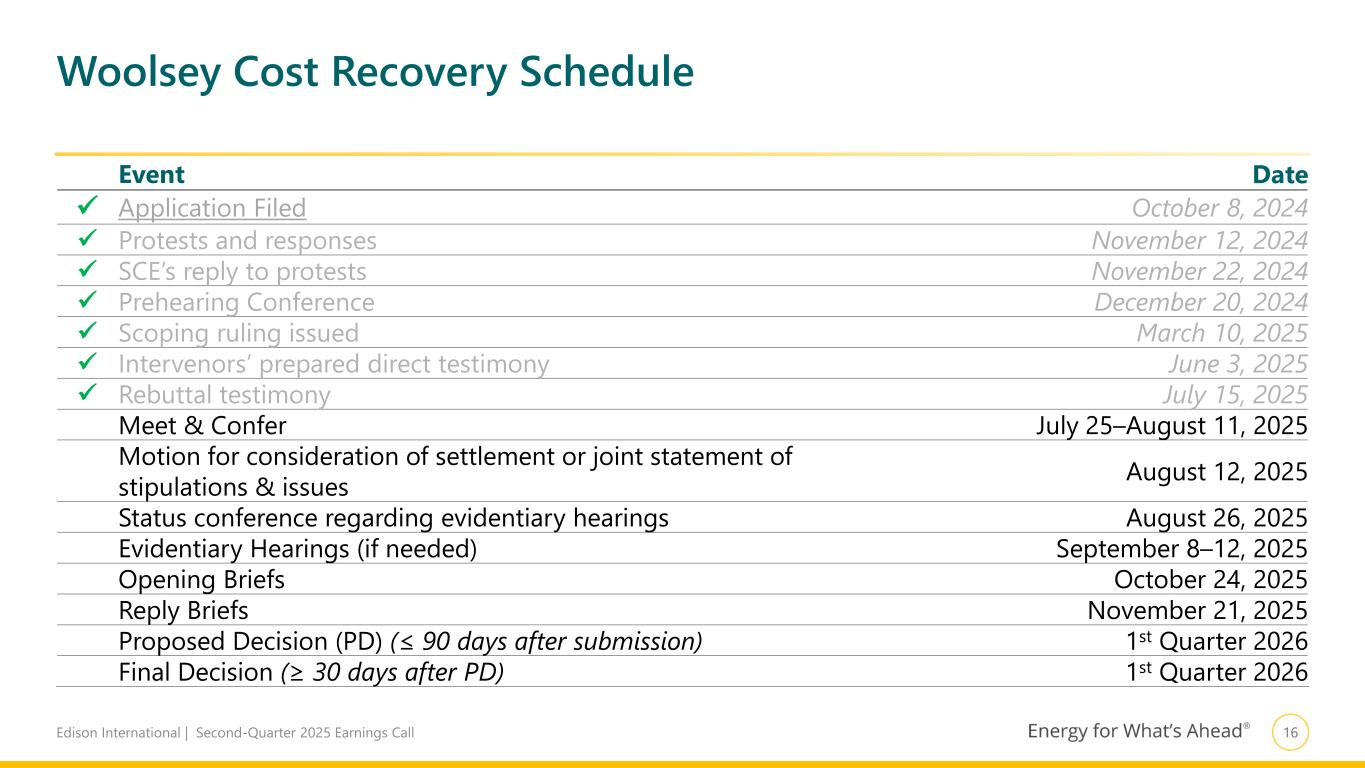
16Edison International | Second-Quarter 2025 Earnings Call Woolsey Cost Recovery Schedule Event Date Application Filed October 8, 2024 Protests and responses November 12, 2024 SCE’s reply to protests November 22, 2024 Prehearing Conference December 20, 2024 Scoping ruling issued March 10, 2025 Intervenors’ prepared direct testimony June 3, 2025 Rebuttal testimony July 15, 2025 Meet & Confer July 25–August 11, 2025 Motion for consideration of settlement or joint statement of stipulations & issues August 12, 2025 Status conference regarding evidentiary hearings August 26, 2025 Evidentiary Hearings (if needed) September 8–12, 2025 Opening Briefs October 24, 2025 Reply Briefs November 21, 2025 Proposed Decision (PD) (≤ 90 days after submission) 1st Quarter 2026 Final Decision (≥ 30 days after PD) 1st Quarter 2026
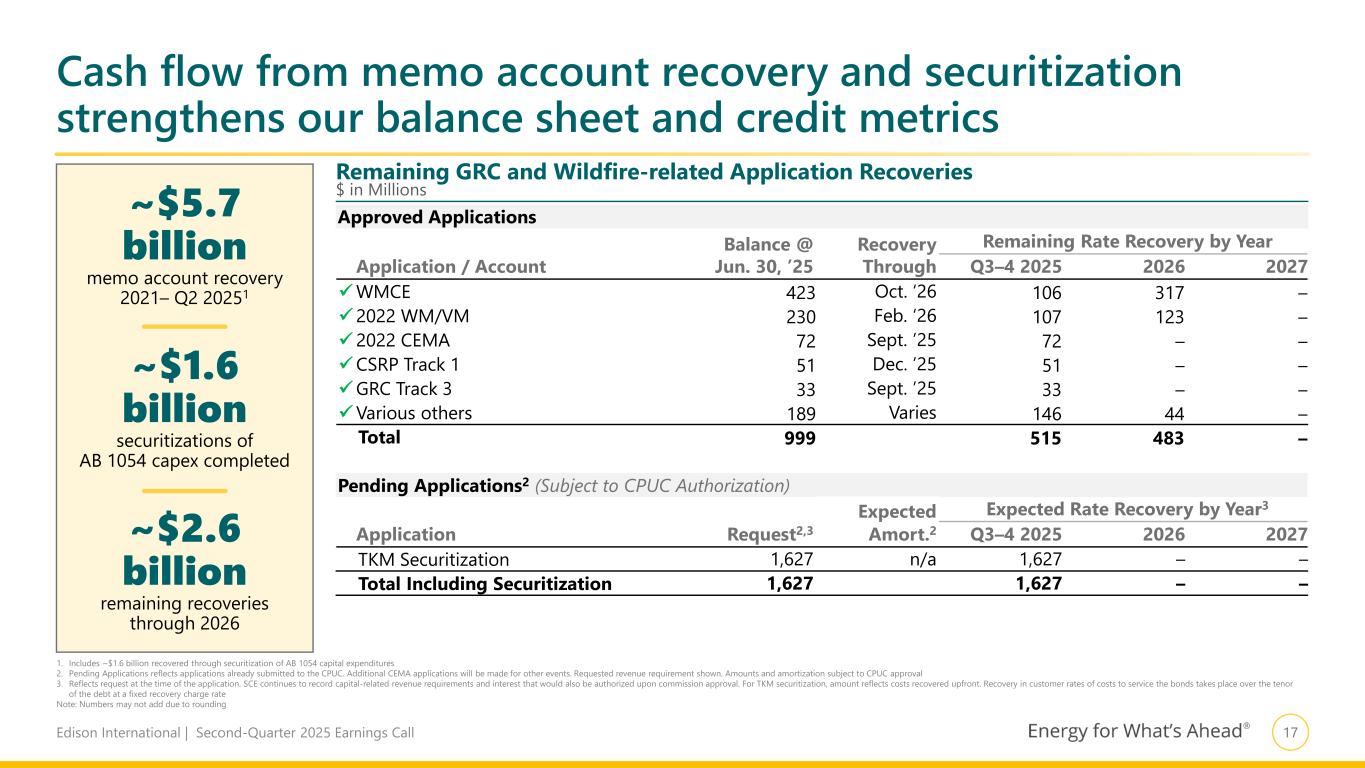
17Edison International | Second-Quarter 2025 Earnings Call ~$5.7 billion memo account recovery 2021– Q2 20251 ~$1.6 billion securitizations of AB 1054 capex completed ~$2.6 billion remaining recoveries through 2026 Cash flow from memo account recovery and securitization strengthens our balance sheet and credit metrics Approved Applications Application / Account Balance @ Jun. 30, ’25 Recovery Through Remaining Rate Recovery by Year Q3–4 2025 2026 2027 WMCE 423 Oct. ‘26 106 317 – 2022 WM/VM 230 Feb. ‘26 107 123 – 2022 CEMA 72 Sept. ’25 72 – – CSRP Track 1 51 Dec. ’25 51 – – GRC Track 3 33 Sept. ’25 33 – – Various others 189 Varies 146 44 – Total 999 515 483 – Pending Applications2 (Subject to CPUC Authorization) Application Request2,3 Expected Amort.2 Expected Rate Recovery by Year3 Q3–4 2025 2026 2027 TKM Securitization 1,627 n/a 1,627 – – Total Including Securitization 1,627 1,627 – – 1. Includes ~$1.6 billion recovered through securitization of AB 1054 capital expenditures 2. Pending Applications reflects applications already submitted to the CPUC. Additional CEMA applications will be made for other events. Requested revenue requirement shown. Amounts and amortization subject to CPUC approval 3. Reflects request at the time of the application. SCE continues to record capital-related revenue requirements and interest that would also be authorized upon commission approval. For TKM securitization, amount reflects costs recovered upfront. Recovery in customer rates of costs to service the bonds takes place over the tenor of the debt at a fixed recovery charge rate Note: Numbers may not add due to rounding Remaining GRC and Wildfire-related Application Recoveries $ in Millions
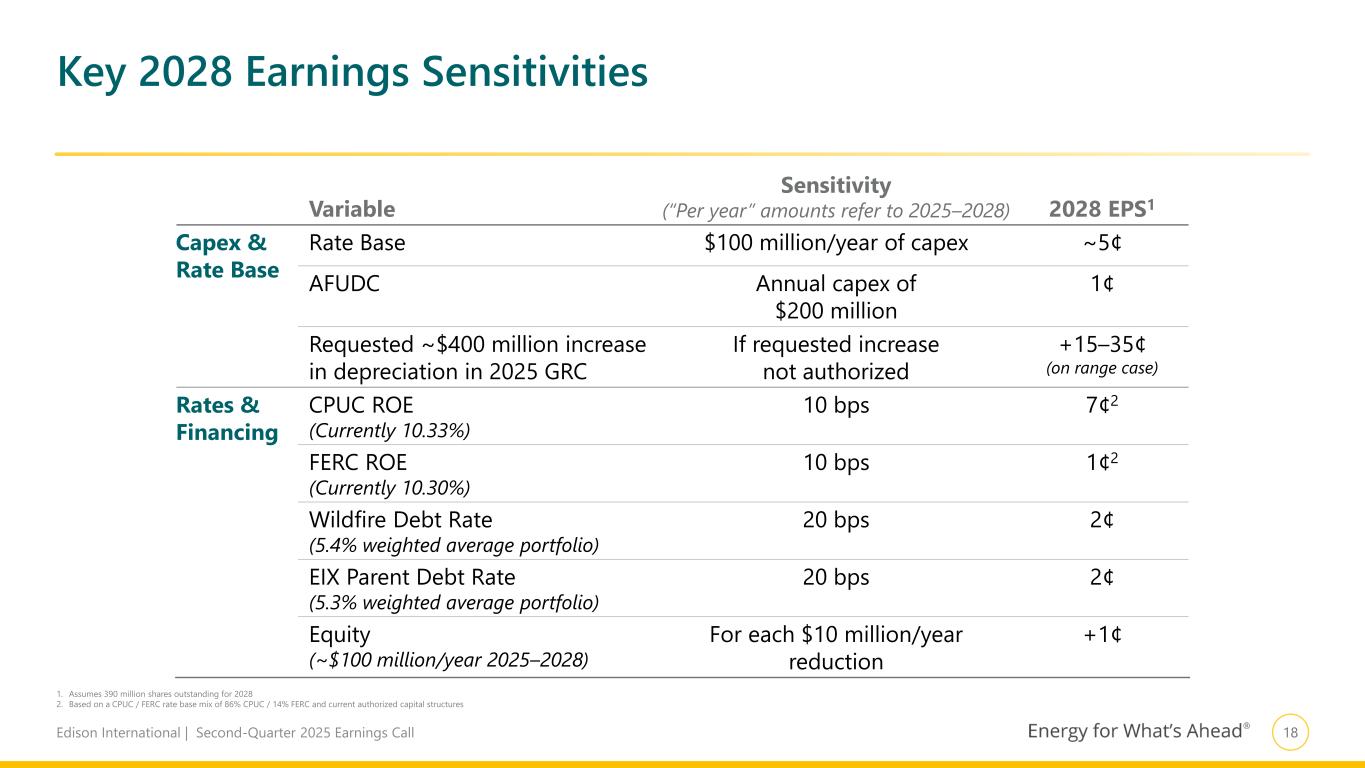
18Edison International | Second-Quarter 2025 Earnings Call Key 2028 Earnings Sensitivities Variable Sensitivity 2028 EPS1(“Per year” amounts refer to 2025–2028) Capex & Rate Base Rate Base $100 million/year of capex ~5¢ AFUDC Annual capex of $200 million 1¢ Requested ~$400 million increase in depreciation in 2025 GRC If requested increase not authorized +15–35¢ (on range case) Rates & Financing CPUC ROE (Currently 10.33%) 10 bps 7¢2 FERC ROE (Currently 10.30%) 10 bps 1¢2 Wildfire Debt Rate (5.4% weighted average portfolio) 20 bps 2¢ EIX Parent Debt Rate (5.3% weighted average portfolio) 20 bps 2¢ Equity (~$100 million/year 2025–2028) For each $10 million/year reduction +1¢ 1. Assumes 390 million shares outstanding for 2028 2. Based on a CPUC / FERC rate base mix of 86% CPUC / 14% FERC and current authorized capital structures
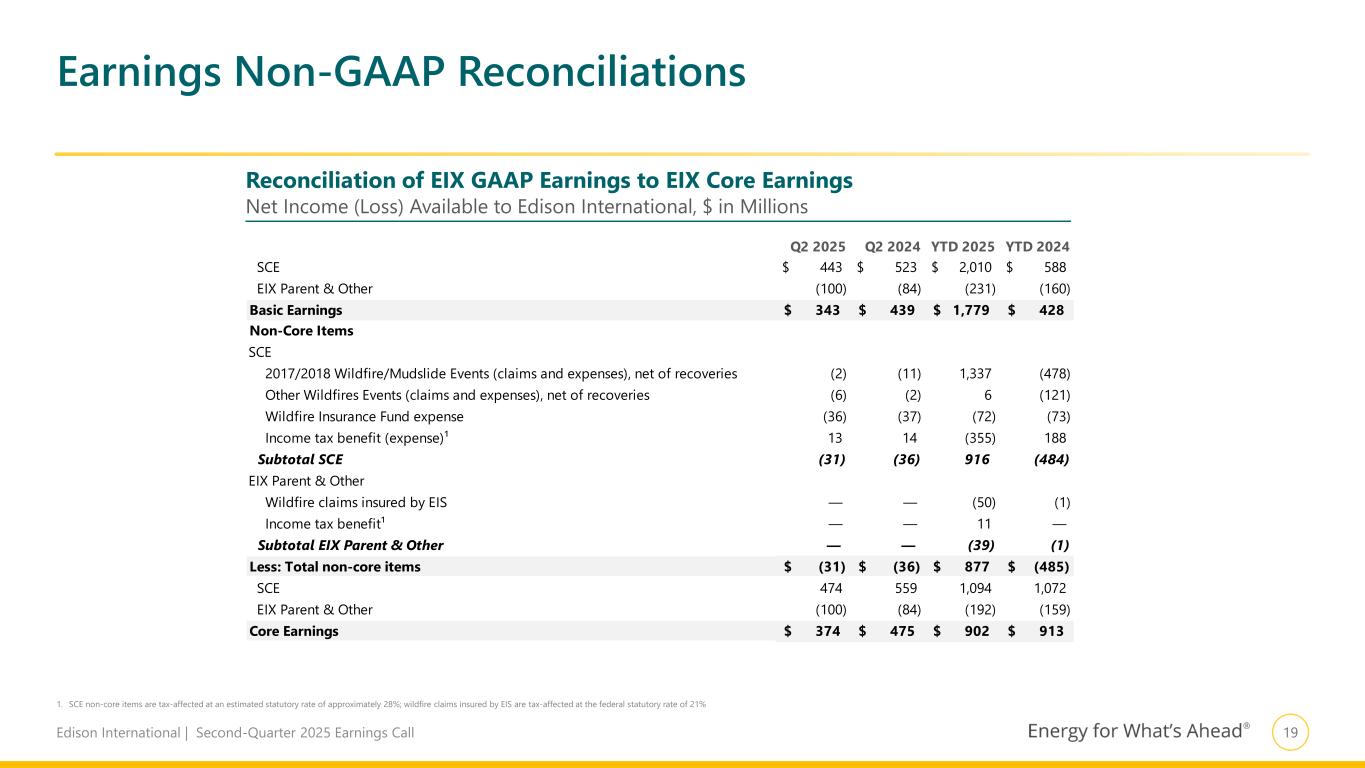
19Edison International | Second-Quarter 2025 Earnings Call Q2 2025 Q2 2024 YTD 2025 YTD 2024 SCE 443$ 523$ 2,010$ 588$ EIX Parent & Other (100) (84) (231) (160) Basic Earnings 343$ 439$ 1,779$ 428$ Non-Core Items SCE 2017/2018 Wildfire/Mudslide Events (claims and expenses), net of recoveries (2) (11) 1,337 (478) Other Wildfires Events (claims and expenses), net of recoveries (6) (2) 6 (121) Wildfire Insurance Fund expense (36) (37) (72) (73) Income tax benefit (expense)¹ 13 14 (355) 188 Subtotal SCE (31) (36) 916 (484) EIX Parent & Other Wildfire claims insured by EIS — — (50) (1) Income tax benefit¹ — — 11 — Subtotal EIX Parent & Other — — (39) (1) Less: Total non-core items (31)$ (36)$ 877$ (485)$ SCE 474 559 1,094 1,072 EIX Parent & Other (100) (84) (192) (159) Core Earnings 374$ 475$ 902$ 913$ Earnings Non-GAAP Reconciliations 1. SCE non-core items are tax-affected at an estimated statutory rate of approximately 28%; wildfire claims insured by EIS are tax-affected at the federal statutory rate of 21% Reconciliation of EIX GAAP Earnings to EIX Core Earnings Net Income (Loss) Available to Edison International, $ in Millions
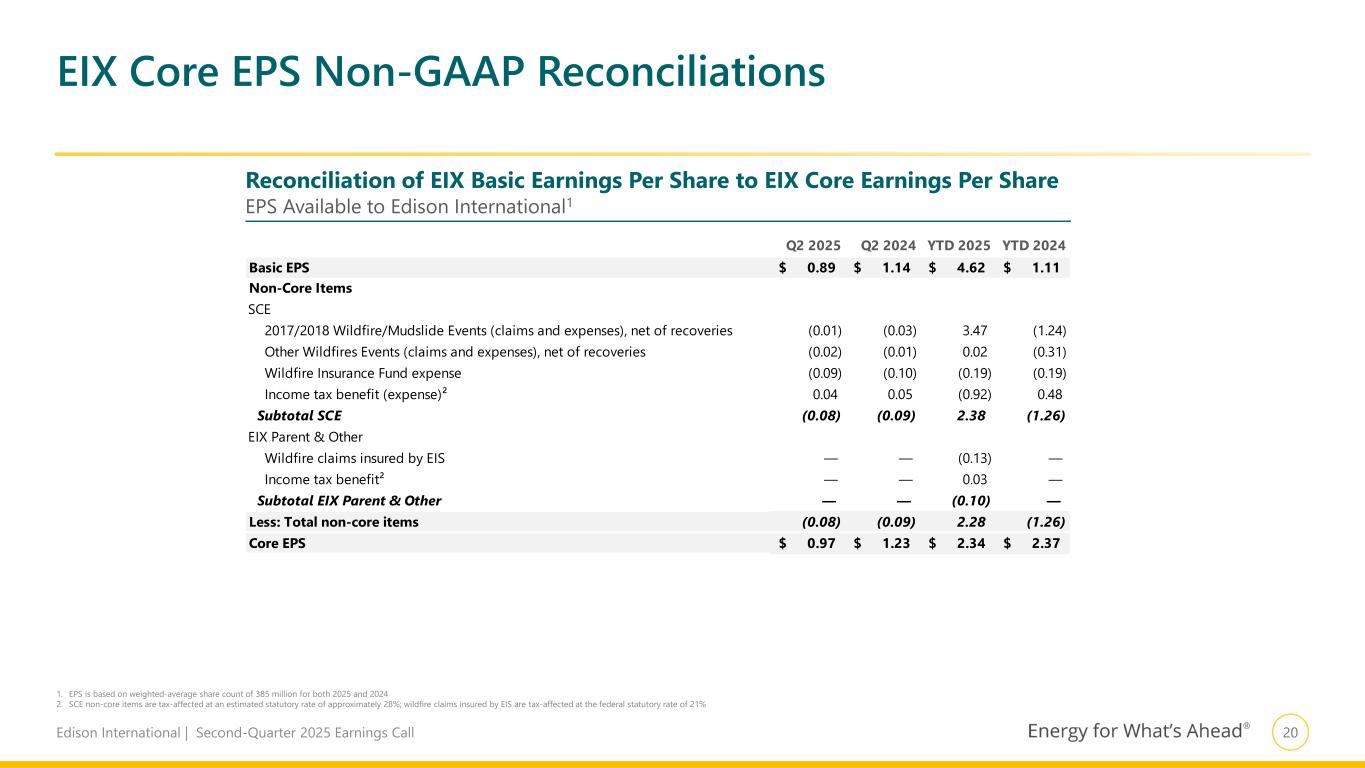
20Edison International | Second-Quarter 2025 Earnings Call EIX Core EPS Non-GAAP Reconciliations 1. EPS is based on weighted-average share count of 385 million for both 2025 and 2024 2. SCE non-core items are tax-affected at an estimated statutory rate of approximately 28%; wildfire claims insured by EIS are tax-affected at the federal statutory rate of 21% Reconciliation of EIX Basic Earnings Per Share to EIX Core Earnings Per Share EPS Available to Edison International1 Q2 2025 Q2 2024 YTD 2025 YTD 2024 Basic EPS 0.89$ 1.14$ 4.62$ 1.11$ Non-Core Items SCE 2017/2018 Wildfire/Mudslide Events (claims and expenses), net of recoveries (0.01) (0.03) 3.47 (1.24) Other Wildfires Events (claims and expenses), net of recoveries (0.02) (0.01) 0.02 (0.31) Wildfire Insurance Fund expense (0.09) (0.10) (0.19) (0.19) Income tax benefit (expense)² 0.04 0.05 (0.92) 0.48 Subtotal SCE (0.08) (0.09) 2.38 (1.26) EIX Parent & Other Wildfire claims insured by EIS — — (0.13) — Income tax benefit² — — 0.03 — Subtotal EIX Parent & Other — — (0.10) — Less: Total non-core items (0.08) (0.09) 2.28 (1.26) Core EPS 0.97$ 1.23$ 2.34$ 2.37$
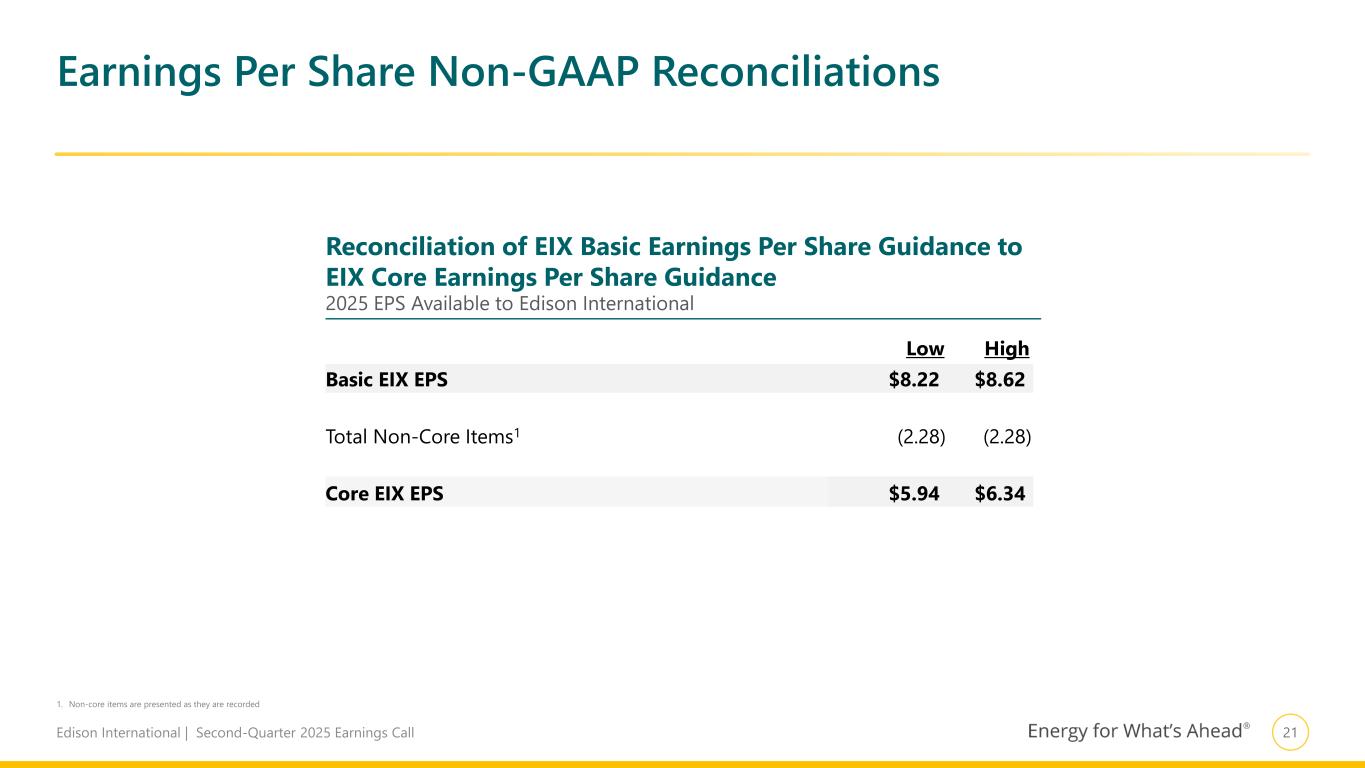
21Edison International | Second-Quarter 2025 Earnings Call Low High Basic EIX EPS $8.22 $8.62 Total Non-Core Items1 (2.28) (2.28) Core EIX EPS $5.94 $6.34 1. Non-core items are presented as they are recorded Earnings Per Share Non-GAAP Reconciliations Reconciliation of EIX Basic Earnings Per Share Guidance to EIX Core Earnings Per Share Guidance 2025 EPS Available to Edison International
22Edison International | Second-Quarter 2025 Earnings Call Use of Non-GAAP Financial Measures EIX Investor Relations Contact Sam Ramraj, Vice President Derek Matsushima, Principal Manager (626) 302-2540 (626) 302-3625 [email protected] [email protected] Edison International's earnings are prepared in accordance with generally accepted accounting principles used in the United States. Management uses core earnings (loss) internally for financial planning and for analysis of performance. Core earnings (loss) are also used when communicating with investors and analysts regarding Edison International's earnings results to facilitate comparisons of the company's performance from period to period. Core earnings (loss) are a non-GAAP financial measure and may not be comparable to those of other companies. Core earnings (loss) are defined as earnings attributable to Edison International shareholders less non-core items. Non-core items include income or loss from discontinued operations and income or loss from significant discrete items that management does not consider representative of ongoing earnings, such as write downs, asset impairments, wildfire-related claims, and other income and expense related to changes in law, outcomes in tax, regulatory or legal proceedings, and exit activities, including sale of certain assets and other activities that are no longer continuing. A reconciliation of Non-GAAP information to GAAP information is included either on the slide where the information appears or on another slide referenced in this presentation.