
FCN 8-K
Fti Consulting, Inc (FCN)
UNITED STATES
SECURITIES AND EXCHANGE COMMISSION
WASHINGTON, D.C. 20549
FORM
CURRENT REPORT
Pursuant to Section 13 or 15(d)
of the Securities Exchange Act of 1934
Date of Report (Date of earliest event reported):
(Exact Name of Registrant as Specified in Its Charter)
| (State or Other Jurisdiction of Incorporation) |
(Commission File Number) |
(I.R.S. Employer Identification No.) |
| (Address of principal executive offices) (Zip Code) |
Registrant’s telephone number, including area code:
Not applicable
(Former name or former address, if changed since last report)
Check the appropriate box below if the Form 8-K filing is intended to simultaneously satisfy the filing obligation of the registrant under any of the following provisions:
| Written communications pursuant to Rule 425 under the Securities Act (17 CFR 230.425) |
| Soliciting material pursuant to Rule 14a-12 under the Exchange Act (17 CFR 240.14a-12) |
| Pre-commencement communications pursuant to Rule 14d-2(b) under the Exchange Act (17 CFR 240.14d-2(b)) |
| Pre-commencement communications pursuant to Rule 13e-4(c) under the Exchange Act (17 CFR 240.13e-4(c)) |
Securities registered pursuant to Section 12(b) of the Act:
| Title of each class |
Trading |
Name of each Exchange on which Registered | ||
Indicate by check mark whether the registrant is an emerging growth company as defined in Rule 405 of the Securities Act of 1933 (§230.405 of this chapter) or Rule 12b-2 of the Securities Exchange Act of 1934 (§240.12b-2 of this chapter).
Emerging growth company
If an emerging growth company, indicate by check mark if the registrant has elected not to use the extended transition period for complying with any new or revised financial accounting standards provided pursuant to Section 13(a) of the Exchange Act. ☐
| ITEM 2.02. | Results of Operations and Financial Condition |
On October 23, 2025, FTI Consulting, Inc. (“FTI Consulting” or the “Company”) issued a press release announcing financial results for the three months and nine months ended September 30, 2025. A copy of the press release (including accompanying financial tables) (the “Press Release”) is furnished as Exhibit 99.1 to this Current Report on Form 8-K and is hereby incorporated by reference herein. The Company also held a conference call on October 23, 2025 to announce financial results for the three months and nine months ended September 30, 2025. The text of the transcript of the conference call is furnished as Exhibit 99.2 to this Current Report on Form 8-K. The Company also uses a presentation from time to time in its discussions with investors and analysts (the “Presentation”). The Presentation includes FTI Consulting’s past and present financial results, operating data and other information. A copy of the Presentation is furnished as Exhibit 99.3 to this Current Report on Form 8-K and has been posted to the FTI Consulting website at www.fticonsulting.com.
| ITEM 7.01. | Regulation FD Disclosure |
In the Press Release and Presentation and during the call, FTI Consulting may have used or discussed information derived from consolidated and segment financial information that may not be presented in its financial statements or prepared in accordance with generally accepted accounting principles in the United States (“GAAP”). Certain of these measures are considered “non-GAAP financial measures” under rules promulgated by the Securities and Exchange Commission (the “SEC”). Specifically, the Company may have referred to the following non-GAAP financial measures:
| • | Total Segment Operating Income |
| • | Adjusted Segment EBITDA |
| • | Total Adjusted Segment EBITDA |
| • | Adjusted EBITDA |
| • | Adjusted EBITDA Margin |
| • | Adjusted Net Income |
| • | Adjusted Earnings per Diluted Share |
| • | Free Cash Flow |
FTI Consulting has included the definition of Segment Operating Income (Loss), which is a GAAP financial measure, below in order to more fully define the components of certain non-GAAP financial measures in the accompanying analysis of financial information.
FTI Consulting defines Segment Operating Income as a segment’s share of consolidated operating income. FTI Consulting defines Total Segment Operating Income, which is a non-GAAP financial measure, as the total of Segment Operating Income for all segments, which excludes unallocated corporate expenses. The Company uses Segment Operating Income for the purpose of calculating Adjusted Segment EBITDA, which is a non-GAAP financial measure. FTI Consulting defines Adjusted Segment EBITDA as Segment Operating Income before depreciation, amortization of intangible assets, remeasurement of acquisition-related contingent consideration, special charges and goodwill impairment charges. The Company uses Adjusted Segment EBITDA as a basis to internally evaluate the financial performance of its segments because the Company believes it reflects core operating performance and provides an indicator of the segment’s ability to generate cash. FTI Consulting defines Total Adjusted Segment EBITDA, which is a non-GAAP financial measure, as the total of Adjusted Segment EBITDA for all segments, which excludes unallocated corporate expenses.
FTI Consulting defines Adjusted EBITDA, which is a non-GAAP financial measure, as consolidated net income before income tax provision, other non-operating income (expense), depreciation, amortization of intangible assets, remeasurement of acquisition-related contingent consideration, special charges, goodwill impairment charges, gain or loss on sale of a business and losses on early extinguishment of debt. FTI Consulting defines Adjusted EBITDA Margin, which is a non-GAAP financial measure, as Adjusted EBITDA as a percentage of total revenues. The Company believes that these non-GAAP financial measures, when considered together with its GAAP financial results and GAAP financial measures, provide management and investors with a more complete understanding of FTI Consulting’s operating results, including underlying trends. In addition, EBITDA is a common alternative measure of operating performance used by many of FTI Consulting’s competitors. It is used by investors, financial analysts, rating agencies and others to value and compare the financial performance of companies in FTI Consulting’s industry. Therefore, the Company also believes that these non-GAAP financial measures, considered along with corresponding GAAP financial measures, provide management and investors with useful supplemental information.
FTI Consulting defines Adjusted Net Income and Adjusted Earnings per Diluted Share (“Adjusted EPS”), which are non-GAAP financial measures, as net income and earnings per diluted share (“EPS”), respectively, excluding the impact of remeasurement of acquisition-related contingent consideration, special charges, goodwill impairment charges, the gain or loss on sale of a business, and losses on early extinguishment of debt. The Company uses Adjusted Net Income for the purpose of calculating Adjusted EPS. Management uses Adjusted EPS to assess total Company operating performance on a consistent basis. The Company believes that these non-GAAP financial measures, when considered together with its GAAP financial results and GAAP financial measures, provide management and investors with useful supplemental information on its business operating results, including underlying trends.
1
FTI Consulting defines Free Cash Flow, which is a non-GAAP financial measure, as net cash provided by (used in) operating activities less cash payments for purchases of property and equipment. The Company believes this non-GAAP financial measure, when considered together with its GAAP financial results, provides management and investors with useful supplemental information on the Company’s ability to generate cash for ongoing business operations and capital deployment.
Non-GAAP financial measures are not defined in the same manner by all companies and may not be comparable with other similarly titled measures of other companies. Non-GAAP financial measures should be considered in addition to, but not as a substitute for or superior to, the information contained in FTI Consulting’s Condensed Consolidated Statements of Comprehensive Income and Condensed Consolidated Statements of Cash Flows. Reconciliations of non-GAAP financial measures to the most directly comparable GAAP financial measures are included in the accompanying tables to the Press Release, the Presentation, and the Quarterly Report on Form 10-Q for the quarter ended September 30, 2025 filed with the SEC on October 23, 2025.
The information included herein, including Exhibit 99.1, Exhibit 99.2, and Exhibit 99.3 furnished herewith, shall not be deemed to be “filed” for purposes of Section 18 of the Securities Exchange Act of 1934, as amended (the “Exchange Act”), or otherwise subject to the liabilities of that section, nor shall it be incorporated by reference into any filing pursuant to the Securities Act of 1933, as amended, or the Exchange Act, regardless of any incorporation by reference language in any such filing, except as expressly set forth by specific reference in such filing.
| ITEM 8.01. | Other Events |
On October 21, 2025, the Board of Directors (the “Board”) of the Company authorized an additional $500.0 million to repurchase shares of FTI Consulting’s outstanding common stock, par value $0.01 per share (“Common Stock”), pursuant to its stock repurchase program initially authorized by the Board in the amount of $100.0 million on June 2, 2016, which was increased by an additional (i) $100.0 million on May 18, 2017, (ii) $100.0 million on December 1, 2017, (iii) $100.0 million on February 21, 2019, (iv) $100.0 million on February 20, 2020, (v) $200.0 million on July 28, 2020, (vi) $200.0 million on December 3, 2020, (vii) $400.0 million on December 1, 2022, and (viii) $400.0 million on April 21, 2025, for an aggregate authorization as of October 21, 2025 of $2.3 billion (the “Stock Repurchase Program”).
As of October 21, 2025, FTI Consulting had repurchased 16,784,428 shares of its outstanding Common Stock under the Stock Repurchase Program at an average price per share of $101.26 for an aggregate cost of approximately $1.7 billion. After giving effect to Common Stock repurchases through that date and the increased authorization, FTI Consulting has approximately $500.0 million remaining available for Common Stock repurchases under the Stock Repurchase Program. No time limit has been established for the completion of the Stock Repurchase Program, and it may be suspended, discontinued or replaced by the Board at any time without prior notice.
Under the Stock Repurchase Program, FTI Consulting may repurchase its shares of its Common Stock in open-market purchases or by any other method in accordance with applicable securities laws and other laws, rules and regulations. The specific timing, price and amount of repurchases will be determined by FTI Consulting’s management, in its discretion, and will vary based on market conditions, securities law limitations and other applicable laws, rules and regulations, and other factors. The repurchases may be funded using available cash on hand or a combination of cash and available borrowings under FTI Consulting’s senior unsecured bank revolving credit facility.
This Current Report on Form 8-K includes “forward-looking statements” within the meaning of Section 27A of the Securities Act of 1933, as amended, and Section 21E of the Securities Exchange Act of 1934, as amended, which involve uncertainties and risks. Forward-looking statements include statements, without limitation, regarding plans for Common Stock repurchases. When used in this Current Report on Form 8-K, words such as “estimates,” “expects,” “anticipates,” “projects,” “plans,” “intends,” “believes,” “forecasts,” “may” and variations of such words or similar expressions are intended to identify forward-looking statements. All forward-looking statements are based upon FTI Consulting’s expectations at the time it makes them and various assumptions. FTI Consulting’s expectations, beliefs and projections are expressed in good faith, and it believes there is a reasonable basis for them. However, there can be no assurance that management’s plans, expectations or forecasts will be achieved. Factors that could cause changes to FTI Consulting’s plans, expectations or forecasts include risks described under the heading “Item 1A Risk Factors” in FTI Consulting’s Form 10-K for the year ended December 31, 2024 filed with the SEC on February 20, 2025, and in FTI Consulting’s other filings with the SEC. FTI Consulting is under no duty to update any of the forward-looking statements to conform such statements to actual results or events and does not intend to do so.
2
| ITEM 9.01. | Financial Statements and Exhibits |
(d) Exhibits
| 99.1 | Press Release dated October 23, 2025 of FTI Consulting, Inc. | |
| 99.2 | Transcript dated October 23, 2025 of FTI Consulting, Inc. | |
| 99.3 | 2025 Third Quarter Earnings Conference Call Presentation of FTI Consulting, Inc. | |
| 104 | The Cover Page from FTI Consulting’s Current Report on Form 8-K dated October 21, 2025, formatted in Inline XBRL. | |
3
SIGNATURES
Pursuant to the requirements of the Securities Exchange Act of 1934, as amended, FTI Consulting, Inc. has duly caused this report to be signed on its behalf by the undersigned hereunto duly authorized.
| FTI CONSULTING, INC. | ||||||
| Dated: October 24, 2025 | By: | /s/ CURTIS P. LU | ||||
| Name: | Curtis P. Lu | |||||
| Title: | General Counsel | |||||
4
Exhibit 99.1
FTI Consulting, Inc.
555 12th Street NW
Washington, DC 20004
+1.202.312.9100
Investor & Media Contact:
Mollie Hawkes
+1.617.747.1791
FTI Consulting Reports Record Third Quarter 2025 Financial Results
| • | Third Quarter 2025 Record Revenues of $956.2 Million, Up 3% Compared to $926.0 Million in Prior Year Quarter |
| • | Third Quarter 2025 Record EPS of $2.60, Up 41% Compared to EPS of $1.85 in Prior Year Quarter |
| • | Company Updates Full Year 2025 Guidance |
Washington, D.C., October 23, 2025 — FTI Consulting, Inc. (NYSE: FCN) today released financial results for the third quarter ended September 30, 2025.
Third quarter 2025 revenues of $956.2 million increased $30.1 million, or 3.3%, compared to revenues of $926.0 million in the prior year quarter. Excluding the estimated positive impact of foreign currency (“FX”) translation, revenues increased $19.8 million, or 2.1%, compared to the prior year quarter. The increase in revenues was driven by record quarterly revenues in the Corporate Finance & Restructuring and Forensic and Litigation Consulting segments, which was partially offset by lower revenues in the Economic Consulting and Technology segments. Net income of $82.8 million compared to $66.5 million in the prior year quarter. The increase in net income was primarily due to higher revenues, lower selling, general and administrative (“SG&A”) expenses and an FX remeasurement gain compared to a loss in the prior year quarter. This was partially offset by an increase in direct costs, which includes higher variable compensation and forgivable loan amortization, as well as an increase in income tax provision and interest expense compared to the prior year quarter. Adjusted EBITDA of $130.6 million, or 13.7% of revenues, compared to $102.9 million, or 11.1% of revenues, in the prior year quarter. Third quarter 2025 earnings per diluted share (“EPS”) of $2.60 compared to $1.85 in the prior year quarter.
Steven H. Gunby, CEO and Chairman of FTI Consulting, commented, “Notwithstanding major headwinds in a couple of our businesses, we delivered, yet again, record revenues and earnings this quarter. These tremendous results, to me, confirm once again the power of our team and the strength of our continued commitment to invest behind great professionals who help clients navigate their most significant opportunities and challenges.”
Cash Position and Capital Allocation
Net cash provided by operating activities of $201.9 million for the quarter ended September 30, 2025 compared to $219.4 million for the quarter ended September 30, 2024. The year-over-year decrease in net cash provided by operating activities was primarily due to lower cash collections and an increase in income tax payments, which was partially offset by lower operating expenses.
During the quarter ended September 30, 2025, the Company repurchased 1,425,644 shares of its common stock at an average price per share of $164.18 for a total cost of $234.1 million. As of September 30, 2025, approximately $75.3 million remained available for common stock repurchases under the Company’s stock repurchase program.
Cash and cash equivalents of $146.0 million at September 30, 2025 compared to $386.3 million at September 30, 2024 and $152.8 million at June 30, 2025. Total debt, net of cash, of $364.0 million at September 30, 2025 compared to $(386.3) million at September 30, 2024 and $317.2 million at June 30, 2025. The sequential increase in total debt, net of cash, was primarily due to share repurchases.
On October 21, 2025, the Company’s Board of Directors authorized an additional $500.0 million to repurchase shares of FTI Consulting’s outstanding common stock pursuant to its stock repurchase program, for an aggregate authorization of $2.2 billion since the program was approved on June 2, 2016. As of October 21, 2025, FTI Consulting had repurchased 16,784,428 shares of its outstanding common stock under the program at an average price per share of $101.26 for an aggregate cost of approximately $1.7 billion. After giving effect to share repurchases through such date and the increased authorization, FTI Consulting has approximately $500.0 million remaining available for common stock repurchases under the program. No time limit was established for the completion of the program, and the program may be suspended, discontinued or replaced by the Board at any time without prior notice.
Third Quarter 2025 Segment Results
Corporate Finance & Restructuring
Revenues in the Corporate Finance & Restructuring segment increased $63.4 million, or 18.6%, to $404.9 million in the quarter compared to $341.5 million in the prior year quarter. The increase in revenues was primarily due to increased demand for restructuring and transactions services and higher realized bill rates for transformation & strategy services. Segment operating income of $93.0 million compared to $54.5 million in the prior year quarter. Adjusted Segment EBITDA of $96.4 million, or 23.8% of segment revenues, compared to $57.9 million, or 17.0% of segment revenues, in the prior year quarter. The increase in Adjusted Segment EBITDA was primarily due to higher revenues, which was partially offset by an increase in variable compensation and SG&A expenses.
Forensic and Litigation Consulting
Revenues in the Forensic and Litigation Consulting segment increased $25.9 million, or 15.4%, to $194.7 million in the quarter compared to $168.8 million in the prior year quarter. The increase in revenues was primarily due to higher realized bill rates for risk and investigations, data & analytics and construction solutions services and higher demand for risk and investigations services. Segment operating income of $40.5 million compared to $18.1 million in the prior year quarter. Adjusted Segment EBITDA of $42.6 million, or 21.9% of segment revenues, compared to $20.0 million, or 11.8% of segment revenues, in the prior year quarter. The increase in Adjusted Segment EBITDA was primarily due to higher revenues and lower SG&A expenses, which was partially offset by an increase in variable compensation.
Economic Consulting
Revenues in the Economic Consulting segment decreased $48.9 million, or 22.0%, to $173.1 million in the quarter compared to $222.0 million in the prior year quarter. Excluding the estimated positive impact of FX, revenues decreased $52.2 million, or 23.5%. The decrease in revenues was primarily due to lower demand for non-merger and acquisition (“M&A”)-related antitrust and M&A-related antitrust services, which was partially offset by higher realized bill rates for non-M&A-related antitrust services and higher demand for financial economics services. Segment operating loss of $5.8 million compared to segment operating income of $33.9 million in the prior year quarter. Adjusted Segment EBITDA of a loss of $4.6 million compared to $35.2 million, or 15.9% of segment revenues, in the prior year quarter. The decrease in Adjusted Segment EBITDA was due to lower revenues and an increase in forgivable loan amortization, which was partially offset by lower compensation, which includes the impact of an 8.2% decline in billable headcount.
Technology
Revenues in the Technology segment decreased $16.3 million, or 14.8%, to $94.1 million in the quarter compared to $110.4 million in the prior year quarter. Excluding the estimated positive impact of FX, revenues decreased $17.4 million, or 15.8%. The decrease in revenues was primarily due to lower demand for M&A-related “second request” and information governance, privacy & security services. Segment operating income of $9.3 million compared to $12.5 million in the prior year quarter. Adjusted Segment EBITDA of $13.6 million, or 14.5% of segment revenues, compared to $16.5 million, or 14.9% of segment revenues, in the prior year quarter. The decrease in Adjusted Segment EBITDA was primarily due to lower revenues, which was partially offset by a decrease in compensation, which includes lower as-needed consultant costs, as well as lower SG&A expenses.
Strategic Communications
Revenues in the Strategic Communications segment increased $6.1 million, or 7.4%, to $89.4 million in the quarter compared to $83.3 million in the prior year quarter. Excluding the estimated positive impact of FX, revenues increased $4.4 million, or 5.3%. The increase in revenues was primarily due to higher demand for corporate reputation services. Segment operating income of $15.9 million compared to $11.2 million in the prior year quarter. Adjusted Segment EBITDA of $16.9 million, or 18.9% of segment revenues, compared to $12.1 million, or 14.6% of segment revenues, in the prior year quarter. The increase in Adjusted Segment EBITDA was primarily due to higher revenues and lower SG&A expenses, which was partially offset by an increase in variable compensation.
2025 Guidance
The Company now estimates that revenues for full year 2025 will range between $3.685 billion and $3.735 billion, EPS will range between $7.62 and $8.12 and Adjusted EPS will range between $8.20 and $8.70. This compares to the previous estimates that revenues for full year 2025 would range between $3.660 billion and $3.760 billion, EPS would range between $7.24 and $7.84 and Adjusted EPS would range between $7.80 and $8.40. The variance between EPS and Adjusted EPS guidance is related to a $0.55 special charge reported in the first quarter 2025 to align staffing with demand.
Third Quarter 2025 Conference Call
FTI Consulting will host a conference call for analysts and investors to discuss third quarter 2025 financial results at 9:00 a.m. Eastern Time on Thursday, October 23, 2025. The call can be accessed live and will be available for replay over the internet for 90 days by logging onto the Company’s investor relations website here.
About FTI Consulting
FTI Consulting, Inc. is a leading global expert firm for organizations facing crisis and transformation, with more than 8,100 employees located in 32 countries and territories as of September 30, 2025. In certain jurisdictions, FTI Consulting’s services are provided through distinct legal entities that are separately capitalized and independently managed. The Company generated $3.70 billion in revenues during fiscal year 2024. More information can be found at www.fticonsulting.com.
Non-GAAP Financial Measures
In the accompanying analysis of financial information, we sometimes use information derived from consolidated and segment financial information that may not be presented in our financial statements or prepared in accordance with generally accepted accounting principles in the United States (“GAAP”). Certain of these financial measures are considered not in conformity with GAAP (“non-GAAP financial measures”) under the United States Securities and Exchange Commission (“SEC”) rules. Specifically, we have referred to the following non-GAAP financial measures:
| • | Adjusted Segment EBITDA |
| • | Adjusted EBITDA |
| • | Adjusted EBITDA Margin |
| • | Adjusted Net Income |
| • | Adjusted Earnings per Diluted Share |
We have included the definition of Segment Operating Income (Loss), which is a GAAP financial measure, below in order to more fully define the components of certain non-GAAP financial measures in the accompanying analysis of financial information. We define Segment Operating Income (Loss) as a segment’s share of consolidated operating income. We use Segment Operating Income (Loss) for the purpose of calculating Adjusted Segment EBITDA, which is a non-GAAP financial measure. We define Adjusted Segment EBITDA as Segment Operating Income (Loss) before depreciation, amortization of intangible assets, remeasurement of acquisition-related contingent consideration, special charges and goodwill impairment charges. We use Adjusted Segment EBITDA as a basis to internally evaluate the financial performance of our segments because we believe it reflects core operating performance and provides an indicator of the segment’s ability to generate cash.
We define Adjusted EBITDA, which is a non-GAAP financial measure, as consolidated net income before income tax provision, other non-operating income (expense), depreciation, amortization of intangible assets, remeasurement of acquisition-related contingent consideration, special charges, goodwill impairment charges, gain or loss on sale of a business and losses on early extinguishment of debt. We define Adjusted EBITDA Margin, which is a non-GAAP financial measure, as Adjusted EBITDA as a percentage of total revenues. We believe that these non-GAAP financial measures, when considered together with our GAAP financial results and GAAP financial measures, provide management and investors with a more complete understanding of our operating results, including underlying trends. In addition, EBITDA is a common alternative measure of operating performance used by many of our competitors. It is used by investors, financial analysts, rating agencies and others to value and compare the financial performance of companies in our industry. Therefore, we also believe that these non-GAAP financial measures, considered along with corresponding GAAP financial measures, provide management and investors with useful supplemental information.
We define Adjusted Net Income and Adjusted Earnings per Diluted Share (“Adjusted EPS”), which are non-GAAP financial measures, as net income and EPS, respectively, excluding the impact of remeasurement of acquisition-related contingent consideration, special charges, goodwill impairment charges, the gain or loss on sale of a business and losses on early extinguishment of debt. We use Adjusted Net Income for the purpose of calculating Adjusted EPS. Management uses Adjusted EPS to assess total Company operating performance on a consistent basis. We believe that these non-GAAP financial measures, when considered together with our GAAP financial results and GAAP financial measures, provide management and investors with useful supplemental information on our business operating results, including underlying trends.
Non-GAAP financial measures are not defined in the same manner by all companies and may not be comparable with other similarly titled measures of other companies. Non-GAAP financial measures should be considered in addition to, but not as a substitute for or superior to, the information contained in our Consolidated Statements of Comprehensive Income. Reconciliations of these non-GAAP financial measures to the most directly comparable GAAP financial measures are included in the financial tables accompanying this press release.
Safe Harbor Statement
This press release includes “forward-looking statements” within the meaning of Section 27A of the Securities Act of 1933, as amended, and Section 21E of the Securities Exchange Act of 1934, as amended, which involve uncertainties and risks. Forward-looking statements include statements concerning our plans, initiatives, projections, prospects, policies, processes and practices, objectives, goals, commitments, strategies, future events, future revenues, future results and performance, expectations, plans or intentions relating to acquisitions, share repurchases and other matters, business trends, new or changes to laws and regulations, including U.S. and foreign tax laws, scientific and technological developments, including relating to new and emerging technologies, such as Artificial Intelligence and machine learning, and other information that is not historical, including statements regarding estimates of our future financial results. When used in this press release, words such as “estimates,” “expects,” “anticipates,” “projects,” “plans,” “intends,” “believes,” “commits,” “aspires,” “forecasts,” “future,” “goal,” “seeks” and variations of such words or similar expressions are intended to identify forward-looking statements. All forward-looking statements, including, without limitation, estimates of our future financial results, are based upon our expectations at the time we make them and various assumptions. Our expectations, beliefs and projections are expressed in good faith, and we believe there is a reasonable basis for them. However, there can be no assurance that management’s plans, expectations, intentions, aspirations, beliefs, goals, estimates, forecasts and projections will result or be achieved. Our actual financial results, performance or achievements and outcomes could differ materially from those expressed in, or implied by, any forward-looking statements. Further, unaudited quarterly results are subject to normal year-end adjustments. The Company has experienced fluctuating revenues, operating income and cash flows in prior periods and expects that this will occur from time to time in the future. Other factors that could cause such differences include declines in demand for, or changes in, the mix of services and products that we offer; the mix of the geographic locations where our clients are located or where services are performed; fluctuations in the price per share of our common stock; adverse financial, real estate or other market and general economic conditions; the impact of public health crises and related events that are beyond our control, which could affect our segments, practices and the geographic regions in which we conduct business differently and adversely; and other future events, which could impact each of our segments, practices and the geographic regions in which we conduct business differently and could be outside of our control; the pace and timing of the consummation and integration of future acquisitions; the Company’s ability to realize cost savings and efficiencies; competitive and general economic conditions; retention of staff and clients; new laws and regulations or changes thereto; and other risks described under the heading “Item 1A, Risk Factors” in the Company’s Annual Report on Form 10-K for the year ended December 31, 2024 filed with the SEC on February 20, 2025 and in the Company’s other filings with the SEC. We are under no duty to update any of the forward-looking statements to conform such statements to actual results or events and do not intend to do so.
FINANCIAL TABLES FOLLOW
# # #
FTI CONSULTING, INC.
CONDENSED CONSOLIDATED BALANCE SHEETS
(in thousands, except per share amounts)
| September 30, | December 31, | |||||||
| 2025 | 2024 | |||||||
| (Unaudited) | ||||||||
| Assets |
||||||||
| Current assets |
||||||||
| Cash and cash equivalents |
$ | 145,967 | $ | 660,493 | ||||
| Accounts receivable, net |
1,140,665 | 1,020,174 | ||||||
| Current portion of notes receivable |
88,655 | 44,894 | ||||||
| Prepaid expenses and other current assets |
123,289 | 93,953 | ||||||
|
|
|
|
|
|||||
| Total current assets |
1,498,576 | 1,819,514 | ||||||
| Property and equipment, net |
170,552 | 150,295 | ||||||
| Operating lease assets |
201,414 | 198,318 | ||||||
| Goodwill |
1,241,422 | 1,226,556 | ||||||
| Intangible assets, net |
14,158 | 16,770 | ||||||
| Notes receivable, net |
269,065 | 109,119 | ||||||
| Other assets |
94,598 | 76,258 | ||||||
|
|
|
|
|
|||||
| Total assets |
$ | 3,489,785 | $ | 3,596,830 | ||||
|
|
|
|
|
|||||
| Liabilities and Stockholders’ Equity |
||||||||
| Current liabilities |
||||||||
| Accounts payable, accrued expenses and other |
$ | 186,657 | $ | 224,394 | ||||
| Accrued compensation |
561,902 | 639,745 | ||||||
| Billings in excess of services provided |
60,476 | 67,620 | ||||||
|
|
|
|
|
|||||
| Total current liabilities |
809,035 | 931,759 | ||||||
| Long-term debt |
510,000 | — | ||||||
| Noncurrent operating lease liabilities |
225,988 | 208,036 | ||||||
| Deferred income taxes |
106,780 | 111,825 | ||||||
| Other liabilities |
88,327 | 86,920 | ||||||
|
|
|
|
|
|||||
| Total liabilities |
1,740,130 | 1,338,540 | ||||||
|
|
|
|
|
|||||
| Stockholders’ equity |
||||||||
| Preferred stock, $0.01 par value; shares authorized — 5,000; none outstanding |
— | — | ||||||
| Common stock, $0.01 par value; shares authorized — 75,000; shares issued and outstanding — 31,346 (2025) and 35,913 (2024) |
313 | 359 | ||||||
| Additional paid-in capital |
— | 39,650 | ||||||
| Retained earnings |
1,882,483 | 2,394,853 | ||||||
| Accumulated other comprehensive loss |
(133,141 | ) | (176,572 | ) | ||||
|
|
|
|
|
|||||
| Total stockholders’ equity |
1,749,655 | 2,258,290 | ||||||
|
|
|
|
|
|||||
| Total liabilities and stockholders’ equity |
$ | 3,489,785 | $ | 3,596,830 | ||||
|
|
|
|
|
|||||
FTI CONSULTING, INC.
CONDENSED CONSOLIDATED STATEMENTS OF COMPREHENSIVE INCOME
(in thousands, except per share data)
| Three Months Ended September 30, |
||||||||
| 2025 | 2024 | |||||||
| (Unaudited) | ||||||||
| Revenues |
$ | 956,167 | $ | 926,019 | ||||
|
|
|
|
|
|||||
| Operating expenses |
||||||||
| Direct cost of revenues |
638,233 | 628,079 | ||||||
| Selling, general and administrative expenses |
199,484 | 205,995 | ||||||
| Amortization of intangible assets |
780 | 1,053 | ||||||
|
|
|
|
|
|||||
| 838,497 | 835,127 | |||||||
|
|
|
|
|
|||||
| Operating income |
117,670 | 90,892 | ||||||
|
|
|
|
|
|||||
| Other income (expense) |
||||||||
| Interest income and other |
1,692 | (909 | ) | |||||
| Interest expense |
(7,634 | ) | (1,197 | ) | ||||
|
|
|
|
|
|||||
| (5,942 | ) | (2,106 | ) | |||||
|
|
|
|
|
|||||
| Income before income tax provision |
111,728 | 88,786 | ||||||
| Income tax provision |
28,910 | 22,320 | ||||||
|
|
|
|
|
|||||
| Net income |
$ | 82,818 | $ | 66,466 | ||||
|
|
|
|
|
|||||
| Earnings per common share — basic |
$ | 2.63 | $ | 1.88 | ||||
|
|
|
|
|
|||||
| Weighted average common shares outstanding — basic |
31,523 | 35,315 | ||||||
|
|
|
|
|
|||||
| Earnings per common share — diluted |
$ | 2.60 | $ | 1.85 | ||||
|
|
|
|
|
|||||
| Weighted average common shares outstanding — diluted |
31,823 | 35,892 | ||||||
|
|
|
|
|
|||||
| Other comprehensive income (loss), net of tax |
||||||||
| Foreign currency translation adjustments, net of tax expense of $0 |
$ | (4,916 | ) | $ | 28,752 | |||
|
|
|
|
|
|||||
| Total other comprehensive income (loss), net of tax |
(4,916 | ) | 28,752 | |||||
|
|
|
|
|
|||||
| Comprehensive income |
$ | 77,902 | $ | 95,218 | ||||
|
|
|
|
|
|||||
FTI CONSULTING, INC.
CONDENSED CONSOLIDATED STATEMENTS OF COMPREHENSIVE INCOME
(in thousands, except per share data)
| Nine Months Ended September 30, |
||||||||
| 2025 | 2024 | |||||||
| (Unaudited) | ||||||||
| Revenues |
$ | 2,798,111 | $ | 2,803,728 | ||||
|
|
|
|
|
|||||
| Operating expenses |
||||||||
| Direct cost of revenues |
1,888,302 | 1,891,862 | ||||||
| Selling, general and administrative expenses |
586,023 | 614,100 | ||||||
| Special charges |
25,295 | — | ||||||
| Amortization of intangible assets |
2,850 | 3,149 | ||||||
|
|
|
|
|
|||||
| 2,502,470 | 2,509,111 | |||||||
|
|
|
|
|
|||||
| Operating income |
295,641 | 294,617 | ||||||
|
|
|
|
|
|||||
| Other income (expense) |
||||||||
| Interest income and other |
2,466 | 2,581 | ||||||
| Interest expense |
(13,859 | ) | (6,235 | ) | ||||
|
|
|
|
|
|||||
| (11,393 | ) | (3,654 | ) | |||||
|
|
|
|
|
|||||
| Income before income tax provision |
284,248 | 290,963 | ||||||
| Income tax provision |
67,908 | 60,585 | ||||||
|
|
|
|
|
|||||
| Net income |
$ | 216,340 | $ | 230,378 | ||||
|
|
|
|
|
|||||
| Earnings per common share — basic |
$ | 6.50 | $ | 6.55 | ||||
|
|
|
|
|
|||||
| Weighted average common shares outstanding — basic |
33,266 | 35,172 | ||||||
|
|
|
|
|
|||||
| Earnings per common share — diluted |
$ | 6.43 | $ | 6.43 | ||||
|
|
|
|
|
|||||
| Weighted average common shares outstanding — diluted |
33,625 | 35,842 | ||||||
|
|
|
|
|
|||||
| Other comprehensive income, net of tax |
||||||||
| Foreign currency translation adjustments, net of tax expense of $0 |
$ | 43,431 | $ | 15,601 | ||||
|
|
|
|
|
|||||
| Total other comprehensive income, net of tax |
43,431 | 15,601 | ||||||
|
|
|
|
|
|||||
| Comprehensive income |
$ | 259,771 | $ | 245,979 | ||||
|
|
|
|
|
|||||
FTI CONSULTING, INC.
RECONCILIATION OF EPS GUIDANCE TO ADJUSTED EPS GUIDANCE
| Year Ended December 31, 2025 | ||||||||
| Low | High | |||||||
| Guidance on estimated earnings per common share — diluted (GAAP) (1) |
$ | 7.62 | $ | 8.12 | ||||
| Special charges |
0.75 | 0.75 | ||||||
| Tax impact of special charges |
(0.17 | ) | (0.17 | ) | ||||
|
|
|
|
|
|||||
| Guidance on estimated adjusted earnings per common share (non-GAAP) (1) |
$ | 8.20 | $ | 8.70 | ||||
|
|
|
|
|
|||||
| (1) | The forward-looking guidance on estimated 2025 EPS and Adjusted EPS does not reflect other gains and losses (all of which would be excluded from Adjusted EPS) related to the future impact of remeasurement of acquisition-related contingent consideration, special charges, goodwill impairment charges, the gain or loss on sale of a business or losses on early extinguishment of debt, as these items are dependent on future events that are uncertain and difficult to predict. |
FTI CONSULTING, INC.
RECONCILIATION OF NET INCOME AND OPERATING INCOME (LOSS) TO ADJUSTED SEGMENT EBITDA AND ADJUSTED EBITDA
(in thousands)
| Three Months Ended September 30, 2025 (Unaudited) |
Corporate Finance & Restructuring |
Forensic and Litigation Consulting |
Economic Consulting |
Technology | Strategic Communications |
Unallocated Corporate |
Total | |||||||||||||||||||||
| Net income |
$ | 82,818 | ||||||||||||||||||||||||||
| Interest income and other |
(1,692 | ) | ||||||||||||||||||||||||||
| Interest expense |
7,634 | |||||||||||||||||||||||||||
| Income tax provision |
28,910 | |||||||||||||||||||||||||||
|
|
|
|||||||||||||||||||||||||||
| Operating income (loss) |
$ | 92,953 | $ | 40,460 | $ | (5,823 | ) | $ | 9,286 | $ | 15,865 | $ | (35,071 | ) | $ | 117,670 | ||||||||||||
| Depreciation of property and equipment |
2,977 | 1,927 | 1,261 | 4,358 | 976 | 624 | 12,123 | |||||||||||||||||||||
| Amortization of intangible assets |
483 | 229 | — | — | 68 | — | 780 | |||||||||||||||||||||
|
|
|
|
|
|
|
|
|
|
|
|
|
|
|
|||||||||||||||
| Adjusted EBITDA |
$ | 96,413 | $ | 42,616 | $ | (4,562 | ) | $ | 13,644 | $ | 16,909 | $ | (34,447 | ) | $ | 130,573 | ||||||||||||
|
|
|
|
|
|
|
|
|
|
|
|
|
|
|
|||||||||||||||
| Nine Months Ended September 30, 2025 |
Corporate Finance & Restructuring |
Forensic and Litigation Consulting |
Economic Consulting |
Technology | Strategic Communications |
Unallocated Corporate |
Total | |||||||||||||||||||||
| Net income |
$ | 216,340 | ||||||||||||||||||||||||||
| Interest income and other |
(2,466 | ) | ||||||||||||||||||||||||||
| Interest expense |
13,859 | |||||||||||||||||||||||||||
| Income tax provision |
67,908 | |||||||||||||||||||||||||||
|
|
|
|||||||||||||||||||||||||||
| Operating income |
$ | 212,031 | $ | 99,637 | $ | 19,073 | $ | 17,440 | $ | 42,064 | $ | (94,604 | ) | $ | 295,641 | |||||||||||||
| Depreciation of property and equipment |
8,327 | 5,529 | 3,996 | 11,152 | 2,755 | 1,832 | 33,591 | |||||||||||||||||||||
| Amortization of intangible assets |
1,958 | 686 | — | — | 206 | — | 2,850 | |||||||||||||||||||||
| Special charges |
11,696 | 5,475 | 983 | 1,928 | 3,268 | 1,945 | 25,295 | |||||||||||||||||||||
|
|
|
|
|
|
|
|
|
|
|
|
|
|
|
|||||||||||||||
| Adjusted EBITDA |
$ | 234,012 | $ | 111,327 | $ | 24,052 | $ | 30,520 | $ | 48,293 | $ | (90,827 | ) | $ | 357,377 | |||||||||||||
|
|
|
|
|
|
|
|
|
|
|
|
|
|
|
|||||||||||||||
FTI CONSULTING, INC.
RECONCILIATION OF NET INCOME AND OPERATING INCOME TO ADJUSTED SEGMENT EBITDA AND ADJUSTED EBITDA
(in thousands)
| Three Months Ended September 30, 2024 (Unaudited) |
Corporate Finance & Restructuring |
Forensic and Litigation Consulting |
Economic Consulting |
Technology | Strategic Communications |
Unallocated Corporate |
Total | |||||||||||||||||||||
| Net income |
$ | 66,466 | ||||||||||||||||||||||||||
| Interest income and other |
909 | |||||||||||||||||||||||||||
| Interest expense |
1,197 | |||||||||||||||||||||||||||
| Income tax provision |
22,320 | |||||||||||||||||||||||||||
|
|
|
|||||||||||||||||||||||||||
| Operating income |
$ | 54,503 | $ | 18,118 | $ | 33,880 | $ | 12,524 | $ | 11,188 | $ | (39,321 | ) | $ | 90,892 | |||||||||||||
| Depreciation of property and equipment |
2,631 | 1,644 | 1,364 | 3,941 | 897 | 526 | 11,003 | |||||||||||||||||||||
| Amortization of intangible assets |
785 | 229 | — | — | 39 | — | 1,053 | |||||||||||||||||||||
|
|
|
|
|
|
|
|
|
|
|
|
|
|
|
|||||||||||||||
| Adjusted EBITDA |
$ | 57,919 | $ | 19,991 | $ | 35,244 | $ | 16,465 | $ | 12,124 | $ | (38,795 | ) | $ | 102,948 | |||||||||||||
|
|
|
|
|
|
|
|
|
|
|
|
|
|
|
|||||||||||||||
| Nine Months Ended September 30, 2024 |
Corporate Finance & Restructuring |
Forensic and Litigation Consulting |
Economic Consulting |
Technology | Strategic Communications |
Unallocated Corporate |
Total | |||||||||||||||||||||
| Net income |
$ | 230,378 | ||||||||||||||||||||||||||
| Interest income and other |
(2,581 | ) | ||||||||||||||||||||||||||
| Interest expense |
6,235 | |||||||||||||||||||||||||||
| Income tax provision |
60,585 | |||||||||||||||||||||||||||
|
|
|
|||||||||||||||||||||||||||
| Operating income |
$ | 189,615 | $ | 63,185 | $ | 89,697 | $ | 40,600 | $ | 33,256 | $ | (121,736 | ) | $ | 294,617 | |||||||||||||
| Depreciation of property and equipment |
7,664 | 4,900 | 3,993 | 11,376 | 2,697 | 1,546 | 32,176 | |||||||||||||||||||||
| Amortization of intangible assets |
2,332 | 609 | — | — | 208 | — | 3,149 | |||||||||||||||||||||
|
|
|
|
|
|
|
|
|
|
|
|
|
|
|
|||||||||||||||
| Adjusted EBITDA |
$ | 199,611 | $ | 68,694 | $ | 93,690 | $ | 51,976 | $ | 36,161 | $ | (120,190 | ) | $ | 329,942 | |||||||||||||
|
|
|
|
|
|
|
|
|
|
|
|
|
|
|
|||||||||||||||
FTI CONSULTING, INC.
OPERATING RESULTS BY BUSINESS SEGMENT
| Segment Revenues |
Adjusted EBITDA |
Adjusted EBITDA Margin |
Utilization | Average Billable Rate |
Billable Headcount |
|||||||||||||||||||
| (in thousands) | (at period end) | |||||||||||||||||||||||
| Three Months Ended September 30, 2025 (Unaudited) |
||||||||||||||||||||||||
| Corporate Finance & Restructuring |
$ | 404,896 | $ | 96,413 | 23.8 | % | 63 | % | $ | 533 | 2,312 | |||||||||||||
| Forensic and Litigation Consulting |
194,689 | 42,616 | 21.9 | % | 58 | % | $ | 447 | 1,533 | |||||||||||||||
| Economic Consulting |
173,086 | (4,562 | ) | (2.6 | %) | 55 | % | $ | 597 | 1,028 | ||||||||||||||
| Technology (1) |
94,081 | 13,644 | 14.5 | % | N/M | N/M | 680 | |||||||||||||||||
| Strategic Communications (1) |
89,415 | 16,909 | 18.9 | % | N/M | N/M | 904 | |||||||||||||||||
|
|
|
|
|
|
|
|
|
|||||||||||||||||
| $ | 956,167 | $ | 165,020 | 17.3 | % | 6,457 | ||||||||||||||||||
|
|
|
|
|
|
|
|
|
|||||||||||||||||
| Unallocated Corporate |
(34,447 | ) | ||||||||||||||||||||||
|
|
|
|||||||||||||||||||||||
| Adjusted EBITDA |
$ | 130,573 | 13.7 | % | ||||||||||||||||||||
|
|
|
|||||||||||||||||||||||
| Nine Months Ended September 30, 2025 (Unaudited) |
||||||||||||||||||||||||
| Corporate Finance & Restructuring |
$ | 1,127,780 | $ | 234,012 | 20.7 | % | 60 | % | $ | 520 | 2,312 | |||||||||||||
| Forensic and Litigation Consulting |
571,808 | 111,327 | 19.5 | % | 58 | % | $ | 438 | 1,533 | |||||||||||||||
| Economic Consulting |
544,604 | 24,052 | 4.4 | % | 60 | % | $ | 575 | 1,028 | |||||||||||||||
| Technology (1) |
274,836 | 30,520 | 11.1 | % | N/M | N/M | 680 | |||||||||||||||||
| Strategic Communications (1) |
279,083 | 48,293 | 17.3 | % | N/M | N/M | 904 | |||||||||||||||||
|
|
|
|
|
|
|
|
|
|||||||||||||||||
| $ | 2,798,111 | $ | 448,204 | 16.0 | % | 6,457 | ||||||||||||||||||
|
|
|
|
|
|
|
|
|
|||||||||||||||||
| Unallocated Corporate |
(90,827 | ) | ||||||||||||||||||||||
|
|
|
|||||||||||||||||||||||
| Adjusted EBITDA |
$ | 357,377 | 12.8 | % | ||||||||||||||||||||
|
|
|
|||||||||||||||||||||||
| Three Months Ended September 30, 2024 (Unaudited) |
||||||||||||||||||||||||
| Corporate Finance & Restructuring |
$ | 341,512 | $ | 57,919 | 17.0 | % | 57 | % | $ | 503 | 2,295 | |||||||||||||
| Forensic and Litigation Consulting |
168,778 | 19,991 | 11.8 | % | 55 | % | $ | 388 | 1,529 | |||||||||||||||
| Economic Consulting |
222,033 | 35,244 | 15.9 | % | 65 | % | $ | 598 | 1,120 | |||||||||||||||
| Technology (1) |
110,404 | 16,465 | 14.9 | % | N/M | N/M | 718 | |||||||||||||||||
| Strategic Communications (1) |
83,292 | 12,124 | 14.6 | % | N/M | N/M | 997 | |||||||||||||||||
|
|
|
|
|
|
|
|
|
|||||||||||||||||
| $ | 926,019 | $ | 141,743 | 15.3 | % | 6,659 | ||||||||||||||||||
|
|
|
|
|
|
|
|
|
|||||||||||||||||
| Unallocated Corporate |
(38,795 | ) | ||||||||||||||||||||||
|
|
|
|||||||||||||||||||||||
| Adjusted EBITDA |
$ | 102,948 | 11.1 | % | ||||||||||||||||||||
|
|
|
|||||||||||||||||||||||
| Nine Months Ended September 30, 2024 (Unaudited) |
||||||||||||||||||||||||
| Corporate Finance & Restructuring |
$ | 1,055,493 | $ | 199,611 | 18.9 | % | 60 | % | $ | 505 | 2,295 | |||||||||||||
| Forensic and Litigation Consulting |
514,348 | 68,694 | 13.4 | % | 57 | % | $ | 395 | 1,529 | |||||||||||||||
| Economic Consulting |
657,454 | 93,690 | 14.3 | % | 68 | % | $ | 577 | 1,120 | |||||||||||||||
| Technology (1) |
326,992 | 51,976 | 15.9 | % | N/M | N/M | 718 | |||||||||||||||||
| Strategic Communications (1) |
249,441 | 36,161 | 14.5 | % | N/M | N/M | 997 | |||||||||||||||||
|
|
|
|
|
|
|
|
|
|||||||||||||||||
| $ | 2,803,728 | $ | 450,132 | 16.1 | % | 6,659 | ||||||||||||||||||
|
|
|
|
|
|
|
|
|
|||||||||||||||||
| Unallocated Corporate |
(120,190 | ) | ||||||||||||||||||||||
|
|
|
|||||||||||||||||||||||
| Adjusted EBITDA |
$ | 329,942 | 11.8 | % | ||||||||||||||||||||
|
|
|
|||||||||||||||||||||||
| N/M | Not meaningful |
| (1) | The majority of the Technology and Strategic Communications segments’ revenues are not generated based on billable hours. Accordingly, utilization and average billable rate metrics are not presented as they are not meaningful as a segment-wide metric. |
FTI CONSULTING, INC.
CONDENSED CONSOLIDATED STATEMENTS OF CASH FLOWS
(in thousands)
| Nine Months Ended September 30, |
||||||||
| 2025 | 2024 | |||||||
| (Unaudited) | ||||||||
| Operating activities |
||||||||
| Net income |
$ | 216,340 | $ | 230,378 | ||||
| Adjustments to reconcile net income to net cash provided by (used in) operating activities: |
||||||||
| Depreciation of property and equipment |
33,591 | 32,176 | ||||||
| Amortization of intangible assets |
2,850 | 3,149 | ||||||
| Amortization of notes receivable |
50,767 | 37,944 | ||||||
| Provision for expected credit losses |
25,810 | 28,376 | ||||||
| Share-based compensation |
28,694 | 27,975 | ||||||
| Deferred income taxes |
18,216 | (3,768 | ) | |||||
| Other |
432 | (315 | ) | |||||
| Changes in operating assets and liabilities, net of effects from acquisitions: |
||||||||
| Accounts receivable, billed and unbilled |
(122,707 | ) | (100,004 | ) | ||||
| Notes receivable, net of repayments |
(251,576 | ) | (83,533 | ) | ||||
| Prepaid expenses and other assets |
(9,199 | ) | (8,604 | ) | ||||
| Accounts payable, accrued expenses and other |
(3,858 | ) | (2,590 | ) | ||||
| Income taxes |
(78,708 | ) | (20,202 | ) | ||||
| Accrued compensation |
(110,111 | ) | (57,691 | ) | ||||
| Billings in excess of services provided |
(8,165 | ) | (3,509 | ) | ||||
|
|
|
|
|
|||||
| Net cash provided by (used in) operating activities |
(207,624 | ) | 79,782 | |||||
|
|
|
|
|
|||||
| Investing activities |
||||||||
| Purchases of property and equipment and other |
(50,142 | ) | (21,729 | ) | ||||
| Maturity of short-term investment |
— | 25,246 | ||||||
|
|
|
|
|
|||||
| Net cash provided by (used in) investing activities |
(50,142 | ) | 3,517 | |||||
|
|
|
|
|
|||||
| Financing activities |
||||||||
| Borrowings under revolving line of credit |
1,040,000 | 600,000 | ||||||
| Repayments under revolving line of credit |
(530,000 | ) | (600,000 | ) | ||||
| Purchase and retirement of common stock |
(770,889 | ) | — | |||||
| Share-based compensation tax withholdings |
(18,295 | ) | (16,593 | ) | ||||
| Proceeds on stock option exercises |
1,392 | 10,614 | ||||||
| Deposits and other |
509 | 1,106 | ||||||
|
|
|
|
|
|||||
| Net cash used in financing activities |
(277,283 | ) | (4,873 | ) | ||||
|
|
|
|
|
|||||
| Effect of exchange rate changes on cash and cash equivalents |
20,523 | 4,696 | ||||||
|
|
|
|
|
|||||
| Net increase (decrease) in cash and cash equivalents |
(514,526 | ) | 83,122 | |||||
| Cash and cash equivalents, beginning of period |
660,493 | 303,222 | ||||||
|
|
|
|
|
|||||
| Cash and cash equivalents, end of period |
$ | 145,967 | $ | 386,344 | ||||
|
|
|
|
|
|||||
Exhibit 99.2
23-Oct-2025
FTI Consulting, Inc. (FCN)
Q3 2025 Earnings Call
CORPORATE PARTICIPANTS
| Mollie Hawkes | Paul Linton | |
| Global Head-Marketing, Communications & Investor Relations, FTI Consulting, Inc. | Interim Chief Financial Officer and Chief Strategy & Transformation Officer, FTI Consulting, Inc. | |
| Steven Gunby | ||
| Chairman, President & Chief Executive Officer, FTI Consulting, Inc. | ||
OTHER PARTICIPANTS
| Andrew Nicholas | Tyler Barishaw | |
| Analyst, William Blair & Co. LLC | Analyst, Truist Securities, Inc. | |
| James Yaro | ||
| Analyst, Goldman Sachs & Co. LLC | ||
MANAGEMENT DISCUSSION SECTION
Operator: Welcome to the FTI Consulting Third Quarter 2025 Earnings Conference Call. All participants will be in listen-only mode. [Operator Instructions] After today’s presentation, there will be an opportunity to ask questions. [Operator Instructions] Please note, today’s event is being recorded.
I would now like to turn the conference over to Mollie Hawkes, Head of Investor Relations. Please go ahead.
Mollie Hawkes
Global Head-Marketing, Communications & Investor Relations, FTI Consulting, Inc.
Good morning. Welcome to the FTI Consulting conference call to discuss the company’s third quarter 2025 earnings results as reported this morning. Management will begin with formal remarks, after which, they will take your questions. Before we begin, I would like to remind everyone that this conference call may include forward-looking statements within the meaning of the Private Securities Litigation Reform Act, including the company’s outlook and expectations for the full-year 2025, based on management’s current beliefs and expectations. These forward-looking statements involve many risks and uncertainties, assumptions and estimates, and other factors that could cause actual results to differ materially from such statements. For a discussion of risks and other factors that may cause actual results or events to differ from those contemplated by forward-looking statements. Investors should review the Safe Harbor statement in the earnings press release issued this morning, a copy of which is available on our website at www.fticonsulting.com, as well as other disclosures under the headings of Risk Factors and Forward-Looking Information in our annual report on Form 10-K for the year ended December 31, 2024, our quarterly reports on Form 10-Q, and in our other SEC filings. Investors are cautioned not to place undue reliance on any forward-looking statements, which speak only as of the date of this earnings call and will not be updated. FTI Consulting assumes no obligation to update these forward-looking statements, whether as a result of new information, future events or otherwise, except as required by applicable law.
During the call, we will discuss certain non-GAAP financial measures. A discussion of any non-GAAP financial measures addressed on this call and reconciliations to the most directly comparable GAAP measures are included in the press release and accompanying financial tables that we issued this morning. Lastly, there are two items that have been posted to the Investor Relations section of our website for your reference. These include a quarterly earnings presentation and an Excel and PDF of our historical, financial and operating data, which have been updated to include our third quarter 2025 results.
With these formalities out of the way, I am joined today by Steve Gunby, our CEO and Chairman; and Paul Linton, our Interim Chief Financial Officer, Chief Strategy and Transformation Officer. At this time, I’ll turn the call over to our CEO and Chairman, Steve Gunby.
Steven Gunby
Chairman, President & Chief Executive Officer, FTI Consulting, Inc.
Thank you, Mollie. Welcome, everyone, and thank you all for joining us today. As I hope you’ve seen, this morning we reported, once again, record results with EPS and adjusted EPS of $2.60 per share, which is up over 40% over a year ago. As always, there are onetime factors that influence these numbers, and this quarter, they overall did happen to cut positively. So, as we always say, during good quarters and in not so good quarters, [indiscernible] (00:13:58) never take one of our quarters and multiply it by four. But even normalizing for the onetime factors, this was a record quarter, a quarter I would call spectacular and a set of results that to me was particularly gratifying given that we delivered these results in the face of major headwinds in two of our businesses and while continuing to invest in all of our businesses. So there are different ways that one could tell the story of this quarter. One is to go business by business, to talk about the terrific performances we had in Corp Fin and FLC and Strat Comm, and how those performances more than overcame these areas of shortfall. And Paul will review the business in that way.
With your permission, I’d like to see if I can put a higher level lens on the quarter, a bit of a more holistic, integrated lens, and try to tie the results of this quarter to some of the topics that we have talked about over the year, some of the underlying philosophies, the set of strategies that our teams have been driving, not only business by business, but as a whole, and not only quarter by quarter, but now for close to a decade. Over the years, you’ve heard us talk a lot about organic growth while focusing on high value-add areas where we believe we have a right to win. The problem with those words is that they could just be slogans. What we have tried to do in this company is to turn them into much more than slogans. What we’ve tried to do is to turn them into core philosophies, into approaches and approaches that have teeth, teeth that require actions in times that are sometimes comfortable, but also operate in times when adhering to those values might not be so comfortable. For example, when adhering to those values might hurt the earnings for a particular business in a particular quarter.
This goal of ours for organic growth reflects several core beliefs that we are committed to that are tied to what we believe is necessary to deliver for all three of the critical stakeholders, the stakeholders that matter in our business. One is making a fundamental difference for our clients. The second is building a place where great people want to be at, where great people can build great, fulfilling careers, and doing both of those while at the same time delivering real value for you, our shareholders. There are a number of tenets underlying them. Let me summarize the key one.
The first one is the easy one. It’s the most obvious one. We are a client service business, which means at our core we have to target being the best at helping our clients. That’s a general statement for professional services. In our case, it means helping clients in key matters in high stakes situations. Aspiring to be the best in times of crisis or urgency requires us to make sure we have the right leading expertise. And it’s important to define leading expertise right. It’s not only defined as people who intellectually know what could be done or intellectually know what needs to be done, but people who have been on the frontline of major crisis and opportunities and actually been able to help clients deliver in those situations.
The third point is maybe less obvious, but it’s a consequence of those first two points, which is the core determinant of our growth and our experience is rarely whether there’s a market out there. There’s almost always is. The challenge almost always is much more around eliminating supply side constraints, which in turn means continually committing, continually, in good quarters and bad quarters, committing to enhancing our team, supporting the growth and promotion of core committed professionals, and making ourselves over time increasingly the most attractive place for terrific folks outside the firm. And of course, it requires not only getting the folks in or promoting the folks, but making sure when you do that, they feel supported, investing behind them as they have conviction about where they can double down on our core business or where they see they can find new adjacencies they can believe they can win, or where they find geographies they think they can seize. These principles, as we’ve discussed, are far from rocket science and they are easy to mouth. They’re also easy to commit to when businesses are soaring. The rubber hits the road is what you do when the businesses are not soaring. When a business is down in a quarter or struggling. Let me take those principles and see if I can give some insight into what I think drove the quarter. First, for the businesses that soared this quarter, and then for the two businesses that had some challenges.
When you look at the results this quarter for Corp Fin, FLC or Strat Comm, you can talk about the great things that happened in the quarter, the jobs won, the market conditions that helped. And of course, there are those. What that sort of short-term lens misses is just how much the current quarter reflects the activities and, I believe, the courage that was shown by key leaders in those segments and subsegments, not only this quarter or this year, but last year and two, three and four years ago, in quarters where certain businesses weren’t soaring, where the leaders and the individuals involved had conviction about the propositions we were driving and had confidence in the teams leading those efforts. Let me see if I can illustrate that first with Corp Fin.
Corp Fin had another, another record quarter with multiple sub-businesses delivering double-digit growth year over year. And those results obviously reflect some things that happened this year. But importantly, at its core, my belief is that Corp Fin’s powerful results first primarily reflect major convictions and decisions made in quarters past, bold bets that the leaders bet behind in businesses that weren’t performing at that time, or on adjacent businesses that at that point in time were unproven. There are so many examples of that in Corp Fin I can’t possibly do them all justice, but let me touch on a few. In the UK, we’ve always had a great creditor rights business and we always support that business. But the team there also had a set of people there who believed they could add an adjacent business, a leader [ph] – insolvency (00:20:44) business, and they bet on that team. A set of bets that has turned out to be a great growth engine for us this quarter and, we believe, going forward. In Germany, it was around committing to and supporting and building on a terrific team in Andersch, which as you may remember, shortly after they came, faced significant headwinds when the German government launched the moratorium on bankruptcy during COVID. That confidence is being rewarded right now. Yes, in terms of the terrific restructuring results in the quarter, but also Germany now becoming a platform for a broader set of businesses that we can grow behind.
We’ve talked about Australia a number of times, the transformation that happened there because we had confidence on the quality of the people on the ground and the vision they had, a vision that was the sole way to get us from a distant player in restructuring to the number one or two player in restructuring, but also that they saw that was a way to turn FTI as a whole into a destination of choice across segments for great professionals, a vision that I believe is fully underway to being fulfilled.
These bets are in adjacencies and businesses that were struggling. The quarter’s results also reflect bets we’ve made in the last several years to continue investing in businesses where we’ve always been strong. The teams have avoided the risk of being complacent or sitting on their laurels. They’ve doubled down in core businesses like restructuring, adding talent in verticals where we thought we could even be stronger, like healthcare or airlines, all of which has led us to winning some of the biggest jobs in both of those industries over the last few years. There are so many other examples I could go to, but let me just pick one last one for Corp Fin, which is the key bets we’ve made in transactions, which were bets behind a terrific leadership team and a belief that the quality of that team would allow us to gain significant market share in a market where we weren’t as well-known as we thought we should be. As a result, that business has not only grown significantly over the last four or five years, it even grew in the first half of this year when transaction volumes generally in the markets were down.
A point I think is important, none of those businesses, decisions in those businesses, was automatically profitable in the quarter they were made. Most of those decisions actually cost us money initially. They were, of course, not decisions made lightly. We have disciplined teams. They were made with discipline. We’re focused on questions like, do we have the right proposition? Do we actually have the right team that will take accountability and be able to deliver on those propositions? But where we had those teams and the right proposition, our leadership had the courage to bet and support those bets. Yes, in good quarters, but also in the quarters that were not so good. The results we are showing this quarter reflect those commitments. And in my mind, they celebrate the commitments that these folks – they made.
Let me talk about some analogous moves that the FLC leadership team has made. Some of you will remember that FLC’s adjusted EBITDA was essentially flat for a while, or rather, zigzagging around a relatively flat line for a fair number of years. And during those years, we often talked on calls like this about investments we’re making, overseas in certain businesses and in the United States. And during many of those years, it was hard to see the effect of those investments on bottom line performance. The reality was that, within those investments were some investments that didn’t work and we had to take corrective action. What I think was harder to see, however, was that within those investments were also powerful investments that were working. They were building on the historical strengths of FLC and helping liberate and make more visible to the market some of the underlying power of what we have always had in FLC. For example, the build-up of a much more prominent and much more well-known financial services practice, which today is not only winning some of the biggest jobs in the market, but is now also a key destination for leading people who want to join us, including 15 new SMDs and [indiscernible] (00:25:16) this year.
We’re continuing to build on our cybersecurity practice, not only in the US but now also overseas, and to broaden it into adjacencies where we believe we have a right to win, such as a national security practice. We’re building a risk and investigations practice [ph] or generally (00:25:34), not only by investing in great promotions and terrific lateral hires to enhance our capabilities, but also by figuring out ever better ways to link our deep R&I experts with our experts in financial services and other regulated industries and leverage one of our most critical assets, our core data and analytics team that has always been on the leading edge for core data and analytic services and increasingly, is on the leading edge with respect to AI. Year-to-date, FLC’s revenues are up double digit and adjusted segment EBITDA is up more than 60%. Some of that is due to great things that happened in the quarter. Most of it, to me, is due to the vision, the power, and the courage of the investments that FLC has made, not just this year or last year, but in the last two, three and four years.
Turning to Strat Comm. Strat Comm, as some of you may remember, was the first business that we had to turn around a decade ago. And the team, if you don’t remember, turned it around almost immediately. And it has been a great growth story since. But of course, just because it’s a great growth story, it doesn’t mean there haven’t been zigs and zags. And Mark and the team will know, we’ve had a lot of zigs and zags over his tenure, including
a slow period in 2024. This year, Strat Comm’s revenue is up also double digit and its segment EBITDA is up 34%. Some of this year’s results have to do with disciplined actions Strat Comm took in areas where it didn’t think it had all the ingredients to win, but a huge amount of growth has to do with the team’s multiyear commitment to increasing our power in the core areas it aspires to win, at high stakes areas like public affairs or corporate reputation, places like crisis communications or cyber communications. Strat Comm has had multiple ways it’s invested behind that vision over the last few years. But the primary one has been to add talent, wherever it has found it, a bit from the outside, but actually a lot inside, committing to promote that talent. When the talent was ready, even if that happened to be in a quarter that was slow. If you look at the SMD head count in Strat Comm to-date, two-thirds of the SMDs are new within the last five years. Promoted during good times, but also with conviction, during slow periods. It is that sort of conviction that has allowed us through the various slack periods and the zags to always return this business to its powerful growth trajectory and why we have so much conviction in it going forward.
Let me try take the same principles and apply them to two of the businesses that have faced challenges this year. As you know, Tech is having a tough year and the Compass Lexecon business and Econ has been hit substantially this year on the top line, but even more on the bottom line. The questions we look at always when we face businesses like that or two. First, do we have confidence in the team? Do we have confidence in the propositions that, that team is driving? And then second, depending on the first one, what do we do? When Andersch was struggling in Germany, we looked at it and we ended up saying, wow, this is great team. Yeah, okay, there’s moratoria and bankruptcy, this is a great team. So, we move to the second question, which is, okay, how do we support this great team and get it back on the growth trajectory that it deserves? And we have the same sort of discussions and questions when we looked at Australia in many of these other situations I talked about. So we applied those lenses to these businesses.
When you look at the Tech business and you apply that lens, you say, wow, we’ve had the fastest organic growth in the industry in the last five years. You find a team that for a long time has been an early adopter of the most advanced technologies, machine learning and AI technologies, topics that are critical for the future. When you talk to our clients, particularly our most prominent clients, you hear people say they see us ever more as their go to partner for the highest stakes, most complicated investigations, litigation, M&A-related second requests. I walk away from those thoughts in those conversations with the sense that this is a business that even if a quarter is slow, we should be not only investing in but be excited to invest in. When you look at Compass Lexecon, you see, yeah, we lost some rainmakers this year, but you also say that, Compass Lexecon is still by far the leading brand in the industry.
I think just three weeks ago or four weeks ago we had 66 Compass Lexecon professionals named to Lexology’s 2025 Competition Guide. Of course, once again, by far, the most of any firm. You see that no firm has the global scale that we have. Not only in the US and Europe, but in Latin America and China. And when I talked with [indiscernible] (00:31:05) and the European and American and Asian leadership teams, people acknowledge, yes, we’ve lost some rainmakers. I think collectively, the belief is that today we have the best set of experts that this firm had ever had. I do, by the way, need to get out there and introduce some of these experts to the market, something Compass Lexecon has never been that focused on. But I think everyone in Compass Lexecon is extraordinarily excited about the talent we’ve been able to attract to the firm and its prospects.
And so, when we looked at these two businesses, we come to the conclusion, these are businesses, these are teams of propositions that are worth investing in. And so, then you have to figure out what those investments look like. In the Tech business, it’s meant first that we continue to go after talent. A number of our competitors in this industry are stressed, and that always creates a good opportunity to go after talent and use that talent to support geographical expansion or further movements into AI topics or other relevant business expansions. But in this
case, at this point in time, it is clearly also meant continuing to make sure we are investing in Tech’s leadership position in AI. And so, this year, we’ve done those sorts of investments in the course of the year and we will continue to do so. In Compass Lexecon, the most important initial investment was in retaining our staff in the face of competitive pressures. More recently, what we found is a lot of terrific people wanted to join us. And so, in addition to retaining the bulk of our staff, we’ve announced 28 new senior hires in Compass Lexecon this year, by far a record for Compass Lexecon. And a move that of course is a very positive thing for the medium term, but we also all know how that works out in the near term, which is the cost comes first and the revenue comes later, the set of results that you clearly see reflected in this quarter’s P&L.
We make these sorts of investments in Tech and Compass Lexecon, and previously in Corp Fin and FLC and Strat Comm for multiple reasons. We have three core constituents we have to make sure we keep in our minds. And so, we make these investments for all three. First of all, it’s important for our clients. Our brand position is to be the leaders serving our clients. So we have to continue to invest behind leading expert and leading edge technologies. So we make our investments for clients. We also do it because it’s important that our best professionals, who are killing themselves in the market, know that we’re willing to support them not only when the quarters are good, but during quarters that are challenging. We also do it with a view towards our shareholders. Where we believe we have fabulous businesses or sub-businesses where making these sorts of investments will allow them over time to regain what they’ve been in the past, great businesses who do have zigs and zags but have zigs and zags around fundamentally upward sloping lines.
Paul is eager to do his first CFO report, so let me close in a minute here. And let me close by coming back to the quarter, if I can. 260 bps. 260 bps in the face of all the investments we are making and all those headwinds I talked about. Guidance for the year that suggests, notwithstanding all those investments, notwithstanding all those headwinds, unless something goes unexpectedly wrong in the fourth quarter, this team will deliver the 11th year in a row of adjusted EPS growth. It’s, of course, great to have a great quarter. And it’s nice to have another up year. As nice as those results are, and they’re nice in and of themselves, of course, right, to me, what’s far more significant is when you think about what we just discussed, the mechanisms that allowed us to get here, because the power of those mechanisms that we’ve now seen across all of those segments, and not just this year, but across all of those years and across multiple geographies, to me suggests more than a good quarter a year. They suggest resilience. They suggest underlying power. And they suggest lasting power and extendability. To me, they leave me ever more convinced – and probably I didn’t need that much convincing, but ever more convinced of the incredible potential of this enterprise going forward. It leaves me – and I hope you believe in that we are so much closer to the beginning of this journey that the company can be on than we are to the end.
With that, let me turn this over to Paul. Paul?
Paul Linton
Interim Chief Financial Officer and Chief Strategy & Transformation Officer, FTI Consulting, Inc.
Thank you, Steve. Good morning, everybody. I am pleased to take you all through a record quarterly performance during my first earnings call as Interim CFO. But before I do that, before I turn to our results and updated guidance, I want to take a moment to thank my talented colleagues across the globe for their tremendous efforts that contributed to the quarter. I also want to thank our strong finance team for their support and for making my transition quite smooth. As Steve said, we delivered spectacular results, record results on the top and bottom line at company level with record performance in Corp Fin and FLC, as well as solid revenue growth in Strat Comm, which more than offset year over year declines at Econ and Tech. You may recall in February when we shared our initial revenue guidance, we said that to meet the midpoint of our range, we would need to have strong revenue growth in each of our four other business segments because of the headwinds we expected in Econ. This quarter, we delivered on that. We reported double-digit, year-over-year organic revenue growth when you
combine revenue across Corp Fin, FLC, Tech and Strat Comm. Year to date, we have delivered record top and bottom line performance in Corp Fin, FLC and Strat Comm. And despite the headwinds Steve described in Econ and Tech, our adjusted EPS, adjusted EBITDA were up 9% and 8.3%, respectively, year to date, demonstrating the breadth and resiliency of our platform.
Turning to our third quarter results in more detail. Revenue of $956.2 million increased 3.3%, compared to the prior-year quarter Earnings per share of $2.60 increased 41%, compared to the prior year quarter. Net income of $82.8 million increased 25% compared to the prior-year quarter. SG&A of $199.5 million, compared to SG&A of $206 million in Q3 of 2024. The decrease was primarily due to lower compensation and the gain related to a legal settlement, which was partially offset by higher bad debt. Year to date, our SG&A has fluctuated quarter to quarter due to some onetime benefits, particularly in the first quarter of 2025, and to a lesser extent, this quarter. We currently expect our Q4 SG&A to be more in line with Q2 2025 level. Third quarter 2025 adjusted EBITDA of $130.6 million or 13.7% of revenue, compared to $102.9 million or 11.1% of revenue in the prior-year quarter. Our third quarter effective tax rate of 25.9%, compared to 25.1% in Q3 of 2024. For the full year, expect our effective tax rate to be between 22% and 24%. Weighted average shares outstanding or WASO for the third quarter ended September 30, 2025 of 31.8 million shares, compared to 35.9 million shares in the prior-year quarter. Billable head count increased 3% and non-billable head count [ph] decreased (00:39:44) 0.8% compared to the prior-year quarter, reflecting in part head count actions we took in the fourth quarter of 2024 and the first quarter of this year. Sequentially, billable head count increased 4%, which included 331 new joiners from university campuses, our largest class ever.
Now, I’ll share some insights on segment level. In Corp Fin, revenue of $404.9 million increased 18.6%, compared to the prior-year quarter. The increase was primarily due to higher demand for restructuring and transaction services and higher realized bill rates for our transformation and strategy services. Delivered double-digit revenue growth across all three of Corp Fin’s core businesses, with restructuring of 18%, transactions of 30% and transformation strategy of 10%, compared to Q3 2024. Adjusted segment EBITDA of $96.4 million or 23.8% of segment revenue, compared to $57.9 million or 17% of segment revenue in the prior-year quarter. This increase was primarily due to higher revenue, which was partially offset by an increase in variable compensation and SG&A expenses. In the third quarter, restructuring represented 46%, transformation and strategy represented 27%, and transactions represented 27% of segment revenue. This compares to 47% for restructuring, 28% for transformation and strategy, and 25% for transactions in Q3 of 2024. Sequentially, Corp Fin revenue increased 6.8%, driven by double-digit top-line growth in transactions and transformation and strategy, while restructuring revenue was up 1%. Adjusted segment EBITDA increased by 18.1%, primarily due to higher revenue, which was partially offset by an increase in variable compensation and SG&A. Notably, year to date, our restructuring revenue is up 11% as our long-term commitment to investing behind the best professionals has allowed us to extend our position as a global leader. We are winning major mandates in key geographies, including the US, UK, Germany, Spain, France and Australia, among others. We’re also seeing increased activity with commercial banks and other types of lenders, as some recent alleged fraud have created pockets of stress. These are situations where our strong restructuring relationships and leading investigations position in FLC mean that our experts get more than our fair share of calls for the largest and most complex mandates. Equally important, our transactions revenue was up 60% year to date, even though transaction volumes globally are down slightly. And because of the investments we’ve made over the last five years, we have broadened our services and we are seeing on average much larger engagements than we had even a couple of years ago.
Turning to FLC, revenue of $194.7 million increased 15.4%, compared to the prior-year quarter. This increase was primarily due to higher realized bill rates for risk and investigations, data and analytics, and construction solutions services and the higher demand for risk and investigation services, which includes particularly strong growth in our EMEA region. Adjusted segment EBITDA of $42.6 million or 21.9% of segment revenue, compared
to $20 million or 11.8% of segment revenue in the prior-year quarter. The increase was due to higher revenue, primarily driven by higher realized bill rates and lower SG&A expenses, which is partially offset by an increase in variable compensation. Sequentially, revenue increased 4.4%, primarily due to an increase in risk and investigation revenue. Adjusted segment EBITDA increased 36.6%, primarily due to higher revenue and lower SG&A. Year to date, FLC revenue is up 11% and adjusted EBITDA is up 62%. This improvement has been driven by leadership team efforts to bring a broader set of product offerings, including our ability to analyze complex datasets for our clients’ most pressing problem. This is a leadership team that is committed to investing behind the best people, a team with an incentive structure, which you may recall we introduced last year and that’s closely aligned with driving profitability, and most important, a team that is partnering side by side with their clients as they navigate major disruptions that are often found on the front page.
Our Econ segment’s revenue of $173.1 million decreased 22%, compared to the prior-year quarter. The decrease was primarily due to lower demand for non-M&A related antitrust and M&A-related antitrust services, which is partially offset by higher realized bill rate for non-M&A-related antitrust services and higher demand for financial economic services. Adjusted segment EBITDA loss of $4.6 million, compared to an adjusted segment EBITDA of $35.2 million or 15.9% of segment revenue in the prior-year quarter. The decrease in adjusted segment EBITDA was primarily due to lower revenue and an increase in forgivable loan amortization, which is partially offset by lower variable compensation salaries, which includes an 8.2% decline in billable head count. Sequentially, revenue decreased 9.7%, primarily due to lower M&A-related antitrust, international arbitration, and non-M&A- related antitrust revenue. Adjusted segment EBITDA decreased $18.7 million, primarily due to lower revenue. We issued $18 million in forgivable loans net of repayment this quarter, following $72 million and $162 million forgivable loans to existing and new employees and affiliates net of repayments in Q2 and Q1, respectively. The majority of these loans are in our Econ segment. Forgivable loan amortization generally ranges from three to six years. As Steve said, our Econ business has faced significant headwinds this year. And nine months into the year, the headwinds have been even more challenging than we expected at the start of the year for several reasons. First, the cost to retain professionals was even more competitive than we anticipated. Second, we attracted even more great professional which had a larger cost impact than we expected. Third, the [ph] access (00:46:42) market has been weaker than we expected this year, particularly in EMEA, where we have had some large jobs continue to wind down, where we have not been impacted by competitive pressures. And fourth, we have legacy revenue that continues to ramp down at a time when revenue from new professionals is ramping up more slowly. From a cost perspective, we believe we have stabilized the business as the cost of retaining and attracting new professionals is now reflected in our P&L.
In Tech, revenue of $94.1 million decreased 14.8%, compared to the prior-year quarter. The decrease was primarily due to lower demand for M&A-related second requests and information governance, privacy and security services. Adjusted segment EBITDA of $13.6 million or 14.5% of segment revenue, compared to $16.5 million or 14.9% of segment revenue in the prior-year quarter. The decrease was primarily due to lower revenue, which is partially offset by a decrease in compensation, which includes lower as needed component costs as well as lower SG&A expenses. Sequentially, revenue increased 12.5% as we saw an uptick in demand for M&A-related second request services. Adjusted segment EBITDA increased $8.4 million, primarily due to higher revenue and lower SG&A expenses, which was partially offset by an increase in compensation. Worth noting, nearly all of the revenue decline year to date in our Tech segment has been driven by lower demand for M&A-related second request services. As a reminder, we delivered record second request services in the first three quarters of 2024 before we saw a sharp drop off of activity in Q4 2024.
Revenue in our Strat Comm segment of $89.4 million increased 7.4%, compared to the prior-year quarter. The increase was primarily due to higher demand for corporate reputation services, with particular strength in our crisis, people and transformation, and cyber services, reflecting increased demand for our expertise during these times of disruption [ph] and pain (00:49:01). Adjusted segment EBITDA of $16.9 million or 18.9% of segment
revenue, compared to $12.1 million or 14.6% of segment revenue in the prior-year quarter. The increase was primarily due to higher revenue and lower SG&A expenses, which was partially offset by an increase in payroll compensation. Sequentially, revenue at Strat Comm decreased 12.9%, primarily due to an $8.3 million decline in pass-through revenue and lower professional communications and public affairs revenue.
Notably, adjusted segment EBITDA only declined $1.6 million as the decline in revenue was largely driven by lower margin pass-through revenue, and this was partially offset by lower compensation and SG&A expenses. Year to date, Strat Comm had delivered record revenue and adjusted EBITDA. Let me now discuss key cash flow and balance sheet items. Net cash provided by operating activities of $201.9 million for the quarter, compared to $219.4 million for the prior-year quarter. The year-over-year decrease in net cash provided by operating activities was primarily due to lower cash collections and an increase in income tax payment, which was partially offset by lower operating cost expenses. During the quarter, we repurchased 1.426 million shares at an average price per share of $164.18 for a total cost of $234.1 million. After quarter end, we repurchased 469,610 shares at an average price per share of $160.23. As you may have seen in our earnings press release, our board of directors authorized an additional $500 million for share repurchases. Cash and cash equivalents of $146 million at September 30, 2025, compared to $386.3 million at September 30, 2024, and $152.8 million at June 30, 2025. Total debt net of cash of $364 million at September 30, 2025, compared to $317.2 million at June 30, 2025. The sequential increase in total debt net of cash was primarily due to share repurchases.
Now, turning to our guidance. Given the stronger than expected performance in the third quarter, we’re updating our full-year 2025 guidance for revenue and EPS as follows. We now estimate revenue will range between $3.685 billion and $3.735 billion, which compares to our previous range between $3.66 billion and $3.76 billion. We now estimate EPS will range between $7.62 and $8.12. And we now expect adjusted EPS will range between $8.20 and $8.70, which compares to our previous range of $7.80 to $8.40. The variance between EPS and adjusted EPS is related to the special charge in the first quarter of 2025. Our guidance is shaped by several key considerations. Fourth quarter is typically a weaker quarter for us because of a seasonal business slowdown as our clients and professionals may take time off during the holidays, especially after such a busy year in many of our segments, particularly Corp Fin and FLC. Second, while we believe we have stabilized our Econ business from a cost perspective and we expect a gradual return to revenue growth over the next several quarters, the timing of this improvement is not yet certain. Third, we continue to welcome top-notch senior professionals, and we expect to build a team behind them. Year to date, we have announced 79 SMD and affiliate hires, which compares to 33 and 39 announced hires in 2024 and 2023, over the same time period, respectively. And finally, our assumptions define a midpoint and a range of guidance around that midpoint. We recognize that actual results can be beyond that range.
Before I close, I want to reiterate four key themes that I believe continue to underscore the strength of our company. First, as our results this quarter demonstrate, we have a set of businesses that are uniquely diverse and resilient. Despite the major headwinds we have had this year in Econ and Tech, our company as a whole delivered not just strong but record performance this quarter. Second, we believe the deep expertise of our professionals is what sets us apart, the expertise of our people allows them to be ever more in demand by our clients as they navigate complex and ever-increasing dislocation globally. Third, we remain committed to attracting the best people when they are available, irrespective of short-term headwinds. These key senior hires span across the company, including antitrust, transactions, financial services, cybersecurity, risk and investigations, and corporate reputation. And fourth, our balance sheet remains strong. We have the ability to boost shareholder value first and foremost through organic growth, as we have shown; through acquisitions, when we find the right fit; and of course, by repurchasing shares, as we have done this year.
With that, let me turn it back over to Steve.
Steven Gunby
Chairman, President & Chief Executive Officer, FTI Consulting, Inc.
Thank you, Paul. Before we go to questions, just in case some folks on the call don’t know Paul, Paul has been here for 11 years. He’s been a key member of the executive committee, one of my right-hand folks. We hired him 11 years ago, shortly after I joined, I guess, as the Head of Strategy. And he’s been a key contributor in 11 years since as this company has soared. I was so pleased that he volunteered to serve as Interim CFO, although he does claim I voluntold him. But either way, Paul, thank you for taking on the role. Let me also take one moment to thank Ajay Sabherwal for nine years of real dedication here at FTI. He’s contributed a lot and his commitment to this firm in helping it reach its potential was always evident. I’m looking forward to seeing him tonight and seeing him going forward. And all of us wish him best in his next endeavors.
With that, let me open the floor for questions.
QUESTION AND ANSWER SECTION
Operator: Thank you. We will now begin the question-and-answer session. [Operator Instructions] Today’s first question comes from Andrew Nicholas with William Blair. Please go ahead.
| Andrew Nicholas Analyst, William Blair & Co. LLC |
Q |
Hi. Good morning. Thanks for taking my questions. Wanted to start on Economic Consulting, and I apologize, but a multi-parter here. I guess trying to understand, if you could unpack how much of the top-line performance in the quarter was maybe market-driven versus some of the talent dynamics that you mentioned. Also, with costs having now stabilized, is there still conviction in EBITDA for that segment bottoming in the second half of this year? And then, lastly, any impact that you expect from the US government shutdown?
| Steven Gunby Chairman, President & Chief Executive Officer, FTI Consulting, Inc. |
A |
Okay. Let me just – the US government shutdown, EBITDA bottoming, remind me the first one there, Andrew, by the time I wrote it [indiscernible] (00:56:48).
| Andrew Nicholas Analyst, William Blair & Co. LLC |
Q |
Yeah. How much of the revenue kind of decline you’d attribute to just broader market conditions versus some of the talent transition going on this year?
| Steven Gunby Chairman, President & Chief Executive Officer, FTI Consulting, Inc. |
A |
Yeah, if I had to guess on the first one, I’d probably be, I’m guessing, two-thirds to the talent transition and a third towards market conditions. That’s a guess. If I’m way off, we’ll correct that. But I think that’s close enough. Close enough, I guess, [indiscernible] (00:57:20) Paul?
.
| Paul Linton Interim Chief Financial Officer and Chief Strategy & Transformation Officer, FTI Consulting, Inc. |
A |
Yeah.
| Steven Gunby Chairman, President & Chief Executive Officer, FTI Consulting, Inc. |
A |
US government, very hard to say. We are getting in our businesses, still, leads for things. I think – whether that is because people believe the government will not be shut down long or whether – so, if there’s a extended shutdown, you’d have to believe it starts to affect things. But so far, we haven’t seen much effect, is what I would say.
Has the EBITDA bottomed out? I think you correctly got a sense that the bulk of the costs are now reflected in this. I think what we have is a war going on between the run-off of the legacy work and how fast we can generate new work and how fast the markets that were slow come back. I would say, I’m cautious about that. I don’t think we can commit to this having been a bottoming out yet. I think we’ve done a great job of adding talent. It turns out that Compass Lexecon has never really marketed itself before. And so, we’re finally starting an effort to make sure that the market knows all the talent is out there. And then, the market has to know that the talent is with us now, and then you have to get the initial lead and then there’s senior time and then eventually you get the big work with the junior time that you make a lot of money on. And so, that is — that’s a multi-quarter type of thing, to get the realization on all the new people. I would say, a lot of the legacy work is run-off, but there’s still stuff to run off. And so, the war between those two, I’m not quite sure, it could be trumped by whether the markets come back faster or slower than us. So I think you don’t want to count on an immediate turnaround in EBITDA, although there’s always fourth quarter effects also in Compass Lexecon because the law firms collect at the end of the year and we get collections and so forth. So, there’s a lot of noise in the fourth quarter. The way I’m thinking about this business is, I am fundamentally really positive over it in a multiyear timeframe. Now, what the first half of next year looks like and how fast it starts to turn around is still a question we’re working through. Does that at least give you a sense, Andrew?
| Andrew Nicholas Analyst, William Blair & Co. LLC |
Q |
Yeah. No, that’s helpful. Appreciate you handling or responding to all the different pieces of my question. Next one is just on the transactions practice. Could you unpack that strength a bit further? How much is market driven versus some of the operational or execution momentum that you described in your remarks? I think that’s one of the higher quarters in that practice that certainly we’ve seen. So any more color there would be great.
| Steven Gunby Chairman, President & Chief Executive Officer, FTI Consulting, Inc. |
A |
Yeah, that one, and maybe Paul has better data than I do. My sense qualitatively is the bulk of that is our bloody team. I got to tell you, it’s really fun to see. And certainly, the bulk of it over the last few years when the markets weren’t growing and we were, is because of really good leadership and just leadership throughout the ranks of the team, not just the guy running who’s terrific, but also throughout the ranks. Just it’s a great team that has conviction in their propositions. They’ve been out in the market, and where we’ve gotten trial with people, people want to buy more. And then, as I think Paul mentioned, what we have done is, years ago, we had no credibility in the space. And then you build credibility. And as you have credibility, that gives you the opportunity introduce other services. And so, that’s what’s happened this year. I mean, not sure whether the jobs are up as much as the size of the jobs, because we’re now credible with people and we introduced other services and people say, wow, you’re good at that, too. And look, there’s going to be zigzags in that business because it’s driven by market, but I am fundamentally bullish about that over the next [ph] few (01:01:14) years.
| Andrew Nicholas Analyst, William Blair & Co. LLC |
Q |
Great. Thank you. And then, maybe last one for me, just on FLC, another really good quarter despite what I think are maybe some more challenging end market conditions. As I understand it, some of that is incentive-driven and some of the changes that you made internally, also, price realization. On the price piece specifically, is that something that you think can continue into next year or even multiple years from here? Or should we think about that kind of rate increase dynamic being more kind of specific to 2025? Thank you.
| Steven Gunby Chairman, President & Chief Executive Officer, FTI Consulting, Inc. |
A |
Let me answer that two ways. I think, look, we have great potential across our business, across every segment still there. I mean, if you look at the major law firms that we have been working with, they, over the last five years, have raised their rates way more than we have. And so, we are engaging in catch-up. Having said that, I would say, the FLC team this past year made a major catch-up, so I wouldn’t want people to say, oh, that sort of catch-up is something that we can do every year. What we can do is continue to build on it, but it would be more likely in a more modest way than it’s shown up in the numbers this year. Does that help?
| Andrew Nicholas Analyst, William Blair & Co. LLC |
Q |
Yes. Thank you very much.
Operator: Thank you. And our next question today comes from James Yaro at Goldman Sachs. Please go ahead.
| James Yaro Analyst, Goldman Sachs & Co. LLC |
Q |
Good morning and thanks for taking the questions. Steve, I wanted to touch a little bit on the impact of AI on your business. Perhaps you could just touch on which businesses are impacted, and then if you could possibly maybe differentiate between positive and negative impacts when you discuss the various businesses.
| Steven Gunby Chairman, President & Chief Executive Officer, FTI Consulting, Inc. |
A |
Yeah. Look, can I maybe frame that a little bit at a higher level and then come back to your question? Look, I’ve gotten into AI as any CEO has ended up. One of the most interesting quotations I ever saw was by Bill Gates about all new technology. And what Bill said 30 years ago was that every new technology, fundamental technology, has followed the same pattern. It’s ignored for a while, then there’s immense hype, the hype is over, overhyped for a lot of people. It’s going to change your life, James, and how you raise your children in the next two weeks. And then, the disillusionment sets in 18 or 24 months later. And I think we’re seeing that pattern with AI. Now, the other point that he made is, and it’s when this disillusionment sets in that the real revolutions begin. And you saw that in the Internet when the initial Google and Facebook and Uber, these were not things in the first few years. These were things for people who persisted and rethought and rethought and rethought that created the world. It’s a big – I think that’s what’s happening with AI now, the disillusionment setting in. It’s obviously been transformative for the NVIDIA but I think the standard statistic is for 80% of companies out there right now, they’re
not seeing any impact, positive or negative from their investment in AI. We are seeing impact and we’re seeing positive impact. We haven’t found much tremendous impact yet on our internal operations and cost out, that sort of stuff that people search. Where we’re finding it is in our client work, and it’s different types of things. We’ve developed some tools that are powerful tools that help enhance our position in large scale investigations. These are tools that we call [indiscernible] (01:04:55) IQ.AI. And that’s just really part and parcel of us deliver on what we’ve historically been able to deliver and just do it in superior ways.
We have started to get some major new work, some of it small, but some of it is major new work where we have been called on to help investigate where AI algorithms have potentially been used by major institutions in ways that violate regulatory stature. And I think we are leading edge in our ability to do that sort of work. And we’ve had some pretty big assignments in that. And then, we are being called more smaller, early stage things to help do, like, either communications around AI strategies or early stage assessments of what AI could do with the strategies of various businesses. It’s not yet, I would say, cumulatively across the whole enterprise. It’s not transformative as a part of these economics, but I think it is the prelude for transformative going forward. And we’re pretty excited about our position by making sure we’re staying attached to it. But also, as our tech team has done really well of trying to position ourselves as the people who can demystify it and find the real applications, the real use cases that make a difference and avoid the pitfalls. And I think that’s where we’re trying to take it.
Does that help, James?
| James Yaro Analyst, Goldman Sachs & Co. LLC |
Q |
That’s really helpful. Just maybe one clarifying question there, as this is a question that I do receive a lot. I think you walked through a lot of the positives that AI could potentially generate for the business over time. I just want to make sure that I understand and get your thoughts. So you’re not seeing today or expect in the future much in the way of any sort of negative impact on billable hours across the business?
| Steven Gunby Chairman, President & Chief Executive Officer, FTI Consulting, Inc. |
A |
Look, I think you would expect, of course – look, I think back in the day, this is before your time, but also before mine, James, when accountants were totally of spreadsheets, and then Excel was created. The number of accountants needed to total down a column and across went away. Any new technology changes the work required and changes some of the commodity elements of the work, and you are constantly monitoring that across our business. I will say that I would feel more worried about that if I had 25:1 leverage businesses, with primarily junior people. Our business is experts, in court, testifying, or experts doing like the Red Adair stuff flying on – I think of it as analogous to Red Adair, the guy who flew on oil derricks when they’re on fire and put out the fire. That’s not a commodity, while maybe building an oil derrick is. And so, I think we’re going to be positioned really well. But of course, we’re always looking for ways to substitute technology for hours and create efficiencies and figuring out ways to price those things for our clients. Does that address that part of the question, James?
| James Yaro Analyst, Goldman Sachs & Co. LLC |
Q |
That’s really helpful. Thank you. Just one last one for me. Maybe just on the restructuring side of things. I think if I calculate it correctly, you reached another all-time high this quarter, which is obviously very positive. Maybe you could just help us think about the outlook for this business going forward. Bankruptcies have continued tick up modestly off, admittedly, a low base, and your business continues to grow.
| Paul Linton Interim Chief Financial Officer and Chief Strategy & Transformation Officer, FTI Consulting, Inc. |
A |
Yeah, maybe I’ll take that one. So, yeah, quarter over quarter, we were up about 1%. So, the business continues to be quite strong and we continue to see, as I said, strength in multiple geographies, which we think will continue to position us for some of the larger mandates, both creditor side as well as company side. So, I think – we think the market will continue to benefit us as we continue to maintain or grow share there.
| James Yaro Analyst, Goldman Sachs & Co. LLC |
Q |
Okay. Thanks a lot.
| Steven Gunby Chairman, President & Chief Executive Officer, FTI Consulting, Inc. |
A |
Thank you, James.
Operator: Thank you. And our next question today comes from Tobey Sommer with Truist. Please go ahead.
| Tyler Barishaw Analyst, Truist Securities, Inc. |
Q |
Hi, this is Tyler Barishaw on for Tobey. Want to go back to Economic Consulting. How should we be thinking about the margin level for next year in that business?
| Steven Gunby Chairman, President & Chief Executive Officer, FTI Consulting, Inc. |
A |
We should think about it hard. This is what I would say, Tyler. Look, there’s so many dynamics to that business. I can’t give a prediction next year. I mean, I don’t think we typically give predictions at the segment level, and certainly not now for next year. I think it’s so much the right question. I think what I would say is, I have a lot of confidence in the multiyear trajectory of that business. We wouldn’t have been making all these investments this year. How quickly we turn it around is a real question. And I wouldn’t get overly bullish, but I wouldn’t be overly cautious about the multiyear trajectory for that business either. Does that at least help a little bit, Tyler?
| Tyler Barishaw Analyst, Truist Securities, Inc. |
Q |
It does. Thank you. What about head count growth? Do we expect similar levels of head count growth across the whole business for next year as well? Or maybe, any trend you’re seeing into the fourth quarter would be helpful.
| Steven Gunby Chairman, President & Chief Executive Officer, FTI Consulting, Inc. |
A |
Look, I think this year, the head count growth year over year is lower than we have historically done. I mean, we have had the same strategy, but different years, different things happen. And if you remember here in the fourth quarter, in the first quarter, we stressed some certain underperforming positions and so forth. And so, I think our head count growth year over year here is among the lowest since I’ve been here. We haven’t changed our fundamental head count growth story. I think if you heard my – I hope you heard my opening and I hope you – communicated a sense of conviction and bullishness about the future of this company. So we have to grow heads. Now, how we differentiate that among segments and subsegments by geography depends a lot on individual circumstances and whether we’re long in some head count or short in some head count. So, I probably can’t go into the individual [indiscernible] (01:10:58), but if you wanted to go back to our longer term history to predict head count growth for the majority of the world, that’s probably a better prediction than using the last 12 months. Does that help Tyler?
| Tyler Barishaw Analyst, Truist Securities, Inc. |
Q |
It does. Thank you. Those are all my questions. Thank you.
Steven Gunby
Chairman, President & Chief Executive Officer, FTI Consulting, Inc.
Let me say thank you, all. I think we went over a couple of minutes. Thank you all for your continued attention, and we look forward to taking this company forward. Thank you.
Operator: Thank you. This concludes today’s conference call. We thank you all for attending today’s presentation. You may now disconnect your lines and have a wonderful day.
Exhibit 99.3 FTI Consulting, Inc. Third Quarter 2025 Earnings Conference Call October 23, 2025
Cautionary Note About Forward-Looking Statements This presentation includes forward-looking statements within the meaning of Section 27A of the Securities Act of 1933, as amended, and Section 21E of the Securities Exchange Act of 1934, as amended, that involve uncertainties and risks. Forward-looking statements include statements concerning our plans, initiatives, projections, prospects, policies, processes and practices, objectives, goals, commitments, strategies, future events, future revenues, future results and performance, future capital allocations and expenditures, expectations, plans or intentions relating to acquisitions, share repurchases and other matters, business trends, new, or changes to, laws and regulations, including U.S. and foreign tax laws, scientific or technological developments, including relating to new and emerging technologies, such as artificial intelligence and machine learning and other information that is not historical. Forward-looking statements often contain words such as estimates, expects, anticipates, projects, plans, intends, believes, commits, aspires, forecasts, future, goal, seeks and variations of such words or similar expressions. All forward-looking statements, including, without limitation, management’s financial guidance and examination of operating trends, are based upon our historical performance and our current plans, estimates, intentions and expectations at the time we make them, and various assumptions. Our actual financial results, performance or achievements and outcomes could differ materially from those expressed in, or implied by, any forward-looking statements. Further, unaudited quarterly results are subject to normal year-end adjustments. The Company has experienced fluctuating revenues, operating income and cash flows in prior periods and expects that this will occur from time to time in the future. Other factors that could cause such differences include declines in demand for, or changes in, the mix of services and products that we offer; the mix of the geographic locations where our clients are located or where services are performed; fluctuations in the price per share of our common stock; adverse financial, real estate or other market and general economic conditions; the impact of public health crises and related events that are beyond our control, which could affect our segments, practices and the geographic regions in which we conduct business differently and adversely; and other future events, which could impact each of our segments, practices and the geographic regions in which we conduct business differently and could be outside of our control; the pace and timing of the consummation and integration of future acquisitions; the Company’s ability to realize cost savings and efficiencies; competitive and general economic conditions; retention of staff and clients; new laws and regulations or changes thereto; and other risks described under the heading Item 1A, Risk Factors in the Company’s Annual Report on Form 10-K for the year ended December 31, 2024 filed with the SEC on February 20, 2025 and in the Company’s other filings with the SEC. We are under no duty to update any of the forward-looking statements to conform such statements to actual results or events and do not intend to do so. 2
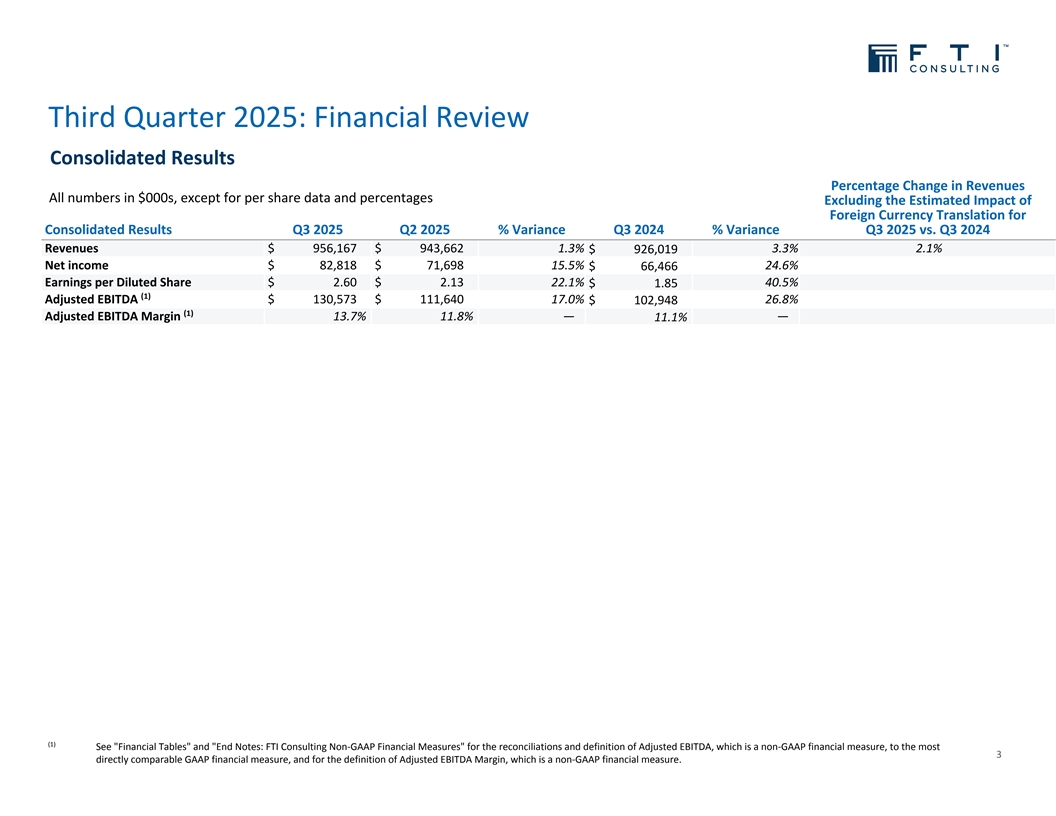
Third Quarter 2025: Financial Review Consolidated Results Percentage Change in Revenues All numbers in $000s, except for per share data and percentages Excluding the Estimated Impact of Foreign Currency Translation for Consolidated ResultsQ3 2025Q2 2025% VarianceQ3 2024% VarianceQ3 2025 vs. Q3 2024 Revenues$ 956,167 $ 943,662 1 .3% 3 .3% 2.1% $ 926,019 Net income$ 82,818 $ 71,698 15.5% 2 4.6 % $ 66,466 Earnings per Diluted Share$ 2.60 $ 2.13 2 2.1 % 40.5 % $ 1.85 (1) Adjusted EBITDA $ 130,573 $ 111,640 1 7.0 %$ 102,948 2 6.8% (1) Adjusted EBITDA Margin 1 3.7% 11.8% — — 1 1.1% (1) See Financial Tables and End Notes: FTI Consulting Non-GAAP Financial Measures for the reconciliations and definition of Adjusted EBITDA, which is a non-GAAP financial measure, to the most 3 directly comparable GAAP financial measure, and for the definition of Adjusted EBITDA Margin, which is a non-GAAP financial measure.
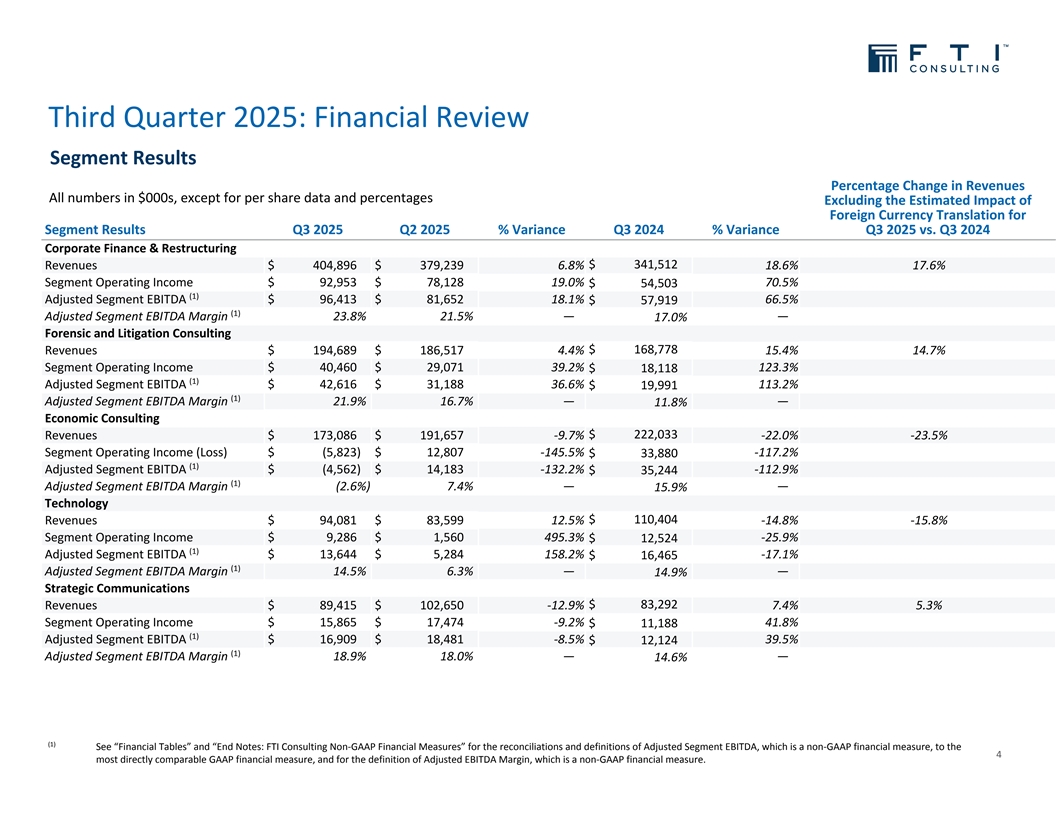
Third Quarter 2025: Financial Review Segment Results Percentage Change in Revenues All numbers in $000s, except for per share data and percentages Excluding the Estimated Impact of Foreign Currency Translation for Segment ResultsQ3 2025Q2 2025% VarianceQ3 2024% VarianceQ3 2025 vs. Q3 2024 Corporate Finance & Restructuring Revenues$ 404,896 $ 379,239 6 .8% $ 341,512 18.6% 17.6% Segment Operating Income$ 92,953 $ 78,128 19.0% 7 0.5% $ 54,503 (1) Adjusted Segment EBITDA $ 96,413 $ 81,652 18.1% $ 57,919 66.5% (1) Adjusted Segment EBITDA Margin 2 3.8% 21.5% — — 17.0% Forensic and Litigation Consulting $ 168,778 Revenues$ 194,689 $ 186,517 4 .4 %1 5.4% 14.7% Segment Operating Income$ 40,460 $ 29,071 39.2 %$ 18,118 123.3 % (1) Adjusted Segment EBITDA $ 42,616 $ 31,188 36.6 %1 13.2% $ 19,991 (1) Adjusted Segment EBITDA Margin 2 1.9% 16.7% — — 11.8% Economic Consulting $ 222,033 Revenues$ 173,086 $ 191,657 - 9.7 % -22.0% -23.5% Segment Operating Income (Loss)$ (5,823) $ 12,807 -145.5% - 117.2% $ 33,880 (1) Adjusted Segment EBITDA $ (4,562) $ 14,183 - 132.2% - 112.9 % $ 35,244 (1) Adjusted Segment EBITDA Margin (2.6%) 7 .4% — — 15.9% Technology Revenues$ 94,081 $ 83,599 12.5% $ 110,404 - 14.8 %-15.8% Segment Operating Income$ 9,286 $ 1,560 495.3 %- 25.9 % $ 12,524 (1) Adjusted Segment EBITDA $ 13,644 $ 5,284 1 58.2 %- 17.1 % $ 16,465 (1) Adjusted Segment EBITDA Margin 1 4.5% 6.3% — 1 4.9% — Strategic Communications Revenues$ 89,415 $ 102,650 -12.9 %$ 83,292 7.4 %5.3% Segment Operating Income$ 15,865 $ 17,474 -9.2 %4 1.8 % $ 11,188 (1) Adjusted Segment EBITDA $ 16,909 $ 18,481 - 8.5 %$ 12,124 39.5% (1) Adjusted Segment EBITDA Margin 1 8.9% 18.0% — — 1 4.6% (1) See “Financial Tables” and “End Notes: FTI Consulting Non-GAAP Financial Measures” for the reconciliations and definitions of Adjusted Segment EBITDA, which is a non-GAAP financial measure, to the 4 most directly comparable GAAP financial measure, and for the definition of Adjusted EBITDA Margin, which is a non-GAAP financial measure.
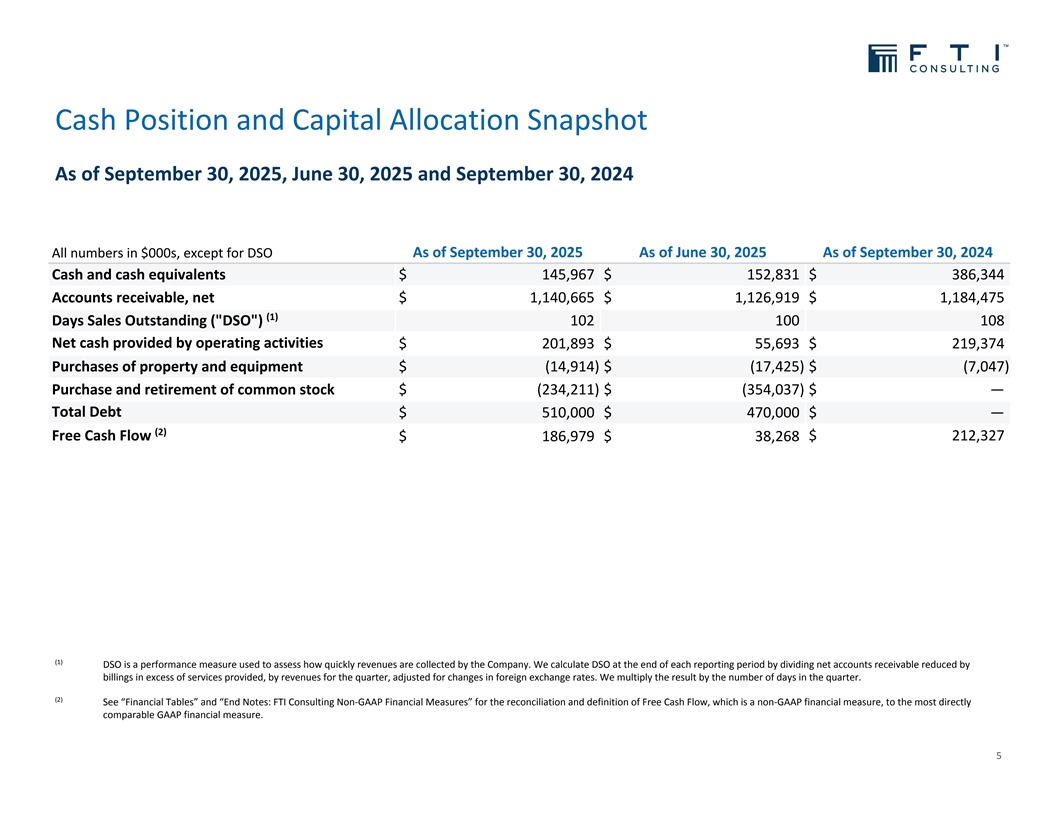
Cash Position and Capital Allocation Snapshot As of September 30, 2025, June 30, 2025 and September 30, 2024 All numbers in $000s, except for DSO As of September 30, 2025As of June 30, 2025As of September 30, 2024 Cash and cash equivalents$ 145,967 $ 152,831 $ 386,344 Accounts receivable, net$ 1,140,665 $ 1,126,919 $ 1,184,475 (1) Days Sales Outstanding ( DSO ) 102 100 108 Net cash provided by operating activities $ 201,893 $ 55,693 $ 219,374 Purchases of property and equipment$ (14,914) $ (17,425) $ (7,047) Purchase and retirement of common stock$ (234,211) $ (354,037) $ — Total Debt$ 510,000 $ 470,000 $ — (2) Free Cash Flow $ 186,979 $ 38,268 $ 212,327 (1) DSO is a performance measure used to assess how quickly revenues are collected by the Company. We calculate DSO at the end of each reporting period by dividing net accounts receivable reduced by billings in excess of services provided, by revenues for the quarter, adjusted for changes in foreign exchange rates. We multiply the result by the number of days in the quarter. (2) See “Financial Tables” and “End Notes: FTI Consulting Non-GAAP Financial Measures” for the reconciliation and definition of Free Cash Flow, which is a non-GAAP financial measure, to the most directly comparable GAAP financial measure. 5
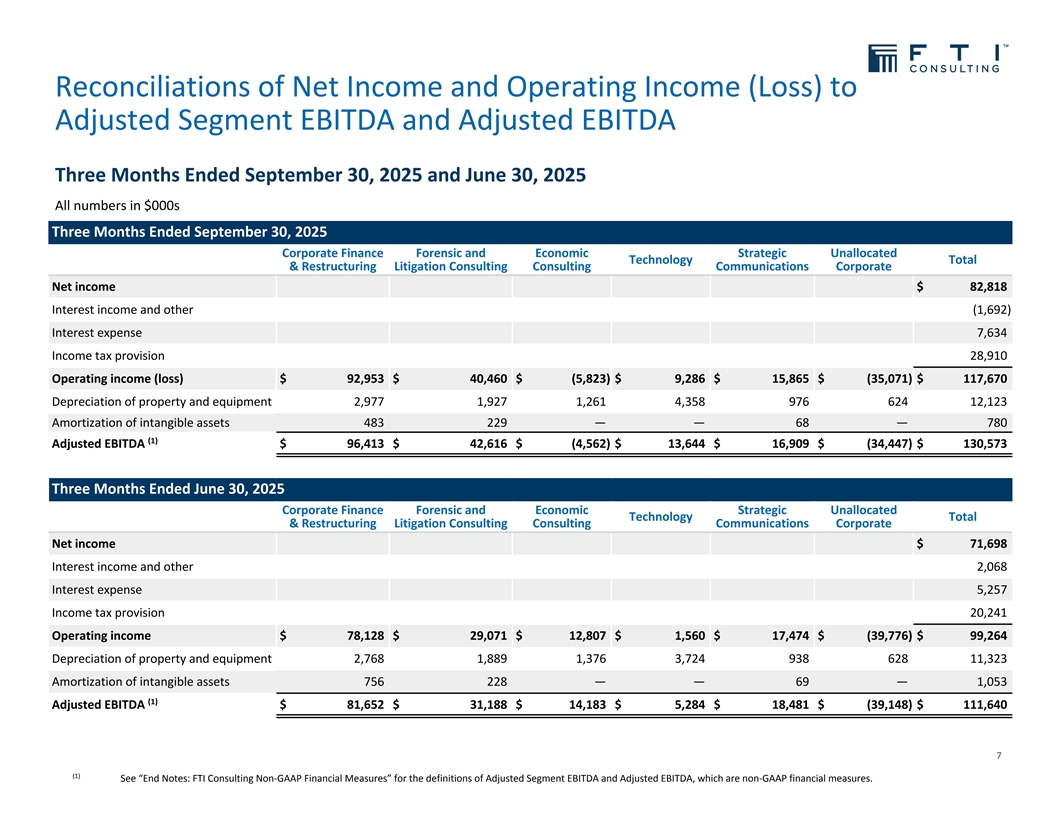
Reconciliations of Net Income and Operating Income (Loss) to Adjusted Segment EBITDA and Adjusted EBITDA Three Months Ended September 30, 2025 and June 30, 2025 All numbers in $000s Three Months Ended September 30, 2025 Corporate Finance Forensic and Economic Strategic Unallocated TechnologyTotal & RestructuringLitigation ConsultingConsultingCommunicationsCorporate Net income$ 82,818 Interest income and other (1,692) Interest expense 7,634 Income tax provision 28,910 Operating income (loss)$ 92,953 $ 40,460 $ (5,823) $ 9,286 $ 15,865 $ (35,071) $ 117,670 Depreciation of property and equipment 2,977 1,927 1,261 4,358 976 624 12,123 Amortization of intangible assets 483 229 — — 68 — 780 (1) Adjusted EBITDA $ 96,413 $ 42,616 $ (4,562) $ 13,644 $ 16,909 $ (34,447) $ 130,573 Three Months Ended June 30, 2025 Corporate Finance Forensic and Economic Strategic Unallocated TechnologyTotal & RestructuringLitigation ConsultingConsultingCommunicationsCorporate Net income$ 71,698 Interest income and other 2,068 Interest expense 5,257 Income tax provision 20,241 Operating income$ 78,128 $ 29,071 $ 12,807 $ 1,560 $ 17,474 $ (39,776) $ 99,264 Depreciation of property and equipment 2,768 1,889 1,376 3,724 938 628 11,323 Amortization of intangible assets 756 228 — — 69 — 1,053 (1) Adjusted EBITDA $ 81,652 $ 31,188 $ 14,183 $ 5,284 $ 18,481 $ (39,148) $ 111,640 7 (1) See “End Notes: FTI Consulting Non-GAAP Financial Measures” for the definitions of Adjusted Segment EBITDA and Adjusted EBITDA, which are non-GAAP financial measures.
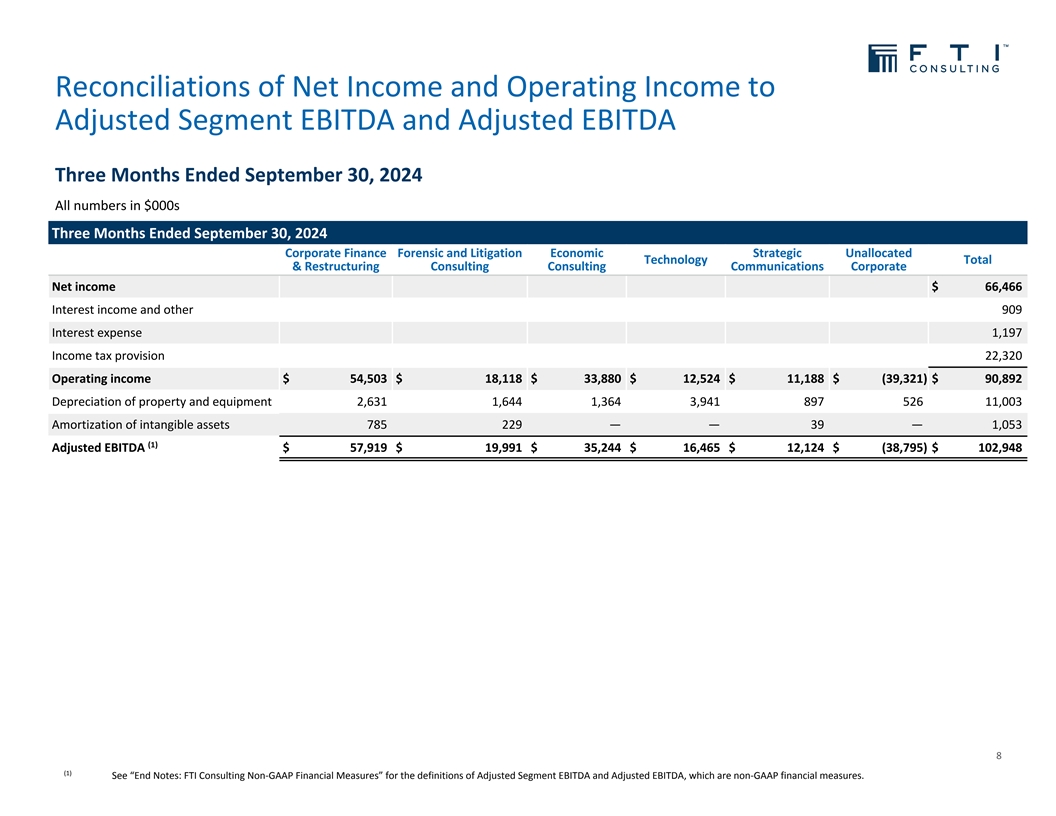
Reconciliations of Net Income and Operating Income to Adjusted Segment EBITDA and Adjusted EBITDA Three Months Ended September 30, 2024 All numbers in $000s Three Months Ended September 30, 2024 Corporate Finance Forensic and Litigation Economic Strategic Unallocated TechnologyTotal & RestructuringConsultingConsultingCommunicationsCorporate Net income$ 66,466 Interest income and other 909 Interest expense 1,197 Income tax provision 22,320 Operating income$ 54,503 $ 18,118 $ 33,880 $ 12,524 $ 11,188 $ (39,321) $ 90,892 Depreciation of property and equipment 2,631 1,644 1,364 3,941 897 526 11,003 Amortization of intangible assets 785 229 — — 39 — 1,053 (1) Adjusted EBITDA $ 57,919 $ 19,991 $ 35,244 $ 16,465 $ 12,124 $ (38,795) $ 102,948 8 (1) See “End Notes: FTI Consulting Non-GAAP Financial Measures” for the definitions of Adjusted Segment EBITDA and Adjusted EBITDA, which are non-GAAP financial measures.
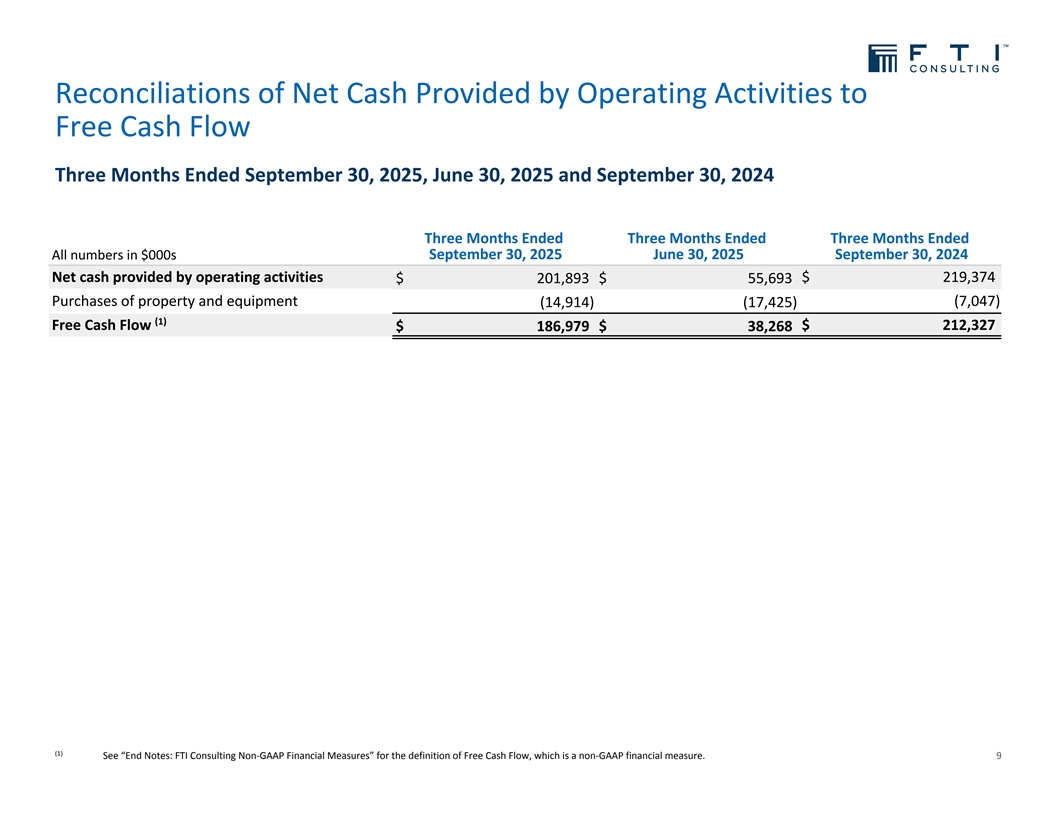
Reconciliations of Net Cash Provided by Operating Activities to Free Cash Flow Three Months Ended September 30, 2025, June 30, 2025 and September 30, 2024 Three Months EndedThree Months EndedThree Months Ended All numbers in $000s September 30, 2025 June 30, 2025 September 30, 2024 Net cash provided by operating activities$ 219,374 $ 201,893 $ 55,693 Purchases of property and equipment (7,047) (14,914) (17,425) (1) Free Cash Flow $ 212,327 $ 186,979 $ 38,268 (1) See “End Notes: FTI Consulting Non-GAAP Financial Measures” for the definition of Free Cash Flow, which is a non-GAAP financial measure.9
End Notes: FTI Consulting Non-GAAP Financial Measures In this presentation, we sometimes use information derived from consolidated and segment financial information that may not be presented in our financial statements or prepared in accordance with generally accepted accounting principles in the United States ( GAAP ). Certain of these measures are considered “non-GAAP financial measures” under the Securities and Exchange Commission ( SEC ) rules. Specifically, we have referred to the following non-GAAP financial measures in this presentation: Adjusted Segment EBITDA Adjusted EBITDA Adjusted EBITDA Margin Adjusted Net Income Adjusted Earnings per Diluted Share Free Cash Flow We have included the definition of Segment Operating Income (Loss), which is a GAAP financial measure, below in order to more fully define the components of certain non- GAAP financial measures in this presentation. We define Segment Operating Income (Loss) as a segment’s share of consolidated operating income. We use Segment Operating Income (Loss) for the purpose of calculating Adjusted Segment EBITDA, which is a non-GAAP financial measure. We define Adjusted Segment EBITDA as Segment Operating Income (Loss) before depreciation, amortization of intangible assets, remeasurement of acquisition-related contingent consideration, special charges and goodwill impairment charges. We use Adjusted Segment EBITDA as a basis to internally evaluate the financial performance of our segments because we believe it reflects core operating performance and provides an indicator of the segment’s ability to generate cash. We define Adjusted EBITDA, which is a non-GAAP financial measure, as consolidated net income before income tax provision, other non-operating income (expense), depreciation, amortization of intangible assets, remeasurement of acquisition-related contingent consideration, special charges, goodwill impairment charges, gain or loss on sale of a business and losses on early extinguishment of debt. We define Adjusted EBITDA Margin, which is a non-GAAP financial measure, as Adjusted EBITDA as a percentage of total revenues. We believe that these non-GAAP financial measures, when considered together with our GAAP financial results and GAAP financial measures, provide management and investors with a more complete understanding of our operating results, including underlying trends. In addition, EBITDA is a common alternative measure of operating performance used by many of our competitors. It is used by investors, financial analysts, rating agencies and others to value and compare the financial performance of companies in our industry. Therefore, we also believe that these non-GAAP financial measures, considered along with corresponding GAAP financial measures, provide management and investors with useful supplemental information. We define Adjusted Net Income and Adjusted Earnings per Diluted Share (“Adjusted EPS”), which are non-GAAP financial measures, as net income and earnings per diluted share (“EPS”), respectively, excluding the impact of remeasurement of acquisition-related contingent consideration, special charges, goodwill impairment charges, the gain or loss on sale of a business and losses on early extinguishment of debt. We use Adjusted Net Income for the purpose of calculating Adjusted EPS. Management uses Adjusted EPS to assess total Company operating performance on a consistent basis. We believe that these non-GAAP financial measures, when considered together with our GAAP financial results and GAAP financial measures, provide management and investors with useful supplemental information on our business operating results, including underlying trends. We define Free Cash Flow, which is a non-GAAP financial measure, as net cash provided by operating activities less cash payments for purchases of property and equipment. We believe this non-GAAP financial measure, when considered together with our GAAP financial results, provides management and investors with useful supplemental information on the Company’s ability to generate cash for ongoing business operations and capital deployment. Non-GAAP financial measures are not defined in the same manner by all companies and may not be comparable with other similarly titled measures of other companies. Non- GAAP financial measures should be considered in addition to, but not as a substitute for or superior to, the information contained in our Condensed Consolidated Statements of Comprehensive Income and Condensed Consolidated Statements of Cash Flows. 10
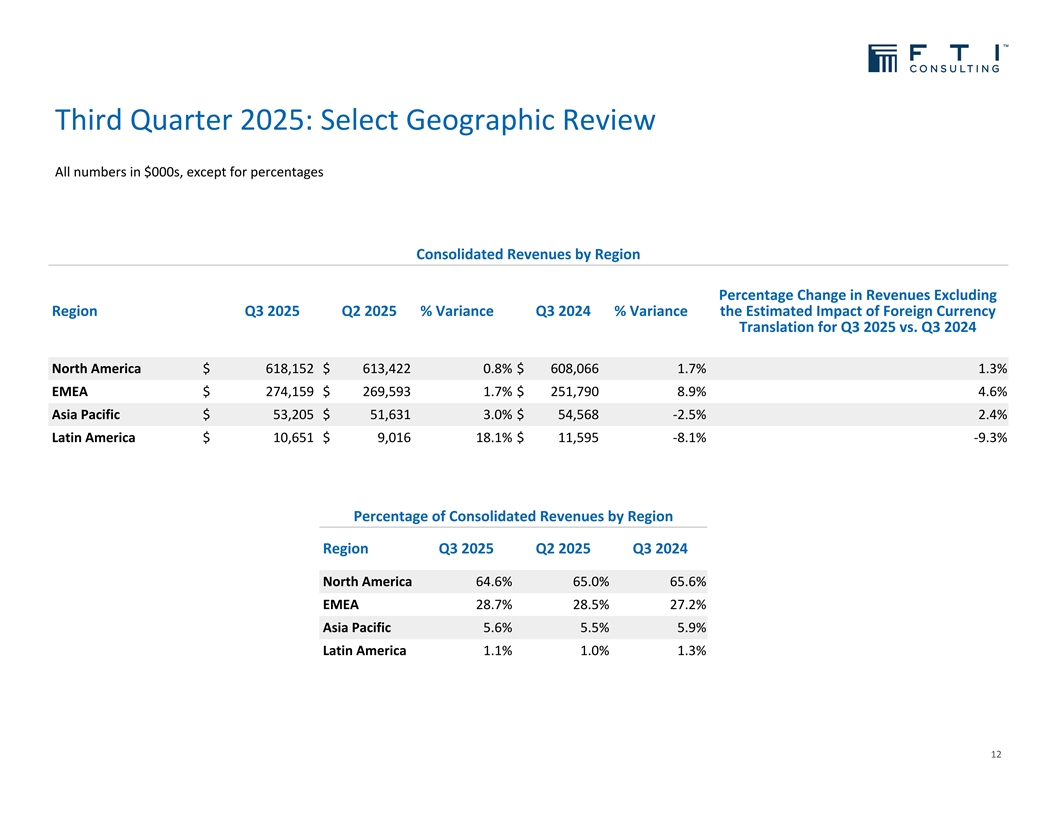
Third Quarter 2025: Select Geographic Review All numbers in $000s, except for percentages Consolidated Revenues by Region Percentage Change in Revenues Excluding RegionQ3 2025Q2 2025% VarianceQ3 2024% Variancethe Estimated Impact of Foreign Currency Translation for Q3 2025 vs. Q3 2024 North America$ 618,152 $ 613,422 0 .8% $ 608,066 1 .7% 1 .3% EMEA$ 274,159 $ 269,593 1.7% $ 251,790 8 .9% 4 .6% Asia Pacific$ 53,205 $ 51,631 3.0% $ 54,568 - 2.5% 2.4% Latin America$ 10,651 $ 9,016 1 8.1% $ 11,595 - 8.1% - 9.3% Percentage of Consolidated Revenues by Region RegionQ3 2025Q2 2025Q3 2024 North America 64.6% 6 5.0% 6 5.6% EMEA 28.7% 2 8.5% 27.2% Asia Pacific 5.6% 5 .5% 5.9% Latin America1 .1% 1.0% 1 .3% 12
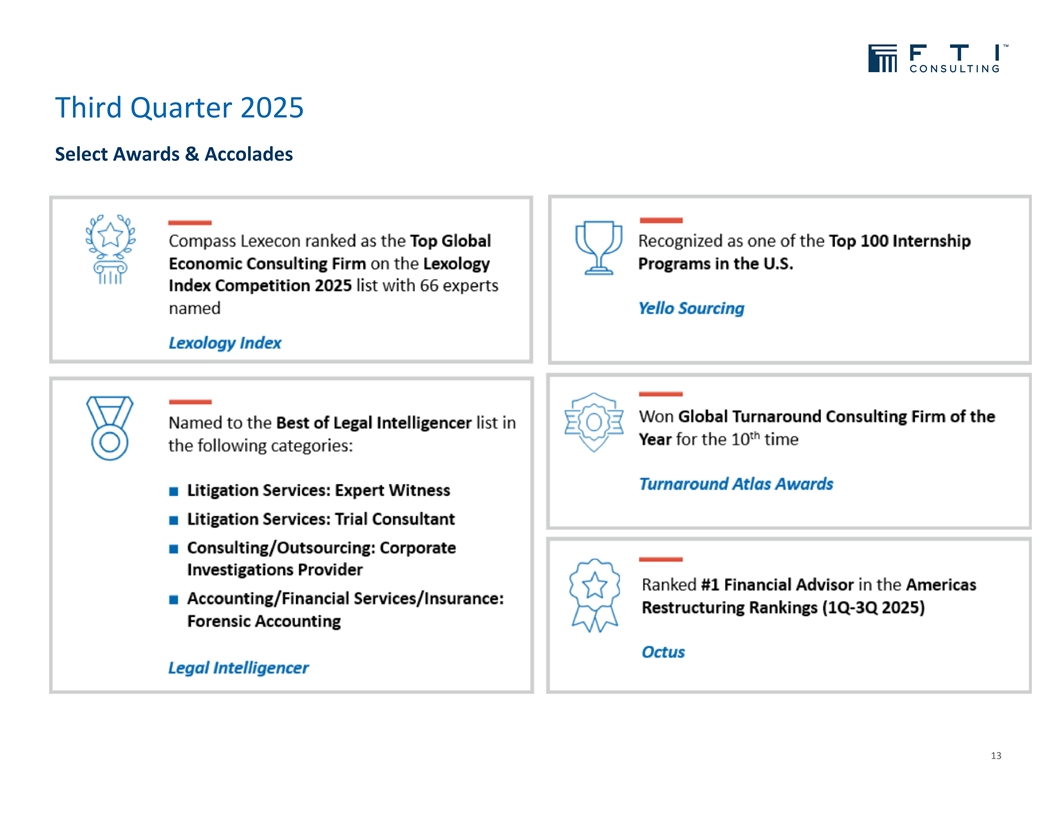
Third Quarter 2025 Select Awards & Accolades 13
TM Experts with Impact 14