
FND 10-K
Floor & Decor Holdings, Inc. (FND)
10-K
2026-02-19
For: 2025-12-25
View Original
Added on
April 10, 2026
UNITED STATES
SECURITIES AND EXCHANGE COMMISSION
Washington, D.C. 20549
FORM 10-K
| ANNUAL REPORT PURSUANT TO SECTION 13 OR 15(d) OF THE SECURITIES EXCHANGE ACT OF 1934 | |||||
For the fiscal year ended December 25 , 2025
OR
| TRANSITION REPORT PURSUANT TO SECTION 13 OR 15(d) OF THE SECURITIES EXCHANGE ACT OF 1934 | |||||
For the transition period from ____ to ____
Commission file number 001-38070
(Exact name of registrant as specified in its charter)
(State or Other Jurisdiction of Incorporation or Organization) | (I.R.S. Employer Identification No.) | |||||||
| (Address of principal executive offices) | (Zip Code) | |||||||||||||
Registrant’s telephone number, including area code (404 ) 471-1634
Securities registered pursuant to Section 12(b) of the Act:
| Title of each class | Trading Symbol(s) | Name of each exchange on which registered | ||||||
Securities registered pursuant to Section 12(g) of the Act:
NONE
Indicate by check mark if the registrant is a well-known seasoned issuer, as defined in Rule 405 of the Securities Act.
Indicate by check mark if the registrant is not required to file reports pursuant to Section 13 or Section 15(d) of the Act.
Yes ☐ No ☒
Indicate by check mark whether the registrant (1) has filed all reports required to be filed by Section 13 or 15(d) of the Securities Exchange Act of 1934 during the preceding 12 months (or for such shorter period that registrant was required to file such reports), and (2) has been subject to such filing requirements for the past 90 days.
Indicate by check mark whether the registrant has submitted electronically every Interactive Data File required to be submitted pursuant to Rule 405 of Regulation S-T (§232.405 of this chapter) during the preceding 12 months (or for such shorter period that the registrant was required to submit such files).
Indicate by check mark whether the registrant is a large accelerated filer, an accelerated filer, a non-accelerated filer, a smaller reporting company, or an emerging growth company. See the definitions of “large accelerated filer,” “accelerated filer,” “smaller reporting company,” and “emerging growth company” in Rule 12b-2 of the Exchange Act.
☒ | Accelerated filer | ☐ | |||||||||
| Non-accelerated filer | ☐ | Smaller reporting company | |||||||||
| Emerging growth company | |||||||||||
If an emerging growth company, indicate by check mark if the registrant has elected not to use the extended transition period for complying with any new or revised financial accounting standards provided pursuant to Section 13(a) of the Exchange Act. ☐
Indicate by check mark whether the registrant has filed a report on and attestation to its management’s assessment of the effectiveness of its internal control over financial reporting under Section 404(b) of the Sarbanes-Oxley Act (15 U.S.C. 7262(b)) by the registered public accounting firm that prepared or issued its audit report. ☒
If securities are registered pursuant to Section 12(b) of the Act, indicate by check mark whether the financial statements of the registrant included in the filing
reflect the correction of an error to previously issued financial statements. ☐
Indicate by check mark whether any of those error corrections are restatements that required a recovery analysis of incentive-based compensation received by
any of the registrant’s executive officers during the relevant recovery period pursuant to §240.10D-1(b). ☐
Indicate by check mark whether the registrant is a shell company (as defined in Rule 12b-2 of the Exchange Act). Yes ☐ No ☒
The aggregate market value of the Registrant’s Common Stock held by non-affiliates as of June 26, 2025, based on the closing sale price per share as reported by the New York Stock Exchange on such date, was $8.2 billion. There were 107,875,310 shares of Common Stock outstanding as of February 16, 2026.
Documents Incorporated by Reference:
Portions of the Registrant’s proxy statement for the Annual Meeting of Shareholders to be filed pursuant to Regulation 14A of the Exchange Act on or before April 24, 2026, are incorporated by reference into Part III of this Form 10-K. Except as expressly incorporated by reference, the Registrant’s proxy statement shall not be deemed to be part of this report.
TABLE OF CONTENTS
| Item 1 | ||||||||
| Item 1A | ||||||||
| Item 1B | ||||||||
Item 1C | ||||||||
| Item 2 | ||||||||
| Item 3 | ||||||||
| Item 4 | ||||||||
| Item 5 | ||||||||
| Item 6 | ||||||||
| Item 7 | ||||||||
| Item 7A | ||||||||
| Item 8 | ||||||||
| Item 9 | ||||||||
| Item 9A | ||||||||
| Item 9B | ||||||||
| Item 9C | ||||||||
| Item 10 | ||||||||
| Item 11 | ||||||||
| Item 12 | ||||||||
| Item 13 | ||||||||
| Item 14 | ||||||||
| Item 15 | ||||||||
| Item 16 | ||||||||
2
FORWARD-LOOKING STATEMENTS.
The discussion in this Form 10-K for the fiscal year ended December 25, 2025 (the “Annual Report”), including under Item 1A, “Risk Factors” of Part I and Item 7, “Management’s Discussion and Analysis of Financial Condition and Results of Operations” of Part II, contains forward-looking statements within the meaning of the federal securities laws. All statements other than statements of historical fact contained in this Annual Report, including statements regarding our future operating results and financial position, business strategy and plans, and objectives of management for future operations, are forward-looking statements. In some cases, you can identify forward-looking statements by terms such as “may,” “will,” “should,” “expects,” “plans,” “anticipates,” “could,” “seeks,” “intends,” “targets,” “projects,” “contemplates,” “believes,” “estimates,” “predicts,” “budget,” “potential,” or “continue” or the negative of these terms or other similar expressions.
The forward-looking statements contained in this Annual Report are based on our current expectations, assumptions, estimates, and projections regarding the Company’s business, the economy, and other future conditions. These statements involve known and unknown risks, uncertainties, and other important factors that may cause our actual results, performance, or achievements to be materially different from any future results, performance, or achievements expressed or implied by the forward-looking statements.
Although we believe that the expectations reflected in the forward-looking statements in this Annual Report are reasonable, we cannot guarantee future events, results, performance, or achievements. A number of important factors could cause actual results to differ materially from those indicated by the forward-looking statements in this Annual Report, including, without limitation, those factors described in Item 1A, “Risk Factors” of Part I of this Annual Report, Item 7, “Management’s Discussion and Analysis of Financial Condition and Results of Operations” of Part II of this Annual Report, and elsewhere in the Company’s filings with the Securities and Exchange Commission (the “SEC”). Some of the key factors that could cause actual results to differ from our expectations include the following:
•macroeconomic headwinds, including high interest rates and weak home sales;
•our failure to successfully manage new store growth or higher than expected costs;
•our ability to manage our comparable store sales;
•our inability to lease or acquire new store locations on acceptable terms, renew or replace our current store leases, or make payments under our leases;
•our failure to maintain and enhance our brand image and awareness;
•our failure to successfully anticipate and manage trends, consumer preferences, and demand;
•our inability to successfully manage increased competition;
•adverse changes in global trade policies, tariffs, or import enforcement actions, any of which could impact our ability to import from foreign suppliers, raise our costs, or disrupt our supply chain;
•our inability to manage our inventory, including the impact of inventory obsolescence, shrink, and damage;
•any disruption in our distribution capabilities, supply chain, and our related planning and control processes, including carrier capacity constraints, blocked trade lanes, port congestion, strike, or shut down, and other supply chain costs or product shortages;
•any increases in wholesale prices of products, materials, and transportation costs beyond our control, including increases in costs due to inflation or tariffs;
•the resignation, incapacitation, or death of any key personnel, including our executive officers;
•our inability to attract, hire, train, and retain highly qualified managers and staff;
•the impact of any labor activities;
•our dependence on foreign imports for the products we sell, including risks associated with obtaining products from abroad;
•any failure by any of our suppliers to supply us with quality products on attractive terms and prices or to adhere to the quality standards that we set for our products;
•our inability to locate sufficient suitable natural products;
•the effects of weather conditions, natural disasters, or other unexpected events, including public health crises, that may disrupt our operations;
•personal injury, product liability and warranty claims and related governmental investigations;
3
•any allegations, investigations, lawsuits, or violations of laws and regulations applicable to us, our products, or our suppliers;
•our inability to adequately protect the privacy and security of information related to our customers, us, our associates, our suppliers, and other third parties;
•any material disruption in our information systems, including our website;
•our inability to maintain sufficient levels of cash flow or liquidity to fund our expanding business and service our existing indebtedness;
•new or changing laws or regulations, including tax laws and trade policies and regulations;
•payments-related risks;
•any failure to protect our intellectual property rights or disputes regarding our intellectual property or the intellectual property of third parties;
•the impact of any future strategic transactions;
•restrictions imposed by our indebtedness on our current and future operations, including risks related to our variable rate debt; and
•our ability to manage risks related to corporate social responsibility.
Because forward-looking statements are inherently subject to risks and uncertainties, some of which cannot be predicted or quantified, you should not rely on these forward-looking statements as predictions of future events. The forward-looking statements contained in this Annual Report speak only as of the date hereof. New risks and uncertainties arise over time, and it is not possible for us to predict those events or how they may affect us. If a change to the events and circumstances reflected in our forward-looking statements occurs, our business, financial condition, and operating results may vary materially from those expressed in our forward-looking statements. Except as required by applicable law, we do not plan to publicly update or revise any forward-looking statements contained herein, whether as a result of any new information, future events, or otherwise.
PART I
ITEM 1. BUSINESS.
Except where the context suggests otherwise, the terms “Floor & Decor Holdings, Inc.,” “Floor & Decor,” the “Company,” “we,” “us,” and “our” refer to Floor & Decor Holdings, Inc., a Delaware corporation, together with its consolidated subsidiaries.
Our fiscal year is the 52- or 53-week period ending on the Thursday on or preceding December 31. The following discussion contains references to fiscal 2026, fiscal 2025, fiscal 2024, fiscal 2023, fiscal 2022, and fiscal 2021, which represent our fiscal years ended or ending, respectively, December 31, 2026, December 25, 2025, December 26, 2024, December 28, 2023, December 29, 2022, and December 30, 2021. Fiscal years 2025, 2024, 2023, 2022 and 2021 are 52-week periods, and fiscal 2026 is a 53-week period. When a 53-week fiscal year occurs, the Company reports the additional week at the end of the fiscal fourth quarter.
Our Company
Founded in 2000, Floor & Decor is a high-growth, differentiated, multi-channel specialty retailer of hard surface flooring and related accessories and seller of commercial surfaces. Floor & Decor Holdings, Inc. was incorporated as a Delaware corporation in October 2010 in connection with the acquisition of Floor and Decor Outlets of America, Inc. in November 2010 by our previous sponsor owners. As of December 25, 2025, we operated 270 warehouse-format stores and five small-format design studios across 39 states. We believe that we offer the broadest in-stock assortment of laminate and vinyl, tile, wood, and natural stone flooring and installation materials and decorative accessories, as well as adjacent categories, at everyday low prices. This positions us as the one-stop destination for our customers’ entire hard surface flooring needs. We appeal to a variety of customers, including professional installers and commercial businesses (“Pro”) and homeowners, which are comprised of do-it-yourself customers (“DIY”) and buy-it-yourself customers, who buy our products for professional installation (“BIY”).
4
Our warehouse-format stores, which average approximately 76,000 square feet, are typically larger than any of our specialty retail flooring competitors’ stores. Other large format home improvement retailers only allocate a small percentage of their floor space to hard surface flooring and accessories. By carrying a deep level of in-stock hard surface flooring inventory and wide range of tools and accessories, we seek to offer our customers immediate availability of everything they need to complete their entire flooring project. In addition to our stores, our website, FloorandDecor.com, showcases our products, offers informational training and design ideas, and provides product availability for in-store pickup or delivery. Our ability to purchase directly from manufacturers through our direct sourcing model enables us to offer our products at everyday low prices and be fast to market with a balanced assortment of best-seller and trend-forward products. We believe these factors create a differentiated value proposition for Floor & Decor and drive customer loyalty with our Pro and homeowner customers in our markets.
Our Competitive Strengths
We believe our strengths, described below, set us apart from our competitors and are the key drivers of our success.
Unparalleled Customer Value Proposition. Our customer value proposition is a critical driver of our business. The key components include:
•Differentiated Assortment Across a Wide Variety of Hard Surface Flooring Categories. We carry a comprehensive in-stock, trend-forward product assortment with on average approximately 4,200 stock keeping units (“SKUs”) in each store, which, based on our market experience, is a far greater in-stock offering than any other flooring retailer. Additionally, we customize our product assortment at the store level for the local preferences of each market. We work with our suppliers to quickly introduce new products and styles in our stores. We appeal to a wide range of customers through our “good/better/best” merchandise selection, our broad range of product styles from classic to modern, and our new trend-forward products. We consistently innovate with proprietary brands.
•Everyday Low Prices. We leverage our ability to source directly from manufacturers and quarries to offer our flooring products and related accessories at everyday low prices throughout the year instead of engaging in frequent promotional activities. We believe this strategy creates trust with our customers because they consistently receive low prices at Floor & Decor without having to wait for a sale or negotiate to obtain the lowest price.
•One-Stop Project Destination with Immediate Availability. We carry an extensive range of products, including flooring and decorative accessories, as well as installation materials and tools, to fulfill a customer’s entire flooring project. In addition, we have adjacent categories such as vanities, bathroom accessories, shower doors, custom countertops, and kitchen cabinets. Our stores carry a large in-stock assortment at job size quantities to differentiate us from our competitors. When a product is not available in the store, our five regional distribution centers and neighboring stores can often quickly ship the product to meet a customer’s needs. Customers also have access to our full catalog of inventory for in-store pickup or delivery through our website.
Unique and Inspiring Shopping Environment. Our stores are typically designed with warehouse features including high ceilings, clear signage, bright lighting, and industrial racking and are staffed with knowledgeable store associates. We offer an easy-to-navigate store layout with clear lines of sight and departments organized by our major product categories. We invest heavily in large, visually inspiring merchandise displays that showcase our assortment as well as marketing throughout our stores to highlight product features, benefits, and design elements. These features educate our customers and enable them to visualize how the product would look in their homes or businesses. Our stores have design centers, with multiple different vignettes showcasing project ideas to further inspire our customers. We employ experienced designers in all of our stores to provide free design consulting. Additionally, we provide a robust online experience for potential customers on our website.
Extensive Service Offerings to Enhance the Pro Customer Experience. We provide an efficient one-stop shopping experience for our Pro customers, offering everyday low prices on a broad selection of high-quality flooring products, deep inventory levels to support immediate availability of our products, credit offerings, free storage for purchased inventory, convenient store hours, and separate entrances for merchandise pick-up. Each store has a dedicated Pro sales force with technology to service our Pro customers more efficiently. We also offer design services through our experienced designers, which helps our Pro customers serve their customers. We have a Pro Premier loyalty program, which rewards Pro customers based on purchases. Rewarding our Pro customers through this program is intended to improve their loyalty to Floor & Decor, and by serving the needs of Pro customers, we drive repeat high-ticket purchases, customer referrals, and brand awareness from this attractive and loyal customer segment.
5
Decentralized Culture with an Experienced Store-Level Team and Emphasis on Training. We have a decentralized culture that empowers managers at the store and regional levels to make key decisions to maximize the customer experience. Our store managers, who carry the title Chief Executive Merchant (“CEM”), have significant flexibility to localize product mix and customize pricing, marketing, merchandising, visual displays, and other elements in consultation with their regional leaders. We believe this approach differentiates us from our national competitors, who tend to have standardized assortments across markets. Throughout the year, we regularly train our employees on a variety of topics, including product knowledge, sales strategies, leadership, and store operations. Our store managers and store department managers are an integral part of our company, and many have years of relevant industry experience in retail.
Sophisticated, Global Supply Chain. Our merchandising team has developed direct sourcing relationships with more than 240 vendors in the U.S. and around the world and has long-term relationships with many of them. We often collaborate with our vendors to design products to address emerging customer preferences that we observe in our stores and markets. We procure the majority of our products directly from manufacturers, which eliminates additional costs from exporters, importers, wholesalers, and distributors. Direct sourcing is a key competitive advantage, as many of our specialty retail flooring competitors are too small to have the scale or the resources to work directly with suppliers.
Highly Experienced Management Team. Led by our Chief Executive Officer, Brad Paulsen, our management team brings substantial expertise from leading retailers and other companies across various core functions, including store operations, merchandising, marketing, real estate, e-commerce, supply chain management, finance, legal, and information technology. Our management team drives our organization with a focus on strong merchandising, superior customer experience, expanding our store footprint, and fostering a strong, decentralized culture.
Our Growth Strategy
We expect to drive growth in net sales and profitability through the following strategies:
Open Warehouse-Format Stores in New and Existing Markets. Our disciplined approach to new store development integrates an analytical, research-driven site selection methodology with a rigorous real estate review and approval process, incorporating strategic store size optimization based on market-specific conditions. Through our site selection process, we evaluate key market characteristics including age of homes, housing density, home ownership, median income, competitor concentration, and other demographic variables in both new and existing markets. Based on these characteristics, we believe there is a significant opportunity to expand our warehouse-format store base from 270 stores as of December 25, 2025 to at least 500 in the United States over the long-term. We plan to target store openings in new and existing markets across various market sizes. We intend to open a range of store sizes from 50,000 to 75,000 square feet to serve different expected market sales potentials to achieve our desired rate of return over the long-term. When opening new stores, inventory orders are placed several months prior to a new store opening. Substantial investment is made in constructing the site, hiring and training employees, and marketing the new store through pre-opening events. Our historical new store performance, the performance of our more mature stores, and our disciplined real estate expansion strategy in successfully opening retail stores support our belief in the store expansion opportunity.
Increase Comparable Store Sales. We expect to grow comparable store sales over the long-term by continuing to offer our customers a dynamic and expanding selection of compelling, everyday low priced hard surface flooring and accessories while maintaining strong service. Because approximately 50% of our stores have been open for less than five years, we believe they will continue to drive comparable store sales growth as newer stores ramp up to maturity. We believe that we can continue to enhance our customer experience by focusing on service, optimizing sales and marketing strategies, investing in store staff and infrastructure, remodeling existing stores, and improving visual merchandising and the overall aesthetic appeal of our stores. We also believe that growing our Pro, Commercial, and design strategies, further integrating connected customer strategies, and enhancing other key information technology, will contribute to increased comparable store sales. As we increase awareness of Floor & Decor’s brand, we believe there is a significant opportunity to gain additional market share.
Enhance Our “Connected Customer” Experience. Floor & Decor’s online experience allows our customers to discover our product selection, learn more about the products that suit their project, and purchase products either for delivery or pick up in-store. Our online experience also enables an omnichannel experience by providing the customer information about what they will find in their local store, and, once in the store, offers easily accessible product specifications and inspirational design ideas for products they are considering. We continuously invest in our connected customer strategies to help customers discover and engage with our brand and products across the shopping journey.
Continue to Invest in the Pro Customer. We believe our differentiated focus on Pro customers has created a competitive advantage for us and will continue to drive sales growth. We continue to invest in people and technology to gain and retain Pro customers due to their frequent high-ticket purchases, loyalty, and propensity to refer other potential customers. We continually refresh and expand our services to Pros to better facilitate our growing Pro business.
6
Continue to Invest in Design Services. Our design services offer a unique experience to large format retail, which leads our customers through a seamless, inspirational design process to complete their projects at no additional cost. According to our internal research, we believe when a designer is involved, customer satisfaction, gross margin, and average ticket are higher, and customers are more likely to follow through with a purchase. We invest in recruiting top design talent and provide extensive design-focused training, tools, and technology to ensure our teams are knowledgeable and prepared to deliver a start-to-finish consultative selling experience.
Expand Our Sales in Commercial Surfaces. We continue to grow our commercial surfaces business both organically and through acquisitions, applying many of the same strategies that have allowed us to be successful in selling residential retail hard surface flooring, including high quality, trend-forward hard surface flooring sourced at a low cost directly from the manufacturer. In fiscal 2021, we entered the commercial surfaces market by acquiring Spartan Surfaces, LLC (“Spartan”). We intend to continue to focus on both organic and inorganic growth to address the entire commercial surfaces market.
Enhance Margins Through Increased Operating Leverage. Operating margin improvement opportunities will include enhanced product sourcing processes and overall leveraging of our store-level fixed costs, existing infrastructure, supply chain, corporate overhead, and other fixed costs resulting from increased sales productivity, as well as cost reductions due to operational efficiencies and managing expenses. We anticipate that the planned expansion of our store base and improvement in comparable store sales will also support increasing economies of scale over the long-term while still making significant investments in our business.
Our Industry
Floor & Decor operates in the large, growing, and highly fragmented U.S. retail hard surface flooring market and commercial surfaces market. We believe that long-term growth in the hard surface flooring market will continue to be driven by several home remodeling demand drivers. These include existing home sales, aging homes, rising home equity values, and the secular shift from carpet to hard surface flooring. In addition, we believe we have an opportunity to increase our market share as many of our competitors are unable to effectively compete with our combination of price, service, and broad in-stock assortment. The competitive landscape of the hard surface flooring market includes big-box home improvement centers, national and regional specialty flooring retailers, independent flooring retailers, and distributors. We believe we have an opportunity to continue to gain share in the hard surface flooring market with the largest in-stock selection of laminate and vinyl, tile, wood, and natural stone flooring and installation materials and decorative accessories.
Our Products
Our merchandise is comprised of the following major product categories:
•Laminate and vinyl: Wood-based laminate flooring, luxury vinyl, and engineered/composite rigid core vinyl.
•Tile: Porcelain and ceramic tile, porcelain mosaics, and porcelain tile slabs.
•Installation materials and tools: Grout, mortar, backer board, tools, adhesives, underlayments, moldings, and stair treads.
•Decorative accessories and wall tile: Decorative tiles and mosaics, which includes natural stone, porcelain, ceramic, and glass, wall tile, and decorative trims.
•Wood: Solid prefinished hardwood, solid unfinished hardwood, engineered hardwood, bamboo, and wood countertops.
•Natural stone: Marble, limestone, travertine, slate, and ledger.
•Adjacent categories: Vanities, shower doors, bath accessories, faucets, sinks, custom countertops, bathroom mirrors, bathroom lighting, and kitchen cabinets.
Refer to Note 2, “Revenue” of the notes to our consolidated financial statements included in this Annual Report for our net sales by major product category.
Connected Customer
We aim to elevate the total customer experience through our website FloorandDecor.com. Enhancements to our connected customer experience are critical to our increasingly interconnected customers who often perform extensive online research for their project before or after going to our store. Our website is an important tool for engaging our homeowner customers throughout their process. Our Pro customers use the website and our Pro app to browse our broad product assortment, to continually educate themselves on new techniques and trends, to share our virtual catalog and design ideas with their customers, and to utilize tools such as our calculators to aid with shopping. We designed the website to be a reflection of our stores and to promote our wide selection of high-quality products and everyday low prices. To this end, we believe the website provides not only the same localized product selection that customers can expect in our stores, but also the opportunity to extend our assortment by offering our entire portfolio of products.
7
In addition to highlighting our broad product selection, our website offers a convenient opportunity for customers to purchase products online and pick them up in our stores or have them delivered. As we continue to grow, we believe connected customer will become an increasingly important part of our strategy.
Marketing and Advertising
We maintain low advertising expenses of approximately 2% to 3% of net sales, while reaching new and repeat customers through a mix of marketing channels and capabilities. Our marketing strategy is designed to optimize our omnichannel experience, which integrates physical stores and digital channels. We measure the effectiveness of our marketing spend with a variety of metrics to most effectively drive awareness, customer acquisition, and sales.
Sourcing
Floor & Decor has a well-developed and geographically diverse supplier base. Our largest supplier, which is multinational, accounted for 10% of our net sales in fiscal 2025, while no other individual supplier accounted for 10% or more of our net sales. We are focused on bypassing importers, exporters, wholesalers, distributors, and other middlemen in our supply chain in order to reduce costs and lead time. Our direct sourcing model and the resulting relationships we have developed with our suppliers are distinct competitive advantages. The cost savings we achieve by directly sourcing our merchandise enable us to offer our customers everyday low prices. Additionally, our close relationships with suppliers allow us to collaborate with them directly to develop and quickly introduce innovative and quality products that meet our customers’ evolving tastes and preferences.
We have an established Global Sourcing and Compliance Department to, among other things, enhance our policies and procedures with respect to addressing compliance with applicable regulatory bodies, including compliance with the requirements of the Lacey Act, the California Air Resources Board, and the Environmental Protection Agency. This department also addresses compliance with Floor & Decor’s supplier compliance policies, such as specifications and packaging of the products we purchase. We utilize third-party consultants and service providers for audits, testing, and surveillance to ensure product safety and compliance. We have invested in technology and personnel to collaborate throughout the entire supply chain process.
Distribution and Order Fulfillment
Merchandise inventory is our most significant working capital asset and is considered “in-transit” or “available for sale,” based on whether we have physically received the products at an individual store location or in one of our five distribution centers. In-transit inventory generally varies due to contractual terms, country of origin, transit times, international holidays, weather patterns, and other factors.
We have invested significant resources to develop and enhance our distribution network. As of December 25, 2025, we have five distribution centers strategically located across the United States in port cities near Savannah, Houston, Los Angeles, Baltimore, and Seattle and a transload facility near Los Angeles. Logistics service providers arrange the shipping of our international and domestic purchases to our distribution centers and stores and bill us for shipping costs in accordance with our service agreements. All of our distribution centers are Company-operated facilities, and we have warehouse management and transportation management systems tailored to our unique needs across all distribution centers. We believe these systems reduce shrink and damage and help us better manage our inventory. We plan to continue to seek further opportunities to enhance our distribution capabilities and align them with our strategic growth initiatives. In particular, we anticipate opening an additional distribution center near Baltimore.
Management Information Systems
Technology plays a crucial role in the continued growth and success of our business. We have sought to integrate technology into all facets of our business, including supply chain, merchandising, store operations, point-of-sale, e-commerce, finance, accounting, and human resources. The integration of technology allows us to analyze the business in real time and react accordingly. Our inventory management system is our primary tool for forecasting and placing orders and managing in-stock inventory. The data-driven platform includes sophisticated forecasting tools based on historical trends in sales, inventory levels, and vendor lead times at the store and distribution center level by SKU, allowing us to support store managers in their localized merchandising efforts. We rely on the forecasting accuracy of our system to maintain the in-stock, job-lot quantities that our customers rely on. In 2024, we began a multi-year implementation of portions of our enterprise resource planning (ERP) system, which will replace our existing core financial and merchandising systems. The implementation is expected to go-live in phases through 2027.
8
Competition
The retail hard surface flooring market is highly fragmented and competitive. We face significant competition from big-box home improvement centers, national and regional specialty flooring retailers, independent flooring retailers, and distributors. We believe the key competitive factors in the retail hard surface flooring industry include: localized product assortment, design services, product innovation, in-store availability of products in job-lot quantities, product sourcing, product presentation, customer service, store management, store location, and low prices. We believe that we compete favorably with respect to these factors by providing a highly diverse selection of products to our customers, at an attractive value, in appealing and convenient retail stores.
Human Capital
We have built a strong team of employees to support our continued success. Each of our stores is led by a CEM and is supported by an operations manager, product category department managers, a design team, a Pro sales and support team, and a number of additional associates. Outside of our stores, we have employees dedicated to store support, infrastructure, e-commerce, customer care, and similar functions as well as support for our distribution centers and sourcing office. We dedicate significant resources to training our employees as they are key to our success. Our Chief Human Resources Officer, supported by the entire executive team, is responsible for developing and executing our human capital strategy. This includes the attraction, development, engagement, safety, and retention of employees and the design of associate compensation and benefits programs.
As of December 25, 2025, we had 13,723 employees, 10,469 of whom were full-time. Of the total employees, 11,790 work in our stores, 1,382 work in our store support center, customer care, or similar functions, 541 work in our distribution centers, and 10 work in our Asia sourcing office in Shanghai, China.
Currently none of our associates are represented by a union.
We look at a variety of measures and objectives related to the attraction, development, engagement, safety, and retention of our employees, including:
•Store Staffing. In order to provide the level of customer service that we expect, it is important that we adequately staff our stores with trained employees. As of December 25, 2025, our stores were staffed at a level that we deem appropriate.
•Training. Training associates is important to ensuring appropriate levels of customer service. We have a Learning Department, and in fiscal 2025, associates engaged in approximately 550,000 hours of training.
•Internal Advancement Opportunities. Our growth opportunities are a critical way to attract and retain employees, and we encourage a promote-from-within environment, with more than 1,450 employees promoted in fiscal 2025.
•Culture. We are mindful of the benefits of associate engagement as they are key to our culture and long-term success. We seek to build a workplace where we can leverage our collective talents, striving to ensure that all associates are treated with dignity and respect.
•Safety. Maintaining a safe working environment is very important to us. Our safety and store operations teams work on safety training and initiatives.
•Rewards. We reward our associates for their hard work and provide a variety of incentives to allow associates to share in the Company’s success, including (i) incentive compensation plans for all associates, (ii) a 401(k) plan with Company-sponsored match for eligible associates, (iii) health care benefits for full-time associates, (iv) an employee stock purchase plan that facilitates purchases of Company stock at a discount by eligible associates, and (v) other benefits such as an employee assistance program.
Government Regulation
We are subject to extensive and varied federal, state, and local laws and regulations that impact us, our operations, properties, and suppliers, including those relating to employment, the environment, protection of natural resources, import and export, advertising, labeling, public health and safety, product safety, zoning, fire codes, and other operations of our retail stores and distribution facilities. We operate our business in accordance with standards and procedures designed to comply with applicable laws and regulations. Compliance with these laws and regulations has not historically had a material effect on our capital expenditures, earnings, competitive position, financial condition, or operating results; however, the effect of compliance in the future cannot be predicted.
9
Trademarks and Other Intellectual Property
We have registered trademarks and several pending trademark applications in the United States and other countries on a number of our brands, slogans, and products. We regard our intellectual property, including our many proprietary brands, as having significant value, and our brand is an important factor in the marketing and merchandising of our products. Accordingly, we have taken, and continue to take, appropriate steps to protect our intellectual property.
Seasonality
Historically, our business has had very little seasonality on a quarterly basis. Our specialty hard surface flooring product offering makes us less susceptible to holiday shopping seasonal patterns compared to other retailers.
Available Information
We maintain a website at www.FloorandDecor.com. The information on or available through our website is not, and should not be considered, a part of this Annual Report. You may access our annual reports on Form 10-K, quarterly reports on Form 10-Q, current reports on Form 8-K and amendments to those reports, as well as other reports relating to us that are filed with, or furnished to, the Securities and Exchange Commission (the “SEC”) free of charge on the Investor Relations page of our website.
ITEM 1A. RISK FACTORS.
You should carefully consider the risks described below, together with all of the other information included in this Annual Report, including our consolidated financial statements and the related notes thereto, before making an investment decision. The risks and uncertainties set out below are not the only risks we face. Additional risks and uncertainties not currently known to us or that we currently deem to be immaterial also may materially and adversely affect our business, financial condition, and operating results. If any of the following events occur, our business, financial condition, and operating results could be materially and adversely affected. In that case, the trading price of our common stock could decline, and you may lose all or part of your investment.
Risks Related to Our Business and Industry
Persistent macroeconomic headwinds, including high interest rates and weak home sales, may continue to depress demand for our products.
Our sales are highly sensitive to consumer discretionary spending, which is influenced by factors such as overall economic conditions, interest rates, housing market activity, inflation, employment levels, and consumer confidence. In the past few years, we have faced a challenging environment as mortgage interest rates remain high and existing home sales remain low, which together have reduced home remodeling activity. Many homeowners are staying in their homes rather than moving or undertaking renovations due to factors including high financing costs and home affordability concerns. These conditions have directly contributed to softer demand for hard surface flooring. We have seen pressure on customer traffic and average ticket sizes, resulting in negative comparable store sales and weaker performance from new stores. If interest rates remain elevated or climb further, if housing turnover stays depressed, or if broader economic growth slows, consumers may continue deferring flooring purchases. High inflation over the past two years has also eroded discretionary income and savings, making budget-conscious consumers more hesitant to undertake big ticket projects. Any sustained weakness in consumer demand – whether due to prolonged high borrowing costs, low housing turnover, reduced consumer confidence, or an economic downturn – would adversely affect our sales and profitability. Prolonged macroeconomic headwinds could lead to continued negative same store sales, inventory build-up, and the need for heavier promotions to stimulate demand, which in turn would further pressure our margins and cash flow and could continue to adversely affect our business, financial condition, and operating results.
If we fail to successfully manage our new store growth or encounter higher-than-expected costs, our expansion plans and future profitability could suffer.
We have 270 warehouse-format stores and five small-format standalone design studios located throughout the United States as of December 25, 2025. We plan to continue opening new stores for the next several years. This growth strategy and the investment associated with the development of each new store may cause our operating results to fluctuate and be unpredictable or decrease our profits. We cannot ensure that new store locations will be available to us, or that they will be available on terms acceptable to us. If additional retail store locations are unavailable on acceptable terms, we may not be able to carry out a significant part of our growth strategy or our new stores’ profitability may be lower. Certain of our new store openings are expected to be smaller stores and certain stores will be in smaller markets. We have limited experience executing this strategy, and we cannot guarantee that we will be successful in this strategy. Our future operating results and ability to grow will depend on various other factors, including our ability to successfully select new markets and store locations; drive brand awareness, particularly in new markets; attract, train and retain highly qualified managers and staff; manage store opening costs, including rising construction costs and costs due to delays in obtaining necessary permits and completing construction; manage the impact of cannibalization by new stores on nearby existing store sales; and manage and expand our infrastructure to accommodate growth.
10
In addition, stores opened more recently have had, and many continue to have, higher construction, occupancy, and operating costs than stores opened in the past, and such stores may have lower profitability than stores opened in the past. Furthermore, laws or regulations may make opening new stores more difficult or cause unexpected delays. As we continue to open new stores, the ultimate cost of future store openings could continue to rise significantly due to delays in obtaining necessary construction and occupancy permits, construction-related costs, or other reasons. We cannot guarantee that any project will be completed on time, and delays in store openings have had, and may continue to have, a negative impact on our business and operating results. In addition, consumers in new markets may be less familiar with our brand, and we may need to increase brand awareness in such markets through additional investments in advertising or higher cost locations with more prominent visibility.
As a result of these factors and other factors that may be outside of our control, newly opened stores may not succeed, may not reach profitability at all, or may be slower to reach profitability than we expect. Future markets and newly opened stores may not be successful and, even if they are successful, our comparable store sales may not increase at historical rates or may decrease. To the extent that we are not able to overcome these various challenges, our operating results and future growth opportunities could be adversely affected. Furthermore, we may incur costs associated with the closure of underperforming stores, and such store closures may adversely impact our revenues.
We may continue to have negative comparable store sales or future comparable store growth lower than we expect, which has had and may continue to have a negative impact on our net sales, business, financial condition, and operating results.
Our comparable store sales decreased 1.8% for the fiscal year ended December 25, 2025 and by 7.1% for the fiscal year ended December 26, 2024, primarily due to decreased consumer demand for the products we sell. This decrease in comparable store sales has had a negative impact on our net sales for the fiscal year ended December 25, 2025, and while future net sales growth will depend substantially on our plans for new store openings, our comparable store sales growth is a significant driver of our net sales, profitability, cash flow, and overall business results. Because numerous factors affect our comparable store sales growth, as discussed in the other risk factors, it is possible that we will not achieve our targeted comparable store sales growth or that the change in comparable store sales could continue to be negative. If this trend continues, it is likely that overall net sales growth would be adversely affected, which could have a negative impact on our business, financial condition, and operating results.
If we are unable to enter into leases or acquire properties for additional stores on acceptable terms or renew or replace our current store leases, or if one or more of our current leases is terminated prior to expiration of its stated term and we cannot find suitable alternate locations, our growth and profitability could be adversely affected.
We currently lease the majority of our real estate, including most of our store locations and distribution centers and our store support center. Our growth strategy largely depends on our ability to identify and open future store locations, which can be difficult because our warehouse-format stores in major metropolitan markets generally require at least 50,000 square feet of floor space.
Our ability to negotiate acceptable lease terms for these store locations, to re-negotiate acceptable terms on expiring leases, or to negotiate acceptable terms for suitable alternate locations depends on conditions in the real estate market, competition for desirable properties, our relationships with current and prospective landlords, and other factors that are not within our control. We are required to use a significant portion of cash generated by our operations to satisfy our fixed lease obligations, which could adversely affect our ability to obtain future financing to support our growth or other operational investments. We will require substantial cash flows from operations to make our payments under our operating leases, all of which provide for periodic increases in rent. If we are not able to make payments under our operating leases, this could trigger defaults under other leases or, in certain circumstances, under our credit facilities, which could cause the counterparties or lenders under those agreements to accelerate the obligations due thereunder. We also intend to continue to purchase the real property for certain new locations, and such strategy may not be successful. Any or all of these factors and conditions could adversely affect our growth and profitability.
Our business largely depends on a strong brand image and awareness, and if we are unable to maintain and enhance our brand image and awareness, particularly in new markets where we have limited brand recognition, we may be unable to increase or maintain our level of sales.
We believe that our brand image and awareness contribute significantly to the success of our business. We rely on our reputation for offering everyday low prices, superior service, and a broad assortment of high-quality, trend-forward, safe products. We also believe that maintaining and enhancing our brand image and awareness, particularly in new markets where we have limited brand recognition, is important to preserving and expanding our customer base and growing sales. Our ability to successfully integrate newly opened stores into our surrounding communities, to expand into new markets, and to maintain the strength and distinctiveness of our brand in our existing markets will be adversely impacted if we fail to connect with our existing or target customers. Maintaining, promoting, and positioning our brand will depend largely on the success of our marketing and merchandising efforts and our ability to provide a consistent, high-quality product and customer experience. These efforts may require us to make substantial investments, which could adversely affect our cash flows and which may ultimately be unsuccessful. Failure to successfully market, maintain and grow our brand image and awareness in new and existing markets could harm our business, results of operations, and financial condition.
11
Furthermore, our brand image could be jeopardized if we fail to maintain high standards for merchandise quality, if we fail to comply with local laws and regulations, or if we experience negative publicity or other negative events that affect our image and reputation. Customers are increasingly using social media and other electronic means to provide feedback and information about our Company in a manner that can be quickly and broadly disseminated. Customers value readily available information and often act on such information without further investigation and without regard to its accuracy. Negative publicity surrounding product matters, including publicity about other retailers, may harm our reputation and affect the demand for our products. Negative incidents can erode trust and confidence quickly, and adverse publicity, whether or not based in fact, could damage our brand and reputation; undermine our customers’ confidence in us; reduce demand for our products and services; affect our ability to recruit, engage, motivate, and retain associates; result in litigation; attract regulatory scrutiny; and impact our relationships with current and potential suppliers. Our suppliers’ business practices and positions may also be attributed to us, regardless of our actions, meaning the actions of third parties may pose similar risks to our brand and reputation.
Any failure by us to successfully anticipate trends may lead to loss of consumer acceptance of our products, resulting in reduced net sales.
Each of our stores is stocked with a localized product mix based on consumer demands in a particular market. Our success depends on our ability to anticipate and respond to changing trends and consumer demands in these markets in a timely manner. Our ability to accurately forecast demand for our products could be affected by many factors. If we fail to identify and respond to emerging trends, consumer acceptance of our merchandise and our image with current or potential customers may be harmed, which could reduce our net sales. Additionally, if we misjudge market trends, we may significantly overstock unpopular products, incur excess inventory costs, and be forced to reduce the sales price of such products or incur inventory write-downs, which would adversely affect our operating results. Conversely, shortages of products that prove popular could also reduce our net sales through missed sales and a loss of customer loyalty.
Increased competition could cause price declines, decrease demand for our products, and decrease our market share.
We operate in the hard surface flooring industry, which is highly fragmented and competitive. We face significant competition from big-box home improvement centers, national and regional specialty flooring retailers, independent flooring retailers, and distributors. Among other things, we compete on the basis of breadth of product assortment, everyday low prices, locations of stores, in-store availability of job-lot quantities, the quality of our products, customer service, and innovation. We face growing competition from omnichannel retailers who may have similar product offerings. In addition, while the hard surface flooring category has a relatively low threat of new internet-only entrants due to the nature of the product, the growth opportunities presented by e-commerce could outweigh these challenges and result in increased competition in this portion of our connected customer strategy. Customers are increasingly able to quickly comparison shop and determine real-time product availability and price using digital tools. We will be at a competitive disadvantage if, over time, our competitors are more effective than us in their utilization and integration of rapidly evolving technologies, including artificial intelligence. Further, as we expand into new and unfamiliar markets, we may experience different competitive conditions than in the past.
Some of our competitors are organizations that are larger, better capitalized, have existed longer, have product offerings that extend beyond hard surface flooring and related accessories, and have a more established market presence with substantially greater financial, marketing, delivery, customer loyalty, personnel, and other resources than we have. Competitors may forecast market developments more accurately than we do, offer similar products at a lower cost, have better delivery offerings, or adapt more quickly to new trends and technologies or evolving customer requirements than we do. Further, because the barriers to entry into the hard surface flooring industry are relatively low, manufacturers and suppliers of flooring and related products, including those whose products we currently sell, could enter the market and start directly competing with us. Intense competitive pressures from any of our present or future competitors could cause price declines, decrease demand for our products, and decrease our market share. Also, as we continue to grow and become more well-known, other companies may change their strategies to present new competitive challenges.
All of these factors may harm us and adversely affect our net sales, market share, and operating results.
12
Adverse changes in global trade policies, tariffs, or import enforcement actions could increase our costs or disrupt our supply chain.
The current domestic and international political environment, including existing and potential changes in global trade and tariffs, has resulted in uncertainty surrounding the future state of the global economy and related impacts to our supply chain. In 2025, the U.S. imposed significant additional tariffs on products from most countries where we source products. Although the U.S. has agreed to trade deals or frameworks for trade deals with certain countries and continues to negotiate with other countries, the timing of implementation and stability of these trade deals are unclear. Additionally, if the U.S. implements further tariffs, countries where we source products may impose new tariffs and other trade measures on the U.S. in response, resulting in potentially escalating trade conflict between the U.S. and its trading partners. Potential costs and any attendant impact on pricing arising from these tariffs and any further expansion in the types or levels of tariffs implemented could require us to modify our current business practices and could adversely affect our business, financial condition, and results of operations. These tariffs have increased and will continue to increase our inventory costs and associated cost of sales, which have resulted in and in the future may result in increased retail prices and may adversely impact sales. Furthermore, the broader impact of increased tariffs on the economy has and in the future may negatively impact consumer demand for our products, which may also have an adverse impact on sales.
Ongoing geopolitical tensions could adversely affect our business, financial condition, and results of operations. In particular, in recent years, tensions between mainland China and Taiwan have further escalated. In case of a military conflict between China and Taiwan, our ability to import products from Asia could be limited. Similarly, the ongoing war between Russia and Ukraine could impact our ability to import products and result in further increases in energy costs. The uncertain nature, magnitude, and duration of hostilities stemming from such conflicts, including the potential effects of sanctions and countersanctions, and retaliatory cyberattacks on the world economy and markets, have contributed to increased market volatility and uncertainty, which could have an adverse impact on macroeconomic factors that affect our business and operations.
In addition, the U.S. government has imposed import restrictions under withhold release orders for goods from the Xinjiang Uyghur Autonomous Region and under the Uyghur Forced Labor Prevention Act. These restrictions effectively prohibit imports of any goods made either wholly or in part in Xinjiang, which may induce greater supply chain compliance costs and delays to us and to our suppliers. While we do not believe that our suppliers source materials from Xinjiang for the products they sell to us, any detentions, withhold release orders, inquiries, or other policy developments could result in shortages, delays, and/or price increases that could disrupt our own supply chain, adversely affect our relationships with our suppliers, or cause our suppliers to fail to perform their obligations. We have developed multiple supply sources in a variety of countries and believe our vendor compliance program reflects our commitment to a supply chain free of forced labor. Despite these efforts, we could still be adversely affected by increases in our costs, negative publicity related to the industry, or other adverse consequences to our business.
Our operating results may be adversely affected if we do not successfully manage our inventory.
We currently maintain a high level of inventory in order to have a broad assortment of products across a wide variety of hard surface flooring categories in job-lot quantities, with inventory per warehouse-format store consisting of on average approximately 4,200 SKUs and approximately $2.7 million of inventory at cost as of December 25, 2025. We also carried an additional $486.3 million of inventory outside our stores, primarily at our distribution centers and in-transit to our distribution centers, as of December 25, 2025. The investment associated with this high level of inventory is substantial, and as we continue to broaden our supplier base, we may increase the number of SKUs and investments associated with inventory. The success of our business depends in part on our ability to identify shifts in consumer preferences, expectations and needs, as well as broader changes in the macroeconomic environment, and correspondingly forecast necessary inventory levels. If we fail to adequately project the amount or mix of our inventory, we may miss sales opportunities or have to take unanticipated markdowns or hold additional clearance events to sell through excess inventory, which will adversely affect our operating results.
In the past, we have incurred costs associated with inventory markdowns and obsolescence. Due to the likelihood that we will continue to incur such costs in the future, we generally include an allowance for such costs in our projections. However, the costs that we actually incur may be substantially higher than our estimates and may adversely affect our operating results.
13
Disruptions in our distribution network or supply chain could impair our ability to deliver products to stores and customers on time.
Our success is highly dependent on our planning and distribution infrastructure, which includes the ordering, transportation, and distribution of products to our stores and the ability of suppliers to meet distribution requirements. We need to continue to identify and improve our processes and supply chain and maintain and build a distribution infrastructure and supply chain that can keep pace with our anticipated growth and increased number of stores. The cost of these enhanced processes could be significant and any failure to maintain, grow, or improve them could adversely affect our business, financial condition, and operating results. We will continue to add distribution centers as needed to support our operations and growth. Increasing the size of our distribution centers and adding additional distribution centers may decrease the efficiency of our distribution costs. As we continue to add distribution centers, we may incur unexpected costs, and our ability to distribute our products may be adversely affected. Due to the long lead time it takes to open a new distribution center, we also risk over-investing in distribution capabilities ahead of sufficient consumer demand, which could cause us to incur higher costs and adversely affect our operating results.
A disruption within our logistics or supply chain network could adversely affect our ability to deliver inventory in a timely manner, which could impair our ability to meet customer demand for products and result in lost sales, increased supply chain costs, or damage to our reputation. In recent years, global ports, trade lanes, and U.S. ports have been impacted by capacity constraints, port congestion and delays, periodic labor disputes, security issues, geopolitical or military conflicts, weather- and climate-related events, and natural disasters. Disruptions to our supply chain due to any of the factors listed above could negatively impact our financial performance or financial condition.
In addition, our success is also dependent on our ability to provide timely delivery to our customers. Our business could also be adversely affected if fuel prices increase or there are delays in product shipments due to freight difficulties, inclement weather, labor disputes, or other difficulties. If we are unable to deliver products to our customers on a timely basis, they may decide to purchase products from our competitors instead of from us, which would adversely affect our business, financial condition, and operating results.
Our operating results may be adversely affected by increases in wholesale prices of products, materials and transportation costs beyond our control, including increases in costs due to inflation.
Our operating results may be affected by the wholesale prices of hard surface flooring products, installation materials, and the related accessories that we sell. These prices may increase based on a number of factors beyond our control, including the price of raw materials used in the manufacture of our products, transportation costs, energy costs, changes in supply and demand, concerns about inflation, general economic conditions, labor costs, competition, import duties, tariffs, currency exchange rates, government regulation, geopolitical or military conflicts, the impact of natural disasters, including those due to the effects of climate change, and other import costs. A material component of the cost of our products includes transportation costs to move the products from the manufacturer to our stores, and, as we have experienced, these costs could increase due to the factors listed above and in the other risks described in this report, which can have a material impact on inventory and cost of sales. We may not be able to adjust the prices of our products, especially in the short-term, to recover these cost increases, and a continual rise in such costs could adversely affect consumer spending and demand for our products, which could adversely affect our business, financial condition, and operating results.
Our success depends on the continued service of key personnel, and we are undergoing a significant leadership transition.
We believe that our success has historically depended, and will continue to depend, to a significant extent upon the skills, experience, and leadership of our executive officers and other key management personnel. The loss of the services of one or more of these individuals, or any failure to successfully manage leadership transitions, could have a material adverse effect on our business, financial condition, and operating results. Trevor Lang, who initially joined the Company in 2011 and served as our President since 2022, retired effective March 1, 2025. In connection with this transition, we appointed Bradley Paulsen as our new President in March 2025. Subsequently, Mr. Paulsen assumed the role of Chief Executive Officer in fiscal 2026, succeeding Thomas V. Taylor, who became Executive Chairman of the Board of Directors (the “Board”). This represents the first change in our Chief Executive Officer position since 2012.
Although this succession has been carefully planned, including Mr. Taylor’s active involvement and continued service as Executive Chairman, any change in senior leadership entails execution risk. Differences in leadership style or strategic priorities between outgoing and incoming executives could, if not effectively managed, result in confusion or misalignment. Our relationships with customers, suppliers, lenders, and other stakeholders may be impacted during the transition. Additionally, changes at the Chief Executive Officer level may prompt other key management personnel to reevaluate their positions, and there can be no assurance that all will remain with the Company. Failure to successfully execute these transitions or maintain alignment and motivation among our leadership team could materially and adversely affect our business, financial condition, and operating results.
14
Our success depends upon our ability to attract, hire, train, and retain highly qualified managers and staff.
Our success depends in part on our ability to attract, hire, train, and retain qualified managers and staff. Purchasing hard surface flooring is an infrequent event for consumers, and the typical consumer has limited knowledge of the range, characteristics, and suitability of the products available before starting the purchasing process. Therefore, consumers in the hard surface flooring market expect to have sales associates serving them who are knowledgeable about the entire assortment of products offered by the retailer and the process of choosing and installing hard surface flooring.
Each of our stores is managed by a store manager who has the flexibility, with the support of regional managers, to use knowledge of local market dynamics to customize each store in a way that is most likely to increase net sales and profitability. Our store managers are also expected to anticipate, gauge, and quickly respond to changing consumer demands in these markets. Further, it generally takes a substantial amount of time for our store managers to develop the entrepreneurial skills we expect to make our stores successful.
Any failure by us to attract, hire, train, and retain highly qualified managers and staff could adversely affect our operating results and future growth opportunities, and any increased labor costs due to competition, increased wage costs (including various federal, state, and local actions to increase minimum wages), associate benefit costs, unionization activity, or other factors would adversely impact our operating expenses.
Labor activities could cause labor relations difficulties for us.
Currently none of our associates are represented by a union; however, our associates have the right at any time to form or affiliate with a union. As we continue to grow, enter different regions, and operate distribution centers, unions may attempt to organize all or part of our associate base at certain stores or distribution centers within certain regions. Future organizational activities could result in distractions to our management and workforce, increased labor costs, work stoppages or strikes, disruption of our operations, limitations on our operational flexibility and efficiency, and other adverse effects that we cannot currently predict, all of which could adversely affect our business, financial condition, and operating results.
We procure the majority of our products from suppliers located outside of the United States, and as a result, we are subject to risks associated with obtaining products from abroad that have previously and could adversely affect our business, financial condition, and results of operations.
We procure the majority of our products from suppliers located outside of the United States. As a result, we are subject to a number of risks associated with obtaining products from abroad. These risks include the imposition of new or different duties (including antidumping and countervailing duties), tariffs, taxes, and/or other charges on exports or imports, including as a result of errors in the classification of products upon entry or changes in the interpretation or application of rates or regulations relating to the import or export of our products; political unrest, acts of war, terrorism and economic instability resulting in the disruption of trade from foreign countries where our products originate; disruption due to public health crises; currency exchange fluctuations; the imposition of new or more stringent laws and regulations, including those relating to environmental, health and safety matters, climate change issues, labor conditions, quality and safety standards, trade restrictions, and restrictions on funds transfers; the risk that one or more of our suppliers will not adhere to applicable legal requirements, including fair labor standards, the prohibition on child labor, environmental, product safety or manufacturing safety standards, anti-bribery and anti-kickback laws such as the Foreign Corrupt Practices Act (the “FCPA”), and sourcing laws such as the Lacey Act; or disruptions or delays in production, shipments, delivery or processing through ports of entry, including those resulting from strikes, lockouts, work-stoppages or slowdowns, or other forms of labor unrest. These and other factors beyond our control could adversely affect our business, financial condition, and operating results.
We depend on a number of suppliers, and any failure by any of them to supply us with quality products on attractive terms and prices may adversely affect our business, financial condition, and operating results.
We depend on our suppliers to deliver quality products to us on a timely basis at attractive prices. We source our products from over 240 domestic and international suppliers. Although we purchase from a diverse supplier base, purchases from our largest supplier accounted for approximately 10% of our net sales in fiscal 2025. No other singular vendor supplied products representing 10% or more of net sales in fiscal 2025. Our ability to receive adequate quantities of our products from suppliers depends on our ability to identify and develop relationships with qualified suppliers who can satisfy our responsible product sourcing criteria, and can be impacted by economic or political instability, sanctions, tariffs or other trade-related actions, the financial instability of suppliers, supplier noncompliance with applicable law, contract disputes, disruptions in our suppliers’ logistics or supply chain networks or information technology systems, raw material or other shortages, and other factors beyond our control. If we are unable to acquire desired merchandise in sufficient quantities on terms acceptable to us, or if we experience a change in business relationship with any of our major suppliers, it could impair our relationship with our customers, impair our ability to attract new customers, reduce our competitiveness, and adversely affect our business, financial condition, and operating results.
15
Additionally, we provide certain of our suppliers access to supply chain financing arrangements with financial institutions with whom we have relationships. The terms of such supply chain financing arrangements could be modified or canceled by such financial institutions at any time. If such programs are modified or cancelled, our suppliers may not be able to obtain alternate financing at all or on acceptable terms. If our suppliers experience difficulty obtaining financing, it may result in delays or non-delivery of shipments of our products or require us to pay our suppliers more quickly, which would have a negative impact on our liquidity.
The failure of our suppliers to adhere to the quality standards that we set for our products could lead to investigations, litigation, write-offs, recalls, or boycotts of our products, which could damage our reputation and our brand, increase our costs, and otherwise adversely affect our business.
We do not control the operations of our suppliers. Although we conduct due diligence prior to engaging our suppliers, require our suppliers to certify compliance with applicable laws and regulations, and have in place ongoing quality assurance and compliance programs, we cannot guarantee that our suppliers will comply with applicable laws and regulations or operate in a legal, ethical and responsible manner, or otherwise meet our quality assurance requirements. Violation of applicable laws and regulations by our suppliers, or their failure to operate in a legal, ethical or responsible manner, could expose us to legal risks, cause us to violate laws and regulations and reduce demand for our products if, as a result of such violation or failure, we attract negative publicity. In addition, the failure of our suppliers to adhere to the quality standards that we set for our products has led to and could lead to mitigation costs, government investigations, litigation, write-offs and recalls, which could damage our reputation and our brand, increase our costs, and otherwise adversely affect our business.
Our ability to offer compelling products to our customers depends on the continued availability of sufficient suitable natural products.
Our business strategy depends on offering a wide assortment of compelling products to our customers. We sell, among other things, flooring made from various wood species and natural stone from quarries throughout the world. Our ability to obtain an adequate volume and quality of hard-to-find products depends on our suppliers’ ability to furnish those products, which, in turn, could be affected by many things, including events such as forest fires, insect infestation, tree diseases, prolonged drought, other adverse weather and climate conditions, and the exhaustion of stone quarries. Government regulations relating to forest management practices also affect our suppliers’ ability to harvest or export timber and other products, and changes to regulations and forest management policies, or the implementation of new laws or regulations, could impede their ability to do so. If our suppliers cannot deliver sufficient products, and we cannot find replacement suppliers, our net sales and operating results may be adversely affected.
The effects of weather conditions, natural disasters, or other unexpected events, including public health crises, may disrupt our operations and have a negative impact on our business.
The effects of extreme weather conditions and natural disasters occurring more frequently or with more intense effects, or the occurrence of unexpected events including wildfires, tornadoes, hurricanes, earthquakes, floods, tsunamis, and other severe hazards, could adversely affect our business, financial condition, results of operations, and cash flows. Extreme weather, natural disasters, power outages, or other unexpected events have in the past disrupted and could in the future disrupt our operations by, among other things, impacting the availability and cost of materials needed for manufacturing and causing physical damage and partial or complete closure of supplier manufacturing sites, our retail stores, our store support center, or our distribution centers; causing loss of human capital; causing temporary or long-term disruption in the manufacturing and supply of products and services; and causing disruption in our ability to deliver products and services to customers. These events and disruptions could also adversely affect our customers’ and suppliers’ financial condition or ability to operate, resulting in reduced customer demand, delays in payments, or supply chain disruptions, including adverse effects on our ability to stock our stores and deliver products to our customers. Further, these events and disruptions could increase insurance and other operating costs, including impacting our decisions regarding construction of new stores and distribution centers to select areas less prone to climate change risks and natural disasters, which could result in indirect financial risks passed through the supply chain or other price modifications to our products and services.
Public health crises in the U.S. or countries where we source or sell products could adversely affect our operations and financial performance. Further, any national, state, or local government mandates or other orders taken to minimize the spread of a public health crisis could restrict our ability to conduct business as usual, as well as the business activities of our key customers and suppliers, including the potential for labor shortages. In particular, the ultimate extent of the impact of any epidemic, pandemic, or other public health crisis on our business, financial condition, and results of operations will depend on future developments that are highly uncertain and cannot be predicted, including new information that may emerge concerning the duration and severity of such public health crisis, actions taken to contain or prevent its further spread, and the pace of global economic recovery following containment of the spread.
16
Our business exposes us to personal injury, product liability and warranty claims and related governmental investigations, which could result in negative publicity, harm our brand and adversely affect our business, financial condition, and operating results.
Our stores and distribution centers are warehouse environments that involve the operation of forklifts and other machinery and the storage and movement of heavy merchandise, all of which are activities that have the inherent danger of injury or death to associates or customers despite safety precautions, training and compliance with federal, state and local health and safety regulations. While we have insurance coverage in place in addition to policies and procedures designed to minimize these risks, we may nonetheless be unable to avoid material liabilities for an injury or death arising out of these activities.
In addition, we face an inherent risk of exposure to product liability or warranty claims or governmental investigations in the event that the use of our products is alleged to have resulted in economic loss, personal injury, or property damage or violated environmental or other laws. If any of our products proves to be defective or otherwise in violation of applicable law, we may be required to recall such products and be subject to legal action.
In connection with the installation or delivery of our products, customers may engage third parties associated with us to enter their homes. While we believe we have appropriate indemnification and risk management practices in place, such activities involve liability and reputational risk, which could adversely affect us.
Federal, state, or local laws and regulations, or our failure to comply with such laws and regulations, could increase our expenses, restrict our ability to conduct our business and expose us to legal risks.
We are subject to a wide range of general and industry-specific laws and regulations imposed by federal, state, and local authorities in the countries in which we operate, including those related to customs, foreign operations (such as the FCPA), truth-in-advertising, consumer protection (such as the Telephone Consumer Protection Act), privacy, product safety (such as the Formaldehyde Standards in Composite Wood Products Act), the environment (such as the Lacey Act), import and export controls (such as the Uyghur Forced Labor Prevention Act), intellectual property infringement, immigration, the use, storage, generation, transportation, treatment, emission, release and disposal of certain hazardous materials and wastes, zoning and occupancy matters, and the operation of retail stores and distribution facilities. In addition, various federal and state laws govern our relationship with, and other matters pertaining to, our associates, including wage and hour laws, laws governing independent contractor classifications, requirements to provide meal and rest periods or other benefits, paid and unpaid leave mandates, requirements regarding working conditions and accommodations to certain associates, citizenship or work authorization and related requirements, insurance and workers’ compensation rules, and anti-discrimination laws.
In recent years, we and other parties in the flooring industry have been or currently are parties to litigation involving claims that allege violations of these laws and other personal injury claims, including claims related to product safety and patent claims. Similarly, we and other retailers have in recent years experienced an increase in the number of wage and hour class action claims that allege misclassification of overtime eligible workers and/or failure to pay overtime-eligible workers for all hours worked. In addition, if more stringent laws or regulations are adopted in the future, we may have difficulty complying with the new requirements imposed by such laws and regulations, and in turn, our business, financial condition, and operating results could be adversely affected.
We operate our business in accordance with standards and procedures designed to comply with the applicable laws and regulations in these areas and work closely with our suppliers in order to comply with such laws and regulations. Although we believe that we have complied with these laws and regulations, there is nevertheless a risk that we will become subject to additional claims that allege we or our suppliers have failed to do so. If we or our suppliers violate or are alleged to have violated these laws and regulations, or if we become subject to unfavorable allegations, government investigations or legal actions involving our products or us, we could incur significant costs, be liable for damages, experience delays in shipments of our products, be subject to fines, penalties, injunctions, litigation, potential criminal charges or other legal risks, or suffer reputational harm, any of which could reduce demand for our products and adversely affect our business, financial condition, and operating results.
Certain of our products may require us to spend significant time and resources in order to comply with applicable advertising, labeling, importation, exportation, environmental, health and safety laws and regulations, because if we violate these laws or regulations, we could experience delays in shipments of our goods, be subject to fines or penalties, be liable for costs and damages or suffer reputational harm, any of which could reduce demand for our merchandise and adversely affect our business, financial condition, and operating results.
Any changes to these laws or regulations, increased or expanded enforcement of these laws or regulations, or any new laws or regulations that are passed or go into effect may make it more difficult for us to operate our business and in turn adversely affect our operating results.
17
If our efforts to protect the privacy and security of information related to our customers, us, our associates, our suppliers and other third parties are not successful, we could become subject to litigation, investigations, liability and negative publicity that could significantly harm our reputation and relationships with our customers and adversely affect our business, financial condition, and operating results.
Our business, like that of most retailers, involves the receipt, use, storage, and transmission of customers’ personal information, consumer preferences and payment card data, as well as other confidential information related to us, our associates, job applicants, our suppliers, and other third parties, some of which is entrusted to third-party service providers and vendors that provide us with technology, systems, and services that we use in connection with the receipt, use, storage, and transmission of such information. Techniques used for cyberattacks designed to gain unauthorized access to these types of sensitive information by breaching or sabotaging critical systems of organizations, including those that use artificial intelligence, are constantly evolving and generally are difficult to recognize and react to effectively. We or our third-party service providers may be unable to anticipate these techniques or to implement adequate preventive or reactive security measures. High profile electronic security breaches leading to unauthorized release of sensitive information have occurred in recent years with increasing frequency at a number of major U.S. companies, including several large retailers, notwithstanding widespread recognition of the cyberattack threat and improved data protection methods.
Despite our security measures and those of third parties with whom we do business, our respective systems and facilities may be vulnerable to criminal cyberattacks or security incidents due to malfeasance, intentional or inadvertent security breaches by associates, or other vulnerabilities such as defects in design or manufacture. Unauthorized parties may also attempt to gain access to our systems or facilities through fraud, trickery, or other forms of deception or coercion targeted at our customers, associates, suppliers, and service providers. Any such incidents could compromise our networks, and the information stored there could be accessed, misused, publicly disclosed, lost, or stolen.
An actual or anticipated attack or security incident may cause us to incur additional costs, including costs related to diverting or deploying personnel, implementing preventative measures, training associates and engaging third-party experts and consultants. Further, any security breach incident could expose us to risks of data loss, regulatory and law enforcement investigations, litigation and liability and could seriously disrupt our operations, and any resulting negative publicity could significantly harm our reputation and relationships with our customers, associates, or suppliers, all of which could adversely affect our business, financial condition, and operating results.
A disruption in our information systems, including our website, could adversely affect our business or operating results and lead to reduced net sales and reputational damage.
We rely on our information systems to process transactions, summarize our results of operations and manage our business. In particular, our website is an important part of our integrated connected customer strategy, and customers use our website as an information source on the range of products available to them and as a way to order our products. In addition, we rely on our enterprise resource planning, telecommunications, inventory tracking, billing and other information systems to track transactions, billing, payments, inventory, and a variety of day-to-day business decisions. Therefore, the reliability and capacity of our information systems is critical to our operations and the implementation of our growth initiatives. However, our information systems are subject to damage or interruption from upgrades in technology interfaces, power outages, computer and telecommunications failures, computer viruses, cyberattacks or other security breaches, and catastrophic events such as fires, floods, earthquakes, tornadoes, hurricanes, acts of war or terrorism, and misconduct or usage errors by our associates. Furthermore, not all of our systems are fully redundant, and our disaster recovery planning may not be sufficient, despite our testing, to meet our business needs in the event of a material disruption. If our information systems are damaged or cease to function properly, we may have to make a significant investment to fix or replace them, and we may suffer losses of critical data and/or interruptions or delays in our operations.
Some of our information technology systems are currently outsourced to, or using cloud-based services provided by, third parties. If these third parties are unable, unwilling, or otherwise experience interruptions in their ability to provide services to us or to provide us access to the systems on which we rely, or if these third parties are unable to secure our data from cyberattacks and other cyber incidents, our operations may be disrupted, and we may incur significant costs, harm to our reputation or relationships with our customers, associates, and suppliers, or otherwise experience a material adverse effect on our business, financial condition or operating results. In addition, cybersecurity threat actors are increasingly sophisticated and are targeting employees, contractors, service providers, and third parties through various techniques that involve social engineering and/or misrepresentation (such as phishing attempts and similar techniques). The increased use of associate-owned devices for communications as well as work-from-home arrangements may exacerbate cybersecurity risk, including presenting additional operational risks to our information technology systems and increased risks of cyberattacks.
18
The cybersecurity threat landscape is vast, and techniques used to obtain unauthorized access, disable, degrade service or sabotage information technology systems evolve frequently, including as a result of artificial intelligence. Cybersecurity threat actors may attempt to intrude, damage, or disrupt our information technology systems through a number of techniques, including via computer viruses or worms, malware (including ransomware), phishing attacks, spyware, and denial of service attacks, among others. Data breaches and other cybersecurity events have become increasingly commonplace, including as a result of emerging technologies, such as artificial intelligence and machine learning. As a result, these techniques may be difficult to detect and are often not recognized until launched against a target. Accordingly, we may be unable to anticipate these techniques or implement adequate countermeasures. To keep pace with changing technology and the increasing risk posed by cybersecurity threat actors, we must continuously implement new information technology systems as well as enhance our existing systems, including an upgrade to our existing core financial and merchandising systems that began in fiscal 2024. Moreover, the successful execution of some of our growth strategies, in particular the expansion of our connected customer and online capabilities, is dependent on the design and implementation of new systems and technologies and/or the enhancement of existing systems. If we encounter implementation or usage problems with these new systems or other related systems and infrastructure, or if the systems do not operate as intended, do not give rise to anticipated benefits, or fail to integrate properly with our other systems or software platforms, then the costs of such new information technology systems may be more than we anticipate. Any material disruption in our information systems, or delays or difficulties in implementing or integrating new systems or enhancing or expanding current systems, could result in our increased vulnerability to cybersecurity events, which could have an adverse effect on our business and our operating results and could lead to reduced net sales and reputational damage.
We will require significant capital to fund our expanding business and service our existing indebtedness, and such capital may not be available to us on satisfactory terms or at all. If we are unable to maintain sufficient levels of cash flow or if we are unable to meet our debt service obligations under our credit facilities, we may not meet our growth expectations or we may require additional financing, which could adversely affect our financial health and impose covenants that limit our business activities.
We plan to continue investing for growth, including opening new stores, remodeling existing stores, adding staff, adding distribution center capacity, upgrading our information technology systems and other infrastructure, and engaging in strategic acquisitions. These investments will require significant capital, which we plan on funding with cash flow from operations and borrowings under our $800.0 million asset based revolving credit facility (the “ABL Facility”).
If our business does not generate sufficient cash flow from operations to fund these activities or if these investments do not yield cash flows in line with past performance or our expectations, we may need additional equity or debt financing. If such financing is not available to us, or is not available on satisfactory terms, our ability to operate and expand our business or respond to competitive pressures would be curtailed, and we may need to delay, limit or eliminate planned store openings or operations or other elements of our growth strategy. If we raise additional capital by issuing equity securities or securities convertible into equity securities, our stockholders’ ownership would be diluted.
Further, our ability to pay interest on and principal of our debt obligations under our ABL Facility and our $198.2 million senior secured term loan facility (as amended to date, the “Term Loan Facility” and together with the ABL Facility, our “Credit Facilities”) will primarily depend upon our future operating performance. As a result, prevailing economic conditions and financial, business, and other factors, many of which are beyond our control, will affect our ability to make these payments.
If we do not generate sufficient cash flow from operations to satisfy our debt service obligations, we may have to undertake alternative financing plans, such as refinancing or restructuring our indebtedness, selling our assets, reducing or delaying capital investments, or seeking to raise additional capital. Our ability to restructure or refinance our debt will depend on the condition of the capital markets and our financial condition at such time. From time to time, capital markets may experience periods of disruption and instability. See “Management’s Discussion and Analysis of Financial Condition and Results of Operations—Liquidity and Capital Resources” for further information regarding our liquidity.
Changes in tax laws, trade policies, or regulations and newly enacted tax laws, trade policies, or regulations may impact our effective tax rate or may adversely affect our business, financial condition, and operating results.
Changes in tax laws in any of the multiple jurisdictions in which we operate, or adverse outcomes from tax audits that we may be subject to in any of the jurisdictions in which we operate, could result in an unfavorable change in our effective tax rate, which could adversely affect our business, financial condition, and operating results. Developments in tax policy or trade relations could also have a material adverse effect on our business, results of operations, and liquidity.
19
We are subject to payments-related risks that could increase our operating costs, expose us to fraud, subject us to potential liability and potentially disrupt our business.
We accept payments using a variety of methods, including credit cards, debit cards, gift cards, cash, and physical bank checks. These payment options subject us to many compliance requirements, including, but not limited to, compliance with the Payment Card Industry Data Security Standards and compliance with contracts with our third-party processors. These payment options also subject us to potential fraud by criminal elements seeking to discover and take advantage of security vulnerabilities that may exist in some of these payment systems.
We rely on third parties to provide payment processing services, including the processing of credit cards, debit cards and gift cards, and it could disrupt or harm our business if these companies become unwilling or unable to provide these services to us, experience a data security incident, or fail to comply with applicable rules and industry standards. We are also subject to payment card association operating rules, including data security rules, certification requirements, and rules governing electronic funds transfers, which could change or be reinterpreted to make it difficult or impossible for us to comply. If we fail to comply with these rules or requirements, or if our data security systems or payment card information of our customers are breached or compromised, there is the potential that parties could seek damages from us; we may be liable for card issuing banks’ costs, subject to fines and higher transaction fees, and lose our ability to accept credit cards and debit card payments from our customers, process electronic funds transfers, or facilitate other types of online payments; we could lose the confidence of customers; and our business, financial condition, and operating results could be adversely affected.
Any failure to protect our intellectual property rights could reduce the value of our products and brand and harm our business, and we may be involved in disputes relating to our intellectual property and the intellectual property of third parties.
We regard our intellectual property as having significant value, and our brand is an important factor in the marketing of our products. However, the steps we take to protect our trademarks or intellectual property may not be adequate to prevent others from copying or using our trademarks or intellectual property without authorization, which could harm the value of our brand.
In addition, we have been and may in the future become parties to disputes over rights and obligations concerning intellectual property, and we may not prevail in these disputes. Third parties have raised and may raise future claims against us alleging infringement or violation of the intellectual property of such third-party. Some third-party intellectual property rights may be extremely broad, and it may not be possible for us to conduct our operations in such a way as to avoid violating any such intellectual property rights. Any such intellectual property claim, regardless of whether such claim has merit, could subject us to material and costly disputes or litigation and impose a significant strain on our financial resources and management personnel.
We may consider or engage in strategic transactions. Any such strategic transactions would involve risks, which could have an adverse impact on our financial condition and results of operation, and we may not realize the anticipated benefits of these transactions.
We may consider strategic transactions, including mergers, acquisitions, investments, joint ventures, alliances, and other growth and market expansion strategies, with the expectation that these transactions will result in increases in sales, cost savings, synergies, and/or various other benefits. Assessing the viability and realizing the benefits of these transactions is subject to significant uncertainty. Additionally, in connection with evaluating potential strategic transactions and assets, we may incur significant expenses for the evaluation, due diligence investigation, and negotiation of any potential transaction. We have limited experience acquiring companies, and any future acquisitions may not be successful. If we complete an acquisition, we would need to determine the appropriate level of integration of the target company’s products, services, associates, and systems into our business operations, and then successfully manage that integration into our corporate structure. The integration of businesses may create increased complexity in our financial systems, internal controls, technology and cybersecurity systems, and operations, and may make them more difficult to manage. Integration can be a complex and time-consuming process, and if any such integration is not fully successful or is delayed for a material period of time, we may not achieve the anticipated synergies or benefits of the acquisition. Furthermore, even if a target company is successfully integrated, an acquisition may fail to further our business strategy as anticipated, expose us to increased competition or challenges with respect to our products or services, and expose us to additional liabilities. Any impairment of goodwill or other intangible assets acquired in a strategic transaction may reduce our earnings.
We face risks related to our indebtedness.
As of December 25, 2025, the principal amount of our total indebtedness was $198.2 million related to our indebtedness outstanding under the Term Loan Facility. In addition, as of December 25, 2025, we had the ability to access $660.5 million of unused borrowings available under the ABL Facility without violating any covenants thereunder.
20
Our indebtedness, combined with our lease and other financial obligations and contractual commitments, could adversely affect our business, financial condition, and operating results by making it more difficult for us to satisfy our obligations with respect to our indebtedness, including restrictive covenants and borrowing conditions, which may lead to an event of default under the agreements governing our debt; requiring us to dedicate a substantial portion of our cash flow from operations to payments on our indebtedness, thereby reducing the availability of cash flows to fund current operations and future growth; exposing us to the risk of increased interest rates and increased debt service obligations as our borrowings under our Credit Facilities are at variable rates; restricting us from making strategic acquisitions; requiring us to comply with financial and operational covenants that may restrict us, among other things, from placing liens on our assets, making investments, incurring debt, making payments to our equity or debt holders and engaging in transactions with affiliates; limiting our ability to borrow additional amounts for working capital, capital expenditures, debt service requirements, execution of our business and growth strategies or other purposes; and limiting our ability to obtain credit from our suppliers and other financing sources on acceptable terms or at all.
The variable rate indebtedness extended to us uses the Secured Overnight Financing Rate (“SOFR”) as a benchmark for establishing the interest rate. While we believe we will continue to use SOFR, other factors may impact SOFR, including factors causing SOFR to cease to exist, new methods of calculating SOFR to be established, or the use of an alternative reference rate(s). These consequences are not entirely predictable and could have an adverse impact on our financing costs, returns on investments, valuation of derivative contracts, and our financial results.
The credit agreements governing our Credit Facilities contain, and any future indebtedness would likely contain, a number of customary financial, operative, and other restrictive covenants that impose significant operating and financial restrictions, including restrictions on our subsidiaries paying dividends and otherwise transferring cash or other assets to us except in certain limited circumstances, and other restrictions on our ability to engage in acts that may be in our best long-term interests. Such financial, operative, and other restrictive covenants in our current debt agreements and any future financing agreements could adversely affect our ability to finance future operations or capital needs or to engage in other business activities.
We may incur substantial additional indebtedness in the future, subject to the restrictions contained in our Credit Facilities. If such new indebtedness is in an amount greater than our current debt levels, the related risks that we now face could intensify. However, we cannot give assurance that any such additional financing will be available to us on acceptable terms or at all.
Risks Related to the Ownership of Our Common Stock
We do not currently expect to pay any cash dividends.
The continued operation and growth of our business will require substantial funding. Accordingly, we do not currently expect to pay any cash dividends on shares of our common stock. Any determination to pay dividends in the future will be at the discretion of our Board and will depend upon our operating results, financial condition, contractual restrictions, restrictive covenants under our Credit Facilities, restrictions imposed by applicable law and other factors our Board deems relevant. Accordingly, realization of a gain on an investment in our common stock will depend on the appreciation of the price of our common stock, which may not occur. See Item 5, “Market for Registrant’s Common Equity, Related Stockholder Matters and Issuer Purchases of Equity Securities” for more information.
Certain provisions in our organizational documents and Delaware law could impair a takeover attempt and adversely affect existing stockholders and the market value of our common stock.
Certain provisions of our certificate of incorporation and bylaws and applicable provisions of Delaware law may have the effect of rendering more difficult, delaying or preventing an acquisition or change of control of the Company that stockholders may consider to be favorable. These provisions, among other things authorize the Board to issue “blank check” preferred stock without stockholder approval, which, if issued, would increase the number of outstanding shares of our capital stock, make it more difficult for someone to acquire us, and potentially adversely affect the voting power of the holders of our other classes of voting stock; establish the sole power of a majority of our Board to fix the number of directors; require that certain advance notice procedures be followed for our stockholders to submit nominations of candidates for election to our Board and to bring other proposals before a meeting of the stockholders; provide our Board with the ability to amend our bylaws without stockholder approval; provide that any vacancy on the Board, whether such vacancy occurs as a result of an increase in the number of directors or otherwise, may only be filled by a majority of the Board members still in office; prohibit stockholder action by written consent, thus requiring all stockholder actions to be taken at a meeting of stockholders; and require that, to the fullest extent permitted by law, certain proceedings against or involving us or our directors, officers, or associates be brought exclusively in the Court of Chancery in the State of Delaware.
Further, Delaware law imposes conditions on the voting of “control shares” and on certain business combination transactions with “interested stockholders.”
21
These provisions in our organizational documents and Delaware law could delay or prevent hostile takeovers and changes in control or changes in our management. Also, the issuance of shares of preferred stock with dividend or conversion rights, liquidation preferences, or other economic terms favorable to the holders of preferred stock could adversely affect the market price for our common stock by making an investment in our common stock less attractive. Any provision of our certificate of incorporation or bylaws or Delaware law that has the effect of delaying or deterring a change in control or otherwise makes an investment in our common stock less attractive could limit the opportunity for our stockholders to receive a premium for their shares of our common stock and could also affect the price that some investors are willing to pay for our common stock.
General Risk Factors
We are engaged from time to time in various legal actions, claims and proceedings, and while we cannot predict the outcomes of such proceedings and other contingencies with certainty, some of these outcomes and any potential future proceedings could have an adverse impact on us.
We are engaged in various legal actions, claims and proceedings, including claims related to breach of contract, personal injury, product liabilities, intellectual property matters, and employment-related matters resulting from our business activities. We also have been and may in the future be the target of securities-related litigation. As with most actions such as these, an estimate of any possible and/or ultimate liability cannot always be determined. Regardless of the outcome, litigation can have an adverse impact on us because of defense and settlement costs, diversion of management resources, and other factors. We maintain insurance to mitigate the risks associated with potential claims; however, we are responsible for meeting certain deductibles under such policies, and, in any event, the insurance coverage may not adequately protect us from all claims made against us. Additionally, we cannot guarantee that we will not become engaged in additional legal actions, claims, proceedings, or governmental investigations in the future. Any such action could result in negative publicity, harm our reputation, and adversely affect our business, financial condition, and operating results. See the information disclosed under “Litigation” in Note 9, “Commitments and Contingencies” of the notes to our consolidated financial statements included in this Annual Report for further detail on legal proceedings.
We are subject to risks related to corporate social responsibility.
Certain regulators, customers, investors, associates, and other stakeholders continue to focus on environmental, social, and governance matters and related disclosures. Changing rules, regulations, and stakeholder expectations have resulted in, and may result in, additional obligations, increased general and administrative expenses, and increased management time and attention spent complying with or meeting such regulations and expectations. We risk damage to our brand and reputation for our actions or inactions. Adverse incidents related to these matters could negatively impact the value of our brand, operating costs, and relationships with investors, all of which could adversely affect our business and operating results.
ITEM 1B. UNRESOLVED STAFF COMMENTS.
None.
ITEM 1C. CYBERSECURITY.
22
Our cybersecurity program is structured according to the National Institute of Standards and Technology (NIST) Cybersecurity Framework. This program includes multiple layers of security controls, including network segmentation, security monitoring, endpoint protection, and identity and access management. The Company annually engages third parties to advise and assess the Company’s cybersecurity programs, including to engage in penetration testing. The results of these assessments are reported to the CISO, and our CISO, in consultation with our CIO and CLO, uses the findings to improve our practices, procedures, and technologies. A summary of our cybersecurity efforts is reported periodically to the Audit Committee, which has primary responsibility for oversight and review of guidelines and policies with respect to risk assessment and risk management, including cybersecurity. Our Board also receives periodic updates relating to information security and cybersecurity risks. We have also purchased cyber liability insurance to provide a level of financial protection against the potential losses arising from a cybersecurity incident. However, there is no assurance that our insurance coverage will cover or be sufficient to cover all losses or claims that may result from a cybersecurity incident.
Our CISO, CIO, and CLO collectively have over 35 years of business experience managing risks from cybersecurity threats and developing and implementing cybersecurity policies and procedures. Team members who support our information security program have relevant educational and industry experience.
ITEM 2. PROPERTIES.
As of December 25, 2025, we operated 270 warehouse-format stores located in 39 states as shown in the table below:
| State | Number of Stores | State | Number of Stores | |||||||||||||||||
| Alabama | 4 | Nebraska | 1 | |||||||||||||||||
| Arizona | 9 | Nevada | 4 | |||||||||||||||||
| California | 30 | New Hampshire | 1 | |||||||||||||||||
| Colorado | 8 | New Jersey | 12 | |||||||||||||||||
| Connecticut | 3 | New Mexico | 1 | |||||||||||||||||
| Florida | 36 | New York | 11 | |||||||||||||||||
| Georgia | 13 | North Carolina | 7 | |||||||||||||||||
Idaho | 1 | Ohio | 7 | |||||||||||||||||
| Illinois | 11 | Oklahoma | 2 | |||||||||||||||||
| Indiana | 2 | Oregon | 3 | |||||||||||||||||
| Iowa | 1 | Pennsylvania | 4 | |||||||||||||||||
| Kansas | 2 | Rhode Island | 1 | |||||||||||||||||
| Kentucky | 2 | South Carolina | 5 | |||||||||||||||||
| Louisiana | 5 | Tennessee | 6 | |||||||||||||||||
Maine | 1 | Texas | 33 | |||||||||||||||||
| Maryland | 6 | Utah | 3 | |||||||||||||||||
| Massachusetts | 7 | Virginia | 9 | |||||||||||||||||
| Michigan | 4 | Washington | 7 | |||||||||||||||||
| Minnesota | 3 | Wisconsin | 2 | |||||||||||||||||
| Missouri | 3 | Total | 270 | |||||||||||||||||
23
The following table presents the percentage of our owned versus leased facilities in operation at the end of fiscal 2025 and their total square footage:
| square footage in thousands | Owned | Leased | Total Square Footage | ||||||||||||||
| Stores | 7 | % | 93 | % | 20,473 | ||||||||||||
| Distribution centers | 17 | % | 83 | % | 7,008 | ||||||||||||
| Offices and other | — | % | 100 | % | 510 | ||||||||||||
| Total | 27,991 | ||||||||||||||||
Stores include our 270 warehouse-format stores and five small-format design studios. Distribution centers include our five distribution centers located in or near Houston, Savannah, Los Angeles, Baltimore, and Seattle and our transload facility near Los Angeles. Offices and other include our headquarters, which we refer to as our store support center, our product review center, and our sample fulfillment center, all located in Atlanta, and other administrative, sales, and warehousing facilities supporting our Spartan subsidiary. The property tables above exclude locations where we have taken possession of the premises but are not yet operating. See Note 9, “Commitments and Contingencies” of the notes to our consolidated financial statements included in this Annual Report for additional details related to our leases.
ITEM 3. LEGAL PROCEEDINGS.
We are engaged in various legal actions, claims and proceedings arising in the ordinary course of business, including claims related to breach of contracts, personal injury, product liabilities, intellectual property matters, and employment-related matters resulting from our business activities. As with most actions such as these, an estimation of any possible and/or ultimate liability cannot always be determined. Regardless of the outcome, litigation can have an adverse impact on us because of defense and settlement costs, diversion of management resources, and other factors. See the information disclosed under “Litigation” in Note 9, “Commitments and Contingencies” of the notes to our consolidated financial statements included in this Annual Report for further detail on legal proceedings.
ITEM 4. MINE SAFETY DISCLOSURES.
Not applicable.
PART II
ITEM 5. MARKET FOR REGISTRANT’S COMMON EQUITY, RELATED STOCKHOLDER MATTERS AND ISSUER PURCHASES OF EQUITY SECURITIES.
Market Information
Our common stock has been listed for trading on the New York Stock Exchange under the symbol “FND” since April 27, 2017. On February 16, 2026, there were 15 stockholders of record of our Class A common stock. The actual number of stockholders is greater than the number of record holders stated above, and includes stockholders who are beneficial owners, but whose shares are held in “street name” by brokers and other nominees. This number of holders of record also does not include stockholders whose shares may be held in trust by other entities.
Dividend Policy
No dividends have been declared or paid on our common stock since our initial public offering. We intend to continue to retain all available funds and any future earnings for use in the operation and growth of our business, and therefore we do not currently expect to pay any cash dividends on our common stock. Any future determination to pay dividends will be at the discretion of our Board and will depend on then existing conditions, including our operating results, financial condition, contractual restrictions, capital requirements, business prospects and other factors that our Board may deem relevant.
24
Stock Performance Graph
The following graph shows a comparison of cumulative total return to holders of our common stock against the cumulative total return of the S&P 500 Index and the S&P 500 Home Improvement Retail Index for our fiscal years 2021 through 2025. The comparison of the cumulative total returns for each investment assumes that $100 was invested in our Class A common stock and the respective indices on December 31, 2020 (the last trading day of fiscal 2020) through December 25, 2025, including reinvestment of any dividends. Historical share price performance should not be relied upon as an indication of future share price performance.
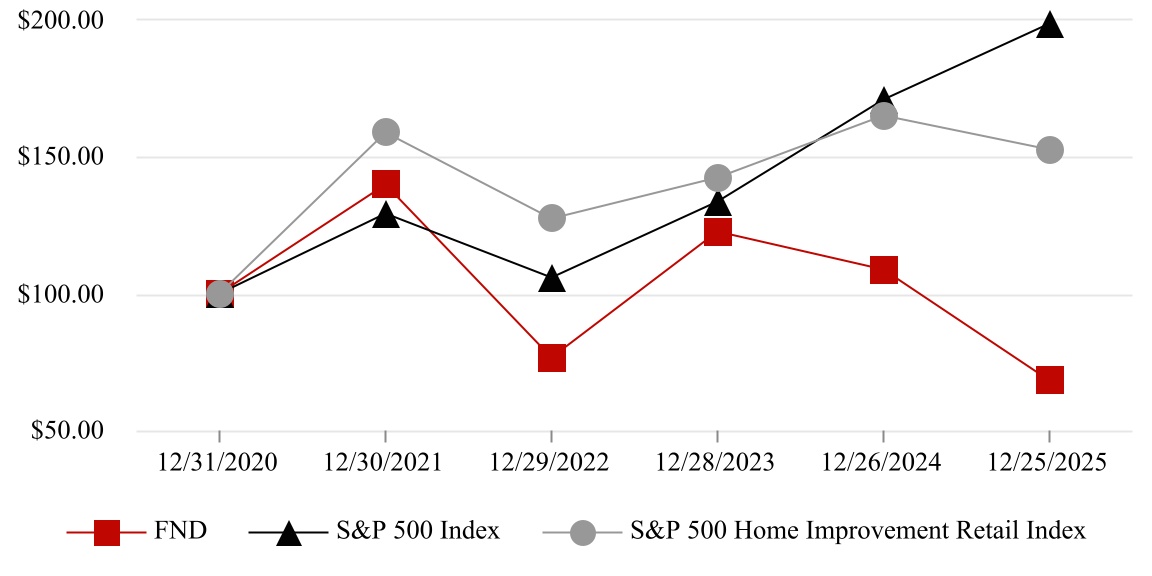
| Fiscal Year Ended | FND | S&P 500 Index | S&P 500 Home Improvement Retail Index | |||||||||||||||||
| December 31, 2020 | $ | 100.00 | $ | 100.00 | $ | 100.00 | ||||||||||||||
| December 30, 2021 | $ | 139.99 | $ | 129.04 | $ | 158.85 | ||||||||||||||
| December 29, 2022 | $ | 76.46 | $ | 105.66 | $ | 127.48 | ||||||||||||||
| December 28, 2023 | $ | 122.66 | $ | 133.47 | $ | 142.50 | ||||||||||||||
| December 26, 2024 | $ | 108.85 | $ | 170.78 | $ | 165.12 | ||||||||||||||
| December 25, 2025 | $ | 68.08 | $ | 198.60 | $ | 152.79 | ||||||||||||||
Unregistered Sales of Equity Securities and Use of Proceeds
During fiscal 2025, the Company did not sell any unregistered equity securities.
Issuer Purchases of Equity Securities
During the fiscal quarter ended December 25, 2025, the Company did not repurchase any shares of our common stock.
ITEM 6. RESERVED.
25
ITEM 7. MANAGEMENT’S DISCUSSION AND ANALYSIS OF FINANCIAL CONDITION AND RESULTS OF OPERATIONS.
You should read the following discussion and analysis of our financial condition and results of operations together with our consolidated financial statements and the related notes thereto and other financial information included elsewhere in this filing. This discussion and analysis contains forward-looking statements that involve risks and uncertainties. Our actual results could differ materially from those anticipated in these forward-looking statements as a result of certain factors, including those discussed in Item 1A, “Risk Factors.” See the cautionary note regarding forward-looking statements set forth at the beginning of this Annual Report.
Overview
Founded in 2000, Floor & Decor is a high-growth, differentiated, multi-channel specialty retailer of hard surface flooring and related accessories and seller of commercial surfaces with 270 warehouse-format stores across 39 states as of December 25, 2025. We believe our unique approach to selling hard surface flooring and our consistent and disciplined culture of innovation and reinvestment create a differentiated business model in the hard surface flooring category. We believe that we offer the broadest in-stock assortment of laminate and vinyl, tile, wood, and natural stone flooring and installation materials and decorative accessories, as well as adjacent categories, at everyday low prices. This positions us as the one-stop destination for our customers’ entire hard surface flooring needs. We appeal to a variety of customers, including Pros and homeowners, which are comprised of DIY and BIY customers. Our warehouse-format stores, which average approximately 76,000 square feet, carry on average approximately 4,200 SKUs, approximately 1.0 million square feet of flooring products, and $2.7 million of inventory at cost as of December 25, 2025. We believe that our inspiring design centers and creative and informative visual merchandising also greatly enhance our customers’ renovation experience. In addition to our stores, our website showcases our products.
The following table presents a performance summary of our results of operations for fiscal years 2025 and 2024:
| Fiscal Year Ended | |||||||||||
| dollars in thousands | December 25, 2025 | December 26, 2024 | |||||||||
| Net sales | $ | 4,684,088 | $ | 4,455,770 | |||||||
| Net income | $ | 208,647 | $ | 205,872 | |||||||
| Adjusted EBITDA | $ | 538,171 | $ | 512,504 | |||||||
| Comparable store sales | (1.8) | % | (7.1) | % | |||||||
| Number of warehouse-format stores | 270 | 251 | |||||||||
During fiscal 2025, we opened 20 new warehouse-format stores and closed one warehouse-format store, ending the year with 270 warehouse-format stores and five design studios. Additionally, we opened a new distribution center near Seattle, ending the year with five distribution centers.
The housing market continued to be impacted by a number of macroeconomic factors during fiscal 2025, including elevated interest rates and higher home prices putting pressure on housing affordability, which resulted in low existing home sales. We believe these factors directly contributed to a slowdown in demand for flooring resulting in a year-over-year decline in our comparable store sales. These factors, coupled with rising construction costs, have made it difficult to achieve new store initial sales and profitability targets compared with those opened in prior years. Consequently, our more recent new store classes are experiencing lower first year sales and initial returns compared to new stores opened in years prior to 2022. To optimize our return on investment, we focus on strategically reducing the construction costs and operating expenses. Despite these macroeconomic challenges, we believe that our continued focus on providing exceptional value to customers through our broad assortment and everyday low price strategy, while remaining disciplined to maintain profitability through cost control and strategic growth investments, have been instrumental in helping us to navigate this challenging housing market. However, the potential significance and duration of these macroeconomic difficulties is uncertain, and further pressures on the housing market could have an adverse impact on our business.
Key Performance Indicators
We consider a variety of performance and financial measures in assessing the performance of our business. The key measures we use to determine how our business is performing are comparable store sales, the number of new store openings, gross profit and gross margin, operating income, and EBITDA and Adjusted EBITDA.
26
Comparable Store Sales
Our comparable store sales growth is a significant driver of our net sales, profitability, cash flow, and overall business results. We believe that comparable store sales growth is generated by continued focus on providing a dynamic and expanding product assortment in addition to other merchandising initiatives, quality of customer service, enhancing sales and marketing strategies, improving visual merchandising and overall aesthetic appeal of our stores and our website, effectively serving our Pro customers, continued investment in store staff and infrastructure, and further integrating connected customer strategies and other key information technology enhancements.
Comparable store sales refer to period-over-period comparisons of our net sales at the time of sale among the comparable store base. A store is included in the comparable store sales calculation on the first day of the thirteenth full fiscal month following a store’s opening, which is when we believe comparability has been achieved. Changes in our comparable store sales between two periods are based on net sales at the time of sale for stores that were in operation during both of the two periods. Any change in the square footage of an existing comparable store, including for remodels and relocations within the same primary trade area of the existing store being relocated, does not eliminate that store from inclusion in the calculation of comparable store sales. Stores that are closed for a full fiscal month or longer are excluded from the comparable store sales calculation for each full fiscal month that they are closed. Since our e-commerce, regional account manager, and design studio sales are fulfilled by individual stores, they are included in comparable store sales only to the extent the fulfilling store meets the above mentioned store criteria. Sales through our Spartan subsidiary do not involve our stores and are therefore excluded from the comparable store sales calculation. When a fiscal year includes a 53rd week, we exclude the 53rd week of sales from our calculation.
Definitions and calculations of comparable store sales differ among companies in the retail industry; therefore, comparable store metrics disclosed by us may not be comparable to the metrics disclosed by other companies.
We believe that comparable store sales is a useful measure as it allows management, analysts, investors, and other interested parties to evaluate the sales performance of our retail stores. In addition, comparable store sales highlights our sales and market share growth. Management uses comparable store sales to evaluate the effectiveness of our selling strategies, to make budgeting decisions, and to compare our performance against that of other peer companies using similar measures.
Number of New Stores
The number and timing of new store openings, and the costs and fixed lease obligations associated with those openings, have had, and are expected to continue to have, a significant impact on our results of operations. The number of new stores reflects the number of stores opened during a particular reporting period. Before we open new stores, we incur operating expenditures, which are defined as pre-opening expenses. The majority of pre-opening expenses are incurred during the three months before a store opens. A new store’s operating performance is excluded from the comparable store base until the first day of the thirteenth full fiscal month following a store’s opening. Net sales at new stores are generally lower than net sales at our stores that have been open for more than one year. Our ability to open new, profitable stores is important to our long-term sales and profit growth goals.
Gross Profit and Gross Margin
Our gross profit is variable in nature and generally follows changes in net sales. Our gross profit and gross margin can also be impacted by changes in our prices, our merchandising assortment, customer preferences, shrink, damage, selling of discontinued products, the cost to transport our products from the manufacturer to our stores, and our distribution center costs. With respect to our merchandising assortment, certain of our products generate higher margins than other products within the same product categories or among different product categories. Our gross profit and gross margin, which reflect our net sales and our cost of sales and any changes to the components thereof, allow us to evaluate our profitability and overall business results.
Gross profit is calculated as net sales less cost of sales. Gross profit as a percentage of net sales is referred to as gross margin. Cost of sales consists of merchandise costs, as well as freight costs to transport inventory to our distribution centers and stores, and duty and other costs that are incurred to distribute the merchandise to our stores. Cost of sales also includes costs for shrink, damage, warehousing, sourcing, and compliance. We receive cash consideration from certain vendors related to vendor allowances and volume rebates, which is recorded as a reduction of costs of sales as the inventory is sold or as a reduction of the carrying value of inventory while the inventory is still on hand. Costs associated with arranging and paying for freight to deliver products to customers is included in cost of sales. The components of our cost of sales may not be comparable to the components of cost of sales, or similar measures, of other retailers. As a result, data in this filing regarding our gross profit and gross margin may not be comparable to similar data made available by other retailers.
We believe that gross profit and gross margin are useful measures as they allow management and analysts, investors, and other interested parties to evaluate the cost and profitability of our products and overall cost of sales, which is our largest expense. Management uses gross profit and gross margin, among other measures, to make decisions related to product, pricing, supplier, and distribution strategies as well as other areas affecting the products we offer to our customers.
27
Operating Income, EBITDA, and Adjusted EBITDA
Operating income, EBITDA, and Adjusted EBITDA are key metrics used by management and our Board to assess our financial performance and enterprise value. We believe that operating income is a useful measure as it is an indicator of the productivity of our business and our ability to manage expenses. We also believe that EBITDA and Adjusted EBITDA are useful measures, as they eliminate certain expenses that are not indicative of our core operating performance and facilitate comparisons on a consistent basis from period to period. We also use Adjusted EBITDA as a basis to determine covenant compliance with respect to our Credit Facilities, to supplement GAAP measures of performance to evaluate the effectiveness of our business strategies, to make budgeting decisions, and to compare our performance against that of other peer companies using similar measures. Operating income, EBITDA, and Adjusted EBITDA are also frequently used by analysts, investors, and other interested parties as performance measures to evaluate companies in our industry.
EBITDA and Adjusted EBITDA are supplemental measures of financial performance that are not required by or presented in accordance with GAAP. We define EBITDA as net income before interest, taxes, and depreciation and amortization. We define Adjusted EBITDA as net income before interest, taxes, and depreciation and amortization adjusted to eliminate the impact of non-cash stock-based compensation expense and certain items that we do not consider indicative of our core operating performance.
EBITDA and Adjusted EBITDA are non-GAAP measures of our financial performance and should not be considered as alternatives to net income as a measure of financial performance or any other performance measure derived in accordance with GAAP, and they should not be construed as an inference that our future results will be unaffected by unusual or non-recurring items. Additionally, EBITDA and Adjusted EBITDA are not intended to be measures of liquidity or free cash flow for management’s discretionary use. In addition, these non-GAAP measures exclude certain non-recurring and other charges. Each of these non-GAAP measures has its limitations as an analytical tool, and you should not consider them in isolation or as a substitute for analysis of our results as reported under GAAP. In evaluating EBITDA and Adjusted EBITDA, you should be aware that in the future we may incur expenses that are the same as or similar to some of the items eliminated in the adjustments made to determine EBITDA and Adjusted EBITDA, such as stock-based compensation expense, litigation settlement recovery, fair value adjustments related to contingent earn-out liabilities, and other adjustments. Definitions and calculations of EBITDA and Adjusted EBITDA differ among companies in the retail industry, and therefore EBITDA and Adjusted EBITDA disclosed by us may not be comparable to the metrics disclosed by other companies.
Other Key Financial Definitions
Net Sales
Net sales reflect our sales of merchandise, less discounts and estimated returns, and include our in-store sales, connected customer sales, and commercial sales. In certain cases, we arrange and pay for freight to deliver products to customers and bill the customer for the estimated freight cost, which is also included in net sales. Revenue is recognized when we satisfy the performance obligations in contracts with our customers, which is typically when the customer obtains control of the underlying inventory.
The retail and commercial sectors in which we operate are cyclical, and consequently our sales are affected by general economic conditions. Purchases of our products are sensitive to trends in the levels of consumer spending, which are affected by a number of factors such as consumer disposable income, housing market conditions, unemployment trends, stock market performance, consumer debt levels and consumer credit availability, interest rates and inflation, tax rates, and overall consumer confidence in the economy.
Selling, General and Administrative Expenses
Selling, general and administrative (“SG&A”) expenses consist primarily of store and store support center wages, incentive compensation and benefits, store and store support center occupancy costs, depreciation and amortization, advertising costs, credit card fees, pre-opening costs, information technology costs, and other miscellaneous operating costs. We expect that our SG&A expenses will increase in future periods with future growth. SG&A expenses include variable as well as fixed components, which may not directly correlate with net sales. The components of our SG&A expenses may not be comparable to the components of similar measures of other retailers.
Segments
We have two operating segments and one reportable segment. For additional segment information, refer to Note 14, “Segment Reporting” of the notes to the consolidated financial statements included in this Annual Report.
28
Results of Operations
The comparison of the fiscal years ended December 26, 2024 and December 28, 2023 can be found in our annual report on Form 10-K for the fiscal year ended December 26, 2024 (the “2024 Annual Report”) located within Part II, Item 7, “Management’s Discussion and Analysis of Financial Condition and Results of Operations.”
Results of operations for any period should not be considered indicative of future results. For information about the potential impacts that risks, such as declines in economic conditions that affect the residential housing market and consumer spending for hard surface flooring, interest rates, inflation, global supply chain disruptions, regulatory and political conditions, tariffs and trade policy, and geopolitical instability, among others, may have on our results of operations and overall financial performance for future periods, see “Overview” further above and Item 1A, “Risk Factors” in Part I of this Annual Report.
The following tables summarize key components of our results of operations for the periods indicated:
Fiscal Year Ended | ||||||||||||||||||||||||||||||||||||||
| December 25, 2025 | December 26, 2024 | Increase (Decrease) | ||||||||||||||||||||||||||||||||||||
dollars in thousands | Amount | % of Net Sales | Amount | % of Net Sales | $ | % | ||||||||||||||||||||||||||||||||
| Net sales | $ | 4,684,088 | 100.0 | % | $ | 4,455,770 | 100.0 | % | $ | 228,318 | 5.1 | % | ||||||||||||||||||||||||||
| Cost of sales | 2,640,180 | 56.4 | 2,527,519 | 56.7 | 112,661 | 4.5 | % | |||||||||||||||||||||||||||||||
| Gross profit | 2,043,908 | 43.6 | 1,928,251 | 43.3 | 115,657 | 6.0 | % | |||||||||||||||||||||||||||||||
Selling, general and administrative expenses | 1,773,838 | 37.8 | 1,672,075 | 37.5 | 101,763 | 6.1 | % | |||||||||||||||||||||||||||||||
| Operating income | 270,070 | 5.8 | 256,176 | 5.8 | 13,894 | 5.4 | % | |||||||||||||||||||||||||||||||
| Interest expense, net | 3,409 | 0.1 | 2,773 | 0.1 | 636 | 22.9 | % | |||||||||||||||||||||||||||||||
| Income before income taxes | 266,661 | 5.7 | 253,403 | 5.7 | 13,258 | 5.2 | % | |||||||||||||||||||||||||||||||
Income tax expense | 58,014 | 1.2 | 47,531 | 1.1 | 10,483 | 22.1 | % | |||||||||||||||||||||||||||||||
| Net income | $ | 208,647 | 4.5 | % | $ | 205,872 | 4.6 | % | $ | 2,775 | 1.3 | % | ||||||||||||||||||||||||||
Fiscal Year Ended | ||||||||||||||
| December 25, 2025 | December 26, 2024 | |||||||||||||
| Comparable store sales | (1.8) | % | (7.1) | % | ||||||||||
| Comparable average ticket | 1.8 | % | (2.5) | % | ||||||||||
Comparable transactions | (3.5) | % | (4.7) | % | ||||||||||
Number of warehouse-format stores | 270 | 251 | ||||||||||||
Adjusted EBITDA (in thousands) (1) | $ | 538,171 | $ | 512,504 | ||||||||||
Adjusted EBITDA (% of net sales) (1) | 11.5 | % | 11.5 | % | ||||||||||
(1)Refer to “Reconciliation of Non-GAAP Financial Measures” further below for a reconciliation of Adjusted EBITDA to net income.
29
Net Sales
Net sales during fiscal 2025 increased $228.3 million, or 5.1%, compared to fiscal 2024 primarily due to sales from the 20 new warehouse-format stores that we opened during the year, partially offset by a decrease in comparable store sales of 1.8%. The comparable store sales decline during the period of 1.8%, or $77.4 million, was due to a 3.5% decrease in comparable transactions, partially offset by a 1.8% increase in comparable average ticket. We believe the decrease in comparable transactions was largely driven by the continued impact of low existing home sales. The increase in comparable average ticket was primarily due to changes in sales mix. Non-comparable sales increased $305.7 million compared to fiscal 2024 primarily driven by new stores.
We estimate that retail sales during both fiscal 2025 and fiscal 2024 were approximately 50% from homeowners and 50% from Pros.
Gross Profit and Gross Margin
Gross profit during fiscal 2025 increased $115.7 million, or 6.0%, compared to fiscal 2024. The increase in gross profit was primarily driven by the 5.1% increase in net sales and an increase in gross margin to 43.6%, up approximately 30 basis points from 43.3% in fiscal 2024. The increase in gross margin was primarily driven by favorable product margin due to a decrease in supply chain costs, partially offset by an increase in distribution center costs.
Selling, General and Administrative Expenses
SG&A expenses during fiscal 2025 increased $101.8 million, or 6.1%, compared to fiscal 2024. The increase in SG&A expenses was primarily driven by the 20 new stores that we opened during the year, which increased compensation costs, occupancy costs, and depreciation and amortization expense. SG&A expenses for non-comparable stores increased $126.8 million and for comparable stores decreased $24.8 million. As a percentage of net sales, SG&A expenses increased by approximately 30 basis points to 37.8% from 37.5% in fiscal 2024. This increase was primarily attributable to the addition of new stores and deleverage from a decrease in comparable store sales, partially offset by a decrease in pre-opening expenses.
Interest Expense, Net
Net interest expense during fiscal 2025 increased $0.6 million, or 22.9%, compared to fiscal 2024 primarily due to a decrease in capitalized interest, partially offset by lower average interest rates and lower average outstanding borrowings.
Income Tax Expense
Income tax expense was $58.0 million in fiscal 2025 compared to $47.5 million in fiscal 2024. The effective tax rate was 21.8% for fiscal 2025 compared to 18.8% for fiscal 2024. The effective tax rate increase was primarily due to a decrease in excess tax benefits related to stock-based compensation awards.
30
Reconciliation of Non-GAAP Financial Measures
EBITDA and Adjusted EBITDA
For the periods presented, the following table reconciles EBITDA and Adjusted EBITDA to net income, the most directly comparable financial measure calculated and presented in accordance with GAAP:
| Fiscal Year Ended | ||||||||||||||
| in thousands | December 25, 2025 | December 26, 2024 | ||||||||||||
| Net income | $ | 208,647 | $ | 205,872 | ||||||||||
Depreciation and amortization (1) | 238,971 | 230,293 | ||||||||||||
| Interest expense, net | 3,409 | 2,773 | ||||||||||||
| Income tax expense | 58,014 | 47,531 | ||||||||||||
| EBITDA | 509,041 | 486,469 | ||||||||||||
Stock-based compensation expense (2) | 29,505 | 33,695 | ||||||||||||
Litigation settlement recovery (3) | — | (6,794) | ||||||||||||
Other (4) | (375) | (866) | ||||||||||||
| Adjusted EBITDA | $ | 538,171 | $ | 512,504 | ||||||||||
(1)Excludes amortization of deferred financing costs, which is included as part of interest expense, net.
(2)Represents non-cash charges related to stock-based compensation programs, which vary from period to period depending on the timing of awards and forfeitures.
(3)Represents net proceeds received related to the derivative litigation settlement in fiscal 2024.
(4)Other adjustments include amounts management does not consider indicative of our core operating performance. Amounts for both fiscal 2025 and fiscal 2024 relate to changes in the fair value of contingent earn-out liabilities.
Liquidity and Capital Resources
Liquidity is provided primarily by cash flows from operations and our $800.0 million ABL Facility. Unrestricted liquidity as of December 25, 2025 was $909.8 million, consisting of $249.3 million in cash and cash equivalents and $660.5 million immediately available for borrowing under the ABL Facility without violating any covenants thereunder. Our liquidity is generally not seasonal.
Our primary cash needs are for merchandise inventories, payroll, store rent, and other operating expenses and capital expenditures associated with opening new stores and remodeling existing stores as well as information technology, e-commerce, store support center, and distribution center infrastructure. We also use cash for the payment of taxes and interest and, as applicable, acquisitions. We expect that cash generated from operations together with cash on hand, the availability of borrowings under our Credit Facilities, and if necessary, additional funding through other forms of external financing, will be sufficient to meet liquidity requirements, anticipated capital expenditures, and payments due under our Credit Facilities for the next twelve months and the foreseeable future.
Total capital expenditures in fiscal 2026 are planned to be between approximately $250 million to $300 million and are expected to be funded primarily by cash generated from operations. Our capital needs may change in the future due to changes in our business, new opportunities that we choose to pursue, or other factors. We currently expect the following for capital expenditures in fiscal 2026:
•invest approximately $160 million to $190 million to open 20 warehouse-format stores, relocate stores, and begin construction on stores opening after fiscal 2026;
•invest approximately $60 million to $70 million in existing stores and new and existing distribution centers; and
•invest approximately $30 million to $40 million in information technology infrastructure, e-commerce, and other store support center initiatives.
31
Cash Flow Analysis
A summary of our operating, investing, and financing activities is shown in the following table:
Fiscal Year Ended | ||||||||||||||
in thousands | December 25, 2025 | December 26, 2024 | ||||||||||||
Net cash provided by operating activities | $ | 381,836 | $ | 603,155 | ||||||||||
Net cash used in investing activities | (317,764) | (446,826) | ||||||||||||
Net cash used in financing activities | (2,445) | (3,042) | ||||||||||||
Net increase in cash and cash equivalents | $ | 61,627 | $ | 153,287 | ||||||||||
Net Cash Provided by Operating Activities
Cash provided by operating activities consists primarily of (i) net income adjusted for non-cash items, including depreciation and amortization, stock-based compensation, and deferred income taxes and (ii) changes in working capital.
Net cash provided by operating activities was $381.8 million for fiscal 2025 and $603.2 million for fiscal 2024. The decrease in net cash provided by operating activities was primarily driven by changes in trade accounts payable.
Net Cash Used in Investing Activities
Investing activities typically consist primarily of capital expenditures for new store openings and existing store remodels, including leasehold improvements, racking, fixtures, vignettes, design centers, and new infrastructure and information systems. Cash payments to acquire businesses are also included in investing activities.
Net cash used in investing activities was $317.8 million for fiscal 2025 and $446.8 million for fiscal 2024. The decrease in net cash used in investing activities was due to a decrease in capital expenditures primarily driven by a decrease in new stores under construction.
Net Cash Used in Financing Activities
Financing activities consist primarily of borrowings and related repayments under our Credit Facilities, tax payments related to the vesting or exercise of stock-based compensation awards, proceeds from the exercise of stock options and our employee stock purchase program, and payments of contingent earn-out consideration.
Net cash used in financing activities was $2.4 million for fiscal 2025 and $3.0 million for fiscal 2024.
Our Credit Facilities
As of December 25, 2025, total Term Loan Facility debt outstanding was $198.2 million, and no amounts were outstanding under our ABL Facility. For additional information regarding our Term Loan Facility and ABL Facility, including applicable covenants and other details, please refer to Note 10, “Debt” of the notes to the consolidated financial statements included in this Annual Report.
Credit Ratings
Our credit ratings are periodically reviewed by rating agencies. As of December 25, 2025, our Standard & Poor’s issuer credit rating of BB with a stable outlook and Moody’s issuer credit rating of Ba3 with a stable outlook remain unchanged from December 26, 2024. These ratings and our current credit condition affect, among other things, our ability to access new capital. Negative changes to these ratings may result in more stringent covenants and higher interest rates under the terms of any new debt. Our credit ratings could be lowered or rating agencies could issue adverse commentaries in the future, which could have a material adverse effect on our business, financial condition, results of operations, and liquidity. In particular, a weakening of our financial condition, including an increase in our leverage or decrease in our profitability or cash flows, could adversely affect our ability to obtain necessary funds, result in a credit rating downgrade or change in outlook, or otherwise increase our cost of borrowing.
32
Material Cash Requirements, including Contractual Obligations to Third Parties
We enter into long-term obligations and commitments in the normal course of business, primarily non-cancelable operating leases and debt obligations. Our material cash requirements over the next several periods from known contractual or other obligations as of December 25, 2025 are described below.
Operating Leases. We enter into operating leases during the normal course of business. Most lease arrangements provide us with the option to renew the leases at defined terms. The future operating lease obligations would change if we were to exercise these options or enter into additional operating leases. Refer to Note 9, “Commitments and Contingencies” of the notes to our consolidated financial statements included in this Annual Report for a summary of our operating lease obligations as of December 25, 2025.
Debt. Refer to Note 10, “Debt” of the notes to our consolidated financial statements included in this Annual Report for a summary of our long-term debt obligations as of December 25, 2025.
Purchase Obligations. Purchase obligations include agreements to purchase goods or services that are legally binding and non-cancelable. Our purchase obligations primarily relate to certain software and license commitments, advertising programs, and enterprise resource planning costs. The reported amounts exclude liabilities included in our Consolidated Balance Sheet. As of December 25, 2025, purchase obligations totaled $63.4 million, of which $36.4 million is due within 12 months. We issue inventory purchase orders in the normal course of business, which are typically cancellable by their terms and are excluded from the amounts above.
Performance Guarantees. In the ordinary course of business, we are required to post letters of credit as financial guarantees of our performance. As of December 25, 2025, letters of credit totaled $38.1 million. We do not currently provide cash collateral for outstanding letters of credit. We have negotiated a letter of credit sublimit as part of our ABL Facility. The amount available to be borrowed under our ABL Facility is reduced by the cumulative amount of any outstanding letters of credit.
Off-Balance Sheet Arrangements. For fiscal 2025, we were not party to any material off-balance sheet arrangements that are reasonably likely to have a current or future effect on our financial condition, net sales, expenses, results of operations, liquidity, capital expenditures, or capital resources. We do not have any relationship with unconsolidated entities or financial partnerships for the purpose of facilitating off-balance sheet arrangements or for other contractually narrow or limited purposes.
U.S. Tariffs and Global Economy
The current geopolitical environment, particularly related to existing and potential changes in global trade and tariffs, has created uncertainty surrounding the future state of the global economy and related impacts to our supply chain. In 2025, the U.S. imposed significant additional tariffs on products from most countries where we source products. Although the U.S. has agreed to trade deals or frameworks for trade deals with certain countries and continues to negotiate with other countries, the timing of implementation and stability of these trade deals are unclear. Additionally, if the U.S. implements further tariffs, countries where we source products may impose new tariffs and other trade measures on the U.S. in response, resulting in potentially escalating trade conflict between the U.S. and its trading partners.
As we continue to manage the impact these tariffs may have on our business and the complexities of the various trade policy actions, we continue taking steps to mitigate some of the cost increases through negotiations with our vendors, sourcing from alternative countries, and increasing retail pricing as we deem appropriate. While we continue to take steps to mitigate the overall effect of increased tariffs, these tariffs have increased and will continue to increase our inventory costs and associated cost of sales, which have resulted in and in the future may result in increased retail prices and may adversely impact sales. Furthermore, the broader impact of increased tariffs on the economy has and in the future may negatively impact consumer demand for our products, which may also have an adverse impact on sales.
Recently Adopted and Recently Issued Accounting Pronouncements
Refer to Note 1, “Summary of Significant Accounting Policies” of the notes to the consolidated financial statements included in this Annual Report for information on the recently adopted and recently issued accounting pronouncements that are applicable to the Company.
Critical Accounting Policies and Estimates
The preparation of financial statements in accordance with accounting principles generally accepted in the United States requires management to make estimates and assumptions about future events that affect amounts reported in our consolidated financial statements and related notes as well as the related disclosure of contingent assets and liabilities at the date of the financial statements. Management evaluates its accounting policies, estimates, and judgments on an ongoing basis. Management bases its estimates and judgments on historical experience and various other factors that are believed to be reasonable under the circumstances. Actual results may differ under different assumptions and conditions, and such differences could be material to the consolidated financial statements.
33
Management evaluated the development and selection of its critical accounting policies and estimates and believes that the following accounting policies are critical as they involve a higher degree of judgment or complexity and are the most significant to reporting our results of operations and financial position. The following critical accounting policies reflect the significant estimates and judgments used in the preparation of our consolidated financial statements. With respect to critical accounting policies, even a relatively minor variance between actual and expected experience can potentially have a materially favorable or unfavorable impact on subsequent results of operations. All of our significant accounting policies are discussed in Note 1, “Summary of Significant Accounting Policies” of the notes to our audited consolidated financial statements included in this Annual Report.
Revenue Recognition
Description. We recognize revenue and the related cost of sales when we satisfy the performance obligations in contracts with our customers in accordance with Accounting Standards Codification (“ASC”) 606, Revenue from Contracts with Customers (“ASC 606”). Our performance obligations for our retail store sales, as well as for orders placed through our website and shipped to our customers, are satisfied at the point-of-sale, which is typically the point at which the customer obtains control of the inventory. In some cases, merchandise is not physically ready for transfer to the customer at the point-of-sale, and revenue recognition is deferred until the customer has control of the inventory. Shipping and handling activities are accounted for as activities to fulfill the promise to transfer goods rather than as separate performance obligations as outlined within ASC 606. Payment is generally due from the customer immediately at the point-of-sale for both retail store sales and website sales with the exception of a small number of commercial clients purchasing through our commercial credit program, which typically offers longer payment terms.
Judgments and uncertainties involved in the estimate. Our customers have the right to return the goods sold to them within a reasonable time period, typically 90 days. The right of return is an element of variable consideration as defined within ASC 606. We estimate a reserve for future returns of previously sold goods based on historical experience and various other assumptions that we believe to be reasonable. Merchandise exchanges of similar product and price are not considered merchandise returns and, therefore, are excluded when calculating the sales returns reserve. While we believe that our current sales returns reserves are adequate, there can be no assurances that historical data and trends will accurately predict returns or that future developments might not lead to a significant change in the reserve.
Effect if actual results differ from assumptions. A 10% change in our sales returns reserves and related return asset accruals at December 25, 2025 would have had a net impact of approximately $1.4 million on operating income in fiscal 2025. Sales returns reserves and related return asset accruals over the last few years have fluctuated primarily based on changes in sales levels and, to a lesser extent, changes in customer return rates.
Merchandise Inventories
Description. Inventories consist of merchandise held for sale and are stated at the lower of cost or net realizable value. When evidence exists that the net realizable value of inventory is lower than its cost, the difference is recorded in cost of sales in the Consolidated Statements of Operations and Comprehensive Income as a loss in the period in which it occurs. We determine inventory costs using the moving weighted average cost method. We capitalize transportation, duties, and other costs to get product to our retail locations.
Judgments and uncertainties involved in the estimate. We provide provisions for losses related to shrink, net realizable value, aged inventory, special order merchandise, and other amounts that are otherwise not expected to be fully recoverable. These provisions are calculated based on historical shrink, selling prices, margins, and current business trends. The estimates have calculations that require management to make assumptions based on the current rate of sales, age, salability and profitability of inventory, historical percentages that can be affected by changes in our merchandising mix, customer preferences, and changes in actual shrink trends.
Effect if actual results differ from assumptions. A 10% change in our inventory valuation and shrink reserves at December 25, 2025 would have affected operating income by approximately $1.8 million in fiscal 2025. Inventory valuation and shrink reserves typically fluctuate in proportion to changes in inventory balances.
Vendor Rebates and Allowances
Description. Vendor allowances consist primarily of volume rebates that are earned as a result of reaching certain inventory purchase levels and advertising allowances or incentives for the promotion of vendors’ products. These vendor allowances are accrued as earned and are estimated based on annual projections. Vendor allowances earned are initially recorded as a reduction to the carrying value of inventory and a subsequent reduction in cost of sales when the related product is sold. Certain incentive allowances that are reimbursements of specific, incremental, and identifiable costs incurred to promote vendors’ products are recorded as an offset against these promotional expenses.
34
Judgments and uncertainties involved in the estimate. For vendor allowances, we develop accrual rates based on the provisions of the agreements in place. We perform analyses and review historical purchase trends and volumes throughout the year, adjust accrual rates as appropriate, and confirm actual amounts with select vendors to ensure the amounts earned are appropriately recorded. Amounts accrued throughout the year could be impacted if actual purchase volumes differ from projected purchase volumes, especially in the case of programs that provide for increased funding when graduated purchase volumes are met.
Effect if actual results differ from assumptions. If actual results are not consistent with the assumptions and estimates used, we could be exposed to additional adjustments that could positively or negatively impact gross margin and inventory. However, substantially all receivables associated with vendor rebates and allowances do not require subjective long-term estimates because they are collected soon after each quarter end, primarily within the first two months. Adjustments to gross margin and inventory in the following fiscal year have historically not been material.
Leases
Description. We recognize lease assets and corresponding lease liabilities for all operating leases on our Consolidated Balance Sheets, excluding short-term leases (leases with terms of 12 months or less) as described under ASC 842, Leases (“ASC 842”). The majority of our long-term operating lease agreements include options to extend, which are also factored into the recognition of their respective assets and liabilities when appropriate based on management’s assessment of the probability that the options will be exercised. Lease payments are discounted using the rate implicit in the lease, or, if not readily determinable, a third-party secured incremental borrowing rate based on information available at lease commencement. The secured incremental borrowing rate is estimated based on yields obtained from Bloomberg for U.S. consumers with a BB credit rating and is adjusted for collateralization as well as inflation. Additionally, certain of our lease agreements include escalating rents over the lease terms, which, under ASC 842, results in rent being expensed on a straight-line basis over the life of the lease that commences on the date we have the right to control the property.
Judgments and uncertainties involved in the estimate. The determination of an appropriate secured incremental borrowing rate requires judgments in selecting an appropriate yield curve and estimating adjustments for collateralization and inflation.
Effect if actual results differ from assumptions. Based on the volume of new store leases that we enter into each year, a significant increase or decrease in the incremental borrowing rates used to discount lease payments could have a significant impact on the value of operating lease liabilities and right-of-use assets subsequently reported on our Consolidated Balance Sheets.
ITEM 7A. QUANTITATIVE AND QUALITATIVE DISCLOSURES ABOUT MARKET RISK.
Market risk represents the risk of changes in the value of market risk sensitive instruments caused by fluctuations in foreign exchange rates, interest rates and commodity prices. Changes in these factors could cause fluctuations in the results of our operations and cash flows. In the ordinary course of business, we are primarily exposed to foreign currency, interest rate risks, and risks from the impact of inflation or deflation. See further discussion in Item 7, “Management’s Discussion and Analysis of Financial Condition and Results of Operations” for additional details.
Foreign Currency Risk
Our primary supplier contracts outside of the U.S. are with third parties in Asia and Europe. While substantially all of these contracts are stated in U.S. dollars, there can be no assurance that the cost for the future production of our products will not be affected by exchange rate fluctuations between the U.S. dollar and the local currencies of these suppliers. Due to the number of currencies involved, we cannot quantify the potential impact of future currency fluctuations on net income or loss in future years. To date, such exchange fluctuations have not had a material impact on our financial condition or results of operations.
Interest Rate Risk
Our operating results are subject to risk from interest rate fluctuations on our Credit Facilities, which have variable interest rates. Based on the $198.2 million total outstanding principal balance of our Credit Facilities as of December 25, 2025, a 1.0% increase in the effective interest rate of this debt would cause an increase in interest expense of approximately $2.0 million over the next twelve months, excluding the impact of our interest rate cap contract. To lessen our exposure to interest rate risk, we entered into an interest rate cap contract in January 2024 with a notional value of $150.0 million. The interest rate cap contract effectively caps SOFR-based interest payments on a portion of the Company’s Term Loan Facility at 5.50% beginning in May 2024 and will continue until the interest rate cap contract expires in April 2026. For additional information related to the Company’s Credit Facilities and the interest rate cap contract, refer to Note 10, “Debt” and Note 8, “Derivatives and Risk Management,” respectively, of the notes to the consolidated financial statements included in this Annual Report.
35
Impact of Inflation/Deflation
Substantial increases in costs, including the price of raw materials, labor, energy, transportation, and other inputs used in the production and distribution of our merchandise, could have a significant impact on our business and the industry. Additionally, while deflation could positively impact our merchandise costs, it could have an adverse effect on our average unit retail price, resulting in lower net sales and operating results.
Commodity Price Risk
We experience inflation and deflation related to our purchase of certain commodity products. There can be no assurance that this price volatility will not affect our financial condition and/or our results of operations. In order to mitigate price volatility, we monitor commodity price fluctuations and may adjust our selling prices accordingly; however, our ability to recover higher costs through increased pricing may be limited by the competitive environment in which we operate. To date, such fluctuations have not had a material impact on our financial condition or results of operations.
36
ITEM 8. FINANCIAL STATEMENTS AND SUPPLEMENTARY DATA.
37
Report of Independent Registered Public Accounting Firm
To the Stockholders and the Board of Directors of Floor & Decor Holdings, Inc.
Opinion on the Financial Statements
We have audited the accompanying consolidated balance sheets of Floor & Decor Holdings, Inc. and subsidiaries (the Company) as of December 25, 2025 and December 26, 2024, the related consolidated statements of operations and comprehensive income, stockholders’ equity and cash flows for each of the three years in the period ended December 25, 2025, and the related notes (collectively referred to as the “consolidated financial statements”). In our opinion, the consolidated financial statements present fairly, in all material respects, the financial position of the Company at December 25, 2025 and December 26, 2024, and the results of its operations and its cash flows for each of the three years in the period ended December 25, 2025, in conformity with U.S. generally accepted accounting principles.
We also have audited, in accordance with the standards of the Public Company Accounting Oversight Board (United States) (PCAOB), the Company’s internal control over financial reporting as of December 25, 2025, based on criteria established in Internal Control—Integrated Framework issued by the Committee of Sponsoring Organizations of the Treadway Commission (2013 framework), and our report dated February 19, 2026 expressed an unqualified opinion thereon.
Basis for Opinion
These financial statements are the responsibility of the Company’s management. Our responsibility is to express an opinion on the Company’s financial statements based on our audits. We are a public accounting firm registered with the PCAOB and are required to be independent with respect to the Company in accordance with the U.S. federal securities laws and the applicable rules and regulations of the Securities and Exchange Commission and the PCAOB.
We conducted our audits in accordance with the standards of the PCAOB. Those standards require that we plan and perform the audit to obtain reasonable assurance about whether the financial statements are free of material misstatement, whether due to error or fraud. Our audits included performing procedures to assess the risks of material misstatement of the financial statements, whether due to error or fraud, and performing procedures that respond to those risks. Such procedures included examining, on a test basis, evidence regarding the amounts and disclosures in the financial statements. Our audits also included evaluating the accounting principles used and significant estimates made by management, as well as evaluating the overall presentation of the financial statements. We believe that our audits provide a reasonable basis for our opinion.
Critical Audit Matter
The critical audit matter communicated below is a matter arising from the current period audit of the financial statements that was communicated or required to be communicated to the audit committee and that: (1) relates to accounts or disclosures that are material to the financial statements and (2) involved our especially challenging, subjective or complex judgments. The communication of the critical audit matter does not alter in any way our opinion on the consolidated financial statements, taken as a whole, and we are not, by communicating the critical audit matter below, providing a separate opinion on the critical audit matter or on the accounts or disclosures to which it relates.
38
| Right-of-use assets and lease liabilities | ||||||||
| Description of the Matter | As discussed in Notes 1 and 9 to the consolidated financial statements, the Company recognizes right-of-use assets and corresponding lease liabilities for all leases on the balance sheet, excluding short-term leases (leases with terms of 12 months or less) as described under Accounting Standards Codification 842 (“ASC 842”). Because most of the Company’s leases do not provide a determinable implicit rate, the Company used a third party to assist in determining its incremental borrowing rates, which were used to calculate its right-of-use assets and lease liabilities. As of December 25, 2025, the Company’s right-of-use assets were $1,617.8 million and lease liabilities were $1,795.3 million (of which $155.7 million was current and $1,639.6 million was long-term). Auditing the Company’s right-of-use assets and lease liabilities was challenging due to the requirement that management estimate its incremental borrowing rates used in the application of ASC 842 because the Company does not have debt financing or other instruments that have directly comparable collateral or similar terms as its leased assets. Therefore, our procedures involved a high degree of subjective auditor judgment because of the significant judgments required for management to develop the estimates, including selection of an appropriate yield curve and estimating adjustments for collateralization. | |||||||
| How We Addressed the Matter in Our Audit | We obtained an understanding of and tested controls that address the risks of material misstatement relating to the valuation of the Company’s right-of-use assets and lease liabilities. We tested controls over management’s review of the incremental borrowing rate estimates, including selection of an appropriate yield curve and adjustments for collateralization. To test the right-of-use assets and lease liabilities recorded by the Company for new or modified leases entered into during the year ended December 25, 2025, our audit procedures included, among others, evaluating the methodology, the significant assumptions discussed above and underlying data used by the Company. We involved our valuation specialists to assist in evaluating the Company’s methodology to develop the incremental borrowing rates and preparing an independent calculation of the rates, which we compared to management’s estimates. | |||||||
/s/ Ernst & Young LLP
We have served as the Company’s auditor since 2011.
February 19, 2026
39
Report of Independent Registered Public Accounting Firm
To the Stockholders and the Board of Directors of Floor & Decor Holdings, Inc.
Opinion on Internal Control Over Financial Reporting
We have audited Floor & Decor Holdings, Inc. and subsidiaries’ internal control over financial reporting as of December 25, 2025, based on criteria established in Internal Control—Integrated Framework issued by the Committee of Sponsoring Organizations of the Treadway Commission (2013 framework) (the COSO criteria). In our opinion, Floor & Decor Holdings, Inc. and subsidiaries (the Company) maintained, in all material respects, effective internal control over financial reporting as of December 25, 2025, based on the COSO criteria.
We also have audited, in accordance with the standards of the Public Company Accounting Oversight Board (United States) (PCAOB), the consolidated balance sheets of the Company as of December 25, 2025 and December 26, 2024, the related consolidated statements of operations and comprehensive income, stockholders’ equity and cash flows for each of the three years in the period ended December 25, 2025, and the related notes and our report dated February 19, 2026 expressed an unqualified opinion thereon.
Basis for Opinion
The Company’s management is responsible for maintaining effective internal control over financial reporting and for its assessment of the effectiveness of internal control over financial reporting included in the accompanying Management’s Report on Internal Control over Financial Reporting. Our responsibility is to express an opinion on the Company’s internal control over financial reporting based on our audit. We are a public accounting firm registered with the PCAOB and are required to be independent with respect to the Company in accordance with the U.S. federal securities laws and the applicable rules and regulations of the Securities and Exchange Commission and the PCAOB.
We conducted our audit in accordance with the standards of the PCAOB. Those standards require that we plan and perform the audit to obtain reasonable assurance about whether effective internal control over financial reporting was maintained in all material respects.
Our audit included obtaining an understanding of internal control over financial reporting, assessing the risk that a material weakness exists, testing and evaluating the design and operating effectiveness of internal control based on the assessed risk, and performing such other procedures as we considered necessary in the circumstances. We believe that our audit provides a reasonable basis for our opinion.
Definition and Limitations of Internal Control Over Financial Reporting
A company’s internal control over financial reporting is a process designed to provide reasonable assurance regarding the reliability of financial reporting and the preparation of financial statements for external purposes in accordance with generally accepted accounting principles. A company’s internal control over financial reporting includes those policies and procedures that (1) pertain to the maintenance of records that, in reasonable detail, accurately and fairly reflect the transactions and dispositions of the assets of the company; (2) provide reasonable assurance that transactions are recorded as necessary to permit preparation of financial statements in accordance with generally accepted accounting principles, and that receipts and expenditures of the company are being made only in accordance with authorizations of management and directors of the company; and (3) provide reasonable assurance regarding prevention or timely detection of unauthorized acquisition, use, or disposition of the company’s assets that could have a material effect on the financial statements.
Because of its inherent limitations, internal control over financial reporting may not prevent or detect misstatements. Also, projections of any evaluation of effectiveness to future periods are subject to the risk that controls may become inadequate because of changes in conditions, or that the degree of compliance with the policies or procedures may deteriorate.
/s/ Ernst & Young LLP
Atlanta, Georgia
February 19, 2026
40
Floor & Decor Holdings, Inc. and Subsidiaries
Consolidated Balance Sheets
in thousands, except for share and per share data | December 25, 2025 | December 26, 2024 | |||||||||
| Assets | |||||||||||
| Current assets: | |||||||||||
| Cash and cash equivalents | $ | $ | |||||||||
| Income taxes receivable | |||||||||||
| Receivables, net | |||||||||||
| Inventories, net | |||||||||||
| Prepaid expenses and other current assets | |||||||||||
| Total current assets | |||||||||||
| Fixed assets, net | |||||||||||
| Right-of-use assets | |||||||||||
| Intangible assets, net | |||||||||||
| Goodwill | |||||||||||
| Deferred income tax assets, net | |||||||||||
| Other assets | |||||||||||
| Total long-term assets | |||||||||||
| Total assets | $ | $ | |||||||||
| Liabilities and stockholders’ equity | |||||||||||
| Current liabilities: | |||||||||||
| Current portion of term loan | $ | $ | |||||||||
| Current portion of lease liabilities | |||||||||||
| Trade accounts payable | |||||||||||
| Accrued expenses and other current liabilities | |||||||||||
| Deferred revenue | |||||||||||
| Total current liabilities | |||||||||||
| Term loan | |||||||||||
| Lease liabilities | |||||||||||
| Deferred income tax liabilities, net | |||||||||||
| Other liabilities | |||||||||||
| Total long-term liabilities | |||||||||||
| Total liabilities | |||||||||||
Commitments and contingencies (Note 9) | |||||||||||
Preferred stock, $ | |||||||||||
Common stock Class A, $ | |||||||||||
| Additional paid-in capital | |||||||||||
Accumulated other comprehensive income (loss), net | ( | ||||||||||
| Retained earnings | |||||||||||
| Total stockholders’ equity | |||||||||||
| Total liabilities and stockholders’ equity | $ | $ | |||||||||
See accompanying notes to consolidated financial statements.
41
Floor & Decor Holdings, Inc. and Subsidiaries
Consolidated Statements of Operations and Comprehensive Income
| Fiscal Year Ended | |||||||||||||||||
in thousands, except for per share data | December 25, 2025 | December 26, 2024 | December 28, 2023 | ||||||||||||||
Net sales | $ | $ | $ | ||||||||||||||
Cost of sales | |||||||||||||||||
Gross profit | |||||||||||||||||
Selling, general and administrative expenses | |||||||||||||||||
Operating income | |||||||||||||||||
Interest expense, net | |||||||||||||||||
Income before income taxes | |||||||||||||||||
Income tax expense | |||||||||||||||||
Net income | $ | $ | $ | ||||||||||||||
Change in fair value of hedge instruments, net of tax | ( | ( | |||||||||||||||
Total comprehensive income | $ | $ | $ | ||||||||||||||
Basic earnings per share | $ | $ | $ | ||||||||||||||
Diluted earnings per share | $ | $ | $ | ||||||||||||||
See accompanying notes to consolidated financial statements.
42
Floor & Decor Holdings, Inc. and Subsidiaries
Consolidated Statements of Stockholders’ Equity
| Common Stock Class A | Additional Paid-in Capital | Accumulated Other Comprehensive Income (Loss) | Retained Earnings | Total Stockholders’ Equity | |||||||||||||||||||||||||||||||
| in thousands | Shares | Amount | |||||||||||||||||||||||||||||||||
Balance, December 30, 2022 | $ | $ | $ | $ | $ | ||||||||||||||||||||||||||||||
| Stock-based compensation expense | — | — | — | — | |||||||||||||||||||||||||||||||
| Exercise of stock options | — | — | |||||||||||||||||||||||||||||||||
| Issuance of common stock upon vesting of restricted stock units | — | — | — | — | — | ||||||||||||||||||||||||||||||
| Shares issued under employee stock purchase plan | — | — | — | ||||||||||||||||||||||||||||||||
| Common stock redeemed for tax liability | ( | — | ( | — | — | ( | |||||||||||||||||||||||||||||
Other comprehensive loss, net of tax | — | — | — | ( | — | ( | |||||||||||||||||||||||||||||
| Net income | — | — | — | — | |||||||||||||||||||||||||||||||
| Balance, December 28, 2023 | $ | $ | $ | $ | $ | ||||||||||||||||||||||||||||||
| Stock-based compensation expense | — | — | — | — | |||||||||||||||||||||||||||||||
| Exercise of stock options | — | — | — | ||||||||||||||||||||||||||||||||
| Issuance of common stock upon vesting of restricted stock units | — | — | — | — | — | ||||||||||||||||||||||||||||||
| Shares issued under employee stock purchase plan | — | — | — | ||||||||||||||||||||||||||||||||
| Common stock redeemed for tax liability | ( | — | ( | — | — | ( | |||||||||||||||||||||||||||||
Other comprehensive loss, net of tax | — | — | — | ( | — | ( | |||||||||||||||||||||||||||||
| Net income | — | — | — | — | |||||||||||||||||||||||||||||||
| Balance, December 26, 2024 | $ | $ | $ | ( | $ | $ | |||||||||||||||||||||||||||||
| Stock-based compensation expense | — | — | — | — | |||||||||||||||||||||||||||||||
| Exercise of stock options | — | — | — | ||||||||||||||||||||||||||||||||
| Issuance of common stock upon vesting of restricted stock units | ( | — | — | ||||||||||||||||||||||||||||||||
| Shares issued under employee stock purchase plan | — | — | — | ||||||||||||||||||||||||||||||||
| Common stock redeemed for tax liability | ( | — | ( | — | — | ( | |||||||||||||||||||||||||||||
Other comprehensive gain, net of tax | — | — | — | — | |||||||||||||||||||||||||||||||
| Net income | — | — | — | — | |||||||||||||||||||||||||||||||
| Balance, December 25, 2025 | $ | $ | $ | $ | $ | ||||||||||||||||||||||||||||||
See accompanying notes to consolidated financial statements.
43
Floor & Decor Holdings, Inc. and Subsidiaries
Consolidated Statements of Cash Flows
| Fiscal Year Ended | |||||||||||||||||
| in thousands | December 25, 2025 | December 26, 2024 | December 28, 2023 | ||||||||||||||
| Operating activities | |||||||||||||||||
| Net income | $ | $ | $ | ||||||||||||||
| Adjustments to reconcile net income to net cash provided by operating activities: | |||||||||||||||||
| Depreciation and amortization | |||||||||||||||||
| Stock-based compensation expense | |||||||||||||||||
| Deferred income taxes | ( | ( | |||||||||||||||
| Loss on asset impairments and disposals, net | |||||||||||||||||
| Change in fair value of contingent earn-out liabilities | ( | ( | |||||||||||||||
Changes in operating assets and liabilities, net of effects of acquisition: | |||||||||||||||||
| Receivables, net | ( | ||||||||||||||||
| Inventories, net | ( | ( | |||||||||||||||
| Trade accounts payable | ( | ||||||||||||||||
| Accrued expenses and other current liabilities | |||||||||||||||||
| Income taxes | ( | ||||||||||||||||
| Deferred revenue | ( | ||||||||||||||||
| Other, net | ( | ( | |||||||||||||||
| Net cash provided by operating activities | |||||||||||||||||
| Investing activities | |||||||||||||||||
| Purchases of fixed assets | ( | ( | ( | ||||||||||||||
Acquisition, net of cash acquired | ( | ||||||||||||||||
| Net cash used in investing activities | ( | ( | ( | ||||||||||||||
| Financing activities | |||||||||||||||||
Payments on term loan | ( | ( | ( | ||||||||||||||
| Borrowings on revolving line of credit | |||||||||||||||||
| Payments on revolving line of credit | ( | ( | |||||||||||||||
Payments of contingent earn-out liabilities | ( | ( | ( | ||||||||||||||
| Proceeds from exercise of stock options | |||||||||||||||||
| Proceeds from employee stock purchase plan | |||||||||||||||||
| Tax payments for stock-based compensation awards | ( | ( | ( | ||||||||||||||
Net cash used in financing activities | ( | ( | ( | ||||||||||||||
Net increase in cash and cash equivalents | |||||||||||||||||
| Cash and cash equivalents, beginning of the period | |||||||||||||||||
| Cash and cash equivalents, end of the period | $ | $ | $ | ||||||||||||||
| Supplemental disclosures of cash flow information | |||||||||||||||||
| Buildings and equipment acquired under operating leases | $ | $ | $ | ||||||||||||||
| Cash paid for interest, net of capitalized interest | $ | $ | $ | ||||||||||||||
| Cash paid for income taxes, net of refunds | $ | $ | $ | ||||||||||||||
| Fixed assets accrued at the end of the period | $ | $ | $ | ||||||||||||||
See accompanying notes to consolidated financial statements.
44
Floor & Decor Holdings, Inc. and Subsidiaries
Notes to Consolidated Financial Statements
1. Summary of Significant Accounting Policies
Nature of Business
Floor & Decor Holdings, Inc., together with its subsidiaries (“Floor & Decor,” the “Company,” “we,” “our,” or “us”) is a high-growth, differentiated, multi-channel specialty retailer of hard surface flooring and related accessories and seller of commercial surfaces. The Company offers a broad in-stock assortment of laminate and vinyl, tile, wood, and natural stone flooring and installation materials and decorative accessories, as well as adjacent categories, at everyday low prices. Our stores appeal to a variety of customers, including professional installers and commercial businesses (“Pro”) and homeowners, which are comprised of do-it-yourself customers (“DIY”) and buy-it-yourself customers, who buy our products for professional installation (“BIY”).
As of December 25, 2025, the Company, through its wholly owned subsidiary, Floor and Decor Outlets of America, Inc. (“Outlets”), operates 270 warehouse-format stores, which average 76,000 square feet, and five small-format standalone design studios in 39 states, as well as five distribution centers, a website, FloorandDecor.com, and a commercial surfaces business through its subsidiary, Spartan Surfaces, LLC (“Spartan”). Substantially all of the Company’s operating assets and liabilities are held by Outlets.
Fiscal Year
The Company’s fiscal year is the 52- or 53-week period ending on the Thursday on or preceding December 31st. The fiscal years ended December 25, 2025 (“fiscal 2025”), December 26, 2024 (“fiscal 2024”), and December 28, 2023 (“fiscal 2023”) include 52 weeks. 52-week fiscal years consist of thirteen-week periods in each quarter of the fiscal year. When a 53-week fiscal year occurs, the Company reports the additional week at the end of the fiscal fourth quarter.
Basis of Presentation
The accompanying consolidated financial statements have been prepared in accordance with accounting principles generally accepted in the United States (“GAAP”). The consolidated financial statements include the accounts of the Company and its wholly owned subsidiaries. Certain prior period amounts have been reclassified to conform with the current year presentation.
Use of Estimates
The preparation of the financial statements requires management of the Company to make a number of estimates and assumptions relating to the reported amount of assets and liabilities and the disclosure of contingent assets and liabilities at the date of the financial statements and the reported amounts of sales and expenses during the period. Actual results could differ from these estimates.
Cash and Cash Equivalents
Cash consists of currency and demand deposits with banks.
Receivables
45
Credit Program
Merchandise Inventories
Physical inventory counts and cycle counts are performed on a regular basis in each store and distribution center to ensure that amounts reflected in the accompanying Consolidated Balance Sheets are properly stated. During the period between physical inventory counts in its stores, the Company accrues for estimated losses related to shrink on a store-by-store basis. Shrink is the difference between the recorded amount of inventory and the physical inventory. Shrink may occur due to theft or loss, among other things.
Fixed Assets
Fixed assets consist primarily of furniture, fixtures, and equipment, computer software and hardware, leasehold improvements (including those that are reimbursed by landlords as tenant improvement allowances), buildings and improvements, and land. The Company capitalizes interest on borrowings during the active construction period of certain capital projects. Fixed assets are stated at cost less accumulated depreciation. Depreciation is calculated utilizing the straight-line method over the assets’ estimated useful lives.
Leasehold improvements are amortized using the straight-line method over the shorter of (i) the original term of the lease, (ii) renewal term of the lease if the renewal is reasonably certain or (iii) the useful life of the improvement. The Company’s fixed assets are depreciated using the following estimated useful lives:
| Useful Life | |||||
Furniture, fixtures, and equipment | |||||
| Computer software and hardware | |||||
| Leasehold improvements | |||||
Buildings and improvements | |||||
The cost and related accumulated depreciation of assets sold or otherwise disposed are removed from the accounts, and the related gain or loss is reported in the Consolidated Statements of Operations and Comprehensive Income.
Internal-Use Software Costs
The Company capitalizes certain costs related to the acquisition and development of internal-use software, which are included within fixed assets, net in the Consolidated Balance Sheets. Capitalized internal-use software costs are amortized using the straight-line method over the estimated useful life of the software within selling, general and administrative (“SG&A”) expenses in the Consolidated Statements of Operations and Comprehensive Income. Costs related to internal-use software not meeting the criteria for capitalization are expensed as incurred.
46
Cloud Computing Arrangements
The Company capitalizes certain costs to implement cloud computing arrangements (“CCA”) that are service contracts hosted by third-party vendors. CCA implementation costs meeting the criteria for capitalization are included within other assets in the Consolidated Balance Sheets and are amortized using the straight-line method over the expected term of the related contract, which may include reasonably certain renewals. Amortization expense for capitalized implementation costs is presented in the Consolidated Statements of Operations and Comprehensive Income within SG&A expenses.
As of December 25, 2025 and December 26, 2024, CCA implementation costs included in other assets were $38.1 million and $7.5 million, respectively.
Goodwill and Other Indefinite-lived Intangible Assets
Goodwill represents the excess of purchase price over the fair value of net assets acquired. The Company does not amortize goodwill and other intangible assets with indefinite lives resulting from business combinations but, in accordance with Financial Accounting Standards Board (“FASB”) Accounting Standards Codification (“ASC”) 350, Intangibles—Goodwill and Other, does assess the recoverability of goodwill annually in the fourth quarter of each fiscal year, or more often if events occur or changes in circumstances indicate that the carrying amount of goodwill may not be recoverable. Such circumstances could include, but are not limited to, a significant adverse change in customer demand or business climate or an adverse action or assessment by a regulator. Each year, the Company may assess qualitative factors to determine whether it is more likely than not that the fair value of a reporting unit is less than its carrying amount as a basis for determining whether it is necessary to complete quantitative impairment assessments. The Company has two reporting units, which are Floor & Decor Retail (“Retail”) and Spartan.
Impairment Assessment of Goodwill and Other Indefinite-lived Intangible Assets
The Company tests goodwill and its trade names, which are indefinite-lived intangible assets, for impairment annually in the fourth quarter of each fiscal year, or more often if events occur or changes in circumstances indicate that the carrying amount of goodwill or indefinite-lived intangible assets may not be recoverable. The Company has the option to assess the value of its goodwill and other indefinite-lived intangible assets under either a qualitative or quantitative approach. Under a qualitative approach, the Company evaluates various market and other factors to determine whether it is more likely than not that the Company’s goodwill or other indefinite-lived intangible assets have been impaired. In performing the qualitative assessment, the Company considers the carrying value of each reporting unit compared to its fair value as well as events and changes in circumstances that could include, but are not limited to, a significant adverse change in customer demand or business climate, an adverse action or assessment by a regulator, and significant adverse changes in the price of the Company’s common stock. If such qualitative assessment indicates that impairment may have occurred, an additional quantitative assessment is performed by comparing the carrying value of the assets to their respective estimated fair values. If the recorded carrying value of goodwill or an other indefinite-lived intangible asset exceeds its estimated fair value, an impairment charge is recorded to write the asset down to its estimated fair value.
During the fourth quarter of fiscal 2025, the Company qualitatively assessed whether it was more likely than not that the goodwill and indefinite-lived intangible assets were impaired. Based on these assessments, the Company determined it was more likely than not that its goodwill and other indefinite-lived intangible assets were not impaired as of October 24, 2025. No events or changes in circumstances have occurred since the date of the Company’s most recent annual impairment assessment that would more likely than not reduce the fair value of a reporting unit below its carrying amount.
The Company’s goodwill and other indefinite-lived intangible assets impairment assessments contain uncertainties because they require management to make significant judgments in estimating the fair value of the Company’s reporting unit and other indefinite-lived intangible assets and, if a quantitative assessment is deemed necessary, may include the projection of future cash flows, assumptions about which market participants are the most comparable, the selection of discount rates, and the weighting of the income and market approaches. These calculations contain uncertainties because they require management to make assumptions such as estimating economic factors, including the profitability of future business operations and, if necessary, the fair value of the reporting unit’s assets and liabilities. Further, the Company’s ability to realize the future cash flows used in its fair value calculations is affected by factors such as changes in economic conditions, changes in the Company’s operating performance, and changes in the Company’s business strategies. Significant changes in any of the assumptions involved in calculating these estimates could affect the estimated fair value of the Company’s reporting unit and indefinite-lived intangible assets and could result in impairment charges in a future period.
47
Long-lived Assets
Long-lived assets, such as fixed assets, operating lease right-of-use assets, and intangible assets with finite lives, are reviewed for impairment whenever events or changes in circumstances indicate that the carrying amount of an asset may not be recoverable. Conditions that may indicate impairment include, but are not limited to, a significant adverse change in customer demand or business climate that could affect the value of an asset, significant changes or planned changes in the Company’s use of an asset, a product recall, or an adverse action by a regulator. In accordance with ASC 360, Property, Plant and Equipment, the evaluation is performed at the lowest level for which identifiable cash flows are available that are largely independent of the cash flows of other assets or asset groups. If the sum of the estimated undiscounted future cash flows is less than the carrying value of the related asset or asset group, an impairment loss is recognized equal to the difference between carrying value and fair value.
Since there is typically no active market for the Company’s definite-lived intangible assets, the Company estimates fair value based on expected future cash flows at the time they are identified. When events or changes in circumstances indicate that the carrying amount of an asset may not be recoverable, the Company estimates future cash flows based on store-level historical results, current trends, and operating and cash flow projections. Definite-lived intangible assets are amortized over their respective estimated useful lives on a straight-line basis, which the Company believes to be the amortization methodology that best matches the pattern of economic benefit that is expected from the assets. The useful lives of definite-lived intangible asset are evaluated on an annual basis.
Leases
The Company recognizes lease right-of-use assets and corresponding lease liabilities for all operating leases on the balance sheet, excluding short-term leases (leases with terms of 12 months or less) as described under ASC 842, Leases (“ASC 842”). The majority of the Company’s long-term operating lease agreements include options to extend, which are also factored into the recognition of their respective assets and liabilities when appropriate based on management’s assessment of the probability that the options will be exercised. Lease payments are discounted using the rate implicit in the lease, or, if not readily determinable, a third-party secured incremental borrowing rate based on information available at lease commencement. The secured incremental borrowing rate is estimated based on yields obtained from Bloomberg for U.S. consumers with a BB credit rating and is adjusted for collateralization as well as inflation. Additionally, certain of the Company’s lease agreements include escalating rents over the lease terms, which, under ASC 842, results in rent being expensed on a straight-line basis over the life of the lease that commences on the date the Company has the right to control the property.
Insurance Reserves
The Company maintains insurance coverage with individual and aggregate limits for workers’ compensation and general liability claims above certain dollar amounts and is responsible for costs below these limits. The Company’s liabilities represent estimates of the ultimate cost for claims incurred, including loss adjusting expenses, as of the balance sheet date. The estimated liabilities are not discounted and are established based upon analysis of historical data, actuarial estimates, regulatory requirements, an estimate of claims incurred but not yet reported, and other relevant factors. Management utilizes independent third-party actuarial studies to help assess the liability on a regular basis.
Commitments and Contingencies
Liabilities for loss contingencies arising from claims, assessments, litigation, fines, penalties, and other sources are recorded when it is probable that a liability has been incurred and the amount of the loss can be reasonably estimated.
Asset Retirement Obligations
An asset retirement obligation (“ARO”) represents a legal obligation associated with the retirement of a tangible long-lived asset that is incurred upon the acquisition, construction, development, or normal operation of that long-lived asset. The Company’s AROs are primarily associated with leasehold improvements that, at the end of a lease, the Company is contractually obligated to remove in order to comply with certain lease agreements. The ARO is recorded in other liabilities on the Consolidated Balance Sheets and will be subsequently adjusted for changes in fair value. The associated estimated asset retirement costs are capitalized as part of the carrying amount of the long-lived asset and depreciated over its useful life.
Changes in (i) inflation rates and (ii) the estimated costs, timing, and extent of future store closure activities each result in (a) a current adjustment to the recorded liability and related asset and (b) a change in the liability and asset amounts to be recorded prospectively. Any changes related to the assets are then recognized in accordance with the Company’s depreciation policy, which would generally result in depreciation expense being recognized prospectively over the shorter of the remaining lease term or estimated useful life.
As of December 25, 2025 and December 26, 2024, ARO assets included in fixed assets, net were $12.7 million and $13.6 million, respectively, and ARO liabilities included in other long-term liabilities were $21.6 million and $18.5 million, respectively.
48
Fair Value Measurements
The Company estimates fair values in accordance with ASC 820, Fair Value Measurement (“ASC 820”). ASC 820 provides a framework for measuring fair value and requires disclosures about fair value measurements. ASC 820 defines fair value as the price that would be received from the sale of an asset or paid to transfer a liability in the principal or most advantageous market for the asset or liability in an orderly transaction between market participants. Additionally, ASC 820 defines levels within a hierarchy based upon observable and non-observable inputs. If the inputs used to measure fair value fall within different levels of the hierarchy, the category level is based on the lowest priority level input that is significant to the overall fair value measurement of the instrument.
•Level 1: Quoted prices in active markets for identical assets or liabilities as of the reporting date;
•Level 2: Inputs other than quoted prices in active markets for identical assets or liabilities that are either directly or indirectly observable as of the reporting date; and
•Level 3: Unobservable inputs that reflect the reporting entity’s own estimates about the assumptions market participants would use in pricing the asset or liability.
Derivative Financial Instruments
Changes in interest rates impact the Company’s results of operations. In an effort to manage exposure to this risk, the Company enters into derivative contracts and may adjust its derivative portfolio as market conditions change. Derivative contracts are recognized at fair value on the Consolidated Balance Sheets. Unrealized changes in the fair value of hedged derivative instruments are recorded in accumulated other comprehensive income (loss) (“AOCI”) within the stockholders’ equity section of the Consolidated Balance Sheets.
The effective portion of the gain or loss on effective cash flow hedges is reported as a component of AOCI and reclassified into earnings in the same period in which the hedged transaction affects earnings. To the extent that hedges are not highly effective, the ineffective portion of the hedge is immediately recognized in earnings. The Company performs an assessment of the effectiveness of its derivative contracts designated as hedges, including assessing the possibility of counterparty default. If it is determined that a derivative is no longer expected to be highly effective, hedge accounting is discontinued prospectively, and subsequent changes in the fair value of the hedge are recognized in earnings. See Note 8, “Derivatives and Risk Management” for additional information.
Business Combinations
The Company accounts for acquisitions in accordance with ASC 805, Business Combinations (“ASC 805”). The purchase price of an acquisition is measured as the aggregate fair value of the consideration transferred at the date of acquisition. The purchase price is allocated to the fair values of the tangible and intangible assets acquired and liabilities assumed, with any excess recorded as goodwill. These fair value determinations require judgment and may involve the use of significant estimates and assumptions. The purchase price allocation may be provisional during a measurement period of up to one year from the acquisition date to provide reasonable time to obtain the information necessary to identify and measure the assets acquired and liabilities assumed. Only facts and circumstances that existed as of the acquisition date are considered for subsequent adjustment to the purchase price allocation, and any such adjustment will be recognized in the period in which it is determined prior to completion of the measurement period. Transaction costs associated with acquisitions are expensed as incurred.
Revenue Recognition
In accordance with ASC 606, Revenue from Contracts with Customers (“ASC 606”), revenue and cost of sales are recognized when the related performance obligations in contracts with customers are settled. Performance obligations for the Company’s retail store sales, as well as for orders placed through its website and shipped to customers, are satisfied at the point at which the customer obtains control of the inventory, which is typically at the point-of-sale. In some cases, merchandise is not physically ready for transfer to the customer at the point-of-sale, and revenue recognition is deferred until the customer has control of the inventory. Shipping and handling activities are accounted for as activities to fulfill the promise to transfer goods rather than as separate performance obligations as outlined within ASC 606. Payment is generally due from the customer immediately at the point-of-sale for both retail store sales and website sales. The nature of the goods offered primarily includes hard surface flooring and related accessories. The Company does not perform installation services, and free design services are offered in-store. The transaction price recognized in revenue represents the selling price of the products offered. Sales taxes collected are not recognized as revenue as these amounts are ultimately remitted to the appropriate taxing authorities.
49
The Company provides customers the right to return the goods sold to them within a reasonable time period, typically 90 days. The right of return is an element of variable consideration as defined within ASC 606. Reserves for future returns of previously sold goods are estimated based on historical experience and various other assumptions that management believes to be reasonable. These reserves reduce sales and cost of sales and establish a related return asset and refund liability as defined in ASC 606. The return asset is included within prepaid expenses and other current assets, and the refund liability is included within accrued expenses and other current liabilities, each respectively on the Consolidated Balance Sheets. Merchandise exchanges of similar product and price are not considered merchandise returns and, therefore, are excluded when calculating the sales returns reserve.
Gift Cards and Merchandise Credits
Loyalty Program
Our Pro Premier loyalty program allows customers to earn points through purchases in our stores and our website. Eligible transactions typically earn loyalty points at a rate of one percent of the merchandise selling price. However, our high-volume customers may earn loyalty points at a rate of three percent. The Company defers the estimated standalone selling price of the loyalty points as a reduction to revenue and establishes a corresponding liability. The estimated selling price accounts for the portion of loyalty points expected to be redeemed. The loyalty program represents a material right to the customer as points may be redeemed on future purchases of Company merchandise, as well as goods and services fulfilled by third parties. Breakage for loyalty point rewards is estimated based on historical customer redemption patterns and may change in the future as the program matures.
Sales Returns and Allowances
Cost of Sales
Cost of sales consists of merchandise costs as well as freight, duty, and other costs to transport inventory to the Company’s distribution centers and stores. Cost of sales also includes costs for shrink, damaged product disposals, distribution, warehousing, sourcing, compliance, and arranging and paying for freight to deliver products to customers. The Company receives cash consideration from certain vendors related to vendor allowances and volume rebates, which is recorded as a reduction to the carrying value of inventory if the inventory is on hand and a reduction to cost of sales when the inventory is sold.
Vendor Rebates and Allowances
Vendor allowances consist primarily of volume rebates that are earned as a result of attaining certain inventory purchase levels and advertising allowances or incentives for the promotion of vendors’ products. These vendor allowances are accrued as earned and are estimated based on annual projections.
Vendor allowances are recorded as a reduction to the carrying value of inventory when earned and subsequently reduce cost of sales when the related product is sold. Certain incentive allowances that are reimbursements of specific, incremental, and identifiable costs incurred to promote vendors’ products are recorded as an offset against these promotional expenses.
Selling, General and Administrative Expenses
SG&A expenses consist primarily of store and store support center wages, incentive compensation and benefits, store and store support center occupancy costs, depreciation and amortization, advertising costs, credit card fees, pre-opening costs, information technology costs, and other miscellaneous operating costs.
In the current year, the Company combined selling and store operating expenses, general and administrative expenses, and pre-opening expenses into SG&A expenses within the Consolidated Statements of Operations and Comprehensive Income.
50
Advertising Expenses
Pre-Opening Expenses
The Company accounts for operating expenditures incurred prior to opening a new store as SG&A expenses in its Consolidated Statements of Operations and Comprehensive Income.
Stock-Based Compensation
The Company accounts for stock-based compensation, including employee stock options, restricted stock awards, restricted stock units, and employee stock purchase plans, in accordance with ASC 718, Compensation – Stock Compensation (“ASC 718”), which requires measurement of compensation cost for all stock awards at fair value on the date of grant and recognition of compensation, net of forfeitures, over the requisite service period for awards expected to vest. As necessary, the Company obtains independent third-party valuation studies to assist with determining the grant date fair value of employee stock awards. Stock-based compensation cost is recognized as expense over the requisite service period based on the number of years for which the requisite service is expected to be rendered. Refer to Note 11, “Stockholders’ Equity” for additional details related to the Company’s stock-based compensation awards.
Income Taxes
The Company accounts for income taxes under the liability method in accordance with ASC 740, Income Taxes (“ASC 740”), which requires the recognition of deferred tax assets and liabilities for the future tax consequences attributable to differences between the financial statement carrying amounts and tax basis of existing assets and liabilities. Deferred tax assets and liabilities are measured using enacted tax rates expected to apply to taxable income in the years in which those temporary differences are expected to be recovered or settled. Changes in tax laws and rates could affect recorded deferred tax assets and liabilities in the future. The effect on deferred tax assets and liabilities of a change in tax laws or rates is recognized in the period that includes the enactment date of such a change.
The ultimate realization of deferred tax assets is dependent upon the generation of future taxable income during the periods in which the associated temporary differences became deductible. On a quarterly basis, the Company evaluates whether it is more likely than not that its deferred tax assets will be realized in the future and concludes whether a valuation allowance must be established.
The Company includes any estimated interest and penalties on tax-related matters in income taxes payable and income tax expense. The Company accounts for uncertain tax positions in accordance with ASC 740. ASC 740-10 clarifies the accounting for uncertainty in income taxes recognized in an enterprise’s financial statements using a two-step process for evaluating tax positions taken, or expected to be taken, on a tax return. The Company may only recognize the tax benefit from an uncertain tax position if it is more likely than not that the tax position will be sustained on examination by the taxing authorities, based on the technical merits of the position. The tax benefits recognized in the financial statements from such a position should be measured based on the largest benefit that has a greater than 50% likelihood of being realized upon ultimate settlement. In addition, the Company recognizes a loss contingency for uncertain tax positions when it is probable that a liability has been incurred and the amount of the loss can be reasonably estimated. Amounts recognized for uncertain tax positions require that management make estimates and judgments based on provisions of the tax law, which may be subject to change or varying interpretations. The Company includes estimated interest and penalties related to uncertain tax position accruals within accrued expenses and other current liabilities in the Consolidated Balance Sheets and within income tax expense in the Consolidated Statements of Operations and Comprehensive Income.
Recently Adopted Accounting Pronouncements
Codification Improvements. In March 2024, the FASB issued Accounting Standards Update (“ASU”) No. 2024-02, “Codification Improvements - Amendments to Remove References to the Concepts Statements.” ASU No. 2024-02 removes references to various FASB Concepts Statements within the Codification. In the first quarter of fiscal 2025, the Company adopted ASU No. 2024-02 on a prospective basis. The adoption of ASU No. 2024-02 did not have a material impact on the Company’s consolidated financial statements or related disclosures.
51
Income Taxes. In December 2023, the FASB issued ASU No. 2023-09, “Income Taxes (Topic 740).” The amendments in this ASU improve the transparency of income tax disclosures by requiring consistent categories and greater disaggregation of information in the rate reconciliation and income taxes paid disaggregated by jurisdiction. Additionally, this ASU improves the effectiveness and comparability of disclosures by adding disclosures of pretax income (or loss) and income tax expense (or benefit) to be consistent with SEC Regulation S-X §210.4-08(h) and by removing disclosures that no longer are considered cost beneficial or relevant. In fiscal 2025, the Company adopted ASU No. 2023-09 on a retrospective basis. The adoption did not have a material impact on the Company’s financial position, results of operations, or cash flows as the standard only impacts financial statement footnote disclosures. For additional information, refer to Note 6, “Income Taxes.”
Recently Issued Accounting Pronouncements
Interim Reporting. In December 2025, the FASB issued ASU No. 2025-11, “Interim Reporting (Topic 270).” ASU 2025-11 clarifies interim disclosure requirements and the applicability of Topic 270. This ASU adds a comprehensive list of required interim disclosures, clarifies the form and content of interim financial statements, and requires disclosure of events since the end of the previous annual reporting period that materially affect the entity. The guidance in ASU 2025-11 is effective for interim periods within fiscal years beginning after December 15, 2027, and can be applied either prospectively or retrospectively. Early adoption is permitted. The Company is currently evaluating the impact of ASU 2025-11 on the Company’s consolidated financial statements and related disclosures.
Internal-Use Software. In September 2025, the FASB issued ASU No. 2025-06, “Intangibles - Goodwill and Other - Internal-Use Software (Subtopic 350-40).” ASU 2025-06 modernizes the guidance for accounting for internal-use software costs by removing references to project stages and clarifying the threshold applied to begin capitalizing costs. The guidance in ASU 2025-06 is effective for fiscal years beginning after December 15, 2027 and interim periods within those fiscal years, and can be applied prospectively, retrospectively, or using a modified transition approach. Early adoption is permitted. The Company is currently evaluating the impact of ASU 2025-06 on the Company’s consolidated financial statements and related disclosures.
Disaggregation of Income Statement Expenses. In November 2024, the FASB issued ASU No. 2024-03, “Income Statement - Reporting Comprehensive Income - Expense Disaggregation Disclosures (Subtopic 220-40).” ASU 2024-03 improves disclosures about expenses by requiring disaggregated disclosure, in the notes to the financial statements, of relevant expense captions within the income statement. The guidance in ASU No. 2024-03 is effective for fiscal years beginning after December 15, 2026 and interim periods within fiscal years beginning after December 15, 2027, and can be applied either prospectively or retrospectively. Early adoption is permitted. The Company is currently evaluating the impact of ASU 2024-03 on the Company’s consolidated financial statements and related disclosures.
Presentation and Disclosure Requirements. In October 2023, the FASB issued ASU No. 2023-06, “Disclosure Improvements - Codification Amendments in Response to the SEC’s Disclosure Update and Simplification Initiative.” The ASU amends the disclosure or presentation requirements related to various subtopics in the FASB ASC. The ASU was issued in response to the SEC’s August 2018 final amendments in Release No. 33-10532, Disclosure Update and Simplification, that updated and simplified disclosure requirements that the SEC believed were duplicative, overlapping, or outdated. The guidance in ASU 2023-06 is intended to align GAAP requirements with those of the SEC and to facilitate the application of GAAP for all entities. The amendments introduced by ASU 2023-06 are effective if the SEC removes the related disclosure or presentation requirement from its existing regulations by June 30, 2027. If, by June 30, 2027, the SEC has not removed the applicable requirements from its existing regulations, the pending content of the associated amendment will be removed from the ASC and will not become effective for any entities. Early adoption is permitted. The adoption of ASU 2023-06 is not expected to have a material impact on the Company’s consolidated financial statements or related disclosures.
2. Revenue
Net sales consist of revenue associated with contracts with customers for the sale of goods and services in amounts that reflect the consideration the Company is entitled to receive in exchange for those goods and services.
Deferred Revenue & Contract Liabilities
In accordance with ASC 606, the Company recognizes revenue when the customer obtains control of the inventory. Amounts in deferred revenue at period-end reflect orders for which the inventory was not yet ready for physical transfer to customers.
52
Contract liabilities within the Consolidated Balance Sheets primarily consisted of deferred revenue as well as amounts in accrued expenses and other current liabilities related to the Pro Premier Rewards loyalty program and unredeemed gift cards. During fiscal 2025, the Company modified its loyalty program to include a redemption option that allows customers to redeem earned points for gift cards. As of December 25, 2025, contract liabilities totaled $77.9 million and included $57.9 million of loyalty program liabilities, $10.7 million of deferred revenue, and $9.3 million of unredeemed gift cards. As of December 26, 2024, contract liabilities totaled $20.2 million and included $13.2 million of deferred revenue and $7.0 million of unredeemed gift cards. Of the contract liabilities outstanding as of December 26, 2024, approximately $15.9 million was recognized in revenue during fiscal 2025.
Disaggregated Revenue
The Company has one reportable segment. The following table presents the net sales of each major product category for each of the last three fiscal years:
Fiscal Year Ended | ||||||||||||||||||||||||||||||||||||||
| December 25, 2025 | December 26, 2024 | December 28, 2023 | ||||||||||||||||||||||||||||||||||||
dollars in thousands | Net Sales | % of Net Sales | Net Sales | % of Net Sales | Net Sales | % of Net Sales | ||||||||||||||||||||||||||||||||
| Laminate and vinyl | $ | % | $ | % | $ | % | ||||||||||||||||||||||||||||||||
| Tile | ||||||||||||||||||||||||||||||||||||||
Installation materials and tools | ||||||||||||||||||||||||||||||||||||||
| Decorative accessories and wall tile | ||||||||||||||||||||||||||||||||||||||
Wood | ||||||||||||||||||||||||||||||||||||||
Natural stone | ||||||||||||||||||||||||||||||||||||||
| Adjacent categories | ||||||||||||||||||||||||||||||||||||||
Other (1) | ||||||||||||||||||||||||||||||||||||||
| Total | $ | % | $ | % | $ | % | ||||||||||||||||||||||||||||||||
(1)Other includes delivery, sample, and other product revenue and adjustments for deferred revenue, sales returns reserves, and other revenue related adjustments that are not allocated on a product-category basis.
3. Accrued Expenses and Other Current Liabilities
Accrued expenses and other current liabilities as of December 25, 2025 and December 26, 2024 consisted of the following:
| in thousands | December 25, 2025 | December 26, 2024 | |||||||||
| Loyalty program liability | $ | $ | |||||||||
| Accrued incentive compensation | |||||||||||
Wages and payroll taxes payable | |||||||||||
| Insurance reserves | |||||||||||
| Sales returns and allowances | |||||||||||
Accrued construction in progress | |||||||||||
Sales taxes payable | |||||||||||
| Unredeemed gift cards | |||||||||||
| Other | |||||||||||
| Accrued expenses and other current liabilities | $ | $ | |||||||||
53
4. Fixed Assets
Fixed assets as of December 25, 2025 and December 26, 2024 consisted of the following:
| in thousands | December 25, 2025 | December 26, 2024 | |||||||||
| Leasehold improvements | $ | $ | |||||||||
Buildings and improvements (1) | |||||||||||
| Furniture, fixtures, and equipment | |||||||||||
| Computer software and hardware | |||||||||||
| Land | |||||||||||
Construction in process | |||||||||||
| Fixed assets, at cost | |||||||||||
| Less: accumulated depreciation and amortization | |||||||||||
| Fixed assets, net | $ | $ | |||||||||
(1)Represents buildings and improvements on land that the Company owns as well as on land that the Company is leasing through ground leases.
Depreciation and amortization on fixed assets for the fiscal years ended December 25, 2025, December 26, 2024, and December 28, 2023 was $233.5 million, $225.9 million, and $195.8 million, respectively.
5. Intangible Assets
There were no changes in the carrying amount of goodwill for the fiscal years ended December 25, 2025 and December 26, 2024.
The gross carrying amount and accumulated amortization of other intangible assets as of December 25, 2025 and December 26, 2024 are as follows:
| December 25, 2025 | December 26, 2024 | ||||||||||||||||||||||||||||||||||
| in thousands | Gross carrying amount | Accumulated amortization | Net carrying value | Gross carrying amount | Accumulated amortization | Net carrying value | |||||||||||||||||||||||||||||
| Amortizable intangible assets: | |||||||||||||||||||||||||||||||||||
| Customer relationships | $ | $ | ( | $ | $ | $ | ( | $ | |||||||||||||||||||||||||||
Non-compete agreement | ( | ( | |||||||||||||||||||||||||||||||||
| Total amortizable intangible assets | ( | ( | |||||||||||||||||||||||||||||||||
| Indefinite-lived intangible assets: | |||||||||||||||||||||||||||||||||||
| Trade names | — | — | |||||||||||||||||||||||||||||||||
Total intangible assets | $ | $ | ( | $ | $ | $ | ( | $ | |||||||||||||||||||||||||||
Customer relationships and the non-compete agreement are amortized over their useful lives of 12 years and five years , respectively. Amortization expense related to amortizable intangible assets was $3.7 million, $3.7 million, and $3.5 million for the fiscal years ended December 25, 2025, December 26, 2024, and December 28, 2023, respectively, and was included within SG&A expenses on the Company’s Consolidated Statements of Operations and Comprehensive Income.
As of December 25, 2025, the estimated future amortizable expense related to other intangible assets is $3.6 9.9 million thereafter.
54
6. Income Taxes
The components of income tax expense are as follows:
| Fiscal Year Ended | |||||||||||||||||
in thousands | December 25, 2025 | December 26, 2024 | December 28, 2023 | ||||||||||||||
Current expense: | |||||||||||||||||
Federal | $ | $ | $ | ||||||||||||||
State | |||||||||||||||||
| Total current expense | |||||||||||||||||
| Deferred expense (benefit): | |||||||||||||||||
Federal | ( | ||||||||||||||||
State | ( | ( | ( | ||||||||||||||
Total deferred (benefit) expense | ( | ( | |||||||||||||||
Income tax expense | $ | $ | $ | ||||||||||||||
The following is a summary of the differences in amounts and percentages between the federal statutory tax rate of 21% and the Company’s effective tax rate for each of the last three fiscal years:
Fiscal Year Ended | ||||||||||||||||||||||||||||||||||||||
| December 25, 2025 | December 26, 2024 | December 28, 2023 | ||||||||||||||||||||||||||||||||||||
dollars in thousands | Amount | Percent | Amount | Percent | Amount | Percent | ||||||||||||||||||||||||||||||||
| U.S. federal statutory tax rate | $ | % | $ | % | $ | % | ||||||||||||||||||||||||||||||||
State and local income taxes, net of federal income tax effect (1) (2) | ||||||||||||||||||||||||||||||||||||||
| Tax credits: | ||||||||||||||||||||||||||||||||||||||
Energy-related tax credits | ( | ( | ( | ( | ( | ( | ||||||||||||||||||||||||||||||||
Other tax credits | ( | ( | ( | ( | ( | ( | ||||||||||||||||||||||||||||||||
Nontaxable or nondeductible items: | ||||||||||||||||||||||||||||||||||||||
| Share-based payment awards | ( | ( | ( | ( | ( | ( | ||||||||||||||||||||||||||||||||
Other | ||||||||||||||||||||||||||||||||||||||
Changes in unrecognized tax benefits | ||||||||||||||||||||||||||||||||||||||
Other adjustments | ( | ( | ( | |||||||||||||||||||||||||||||||||||
| Effective tax rate | $ | % | $ | % | $ | % | ||||||||||||||||||||||||||||||||
(1)For fiscal 2025, California, New Jersey, and New York contributed to the majority of the tax effect in this category. For fiscal 2024, California and Texas contributed to the majority of the tax effect in this category. For fiscal 2023, California, Georgia, and Illinois contributed to the majority of the tax effect in this category.
(2)Includes state excess tax benefits related to stock-based compensation awards for fiscal years 2025, 2024, and 2023 of $0.3 million, $2.1 million, and $1.8 million, respectively.
Cash paid for income taxes, net of refunds, consisted of the following:
| Fiscal Year Ended | |||||||||||||||||
in thousands | December 25, 2025 | December 26, 2024 | December 28, 2023 | ||||||||||||||
Federal | $ | $ | $ | ||||||||||||||
State: | |||||||||||||||||
California | |||||||||||||||||
Other | |||||||||||||||||
Total | $ | $ | $ | ||||||||||||||
55
The tax effects of temporary differences that give rise to significant portions of the deferred income tax assets and (liabilities) are presented below:
| in thousands | December 25, 2025 | December 26, 2024 | |||||||||
| Deferred tax assets: | |||||||||||
| Lease liabilities | $ | $ | |||||||||
| Accruals not currently deductible for tax purposes | |||||||||||
| Inventories | |||||||||||
| Stock-based compensation | |||||||||||
Other intangibles | |||||||||||
| Gift card liability | |||||||||||
Other | |||||||||||
| Total deferred tax assets | |||||||||||
| Deferred tax liabilities: | |||||||||||
Right-of-use assets | ( | ( | |||||||||
| Fixed assets | ( | ( | |||||||||
| Intangible assets | ( | ( | |||||||||
| Other | ( | ( | |||||||||
| Total deferred tax liabilities | ( | ( | |||||||||
| Net deferred tax liabilities | $ | ( | $ | ( | |||||||
The Company utilized no 0.8 million of tax-effected state net operating losses were available to reduce future income taxes. The state net operating losses expire in various amounts beginning in fiscal 2034.
Pursuant to provisions under the Inflation Reduction Act, the Company purchased transferable federal tax credits during fiscal 2025. These federal tax credits were purchased at negotiated discounts, resulting in an income tax benefit recorded during the fiscal year ended December 25, 2025. Receivables associated with the transferable federal tax credits are recorded as an adjustment to income taxes payable.
In assessing the realization of deferred tax assets, including net operating losses, management considered whether it is more likely than not that some portion or all the deferred tax assets will not be realized. The ultimate realization of deferred tax assets is dependent upon the generation of future taxable income during the periods in which those temporary differences become deductible. Management considers taxable income in prior carryback periods, future reversals of existing taxable temporary differences, tax planning strategies, and future taxable income exclusive of reversing temporary differences and carryforwards in making this assessment, and accordingly, has concluded that no
The Company files income tax returns with the U.S. Federal government and various state jurisdictions. Prior tax years beginning in fiscal year 2022 remain open to examination by the Internal Revenue Service. Foreign, state, and local income tax returns are generally subject to examination for a period of three to five years after filing of the respective returns.
There was no unrecognized tax benefits activity in fiscal 2023. The following is a reconciliation of the beginning and ending balance of unrecognized tax benefits for the periods presented:
| Fiscal Year Ended | |||||||||||
| in thousands | December 25, 2025 | December 26, 2024 | |||||||||
| Unrecognized tax benefits balance at beginning of fiscal year | $ | $ | |||||||||
| Additions based on tax positions related to the current year | |||||||||||
| Additions for tax positions of prior years | |||||||||||
| Unrecognized tax benefits balance at end of fiscal year | $ | $ | |||||||||
56
As of December 25, 2025 and December 26, 2024, there were unrecognized tax benefits of $1.3 million and $0.8 million, respectively, that, if recognized, would affect the Company’s effective tax rate. The Company’s policy is to classify interest and penalties related to unrecognized tax benefits in income tax expense. The Company did not
One Big Beautiful Bill Act
On July 4, 2025, the One Big Beautiful Bill Act (“OBBBA”) was enacted into law. The OBBBA contains numerous amendments to federal income tax provisions such as making key elements of the Tax Cuts and Jobs Act permanent, including 100% bonus depreciation and domestic research cost expensing. The legislation has multiple effective dates, with certain provisions effective in 2025 and others implemented in later years. There was no material impact to the Company’s fiscal 2025 effective tax rate or consolidated financial statements. We have realized a reduction in our fiscal 2025 cash tax payments due to the above mentioned provisions.
7. Fair Value Measurements
Recurring Fair Value Measurements
As of December 25, 2025, the Company’s contingent earn-out liability had an aggregate estimated fair value of $0.8 million, which is included in accrued expenses and other current liabilities within the Consolidated Balance Sheets. The contingent earn-out liability is classified as Level 3 within the fair value hierarchy due to the use of unobservable inputs that are significant to the valuation. For the fiscal year ended December 25, 2025, $0.4 million was recognized as a benefit in SG&A expenses within the Consolidated Statements of Operations and Comprehensive Income due to a decrease in the fair value of the contingent earn-out liability. The table below summarizes changes in contingent earn-out liabilities during the fiscal year ended December 25, 2025:
| in thousands | Contingent Earn-out Liabilities | ||||
Balance at December 26, 2024 | $ | ||||
Fair value adjustment | ( | ||||
| Payments | ( | ||||
Balance at December 25, 2025 | $ | ||||
In fiscal 2025, the Company adjusted the fair value of the contingent earn-out liability based on actual performance relative to performance period targets. The earn-out related to the fiscal 2025 performance period will be paid in the first quarter of fiscal 2026.
Interest Rate Cap Contract
Non-recurring Fair Value Measurements
Fair value measurements are made in connection with the Company’s acquisitions. Refer to Note 15, “Acquisition,” for additional details. There were no other assets or liabilities as of December 25, 2025 or December 26, 2024 that resulted from fair value measurements made on a non-recurring basis.
57
8. Derivatives and Risk Management
Interest Rate Risk
The Company’s exposure to market risk from adverse changes in interest rates is primarily associated with its long-term debt obligations, which carry variable interest rates. Market risk associated with the Company’s variable interest rate long-term debt relates to the potential negative impact to future earnings and cash flows from an increase in interest rates.
In an effort to manage exposure to the risk associated with variable interest rate long-term debt, the Company periodically enters into interest rate derivative contracts. These interest rate derivative contracts are used to convert the interest rate exposure on a portion of the Company’s debt portfolio from a floating rate to a capped rate and are designated as cash flow hedges.
Cash Flow Hedge
As of December 25, 2025 and December 26, 2024, the Company’s outstanding interest rate cap contract was designated as a cash flow hedge. The contract has a notional value of $150.0 5.50 % beginning in May 2024 and will continue until the interest rate cap contract expires in April 2026. The table below presents the location and fair value of the interest rate cap on the Consolidated Balance Sheets as of December 25, 2025 and December 26, 2024:
| in thousands | Balance Sheet Location | December 25, 2025 | December 26, 2024 | ||||||||||||||
Interest rate cap | Prepaid expenses and other current assets | $ | $ | ||||||||||||||
Interest rate cap | Other assets | $ | $ | ||||||||||||||
Effects of the Company’s designated hedge contracts are as follows:
| Effective Portion Reclassified From AOCI to Earnings | Effective Portion Recognized in Other Comprehensive Income | |||||||||||||||||||||||||||||||||||||
| Fiscal Year Ended | Fiscal Year Ended | |||||||||||||||||||||||||||||||||||||
in thousands | December 25, 2025 | December 26, 2024 | December 28, 2023 | December 25, 2025 | December 26, 2024 | December 28, 2023 | ||||||||||||||||||||||||||||||||
| Interest rate caps (cash flow hedges) | $ | $ | $ | $ | $ | $ | ||||||||||||||||||||||||||||||||
Credit Risk
The counterparty to the Company’s derivative contract is a financial institution with an investment grade credit rating. The Company periodically monitors the credit risk of its counterparty. The impact of credit risk, as well as the ability of each party to fulfill its obligation under the derivative financial instrument, is considered in determining the fair value of the contract. Credit risk has not had a significant effect on the fair value of the Company’s derivative contract. The Company’s derivative financial instrument does not have any credit risk-related contingent features or collateral requirements.
9. Commitments and Contingencies
Lease Commitments
The Company accounts for leases in accordance with ASC 842. The majority of the Company’s long-term operating lease agreements are for its retail locations, distribution centers, and corporate office, which expire in various years through 2055. Most of these agreements are retail leases wherein both the land and building are leased. The Company also has ground leases in which only the land is leased. The initial lease terms for the Company’s retail locations, distribution centers, and corporate office typically range from 10 -20 years. The majority of the Company’s leases also include options to extend, which are factored into the recognition of their respective assets and liabilities when appropriate based on management’s assessment of the probability that the options will be exercised. Lease payments used in measurement of the lease liability typically do not include executory costs, such as taxes, insurance, and maintenance, unless those costs can be reasonably estimated at lease commencement. Certain of the lease agreements include escalating rents over the lease terms, which, under ASC 842, results in rent being expensed on a straight-line basis over the life of the lease that commences on the date the Company has the right to control the property. The Company’s lease agreements do not contain any residual value guarantees or restrictive covenants that would reasonably be expected to have a material impact on the business.
58
When readily determinable, the rate implicit in the lease is used to discount lease payments to present value; however, substantially all of the Company’s leases do not provide a readily determinable implicit rate. If the rate implicit in the lease is not readily determinable, the Company uses a third party to assist in the determination of a secured incremental borrowing rate, determined on a collateralized basis, to discount lease payments based on information available at lease commencement. The secured incremental borrowing rate is estimated based on yields obtained from Bloomberg for U.S. consumers with a BB credit rating and is adjusted for collateralization as well as inflation. As of December 25, 2025 and December 26, 2024, the Company’s weighted average discount rate was 6.0 % and 5.8 %, respectively. As of both December 25, 2025 and December 26, 2024, the weighted average remaining lease term of the Company’s leases was approximately 12
Lease Costs
The table below presents components of lease expense for operating leases within the Company’s Consolidated Statements of Operations and Comprehensive Income:
| Fiscal Year Ended | ||||||||||||||||||||||||||
| in thousands | Classification | December 25, 2025 | December 26, 2024 | December 28, 2023 | ||||||||||||||||||||||
| Fixed operating lease cost: | Selling, general and administrative expenses | $ | $ | $ | ||||||||||||||||||||||
| Cost of sales | ||||||||||||||||||||||||||
| Total fixed operating lease cost | ||||||||||||||||||||||||||
Variable lease cost (1): | Selling, general and administrative expenses | |||||||||||||||||||||||||
| Cost of sales | ||||||||||||||||||||||||||
| Total variable lease cost | ||||||||||||||||||||||||||
Total operating lease cost (2) | $ | $ | $ | |||||||||||||||||||||||
(1)Includes variable costs for common area maintenance, property taxes, and insurance on leased real estate.
(2)Excludes short-term lease costs, which were immaterial for the fiscal years ended December 25, 2025, December 26, 2024, and December 28, 2023.
Undiscounted Cash Flows
Future minimum lease payments under non-cancelable operating leases as of December 25, 2025 were as follows:
in thousands | Amount | |||||||
| 2026 | $ | |||||||
| 2027 | ||||||||
| 2028 | ||||||||
| 2029 | ||||||||
| 2030 | ||||||||
Thereafter | ||||||||
Total minimum lease payments (1) (2) | ||||||||
Less: amount of lease payments representing interest | ||||||||
Present value of future minimum lease payments | ||||||||
Less: current obligations under leases | ||||||||
Long-term lease obligations | $ | |||||||
(1)Future lease payments exclude approximately $49.1 million of legally binding minimum lease payments for operating leases signed but not yet commenced.
(2)Operating lease payments include $288.7 million related to options to extend lease terms that are reasonably certain of being exercised.
For the fiscal years ended December 25, 2025, December 26, 2024, and December 28, 2023, cash paid for amounts included in the measurement of operating lease liabilities was $248.6 million, $213.6 million, and $194.0 million, respectively.
59
Litigation
On November 15, 2021, the Company was added as a defendant in a wrongful death lawsuit, Nguyen v. Inspections Now, Inc., No. 21-DCV-287142, in the 434th Judicial District Court of Fort Bend County, Texas. Bestview International Company was also named as a defendant in the case. The Company maintained insurance to cover liability arising out of this lawsuit up to the policy limits and subject to meeting certain deductibles and to other terms and conditions thereof. In 2022, the Company exhausted its deductible for this lawsuit. In the fourth quarter of fiscal 2025, the Company and the plaintiff and intervenors settled the case and resolved all claims related to the lawsuit. The entire settlement amount was within our coverage limits, and our insurance carriers fully funded the settlement. Accordingly, there is no loss related to this settlement.
The Company is also subject to various other legal actions, claims, and proceedings arising in the ordinary course of business, which may include claims related to general liability, workers’ compensation, personal injury, product liability, intellectual property, and employment-related matters resulting from its business activities. As with most actions such as these, an estimation of any possible and/or ultimate liability cannot always be determined. The Company establishes reserves for specific legal proceedings when it determines that the likelihood of an unfavorable outcome is probable and the amount of loss can be reasonably estimated. These various other ordinary course proceedings are not expected to have a material impact on the Company’s consolidated financial position, cash flows, or results of operations. Regardless of the outcome, however, litigation can have an adverse impact on the Company because of defense and settlement costs, diversion of management resources, and other factors.
10. Debt
The following table summarizes the Company’s long-term debt as of December 25, 2025 and December 26, 2024:
dollars in thousands | Maturity Date | Interest Rate Per Annum at December 25, 2025 | December 25, 2025 | December 26, 2024 | ||||||||||||||||||||||
| Credit Facilities: | ||||||||||||||||||||||||||
Term Loan Facility (1) | February 14, 2027 | Variable | $ | $ | ||||||||||||||||||||||
Asset-based Loan Facility (“ABL Facility”) | August 4, 2027 | Variable | ||||||||||||||||||||||||
| Total secured debt at par value | ||||||||||||||||||||||||||
| Less: current maturities | ||||||||||||||||||||||||||
| Long-term debt maturities | ||||||||||||||||||||||||||
| Less: unamortized discount and debt issuance costs | ||||||||||||||||||||||||||
| Total long-term debt | $ | $ | ||||||||||||||||||||||||
(1)The applicable interest rate for the Term Loan Facility as presented herein does not include the effect of the interest rate cap contract. Refer to Note 8, “Derivatives and Risk Management” for additional details related to the Company’s interest rate cap contract.
The following table summarizes scheduled maturities of the Company’s debt as of December 25, 2025:
| in thousands | Amount | ||||
| 2026 | $ | ||||
| 2027 | |||||
| Total minimum debt payments | $ | ||||
Components of interest expense are as follows for the periods presented:
| Fiscal Year Ended | |||||||||||||||||
| in thousands | December 25, 2025 | December 26, 2024 | December 28, 2023 | ||||||||||||||
Interest expense | $ | $ | $ | ||||||||||||||
Less: | |||||||||||||||||
Interest income (1) | |||||||||||||||||
Capitalized interest | |||||||||||||||||
| Interest expense, net | $ | $ | $ | ||||||||||||||
(1)Includes interest income related to the Company’s cash on hand and interest rate cap contracts. Refer to Note 8, “Derivatives and Risk Management” for additional details related to the Company’s interest rate cap contract.
60
Term Loan Facility
The Term Loan Facility bears interest at a rate equal to either (a) a base rate determined by reference to the highest of (1) the “Prime Rate,” (2) the U.S. federal funds rate plus 0.5 % and (3) the one-month Term SOFR plus 1.0 %, or (b) Adjusted Term SOFR, plus, in each case, the Applicable Margin (each term as defined in the Term Loan Facility credit agreement). The Applicable Margin for base rate loans will be between 1.00 % and 1.25 %, and the Applicable Margin for SOFR loans will be between 2.00 % and 2.25 % (subject to a floor of 0.00 %), in each case, if the Company exceeds certain leverage ratio tests.
All obligations under the Term Loan Facility are secured by (1) a first-priority security interest in substantially all of the property and assets of Outlets and the other guarantors under the Term Loan Facility (other than the collateral that secures the ABL Facility on a first-priority basis), with certain exceptions, and (2) a second-priority security interest in the collateral securing the ABL Facility on a first-priority basis.
ABL Facility
As of December 25, 2025, the Company’s ABL Facility had a maximum availability of $800.0 million with actual available borrowings limited to the sum, at the time of calculation, of (a) eligible credit card receivables multiplied by the credit card advance rate, plus (b) the cost of eligible inventory, net of inventory reserves, multiplied by the applicable appraisal percentage, plus (c) 85 % of eligible net trade receivables, plus (d) all eligible cash on hand, plus (e) 100 % of the amount for which any eligible letter of credit must be honored after giving effect to any draws, minus certain Availability Reserves (each component as defined in the ABL Facility). The ABL Facility is available for issuance of letters of credit and contains a sublimit of $50.0 million for standby letters of credit and commercial letters of credit combined. Available borrowings under the facility are reduced by the face amount of outstanding letters of credit. The Company’s ABL Facility allows for the Company, under certain circumstances, to increase the size of the facility by an additional amount up to $200.0 million.
All obligations under the ABL Facility are secured by (1) a first-priority security interest in the cash and cash equivalents, accounts receivable, inventory, and related assets of Outlets and the other guarantors under the ABL Facility, with certain exceptions, and (2) a second-priority security interest in substantially all of the other property and assets of Outlets and the other guarantors that secure the Term Loan Facility on a first-priority basis.
As of December 25, 2025, net availability under the ABL Facility was $660.5 million as reduced by letters of credit of $38.1 million.
Covenants
The credit agreements governing the Term Loan Facility and ABL Facility contain customary restrictive covenants, which, among other things and with certain exceptions, limit the Company’s ability to (i) incur additional indebtedness and liens in connection with such indebtedness, (ii) pay dividends and make certain other restricted payments, (iii) effect mergers or consolidations, (iv) enter into transactions with affiliates, (v) sell or dispose of property or assets, and (vi) engage in unrelated lines of business. In addition, these credit agreements subject the Company to certain reporting obligations and require that the Company satisfy certain financial covenants, including, among other things, a requirement that if borrowings under the ABL Facility exceed 90 % of availability, the Company will maintain a certain fixed charge coverage ratio (defined as Consolidated EBITDA less non-financed capital expenditures and income taxes paid to consolidated fixed charges, in each case as more fully defined in the ABL Facility).
The Term Loan Facility has no financial maintenance covenants. The Company is currently in compliance with all covenants under the credit agreements.
Deferred Debt Issuance Costs and Original Issue Discounts
Deferred debt issuance costs related to the ABL Facility were approximately $0.8 million as of December 25, 2025 and $1.2 million as of December 26, 2024 and are included in other assets on the Consolidated Balance Sheets. Deferred debt issuance costs and original issue discounts related to the Term Loan Facility were $2.0 million as of December 25, 2025 and $3.7 million as of December 26, 2024 and are included in term loan on the Consolidated Balance Sheets. For each of the fiscal years ended December 25, 2025, December 26, 2024, and December 28, 2023, deferred debt issuance and original issue discount amortization expense was $2.2
61
Fair Value of Debt
Market risk associated with the Company’s long-term debt relates to the potential change in fair value and negative impact to future earnings, respectively, from a change in interest rates. The aggregate fair value of debt is based primarily on the Company’s estimates of interest rates, maturities, credit risk, and underlying collateral. The estimated fair value and classification within the fair value hierarchy of the Term Loan Facility was as follows as of December 25, 2025 and December 26, 2024:
| in thousands | Fair Value Hierarchy Classification | December 25, 2025 | December 26, 2024 | ||||||||||||||
| Term Loan Facility | Level 3 | $ | $ | ||||||||||||||
The Term Loan Facility fair value is classified as Level 3 within the fair value hierarchy due to the use of unobservable inputs significant to the valuation, including indicative pricing from counterparties and discounted cash flow methods. No
11. Stockholders’ Equity
Common Stock
The Company has one class of common stock known as Class A. The holders of Class A common stock are entitled to share equally, on a per share basis, in dividends or other distributions. Class A common stockholders are entitled to one vote per share held. In the event of the voluntary liquidation or dissolution of the Company, Class A common stockholders will share equally, on a per share basis, in all the assets of the Company that are available for distribution to stockholders.
Stock Incentive Plans
On January 13, 2011, the Company adopted the 2011 Stock Option Plan (as amended, restated, supplemented, or otherwise modified from time to time, the “2011 Plan”) to provide for the grant of stock options to employees (including officers), consultants, and non-employee directors of the Company and its subsidiaries. The Company ceased granting awards under the 2011 Plan upon the implementation of the 2017 Plan (as defined below).
On April 13, 2017, the board of directors approved the Floor & Decor Holdings, Inc. 2017 Stock Incentive Plan (as amended, restated, supplemented, or otherwise modified from time to time, the “2017 Plan”), which was subsequently approved by the Company’s stockholders. The 2017 Plan authorizes the Company to grant equity awards, including options, restricted stock units, restricted stock awards, and other stock-based awards to eligible employees (including officers), consultants, and non-employee directors up to an aggregate of 9,000,000 shares of Class A common stock. As of December 25, 2025 and December 26, 2024, there were 4,679,225 and 4,952,065 shares available for grant pursuant to awards under the 2017 Plan, respectively.
Stock-based Compensation
In accordance with ASC 718, the Company measures compensation cost for all stock-based awards at fair value on the date of grant and recognizes compensation expense, net of forfeitures, using the straight-line method over the requisite service period of awards expected to vest, which for each of the awards is the service vesting period. Stock-based compensation expense within the Company’s Consolidated Statements of Operations and Comprehensive Income for the fiscal years ended December 25, 2025, December 26, 2024, and December 28, 2023 was $29.5 million, $33.7 million, and $27.2 million, respectively.
Stock Options
Stock options are granted with an exercise price equal to the closing price of the Company’s Class A common stock on the date of grant, as authorized by the Company’s board of directors or compensation committee. Options granted have contractual terms of ten years and vesting provisions ranging from one year to five years . Stock option grants are generally subject to forfeiture if employment terminates prior to vesting. Stock option award grant date fair values were estimated using the Black-Scholes-Merton option pricing model. No
62
The table below summarizes stock option activity for the fiscal year ended December 25, 2025:
| Options | Weighted Average Exercise Price | Weighted Average Remaining Contractual Life (Years) | Aggregate Intrinsic Value (in thousands) | ||||||||||||||||||||
Outstanding at December 27, 2024 | $ | ||||||||||||||||||||||
| Exercised | ( | $ | |||||||||||||||||||||
| Forfeited or expired | ( | $ | |||||||||||||||||||||
| Outstanding at December 25, 2025 | $ | $ | |||||||||||||||||||||
| Vested and exercisable at December 25, 2025 | $ | $ | |||||||||||||||||||||
The Company had no unrecognized compensation cost related to stock options as of December 25, 2025.
The fair value of stock options vested during the fiscal years ended December 25, 2025, December 26, 2024, and December 28, 2023 was $0.5 million, $1.9 million, and $3.0 million, respectively. The aggregate intrinsic value of stock options exercised was $9.4 million, $42.2 million, and $37.9 million for the fiscal years ended December 25, 2025, December 26, 2024, and December 28, 2023, respectively.
Restricted Stock Units
The Company periodically grants restricted stock units (“RSUs”), each of which represents an unfunded, unsecured right to receive a share of the Company’s Class A common stock upon vesting. During the fiscal years ended December 25, 2025, December 26, 2024, and December 28, 2023, the Company granted RSUs to certain employees, executive officers, and non-employee directors comprised of service-based RSUs, performance-based RSUs, and total shareholder return (“TSR”) awards. Service-based RSUs vest based on the grantee’s continued service through the vesting date. The performance-based RSUs cliff vest based on (i) the Company’s achievement of predetermined financial metrics at the end of a three-year performance period and (ii) the grantee’s continued service through the vesting date. Depending on the performance-based RSU grant and the extent to which the relevant performance goals are achieved, the number of common shares earned upon vesting may range from 0 % to 200 % of the award granted. The TSR awards cliff vest based on (i) the Company’s relative TSR compared to a specified peer group and (ii) the grantee’s continued service through the vesting date. The number of common shares earned upon vesting of the TSR awards may range from 0 % to 150 % of the TSR awards granted with no vesting above the target awards amount if the Company’s three-year absolute TSR is negative. The Company assesses the probability of achieving all performance goals on a quarterly basis. The service period for RSUs granted during the period varies by grantee and is one year from the grant date for non-employee directors and ranges between to four years from the grant date for employees and executive officers.
The following table summarizes RSU activity during the fiscal year ended December 25, 2025:
| Restricted Stock Units | |||||||||||||||||||||||||||||||||||
| Service-based | Performance-based | Total shareholder return | |||||||||||||||||||||||||||||||||
| Shares | Weighted Average Grant Date Fair Value | Shares | Weighted Average Grant Date Fair Value | Shares | Weighted Average Grant Date Fair Value | ||||||||||||||||||||||||||||||
Unvested at December 27, 2024 | $ | $ | $ | ||||||||||||||||||||||||||||||||
| Granted | $ | $ | $ | ||||||||||||||||||||||||||||||||
| Vested | ( | $ | $ | $ | |||||||||||||||||||||||||||||||
| Forfeited | ( | $ | ( | $ | ( | $ | |||||||||||||||||||||||||||||
| Unvested at December 25, 2025 | $ | $ | $ | ||||||||||||||||||||||||||||||||
63
The grant-date fair value of service-based RSUs and performance-based RSUs is based on the closing market price of the Company’s Class A common stock on the date of grant. The grant-date fair value of TSR awards is estimated using a Monte Carlo valuation method, which included the following assumptions for TSR awards granted during fiscal 2023:
| Fiscal Year Ended December 28, 2023 | ||||||||
| Expected term (in years) | ||||||||
| Risk-free interest rate | % | |||||||
| Expected volatility | % | |||||||
| Dividend yield | % | |||||||
The total unrecognized compensation cost related to RSUs as of December 25, 2025 was $40.1 million, which is expected to be recognized over a weighted average period of 1.8 years.
The weighted average grant date fair value per share of RSUs granted during the fiscal years ended December 25, 2025, December 26, 2024, and December 28, 2023 was $93.92 , $115.08 , and $91.86 , respectively. The total fair value of RSUs that vested during the fiscal years ended December 25, 2025, December 26, 2024, and December 28, 2023 was $26.7 million, $26.7 million, and $13.7 million, respectively.
Restricted Stock Awards
Restricted stock awards are issued to certain executive officers and non-employee directors. The fair value of service-based restricted stock awards is based on the closing market price of the Company’s Class A common stock on the date of grant. Compensation cost for service-based restricted stock awards is recognized using the straight-line method over the requisite service period, which is the service vesting period, typically to four years . No The following table summarizes restricted stock award activity during the fiscal year ended December 25, 2025:
Service-based Restricted Stock Awards | |||||||||||
| Shares | Weighted Average Grant Date Fair Value | ||||||||||
Unvested at December 27, 2024 | $ | ||||||||||
| Vested | ( | $ | |||||||||
| Unvested at December 25, 2025 | $ | ||||||||||
The Company had no unrecognized compensation cost related to unvested restricted stock awards as of December 25, 2025.
The total fair value of restricted stock awards that vested during the fiscal years ended December 25, 2025, December 26, 2024, and December 28, 2023 was $0.3 million, $12.8 million, and $19.2 million, respectively.
Employee Stock Purchase Plan
The Employee Stock Purchase Plan (the “ESPP”) is a tax-qualified plan under Section 423 of the Internal Revenue Code and permits eligible employees to purchase shares of the Company’s common stock through payroll deductions, subject to certain limitations. The Company has designated a purchase price per share of common stock acquired under the ESPP at the lesser of 90 % of the lower of the fair market value of its common stock on either the first or last trading day of each six-month offering period. There are 1,500,000 shares of the Company’s Class A common stock, par value $0.001 per share, approved for issuance under the ESPP, 78,187 , 58,665 , and 83,686 of which were issued during fiscal years 2025, 2024, and 2023, respectively. During fiscal years 2025, 2024, and 2023, the Company recognized stock-based compensation expense related to the ESPP totaling $1.3 million, $1.4 million, and $1.3 million, respectively.
12. Earnings Per Share
Net Income per Common Share
The Company calculates basic earnings per share by dividing net income by the weighted average number of common shares outstanding during the period. Diluted earnings per share is computed by dividing net income by the weighted average number of common shares outstanding adjusted for the dilutive effect of share-based awards using the treasury stock method.
64
The following table shows the computation of basic and diluted earnings per share for the periods presented:
| Fiscal Year Ended | ||||||||||||||||||||
| in thousands, except per share data | December 25, 2025 | December 26, 2024 | December 28, 2023 | |||||||||||||||||
| Net income | $ | $ | $ | |||||||||||||||||
| Basic weighted average shares outstanding | ||||||||||||||||||||
| Dilutive effect of share-based awards | ||||||||||||||||||||
| Diluted weighted average shares outstanding | ||||||||||||||||||||
| Basic earnings per share | $ | $ | $ | |||||||||||||||||
| Diluted earnings per share | $ | $ | $ | |||||||||||||||||
The following potentially dilutive securities were excluded from the computation of diluted earnings per share as a result of their anti-dilutive effect:
| Fiscal Year Ended | ||||||||||||||||||||
| in thousands | December 25, 2025 | December 26, 2024 | December 28, 2023 | |||||||||||||||||
| Stock options | ||||||||||||||||||||
| Restricted stock units | ||||||||||||||||||||
13. Supply Chain Finance
The Company facilitates supply chain finance programs through financial intermediaries, which provide certain suppliers the option to be paid by the financial intermediaries earlier than the due date on the applicable invoice. When a supplier utilizes one of the supply chain finance programs and receives an early payment from a financial intermediary, the supplier takes a discount on the invoice. The Company then pays the financial intermediary the full amount of the invoice on the original due date. The Company does not reimburse suppliers for any costs they incur for participation in the program. Supplier participation is voluntary, and there are no assets pledged as security or other forms of guarantees provided for the committed payment to the financial intermediaries. As a result, all amounts owed to the financial intermediaries are presented as trade accounts payable in the Consolidated Balance Sheets. Amounts due to the financial intermediaries reflected in at December 25, 2025 and December 26, 2024 were $133.2 million and $167.7 million, respectively.
The following table shows a rollforward of obligations confirmed and paid during fiscal years 2025 and 2024:
| in thousands | December 25, 2025 | December 26, 2024 | |||||||||
| Confirmed obligations outstanding at the beginning of the year | $ | $ | |||||||||
| Invoices confirmed during the year | |||||||||||
Confirmed invoices paid during the year | ( | ( | |||||||||
| $ | $ | ||||||||||
14. Segment Reporting
The Company operates as a multi-channel specialty retailer of hard surface flooring and related accessories and seller of commercial surfaces. The Company primarily sells hard surface flooring and related accessories through retail stores located in the United States and through its website.
Operating segments are defined as components of an enterprise for which discrete financial information is available that is evaluated regularly by the chief operating decision maker (“CODM”) for purposes of allocating resources and evaluating financial performance. The Company’s CODM, its Chief Executive Officer, reviews financial information about the Company’s two operating segments, Retail and Spartan, for purposes of allocating resources and evaluating financial performance. The Spartan segment, which engages in selling commercial surfaces and is entirely comprised of the Company’s Spartan subsidiary, does not meet the materiality criteria of ASC 280, Segment Reporting (“ASC 280”), and is therefore not disclosed separately as a reportable segment. The Company files a consolidated income tax return and does not allocate income taxes and other corporate-level expenses, including interest expense, to Spartan. All material corporate costs are included in the Retail segment.
65
The Company concluded that the economic and operating characteristics of its one reportable segment, Retail, are similar across its retail operations, including the net sales, gross profit and gross margin, and operating income of its retail stores as well as the nature of products and services offered, customer base, marketing initiatives, operating procedures, store layouts, employee incentive programs, methods of distribution, competitive and operating risks, and the level of shared resources across the business.
The accounting policies of the Retail segment are the same as those described in Note 1, “Summary of Significant Accounting Policies.” The CODM assesses performance for the Retail segment and decides how to allocate resources based on operating income. The CODM considers budget to actual variances on a monthly basis to monitor performance. The Company does not report capital expenditures or assets at the segment level as that information is not regularly provided to the CODM. The Company does not have intersegment sales.
The following table presents the Company’s segment information for each of the last three fiscal years:
| Fiscal Year Ended | ||||||||||||||||||||||||||||||||||||||||||||||||||||||||
| December 25, 2025 | December 26, 2024 | December 28, 2023 | ||||||||||||||||||||||||||||||||||||||||||||||||||||||
| in thousands | Retail | Other (1) | Consolidated | Retail | Other (1) | Consolidated | Retail | Other (1) | Consolidated | |||||||||||||||||||||||||||||||||||||||||||||||
| Net sales | $ | $ | $ | $ | $ | $ | $ | $ | $ | |||||||||||||||||||||||||||||||||||||||||||||||
| Less: | ||||||||||||||||||||||||||||||||||||||||||||||||||||||||
| Cost of sales | ||||||||||||||||||||||||||||||||||||||||||||||||||||||||
Personnel expense (2) | ||||||||||||||||||||||||||||||||||||||||||||||||||||||||
Property cost (3) | ||||||||||||||||||||||||||||||||||||||||||||||||||||||||
Other segment items (4) | ||||||||||||||||||||||||||||||||||||||||||||||||||||||||
Operating income (5) | ||||||||||||||||||||||||||||||||||||||||||||||||||||||||
| Interest expense, net | ||||||||||||||||||||||||||||||||||||||||||||||||||||||||
| Income before income taxes | $ | $ | $ | |||||||||||||||||||||||||||||||||||||||||||||||||||||
(1)Represents the Company’s non-reportable operating segment.
(2)Personnel expense is primarily comprised of store and store support center compensation including wages, incentive compensation, and benefits.
(3)Property cost is primarily comprised of rent, common area maintenance, utilities, property taxes, and insurance, as well as depreciation and amortization of leasehold improvements, buildings and improvements, furniture, fixtures, and equipment, and computer software and hardware at stores and the store support center.
(4)Other segment items expense is comprised of advertising costs, credit card fees, information technology costs, and other operating expenses.
(5)Includes depreciation and amortization expense of $233.9 million, $225.8 million, and $195.7 million for the fiscal years ended December 25, 2025, December 26, 2024, and December 28, 2023, respectively, in our Retail segment.
15. Acquisition
On June 7, 2023, the Company acquired 100 % of Salesmaster Associates to expand its commercial surfaces business. The acquisition is accounted for in accordance with ASC 805, and the results of operations, financial position, and cash flows related to the acquisition have been included in the Company’s consolidated financial statements since the acquisition date. The total purchase consideration of $20.1 million was comprised of $17.4 million of cash, net of cash acquired, and $2.8 million of contingent consideration. The Company recorded the following assets and liabilities at their respective estimated acquisition date fair values: $12.1 million of net working capital consisting primarily of inventory and receivables, $6.0 million of lease right-of-use assets and fixed assets, $5.0 million of customer relationships, $2.5 million of goodwill, and $5.5 million of operating lease liabilities. The estimated fair value of the customer relationships was determined with assistance from a third-party valuation specialist using the multi-period excess earnings method and included significant assumptions such as the amount and timing of projected cash flows, growth rates, customer attrition rates, and discount rates, resulting in a Level 3 classification within the fair value hierarchy. Refer to Note 7, “Fair Value Measurements” for additional information regarding the contingent consideration.
During fiscal 2023, the Company recognized business acquisition and integration costs totaling $0.9 million in SG&A expenses within the Consolidated Statements of Operations and Comprehensive Income. The Company incurred no
ITEM 9. CHANGES IN AND DISAGREEMENTS WITH ACCOUNTANTS ON ACCOUNTING AND FINANCIAL DISCLOSURE.
None.
66
ITEM 9A. CONTROLS AND PROCEDURES.
Evaluation of Disclosure Controls and Procedures
Our management, with the participation of our Chief Executive Officer and Chief Financial Officer, has evaluated the effectiveness of our disclosure controls and procedures (as such term is defined in Rules 13a-15(e) and 15d-15(e) under the Securities Exchange Act of 1934, as amended (the “Exchange Act”)) as of the end of the period covered by this report. Disclosure controls and procedures are designed to provide reasonable assurance that the information required to be disclosed in the reports that we file or submit under the Exchange Act has been appropriately recorded, processed, summarized and reported on a timely basis and are effective in ensuring that such information is accumulated and communicated to the Company’s management, including our Chief Executive Officer and Chief Financial Officer, as appropriate to allow timely decisions regarding required disclosure. Based on such evaluation, our Chief Executive Officer and Chief Financial Officer have concluded that, as of December 25, 2025, our disclosure controls and procedures were effective.
Management’s Report on Internal Control over Financial Reporting
Our management is responsible for establishing and maintaining an adequate system of internal control over financial reporting (as defined in Rules 13a-15(f) and 15d-15(f) under the Exchange Act), pursuant to Rule 13a-15(c) of the Exchange Act. Our internal control over financial reporting is designed to provide reasonable assurance regarding the reliability of financial reporting and the preparation of financial statements for external purposes in accordance with GAAP.
A company’s internal control over financial reporting includes policies and procedures that: (i) pertain to the maintenance of records that, in reasonable detail, accurately and fairly reflect the transactions and dispositions of the assets of the company, (ii) provide reasonable assurance that transactions are recorded as necessary to permit preparation of financial statements in accordance with GAAP, and that receipts and expenditures of the company are being made only in accordance with authorizations of management and directors of the company, and (iii) provide reasonable assurance regarding prevention or timely detection of unauthorized acquisition, use, or disposition of the company’s assets that could have a material effect on the financial statements.
Because of its inherent limitations, internal control over financial reporting may not prevent or detect misstatements. Projections of any evaluation of effectiveness for future periods are subject to the risk that controls may become inadequate because of changes in conditions, or that the degree of compliance with the policies or procedures may deteriorate.
Under the supervision and with the participation of our management, we assessed the effectiveness of our internal control over financial reporting as of December 25, 2025, using the criteria set forth by the Committee of Sponsoring Organizations of the Treadway Commission (COSO) in Internal Control—Integrated Framework (2013). Based on this assessment, management concluded that the Company’s internal control over financial reporting was effective as of December 25, 2025.
Ernst & Young LLP, our independent registered public accounting firm, has issued an unqualified opinion on the effectiveness of internal control over financial reporting as of December 25, 2025, which is included in Part II, Item 8, “Financial Statements and Supplementary Data” of this Annual Report.
Changes in Internal Control over Financial Reporting
There have been no changes in our internal control over financial reporting (as defined in Rules 13a-15(f) or 15d-15(f) of the Exchange Act) during the fiscal quarter ended December 25, 2025 that have materially affected, or are reasonably likely to materially affect, our internal control over financial reporting.
The Company has begun a multi-year implementation of portions of our enterprise resource planning (ERP) system, which will replace our existing core financial and merchandising systems. The implementation is expected to go-live in phases through 2027. As the phased implementation occurs, it may result in changes to our processes and procedures, which may result in changes to our internal controls over financial reporting. As such changes occur, we will evaluate quarterly whether they materially affect our internal control over financial reporting.
ITEM 9B. OTHER INFORMATION.
Rule 10b5-1 Trading Plans
During the fiscal quarter ended December 25, 2025, none of our directors or executive officers adopted terminated
67
ITEM 9C. DISCLOSURE REGARDING FOREIGN JURISDICTIONS THAT PREVENT INSPECTIONS.
Not applicable.
PART III
ITEM 10. DIRECTORS, EXECUTIVE OFFICERS AND CORPORATE GOVERNANCE.
The information required by this Item will be contained in our definitive Proxy Statement in connection with our 2026 Annual Meeting of Stockholders, which will be filed with the SEC within 120 days after the end of our fiscal year ended December 25, 2025 (the “Proxy Statement”), and is incorporated herein by reference, under the captions entitled “Election of Directors,” “Other Board and Corporate Governance Information,” “Executive Officers,” and “Other Matters.”
ITEM 11. EXECUTIVE COMPENSATION.
The information required by this Item will be set forth in the Proxy Statement and is incorporated herein by reference, under the captions “Executive Compensation” and “Compensation of Our Directors,” provided, however, that the subsections entitled “Compensation Committee Report” and “Pay Versus Performance” shall not be deemed to be incorporated by reference.
ITEM 12. SECURITY OWNERSHIP OF CERTAIN BENEFICIAL OWNERS AND MANAGEMENT AND RELATED STOCKHOLDER MATTERS.
The information required by this Item will be set forth in the Proxy Statement and is incorporated herein by reference, under the captions “Securities Authorized for Issuance Under Equity Compensation Plans” and “Security Ownership of Certain Beneficial Owners and Management.”
ITEM 13. CERTAIN RELATIONSHIPS AND RELATED TRANSACTIONS, AND DIRECTOR INDEPENDENCE.
The information required by this Item will be set forth in the Proxy Statement and is incorporated herein by reference, under the captions “Certain Relationships and Related Transactions,” and “Other Board and Corporate Governance Information—Director Independence.”
ITEM 14. PRINCIPAL ACCOUNTING FEES AND SERVICES.
The Information required by this Item will be set forth in the Proxy Statement and is incorporated herein by reference, under the caption “Ratification of Appointment of Independent Auditors.”
68
PART IV
ITEM 15. EXHIBITS, FINANCIAL STATEMENT SCHEDULES.
| (a) | Documents filed as part of the Annual Report: | |||||||||||||||||||||||||||||||
| 1. | Financial Statements filed in Part II, Item 8 of this Annual Report: | |||||||||||||||||||||||||||||||
| Reports of Independent Registered Public Accounting Firm | ||||||||||||||||||||||||||||||||
Consolidated Balance Sheets as of December 25, 2025 and December 26, 2024 | ||||||||||||||||||||||||||||||||
Consolidated Statements of Operations and Comprehensive Income for the fiscal years ended December 25, 2025, December 26, 2024, and December 28, 2023 | ||||||||||||||||||||||||||||||||
Consolidated Statements of Changes in Stockholders’ Equity for the fiscal years ended December 25, 2025, December 26, 2024, and December 28, 2023 | ||||||||||||||||||||||||||||||||
Consolidated Statements of Cash Flows for the fiscal years ended December 25, 2025, December 26, 2024, and December 28, 2023 | ||||||||||||||||||||||||||||||||
| Notes to Consolidated Financial Statements | ||||||||||||||||||||||||||||||||
| 2. | Financial Statement Schedules: | |||||||||||||||||||||||||||||||
There are no Financial Statement Schedules included with this filing for the reason that they are not applicable or are not required or the information is included in the financial statements or notes thereto. | ||||||||||||||||||||||||||||||||
| 3. | Exhibits: | |||||||||||||||||||||||||||||||
| Incorporated by Reference | ||||||||||||||||||||||||||||||||
Exhibit | Exhibit Description | Form | File No. | Exhibit | Filing Date | |||||||||||||||||||||||||||
| 3.1 | 8-K | 001-38070 | 3.1 | 5/12/2025 | ||||||||||||||||||||||||||||
| 3.2 | 8-K | 001-38070 | 3.2 | 5/12/2025 | ||||||||||||||||||||||||||||
| 4.1 | S-1/A | 333-216000 | 4.1 | 4/17/2017 | ||||||||||||||||||||||||||||
| 4.2 | 8-K | 001-38070 | 4.1 | 5/2/2017 | ||||||||||||||||||||||||||||
| 4.3 | ||||||||||||||||||||||||||||||||
| 10.1 | S-1/A | 333-216000 | 10.1 | 4/7/2017 | ||||||||||||||||||||||||||||
| 10.2 | S-1/A | 333-216000 | 10.2 | 4/7/2017 | ||||||||||||||||||||||||||||
| 10.3 | S-1/A | 333-216000 | 10.3 | 4/7/2017 | ||||||||||||||||||||||||||||
| 10.4 | S-1/A | 333-216000 | 10.4 | 4/7/2017 | ||||||||||||||||||||||||||||
| 10.5 | S-1 | 333-221525 | 10.5 | 11/13/2017 | ||||||||||||||||||||||||||||
| 10.6 | S-1/A | 333-216000 | 10.5 | 4/7/2017 | ||||||||||||||||||||||||||||
| 10.7 | 8-K | 001-38070 | 10.1 | 5/2/2017 | ||||||||||||||||||||||||||||
| 10.8 | 8-K | 001-38070 | 10.1 | 5/12/2023 | ||||||||||||||||||||||||||||
| 10.9 | S-1/A | 333-216000 | 10.7 | 4/17/2017 | ||||||||||||||||||||||||||||
| 10.10 | S-1/A | 333-216000 | 10.8 | 4/7/2017 | ||||||||||||||||||||||||||||
| 10.11 | 8-K | 001-38070 | 10.6 | 2/4/2020 | ||||||||||||||||||||||||||||
| 10.12 | 10-K | 001-38070 | 10.11 | 2/23/2023 | ||||||||||||||||||||||||||||
| 10.13 | 10-K | 001-38070 | 10.12 | 2/23/2023 | ||||||||||||||||||||||||||||
| 10.14 | 10-K | 001-38070 | 10.13 | 2/23/2023 | ||||||||||||||||||||||||||||
| 10.15 | 10-K | 001-38070 | 10.14 | 2/23/2023 | ||||||||||||||||||||||||||||
| 10.16 | 10-Q | 001-38070 | 10.1 | 5/4/2023 | ||||||||||||||||||||||||||||
| 10.17 | 10-Q | 001-38070 | 10.2 | 5/4/2023 | ||||||||||||||||||||||||||||
| 10.18 | 10-Q | 001-38070 | 10.3 | 5/4/2023 | ||||||||||||||||||||||||||||
| 10.19 | 10-Q | 001-38070 | 10.4 | 5/4/2023 | ||||||||||||||||||||||||||||
| 10.20 | 10-Q | 001-38070 | 10.2 | 5/1/2025 | ||||||||||||||||||||||||||||
69
| Incorporated by Reference | ||||||||||||||||||||||||||||||||
| Exhibit | Exhibit Description | Form | File No. | Exhibit | Filing Date | |||||||||||||||||||||||||||
| 10.21 | 10-Q | 001-38070 | 10.3 | 5/1/2025 | ||||||||||||||||||||||||||||
| 10.22 | 10-Q | 001-38070 | 10.4 | 5/1/2025 | ||||||||||||||||||||||||||||
| 10.23 | 10-K | 001-38070 | 10.11 | 2/25/2021 | ||||||||||||||||||||||||||||
| 10.24 | 8-K | 001-38070 | 10.1 | 2/4/2020 | ||||||||||||||||||||||||||||
| 10.25 | S-1/A | 333-216000 | 10.11 | 4/7/2017 | ||||||||||||||||||||||||||||
| 10.26 | 10-Q | 001-38070 | 10.1 | 5/2/2019 | ||||||||||||||||||||||||||||
| 10.27 | 8-K | 001-38070 | 10.5 | 2/4/2020 | ||||||||||||||||||||||||||||
| 10.28 | 10-Q | 001-38070 | 10.9 | 4/30/2020 | ||||||||||||||||||||||||||||
| 10.29 | 10-Q | 001-38070 | 10.10 | 4/30/2020 | ||||||||||||||||||||||||||||
| 10.30 | 10-K | 001-38070 | 10.27 | 2/23/2023 | ||||||||||||||||||||||||||||
| 10.31 | 10-K | 001-38070 | 10.31 | 2/20/2025 | ||||||||||||||||||||||||||||
| 10.32 | 10-Q | 001-38070 | 10.1 | 8/3/2023 | ||||||||||||||||||||||||||||
| 10.33 | 10-Q | 001-38070 | 10.3 | 8/3/2023 | ||||||||||||||||||||||||||||
| 10.34 | 10-Q | 001-38070 | 10.5 | 8/3/2023 | ||||||||||||||||||||||||||||
| 10.35 | 10-K | 001-38070 | 10.36 | 2/20/2025 | ||||||||||||||||||||||||||||
| 10.36 | 8-K | 001-38070 | 10.1 | 2/22/2024 | ||||||||||||||||||||||||||||
| 10.37 | 10-Q | 001-38070 | 10.1 | 5/1/2025 | ||||||||||||||||||||||||||||
| 10.38 | ||||||||||||||||||||||||||||||||
| 10.39 | ||||||||||||||||||||||||||||||||
| 10.40 | ||||||||||||||||||||||||||||||||
| 10.41 | ||||||||||||||||||||||||||||||||
| 10.42 | ||||||||||||||||||||||||||||||||
| 10.43 | DEF 14A | 001-38070 | Annex A | 3/27/2018 | ||||||||||||||||||||||||||||
| 10.44 | S-8 | 333-225092 | 99.2 | 5/22/2018 | ||||||||||||||||||||||||||||
| 10.45 | 10-Q | 001-38070 | 10.1 | 11/1/2018 | ||||||||||||||||||||||||||||
| 10.46 | S-1/A | 333-216000 | 10.16 | 4/7/2017 | ||||||||||||||||||||||||||||
| 10.47 | S-1/A | 333-216000 | 10.17 | 4/7/2017 | ||||||||||||||||||||||||||||
| 10.48 | S-1/A | 333-216000 | 10.18 | 4/7/2017 | ||||||||||||||||||||||||||||
| 10.49 | S-1/A | 333-216000 | 10.19 | 4/7/2017 | ||||||||||||||||||||||||||||
| 10.50 | S-1/A | 333-216000 | 10.20 | 4/7/2017 | ||||||||||||||||||||||||||||
| 10.51 | S-1/A | 333-216000 | 10.21 | 4/7/2017 | ||||||||||||||||||||||||||||
70
| Incorporated by Reference | ||||||||||||||||||||||||||||||||
| Exhibit | Exhibit Description | Form | File No. | Exhibit | Filing Date | |||||||||||||||||||||||||||
| 10.52 | 10-K | 001-38070 | 10.23 | 3/5/2018 | ||||||||||||||||||||||||||||
| 10.53 | 8-K | 001-38070 | 10.1 | 2/19/2020 | ||||||||||||||||||||||||||||
| 10.54 | 8-K | 001-38070 | 10.1 | 5/18/2020 | ||||||||||||||||||||||||||||
| 10.55 | 8-K | 001-38070 | 10.1 | 2/9/2021 | ||||||||||||||||||||||||||||
| 10.56 | 8-K | 001-38070 | 10.1 | 11/15/2022 | ||||||||||||||||||||||||||||
| 10.57 | 8-K | 001-38070 | 10.2 | 2/19/2020 | ||||||||||||||||||||||||||||
| 10.58 | 8-K | 001-38070 | 10.1 | 8/4/2022 | ||||||||||||||||||||||||||||
| 10.59 | 10-K | 001-38070 | 10.38 | 2/25/2021 | ||||||||||||||||||||||||||||
| 10.60 | 10-K | 001-38070 | 10.56 | 2/22/2024 | ||||||||||||||||||||||||||||
| 19 | 10-K | 001-38070 | 19 | 2/20/2025 | ||||||||||||||||||||||||||||
| 21.1 | ||||||||||||||||||||||||||||||||
| 23.1 | ||||||||||||||||||||||||||||||||
| 31.1 | ||||||||||||||||||||||||||||||||
| 31.2 | ||||||||||||||||||||||||||||||||
| 32.1 | ||||||||||||||||||||||||||||||||
| 97 | 10-K | 001-38070 | 97 | 2/22/2024 | ||||||||||||||||||||||||||||
| 101.INS | XBRL Instance Document- the instance document does not appear in the Interactive Data File because its XBRL tags are embedded within the Inline XBRL document.* | |||||||||||||||||||||||||||||||
| 101.SCH | Inline XBRL Taxonomy Extension Schema Document* | |||||||||||||||||||||||||||||||
| 101.CAL | Inline XBRL Taxonomy Extension Calculation Linkbase Document* | |||||||||||||||||||||||||||||||
| 101.DEF | Inline XBRL Taxonomy Extension Definition Linkbase Document* | |||||||||||||||||||||||||||||||
| 101.LAB | Inline XBRL Taxonomy Extension Label Linkbase Document* | |||||||||||||||||||||||||||||||
| 101.PRE | Inline XBRL Taxonomy Extension Presentation Linkbase Document* | |||||||||||||||||||||||||||||||
| 104 | Cover Page Interactive Data File- the cover page interactive data file does not appear in the Interactive Data File because its XBRL tags are embedded within the Inline XBRL document.* | |||||||||||||||||||||||||||||||
# | Denotes a management contract or compensatory plan or arrangement. | ||||
* | Filed herewith. | ||||
** | These certifications are not deemed filed by the SEC and are not to be incorporated by reference in any filing we make under the Securities Act of 1933 or the Securities Exchange Act of 1934, irrespective of any general incorporation language in any filings. | ||||
ITEM 16. FORM 10-K SUMMARY.
None.
71
SIGNATURES
Pursuant to the requirements of Section 13 or 15(d) of the Securities Exchange Act of 1934, the registrant has duly caused this report to be signed on its behalf by the undersigned, thereunto duly authorized.
| FLOOR & DECOR HOLDINGS, INC. | |||||
| By: | /s/ Bradley S. Paulsen | ||||
Bradley S. Paulsen Chief Executive Officer | |||||
| Date: | February 19, 2026 | ||||
Pursuant to the requirements of the Securities Exchange Act of 1934, this report has been signed below by the following persons on behalf of the Company and in the capacities indicated on February 19, 2026.
| Signature | Title | Date | ||||||||||||
/s/ Bradley S. Paulsen | Chief Executive Officer (Principal Executive Officer) and Director | February 19, 2026 | ||||||||||||
Bradley S. Paulsen | ||||||||||||||
| /s/ Bryan H. Langley | Executive Vice President and Chief Financial Officer (Principal Financial Officer and Principal Accounting Officer) | February 19, 2026 | ||||||||||||
| Bryan H. Langley | ||||||||||||||
| /s/ Thomas V. Taylor | Executive Chairman of the Board | February 19, 2026 | ||||||||||||
Thomas V. Taylor | ||||||||||||||
| /s/ Norman H. Axelrod | Lead Director | February 19, 2026 | ||||||||||||
| Norman H. Axelrod | ||||||||||||||
| /s/ George Vincent West | Vice Chairman of the Board | February 19, 2026 | ||||||||||||
| George Vincent West | ||||||||||||||
/s/ Nada A. Aried | Director | February 19, 2026 | ||||||||||||
Nada A. Aried | ||||||||||||||
| /s/ William T. Giles | Director | February 19, 2026 | ||||||||||||
| William T. Giles | ||||||||||||||
| /s/ Dwight L. James | Director | February 19, 2026 | ||||||||||||
| Dwight L. James | ||||||||||||||
| /s/ Melissa D. Kersey | Director | February 19, 2026 | ||||||||||||
Melissa D. Kersey | ||||||||||||||
| /s/ Ryan R. Marshall | Director | February 19, 2026 | ||||||||||||
| Ryan R. Marshall | ||||||||||||||
| /s/ Richard L. Sullivan | Director | February 19, 2026 | ||||||||||||
| Richard L. Sullivan | ||||||||||||||
| /s/ Felicia D. Thornton | Director | February 19, 2026 | ||||||||||||
| Felicia D. Thornton | ||||||||||||||
| /s/ Charles D. Young | Director | February 19, 2026 | ||||||||||||
| Charles D. Young | ||||||||||||||
72
Exhibit 4.3
DESCRIPTION OF THE REGISTRANT’S SECURITIES
REGISTERED PURSUANT TO SECTION 12 OF THE
SECURITIES EXCHANGE ACT OF 1934
Floor & Decor Holdings, Inc. (the “Company”) has one class of securities registered under Section 12 of the Securities Exchange Act of 1934. In this Exhibit 4.3, when we refer to “Floor & Decor,” the “Company,” “we,” “us” or “our” or when we otherwise refer to ourselves, we mean Floor & Decor Holdings, Inc. excluding, unless otherwise expressly stated or the context requires, our subsidiaries; all references to “common stock” refer only to common stock issued by us and not to any common stock issued by any subsidiary.
DESCRIPTION OF COMMON STOCK
The general terms and provisions of our common stock are summarized below. This summary does not purport to be complete and is subject to, and is qualified in its entirety by express reference to, the provisions of our Restated Certificate of Incorporation (our “Certificate of Incorporation”) and our Fourth Amended and Restated Bylaws (our “Bylaws”), each of which is filed as an exhibit to the Annual Report on Form 10-K of which this Exhibit 4.3 is a part. We encourage you to read our Certificate of Incorporation and Bylaws, and the applicable provisions of the Delaware General Corporation Law (the “DGCL”) for additional information.
General
Our authorized capital stock consists of (i) 450,000,000 shares of common stock, $0.001 par value per share, and (ii) 10,000,000 shares of preferred stock, $0.001 par value per share. No shares of preferred stock are issued or outstanding.
Our common stock is listed on the New York Stock Exchange as Class A common stock under the ticker symbol “FND.” References herein to Class A common stock refer to our common stock. Under Delaware law, our stockholders generally will not be personally liable for our debts or obligations.
Dividend Rights
Subject to preferences that may apply to shares of preferred stock outstanding at the time, the holders of outstanding shares of our common stock are entitled to receive and share equally dividends out of funds legally available at the times and in the amounts that our board of directors may determine.
Voting Rights
Each holder of our Class A common stock is entitled to one vote for each share of Class A common stock held on all matters submitted to a vote of stockholders. Our stockholders do not have cumulative voting rights.
Preemptive or Similar Rights
Our common stock is not entitled to preemptive rights and is not subject to redemption. The rights of the holders of our common stock are subject to, and may be adversely affected by, the rights of the holders of shares of any series of our preferred stock that our board of directors may designate and issue in the future.
Liquidation Rights
Upon our liquidation, dissolution or winding-up, the assets legally available for distribution to our stockholders would be distributable ratably among the holders of our common stock and any participating preferred stock outstanding at that time after payment of liquidation preferences, if any, on any outstanding shares of preferred stock and payment of other claims of creditors.
Exclusive Venue
Our Certificate of Incorporation requires, to the fullest extent permitted by law, that (i) any derivative action or proceeding brought on our behalf, (ii) any action asserting a claim of breach of a fiduciary duty owed by any of our directors, officers or other employees to us or our stockholders, (iii) any action asserting a claim against us arising pursuant to any provision of the DGCL or our Certificate of Incorporation or Bylaws or (iv) any action asserting a claim against us governed by the internal affairs doctrine will have to be brought only in the Court of Chancery in the State of Delaware. In addition, our Bylaws provide that, unless we consent in writing to the selection of an alternative forum, any complaints asserting a cause of action arising under the Securities Act of 1933, as amended (the “Securities Act”) must be brought only in the federal district courts of the United States. Although we have included exclusive venue provisions in our Certificate of Incorporation and Bylaws, it is possible that a court could rule that such provisions are inapplicable or unenforceable. Although we believe these provisions benefit us by providing increased consistency in the application of applicable law in the types of lawsuits to which they apply, the provisions may have the effect of discouraging lawsuits against our directors and officers. In addition, these provisions would not affect the ability of our stockholders to seek remedies under the federal securities laws. These provisions would not apply to any suits brought to enforce any liability or duty created by the Securities Exchange Act of 1934, as amended, or any other claim for which the federal courts of the United States have exclusive jurisdiction.
Certain Provisions in our Certificate of Incorporation or Bylaws
We are governed by the DGCL. Our Certificate of Incorporation and Bylaws contain certain provisions that could have the effect of delaying, deterring or preventing another party from acquiring control of us. These provisions, which are summarized below, may discourage coercive takeover practices and inadequate takeover bids. These provisions are also designed, in part, to encourage persons seeking to acquire control of us to negotiate first with our board of directors. We believe that the benefits of increased protection of our potential ability to negotiate more favorable terms with an unfriendly or unsolicited acquirer outweigh the disadvantages of potentially discouraging a proposal to acquire us.
Undesignated Preferred Stock
As discussed above, our board of directors has the ability to issue preferred stock with voting or other rights or preferences that could impede the success of any attempt to acquire control of us. These and other provisions may have the effect of deterring hostile takeovers or delaying changes in control or management of us.
Limits on Ability of Stockholders to Act by Written Consent or Call a Special Meeting
Our Certificate of Incorporation provides that, subject to the terms of any series of preferred stock, our stockholders may not act by written consent, which may lengthen the amount of time required to take stockholder actions. As a result, a holder controlling a majority of our capital stock would not be able to amend our Bylaws or remove directors without holding a meeting of our stockholders called in accordance with our Bylaws. In addition, our Certificate of Incorporation and Bylaws provide that special meetings of the stockholders may be called only by the chairperson of our board or our board of directors. Stockholders may not call a special meeting, which may delay the ability of our stockholders to force consideration of a proposal or for holders controlling a majority of our capital stock to take any action, including the removal of directors.
Requirements for Advance Notification of Stockholder Nominations and Proposals
Our Bylaws establish advance notice procedures with respect to stockholder proposals and the nomination of candidates for election as directors, other than nominations made by or at the direction of our board of directors or a committee of our board of directors. Our Bylaws also establish certain qualifications for candidates for our board of directors that are nominated by stockholders. These provisions may have the effect of precluding the conduct of certain business at a meeting if the proper procedures are not followed. These provisions may also discourage or deter a potential acquirer from conducting a solicitation of proxies to elect the acquirer’s own slate of directors or otherwise attempting to obtain control of us.
Removal of Directors; Vacancies
Directors may only be removed for cause by the affirmative vote of at least a majority of the voting power of our common stock. Our board of directors has the sole power to fill any vacancy on the board of directors, whether such vacancy occurs as a result of an increase in the number of directors or otherwise.
No Cumulative Voting
Our Certificate of Incorporation and Bylaws do not permit cumulative voting in the election of directors. Cumulative voting allows a stockholder to vote a portion or all of the stockholder’s shares for one or more candidates for seats on the board of directors. Without cumulative voting, a minority stockholder may not be able to gain as many seats on our board of directors as the stockholder would be able to gain if cumulative voting were permitted. The absence of cumulative voting makes it more difficult for a minority stockholder to gain a seat on our board of directors to influence our board of directors’ decision regarding a takeover or otherwise.
Amendment of Charter and Bylaw Provisions
The amendment of certain of the above provisions of our Certificate of Incorporation requires approval by holders of at least a majority of our outstanding Class A common stock. Our Certificate of Incorporation provides that our board of directors may from time to time adopt, amend, alter or repeal our Bylaws by a vote of a majority of our board of directors without stockholder approval and that our stockholders may adopt, amend, alter or repeal our Bylaws by the affirmative vote of the holders of at least a majority of our outstanding Class A common stock.
Delaware Anti-Takeover Statute
Our Certificate of Incorporation provides that we are not governed by Section 203 of the DGCL, which, in the absence of such provision, would have imposed additional requirements regarding mergers and other business combinations.
The provisions of our Certificate of Incorporation and Bylaws could have the effect of discouraging others from attempting hostile takeovers and, as a consequence, might also inhibit temporary fluctuations in the market price of our common stock that often result from actual or rumored hostile takeover attempts. These provisions might also have the effect of preventing changes in our management. It is possible that these provisions could make it more difficult to accomplish transactions that stockholders might otherwise deem to be in their best interests.
Limitations of Liability, Indemnification and Advancement
Our Certificate of Incorporation and Bylaws provide that we will indemnify and advance expenses to our directors and officers, and may indemnify and advance expenses to our employees and other agents, to the fullest extent permitted by Delaware law, which prohibits our Certificate of Incorporation from limiting the liability of our directors for the following:
–any breach of the director’s duty of loyalty to us or to our stockholders;
–acts or omissions not in good faith or that involve intentional misconduct or a knowing violation of law;
–unlawful payment of dividends or unlawful stock repurchases or redemptions; and
–any transaction from which the director derived an improper benefit.
If Delaware law is amended to authorize corporate action further eliminating or limiting the personal liability of a director, then the liability of our directors will be eliminated or limited to the fullest extent permitted by Delaware law, as so amended. Our Certificate of Incorporation does not eliminate a director’s duty of care and, in appropriate circumstances, equitable remedies, such as injunctive or other forms of non-monetary relief, remain available under Delaware law. This provision also does not affect a director’s responsibilities under any other laws, such as the federal securities laws or other state or federal laws. Under our Certificate of Incorporation and Bylaws, we are also empowered to purchase insurance on behalf of any person whom we are required or permitted to indemnify.
In addition to the indemnification and advancement of expenses required in our Certificate of Incorporation and Bylaws, we have entered into indemnification agreements with each of our current directors and executive officers. These agreements provide for the indemnification of, and the advancement of expenses to, such persons for all reasonable expenses and liabilities, including attorneys’ fees, judgments, fines and settlement amounts, incurred in connection with any action or proceeding brought against them by reason of the fact that they are or were serving in such capacity. We believe that these charter and bylaw provisions and indemnification agreements are necessary to attract and retain qualified persons as directors and officers. We also maintain directors’ and officers’ liability insurance.
The limitation of liability, indemnification and advancement provisions in our Certificate of Incorporation and Bylaws may discourage stockholders from bringing a lawsuit against directors for breach of their fiduciary duties. They may also reduce the likelihood of derivative litigation against directors and officers, even though an action, if successful, might benefit us and our stockholders. A stockholder’s investment may be harmed to the extent we pay the costs of settlement and damage awards against directors and officers pursuant to these indemnification provisions. Insofar as indemnification for liabilities arising under the Securities Act may be permitted to our directors, officers and controlling persons pursuant to the foregoing provisions, or otherwise, we have been advised that, in the opinion of the SEC, such indemnification is against public policy as expressed in the Securities Act, and is, therefore, unenforceable. There is no material pending litigation or proceeding naming any of our directors or officers as to which indemnification is being sought, nor are we aware of any material pending or threatened litigation that may result in claims for indemnification or advancement by any director or officer.
Transfer Agent and Registrar
The transfer agent and registrar for our common stock is Equiniti Trust Company, LLC.
Exhibit 10.38
ADDENDUM TO SECOND AMENDED AND RESTATED EMPLOYMENT AGREEMENT
THIS ADDENDUM TO SECOND AMENDED AND RESTATED EMPLOYMENT AGREEMENT (this “Addendum”) is dated as of October 29, 2025, by and among Floor and Decor Outlets of America, Inc., a Delaware corporation (the “Operating Company”), Floor & Decor Holdings, Inc., a Delaware corporation (“Holdings” and, together with the Operating Company, the “Company”), and David V. Christopherson, the undersigned individual (“Executive”), and is intended to modify the Second Amended and Restated Employment Agreement dated as of February 3, 2020, as modified by the addenda dated March 26, 2020, August 1, 2023, and February 22, 2024 (the “Employment Agreement”), by and between the Company and Executive. Any capitalized term not defined herein will have the meaning ascribed to such term in the Employment Agreement.
The Company and Executive desire to enhance the separation payments for Executive to align the separation payments with the current market for executive talent.
1. The Employment Agreement shall be amended to replace Section 4(b) in its entirety to read as follows:
“(b) Without Cause; Company Non-Renewal; Good Reason. The Company may terminate Executive’s employment at any time without Cause, immediately upon written notice to Executive; the Company may terminate Executive’s employment by electing not to extend the Employment Period, upon sixty (60) calendar days’ written notice, as provided for in Section 1(a) above (“Company Non-Renewal”); and Executive may terminate Executive’s employment at any time for “Good Reason” (as defined in Section 4(b)(iii)).
(i) Upon termination of Executive’s employment by the Company without Cause, a Company Non-Renewal, or by Executive for Good Reason, in each case other than a Change in Control Termination (as defined in Section 4(c)(i)), Executive shall be entitled to receive, in each case less all applicable deductions,
(A) the Accrued Benefits, payable within thirty (30) calendar days of Executive’s termination date, plus
(B) contingent on Executive executing and not revoking a release of any and all claims that the Executive may have against the Company substantially in the form set forth in Exhibit A (the “Separation Agreement”), and subject to Section 11(f) hereof,
(w) severance in an amount equal to one (1) times Executive’s Base Salary on the date of termination, payable over twelve (12) months in substantially equal installments on the Company’s regular pay dates, commencing on the first (1st) regular pay date following the sixtieth (60th) calendar day following Executive’s termination date, plus
(x) the Bonus, determined pursuant to Section 2(b), with respect to the most recently completed fiscal year if such Bonus is unpaid on the date of termination of employment, payable upon the later of (I) the date Bonuses are paid to executives generally and (II) the first (1st) regular pay date following the sixtieth (60th) calendar day following Executive’s employment termination date, plus
(y) the Bonus, determined pursuant to Section 2(b), with respect to the current fiscal year, multiplied by (II) a fraction, the numerator of which is the number of days between the first (1st) day of the current fiscal year and the date of such termination of employment (inclusive) and the denominator of which is three hundred sixty-five (365), payable upon the later of (1) the date Bonuses are paid to executives generally for that fiscal year and (2) the first (1st) regular pay date following the sixtieth (60th) calendar day following Executive’s employment termination date, plus
(z) an amount equal to the Company portion of the health care premiums for Executive (including for his spouse and eligible dependents) for twelve (12) months following Executive’s termination date, commencing on the first (1st) regular pay date following the sixtieth (60th) calendar day following Executive’s termination date.
(ii) If the Separation Agreement fails to become effective and irrevocable prior to the sixtieth (60th) calendar day following Executive’s employment termination date because Executive delays, fails or refuses to execute or revokes the Separation Agreement, the Company shall have no obligation to make the payments provided by Section 4(b)(i)(B). A termination of Executive under Section 4(b) does not include a termination by reason of Executive’s Disability or upon the death of Executive.
(iii) “Good Reason” shall mean, without Executive’s written consent, (A) a material diminution in Executive’s then authority, duties or responsibilities; (B) a material diminution in Executive’s Base Salary; (C) relocation of Executive’s office to a location that is more than fifty (50) miles from the Atlanta, Georgia metropolitan area; or (D) any material breach of this Agreement by the Company, provided, that Executive must provide the Company with written notice of the existence of the event or change constituting Good Reason within thirty (30) calendar days of any such event or change having occurred and allow the Company sixty (60) calendar days from receipt of such notice from Executive to cure the same. If the Company so cures the event or change, Executive shall not have a basis for terminating his employment for Good Reason with respect to such cured event or change. If such event or change is not cured within such sixty-day (60-day) period, Executive must resign his employment with the Company within thirty (30) calendar days of the end of the cure period or Executive will be deemed to have waived his right to terminate his employment for Good Reason based upon such event or change.”
2. The Employment Agreement shall be amended to add a new Section 4(c) (and all subsequent subsections shall be renumbered) to read as follows:
“(c) Change in Control Termination.
(i) Upon termination of Executive’s employment by the Company without Cause or by Executive for Good Reason, within one (1) year following a “Change in Control” (as defined in Section 4(c)(iii)); provided that such Change in Control constitutes a “change in the ownership of the corporation,” a “change in effective control of the corporation” or a “change in the ownership of a substantial portion of the assets of the corporation,” within the meaning of Section 409A (as defined in Section 10)) (a “Change in Control Termination”), Executive shall be entitled to receive, in each case less all applicable deductions,
(A) the Accrued Benefits, plus
(B) contingent on Executive executing and not revoking the Separation Agreement, and subject to Section 11(f) hereof,
(x) the amounts provided pursuant to Sections 4(b)(i)(B)(w), 4(b)(i)(B)(x), and 4(b)(i)(B)(y), plus
(y) an amount equal to the Company portion of the health care premiums for Executive (including for his spouse and eligible dependents) for eighteen (18) months following Executive’s termination date, commencing on the first (1st) regular pay date following the sixtieth (60th) calendar day following Executive’s termination date, plus
(z) an amount equal to one (1) times Executive’s target Bonus (at the target Bonus rate for the fiscal year of termination).
To the extent permitted by Section 409A, (I) amounts pursuant to Section 4(c)(i)(B) shall be paid in a lump sum on the first (1st) regular payroll date after the sixtieth (60th) day after the date of termination and (II) for any remaining amounts, in accordance with Section 4(b)(i).
(ii) If the Separation Agreement fails to become effective and irrevocable prior to the sixtieth (60th) calendar day following Executive’s employment termination date because Executive delays, fails or refuses to execute or revokes the Separation Agreement, the Company shall have no obligation to make the payments provided by Section 4(c)(i)(B). A termination of Executive under this Section 4(c) does not include a termination by reason of Executive’s Disability or upon the death of Executive.
(iii) A “Change in Control” means any Change in Control as defined in the Holdings’ 2017 Stock Incentive Plan (or any successor thereto).”
3. The Employment Agreement shall be amended to replace Section 4(e) (as renumbered by this Addendum) in its entirety to read as follows:
“(e) Disability of Executive.
(i) The Company may terminate this Agreement if Executive experiences a Disability (as defined in Section 4(e)(iii)). Upon termination of Executive’s employment by the Company by reason of Disability, Executive shall be entitled to receive, in each case less all applicable deductions,
(A) the Accrued Benefits, payable within thirty (30) calendar days of Executive’s termination date, plus
(B) contingent on Executive or Executive’s legal guardian executing and not revoking the Separation Agreement, and subject to Section 11(f) hereof,
(y) the Bonus, determined pursuant to Section 2(b), with respect to the most recently completed fiscal year if such Bonus is unpaid on the date of termination of employment, payable upon the later of (I) the date Bonuses are paid to executives generally and (II) the first (1st) regular pay date following the sixtieth (60th) calendar day following Executive’s employment termination date, plus
(z) the Bonus, determined pursuant to Section 2(b), with respect to the current fiscal year, multiplied by (II) a fraction, the numerator of which is the number of days between the first (1st) day of the fiscal year and the date of such termination of employment (inclusive) and the denominator of which is three hundred sixty-five (365), payable upon the later of (1) the date Bonuses are paid to executives generally for that fiscal year and (2) the first (1st) regular pay date following the sixtieth (60th) calendar day following Executive’s employment termination date.
(ii) If the Separation Agreement fails to become effective and irrevocable prior to the sixtieth (60th) calendar day following Executive’s employment termination date because Executive delays, fails or refuses to execute or revokes the Separation Agreement, the Company shall have no obligation to make the payments provided by Section 4(e)(i)(B).
(iii) “Disability” means an illness, injury or other incapacitating condition as a result of which Executive is unable to perform, with or without reasonable accommodation, the services required to be performed under this Agreement for more than: (i) ninety (90) consecutive calendar days during the Employment Period or (ii) a period or periods aggregating more than one hundred twenty (120) calendar days in any twelve (12) consecutive months. If, at the time of termination, the question of possible termination for Disability arises, the Company is subject to the Federal Family and Medical Leave Act, any applicable state equivalent, or any federal or state disability discrimination laws, the requirements of those laws shall, to the extent required, supersede the provisions of this paragraph. Executive agrees to submit to such medical examinations as may be reasonably requested by the Company, from time to time, to determine whether a Disability exists. Any determination as to the existence of a Disability shall be made as follows: first, the Company shall be entitled to engage a physician to determine the existence of a Disability; then, if Executive disagrees with such determination, Executive shall give written notice of Executive’s disagreement within ten (10) calendar days after Executive is notified in writing of such determination, and Executive shall be entitled to engage a physician to determine the existence of a Disability; and if Executive’s physician disagrees with the determination made by the Company’s physician, then these two (2) physicians shall mutually agree upon a third (3rd) physician who shall make a determination whether a Disability exists, and such determination shall be final and binding upon the Company and Executive. The Company and Executive shall share equally in the costs of such third (3rd) physician.”
4. The Employment Agreement shall be amended to replace Section 5 in its entirety to read as follows:
“5. Death of Executive. In the event of the death of Executive during the Employment Period, the Company’s obligations hereunder shall automatically cease and terminate; provided, that the Company shall pay to the Executive’s personal representatives under Executive’s last will and testament, and if none exists, to his heirs at law,
(a) the Accrued Benefits, payable within thirty (30) calendar days of Executive’s termination date, plus
(b) the Bonus, determined pursuant to Section 2(b), with respect to the most recently completed fiscal year if such Bonus is unpaid on the date of termination of employment, payable upon the later of (I) the date Bonuses are paid to executives generally and (II) the first (1st) regular pay date following the sixtieth (60th) calendar day following Executive’s employment termination date, plus
(c) an amount equal to (I) the target Bonus, determined pursuant to Section 2(b), with respect to the current fiscal year, multiplied by (II) a fraction, the numerator of which is the number of days between the first (1st) day of the fiscal year and the date of such termination of employment (inclusive) and the denominator of which is three hundred sixty-five (365), payable to Executive’s estate on the first (1st) regular pay date following the sixtieth (60th) calendar day following Executive’s employment termination date.”
The Executive hereby acknowledges and agrees that “Good Reason” under the Employment Agreement has not occurred prior to or as a result of this Addendum. Except as expressly hereby amended, the Employment Agreement will remain in full force and effect in accordance with the terms thereof. To the extent a conflict arises between the terms of the Employment Agreement and this Addendum, the terms of this Addendum will prevail.
[Signature Page Follows]
IN WITNESS WHEREOF, the parties have executed and delivered this Addendum as of the date first written above.
| EXECUTIVE | |||||
| By: | /s/ David V. Christopherson | ||||
| Name: | David V. Christopherson | ||||
| FLOOR AND DECOR OUTLETS OF AMERICA, INC. | |||||
| By: | /s/ Thomas V. Taylor | ||||
| Name: | Thomas V. Taylor | ||||
| Title: | Chief Executive Officer | ||||
| FLOOR & DECOR HOLDINGS, INC. | |||||
| By: | /s/ Thomas V. Taylor | ||||
| Name: | Thomas V. Taylor | ||||
| Title: | Chief Executive Officer | ||||
Exhibit 10.39
ADDENDUM TO EMPLOYMENT AGREEMENT
THIS ADDENDUM TO EMPLOYMENT AGREEMENT (this “Addendum”) is dated as of October 29, 2025, by and among Floor and Decor Outlets of America, Inc., a Delaware corporation (the “Operating Company”), Floor & Decor Holdings, Inc., a Delaware corporation (“Holdings” and, together with the Operating Company, the “Company”), and Bryan Langley, the undersigned individual (“Executive”), and is intended to modify the Employment Agreement, dated as of February 23, 2023, as modified by the addendum dated August 1, 2023 (the “Employment Agreement”), by and between the Company and Executive. Any capitalized term not defined herein will have the meaning ascribed to such term in the Employment Agreement.
The Company and Executive desire to enhance the separation payments for Executive to align the separation payments with the current market for executive talent.
1. The Employment Agreement shall be amended to replace Section 4(b) in its entirety to read as follows:
“(b) Without Cause; Company Non-Renewal; Good Reason. The Company may terminate Executive’s employment at any time without Cause, immediately upon written notice to Executive; the Company may terminate Executive’s employment by electing not to extend the Employment Period, upon sixty (60) calendar days’ written notice, as provided for in Section 1(a) above (“Company Non-Renewal”); and Executive may terminate Executive’s employment at any time for “Good Reason” (as defined in Section 4(b)(iii)).
(i) Upon termination of Executive’s employment by the Company without Cause, a Company Non-Renewal, or by Executive for Good Reason, in each case other than a Change in Control Termination (as defined in Section 4(c)(i)), Executive shall be entitled to receive, in each case less all applicable deductions,
(A) the Accrued Benefits, payable within thirty (30) calendar days of Executive’s termination date, plus
(B) contingent on Executive executing and not revoking a release of any and all claims that the Executive may have against the Company substantially in the form set forth in Exhibit A (the “Separation Agreement”), and subject to Section 11(f) hereof,
(w) severance in an amount equal to one (1) times Executive’s Base Salary on the date of termination, payable over twelve (12) months in substantially equal installments on the Company’s regular pay dates, commencing on the first (1st) regular pay date following the sixtieth (60th) calendar day following Executive’s termination date, plus
(x) the Bonus, determined pursuant to Section 2(b), with respect to the most recently completed fiscal year if such Bonus is unpaid on the date of termination of employment, payable upon the later of (I) the date Bonuses are paid to executives generally and (II) the first (1st) regular pay date following the sixtieth (60th) calendar day following Executive’s employment termination date, plus
(y) the Bonus, determined pursuant to Section 2(b), with respect to the current fiscal year, multiplied by (II) a fraction, the numerator of which is the number of days between the first (1st) day of the current fiscal year and the date of such termination of employment (inclusive) and the denominator of which is three hundred sixty-five (365), payable upon the later of (1) the date Bonuses are paid to executives generally for that fiscal year and (2) the first (1st) regular pay date following the sixtieth (60th) calendar day following Executive’s employment termination date, plus
(z) an amount equal to the Company portion of the health care premiums for Executive (including for his spouse and eligible dependents) for twelve (12) months following Executive’s termination date, commencing on the first (1st) regular pay date following the sixtieth (60th) calendar day following Executive’s termination date.
(ii) If the Separation Agreement fails to become effective and irrevocable prior to the sixtieth (60th) calendar day following Executive’s employment termination date because Executive delays, fails or refuses to execute or revokes the Separation Agreement, the Company shall have no obligation to make the payments provided by Section 4(b)(i)(B). A termination of Executive under Section 4(b) does not include a termination by reason of Executive’s Disability or upon the death of Executive.
(iii) “Good Reason” shall mean, without Executive’s written consent, (A) a material diminution in Executive’s then authority, duties or responsibilities; (B) a material diminution in Executive’s Base Salary; (C) relocation of Executive’s office to a location that is more than fifty (50) miles from the Atlanta, Georgia metropolitan area; or (D) any material breach of this Agreement by the Company, provided, that Executive must provide the Company with written notice of the existence of the event or change constituting Good Reason within thirty (30) calendar days of any such event or change having occurred and allow the Company sixty (60) calendar days from receipt of such notice from Executive to cure the same. If the Company so cures the event or change, Executive shall not have a basis for terminating his employment for Good Reason with respect to such cured event or change. If such event or change is not cured within such sixty-day (60-day) period, Executive must resign his employment with the Company within thirty (30) calendar days of the end of the cure period or Executive will be deemed to have waived his right to terminate his employment for Good Reason based upon such event or change.”
2. The Employment Agreement shall be amended to add a new Section 4(c) (and all subsequent subsections shall be renumbered) to read as follows:
“(c) Change in Control Termination.
(i) Upon termination of Executive’s employment by the Company without Cause or by Executive for Good Reason, within one (1) year following a “Change in Control” (as defined in Section 4(c)(iii)); provided that such Change in Control constitutes a “change in the ownership of the corporation,” a “change in effective control of the corporation” or a “change in the ownership of a substantial portion of the assets of the corporation,” within the meaning of Section 409A (as defined in Section 10)) (a “Change in Control Termination”), Executive shall be entitled to receive, in each case less all applicable deductions,
(A) the Accrued Benefits, plus
(B) contingent on Executive executing and not revoking the Separation Agreement, and subject to Section 11(f) hereof,
(x) the amounts provided pursuant to Sections 4(b)(i)(B)(w), 4(b)(i)(B)(x), and 4(b)(i)(B)(y), plus
(y) an amount equal to the Company portion of the health care premiums for Executive (including for his spouse and eligible dependents) for eighteen (18) months following Executive’s termination date, commencing on the first (1st) regular pay date following the sixtieth (60th) calendar day following Executive’s termination date, plus
(z) an amount equal to one (1) times Executive’s target Bonus (at the target Bonus rate for the fiscal year of termination).
To the extent permitted by Section 409A, (I) amounts pursuant to Section 4(c)(i)(B) shall be paid in a lump sum on the first (1st) regular payroll date after the sixtieth (60th) day after the date of termination and (II) for any remaining amounts, in accordance with Section 4(b)(i).
(ii) If the Separation Agreement fails to become effective and irrevocable prior to the sixtieth (60th) calendar day following Executive’s employment termination date because Executive delays, fails or refuses to execute or revokes the Separation Agreement, the Company shall have no obligation to make the payments provided by Section 4(c)(i)(B). A termination of Executive under this Section 4(c) does not include a termination by reason of Executive’s Disability or upon the death of Executive.
(iii) A “Change in Control” means any Change in Control as defined in the Holdings’ 2017 Stock Incentive Plan (or any successor thereto).”
3. The Employment Agreement shall be amended to replace Section 4(e) (as renumbered by this Addendum) in its entirety to read as follows:
“(e) Disability of Executive.
(i) The Company may terminate this Agreement if Executive experiences a Disability (as defined in Section 4(e)(iii)). Upon termination of Executive’s employment by the Company by reason of Disability, Executive shall be entitled to receive, in each case less all applicable deductions,
(A) the Accrued Benefits, payable within thirty (30) calendar days of Executive’s termination date, plus
(B) contingent on Executive or Executive’s legal guardian executing and not revoking the Separation Agreement, and subject to Section 11(f) hereof,
(y) the Bonus, determined pursuant to Section 2(b), with respect to the most recently completed fiscal year if such Bonus is unpaid on the date of termination of employment, payable upon the later of (I) the date Bonuses are paid to executives generally and (II) the first (1st) regular pay date following the sixtieth (60th) calendar day following Executive’s employment termination date, plus
(z) the Bonus, determined pursuant to Section 2(b), with respect to the current fiscal year, multiplied by (II) a fraction, the numerator of which is the number of days between the first (1st) day of the fiscal year and the date of such termination of employment (inclusive) and the denominator of which is three hundred sixty-five (365), payable upon the later of (1) the date Bonuses are paid to executives generally for that fiscal year and (2) the first (1st) regular pay date following the sixtieth (60th) calendar day following Executive’s employment termination date.
(ii) If the Separation Agreement fails to become effective and irrevocable prior to the sixtieth (60th) calendar day following Executive’s employment termination date because Executive delays, fails or refuses to execute or revokes the Separation Agreement, the Company shall have no obligation to make the payments provided by Section 4(e)(i)(B).
(iii) “Disability” means an illness, injury or other incapacitating condition as a result of which Executive is unable to perform, with or without reasonable accommodation, the services required to be performed under this Agreement for more than: (i) ninety (90) consecutive calendar days during the Employment Period or (ii) a period or periods aggregating more than one hundred twenty (120) calendar days in any twelve (12) consecutive months. If, at the time of termination, the question of possible termination for Disability arises, the Company is subject to the Federal Family and Medical Leave Act, any applicable state equivalent, or any federal or state disability discrimination laws, the requirements of those laws shall, to the extent required, supersede the provisions of this paragraph. Executive agrees to submit to such medical examinations as may be reasonably requested by the Company, from time to time, to determine whether a Disability exists. Any determination as to the existence of a Disability shall be made as follows: first, the Company shall be entitled to engage a physician to determine the existence of a Disability; then, if Executive disagrees with such determination, Executive shall give written notice of Executive’s disagreement within ten (10) calendar days after Executive is notified in writing of such determination, and Executive shall be entitled to engage a physician to determine the existence of a Disability; and if Executive’s physician disagrees with the determination made by the Company’s physician, then these two (2) physicians shall mutually agree upon a third (3rd) physician who shall make a determination whether a Disability exists, and such determination shall be final and binding upon the Company and Executive. The Company and Executive shall share equally in the costs of such third (3rd) physician.”
4. The Employment Agreement shall be amended to replace Section 5 in its entirety to read as follows:
“5. Death of Executive. In the event of the death of Executive during the Employment Period, the Company’s obligations hereunder shall automatically cease and terminate; provided, that the Company shall pay to the Executive’s personal representatives under Executive’s last will and testament, and if none exists, to his heirs at law,
(a) the Accrued Benefits, payable within thirty (30) calendar days of Executive’s termination date, plus
(b) the Bonus, determined pursuant to Section 2(b), with respect to the most recently completed fiscal year if such Bonus is unpaid on the date of termination of employment, payable upon the later of (I) the date Bonuses are paid to executives generally and (II) the first (1st) regular pay date following the sixtieth (60th) calendar day following Executive’s employment termination date, plus
(c) an amount equal to (I) the target Bonus, determined pursuant to Section 2(b), with respect to the current fiscal year, multiplied by (II) a fraction, the numerator of which is the number of days between the first (1st) day of the fiscal year and the date of such termination of employment (inclusive) and the denominator of which is three hundred sixty-five (365), payable to Executive’s estate on the first (1st) regular pay date following the sixtieth (60th) calendar day following Executive’s employment termination date.”
The Executive hereby acknowledges and agrees that “Good Reason” under the Employment Agreement has not occurred prior to or as a result of this Addendum. Except as expressly hereby amended, the Employment Agreement will remain in full force and effect in accordance with the terms thereof. To the extent a conflict arises between the terms of the Employment Agreement and this Addendum, the terms of this Addendum will prevail.
[Signature Page Follows]
IN WITNESS WHEREOF, the parties have executed and delivered this Addendum as of the date first written above.
| EXECUTIVE | |||||
| By: | /s/ Bryan Langley | ||||
| Name: | Bryan Langley | ||||
| FLOOR AND DECOR OUTLETS OF AMERICA, INC. | |||||
| By: | /s/ Thomas V. Taylor | ||||
| Name: | Thomas V. Taylor | ||||
| Title: | Chief Executive Officer | ||||
| FLOOR & DECOR HOLDINGS, INC. | |||||
| By: | /s/ Thomas V. Taylor | ||||
| Name: | Thomas V. Taylor | ||||
| Title: | Chief Executive Officer | ||||
Exhibit 10.40
ADDENDUM TO EMPLOYMENT AGREEMENT
THIS ADDENDUM TO EMPLOYMENT AGREEMENT (this “Addendum”) is dated as of October 29, 2025, by and among Floor and Decor Outlets of America, Inc., a Delaware corporation (the “Operating Company”), Floor & Decor Holdings, Inc., a Delaware corporation (“Holdings” and, together with the Operating Company, the “Company”), and Ersan Sayman, the undersigned individual (“Executive”), and is intended to modify the Employment Agreement, dated as of February 23, 2023, as modified by the addendum dated August 1, 2023 (the “Employment Agreement”), by and between the Company and Executive. Any capitalized term not defined herein will have the meaning ascribed to such term in the Employment Agreement.
The Company and Executive desire to enhance the separation payments for Executive to align the separation payments with the current market for executive talent.
1. The Employment Agreement shall be amended to replace Section 4(b) in its entirety to read as follows:
“(b) Without Cause; Company Non-Renewal; Good Reason. The Company may terminate Executive’s employment at any time without Cause, immediately upon written notice to Executive; the Company may terminate Executive’s employment by electing not to extend the Employment Period, upon sixty (60) calendar days’ written notice, as provided for in Section 1(a) above (“Company Non-Renewal”); and Executive may terminate Executive’s employment at any time for “Good Reason” (as defined in Section 4(b)(iii)).
(i) Upon termination of Executive’s employment by the Company without Cause, a Company Non-Renewal, or by Executive for Good Reason, in each case other than a Change in Control Termination (as defined in Section 4(c)(i)), Executive shall be entitled to receive, in each case less all applicable deductions,
(A) the Accrued Benefits, payable within thirty (30) calendar days of Executive’s termination date, plus
(B) contingent on Executive executing and not revoking a release of any and all claims that the Executive may have against the Company substantially in the form set forth in Exhibit A (the “Separation Agreement”), and subject to Section 11(f) hereof,
(w) severance in an amount equal to one (1) times Executive’s Base Salary on the date of termination, payable over twelve (12) months in substantially equal installments on the Company’s regular pay dates, commencing on the first (1st) regular pay date following the sixtieth (60th) calendar day following Executive’s termination date, plus
(x) the Bonus, determined pursuant to Section 2(b), with respect to the most recently completed fiscal year if such Bonus is unpaid on the date of termination of employment, payable upon the later of (I) the date Bonuses are paid to executives generally and (II) the first (1st) regular pay date following the sixtieth (60th) calendar day following Executive’s employment termination date, plus
(y) the Bonus, determined pursuant to Section 2(b), with respect to the current fiscal year, multiplied by (II) a fraction, the numerator of which is the number of days between the first (1st) day of the current fiscal year and the date of such termination of employment (inclusive) and the denominator of which is three hundred sixty-five (365), payable upon the later of (1) the date Bonuses are paid to executives generally for that fiscal year and (2) the first (1st) regular pay date following the sixtieth (60th) calendar day following Executive’s employment termination date, plus
(z) an amount equal to the Company portion of the health care premiums for Executive (including for his spouse and eligible dependents) for twelve (12) months following Executive’s termination date, commencing on the first (1st) regular pay date following the sixtieth (60th) calendar day following Executive’s termination date.
(ii) If the Separation Agreement fails to become effective and irrevocable prior to the sixtieth (60th) calendar day following Executive’s employment termination date because Executive delays, fails or refuses to execute or revokes the Separation Agreement, the Company shall have no obligation to make the payments provided by Section 4(b)(i)(B). A termination of Executive under Section 4(b) does not include a termination by reason of Executive’s Disability or upon the death of Executive.
(iii) “Good Reason” shall mean, without Executive’s written consent, (A) a material diminution in Executive’s then authority, duties or responsibilities; (B) a material diminution in Executive’s Base Salary; (C) relocation of Executive’s office to a location that is more than fifty (50) miles from the Atlanta, Georgia metropolitan area; or (D) any material breach of this Agreement by the Company, provided, that Executive must provide the Company with written notice of the existence of the event or change constituting Good Reason within thirty (30) calendar days of any such event or change having occurred and allow the Company sixty (60) calendar days from receipt of such notice from Executive to cure the same. If the Company so cures the event or change, Executive shall not have a basis for terminating his employment for Good Reason with respect to such cured event or change. If such event or change is not cured within such sixty-day (60-day) period, Executive must resign his employment with the Company within thirty (30) calendar days of the end of the cure period or Executive will be deemed to have waived his right to terminate his employment for Good Reason based upon such event or change.”
2. The Employment Agreement shall be amended to add a new Section 4(c) (and all subsequent subsections shall be renumbered) to read as follows:
“(c) Change in Control Termination.
(i) Upon termination of Executive’s employment by the Company without Cause or by Executive for Good Reason, within one (1) year following a “Change in Control” (as defined in Section 4(c)(iii)); provided that such Change in Control constitutes a “change in the ownership of the corporation,” a “change in effective control of the corporation” or a “change in the ownership of a substantial portion of the assets of the corporation,” within the meaning of Section 409A (as defined in Section 10)) (a “Change in Control Termination”), Executive shall be entitled to receive, in each case less all applicable deductions,
(A) the Accrued Benefits, plus
(B) contingent on Executive executing and not revoking the Separation Agreement, and subject to Section 11(f) hereof,
(x) the amounts provided pursuant to Sections 4(b)(i)(B)(w), 4(b)(i)(B)(x), and 4(b)(i)(B)(y), plus
(y) an amount equal to the Company portion of the health care premiums for Executive (including for his spouse and eligible dependents) for eighteen (18) months following Executive’s termination date, commencing on the first (1st) regular pay date following the sixtieth (60th) calendar day following Executive’s termination date, plus
(z) an amount equal to one (1) times Executive’s target Bonus (at the target Bonus rate for the fiscal year of termination).
To the extent permitted by Section 409A, (I) amounts pursuant to Section 4(c)(i)(B) shall be paid in a lump sum on the first (1st) regular payroll date after the sixtieth (60th) day after the date of termination and (II) for any remaining amounts, in accordance with Section 4(b)(i).
(ii) If the Separation Agreement fails to become effective and irrevocable prior to the sixtieth (60th) calendar day following Executive’s employment termination date because Executive delays, fails or refuses to execute or revokes the Separation Agreement, the Company shall have no obligation to make the payments provided by Section 4(c)(i)(B). A termination of Executive under this Section 4(c) does not include a termination by reason of Executive’s Disability or upon the death of Executive.
(iii) A “Change in Control” means any Change in Control as defined in the Holdings’ 2017 Stock Incentive Plan (or any successor thereto).”
3. The Employment Agreement shall be amended to replace Section 4(e) (as renumbered by this Addendum) in its entirety to read as follows:
“(e) Disability of Executive.
(i) The Company may terminate this Agreement if Executive experiences a Disability (as defined in Section 4(e)(iii)). Upon termination of Executive’s employment by the Company by reason of Disability, Executive shall be entitled to receive, in each case less all applicable deductions,
(A) the Accrued Benefits, payable within thirty (30) calendar days of Executive’s termination date, plus
(B) contingent on Executive or Executive’s legal guardian executing and not revoking the Separation Agreement, and subject to Section 11(f) hereof,
(y) the Bonus, determined pursuant to Section 2(b), with respect to the most recently completed fiscal year if such Bonus is unpaid on the date of termination of employment, payable upon the later of (I) the date Bonuses are paid to executives generally and (II) the first (1st) regular pay date following the sixtieth (60th) calendar day following Executive’s employment termination date, plus
(z) the Bonus, determined pursuant to Section 2(b), with respect to the current fiscal year, multiplied by (II) a fraction, the numerator of which is the number of days between the first (1st) day of the fiscal year and the date of such termination of employment (inclusive) and the denominator of which is three hundred sixty-five (365), payable upon the later of (1) the date Bonuses are paid to executives generally for that fiscal year and (2) the first (1st) regular pay date following the sixtieth (60th) calendar day following Executive’s employment termination date.
(ii) If the Separation Agreement fails to become effective and irrevocable prior to the sixtieth (60th) calendar day following Executive’s employment termination date because Executive delays, fails or refuses to execute or revokes the Separation Agreement, the Company shall have no obligation to make the payments provided by Section 4(e)(i)(B).
(iii) “Disability” means an illness, injury or other incapacitating condition as a result of which Executive is unable to perform, with or without reasonable accommodation, the services required to be performed under this Agreement for more than: (i) ninety (90) consecutive calendar days during the Employment Period or (ii) a period or periods aggregating more than one hundred twenty (120) calendar days in any twelve (12) consecutive months. If, at the time of termination, the question of possible termination for Disability arises, the Company is subject to the Federal Family and Medical Leave Act, any applicable state equivalent, or any federal or state disability discrimination laws, the requirements of those laws shall, to the extent required, supersede the provisions of this paragraph. Executive agrees to submit to such medical examinations as may be reasonably requested by the Company, from time to time, to determine whether a Disability exists. Any determination as to the existence of a Disability shall be made as follows: first, the Company shall be entitled to engage a physician to determine the existence of a Disability; then, if Executive disagrees with such determination, Executive shall give written notice of Executive’s disagreement within ten (10) calendar days after Executive is notified in writing of such determination, and Executive shall be entitled to engage a physician to determine the existence of a Disability; and if Executive’s physician disagrees with the determination made by the Company’s physician, then these two (2) physicians shall mutually agree upon a third (3rd) physician who shall make a determination whether a Disability exists, and such determination shall be final and binding upon the Company and Executive. The Company and Executive shall share equally in the costs of such third (3rd) physician.”
4. The Employment Agreement shall be amended to replace Section 5 in its entirety to read as follows:
“5. Death of Executive. In the event of the death of Executive during the Employment Period, the Company’s obligations hereunder shall automatically cease and terminate; provided, that the Company shall pay to the Executive’s personal representatives under Executive’s last will and testament, and if none exists, to his heirs at law,
(a) the Accrued Benefits, payable within thirty (30) calendar days of Executive’s termination date, plus
(b) the Bonus, determined pursuant to Section 2(b), with respect to the most recently completed fiscal year if such Bonus is unpaid on the date of termination of employment, payable upon the later of (I) the date Bonuses are paid to executives generally and (II) the first (1st) regular pay date following the sixtieth (60th) calendar day following Executive’s employment termination date, plus
(c) an amount equal to (I) the target Bonus, determined pursuant to Section 2(b), with respect to the current fiscal year, multiplied by (II) a fraction, the numerator of which is the number of days between the first (1st) day of the fiscal year and the date of such termination of employment (inclusive) and the denominator of which is three hundred sixty-five (365), payable to Executive’s estate on the first (1st) regular pay date following the sixtieth (60th) calendar day following Executive’s employment termination date.”
The Executive hereby acknowledges and agrees that “Good Reason” under the Employment Agreement has not occurred prior to or as a result of this Addendum. Except as expressly hereby amended, the Employment Agreement will remain in full force and effect in accordance with the terms thereof. To the extent a conflict arises between the terms of the Employment Agreement and this Addendum, the terms of this Addendum will prevail.
[Signature Page Follows]
IN WITNESS WHEREOF, the parties have executed and delivered this Addendum as of the date first written above.
| EXECUTIVE | |||||
| By: | /s/ Ersan Sayman | ||||
| Name: | Ersan Sayman | ||||
| FLOOR AND DECOR OUTLETS OF AMERICA, INC. | |||||
| By: | /s/ Thomas V. Taylor | ||||
| Name: | Thomas V. Taylor | ||||
| Title: | Chief Executive Officer | ||||
| FLOOR & DECOR HOLDINGS, INC. | |||||
| By: | /s/ Thomas V. Taylor | ||||
| Name: | Thomas V. Taylor | ||||
| Title: | Chief Executive Officer | ||||
Exhibit 10.41
THIRD AMENDED AND RESTATED EMPLOYMENT AGREEMENT
This THIRD AMENDED AND RESTATED EMPLOYMENT AGREEMENT (the “Agreement”), dated as of October 30, 2025, is entered into by and between Floor and Decor Outlets of America, Inc., a Delaware corporation (the “Operating Company”), Floor & Decor Holdings, Inc., a Delaware corporation (f/k/a FDO Holdings, Inc.) (“Holdings” and, together with the Operating Company, the “Company”), and Thomas V. Taylor, the undersigned individual (“Executive”).
RECITALS
WHEREAS, Executive is currently employed by the Company as its Chief Executive Officer pursuant to an employment agreement with the Company, dated May 28, 2015, as amended and restated July 29, 2015 and February 3, 2020 and as modified by addendums dated March 26, 2020 and August 1, 2023 (the “Prior Agreement”);
WHEREAS, the parties desire to transition Executive to the position of Executive Chair of the Board of Directors of Holdings (the “Board”) effective as of December 26, 2025 (the “Effective Date”);
WHEREAS, pursuant to Section 10(e) of the Prior Agreement, the Prior Agreement may be amended and restated by a writing signed by Executive and a duly authorized representative of Holdings and the Operating Company (other than Executive); and
WHEREAS, the parties desire to amend and restate the Prior Agreement in its entirety by entering into this Agreement to be effective on the Effective Date, subject to the terms and provisions herein contained.
AGREEMENT
NOW, THEREFORE, the parties mutually agree that effective as of the Effective Date, the Prior Agreement is amended and restated in its entirety as follows:
1. Employment.
(a) Term; Duties and Responsibilities. Beginning on the Effective Date, Executive shall serve as the Executive Chair of the Board. The term of employment hereunder shall commence on the Effective Date and terminate on the first (1st) anniversary of the Effective Date, unless earlier terminated as set forth herein; provided, that commencing on the first (1st) anniversary of the Effective Date and each anniversary date thereafter, the term of this Agreement shall automatically be extended for one additional year (subject to earlier termination, as set forth herein) unless, not later than sixty (60) calendar days prior to any such anniversary date, either the Company or Executive, in such party’s sole discretion, shall elect that such extension shall not take effect and shall have given timely written notice of such election not to extend (the “Term”). The period of time between the Effective Date and the termination of Executive’s employment hereunder shall be referred to herein as the “Employment Period.” For the avoidance of doubt, Executive acknowledges and agrees that Executive’s transition to the position of Executive Chair of the Board is not a “Good Reason” event under the Prior Agreement.
(b) Duties and Responsibilities. During the Employment Period, Executive shall at all times, except as expressly set forth below: (i) devote substantially all working time and efforts to the business and affairs of the Company and its subsidiaries on a full-time basis, (ii) faithfully, industriously and to the best of Executive’s ability, experience and talent, perform all duties that may be reasonably required by the Company, and observe and comply with all rules, regulations, policies and practices in effect on the Effective Date or amended or adopted by the Company in the future, and (iii) not engage in any other business activities, as a director, officer, employee or consultant or in any other capacity, whether or not he receives compensation therefor, without the prior written consent of the Board. Notwithstanding the foregoing, Executive may (i) continue to serve on the board of any for-profit entity or charitable organization that Executive serves on as of October 30, 2025 and (ii) serve on the boards of charitable organizations, engage in charitable and community affairs and activities and manage his personal investments, so long as such activities do not interfere with the performance of Executive’s Duties and Responsibilities (as defined below) hereunder. Executive shall report to the Board and shall have all the authority, duties and responsibilities customarily exercised by an individual serving in the position of executive chair at an entity engaged in a retail business which is national in scope, set forth in the bylaws of the Company, provided in the Delaware General Corporation Law, and such additional duties and responsibilities as may from time to time be assigned or prescribed to him by the Board (collectively, “Executive’s Duties and Responsibilities”).
(c) Board Membership. Executive shall continue to be nominated to serve as a director on the Board for so long as Executive serves as the Executive Chair of the Board. Executive’s services as a member of the Board will be subject to any required stockholder approval.
(d) Location. Executive’s employment shall be fully remote at such location as Executive reasonably determines appropriate and as communicated by Executive to the Company. Executive acknowledges and agrees that Executive will be required to travel as requested by the Board in the performance of Executive’s Duties and Responsibilities.
2. Compensation.
(a) Base Salary. During the Employment Period, Executive shall be paid a base salary at the annual rate of $800,000 (“Base Salary”), payable in installments consistent with Company’s normal payroll practices. Executive’s Base Salary shall be reviewed at least annually by the compensation committee of the Board (the “Compensation Committee”) and the Board. Following such review, the Board may adjust Executive’s Base Salary as the Board reasonably determines appropriate.
(b) Annual Bonus. In addition to Executive’s Base Salary, during the Employment Period, Executive will be eligible to earn an annual bonus (“Bonus”) under the Company’s Corporate Incentive Compensation Plan (the “Bonus Plan”). The target Bonus for any fiscal year ended after December 25, 2025 shall be 100% of Executive’s Base Salary for such year, with the actual amount of the Bonus being determined based on the level of achievement of certain performance goals in accordance with the Bonus Plan. Executive must be actively employed by the Company on the date the Bonus is paid in order to receive the Bonus for any fiscal year, and Executive’s Bonus, if any, shall be paid to him as provided under the Bonus Plan or, if no payment date is provided in the Bonus Plan, no later than March 15 of the calendar year following the fiscal year for which the Bonus is payable. For the avoidance of doubt, Executive’s Bonus for the fiscal year ended December 25, 2025, shall be calculated using the target Bonus percentage and Base Salary in effect under the Prior Agreement, pursuant to the Bonus Plan approved by the Compensation Committee and the Board in February 2025. The Company may amend the Bonus Plan at any time.
(c) Recoupment/Clawback. By executing this Agreement, Executive affirms, acknowledges and accepts the Company’s right to recoup and clawback any compensation provided to Executive under this Agreement or through separate award agreements or contracts, as required or permitted under Holdings’ Dodd-Frank Clawback Policy or Holdings’ Incentive Compensation Recoupment Policy, both of which policies are hereby incorporated by reference into this Agreement.
(d) Payment. Payment of all compensation and other amounts to Executive hereunder shall be made in accordance with the relevant Company policies in effect from time to time, including normal payroll practices, and shall be subject to all applicable withholding, including employment and withholding taxes.
3. Other Employment Benefits.
(a) Business Expenses. Upon timely submission of itemized expense statements and other documentation in conformance with the procedures specified by the Company, Executive shall be entitled to reimbursement for reasonable business and travel expenses duly incurred by Executive in the performance of Executive’s Duties and Responsibilities under this Agreement during the Employment Period.
(b) Benefit Plans. During the Employment Period, Executive shall be entitled to participate in the Company’s employee benefit plans and programs (sometimes “Benefit Plan” or “Benefit Plans”) as they may exist from time to time, in each case as offered by the Company to its executive officers generally, subject to the terms and conditions thereof. Nothing in this Agreement shall require the Company to maintain any Benefit Plan or shall preclude the Company from terminating or amending any Benefit Plan from time to time.
(c) Vacation. Executive shall be entitled to four (4) weeks of paid vacation annually in accordance with the Company’s vacation policy for senior executives. Executive acknowledges that given his position at the Company, Executive will use Executive’s best efforts to remain generally available and accessible to the Company’s senior managers in person or through an electronic means of communication when reasonably possible (the Company acknowledging that some vacation activities may prevent or limit such availability and accessibility).
4. Termination of Employment. Notwithstanding anything herein to the contrary,
(a) For Cause. The Company may terminate Executive’s employment “For Cause” immediately upon written notice to Executive. For the purposes of this Agreement, “For Cause” shall be deemed to exist for any of the following reasons:
(i) Executive’s (x) commission of, or being indicted for, a felony under U.S. or applicable state law, or (y) commission of a misdemeanor where imprisonment may be imposed other than for a traffic-related offense,
(ii) any act of material misconduct or gross negligence by Executive in the performance of Executive’s Duties and Responsibilities or any act of moral turpitude by Executive,
(iii) Executive’s commission of any act of theft, fraud or material dishonesty,
(iv) Executive’s willful failure to perform any reasonable duties assigned to him by the Board or Executive’s refusal or failure to follow the lawful directives of the Board after written notice from the Company of, and 30 calendar days to cure, such refusal or failure,
(v) any material breach by Executive of this Agreement or any other written agreement executed by Executive with the Company or any of its affiliates that is not cured within ten (10) calendar days following written notice of such breach, and
(vi) Executive’s unlawful appropriation of a material corporate opportunity.
In addition, Executive’s employment shall be deemed to have terminated For Cause if, within three-hundred and sixty-five (365) days after Executive’s employment has terminated, facts and circumstances are discovered that would have justified a termination For Cause under this Section 4(a).
Upon termination of Executive’s employment For Cause, the Company shall be under no further obligation to Executive, except to pay or provide (A) all accrued but unpaid Base Salary through the date of termination within thirty (30) calendar days following such termination, less all applicable deductions, and (B) any benefits and payments pursuant to the terms of any Benefit Plan, including any rights under the Consolidated Omnibus Budget Reconciliation Act of 1985, as amended (the payments and benefits described in subsections (A) and (B) herein shall be referred herein as the “Accrued Benefits”).
(b) Not For Cause. The Company may terminate Executive’s employment at any time not For Cause, immediately upon written notice to Executive.
(i) Upon termination of Executive’s employment by the Company not For Cause, other than a Change in Control Termination (as defined in Section 4(c)(i)), Executive shall be entitled to receive, in each case less all applicable deductions,
(A) the Accrued Benefits, payable within thirty (30) calendar days of Executive’s termination date, plus
(B) contingent on Executive executing and not revoking a release of any and all claims that the Executive may have against the Company substantially in the form set forth in Exhibit A (the “Separation Agreement”), and subject to Section 11(g) hereof,
(w) severance in an amount equal to the continuance of Executive’s Base Salary through the end of the then-current Term, plus
(x) the Bonus, determined pursuant to Section 2(b), with respect to the most recently completed fiscal year if such Bonus is unpaid on the date of termination of employment, payable upon the later of (I) the date Bonuses are paid to executives generally and (II) the first (1st) regular pay date following the sixtieth (60th) calendar day following Executive’s employment termination date, plus
(y) an amount equal to (I) the Bonus, determined pursuant to Section 2(b), with respect to the current fiscal year, multiplied by (II) a fraction, the numerator of which is the number of days between the first (1st) day of the fiscal year and the date of such termination of employment (inclusive) and the denominator of which is three hundred sixty-five (365), payable on the date Bonuses are paid to executives generally for that fiscal year, plus
(z) an amount equal to the Company portion of the health care premiums for Executive (including for his spouse and eligible dependents) for twenty-four (24) months following Executive’s termination date, commencing on the first (1st) regular pay date following the sixtieth (60th) calendar day following Executive’s termination date.
(ii) If the Separation Agreement fails to become effective and irrevocable prior to the sixtieth (60th) calendar day following Executive’s employment termination date because Executive delays, fails or refuses to execute or revokes the Separation Agreement, the Company shall have no obligation to make the payments provided by Section 4(b)(i)(B). A termination of Executive under Section 4(b) does not include a termination by reason of Executive’s Disability or upon the death of Executive.
(c) Change in Control Termination.
(i) Upon termination of Executive’s employment by the Company not For Cause or by Executive for Good Reason (as defined in Section 4(c)(iv)), within one (1) year following a “Change in Control” (as defined in Section 4(c)(iii)); provided that such Change in Control constitutes a “change in the ownership of the corporation,” a “change in effective control of the corporation” or a “change in the ownership of a substantial portion of the assets of the corporation,” within the meaning of Section 409A (as defined in Section 10)) (a “Change in Control Termination”), Executive shall be entitled to receive, in each case less all applicable deductions,
(A) the Accrued Benefits, plus
(B) contingent on Executive executing and not revoking the Separation Agreement, and subject to Section 11(g) hereof,
(y) the amounts provided pursuant to Section 4(b)(i)(B), plus
(z) an amount equal to two (2) times Executive’s target Bonus (at the target Bonus rate for the fiscal year of termination).
To the extent permitted by Section 409A, (I) amounts pursuant to Section 4(c)(i)(B) shall be paid in a lump sum on the first (1st) regular payroll date after the sixtieth (60th) day after the date of termination and (II) for any remaining amounts, in accordance with Section 4(b)(i).
(ii) If the Separation Agreement fails to become effective and irrevocable prior to the sixtieth (60th) calendar day following Executive’s employment termination date because Executive delays, fails or refuses to execute or revokes the Separation Agreement, the Company shall have no obligation to make the payments provided by Section 4(c)(i)(B). A termination of Executive under this Section 4(c) does not include a termination by reason of Executive’s Disability or upon the death of Executive.
(iii) A “Change in Control” means any Change in Control as defined in the Holdings’ 2017 Stock Incentive Plan (or any successor thereto).
(iv) “Good Reason” shall mean, without Executive’s written consent, (A) a material diminution in Executive’s then authority, duties or responsibilities; (B) a material diminution in Executive’s Base Salary; or (C) any material breach of this Agreement by the Company, provided, that Executive must provide the Company with written notice of the existence of the event or change constituting Good Reason within thirty (30) calendar days of any such event or change having occurred and allow the Company sixty (60) calendar days from receipt of such notice from Executive to cure the same. If the Company so cures the event or change, Executive shall not have a basis for terminating his employment for Good Reason with respect to such cured event or change. If such event or change is not cured within such sixty-day (60-day) period, Executive must resign his employment with the Company within thirty (30) calendar days of the end of the cure period or Executive will be deemed to have waived his right to terminate his employment for Good Reason based upon such event or change.
(d) Resignation; Non-Renewal.
(i) Resignation. Executive may resign his employment upon sixty (60) calendar days prior written notice to the Company. If Executive fails to provide such notice, such resignation shall constitute a breach of this Agreement for which Executive shall be liable to the Company for any damages the Company sustains. In addition, the Company shall have the right to terminate Executive’s employment before the end of the sixty-day (60-day) notice period and such termination shall not be treated as a termination not For Cause. Upon termination of Executive’s employment under this Section 4(d)(i), the Company shall be under no further obligation to Executive, except to pay the Accrued Benefits.
(ii) Non-Renewal. Executive’s timely notice of his option not to extend the term of the Employment Period shall not be considered to be a breach of this Agreement. In the event that the Company or Executive elects not to renew this Agreement, the Company shall be under no further obligation to Executive, except to pay the Accrued Benefits through the end of the Employment Period.
(e) Disability of Executive.
(i) The Company may terminate this Agreement if Executive experiences a Disability (as defined in Section 4(e)(ii)). Upon termination of Executive’s employment by the Company by reason of Disability, Executive shall be entitled to receive, in each case less all applicable deductions,
(A) the Accrued Benefits, payable within thirty (30) calendar days of Executive’s termination date, plus
(B) contingent on Executive or Executive’s legal guardian executing and not revoking the “Separation Agreement”), and subject to Section 11(g) hereof,
(y) the Bonus, determined pursuant to Section 2(b), with respect to the most recently completed fiscal year if such Bonus is unpaid on the date of termination of employment, payable upon the later of (I) the date Bonuses are paid to executives generally and (II) the first (1st) regular pay date following the sixtieth (60th) calendar day following Executive’s employment termination date, plus
(z) an amount equal to (I) the Bonus, determined pursuant to Section 2(b), with respect to the current fiscal year, multiplied by (II) a fraction, the numerator of which is the number of days between the first (1st) day of the fiscal year and the date of such termination of employment (inclusive) and the denominator of which is three hundred sixty-five (365), payable on the date Bonuses are paid to executives generally for that fiscal year.
(ii) If the Separation Agreement fails to become effective and irrevocable prior to the sixtieth (60th) calendar day following Executive’s employment termination date because Executive delays, fails or refuses to execute or revokes the Separation Agreement, the Company shall have no obligation to make the payments provided by Section 4(e)(i)(B).
(iii) “Disability” means an illness, injury or other incapacitating condition as a result of which Executive is unable to perform, with or without reasonable accommodation, the services required to be performed under this Agreement for more than: (i) ninety (90) consecutive calendar days during the Employment Period or (ii) a period or periods aggregating more than one hundred twenty (120) calendar days in any twelve (12) consecutive months. If, at the time of termination, the question of possible termination for Disability arises, the Company is subject to the Federal Family and Medical Leave Act, any applicable state equivalent, or any federal or state disability discrimination laws, the requirements of those laws shall, to the extent required, supersede the provisions of this paragraph. Executive agrees to submit to such medical examinations as may be reasonably requested by the Company, from time to time, to determine whether a Disability exists. Any determination as to the existence of a Disability shall be made as follows: first, the Company shall be entitled to engage a physician to determine the existence of a Disability; then, if Executive disagrees with such determination, Executive shall give written notice of Executive’s disagreement within ten (10) calendar days after Executive is notified in writing of such determination, and Executive shall be entitled to engage a physician to determine the existence of a Disability; and if Executive’s physician disagrees with the determination made by the Company’s physician, then these two (2) physicians shall mutually agree upon a third (3rd) physician who shall make a determination whether a Disability exists, and such determination shall be final and binding upon the Company and Executive. The Company and Executive shall share equally in the costs of such third (3rd) physician.
(f) Cooperation. Following termination for any reason, Executive shall (i) reasonably cooperate with the Company, as reasonably requested by the Company, to effect a transition of Executive’s responsibilities and to ensure that the Company is aware of all matters being handled by Executive and (ii) cooperate and provide assistance to the Company at its reasonable request in connection with any action, suit or proceeding brought by or against the Company or any of its affiliates (or in which any of them is or may be a party) or that relates in any way to Executive’s acts or omissions while employed by the Company. The Company agrees to promptly reimburse Executive for reasonable expenses incurred by him in connection with assisting the Company in the manner described in the immediately preceding sentence. Reimbursement shall be made in accordance with the applicable policy of the Company then in effect. Upon termination for any reason, Executive shall be deemed to have resigned from all offices and directorships then held with the Company or any of its subsidiaries as of the Executive’s employment termination date. Executive’s obligations under this Section 4(f) shall survive the termination of Executive’s employment and the expiration or termination of the Agreement.
(g) Company Property. All assets, property and equipment and all tangible and intangible information relating to the Company, its affiliates and their respective employees, customers or vendors furnished to, obtained by or prepared by Executive or any other person during the course of or incident to Executive’s employment by the Company or any of its subsidiaries are and shall remain the sole property of Company (“Company Property”). Company Property includes, but is not limited to, computer equipment, books, manuals, records, reports, notes, correspondence, contracts, customer lists, business cards, advertising, sales, financial, personnel, operations, and manufacturing materials and information, data processing reports, computer programs, software, customer information and records, business records, price lists or information, and samples, and in each case shall include all copies thereof in any medium, including paper, electronic and magnetic media and all other forms of information storage. Following termination of Executive’s employment for any reason, Executive must return all Company Property to the Company without demand or request by the Company therefor. Executive shall further permanently delete any Company information from any computers or other electronic storage devices owned by Executive. Upon request of the Company, Executive shall certify in writing that Executive has complied with the requirements of this Section 4(g). Notwithstanding the foregoing, Executive shall be permitted to retain one (1) or more copies of his contacts list and his appointment calendars. Executive’s obligations under this Section 4(g) shall survive termination of Executive’s employment and the expiration or termination of the Agreement until Executive has returned all Company Property to the Company.
5. Death of Executive. In the event of the death of Executive during the Employment Period, Executive’s employment will terminate as of the date of Executive’s death and the Company’s obligations hereunder shall automatically cease and terminate; provided, that the Company shall pay to the Executive’s personal representatives under Executive’s last will and testament, and if none exists, to his heirs at law,
(a) the Accrued Benefits, payable within thirty (30) calendar days of Executive’s termination date, plus
(b) the Bonus, determined pursuant to Section 2(b), with respect to the most recently completed fiscal year if such Bonus is unpaid on the date of termination of employment, payable upon the later of (I) the date Bonuses are paid to executives generally and (II) the first (1st) regular pay date following the sixtieth (60th) calendar day following Executive’s employment termination date, plus
(c) an amount equal to (I) the target Bonus, determined pursuant to Section 2(b), with respect to the current fiscal year, multiplied by (II) a fraction, the numerator of which is the number of days between the first (1st) day of the fiscal year and the date of such termination of employment (inclusive) and the denominator of which is three hundred sixty-five (365), payable to Executive’s estate on the first (1st) regular pay date following the sixtieth (60th) calendar day following Executive’s employment termination date.
6. Restrictive Covenants.
(a) Definitions. When capitalized and used herein, the following terms shall have the following meanings set forth below:
(i) “Affiliates” means a Person’s controlled subsidiaries, affiliates, successors, transferees or assigns that are engaged in the Business.
(ii) “Business” means the business (whether operated in physical locations or online over the internet) of selling hard surface flooring materials, with respect to the post-employment portion of the Restricted Period, as of the termination date of Executive’s employment.
(iii) “Competitive Area” means the thirty-mile (30-mile) radius around any location where the Company (A) has a then current location or (B) has a bona fide intention to open a new location, in each case, with respect to the post-employment portion of the Restricted Period, as of the termination date of Executive’s employment.
(iv) “Competitive Business Activity” shall mean providing services to a Competitor that are the same or similar to Executive’s Duties and Responsibilities under this Agreement, whether as an employee, independent contractor or consultant.
(v) “Competitor” means any Person (other than the Company and its affiliates) engaged in the Business. To the extent that a Competitor is engaged in any business activities other than the Business, the term “Competitor” does not restrict Executive’s involvement with such other business activities, subject to protocols to prevent Executive from disclosing Confidential Information.
(vi) “Confidential Information” means information developed by or on behalf of any of the Company or its affiliates that is not generally known by persons not employed by the Company or its affiliates and that could not easily be determined or learned by someone outside the Company, including information concerning (A) Customers, Suppliers, internal corporate policies and strategies, corporate opportunities, financial and sales information, personnel information, forecasts, business and marketing plans, (B) the affairs or assets of the Company and its affiliates, accounts, or clients for which the Company or its any of its affiliates performs, directly or indirectly, services, or (C) the nature and material terms of business opportunities, investors, business and proposals available to the Company or its affiliates. Confidential Information (x) includes both written information and information not reduced to writing, whether or not explicitly designated as confidential, (y) is of a special and unique nature and value to the Company, its affiliates and their respective businesses and (z) provides the Company or its affiliates with a competitive advantage. Confidential Information does not include information that is publicly available or is readily ascertainable from publicly available information.
(vii) “Customer” means any Person who is a customer or client of the Company or its affiliates that is a professional contractor and with whom Executive had material business-related contact (whether in person, by telephone or by paper or electronic correspondence), on behalf of the Company or its affiliates.
(viii) “Person” means any individual or entity.
(ix) “Restricted Period” means the time period beginning on the Effective Date of this Agreement and ending two (2) years after the termination of Executive’s employment with the Company for any reason, whether by Executive or Company.
(x) “Supplier” means any Person who supplies products or services to the Company in support of the Company’s Business and with whom Executive had material business-related contact (whether in person, by telephone or by paper or electronic correspondence), on behalf of the Company or its affiliates.
(b) Confidentiality. Executive shall not, while employed under this Agreement and after the Employment Period terminates, directly or indirectly, use, make available, sell, disclose or otherwise communicate to any person any Confidential Information, other than in the course and scope of Executive’s Duties and Responsibilities under this Agreement. In the event that Executive receives a subpoena or other request having force of law, or reasonably believes that disclosure of Confidential Information is required by law, Executive shall promptly provide the Company, to the extent reasonably possible, with written notice thereof, and shall reasonably cooperate, at no expense to Executive, with the Company if the Company elects to seek a judicial protective order or other appropriate judicial protection of such Confidential Information.
(c) Whistleblowers. Executive understands that nothing in this Agreement shall prohibit Executive from (i) voluntarily communicating with his attorney; (ii) reporting possible violations of the law to government agencies, including the Securities and Exchange Commission (“SEC”), the Equal Employment Opportunity Commission, or any other state or local commission on human rights, or self-regulatory organization or government agency; (iii) recovering a SEC whistleblower award as provided under Section 21F of the Securities Exchange Act of 1934; (iv) disclosing the underlying facts or circumstances relating to claims of discrimination, in violation of laws prohibiting discrimination, against the Company; or (v) communicating with or participating in any investigation or proceeding before any government agency, making disclosures to government agencies that are protected by law (such as providing testimony or information during a government investigation); and Executive is not required to notify the Company that Executive has made any such reports or disclosures. In response to a valid subpoena, court order or other written request, Executive may provide testimony or information about the Company (including Confidential Information) to a court or other administrative or legislative body, but to the extent legally permitted, and subject to the protected rights in this Section 6(c), Executive agrees to provide the Company notice in advance of any such disclosure so that the Company may seek to quash the subpoena or limit the disclosure, if appropriate. Executive also understands that this non-disclosure provision does not interfere with, restrain, or prevent employee communications with each other regarding wages, hours, or other employment terms and conditions. Further, in accordance with 18 U.S.C. Section 1833, notwithstanding anything to the contrary in this Agreement: (A) Executive shall not be in breach of this Agreement and shall not be held criminally or civilly liable under any federal or state trade secret law (y) for the disclosure of a trade secret that is made in confidence to a federal, state, or local government official or to an attorney solely for the purpose of reporting or investigating a suspected violation of law, or (z) for the disclosure of a trade secret that is made in a complaint or other document filed in a lawsuit or other proceeding, if such filing is made under seal; and (B) if Executive files a lawsuit for retaliation by the Company for reporting a suspected violation of law, Executive may disclose the trade secret to Executive’s attorney, and may use the trade secret information in the court proceeding, if Executive files any document containing the trade secret under seal, and does not disclose the trade secret, except pursuant to court order.
(d) Noncompete. Executive will not, during the Restricted Period, directly or indirectly, engage in a Competitive Business Activity in a Competitive Area.
(e) Non-Solicitation of Customers and Suppliers. Executive shall not, during the Restricted Period (whether on Executive’s own behalf or on behalf of another Person), directly or indirectly: (a) solicit Customers to purchase products on behalf of a Competitor, or (b) solicit Suppliers to provide products or services to support a Competitor.
(f) Non-Solicitation of Employees. Executive shall not, during the Restricted Period (whether on Executive’s own behalf or on behalf of some other Person) and in the Competitive Area, Georgia, or any state in which the Company conducts business in the United States, (a) directly or indirectly solicit or attempt to hire any individual who is at that time an employee, independent contractor or other agent of the Company or any of its affiliates or (b) induce or encourage any employee, independent contractor or other agent of the Company or any of its affiliates to terminate or materially reduce, as applicable, his employment or other business relationship or affiliation with the Company or any of its affiliates. This provision is limited to those employees, independent contractors, or agents with whom Executive had material contact during the one-year period before Executive’s date of termination or about which Executive possesses Confidential Information.
(g) Non-Disparagement. Except as occurs performing Executive’s Duties and Responsibilities during the Employment Period (such as chastising or criticizing store management, suppliers and others doing business with the Company for performing in a manner Executive in good faith believes is not in the best interests of the Company and the Business), while employed by the Company and for a period of three (3) years after the Employment Period terminates, Executive will not directly or indirectly, make or publish any disparaging or derogatory statements or otherwise disparage the business reputation of the Company or any of its affiliates or take any actions that are harmful, in any material respect, to the Company’s (or any of its affiliates’) goodwill with its Customers, Suppliers, employees, the media or the public. While Executive is employed by the Company and for a period of three (3) years after the Employment Period terminates, the Company shall instruct its officers and directors not to, directly or indirectly, make or publish any disparaging or derogatory statements or otherwise take any actions that disparage Executive’s business reputation or take any actions that are harmful, in any material respect, to Executive’s goodwill with the Company’s Customers, Suppliers, employees, the media or the public, except as occurs performing their duties during the Employment Period (such as chastising or criticizing Executive for performing in a manner such officers or directors in good faith believe are not in the best interests of the Company and the Business). Provided, however, the foregoing shall not prohibit the Executive or any director or officer of the Company from making truthful statements to a governmental agency or body or its representative, or in connection with any governmental investigation or proceeding.
(h) Executive’s Consent to Reasonable Restrictions. Executive agrees that the covenants set forth in this Section 6 are reasonable with respect to duration, geographical area and scope, in light of the nature and geographic scope of the Business subject to such restrictions. Executive represents, warrants, acknowledges and agrees that he has been fully advised by counsel in connection with the negotiation, preparation, execution and delivery of this Agreement; and no reasonable Person in the position of the Company would employ Executive under the terms and conditions of this Agreement without the benefit of the restrictive covenants applicable to Executive under Sections 6(a) through 6(g) of this Agreement, and without the other agreements by Executive contained herein (collectively, the “Restrictive Covenants and Agreements”). Accordingly, Executive agrees to be bound by the Restrictive Covenants and Agreements contained in this Agreement to the maximum extent permitted by law, it being the intent and spirit of the parties that the Restrictive Covenants and Agreements contained herein shall be valid and enforceable in all respects.
(i) Reformation. If any court determines that any of the Restrictive Covenants and Agreements, or any part thereof set forth in this Section 6, is or are unenforceable due to over breadth or any other reason, such court shall have the power to modify such provision to the extent necessary to make it reasonable and enforceable and such modified provision shall then be enforceable to the maximum extent permitted by applicable law. Executive acknowledges and agrees that the Restrictive Covenants and Agreements of Executive in this Agreement are reasonable and valid in geographic and temporal scope and in all other respects. If, however, any court subsequently determines that any of the Restrictive Covenants and Agreements, or any part thereof, is or are invalid or unenforceable and not capable of modification, the remainder of the Restrictive Covenants and Agreements shall not thereby be affected and shall be given full effect without regard to the invalid portions.
(j) Survival. Executive’s obligations under this Section 6 shall survive the termination of Executive’s employment and the expiration or termination of this Agreement in accordance with the terms and conditions herein. The Restrictive Covenants and Agreements, and Executive’s obligations under this Section 6, are in addition to and not in lieu of any restrictive covenants or similar covenants, conditions, or obligations applicable to Executive pursuant to any other agreement, plan, policy or arrangement with the Company.
7. Inventions.
(a) Executive acknowledges and agrees that all ideas, methods, inventions, discoveries, improvements, work products or developments (collectively, “Inventions”), whether patentable or unpatentable, made or conceived by Executive, solely or jointly with others, that are related to Executive’s work as an employee or other service provider to the Company, shall belong exclusively to the Company (or its designee), whether or not patent applications are filed thereon. For the avoidance of doubt, Executive understands that the provisions of this Section 7 requiring assignment of Inventions to the Company do not apply to any Invention that Executive developed entirely on his own time without using the Company’s equipment, supplies, facilities, or trade secret information except for those Inventions that either (i) relate at the time of conception or reduction to practice of the Invention to the Company’s Business, or actual or demonstrably anticipated research or development of the Company; or (ii) result from any work performed by an employee for the Company (other than Executive). Executive will assign to the Company the Inventions and all patents that may issue thereon in any and all countries, whether during or subsequent to the Employment Period, together with the right to file, in Executive’s name or in the name of the Company (or its designee), applications for patents and equivalent rights (the “Applications”). Executive will, at any time during and for a period of three (3) years subsequent to the Employment Period, make such applications, sign such papers, take all rightful oaths, and perform all acts as may be reasonably requested from time to time by the Company with respect to the Inventions, provided that Executive shall not be obligated to incur any expense in connection therewith. Executive will also execute assignments to the Company (or its designee) of the Applications, and give the Company and its attorneys all reasonable assistance (including the giving of testimony), at no expense to Executive, to obtain the Inventions for its benefit, all without additional compensation to Executive from the Company.
(b) In addition, the Inventions will be deemed Work for Hire, as such term is defined under the copyright laws of the United States, on behalf of the Company and Executive agrees that the Company will be the sole owner of the Inventions, and all underlying rights therein, in all media now known or hereinafter devised, throughout the universe and in perpetuity without any further obligations to Executive. If the Inventions, or any portion thereof, are deemed not to be Work for Hire, Executive hereby irrevocably conveys, transfers and assigns to the Company, all rights, in all media now known or hereinafter devised, throughout the universe and in perpetuity, in and to the Inventions, including all of Executive’s right, title and interest in the copyrights (and all renewals, revivals and extensions thereof) to the Inventions, including all rights of any kind or any nature now or hereafter recognized, including the unrestricted right to make modifications, adaptations and revisions to the Inventions, to exploit and allow others to exploit the Inventions and all rights to sue at law or in equity for any infringement, or other unauthorized use or conduct in derogation of the Inventions, known or unknown, including the right to receive all proceeds and damages therefrom. In addition, Executive hereby waives any so-called “moral rights” with respect to the Inventions. Executive hereby waives any and all currently existing and future monetary rights in and to the Inventions and all patents that may issue thereon, including any rights that would otherwise accrue to Executive’s benefit by virtue of Executive being an employee of, or other service provider to the Company. Executive’s obligations under this Section 7 shall survive the termination of employment and the expiration or termination of this Agreement in accordance with the terms and conditions herein.
8. No Inconsistent Obligations. Executive hereby represents, warrants and agrees that: (a) there are no restrictions or agreements, oral or written, to which Executive is a party or by which Executive is bound that prevent or make unlawful Executive’s execution and delivery of, or performance under, this Agreement; (b) to the best actual knowledge and belief of Executive, none of the information supplied by Executive to Company in connection with Executive’s employment by Company misstated a material fact or omitted material facts necessary to make the information supplied by Executive not materially misleading; (c) Executive does not have any business or employment relationship that creates a conflict between the interests of Executive and the Company or any of its subsidiaries; and (d) Executive will not disclose to the Company, or use, or induce the Company to use, any proprietary information or trade secrets of others.
9. Indemnification of Executive. While employed by the Company and for so long thereafter as liability exists with regard to the Executive’s activities while employed by the Company, the Company shall indemnify and advance expenses to, and hold harmless, to the fullest extent permitted by applicable law as it presently exists or may hereafter be amended, Executive to the extent Executive is made or is threatened to be made a party or is otherwise involved in any action, suit or proceeding, whether civil, criminal, administrative or investigative (a “proceeding”), by reason of the fact that he, or a person for whom he is the legal representative, is or was an officer of the Company or, while an officer of the Company, is or was serving at the request of the Company as a director, officer, employee or agent of another corporation or of a partnership, joint venture, trust, enterprise or nonprofit entity, including service with respect to employee benefit plans, against all liability and loss suffered and expenses (including attorneys’ fees) reasonably incurred by such indemnitee. Notwithstanding the preceding sentence, the Company shall be required to indemnify, or advance expenses to, Executive in connection with a proceeding (or part thereof) commenced by Executive only if the commencement of such proceeding (or part thereof) by Executive was authorized by the Board; provided, that the Company shall be required to advance expenses to Executive in connection with a proceeding (or part thereof) commenced by Executive to enforce indemnification rights. The rights to indemnification and to the advance of expenses conferred in this Section 9 shall not be exclusive of any other right that Executive may have or hereafter acquire under the Company’s Certificate of Incorporation or Bylaws, any statute, agreement, vote of stockholders or disinterested directors or otherwise.
10. Section 409A. Notwithstanding anything herein to the contrary:
(a) Although the Company does not guarantee to Executive any particular tax treatment relating to the payments and benefits under this Agreement, it is intended that such payments and benefits be exempt from, or comply with, Section 409A of the Internal Revenue Code of 1986, as amended (the “Code”) and the regulations and guidance promulgated thereunder (collectively, “Section 409A”), and all provisions of this Agreement shall be administered, interpreted and construed in a manner consistent with the requirements for avoiding taxes or penalties under Section 409A. Notwithstanding any other provision hereof, in no event shall the Company be liable for, or be required to indemnify Executive for, any liability of Executive for taxes or penalties under Section 409A.
(b) A termination of employment shall not be deemed to have occurred for purposes of any provision of this Agreement providing for the payment of any amounts or benefits upon or following a termination of employment unless such termination is also a “separation from service” within the meaning of Section 409A and, for purposes of any such provision, references to a “termination,” “termination of employment” or like terms shall mean “separation from service.”
(c) With regard to any provision herein that provides for reimbursement of costs and expenses or in-kind benefits, except as permitted by Section 409A, (i) the right to reimbursement or in-kind benefits shall not be subject to liquidation or exchange for another benefit; (ii) the amount of expenses eligible for reimbursement, or in-kind benefits, provided during any taxable year shall not affect the expenses eligible for reimbursement, or in-kind benefits to be provided, in any other taxable year, provided, that this clause (ii) shall not be violated with regard to expenses reimbursed under any arrangement covered by Section 105(b) of the Code solely because such expenses are subject to a limit related to the period the arrangement is in effect; and (iii) such payments shall be made on or before the last day of the Executive’s taxable year following the taxable year in which the expense was incurred.
(d) Whenever a payment under this Agreement specifies a payment period with reference to a number of days (e.g., “payment shall be made within ten (10) calendar days following the date of termination”), the actual date of payment within the specified period shall be within the sole discretion of the Company. If under this Agreement, an amount is to be paid in two (2) or more installments, for purposes of Section 409A, each installment shall be treated as a separate payment.
(e) Notwithstanding any other provision hereof, if Executive is, as of the date of termination, a “specified employee” for purposes of Treas. Reg. § 1.409A-1(i), then any amount payable to Executive pursuant to Section 4 hereof that is neither a short-term deferral within the meaning of Treas. Reg. § 1.409A-1(b)(4) nor within the involuntary separation pay limit under Treas. Reg. § 1.409A-1(b)(9)(iii)(A) will not be paid before the date that is six (6) months after the date of termination, or if earlier, the date of Executive’s death. Any payments to which Executive would otherwise be entitled during such non-payment period will be accumulated and paid or otherwise provided to Executive on the first (1st) day of the seventh (7th) month following such date of termination, or if earlier, within thirty (30) calendar days of Executive’s death to his surviving spouse (or to his estate if Executive’s spouse does not survive him).
11. Miscellaneous.
(a) 280G. Notwithstanding anything herein to the contrary, in the event that an independent, nationally recognized, accounting firm, which shall be designated by the Company (the “Accounting Firm”) shall determine that any payment or distribution of any type to or for Executive’s benefit made by the Company, by any of its affiliates, by any person who acquires ownership or effective control or ownership of a substantial portion of the Company’s assets (within the meaning of Section 280G of the Code and the regulations thereunder) or by any affiliate of such person, whether paid or payable or distributed or distributable pursuant to the terms of this Agreement or otherwise (collectively, the “Total Payments”), would be subject to the excise tax imposed by Section 4999 of the Code or any interest or penalties with respect to such excise tax (such excise tax, together with any such interest or penalties, are collectively referred to as the “Excise Tax”), then the Accounting Firm shall determine whether such payments or distributions or benefits shall be reduced to such lesser amount as would result in no portion of such payments or distributions or benefits being subject to the Excise Tax. Such reduction shall occur if and only to the extent that it would result in Executive retaining a larger amount, on an after-tax basis (taking into account federal, state and local income taxes, employment, social security and Medicare taxes, the imposition of the Excise Tax and all other taxes, determined by applying the highest marginal rate under Section 1 of the Code and under state and local laws which applied (or is likely to apply) to Executive’s taxable income for the tax year in which the transaction which causes the application of Section 280G of the Code occurs, or such other rate(s) as the Accounting Firm determines to be likely to apply to Executive in the relevant tax year(s) in which any of the Total Payments is expected to be made) than if Executive received all of the Total Payments. If the Accounting Firm determines that Executive would not retain a larger amount on an after-tax basis if the Total Payments were so reduced, then Executive shall retain all of the Total Payments. If the Total Payments are to be reduced, the reduction shall occur in the following order: (i) reduction of cash payments for which the full amount is treated as a “parachute payment” (as defined under Section 280G of the Code and the regulations thereunder); (ii) cancellation of accelerated vesting (or, if necessary, payment) of cash awards for which the full amount is not treated as a parachute payment; (iii) reduction of any continued employee benefits; and (iv) cancellation or reduction of any accelerated vesting of equity awards. In selecting the equity awards (if any) for which vesting will be cancelled or reduced under clause (iv) of the preceding sentence, awards shall be selected in a manner that maximizes the after-tax aggregate amount of reduced Total Payments provided to Executive, provided that if (and only if) necessary in order to avoid the imposition
of an additional tax under Section 409A, awards instead shall be selected in the reverse order of the date of grant. If two (2) or more equity awards are granted on the same date, each award will be reduced on a pro-rata basis. Executive and the Company shall furnish such documentation and documents as may be necessary for the Accounting Firm to perform the requisite Section 280G of the Code computations and analysis, and the Accounting Firm shall provide a written report of its determinations, hereunder, including detailed supporting calculations. If the Accounting Firm determines that aggregate Total Payments should be reduced as described above, it shall promptly notify Executive and the Company to that effect. In the absence of manifest error, all determinations made by the Accounting Firm under this Section 11(a) shall be binding on Executive and the Company and shall be made as soon as reasonably practicable following the later of Executive’s date of termination of employment or the date of the transaction which causes the application of Section 280G of the Code. The Company shall bear all costs, fees and expenses of the Accounting Firm.
To the extent requested by Executive, the Company shall cooperate with Executive in good faith in valuing, and the Accounting Firm shall take into account the value of, services to be provided by Executive (including Executive agreeing to refrain from performing services pursuant to a covenant not to compete) before, on or after the date of the transaction which causes the application of Section 280G of the Code such that payments in respect of such services may be considered to be “reasonable compensation” within the meaning of Q&A-9 and Q&A-40 to Q&A-44 of the final regulations under Section 280G of the Code and/or exempt from the definition of the term “parachute payment” within the meaning of Q&A-2(a) of such final regulations in accordance with Q&A-5(a) of such final regulations.
(b) Governing Law. This Agreement shall be governed by and construed in accordance with the laws of the State of Georgia without regard to conflict of law principles.
(c) Assignment and Transfer. Executive’s rights and obligations under this Agreement shall not be transferable by assignment or otherwise, and any purported assignment, transfer or delegation thereof shall be void. This Agreement shall inure to the benefit of, and be binding upon and enforceable by, any purchaser of substantially all of the Company’s assets, any corporate successor to the Company or any assignee thereof.
(d) Entire Agreement. This Agreement, any outstanding equity agreements between Executive and Holdings relating to an award under Holdings’ 2017 Stock Incentive Plan, and the Company’s policies and procedures, contain the entire agreement and understanding between the parties hereto with respect to the subject matter hereof, and supersede any prior or contemporaneous written or oral agreements, representations and warranties between them respecting the subject matter hereof, including the Prior Agreement.
(e) Amendment and Waiver; Rights Cumulative. This Agreement may be amended, waived or discharged only by a writing signed by Executive and by a duly authorized representative of Holdings and the Operating Company (other than Executive). No failure or neglect of either party hereto in any instance to exercise any right, power or privilege hereunder or under law shall constitute a waiver of any other right, power or privilege or of the same right, power or privilege in any other instance. All waivers by either party hereto must be contained in a written instrument signed by the party to be charged and, in the case of Holdings and the Operating Company, by a duly authorized representative of Holdings and the Operating Company (other than Executive). The rights and remedies provided by this Agreement are cumulative, and the exercise of any right or remedy by either party hereto (or by its successor), whether pursuant to this Agreement, to any other agreement, or to law, shall not preclude or waive its right to exercise any or all other rights and remedies.
(f) Severability. If any term, provision, covenant or condition of this Agreement, or the application thereof to any person, place or circumstance, shall be held to be invalid, unenforceable or void, the remainder of this Agreement and such term, provision, covenant or condition as applied to other persons, places and circumstances shall remain in full force and effect.
(g) Remedy for Breach. In the event of breach or threatened breach of any Restrictive Covenants and Agreements of Executive hereunder, including any breach of Sections 4(f), 4(g), 6 or 7, the damage or imminent damage to the value and the goodwill of the Company and its subsidiaries’ business would be inestimable and irreparable, and therefore any remedy at law or in damages shall be inadequate. Accordingly, (i) the provisions of Section 11(i) shall not preclude the Company from obtaining provisional relief, including injunctive relief, from a court of appropriate jurisdiction to protect its rights under this Agreement, and (ii) the Company shall be entitled to seek an injunction to prevent breaches of this Agreement or to enforce specifically the performance of the terms and provisions thereof in addition to any other remedy (including damages) to which they are entitled at law or in equity. Each party agrees and consents to personal jurisdiction, service of process and venue in any federal or state court within the State of Georgia, in connection with any action brought in connection with a request for any such provisional or injunctive relief, and in connection with any action to enforce this arbitration clause or an award in arbitration. The prevailing party in any action instituted pursuant to this Agreement shall be entitled to recover from the other party its reasonable attorneys’ fees and other expenses incurred in such action. In the event Executive violates (i) the Restrictive Covenants and Agreements (pursuant to the terms thereof) or (ii) Executive’s obligations in Sections 4(f) or 4(g) or Section 7 above, and does not cure such violations within thirty (30) calendar days after written notice from the Company to Executive that such violation has occurred, then any obligations to pay amounts to Executive pursuant to Sections 4(b)(i)(B) or 4(c)(i)(B) of this Agreement shall immediately cease. This Section 11(g) shall survive Executive’s termination of employment and the expiration or termination of this Agreement.
(h) Notices. All notices, demands or requests made pursuant to, under or by virtue of this Agreement must be in writing and sent to the party to which the notice, demand or request is being made by (i) by nationally recognized overnight courier delivery for next business day delivery, (ii) by hand delivery, or (iii) by facsimile or electronic mail transmission followed by overnight delivery the next business day to the addresses listed below; or to such other street address to which hand deliveries may be made as is specified by a party by not less than five (5) days prior notice to the other party given in accordance with the provisions of this Section. Any notice given in accordance with the provisions of this Section shall be deemed given on the date of initial delivery or initial attempted delivery in the event of rejection or other refusal to accept or inability to deliver because of changed address of which proper notice was not given shall be deemed to be receipt of the notice, request, demand or other communication, provided that such delivery or attempted delivery at the addresses listed below must be on a business day between 8:30a.m. and 5:30p.m. in the time zone in which such address is located. Legal counsel for the respective parties may send to the other party any notices, requests, demands or other communications required or permitted to be given hereunder by such party.
If to Executive:
At the address shown
on the records of the Company.
If to the Company:
Floor and Decor Outlets of America, Inc.
2500 Windy Ridge Parkway, SE
Atlanta, Georgia 30339
Telephone: (404) 471-1634
Facsimile: (404) 393-3540
Attention: General Counsel
2500 Windy Ridge Parkway, SE
Atlanta, Georgia 30339
Telephone: (404) 471-1634
Facsimile: (404) 393-3540
Attention: General Counsel
with copies to:
Floor & Decor Holdings, Inc.
2500 Windy Ridge Parkway, SE
Atlanta, Georgia 30339
Telephone: (404) 471-1634
Facsimile: (404) 393-3540
Attention: General Counsel
2500 Windy Ridge Parkway, SE
Atlanta, Georgia 30339
Telephone: (404) 471-1634
Facsimile: (404) 393-3540
Attention: General Counsel
(i) Arbitration. Subject to Section 11(g), any dispute, claim, controversy or cause of action, in law (but not in equity), directly or indirectly relating to or arising out of or related to this Agreement, the termination or validity hereof, including the determination of the scope or applicability of this agreement to arbitrate, or the employment relationship, shall, to the fullest extent permitted by law, be exclusively determined by final, binding and confidential arbitration in Atlanta, Georgia conducted by JAMS, Inc. (“JAMS”), or its successor, pursuant to the JAMS Comprehensive Arbitration Rules and Procedures in effect as of the Effective Date. If Executive files a demand for arbitration hereunder, Executive shall not be required to pay the cost of the filing fees in excess of the amount Executive would be required to pay to commence a comparable action in the applicable state or federal courts of Georgia and the Company shall be responsible for the payment of any excess. There shall be limited discovery prior to the arbitration hearing as follows: (A) exchange of witness lists and copies of documentary evidence and documents relating to or arising out of the issues to be arbitrated, (B) depositions of all party witnesses and (C) such other depositions as may be allowed by the arbitrators upon a showing of good cause. Depositions shall be conducted in accordance with Georgia law, the arbitrators shall be required to provide in writing to the parties the basis for the award or order of such arbitrator, and a court reporter shall record all hearings, with such record constituting the official transcript of such proceedings. The arbitrator shall, in their award, allocate all of the costs of the arbitration, including the fees of the arbitrator and the reasonable attorneys’ fees of the prevailing party, against the party who did not prevail. The award in the arbitration shall be final and binding. The arbitration shall be governed by the Federal Arbitration Act, 9 U.S.C. §§1–16, and judgment upon the award rendered by the arbitrator may be entered by any court having jurisdiction thereof. The arbitrator will have the same, but no greater, remedial authority than would a court of law (except that the arbitrator shall not have the power or authority to award punitive damages, consequential damages, lost profits or speculative damages to either party). This agreement to resolve any disputes by binding arbitration extends to claims by or against the Company and claims by or against any of its affiliates, and applies to claims directly or indirectly arising under or out of (i) federal, state and local laws, including claims of alleged discrimination on any basis, or (ii) the common law. In the event of a conflict between this provision and any provision in the applicable rules of
JAMS, the provisions of this Agreement will prevail. The parties shall keep confidential the existence of the claim, controversy or disputes from third parties (other than the arbitrator), and the determination thereof, unless otherwise required by law or necessary for the business of the Company or the other parties to the arbitration, provided that notwithstanding the foregoing, Executive shall be entitled to disclose the existence of, and information and documentation regarding, the claim, controversy or disputes to Executive’s accountants, lawyers and financial and other consultants on a “need to know” basis who are assisting or representing such Executive in connection with the arbitration proceeding. If for any reason this arbitration clause becomes not applicable, then each party, to the fullest extent permitted by applicable law, hereby irrevocably waives all right to trial by jury as to any issue relating hereto in any action, proceeding, or counterclaim arising out of or relating to this Agreement or any other matter involving the parties hereto. Each of the parties hereto agree and consent to personal jurisdiction, service of process and venue in any federal or state court within the City of Atlanta in the State of Georgia in connection with any action brought to enforce an award in arbitration. This Section 11(i) shall survive Executive’s termination of employment and the expiration or termination of this Agreement.
By initialing below, the parties hereby agree to the provisions set forth in this Section 11(i):
EXECUTIVE: /s/TVT OPERATING COMPANY: /s/DVC HOLDINGS: /s/DVC
(j) Further Assurances. Executive shall, upon the Company’s reasonable request, execute such further documents and take such other actions as may be permitted or reasonably required by law to implement the purposes, objectives, terms, and provisions of this Agreement. The Company shall, upon the Executive’s reasonable request, execute such further documents and take such other actions as may be permitted or reasonably required by law to implement the purposes, objectives, terms, and provisions of this Agreement.
(k) Interpretation. The headings and captions of this Agreement are provided for convenience only and are intended to have no effect in construing or interpreting this Agreement. The language in all parts of this Agreement shall be in all cases construed according to its fair meaning and not strictly for or against the Company or Executive. As used herein:(i) reference to any gender includes each other gender; (ii) reference to any agreement, document or instrument means such agreement, document or instrument as amended or modified and in effect from time to time in accordance with the terms thereof; (iii) reference to any law, rule or regulation means such law, rule or regulation as amended, modified, codified, replaced or reenacted, in whole or in part, and in effect from time to time, including rules and regulations promulgated thereunder, and reference to any section or other provision of any law, rule or regulation means that provision of such law, rule or regulation from time to time in effect and constituting the substantive amendment, modification, codification, replacement or reenactment of such section or other provision; (iv) “hereunder,” “hereof,” “hereto,” and words of similar import shall be deemed references to this Agreement as a whole and not to any particular article, section or other provision hereof; (v) numbered or lettered articles, sections and subsections herein contained refer to articles, sections and subsections of this Agreement; (vi) “including” (and with correlative meaning “include”) means including without limiting the generality of any description preceding such term; (vii) “or” is used in the inclusive sense of “and/or”; (viii) references to documents, instruments or agreements shall be deemed to refer as well to all addenda, exhibits, schedules or amendments thereto; and (ix) reference to dollars or $ shall be deemed to refer to U.S. dollars.
(l) Acknowledgement. Executive understands the terms and conditions set forth in this Agreement and acknowledges having had adequate time to consider whether to agree to the terms and conditions and to consult a lawyer or other advisor of Executive’s choice.
(m) Counterparts. This Agreement may be executed in multiple counterparts, each of which shall be considered to have the force and effect of an original.
(n) Each Party the Drafter. Executive understands the terms and conditions set forth in this Agreement and acknowledges having had adequate time to consider whether to agree to the terms and conditions and to consult a lawyer or other advisor of Executive’s choice. This Agreement and the provisions contained herein shall not be construed or interpreted for or against any party to this Agreement because that party drafted or caused that party’s legal representative to draft any of its provisions.
(o) Time of Essence. Time is and shall be of the essence in connection with this Agreement and the terms and conditions contained herein.
(p) Survival. To the extent not otherwise expressly provided in this Agreement, all rights and obligations of any party to this Agreement not fully satisfied or performed, as applicable, on the date Executive’s employment is terminated, shall survive the termination of Executive’s employment and the expiration or termination of the Agreement, including but not limited to Sections 2(c), 4, 5, 6, 7, 8, 9, 10 and 11 of the Agreement.
[Remainder of Page Intentionally Left Blank / Signatures on Next Page]
IN WITNESS WHEREOF, the parties have executed and delivered this Agreement as of the date first written above.
| FLOOR & DECOR HOLDINGS, INC. | |||||
| By: | /s/ David V. Christopherson | ||||
| Name: | David V. Christopherson | ||||
| Title: | Executive Vice President, Chief Administrative Officer and Chief Legal Officer | ||||
| FLOOR AND DECOR OUTLETS OF AMERICA, INC. | |||||
| By: | /s/ David V. Christopherson | ||||
| Name: | David V. Christopherson | ||||
| Title: | Executive Vice President, Chief Administrative Officer and Chief Legal Officer | ||||
| THOMAS V. TAYLOR | |||||
| By: | /s/ Thomas V. Taylor | ||||
Exhibit 10.42
AMENDED AND RESTATED EMPLOYMENT AGREEMENT
This AMENDED AND RESTATED EMPLOYMENT AGREEMENT (the “Agreement”), dated as of October 30, 2025, is entered into by and between Floor and Decor Outlets of America, Inc., a Delaware corporation (the “Operating Company”), Floor & Decor Holdings, Inc., a Delaware corporation (f/k/a FDO Holdings, Inc.) (“Holdings” and, together with the Operating Company, the “Company”) and Bradley S. Paulsen, the undersigned individual (“Executive”).
RECITALS
WHEREAS, Executive is currently employed by the Company as the President of the Company pursuant to an employment agreement with the Company dated February 12, 2025 (the “Prior Agreement”);
WHEREAS, the Company desires to promote Executive to the position of Chief Executive Officer of the Company effective as of December 26, 2025 (the “Effective Date”);
WHEREAS, pursuant to Section 11(d) of the Prior Agreement, the Prior Agreement may be amended and restated by a writing signed by Executive and a duly authorized representative of the Company (other than Executive); and
WHEREAS, the parties desire to amend and restate the Prior Agreement in its entirety by entering into this Agreement to be effective on the Effective Date, subject to the terms and provisions herein contained.
AGREEMENT
NOW, THEREFORE, the parties mutually agree that effective as of the Effective Date, the Prior Agreement is amended and restated in its entirety as follows:
1. Employment.
(a) Term; Duties and Responsibilities. Beginning on the Effective Date, Executive shall serve as the Chief Executive Officer of the Company. The term of employment hereunder shall commence on the Effective Date and terminate on the fourth (4th) anniversary of the Effective Date, unless earlier terminated as set forth herein; provided, that commencing on the fourth (4th) anniversary of the Effective Date and each anniversary date thereafter, the term of this Agreement shall automatically be extended for one additional year (subject to earlier termination, as set forth herein) unless, not later than ninety (90) calendar days prior to any such anniversary date, either the Company or Executive, in such party’s sole discretion, shall elect that such extension shall not take effect and shall have given timely written notice of such election not to extend. The period of time between the Effective Date and the termination of Executive’s employment hereunder shall be referred to herein as the “Employment Period.”
(b) Duties and Responsibilities. During the Employment Period, Executive shall at all times, except as expressly set forth below: (i) devote substantially all working time and efforts to the business and affairs of the Company and its subsidiaries on a full-time basis, (ii) faithfully, industriously and to the best of Executive’s ability, experience and talent, perform all duties that may be reasonably required by the Company, and observe and comply with all rules, regulations, policies and practices in effect on the Effective Date or amended or adopted by the Company in the future, and (iii) not engage in any other business activities, as a director, officer, employee or consultant or in any other capacity, whether or not he receives compensation therefor, without the prior written consent of the Board of Directors of Holdings (the “Board”). Notwithstanding the foregoing, Executive may serve on the boards of charitable organizations, engage in charitable and community affairs and activities and manage his personal investments so long as such activities do not interfere with the performance of Executive’s Duties and Responsibilities (as defined below) hereunder. Executive shall report to the Board and shall have all the authority, duties and responsibilities customarily exercised by an individual serving in the position of chief executive officer at an entity engaged in a retail business which is national in scope, set forth in the bylaws of the Company, provided in the Delaware General Corporation Law, and such additional duties and responsibilities as may from time to time be assigned or prescribed to him by the Board (collectively, “Executive’s Duties and Responsibilities”).
(c) Board Membership. Executive shall be nominated to serve as a director on the Board for so long as Executive serves as the Chief Executive Officer of the Company. Executive’s services as a member of the Board will be subject to any required stockholder approval.
(d) Location. Executive’s principal place of employment shall be at the Company’s principal executive offices, currently located in Atlanta, Georgia, with Executive being provided an office and secretarial and administrative support that is customary for a similarly situated executive. Executive acknowledges that the Duties and Responsibilities to be performed by Executive hereunder are such that Executive may be required to travel extensively at times.
2. Compensation.
(a) Base Salary. During the Employment Period, Executive shall be paid a base salary at the annual rate of $1,000,000 (“Base Salary”), payable in installments consistent with Company’s normal payroll practices. Executive’s Base Salary shall be reviewed at least annually by the compensation committee of the Board (the “Compensation Committee”) and the Board. Following such review, the Board may increase Executive’s Base Salary as the Board reasonably determines appropriate.
(b) Annual Bonus. In addition to Executive’s Base Salary, during the Employment Period, Executive will be eligible to earn an annual bonus (“Bonus”) under the Company’s Corporate Incentive Compensation Plan (the “Bonus Plan”). The target Bonus for any fiscal year shall be 125% of Executive’s Base Salary for such year, with the actual amount of the Bonus being determined based on the level of achievement of certain performance goals in accordance with the Bonus Plan. The Bonus paid for the 2025 fiscal year will be (i) prorated based on a fraction, the numerator of which is the number of days from the effective date of the Prior Agreement through and including December 25, 2025 and the denominator of which is 365; (ii) calculated based on the Base Salary actually paid during the 2025 fiscal year; and (iii) calculated based on the target Bonus percentage in effect under the Prior Agreement, pursuant to the Bonus Plan approved by the Compensation Committee and the Board in February 2025. Executive must be actively employed by the Company on the date the Bonus is paid in order to receive the Bonus for any fiscal year, and Executive’s Bonus, if any, shall be paid to him as provided under the Bonus Plan or, if no payment date is provided in the Bonus Plan, no later than March 15 of the calendar year following the fiscal year for which the Bonus is payable. The Company may amend the Bonus Plan at any time.
(c) Sign-on Bonus. Executive previously received a sign-on bonus equal to one million six hundred thousand dollars ($1,600,000) under the terms of the Prior Agreement (“Sign-on Bonus”). In accordance with the terms of the Prior Agreement, if Executive’s employment is terminated For Cause (as defined in Section 4(a)) before March 10, 2027, Executive will be required to repay to the Company the gross amount of the Sign-on Bonus. If the Executive’s employment is terminated by Executive’s resignation without Good Reason (as defined in Section 4(b)(iii)): (i) before March 10, 2026, Executive will be required to repay to the Company the gross amount of the Sign-on Bonus; and (ii) on or after March 10, 2026 but before or on March 10, 2027, Executive will be required to repay to the Company: (A) one million six hundred thousand dollars ($1,600,000) minus (B) the product of: (y) one million six hundred thousand dollars ($1,600,000) multiplied by (z) a fraction, the numerator of which is the number of days Executive was employed by the Company and the denominator of which is seven hundred thirty (730). If Executive does not remain employed through March 10, 2027, the Company will have all rights under law and equity to recoup the applicable portion of such Sign-on Bonus, including the right to offset any amounts otherwise payable to Executive.
(d) Recoupment/Clawback. By executing this Agreement, Executive affirms, acknowledges and accepts the Company’s right to recoup and clawback any compensation provided to Executive under this Agreement or through separate award agreements or contract, as required or permitted under Holdings’ Dodd-Frank Clawback Policy or Holdings’ Incentive Compensation Recoupment Policy, both of which policies are hereby incorporated by reference into this Agreement.
(e) Payment. Payment of all compensation and other amounts to Executive hereunder shall be made in accordance with the relevant Company policies in effect from time to time, including normal payroll practices, and shall be subject to all applicable withholding, including employment and withholding taxes.
3. Other Employment Benefits.
(a) Business Expenses. Upon timely submission of itemized expense statements and other documentation in conformance with the procedures specified by the Company, Executive shall be entitled to reimbursement for reasonable business and travel expenses duly incurred by Executive in the performance of Executive’s Duties and Responsibilities under this Agreement during the Employment Period.
(b) Benefit Plans. During the Employment Period, Executive shall be entitled to participate in the Company’s employee benefit plans and programs (sometimes “Benefit Plan” or “Benefit Plans”) as they may exist from time to time, in each case as offered by the Company to its executive officers generally, subject to the terms and conditions thereof. Nothing in this Agreement shall require the Company to maintain any Benefit Plan or shall preclude the Company from terminating or amending any Benefit Plan from time to time.
(c) Vacation. Executive shall be entitled to four (4) weeks of paid vacation annually in accordance with the Company’s vacation policy for senior executives. Executive acknowledges that given his position at the Company, Executive will use Executive’s best efforts to remain generally available and accessible to the Company’s senior managers in person or through an electronic means of communication when reasonably possible (the Company acknowledging that some vacation activities may prevent or limit such availability and accessibility).
4. Termination of Employment. Notwithstanding anything herein to the contrary,
(a) For Cause. The Company may terminate Executive’s employment “For Cause” immediately upon written notice to Executive. For the purposes of this Agreement, “For Cause” shall be deemed to exist for any of the following reasons:
(i) Executive’s (x) commission of, or being indicted for, a felony under U.S. or applicable state law, or (y) commission of a misdemeanor where imprisonment may be imposed other than for a traffic-related offense,
(ii) any act of material misconduct or gross negligence by Executive in the performance of Executive’s Duties and Responsibilities or any act of moral turpitude by Executive,
(iii) Executive’s commission of any act of theft, fraud or material dishonesty,
(iv) Executive’s willful failure to perform any reasonable duties assigned to him by the Board or Executive’s refusal or failure to follow the lawful directives of the Company after written notice from the Company of, and 30 calendar days to cure, such refusal or failure,
(v) any material breach by Executive of this Agreement or any other written agreement executed by Executive with the Company or any of its affiliates that is not cured within ten (10) calendar days following written notice of such breach, and
(vi) Executive’s unlawful appropriation of a material corporate opportunity.
In addition, Executive’s employment shall be deemed to have terminated For Cause if, within three-hundred and sixty-five (365) days after Executive’s employment has terminated, facts and circumstances are discovered that would have justified a termination For Cause under this Section 4(a).
Upon termination of Executive’s employment For Cause, the Company shall be under no further obligation to Executive, except to pay or provide (A) all accrued but unpaid Base Salary through the date of termination within thirty (30) calendar days following such termination, less all applicable deductions, and (B) any benefits and payments pursuant to the terms of any Benefit Plan, including any rights under the Consolidated Omnibus Budget Reconciliation Act of 1985, as amended (the payments and benefits described in subsections (A) and (B) herein shall be referred herein as the “Accrued Benefits”).
(b) Not For Cause; Company Non-Renewal; Good Reason. The Company may terminate Executive’s employment at any time not For Cause, immediately upon written notice to Executive; the Company may terminate Executive’s employment by electing not to extend the Employment Period, upon sixty (60) calendar days’ written notice, as provided for in Section 1(a) above (“Company Non-Renewal”); and Executive may terminate Executive’s employment at any time for “Good Reason” (as defined in Section 4(b)(iii)).
(i) Upon termination of Executive’s employment by the Company not For Cause, a Company Non-Renewal or by Executive for Good Reason, in each case other than a Change in Control Termination (as defined in Section 4(c)(i)), Executive shall be entitled to receive, in each case less all applicable deductions,
(A) the Accrued Benefits, payable within thirty (30) calendar days of Executive’s termination date, plus
(B) contingent on Executive executing and not revoking a release of any and all claims that the Executive may have against the Company substantially in the form set forth in Exhibit A (the “Separation Agreement”), and subject to Section 11(g) hereof,
(w) severance in an amount equal to two (2) times Executive’s Base Salary on the date of termination, payable over twenty-four (24) months in substantially equal installments on the Company’s regular pay dates, commencing on the first (1st) regular pay date following the sixtieth (60th) calendar day following Executive’s termination date, plus
(x) the Bonus, determined pursuant to Section 2(b), with respect to the most recently completed fiscal year if such Bonus is unpaid on the date of termination of employment, payable upon the later of (I) the date Bonuses are paid to executives generally and (II) the first (1st) regular pay date following the sixtieth (60th) calendar day following Executive’s employment termination date, plus
(y) the Bonus, determined pursuant to Section 2(b), with respect to the current fiscal year, multiplied by (II) a fraction, the numerator of which is the number of days between the first (1st) day of the current fiscal year and the date of such termination of employment (inclusive) and the denominator of which is three hundred sixty-five (365), payable upon the later of (1) the date Bonuses are paid to executives generally for that fiscal year and (2) the first (1st) regular pay date following the sixtieth (60th) calendar day following Executive’s employment termination date, plus
(z) an amount equal to the Company portion of the health care premiums for Executive (including for his spouse and eligible dependents) for twenty-four (24) months following Executive’s termination date, commencing on the first (1st) regular pay date following the sixtieth (60th) calendar day following Executive’s termination date.
(ii) If the Separation Agreement fails to become effective and irrevocable prior to the sixtieth (60th) calendar day following Executive’s employment termination date because Executive delays, fails or refuses to execute or revokes the Separation Agreement, the Company shall have no obligation to make the payments provided by Section 4(b)(i)(B). A termination of Executive under Section 4(b) does not include a termination by reason of Executive’s Disability or upon the death of Executive.
(iii) “Good Reason” shall mean, without Executive’s written consent, (A) a material diminution in Executive’s then authority, duties or responsibilities; (B) a material diminution in Executive’s Base Salary; (C) relocation of Executive’s office to a location that is more than fifty (50) miles from the Atlanta, Georgia metropolitan area; or (D) any material breach of this Agreement by the Company, provided, that Executive must provide the Company with written notice of the existence of the event or change constituting Good Reason within thirty (30) calendar days of any such event or change having occurred and allow the Company sixty (60) calendar days from receipt of such notice from Executive to cure the same. If the Company so cures the event or change, Executive shall not have a basis for terminating his employment for Good Reason with respect to such cured event or change. If such event or change is not cured within such sixty-day (60-day) period, Executive must resign his employment with the Company within thirty (30) calendar days of the end of the cure period or Executive will be deemed to have waived his right to terminate his employment for Good Reason based upon such event or change.
(c) Change in Control Termination.
(i) Upon termination of Executive’s employment by the Company not For Cause or by Executive for Good Reason, within one (1) year following a “Change in Control” (as defined in Section 4(c)(iii)); provided that such Change in Control constitutes a “change in the ownership of the corporation,” a “change in effective control of the corporation” or a “change in the ownership of a substantial portion of the assets of the corporation,” within the meaning of Section 409A (as defined in Section 10)) (a “Change in Control Termination”), Executive shall be entitled to receive, in each case less all applicable deductions,
(A) the Accrued Benefits, plus
(B) contingent on Executive executing and not revoking the Separation Agreement, and subject to Section 11(g) hereof,
(y) the amounts provided pursuant to Section 4(b)(i)(B), plus
(z) an amount equal to two (2) times Executive’s target Bonus (at the target Bonus rate for the fiscal year of termination).
To the extent permitted by Section 409A, (I) amounts pursuant to Section 4(c)(i)(B) shall be paid in a lump sum on the first (1st) regular payroll date after the sixtieth (60th) day after the date of termination and (II) for any remaining amounts, in accordance with Section 4(b)(i).
(ii) If the Separation Agreement fails to become effective and irrevocable prior to the sixtieth (60th) calendar day following Executive’s employment termination date because Executive delays, fails or refuses to execute or revokes the Separation Agreement, the Company shall have no obligation to make the payments provided by Section 4(c)(i)(B). A termination of Executive under this Section 4(c) does not include a termination by reason of Executive’s Disability or upon the death of Executive.
(iii) A “Change in Control” means any Change in Control as defined in the Holdings’ 2017 Stock Incentive Plan (or any successor thereto).
(d) Resignation; Executive’s Election not to Renew.
(i) Resignation. Executive may resign his employment upon sixty (90) calendar days prior written notice to the Company. If Executive fails to provide such notice, such resignation shall constitute a breach of this Agreement for which Executive shall be liable to the Company for any damages the Company sustains. In addition, the Company shall have the right to terminate Executive’s employment before the end of the sixty-day (90-day) notice period and such termination shall not be treated as a termination not For Cause. Upon termination of Executive’s employment under this Section 4(d)(i), the Company shall be under no further obligation to Executive, except to pay the Accrued Benefits.
(ii) Executive Non-Renewal. Executive’s timely notice of his option not to extend the term of the Employment Period shall not be considered to be a breach of this Agreement. In the event that Executive elects not to renew this Agreement, the Company shall be under no further obligation to Executive, except to pay the Accrued Benefits through the end of the Employment Period.
(e) Disability of Executive.
(i) The Company may terminate this Agreement if Executive experiences a Disability (as defined in Section 4(e)(iii)). Upon termination of Executive’s employment by the Company by reason of Disability, Executive shall be entitled to receive, in each case less all applicable deductions,
(A) the Accrued Benefits, payable within thirty (30) calendar days of Executive’s termination date, plus
(B) contingent on Executive or Executive’s legal guardian executing and not revoking the Separation Agreement, and subject to Section 11(g) hereof,
(y) the Bonus, determined pursuant to Section 2(b), with respect to the most recently completed fiscal year if such Bonus is unpaid on the date of termination of employment, payable upon the later of (I) the date Bonuses are paid to executives generally and (II) the first (1st) regular pay date following the sixtieth (60th) calendar day following Executive’s employment termination date, plus
(z) the Bonus, determined pursuant to Section 2(b), with respect to the current fiscal year, multiplied by (II) a fraction, the numerator of which is the number of days between the first (1st) day of the fiscal year and the date of such termination of employment (inclusive) and the denominator of which is three hundred sixty-five (365), payable upon the later of (1) the date Bonuses are paid to executives generally for that fiscal year and (2) the first (1st) regular pay date following the sixtieth (60th) calendar day following Executive’s employment termination date.
(ii) If the Separation Agreement fails to become effective and irrevocable prior to the sixtieth (60th) calendar day following Executive’s employment termination date because Executive delays, fails or refuses to execute or revokes the Separation Agreement, the Company shall have no obligation to make the payments provided by Section
(iii) “Disability” means an illness, injury or other incapacitating condition as a result of which Executive is unable to perform, with or without reasonable accommodation, the services required to be performed under this Agreement for more than: (i) ninety (90) consecutive calendar days during the Employment Period or (ii) a period or periods aggregating more than one hundred twenty (120) calendar days in any twelve (12) consecutive months. If, at the time of termination, the question of possible termination for Disability arises, the Company is subject to the Federal Family and Medical Leave Act, any applicable state equivalent, or any federal or state disability discrimination laws, the requirements of those laws shall, to the extent required, supersede the provisions of this paragraph. Executive agrees to submit to such medical examinations as may be reasonably requested by the Company, from time to time, to determine whether a Disability exists. Any determination as to the existence of a Disability shall be made as follows: first, the Company shall be entitled to engage a physician to determine the existence of a Disability; then, if Executive disagrees with such determination, Executive shall give written notice of Executive’s disagreement within ten (10) calendar days after Executive is notified in writing of such determination, and Executive shall be entitled to engage a physician to determine the existence of a Disability; and if Executive’s physician disagrees with the determination made by the Company’s physician, then these two (2) physicians shall mutually agree upon a third (3rd) physician who shall make a determination whether a Disability exists, and such determination shall be final and binding upon the Company and Executive. The Company and Executive shall share equally in the costs of such third (3rd) physician.
(f) Cooperation. Following termination for any reason, Executive shall (i) reasonably cooperate with the Company, as reasonably requested by the Company, to effect a transition of Executive’s responsibilities and to ensure that the Company is aware of all matters being handled by Executive and (ii) cooperate and provide assistance to the Company at its reasonable request in connection with any action, suit or proceeding brought by or against the Company or any of its affiliates (or in which any of them is or may be a party) or that relates in any way to Executive’s acts or omissions while employed by the Company. The Company agrees to promptly reimburse Executive for reasonable expenses incurred by him in connection with assisting the Company in the manner described in the immediately preceding sentence. Reimbursement shall be made in accordance with the applicable policy of the Company then in effect. Upon termination for any reason, Executive shall be deemed to have resigned from all offices and directorships then held with the Company or any of its subsidiaries as of the Executive’s employment termination date. Executive’s obligations under this Section 4(f) shall survive the termination of Executive’s employment and the expiration or termination of the Agreement.
(g) Company Property. All assets, property and equipment and all tangible and intangible information relating to the Company, its affiliates and their respective employees, customers or vendors furnished to, obtained by or prepared by Executive or any other person during the course of or incident to Executive’s employment by the Company or any of its subsidiaries are and shall remain the sole property of Company (“Company Property”). Company Property includes, but is not limited to, computer equipment, books, manuals, records, reports, notes, correspondence, contracts, customer lists, business cards, advertising, sales, financial, personnel, operations, and manufacturing materials and information, data processing reports, computer programs, software, customer information and records, business records, price lists or information, and samples, and in each case shall include all copies thereof in any medium, including paper, electronic and magnetic media and all other forms of information storage. Following termination of Executive’s employment for any reason, Executive must return all Company Property to the Company without demand or request by the Company therefor. Executive shall further permanently delete any Company information from any computers or other electronic storage devices owned by Executive. Upon request of the Company, Executive shall certify in writing that Executive has complied with the requirements of this Section 4(g). Notwithstanding the foregoing, Executive shall be permitted to retain one (1) or more copies of his contacts list and his appointment calendars. Executive’s obligations under this Section 4(g) shall survive termination of Executive’s employment and the expiration or termination of the Agreement until Executive has returned all Company Property to the Company.
5. Death of Executive. In the event of the death of Executive during the Employment Period, the Company’s obligations hereunder shall automatically cease and terminate; provided, that the Company shall pay to the Executive’s personal representatives under Executive’s last will and testament, and if none exists, to his heirs at law,
(a) the Accrued Benefits, payable within thirty (30) calendar days of Executive’s termination date, plus
(b) the Bonus, determined pursuant to Section 2(b), with respect to the most recently completed fiscal year if such Bonus is unpaid on the date of termination of employment, payable upon the later of (I) the date Bonuses are paid to executives generally and (II) the first (1st) regular pay date following the sixtieth (60th) calendar day following Executive’s employment termination date, plus
(c) an amount equal to (I) the target Bonus, determined pursuant to Section 2(b), with respect to the current fiscal year, multiplied by (II) a fraction, the numerator of which is the number of days between the first (1st) day of the fiscal year and the date of such termination of employment (inclusive) and the denominator of which is three hundred sixty-five (365), payable to Executive’s estate on the first (1st) regular pay date following the sixtieth (60th) calendar day following Executive’s employment termination date.
6. Restrictive Covenants.
(a) Definitions. When capitalized and used herein, the following terms shall have the following meanings set forth below:
(i) “Affiliates” means a Person’s controlled subsidiaries, affiliates, successors, transferees or assigns that are engaged in the Business.
(ii) “Business” means the business (whether operated in physical locations or online over the internet) of selling hard surface flooring materials, with respect to the post-employment portion of the Restricted Period, as of the termination date of Executive’s employment.
(iii) “Competitive Area” means the thirty-mile (30-mile) radius around any location where the Company (A) has a then current location or (B) has a bona fide intention to open a new location, in each case, with respect to the post-employment portion of the Restricted Period, as of the termination date of Executive’s employment.
(iv) “Competitive Business Activity” shall mean providing services to a Competitor that are the same or similar to Executive’s Duties and Responsibilities under this Agreement, whether as an employee, independent contractor or consultant.
(v) “Competitor” means any Person (other than the Company and its affiliates) engaged in the Business. To the extent that a Competitor is engaged in any business activities other than the Business, the term “Competitor” does not restrict Executive’s involvement with such other business activities, subject to protocols to prevent Executive from disclosing Confidential Information.
(vi) “Confidential Information” means information developed by or on behalf of any of the Company or its affiliates that is not generally known by persons not employed by the Company or its affiliates and that could not easily be determined or learned by someone outside the Company, including information concerning (A) Customers, Suppliers, internal corporate policies and strategies, corporate opportunities, financial and sales information, personnel information, forecasts, business and marketing plans, (B) the affairs or assets of the Company and its affiliates, accounts, or clients for which the Company or its any of its affiliates performs, directly or indirectly, services, or (C) the nature and material terms of business opportunities, investors, business and proposals available to the Company or its affiliates. Confidential Information (x) includes both written information and information not reduced to writing, whether or not explicitly designated as confidential, (y) is of a special and unique nature and value to the Company, its affiliates and their respective businesses and (z) provides the Company or its affiliates with a competitive advantage. Confidential Information does not include information that is publicly available or is readily ascertainable from publicly available information.
(vii) “Customer” means any Person who is a customer or client of the Company or its affiliates that is a professional contractor and with whom Executive had material business-related contact (whether in person, by telephone or by paper or electronic correspondence), on behalf of the Company or its affiliates.
(viii) “Person” means any individual or entity.
(ix) “Restricted Period” means the time period beginning on the Effective Date of this Agreement and ending two (2) years after the termination of Executive’s employment with the Company for any reason, whether by Executive or Company.
(x) “Supplier” means any Person who supplies products or services to the Company in support of the Company’s Business and with whom Executive had material business-related contact (whether in person, by telephone or by paper or electronic correspondence), on behalf of the Company or its affiliates.
(b) Confidentiality. Executive shall not, while employed under this Agreement and after the Employment Period terminates, directly or indirectly, use, make available, sell, disclose or otherwise communicate to any person any Confidential Information, other than in the course and scope of Executive’s Duties and Responsibilities under this Agreement. In the event that Executive receives a subpoena or other request having force of law, or reasonably believes that disclosure of Confidential Information is required by law, Executive shall promptly provide the Company, to the extent reasonably possible, with written notice thereof, and shall reasonably cooperate, at no expense to Executive, with the Company if the Company elects to seek a judicial protective order or other appropriate judicial protection of such Confidential Information.
(c) Whistleblowers. Executive understands that nothing in this Agreement shall prohibit Executive from (i) voluntarily communicating with his attorney; (ii) reporting possible violations of the law to government agencies, including the Securities and Exchange Commission (“SEC”), the Equal Employment Opportunity Commission, or any other state or local commission on human rights, or self-regulatory organization or government agency; (iii) recovering a SEC whistleblower award as provided under Section 21F of the Securities Exchange Act of 1934; (iv) disclosing the underlying facts or circumstances relating to claims of discrimination, in violation of laws prohibiting discrimination, against the Company; or (v) communicating with or participating in any investigation or proceeding before any government agency, making disclosures to government agencies that are protected by law (such as providing testimony or information during a government investigation); and Executive is not required to notify the Company that Executive has made any such reports or disclosures. In response to a valid subpoena, court order or other written request, Executive may provide testimony or information about the Company (including Confidential Information) to a court or other administrative or legislative body, but to the extent legally permitted, and subject to the protected rights in this Section 6(c), Executive agrees to provide the Company notice in advance of any such disclosure so that the Company may seek to quash the subpoena or limit the disclosure, if appropriate. Executive also understands that this non-disclosure provision does not interfere with, restrain, or prevent employee communications with each other regarding wages, hours, or other employment terms and conditions. Further, in accordance with 18 U.S.C. Section 1833, notwithstanding anything to the contrary in this Agreement: (A) Executive shall not be in breach of this Agreement and shall not be held criminally or civilly liable under any federal or state trade secret law (y) for the disclosure of a trade secret that is made in confidence to a federal, state, or local government official or to an attorney solely for the purpose of reporting or investigating a suspected violation of law, or (z) for the disclosure of a trade secret that is made in a complaint or other document filed in a lawsuit or other proceeding, if such filing is made under seal; and (B) if Executive files a lawsuit for retaliation by the Company for reporting a suspected violation of law, Executive may disclose the trade secret to Executive’s attorney, and may use the trade secret information in the court proceeding, if Executive files any document containing the trade secret under seal, and does not disclose the trade secret, except pursuant to court order.
(d) Noncompete. Executive will not, during the Restricted Period, directly or indirectly, engage in a Competitive Business Activity in a Competitive Area.
(e) Non-Solicitation of Customers and Suppliers. Executive shall not, during the Restricted Period (whether on Executive’s own behalf or on behalf of another Person), directly or indirectly: (a) solicit Customers to purchase products on behalf of a Competitor, or (b) solicit Suppliers to provide products or services to support a Competitor.
(f) Non-Solicitation of Employees. Executive shall not, during the Restricted Period (whether on Executive’s own behalf or on behalf of some other Person) and in the Competitive Area, Georgia, or any state in which the Company conducts business in the United States, (a) directly or indirectly solicit or attempt to hire any individual who is at that time an employee, independent contractor or other agent of the Company or any of its affiliates or (b) induce or encourage any employee, independent contractor or other agent of the Company or any of its affiliates to terminate or materially reduce, as applicable, his employment or other business relationship or affiliation with the Company or any of its affiliates. This provision is limited to those employees, independent contractors, or agents with whom Executive had material contact during the one-year period before Executive’s date of termination or about which Executive possesses Confidential Information.
(g) Non-Disparagement. Except as occurs performing Executive’s Duties and Responsibilities during the Employment Period (such as chastising or criticizing store management, suppliers and others doing business with the Company for performing in a manner Executive in good faith believes is not in the best interests of the Company and the Business), while employed by the Company and for a period of three (3) years after the Employment Period terminates, Executive will not directly or indirectly, make or publish any disparaging or derogatory statements or otherwise disparage the business reputation of the Company or any of its affiliates or take any actions that are harmful, in any material respect, to the Company’s (or any of its affiliates’) goodwill with its Customers, Suppliers, employees, the media or the public. While Executive is employed by the Company and for a period of three (3) years after the Employment Period terminates, the Company shall instruct its officers and directors not to, directly or indirectly, make or publish any disparaging or derogatory statements or otherwise take any actions that disparage Executive’s business reputation or take any actions that are harmful, in any material respect, to Executive’s goodwill with the Company’s Customers, Suppliers, employees, the media or the public, except as occurs performing their duties during the Employment Period (such as chastising or criticizing Executive for performing in a manner such officers or directors in good faith believe are not in the best interests of the Company and the Business). Provided, however, the foregoing shall not prohibit the Executive or any director or officer of the Company from making truthful statements to a governmental agency or body or its representative, or in connection with any governmental investigation or proceeding.
(h) Executive’s Consent to Reasonable Restrictions. Executive agrees that the covenants set forth in this Section 6 are reasonable with respect to duration, geographical area and scope, in light of the nature and geographic scope of the Business subject to such restrictions. Executive represents, warrants, acknowledges and agrees that he has been fully advised by counsel in connection with the negotiation, preparation, execution and delivery of this Agreement; and no reasonable Person in the position of the Company would employ Executive under the terms and conditions of this Agreement without the benefit of the restrictive covenants applicable to Executive under Sections 6(a) through 6(g) of this Agreement, and without the other agreements by Executive contained herein (collectively, the “Restrictive Covenants and Agreements”). Accordingly, Executive agrees to be bound by the Restrictive Covenants and Agreements contained in this Agreement to the maximum extent permitted by law, it being the intent and spirit of the parties that the Restrictive Covenants and Agreements contained herein shall be valid and enforceable in all respects.
(i) Reformation. If any court determines that any of the Restrictive Covenants and Agreements, or any part thereof set forth in this Section 6, is or are unenforceable due to over breadth or any other reason, such court shall have the power to modify such provision to the extent necessary to make it reasonable and enforceable and such modified provision shall then be enforceable to the maximum extent permitted by applicable law. Executive acknowledges and agrees that the Restrictive Covenants and Agreements of Executive in this Agreement are reasonable and valid in geographic and temporal scope and in all other respects. If, however, any court subsequently determines that any of the Restrictive Covenants and Agreements, or any part thereof, is or are invalid or unenforceable and not capable of modification, the remainder of the Restrictive Covenants and Agreements shall not thereby be affected and shall be given full effect without regard to the invalid portions.
(j) Survival. Executive’s obligations under this Section 6 shall survive the termination of Executive’s employment and the expiration or termination of this Agreement in accordance with the terms and conditions herein. The Restrictive Covenants and Agreements, and Executive’s obligations under this Section 6, are in addition to and not in lieu of any restrictive covenants or similar covenants, conditions, or obligations applicable to Executive pursuant to any other agreement, plan, policy or arrangement with the Company.
7. Inventions.
(a) Executive acknowledges and agrees that all ideas, methods, inventions, discoveries, improvements, work products or developments (collectively, “Inventions”), whether patentable or unpatentable, made or conceived by Executive, solely or jointly with others, that are related to Executive’s work as an employee or other service provider to the Company, shall belong exclusively to the Company (or its designee), whether or not patent applications are filed thereon. For the avoidance of doubt, Executive understands that the provisions of this Section 7 requiring assignment of Inventions to the Company do not apply to any Invention that Executive developed entirely on his own time without using the Company’s equipment, supplies, facilities, or trade secret information except for those Inventions that either (i) relate at the time of conception or reduction to practice of the Invention to the Company’s Business, or actual or demonstrably anticipated research or development of the Company; or (ii) result from any work performed by an employee for the Company (other than Executive). Executive will assign to the Company the Inventions and all patents that may issue thereon in any and all countries, whether during or subsequent to the Employment Period, together with the right to file, in Executive’s name or in the name of the Company (or its designee), applications for patents and equivalent rights (the “Applications”). Executive will, at any time during and for a period of three (3) years subsequent to the Employment Period, make such applications, sign such papers, take all rightful oaths, and perform all acts as may be reasonably requested from time to time by the Company with respect to the Inventions, provided that Executive shall not be obligated to incur any expense in connection therewith. Executive will also execute assignments to the Company (or its designee) of the Applications, and give the Company and its attorneys all reasonable assistance (including the giving of testimony), at no expense to Executive, to obtain the Inventions for its benefit, all without additional compensation to Executive from the Company.
(b) In addition, the Inventions will be deemed Work for Hire, as such term is defined under the copyright laws of the United States, on behalf of the Company and Executive agrees that the Company will be the sole owner of the Inventions, and all underlying rights therein, in all media now known or hereinafter devised, throughout the universe and in perpetuity without any further obligations to Executive. If the Inventions, or any portion thereof, are deemed not to be Work for Hire, Executive hereby irrevocably conveys, transfers and assigns to the Company, all rights, in all media now known or hereinafter devised, throughout the universe and in perpetuity, in and to the Inventions, including all of Executive’s right, title and interest in the copyrights (and all renewals, revivals and extensions thereof) to the Inventions, including all rights of any kind or any nature now or hereafter recognized, including the unrestricted right to make modifications, adaptations and revisions to the Inventions, to exploit and allow others to exploit the Inventions and all rights to sue at law or in equity for any infringement, or other unauthorized use or conduct in derogation of the Inventions, known or unknown, including the right to receive all proceeds and damages therefrom. In addition, Executive hereby waives any so-called “moral rights” with respect to the Inventions. Executive hereby waives any and all currently existing and future monetary rights in and to the Inventions and all patents that may issue thereon, including any rights that would otherwise accrue to Executive’s benefit by virtue of Executive being an employee of, or other service provider to the Company. Executive’s obligations under this Section 7 shall survive the termination of employment and the expiration or termination of this Agreement in accordance with the terms and conditions herein.
8. No Inconsistent Obligations. Executive hereby represents, warrants and agrees that: (a) there are no restrictions or agreements, oral or written, to which Executive is a party or by which Executive is bound that prevent or make unlawful Executive’s execution and delivery of, or performance under, this Agreement; (b) to the best actual knowledge and belief of Executive, none of the information supplied by Executive to Company in connection with Executive’s employment by Company misstated a material fact or omitted material facts necessary to make the information supplied by Executive not materially misleading; (c) Executive does not have any business or employment relationship that creates a conflict between the interests of Executive and the Company or any of its subsidiaries; and (d) Executive will not disclose to the Company, or use, or induce the Company to use, any proprietary information or trade secrets of others.
9. Indemnification of Executive. While employed by the Company and for so long thereafter as liability exists with regard to the Executive’s activities while employed by the Company, the Company shall indemnify and advance expenses to, and hold harmless, to the fullest extent permitted by applicable law as it presently exists or may hereafter be amended, Executive to the extent Executive is made or is threatened to be made a party or is otherwise involved in any action, suit or proceeding, whether civil, criminal, administrative or investigative (a “proceeding”), by reason of the fact that he, or a person for whom he is the legal representative, is or was an officer of the Company or, while an officer of the Company, is or was serving at the request of the Company as a director, officer, employee or agent of another corporation or of a partnership, joint venture, trust, enterprise or nonprofit entity, including service with respect to employee benefit plans, against all liability and loss suffered and expenses (including attorneys’ fees) reasonably incurred by such indemnitee. Notwithstanding the preceding sentence, the Company shall be required to indemnify, or advance expenses to, Executive in connection with a proceeding (or part thereof) commenced by Executive only if the commencement of such proceeding (or part thereof) by Executive was authorized by the Board; provided, that the Company shall be required to advance expenses to Executive in connection with a proceeding (or part thereof) commenced by Executive to enforce indemnification rights. The rights to indemnification and to the advance of expenses conferred in this Section 9 shall not be exclusive of any other right that Executive may have or hereafter acquire
under the Company’s Certificate of Incorporation or Bylaws, any statute, agreement, vote of stockholders or disinterested directors or otherwise.
10. Section 409A. Notwithstanding anything herein to the contrary:
(a) Although the Company does not guarantee to Executive any particular tax treatment relating to the payments and benefits under this Agreement, it is intended that such payments and benefits be exempt from, or comply with, Section 409A of the Internal Revenue Code of 1986, as amended (the “Code”) and the regulations and guidance promulgated thereunder (collectively, “Section 409A”), and all provisions of this Agreement shall be administered, interpreted and construed in a manner consistent with the requirements for avoiding taxes or penalties under Section 409A. Notwithstanding any other provision hereof, in no event shall the Company be liable for, or be required to indemnify Executive for, any liability of Executive for taxes or penalties under Section 409A.
(b) A termination of employment shall not be deemed to have occurred for purposes of any provision of this Agreement providing for the payment of any amounts or benefits upon or following a termination of employment unless such termination is also a “separation from service” within the meaning of Section 409A and, for purposes of any such provision, references to a “termination,” “termination of employment” or like terms shall mean “separation from service.”
(c) With regard to any provision herein that provides for reimbursement of costs and expenses or in-kind benefits, except as permitted by Section 409A, (i) the right to reimbursement or in-kind benefits shall not be subject to liquidation or exchange for another benefit; (ii) the amount of expenses eligible for reimbursement, or in-kind benefits, provided during any taxable year shall not affect the expenses eligible for reimbursement, or in-kind benefits to be provided, in any other taxable year, provided, that this clause (ii) shall not be violated with regard to expenses reimbursed under any arrangement covered by Section 105(b) of the Code solely because such expenses are subject to a limit related to the period the arrangement is in effect; and (iii) such payments shall be made on or before the last day of the Executive’s taxable year following the taxable year in which the expense was incurred.
(d) Whenever a payment under this Agreement specifies a payment period with reference to a number of days (e.g., “payment shall be made within ten (10) calendar days following the date of termination”), the actual date of payment within the specified period shall be within the sole discretion of the Company. If under this Agreement, an amount is to be paid in two (2) or more installments, for purposes of Section 409A, each installment shall be treated as a separate payment.
(e) Notwithstanding any other provision hereof, if Executive is, as of the date of termination, a “specified employee” for purposes of Treas. Reg. § 1.409A-1(i), then any amount payable to Executive pursuant to Section 4 hereof that is neither a short-term deferral within the meaning of Treas. Reg. § 1.409A-1(b)(4) nor within the involuntary separation pay limit under Treas. Reg. § 1.409A-1(b)(9)(iii)(A) will not be paid before the date that is six (6) months after the date of termination, or if earlier, the date of Executive’s death. Any payments to which Executive would otherwise be entitled during such non-payment period will be accumulated and paid or otherwise provided to Executive on the first (1st) day of the seventh (7th) month following such date of termination, or if earlier, within thirty (30) calendar days of Executive’s death to his surviving spouse (or to his estate if Executive’s spouse does not survive him).
11. Miscellaneous.
(a) 280G. Notwithstanding anything herein to the contrary, in the event that an independent, nationally recognized, accounting firm, which shall be designated by the Company (the “Accounting Firm”) shall determine that any payment or distribution of any type to or for Executive’s benefit made by the Company, by any of its affiliates, by any person who acquires ownership or effective control or ownership of a substantial portion of the Company’s assets (within the meaning of Section 280G of the Code and the regulations thereunder) or by any affiliate of such person, whether paid or payable or distributed or distributable pursuant to the terms of this Agreement or otherwise (collectively, the “Total Payments”), would be subject to the excise tax imposed by Section 4999 of the Code or any interest or penalties with respect to such excise tax (such excise tax, together with any such interest or penalties, are collectively referred to as the “Excise Tax”), then the Accounting Firm shall determine whether such payments or distributions or benefits shall be reduced to such lesser amount as would result in no portion of such payments or distributions or benefits being subject to the Excise Tax. Such reduction shall occur if and only to the extent that it would result in Executive retaining a larger amount, on an after-tax basis (taking into account federal, state and local income taxes, employment, social security and Medicare taxes, the imposition of the Excise Tax and all other taxes, determined by applying the highest marginal rate under Section 1 of the Code and under state and local laws which applied (or is likely to apply) to Executive’s taxable income for the tax year in which the transaction which causes the application of Section 280G of the Code occurs, or such other rate(s) as the Accounting Firm determines to be likely to apply to Executive in the relevant tax year(s) in which any of the Total Payments is expected to be made) than if Executive received all of the Total Payments. If the Accounting Firm determines that Executive would not retain a larger amount on an after-tax basis if the Total Payments were so reduced, then Executive shall retain all of the Total Payments. If the Total Payments are to be reduced, the reduction shall occur in the following order: (i) reduction of cash payments for which the full amount is treated as a “parachute payment” (as defined under Section 280G of the Code and the regulations thereunder); (ii) cancellation of accelerated vesting (or, if necessary, payment) of cash awards for which the full amount is not treated as a parachute payment; (iii) reduction of any continued employee benefits; and (iv) cancellation or reduction of any accelerated vesting of equity awards. In selecting the equity awards (if any) for which vesting will be cancelled or reduced under clause (iv) of the preceding sentence, awards shall be selected in a manner that maximizes the after-tax aggregate amount of reduced Total Payments provided to Executive, provided that if (and only if) necessary in order to avoid the imposition of an additional tax under Section 409A, awards instead shall be selected in the reverse order of the date of grant. If two (2) or more equity awards are granted on the same date, each award will be reduced on a pro-rata basis. Executive and the Company shall furnish such documentation and documents as may be necessary for the Accounting Firm to perform the requisite Section 280G of the Code computations and analysis, and the Accounting Firm shall provide a written report of its determinations, hereunder, including detailed supporting calculations. If the Accounting Firm determines that aggregate Total Payments should be reduced as described above, it shall promptly notify Executive and the Company to that effect. In the absence of manifest error, all determinations made by the Accounting Firm under this Section 11(a) shall be binding on Executive and the Company and shall be made as soon as reasonably practicable following the later of Executive’s date of termination of employment or the date of the transaction which causes the application of Section 280G of the Code. The Company shall bear all costs, fees and expenses of the Accounting Firm.
To the extent requested by Executive, the Company shall cooperate with Executive in good faith in valuing, and the Accounting Firm shall take into account the value of, services to be provided by Executive (including Executive agreeing to refrain from performing services pursuant to a covenant not to compete) before, on or after the date of the transaction which causes the application of Section 280G of the Code such that payments in respect of such services may be considered to be “reasonable compensation” within the meaning of Q&A-9 and Q&A-40 to Q&A-44 of the final regulations under Section 280G of the Code and/or exempt from the definition of the term “parachute payment” within the meaning of Q&A-2(a) of such final regulations in accordance with Q&A-5(a) of such final regulations.
(b) Governing Law. This Agreement shall be governed by and construed in accordance with the laws of the State of Georgia without regard to conflict of law principles.
(c) Assignment and Transfer. Executive’s rights and obligations under this Agreement shall not be transferable by assignment or otherwise, and any purported assignment, transfer or delegation thereof shall be void. This Agreement shall inure to the benefit of, and be binding upon and enforceable by, any purchaser of substantially all of the Company’s assets, any corporate successor to the Company or any assignee thereof.
(d) Entire Agreement. This Agreement, any outstanding equity agreements between Executive and Holdings relating to an award under Holdings’ 2017 Stock Incentive Plan, and the Company’s policies and procedures, contain the entire agreement and understanding between the parties hereto with respect to the subject matter hereof, and supersede any prior or contemporaneous written or oral agreements, representations and warranties between them respecting the subject matter hereof, including the Prior Agreement.
(e) Amendment and Waiver; Rights Cumulative. This Agreement may be amended, waived or discharged only by a writing signed by Executive and by a duly authorized representative of Holdings and the Operating Company (other than Executive). No failure or neglect of either party hereto in any instance to exercise any right, power or privilege hereunder or under law shall constitute a waiver of any other right, power or privilege or of the same right, power or privilege in any other instance. All waivers by either party hereto must be contained in a written instrument signed by the party to be charged and, in the case of Holdings and the Operating Company, by a duly authorized representative of Holdings and the Operating Company (other than Executive). The rights and remedies provided by this Agreement are cumulative, and the exercise of any right or remedy by either party hereto (or by its successor), whether pursuant to this Agreement, to any other agreement, or to law, shall not preclude or waive its right to exercise any or all other rights and remedies.
(f) Severability. If any term, provision, covenant or condition of this Agreement, or the application thereof to any person, place or circumstance, shall be held to be invalid, unenforceable or void, the remainder of this Agreement and such term, provision, covenant or condition as applied to other persons, places and circumstances shall remain in full force and effect.
(g) Remedy for Breach. In the event of breach or threatened breach of any Restrictive Covenants and Agreements of Executive hereunder, including any breach of Sections 4(f), 4(g), 6 or 7, the damage or imminent damage to the value and the goodwill of the Company and its subsidiaries’ business would be inestimable and irreparable, and therefore any remedy at law or in damages shall be inadequate. Accordingly, (i) the provisions of Section 11(i) shall not preclude the Company from obtaining provisional relief, including injunctive relief, from a court of appropriate jurisdiction to protect its rights under this Agreement, and (ii) the Company shall be entitled to seek an injunction to prevent breaches of this Agreement or to enforce specifically the performance of the terms and provisions thereof in addition
to any other remedy (including damages) to which they are entitled at law or in equity. Each party agrees and consents to personal jurisdiction, service of process and venue in any federal or state court within the State of Georgia, in connection with any action brought in connection with a request for any such provisional or injunctive relief, and in connection with any action to enforce this arbitration clause or an award in arbitration. The prevailing party in any action instituted pursuant to this Agreement shall be entitled to recover from the other party its reasonable attorneys’ fees and other expenses incurred in such action. In the event Executive violates (i) the Restrictive Covenants and Agreements (pursuant to the terms thereof) or (ii) Executive’s obligations in Sections 4(f) or 4(g) or Section 7 above, and does not cure such violations within thirty (30) calendar days after written notice from the Company to Executive that such violation has occurred, then any obligations to pay amounts to Executive pursuant to Sections 4(b)(i)(B) or 4(c)(i)(B) of this Agreement shall immediately cease. This Section 11(g) shall survive Executive’s termination of employment and the expiration or termination of this Agreement.
(h) Notices. All notices, demands or requests made pursuant to, under or by virtue of this Agreement must be in writing and sent to the party to which the notice, demand or request is being made by (i) by nationally recognized overnight courier delivery for next business day delivery, (ii) by hand delivery, or (iii) by facsimile or electronic mail transmission followed by overnight delivery the next business day to the addresses listed below; or to such other street address to which hand deliveries may be made as is specified by a party by not less than five (5) days prior notice to the other party given in accordance with the provisions of this Section. Any notice given in accordance with the provisions of this Section shall be deemed given on the date of initial delivery or initial attempted delivery in the event of rejection or other refusal to accept or inability to deliver because of changed address of which proper notice was not given shall be deemed to be receipt of the notice, request, demand or other communication, provided that such delivery or attempted delivery at the addresses listed below must be on a business day between 8:30 a.m. and 5:30 p.m. in the time zone in which such address is located. Legal counsel for the respective parties may send to the other party any notices, requests, demands or other communications required or permitted to be given hereunder by such party.
If to Executive:
At the address shown
on the records of the Company
on the records of the Company
If to the Company:
Floor and Decor Outlets of America, Inc.
2500 Windy Ridge Parkway, SE
Atlanta, Georgia 30339
2500 Windy Ridge Parkway, SE
Atlanta, Georgia 30339
Telephone: (404) 471-1634
Facsimile: (404) 393-3540
Facsimile: (404) 393-3540
Attention: General Counsel
with copies to:
Floor & Decor Holdings, Inc.
2500 Windy Ridge Parkway, SE
Atlanta, Georgia 30339
Atlanta, Georgia 30339
Telephone: (404) 471-1634
Facsimile: (404) 393-3540
Facsimile: (404) 393-3540
Attention: General Counsel
(i) Arbitration. Subject to Section 11(g), any dispute, claim, controversy or cause of action, in law (but not in equity), directly or indirectly relating to or arising out of or related to this Agreement, the termination or validity hereof, including the determination of the scope or applicability of this agreement to arbitrate, or the employment relationship, shall, to the fullest extent permitted by law, be exclusively determined by final, binding and confidential arbitration in Atlanta, Georgia conducted by JAMS, Inc. (“JAMS”), or its successor, pursuant to the JAMS Comprehensive Arbitration Rules and Procedures in effect as of the Effective Date. If Executive files a demand for arbitration hereunder, Executive shall not be required to pay the cost of the filing fees in excess of the amount Executive would be required to pay to commence a comparable action in the applicable state or federal courts of Georgia and the Company shall be responsible for the payment of any excess. There shall be limited discovery prior to the arbitration hearing as follows: (A) exchange of witness lists and copies of documentary evidence and documents relating to or arising out of the issues to be arbitrated, (B) depositions of all party witnesses and (C) such other depositions as may be allowed by the arbitrators upon a showing of good cause. Depositions shall be conducted in accordance with Georgia law, the arbitrators shall be required to provide in writing to the parties the basis for the award or order of such arbitrator, and a court reporter shall record all hearings, with such record constituting the official transcript of such proceedings. The arbitrator shall, in their award, allocate all of the costs of the arbitration, including the fees of the arbitrator and the reasonable attorneys’ fees of the prevailing party, against the party who did not prevail. The award in the arbitration shall be final and binding. The arbitration shall be governed by the Federal Arbitration Act, 9 U.S.C. §§1–16, and judgment upon the award rendered by the arbitrator may be entered by any court having jurisdiction thereof. The arbitrator will have the same, but no greater, remedial authority than would a court of law (except that the arbitrator shall not have the power or authority to award punitive damages, consequential damages, lost profits or speculative damages to either party). This agreement to resolve any disputes by binding arbitration extends to claims by or against the Company and claims by or against any of its affiliates, and applies to claims directly or indirectly arising under or out of (i) federal, state and local laws, including claims of alleged discrimination on any basis, or (ii) the common law. In the event of a conflict between this provision and any provision in the applicable rules of JAMS, the provisions of this Agreement will prevail. The parties shall keep confidential the existence of the claim, controversy or disputes from third parties (other than the arbitrator), and the determination thereof, unless otherwise required by law or necessary for the business of the Company or the other parties to the arbitration, provided that notwithstanding the foregoing, Executive shall be entitled to disclose the existence of, and information and documentation regarding, the claim, controversy or disputes to Executive’s accountants, lawyers and financial and other consultants on a “need to know” basis who are assisting or representing such Executive in connection with the arbitration proceeding. If for any reason this arbitration clause becomes not applicable, then each party, to the fullest extent permitted by applicable law, hereby irrevocably waives all right to trial by jury as to any issue relating hereto in any action, proceeding, or counterclaim arising out of or relating to this Agreement or any other matter involving the parties hereto. Each of the parties hereto agree and consent to personal jurisdiction, service of process and venue in any federal or state court within the City of Atlanta in the State of Georgia in connection with any action brought to enforce an award in arbitration. This Section
11(i) shall survive Executive’s termination of employment and the expiration or termination of this Agreement.
By initialing below, the parties hereby agree to the provisions set forth in this Section 11(i):
EXECUTIVE: /s/BSP OPERATING COMPANY: /s/TVT HOLDINGS: /s/TVT
(j) Further Assurances. Executive shall, upon the Company’s reasonable request, execute such further documents and take such other actions as may be permitted or reasonably required by law to implement the purposes, objectives, terms, and provisions of this Agreement. The Company shall, upon the Executive’s reasonable request, execute such further documents and take such other actions as may be permitted or reasonably required by law to implement the purposes, objectives, terms, and provisions of this Agreement.
(k) Interpretation. The headings and captions of this Agreement are provided for convenience only and are intended to have no effect in construing or interpreting this Agreement. The language in all parts of this Agreement shall be in all cases construed according to its fair meaning and not strictly for or against the Company or Executive. As used herein: (i) reference to any gender includes each other gender; (ii) reference to any agreement, document or instrument means such agreement, document or instrument as amended or modified and in effect from time to time in accordance with the terms thereof; (iii) reference to any law, rule or regulation means such law, rule or regulation as amended, modified, codified, replaced or reenacted, in whole or in part, and in effect from time to time, including rules and regulations promulgated thereunder, and reference to any section or other provision of any law, rule or regulation means that provision of such law, rule or regulation from time to time in effect and constituting the substantive amendment, modification, codification, replacement or reenactment of such section or other provision; (iv) “hereunder,” “hereof,” “hereto,” and words of similar import shall be deemed references to this Agreement as a whole and not to any particular article, section or other provision hereof; (v) numbered or lettered articles, sections and subsections herein contained refer to articles, sections and subsections of this Agreement; (vi) “including” (and with correlative meaning “include”) means including without limiting the generality of any description preceding such term; (vii) “or” is used in the inclusive sense of “and/or”; (viii) references to documents, instruments or agreements shall be deemed to refer as well to all addenda, exhibits, schedules or amendments thereto; and (ix) reference to dollars or $ shall be deemed to refer to U.S. dollars.
(l) Acknowledgement. Executive understands the terms and conditions set forth in this Agreement and acknowledges having had adequate time to consider whether to agree to the terms and conditions and to consult a lawyer or other advisor of Executive’s choice.
(m) Counterparts. This Agreement may be executed in multiple counterparts, each of which shall be considered to have the force and effect of an original.
(n) Each Party the Drafter. Executive understands the terms and conditions set forth in this Agreement and acknowledges having had adequate time to consider whether to agree to the terms and conditions and to consult a lawyer or other advisor of Executive’s choice. This Agreement and the provisions contained herein shall not be construed or interpreted for or against any party to this Agreement because that party drafted or caused that party’s legal representative to draft any of its provisions.
(o) Time of Essence. Time is and shall be of the essence in connection with this Agreement and the terms and conditions contained herein.
(p) Survival. To the extent not otherwise expressly provided in this Agreement, all rights and obligations of any party to this Agreement not fully satisfied or performed, as applicable, on the date Executive’s employment is terminated, shall survive the termination of Executive’s employment and the expiration or termination of the Agreement, including but not limited to Sections 2(c), 2(d), 4, 5, 6, 7, 8, 9, 10 and 11 of the Agreement.
[Remainder of Page Intentionally Left Blank / Signatures on Next Page]
IN WITNESS WHEREOF, the parties have executed and delivered this Agreement as of the date first written above.
| FLOOR & DECOR HOLDINGS, INC. | |||||
| By: | /s/ Thomas V. Taylor | ||||
| Name: | Thomas V. Taylor | ||||
| Title: | Chief Executive Officer | ||||
| FLOOR AND DECOR OUTLETS OF AMERICA, INC. | |||||
| By: | /s/ Thomas V. Taylor | ||||
| Name: | Thomas V. Taylor | ||||
| Title: | Chief Executive Officer | ||||
| BRADLEY S. PAULSEN | |||||
| By: | /s/ Bradley S. Paulsen | ||||
EXHIBIT 21.1
List of Subsidiaries
| Name of Subsidiary | Jurisdiction of Incorporation, Organization or Formation | |||||||
| FDO Acquisition Corp. | Delaware | |||||||
| Floor and Decor Outlets of America, Inc. | Delaware | |||||||
| FD Sales Company LLC | Delaware | |||||||
Floor and Decor Services, LLC | Delaware | |||||||
| Floor and Decor Business Information Consultancy (Shanghai) Co., Ltd. | Shanghai | |||||||
| Spartan Surfaces, LLC | Delaware | |||||||
Salesmaster Associates, LLC | Delaware | |||||||
Great Northern Associates, LLC | Delaware | |||||||
EXHIBIT 23.1
Consent of Independent Registered Public Accounting Firm
We consent to the incorporation by reference in the following Registration Statements:
(1)Registration Statement (Form S-8 No. 333-217474) pertaining to the Floor & Decor Holdings, Inc. 2017 Stock Incentive Plan & FDO Holdings, Inc. Amended and Restated 2011 Stock Incentive Plan,
(2)Registration Statement (Form S-8 No. 333-225092) pertaining to the Floor & Decor Holdings, Inc. Employee Stock Purchase Plan, and
(3)Registration Statement (Form S-8 No. 333-272080) pertaining to the Floor & Decor Holdings, Inc. 2017 Stock Incentive Plan
of our reports dated February 19, 2026, with respect to the consolidated financial statements of Floor & Decor Holdings, Inc. and Subsidiaries and the effectiveness of internal control over financial reporting of Floor & Decor Holdings, Inc. and Subsidiaries included in this Annual Report (Form 10-K) of Floor & Decor Holdings, Inc. for the year ended December 25, 2025.
/s/ Ernst & Young LLP
Atlanta, Georgia
February 19, 2026
EXHIBIT 31.1
CERTIFICATION OF CHIEF EXECUTIVE OFFICER
PURSUANT TO RULES 13a-14(a) AND 15d-14(a) UNDER THE SECURITIES EXCHANGE ACT OF 1934,
AS ADOPTED PURSUANT TO SECTION 302 OF THE SARBANES-OXLEY ACT OF 2002
I, Bradley S. Paulsen, certify that:
1.I have reviewed this annual report on Form 10-K of Floor & Decor Holdings, Inc.;
2.Based on my knowledge, this report does not contain any untrue statement of a material fact or omit to state a material fact necessary to make the statements made, in light of the circumstances under which such statements were made, not misleading with respect to the period covered by this report;
3.Based on my knowledge, the financial statements, and other financial information included in this report, fairly present in all material respects the financial condition, results of operations and cash flows of the registrant as of, and for, the periods presented in this report;
4.The registrant’s other certifying officer(s) and I are responsible for establishing and maintaining disclosure controls and procedures (as defined in Exchange Act Rules 13a-15(e) and 15d-15(e)) and internal control over financial reporting (as defined in Exchange Act Rules 13a-15(f) and 15d-15(f)) for the registrant and have:
(a) Designed such disclosure controls and procedures, or caused such disclosure controls and procedures to be designed under our supervision, to ensure that material information relating to the registrant, including its consolidated subsidiaries, is made known to us by others within those entities, particularly during the period in which this report is being prepared;
(b) Designed such internal control over financial reporting, or caused such internal control over financial reporting to be designed under our supervision, to provide reasonable assurance regarding the reliability of financial reporting and the preparation of financial statements for external purposes in accordance with generally accepted accounting principles;
(c) Evaluated the effectiveness of the registrant’s disclosure controls and procedures and presented in this report our conclusions about the effectiveness of the disclosure controls and procedures, as of the end of the period covered by this report based on such evaluation; and
(d) Disclosed in this report any change in the registrant’s internal control over financial reporting that occurred during the registrant’s most recent fiscal quarter (the registrant’s fourth fiscal quarter in the case of an annual report) that has materially affected, or is reasonably likely to materially affect, the registrant’s internal control over financial reporting; and
5.The registrant’s other certifying officer(s) and I have disclosed, based on our most recent evaluation of internal control over financial reporting, to the registrant’s auditors and the audit committee of the registrant’s board of directors (or persons performing the equivalent functions):
(a) All significant deficiencies and material weaknesses in the design or operation of internal control over financial reporting which are reasonably likely to adversely affect the registrant’s ability to record, process, summarize and report financial information; and
(b) Any fraud, whether or not material, that involves management or other employees who have a significant role in the registrant’s internal control over financial reporting.
| Date: February 19, 2026 | |||||
/s/ Bradley S. Paulsen | |||||
Bradley S. Paulsen | |||||
| Chief Executive Officer | |||||
| (Principal Executive Officer) | |||||
EXHIBIT 31.2
CERTIFICATION OF CHIEF FINANCIAL OFFICER
PURSUANT TO RULES 13a-14(a) AND 15d-14(a) UNDER THE SECURITIES EXCHANGE ACT OF 1934,
AS ADOPTED PURSUANT TO SECTION 302 OF THE SARBANES-OXLEY ACT OF 2002
I, Bryan H. Langley, certify that:
1.I have reviewed this annual report on Form 10-K of Floor & Decor Holdings, Inc.;
2.Based on my knowledge, this report does not contain any untrue statement of a material fact or omit to state a material fact necessary to make the statements made, in light of the circumstances under which such statements were made, not misleading with respect to the period covered by this report;
3.Based on my knowledge, the financial statements, and other financial information included in this report, fairly present in all material respects the financial condition, results of operations and cash flows of the registrant as of, and for, the periods presented in this report;
4.The registrant’s other certifying officer(s) and I are responsible for establishing and maintaining disclosure controls and procedures (as defined in Exchange Act Rules 13a-15(e) and 15d-15(e)) and internal control over financial reporting (as defined in Exchange Act Rules 13a-15(f) and 15d-15(f)) for the registrant and have:
(a) Designed such disclosure controls and procedures, or caused such disclosure controls and procedures to be designed under our supervision, to ensure that material information relating to the registrant, including its consolidated subsidiaries, is made known to us by others within those entities, particularly during the period in which this report is being prepared;
(b) Designed such internal control over financial reporting, or caused such internal control over financial reporting to be designed under our supervision, to provide reasonable assurance regarding the reliability of financial reporting and the preparation of financial statements for external purposes in accordance with generally accepted accounting principles;
(c) Evaluated the effectiveness of the registrant’s disclosure controls and procedures and presented in this report our conclusions about the effectiveness of the disclosure controls and procedures, as of the end of the period covered by this report based on such evaluation; and
(d) Disclosed in this report any change in the registrant’s internal control over financial reporting that occurred during the registrant’s most recent fiscal quarter (the registrant’s fourth fiscal quarter in the case of an annual report) that has materially affected, or is reasonably likely to materially affect, the registrant’s internal control over financial reporting; and
5.The registrant’s other certifying officer(s) and I have disclosed, based on our most recent evaluation of internal control over financial reporting, to the registrant’s auditors and the audit committee of the registrant’s board of directors (or persons performing the equivalent functions):
(a) All significant deficiencies and material weaknesses in the design or operation of internal control over financial reporting which are reasonably likely to adversely affect the registrant’s ability to record, process, summarize and report financial information; and
(b) Any fraud, whether or not material, that involves management or other employees who have a significant role in the registrant’s internal control over financial reporting.
| Date: February 19, 2026 | |||||
| /s/ Bryan H. Langley | |||||
| Bryan H. Langley | |||||
| Executive Vice President and Chief Financial Officer | |||||
(Principal Financial Officer and Principal Accounting Officer) | |||||
EXHIBIT 32.1
CERTIFICATIONS OF CHIEF EXECUTIVE OFFICER AND CHIEF FINANCIAL OFFICER
PURSUANT TO 18 U.S.C. SECTION 1350,
AS ADOPTED PURSUANT TO
SECTION 906 OF THE SARBANES-OXLEY ACT OF 2002
In connection with the annual report on Form 10-K of Floor & Decor Holdings, Inc. (the “Company”), for the fiscal year ended December 25, 2025, as filed with the Securities and Exchange Commission (the “SEC”) on the date hereof (the “Periodic Report”), Bradley S. Paulsen, as Chief Executive Officer of the Company, and Bryan H. Langley, as Chief Financial Officer of the Company, each hereby certifies, pursuant to 18 U.S.C. § 1350, as adopted pursuant to § 906 of the Sarbanes-Oxley Act of 2002 (“Section 906”), that, to the best of his knowledge:
1.The Periodic Report fully complies with the requirements of Section 13(a) or 15(d) of the Securities Exchange Act of 1934 (15 U.S.C. §78m or 78o(d)); and
2.The information contained in the Periodic Report fairly presents, in all material respects, the financial condition and results of operations of the Company.
| Date: February 19, 2026 | /s/ Bradley S. Paulsen | ||||
Bradley S. Paulsen | |||||
| Chief Executive Officer | |||||
| (Principal Executive Officer) | |||||
| Date: February 19, 2026 | /s/ Bryan H. Langley | ||||
| Bryan H. Langley | |||||
| Executive Vice President and Chief Financial Officer | |||||
(Principal Financial Officer and Principal Accounting Officer) | |||||
A signed original of this written statement as required by Section 906, or other document authenticating, acknowledging, or otherwise adopting the signatures that appear in typed form within the electronic version of this written statement required by Section 906, has been provided to the Company and will be retained by the Company and furnished to the SEC or its staff upon request.