
IMVT 8-K
Immunovant, Inc. (IMVT)
8-K
2025-04-21
For: 2025-04-18
View Original
Added on
April 11, 2026
UNITED STATES
SECURITIES AND EXCHANGE COMMISSION
Washington, D.C. 20549
FORM 8-K
CURRENT REPORT
Pursuant to Section 13 or 15(d)
of the Securities Exchange Act of 1934
Date of Report (Date of earliest event reported): April 18, 2025
(Exact name of registrant as specified in its charter)
(State or other jurisdiction of incorporation or organization) | (Commission File Number) | (IRS Employer Identification No.) | |||||||||
| (Address of principal executive offices) | (Zip Code) | ||||||||||
Registrant’s telephone number, including area code: (917 ) 580-3099
Check the appropriate box below if the Form 8-K filing is intended to simultaneously satisfy the filing obligation of the registrant under any of the following provisions:
Securities registered pursuant to Section 12(b) of the Act:
| Title of each class | Trading Symbol(s) | Name of each exchange on which registered | |||||||||||||||
Indicate by check mark whether the registrant is an emerging growth company as defined in Rule 405 of the Securities Act of 1933 (§230.405 of this chapter) or Rule 12b-2 of the Securities Exchange Act of 1934 (§240.12b-2 of this chapter).
Emerging growth company ☐
If an emerging growth company, indicate by check mark if the registrant has elected not to use the extended transition period for complying with any new or revised financial accounting standards provided pursuant to Section 13(a) of the Exchange Act. ☐
Item 5.02. Departure of Directors or Certain Officers; Election of Directors; Appointment of Certain Officers; Compensatory Arrangements of Certain Officers.
Departures of Chief Executive Officer and Chief Financial Officer
Peter Salzmann, M.D. retired from his roles as the Chief Executive Officer and principal executive officer of Immunovant, Inc. (the “Company” or “Immunovant”), effective April 20, 2025 (the “Separation Date”), and as a member of the Company’s Board of Directors (the “Board”), effective April 18, 2025. The Company has entered into a Separation Agreement and General Release (the “Salzmann Separation Agreement”) with Dr. Salzmann, pursuant to which Dr. Salzmann will receive severance benefits in accordance with the existing terms of his employment agreement with the Company, dated May 30, 2019, which was filed as Exhibit 10.11 to the Company’s Current Report on Form 8-K filed with the Securities and Exchange Commission (the “SEC”) on December 20, 2019. In addition, Dr. Salzmann’s outstanding incentive equity awards will be eligible to continue to vest in accordance with their terms for up to 12 months, provided that he provides transition services to the Company as may be requested by the Company from time to time during such period. The Salzmann Separation Agreement also provides that in the event of a change in control of the Company within the 12-month period following the Separation Date, any then-outstanding and unvested incentive equity awards will immediately vest in full upon such change in control. The benefits described above are in consideration for, and contingent upon, among other things, Dr. Salzmann’s agreement to a standard release of claims in favor of the Company.
The foregoing description of the Salzmann Separation Agreement contained herein does not purport to be complete and is qualified in its entirety by reference to the complete text of such document, a copy of which will be filed as exhibit to the Company’s Annual Report on Form 10-K for the fiscal year ended March 31, 2025.
Also effective April 20, 2025, Renee Barnett ceased serving as the Chief Financial Officer (including the principal financial officer and principal accounting officer) of the Company. The Company expects to enter into a Separation Agreement and General Release with Ms. Barnett, containing a standard release of claims in exchange for the severance benefits as provided under Ms. Barnett’s employment agreement with the Company, dated September 14, 2021, which was filed as Exhibit 10.1 to the Company’s Current Report on Form 8-K filed with the SEC on September 15, 2021.
Resignation of Director
On April 18, 2025, George Migausky, a member of Immunovant’s Board and Chair of the Audit Committee of the Board (the “Audit Committee”), resigned from the Board and the Audit Committee, effective immediately. Mr. Migausky’s resignation from the Board was not the result of any disagreement with the Company on any matter relating to the Company’s operations, policies or practices.
In connection with Mr. Migausky’s resignation, upon the recommendation of the Compensation Committee of the Board (the “Compensation Committee”), the Board approved the acceleration of vesting for the restricted stock unit (“RSU”) award and the stock option previously granted to Mr. Migausky on April 1, 2025 in connection with his service as a director pursuant to the Company’s 2019 Equity Incentive Plan (the “Plan”), such that such awards became vested in full as of Mr. Migausky’s last day as a member of the Board. Upon the recommendation of the Compensation Committee, the Board also approved an extension of the exercise period for Mr. Migausky’s outstanding stock option grants to 12 months following his resignation.
Appointments of Directors and Board Committee Assignments
On April 18, 2025, upon the recommendation of the Nominating and Corporate Governance Committee of the Board (the “Nominating Committee”), the Board appointed Robert Susman and Jacob Bauer to fill the vacancies on the Board created by the departure of each of Dr. Salzmann and Mr. Migausky, to serve until the Company’s 2025 annual meeting of stockholders or until their respective successor is duly appointed and qualified, or until their earlier death, resignation or removal. In connection with their appointments, and upon the recommendation of the Compensation Committee, the Board approved equity awards for each of Mr. Susman and Mr. Bauer with a total grant date value of $800,000, consisting of 50% stock options and 50% RSUs. The number of shares underlying each award will be determined based on the 30-day trailing average price of the Company’s common stock on the Nasdaq Global Select Market as of May 1, 2025 (the “Grant Date”), with the stock options having an exercise price equal to the closing price of the Company’s common stock as reported by the Nasdaq Global Select Market on the Grant Date. The equity awards will be granted pursuant to the Plan. The shares subject to these awards will vest on an annual basis over three years commencing on the Grant Date, subject to the director’s continuous service with the Company on each applicable vesting date.
Prior to joining Immunovant, Mr. Susman served as Director of Strategy at Artisan Partners, a publicly traded asset manager with over $160 billion in assets under management, from April 2023 to November 2024. His leadership role involved business development, client fundraising and managing the investment research team of one of the firm’s newest alternative investment strategies. Prior to that, from January 2013 to April 2024, Mr. Susman was a Portfolio Manager and Senior Analyst at Marsico Capital, a multi-billion dollar growth-oriented investment firm, where he co-managed the Global Fund and International Opportunities Fund. Prior to this role, Mr. Susman was an Analyst at Baron Capital and held various positions at Morgan Stanley. Mr. Susman graduated from Harvard College and Harvard Business School and is a CFA Charterholder.
Mr. Bauer has served as a Venture Partner at ARCH Venture Partners and SR One Capital Management since September 2021 and as an independent consultant working with companies in the life sciences industry since November 2020. Prior to MyoKardia, Inc.’s acquisition by Bristol Myers Squibb in November 2020, Mr. Bauer served as the Chief Business Officer of MyoKardia, Inc., a clinical stage biopharmaceutical company, beginning in 2018. Mr. Bauer has also served as the Senior Vice President, Finance and Corporate Development and Principal Financial Officer of MyoKardia, Inc. from July 2016 to July 2014. Mr. Bauer also serves on the boards of directors of Enliven Therapeutics, Attralus, Simcha Therapeutics and Dispatch Therapeutics. Mr. Bauer holds a B.Sc. in Biology and a B.A. in Economics from Duke University and an M.B.A. from Harvard Business School.
Further, upon the recommendation of the Nominating Committee, the Board appointed Messrs. Susman and Bauer to committees of the Board, effective April 18,2025. Following such appointments, the committees of the Board consist of the following members, effective April 18, 2025:
•Audit Committee: Jacob Bauer (Chair), Douglas Hughes and Robert Susman
•Compensation Committee: Andrew Fromkin (Chair), Douglas Hughes, Robert Susman and Frank Torti
•Nominating and Corporate Governance Committee: Atul Pande (Chair), Jacob Bauer and Andrew Fromkin
There is no arrangement or understanding between Mr. Susman or Mr. Bauer and any other persons pursuant to which either Mr. Susman or Mr. Bauer was appointed as a director. Neither Mr. Susman nor Mr. Bauer, nor any member of their respective immediate families, has any direct or indirect material interest in any transaction required to be disclosed pursuant to Item 404(a) of Regulation S-K under the Securities Exchange Act of 1934, as amended (the “Exchange Act”). Each of Mr. Susman and Mr. Bauer has entered into the Company’s standard form of indemnification agreement, a copy of which is filed as Exhibit 10.5 to the Company’s Current Report on Form 8-K filed with the SEC on December 20, 2019.
Appointments of Chief Executive Officer and Chief Financial Officer
On April 18, 2025, upon the recommendation of the Nominating Committee, the Board appointed Eric Venker, M.D. as Chief Executive Officer and principal executive officer of the Company, effective April 21, 2025 (the “Start Date”). Dr. Venker, age 38, is currently a director of Immunovant and also serves as President and Chief Operating Officer of Roivant Sciences, Inc. (“Roivant”), an affiliate of Roivant Sciences Ltd., controlling shareholder of Immunovant (“RSL”). Dr. Venker first joined Roivant in 2014 and has since served in various roles of increasing responsibility, including Chief of Staff to the CEO. Prior to joining Roivant, Dr. Venker was a physician at New York Presbyterian Hospital, Columbia University Medical Center, where he trained in internal medicine. While there, Dr. Venker served as the Chair of the Housestaff Quality Council and led operational initiatives to improve efficiencies across a large hospital system with $5 billion in annual revenue. Earlier in his career, Dr. Venker was a Clinical Pharmacist at Yale-New Haven Hospital. Dr. Venker received his Pharm.D. from St. Louis College of Pharmacy and his M.D. from Yale School of Medicine. Dr. Venker will continue to serve in his capacity as a director of Immunovant and continue to serve as the President and Chief Operating Officer of Roivant following his appointment as Chief Executive Officer of Immunovant.
In connection with his appointment as Chief Executive Officer of the Company, the Company expects to enter into an employment agreement with Dr. Venker.
In addition, on April 18, 2025, upon the recommendation of the Nominating Committee, the Board appointed Tiago Girao as Chief Financial Officer (including the principal financial officer and principal accounting officer) of the Company, effective as of the Start Date. Mr. Girao, age 45, a seasoned executive with over 20 years of experience leading finance, accounting and operations for U.S. and global public and private companies. Since April 2019, he has served as Chief Financial Officer for multiple subsidiaries of Roivant. Prior to joining Roivant, Mr. Girao served as Chief Financial Officer at Cytori Therapeutics, Inc. (Nasdaq: CYTX), from 2014 to 2019, and held roles of increasing responsibility at Nuvasive, Inc. (Nasdaq: NUVA). His foundational experience includes over a decade in the audit practices of Ernst & Young and KPMG. He also served on the Board of Directors for Landos Biopharma, Inc. (Nasdaq: LABP) from 2021 until its acquisition by AbbVie Inc. in 2024. Mr. Girao is a California Certified Public Accountant and holds an accounting degree from Universidade de Fortaleza, Brazil.
In connection with his appointment as Chief Financial Officer of the Company, Mr. Girao entered into an employment agreement with the Company, pursuant to which he will receive an annual base salary of $481,000 and will be eligible to receive a discretionary annual performance bonus, with a target annual value equal to 45% of his base salary, subject to an assessment by the Compensation Committee of his performance, as well as business conditions at the Company. In addition, upon the recommendation of the Compensation Committee, the Board approved equity awards for Mr. Girao with a total grant date value of $6,664,000, consisting of 50% stock options and 50% RSUs. The number of shares underlying each award will be determined based on the 30-day trailing average price of the Company’s common stock on the Nasdaq Global Select Market as of the Grant Date, with the stock options having an exercise price equal to the closing price of the Company’s common stock as reported by the Nasdaq Global Select Market on the Grant Date. The equity awards will be granted pursuant to the Plan. The grants of stock options and RSUs will each be subject to a 4-year vesting period, with 25% of each grant vesting on the one (1) year anniversary of the Start Date and the balance vesting in a series of twelve (12) successive equal quarterly installments thereafter, provided Mr. Girao is employed by Immunovant on each such vesting date, and will accelerate and vest in full upon his termination of employment without “cause” or resignation for “good reason” (as such terms are defined in his employment agreement) within 12 months following a change in control of the Company, subject to his execution and non-revocation of a general release of claims against the Company.
The foregoing description of Mr. Girao’s employment agreement contained herein does not purport to be complete and is qualified in its entirety by reference to the complete text of such document, a copy of which will be filed as exhibits to the Company’s Annual Report on Form 10-K for the fiscal year ended March 31, 2025.
Other than as described above, there are no arrangements or understandings between Dr. Venker or Mr. Girao and any other person pursuant to which either of Dr. Venker or Mr. Girao was selected as an officer of the Company. Neither Dr. Venker nor Mr. Girao, nor any member of their respective immediate families, has any direct or indirect material interest in any transaction required to be disclosed pursuant to Item 404(a) of Regulation S-K under the Exchange Act. Furthermore, there is no family relationship between Dr. Venker or Mr. Girao and any director, executive officer, or person nominated or chosen by the Company to become a director or executive officer of the Company.
Mr. Girao intends to enter into the Company’s standard form of indemnification agreement, a copy of which is filed as Exhibit 10.5 to the Company’s Current Report on Form 8-K filed with the SEC on December 20, 2019.
Item 7.01. Regulation FD Disclosure.
On April 21, 2025, the Company issued a press release announcing the transitions described under Item 5.02 above. A copy of the press release relating to the transitions and other business updates is filed herewith as Exhibit 99.1 to this Current Report on Form 8-K and is incorporated by reference herein.
The information furnished under this Item 7.01, including Exhibit 99.1, shall not be deemed “filed” for purposes of Section 18 of the Exchange Act or subject to the liabilities of that section or Sections 11 and 12(a)(2) of the Securities Act of 1933, as amended. The information in this Item 7.01, including Exhibit 99.1, shall not be deemed incorporated by reference into any other filing with the SEC made by the Company, whether made before or after the date hereof, regardless of any general incorporation language in such filing.
Item 8.01. Other Events.
As described in the press release, RSL will host a live conference call and webcast at 8:00 a.m. Eastern Time on Monday, April 21, 2025, to discuss the transitions at Immunovant as described under Item 5.02 above, as well as other business updates as described in the press release referenced under Item 7.01 above. A copy of the presentation to be used during the conference call is filed as Exhibit 99.2 to this Current Report on Form 8-K and is incorporated herein by reference.
Item 9.01. Financial Statements and Exhibits.
(d) Exhibits
| Exhibit No. | Description | ||||||||||
| 99.1 | |||||||||||
| 99.2 | |||||||||||
| 104 | Cover Page Interactive Data File (embedded within the Inline XBRL document). | ||||||||||
SIGNATURES
Pursuant to the requirements of the Securities Exchange Act of 1934, as amended, the registrant has duly caused this report to be signed on its behalf by the undersigned thereunto duly authorized.
| IMMUNOVANT, INC. | |||||||||||
| By: | /s/ Chris Van Tuyl | ||||||||||
| Chris Van Tuyl | |||||||||||
| Chief Legal Officer | |||||||||||
| Date: April 21, 2025 | |||||||||||
Exhibit 99.1
Immunovant Announces Next Phase of Growth with Roivant Including Changes to its Leadership Team and Additional Indications Sjögren’s Disease (SjD) and Cutaneous Lupus Erythematosus (CLE) for IMVT-1402
•Eric Venker, M.D. (currently President and COO of Roivant) appointed as CEO of Immunovant and Tiago Girao appointed as CFO of Immunovant
•Pete Salzmann, M.D. retired from his role as Immunovant CEO and Director
•Leadership change is part of a broader strategic transition with Roivant increasing operational involvement and strategic oversight of Immunovant
•IND cleared for a potentially registrational program for IMVT-1402 in SjD, its fifth and potentially best-in-class indication with positive in-class competitor data from Phase 2 studies suggesting a correlation between depth of IgG reduction and degree of clinical improvement; study expected to initiate in summer 2025
•Proof-of-concept study of IMVT-1402 initiated in CLE, its sixth and potentially first-in-class and best-in-class indication, based on promising efficacy data from patients dosed with IMVT-1402 as part of an open label case study program
•Current cash balance provides runway for announced indications through Graves’ Disease readout expected in 2027
•Roivant will host an investor call to discuss the updates at 8 a.m. EDT on Monday, April 21, 2025
NEW YORK, April 21, 2025 (GLOBE NEWSWIRE) -- Immunovant, Inc. (Nasdaq: IMVT), a clinical-stage immunology company dedicated to enabling normal lives for people with autoimmune diseases, today announced next phase of growth including changes to its leadership team and the expanded development of IMVT-1402 into two new indications, SjD and CLE.
Eric Venker, M.D., Roivant’s President and an Immunovant Director, has been appointed as Immunovant’s CEO. Dr. Venker brings over two decades of clinical practice and operational experience to the company and will continue to serve on Immunovant’s Board of Directors. As part of this planned transition, Pete Salzmann, M.D. retired from his position as Immunovant CEO and Director. Renee Barnett stepped down from her position as Immunovant CFO; she is succeeded by Tiago Girao, formerly Telavant CFO. Immunovant has announced these changes in conjunction with a broader strategic transition as development activities begin to conclude for batoclimab and ramp up for IMVT-1402, with increased Roivant alignment and the announcement of two additional indications today.
“I want to extend my deepest thanks to Pete Salzmann for his leadership of the company through a period of significant growth and transformation. Under Pete, Immunovant has shown compelling efficacy data in clinical trials for batoclimab in Myasthenia Gravis, Chronic Inflammatory Demyelinating Polyneuropathy, Graves’ Disease and Thyroid Eye Disease, while developing the IMVT-1402 program to a total of six indications, now including Sjögren’s and CLE,” said Eric Venker, M.D., CEO of Immunovant and President of Roivant. “I am incredibly excited to lead Immunovant into the next leg of its journey with a renewed focus on clinical execution across IMVT-1402 indications, all of which are potentially best-in-class or first-in-class and if successful, will have an enormous impact on both the trajectory of the company and the anti-FcRn treatments available for patients.”
“I am retiring from Immunovant with a deep sense of pride in what the company has achieved in the last six years. It has been an honor to build the company and advance its mission with an esteemed group of colleagues,” said Pete Salzmann, M.D. “I am also incredibly pleased that the Board has appointed a highly qualified successor, and I feel confident in the future of the company under Eric Venker’s leadership.”
In addition to the leadership team changes noted above, George Migausky has stepped down from the Immunovant board of directors, and Robert Susman and Jacob Bauer have joined the board, effective April 18, 2025.
Investor Relations Update and Investor Call
As a part of this leadership change and strategic realignment, Roivant will lead all Immunovant investor relations activity. Please direct all Immunovant investor and media queries to the contacts listed in this release.
Roivant will host a live conference call and webcast at 8:00 a.m. EDT on Monday, April 21, 2025, to discuss these updates at Immunovant. To access the conference call by phone, please register online using this registration link. The presentation and webcast details will also be available under “Events & Presentations” in the Investors section of the Roivant website at https://investor.roivant.com/news-events/events. The archived webcast will be available on Roivant’s website after the conference call.
About Sjögren’s Disease
Sjögren’s disease is a chronic autoimmune disease characterized by lymphocytic infiltration of the salivary and lacrimal glands, associated with severe dryness of the mouth and eyes. Up to one-half of affected individuals also develop extra-glandular involvement in organs such as the joints, skin, lungs, gastrointestinal tract, nervous system, and kidneys. No therapies have been approved specifically for the treatment of Sjögren’s disease. Therapeutic approaches for Sjögren’s disease include both topical and systemic treatments to manage eye and mouth dryness and systemic symptoms. There is a need for the development of novel treatments that target the underlying pathophysiological mechanisms.
About Cutaneous Lupus Erythematosus
CLE is a rare, chronic skin disease where IgG autoantibodies and immune complexes are observed to play a critical role in disease pathophysiology. CLE patients experience painful skin lesions, itching, burning, alopecia, and potential scarring. There remains a high unmet need in CLE with up to 50% of patients not optimally managed with current therapies and no new therapies having been approved in over 50 years. The IND for CLE is now active and a proof-of-concept trial evaluating IMVT-1402 has been initiated.
About Immunovant, Inc.
Immunovant, Inc. is a clinical-stage immunology company dedicated to enabling normal lives for people with autoimmune diseases. As a trailblazer in anti-FcRn technology, the Company is developing innovative, targeted therapies to meet the complex and variable needs of people with autoimmune diseases. For additional information on the Company, please visit immunovant.com.
Cautionary Note Regarding Forward-Looking Statements
This press release contains forward-looking statements for the purposes of the safe harbor provisions under The Private Securities Litigation Reform Act of 1995 and other federal securities laws. The use of words such as "can," “may,” “might,” “will,” “would,” “should,” “expect,” “believe,” “estimate,” “design,” “plan,” "intend," and other similar expressions are intended to identify forward-looking statements. Such forward looking statements include Immunovant’s expectations relating to the timing, design, and results of its clinical trials of IMVT-1402, including the number and timing of (a) FDA clearance with respect to IND applications, (b) initiation and readouts from potential registrational programs and clinical trials of IMVT-1402, (c) expected data readouts from IMVT-1402 trials, and (d) Immunovant’s plans to develop IMVT-1402 across a broad range of indications including SjD and CLE; the potential benefits of IMVT-1402 and its potential best-in-class and first-in-class profile; Immunovant’s expected cash runway; and the implementation and potential benefits of the strategic realignment and Roivant’s increased operational involvement and strategic oversight of Immunovant. All forward-looking statements are based on estimates and assumptions by Immunovant’s management that, although Immunovant believes to be reasonable, are inherently uncertain. All forward-looking statements are subject to risks and uncertainties that may cause actual results to differ materially from those that Immunovant expected. Such risks and uncertainties include, among others: initial results or other preliminary analyses or results of early clinical trials may not be predictive final trial results or of the results of later clinical trials; the timing and availability of data from clinical trials; the timing of discussions with regulatory agencies, as well as regulatory submissions and potential approvals; the continued development of Immunovant’s product candidates, including the timing of the commencement of additional clinical trials; Immunovant’s scientific approach, clinical trial design, indication selection, and general development progress; future clinical trials may not confirm any safety, potency, or other product characteristics described or assumed in this press release; any product candidate that Immunovant develops may not progress through clinical development or receive required regulatory approvals within expected timelines or at all; Immunovant’s product candidates may not be beneficial to patients, or even if approved by regulatory authorities, successfully commercialized; the potential impact of global factors, geopolitical tensions, and adverse macroeconomic conditions on Immunovant’s business operations and supply chain, including its clinical development plans and timelines; Immunovant’s business is heavily dependent on the successful development, regulatory approval and commercialization of IMVT-1402 and batoclimab; Immunovant is at an early stage of development for IMVT-1402 and in various stages of clinical development for batoclimab; and Immunovant will require additional capital to fund its operations and advance batoclimab and IMVT-1402 through clinical development. These and other risks and uncertainties are more fully described in Immunovant’s periodic and other reports filed with the Securities and Exchange Commission (SEC), including in the section titled “Risk Factors” in Immunovant’s Form 10-Q filed with the SEC on February 6, 2025, and Immunovant’s subsequent filings with the SEC. Any forward-looking statement speaks only as of the date on which it was made. Immunovant undertakes no obligation to publicly update or revise any forward-looking statement, whether as a result of new information, future events, or otherwise.
About Roivant
Roivant (Nasdaq: ROIV) is a biopharmaceutical company that aims to improve the lives of patients by accelerating the development and commercialization of medicines that matter. Roivant’s pipeline includes IMVT-1402 and batoclimab, fully human monoclonal antibodies targeting FcRn in development across several IgG-mediated autoimmune indications; brepocitinib, a potent small molecule inhibitor of TYK2 and JAK1 in development for the treatment of dermatomyositis, non-infectious uveitis and cutaneous sarcoidosis; and mosliciguat, an inhaled sGC activator in development for pulmonary hypertension associated with interstitial lung disease. We advance our pipeline by creating nimble subsidiaries or “Vants” to develop and commercialize our medicines and technologies. Beyond therapeutics, Roivant also incubates discovery-stage companies and health technology startups complementary to its biopharmaceutical business. For more information, www.roivant.com.
Roivant-Forward Looking Statements
This press release contains forward-looking statements. Statements in this press release may include statements that are not historical facts and are considered forward-looking within the meaning of Section 27A of the Securities Act of 1933, as amended (the “Securities Act”), and Section 21E of the Securities Exchange Act of 1934, as amended (the “Exchange Act”), which are usually identified by the use of words such as “anticipate,” “believe,” “continue,” “could,” “estimate,” “expect,” “intends,” “may,” “might,” “plan,” “possible,” “potential,” “predict,” “project,” “should,” “would” and variations of such words or similar expressions. The words may identify forward-looking statements, but the absence of these words does not mean that a statement is not forward-looking. We intend these forward-looking statements to be covered by the safe harbor provisions for forward-looking statements contained in Section 27A of the Securities Act and Section 21E of the Exchange Act.
Our forward-looking statements include, but are not limited to, statements regarding our or our management team’s expectations, hopes, beliefs, intentions or strategies regarding the future, and statements that are not historical facts, including statements about the clinical and therapeutic potential of our product candidates, the availability and success of topline results from our ongoing clinical trials and any commercial potential of our product candidates following applicable regulatory approvals. In addition, any statements that refer to projections, forecasts or other characterizations of future events, results or circumstances, including any underlying assumptions, are forward-looking statements. Actual results may differ materially from those contemplated in these statements due to a variety of risks, uncertainties and other factors.
Although we believe that our plans, intentions, expectations and strategies as reflected in or suggested by those forward-looking statements are reasonable, we can give no assurance that the plans, intentions, expectations or strategies will be attained or achieved. Furthermore, actual results may differ materially from those described in the forward-looking statements and will be affected by a number of risks, uncertainties and assumptions, including, but not limited to, those risks set forth in the Risk Factors section of our filings with the U.S. Securities and Exchange Commission. Moreover, we operate in a very competitive and rapidly changing environment in which new risks emerge from time to time. These forward-looking statements are based upon the current expectations and beliefs of our management as of the date of this press release, and are subject to certain risks and uncertainties that could cause actual results to differ materially from those described in the forward-looking statements. Except as required by applicable law, we assume no obligation to update publicly any forward-looking statements, whether as a result of new information, future events or otherwise.
Roivant Contacts:
Investors:
Keyur Parekh
Media:
Stephanie Lee
Immunovant Corporate Update April 21, 2025 Exhibit 99.2
2 Forward-Looking Statements Roivant Forward-Looking Statements This presentation includes forward-looking statements that are subject to substantial risks and uncertainties that could cause actual results to differ materially from those expressed or implied by such statements. All statements other than statements of historical facts contained in this presentation, including statements regarding our future results of operations and financial position, business strategy, potential uses of cash and capital allocation, research and development plans, profitability, the anticipated timing, costs, design, conduct and results of our ongoing and planned preclinical studies and clinical trials for our products and product candidates, and any commercial potential of our products and product candidates are forward- looking statements. These forward-looking statements are based upon the current expectations and beliefs of our management as of the date of this presentation and are subject to certain risks and uncertainties that could cause actual results to differ materially from those described in the forward-looking statements. Although we believe that our plans, intentions, expectations and strategies as reflected in or suggested by those forward-looking statements are reasonable, we can give no assurance that the plans, intentions, expectations or strategies will be attained or achieved. Furthermore, actual results may differ materially from those described in the forward-looking statements. These forward-looking statements may be affected by a number of risks, uncertainties and assumptions, including, but not limited to, those risks set forth in the sections captioned “Risk Factors” and “Forward- Looking Statements” of our filings with the U.S. Securities and Exchange Commission, available at www.sec.gov and investor.roivant.com. We operate in a very competitive and rapidly changing environment in which new risks emerge from time to time. These forward-looking statements are based upon the current expectations and beliefs of our management as of the date of this presentation, and are subject to certain risks and uncertainties that could cause actual results to differ materially from those described in the forward-looking statements. Except as required by applicable law, we assume no obligation to update publicly any forward-looking statements, whether as a result of new information, future events or otherwise. Immunovant Forward-Looking Statements This presentation contains forward-looking statements for the purposes of the safe harbor provisions under The Private Securities Litigation Reform Act of 1995 and other federal securities laws. The use of words such as "can," “may,” “might,” “will,” “would,” “should,” “expect,” “believe,” “estimate,” “design,” “plan,” "intend," "anticipate," and other similar expressions are intended to identify forward-looking statements. Such forward looking statements include Immunovant’s expectations regarding the goals of its clinical development programs, including the efficacy, safety, and clinical success of batoclimab in Immunovant’s myasthenia gravis (MG) and chronic inflammatory demyelinating polyneuropathy (CIDP) programs; belief in the performance, magnitude of benefit, or best-in-class results shown with batoclimab relative to therapies evaluated in other trials; plans and expectations for a pivotal trial of IMVT-1402 in MG, including the timing thereof; expectations regarding the potential for IMVT-1402 to meet or exceed the results observed in studies of batoclimab; beliefs regarding the best-in-class potential of IMVT-1402; and the anticipated benefits of Immunovant’s strategic reprioritization from batoclimab to IMVT-1402. All forward-looking statements are based on estimates and assumptions by Immunovant’s management that, although Immunovant believes to be reasonable, are inherently uncertain. All forward-looking statements are subject to risks and uncertainties that may cause actual results to differ materially from those that Immunovant expected. Such risks and uncertainties include, among others: initial results or other preliminary analyses or results of early clinical trials may not be predictive of final trial results or of the results of later clinical trials; results of animal studies may not be predictive of results in humans; the timing and availability of data from clinical trials; the timing of discussions with regulatory agencies, as well as regulatory submissions and potential approvals; the continued development of Immunovant’s product candidates, including the timing of the commencement of additional clinical trials; Immunovant’s scientific approach, clinical trial design, indication selection, and general development progress; future clinical trials may not confirm any safety, potency, or other product characteristics described or assumed in this presentation; any product candidate that Immunovant develops may not progress through clinical development or receive required regulatory approvals within expected timelines or at all; Immunovant’s product candidates may not be beneficial to patients, or even if approved by regulatory authorities, successfully commercialized; the effect of global factors such as geopolitical tensions and adverse macroeconomic conditions on Immunovant’s business operations and supply chains, including its clinical development plans and timelines; Immunovant’s business is heavily dependent on the successful development, regulatory approval and commercialization of batoclimab and IMVT-1402; Immunovant is in various stages of clinical development for IMVT-1402 and batoclimab; Immunovant’s intellectual property position; and Immunovant will require additional capital to fund its operations and advance IMVT-1402 and batoclimab through clinical development. These and other risks and uncertainties are more fully described in Immunovant’s periodic and other reports filed with the Securities and Exchange Commission (SEC), including in the section titled “Risk Factors” in Immunovant’s most recent Quarterly Report on Form 10-Q for the quarter ended December 31, 2024, filed with the SEC on February 6, 2025, and Immunovant’s subsequent filings with the SEC. Any forward-looking statement speaks only as of the date on which it was made. Immunovant undertakes no obligation to publicly update or revise any forward-looking statement, whether as a result of new information, future events or otherwise. The trademarks included herein are the property of the owners thereof and are used for reference purposes only. Such use should not be construed as an endorsement of such products. Disclaimer This presentation is intended for the investor community only; it is not intended to promote the product candidates referenced herein or otherwise influence healthcare prescribing decisions. For investor audiences only
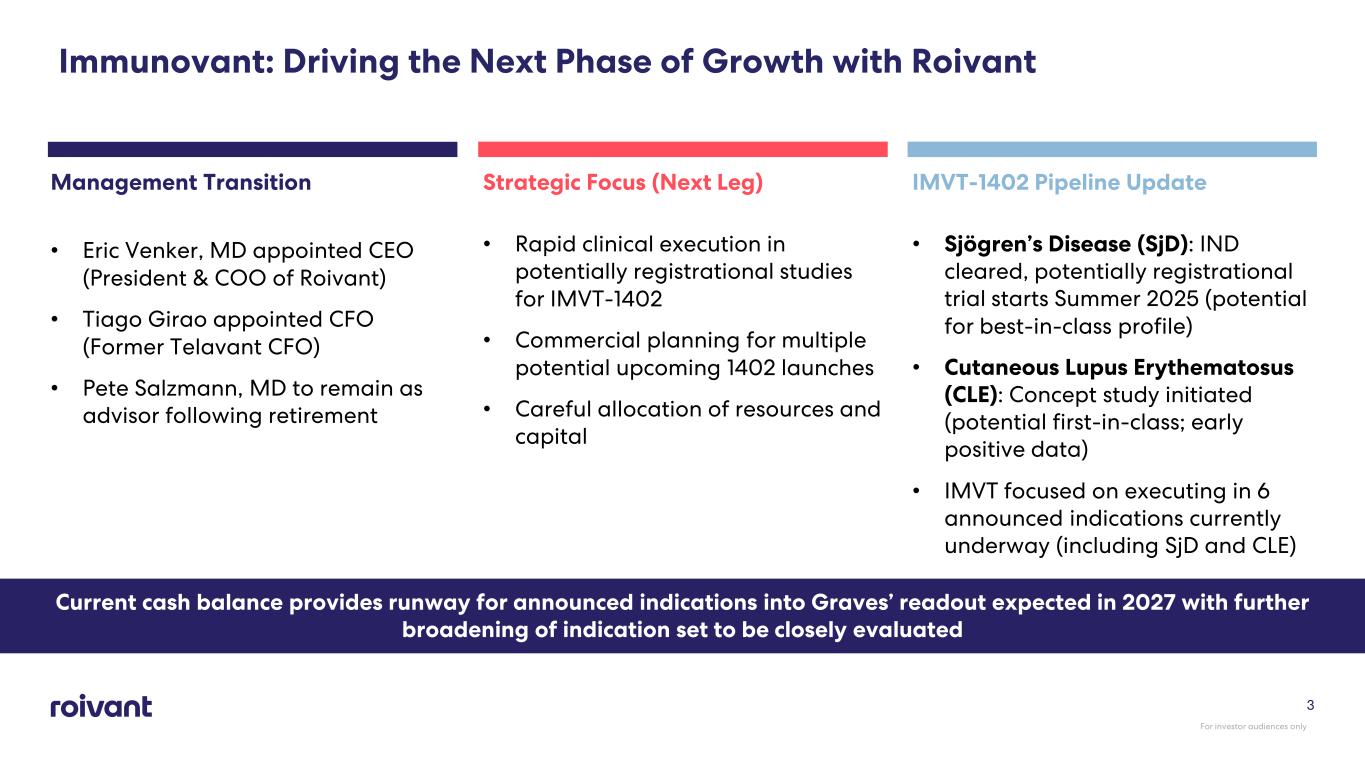
• Eric Venker, MD appointed CEO (President & COO of Roivant) • Tiago Girao appointed CFO (Former Telavant CFO) • Pete Salzmann, MD to remain as advisor following retirement 3 • Rapid clinical execution in potentially registrational studies for IMVT-1402 • Commercial planning for multiple potential upcoming 1402 launches • Careful allocation of resources and capital Strategic Focus (Next Leg)Management Transition • Sjögren’s Disease (SjD): IND cleared, potentially registrational trial starts Summer 2025 (potential for best-in-class profile) • Cutaneous Lupus Erythematosus (CLE): Concept study initiated (potential first-in-class; early positive data) • IMVT focused on executing in 6 announced indications currently underway (including SjD and CLE) IMVT-1402 Pipeline Update Immunovant: Driving the Next Phase of Growth with Roivant For investor audiences only Current cash balance provides runway for announced indications into Graves’ readout expected in 2027 with further broadening of indication set to be closely evaluated
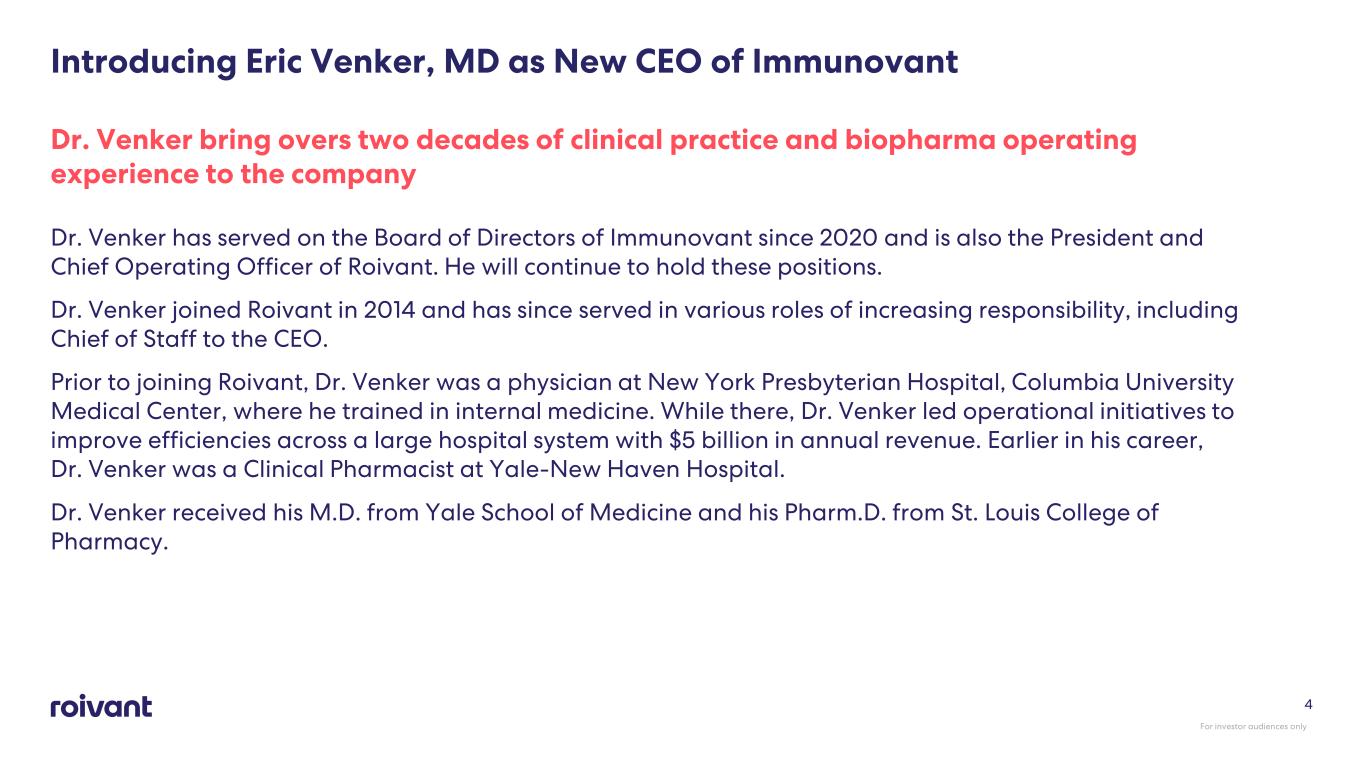
4 Dr. Venker has served on the Board of Directors of Immunovant since 2020 and is also the President and Chief Operating Officer of Roivant. He will continue to hold these positions. Dr. Venker joined Roivant in 2014 and has since served in various roles of increasing responsibility, including Chief of Staff to the CEO. Prior to joining Roivant, Dr. Venker was a physician at New York Presbyterian Hospital, Columbia University Medical Center, where he trained in internal medicine. While there, Dr. Venker led operational initiatives to improve efficiencies across a large hospital system with $5 billion in annual revenue. Earlier in his career, Dr. Venker was a Clinical Pharmacist at Yale-New Haven Hospital. Dr. Venker received his M.D. from Yale School of Medicine and his Pharm.D. from St. Louis College of Pharmacy. Dr. Venker bring overs two decades of clinical practice and biopharma operating experience to the company Introducing Eric Venker, MD as New CEO of Immunovant For investor audiences only
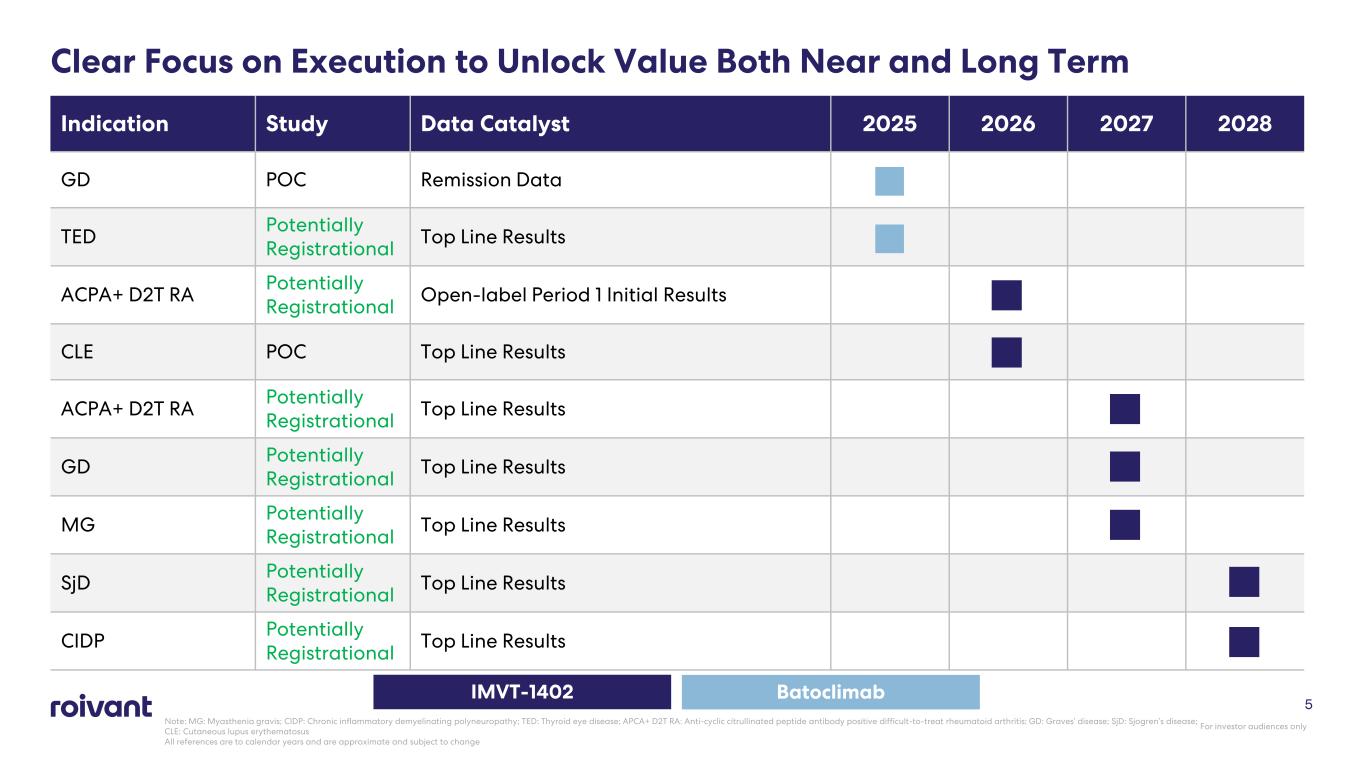
Clear Focus on Execution to Unlock Value Both Near and Long Term Indication Study Data Catalyst 2025 2026 2027 2028 GD POC Remission Data TED Potentially Registrational Top Line Results ACPA+ D2T RA Potentially Registrational Open-label Period 1 Initial Results CLE POC Top Line Results ACPA+ D2T RA Potentially Registrational Top Line Results GD Potentially Registrational Top Line Results MG Potentially Registrational Top Line Results SjD Potentially Registrational Top Line Results CIDP Potentially Registrational Top Line Results IMVT-1402 Batoclimab 5 For investor audiences only Note: MG: Myasthenia gravis; CIDP: Chronic inflammatory demyelinating polyneuropathy; TED: Thyroid eye disease; APCA+ D2T RA: Anti-cyclic citrullinated peptide antibody positive difficult-to-treat rheumatoid arthritis; GD: Graves’ disease; SjD: Sjogren’s disease; CLE: Cutaneous lupus erythematosus All references are to calendar years and are approximate and subject to change
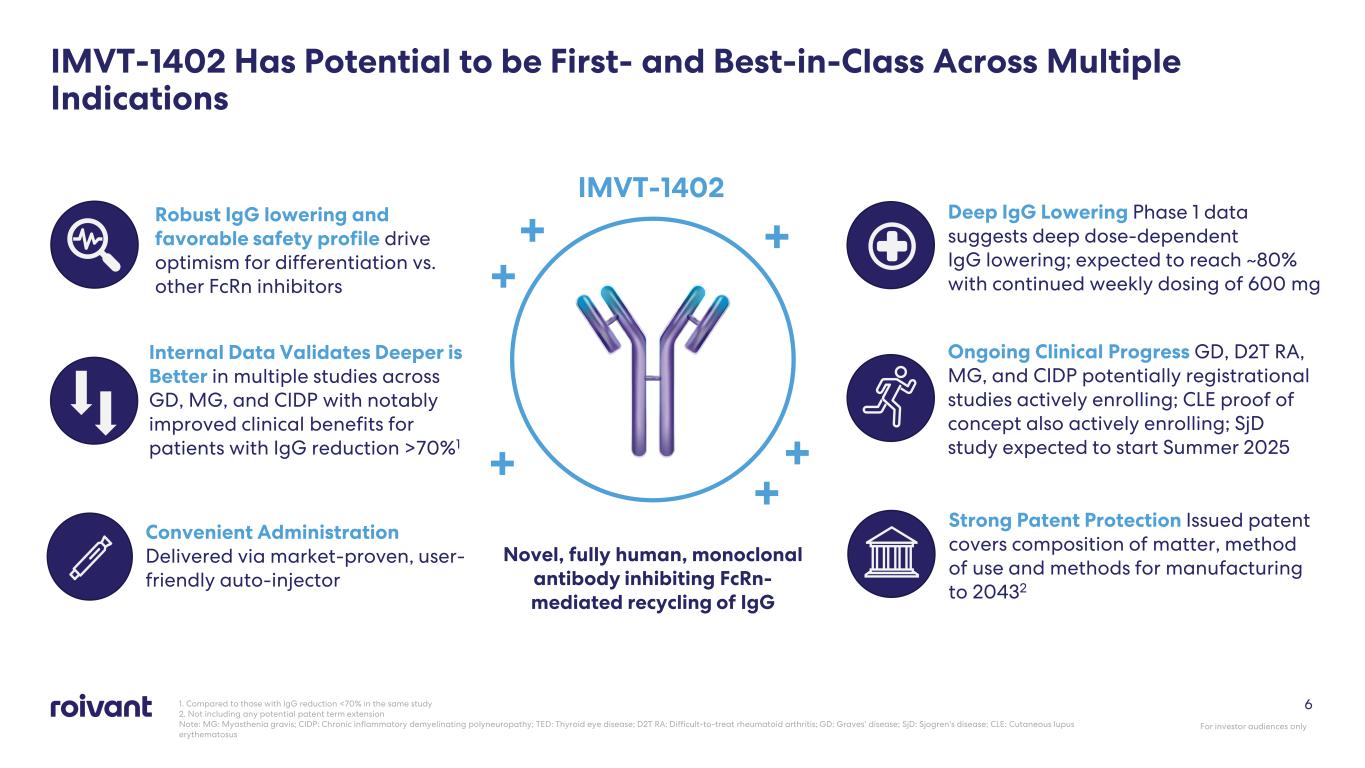
1. Compared to those with IgG reduction <70% in the same study 2. Not including any potential patent term extension Note: MG: Myasthenia gravis; CIDP: Chronic inflammatory demyelinating polyneuropathy; TED: Thyroid eye disease; D2T RA: Difficult-to-treat rheumatoid arthritis; GD: Graves’ disease; SjD: Sjogren’s disease; CLE: Cutaneous lupus erythematosus 6 IMVT-1402 Has Potential to be First- and Best-in-Class Across Multiple Indications Novel, fully human, monoclonal antibody inhibiting FcRn- mediated recycling of IgG + IMVT-1402 ++ + + + For investor audiences only Deep IgG Lowering Phase 1 data suggests deep dose-dependent IgG lowering; expected to reach ~80% with continued weekly dosing of 600 mg Ongoing Clinical Progress GD, D2T RA, MG, and CIDP potentially registrational studies actively enrolling; CLE proof of concept also actively enrolling; SjD study expected to start Summer 2025 Robust IgG lowering and favorable safety profile drive optimism for differentiation vs. other FcRn inhibitors Internal Data Validates Deeper is Better in multiple studies across GD, MG, and CIDP with notably improved clinical benefits for patients with IgG reduction >70%1 Convenient Administration Delivered via market-proven, user- friendly auto-injector Strong Patent Protection Issued patent covers composition of matter, method of use and methods for manufacturing to 20432
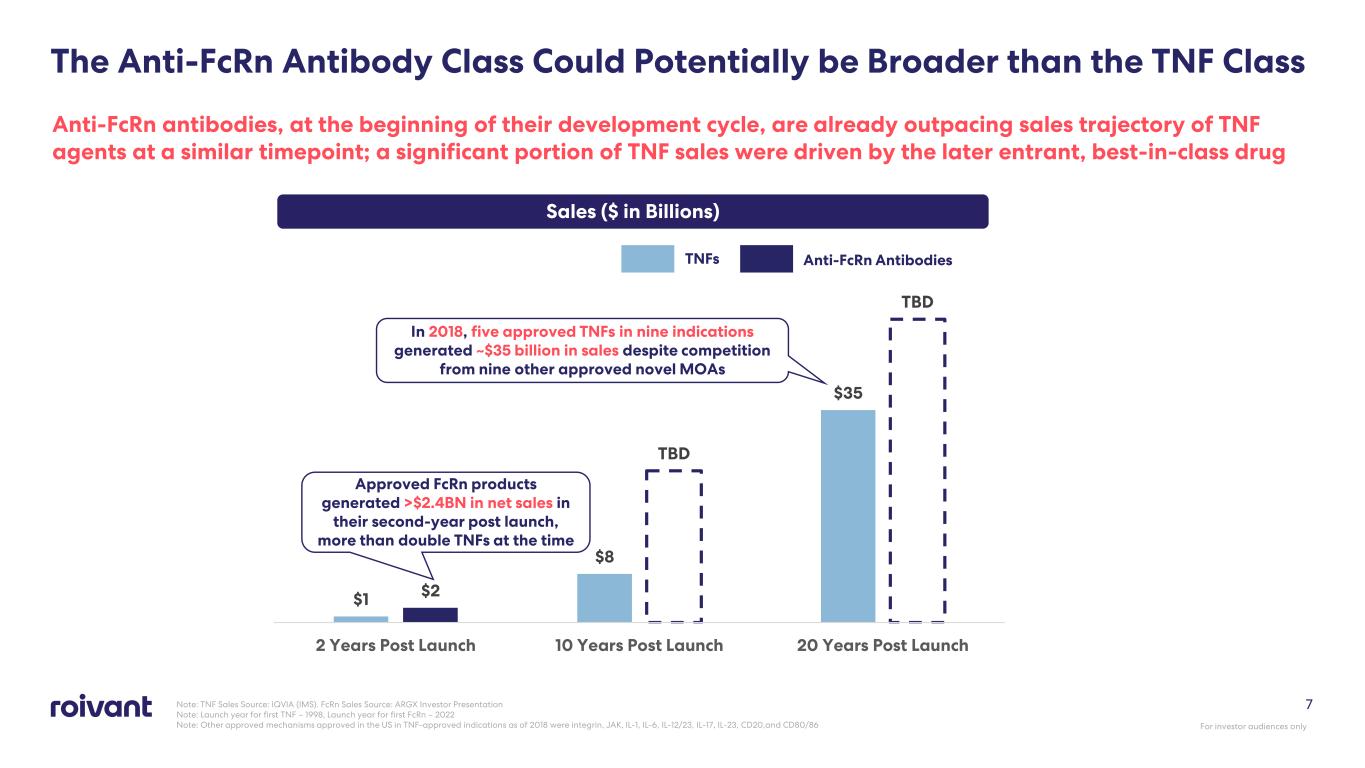
7 Anti-FcRn antibodies, at the beginning of their development cycle, are already outpacing sales trajectory of TNF agents at a similar timepoint; a significant portion of TNF sales were driven by the later entrant, best-in-class drug Note: TNF Sales Source: IQVIA (IMS). FcRn Sales Source: ARGX Investor Presentation Note: Launch year for first TNF – 1998, Launch year for first FcRn – 2022 Note: Other approved mechanisms approved in the US in TNF-approved indications as of 2018 were integrin, JAK, IL-1, IL-6, IL-12/23, IL-17, IL-23, CD20,and CD80/86 $1 $8 $35 $2 TBD TBD 2 Years Post Launch 10 Years Post Launch 20 Years Post Launch In 2018, five approved TNFs in nine indications generated ~$35 billion in sales despite competition from nine other approved novel MOAs Sales ($ in Billions) Approved FcRn products generated >$2.4BN in net sales in their second-year post launch, more than double TNFs at the time TNFs Anti-FcRn Antibodies The Anti-FcRn Antibody Class Could Potentially be Broader than the TNF Class For investor audiences only
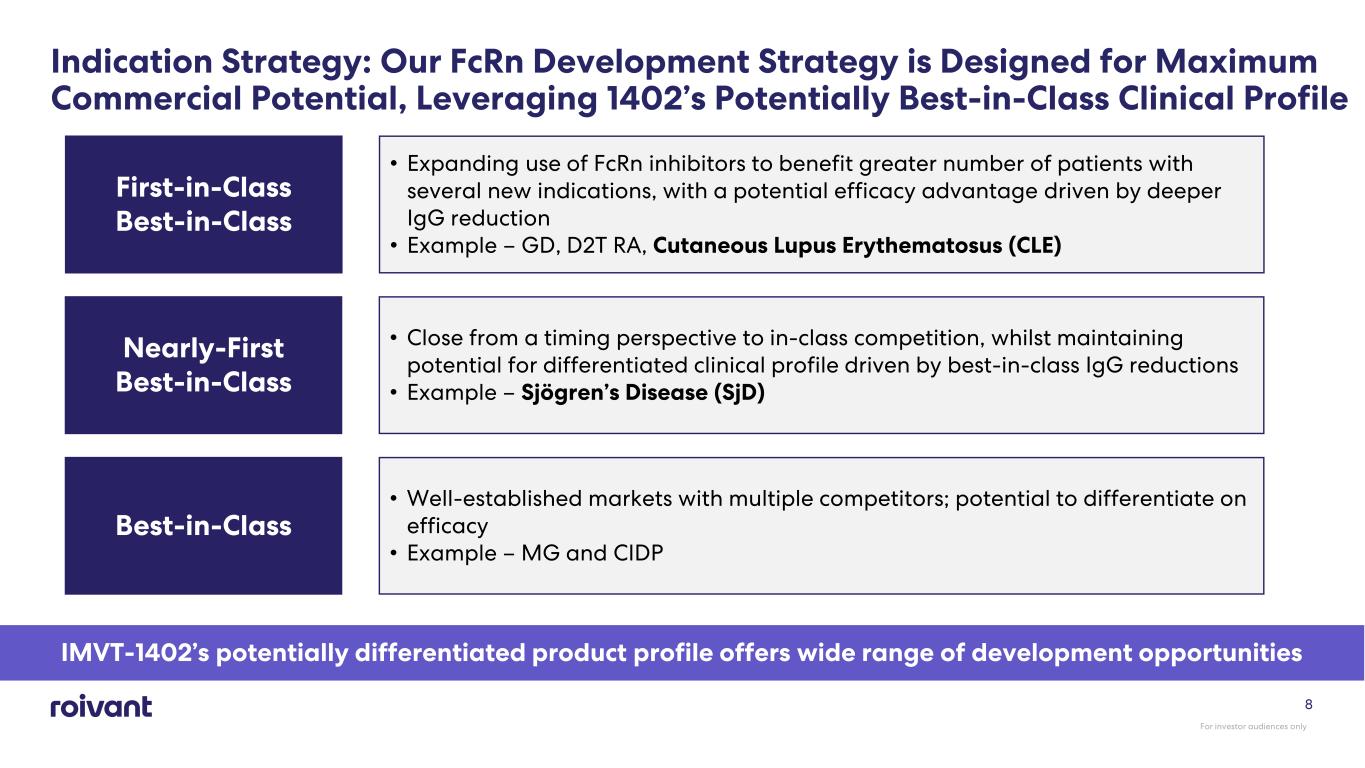
Indication Strategy: Our FcRn Development Strategy is Designed for Maximum Commercial Potential, Leveraging 1402’s Potentially Best-in-Class Clinical Profile 8 Best-in-Class • Well-established markets with multiple competitors; potential to differentiate on efficacy • Example – MG and CIDP First-in-Class Best-in-Class • Expanding use of FcRn inhibitors to benefit greater number of patients with several new indications, with a potential efficacy advantage driven by deeper IgG reduction • Example – GD, D2T RA, Cutaneous Lupus Erythematosus (CLE) Nearly-First Best-in-Class • Close from a timing perspective to in-class competition, whilst maintaining potential for differentiated clinical profile driven by best-in-class IgG reductions • Example – Sjögren’s Disease (SjD) For investor audiences only IMVT-1402’s potentially differentiated product profile offers wide range of development opportunities
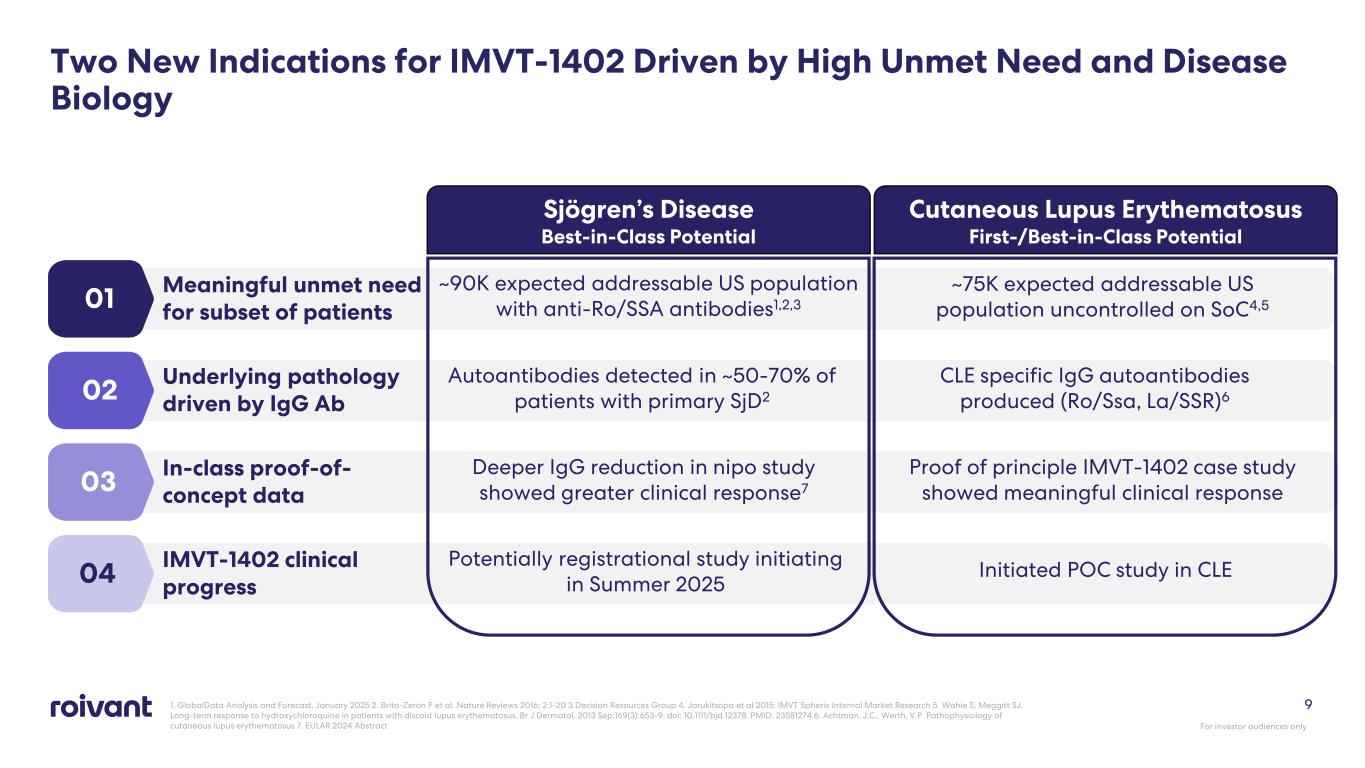
Two New Indications for IMVT-1402 Driven by High Unmet Need and Disease Biology Sjögren’s Disease Best-in-Class Potential Cutaneous Lupus Erythematosus First-/Best-in-Class Potential 01 Meaningful unmet need for subset of patients ~90K expected addressable US population with anti-Ro/SSA antibodies1,2,3 02 Underlying pathology driven by IgG Ab Autoantibodies detected in ~50-70% of patients with primary SjD2 CLE specific IgG autoantibodies produced (Ro/Ssa, La/SSR)6 04 IMVT-1402 clinical progress Potentially registrational study initiating in Summer 2025 Initiated POC study in CLE 03 In-class proof-of- concept data Deeper IgG reduction in nipo study showed greater clinical response7 Proof of principle IMVT-1402 case study showed meaningful clinical response 1. GlobalData Analysis and Forecast, January 2025 2. Brito-Zeron P et al. Nature Reviews 2016; 2:1-20 3.Decision Resources Group 4. Jarukitsopa et al 2015; IMVT Spherix Internal Market Research 5. Wahie S, Meggitt SJ. Long-term response to hydroxychloroquine in patients with discoid lupus erythematosus. Br J Dermatol. 2013 Sep;169(3):653-9. doi: 10.1111/bjd.12378. PMID: 23581274 6. Achtman, J.C., Werth, V.P. Pathophysiology of cutaneous lupus erythematosus 7. EULAR 2024 Abstract For investor audiences only 9 ~75K expected addressable US population uncontrolled on SoC4,5

Sjögren’s Disease Nearly-First- / Best-in-Class Opportunity
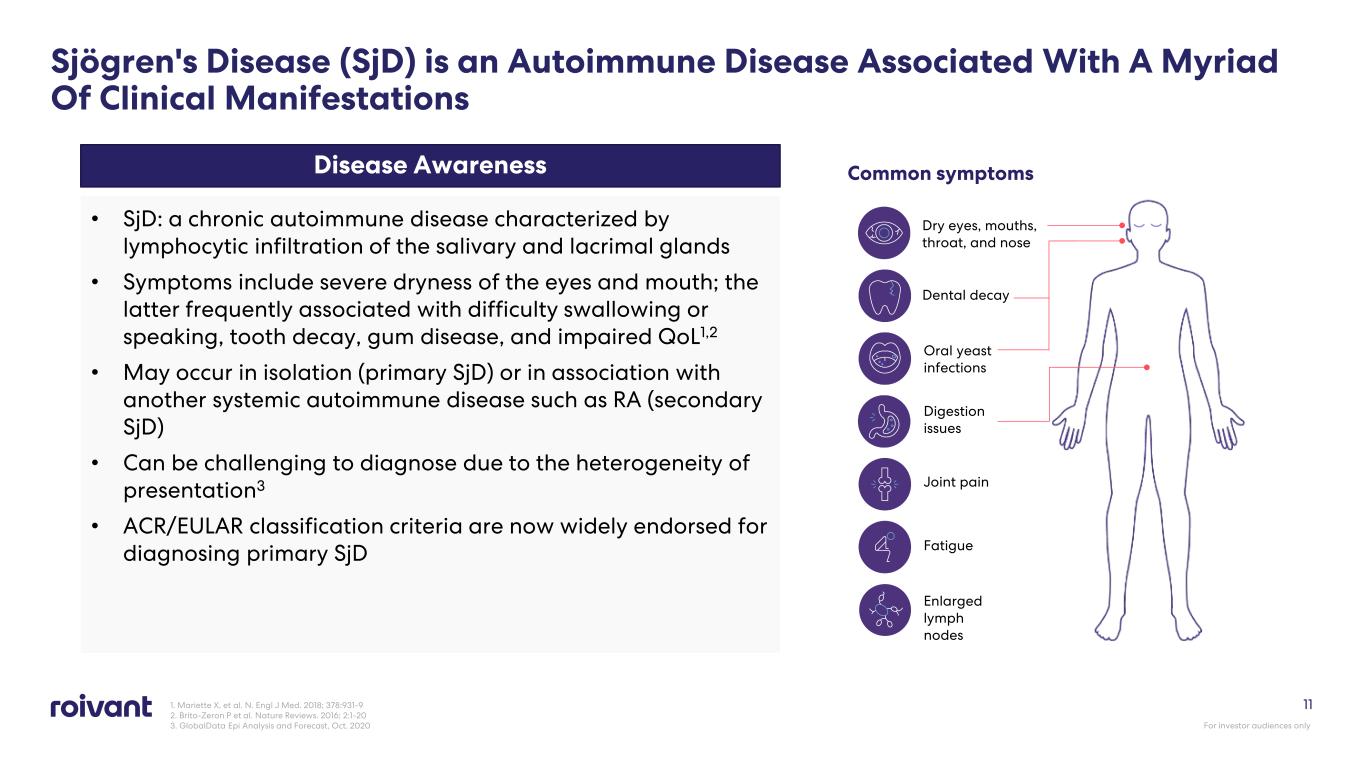
1. Mariette X, et al. N. Engl J Med. 2018; 378:931-9 2. Brito-Zeron P et al. Nature Reviews. 2016; 2:1-20 3. GlobalData Epi Analysis and Forecast, Oct. 2020 11 Disease Awareness • SjD: a chronic autoimmune disease characterized by lymphocytic infiltration of the salivary and lacrimal glands • Symptoms include severe dryness of the eyes and mouth; the latter frequently associated with difficulty swallowing or speaking, tooth decay, gum disease, and impaired QoL1,2 • May occur in isolation (primary SjD) or in association with another systemic autoimmune disease such as RA (secondary SjD) • Can be challenging to diagnose due to the heterogeneity of presentation3 • ACR/EULAR classification criteria are now widely endorsed for diagnosing primary SjD Common symptoms Dry eyes, mouths, throat, and nose Dental decay Oral yeast infections Digestion issues Joint pain Fatigue Enlarged lymph nodes Sjögren's Disease (SjD) is an Autoimmune Disease Associated With A Myriad Of Clinical Manifestations For investor audiences only
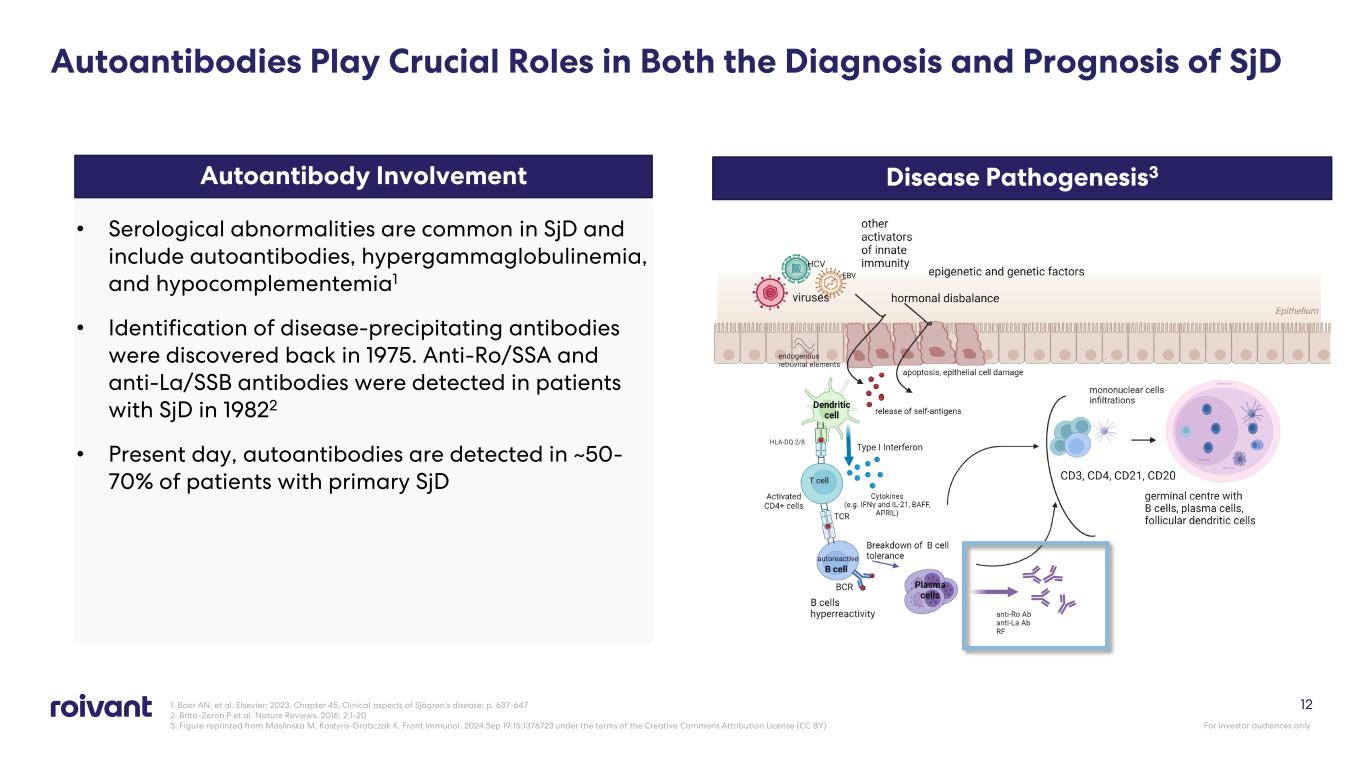
• Serological abnormalities are common in SjD and include autoantibodies, hypergammaglobulinemia, and hypocomplementemia1 • Identification of disease-precipitating antibodies were discovered back in 1975. Anti-Ro/SSA and anti-La/SSB antibodies were detected in patients with SjD in 19822 • Present day, autoantibodies are detected in ~50- 70% of patients with primary SjD 12 Autoantibody Involvement Disease Pathogenesis3 Autoantibodies Play Crucial Roles in Both the Diagnosis and Prognosis of SjD 1. Baer AN, et al. Elsevier; 2023. Chapter 45, Clinical aspects of Sjögren’s disease; p. 637-647 2. Brito-Zeron P et al. Nature Reviews. 2016; 2:1-20 3. Figure reprinted from Maslinska M, Kostyra-Grabczak K. Front Immunol. 2024 Sep 19:15:1376723 under the terms of the Creative Commons Attribution License (CC BY) For investor audiences only
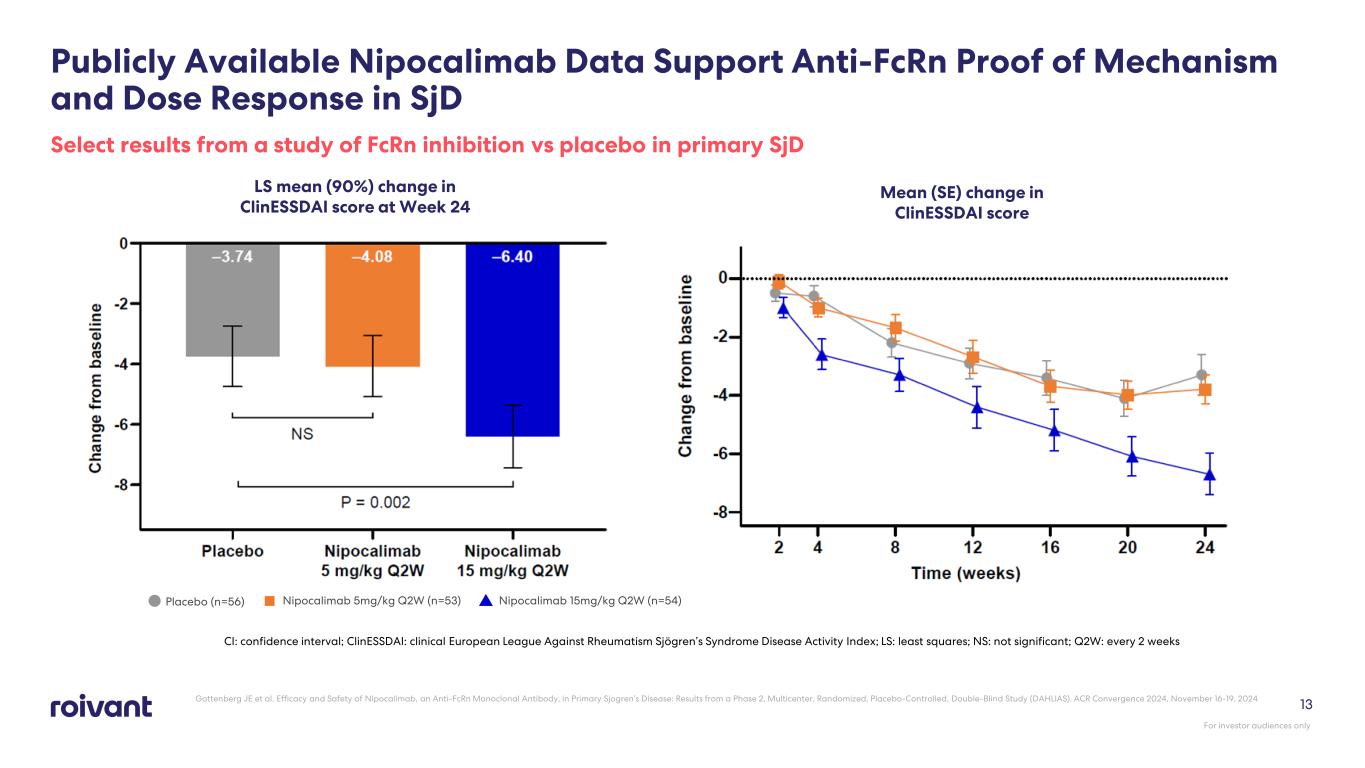
13 Publicly Available Nipocalimab Data Support Anti-FcRn Proof of Mechanism and Dose Response in SjD Select results from a study of FcRn inhibition vs placebo in primary SjD LS mean (90%) change in ClinESSDAI score at Week 24 Mean (SE) change in ClinESSDAI score CI: confidence interval; ClinESSDAI: clinical European League Against Rheumatism Sjögren’s Syndrome Disease Activity Index; LS: least squares; NS: not significant; Q2W: every 2 weeks Nipocalimab 15mg/kg Q2W (n=54)Placebo (n=56) Nipocalimab 5mg/kg Q2W (n=53) Gottenberg JE et al. Efficacy and Safety of Nipocalimab, an Anti-FcRn Monoclonal Antibody, in Primary Sjogren’s Disease: Results from a Phase 2, Multicenter, Randomized, Placebo-Controlled, Double-Blind Study (DAHLIAS). ACR Convergence 2024, November 16-19, 2024 For investor audiences only
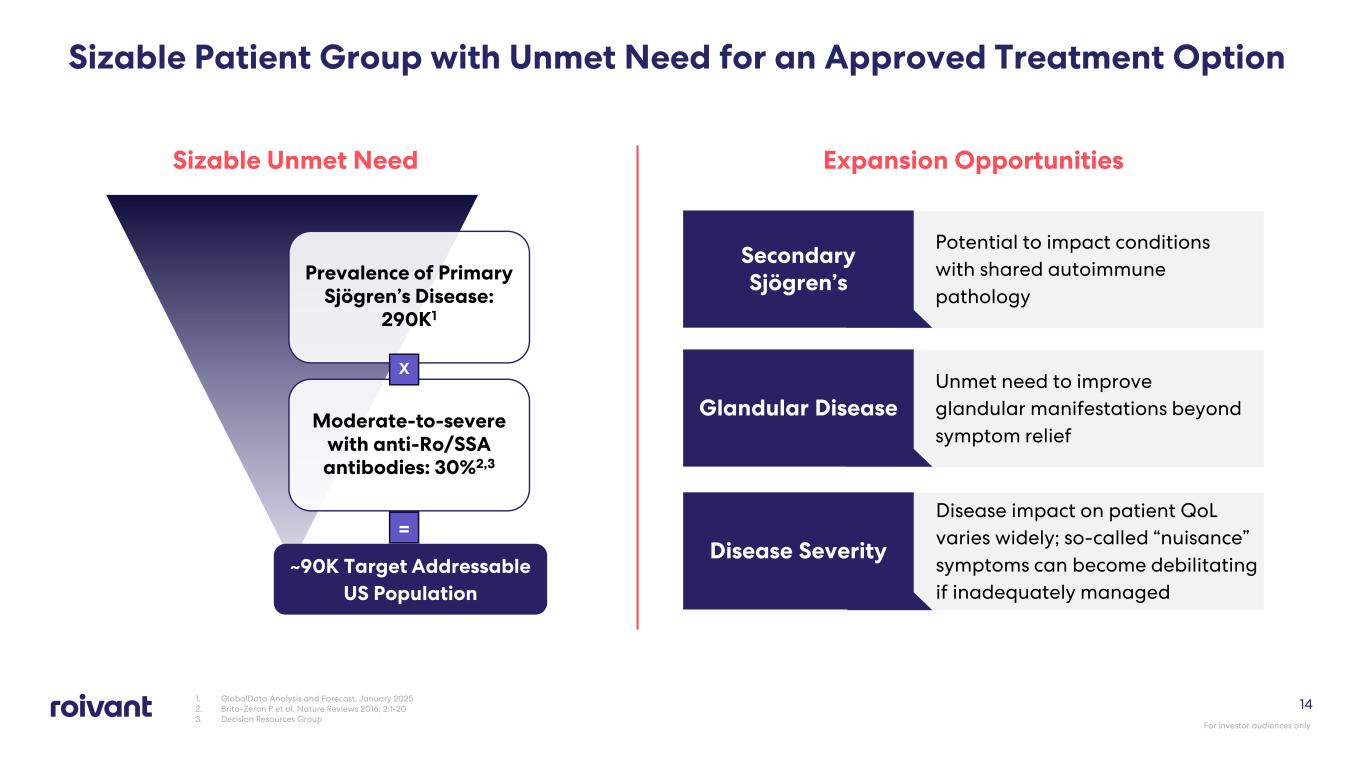
Sizable Patient Group with Unmet Need for an Approved Treatment Option 1. GlobalData Analysis and Forecast, January 2025 2. Brito-Zeron P et al. Nature Reviews 2016; 2:1-20 3. Decision Resources Group Sizable Unmet Need Expansion Opportunities Potential to impact conditions with shared autoimmune pathology Secondary Sjögren’s Unmet need to improve glandular manifestations beyond symptom relief Glandular Disease Disease impact on patient QoL varies widely; so-called “nuisance” symptoms can become debilitating if inadequately managed Disease Severity Prevalence of Primary Sjögren’s Disease: 290K1 Moderate-to-severe with anti-Ro/SSA antibodies: 30%2,3 ~90K Target Addressable US Population X = For investor audiences only 14
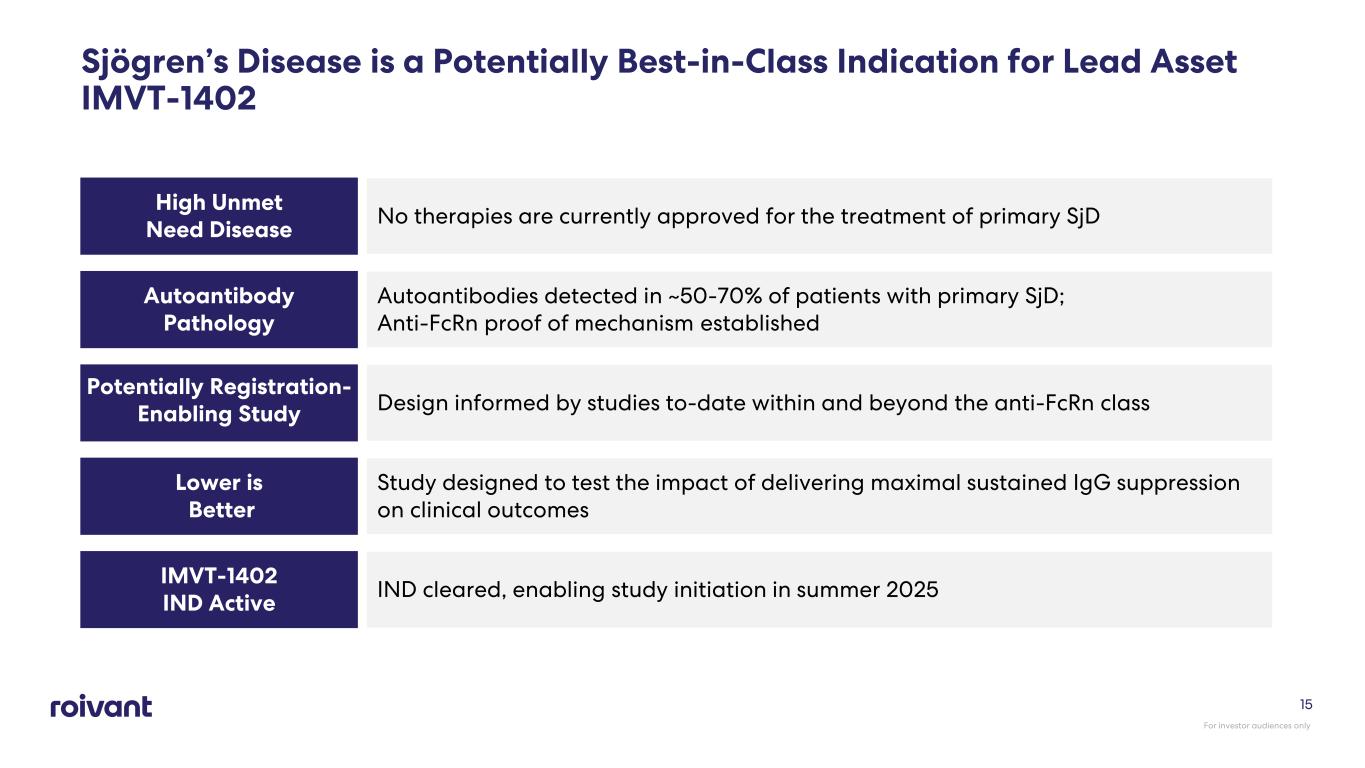
Sjögren’s Disease is a Potentially Best-in-Class Indication for Lead Asset IMVT-1402 High Unmet Need Disease No therapies are currently approved for the treatment of primary SjD Autoantibody Pathology Autoantibodies detected in ~50-70% of patients with primary SjD; Anti-FcRn proof of mechanism established Potentially Registration- Enabling Study Design informed by studies to-date within and beyond the anti-FcRn class Lower is Better Study designed to test the impact of delivering maximal sustained IgG suppression on clinical outcomes IMVT-1402 IND Active IND cleared, enabling study initiation in summer 2025 For investor audiences only 15

Cutaneous Lupus Erythematosus First-/Best-in-Class Opportunity

Cutaneous Lupus Erythematosus (CLE), a Potential First-/Best-in-Class Opportunity in Dermatology for IMVT-1402 with High Unmet Need Rare, chronic skin disease; prevalence of ~70/100,000 (234K in the US)3 Characterized by skin-specific disease-activity, inflammation and eventually damage; painful skin lesions, itching, burning, and alopecia4 IgG autoantibodies and immune complexes likely play a key role CLE Characteristics1,2 Subacute Chronic Lupus Erythematosus (SCLE) Chronic Cutaneous Lupus Erythematosus (CCLE) For the purposes of this presentation, reference to CLE is focused on SCLE and CCLE subtypes. • Annular or papulosquamous, psoriasis-like scaling erythematous plaques • Estimated 59K prevalence (25%)6 • Scaling, erythematous, typically scarring, disc-shaped plaques, alopecia • Estimated 94K prevalence (40%)6 LE tumidus Lupus panniculitis Discoid LE Chilblain lupus Alopecia within lesions (typical location is near the ear) Red, raised, scaly rash on sun exposed areas 1. Vale ECSD and Garcia LC. An Bras Dermatol. 2023;98(3):355-372. 2. Presto JK, Werth VP: Cutaneous Lupus Erythematosus: Current Treatment Options. Curr Treat Option Rheumatol. 2016; 2(1): 36–48 Stull, et. al. The Journal of Rheumatology 2023;50:27–35; doi:10.3899/jrheum.220089 3. Jarukitsopa et al 2015 4. Klein R, et al. J Am Acad Dermatol. 2011;64(5):849-858 5. Wahie S, Meggitt SJ. Long-term response to hydroxychloroquine in patients with discoid lupus erythematosus. Br J Dermatol. 2013 Sep;169(3):653-9. doi: 10.1111/bjd.12378. PMID: 23581274 6. Internal market research Spherix 2024 For investor audiences only 17 ~50% of patients insufficiently controlled on standard of care (topicals/broad-spectrum therapies followed by IVIG or off-label biologics)5
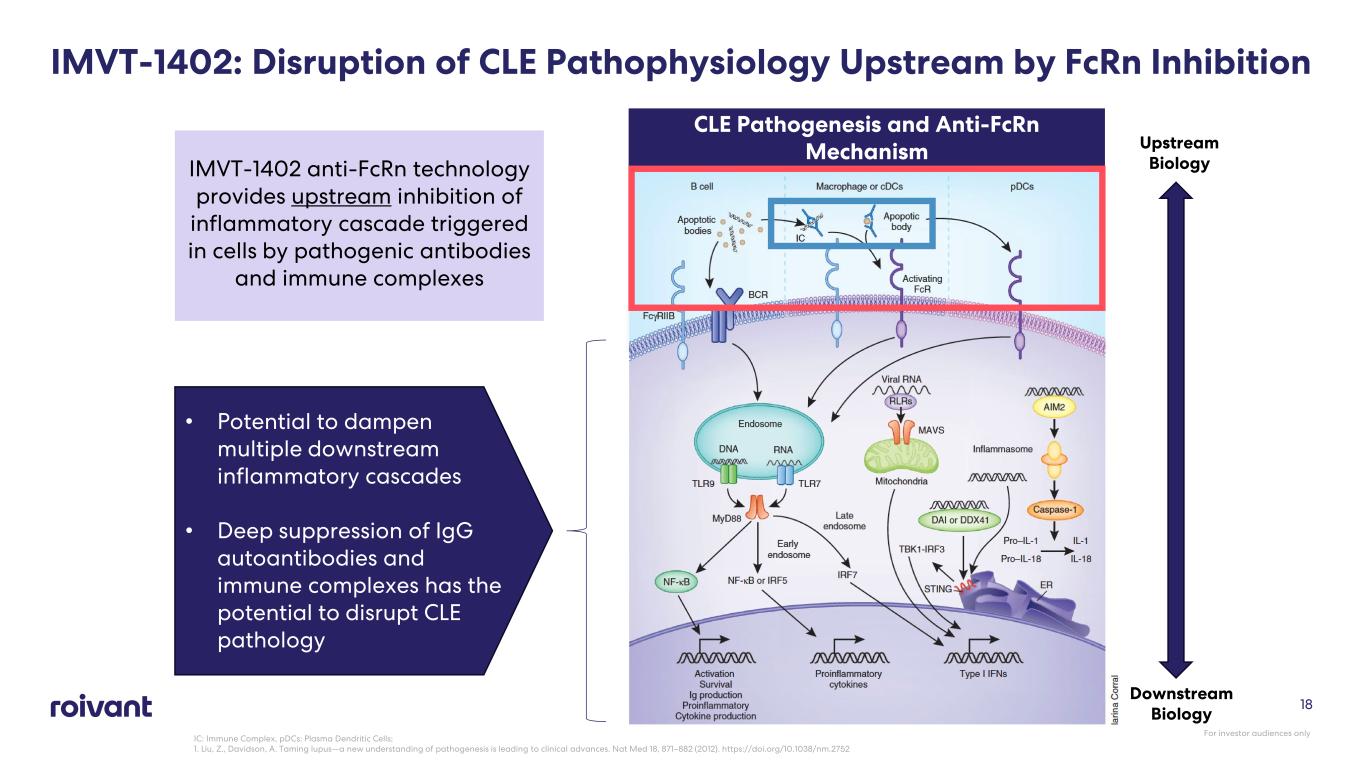
18 IMVT-1402: Disruption of CLE Pathophysiology Upstream by FcRn Inhibition Downstream Biology IMVT-1402 anti-FcRn technology provides upstream inhibition of inflammatory cascade triggered in cells by pathogenic antibodies and immune complexes Upstream Biology • Potential to dampen multiple downstream inflammatory cascades • Deep suppression of IgG autoantibodies and immune complexes has the potential to disrupt CLE pathology CLE Pathogenesis and Anti-FcRn Mechanism IC: Immune Complex, pDCs: Plasma Dendritic Cells; 1. Liu, Z., Davidson, A. Taming lupus—a new understanding of pathogenesis is leading to clinical advances. Nat Med 18, 871–882 (2012). https://doi.org/10.1038/nm.2752 For investor audiences only
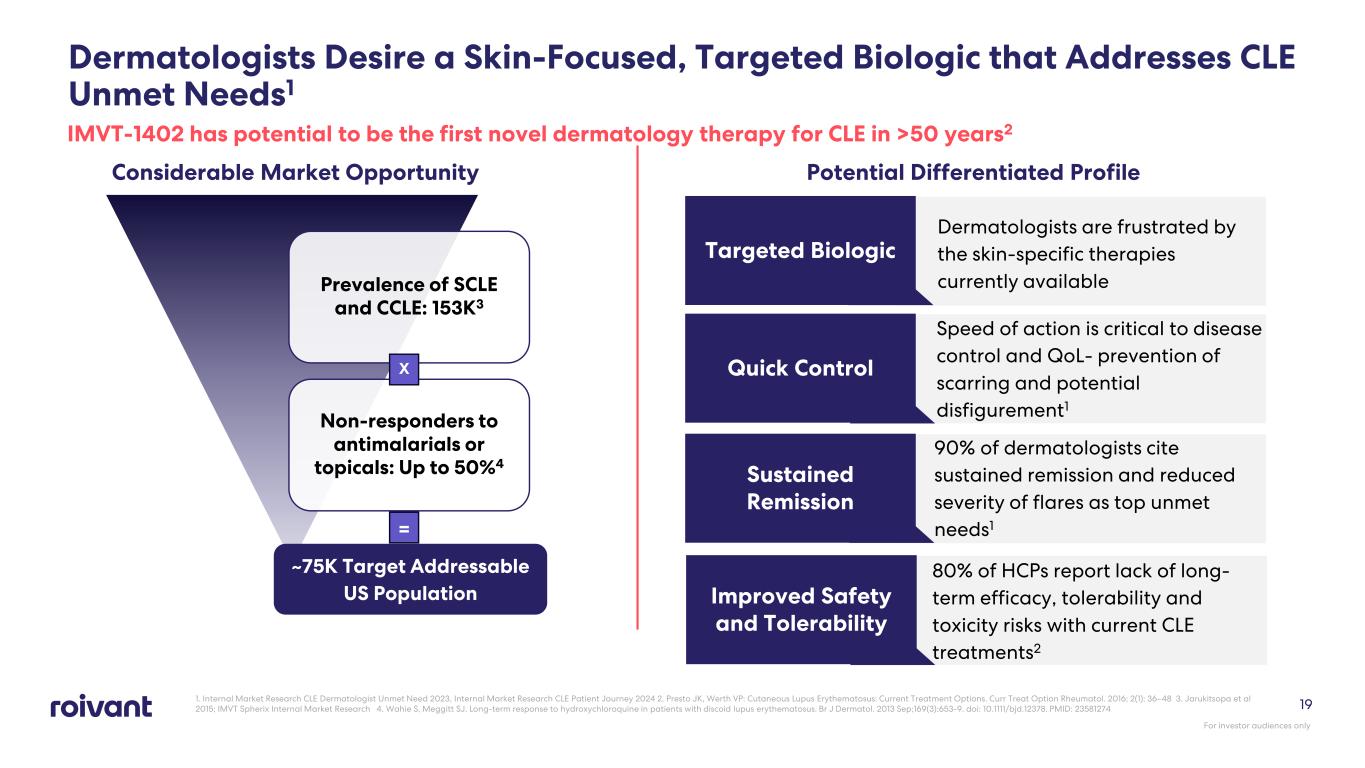
Dermatologists Desire a Skin-Focused, Targeted Biologic that Addresses CLE Unmet Needs1 1. Internal Market Research CLE Dermatologist Unmet Need 2023, Internal Market Research CLE Patient Journey 2024 2. Presto JK, Werth VP: Cutaneous Lupus Erythematosus: Current Treatment Options. Curr Treat Option Rheumatol. 2016; 2(1): 36–48 3. Jarukitsopa et al 2015; IMVT Spherix Internal Market Research 4. Wahie S, Meggitt SJ. Long-term response to hydroxychloroquine in patients with discoid lupus erythematosus. Br J Dermatol. 2013 Sep;169(3):653-9. doi: 10.1111/bjd.12378. PMID: 23581274 Considerable Market Opportunity Potential Differentiated Profile Dermatologists are frustrated by the skin-specific therapies currently available Targeted Biologic Speed of action is critical to disease control and QoL- prevention of scarring and potential disfigurement1 Quick Control 90% of dermatologists cite sustained remission and reduced severity of flares as top unmet needs1 Sustained Remission Prevalence of SCLE and CCLE: 153K3 Non-responders to antimalarials or topicals: Up to 50%4 ~75K Target Addressable US Population X = For investor audiences only 19 IMVT-1402 has potential to be the first novel dermatology therapy for CLE in >50 years2 80% of HCPs report lack of long- term efficacy, tolerability and toxicity risks with current CLE treatments2 Improved Safety and Tolerability
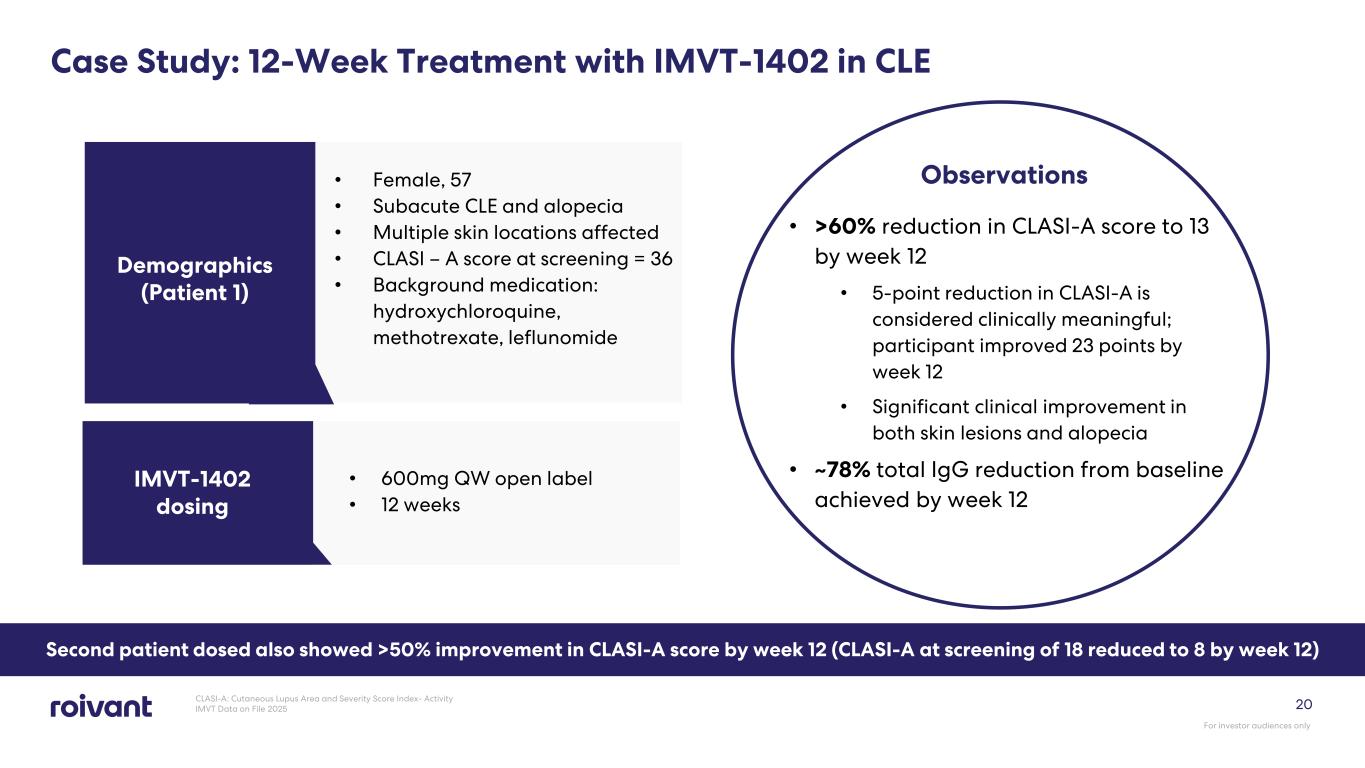
20 Case Study: 12-Week Treatment with IMVT-1402 in CLE • Female, 57 • Subacute CLE and alopecia • Multiple skin locations affected • CLASI – A score at screening = 36 • Background medication: hydroxychloroquine, methotrexate, leflunomide Demographics (Patient 1) • 600mg QW open label • 12 weeks IMVT-1402 dosing Observations • >60% reduction in CLASI-A score to 13 by week 12 • 5-point reduction in CLASI-A is considered clinically meaningful; participant improved 23 points by week 12 • Significant clinical improvement in both skin lesions and alopecia • ~78% total IgG reduction from baseline achieved by week 12 CLASI-A: Cutaneous Lupus Area and Severity Score Index- Activity IMVT Data on File 2025 For investor audiences only Second patient dosed also showed >50% improvement in CLASI-A score by week 12 (CLASI-A at screening of 18 reduced to 8 by week 12)

IMVT-1402 is Potentially First-/Best-in-Class in CLE Untapped Market Opportunity High unmet need with up to 50% of SCLE/CCLE patients failing standard of care IgG and Immune Complex Driven Biologic, translational and mechanistic evidence support the critical role of IgG autoantibodies and immune complexes in the pathogenesis of CLE Upstream Targeting Disruption of CLE pathology by upstream targeted approach supported by IMVT- 1402 patient case studies IMVT-1402 Study Enrolling Study initiated with self-administration via market-proven autoinjector For investor audiences only 21

Graves’ Disease Difficult-to-Treat Rheumatoid Arthritis Cutaneous Lupus Erythematosus Sjogren’s Disease Myasthenia Gravis Chronic Inflammatory Demyelinating Polyneuropathy Expected US Addressable Population1 ~330K ~70K ~75K ~90K ~59-116K ~16K Autoantibody Driven Pathology Driven by autoantibodies to the thyroid-stimulating hormone receptor (TSHR-Ab) RF and ACPA autoantibodies present in ~75% of RA patients CLE specific IgG autoantibodies observed (Ro/Ssa, La/SSR) Autoantibodies detected in ~50-70% of patients with primary SjD Driven by AChR antibodies disrupting signal transmission in nerve and muscle fibers Driven by autoantibodies that demyelinate peripheral nerves and nerve roots In-Class Data Batoclimab data showed greater response rate correlated with deeper IgG reduction Response rate higher for patients with high baseline ACPA & deep IgG reduction Proof of principle IMVT-1402 case study showed meaningful clinical response Response rate higher for patients with deeper IgG reduction Batoclimab data showed greater response rate correlated with deeper IgG reduction Batoclimab data showed greater response rate correlated with deeper IgG reduction Stage of Development Potentially Registrational Trial Enrolling Potentially Registrational Trial Enrolling Proof of Concept Enrolling Potentially Registrational Trial to Initiate Summer 2025 Potentially Registrational Trial Enrolling Potentially Registrational Trial Enrolling Potential First-/Best-in- Class First- and Best-in- Class First- and Best-in- Class First- and Best-in- Class Nearly-First- and Best-in-Class Best-in-Class Best-in-Class 22 Broad Development Program for IMVT-1402 with Trials Underway, Expected to Potentially Address >700K Patient Population 1. IMVT data on file For investor audiences only
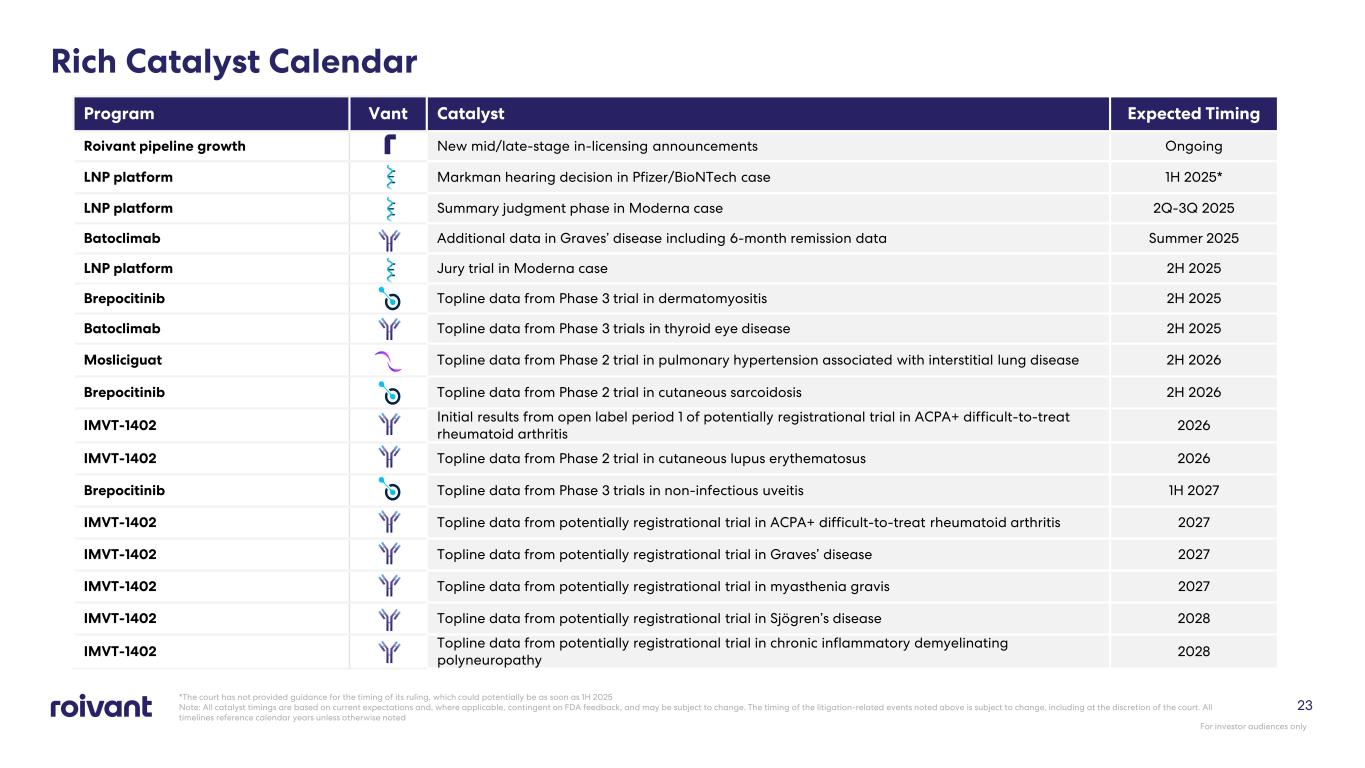
23 Rich Catalyst Calendar *The court has not provided guidance for the timing of its ruling, which could potentially be as soon as 1H 2025 Note: All catalyst timings are based on current expectations and, where applicable, contingent on FDA feedback, and may be subject to change. The timing of the litigation-related events noted above is subject to change, including at the discretion of the court. All timelines reference calendar years unless otherwise noted Program Vant Catalyst Expected Timing Roivant pipeline growth New mid/late-stage in-licensing announcements Ongoing LNP platform Markman hearing decision in Pfizer/BioNTech case 1H 2025* LNP platform Summary judgment phase in Moderna case 2Q-3Q 2025 Batoclimab Additional data in Graves’ disease including 6-month remission data Summer 2025 LNP platform Jury trial in Moderna case 2H 2025 Brepocitinib Topline data from Phase 3 trial in dermatomyositis 2H 2025 Batoclimab Topline data from Phase 3 trials in thyroid eye disease 2H 2025 Mosliciguat Topline data from Phase 2 trial in pulmonary hypertension associated with interstitial lung disease 2H 2026 Brepocitinib Topline data from Phase 2 trial in cutaneous sarcoidosis 2H 2026 IMVT-1402 Initial results from open label period 1 of potentially registrational trial in ACPA+ difficult-to-treat rheumatoid arthritis 2026 IMVT-1402 Topline data from Phase 2 trial in cutaneous lupus erythematosus 2026 Brepocitinib Topline data from Phase 3 trials in non-infectious uveitis 1H 2027 IMVT-1402 Topline data from potentially registrational trial in ACPA+ difficult-to-treat rheumatoid arthritis 2027 IMVT-1402 Topline data from potentially registrational trial in Graves’ disease 2027 IMVT-1402 Topline data from potentially registrational trial in myasthenia gravis 2027 IMVT-1402 Topline data from potentially registrational trial in Sjögren’s disease 2028 IMVT-1402 Topline data from potentially registrational trial in chronic inflammatory demyelinating polyneuropathy 2028 For investor audiences only

Thank you. 24

Appendix 25
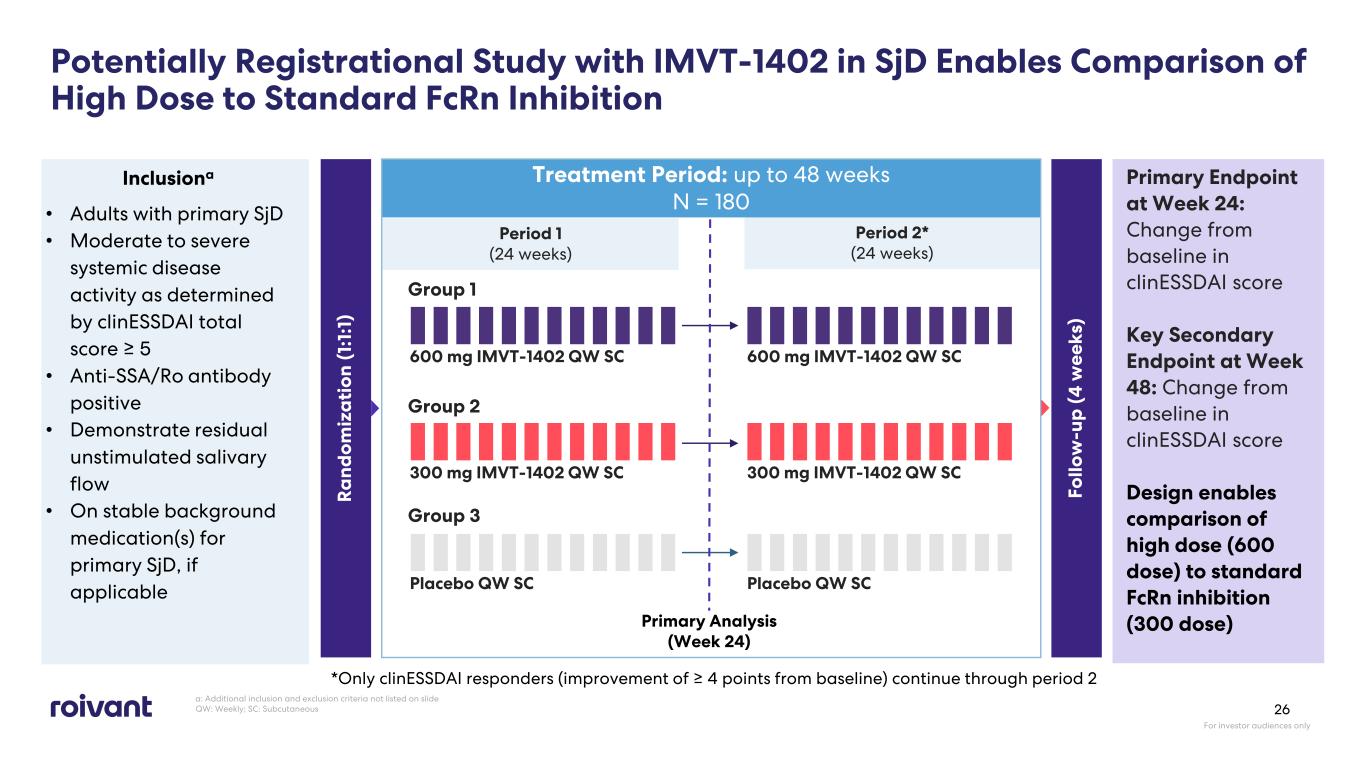
Potentially Registrational Study with IMVT-1402 in SjD Enables Comparison of High Dose to Standard FcRn Inhibition Treatment Period: up to 48 weeks N = 180 Primary Endpoint at Week 24: Change from baseline in clinESSDAI score Key Secondary Endpoint at Week 48: Change from baseline in clinESSDAI score Design enables comparison of high dose (600 dose) to standard FcRn inhibition (300 dose) Inclusiona Group 1 Group 3 Group 2 Period 2* (24 weeks) Period 1 (24 weeks) 300 mg IMVT-1402 QW SC 600 mg IMVT-1402 QW SC 600 mg IMVT-1402 QW SC Placebo QW SC Placebo QW SC Fo llo w -u p (4 w ee ks ) 300 mg IMVT-1402 QW SC *Only clinESSDAI responders (improvement of ≥ 4 points from baseline) continue through period 2 R a nd om iz a ti on ( 1: 1: 1) • Adults with primary SjD • Moderate to severe systemic disease activity as determined by clinESSDAI total score ≥ 5 • Anti-SSA/Ro antibody positive • Demonstrate residual unstimulated salivary flow • On stable background medication(s) for primary SjD, if applicable a: Additional inclusion and exclusion criteria not listed on slide QW: Weekly; SC: Subcutaneous For investor audiences only 26 Primary Analysis (Week 24)
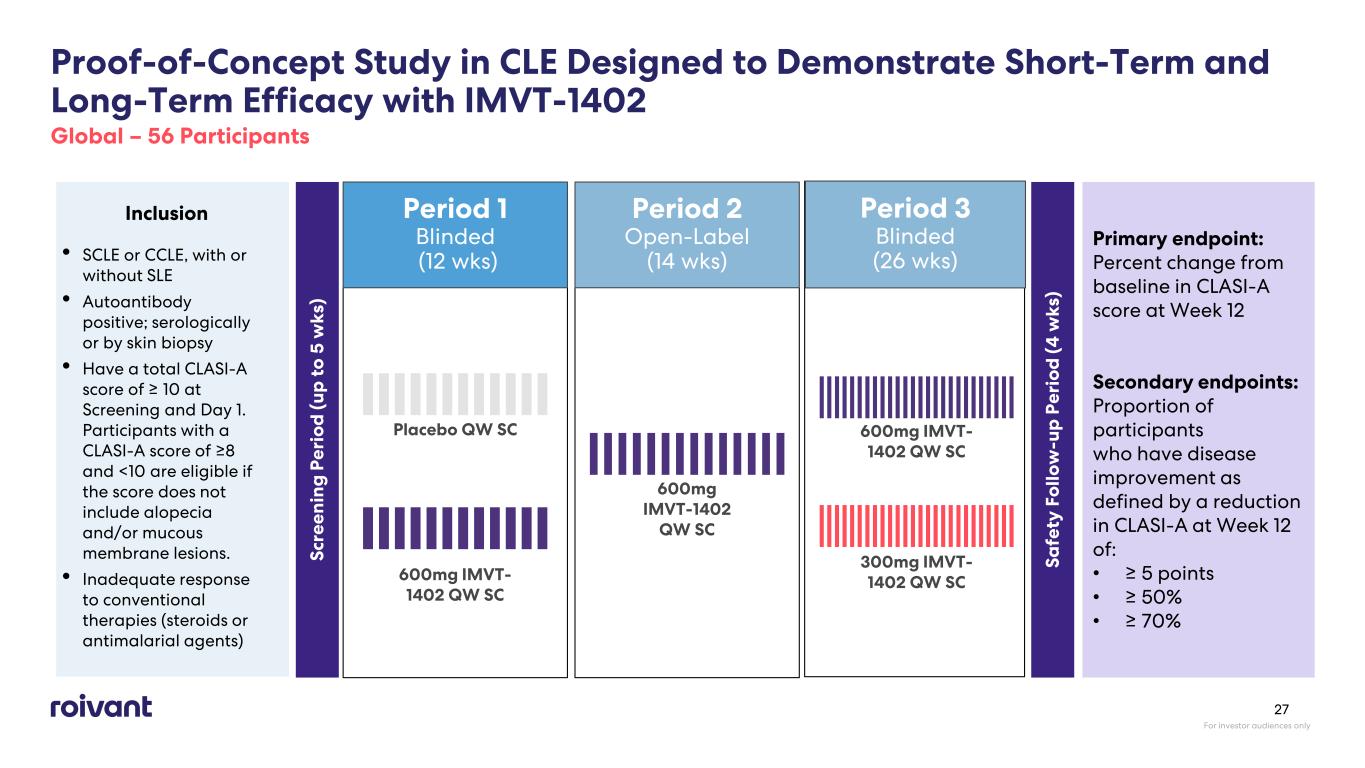
Period 2 Open-Label (14 wks) Period 1 Blinded (12 wks) Proof-of-Concept Study in CLE Designed to Demonstrate Short-Term and Long-Term Efficacy with IMVT-1402 Global – 56 Participants Inclusion • SCLE or CCLE, with or without SLE • Autoantibody positive; serologically or by skin biopsy • Have a total CLASI-A score of ≥ 10 at Screening and Day 1. Participants with a CLASI-A score of ≥8 and <10 are eligible if the score does not include alopecia and/or mucous membrane lesions. • Inadequate response to conventional therapies (steroids or antimalarial agents) Sc re en in g P er io d (u p t o 5 w ks ) 600mg IMVT- 1402 QW SC Primary endpoint: Percent change from baseline in CLASI-A score at Week 12 Secondary endpoints: Proportion of participants who have disease improvement as defined by a reduction in CLASI-A at Week 12 of: • ≥ 5 points • ≥ 50% • ≥ 70% Sa fe ty F ol lo w -u p P er io d (4 w ks ) Placebo QW SC 600mg IMVT-1402 QW SC Period 3 Blinded (26 wks) 600mg IMVT- 1402 QW SC 300mg IMVT- 1402 QW SC For investor audiences only 27