
Global Crossing Airlines Group Inc 8-K, filed Aug 15, 2025
Global Crossing Airlines Group Inc. (JETMF)
About this 8-K
Global Crossing Airlines Group Inc filed this 8-K on August 15, 2025, reporting on events of August 13, 2025.
Items reported
- Item 2.02: Financial results
- Item 7.01: Regulation FD disclosure
- Item 9.01: Financial statements and exhibits
UNITED STATES
SECURITIES AND EXCHANGE COMMISSION
Washington, D.C. 20549
FORM
CURRENT REPORT
Pursuant to Section 13 or 15(d) of the Securities Exchange Act of 1934
Date of Report (Date of earliest event reported):
(Exact name of registrant as specified in its charter)
|
|
|
|
|
|
|
|||
(State or Other Jurisdiction |
|
(Commission File Number) |
|
(I.R.S. Employer |
of Incorporation) |
|
|
|
Identification No.) |
(Address of Principal Executive Office) (Zip Code)
(
(Registrant’s telephone number, including area code)
Check the appropriate box below if the Form 8-K filing is intended to simultaneously satisfy the filing obligation of the registrant under any of the following provisions:
|
Written communications pursuant to Rule 425 under the Securities Act (17 CFR 230.425) |
|
|
Soliciting material pursuant to Rule 14a-12 under the Exchange Act (17 CFR 240.14a-12) |
|
|
Pre-commencement communications pursuant to Rule 14d-2(b) under the Exchange Act (17 CFR 240.14d-2(b)) |
|
|
Pre-commencement communications pursuant to Rule 13e-4(c) under the Exchange Act (17 CFR 240.13e-4(c)) |
Securities registered pursuant to Section 12(b) of the Act:
Title of each |
|
Trading |
|
Name of each exchange on which |
class |
|
Symbol |
|
registered |
None |
|
|
|
|
Securities registered pursuant to Section 12(g) of the Act:
Common stock, par value $0.001
Class B non-voting common stock, par value $0.001
Indicate by check mark whether the registrant is an emerging growth company as defined in Rule 405 of the Securities Act of 1933 (§230.405 of this chapter) or Rule 12b-2 of the Securities Exchange Act of 1934 (§240.12b-2 of this chapter).
Emerging growth company
If an emerging growth company, indicate by check mark if the registrant has elected not to use the extended transition period for complying with any new or revised financial accounting standards provided pursuant to Section 13(a) of the Exchange Act.
Item 2.02 |
Results of Operations and Financial Condition |
On August 13, 2025, the Global Crossing Airlines Group Inc. (the “Company”) issued a press release (the “Press Release”) announcing its financial results for the second quarter ended June 30, 2025. The Press Release is furnished herewith as Exhibit 99.1.
On August 14, 2025, the Company conducted a conference call (the “Earnings Call”) to discuss its financial results for the second quarter ended June 30, 2025. The transcript of the Earnings Call is furnished herewith as Exhibit 99.2.
The Company makes reference to non-GAAP financial information in both the Press Release and the Earnings Call. A reconciliation of these non-GAAP financial measures to the comparable GAAP financial measures is contained in the Press Release.
The information included herein, including Exhibits 99.1 and 99.2, are being furnished and shall not be deemed “filed” for the purposes of Section 18 of the Securities Exchange Act of 1934, as amended, or otherwise subject to the liabilities of that section, nor shall it be deemed incorporated by reference in any filing under the Securities Act of 1933 or the Securities Exchange Act of 1934, except as expressly set forth by specific reference in such filing.
Item 7.01 |
Regulation FD Disclosure
|
On August 14, 2025, the Company posted an investor presentation (the “Investor Presentation”) on its website that provides a current overview about the Company. The Investor Presentation is furnished herewith as Exhibit 99.3.
The Company makes reference to non-GAAP financial information in the Investor Presentation. A reconciliation of these non-GAAP financial measures to the comparable GAAP financial measures is contained in the Investor Presentation.
The information included herein, including Exhibit 99.3, is being furnished and shall not be deemed “filed” for the purposes of Section 18 of the Exchange Act, or otherwise subject to the liabilities of that section, nor shall it be deemed incorporated by reference in any filing under the Securities Act of 1933 or the Securities Exchange Act of 1934, except as expressly set forth by specific reference in such filing.
Item 9.01 |
Exhibits |
Exhibit No. |
Name |
99.1 |
|
99.2 |
|
99.3 |
|
104 |
Cover Page Interactive Date File (embedded within the Inline XBRL document) |
SIGNATURES
Pursuant to the requirements of the Securities Exchange Act of 1934, the registrant has duly caused this report to be signed on its behalf by the undersigned hereunto duly authorized.
|
|
|
|
GLOBAL CROSSING AIRLINES GROUP INC. |
|
|
|
|
Date: August 15, 2025 |
By: |
/s/ Ryan Goepel |
|
|
Name: Ryan Goepel Title: President and Chief Financial Officer |
Exhibit 99.1

Global Crossing Airlines Reports Second Quarter 2025 Financial Results
GAAP Net Income of $0.6 Million or $0.01 per Share; EBITDAR1 of $19.8 Million
Generated Record Block Hours of 8,065 in Q2
MIAMI, FL, August 13, 2025 – Global Crossing Airlines Group, Inc. (Cboe CA: JET, Cboe CA: JET.B, OTCQB: JETMF) (the “Company” or “GlobalX”), the nation's fastest growing charter airline, today announced its financial and operating results for the second quarter ended June 30, 2025. Except as otherwise disclosed, all figures are presented in United States dollars and prepared in accordance with U.S. GAAP.
Financial and Operational Summary |
|||
|
Q2 2025 |
Q2 2024 |
% Change |
Revenue: |
$61.4M |
$57.5M |
7% |
Net Income: |
$0.6M |
$0.3M |
~2x |
EBITDAR1: |
$19.8M |
$18.7M |
6% |
EBITDA2: |
$5.9M |
$4.0M |
48% |
Net Aircraft Available: |
17.1 |
14.4 |
19% |
Total Block Hours, including Sub Service: |
8,065 |
7,152 |
13% |
% of Block Hours - ACMI |
84% |
72% |
12% |
Average Utilization Per Aircraft: |
471 |
458 |
3% |
Management Commentary
“Our second quarter performance reflects the consistency of our execution and the strength of the operating platform we’ve been transforming and strengthening over the past 18 months,” said Chris Jamroz, Executive Chairman of GlobalX. “We’ve focused on scaling the business with discipline — building a more capable, resilient, and profitable airline. That focus is now translating into results: improved profitability, a significant increase in cash flow from operating activities, and record block hours flown, even during a seasonally softer period. The momentum we carried from Q1 into Q2 underscores the versatility of our charter model and affirms our long-term path
1 Refer below to the section “Non-GAAP Financial Measures” for additional information
to sustainable profitability. As we continue to grow our fleet, deepen strategic customer partnerships, and optimize our asset base, we remain steadfast in our goal of becoming America’s largest narrowbody charter airline.”
Ryan Goepel, President and CFO of GlobalX, added, “We continued to execute on our strategic plan in the second quarter as we generated growth across all key financial metrics with record block hours flown. Our performance was driven by our ability to increase our fleet while maintaining strong utilization levels, underscoring the strength and resilience of our operating model. As a result, cash flow provided by operating activities in Q2 increased year-over-year by $7.9 million, reflecting both improved profitability and disciplined cost management. With a growing fleet, continued strong demand for our leading charter operations, and a focused approach to profitable growth, we believe are well-positioned to build on this momentum in the second half of 2025.”
Q2 2025 Financial Highlights (vs. Q2 2024) – Three Month Period
1 Refer below to the section “Non-GAAP Financial Measures” for additional information
Recent Operational Updates
Liquidity
Conference Call and Webcast
The GlobalX management team will host a conference call tomorrow, followed by a question-and-answer period. Interested parties may submit questions to the Company prior to the call by emailing JET@elevate-ir.com.
Date: Thursday, August 14, 2025
Time: 5:00 p.m. Eastern time
Toll-free dial-in number: (800) 717-1738
International dial-in number: (646) 307-1865
Conference ID: 75652
Webcast: GlobalX's Q2 2025 Conference Call
If you have any difficulty registering or connecting with the conference call, please contact Elevate IR at (720) 330-2829.
The conference call will also be available for replay on the investor relations section of the Company’s website at www.globalairlinesgroup.com.
About Global Crossing Airlines Group, Inc.
GlobalX is a US 121 domestic flag and supplemental airline flying the Airbus A320 family of aircraft. The Company’s services include domestic and international ACMI and charter flights for passengers and cargo throughout the US, Caribbean, Europe, and Latin America. GlobalX is IOSA certified by IATA and holds TCOs for Europe and the UK.
For more information:
Company Contact
Ryan Goepel, President & CFO
Tel: (720) 330-2829
Investor Relations Contact
Sean Mansouri, CFA or Aaron D’Souza
Email: JET@elevate-ir.com
Non-GAAP Financial Measures
The Company evaluates its financial performance utilizing various accounting principles generally accepted in the United States of America ("GAAP") and non-GAAP financial measures, including Adjusted operating expenses, adjusted operating income (loss), Adjusted operating margin, adjusted pre-tax income (loss), Adjusted pre-tax margin, Adjusted net income (loss), Adjusted diluted earnings (loss) per share, adjusted EBITDA and adjusted EBITDAR. These non-GAAP financial measures are provided as supplemental information to the financial information presented in this press release that is calculated and presented in accordance with GAAP and these non-GAAP financial measures are presented because management believes that they supplement or enhance management's, analysts' and investors' overall understanding of the Company's underlying financial performance and trends and facilitate comparisons among current, past and future periods.
Because the non-GAAP financial measures are not calculated in accordance with GAAP, they should not be considered superior to and are not intended to be considered in isolation or as a substitute for the related GAAP financial measures presented in the press release and may not be the same as or comparable to similarly titled measures presented by other companies due to possible differences in the method of calculation and in the items being adjusted. We encourage investors to review our financial statements and filings with the Securities and Exchange Commission (SEC) in their entirety and not to rely on any single financial measure.
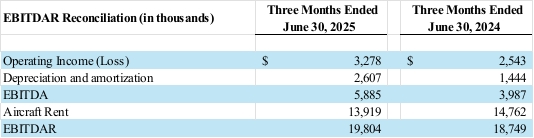
EBITDA is defined as operating income (loss), plus depreciation, amortization, interest and taxes, and is a supplemental measure of operating performance that the Company believes is useful to facilitate comparisons to its historical consolidated and business-level performance and operating results. The Company believes its presentation of EBITDA, a key metric used internally by management, provides investors with a supplemental view of the Company’s operating performance that facilitates analysis and comparisons of its ongoing business operations because they exclude items that may not be indicative of the Company’s ongoing operating performance.
EBITDAR is defined as operating income (loss), plus depreciation, amortization, interest, taxes and aircraft rent, and is a metric to be considered by investors when comparing results across various airlines, which aims to normalize for the different ways that the airlines acquired their aircraft. This distinction is important when comparing the operational results of an airline leasing its aircraft versus an airline purchasing its aircraft. Specifically, the airline leasing aircraft would
see the costs relating to those aircraft flow through aircraft rent, while an airline that owns their aircraft would see their costs for those aircraft flow through depreciation and amortization.
Cautionary Note Regarding Forward-Looking Information
This press release contains certain “forward-looking statements” and “forward-looking information”, as defined under applicable United States and Canadian securities laws, concerning anticipated developments and events that may occur in the future. Forward-looking statements contained in this press release include, but are not limited to, statements with respect to the Company’s financial performance, continued growth, growing momentum of the Company’s charter platform and the execution of the Company’s strategic plan, the goal of becoming the largest narrow body charter airline in North America, continued fleet expansion, profitable narrow body charter operations, the Company’s future focus, details regarding future financial results, and the Company’s status as the nation’s fastest growing charter airline. In certain cases, forward-looking statements can be identified by the use of words such as "plans", "expects" "budget", "scheduled", "estimates", "forecasts", "intends", "anticipates" or variations of such words and phrases or statements that certain actions, events or results "may", "could", "would", "might" or "will be taken", "occur" or "be achieved" suggesting future outcomes, or other expectations, beliefs, plans, objectives, assumptions, intentions or statements about future events or performance. Forward-looking statements contained in this press release are based on certain factors and assumptions regarding, among other things: GlobalX’s receipt of financing to continue airline operations; the accuracy, reliability and success of GlobalX’s business model; GlobalX’s ability to accurately forecast demand; GlobalX’s ability to successfully conclude definitive agreements for transactions subject to LOI; GlobalX’s timely receipt of governmental approvals; the success of airline operations of GlobalX; GlobalX’s ability to successfully enter new geographic markets; the legislative and regulatory environments of the jurisdictions where GlobalX will carry on business or have operations; GlobalX’s ability to have sufficient aircraft to provide its services to customers; the impact of competition and the competitive response to GlobalX’s business strategy; and the future price of fuel, and the availability of aircraft. While the Company considers these assumptions to be reasonable based on information currently available to it, they may prove to be incorrect.
Forward-looking statements involve known and unknown risks, uncertainties and other factors which may cause the actual results, performance or achievements of the Company to be materially different from any future results, performance or achievements expressed or implied by the forward-looking statements. Such factors include risks related, among other things, to:
our ability to lease aircraft on favorable terms; manage our growth effectively; implement our business strategy successfully; obtain access to capital; the limited number of aircraft we fly; rising maintenance costs; and aircraft related fixed obligations. Although the Company has attempted to identify important factors that could cause actual results to differ materially from those described in the forward-looking statements, there may be other factors that cause results not to be as anticipated, estimated or intended. Accordingly, readers should not place undue reliance on forward-looking statements. The forward-looking statements are made as of the date of this press release. Except as required by applicable securities laws, the Company does not undertake any obligation to publicly update any forward-looking statements. If GlobalX does update one or more forward-looking statements, no inference should be made that it will make additional updates with respect to those or other forward-looking statements. The Company has also identified certain known material risk factors applicable to it in its Annual Report on Form 10-K for the year ended December 31, 2024, filed with the SEC and its other filings with the SEC.
GLOBAL CROSSING AIRLINES GROUP INC.
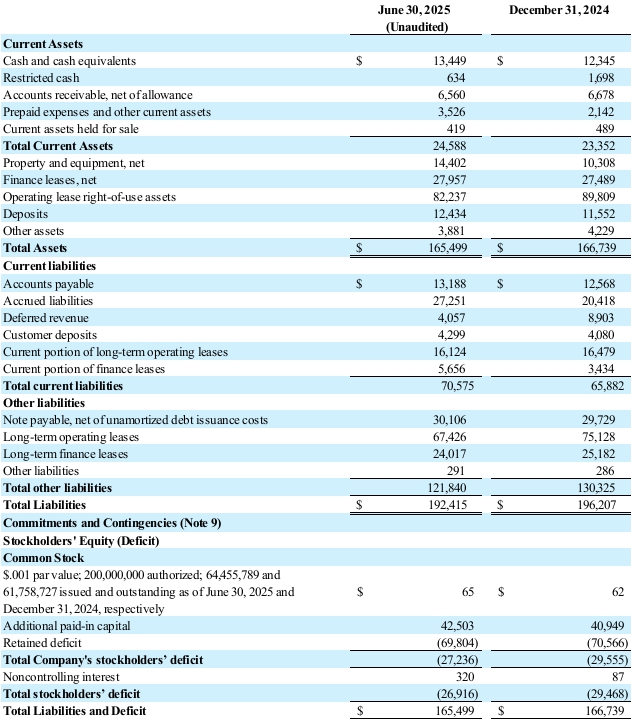
CONDENSED CONSOLIDATED BALANCE SHEETS
(In thousands, except par value and share quantities)
GLOBAL CROSSING AIRLINES GROUP INC.
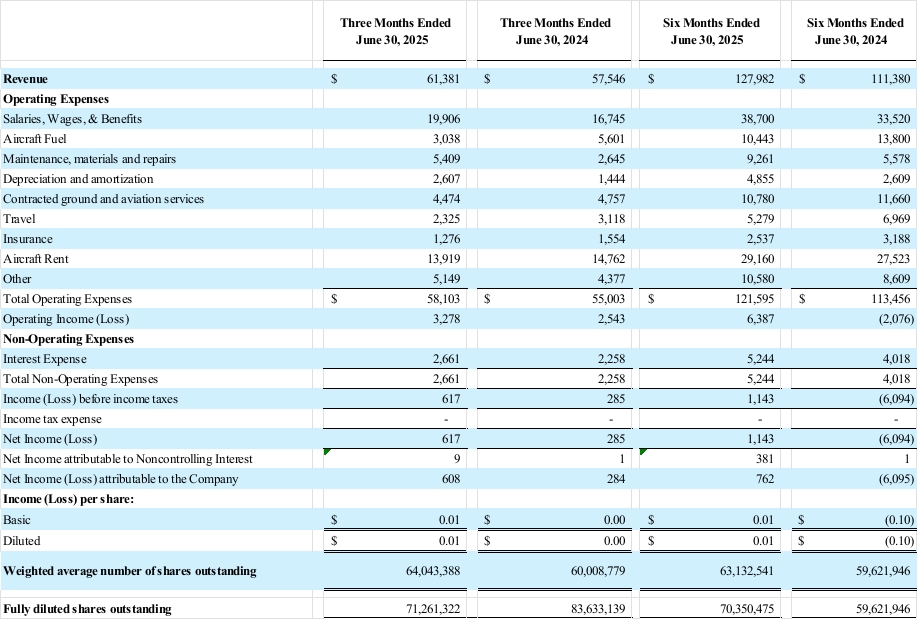
CONDENSED CONSOLIDATED STATEMENTS OF OPERATIONS
(UNAUDITED)
(In thousands, except share and per share amounts)
GLOBAL CROSSING AIRLINES GROUP INC.
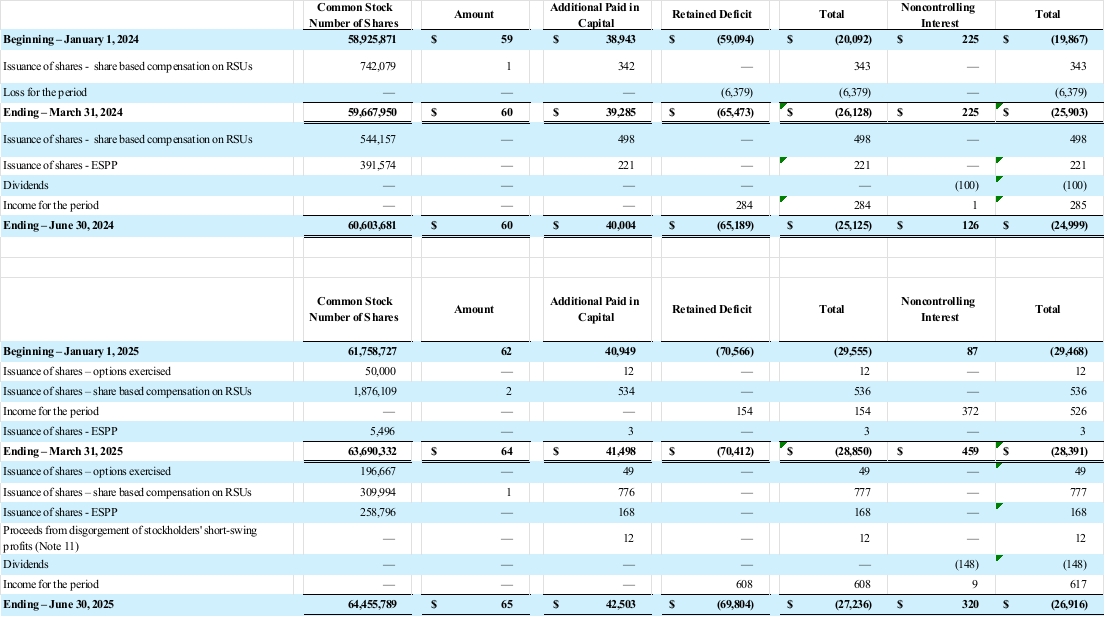
CONDENSED CONSOLIDATED STATEMENTS OF STOCKHOLDERS' EQUITY
(UNAUDITED)
(In thousands, except shares quantities)
GLOBAL CROSSING AIRLINES GROUP INC.
CONDENSED CONSOLIDATED STATEMENTS OF CASH FLOWS
(UNAUDITED)
(In thousands)
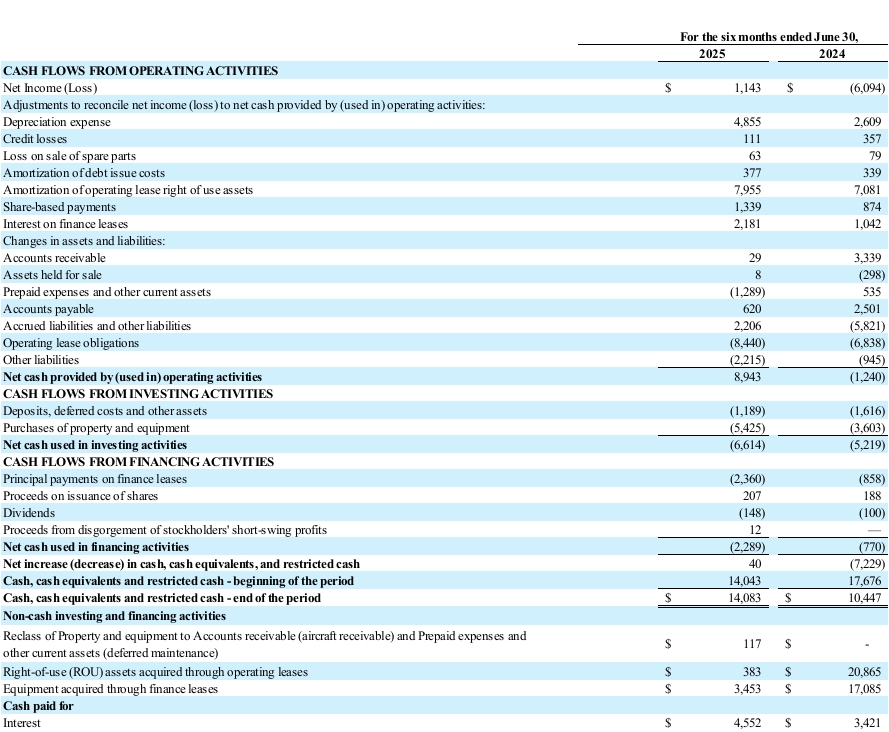
Exhibit 99.2

Global Crossing Airlines
Second Quarter 2025 Earnings Conference Call
August 14, 2025
C O R P O R A T E P A R T I C I P A N T S
Chris Jamroz, Executive Chairman
Ryan Goepel, President and Chief Financial Officer
Wendy Shapiro, SVP Corporate Controller
Sean Mansouri, Investor Relations
C O N F E R E N C E C A L L P A R T I C I P A N T S
Brian Foote, Broadway Capital Management
George Melas, MKH Management
P R E S E N T A T I O N
Operator
Good afternoon, ladies and gentlemen. Thank you for standing by.
Welcome to today’s conference call to discuss Global Crossing Airlines’ Financial Results for the Second Quarter of 2025.
ViaVid has made considerable efforts to provide an accurate transcription. There may be material errors, omissions, or inaccuracies in the reporting of the substance of the conference call. This transcript is being made available for information purposes only.
1-888-562-0262 1-604-929-1352 https://viavid.com/
At this time, all participants are in listen-only mode. As a reminder, this conference is being recorded.
Joining us on the call today are the Company’s Executive Chairman, Chris Jamroz; President and CFO, Ryan Goepel; and SVP Corporate Controller, Wendy Shapiro.
Please be advised this conference call will contain statements that are considered forward-looking statements under the Private Securities Litigation Reform Act of 1995. These forward-looking statements are subject to certain known and unknown risks and uncertainties as well as assumptions that could cause actual results to differ materially from those reflected in these forward-looking statements. These forward-looking statements are also subject to other risks and uncertainties that are described from time to time in the Company’s filings with the SEC. Do not place undue reliance on any forward-looking statements, which are being made only as of the date of this call. Except as required by law, the Company undertakes no obligation to publicly update or revise any forward-looking statements. For important risks and assumptions associated with such forward-looking statements, please refer to the Company’s earnings press release for the second quarter of 2025 and the Company’ Annual Report on Form 10-K for the year ended December 31, 2024.
The Company’s presentation also includes certain non-GAAP financial measures, including EBITDA and EBITDAR, as supplemental measures of performance of the business. All non-GAAP measures have been reconciled to the most directly comparable GAAP measures in accordance with SEC rules. You will find reconciliation tables and other important information in the earnings press release for the second of 2025, which is available on the Company’s Investor Relations section of its website.
Now, I will turn the call over to the Company’s Executive Chairman, Chris Jamroz. Chris, please go ahead.
Chris Jamroz
Thank you, Operator, and good afternoon, everyone.
I’m pleased to report a sequentially strong quarter for Global Crossing, as we continued to build on the momentum established earlier this year. In Q2, we delivered top-line growth, record block hours flown, and a significant improvement in cash flow provided by operating activities, underscoring the strength of our business model and our commitment to operational excellence.
During the quarter, we expanded our fleet to meet rising customer demand while maintaining strong utilization levels, demonstrating the versatility of our operating model and our continued focus on disciplined growth. We also took a strategic step to introduce a hybrid ownership model through the acquisition of our first aircraft in July. This initiative, coupled with signing lease agreements for four additional aircraft, strengthens our growth trajectory and fleet capacity. These strategic additions ensure we are well positioned to deepen relationships with key customers and capitalize on new opportunities, strengthening our competitive edge in priority markets.
To provide context for our broader journey: 2024 was our year of stabilization, we focused on building the foundation of a full-fledged charter airline; 2025 is our year of maturation and execution, we are delivering on the path to sustainable profitability and demonstrating consistency in operations and financial performance as we move through the second half of the year; 2026 is expected to be our year of scaling up profitably as the timing of new aircraft deliveries is expected to enable us to expand our platform and capture the full potential of the business we’ve built.
Looking ahead, we remain focused on improving core operations, expanding customer partnerships, and enhancing our reputation for excellence, consistency, and reliability. Together, these efforts are expected to solidify our position as the trusted charter airline of the industry.
Ryan and Wendy will expand on the quarter in more detail momentarily, but I want to reaffirm our commitment to executing our strategic plan and creating long-term value for our customers, partners, and shareholders. Our focus is clear: execute with purpose and consistency as we work to become the largest, most reliable, narrow-body charter airline in North America.
With that, I will now hand it over to our President and CFO, Ryan Goepel, to elaborate on Global Crossing’s second quarter operational highlights. Ryan?
Ryan Goepel
Thank you, Chris, and good afternoon, everyone.
We delivered meaningful improvements during the quarter across all key financial metrics. This included both revenue growth and improved profitability, reflecting the continued momentum of our strategic initiatives and our progress towards building a more resilient financial foundation.
Revenue increased 7% year-over-year to $61.4 million, primarily driven by higher block hours flown, aircraft fleet expansion, and increased contribution from our passenger ACMI business. The growth in our ACMI business was due to expanded fleet capacity, growing customer demand, and increased average revenue per block hour. Most notably, ACMI revenue increased 40% year-over-year to $44.5 million and now accounts for 73% of total revenue compared to 55% in the prior year quarter.
We continued to allocate aircraft capacity from Charter to ACMI in an effort to take advantage of its higher margin profile and more predictable flying. As a result, Charter revenue was $15.3 million in Q2 ’25 compared to $24.6 million in the same quarter last year and now represents 25% of total revenue compared to 43% in the prior year quarter. This shift is the primary reason for the increase in block hours, did not directly correspond with the increase in revenue.
During the quarter, we flew a record 8,065 block hours, including sub-service across both ACMI and Charter, a 13% increase over the prior year’s quarter and 7% over the prior quarter. This growth reflects strong market demand for our leading charter services and a tightening supply environment resulting from competitor capacity reductions. It’s worth noting, we did not operate any sub-service hours in Q2 2025, compared to 382 hours in Q1 2025 and 561 hours in Q2 2024. Our reduced reliance on sub-service is a direct result of increased aircraft availability. In Q2, we increased block hours flown for ACMI by 32% to 6,769 compared to last year. For Charter, we flew 1,154 block hours compared to 1,838 in the year-ago quarter.
As we’ve mentioned before, ACMI brings in lower revenue when compared to Charter on a per-flight basis, however it carries lower risk as the customer assumes the expenses for fuel, demand and price risk, in addition to other operational fees. For context, an average revenue per block hour in Q2 was $6,580 for ACMI and $13,272 for Charter. As we continue our efforts to drive revenue growth, we anticipate a more pronounced improvement in profitability, driven by the favorable margin profile of our expanding ACMI portfolio.
Turning to cargo operations. We continued to face a soft Freight market, consistent with broader industry trends. While demand has remained subdued, we have maintained steady operations with our fleet of four A321 freighters, aircraft that offer superior unit economics through greater fuel efficiency, reduced operating costs, and reliable performance. As the market works through this period of recovery, our efficient platform has enabled us to stay active, serve our customers effectively, and be well-positioned for an eventual rebound in the Cargo market.
In Q2, we launched an important trial ACMI contract with DHL, providing us the opportunity to demonstrate the superior value of the A321 freighter to a key customer in the market. We’re happy to announce DHL
has extended this contract by another four months, reflecting the growing confidence of a major logistic provider has in our platform.
For the Passenger market, we continued to see strong demand throughout the quarter, driven by continued shortage of available aircraft, limited direct competition, and growing interest from customers such as college sports teams, tour operators, and the U.S. government seeking flexible travel solutions. To capitalize on these tailwinds, we have allocated additional sales and operational resources in an effort to strengthen the relationships with key customers and cultivate partnerships with new accounts in an effort to expand our reach. This market remains core to our strategy, and we intend to continue to scale our efforts to further diversify and strengthen our customer base.
As part of our long-term growth strategy, we continually assess our operational efficiency and pricing structure in an effort to drive stronger financial performance. The steady increase in average revenue per block hour reflects the effectiveness of these efforts. As we stated earlier, for ACMI, we generated an average of $6,580 per block hour, an increase of 6% from the prior year quarter. For Charter, average revenue per block hour was roughly flat at $13,272 compared to $13,393 in Q2 of 2024.
As Chris mentioned earlier, we transitioned from an exclusively leased fleet to a hybrid ownership model with our first acquisition of an Airbus A320. This strategic shift enhances our operational flexibility, facilitates long-term planning, and supports improved financial performance.
Aircraft ownership also enables us to better control long-term maintenance scheduling, optimize capital investments, create tangible asset value on the balance sheet, and provide greater control over valuable end-of-life economics. Additionally, owning select aircraft reduces net expense, which in turn improves EBITDA conversion over the life of the asset. While leasing remains a key component of our fleet strategy, ownership introduces a valuable lever as we scale.
In addition to the acquisition, we executed definitive lease agreements for four Airbus A319 aircraft. Deliveries are scheduled between September and December of this year, with the first A319 expected to enter service by the end of September, and subsequent aircraft phased in monthly thereafter. Collectively, these aircraft will expand our fleet by over 20%, further enhancing our operational capacity and supporting the next phase of our growth.
As we previously announced, in March we signed a letter of intent to acquire an A320 airframe. We have now secured the required engines, which are undergoing a maintenance check and are scheduled to be delivered in late September.
Throughout Q2, we completed a total of 14 maintenance events, including 2 heavy maintenance checks and 12 non-heavy checks across our fleet. These scheduled events are part of our routine maintenance procedures in an effort to optimize performance and operational readiness. All air passenger aircraft were successfully returned to service ahead of the third quarter.
Now, I’ll turn the over to our SVP Corporate Controller, Wendy Shapiro, who will discuss our financial results in more detail. Wendy?
Wendy Shapiro
Thank you, Ryan, and good afternoon, everyone.
Please note that all financial results discussed today are for the three-month period ended June 30, 2025, and variance commentary is on a year-over-year basis unless stated otherwise.
Revenue in the second quarter increased 7% to $61.4 million compared to $57.5 million. The increase was primarily driven by higher block hours flown and aircraft fleet expansion, as well as an increase revenue
per block hour flown for ACMI. ACMI revenue increased 40% to $44.5 million compared to $31.9 million. Charter revenue in Q2 was $15.3 million compared to $24.6 million.
Total operating expenses were $58.1 million compared to $55 million, driven primarily by higher maintenance and personnel costs associated with the ongoing expansion of the GlobalX fleet. Net Income improved to $0.6 million compared to $0.3 million. Earnings per share also improved to $0.01 per basic and diluted share, compared to breakeven earnings per basic and diluted share. This was primarily driven by increased revenue, fleet expansion, and higher average rates per block hour flown for Passenger ACMI.
EBITDA increased 48% to $5.9 million compared to $4 million. EBITDAR increased 6% to $19.8 million compared to $18.7 million.
Cash flow provided by operating activities in Q2 increased to $8.8 million compared to $0.9 million. The increase was primarily driven by improved profitability, disciplined cost management, and efficiency gains across the business. We utilized our cash flow in Q2 to invest in fleet expansion and system enhancements to fuel future growth.
Turning to our liquidity. We ended the second quarter with approximately $14.1 million in cash and restricted cash, compared to $10.2 million at March 31, 2025, and $14 million at December 31, 2024.
Now, I will turn the call back over to Ryan for closing remarks.
Ryan Goepel
Thank you, Wendy.
We’re proud of our second quarter results as we delivered another period of revenue growth, improved profitability and almost $9 million in cash flow provided by operating activities. With solid momentum heading into the second half of 2025, we believe we’re well-positioned to build on this success and execute on our 2025 goals.
This concludes our prepared remarks. I’d now like to open the call for Q&A.
Sean, over to you.
Sean Mansouri
Thank you, Chris, Ryan, Wendy, and thank you everyone for joining.
As we gather the queue for live questions, we’d first like to address a few of the questions that have come in via email over the past couple of weeks and even since reporting our earnings.
Our first question, why isn't GlobalX experiencing the same softness reported by many scheduled carriers in recent earnings reports?
Ryan Goepel
Yeah, I think the key differentiation is to understand they're very different models. Unlike scheduled carriers that commit to flights before securing passengers and bear the loss from vacant seats, we only operate once charters are confirmed and costs are contractually covered.
In our ACMI model, one passenger would be as profitable as 150 because we're paid by the block hour, not by the seat. This structure shields us from ticket risk, volatile fuel prices, and other variable costs while ensuring predictable revenue regardless of load factors.
It's also worth noting that while we utilize moderate cost mid-life aircraft as opposed to scheduled carriers who typically use newer high-cost aircraft, and just as important as a customer base. Again, we don't sell by the seat, we sell by the aircraft, which means our clients, our tour operators, colleges, athletic programs, government agencies; they're not as focused on fare prices or filling seats, but more so as booking flights and booking hours. This model, I think, has allowed us to increase our block hours, maintain high utilization, and even as the broader airline industry has experienced softness.
Sean Mansouri
Got it. Thanks, Ryan. Next one here, how do you think of the balance between purchasing aircraft and leasing them?
Ryan Goepel
Well, and I think up to this point and up to this quarter, we really didn't have an option because if you think about the market and the way the industry might have valued us or saw us as a credit risk, we didn't really have any option to purchase.
I think one of the reasons we're so excited we're able to complete the purchase on MSN 3101 is it's a signal to us that the people who are experts in this industry, the people who evaluate airlines like us for credit risk, see us as an acceptable risk and are willing to provide us the capital needed to purchase an aircraft.
So, when we go forward, I think now it's not so much we only have a choice of leasing, we now have the choice of leasing or purchasing, and as such, we evaluate each deal kind of differently. It opens up more aircraft for us to consider, so we're not just in a lease environment.
I think from our perspective, there is a lot of incremental value, we think, as we've articulated in owning aircraft at this price point, but we will continue to do what we've done since we started, which look at each aircraft on an aircraft by aircraft basis, on a deal by deal basis, and do what we think makes the most sense for the Company.
Sean Mansouri
Great. Turning to the next one. You've mentioned Cargo demand remains soft in the past, what gives you confidence that the segment will ultimately rebound in a meaningful way? And what are the risks if the recovery takes longer than expected?
Ryan Goepel
Well, I think to predict when the market will recover is a tough game to play, because there's a lot of macro forces at play. Near-term Cargo demand has remained subdued. But we do believe that the fundamentals remain compelling over the long term. I think one of the dynamics in the U.S. market is when U.S. Postal Service rebid their contract and they changed their approach to air freight, it created excess capacity and that excess capacity has to come out.
That being said, we're seeing early signs of improvement, such as our extension of our ACMI contract with DHL, which I believe demonstrates our 321 platform delivers strong unit economics for major logistic players.
Even if the recovery takes longer than expected, our cargo fleet is highly efficient, can be redeployed in ways that maintain utilization. We're disciplined in managing cost and fleet allocation, so when the demand does strengthen, which historically accelerates in Q4, we're positioned to capture market share quickly and profitably.
Sean Mansouri
With positive net income and strong operating cash flow in Q2, how do you prioritize between reinvesting in fleet growth versus strengthening the balance sheet?
Ryan Goepel
Well, I think the great thing is I get to have that conversation and I think we're having those debates. We view capital allocation as a balance between fuel and growth and maintaining financial flexibility. I think what you've seen over the last 6 months to 12 months is we've really invested our time and efforts, not so much in growing the fleet, but stabilizing the internal organization, ensuring we have the policies and procedures in place to operate efficiently when we grow versus growing and then fixing. I think that's been demonstrated in our results and our cash flow from operations.
That being said, our highest return opportunities right now are expanding our ACMI capacity, which is where we're deploying capital towards new aircraft acquisitions and leases, which are already backed by strong customer demand.
At the same time, we're mindful of leverage and liquidity, ensuring that we have the balance sheet strength to navigate cycles and pursue strategic opportunities. I will continue to evaluate our options through that lens, discipline growth that enhances earnings power without compromising long-term stability.
Sean Mansouri
Okay, and last one here via email. You're added a meaningful number of aircraft between now and year end. What operational risks come with that pace of growth and how are you mitigating them?
Ryan Goepel
I think that's what we spent the last 10 months preparing for. I think the first part it starts is with our training. We've had a pilot class every month since May, but we've also had reasonably sized pilot classes. I don't think we've over hired. I think we're going to time these better than I think we have in the past, so we don't have an overcapacity of pilots. But we really focused on training, maintenance procedures and scheduling, so then when we do have these aircraft on board, we have the right pilots, we have them scheduled right, and we have the maintenance programs and the people in place to go do it.
But keep in mind, many of these additions are the same type of aircraft in our fleet. So, we are leveraging existing expertise, existing resources, and really it is the scaling of the business that Chris kind of talked about. This first half of the year has been kind of the stabilization and this is the scaling that allows us to feed our growth, which we believe is going to be pretty aggressive in 2026.
Sean Mansouri
Great. With that, we'll turn it back to the operator for live Q&A.
Operator
Thank you. Ladies and gentlemen, we will now begin the live question-and-answer session. Should you have a question, please press the star, followed by the number one on your touchtone phone. You will hear a prompt that your hand has been raised. Should you wish to decline from the polling process, please press the star, followed by the number two. If you are using a speakerphone, please lift the handset before pressing any keys. One moment, please, for your first question.
Your first question comes from the line of Brian Foote from Broadway Capital Management. Your line is now open. Please go ahead.
Brian Foote
Thank you. I appreciate it. Both Chris and Ryan, having been with you all for many years, I want to congratulate you on the cash generation, first and foremost. It's encouraging to see that and thrilling to be in this situation.
I want to go to a couple of comments that you guys made because I think they're very important. The first is industry experts have looked at your model and they know what they're doing, they're sophisticated, and they were able to endorse and underwrite the ownership of an aircraft. They're seeing something from a credit risk standpoint that perhaps other elements are not seeing. The ownership of an aircraft right now for your balance sheet and for cash generation is very important from a shareholder standpoint.
If you could walk me through what kind of opportunities you have in terms of other aircraft, when you evaluate an aircraft for purchase, what does that market look like? What kind of decisions go into that in terms of return on capital, other things? Again, what kind of capacity should we think about in terms of the credit worthiness for acquisitions?
Ryan Goepel
Yeah, and really what kind of triggered it for us is in 2024, we estimate between four and six aircraft traded, which means one lessor sold it to another, which made us think that our perception must be getting better because they're willing to acquire that risk from us. Our first approach is really to go to the existing lessors and say, hey, if you're going to trade these and share these companies, leases get traded quite frequently, give us a shot at it. And that's what this first transaction was.
I think there's several other aircraft we currently have under lease, which we're having a similar conversation with a lessor. But again, we have some pretty good lease rates. We have pretty good terms. Now that we kind of have some financing partners who are willing to—that's the next step. We kind of put them all together and really we will do it if it generates incremental cash, incremental EBITDA, incremental net income, and gives us an asset at the end of the lease life. If we get all four of those, we'll go do it. And I think that's what this first transaction did, and I think will ultimately strengthen us.
If you think about it with these mid-life aircraft, there's an end-of-life economics that we think we are in a better position with the way our business model works and how we utilize the aircraft to capitalize on and maybe some of our lessors or some of our agreements and some of our agreements state.
I think from a capacity standpoint, I think there's significant capacity out there to do this kind of lending. I think we've ticked a couple of boxes for enough of lenders that we can have multiple financing options for these aircraft. The next step is just finding the one that makes sense. So, our first priority is taking existing leased aircraft and converting them because it's a much simpler transaction. The next is when we look at getting aircraft, we will do the lease versus buy, and we'll announce those as they happen. But again, it's just nice to have that kind of thing in your toolbox to use when you're going through the economics of an agreement.
You think about our core value. Our core value is our certification. Our core value is our ability to take these assets and generate revenue with it. Then the next step is, okay, how do we use our balance sheet to generate even more profit, which we think will ultimately manifest itself and increase shareholder value.
Brian Foote
The increasing shareholder value is pretty evident by the cash flow generation. Maybe I'll drill down on that. Now that you are a cash flow positive company from a working capital perspective, there's other levers that you could pull on a day-to-day basis. I guess I'd throw it out to you, Ryan, but it's to the floor, how do you think about the working capital at the Company as you continue to grow across 2026, but maybe going forward, are there target levels that you're considering as a more mature, stable company? Or how should we think about working capital management going forward?
Ryan Goepel
Yeah. Again, as the Company evolves, this isn't something we've really had the luxury of deciding what's the best way to go forward. The first part was to generate positive cash flow from operations. The second point is to figure how much cash do you need on the balance sheet or want to have on the balance sheet. And really, for us, it's to help manage the cycles. It’s also cash gives us the ability to take advantage of situations, and I think we've done that since the beginning as a company, is taking advantage of unique situations to get—I hate to say the best deal, but the assets at the best price for our company.
So, I don't think we're at a stage where I'd say I have enough cash. No finance person or leader in aviation will say we have enough. But I think what we are doing is we said this year, our goal of ours was to strengthen our balance sheet, and I think we've demonstrated in the first half, we've done that through generating cash flow from operations and also acquiring aircraft. So, ultimately, we have a stronger balance sheet and create some sort of assets to back the airline.
Brian Foote
Very good. Just following a comment Chris made, the strategic plan is to be among the largest, the most reliable. Walk us through that. Is there a target timeline for being adamant? Reliability is a major issue for all airlines. I mean, how do you guys track those? How do you keep the Company on that strategic plan?
Ryan Goepel
If you're not reliable, you're not a good partner, and so in the charter business, they expect to show up on time and leave on time, just like the scheduled carriers. Obviously, we track on time performance, and internally, we have metrics that we hold ourselves accountable towards. I think part of ensuring reliability is ensuring the fleet stays relative. The fleet age matches the work that is being done. So, if you're flying 200 hours to 300 hours a month, you should make sure you have a young enough aircraft that can handle the work. And then as your aircraft mature, make sure they're kind of more targeted for less lower utilization work, and that's managing the lifecycle of the aircraft.
When you talk about largest, we've had the problem and we've been here for a long time where we would promise 50 aircraft by this date or 40 aircraft at this date or whatever. Ultimately, we've now taken the approach of, okay, we will take on aircraft when it makes economic sense, and we'll take on aircraft, not just for the sake of taking on aircraft. That being said, setting kind of a baseline goal of adding four to five a year, whether they're Passenger, whether they're Freight. Having that kind of mindset at least gives you a framework.
Now, if we come across a great opportunity that allows us to add a whole bunch of aircraft from a common type of aircraft at good economic terms, then that means we add 10 in a year. We will go do that. But we also want to make sure we have the work. We are out of the Field of Dreams model, which I say build it and hope they will come. We feel there's demand for significantly more Passenger. We don't see necessarily the demand yet for Cargo, but when that recovers, we think there's a lot of opportunity to add lift in that space as well.
It's a long-winded way of saying is we're in a macro market, we deal with some pretty big forces that are not necessarily inside our control, but we have built in a flexibility and approach that allows us to take advantage of whatever opportunities we see.
Brian Foote
It's a very interesting point you just make there, Ryan, if I may. You've reached a point where demand is informing your decision as opposed to the, as you said, the Field of Dreams model that might have existed prior. Is your size—your ability to interact with so many different customers, is that driving the fact that you can have that conversation and understand demand in a more reactive way as opposed to just building it and they will come? What are the factors that are contributing to that ability to match supply to demand?
Ryan Goepel
Well, I think our focus, right? I think one of the things we've done in the last year is really simplified what we've done and what we do and where we're going to do it. And through that, we've gotten deeper with existing clients. I think we've identified opportunities that will allow us to expand it, whether it's in Europe or more domestically with the similar clients asking for more aircraft.
We talk about being in a niche business, but we talk about being in a $10 billion business where our niche is pretty big. The market's significantly bigger than we are right now, and I think there's enough opportunities that adding the four to five aircraft, we don't feel like we're scrambling to put them to work.
Brian Foote
Very good. Really helpful. Thanks.
Ryan Goepel
Thanks, Brian.
Operator
Your next question comes from the line of George Melas from MKH. Your line is now open. Please go ahead.
George Melas
Great. Thanks a lot. Congratulations for some really good progress. A few quick questions on the new aircraft that you're bringing along. The four A319s. Can you just give us a little bit more information, how many lessors, why these particular aircraft, and what makes them attractive operationally and financially?
Ryan Goepel
Well, it's one lessor. They're all sister ships. They're all the same configuration. They are high density 319s, which means they have over 156 seats, which we think there's a pretty robust market for that. The lease rates made a lot of sense. Keep in mind, we entered in this agreement last year at a time when you're just seeing lease rates for 320s and the mid-to-high 200s. This is significantly below that. So, from our perspective, we believe there's a market for these aircraft. There's a certain efficiency on onboarding these aircraft. It's one agreement, one lessor, one operator, and so they'll be brought on sequentially. I think the economics of these were just compelling for us to go do it.
George Melas
Okay. Great. Help us understand how long can you count on these aircraft? How long are the leases and you have lease extension options involved?
Ryan Goepel
Right. So, these aircraft are two to three years, which really take you to the next heavy check. And so, I think at that point, there's an economic decision to be made on whether it makes sense to reinvest in the aircraft to take it beyond that period of time. We'll work with the lessor to decide what makes sense at that time. It might not make economic sense. I think also when you look at our existing fleet, we have another several of our aircraft coming due in the next 12 months, and we're working on extensions for all of them. We'll announce them as they're done as well.
We've gotten to the next level of maturity where we're starting to get into second lease agreements with existing lessors, which also opens the door for purchase opportunities. So, while these aren't six-, seven-year aircraft, we think that's fine.
I think this is a market that's available, and we’ll continue to keep—my personal take is the mid-life aircraft market will become better for us the more time we can put out. I think there's been a lot of forces, whether it was COVID or it was the engine issues that have driven up demand for mid- and late-life aircraft, which as the OEMs catch up and the OEMs get their production going, will soften the rates on some of that mid- and late-life aircraft, especially some of the engines, which if we get through this two- to three-year window with these aircrafts, we'll have significantly, I think, better opportunities to get more aircraft at better rates going forward, which just sort of feeds our growth. Build a solid foundation, build your fortress in America for where we have a solid set of customers, and then manage the fleet to ensure your fleet matches your demand. I think that's what we've done and that's what we'll continue to do.
George Melas
Okay. Okay. That's a lot to unpack for me. I'll have to think about it.
Ryan Goepel
I'm sure you'll call me back, George, and you'll have like 20 more questions.
George Melas
Okay. I’ll do that.
Ryan Goepel
I'll be ready for you.
George Melas
With these aircraft being delivered, it means that you ended the quarter with 19 aircraft. You add four by the end of the year, but I imagine you're going to have some aircraft that come to end-of-life lease or end of lease, I should say. Let's say mid next year, at this point next year, how many aircraft do you think you have in the fleet?
Ryan Goepel
Twenty-four.
George Melas
Twenty-four. Okay, so then you have no aircraft that are really exiting the fleet in the next six months.
Ryan Goepel
Not by design.
George Melas
Okay.
Ryan Goepel
Keep in mind, we've already had one exit in the sense of the 319 that was returned that we talked about in Q1, so that takes us to 18. You add the 4, gets you to 22, and I think we'll have 2 more before mid next year. That's how I get to 24.
George Melas
Okay, so you went from 19 to 18, you add 4, that's 22, and you think you're going to add a few more?
Ryan Goepel
Two more. Yeah.
George Melas
Okay. Great. Okay. Then just from an operational perspective, you have no subservice this quarter. Is that because—are you keeping the routes that were flown by the subservice providers or are you going to fly them internally or somehow did these contracts expire? Help us understand how you made those decisions.
Ryan Goepel
Well, keep in mind, we did a lot of heavy maintenance checks in Q2. So, we had a lot of aircraft down for maintenance. The subservice sort of filled in while they're being repaired, and then they got redelivered and we resumed flying them.
George Melas
Okay. Very good. Thanks so much.
Ryan Goepel
Thanks, George.
Operator
There are no further questions at this time. Please continue, Mr. Ryan Goepel.
Ryan Goepel
Great. I want to thank everyone for joining us. I appreciate your interest and your attention.
Just in conclusion, I think the focus of the airline is to stay focused, keep it simple. We’re to be the nation's fastest growing charter airline that does ACMI charters, and I think we're going to continue with that focus. We're going to add aircraft, operate profitably, and focus on generating positive cashflow from operations for the year. We look forward to our next call.
Operator
Thank you. Ladies and gentlemen, this concludes today’s conference call. You may disconnect your phone lines at this time and have a wonderful day. Thank you for your participation.
The Nation’s Fastest Growing Charter Airline August 2025 | OTCQB: JETMF, Cboe CA: JET, Cboe CA: JET.B TM
Disclaimer This presentation was prepared by Global Crossing Airlines Group Inc. (the “Company” or “GlobalX”) as a general presentation aimed solely at providing information about the Company, its operations and financial results. You should not rely upon it or use it to form the definitive basis for any decision, contract, commitment or action whatsoever, with respect to any proposed transaction (the "Possible Transaction") or otherwise. This presentation is incomplete without reference to, and should be viewed solely in conjunction with the Company’s reports and filings with applicable Canadian securities regulators and the U.S. Securities and Exchange Commission. You and your directors, officers, employees, agents and affiliates (collectively, the "Recipient") must hold this document, and any oral information provided in connection with this document in strict confidence and may not communicate, reproduce, distribute or disclose it to any other person, or refer to it publicly, in whole or in part at any time except with our prior written consent. If you are not the intended recipient of this document, please delete and destroy all copies immediately. All figures are in US dollars unless otherwise noted. The information contained in the presentation is provided for purposes of convenience only; it neither constitutes a basis for making any investment decision nor does it substitute an independent collection and analysis of information. Moreover, it does not constitute a recommendation, an offer to sell and/or a solicitation or invitation of an offer to buy or subscribe for any securities of the Company or any of its subsidiaries or affiliates, nor shall there be any offer or sale of securities in any state or jurisdiction in which such offer or sale would be unlawful, nor a substitute for independent judgment or independent collection and analysis of information on the part of any investor. It is expected that if any securities are ultimately offered and sold by the Company, investors in such securities will conduct their own independent investigation of the Company and the terms of any such securities, as well as the data, assumptions, estimates, appraisals, methodologies and projections contained or referred to in this presentation. Some of the securities described herein have not been registered under the Securities Act of 1933 (the “Securities Act”) and may not be offered or sold in the United States or to U.S. Persons (other than distributors) unless the securities are registered under the Securities Act, or an exemption from the registration requirements of the Securities Act is available. Neither the U.S. Securities and Exchange Commission nor any state securities commission has approved or disapproved any securities discussed herein or determined if the information is truthful or complete. Any representation to the contrary is a criminal offense. The information and details contained in this presentation are partially provided and presented in a condensed form solely for convenience purposes. You should not assume that any information in this presentation is accurate as of any date other than the date hereof or otherwise specified herein. This presentation contains certain “forward looking statements” and “forward-looking information”, as defined under applicable United States and Canadian securities laws, concerning anticipated developments and events that may occur in the future. Forward-looking statements contained in this presentation include, but are not limited to, statements with respect to growth and profitability, forecasted size and growth rates of the charter market, the Company’s aircraft fleet size, the destinations that the Company intends to service, future demand for block hours, increases in flight activity, expected future revenues and hours flown, estimated future cost savings, positive operating income, the expected conversion, delivery and entry into service timelines for A320 and A321F aircraft and future contract terms. In certain cases, forward-looking statements can be identified by the use of words such as "plans", "expects" "budget", "scheduled", "estimates", "forecasts", "intends", "anticipates" or variations of such words and phrases or statements that certain actions, events or results "may", "could", "would", "might" or "will be taken", "occur" or "be achieved" suggesting future outcomes, or other expectations, beliefs, plans, objectives, assumptions, intentions or statements about future events or performance. Forward-looking statements contained in this presentation are based on certain factors and assumptions regarding, among other things, GlobalX’s receipt of financing to continue airline operations; the accuracy, reliability and success of GlobalX’s business model; GlobalX’s ability to accurately forecast demand; GlobalX will be able to successfully conclude definitive agreements for transactions subject to LOI; the timely receipt of governmental approvals; the success of airline operations of GlobalX; GlobalX’s ability to successfully enter new geographic markets; the legislative and regulatory environments of the jurisdictions where GlobalX will carry on business or have operations; GlobalX’s ability to have sufficient aircraft to provide its services; the impact of competition and the competitive response to GlobalX’s business strategy; the future price of fuel, and the availability of aircraft. While the Company considers these assumptions to be reasonable based on information currently available to it, they may prove to be incorrect. Forward-looking statements involve known and unknown risks, uncertainties and other factors which may cause the actual results, performance or achievements of the Company to be materially different from any future results, performance or achievements expressed or implied by the forward-looking statements. Such factors include risks related to, the ability to obtain financing at acceptable terms, the impact of general economic conditions, risks related to supply chain and labor disruptions, failure to retain or obtain sufficient aircraft, domestic and international airline industry conditions, failure to conclude definitive agreements for transactions subject to LOI, the effects of increased competition from our market competitors and new market entrants, passenger demand being less than anticipated, the impact of any resurgence of COVID-19, future relations with shareholders, volatility of fuel prices, increases in operating costs, terrorism, pandemics, natural disasters, currency fluctuations, interest rates, risks specific to the airline industry, risks associated with doing business in foreign countries, the ability of management to implement GlobalX’s operational strategy, the ability to attract qualified management and staff, labor disputes, regulatory risks, including risks relating to the acquisition of the necessary licenses and permits; risks related to significant disruption in, or breach in security of GlobalX’s information technology systems and resultant interruptions in service and any related impact on its reputation; and the additional risks identified in the "Risk Factors" section of the Company's reports and filings with applicable Canadian securities regulators and the U.S. Securities and Exchange Commission. Although the Company has attempted to identify important factors that could cause actual results to differ materially from those described in the forward-looking statements, there may be other factors that cause results not to be as anticipated, estimated or intended. Accordingly, readers should not place undue reliance on forward-looking statements. The forward-looking statements are made as of the date of this presentation. Except as required by applicable securities laws, the Company does not undertake any obligation to publicly update any forward-looking statements. If GlobalX does update one or more forward-looking statements, no inference should be made that it will make additional updates with respect to those or other forward-looking statements. This presentation also contains future-oriented financial information and financial outlook information (collectively, “FOFI”) about future revenue and sales which are subject to the same assumptions, risk factors, limitations and qualifications as set forth in the above paragraphs. FOFI contained in this presentation was made as of the date of this presentation and was provided for the purpose of providing further information about GlobalX’s anticipated future business operations. GlobalX disclaims any intention or obligation to update or revise any FOFI contained in this presentation, whether as a result of new information, future events or otherwise, unless required pursuant to applicable law. FOFI contained in this presentation should not be used for purposes other than for which it is disclosed herein. FOFI contained in this presentation is provided for the purpose of providing information about management's current expectations and plans relating to the future. Readers are cautioned that such outlook or information should not be used for purposes other than for which it is disclosed in this presentation.
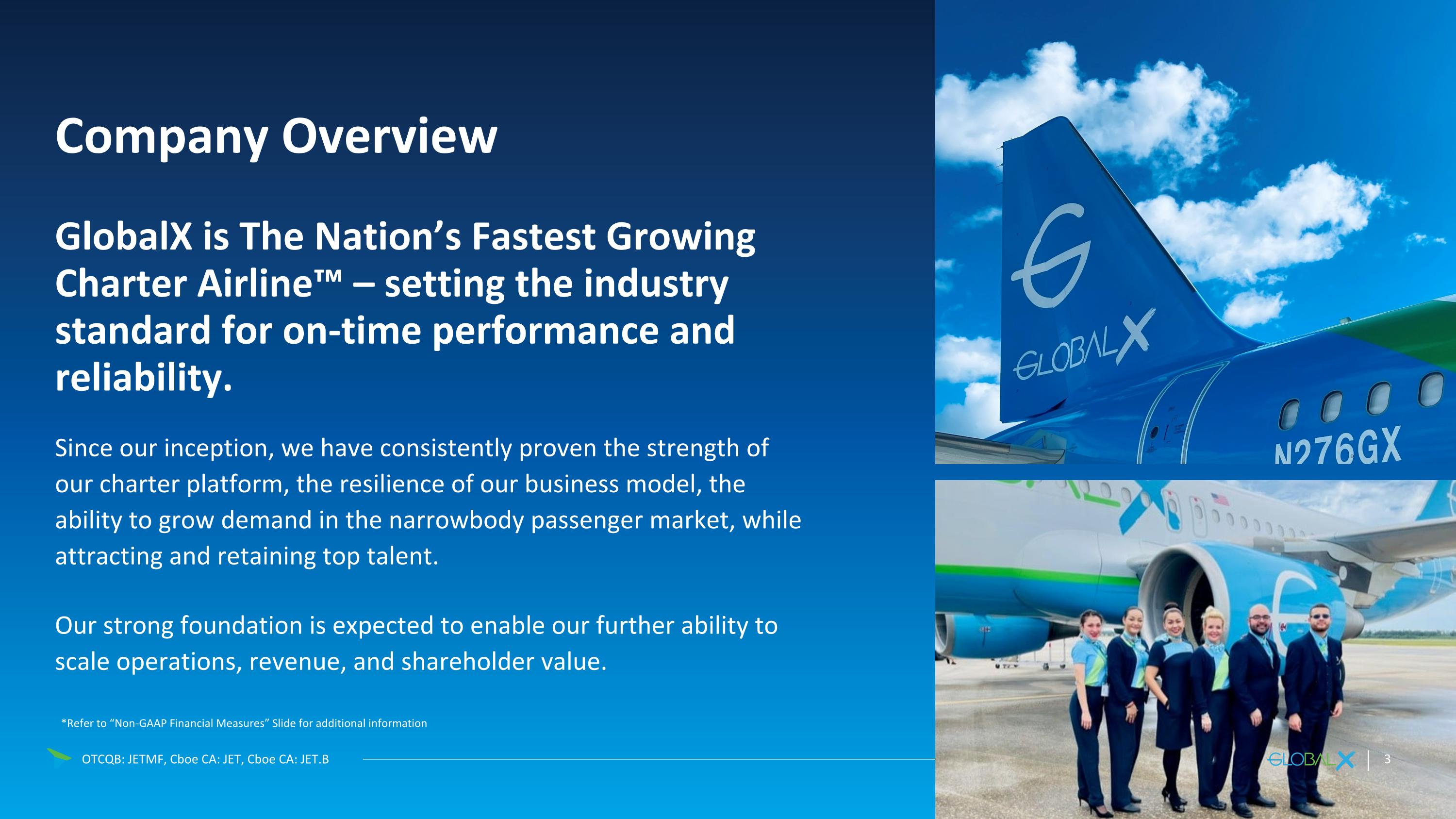
GlobalX is The Nation’s Fastest Growing Charter Airline™ – setting the industry standard for on-time performance and reliability. Since our inception, we have consistently proven the strength of our charter platform, the resilience of our business model, the ability to grow demand in the narrowbody passenger market, while attracting and retaining top talent. Our strong foundation is expected to enable our further ability to scale operations, revenue, and shareholder value. *Refer to “Non-GAAP Financial Measures” Slide for additional information Company Overview 3
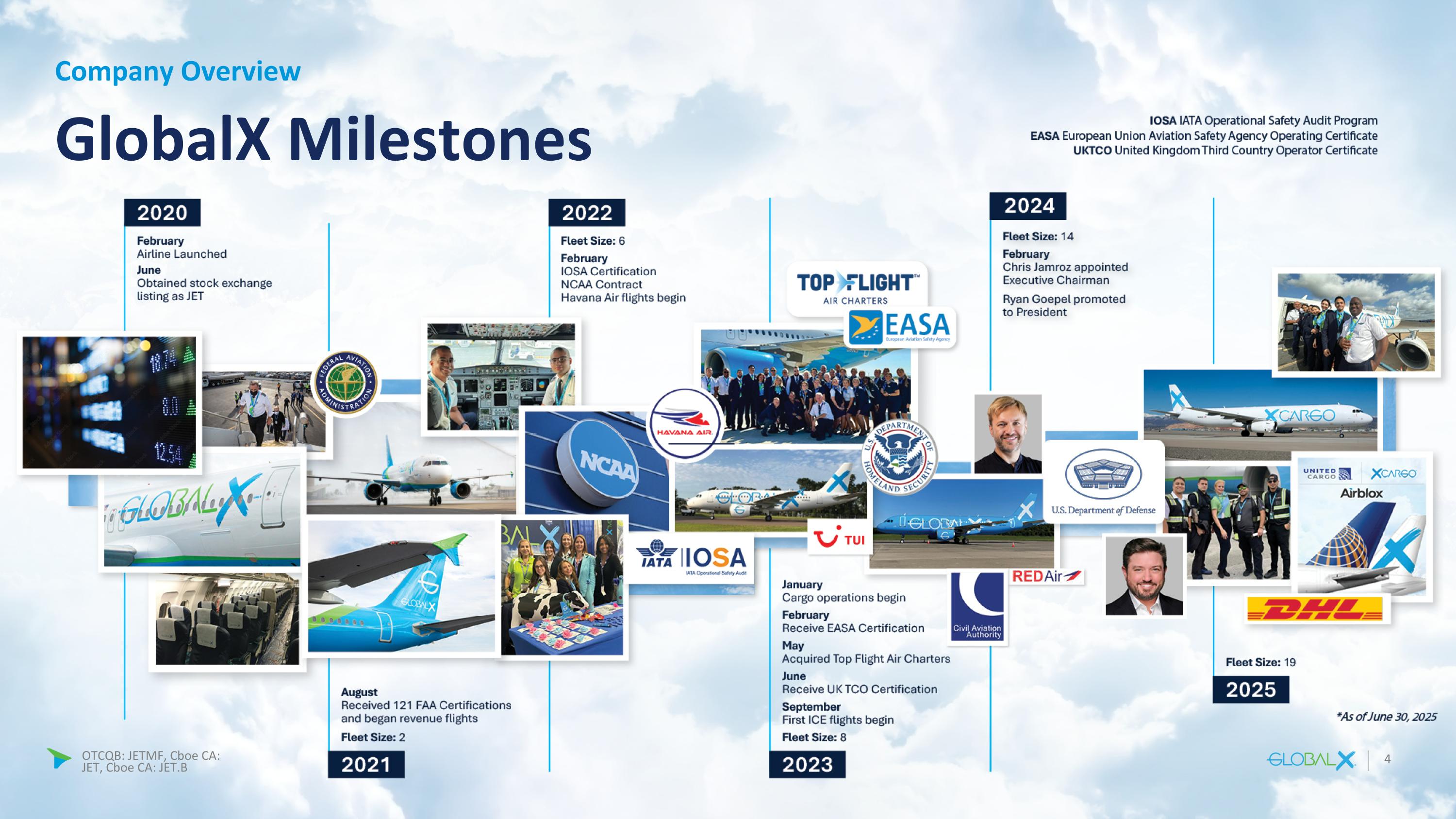
GlobalX Milestones OTCQB: JETMF, Cboe CA: JET, Cboe CA: JET.B 4 Company Overview
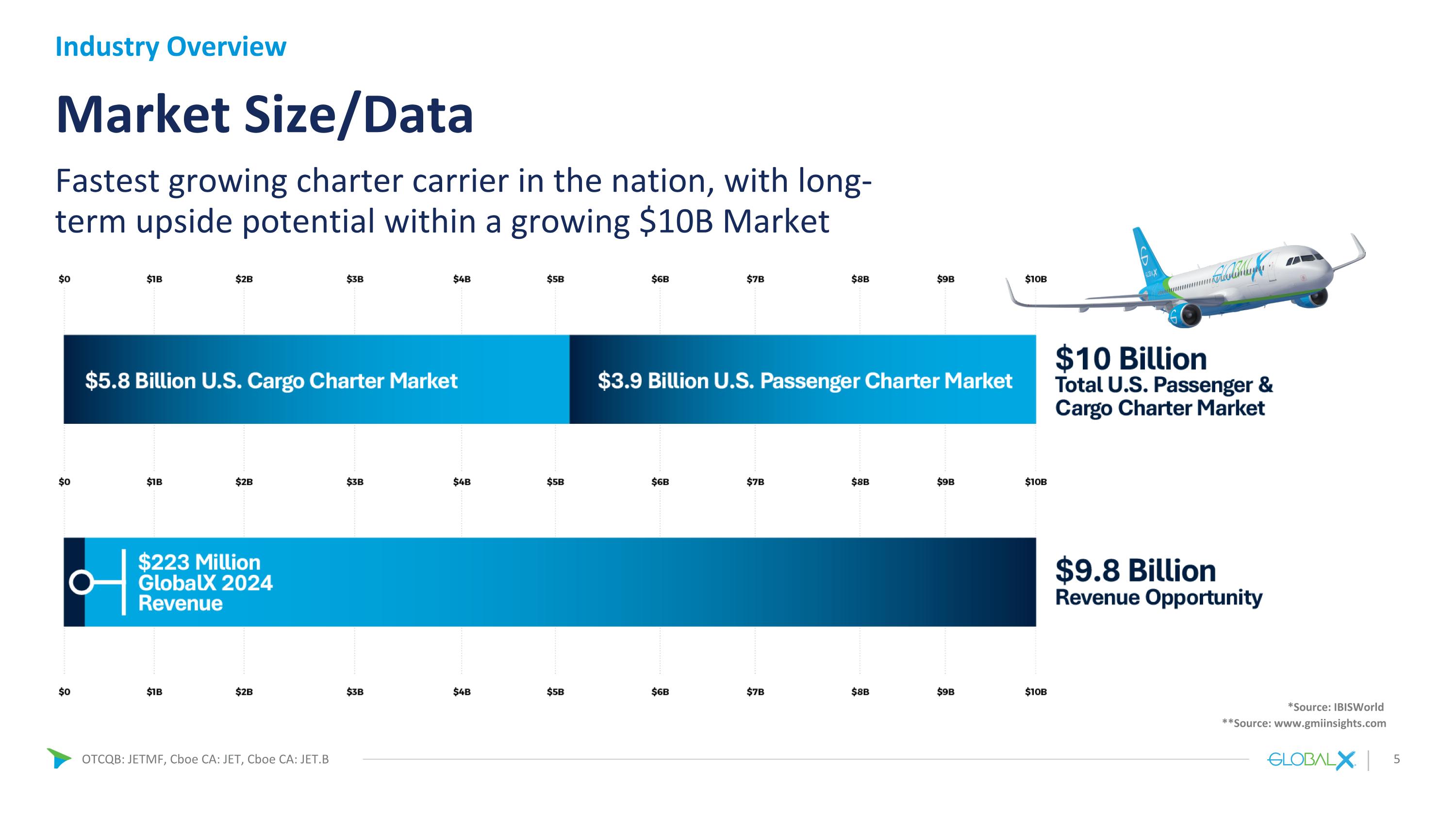
Market Size/Data Fastest growing charter carrier in the nation, with long-term upside potential within a growing $10B Market *Source: IBISWorld **Source: www.gmiinsights.com Industry Overview 5
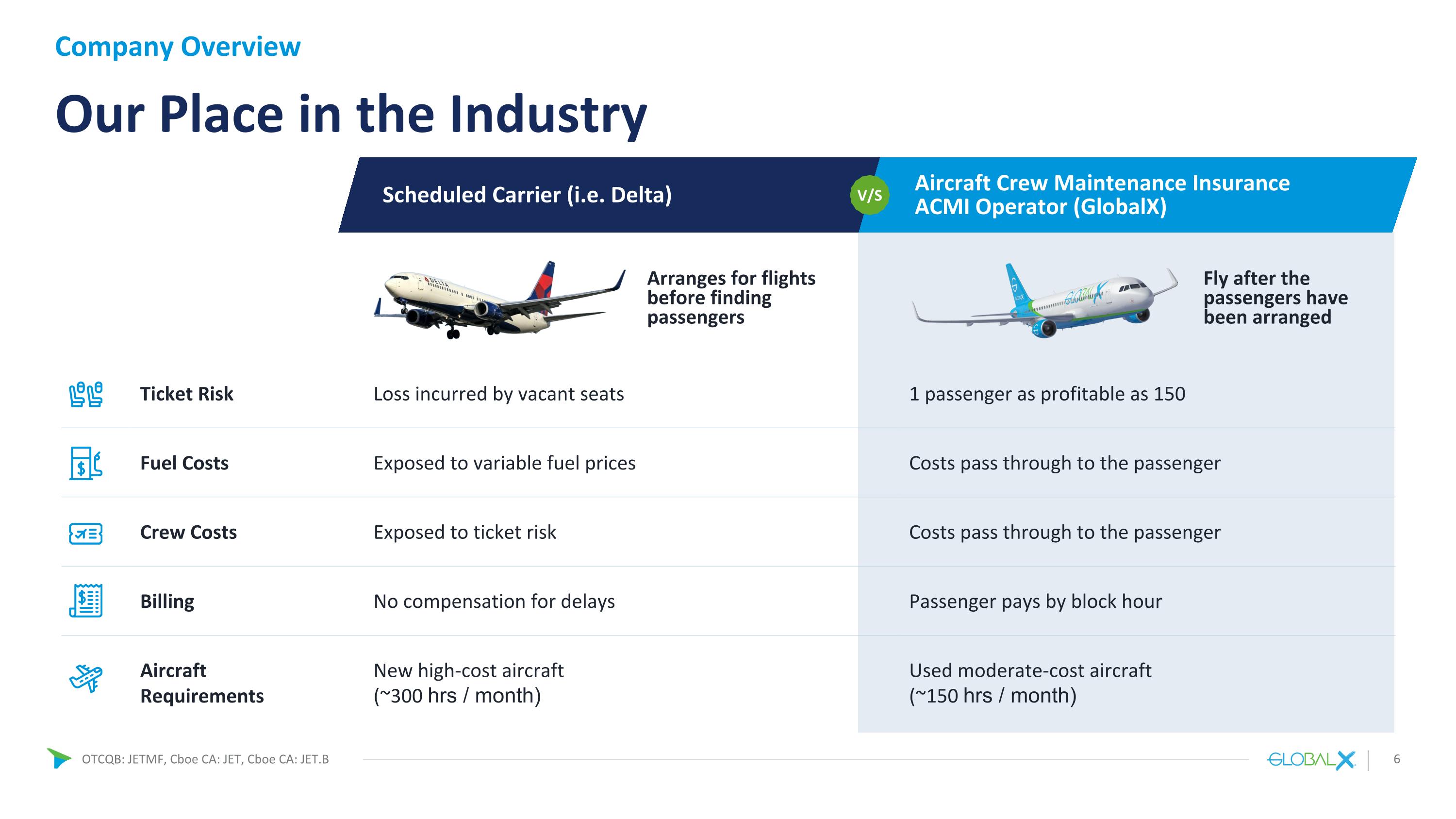
Our Place in the Industry Ticket Risk Loss incurred by vacant seats 1 passenger as profitable as 150 Fuel Costs Exposed to variable fuel prices Costs pass through to the passenger Crew Costs Exposed to ticket risk Costs pass through to the passenger Billing No compensation for delays Passenger pays by block hour Aircraft Requirements New high-cost aircraft (~300 hrs / month) Used moderate-cost aircraft (~150 hrs / month) Arranges for flights before finding passengers Scheduled Carrier (i.e. Delta) Fly after the passengers have been arranged Aircraft Crew Maintenance Insurance ACMI Operator (GlobalX) V/S Company Overview 6
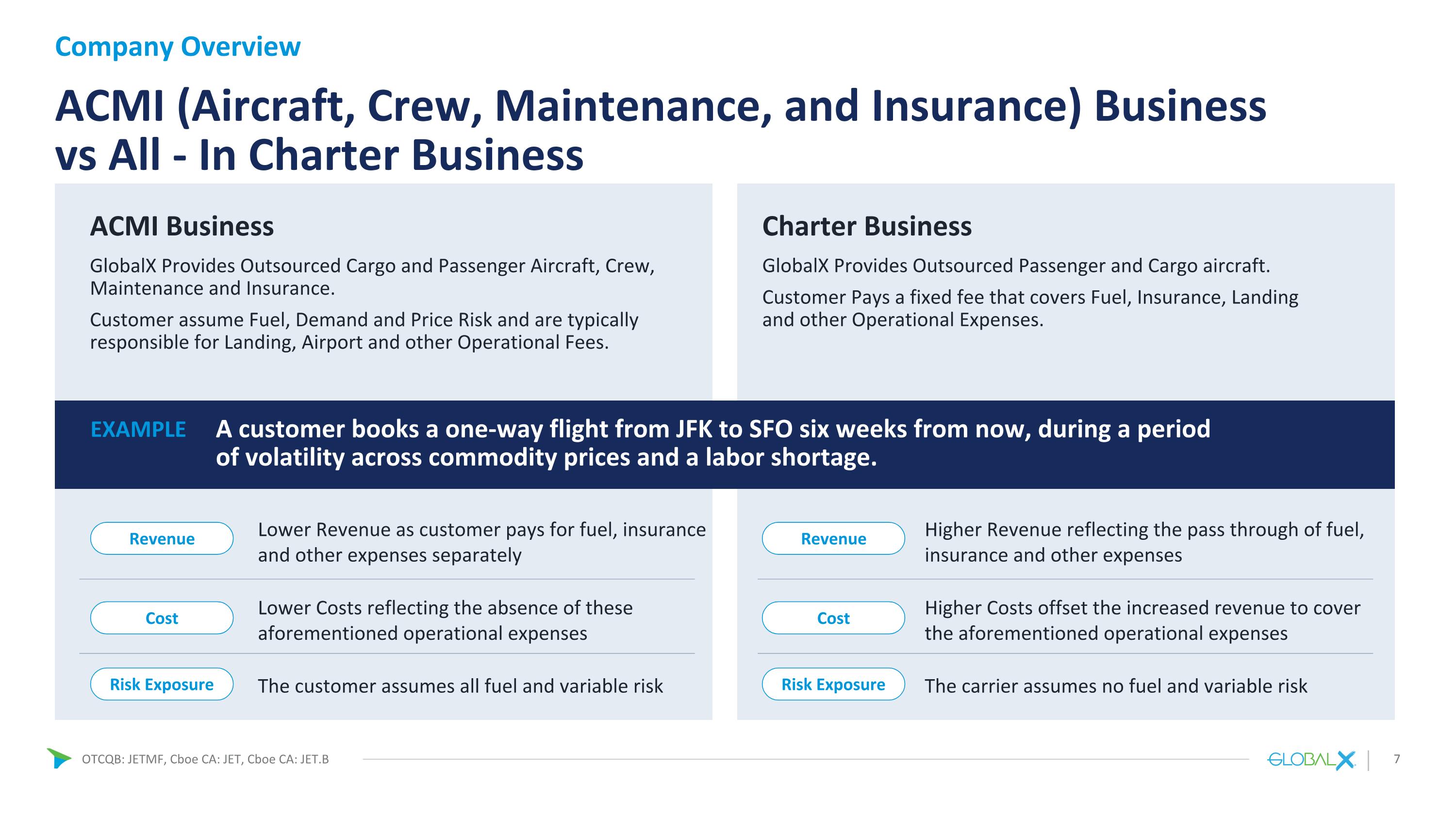
ACMI (Aircraft, Crew, Maintenance, and Insurance) Business vs All - In Charter Business ACMI Business Charter Business GlobalX Provides Outsourced Cargo and Passenger Aircraft, Crew, Maintenance and Insurance. Customer assume Fuel, Demand and Price Risk and are typically responsible for Landing, Airport and other Operational Fees. GlobalX Provides Outsourced Passenger and Cargo aircraft. Customer Pays a fixed fee that covers Fuel, Insurance, Landing and other Operational Expenses. Lower Revenue as customer pays for fuel, insurance and other expenses separately Lower Costs reflecting the absence of these aforementioned operational expenses The customer assumes all fuel and variable risk Revenue Cost Risk Exposure Higher Revenue reflecting the pass through of fuel, insurance and other expenses Higher Costs offset the increased revenue to cover the aforementioned operational expenses The carrier assumes no fuel and variable risk Revenue Cost Risk Exposure Company Overview 7 A customer books a one-way flight from JFK to SFO six weeks from now, during a period of volatility across commodity prices and a labor shortage. EXAMPLE
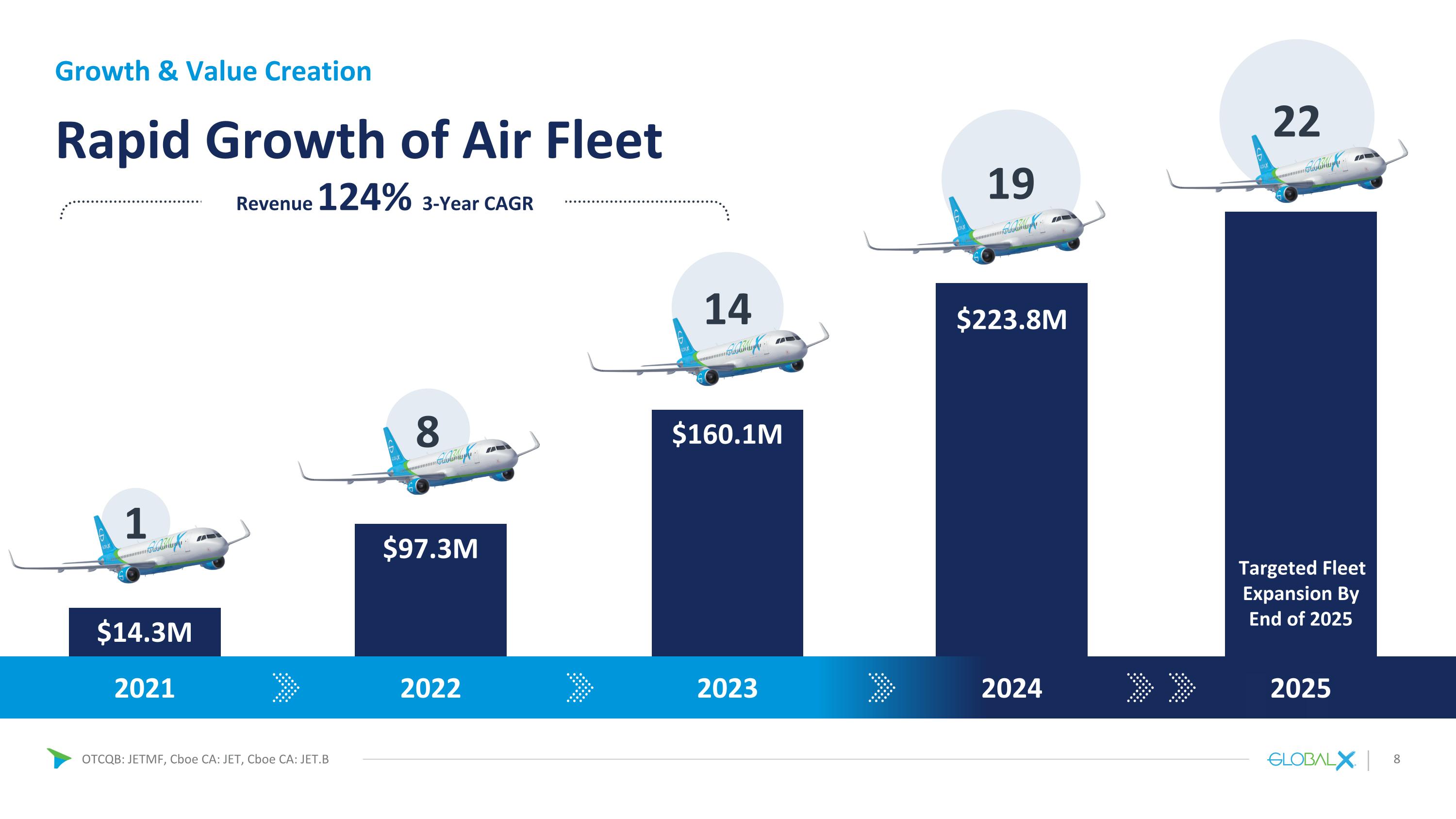
22 Rapid Growth of Air Fleet 2021 2022 2023 2024 14 19 1 8 2025 $14.3M $97.3M $160.1M Revenue 124% 3-Year CAGR Growth & Value Creation 8 $223.8M Targeted Fleet Expansion By End of 2025
Geographically dispersed operating bases, driven by anchor client contracts, allow us to operate a more cost effective, flexible, and reactive operation. The optimal distance for winning charter business is to quote aircraft repositioning within 3.0 hours from the starting and ending airport of each client. Having the majority of the U.S. airports within 3.0 hours of one of our operating bases creates a competitive advantage unmatched by our competitive set. With fewer reposition hours we win more business than our competitors and increase market share. Our aircraft have longer range capability (4.5 hours vs 3.0 hours), however our basing strategy maximizes reaction time. Current base locations include: Miami, FL, Alexandria, LA, and Harlingen, TX Fleet presence in multiple Southern United States bases allows: Sales efforts and pricing to be competitive for clients across the US Enhanced reaction time for immediate need contracts/IROP support for other carriers and clients Reduced time and cost in responding to internal reflow/IROP support for internal needs Reduced costs associated with crew movement, driven by local crew bases Reduced ferry cost for maintenance events Strategic Bases: Enhancing Efficiency & Market Reach Our Operations 9
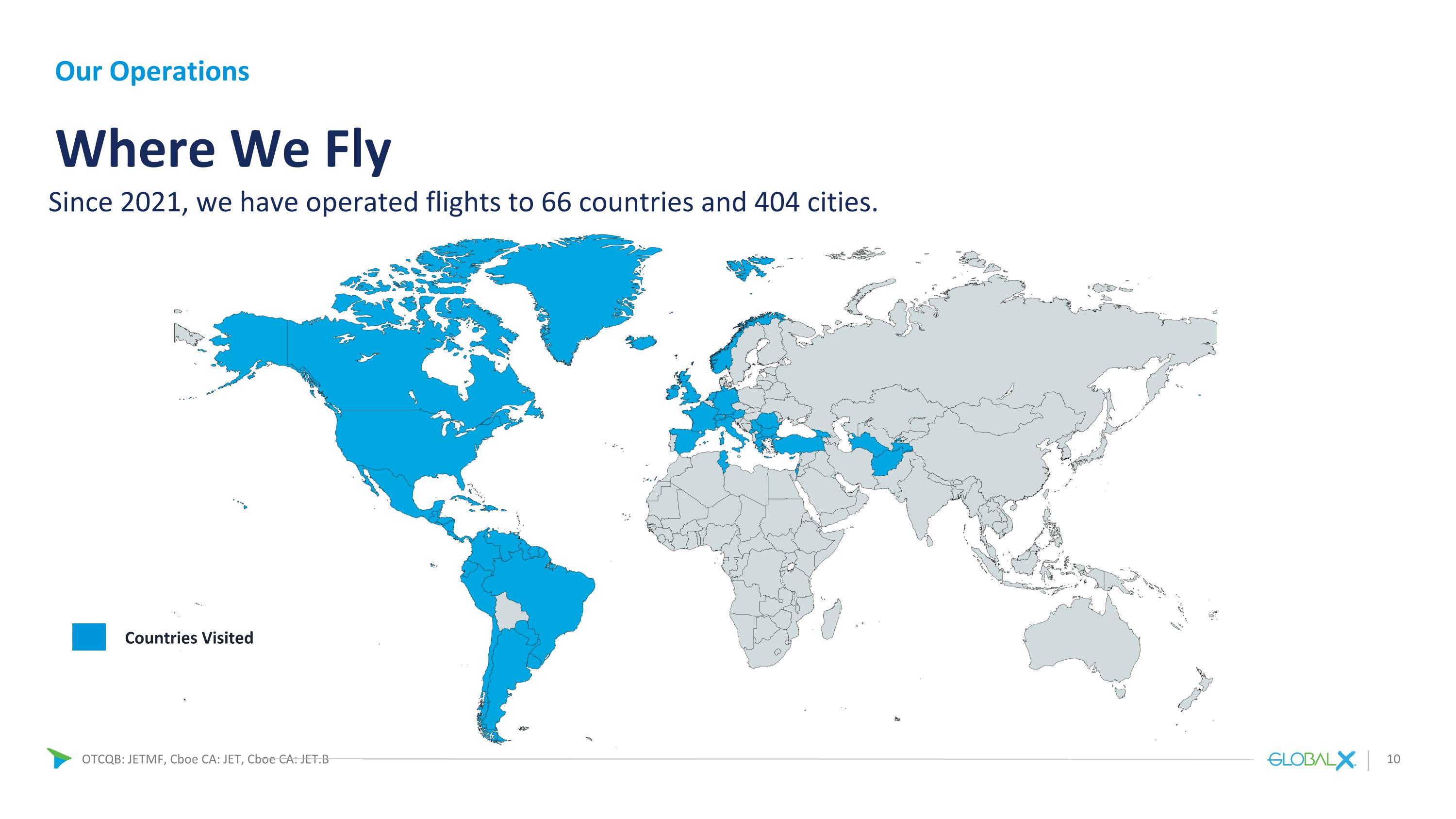
Where We Fly Since 2021, we have operated flights to 66 countries and 404 cities. Countries Visited Our Operations 10

Financials 11
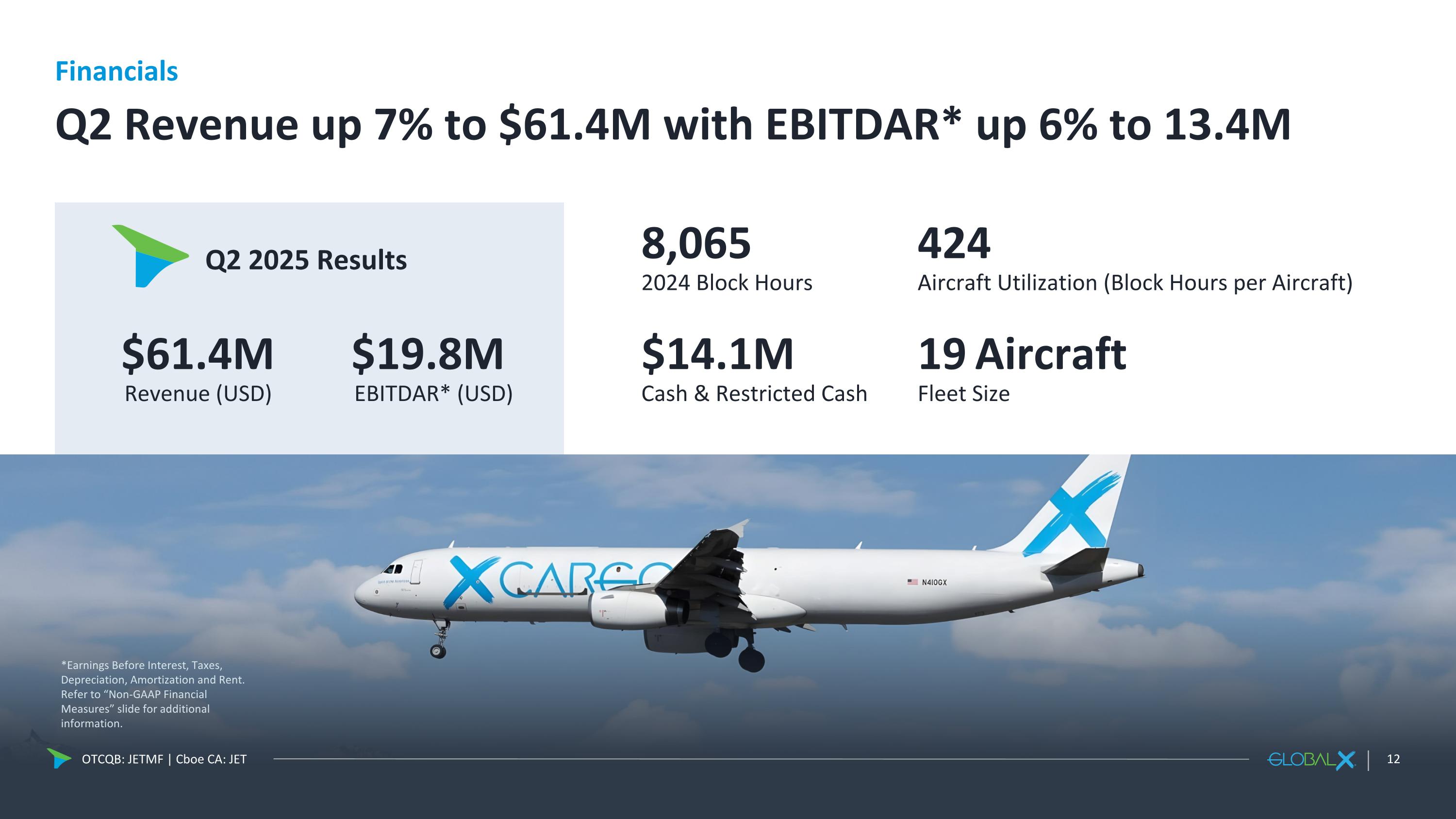
Q2 2025 Results Q2 Revenue up 7% to $61.4M with EBITDAR* up 6% to 13.4M $61.4M Revenue (USD) $19.8M EBITDAR* (USD) 19 Aircraft Fleet Size $14.1M Cash & Restricted Cash 424 Aircraft Utilization (Block Hours per Aircraft) 8,065 2024 Block Hours *Earnings Before Interest, Taxes, Depreciation, Amortization and Rent. Refer to “Non-GAAP Financial Measures” slide for additional information. Financials OTCQB: JETMF | Cboe CA: JET
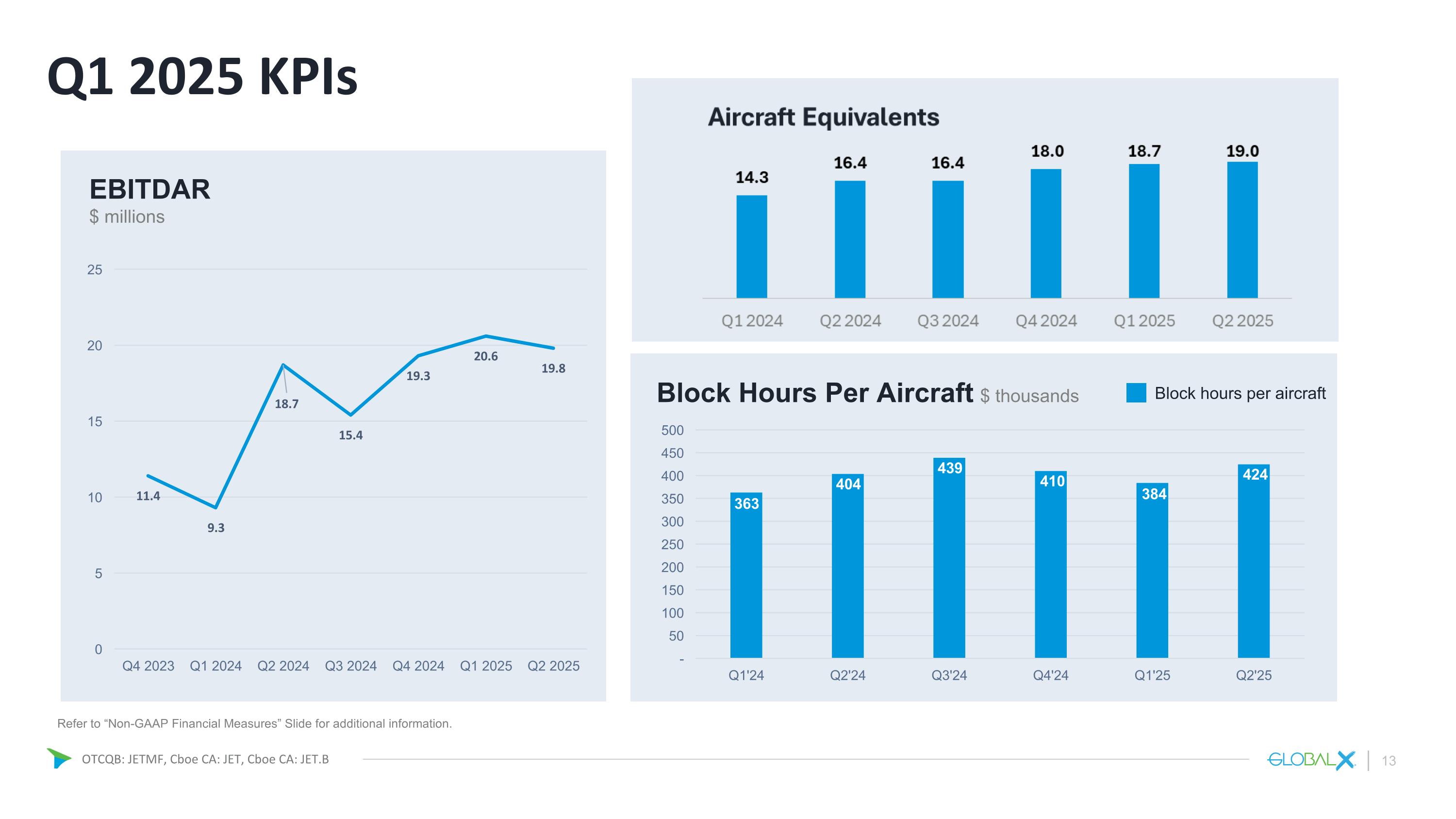
Q1 2025 KPIs 13 Refer to “Non-GAAP Financial Measures” Slide for additional information. EBITDAR $ millions Block Hours Per Aircraft $ thousands Block hours per aircraft 363 404 439 410 384 424
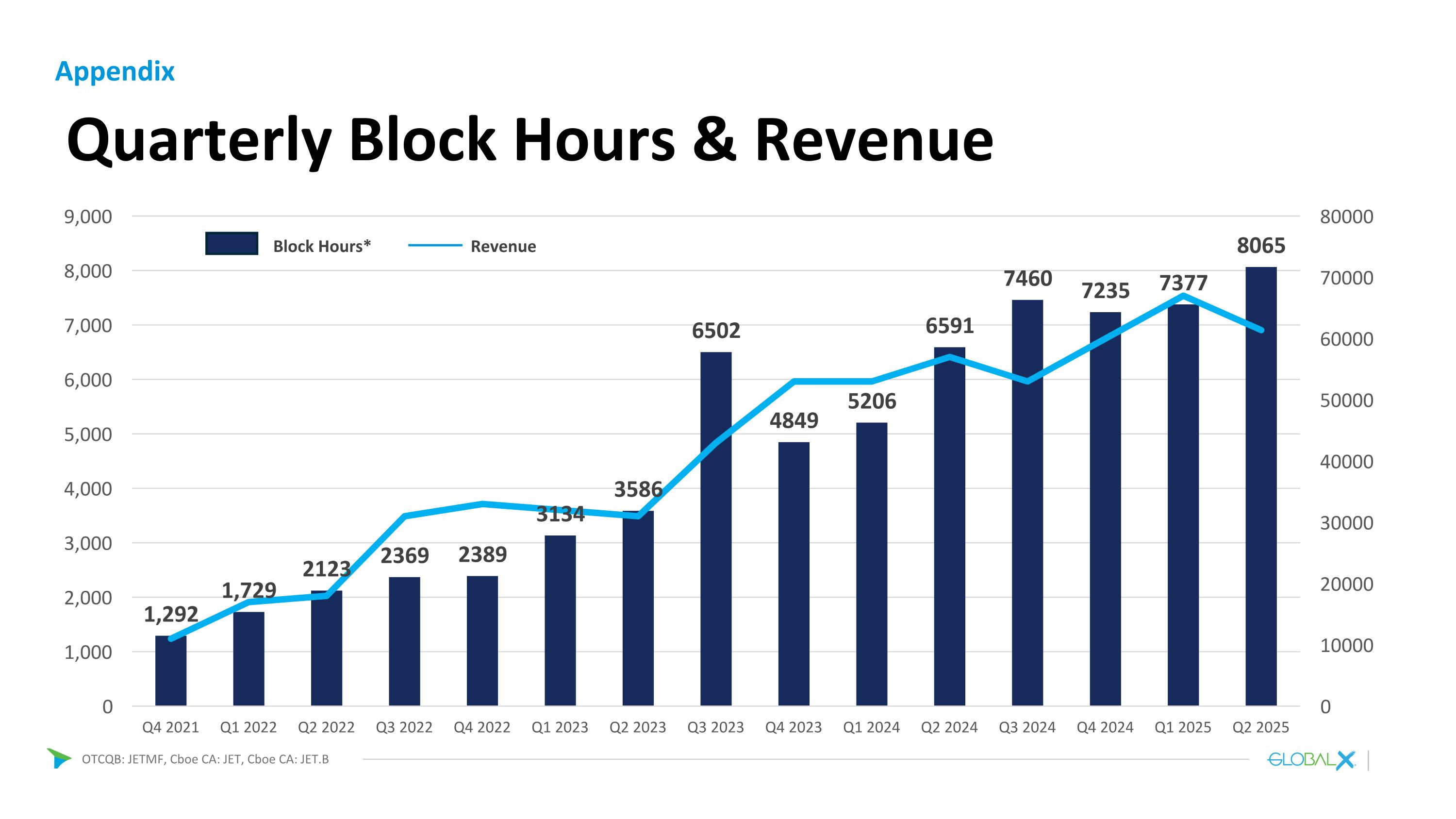
Quarterly Block Hours & Revenue Appendix Block Hours* Revenue
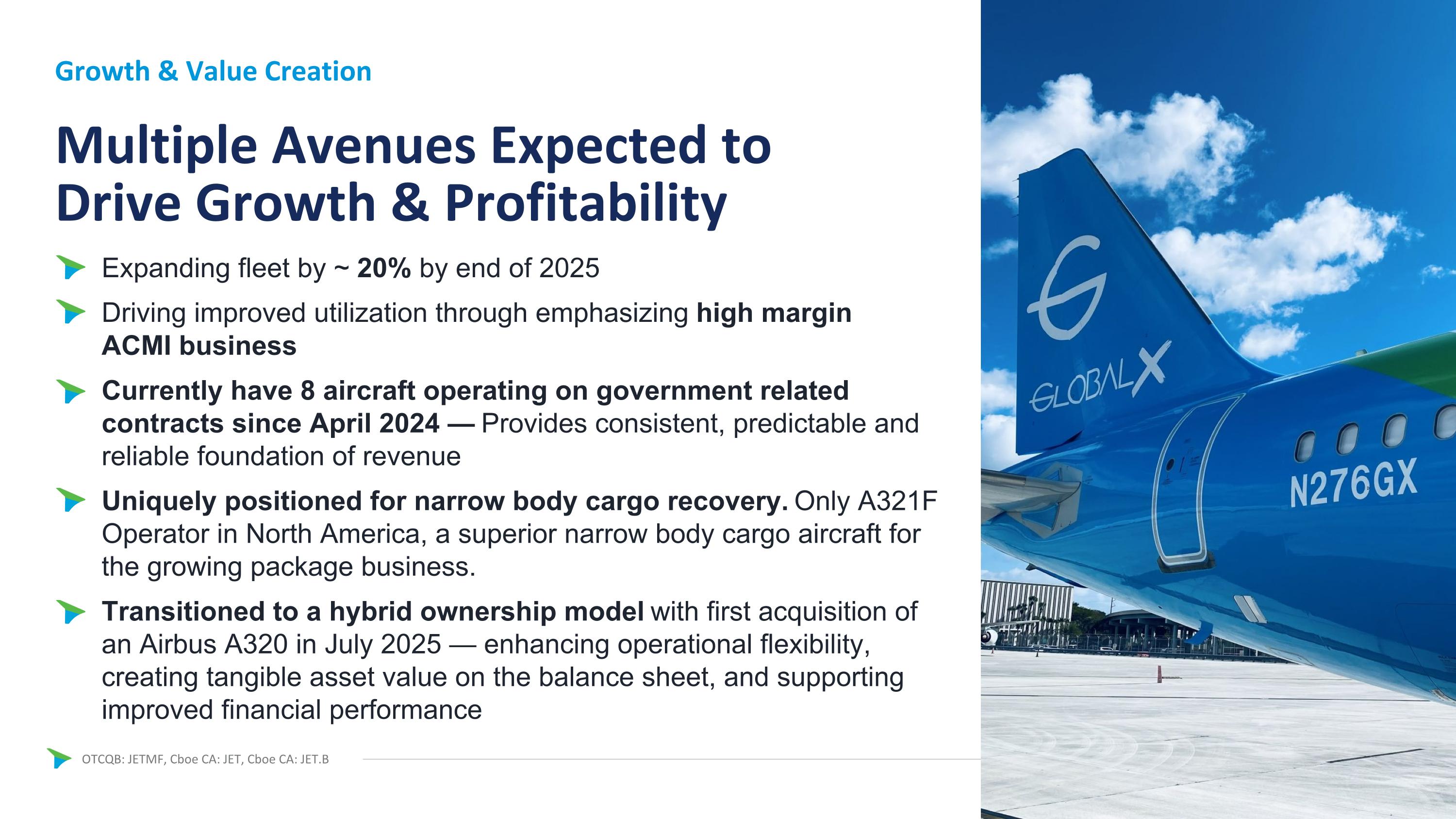
Expanding fleet by ~ 20% by end of 2025 Driving improved utilization through emphasizing high margin ACMI business Currently have 8 aircraft operating on government related contracts since April 2024 — Provides consistent, predictable and reliable foundation of revenue Uniquely positioned for narrow body cargo recovery. Only A321F Operator in North America, a superior narrow body cargo aircraft for the growing package business. Transitioned to a hybrid ownership model with first acquisition of an Airbus A320 in July 2025 — enhancing operational flexibility, creating tangible asset value on the balance sheet, and supporting improved financial performance Multiple Avenues Expected to Drive Growth & Profitability Growth & Value Creation
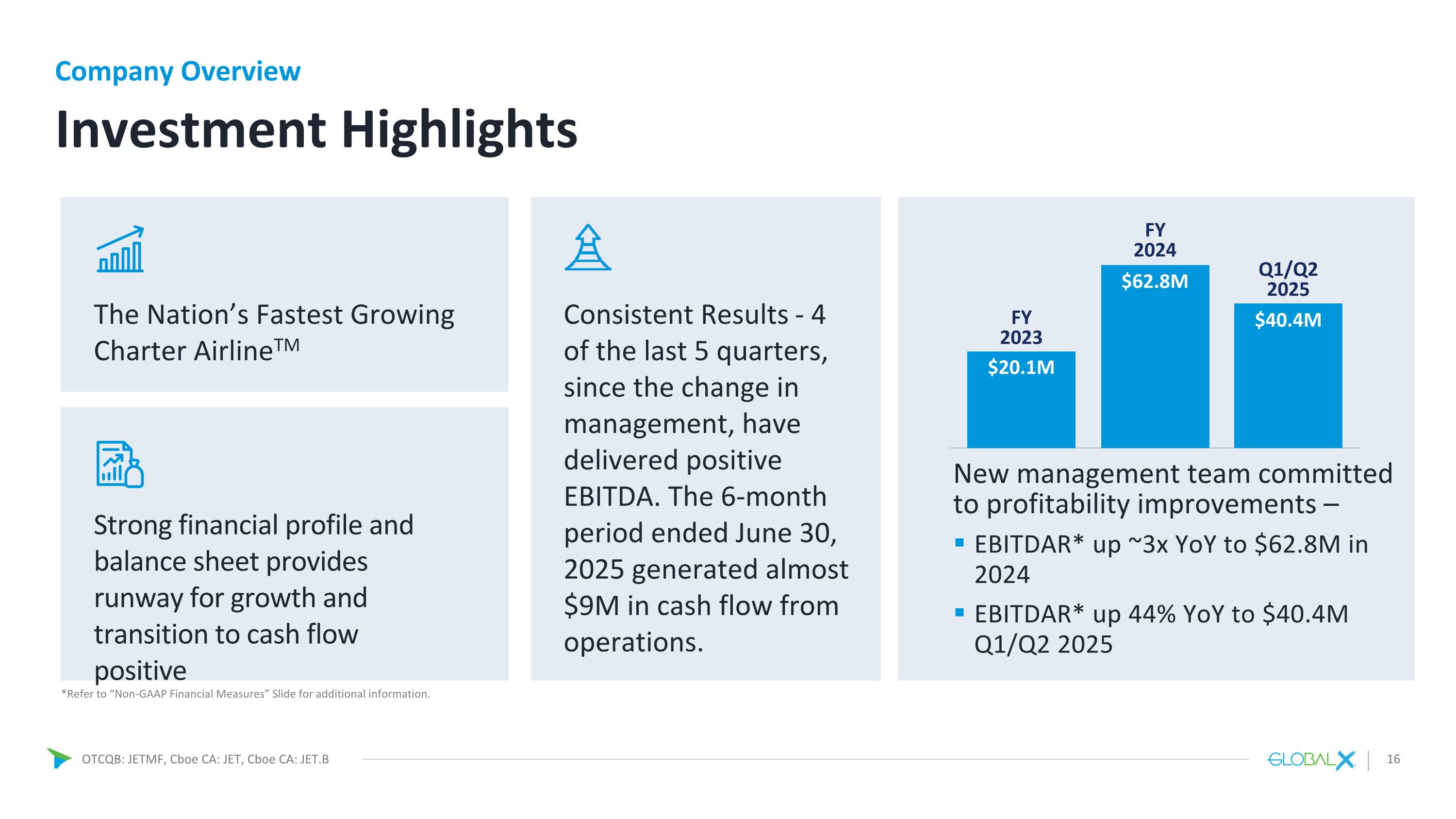
Investment Highlights The Nation’s Fastest Growing Charter AirlineTM Strong financial profile and balance sheet provides runway for growth and transition to cash flow positive Consistent Results - 4 of the last 5 quarters, since the change in management, have delivered positive EBITDA. The 6-month period ended June 30, 2025 generated almost $9M in cash flow from operations. New management team committed to profitability improvements – EBITDAR* up ~3x YoY to $62.8M in 2024 EBITDAR* up 44% YoY to $40.4M Q1/Q2 2025 Company Overview 16 *Refer to “Non-GAAP Financial Measures” Slide for additional information. $20.1M FY 2023 FY 2024 $62.8M $40.4M Q1/Q2 2025
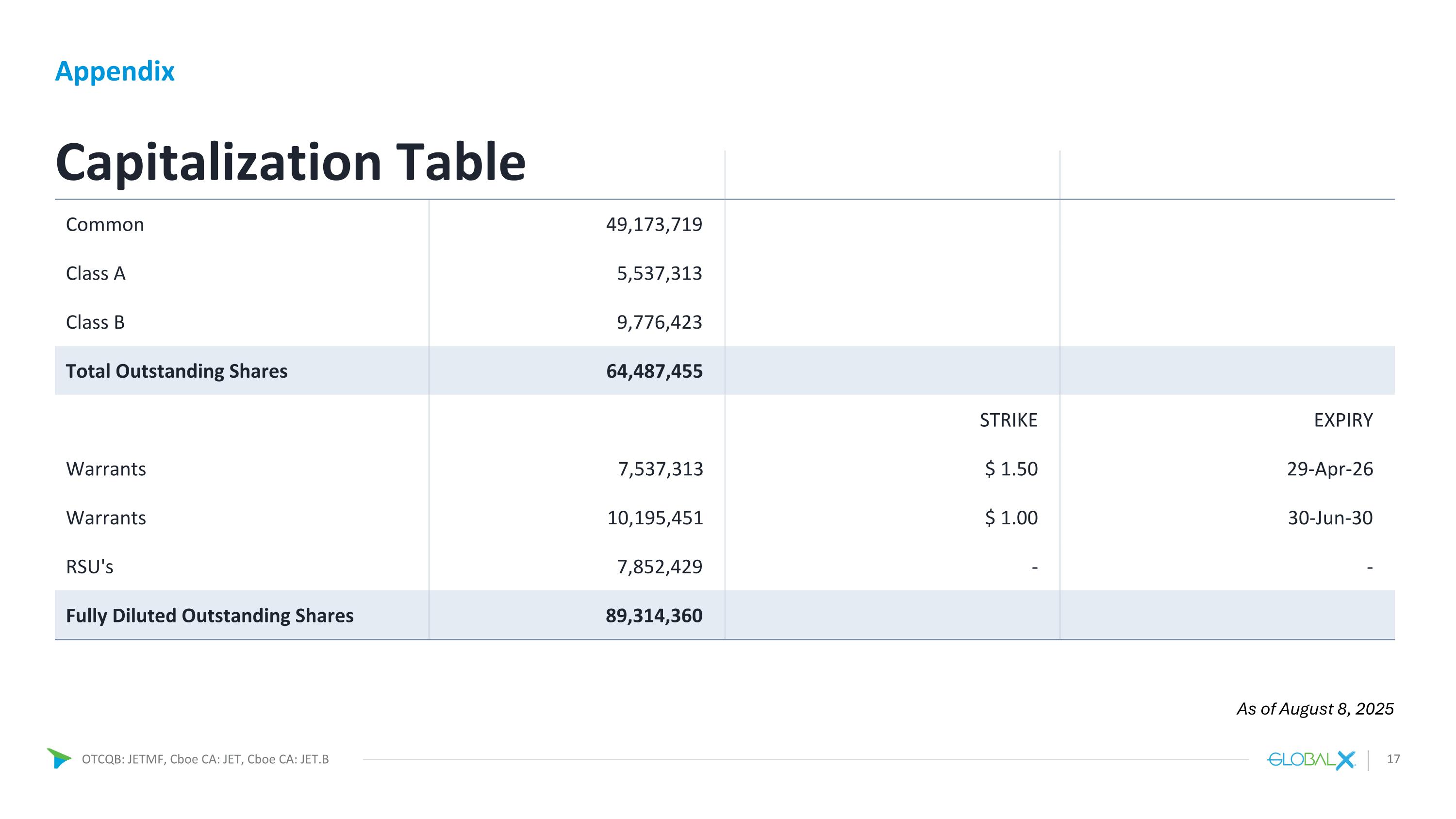
Capitalization Table Common 49,173,719 Class A 5,537,313 Class B 9,776,423 Total Outstanding Shares 64,487,455 STRIKE EXPIRY Warrants 7,537,313 $ 1.50 29-Apr-26 Warrants 10,195,451 $ 1.00 30-Jun-30 RSU's 7,852,429 - - Fully Diluted Outstanding Shares 89,314,360 Appendix 17 As of August 8, 2025
Thank you! Corporate Office Global Crossing Airlines Group 4200 NW 36th Street, Building 5A Miami International Airport Miami, FL (786) 751-85500 Investor Relations Contact Sean Mansouri, CFA | Aaron D’Souza jet@elevate-ir.com (720) 330-2829 18

19 19 Appendix
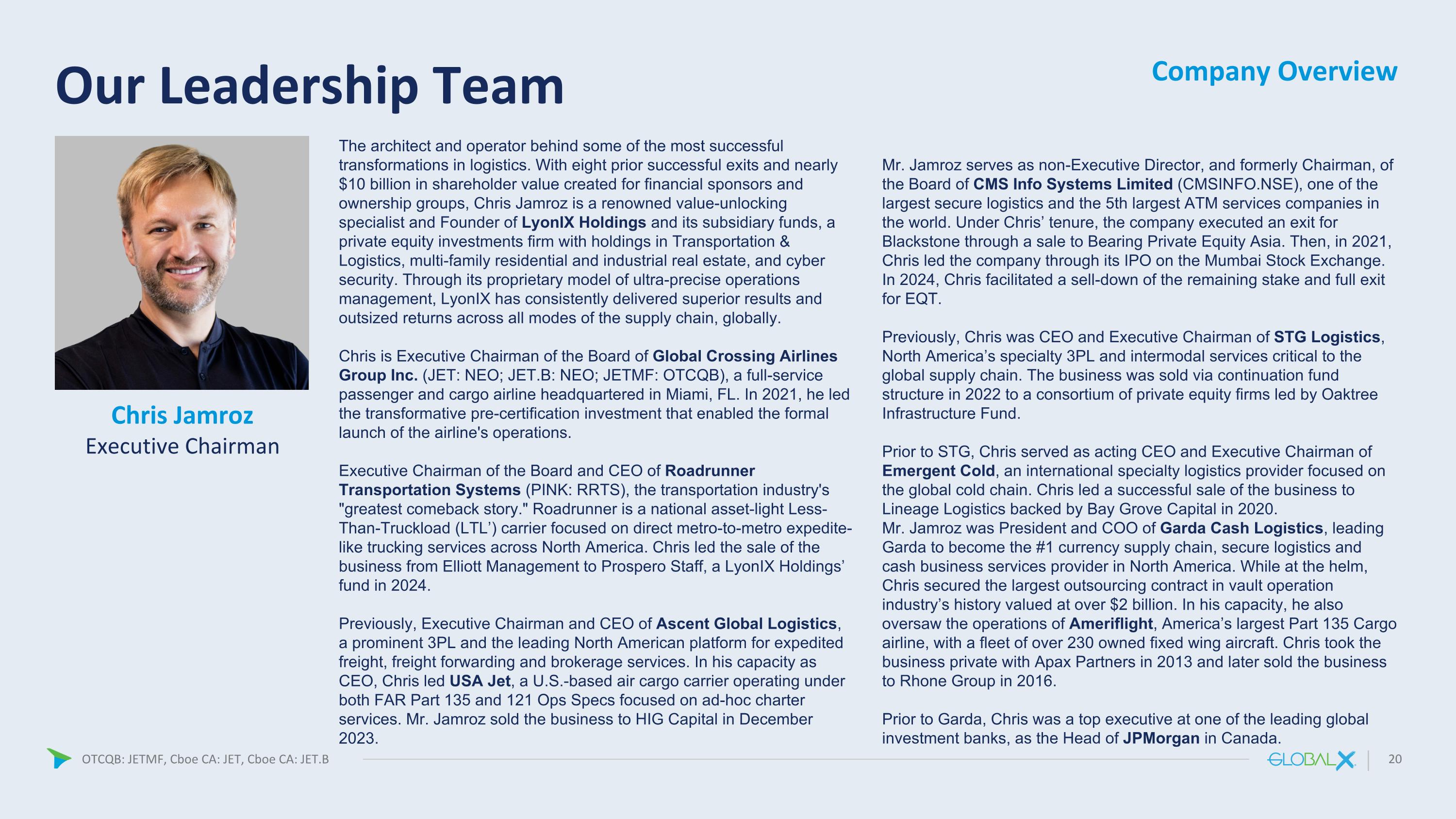
Chris Jamroz Executive Chairman Our Leadership Team Company Overview 20 OTCQB: JETMF, Cboe CA: JET, Cboe CA: JET.B The architect and operator behind some of the most successful transformations in logistics. With eight prior successful exits and nearly $10 billion in shareholder value created for financial sponsors and ownership groups, Chris Jamroz is a renowned value-unlocking specialist and Founder of LyonIX Holdings and its subsidiary funds, a private equity investments firm with holdings in Transportation & Logistics, multi-family residential and industrial real estate, and cyber security. Through its proprietary model of ultra-precise operations management, LyonIX has consistently delivered superior results and outsized returns across all modes of the supply chain, globally. Chris is Executive Chairman of the Board of Global Crossing Airlines Group Inc. (JET: NEO; JET.B: NEO; JETMF: OTCQB), a full-service passenger and cargo airline headquartered in Miami, FL. In 2021, he led the transformative pre-certification investment that enabled the formal launch of the airline's operations. Executive Chairman of the Board and CEO of Roadrunner Transportation Systems (PINK: RRTS), the transportation industry's "greatest comeback story." Roadrunner is a national asset-light Less-Than-Truckload (LTL’) carrier focused on direct metro-to-metro expedite-like trucking services across North America. Chris led the sale of the business from Elliott Management to Prospero Staff, a LyonIX Holdings’ fund in 2024. Previously, Executive Chairman and CEO of Ascent Global Logistics, a prominent 3PL and the leading North American platform for expedited freight, freight forwarding and brokerage services. In his capacity as CEO, Chris led USA Jet, a U.S.-based air cargo carrier operating under both FAR Part 135 and 121 Ops Specs focused on ad-hoc charter services. Mr. Jamroz sold the business to HIG Capital in December 2023. Mr. Jamroz serves as non-Executive Director, and formerly Chairman, of the Board of CMS Info Systems Limited (CMSINFO.NSE), one of the largest secure logistics and the 5th largest ATM services companies in the world. Under Chris’ tenure, the company executed an exit for Blackstone through a sale to Bearing Private Equity Asia. Then, in 2021, Chris led the company through its IPO on the Mumbai Stock Exchange. In 2024, Chris facilitated a sell-down of the remaining stake and full exit for EQT. Previously, Chris was CEO and Executive Chairman of STG Logistics, North America’s specialty 3PL and intermodal services critical to the global supply chain. The business was sold via continuation fund structure in 2022 to a consortium of private equity firms led by Oaktree Infrastructure Fund. Prior to STG, Chris served as acting CEO and Executive Chairman of Emergent Cold, an international specialty logistics provider focused on the global cold chain. Chris led a successful sale of the business to Lineage Logistics backed by Bay Grove Capital in 2020. Mr. Jamroz was President and COO of Garda Cash Logistics, leading Garda to become the #1 currency supply chain, secure logistics and cash business services provider in North America. While at the helm, Chris secured the largest outsourcing contract in vault operation industry’s history valued at over $2 billion. In his capacity, he also oversaw the operations of Ameriflight, America’s largest Part 135 Cargo airline, with a fleet of over 230 owned fixed wing aircraft. Chris took the business private with Apax Partners in 2013 and later sold the business to Rhone Group in 2016. Prior to Garda, Chris was a top executive at one of the leading global investment banks, as the Head of JPMorgan in Canada.
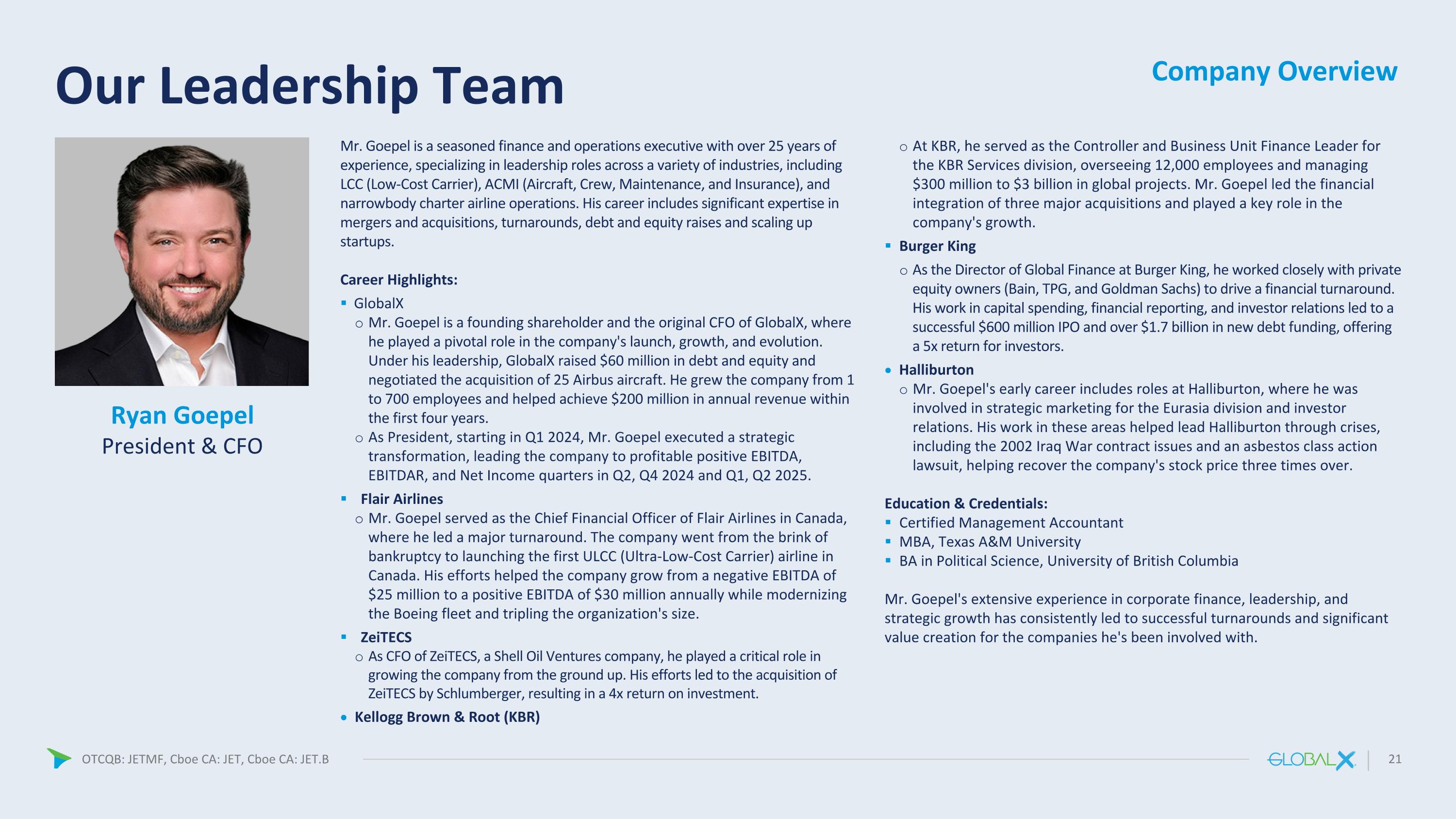
Mr. Goepel is a seasoned finance and operations executive with over 25 years of experience, specializing in leadership roles across a variety of industries, including LCC (Low-Cost Carrier), ACMI (Aircraft, Crew, Maintenance, and Insurance), and narrowbody charter airline operations. His career includes significant expertise in mergers and acquisitions, turnarounds, debt and equity raises and scaling up startups. Career Highlights: GlobalX Mr. Goepel is a founding shareholder and the original CFO of GlobalX, where he played a pivotal role in the company's launch, growth, and evolution. Under his leadership, GlobalX raised $60 million in debt and equity and negotiated the acquisition of 25 Airbus aircraft. He grew the company from 1 to 700 employees and helped achieve $200 million in annual revenue within the first four years. As President, starting in Q1 2024, Mr. Goepel executed a strategic transformation, leading the company to profitable positive EBITDA, EBITDAR, and Net Income quarters in Q2, Q4 2024 and Q1, Q2 2025. Flair Airlines Mr. Goepel served as the Chief Financial Officer of Flair Airlines in Canada, where he led a major turnaround. The company went from the brink of bankruptcy to launching the first ULCC (Ultra-Low-Cost Carrier) airline in Canada. His efforts helped the company grow from a negative EBITDA of $25 million to a positive EBITDA of $30 million annually while modernizing the Boeing fleet and tripling the organization's size. ZeiTECS As CFO of ZeiTECS, a Shell Oil Ventures company, he played a critical role in growing the company from the ground up. His efforts led to the acquisition of ZeiTECS by Schlumberger, resulting in a 4x return on investment. Kellogg Brown & Root (KBR) At KBR, he served as the Controller and Business Unit Finance Leader for the KBR Services division, overseeing 12,000 employees and managing $300 million to $3 billion in global projects. Mr. Goepel led the financial integration of three major acquisitions and played a key role in the company's growth. Burger King As the Director of Global Finance at Burger King, he worked closely with private equity owners (Bain, TPG, and Goldman Sachs) to drive a financial turnaround. His work in capital spending, financial reporting, and investor relations led to a successful $600 million IPO and over $1.7 billion in new debt funding, offering a 5x return for investors. Halliburton Mr. Goepel's early career includes roles at Halliburton, where he was involved in strategic marketing for the Eurasia division and investor relations. His work in these areas helped lead Halliburton through crises, including the 2002 Iraq War contract issues and an asbestos class action lawsuit, helping recover the company's stock price three times over. Education & Credentials: Certified Management Accountant MBA, Texas A&M University BA in Political Science, University of British Columbia Mr. Goepel's extensive experience in corporate finance, leadership, and strategic growth has consistently led to successful turnarounds and significant value creation for the companies he's been involved with. Ryan Goepel President & CFO Our Leadership Team Company Overview 21 OTCQB: JETMF, Cboe CA: JET, Cboe CA: JET.B
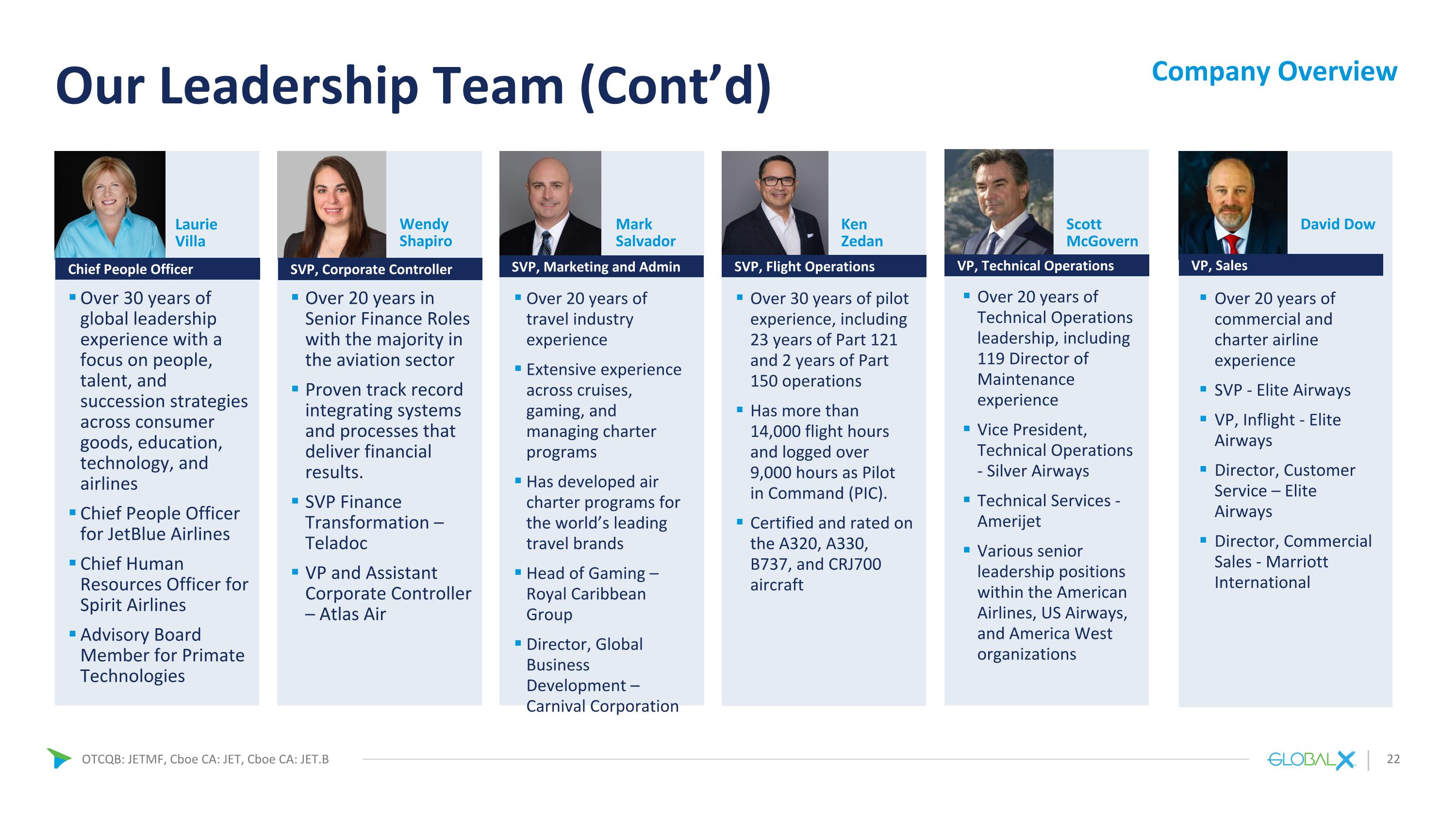
Over 30 years of global leadership experience with a focus on people, talent, and succession strategies across consumer goods, education, technology, and airlines Chief People Officer for JetBlue Airlines Chief Human Resources Officer for Spirit Airlines Advisory Board Member for Primate Technologies Laurie Villa Over 20 years in Senior Finance Roles with the majority in the aviation sector Proven track record integrating systems and processes that deliver financial results. SVP Finance Transformation – Teladoc VP and Assistant Corporate Controller – Atlas Air Wendy Shapiro Over 20 years of travel industry experience Extensive experience across cruises, gaming, and managing charter programs Has developed air charter programs for the world’s leading travel brands Head of Gaming – Royal Caribbean Group Director, Global Business Development – Carnival Corporation Mark Salvador Over 20 years of commercial and charter airline experience SVP - Elite Airways VP, Inflight - Elite Airways Director, Customer Service – Elite Airways Director, Commercial Sales - Marriott International David Dow Ken Zedan Over 30 years of pilot experience, including 23 years of Part 121 and 2 years of Part 150 operations Has more than 14,000 flight hours and logged over 9,000 hours as Pilot in Command (PIC). Certified and rated on the A320, A330, B737, and CRJ700 aircraft Our Leadership Team (Cont’d) 22 Company Overview Over 20 years of Technical Operations leadership, including 119 Director of Maintenance experience Vice President, Technical Operations - Silver Airways Technical Services - Amerijet Various senior leadership positions within the American Airlines, US Airways, and America West organizations Scott McGovern Chief People Officer SVP, Corporate Controller SVP, Marketing and Admin SVP, Flight Operations VP, Technical Operations VP, Sales
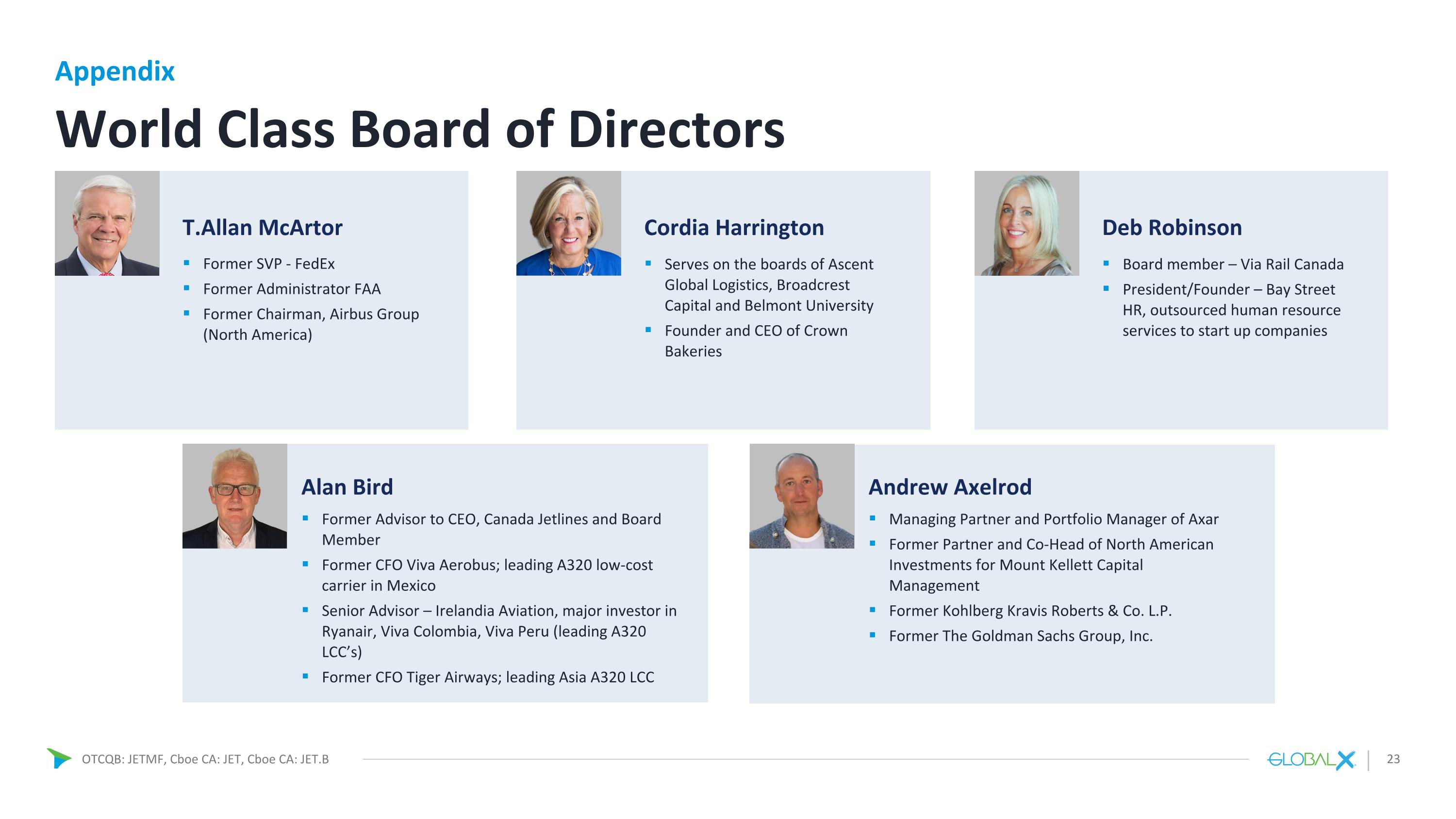
Former SVP - FedEx Former Administrator FAA Former Chairman, Airbus Group (North America) World Class Board of Directors Andrew Axelrod Alan Bird T.Allan McArtor Cordia Harrington Deb Robinson Board member – Via Rail Canada President/Founder – Bay Street HR, outsourced human resource services to start up companies Serves on the boards of Ascent Global Logistics, Broadcrest Capital and Belmont University Founder and CEO of Crown Bakeries Former Advisor to CEO, Canada Jetlines and Board Member Former CFO Viva Aerobus; leading A320 low-cost carrier in Mexico Senior Advisor – Irelandia Aviation, major investor in Ryanair, Viva Colombia, Viva Peru (leading A320 LCC’s) Former CFO Tiger Airways; leading Asia A320 LCC Managing Partner and Portfolio Manager of Axar Former Partner and Co-Head of North American Investments for Mount Kellett Capital Management Former Kohlberg Kravis Roberts & Co. L.P. Former The Goldman Sachs Group, Inc. Appendix 23
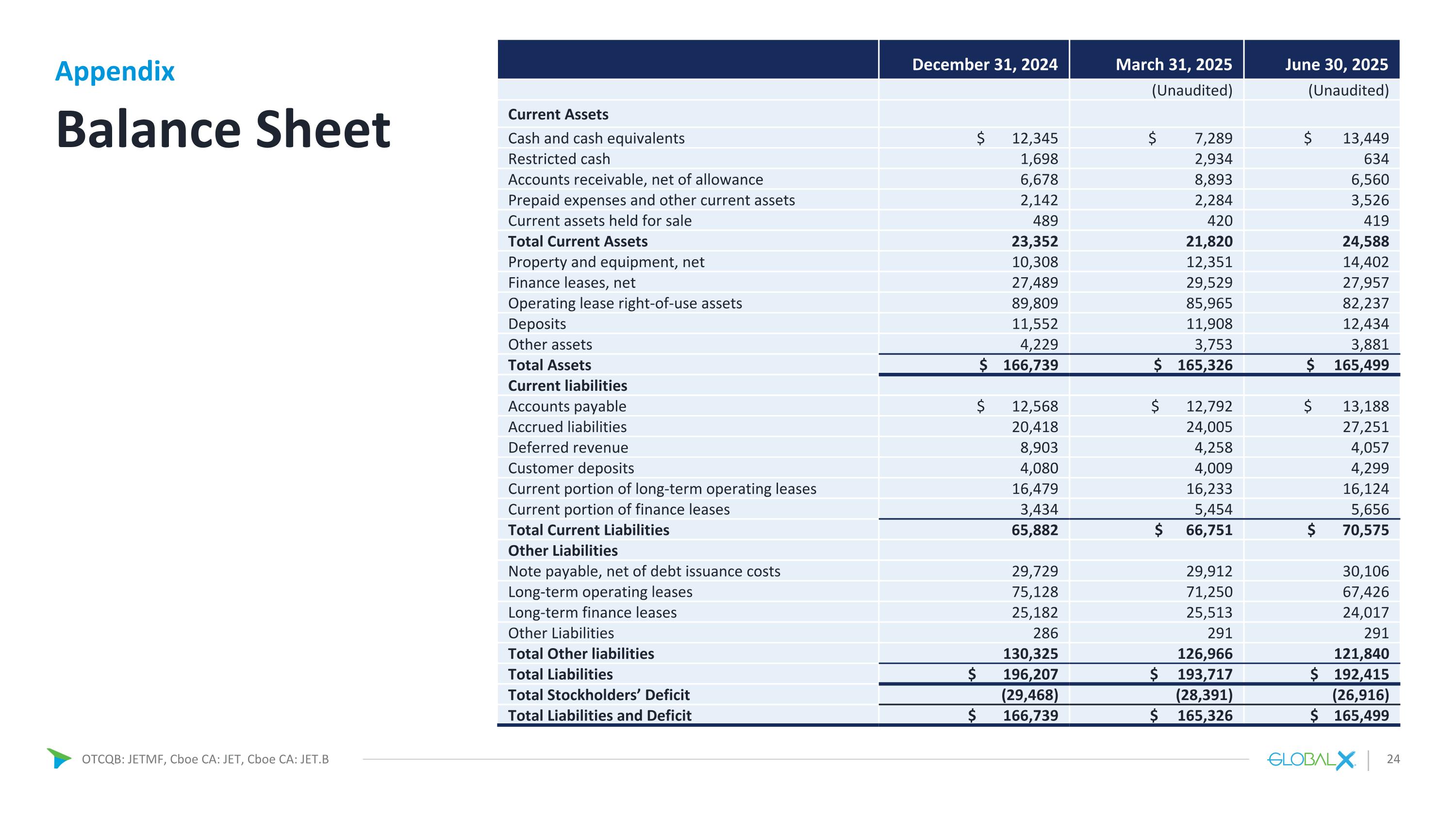
December 31, 2024 March 31, 2025 June 30, 2025 (Unaudited) (Unaudited) Current Assets Cash and cash equivalents $ 12,345 $ 7,289 $ 13,449 Restricted cash 1,698 2,934 634 Accounts receivable, net of allowance 6,678 8,893 6,560 Prepaid expenses and other current assets 2,142 2,284 3,526 Current assets held for sale 489 420 419 Total Current Assets 23,352 21,820 24,588 Property and equipment, net 10,308 12,351 14,402 Finance leases, net 27,489 29,529 27,957 Operating lease right-of-use assets 89,809 85,965 82,237 Deposits 11,552 11,908 12,434 Other assets 4,229 3,753 3,881 Total Assets $ 166,739 $ 165,326 $ 165,499 Current liabilities Accounts payable $ 12,568 $ 12,792 $ 13,188 Accrued liabilities 20,418 24,005 27,251 Deferred revenue 8,903 4,258 4,057 Customer deposits 4,080 4,009 4,299 Current portion of long-term operating leases 16,479 16,233 16,124 Current portion of finance leases 3,434 5,454 5,656 Total Current Liabilities 65,882 $ 66,751 $ 70,575 Other Liabilities Note payable, net of debt issuance costs 29,729 29,912 30,106 Long-term operating leases 75,128 71,250 67,426 Long-term finance leases 25,182 25,513 24,017 Other Liabilities 286 291 291 Total Other liabilities 130,325 126,966 121,840 Total Liabilities $ 196,207 $ 193,717 $ 192,415 Total Stockholders’ Deficit (29,468) (28,391) (26,916) Total Liabilities and Deficit $ 166,739 $ 165,326 $ 165,499 Balance Sheet Appendix