JMSB 8-K
John Marshall Bancorp, Inc. (JMSB)
UNITED STATES
SECURITIES AND EXCHANGE COMMISSION
Washington, D.C. 20549
FORM
CURRENT REPORT
Pursuant to Section 13 or 15(d) of the Securities Exchange Act of 1934
Date of Report (Date of earliest event reported):
(Exact name of registrant as specified in its charter)
|
| |||
(State or other jurisdiction of incorporation) |
| (Commission File Number) |
| (IRS Employer Identification No.) |
(Address, including zip code, of principal executive offices)
Registrant’s telephone number, including area code: (
Check the appropriate box below if the Form 8-K filing is intended to simultaneously satisfy the filing obligation of the registrant under any of the following provisions (see General Instruction A.2. below):
Written communications pursuant to Rule 425 under the Securities Act (17 CFR 230.425) | ||
Soliciting material pursuant to Rule 14a-12 under the Exchange Act (17 CFR 240.14a-12) | ||
Pre-commencement communications pursuant to Rule 14d-2(b) under the Exchange Act (17 CFR 240.14d-2(b)) | ||
Pre-commencement communications pursuant to Rule 13e-4(c) under the Exchange Act (17 CFR 240.13e-4(c)) |
Securities registered pursuant to Section 12(b) of the Act:
Title of each class registered |
| Trading symbol(s) |
| Name of each exchange on which registered |
|
|
Indicate by check mark whether the registrant is an emerging growth company as defined in Rule 405 of the Securities Act of 1933 (§230.405 of this chapter) or Rule 12b-2 of the Securities Exchange Act of 1934 (§240.12b-2 of this chapter).
Emerging growth company
If an emerging growth company, indicate by check mark if the registrant has elected not to use the extended transition period for complying with any new or revised financial accounting standards provided pursuant to Section 13(a) of the Exchange Act.
Item 7.01 Regulation FD Disclosure.
The management of John Marshall Bancorp, Inc. (the “Company”) will participate in the Raymond James 2023 U.S. Bank Conference in Chicago, IL on September 7, 2023. A copy of the presentation will be made available on the Investor Relations section of the Company’s website (http://www.johnmarshallbank.com) and is furnished as Exhibit 99.1 to this report.
Item 9.01 Financial Statements and Exhibits.
Exhibit No. |
| Description |
99.1 | Presentation for the Raymond James 2023 U.S. Bank Conference | |
104 | Cover Page Interactive Data File (embedded within the Inline XBRL document). | |
SIGNATURES
Pursuant to the requirements of the Securities Exchange Act of 1934, the registrant has duly caused this report to be signed on its behalf by the undersigned hereunto duly authorized.
|
| JOHN MARSHALL BANCORP, INC. | ||||
Date: September 7, 2023 |
|
| By: |
| /s/ Kent D. Carstater | |
|
|
| Kent D. Carstater Senior Executive Vice President, Chief Financial Officer | |||
| September 7, 2023 Raymond James U.S. Bank Conference 1 |
| Forward Looking Statements 2 In addition to historical information, this presentation contains forward-looking statements within the meaning of the Private Securities Litigation Reform Act of 1995 that are based on certain assumptions and describe future plans, strategies and expectations of the Company. These forward-looking statements are generally identified by use of the words “believe,” “expect,” “intend,” “anticipate,” “estimate,” “project,” “will,” “should,” “may,” “view,” “opportunity,” “potential,” or similar expressions or expressions of confidence. Our ability to predict results or the actual effect of future plans or strategies is inherently uncertain. Factors that could have a material adverse effect on the operations of the Company and the Bank include, but are not limited to, the following: the concentration of our business in the Washington, D.C. metropolitan area and the effect of changes in the economic, political and environmental conditions on this market; adequacy of our allowance for loan credit losses, allowance for unfunded commitments credit losses, and allowance for credit losses associated with our held-to-maturity and available-for-sale securities portfolios; deterioration of our asset quality; future performance of our loan portfolio with respect to recently originated loans; the level of prepayments on loans and mortgage-backed securities; liquidity, interest rate and operational risks associated with our business; changes in our financial condition or results of operations that reduce capital; our ability to maintain existing deposit relationships or attract new deposit relationships; changes in consumer spending, borrowing and savings habits; inflation and changes in interest rates that may reduce our margins or reduce the fair value of financial instruments; changes in the monetary and fiscal policies of the U.S. Government, including policies of the U.S. Treasury and the Board of Governors of the Federal Reserve System; additional risks related to new lines of business, products, product enhancements or services; increased competition with other financial institutions and fintech companies; adverse changes in the securities markets; changes in the financial condition or future prospects of issuers of securities that we own; our ability to maintain an effective risk management framework; changes in laws or government regulations or policies affecting financial institutions, including changes in regulatory structure and in regulatory fees and capital requirements; compliance with legislative or regulatory requirements; results of examination of us by our regulators, including the possibility that our regulators may require us to increase our allowance for credit losses or to write-down assets or take similar actions; potential claims, damages, and fines related to litigation or government actions; the effectiveness of our internal controls over financial reporting and our ability to remediate any future material weakness in our internal controls over financial reporting; geopolitical conditions, including acts or threats of terrorism and/or military conflicts, or actions taken by the U.S. or other governments in response to acts or threats of terrorism and/or military conflicts, negatively impacting business and economic conditions in the U.S. and abroad; the potential adverse effects of unusual and infrequently occurring events, such as weather-related disasters, terrorist acts, geopolitical conflicts (such as the ongoing war between Russia and Ukraine) or public health events (such as COVID-19), and of governmental and societal responses thereto; technological risks and developments, and cyber threats, attacks, or events; the additional requirements of being a public company; changes in accounting policies and practices; our ability to successfully capitalize on growth opportunities; our ability to retain key employees; deteriorating economic conditions, either nationally or in our market area, including higher unemployment and lower real estate values; implications of our status as a smaller reporting company and as an emerging growth company; and other factors discussed in the Company’s reports (such as our Annual Report on Form 10-K, Quarterly Reports on Form 10-Q and Current Reports on Form 8-K) filed with the Securities and Exchange Commission. These risks and uncertainties should be considered in evaluating forward-looking statements and undue reliance should not be placed on such statements. The Company does not undertake, and specifically disclaims any obligation, to publicly release the result of any revisions which may be made to any forward-looking statements to reflect events or circumstances after the date of such statements or to reflect the occurrence of anticipated or unanticipated events. Annualized, projected and estimated numbers are used for illustrative purpose only, are not forecasts and may not reflect actual results. Use of Non-GAAP Financial Measures This presentation contains certain financial information determined by methods other than in accordance with generally accepted accounting principles in the United States (“GAAP”). These non-GAAP financial measures are a supplement to GAAP, which is used to prepare the Company’s financial statements, and should not be considered in isolation or as a substitute for comparable measures calculated in accordance with GAAP. In addition, the Company’s non-GAAP financial measures may not be comparable to non-GAAP financial measures of other companies. The Company uses the non-GAAP financial measures discussed herein in its analysis of the Company’s performance. Management believes that the supplemental non-GAAP information provides a better comparison of the impact of unrealized losses on the Company’s bond portfolio on the Bank’s book value and regulatory capital ratios. Additionally, the Company believes this information is utilized by regulators and market analysts to evaluate a company’s financial condition and therefore, such information is useful to investors. |
| 3 Franchise Overview Financial Highlights Credit & Asset Quality Funding & Liquidity Appendices |
| Company Overview 4 John Marshall Bank is a growth-oriented commercial bank headquartered in Reston, Virginia Established in 2006, the Company has grown organically to $2.4 billion in assets Seasoned executive team with decades of in-market banking experience Strategy emphasizes growth in loans, core funding, and profitability while maintaining strong asset quality and delivering tailored banking services – Hire experienced commercial banking and business development officers – Enhance customer experience by leveraging digital platform – Commercially-oriented bank with focus on deposit-rich industry segments – Diversify loan portfolio and improve funding mix – Grow non-interest income – Continue to leverage existing infrastructure, uphold rigorous expense control and drive profitability – Maintain financial and credit quality discipline |
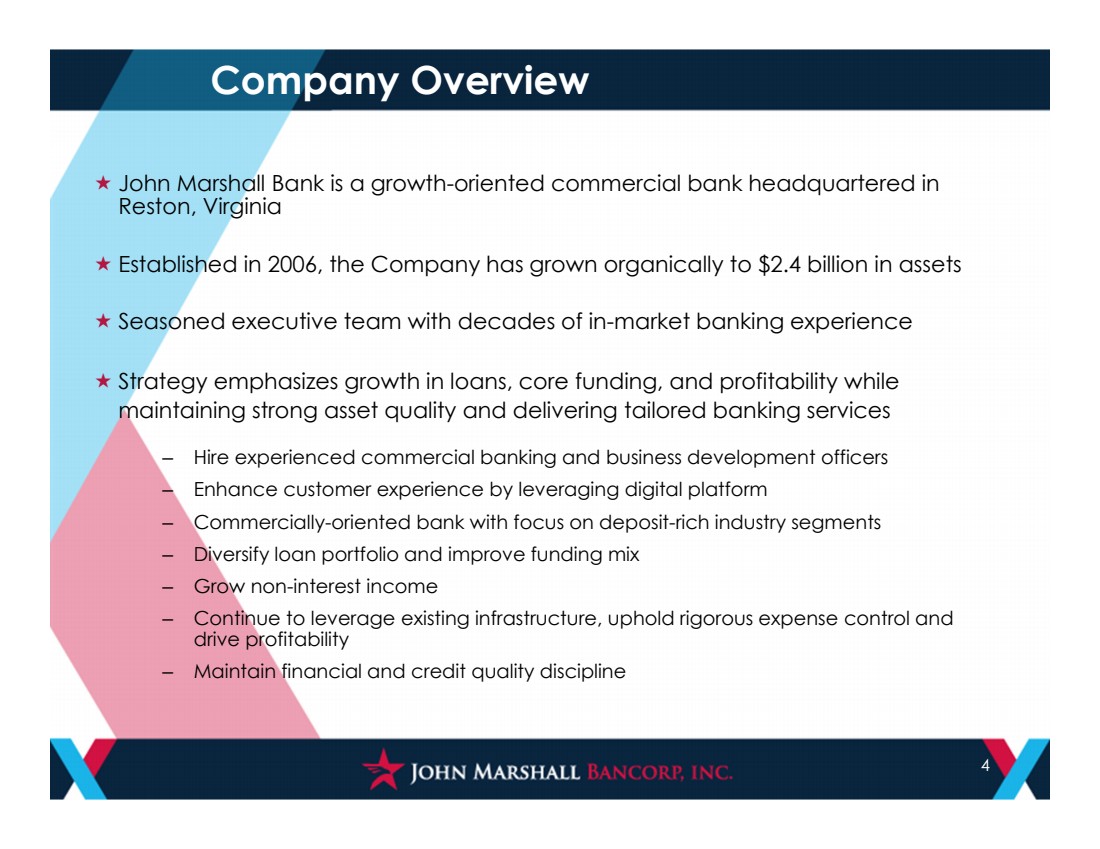
| 5 Investment Attributes Rewarding Our Shareholders Attractive Market Credit Discipline Prime for Future Growth Experienced Management |
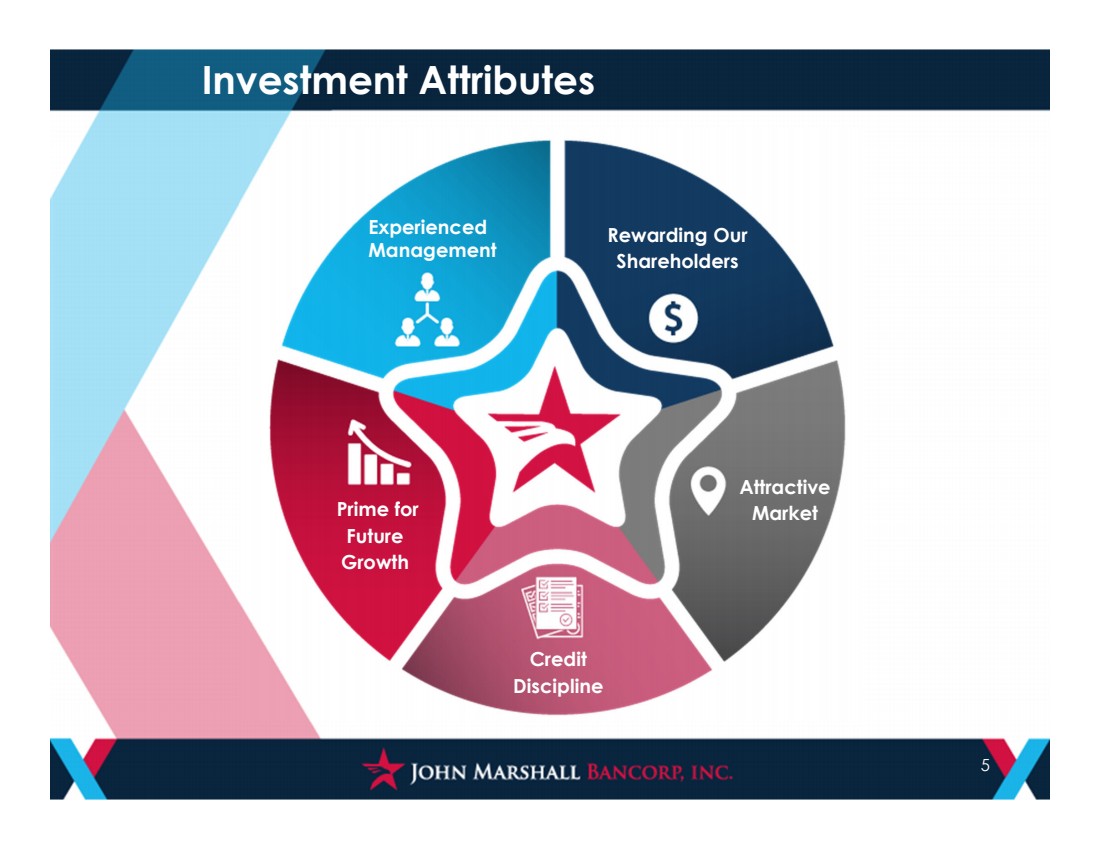
| 6 John Marshall Franchise Bank commenced operations in April 2006 $22 million recapitalization completed in 2008 Holding company formed March 1, 2017 Chris Bergstrom named President and CEO April 30, 2018 Building value by delivering tailored banking services and exceptional client experiences Commercially-oriented bank targeting: • Small to medium-sized businesses • Builders / developers • Professionals • Nonprofits / associations / private schools • Health services • Title / property management • Government contractors 8 full service banking centers serving over 12,000 accounts 144 FTE employees as of June 30, 2023 Corporate Overview Financial Highlights December 31, 2020 and December 31, 2021 allowance for loan losses / gross loans excludes guaranteed PPP loans. The Company adopted the CECL standard for measuring credit losses on January 1, 2023. YTD 2023 profitability figures are for the six months ended 6/30/2023. ($ in millions) YTD 2020 2021 2022 2023 Balance Sheet Total Assets $1,885 $2,149 $2,348 $2,364 Gross Loans 1,563 1,666 1,785 1,765 Total Deposits 1,640 1,882 2,068 2,046 Loans / Deposits 95% 89% 86% 86% Capital (Bank level) Common Equity / Assets 11.1% 10.8% 10.0% 10.2% Tier 1 Leverage Ratio 11.0% 11.0% 11.3% 11.6% Total Risk-Based Capital Ratio 14.6% 15.3% 15.6% 16.1% Profitability Net Income $18,526 $25,461 $31,803 $10,794 ROAA 1.06% 1.25% 1.40% 0.93% ROAE 10.49% 12.90% 15.18% 9.85% Net Interest Margin 3.32% 3.29% 3.16% 2.33% Non-interest Expense / Average Assets 1.67% 1.58% 1.40% 1.34% Efficiency Ratio 49.9% 47.7% 44.2% 56.3% Asset Quality NPAs / Assets 0.00% 0.00% 0.00% 0.00% Allowance for Credit Losses / NPLs N/M N/M N/M N/M Allowance for Credit Losses / Gross Loans 1.09% 1.20% 1.13% 1.17% NCOs / Average Loans 0.00% 0.01% 0.00% 0.00% Year Ended December 31, |
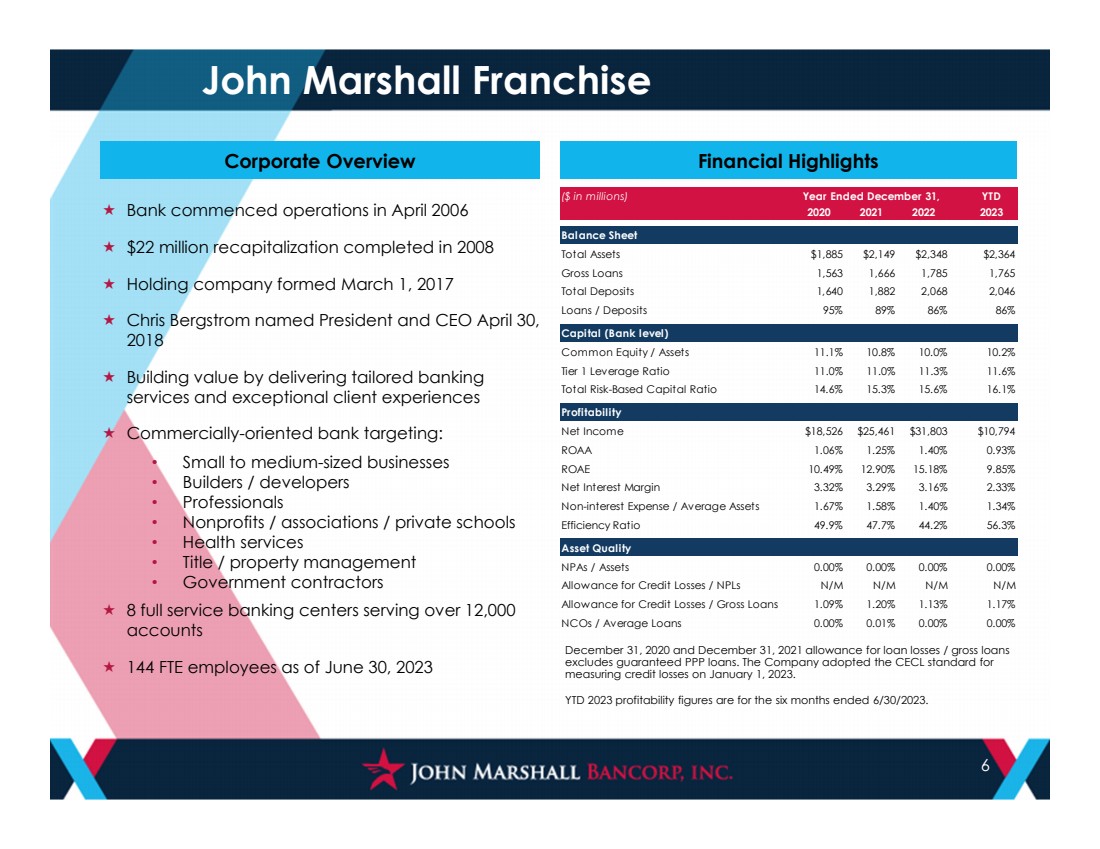
| 7 Selective FinTech partnerships provide operating leverage and fuel additional growth Customer Experience Operating Efficiencies Risk Mitigation FinTech Partnership Benefits Various FinTech Partnerships Leveraging Technology |
| 8 Executive Leadership Chris Bergstrom President & CEO Chris Bergstrom has over 41 years of experience in the banking industry. Before joining John Marshall Bank, Mr. Bergstrom served in a variety of executive positions during 19 years with Cardinal Financial Corporation and Cardinal Bank, most recently serving as President and Chief Executive Officer from October 2015 until United Bankshares, Inc.’s acquisition of Cardinal in April 2017. He was also President of United Bank from April 2017 to April 2018. Mr. Bergstrom recently served as the Chairman of the Board of the Virginia Bankers Association. Mr. Bergstrom received his Master of Science in Finance from Virginia Commonwealth University and a Bachelors of Business Administration degree from James Madison University. Kent Carstater SEVP, Chief Financial Officer Andy Peden SEVP, Chief Banking Officer Andrew Peden is the Chief Banking Officer at John Marshall Bank, and was the Chief Lending Officer for four years before being promoted to his current position. Prior to joining JMB, he had over 18 years of banking experience, all but one year with Cardinal Bank. Mr. Peden received a Bachelor of Science degree in business from the University of Richmond – Robins School of Business. He is involved in both the business and local community, by serving on the Board of the VBA Management Services, Inc., a subsidiary of the VBA, and as a volunteer youth sports coach in Arlington, VA. Kent Carstater has over 25 years of financial services experience. He has responsibility for accounting, financial, human resources, information technology, investor relations and risk management operations. Mr. Carstater also chairs the Company’s Asset/Liability management committee. He has over 25 years of financial services experience. He joined John Marshall Bank in July 2016 as Senior Vice President of Market Risk Management, overseeing the Bank’s liquidity, asset/liability, investment, capital planning and strategic planning functions. From 2012 to 2016, Mr. Carstater served as a Senior Vice President and Treasurer at the Bank of Georgetown. In that role, he was responsible for financial and risk management, investor relations, capital markets activities and strategic planning. Prior to becoming a commercial banker in 2012, he advised community bank executives on strategic matters as an investment banker and founded a private equity firm focused on investing in financial institutions. Mr. Carstater earned his Bachelors of Science from Virginia Tech in Finance and Masters of Business Administration from the Darden School of Business at the University of Virginia. |
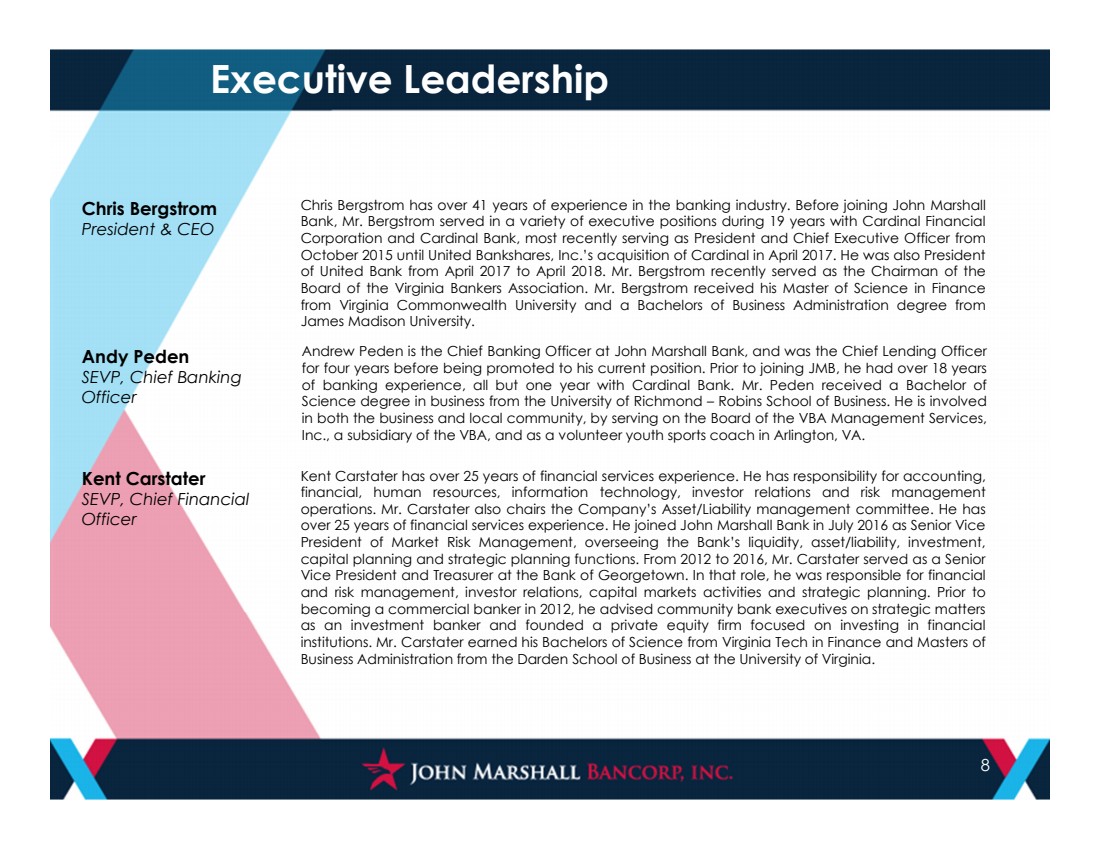
| 9 Executive Leadership Jason McDonough EVP, Chief Lending Officer Jason McDonough has over 17 years of banking experience, including over 5 years at John Marshall Bank and 11 years with Cardinal Bank. He has a background in both retail and commercial banking including 10 years as a Commercial Lender specializing in Real Estate Lending. Mr. McDonough most recently served as the Director of Commercial Real Estate Lending at JMB prior to his promotion to Chief Lending Officer. He received a Bachelor of Science from Virginia Tech 2006 and a Masters in Real Estate Development from George Mason University in 2015, where he was named Most Outstanding Student, before going on to co-found the program’s Alumni Association. He is also an Honors Graduate of the Virginia Bankers School of Bank Management. Mr. McDonough has served on the Board of Directors of HomeAid Northern Virginia, a local not-for-profit organization, for the past 8 years and as Board President in 2020. In 2023 Mr. McDonough was named to the VBA Board of Trustees and was also named to the Loudon 40 under 40 list, which recognizes rising business and community leaders in Loudon County. An active member of the South Loudoun County community, Mr. McDonough joined the Loudoun South Little League Board of Directors in 2022 and volunteers much of his time to coaching youth athletics. Sheila Yosufy EVP, Director of Sales Sheila Yosufy has over 20 years of banking experience. She has been with John Marshall Bank for over four years and most recently served as Senior Vice President – Director of Business Development before her promotion to Executive Vice President – Director of Sales. Prior to joining John Marshall Bank, Ms. Yosufy spent eleven years at Cardinal Bank where she served as the Senior Vice President of their commercial division. She earned a Bachelor of Business Administration degree in International Business from Marymount University. In addition, she earned her Masters in Business Administration from Marymount University. She currently serves on the Board of the Northern Virginia Chamber of Commerce. Ms. Yosufy is a graduate of the VBA School of Bank Management and Leadership Arlington Signature Program Class of 2015, where she was also recognized as the Leadership Arlington 40 under 40 Honoree. Kelly Bell EVP, Chief Operating Officer Kelly Bell has over 30 years of community banking experience, 23 of those years serving the Washington metropolitan area. She has served several roles at John Marshall Bank, including Executive Vice President, Director of Retail Banking and Treasury Services. Prior to joining John Marshall Bank, Ms. Bell spent three years as Senior Vice President, Director of Retail Banking at Cardinal Bank, and 13 years of increasing roles of responsibility at Virginia Commerce Bank. Ms. Bell is a graduate of the Virginia Bankers Association School of Bank Management. |
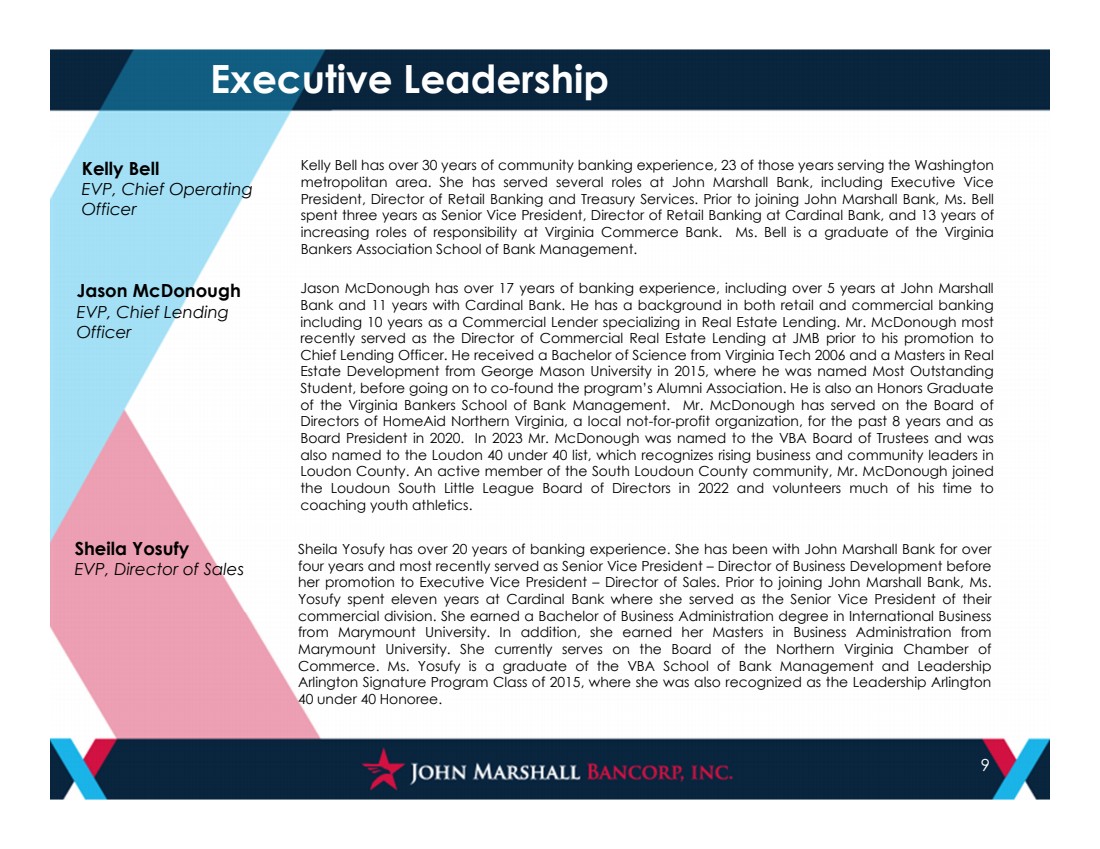
| 10 Banking Center Footprint • Eight regional banking centers serve as business development hubs. • Approximately 97% of the Bank’s deposit dollars are collected electronically. District of Columbia: 1625 K Street, NW |
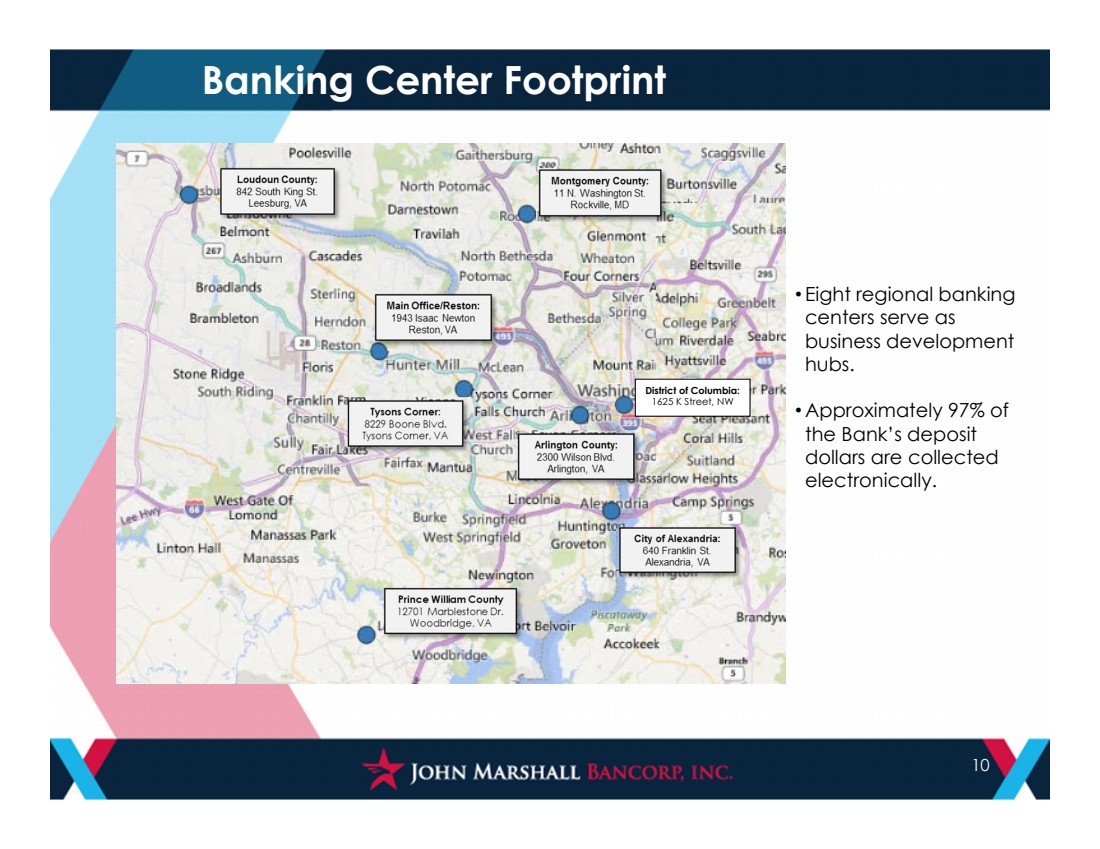
| 11 Attractive Metro Markets Median Household Income $ (2023) Projected Population Growth % (2023-2028) Educational Attainment % (>=Bachelors Degree) Unemployment Rate % (May 2023, NSA) 128,024 117,952 92,662 86,611 83,193 81,625 4.99 2.72 0.77 0.54 (0.45) (0.45) 53.4 51.8 43.6 40.6 38.4 37.1 2.6 3.3 3.5 3.8 4.1 4.5 Sources: S&P Global Market Intelligence, Bureau of Economic Analysis and data.census.gov Blue line represents the average of the six metro markets shown |
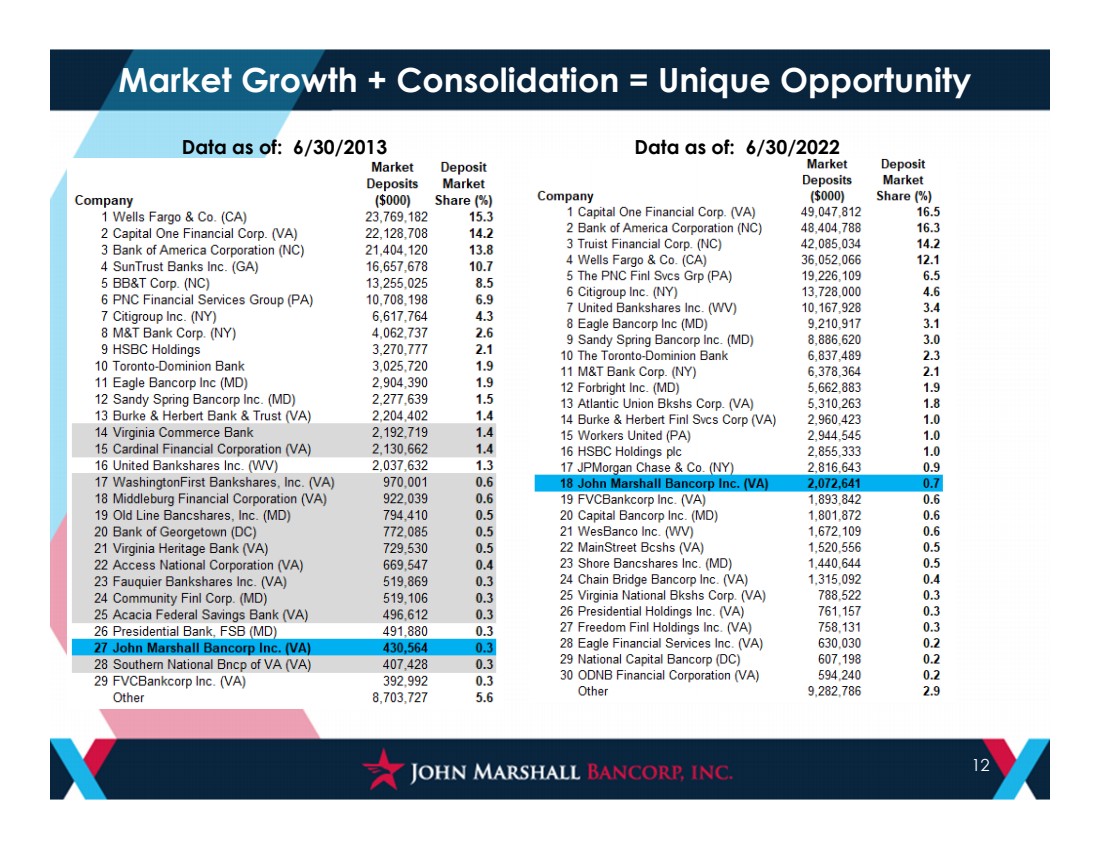
| 12 Market Growth + Consolidation = Unique Opportunity Data as of: 6/30/2013 Data as of: 6/30/2022 |
| 13 Franchise Overview Financial Highlights Credit & Asset Quality Funding & Liquidity Appendices |
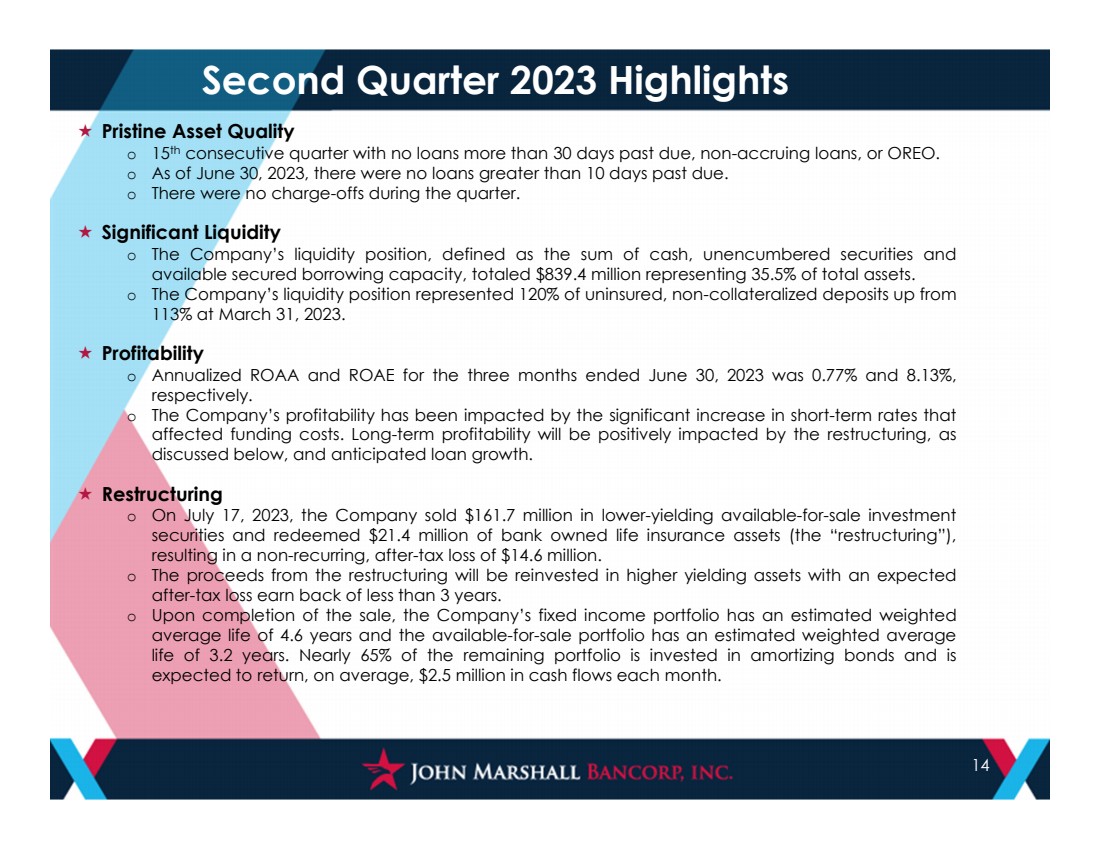
| 14 Second Quarter 2023 Highlights Pristine Asset Quality o 15th consecutive quarter with no loans more than 30 days past due, non-accruing loans, or OREO. o As of June 30, 2023, there were no loans greater than 10 days past due. o There were no charge-offs during the quarter. Significant Liquidity o The Company’s liquidity position, defined as the sum of cash, unencumbered securities and available secured borrowing capacity, totaled $839.4 million representing 35.5% of total assets. o The Company’s liquidity position represented 120% of uninsured, non-collateralized deposits up from 113% at March 31, 2023. Profitability o Annualized ROAA and ROAE for the three months ended June 30, 2023 was 0.77% and 8.13%, respectively. o The Company’s profitability has been impacted by the significant increase in short-term rates that affected funding costs. Long-term profitability will be positively impacted by the restructuring, as discussed below, and anticipated loan growth. Restructuring o On July 17, 2023, the Company sold $161.7 million in lower-yielding available-for-sale investment securities and redeemed $21.4 million of bank owned life insurance assets (the “restructuring”), resulting in a non-recurring, after-tax loss of $14.6 million. o The proceeds from the restructuring will be reinvested in higher yielding assets with an expected after-tax loss earn back of less than 3 years. o Upon completion of the sale, the Company’s fixed income portfolio has an estimated weighted average life of 4.6 years and the available-for-sale portfolio has an estimated weighted average life of 3.2 years. Nearly 65% of the remaining portfolio is invested in amortizing bonds and is expected to return, on average, $2.5 million in cash flows each month. |
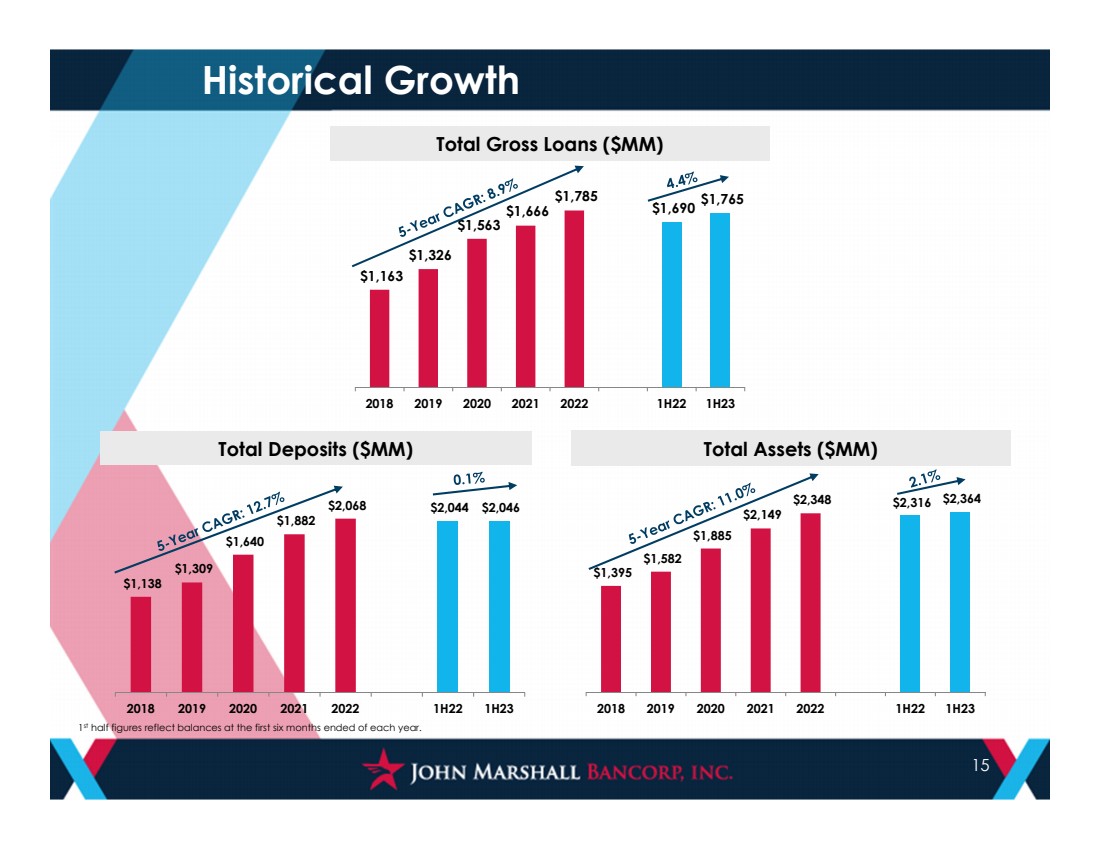
| $1,163 $1,326 $1,563 $1,666 $1,785 $1,690 $1,765 2018 2019 2020 2021 2022 1H22 1H23 15 Historical Growth Total Deposits ($MM) $1,138 $1,309 $1,640 $1,882 $2,068 $2,044 $2,046 2018 2019 2020 2021 2022 1H22 1H23 Total Assets ($MM) $1,395 $1,582 $1,885 $2,149 $2,348 $2,316 $2,364 2018 2019 2020 2021 2022 1H22 1H23 Total Gross Loans ($MM) 1st half figures reflect balances at the first six months ended of each year. |
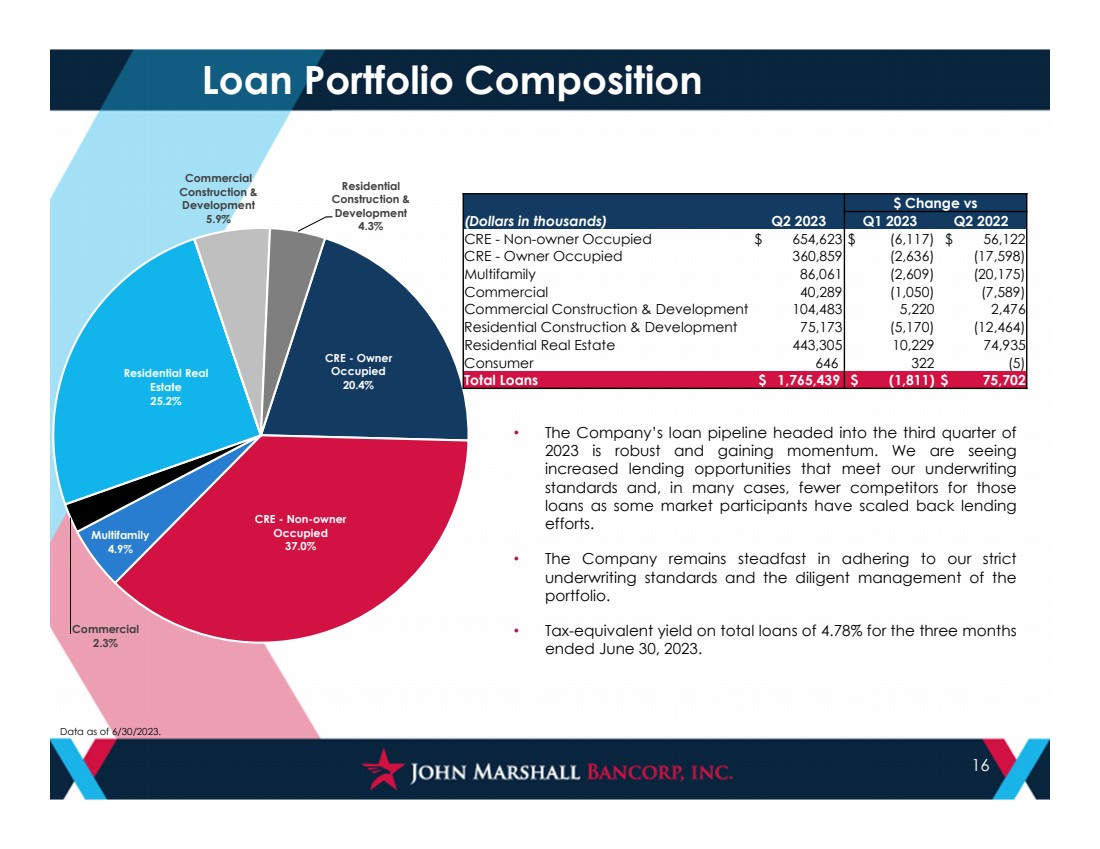
| 16 Loan Portfolio Composition CRE - Owner Occupied 20.4% CRE - Non-owner Occupied 37.0% Multifamily 4.9% Commercial 2.3% Residential Real Estate 25.2% Commercial Construction & Development 5.9% Residential Construction & Development 4.3% $ Change vs (Dollars in thousands) Q2 2023 Q1 2023 Q2 2022 CRE - Non-owner Occupied $ 654,623 $ (6,117) $ 56,122 CRE - Owner Occupied 360,859 (2,636) (17,598) Multifamily 86,061 (2,609) (20,175) Commercial 40,289 (1,050) (7,589) Commercial Construction & Development 104,483 5,220 2,476 Residential Construction & Development 75,173 (5,170) (12,464) Residential Real Estate 443,305 10,229 74,935 Consumer 646 322 (5) Total Loans $ 1,765,439 $ (1,811) $ 75,702 • The Company’s loan pipeline headed into the third quarter of 2023 is robust and gaining momentum. We are seeing increased lending opportunities that meet our underwriting standards and, in many cases, fewer competitors for those loans as some market participants have scaled back lending efforts. • The Company remains steadfast in adhering to our strict underwriting standards and the diligent management of the portfolio. • Tax-equivalent yield on total loans of 4.78% for the three months ended June 30, 2023. Data as of 6/30/2023. |
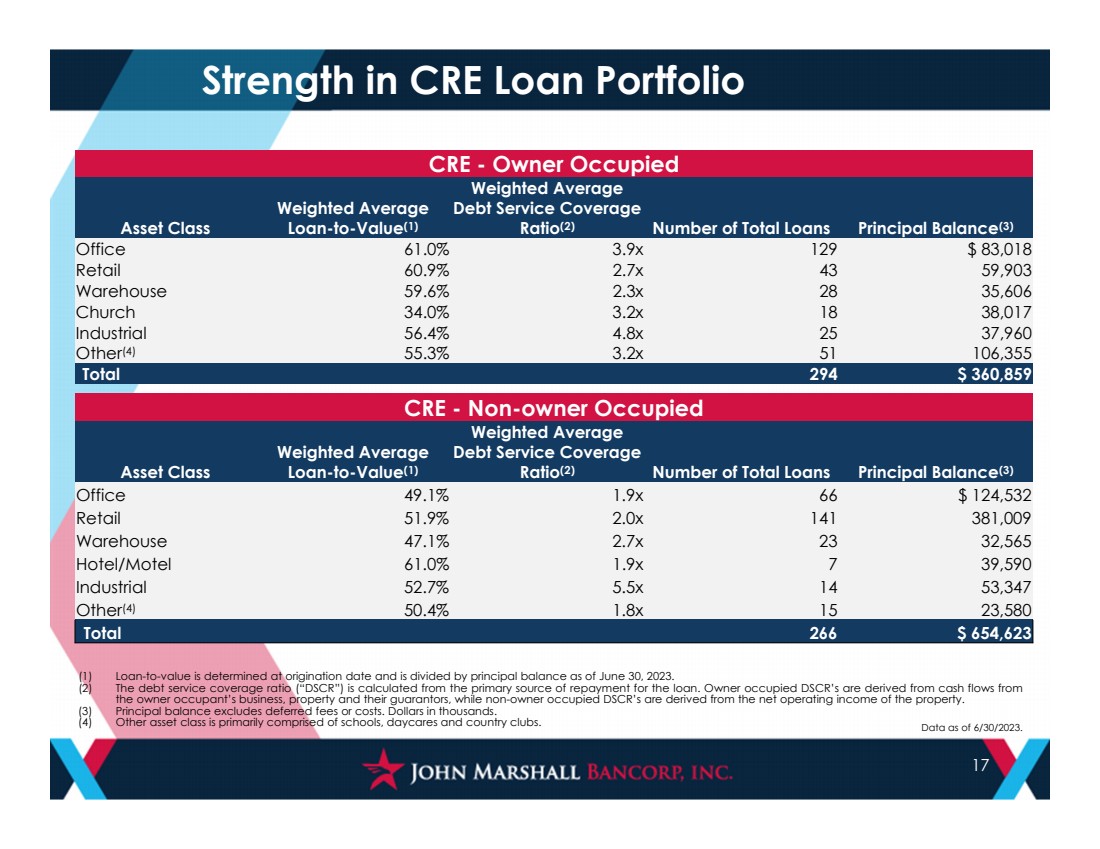
| 17 Strength in CRE Loan Portfolio CRE - Owner Occupied Asset Class Weighted Average Loan-to-Value(1) Weighted Average Debt Service Coverage Ratio(2) Number of Total Loans Principal Balance(3) Office 61.0% 3.9x 129 $ 83,018 Retail 60.9% 2.7x 43 59,903 Warehouse 59.6% 2.3x 28 35,606 Church 34.0% 3.2x 18 38,017 Industrial 56.4% 4.8x 25 37,960 Other(4) 55.3% 3.2x 51 106,355 Total 294 $ 360,859 CRE - Non-owner Occupied Asset Class Weighted Average Loan-to-Value(1) Weighted Average Debt Service Coverage Ratio(2) Number of Total Loans Principal Balance(3) Office 49.1% 1.9x 66 $ 124,532 Retail 51.9% 2.0x 141 381,009 Warehouse 47.1% 2.7x 23 32,565 Hotel/Motel 61.0% 1.9x 7 39,590 Industrial 52.7% 5.5x 14 53,347 Other(4) 50.4% 1.8x 15 23,580 Total 266 $ 654,623 (1) Loan-to-value is determined at origination date and is divided by principal balance as of June 30, 2023. (2) The debt service coverage ratio (“DSCR”) is calculated from the primary source of repayment for the loan. Owner occupied DSCR’s are derived from cash flows from the owner occupant’s business, property and their guarantors, while non-owner occupied DSCR’s are derived from the net operating income of the property. (3) Principal balance excludes deferred fees or costs. Dollars in thousands. (4) Other asset class is primarily comprised of schools, daycares and country clubs. Data as of 6/30/2023. |
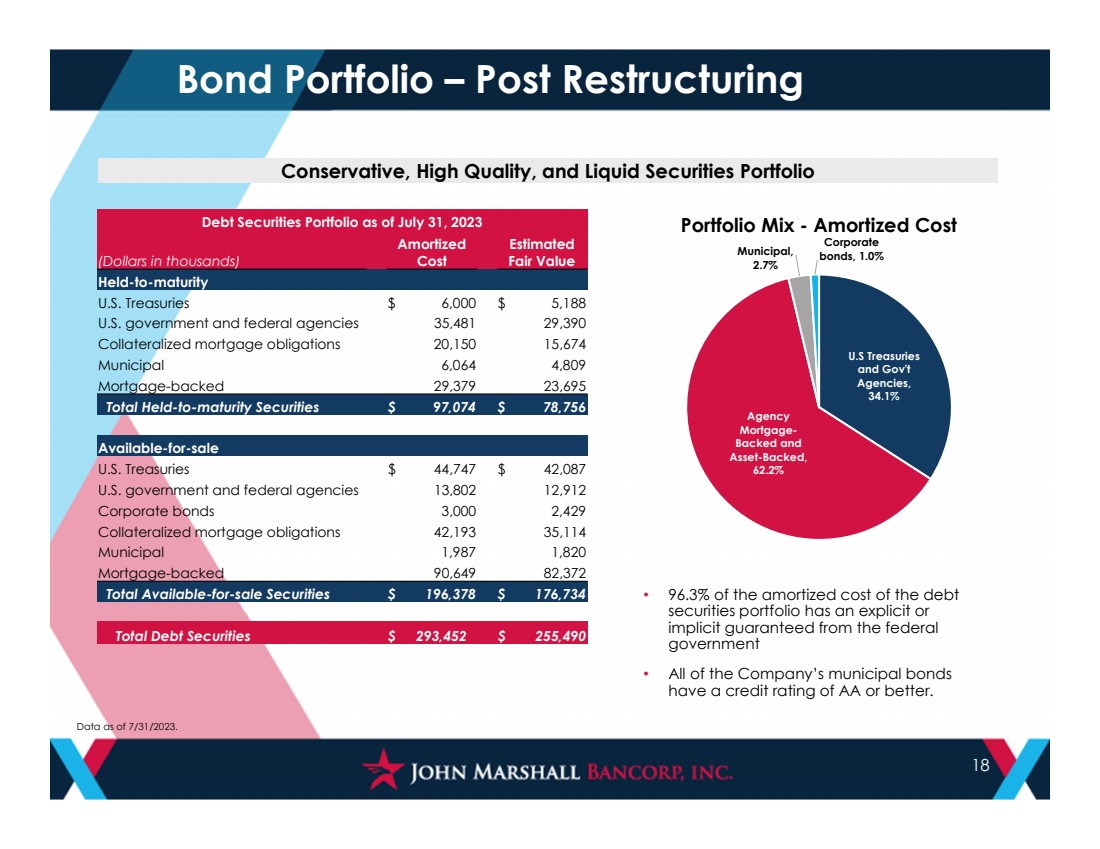
| 18 Bond Portfolio – Post Restructuring Conservative, High Quality, and Liquid Securities Portfolio • 96.3% of the amortized cost of the debt securities portfolio has an explicit or implicit guaranteed from the federal government • All of the Company’s municipal bonds have a credit rating of AA or better. Data as of 7/31/2023. U.S Treasuries and Gov't Agencies, 34.1% Agency Mortgage-Backed and Asset-Backed, 62.2% Municipal, 2.7% Corporate bonds, 1.0% Portfolio Mix - Amortized Cost Debt Securities Portfolio as of July 31, 2023 (Dollars in thousands) Amortized Cost Estimated Fair Value Held-to-maturity U.S. Treasuries $ 6,000 $ 5,188 U.S. government and federal agencies 35,481 29,390 Collateralized mortgage obligations 20,150 15,674 Municipal 6,064 4,809 Mortgage-backed 29,379 23,695 Total Held-to-maturity Securities $ 97,074 $ 78,756 Available-for-sale U.S. Treasuries $ 44,747 $ 42,087 U.S. government and federal agencies 13,802 12,912 Corporate bonds 3,000 2,429 Collateralized mortgage obligations 42,193 35,114 Municipal 1,987 1,820 Mortgage-backed 90,649 82,372 Total Available-for-sale Securities $ 196,378 $ 176,734 Total Debt Securities $ 293,452 $ 255,490 |
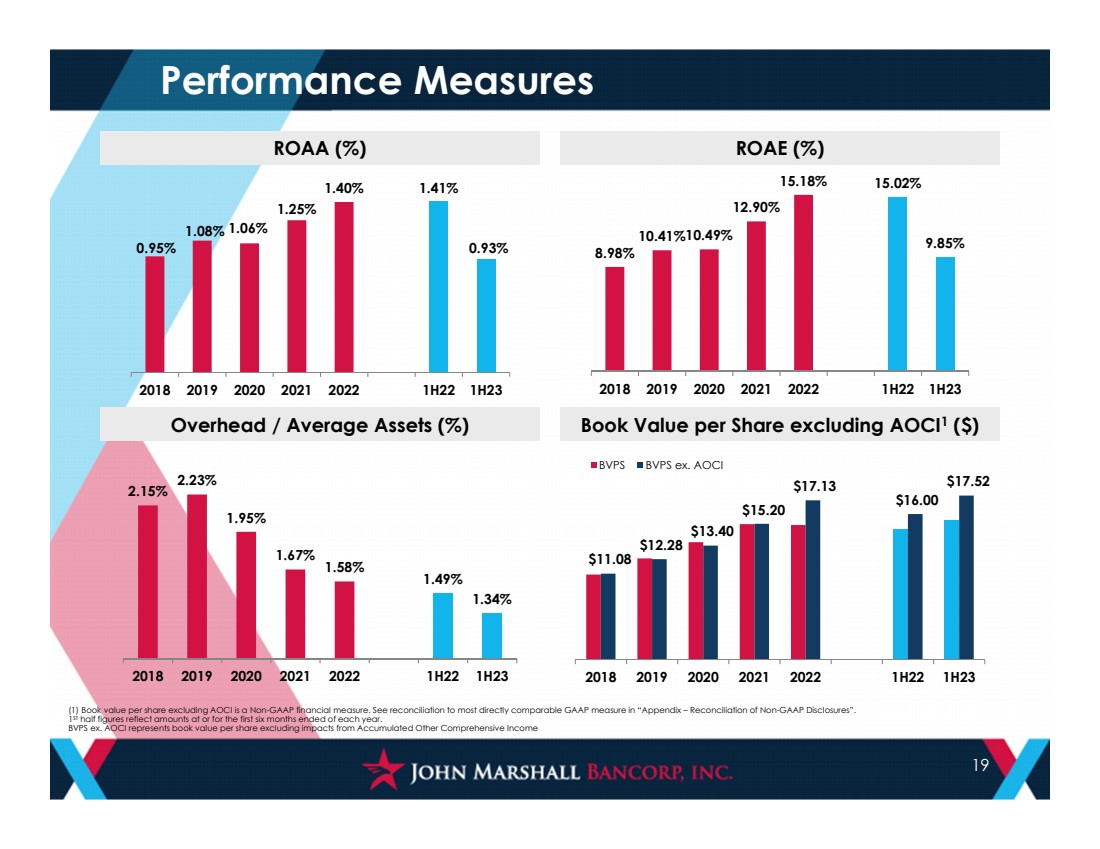
| 19 Performance Measures ROAA (%) ROAE (%) Overhead / Average Assets (%) Book Value per Share excluding AOCI1 ($) 0.95% 1.08% 1.06% 1.25% 1.40% 1.41% 0.93% 2018 2019 2020 2021 2022 1H22 1H23 8.98% 10.41%10.49% 12.90% 15.18% 15.02% 9.85% 2018 2019 2020 2021 2022 1H22 1H23 $11.08 $12.28 $13.40 $15.20 $17.13 $16.00 $17.52 2018 2019 2020 2021 2022 1H22 1H23 BVPS BVPS ex. AOCI (1) Book value per share excluding AOCI is a Non-GAAP financial measure. See reconciliation to most directly comparable GAAP measure in “Appendix – Reconciliation of Non-GAAP Disclosures”. 1ST half figures reflect amounts at or for the first six months ended of each year. BVPS ex. AOCI represents book value per share excluding impacts from Accumulated Other Comprehensive Income 2.15% 2.23% 1.95% 1.67% 1.58% 1.49% 1.34% 2018 2019 2020 2021 2022 1H22 1H23 |
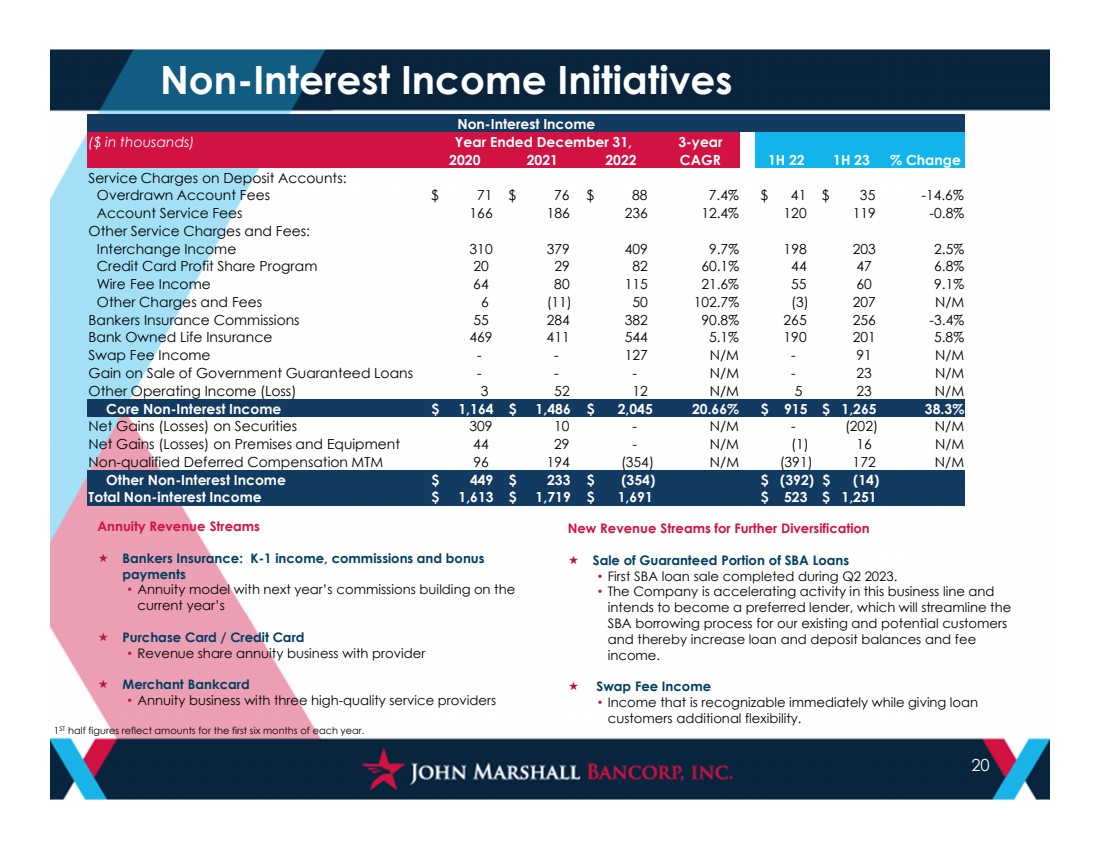
| 20 Non-Interest Income Initiatives 1ST half figures reflect amounts for the first six months of each year. Annuity Revenue Streams Bankers Insurance: K-1 income, commissions and bonus payments • Annuity model with next year’s commissions building on the current year’s Purchase Card / Credit Card • Revenue share annuity business with provider Merchant Bankcard • Annuity business with three high-quality service providers New Revenue Streams for Further Diversification Sale of Guaranteed Portion of SBA Loans • First SBA loan sale completed during Q2 2023. • The Company is accelerating activity in this business line and intends to become a preferred lender, which will streamline the SBA borrowing process for our existing and potential customers and thereby increase loan and deposit balances and fee income. Swap Fee Income • Income that is recognizable immediately while giving loan customers additional flexibility. Non-Interest Income ($ in thousands) Year Ended December 31, 3-year 2020 2021 2022 CAGR 1H 22 1H 23 % Change Service Charges on Deposit Accounts: Overdrawn Account Fees $ 71 $ 76 $ 88 7.4% $ 41 $ 35 -14.6% Account Service Fees 166 186 236 12.4% 120 119 -0.8% Other Service Charges and Fees: Interchange Income 310 379 409 9.7% 198 203 2.5% Credit Card Profit Share Program 20 29 82 60.1% 44 47 6.8% Wire Fee Income 64 80 115 21.6% 55 60 9.1% Other Charges and Fees 6 (11) 50 102.7% (3) 207 N/M Bankers Insurance Commissions 55 284 382 90.8% 265 256 -3.4% Bank Owned Life Insurance 469 411 544 5.1% 190 201 5.8% Swap Fee Income - - 127 N/M - 91 N/M Gain on Sale of Government Guaranteed Loans - - - N/M - 23 N/M Other Operating Income (Loss) 3 52 12 N/M 5 23 N/M Core Non-Interest Income $ 1,164 $ 1,486 $ 2,045 20.66% $ 915 $ 1,265 38.3% Net Gains (Losses) on Securities 309 10 - N/M - (202) N/M Net Gains (Losses) on Premises and Equipment 44 29 - N/M (1) 16 N/M Non-qualified Deferred Compensation MTM 96 194 (354) N/M (391) 172 N/M Other Non-Interest Income $ 449 $ 233 $ (354) $ (392) $ (14) Total Non-interest Income $ 1,613 $ 1,719 $ 1,691 $ 523 $ 1,251 |
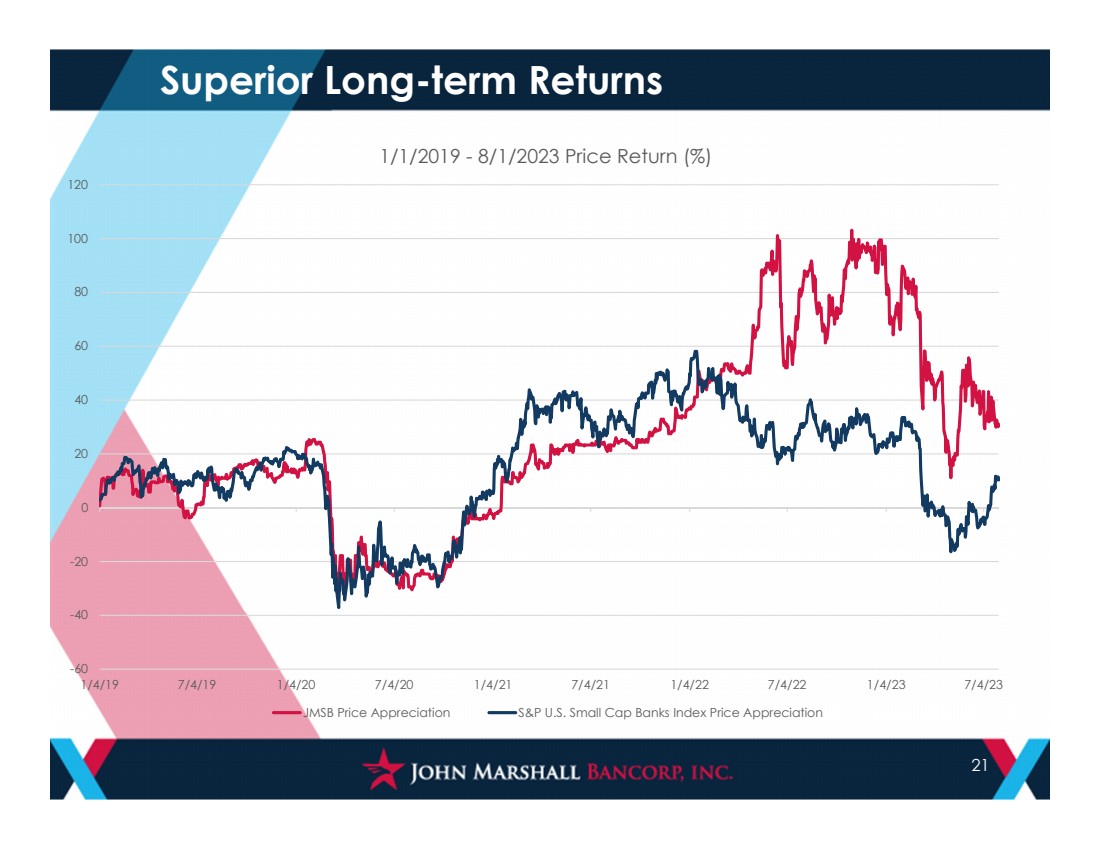
| 21 Superior Long-term Returns -60 -40 -20 0 20 40 60 80 100 120 1/4/19 7/4/19 1/4/20 7/4/20 1/4/21 7/4/21 1/4/22 7/4/22 1/4/23 7/4/23 1/1/2019 - 8/1/2023 Price Return (%) JMSB Price Appreciation S&P U.S. Small Cap Banks Index Price Appreciation |
| 22 Franchise Overview Financial Highlights Credit & Asset Quality Funding & Liquidity Appendices |
| 407% 379% 411% 413% 403% 384% 367% 365% 340% 335% 338% 319% 316% 148% 120% 126% 126% 130% 121% 111% 109% 94% 84% 73% 62% 62% 23 Decreasing Concentration • $1.765B in gross loans held for investment as of 6/30/2023 • 85.0% of credit exposure is within the DC MSA as of 6/30/2023 • No equity capital issuance since November 2013 Acquisition, Development & Construction Loans as a percentage of Total Risk-Based Capital Commercial Real Estate (Investor) Loans as a percentage of Total Risk-Based Capital CRE Investor Portfolio has grown 19.3% over the past 36 months; below 50% regulatory threshold. $22.5MM of subordinated debt became Bank capital |
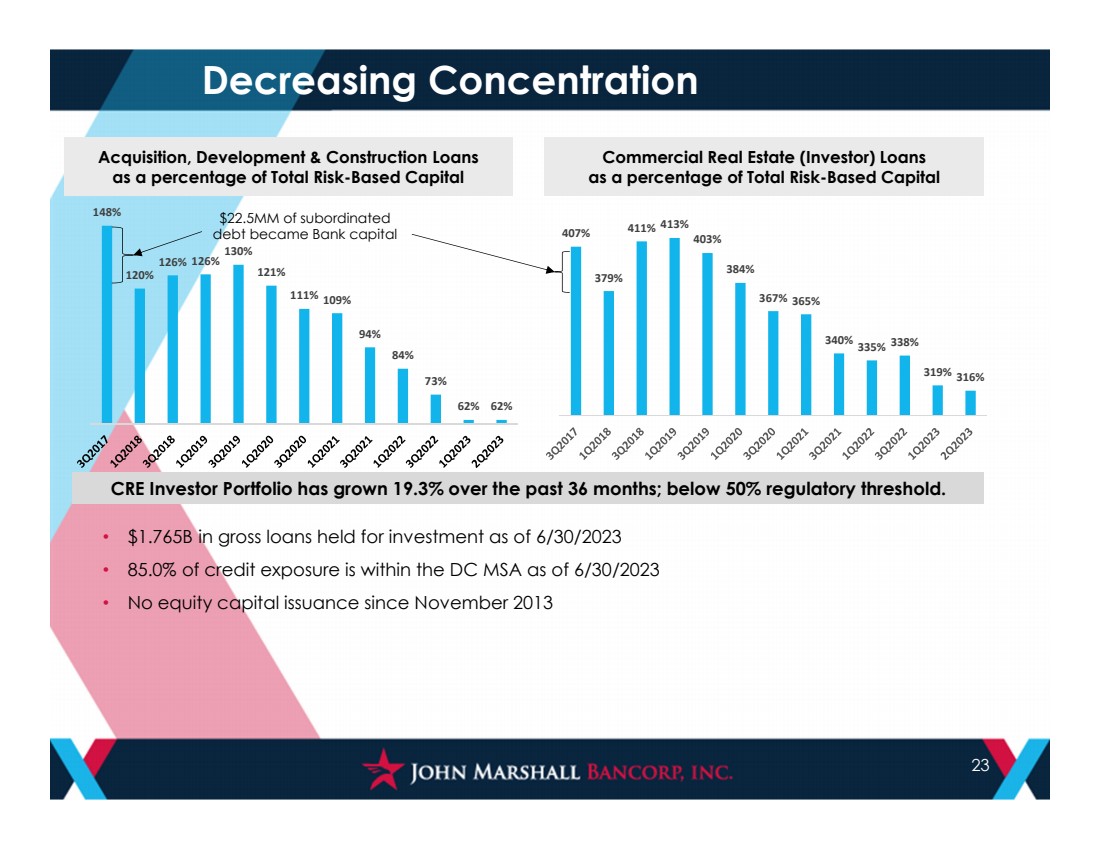
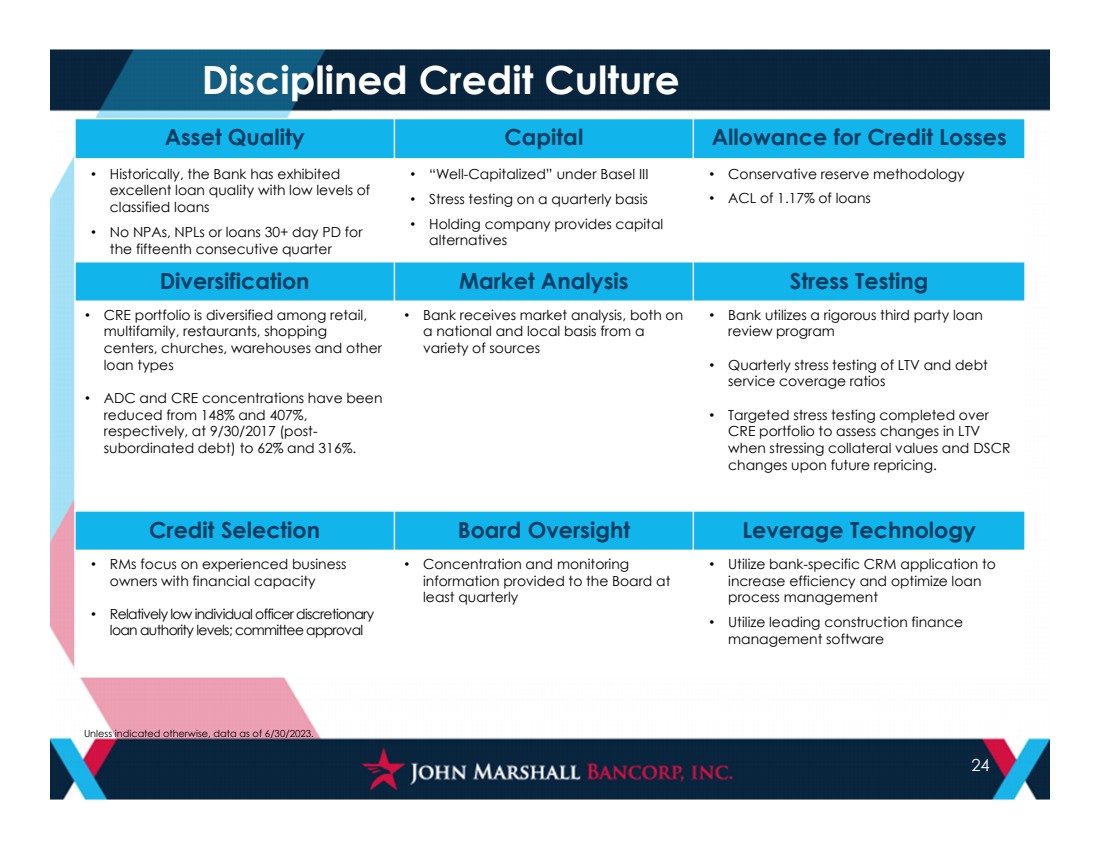
| 24 Disciplined Credit Culture Asset Quality Capital Allowance for Credit Losses • Historically, the Bank has exhibited excellent loan quality with low levels of classified loans • No NPAs, NPLs or loans 30+ day PD for the fifteenth consecutive quarter • “Well-Capitalized” under Basel III • Stress testing on a quarterly basis • Holding company provides capital alternatives • Conservative reserve methodology • ACL of 1.17% of loans Diversification Market Analysis Stress Testing • CRE portfolio is diversified among retail, multifamily, restaurants, shopping centers, churches, warehouses and other loan types • ADC and CRE concentrations have been reduced from 148% and 407%, respectively, at 9/30/2017 (post-subordinated debt) to 62% and 316%. • Bank receives market analysis, both on a national and local basis from a variety of sources • Bank utilizes a rigorous third party loan review program • Quarterly stress testing of LTV and debt service coverage ratios • Targeted stress testing completed over CRE portfolio to assess changes in LTV when stressing collateral values and DSCR changes upon future repricing. Credit Selection Board Oversight Leverage Technology • RMs focus on experienced business owners with financial capacity • Relatively low individual officer discretionary loan authority levels; committee approval • Concentration and monitoring information provided to the Board at least quarterly • Utilize bank-specific CRM application to increase efficiency and optimize loan process management • Utilize leading construction finance management software Unless indicated otherwise, data as of 6/30/2023. |
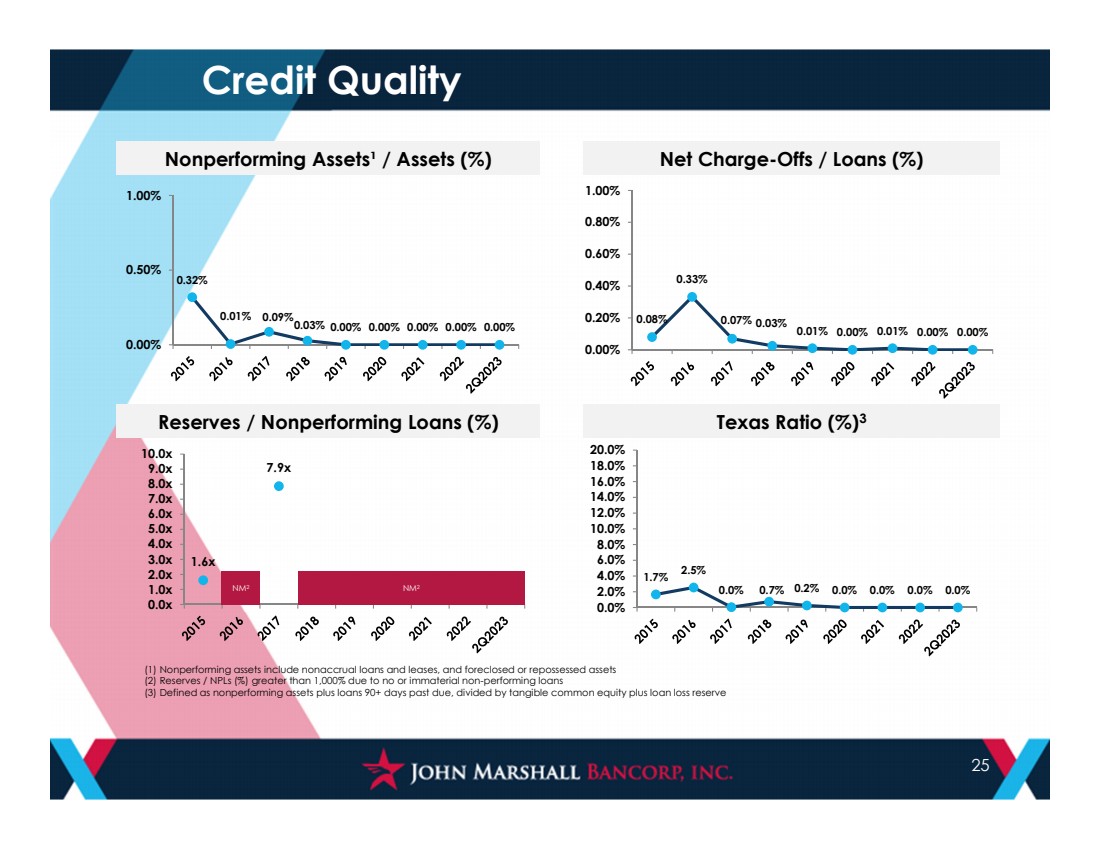
| 25 Credit Quality 1.6x 7.9x 0.0x 1.0x 2.0x 3.0x 4.0x 5.0x 6.0x 7.0x 8.0x 9.0x 10.0x Nonperforming Assets¹ / Assets (%) Net Charge-Offs / Loans (%) Reserves / Nonperforming Loans (%) Texas Ratio (%)3 NM2 0.32% 0.01% 0.09%0.03% 0.00% 0.00% 0.00% 0.00% 0.00% 0.00% 0.50% 1.00% 0.08% 0.33% 0.07% 0.03% 0.01% 0.00% 0.01% 0.00% 0.00% 0.00% 0.20% 0.40% 0.60% 0.80% 1.00% NM2 1.7% 2.5% 0.0% 0.7% 0.2% 0.0% 0.0% 0.0% 0.0% 0.0% 2.0% 4.0% 6.0% 8.0% 10.0% 12.0% 14.0% 16.0% 18.0% 20.0% (1) Nonperforming assets include nonaccrual loans and leases, and foreclosed or repossessed assets (2) Reserves / NPLs (%) greater than 1,000% due to no or immaterial non-performing loans (3) Defined as nonperforming assets plus loans 90+ days past due, divided by tangible common equity plus loan loss reserve |
| 26 Franchise Overview Financial Highlights Credit & Asset Quality Funding & Liquidity Appendices |
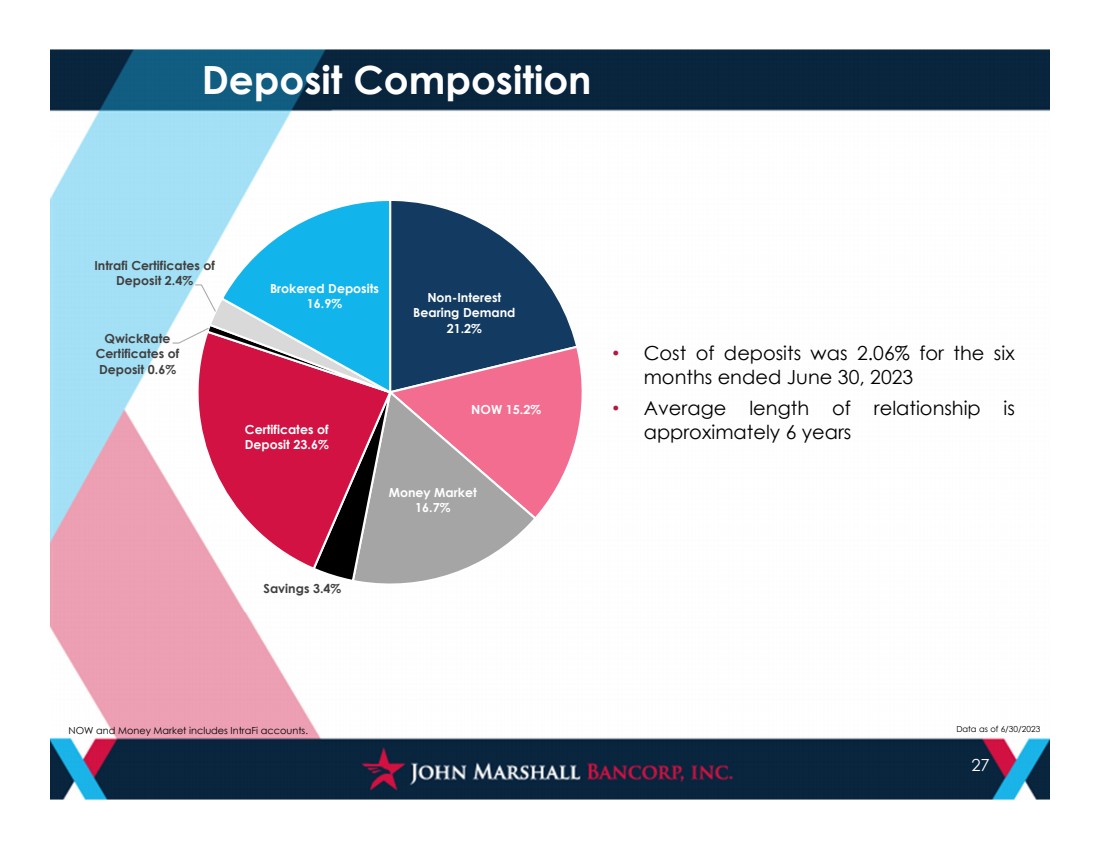
| 27 Deposit Composition Data as of 6/30/2023 • Cost of deposits was 2.06% for the six months ended June 30, 2023 • Average length of relationship is approximately 6 years Non-Interest Bearing Demand 21.2% NOW 15.2% Money Market 16.7% Savings 3.4% Certificates of Deposit 23.6% QwickRate Certificates of Deposit 0.6% Intrafi Certificates of Deposit 2.4% Brokered Deposits 16.9% NOW and Money Market includes IntraFi accounts. |
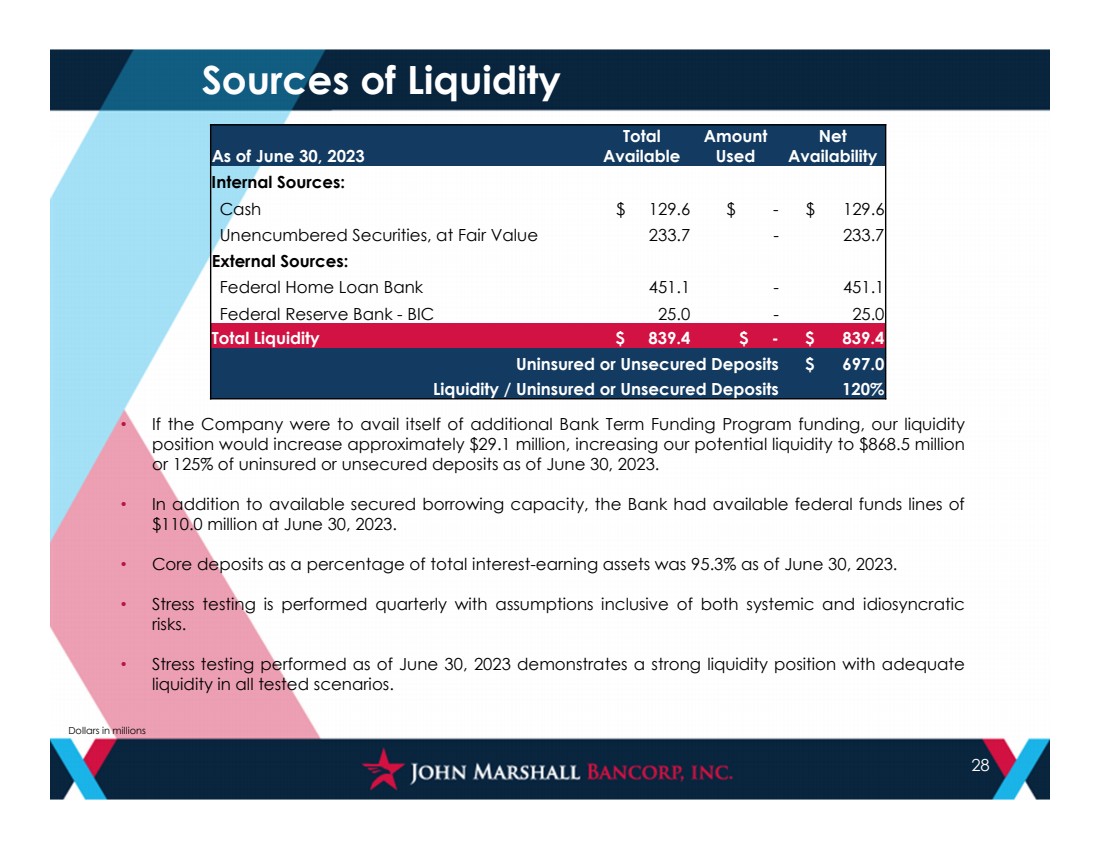
| 28 Sources of Liquidity Dollars in millions As of June 30, 2023 Total Available Amount Used Net Availability Internal Sources: Cash $ 129.6 $ - $ 129.6 Unencumbered Securities, at Fair Value 233.7 - 233.7 External Sources: Federal Home Loan Bank 451.1 - 451.1 Federal Reserve Bank - BIC 25.0 - 25.0 Total Liquidity $ 839.4 $ - $ 839.4 Uninsured or Unsecured Deposits $ 697.0 Liquidity / Uninsured or Unsecured Deposits 120% • If the Company were to avail itself of additional Bank Term Funding Program funding, our liquidity position would increase approximately $29.1 million, increasing our potential liquidity to $868.5 million or 125% of uninsured or unsecured deposits as of June 30, 2023. • In addition to available secured borrowing capacity, the Bank had available federal funds lines of $110.0 million at June 30, 2023. • Core deposits as a percentage of total interest-earning assets was 95.3% as of June 30, 2023. • Stress testing is performed quarterly with assumptions inclusive of both systemic and idiosyncratic risks. • Stress testing performed as of June 30, 2023 demonstrates a strong liquidity position with adequate liquidity in all tested scenarios. |
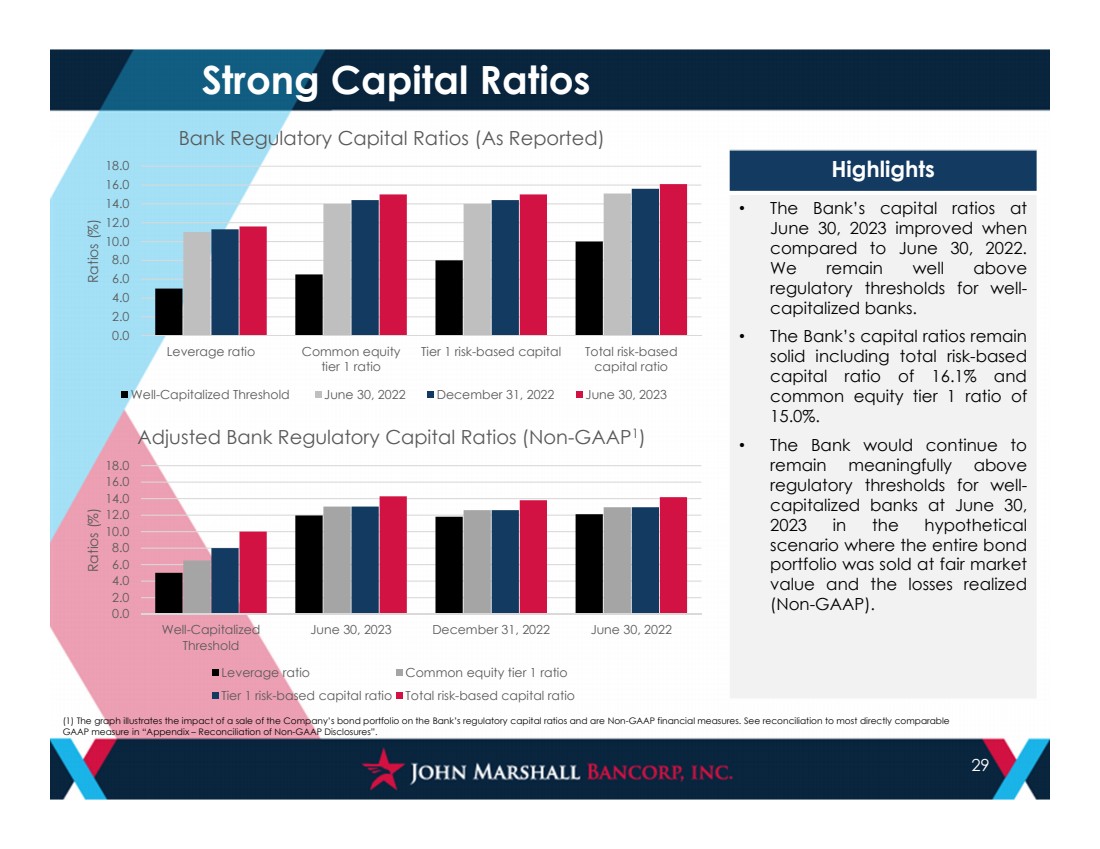
| 29 Strong Capital Ratios 0.0 2.0 4.0 6.0 8.0 10.0 12.0 14.0 16.0 18.0 Leverage ratio Common equity tier 1 ratio Tier 1 risk-based capital Total risk-based capital ratio Ratios (%) Bank Regulatory Capital Ratios (As Reported) Well-Capitalized Threshold June 30, 2022 December 31, 2022 June 30, 2023 0.0 2.0 4.0 6.0 8.0 10.0 12.0 14.0 16.0 18.0 Well-Capitalized Threshold June 30, 2023 December 31, 2022 June 30, 2022 Ratios (%) Adjusted Bank Regulatory Capital Ratios (Non-GAAP1) Leverage ratio Common equity tier 1 ratio Tier 1 risk-based capital ratio Total risk-based capital ratio Highlights • The Bank’s capital ratios at June 30, 2023 improved when compared to June 30, 2022. We remain well above regulatory thresholds for well-capitalized banks. • The Bank’s capital ratios remain solid including total risk-based capital ratio of 16.1% and common equity tier 1 ratio of 15.0%. • The Bank would continue to remain meaningfully above regulatory thresholds for well-capitalized banks at June 30, 2023 in the hypothetical scenario where the entire bond portfolio was sold at fair market value and the losses realized (Non-GAAP). (1) The graph illustrates the impact of a sale of the Company’s bond portfolio on the Bank’s regulatory capital ratios and are Non-GAAP financial measures. See reconciliation to most directly comparable GAAP measure in “Appendix – Reconciliation of Non-GAAP Disclosures”. |
| 30 Franchise Overview Financial Highlights Credit & Asset Quality Funding & Liquidity Appendices |
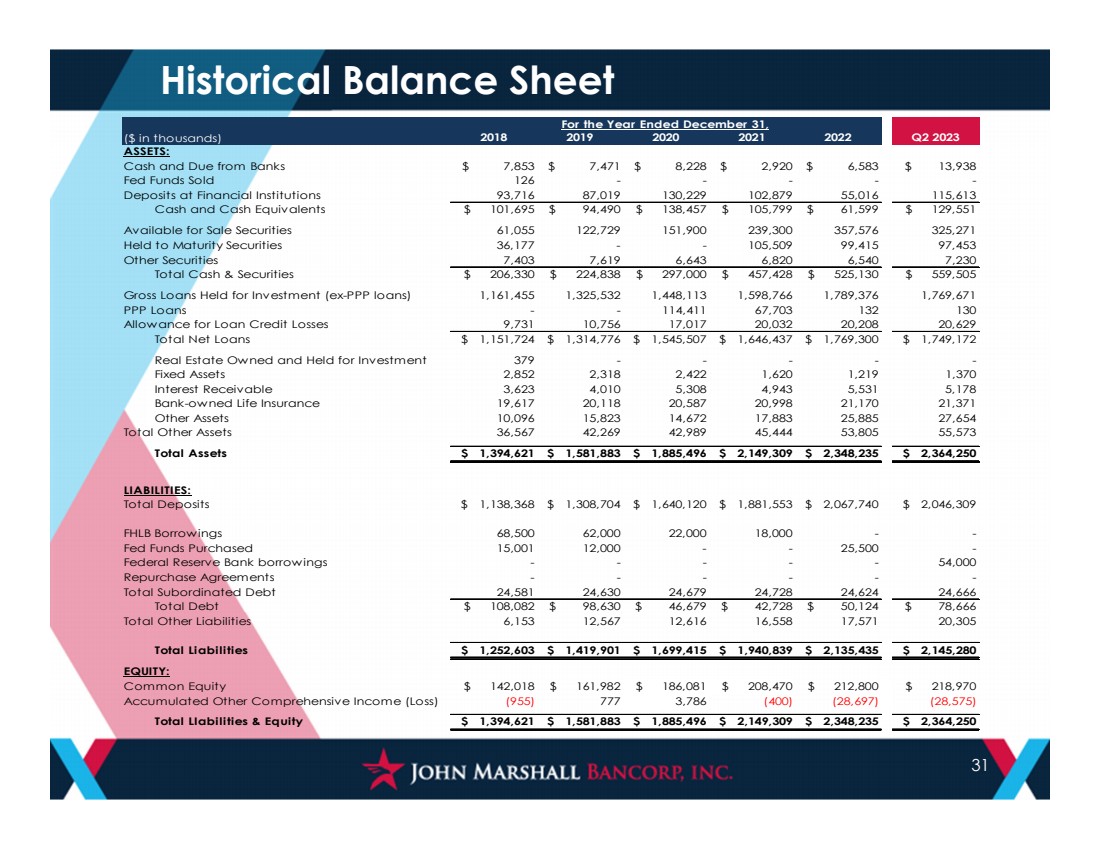
| 31 Historical Balance Sheet ($ in thousands) 2018 2019 2020 2021 2022 Q2 2023 ASSETS: Cash and Due from Banks $ 7,853 $ 7,471 $ 8,228 $ 2,920 $ 6,583 $ 13,938 Fed Funds Sold 126 - - - - - Deposits at Financial Institutions 93,716 87,019 130,229 102,879 55,016 115,613 Cash and Cash Equivalents $ 101,695 $ 94,490 $ 138,457 $ 105,799 $ 61,599 $ 129,551 Available for Sale Securities 61,055 122,729 151,900 239,300 357,576 325,271 Held to Maturity Securities 36,177 - - 105,509 99,415 97,453 Other Securities 7,403 7,619 6,643 6,820 6,540 7,230 Total Cash & Securities $ 206,330 $ 224,838 $ 297,000 $ 457,428 $ 525,130 $ 559,505 Gross Loans Held for Investment (ex-PPP loans) 1,161,455 1,325,532 1,448,113 1,598,766 1,789,376 1,769,671 PPP Loans - - 114,411 67,703 132 130 Allowance for Loan Credit Losses 9,731 10,756 17,017 20,032 20,208 20,629 Total Net Loans $ 1,151,724 $ 1,314,776 $ 1,545,507 $ 1,646,437 $ 1,769,300 $ 1,749,172 Real Estate Owned and Held for Investment 379 - - - - - Fixed Assets 2,852 2,318 2,422 1,620 1,219 1,370 Interest Receivable 3,623 4,010 5,308 4,943 5,531 5,178 Bank-owned Life Insurance 19,617 20,118 20,587 20,998 21,170 21,371 Other Assets 10,096 15,823 14,672 17,883 25,885 27,654 Total Other Assets 36,567 42,269 42,989 45,444 53,805 55,573 Total Assets $ 1,394,621 $ 1,581,883 $ 1,885,496 $ 2,149,309 $ 2,348,235 $ 2,364,250 LIABILITIES: Total Deposits $ 1,138,368 $ 1,308,704 $ 1,640,120 $ 1,881,553 $ 2,067,740 $ 2,046,309 FHLB Borrowings 68,500 62,000 22,000 18,000 - - Fed Funds Purchased 15,001 12,000 - - 25,500 - Federal Reserve Bank borrowings - - - - - 54,000 Repurchase Agreements - - - - - - Total Subordinated Debt 24,581 24,630 24,679 24,728 24,624 24,666 Total Debt $ 108,082 $ 98,630 $ 46,679 $ 42,728 $ 50,124 $ 78,666 Total Other Liabilities 6,153 12,567 12,616 16,558 17,571 20,305 Total Liabilities $ 1,252,603 $ 1,419,901 $ 1,699,415 $ 1,940,839 $ 2,135,435 $ 2,145,280 EQUITY: Common Equity $ 142,018 $ 161,982 $ 186,081 $ 208,470 $ 212,800 $ 218,970 Accumulated Other Comprehensive Income (Loss) (955) 777 3,786 (400) (28,697) (28,575) Total LIabilities & Equity $ 1,394,621 $ 1,581,883 $ 1,885,496 $ 2,149,309 $ 2,348,235 $ 2,364,250 For the Year Ended December 31, |
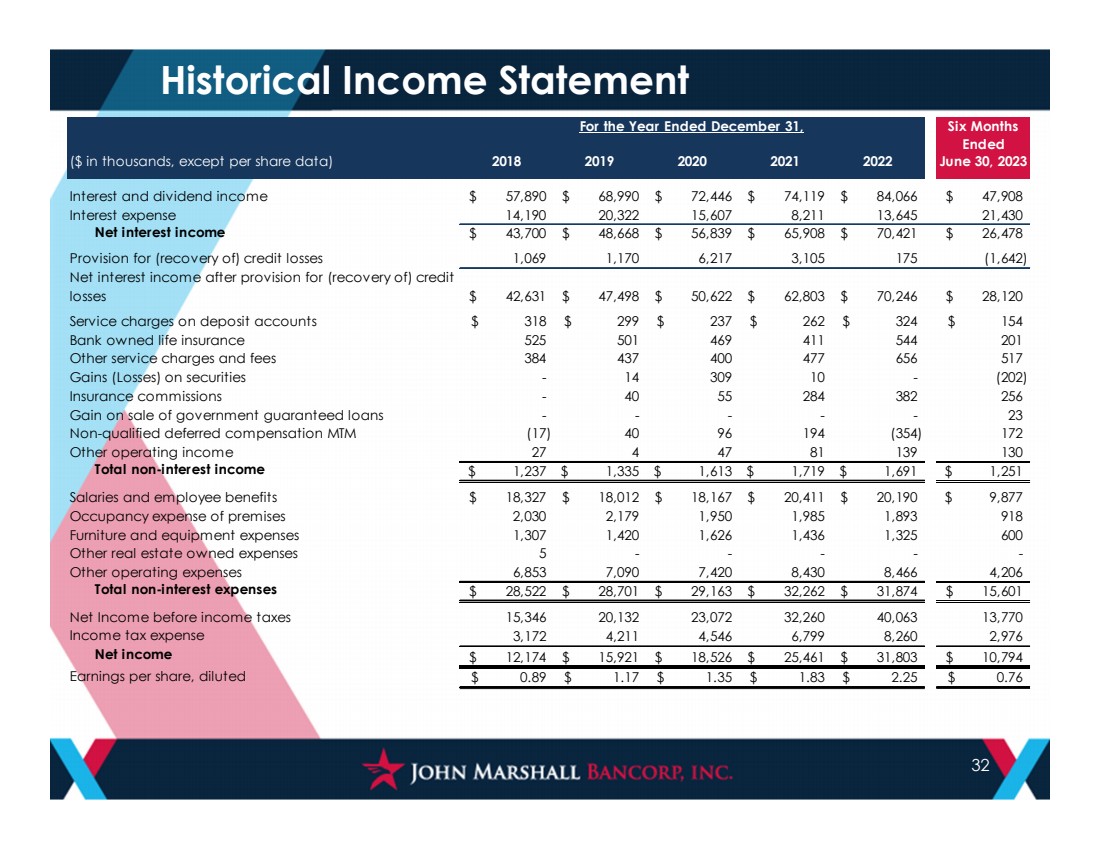
| 32 Historical Income Statement Six Months Ended ($ in thousands, except per share data) 2018 2019 2020 2021 2022 June 30, 2023 Interest and dividend income 57,890 $ 68,990 $ 72,446 $ 74,119 $ 84,066 $ 47,908 $ Interest expense 14,190 20,322 15,607 8,211 13,645 21,430 Net interest income $ 48,668 43,700 $ 56,839 $ 65,908 $ 70,421 $ 26,478 $ Provision for (recovery of) credit losses 1,069 1,170 6,217 3,105 175 (1,642) Net interest income after provision for (recovery of) credit losses 42,631 $ 47,498 $ 50,622 $ 62,803 $ 70,246 $ 28,120 $ Service charges on deposit accounts 318 $ 299 $ 237 $ 262 $ 324 $ 154 $ Bank owned life insurance 525 501 469 411 544 201 Other service charges and fees 384 437 400 477 656 517 Gains (Losses) on securities - 14 309 10 - (202) Insurance commissions - 40 55 284 382 256 Gain on sale of government guaranteed loans - - - - - 23 Non-qualified deferred compensation MTM (17) 40 96 194 (354) 172 Other operating income 27 4 47 81 139 130 Total non-interest income $ 1,335 1,237 $ 1,613 $ 1,719 $ 1,691 $ 1,251 $ Salaries and employee benefits 18,327 $ 18,012 $ 18,167 $ 20,411 $ 20,190 $ 9,877 $ Occupancy expense of premises 2,030 2,179 1,950 1,985 1,893 918 Furniture and equipment expenses 1,307 1,420 1,626 1,436 1,325 600 Other real estate owned expenses 5 - - - - - Other operating expenses 6,853 7,090 7,420 8,430 8,466 4,206 Total non-interest expenses $ 28,701 28,522 $ 29,163 $ 32,262 $ 31,874 $ 15,601 $ Net Income before income taxes 15,346 20,132 23,072 32,260 40,063 13,770 Income tax expense 4,211 3,172 4,546 6,799 8,260 2,976 Net income $ 15,921 12,174 $ 18,526 $ 25,461 $ 31,803 $ 10,794 $ Earnings per share, diluted $ 1.17 0.89 $ 1.35 $ 1.83 $ 2.25 $ 0.76 $ For the Year Ended December 31, |
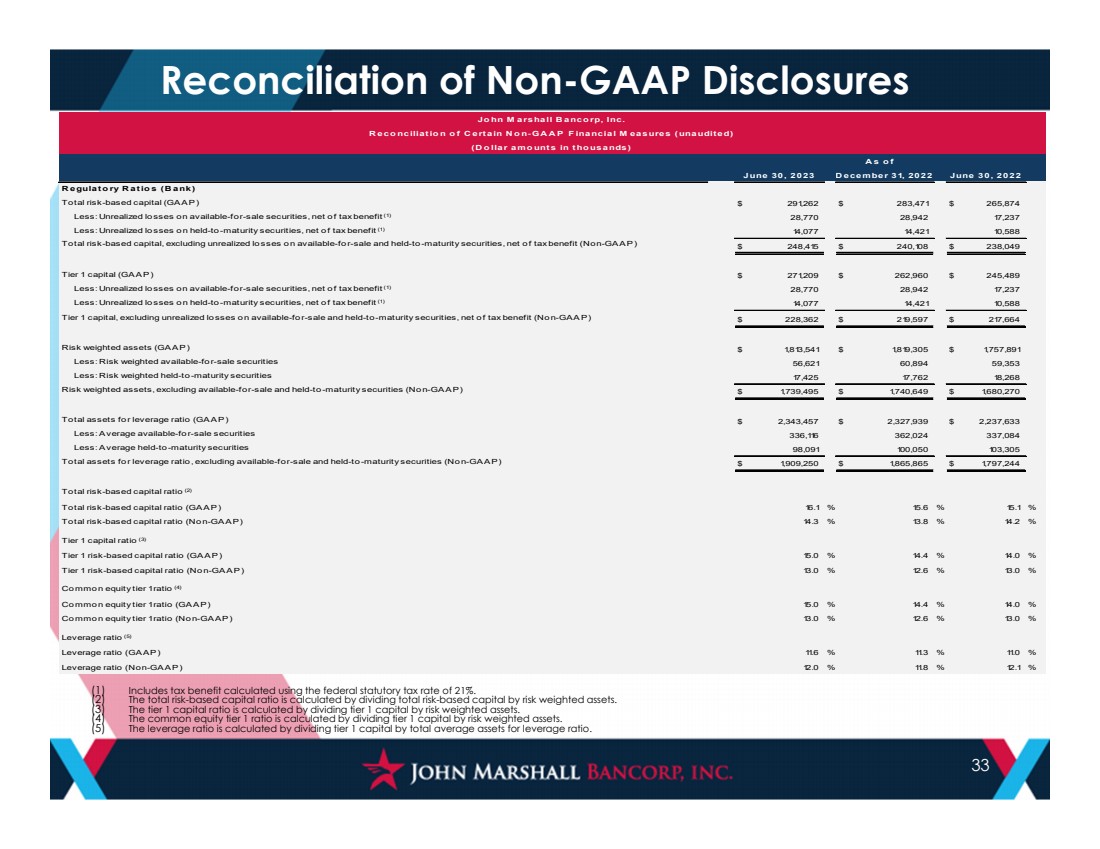
| 33 Reconciliation of Non-GAAP Disclosures (1) Includes tax benefit calculated using the federal statutory tax rate of 21%. (2) The total risk-based capital ratio is calculated by dividing total risk-based capital by risk weighted assets. (3) The tier 1 capital ratio is calculated by dividing tier 1 capital by risk weighted assets. (4) The common equity tier 1 ratio is calculated by dividing tier 1 capital by risk weighted assets. (5) The leverage ratio is calculated by dividing tier 1 capital by total average assets for leverage ratio. R egulato ry R atio s (B ank) Total risk-based capital (GAAP) $ 291,262 $ 283,471 $ 265,874 Less: Unrealized losses on available-for-sale securities, net of tax benefit (1) 28,942 28,770 17,237 Less: Unrealized losses on held-to-maturity securities, net of tax benefit (1) 14,077 14,421 10,588 Total risk-based capital, excluding unrealized losses on available-for-sale and held-to-maturity securities, net of tax benefit (Non-GAAP) $ 248,415 $ 240,108 $ 238,049 Tier 1 capital (GAAP) $ 271,209 $ 262,960 $ 245,489 Less: Unrealized losses on available-for-sale securities, net of tax benefit (1) 28,942 28,770 17,237 Less: Unrealized losses on held-to-maturity securities, net of tax benefit (1) 14,077 14,421 10,588 Tier 1 capital, excluding unrealized losses on available-for-sale and held-to-maturity securities, net of tax benefit (Non-GAAP) $ 228,362 $ 219,597 $ 217,664 Risk weighted assets (GAAP) $ 1,813,541 $ 1,819,305 $ 1,757,891 Less: Risk weighted available-for-sale securities 60,894 56,621 59,353 Less: Risk weighted held-to-maturity securities 17,425 17,762 18,268 Risk weighted assets, excluding available-for-sale and held-to-maturity securities (Non-GAAP) $ 1,739,495 $ 1,740,649 $ 1,680,270 Total assets for leverage ratio (GAAP) $ 2,343,457 $ 2,327,939 $ 2,237,633 Less: Average available-for-sale securities 362,024 336,116 337,084 Less: Average held-to-maturity securities 98,091 100,050 103,305 Total assets for leverage ratio, excluding available-for-sale and held-to-maturity securities (Non-GAAP) $ 1,909,250 $ 1,865,865 $ 1,797,244 Total risk-based capital ratio (2) Total risk-based capital ratio (GAAP) % 15.6 16.1 % 15.1 % Total risk-based capital ratio (Non-GAAP) % 13.8 14.3 % 14.2 % Tier 1 capital ratio (3) Tier 1 risk-based capital ratio (GAAP) % 14.4 15.0 % 14.0 % Tier 1 risk-based capital ratio (Non-GAAP) % 12.6 13.0 % 13.0 % Common equity tier 1 ratio (4) Common equity tier 1 ratio (GAAP) % 14.4 15.0 % 14.0 % Common equity tier 1 ratio (Non-GAAP) % 12.6 13.0 % 13.0 % Leverage ratio (5) Leverage ratio (GAAP) % 11.3 11.6 % 11.0 % Leverage ratio (Non-GAAP) % 11.8 12.0 % 12.1 % John M arshall Bancorp, Inc. Reconciliation of Certain Non-GAAP Financial M easures (unaudited) (Dollar amounts in thousands) As of June 30, 2023 D ecember 31, 2022 June 30, 2022 |
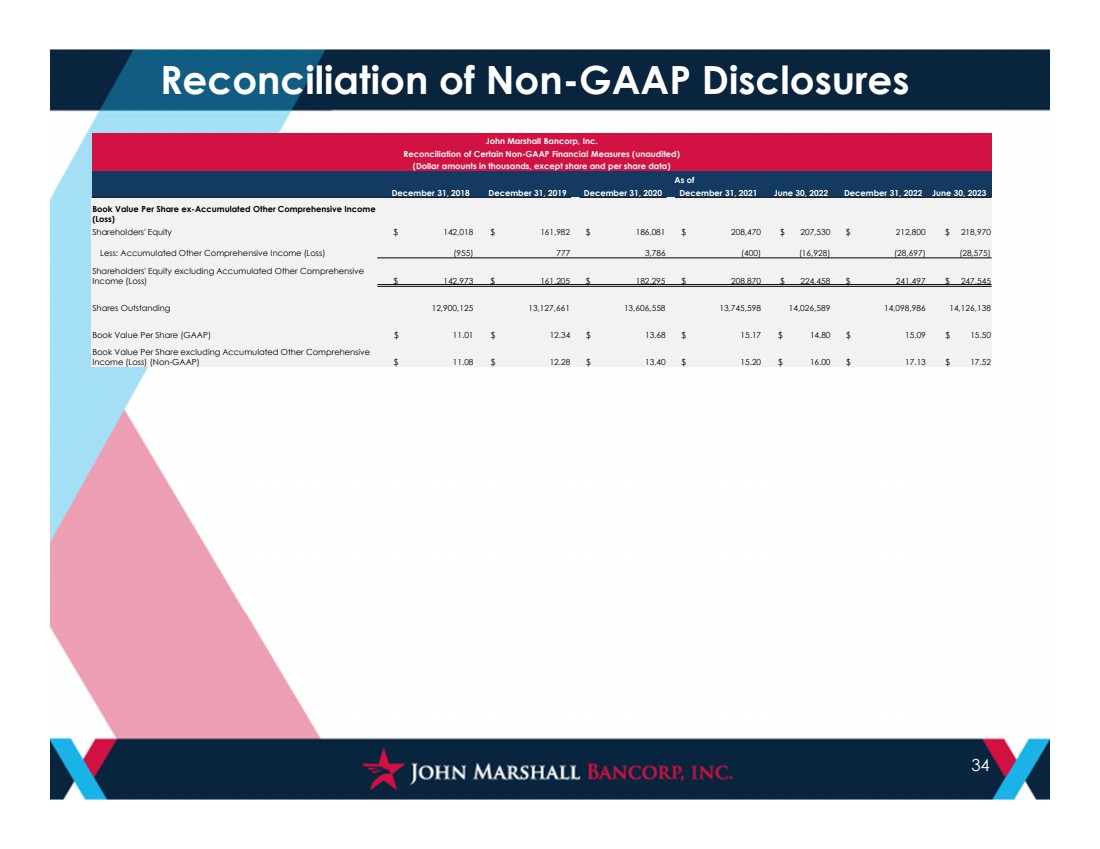
| 34 Reconciliation of Non-GAAP Disclosures John Marshall Bancorp, Inc. Reconciliation of Certain Non-GAAP Financial Measures (unaudited) (Dollar amounts in thousands, except share and per share data) As of December 31, 2018 December 31, 2019 December 31, 2020 December 31, 2021 June 30, 2022 December 31, 2022 June 30, 2023 Book Value Per Share ex-Accumulated Other Comprehensive Income (Loss) Shareholders' Equity $ 142,018 $ 161,982 $ 186,081 $ 208,470 $ 207,530 $ 212,800 $ 218,970 Less: Accumulated Other Comprehensive Income (Loss) (955) 777 3,786 (400) (16,928) (28,697) (28,575) Shareholders' Equity excluding Accumulated Other Comprehensive Income (Loss) $ 142,973 $ 161,205 $ 182,295 $ 208,870 $ 224,458 $ 241,497 $ 247,545 Shares Outstanding 12,900,125 13,127,661 13,606,558 13,745,598 14,026,589 14,098,986 14,126,138 Book Value Per Share (GAAP) $ 11.01 $ 12.34 $ 13.68 $ 15.17 $ 14.80 $ 15.09 $ 15.50 Book Value Per Share excluding Accumulated Other Comprehensive Income (Loss) (Non-GAAP) $ 11.08 $ 12.28 $ 13.40 $ 15.20 $ 16.00 $ 17.13 $ 17.52 |