
KIQSF 20-F
Kelso Technologies Inc (KIQSF)
UNITED STATES
SECURITIES AND EXCHANGE COMMISSION
WASHINGTON, D.C. 20549
FORM
OR
[
For the fiscal year ended
OR
OR
Date of event requiring this shell company report N/A
For the transition period from N/A to N/A
Commission file number
(Exact name of Registrant as specified in its charter)
Not Applicable
(Translation of Registrant's name into English)
British Columbia,
(Jurisdiction of incorporation or organization)
(Address of principal executive offices)
Telephone:
Email:
(Name, Telephone, E-mail and/or Facsimile number and Address of Company Contact Person)
Copy of communications to:
Aimee O'Donnell
Cassels Brock & Blackwell LLP
Suite 2200 - 885 West Georgia Street
Vancouver, British Columbia, Canada, V6C 3E8
Telephone: 604.691.6100
Facsimile: 604.691.6120
- ii -
Securities registered or to be registered pursuant to Section 12(b) of the Act.
Not Applicable
Securities registered or to be registered pursuant to Section 12(g) of the Act.
Not Applicable
(Title of Class)
Securities for which there is a reporting obligation pursuant to Section 15(d) of the Act.
Common Shares Without Par Value
Indicate the number of outstanding shares of each of the issuer's classes of capital or common stock as of the close of the period covered by the annual report.
There were no Class A non-cumulative preference shares outstanding on December 31, 2025.
Indicate by check mark if the registrant is a well-known seasoned issuer, as defined in Rule 405 of the Securities Act. [ ] YES [X]
If this report is an annual or transition report, indicate by check mark if the registrant is not required to file reports pursuant to Section 13 or 15(d) of the Securities Exchange Act of 1934. [ ] YES [X]
Note - Checking the box above will not relieve any registrant required to file reports pursuant to Section 13 or 15(d) of the Securities Exchange Act of 1934 from their obligations under those Sections.
Indicate by check mark whether the registrant (1) has filed all reports required to be filed by Section 13 or 15(d) of the Securities Exchange Act of 1934 during the preceding 12 months (or for such shorter period that the registrant was required to file such reports), and (2) has been subject to such filing requirements for the past 90 days.
[X] [ ] NO
Indicate by check mark whether the registrant has submitted electronically every Interactive Data File required to be submitted pursuant to Rule 405 of Regulation S-T during the preceding 12 months (or for such shorter period that the registrant was required to submit and post such files). [X] [ ] NO
Indicate by check mark whether the registrant is a large, accelerated filer, an accelerated filer, a non-accelerated filer, or an emerging growth company. See definition of "large, accelerated filer," "accelerated filer," and "emerging growth company" in Rule 12b-2 of the Exchange Act. (Check one):
| Large accelerated filer [ ] | Accelerated filer [ ] | |
If an emerging growth company that prepares its financial statements in accordance with U.S. GAAP, indicate by checkmark if the registrant has elected not to use the extended transition period for complying with any new or revised financial accounting standards† provided pursuant to Section 13(a) of the Exchange Act.
†The term "new or revised financial accounting standard" refers to any update issued by the Financial Accounting Standards Board to its Accounting Standards Codification after April 5, 2012.
Indicate by check mark whether the registrant has filed a report on and attestation to its management's assessment of the effectiveness of its internal control over financial reporting under Section 404(b) of the Sarbanes-Oxley Act (15 U.S.C. 7262(b)) by the registered public accounting firm that prepared or issued its audit report.
- iii -
If securities are registered pursuant to Section 12(b) of the Act, indicate by check mark whether the financial statements of the registrant included in the filing reflect the correction of an error to previously issued financial statements.
Indicate by check mark whether any of those error corrections are restatements that required a recovery analysis of incentive- based compensation received by any of the registrant's executive officers during the relevant recovery period pursuant to §240.10D-1(b). [ ]
Indicate by check mark which basis of accounting the registrant has used to prepare the financial statements included in this filing:
| U.S. GAAP [ ] | |
| by the International Accounting Standards Board [X] |
If "Other" has been checked in response to the previous question, indicate by check mark which financial statement item the registrant has elected to follow.
[ ] ITEM 17 [ ] ITEM 18
If this is an annual report, indicate by check mark whether the registrant is a shell company (as defined in Rule 12b-2 of the Exchange Act). [ ] YES [X]
(APPLICABLE ONLY TO ISSUERS INVOLVED IN BANKRUPTCY PROCEEDINGS DURING THE PAST FIVE YEARS)
Indicate by check mark whether the registrant has filed all documents and reports required to be filed by Sections 12, 13 or 15(d) of the Securities Exchange Act of 1934 subsequent to the distribution of securities under a plan confirmed by a court. [ ]
Under the Jumpstart Our Business Startups Act of 2012 (the "JOBS Act"), Kelso Technologies Inc. is classified as an "Emerging Growth Company." Under the JOBS Act, and JOBS Act amendments dated March 12, 2020, Emerging Growth Companies are exempt from certain reporting requirements, including the auditor attestation requirements of Section 404(b) of the Sarbanes-Oxley Act. Under this exemption, the company's auditor will not be required to attest to and report on management's assessment of the company's internal controls over financial reporting. The company is also exempt from certain other requirements, including the requirement to adopt certain new or revised accounting standards until such time as those standards would apply to private companies. The company will remain an Emerging Growth Company until the earliest of (1) the last day of the first fiscal year in which it has total annual gross revenue of US$1.235 billion or more, (2) December 31 of the fiscal year that it becomes a "large accelerated filer" as defined in Rule 12b-2 under the Exchange Act (which would occur if the market value of its common shares held by non-affiliates exceeds US$700 million, measured as of the last business day of its most recently completed second fiscal quarter, and it has been publicly reporting for at least 12 months), or (3) the date on which it has issued more than US$1 billion in non-convertible debt during the preceding three-year period.
- 1 -
TABLE OF CONTENTS
Page
- 2 -
- 3 -
FORWARD-LOOKING STATEMENTS
This annual report contains "forward-looking statements" and "forward-looking information" within the meaning of applicable securities legislation. These forward-looking statements relate to future events or future financial performance including the Company's current expectations, forecasts and assumptions. Generally, forward looking statements can be identified by the use of forward-looking terminology such as "estimate", "project", "believe", "anticipate", "intend", "expect", "plan", "predict", "may", "should", "potential", "budget", "schedule", "forecast", "believes" or "continue", the negative thereof or other variations thereon or comparable terminology that state that certain actions, events or results "may", "could", "would", "might" or "will be taken", "occur" or "be achieved".
Forward-looking statements in this annual report include, but are not limited to, statements with respect to: the Company's ability to generate and sustain increased revenues to achieve future profitability; timing and success of required regulatory approvals on rail products and corresponding revenue streams; new rail tank car production tracking replacement demand; revenue streams from rail tank car operations improving slowly over the upcoming years when new product offerings gain final Association of American Railroads ("AAR") regulatory approvals; longer term adoption of new product developments by the rail industry; increasing sales volume from newly developed products for a wider variety of rail tank car applications; expectations for capital resources and operations to continue the Company's ability to conduct ongoing business as planned for the foreseeable future; the strategic focus and obtaining AAR approvals for the additional products under field service trial to grow the Company's financial performance; generating minimal exceedance revenue from motivated customers; revenue growth opportunities; the ability of the Company to exploit its growing competitive advantages in the rail industry; becoming the primary, high quality valve supplier and fully servicing the rail tank car market; being on course for new value creation; the commercialization of Kelso's new products; and growing equity value from financial performance generated from a wider range of new proprietary products.
Such forward looking statements involve a number of known and unknown risks, uncertainties and other factors which may cause the actual results, performance or achievements of the Company to be materially different from any future results expressed or implied by such forward looking statements. Although Kelso believes the Company's anticipated future results, performance or achievements expressed or implied by the forward-looking statements are based upon reasonable assumptions and expectations, they can give no assurance that such expectations will prove to be correct. The reader should not place undue reliance on forward-looking statements as such statements involve known and unknown risks, uncertainties and other factors which may cause the actual results, performance or achievements of Kelso to differ materially from anticipated future results, performance or achievement expressed or implied by such forward-looking statements. Such risks and uncertainties include, without limitation: the economic condition of the railroad industry, which is affected by numerous factors beyond the Company's control including slow sales cycles, creation and adoption of new technologies, the existence of present and possible government regulation and competition; the risk that the Company's products may not work as well as expected; the Company may not be able to break in to new markets because such markets are served by strong and embedded competitors or because of long-term supply contracts; the Company may not be able to grow and sustain anticipated revenue streams; the Company may have underestimated the cost of product development and the time it takes to bring products to market; the Company may not be able to finance the Company's intended product development; that management may not be able to continue to initiate new product strategies to secure a more reliable growth of financial performance in the future; that testing results for new products may reveal that some or all products being developed are technologically or economically infeasible for market development and may be dropped; that the Company's products may not sell as well as expected, and competitors may offer better or cheaper alternatives to the Company's products; changes to global trade policies, the implementation of, or adjustments to, tariffs and the imposition of restrictive trade measures or countermeasures, and certain other risks detailed below under the heading "Risk Factors" and from time-to-time in Kelso's public disclosure documents.
Although the Company has attempted to identify important risk factors that could cause actual results to differ materially from those contained in forward-looking statements, there may be other factors that could cause results not to be as anticipated, estimated or intended. There can be no assurance that the forward-looking statements will prove to be accurate as actual results, and future events could differ materially from those anticipated in such statements.
- 4 -
Accordingly, readers should not place undue reliance on forward-looking statements. The forward-looking statements in this annual report speak only as to the date hereof, or such other date as may be indicated herein. Except as required by applicable law, including the securities laws of the United States and Canada, the Company does not intend to update any of the forward-looking statements to conform these statements to actual results. Additional information about the Company and Kelso's business activities is available under the Company's profile on SEDAR+ at www.sedarplus.ca in Canada and on EDGAR at www.sec.gov in the United States or the Company's website at www.kelsotech.com.
CURRENCY AND NON-IFRS FINANCIAL MEASURES
In this annual report, unless otherwise stated, all dollar amounts are expressed in United States dollars ("$"). The financial statements and summaries of financial information contained in this annual report are also reported in United States dollars unless otherwise stated. All such financial statements have been prepared in accordance with International Financial Reporting Standards as issued by the International Accounting Standards Board ("IFRS"), unless expressly stated otherwise.
References to Adjusted EBITDA refer to net earnings from continuing operations before interest, taxes and tax recoveries, amortization, deferred income tax recovery, unrealized foreign exchange losses, non-cash share-based expenses (Black-Scholes option pricing model) gain on revaluation of derivative warrant liability and write-off of assets. Adjusted EBITDA is not an earnings measure recognized by IFRS and does not have a standardized meaning prescribed by IFRS. Adjusted EBITDA is an alternative measure in evaluating the Company's business performance and Management believes it better reflects the Company's operational performance. Readers are cautioned that Adjusted EBITDA should not be construed as an alternative to net income as determined under IFRS; nor as an indicator of financial performance as determined by IFRS; nor a calculation of cash flow from operating activities as determined under IFRS; nor as a measure of liquidity and cash flow under IFRS. The Company's method of calculating Adjusted EBITDA may differ from methods used by other issuers and, accordingly, the Company's Adjusted EBITDA may not be comparable to similar measures used by any other issuer. The following table provides a reconciliation of net income (the most directly comparable measure under IFRS) to Adjusted EBITDA for the years ended December 31, 2025, 2024, and 2023:
| Year Ended December 31 | 2025 | 2024 | 2023 | ||||||
| Net Income (Loss) | $ | 447,397 | ($4,622,297 | ) | ($2,101,886 | ) | |||
| Unrealized foreign exchange loss (gain) | ($99,760 | ) | ($1,852 | ) | $ | 1,154 | |||
| Amortization | $ | 14,962 | $ | 1,209,648 | $ | 785,505 | |||
| Income Taxes (recovery) | ($66,559 | ) | $ | 236,453 | $ | 170,475 | |||
| Gain on revaluation of derivative warrant liability | $ | 0 | $ | 0 | ($3,665 | ) | |||
| Gain on repurchase of RSUs | ($2,518 | ) | ($6,030 | ) | ($40,785 | ) | |||
| Write down of inventory | $ | 40,232 | $ | 588,505 | $ | 214,225 | |||
| Impairment of assets on discontinued operations | $ | 0 | $ | 1,171,494 | $ | 0 | |||
| Gain(loss) on sale of property, plant, and equipment | $ | 0 | $ | 9,243 | $ | 0 | |||
| Share based expense | $ | 13,969 | $ | 165,510 | $ | 129,490 | |||
| Adjusted EBITDA (loss) | $ | 347,723 | ($1,249,326 | ) | ($845,487 | ) |
As used in this annual report, Company means Kelso Technologies Inc. ("Kelso") and the Company's wholly owned subsidiaries Kelso Technologies (U.S.A.) Inc. and KIQ X Industries Inc. (collectively the "Company"). Information on the Company's website www.kelsotech.com is not incorporated by reference into this annual report.
- 5 -
Item 1. Identity of Directors, Senior Management and Advisers
A. Directors and Senior Management
The directors and the senior management of the Company are as follows:
| Name and Office Held | Function |
| Frank Busch Director; President and Chief Executive Officer |
As the Company's President and Chief Executive Officer commencing July 9, 2024 and formalized Dec. 23, 2024, Mr. Busch is responsible for strategic planning and operations, as well as managing the Company's relations with the Company's legal advisers, regulatory authorities and the investment community; as a director, Mr. Busch participates in management oversight and helps to ensure compliance with the Company's corporate governance policies and standards. Prior to assuming the President and CEO roles, as an independent director Mr. Busch supervised the Company's management, chaired the Audit Committee and helped to ensure compliance with the Company's corporate governance policies and standards. |
| Sameer Uplenchwar Director; Chief Financial Officer |
As the Company's Chief Financial Officer, Mr. Uplenchwar is responsible for the management and supervision of all financial aspects of the Company's business; as a director, Mr. Uplenchwar participates in management oversight and helps to ensure compliance with the Company's corporate governance policies and financial standards. |
| Amanda Smith Chief Operating Officer |
As the Company's Chief Operating Officer, Ms. Smith is responsible for the daily operations of the Company's plant in Bonham, Texas and continues to take an active management role in pursuing growth of business opportunities, including mergers and acquisitions. Ms. Smith assists in all facets of the daily and strategic business activities including sales, marketing, engineering and inventory control. |
| Jesse V. Crews Lead Director (Independent); Compensation Committee Chair, Audit Committee Member, Corporate Governance & Nominating Committee Member |
As an independent director, Mr. Crews supervises the Company's management and helps to ensure compliance with the Company's corporate governance policies and standards. |
| Laura Roach Director (Independent); Audit Committee Member, Compensation Committee Member, Corporate Governance and Nominating Committee Chair |
As an independent director, Ms. Roach supervises the Company's management and helps to ensure compliance with the Company's corporate governance policies and standards. |
| Mark Temen Director (Independent); Audit Committee Chair, Compensation Committee Member, Corporate Governance & Nominating Committee Member |
As an independent director, Mr. Temen supervises the Company's management and helps to ensure compliance with the Company's corporate governance policies and standards. |
The business address for the Company is 305 - 1979 Old Okanagan Hwy, West Kelowna, British Columbia, Canada V4T 3A4.
B. Advisers
The Company's legal advisers are Cassels Brock & Blackwell LLP with a business address at #2200 - 885 West Georgia Street, Vancouver, British Columbia, Canada V6C 3E8.
- 6 -
C. Auditors
The Company's independent registered auditors are CBIZ CPAs P.C., with a business address at 500 W. Monroe Street, Suite 2000 Chicago, IL 60661. CBIZ CPAs is licensed and/or allowed to practice public accountancy in all 50 states in accordance with the American Institute of Certified Public Accountants (AICPA) and state board requirements, registered with the Public Company Accounting Oversight Board (United States) (PCAOB firm ID
Item 2. Offer Statistics and Expected Timetable
Not Applicable.
Item 3. Key Information
A. [Reserved]
B. Capitalization and Indebtedness
Not applicable.
C. Reasons for the Offer and Use of Proceeds
Not applicable.
D. Risk Factors
The Company's business operations involve several known and unknown risks, uncertainties and other factors which may cause the actual results, performance or achievements of the Company to be materially different from any future results expressed or implied by forward-looking statements in this annual report. The Company is diligent in minimizing exposure to business risk, but by the nature of the Company's activities and size, will always involve some risk. These risks are not always quantifiable due to their uncertain nature.
"The Company's products involve detailed proprietary and engineering knowledge and specific customer adoption criteria. If the Company is not able to effectively protect the Company's intellectual property or cater to specific customer adoption criteria, the Company's business may suffer a material negative impact and could fail."
The success of the Company will be dependent on the Company's ability to successfully develop; qualify under current industry regulations; and protect the Company's technologies by way of patents and trademarks.
The Company has obtained patents for the Company's external Constant Force Spring Pressure Relief Valves, Vacuum Relief Valve and Bottom Outlet Valve. If the Company is unable to secure trademarks and patent protections for the Company's intellectual property in the future, or that protection is inadequate for future products, the Company's business may be materially adversely affected.
Further, there is no assurance that the Company's rail equipment products and other aspects of the Company's business do not or will not infringe upon patents, copyrights or other intellectual property rights held by third parties. Although the Company is not aware of any such claims, the Company may become subject to legal proceedings and claims from time to time relating to the intellectual property of others in the ordinary course of the Company's business. If the Company is found to have violated the intellectual property rights of others, the Company may be enjoined from using such intellectual property, and the Company may incur licensing fees or be forced to develop alternatives. In addition, the Company may incur substantial expenses and diversion of management time in defending against these third-party infringement claims, regardless of their merit. Successful infringement or licensing claims against the Company may result in substantial monetary liabilities, which may materially and adversely disrupt the Company's business.
- 7 -
"The Company is engaged in complex research and development activities where testing results may deem prospective products technologically or economically infeasible."
The Company invests in R&D activities that focus on the innovation of new products. The primary purpose of these R&D investments is to advance and broaden the Company's portfolio of commercial products that can improve the growth of future financial performance of the Company. These R&D activities focus on a longer-term horizon and are not anticipated to generate immediate financial performance returns. Returns on investment on R&D are always uncertain and cannot be guaranteed. There is a risk that during the processes of R&D development testing results may reveal that some or all products being developed are technologically or economically infeasible for market development and may be dropped.
"The Company may be unable to secure or maintain regulatory qualifications for the Company's products."
The AAR requires all products to follow a lengthy and rigorous approval process and subsequent field service trial before they can be applied to tank cars by customers in the rail industry. The Company has been successful in obtaining AAR approvals for the Company's key products; however, there is no guarantee that the Company's products will continue to meet AAR standards or that new products developed by the Company will receive AAR approval. The Company's failure to obtain AAR approval on new products and maintain AAR certification could have a negative impact on the Company's ability to generate revenue.
"International conflict, trade relations and other geopolitical tensions and events, including war, military action, terrorism, trade disputes, tariffs, worker strikes, and international responses thereto have historically led to, and may in the future lead to, uncertainty or volatility in the global supply chain and financial markets."
Currently, there are various factors that impact geopolitical risk and uncertainty, including but not limited to the elevated geopolitical risk exemplified by ongoing active conflicts in the Middle East, between the US and Iran, Israel and Palestine, and in Europe, between Russia and Ukraine, as well as risks associated with China-Taiwan tensions. The recent conflict in the Middle East which escalated significantly in February 2026 has resulted in attacks on commercial vessels, disruption of shipping trade routes and high risk in entering the Strait of Hormuz. The heightened military conflict has led to profound instability in global financial and energy markets. These events, including the closure of strategic airspaces and critical maritime routes, have contributed to a dramatic increase in the price of oil and gas and created widespread market uncertainty. The ongoing disruptions caused by these military actions, and the potential for further escalation, could result in protracted and severe damage to the global economy and investment climate. The imposition of strict economic sanctions by Canada, the United States, the European Union, the United Kingdom and others in response to such conflict may have a destabilizing effect on commodity prices, supply chain and global economies more broadly. Supply chain disruptions may adversely affect the business, financial condition, and results of operations for the Company. The extent and duration of international conflicts, geopolitical tensions and related international action cannot be accurately predicted, and the effects of such conflicts may magnify the impact of the other risks identified herein.
"Impact of tariffs and trade measures on the Company's operations and the global economies."
The evolving regulatory landscape including the implementation and modification of tariffs, trade restrictions, and changes in trade agreements globally, together with general uncertainty about future changes in policy (including any new regulations, increased tariff rates, new tariffs or trade restrictions that may be implemented), could adversely affect the Company. On February 20, 2026, the Supreme Court of the United States struck down tariffs previously enacted under the United States International Emergency Economic Powers Act as invalid. However, the full implications of this decision remain uncertain amid rapidly evolving international trade and regulatory developments, including potential governmental responses relating to tariffs, trade agreements, or other trade measures. While discussions regarding global trade policies continue, significant uncertainty remains over whether tariffs, surtaxes, or other restrictive trade measures or countermeasures will ultimately be implemented and, if so, the scope, impact, and duration of any such measures. Potential measures could include, among others, increased tariffs on Canadian energy exports, restrictions on cross-border supply chains, or additional regulatory barriers that could impact the Company's ability to access international markets.
- 8 -
If imposed, restrictive trade measures or countermeasures could have adverse effects on the Company's operations by further disrupting supply chains, increasing costs for raw materials and impacting overall financial performance, in addition to having a material adverse effect on the U.S., Canadian and/or global economies. Tariffs on steel, aluminum, and other industrial materials may increase the cost of equipment, production and manufacturing processes, potentially impacting capital expenditures and operational efficiency. In addition, retaliatory measures or prolonged trade disputes may further increase costs, disrupt supply chains, and introduce regulatory uncertainty. The conditions may also lead to higher operating costs for our customers, as well as tighter operating budgets and more cautious capital spending decisions. While the Company continues to monitor trade policies and adapt its procurement and operational strategies, any prolonged restrictive trade measures could negatively impact margins and overall market conditions.
"The Company may not have sufficient capital to meet increases in business demands and may be unable to sustain the Company's ability to grow the Company's operations as anticipated."
Although the Company has a positive working capital, the Company may, from time to time, face a working capital deficit. To maintain the Company's activities, the Company may require access to additional capital through the sale of securities or obtaining debt financing. There can be no assurance that the Company will be successful in obtaining such additional financing and failure to do so could result in the inability of the Company to develop new products; meet production schedules; execute delivery orders; and continue the Company's strategic operations.
"The Company has a limited history of earnings and a history of net losses and may not be able to achieve the Company's growth objectives."
The Company has a limited history of sustained earnings and has a history of net losses and Adjusted EBITDA losses. The Company is subject to all of the business risks and uncertainties associated with any business enterprise which is transitioning from product development to profitable operations, including the risk that the Company will not achieve the Company's growth objectives.
There is no assurance that the Company will be able to successfully complete the Company's business development plans or operate profitably over the short or long term. Further, the Company may continue to incur losses and will have to generate and sustain increased revenues to achieve future profitability. Achieving profitability will require the Company to increase revenues, manage its cost structure, and avoid significant liabilities. The Company is dependent upon the good faith and expertise of Management to identify, develop and operate commercially viable product lines. No assurance can be given that the Company's efforts will result in the development of additional commercially viable product lines or that the Company's current product lines will prove to be commercially viable in the long term. If the Company's efforts are unsuccessful over a prolonged period, the Company may have insufficient working capital to continue to meet ongoing obligations and the Company's ability to obtain additional financing necessary to continue operations may also be adversely affected. Even if the Company is successful in developing one or more additional product lines, there is no assurance that these product lines or the Company's existing product lines will be profitable. Additionally, the Company may encounter unforeseen operating expenses, difficulties, complications, delays, quality problems, and other unknown factors that may result in losses in future periods.
- 9 -
"New commercial markets for the Company's products may not develop as quickly as anticipated or at all."
Markets for the Company's products may not develop as quickly as anticipated, or at all, resulting in the Company being unable to meet the Company's revenue and production targets. This may have a material negative impact on the Company, particularly if the Company has incurred significant expenses to cater to increased market demand and such market demand does not materialize.
"Unforeseen competition could affect the Company's ability to grow revenues as projected."
Although the Company has patents, trademarks and other protections in place to protect the proprietary technology on which the Company's business is dependent, competitive products may be developed in the future. Competition could adversely affect the Company's ability to acquire additional market share or to maintain revenue at current and projected levels. While every effort is made to track current and future competitors, new entrants from outside the USA and Canada may be difficult to identify until market entry occurs.
"Customer orders that are placed may be cancelled or rescheduled."
Although the Company makes efforts to ensure customers are satisfied with the Company's products, there is a risk that customers may cancel purchase orders before they are filled. This could have a material negative impact on the Company, particularly if the Company has already ordered the component parts required to assemble the finished products or if the Company has assembled the required finished products. The negative impact may be mitigated by the Company's ability to utilize the component parts and finished products to satisfy other purchase orders, but there is no guarantee that the Company will be able to mitigate the risk of loss to the Company from cancelled orders in this manner. Cancelled orders are normally subject to a cancellation fee to reduce loss.
"The Company is dependent on a small number of OEM customers."
Although Management is optimistic about the Company's future as a railway equipment supplier, the Company is highly dependent upon the success of four major tank car manufacturers as they provide a significant portion of the Company's revenue. The Company does not have any long-term purchase agreements, annual minimum sales requirements or blanket purchase order agreements with customers. Sales are generated on an as needed basis and purchase orders are scheduled according to production availability. The Company expects that this limited number of customers will continue to represent a substantial portion of the Company's sales for the foreseeable future. The loss of any of these customers could have a material negative impact upon the Company and the Company's results of operations.
"Current products may not perform as well as expected."
There is a risk that the Company's products may not perform as well as they have historically, which could result in customer complaints, returned products, product recalls and/or loss of repeat customer orders. Any of these issues could have a material negative impact on the Company's ability to generate revenue and continue operations.
"There may be a shortage of parts and raw materials."
The Company currently dual sources all components domestically for all product lines. There is a potential risk from time to time that the Company could face a shortage of parts and raw materials so suppliers are unable to support current or increased customer demand. This could have a material negative impact on the business development plans of the Company, the Company's revenues and continued operations.
"Production capacity may not be large enough to handle growth in market demand."
The Company's production facilities may not be large enough to handle growing market demand for the Company's products if market demand is above projected levels. The Company may not have sufficient capital to fund increased production at the Company's existing facilities or to add new production facilities, and even if the Company did have sufficient funds for these purposes, the turnaround time to increase production may not be fast enough to meet market demand. This may have a material negative impact on the Company's ability to maintain existing customers and expand the Company's customer base, and the Company's ability to generate revenue at current and projected levels.
- 10 -
"The Company's product development efforts may not result in new qualified commercial products."
The Company's ambition to design, research and develop proprietary products for the rail industry may not successfully transition into other industries. The inability to break into new markets and industries may in the future have a negative impact on the Company. The Company's investment in new product research is written off in the period in which it is incurred to account for the unpredictable nature of research projects.
"The Company may face uninsurable or underinsured risks."
During development and production of rail equipment products, certain risks, and in particular, destruction of production facilities by a natural disaster, acts of terrorism, acts of war or patent infringement may occur. It is not always possible to fully insure against such risks and the Company may decide not to take out insurance against such risks because of high premiums or other reasons. Should such liabilities arise, they could reduce or eliminate any future profitability and result in increasing costs and a decline in the value of the securities of the Company. Of the above-listed risks, only an act of war is truly uninsurable. The Company maintains commercial general liability insurance for claims up to $2,000,000 in general aggregate and $1,000,000 each occurrence, as well as $2,000,000 product-completed operations aggregate. Additionally, the Company maintains umbrella liability insurance for claims up to $4,000,000 in annual aggregate.
Although the Company believes that the insurance policies currently in place adequately insure the Company given the size of the Company's customer base and revenues from product sales, there is a risk that the Company's insurance coverage may not be sufficient to cover future products claims.
"Raw materials used by the Company for the production of the Company's products are subject to price fluctuations which could change profitability expectations."
Many of the materials used in the Company's products are common raw materials such as steel and rubber. These raw materials may be subject to significant price fluctuations. A steep rise in the price of such raw materials may have an adverse effect on the financial returns of the Company's products and could negatively impact the Company's operating results. Considering the Company does not have any purchase agreements with customers, the Company is able to mitigate the risks associated with price fluctuations by adjusting the pricing structure as necessary. However, there is no guarantee that customers will continue to purchase the Company's products if prices are adjusted due to the fluctuation in the price of raw materials.
"The success of the Company's business depends substantially on the continuing efforts of the Company's senior executives, and the Company's business may be severely disrupted if the Company loses their services."
The future success of the Company depends upon the continued services of the Company's senior executives and other key employees. In particular, the Company relies on the expertise and experience of the Senior management team of Kelso Technologies Inc. and Kelso Technologies (USA) Inc. If one or more of the Company's senior executives were unable or unwilling to continue in their present positions, the Company might not be able to replace them easily or at all. If any of the Company's senior executives join a competitor or form a competing company, the Company may lose clients, suppliers, key professionals, technical know-how and staff members.
Should one or more of these risks and uncertainties materialize, or should underlying assumptions prove incorrect, then actual results may vary materially from those described on forward-looking statements.
- 11 -
Item 4. Information on the Company
A. History and Development of the Company
The Company was incorporated as "Kelso Resources Ltd." pursuant to the Company Act (British Columbia) on March 16, 1987. On July 21, 1994, the Company changed the Company's corporate name to "Kelso Technologies Inc.". The Company is currently organized pursuant to the Business Corporations Act (British Columbia) ("BCBCA") which replaced the Company Act (British Columbia) in 2004.
The Company's registered office is located at Suite 2200 - 885 West Georgia Street, Vancouver, British Columbia V6C 3E8. The Company's corporate head office is located at 305 - 1979 Old Okanagan Hwy, West Kelowna, British Columbia V4T 3A4. The Company's head office telephone number is (778) 795-0022.
In February 2007, the Company replaced the Company's original Articles with new Articles to reflect the adoption of the BCBCA. On May 13, 2010, the Company consolidated the Company's share capital on the basis of one new common share in the capital of the Company (each, a "Common Share") for seven old Common Shares. This consolidation was approved by a special resolution of the shareholders of the Company passed February 5, 2010. At the Company's annual general and special meeting held on June 5, 2013, the Company obtained shareholder approval of certain amendments to the Articles of the Company to include, among other things, advance notice provisions. Advance notice provisions provide a framework whereby the Company can fix a deadline for submission of director nominations by shareholders prior to any annual or special meetings of shareholders and can set forth the information regarding director nominees that a shareholder must include in their notice to the Company for such notice to be in proper written form.
The Common Shares have been publicly traded on the Toronto Stock Exchange ("TSX" or the "Exchange") under the symbol "KLS" since May 22, 2014, prior to which the Common Shares traded on the TSX Venture Exchange ("TSXV"). The Common Shares were traded on the NYSE American ("NYSE American") under the symbol "KIQ" from October 14, 2014 to March 25, 2024. The Common Shares trade on the U.S. OTC market under the symbol "KIQSF".
The Company operates in conjunction with the Company's two wholly owned subsidiaries Kelso Technologies (USA) Inc. ("KTU"), and KIQ X Industries Inc. ("KIQX"). Three wholly owned subsidiaries were dissolved due to inactivity in 2025: KIQ Industries Inc., Kel-Flo Industries Inc (formerly Kelso Innovative Solutions Inc.), and KXI Wildertec Industries Inc. The Company owns 100% of the voting securities of each of the Company's subsidiaries. None of the subsidiaries has a class of restricted securities. KTU was incorporated on August 3, 2005, in the State of Nevada for potential use for operations in the United States. KIQX was incorporated on December 12, 2017, in the Province of British Columbia, Canada as an operating subsidiary for the development, production and sales of the Company's proprietary KXI vehicle suspension system for wilderness terrain vehicles.
General Development of the Business
General
Kelso is a diverse product engineering company that specializes in the research, development, production and distribution of proprietary equipment used in various transportation applications. Over the past decade the Company has earned a reputation as a reliable manufacturer of high-quality tank car equipment used in the handling, containment, and transport of hazardous and non-hazardous commodities.
All Kelso products are developed with an emphasis on providing economic and operational advantages to the customer while mitigating the impact of human error and environmental releases. The Company offers specialized tank car and tank trailer equipment, no-spill fast fuel loading systems, and emergency response equipment specific to the rail industry.
The Company has firmly established itself as a North American manufacturer of specialized tank car equipment. The Company's core tank car products include safety relief valves for general purposes and pressure tank cars. Additionally, other products include vacuum relief valves, bottom outlet valves and angle valves. These products provide some of the key elements of a tank car's structure, ensuring the safe handling, containment and transport of hazardous and non-hazardous materials. With a solid history of innovative technology and a reputation anchored by the reliability of supply, the Company serves many of North America's largest tank car builders, lessors and shippers.
- 12 -
Three Year History
2023
During Fiscal 2023, Kelso continued to strengthen the portfolio of its rail products by closely monitoring those products near completion of the required AAR service trial period. The strategic focus was to obtain AAR approval in 2024 for K2AV to better grow financial performance in a sustainable meaningful way. The completion of the pressure car kit has been the Company's core branding ambition.
The Rail operations maintain effective and efficient productive systems that were developed in April 2010 and modified over the years to become a highly lean manufacturing facility. All functional elements of plant and equipment, production planning and controls, labor, staffing, product design/engineering are fully developed and productive at above average contribution margins from sales.
Financial performance during 2023 fell short of original expectations with our 5-year average at $12,175,532 per year. This was due to many macroeconomic factors beyond the control of the Company, that created a deep recession of business activities in the tank car industry. This included the penalizing effects of COVID-19, high interest rates, inflationary pressures, supply chain issues and lengthy AAR approval processes. Despite the many challenges the Company persisted and believes that it could exploit its growing competitive advantages in the rail industry.
Since mid-2021 the Company's automotive innovation development operations have been heavily engaged in creating a unique fully automated "center-of-gravity" oriented Advanced Driver-Assistance System ("ADAS") designed specifically for wilderness travel. In 2023 the Company confirmed that it had created the first "field-tested" automated suspension-based ADAS for emergency and commercial mission-critical wilderness operations. Our ADAS technology was specifically designed to address the challenging issues of worker well-being and safety as well as ecological protection while delivering effective and efficient operational advantages to wilderness operating stakeholders. The innovation design objectives were to create products that diminished the potentially dangerous effects of human and technological error using the Company's proprietary engineered solutions.
On April 25, 2023 the Company and G&J Technologies Inc. ("G&J") received the arbitrator's final judgment to legally resolve all the disputed issues. The judgement required Kelso to provide final financial payouts of US$465,360 to G&J for termination fees, asset payment issues and legal fees. This amount has been paid and was included in the financial results for the year ended December 31, 2023. The final judgement of the arbitrator in no way affects the Company's ability to continue the KXI Wildertec Heavy Duty Suspension program and the KXI technology remains unencumbered. According to the terms of the Technology Development Agreement (the "TDA"), the Company maintains intellectual property rights acquired under the TDA and is liable for a 2.5% royalty to the service provider or their assigns should Kelso use their technologies in a commercially sold product.
On September 12, 2023, the Company's KXI Wildertec™ Software Division filed the first stage proprietary patent application for its Automated Traction Optimization Method for Vehicle Suspension Systems ("Method"). The Patent Application formed the Company's initial proprietary claims and intellectual foundation for its future KXI Wildertec™ technologies. This patent application filing began the Company's comprehensive proprietary protection program for additional protectable full automation ADAS developments and positions the Company's artificial intelligence intentions. The grant of the Canadian Patent on our Method technologies was expected to be in 2024 and is still pending.
In the automotive industry, ADAS refers to specialized automated technical features designed to increase the safety of operating motor vehicles on existing roadways. Current automotive industry design ambitions were to use human-machine interfaces that assisted a driver's ability to react to dangers on established roads. Upon extensive field testing the unique Method, Kelso's intelligence supported that the Company is the first enterprise to demonstrate a functional automated suspension-specific ADAS for commercial wilderness applications. This was a major technology development advantage for the Company to grow future revenues from specialized automotive markets.
- 13 -
Very little emphasis by the automotive world has addressed ADAS requirements in wilderness operations. Our strategic business objectives were to lead the way on ADAS for no-road environments for emergency responders, commercial/industrial stakeholders and humanitarian aid and defense customers. Our business ambition was to participate in the emerging global ADAS software market which is estimated to reach the $80 billion mark by 2030 as reported by industry experts, McKinsey & Company.
The Company concentrated its production resources on delivering safety enhancing technology solutions for customers in, but not limited to, disaster response, wilderness firefighting, mobile medical treatment, evacuation and emergency response, mining and exploration, energy transmission, civil engineering projects, telecommunications and geographic/environmental data systems.
In 2023, the Company made considerable progress in its research and development to create new innovative products. Timing of required regulatory approvals on rail and automotive products and corresponding revenue streams remains unpredictable and cannot be guaranteed to be successful.
The Company felt it was on course for new value creation as we looked forward to new business success in both rail and automotive markets. Management determined a clear path for the commercialization of our new products to provide longer-term profitable revenue growth. With no interest-bearing long-term debt to service and improved sales prospects from larger diverse markets, Kelso focused on the growth of its equity value from financial performance generated from a wider range of new proprietary products.
The Company deployed capital resources sensibly to maintain financial health and liquidity. The Company's working capital was $5,026,580 as at December 31, 2023. Current working capital and anticipated sales activity for 2024 is expected to protect the Company's ability to conduct ongoing business operations and R&D initiatives for the foreseeable future.
2024
During Fiscal 2024, the Company hired a new management team, including a new CEO, CFO and Corporate Secretary. An assessment process was completed by new management to assess strengths and challenges and to find opportunities to reduce overhead expenditure. These efforts will be ongoing into 2025 to return greater value to shareholders. The team was cautious to avoid disruption of those products nearing completion of the required AAR service trial period, to diversify the portfolio of rail products on offer. The strategic focus remained on obtaining AAR approval for the K2AV, completing the pressure car kit, with a goal to improve sales in a sustainable and meaningful way.
This has primarily been due to the cyclical nature of the tank car industry, geo-political uncertainty, and costs associated with discontinued operations. This includes the political uncertainties of an election year, high interest rates, inflationary pressures, global supply chain issues and lengthy AAR approval processes. Despite numerous challenges, the Company continued to endure and remains confident in its ability to leverage its expanding competitive strengths within the rail sector. Though fiscal year 2024 revenue was in line with our 5-year average, revenue missed management expectations. The shortfall is attributed to various macroeconomic factors beyond the Company's control, which have contributed to the continued downturn in the tank car business. These factors include the prolonged adverse impacts of high interest rates, inflationary pressures, supply chain disruptions, and prolonged AAR approval processes. Despite the numerous challenges, the Company remains resilient and confident in its ability to leverage its growing competitive advantages within the rail industry.
Completion of the K2AV Field Service trial and AAR approval is crucial for achieving the Company's goals for rail revenue growth. The approval of the angle valve would complete the pressure car kit providing Kelso the opportunity to offer a package at a much higher sales price. The expectation is that the offering can increase revenue on a pressure car from an average of $1,500 per car to over $10,000 per car. The K2AV successfully completed the initial phase of the field service trial and is on track to complete it in 2025. The AAR approvals are the key milestone to establish new revenue growth from rail-related products. The goal is to fully service the needs of the pressure car market fleet of approximately 86,000 tank cars, with valves for both the new car or repair market. This presents a significant opportunity for financial growth while continuing to secure AAR approvals on additional products in the R&D pipeline.
- 14 -
The Company's working capital was $2,125,387 as at December 31, 2024 which includes $3,042,749 in inventories required for timely customers' deliveries. Capital resources generated from rail operations are anticipated to sustain the Company's capacity to continue its business activities for the foreseeable future.
Kelso plans to continue efforts to strengthen the portfolio of tank car products with the active field service trials in progress for the standard profile ceramic ball bottom outlet valve and angle valve. Kelso's pressure tank car PCH became available for full commercial use, adding to current and future sales growth opportunities.
Over the years the Company has become a highly respected quality brand and established direct relationships with HAZMAT shippers. These interested stakeholders have directly helped design the proprietary Angle Valve for the pressure car market and our Bottom Outlet Valve, featuring unique ceramic technology advantages. The new rail products should sell for higher unit values and are expected to increase our rail car revenue. Our bottom outlet valves are going into full-service trials and may be able to generate minimal exceedance revenue from motivated customers.
Due to a multitude of factors, the tank car market has shown a renewed focus on repurposing and/or re-qualifying existing tank car fleets. This has presented Kelso with an opportunity to grow its revenues in the repair, retrofit and requalification space due to manufacturing efficiencies, a reliable supply chain, domestic sourcing initiatives and proven quality and delivery from the facility.
In February 2024 the Company established an initial Phase-One Pilot production facility with additional leased space at its KXI R&D facility in West Kelowna, BC, Canada. The production facility was designed and tooled to convert different classes of heavy duty "host" vehicles with the Company's patents pending proprietary Method technologies. Those vehicles were designed to be sold to customers operating in extreme terrain environments who specified their custom user case requirements utilizing our Method technologies.
At the annual general meeting of shareholders held on June 5, 2024, shareholders withheld their support for the Chief Executive Officer resulting in his retirement from the Company on July 9, 2024. Following the retirement of the CEO, the Chief Financial Officer was terminated on August 30, 2024. The Board of Directors nominated an independent director to Interim CEO (made permanent December 23, 2024) as the Company reorganized and reevaluated its direction. The team engaged the services of a new CFO and began to review the strategic planning factoring in current market conditions.
A recent review of the KXI project, conducted in accordance with accounting standards, provided valuable insight into its status and potential future pathways. It was determined that KXI was not going to generate commercial revenue in the short to medium term and the expenses for both facility and staff were accordingly reduced. The review has highlighted some key challenges in securing funding for continued development, leading to a prudent adjustment in the project's carrying value.
While the project faces uncertainties, we recognize the potential value of the underlying technology. Accordingly, we are actively exploring strategic alternatives to optimize its future potential, including sale, licensing, and/or royalty agreements. In particular, we are pursuing potential joint venture partnerships and conducting a rigorous value assessment of the project's core technology. As a result of this review, the capitalized research and development (R&D) was impaired to a nominal $1 as well as the prototype costs were also impaired to $1. KXI HD research and development operations are located in a facility in West Kelowna, British Columbia, Canada.
The adjustment represents a responsible and forward-looking approach, positioning us to capitalize on future opportunities and maximize the potential of the KXI project.
2025
Fiscal 2025 was a turn-around year for Kelso. The new Management team focused on the main valve business and discontinued operations on the KXI suspension R&D division, as reported in 2024. Valve sales were relatively strong in 25Q1 but began to slow in later quarters as new tariffs disrupted supply chains and increased costs for raw materials. Tank car customers were hesitant to place new orders as the price for new cars became uncertain.
- 15 -
The Company's working capital was $2,541,625 as at December 31, 2025 which includes $2,206,770 in inventories required for timely customers' deliveries. Kelso's operations and Sales teams work closely with customers to determine future needs and have expanded discussions to identify additional operational challenges and potential solutions. The income from rail operations is expected to support the company's ability to maintain its business activities in the near term, ensuring ongoing operational capacity. Greater diversification will be required to fund any capital expenditure and to grow the Company.
The AAR field service trail for the angle valve ("K2AV") continued in 2025 with the majority of required loaded trips and miles completed. Kelso's engineering team monitored K2AVs in the field to report its progress to the AAR. Communication with participating customers revealed no major issues and Kelso anticipates that the K2AV will be approved in 2026. The K2AV should drive new revenue growth due to the completion of Kelso's pressure car package of components needed for the pressure car model.
While 2025 revenue was relatively flat compared to 2024, expenses were closely monitored and reduced. Management allowed attrition of non-essential personnel to reduce the workforce. Severance obligations and related legal costs continued to impact expenditure in the first half of the year. The Company's COO and Director Tony Andrukaitis retired mid-year after 14 years and his mentored successor, Amanda Smith, was promoted to COO from Executive VP Operations. That position was eliminated for cost-savings and duties were distributed amongst various staff members.
Several changes to the Company's Board occurred in 2025. In April 2025 Mark Temen joined as an Independent Director, adding his years of experience as an accredited CPA and business entrepreneur. He was subsequently appointed Chair of the Audit Committee on July 1, 2025. Lead Director Paul Cass retired on August 31, 2025 and Independent Director Jesse Crews accepted the nomination as Lead Director. The Company's CFO Sameer Uplenchwar filled the vacant director position effective September 1, 2025.
On September 25, 2025 Smythe LLP submitted their resignation letter as auditor of the Company due to a change in their policy, and agreed to provided references and recommendations for a new auditor to be selected. After reviewing several proposals, the Audit Committee and Board approved CBIZ CPAs P.C. as the Company auditor effective October 6, 2025.
In the fourth quarter the rail car industry significantly decreased in new production volume and rail car shipments due to negative economic factors including global tariffs. Management responded by increasing cost controls to eliminate non-essential travel and increasing the team's focus on sales efforts.
Kelso's line of credit with Texas Capital Bank increased from $500,000 to $1 million reflecting improvements in fiscal management and cost discipline. Management is prepared for weakness in the tank car market should it persist and has business development plans in place to act on viable new business opportunities.
Tariffs
The broader rail industry faces significant risk from potential tariff actions undertaken by the U.S. government. These tariff actions could drastically increase the cost of imported materials and components, which many companies in the sector rely upon for their manufacturing processes. The increased costs could lead to higher prices for end products, reduced profit margins, and potential disruptions in supply chains.
The Company's entire production of valves takes place at its facility in Bonham, Texas, ensuring that all manufacturing processes are under tight control and not subject to the uncertainties of international trade policies. Moreover, Kelso utilizes domestic US suppliers for its raw materials and components, further insulating the Company from potential US tariff impacts. This strategic approach not only secures a stable supply chain but also enhances the quality and reliability of Kelso's products, providing a significant competitive advantage in a volatile market. While potential tariff actions pose a substantial risk to the broader industry, Kelso believes that its commitment to domestic production in the US and local sourcing places the Company in a favorable position to navigate these challenges effectively.
- 16 -
Capital Expenditures
The Company has no material capital expenditure planned at this time.
Takeover Offers
The Company is not aware of any indication of any public takeover offers by third parties in respect of the Company's common shares during the Company's last financial year or current financial year.
Additional Information
The U.S. Securities and Exchange Commission (the "SEC") maintains an internet site that contains reports, proxy and information statements, and other information regarding issuers that file electronically with the SEC. The address of that site is www.sec.gov. The Company's website is www.kelsotech.com.
B. Business Overview
Kelso is a diverse light industrial production company that specializes in the research, development, production and distribution of proprietary equipment used in various transportation sectors. Over the past decade the Company's reputation has been earned as a manufacturer of high-quality tank car equipment used in the handling, containment and transport of commodities.
All Kelso products are developed with an emphasis on providing economic and operational advantages to the customer while mitigating the impact of human error and environmental releases. The Company offers specialized tank car and tank trailer equipment, no-spill fast fuel loading systems, and emergency response equipment specific to the rail industry.
The Company has firmly established itself as a leading North American manufacturer of specialized tank car equipment. The Company's core tank car products include safety relief valves for general purpose and pressure tank cars. Additionally, other products include vacuum relief valves, bottom outlet valves and angle valves. These products provide some of the key elements of a tank car's structure, ensuring the safe handling, containment and transport of materials. With a solid history of innovative technology and a reputation anchored by the reliability of supply, the Company serves many of North America's largest tank car builders, lessors and shippers.
The Company's common shares are publicly traded on the TSX under the trading symbol "KLS". The Company first listed on the Toronto Stock Exchange on May 22, 2014 and on the NYSE American Exchange on October 14, 2014. On March 5, 2024 the Company announced that it had notified the NYSE American of its intention to voluntarily delist its common shares from the NYSE American due to minimum share price requirements, which became effective on March 26, 2024. The common shares continue to trade on the TSX and on the OTC markets in the United States.
The Company operates in combination with the Company's wholly owned subsidiaries Kelso Technologies (USA) Inc. and KIQ X Industries Inc. Three wholly owned and inactive subsidiaries ceased in 2025: KIQ Industries Inc. due to closure in 2024 of the R&D subsidiary; Kel-Flo Industries Inc (formerly Kelso Innovative Solutions Inc.) due to is inactive status since inception; and KXI Wildertec Industries Inc due to closure in 2024 of the R&D subsidiary.
Over the past five years Management has established multi-million-dollar sales of the Company's products to North American tank car manufacturers (OEM) and retrofit/repair businesses. Revenues over the last five audited year end periods were as follows: $10,784,090 for the year ended December 31, 2025; $10,680,468 for the year ended December 31, 2024; $10,819,916 for the year ended December 31, 2023; $10,931,188 for the year ended December 31, 2022; and $7,425,707 for the year ended December 31, 2021.
- 17 -
The Company's net earnings (loss) performance over the last five year-end periods were as follows: net earnings of $447,397 for the year ended December 31, 2025; net loss of $ 4,622,297 for the year ended December 31, 2024; net loss of $2,101,886 for the year ended December 31, 2023; net loss of $1,355,417 for the year ended December 31, 2022; and net loss of $2,758,567 for the year ended December 31, 2021.
The tank car industry is historically cyclical. Given the unprecedented challenges of supply chain disruption after the COVID-19 pandemic, the Company's focus was the containment of negative impacts on the Company's longer-term business model and the protection of the Company's key productive assets, research and development ambitions and its ability to continue business operations. The Company concentrated on preparedness for post-pandemic normalization and readiness for a strong restart of business growth. In 2022 revenues improved by 47% over the previous and maintained the same level in 2023. This allowed Kelso to continue to grow its R&D projects in both the rail and automotive industries.
Financial performance in 2023 diminished by 1% over 2022, which saw recession-affected sales recover by 47% after a dramatic 33% setback in 2021. Weakened financial performance raised Management's concerns of the Company's abilities to continue business operations. While the OEM tank car producers slowed in April 2020 and have remained depressed, the retrofit and repair business segments remain open. This has allowed the Company to continue the Company's rail operations productively.
A change in Kelso management in mid-2024 and re-evaluation of product development initiatives resulted in a return to positive revenue in 2025. However, the uncertainty of US tariffs and implementation of sector-specific fees caused new tank car production to remain flat at 10,200 units for 2025.
As a result of the tariff impact, industry experts Freight Transportation Research Associates now anticipate that new tank car production replacement demand for the 438,000 tank car fleet will decline slightly in 2026 to 7,875 before rebounding to 9,450 in 2027 and further increasing into 2028. Tank car re-qualifications will be in the range of 40,000 - 50,000 cars per year for the next several years. Management believes that revenue streams from tank car operations should continue to improve slowly over the upcoming years when new product offerings gain final AAR regulatory approvals.
The Company's working capital was $2,541,625 as at December 31, 2025 that includes $2,206,770 in inventories required for timely future deliveries. Capital resources from rail operations are expected to protect the Company's ability to conduct ongoing business operations for the foreseeable future.
Tank car product development requires long AAR approval processes which continue to impede Kelso's ability to improve sales with additional tank car equipment. The Company has active AAR field service trials in progress on a standard profile ceramic ball bottom outlet valve and an angle valve. Although final AAR approval processes take considerable time to complete, we've completed several milestones in each of the active field service trials. These new product developments have been derived through co-engineering and testing support from the Company's key customers, which may strengthen the probability of longer-term adoption by the rail industry.
Business Model
Kelso is a leading American manufacturer of a wide range of proprietary tank car valves used in the transport of commodities via the rail system. Customer-driven product development and business strategies now bring Kelso's unique competitive advantages with customers as Management pursues the Company's goals of positive financial performance for years to come.
The key components of the Company's business model include:
- executive management, directors and officers with extensive business experience;
- business development plans focused on profitability, cost control and key deliverables;
- access to development capital through reputable public company governance;
- corporate branding as a reliable supplier of high-quality railway equipment;
- exceptional customer service;
- industrial engineering capability for product solutions based on customers' specific criteria;
- growth of "next generation" transportation service equipment through in-house product development;
- 18 -
- product diversification plans to diminish revenue risk factors from historically cyclical products;
- acquisition of new or established products that can grow new markets;
- marketing initiatives that promote awareness of the quality of the Company's products and the economic value proposition they offer;
- reliable loyal customers to fuel predictable profitable business growth; and
- maintenance of a proven effective and efficient production infrastructure and capacity designed to meet demand.
Although still a small enterprise the Company believes that it remains at the forefront of technology development for the railroad industry as it has successfully developed new products to address industry and customer demand and replace products developed in some cases over 80 years ago. The Company's business model is focused on becoming a leader in the design and supply of new equipment aimed at safe operational effectiveness and economic efficiencies in transportation. We are focused on our rail equipment and other transportation equipment that can diversify and grow our revenues in new market segments.
Market and Products
Currently the Company offers a wide range of proprietary valves and other specialty equipment for tank cars and DOT tank trailers. In the 1990s Kelso's origins were based on unique inventions that better served problematic safety issues in the transport of hazardous and non-hazardous commodities via rail. The Company's commercial business evolution began with the adoption of the Company's patented constant force spring technology in its pressure relief valve design. During the surge in crude-by-rail (CBR) from 2012 to 2015, Kelso capitalized on the need for a safer, more reliable valve solution in the tank car market. Since 2012 the Company has distributed over 100,000 valves and generated more than $147 million in revenues. Total tank car deliveries in 2025 were reported by Freight Transportation Research Associates as 9,927 cars. Kelso estimates that 55% of total valve shipments for 2025 (approximately 3,100 valves) were applied to new tank cars and the remaining approximately 2,600 valves were for the repair side of the business.
The Company's value proposition for tank car stakeholders includes reliable high-quality equipment, unprecedented warranties, high service standards and short lead times for delivery. Over the past decade Kelso has been able to develop a niche in the marketplace for many of the Company's products. Key products include:
Rail and Road Transport Equipment
- General purpose pressure relief valves
- Pressure car pressure relief valves
- Vacuum relief valves
- Bottom outlet valves (under AAR field service trial)
- Pressure car angle valve (under AAR field service trials - new market)
- DOT 407 PRV/VRV for tank trailers (new market)
- No-spill fast fuel equipment
- Complimentary specialty valves, parts, equipment and services
Rail Tank Car Market Indicators
The tank car market in North America is not considered a growth industry but rather a cyclical commodity market that is historically unpredictable. Kelso is focused on growing the rail business through the sales of a wider range of pressure relief valves, vacuum relief valves, ball valves, bottom outlet valves, angle valves and other specialized equipment.
Based on estimates from industry analysts Freight Transportation Research Associates, new tank car demand was 9,927 tank cars in 2025 and is expected to decline to 7,875 in 2026 and rebound to 9,450 new tank cars in 2027. In addition, significant re-qualifications of existing tank cars are planned to address the 135,000 tank cars that were delivered between 2012 and 2017 and will now come due for recertification during the next few years. The anticipated new build and re-qualification activity combined with a growing number of qualified Kelso products are expected to fuel minimal financial growth from rail operations.
- 19 -
The Company will continue to develop new rail products that are anticipated to provide new financial growth opportunities. The Company's focus on core design objectives are:
- To ensure public safety by mitigating the potential negative environmental impacts of non-accidental releases of hazardous materials in transit.
- To manage negative and positive pressure within the tank thereby reducing the risks of implosion or explosion ensuring the safe containment of hazardous materials while being loaded, transported and unloaded.
- To improve the customers' operating effectiveness producing economic rewards with proven reliable equipment.
- To build reliable equipment featuring high-quality milled or U.S. cast parts eliminating problematic imported cast parts that lead to complex expensive repairs for customers.
- To ensure that customers benefit with more profitable in-service time for tank cars.
Production and R&D Facilities
Kelso currently operates two rail equipment production and R&D facilities totalling 50,000 square feet in Bonham, Texas. The Company is fully qualified and certified to produce products for the railroad and other industries. The Company has been granted the required certifications including holding an AAR M1002 Class D Registration and AAR M1003 Quality Assurance System Certification for the Company's production facilities from the AAR.
Specialized Skill and Knowledge
The Company relies on the specialized skills of management, employees and consultants in the areas of product development and assembly, business development and public company management. In particular, the Company believes that it has engaged individuals with extensive production expertise and railway industry experience with the overall goal of attaining economic, effective and efficient assembly operations. The Company believes it has engaged individuals with extensive production expertise because the Company's internal hiring standards require that individuals performing critical operations for component parts must have demonstrated experience with similar production operations. The Company has a board of directors and management team with extensive experience managing public companies. See "Directors, Senior Management and Employees".
Competitive Conditions
The ability of the Company to compete for and acquire production contracts for the Company's products in the future will depend on several factors, including the Company's ability to continue to offer reliable high-quality technology, competitive pricing, relatively tariff-free production in the United States, timely delivery of purchase orders and strong customer service.
Intangible Properties
The Company's intangible property, particularly the Company's intellectual property rights, plays an important role in securing the Company's competitive advantage. The Company held the patent for the Company's PRV technology Patent 5,855,225 which expired January 29, 2016. The Company holds the patents for the Company's PRV Patent No. 9,568,146 B1 issued February 14, 2017, and for the Company's OBM Patent 7,104,722 B2 which expired in 2023. The Company holds the patent for the Company's ceramic BOV Patent 9470320 issued on January 13, 2016. The Company also holds the patent for the Company's VRV, Patent 9,441,749, expiring in 2033.
These patents and trademarks are critical to the Company's success as they provide a significant advantage to the Company over the Company's competitors. See "Risk Factors" for a discussion of risk factors relating to the Company's intellectual property and competition.
- 20 -
Seasonality/Cycles
The cyclical nature of the Company's rail business reflects the cyclical nature of the tank car industry. Historically, uptrend cycles can last up to 3 to 5 years, followed by reduced building activity for 3 to 5 years as inventories of new cars are worked into the fleet.
Economic Dependence
The Company's business is dependent on the Company's ability to create, produce and distribute the Company's unique proprietary products such as the Company's patented pressure relief valves vacuum relief valves and bottom outlet valves. See "Material Contracts".
Employees
As at December 31, 2025, the Company had 22 employees (December 31, 2024 - 29 employees), including employees of the Company's subsidiaries. The majority of employees work at the Company's production facilities in Bonham, Texas.
Reorganizations
In April 2010, the Company completed a reorganization of the Company's management team. In connection with this reorganization, in May 2010, the Company completed a consolidation of the Company's Common Shares on the basis of seven old Common Shares for one new Common Share.
Government Regulations
The railroad transportation industry is highly regulated by governments. In both the United States and Canada, governments regulate, among other things, transportation of non-hazardous and HAZMAT commodities as well as rail safety. The primary regulatory body in the United States for the railroad transportation industry is the U.S. Department of Transportation and the Federal Railroad Administration, PHMSA and in Canada it is Transport Canada. The Company endeavours to develop all its products and operate the Company's business in compliance with all applicable government regulations and testing requirements. The Company certifies the Company's products on an ongoing basis in accordance with AAR guidelines and government regulations.
C. Organizational Structure
At December 31, 2025 the Company had two wholly owned subsidiaries, Kelso Technologies (U.S.A.) Inc. and KIQ X Industries Inc. Three wholly owned subsidiaries were dissolved due to inactive status in 2025: Kel-Flo Industries Inc., KIQ Industries Inc. and KXI Wildertec Industries Inc. The Company owns 100% of the voting securities of each of these subsidiaries. No subsidiary has a class of restricted securities. See "Information on the Company - History and Development of the Company".
D. Property, Plants and Equipment
The Company currently operates two facilities totalling 50,000 square feet in Bonham, Texas. The Company is fully qualified and certified to produce products for the railroad and other industries. It has been granted the required certifications including holding an AAR M1002 Class D Registration and AAR M1003 Quality Assurance System Certification for its production facilities from the Association of American Railroads. See "Business Overview" for additional information regarding the Company's facilities, including a discussion of the productive capacity and extent of utilization of the Company's facilities and products produced. To the best of the Company's knowledge, there are no environmental issues that may affect the Company's utilization of the Company's assets.
At the time of this filing, the Company has no new plans for further acquisition or construction of new buildings as management believes that the Company's current space will handle all capacity issues in the year.
- 21 -
Item 4A. Unresolved Staff Comments
Not applicable
Item 5. Operating and Financial Review and Prospects
| Year Ended December 31 | 2025 | 2024 | 2023 | ||||||
| Revenues | $ | 10,784,090 | $ | 10,680,468 | $ | 10,819,916 | |||
| Gross Profit | $ | 4,432,744 | $ | 4,693,632 | $ | 4,582,447 | |||
| Gross profit margin | 41% | 44% | 42% | ||||||
| Expenses including non-cash items | $ | 3,989,053 | $ | 9,315,929 | $ | 6,684,333 | |||
| Net income (loss) | $ | 447,397 | ($4,622,297 | ) | ($2,101,886 | ) | |||
| Basic earnings (loss) per share - continuing ops | $ | 0.01 | ($0.03 | ) | ($0.00 | ) | |||
| Basic earnings (loss) per share - discontinued ops | ($0.00 | ) | ($0.05 | ) | ($0.04 | ) | |||
| Non-cash expenses | ($33,115 | ) | $ | 3,136,518 | $ | 1,085,924 | |||
| Adjusted EBITDA (loss) * | $ | 347,723 | ($1,249,326 | ) | ($845,487 | ) | |||
| Liquidity and Capital Resources | |||||||||
| Working capital | $ | 2,541,625 | $ | 2,125,387 | $ | 5,026,580 | |||
| Cash | $ | 399,375 | $ | 153,147 | $ | 1,433,838 | |||
| Accounts receivable | $ | 632,568 | $ | 1,091,303 | $ | 1,065,411 | |||
| Net Equity | $ | 4,676,425 | $ | 4,229,030 | $ | 8,720,248 | |||
| Total assets | $ | 5,469,476 | $ | 6,570,345 | $ | 9,703,271 | |||
| Weighted Average Number of Common shares outstanding | 55,183,419 | 54,551,139 | 54,337,995 | ||||||
| * Reconciliation of Net Income (Loss) to Adjusted EBITDA | |||||||||
| Year Ended December 31 | 2025 | 2024 | 2023 | ||||||
| Net Income (Loss) | $ | 447,397 | ($4,622,297 | ) | ($2,101,886 | ) | |||
| Unrealized foreign exchange loss (gain) | ($99,760 | ) | ($1,852 | ) | $ | 1,154 | |||
| Amortization | $ | 14,962 | $ | 1,209,648 | $ | 785,505 | |||
| Income Taxes (recovery) | ($66,559 | ) | $ | 236,453 | $ | 170,475 | |||
| Gain on revaluation of derivative warrant liability | $ | 0 | $ | 0 | ($3,665 | ) | |||
| Gain on repurchase of RSUs | ($2,518 | ) | ($6,030 | ) | ($40,785 | ) | |||
| Write down of inventory | $ | 40,232 | $ | 588,505 | $ | 214,225 | |||
| Impairment of assets on discontinued operations | $ | 0 | $ | 1,171,494 | $ | 0 | |||
| Gain(loss) on sale of property, plant, and equipment | $ | 0 | $ | 9,243 | $ | 0 | |||
| Share based expense | $ | 13,969 | $ | 165,510 | $ | 129,490 | |||
| Adjusted EBITDA (loss) | $ | 347,723 | ($1,249,326 | ) | ($845,487 | ) |
*This is a non-IFRS measure. Refer to the "Currency and Non-IFRS Financial Measures" section of this annual report for further information.
Readers are cautioned that Adjusted EBITDA (Loss) should not be construed as an alternative to net income (loss) as determined under IFRS Accounting Standards; nor as an indicator of financial performance as determined by IFRS Accounting Standards; nor a calculation of cash flow from operating activities as determined under IFRS Accounting Standards; nor as a measure of liquidity and cash flow under IFRS Accounting Standards. The Company's method of calculating Adjusted EBITDA may differ from methods used by other issuers and, accordingly, the Company's Adjusted EBITDA may not be comparable to similar measures used by any other issuer.
- 22 -
The financial results for the year ended December 31, 2025, are representative of a light industrial production organization continuing to build the Company's brands and new product innovations through the research, development and marketing of a diverse range of rail and road transportation equipment. The current macroeconomic environment of inflation, new or changing tariffs, high interest rates and supply chain problems has significantly affected the Company's financial performance as the traditional demand for rail tank car equipment remains depressed.
Kelso generates its revenues and working capital from the sales of equipment for the rail tank car industry. Revenue of $10,784,090 for the year ended December 31, 2025, was marginally above $10.7 million for the previous year ended December 31, 2024. This marginal growth in sales demonstrates some stability in our business model. However, the Company's rail business activities remain unpredictable as the lower production rates of the tank car builders due to higher steel tariffs combined with changing tariff rates negatively affecting commodity shipments in 2025 continue to frustrate the Company's operations. Combined with repair, retrofit and re-qualification operations, rail business activity is expected to be adequate to allow the continuation and eventual growth of the Company's rail operations based on the anticipated introduction of new products.
Revenues, corresponding expenses, financial performance and capital management during the year ended December 31, 2025, reflected Kelso's continued ability to manage the Company's capital resources while navigating difficult market conditions due to tariffs, as well as the negative financial impact of executive leadership change in 2024. Financial results met the Company's expectations and reflect the revenues and related operational costs of marketing, producing and distributing the Company's proven line of rail tank equipment as well as key investments in new product development associated with a more diverse product mix in the future.
Although the Company currently has no capital expenditure plans for 2026, the Company's longer-term strategic plans require Kelso to make ongoing investments in the Company's production capabilities (including equipment, lease costs, training and qualifying human resources); railroad and automotive regulatory filings; liability insurance; marketing initiatives; independent lab testing and outsourced specialized industrial engineering services; new patent applications; regulatory public company administration processes in Canada and the United States; pre-sales production planning and tooling for the Company's growing portfolio of rail products. These costs are written off in the period when they occur and their impact is reflected in the reported financial performance of the Company in the period in which they were incurred.
See "Item 17 - Financial Statements" and the notes to the financial statements enclosed herewith for a discussion of the significant accounting policies and significant estimates and judgments required to be made by management.
A. Operating Results
Year Ended December 31, 2025 Compared to the Year Ended December 31, 2024
For the year ended December 31, 2025, the Company reported a net profit of $447,397 or earnings of $0.01 per share (net income of $547,157 from continuing operations) against revenues of $10,784,090 compared to net loss of $4,622,297 ($0.08 per share) against revenues of $10,680,468 the year ended December 31, 2024.
Gross profit margin returns were $4,432,744 (41% of revenues) for the year ended December 31, 2025 compared to $4,693,632 (44% of revenues) during the same period last year. Margins remain well above industry averages due to the maintenance of production effectiveness and efficiencies stemming from per order-based pricing models. Despite a marginal increase in year-over-year revenue, gross profit was marginally lower, primarily driven by customer and sales mix. Additionally, starting FY2025, inventory write-offs totaling $40,232 were included in the cost of goods sold, whereas in prior years inventory write-offs were accounted for separately in other expenses.
- 23 -
For the year ended December 31, 2025, the Company reported expenses of $3,989,053 on revenue of $10,784,090 compared to expenses of $5,527,559 on revenues of $10,680,468 the year ended December 31, 2024. The reduced expenses were primarily a result of decreased consulting costs, accounting and legal, office and administration along with gains from favorable foreign exchange rates. Management expects expenses to normalize during FY2026 as the Company continues to implement its expense control measures amid challenging market conditions. Management continues to focus on examining all expenditures with the intention of eliminating nonessential costs.
Management continues to administer the Company's rail operations, with a refocus on longer-term business growth in the United States and improved capital markets exposure. This is reflected in the Company's investments in human resources, engineering, sales and production operations. The Company recorded office and administrative costs of $1,899,890 (2024 - $2,190,137) and management fees was $791,923 (2024 - $743,846). For the year ended December 31, 2025, consulting and filing fees were $116,686 (2024: $870,448), resulting from reduced reliance on independent experts.
Accounting, audit and legal fees are cost components of the Company's corporate and product development strategies, arbitration costs, and the required administration functions of a publicly listed industrial company on a major stock exchange. Costs for these professional audit and legal services were $476,149 for the year ended December 31, 2025 (2024 - $621,364). These costs include ongoing US tax and audit requirements. Also included are the costs of complying with the rules and regulations of the Toronto Stock Exchange that involves the complexities of regulatory documentation and disclosures via an Annual Information Form ("AIF") and the Securities Exchange Commission 20-F submission.
Consulting fees for the year ended December 31, 2025 were $116,686 (2024 - $870,448) and investor relations fees were zero (2024 - $42,000).
The Company has recorded a gain of $66,559 for income tax for the year ended December 31, 2025 compared to an income tax expense of $236,453 for 2024.
The Company's functional currency is US dollars although Kelso also holds various assets in Canadian dollars. The Canadian dollar has remained volatile in value against the US dollar therefore the Company has recorded a net foreign exchange gains of $99,842 for the year ended December 31, 2025. While movements in foreign exchange rates benefited results in 2025, such impacts are inherently volatile and may vary significantly from period to period. Adverse movements in exchange rates could result in material foreign exchange losses in future periods.
Adjusted EBITDA refers to net earnings from continuing operations before interest, taxes and tax recoveries, amortization, deferred income tax recovery, unrealized foreign exchange losses, non-cash share-based expenses (Black-Scholes option pricing model) and write-off of assets. Adjusted EBITDA is not an earnings measure recognized by IFRS and does not have a standardized meaning prescribed by IFRS. Management believes that Adjusted EBITDA is a better alternative measure in evaluating the Company's operational performance. Readers are cautioned that Adjusted EBITDA should not be construed as an alternative to net income as determined under IFRS; nor as an indicator of financial performance as determined by IFRS; nor a calculation of cash flow from operating activities as determined under IFRS; nor as a measure of liquidity and cash flow under IFRS. The Company's method of calculating Adjusted EBITDA may differ from methods used by other issuers and, accordingly, the Company's Adjusted EBITDA may not be comparable to similar measures used by any other issuer. Refer to the "Currency and Non-IFRS Financial Measures" section of this annual report for further information.
Year Ended December 31, 2024 Compared to the Year Ended December 31, 2023
For the year ended December 31, 2024, the Company reported a net loss of $4,622,297 ($0.08 per share) against revenues of $10,680,468 compared to a net loss of $2,101,886 ($0.04 per share) against revenues of $10,819,916 for the year ended December 31, 2023.
- 24 -
For the year ended December 31, 2024, the Company reported expenses of $9,079,476 on revenue of $10,680,468, compared to expenses of $6,513,858 on revenue of $10,819,916 in the year ended December 31, 2023. The increased expenses were mainly due to a one-time KXI project impairment ($1,171,494) and higher legal costs ($621,364) from NYSE delisting.
Gross profit margin returns were $4,693,632 (44% of revenues) for the year ended December 31, 2024 compared to $4,582,447 (42% of revenues) for 2023. Margins remained well above industry averages due to the maintenance of production effectiveness and efficiencies stemming from per order-based pricing models that reflect higher raw material cost factors.
Total operational expenses were $9,079,476 for the year ended December 31, 2024 (includes $1,171,494 of impairment expense for KXI, $588,505 of inventory write offs) compared to $6,513,858 for the year ended December 31, 2023. The new leadership meticulously examined all expenditures with the intention of eliminating nonessential costs.
Adjusted EBITDA refers to net earnings from continuing operations before interest, taxes and tax recoveries, amortization, deferred income tax recovery, unrealized foreign exchange losses, non-cash share-based expenses (Black-Scholes option pricing model) and write-off of assets. Adjusted EBITDA is not an earnings measure recognized by IFRS and does not have a standardized meaning prescribed by IFRS. Management believes that Adjusted EBITDA is a better alternative measure in evaluating the Company's operational performance. Readers are cautioned that Adjusted EBITDA should not be construed as an alternative to net income as determined under IFRS; nor as an indicator of financial performance as determined by IFRS; nor a calculation of cash flow from operating activities as determined under IFRS; nor as a measure of liquidity and cash flow under IFRS. The Company's method of calculating Adjusted EBITDA may differ from methods used by other issuers and, accordingly, the Company's Adjusted EBITDA may not be comparable to similar measures used by any other issuer. Refer to the "Currency and Non-IFRS Financial Measures" section of this annual report for further information.
Management continues to administrate both the Company's rail operations and KIQ, with a refocus on longer-term business growth in the United States and improved capital markets exposure. This is reflected in the Company's investments in human resources, marketing, sales and production operations for the year ended December 31, 2024. The Company recorded office and administrative costs of $2,190,137 (2023 - $2,083,869) and management compensation was $743,846 (2023 - $720,500). The increase in management fees was related to overlap in the transition of the management team during the period (press release dated July 09, 2024 and September 03, 2024). There was no accrual for contractual management performance bonuses for the year ended December 31, 2024 as none was earned (2023 - $Nil). Management bonuses when earned are accrued by quarter and are paid based upon the audited year-end balance not later than May 15 of the following year.
Consulting fees for the year ended December 31, 2024 were $870,448 (2023 - $305,778) and investor relations fees were $42,000 (2023 - $84,000). The increases in consulting fees were directly related to severance costs, the increased use of independent experts undertaken by management for the strategic review underway, including by not limited to the entire KXI HD system and capital markets strategy analysis.
Accounting, audit and legal fees are cost components of the Company's corporate and product development strategies, arbitration costs, and the required administration functions of a publicly listed industrial company on a major stock exchange. Costs for these professional audit and legal services were $621,364 for the year ended December 31, 2024 (2023 - $181,855). The cost includes ongoing US tax and audit requirements. Also included are the costs of complying with the rules and regulations of both the Toronto Stock Exchange and delisting from the NYSE American Exchange which involves the complexities of regulatory documentation and disclosures, including preparation of this annual report on Form 20-F and Securities and Exchange Commission documentation compliance.
The Company's functional currency is US dollars but Kelso also holds various assets in Canadian dollars. The Canadian dollar has remained volatile in value against the US dollar therefore the Company has recorded a foreign exchange loss of $39,088 for the year ended December 31, 2024.
- 25 -
The Company has recorded an expense of $236,453 for income tax for the year ended December 31, 2024 compared to an income tax expense of $170,475 for 2023.
B. Liquidity and Capital Resources
The Company's primary source of revenue to date has been from new tank car builders and retrofit/repair customers. Management expects that the Company's capital resources may grow and diminish in line with the historic up and down economic cycles of the railroad industry. As at the end of Fiscal 2025 there were no material commitments for capital expenditures.
The Company plans to generate the necessary capital resources to finance operations by way of product sales. If the Company is unsuccessful in generating adequate capital resources from one or more of the anticipated sources, including the Company's $1,000,000 line of credit, and is unable to replace any shortfall with capital resources from another source, the Company may not be able to meet the Company's future financial obligations and the Company's operations may be adversely affected.
Management takes all necessary precautions to minimize risks, however additional risks could affect the future performance of the Company. Some of the Company's products are new entries to the railway industry and involve detailed proprietary and engineering knowledge and specific customer adoption criteria, hence factors that could cause actual financial results to be materially different include that the Company may be unsuccessful in raising additional capital to cover needs that may arise; the Company may not have sufficient capital to develop, produce and deliver new orders; product development may face unexpected delays; orders that are placed may be cancelled; product may not perform as well as expected; markets may not develop as quickly as anticipated or at all; or that the construction or other plans for plants run into permit, labor or other problems. See "Risk Factors".
In the past, the Company has raised funds through private placement equity financing and through the exercise of options and warrants. In 2025, the Company utilized its $1 million line of credit to manage short-term cash flow for one-time expenses. Although the Company has been successful in raising funds and funding itself in the past, there is no guarantee that the Company will be able to do so in the future.
December 31, 2025 Compared to December 31, 2024
As at December 31, 2025 the Company had cash on deposit in the amount of $399,375, accounts receivable of $632,568, prepaid expenses of $80,015 and inventory of $2,206,770 compared to cash on deposit in the amount of $153,147, accounts receivable of $1,091,304 prepaid expenses of $30,876 and inventory of $3,042,749 as at December 31, 2024. The Company had income tax payable of $92,104 at December 31, 2025 compared to $68,024 at December 31, 2024.
The working capital position of the Company as at December 31, 2025 was $2,541,625 compared to $2,125,386 as at December 31, 2024. The Company anticipates that its capital resources and operations will enable it to continue conducting business as planned for the foreseeable future.
Total assets of the Company were $5,469,476 as at December 31, 2025 compared to $6,570,345 as at December 31, 2024. Net assets of the Company were $4,676,425 as at December 31, 2025 compared to $4,229,030 as at December 31, 2024.
During the year ending on December 31, 2025, the Company successfully secured an increase to its line of credit, raising the available borrowing capacity from $500,000 to $1,000,000. This enhancement provides the Company with immediate access to the full amount of $1,000,000 under its line of credit facility. Amounts drawn on the line of credit bear interest at the Wall Street Journal prime rate (WSJ Prime Rate) plus 1.00%. At December 31, 2025, the WSJ Prime Rate was 6.75%. The line of credit is secured by a general security agreement over the Company's assets.
- 26 -
Management takes all necessary precautions to minimize risks, however additional risks could affect the future performance of the Company. Business risks are detailed in the Risks and Uncertainties section of this MD&A.
December 31, 2024 Compared to December 31, 2023
As at December 31, 2024, the Company had cash on deposit in the amount of $153,147, accounts receivable of $1,091,304 prepaid expenses of $30,876 and inventory of $3,042,749, compared to cash on deposit in the amount of $1,433,838, accounts receivable of $1,065,411 prepaid expenses of $134,349 and inventory of $3,376,005 at December 31, 2023.
The Company had income tax payable of $68,024 at December 31, 2024, compared to $10,024 at December 31, 2023.
The working capital position of the Company as at December 31, 2024, was $2,125,387 compared to $5,026,580 as at December 31, 2023. The Company anticipates that its capital resources and operations will enable it to continue conducting business as planned for the foreseeable future.
Total assets of the Company were $6,570,345 as at December 31, 2024, compared to $9,703,271 as at December 31, 2023. Net assets of the Company were $4,229,030 as at December 31, 2024, compared to $8,720,248 as at December 31, 2023. The Company had no interest-bearing long-term liabilities or debt as at December 31, 2024, or December 31, 2023.
During the year ended December 31, 2024, the Company also obtained a line of credit of $500,000. Amounts drawn on the line of credit bear interest at the Wall Street Journal prime rate (WSJ Prime Rate) plus 1.00%. At December 31, 2024, the WSJ Prime Rate was 7.50%. The line of credit is secured by a general security agreement over the Company's assets. As at December 31, 2024, no amounts had been drawn on the line of credit.
C. Research, Development, Patents and Licenses, etc.
A key component of the Company's future business growth is the research, design, testing and qualification of new rail and transportation products. New product developments are necessary to provide diverse opportunities for Kelso to grow the Company's future revenues from new markets. The Company's goal is to diminish the financial effects of a historically cyclical rail tank car market with non-rail product development. See "Business Overview", "Intangible Properties", "Economic Dependence" and "Risk Factors" above for a discussion of the Company's patents and licenses.
The Company has spent the following amounts on research in the past three years: $0 In Fiscal 2025; $986,307 in Fiscal 2024; and $594,870 in Fiscal 2023. In addition to the Company's ongoing rail equipment R&D, most of the past expenses were related to the design and testing of the Company's KXI HD Suspension System.
During the year ended December 31, 2024, the Company considered its KXI project (KIQ X Industries Inc.) to have met the definition of discontinued operations and as such, assets, liabilities, and results of operations that can be distinguished operationally and for financial reporting purposes from the rest of the Company, have been terminated, and reported separately in the consolidated financial statements. A recent review of the KXI project, conducted in accordance with accounting standards, has provided valuable insights into its status and potential future pathways. This review has highlighted some key challenges in securing funding for continued development, leading to a prudent adjustment in the project's carrying value. While the project faces uncertainties, we recognize the potential value of the underlying technology and are actively exploring strategic options to maximize its future. Specifically, we are pursuing potential joint venture partnerships and assessing the value of the project's core technology. As a result of this review, capitalized research and development (R&D) was impaired to a nominal $1 as well as the prototype costs were also impaired to $1.
- 27 -
D. Critical Accounting Estimates
For a discussion of our critical accounting estimates, see page 11 and 12 of our Management Discussion and Analysis for the year ended December 31, 2025, which is filed as Exhibit 15.6 to this annual report filed on EDGAR with the SEC.
Item 6. Directors, Senior Management and Employees
A. Directors and Senior Management
The following information sets forth the name, office held, age, and functions and areas of experience in the Company of each of the Company's directors, senior management, and certain significant employees:
| Name | Position(s) Held with Company | Principal Business Activities and Other Principal Directorships |
| Frank Busch | Director President and Chief Executive Officer |
Director for Homalco Business Group Director for Nelson House Development |
| Sameer Uplenchwar, CPA | Director Chief Financial Officer |
Co-founder of Helios Corp, which invests in energy, critical minerals, agri-tech and IT infrastructure |
| Amanda Smith | Chief Operating Officer | Chief Operating Officer |
| Jesse V. Crews | Lead Director (Independent) Compensation Committee Chair Audit Committee Member Corporate Governance & Nominating Committee Member |
Retired; former Senior Adviser to Trinity Industries Leasing Company ("TILC") from February 15, 2022 to March 31, 2024. TILC is the railcar leasing subsidiary of Trinity Industries Inc. |
| Laura Roach | Director (Independent) Audit Committee Member Compensation Committee Member Corporate Governance & Nominating Committee Chair |
Attorney and partner at the national law firm McCathern Law located in Dallas, Texas and President of KR Realty. |
| Mark Temen | Director (Independent) Audit Committee Chair Compensation Committee Member Corporate Governance & Nominating Committee Member |
Retired accredited accountant, developer and entrepreneur with decades of small business management and experience. |
Frank Busch (47 years) - Director, President & Chief Executive Officer
Mr. Busch was an independent director of the Company since 2020 and served as the Chair of the Audit Committee and member of the Corporate Governance and Nominating Committee. Mr. Busch received his Bachelor of Arts from the University of Manitoba and has completed five specialized financial certificates from the Canadian Securities Institute as well as a post-graduate Certificate in Finance from Harvard University. Prior to joining Kelso Technologies Inc, Mr Busch worked mainly with Indigenous communities in Canada, primarily in business, strategic, and capital planning of major projects. Mr Busch played an instrumental role in the inaugural (and several subsequent) debenture issuances of the First Nations Finance Authority, operating under the First Nations Fiscal Management Act 2005.
Sameer Uplenchwar (46 years) - Chief Financial Officer
Mr. Uplenchwar has been the Company's Chief Financial Officer since September 2024. Mr. Uplenchwar has a Masters in Accounting from Illinois State University, M.A. in Economics, Bachelor of Commerce from Pune University, India, and is a Certified Public Accountant (C.P.A.), Certified Management Accountant (C.M.A.), and Certified Financial Manager (C.F.M.). Mr. Uplenchwar has over 20 years of financial and business development experience with expertise in financial structuring and modeling as well as energy banking. With contacts in the Canadian and US energy sector, Mr. Uplenchwar generates significant deal flow opportunities for investors. He is the co-founder and director of Helios Corp with investments in energy, critical minerals, agritech and IT infrastructure. Previously, Mr. Uplenchwar served as Managing Director and Head of US Equity Research with GMP Capital LLC in Houston and Managing Director with Global Hunter Securities in Calgary/Houston. Before this, Mr. Uplenchwar was employed in New York as a Senior Energy Analyst, where he supported a $550 million gross long/short strategy fund for Surveyor Capital LLC. He also held the position of Vice President of Energy Trading/Equity Research at Morgan Stanley, in addition to working at KPMG and LaSalle/Bank of America.
- 28 -
Amanda Smith (47 years) - Chief Operating Officer
Ms. Smith joined the Company as Operations Manager in Bonham, Texas in 2016, was promoted in 2019 to Vice President of Operations and then Executive Vice President - Kelso Rail before becoming Chief Operating Officer on July 1, 2025. Ms. Smith has years of experience in a complex manufacturing environment and in-depth knowledge in supply chain, production control and inventory management. Prior to joining the Company, Ms. Smith was Supply Chain Manager for REV Group, Inc. (2015 to 2016), an American manufacturer of specialty vehicles including ambulances, buses, firefighting apparatus, and recreational vehicles among others, and Caterpillar Inc. (2005 to 2015), an American company and the world's largest manufacturer of construction equipment. During her tenure with Caterpillar Inc., Ms. Smith held various senior positions, including Project Manager, Site Purchasing Supervisor, Category Manager and MRO Purchasing Supervisor. Ms. Smith received her Bachelor of Arts from Austin College, Sherman, Texas, in 2001 and her Doctor of Jurisprudence from Southern Methodist University in 2004. Ms. Smith holds certifications in CPS Black Belt - Caterpillar (Caterpillar Production Systems), ASCM - APICS CPIM - Planning Management, APICS Certified Supply Chain Professional, CPP - Certified Professional Purchasing, TIP Leader (Toyota Way), Six Sigma Blackbelt and an Executive Certificate in Corporate Governance. Ms. Smith is a member of the League of Railway Women.
Jesse V. Crews (73 years) - Independent and Lead Director
Mr. Crews has been an independent director of the Company since 2018, lead director as of September 1, 2025, is Chair of the Compensation Committee, and is a member of the Audit Committee and Corporate Governance and Nominating Committee. Mr. Crews was the Chief Investment Officer of TILC from August 2011 to February 15, 2022. Mr. Crews was Senior Adviser to TILC from February 2022 until his retirement on March 31, 2024. During his tenure as Chief Investment Officer, Mr. Crews was responsible for the leasing company's long-term portfolio investment strategy, wide-ranging capital market activities, as well as major transaction initiatives. From 2009 to 2011, he served as the Chief Operating Officer and Executive Vice President of Willis Lease Finance Corp. From 2004 to 2009, he served as a Managing Director for Fortress Investment Group. Previously, he served as the President and Chief Executive Officer of GATX Financial Corporation (formerly GATX Capital Corporation). Mr. Crews joined GATX in 1977 as a Financial Analyst and held a progression of positions through 2002, including Manager in Singapore, Regional Manager in New Orleans/Houston, head of New Business Development in their San Francisco main office, head of Corporate Finance, Chief Investment Officer, and culminated in his election as Chief Executive Officer in 1998. Mr. Crews is a member "Emeritus" of the Board of Trustees for the Darden Graduate School of Business at the University of Virginia. He earned a Masters in Business Administration from the University of Virginia and a Bachelor of Arts degree in Economics from Yale University.
Laura Roach (54 years) - Independent Director
Ms. Roach has been an independent director of the Company since 2016 and is a member of the Audit Committee, Compensation Committee and Chair of the Corporate Governance and Nominating Committee. Ms. Roach is an Attorney and partner at the national law firm McCathern Law located in Dallas, Texas and President of KR Realty. Ms. Roach is also an entrepreneur, founding and running a referral and marketing business. Ms. Roach has been recognized as one of D Magazine's Best Lawyers in Texas and Texas Monthly magazine's Super Lawyers every year since 2013. Ms. Roach has received the highest ranking in Legal and Ethical standards by Martindale Hubbell. Ms. Roach earned a Juris Doctor from St. Mary's University School of Law and a BS from the University of Arizona.
- 29 -
Mark Temen (72 years) - Independent Director
Mr. Temen earned his CPA designation in 1975 and was an auditor for Aronson and Company in Bethesda, Maryland. In 1981 he was recruited by Toback and Company, CPA of Phoenix, Arizona and was promoted to full partner in 1984. Moving into an entrepreneurial role, from 1991 to 2017 Mr. Temen was CEO and owner of Audio Video Resources, an Arizona company serving the Southwest that was eventually bought out nationally. He currently owns a residential real estate development company, Fortress Developers, LLC of Scottsdale, Arizona. Mr. Temen has fifty years' experience as an accredited accountant, entrepreneur and successful business owner.
Family Relationships
There are no family relationships between any of the Company's directors and senior management listed above.
B. Compensation
During Fiscal 2025, the Company's directors and members of the Company's administrative, supervisory or management bodies received compensation for services, as follows:
| Name and Principal Position |
Fiscal Year Ended December 31, 2025 | ||||
| Salary ($) |
Option- based Awards ($) |
Share-Based Awards ($) |
All other compensation ($) |
Total compensation ($) |
|
| Frank Busch Director, President and CEO |
300,000 | Nil | 0 | Nil | 300,000 |
| Laura Roach, Independent Director | Nil | Nil | 2,357 | 31,500 | 33,857 |
| Jesse V. Crews, Independent Director | Nil | Nil | 2,357 | 37,500 | 39,857 |
| Mark Temen, Independent Director | Nil | Nil | 0 | 23,833 | 23,833 |
| Sameer Uplenchwar Director, CFO |
240,000 | Nil | 0 | Nil | 240,000 |
| Amanda Smith, COO | 217,641 | Nil | 5,238 | Nil | 222,879 |
Management Agreements
Frank Busch was appointed as interim Chief Executive Officer of the Corporation effective July 9, 2024; on December 23, 2024 the Corporation transitioned Mr. Busch to permanent CEO, effective December 31, 2024, on the terms set forth in the Professional Employment Agreement ("CEO PSA"). Under the terms of the CEO PSA, Mr. Busch received Base Salary of US $25,000 per month or US $300,000 per annum. The CEO PSA also provides that Mr. Busch is also eligible to receive an annual performance bonus calculated at one-third of 10% of the adjusted income, which will be based on the audited annual income adjusted for non-cash items (e.g., stock-based compensation, deferred taxes, unrealized foreign exchange and amortization) and income taxes. The CEO PSA also provides that Mr. Busch shall be entitled to an annual stock option grant in accordance with the framework for option grants adopted by the Company, as amended from time to time, and includes a severance clause equal to 6 months Base Salary in the event of termination without cause or a change of control in the Company.
In 2024, the Company and Bedrock Technology Holdings Ltd ("Bedrock") a private company owned and controlled by Mr. Uplenchwar entered into a Professional Services Agreement ("CFO PSA") commencing on November 1, 2024, and continuing on indefinitely, unless or until terminated in accordance with the termination provisions in the CFO PSA. Under the terms of the CFO PSA, Bedrock received Base Fee of US $20,000 per month or US $240,000 per annum. Additionally, the Company issued 750,000 restricted share units ("RSUs") of which 500,000 RSUs will vest on the date of the grant, 125,000 RSUs on the first anniversary of the grant date and the final 125,000 RSUs on the second anniversary of the grant date. An additional 250,000 RSUs were granted in lieu of accrued contracting fees and these RSUs vested 100% on the date of the grant. The CFO PSA also provides that Bedrock is eligible to receive an annual performance bonus calculated at one-third of 10% of the adjusted income which will be based on the audited annual income adjusted for non-cash items (e.g., stock-based compensation, deferred taxes, unrealized foreign exchange and amortization) and income taxes. The CFO PSA also provides that Bedrock shall be entitled to an annual stock option grant in accordance with the framework for option grants adopted by the Company, as amended from time to time, and includes a severance clause of equal to 6 months Base Fee in the event of termination without cause or a change of control in the Company.
- 30 -
Commencing July 1, 2025, the Company and Ms. Amanda Smith entered into a Professional Services Agreement (the "COO PSA"). Under the terms of the COO PSA, Ms. Smith receives the Base Fee of US $20,000 per month or US $240,000 annually with no escalation provision. The COO PSA also provides that Ms. Smith is eligible to receive an annual performance bonus calculated at one-third of 10% of the adjusted income which will be based on the audited annual income adjusted for non-cash items (e.g., stock-based compensation, deferred taxes, unrealized foreign exchange and amortization) and income taxes. The COO PSA also provides that Ms. Smith shall be entitled to an annual stock option grant in accordance with the framework for option grants adopted by the Company, as amended from time to time, and includes a severance clause of equal to 6 months Base Fee in the event of termination without cause or a change of control in the Company.
Outstanding share-based awards and option-based awards
The following table sets forth option-based and share-based awards for each of the directors and officers of the Company outstanding as at the year ended December 31, 2025. There were no exercises of compensation securities (Stock Options) during Fiscal 2025, including those held by directors and officers of the Company. A total of 338,326 RSUs vested during Fiscal 2025 and were paid out of which 281,661 were awarded to directors and officers of the Company.
| Name | Option-Based Awards | Share-Based (RSUs) Awards | ||||
| Number of Securities Underlying Unexercised Options (#) |
Option Exercise Price (US$) |
Option Expiration Date |
Number of Shares or Units that have not Vested (#) |
Market or Payout Value of Share- Based Awards that have not Vested (1) (US$) |
Market or Payout Value of Vested Share- based awards not paid out or distributed (1) (US$) |
|
| Frank Busch Director, President and Chief Executive Officer |
Nil |
N/A |
N/A |
8,333(1) |
Nil |
Nil |
| Sameer Uplenchwar Chief Financial Officer |
Nil |
N/A |
N/A |
125,000(2) | Nil |
Nil |
| Laura Roach Independent Director |
Nil | N/A | N/A | 8,333(1) | Nil |
Nil |
| Jesse V. Crews Independent Director |
Nil | N/A | N/A | 8,333(1) | Nil |
Nil |
| Mark Temen Independent Director |
N/A |
N/A |
N/A |
N/A |
N/A |
N/A |
| Amanda Smith Chief Operating Officer |
Nil |
N/A |
N/A |
16,666(1) |
Nil |
Nil |
(1) These RSUs were awarded on September 20, 2023 pursuant to the Company's RSU Plan. The RSUs vest as to one-third on each of November 8, 2024, November 8, 2025 and November 8, 2026. Common Shares issuable upon payout of any vested shares will be issued at a deemed price of US$0.31 per share.
(2) On November 1, 2024 via a CFO Incentive Plan, Mr. Sameer Uplenchwar was granted 750,000 RSUs, with 500,000 vesting immediately upon grant, and the remainder vesting as 125,000 on each of November 1, 2025 and November 1, 2026.
- 31 -
Omnibus Equity Incentive Plan
Pursuant to the policies of the TSX, the Company is required to adopt an equity incentive plan prior to granting equity incentives and, accordingly, the Company has adopted an Omnibus Equity Incentive Plan (the "Plan"). The purpose of the Plan is to ensure that the Company is able to provide an incentive program by way of Awards, including Stock Options, Restricted Share Units, Deferred Share Units and other equity-based awards, for directors, employees and consultants of the Company that provides enough flexibility in the structuring of incentive benefits to allow the Company to remain competitive in the recruitment and maintenance of key personnel.
The Company does not provide any financial assistance to participants in order to facilitate the purchase of common shares under the Plan. The Board of Directors (the "Board") is the Plan Administrator and can amend the terms of the Plan, provided that, among other things, no such amendment may be made that would increase the maximum aggregate number of common shares available for issuance as options and awards or that would affect the terms of any previously granted equity-based awards unless the Company receives shareholder approval for such amendment in accordance with the policies of the TSX.
A copy of the Omnibus Equity Incentive Plan, as amended, and approved by shareholders on June 3, 2025 is available under the Company's profile on SEDAR+ at www.sedarplus.ca in Canada, on EDGAR at www.sec.gov in the United States and on the Company website at kelsotech.com. Capitalized terms used in this section and not otherwise defined have the meanings given to them in the Plan.
Awards
Stock Options
Issuance Limits: The maximum aggregate number of common shares that may be reserved for issuance as stock options pursuant to the Plan shall be a rolling number of common shares equal to 10% of the total issued and outstanding common shares of the Company from time to time. Any common shares in respect of which previously granted options have been exercised shall not be deducted from the number of common shares reserved for issuance as stock options under the Plan and shall again be available for grant as stock options under the Plan.
Exercise Price: The exercise price of any option granted under the Plan is to be determined from time to time by the Board but in any event shall be not less than the Fair Market Value of the Company's shares on the date of the grant of options. The Board, or a committee appointed for such purposes, also has the authority under the Plan to determine other terms and conditions relating to the grant of options, including any applicable vesting provisions.
Term: The term of options granted under the Plan shall not exceed ten years from the date of grant, and all options granted under the Plan are not transferable other than by will or the laws of dissent and distribution.
As at December 31, 2025, there were no options granted under the Plan. During Fiscal 2025, a total of 750,000 options expired unexercised, no options were granted, and no options were exercised. There was no re-pricing of stock options under the stock option plan or otherwise during the Company's completed financial year ended December 31, 2025.
Restricted Share Units
The Board intends to offer Restricted Share Units (the "RSUs") as part of the Company's overall compensation package to assist in the recruitment and retention of highly qualified employees, directors and eligible consultants (the "Participants") by providing a means to reward performance and motivate participants to achieve important corporate and personal objectives. Since the value of RSUs increase or decrease with the price of the Common Shares, RSUs reflect a philosophy of aligning the interests of executives with those of the Shareholders by tying executive compensation to share price performance. In addition, RSUs assist in the retention of qualified and experienced executives by rewarding those individuals who make a long-term commitment. The RSU awards are administered by the Compensation Committee of the Board or such other committee of the Board as may be designated by the Board (the "Committee").
- 32 -
Issuance Limits: The maximum aggregate number of common shares that may be reserved for issuance as Awards (RSUs, DSUs, other) pursuant to the Plan shall be 5,516,008 common shares which is equal to 10% of the total issued and outstanding common shares of the Company as of the date of adoption of the Plan.
Award Agreement: RSUs will be awarded to a Participant through an Award Agreement. RSUs are credited to a Participant by means of an entry in a notional account in their favour on the books of the Company. Each RSU awarded conditionally entitles the Participant to receive one Common Share (or the cash equivalent) upon attainment of the RSU vesting criteria. No Awards shall be issued in the United States or to any U.S. Person under the Plan.
As at December 31, 2025 there were 203,329 RSUs outstanding. No RSUs were awarded during Fiscal 2025 and a total of 338,326 RSUs were settled (139,999) or repurchased (198,327).
Deferred Share Units
The Board recruitment of Non-Employee Directors is enhanced with Deferred Share Units (the "DSUs") for the benefit of the Company's non-executive directors of which currently there are three. The DSUs were established to assist the Company in the recruitment and retention of qualified persons to serve on the Board and to promote better alignment of the interests of directors and the long-term interests of Shareholders. The Board intends to use the DSUs, stock options and RSUs issued under the Plan as part of the Company's overall director compensation plan. Since the value of DSUs increase or decrease with the price of the Common Shares, DSUs reflect a philosophy of aligning the interests of directors with those of the Shareholders by tying compensation to share price performance. No Awards shall be issued in the United States or to any U.S. Person under the Plan.
Administration of DSUs: The non-executive directors may elect to receive as DSUs up to 100% of their Director Fees that would otherwise be paid in cash (the "Cash Fees"). A DSU is a unit credited to a Participant by way of a bookkeeping entry in the books of the Company, the value of which is equivalent to a Common Share. All DSUs paid with respect to Director Fees will be credited to the director by means of an entry in a notional account in their favour on the books of the Company (a "DSU Account") when such Director Fees are payable. The director's DSU Account will be credited with the number of DSUs calculated to the nearest thousandth of a DSU, determined by dividing the dollar amount of compensation payable in DSUs on the payment date by the Share Price of a Common Share at the time. Fractional Common Shares will not be issued and any fractional entitlements will be rounded down to the nearest whole number. DSUs shall vest immediately upon grant except as otherwise set forth in the DSU award agreement.
Generally, a participant shall be entitled to redeem his or her DSUs on the date established in the DSU award agreement, except in the event of termination. Redemptions of DSUs may be in Common Shares issued from treasury, may be purchased by the Company on the open market for delivery to the director, may be settled in cash or any combination of the foregoing.
As at December 31, 2025, there were no DSUs outstanding.
Share-Based Awards
The Plan Administrator may, subject to the prior approval of the Stock Exchange, as required, grant other types of equity-based or equity-related Awards not otherwise described by the terms of this Plan (including the grant or offer for sale of unrestricted Shares) in such amounts and subject to such terms and conditions, including, but not limited to, being subject to performance criteria, or in satisfaction of such obligations, as the Plan Administrator shall determine. Such Awards may involve the transfer of actual Shares to Participants, or payment in cash or otherwise of amounts based on the value of Shares. No Awards shall be issued in the United States or to any U.S. Person under the Plan.
- 33 -
Other Terms of the Plan
Dividend Equivalents
Unless otherwise determined by the Plan Administrator or as set forth in the particular Award Agreement, an Award of RSUs and DSUs shall include the right for such RSUs and DSUs be credited with dividend equivalents in the form of additional RSUs and DSUs, respectively, as of each dividend payment date in respect of which normal cash dividends are paid on Shares. Such dividend equivalents shall be computed by dividing: (a) the amount obtained by multiplying the amount of the dividend declared and paid per Share by the number of RSUs and DSUs, as applicable, held by the Participant on the record date for the payment of such dividend, by (b) the Fair Market Value at the close of the first Business Day immediately following the dividend record date, with fractions computed to three decimal places. Dividend equivalents credited to a Participant's Account shall vest in proportion to the RSUs and DSUs to which they relate, and shall be settled in accordance with the Plan.
Change of Control
The Plan Administrator may, without the consent of any Participant, take such steps as it deems necessary or desirable, including to cause (i) the conversion or exchange of any outstanding Awards into or for, rights or other securities of substantially equivalent value, as determined by the Plan Administrator in its discretion, in any entity participating in or resulting from a Change in Control, (ii) outstanding Awards to vest and become exercisable, realizable, or payable, or restrictions applicable to an Award to lapse, in whole or in part prior to or upon consummation of such merger or Change in Control, and, to the extent the Plan Administrator determines, terminate upon or immediately prior to the effectiveness of such merger or Change in Control, (iii) the termination of an Award in exchange for an amount of cash and/or property, if any, equal to the amount that would have been attained upon the exercise or settlement of such Award or realization of the Participant's rights as of the date of the occurrence of the transaction (and, for the avoidance of doubt, if as of the date of the occurrence of the transaction the Plan Administrator determines in good faith that no amount would have been attained upon the exercise or settlement of such Award or realization of the Participant's rights, then such Award may be terminated by the Company without payment), (iv) the replacement of such Award with other rights or property selected by the Board in its sole discretion where such replacement would not adversely affect the holder, or (v) any combination of the foregoing. The Plan Administrator will not be required to treat all Awards similarly in such a transaction.
If the Participant is an executive officer or director of the Company, within 18 months following the completion of a transaction resulting in a Change in Control, a Participant's employment or directorship is terminated by the Corporation or a Related Entity without Cause: (i) any unvested Awards held by such Participant at the Termination Date shall immediately vest; and (ii) any vested Awards of such Participants may be exercised, surrendered or settled by such Participant at any time during the period that terminates on the earlier of: (A) the Expiry Date of such Award; and (B) the date that is three months after the Termination Date. Any Award that has not been exercised, surrendered or settled at the end of such period will be immediately forfeited and cancelled.
Capital Reorganization
Should the Company effect a subdivision or consolidation of Shares or any similar capital reorganization or a payment of a stock dividend (other than a stock dividend that is in lieu of a cash dividend), or should any other change be made in the capitalization of the Corporation that does not constitute a Change in Control and that would warrant the amendment or replacement of any existing Awards in order to adjust the number of Shares that may be acquired on the vesting of outstanding Awards and/or the terms of any Award in order to preserve proportionately the rights and obligations of the Participants holding such Awards, the Plan Administrator will, subject to the prior approval of the Stock Exchange, as required, authorize such steps to be taken as it may consider to be equitable and appropriate to that end.
- 34 -
Executive Officer Incentive Compensation Recovery Policy
On December 28, 2023, the Board adopted an Executive Officer Incentive Compensation Recovery Policy (the "Clawback Policy"), to provide for the recovery, otherwise referred to as "clawback", of certain erroneously awarded incentive-based compensation from Executive Officers (as defined in accordance with applicable laws, rules and regulations, including the rules of the NYSE American set forth in Listed Company Manual Section 811 -- Erroneously Awarded Compensation and is designed to comply with Section 954 of the Dodd-Frank Wall Street Reform and Consumer Protection Act of 2010, as codified by Section 10D and Rule 10D-1 of the U.S. Securities Exchange Act of 1934, as amended, and will be interpreted and applied accordingly). Pursuant to this Clawback Policy the Company is required to reasonably promptly recover certain incentive-based compensation from any of the Company's current or former Executive Officers (as defined) that was received during the three-year period preceding the date the Company is required to prepare an Accounting Restatement (as defined) due to the Company's material non-compliance with any financial reporting requirement under applicable securities laws, that is based on the erroneous data and in excess of what would have been paid to such current or former Executive Officer under the Accounting Restatement.
This Policy applies to Incentive Compensation that is or was granted, earned, or vested by Executive Officers on or after October 2, 2023. This Clawback Policy is enforceable against all Executive Officers and, to the extent required by applicable law or guidance from the applicable securities regulatory authorities, including the U.S. Securities and Exchange Commission, TSX, the NYSE American or any other securities exchange on which the Company lists its securities for trading.
During fiscal 2025, the Company did not determine there was any non-compliance with any financial reporting requirement under the Clawback Policy.
Termination and Change of Control Benefits
Except as disclosed above with respect to Frank Busch, Sameer Uplenchwar and Amanda Smith, the Company has no plans or arrangements in respect of remuneration received or that may be received by the Company's directors and senior management in respect of compensating such person in the event of termination of employment (as a result of resignation, retirement, change of control, etc.) or a change in responsibilities.
Pension, Retirement or Similar Benefits
The Company has not set aside or accrued any amounts to provide pension, retirement or similar benefit for the Company's directors or senior management during Fiscal 2025.
C. Board Practices
Term of Office
Each director of the Company holds office until the next annual general meeting of the Company or until his successor is elected or appointed, unless his office is earlier vacated in accordance with the articles of the Company or the provisions of the BCBCA. Each member of the Company's senior management is appointed to serve at the discretion of the Company's Board, subject to the terms of the PSAs described above.
Service Contracts
See "Employment Agreements" and "Termination and Change of Control Benefits" above for particulars of certain executive service contracts with the Company and the Company's subsidiaries, as applicable. Other than as disclosed herein, the Company does not have any service contracts with directors or officers which provide for benefits upon termination of employment.
- 35 -
Committees
The Company currently has three standing committees: the Audit Committee; the Corporate Governance and Nominating Committee; and the Compensation Committee.
Audit Committee
During fiscal 2025, the members of the Audit Committee were Messrs. Paul Cass (Chair until July 31, 2025; retired as a director August 31, 2025), Jesse Crews, Mark Temen (Chair as of August 1, 2025) and Ms. Laura Roach. As defined in National Instrument 52-110 - Audit Committees of the Canadian Securities Administrator all members of the Committee have been and are independent, meaning that they have no direct or indirect material relationship with the Company that could, in the view of the Board, reasonably interfere with the exercise of their independent judgment. They are also financially literate, meaning that they have the ability to read and understand a set of financial statements that present a breadth of complexity of accounting issues that are generally comparable to the breadth and complexity of the issues that can reasonably be expected to be raised by the Company's financial statements. The Company has adopted a charter for the Company's audit committee. The full text of the Charter of the Audit Committee is available on the Company's website at www.kelsotech.com. The audit committee is responsible for review of both interim and annual financial statements for the Company. For the purposes of performing their duties, the members of the audit committee have the right at all times, to inspect all the books and financial records of the Company and any subsidiaries and to discuss with management and the external auditors of the Company any accounts, records and matters relating to the financial statements of the Company. The audit committee members meet periodically with management and annually with the external auditors. The Company's audit committee has the overall duties and responsibilities to:
- review the financial reporting process to ensure the accuracy of the financial statements of the Company;
- assist the Board to properly and fully discharge its responsibilities;
- strengthen the role of the Board by facilitating in depth discussions between directors, management and external auditors;
- evaluate the independent auditor's qualifications, performance, and independence;
- facilitate the independence of the independent auditor;
- assess the processes relating to the determination and mitigation of risks and the maintenance of an effective control environment; and
- review the processes to monitor compliance with laws and regulations.
On September 25, 2025 the former auditors of the Company, Smythe LLP submitted a letter of resignation due to a change in their internal policy. After reviewing several proposals and upon recommendation of the Audit Committee, the Board of Directors selected as replacement the accounting firm CBIZ CPAs P.C. commencing on October 6, 2025.
Compensation Committee
The principal purpose of the Compensation Committee is to implement and oversee compensation policies approved by the Board. The duties and responsibilities of the Compensation Committee include, without limitation, the following:
- to recommend to the Board compensation policies and guidelines for the Company; and
- to review and approve corporate goals and objectives relevant to the compensation of the Chief Executive Officer and, in light of those goals and objectives, to recommend to the Board the annual salary, bonus and other benefits, direct and indirect, of the Chief Executive Officer and to approve compensation for all other designated officers of the Company, after considering the recommendations of the Chief Executive Officer, all within the human resources and compensation policies and guidelines approved by the Board.
- 36 -
The Company has adopted a formal written mandate for the Compensation Committee which can be viewed on the Company's website at www.kelsotech.com. The mandate provides that the committee shall consist of at least three members of the Board, all of whom shall be "independent" in accordance with applicable legal requirements, including currently the requirements published by the Canadian Securities Administrators under National Policy 58-201 "Corporate Governance Guidelines".
All members of the Compensation Committee have direct experience which is relevant to their responsibilities as Compensation Committee members. All of the members of the Compensation Committee have or have had senior level executive and director positions in both private and public companies, and therefore have a good understanding of how compensation works and how to motivate staff. All of the members have good financial understanding which allows them to assess the costs versus benefits of compensation plans. The members combined experience in the resource sector provides them with the understandings of the Company's success factors and risks which is very important when determining the metrics for measuring success.
The Board appoints the members of the Compensation Committee for the ensuing year at the Company's organizational meeting held in conjunction with each annual general meeting of the Company's Shareholders. The Board may at any time remove or replace any member of the Compensation Committee and may fill any vacancy in the committee.
The Compensation Committee meets regularly each year on such dates and at such locations as the Chair of the Compensation Committee determines. The Compensation Committee has access to such officers and employees of the Company and to such information respecting the Company and may engage independent counsel or advisors at the expense of the Company, all as it considers to be necessary or advisable to perform its duties and responsibilities.
Corporate Governance and Nominating Committee
The purpose of the Corporate Governance and Nominating Committee is to provide a focus on corporate governance that will enhance corporate performance, and to ensure on behalf of the Board and Shareholders that the Company's corporate governance system is effective in the discharge of the Company's obligations to the Shareholders.
The Corporate Governance and Nominating Committee also has the responsibility of proposing nominees for director. The Committee considers the competencies and skills that the Board as a whole should possess, the competencies and skills of existing Board members and the competencies and skills of proposed new Board members. The Committee members utilize their extensive knowledge of the industry and personal contacts to identify potential nominees that possess the desired skills and competencies.
The duties and responsibilities of the Corporate Governance and Nominating Committee include, without limitation, the following:
- Develop and monitor the Company's overall approach to corporate governance issues and, subject to approval by the Board, implement and administer this process.
- Advise the Board or any of the committees of the Board of any corporate governance issues which the Committee determines ought to be considered by the Board or any such committees.
- Review with the Board, on a regular basis, but not less than annually, the terms of reference for the Board, each committee of the Board, the Chairman and the Chief Executive Officer.
- Review with the Board, on a regular basis, the methods and processes by which the Board fulfils its duties and responsibilities, including without limitation:
i. the size of the Board;
ii. the number and content of meetings;
iii. the annual schedule of issues to be presented to the Board at its meetings or those of its committees;
iv. material which is to be provided to the directors generally and with respect to the meetings of the Board or its committees;
v. resources available to the directors; and
vi. the communication process between the Board and management.
- 37 -
- Review and, as necessary, authorize a committee or an individual director to engage separate independent counsel and/or advisors at the expense of the Company in appropriate circumstances.
- Make recommendation to the Board regarding changes or revisions to the Board's Corporate Governance Guidelines;
- Evaluate and make recommendations to the Board concerning the appointment of directors to the committees and the selection of Board committee chairs;
- Annually evaluate and report to the Board on the performance and effectiveness of the Board and its committees;
- Annually, in conjunction with the Chief Executive Officer, evaluate the performance of the Company's management (other than the Chief Executive Officer). Conduct an annual review of succession planning and report its findings and recommendations to the Board;
- Evaluate and lead the Board's annual review of the Chief Executive Officer's performance; and
- Annually review and evaluate its performance.
The Company has adopted a formal written mandate for the Corporate Governance and Nominating Committee, which can be viewed on the Company's website at www.kelsotech.com. The mandate provides that the Corporate Governance and Nominating Committee shall consist of at least three directors, all of whom will be "independent directors" in accordance with applicable legal requirements, including currently the requirements published by the Canadian Securities Administrators under National Policy 58-201 Corporate Governance Guidelines".
Each member will have skills and/or experience which are relevant to the mandate of the Committee. During the financial year ended December 31, 2025, the members of the Corporate Governance and Nominating Committee were Ms. Laura Roach (Chair) and Messrs. Jesse Crews and Mark Temen.
The Board appoints the members of the Corporate Governance and Nominating Committee for the ensuing year at the Company's organizational meeting held in conjunction with each annual general meeting of the Shareholders of the Company. The Board may at any time remove or replace any member of the Corporate Governance and Nominating Committee and may fill any vacancy in the committee.
The Corporate Governance and Nominating Committee meets regularly each year on such dates and at such locations as the Chair of the committee determines. The Corporate Governance and Nominating Committee has access to such officers and employees of the Company and to such information respecting the Company and may engage independent counsel and advisors at the expense of the Company, all as it considers to be necessary or advisable in order to perform its duties and responsibilities.
D. Employees
As at December 31, 2025, the Company had 22 employees, including employees of the Company's subsidiaries. The majority of employees work at the Company's production facilities in Bonham, Texas. Canadian personnel work in West Kelowna, British Columbia and Calgary, Alberta. At the date of this filing, the Company's employees are not unionized, and all employees are full-time.
E. Share Ownership
As of December 31, 2025, the Company's directors and senior management beneficially owned the following common shares and stock options/incentive awards of the Company:
- 38 -
| Name and Office Held | Number of Common Shares Owned and Percent of Total Outstanding Common Shares |
Stock Options Held |
RSUs Held |
|
| # of Shares | % of Class(1) | |||
| Frank Busch Director, President and Chief Executive Officer |
714,999 | 1.3 | 0 | 8,333 |
| Sameer Uplenchwar Director, Chief Financial Officer |
1,025,800 | 1.8 | 0 | 125,000 |
| Amanda Smith Chief Operating Officer |
0 | 0 | 0 | 16,666 |
| Jesse V. Crews Independent Lead Director |
428,479 | 0.8 | 0 | 8,333 |
| Laura Roach Independent Director |
56,390 | 0.1 | 0 | 8,333 |
| Mark Temen Independent Director |
1,000,000 | 1.8 | 0 | 0 |
(1) Based on 55,300,085 common shares issued and outstanding as at December 31, 2025.
The voting rights attached to the common shares owned by the Company's directors and senior management do not differ from those voting rights attached to shares owned by people who are not directors or senior management of the Company.
F. Disclosure of a Registrant's Action to Recover Erroneously Awarded Compensation
Not Applicable.
Item 7. Major Shareholders and Related Party Transactions
A. Major Shareholders
As at December 31, 2025 to the best of the Company's knowledge, there are no other persons or companies who beneficially own, directly or indirectly, or exercise control or direction over, securities carrying more than 5% of the voting rights attached to any class of voting securities of the Company.
The voting rights of the Company's major shareholders do not differ from the voting rights of holders of the Company's common shares who are not the Company's major shareholders.
As at December 31, 2025, the registrar and transfer agent for the Company reported that there were 55,300,085 shares of the Company issued and outstanding. Of these, 48,242,688 were registered to Canadian residents (9 recorded shareholders), 7,045,969 shares were registered to residents of the United States (17 recorded shareholders) and 11,428 shares were registered to residents of other foreign countries (1 recorded shareholder).
To the best of the Company's knowledge, the Company is not directly or indirectly owned or controlled by another corporation, by any foreign government or by any other natural or legal person severally or jointly, except as disclosed in the above table regarding the Company's major shareholders.
There are no arrangements known to the Company, the operation of which may at a subsequent date result in a change in control of the Company.
B. Related Party Transactions
For Fiscal 2025, management fees for the Company were $791,923 (Fiscal 2024 - $743,846; 2023 - $720,500). As at December 31, 2025, the amount due to related parties (which are unsecured and have no interest or specific terms of payments) was Nil (Fiscal 2024 - $Nil; Fiscal 2023 - $Nil). Expense reimbursements are due on demand. Related party transactions during Fiscal 2025, Fiscal 2024 and Fiscal 2023 were in the normal course of operations and were measured at their fair value.
- 39 -
Share-based expenses (calculated using the Black-Scholes option pricing model) for Fiscal 2025 were $13,969 (Fiscal 2024 - $137,240; Fiscal 2023 - $81,233). RSU payments for Fiscal 2025 were $31,732 (Fiscal 2024 - $32,625; Fiscal 2023 - $25,288). Director's fees were $124,375 for Fiscal 2025 (Fiscal 2024 - $127,625; Fiscal 2023-$149,000).
Other than as disclosed in this annual report and the financial statements attached hereto and other than in the ordinary course of business, since the beginning of the Company's preceding three financial years, there have been no transactions or loans between the Company and:
(a) enterprises that directly or indirectly through one or more intermediaries, control or are controlled by, or are under common control with, the Company;
(b) associates, meaning unconsolidated enterprises in which the Company has a significant influence or which have significant influence over the Company;
(c) individuals owning, directly or indirectly, an interest in the voting power of the Company that gives them significant influence over the Company, and close members of any such individual's family;
(d) key management personnel, that is, those persons having authority and responsibility for planning, directing and controlling the activities of the Company, including directors and senior management of the Company and close members of such individuals' families; and
(e) enterprises in which a substantial interest in the voting power is owned, directly or indirectly, by any person described in (c) or (d) or over which such a person is able to exercise significant influence, including enterprises owned by directors or major shareholders of the Company and enterprises that have a member of key management in common with the Company.
Compensation
For information regarding compensation for the Company's directors and senior management, see Item 6.B. Compensation.
C. Interests of Experts and Counsel
Not applicable.
Item 8. Financial Information
A. Consolidated Statements and Other Financial Information
The Company's financial statements are stated in United States dollars and are prepared in accordance with IFRS Accounting Standards as issued by the International Accounting Standards Board.
The following financial statements and notes thereto are filed with and incorporated herein as part of this annual report:
(a) audited consolidated financial statements for the year ended December 31, 2025, including: report of the independent registered public accountant, CBIZ CPAs P.C. (and for the years ended December 31, 2024 and 2023, report of the independent registered public accountant, Smythe LLP), comprising the consolidated statements of financial position as at December 31, 2025 and 2024, the consolidated statements of operations and comprehensive income (loss), changes in equity and cash flows for the years ended December 31, 2025, 2024 and 2023.
These financial statements can be found under "Item 17. Financial Statements" below.
- 40 -
Export Sales
All sales are domestic to the US.
Legal Proceedings
There have not been any other legal or arbitration proceedings, including those relating to bankruptcy, receivership or similar proceedings, those involving any third party, and governmental proceedings pending or known to be contemplated, which may have, or have had in the recent past, significant effect on the Company's financial position or profitability.
Also, there have been no material proceedings in which any director, any member of senior management, or any of the Company's affiliates is either a party adverse to the Company or the Company's subsidiaries or has a material interest adverse to the Company or the Company's subsidiaries.
Policy on Dividend Distributions
The Company's Board of Directors may give consideration on an annual basis to the payment of future dividends. The amount of any future annual dividends will be determined based on a number of factors that may include the results of operations, financial condition, cash requirements and future prospects of the Company. The Board is, however, under no obligation to declare dividends and the declaration of dividends is wholly within their discretion. Further, the Company's Board of Directors may cease declaring dividends or may declare dividends in amounts that are different from those previously declared.
B. Significant Changes
The Company is not aware of any significant change that has occurred since December 31, 2025 that has not been disclosed in this annual report.
Item 9. The Offer and Listing
A. Offer and Listing Details
2025 Financial Year Price History
The high and low market prices and volumes of the Company's common shares for each month for the most recent financial year on the Toronto Stock Exchange (symbol: KLS) and OTC Markets (symbol: KIQSF) were as follows:
| 2025 Month |
TSX (Canadian dollars, $) |
OTC (1) (U.S. dollars, $) |
||||
| High | Low | Volume monthly total |
High | Low | Volume monthly high |
|
| December | 0.215 | 0.19 | 450,273 | 0.15 | 0.14 | 678,000 |
| November | 0.245 | 0.195 | 861,773 | 0.17 | 0.11 | 171,000 |
| October | 0.235 | 0.185 | 1,086,611 | 0.16 | 0.11 | 345,000 |
| September | 0.22 | 0.16 | 1,637,678 | 0.16 | 0.10 | 353,000 |
| August | 0.195 | 0.155 | 447,246 | 0.14 | 0.11 | 112,000 |
| July | 0.195 | 0.155 | 651,244 | 0.14 | 0.09 | 83,600 |
| June | 0.16 | 0.14 | 457,531 | 0.19 | 0.10 | 152,000 |
| May | 0.17 | 0.145 | 1,049,933 | 0.12 | 0.10 | 100,000 |
| April | 0.165 | 0.145 | 514,864 | 0.12 | 0.09 | 162,000 |
| March | 0.17 | 0.145 | 589,456 | 0.125 | 0.08 | 203,000 |
| February | 0.175 | 0.147 | 374,865 | 0.14 | 0.09 | 50,800 |
| January | 0.17 | 0.13 | 665,869 | 0.12 | 0.06 | 96,700 |
(1) The Common Shares were delisted from NYSE American effective March 26, 2024 after which they traded on the OTC Markets under the symbol "KIQSF".
- 41 -
B. Plan of Distribution
Not applicable.
C. Markets
The Common Shares are publicly traded on the Toronto Stock Exchange under the symbol "KLS", and on the OTC Markets under the symbol "KIQSF". The Company did not incur any trading suspensions in 2025, 2024 or 2023.
D. Selling Shareholders
Not applicable.
E. Dilution
Not applicable.
F. Expenses of the Issue
Not applicable.
Item 10. Additional Information
A. Share Capital
Not applicable.
B. Memorandum and Articles of Association
The information required by this item is incorporated herein by reference from the Company's Registration Statement on Form 20-F filed on filed on August 29, 2013, as amended on October 23, 2013, November 21, 2013, and December 3, 2013.
C. Material Contracts
There are no other contracts, other than those disclosed in this annual report and those entered into in the ordinary course of the Company's business, that are material to the Company, and which were entered into in the most recently completed fiscal year or which were entered into before the most recently completed fiscal year but are still in effect as of the date of this annual report. Exchange Controls
D. Exchange Controls
There are no government laws, decrees or regulations in Canada which restrict the export or import of capital, or which affect the remittance of dividends, interest or other payments to non-resident holders of the Company's common shares. Any remittances of dividends to United States residents and to other non-residents are, however, subject to withholding tax. See "Taxation" below.
- 42 -
E. Taxation
Certain Canadian Federal Income Taxation
The Company considers that the following general summary fairly describes the principal Canadian federal income tax consequences applicable to a holder of the Company's common shares who is a resident of the United States, who is not, will not be and will not be deemed to be a resident of Canada for purposes of the Income Tax Act (Canada) and any applicable tax treaty and who does not use or hold, and is not deemed to use or hold, his, her or its common shares in the capital of the Company in connection with carrying on a business in Canada (a "non-resident holder").
This summary is based upon the current provisions of the Income Tax Act (Canada), the regulations thereunder (the "Regulations"), the current publicly announced administrative and assessing policies of the Canada Revenue Agency and the Canada-United States Tax Convention as amended by the Protocols thereto (the "Treaty"). This summary also takes into account the amendments to the Income Tax Act (Canada) and the Regulations publicly announced by the Minister of Finance (Canada) prior to the date hereof (the "Tax Proposals") and assumes that all such Tax Proposals will be enacted in their present form. However, no assurances can be given that the Tax Proposals will be enacted in the form proposed, or at all. This summary is not exhaustive of all possible Canadian federal income tax consequences applicable to a holder of the Company's common shares and, except for the foregoing, this summary does not take into account or anticipate any changes in law, whether by legislative, administrative or judicial decision or action, nor does it take into account provincial, territorial or foreign income tax legislation or considerations, which may differ from the Canadian federal income tax consequences described herein.
This summary is of a general nature only and is not intended to be, and should not be construed to be, legal, business or tax advice to any particular holder or prospective holder of the Company's common shares, and no opinion or representation with respect to the tax consequences to any holder or prospective holder of the Company's common shares is made, accordingly, holders and prospective holders of the Company's common shares should consult their own tax advisors with respect to the income tax consequences of purchasing, owning and disposing of the Company's common shares in their particular circumstances.
Dividends
Dividends paid on the Company's common shares to a non-resident holder will be subject under the Income Tax Act (Canada) to withholding tax at a rate of 25% subject to a reduction under the provisions of an applicable tax treaty, which tax is deducted at source by the Company. The Treaty provides that the Income Tax Act (Canada) standard 25% withholding tax rate is reduced to 15% on dividends paid on shares of a corporation resident in Canada (such as the Company) to residents of the United States, and also provides for a further reduction of this rate to 5% where the beneficial owner of the dividends is a corporation resident in the United States that owns at least 10% of the voting shares of the corporation paying the dividend.
Capital Gains
A non-resident holder is not subject to tax under the Income Tax Act (Canada) in respect of a capital gain realized upon the disposition of a common share of the Company unless such share represents "taxable Canadian property", as defined in the Income Tax Act (Canada), to the holder thereof. The Company's common shares generally will be considered taxable Canadian property to a non-resident holder if:
- the non-resident holder;
- persons with whom the non-resident holder did not deal at arm's length; or
- the non-resident holder and persons with whom such non-resident holder did not deal at arm's length,
owned, or had an interest in an option in respect of, not less than 25% of the issued shares of any class of the Company's capital stock at any time during the 60-month period immediately preceding the disposition of such shares. In the case of a non-resident holder to whom shares of the Company represent taxable Canadian property and who is resident in the United States, no Canadian taxes will generally be payable on a capital gain realized on such shares by reason of the Treaty unless the value of such shares is derived principally from real property situated in Canada.
- 43 -
United States Federal Income Taxation
The following is a general discussion of United States federal foreign income tax matters under current law, generally applicable to a U.S. Holder (as defined below) of the Company's common shares who holds such shares as capital assets. This discussion addresses the material United States federal income tax consequences but does not address consequences peculiar to persons subject to special provisions of federal income tax law, such as those described below as excluded from the definition of a U.S. Holder. In addition, this discussion does not cover any state, local or foreign tax consequences. See "Certain Canadian Federal Income Tax Consequences" above.
The following discussion is based upon the Internal Revenue Code of 1986, as amended (the "Code"), Treasury Regulations, published Internal Revenue Service ("IRS") rulings, published administrative positions of the IRS and court decisions that are currently applicable, any or all of which could be materially and adversely changed, possibly on a retroactive basis, at any time. In addition, this discussion does not consider the potential effects, both adverse and beneficial, of any recently proposed legislation which, if enacted, could be applied, possibly on a retroactive basis, at any time. No assurance can be given that the IRS will agree with such statements and conclusions, or will not take, or a court will not adopt, a position contrary to any position taken herein.
Holders and prospective holders of common shares should consult their own tax advisors with respect to federal, state, local, and foreign tax consequences of purchasing, owning and disposing of the Company's common shares.
U.S. Holders
As used herein, a "U.S. Holder" includes a holder of less than 10% of the Company's common shares who is a citizen or resident of the United States, a corporation created or organized in or under the laws of the United States or of any political subdivision thereof, any entity which is taxable as a corporation for U.S. tax purposes and any other person or entity whose ownership of the Company's common shares is effectively connected with the conduct of a trade or business in the United States. A U.S. Holder does not include persons subject to special provisions of federal income tax law, such as tax-exempt organizations, qualified retirement plans, financial institutions, insurance companies, real estate investment trusts, regulated investment companies, broker-dealers, non-resident alien individuals or foreign corporations whose ownership of the Company's common shares is not effectively connected with the conduct of a trade or business in the United States and shareholders who acquired their shares through the exercise of employee stock options or otherwise as compensation.
Distributions
The gross amount of a distribution paid to a U.S. Holder will generally be taxable as dividend income to the U.S. Holder for U.S. federal income tax purposes to the extent paid out of the Company's current or accumulated earnings and profits, as determined under U.S. federal income tax principles. Distributions which are taxable dividends, and which meet certain requirements will be "unqualified dividend income" and taxed to U.S. Holders at a maximum U.S. federal rate of 15%. Distributions in excess of the Company's current and accumulated earnings and profits will be treated first as a tax-free return of capital to the extent of the U.S. Holder's tax basis in the common shares and, to the extent in excess of such tax basis, will be treated as a gain from a sale or exchange of such shares.
Capital Gains
In general, upon a sale, exchange or other disposition of common shares, a U.S. Holder will generally recognize a capital gain or loss for U.S. federal income tax purposes in an amount equal to the difference between the amount realized on the sale or other distribution and the U.S. Holder's adjusted tax basis in such shares. Such gain or loss will be U.S. source gain or loss and will be treated as a long-term capital gain or loss if the U.S. Holder's holding period of the shares exceeds one year. If the U.S. Holder is an individual, any capital gain will generally be subject to U.S. federal income tax at preferential rates if specified minimum holding periods are met. The deductibility of capital losses is subject to significant limitations.
- 44 -
Foreign Tax Credit
A U.S. Holder who pays (or has had withheld from distributions) Canadian income tax with respect to the ownership of the Company's common shares may be entitled, at the option of the U.S. Holder, to either a deduction or a tax credit for such foreign tax paid or withheld. Generally, it will be more advantageous to claim a credit because a credit reduces United States federal income taxes on a dollar-for-dollar basis, while a deduction merely reduces the taxpayer's income subject to tax. This election is made on a year-by-year basis and generally applies to all foreign income taxes paid by (or withheld from) the U.S. Holder during that year. There are significant and complex limitations which apply to the tax credit, among which are an ownership period requirement and the general limitation that the credit cannot exceed the proportionate share of the U.S. Holder's United States income tax liability that the U.S. Holder's foreign source income bears to his or its worldwide taxable income. In determining the application of this limitation, the various items of income and deduction must be classified into foreign and domestic sources. Complex rules govern this classification process. There are further limitations on the foreign tax credit for certain types of income such as "passive income", "high withholding tax interest", "financial services income", "shipping income", and certain other classifications of income. The availability of the foreign tax credit and the application of these complex limitations on the tax credit are fact specific and holders and prospective holders of the Company's common shares should consult their own tax advisors regarding their individual circumstances.
F. Dividends and Paying Agents
Not applicable.
G. Statement by Experts
Not applicable.
H. Documents on Display
Additional information, including the Company's Consolidated Financial Statements, press releases and other required filing documents are available under the Company's profile on SEDAR at www.sedarplus.ca. in Canada, on EDGAR at www.sec.gov in the United States and on the Company's website at www.kelsotech.com. Copies of such documents may also be viewed by appointment during normal business hours at the Company's registered and records office being the offices of Cassels Brock LLP, 2200 - 885 West Georgia Street, Vancouver, British Columbia, Canada V6C 3E8 during normal business hours.
I. Subsidiary Information
The Company operates in conjunction with the Company's wholly owned subsidiaries Kelso Technologies (USA) Inc. (incorporated on August 3, 2005 in the State of Nevada) and KIQ X Industries Inc. (incorporated on December 12, 2017 in the Province of British Columbia, Canada). In fiscal 2025 the subsidiaries Kel-Flo Industries Inc., KIQ Industries Inc. and. KXI™ Wildertec™ Industries Inc. were dissolved at the direction of the Board due to inactivity. Kelso Technologies Inc. owns 100% of the voting securities of each of the Company's subsidiaries and none of the subsidiaries has a class of restricted securities.
Item 11. Quantitative and Qualitative Disclosures About Market Risk
Financial instruments are agreements between two parties that result in promises to pay or receive cash or equity instruments. The Company classifies the Company's financial instruments as follows: cash is classified as a financial asset at FVTPL, accounts receivable and due to related parties and accounts payable and accrued liabilities are classified as financial instruments measured at amortized cost. The carrying value of these instruments approximates their fair values due to their short term to maturity.
- 45 -
The Company has exposure to the following risks from the Company's use of financial instruments:
- Credit risk;
- Liquidity risk; and
- Market risk.
a. Credit risk
Credit risk is the risk that one party to a financial instrument will cause a financial loss for the other party by failing to discharge an obligation. Cash is held with major Canadian and US financial institutions and the Company's concentration of credit risk for cash and maximum exposure thereto is $399,375 (2024 - $153,147).
With respect to its accounts receivable, the Company assesses the credit rating of all customers and maintains provisions for potential credit losses, and any such losses to date have been within management's expectations. The Company's credit risk with respect to Customer accounts receivable and maximum exposure thereto is $594,320 (2024 - $982,114). The Company's concentration of credit risk for accounts receivable with respect to its significant customers is as follows: Customer A is $256,486 (2024 - $62,204), Customer B is $2,500 (2024 - $482,500), Customer C is $140,099 (2024 - $127,691) and Customer D is $39,067 (2024 - $44,044). To reduce the credit risk of accounts receivable, the Company regularly reviews the collectability of accounts receivable to ensure there is no indication that these amounts will not be fully recovered.
b. Liquidity risk
Liquidity risk is the risk that the Company will be unable to meet the Company's financial obligations as they fall due. The Company's approach to managing liquidity risk is to ensure, as far as possible, that it will have sufficient liquid funds to meet the Company's liabilities when due, under both normal and stressed conditions, without incurring unacceptable losses or risking damage to the Company's reputation.
At December 31, 2025, the Company has $399,375 (2024 - $153,147) of cash to settle current liabilities of $777,103 (2024 - $2,282,409) consisting of the following: accounts payable and accrued liabilities of $628,002 (2024 - $2,138,658), income tax payable of $92,104 (2024 - $68,024), the current portion of lease liability of $56,997 (2024 - $56,997), and RSU liability of $0 (2024 - $18,730). All payables classified as current liabilities are due within a year. The amount of the Company's remaining undiscounted contractual maturities for the lease liability is approximately $15,948 (2024 - $124,387) due within one to three years.
In addition, the Company had undrawn availability of $1,000,000 on its line of credit at December 31, 2025, providing additional liquidity to fund ongoing operational needs and manage potential fluctuations in cash flow. Amounts drawn on the line of credit bear interest at the Wall Street Journal prime rate (WSJ Prime Rate) plus 1.00%. At December 31, 2025, the WSJ Prime Rate was 6.75%. The line of credit is secured by a general security agreement over the Company's assets.
c. Market risk
The significant market risks to which the Company is exposed are interest rate risk and currency risk.
i. Interest rate risk
Interest rate risk is the risk that the fair value or future cash flows will fluctuate as a result of changes in market interest rates. The Company increased its line of credit from $500,000 to $1,000,000 in 2025. Amounts drawn on the line of credit bear interest at the Wall Street Journal prime rate (WSJ Prime Rate) plus 1.00%. At December 31, 2025, the WSJ Prime Rate was 6.75%. The Company's cash consists of cash held in bank accounts that earn interest at variable rates. Due to the short-term nature of this financial instrument, fluctuations in market rates of interest do not have a significant impact on the estimated fair value or future cash flows.
- 46 -
ii. Currency risk
The Company is exposed to currency risk to the extent expenditures incurred or funds received, and balances maintained by the Company are denominated in Canadian dollars ("CAD"). The Company does not manage currency risk through hedging or other currency management tools.
As at December 31, 2025 and 2024, the Company had the following net monetary assets (liabilities) denominated in CAD (amounts presented in USD):
| December 31, | December 31, | |||||
| 2025 | 2024 | |||||
| Cash | $ | 8,607 | $ | 32,456 | ||
| Accounts receivable | $ | 7,320 | 70,075 | |||
| Accounts payable and accrued liabilities | (72,945 | ) | (278,780 | ) | ||
| $ | (57,018 | ) | $ | (176,249 | ) |
Based on the above, assuming all other variables remain constant, a ~9% (2024 - 9%) weakening or strengthening of the USD against the CAD would result in approximately $5,132 (2024 - $15,862) foreign exchange loss or gain in the consolidated statements of operations and comprehensive loss.
iii. Other price risk
Other price risk is the risk that the future cash flows of a financial instrument will fluctuate due to changes in market prices, other than those arising from interest rate risk or currency risk. The Company is not exposed to other price risk.
See "Item 17. Financial Statements".
Item 12. Description of Securities Other than Equity Securities
Not applicable.
PART II
Item 13. Defaults, Dividend Arrearages and Delinquencies.
None
Item 14. Material Modifications to the Rights of Security Holders and Use of Proceeds.
At the Company's annual general and special meeting held on June 5, 2013, the Company obtained shareholder approval of certain amendments to the Articles of the Company to include provisions for: (i) uncertificated shares; (ii) conversion of fractional shares into whole shares in accordance with the Business Corporations Act (British Columbia); (iii) participation in shareholders' meetings by telephone and other communication mediums; (iv) flexibility to the board of directors to make certain alterations to the Company's authorized share structure by way of directors resolution as opposed to the Company having to incur the additional costs of obtaining shareholder approval; and (v) allowing for change of the Company's name by directors resolution instead of by an ordinary resolution of the shareholders of the Company. In addition, shareholders approved the adoption of advance notice provisions. Advance notice provisions provide a framework whereby the Company can fix a deadline for submission of director nominations by shareholders prior to any annual or special meeting of shareholders and can set forth the information regarding director nominees that a shareholder must include in their notice to the Company for such notice to be in proper written form.
- 47 -
Item 15. Controls and Procedures
As required by paragraph (b) of Rules 13a-15 or 15d-15 under the Securities Exchange Act of 1934 (the "Exchange Act"), the Company's principal executive officer and principal financial officer evaluated the Company's disclosure controls and procedures (as defined in Rules 13a-15(e) and 15d-15(e) of the Exchange Act) as of the end of the period covered by this annual report on Form 20-F. Based on this evaluation, these officers concluded that as of the end of the period covered by this Annual Report on Form 20-F, the Company's disclosure controls and procedures were effective. These disclosure controls and procedures include controls and procedures designed to ensure that such information is accumulated and communicated to the Company's management, including the Company's principal executive officer and principal financial officer, to allow timely decisions regarding required disclosure.
The Company's management is responsible for establishing and maintaining adequate internal control over financial reporting to provide reasonable assurance regarding the reliability of the Company's financial reporting and the preparation of financial statements for external purposes in accordance with generally accepted accounting principles. Internal control over financial reporting includes those policies and procedures that (i) pertain to the maintenance of records that in reasonable detail accurately and fairly reflect the transactions and dispositions of the assets of the Company; (ii) provide reasonable assurance that transactions are recorded as necessary to permit preparation of financial statements in accordance with generally accepted accounting principles, and that receipts and expenditures of the Company are being made only in accordance with authorizations of the Company's management and directors; and (iii) provide reasonable assurance regarding prevention or timely detection of unauthorized acquisition, use or disposition of the Company's assets that could have a material effect on the financial statements.
Because of the Company's inherent limitations, internal control over financial reporting may not prevent or detect misstatements. Also, projections of any evaluation of effectiveness to future periods are subject to the risk that controls may become inadequate because of changes in conditions, or that the degree of compliance with the policies or procedures may deteriorate.
Management assessed the Company's internal control over financial reporting as of December 31, 2025, the end of the Company's fiscal year. Management based its assessment on criteria established in Internal Control-Integrated Framework (COSO Framework) published by The Committee of Sponsoring Organizations (COSO2013). Management's assessment included evaluation of such elements as the design and operating effectiveness of key financial reporting controls, process documentation, accounting policies, and the Company's overall control environment.
Based on the Company's assessment, management has concluded that the Company's internal control over financial reporting was not effective as of December 31, 2025, due to the material weaknesses identified below. The following are material weaknesses, in the design or operation of internal controls, which could adversely affect the Company's ability to record, process, summarize, and report financial data.
• Information Technology General Controls ("ITGC") for financial impacting applications contains design deficiencies, as acknowledged by Management, in controls related to user access provisioning and deprovisioning and periodic review of user access (including privileged access), as well as application change management and the documentation, disaster recovery and review of certain system change and activity logs. Additionally, including but not limited to, the Company also has deficiencies related to the lack of obtaining and review of complementary user entity controls identified in SSAE 18 reports related to our use of service organizations, which could adversely affect the Company's ability to record, process, summarize, and report financial data, for all systems impacting operations and financial reporting, and its implementation. As a result of these deficiencies, automated process-level and manual controls within the financial reporting cycles that rely on information generated from such financially relevant systems were not considered effective. The Company also did not have a cybersecurity policy in place.
- 48 -
• As a result of upstream ITGC related material weaknesses, the Company's downstream financial controls have design weaknesses because reviewers are unable to independently verify system generated Information Produced by the Entity ("IPE"). These ITGC and IPE material weaknesses impact substantially all key activity level controls at the relevant assertion levels within the financial reporting cycles impacting financial assertions within the Company's consolidated financial statements.
• In addition to the ITGC and IPE weaknesses noted above, the Company did not adequately perform and maintain account reconciliation and review controls at the relevant assertion levels within the financial and reporting cycles impacting the Company's consolidated financial statements. Due to resource management, the Company lacks segregation of duties within its accounting and finance functions. The Company also lacked resources to timely analyze and conclude on the correct accounting for certain transactions.
Management is conducting a thorough review of the deficiencies noted across information technology general controls, information produced by the entity, account reconciliation controls, and segregation of duties. Management is committed to remediating these deficiencies and is in the process of developing a comprehensive remediation plan, which will include prioritized action items, defined timelines, and assigned ownership. Management will provide updates on the status of remediation efforts as they progress. Considering these material weaknesses, we performed additional analyses as deemed necessary to ensure that our financial statements were accurately prepared and in accordance with IFRS.
Attestation Report of the Registered Public Accounting Firm
Because the Company is an "emerging growth company" as defined in the United States Jumpstart Our Business Startups Act of 2012, the Company will not be required to comply with the auditor attestation requirements of the United States Sarbanes-Oxley Act of 2002 for as long as the Company remains an "emerging growth company. The Company will remain an emerging growth company until the earliest of (1) the last day of the first fiscal year in which it has total annual gross revenue of US$1.235 billion or more, (2) December 31 of the fiscal year that it becomes a "large accelerated filer" as defined in Rule 12b-2 under the Exchange Act (which would occur if the market value of its common shares held by non-affiliates exceeds US$700 million, measured as of the last business day of its most recently completed second fiscal quarter, and it has been publicly reporting for at least 12 months), or (3) the date on which it has issued more than US$1 billion in non-convertible debt during the preceding three-year period.
Changes in Internal Control over Financial Reporting
The Company's management has evaluated, with the participation of the Company's chief executive officer and chief financial officer, whether any changes in the Company's internal control over financial reporting that occurred during the Company's last fiscal year have materially affected, or are reasonably likely to materially affect, the Company's internal control over financial reporting. Based on the evaluation the Company conducted, the Company's management has concluded that no such changes occurred during the period covered by this annual report on Form 20-F.
Item 16. [Reserved]
A. Audit Committee Financial Expert
The Company's board of directors has determined that Mark Temen qualified as an "audit committee financial expert" as defined in Item 16A (b) of Form 20-F.
- 49 -
B. Code of Ethical Conduct
The Company adopted a Code of Business Conduct and Ethics on August 1, 2014, which was ratified and approved by the Board of Directors on March 18, 2026, that applies to all of the Company's directors and employees, including the Company's principal executive officer and principal financial officer. The full text of the Company's Code of Business Conduct and Ethics is available under the Company's profile on SEDAR+ at www.sedarplus.ca in Canada, on EDGAR at www.sec.gov in the United States and on the Company's website at www.kelsotech.com.
C. Principal Accountant Fees and Services
Audit Fees. This category includes the fees for the audit of the Company's financial statements and the quarterly reviews of interim financial statements. This category also includes advice on audit and accounting matters that arose during or as a result of the audit or the review of interim financial statements and services in connection with Securities and Exchange Commission filings.
Audit-Related Fees. This category includes assurance and related services that are reasonably related to the performance of the audit or review of the financial statements that are not reported under Audit Fees and describes the nature of the services comprising the fees disclosed under this category.
Tax Fees. This category includes the fees for professional services rendered for tax compliance, tax advice and tax planning, and describes the nature of the services comprising the fees disclosed under this category.
All Other Fees. This category includes products and services provided by the principal accountant, other than the services reported under Audit Fees, Audit-Related Fees or Tax Fees.
The Company's independent registered public accountants provided audit and other services during the fiscal year ended December 31, 2025, and the fiscal year ended December 31, 2024:
| December 31, 2025 (USD$) * | December 31, 2024 (CAD$) | ||
| Audit Fees | 195,000 | 130,500 | |
| Audit-Related Fees | 0 | 7,000 | |
| Tax Fees | 0 | 11,000 | |
| All Other Fees | N/A | N/A | |
| Total Fees | 195,000 | 148,500 | |
*Smythe LLP was the Company auditor for fiscal year 2024, and CBIZ CPAs P.C was the Company auditor for fiscal year 2025.
Pre-Approval Policies and Procedures
The Company's audit committee pre-approves all services provided by the Company's independent auditors. All of the services and fees described under the categories of "Audit Fees", "Audit Related Fees", "Tax Fees" and "All Other Fees" were reviewed and approved by the audit committee before the respective services were rendered, and none of such services were approved by the audit committee pursuant to paragraph (c)(7)(i)(C) of Rule 2-01 of Regulation S-X.
The audit committee has considered the nature and amount of the fees billed by the former auditor, Smythe LLP, Chartered Professional Accountants, and the current auditor, CBIZ CPAs P.C., believes that the provision of the services for activities unrelated to the audit is compatible with maintaining the independence of CBIZ CPAs P.C.
D. Exemptions from the Listing Standards for Audit Committees.
Not Applicable.
- 50 -
E. Purchases of Equity Securities by the Issuer and Affiliated Purchasers.
Not Applicable.
F. Change in Registrants Certifying Accountant
The Audit Committee and Board of Directors of the Company approved the resignation of Smythe LLP on September 25, 2025 due to a change in Smythe LLP policy, and approved the appointment of CBIZ CPAs P.C. as auditors of the Company effective October 6, 2025.
The auditor's report of Smythe LLP on the financial statements of the Company for the two most recently completed financial years of the Company and for the period from the most recently completed period for which Smythe LLP issued an audit report in respect of the Company until their resignation date did not express a modified opinion or disagreement.
G. Corporate Governance
The Company's common shares are listed on the OTC market under the ticker symbol "KIQSF."
Shareholder Meeting Quorum Requirement: The Company's quorum requirement is set forth in the Company's articles, which provides that a quorum for the transaction of business at a meeting of shareholders is one or more persons, present in person or by proxy.
Proxy Delivery Requirement: The Company is a "foreign private issuer" as defined in Rule 3b-4 under the Exchange Act, and the equity securities of the Company are accordingly exempt from the proxy rules set forth in Sections 14(a), 14(b), 14(c) and 14(f) of the Exchange Act. The Company solicits proxies in accordance with applicable rules and regulations in Canada.
H. Mine Safety Disclosure
Not applicable.
I. Disclosure Regarding Foreign Jurisdictions that Prevent Inspections.
Not applicable.
J. Insider Trading Policies.
The Company has
K. Cybersecurity.
The Company understands the importance of managing material risks from cybersecurity threats and are committed to implementing and maintaining an adequate information security program to manage such risks and safeguard the Company's systems and data, however
The Company currently manages our cybersecurity risk through a variety of practices that are applicable to all users of our information technology and information assets, including our employees and contractors. The Company uses a combination of technology and monitoring to promote security awareness and prevent security incidents, including, without limitation, network and passwords protocols, required
- 51 -
The Board oversees cybersecurity risk as part of its role of overseeing enterprise-wide risk.
PART III
Item 17. Financial Statements
Financial Statements filed as part of the annual report:
The following financial statements and notes thereto are incorporated herein by reference from Exhibit 15.4 as part of this annual report:
Audited consolidated financial statements including the report of the independent registered public accounting firm issued by CBIZ CPAs, Chartered Professional Accountants, comprising the consolidated statements of financial position as at December 31, 2025 and 2024, and the consolidated statements of operations and comprehensive income (loss), changes in equity and cash flows for the years ended December 31, 2025, 2024 and 2023.
Item 18. Financial Statements
See "Item 17. Financial Statements".
Item 19. Exhibits
- 52 -
*Filed herewith
(1) Incorporated by reference from the applicable exhibit to the Company's Form 6-K filed on August 29, 2013.
(2) Incorporated by reference from the applicable exhibit to the Company's Form 6-K filed March 25, 2024.
(3) Incorporated by reference from the applicable exhibit to the Company's Form 6-K filed on April 9, 2025.
(4) Incorporated by reference from the applicable exhibit to the Company's Form 6-K filed on April 25, 2025.
(5) Incorporated by reference from the applicable exhibit to the Company's Form 6-K filed on March 27, 2026.
SIGNATURES
The registrant hereby certifies that it meets all of the requirements for filing on Form 20-F and that it has duly caused and authorized the undersigned to sign this annual report on its behalf.
KELSO TECHNOLOGIES INC.
By: /s/ Frank Busch
Frank Busch
President and Chief Executive Officer
(Principal Executive Officer)
Date: March 27, 2026
By: /s/ Sameer Uplenchwar
Sameer Uplenchwar, CPA
Chief Financial Officer (Principal Financial Officer
and Principal Accounting Officer)
Date: March 27, 2026
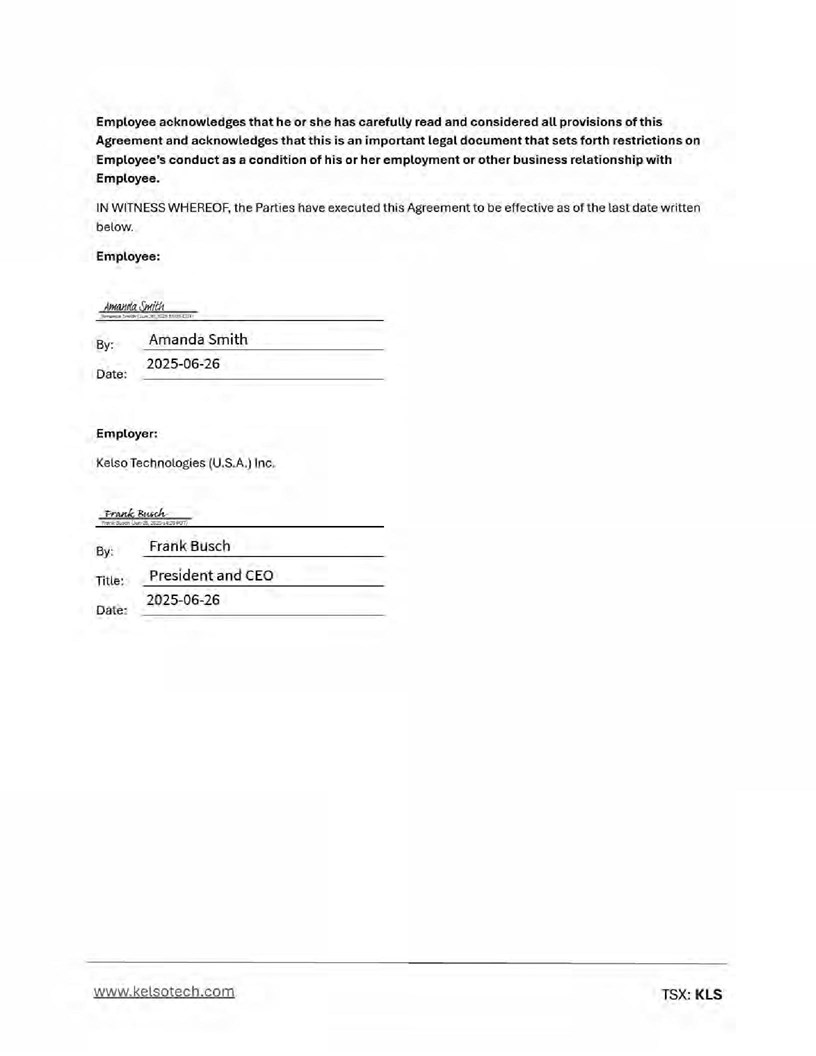
Exhibit 8.1
SUBSIDIARIES OF KELSO TECHNOLOGIES INC.
| NAME | DATE OF INCORPORATION | STATE/JURISDICTION OF INCORPORATION OR GOVERNING JURISDICTION |
| Kelso Technologies (U.S.A) Inc. | August 3, 2005 | Nevada |
| KIQ X Industries Inc. | December 12, 2017 | British Columbia, Canada |
KELSO TECHNOLOGIES INC.
CODE OF BUSINESS CONDUCT AND ETHICS
Amended, Restated and Adopted by the Board on March 22, 2023; ratified and approved by the Board on
March 18, 2026
INTRODUCTION
This Code of Business Conduct and Ethics ("Code") covers a wide range of business practices and procedures. It does not and cannot cover every issue that may arise, but it sets out basic principles to guide all employees, consultants, directors and officers of Kelso Technologies Inc. and its subsidiaries (collectively, the "Corporation"). All of the Corporation's employees, consultants, directors and officers (collectively, the "Employee" or the "Employees") must conduct themselves accordingly and seek to avoid even the appearance of improper behavior. The Code should also be provided to and followed by the Corporation's agents and representatives, including consultants.
This Code is designed to deter wrongdoing and to promote:
- honest and ethical conduct, including the ethical handling of actual or apparent conflicts of interest between personal and professional relationships;
- avoidance of conflicts of interest, including disclosure to an appropriate person of any material transaction or relationship that reasonably could be expected to give rise to such a conflict;
- full, fair, accurate, timely and understandable disclosure in reports and documents that the Corporation files with, or submits to, the securities regulators and in other public communications made by the Corporation;
- compliance with applicable governmental laws, rules and regulations;
- the prompt internal reporting to an appropriate person or persons of violations of this Code; and
- accountability for adherence to this Code.
If a law conflicts with a policy in this Code, you must comply with the law; however, if a local custom or policy conflicts with this Code, you must comply with the Code. Any variances between local customs or policies and this Code should be brought to the attention of management or the directors. If you have any questions about these conflicts, you should ask the Corporation's Chief Financial Officer.
When in this Code reference is made to the Chief Financial Officer for advice, consultation or guidance, the Chief Financial Officer may, as he sees fit, seek advice and/or assistance from legal counsel or refer anyone to legal counsel directly or such other person as he or she sees fit in order to assist answering questions from, or providing guidance or advice to any individual under this Code.
Those who violate the standards in this Code will be subject to disciplinary action up to and including immediate termination of employment, officership or directorship. If you are in a situation that you believe may violate or lead to a violation of this Code, follow the guidelines described below in Using this Code and Reporting Violations.
COMPLIANCE WITH LAWS, RULES AND REGULATIONS
The Corporation is strongly committed to conducting its business affairs with honesty and integrity and in full compliance with all laws, rules and regulation applicable to the Corporation's business in the countries in which it conducts business. Obeying the law, both in letter and in spirit, is the foundation on which this Corporation's ethical standards are built. Although not all Employees are expected to know the details of these laws, it is important to know enough to determine when to seek advice from the Corporation's Chief Financial Officer. The Corporation provides all necessary information to its Employees to promote compliance with laws, rules and regulations, including insider-trading laws.
CONFLICTS OF INTEREST
A "conflict of interest" exists when a person's private interest interferes in any way with the interests of the Corporation. A conflict situation can arise when an Employee takes actions or has interests that may make it difficult to perform his or her Corporation work objectively and effectively. Conflicts of interest may also arise when an Employee or members of his or her family, receives improper personal benefits as a result of his or her position in the Corporation. Loans to, or guarantees of obligations of, Employees and their family members may create conflicts of interest.
It is almost always a conflict of interest for a Corporation's Employee to work simultaneously for a competitor, customer or supplier. You are not allowed to work for a competitor as a consultant, employee or board member without the consent of the Chief Financial Officer, Chief Executive Officer and/or the Board of Directors of the Corporation (the "Board"). Such consent shall not be unreasonably withheld. You should immediately report any direct or indirect ownership interest you may have in any competitor, supplier or customer of the Corporation as set out below under the heading "Using this Code and Reporting Violations". The best policy is to avoid any direct or indirect business connection with our customers, suppliers or competitors, except on our behalf.
Conflicts of interest are prohibited as a matter of Corporation policy, except under guidelines approved by the Board. Conflicts of interest may not always be clear-cut, so if you have a question, you should consult with the Corporation's Chief Financial Officer. Any Employee who becomes aware of a conflict or potential conflict should also bring it to the attention of the Corporation's Chief Financial Officer.
INSIDER TRADING
Employees who have access to confidential information are not permitted to use or share that information for stock trading purposes or for any other purpose except the conduct of the Corporation's business. All non-public information about the Corporation should be considered confidential information. To use non-public information for personal financial benefit or to "tip" others who might make an investment decision to buy or sell the Corporation's stock on the basis of this information is not only unethical but also illegal. If you have any questions concerning this, please consult the Corporation's Blackout Period Policy or the Corporation's Chief Financial Officer.
HEDGING PROHIBITION
The Corporation's executive officers and directors are not permitted to purchase financial instruments, including for greater certainty, prepaid variable forward contracts, equity swaps, collars, puts, calls or units of exchange funds that are designed to hedge or offset a decrease in market value of Corporation's shares, held, directly or indirectly, by the officer or director.
CORPORATE OPPORTUNITIES
Employees are prohibited from taking for themselves personal opportunities that are discovered through the use of corporate property, information or position without the consent of the Board. No Employee may use corporate property, information, or position for improper personal gain, and no Employee may compete with the Corporation directly or indirectly. Employees owe a duty to the Corporation to advance its legitimate interests when the opportunity to do so arises.
COMPETITION AND FAIR DEALING
We seek to outperform our competition fairly, honestly and ethically. We seek competitive advantages through superior performance, never through unethical or illegal business practices. Stealing proprietary information, possessing trade secret information that was obtained without the owner's consent, or inducing such disclosures by past or present employees of other companies is prohibited. Each Employee should endeavor to respect the rights of, and deal fairly with, the Corporation's customers, suppliers, competitors and Employees. No Employee should take unfair advantage of anyone through manipulation, concealment, abuse of privileged information, misrepresentation of material facts, or any other intentional unfair-dealing practice.
To maintain the Corporation's valuable reputation, compliance with our quality processes and safety requirements is essential. In the context of ethics, quality requires that our products and services be designed to meet our obligations. All operations must be conducted in accordance with all applicable regulations. Compliance with all regulations and laws of governing or regulatory agencies should be given priority over the opportunity to profit or gain competitive advantage.
The purpose of business entertainment and gifts in a commercial setting is to create goodwill and sound working relationships, not to gain unfair advantage with suppliers and customers. No gift or entertainment should ever be offered, given, provided or accepted by a Corporation Employee, family member of an Employee or agent unless it: (1) is not a cash gift, (2) is consistent with customary business practices, (3) is not excessive in value, (4) cannot be construed as a bribe or payoff and (5) does not violate any laws or regulations. Please discuss with the Corporation's Chief Financial Officer any gifts or proposed gifts that you are not certain are appropriate.
DISCRIMINATION AND HARASSMENT
The diversity of the Employees is a tremendous asset. The Corporation is firmly committed to providing equal opportunity in all aspects of employment and will not tolerate any illegal discrimination or harassment of any kind. Examples include derogatory comments based on racial or ethnic characteristics and unwelcome sexual advances.
To facilitate respect and contribution among employees, the Corporation adheres to the following principles:
- To hire, pay and assign work on the basis of qualifications and performance;
- Not to discriminate on the basis of gender, race, religion, ethnicity, national origin, color, gender identity, age, sexual orientation, citizenship, veteran's status, marital status or disability;
- To attract and retain a highly talented workforce;
- To encourage skill growth through training and education and promotional opportunities;
- To encourage an open discussion between all levels of employees and to provide an opportunity for feedback from the top to the bottom and from the bottom to the top;
- To prohibit harassment (including sexual, physical, verbal) by others while an employee is on the job;
- To make the safety and security of our employees while at Corporation's facilities a priority;
- To recognize and reward additional efforts that go beyond our expectations; and
- To respect all workers' rights to dignity and personal privacy by not disclosing employee information, including protected health information, unnecessarily.
HEALTH AND SAFETY
The Corporation strives to provide each Employee with a safe and healthy work environment. Each Employee has a responsibility for maintaining a safe and healthy workplace for all Employees by following safety and health rules and practices and reporting accidents, injuries and unsafe equipment, practices or conditions.
Violence and threatening behavior are not permitted. Employees should report to work in condition to perform their duties, free from the influence of illegal drugs or alcohol. The use of illegal drugs or alcohol in the workplace will not be tolerated.
RECORD KEEPING
The Corporation requires honest and accurate recording and reporting of information in order to make responsible business decisions. For example, only the true and actual number of hours worked should be reported.
Many Employees regularly use business expense accounts, which must be documented and recorded accurately. If you are not sure whether a certain expense is legitimate, ask the Corporation's Chief Financial Officer.
The Corporation maintains all records in accordance with laws and regulations regarding retention of business records. The term "business records" covers a broad range of files, reports, business plans, receipts, policies and communications, including hard copy, electronic, audio recording, microfiche and microfilm files whether maintained at work or at home. The Corporation prohibits the unauthorized destruction of or tampering with any records, whether written or in electronic form, where the Corporation is required by law or government regulation to maintain such records or where it has reason to know of a threatened or pending government investigation or litigation relating to such records.
Business records and communications often become public, and we should avoid exaggeration, derogatory remarks, guesswork and inappropriate characterizations of people and companies that can be misunderstood. This applies equally to e-mail, internal memos, and formal reports.
CONFIDENTIALITY
Employees must maintain the confidentiality of confidential information entrusted to them by the Corporation or its suppliers and customers, except when disclosure is explicitly authorized or required by laws or regulations or approved by senior management. Confidential information includes all non-public information that might be of use to competitors, or harmful to the Corporation or its customers, if disclosed. It also includes information that suppliers and customers have entrusted to us. The obligation to preserve confidential information continues even after employment ends.
PROTECTION AND PROPER USE OF THE CORPORATION'S ASSETS
All Employees should endeavor to protect the Corporation's assets and ensure their sufficient use. Theft, carelessness, and waste have a direct impact on the Corporation's profitability. Any suspected incident of fraud or theft should be immediately reported for investigation. Corporation equipment should not be used for non-Corporation business, though incidental personal use may be permitted.
The obligation of Employees to protect the Corporation's assets includes its proprietary information. Proprietary information includes intellectual property trade secrets, patents, trademarks, copyrights, as well as business, marketing and service plans, and manufacturing ideas, designs, databases, records, salary information and any unpublished financial data and reports. Unauthorized use or distribution of this information would violate Corporation policy. It could also be illegal and result in civil or even criminal penalties.
PAYMENTS TO GOVERNMENT PERSONNEL
The Corruption of Foreign Public Officials Act (Canada) and the United States Foreign Corrupt Practices Act contain certain prohibitions with respect to giving anything of value, directly or indirectly, to foreign government officials or certain other individuals in order to obtain, retain or direct business for or to any person. In addition, domestically, the Corporation and its Employees are subject to the anti-corruption provisions of the Criminal Code (Canada).
Accordingly, all Employees are strictly forbidden from, directly or indirectly, offering, promising or giving money, gifts, loans, rewards, favors or anything of value to any government official or employee, employee or agent of a state-owned or controlled enterprise, employee or agent of a public international organization, political party or official thereof or any candidate for a political office, including any agent or other intermediary, including a close family member or household member, of any of the above, in connection with the business of the Corporation, except in full compliance with the Corporation's Anti-Bribery and Anti-Corruption Policy.
Those paying a bribe may subject the Corporation and themselves to severe civil and criminal penalties and damage the Corporation's reputation. When dealing with government representatives or officials and private parties, no improper payments will be tolerated. If you become aware of or receive any solicitation for, or offer of, money or a gift, that is intended to influence an official decision or business decision inside or outside of the Corporation, it should be reported to the Chief Financial Officer immediately.
The Corporation prohibits improper payments in all of its activities, whether these activities are with governments or in the private sector. Please refer to the Corporation's Anti-Bribery and Anti-Corruption Policy and procedures implemented in respect of that policy for more information.
WAIVER OF THE CODE OF BUSINESS CONDUCT AND ETHICS
Any waivers of the provisions of this Code may be granted only by the Board, if such waiver is for the benefit of a director or senior officer of the Corporation and such waiver, and the reasons for granting such waiver, shall be disclosed as may be required under applicable securities laws. Waiver for all other Employees shall be granted exclusively by the Chief Executive Officer or any other Senior Officer as may be designated by the Audit Committee.
COMPLIANCE PROCEDURES
We must all work to ensure prompt and consistent action against violation of this Code. However, in some situations it is difficult to know right from wrong. Since we cannot anticipate every situation that will arise, it is important that we have a way to approach a new question or problem. These are the steps to keep in mind:
1. Make sure you have all the facts. In order to reach the right solutions, we must be as fully informed as possible.
2. Ask yourself: What specifically am I being asked to do? Does it seem unethical or improper? This will enable you to focus on the specific question you are faced with, and the alternatives you have. Use your judgment and common sense; if something seems unethical or improper, it probably is.
3. Clarify your responsibility and role. In most situations, there is a shared responsibility. Are your colleagues informed? It may help to get others involved and discuss the problem.
4. Discuss the problem with the Corporation's Chief Financial Officer. This is the basic guidance for all situations. In many cases, they will be more knowledgeable about the questions and will appreciate being brought into the decision-making process. Remember that it is their responsibility to help solve problems.
5. You may report ethical violations in confidence and without fear of retaliation. If your situation requires that your identity be kept secret, your anonymity will be protected. The Corporation does not permit retaliation of any kind against Employees for good faith reports and ethical violations.
6. Always ask first, act later: If you are unsure of what to do in any situation, seek guidance before you act.
FINANCIAL AND ACCOUNTING OFFICERS AND MANAGERS
Financial and Accounting Officers and Managers hold an important and elevated role in corporate governance. As part of the Corporate Leadership Team, Financial and Accounting Officers and Managers are vested with both the responsibility and authority to protect, balance, and preserve the interests of all the Corporation's stakeholders, including shareholders, clients, employees, suppliers, and citizens of the communities in which business is conducted. Financial and Accounting Officers and Managers fulfill this responsibility by prescribing and enforcing the policies and procedures employed in the operation of the Corporation's financial organization, and by demonstrating the following:
1. Financial and Accounting Officers and Managers will exhibit and promote the highest standards of honest and ethical conduct through the establishment and operation of policies and procedures that:
a) Encourage professional integrity in all aspects of the financial organization, by eliminating inhibitions and barriers to responsible behavior, such as coercion, fear of reprisal, or alienation from the financial organization or the enterprise itself;
b) Prohibit and eliminate the occurrence of conflicts between what is in the best interest of the enterprise and what could result in material personal gain for a member of the financial organization, including Financial and Accounting Officers and Managers; and
c) Provide a mechanism for a member of the finance organization to inform senior management of deviations in practice from policies and procedures governing honest and ethical behavior.
2. Financial and Accounting Officers and Managers will establish and manage the enterprise transaction and reporting systems and procedures to ensure that:
a) Business transactions are properly authorized and completely and accurately recorded on the Corporation's books and records in accordance with Generally Accepted Accounting Principles (GAAP) and established Corporation financial policy;
b) The retention or proper disposal of Corporation records shall be in accordance with applicable legal and regulatory requirements; and
c) Periodic financial communications and reports will be delivered in a manner that facilitates a high degree of clarity of content and meaning so that readers and users can determine their significance and consequence.
USING THIS CODE AND REPORTING VIOLATIONS
It is the responsibility of all Employees to understand and comply with this Code.
The Board is ultimately responsible, acting through the Audit Committee, for this Code and monitoring compliance with this Code.
If you observe or become aware of an actual or potential violation of this Code or of any law or regulation, whether committed by the Corporation, Employees or by others associated with the Corporation, it is your responsibility to report the circumstances as outlined herein and to cooperate with any investigation by the Corporation. This Code is designed to provide an atmosphere of open communication for compliance issues and to ensure that Employees acting in good faith have the means to report actual or potential violations.
For assistance with compliance matters and to report actual or potential compliance infractions, Employees should contact the Chief Financial Officer.
Alternatively, reports may be made in the manner set out in the Corporation's Internal Employee Alert Policy, including anonymously to the Chair of the Audit Committee at [email protected].
Following the receipt of any complaints submitted hereunder, the Chief Financial Officer or the Chair of the Audit Committee, as the case may be, will investigate each matter so reported and report to the Board which will take corrective disciplinary actions, if appropriate, up to and including termination of employment or engagement.
There will be no reprisals against Employees for good faith reporting of compliance concerns or violations. The Corporation's legal counsel will be instructed to confidentially retain any complaints received hereunder for a period of seven years.
Notwithstanding the foregoing, nothing contained herein shall limit the ability of Employees of the Corporation to file a charge or complaint with a governmental agency in the United States and communicate with any such agency or otherwise participate in any investigation or proceeding that may be conducted by any such agency, including by providing documents or other information in connection therewith, without notice to the Corporation.
DISTRIBUTION OF THIS CODE
This Code will be circulated to all Employees of the Corporation on an annual basis and whenever changes are made. New Employees will be provided with a copy of this Code and advised of its importance.
This Code of Business Conduct is a statement of broad policies and is intended as a component of the flexible governance framework within which the committees of the Board assist the Board in directing the affairs of the Corporation. While it should be interpreted in the context of all applicable laws, regulations and listing requirements, as well as in the context of the Corporation's articles, it is not intended to establish any legally binding obligations.
CERTIFICATION
1. I, Frank Busch, President and Chief Executive Officer have reviewed this annual report on Form 20-F of Kelso Technologies Inc. (the "Company");
2. Based on my knowledge, this report does not contain any untrue statement of a material fact or omit to state a material fact necessary to make the statements made, in light of the circumstances under which such statements were made, not misleading with respect to the period covered by this report;
3. Based on my knowledge, the financial statements, and other financial information included in this report, fairly present in all material respects the financial condition, results of operations and cash flows of the Company as of, and for, the periods presented in this report;
4. The Company's other certifying officer and I are responsible for establishing and maintaining disclosure controls and procedures (as defined in Exchange Act Rules 13a-15(e) and 15d-15(e)) and internal control over financial reporting (as defined in Exchange Act Rules 13a-15(f) and 15d-15(f)) for the Company and have:
(a) Designed such disclosure controls and procedures, or caused such disclosure controls and procedures to be designed under our supervision, to ensure that material information relating to the Company, including its consolidated subsidiaries, is made known to us by others within those entities, particularly during the period in which this report is being prepared;
(b) Designed such internal control over financial reporting, or caused such internal control over financial reporting to be designed under our supervision, to provide reasonable assurance regarding the reliability of financial reporting and the preparation of financial statements for external purposes in accordance with generally accepted accounting principles;
(c) Evaluated the effectiveness of the Company's disclosure controls and procedures and presented in this report our conclusions about the effectiveness of the disclosure controls and procedures, as of the end of the period covered by this report based on such evaluation; and
(d) Disclosed in this report any change in the Company's internal control over financial reporting that occurred during the period covered by the annual report that has materially affected, or is reasonably likely to materially affect, the Company's internal control over financial reporting; and
5. The Company's other certifying officer(s) and I have disclosed, based on our most recent evaluation of internal control over financial reporting, to the Company's auditors and the audit committee of the Company's board of directors (or persons performing the equivalent functions):
(a) All significant deficiencies and material weaknesses in the design or operation of internal control over financial reporting which are reasonably likely to adversely affect the Company's ability to record, process, summarize and report financial information; and
(b) Any fraud, whether or not material, that involves management or other employees who have a significant role in the Company's internal control over financial reporting.
Date: March 27, 2026
/s/ Frank Busch
Frank Busch
Chief Executive Officer
2
CERTIFICATION
1. I, Sameer Uplenchwar, Chief Financial Officer have reviewed this annual report on Form 20-F of Kelso Technologies Inc. (the "Company");
2. Based on my knowledge, this report does not contain any untrue statement of a material fact or omit to state a material fact necessary to make the statements made, in light of the circumstances under which such statements were made, not misleading with respect to the period covered by this report;
3. Based on my knowledge, the financial statements, and other financial information included in this report, fairly present in all material respects the financial condition, results of operations and cash flows of the Company as of, and for, the periods presented in this report;
4. The Company's other certifying officer and I are responsible for establishing and maintaining disclosure controls and procedures (as defined in Exchange Act Rules 13a-15(e) and 15d-15(e)) and internal control over financial reporting (as defined in Exchange Act Rules 13a-15(f) and 15d-15(f)) for the Company and have:
(a) Designed such disclosure controls and procedures, or caused such disclosure controls and procedures to be designed under our supervision, to ensure that material information relating to the Company, including its consolidated subsidiaries, is made known to us by others within those entities, particularly during the period in which this report is being prepared;
(b) Designed such internal control over financial reporting, or caused such internal control over financial reporting to be designed under our supervision, to provide reasonable assurance regarding the reliability of financial reporting and the preparation of financial statements for external purposes in accordance with generally accepted accounting principles;
(c) Evaluated the effectiveness of the Company's disclosure controls and procedures and presented in this report our conclusions about the effectiveness of the disclosure controls and procedures, as of the end of the period covered by this report based on such evaluation; and
(d) Disclosed in this report any change in the Company's internal control over financial reporting that occurred during the period covered by the annual report that has materially affected, or is reasonably likely to materially affect, the Company's internal control over financial reporting; and
5. The Company's other certifying officer(s) and I have disclosed, based on our most recent evaluation of internal control over financial reporting, to the Company's auditors and the audit committee of the Company's board of directors (or persons performing the equivalent functions):
(a) All significant deficiencies and material weaknesses in the design or operation of internal control over financial reporting which are reasonably likely to adversely affect the Company's ability to record, process, summarize and report financial information; and
(b) Any fraud, whether or not material, that involves management or other employees who have a significant role in the Company's internal control over financial reporting.
Date: March 27, 2026
/s/ Sameer Uplenchwar
Sameer Uplenchwar
Chief Financial Officer
2
CERTIFICATION PURSUANT TO
18 U.S.C. SECTION 1350, AS ADOPTED PURSUANT TO
SECTION 906 OF THE SARBANES-OXLEY ACT OF 2002
The undersigned, Frank Busch, President, Chief Executive Officer and a director of Kelso Technologies Inc., hereby certifies, pursuant to 18 U.S.C. Section 1350, as adopted pursuant to Section 906 of the Sarbanes-Oxley Act of 2002, that:
(1) the annual report on Form 20-F of Kelso Technologies Inc. for the fiscal year ended December 31, 2025 (the "Report") fully complies with the requirements of Section 13(a) or 15(d) of the Securities Exchange Act of 1934; and
(2) the information contained in the Report fairly presents, in all material respects, the financial condition and results of operations of Kelso Technologies Inc.
| Dated: March 27, 2026 | |
| /s/ Frank Busch | |
| Frank Busch | |
| President, Chief Executive Officer and Director | |
| Kelso Technologies Inc. |
A signed original of this written statement required by Section 906, or other document authenticating, acknowledging, or otherwise adopting the signature that appears in typed form within the electronic version of this written statement required by Section 906, has been provided to Kelso Technologies Inc. and will be retained by Kelso Technologies Inc. and furnished to the Securities and Exchange Commission or is staff upon request.
CERTIFICATION PURSUANT TO
18 U.S.C. SECTION 1350, AS ADOPTED PURSUANT TO
SECTION 906 OF THE SARBANES-OXLEY ACT OF 2002
The undersigned, Sameer Uplenchwar, Chief Financial Officer of Kelso Technologies Inc., hereby certifies, pursuant to 18 U.S.C. Section 1350, as adopted pursuant to Section 906 of the Sarbanes-Oxley Act of 2002, that:
(1) the annual report on Form 20-F of Kelso Technologies Inc. for the fiscal year ended December 31, 2025 (the "Report") fully complies with the requirements of Section 13(a) or 15(d) of the Securities Exchange Act of 1934; and
(2) the information contained in the Report fairly presents, in all material respects, the financial condition and results of operations of Kelso Technologies Inc.
| Dated: March 27, 2026 | |
| /s/ Sameer Uplenchwar | |
| Sameer Uplenchwar | |
| Chief Financial Officer and Director | |
| Kelso Technologies Inc. |
A signed original of this written statement required by Section 906, or other document authenticating, acknowledging, or otherwise adopting the signature that appears in typed form within the electronic version of this written statement required by Section 906, has been provided to Kelso Technologies Inc. and will be retained by Kelso Technologies Inc. and furnished to the Securities and Exchange Commission or its staff upon request.
Kelso Technologies Inc.
("Kelso" or the "Company")
2025 Sustainability Report
Sustainability Accounting Standards Board (SASB) Index
Forward-Looking Statements
LEGAL NOTICE REGARDING FORWARD-LOOKING STATEMENTS
This report contains "forward-looking statements" within the meaning of applicable securities laws that reflect the Company's current expectations, forecasts and assumptions. Generally, forward looking statements can be identified by the use of forward-looking terminology such as "plans", "expects" or "does not expect", "is expected", "budget", "scheduled", "estimates", "forecasts", "intends", "anticipates" or "does not anticipate", or "believes", or variations of such words or phrases or state that certain actions, events or results "may", "could", "would", "might" or "will be taken", "occur" or "be achieved". Forward looking statements in this report include, but are not limited to, goals related to achieving the sustainable management and efficient use of resources available, maintaining industry leading performance, improving global resource efficiency in consumption and production, decoupling economic growth from environmental degradation and substantially reducing waste generation through prevention, reduction, recycling, and reuse by 2030; plans to conduct an annual analysis to ensure gender, racial and ethnicity pay equity; increasing female representation in senior management and board roles; strengthening diversity in hiring and retention initiatives; and charitable initiatives.
Such forward-looking statements involve a number of known and unknown risks, uncertainties and other factors which may cause the actual results, performance or achievements of the Company to be materially different from any future results expressed or implied by such forward-looking statements.
These include, but are not limited to, the economic condition of the railroad industry, which is affected by numerous factors beyond the Company's control including tariffs, slow sales cycles, creation and adoption of new technologies, and the existence of present and possible government regulation and competition. Although Kelso believes the Company's anticipated future results, performance or achievements expressed or implied by the forward-looking statements are based upon reasonable assumptions and expectations, it can give no assurance that such expectations will prove to be correct. The reader should not place undue reliance on forward-looking statements as such statements involve known and unknown risks, uncertainties and other factors which may cause the actual results, performance or achievements of Kelso to differ materially from anticipated future results, performance or achievement expressed or implied by such forward-looking statements.
Such risks and uncertainties include, without limitation; the risk that the Company's products may not work as well as expected; the Company may not be able to break in to new markets because such markets are served by strong and embedded competitors or because of long-term supply contracts; the Company may not be able to grow and sustain anticipated revenue streams; the Company may have underestimated the cost of product development and the time it takes to bring products to market; the Company may not be able to finance the Company's intended product development; that Management may not be able to continue to initiate new product strategies to secure a more reliable growth of financial performance in the future; the Company's products may not sell as well as expected, and competitors may offer better or cheaper alternatives to the Company's products; the Company's technologies may not be patentable, and if patents are granted, the Company may not be able to protect the Company's investment in intellectual property if the Company's patents are challenged; the Company's intended technologies may infringe on the intellectual property of other parties; and certain other risks detailed from time-to-time in Kelso's public disclosure documents.
Although the Company has attempted to identify important risk factors that could cause actual results to differ materially from those contained in forward-looking statements, there may be other factors that could cause results not to be as anticipated, estimated or intended. There can be no assurance that such statements will prove to be accurate as actual results and future events could differ materially from those anticipated in such statements.
Accordingly, readers are cautioned not to place undue reliance on these forward-looking statements, which speak only as of the date the statements were made. Readers are advised to consider such forward-looking statements the risks set forth in the "Risks and Uncertainties" section of the Company's most recent MD&A and in the current Annual Report. The Company does not undertake to update any forward-looking statements that are incorporated by reference or contained herein, except in accordance with applicable securities laws. Additional information about the Company and Kelso's business activities is available under the Company's profile on SEDAR at www.sedarplus.ca in Canada and on EDGAR at www.sec.gov in the United States or the Company's website at www.kelsotech.com.
2025 Kelso Technologies Inc. SASB Disclosure
Kelso is a diverse light industrial production company that specializes in the development, production and distribution of proprietary equipment used in transportation. Over the past decade the Company's reputation has been earned as a developer and reliable supplier of high-quality rail tank car equipment used in the handling and containment of commodities during transport. All Kelso products are developed with emphasis on economic and operational advantages to customers while mitigating the impact of human error and environmental releases. The Company offers specialized rail tank car and truck tanker equipment and rapid fueling equipment.
Our rail equipment supports assets with long useful lives, so we proactively run our business with a long-term view. We operate and grow in a sustainable and socially responsible manner. We are also committed to continuously improving the measurement and the transparency of our environmental, social, and governance ("ESG") disclosures and practices. The Governance Committee has primary responsibility for oversight of our ongoing ESG efforts.
This is the third full year Kelso is presenting metrics specified in the Sustainability Accounting Standards Board (SASB) reporting format. Kelso considered the SASB framework for the Industrial Machinery & Goods standard to be relevant for our business.
For more details on Kelso's ESG strategy, accomplishments, and corporate governance guidelines, please visit the Sustainability and Corporate Governance pages on the Company's website at www.kelsotech.com.
SASB 2025 Index
Industrial Machinery & Goods
| SASB Topic |
Accounting Metric |
Unit of Measure |
Disclosure/Comments |
Sustainable Development Goals and Targets |
| Energy Management | Total Energy Consumed Percentage of electricity from grid Percentage of electricity from renewable sources |
Kilowatts (kWh) % % |
Est. 319,000 kWh in 2025 100% of the electricity is from the grid 0% of the electricity is sourced from renewable sources |
By 2030, achieve sustainable management and efficient use of resources available. |
| Employee Health and Safety | Total Recordable Injury Rate (TRIR) Fatality Rate Near Miss Frequency Rate (NMFR) |
Rate Number Rate |
FY23 TRIR was 0; FY24 TRIR was 0; FY25 TRIR was 0 FY23 no fatalities; FY24 no fatalities; FY25 no fatalities Not measured, but it is Kelso's policy to review all work-related environmental, health and safety incidents, including near misses, and to take corrective action as required. Annual Health and Safety audits are completed as well to ensure proper procedures are in place to avoid work related injuries. |
Maintain industry leading performance. |
| Fuel Economy & Emissions in use-phase | Sales-weighted fleet fuel efficiency for medium and heavy-duty vehicles Sales-weighted fuel efficiency for non-road equipment Sales-weighted fuel efficiency for stationary generators. Sales-weighted emissions of (a) Nitrogen Oxides and (b) Particulate Matter for: (1) marine diesel engines, (2) locomotive diesel engines, and (3) other non-road diesel engines |
Gallons per 1,000 ton-miles Gallons per hour Watts per hour Grams per kilowatt hour |
Not applicable to Kelso. Kelso does not make equipment with engines for transportation. |
Not applicable. |
| SASB Topic |
Accounting Metric |
Unit of Measure |
Disclosure/Comments |
Sustainable Development Goals and Targets |
| Remanufacturing Design & Services | Revenue from remanufactured products and remanufacturing services | $ |
Kelso's repair and recertification business generated approximately 30% of FY25 annual revenue. | Through 2030 improve global resource efficiency in consumption and production. Endeavor to decouple economic growth from environmental degradation. |
| Materials Sourcing | Description of the management of risks associated with the use of critical materials | Not applicable | Kelso responsibly sources the parts used to build our products. | By 2030 substantially reduce waste generation through prevention, reduction, recycling, and reuse. |
| Activity Metrics | Number of units produced by product category Number of employees |
Number Number |
Sales data is provided in Kelso's Annual Report and Form 20-F. 22 |
Not applicable. |
Key ESG Initiatives and Accomplishments
(ESG principles have always been a core part of Kelso's vision and now receive independent
oversight from the Governance Committee of the Board of Directors.)
| Health and Safety |
Human Capital Management |
Environmental Impact |
Community Engagement |
| As a company in an essential industry, Kelso has continued to keep employees safe and our plant operating without interruption throughout the COVID-19 pandemic and the following economic downturn. This continues as tariffs negatively impact our industry. | Conduct annual analysis to ensure gender, racial and ethnicity pay equity. | Published our second annual Sustainability Accounting Standards Board (SASB) Report. | Support United Way of Dallas and their wellness initiatives. |
| Continuing long-term improvement of workplace safety metrics in our business. | Continue to increase female representation in senior management and board roles. | Monitor our full value chain impacts on the environment in an effort to identify opportunities to reduce those impacts. | Support youth financial literacy via participation in the Indigenomics Conference in Toronto, Ontario. |
| Continue to strengthen our diversity hiring and retention initiatives. | Continue to pursue programs to reduce waste. | Support local programs in Fannin and Grayson Counties to help children in need. | |
| In addition to Company-sponsored volunteer projects, implemented paid time off for employees to volunteer in their communities for a cause personally meaningful to them. |
KELSO TECHNOLOGIES INC.
Consolidated Financial Statements
For the years ended December 31, 2025, 2024, and 2023
(Expressed in US Dollars)
 |
CBIZ CPAs P.C. 500 W. Monroe Street Suite 2000 Chicago, IL 60661 P: 312.632.5000 |
Report of Independent Registered Public Accounting Firm
To the Stockholders and Board of Directors of
Kelso Technologies Inc.
Opinion on the Financial Statements
We have audited the accompanying consolidated statement of financial position of Kelso Technologies Inc. & Subsidiaries (the "Company") as of December 31, 2025, the related consolidated statements of operations and comprehensive income (loss), changes in equity, and cash flows for the year ended December 31, 2025, and the related notes to the financial statements (collectively referred to as the "financial statements"). In our opinion, based on our audit, the financial statements present fairly, in all material respects, the financial position of the Company as of December 31, 2025, and the results of its operations and its cash flows for the year ended December 31, 2025, in conformity with International Financial Reporting Standards ("IFRS") as issued by the International Accounting Standards Board.
Basis for Opinion
These financial statements are the responsibility of the Company's management. Our responsibility is to express an opinion on the Company's financial statements based on our audit. We are a public accounting firm registered with the Public Company Accounting Oversight Board (United States) ("PCAOB") and are required to be independent with respect to the Company in accordance with the U.S. federal securities laws and the applicable rules and regulations of the Securities and Exchange Commission and the PCAOB.
We conducted our audit in accordance with the standards of the PCAOB. Those standards require that we plan and perform the audit to obtain reasonable assurance about whether the financial statements are free of material misstatement, whether due to error or fraud. The Company is not required to have, nor were we engaged to perform, an audit of its internal control over financial reporting. As part of our audit we are required to obtain an understanding of internal control over financial reporting but not for the purpose of expressing an opinion on the effectiveness of the Company's internal control over financial reporting. Accordingly, we express no such opinion.
Our audit included performing procedures to assess the risks of material misstatement of the financial statements, whether due to error or fraud, and performing procedures that respond to those risks. Such procedures included examining, on a test basis, evidence regarding the amounts and disclosures in the financial statements. Our audit also included evaluating the accounting principles used and significant estimates made by management, as well as evaluating the overall presentation of the financial statements. We believe that our audit provides a reasonable basis for our opinion.
We have served as the Company's auditor since 2025.
March 26, 2026
| 2 CBIZCPAS.COM |

REPORT OF INDEPENDENT REGISTERED PUBLIC ACCOUNTING FIRM
TO THE SHAREHOLDERS AND DIRECTORS OF KELSO TECHNOLOGIES INC.
Opinion on the Consolidated Financial Statements
We have audited the accompanying consolidated statements of financial position of Kelso Technologies Inc. (the "Company") and its subsidiaries as of December 31, 2024, and the related consolidated statements of operations and comprehensive loss, changes in equity and cash flows for the years ended December 31, 2024 and 2023 and the related notes (collectively referred to as the "consolidated financial statements").
In our opinion, the consolidated financial statements present fairly, in all material respects, the financial position of the Company as of December 31, 2024, and the results of its operations and its cash flows for the years ended December 31, 2024 and 2023, in conformity with IFRS Accounting Standards as issued by the International Accounting Standards Board ("IFRS Accounting Standards").
Basis for Opinion
These consolidated financial statements are the responsibility of the Company's management. Our responsibility is to express an opinion on the Company's consolidated financial statements based on our audits. We are a public accounting firm registered with the Public Company Accounting Oversight Board (United States) ("PCAOB") and are required to be independent with respect to the Company in accordance with the U.S. federal securities laws and the applicable rules and regulations of the Securities and Exchange Commission and the PCAOB.
We conducted our audits in accordance with the standards of the PCAOB. Those standards require that we plan and perform the audit to obtain reasonable assurance about whether the consolidated financial statements are free of material misstatement, whether due to error or fraud. The Company is not required to have, nor were we engaged to perform, an audit of its internal control over financial reporting. As part of our audits, we are required to obtain an understanding of internal control over financial reporting, but not for the purpose of expressing an opinion on the effectiveness of the Company's internal control over financial reporting. Accordingly, we express no such opinion.
Our audits included performing procedures to assess the risks of material misstatement of the consolidated financial statements, whether due to error or fraud, and performing procedures that respond to those risks. Such procedures included examining, on a test basis, evidence regarding the amounts and disclosures in the consolidated financial statements. Our audits also included evaluating the accounting principles used and significant estimates made by management, as well as evaluating the overall presentation of the consolidated financial statements. We believe that our audits provide a reasonable basis for our opinion.
| SMYTHE LLP | smythecpa.com | VANCOUVER 1700–475 Howe St Vancouver, BC V6C 2B3 T: 604 687 1231 F: 604 688 4675 |
LANGLEY 600–19933 88 Ave Langley, BC V2Y 4K5 T: 604 282 3600 F: 604 357 1376 |
NANAIMO 201–1825 Bowen Rd Nanaimo, BC V9S 1H1 T: 250 755 2111 F: 250 984 0886 |
3 |
Critical Audit Matters
Critical audit matters are matters arising from the current period audit of the consolidated financial statements that were communicated or required to be communicated to the audit committee and that: (1) relate to accounts or disclosures that are material to the consolidated financial statements and (2) involved our especially challenging, subjective, or complex judgments.
We have determined that there are no critical audit matters to communicate in our auditor's report.
Chartered Professional Accountants
We have served as the Company's auditor since 2006.
Vancouver, Canada
March 25, 2025
| SMYTHE LLP | smythecpa.com | VANCOUVER 1700–475 Howe St Vancouver, BC V6C 2B3 T: 604 687 1231 F: 604 688 4675 |
LANGLEY 600–19933 88 Ave Langley, BC V2Y 4K5 T: 604 282 3600 F: 604 357 1376 |
NANAIMO 201–1825 Bowen Rd Nanaimo, BC V9S 1H1 T: 250 755 2111 F: 250 984 0886 |
4 |
| Kelso Technologies Inc. Consolidated Statements of Financial Position (Expressed in US Dollars) |
 |
| December 31, | December 31, | |||||
| 2025 | 2024 | |||||
| Assets | ||||||
| Current | ||||||
| Cash (Note 5) | $ | $ | ||||
| Accounts receivable (Note 5) | ||||||
| Prepaid expenses | ||||||
| Inventory (Note 6) | ||||||
| Assets held for sale (Notes 7 and 16) | ||||||
| Property, plant and equipment (Note 7) | ||||||
| Deferred Tax Asset (Note 17) | ||||||
| Intangible assets (Note 8) | ||||||
| TOTAL ASSETS | $ | $ | ||||
| Liabilities | ||||||
| Current | ||||||
| Accounts payable and accrued liabilities (Note 5) | $ | $ | ||||
| Income tax payable (Note 17) | ||||||
| Current portion of lease liability (Note 9) | ||||||
| RSU liability (Note 10) | ||||||
| Commitments and Contingencies (Note 3 (n)) | ||||||
| Long term portion of lease liability (Note 9) | ||||||
| TOTAL LIABILITIES | ||||||
| Shareholders' Equity | ||||||
| Capital Stock (Note 10) | ||||||
| Reserves | ||||||
| Deficit | ( |
) | ( |
) | ||
| TOTAL LIABILITIES AND EQUITY | $ | $ |
| Approved on behalf of the Board: | ||
| "Mark Temen" (signed) | "Jesse Crews" (signed") | |
| Mark Temen, Director | Jesse Crews, Director |
See notes to consolidated financial statements
5
| Kelso Technologies Inc. Consolidated Statements of Operations and Comprehensive Income Loss For the years ended December 31, 2025, 2024 and 2023 (Expressed in US Dollars)) |
|
| 2025 | 2024 | 2023 | |||||||
| Revenues (Note 15) | $ | $ | $ | ||||||
| Cost of Goods Sold (Notes 6 and 7) | |||||||||
| Gross Profit | |||||||||
| Expenses | |||||||||
| Share-based expense (Note 10 (b)) | |||||||||
| Management fees (Note 11) | |||||||||
| Consulting and filing fees | |||||||||
| Investor relations | |||||||||
| Accounting and legal | |||||||||
| Office and administration | |||||||||
| Research | |||||||||
| Travel | |||||||||
| Marketing | |||||||||
| Foreign exchange loss (gain) | ( |
) | ( |
) | |||||
| Amortization (Note 7 and 8) | |||||||||
| Income (Loss) before the following | ( |
) | |||||||
| Gain on repurchase of RSU's (Note 10) | |||||||||
| Write-off of inventory (Note 6) | ( |
) | ( |
) | |||||
| Gain on revaluation of derivative warrant liability | |||||||||
| Other Miscellaneous Income | - | ||||||||
| Income (Loss) before taxes | ( |
) | |||||||
| Income tax recovery (expense) (Note 17) | ( |
) | ( |
) | |||||
| Net Income (Loss) for the Period | |||||||||
| from continuing operations | ( |
) | ( |
) | |||||
| from discontinued operations (Note 16) | ( |
) | ( |
) | ( |
) | |||
| Net Comprehensive Income (Loss) for the Period | $ | $ | ( |
) | $ | ( |
) | ||
| Basic and Diluted Earnings (Loss) | |||||||||
| Per Share from continuing operations | ( |
) | ( |
) | |||||
| Per Share from discontinued operations | ( |
) | ( |
) | ( |
) | |||
| Per Share for the period | ( |
) | ( |
) | |||||
| Weighted Average Number of | |||||||||
| Common Shares Outstanding | |||||||||
| Basic | |||||||||
| Diluted |
See notes to consolidated financial statements
6
| Kelso Technologies Inc. Consolidated Statements of Changes in Equity For the years ended December 31, 2025, 2024 and 2023 (Expressed in US Dollars) |
|
| Capital Stock | |||||||||||||||
| Number of | |||||||||||||||
| Common | |||||||||||||||
| Shares | Amount | Reserve | Deficit | Total | |||||||||||
| Balance, December 31, 2022 | $ | $ | ( |
) | $ | ||||||||||
| Shares issued for RSUs | ( |
) | - | - | |||||||||||
| Share-based expense | - | - | - | ||||||||||||
| Repurchase of RSUs | - | - | ( |
) | - | ( |
) | ||||||||
| Modification of RSUs | - | - | ( |
) | - | ( |
) | ||||||||
| Net loss for the year | - | - | - | ( |
) | ( |
) | ||||||||
| Balance, December 31, 2023 | $ | $ | ( |
) | $ | ||||||||||
| Shares issued for RSUs | ( |
) | - | - | |||||||||||
| Share-based expense | - | - | - | ||||||||||||
| Repurchase of RSUs | - | - | ( |
) | - | ( |
) | ||||||||
| Net loss for the year | - | - | - | ( |
) | ( |
) | ||||||||
| Balance, December 31, 2024 | $ | $ | ( |
) | $ | ||||||||||
| Shares issued for RSUs | ( |
) | - | - | |||||||||||
| Share-based expense | - | - | - | ||||||||||||
| Repurchase of RSUs | - | - | ( |
) | - | ( |
) | ||||||||
| Net income for the year | - | - | - | ||||||||||||
| Balance, December 31, 2025 | $ | $ | ( |
) | $ | ||||||||||
See notes to consolidated financial statements
7
| Kelso Technologies Inc. Consolidated Statements of Cash Flows For the years ended December 31, 2025, 2024 and 2023 (Expressed in US Dollars) |
|
| 2025 | 2024 | 2023 | |||||||
| Operating Activities | |||||||||
| Income (loss) from continuing operations | $ | $ | ( |
) | $ | ( |
) | ||
| Items not involving cash | |||||||||
| Amortization of equipment and patent | |||||||||
| Share-based expense | |||||||||
| Foreign exchange | ( |
) | ( |
) | |||||
| Gain on repurchase of RSUs | ( |
) | ( |
) | |||||
| Gain on revaluation of Derivative Warrant Liability | ( |
) | |||||||
| Write-off of inventory | |||||||||
| ( |
) | ||||||||
| Changes in working capital | |||||||||
| Accounts receivable | |||||||||
| Prepaid expenses and deposit | ( |
) | ( |
) | |||||
| Inventory | ( |
) | |||||||
| Accounts payable and accrued liabilities | ( |
) | ( |
) | |||||
| RSU | |||||||||
| Income tax payable | ( |
) | ( |
) | |||||
| ( |
) | ||||||||
| Cash Operating Activities from Continuing Operations | |||||||||
| Cash Operating Activities from Discontinued Operations | ( |
) | ( |
) | ( |
) | |||
| ( |
) | ( |
) | ||||||
| Investing Activities | |||||||||
| Acquisition of property, plant and equipment | ( |
) | |||||||
| Proceeds from sale of equipment | |||||||||
| Cash Investing Activities from Continuing Operations | ( |
) | |||||||
| Cash Investing Activities from Discontinued Operations | ( |
) | ( |
) | |||||
| ( |
) | ( |
) | ||||||
| Financing Activities | |||||||||
| Repurchase of RSUs | ( |
) | ( |
) | ( |
) | |||
| Cash Financing Activities from Continuing Operations | ( |
) | ( |
) | ( |
) | |||
| Cash Financing Activities from Discontinued Operations | ( |
) | ( |
) | ( |
) | |||
| ( |
) | ( |
) | ( |
) | ||||
| Foreign exchange effect on cash | ( |
) | |||||||
| Inflow (Outflow) of Cash | ( |
) | ( |
) | |||||
| Cash, Beginning of Period | |||||||||
| Cash, End of Period | $ | $ | $ |
Supplemental Cash Flow Information (Note 12)
See notes to consolidated financial statements
8
|
Kelso Technologies Inc. |
|
1. NATURE OF OPERATIONS
Kelso Technologies Inc. (the "Company") was incorporated under the laws of British Columbia on March 16, 1987. Kelso is a diverse product engineering company that specializes in the research, development, production and distribution of proprietary equipment used in various transportation applications. Over the past decade the Company's reputation has been earned as a developer and reliable supplier of high-quality rail tank car equipment used in the handling and containment of hazardous and non- hazardous commodities during transport. In addition, the Company was previously developing proprietary service equipment to be used in transportation applications. During the year ended December 31, 2024, the Company ceased development activities within its subsidiary, KIQ X Industries Inc. ("KIQ X"), related to the active suspension control system (Note 16).
The Company trades on the Toronto Stock Exchange ("TSX") under the symbol "KLS" and used to trade on the New York Stock Exchange ("NYSE") under the trading symbol "KIQ". The Company listed on the TSX on May 22, 2014 and on the NYSE on October 14, 2014. The Company delisted from the NYSE on March 26, 2024. The Company's head office is located at 305-1979 Old Okanagan Hwy, West Kelowna, British Columbia, V4T 3A4.
2. BASIS OF PREPARATION
(a) Statement of compliance:
These consolidated financial statements of the Company have been prepared in accordance with IFRS Accounting Standards as issued by the International Accounting Standards Board ("IFRS Accounting Standards").
These consolidated financial statements have been prepared under the historical cost basis, except for financial instruments, which are stated at their fair values. These consolidated financial statements have been prepared using the accrual basis of accounting, except for cash flow information.
(b) Basis of presentation and consolidation:
The consolidated financial statements include the accounts of the Company and its integrated wholly owned subsidiaries, Kelso Technologies (USA) Inc., Kel-Flo Industries Inc. (ceased), and KIQ Industries Inc. (ceased) which are all Nevada, USA corporations as well as KIQ X Industries and KXI Wildertec Industries Inc. (ceased), which were incorporated in British Columbia, Canada. Intercompany transactions and balances have been eliminated in consolidation. Subsidiaries are consolidated from the date upon which control is acquired by the Company and all material intercompany transactions and balances have been eliminated in consolidation.
Control is achieved when the Company is exposed, or has rights, to variable returns from its involvement with the investee and has the ability to affect those returns through its power over the investee.
(c) Functional and presentation currency:
The functional and presentation currency of the Company and its subsidiaries is the US dollar ("USD").
9
Kelso Technologies Inc. |
|
(d) Significant management judgments and estimation uncertainty:
The preparation of consolidated financial statements in conformity with IFRS Accounting Standards requires the Company's management to undertake a number of judgments, estimates and assumptions that affect amounts reported in the consolidated financial statements and notes thereto. Actual amounts may ultimately differ from these estimates and assumptions. The Company reviews its estimates and underlying assumptions on an ongoing basis. Revisions to accounting estimates are recognized in the period in which the estimates are revised and may impact future periods.
Significant management judgments
The following are significant management judgments in applying the accounting policies of the Company that have the most significant effect on recognition and measurement of assets, liabilities, income and expenses:
(i) Income taxes:
The extent to which deferred tax assets can be recognized is based on an assessment of the probability of the Company generating future taxable income against which the deferred tax assets can be utilized. In addition, significant judgment is required in classifying transactions and assessing probable outcomes of tax positions taken, and in assessing the impact of any legal or economic limits or uncertainties in various tax jurisdictions.
(ii) Functional currency:
The functional currency for the Company and its subsidiaries is the currency of the primary economic environment in which the entity operates. The Company has determined its functional currency and that of its subsidiaries is the USD. Determination of functional currency may involve certain judgments to determine the primary economic environment and the Company reconsiders the functional currency of its entities if there is a change in events and conditions that determined the primary economic environment.
(iii) Research and development expenditures:
The application of the Company's accounting policy for research and development expenditures requires judgment in determining whether an activity is determined to be research or development, and if deemed to be development, whether it is probable that future economic benefits will flow to the Company, which may be based on assumptions about future events or circumstances. Estimates and assumptions may change if new information becomes available. If new information becomes available indicating that it is unlikely that future economic benefits will flow to the Company, the amount capitalized is written off to profit or loss in the period the new information becomes available.
10
Kelso Technologies Inc. |
|
(d) Significant management judgments and estimation uncertainty (continued):
Significant management judgments (continued)
(iv) Treatment of restricted share units:
The treatment of restricted share units ("RSUs") requires management to apply judgment in assessing the terms and conditions of the grant, as well as the historical method of settlement, to determine whether RSUs will be equity-settled or cash-settled.
(v) Assets held for sale and discontinued operations:
Judgment is required in determining whether an asset meets the criteria for classification as "assets held for sale" in the consolidated statements of financial position. Criteria considered by management includes the existence of and commitment to a plan to dispose of the assets, the expected selling price of the assets, the expected timeframe of the completion of the anticipated sale, and the period of time any amounts have been classified within assets held for sale. In addition, there is a requirement to periodically evaluate and record assets held for sale at the lower of their carrying value and fair value less costs to sell.
Judgment is applied in determining whether disposal groups represent a component of the entity, the results of which should be recorded as discontinued operations in the consolidated statements of operations and comprehensive income loss.
Estimation uncertainty
Information about estimates and assumptions that have the most significant effect on the recognition and measurement of assets, liabilities, income and expenses is provided below. Actual results may be substantially different.
(i) Impairment of long-lived assets:
Long-lived assets consist of intangible assets and property, plant and equipment.
At the end of each reporting period, the Company reviews the carrying amounts of its long-lived assets to determine whether there is any indication that the carrying amount is not recoverable. If any such indication exists, the recoverable amount of the asset is estimated in order to determine the extent of the impairment loss (if any). Intangible assets with indefinite useful lives and those not in use are tested for impairment annually. When an individual asset does not generate independent cash flows, the Company estimates the recoverable amount of the cash-generating unit to which the asset belongs. Assets are grouped together into the smallest group of assets that generates cash inflows from continuing use that are largely independent of the cash inflows of other assets or groups of assets. When a reasonable and consistent basis of allocation can be identified, corporate assets are also allocated to individual cash-generating units, or otherwise they are allocated to the smallest group of cash-generating units for which a reasonable and consistent allocation basis can be identified.
11
Kelso Technologies Inc. |
|
(d) Significant management judgments and estimation uncertainty (continued):
Estimation uncertainty (continued)
(i) Impairment of long-lived assets (continued):
Recoverable amount is the higher of fair value less costs of disposal and value in use. Fair value is determined as the price that would be received to sell an asset in an orderly transaction between market participants at the measurement date. In assessing value in use, the estimated future cash flows are discounted to their present value using a pre-tax discount rate that reflects current market assessments of the time value of money and the risks specific to the asset for which the estimates of future cash flows have not been adjusted.
(ii) Useful lives of depreciable assets:
The Company reviews its estimate of the useful lives of depreciable assets at each reporting date, based on the expected utilization of the assets. Uncertainties in these estimates relate to technical obsolescence that may change the utilization of certain intangible assets and equipment.
(iii) Inventories:
The Company estimates the net realizable value of inventories, taking into account the most reliable evidence available at each reporting date. The future realization of these inventories may be affected by future technology or other market-driven changes that may reduce future selling prices or decline in customer demands may result in excess or obsolete inventory. A change to these assumptions could impact the Company's inventory valuation and impact gross margins.
(iv) Share-based expense:
The Company grants share-based awards to certain officers, employees, directors and other eligible persons. For equity settled awards, the fair value is charged to the consolidated statements of operations and comprehensive income loss and credited to reserves, over the vesting period using the graded vesting method, after adjusting for the estimated number of awards that are expected to vest.
The Company measures the cost of equity-settled transactions by reference to the fair value of the equity instruments at the date at which they are granted for share-based payments made to employees or others providing similar services. Estimating fair value for share-based payment transactions requires determining the most appropriate valuation model, which is dependent on the terms and conditions of the grant. This estimate also requires making assumptions to determine the most appropriate inputs to the valuation model including the fair value of the underlying common shares, the expected life of the share option or warrant, volatility, expected forfeiture rate and dividend yield. Changes in these assumptions can materially affect the fair value estimate, and therefore, the existing models do not necessarily provide a reliable measure of the fair value of the Company's share-based awards. Warrant liabilities are accounted for as derivative liabilities as they are exercisable in Canadian dollars (note 10).
12
Kelso Technologies Inc. |
|
(d) Significant management judgments and estimation uncertainty (continued):
Estimation uncertainty (continued)
(iv) Share-based expense (continued):
Equity-settled restricted and deferred share units are measured using the fair value of the shares on the grant date. Cash-settled restricted and deferred share units are measured using the fair value of the shares on the settlement date (Note 10).
(v) Allowance for credit losses:
The Company provides for doubtful debts by analyzing the historical default experience and current information available about a customer's creditworthiness on an account-by-account basis. Uncertainty relates to the actual collectability of customer balances that can vary from the Company's estimation. Historically, adjustments related to credit losses have not had a material impact on the Company's financial statements.
(vi) Lease liability:
The Company uses estimation in determining the incremental borrowing rate used to measure the lease liability, specific to the asset, underlying currency, and geographic location. Where the rate implicit in the lease is not readily determinable, the discount rate of the lease obligations are estimated using a discount rate similar to the Company's specific borrowing rate. This rate represents the rate that the Company would incur to obtain the funds necessary to purchase the asset of a similar value, with similar payment terms, and security in a similar environment. The Company applies judgment in determining whether the contract contains an identified asset, whether they have the right to control the asset, and the lease term.
(e) Approval of the consolidated financial statements:
The consolidated financial statements of the Company for the year ended December 31, 2025 were approved and authorized for issue by the Board of Directors on March 25, 2026.
(f) New accounting standards issued but not yet effective:
The following standards have been issued by the IASB but are not yet effective. The Company has not early adopted any of these standards and is continuing to assess their impact in advance of their respective effective dates.
- IFRS 18 Presentation and Disclosure in Financial Statements is effective for annual periods beginning on or after January 1, 2027 and will replace IAS 1 Presentation of Financial Statements. IFRS 18 introduces changes to the structure and presentation of the statement of profit or loss, including new required categories and subtotals, and expands disclosure requirements..
- IFRS 19 Subsidiaries without Public Accountability: Disclosures is effective for annual periods beginning on or after January 1, 2027. This standard permits eligible subsidiaries that are not publicly accountable to apply reduced disclosure requirements under IFRS Accounting Standards.
13
Kelso Technologies Inc. |
|
3. MATERIAL ACCOUNTING POLICIES
The following is a summary of material accounting policies:
(a) Inventory:
Inventory components include raw materials and supplies used to assemble valves and other products, as well as finished valves and other finished products. All inventories are recorded at the lower of cost on a weighted average basis and net realizable value. The stated value of all inventories includes purchase and assembly costs of all raw materials and supplies, and attributable overhead and amortization. A regular review is undertaken to determine the extent of any provision for obsolescence. When a circumstance that previously caused inventories to be written down below cost no longer exist or when there is clear evidence of an increase in net realizable value because of changed economic circumstances, the amount of the write-down is reversed. The amount of the reversal is limited to the amount of the original write-down.
(b) Intangible assets:
Intangible assets acquired separately are measured on initial recognition at cost. Following initial recognition, intangible assets are carried at cost less any accumulated amortization and accumulated impairment losses, if any. The useful lives of intangible assets are assessed as either finite or indefinite.
Intangible assets with finite lives are amortized over the useful economic life and assessed for impairment whenever there is an indication that the intangible asset may be impaired. The amortization period and the amortization method for an intangible asset with a finite useful life are reviewed at least at the end of each reporting period. A change in the expected useful life of the expected pattern of consumption of future economic benefits embodied in the asset is accounted for by changing the amortization period or method, as appropriate, and treated as changes in accounting estimates. The assessment of indefinite life is reviewed annually to determine whether the indefinite life continues to be supportable. If not, the change in useful life from indefinite to finite is made on a prospective basis.
The Company amortizes intangible assets with finite lives on a straight-line basis over their estimated useful lives as follows:
|
Patents |
- |
|
Rights |
- |
|
Intellectual Property |
- |
Amortization begins when the intangible asset is ready for use. Product and technology development costs, which meet the criteria for deferral and are expected to provide future economic benefits with reasonable certainty are deferred and amortized over the estimated life of the products or technology once commercialization commences.
14
Kelso Technologies Inc. |
|
3. MATERIAL ACCOUNTING POLICIES (Continued)
(c) Property, plant and equipment:
Property, plant and equipment are stated at cost less accumulated amortization and accumulated impairment losses, if any. Leasehold improvements and prototypes are amortized on a straight-line basis over the lease term and estimated useful life respectively. Amortization is calculated over the estimated useful life of the property, plant and equipment at the following annual rates:
|
Building |
- |
|
Production equipment |
- |
|
Leasehold improvements |
- |
|
Prototypes |
- |
(d) Revenue recognition:
Revenues from the sale of valves, manway securement systems, and related products are recognized when the Company satisfies its performance obligations under the customer contract, which typically consists of a purchase order. The Company's performance obligations generally include the manufacture and delivery of the specified products.
Revenue, net of discounts, is recognized when control of the goods transfers to the customer, which depends on the applicable shipping terms. For sales under FOB shipping point terms, revenue is recognized upon shipment of the goods. For sales under FOB destination terms, revenue is recognized upon delivery of the goods to the customer's specified location. Revenue is recognized only when collection of the consideration is reasonably assured.
(e) Impairment of long-lived assets:
The Company's tangible and intangible assets with definite useful lives are reviewed for any indication of impairment at each statement of financial position date. If indication of impairment exists, the asset's recoverable amount is estimated. Intangible assets not yet available for use or those with indefinite useful lives are tested annually for impairment. An impairment loss is recognized when the carrying amount of an asset, or its cash-generating unit, exceeds its recoverable amount. A cash-generating unit is the smallest identifiable group of assets that generates cash inflows that are largely independent of cash inflow from other assets or groups of assets.
The recoverable amount is the greater of the asset's fair value less costs to sell and value in use. In assessing value in use, the estimated future cash flows are discounted to present value using a pre-tax discount rate that reflects current market assessments of the time value of money and the risks specific to the assets. For an asset that does not generate largely independent cash inflows, the recoverable amount is determined for the cash-generating unit to which the asset belongs.
15
Kelso Technologies Inc. |
|
3. MATERIAL ACCOUNTING POLICIES (Continued)
(f) Income taxes:
(i) Current and deferred income taxes:
Income tax expense, consisting of current and deferred tax expense, is recognized in the consolidated statements of operations and comprehensive income loss.
Current tax expense is the expected tax payable on the taxable income for the year, using tax rates enacted or substantively enacted at period-end, adjusted for amendments to tax payable with regard to previous years.
Deferred tax assets and liabilities and the related deferred income tax expense or recovery are recognized for deferred tax consequences attributable to differences between the financial statement carrying amounts of existing assets and liabilities and their respective tax basis.
Deferred tax assets and liabilities are measured using the enacted or substantively enacted tax rates expected to apply when the asset is realized or the liability settled. The effect on deferred tax assets and liabilities of a change in tax rates is recognized in income (loss) in the period that substantive enactment occurs.
A deferred tax asset is recognized to the extent that it is probable that future taxable profits will be available against which the asset can be utilized. To the extent that the Company does not consider it probable that a deferred tax asset will be recovered, the deferred tax asset is reduced. Deferred tax assets and liabilities are offset when there is a legally enforceable right to set off current tax assets against current tax liabilities and when they relate to income taxes levied by the same taxation authority and the Company intends to settle its current tax assets and liabilities on a net basis.
(ii) Texas margin tax:
Effective January 1, 2007, the state of Texas enacted an annual franchise tax known as
(g) Foreign currency translation:
The accounts of foreign balances and transactions are translated into USD as follows:
(i) Monetary assets and liabilities, at the rate of exchange in effect at the consolidated statement of financial position date;
(ii) Non-monetary assets and liabilities, at the exchange rates prevailing at the time of the acquisition of the assets or assumption of the liabilities; and
(iii) Revenue and expense items (excluding amortization, which is translated at the same rate as the related asset), at the rate of exchange prevailing at the transaction date.
Gains and losses arising from translation of foreign currency are included in the determination of net income (loss).
16
Kelso Technologies Inc. |
|
3. MATERIAL ACCOUNTING POLICIES (Continued)
(h) Earnings per share:
The Company presents basic earnings per share data for its common shares by dividing net income attributable to common shareholders by the weighted average number of common shares outstanding during the period. Diluted earnings per share is calculated using the treasury stock method, whereby the proceeds assumed to be received on the exercise of dilutive options, warrants, and similar instruments are used to hypothetically repurchase common shares at the average market price for the period.
Instruments that would be anti-dilutive are excluded from the diluted earnings per share calculation. For the year ended December 31, 2024,
For the year ended December 31, 2025, all previously outstanding stock options expired during the year. The
(i) Share-based expense:
The Company has a stock option plan, restricted share unit plan, and deferred share unit plan, which are described in Note 10. The Company grants equity-settled share-based awards to directors, officers and employees, and consultants. Share-based expense to employees is measured at the fair value of the equity instruments at the grant date. The fair value of share options is measured using the Black-Scholes option pricing model. Restricted and deferred share units are measured using the fair value of the shares on the grant date. The share-based expense to employees is recognized over the vesting period using the graded vesting method.
Fair value of share-based expenses for non-employees is recognized and measured at the date the good or services are received based on the fair value of the goods or services received. If it is determined that the fair value of goods and services received cannot be reliably measured, the share-based expense is measured at the fair value of the equity instrument issued.
For both employees and non-employees, the fair value of equity-settled share-based expense is recognized on the consolidated statements of operations and comprehensive income loss, with a corresponding increase in reserves. The amount recognized as expense is adjusted to reflect the number of awards expected to vest. Consideration received on the exercise of stock options is recorded in capital stock and the related share-based expense in reserves is transferred to capital stock. When restricted share units ("RSUs") are settled in shares, the recorded fair value is transferred from reserves to capital stock.
For both employees and non-employees, the fair value of cash-settled RSUs is recognized as share-based expense, with a corresponding increase in RSU liability over the vesting period. The amount recognized as an expense is based on the estimate of the number of RSUs expected to vest. Cash-settled RSUs are measured at their fair value at each reporting period on a mark-to-market basis. Upon vesting of the cash settled RSUs, the RSU liability is reduced by the cash payout.
17
Kelso Technologies Inc. |
|
3. MATERIAL ACCOUNTING POLICIES (Continued)
(i) Share-based expense (continued):
After the initial grant of RSUs, the Company may determine that equity-settled awards should be treated as cash-settled going forward. In this instance, the change is accounted for as a modification of the original awards. On the date of modification, a liability is recognized based on the fair value of the vested awards to date. A corresponding reduction in reserves is recognized only to the extent of the fair value of the original awards. Any incremental fair value of the cash-settled award over the equity-settled award on modification date is recognized immediately in share-based expense.
(j) Capital stock:
Proceeds from the exercise of stock options and warrants are recorded as capital stock in the amount for which the option or warrant enabled the holder to purchase a share in the Company. Any previously recorded share-based expense included in the share-based expenses reserve is transferred to capital stock on exercise of options and warrants. Capital stock issued for non-monetary consideration is valued at the closing market price at the date of issuance. The proceeds from the issuance of units are allocated between common shares and warrants based on the residual value method. Under this method, the proceeds are allocated first to capital stock based on the fair value of the common shares at the time the units are priced and any residual value is allocated to the warrants reserve. Consideration received for the exercise of warrants is recorded in capital stock, and any related amount recorded in warrants reserve is transferred to capital stock.
Canadian dollar denominated share purchase warrants are classified as a derivative warrant liability under the principles of IFRS 9 Financial Instruments (Note 10). As the exercise price of the share purchase warrant is fixed in Canadian dollars and the functional currency of the Company is the USD, the share purchase warrants are considered a derivative liability in accordance with IAS 32 Financial Instruments: Presentation as a variable amount of cash in the Company's functional currency will be received upon exercise. These types of share purchase warrants are recognized at fair value using an option pricing model at the date of issue. Share purchase warrants are initially recorded as a liability at fair value with any subsequent changes in fair value recognized in profit or loss. Upon exercise of the share purchase warrants with exercise prices in a currency other than the Company's functional currency, the share purchase warrants are revalued at the date of exercise and the total fair value of the exercised share purchase warrants is reallocated to capital stock. The proceeds generated from the payment of the exercise price are also allocated to equity. There were no warrants outstanding as at December 31, 2025.
(k) Financial instruments:
(i) Financial assets:
Initial recognition and measurement
The Company recognizes a financial asset when it becomes a party to the contractual provisions of the instrument. A financial asset is measured initially at fair value plus, for an item not at fair value through profit or loss, transaction costs that are directly attributable to its acquisition or issue. On initial recognition, a financial asset is classified as measured at amortized cost or fair value through profit or loss.
18
Kelso Technologies Inc. |
|
3. MATERIAL ACCOUNTING POLICIES (Continued)
(k) Financial instruments (continued):
(i) Financial assets (continued):
A financial asset is measured at amortized cost if it meets the conditions that: i) the asset is held within a business model whose objective is to hold assets to collect contractual cash flows, ii) the contractual terms of the financial asset give rise on specified dates to cash flows that are solely payments of principal and interest on the principal amount outstanding, and iii) is not designated as fair value through profit or loss.
Subsequent measurement
The subsequent measurement of financial assets depends on their classification as follows:
Financial assets at fair value through profit or loss
Financial assets measured at fair value through profit and loss are carried in the consolidated statements of financial position at fair value with changes in fair value therein, recognized in the consolidated statements of operations and comprehensive income loss. The Company classifies cash as measured at fair value through profit or loss.
Financial assets measured at amortized cost
A financial asset is subsequently measured at amortized cost, using the effective interest method and net of any impairment allowance. The Company classifies accounts receivable, prepaid expenses and deposits as measured at amortized cost.
Derecognition
A financial asset or, where applicable a part of a financial asset or part of a group of similar financial assets is derecognized when:
• The contractual rights to receive cash flows from the asset have expired; or
• The Company has transferred its rights to receive cash flows from the asset or has assumed an obligation to pay the received cash flows in full without material delay to a third party under a 'pass-through' arrangement; and either (a) the Company has transferred substantially all the risks and rewards of the asset, or (b) the Company has neither transferred nor retained substantially all the risks and rewards of the asset, but has transferred control of the asset.
(ii) Financial liabilities:
Financial liabilities are recognized when the Company becomes a party to the contractual provisions of the financial instrument. A financial liability is derecognized when it is extinguished, discharged, cancelled or when it expires. Financial liabilities are classified as either financial liabilities at fair value through profit or loss or financial liabilities subsequently measured at amortized cost. All interest-related charges are reported in profit or loss within interest expense, if applicable.
19
Kelso Technologies Inc. |
|
3. MATERIAL ACCOUNTING POLICIES (Continued)
(k) Financial instruments (continued):
(ii) Financial liabilities (continued):
Amortized cost
A financial liability at amortized cost is initially measured at fair value less transaction costs directly attributable to the issuance of the financial liability. Subsequently, the financial liability is measured at amortized cost based on the effective interest rate method. The Company classifies accounts payable and accrued liabilities, income tax payable and lease liabilities as measured at amortized cost.
Fair value through profit or loss ("FVTPL")
A financial liability measured at FVTPL is initially measured at fair value with any associated transaction costs being recognized in profit or loss when incurred. Subsequently, the financial liability is re-measured at fair value, and a gain or loss is recognized in profit or loss in the reporting period in which it arises. The Company classifies derivative warrant liability and RSU liability as measured at FVTPL.
Derecognition
The Company derecognizes a financial liability when the financial liability is discharged, cancelled or expired. Generally, the difference between the carrying amount of the financial liability derecognized and the consideration paid and payable, including any non-cash assets transferred or liabilities assumed, is recognized in the consolidated statements of loss and comprehensive income loss.
(iii) Fair value hierarchy:
The Company categorizes financial instruments measured at fair value at one of three levels according to the reliability of the inputs used to estimate fair values. The fair value of financial assets and financial liabilities included in Level 1 are determined by reference to quoted prices in active markets for identical assets and liabilities. Financial assets and liabilities in Level 2 are valued using inputs other than quoted prices for which all significant inputs are based on observable market data. Level 3 valuations are based on inputs that are not based on observable market data.
(l) Leases:
At inception, the Company assesses whether a contract contains an embedded lease. A contract contains a lease when the contract conveys a right to control the use of an identified asset for a period of time in exchange for consideration.
The Company, as lessee, is required to recognize a right-of-use asset ("ROU asset"), representing its right to use the underlying asset, and a lease liability, representing its obligation to make lease payments.
IFRS 16 Leases, provides a single lessee accounting model, requiring lessees to recognize assets and liabilities for all leases unless the lease term is 12 months or less or the underlying asset has a low value.
20
Kelso Technologies Inc. |
|
3. MATERIAL ACCOUNTING POLICIES (Continued)
(l) Leases (continued):
The Company recognizes a ROU asset and a lease liability at the commencement of the lease. The ROU asset is initially measured based on the present value of lease payments, plus initial direct cost, less any incentives received. It is subsequently measured at cost less accumulated amortization, impairment losses and adjusted for certain remeasurements of the lease liability. The ROU asset is amortized from the commencement date over the shorter of the lease term or the useful life of the underlying asset. The ROU asset is subject to testing for impairment if there is an indicator of impairment.
The lease liability is initially measured at the present value of the lease payments that are not paid at the commencement date, discounted by the interest rate implicit in the lease, or if that rate cannot be readily determined, the incremental borrowing rate. The incremental borrowing rate is the rate which the operation would have to pay to borrow over a similar term and with similar security, the funds necessary to obtain an asset of similar value to the ROU asset in a similar economic environment.
Lease payments included in the measurement of the lease liability are comprised of:
• Fixed payments, including in-substance fixed payments;
• Variable lease payments that depend on an index or a rate, initially measured using the index or rate as at the commencement date;
• Amounts expected to be payable under a residual value guarantee;
• The exercise price under a purchase option that the Company is reasonably certain to exercise;
• Lease payments in an optional renewal period if the Company is reasonably certain to exercise an extension option; and
• Penalties for early termination of a lease unless the Company is reasonably certain not to terminate early.
The lease liability is subsequently increased by the interest cost on the lease liability and decreased by lease payments made. It is remeasured when there is a change in future lease payments arising from a change in an index or a rate, a change in the estimate of the amount expected to be payable under a residual value guarantee, or as appropriate, changes in the assessment of whether a purchase or extension option is reasonably certain to be exercised or a termination option is reasonably certain not to be exercised.
Variable lease payments that do not depend on an index or a rate not included in the initial measurement of the ROU asset and lease liability are recognized as an expense in profit or loss in the period in which they are incurred.
The ROU assets are presented within "Property, plant and equipment" and the lease liabilities are presented in "Lease liability" on the consolidated statements of financial position.
21
Kelso Technologies Inc. |
|
3. MATERIAL ACCOUNTING POLICIES (Continued)
(m) Research and development:
The Company incurs costs on activities that relate to research and development of new products. Research and development costs are expensed, except in cases where development costs meet certain identifiable criteria for deferral, including technical and economic feasibility. Development costs are capitalized only if the expenditures can be reassured reliably, the product or process is technically and commercial feasible, future economic benefits, including alternative use, are probable, and the Company intends to, and has sufficient resources to, complete development and to use or sell the asset. Deferred development costs are amortized over the life of related commercial production, or in the case of serviceable property and equipment, are included in the appropriate property group and are depreciated over the estimated useful life. As at December 31, 2025, the Company has capitalized $
(n) Provisions and contingent liabilities:
The Company had no material commitments for capital expenditures, leases (beyond those recognized), purchase obligations, guarantees or other contractual arrangements requiring disclosure. Provisions for losses arising from claims, litigation and other sources are recognized when it is probable that an outflow of resources embodying economic benefits will be required to settle the obligation and the amount can be reasonably estimated. Provisions are adjusted as additional information becomes available or circumstances change. Contingent liabilities are disclosed unless the possibility of an outflow of resources embodying economic benefits is remote. No provisions have been recognized or contingent liabilities disclosed in these consolidated financial statements in respect of the above for the years ended December 31, 2025, and 2024.
(o) Comprehensive (Loss) Income:
The Company includes and classifies in comprehensive (loss) income unrealized gains and losses arising from foreign currency translation adjustments and is also included in accumulated other comprehensive income (loss) in the Statement of Changes in Equity. For each of the periods presented, unrealized gains and losses from foreign currency translations were not material and accordingly, no activity is shown.
4. CAPITAL MANAGEMENT
The Company considers its capital to be comprised of shareholders' equity.
The Company's objectives in managing its capital are to maintain its ability to continue as a going concern and to further develop its business. To effectively manage the Company's capital requirements, the Company has a planning and budgeting process in place to meet its strategic goals.
In order to facilitate the management of its capital requirements, the Company prepares expenditure budgets that are updated as necessary depending on various factors, including successful capital deployment and general industry conditions. There have been no changes to the Company's approach to capital management during the twelve months ended December 31, 2025. Management reviews the capital structure on a regular basis to ensure the above objectives are met. The Company is not subject to externally imposed capital requirements.
22
Kelso Technologies Inc. |
|
5. FINANCIAL INSTRUMENTS
Financial instruments are agreements between two parties that result in promises to pay or receive cash or equity instruments. The Company's financial instruments classified as level 1 in the fair value hierarchy are cash, accounts receivable, accounts payable and income tax payable, as their carrying values approximate their fair values due to their short-term nature. The RSU liability is classified as level 1 as its value is based on the market price of the Company's common shares. The lease liability is classified as level 3.
The Company has exposure to the following risks from its use of financial instruments:
• Credit risk;
• Liquidity risk; and
• Market risk.
(a) Credit risk:
Credit risk is the risk that one party to a financial instrument will cause a financial loss for the other party by failing to discharge an obligation. Cash is held with major Canadian and US financial institutions and the Company's concentration of credit risk for cash and maximum exposure thereto is $
The Company considers its cash deposits to present low credit risk. The majority of cash balances are held with regulated financial institutions whose deposits are eligible for coverage under the Federal Deposit Insurance Corporation ("FDIC") in the United States and the Canada Deposit Insurance Corporation ("CDIC") in Canada. As the Company's total cash balance of $
With respect to its accounts receivable, the Company assesses the credit ratings of all customers and maintains provisions for potential credit losses, and any such losses to date have been within management's expectations. The Company's credit risk with respect to customers' accounts receivable and maximum exposure thereto is $
To reduce the credit risk of accounts receivable, the Company regularly reviews the collectability of the customers' accounts receivable to ensure there is no indication that these amounts will not be fully recoverable. The Company's aging of customer accounts receivable, excluding goods and services tax receivable, at December 31, 2025 and December 31, 2024 is as follows:
| December 31, | December 31, | |||||
| 2025 | 2024 | |||||
| Current | $ | $ | ||||
| 1 - 60 days | ||||||
| 61 days and over | ( |
) | ||||
| $ | $ |
23
Kelso Technologies Inc. |
|
5. FINANCIAL INSTRUMENTS (Continued)
(b) Liquidity risk:
Liquidity risk is the risk that the Company will be unable to meet its financial obligations as they fall due. The Company's approach to managing liquidity risk is to ensure, as far as possible, that it will have sufficient liquid funds to meet its liabilities when due, under both normal and stressed conditions, without incurring unacceptable losses or risking damage to the Company's reputation.
As of December 31, 2025, the Company maintained a positive working capital position. The Company was profitable for the year ended December 31, 2025, and generated positive cash flows from operations, further supporting its ability to meet short-term obligations as they come due. In addition, the Company had undrawn availability of $1,000,000 on its line of credit at year-end, providing additional liquidity to fund ongoing operational needs and manage potential fluctuations in cash flow.
At December 31, 2025, the Company has $
During the year ending on December 31, 2025, the Company increased its line of credit, raising the available borrowing capacity from $
(c) Market risk:
The significant market risks to which the Company could be exposed are interest rate risk and currency risk.
(i) Interest rate risk:
Interest rate risk is the risk that the Company's fair value or future cash flows may fluctuate as a result of changes in market interest rates. As at December 31, 2025 and December 31, 2024, the Company is not exposed to significant interest rate risk. The Company's exposure is limited to its line of credit, which bears interest at a variable rate based on the WSJ Prime Rate, as described above. Management does not believe that fluctuations in interest rates would have a material impact on the Company's financial position or results of operations.
24
Kelso Technologies Inc. |
|
5. FINANCIAL INSTRUMENTS (Continued)
(c) Market risk (continued):
(ii) Currency risk:
The Company is exposed to currency risk to the extent expenditures incurred or funds received, and balances maintained by the Company are denominated in Canadian dollars ("CAD"). The Company does not manage currency risk through hedging or other currency management tools.
As at December 31, 2025 and December 31, 2024, the Company had the following net monetary assets (liabilities) denominated in CAD (amounts presented in USD):
| December 31, | December 31, | |||||
| 2025 | 2024 | |||||
| Cash | $ | $ | ||||
| Accounts receivable | ||||||
| Accounts payable and accrued liabilities | ( |
) | ( |
) | ||
| $ | ( |
) | $ | ( |
) |
Based on the above, assuming all other variables remain constant, a ~
(d) Other price risk
Other price risk is the risk that the future cash flows of a financial instrument will fluctuate due to changes in market prices, other than those arising from interest rate risk or currency risk. The Company is not exposed to other price risk.
25
Kelso Technologies Inc. |
|
6. INVENTORY
| December 31, | December 31, | |||||
| 2025 | 2024 | |||||
| Finished goods | $ | $ | ||||
| Raw materials and supplies | ||||||
| $ | $ |
For the year ended December 31, 2025, included in cost of goods sold is $
Inventory Write-Off
Starting FY2025, inventory write-offs totaling $
As part of its year-end inventory review, the Company assesses all stock-keeping units ("SKUs") against current and forecast production requirements to identify items that are unlikely to be consumed within a reasonable timeframe or that are otherwise impaired. During the year ended December 31, 2025, this review identified certain raw materials and components with a carrying value of $
The write-offs arose from two categories:
(i) Usage-based obsolescence:
Certain SKUs were identified as having no planned usage within the next twelve months based on current production schedules and customer order forecasts. These items relate to components that are specific to legacy valve configurations or product lines that the Company no longer actively produces. As there is no alternative internal use and no active resale market for these specialized components, management concluded that their net realizable value (NRV) is
(ii) Excess quantity on hand:
The Company operates in the rail tank car equipment industry, which is characterized by long product life cycles typically spanning a decade or more. Given this business model, the Company considers a ten-year forward consumption horizon to be a reasonable basis for assessing the recoverability of inventory quantities. Commencing in the year ended December 31, 2025, the Company introduced an additional criterion to its inventory review whereby SKUs with a quantity on hand exceeding twenty years of supply relative to current consumption rates are identified for write-off assessment. This criterion will be applied consistently in all future periods as part of the Company's ongoing NRV review process.
Certain SKUs identified under this criterion were written off in the current year on the basis that quantities extending beyond a twenty-year supply horizon cannot reasonably be expected to be consumed or sold in the ordinary course of business. The extended holding period required to deplete these quantities, together with the associated carrying costs and the risk of technological change or product configuration updates rendering the materials unusable, results in a net realizable value of
26
Kelso Technologies Inc. |
|
7. PROPERTY, PLANT AND EQUIPMENT
| Leasehold | Production | ROU | |||||||||||||||||||
| Cost | Land | Building | Improvements | Equipment | Prototypes | Asset | Total | ||||||||||||||
| Balance, December 31, 2023 | $ | $ | $ | $ | $ | $ | $ | ||||||||||||||
| Additions | |||||||||||||||||||||
| Disposals | ( |
) | ( |
) | |||||||||||||||||
| Lease reduction (Note 9) | ( |
) | ( |
) | |||||||||||||||||
| Impairment (Note 16) | ( |
) | ( |
) | ( |
) | |||||||||||||||
| Transfer to assets held for sale (Note 16) | ( |
) | ( |
) | ( |
) | |||||||||||||||
| Balance, December 31, 2024 | $ | $ | $ | $ | $ | $ | $ | ||||||||||||||
| Additions | |||||||||||||||||||||
| Disposals | ( |
) | ( |
) | ( |
) | |||||||||||||||
| Balance, December 31, 2025 | $ | $ | $ | $ | $ | $ | $ | ||||||||||||||
| Accumulated Amortization | |||||||||||||||||||||
| Balance, December 31, 2023 | $ | $ | $ | $ | $ | $ | $ | ||||||||||||||
| Amortization | |||||||||||||||||||||
| Disposals | ( |
) | ( |
) | ( |
) | |||||||||||||||
| Balance, December 31, 2024 | $ | $ | $ | $ | $ | $ | $ | ||||||||||||||
| Amortization | |||||||||||||||||||||
| Disposals | ( |
) | ( |
) | |||||||||||||||||
| Balance, December 31, 2025 | $ | $ | $ | $ | $ | $ | $ |
Included in cost of goods sold is $
Included in amortization expense is $
Included in research expense is $
27
Kelso Technologies Inc. |
|
8. INTANGIBLE ASSETS
| Cost |
Patent |
Rights |
Intellectual Property |
Total |
||||||||
| Balance, December 31, 2023 | $ | $ | $ | $ | ||||||||
| Additions | ||||||||||||
| Impairment (Note 16) | ( |
) | ( |
) | ||||||||
| Balance, December 31, 2024 | $ | $ | $ | $ | ||||||||
| Accumulated Amortization | ||||||||||||
| Balance, December 31, 2023 | $ | $ | $ | $ | ||||||||
| Amortization | ||||||||||||
| Balance, December 31, 2024 and December 31, 2025 | $ | $ | $ | $ | ||||||||
| Carrying Value | ||||||||||||
| December 31, 2024 and December 31, 2025 | $ | $ | $ | $ |
During the year ended December 31, 2010, the Company entered into an agreement to acquire a patent related to their manway securement systems. The Company is obligated to pay a
On November 10, 2016, the Company entered into a technology development agreement to acquire all intellectual property rights (the "Products") of G&J Technologies, Inc. (the "Vendor"). The Vendor also entered into a consulting agreement with the Company for a fee of $
On March 3, 2021, the Company terminated the technology development agreement, including the consulting agreement for $
On October 25, 2021, the Company entered into a technology services agreement with a third-party developer (the "Agreement") to further develop its internal intellectual property related to the active suspension control system for no road vehicles. This agreement was terminated by the Company in mid 2024. The Agreement consists of total payments of $
28
Kelso Technologies Inc. |
|
9. LEASE LIABILITY
The Company has a lease agreement for its warehouse space in West Kelowna, British Columbia.
The continuity of the lease liability for the period ended December 31, 2025 and December 31, 2024 are as follows:
| Lease liability | Total | ||
| Lease liability, December 31, 2023 | $ | ||
| Additions | |||
| Lease payments | ( |
) | |
| Lease reduction | ( |
) | |
| Lease liability, December 31, 2024 | $ | ||
| Lease payments | ( |
) | |
| Lease liability, December 31, 2025 | $ | ||
| Current portion | $ | ||
| Long-term portion | |||
| $ |
During the year ended December 31, 2024, the Company entered into a new lease, commencing February 1, 2024, for a period of three years. The new lease resulted in an increase to the lease liability of $
10. CAPITAL STOCK
Authorized:
Unlimited Class A non-cumulative, preferred shares without par value, of which
Unlimited common shares without par value.
(a) Common shares:
During the twelve months ended December 31, 2025, the Company issued
During the year ended December 31, 2024, the Company issued
29
Kelso Technologies Inc. |
|
10. CAPITAL STOCK (Continued)
(b) Stock options:
The Company has a stock option plan (the "Plan") available to employees, directors, officers and consultants with grants under the Plan approved from time to time by the Board of Directors.
Options to purchase common shares have been granted to directors, employees and consultants as follows:
| Exercise | Expiry | December 31, | Forfeited/ | December 31, | ||||||||||||
| Price | Date | 2024 | Granted | Exercised | Expired | 2025 | ||||||||||
| $ |
February 11, 2025 | ( |
) | |||||||||||||
| August 18, 2025 | ( |
) | ||||||||||||||
| Total outstanding | ( |
) | ||||||||||||||
| Total exercisable | ( |
) | ||||||||||||||
| Exercise | Expiry | December 31, | Forfeited/ | December 31, | ||||||||||||
| Price | Date | 2023 | Granted | Exercised | Expired | 2024 | ||||||||||
| $ |
August 19, 2024 | ( |
) | |||||||||||||
| $ |
November 8, 2024 | ( |
) | |||||||||||||
| $ |
February 11, 2025 | |||||||||||||||
| $ |
August 18, 2025 | |||||||||||||||
| Total outstanding | ( |
) | ||||||||||||||
| Total exercisable | ( |
) | ||||||||||||||
A summary of the Company's stock options as at December 31, 2025 and December 31, 2024 and changes for the periods then ended are as follows:
| Weighted | ||||||
| Average Exercise | ||||||
| Number | Price | |||||
| Outstanding, December 31, 2023 | $ | |||||
| Expired | ( |
) | $ | |||
| Outstanding and exercisable, December 31, 2024 | $ | |||||
| Expired | ( |
) | $ | |||
| Expired | ( |
) | $ | |||
| Outstanding and exercisable, December 31, 2025 |
The weighted average contractual life for the remaining options at December 31, 2025 is years (2024 -
30
Kelso Technologies Inc. |
|
10. CAPITAL STOCK (Continued)
(b) Stock options (continued):
Share-based expense
Share-based expense of $
(c) Restricted share units:
On April 28, 2021, the Company implemented a Restricted Share Unit Plan (the "RSU Plan"). Pursuant to the RSU Plan, the Company will grant RSUs to directors, officers, employees, and consultants for services as approved from time to time by the Board.
A summary of the Company's RSUs as at December 31, 2025 and December 31, 2024 and changes for the periods then ended, are as follows:
| Outstanding, December 31, 2022 | |||
| Settled | ( |
) | |
| Repurchased | ( |
) | |
| Granted | |||
| Outstanding, December 31, 2023 | |||
| Settled | ( |
) | |
| Repurchased | ( |
) | |
| Cancelled / forfeited | ( |
) | |
| Granted | |||
| Outstanding December 31, 2024 | |||
| Settled | ( |
) | |
| Repurchased | ( |
) | |
| Outstanding December 31, 2025 |
During the year ended December 31, 2025, the Company did not grant any RSUs. During the year ended December 31, 2024, the Company granted
During the year ended December 31, 2025, the Company repurchased
31
Kelso Technologies Inc. |
|
10. CAPITAL STOCK (Continued)
(c) Restricted share units (continued):
For the year ended December 31, 2025, the RSU liability decreased to $
In connection with the RSUs awarded, the Company recognized share-based expense of $
(d) Deferred share units:
On April 28, 2021, the Company implemented a Non-Employee Directors Deferred Share Unit Plan (the "DSU Plan").
11. RELATED PARTY TRANSACTIONS
Related party transactions not otherwise described in these consolidated financial statements are shown below. The remuneration of the Company's directors and other members of key management, being the Chief Executive Officer, Chief Financial Officer, and Chief Operating Officer who have the authority and responsibility for planning, directing and controlling the activities of the Company consist of the following amounts:
| December 31, | December 31, | December 31, | |||||||
| 2025 | 2024 | 2023 | |||||||
| Management Compensation | $ | $ | $ | ||||||
| Directors' fees | $ | $ | $ | ||||||
| $ | $ | $ |
During the twelve months ended December 31, 2024, the Company paid consulting fees of $
12. SUPPLEMENTAL CASH FLOW INFORMATION
| December 31, | December 31, | December 31, | |||||||
| 2025 | 2024 | 2023 | |||||||
| Proceeds from sale of equipment included in accounts receivable | $ | $ | $ | ||||||
| Interest Paid | $ | $ | $ |
32
Kelso Technologies Inc. |
|
13. SIGNIFICANT CUSTOMERS
The following table represents sales to individual customers exceeding 10% of the Company's revenues:
| December 31, | December 31, | December 31, | |||||||
| 2025 | 2024 | 2023 | |||||||
| Customer A | $ | $ | $ | ||||||
| Customer B | $ | $ | $ | ||||||
| Customer C | $ | $ | $ | ||||||
| Customer D | $ | $ | $ |
The customers are major US corporations who have displayed a pattern of consistent timely payment of amounts owing from sales.
14. EMPLOYEE BENEFITS
Total employee benefit expenses, including salary and wages, management compensation, share-based expense and benefits for the twelve months ended December 31, 2025 amounted to $
15. SEGMENT INFORMATION
Historically, the Company operated two reportable segments. During the year ended December 31, 2024, the Company ceased operations in its KXI segment, which has been presented as a discontinued operation (Note 16).
As a result, during the year ended December 31, 2025, the Company operated one reportable business segment, with operations and long-term assets located in the United States. This segment consists of the design, production, and distribution of proprietary products for the rail sector. As at December 31, 2025, long-term assets attributable to this segment totaled $
Prior to the cessation of operations, the KXI segment was engaged in the development of a heavy-duty suspension control system for off-road vehicles, with assets located in Canada. As at December 31, 2025, long-term assets of $
16. ASSETS HELD FOR SALE AND DISCONTINUED OPERATIONS
During the year ended December 31, 2024, the Company ceased operations of its KXI HD control system (within its wholly-owned subsidiary, KIQ X Industries ("KIQ X"). Management determined the operations of KIQ X to have met the definition of discontinued operations in accordance with IFRS 5 Non-current Assets Held for Sale and Discontinued Operations. Consequently, the operations of KIQ X have been classified separately from the Company's continuing operations to show a loss from discontinued operations as a single line in the consolidated statements of operations and comprehensive income loss.
33
Kelso Technologies Inc. |
|
As a result of ceasing operations within KIQ X, indicators of impairment existed leading to a test of the recoverable amount of the KIQ X cash-generating unit, which consists of equipment, prototypes and intangible assets. A value-in-use calculation is not applicable as the Company does not have any expected cash flows from using the assets at this stage. In estimating the fair value less costs of disposal, management estimated a recoverable amount of $
For the twelve months ended December 31, 2025, 2024, and 2023 the loss from discontinued operations relate to the following:
| 2025 | 2024 |
2023 |
|||||||
| Expenses | |||||||||
| Consulting and filing fees | |||||||||
| Accounting and legal | |||||||||
| Office and administration | |||||||||
| Research | |||||||||
| Travel | |||||||||
| Marketing | - | ||||||||
| Foreign exchange loss (gain) | ( |
) | |||||||
| Amortization | |||||||||
| Income (Loss) before the following | ( |
) | ( |
) | ( |
) | |||
| Termination settlement | |||||||||
| Sale of PP&E / Gain on sublease | ( |
) | |||||||
| Impairment of prototypes and intangibles | |||||||||
| Net Income (Loss) from Discontinued Operations | ( |
) | ( |
) | ( |
) | |||
| Cash flows | |||||||||
| Operating activities | ( |
) | ( |
) | ( |
) | |||
| Investing activities | ( |
) | ( |
) | |||||
| Financing activities | ( |
) | ( |
) | ( |
) | |||
| Cash flows used in discontinued operations | ( |
) | ( |
) | ( |
) |
17. INCOME TAXES
The Company has $
34
Kelso Technologies Inc. |
|
17. INCOME TAXES (Continued)
The tax effect items that give rise to significant portions of the deferred income tax assets and deferred income tax liabilities at December 31, 2025 and 2043 are as follows:
| December 31, 2025 | December 31, 2024 | |||||
| Deferred income tax assets (liabilities) | ||||||
| Non-capital loss carry-forwards | $ | $ | ||||
| Deferred income tax assets - investment credits | $ | $ | ||||
| Excess of carrying value over tax value of property, plant and equipment | $ | - |
$ | - |
||
| Total net deferred tax asset (liability) | $ | $ |
Significant unrecognized tax benefits and unused tax losses for which no deferred tax assets is recognized as of December 31, 2025 and 2024 are as follows:
| December 31, 2025 | December 31, 2024 | |||||
| Non-capital losses carried forward | $ | $ | ||||
| Intangible assets | ||||||
| Lease liability | ||||||
| Unrecognized deductible temporary differences | $ | $ |
Income tax expense differs from the amount that would be computed by applying the Canadian statutory income tax rate to loss before income taxes as follows:
| December 31, | |||||||||
| 2025 | 2024 | 2023 | |||||||
| Pretax Income (loss) | $ | $ | - |
$ | - |
||||
| Statutory income tax rate | |||||||||
| Income tax benefit computed at statutory tax rate | - |
- |
|||||||
| Items not deductible for income tax purposes | |||||||||
| Under provision of taxes in prior years | - |
- |
|||||||
| Change in timing differences | - |
||||||||
| Impact of foreign exchange on tax assets and liabilities | - |
- |
|||||||
| Investment Credits (SRED) | - |
||||||||
| Unused tax losses and tax offsets not recognized | |||||||||
| Income tax expense (recovery) | - |
||||||||
| Texas margin tax and branch tax | |||||||||
| Income tax expense (recovery) | $ | - |
$ | $ | |||||
35