
Lion Copper Corp 8-K, filed Mar 26, 2025
Lion Copper Corp. (LCGMF)
About this 8-K
Lion Copper Corp filed this 8-K on March 26, 2025.
Items reported
- Item 8.01: Other events
- Item 9.01: Financial statements and exhibits
UNITED STATES
SECURITIES AND EXCHANGE COMMISSION
Washington, D.C. 20549
___________________________
FORM
CURRENT REPORT
Pursuant to Section 13 or 15(d) of the Securities Exchange Act of 1934
Date of Report (Date of earliest event reported):
(Exact name of registrant as specified in its charter)
|
|
|
|
| (State or other jurisdiction | (Commission | (IRS Employer |
| of incorporation) | File Number) | Identification No.) |
(Address of principal executive offices) (ZIP Code)
Registrant’s telephone number, including area code: (
Check the appropriate box below if the Form 8-K filing is intended to simultaneously satisfy the filing obligation of the registrant under any of the following provisions:
Securities registered pursuant to Section 12(b) of the Act:
| Title of each class | Trading Symbols | Name of each exchange on which registered | ||
| N/A |
Indicate by check mark whether the registrant is an emerging growth company as defined in Rule 405 of the Securities Act of 1933 (§ 230.405 of this chapter) or Rule 12b-2 of the Securities Exchange Act of 1934 (§ 240.12b -2 of this chapter).
Emerging growth company
If an emerging growth company, indicate by check mark if the registrant has elected not to use the extended transition period for complying with any new or revised financial accounting standards provided pursuant to Section 13(a) of the Exchange Act.
Item 8.01 Other Events.
On March 26, 2025, the Company issued a technical report summary (the "TRS") for the Yerington Copper Project in Yerington, Nevada. The TRS was prepared in accordance with Subpart 1300 of Regulation S-K of the Securities Act of 1933 as promulgated by the SEC. A copy of the TRS and the related qualified person consent is filed as an exhibit to this Current Report on Form 8-K and is incorporated herein by reference.
Item 9.01 Exhibits.
| 23.1 | Consent of AGP Mining Consultants Inc. |
| 96.1 | Technical Report Summary on the Yerington Copper Project in Yerington, Nevada, dated March 21, 2025 and effect as of December 31, 2024 |
| 104 | Cover Page Interactive Data File (Embedded within the XBRL document) |
SIGNATURES
Pursuant to the requirements of the Securities Exchange Act of 1934, the registrant has duly caused this report to be signed on its behalf by the undersigned hereunto duly authorized.
| Lion Copper and Gold Corp. | |||
| Date: | March 26, 2025 | (Registrant) | |
| /s/ Lei Wang |
|||
| Lei Wang, Chief Financial Officer |
EXHIBIT 23.1
CONSENT OF AGP MINING CONSULTANTS INC.
We consent to the use of our name, or any quotation from, or summarization of the technical report summary entitled "Yerington Copper Project S-K 1300 Initial Assessment" dated March 21, 2025 and current as of December 31, 2024 (the "Technical Report") that we prepared, included or incorporated by reference in:
i) This Current Report on Form 8-K (the "8-K") of Lion Copper and Gold Corp. (the "Company") being filed with the U.S. Securities and Exchange Commission; and
ii) The Company's Form S-8 Registration Statement (File No. 333-284326), and any amendments or supplements thereto.
We further consent to the filing of the Technical Report as Exhibit 96.1 to the Form 8-K.
Date: March 26th, 2025
By: AGP Mining Consultants Inc.
/s/ Gordon Burowski___
Name: Gordon Burowski
Title: Principal Mine Engineer
|
Date & Signature Page This Technical Report Summary (the Report), entitled “Yerington Copper Project S-K 1300 Initial Assessment” is current as of December 31, 2024. The Report was prepared by qualified persons employed by the following third-party firms: |
||
| "signed" | ||
| AGP Mining Consultants Inc. | ||
| "signed" | ||
| Independent Mining Consultants Inc. | ||
| "signed" | ||
| Woods Process Services, LLC | ||
| "signed" | ||
| NewFields | ||
| Yerington Copper Project S-K 1300 Report Yerington, Nevada |
 |
Contents
| 1 EXECUTIVE SUMMARY | 1-1 |
| 1.1 Introduction | 1-1 |
| 1.2 Terms of Reference | 1-1 |
| 1.3 Property Setting | 1-1 |
| 1.4 Mineral Tenure, Surface Rights, Water Rights, Royalties and Agreements | 1-2 |
| 1.4.1 Mineral Tenure and Title | 1-2 |
| 1.4.2 Project Background and Water Rights | 1-2 |
| 1.4.3 Baseline Studies | 1-3 |
| 1.4.4 Permits | 1-3 |
| 1.4.5 Considerations of Social and Community Impacts | 1-4 |
| 1.5 Geology and Mineralization | 1-4 |
| 1.5.1 Yerington Copper Deposit | 1-5 |
| 1.5.2 MacArthur Copper Deposit | 1-5 |
| 1.5.3 Bear Deposit | 1-6 |
| 1.6 History | 1-6 |
| 1.7 Exploration, Drilling and Sampling | 1-8 |
| 1.7.1 Yerington Copper Deposit | 1-8 |
| 1.7.2 MacArthur Copper Deposits | 1-8 |
| 1.7.3 Bear Deposit | 1-8 |
| 1.8 Data Verification | 1-9 |
| 1.9 Metallurgical Testing | 1-9 |
| 1.9.1 Yerington Deposit | 1-9 |
| 1.9.2 MacArthur Deposits | 1-9 |
| 1.10 Mineral Resource Estimates | 1-10 |
| 1.10.1 Estimation Methodology | 1-10 |
| 1.10.2 Yerington Deposit | 1-13 |
| 1.10.3 W-3 Stockpile | 1-14 |
| 1.10.4 Vat Leach Tailings | 1-15 |
| 1.10.5 MacArthur Deposits | 1-16 |
| 1.11 Risks and Opportunities | 1-16 |
| 1.11.1 Risks | 1-16 |
| 1.11.2 Opportunities | 1-17 |
| 1.12 Conclusions | 1-17 |
| 1.13 Recommendations | 1-17 |
| 1.13.1 Geology | 1-17 |
| 1.13.2 Geotechnical | 1-18 |
| 1.13.3 Mining | 1-18 |
| 1.13.4 Metallurgy and Mineral Processing | 1-19 |
| 1.13.5 Infrastructure | 1-19 |
| 1.13.6 Environmental | 1-20 |
 |
T O C | 1-1 |
| 03/21/2025 |
| Yerington Copper Project S-K 1300 Report Yerington, Nevada |
|
| 2 INTRODUCTION | 2-1 |
| 2.1 Registrant | 2-1 |
| 2.2 Terms of Reference | 2-1 |
| 2.3 Qualified Persons | 2-1 |
| 2.4 Site Inspection | 2-2 |
| 2.4.1 Geology (Yerington) | 2-2 |
| 2.4.2 Geology (MacArthur) | 2-2 |
| 2.4.3 Metallurgy and Processing | 2-3 |
| 2.4.4 Mining | 2-3 |
| 2.4.5 Infrastructure | 2-3 |
| 2.5 Report Date | 2-3 |
| 2.6 Previous Technical Report Summaries | 2-3 |
| 3 PROPERTY DESCRIPTION | 3-1 |
| 3.1 Locations | 3-1 |
| 3.2 Property Ownership | 3-2 |
| 3.3 Mineral Tenure and Title | 3-11 |
| 3.4 Project Background | 3-12 |
| 3.5 Project Claims and Private Land | 3-13 |
| 3.6 Environmental Considerations | 3-44 |
| 3.6.1 Baseline Studies | 3-44 |
| 3.6.2 Permitting Requirements | 3-45 |
| 3.6.3 Compliance with Active Permits | 3-47 |
| 3.6.4 Closure and Reclamation Plans | 3-47 |
| 3.6.5 Considerations of Social and Community Impacts | 3-48 |
| 3.7 Significant Factors and Risks That May Affect Access, Title or Work Programs | 3-48 |
| 4 ACCESSIBILITY, CLIMATE, LOCAL RESOURCES, INFRASTRUCTURE, AND PHYSIOGRAPHY | 4-1 |
| 4.1 Accessibility | 4-1 |
| 4.2 Climate | 4-1 |
| 4.3 Local Resources and Infrastructure | 4-2 |
| 4.3.1 Electrical Power | 4-2 |
| 4.3.2 Rail Spur | 4-2 |
| 4.3.3 Waste Rock Storage | 4-2 |
| 4.3.4 Yerington Pit Lake Dewatering and Water Rights | 4-3 |
| 5 HISTORY | 5-1 |
| 5.1 Yerington | 5-1 |
| 5.2 MacArthur | 5-2 |
| 5.3 Bear | 5-2 |
| 6 GEOLOGICAL SETTING, MINERALIZATION, AND DEPOSIT | 6-1 |
| 6.1 Regional Geology | 6-1 |
| 6.2 Local Geology | 6-5 |
| 6.3 Property Geology | 6-5 |
|
T O C | 1-2 |
| 03/21/2025 |
| Yerington Copper Project S-K 1300 Report Yerington, Nevada |
|
| 6.3.1 Yerington | 6-5 |
| 6.3.2 MacArthur | 6-5 |
| 6.3.3 Bear Deposit | 6-6 |
| 6.4 Property Alteration | 6-6 |
| 6.4.1 Propylitic | 6-6 |
| 6.4.2 Quartz-Sericite-Pyrite (QSP) | 6-7 |
| 6.4.3 Potassic Alteration | 6-7 |
| 6.4.4 Sodic-Calcic Alteration | 6-7 |
| 6.4.5 Silicification | 6-7 |
| 6.4.6 Calc-Silicate Alteration | 6-7 |
| 6.4.7 Supergene Alteration | 6-7 |
| 6.5 Mineralization | 6-8 |
| 6.5.1 Yerington Copper Deposit | 6-8 |
| 6.5.2 MacArthur Copper Deposit | 6-9 |
| 6.5.3 Bear Deposit | 6-10 |
| 6.6 Deposit Types | 6-11 |
| 7 EXPLORATION | 7-1 |
| 7.1 Geophysics | 7-1 |
| 7.1.1 Historical | 7-1 |
| 7.1.2 Helicopter Magnetometer Survey | 7-1 |
| 7.1.3 Ground Geophysical Surveys | 7-5 |
| 7.1.4 Ground Magnetic Survey | 7-13 |
| 7.1.5 Magnet-telluric Survey | 7-14 |
| 7.1.6 Downhole Geophysics Surveys | 7-14 |
| 7.2 Drilling | 7-15 |
| 7.2.1 Historical Drilling | 7-15 |
| 7.2.2 Lion CG Drilling | 7-19 |
| 7.2.3 Residuals Drilling | 7-23 |
| 7.2.4 Drilling Procedures | 7-27 |
| 7.3 2024 Activities | 7-28 |
| 7.3.1 Drilling | 7-28 |
| 7.3.2 2024 Hydrology | 7-30 |
| 7.3.3 2024 Geotechnical | 7-30 |
| 8 SAMPLE PREPARATION, ANALYSES, AND SECURITY | 8-1 |
| 8.1 Sample Preparation and Analyses | 8-1 |
| 8.1.1 Anaconda | 8-1 |
| 8.1.2 Yerington | 8-1 |
| 8.1.3 Vat Leach Tails Sampling | 8-3 |
| 8.1.4 W-3 Sampling | 8-3 |
| 8.1.5 MacArthur | 8-4 |
| 8.1.6 Bear | 8-6 |
| 8.2 Density | 8-6 |
| 8.2.1 Drill Samples-Yerington | 8-6 |
| 8.2.2 Drill Samples-MacArthur | 8-6 |
| 8.2.3 Residual Materials | 8-7 |
|
T O C | 1-3 |
| 03/21/2025 |
| Yerington Copper Project S-K 1300 Report Yerington, Nevada |
|
| 8.3 Sample Security | 8-7 |
| 8.4 Quality Control | 8-7 |
| 8.4.1 Yerington | 8-7 |
| 8.4.2 W-3 | 8-9 |
| 8.4.3 Vat Leach Tails | 8-10 |
| 8.4.4 MacArthur | 8-10 |
| 8.4.5 Bear | 8-12 |
| 8.4.6 Lion CG Drilling 2024 | 8-14 |
| 8.5 Adequacy Statement | 8-16 |
| 9 DATA VERIFICATION | 9-1 |
| 9.1 Yerington Deposit | 9-1 |
| 9.1.1 Lion CG Data Verification Procedures | 9-1 |
| 9.1.2 Results of Verification Programs | 9-1 |
| 9.1.3 AGP Data Verification | 9-6 |
| 9.1.4 Adequacy of Data | 9-8 |
| 9.2 MacArthur Deposit | 9-8 |
| 9.2.1 Historic Data Check | 9-9 |
| 9.2.2 Adequacy of Data | 9-10 |
| 10 MINERAL PROCESSING AND METALLURGICAL TESTING | 10-1 |
| 10.1 Summary | 10-1 |
| 10.1.1 Yerington Oxide | 10-1 |
| 10.1.2 Copper Recovery Projections | 10-1 |
| 10.1.3 Yerington Sulfides - BioHeap | 10-2 |
| 10.1.4 S-23 Sulfide Stockpile | 10-2 |
| 10.1.5 Life of Asset Blend #1 | 10-3 |
| 10.1.6 Life of Asset Blend #2 | 10-4 |
| 10.1.7 Yerington Oxide Materials | 10-5 |
| 10.1.8 W-3 Stockpile | 10-6 |
| 10.1.9 Vat Leach Tailings (VLT) Stockpile | 10-9 |
| 10.2 MacArthur Metallurgical Testing | 10-11 |
| 10.2.1 2011 METCON Metallurgical Test Work: MacArthur | 10-11 |
| 10.2.2 McClelland Laboratories Test Work: MacArthur 2022 | 10-18 |
| 10.3 Historical Heap Leach Production | 10-19 |
| 10.4 Recovery Estimates - All Areas | 10-20 |
| 10.5 Deleterious Elements | 10-21 |
| 10.6 Conclusions | 10-22 |
| 10.7 Qualified Person's Opinion on Data Adequacy | 10-22 |
| 11 MINERAL RESOURCE ESTIMATES | 11-1 |
| 11.1 Yerington Deposit | 11-1 |
| 11.1.1 Database | 11-1 |
| 11.1.2 Geological Domains | 11-1 |
| 11.1.3 Exploratory Data Analysis | 11-2 |
| 11.1.4 Bulk Density | 11-5 |
| 11.1.5 Block Model and Resource Estimation | 11-5 |
|
T O C | 1-4 |
| 03/21/2025 |
| Yerington Copper Project S-K 1300 Report Yerington, Nevada |
|
| 11.1.6 Model Verification and Validation | 11-9 |
| 11.1.7 Mineral Resource Estimate | 11-13 |
| 11.2 Yerington Residuals | 11-15 |
| 11.2.1 Geological Domains | 11-15 |
| 11.2.2 Exploratory Data Analysis | 11-16 |
| 11.2.3 Bulk Density | 11-17 |
| 11.2.4 Block Model and Resource Estimation | 11-17 |
| 11.2.5 Model Verification and Validation | 11-18 |
| 11.2.6 Mineral Resource Estimate | 11-22 |
| 11.3 MacArthur Copper Project | 11-26 |
| 11.3.1 Database | 11-26 |
| 11.3.2 Geological Domains | 11-26 |
| 11.3.3 Exploratory Data Analysis | 11-27 |
| 11.3.4 Bulk Density | 11-31 |
| 11.3.5 Block Model and Grade Interpolation | 11-31 |
| 11.3.6 Model Verification and Validation | 11-35 |
| 11.3.7 Mineral Resource Estimate | 11-37 |
| 11.4 Reasonable Prospects of Economic Extraction | 11-43 |
| 11.4.1 Mineral Resource Constraint Input Assumptions | 11-44 |
| 11.4.2 Commodity Prices | 11-47 |
| 11.4.3 Cut-offs | 11-47 |
| 11.5 QP Statement | 11-48 |
| 11.5.1 Mineral Resource Estimate | 11-48 |
| 12 MINERAL RESERVE ESTIMATES | 12-1 |
| 13 MINING METHODS | 13-1 |
| 14 PROCESS AND RECOVERY METHODS | 14-1 |
| 15 INFRASTRUCTURE | 15-1 |
| 16 MARKET STUDIES | 16-1 |
| 17 ENVIRONMENTAL STUDIES, PERMITTING AND PLANS, NEGOTIATIONS OR AGREEMENTS WITH LOCAL INDIVIDUALS OR GROUPS |
17-1 |
| 18 CAPITAL AND OPERATING COSTS | 18-1 |
| 19 ECONOMIC ANALYSIS | 19-1 |
| 20 ADJACENT PROPERTIES | 20-1 |
| 20.1 Mason Project | 20-1 |
| 20.2 Pumpkin Hollow Project | 20-1 |
| 21 OTHER RELEVANT DATA AND INFORMATION | 21-1 |
| 22 INTERPRETATION AND CONCLUSIONS | 22-1 |
| 22.1 Introduction | 22-1 |
| 22.2 Mineral Tenure, Surface Rights, Water Rights, Royalties and Agreements | 22-1 |
| 22.3 Geology and Mineralization | 22-2 |
| 22.4 Exploration, Drilling, and Sampling | 22-2 |
|
T O C | 1-5 |
| 03/21/2025 |
| Yerington Copper Project S-K 1300 Report Yerington, Nevada |
|
| 22.4.1 Yerington Deposit | 22-3 |
| 22.4.2 MacArthur Copper Deposits | 22-3 |
| 22.5 Data Verification | 22-3 |
| 22.6 Metallurgical Testwork | 22-3 |
| 22.6.1 Yerington Deposit | 22-3 |
| 22.6.2 MacArthur Deposit | 22-4 |
| 22.7 Mineral Resource Estimates | 22-4 |
| 22.7.1 Yerington Deposit | 22-4 |
| 22.7.2 MacArthur Deposit | 22-5 |
| 22.8 Risks and Opportunities | 22-5 |
| 22.8.1 Risks | 22-5 |
| 22.8.2 Opportunities | 22-6 |
| 22.9 Conclusions | 22-6 |
| 23 RECOMMENDATIONS | 23-1 |
| 23.1 Geology | 23-1 |
| 23.2 Geotechnical | 23-2 |
| 23.3 Mining | 23-2 |
| 23.4 Metallurgy and Mineral Processing | 23-3 |
| 23.5 Infrastructure | 23-3 |
| 23.6 Environmental | 23-4 |
| 23.7 Prefeasibility Study | 23-4 |
| 24 REFERENCES | 24-1 |
| 24.1 Bibliography | 24-1 |
| 24.2 Units of Measure | 24-4 |
| 24.3 Terms of Reference (Abbreviations & Acronyms) | 24-5 |
| 25 RELIANCE ON INFORMATION PROVIDED BY THE REGISTRANT | 25-1 |
| 25.1 Ownership, Mineral Tenure, and Surface Rights | 25-1 |
| 25.2 Environmental Permitting | 25-1 |
| 25.3 The Nuton Technologies | 25-1 |
| 25.4 Taxation | 25-1 |
Tables
| Table 1-1: Conceptual Parameters Used for Constraining Pit Shell Generation | 1-10 |
| Table 1-2: 2023 Yerington Deposit Mineral Resource Statement | 1-14 |
| Table 1-3: 2023 W-3 Stockpile Mineral Resource Statement | 1-15 |
| Table 1-4: 2023 VLT Mineral Resource Statement | 1-15 |
| Table 1-5: MacArthur Project -- Summary of Mineral Resource | 1-16 |
| Table 2-1: Yerington Copper Project Technical Report Qualified Persons and Areas of Responsibility | 2-2 |
| Table 3-1: Patented Claims | 3-13 |
| Table 3-2: Private Ground | 3-15 |
| Table 3-3: Lode and Placer Claims | 3-15 |
|
T O C | 1-6 |
| 03/21/2025 |
| Yerington Copper Project S-K 1300 Report Yerington, Nevada |
|
| Table 3-4: Optioned Private Ground (Lyon County) | 3-44 |
| Table 3-5: Existing Project Permits | 3-47 |
| Table 6-1: Yerington District Geology Stratigraphic Column | 6-4 |
| Table 7-1: Downhole Geophysics Surveys | 7-15 |
| Table 7-2: Historic Drilling at Bear Deposit | 7-18 |
| Table 7-3: 2011 Drilling Yerington Copper Project | 7-19 |
| Table 7-4: 2017/2022 Drilling Yerington Copper Project | 7-20 |
| Table 7-5: Bear Deposit Drill Campaigns by Lion CG | 7-23 |
| Table 7-6: W-3 Drill Holes | 7-25 |
| Table 7-7: Yerington and MacArthur Drilling Contractors by Year | 7-28 |
| Table 7-8: 2024 Drilling Yerington Copper Project | 7-29 |
| Table 7-9: 2024 Drilling MacArthur Project | 7-29 |
| Table 7-10: Drilling Bear Project | 7-30 |
| Table 8-1: Summary of Analytical Packages and Laboratories | 8-3 |
| Table 8-2: Geochemical Reference Standard | 8-8 |
| Table 8-3: Lion CG 2011 QAQC Program Results | 8-8 |
| Table 8-4: 2017-2022 QAQC Program Results | 8-9 |
| Table 8-5: W-3 QAQC Program Results | 8-10 |
| Table 8-6: Standards Used on Lion CG Drilling through 2012 | 8-11 |
| Table 8-7: Bear Deposit QAQC Program Results | 8-13 |
| Table 8-8: Yerington 2024 QAQC Program Results | 8-15 |
| Table 8-9: MacArthur 2024 QAQC Program Results | 8-15 |
| Table 8-10: Bear 2024 QAQC Program Results | 8-15 |
| Table 10-1: Yerington Copper Project Projected Recoveries by Deposit/Mineralization/Process | 10-2 |
| Table 10-2: Nuton Scoping Series: S-23 Sulfide Stockpile | 10-3 |
| Table 10-3: Nuton Scoping Series: Yerington LoA Blend #1 | 10-4 |
| Table 10-4: Nuton Scoping Series: Yerington Life of Asset Blend #2 | 10-5 |
| Table 10-5: VLT Subset Analytical Results and Recovery Projection | 10-10 |
| Table 10-6: METCON Testwork Column Test Summary Table | 10-13 |
| Table 10-7: MLI 2022 MacArthur Project Column Test Pertinent KPI Summary Table. | 10-19 |
| Table 10-8: Yerington - MacArthur Recovery Projections by Processing Method | 10-21 |
| Table 11-1: Composite Statistics Table (TCu%) | 11-4 |
| Table 11-2: Variogram Parameters | 11-5 |
| Table 11-3: Yerington Model Parameters | 11-5 |
| Table 11-4: Summary of Sample Selection | 11-8 |
| Table 11-5: Search Ellipse Specifications | 11-8 |
| Table 11-6: Special Models | 11-9 |
| Table 11-7: Comparison of Composite Grades by Interpolation Method | 11-11 |
| Table 11-8: Yerington Deposit Cut-off Grade Assumptions | 11-14 |
| Table 11-9: Yerington Deposit Pit Slope Assumptions | 11-15 |
| Table 11-10: Yerington Deposit Mineral Resource Statement | 11-15 |
| Table 11-11: W-3 Stockpile Assay and Composite Statistics (TCu%) | 11-16 |
| Table 11-12: W-3 Stockpile Model Parameters | 11-17 |
| Table 11-13: VLT Model Parameters | 11-18 |
| Table 11-14: Residuals Cut-off Grade Assumptions | 11-25 |
| Table 11-15: W-3 Stockpile Mineral Resource Statement | 11-25 |
| Table 11-16: VLT Mineral Resource Statement | 11-26 |
| Table 11-17: Summary of Assay Intervals for Total Copper by Company | 11-26 |
| Table 11-18: Assay Cap Levels by Oxidation Zone | 11-28 |
|
T O C | 1-7 |
| 03/21/2025 |
| Yerington Copper Project S-K 1300 Report Yerington, Nevada |
|
| Table 11-19: MacArthur Model Size and Location, November 2021 | 11-31 |
| Table 11-20: Inputs to Definition of Pit-Constrained Mineral Resource - Recoveries | 11-38 |
| Table 11-21: Inputs to Definition of Pit-Constrained Mineral Resource - Costs | 11-38 |
| Table 11-22: Summary of Mineral Resource | 11-39 |
| Table 11-23: Mineral Resource by Domain | 11-41 |
| Table 11-24: Mineral Resource by Domain and Oxidation Zone | 11-42 |
| Table 11-25: Initial Assessment Assumptions | 11-43 |
| Table 11-26: Conceptual Parameters Used for Constraining Pit Shell Generation | 11-45 |
| Table 20-1: Mason Project Mineral Resource (Hudbay, 2023) | 20-1 |
| Table 20-2: Pumpkin Hollow Project, Underground Mineral Resource (2019) | 20-2 |
| Table 20-3: Pumpkin Hollow Project, Open Pit Mineral Resource (2019) | 20-2 |
| Table 23-1: Recommended Prefeasibility Study Budgets | 23-1 |
| Table 24-1: Units of Measure | 24-4 |
| Table 24-2: Terms and Abbreviations | 24-5 |
| Table 24-3: Conversions for Common Units | 24-7 |
Figures
| Figure 3-1: Yerington Copper Project Location | 3-1 |
| Figure 3-2: Regional Layout Map | 3-2 |
| Figure 3-3: Claim Outlines, Map 1 of 16 | 3-3 |
| Figure 3-4: Claim Outlines, Map 2 of 16 | 3-4 |
| Figure 3-5: Claim Outlines, Map 3 of 16 | 3-4 |
| Figure 3-6: Claim Outlines, Map 4 of 16 | 3-5 |
| Figure 3-7: Claim Outlines, Map 5 of 16 | 3-5 |
| Figure 3-8: Claim Outlines, Map 6 of 16 | 3-6 |
| Figure 3-9: Claim Outlines, Map 7 of 16 | 3-6 |
| Figure 3-10: Claim Outlines, Map 8 of 16 | 3-7 |
| Figure 3-11: Claim Outlines, Map 9 of 16 | 3-7 |
| Figure 3-12: Claim Outlines, Map 10 of 16 | 3-8 |
| Figure 3-13: Claim Outlines, Map 11 of 16 | 3-8 |
| Figure 3-14: Claim Outlines, Map 12 of 16 | 3-9 |
| Figure 3-15: Claim Outlines, Map 13 of 16 | 3-9 |
| Figure 3-16: Claim Outlines, Map 14 of 16 | 3-10 |
| Figure 3-17: Claim Outlines, Map 15 of 16 | 3-10 |
| Figure 3-18: Claim Outlines, Map 16 of 16 | 3-11 |
| Figure 3-19: Yerington Property Operable Units and Site Layout | 3-46 |
| Figure 6-1: Structural Geology Map of Western United States | 6-1 |
| Figure 6-2: Regional Geology Map with Cross-Section Intersecting Yerington Mine | 6-3 |
| Figure 6-3: Yerington Geology Section 2451250 E (Looking North) | 6-9 |
| Figure 6-4: MacArthur Property Geology East-West Cross Section | 6-10 |
| Figure 7-1: MacArthur 3-D Fastmag Model Target Map | 7-3 |
| Figure 7-2: Calculated Total Horizontal Gradient (THG) of the Susceptibility Model | 7-4 |
| Figure 7-3: 2009 IP/Resistivity Survey Lines | 7-6 |
| Figure 7-4: 2011 IP/Resistivity Survey Lines | 7-8 |
| Figure 7-5: Survey Area in 2015 Survey | 7-9 |
| Figure 7-6: IP Response from 2D Inversion (Section 309980 E) | 7-10 |
| Figure 7-7: Bear Deposit IP/Resistivity Survey | 7-12 |
|
T O C | 1-8 |
| 03/21/2025 |
| Yerington Copper Project S-K 1300 Report Yerington, Nevada |
|
| Figure 7-8: Stacked Magnetic Profile | 7-13 |
| Figure 7-9: Plan map over the Bear Deposit showing the location of the MT stations. | 7-14 |
| Figure 7-10: Yerington Historic and Lion CG Drilling Collar Plot | 7-16 |
| Figure 7-11: MacArthur Historic Drilling Collar Plot in Nevada State Plane Coordinates | 7-17 |
| Figure 7-12: Bear Deposit Collar Plot | 7-18 |
| Figure 7-13: Yerington Diamond Drilling by Lion CG | 7-21 |
| Figure 7-14: MacArthur Drilling by Lion CG | 7-22 |
| Figure 7-15: North-South Geologic Section Looking West | 7-23 |
| Figure 7-16: Yerington Property Layout | 7-24 |
| Figure 7-17: W-3 Collar Plot | 7-26 |
| Figure 7-18: VLT Collar Plot | 7-27 |
| Figure 8-1: Core Sampling Facility | 8-1 |
| Figure 8-2: Lion CG Check Assay Results | 8-9 |
| Figure 8-3: Comparison of Total Cu Check Assays | 8-12 |
| Figure 8-4: Comparison between Bureau Veritas and Skyline Check Assays | 8-14 |
| Figure 9-1: Section Showing Twin Data | 9-3 |
| Figure 9-2: Histogram and T-Test Comparison of Anaconda and Lion CG Drilling | 9-4 |
| Figure 9-3: Twin Sample Correlation | 9-4 |
| Figure 9-4: Scatterplot Showing Anaconda and Lion CG Twin Data | 9-5 |
| Figure 9-5: Skyline Assay (2011) vs Anaconda Assay | 9-6 |
| Figure 9-6: Yerington Property | 9-7 |
| Figure 9-7: YM-046-22 Core Box Labelling | 9-7 |
| Figure 9-8: YM-046-022 Sample Tags | 9-8 |
| Figure 9-9: Twin Hole Comparison | 9-9 |
| Figure 10-1: Nuton Scoping Series: Yerington S-23 Stockpile Recovery and NET vs. Leach Days | 10-3 |
| Figure 10-2: Nuton Scoping Series: Yerington LoA Blend #1 Recovery and NAC vs. Leach Days | 10-4 |
| Figure 10-3: Nuton Scoping Series: Yerington LoA Blend #2 Recovery and NET vs. Leach Days | 10-5 |
| Figure 10-4: Yerington W-3 Stockpile Interval Analysis: TCu (ppm) | 10-6 |
| Figure 10-5: Yerington W-3 Stockpile Interval Analysis: Sequential Copper ASCu Component (ppm) | 10-7 |
| Figure 10-6: Yerington W-3 Stockpile Interval Analysis: Cyanide Soluble Component (ppm) | 10-7 |
| Figure 10-7: Yerington W-3 Stockpile Interval Analysis: Sequential Copper CNCu Component (ppm) | 10-8 |
| Figure 10-8: Yerington W-3 Stockpile Interval: Net Acid Consumption Estimate (kg/t) | 10-8 |
| Figure 10-9: Yerington VLT Sonic Drill Interval TCu Assays | 10-9 |
| Figure 10-10: Yerington VLT Sonic Drill Interval ASCu Assays | 10-9 |
| Figure 10-11: Yerington VLT Sonic Drill Interval ASCu:TCu Ratio | 10-10 |
| Figure 10-12: Yerington VLT Subset for Additional Analyses: TCu % | 10-11 |
| Figure 10-13: 2011 MacArthur Project Column Test Series: Global Calculated Head Cu (%) | 10-15 |
| Figure 10-14: MacArthur Project METCON Column Test KPIs by Deposit with Sequential Copper Analyses | 10-16 |
| Figure 10-15: MacArthur Project Column Test Series Copper Extraction Summary Statistics. | 10-17 |
| Figure 10-16: 2011 MacArthur Project METCON Column Test Leach Rate Profiles | 10-17 |
| Figure 10-17: 2011 MacArthur Project Column Test Series: Global Gangue Acid Consumption | 10-18 |
| Figure 10-18: MLI MacArthur Project 2022 Column Test Leach Rate Profiles | 10-19 |
| Figure 10-19: Arimetco Yerington Heap Leach Recovery Profile | 10-20 |
| Figure 11-1: Average Grade by Domain (TCu%) | 11-2 |
| Figure 11-2: Contact Grade Analysis (TCu%) | 11-2 |
| Figure 11-3: Boxplot of Assays Reported by Recovery (TCu%) | 11-3 |
| Figure 11-4: Probability Plots by Domain (TCu%) | 11-4 |
| Figure 11-5: Yerington Copper Project Planview 5 ft Contours | 11-6 |
| Figure 11-6: Rock Type Section 2451250 E (Looking North ±100 ft) | 11-7 |
|
T O C | 1-9 |
| 03/21/2025 |
| Yerington Copper Project S-K 1300 Report Yerington, Nevada |
|
| Figure 11-7: Pass 1 Search Ellipse | 11-8 |
| Figure 11-8: TCu% - 3800 ft Plan (±12.5 ft) | 11-10 |
| Figure 11-9: TCu% -- Section 2450000 E (Looking West ±12.5 ft) | 11-11 |
| Figure 11-10: Boxplot Comparison of 25 ft Composites with Kriged Grade (TCu%) | 11-12 |
| Figure 11-11: Swath Plots Comparing NN and OK Grades with 25 ft Composites | 11-12 |
| Figure 11-12: Resource Classification - Plan 3800 ft Elevation | 11-13 |
| Figure 11-13: VLT Assays | 11-16 |
| Figure 11-14: VLT 25 ft Composites (TCu%) | 11-17 |
| Figure 11-15: Section 14669500N, CUID (Block Model) Compared with TCu (Drill Hole) | 11-19 |
| Figure 11-16: W-3 Swath Plot by Elevation | 11-20 |
| Figure 11-17: VLT Section Block Model CUID% vs Drill Hole TCu% | 11-21 |
| Figure 11-18: VLT Swath Plot by Elevation | 11-22 |
| Figure 11-19: W-3 Resource Classification (Planview) | 11-23 |
| Figure 11-20: VLT Resource Classification (Planview) | 11-24 |
| Figure 11-21: Basic Statistics of Capped Copper Assays | 11-27 |
| Figure 11-22: Basic Statistics of 25-foot Irregular Composites | 11-29 |
| Figure 11-23: Oxide Zone Variogram (Bearing 0.0, Horizontal Window 90.0) | 11-30 |
| Figure 11-24: Oxide Zone Variogram (Bearing 0.0, Horizontal Window 90.0) | 11-30 |
| Figure 11-25: MacArthur Block Model Area and Domains | 11-32 |
| Figure 11-26: East-West Cross-Section Looking North at 14,188,500 North | 11-33 |
| Figure 11-27. North-South Cross-Section Looking West at 1,005,600 East - Through MacArthur & North Ridge | 11-34 |
| Figure 11-28: North-South Cross Section Looking West at 1,005,600 East (MacArthur: left, North Ridge: right) | 11-36 |
| Figure 11-29: Mineral Resource Pit Shell | 11-40 |
|
T O C | 1-10 |
| 03/21/2025 |
| Yerington Copper Project S-K 1300 Report Yerington, Nevada |
|
1 Executive Summary
1.1 Introduction
Lion Copper and Gold Corp. (Lion CG), a Canadian based mine development company, and its wholly owned U.S. subsidiaries, Singatse Peak Services, LLC (SPS) and Quaterra Alaska Inc. (Quaterra), are focused on the development of their Yerington Copper Project (the Project) in Lyon County, Nevada.
Lion CG commissioned AGP Mining Consultants Inc. (AGP) to prepare an Initial Assessment (IA) level Technical Report Summary (TRS) in accordance with the Securities and Exchange Commission (SEC) S-K 1300 regulations (Title 17, Part 229, Items 601 and 1300 through 1305) for its Yerington Copper Project located approximately 80 miles southeast of Reno.
The Project, with historical resources and water rights, was purchased by Lion CG in April 2011 after receiving Bona Fide Prospective Purchaser (BFPP) letters from the U.S. Environmental Protection Agency (USEPA), Nevada Division of Environmental Protection (NDEP) and Bureau of Land Management (BLM) to protect Lion CG from liability emanating from activities of the former mine owners and operations.
1.2 Terms of Reference
This TRS was prepared on behalf of Lion CG by AGP. The purpose of the Report is to present the mineral resource estimates for the Yerington Copper Project in Lyon County, Nevada. The mineral resources used in the IA were prepared on the Yerington Deposit, W-3 stockpile, Vat Leach Tailings (VLT) stockpile and MacArthur Deposit collectively called the Yerington Copper Project.
Unless otherwise indicated, the English system of measurement is used in this Report.
A portion of the information was provided by Lion CG as the registrant as set forth in Chapter 25. The third party-firms AGP, Independent Mining Consultants, Inc. (IMC), Woods Process Services, LLC. (Woods) and NewFields have relied on sources of information specified in Chapter 24 with clarification provided by Lion CG personnel as appropriate.
1.3 Property Setting
The Yerington Copper Project (the Project) is located near the geographic center of Lyon County, Nevada, U.S.A., along the eastern flank of the Singatse Range. The Project includes both the historical Yerington Property, and the historic MacArthur open pit located approximately 4.5 miles to the northwest.
The Project is bordered on the east by the town of Yerington, Nevada which provides access via a network of paved and gravel roads that were used during previous mining operations.
The site is a brownfields site with some residual infrastructure in the form of office buildings, roads, and power to site. Residual material stockpiles and a sulfides tailings pond remain at the Yerington site. The MacArthur open pit is open and accessible from past mining activities.
|
P a g e | 1-1 |
| 03/21/2025 |
| Yerington Copper Project S-K 1300 Report Yerington, Nevada |
|
1.4 Mineral Tenure, Surface Rights, Water Rights, Royalties and Agreements
1.4.1 Mineral Tenure and Title
The Project consists of 5 fee simple parcels, 82 patented mining claims totalling 2,767.66 acres, and 1,113 unpatented lode and placer claims totalling 22,996 acres. The unpatented claims are located on lands administered by the U.S. Department of Interior, Bureau of Land Management (BLM).
The private land, patented claims, and 23 unpatented mining claims were acquired on April 27, 2011, when Lion CG closed a transaction under which assets of Arimetco, Inc. (Arimetco), a Nevada corporation, were acquired. The additional unpatented claims were staked prior to or subsequent to the acquisition by Lion CG.
The purchase of the Arimetco assets was accomplished through a US$500,000 cash payment, 250,000 shares of Quaterra common stock, and a 2% net smelter return royalty capped at $7.5 million on production from any claims owned by its subsidiary Quaterra Alaska, Inc (including Quaterra's MacArthur Property) in the Yerington mining district.
A portion of the claims around the historic MacArthur mine were acquired by exercising a "Mining Lease with Option to Purchase". The original purchase option dated September 13, 2005, between North and Quaterra, as amended, was exercised on February 9, 2015. The Company's purchase is subject to a two percent NSR with a royalty buy down option of $1,000,000 to purchase one percent of the NSR, leaving a perpetual one percent NSR.
A portion of the MacArthur claim group is also included in the area referred to as the "Royalty Area" in the Company's purchase agreement for the acquisition of Arimetco's Yerington properties. Under this agreement, MacArthur claims within this area (as well as the Yerington properties) are subject to a two percent NSR production royalty derived from the sales of ores, minerals and materials mined and marketed from the Property up to $7,500,000.
Ownership of the patented claims and private land is maintained through payment of county assessed taxes, while unpatented lode claims staked on BLM ground in the United States require a federal annual maintenance fee of $165 each, due by 12:00 pm (noon) on September 1 of each year. Further, each unpatented claim staked in Nevada requires an Intent to Hold fee of $12.00, plus filing fees, due by November 1 of each year payable to the County Recorder of the Lyon County. All annual fees have been paid, and Lion CG claims are current.
Unpatented lode claims have been staked by placing a location monument (two- by two-in by four-foot-high wood post) along the center line of each claim and two- by two-inch by four-foot-high wood posts at all four corners, with all posts properly identified in accordance with the rules and regulations of the BLM and the State of Nevada. Maximum dimensions of unpatented lode claims are 600 feet × 1,500 feet.
1.4.2 Project Background and Water Rights
Copper mining was first recorded at the Yerington Mine site from 1918-1920 at the Empire Mine, and later, beginning in 1953 by Anaconda. From that time forward, the mine operated under different companies until 1999 when Arimetco, the last operator, closed the operation. Soil and groundwater contamination from the former mining operations have been identified on the Property.
|
P a g e | 1-2 |
| 03/21/2025 |
| Yerington Copper Project S-K 1300 Report Yerington, Nevada |
|
As a result, a portion of the Property acquired by Lion CG in 2011 is now being remediated under jurisdiction of the Nevada Department of Environmental Protection (NDEP). Liability for the contamination on site is the responsibility of a third party which is actively engaged in remedial investigation and remediation activities under the supervision of NDEP.
The Company controls approximately 6,015-acre feet of certificated primary groundwater rights permitted for mining and milling use at the site. The Yerington Pit Lake is estimated to contain approximately 43,000-acre feet of water to be dewatered during mining activities. The company believes this water will have a variety of beneficial uses but will require some costs to make the water available for those beneficial uses.
1.4.3 Baseline Studies
There are 3,453 ac-ft of primary water rights that have been declared forfeited by the Nevada Division of Water Resources (NDWR). The Extension of Time for 1,629 ac-ft of primary water rights is subject to a non-renewal notice by the NDWR. Lion CG is appealing the State's forfeiture notice with the outcome uncertain at the time this IA has been published. While the appeal is underway, the forfeiture and non-renewal notices have been stayed by the Judge overseeing the hearing. Therefore, Lion currently owns 6,014 ac-ft of primary ground water rights permitted for mining use. Lion CG has an option to purchase additional water rights that are attached to the Bear private lands. If additional water is required for mining purposes, Lion CG may need to acquire additional water rights to meet the operational needs of the mine. The Yerington Property has been extensively evaluated through previous permitting efforts, environmental studies, and analyses as part of the regulatory compliance process associated with earlier mining operations. Since 2021, Lion CG has conducted additional baseline studies within the Project area to support ongoing exploration permitting and potential future Project development.
In conjunction with the efforts undertaken by Lion CG, prior operators conducted several baseline studies to support previously issued mining permits. These studies encompassed environmental, cultural, and archaeological assessments.
Should Lion CG proceed with mine development, additional baseline studies will be necessary. Given the extensive baseline studies already conducted by Lion CG and previous operators, most additional work would involve updating previously completed studies. New baseline studies would also be required to cover areas outside of the previously permitted project boundaries and to address changes in regulatory guidelines over time.
1.4.4 Permits
Lion CG has secured all necessary permits to proceed with site exploration and design activities. These permits encompass the Exploration Plan of Operations issued by the Bureau of Land Management (BLM) and reclamation and temporary discharge permits issued by the State of Nevada.
The permits required for full mine construction and operation will differ from those previously mentioned, which are intended for site exploration and resource definition. The Project is situated on a combination of private land managed by Lion CG and federal land administered by the BLM. Proposed mining operations for the Project will necessitate permits from both federal and State of Nevada regulatory agencies, supported by necessary environmental and socio-economic analyses, as well as public involvement. Lion CG has compiled a list of permits and authorizations required for mine development, all of which are standard for mining projects in Nevada.
|
P a g e | 1-3 |
| 03/21/2025 |
| Yerington Copper Project S-K 1300 Report Yerington, Nevada |
|
Existing permits, including reclamation and surety requirements relevant to exploration site disturbances, total $180,435 for Yerington and $460,836 for MacArthur. Lion CG is current with all necessary closure and reclamation sureties for all site permits.
During any future permitting process, closure and reclamation plans for mine development would be developed and approved by the relevant regulatory agencies. Mine permits would mandate the establishment of appropriate closure surety before the commencement of mine construction.
1.4.5 Considerations of Social and Community Impacts
Lion CG recognizes the significance of stakeholder support for the successful execution of the Project and conducts regular meetings with local stakeholders and regulatory agencies. The NDEP-BMRR contacted the Yerington Paiute Tribe and the Walker River Paiute Tribe prior to issuing the Yerington Temporary Authorization to Explore permit. Lion CG engaged proactively with representatives from both tribes before permit issuance to identify and address any potential concerns. No issues were raised by either tribe to Lion CG or NDEP-BMRR regarding the permit before its issuance.
Mine development will necessitate additional stakeholder engagement, when the decision to initiate the mine permitting process is made. Although the entirety of the proposed Project would be situated on either private land owned by Lion CG or public land available for development, Lion CG has been actively engaged with area stakeholders regarding its plans since 2011. This proactive approach will continue and will help facilitate a more efficient permitting process.
1.5 Geology and Mineralization
The Yerington Copper Project includes the Yerington Copper Deposit, MacArthur Copper Deposit and a portion of the Bear Deposit which represent three of four known porphyry copper deposits in the Yerington district. Like the Mason copper-molybdenum deposit located 2.5 miles to the west, the Yerington and Bear Deposits are hosted in Middle Jurassic intrusive rocks of the Yerington Batholith.
Copper mineralization on the Project occurs in all three phases of the Yerington Batholith. Intrusive phases, from oldest to youngest, are known as the McLeod Hill Quartz Monzodiorite (field name granodiorite), the Bear Quartz Monzonite, and the Luhr Hill Granite, the source of quartz monzonitic (i.e. granite) porphyry dikes related to copper mineralization.
Following uplift and erosion, a thick Tertiary volcanic section was deposited, circa 18-17 Ma. This entire rock package was then extended along northerly striking, down-to-the-east normal faults that flatten at depth, creating an estimated 2.5 miles of west to east dilation-displacement (Proffett and Dilles, 1984). The extension rotated the section such that the near vertically emplaced batholiths were tilted 60° to 90° westerly. Pre-tilt, flat-lying Tertiary volcanics now crop out as steeply west dipping units in the Singatse Range west of the Yerington Property. The easterly extension thus created a present-day surface such that a plan map view represents a cross-section of the geology.
|
P a g e | 1-4 |
| 03/21/2025 |
| Yerington Copper Project S-K 1300 Report Yerington, Nevada |
|
1.5.1 Yerington Copper Deposit
The general geometry of copper mineralization below the Yerington pit is an elongated body extending 6,600 feet along a strike of S62ºE. The modeled mineralization has an average width of 2,000 feet and has been defined by drilling to an average depth of 400-500 feet below the pit bottom at the 3,500-foot elevation.
The copper mineralization and alteration throughout the Yerington district and at the Yerington Deposit are unusual for porphyry copper camps in that the mineralization is "stripey," occurring in WNW striking bands or stripes between materials of lesser grade. Clearly, much of this geometry is influenced by the strong, district-wide WNW structural grain observed in fault, fracture and, especially, porphyry dike orientations. Altered, mineralized bands range in width from tens of feet to 200-foot-wide mineralized porphyry dikes mined in the Yerington pit by Anaconda.
Greenish, greenish blue chrysocolla (CuSiO3.2H20) was the dominant copper oxide mineral, occurring as fracture coatings and fillings, easily amenable to an acid leach solution. Historic Anaconda drill logs note lesser neotocite, aka black copper wad (Cu, Fe, Mn), SiO2 and rare tenorite (CuO) and cuprite (Cu2O). Oxide copper also occurs in iron oxide/limonite fracture coatings and selvages.
Chalcopyrite (CuFeS2) was the dominant copper sulfide mineral occurring with minor bornite (Cu5FeS4) primarily hosted in A-type quartz veins in the older porphyry dikes and in quartz monzonite and granodiorite, as well as disseminated between veins in host rock at lesser grade. The unmined mineralized material below the current pit bottom is primarily of chalcopyrite mineralization.
Surfaces were interpreted for alluvium (code 20), oxide (code 30) mineralization and sulfide (code 40) mineralization from the drill logs and soluble copper assays.
1.5.2 MacArthur Copper Deposit
The MacArthur Deposit is a large copper mineralized system containing near-surface acid soluble copper and the potential for a significant primary sulfide resource that remains underexplored. The MacArthur Deposit is hosted by Middle Jurassic granodiorite and quartz monzonite intruded by west-northwesterly-trending, moderate to steeply north-dipping quartz porphyry dike swarms.
The MacArthur Deposit consists of a 50 to 150-ft thick, tabular zone of secondary copper (in the form of oxides and/or chalcocite) covering an area of approximately two square miles. This mineralized zone has yet-to-be fully delineated. Limited drilling has also intersected underlying primary copper mineralization open to the north, but only partially tested to the west and east.
Oxide copper mineralization is most abundant and particularly well exposed in the walls of the legacy MacArthur pit. The most common copper mineral is chrysocolla; also present is black copper wad (neotocite) and trace cuprite and tenorite. The flat-lying zones of oxide copper mirror topography, exhibit strong fracture control and range in thickness from 50 to 100 feet. Secondary chalcocite mineralization forms a blanket up to 50 feet or more in thickness that is mixed with and underlies the oxide copper. Primary chalcopyrite mineralization has been intersected in several locations mixed with and below the chalcocite. The extent of the primary copper is unknown as many of the holes bottomed at 400 feet or less.
|
P a g e | 1-5 |
| 03/21/2025 |
| Yerington Copper Project S-K 1300 Report Yerington, Nevada |
|
The MacArthur Deposit is part of a large, partially defined porphyry copper system that has experienced complex faulting and post-mineral tilting. Events leading to the current geometry and distribution of known mineralization include: 1) Middle Jurassic emplacement of primary porphyry copper mineralization by quartz monzonite dikes intruding the Yerington batholith; 2) Late Tertiary westward tilting of the porphyry deposit from 60° to 90° through Basin and Range extensional faulting; 3) secondary (supergene) enrichment resulting in the formation of a widespread, tabular zone of secondary chalcocite mineralization below outcrops of oxidized rocks called leached cap; 4) oxidation of outcropping and near-surface parts of this chalcocite blanket, as well as oxidation of the primary porphyry sulfide system.
1.5.3 Bear Deposit
The Bear deposit has a similar regional geologic setting to other Jurassic-aged porphyry-style copper deposits in the Yerington district.
Copper mineralization of the Bear Deposit occurs in all three phases of the Yerington Batholith. Intrusive phases, from oldest to youngest, are known as the McLeod Hill Quartz Monzodiorite (field name granodiorite), the Bear Quartz Monzonite, and the Luhr Hill Granite, the source of quartz monzonitic (i.e. granite) porphyry dikes. The Bear Quartz Monzonite and quartz monzonite porphyry dikes are the main copper mineralizing bodies. Smaller rhyolite and andesite dikes are the last phases of the Yerington Batholith and post-date mineralization.
The above-described intrusive phases have been identified in the Bear Deposit (except for Luhr Hill Granite, but it is likely present). The intrusive phases lie beneath a portion of the overlying Tertiary volcanic section. The volcanic section is overlain by up to 800 feet of valley fill sediments.
The Bear deposit experienced the extensional normal faulting. The deposit has been extended in an east to southeast direction by a low angle normal fault (Bear Fault) and subsequently down dropped by high angle range front normal faults. Most of the deposit remains to the west in the footwall of the Bear fault while the remainder of the deposit lies to the east in the hanging wall of the Bear fault.
Oriented core measurements of drilling at the Bear Deposit indicate that above-described quartz monzonite porphyry dikes are dipping 40-50°.
1.6 History
Recorded production in the Yerington mining district dates back to 1883 as prospectors were attracted to and investigated colorful oxidized copper staining throughout the Singatse Range. Knopf (1918) reported that oxidized copper cropped out at the historic Nevada-Empire mine located above the south center of the present-day Yerington open pit. Knopf does not show or reference other mines or prospects that are underlain by the Yerington open pit footprint, as gravel and alluvial cover obscure bedrock over an approximate 0.75-mile radius around the Nevada-Empire Mine.
Information is sparse for the period from Knopf's reporting in 1918 until World War II, although it is likely that lessees worked in the Nevada-Empire during spikes in the copper price. Private reports describe material shipments and planned underground exploration from a northwest striking, southwest dipping structure at the historic Montana-Yerington Property area located approximately one mile west of the present-day Yerington pit.
|
P a g e | 1-6 |
| 03/21/2025 |
| Yerington Copper Project S-K 1300 Report Yerington, Nevada |
|
During the 1940s, Anaconda, at that time one of world's major copper producers, sent geologists to the Yerington district whose exploration outlined a 60-million-ton resource over the Yerington pit. During the early 1950s, the US government, citing the need for domestic copper production, offered "start-up" subsidies to Anaconda to open a copper mine in the Yerington district. Anaconda sank two approximately 400-foot-deep shafts in the present-day open pit and drove crosscuts to obtain bulk samples of oxidized rock for metallurgical study. Anaconda began operating the Yerington Property in 1952 and mined continually through 1979, producing approximately 1.744 billion pounds of copper from a deposit that contained 162 million tons averaging 0.54% Cu. Approximately 104 million tons of this total were oxidized copper material that was "vat leached" with sulfuric acid in 13,000-ton cement vats on a seven-day leach cycle. Sulfide materials were concentrated on site in a facility that was dismantled and sold following termination of mining in 1979. The cement copper and sulfide concentrates were shipped to the Anaconda's smelter in Montana.
In 1976, all assets of Anaconda, including the Yerington Property, were purchased by the Atlantic Richfield Company (ARC), which subsequently shut down dewatering pumps in the pit and closed the Yerington Property in 1979 due to low copper prices. At closure, before dewatering pumps were shut off, the Yerington Property plan hosted a pre-stripped, historical noncompliant reserve of 98 million tons averaging 0.36% Cu within the ultimate pit design.
The Yerington Property was acquired by CopperTek, a private Yerington company owned by Mr. Don Tibbals, in 1982. In the mid-1980's CopperTek began reprocessing waste rock and VLTs on Heap Leach Pads (HLPs), including an SXEW plant to produce cathode copper. CopperTek was acquired by Arimetco Inc. (Arimetco) in 1989. In 1989, Arimetco purchased the mine property from CopperTek, commissioned a 50,000-pound-per-day SXEW plant, and began heap leaching "sub-grade" dump rock stripped from the Yerington pit by Anaconda. Arimetco also processed VLTs (minus 3/8-inch oxidized tailings leached during Anaconda's operation) to some HLPs as well as trucked oxidized material from the MacArthur property located approximately five miles north of the Yerington Property. Arimetco produced some 95 million pounds of copper from 1989 to 1999, declaring bankruptcy in 1997 due to low copper prices. Arimetco terminated mining operations in 1997 and abandoned the property in early 2000.
In early 2000, NDEP assumed operation of the Yerington Property on a care and maintenance basis, primarily to ensure that HLP drain down solutions from Arimetco's heap leach facilities would continue to be maintained.
Following four years of due-diligence studies and negotiations with state and federal agencies, the property was acquired by Lion CG from the Arimetco bankruptcy court in April 2011, after multiple years of due diligence, including receiving bona fide prospective purchaser (BFPP) letters from the USEPA, NDEP and BLM to protect Lion CG from liability emanating from activities of the former mine owners and operations.
The Yerington Property is undergoing active remediation of the former Anaconda and Arimetco mining operations. with remediation efforts for priority Operable Units (OUs) such as the existing HLPs being completed in 2022.
|
P a g e | 1-7 |
| 03/21/2025 |
| Yerington Copper Project S-K 1300 Report Yerington, Nevada |
|
1.7 Exploration, Drilling and Sampling
The exploration programs completed to date and the extensive historical data available from previous mine operators are appropriate for the deposit style. Drilling, collar surveying, and geological and geotechnical logging are consistent with industry-standard practices.
Drill spacing varies from approximately 100 ft in the better drilled areas to 300-400 ft on the less well drilled portions of the project.
The sample preparation, analysis, quality control, and security procedures conducted by Lion CG are acceptable for mineral resource estimation. The sample preparation, analysis, quality control, and security procedures are sufficient to provide reliable data to support estimation of mineral resources. The information for the historic data is limited but is primarily located within mined out areas.
IMC and AGP conclude that the copper grades are adequately accurate and error-free to support mineral resource estimation. Classification of Measured, Indicated and Inferred Mineral Resource have been assigned according to S-K 1300 definitions.
1.7.1 Yerington Copper Deposit
The Mineral Resource estimate for the Yerington Copper Deposit is based on historic and recently completed drill hole data consisting of total copper (TCu) assays, geological descriptions, recovery, and density measurements.
Limited assays were available for acid-soluble copper (ASCu) from both Anaconda and Lion CG. Ferric sulphate copper (QLT) assays were available from Lion CG drilling. Those datasets that provided incomplete coverage were not used in the current mineral resource.
The drill hole database received from Lion CG consisted of 1,683 drill holes totalling 570,861 ft of drilling. However, not all datasets (i.e., surveys, assays, lithology, or recovery) were available for the historic holes, therefore, only a total of 840 drill hole collars totalling 336,701.1 ft (246,848.6 ft core and 89,852.5 ft reverse circulation/rotary drilling) were used in this Mineral Resource update. Although historic data include material some of which has been mined, inclusion of that data was useful in establishing statistical parameters for grade interpolation into unmined blocks.
1.7.2 MacArthur Copper Deposits
The Mineral Resource estimate for the MacArthur Copper Deposit is based on historic and recently completed drill data, which is a combination of core, RC, air track and churn drilling. Within the resource block model boundaries were 747 drill holes totalling 299,044.8 ft. A total of 55,726 intervals were assayed for total copper with only 1,019 intervals assayed for other metals. Lion CG drilling has been assayed for soluble copper (ASCu, CNCu and QLT).
1.7.3 Bear Deposit
Drilling has been reported at the Bear Deposit since 1961 in 60 drill holes totalling 133,175.1 feet. The historic drill campaigns drill holes were pre-collared using rotary drilling and downsized to NC core.
Lion CG has drilled 10 holes totalling 34,283.5 ft at the Bear Deposit since 2015. Except for drilling in 2024, the holes were pre-collared using sonic, reverse circulation or rotary drilling prior to core drilling. Samples were analyzed by Bureau Veritas (3,017 samples in 2015-2016), ALS (1,082 in 2023), and Skyline Assayers & Laboratories (993 in 2024).
|
P a g e | 1-8 |
| 03/21/2025 |
| Yerington Copper Project S-K 1300 Report Yerington, Nevada |
|
1.8 Data Verification
Data verification performed by AGP and IMC included site visits, database checks and peer reviews.
The data verification programs concluded that the data collected from the Yerington Copper Deposit and MacArthur Copper Deposits adequately support the geological interpretations and constitute a database of sufficient quality to support the use of the data in mineral resource estimation.
1.9 Metallurgical Testing
Yerington and MacArthur oxide materials are well-suited to standard heap leaching. The projected copper recoveries for these oxide materials are approximately 70% for Yerington and 75% for MacArthur, with expected net acid consumption of approximately 28.6 lb/ton and 32 lb/ton, respectively.
Primary sulfide materials at Yerington will be processed using BioHeap technologies, which comprise a suite of copper heap leaching technologies that improve recovery from primary copper sulfides.
1.9.1 Yerington Deposit
Oxide and sulfide at Yerington will be processed using separate heap leach pads. Oxide material will be processed using modern oxide heap leaching techniques, while the sulfides will be processed using BioHeap methods. Copper recoveries from Yerington sulfide materials demonstrate an increase from below 25% to 74% for the sample tests to date, with an acid consumption calculated at 32 lb/ton.
At this point in time, the metallurgical BioHeap testing on Yerington sulfide materials is ongoing.
Several synergies exist that improve the metallurgical performance of oxide materials while simultaneously reducing operating costs for both the oxide and sulfide leach methods.
The current phase of testing, optimization and variability testing is anticipated to conclude in 2025.
1.9.2 MacArthur Deposits
Upon reviewing historical and recent metallurgical test results for the MacArthur Deposit, oxide material, certain issues were identified that necessitate further test work to enhance the understanding of copper recovery and sulfuric acid consumption, along with their potential impact on the Project. In 2021, a total of 13 drill holes were executed to collect fresh samples for additional metallurgical testwork, encompassing bottle roll tests and several column tests aimed at refining heap leach recovery.
Analysis of the sieve data from the column tests suggests that finer crushing may offer potential benefits at MacArthur. However, it is essential to conduct additional metallurgical testing to validate this observation and strike a balance between capital and operating costs while maximizing potential recovery improvements.
|
P a g e | 1-9 |
| 03/21/2025 |
| Yerington Copper Project S-K 1300 Report Yerington, Nevada |
|
1.10 Mineral Resource Estimates
1.10.1 Estimation Methodology
The resource pit shells were completed with various input parameters including estimates of the expected mining, processing, and G&A costs, as well as metallurgical recoveries, pit slopes and reasonable long-term metal price assumptions. AGP worked together with Lion CG and the study team personnel to select appropriate operating cost parameters for the open pits. These are shown in Table 1-1.
The mining costs are based on cost estimates for equipment from vendors specific to the Yerington Copper Project and previous studies completed by AGP. The costs represent a base cost from the resource shell edge and an incremental cost below the shell elevation for the Yerington and MacArthur pit shells, but a fixed average cost for the other resource areas due to their geometry being less influenced by the depth of the potential shell. Process feed material is sent to separate destinations and the costs reflect that. The mining cost estimates are based on the use of 100-ton trucks using an approximate waste dump configuration to determine incremental hauls for process feed and waste.
Geotechnical sectors used for the Yerington resource were based on AGP's 2023 review of past operating reports. Pit slopes ranged from 40-45 degrees. For the MacArthur area pits a default slope of 45 degrees was applied.
Process costs and recoveries by feed type were provided by the process firm Woods. Metallurgical recoveries ranged from 70% for oxide materials and 75% for sulfide materials for the Yerington resource areas. Recoveries for the MacArthur are resources used 60% for leach cap, 71% for oxide, 65% for transition material and 40% for sulfides.
Total copper grades are used in the revenue calculations with the recoveries applied to them by geologic domain. The recovery assumptions are based on the process flow sheet the feed material will be subjected to on the heap. Copper cathode is produced from all process flowsheets.
For block valuation, the net smelter royalty (NSR) value ($/t) was determined for every block and used with the Lerchs-Grossman routine within MinePlan.
Table 1-1: Conceptual Parameters Used for Constraining Pit Shell Generation
| Description | Units | Yerington | W-3 | VLT | MacArthur | |
| Resource Model | ||||||
| Resource class | M+I+I | M+I+I | M+I+I | M+I+I | ||
| Block/Bench Height | ft | 25 | 25 | 25 | 25 | |
| Max Processing Rate | Mlb per year | |||||
| Dilution | % | - | - | - | - | |
| Mining Losses | % | - | - | - | - | |
| Physical Constraints | Hwy 339 offset | No | No | No | ||
|
P a g e | 1-10 |
| 03/21/2025 |
| Yerington Copper Project S-K 1300 Report Yerington, Nevada |
|
| Description | Units | Yerington | W-3 | VLT | MacArthur | |
| Metal Prices | ||||||
| Cu | US$/lb | 4.30 | 4.30 | 4.30 | 3.75 | |
| Royalty | ||||||
| Royalty | % | 2.5 | 2.5 | 2.5 | 0.0 | |
| Payable Metal and Deductions | ||||||
| Cu Payable | % | 98 | 98 | 98 | 100 | |
| Cathode Trucking Cost | US$/ton | 30 | 30 | 30 | %0.05/lb cathode copper | |
| Cathode Port Cost | US$/ton | 5 | 5 | 5 | ||
| Cathode Shipping Cost | US$/ton | 30 | 30 | 30 | ||
| Net Metal Price Calculation | ||||||
| Cu Payable | % | 98 | 98 | 98 | 100 | |
| Cathode Trucking Cost | US$/lb | 0.015 | 0.015 | 0.015 | ||
| Cathode Port Cost | US$/lb | 0.003 | 0.003 | 0.003 | ||
| Cathode Shipping Cost | US$/lb | 0.015 | 0.015 | 0.015 | ||
| Total Transportation Cost | US$/lb | 0.033 | 0.033 | 0.033 | 0.05 | |
| SX-EW (no acid) Cost | US$/lb | 0.31 | ||||
| G&A Cost | US$/lb | 0.11 | ||||
| Subtotal Copper Price | US$/lb | 4.18 | 4.18 | 4.18 | 3.28 | |
| Less Royalty | US$/lb | 0.10 | 0.10 | 0.10 | 0.00 | |
| Net Copper Price | US$/lb | 4.08 | 4.08 | 4.08 | 3.28 | |
| Process Recoveries | ||||||
| Oxide - ROM | % | 70 | 70 | 70 | 71 | |
| Leach Cap - ROM | % | 60 | ||||
| Transition | % | 50 | 50 | 50 | 65 | |
| Sulfide - ROM | % | 40 | 40 | 40 | 40 | |
| Sulfide - Crushed/Agglomerated | % | 75 | 75 | 75 | - | |
| Mining Cost | ||||||
| Base Elevation | feet | 4225 | - | - | - | |
| Waste Base Rate | US/t moved | 2.53 | 1.80 | 1.75 | 2.18 | |
| Oxide Feed | US/t moved | 2.49 | 1.80 | 1.72 | 2.18 | |
| Sulfide Feed | US/t moved | 2.22 | 1.80 | 2.22 | 2.18 | |
| MacArthur - hard rock | US/t moved | 1.92 | ||||
| MacArthur - overburden | US/t moved | 1.46 | ||||
| Incremental Rate Below Base Elevation | ||||||
| Waste Base Rate | US/t moved | 0.027 | - | - | - | |
| Oxide Feed | US/t moved | 0.027 | - | - | - | |
| Sulfide Feed | US/t moved | 0.024 | - | - | - | |
|
P a g e | 1-11 |
| 03/21/2025 |
| Yerington Copper Project S-K 1300 Report Yerington, Nevada |
|
| Description | Units | Yerington | W-3 | VLT | MacArthur | |
| Processing and G&A | ||||||
| Oxide - ROM | US$/t feed | 1.65 | 1.65 | 1.65 | 2.54 | |
| Transition - ROM | US$/t feed | 1.65 | 1.65 | 1.65 | 2.54 | |
| Sulfides - Crushed/Agglomerated | US$/t feed | 7.21 | 7.21 | 7.21 | 7.09 | |
| MacArthur (MacArthur & North Ridge) | US$/t feed | 1.56 | ||||
| MacArthur (Gallagher) | US$/t feed | 2.20 | ||||
| G&A Cost | US$/t feed | 0.49 | 0.49 | 0.49 | included in deducts | |
| Process + G&A | ||||||
| Oxide - ROM | US$/t feed | 2.14 | 2.14 | 2.14 | ||
| Transition - ROM | US$/t feed | 2.14 | 2.14 | 2.14 | ||
| Sulfides - Crushed/Agglomerated | US$/t feed | 7.70 | 7.70 | 7.70 | ||
| Calculated Marginal Cut-off Grades | ||||||
| Oxide - ROM | % Copper | 0.038 | 0.038 | 0.038 | 0.033/0.047 | |
| Leach Cap - ROM | % Copper | 0.040/0.056 | ||||
| Transition - ROM | % Copper | 0.053 | 0.053 | 0.053 | 0.037/0.052 | |
| Sulfides - ROM | % Copper | 0.059/0.084 | ||||
| Sulfides - Crushed/Agglomerated | % Copper | 0.126 | 0.126 | 0.126 | ||
| Applied Marginal Cut-off Grades for Resource Declaration | ||||||
| Oxide - ROM | % Copper | 0.038 | 0.038 | 0.038 | 0.06 | |
| Leach Cap - ROM | % Copper | 0.06 | ||||
| Transition - ROM | % Copper | 0.053 | 0.053 | 0.053 | 0.06 | |
| Sulfides - ROM | % Copper | 0.06/0.08 | ||||
| Sulfides - Crushed/Agglomerated | % Copper | 0.126 | 0.126 | 0.126 | ||
Commodity prices used in the resource estimation were based on metal pricing at the time the resource estimates were calculated. For the Yerington deposits (Yerington, W-3 and VLT), the spot copper price on the London Metal Exchange (LME) on February 16, 2023, was $4.03/lb. The two-year, three-year, five-year, and ten-year rolling average prices to February 16th of the years has been $4.14, $3.73, $3.36 and $3.07/lb, respectively.
Net revenue was determined by applying the estimated copper price to the payable copper for each year. Sales prices were applied to all life of mine production without escalation or hedging. The revenue was calculated as the value of payable metals sold minus treatment and transportation charges. The copper metal price of $4.30/lb Cu for the resource shell was based on the historic three-year average price of $3.73/lb Cu escalated by 15% for the Mineral Resource.
Metal price for the MacArthur Deposits were based on older data at the time of the resource generation (January 2022). New pit shells were not developed for these deposits, so the copper price of $3.50/lb was used.
|
P a g e | 1-12 |
| 03/21/2025 |
| Yerington Copper Project S-K 1300 Report Yerington, Nevada |
|
The cutoffs for each area (Yerington, W-3, VLT and MacArthur) were determined using the costs and recoveries highlighted in Table 1-1. The marginal cutoff is considered at the rim of the pit shell. Any material that is mined is considered for processing if the contained mineralization contains a value greater than processing it or above the marginal cutoff. Material at the pit shell rim with less value than the marginal cutoff is sent to a WRSF from an economics perspective.
Those blocks within the constraining resource shell and above the cutoff applied are considered to have reasonable prospects for economic extraction.
1.10.2 Yerington Deposit
The Yerington Deposit Mineral Resource estimate involved assay analyses and the interpretation of a geologic model which describes the spatial distribution of copper within the Yerington Deposit. Interpolation parameters were defined based on geological considerations, drill hole spacing, and geostatistical analysis of the data. Classification of the Yerington Deposit Mineral Resources was done based on their proximity to sample locations and their suitability for mining production. The 2023 Yerington Copper Project Mineral Resource amenable to open pit extraction was reported at 0.038 % total copper (TCu) cut-off grade for oxide mineralization and 0.126 % TCu cut-off grade for sulfide mineralization.
The mineral resources were classified in accordance with S-K 1300 definitions. Mineral Resources that are not Mineral Reserves do not have demonstrated economic viability. This estimate of Mineral Resources may be materially affected by environmental permitting, legal, title, taxation, sociopolitical, marketing, and other relevant issues.
The updated Mineral Resources for the Yerington Deposit are as follows: Measured Resources of 62.9 MTons at 0.30 TCu%; Indicated Resources of 94.7 MTons at 0.27 TCu%; and Inferred Resources of 113.2 MTons at 0.22 TCu% (Table 1-2). The Mineral Resource is current on December 31, 2024.
|
P a g e | 1-13 |
| 03/21/2025 |
| Yerington Copper Project S-K 1300 Report Yerington, Nevada |
|
Table 1-2: 2023 Yerington Deposit Mineral Resource Statement
| Material | Cut-off Grade (TCu%) |
Tons | TCu% | TCu lbs. |
| Measured Oxide | 0.038 | 20,230,000 | 0.25 | 99,367,000 |
| Measured Sulfide | 0.126 | 42,671,000 | 0.32 | 274,578,000 |
| Measured Total | 62,901,000 | 0.30 | 373,945,000 | |
| Indicated Oxide | 0.038 | 13,749,000 | 0.22 | 60,166,000 |
| Indicated Sulfide | 0.126 | 80,960,000 | 0.28 | 457,921,000 |
| Indicated Total | 94,709,000 | 0.27 | 518,087,000 | |
| Measured+Indicated Oxide | 0.038 | 33,979,000 | 0.23 | 159,533,000 |
| Measured+Indicated Sulfide | 0.126 | 123,631,000 | 0.30 | 732,499,000 |
| Measured+Indicated Total | 157,610,000 | 0.28 | 892,032,000 | |
| Inferred Oxide | 0.038 | 33,347,000 | 0.18 | 122,221,000 |
| Inferred Sulfide | 0.126 | 79,881,000 | 0.24 | 385,938,000 |
| Inferred Total | 113,229,000 | 0.22 | 508,159,000 |
Notes:
Mineral resources are reported in situ and are current on December 31, 2024. Mineral resources are not mineral reserves and do not demonstrate economic viability. AGP is the Firm responsible for this estimate.
Mineral resources are reported within a conceptual pit shell that used the following input parameters: a variable break-even economic cut-off grade of 0.038 % TCu and 0.126% TCu, for oxide and sulfide material respectively, based on assumptions of a net copper price of US$4.08 per pound (after smelting, refining, transportation, and royalty charges), 70% recovery in oxide material, 75% recovery in sulfide material, base mining costs of $2.49/st for oxide and 2.22 for sulfide, and processing plus G&A costs of $2.14/st.
All figures are rounded to reflect the relative accuracy of the estimates and totals may not add correctly.
1.10.3 W-3 Stockpile
W-3 is a rock disposal stockpile that lies north-northwest of the current Yerington pit. It was derived from subgrade copper oxide material mined during historical Anaconda mining operations. In 2012, Lion CG drilled fourteen Roto-Sonic drill holes.
No controls for mineralization were used as W-3 is a surface stockpile of primarily low-grade oxide mineralization and are not in situ. The W-3 volume was estimated by comparing the current topography (referenced in Chapter 11.1.6) based on 2023 LiDAR survey and interpreted original topography.
The W-3 block model TCu was interpolated using inverse distance weighting to the third power methods (ID3). The resource classification was applied based on the distance to nearest composite reported for the ID3 interpolation. The mineral resource estimates were classified in accordance with the definitions in S-K 1300.
The 2023 W-3 Stockpile Mineral Resource amenable to open pit extraction was reported at 0.04 % TCu cut-off grade. The Inferred W-3 Stockpile Mineral Resource is 14.1 million tons at 0.11 % TCu (Table 1-3).
|
P a g e | 1-14 |
| 03/21/2025 |
| Yerington Copper Project S-K 1300 Report Yerington, Nevada |
|
Table 1-3: 2023 W-3 Stockpile Mineral Resource Statement
|
Class |
Cut-off Grade |
Tons |
TCu% |
TCu lbs. |
|
Inferred |
>= 0.04 |
14,100,000 |
0.11 |
30,571,000 |
Notes:
Mineral resources reported are surficial deposits and are not in situ. The mineral resources are current as of December 31, 2024. Mineral resources are not mineral reserves and do not demonstrate economic viability. AGP is the Firm responsible for this estimate.
Mineral resources are reported within a conceptual pit shell that used the following input parameters: a variable break-even economic cut-off grade of 0.040 % TCu, based on assumptions of a net copper price of US$4.08 per pound (after smelting, refining, transportation, and royalty charges), 70% recovery in oxide material, base mining costs of $1.80/st, and processing plus G&A costs of $2.14/st.
All figures are rounded to reflect the relative accuracy of the estimates and totals may not add correctly.
1.10.4 Vat Leach Tailings
Oxide tailings, or Vat Leach Tailings (VLT), are the residual leached products of Anaconda's vat leach copper extraction process. The oxide tailings dumps, located north of the previous process areas, contain the crushed rock and the red sludge at the base of the leach vats that remained following the extraction of copper in the vat leaching process.
No controls for mineralization were used as this is primarily low-grade oxide mineralization in surface stockpiles are not in situ. The volume of the VLT was estimated by comparing the current topography (referenced in Chapter 11.1.6 Topography) based on 2023 LiDAR survey and interpreted original topography.
The VLT block model TCu was interpolated using inverse distance weighting to the third power methods (ID3). The resource classification was applied based on the distance to nearest composite reported for the ID3 interpolation. The mineral resource estimates were classified in accordance with the definitions in S-K 1300.
The 2023 VLT Mineral Resource amenable to open pit extraction was reported at a 0.04 % TCu cut-off grade. The Inferred VLT Mineral Resource is 33.2 million tons at 0.09 % TCu (Table 1-4).
Table 1-4: 2023 VLT Mineral Resource Statement
|
Class |
Cut-off Grade (TCu%) |
Tons |
TCu% |
TCu lbs. |
|
Inferred |
>= 0.04 |
33,160,000 |
0.09 |
62,622,000 |
Notes:
Mineral resources reported are surficial deposits and are not in situ. The mineral resources are current as of December 31, 2024. Mineral resources are not mineral reserves and do not demonstrate economic viability. AGP is the Firm responsible for this estimate.
Mineral resources are reported within a conceptual pit shell that used the following input parameters: a variable break-even economic cut-off grade of 0.040 % TCu, based on assumptions of a net copper price of US$4.08 per pound (after smelting, refining, transportation, and royalty charges), 70% recovery in oxide material, base mining costs of $1.72/st, and processing plus G&A costs of $2.14/st.
All figures are rounded to reflect the relative accuracy of the estimates and totals may not add correctly.
|
P a g e | 1-15 |
| 03/21/2025 |
| Yerington Copper Project S-K 1300 Report Yerington, Nevada |
|
1.10.5 MacArthur Deposits
The Mineral Resources for the MacArthur Deposits are contained within a pit shell defined by the current understanding of costs and recovery of copper based on the intended recovery method of heap leaching using sulfuric acid. The MacArthur Deposit Mineral Resources were classified in accordance with S-K 1300 definitions.
The cut-off grades are 0.06% TCu for all material types in the MacArthur pit area and North Ridge, and the Leach Cap, Oxide and Mixed zones in Gallagher. This cut-off grade is at or above an internal cut-off by material type (due to variable recovery) and was selected to have a consistent cut-off for all material types. The cut-off for the Sulfide zone in Gallagher is 0.08% TCu due to the higher acid consumption and low recovery.
The Mineral Resources for the MacArthur Deposit are: Measured Resources of 116.7 MTons at 0.18 TCu%; Indicated Resources of 183.7 MTons at 0.158 TCu%; and Inferred Resources of 156.5 MTons at 0.151 TCu%. The Mineral Resource is current on December 31, 2024 (Table 1-5).
Table 1-5: MacArthur Project -- Summary of Mineral Resource
| Classification | Ktons | Total Cu, % | Contained Cu Pounds x 1000 |
| Measured | 116,666 | 0.180 | 420,929 |
| Indicated | 183,665 | 0.158 | 579,479 |
| Sum Measured+Indicated | 300,331 | 0.167 | 1,000,408 |
| Inferred | 156,450 | 0.151 | 471,714 |
Notes:
Mineral resources are reported in situ and are current as of December 31, 2024. Mineral resources are not mineral reserves and do not have demonstrated economic viability. IMC is the firm responsible for the estimate.
Mineral resources are reported within a conceptual pit shell that uses the following input parameters: metal price of $3.75/lb Cu; metallurgical recoveries of 60% leach cap, 71% oxide, 65% transition and 40% sulfide; and base mining costs of $1.92/st.
Cut-off grade: 0.06% TCu for leach cap, oxide, and transition
Cut-off grade for sulfide: 0.06% TCu for MacArthur & North Ridge, 0.08% TCu for Gallagher
Total resource shell tonnage = 628,831 ktons
1.11 Risks and Opportunities
Open pit mining offers the most reasonable approach for development of the deposits. This is based on the size of the resource, tenor of the grade, grade distribution and proximity to topography for the deposits.
1.11.1 Risks
The risks to the mineral resource estimate are summarized below:
-
metal price and exchange rate assumptions
-
changes to the assumptions used to generate the copper grade cut-off grade
-
definition of Yerington Copper Project geological model to refine grade interpolation
|
P a g e | 1-16 |
| 03/21/2025 |
| Yerington Copper Project S-K 1300 Report Yerington, Nevada |
|
-
changes in local interpretations of mineralization geometry and continuity of mineralized zones
-
changes to interpretation of the contact between the redox surfaces
-
density and domain assignments
-
changes to geotechnical, mining, and metallurgical performance assumptions
-
change to the input and design parameter assumptions that pertain to the conceptual pit designs constraining the mineral resources
-
assumptions as to the continued ability to access the site, retain mineral and surface rights titles, maintain and acquire future environment and other regulatory permits, and maintain the social license to operate
1.11.2 Opportunities
Opportunities for the Yerington Copper Project include:
-
upgrading of some or all of the Inferred mineral resource to a higher confidence category which will assist in mineral reserve estimation at the PFS or FS level
-
metal prices continue their increase which will allow the addition of lower grade material
-
metallurgical testwork showing more favourable recoveries with better understanding of mineralogy and technologies that may improve this including better balance of ferric in the testing
-
reduced mining costs with consideration of alternate mining technologies such as continuous miners
1.12 Conclusions
Considering the assumptions presented and the work completed to date, the Yerington Copper Project illustrates a mineral resource that warrants further technical evaluation and study. Additional drilling and metallurgical testwork will be needed to upgrade the resources to reserves and increasing their confidence.
1.13 Recommendations
AGP, IMC, NewFields and Woods, the third-party firms, recommend that Lion CG advance to a Prefeasibility level of study as an integral component of the Yerington Copper Project's development roadmap. To facilitate this, the firms have presented recommendations and associated budgets, ensuring that ample information is accessible for the Project's continued advancement. The total recommended budget estimate to complete the PFS programs is $12.5 million.
1.13.1 Geology
- Conduct core drilling and associated testing beneath the Yerington pit, with the dual objective of elevating the classification of Inferred resources to Measured and Indicated and exploring the underexplored deeper extensions of mineralization below the 3,000-foot level.
|
P a g e | 1-17 |
| 03/21/2025 |
| Yerington Copper Project S-K 1300 Report Yerington, Nevada |
|
-
Execute core and reverse circulation (RC) drilling alongside associated testing to enhance the classification of MacArthur's Inferred resources to Measured and Indicated, while also investigating the presence of additional deeper sulfide mineralization.
-
Implement a sonic or hollow stem auger (HSA) drilling program for the VLT and W-3 stockpile, aimed at upgrading the classification of Inferred resources to Measured and Indicated. Similarly, HSA or sonic drilling should be carried out on the south waste dump and S-23 stockpile to explore the potential for additional resources.
-
Using the new drilling data, update the Yerington Copper deposit redox surfaces to characterize material types.
-
Collect additional density samples for the MacArthur Copper deposits.
1.13.2 Geotechnical
-
Pit Drilling: to inform pit slope stability analyses at both the Yerington and MacArthur pits
-
Seismic Cone Penetration Testing (SCPTu): conducted at the existing Yerington sulfide tailings to determine in-situ geotechnical properties and evaluate its suitability as the foundation for an HLF
-
Geotechnical Drilling: utilizing methods such as solid stem, hollow stem auger, wireline coring, and sonic drilling; target areas encompass the existing sulfide tailings and its adjacent native ground, the potential other HLF locations at Yerington and their adjacent native ground, and potential MacArthur WRSF footprints
-
Test Pits and Sample Collection: for the identification of potential borrow sources for construction materials
-
IP Geophysics: applied over the Yerington sulfide tailings to refine the characterization of a chargeability high
-
Pit Slope Stability Analysis: evaluating the stability of pit slopes to inform target angles for pit slope walls
-
Laboratory Testing for Foundation Materials: including subsurface soils and legacy residuals, to establish parameters for geotechnical evaluations and analyses
-
Laboratory Testing for Mined Materials: including waste rock and heap leach feed, to establish parameters for geotechnical evaluations and analyses
-
Geotechnical Evaluations and Analyses: including slope stability, settlement/consolidation, seepage, and liquefaction analyses for major infrastructure components such as the potential HLF's and MacArthur WRSF
-
Hydrodynamic Testing: including all potential feed material types, to inform the heap design
-
Residual Material Testing: assessing suitability as construction material
1.13.3 Mining
-
Mining Throughput Analysis: evaluating mining throughput to enhance efficiency
-
Waste Rock Storage Facility Optimization: optimizing the design of waste storage facilities
|
P a g e | 1-18 |
| 03/21/2025 |
| Yerington Copper Project S-K 1300 Report Yerington, Nevada |
|
- Equipment Selection and Contract Mining Comparison: conducting a comprehensive assessment of equipment selection and comparing it with contract mining options
1.13.4 Metallurgy and Mineral Processing
-
Development of a Geo-metallurgical Model: establishing a comprehensive geo-metallurgical model for both the Yerington and MacArthur deposits
-
Heap Leach Optimization Testing: continuing and expanding optimization column testing, encompassing both oxide and sulfide materials in accordance with the geometallurgical model
-
Synergy Evaluation: assessing potential synergies between various possible heap leach facilities for oxide and sulfides materials; this involves conducting closed circuit column tests to determine copper recovery, acid consumption and the neutralization potential of the circuits
-
Heap Leach Residual and Waste Rock Characterization: comprehensive characterization work for heap leach residuals and waste rock from previous mining operations
-
Size Versus Recovery Testing: executing size versus recovery testing for MacArthur materials to support a trade-off study
-
"Spent Acid" Recovery Methods: evaluating potential methods for the recovery of "spent acid" for use at Yerington
-
Precious Metal Recovery: investigating the feasibility of recovering precious metals from spent inoculum build-up residues
-
Further design detailing of the processing flowsheet, material stacking, and agglomeration approaches in the next stage of the Project
1.13.5 Infrastructure
-
HLF Design: thoroughly designing HLFs to meet PFS standards
-
Site Electrical Study and Costing: conducting a comprehensive electrical study and cost analysis for the site
-
Solar Power Generation and Alternative Green Power Options Study: investigating the feasibility and cost-effectiveness of solar power generation and exploring other environmentally friendly energy alternatives
-
Rail Spur Detailed Design and Costing: complete a trade-off on the use of a rail spur to avoid traffic through Yerington and if appropriate to develop detailed designs and cost estimates for the rail spur
-
Surveying of Yerington and MacArthur Properties: conducting detailed site surveys with an appropriate level of accuracy to produce topographical maps featuring a minimum 5-foot contour interval
-
Ancillary Facilities Design and Costing: designing ancillary facilities and estimating associated costs
-
Site Road Layouts: designing road layouts within the site
- Borrow Material Location Sourcing: identifying suitable sources for borrow materials
|
P a g e | 1-19 |
| 03/21/2025 |
| Yerington Copper Project S-K 1300 Report Yerington, Nevada |
|
1.13.6 Environmental
-
MacArthur mine area: conduct drilling and install instrumentation for groundwater monitoring
-
Evaluation of Water Treatment and Discharge Needs and Methods: assess the necessity for water treatment and explore suitable methods if required
-
Continuation of Hydrogeological Assessment: carry on with the hydrogeological modeling
-
Geochemical Study Analysis Continuation: continue analyzing the results of the geochemical study
-
Site-Wide Water Balance Model: develop a water balance model for the Yerington and MacArthur Properties to a level of detail appropriate for a PFS
-
Closure Costing: estimate the costs associated with Project closure
|
P a g e | 1-20 |
| 03/21/2025 |
| Yerington Copper Project S-K 1300 Report Yerington, Nevada |
|
2 Introduction
2.1 Registrant
Lion Copper and Gold Corp. (Lion CG), a Canadian based mine development company, and its wholly owned U.S. subsidiaries, Singatse Peak Services, LLC (SPS) and Quaterra Alaska Inc. (Quaterra), are focused on the development of their Yerington Copper Project (the Project) in Lyon County, Nevada.
Lion CG commissioned AGP Mining Consultants Inc. (AGP) to prepare an Initial Assessment (IA) level Technical Report Summary (TRS) in accordance with the Securities and Exchange Commission (SEC) S-K 1300 regulations for its Yerington Copper Project located approximately 80 miles southeast of Reno.
The Project was purchased by Lion CG in April 2011 after receiving Bona Fide Prospective Purchaser (BFPP) letters from the U.S. Environmental Protection Agency (USEPA), Nevada Division of Environmental Protection (NDEP) and Bureau of Land Management (BLM) to protect Lion CG from liability emanating from activities of the former mine owners and operations.
2.2 Terms of Reference
This TRS was prepared on behalf of Lion CG by AGP. The purpose of the Report is to present the mineral resource estimates for the Yerington Copper Project in Lyon County, Nevada. The mineral resources used in the IA were prepared on the Yerington Deposit, W-3 stockpile, Vat Leach Tailings (VLT) stockpile and MacArthur Deposit collectively called the Yerington Copper Project.
Unless otherwise indicated, the English system of measurement is used in this Report.
A portion of the information was provided by Lion CG as the registrant as set forth in Chapter 25. The third party-firms AGP, Independent Mining Consultants, Inc. (IMC), Woods Process Services, LLC. (Woods) and NewFields have relied on sources of information specified in Chapter 24 with clarification provided by Lion CG personnel as appropriate.
2.3 Qualified Persons
This report was compiled by AGP, with contributions from IMC, Woods and NewFields (Table 2-1). All four firms are using the allowance for third-party firms to act as Qualified Persons.
|
P a g e | 2-1 |
| 03/21/2025 |
| Yerington Copper Project S-K 1300 Report Yerington, Nevada |
|
Table 2-1: Yerington Copper Project Technical Report Qualified Persons and Areas of Responsibility
| Discipline Area | Company | Responsible for Chapters |
| Geology/ Mineral Resource/Mine Engineering/Geotechnical/Environmental | AGP Mining Consultants Inc. | Chapters 1.1 to 1.6, 1.7, 1.8, 1.11, 1.12, 1.13.1, 1.13.3, 2, 3,4, 5.1, 5.3, 6 to 9, 11.1, 11.2, 11.4 to 11.6, 12 to 21, 22.1 to 22.3, 22.4.1, 22.5, 22.7.1, 22.8, 23.1, 23.3, 23.7, 24, and 25 |
| Geology/ Mineral Resources | Independent Mining Consultants, Inc. | Chapters 5.2, 11.3,22.4.2, and 22.7.2 |
| Metallurgy/Process Engineering | Woods Process Services, LLC | Chapters 1.9, 1.10, 1.13.4, 10, 22.6, and 23.4 |
| Infrastructure | NewFields | Chapters 1.13.2, 1.13.5, 1.13.6, 23.2, 23.5, and 23.6 |
2.4 Site Inspection
Site visits were completed by each discipline area from the third-party firms AGP Mining Consultants Inc., Independent Mining Consultants, Inc., Woods Process Services, LLC and NewFields.
2.4.1 Geology (Yerington)
AGP personnel conducted a site visit to the Project for two days on February 13th and 14th 2023. The Yerington and MacArthur Properties were visited during the two-day trip.
While on site, the drill core was reviewed from three drill holes and compared with recorded drill logs, visited core sampling and storage facilities, and inspected drilling sites.
The pit areas were also visited for Yerington and MacArthur Deposits, waste dump locations and proposed infrastructure locations including the waste storage areas, conveyor route, pit access roads, proposed plant and heap leach locations and nearby railway sidings.
Meetings were held on site with the various team members including Lion CG personnel responsible for geology, and environmental activities.
2.4.2 Geology (MacArthur)
IMC conducted a site visit to the Project for two days on February 14th and 15th 2022. The Yerington and MacArthur Deposits were visited during the two-day trip.
While on site, the drill core was reviewed from three drill holes and compared with recorded drill logs, visited core sampling and storage facilities, and inspected drilling sites.
The pit areas were also visited for Yerington and MacArthur Deposits, waste dump locations and proposed infrastructure locations including the waste storage areas, conveyor route, pit access roads, proposed plant and heap leach locations and nearby railway sidings.
Meetings were held on site with the various team members including Lion CG personnel responsible for geology, and environmental activities.
|
P a g e | 2-2 |
| 03/21/2025 |
| Yerington Copper Project S-K 1300 Report Yerington, Nevada |
|
2.4.3 Metallurgy and Processing
Woods have visited the Project several times, with a two-day trip on February 13th and 25th 2023 intended to support this report. The Yerington and MacArthur Deposits were visited during this trip and subsequent one day trips to site since then as required.
Meetings were held on-site during the initial February visit, with review of both Yerington and MacArthur Deposits. The initial visit included a site tour and review of drill core from both pit areas, including visits to both pit areas, waste dump locations, proposed infrastructure locations including the waste storage areas, conveyor route, pit access roads, proposed plant and heap leach locations and nearby railway sidings.
2.4.4 Mining
AGP conducted a site visit to the Property for two days on February 13th and 14th 2023. The Yerington and MacArthur Deposits were visited during the two-day trip.
While on site AGP reviewed drill core from the pit areas, visited both pit areas, waste dump locations and proposed infrastructure locations including the waste storage areas, conveyor route, pit access roads, proposed plant and heap leach locations and nearby railway sidings.
Meetings were held on site with the various team members including Lion CG personnel responsible for geology, and environmental activities.
2.4.5 Infrastructure
NewFields conducted a site visit to the Project for two days on January 8th to 10th, 2024, on September 13, 2022 (MacArthur and Yerington Deposits), and February 14, 2023 (Yerington Deposit only).
While on site NewFields visited both pit areas, legacy mining infrastructure, and proposed infrastructure locations including waste storage areas, conveyor route, pit access roads, proposed plant location, proposed heap leach facility locations, and nearby railway sidings.
2.5 Report Date
The Yerington Copper Project IA is current as of December 31, 2024.
2.6 Previous Technical Report Summaries
No prior Technical Report Summary has been prepared for Lion CG on the Project.
|
P a g e | 2-3 |
| 03/21/2025 |
| Yerington Copper Project S-K 1300 Report Yerington, Nevada |
|
3 Property Description
3.1 Locations
The Yerington Copper Project is located near the geographic center of Lyon County, Nevada, US, along the eastern flank of the Singatse Range (Figure 3-1 and Figure 3-2). The Project includes both the historical Yerington mine, and the historic MacArthur open pit located approximately 4.5 miles to the northwest. The Project is bordered on the east by the town of Yerington, Nevada which provides access via a network of paved and gravel roads that were used during previous mining operations.
The coordinate of the Project centroid is 39°1'54.72° North latitude and 119°14'34.52° West longitude.
The Project is approximately 70 miles by road from Reno Nevada, 50 miles south of Tahoe-Reno Industrial Center, and 10 miles from the nearest rail spur at Wabuska. Topographic coverage is provided by the U.S. Geological Survey "Mason Butte," Lincoln Flat," and the "Yerington" 7.5' topographic quadrangles.
Figure 3-1: Yerington Copper Project Location
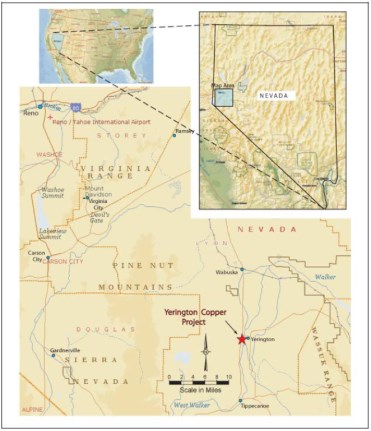
Source: Tetra Tech 2014
|
P a g e | 3-1 |
| 03/21/2025 |
| Yerington Copper Project S-K 1300 Report Yerington, Nevada |
|
Figure 3-2: Regional Layout Map
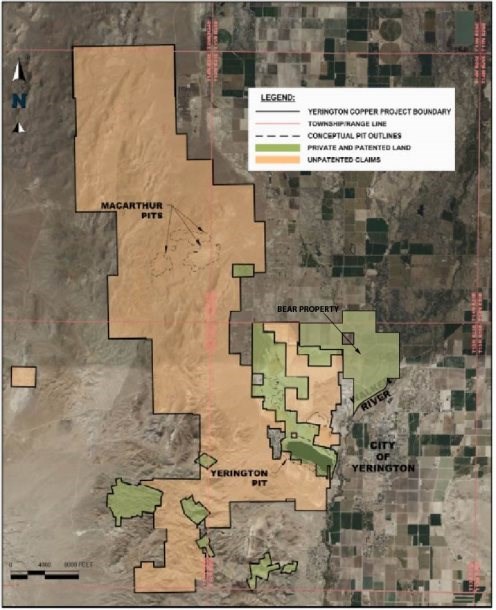
Source: NewFields 2024
3.2 Property Ownership
Five fee simple parcels (private land) (Table 3-2), 82 patented mining claims (Table 3-1), and 23 unpatented mining claims were acquired on April 27, 2011, when Lion CG closed a transaction under which assets of Arimetco, Inc. (Arimetco), a Nevada corporation, were acquired. The additional 1,113 unpatented claims were staked prior to or after the acquisition by Lion CG (Table 3-3). Table 3-4 summarizes the five parcels of optioned private ground in Lyon County.
|
P a g e | 3-2 |
| 03/21/2025 |
| Yerington Copper Project S-K 1300 Report Yerington, Nevada |
|
Private land is located in Township 13 North, Range 25 East in Sections 4, 5, 8, 9, 16, 17, and 21, and patented claims are located within Township 13 North, Range 25 East in Sections 16, 17, 19, 21, 31, and 32 and in Township 13 North, Range 24 East in Sections 22-25 and 36. LION CG's claims are located in: Sections 1 and 2, Township 12 North, Range 24 East; Sections 1-3, 8, 9, 11-14, 22-27, 35, 36, Township 13 North, Range 24 East; Sections 4-9, 16-21, and 30-32, Township 13 North, Range 25 East; Sections 1-4, 9-16, 22-27, 34-36, Township 14 North, Range 24 East; Sections 19-20, 29-31 Township 14 North, Range 25 East; Sections 33-36 Township 15 North, Range 24 East, Mount Diablo Base & Meridian.
Figure 3-3 to Source: Lion CG 2024
Figure 3-18 show the claim outlines relative to topography and historic mining.
Figure 3-3: Claim Outlines, Map 1 of 16
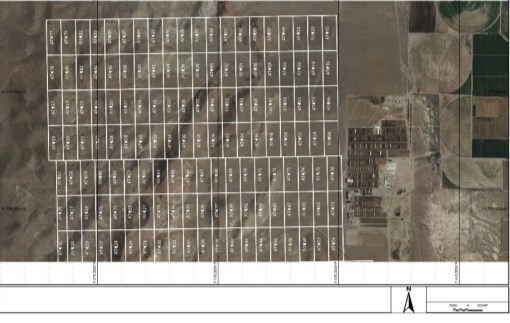
Source: Lion CG 2024
|
P a g e | 3-3 |
| 03/21/2025 |
| Yerington Copper Project S-K 1300 Report Yerington, Nevada |
|
Figure 3-4: Claim Outlines, Map 2 of 16
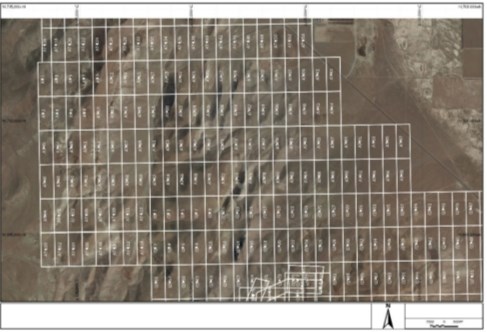
Source: Lion CG 2024
Figure 3-5: Claim Outlines, Map 3 of 16
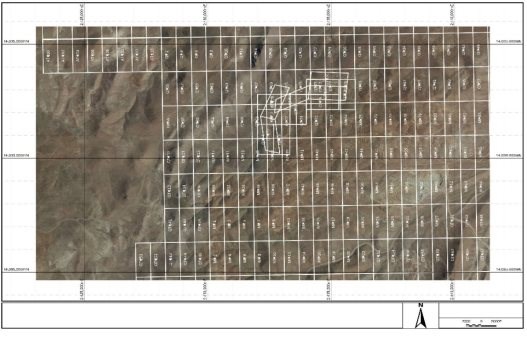
Source: Lion CG 2024
|
P a g e | 3-4 |
| 03/21/2025 |
| Yerington Copper Project S-K 1300 Report Yerington, Nevada |
|
Figure 3-6: Claim Outlines, Map 4 of 16
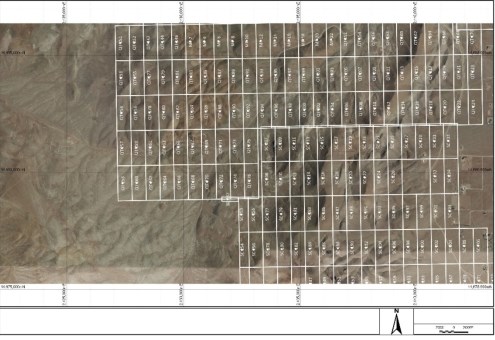
Source: Lion CG 2024
Figure 3-7: Claim Outlines, Map 5 of 16
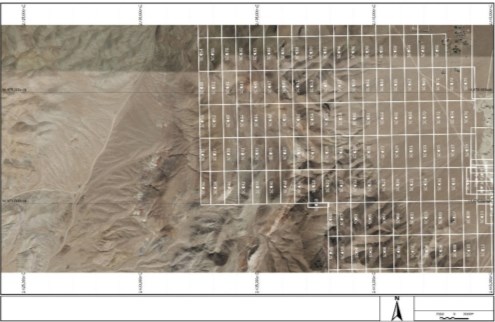
Source: Lion CG 2024
|
P a g e | 3-5 |
| 03/21/2025 |
| Yerington Copper Project S-K 1300 Report Yerington, Nevada |
|
Figure 3-8: Claim Outlines, Map 6 of 16
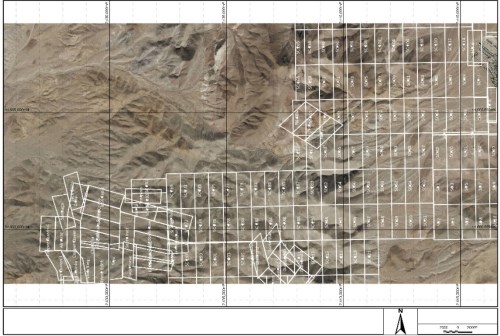
Source: Lion CG 2024
Figure 3-9: Claim Outlines, Map 7 of 16
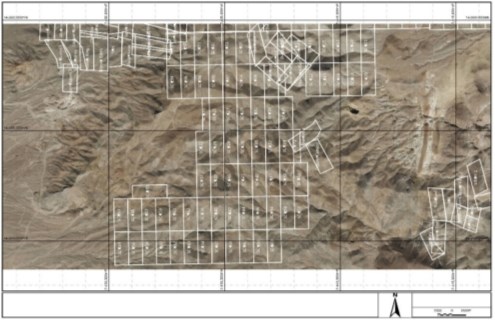
Source: Lion CG 2024
|
P a g e | 3-6 |
| 03/21/2025 |
| Yerington Copper Project S-K 1300 Report Yerington, Nevada |
|
Figure 3-10: Claim Outlines, Map 8 of 16
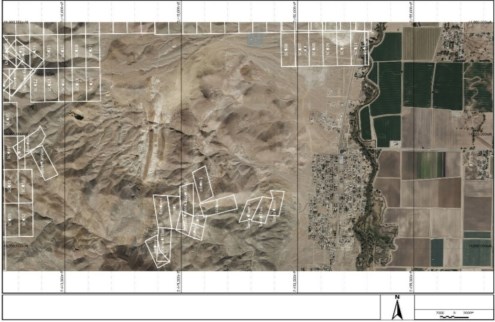
Source: Lion CG 2024
Figure 3-11: Claim Outlines, Map 9 of 16
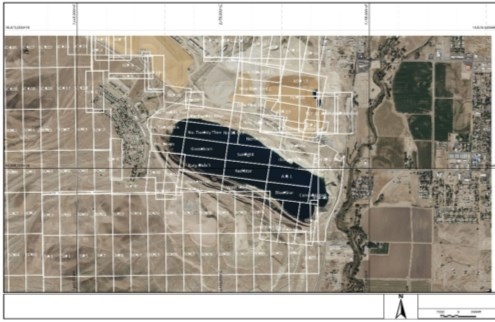
Source: Lion CG 2024
|
P a g e | 3-7 |
| 03/21/2025 |
| Yerington Copper Project S-K 1300 Report Yerington, Nevada |
|
Figure 3-12: Claim Outlines, Map 10 of 16
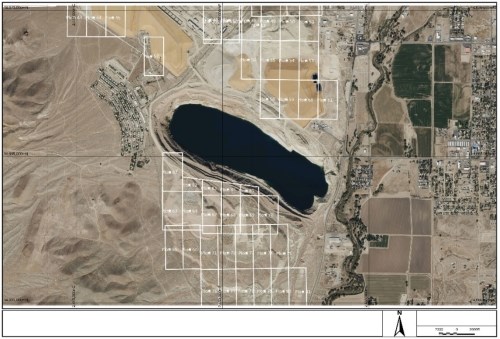
Source: Lion CG 2024
Figure 3-13: Claim Outlines, Map 11 of 16
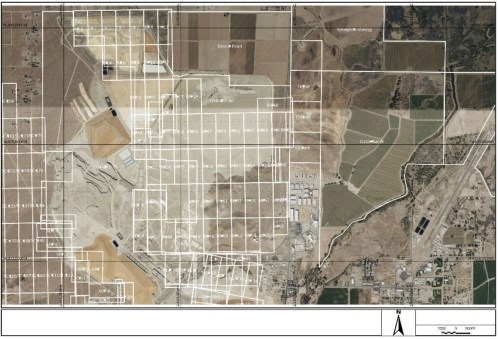
Source: Lion CG 2024
|
P a g e | 3-8 |
| 03/21/2025 |
| Yerington Copper Project S-K 1300 Report Yerington, Nevada |
|
Figure 3-14: Claim Outlines, Map 12 of 16
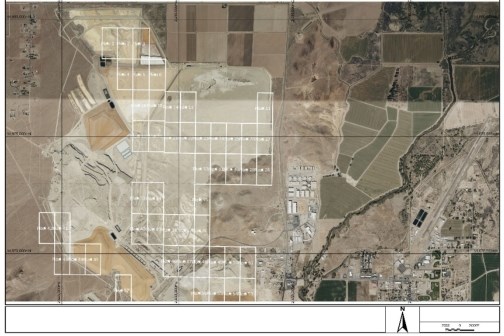
Source: Lion CG 2024
Figure 3-15: Claim Outlines, Map 13 of 16
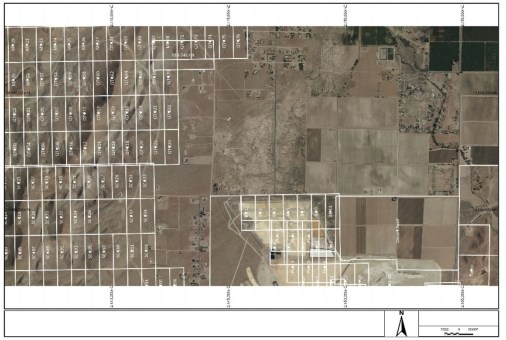
Source: Lion CG 2024
|
P a g e | 3-9 |
| 03/21/2025 |
| Yerington Copper Project S-K 1300 Report Yerington, Nevada |
|
Figure 3-16: Claim Outlines, Map 14 of 16
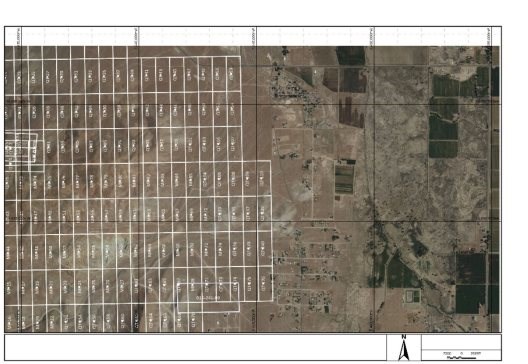
Source: Lion CG 2024
Figure 3-17: Claim Outlines, Map 15 of 16
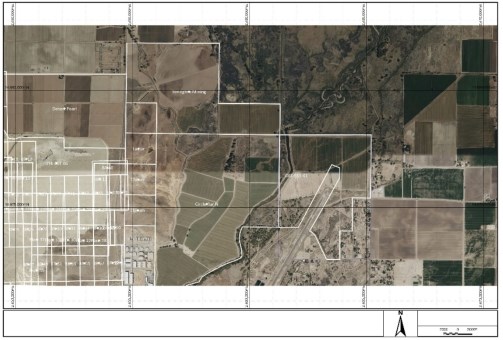
Source: Lion CG 2024
|
P a g e | 3-10 |
| 03/21/2025 |
| Yerington Copper Project S-K 1300 Report Yerington, Nevada |
|
Figure 3-18: Claim Outlines, Map 16 of 16
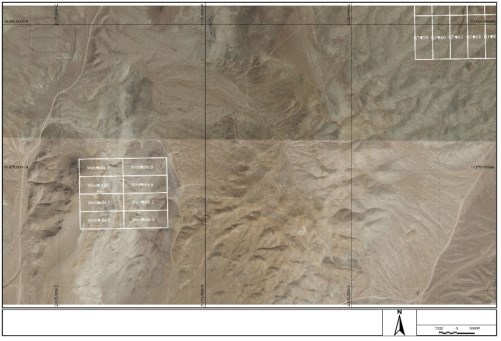
Source: Lion CG 2024
3.3 Mineral Tenure and Title
To facilitate efficient remediation, ARC submitted to the BLM a Proposed Action to acquire via Federal Land Conveyance Action (land sale) 2,062 acres of BLM land located within the Anaconda Copper Mine Site (ACMS). Upon acquisition, ARC will convey title to all minerals to Lion CG and the parties will execute a Surface Use Agreement allowing Lion CG the right to explore and mine the property. To complete the sale, BLM is preparing an Environmental Assessment (EA) following completion of a property appraisal. As of the date of this report, the draft EA has been prepared, and the appraisal is completed. Lion CG is coordinating with ARC regarding the timing and outcome of the BLM property transfer. This IA has been prepared assuming the land sale of BLM properties will be completed prior to the start of mining.
The Project consists of 5 fee simple parcels and 82 patented mining claims totalling 2,767.66 acres, and 1,113 unpatented lode and placer claims totalling 22,996 acres. The unpatented claims are located on lands administered by the BLM.
The purchase of the Arimetco assets was accomplished through a US$500,000 cash payment, 250,000 shares of Quaterra common stock, and a 2% net smelter return royalty capped at $7.5 million on production from any claims owned by its subsidiary Quaterra Alaska, Inc (including Quaterra's MacArthur Property) in the Yerington mining district.
A portion of the claims around the historic MacArthur mine were acquired by exercising a "Mining Lease with Option to Purchase". The original purchase option dated September 13, 2005, between North and Quaterra, as amended, was exercised on February 9, 2015. The Company's purchase is subject to a two percent NSR with a royalty buy down option of $1,000,000 to purchase one percent of the NSR, leaving a perpetual one percent NSR.
|
P a g e | 3-11 |
| 03/21/2025 |
| Yerington Copper Project S-K 1300 Report Yerington, Nevada |
|
A portion of the MacArthur claim group is also included in the area referred to as the "Royalty Area" in the Company's purchase agreement for the acquisition of Arimetco's Yerington properties. Under this agreement, MacArthur claims within this area (as well as the Yerington properties) are subject to a two percent NSR production royalty derived from the sales of ores, minerals and materials mined and marketed from the Property up to $7,500,000.
Ownership of the patented claims and private land is maintained through payment of county assessed taxes, while unpatented lode claims staked on BLM ground in the United States require a federal annual maintenance fee of $165 each, due by 12:00 pm (noon) on September 1 of each year. Further, each unpatented claim staked in Nevada requires an Intent to Hold fee of $12.00, plus filing fees, due by November 1 of each year payable to the County Recorder of the Lyon County. All annual fees have been paid, and Lion CG claims are current.
Unpatented lode claims have been staked by placing a location monument (two- by two-in by four-foot-high wood post) along the center line of each claim and two- by two-inch by four-foot-high wood posts at all four corners, with all posts properly identified in accordance with the rules and regulations of the BLM and the State of Nevada. Maximum dimensions of unpatented lode claims are 600 feet × 1,500 feet.
A complete property listing is included in Table 3-1, Table 3-2, Table 3-3, and Table 3-4 below.
3.4 Project Background
Copper mining was first recorded at the Yerington Mine site from 1918-1920 at the Empire Mine, and later, beginning in 1952 by Anaconda. From that time forward, the mine operated under different companies until 1999 when Arimetco, the last operator, closed the operation. Soil and groundwater contamination from the former mining operations have been identified on the Property.
As a result, a portion of the Property acquired by Lion CG in 2011 is now being remediated under jurisdiction of NDEP. Liability for the contamination on site is the responsibility of a third party which is actively engaged in remedial investigation and remediation activities under the supervision of NDEP.
To establish Lion CG's position and rights, the acquisition by Lion CG of the Arimetco properties required a series of rigorous environmental, legal, and technical due diligence studies. In 2008, Chambers Group, Inc. and Golder Associates Inc. conducted a Phase I Environmental Site Assessment (Phase I ESA) for the Yerington Mine Site. A Phase I ESA is intended to serve as an appropriate, commercially prudent, and reasonable inquiry regarding the potential for recognized environmental conditions in connection with the subject property. The 2008 Phase 1 ESA was updated by SRK Consulting (U.S.) Inc. (SRK) in 2010 and again in 2011. These were completed to allow Lion CG to establish liability protection as a bona fide prospective purchaser (BFPP). Prior to closing on the property, Lion CG received letters from the NDEP, BLM and the USEPA indicating the post-closing requirements then applicable to the Site for Lion CG to maintain its defense to liability as a BFPP regarding the activities of the former mine owners and operators.
Legal due diligence included a legal description of the property, a chain of title report, and an assignment of water rights. BFPP letters have been received from the NDEP, BLM and USEPA which indicate the basic requirements known as "reasonable steps" Lion CG must take to retain its BFPP defense from existing liabilities on the property.
|
P a g e | 3-12 |
| 03/21/2025 |
| Yerington Copper Project S-K 1300 Report Yerington, Nevada |
|
Technical due diligence included the review and compilation of a wealth of historical data in the Anaconda Collection, American Heritage Center, University of Wyoming, in Laramie. Numerous reports, maps, and historical drilling data have been scanned and entered into an internal data base, allowing an initial review of both past production and remaining mineralization in and around the Yerington pit.
The company owns approximately 6,015-acre feet of certificated primary groundwater rights permitted for mining and milling use at the site. The Yerington Property contains a Pit Lake estimated to contain approximately 43,000-acre feet of water to be dewatered during mining activities. The company believes this water will have a variety of beneficial uses but will require some costs to make the water available for those beneficial uses.
There are 3,453 ac-ft of primary water rights that have been declared forfeited by the Nevada Division of Water Resources (NDWR). The Extension of Time for 1,629 ac-ft of primary water rights is subject to a non-renewal notice by the NDWR. Lion CG is appealing the State's forfeiture notice with the outcome uncertain at the time this IA has been published. Lion CG has an option to purchase additional water rights that are attached to the Bear private lands (Table 3-4). If additional water is required for mining purposes, Lion CG may need to acquire additional water rights to meet the operational needs of the mine. Lion CG's 2011 drilling program was restricted to fee mineral properties or patented mining claims in or near the Yerington pit and approved by the State of Nevada Bureau of Mining Regulation and Reclamation of the NDEP, as an Interim Exploration Permit "BMRR Reclamation Permit #0321", supported by posting a $70,363 reclamation bond. The interim permit was approved as a final permit on November 7, 2011, by the NDEP.
If Lion CG elects to conduct exploration on unpatented lode mining claims on public lands administered by the BLM, a Notice of Intent is required if the proposed disturbance is less than five acres. The Notice of Intent includes a description and map of proposed work, supported by a reclamation bond. Proposed disturbance exceeding five acres requires a Plan of Operation, a more comprehensive evaluation of cultural features, vegetation, wildlife, water, and other items, supported by a reclamation bond.
3.5 Project Claims and Private Land
Table 3-1: Patented Claims
| Patented Claims | Mineral Survey Number | County Parcel Number | Parcel Acreage |
| Know U Don'T | 3144 | 012-111-21 | 98 |
| January | 3145 | ||
| Rossland | 3367 | ||
| Eclipse | 4080 | ||
| Edwin 1,2,5 | 4080 | ||
| Copper King, Kid | 4081 | ||
| Copper Queen No. 1 | 4081 | ||
| Santa Cruse 1,3 | 3075 | 012-111-23 | 58 |
| Santa Cruz | 3075 | ||
| Copper Queen No. 1,3 | 3655 | 012-112-01 | 490 |
| Minnie Edith | 3655 |
|
P a g e | 3-13 |
| 03/21/2025 |
| Yerington Copper Project S-K 1300 Report Yerington, Nevada |
|
| Patented Claims | Mineral Survey Number |
County Parcel Number |
Parcel Acreage |
| Nevada King | 3655 | ||
| San Jacinto | 3655 | ||
| Alcatraz | 3656 | ||
| Black Horse | 3656 | ||
| Boston | 3656 | ||
| Cash Boy | 3656 | ||
| Christina | 3656 | ||
| Colorado | 3656 | ||
| Colorado Springs | 3656 | ||
| Copper Queen 2,6 | 3656 | ||
| Daisy | 3656 | ||
| Fortuna | 3656 | ||
| Iron Cap,Iron Cap 2 | 3656 | ||
| Jack Clubs | 3656 | ||
| Juanita | 3656 | ||
| Kathleen | 3656 | ||
| Monte Cristo | 3656 | ||
| Pocahontas | 3656 | ||
| Sage Hen | 3656 | ||
| Santa Inez | 3656 | ||
| Santigo | 3656 | ||
| Scorpion | 3656 | ||
| Styx | 3656 | ||
| No. 102 | 4850 | 012-113-01 | 64.48 |
| No. 73 | 4850 | ||
| No. 74 | 4850 | ||
| Diamond,Diamond 1,2 | 3736 | 012-113-02 | 130 |
| Diamond 3,4 | 3977 | ||
| Diamond Fr.,Diamond Fr. 1 | 3977 | ||
| Lone Star | 3977 | ||
| Anaconda | 3692 | 012-113-04 | 19 |
| Copper Canyon | 3157 | 012-113-05 | 20 |
| A & L | 4499 | 014-451-04 | 506.86 |
| Wild Rose,Wild Rose 1-2 | 4499 | ||
| Black Horse | 4531 | ||
| Blue Star | 4531 | ||
| Canidate | 4531 | ||
| Consolidated,Consolidated Fr. | 4531 |
|
P a g e | 3-14 |
| 03/21/2025 |
| Yerington Copper Project S-K 1300 Report Yerington, Nevada |
|
| Patented Claims | Mineral Survey Number |
County Parcel Number |
Parcel Acreage |
| Greenhorn | 4531 | ||
| Hungry Bill | 4531 | ||
| Katy Didn'T | 4531 | ||
| New Blue Bird,New Blue Bird 1,2 | 4531 | ||
| New Royal Blue,New Royal Blue Ext. | 4531 | ||
| North Star | 4531 | ||
| Red Star | 4531 | ||
| Sunlight | 4531 | ||
| West Starlight | 4531 | ||
| No. 38 | 4778 | ||
| No. Seven | 4778 | ||
| No. Thirty-Five Fr. | 4778 | ||
| No. Twenty-Five | 4778 | ||
| No. Twenty-Four | 4778 | ||
| No. Twenty-Six | 4778 | ||
| No. Twenty-Three | 4778 | ||
| Total Claims: | 82 | Total acreage: | 1386.34 |
Table 3-2: Private Ground
| Private Ground | Count | County Parcel Number | Acreage |
| Private | 1 | 014-401-06 | 182.77 |
| Private | 1 | 014-461-10 | 12.7 |
| Private | 1 | 014-461-11 | 31 |
| Private | 1 | 014-401-15 | 1074.74 |
| Private | 1 | 014-241-09 | 80 |
| Total Parcels: | 5 | Total acreage: | 1381.21 |
Table 3-3: Lode and Placer Claims
| Program | Type | Claim | Sec-Twp-Range |
| YERINGTON MINE | LODE | ADP 1 | S4, 5-T13N-R25E |
| YERINGTON MINE | LODE | ADP 10 | S16-T13N-R25E |
| YERINGTON MINE | LODE | ADP 11 | S16-T13N-R25E |
| YERINGTON MINE | LODE | ADP 12 | S16-T13N-R25E |
| YERINGTON MINE | LODE | ADP 13 | S16-T13N-R25E |
| YERINGTON MINE | LODE | ADP 14 | S16-T13N-R25E |
| YERINGTON MINE | LODE | ADP 15 | S16-T13N-R25E |
| YERINGTON MINE | LODE | ADP 16 | S16-T13N-R25E |
| YERINGTON MINE | LODE | ADP 17 | S16-T13N-R25E |
| YERINGTON MINE | LODE | ADP 18 | S16-T13N-R25E |
|
P a g e | 3-15 |
| 03/21/2025 |
| Yerington Copper Project S-K 1300 Report Yerington, Nevada |
|
| Program | Type | Claim | Sec-Twp-Range |
| YERINGTON MINE | LODE | ADP 19 | S16-T13N-R25E |
| YERINGTON MINE | LODE | ADP 2 | S5, 8-T13N-R25E |
| YERINGTON MINE | LODE | ADP 20 | S16-T13N-R25E |
| YERINGTON MINE | LODE | ADP 21 | S16-T13N-R25E |
| YERINGTON MINE | LODE | ADP 22 | S17-T13N-R25E |
| YERINGTON MINE | LODE | ADP 23 | S17-T13N-R25E |
| YERINGTON MINE | LODE | ADP 3 | S5, 8-T13N-R25E |
| YERINGTON MINE | LODE | ADP 4 | S7, 8-T13N-R25E |
| YERINGTON MINE | LODE | ADP 5 | S7, 8-T13N-R25E |
| YERINGTON MINE | LODE | ADP 6 | S17-T13N-R25E |
| YERINGTON MINE | LODE | ADP 7 | S17-T13N-R25E |
| YERINGTON MINE | LODE | ADP 8 | S8-T13N-R25E |
| YERINGTON MINE | LODE | ADP 9 | S8-T13N-R25E |
| MACARTHUR CU | LODE | AT 1 | Sec 9,10,15,16 T14N R24E |
| MACARTHUR CU | LODE | AT 10 | Sec 15 T14N R24E |
| MACARTHUR CU | LODE | AT 100 | Sec 22 T14N R24E |
| MACARTHUR CU | LODE | AT 101 | Sec 22 T14N R24E |
| MACARTHUR CU | LODE | AT 102 | Sec 22 T14N R24E |
| MACARTHUR CU | LODE | AT 103 | Sec 22 T14N R24E |
| MACARTHUR CU | LODE | AT 104 | Sec 22 T14N R24E |
| MACARTHUR CU | LODE | AT 105 | Sec 22 T14N R24E |
| MACARTHUR CU | LODE | AT 106 | Sec 22 T14N R24E |
| MACARTHUR CU | LODE | AT 107 | Sec 15,22 T14N R24E |
| MACARTHUR CU | LODE | AT 108 | Sec 22 T14N R24E |
| MACARTHUR CU | LODE | AT 109 | Sec 15,22 T14N R24E |
| MACARTHUR CU | LODE | AT 11 | Sec 10,15 T14N R24E |
| MACARTHUR CU | LODE | AT 110 | Sec 22 T14N R24E |
| MACARTHUR CU | LODE | AT 111 | Sec 15,22 T14N R24E |
| MACARTHUR CU | LODE | AT 112 | Sec 22 T14N R24E |
| MACARTHUR CU | LODE | AT 113 | Sec 15,22 T14N R24E |
| MACARTHUR CU | LODE | AT 114 | Sec 22 T14N R24E |
| MACARTHUR CU | LODE | AT 115 | S9, 10-T14N-R24E |
| MACARTHUR CU | LODE | AT 116 | S9, 10-T14N-R24E |
| MACARTHUR CU | LODE | AT 117 | S10-T14N-R24E |
| MACARTHUR CU | LODE | AT 118 | S10-T14N-R24E |
| MACARTHUR CU | LODE | AT 119 | S10-T14N-R24E |
| MACARTHUR CU | LODE | AT 12 | Sec 15 T14N R24E |
| MACARTHUR CU | LODE | AT 120 | S10-T14N-R24E |
| MACARTHUR CU | LODE | AT 121 | S10-T14N-R24E |
|
P a g e | 3-16 |
| 03/21/2025 |
| Yerington Copper Project S-K 1300 Report Yerington, Nevada |
|
| Program | Type | Claim | Sec-Twp-Range |
| MACARTHUR CU | LODE | AT 122 | S10-T14N-R24E |
| MACARTHUR CU | LODE | AT 123 | S10-T14N-R24E |
| MACARTHUR CU | LODE | AT 124 | S10-T14N-R24E |
| MACARTHUR CU | LODE | AT 125 | S10-T14N-R24E |
| MACARTHUR CU | LODE | AT 126 | S10-T14N-R24E |
| MACARTHUR CU | LODE | AT 127 | S10-T14N-R24E |
| MACARTHUR CU | LODE | AT 128 | S10-T14N-R24E |
| MACARTHUR CU | LODE | AT 129 | S10-T14N-R24E |
| MACARTHUR CU | LODE | AT 13 | Sec 10,15 T14N R24E |
| MACARTHUR CU | LODE | AT 130 | S10-T14N-R24E |
| MACARTHUR CU | LODE | AT 131 | S10-T14N-R24E |
| MACARTHUR CU | LODE | AT 132 | S10-T14N-R24E |
| MACARTHUR CU | LODE | AT 133 | S10, 11-T14N-R24E |
| MACARTHUR CU | LODE | AT 134 | S10, 11-T14N-R24E |
| MACARTHUR CU | LODE | AT 135 | S11-T14N-R24E |
| MACARTHUR CU | LODE | AT 136 | S11-T14N-R24E |
| MACARTHUR CU | LODE | AT 137 | S11-T14N-R24E |
| MACARTHUR CU | LODE | AT 138 | S11-T14N-R24E |
| MACARTHUR CU | LODE | AT 139 | S11-T14N-R24E |
| MACARTHUR CU | LODE | AT 14 | Sec 15 T14N R24E |
| MACARTHUR CU | LODE | AT 140 | S11-T14N-R24E |
| MACARTHUR CU | LODE | AT 141 | S11-T14N-R24E |
| MACARTHUR CU | LODE | AT 142 | S11-T14N-R24E |
| MACARTHUR CU | LODE | AT 143 | S11-T14N-R24E |
| MACARTHUR CU | LODE | AT 144 | S11-T14N-R24E |
| MACARTHUR CU | LODE | AT 145 | S11-T14N-R24E |
| MACARTHUR CU | LODE | AT 146 | S11-T14N-R24E |
| MACARTHUR CU | LODE | AT 147 | S11-T14N-R24E |
| MACARTHUR CU | LODE | AT 148 | S11-T14N-R24E |
| MACARTHUR CU | LODE | AT 149 | S11, 12-T14N-R24E |
| MACARTHUR CU | LODE | AT 15 | Sec 10,15 T14N R24E |
| MACARTHUR CU | LODE | AT 150 | S11, 12-T14N-R24E |
| MACARTHUR CU | LODE | AT 151 | S12-T14N-R24E |
| MACARTHUR CU | LODE | AT 152 | S12-T14N-R24E |
| MACARTHUR CU | LODE | AT 153 | S12-T14N-R24E |
| MACARTHUR CU | LODE | AT 154 | S12-T14N-R24E |
| MACARTHUR CU | LODE | AT 157 | S9, 10-T14N-R24E |
| MACARTHUR CU | LODE | AT 158 | S10-T14N-R24E |
| MACARTHUR CU | LODE | AT 159 | S10-T14N-R24E |
|
P a g e | 3-17 |
| 03/21/2025 |
| Yerington Copper Project S-K 1300 Report Yerington, Nevada |
|
| Program | Type | Claim | Sec-Twp-Range |
| MACARTHUR CU | LODE | AT 16 | Sec 15 T14N R24E |
| MACARTHUR CU | LODE | AT 160 | S10-T14N-R24E |
| MACARTHUR CU | LODE | AT 161 | S10-T14N-R24E |
| MACARTHUR CU | LODE | AT 162 | S10-T14N-R24E |
| MACARTHUR CU | LODE | AT 163 | S10-T14N-R24E |
| MACARTHUR CU | LODE | AT 164 | S10-T14N-R24E |
| MACARTHUR CU | LODE | AT 165 | S10-T14N-R24E |
| MACARTHUR CU | LODE | AT 166 | S10, 11-T14N-R24E |
| MACARTHUR CU | LODE | AT 167 | S2, 11-T14N-R24E |
| MACARTHUR CU | LODE | AT 168 | S2, 11-T14N-R24E |
| MACARTHUR CU | LODE | AT 169 | S2, 11-T14N-R24E |
| MACARTHUR CU | LODE | AT 17 | Sec 10,14,15 T14N R24E |
| MACARTHUR CU | LODE | AT 170 | S2, 11-T14N-R24E |
| MACARTHUR CU | LODE | AT 171 | S2, 11-T14N-R24E |
| MACARTHUR CU | LODE | AT 172 | S2, 11-T14N-R24E |
| MACARTHUR CU | LODE | AT 173 | S2, 11-T14N-R24E |
| MACARTHUR CU | LODE | AT 174 | S2, 11, 12-T14N-R24E |
| MACARTHUR CU | LODE | AT 175 | S1, 2, 11, 12-T14N-R24E |
| MACARTHUR CU | LODE | AT 176 | S1, 12-T14N-R24E |
| MACARTHUR CU | LODE | AT 18 | Sec 14,15 T14N R24E |
| MACARTHUR CU | LODE | AT 19 | Sec 10,11,14 T14N R24E |
| MACARTHUR CU | LODE | AT 2 | Sec 15,16 T14N R24E |
| MACARTHUR CU | LODE | AT 20 | Sec 14 T14N R24E |
| MACARTHUR CU | LODE | AT 21 | Sec 11,14 T14N R24E |
| MACARTHUR CU | LODE | AT 22 | Sec 14 T14N R24E |
| MACARTHUR CU | LODE | AT 23 | Sec 11,14 T14N R24E |
| MACARTHUR CU | LODE | AT 24 | Sec 14 T14N R24E |
| MACARTHUR CU | LODE | AT 25 | Sec 11,14 T14N R24E |
| MACARTHUR CU | LODE | AT 26 | Sec 14 T14N R24E |
| MACARTHUR CU | LODE | AT 27 | Sec 11,14 T14N R24E |
| MACARTHUR CU | LODE | AT 28 | Sec 14 T14N R24E |
| MACARTHUR CU | LODE | AT 29 | Sec 11,14 T14N R24E |
| MACARTHUR CU | LODE | AT 3 | Sec 10,15 T14N R24E |
| MACARTHUR CU | LODE | AT 30 | Sec 14 T14N R24E |
| MACARTHUR CU | LODE | AT 31 | Sec 11,14 T14N R24E |
| MACARTHUR CU | LODE | AT 32 | Sec 14 T14N R24E |
| MACARTHUR CU | LODE | AT 33 | Sec 11,14 T14N R24E |
| MACARTHUR CU | LODE | AT 34 | Sec 14 T14N R24E |
| MACARTHUR CU | LODE | AT 35 | Sec 40131 T14N R24E |
|
P a g e | 3-18 |
| 03/21/2025 |
| Yerington Copper Project S-K 1300 Report Yerington, Nevada |
|
| Program | Type | Claim | Sec-Twp-Range |
| MACARTHUR CU | LODE | AT 36 | Sec 13,14 T14N R24E |
| MACARTHUR CU | LODE | AT 37 | Sec 12,13 T14N R24E |
| MACARTHUR CU | LODE | AT 38 | Sec 13 T14N R24E |
| MACARTHUR CU | LODE | AT 39 | Sec 12,13 T14N R24E |
| MACARTHUR CU | LODE | AT 4 | Sec 15 T14N R24E |
| MACARTHUR CU | LODE | AT 40 | Sec 13 T14N R24E |
| MACARTHUR CU | LODE | AT 41 | Sec 12,13 T14N R24E |
| MACARTHUR CU | LODE | AT 42 | Sec 13 T14N R24E |
| MACARTHUR CU | LODE | AT 43 | Sec 12,13 T14N R24E |
| MACARTHUR CU | LODE | AT 44 | Sec 13 T14N R24E |
| MACARTHUR CU | LODE | AT 45 | Sec 15,16 T14N R24E |
| MACARTHUR CU | LODE | AT 46 | Sec 15,16,22 T14N R24E |
| MACARTHUR CU | LODE | AT 47 | Sec 15 T14N R24E |
| MACARTHUR CU | LODE | AT 48 | Sec 15,22 T14N R24E |
| MACARTHUR CU | LODE | AT 49 | Sec 15 T14N R24E |
| MACARTHUR CU | LODE | AT 5 | Sec 10,15 T14N R24E |
| MACARTHUR CU | LODE | AT 50 | Sec 15,22 T14N R24E |
| MACARTHUR CU | LODE | AT 51 | Sec 15 T14N R24E |
| MACARTHUR CU | LODE | AT 52 | Sec 15,22 T14N R24E |
| MACARTHUR CU | LODE | AT 53 | Sec 15 T14N R24E |
| MACARTHUR CU | LODE | AT 54 | Sec 15,22 T14N R24E |
| MACARTHUR CU | LODE | AT 55 | Sec 15 T14N R24E |
| MACARTHUR CU | LODE | AT 56 | Sec 15,22 T14N R24E |
| MACARTHUR CU | LODE | AT 57 | Sec 15 T14N R24E |
| MACARTHUR CU | LODE | AT 58 | Sec 15 T14N R24E |
| MACARTHUR CU | LODE | AT 59 | Sec 15 T14N R24E |
| MACARTHUR CU | LODE | AT 6 | Sec 15 T14N R24E |
| MACARTHUR CU | LODE | AT 60 | Sec 15 T14N R24E |
| MACARTHUR CU | LODE | AT 61 | Sec 14,15 T14N R24E |
| MACARTHUR CU | LODE | AT 62 | Sec 14,15 T14N R24E |
| MACARTHUR CU | LODE | AT 63 | Sec 14 T14N R24E |
| MACARTHUR CU | LODE | AT 64 | Sec 14 T14N R24E |
| MACARTHUR CU | LODE | AT 65 | Sec 14 T14N R24E |
| MACARTHUR CU | LODE | AT 66 | Sec 14 T14N R24E |
| MACARTHUR CU | LODE | AT 67 | Sec 14 T14N R24E |
| MACARTHUR CU | LODE | AT 68 | Sec 14 T14N R24E |
| MACARTHUR CU | LODE | AT 69 | Sec 14 T14N R24E |
| MACARTHUR CU | LODE | AT 7 | Sec 10,15 T14N R24E |
| MACARTHUR CU | LODE | AT 70 | Sec 14 T14N R24E |
|
P a g e | 3-19 |
| 03/21/2025 |
| Yerington Copper Project S-K 1300 Report Yerington, Nevada |
|
| Program | Type | Claim | Sec-Twp-Range |
| MACARTHUR CU | LODE | AT 71 | Sec 14 T14N R24E |
| MACARTHUR CU | LODE | AT 72 | Sec 14 T14N R24E |
| MACARTHUR CU | LODE | AT 73 | Sec 14 T14N R24E |
| MACARTHUR CU | LODE | AT 74 | Sec 14 T14N R24E |
| MACARTHUR CU | LODE | AT 75 | Sec 14 T14N R24E |
| MACARTHUR CU | LODE | AT 76 | Sec 14 T14N R24E |
| MACARTHUR CU | LODE | AT 77 | Sec 14 T14N R24E |
| MACARTHUR CU | LODE | AT 78 | Sec 14 T14N R24E |
| MACARTHUR CU | LODE | AT 79 | Sec 13,14 T14N R24E |
| MACARTHUR CU | LODE | AT 8 | Sec 15 T14N R24E |
| MACARTHUR CU | LODE | AT 80 | Sec 13,14 T14N R24E |
| MACARTHUR CU | LODE | AT 81 | Sec 13 T14N R24E |
| MACARTHUR CU | LODE | AT 82 | Sec 13 T14N R24E |
| MACARTHUR CU | LODE | AT 83 | Sec 13 T14N R24E |
| MACARTHUR CU | LODE | AT 84 | Sec 13 T14N R24E |
| MACARTHUR CU | LODE | AT 85 | Sec 13 T14N R24E |
| MACARTHUR CU | LODE | AT 86 | Sec 13 T14N R24E |
| MACARTHUR CU | LODE | AT 87 | Sec 13 T14N R24E |
| MACARTHUR CU | LODE | AT 88 | Sec 13 T14N R24E |
| MACARTHUR CU | LODE | AT 89 | Sec 13 T14N R24E |
| MACARTHUR CU | LODE | AT 9 | Sec 10,15 T14N R24E |
| MACARTHUR CU | LODE | AT 90 | Sec 13 T14N R24E |
| MACARTHUR CU | LODE | AT 91 | Sec 13 T14N R24E |
| MACARTHUR CU | LODE | AT 92 | Sec 13 T14N R24E |
| MACARTHUR CU | LODE | AT 93 | Sec 13 T14N R24E |
| MACARTHUR CU | LODE | AT 94 | Sec 13 T14N R24E |
| MACARTHUR CU | LODE | AT 95 | Sec 13 T14N R24E |
| MACARTHUR CU | LODE | AT 96 | Sec 13 T14N R24E |
| MACARTHUR CU | LODE | AT 97 | Sec 13 T14N R24E |
| MACARTHUR CU | LODE | AT 98 | Sec 13 T14N R24E |
| MACARTHUR CU | LODE | AT 99 | Sec 22 T14N R24E |
| MACARTHUR CU | LODE | AT177 | S33-T15N-R24E; S4, T14N-R24E |
| MACARTHUR CU | LODE | AT178 | S4-T14N-R24E |
| MACARTHUR CU | LODE | AT179 | S34-T15N-R24E; S3-T14N-R24E |
| MACARTHUR CU | LODE | AT180 | S3-T14N-R24E |
| MACARTHUR CU | LODE | AT181 | S34-T15N-R24E; S3-T14N-R24E |
| MACARTHUR CU | LODE | AT182 | S3-T14N-R24E |
| MACARTHUR CU | LODE | AT183 | S34-T15N-R24E; S3-T14N-R24E |
| MACARTHUR CU | LODE | AT184 | S3-T14N-R24E |
|
P a g e | 3-20 |
| 03/21/2025 |
| Yerington Copper Project S-K 1300 Report Yerington, Nevada |
|
| Program | Type | Claim | Sec-Twp-Range |
| MACARTHUR CU | LODE | AT185 | S34-T15N-R24E; S3-T14N-R24E |
| MACARTHUR CU | LODE | AT186 | S3-T14N-R24E |
| MACARTHUR CU | LODE | AT187 | S34-T15N-R24E; S3-T14N-R24E |
| MACARTHUR CU | LODE | AT188 | S3-T14N-R24E |
| MACARTHUR CU | LODE | AT189 | S34-T15N-R24E; S3-T14N-R24E |
| MACARTHUR CU | LODE | AT190 | S3-T14N-R24E |
| MACARTHUR CU | LODE | AT191 | S34-T15N-R24E; S3-T14N-R24E |
| MACARTHUR CU | LODE | AT192 | S3-T14N-R24E |
| MACARTHUR CU | LODE | AT193 | S34-T15N-R24E; S3-T14N-R24E |
| MACARTHUR CU | LODE | AT194 | S3-T14N-R24E |
| MACARTHUR CU | LODE | AT195 | S34-T15N-R24E; S3-T14N-R24E |
| MACARTHUR CU | LODE | AT196 | S3-T14N-R24E |
| MACARTHUR CU | LODE | AT197 | S35-T15N-R24E; S2-T14N-R24E |
| MACARTHUR CU | LODE | AT198 | S2-T14N-R24E |
| MACARTHUR CU | LODE | AT199 | S35-T15N-R24E; S2-T14N-R24E |
| MACARTHUR CU | LODE | AT200 | S2-T14N-R24E |
| MACARTHUR CU | LODE | AT201 | S35-T15N-R24E; S2-T14N-R24E |
| MACARTHUR CU | LODE | AT202 | S2-T14N-R24E |
| MACARTHUR CU | LODE | AT203 | S35-T15N-R24E; S2-T14N-R24E |
| MACARTHUR CU | LODE | AT204 | S2-T14N-R24E |
| MACARTHUR CU | LODE | AT205 | S35-T15N-R24E; S2-T14N-R24E |
| MACARTHUR CU | LODE | AT206 | S2-T14N-R24E |
| MACARTHUR CU | LODE | AT207 | S35-T15N-R24E; S2-T14N-R24E |
| MACARTHUR CU | LODE | AT208 | S2-T14N-R24E |
| MACARTHUR CU | LODE | AT209 | S35-T15N-R24E; S2-T14N-R24E |
| MACARTHUR CU | LODE | AT210 | S2-T14N-R24E |
| MACARTHUR CU | LODE | AT211 | S35-T15N-R24E; S2-T14N-R24E |
| MACARTHUR CU | LODE | AT212 | S2-T14N-R24E |
| MACARTHUR CU | LODE | AT213 | S35, 36-T15N-R24E; S1, 2-T14N-R24E |
| MACARTHUR CU | LODE | AT214 | S2-T14N-R24E |
| MACARTHUR CU | LODE | AT215 | S36-T15N-R24E; S1-T14N-R24E |
| MACARTHUR CU | LODE | AT216 | S2-T14N-R24E |
| MACARTHUR CU | LODE | AT217 | S4-T14N-R24E |
| MACARTHUR CU | LODE | AT218 | S3, 4, 9, 10-T14NR24E |
| MACARTHUR CU | LODE | AT219 | S3-T14N-R24E |
| MACARTHUR CU | LODE | AT220 | S3, 10-T14N-R24E |
| MACARTHUR CU | LODE | AT221 | S3-T14N-R24E |
| MACARTHUR CU | LODE | AT222 | S3, 10-T14N-R24E |
| MACARTHUR CU | LODE | AT223 | S3-T14N-R24E |
|
P a g e | 3-21 |
| 03/21/2025 |
| Yerington Copper Project S-K 1300 Report Yerington, Nevada |
|
| Program | Type | Claim | Sec-Twp-Range |
| MACARTHUR CU | LODE | AT224 | S3, 10-T14N-R24E |
| MACARTHUR CU | LODE | AT225 | S3-T14N-R24E |
| MACARTHUR CU | LODE | AT226 | S3, 10-T14N-R24E |
| MACARTHUR CU | LODE | AT227 | S3-T14N-R24E |
| MACARTHUR CU | LODE | AT228 | S3, 10-T14N-R24E |
| MACARTHUR CU | LODE | AT229 | S3-T14N-R24E |
| MACARTHUR CU | LODE | AT230 | S3, 10-T14N-R24E |
| MACARTHUR CU | LODE | AT231 | S3-T14N-R24E |
| MACARTHUR CU | LODE | AT232 | S3, 10-T14N-R24E |
| MACARTHUR CU | LODE | AT233 | S3-T14N-R24E |
| MACARTHUR CU | LODE | AT234 | S3, 10-T14N-R24E |
| MACARTHUR CU | LODE | AT235 | S2, 3-T14N-R24E |
| MACARTHUR CU | LODE | AT236 | S2, 3, 10, 11-T14N-R24E |
| MACARTHUR CU | LODE | AT237 | S2-T14N-R24E |
| MACARTHUR CU | LODE | AT238 | S2, 11-T14N-R24E |
| MACARTHUR CU | LODE | AT239 | S2-T14N-R24E |
| MACARTHUR CU | LODE | AT240 | S2-T14N-R24E |
| MACARTHUR CU | LODE | AT241 | S2-T14N-R24E |
| MACARTHUR CU | LODE | AT242 | S2-T14N-R24E |
| MACARTHUR CU | LODE | AT243 | S2-T14N-R24E |
| MACARTHUR CU | LODE | AT244 | S2-T14N-R24E |
| MACARTHUR CU | LODE | AT245 | S2-T14N-R24E |
| MACARTHUR CU | LODE | AT246 | S2-T14N-R24E |
| MACARTHUR CU | LODE | AT247 | S2-T14N-R24E |
| MACARTHUR CU | LODE | AT248 | S2-T14N-R24E |
| MACARTHUR CU | LODE | AT249 | S2-T14N-R24E |
| MACARTHUR CU | LODE | AT250 | S2-T14N-R24E |
| MACARTHUR CU | LODE | AT251 | S2-T14N-R24E |
| MACARTHUR CU | LODE | AT252 | S2-T14N-R24E |
| MACARTHUR CU | LODE | AT253 | S1, 2-T14N-R24E |
| MACARTHUR CU | LODE | AT254 | S1, 2-T14N-R24E |
| MACARTHUR CU | LODE | AT255 | S1-T14N-R24E |
| MACARTHUR CU | LODE | AT256 | S1-T14N-R24E |
| YERINGTON MINE | LODE | BR 1 | S32-T14N-R25E S5-T13N-R25E |
| YERINGTON MINE | LODE | BR 10 | S5-T13N-R25E |
| YERINGTON MINE | LODE | BR 11 | S32, 33-T14N-R25E S4, 5-T13N-R25E |
| YERINGTON MINE | LODE | BR 12 | S4, 5-T13N-R25E |
| YERINGTON MINE | LODE | BR 13 | S5-T13N-R25E |
| YERINGTON MINE | LODE | BR 14 | S5, 8-T13N-R25E |
|
P a g e | 3-22 |
| 03/21/2025 |
| Yerington Copper Project S-K 1300 Report Yerington, Nevada |
|
| Program | Type | Claim | Sec-Twp-Range |
| YERINGTON MINE | LODE | BR 15 | S5-T13N-R25E |
| YERINGTON MINE | LODE | BR 16 | S4, 5-T13N-R25E |
| YERINGTON MINE | LODE | BR 17 | S4-T13N-R25E |
| YERINGTON MINE | LODE | BR 18 | S4, 9-T13N-R25E |
| YERINGTON MINE | LODE | BR 19 | S4-T13N-R25E |
| YERINGTON MINE | LODE | BR 2 | S32-T14N-R25E S5-T13N-R25E |
| YERINGTON MINE | LODE | BR 20 | S4, 9-T13N-R25E |
| YERINGTON MINE | LODE | BR 21 | S5, 8-T13N-R25E |
| YERINGTON MINE | LODE | BR 22 | S8-T13N-R25E |
| YERINGTON MINE | LODE | BR 23 | S4,5,8,9-T13N-R25E |
| YERINGTON MINE | LODE | BR 24 | S8, 9-T13N-R25E |
| YERINGTON MINE | LODE | BR 25 | S9-T13N-R25E |
| YERINGTON MINE | LODE | BR 26 | S9-T13N-R25E |
| YERINGTON MINE | LODE | BR 27 | S4, 9-T13N-R25E |
| YERINGTON MINE | LODE | BR 28 | S9-T13N-R25E |
| YERINGTON MINE | LODE | BR 29 | S4, 9-T13N-R25E |
| YERINGTON MINE | LODE | BR 3 | S32-T14N-R25E S5-T13N-R25E |
| YERINGTON MINE | LODE | BR 30 | S9-T13N-R25E |
| YERINGTON MINE | LODE | BR 31 | S4, 9-T13N-R25E |
| YERINGTON MINE | LODE | BR 32 | S9-T13N-R25E |
| YERINGTON MINE | LODE | BR 33 | S4, 9-T13N-R25E |
| YERINGTON MINE | LODE | BR 34 | S9-T13N-R25E |
| YERINGTON MINE | LODE | BR 35 | S4, 9-T13N-R25E |
| YERINGTON MINE | LODE | BR 36 | S9-T13N-R25E |
| YERINGTON MINE | LODE | BR 37 | S4, 9-T13N-R25E |
| YERINGTON MINE | LODE | BR 38 | S9-T13N-R25E |
| YERINGTON MINE | LODE | BR 39 | S3,4,9,10-T13N-R25E |
| YERINGTON MINE | LODE | BR 4 | S5-T13N-R25E |
| YERINGTON MINE | LODE | BR 40 | S3, 4-T13N-R25E |
| YERINGTON MINE | LODE | BR 41 | S8-T13N-R25E |
| YERINGTON MINE | LODE | BR 42 | S8, 17-T13N-R25E |
| YERINGTON MINE | LODE | BR 43 | S8-T13N-R25E |
| YERINGTON MINE | LODE | BR 44 | S8,9,16,17-T13N-R25E |
| YERINGTON MINE | LODE | BR 45 | S9, 16-T13N-R25E |
| YERINGTON MINE | LODE | BR 46 | S9, 16-T13N-R25E |
| YERINGTON MINE | LODE | BR 47 | S9-T13N-R25E |
| YERINGTON MINE | LODE | BR 48 | S9, 16-T13N-R25E |
| YERINGTON MINE | LODE | BR 49 | S9-T13N-R25E |
| YERINGTON MINE | LODE | BR 5 | S32-T14N-R25E S5-T13N-R25E |
|
P a g e | 3-23 |
| 03/21/2025 |
| Yerington Copper Project S-K 1300 Report Yerington, Nevada |
|
| Program | Type | Claim | Sec-Twp-Range |
| YERINGTON MINE | LODE | BR 50 | S9-T13N-R25E |
| YERINGTON MINE | LODE | BR 51 | S9-T13N-R25E |
| YERINGTON MINE | LODE | BR 52 | S9-T13N-R25E |
| YERINGTON MINE | LODE | BR 53 | S9-T13N-R25E |
| YERINGTON MINE | LODE | BR 54 | S9-T13N-R25E |
| YERINGTON MINE | LODE | BR 55 | S9-T13N-R25E |
| YERINGTON MINE | LODE | BR 56 | S9-T13N-R25E |
| YERINGTON MINE | LODE | BR 57 | S9-T13N-R25E |
| YERINGTON MINE | LODE | BR 58 | S9-T13N-R25E |
| YERINGTON MINE | LODE | BR 59 | S9-T13N-R25E |
| YERINGTON MINE | LODE | BR 6 | S5-T13N-R25E |
| MACARTHUR CU | LODE | BR 60 | S9-T25E-13N |
| MACARTHUR CU | LODE | BR 61 | S9-T25E-13N |
| YERINGTON MINE | LODE | BR 7 | S32-T14N-R25E S5-T13N-R25E |
| YERINGTON MINE | LODE | BR 8 | S5-T13N-R25E |
| YERINGTON MINE | LODE | BR 9 | S32-T14N-R25E S5-T13N-R25E |
| MACARTHUR CU | LODE | MP 1 | S26-T14N-R24E |
| MACARTHUR CU | LODE | MP 10 | S26,35-T14N-R24E |
| MACARTHUR CU | LODE | MP 11 | S26-T14N-R24E |
| MACARTHUR CU | LODE | MP 12 | S26,35-T14N-R24E |
| MACARTHUR CU | LODE | MP 13 | S25,26-T14N-R24E |
| MACARTHUR CU | LODE | MP 14 | S25,26,35,36-T14N-R24E |
| MACARTHUR CU | LODE | MP 15 | S25-T14N-R24E |
| MACARTHUR CU | LODE | MP 16 | S25,36-T14N-R24E |
| MACARTHUR CU | LODE | MP 17 | S25-T14N-R24E |
| MACARTHUR CU | LODE | MP 18 | S25,36-T14N-R24E |
| MACARTHUR CU | LODE | MP 19 | S25-T14N-R24E |
| MACARTHUR CU | LODE | MP 2 | S26,35-T14N-R24E |
| MACARTHUR CU | LODE | MP 20 | S25,36-T14N-R24E |
| MACARTHUR CU | LODE | MP 21 | S25-T14N-R24E |
| MACARTHUR CU | LODE | MP 22 | S25,36-T14N-R24E |
| MACARTHUR CU | LODE | MP 23 | S25-T14N-R24E |
| MACARTHUR CU | LODE | MP 24 | S25-T14N-R24E |
| MACARTHUR CU | LODE | MP 25 | S25-T14N-R24E |
| MACARTHUR CU | LODE | MP 26 | S25-T14N-R24E |
| MACARTHUR CU | LODE | MP 27 | S25-T14N-R24E S30-T14N-R25E |
| MACARTHUR CU | LODE | MP 28 | S30-T14N-R25E |
| MACARTHUR CU | LODE | MP 29 | S30-T14N-R25E |
| MACARTHUR CU | LODE | MP 3 | S26-T14N-R24E |
|
P a g e | 3-24 |
| 03/21/2025 |
| Yerington Copper Project S-K 1300 Report Yerington, Nevada |
|
| Program | Type | Claim | Sec-Twp-Range |
| MACARTHUR CU | LODE | MP 30 | S26-T14N-R24E |
| MACARTHUR CU | LODE | MP 31 | S26-T14N-R24E |
| MACARTHUR CU | LODE | MP 32 | S26-T14N-R24E |
| MACARTHUR CU | LODE | MP 33 | S26-T14N-R24E |
| MACARTHUR CU | LODE | MP 34 | S26-T14N-R24E |
| MACARTHUR CU | LODE | MP 35 | S26-T14N-R24E |
| MACARTHUR CU | LODE | MP 36 | S26-T14N-R24E |
| MACARTHUR CU | LODE | MP 37 | S26-T14N-R24E |
| MACARTHUR CU | LODE | MP 38 | S26-T14N-R24E |
| MACARTHUR CU | LODE | MP 39 | S26-T14N-R24E |
| MACARTHUR CU | LODE | MP 4 | S26,35-T14N-R24E |
| MACARTHUR CU | LODE | MP 40 | S26-T14N-R24E |
| MACARTHUR CU | LODE | MP 41 | S25, 26-T14N-R24E |
| MACARTHUR CU | LODE | MP 42 | S25, 26-T14N-R24E |
| MACARTHUR CU | LODE | MP 43 | S25-T14N-R24E |
| MACARTHUR CU | LODE | MP 44 | S25-T14N-R24E |
| MACARTHUR CU | LODE | MP 45 | S25-T14N-R24E |
| MACARTHUR CU | LODE | MP 46 | S25-T14N-R24E |
| MACARTHUR CU | LODE | MP 47 | S25-T14N-R24E |
| MACARTHUR CU | LODE | MP 48 | S25-T14N-R24E |
| MACARTHUR CU | LODE | MP 49 | S25-T14N-R24E |
| MACARTHUR CU | LODE | MP 5 | S26-T14N-R24E |
| MACARTHUR CU | LODE | MP 50 | S25-T14N-R24E |
| MACARTHUR CU | LODE | MP 51 | S25-T14N-R24E |
| MACARTHUR CU | LODE | MP 52 | S25-T14N-R24E |
| MACARTHUR CU | LODE | MP 53 | S25-T14N-R24E |
| MACARTHUR CU | LODE | MP 54 | S25-T14N-R24E |
| MACARTHUR CU | LODE | MP 55 | S25-T14N-R24E |
| MACARTHUR CU | LODE | MP 56 | S25-T14N-R24E |
| MACARTHUR CU | LODE | MP 57 | S25-T14N-R24E |
| MACARTHUR CU | LODE | MP 58 | S25-T14N-R24E |
| MACARTHUR CU | LODE | MP 59 | S25-T14N-R24E S30-T14N-R25E |
| MACARTHUR CU | LODE | MP 6 | S26,35-T14N-R24E |
| MACARTHUR CU | LODE | MP 60 | S25-T14N-R24E S30-T14N-R25E |
| MACARTHUR CU | LODE | MP 61 | S30-T14N-R25E |
| MACARTHUR CU | LODE | MP 62 | S30-T14N-R25E |
| MACARTHUR CU | LODE | MP 63 | S30-T14N-R25E |
| MACARTHUR CU | LODE | MP 64 | S30-T14N-R25E |
| MACARTHUR CU | LODE | MP 65 | S30-T14N-R25E |
|
P a g e | 3-25 |
| 03/21/2025 |
| Yerington Copper Project S-K 1300 Report Yerington, Nevada |
|
| Program | Type | Claim | Sec-Twp-Range |
| MACARTHUR CU | LODE | MP 66 | S30-T14N-R25E |
| MACARTHUR CU | LODE | MP 67 | S30-T14N-R25E |
| MACARTHUR CU | LODE | MP 68 | S30-T14N-R25E |
| MACARTHUR CU | LODE | MP 69 | S30-T14N-R25E |
| MACARTHUR CU | LODE | MP 7 | S26-T14N-R24E |
| MACARTHUR CU | LODE | MP 70 | S30-T14N-R25E |
| MACARTHUR CU | LODE | MP 71 | S30-T14N-R25E |
| MACARTHUR CU | LODE | MP 72 | S30-T14N-R25E |
| MACARTHUR CU | LODE | MP 73 | S24, 25-T14N-R24E |
| MACARTHUR CU | LODE | MP 74 | S24, 25-T14N-R24E |
| MACARTHUR CU | LODE | MP 75 | S24, 25-T14N-R24E |
| MACARTHUR CU | LODE | MP 76 | S24, 25-T14N-R24E |
| MACARTHUR CU | LODE | MP 77 | S24, 25-T14N-R24E |
| MACARTHUR CU | LODE | MP 78 | S24, 25-T14N-R24E |
| MACARTHUR CU | LODE | MP 79 | S24, 25-T14N-R24E |
| MACARTHUR CU | LODE | MP 8 | S26,35-T14N-R24E |
| MACARTHUR CU | LODE | MP 80 | S24, 25-T14N-R24E S19, 30-T14N-R25E |
| MACARTHUR CU | LODE | MP 81 | S19, 30-T14N-R25E |
| MACARTHUR CU | LODE | MP 82 | S19, 30-T14N-R25E |
| MACARTHUR CU | LODE | MP 83 | S19, 30-T14N-R25E |
| MACARTHUR CU | LODE | MP 84 | S19, 30-T14N-R25E |
| MACARTHUR CU | LODE | MP 85 | S19, 30-T14N-R25E |
| MACARTHUR CU | LODE | MP 9 | S26-T14N-R24E |
| YERINGTON MINE | PLACER | PLOXI 1 | S5-T13S-R25E |
| YERINGTON MINE | PLACER | PLOXI 11 | S4-T13S-R25E |
| YERINGTON MINE | PLACER | PLOXI 13 | S4-T13S-R25E |
| YERINGTON MINE | PLACER | PLOXI 14 | S4-T13S-R25E |
| YERINGTON MINE | PLACER | PLOXI 15 | S5-T13S-R25E |
| YERINGTON MINE | PLACER | PLOXI 16 | S5-T13S-R25E |
| YERINGTON MINE | PLACER | PLOXI 19 | S8-T13S-R25E |
| YERINGTON MINE | PLACER | PLOXI 2 | S5-T13S-R25E |
| YERINGTON MINE | PLACER | PLOXI 20 | S8-T13S-R25E |
| YERINGTON MINE | PLACER | PLOXI 21 | S9-T13S-R25E |
| YERINGTON MINE | PLACER | PLOXI 22 | S9-T13S-R25E |
| YERINGTON MINE | PLACER | PLOXI 23 | S9-T13S-R25E |
| YERINGTON MINE | PLACER | PLOXI 24 | S9-T13S-R25E |
| YERINGTON MINE | PLACER | PLOXI 25 | S9-T13S-R25E |
| YERINGTON MINE | PLACER | PLOXI 26 | S9-T13S-R25E |
| YERINGTON MINE | PLACER | PLOXI 27 | S9-T13S-R25E |
|
P a g e | 3-26 |
| 03/21/2025 |
| Yerington Copper Project S-K 1300 Report Yerington, Nevada |
|
| Program | Type | Claim | Sec-Twp-Range |
| YERINGTON MINE | PLACER | PLOXI 28 | S9-T13S-R25E |
| YERINGTON MINE | PLACER | PLOXI 29 | S9-T13S-R25E |
| YERINGTON MINE | PLACER | PLOXI 3 | S5-T13S-R25E |
| YERINGTON MINE | PLACER | PLOXI 30 | S9-T13S-R25E |
| YERINGTON MINE | PLACER | PLOXI 31 | S9-T13S-R25E |
| YERINGTON MINE | PLACER | PLOXI 32 | S9-T13S-R25E |
| YERINGTON MINE | PLACER | PLOXI 33 | S8-T13S-R25E |
| YERINGTON MINE | PLACER | PLOXI 34 | S8-T13S-R25E |
| YERINGTON MINE | PLACER | PLOXI 35 | S9-T13S-R25E |
| YERINGTON MINE | PLACER | PLOXI 36 | S9-T13S-R25E |
| YERINGTON MINE | PLACER | PLOXI 37 | S9-T13S-R25E |
| YERINGTON MINE | PLACER | PLOXI 38 | S9-T13S-R25E |
| YERINGTON MINE | PLACER | PLOXI 39 | S8-T13S-R25E |
| YERINGTON MINE | PLACER | PLOXI 40 | S8-T13S-R25E |
| YERINGTON MINE | PLACER | PLOXI 41 | S8-T13S-R25E |
| YERINGTON MINE | PLACER | PLOXI 42 | S8-T13S-R25E |
| YERINGTON MINE | PLACER | PLOXI 43 | S17-T13S-R25E |
| YERINGTON MINE | PLACER | PLOXI 44 | S17-T13S-R25E |
| YERINGTON MINE | PLACER | PLOXI 45 | S17-T13S-R25E |
| YERINGTON MINE | PLACER | PLOXI 46 | S16-T13S-R25E |
| YERINGTON MINE | PLACER | PLOXI 47 | S16-T13S-R25E |
| YERINGTON MINE | PLACER | PLOXI 48 | S16-T13S-R25E |
| YERINGTON MINE | PLACER | PLOXI 49 | S16-T13S-R25E |
| YERINGTON MINE | PLACER | PLOXI 5 | S5-T13S-R25E |
| YERINGTON MINE | PLACER | PLOXI 50 | S16-T13S-R25E |
| YERINGTON MINE | PLACER | PLOXI 51 | S16-T13S-R25E |
| YERINGTON MINE | PLACER | PLOXI 53 | S16-T13S-R25E |
| YERINGTON MINE | PLACER | PLOXI 54 | S16-T13S-R25E |
| YERINGTON MINE | PLACER | PLOXI 55 | S16-T13S-R25E |
| YERINGTON MINE | PLACER | PLOXI 56 | S16-T13S-R25E |
| YERINGTON MINE | PLACER | PLOXI 57 | S17-T13S-R25E |
| YERINGTON MINE | PLACER | PLOXI 58 | S16-T13S-R25E |
| YERINGTON MINE | PLACER | PLOXI 59 | S16-T13S-R25E |
| YERINGTON MINE | PLACER | PLOXI 6 | S5-T13S-R25E |
| YERINGTON MINE | PLACER | PLOXI 60 | S16-T13S-R25E |
| YERINGTON MINE | PLACER | PLOXI 61 | S16-T13S-R25E |
| YERINGTON MINE | PLACER | PLOXI 62 | S20-T13S-R25E |
| YERINGTON MINE | PLACER | PLOXI 63 | S20-T13S-R25E |
| YERINGTON MINE | PLACER | PLOXI 64 | S20-T13S-R25E |
|
P a g e | 3-27 |
| 03/21/2025 |
| Yerington Copper Project S-K 1300 Report Yerington, Nevada |
|
| Program | Type | Claim | Sec-Twp-Range |
| YERINGTON MINE | PLACER | PLOXI 65 | S20-T13S-R25E |
| YERINGTON MINE | PLACER | PLOXI 66 | S20-T13S-R25E |
| YERINGTON MINE | PLACER | PLOXI 67 | S21-T13S-R25E |
| YERINGTON MINE | PLACER | PLOXI 68 | S21-T13S-R25E |
| YERINGTON MINE | PLACER | PLOXI 69 | S21-T13S-R25E |
| YERINGTON MINE | PLACER | PLOXI 70 | S21-T13S-R25E |
| YERINGTON MINE | PLACER | PLOXI 71 | S21-T13S-R25E |
| YERINGTON MINE | PLACER | PLOXI 72 | S21-T13S-R25E |
| YERINGTON MINE | PLACER | PLOXI 73 | S21-T13S-R25E |
| YERINGTON MINE | PLACER | PLOXI 74 | S21-T13S-R25E |
| YERINGTON MINE | PLACER | PLOXI 75 | S21-T13S-R25E |
| YERINGTON MINE | PLACER | PLOXI 76 | S21-T13S-R25E |
| YERINGTON MINE | PLACER | PLOXI 77 | S21-T13S-R25E |
| YERINGTON MINE | PLACER | PLOXI 78 | S21-T13S-R25E |
| YERINGTON MINE | PLACER | PLOXI 79 | S21-T13S-R25E |
| YERINGTON MINE | PLACER | PLOXI 80 | S21-T13S-R25E |
| YERINGTON MINE | PLACER | PLOXI 81 | S21-T13S-R25E |
| YERINGTON MINE | PLACER | PLOXI 82 | S20-T13S-R25E |
| YERINGTON MINE | PLACER | PLOXI 83 | S21-T13S-R25E |
| YERINGTON MINE | PLACER | PLOXI 84 | S21-T13S-R25E |
| YERINGTON MINE | PLACER | PLOXI 85 | S21-T13S-R25E |
| MACARTHUR CU | LODE | QT 1 | S14,15,22,23-T14N-R24E |
| MACARTHUR CU | LODE | QT 10 | S23-T14N-R24E |
| MACARTHUR CU | LODE | QT 101 | S19-T14N-R25E |
| MACARTHUR CU | LODE | QT 103 | S19-T14N-R25E |
| MACARTHUR CU | LODE | QT 104 | S19, 30-T14N-R25E |
| MACARTHUR CU | LODE | QT 105 | S19-T14N-R25E |
| MACARTHUR CU | LODE | QT 106 | S19, 30-T14N-R25E |
| MACARTHUR CU | LODE | QT 107 | S19, 20-T14N-R25E |
| MACARTHUR CU | LODE | QT 108 | S19,20,29,30-T14N-R25E |
| MACARTHUR CU | LODE | QT 109 | S20, 29-T14N-R25E |
| MACARTHUR CU | LODE | QT 11 | S14, 23-T14N-R24E |
| MACARTHUR CU | LODE | QT 110 | S20, 29-T14N-R25E |
| MACARTHUR CU | LODE | QT 111 | S26, 27-T14N-R24E |
| MACARTHUR CU | LODE | QT 112 | S26, 27-T14N-R24E |
| MACARTHUR CU | LODE | QT 113 | S26-T14N-R24E |
| MACARTHUR CU | LODE | QT 114 | S26-T14N-R24E |
| MACARTHUR CU | LODE | QT 115 | S26-T14N-R24E |
| MACARTHUR CU | LODE | QT 116 | S26-T14N-R24E |
|
P a g e | 3-28 |
| 03/21/2025 |
| Yerington Copper Project S-K 1300 Report Yerington, Nevada |
|
| Program | Type | Claim | Sec-Twp-Range |
| MACARTHUR CU | LODE | QT 117 | S26-T14N-R24E |
| MACARTHUR CU | LODE | QT 12 | S24-T14N-R24E |
| MACARTHUR CU | LODE | QT 13 | S14, 23-T14N-R24E |
| MACARTHUR CU | LODE | QT 133 | S30-T14N-R25E |
| MACARTHUR CU | LODE | QT 135 | S29, 30-T14N-R25E |
| MACARTHUR CU | LODE | QT 136 | S29, 30-T14N-R25E |
| MACARTHUR CU | LODE | QT 137 | S29-T14N-R25E |
| MACARTHUR CU | LODE | QT 138 | S29-T14N-R25E |
| MACARTHUR CU | LODE | QT 139 | S29-T14N-R25E |
| MACARTHUR CU | LODE | QT 14 | S23-T14N-R24E |
| MACARTHUR CU | LODE | QT 140 | S29-T14N-R25E |
| MACARTHUR CU | LODE | QT 141 | S26, 27-T14N-R24E |
| MACARTHUR CU | LODE | QT 142 | S26, 27-T14N-R24E |
| MACARTHUR CU | LODE | QT 143 | S26-T14N-R24E |
| MACARTHUR CU | LODE | QT 144 | S26, 35-T14N-R24E |
| MACARTHUR CU | LODE | QT 145 | S26-T14N-R24E |
| MACARTHUR CU | LODE | QT 146 | S26, 35-T14N-R24E |
| MACARTHUR CU | LODE | QT 15 | S14, 23-T14N-R24E |
| MACARTHUR CU | LODE | QT 152 | S25, 36-T14N-R24E |
| MACARTHUR CU | LODE | QT 154 | S25, 36-T14N-R24E |
| MACARTHUR CU | LODE | QT 156 | S25, 36-T14N-R24E |
| MACARTHUR CU | LODE | QT 158 | S25, 36-T14N-R24E |
| MACARTHUR CU | LODE | QT 16 | S23-T14N-R24E |
| MACARTHUR CU | LODE | QT 160 | S25, 36-T14N-R24E S30, 31-T14N-R25E |
| MACARTHUR CU | LODE | QT 161 | S30-T14N-R25E |
| MACARTHUR CU | LODE | QT 162 | S30, 31-T14N-R25E |
| MACARTHUR CU | LODE | QT 163 | S30-T14N-R25E |
| MACARTHUR CU | LODE | QT 164 | S30, 31-T14N-R25E |
| MACARTHUR CU | LODE | QT 165 | S30-T14N-R25E |
| MACARTHUR CU | LODE | QT 166 | S30, 31-T14N-R25E |
| MACARTHUR CU | LODE | QT 167 | S30-T14N-R25E |
| MACARTHUR CU | LODE | QT 168 | S30, 31-T14N-R25E |
| MACARTHUR CU | LODE | QT 17 | S14, 23-T14N-R24E |
| MACARTHUR CU | LODE | QT 170 | S30, 31-T14N-R25E |
| MACARTHUR CU | LODE | QT 171 | S30-T14N-R25E |
| MACARTHUR CU | LODE | QT 173 | S29, 30-T14N-R25E |
| MACARTHUR CU | LODE | QT 174 | S29, 30-T14N-R25E |
| MACARTHUR CU | LODE | QT 175 | S29-T14N-R25E |
| MACARTHUR CU | LODE | QT 176 | S29-T14N-R25E |
|
P a g e | 3-29 |
| 03/21/2025 |
| Yerington Copper Project S-K 1300 Report Yerington, Nevada |
|
| Program | Type | Claim | Sec-Twp-Range |
| MACARTHUR CU | LODE | QT 177 | S34, 35-T14N-R24E |
| MACARTHUR CU | LODE | QT 178 | S35-T14N-R24E |
| MACARTHUR CU | LODE | QT 179 | S35-T14N-R24E |
| MACARTHUR CU | LODE | QT 18 | S23-T14N-R24E |
| MACARTHUR CU | LODE | QT 180 | S35-T14N-R24E |
| MACARTHUR CU | LODE | QT 181 | S35-T14N-R24E |
| MACARTHUR CU | LODE | QT 182 | S35-T14N-R24E |
| MACARTHUR CU | LODE | QT 183 | S35-T14N-R24E |
| MACARTHUR CU | LODE | QT 184 | S35-T14N-R24E |
| MACARTHUR CU | LODE | QT 185 | S35-T14N-R24E |
| MACARTHUR CU | LODE | QT 186 | S35-T14N-R24E |
| MACARTHUR CU | LODE | QT 187 | S35-T14N-R24E |
| MACARTHUR CU | LODE | QT 188 | S35-T14N-R24E |
| MACARTHUR CU | LODE | QT 189 | S35-T14N-R24E |
| MACARTHUR CU | LODE | QT 19 | S13,14,23,24-T14N-R24E |
| MACARTHUR CU | LODE | QT 190 | S35-T14N-R24E |
| MACARTHUR CU | LODE | QT 191 | S35-T14N-R24E |
| MACARTHUR CU | LODE | QT 192 | S35-T14N-R24E |
| MACARTHUR CU | LODE | QT 193 | S35-T14N-R24E |
| MACARTHUR CU | LODE | QT 194 | S35-T14N-R24E |
| MACARTHUR CU | LODE | QT 195 | S35-T14N-R24E |
| MACARTHUR CU | LODE | QT 196 | S35, 36-T14N-R24E |
| MACARTHUR CU | LODE | QT 197 | S36-T14N-R24E |
| MACARTHUR CU | LODE | QT 198 | S36-T14N-R24E |
| MACARTHUR CU | LODE | QT 199 | S36-T14N-R24E |
| MACARTHUR CU | LODE | QT 2 | S22, 23-T14N-R24E |
| MACARTHUR CU | LODE | QT 20 | S23, 24-T14N-R24E |
| MACARTHUR CU | LODE | QT 200 | S36-T14N-R24E |
| MACARTHUR CU | LODE | QT 201 | S36-T14N-R24E |
| MACARTHUR CU | LODE | QT 202 | S36-T14N-R24E |
| MACARTHUR CU | LODE | QT 203 | S36-T14N-R24E |
| MACARTHUR CU | LODE | QT 204 | S36-T14N-R24E |
| MACARTHUR CU | LODE | QT 205 | S36-T14N-R24E |
| MACARTHUR CU | LODE | QT 206 | S36-T14N-R24E |
| MACARTHUR CU | LODE | QT 207 | S36-T14N-R24E |
| MACARTHUR CU | LODE | QT 208 | S36-T14N-R24E |
| MACARTHUR CU | LODE | QT 209 | S36-T14N-R24E |
| MACARTHUR CU | LODE | QT 21 | S13, 24-T14N-R24E |
| MACARTHUR CU | LODE | QT 210 | S36-T14N-R24E |
|
P a g e | 3-30 |
| 03/21/2025 |
| Yerington Copper Project S-K 1300 Report Yerington, Nevada |
|
| Program | Type | Claim | Sec-Twp-Range |
| MACARTHUR CU | LODE | QT 211 | S36-T14N-R24E S31-T14N-R25E |
| MACARTHUR CU | LODE | QT 212 | S36-T14N-R24E S31-T14N-R25E |
| MACARTHUR CU | LODE | QT 213 | S31-T14N-R25E |
| MACARTHUR CU | LODE | QT 214 | S31-T14N-R25E |
| MACARTHUR CU | LODE | QT 215 | S31-T14N-R25E |
| MACARTHUR CU | LODE | QT 216 | S31-T14N-R25E |
| MACARTHUR CU | LODE | QT 217 | S31-T14N-R25E |
| MACARTHUR CU | LODE | QT 218 | S31-T14N-R25E |
| MACARTHUR CU | LODE | QT 219 | S31-T14N-R25E |
| MACARTHUR CU | LODE | QT 22 | S24-T14N-R24E |
| MACARTHUR CU | LODE | QT 220 | S31-T14N-R25E |
| MACARTHUR CU | LODE | QT 221 | S31-T14N-R25E |
| MACARTHUR CU | LODE | QT 222 | S31-T14N-R25E |
| MACARTHUR CU | LODE | QT 223 | S31-T14N-R25E |
| MACARTHUR CU | LODE | QT 224 | S31-T14N-R25E |
| MACARTHUR CU | LODE | QT 23 | S13, 24-T14N-R24E |
| MACARTHUR CU | LODE | QT 24 | S24-T14N-R24E |
| MACARTHUR CU | LODE | QT 25 | S13, 24-T14N-R24E |
| MACARTHUR CU | LODE | QT 251 | S27-T14N-R24E S34-T14N-R24E |
| MACARTHUR CU | LODE | QT 252 | S27-T14N-R24E S34-T14N-R24E |
| MACARTHUR CU | LODE | QT 253 | S34-T14N-R24E |
| MACARTHUR CU | LODE | QT 254 | S34-T14N-R24E |
| MACARTHUR CU | LODE | QT 255 | S34-T14N-R24E |
| MACARTHUR CU | LODE | QT 256 | S34-T14N-R24E |
| MACARTHUR CU | LODE | QT 257 | S3-T13N-R24E S34-T14N-R24E |
| MACARTHUR CU | LODE | QT 258 | S3-T13N-R24E |
| MACARTHUR CU | LODE | QT 259 | S3-T13N-R24E S34-T14N-R24E |
| MACARTHUR CU | LODE | QT 26 | S24-T14N-R24E |
| MACARTHUR CU | LODE | QT 260 | S3-T13N-R24E |
| MACARTHUR CU | LODE | QT 261 | S2, 3-T13N-R24E S34, 35-T14N-R24E |
| MACARTHUR CU | LODE | QT 262 | S2, 3-T13N-R24E |
| MACARTHUR CU | LODE | QT 263 | S2-T13N-R24E S35-T14N-R24E |
| MACARTHUR CU | LODE | QT 264 | S2-T13N-R24E |
| MACARTHUR CU | LODE | QT 265 | S2-T13N-R24E S35-T14N-R24E |
| MACARTHUR CU | LODE | QT 266 | S2-T13N-R24E |
| MACARTHUR CU | LODE | QT 267 | S2-T13N-R24E S35-T14N-R24E |
| MACARTHUR CU | LODE | QT 268 | S2-T13N-R24E |
| MACARTHUR CU | LODE | QT 269 | S2-T13N-R24E S35-T14N-R24E |
| MACARTHUR CU | LODE | QT 27 | S13, 24-T14N-R24E |
|
P a g e | 3-31 |
| 03/21/2025 |
| Yerington Copper Project S-K 1300 Report Yerington, Nevada |
|
| Program | Type | Claim | Sec-Twp-Range |
| MACARTHUR CU | LODE | QT 270 | S2-T13N-R24E |
| MACARTHUR CU | LODE | QT 271 | S2-T13N-R24E S35-T14N-R24E |
| MACARTHUR CU | LODE | QT 272 | S2-T13N-R24E |
| MACARTHUR CU | LODE | QT 273 | S2-T13N-R24E S35-T14N-R24E |
| MACARTHUR CU | LODE | QT 274 | S2-T13N-R24E |
| MACARTHUR CU | LODE | QT 275 | S2-T13N-R24E S35-T14N-R24E |
| MACARTHUR CU | LODE | QT 276 | S2-T13N-R24E |
| MACARTHUR CU | LODE | QT 28 | S24-T14N-R24E |
| MACARTHUR CU | LODE | QT 29 | S13, 24-T14N-R24E |
| MACARTHUR CU | LODE | QT 3 | S14, 23-T14N-R24E |
| MACARTHUR CU | LODE | QT 30 | S24-T14N-R24E |
| MACARTHUR CU | LODE | QT 31 | S13, 24-T14N-R24E |
| MACARTHUR CU | LODE | QT 32 | S24-T14N-R24E |
| MACARTHUR CU | LODE | QT 33 | S13, 24-T14N-R24E |
| MACARTHUR CU | LODE | QT 34 | S24-T14N-R24E |
| MACARTHUR CU | LODE | QT 35 | S13, 24-T14N-R24E |
| MACARTHUR CU | LODE | QT 36 | S24-T14N-R24E |
| MACARTHUR CU | LODE | QT 37 | S13, 24-T14N-R24E S18, 19-T14N-R25E |
| MACARTHUR CU | LODE | QT 38 | S24-T14N-R24E S19-T14N-R25E |
| MACARTHUR CU | LODE | QT 39 | S18, 19-T14N-R25E |
| MACARTHUR CU | LODE | QT 4 | S23-T14N-R24E |
| MACARTHUR CU | LODE | QT 40 | S19-T14N-R25E |
| MACARTHUR CU | LODE | QT 41 | S18, 19-T14N-R25E |
| MACARTHUR CU | LODE | QT 42 | S19-T14N-R25E |
| MACARTHUR CU | LODE | QT 43 | S18, 19-T14N-R25E |
| MACARTHUR CU | LODE | QT 44 | S19-T14N-R25E |
| MACARTHUR CU | LODE | QT 45 | S18, 19-T14N-R25E |
| MACARTHUR CU | LODE | QT 46 | S19-T14N-R25E |
| MACARTHUR CU | LODE | QT 47 | S18, 19-T14N-R25E |
| MACARTHUR CU | LODE | QT 48 | S19-T14N-R25E |
| MACARTHUR CU | LODE | QT 49 | S18, 19-T14N-R25E |
| MACARTHUR CU | LODE | QT 5 | S14, 23-T14N-R24E |
| MACARTHUR CU | LODE | QT 50 | S19-T14N-R25E |
| MACARTHUR CU | LODE | QT 51 | S18, 19-T14N-R25E |
| MACARTHUR CU | LODE | QT 52 | S19-T14N-R25E |
| MACARTHUR CU | LODE | QT 53 | S17,18,19,20-T14N-R25E |
| MACARTHUR CU | LODE | QT 54 | S19, 20-T14N-R25E |
| MACARTHUR CU | LODE | QT 55 | S22, 23-T14N-R24E |
| MACARTHUR CU | LODE | QT 56 | S22,23,26,27-T14N-R24E |
|
P a g e | 3-32 |
| 03/21/2025 |
| Yerington Copper Project S-K 1300 Report Yerington, Nevada |
|
| Program | Type | Claim | Sec-Twp-Range |
| MACARTHUR CU | LODE | QT 57 | S23-T14N-R24E |
| MACARTHUR CU | LODE | QT 58 | S23, 26-T14N-R24E |
| MACARTHUR CU | LODE | QT 59 | S23-T14N-R24E |
| MACARTHUR CU | LODE | QT 6 | S23-T14N-R24E |
| MACARTHUR CU | LODE | QT 60 | S23, 26-T14N-R24E |
| MACARTHUR CU | LODE | QT 61 | S23-T14N-R24E |
| MACARTHUR CU | LODE | QT 62 | S23, 26-T14N-R24E |
| MACARTHUR CU | LODE | QT 63 | S23-T14N-R24E |
| MACARTHUR CU | LODE | QT 64 | S23, 26-T14N-R24E |
| MACARTHUR CU | LODE | QT 65 | S23-T14N-R24E |
| MACARTHUR CU | LODE | QT 66 | S23, 26-T14N-R24E |
| MACARTHUR CU | LODE | QT 67 | S23-T14N-R24E |
| MACARTHUR CU | LODE | QT 68 | S23, 26-T14N-R24E |
| MACARTHUR CU | LODE | QT 69 | S23-T14N-R24E |
| MACARTHUR CU | LODE | QT 7 | S14, 23-T14N-R24E |
| MACARTHUR CU | LODE | QT 70 | S23, 26-T14N-R24E |
| MACARTHUR CU | LODE | QT 71 | S23-T14N-R24E |
| MACARTHUR CU | LODE | QT 72 | S23, 26-T14N-R24E |
| MACARTHUR CU | LODE | QT 73 | S23, 24-T14N-R24E |
| MACARTHUR CU | LODE | QT 74 | S23,24,25,26-T14N-R24E |
| MACARTHUR CU | LODE | QT 75 | S24-T14N-R24E |
| MACARTHUR CU | LODE | QT 76 | S24, 25-T14N-R24E |
| MACARTHUR CU | LODE | QT 77 | S24-T14N-R24E |
| MACARTHUR CU | LODE | QT 79 | S24-T14N-R24E |
| MACARTHUR CU | LODE | QT 8 | S23-T14N-R24E |
| MACARTHUR CU | LODE | QT 81 | S24-T14N-R24E |
| MACARTHUR CU | LODE | QT 83 | S24-T14N-R24E |
| MACARTHUR CU | LODE | QT 85 | S24-T14N-R24E |
| MACARTHUR CU | LODE | QT 87 | S24-T14N-R24E |
| MACARTHUR CU | LODE | QT 89 | S24-T14N-R24E |
| MACARTHUR CU | LODE | QT 9 | S14, 23-T14N-R24E |
| MACARTHUR CU | LODE | QT 91 | S24-T14N-R24E S19-T14N-R25E |
| MACARTHUR CU | LODE | QT 93 | S19-T14N-R25E |
| MACARTHUR CU | LODE | QT 95 | S19-T14N-R25E |
| MACARTHUR CU | LODE | QT 97 | S19-T14N-R25E |
| MACARTHUR CU | LODE | QT 99 | S19-T14N-R25E |
| MACARTHUR CU | LODE | SC 1 | S19,20-T13N-R25E |
| MACARTHUR CU | LODE | SC 10 | S20,29-T13N-R25E |
| MACARTHUR CU | LODE | SC 100 | S18-T13N-R25E |
|
P a g e | 3-33 |
| 03/21/2025 |
| Yerington Copper Project S-K 1300 Report Yerington, Nevada |
|
| Program | Type | Claim | Sec-Twp-Range |
| MACARTHUR CU | LODE | SC 101 | S18-T13N-R25E |
| MACARTHUR CU | LODE | SC 102 | S18-T13N-R25E |
| MACARTHUR CU | LODE | SC 103 | S18-T13N-R25E |
| MACARTHUR CU | LODE | SC 104 | S18-T13N-R25E |
| MACARTHUR CU | LODE | SC 105 | S18-T13N-R25E |
| MACARTHUR CU | LODE | SC 106 | S18-T13N-R25E |
| MACARTHUR CU | LODE | SC 107 | S18-T13N-R25E |
| MACARTHUR CU | LODE | SC 108 | S18-T13N-R25E |
| MACARTHUR CU | LODE | SC 109 | S17,18-T13N-R25E |
| MACARTHUR CU | LODE | SC 11 | S20-T13N-R25E |
| MACARTHUR CU | LODE | SC 110 | S17,18-T13N-R25E |
| MACARTHUR CU | LODE | SC 111 | S17-T13N-R25E |
| MACARTHUR CU | LODE | SC 112 | S17-T13N-R25E |
| MACARTHUR CU | LODE | SC 113 | S17-T13N-R25E |
| MACARTHUR CU | LODE | SC 114 | S17-T13N-R25E |
| MACARTHUR CU | LODE | SC 115 | S12-T13N-R24E |
| MACARTHUR CU | LODE | SC 116 | S12,13-T13N-R24E |
| MACARTHUR CU | LODE | SC 117 | S12-T13N-R24E |
| MACARTHUR CU | LODE | SC 118 | S12,13-T13N-R24E |
| MACARTHUR CU | LODE | SC 119 | S12-T13N-R24E |
| MACARTHUR CU | LODE | SC 12 | S20,29-T13N-R25E |
| MACARTHUR CU | LODE | SC 120 | S12,13-T13N-R24E |
| MACARTHUR CU | LODE | SC 121 | S12-T13N-R24E |
| MACARTHUR CU | LODE | SC 122 | S12,13-T13N-R24E |
| MACARTHUR CU | LODE | SC 123 | S12-T13N-R24E; S7-T13N-R25E |
| MACARTHUR CU | LODE | SC 124 | S12,13-T13N-R24E; S7,18-T13N-R25E |
| MACARTHUR CU | LODE | SC 125 | S7-T13N-R25E |
| MACARTHUR CU | LODE | SC 126 | S7,18-T13N-R25E |
| MACARTHUR CU | LODE | SC 127 | S7-T13N-R25E |
| MACARTHUR CU | LODE | SC 128 | S7,18-T13N-R25E |
| MACARTHUR CU | LODE | SC 129 | S7-T13N-R25E |
| YERINGTON MINE | LODE | SC 13 | S20-T13N-R25E |
| MACARTHUR CU | LODE | SC 130 | S7,18-T13N-R25E |
| MACARTHUR CU | LODE | SC 131 | S7-T13N-R25E |
| MACARTHUR CU | LODE | SC 132 | S7,18-T13N-R25E |
| MACARTHUR CU | LODE | SC 133 | S7-T13N-R25E |
| MACARTHUR CU | LODE | SC 134 | S7,18-T13N-R25E |
| MACARTHUR CU | LODE | SC 135 | S7-T13N-R25E |
| MACARTHUR CU | LODE | SC 136 | S7,18-T13N-R25E |
|
P a g e | 3-34 |
| 03/21/2025 |
| Yerington Copper Project S-K 1300 Report Yerington, Nevada |
|
| Program | Type | Claim | Sec-Twp-Range |
| MACARTHUR CU | LODE | SC 137 | S7-T13N-R25E |
| MACARTHUR CU | LODE | SC 138 | S7,18-T13N-R25E |
| MACARTHUR CU | LODE | SC 139 | S7,8-T13N-R25E |
| MACARTHUR CU | LODE | SC 14 | S20,29-T13N-R25E |
| MACARTHUR CU | LODE | SC 140 | S7,8,17,18-T13N-R25E |
| MACARTHUR CU | LODE | SC 141 | S1,2,11,12-T13N-R24E |
| MACARTHUR CU | LODE | SC 142 | S11,12-T13N-R24E |
| MACARTHUR CU | LODE | SC 143 | S1,12-T13N-R24E |
| MACARTHUR CU | LODE | SC 144 | S12-T13N-R24E |
| MACARTHUR CU | LODE | SC 145 | S1,12-T13N-R24E |
| MACARTHUR CU | LODE | SC 146 | S12-T13N-R24E |
| MACARTHUR CU | LODE | SC 147 | S1,12-T13N-R24E |
| MACARTHUR CU | LODE | SC 148 | S12-T13N-R24E |
| MACARTHUR CU | LODE | SC 149 | S1,12-T13N-R24E |
| YERINGTON MINE | LODE | SC 15 | S20-T13N-R25E |
| MACARTHUR CU | LODE | SC 150 | S12-T13N-R24E |
| MACARTHUR CU | LODE | SC 151 | S1,12-T13N-R24E |
| MACARTHUR CU | LODE | SC 152 | S12-T13N-R24E |
| MACARTHUR CU | LODE | SC 153 | S1,12-T13N-R24E |
| MACARTHUR CU | LODE | SC 154 | S12-T13N-R24E |
| MACARTHUR CU | LODE | SC 155 | S1,12-T13N-R24E |
| MACARTHUR CU | LODE | SC 156 | S12-T13N-R24E |
| MACARTHUR CU | LODE | SC 157 | S1,12-T13N-R24E |
| MACARTHUR CU | LODE | SC 158 | S12-T13N-R24E |
| MACARTHUR CU | LODE | SC 159 | S1,12-T13N-R24E; S6,7-T13N-R25E |
| YERINGTON MINE | LODE | SC 16 | S20,29-T13N-R25E |
| MACARTHUR CU | LODE | SC 160 | S12-T13N-R24E; S7-T13N-R25E |
| MACARTHUR CU | LODE | SC 161 | S6,7-T13N-R25E |
| MACARTHUR CU | LODE | SC 162 | S7-T13N-R25E |
| MACARTHUR CU | LODE | SC 163 | S6,7-T13N-R25E |
| MACARTHUR CU | LODE | SC 164 | S7-T13N-R25E |
| MACARTHUR CU | LODE | SC 165 | S6,7-T13N-R25E |
| MACARTHUR CU | LODE | SC 166 | S7-T13N-R25E |
| MACARTHUR CU | LODE | SC 167 | S6,7-T13N-R25E |
| MACARTHUR CU | LODE | SC 168 | S7-T13N-R25E |
| MACARTHUR CU | LODE | SC 169 | S6,7-T13N-R25E |
| YERINGTON MINE | LODE | SC 17 | S20-T13N-R25E |
| MACARTHUR CU | LODE | SC 170 | S7-T13N-R25E |
| MACARTHUR CU | LODE | SC 171 | S6,7-T13N-R25E |
|
P a g e | 3-35 |
| 03/21/2025 |
| Yerington Copper Project S-K 1300 Report Yerington, Nevada |
|
| Program | Type | Claim | Sec-Twp-Range |
| MACARTHUR CU | LODE | SC 172 | S7-T13N-R25E |
| MACARTHUR CU | LODE | SC 173 | S6,7-T13N-R25E |
| MACARTHUR CU | LODE | SC 174 | S7-T13N-R25E |
| MACARTHUR CU | LODE | SC 175 | S5,6,7,8-T13N-R25E |
| MACARTHUR CU | LODE | SC 176 | S7,8-T13N-R25E |
| MACARTHUR CU | LODE | SC 177 | S1,2-T13N-R24E |
| MACARTHUR CU | LODE | SC 178 | S1,2-T13N-R24E |
| MACARTHUR CU | LODE | SC 179 | S1-T13N-R24E |
| YERINGTON MINE | LODE | SC 18 | S20,29-T13N-R25E |
| MACARTHUR CU | LODE | SC 180 | S1-T13N-R24E |
| MACARTHUR CU | LODE | SC 181 | S1-T13N-R24E |
| MACARTHUR CU | LODE | SC 182 | S1-T13N-R24E |
| MACARTHUR CU | LODE | SC 183 | S1-T13N-R24E |
| MACARTHUR CU | LODE | SC 184 | S1-T13N-R24E |
| MACARTHUR CU | LODE | SC 185 | S1-T13N-R24E |
| MACARTHUR CU | LODE | SC 186 | S1-T13N-R24E |
| MACARTHUR CU | LODE | SC 187 | S1-T13N-R24E |
| MACARTHUR CU | LODE | SC 188 | S1-T13N-R24E |
| MACARTHUR CU | LODE | SC 189 | S1-T13N-R24E |
| MACARTHUR CU | LODE | SC 19 | S19,20-T13N-R25E |
| MACARTHUR CU | LODE | SC 190 | S1-T13N-R24E |
| MACARTHUR CU | LODE | SC 191 | S1-T13N-R24E |
| MACARTHUR CU | LODE | SC 192 | S1-T13N-R24E |
| MACARTHUR CU | LODE | SC 193 | S1-T13N-R24E |
| MACARTHUR CU | LODE | SC 194 | S1-T13N-R24E |
| MACARTHUR CU | LODE | SC 195 | S1-T13N-R24E; S6-T13N-R25E |
| MACARTHUR CU | LODE | SC 196 | S1-T13N-R24E; S6-T13N-R25E |
| MACARTHUR CU | LODE | SC 197 | S6-T13N-R25E |
| MACARTHUR CU | LODE | SC 198 | S6-T13N-R25E |
| MACARTHUR CU | LODE | SC 199 | S6-T13N-R25E |
| MACARTHUR CU | LODE | SC 2 | S19,20,29,30-T13N-R25E |
| MACARTHUR CU | LODE | SC 20 | S20-T13N-R25E |
| MACARTHUR CU | LODE | SC 200 | S6-T13N-R25E |
| MACARTHUR CU | LODE | SC 201 | S6-T13N-R25E |
| MACARTHUR CU | LODE | SC 202 | S6-T13N-R25E |
| MACARTHUR CU | LODE | SC 203 | S6-T13N-R25E |
| MACARTHUR CU | LODE | SC 204 | S6-T13N-R25E |
| MACARTHUR CU | LODE | SC 205 | S6-T13N-R25E |
| MACARTHUR CU | LODE | SC 206 | S6-T13N-R25E |
|
P a g e | 3-36 |
| 03/21/2025 |
| Yerington Copper Project S-K 1300 Report Yerington, Nevada |
|
| Program | Type | Claim | Sec-Twp-Range |
| MACARTHUR CU | LODE | SC 207 | S1,2-T13N-R24E; S35-T14N-R24E |
| MACARTHUR CU | LODE | SC 208 | S1,2-T13N-R24E |
| MACARTHUR CU | LODE | SC 209 | S1-T13N-R24E; S35,36-T14N-R24E |
| MACARTHUR CU | LODE | SC 21 | S20-T13N-R25E |
| MACARTHUR CU | LODE | SC 210 | S1-T13N-R24E |
| MACARTHUR CU | LODE | SC 211 | S1-T13N-R24E; S36-T14N-R24E |
| MACARTHUR CU | LODE | SC 212 | S1-T13N-R24E |
| MACARTHUR CU | LODE | SC 213 | S1-T13N-R24E; S36-T14N-R24E |
| MACARTHUR CU | LODE | SC 214 | S1-T13N-R24E |
| MACARTHUR CU | LODE | SC 215 | S1-T13N-R24E; S36-T14N-R24E |
| MACARTHUR CU | LODE | SC 216 | S1-T13N-R24E |
| MACARTHUR CU | LODE | SC 217 | S1-T13N-R24E; S36-T14N-R24E |
| MACARTHUR CU | LODE | SC 218 | S1-T13N-R24E |
| MACARTHUR CU | LODE | SC 219 | S1-T13N-R24E; S36-T14N-R24E |
| MACARTHUR CU | LODE | SC 22 | S20-T13N-R25E |
| MACARTHUR CU | LODE | SC 220 | S1-T13N-R24E |
| MACARTHUR CU | LODE | SC 221 | S1-T13N-R24E; S36-T14N-R24E |
| MACARTHUR CU | LODE | SC 222 | S1-T13N-R24E |
| MACARTHUR CU | LODE | SC 223 | S1-T13N-R24E; S36-T14N-R24E |
| MACARTHUR CU | LODE | SC 224 | S1-T13N-R24E |
| MACARTHUR CU | LODE | SC 225 | S1-T13N-R24E; S6-T13N-R25E; S36-T14N-R24E; S31-T14N-R25E |
| MACARTHUR CU | LODE | SC 226 | S1-T13N-R24E; S6-T13N-R25E |
| MACARTHUR CU | LODE | SC 227 | S6-T13N-R25E; S31-T14N-R25E |
| MACARTHUR CU | LODE | SC 229 | S6-T13N-R25E; S31-T14N-R25E |
| MACARTHUR CU | LODE | SC 23 | S20-T13N-R25E |
| MACARTHUR CU | LODE | SC 231 | S6-T13N-R25E; S31-T14N-R25E |
| MACARTHUR CU | LODE | SC 232 | S6-T13N-R25E |
| MACARTHUR CU | LODE | SC 233 | S6-T13N-R25E; S31-T14N-R25E |
| MACARTHUR CU | LODE | SC 234 | S6-T13N-R25E |
| MACARTHUR CU | LODE | SC 235 | S11-T13N-R24E |
| MACARTHUR CU | LODE | SC 236 | S11, 14-T13N-R24E |
| MACARTHUR CU | LODE | SC 237 | S11-T13N-R24E |
| MACARTHUR CU | LODE | SC 238 | S11, 14-T13N-R24E |
| MACARTHUR CU | LODE | SC 239 | S11, 12-T13N-R24E |
| MACARTHUR CU | LODE | SC 24 | S20-T13N-R25E |
| MACARTHUR CU | LODE | SC 240 | S11, 12, 13, 14-T13N-R24E |
| MACARTHUR CU | LODE | SC 241 | S12-T13N-R24E |
| MACARTHUR CU | LODE | SC 242 | S12, 13-T13N-R24E |
|
P a g e | 3-37 |
| 03/21/2025 |
| Yerington Copper Project S-K 1300 Report Yerington, Nevada |
|
| Program | Type | Claim | Sec-Twp-Range |
| MACARTHUR CU | LODE | SC 243 | S12-T13N-R24E |
| MACARTHUR CU | LODE | SC 244 | S12, 13-T13N-R24E |
| MACARTHUR CU | LODE | SC 245 | S12-T13N-R24E |
| MACARTHUR CU | LODE | SC 246 | S12-T13N-R24E |
| MACARTHUR CU | LODE | SC 247 | S12-T13N-R24E |
| MACARTHUR CU | LODE | SC 248 | S12, 13-T13N-R24E |
| MACARTHUR CU | LODE | SC 249 | S2, 11-T13N-R24E |
| YERINGTON MINE | LODE | SC 25 | S20-T13N-R25E |
| MACARTHUR CU | LODE | SC 250 | S11-T13N-R24E |
| MACARTHUR CU | LODE | SC 251 | S2, 11-T13N-R24E |
| MACARTHUR CU | LODE | SC 252 | S11-T13N-R24E |
| MACARTHUR CU | LODE | SC 253 | S2-T13N-R24E |
| MACARTHUR CU | LODE | SC 254 | S2-T13N-R24E |
| MACARTHUR CU | LODE | SC 255 | S2-T13N-R24E |
| MACARTHUR CU | LODE | SC 256 | S2-T13N-R24E |
| MACARTHUR CU | LODE | SC 257 | S13-T13N-R24E |
| MACARTHUR CU | LODE | SC 258 | S13-T13N-R24E |
| MACARTHUR CU | LODE | SC 259 | S13-T13N-R24E |
| YERINGTON MINE | LODE | SC 26 | S20-T13N-R25E |
| MACARTHUR CU | LODE | SC 260 | S13, 24-T13N-R24E |
| MACARTHUR CU | LODE | SC 261 | S13, 24-T13N-R24E |
| MACARTHUR CU | LODE | SC 262 | S24-T13N-R24E |
| MACARTHUR CU | LODE | SC 263 | S24-T13N-R24E; S19-T13N-R25E |
| MACARTHUR CU | LODE | SC 264 | S13-T13N-R24E |
| MACARTHUR CU | LODE | SC 265 | S13-T13N-R24E |
| MACARTHUR CU | LODE | SC 266 | S13-T13N-R24E |
| MACARTHUR CU | LODE | SC 267 | S2-T13N-R24E |
| YERINGTON MINE | LODE | SC 27 | S20-T13N-R25E |
| YERINGTON MINE | LODE | SC 28 | S20,21-T13N-R25E |
| YERINGTON MINE | LODE | SC 29 | S20,21-T13N-R25E |
| MACARTHUR CU | LODE | SC 294 | S26-T13N-R24E |
| MACARTHUR CU | LODE | SC 295 | S26-T13N-R24E |
| MACARTHUR CU | LODE | SC 296 | S25,26-T13N-R24E |
| MACARTHUR CU | LODE | SC 297 | S25,26-T13N-R24E |
| MACARTHUR CU | LODE | SC 298 | S25-T13N-R24E |
| MACARTHUR CU | LODE | SC 299 | S25-T13N-R24E |
| MACARTHUR CU | LODE | SC 3 | S20-T13N-R25E |
| YERINGTON MINE | LODE | SC 30 | S21-T13N-R25E |
| MACARTHUR CU | LODE | SC 300 | S25-T13N-R24E |
|
P a g e | 3-38 |
| 03/21/2025 |
| Yerington Copper Project S-K 1300 Report Yerington, Nevada |
|
| Program | Type | Claim | Sec-Twp-Range |
| MACARTHUR CU | LODE | SC 301 | S25-T13N-R24E |
| MACARTHUR CU | LODE | SC 302 | S25-T13N-R24E |
| MACARTHUR CU | LODE | SC 303 | S25-T13N-R24E |
| MACARTHUR CU | LODE | SC 304 | S25-T13N-R24E |
| MACARTHUR CU | LODE | SC 305 | S25-T13N-R24E |
| MACARTHUR CU | LODE | SC 306 | S25-T13N-R24E |
| MACARTHUR CU | LODE | SC 307 | S25-T13N-R24E |
| MACARTHUR CU | LODE | SC 308 | S25-T13N-R24E |
| MACARTHUR CU | LODE | SC 309 | S25-T13N-R24E |
| YERINGTON MINE | LODE | SC 31 | S21-T13N-R25E |
| MACARTHUR CU | LODE | SC 310 | S25-T13N-R24E |
| MACARTHUR CU | LODE | SC 311 | S25-T13N-R24E |
| MACARTHUR CU | LODE | SC 312 | S25-T13N-R24E |
| MACARTHUR CU | LODE | SC 313 | S25-T13N-R24E |
| MACARTHUR CU | LODE | SC 314 | S30-T13N-R25E |
| MACARTHUR CU | LODE | SC 315 | S30-T13N-R25E |
| MACARTHUR CU | LODE | SC 316 | S30-T13N-R25E |
| MACARTHUR CU | LODE | SC 317 | S30-T13N-R25E |
| MACARTHUR CU | LODE | SC 318 | S30-T13N-R25E |
| MACARTHUR CU | LODE | SC 319 | S30-T13N-R25E |
| YERINGTON MINE | LODE | SC 32 | S21-T13N-R25E |
| MACARTHUR CU | LODE | SC 320 | S30-T13N-R25E |
| MACARTHUR CU | LODE | SC 321 | S30-T13N-R25E |
| MACARTHUR CU | LODE | SC 322 | S25,36-T13N-R25E |
| MACARTHUR CU | LODE | SC 323 | S25-T13N-R24E |
| MACARTHUR CU | LODE | SC 324 | S25,36-T13N-R24E |
| MACARTHUR CU | LODE | SC 325 | S25-T13N-R24E |
| MACARTHUR CU | LODE | SC 326 | S25,36-T13N-R24E |
| MACARTHUR CU | LODE | SC 327 | S25-T13N-R24E |
| MACARTHUR CU | LODE | SC 328 | S25,36-T13N-R24E |
| MACARTHUR CU | LODE | SC 329 | S25-T13N-R24E |
| YERINGTON MINE | LODE | SC 33 | S21-T13N-R25E |
| MACARTHUR CU | LODE | SC 330 | S25,36-T13N-R24E |
| MACARTHUR CU | LODE | SC 331 | S25-T13N-R24E |
| MACARTHUR CU | LODE | SC 332 | S25,36-T13N-R24E |
| MACARTHUR CU | LODE | SC 333 | S25-T13N-R24E |
| MACARTHUR CU | LODE | SC 334 | S25,36-T13N-R24E |
| MACARTHUR CU | LODE | SC 335 | S25-T13N-R24E |
| MACARTHUR CU | LODE | SC 336 | S35,36-T13N-R24E |
|
P a g e | 3-39 |
| 03/21/2025 |
| Yerington Copper Project S-K 1300 Report Yerington, Nevada |
|
| Program | Type | Claim | Sec-Twp-Range |
| MACARTHUR CU | LODE | SC 337 | S36-T13N-R24E |
| MACARTHUR CU | LODE | SC 338 | S36-T13N-R24E |
| MACARTHUR CU | LODE | SC 339 | S36-T13N-R24E |
| YERINGTON MINE | LODE | SC 34 | S21-T13N-R25E |
| MACARTHUR CU | LODE | SC 340 | S36-T13N-R24E |
| MACARTHUR CU | LODE | SC 341 | S36-T13N-R24E |
| MACARTHUR CU | LODE | SC 342 | S36-T13N-R24E |
| MACARTHUR CU | LODE | SC 343 | S36-T13N-R24E |
| MACARTHUR CU | LODE | SC 344 | S36-T13N-R24E |
| MACARTHUR CU | LODE | SC 345 | S36-T13N-R24E |
| MACARTHUR CU | LODE | SC 346 | S36-T13N-R24E |
| MACARTHUR CU | LODE | SC 347 | S36-T13N-R24E |
| MACARTHUR CU | LODE | SC 348 | S36-T13N-R24E |
| MACARTHUR CU | LODE | SC 349 | S36-T13N-R24E |
| YERINGTON MINE | LODE | SC 35 | S20,21,28,29-T13N-R25E |
| MACARTHUR CU | LODE | SC 350 | S36-T13N-R24E |
| MACARTHUR CU | LODE | SC 351 | S36-T13N-R24E |
| MACARTHUR CU | LODE | SC 352 | S36-T13N-R24E |
| MACARTHUR CU | LODE | SC 353 | S35-T13N-R24E |
| MACARTHUR CU | LODE | SC 354 | S2-T12N-R24E |
| MACARTHUR CU | LODE | SC 355 | S35-T13N-R24E |
| MACARTHUR CU | LODE | SC 356 | S2-T12N-R24E, S35-T13N-R24E |
| MACARTHUR CU | LODE | SC 357 | S35-T13N-R24E |
| MACARTHUR CU | LODE | SC 358 | S2-T12N-R24E, S35-T13N-R24E |
| MACARTHUR CU | LODE | SC 359 | S35-T13N-R24E |
| YERINGTON MINE | LODE | SC 36 | S21,28-T13N-R25E |
| MACARTHUR CU | LODE | SC 360 | S2-T12N-R24E, S35-T13N-R24E |
| MACARTHUR CU | LODE | SC 361 | S35-T13N-R24E |
| MACARTHUR CU | LODE | SC 362 | S2-T12N-R24E, S35-T13N-R24E |
| MACARTHUR CU | LODE | SC 363 | S1,2-T12N-R24E, S35,36-T13N-R24E |
| MACARTHUR CU | LODE | SC 364 | S1-T12N-R24E, S36-T13N-R24E |
| MACARTHUR CU | LODE | SC 365 | S1-T12N-R24E, S36-T13N-R24E |
| MACARTHUR CU | LODE | SC 366 | S1-T12N-R24E, S36-T13N-R24E |
| MACARTHUR CU | LODE | SC 367 | S1-T12N-R24E, S36-T13N-R24E |
| MACARTHUR CU | LODE | SC 368 | S1-T12N-R24E, S36-T13N-R24E |
| MACARTHUR CU | LODE | SC 369 | S1-T12N-R24E, S36-T13N-R24E |
| YERINGTON MINE | LODE | SC 37 | S21,28-T13N-R25E |
| MACARTHUR CU | LODE | SC 370 | S35-T13N-R24E |
| MACARTHUR CU | LODE | SC 371 | S25,36-T13N-R24E |
|
P a g e | 3-40 |
| 03/21/2025 |
| Yerington Copper Project S-K 1300 Report Yerington, Nevada |
|
| Program | Type | Claim | Sec-Twp-Range |
| YERINGTON MINE | LODE | SC 38 | S21,28-T13N-R25E |
| YERINGTON MINE | LODE | SC 39 | S21-T13N-R25E |
| MACARTHUR CU | LODE | SC 4 | S20,29-T13N-R25E |
| YERINGTON MINE | LODE | SC 40 | S21,28-T13N-R25E |
| YERINGTON MINE | LODE | SC 41 | S21-T13N-R25E |
| YERINGTON MINE | LODE | SC 42 | S21,28-T13N-R25E |
| YERINGTON MINE | LODE | SC 43 | S21-T13N-R25E |
| MACARTHUR CU | LODE | SC 44 | S19,30-T13N-R25E |
| MACARTHUR CU | LODE | SC 45 | S19,30-T13N-R25E |
| MACARTHUR CU | LODE | SC 46 | S19,30-T13N-R25E |
| MACARTHUR CU | LODE | SC 47 | S19,30-T13N-R25E |
| MACARTHUR CU | LODE | SC 48 | S19,30-T13N-R25E |
| MACARTHUR CU | LODE | SC 49 | S19,30-T13N-R25E |
| MACARTHUR CU | LODE | SC 5 | S20-T13N-R25E |
| MACARTHUR CU | LODE | SC 50 | S19,30-T13N-R25E |
| YERINGTON MINE | LODE | SC 506 | S28-T13N-R25E |
| YERINGTON MINE | LODE | SC 507 | S28-T13N-R25E |
| YERINGTON MINE | LODE | SC 508 | S28-T13N-R25E |
| YERINGTON MINE | LODE | SC 509 | S28-T13N-R25E |
| MACARTHUR CU | LODE | SC 51 | S19,30-T13N-R25E |
| YERINGTON MINE | LODE | SC 510 | S28-T13N-R25E |
| YERINGTON MINE | LODE | SC 511 | S28-T13N-R25E |
| YERINGTON MINE | LODE | SC 512 | S28-T13N-R25E |
| MACARTHUR CU | LODE | SC 52 | S19-T13N-R25E |
| MACARTHUR CU | LODE | SC 53 | S24-T13N-R24E; S19-T13N-R25E |
| MACARTHUR CU | LODE | SC 54 | S19-T13N-R25E |
| MACARTHUR CU | LODE | SC 55 | S19-T13N-R25E |
| MACARTHUR CU | LODE | SC 56 | S19-T13N-R25E |
| MACARTHUR CU | LODE | SC 57 | S19-T13N-R25E |
| MACARTHUR CU | LODE | SC 58 | S19-T13N-R25E |
| MACARTHUR CU | LODE | SC 59 | S19-T13N-R25E |
| MACARTHUR CU | LODE | SC 6 | S20,29-T13N-R25E |
| MACARTHUR CU | LODE | SC 60 | S19-T13N-R25E |
| MACARTHUR CU | LODE | SC 61 | S19-T13N-R25E |
| MACARTHUR CU | LODE | SC 62 | S19-T13N-R25E |
| MACARTHUR CU | LODE | SC 63 | S19-T13N-R25E |
| MACARTHUR CU | LODE | SC 64 | S19-T13N-R25E |
| MACARTHUR CU | LODE | SC 65 | S19-T13N-R25E |
| MACARTHUR CU | LODE | SC 66 | S19-T13N-R25E |
|
P a g e | 3-41 |
| 03/21/2025 |
| Yerington Copper Project S-K 1300 Report Yerington, Nevada |
|
| Program | Type | Claim | Sec-Twp-Range |
| MACARTHUR CU | LODE | SC 67 | S19-T13N-R25E |
| MACARTHUR CU | LODE | SC 68 | S13,24-T13N-R24E; S18,19-T13N-R25E |
| MACARTHUR CU | LODE | SC 69 | S13-T13N-R24E; S18-T13N-R25E |
| MACARTHUR CU | LODE | SC 7 | S20-T13N-R25E |
| MACARTHUR CU | LODE | SC 70 | S18,19-T13N-R25E |
| MACARTHUR CU | LODE | SC 71 | S18-T13N-R25E |
| MACARTHUR CU | LODE | SC 72 | S18,19-T13N-R25E |
| MACARTHUR CU | LODE | SC 73 | S18-T13N-R25E |
| MACARTHUR CU | LODE | SC 74 | S18,19-T13N-R25E |
| MACARTHUR CU | LODE | SC 75 | S18-T13N-R25E |
| MACARTHUR CU | LODE | SC 76 | S18,19-T13N-R25E |
| MACARTHUR CU | LODE | SC 77 | S18-T13N-R25E |
| MACARTHUR CU | LODE | SC 78 | S18,19-T13N-R25E |
| MACARTHUR CU | LODE | SC 79 | S18-T13N-R25E |
| MACARTHUR CU | LODE | SC 8 | S20,29-T13N-R25E |
| MACARTHUR CU | LODE | SC 80 | S18,19-T13N-R25E |
| MACARTHUR CU | LODE | SC 81 | S18-T13N-R25E |
| MACARTHUR CU | LODE | SC 82 | S18,19-T13N-R25E |
| MACARTHUR CU | LODE | SC 83 | S18-T13N-R25E |
| MACARTHUR CU | LODE | SC 84 | S17,18,19,20-T13N-R25E |
| MACARTHUR CU | LODE | SC 85 | S17,18-T13N-R25E |
| MACARTHUR CU | LODE | SC 86 | S17,20-T13N-R25E |
| MACARTHUR CU | LODE | SC 87 | S17-T13N-R25E |
| MACARTHUR CU | LODE | SC 88 | S17,20-T13N-R25E |
| MACARTHUR CU | LODE | SC 89 | S17-T13N-R25E |
| MACARTHUR CU | LODE | SC 9 | S20-T13N-R25E |
| MACARTHUR CU | LODE | SC 90 | S17,20-T13N-R25E |
| MACARTHUR CU | LODE | SC 91 | S19,20-T13N-R25E |
| MACARTHUR CU | LODE | SC 92 | S20-T13N-R25E |
| MACARTHUR CU | LODE | SC 93 | S13-T13N-R24E; S18-T13N-R25E |
| MACARTHUR CU | LODE | SC 94 | S13-T13N-R24E; S18-T13N-R25E |
| MACARTHUR CU | LODE | SC 95 | S18-T13N-R25E |
| MACARTHUR CU | LODE | SC 96 | S18-T13N-R25E |
| MACARTHUR CU | LODE | SC 97 | S18-T13N-R25E |
| MACARTHUR CU | LODE | SC 98 | S18-T13N-R25E |
| MACARTHUR CU | LODE | SC 99 | S18-T13N-R25E |
| MACARTHUR CU | LODE | SC268 | S13-T13N-R24E |
| MACARTHUR CU | LODE | SC269 | S23-T13N-R24E |
| MACARTHUR CU | LODE | SC270 | S23, 26-T13N-R24E |
|
P a g e | 3-42 |
| 03/21/2025 |
| Yerington Copper Project S-K 1300 Report Yerington, Nevada |
|
| Program | Type | Claim | Sec-Twp-Range |
| MACARTHUR CU | LODE | SC271 | S23-T13N-R24E |
| MACARTHUR CU | LODE | SC272 | S23, 24, 25, 26-T13N-R24E |
| MACARTHUR CU | LODE | SC273 | S24, 25-T13N-R24E |
| MACARTHUR CU | LODE | SC274 | S23, 24, 25-T13N-R24E |
| MACARTHUR CU | LODE | SC275 | S24-T13N-R24E |
| MACARTHUR CU | LODE | SC276 | S24, 25-T13N-R24E |
| MACARTHUR CU | LODE | SC277 | S24-T13N-R24E |
| MACARTHUR CU | LODE | SC278 | S24, 25-T13N-R24E |
| MACARTHUR CU | LODE | SC279 | S24-T13N-R24E |
| MACARTHUR CU | LODE | SC280 | S24, 25-T13N-R24E |
| MACARTHUR CU | LODE | SC281 | S24-T13N-R24E |
| MACARTHUR CU | LODE | SC282 | S24, 25-T13N-R24E |
| MACARTHUR CU | LODE | SC283 | S24-T13N-R24E |
| MACARTHUR CU | LODE | SC284 | S24, 25-T13N-R24E |
| MACARTHUR CU | LODE | SC285 | S24-T13N-R24E |
| MACARTHUR CU | LODE | SC286 | S24, 25-T13N-R24E |
| MACARTHUR CU | LODE | SC287 | S24-T13N-R24E |
| MACARTHUR CU | LODE | SC288 | S24, 25-T13N-R24E |
| MACARTHUR CU | LODE | SC289 | S24-T13N-R24E |
| MACARTHUR CU | LODE | SC290 | S24, 25-T13N-R24E |
| MACARTHUR CU | LODE | SC291 | S23-T13N-R24E |
| MACARTHUR CU | LODE | SC292 | S23-T13N-R24E |
| MACARTHUR CU | LODE | SC293 | S23-T13N-R24E |
| YERINGTON MINE | LODE | SC-500 | S17,20-T13N-R25E |
| YERINGTON MINE | LODE | SC-501 | S17,20-T13N-R25E |
| YERINGTON MINE | LODE | SC502 | S9, 16-T13N-R24E |
| YERINGTON MINE | LODE | SC503 | S9, 16-T13N-R24E |
| YERINGTON MINE | LODE | SC504 | S21-T13N-R24E |
| YERINGTON MINE | LODE | SC505 | S21-T13N-R24E |
| YERINGTON MINE | LODE | SCY-1 | S8-T13N-R25E |
| YERINGTON MINE | LODE | SCY-10 | S20-T13N-R25E |
| YERINGTON MINE | LODE | SCY-11 | S20, 21-T13N-R25E |
| YERINGTON MINE | LODE | SCY-12 AMENDED | S16-T13N-R25E |
| YERINGTON MINE | LODE | SCY-13 AMENDED | S16-T13N-R25E |
| YERINGTON MINE | LODE | SCY-2 | S8, 17-T13N-R25E |
| YERINGTON MINE | LODE | SCY-3 | S17-T13N-R25E |
| YERINGTON MINE | LODE | SCY-4 | S17-T13N-R25E |
| YERINGTON MINE | LODE | SCY-5 | S17-T13N-R25E |
| YERINGTON MINE | LODE | SCY-6 | S17-T13N-R25E |
|
P a g e | 3-43 |
| 03/21/2025 |
| Yerington Copper Project S-K 1300 Report Yerington, Nevada |
|
| Program | Type | Claim | Sec-Twp-Range |
| YERINGTON MINE | LODE | SCY-7 | S17-T13N-R25E |
| YERINGTON MINE | LODE | SCY-8 | S17, 20-T13N-R25E |
| YERINGTON MINE | LODE | SCY-9 | S20-T13N-R25E |
| MACARTHUR CU | LODE | TAUBERT HILLS | S24-T14N-R24E |
| MACARTHUR CU | LODE | WEST SIDE 1 | S8-T13N-R24E |
| MACARTHUR CU | LODE | WEST SIDE 2 | S8,9-T13N-R24E |
| MACARTHUR CU | LODE | WEST SIDE 3 | S8-T13N-R24E |
| MACARTHUR CU | LODE | WEST SIDE 4 | S8,9-T13N-R24E |
| MACARTHUR CU | LODE | WEST SIDE 5 | S8-T13N-R24E |
| MACARTHUR CU | LODE | WEST SIDE 6 | S8,9-T13N-R24E |
| MACARTHUR CU | LODE | WEST SIDE 7 | S8-T13N-R24E |
| MACARTHUR CU | LODE | WEST SIDE 8 | S8,9-T13N-R24E |
| Total Claims: | 1113 | Total acreage: | 22995.77 |
Table 3-4: Optioned Private Ground (Lyon County)
| Landowner | Term | County Parcel Number | Acreage |
| Desert Pearl Farms, LLC. | March 20, 2013, to 2029 | 014-241-24 014-241-43 014-401-20 |
369.00 79.36 344.26 |
| Yerington Mining, LLC. | November 12, 2013, to 2027 | 01-531-02 | 392.87 |
| Janet C. Taylor | April 4, 2013, to March, 2026 | 014-401-07 | 41.29 |
| Chisum Properties, LLC. | April 4, 2013, to 2023, can continue indefinitely |
014-401-08 014-401-09 |
40.00 40.00 |
| Circle Bar N Ranch | May 25, 2015, to June 15, 2029 | 001-551-01 001-561-06 |
331.64 688.20 |
| Total Parcels: | 5 | Total acreage: | 2326.72 |
3.6 Environmental Considerations
3.6.1 Baseline Studies
The Yerington and MacArthur properties have been extensively evaluated through previous permitting efforts, environmental studies, and analyses as part of the regulatory compliance process associated with earlier mining operations. Since 2021, Lion CG has conducted additional baseline studies within the Project area to support ongoing exploration permitting and potential future Project development. These studies were carried out in accordance with current best practices as prescribed by regulatory agencies.
-
acid rock drainage and metal leaching potential using static laboratory testing: acid-base accounting (ABA), meteoric water mobility testing (MWMP), non-acid generating (NAG) pH testing, whole rock geochemistry analysis
-
raptor, bats, other avian surveys
-
spring, seep and groundwater dependant ecosystem surveys
-
groundwater hydrogeologic modelling.
|
P a g e | 3-44 |
| 03/21/2025 |
| Yerington Copper Project S-K 1300 Report Yerington, Nevada |
|
In conjunction with the efforts undertaken by Lion CG, prior operators conducted several baseline studies to support previously issued mining permits. These studies encompassed environmental, cultural, and archaeological assessments.
Should Lion CG proceed with mine development, additional baseline studies will be necessary. Given the extensive baseline studies already conducted by Lion CG and previous operators, most additional work would involve updating previously completed studies. New baseline studies would also be required to cover areas outside of the previously permitted project boundaries and to address changes in regulatory guidelines over time.
3.6.2 Permitting Requirements
Background
ARC, as successor in interest to the Anaconda Mining Company, is responsible for remediation of the Yerington Property under NDEP and EPA administrative orders that have been in place since the early 1980s. After ARC shut down mining operations in 1978, they continued to maintain the site under the jurisdiction of NDEP. EPA took over jurisdiction of the site under CERCLA in 2004, during which numerous remedial efforts took place to investigate ground water contamination, demolish mine infrastructure and manage drain down fluids from the Arimetco HLPs. ARC continued remedial activities under EPA Administrative Orders until 2018. At that time, the site was proposed for Superfund listing to fund remediation of the former Arimetco HLPs and associated mining infrastructure (OU-8, the orphan share which was previously operated by Arimetco). The Superfund listing proposal was withdrawn in 2018, and the site went back under jurisdiction of NDEP under the NPL Deferral Agreement, with ARC agreeing to remediate the entire site, including OU-8, under an Interim Administrative Order on Consent (IAOC).
The site is divided into 8 Operable Units and 10 Construction Management Units (CMUs). The OUs delineate the site into areas according to legacy Anaconda and Arimetco mining operations. The CMUs are logical groupings of the OUs to facilitate efficient remedial construction at the site. The regulatory, legal, and technical requirements for remediation of the OUs and CMUs will be defined in a Record of Decision (ROD). Remedial work is ongoing by ARC following a CERCLA-equivalent process under the Interim Administrative Order on Consent (IAOC) between NDEP and ARC. Remediation of the site is scheduled for completion in 2030. The delineation of OUs, CMUs and RODs is shown in Figure 3-19.
Since acquiring the site, Lion CG has taken actions to shield itself from the legacy environmental liability at the site. These actions include obtaining 'reasonable steps' letters from EPA, NDEP and BLM to qualify as a Bonafide Prospective Purchaser (BFPP) for redevelopment of a brownfield site, entering into a Settlement Agreement with EPA that includes a sitewide covenant not to sue for existing contamination at the site, implementing deed restrictions to prevent non-industrial use of the site, and entered into an Agreement with ARC that defines how both Companies will work together to allow simultaneously advancing mine development (Lion CG) and remediation (ARC).
|
P a g e | 3-45 |
| 03/21/2025 |
| Yerington Copper Project S-K 1300 Report Yerington, Nevada |
|
Figure 3-19: Yerington Property Operable Units and Site Layout
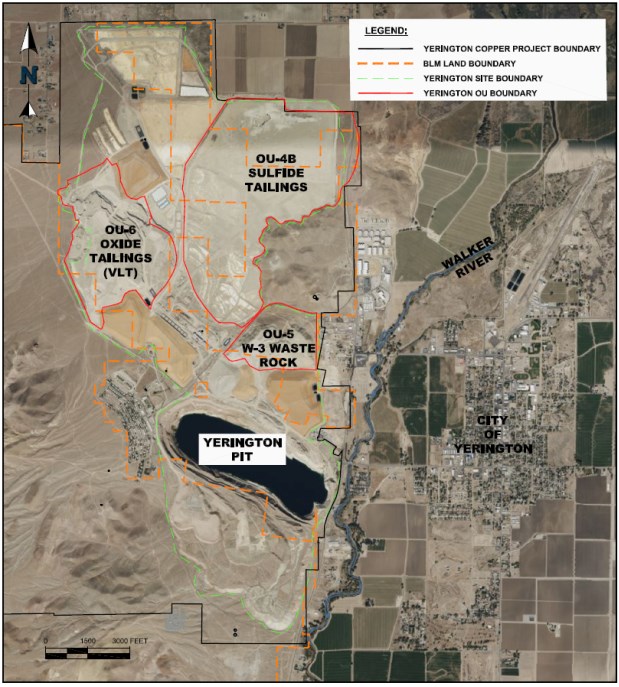
Source: NewFields 2023
|
P a g e | 3-46 |
| 03/21/2025 |
| Yerington Copper Project S-K 1300 Report Yerington, Nevada |
|
Current
Lion CG has secured all necessary permits to proceed with site exploration and design activities. These permits encompass the Exploration Plan of Operations issued by the Bureau of Land Management (BLM) and reclamation and temporary discharge permits issued by the State of Nevada. A comprehensive list of these permits is provided in Table 3-5.
Table 3-5: Existing Project Permits
| Permit Name | Permit Identifier (if applicable) | Issuing Agency |
| Yerington Exploration Reclamation Permit | #0321 | NDEP-BMRR |
| MacArthur Exploration Reclamation Permit | #0294 | NDEP-BMRR |
| MacArthur Exploration Plan of Operations | NVN-085212 | U.S. BLM |
| Yerington Class II Air Quality Operating Permit | AP1629-4669 | NDEP-BAPC |
| MacArthur Class II Air Quality Operating Permit | AP1629-4668 | NDEP-BAPC |
| Yerington Temporary Authorization to Explore | TNEV2024106 | NDEP-BMRR |
| Yerington Stormwater Construction General Permit | CSW-54058 | NDEP-BWPC |
| MacArthur Stormwater Construction General Permit | CSW-54053 | NDEP-BWPC |
The permits required for full mine construction and operation will differ from those listed in Table 3-5, which are intended for site exploration and resource definition. The Project is situated on a combination of private land managed by Lion CG and federal land administered by the BLM. Proposed mining operations for the Project will necessitate permits from both Federal and State of Nevada regulatory agencies, supported by necessary environmental and socio-economic analyses, as well as public involvement. Lion CG has compiled a list of permits and authorizations required for mine development, all of which are standard for mining projects in Nevada.
3.6.3 Compliance with Active Permits
Lion CG must comply with several conditions outlined in the above listed permits and provide reports to issuing agencies. Specific permit conditions, including monitoring and reporting requirements, are outlined in and specific to each permit. All required permits are current as of Report date.
3.6.4 Closure and Reclamation Plans
Existing permits include reclamation (Table 3-5) and surety requirements relevant to exploration site disturbances total $180,435 for Yerington and $460,836 for MacArthur. Lion CG is current with all necessary closure and reclamation sureties for all site permits.
|
P a g e | 3-47 |
| 03/21/2025 |
| Yerington Copper Project S-K 1300 Report Yerington, Nevada |
|
During any future mine permitting process, closure and reclamation plans for mine development would be prepared by Lion CG and approved by the relevant regulatory agencies. Mine permits would mandate the establishment of appropriate closure surety before the commencement of mine construction.
3.6.5 Considerations of Social and Community Impacts
Lion CG recognizes that stakeholder engagement will be required for the successful execution of the Project and initiated these efforts during the exploration phase. The NDEP-BMRR requested consultations with the Yerington Paiute Tribe and the Walker River Paiute Tribe prior to issuing the Yerington Temporary Authorization to Explore permit. Lion CG engaged proactively with representatives from both tribes before the permit issuance to identify and address any potential concerns. No issues were raised by either tribe to Lion CG or NDEP-BMRR regarding the permit before its issuance.
Mine development will necessitate additional stakeholder engagement when the decision to initiate the permitting process is made. Although the entirety of the proposed Project would be situated on either private land owned by Lion CG or public land available for development, early stakeholder engagement will be important. This proactive approach will help facilitate a more efficient permitting process.
3.7 Significant Factors and Risks That May Affect Access, Title, or Work Programs
There are no other significant factors and risks known to AGP or Newfields that may affect access, title, or the right or ability to perform work on the property that are not discussed in this Report.
|
P a g e | 3-48 |
| 03/21/2025 |
| Yerington Copper Project S-K 1300 Report Yerington, Nevada |
 |
4 Accessibility, Climate, Local Resources, Infrastructure, and Physiography
4.1 Accessibility
The Yerington Copper Project is located adjacent to the town of Yerington, Nevada. The town is located about a 1.5-hour drive southeast of Reno (about 70 miles driving distance) via US Interstate I-80 and US-Highway 95 ALT.
Access to the Project from the town of Yerington follows US Highway ALT 95 north about one mile to the Burch Street turnoff, a paved road that leads west into the Property. Access into the mine area is fenced and restricted. Inside the fenced area a series of roads provide access to all of the Project in Township 13 North, Range 25 East. Claims in Township 13 North, Range 24 East are accessed by a number of existing dirt roads leading west from US Highway ALT 95, from one to three miles south of the town of Yerington.
The Yerington Municipal Airport is a mile north of Yerington, in Lyon County, Nevada. Yerington Municipal Airport is a small airport, serving the town and surrounding areas. The airport is situated at the intersection of US 95A and Nevada State Route 208. It provides facilities for private and commercial aircraft operations. The airport offers basic services such as fueling, hangar rentals, and tie-down spaces for aircraft.
The closest railway station to the town was Wabuska, about 12 miles north.
There are several rivers and lakes near Yerington, including the Walker River, Walker Lake, and Topaz Lake. The Walker River originates in the Sierra Nevada and flows north through Mason Valley, past Yerington, and then turns southeast around the Wassuk Range. The river empties into Walker Lake, but irrigation diversions have reduced the amount of water that flows into the lake. The Walker River is not a navigable form of transportation.
4.2 Climate
The climate is temperate and is characterized by cool winters with temperatures between zero- and 50-degrees Fahrenheit and warm to hot summers with temperatures between 50- and 100-degrees Fahrenheit. Average annual precipitation is estimated at three to eight inches per year, with a significant part of this total precipitation falling as snow and increasing with elevation.
Work can be conducted throughout the year with only minor delays during winter months due to heavy snowfall or unsafe travel conditions when roads are particularly muddy. Future mining activity are expected to be conducted year-round.
Elevations on the Project range from approximately 3,700 feet at the bottom of the Yerington pit to 4,600 feet in the Yerington Mine area and approximately 4,600 feet to 5,800 feet in the uplands to the west. The Yerington pit contains approximately 43,000 acre-feet of water, based upon the December 2023 water elevation at 4,251 feet and available post-mining pit topography. The Yerington pit is currently actively fed from the Walker River, the result of a trench cut from the river to the pit during a flood in the late 1990s diverting water into the pit to prevent flooding of the Yerington town site, and from a seep in the west wall of the Yerington pit approximately 100 feet above water level. It is a ground water sink and water levels are shown to be increasing at a decreasing rate, with a 1.3-foot increase measured in 2022 and a projected equilibrium elevation at approximately 4,260 feet, by year 2030. Yerington pit dimensions are approximately 6,200 feet long east southeast to west northwest, 2,500 feet wide, and 800 feet deep.
 |
P a g e | 4-1 |
| 03/21/2025 |
| Yerington Copper Project S-K 1300 Report Yerington, Nevada |
|
There are no active streams or springs on the remainder of the Lion CG property. The terrain is moderately steep and sparsely covered by sagebrush and interspersed low profile desert shrubs. All gulches that traverse the Property are normally dry.
4.3 Local Resources and Infrastructure
The nearest population center is the agricultural community of Yerington, one mile east of the Yerington pit. Formerly an active mining center from 1953 to 1978 and from 1989 to 1997, Yerington now serves as a base for three active exploration groups: Lion CG; Hudbay Minerals Inc. (Mason Project copper-molybdenum property); and Southwest Critical Materials (Pumpkin Hollow Copper Project). Yerington hosts a work force active in, qualified for, and familiar with mining operations within a one-hour drive of the Project area.
Yerington offers most necessities and amenities including police, hospital, groceries, fuel, regional airport, hardware, and other necessary infrastructure. One core drilling contractor is based in Yerington. Drilling supplies and assay laboratories can be found in Reno, a 1.5-hour drive. Reverse circulation drilling contractors are found in Silver Springs, Nevada, 33 miles north, as well as in the Winnemucca and Elko, Nevada areas, within a three- to five-hour drive from the site.
4.3.1 Electrical Power
Power is available at the Yerington Copper Project. NV Energy operates a 226 MW natural gas fueled power plant within ten miles of the Project site. The power infrastructure at the Yerington Property is expected to be readily available for a future mining operation due to the historical mine operations.
4.3.2 Rail Spur
Historical access by train to the site has been removed but a tie-in point is available 3 miles west of Wabuska. This would allow a conceptual 12-mile-long rail spur alignment to be established for the supply of materials for processing and transport of final cathode.
4.3.3 Waste Rock Storage
There are no visible signs of acid rock drainage from legacy waste rock stockpiles at either the Yerington or MacArthur sites. In addition, the pit lake water quality has circum-neutral pH (pH > 7.0) with low concentrations of metals and other contaminants.
The historic waste rock stockpiles at Yerington have been partially characterized as part of ongoing remediation of the site by others. In general, these studies show that oxide waste rock has low potential for generating acid rock drainage. While the sulfide waste rock has more material that is potentially acid generating, it represents a smaller tonnage of overall waste rock in the resource pit shells at both Properties. Although geochemical data are not currently available for MacArthur waste rock, it is estimated to have less potentially acid generating material than Yerington waste rock given greater presence of calcium mineralogy.
|
P a g e | 4-2 |
| 03/21/2025 |
| Yerington Copper Project S-K 1300 Report Yerington, Nevada |
|
Based on these preliminary findings, it is assumed for the purposes of the IA that new waste rock storage facilities at both Yerington and MacArthur would not require liners or covers.
4.3.4 Yerington Pit Lake Dewatering and Water Rights
Before any open pit mining operations, the pit lake (estimated to hold approximately 43,000 acre-feet of water) in the former Yerington pit would need to be fully drained and equipped with dewatering wells.
Potential methods for discharging the pit lake water include direct release into the Walker River, discharge to the Walker River Irrigation District, or utilization of infiltration methods such as Rapid Infiltration Basins.
Water quality assessments over the last 30 years have shown an improvement in the pit lake's water quality. Although the water quality is very close to drinking water quality standards the Project would conservatively assume water treatment would be required to fully remove any constituents of potential concern that may exceed specific discharge standards for the discharge method. Ongoing assessments will be conducted to further evaluate water quality, water rights, and other aspects related to the dewatering process as the study levels advance.
Lion CG owns approximately 6014 acre-feet of primary groundwater rights permitted for mining uses. Of these owned water rights, 3 ,453 acre-feet are the subject of a Forfeiture Notice from the Nevada Division of Water Resources. An additional 1,629 acre-feet are subject to non-renewal of Extensions of Time under the same Forfeiture Notice. Lion CG is appealing the Forfeiture Notice and the judge hearing the appeal has stayed the Forfeiture Notice until after the hearing.
Depending on the outcome of the Hearing regarding the primary ground water rights subject to the Forfeiture Notice (as above), Lion CG has other water rights under option as part of the Bear Land Option Agreements that could be converted to Mining uses.
|
P a g e | 4-3 |
| 03/21/2025 |
| Yerington Copper Project S-K 1300 Report Yerington, Nevada |
|
5 History
5.1 Yerington
Recorded production in the Yerington mining district dates back to 1883 (Moore, 1969) as prospectors were attracted to and investigated colorful oxidized copper staining throughout the Singatse Range. Knopf (1918) reported that oxidized copper cropped out at the historic Nevada-Empire mine located above the south center of the present-day Yerington open pit. Knopf does not show or reference other mines or prospects that are underlain by the Yerington open pit footprint, as gravel and alluvial cover obscure bedrock over an approximate 0.75-mile radius around the Nevada-Empire Mine.
Information is sparse for the period from Knopf's reporting in 1918 until World War II, although it is likely that lessees worked in the Nevada-Empire during spikes in the copper price. Private reports (Hart, 1915 and Sales, 1915) describe ore shipments and planned underground exploration from a northwest striking, southwest dipping structure at the historic Montana-Yerington Mine area located approximately one mile west of the present-day Yerington pit.
During the 1940s, Anaconda outlined deposit in the area of the current Yerington pit. During the early 1950s, the US government, citing the need for domestic copper production, offered "start-up" subsidies to Anaconda to open a copper mine in the Yerington district. Anaconda sank two approximately 400-foot-deep shafts in the present-day Yerington open pit area and drove crosscuts to obtain bulk samples of oxidized rock for metallurgical study. Anaconda began operating the Yerington Mine in 1952 and mined continually through 1979, producing approximately 1.744 billion pounds of copper from 162 million tons averaging 0.54% Cu. Approximately 104 million tons of this total was from oxidized copper mineralization that was "vat leached" with sulfuric acid in 13,000-ton cement vats on a seven-day leach cycle. Sulfide mineralization was concentrated on site in a facility that was dismantled and sold following termination of mining in 1979. The cement copper and sulfide concentrates were shipped to the Anaconda's smelter in Montana.
In 1976, all assets of Anaconda, including the Yerington Mine, were purchased by ARC, which shut down dewatering pumps in the pit and closed the Yerington Mine in 1979 due to low copper prices.
The Yerington Mine site and adjacent Weed Heights mining camp were acquired by CopperTek, a private Yerington company owned by Mr. Don Tibbals, in 1982. In the mid-1980's CopperTek began reprocessing waste rock and VLT on HLPs and an SXEW plant to produce cathode copper. CopperTek was acquired by Arimetco in 1989. In 1989, Arimetco purchased the mine property from CopperTek, commissioned a 50,000-pound-per-day solvent extraction/electrowinning plant, and began heap leaching mineralization that had been stripped from the Yerington pit by Anaconda. Arimetco also processed VLTs (minus 3/8-inch oxidized tailings leached during Anaconda's operation) to some HLPs as well as trucking oxidized mineralization from the MacArthur property, located approximately five miles north of the Yerington Mine site. Arimetco produced some 95 million pounds of copper from 1989 to 1999 before declaring bankruptcy in 1997 due to low copper prices. Arimetco terminated mining operations in 1997 and abandoned the property in early 2000.
In early 2000 the NDEP assumed operation of the site on a care and maintenance basis, primarily to ensure that HLP drain down solutions would continue to be maintained.
|
P a g e | 5-1 |
| 03/21/2025 |
| Yerington Copper Project S-K 1300 Report Yerington, Nevada |
|
Following four years of due-diligence studies and negotiations with State and federal agencies, the property was acquired by Lion CG from the Arimetco bankruptcy court in April 2011, after receiving BFPP letters from the USEPA, NDEP and BLM to protect Lion CG from liability emanating from activities of the former mine owners and operations.
5.2 MacArthur
The MacArthur area has seen limited historic mining activity, and there is no indication of historic, small-scale, artisanal mining activity. The most recent activity occurred between 1995 and 1997, when Arimetco mined a limited tonnage of surface oxide copper for heap leaching at the Yerington mine site. The historic metallurgical test work performed on material from the MacArthur Deposit is dated and focused on leach performance of material typical of what was historically mined from the MacArthur pit. Anaconda, Bateman Engineering (Bateman), and Mountain States R&D International (Mountain States) have all performed various metallurgical test work for the MacArthur Deposit.
5.3 Bear
The Bear Deposit was discovered in 1961 by Anaconda during condemnation drilling in the sulfide tailings disposal area. The drilling program by Anaconda and later by Phelps Dodge identified chalcopyrite mineralization hosted in a porphyry system below 500 to 1,000 feet of alluvium and unmineralized bedrock. The primary copper mineralization of the Bear Deposit, located partially in the northeast corner of the Yerington Deposit is related to micaceous veining rather than A-type quartz veining common in the Yerington Mine porphyry system.
|
P a g e | 5-2 |
| 03/21/2025 |
| Yerington Copper Project S-K 1300 Report Yerington, Nevada |
|
6 Geological Setting, Mineralization, and Deposit
6.1 Regional Geology
The Yerington Deposit is located in western Nevada near the western boundary of the Basin and Range Province, a land mass of internal drainage encompassing most of the state of Nevada. Basin and Range physiography consists of a series of nearly north-trending ranges separated by alluvial-filled, normal fault-bounded basins. The valley infill may range from tens to thousands of feet of alluvium.
In western Nevada, overprinted on the Basin and Range but not altering its physiographic character, is a major right lateral, northwest trending structural zone called the "Walker Lane" approximately 60 miles wide and generally parallel to the Nevada-California border, between Reno to the northwest and Las Vegas to the southeast (Figure 6-1). Major deposits, principally precious metals, occur in the Walker Lane as does the Yerington mining district.
Figure 6-1: Structural Geology Map of Western United States
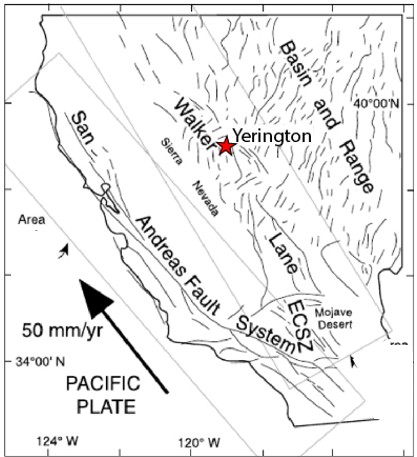
Source: Modified Wesnousky 2005
|
P a g e | 6-1 |
| 03/21/2025 |
| Yerington Copper Project S-K 1300 Report Yerington, Nevada |
|
Within Lyon County in the state of Nevada, the Yerington Copper Project area occupies the alluvial-covered eastern flank and bedrock uplands of the central Singatse Range, a modest sized, north trending mountain range.
Regional geology of the Singatse Range, including the Yerington mining district is displayed in Figure 6-2 (Proffett and Dilles, 1984) from which the following text has been adapted.
The oldest rocks of the Singatse Range are an approximate 4,000-foot section of Late Triassic, intermediate and felsic metavolcanics, and sedimentary rocks forming the McConnell Canyon Formation, associated with volcanic arc development along the North American Continent during the Mesozoic Period.
This sequence is disconformably overlain by a series of Upper Triassic carbonates, meta-sediments, and volcaniclastics that are, in turn, overlain by Upper Triassic limestone, siltstone, and tuffs, and by argillite thought to span the Triassic-Jurassic boundary. Jurassic limestone is succeeded by gypsum and sandstone, and by andesitic volcanics that may signal the beginning pulse of middle Jurassic plutonism.
Middle Jurassic plutonism, possibly related to the igneous activity that formed the Sierra Nevada Mountains to the west, resulted in emplacement of two batholiths comprising the Singatse Range, including the Yerington Batholith extending across 40 miles from the Wassuk Range on the east to the Pine Nut Range on the west. East-west striking structural zones mark the contacts between igneous rock and older, outlying Mesozoic basement at the north and south ends of the Singatse Range; the structures can be projected through the adjoining basins.
The Yerington Batholith comprises three intrusive phases emplaced between 169 Ma to 168 Ma (Figure 6-2, Proffett and Dilles, 1984): an early granodiorite pluton; a second phase of medium-grained quartz monzonite, creating a finer-grained ''border phase quartz monzonite" where in contact with granodiorite; and, finally, a medium-grained porphyritic quartz monzonite emplaced as a stock with cupolas developed over its top. Porphyry dike swarms sourced from the youngest phase, the porphyritic quartz monzonite, cut the cupolas. Copper mineralization formed contemporaneously with the dike swarms. Andesite and rhyolite dikes represent the final phase of Mesozoic igneous activity.
Mesozoic rocks were deeply eroded and then covered by Mid-Tertiary tuffs and lesser sedimentary rocks. The entire package was subsequently faulted along north-trending, downward and east dipping faults that resulted in extension and major westerly tilting.
The stratigraphic column for the Yerington District (Proffett and Dilles, 1984) is shown in Table 6-1.
|
P a g e | 6-2 |
| 03/21/2025 |
| Yerington Copper Project S-K 1300 Report Yerington, Nevada |
|
Figure 6-2: Regional Geology Map with Cross-Section Intersecting Yerington Mine
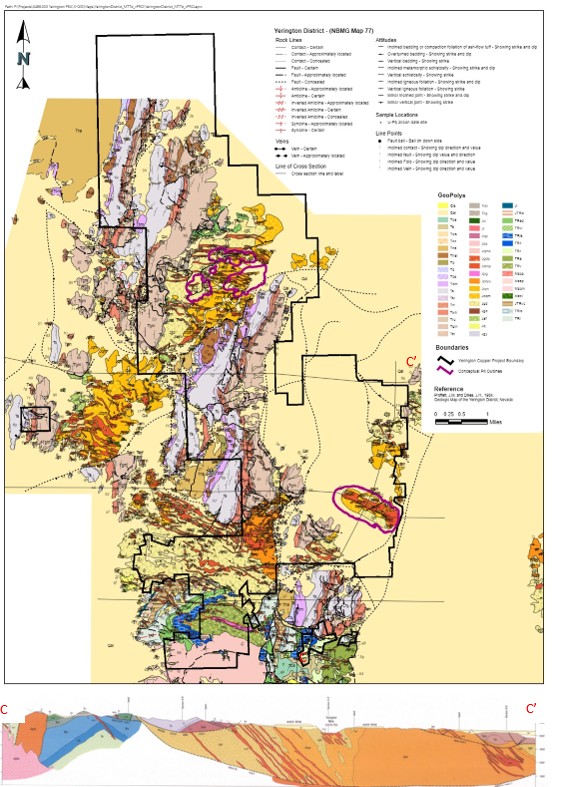
Source: Modified Profett and Dilles 1984
|
P a g e | 6-3 |
| 03/21/2025 |
| Yerington Copper Project S-K 1300 Report Yerington, Nevada |
|
Table 6-1: Yerington District Geology Stratigraphic Column
| Era | Period | Rock Type |
| Cenozoic | Quaternary | Qal, Qls |
| UNCONFORMITY | ||
| Tba | ||
| LOCAL UNCONFORMITY | ||
| Ta, Tws, Twt | ||
| UNCONFORMITY | ||
| Tha, Thai | ||
| Tb | ||
| Td | ||
| Tbs | ||
| Tbm | ||
| Ts | ||
| Tsl | ||
| Trt | ||
| Twh | ||
| Tru | ||
| Tgm | ||
| MINOR UNCONFORMITY | ||
| Tei | ||
| Teb | ||
| Tcg | ||
| MAJOR UNCONFORMITY | ||
| Mesozoic | Cretaceous? | Ja |
| Jr | ||
| Jurassic | Jqp | |
| Jsa | ||
| Jqms | ||
| Jgdp | ||
| Jqmp | ||
| Jpg | ||
| Jpqm | ||
| Jqm, Jbqm | ||
| Jgd | ||
| Jgb | ||
| Jaf | ||
| Jq | ||
| Jgy | ||
| Jl | ||
| JTRcl | ||
| JTRvc | ||
| Triassic | TRlb | |
| TRl | ||
| TRad | ||
| TRvl | ||
| TRla | ||
| TRll | ||
| DISCONFORMITY | ||
| TRr, TRv | ||
| TRa, TRv | ||
| ? | ||
| Mzqp | ||
| Mzap | ||
| Mzqm | ||
| Mzdi |
Source: Modified Proffett and Dilles, 1984
|
P a g e | 6-4 |
| 03/21/2025 |
| Yerington Copper Project S-K 1300 Report Yerington, Nevada |
|
6.2 Local Geology
The Yerington Copper Project includes the Yerington Copper Deposit, MacArthur Copper Deposit and a portion of the Bear Deposit which represent three of four known porphyry copper deposits in the Yerington district. Like the Mason copper-molybdenum deposit located 2.5 miles to the west, the deposits are hosted in Middle Jurassic intrusive rocks of the Yerington Batholith.
Copper mineralization occurs in all three phases of the Yerington Batholith. Intrusive phases, from oldest to youngest, are known as the McLeod Hill Quartz Monzodiorite (field name granodiorite), the Bear Quartz Monzonite, and the Luhr Hill Granite, the source of quartz monzonitic (i.e. granite) porphyry dikes related to copper mineralization.
Following uplift and erosion, a thick Tertiary volcanic section was deposited, circa 18-17 Ma. This entire rock package was then extended along northerly striking, down-to-the-east normal faults that flatten at depth, creating an estimated 2.5 miles of west to east dilation-displacement (Proffett and Dilles, 1984). The extension rotated the section such that the near vertically emplaced batholiths were tilted 60° to 90° westerly. Pre-tilt, flat-lying Tertiary volcanics now crop out as steeply west dipping units in the Singatse Range west of the Yerington Deposit. The easterly extension thus created a present-day surface such that a plan map view represents a cross-section of the geology.
6.3 Property Geology
6.3.1 Yerington
Current knowledge of Yerington Deposit geology benefits from detailed geologic mapping by Anaconda geologists on various pit benches during mining operations from the 1950s to the 1970s. Lion CG gained access to this data through membership in the Anaconda Collection - American Heritage Center housed on the campus of the University of Wyoming, Laramie, Wyoming. Further, of the approximately 700 exploration core holes drilled by Anaconda to define the Yerington Deposit, one-half splits of approximately 20 percent of the core were stored in a recoverable manner on the mine site. Lion CG moved the core to a dry location for relogging and reassay to understand the geology as it relates to copper mineralization.
The three intrusive phases of the middle Jurassic Yerington Batholith, exposed in the Yerington pit, have been intruded by at least six porphyry dikes originating from the youngest batholithic phase, the Luhr Hill Granite, also referred to as the Porphyritic Quartz Monzonite (PQM). Anaconda geologists identified petrographically similar porphyry dikes by number, e.g. QMP1, QMP1.5, QMP2, QMP2.5, QMP2.7, QMP3, with the lowest numbers representing the earliest and strongest copper mineralized dike activity. Younger Jurassic rhyolite and andesite dikes followed. Cross-cutting relationships in pit walls allowed Anaconda geologists to determine age relationships of the dikes. A determination in core is more difficult. The oldest dikes are the best mineralized, especially QMP1 which averaged 0.80% to 2.0% TCu (J. Proffett, 2010, personal communication).
6.3.2 MacArthur
The MacArthur Deposit is hosted by two Middle Jurassic batholiths, granodiorite (McLeod Hill Quartz Monzodiorite) intruded by quartz monzonite (Bear Quartz Monzonite) both of which are intruded by Middle Jurassic porphyry hornblende and porphyry biotite (hornblende) dikes. The north dipping porphyry dike swarms follow penetrative west-northwest and east-west structural fabrics. Differing from Yerington and Bear Deposits, the porphyry dikes at MacArthur are less mineralized. Narrow (<10 feet) fine grained andesite and rhyolite dikes, post porphyry diking and mineralization, also occur with variable structural orientations.
|
P a g e | 6-5 |
| 03/21/2025 |
| Yerington Copper Project S-K 1300 Report Yerington, Nevada |
|
6.3.3 Bear Deposit
The Bear Deposit has a similar regional geologic setting to other Jurassic-aged porphyry-style copper deposits in the Yerington district.
Copper mineralization of the Bear Deposit occurs in all three phases of the Yerington Batholith. Intrusive phases, from oldest to youngest, are known as the McLeod Hill Quartz Monzodiorite , the Bear Quartz Monzonite, and the Luhr Hill Granite, the source of quartz monzonitic (i.e. granite) porphyry dikes. The Bear Quartz Monzonite and quartz monzonite porphyry dikes are the main copper mineralizing bodies. Core orientation measurements indicate these dikes strike northwesterly and dip 40-50° northerly. Smaller rhyolite and andesite dikes, which post-date mineralization, are also present with no preferred orientation
The intrusive phases lie beneath a portion of the overlying Tertiary volcanic section. The volcanic section is overlain by up to 800 feet of valley fill sediments.
Like the other deposits in the Yerington District, the Bear Deposit experienced the extensional normal faulting. The deposit has been extended in an east to southeast direction by a low angle normal fault (Bear Fault) and subsequently down dropped by high angle range front normal faults. Most of the deposit remains to the west in the footwall of the Bear fault while the remainder of the deposit lies to the east in the hanging wall of the Bear fault.
6.4 Property Alteration
Alteration types recognized in drill core of the deposits are common to those found in many mineralized porphyry copper systems. Mid-Tertiary downward and eastward extensional faulting exposes a porphyry copper deposit in cross section lying on its side with its top toward the west. This alteration sequence is most evident at the Yerington pit. Limonite brownish sericite alteration (the pre-tilt upper, original pyrite-rich phyllic shell) is exposed at the west end of the pit. Potassically altered secondary biotite and magnetite dominant alteration in the center of the pit grades easterly into off-white sodic-rich rock (sodic-calcic alteration), the pre-tilt base near the eastern pit boundary. A thin slice of unaltered Tertiary volcanics underlying the alluvial gravels is exposed in pit benches at the west end of the pit.
6.4.1 Propylitic
Propylitic alteration is common throughout all the deposits and in all rock types. This alteration type occurs as chlorite replacing hornblende, and especially epidotization as veining, coatings, and/or flooding on the granodiorite. Calcite veining is present but not commonly observed in core or drill cuttings. Feldspars are commonly unaltered. Propylitic alteration frequently overprints or occurs with the alteration types described in the following sub-sections. Pyrite and magnetite are common accessory minerals.
|
P a g e | 6-6 |
| 03/21/2025 |
| Yerington Copper Project S-K 1300 Report Yerington, Nevada |
|
6.4.2 Quartz-Sericite-Pyrite (QSP)
Phyllic alteration is most frequently characterized by tan to light green sericite partially or completely replacing hornblende and/or biotite sites. When phyllic alteration becomes more intense, plagioclase and/or K-feldspar sites are also replaced by sericite. The altered mafics and feldspars are accompanied by a significant addition of pyrite, locally up to 10%. However, these minerals do not replace mafic or felsic sites. Sericitic altered zones are often quite siliceous; however, it is unclear if this is due to quartz addition or just the destruction of other primary minerals.
Phyllic alteration is most pervasive and intense in the west-central to west portion of the Yerington pit. Phyllic alteration at the Bear Deposit and MacArthur Deposit occurs in discrete bands and swaths. The alteration type does not show preference with rock type and has been described in the granodiorite, quartz monzonite, and the porphyries.
6.4.3 Potassic Alteration
Potassic alteration occurs as shreddy, fine-grained biotite replacing hornblende along with secondary disseminated magnetite. To a lesser extent, there is potassium feldspar replacing plagioclase within the rock as well as in vein halos. Potassic alteration occurs in the central part of the Yerington pit and the Bear Deposit coinciding with the most intense and extensive quartz veining, and highest-grade copper mineralization.
Potassic alteration is best observed in oldest (highest grade) porphyry dikes as well as the granodiorite and quartz monzonite hosts.
6.4.4 Sodic-Calcic Alteration
Pervasive sodic-calcic alteration, described by Anaconda geologists as sodic flooding, occurs at the east end (pre-tilt base) of the Yerington pit, creating off-white, hard altered rock. This type of alteration most frequently occurs as albite replacing K-feldspar and as chlorite, epidote, or actinolite replacing hornblende and/or biotite. In the most intense zones of sodic alteration, the mafics are completely destroyed.
This alteration is most prevalent in the eastern Yerington pit and the eastern portion of the MacArthur Deposit.
6.4.5 Silicification
Silicification occurs as a wholesale replacement of the rock, occurring in an irregular nature.
6.4.6 Calc-Silicate Alteration
Calc-silicate alteration has only been identified in the Bear Deposit, most commonly occurring at the quartz monzonite-granodiorite contact. This alteration is characterized by strong flooding of chlorite, actinolite, epidote, and occasionally magnetite. Some of the strongest copper grades are associated with this alteration, with grades greater than 1% Cu.
6.4.7 Supergene Alteration
Supergene, or secondary enriched copper minerals, made only a minor contribution to Yerington Mine production due to insufficient pyrite available for oxidation and creation of sulfuric acid. Chalcocite, the primary result of secondary enrichment, occurs randomly toward the west end (pre-tilt top) of the Yerington pit. At the Gallagher area and north of the MacArthur pit, supergene alteration has formed leached capping which is underlain by chalcocite mineralization. No supergene alteration has been identified on the Bear deposit. Lion CG's drill holes collared on the west-northwest side of the pit intersected narrow, isolated chalcocite mineralization typically 0.1x% Cu over 10 to 20 feet thickness. The transition from oxide (green and / or black) copper to primary sulfide copper mineralization is sharp and consistently chalcocite-absent throughout the pit excepting the west pit area.
|
P a g e | 6-7 |
| 03/21/2025 |
| Yerington Copper Project S-K 1300 Report Yerington, Nevada |
|
6.5 Mineralization
6.5.1 Yerington Copper Deposit
The general geometry of copper mineralization below the Yerington pit is an elongate body extending 6,600 feet along a strike of S62ºE. The modeled mineralization has an average width of 2,000 feet and has been defined by drilling to an average depth of 400-500 feet below the pit bottom at the 3,500-foot elevation.
The copper mineralization and alteration throughout the Yerington district and at the Yerington deposit are unusual for porphyry copper camps in that the mineralization is "stripey," occurring in WNW striking bands or stripes between materials of lesser grade. Clearly, much of this geometry is influenced by the strong, district-wide WNW structural grain observed in fault, fracture and, especially, porphyry dike orientations. Porphyry dikes are associated with all copper occurrences in the district. Altered, mineralized bands range in width from tens of feet to 200-foot-wide mineralized porphyry dikes mined in the Yerington pit by Anaconda.
Greenish, greenish blue chrysocolla (CuSiO3.2H20) was the dominant copper oxide mineral, occurring as fracture coatings and fillings, easily amenable to an acid leach solution. Historic Anaconda drill logs note lesser neotocite, aka black copper wad (Cu, Fe, Mn), SiO2 and rare tenorite (CuO) and cuprite (Cu2O). Oxide copper also occurs in iron oxide/limonite fracture coatings and selvages.
Chalcopyrite (CuFeS2) was the dominant copper sulfide mineral occurring with minor bornite (Cu5FeS4) primarily hosted in A-type quartz veins in the older porphyry dikes and in quartz monzonite and granodiorite, as well as disseminated between veins in host rock at lesser grade. The unmined mineralized material below the current pit bottom consists primarily of chalcopyrite.
Surfaces were interpreted for alluvium (code 20), oxide (code 30) mineralization and sulfide (code 40) mineralization from the drill logs and soluble copper assays. Figure 6-3 compares the surfaces with the coding from drill holes and the block model.
|
P a g e | 6-8 |
| 03/21/2025 |
| Yerington Copper Project S-K 1300 Report Yerington, Nevada |
|
Figure 6-3: Yerington Geology Section 2451250 E (Looking North)
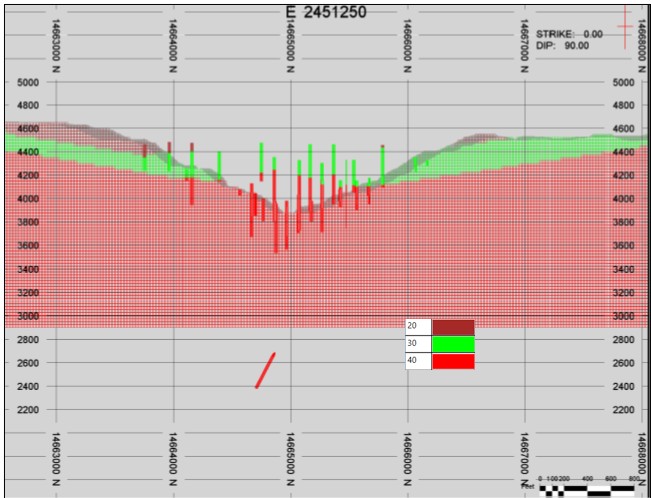
Source: AGP 2023
Note: Brown=Alluvium (20), Green=Oxide (30), Red=Sulfide (40)
6.5.2 MacArthur Copper Deposit
The MacArthur Deposit is a large copper mineralized system containing near-surface acid soluble copper and the potential for a significant primary sulfide resource that remains underexplored (IMC, 2022). The deposit is hosted by Middle Jurassic granodiorite and quartz monzonite intruded by west-northwesterly-trending, moderate to steeply north-dipping quartz porphyry dike swarms.
The MacArthur Deposit consists of a 50 to 150-ft thick, tabular zone of secondary copper (oxides and/or chalcocite) covering an area of approximately two square miles (Figure 6-4). This mineralized zone has yet to be fully delineated. Limited drilling has also intersected underlying primary copper mineralization open to the north, but only partially tested to the west and east.
|
P a g e | 6-9 |
| 03/21/2025 |
| Yerington Copper Project S-K 1300 Report Yerington, Nevada |
|
Figure 6-4: MacArthur Property Geology East-West Cross Section
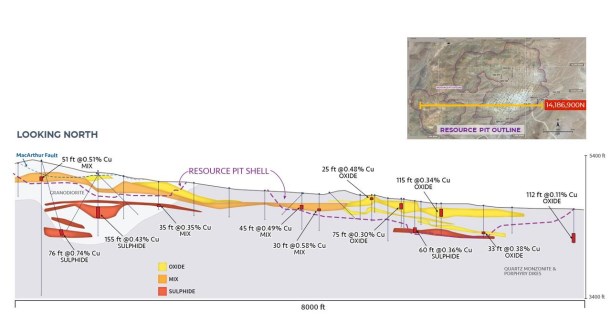
Source: IMC 2022
Oxide copper mineralization is most abundant and particularly well exposed in the walls of the legacy MacArthur pit. The most common copper mineral is chrysocolla; also present is black copper wad (neotocite) and trace cuprite and tenorite. The flat-lying zones of oxide copper mirror topography, exhibit strong fracture control and range in thickness from 50 to 100 feet. Secondary chalcocite mineralization forms a blanket up to 50 feet or more in thickness that is mixed with and underlies the oxide copper. Primary chalcopyrite mineralization has been intersected in several locations mixed with and below the chalcocite. The extent of the primary copper is unknown as many of the holes bottomed at 400 feet or less.
The MacArthur Deposit is part of a large, partially defined porphyry copper system that has experienced complex faulting and post-mineral tilting. Events leading to the current geometry and distribution of known mineralization include: 1) Middle Jurassic emplacement of primary porphyry copper mineralization by quartz monzonite dikes intruding the Yerington batholith; 2) Late Tertiary westward tilting of the porphyry deposit from 60° to 90° through Basin and Range extensional faulting; 3) secondary (supergene) enrichment resulting in the formation of a widespread, tabular zone of secondary chalcocite mineralization below outcrops of oxidized rocks called leached cap; 4) oxidation of outcropping and near-surface parts of this chalcocite blanket, as well as oxidation of the primary porphyry sulfide system.
6.5.3 Bear Deposit
The mineralized footprint of the Bear Deposit covers 4.25 square miles, remaining open in all directions and at depth.
|
P a g e | 6-10 |
| 03/21/2025 |
| Yerington Copper Project S-K 1300 Report Yerington, Nevada |
|
The mineralization of the Bear Deposit occurs in three distinct ways:
1. In Early Dark Micaceous (EDM) veinlets, where finely disseminated chalcopyrite and/or bornite occur with fine-grained biotite and quartz in wispy discontinuous veinlets.
2. Distinct sulfide (most commonly chalcopyrite) veinlets as well as quartz-chalcopyrite-(bornite) veinlets. Within the quartz-chalcopyrite-(bornite) veined zones, potassic alteration is generally the strongest with secondary biotite and lesser potassium feldspar flooding. Based upon oriented core measurements, the quartz-chalcopyrite veinlets generally dip 40-50° northerly, which correlates well to the same orientation of the quartz monzonite porphyry dikes.
3. The final form of mineralization occurs as zones (most frequently at the quartz monzonite-granodiorite contact) that are strongly calc-silicate altered with massive clots and gobs of chalcopyrite and magnetite.
6.6 Deposit Types
Porphyry Cu systems host some of the most widely distributed mineralization types at convergent plate boundaries, including porphyry deposits centered on intrusions; skarn, carbonate-replacement, and sediment-hosted Au deposits in increasingly peripheral locations; and adjacent to high- and intermediate-sulfidation epithermal deposits. The systems commonly define linear belts, some many hundreds of kilometers long. The systems are closely related to underlying composite plutons, at paleodepths of 5 to 15 km, which represent the supply chambers for the magmas and fluids that formed the vertically elongate (>3 km) stocks or dike swarms and associated mineralization (Sillitoe, 2010).
The alteration and mineralization in porphyry Cu systems are zoned outward from the stocks or dike swarms, which typically comprise several generations of intermediate to felsic porphyry intrusions. At the regional and district scales, the occurrence of many deposits in belts within which clusters and alignments are prominent. At the deposit scale, particularly in the porphyry copper environment, early formed features commonly, but by no means always, give rise to higher grade deposits. Late-stage alteration overprints may cause partial depletion or complete removal of copper and gold, but metal concentration may also result.
The Yerington Deposit represents a porphyry copper deposit hosted in porphyry dikes that formed in stocks of the upper Yerington Batholith. The Yerington porphyry system has been tilted westerly so that the plan view of the deposit is a cross-sectional exposure.
Mining at the Yerington Deposit has revealed an alteration geometry displaying the original pyrite-rich cap (present-day leached sericite-limonite on the west end of the Yerington pit) grading downward easterly to quartz-sericite-pyrite alteration and to potassic alteration in the central portion of the pit and then continuing to a soda-flooded root zone at the eastern end.
The MacArthur Deposit is a supergene enriched, oxidized porphyry copper system. Within the MacArthur Deposit, phyllic alteration from the upper portion of the porphyry system dominates to the west. The alteration grades to potassic in the central MacArthur pit area and pervasive sodic-calcic alteration dominates in the eastern portions of the MacArthur pit and in the far northeastern portion of the deposit.
The Bear Deposit represents a porphyry copper deposit hosted in porphyry dikes that formed in the stocks of the Yerington Batholith. The system has been tilted westerly through a series of normal faults.
|
P a g e | 6-11 |
| 03/21/2025 |
| Yerington Copper Project S-K 1300 Report Yerington, Nevada |
|
7 Exploration
7.1 Geophysics
7.1.1 Historical
During the 1952 to 1979 period of mine operation at the Yerington Mine, Anaconda completed a number of geophysical surveys, including an aeromagnetic survey, a ground magnetic survey, and an IP survey. Published gravity data were examined to estimate alluvial thicknesses in Mason Valley east of the Yerington Property. These surveys covered much more additional ground than current Project area.
7.1.2 Helicopter Magnetometer Survey
2007 Survey
In late 2007 and early 2008, Quaterra contracted a helicopter magnetometer survey to be conducted over the Yerington district, including the Yerington Property (EDCON-PRJ, 2008). The survey was flown with a line spacing of 100 m separation with some areas in-filled to 50 m separation. In addition, two helicopter surveys flown under contract to Anaconda were also digitized from contour maps and then merged with the larger district-wide survey. The objective of the survey was to create a magnetic data set for the entire Yerington Mining District with significantly greater resolution than previous work by Anaconda. The survey began and was completed in December 2007 and the data was delivered in the first quarter of 2008. A total of 2,685-line miles of new aeromagnetic data were acquired, and 4,732-line miles of older data were digitized. This improved data set has been used extensively by Lion CG throughout the district to identify new targets as well as refine targets previously identified by Anaconda.
2012 Survey
A more detailed helicopter magnetic survey was flown by Geosolutions Party Ltd., in April of 2012, north and northwest of the MacArthur pit area. By design this system had a broader frequency bandwidth then previous systems and was ideal for modeling purposes. The line spacing was 50 m and a terrain clearance of approximately 30 m was flown. The near surface volcanic response is mapped and a weak, possible alteration low, was identified from the processed data. Subsequently this low was interpreted as a deep intrusive (Weis, 2012).
|
P a g e | 7-1 |
| 03/21/2025 |
| Yerington Copper Project S-K 1300 Report Yerington, Nevada |
|
Interpretation
Modeling by Thomas Weis and Associates Inc. (Weis, 2012) of the detailed helicopter magnetic data set (2012, Geosolutions) merged with the 2007 EDCON survey identified two 'interpreted' intrusive centers at depth beneath post mineral volcanic cover. Each has a central magnetic low response with a magnetic high response occurring in a circular ring around the low. The relative low is interpreted to be a potential intrusive. The surrounding high is interpreted to be either a potential outer zonation of the intrusive system or skarn mineralization at the edge of the intrusive. Interpreted depth to the top of these intrusive systems is in excess of 500 m. The probable range, depending on topography, is 500 to 1000 m. Individual depths should be evaluated for drill targeting.
IP/resistivity surveys run by Kennecott in the 1960’s and Zonge in 2009 and 2011 show an IP high, interpreted to be a potential mineralized sulfide system running under volcanic cover to the northwest of the MacArthur Pit mineralization. This would extend the sulfide system into the area of the NW-Target covered by the 2012 helicopter magnetic survey (Figure 7‑1). A SE-Target has also been identified from the 2007 magnetic data.
Follow up work by Weis in 2013 identified an additional three magnetic targets at depth beneath magnetic volcanic cover in the MacArthur area. The anomalies have a different strike than the overlying volcanic cover and are interpreted to be potential skarn targets in the Triassic sediments or high-grade primary mineralization associated with quartz monzonite porphyry intrusive dike systems (Figure 7-2).
|
P a g e | 7-2 |
| 03/21/2025 |
| Yerington Copper Project S-K 1300 Report Yerington, Nevada |
|
Figure 7-1: MacArthur 3-D Fastmag Model Target Map
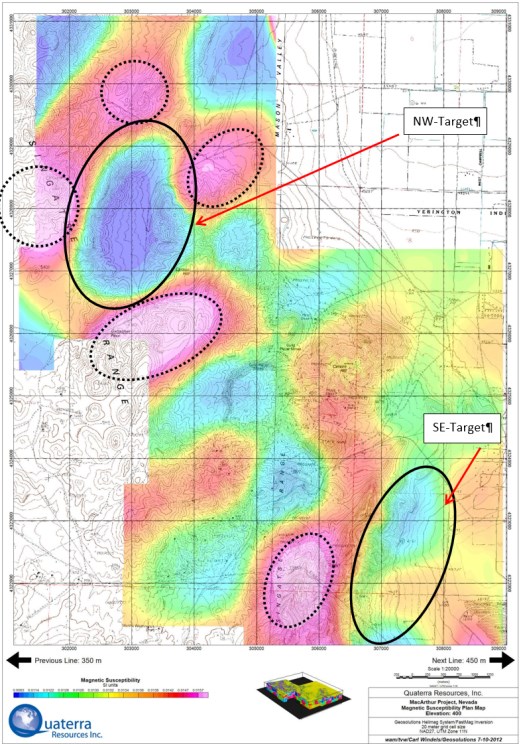
Source: Weis 2012
Notes: Solid ellipses=Intrusives; Dashed ellipses=Skarn bodies
|
P a g e | 7-3 |
| 03/21/2025 |
| Yerington Copper Project S-K 1300 Report Yerington, Nevada |
|
Figure 7-2: Calculated Total Horizontal Gradient (THG) of the Susceptibility Model
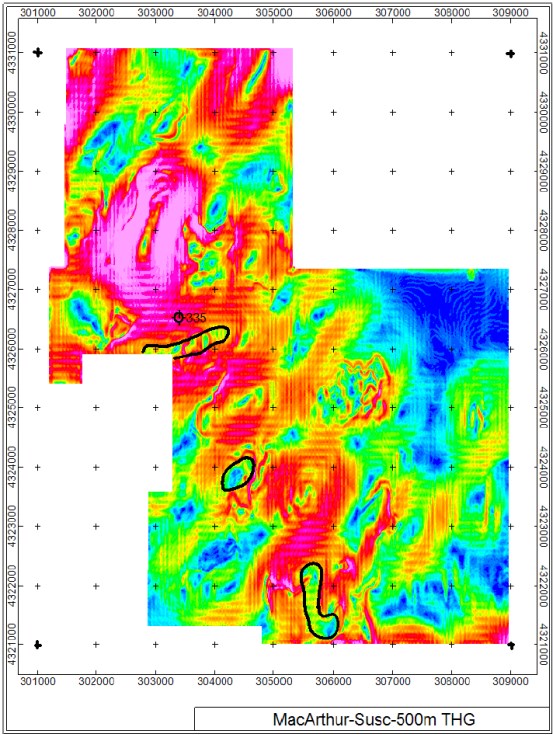
Source: Weis 2013
Note: Targets outlined by solid black lines.
|
P a g e | 7-4 |
| 03/21/2025 |
| Yerington Copper Project S-K 1300 Report Yerington, Nevada |
|
7.1.3 Ground Geophysical Surveys
2009 Surveys
Zonge Geosciences Inc. performed Induced Polarization (IP) and Resistivity and Ground Magnetic surveys for Lion CG on the MacArthur Project, located in Lyon County, Nevada (Figure 7-3). The IP/Resistivity survey was conducted in 2009 from October to December. The Ground Magnetic survey was conducted during the period of 4-7 November 2009 (Zonge, 2009b).
Dipole-dipole IP/Resistivity data were acquired on three lines using a dipole length of 200 m and 300 m. Pole-dipole IP/Resistivity data were acquired on four lines using a dipole length of 150 m and 200 m. Line locations were established by Quaterra Alaska and Zonge personnel using handheld Garmin GPS receivers with real time differential corrections provided by Wide Area Augmentation System (WAAS).
Measured IP/Resistivity data were presented as color pseudosections of 3-point decoupled phase and apparent resistivity plotted with the results of the two-dimensional inversions at a scale of 1:20,000. IP and resistivity inversion results and data are shown in separate plots. The surveys identified multiple targets for future exploration.
|
P a g e | 7-5 |
| 03/21/2025 |
| Yerington Copper Project S-K 1300 Report Yerington, Nevada |
|
Figure 7-3: 2009 IP/Resistivity Survey Lines
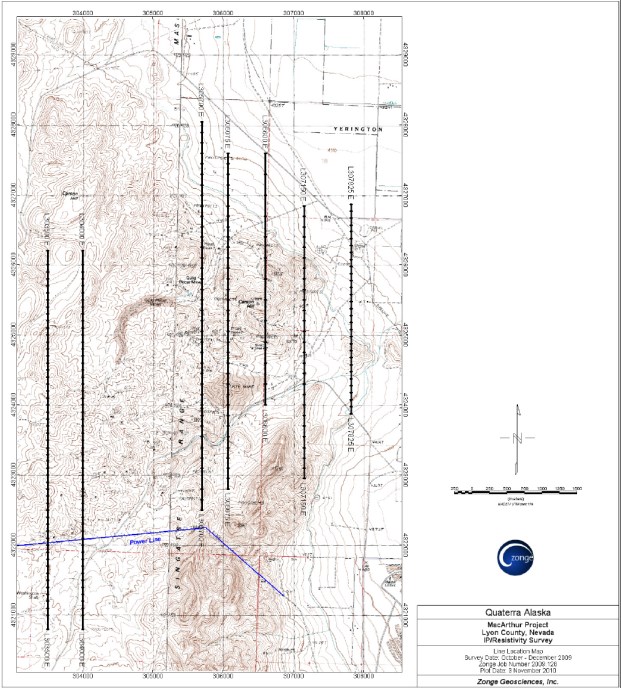
Source: Zonge 2009b
|
P a g e | 7-6 |
| 03/21/2025 |
| Yerington Copper Project S-K 1300 Report Yerington, Nevada |
|
2011 Survey
Zonge International Inc. conducted a pole-dipole Complex Resistivity IP (CRIP) investigation for Lion CG on the MacArthur property during the period from 05 February through 07 March 2011 (Figure 7-4). Pole-Dipole CRIP data were acquired on 7 lines for a total coverage of 37.0 line-km and 210 collected stations (Zonge, 2011).
Pole-dipole CRIP measurements acquired for each line were presented in colored pseudosections of apparent resistivity, raw phase response data, and 3-Pt decoupled phase response with posted values. The pole-dipole IP and resistivity cross-sections provided were 2-D smooth-model inversion results.
The surveys identified multiple targets for future exploration. A moderate intensity IP source (25 - 50 milliradian) is identified on the three northwestern Lines (5300, 4900 and 4300) near stations 24000-25800. On the Southern Lines (5300 extension to the South, 4500, 5600 and 6350), the 2-D smooth model inversions show uniform IP values as low as 2-10 milliradian. On Line 7500 (N-E line) the IP source shifts beneath station 24700-25300, with the 2-D smooth-model suggesting a narrower, deeper and less intense IP response (25-35 milliradian) than the lines to the northwest.
|
P a g e | 7-7 |
| 03/21/2025 |
| Yerington Copper Project S-K 1300 Report Yerington, Nevada |
|
Figure 7-4: 2011 IP/Resistivity Survey Lines
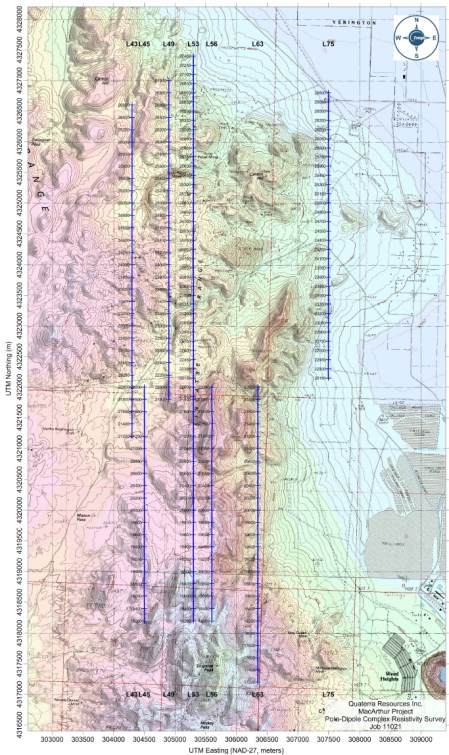
Source: Zonge 2011
|
P a g e | 7-8 |
| 03/21/2025 |
| Yerington Copper Project S-K 1300 Report Yerington, Nevada |
|
2015 Survey
In December 2015, one northeast trending survey line of Dipole-Dipole Induced Polarization - Resistivity (IPR) was completed by Zonge International Inc. (Zonge) at 500-meter spacing (Figure 7-5). The survey extended from the Yerington pit, over McLeod Hill and into the agricultural fields in the northeastern part of the Bear Deposit. Unfortunately, the southern half of the line was compromised by an underground direct current gas line affecting data south of McLeod Hill. The IPR line was largely inconclusive due to the underground gas line.
Figure 7-5: Survey Area in 2015 Survey
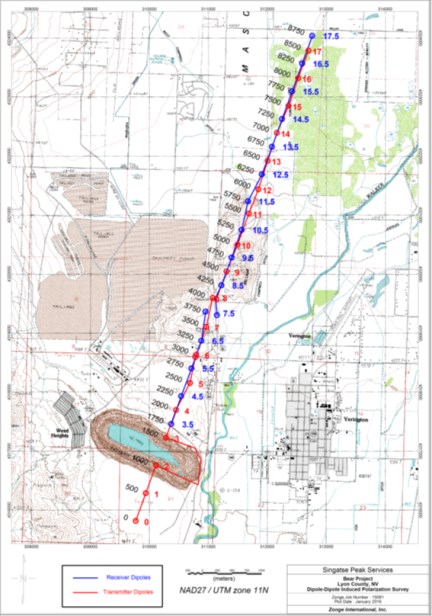
Source: Zonge International 2015
|
P a g e | 7-9 |
| 03/21/2025 |
| Yerington Copper Project S-K 1300 Report Yerington, Nevada |
|
2016/2017 Survey
An induced polarization-resistivity survey was contracted by Lion CG during November 2016, and February 2017 (Zonge International, 2017). Data were acquired along eight lines using Dipole-Dipole and Pole-dipole arrays.
One line crossed over the Yerington pit. The line was surveyed using the dipole-dipole method with a dipole length of 300 m with readings taken from N=1 to 16, which senses response to an approximate depth of 900 m below surface. Because this line crossed the existing pit including pit lake it was necessary to place some receiver and transmitter stations on the pit bottom beneath the pit lake. The total length of the line was 5.4 km of which approximately 600 m was in the pit itself.
Data quality was good and four anomalous IP zones were detected. Figure 7-6 contains the IP response from 2D inversion of the observed data (lower panel). The location of the section and the IP line are shown in the upper panel (single red line) on the district geology map. One zone occurs south of the pit, coincident with an anomalous zone defined by past Anaconda surveys. This zone is referred to as the Native Copper zone. The zone extends over 500 m along the line with an intrinsic IP response of 25 milliradians which is equivalent to approximately 1-2 % by volume of metallic sulfides. The depth to the top of the zone is estimated at 400 m below surface.
A strong IP anomaly was detected directly below the Yerington pit and is 500 m wide along the line. The anomaly has an intrinsic value exceeding 40 milliradians which is equivalent to 3-5% by volume metallic sulfides.
Two additional anomalies were detected north of the pit, one within the mine waste dumps and one in the area known as Groundhog Hills. The anomaly in the waste dumps is shallow and weak, on the order of 20-25 milliradians. The anomaly in the Groundhog Hills area is somewhat stronger, being 25-30 milliradians in magnitude. The top of this zone is at a depth of 200 m below ground-surface.
Figure 7-6: IP Response from 2D Inversion (Section 309980 E)
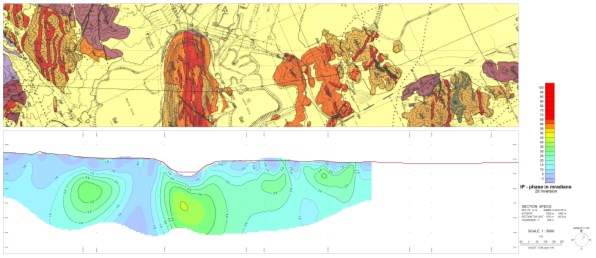
Source: Zonge International 2017
|
P a g e | 7-10 |
| 03/21/2025 |
| Yerington Copper Project S-K 1300 Report Yerington, Nevada |
|
2023 Survey
In November 2023, two north-south IP and Resistivity surveys were undertaken Zonge International Inc. (2023) for Lion CG on the western part of the Bear deposit to assist in determining future exploration drill holes (Figure 7-7).
IP/Resistivity measurements were acquired on two lines for a total survey length of 9.9 line-km. Data were acquired in the dipole-dipole configuration with 300m a-spacings such that all receivers were active for each transmitting dipole. Data were acquired at 0.125Hz using a 100% duty-cycle transmitted waveform. Survey control was established by Zonge using Garmin 64s Series handheld GPS units.
The western line (referred to as 308200E line) showed a broad weak anomaly with a 20 milliradian response at depth. No drill holes were recommended or performed based on this part of the survey. However, the eastern line (referred to as 309625E) showed a stronger anomaly, greater than 50 milliradian. This anomaly was tested with a drill hole in 2024 (B-055); however, the drill results did not support that this anomaly was well mineralized.
|
P a g e | 7-11 |
| 03/21/2025 |
| Yerington Copper Project S-K 1300 Report Yerington, Nevada |
|
Figure 7-7: Bear Deposit IP/Resistivity Survey
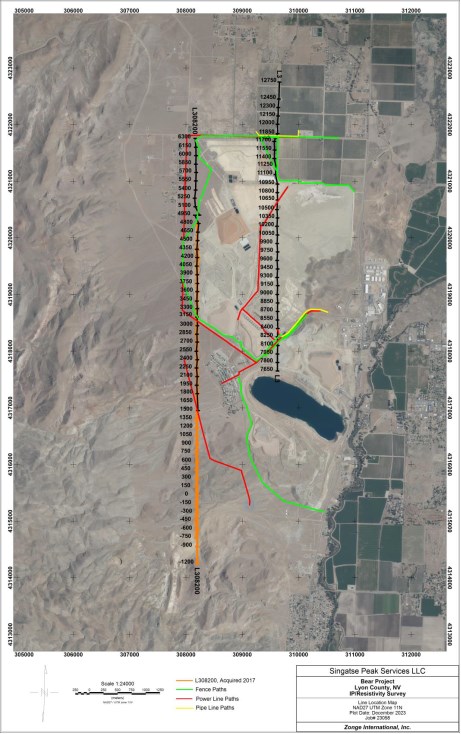
Source: Zonge2023
|
P a g e | 7-12 |
| 03/21/2025 |
| Yerington Copper Project S-K 1300 Report Yerington, Nevada |
|
7.1.4 Ground Magnetic Survey
Zonge Geosciences, Inc. performed GPS-based ground magnetic (Zonge, 2009a) and Induced Polarization and Resistivity surveys (Zonge, 2009b) for Lion CG on the MacArthur Project during November 2009.
Ground Magnetic/GPS data were acquired on six lines-oriented north/south for a total distance of 31.8 line-kilometers of data acquisition.
Total field magnetic data were acquired with a GEM Systems GSM-19 Overhausereffect magnetometer. Positioning was determined with Trimble PRO-XRS GPS receivers that utilize the integrated real-time DGPS beacon for position corrections.
Figure 7-8 shows the stacked magnetic profile. The magnetic surveys along with the IP/resistivity surveys identified multiple targets for future exploration.
Figure 7-8: Stacked Magnetic Profile
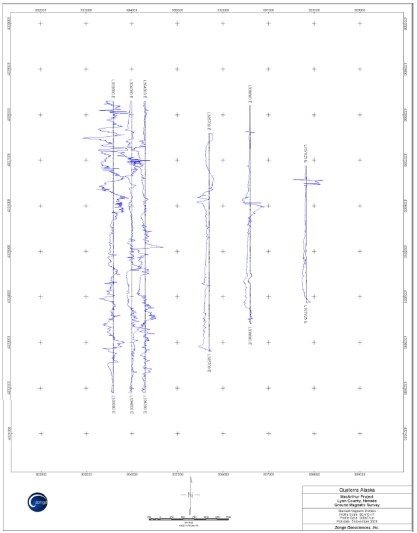
Source: Lion CG 2024
|
P a g e | 7-13 |
| 03/21/2025 |
| Yerington Copper Project S-K 1300 Report Yerington, Nevada |
|
7.1.5 Magnet-telluric Survey
A magneto-telluric (MT) survey covering land from south of Ground Hog Hills northwest through the Bear deposit was completed in July 2015 by Zonge. The ground survey consisted of 106 stations spaced 250 meters on an east-west / north-south grid (Figure 7-9). This data was integrated into drill planning but
deemed unclear as an ore guide due to 1,500-ft to 2,000-ft of magnetite-bearing granodiorite overlying the copper ore-bearing quartz monzonite and quartz monzonite porphyry dikes.
Figure 7-9: Plan map over the Bear Deposit showing the location of the MT stations.
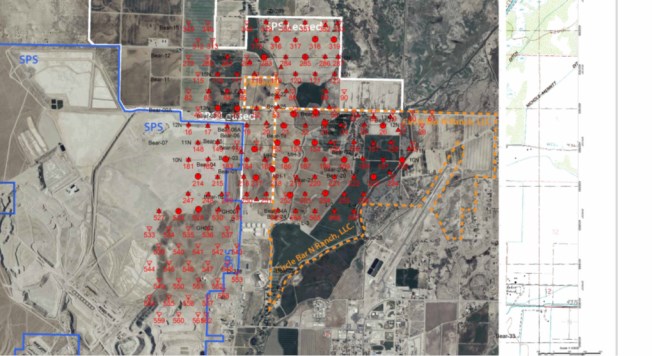
Source: Zonge International 2015
7.1.6 Downhole Geophysics Surveys
Bear drill holes completed in 2015 and 2016, for Lion CG, were subject to multiple open hole geophysical surveys to assist in determining physical characteristics of the deposit and guide future exploration. Southwest Exploration Services, LLC out of Chandler, AZ performed the surveys over multiple down the hole runs. Table 7-1 summarizes the surveys and tools that were used.
|
P a g e | 7-14 |
| 03/21/2025 |
| Yerington Copper Project S-K 1300 Report Yerington, Nevada |
|
Table 7-1: Downhole Geophysics Surveys
| Drill Hole | Gyro | Gamma & Caliper | Electric Log | Magnetic Susceptibility | Acoustic Televiewer |
| B-048 | X | X | X | X | X |
| B-049 | X | X | X | X | |
| B-050 | X | X | X | X | |
| B-051 | X | X | X | X | X |
| B-052 | X | X | X | X | X |
| GHH-001 | X | X | X | X |
Notes:
Gyro-Stockholm Precision Tools GyroTracer Directional
Gamma & Caliper-QL40 Combo Tool SN 6161
Electric Log-ALT QL E-Log IP Tool SN 4992
Magnetic Susceptibility-Probe SN 4784
Acoustic Televiewer-ALT QL ABI43 SN 91601 or QL ABI-40 2G
Most surveys were inconclusive, however, the acoustic televiewer surveys indicated that most fractures and veinlets had a west-northwest trend.
7.2 Drilling
7.2.1 Historical Drilling
Yerington
Anaconda conducted considerable exploration and production drilling during its long tenancy of the Project which resulted in the existing Yerington pit. Although the actual number of exploration drill holes and footages is unknown, historic records indicate that well over a thousand holes, including both core and rotary, were drilled in exploration and development at the Yerington pit alone.
At the Anaconda Collection - American Heritage Center, University of Wyoming at Laramie, a large inventory of Anaconda data is available for review. To obtain drill hole information on the Yerington Project, approximately 10,000 pages of scanned drill hole records from the library were reviewed. While some holes contained only lithologic or assay summary information, after final verification (discussed further in Chapter 9), 561 Anaconda holes totalling 232,739.9 feet contained adequate detailed assay, hole location and orientation information to be used in the mineral resource estimate. An additional 232 drill holes totalling 65,170.5 feet were digitized from sections and cross-validated as explained in Chapter 9 and included in the drill hole database for use in the current Yerington mineral resource estimate.
Of additional benefit to the Lion CG program, core left on site by Anaconda was available for assay by Lion CG. As part of the validation of the Anaconda data, selected intervals from 45 Anaconda core holes were submitted to Skyline Assayers and Laboratories for assay to compare with assays recorded from the historic documents (see Chapter 9). Although historic drilling included intervals which were subsequently mined by Anaconda, they remained in the data base for statistical and interpolation purposes. Anaconda drill hole locations (based on drill logs and digitized sections) incorporated into the data base are shown in Figure 7-10 along with Lion CG drill hole locations (see Chapter 7.2.2 for additional details regarding Lion CG drill holes).
|
P a g e | 7-15 |
| 03/21/2025 |
| Yerington Copper Project S-K 1300 Report Yerington, Nevada |
|
Figure 7-10: Yerington Historic and Lion CG Drilling Collar Plot
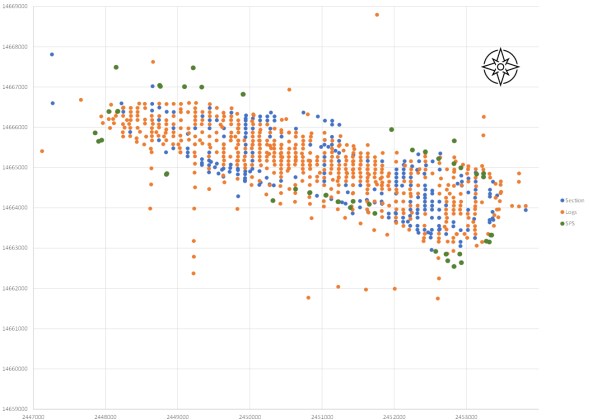
Source: AGP 2023
Notes: Green-Lion CG, Orange-Historical drill logs, Blue-Historical digitized from sections
Grid is 1000 m x 1000 m
MacArthur
Over MacArthur's exploration history, several operators have contributed to the pre-Lion CG drill hole database of more than 300 holes. Figure 7-11 shows the historic collars for MacArthur conducted by U.S Bureau of Mines (USBM), Anaconda Company, Bear Creek Mining Company, Superior Oil Company and Pangea Explorations, Inc.
Anaconda's drilling at MacArthur, which was supervised by Anaconda's Mining Research Department, was accomplished using Gardner-Denver PR123J percussion drills. The percussion drill was fitted with a sampling system designed by the Mining Research Department, which collected the entire sample discharged from the hole. It is uncertain what type of drilling equipment was used by Anaconda for core holes. The remainder of the drilling for MacArthur was done by Boyles Brothers Drilling Company using rotary and down-the-hole percussion equipment.
|
P a g e | 7-16 |
| 03/21/2025 |
| Yerington Copper Project S-K 1300 Report Yerington, Nevada |
|
Figure 7-11: MacArthur Historic Drilling Collar Plot in Nevada State Plane Coordinates
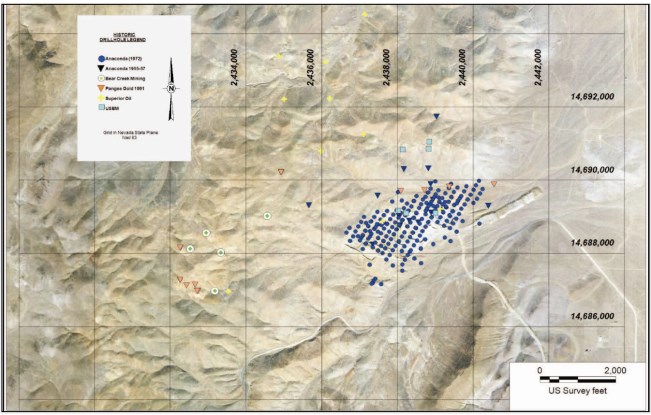
Source: IMC 2022
Bear
The Bear Deposit is located about 10,000 feet north-northeast of the Yerington pit. Drilling has been reported at the Bear Deposit since 1961 in 60 drill holes totalling 133,175.1 feet. The drill campaigns are summarized in Table 7-2. Holes were pre-collared using rotary drilling and downsized to NC core, which is 1.875."
|
P a g e | 7-17 |
| 03/21/2025 |
| Yerington Copper Project S-K 1300 Report Yerington, Nevada |
|
Table 7-2: Historic Drilling at Bear Deposit
| Company | Year | Type | Number of Holes | Footage |
| Anaconda | 1961 | Rotary/NC Core | 4 | 6,176.1 |
| 1962 | Rotary/NC Core | 3 | 3,930.6 | |
| 1963 | Rotary/NC Core | 9 | 24,034.9 | |
| 1964 | Rotary/NC Core | 3 | 10,519.8 | |
| 1965 | Rotary/NC Core | 4 | 9,948.5 | |
| 1966 | Rotary/NC Core | 4 | 13,086.7 | |
| 1967 | Rotary/NC Core | 8 | 27,138.8 | |
| Newmont | 1964 | Rotary/NC Core | 1 | 75.1 |
| 1965 | Rotary | 8 | 3,637.3 | |
| Unknown | Rotary | 2 | 301.5 | |
| Unknown | Rotary/NC Core | 2 | 318.3 | |
| Phelps Dodge | 1969 | Rotary/NC Core | 2 | 6,039.0 |
| 1970 | Rotary/NC Core | 6 | 19,359.5 | |
| 1972 | Rotary/NC Core | 3 | 6,304.0 | |
| 1973 | Rotary/NC Core | 1 | 2,305.0 |
Figure 7-12 illustrates the location of the historic drilling at Bear in black circles and with the Lion CG drilling in red with drill hole labels.
Figure 7-12: Bear Deposit Collar Plot
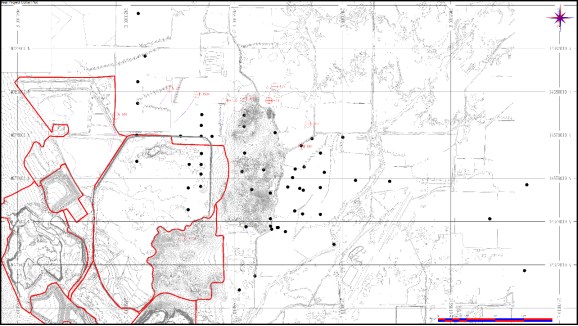
Source: AGP 2024
Notes: Red polygons denote prior areas of historical surface usage.
|
P a g e | 7-18 |
| 03/21/2025 |
| Yerington Copper Project S-K 1300 Report Yerington, Nevada |
|
7.2.2 Lion CG Drilling
Yerington
Lion CG's 2011 drilling program totaled 21,887 feet in 42 holes. That included 6,871 feet of core: 14 HQ core holes and one hole (SP-010) collared in PQ and reduced to HQ at 147 ft. Reverse circulation (RC) drilling totalled 15,016 feet in twenty-eight 4.5" RC holes (Table 7-3). Fourteen core holes and four RC holes were drilled to twin Anaconda core holes, while the remaining 28 RC holes (noted as Expl on Table 7-3 and Table 7-4) were targeted for expansion of mineralization laterally and below historic Anaconda drill intercepts along the perimeter of the Yerington pit.
Drill hole siting was hampered by pit wall geometry and by the presence of the pit lake and was confined to selected benches within the Yerington pit to maintain safe access around the existing pit lake.
The total area covered by the drilling resembles an elliptical doughnut (the accessible ramps and roads along perimeter within the Yerington pit) measuring approximately 6,000 feet west-northwest by 2,500 feet. Drill hole spacing is irregular due to access and safety limitations within the pit. Table 7-3 provides basic collar information for 2011 drilling by Lion CG, and Table 7-4 details the new drilling conducted in 2017 and 2022 that were added to the data base.
Table 7-3: 2011 Drilling Yerington Copper Project
| Drill Hole | Azimuth | Dip | Total Depth (ft) | Purpose | Type |
| SP-001 | 0 | -90 | 207.5 | Twin | Core |
| SP-002 | 0 | -90 | 259 | Twin | Core |
| SP-003 | 0 | -90 | 405 | Twin | Core |
| SP-004 | 0 | -90 | 803.5 | Twin | Core |
| SP-005 | 0 | -90 | 390 | Expl | RC |
| SP-006 | 0 | -90 | 791 | Twin | Core |
| SP-007 | 0 | -90 | 340 | Expl | RC |
| SP-008 | 0 | -90 | 435 | Expl | RC |
| SP-009 | 0 | -90 | 355 | Expl | RC |
| SP-010 | 90 | -70 | 741 | Twin | Core |
| SP-011 | 180 | -60 | 500 | Expl | RC |
| SP-012 | 180 | -60 | 1000 | Expl | RC |
| SP-013 | 180 | -70 | 1000 | Expl | RC |
| SP-014 | 0 | -90 | 341.5 | Twin | Core |
| SP-014A | 180 | -90 | 1000 | Expl | RC |
| SP-015 | 0 | -90 | 438 | Twin | Core |
| SP-016 | 180 | -70 | 780 | Expl | RC |
| SP-017 | 0 | -90 | 216.5 | Twin | Core |
| SP-018 | 90 | -70 | 530 | Expl | RC |
| SP-019 | 0 | -90 | 300 | Twin | Core |
| SP-020 | 180 | -80 | 265 | Expl | RC |
| SP-021 | 180 | -60 | 720 | Expl | RC |
| SP-022 | 180 | -60 | 940 | Expl | RC |
| SP-023 | 180 | -60 | 596 | Twin | RC |
|
P a g e | 7-19 |
| 03/21/2025 |
| Yerington Copper Project S-K 1300 Report Yerington, Nevada |
|
| Drill Hole | Azimuth | Dip | Total Depth (ft) | Purpose | Type |
| SP-024 | 0 | -90 | 780 | Expl | RC |
| SP-025 | 0 | -90 | 610 | Expl | RC |
| SP-026 | 180 | -60 | 655 | Expl | RC |
| SP-027 | 0 | -90 | 797 | Twin | Core |
| SP-028 | 0 | -90 | 300 | Twin | RC |
| SP-029 | 0 | -90 | 560 | Twin | RC |
| SP-030 | 0 | -90 | 460 | Twin | RC |
| SP-031 | 0 | -90 | 162 | Twin | Core |
| SP-032 | 0 | -90 | 506 | Twin | Core |
| SP-033 | 0 | -90 | 190 | Expl | RC |
| SP-034 | 180 | -60 | 903 | Twin | Core |
| SP-034A | 0 | -90 | 365 | Expl | RC |
| SP-035 | 0 | -60 | 190 | Expl | RC |
| SP-036 | 0 | -60 | 550 | Expl | RC |
| SP-037 | 180 | -60 | 180 | Expl | RC |
| SP-038 | 90 | -60 | 830 | Expl | RC |
| SP-039 | 0 | -60 | 295 | Expl | RC |
| SP-040 | 0 | -55 | 200 | Expl | RC |
Notes:
Twin=Twin hole
Expl=Exploration
The 2017 and 2022 drilling focused on deeper drill holes to confirm the extents of mineralization. Lion CG completed an additional seven holes totalling 15,636.7 feet. Four of the holes were pre-collared using RC and changed to HQ sized core (Table 7-4).
Table 7-4: 2017/2022 Drilling Yerington Copper Project
| Drill Hole | Year Drilled | Azimuth | Dip | Total Depth (ft) | Purpose | Type |
| YM-041 | 2017 | 205.00 | -55.00 | 714.0 | Expl | RC |
| YM-041A | 2017 | 201.77 | -53.83 | 2589.7 | Expl | RC/Core |
| YM-042 | 2017 | 202.27 | -56.80 | 2770.6 | Expl | RC/Core |
| YM-043 | 2017 | 200.59 | -52.38 | 2490.0 | Expl | RC/Core |
| YM-044 | 2017 | 189.09 | -58.44 | 2746.7 | Expl | RC/Core |
| YM-045 | 2017 | 204.03 | -54.34 | 2533.2 | Expl | Core |
| YM-046 | 2022 | 29.18 | -47.20 | 1792.5 | Expl | Core |
Notes:
Expl=Exploration
Figure 7-13 illustrates the drilling conducted by Lion CG relative to the current topography and historic Anaconda open pit.
|
P a g e | 7-20 |
| 03/21/2025 |
| Yerington Copper Project S-K 1300 Report Yerington, Nevada |
|
Figure 7-13: Yerington Diamond Drilling by Lion CG
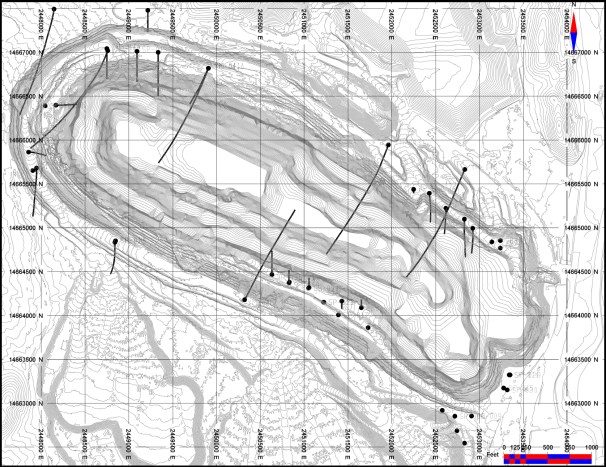
Source: AGP 2023
Notes: Drill holes projected on current topography
MacArthur
From 2007 through to 2010, Lion CG completed an extensive drilling program of 123,005 feet in 375 holes including 28,472 feet of core over 32 holes and 94,533 feet of reverse circulation drilling over 343 holes. Lion CG's initial objective was to verify and expand the MacArthur oxide resource, as defined by the 1972-1973 Anaconda drilling.
Taking into account minor secondary chalcocite intersected in the few Anaconda drill holes that reached depths greater than 300 feet, Lion CG successfully targeted a deeper chalcocite zone in step out holes from the pit. The program expanded the oxide mineralization, and encountered a large, underlying tabular blanket of mixed oxide-chalcocite mineralization. Lion CG's deeper drillholes testing the western and northern margins of the chalcocite mineralization encountered primary copper sulfide mineralization below the chalcocite blanket (Tetra Tech, 2009).
In 2011, drilling centered on an approximate one-half square mile area from the North Ridge area to the present-day MacArthur pit, and the Gallagher area located west of the existing MacArthur pit. Drill spacing was reduced to 250-foot centers on several drill fences. South-bearing angle holes tested the WNW, north dipping structural / mineralized grain and east- and west-bearing angle holes tested orthogonal structure. In 2021, a focus was made to continue upgrading the resource calculation in the main portion of MacArthur as well as to step out to the east-southeast to test for additional acid soluble copper mineralization. Holes were drilled both vertically and south bearing.
|
P a g e | 7-21 |
| 03/21/2025 |
| Yerington Copper Project S-K 1300 Report Yerington, Nevada |
|
Also, during 2011, 3,275 feet of PQ size core was drilled at 26 sites for the purpose of metallurgical test work. PQ holes twinned existing Lion CG RC and core holes.
In 2021, 5,147 feet of exploration drilling in ten holes was completed, and 4,445 feet of PQ size core was drilled in thirteen holes for metallurgical sampling (Figure 7-14).
Figure 7-14: MacArthur Drilling by Lion CG
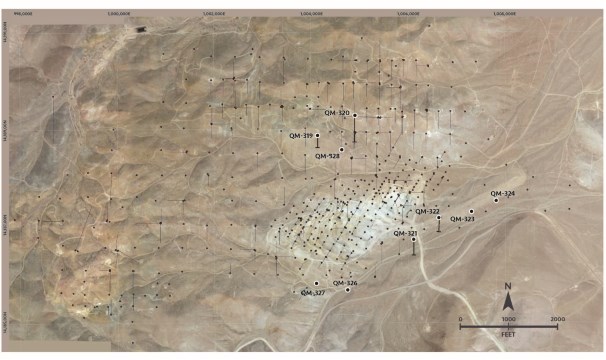
Source: IMC 2022
Notes: 2021 Exploration drill holes are highlighted with a white circle.
Bear
Lion CG has drilled 10 holes totalling 34,283.5 ft (Table 7-5) at Bear since 2015 (Figure 7-125). Except for drilling in 2024, the holes were pre-collared using sonic, reverse circulation or rotary drilling prior to core drilling. Collar were surveyed by Lion CG using handheld Garmin eTrex GPS. Downhole surveys were recorded every 25 feet by Southwest Exploration Services, LLC using Stockholm Precision Tools GyroTracer Directional in 2015 and 2016. In 2023 and 2024, Alford drilling recoded downhole surveys using Reflex EZ-Gyro (every 50 feet) and Axis Mining Technology Tool ChampGyro (every 100 feet), respectively. Detailed logs recorded lithology, structure, and mineralization.
|
P a g e | 7-22 |
| 03/21/2025 |
| Yerington Copper Project S-K 1300 Report Yerington, Nevada |
|
Table 7-5: Bear Deposit Drill Campaigns by Lion CG
| Year | Pre-Collar | Core Drilling | Drill Company | Number of Holes | Footage |
| 2015 | Sonic | PQ→HQ | Boart Longyear Ltd. | 2 | 7,073.0 |
| 2015 | Sonic | HQ | Boart Longyear Ltd. | 1 | 3,838.0 |
| 2016 | Reverse Circulation | PQ | Boart Longyear Ltd. | 1 | 2,017.5 |
| 2016 | Reverse Circulation | PQ→HQ | Boart Longyear Ltd. | 2 | 7,346.0 |
| 2023 | Rotary | HQ→NQ | Alford Drilling, LLC. | 1 | 3,503.0 |
| 2023 | Rotary | PQ→HQ→NQ | Alford Drilling, LLC. | 1 | 3,458.0 |
| 2024 | None | PQ→HQ→NQ | Alford Drilling, LLC. | 2 | 7,048.0 |
Figure 7-15 illustrates the intersection of copper mineralization within quartz monzonite porphyry.
Figure 7-15: North-South Geologic Section Looking West
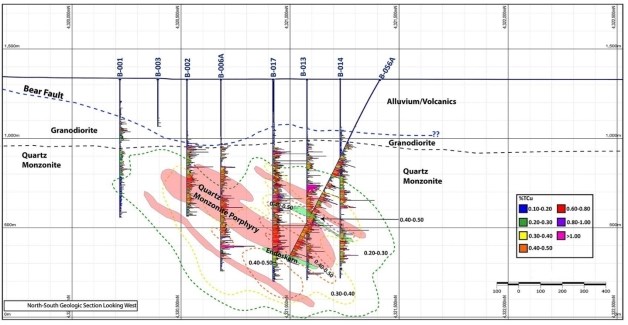
Source: Lion Copper and Gold 2024
7.2.3 Residuals Drilling
Numerous sites of low-grade mineralization and waste dumps are present at the Yerington (Figure 7-16). Some of these have been sampled, post deposition, to determine an average grade and to conduct metallurgical testing. Two areas are included in the mineral resource estimate:
-
W-3 which is a rock disposal unit that lies north of the Yerington pit (Operable Unit (OU)-5, Figure 7-16)
-
Vat Leach Tailings (VLT) which are low-grade oxide tailings that lie northwest of the Yerington pit (OU-6, Figure 7-16)
|
P a g e | 7-23 |
| 03/21/2025 |
| Yerington Copper Project S-K 1300 Report Yerington, Nevada |
|
Figure 7-16: Yerington Property Layout
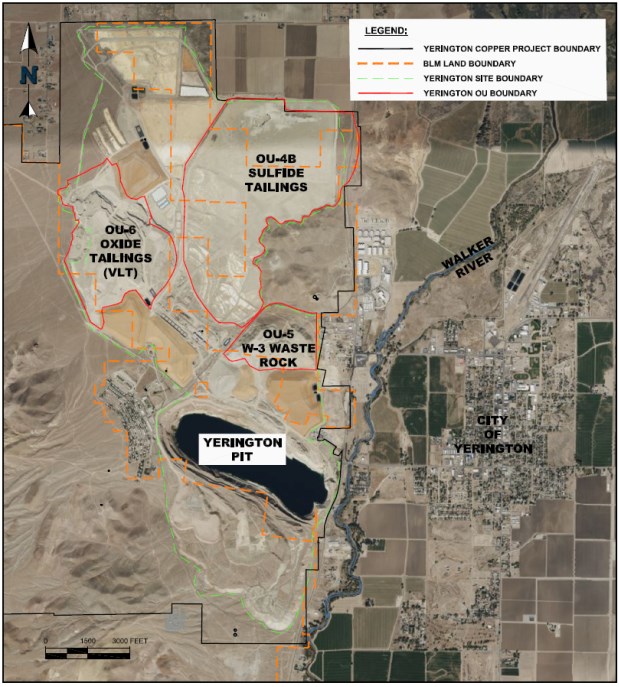
Source: NewFields 2023
|
P a g e | 7-24 |
| 03/21/2025 |
| Yerington Copper Project S-K 1300 Report Yerington, Nevada |
|
W-3
W-3 is a waste rock disposal unit that lies north of the current Yerington pit. It is composed of subgrade copper oxide ore from Anaconda mining operations.
In 2012, to follow-up on the SRK report, Lion CG drilled fourteen (one twin) Roto-Sonic drill holes (performed by Major Drilling), ranging in depth from 95-165 feet (Table 7-6). All residual drill holes are shown on Figure 7-17.
Collar were surveyed by Lion CG using handheld Garmin eTrex 10 GPS. No downhole surveys were recorded. Summary logs compiled information on lithology, grain size and copper mineralization.
Table 7-6: W-3 Drill Holes
| DHID | Easting | Northing | Elevation | Depth (ft.) |
| W-3-001a | 2451477 | 14669493 | 4679.0 | 105 |
| W-3-001b | 2451477 | 14669493 | 4679.0 | 85 |
| W-3-002 | 2452059 | 14668860 | 4610.0 | 100 |
| W-3-003 | 2451231 | 14669308 | 4678.0 | 100 |
| W-3-004 | 2451496 | 14669198 | 4638.0 | 100 |
| W-3-005 | 2452090 | 14669185 | 4638.0 | 100 |
| W-3-006 | 2452569 | 14669190 | 4608.0 | 100 |
| W-3-007 | 2451448 | 14668902 | 4608.0 | 100 |
| W-3-008 | 2452046 | 14668869 | 4576.0 | 100 |
| W-3-009 | 2452570 | 14668898 | 4570.0 | 165 |
| W-3-010 | 2451640 | 14669748 | 4594.0 | 95 |
| W-3-011 | 2451174 | 14669560 | 4650.3 | 100 |
| W-3-012 | 2450900 | 14669089 | 4636.9 | 100 |
| W-3-013 | 2451163 | 14668700 | 4636.9 | 100 |
|
P a g e | 7-25 |
| 03/21/2025 |
| Yerington Copper Project S-K 1300 Report Yerington, Nevada |
|
Figure 7-17: W-3 Collar Plot
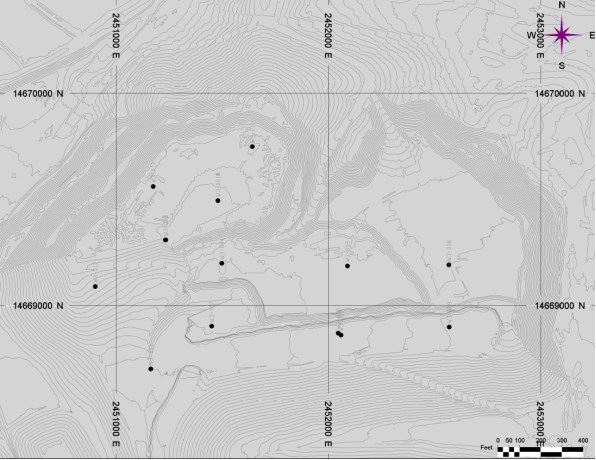
Source: AGP 2023
Vat Leach Tails
Oxide tailings, or VLT, are the leached products of Anaconda's vat leach copper extraction process (CH2M Hill, 2010). The oxide tailings dumps, located north of the process areas, contain the crushed rock that remained following the extraction of copper in the vat leaching process. The vat leach process involved crushing ore into a uniform minus 0.5-inch size and loading it into one of eight large concrete leach vats where weak sulfuric acid was circulated over an 8-day period. Following the 8-day cycle, the spent ore was removed from the vats and transferred to haul trucks for conveyance to the oxide tailings area (OU-8 Figure 7-16).
METCON Research (METCON) conducted a metallurgical study for Lion CG to support a scoping study for the Anaconda Vat Leach Tailings (Phase I) Project in Yerington, Nevada. The metallurgical study was conducted on drill hole samples obtained from a wet and dry sonic drilling campaign from the Anaconda Vat Leach Tailings.
The mineralization is expected to be primarily oxide forms of copper, chrysocolla, neotocite, others, and secondary sulfide (chalcocite) (SRK, 2012).
|
P a g e | 7-26 |
| 03/21/2025 |
| Yerington Copper Project S-K 1300 Report Yerington, Nevada |
|
There were 22 drill holes, VLT-001 to VLT-022, completed by Major Drilling for the wet drilling study. In September 2012, nine dry rotosonic drill holes (Prosonic) by Boart Longyear twinned the wet sonic drill holes configured with an 8-inch-diameter drill pipe and a 7-inch core. "T" was added to the hole number to identify the twin holes: VLT-12-002, VLT-12-003T, VLT-12-005T, VLT-12-006T, VLT-12-011T, VLT-12-016T, VLT-12-017T, VLT-12-019T and VLT-12-021T (Figure 7-18).
Collar were surveyed by Lion CG using handheld Garmin eTrex 10 GPS. No downhole surveys were recorded. Summary logs collected information on lithology, grain size and copper mineralization.
Figure 7-18: VLT Collar Plot
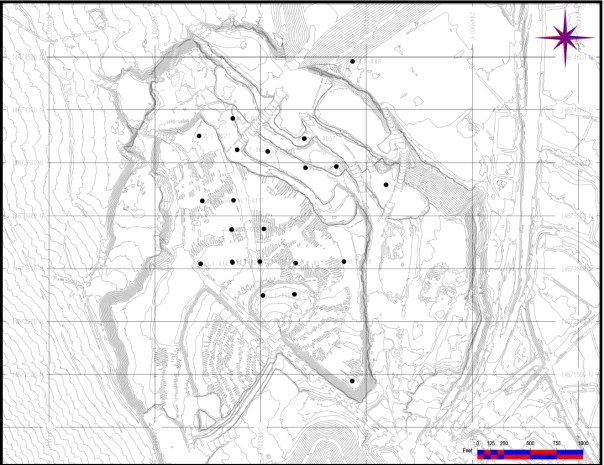
Source: AGP 2023
7.2.4 Drilling Procedures
Lion CG's 2011 drill holes were surveyed by Lion CG consultants using a Trimble XHT unit with horizontal accuracy to within one-half meter and vertical accuracy from one-half to one meter. All other collars were surveyed using a handheld Garmin eTrex GPS by Lion CG geologists.
Drilling contractors and downhole surface information are summarized in Table 7-7. Some shorter holes may not be surveyed.
|
P a g e | 7-27 |
| 03/21/2025 |
| Yerington Copper Project S-K 1300 Report Yerington, Nevada |
|
Table 7-7: Yerington and MacArthur Drilling Contractors by Year
| ear | Location | Type | Contractor | Downhole Survey Interval |
Downhole Survey Instrument |
Downhole Survey Contractor |
| 2007 | MacArthur | Core RC |
Kirkness Diamond Drilling Diversified Drilling LLC |
50 ft | Gyroscope | International Directional Services LLC |
| 2008 | MacArthur | Core RC |
KB Diamond Drilling Diversified Drilling LLC |
50 ft | Gyroscope | International Directional Services LLC |
| 2009 | MacArthur | Core RC |
Major Drilling America Inc. Diversified Drilling LLC |
50 ft | Gyroscope | International Directional Services LLC |
| 2010 | MacArthur | Core RC |
Major Drilling America Inc. Diversified Drilling LLC |
50 ft | Gyroscope | International Directional Services LLC |
| 2011 | MacArthur | Core RC |
Ruen Drilling, Inc. George DeLong Construction, Inc. Diversified Drilling LLC Leach Drilling, Inc. |
50 ft | Gyroscope | International Directional Services LLC |
| 2011 | Yerington | Core RC |
Ruen Drilling, Inc. George DeLong Construction, Inc. Diversified Drilling LLC |
50 ft | Gyroscope | International Directional Services LLC |
| 2017 | Yerington | RC Core |
Layne Christensen Drilling | 50 ft | Gyroscope | International Directional Services LLC |
| 2021 | MacArthur | Core | National EWP | 50 ft | Gyroscope | International Directional Services LLC |
| 2022 | MacArthur | Core | InterGeo Drilling | 50 ft | Gyroscope | International Directional Services LLC |
| 2022 | Yerington | Core | InterGeo Drilling | 50 ft | Gyroscope | International Directional Services LLC |
| 2023 | MacArthur | RC | Alford Drilling, LLC | 10 ft | Gyro Master | Alford Drilling, LLC |
Core recovery was recorded for all core drill campaigns and averaged about 70%, but in general recovery exceeded 80%. Lion CG technicians measured core recovery per drill run as denoted by the core blocks inserted into the core boxes by the drilling contractor. For Yerington, drill intersections with less than 40% recovery were not used for the mineral resource estimate. No other factors were identified that could materially impact the accuracy and reliability of the drilling results.
Geologists logged information on the alteration, lithology, structures, and sulfide descriptions. This information was captured on paper forms and loaded into a digital database combined with the collar and downhole survey information. Digital color core photographs are taken prior to the collection of samples.
7.3 2024 Activities
7.3.1 Drilling
Drilling operations were completed at both Yerington and MacArthur in 2024, however, no drilling completed after December 31, 2023, was incorporated in the mineral resource estimates reported in chapter 11. No changes were made to logging procedures as reported in Chapter 7.2.4. The collars were surveyed using a handheld Garmin eTrex 32x GPS by Lion CG geologists. Downhole surveys were conducted by Alford Drilling using Axis Mining Technology Tool ChampGyro.
|
P a g e | 7-28 |
| 03/21/2025 |
| Yerington Copper Project S-K 1300 Report Yerington, Nevada |
|
Yerington Deposit
Diamond drilling was completed at Yerington in 2024 totalling 3,457.5 feet of drilling in four core drill holes (Table 7-8) that were targeted for expansion. Diamond core drilling was conducted by Alford Drilling, LLC of Elko, NV. Downhole survey intervals reported in Table 7-8 .
Table 7-8: 2024 Drilling Yerington Copper Project
| Drill Hole | Year Drilled |
Azimuth | Dip | Total Depth (ft) | Purpose | Type | Downhole Survey Interval |
| YM-047 | 2024 | 210 | -45 | 470 | Expl | Core | 50 ft |
| YM-047A | 2024 | 210 | -45 | 1083.5 | Expl | Core | 50 ft |
| YM-048 | 2024 | 210 | -45 | 1270.0 | Expl | Core | 100 ft |
| YM-049 | 2024 | 210 | -45 | 634.0 | Expl | Core | 100 ft |
MacArthur Deposit
Reverse circulation (RC) drilling was completed at MacArthur in 2024 totalling 6,165 feet of drilling in 18 RC holes (Table 7-9) that were targeted for expansion and in-fill. RC drilling was conducted by Alford Drilling, LLC of Elko, NV. Downhole surveys were recorded every 5 feet working in continuous mode.
Table 7-9: 2024 Drilling MacArthur Project
|
Drill Hole |
Year |
Azimuth |
Dip |
Total Depth |
Purpose |
Type |
|
QM-343 |
2024 |
180 |
-60 |
280 |
Expl |
RC |
|
QM-344 |
2024 |
180 |
-60 |
330 |
Expl |
RC |
|
QM-336 |
2024 |
0 |
-90 |
130 |
Expl |
RC |
|
QM-337 |
2024 |
180 |
-60 |
310 |
Expl |
RC |
|
QM-338 |
2024 |
180 |
-60 |
325 |
Expl |
RC |
|
QM-339 |
2024 |
180 |
-60 |
350 |
Expl |
RC |
|
QM-340 |
2024 |
180 |
-60 |
340 |
Expl |
RC |
|
QM-341 |
2024 |
180 |
-50 |
600 |
Expl |
RC |
|
QM-342 |
2024 |
180 |
-60 |
520 |
Expl |
RC |
|
QM-342A |
2024 |
180 |
-60 |
700 |
Expl |
RC |
|
QM-345 |
2024 |
180 |
-60 |
200 |
Expl |
RC |
|
QM-346 |
2024 |
180 |
-60 |
130 |
Expl |
RC |
|
QM-347 |
2024 |
180 |
-60 |
200 |
Expl |
RC |
|
QM-348 |
2024 |
0 |
-90 |
345 |
Expl |
RC |
|
QM-349 |
2024 |
180 |
-70 |
495 |
Expl |
RC |
|
QM-350 |
2024 |
180 |
-60 |
230 |
Expl |
RC |
|
QM-351 |
2024 |
180 |
-60 |
290 |
Expl |
RC |
|
QM-352 |
2024 |
0 |
-90 |
390 |
Expl |
RC |
|
P a g e | 7-29 |
| 03/21/2025 |
| Yerington Copper Project S-K 1300 Report Yerington, Nevada |
|
Bear Deposit
Diamond drilling was completed at Bear in 2024 totalling 7,048 ft in two drill holes that were targeted for exploration. (Table 7-10). Diamond core drilling was conducted by Alford Drilling, LLC of Elko, NV. Downhole surveys were recorded every 100 ft.
Table 7-10: Drilling Bear Project
| Drill Hole | Year Drilled | Azimuth | Dip | Total Depth (ft) | Purpose | Type | Downhole Survey Interval |
| B-055 | 2024 | 180 | -60 | 3435 | Expl | Core | 100 ft |
| B-056A | 2024 | 190 | -65 | 3613 | Expl | Core | 100 ft |
7.3.2 2024 Hydrology
Supplementary hydrogeologic characterization by Piteau Associates for the Project through December 2024 included the following:
-
two multi-level Vibrating Wire Piezometer (VWP) strings in exploration boreholes beneath the current and proposed Yerington Open Pits to record groundwater levels
-
two multi-level VWP strings in exploration boreholes to record inside and beneath the future MacArthur Open Pit
-
a test dewatering well in the MacArthur Open Pit, including a 6-hour airlift test and water quality sampling
-
a pit lake transducer to record daily lake levels
-
borehole drilling, test pits, groundwater quality sampling, and column leaching tests to evaluate potential Rapid Infiltration Basin (RIB) sites north of the mine
-
two reconnaissance-level Yerington Pit Wall seep surveys
-
shallow auger boreholes with associated field and lab testing within alluvium north of the MacArthur pit to assess the potential for development of rapid infiltration basins
Evaluations and analyses of the data associated with these investigations are currently underway.
7.3.3 2024 Geotechnical
Supplemental geotechnical investigations completed in 2024 by NewFields to support the pit geotechnical evaluations include the following:
-
mapping of structural geology at the exposed portions of the Yerington Pit and at the MacArthur Pit
-
drilling/logging one oriented core hole at the Yerington Pit
-
excavating one test pit at the Yerington Pit alluvium, including sampling and laboratory testing
Additional geotechnical investigations were completed to support the HLF designs, including the following:
- excavating, logging, sampling, and laboratory testing at 14 test pits
|
P a g e | 7-30 |
| 03/21/2025 |
| Yerington Copper Project S-K 1300 Report Yerington, Nevada |
|
-
drilling, sampling, and laboratory testing at 11 drill holes (hollow stem auger)
-
cone penetration testing (CPT) at 12 locations within the legacy sulfide tailings facility
-
laboratory testing on existing samples of Vat Leach Tailings (VLT)
Evaluations and analyses of the data associated with these investigations are currently underway.
|
P a g e | 7-31 |
| 03/21/2025 |
| Yerington Copper Project S-K 1300 Report Yerington, Nevada |
|
8 Sample Preparation, Analyses, and Security
8.1 Sample Preparation and Analyses
8.1.1 Anaconda
Samples from MacArthur and Yerington were delivered to Anaconda's analytical laboratory in Yerington, NV. Samples were blended, pulverized and a 2-gm sample was extracted for assay. Samples were assayed for total copper and oxide copper, according to standard wet chemistry procedures.
Assay reports were handwritten, signed by Anaconda's Chief Chemist Henry Koehler (Personal communication, 2008) and one original issued to management along with three carbon copies.
8.1.2 Yerington
Figure 8-1 shows the Lion CG core sampling facility at the Yerington Copper Project. The sampling area is connected to the logging area via conveyor. The same sampling procedures were used at MacArthur and Bear Properties as were used at Yerington.
Figure 8-1: Core Sampling Facility
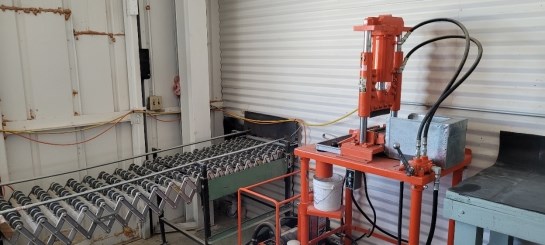
Source: AGP 2023
Reverse Circulation Sampling
Samples are collected in a conventional manner via a cyclone and standard wet splitter. Samples are collected in 17-in by 26-in cloth bags placed in five-gallon buckets to avoid spillage of material. Sample bags are pre-marked by Lion CG personnel at five-foot intervals and include a numbered tag inserted into a plastic bag bearing the hole number and footage interval. Collected samples, weighing approximately 15 to 20 pounds each, are wire tied and then loaded onto a ten-foot trailer with wood bed allowing initial draining and drying. Each day Lion CG personnel or the drillers at the end of their shift, haul the sample trailer from the drill site to Lion CG's secure sample preparation warehouse in Yerington, Nevada.
|
P a g e | 8-1 |
| 03/21/2025 |
| Yerington Copper Project S-K 1300 Report Yerington, Nevada |
|
RC sample bags, having been transported on a ten-foot trailer by drill crews or by Lion CG personnel from the drill site to the secure sample warehouse, are unloaded onto suspended wire mesh frames for further drying. Diesel-charged space heaters assist in drying during winter months. Once dry, four to five samples are combined in a 24- by 36-inch woven polypropylene transport ("rice") bag, wire tied and carefully loaded on plastic lined pallets. Each pallet, holding approximately 13 to 15 rice bags, is shrink-wrapped, and further secured with wire bands. Each pallet is weighed.
In the 2011 drill program, pallets were picked up and trucked by Skyline Assayers & Laboratories (Skyline) personnel who, at the time, operated a sample preparation facility in Battle Mountain, Nevada. A chain of custody form accompanied all shipments from Yerington to Battle Mountain. Once Skyline prepared each sample in its Battle Mountain facility, approximately 50-gram sample pulps are air-freighted to Skyline's analytical laboratory in Tucson, Arizona for analyses and assay.
In 2017, Bureau Veritas' personnel picked up the samples, which were prepped in the Sparks, NV facility and then forwarded to their Vancouver laboratory for analysis.
In 2022 and 2024, Skyline personnel (from Tucson) picked up the samples which were prepped and analyzed in their Tucson laboratory.
In 2023, ALS personnel picked up the samples, which were prepped in the Reno, NV facility. Samples were then sent to North Vancouver. British Columbia or Twin Falls, Idaho for analysis.
Core Sampling
Drill core, having been transported at end of each shift by the drill crew to Lion CG's secure sample warehouse, is logged by a Lion CG geologist who marks appropriate sample intervals (one to nominal five feet) with colored flagging tape. Lines are marked along the length of core with red wax crayons to indicate where the core piece should be sawed and sampled. Sample tags are placed in the core box at the beginning of the interval sampled and a tag is placed in the sample bag. The sample tags and sample bags are labelled with the drill hole number and sample footage. Half of the split was bagged in 11- by 17-inch cloth bags while the other half was returned to the appropriate core box for storage in the sample warehouse.
Sample Analyses
Samples were analyzed for total copper (TCu) and other analyses as shown in Table 8-1 for core and RC drill samples. Selected core was used to provide bulk density measurements as described in Chapter 8.1.3.
Samples processed by Lion CG between 2011 and 2024 were analyzed by:
-
Skyline Assayers and Laboratories: Tucson, Arizona. ISO/IEC 17025:2017 accredited
-
Bureau Veritas Commodities Canada Ltd.: Reno, Nevada. ISO/IEC 17025:2017 accredited
-
ALS Minerals Laboratory Reno, Nevada. ISO/IEC 17025:2017 accredited
Sample preparation (crush-split-pulverize) was generally completed at local facilities in Nevada before shipment to the primary assay laboratories.
Skyline was used for the 2011 SP series of drilling and in 2022 and 2024 drilling. Bureau Veritas was used for the 2017 YM series drill holes.
ALS Minerals Laboratory was used for check samples and for 2023 drilling
|
P a g e | 8-2 |
| 03/21/2025 |
| Yerington Copper Project S-K 1300 Report Yerington, Nevada |
|
All laboratories used by Lion CG are independent of them.
Table 8-1: Summary of Analytical Packages and Laboratories
| Laboratory | Procedure Code | Procedure Description |
| Skyline Assayers | MULTI-AAS SEQ-AAS-AS SEQ-AAS-CN SEA-CuSAP FA-1 TE-5 CuT |
Multi-acid digestion AAS Copper Sequential Analysis Copper AAS Acid Soluble Sequential Analysis Copper AAS CN Soluble Sequential Analysis Copper AAS Ferric Sulfate Soluble Au Fire Assay - AA (Geochem) 30 g Trace Elements by Multi Acid (with HF), ICP-MS Routine 3 Acid Copper, AAS |
| Bureau Veritas | FA430 MA300 MA410 |
Au by 30 g fire assay, AAS finish 4 Acid digestion ICP-OES analysis 0.25 g 4 Acid digestion overlimit AAS analysis |
| ALS Minerals | CU-OG62 ME-OG62 |
Ore Grade Cu - Four Acid Ore Grade Elements - Four Acid, ICP-AES analysis |
8.1.3 Vat Leach Tails Sampling
Wet and dry sonic drilling was conducted on the Vat Leach Tails. The material came up into plastic bag "sausages" or sleeves (each about 5-ft.). All of the sample was sent to Metcon for the wet sonic drilling. For the dry sonic drilling (twin holes), the sample was split. To split the material, Lion CG laid the sample in between to half pipes (~12-in. split pipe) and then ran a box cutter down the middle of the plastic sleeve to cut it. Half of the sample went into one pipe and other half into the other pipe. Lion CG placed the material from each half pipe into separate zip tied plastic bags, half was submitted to Metcon for assaying and the remaining half was placed in storage for potential additional testing. The Metcon assay code was MA-AA, which was a multi-acid digestion with AAS finish.
8.1.4 W-3 Sampling
Ten-foot intervals of 6-in. core were drilled and put directly into plastic bags. At the conclusion of the drilling program, Lion CG split the samples into 5-ft. intervals and stored each split in a heavy-duty plastic sample bag. The bags were clearly marked and labeled with the drill hole number and sample interval and sealed shut. The samples were not initially submitted for assay and were stored at the Yerington Property.
In an effort to better determine the copper remaining in the W-3 stockpile, composites of the available splits were made. Composites were unbiased grab samples from each 5-ft. interval plastic bag from the available drill holes (W-3-001, W-3-003, W-3-004, W-3-005, W-3-007 through W-3-013). These composites were each 3-4 kg each and sent to FLSmidth, Inc for characterization and assaying.
The remainder of the split samples were tagged with a sample number and submitted for assaying to Woods Process Services, LLC. Woods Process is independent of Lion CG. The assay method was 3-acid microwave digestion with ICP-OES analysis.
Standards used were A106010X, A106012X and A106013X; which were the same as those used at Yerington (Table 8-2).
|
P a g e | 8-3 |
| 03/21/2025 |
| Yerington Copper Project S-K 1300 Report Yerington, Nevada |
|
8.1.5 MacArthur
Reverse Circulation Sampling
RC sample bags, having been transported on a ten-foot trailer by Lion CG personnel from the drill site to the secure sample warehouse, are unloaded onto suspended wire mesh frames for further drying. Diesel-charged space heaters assist in drying during winter months. Once dry, sets of three samples are combined in a 24- by 36-inch woven polypropylene transport ("rice") bag, wire tied, and carefully loaded on plastic lined pallets. Each pallet, holding approximately 13 to 15 rice bags, is shrink-wrapped and further secured with wire bands. Lion CG samples were shipped via UPS Freight to Skyline Assayers & Laboratories (Skyline), Tucson, Arizona through 2008. During the 2009-2010 drill campaign, Skyline dispatched a transport truck from Tucson to collect samples. In 2011, Skyline established a sample preparation facility in Battle Mountain, Nevada, from which trucks were dispatched to pick up Lion CG's drill samples under a chain of custody protocol. Following sample preparation in the Battle Mountain facility, Skyline ships a representative pulp sample to the Skyline laboratory in Tucson, Arizona for analysis.
Lion CG weighs each shrink-wrapped pallet of samples prior to departure from Yerington. Rejects and pulps are returned to Lion CG and stored under cover in a secure location.
Core Sampling
Drill core, having been transported at end of each shift by the drill crew to Lion CG's secure sample warehouse, is logged by a Lion CG geologist who marks appropriate sample intervals (approximately 5 feet) with colored flagging tape and marks the core with a wax pencil to indicate appropriate location for sawing or splitting. Each core box, bearing a label tag showing drill hole number, box number, and box footage interval, is then photographed.
Core preceding drill hole QMCC-20 was sawed in half by Lion CG personnel; core holes QM-026, QM-036, QM-041, QM-046, and QM-049 were split in half using a hydraulic powered blade at the warehouse by Lion CG personnel. From 2010-2011 core holes were sawed by ALS Minerals Laboratory, Reno, Nevada (ALS). Since 2015, Lion CG personnel sawed and/or split all of the core samples. Samples with a large percentage of clay were split to preserve the fines.
When on-site sawing and or splitting was done, one half of the split was bagged in 11- by 17-inch cloth bags marked with drill hole number, footage interval, and sample number for assay while the other half was returned to the appropriate core box for storage in the sample warehouse.
Following geologic logging, magnetic susceptibility and RQD measurements, and photography, PQ core for metallurgical testing was shrink-wrapped in its cardboard core box, stacked on pallets, shrink-wrapped together, wire banded, and weighed. In 2011, pallets were shipped to METCON Research Laboratories, Tucson, Arizona via UPS Freight. Chain of Custody was signed upon departure from Yerington and receipt in Tucson. In 2021, PQ samples were shipped to McClelland Laboratories, Sparks, Nevada via UPS Freight with the sample chain of custody procedures.
Sample Analyses
During 2007, 12 core holes were analyzed at American Assay Laboratories (AAL) in Sparks, Nevada. AAL is ISO/UEC 17025 certified as well as a Certificate of Laboratory Proficiency PTP-MAL from the Standards Council of Canada.
|
P a g e | 8-4 |
| 03/21/2025 |
| Yerington Copper Project S-K 1300 Report Yerington, Nevada |
|
Lion CG elected to use Skyline Assayers & Laboratories (Skyline) an ISO certified assay lab in Tucson, Arizona for all further analytical work. Samples submitted to AAL were re-assayed (pulps or rejects) by Skyline for consistency of the data set. Lion CG samples arrived at Skyline via UPS freight from 2007-2008.
Core from holes QM-099, QM-100, and QM-109 (2009-2010) and QM-163, QM-164, QM-165, QM-166, QM-177, and QM-185 (2011 program) were submitted to ALS Minerals, Sparks, Nevada. ALS Minerals is an ISO registered and accredited laboratory in North America. From 2009-2011 samples were picked up by a transport truck dispatched by Skyline from its temporary facility in Battle Mountain, Nevada and 2021 through 2023 by a transport truck dispatched from Tucson by Skyline.
The Skyline assay procedures are as follows:
-
For Total Copper: a 0.2000-to-0.2199-gram (g) sample is weighed into a 200-ml flask. A three-acid mix is added and heated to about 250°C for digestion. The sample is made to volume and read on an ICP/AAS using standards and blanks for calibration.
-
For Acid Soluble Copper: a 1.00 to 1.0199 g sample is weighed into a 200 ml flask. Sulfuric acid in water and sodium sulfite in water are mixed and added to the flask and allowed to leach for an hour. The sample is made to volume and read on an ICP/AAS using standards and blanks for calibration.
-
For Ferric Soluble Copper (QLT): a 0.500 to 0.5099 g sample is weighted into a 200 ml flask. Sulfuric acid ferric sulfate mixed with deionized water are mixed and added to the flask and allowed to leach for an hour. The filtrate is cooled, made up to a standard volume, and the copper determined by AA with appropriate standards and blanks for calibration.
-
For Sequential Copper Leach: consists of four analyses: Total Copper, Acid Soluble Copper, Cyanide Soluble Copper, and the difference, or Residual. Following analysis for Total Copper and Acid Soluble Copper, the residue from the acid soluble test is leached (shake test) in a sodium cyanide solution to determine percent cyanide soluble minerals. The Sequential Copper Leach is a different approach to the Ferric Soluble Copper (QLT) leach, with possible greater leaching of certain sulfide (e.g. chalcocite or bornite) during the cyanide leach step.
-
For Acid Consumption of Pulps: a 2.00 to 2.10 grams is weighted into a 50 ml screw cap centrifuge. Sulfuric acid is added to the sample and the shaken for an hour. The sample is decanted into a 50 ml screw cap centrifuge tube where titration is undergone and acid consumption calculated with the Tiamo software program.
From 2009-2011, Lion CG requested 34-element trace element geochemistry from Skyline on selected samples which were analyzed by ICP.OES Aqua Regia Leach.
During 2009-2010 Lion CG core samples were picked up at Lion CG's warehouse facility by ALS Minerals personnel and transported to ALS Minerals laboratory in Sparks, Nevada. ALS Minerals personnel sawed the core, saving one-half for return to Lion CG. ALS assayed core for trace element geochemistry with 48-element Four Acid "Near-Total" Digestion.
In 2020, to better understand acid consumption of the acid soluble mineralized zones, 111 pulps were analyzed by Skyline Laboratories.
|
P a g e | 8-5 |
| 03/21/2025 |
| Yerington Copper Project S-K 1300 Report Yerington, Nevada |
|
8.1.6 Bear
Similar sampling and logging procedures were used at Bear Deposit as those at Yerington. The recent assaying was conducted by Bureau Veritas, ALS, and Skyline Assays with one check batch sent to Paragon Geochemical (Paragon).
In 2015-2016, all samples were picked up by Bureau Veritas, in Sparks, NV, where the samples were crushed, spilt, and pulverized to pulps. Pulps were sent to Bureau Veritas's lab in Vancouver, BC and analyzed for 4-acid multi-element ICP-ES analysis (MA300 analysis) and fire assay gold with AAS finish (FA430 analysis). Sample overlimit (>1% TCu) were run via a 4-acid digestion (MA410).
In 2023, all samples were picked up by ALS out of Reno, NV. Samples were crushed, split, and pulverized to pulps at the Reno laboratory. Pulps were sent to an internal lab in North Vancouver, BC or Twin Falls, ID for analysis and analyzed for Ultra Trace Aqua Regia ICP-MS (ME-MS41 analysis). Sample overlimit (>1% TCu) were analyzed via Aqua Regia ICP-AES (ME-OG46). One batch of samples (34 samples, 1 standard, and 1 blank) were sent to Paragon Geochemical in Reno, NV for analysis in 2023 for expedited results. These samples were crushed, split, and pulverized to pulps and analyzed for multi-element analyses using a multi-acid ICP-MS finish (48MA-MS) as well as fire Au assay with AAS finish (Au-AA30) in the same laboratory.
In 2024, all samples were picked up by Skyline Assayers & Laboratories (Skyline), Tucson, AZ and were crushed, split, and pulverized to pulps. Multi-element analyses were completed in the same laboratory using a multi-acid digestion and ICP OES/ICP-MS finish (TE-5 analysis). Sample overlimit (>1%) were analyzed via 3-acid single assay with AAS (CuT).
8.2 Density
8.2.1 Drill Samples-Yerington
Density tests were completed in November 2011, by Kappes, Cassiday & Associates, based in Reno, Nevada, on core samples from the current Lion CG drilling. Representative samples were collected from six rock types representing oxide and sulfide mineralization. No further details were provided regarding the methodology but prior work by Kappes, Cassiday & Associates for Lion CG was based on a water displacement method.
8.2.2 Drill Samples-MacArthur
Density determinations were from core samples collected by Lion CG personnel in 2008 for oxide, mixed and sulfide material. The samples were wax coated and density determination was based on a water displacement method. No further details regarding the methodology were available.
In 2024, samples were collected across the different redox zones: leach cap, oxide, mixed and sulfide but independent of rock type. Primarily collected samples within or proximal to MacArthur pit but some samples were also collected from North Ridge and Gallagher. The 2024 density determinations by Paragon Geochemical Laboratories (Sparks, NV) were based on their water displacement method without wax coating (Bulk-DEN).
|
P a g e | 8-6 |
| 03/21/2025 |
| Yerington Copper Project S-K 1300 Report Yerington, Nevada |
|
8.2.3 Residual Materials
Density for Anaconda materials was derived based on historic reports. Density for Arimetco heap leach (HLP) material was based on laboratory testing of remedial investigation drilling reported by CH2M Hil (USEPA, 2011). In general, the HLP materials testing ranged from well-graded sand to well-graded gravel. The amount of fines varied, but typically did not exceed 15 percent. Moisture content was measured for field conditions on oven-dried samples, and the dry density was calculated (USEPA, 2011).
8.3 Sample Security
The samples are delivered twice a day (at end of driller's shift), or Lion CG personnel picks them up. When core samples are delivered, they go directly into the logging facility and are under lock and key. The RC samples are dropped off on-site (behind a locked gate) and left in the trailer. Lion CG places the samples onto wire racks to finish drying and brings them into the warehouse at end of shift. If inclement weather or during the winter, Lion CG brings them directly into the warehouse where they dry on wire racks.
The only access to the core is to those who can get into the logging facility which is Lion CG employees and any consultants (geologist and/or sample splitter/sawer) at the time of work being performed. The RC samples are left out during daytime hours and can be accessed by anybody who can get into the mine site gate including Lion CG personnel, the site manager, drillers, and mine site security.
Chain of Custody forms are prepared by Lion CG for the samples with quality assurance/quality controls samples inserted. Primarily, the laboratory picks up the samples and sign-off on the Chain of Custody. Rarely, Lion CG has dropped the samples off directly, and in that case the Chain of Custody is also signed off. Lion CG retains the Chain of Custody forms as documentation/confirmation.
Rejects and pulps are returned to Lion CG and stored under cover in a secure location.
8.4 Quality Control
No historic data on quality control at Anaconda's analytical laboratory in Yerington was found. The laboratory was not independent of Anaconda Company.
8.4.1 Yerington
Lion CG implemented a quality assurance and quality control assay protocol whereby either one blank or one standard is inserted with every ten samples into the assay stream. Additional check samples were submitted to ALS Minerals Laboratories in Sparks, Nevada. Core duplicates were not used.
Lot failure criteria were established as any standard assaying beyond two standard deviations of the expected value, or any blank assay greater than 0.015 percent TCu.
Geochemical reference standards are listed in Table 8-2. Blanks were also purchased from Moment Exploration Geoservices, two were used: Si.Blank.21.01 and Si.Blank.21.03. The accepted values were 0.005% total copper.
|
P a g e | 8-7 |
| 03/21/2025 |
| Yerington Copper Project S-K 1300 Report Yerington, Nevada |
|
Table 8-2: Geochemical Reference Standard
| Standard | Source | Accepted Value, % Cu |
| A106010X | Shea Clark Smith, Moment Exploration GeoServices | 0.215 |
| A106009X | 0.136 | |
| A106012X | 0.388 | |
| A106013X | 0.574 | |
| A106014X | 1.428 |
Lion CG Drilling Prior to 2017
As part of the Lion CG quality control program, 220 standards and 222 blanks were submitted (Table 8-3) along with 5,557 individual drill hole samples to Skyline Laboratories. Additionally, 68 check assays plus seven quality control samples were submitted to ALS Mineral Labs, Reno, and 137 samples plus seven quality control samples were submitted for reassay to Skyline. No quality control failures were found during the reassaying (Table 8-3).
Table 8-3: Lion CG 2011 QAQC Program Results
| Skyline Labs | ALS Mineral Labs | |
| Total Drill Hole Samples | 5694 | 68 |
| Submitted Standards | 220 | 3 |
| Failed Standards | 8 | 0 |
| % Standards Failure | 3.6% | 0 |
| Submitted Blanks | 222 | 4 |
| Failed Blanks | 4 | 0 |
| % Blank Failure | 1.8% | 0 |
Check assays from ALS Mineral Labs compared well with Skyline assays, providing additional confidence in the assay database, as shown in Figure 8-2.
|
P a g e | 8-8 |
| 03/21/2025 |
| Yerington Copper Project S-K 1300 Report Yerington, Nevada |
|
Figure 8-2: Lion CG Check Assay Results
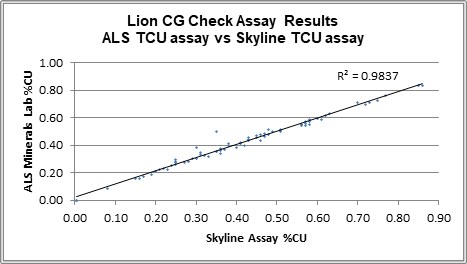
Source: Lion CG 2024
Lion CG Drilling 2017-2022
Six drill holes were completed in 2017 by Lion CG and one additional hole in 2022. Table 8-4 summarizes the results of the QAQC program. No issues were noted.
Table 8-4: 2017-2022 QAQC Program Results
| Skyline Assays (2022) | Bureau Veritas (2017) | |
| Total Drill Hole Samples | 325 | 2436 |
| Submitted Standards | 16 | 125 |
| Failed Standards | 1 | 2 |
| % Standards Failure | 1.6% | 6.3% |
| Submitted Blanks | 16 | 121 |
| Failed Blanks | 0 | 0 |
| % Blank Failure | 0.0% | 0.0% |
8.4.2 W-3
Eleven drill holes from the residual W-3 were submitted for analysis by Woods Processing. Lion CG modified the quality assurance and quality control assay protocol for this analysis whereby one standard was inserted with every ten samples into the assay stream and one blank for every 20 samples.
Table 8-5 reports the QAQC results for W-3 sampling. The grades were within two standard deviations except for one failure. But more than 50% were outside of the 95% confidence limits determined for the standards. In general, the assayed grades were averaging higher than the accepted value of the standard.
|
P a g e | 8-9 |
| 03/21/2025 |
| Yerington Copper Project S-K 1300 Report Yerington, Nevada |
|
Table 8-5: W-3 QAQC Program Results
| Woods Processing (2023) | |
| Total Drill Hole Samples | 223 |
| Submitted Standards | 23 |
| Failed Standards | 1 |
| % Standards Failure | 4.3% |
| Submitted Blanks | 11 |
| Failed Blanks | 0 |
| % Blank Failure | 0.0% |
8.4.3 Vat Leach Tails
Samples were processed by METCON Research (Tucson, AZ) to determine moisture content, particle size distribution, head assay analysis and agitated leach testing (Guntumur, 2012a and 2012b). METCON Research was an international consulting group that delivered a broad range of services including analytical testing, metallurgical research, and process engineering design for the global minerals and mining industry. No details were provided with respect to the assay methodology, but assay certificates were provided. METCON Research is independent of Lion CG. No accreditation information was available, but the assay certificates were signed and stamped by an Arizona Registered Assayer.
A total of 472 samples were submitted for analysis which included 53 duplicate samples (11.2%), 12 blank material samples (2.5%) and 18 standard reference materials (3.8%).
The standards were obtained from Canadian Certified Reference Materials Project (CCRMP) operated by CANMET Mining and Mineral Sciences Laboratories in Ottawa, Ontario. Three standards used were HV-2, SU-1b and MP-1b. The source of the blank material was not identified but the accepted detection limit was <0.001% Cu.
No outliers or bias were noted in the review of the standards, blanks, and duplicates.
8.4.4 MacArthur
IMC completed a study of the duplicate samples, standards, and blank assays in the Lion CG drill hole data base. The checks are limited to the holes and samples from the Lion CG holes. Core duplicates were not used. Beginning in 2009, Lion CG began a program to re-assay selected samples when blanks, standards, or repeat assays exceeded or were below the expected values by 15%, or blanks returned an assay of >.015% Cu. The QC program now re-assays standards outside +/- 2 standard deviations of the expected value, repeat assays +/- 15% of the original assay, and blanks greater than .015% Cu.
Standards
The data provided to IMC consisted of 1,965 assays run on 11 total copper standards representing the insertion of a standard into the sample stream approximately every 20 samples. Table 8-6 summarizes the number of check assays run for each standard using the Lion CG drilling up through 2012.
The check on standards shows that the significant portion of the checks fall within two standard deviations of the standard assay value, which is within acceptable range. The check on standards meets industry standard practices.
|
P a g e | 8-10 |
| 03/21/2025 |
| Yerington Copper Project S-K 1300 Report Yerington, Nevada |
|
Table 8-6: Standards Used on Lion CG Drilling through 2012
|
Standard Name |
TCU |
asCu |
Number |
Number |
|
15000PPM |
1.56 |
|
119 |
|
|
4700PPM |
0.45 |
|
100 |
|
|
A106008X |
0.075 |
|
68 |
|
|
A106009X |
0.136 |
|
64 |
|
|
A106010X |
0.215 |
|
74 |
|
|
A106011X |
0.291 |
|
69 |
|
|
A106012X |
0.388 |
|
245 |
|
|
A106014X |
1.428 |
|
82 |
|
|
A107002X |
0.468 |
0.440 |
447 |
402 |
|
A107004X |
0.225 |
0.212 |
661 |
586 |
|
A108005X |
0.414 |
|
36 |
|
For the 2021 drilling, Lion CG inserted 46 standards for assay using three different standards (A106009X, A106010X, A106012X). Lion CG inserted these standards at a 1 in 20 interval (46 standards within 911 samples assayed). All standard checks were within two standard deviations.
Blanks
Blanks were inserted into the Lion CG drill hole samples approximately every 20 to 25 sample intervals for the drilling up through 2012. The results for 1,816 blanks assayed for total copper and 1,617 assayed for acid soluble copper were provided to IMC. Lion CG inserted 40 blanks into the 2021 drilling samples for an insertion rate of approximately every 23 samples. The results for the 2021 drilling were below the 0.005% TCu Skyline Laboratories detection limit.
Check Assays on 2021 Drill Holes
As a check for the 2021 drilling, selected duplicate samples were sent to a second lab for assay. Check assays were done for 38 samples of the 2021 drilling assay intervals for total copper, acid soluble copper and cyanide soluble copper. The original lab for these assay intervals was Skyline Laboratories and the check lab was Paragon. For total copper there were 911 Skyline assays and 38 Paragon assays which meant a check on 4.1% of the data intervals. For acid soluble copper and cyanide soluble copper there were 646 Skyline assays and 29 Paragon assays which meant a check on 4.5% of the data intervals. Figure 8-3 Is an X-Y plot of the original Skyline total copper versus the results from Paragon.
|
P a g e | 8-11 |
| 03/21/2025 |
| Yerington Copper Project S-K 1300 Report Yerington, Nevada |
|
Figure 8-3: Comparison of Total Cu Check Assays
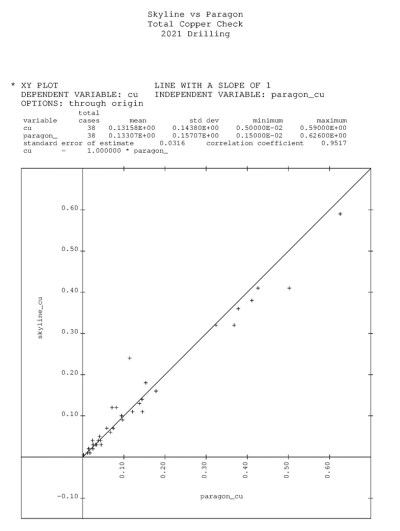
Source: IMC 2022
8.4.5 Bear
No historic data on quality control at Anaconda's analytical laboratory in Yerington was found. The laboratory was not independent of Anaconda Company.
Drilling at Bear Deposit resulted in 3,071 samples in 2015-2016 and 2,075 samples in 2023. Lion CG implemented a quality assurance and quality control assay protocol whereby either one blank or one standard is inserted approximately every ten samples into the assay stream.
Table 8-7 summarizes the assay laboratory and results associated with each drill program.
|
P a g e | 8-12 |
| 03/21/2025 |
| Yerington Copper Project S-K 1300 Report Yerington, Nevada |
|
Table 8-7: Bear Deposit QAQC Program Results
|
|
Bureau Veritas Assays |
ALS |
Paragon |
|
Total Drill Hole Samples |
3,071 |
1,082 |
34 |
|
Submitted Standards |
183 |
47 |
1 |
|
Failed Standards |
1 |
8 |
0 |
|
% Standards Failure |
0.55 |
17.0 |
0 |
|
Submitted Blanks |
182 |
48 |
1 |
|
Failed Blanks |
0 |
0 |
0 |
|
% Blank Failure |
0 |
0 |
0 |
The quality control materials were from Moment Exploration GeoServices:
-
Blanks: SiBlank21.02, SiBlank21.03
-
Standards: A106009X, A106010X, A106011X, A106012X, A106013X, A106014X, Au21.05, Cu.18.01, Cu.18.06, Cu-1, MEG-Cu-2, Q107004X, S107018X, AND S107020X
Issues were noted with standard A106012X so one batch of samples (34 samples, 1 standard, and 1 blank) were sent to Paragon in Reno, NV for analysis in 2023 for expedited results. These samples were crushed, split, and pulverized to pulps and analyzed for multi-element analyses using a multi-acid ICP-MS finish (48MA-MS) as well as fire Au assay with AAS finish (Au-AA30) in the same laboratory. The original results by Skyline were repeated by Paragon with R2=0.986. In discussion with the Skyline, the problem with the standard may be due to a homogeneity issue.
All pulps and rejects are returned directly to Lion CG by the respective laboratory. These pulps and rejects are kept in a dry and secured facility.
Pulps from drilling in 2015 and 2016 were checked by Skyline, in which 829 pulps (including 20 standards and 21 blanks) were re-assayed to Total Copper. Values agreed well, with an R2 value of 0.99 (Figure 8-4).
|
P a g e | 8-13 |
| 03/21/2025 |
| Yerington Copper Project S-K 1300 Report Yerington, Nevada |
|
Figure 8-4: Comparison between Bureau Veritas and Skyline Check Assays
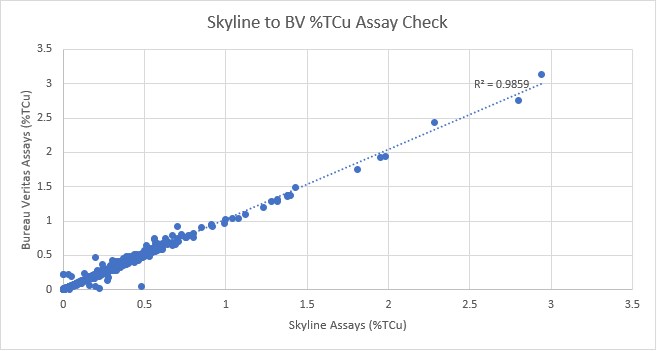
Source: Lion CG 2024
8.4.6 Lion CG Drilling 2024
The drill holes completed in 2024 are not included in the current mineral resources reported in Chapter 11 for Yerington and MacArthur Deposits because these holes were drilled after the completion of the mineral resource estimates.
Yerington Copper Project
Diamond drilling was completed at the Yerington Pit in 2024 totalling 3,457.5 feet of drilling in four core drill holes. Table 8-8 summarizes the results of the QAQC program. CRM failures were noted for CRM A106011X and A106013X. Samples bracketing the CRM failures were rerun with similar results produced by Skyline and ALS. If the CRM outliers are included for the determination of the standard deviation, the number of failures drops to 5. No other material issues were noted.
|
P a g e | 8-14 |
| 03/21/2025 |
| Yerington Copper Project S-K 1300 Report Yerington, Nevada |
|
Table 8-8: Yerington 2024 QAQC Program Results
| Skyline Assays (2024) | |
| Total Drill Hole Samples | 609 |
| Submitted Standards | 29 |
| Failed Standards | 9 |
| % Standards Failure | 31.0% |
| Submitted Blanks | 27 |
| Failed Blanks | 0 |
| % Blank Failure | 0.0% |
MacArthur Copper Deposit
Eighteen drill holes were completed in 2024 by Lion CG. Table 8-9 summarizes the results of the QAQC program. No material issues were noted.
Table 8-9: MacArthur 2024 QAQC Program Results
| Skyline Assays (2024) | |
| Total Drill Hole Samples | 1,230 |
| Submitted Standards | 77 |
| Failed Standards | 19 |
| % Standards Failure | 24.7% |
| Submitted Blanks | 31 |
| Failed Blanks | 2 |
| % Blank Failure | 6.0% |
Bear
Two diamond core holes were completed in 2024 by Lion CG. Table 8-10: Bear 2024 QAQC Program Results summarizes the results of the QAQC program. No material issues were noted,
Table 8-10: Bear 2024 QAQC Program Results
| Skyline Assays (2024) | |
| Total Drill Hole Samples | 993 |
| Submitted Standards | 49 |
| Failed Standards | 6 |
| % Standards Failure | 12.2% |
| Submitted Blanks | 49 |
| Failed Blanks | 0 |
| % Blank Failure | 0% |
|
P a g e | 8-15 |
| 03/21/2025 |
| Yerington Copper Project S-K 1300 Report Yerington, Nevada |
|
8.5 Adequacy Statement
It is the opinion of the AGP and IMC that the sampling preparation, security, analytical procedures, and quality control protocols used are consistent with generally accepted industry practices and therefore suitable for the purpose of mineral resource estimation.
| |
P a g e | 8-16 |
| 03/21/2025 |
| Yerington Copper Project S-K 1300 Report Yerington, Nevada |
 |
9 Data Verification
9.1 Yerington Deposit
Data verification has been conducted by Lion CG to validate the historic data. To support the updated mineral resource estimate, AGP conducted independent data verification.
9.1.1 Lion CG Data Verification Procedures
Lion CG carried out detailed data capturing and verification processes in 2011 from Anaconda archives available through the Anaconda Collection - American Heritage Center, University of Wyoming at Laramie. In order to verify and validate this data, three programs were completed:
- cross sections with composites of captured data were generated to compare against Anaconda archived cross sections with posted composites for 561 historic holes
- eighteen twin holes were drilled to confirm historic data
- using Anaconda core remaining on site, selected intervals from 45 holes were sent for assay to compare against historic results
- subsequent data for 232 additional holes was captured directly from historic cross sections after the 2011 validation program established that the sections were accurately reflecting data found in the historic records
9.1.2 Results of Verification Programs
Cross Section Verification
Some type of data for almost 800 drill holes was initially captured from over 10,000 pages of scanned records from the Anaconda archives. Values were recorded for assay intervals, core recovery (where applicable), total copper grade (TCu), oxidized copper grade (ASCU), and, when present, grades for sludge collected during core drilling. These sludge grades were used by Anaconda in conjunction with core assays through zones of poor core recovery as a way to compensate for lost material. Although attempts were made to recreate their methodology, the lack of details and supplemental data ultimately restricted use of the information to the original assays.
In addition to the assay information, cross sections showing bench composites were available from the Anaconda archives. By bench compositing the captured data and comparing to the bench composite values posted on the cross sections, Tetra Tech (Bryan, 2012) was able to identify and isolate bench differences and determine the cause. When incorporation of the sludge factors by Anaconda in its bench composites was identified as the cause but the data capture from the scanned sheets was correct, the data were deemed acceptable.
Drill holes not retained in the data set were those which contained only summary data of the assays, often reporting intervals several times larger than bench height. Only those holes which reported grades for the normal sampling intervals (generally 5 feet) were used by Tetra Tech (2012).
The cross-section validation also confirmed that the bench composites posted correctly provided a cross check that section data was the same as that which what was being found in the records. Subsequently, a program to capture available data for drill holes found only on the cross sections was undertaken, and 232 additional drill holes were added to the database. Ultimately, information from 561 historic holes with detailed assay data and 232 holes with composite assay data was ultimately used for this current resource estimation (Bryan, 2014).
 |
P a g e | 9-1 |
| 03/21/2025 |
| Yerington Copper Project S-K 1300 Report Yerington, Nevada |
|
Drill Hole Twinning
Fourteen core and four RC holes were drilled in an effort to twin Anaconda holes to confirm mineralization, and two RC holes were drilled to twin two of the Lion CG core holes.
Figure 9-1 shows a portion of the "twin" drilling study performed to determine if the historical data from Anaconda can be used in a mineral resource estimation. Of interest is the comparison of the new data to the historical data. The original Anaconda data were documented in hard copy sections that were rekeyed into a computer data base. The position of Lion CG drill holes was compared to Anaconda data by both visual inspection of plotted sections and by the application of a strategy of using jackknife estimates of proximal data. The latter method produced 48 pairs of Anaconda and Lion CG data that were, on the average, 12 feet apart (Bryan, 2014).
Figure 9-2 shows the side-by-side histograms of the 48 pairs. Visually, the Anaconda drilling data are slightly higher in grade than the Lion CG twins. No statistical difference can be shown. More formally stated, a T-test of the twins shows that the null hypothesis of the two populations being the same cannot be rejected at a 95% confidence level (alpha of 0.05) (Bryan, 2014).
|
P a g e | 9-2 |
| 03/21/2025 |
| Yerington Copper Project S-K 1300 Report Yerington, Nevada |
|
Figure 9-1: Section Showing Twin Data
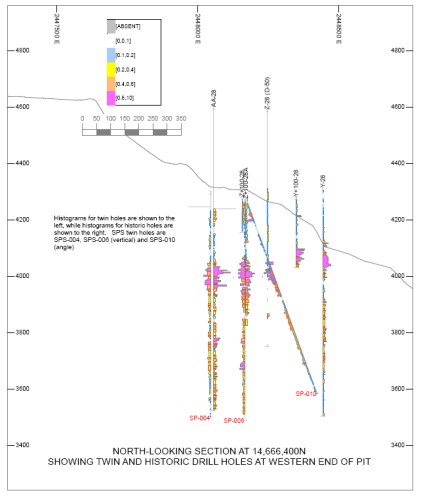
Source: Bryan 2014
|
P a g e | 9-3 |
| 03/21/2025 |
| Yerington Copper Project S-K 1300 Report Yerington, Nevada |
|
Figure 9-2: Histogram and T-Test Comparison of Anaconda and Lion CG Drilling
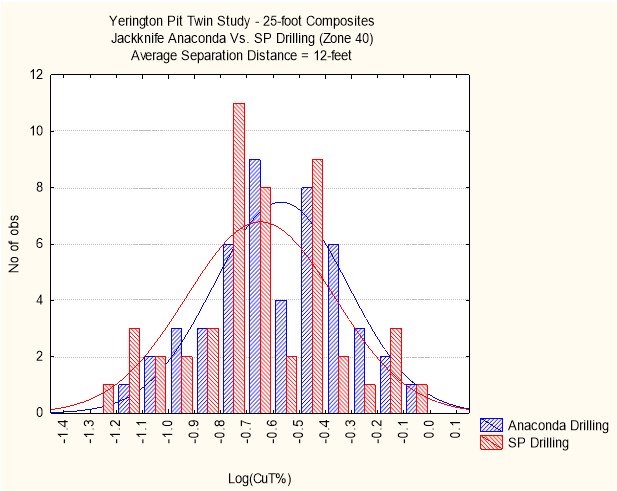
Source: Bryan 2014
Figure 9-3 shows that the 48 twin samples have a correlation of 84%, with a regression equation showing an equivalent grade at 0.5% copper. Figure 9-4 shows the scatter plot of the twins.
Figure 9-3: Twin Sample Correlation

Source: Bryan 2014
|
P a g e | 9-4 |
| 03/21/2025 |
| Yerington Copper Project S-K 1300 Report Yerington, Nevada |
|
Figure 9-4: Scatterplot Showing Anaconda and Lion CG Twin Data
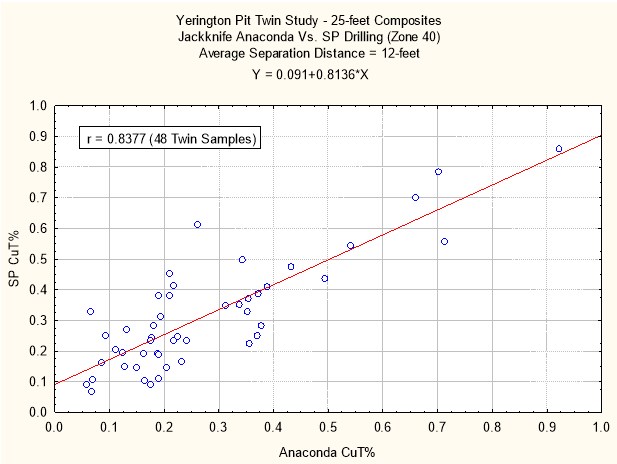
Source: Bryan 2014
Re-assay of Anaconda Core
In addition to the twin study, selected intervals from archived Anaconda core were re-assayed following chain of custody procedures and utilizing modern analytical techniques.
Core intervals from 45 holes, well distributed across the pit, were relogged and photographed prior to being sent to Skyline Labs for re-assaying and represented 5,446 feet of drilling. A total of 1,396 total copper (TCu) assays were completed by Skyline.
In comparing the Skyline and Anaconda Assay data, Figure 9-5 shows a good correlation between the historic assays and reassayed intervals. The coefficient of determination, R2, with a value of 0.742, shows that the two data sets are well correlated, further validating the historic data.
|
P a g e | 9-5 |
| 03/21/2025 |
| Yerington Copper Project S-K 1300 Report Yerington, Nevada |
|
Figure 9-5: Skyline Assay (2011) vs Anaconda Assay
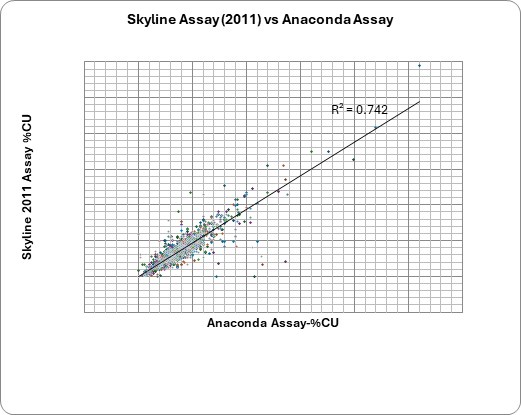
Source: Bryan 2014
9.1.3 AGP Data Verification
AGP conducted data verification during the current Mineral Resource estimate. This included the built-in checks associated with importing data in MinePlan, random checks of database assays compared with assay certificates, and review of the QAQC performance (Chapter 11). This data verification was supported by a site visit conducted from February 13 to 15, 2023. Exploratory data analysis, as discussed in Chapter 11, was an additional component of the data verification process.
AGP Site Visit
AGP conducted a site visit on February 13-15, 2023. The core logging facilities are located at the Project site in Yerington, Nevada (Figure 9-6). No drilling or core logging was currently underway. AGP did not collect an independent sample.
|
P a g e | 9-6 |
| 03/21/2025 |
| Yerington Copper Project S-K 1300 Report Yerington, Nevada |
|
Figure 9-6: Yerington Property
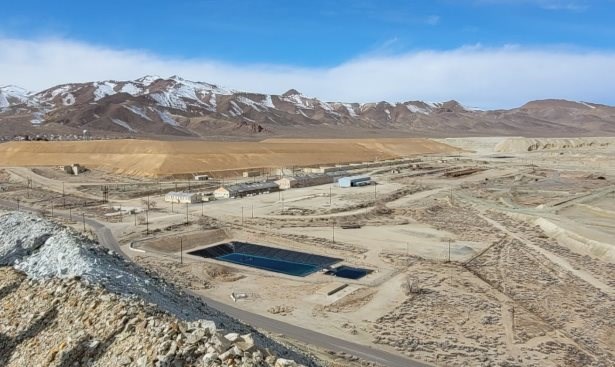
Source: AGP 2023
The site visit was completed to obtain a general view of the Project, to determine if there were any obvious concerns and to review current exploration work. Drill holes YM-046-22 (Figure 9-7 and Figure 9-8), SP-010 and Q+100-22 were reviewed to compare core versus logging sheets. The comparison did not identify any material differences.
Figure 9-7: YM-046-22 Core Box Labelling
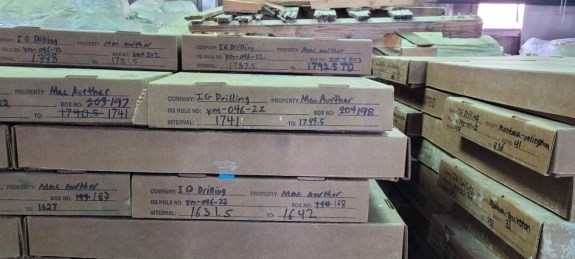
Source: AGP 2023
|
P a g e | 9-7 |
| 03/21/2025 |
| Yerington Copper Project S-K 1300 Report Yerington, Nevada |
|
Figure 9-8: YM-046-022 Sample Tags
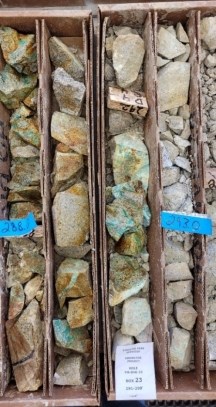
Source: AGP 2023
9.1.4 Adequacy of Data
On completion of the data verification process, it is the AGP's opinion that the geological data collection, sampling, and QAQC procedures used by Lion CG at Yerington are consistent with accepted industry practices, and that the database is of suitable quality to support the mineral resource estimation.
It is AGP's opinion that the data collection of historic data at Yerington by Lion CG is adequate for the use estimation for the following reasons:
-
sampling is representative of the deposit in both survey and geological context
-
twin holes and check assays have confirmed historical assays
-
drill hole cores have been archived and are available for further checking
9.2 MacArthur Deposit
IMC conducted a site visit to the MacArthur Deposit and Lion CG's field office in Yerington, Nevada on February 14 and 15, 2022. During this visit Lion CG staff discussed the history of the Project, presented all requested data, answered questions posed by IMC, presented the current geologic interpretation of the MacArthur Deposit, and guided IMC on a field examination through the MacArthur Deposit. No drilling was in progress during IMC's site visit. The Lion CG staff reviewed all the Lion CG protocol related to drilling, sampling, and sample chain of custody as part of IMC's site visit.
|
P a g e | 9-8 |
| 03/21/2025 |
| Yerington Copper Project S-K 1300 Report Yerington, Nevada |
|
9.2.1 Historic Data Check
IMC did not collect independent samples to corroborate historic data. It is IMC's opinion that the previous owners of the MacArthur Deposit were competent, established companies that followed industry standard practices for drilling, sampling, and assaying according to the industry standards in place at the time of the work. Lion CG has completed verification work on the historic data by re-assaying, when material was available, and twin hole drilling.
IMC selected 17 Anaconda holes to compare the assays in the database with original assay certificates. IMC checked the total copper assays for each sample interval. There were no significant discrepancies noted between the database and certificates.
IMC selected 36 Lion CG holes which were drilled before 2012 and one hole drilled in 2021 to compare the assays in the database with original assay certificates. IMC checked the total copper assay and the acid soluble copper assay for each sample interval. For both the total copper assays and the acid soluble copper assays there were no significant discrepancies noted between the database and the certificates.
As a check on the historic Anaconda drilling within the confines of the current MacArthur pit, Lion CG twinned nineteen Anaconda holes using both RC and core drilling methods. Figure 9-9 confirms the correlation between the twin holes.
Figure 9-9: Twin Hole Comparison
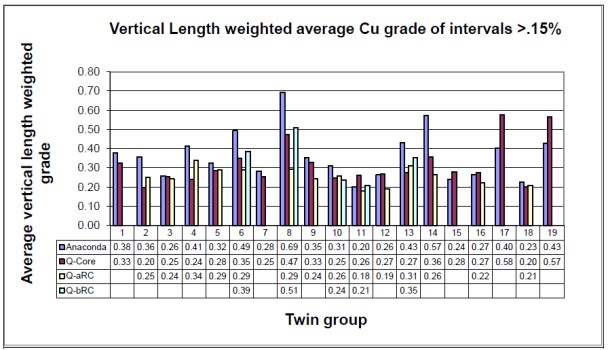
Source: IMC 2022
|
P a g e | 9-9 |
| 03/21/2025 |
| Yerington Copper Project S-K 1300 Report Yerington, Nevada |
|
9.2.2 Adequacy of Data
It is IMC's opinion that the data collection of both historic and modern data by Lion CG for the MacArthur Deposit is adequate for the use in estimation for the following reasons:
-
the sampling is representative of the deposit in both survey and geological context
-
the drill hole cores, pulps and coarse rejects have been archived and are available for further checking
|
P a g e | 9-10 |
| 03/21/2025 |
| Yerington Copper Project S-K 1300 Report Yerington, Nevada |
|
10 Mineral Processing and Metallurgical Testing
10.1 Summary
Copper mineralization exhibits feature typical of deposits in the Western United States, with mineralized zones at both the Yerington and MacArthur deposits allowing the potential to process oxide, transitional and sulfide copper materials simultaneously.
Metallurgical testing has been completed on both the Yerington and MacArthur deposits at well know metallurgical testing laboratories, including but not limited to: Mountain States R&D, Vail, AZ: Metcon Research, Tucson, AZ: Kappes, Cassiday & Associates, Reno, NV, McClelland Laboratories, Sparks, NV. Ongoing test campaigns are directed to optimize heap leach parameters and quantify synergies across proposed flowsheets incorporating heap leach processing of legacy, oxide, transitional and sulfide materials.
Testwork is ongoing and additional tests are scheduled for 2025 that will support metallurgical performance and operating parameters including scale-up. Hydrodynamic testing will also be conducted in this next phase of testing in 2025.
10.1.1 Yerington Oxide
Yerington and MacArthur oxide materials share similar characteristics and have historically demonstrated similar metallurgical performance. No recent test work has been conducted on the Yerington oxides due to lack of samples. Additional drilling and sampling are proposed to provide fresh material for column testing.
Samples were obtained via sonic drilling from the legacy W-3 oxide stockpile for speciation, geochemistry, and acid consumption analysis. Results indicate median copper recovery of 68% TCu is possible at an ASCu cut-off of 0.06% using standard acid heap leaching. Average acid consumption is projected at 24 lb/ton.
Analysis of sampling from the legacy Vat Leach Tailings (VLT) suggests global median grades of 0.089% TCu and 0.51% ASCu, with an ASCu:TCu ratio of 51%. Testing above a 0.06% cut-off shows average copper recovery around 65% of the TCu head grade.
Recent 120-day column testing of MacArthur oxide material returned copper recoveries ranging from 30.9% to 87.2%, averaging 57.1%. Acid consumption ranged from 26 to 42 lb/ton without supplemental ferric or bacteria. Historically MacArthur testing focused on run-of-mine processing schemes.
10.1.2 Copper Recovery Projections
Preliminary metallurgical recovery estimates for the Yerington Copper Project are summarized in Table 10-1. These projections are based on initial test results and analog data from similar projects.
Ongoing testwork continues to demonstrate improving performance and copper recoveries.
|
P a g e | 10-1 |
| 03/21/2025 |
| Yerington Copper Project S-K 1300 Report Yerington, Nevada |
|
Table 10-1: Yerington Copper Project Projected Recoveries by Deposit/Mineralization/Process
|
Deposit |
Feed Type |
Crush Size |
TCu Recovery |
Acid |
Notes: |
|
MacArthur |
Oxide: MacArthur |
6-inch |
82% |
26 |
Sized and Conveyor Stacked |
|
Oxide: Gallagher |
6-inch |
54% |
42 |
Sized and Conveyor Stacked |
|
|
Oxide: MacArthur North |
6-inch |
64% |
38 |
Sized and Conveyor Stacked |
|
|
Sulfide: BioHeap |
0.5-inch |
70% |
34 |
Tertiary Crushed Agglomerated Conveyor Stacked: Nuton Process |
|
|
Yerington |
Oxide |
ROM |
70% |
25 |
ROM |
|
Sulfide BioHeap |
0.5-inch |
74% |
32 |
Tertiary Crushed Agglomerated Conveyor Stacked: Nuton Process |
|
|
Residual: VLT |
As Received |
75% |
15 |
Leach Pad Over Liner: and Oxide Heap Leach |
|
|
Residual: W-3 |
As Received |
68% |
34 |
ROM Oxide Heap Leach |
Source: WPS 2023Yerington Metallurgical Testing
10.1.3 Yerington Sulfides - BioHeap
Initial mineralogy and geochemical sample analyses were completed at the Rio Tinto Technology Development Centre in Bundoora, Australia. Results indicated the possibility of treating Yerington primary sulfide material using BioHeap methods such as Nuton technologies.
To date, several test series have been initiated on Yerington sulfide material: the S-23 stockpile, Life of Asset Blend #1, and Life of Asset Blend #2 as well as MacArthur transition. Testing aims to demonstrate replicated metallurgical results.
10.1.4 S-23 Sulfide Stockpile
Testing using the Nuton technologies on sulfide material from the S-23 stockpile is underway. Preliminary results based on a range of test conditions are summarized in Table 10-2, with corresponding leach rate and net acid consumption profile plots presented in Figure 10-1.
Data shows improvements in S-23 metallurgical performance by optimizing combinations of sulfur, pyrite, and other additives.
|
P a g e | 10-2 |
| 03/21/2025 |
| Yerington Copper Project S-K 1300 Report Yerington, Nevada |
|
Table 10-2: Nuton Scoping Series: S-23 Sulfide Stockpile
|
Yerington LoA Blend #1 |
Test Conditions |
Column Test KPI |
||||||
|
Test ID |
pH |
Sulfur |
Pyrite |
Additives |
Days |
Cu Ext |
Fe Ext (%) |
NAC |
|
LCG14 |
1.2 |
Yes |
No |
1, & 2 |
231 |
69.49 |
3.92 |
64.02 |
|
LCG15 |
1.2 |
Yes |
No |
1 & 2 |
189 |
51.70 |
5.06 |
50.83 |
|
LCG16 |
1.2 |
Yes |
No |
1, 4 & 5 |
189 |
72.26 |
14.48 |
32.15 |
|
LCG17 |
1.2 |
Yes |
Yes |
1 & 2 |
224 |
74.09 |
24.86 |
62.35 |
|
LCG21 |
1.2 |
Yes |
Yes |
1 & 2 |
35 |
66.73 |
14.81 |
26.96 |
Source: November 2023 Nuton Update
Figure 10-1: Nuton Scoping Series: Yerington S-23 Stockpile Recovery and NET vs. Leach Days
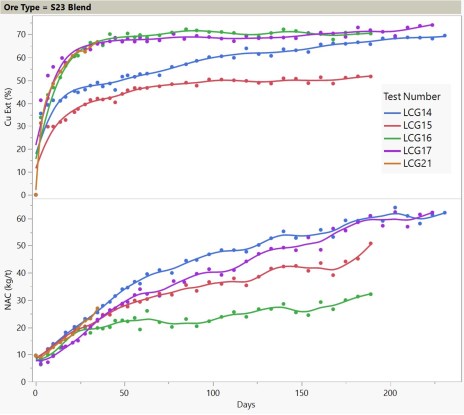
Source: Nuton Update Nov 2023
10.1.5 Life of Asset Blend #1
Drill core samples representing potential production schedules were compiled into a composite called LoA Blend #1. Preliminary test data using this feed composite is shown in Table 10-3. The corresponding leach rate and net acid consumption profiles over time is displayed in Figure 10-2.
|
P a g e | 10-3 |
| 03/21/2025 |
| Yerington Copper Project S-K 1300 Report Yerington, Nevada |
|
As testing proceeds on LoA #1, results indicate extractions of up to 75% for the testing period. Work is ongoing, with the first phase on LoA Blend #1 scheduled for completion by mid-2025.
Table 10-3: Nuton Scoping Series: Yerington LoA Blend #1
|
Yerington LoA |
Test Conditions |
Column Test KPI |
||||||
|
Test ID |
pH |
Sulfur |
Pyrite |
Additives |
Days |
Cu Ext |
Fe Ext (%) |
NAC |
|
LCG8 |
1.5 |
No |
No |
1, 4 & 5 |
231 |
40.21 |
6.48 |
24.09 |
|
LCG9 |
1.5 |
No |
Yes |
4 & 5 |
231 |
45.85 |
4.9 |
24.9 |
|
LCG10 |
1.5 |
No |
Yes |
1, 4 & 5 |
231 |
66.46 |
11.18 |
27.46 |
|
LCG11 |
1.5 |
No |
Yes |
2 |
406 |
74.77 |
3.75 |
45.45 |
|
LCG12 |
1.5 |
No |
Yes |
1 & 2 |
252 |
70.62 |
3.03 |
35.78 |
|
LCG13 |
1.5/1.2 |
No |
Yes |
1 & 2 |
294 |
64.45 |
11.53 |
73.23 |
Source: November 2023 Nuton Update
Figure 10-2: Nuton Scoping Series: Yerington LoA Blend #1 Recovery and NAC vs. Leach Days
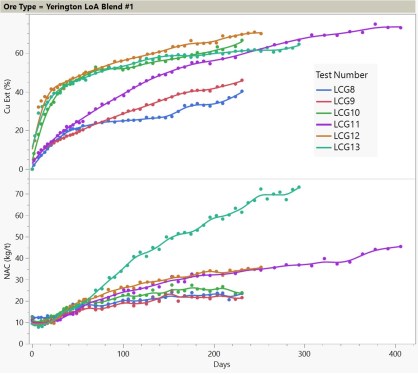
Source: Nuton Update Nov 2023
10.1.6 Life of Asset Blend #2
A second Life of Asset blend was generated from additional drill core samples to provide confirmation and optimization beyond the initial LoA test series. This composite, LoA Blend #2, was tested using BioHeap (Nuton) methods with preliminary results summarized in Table 10-4 with copper extraction shown in Figure 10-3.
|
P a g e | 10-4 |
| 03/21/2025 |
| Yerington Copper Project S-K 1300 Report Yerington, Nevada |
|
Data show improved copper recovery, leach kinetics, and acid consumption compared to prior rounds.
Table 10-4: Nuton Scoping Series: Yerington Life of Asset Blend #2
|
Yerington LoA Blend #2 |
Test Conditions |
Column Test KPI |
||||||
|
Test ID |
pH |
Sulfur |
Pyrite |
Additives |
Days |
Cu Ext |
Fe Ext |
NAC |
|
LCG18 |
1.2 |
No |
Yes |
1 & 2 |
98 |
67.31 |
4.46 |
42.63 |
|
LCG19 |
1.2 |
No |
Yes |
1 & 2 |
98 |
63.51 |
2.85 |
45.51 |
|
LCG20 |
1.2 |
No |
Yes |
1 & 2 |
98 |
73.71 |
14.95 |
48.99 |
|
LCG22 |
1.2 |
No |
Yes |
1 & 2 |
7 |
50.83 |
2.58 |
13.59 |
Source: November 2023 Nuton Update
Figure 10-3: Nuton Scoping Series: Yerington LoA Blend #2 Recovery and NET vs. Leach Days
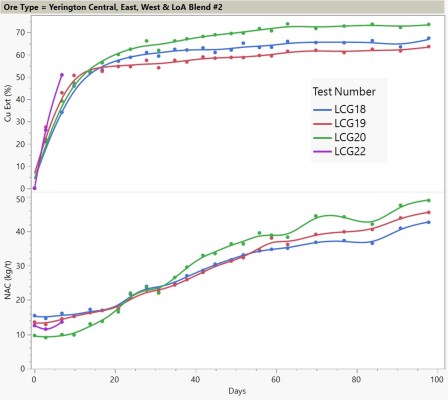
Source: Nuton Update Nov 2023
10.1.7 Yerington Oxide Materials
There is limited recent metallurgical data available on Yerington oxide materials, so surface and core drilling campaigns are planned to collect fresh samples for column testing. Focus areas for testing will include verifying recovery projections and quantifying potential synergies with BioHeap (Nuton) processing.
|
P a g e | 10-5 |
| 03/21/2025 |
| Yerington Copper Project S-K 1300 Report Yerington, Nevada |
|
Anaconda historically operated a vat leach plant at Yerington to process oxide material, well-documented over years of operation. More recently between 1989-1995, Arimetco successfully heap leached newly mined oxide and transition material from the pit. Proposed drill programs and associated metallurgical test work, aim to address this gap and further testing will be focused on confirming heap leach recovery projections and optimize blends and conditions to maximize copper recovery.
10.1.8 W-3 Stockpile
The W-3 stockpile consists of low-grade oxide material below Anaconda's historical operating cut-off of 0.3% Cu, but above a 0.2% Cu lower limit. The copper oxide mineralization includes chrysocolla, chalcocite and other secondary minerals along with neotocite.
Column testing is proposed to quantify metallurgical performance. Until then, assumptions rely on 232 sonic drill samples analyzed for total copper (TCu), acid soluble copper (ASCu), sequential copper (SEQCu) and acid consumption.
As shown in Figure 10-4, total copper assays (TCu) for W-3 range from 0.02% to 1.9%, averaging 0.15% with a median grade of 0.14% TCu. Proposed column work will validate copper recovery projections at relevant crush sizes and reagent conditions.
Figure 10-4: Yerington W-3 Stockpile Interval Analysis: TCu (ppm)
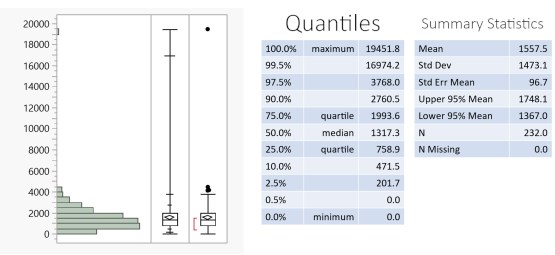
Source: Lion CG W-3 Sample Interval Database 2012
Figure 10-5 displays the acid soluble copper component from W-3 sequential analyses. The ASCu levels ranged from 9.9 ppm to 3431 ppm across all samples. The dataset shows mean values of 720 ppm (0.07% ASCu) and a median of 518 ppm (0.05% ASCu).
|
P a g e | 10-6 |
| 03/21/2025 |
| Yerington Copper Project S-K 1300 Report Yerington, Nevada |
|
Figure 10-5: Yerington W-3 Stockpile Interval Analysis: Sequential Copper ASCu Component (ppm)
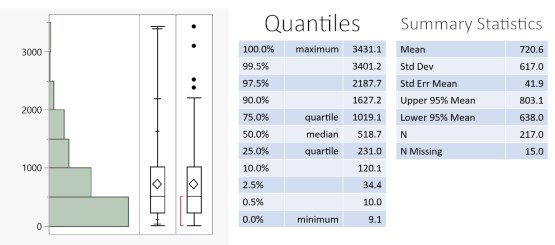
Source: Lion CG W-3 Sample Interval Database 2012
Figure 10-6 shows the cyanide soluble copper component from W-3 sequential analyses. CNCuSeq levels ranged from below detection limit to 1746 ppm (0.17% CNCu), reflecting the oxide nature of the material, with a mean value of 720 ppm (0.07% CNCu), indicating low levels of transition copper mineralization present in the W-3 oxide material.
Figure 10-6: Yerington W-3 Stockpile Interval Analysis: Cyanide Soluble Component (ppm)
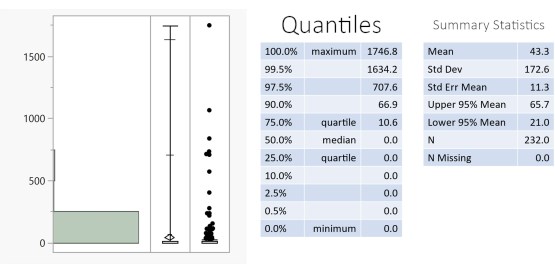
Source: Lion CG W-3 Sample Interval Database 2012
Figure 10-7 shows estimated recoverable copper content as a percentage of total copper based on W-3 sequential copper analyses. The recoverable copper ranges between 3.1% and 92.8% of the TCu content, with Mean and Median 44.9% and 43.2%, respectively. Ongoing sampling and metallurgical testing are planned to determine copper recovery by rock type.
|
P a g e | 10-7 |
| 03/21/2025 |
| Yerington Copper Project S-K 1300 Report Yerington, Nevada |
|
Figure 10-7: Yerington W-3 Stockpile Interval Analysis: Sequential Copper CNCu Component (ppm)
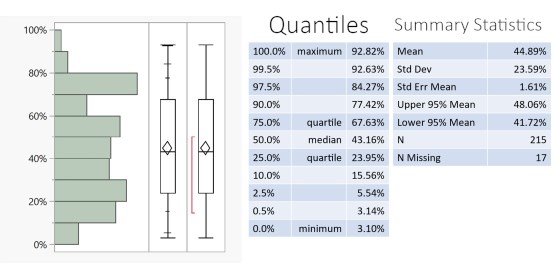
Source: Lion CG W-3 Sample Interval Database 2012
A bench analytical method was used to estimate acid consumption of W-3 oxide material. Results were scaled to forecast consumption rates under commercial heap leach conditions.
Figure 10-8 presents statistical analysis of the projected acid addition requirements across all W-3 samples. Net acid consumption levels ranged from 0 to 87.5 kg/t, with an average of 11.5 kg/t and a comparable median value of 10.3 kg/t.
Figure 10-8: Yerington W-3 Stockpile Interval: Net Acid Consumption Estimate (kg/t)
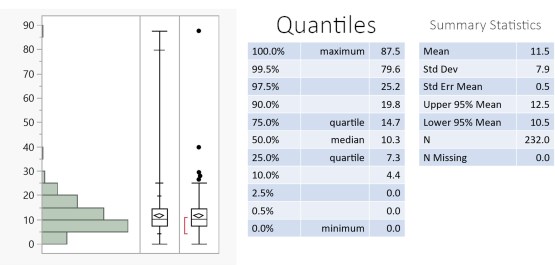
Source: Lion CG W-3 Sample Interval Database 2012
|
P a g e | 10-8 |
| 03/21/2025 |
| Yerington Copper Project S-K 1300 Report Yerington, Nevada |
|
10.1.9 Vat Leach Tailings (VLT) Stockpile
Residue material remains in the legacy Yerington VLT stockpile. Recent sonic drilling across 270 intervals shows residual copper mineralization to be potentially recoverable by conventional heap leaching methods.
Assay statistics indicate median VLT feed grades of 0.089% TCu and 0.051% ASCu based on global composite samples. The average ASCu:TCu ratio equals 51%.
Grade distribution plots for VLT samples are shown in Figure 10-9 (TCu), Figure 10-10 (ASCu), and Figure 10-11 (ASCu:TCu ratio). These initial results suggest recoverable copper persists in portions of the stockpile.
Figure 10-9: Yerington VLT Sonic Drill Interval TCu Assays
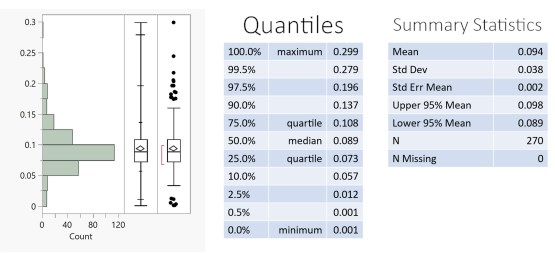
Source: Lion CG VAT Sonic Drill Interval Database 2012
Figure 10-10: Yerington VLT Sonic Drill Interval ASCu Assays
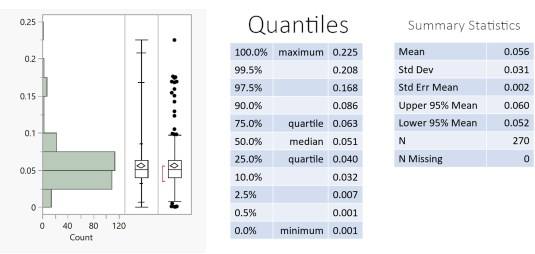
Source: Lion CG VAT Sonic Drill Interval Database 2012
|
P a g e | 10-9 |
| 03/21/2025 |
| Yerington Copper Project S-K 1300 Report Yerington, Nevada |
|
Figure 10-11: Yerington VLT Sonic Drill Interval ASCu:TCu Ratio
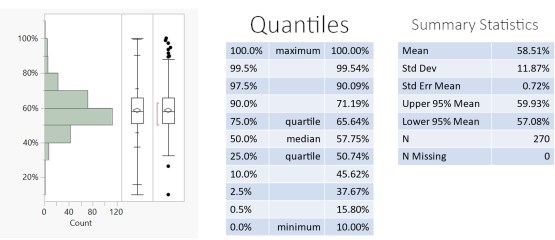
Source: Lion CG VAT Sonic Drill Interval Database 2012
To estimate overall recoverable copper, 48 VLT samples were randomly selected across grade distributions for expanded analysis using thresholds (0.06% TCu cut-off) matching prospective heap leach feed. The samples were analyzed for total copper (TCu) assays along with testing by a ferric sulfate acid leach method (SAPCu).
The SAPCu technique approximates recoverable copper levels under simulated heap conditions using a ferric rich lixiviant. Results are summarized in Table 10-5. Based on SAPCu/TCu ratios, average VLT copper recovery is projected at 65%.
Source: WPS Analytical Results 2023
Figure 10-12 displays these data ratios providing a preliminary proxy for acid-based extraction performance. While useful for initial forecasting, demonstrating actual metallurgical response requires bench and column testing.
Table 10-5: VLT Subset Analytical Results and Recovery Projection
|
Analytical |
Mean |
Std. Dev |
Min |
Max |
Median |
|
TCu (%) |
0.11 |
0.03 |
0.06 |
0.17 |
0.11 |
|
SAPCu (%) |
0.007 |
0.02 |
0.03 |
0.14 |
0.07 |
|
SAPCu: TCu |
65.04% |
12.60% |
40.87% |
95.25% |
62.32% |
Source: WPS Analytical Results 2023
|
P a g e | 10-10 |
| 03/21/2025 |
| Yerington Copper Project S-K 1300 Report Yerington, Nevada |
|
Figure 10-12: Yerington VLT Subset for Additional Analyses: TCu %
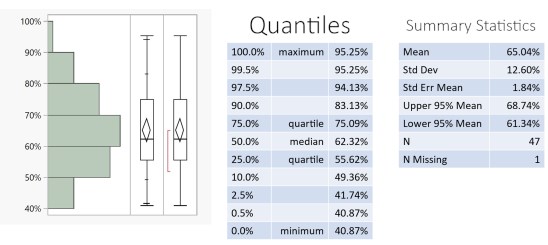
Source: WPS Analytical Results 2023
Initial bottle roll test indicates nominal VLT acid consumption averaging 15 lb./ton of feed material.
10.2 MacArthur Metallurgical Testing
The MacArthur copper mineralization has an extensive metallurgical testing history spanning numerous operators over multiple decades:
-
Anaconda (1976): bottle roll and column testing on surface trench material
-
Arimetco (1992-1995): various bottle and column leach tests using multiple external labs on surface samples
-
Quaterra (2010-2011): bottle roll and column analysis performed at METCON Research in Arizona
-
Lion CG (2020-2023): recent column testing programs on drill core at McClelland Laboratories in Nevada
10.2.1 2011 METCON Metallurgical Test Work: MacArthur
METCON's 2011 test work on MacArthur used drill core samples spanning deposit zones rather than analog surface trenches as in prior eras. Material representing 32 holes was composited into column test charges. Results showed good copper extraction but variable acid consumption between areas.
One composite failed mid-test due to high localized clay content, originally presumed to be caliche. However, a review found the core intercepted a fault zone rather than caliche. This clay occurrence appears restricted with minimal dissemination regionally.
Excluding the failed column, 31 working columns provide a performance baseline. Generally, the old MacArthur pit domains had higher median recoveries around 80% and lower acid consumptions than North Ridge or Gallagher. Table 10-6 summarizes pertinent column feed data including deposit location, source hole ID, test intervals, and critical output metrics for each specimen. The following figures present statistics for the global column dataset.
|
P a g e | 10-11 |
| 03/21/2025 |
| Yerington Copper Project S-K 1300 Report Yerington, Nevada |
|
Table 10-6: METCON Testwork Column Test Summary Table
|
Column |
Deposit |
DHID |
From |
To |
Leach |
Copper Grades |
|
Gangue Acid |
||||
|
TCu |
ASCu |
CNCu |
Residual |
Cu |
(kg/tonne) |
(lb./ton) |
||||||
|
CL-01 |
Gallagher |
PQ-11-QM-139 |
80 |
140 |
120 |
0.166 |
0.07 |
0.016 |
0.092 |
51.21 |
46.32 |
92.64 |
|
CL-02 |
Gallagher |
PQ-11-QM-106 |
0 |
30 |
120 |
0.335 |
0.208 |
0.015 |
0.096 |
72.69 |
56.64 |
113.28 |
|
CL-03 |
Gallagher |
PQ-11-QM-90 Part 1 |
0 |
70 |
120 |
0.125 |
0.037 |
0.005 |
0.078 |
41.97 |
43.22 |
86.44 |
|
CL-04 |
Gallagher |
PQ-11-QM-90 Part 2 |
80 |
130 |
120 |
0.363 |
0.108 |
0.203 |
0.051 |
56.43 |
22.78 |
45.56 |
|
CL-05 |
Gallagher |
PQ-11-QM-038 |
35 |
175 |
120 |
0.122 |
0.049 |
0.032 |
0.050 |
48.66 |
35.63 |
71.26 |
|
CL-06 |
Gallagher |
PQ-11-QM-035 |
15 |
90 |
120 |
0.168 |
0.054 |
0.01 |
0.095 |
48.01 |
34.38 |
68.76 |
|
CL-07 |
Gallagher |
PQ-11-QM-037 |
15 |
70 |
120 |
0.220 |
0.068 |
0.007 |
0.110 |
52.26 |
34.88 |
69.76 |
|
CL-08 |
Other |
PQ-11-QM-144 |
115 |
225 |
120 |
0.144 |
0.049 |
0.023 |
0.053 |
56.21 |
28.13 |
56.26 |
|
CL-09 |
MacArthur Pit Area |
PQ-11-QM-145 |
0 |
50 |
120 |
0.113 |
0.062 |
0.005 |
0.041 |
58.73 |
17.76 |
35.52 |
|
CL-10 |
MacArthur Pit Area |
PQ-11-QM-119 |
30 |
80 |
0 |
0.145 |
0.092 |
0.008 |
0.041 |
|
|
|
|
CL-11 |
MacArthur Pit Area |
PQ-11-QMT-1 |
0 |
145 |
120 |
0.311 |
0.183 |
0.007 |
0.064 |
59.08 |
20.80 |
41.60 |
|
CL-12 |
MacArthur Pit Area |
PQ-11-QME-3 |
72.5 |
118 |
120 |
0.145 |
0.084 |
0.004 |
0.057 |
61.97 |
19.74 |
39.48 |
|
CL-13 |
MacArthur Pit Area |
PQ-11-QMT-9 |
13 |
91.1 |
120 |
0.575 |
0.453 |
0.012 |
0.046 |
80.86 |
22.01 |
44.02 |
|
CL-14 |
MacArthur Pit Area |
PQ-11-QM-083 |
100 |
170 |
120 |
0.170 |
0.105 |
0.008 |
0.045 |
69.57 |
24.75 |
49.50 |
|
CL-15 |
MacArthur Pit Area |
PQ-11-QMT-14 Part 1 |
5 |
17 |
120 |
0.207 |
0.14 |
0.004 |
0.035 |
87.15 |
14.38 |
28.76 |
|
CL-16 |
MacArthur Pit Area |
PQ-11-QMT-14 Part 2 |
36.2 |
118 |
120 |
0.376 |
0.32 |
0.012 |
0.052 |
87.16 |
25.15 |
50.30 |
|
CL-17 |
MacArthur Pit Area |
PQ-11-QMT-15 Part 1 |
12.5 |
118 |
120 |
0.271 |
0.207 |
0.005 |
0.049 |
84.44 |
27.40 |
54.80 |
|
CL-18 |
MacArthur Pit Area |
PQ-11-QMT-15 Part 2 |
118 |
180 |
120 |
0.089 |
0.068 |
0.003 |
0.023 |
80.29 |
20.70 |
41.40 |
|
CL-19 |
MacArthur Pit Area |
PQ-11-QMT-17 Part 1 |
52 |
94.7 |
120 |
0.093 |
0.03 |
0.007 |
0.056 |
47.56 |
32.30 |
64.60 |
|
CL-20 |
MacArthur Pit Area |
PQ-11-QMT-17 Part 2 |
99 |
154 |
120 |
0.264 |
0.19 |
0.008 |
0.020 |
79.90 |
31.31 |
62.62 |
|
CL-21 |
North MacArthur Pit |
PQ-11-QM-095 |
95 |
140 |
120 |
0.105 |
0.05 |
0.026 |
0.041 |
69.02 |
34.92 |
69.84 |
|
CL-22 |
North MacArthur Pit |
PQ-11-QMT-6 |
33 |
128 |
120 |
0.154 |
0.049 |
0.100 |
0.099 |
44.28 |
26.54 |
53.08 |
|
CL-23 |
North MacArthur Pit |
PQ-11-QM-020 |
40 |
180 |
120 |
0.092 |
0.044 |
0.006 |
0.052 |
61.38 |
27.49 |
54.98 |
|
P a g e | 10-13 |
| 03/21/2025 |
| Yerington Copper Project S-K 1300 Report Yerington, Nevada |
|
|
Column |
Deposit |
DHID |
From |
To |
Leach |
Copper Grades |
|
Gangue Acid |
||||
|
TCu |
ASCu |
CNCu |
Residual |
Cu |
(kg/tonne) |
(lb./ton) |
||||||
|
CL-24 |
North MacArthur Pit |
PQ-11-QM-029 |
10 |
70 |
120 |
0.271 |
0.128 |
0.012 |
0.146 |
60.99 |
48.42 |
96.84 |
|
CL-25 |
North |
PQ-11-QMCC-1 Part 1 |
71.5 |
119 |
120 |
0.126 |
0.047 |
0.009 |
0.073 |
51.81 |
17.34 |
34.68 |
|
CL-26 |
North |
PQ-11-QMCC-1 Part 2 |
119 |
149 |
120 |
0.135 |
0.069 |
0.022 |
0.041 |
55.53 |
19.20 |
38.40 |
|
CL-27 |
North |
PQ-11-QMCC-11 |
94 |
194 |
120 |
0.146 |
0.087 |
0.012 |
0.051 |
57.12 |
22.80 |
45.60 |
|
CL-28 |
North |
PQ-11-QMCC-13 Part 1 |
7 |
62 |
120 |
0.186 |
0.113 |
0.011 |
0.066 |
62.53 |
22.01 |
44.02 |
|
CL-29 |
North |
PQ-11-QMCC-13 Part 2 |
63 |
114 |
120 |
0.142 |
0.029 |
0.002 |
0.085 |
49.31 |
23.64 |
47.28 |
|
CL-30 |
North |
PQ-11-QM-080 |
0 |
100 |
120 |
0.33 |
0.182 |
0.011 |
0.136 |
50.56 |
23.76 |
47.52 |
|
CL-31 |
North |
PQ-11-QMCC-14 |
21 |
88 |
120 |
0.06 |
0.017 |
0.006 |
0.031 |
30.89 |
22.41 |
44.82 |
|
CL-32 |
North |
PQ-11-QM-055 |
0 |
90 |
120 |
0.067 |
0.027 |
0.005 |
0.047 |
50.51 |
45.60 |
91.20 |
|
P a g e | 10-14 |
| 03/21/2025 |
| Yerington Copper Project S-K 1300 Report Yerington, Nevada |
|
Figure 10-13 shows calculated total copper head grade statistics for the 31 successful METCON columns. Copper calculated heads ranged from 8.6% TCu to 64.0%., with median calculated head grade of 15.5% TCu and a comparable mean of 19.1%.
Highlighted histogram regions indicate columns having less than 60% copper recovery. The leftmost bar chart displays potential outliers, while the rightmost shows grade distribution quintiles.
Initial review suggests recovery shortfalls in lower grade ranges, indicating opportunities for optimization. However, testing is needed to refine performance by geo-domain using fresh drill core intersects. Note that the two bar charts below represent the "Outlier" and "Quantile," from left to right.
Figure 10-13: 2011 MacArthur Project Column Test Series: Global Calculated Head Cu (%)
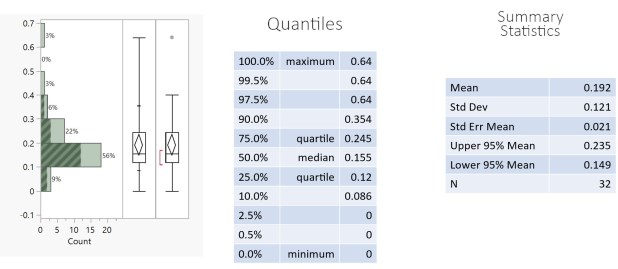
Source: METCON Research: MacArthur Project Preliminary Column Leach Study, Dec. 2011
Figure 10-14 presents copper recovery statistics for the 31 METCON columns using calculated head grades. Recoveries ranged from 30.9% to 87.2%, averaging 57.1% overall with a comparable median of 60.2%.
The chart also graphs recovery versus the ASCu+CNCu to TCu ratio. This shows strong correlation to copper extraction by acid leaching.
Review of sequential copper analysis indicates transition zones and fresh sulfide bearing material returned lower extractions. As expected, composites higher in acid soluble copper and secondary copper minerals achieved higher and faster copper extraction.
Samples from the old MacArthur pit had the best median recovery at 80%, reflecting a higher proportion of soluble mineralization. Geo-domain performance aligns with the oxidation and enrichment profile.
|
P a g e | 10-15 |
| 03/21/2025 |
| Yerington Copper Project S-K 1300 Report Yerington, Nevada |
|
Figure 10-14: MacArthur Project METCON Column Test KPIs by Deposit with Sequential Copper Analyses
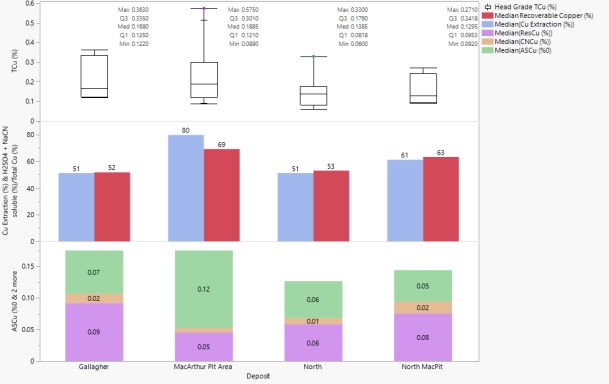
Source: METCON Research: MacArthur Project Preliminary Column Leach Study, Dec. 2011
Figure 10-15 shows overall copper extraction statistics across the 31 METCON columns. Highlighted regions indicate tests returning less than 60% recovery. After 120 days of leaching, copper extractions ranged from 30.9% to 87.2%, with median and average values of 57.1% and 57.2%, respectively.
It is important to note these results reflect a simplified acid-only leach scheme on composite samples. The presence of primary and secondary copper minerals clearly impacted extraction.
|
P a g e | 10-16 |
| 03/21/2025 |
| Yerington Copper Project S-K 1300 Report Yerington, Nevada |
|
Figure 10-15: MacArthur Project Column Test Series Copper Extraction Summary Statistics.
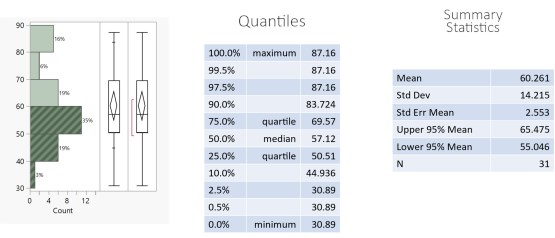
Source: METCON Research: MacArthur Project Preliminary Column Leach Study, Dec. 2011
Figure 10-16 displays copper leach rate profiles over time for the 2011 METCON column tests. Recoveries use calculated head grades as bases. Significantly, most columns still showed measurable copper extraction at the end of the 120-day primary leach cycle.
While PLS grades may not economically justify extended leaching in a single lift, results suggest high probability of additional recovery through secondary leach cycles in a multi-lift heap configuration. Adjusting lixiviant application rates can also improve PLS quality and moderate acid consumption during initial and future lifts.
Figure 10-16: 2011 MacArthur Project METCON Column Test Leach Rate Profiles
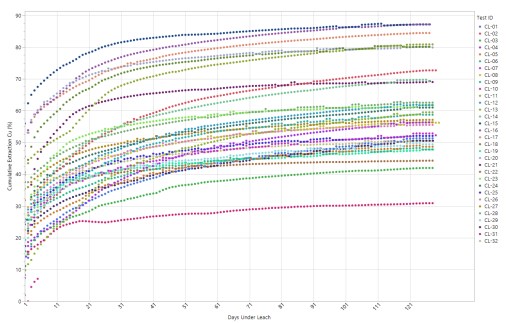
Source: METCON Research: MacArthur Project Preliminary Column Leach Study, Dec. 2011
|
P a g e | 10-17 |
| 03/21/2025 |
| Yerington Copper Project S-K 1300 Report Yerington, Nevada |
|
Figure 10-17 summarizes acid consumption statistics across the 31 METCON columns. Total consumption ranged from 14.8 to 56.6 kg/tonne acid per tonne of feed. The median acid demand equaled 25.5 kg/tonne, with a comparable average of 28.8 kg/tonne.
Notably, acid cure additions represented approximately 50% of overall acid volumes. This dosage suggests opportunities to optimize initial cure conditions for reduced reagent costs.
Figure 10-17: 2011 MacArthur Project Column Test Series: Global Gangue Acid Consumption
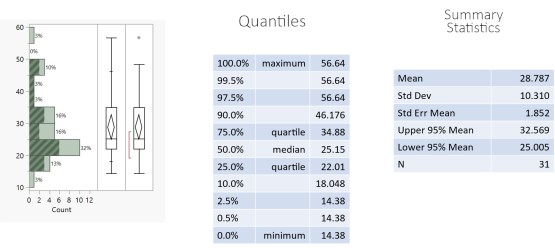
Source: METCON Research: MacArthur Project Preliminary Column Leach Study, Dec. 2011
10.2.2 McClelland Laboratories Test Work: MacArthur 2022
METCON's column test composites were based on deposit zones rather than rock types, as detailed geo-metallurgical data was unavailable. Discussion here focuses on critical leach performance factors for process design.
In 2022, McClelland Laboratories received core from 13 MacArthur holes to generate 6 column composites. Unfortunately, grade continuity challenges prevented preparing distinct 2 columns, so a combined composite column of those two was prepared.
This test work assumed standalone heap leach operations on ROM material at MacArthur. Crushing aimed to replicate a nominal 150 mm top size for average ROM conditions.
Results are summarized in Table 10-7 on the 6 columns. Leach cycles ranged from 139-164 days duration. Calculated head grades spanned 0.133-0.331% TCu. Final copper extractions varied from 51.1% to 75.8%, with total net acid consumptions of 40.6 lb./ton and 60.1 lb./ton (20.3-30.0 kg/tonne).
|
P a g e | 10-18 |
| 03/21/2025 |
| Yerington Copper Project S-K 1300 Report Yerington, Nevada |
|
Table 10-7: MLI 2022 MacArthur Project Column Test Pertinent KPI Summary Table.
|
MLI |
|
Leach/Rinse |
|
Assays % Cu |
H2SO4 Consumption |
|||||
|
Test |
Composite |
Time, Days |
Cu |
Extracted |
Tail |
Calc'd. Head |
Avg. Head |
Gross, |
Net, |
Specific lb./lb. Cu |
|
CL-1 |
0 |
139 |
68.5 |
0.148 |
0.068 |
0.216 |
0.210 |
41.22 |
36.66 |
12.39 |
|
CL-2 |
1 |
164 |
75.8 |
0.251 |
0.080 |
0.331 |
0.335 |
60.11 |
52.37 |
10.42 |
|
CL-3 |
2/3 |
139 |
51.1 |
0.068 |
0.065 |
0.133 |
0.131 |
41.72 |
39.64 |
29.32 |
|
CL-4 |
4 |
164 |
48.4 |
0.093 |
0.099 |
0.192 |
0.193 |
40.06 |
37.21 |
20.10 |
|
CL-5 |
5 |
164 |
66.1 |
0.111 |
0.057 |
0.168 |
0.174 |
43.22 |
39.81 |
17.99 |
Source: Data from McClelland Laboratories: Column Leach Testing-MacArthur Project Drill Core Composites: August 31, 2023
Figure 10-18 displays MLI column leach rate curves over time. Copper continued extracting upon test conclusion, indicating additional recovery potential. Lower relative extractions for CL-3 and CL-5 columns likely reflect higher proportions of transitional copper minerals.
As with prior datasets, results show copper recovery continuing beyond 120 days. This suggests an opportunity to enhance recovery through secondary leaching cycles.
Figure 10-18: MLI MacArthur Project 2022 Column Test Leach Rate Profiles
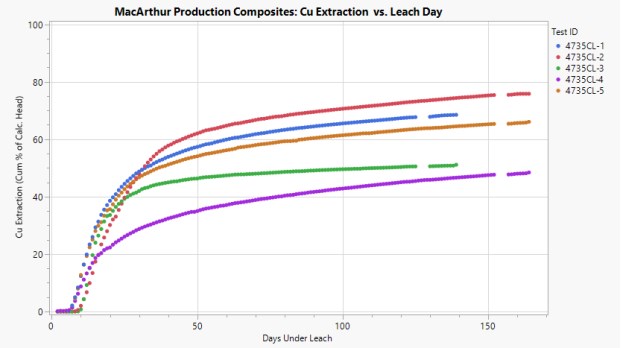
Source: McClelland Laboratories: Column Leach Testing - MacArthur Drill Core Composites: August 31, 2023
10.3 Historical Heap Leach Production
Considerable metallurgical work has focused on heap leaching at Yerington and MacArthur since the late 1970s. Yerington processing history includes flotation, vat leaching, cementation, and ROM heap leaching of oxides. However, detailed operational data from past heap operations is unavailable.
|
P a g e | 10-19 |
| 03/21/2025 |
| Yerington Copper Project S-K 1300 Report Yerington, Nevada |
|
Reviewing summaries, heap leaching at Yerington restarted in 1989 on ROM "Slot Ore" previously mined from the pit, containing notable secondary/transitional minerals. This was supplemented by VLTs in 1993 and MacArthur oxide feed material in 1994.
Approximately 51 million tons grading 0.18% TCu were stacked, carrying 182.85 million lbs Cu. Copper recovery equaled 52.2%, with 94.41 million lbs sold over the campaign. The projected leach curve is shown in Figure 10-19. Shorter 60-day primary cycles and high solution rates reflected simpler ROM practices resulting in lower PLS grades and higher acid consumption versus current industry standards.
The ongoing slope in Figure 10-19 indicates potential for ultimate recovery approaching 55% with extended leaching, reasonable given the mineralization blend. Modern geo-metallurgical methods now allow targeting zones matching historical analog performance.
Figure 10-19: Arimetco Yerington Heap Leach Recovery Profile
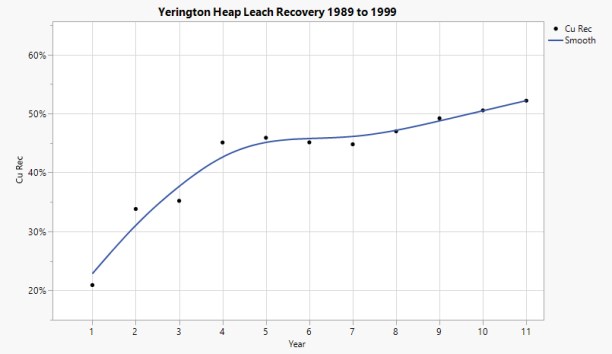
Source: Arimetco Production 1999
10.4 Recovery Estimates - All Areas
Table 10-8 outlines preliminary estimated metallurgical recoveries for the Yerington Project mineralization types. These projections remain subject to revisions as additional representative data becomes available.
|
P a g e | 10-20 |
| 03/21/2025 |
| Yerington Copper Project S-K 1300 Report Yerington, Nevada |
|
Of note are the early-stage recovery estimates for Nuton processing of the primary sulfide material. As testing continues, further improvements are expected once optimal process parameters are refined through the ongoing optimization program.
Table 10-8: Yerington - MacArthur Recovery Projections by Processing Method
|
Deposit |
Feed Type |
Crush |
TCu |
Notes: |
|
MacArthur |
Oxide |
ROM |
70% |
ROM |
|
6-inch |
75% |
Primary Crushed and Conveyor Stacked |
||
|
2-inch |
77% |
Secondary Crushed Agglomerated Conveyor Stacked |
||
|
0.5 inch |
82% |
Tertiary Crushed Agglomerated Conveyor Stacked |
||
|
Transition |
ROM |
50% |
ROM |
|
|
6-inch |
55% |
Primary Crushed and Conveyor Stacked |
||
|
2-inch |
57% |
Secondary Crushed Agglomerated Conveyor Stacked |
||
|
0.5 inch |
60% |
Tertiary Crushed Agglomerated Conveyor Stacked |
||
|
Sulfide |
ROM |
25% |
ROM |
|
|
6-inch |
30% |
Primary Crushed and Conveyor Stacked |
||
|
2-inch |
35% |
Secondary Crushed Agglomerated Conveyor Stacked |
||
|
0.5-inch |
40% |
Tertiary Crushed Agglomerated Conveyor Stacked |
||
|
Sulfide BioHeap |
0.5-inch |
74% |
Tertiary Crushed Agglomerated Conveyor Stacked: Nuton Process (to be confirmed) |
|
|
Yerington |
Oxide |
ROM |
70% |
ROM |
|
6-inch |
75% |
Primary Crushed and Conveyor Stacked |
||
|
2-inch |
77% |
Secondary Crushed Agglomerated Conveyor Stacked |
||
|
0.5 inch |
80% |
Tertiary Crushed Agglomerated Conveyor Stacked |
||
|
Transition |
ROM |
50% |
ROM |
|
|
6-inch |
55% |
Primary Crushed and Conveyor Stacked |
||
|
2-inch |
57% |
Secondary Crushed Agglomerated Conveyor Stacked |
||
|
0.5 inch |
60% |
Tertiary Crushed Agglomerated Conveyor Stacked |
||
|
Sulfide |
ROM |
25% |
ROM |
|
|
6-inch |
30% |
Primary Crushed and Conveyor Stacked |
||
|
2-inch |
35% |
Secondary Crushed Agglomerated Conveyor Stacked |
||
|
0.5 inch |
40% |
Tertiary Crushed Agglomerated Conveyor Stacked |
||
|
Sulfide BioHeap |
0.5-inch |
74% |
Tertiary Crushed Agglomerated Conveyor Stacked: Nuton Process |
|
|
Residual: VLT |
As Received |
65% |
Leach Pad Over Liner: and Oxide Heap Leach |
|
|
Residual W-3 |
ROM |
68% |
ROM Oxide Heap Leach |
10.5 Deleterious Elements
Preliminary assessments have not identified any deleterious elements present in the Yerington or MacArthur mineralization expected to materially impact copper cathode quality or marketability. Produced cathode should readily meet LME Grade A standards for purity.
|
P a g e | 10-21 |
| 03/21/2025 |
| Yerington Copper Project S-K 1300 Report Yerington, Nevada |
|
10.6 Conclusions
Preliminary indications are that Yerington sulfide and oxide materials are well-suited to heap leaching, which can be optimized for higher copper recovery at lower consumable costs through continued testing.
Portions of the MacArthur North and Gallagher "oxide" zones contain 20-30% transitional copper minerals which led to comparatively reduced empirical recovery historically. However, dynamic solution management coupled with introduction of ferric lixiviant from the Nuton process may be able to effectively treat blended materials.
10.7 Qualified Person's Opinion on Data Adequacy
The historical and current testwork completed to date is of sufficient quality to support a mineral resource estimate. Additional support for confidence category upgrades from the perspective of metallurgical modifying factors will require supporting testwork to address geometallurgy and variability across the deposit.
|
P a g e | 10-22 |
| 03/21/2025 |
| Yerington Copper Project S-K 1300 Report Yerington, Nevada |
|
11 Mineral Resource Estimates
11.1 Yerington Deposit
11.1.1 Database
The mineral resource estimate for the is based on drill hole data consisting of total copper (TCu) assays, geological descriptions, recovery, and density measurements.
Limited assays were available for acid-soluble copper (ASCu) from both Anaconda and Lion CG. Ferric sulfate copper (QLT) assays were available from Lion CG drilling. These datasets provided incomplete coverage so were not used in the current mineral resource.
Data was provided to AGP by Lion CG in electronic formats-Microsoft Excel and DXF files-and imported into MinePlan. The database was additionally verified using the validation tool in MinePlan to determine errors and overlapping or out-of-sequence intervals. Minor errors were noted, and the database updated.
The drill hole database received from Lion CG consisted of 1,683 drill holes totalling 570,861 ft of drilling. However, not all datasets (i.e., surveys, assays, lithology, or recovery) were available for the historic holes, therefore, only a total of 840 drill hole collars totalling 336,701.1 ft (246,848.6 ft core and 89,852.5 ft reverse circulation/rotary drilling) were used in this mineral resource estimate. Although historic data include material some of which has been mined, inclusion of that data was useful in establishing statistical parameters for grade interpolation into unmined blocks.
11.1.2 Geological Domains
Lithology, as recovered from Anaconda archives or logged by Lion CG geologists, is included in the database. When lithology was not available, intervals were recorded as "UNK" or unknown.
The issue of metallurgical recovery is more a function of the mineralogical species of copper. With this is mind, the Lion CG geologists, incorporating their data and data from the Anaconda archives, interpreted two mineral zones, representing oxide and sulfide mineralization for grade interpolation. A third zone, alluvium, was modelled to represent the overburden material.
Figure 11-1 illustrates the domains defined: alluvium (20), oxide (30) and sulfide (40). No material differences were noted in the average grade of the copper mineralization contained with the oxide or sulfide domains. Grades were not interpolated for alluvium.
As historic data are a component of the database, with potential uncertainty arising from logging, assay and survey errors, there is a potential uncertainty associated with the redox surfaces. Any future mineral processing could be affected by misclassification of oxide or sulfide and their treatment.
|
P a g e | 11-1 |
| 03/21/2025 |
| Yerington Copper Project S-K 1300 Report Yerington, Nevada |
|
Figure 11-1: Average Grade by Domain (TCu%)
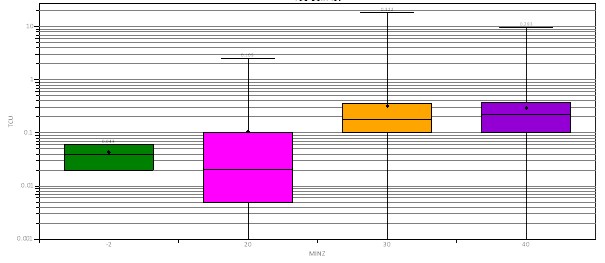
Source: AGP 2023
Contact Analysis
Contact grade analysis was conducted for oxide and sulfide assays (Figure 11-2). The average grade of each of the domains is similar and would support a soft contact. However, the oxide domain contained some TCu% higher grades and different mineralogy, so a hard boundary was used to control extrapolation of these higher grades.
Figure 11-2: Contact Grade Analysis (TCu%)
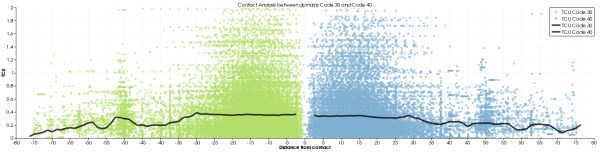
Source: AGP 2023
11.1.3 Exploratory Data Analysis
Assays
Exploratory data analysis (EDA) was conducted based on the oxidation state of the mineralization: oxide (Code=30) and sulfide (Code=40).
Core recovery was used as a factor to evaluate the assays. If the recovery was greater than 40%, the assay was flagged (added 1 to domain code). Approximately 15% of the assays reported a core recovery of 40% or less. Figure 11-3 illustrates the differences between assays with recovery less than 40% (30 or 40) versus those with recovery greater than 40% (31 or 41).
|
P a g e | 11-2 |
| 03/21/2025 |
| Yerington Copper Project S-K 1300 Report Yerington, Nevada |
|
Figure 11-3: Boxplot of Assays Reported by Recovery (TCu%)
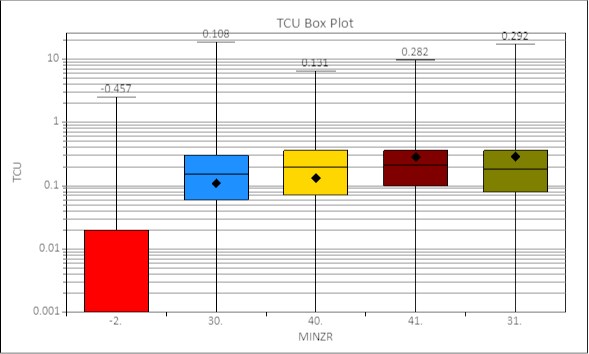
Source: AGP 2023
Outlier Analysis
TCu% grades were reviewed for capping using probability plots (Figure 11-4) and disintegration analysis. The log probability shows a linear trend for the final highest grades, without any observable "break." This, along with low coefficient of variation (CV) supports using uncapped grades for grade interpolation.
|
P a g e | 11-3 |
| 03/21/2025 |
| Yerington Copper Project S-K 1300 Report Yerington, Nevada |
|
Figure 11-4: Probability Plots by Domain (TCu%)
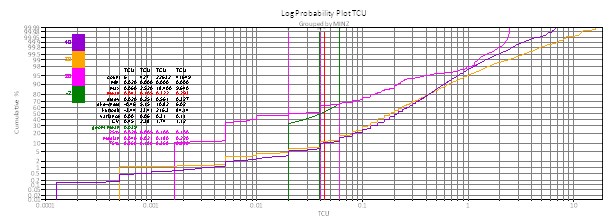
Source: AGP 2023
Compositing
For purposes of normalizing the assay data for further analysis, the raw assay values were composited to 25 ft intervals within the mineralized domains oxide and sulfide. Composite values were then tagged by domain codes. Table 11-1 summarizes the descriptive statistics for the 25 ft composites. Samples were coded based on core recovery to minimize potential bias. Only composites with >=40% core recovery were used for grade estimation.
Table 11-1: Composite Statistics Table (TCu%)
|
|
Core Recovery |
Domain |
Count |
Minimum |
Maximum |
Mean |
StDev |
CV |
|
Oxide |
<40% |
30 |
646 |
0 |
5.968 |
0.366 |
0.535 |
1.46 |
|
>= 40% |
31 |
3449 |
0 |
7.624 |
0.317 |
0.402 |
1.27 |
|
|
Sulfide |
<40% |
40 |
747 |
0 |
2.762 |
0.384 |
0.326 |
0.85 |
|
>= 40% |
41 |
6204 |
0 |
5.722 |
0.299 |
0.254 |
0.85 |
Notes: StDev = Standard Deviation; CV = Coefficient of Variation
No capping was applied as the coefficient of variation (CV) is within an acceptable range to confirm no material outliers were present in the grade population.
Spatial Analysis
The approach used to develop the variogram models employed Sage2001© software. Directional sample correlograms were calculated along horizontal azimuths of 0, 30, 60, 120, 150, 180, 210, 240, 270, 300, and 330 degrees. For each azimuth, sample correlograms were also calculated at dips of 30 and 60 degrees in addition to horizontally. Lastly, a correlogram was calculated in the vertical direction. Using the thirty-seven sample correlograms, an algorithm determined the best-fit model nugget effect and two-nested structure variance contributions. After fitting the variance parameters, the algorithm then fitted an ellipsoid to the thirty-seven ranges from the directional models for each structure. The anisotropy of the correlation was given by the range along the major, semi-major, and minor axes of the ellipsoids and the orientations of these axes for each structure. AGP reviewed the fitted variogram and adjusted to reflect the mineralization.
|
P a g e | 11-4 |
| 03/21/2025 |
| Yerington Copper Project S-K 1300 Report Yerington, Nevada |
|
Table 11-2 presents the variogram parameters used for ordinary kriging.
Table 11-2: Variogram Parameters
|
Domain |
Structure |
Sill = 1.00 |
LH Rot Z |
RH Rot X |
RH Rot Y |
X Range |
Y Range |
X Range |
|
Oxide (30) |
Nugget |
C0 = 0.20 |
-53 |
55 |
-40 |
70 |
90 |
50 |
|
Spherical |
C1 = 0.40 |
-53 |
55 |
-40 |
70 |
90 |
50 |
|
|
Spherical |
C2 = 0.40 |
15 |
-5 |
-1 |
600 |
400 |
400 |
|
|
Sulfide (40) |
Nugget |
C0 = 0.10 |
-89 |
15 |
30 |
70 |
75 |
150 |
|
Spherical |
C1 = 0.40 |
-89 |
15 |
30 |
70 |
75 |
150 |
|
|
Spherical |
C2 = 0.50 |
25 |
5 |
-80 |
600 |
400 |
600 |
Note: GSLIB Rotation Convention
11.1.4 Bulk Density
Twenty-three density tests were completed in November 2011, by Kappes, Cassiday & Associates, based in Reno, Nevada, on samples from the current Lion CG drilling, resulting in an average tonnage factor of 12.62 cubic feet per short ton (cu.ft./ton) for oxide material and 12.61 for sulfide. A final value 12.6 cu.ft./ton was used for the resource model and compares well to the 12.5 cu.ft./ton historically used by Anaconda.
11.1.5 Block Model and Resource Estimation
Model Framework
Block model parameters were defined to best reflect both the drill spacing and geometry of the deposit, and selective mining unit (SMU). Table 11-3 shows the block model parameters.
Table 11-3: Yerington Model Parameters
|
Model Parameters |
X (Columns) |
Y (Rows) |
Z (Levels) |
|
Origin (feet): |
2,446,400 |
14,669,000 |
2,900 |
|
Block size (feet) |
25 |
25 |
25 |
|
Number of Blocks |
360 |
320 |
100 |
|
Rotation |
No rotation |
||
Topography
NewFields provided 5 ft contours and 3D faces for the topography in Nevada State Plane NAD83 coordinates (Figure 11-5) based on a LiDAR survey conducted by Olympus Aerial Surveys, Inc. in 2023.
|
P a g e | 11-5 |
| 03/21/2025 |
| Yerington Copper Project S-K 1300 Report Yerington, Nevada |
|
Figure 11-5: Yerington Copper Project Planview 5 ft Contours
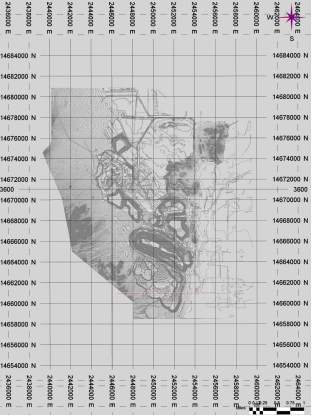
Source: AGP 2023
Wireframes
Surfaces were provided by Lion CG for the alluvium (20), oxide (30) and sulfide (40) contacts. The surfaces were reviewed and confirmed by AGP. The block model rock type model was coded based on these surfaces as shown in the example Section 2451250E (Figure 11-6).
|
P a g e | 11-6 |
| 03/21/2025 |
| Yerington Copper Project S-K 1300 Report Yerington, Nevada |
|
Figure 11-6: Rock Type Section 2451250 E (Looking North ±100 ft)
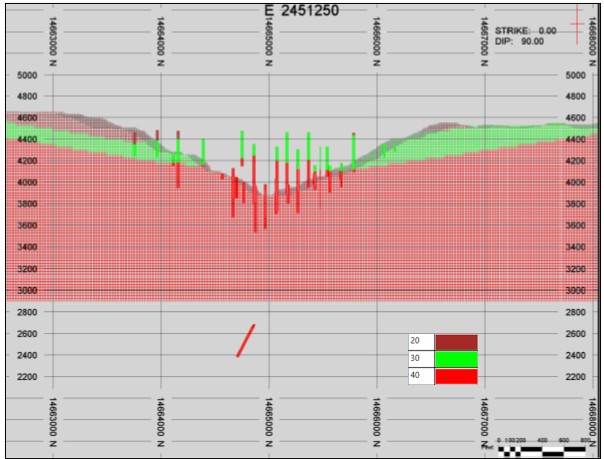
Source: AGP 2023
Note: Brown=Alluvium (20), Green=Oxide (30), Red=Sulfide (40)
Grade Interpolation
Three methods of grade interpolation were used to estimate uncapped total copper (TCu%):
-
Nearest Neighbor (NN)
-
Inverse Distance interpolation to the second power (ID2)
-
Ordinary Kriging (OK)
The block models were interpolated in two passes using 25 ft composites.
Table 11-4 summarizes the sample selection controls used with the various interpolation methods.
The software used for the mineral resource estimate was Leica Geosystems HxGN MinePlan 3D 15.80-7 (build 83317-118) (MinePlan).
|
P a g e | 11-7 |
| 03/21/2025 |
| Yerington Copper Project S-K 1300 Report Yerington, Nevada |
|
Table 11-4: Summary of Sample Selection
|
|
Minimum No. |
Maximum |
Maximum No. of |
|
NN |
1 |
1 |
1 |
|
ID2 |
5 |
8 |
2 |
|
OK |
5 |
8 |
2 |
Search Ellipses
Table 11-5 summarizes the search ellipse parameters. These parameters were based on the geological interpretation and spatial analysis. The same search ellipses were used for NN, ID2, and OK grade interpolation. Figure 11-7 shows the orientation of the Pass 1 search ellipse.
Table 11-5: Search Ellipse Specifications
|
Pass |
Search |
Rotation |
Rotation |
Rotation |
X Range |
Y Range |
Z Range |
|
1 |
ZXY-LRR |
300 |
0 |
0 |
400 |
200 |
200 |
|
2 |
ZXY-LRR |
300 |
0 |
0 |
100 |
75 |
75 |
Figure 11-7: Pass 1 Search Ellipse
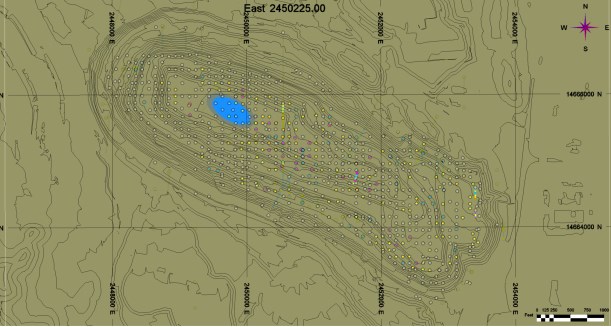
Source: AGP 2023
Special Model Attributes
Additional models were used to capture interpolation statistics to assist with the evaluation of confidence (Table 11-6).
|
P a g e | 11-8 |
| 03/21/2025 |
| Yerington Copper Project S-K 1300 Report Yerington, Nevada |
|
Table 11-6: Special Models
|
Parameter |
NN |
OK |
|
Local Error |
|
KE0, KE1 |
|
Distance to Nearest Sample |
DSTN0, DSTN1 |
DSTK0, DSTK1 |
|
Number of Samples Used |
|
NCMP0, NCMP1 |
|
Kriging Variance |
|
KV0, KV1 |
|
Number of Sectors Used |
|
NSEC0, NSEC1 |
|
Number of Drillholes Used |
|
NDDH0, NDDH1 |
|
Average Distance to Samples Used |
|
DSAV0, DSAV1 |
|
Pass Number |
|
PASS0, PASS1 |
Source: AGP 2023
11.1.6 Model Verification and Validation
Visual Verification
The block model was validated by visually inspecting the block model TCu% grade estimation in section and plan compared with the drill hole composite grade.
Figure 11-8 is a plan view comparing block model grades with composite grades. Figure 11-9 is a North-South section comparing the block model and composite grades. The grades of the blocks agreed well with the composite data used in the interpolation.
|
P a g e | 11-9 |
| 03/21/2025 |
| Yerington Copper Project S-K 1300 Report Yerington, Nevada |
|
Figure 11-8: TCu% - 3800 ft Plan (±12.5 ft)
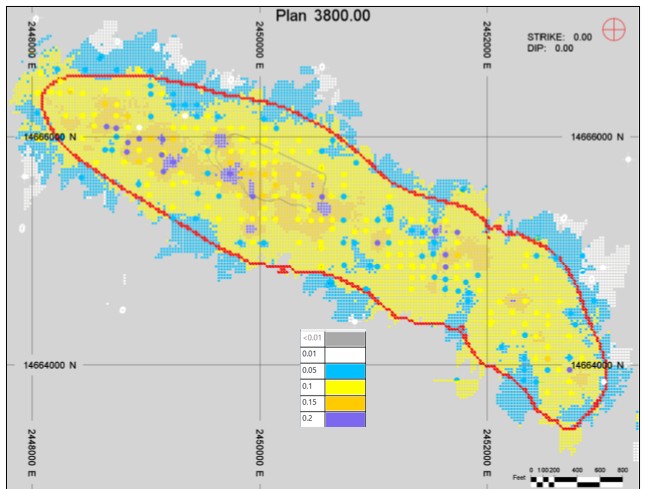
Source: AGP 2023
Note: Current topography: grey, 2023 Resource Pit:red
|
P a g e | 11-10 |
| 03/21/2025 |
| Yerington Copper Project S-K 1300 Report Yerington, Nevada |
|
Figure 11-9: TCu% -- Section 2450000 E (Looking West ±12.5 ft)
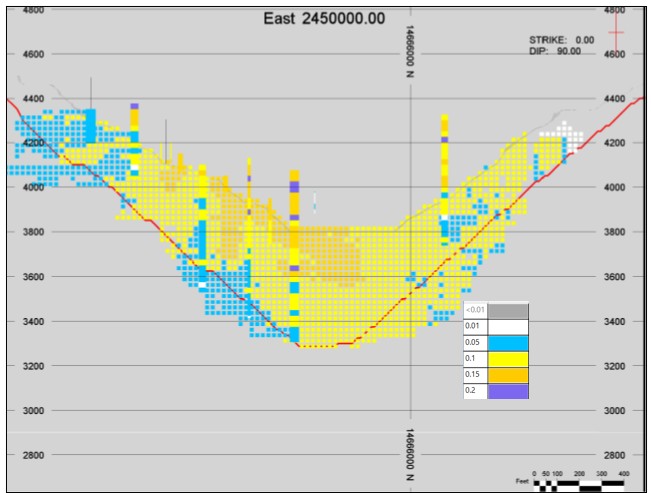
Source: AGP 2023
Note: Current topography: grey line, 2023 Resource Pit:red line
Statistical Validation
The block model statistics were reviewed, and no bias was found between the different interpolation methods and the 25 ft composites (Table 11-7). The composite versus interpolated grade appears to indicate an overestimation. However, the composite grades reflect mined out material about the current open pit surface.
Table 11-7: Comparison of Composite Grades by Interpolation Method
|
Rock Type |
25 ft Comp. |
NN Mean |
IDW-3 Mean |
OK Mean |
|
TCu% |
CUNN% |
CUID% |
TCUK1% |
|
|
Oxide (30) |
0.319 |
0.382 |
0.389 |
0.388 |
|
Sulfide (40) |
0.299 |
0.277 |
0.278 |
0.278 |
Similarly, the boxplot shown in Figure 11-10 visually confirms the grade agreement between the composites and kriged grade.
|
P a g e | 11-11 |
| 03/21/2025 |
| Yerington Copper Project S-K 1300 Report Yerington, Nevada |
|
Figure 11-10: Boxplot Comparison of 25 ft Composites with Kriged Grade (TCu%)
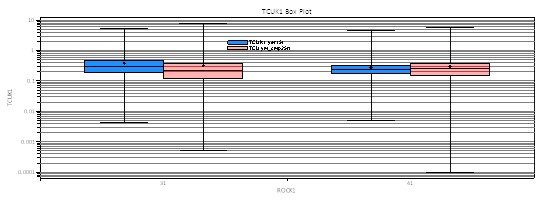
Source: AGP 2023
Swath Plots
A series of swath plots (grades accumulated by spatial coordinates) were generated to compare the composite grades with the NN, ID and OK interpolation methods. As shown in Figure 11-11, there appears to be agreement between the 25 ft composites and interpolated grades.
Figure 11-11: Swath Plots Comparing NN and OK Grades with 25 ft Composites
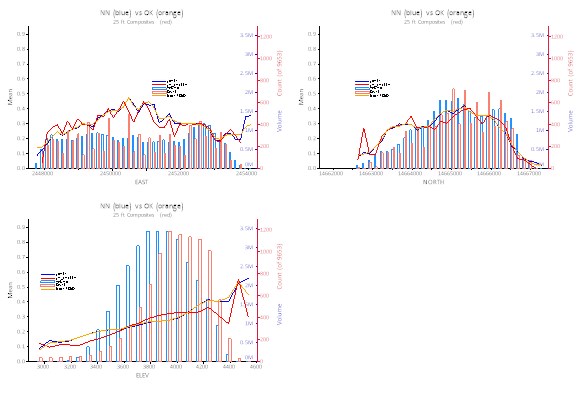
Source: AGP 2023
|
P a g e | 11-12 |
| 03/21/2025 |
| Yerington Copper Project S-K 1300 Report Yerington, Nevada |
|
11.1.7 Mineral Resource Estimate
Mineral Resource Classification
The mineral resource estimates were classified in accordance with the definitions in S-K 1300.
The mineral resource estimates were initially assigned based on data density in coordination with mineralization continuity. Mineral resource classification was then refined based on the statistics collected during interpolation, geologic continuity, and mining production. The nominal spacing for the measured mineral resource estimates, based on distance to nearest composite, was 100 ft. For the indicated mineral resource estimates, the spacing was 150 ft, and for inferred mineral resource estimates less than 350 ft. Grades beyond 350 ft were unclassified.
Grooming was conducted on the initial resource classification to remove isolated pockets of different resource classifications by upgrading or downgrading to the surrounding resource classification. Figure 11-12 shows the mineral resource classification at the bottom of the existing pit. The red outline is the conceptual resource pit shell used to constrain the mineral resource estimate.
Figure 11-12: Resource Classification - Plan 3800 ft Elevation
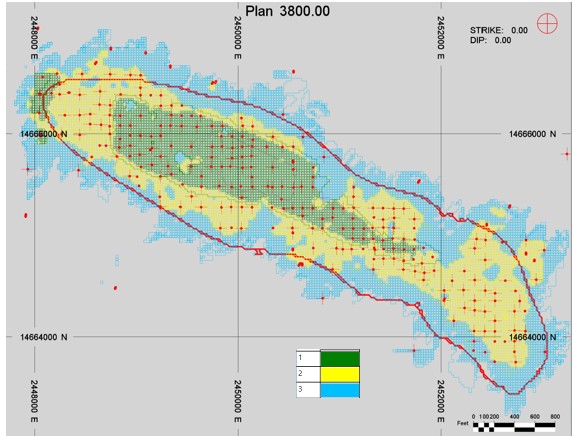
Source: AGP 2023
Note: 1=Measured, 2=Indicated, 3=Inferred
|
P a g e | 11-13 |
| 03/21/2025 |
| Yerington Copper Project S-K 1300 Report Yerington, Nevada |
|
Resource Classification Uncertainty
Following the statistical analysis in the preceding sub-section that classified mineral resource estimates into the confidence categories, uncertainties regarding sampling and drilling methods, geological modelling and estimation were incorporated into the classifications assigned. The areas with fewer uncertainties were classified as measured or indicated.
The area of greatest uncertainty assigned the inferred category. These are areas corresponding to areas with >150-foot drill spacing and generally along the margins of the deposit. Due to lack of drill density, there is a lower confidence in grade continuity. Additional drilling would resolve the uncertainty and contribute to upgrading the resource classification.
Additional uncertainty lies in the historical drill data incorporated in the resource model, arising from logging, assaying, and survey location uncertainty. Infill and/or twin hole drilling would reduce the potential errors arising from historical data. As multiple holes are used for grade interpolation and not single holes, that also reduces the potential uncertainty and allows for the classification of measured or indicated categories using historical data.
Cut-off Grade
A variable cut-off grade of 0.038% TCu for oxide material and 0.126% TCu for sulfide material was determined based on the assumptions listed in Table 11-8. Mineral resource estimates can be sensitive to the reporting cut-off grade.
The copper metal price of US$4.30/lb Cu was based on the historic three-year average price of US$3.75/lb Cu escalated by 15%. See Chapter 11.4.2 for additional details.
Table 11-8: Yerington Deposit Cut-off Grade Assumptions
|
Description |
Parameter |
|
Metal Price, US$/lb |
4.30 |
|
Net Price after Smelting, Refining, Transportation and Royalty, US$/lb |
4.08 |
|
Oxide Recovery |
70% |
|
Sulfide (Nuton) Recovery |
75% |
|
Oxide (ROM) Cut-off Grade, TCu% |
0.038 |
|
Transition Cut-off Grade, TCu% |
0.053 |
|
Sulfide (Nuton) Cut-off Grade, TCu% |
0.126 |
Source: AGP 2023
AGP generated a resource pit shell based on the economic parameters outlined in Table 11-8 and design parameters outlined in Table 11-9. Additional design details and economic parameters are provided in Chapter 11.4.1.
|
P a g e | 11-14 |
| 03/21/2025 |
| Yerington Copper Project S-K 1300 Report Yerington, Nevada |
|
Table 11-9: Yerington Deposit Pit Slope Assumptions
|
Description |
Parameter |
|
Overall pit slopes (°) |
40-45 |
|
Alluvium Pit Slope (°) |
40 |
|
Oxides with slumping in walls (°) |
40 |
|
Oxides with no slumping in walls (°) |
45 |
|
Sulfides (°) |
42 |
Mineral Resource Statement
Table 11-10 presents the mineral resources for the Yerington Deposit. The Yerington Deposit mineral resource estimate is current on December 31, 2024. AGP is responsible for Yerington Deposit mineral resource estimate.9
Table 11-10: Yerington Deposit Mineral Resource Statement
|
Material |
Cut-off Grade |
Tons |
TCu% |
TCu lbs. |
|
Measured Oxide |
0.038 |
20,230,000 |
0.25 |
99,367,000 |
|
Measured Sulfide |
0.126 |
42,671,000 |
0.32 |
274,578,000 |
|
Measured Total |
|
62,901,000 |
0.30 |
373,945,000 |
|
Indicated Oxide |
0.038 |
13,749,000 |
0.22 |
60,166,000 |
|
Indicated Sulfide |
0.126 |
80,960,000 |
0.28 |
457,921,000 |
|
Indicated Total |
|
94,709,000 |
0.27 |
518,087,000 |
|
Measured+Indicated Oxide |
0.038 |
33,979,000 |
0.23 |
159,533,000 |
|
Measured+Indicated Sulfide |
0.126 |
123,631,000 |
0.30 |
732,499,000 |
|
Measured+Indicated Total |
|
157,610,000 |
0.28 |
892,032,000 |
|
Inferred Oxide |
0.038 |
33,347,000 |
0.18 |
122,221,000 |
|
Inferred Sulfide |
0.126 |
79,881,000 |
0.24 |
385,938,000 |
|
Inferred Total |
|
113,229,000 |
0.22 |
508,159,000 |
Notes:
Mineral resources are reported in situ and are current as of December 31, 2024. Mineral resources are not mineral reserves and do not demonstrate economic viability. AGP is the Firm responsible for this estimate.
Mineral resources are reported within a conceptual pit shell that used the following input parameters: a variable break-even economic cut-off grade of 0.038 % TCu and 0.126% TCu, for oxide and sulfide material respectively, based on assumptions of a net copper price of US$4.08 per pound (after smelting, refining, transportation, and royalty charges), 70% recovery in oxide material, 75% recovery in sulfide material, base mining costs of $2.49/st for oxide and 2.22 for sulfide, and processing plus G&A costs of $2.14/st.
All figures are rounded to reflect the relative accuracy of the estimates and totals may not add correctly.
11.2 Yerington Residuals
11.2.1 Geological Domains
No controls for mineralization were used as this is primarily low-grade oxide mineralization in surface deposits and are not in situ. The volume of the W-3 Stockpile and VLT were controlled by the current topography (referenced in Chapter 11.1.5 Topography) based on 2023 LiDAR survey and interpreted original topography.
|
P a g e | 11-15 |
| 03/21/2025 |
| Yerington Copper Project S-K 1300 Report Yerington, Nevada |
|
11.2.2 Exploratory Data Analysis
W-3 Stockpile
Table 11-11 summarizes the TCu% grade statistics for W-3 assays and 25 ft. composites.
No capping was applied as the CV < 1.
No variography was conducted as there were insufficient samples and grade continuity in a stockpile was based on area of influence.
Table 11-11: W-3 Stockpile Assay and Composite Statistics (TCu%)
|
|
Count |
Min |
Max |
Mean |
CV |
|
Assays |
231 |
0.010 |
0.460 |
0.156 |
0.60 |
|
Composites |
55 |
0.043 |
0.354 |
0.149 |
0.49 |
Vat Leach Tailings
Assay statistics are illustrated in in Figure 11-13, the mean assay grade is 0.02% TCu. Capping was evaluated using disintegration analysis for the VLT data but determined that capping was not required. The low CV of 0.39 (Figure 11-13) also supports the use of no capping.
Figure 11-13: VLT Assays
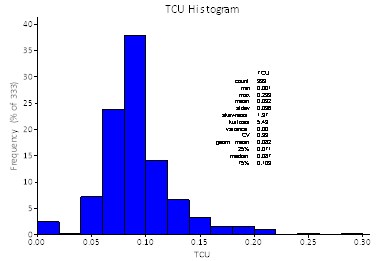
Source: AGP 2023
Twenty-five-foot composites were created. Figure 11-14 illustrates the 25-foot composite statistics using a log probability plot. A total of 114 composites were created from the 333 assays.
|
P a g e | 11-16 |
| 03/21/2025 |
| Yerington Copper Project S-K 1300 Report Yerington, Nevada |
|
Figure 11-14: VLT 25 ft Composites (TCu%)
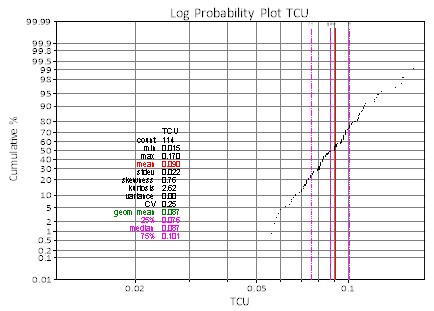
Source: AGP 2023
No variography was conducted as there were insufficient samples and grade continuity in a tailings was based on area of influence.
11.2.3 Bulk Density
The tonnage factor assigned was 16.67 cu.ft./ton which is appropriate for broken material present in the W-3 Stockpile and VLT as determined by CH2M Hill, Inc. (USEPA, 2010b).
11.2.4 Block Model and Resource Estimation
Model Framework
W-3 Stockpile
Block model parameters were defined to best reflect the drill spacing and geometry of the deposit, and SMU. Table 11-12 shows the block model parameters.
Table 11-12: W-3 Stockpile Model Parameters
|
Model Parameters |
X (Columns) |
Y (Rows) |
Z (Levels) |
|
Origin (feet): |
2,446,400 |
14,661,000 |
2,900 |
|
Block size (feet) |
25 |
25 |
25 |
|
Number of Blocks |
360 |
392 |
100 |
|
Rotation |
No rotation |
||
Source: AGP 2023
|
P a g e | 11-17 |
| 03/21/2025 |
| Yerington Copper Project S-K 1300 Report Yerington, Nevada |
|
Vat Leach Tailings
Block model parameters were defined to best reflect the drill spacing and geometry of the deposit, and SMU. Table 11-13 shows the block model parameters.
Table 11-13: VLT Model Parameters
|
Model Parameters |
X (Columns) |
Y (Rows) |
Z (Levels) |
|
Origin (feet): |
2,444,500 |
14,670,500 |
2,900 |
|
Block size (feet) |
25 |
25 |
25 |
|
Number of Blocks |
140 |
180 |
100 |
|
Rotation |
No rotation |
||
Grade Interpolation
W-3 Stockpile
The W-3 block model TCu was interpolated using NN and inverse distance weighting to the third power (ID3) methods. A horizontal one pass 700 ft. isotropic search was used. No controls for oxide or sulfide mineralization were used as this is primarily broken low-grade oxide mineralization.
Special models captured information for the NN model on distance to nearest composite and for the ID3 model: distance to nearest composite, average distance to composites used, maximum number of composites used and maximum number of drill holes used.
Vat Leach Tailings
The VLT block model TCu was interpolated using NN and ID3 methods. A horizontal one pass 500 ft. isotropic XY search with a 25 ft Z search was used. No controls for mineralization were used.
Special models captured information for the NN model on distance to nearest composite and for the ID3 model: distance to nearest composite, average distance to composites used, maximum number of composites used and maximum number of drill holes used.
11.2.5 Model Verification and Validation
W-3 Stockpile
W-3 grade interpolation was visually verified and validated using swath plots to compare the composite, NN and ID grades.
Figure 11-15 shows the correlation between the TCu% grade in the drill hole versus the interpolated CUID% on example Section 14669500N.
The visual verification has showed the agreement between the drill hole grades and interpolated grades.
|
P a g e | 11-18 |
| 03/21/2025 |
| Yerington Copper Project S-K 1300 Report Yerington, Nevada |
|
Figure 11-15: Section 14669500N, CUID (Block Model) Compared with TCu (Drill Hole)
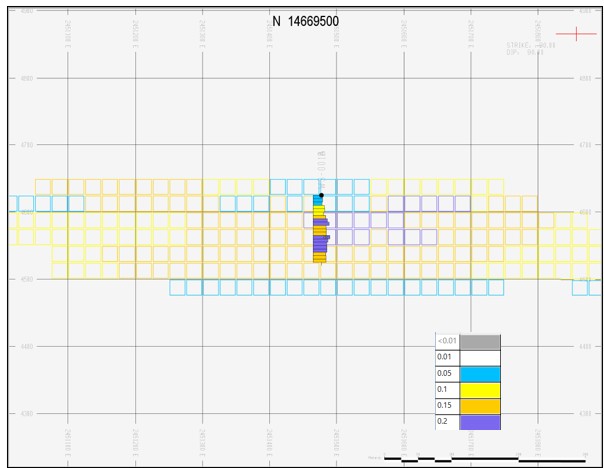
Source: AGP 2023
Notes: Looking West ±25 ft
The swath plot shown in Figure 11-16 shows the correlation (by elevation) between the drill hole grade TCu% with the interpolated grades CUNN% and CUID%.
|
P a g e | 11-19 |
| 03/21/2025 |
| Yerington Copper Project S-K 1300 Report Yerington, Nevada |
|
Figure 11-16: W-3 Swath Plot by Elevation
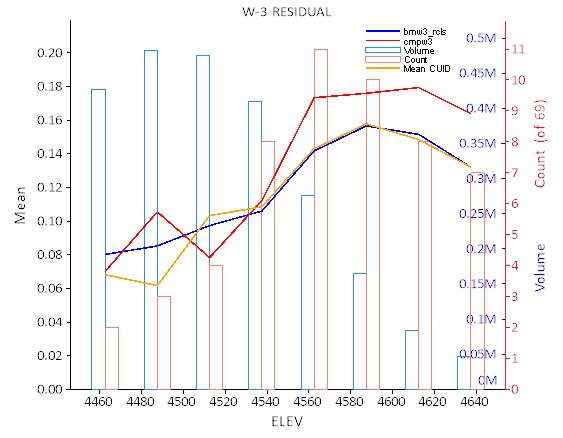
Source: AGP 2023
Notes: Drill Hole Grade TCu% (red line)
Block Model Grades: CUNN% (blue line) and CUID% (orange line)
Vat Leach Tailings
VLT grade interpolation was visually verified and validated using swath plots to compare the composite, NN and ID grades.
Figure 11-17 shows the correlation between the TCu% grade in the drill hole versus the interpolated CUID%.
The visual verification supported the agreement between the drill hole grades and interpolated grades.
|
P a g e | 11-20 |
| 03/21/2025 |
| Yerington Copper Project S-K 1300 Report Yerington, Nevada |
|
Figure 11-17: VLT Section Block Model CUID% vs Drill Hole TCu%
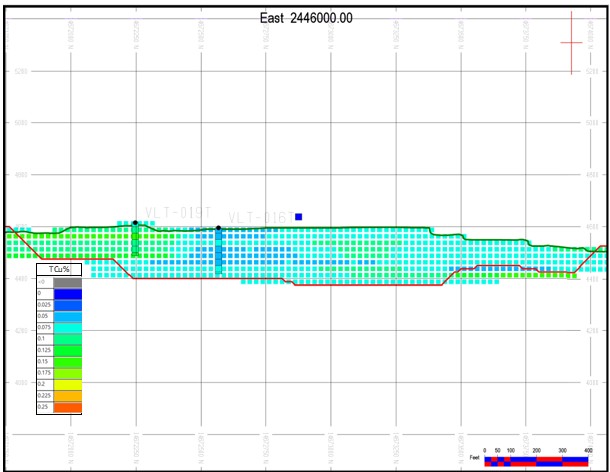
Source: AGP 2023
Notes: Resource Pit Shell=Red
Current Topography=Green
Looking West ±25 ft
Figure 11-18 illustrates the correlation (by elevation) between the drill hole grade TCu% with the interpolated grades CUNN% and CUID%.
|
P a g e | 11-21 |
| 03/21/2025 |
| Yerington Copper Project S-K 1300 Report Yerington, Nevada |
|
Figure 11-18: VLT Swath Plot by Elevation
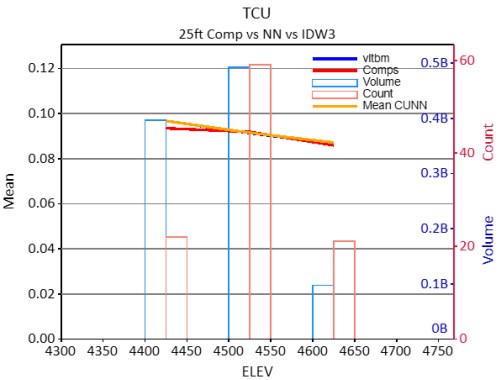
Source: AGP 2023
Notes: Drill Hole Grade TCu% (red line)
Block Model Grades: CUNN% (orange line) and CUID% (blue line)
11.2.6 Mineral Resource Estimate
Mineral Resource Classification
W-3 Stockpile
The resource classification was applied based on the distance to nearest composite reported for the ID3 interpolation. Blocks within 400 ft. were assigned as Inferred (3). All remaining interpolated blocks were uncategorized. The mineral resource estimates were classified in accordance with the definitions in S-K 1300.
Figure 11-19 illustrates a plan view of the resource classification for W-3 Stockpile. Inferred blocks are colored red and blocks that were not classified are shown in cyan.
|
P a g e | 11-22 |
| 03/21/2025 |
| Yerington Copper Project S-K 1300 Report Yerington, Nevada |
|
Figure 11-19: W-3 Resource Classification (Planview)
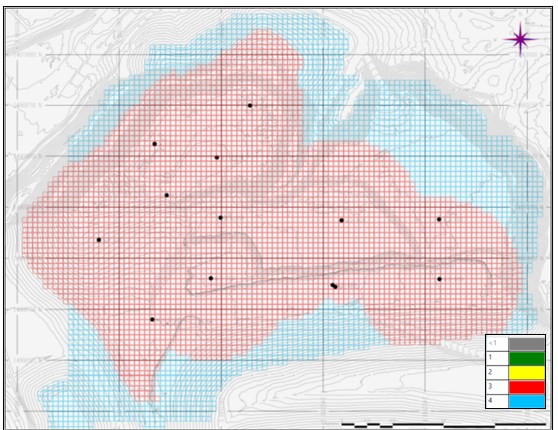
Source: AGP 2023
Notes: Measured=1, Indicated=2, Inferred=3, Not classified=4
Vat Leach Tailings
The resource classification was applied based on the distance to nearest composite reported for the ID3 interpolation. Blocks within 400 ft. were assigned as Inferred (3). All remaining interpolated blocks were uncategorized (4). The mineral resource estimates were classified in accordance with the definitions in S-K 1300.
Figure 11-20 illustrates a plan view of the resource classification for VLT. Inferred blocks are colored red and blocks that were not classified are shown in cyan.
|
P a g e | 11-23 |
| 03/21/2025 |
| Yerington Copper Project S-K 1300 Report Yerington, Nevada |
|
Figure 11-20: VLT Resource Classification (Planview)
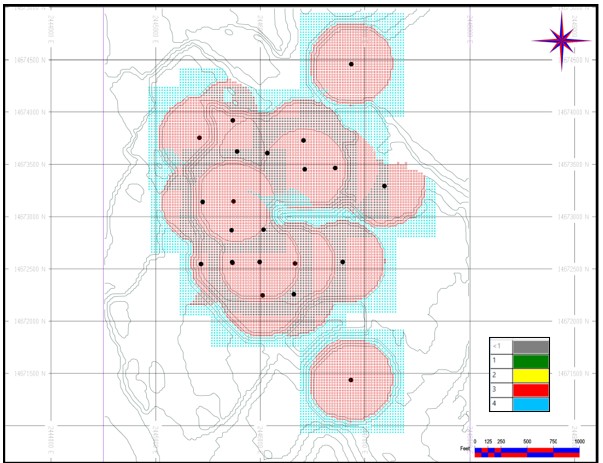
Source: AGP 2023
Notes: Measured=1, Indicated=2, Inferred=3, Not classified=4
Resource Classification Uncertainty
Following the statistical analysis in the preceding sub-section that classified mineral resource estimates into the inferred confidence category, uncertainties regarding sampling and drilling methods, geological modelling and estimation were incorporated into the classifications assigned. Uncertainty lies in the historical drill data incorporated in the resource model, arising from logging, assaying, and survey location uncertainty. Infill and/or twin hole drilling would reduce the potential errors arising from historical data. As multiple holes are used for grade interpolation and not single holes, that reduces the potential uncertainty and allows for the classification of inferred category. The areas of greatest uncertainty were not assigned a confidence category.
Cut-off Grade
A cut-off grade of 0.04% TCu was determined based on the assumptions listed in Table 11-26. Mineral Resource estimates can be sensitive to the reporting cut-off grade.
The copper metal price of US$4.30/lb Cu was based on the historic three-year average price of US$3.75/lb Cu escalated by 15% for the Mineral Resource.
|
P a g e | 11-24 |
| 03/21/2025 |
| Yerington Copper Project S-K 1300 Report Yerington, Nevada |
|
Table 11-14: Residuals Cut-off Grade Assumptions
|
Description |
Parameter |
|
Metal Price, US$/lb |
4.30 |
|
Net Price after Smelting, Refining, Transportation and Royalty, US$/lb |
4.08 |
|
Oxide Recovery |
70% |
|
Oxide (ROM) Cut-off Grade, TCu% |
0.04 |
Source: AGP 2023
AGP generated a resource pit shell based on the economic parameters outlined in Table 11-26 and the design parameter of 40-degree overall pit slope for W-3 Stockpile and VLT. Additional design details and economic parameters are provided in Chapter 11.4.1.
Mineral Resource Statement
W-3 Stockpile
The marginal cut-off grade of 0.04% TCu was selected for reporting the W-3 mineral resource. Table 11-15 summarizes the W-3 mineral resources. The W-3 Stockpile mineral resource estimate is current on December 31, 2024. AGP is responsible for W-3 Stockpile mineral resource estimate.
Table 11-15: W-3 Stockpile Mineral Resource Statement
|
Class |
Cut-off Grade (TCu%) |
Tons |
TCu% |
TCu lbs. |
|
Inferred |
>= 0.04 |
14,100,000 |
0.11 |
30,571,000 |
Notes:
Mineral resources reported are surficial deposits and are not in situ. The mineral resources are current as of December 31, 2024. Mineral resources are not mineral reserves and do not demonstrate economic viability. AGP is the Firm responsible for this estimate.
Mineral resources are reported within a conceptual pit shell that used the following input parameters: a variable break-even economic cut-off grade of 0.040 % TCu, based on assumptions of a net copper price of US$4.08 per pound (after smelting, refining, transportation, and royalty charges), 70% recovery in oxide material, base mining costs of $1.80/st, and processing plus G&A costs of $2.14/st.
All figures are rounded to reflect the relative accuracy of the estimates and totals may not add correctly.
Vat Leach Tailings
The marginal cut-off grade of 0.04% TCu was selected for reporting the VLT mineral resource in Table 11-16. The VLT mineral resource estimate is current on December 31, 2024. AGP is responsible for VLT mineral resource estimate.
|
P a g e | 11-25 |
| 03/21/2025 |
| Yerington Copper Project S-K 1300 Report Yerington, Nevada |
|
Table 11-16: VLT Mineral Resource Statement
|
Class |
Cut-off Grade (TCu%) |
Tons |
TCu% |
TCu lbs. |
|
Inferred |
>= 0.04 |
33,160,000 |
0.09 |
62,622,000 |
Notes:
Mineral resources reported are surficial deposits and are not in situ. The mineral resources are current as of December 31, 2024. Mineral resources are not mineral reserves and do not demonstrate economic viability. AGP is the Firm responsible for this estimate.
Mineral resources are reported within a conceptual pit shell that used the following input parameters: a variable break-even economic cut-off grade of 0.040 % TCu, based on assumptions of a net copper price of US$4.08 per pound (after smelting, refining, transportation, and royalty charges), 70% recovery in oxide material, base mining costs of $1.72/st, and processing plus G&A costs of $2.14/st.
All figures are rounded to reflect the relative accuracy of the estimates and totals may not add correctly.
11.3 MacArthur Copper Project
11.3.1 Database
The drill data for the MacArthur Deposit is a combination of core, RC, air track and churn drilling. Within the resource block model boundaries were 747 drill holes totalling 299,044.8 ft. A total of 55,726 intervals were assayed for total copper with only 1,019 intervals assayed for other metals. Table 11-17 is a summary of the assaying for total copper by company; only Lion CG drilling has been assayed for soluble copper (ASCU, CNCu and QLT).
Table 11-17: Summary of Assay Intervals for Total Copper by Company
|
|
Lion CG |
Anaconda |
Bear Creek |
Superior |
USBM |
|
No. of Intervals |
42,722 |
11,537 |
60 |
740 |
667 |
|
TCu%, mean |
0.093 |
0.218 |
0.378 |
0.125 |
0.149 |
|
TCu%, minimum |
0.00 |
0.00 |
0.10 |
0.001 |
0.01 |
|
TCu%, maximum |
13.80 |
5.38 |
1.84 |
2.34 |
1.94 |
11.3.2 Geological Domains
All the geological interpretation was completed by collaboration between the Lion CG staff and IMC for application to the block model. The mineral zones were developed as surfaces. The geological team interpreted the oxidation state of the mineralization into four categories:
-
Leach Cap Code = 10
-
Oxide Code = 1
-
Mixed Code = 2
-
Sulfide Code = 3
Each of the zones represents different minerology and different amenability to the leach process.
|
P a g e | 11-26 |
| 03/21/2025 |
| Yerington Copper Project S-K 1300 Report Yerington, Nevada |
|
11.3.3 Exploratory Data Analysis
Assays
IMC completed a number of basic statistical measures of the assay data sorted by the mineral zones. This process is often referred to as exploratory data analysis. The basic statistical comparison of the mineral zones is summarized below on Figure 11-21.
Figure 11-21: Basic Statistics of Capped Copper Assays
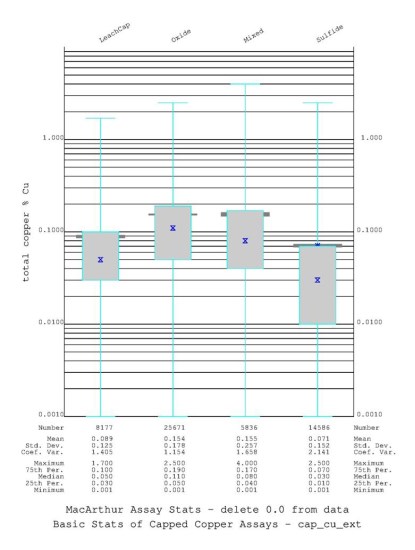
Source: IMC 2022
Capping
Basic statistics and cumulative frequency plots were studied to determine the level at which outliner values should be capped. MacArthur Deposit assay grade capping was completed on total copper by oxidation zone. The oxidization zone was assigned to each assay interval from the zones within the resource block model. Capping was applied to assays prior to compositing. The capped assays were composited into irregular target length 25-foot length composites that respect the mineral zone (redox) boundaries.
|
P a g e | 11-27 |
| 03/21/2025 |
| Yerington Copper Project S-K 1300 Report Yerington, Nevada |
|
The capping values were based on a review of cumulative frequency plots of each of the mineral zones to identify the few samples that were outliers. Table 11-18 summarizes the capping applied on the MacArthur Deposit.
Table 11-18: Assay Cap Levels by Oxidation Zone
|
Oxidation Zone |
Oxide |
Number of |
Original |
Cap Grade |
Number of |
Means |
|
Leach Cap |
10 |
8,183 |
0.089 |
1.70 |
1 |
0.089 |
|
Oxide |
1 |
25673 |
0.155 |
2.50 |
7 |
0.154 |
|
Mixed |
2 |
5836 |
0.158 |
4.00 |
4 |
0.155 |
|
Sulfide |
3 |
14651 |
0.072 |
2.50 |
12 |
0.071 |
Compositing
Prior to block grade estimation, the drill hole data was composited to 25-foot intervals that respected the mineral zone boundaries. The composite length was selected to match the mining bench height and provide samples of similar size and weight for block grade estimation. The purpose of compositing is to smooth the data somewhat to understand the grade distributions and domain boundaries prior to grade estimation.
Figure 11-22 summarizes the basic statistics of the 25-foot irregular composites respecting the mineralized zone boundaries. A minimum length of 10 feet was required for a composite to be calculated. The distribution of copper composites in Figure 11-22 represents the information that will be used for block grade estimation
|
P a g e | 11-28 |
| 03/21/2025 |
| Yerington Copper Project S-K 1300 Report Yerington, Nevada |
|
Figure 11-22: Basic Statistics of 25-foot Irregular Composites
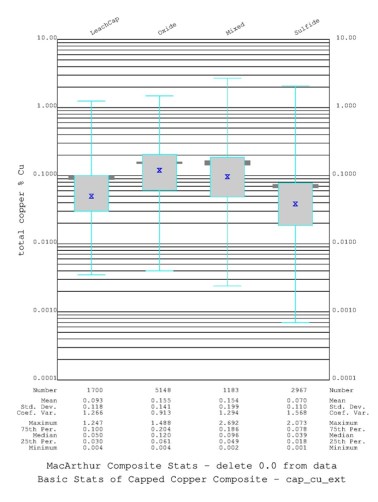
Source: IMC 2022
Spatial Analysis
Variograms were run for total copper in each of the domains defined on the previous tables. The intent was to provide some guidance to the search orientation and search radii that should be combined during grade estimation. The 25-foot irregular composites bounded by rock type were used as input for the copper variograms.
Variography was completed for each of the mineral zone domains to understand the statistical range of influence for each population. Those results were used as a guide to the selection of the grade estimation methods summarized in the next section. Figure 11-23 and Figure 11-24 are example horizontal variograms from the oxide and mixed domains. Oxide and mixed are the two primary mineralization hosts for the deposit. Within the oxide and mixed zones of the deposit, the predominate orientations were horizontal variograms, azimuth of 0.0 with a horizontal window of 90.0 degrees
|
P a g e | 11-29 |
| 03/21/2025 |
| Yerington Copper Project S-K 1300 Report Yerington, Nevada |
|
Figure 11-23: Oxide Zone Variogram (Bearing 0.0, Horizontal Window 90.0)
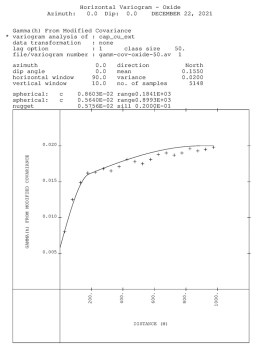
Source: IMC 2022
Figure 11-24: Oxide Zone Variogram (Bearing 0.0, Horizontal Window 90.0)
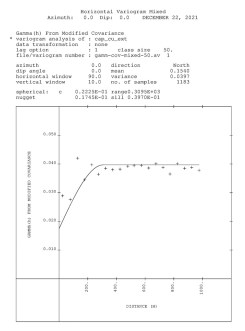
Source: IMC 2022
|
P a g e | 11-30 |
| 03/21/2025 |
| Yerington Copper Project S-K 1300 Report Yerington, Nevada |
|
The leach cap variogram shows multiple ranges of data which may be indicative of the grade break at 0.010 % Cu which was seen on the cumulative frequency plot. Again, indicating that portions of the leach cap need to be treated as a separate population during block grade estimation. If the plus 0.10% values were allowed to mix with the low background values of leach cap, the estimation methods would result in large areas of 0.06 to 0.10% copper that are not present. The true distribution is a limited to a smaller area of plus 0.10% surrounded by a subgrade zone of 0.05% copper or less.
The sulfide variogram shows a long range in the horizontal direction. A review of the cross-sections indicates that there are a number of locations in the North Ridge area (North of 14,190,378) of the sulfide zone where there is an indication that the copper grades at depth dip to the north. Grade estimates were done both on a horizontal basis and a dipped search to the north; the dipped search connected up like mineralized zones in the area of wide spaced drilling.
11.3.4 Bulk Density
Density was estimated based on the density data from Lion CG personnel. The density data was collected by KCA. In total there were 37 density determinations available in the assay data base, which averaged 12.40 cubic feet per short ton. Block densities were assigned based on data respecting the model variable that separates hard rock from alluvium. Hard rock material, oxide, mixed and sulfide used 12.5 cubic feet per short ton while the alluvium used 14.0 cubic feet per short ton.
11.3.5 Block Model and Grade Interpolation
Model Framework
The resource model covers the areas of MacArthur Main (MacArthur pit area), North Ridge and Gallagher domains. Blocks were sized 25 feet x 25 feet x 25 feet in order to model the mineralization zones to provide a reasonable block size that could be used for open pit mine planning. The coordinate system is in UTM feet. Table 11-19 summarizes the size and location of the block model.
Table 11-19: MacArthur Model Size and Location, November 2021
|
MacArthur UTM Feet Model - New Block Corners (November 2021) |
||||
|
|
Southwest |
Northwest |
Northeast |
Southeast |
|
Easting |
996,100 |
996,100 |
1,014,200 |
1,014,200 |
|
Northing |
14,180,800 |
14,195,400 |
14,195,400 |
14,180,800 |
|
Elevation Range |
|
2,625.00 |
5,700.00 |
|
|
No Model Rotation, Primary Axis = |
0.0 degrees |
|
||
|
Model |
|
|
724 Blocks in Easting |
|
|
Size |
|
|
584 Blocks in Northing |
|
|
Block Size 25 ft x 25 ft x 25 ft high |
|
123 Levels |
|
|
Figure 11-25 illustrates the domain splits within the resource block model. The largest components of mineral resources are in the MacArthur pit area and North Ridge domains followed by the Gallagher area.
|
P a g e | 11-31 |
| 03/21/2025 |
| Yerington Copper Project S-K 1300 Report Yerington, Nevada |
|
Figure 11-25: MacArthur Block Model Area and Domains
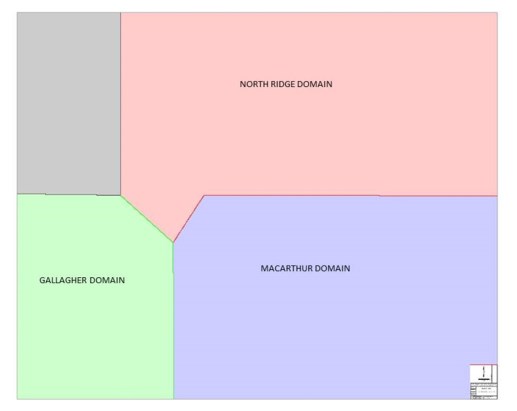
Source: IMC 2022
Wireframes
The main attribute of the mineral resource model is the oxidation state of the mineralization. The mineral zones were developed as surfaces by a collaboration of the Lion CG geologic staff and IMC. There are four major mineralization zones which were assigned to the resource block model: leach cap (code 10), oxide (code 1), mixed (code 2) and sulfide (code 3).
Each of the zones represents different minerology and different amenability to the leach process. The leach cap is generally quite low in copper grade which has been removed from the rock mass and re-precipitated at the original water table in the mixed zone as secondary sulfides, typically chalcocite, covellite, or digenite. The oxide zone reflects oxide minerals which are readily soluble in sulfuric acid. The mixed zone contains both primary and secondary copper minerals, transported down from the leach cap and re-deposited. The sulfide zone is primary chalcopyrite mineralization. In addition to the changes in mineralogy within these zones, there is often a corresponding change in the grade of each zone as seen by the mean grades of the assay intervals. Figure 11-26 is an east-west cross section through the block model in the Gallagher (west side) and MacArthur domains showing the mineralization zones and Figure 11-27 is a north-south cross section through the MacArthur (south) and North Ridge domains. The drill holes on the example section show 25-foot composites of the oxidization zones.
|
P a g e | 11-32 |
| 03/21/2025 |
| Yerington Copper Project S-K 1300 Report Yerington, Nevada |
|
Figure 11-26: East-West Cross-Section Looking North at 14,188,500 North
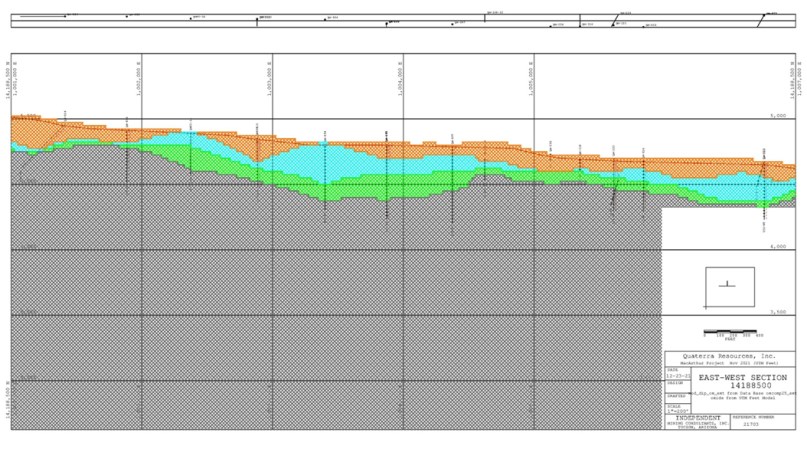
Source: IMC 2022
Colors: Orange = Leach Cap, Blue = Oxide, Green=Mixed, Grey = Sulfide; Horizontal Grid is 1,000 feet
|
P a g e | 11-33 |
| 03/21/2025 |
| Yerington Copper Project S-K 1300 Report Yerington, Nevada |
|
Figure 11-27. North-South Cross-Section Looking West at 1,005,600 East - Through MacArthur & North Ridge
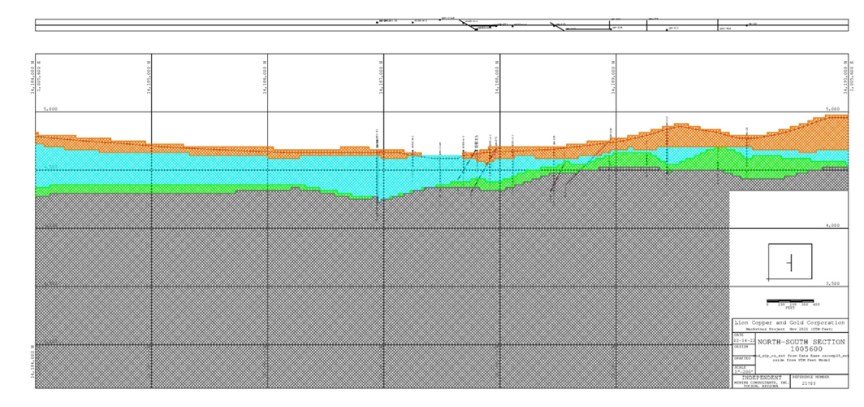
Source: IMC 2022
Colors: Orange = Leach Cap, Blue = Oxide, Green=Mixed, Grey = Sulfide; Horizontal Grid is 1,000 feet
|
P a g e | 11-34 |
| 03/21/2025 |
| Yerington Copper Project S-K 1300 Report Yerington, Nevada |
|
Grade Interpolation
A boundary analysis was performed at the boundaries between each of the four mineralized domains and the results indicate that each domain should be estimated separately, thus all boundaries were treated as 'hard' boundaries for the estimation of grades. A study of the leach cap composites showed a population break at 0.10% total copper. The leach cap was separated into two zones using an indicator method with a 0.10% total copper discriminator.
Variograms were run for total copper in each of the mineralization domains. The intent was to provide guidance to the search orientation and search distance for the grade estimation. The 25-foot irregular composites bounded by rock type were used as input for the total copper variograms and ranges between 200 and 900 feet were obtained which support the search distances used to estimate the model grades.
Total copper grades were estimated using ID3 in the oxide, mixed, and sulfide mineral zone domains. Leach cap was segregated into two populations using an indicator method to address the plus 0.10% grade distribution separately from the sub 0.10% distribution in the leach cap with total copper grades estimated using ID3 in each population. Indicator procedures were tested for all of the domains, but the ID3 results appear to follow the data better in the oxide, mixed and sulfide zones. All of the estimation runs used a minimum of two drill hole grade composites, a maximum of 10 composites with a maximum of three composites per hole. All of the search orientations were horizontal with the exception of the deeper sulfide zone in the North Ridge domain (north of 14,190,378) where a dipped search of 30 degrees to the north connected up like mineralized zones in the area of wide spaced drilling. The search distances in each zone are:
- Leach: Indicator with 0.10% TCu discriminator, 180 x 180 x 55 feet
Grade inside higher grade zone, 180 x 180 x 55 feet (minimum composite)
Grade outside higher grade zone 330 x 330 x 115 feet
-
Oxide: 250 NS x 300 EW x 160 feet
-
Mixed: 250 NS x 250 EW x 80 feet
-
Sulfide: South: 200 NS x 200 EW x 180 feet
North: 500 NS x 500 EW x 180 feet with dip 30 degrees to north
Figure 11-28 is a north-south cross section example looking west at 1,005,660 east showing the total copper grades in the block model and is at the same model location as Figure 11-28.
11.3.6 Model Verification and Validation
Numerous tests were performed to confirm that the model is a reasonable representation of the data for the determination of mineral resources. Example sections and plans from the block model were reviewed with the supporting composite data during the model assembly process.
|
P a g e | 11-35 |
| 03/21/2025 |
| Yerington Copper Project S-K 1300 Report Yerington, Nevada |
|
Figure 11-28: North-South Cross Section Looking West at 1,005,600 East (MacArthur: left, North Ridge: right)
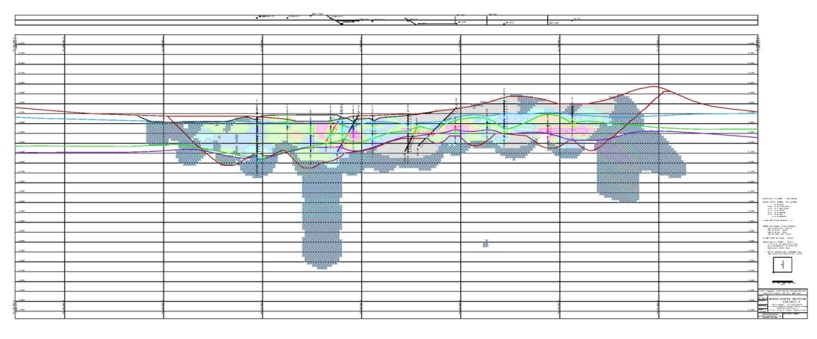
Source: IMC 2022
The color ranges representing the TCu grades are:
< 0.06% Grey
0.06 - 0.10% Light Blue
0.10 - 0.15% Dark Blue
0.15 - 0.25% Green
0.25 - 0.35% Orange
0.35 - 0.50% Red
= 0.50% Magenta
Inferred Class blocks have an X through them
Resource pit shell is shown in brown along with the topographic surface
Top of Sulfide - purple, top of Mixed - green, top of Oxide - blue, top of Leach - black
|
P a g e | 11-36 |
| 03/21/2025 |
| Yerington Copper Project S-K 1300 Report Yerington, Nevada |
|
A nearest neighbor (polygon) estimate of copper was completed using the same domains and search radii that were applied to the inverse distance estimate. The comparison of the nearest neighbor and the inverse distance estimates at a zero-cut-off grade is a check designed to determine if the selected method has incorporated bias. The ID3 estimate for the leach cap underestimates the number of blocks and grade in part because of the indicator approach compared to the nearest neighbor (polygon) approach. The ID3 estimate for the other zones (oxide, mixed and sulfide) is within 0 to 8 percents of the polygon estimate when comparing the results of number of blocks estimated times the average grade of those blocks (an approximation of contained metal).
Another test looked at how the block model grades followed the local grade changes when compared to the contained drill hole composites. A range of cut-off grades was tested for each of the mineral zones. At each cut-off, the blocks above cut-off within the model were selected. All composites within those blocks were found and compared to the average grade of the blocks. The results of this work indicate that the block model follows the data and is not overly smoothed.
11.3.7 Mineral Resource Estimate
Mineral Resource Classification
An ordinary kriging run (OK) was completed using similar searches to the grade estimation runs and respecting the oxidation zones. The number of composites used to estimate a block grade, and the standard deviation were stored in the model blocks and used as part of the criteria for assigning classification to a model block. The classification criteria used:
-
Measured: number of composites = 10 (minimum 4 holes) and standard deviation <= 0.65
-
Indicated: number of composites = 7 (minimum 3 holes) and standard deviation <= 0.94
-
Inferred: any block with an estimate for copper
Resource Classification Uncertainty
Following the statistical analysis in the preceding sub-section that classified mineral resource estimates into the confidence categories, uncertainties regarding sampling and drilling methods, geological modelling and estimation were incorporated into the classifications assigned. The areas with fewer uncertainties were classified as measured or indicated.
The area of greatest uncertainty assigned the inferred category. These are areas corresponding to areas with >225-foot drill spacing and generally outside of the MacArthur North Ridge central areas along the margins of the deposits and at depth where fewer drillholes are present. Due to lack of drill density, there is a lower confidence in grade continuity. Additional drilling would resolve the uncertainty and contribute to upgrading the resource classification.
Additional uncertainty lies in the historical drill data incorporated in the resource model, arising from logging, assaying, and survey location uncertainty. Infill and/or twin hole drilling would reduce the potential errors arising from historical data. As multiple holes are used for grade interpolation and not single holes, that also reduces the potential uncertainty and allows for the classification of measured or indicated categories using historical data. Model blocks classified as measured or indicated within the resource pit shell have less than three percent of the assay intervals from historical data.
|
P a g e | 11-37 |
| 03/21/2025 |
| Yerington Copper Project S-K 1300 Report Yerington, Nevada |
|
Cut-off Grade
The copper price used to define the mineral resource pit shell is $3.75 per pound., based on the December 2021 3 year backward average of $3.25/lb plus 15%. The $3.75 per pound price was agreed to by Lion CG, AGP and IMC. The copper price and all costs are in U.S. dollars. The recoveries and costs are based on recent reviews and adjustments to both the 2020 and historic work at Yerington and MacArthur along with subsequent work on MacArthur. The sulfuric acid cost assumes an onsite acid plant. The mining costs were determined by an internal review of IMC's cost estimates developed for earlier mine production schedules and are felt to be valid as of February 2022. The input parameters for the definition of the pit shell using a floating cone algorithm are given in Table 11-20 and Table 11-21. The cut-off grades are 0.06% TCu for all material types in the MacArthur pit area and North Ridge, and the Leach Cap, Oxide and Mixed zones in Gallagher This cut-off is at or above an internal cut-off by material type (due to variable recovery) and was selected to have a consistent cut-off for all material types. The cut-off for the Sulfide zone in Gallagher is 0.08% TCu due to the higher acid consumption and low recovery.
Table 11-20: Inputs to Definition of Pit-Constrained Mineral Resource - Recoveries
|
Mineralization |
Recovery of Total Copper |
|
Leach Cap |
60.0% |
|
Oxide |
71.0% |
|
Transition |
65.0% |
|
Sulfide |
40.0% |
Table 11-21: Inputs to Definition of Pit-Constrained Mineral Resource - Costs
|
Cost Center |
Unit |
Cost |
|
SXEW (no sulfuric acid) |
Per Cu lb |
$0.31 |
|
General & Administrative |
Per Cu lb |
$0.11 |
|
Cathode Transport |
Per Cu lb |
$0.05 |
|
Total per Cu pound cost |
Per Cu lb |
$0.47 |
|
Sulfuric Acid, cost |
Per short ton |
$63.50 |
|
Acid Consumption: |
||
|
MacArthur - North Ridge |
Per short ton |
30 lbs/st |
|
Gallagher |
Per short ton |
50 lbs/st |
|
MacArthur - North Ridge |
Cost/st |
$0.95/st |
|
Gallagher |
Cost/st |
$1.59/st |
|
Cost per heap ton: |
||
|
Heap management (doze, rip) |
Per short ton |
$0.30 |
|
Heap foundation and liner |
Per short ton |
$0.67 |
|
Mining Cost |
Per total st |
$1.92 |
The mineral resources for MacArthur are contained within a pit shell defined by the current understanding of costs and recovery of copper based on the intended recovery method of heap leaching using sulfuric acid. An example plot of the pit shells is shown in Figure 11-29. The MacArthur Mineral Resources were classified in accordance with the definitions for S-K 1300.
|
P a g e | 11-38 |
| 03/21/2025 |
| Yerington Copper Project S-K 1300 Report Yerington, Nevada |
|
Mineral Resource Statement
The MacArthur Deposit mineral resource is summarized in Table 11-22 with the details given in Table 11-23 and Table 11-24. The MacArthur Deposit mineral resource estimate is current of December 31, 2024. IMC is responsible for the MacArthur Deposit mineral resource estimate.
Table 11-22: Summary of Mineral Resource
|
Classification |
Ktons |
Total Cu, % |
Contained Cu Pounds x 1000 |
|
Measured |
116,666 |
0.180 |
420,929 |
|
Indicated |
183,665 |
0.158 |
579,479 |
|
Sum Measured+Indicated |
300,331 |
0.167 |
1,000,408 |
|
Inferred |
156,450 |
0.151 |
471,714 |
Notes:
Mineral resources are reported in situ and are current as of December 31, 2024. Mineral resources are not mineral reserves and do not have demonstrated economic viability. IMC is the Firm responsible for the estimate.
Mineral resources are reported within a conceptual pit shell that uses the following input parameters: metal price of $3.75/lb Cu; metallurgical recoveries of 60% leach cap, 71% oxide, 65% transition and 40% sulfide; and base mining costs of $1.92/st.
Cut-off grade: 0.06% TCu for leach cap, oxide, and transition
Cut-off grade for sulfide: 0.06% TCu for MacArthur & North Ridge, 0.08% TCu for Gallagher
Total resource shell tonnage = 628,831 ktons
|
P a g e | 11-39 |
| 03/21/2025 |
| Yerington Copper Project S-K 1300 Report Yerington, Nevada |
|
Figure 11-29: Mineral Resource Pit Shell
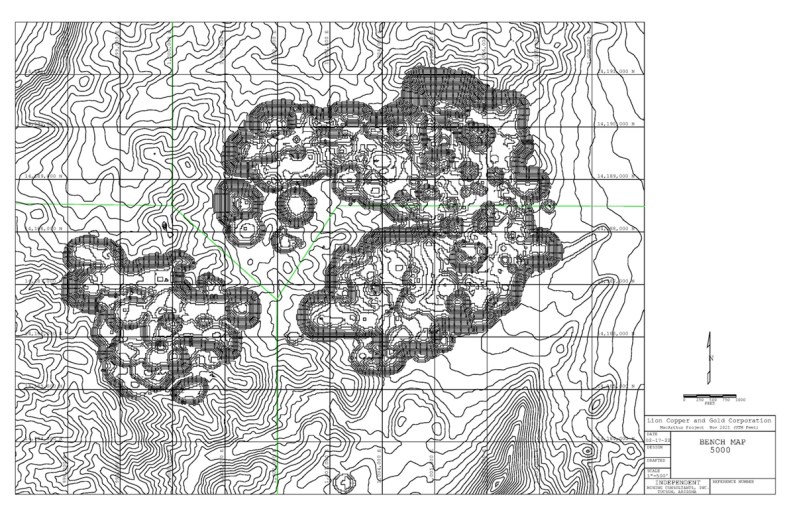
Source: IMC 2022
Notes: Green lines separate the domains. The MacArthur pit area lies to the southeast, North Ridge to the north/northeast and Gallagher to the west.
|
P a g e | 11-40 |
| 03/21/2025 |
| Yerington Copper Project S-K 1300 Report Yerington, Nevada |
|
Table 11-23: Mineral Resource by Domain
|
Domain |
|
MEASURED |
INDICATED |
MEASURED & INDICATED |
||||||
|
Total Copper |
Ktons & Grade Above Cut-off |
Ktons & Grade Above Cut-off |
Ktons & Grade Above Cut-off |
|||||||
|
Ktons |
TCu, % |
Contained |
Ktons |
TCu, % |
Contained |
Ktons |
TCu, % |
Contained Cu |
||
|
MacArthur |
0.06 |
82,983 |
0.184 |
305,303 |
77,171 |
0.151 |
233,446 |
160,154 |
0.168 |
538,749 |
|
North Ridge |
0.06 |
25,149 |
0.176 |
88,507 |
78,305 |
0.166 |
259,558 |
103,454 |
0.168 |
348,065 |
|
Gallagher |
0.06, 0.08 |
8,534 |
0.159 |
27,119 |
28,189 |
0.153 |
86,475 |
36,723 |
0.155 |
113,594 |
|
Total |
116,666 |
0.180 |
420,929 |
183,665 |
0.158 |
579,479 |
300,331 |
0.167 |
1,000,408 |
|
|
Domain |
|
INFERRED |
||
|
Total Copper |
Ktons & Grade Above Cut-off |
|||
|
Ktons |
TCu, % |
Contained |
||
|
MacArthur |
0.06 |
30,815 |
0.158 |
97,490 |
|
North Ridge |
0.06 |
62,593 |
0.154 |
192,187 |
|
Gallagher |
0.06, 0.08 |
63,042 |
0.144 |
182,037 |
|
Total |
156,450 |
0.151 |
471,714 |
|
Notes: Mineral resources are reported in situ and are current as of December 31, 2024. Mineral resources are not mineral reserves and do not have demonstrated economic viability. IMC is the Firm responsible for the estimate.
|
P a g e | 11-41 |
| 03/21/2025 |
| Yerington Copper Project S-K 1300 Report Yerington, Nevada |
|
Table 11-24: Mineral Resource by Domain and Oxidation Zone
|
Oxidation Zone |
Total |
MEASURED | INDICATED | MEASURED & INDICATED | INFERRED | |||||||||||
| Ktons & Grade Above Cut-off | Ktons & Grade Above Cut-off | Ktons & Grade Above Cut-off | Ktons & Grade Above Cut-off | |||||||||||||
|
Ktons |
Total Cu, % |
Contained |
Ktons |
Total Cu, % |
Contained |
Ktons |
Total Cu, % |
Contained |
Ktons |
Total Cu, % |
Contained |
|||||
|
MacArthur |
||||||||||||||||
|
Leach Cap |
0.06 |
5,169 |
0.140 |
14,473 |
4,820 |
0.128 |
12,339 |
9,989 |
0.134 |
26,812 |
3,349 |
0.129 |
8,640 |
|||
|
Oxide |
0.06 |
74,542 |
0.187 |
278,787 |
62,903 |
0.149 |
187,451 |
137,445 |
0.170 |
466,238 |
16,023 |
0.138 |
44,223 |
|||
|
Mixed |
0.06 |
2,053 |
0.190 |
7,801 |
6,418 |
0.181 |
23,233 |
8,471 |
0.183 |
31,034 |
8,169 |
0.197 |
32,186 |
|||
|
Sulfide |
0.06 |
1,219 |
0.174 |
4,242 |
3,030 |
0.172 |
10,423 |
4,249 |
0.173 |
14,665 |
3,274 |
0.190 |
12,441 |
|||
|
Total |
82,983 |
0.184 |
305,303 |
77,171 |
0.151 |
233,446 |
160,154 |
0.168 |
538,749 |
30,815 |
0.158 |
97,490 |
||||
|
North Ridge |
||||||||||||||||
|
Leach Cap |
0.06 |
1,813 |
0.097 |
3,517 |
3,798 |
0.094 |
7,140 |
5,611 |
0.095 |
10,657 |
11,209 |
0.075 |
16,814 |
|||
|
Oxide |
0.06 |
13,699 |
0.139 |
38,083 |
39,485 |
0.132 |
104,240 |
53,184 |
0.134 |
142,323 |
32,791 |
0.148 |
97,061 |
|||
|
Mixed |
0.06 |
8,208 |
0.245 |
40,219 |
26,554 |
0.213 |
113,120 |
34,762 |
0.221 |
153,339 |
13,050 |
0.210 |
54,810 |
|||
|
Sulfide |
0.06 |
1,429 |
0.234 |
6,688 |
8,468 |
0.207 |
35,058 |
9,897 |
0.211 |
41,746 |
5,543 |
0.212 |
23,502 |
|||
|
Total |
25,149 |
0.176 |
88,507 |
78,305 |
0.166 |
259,558 |
103,454 |
0.168 |
348,065 |
62,593 |
0.154 |
192,187 |
||||
|
Gallagher |
||||||||||||||||
|
Leach Cap |
0.06 |
9 |
0.065 |
12 |
1 |
0.063 |
1 |
10 |
0.065 |
13 |
4,021 |
0.075 |
6,032 |
|||
|
Oxide |
0.06 |
8,416 |
0.158 |
26,595 |
27,479 |
0.152 |
83,536 |
35,895 |
0.153 |
110,131 |
56,711 |
0.148 |
167,865 |
|||
|
Mixed |
0.06 |
0 |
|
0 |
149 |
0.227 |
676 |
149 |
0.227 |
676 |
2,064 |
0.173 |
7,141 |
|||
|
Sulfide |
0.08 |
109 |
0.235 |
512 |
560 |
0.202 |
2,262 |
669 |
0.207 |
2,774 |
246 |
0.203 |
999 |
|||
|
Total |
8,534 |
0.159 |
27,119 |
28,189 |
0.153 |
86,475 |
36,723 |
0.155 |
113,594 |
63,042 |
0.144 |
182,037 |
||||
|
Total |
||||||||||||||||
|
Leach Cap |
0.06 |
6,991 |
0.129 |
18,002 |
8,619 |
0.113 |
19,480 |
15,610 |
0.120 |
37,482 |
18,579 |
0.085 |
31,486 |
|||
|
Oxide |
0.06 |
96,657 |
0.178 |
343,465 |
129,867 |
0.144 |
375,227 |
226,524 |
0.159 |
718,692 |
105,525 |
0.146 |
309,149 |
|||
|
Mixed |
0.06 |
10,261 |
0.234 |
48,020 |
33,121 |
0.207 |
137,029 |
43,382 |
0.213 |
185,049 |
23,283 |
0.202 |
94,137 |
|||
|
Sulfide |
0.06,0.08 |
2,757 |
0.208 |
11,442 |
12,058 |
0.198 |
47,743 |
14,815 |
0.200 |
59,185 |
9,063 |
0.204 |
36,942 |
|||
|
Total |
116,666 |
0.180 |
420,929 |
183,665 |
0.158 |
579,479 |
300,331 |
0.167 |
1,000,408 |
156,450 |
0.151 |
471,714 |
||||
Notes: Mineral resources are reported in situ and are current as of December 31, 2024. Mineral resources are not mineral reserves and do not havedemonstrated economic viability. IMC is the Firm responsible for the estimate.
|
P a g e | 11-42 |
| 03/21/2025 |
| Yerington Copper Project S-K 1300 Report Yerington, Nevada |
|
11.4 Reasonable Prospects of Economic Extraction
AGP examined the content requirements set out in Table 1 of §229.1302 (Item 1302) "Qualified person, technical report summary, and technical studies" in order to meet the content requirements of an Initial Assessment sufficient to support the Mineral Resource estimates.
The assumptions used by AGP and the other firms in support of the Initial Assessment are summarized in Table 11-25.
Table 11-25: Initial Assessment Assumptions
|
Factors |
Initial Assessment Requirement |
Yerington Copper Project |
|
Site Infrastructure |
Establish whether or not access to power and site is possible. Assume infrastructure location, plant area required, type of power supply, site access roads, and camp/town site, if required. |
Paved road to site from the town of Yerington, directly adjacent to the Project. Grid power runs along the western edge of the property with easy access to the substation to the south of the project site. Infrastructure required can be placed within the within current property boundaries in the brownfields site. No camp required for the project due to proximity to Yerington. |
|
Mine Design and Planning |
Mining Method defined broadly as surface or underground. Production rates assumed. |
Open pit mining methods assumed consistent with past mining on the project site. |
|
Processing Plant |
Establish that all products used in assessing prospects of economic extraction can be processed with methods consistent with each other. Processing method and plant throughput assumed. |
Copper is the only product modelled in the resource and therefore meets the requirement that the products produced in the mineral resource statement can be processed with the method proposed and are consistent with each other. Assumed heap leach and solvent extraction/electrowinning (SW/EW) processing for the Yerington project mineralization. A process plant production rate of 140 Mlbs of copper per year has been assumed. |
|
Environmental compliance and permitting |
List of required permits & agencies drawn. Determine if significant obstacles exist to obtaining permits. Identify pre-mining land uses. Assess requirements for baseline studies. Assume post-mining land uses. Assume tailings disposal, reclamation, and mitigation plans. |
Preliminary list of permits and agencies compiled by Lion CG. Significant obstacles to permitting not anticipated given history of permitted mining within the Project footprint. Pre-mining land uses are historic mining site remediation, reclaimed historic mining, and natural resource development. Post mining use includes water filling of pit areas. HLF’s will be depleted of process fluids, regraded, contoured and covered with growth media and revegetated with approved reclamation seed mix in accordance with regulations. WRSFs will be regraded and recontouring of the exterior slopes ensure that slopes are stable and blend with surrounding topography in accordance with regulations. |
|
P a g e | 11-43 |
| 03/21/2025 |
| Yerington Copper Project S-K 1300 Report Yerington, Nevada |
|
|
Factors |
Initial Assessment Requirement |
Yerington Copper Project |
|
Other Relevant Factors |
Appropriate assessments of other reasonably assumed technical and economic factors necessary to demonstrate reasonable prospects for economic extraction. |
Mineral resource estimates are confined within a conceptual pit shell. |
|
Capital Costs |
Optional. If included: Accuracy: ±50%. Contingency: ±25%. |
Not relevant to this Report. |
|
Operating Costs |
Optional. If included: Accuracy: ±50%. Contingency: ±25%. |
Not relevant to this Report. |
|
Economic Analysis |
Optional. If included: Taxes and revenues are assumed. Discounted cash flow analysis based on assumed production rates and revenues from available measured and indicated mineral resources |
Not relevant to this Report. |
The resource pit optimization analysis was carried out using the Pseudoflow algorithm with Hexagon MinePlan software for Yerington. The algorithm calculates the individual block revenue (NSR), applies cost, recovery assumptions then utilize slope configurations to generate pits to maximize profit. This algorithm generates pits similar to the Lerch-Grossmann algorithm but more efficiently. A floating cone algorithm was used to establish the pit shell for MacArthur.
11.4.1 Mineral Resource Constraint Input Assumptions
The open pit shells were completed with various input parameters including estimates of the expected mining, processing, and G&A costs, as well as metallurgical recoveries, pit slopes and reasonable long-term metal price assumptions. AGP worked together with Lion CG and the study team personnel to select appropriate operating cost parameters for the open pits (Table 11-26).
|
P a g e | 11-44 |
| 03/21/2025 |
| Yerington Copper Project S-K 1300 Report Yerington, Nevada |
|
The mining costs are estimates based on cost estimates for equipment from vendors specific to the Yerington Copper Project and previous studies completed by AGP. The costs represent a base cost from the resource shell edge and an incremental cost below the shell elevation for the Yerington and MacArthur pit shells, but a fixed average cost for the other resource areas due to their geometry being less influenced by the depth of the potential shell. Process feed material is sent to separate destinations and the costs reflect that. The mining cost estimates are based on the use of 100-ton trucks using an approximate waste dump configuration to determine incremental hauls for process feed and waste.
Geotechnical sectors used for the Yerington resource were based on AGP's 2023 review of past operating reports. Pit slopes ranged from 40-45 degrees. For the MacArthur area pits a default slope of 45 degrees was applied.
Process costs and recoveries by feed type were provided by the process firm Woods. Metallurgical recoveries ranged from 70% for oxide materials and 75% for sulfide materials for the Yerington resource areas. Recoveries for the MacArthur are resources used 60% for leach cap, 71% for oxide, 65% for transition material and 40% for sulfides.
Total copper grades are used in the revenue calculations with the recoveries applied to them. The recovery assumptions are based on the process flow sheet the feed material will be subjected to on the heap. Copper cathode is produced from all process flowsheets.
For block valuation, an NSR value ($/t) was determined for every block and used with the Lerchs-Grossman routine within MinePlan.
Table 11-26: Conceptual Parameters Used for Constraining Pit Shell Generation
|
Description |
Units |
Yerington |
W-3 |
VLT |
MacArthur |
|
|
Resource Model |
||||||
|
|
Resource class |
|
M+I+I |
M+I+I |
M+I+I |
M+I+I |
|
|
Block/Bench Height |
ft |
25 |
25 |
25 |
25 |
|
|
|
|
|
|
|
|
|
|
Max Processing Rate |
Mlb per year |
|
|
|
|
|
|
Dilution |
% |
- |
- |
- |
- |
|
|
Mining Losses |
% |
- |
- |
- |
- |
|
|
Physical Constraints |
|
Hwy 339 offset |
No |
No |
No |
|
|
|
|
|
|
|
|
|
Metal Prices |
||||||
|
|
Cu |
US$/lb |
4.30 |
4.30 |
4.30 |
3.75 |
|
Royalty |
||||||
|
|
Royalty |
% |
2.5 |
2.5 |
2.5 |
0.0 |
|
Payable Metal and Deductions |
|
|
|
|
||
|
|
Cu Payable |
% |
98 |
98 |
98 |
100 |
|
P a g e | 11-45 |
| 03/21/2025 |
| Yerington Copper Project S-K 1300 Report Yerington, Nevada |
|
|
Description |
Units |
Yerington |
W-3 |
VLT |
MacArthur |
|
|
|
Cathode Trucking Cost |
US$/ton |
30 |
30 |
30 |
%0.05/lb cathode copper |
|
|
Cathode Port Cost |
US$/ton |
5 |
5 |
5 |
|
|
|
Cathode Shipping Cost |
US$/ton |
30 |
30 |
30 |
|
|
Net Metal Price Calculation |
|
|||||
|
|
Cu Payable |
% |
98 |
98 |
98 |
100 |
|
|
Cathode Trucking Cost |
US$/lb |
0.015 |
0.015 |
0.015 |
|
|
|
Cathode Port Cost |
US$/lb |
0.003 |
0.003 |
0.003 |
|
|
|
Cathode Shipping Cost |
US$/lb |
0.015 |
0.015 |
0.015 |
|
|
|
Total Transportation Cost |
US$/lb |
0.033 |
0.033 |
0.033 |
0.05 |
|
|
SX-EW (no acid) Cost |
US$/lb |
|
|
|
0.31 |
|
|
G&A Cost |
US$/lb |
|
|
|
0.11 |
|
|
Subtotal Copper Price |
US$/lb |
4.18 |
4.18 |
4.18 |
3.28 |
|
|
Less Royalty |
US$/lb |
0.10 |
0.10 |
0.10 |
0.00 |
|
|
Net Copper Price |
US$/lb |
4.08 |
4.08 |
4.08 |
3.28 |
|
Process Recoveries |
|
|||||
|
|
Oxide - ROM |
% |
70 |
70 |
70 |
71 |
|
|
Leach Cap - ROM |
% |
|
|
|
60 |
|
|
Transition |
% |
50 |
50 |
50 |
65 |
|
|
Sulfide - ROM |
% |
40 |
40 |
40 |
40 |
|
|
Sulfide - Crushed/Agglomerated |
% |
75 |
75 |
75 |
- |
|
Mining Cost |
||||||
|
|
Base Elevation |
feet |
4225 |
- |
- |
|
|
|
Waste Base Rate |
US/t moved |
2.53 |
1.80 |
1.75 |
|
|
|
Oxide Feed |
US/t moved |
2.49 |
1.80 |
1.72 |
|
|
|
Sulfide Feed |
US/t moved |
2.22 |
1.80 |
2.22 |
|
|
|
MacArthur - hard rock |
US/t moved |
|
|
|
1.92 |
|
|
MacArthur - overburden |
US/t moved |
|
|
|
1.46 |
|
|
Incremental Rate Below Base Elevation |
|
|
|
|
|
|
|
Waste Base Rate |
US/t moved |
0.027 |
- |
- |
- |
|
|
Oxide Feed |
US/t moved |
0.027 |
- |
- |
- |
|
|
Sulfide Feed |
US/t moved |
0.024 |
- |
- |
- |
|
Processing and G&A |
||||||
|
|
Oxide - ROM |
US$/t feed |
1.65 |
1.65 |
1.65 |
|
|
|
Transition - ROM |
US$/t feed |
1.65 |
1.65 |
1.65 |
|
|
|
Sulfides - Crushed/Agglomerated |
US$/t feed |
7.21 |
7.21 |
7.21 |
|
|
|
MacArthur (MacArthur & North Ridge) |
US$/t feed |
|
|
|
1.56 |
|
|
MacArthur (Gallagher) |
US$/t feed |
|
|
|
2.20 |
|
|
|
|
|
|
|
|
|
P a g e | 11-46 |
| 03/21/2025 |
| Yerington Copper Project S-K 1300 Report Yerington, Nevada |
|
|
Description |
Units |
Yerington |
W-3 |
VLT |
MacArthur |
|
|
|
G&A Cost |
US$/t feed |
0.49 |
0.49 |
0.49 |
included in deducts |
|
Process + G&A |
||||||
|
|
Oxide - ROM |
US$/t feed |
2.14 |
2.14 |
2.14 |
|
|
|
Transition - ROM |
US$/t feed |
2.14 |
2.14 |
2.14 |
|
|
|
Sulfides - Crushed/Agglomerated |
US$/t feed |
7.70 |
7.70 |
7.70 |
|
|
Calculated Marginal Cut-off Grades |
||||||
|
|
Oxide - ROM |
% Copper |
0.038 |
0.038 |
0.038 |
0.033/0.047 |
|
|
Leach Cap - ROM |
% Copper |
|
|
|
0.040/0.056 |
|
|
Transition - ROM |
% Copper |
0.053 |
0.053 |
0.053 |
0.037/0.052 |
|
|
Sulfides - ROM |
% Copper |
|
|
|
0.059/0.084 |
|
|
Sulfides - Crushed/Agglomerated |
% Copper |
0.126 |
0.126 |
0.126 |
|
|
Applied Marginal Cut-off Grades for Resource Declaration |
||||||
|
|
Oxide - ROM |
% Copper |
0.038 |
0.038 |
0.038 |
0.06 |
|
|
Leach Cap - ROM |
% Copper |
|
|
|
0.06 |
|
|
Transition - ROM |
% Copper |
0.053 |
0.053 |
0.053 |
0.06 |
|
|
Sulfides - ROM |
% Copper |
|
|
|
0.06/0.08 |
|
|
Sulfides - Crushed/Agglomerated |
% Copper |
0.126 |
0.126 |
0.126 |
|
11.4.2 Commodity Prices
Commodity prices used in the resource estimation were based on metal pricing at the time of the resource generation. For the Yerington deposits (Yerington, W-3 and VLT), the spot copper price on the London Metal Exchange (LME) on February 16, 2023, was $4.03/lb. The two-year, three-year, five-year, and ten-year rolling average prices to February 16th of the years has been $4.14, $3.73, $3.36 and $3.07/lb, respectively.
Net revenue was determined by applying estimated copper price to the payable copper estimated for each year. Sales prices have been applied to all life of mine production without escalation or hedging. The revenue is the value of payable metals sold minus treatment and transportation charges. The copper metal price of $4.30/lb Cu for the resource shell was based on the historic three-year average price of $3.73/lb Cu escalated by 15% for the Mineral Resource.
Metal prices for the MacArthur deposits were based on older data at the time of the resource generation (January 2022) with the three-year average price at that time of $3.25/lb escalated by 15% to $3.75/lb Cu. New pit shells were not developed for these deposits, so the copper price of $3.75/lb was employed.
11.4.3 Cut-offs
The cutoffs for each area using the costs, and recoveries highlighted in Table 11-26 are also included in the same table. The marginal cutoff is considered at the rim of the pit shell. Any material that is mined is considered for processing if the contained mineralization contains a value greater than processing it or above the marginal cutoff. Material at the pit shell rim with less value than the marginal cutoff is sent to the WRSF from an economics perspective.
|
P a g e | 11-47 |
| 03/21/2025 |
| Yerington Copper Project S-K 1300 Report Yerington, Nevada |
|
Those blocks within the constraining resource shell and above the cutoff applied are considered to have reasonable prospects for economic extraction.
11.5 QP Statement
AGP and IMC note that the deposits at Yerington and MacArthur are of a style of porphyry copper that is well known from past mining activity and completed drilling. Any issues arising in relation to relevant technical and economic factors likely to influence the process of economic extraction can be resolved with further study and testwork.
Factors that may affect the Mineral Resource estimates include:
-
metal price and exchange rate assumptions
-
changes to the assumptions used to generate the copper grade cut-off grade
-
redefinition of Yerington Copper Project geological models to refine grade interpolation
-
changes in local interpretations of mineralization geometry and continuity of mineralized zones
-
changes to interpretation of the contact between the redox surfaces
-
density and domain assignments
-
changes to geotechnical, mining, and metallurgical performance assumptions
-
change to the input and design parameter assumptions that pertain to the conceptual pit designs constraining the mineral resources
-
assumptions as to the continued ability to access the site, retain mineral and surface rights titles, maintain environment and other regulatory permits, and maintain the social license to operate
The Yerington Copper Project is to advance through additional stages of study that provide sufficient time before a final decision is made to address any shortfalls in information regarding the Project. This could include additional drilling, testwork and engineering studies to mitigate identified issues with the estimates.
There are no other environmental, legal, title, taxation, socioeconomic, marketing, political or other relevant factors known to AGP or IMC that would materially affect the estimation of mineral resources that are not discussed in this report.
11.5.1 Mineral Resource Estimate
Reported mineral resources were classified in accordance with the definitions in S-K 1300. with material reported as in situ at Yerington and MacArthur Deposits. AGP is responsible for the Yerington, W-3 and VLT mineral resource estimates. IMC is responsible for all the MacArthur deposit mineral resource estimates.
|
P a g e | 11-48 |
| 03/21/2025 |
| Yerington Copper Project S-K 1300 Report Yerington, Nevada |
 |
12 Mineral Reserve Estimates
The Yerington Copper Project is at an IA level of study and therefore currently has no reserves.
 |
P a g e | 12-1 |
| 03/21/2025 |
| Yerington Copper Project S-K 1300 Report Yerington, Nevada |
|
13 Mining Methods
This chapter is not relevant to this report.
|
P a g e | 13-1 |
| 03/21/2025 |
| Yerington Copper Project S-K 1300 Report Yerington, Nevada |
|
14 Process and Recovery Methods
This chapter is not relevant to this report.
|
P a g e | 14-1 |
| 03/21/2025 |
| Yerington Copper Project S-K 1300 Report Yerington, Nevada |
|
15 Infrastructure
This chapter is not relevant to this report.
|
P a g e | 15-1 |
| 03/21/2025 |
| Yerington Copper Project S-K 1300 Report Yerington, Nevada |
|
16 Market Studies
This chapter is not relevant to this report.
|
P a g e | 16-1 |
| 03/21/2025 |
| Yerington Copper Project S-K 1300 Report Yerington, Nevada |
|
17 Environmental Studies, Permitting and Plans, Negotiations or Agreements with Local Individuals or Groups
This chapter is not relevant to this report.
|
P a g e | 17-1 |
| 03/21/2025 |
| Yerington Copper Project S-K 1300 Report Yerington, Nevada |
|
18 Capital and Operating Costs
This chapter is not relevant to this report.
|
P a g e | 18-1 |
| 03/21/2025 |
| Yerington Copper Project S-K 1300 Report Yerington, Nevada |
|
19 Economic Analysis
This chapter is not relevant to this report.
|
P a g e | 19-1 |
| 03/21/2025 |
| Yerington Copper Project S-K 1300 Report Yerington, Nevada |
|
20 Adjacent Properties
20.1 Mason Project
The Mason Project, which is held by Hudbay Minerals Inc. (Hudbay) is located approximately 3 miles (5 km) west of the Yerington pit. The Mason Project is a typical copper-molybdenum porphyry system hosted within a Jurassic quartz monzonite. The mineralization is described as closely associated with the quartz monzonite porphyry dikes. AGP was not able to independently verify the information Hudbay (2023) provided. The mineralization for the Mason Project is not necessarily indicative of the mineralization present at the Yerington Copper Project.
The current mineral resource estimate for the Mason Project is summarized in Table 20-1.
Table 20-1: Mason Project Mineral Resource (Hudbay, 2023)
| Category | Tonnes (000s) |
Cu (%) | Mo (g/t) | Au (g/t) | Ag (g/t) |
| Measured | 1,417,000 | 0.29 | 59 | 0.031 | 0.66 |
| Indicated | 801,000 | 0.30 | 80 | 0.025 | 0.57 |
| Measured and Indicated | 2,219,000 | 0.29 | 67 | 0.029 | 0.63 |
| Inferred | 237,000 | 0.24 | 78 | 0.033 | 0.73 |
Note: Totals may not add up correctly due to rounding.
1 Mineral resource estimates that are not mineral reserves do not have demonstrated economic viability.
2 Mineral resource estimates do not include factors for mining recovery or dilution.
3 Metal prices of $3.10 per pound copper, $11.00 per pound molybdenum, $1,500 per ounce gold, and $18.00 per ounce silver were used to estimate mineral resources.
4 Mineral resources are estimated using a minimum NSR cut-off of $6.25 per tonne.
5 Mineral resources are based on resource pit designs containing measured, indicated, and inferred mineral resources.
20.2 Pumpkin Hollow Project
The Pumpkin Hollow Project, which is held by Southwest Critical Materials (Nevada Copper), is located about 10 miles southeast of the Yerington pit. The Pumpkin Hollow Project is dominantly a copper and magnetite skarn, forming from Jurassic quartz monzonite and quartz monzonite porphyries intruding the limestones of the Triassic Mason Valley Formation and calcareous argillites and siliceous shales, siltstones, and limestones of the Triassic Gardnerville Formation. AGP was not able to independently verify the information Nevada Copper (2019) provided. The mineralization for the Pumpkin Hollow Project is not necessarily indicative of the mineralization present at the Yerington Copper Project.
The current mineral resource estimate for the Pumpkin Hollow Project is summarized in Table 20-2 and Table 20-3 for underground and open pit mineral resources respectively.
|
P a g e | 20-1 |
| 03/21/2025 |
| Yerington Copper Project S-K 1300 Report Yerington, Nevada |
|
Table 20-2: Pumpkin Hollow Project, Underground Mineral Resource (2019)
| Category | Cut-off Grade Cu (%) |
Tons (millions) |
Cu (%) | Au (oz/t) | Ag (oz/t) |
| Measured | 0.75 | 12.1 | 1.60 | 0.006 | 0.127 |
| Indicated | 0.75 | 41.9 | 1.33 | 0.005 | 0.112 |
| Measured and Indicated | 0.75 | 54.1 | 1.39 | 0.005 | 0.116 |
| Inferred | 0.75 | 29.2 | 1.09 | 0.003 | 0.064 |
Notes: Totals may not add up correctly due to rounding.
1. Includes East and E2 deposits.
2. Measured and Indicated Resources are stated as inclusive of reserves.
3. Resources are constrained by a 0.5% Cu mineralized interpretation.
4. Effective date for the Underground Mineral Resource is April 15, 2015.
5. Mineral resource estimates that are not mineral reserves do not have demonstrated economic viability.
Table 20-3: Pumpkin Hollow Project, Open Pit Mineral Resource (2019)
| Category | Cut-off Grade Cu (%) |
Tons (millions) | Cu (%) | Au (oz/t) | Ag (oz/t) | |
| Measured | 0.12 | 134.0 | 0.561 | 0.002 | 0.064 | |
| Indicated | 0.12 | 419.0 | 0.417 | 0.001 | 0.051 | |
| Measured and Indicated | 0.12 | 553.0 | 0.452 | 0.002 | 0.054 | |
| Inferred | 0.12 | 28.0 | 0.358 | 0.001 | 0.040 | |
Notes: Totals may not add up correctly due to rounding.
1. Cut-off grades are based on a price of US3.75/lb Cu, US$1,343/oz Au, and US$19.86/oz Ag.
2. Metallurgical recoveries of 90% were used for the North Pit and 88% for the South Pit.
3. Measured and Indicated Resources are stated as inclusive of reserves.
4. Effective date for the Open Pit Mineral Resource is January 21, 2019.
5. Mineral resource estimates that are not mineral reserves do not have demonstrated economic viability.
|
P a g e | 20-2 |
| 03/21/2025 |
| Yerington Copper Project S-K 1300 Report Yerington, Nevada |
|
21 Other Relevant Data and Information
This chapter is not relevant to this report.
|
P a g e | 21-1 |
| 03/21/2025 |
| Yerington Copper Project S-K 1300 Report Yerington, Nevada |
|
22 Interpretation and Conclusions
22.1 Introduction
AGP, IMC, Woods and NewFields note the following interpretations and conclusions based on the review of data available for this report.
22.2 Mineral Tenure, Surface Rights, Water Rights, Royalties and Agreements
The Yerington Project is wholly owned by Lion Copper and Gold.
The Project consists of 5 fee simple parcels and 82 patented mining claims totalling 2,767.66 acres, and 1,113 unpatented lode and placer claims totalling 22,996 acres. The unpatented claims are located on lands administered by the BLM. Optioned private ground in Lyon County totals 2,326.72 acres.
The purchase of the Arimetco assets was accomplished through a US$500,000 cash payment, 250,000 shares of Quaterra common stock, and a 2% net smelter return royalty capped at $7.5 million on production from any claims owned by its subsidiary Quaterra Alaska, Inc (including Quaterra's MacArthur Deposit) in the Yerington mining district.
A portion of the claims around the historic MacArthur mine were acquired by exercising a "Mining Lease with Option to Purchase". The original purchase option dated September 13, 2005, between North and the Company, as amended, was exercised on February 9, 2015. The Company's purchase is subject to a two percent NSR with a royalty buy down option of $1,000,000 to purchase one percent of the NSR, leaving a perpetual one percent NSR.
A portion of the MacArthur claim group is also included in the area referred to as the "Royalty Area" in the Company's purchase agreement for the acquisition of Arimetco's Yerington properties. Under this agreement, MacArthur claims within this area (as well as the Yerington properties) are subject to a two percent NSR production royalty derived from the sales of ores, minerals and materials mined and marketed from the Property up to $7,500,000.
Ownership of the patented claims and private land is maintained through payment of county assessed taxes, while unpatented lode claims staked on BLM ground in the United States require a federal annual maintenance fee of $165 each, due by 12:00 pm (noon) on September 1 of each year. Further, each unpatented claim staked in Nevada requires an Intent to Hold fee of $12.00, plus filing fees, due by November 1 of each year payable to the County Recorder of the Lyon County. All annual fees have been paid, and Lion CG claims are current.
Unpatented lode claims have been staked by placing a location monument (two- by two-in by four-foot-high wood post) along the center line of each claim and two- by two-inch by four-foot-high wood posts at all four corners, with all posts properly identified in accordance with the rules and regulations of the BLM and the State of Nevada. Maximum dimensions of unpatented lode claims are 600 feet × 1,500 feet.
The company owns approximately 6,015-acre feet of certificated primary groundwater rights permitted for mining and milling use at the site. The site also contains a Pit Lake now estimated to contain approximately 43,000-acre feet of water to be dewatered during mining activities. The company believes this water will have a variety of beneficial uses but will require some costs to make the water available for those beneficial uses.
|
P a g e | 22-1 |
| 03/21/2025 |
| Yerington Copper Project S-K 1300 Report Yerington, Nevada |
|
There are 3,453 ac-ft of primary water rights that have been declared forfeited by the Nevada Division of Water Resources (NDWR). The Extension of Time for 1,629 ac-ft of primary water rights is subject to a non-renewal notice by the NDWR. Lion CG is appealing the State's forfeiture notice with the outcome uncertain at the time this IA has been published. Lion CG has an option to purchase additional water rights that are attached to the Bear private lands. If additional water is required for mining purposes, Lion CG may need to acquire additional water rights to meet the operational needs of the mine.
Lion CG's 2011 drilling program was restricted to fee mineral properties or patented mining claims in or near the Yerington pit and approved by the State of Nevada Bureau of Mining Regulation and Reclamation of the NDEP, as an Interim Exploration Permit "BMRR Reclamation Permit #0321", supported by posting a $70,363 reclamation bond. The interim permit was approved as a final permit on November 7, 2011, by the NDEP.
If Lion CG elects to conduct exploration on unpatented lode mining claims on public lands administered by the BLM, a Notice of Intent is required if the proposed disturbance is less than five acres. The Notice of Intent includes a description and map of proposed work, supported by a reclamation bond. Proposed disturbance exceeding five acres requires a Plan of Operation, a more comprehensive evaluation of cultural features, vegetation, wildlife, water, and other items, supported by a reclamation bond.
22.3 Geology and Mineralization
The Yerington Deposit represents a porphyry copper deposit hosted in porphyry dikes that formed in stocks of the upper Yerington Batholith. The Yerington porphyry system has been tilted westerly so that the plan view of the deposit is a cross-sectional exposure.
The MacArthur Deposit is a supergene enriched, oxidized porphyry system. Within the MacArthur deposit, phyllic alteration from the upper portion of the porphyry system dominates to the west. The alteration grades to potassic in the central MacArthur pit area and pervasive sodic-calcic alteration dominates in the eastern portions of the MacArthur pit and in the far northeastern portion of the property.
The Bear Deposit has a similar regional geologic setting to other Jurassic-aged porphyry-style copper deposits in the Yerington district.
The geological understanding of the settings, lithologies, and structural and alteration controls on mineralization is sufficient to support estimation of mineral resources.
22.4 Exploration, Drilling, and Sampling
The exploration programs completed to date are appropriate for the deposit style. Drilling, collar surveying, and geological and geotechnical logging are consistent with industry-standard practices.
Drill spacing varies from approximately 100 ft in the better drilled areas to 300-400 ft on the less well drilled portions of the project.
The sample preparation, analysis, quality control, and security procedures conducted by Lion CG and Lion CG are acceptable for mineral resource estimation. The sample preparation, analysis, quality control, and security procedures are sufficient to provide reliable data to support estimation of mineral resources. The information for the historic data is limited but is primarily located within mined out areas.
|
P a g e | 22-2 |
| 03/21/2025 |
| Yerington Copper Project S-K 1300 Report Yerington, Nevada |
|
IMC and AGP conclude that the sampling preparation, security, analytical procedures, and quality control protocols used are consistent with generally accepted industry practices and therefore suitable for the purpose of mineral resource estimation. Classification of measured, indicated, and inferred mineral resource have been assigned in accordance with the definitions in S-K 1300.
22.4.1 Yerington Deposit
The mineral resource estimate for the Yerington Deposit is based on drill hole data consisting of total copper (TCu) assays, geological descriptions, recovery, and density measurements.
Limited assays were available for acid-soluble copper (ASCu) from both Anaconda and Lion CG. Ferric sulphate copper (QLT) assays were available from Lion CG drilling. These datasets provided incomplete coverage so were not used in the current mineral resource.
The drill hole database received from Lion CG consisted of 1,683 drill holes totalling 570,861 ft of drilling. However, not all datasets (i.e., surveys, assays, lithology, or recovery) were available for the historic holes, therefore, only a total of 840 drill hole collars totalling 336,701.1 ft (246,848.6 ft core and 89,852.5 ft reverse circulation/rotary drilling) were used in this mineral resource. Although historic data include material some of which has been mined, inclusion of that data was useful in establishing statistical parameters for grade interpolation into unmined blocks.
22.4.2 MacArthur Copper Deposits
The drill data for the MacArthur Deposits are a combination of core, RC, air track and churn drilling. Within the resource block model boundaries were 747 drill holes totalling 299,044.8 ft. A total of 55,726 intervals were assayed for total copper with only 1,019 intervals assayed for other metals. Lion CG drilling has been assayed for soluble copper (ASCU, CNCu and QLT).
22.5 Data Verification
Data verification performed by AGP and IMC included site visits, database checks and peer reviews.
The data verification programs by AGP and IMC concluded that the geological data collection, sampling, and QAQC procedures used by Lion CG are consistent with accepted industry practices, and that the database is of suitable quality to support mineral resource estimation.
22.6 Metallurgical Testwork
22.6.1 Yerington Deposit
The Yerington and MacArthur oxide materials are amenable to standard heap leaching processing with nominal copper recoveries at 70% and 75% for Yerington and MacArthur, respectively. Nominal net acid consumptions are projected to be 28.6 lb/ton and 32 lb/ton net acid consumption for Yerington and MacArthur oxides, respectively.
With the addition of BioHeap leaching methods heap leach recoveries of the primary sulfide mineralization improved, sub-25% to nominal 74%, with an acid consumption of 28.6/lb ton. Several synergies exist with improve the metallurgical performance of the transition material, reducing overall operating costs.
|
P a g e | 22-3 |
| 03/21/2025 |
| Yerington Copper Project S-K 1300 Report Yerington, Nevada |
|
BioHeap leach technology test work is still underway, but the preliminary results are very encouraging. The BioHeap technology is primary copper heap leaching technologies being developed to improve the overall environmental, social and governance performance of the copper producing industry.
Baseline copper recoveries using non-optimized parameters have shown an improvement in copper recoveries approaching 80% while minimizing acid consumption. The current phase of testing and optimization is expected to be complete in Q3 2025.
22.6.2 MacArthur Deposit
During the review of historic and recent metallurgical testwork for the MacArthur Deposit, issues were identified that require additional testwork to improve understanding of copper recovery and sulfuric acid consumption and what impact they may have on the Project. During 2021, 13 holes were drilled to collect fresh samples for additional metallurgical testwork including bottle roll tests and several columns to further define heap leach recovery.
Review of the column test sieve analyses indicate that finer crushing may be of benefit at MacArthur. Additional metallurgical testing is required to verify this observation and to balance the capital and operating costs versus the potential recovery improvements.
22.7 Mineral Resource Estimates
22.7.1 Yerington Deposit
AGP updated the Yerington Deposit mineral resource estimate consisting of pit constrained measured, indicated, and inferred Resources. AGP validated historic drill hole data generated by Anaconda and current drilling results by Lion CG in 2011, 2017 and 2022.
Historic and current drilling indicate that limits to the mineralization at the Yerington Deposit have not yet been found, both horizontally and vertically, and additional exploration and in-fill drilling are warranted and are expected to both expand and upgrade the current copper resources.
Historic resources in the residuals which are part of the Yerington Deposit reflect a potential to be evaluated in order to classify those resources in accordance with the definitions in S-K 1300. Mineral resources were reported for two residuals: W-3 Stockpile and Vat Leach Tailings.
The updated mineral resources for the Yerington Deposit are measured resources of 62.9 MTons at 0.30 TCu%; indicated resources of 94.7 MTons at 0.27 TCu%; and inferred resources of 113.2 MTons at 0.22 TCu%. The cut-off grade used for oxide material is 0.038% copper. The cut-off grade for measured, indicated, and inferred sulfide material is 0.126% copper. The Yerington Deposit mineral resource is current on December 31, 2024.
The W-3 Stockpile Mineral Resource amenable to open pit extraction was reported at 0.04 % TCu cut-off grade. The Inferred W-3 Stockpile Mineral Resource is 14.1 million tons at 0.11 % TCu. The W-3 Stockpile mineral resource is current on December 31, 2024.
|
P a g e | 22-4 |
| 03/21/2025 |
| Yerington Copper Project S-K 1300 Report Yerington, Nevada |
|
The VLT mineral resource amenable to open pit extraction was reported at 0.04 % TCu cut-off grade. The inferred mineral resource is 33.2 million tons at 0.09 % TCu. The mineral resource is current on December 31, 2024.
22.7.2 MacArthur Deposit
It is the opinion of IMC (2022) that the Mineral Resource presented in this report has been completed in accordance with the definitions of S-K 1300 and has the potential to be expanded with additional drilling. The proposed metallurgical program is appropriate for the continued understanding of copper recovery and acid consumption for a heap leach operation. The environmental program as proposed and delineated should be implemented as well.
The mineral resource is updated with the drilling and geological interpretations current through the end of 2021. The reported mineral resource is pit shell constrained. A pit-constrained resource has a higher probability of converting a larger percentage of the mineral resource to a future mineral reserve when compared to an unconstrained mineral resource (IMC, 2022).
The cut-off grades are 0.06% TCu for all material types in the MacArthur pit area and North Ridge, and the leach cap, oxide and mixed zones in Gallagher This cut-off is at or above an internal cut-off by material type (due to variable recovery) and was selected to have a consistent cut-off for all material types. The cut-off for the sulfide zone in Gallagher is 0.08% TCu due to the higher acid consumption and low recovery.
The mineral resources for the MacArthur Deposit are measured resources of 116.7 MTons at 0.18 TCu%; indicated resources of 183.7 MTons at 0.158 TCu%; and inferred resources of 156.5 MTons at 0.151 TCu%. The mineral resource is current on December 31, 2024.
22.8 Risks and Opportunities
22.8.1 Risks
The risks to the mineral resource estimate were summarized in Chapter 11.4. and are repeated below:
-
metal price and exchange rate assumptions
-
changes to the assumptions used to generate the copper grade cut-off grade
-
definition of Yerington Copper Project geological model to refine grade interpolation
-
changes in local interpretations of mineralization geometry and continuity of mineralized zones
-
changes to interpretation of the contact between the redox surfaces
-
density and domain assignments
-
changes to geotechnical, mining, and metallurgical recovery assumptions
-
change to the input and design parameter assumptions that pertain to the conceptual pit designs constraining the mineral resources
-
assumptions as to the continued ability to access the site, retain mineral and surface rights titles, maintain and acquire future environment and other regulatory permits, and maintain the social license to operate
|
P a g e | 22-5 |
| 03/21/2025 |
| Yerington Copper Project S-K 1300 Report Yerington, Nevada |
|
22.8.2 Opportunities
Opportunities for the Yerington Copper Project include:
-
upgrading of some or all of the Inferred mineral resource to a higher confidence category which will assist in mineral reserve estimation at the PFS or FS level
-
metal prices continue their increase which will allow the addition of lower grade material
-
metallurgical testwork showing more favourable recoveries with better understanding of mineralogy and technologies that may improve this including better balance of ferric in the testing
-
reduced mining costs with consideration of alternate mining technologies such as continuous miners
22.9 Conclusions
Considering the assumptions presented and the work completed to date, the Yerington Copper Project illustrates a mineral resource that warrants further technical evaluation and study. Additional drilling and metallurgical testwork will be needed to upgrade the resources increasing their confidence.
|
P a g e | 22-6 |
| 03/21/2025 |
| Yerington Copper Project S-K 1300 Report Yerington, Nevada |
|
23 Recommendations
The Qualified Person Firms (AGP, Woods and NewFields) recommend that Lion Copper and Gold Corp. advance to a Prefeasibility level of study as an integral component of the Yerington Copper Project's development strategy. In this regard, the Qualified Person Firms have presented recommendations and accompanying budgetary allocations to ensure the availability of adequate information for the Project's ongoing progression.
While certain costs associated with the PFS are incorporated within the study's framework, additional expenses related to supporting studies or fieldwork are itemized in the relevant sections. For detailed cost estimates categorized by area, please refer to Table 23-1.
Table 23-1: Recommended Prefeasibility Study Budgets
| Area of Study | Approximate Cost ($USD) |
| Geology | $2,673,000 |
| Geotechnical | $1,150,000 |
| Mining | $210,000 |
| Metallurgy | $500,000 |
| Infrastructure | $820,000 |
| Environmental | $1,325,000 |
| Prefeasibility Study | $795,000 |
| TOTAL | $7,473,000 |
23.1 Geology
In order to further advance the resource development for the Project, the following recommendations are made:
-
Conduct core drilling and associated testing beneath the Yerington pit, with the dual objective of elevating the classification of Inferred resources to Measured and Indicated and exploring the underexplored deeper extensions of mineralization below the 3,000-foot level.
-
Execute core and reverse circulation (RC) drilling alongside associated testing to enhance the classification of MacArthur's Inferred resources to Measured and Indicated, while also investigating the presence of additional deeper sulfide mineralization.
-
Implement a sonic or hollow stem auger (HSA) drilling program for the VLT and W-3 stockpile, aimed at upgrading the classification of Inferred resources to Measured and Indicated. Similarly, HSA or sonic drilling should be carried out on the south waste dump and S-23 stockpile to explore the potential for additional resources.
-
Using the new drilling data, update Yerington Copper Project redox surfaces to characterize material types.
-
Collect additional density samples for MacArthur Copper Project.
The cost of geology fieldwork is estimated to be $2.673 million during the course of the PFS.
|
P a g e | 23-1 |
| 03/21/2025 |
| Yerington Copper Project S-K 1300 Report Yerington, Nevada |
|
23.2 Geotechnical
Geotechnical fieldwork and studies are required across the Yerington Copper Project to characterize subsurface conditions, provide parameters for geotechnical evaluations and analyses, and inform geology exploration. The following investigations are recommended to progress the various Project components to a PFS level:
-
Pit Drilling: to inform pit slope stability analyses at both the Yerington and MacArthur pits
-
Seismic Cone Penetration Testing (SCPTu): conducted at the existing Yerington sulfide tailings to determine in-situ geotechnical properties and evaluate its suitability as the foundation for an HLF
-
Geotechnical Drilling: utilizing methods such as solid stem, hollow stem auger, wireline coring, and sonic drilling; target areas encompass the existing sulfide tailings and its adjacent native ground, the potential other HLF locations at Yerington and their adjacent native ground, and potential MacArthur WRSF footprints
-
Test Pits and Sample Collection: for the identification of potential borrow sources for construction materials
-
IP Geophysics: applied over the Yerington sulfide tailings to refine the characterization of a chargeability high
Following the aforementioned investigations and fieldwork, subsequent geotechnical evaluations and analyses will be conducted, encompassing:
-
Pit Slope Stability Analysis: evaluating the stability of pit slopes to inform target angles for pit slope walls
-
Laboratory Testing for Foundation Materials: including subsurface soils and legacy residuals, to establish parameters for geotechnical evaluations and analyses
-
Laboratory Testing for Mined Materials: including waste rock and heap leach feed, to establish parameters for geotechnical evaluations and analyses
-
Geotechnical Evaluations and Analyses: including slope stability, settlement/consolidation, seepage, and liquefaction analyses for major infrastructure components such as the potential HLF's and MacArthur WRSF
-
Hydrodynamic Testing: including all potential feed material types, to inform the heap design
-
Residual Material Testing: assessing suitability as construction material
The cost of geotechnical investigations and analysis is estimated to be $1.15 million during the course of the PFS.
23.3 Mining
In addition to the standard analysis and design elements essential for a PFS Mine design, the following mining activities are recommended:
-
Mining Throughput Analysis: evaluating mining throughput to enhance efficiency
-
Waste Rock Storage Facility Optimization: optimizing the design of waste storage facilities
|
P a g e | 23-2 |
| 03/21/2025 |
| Yerington Copper Project S-K 1300 Report Yerington, Nevada |
|
- Equipment Selection and Contract Mining Comparison: conducting a comprehensive assessment of equipment selection and comparing it with contract mining options
The cost of mining analysis and optimization is estimated to be $0.2 million during the course of the PFS.
23.4 Metallurgy and Mineral Processing
In light of the favorable metallurgical results from past testwork, it is strongly recommended that the Project proceed to PFS. Additional metallurgical testing is imperative, with a primary focus on the further development and optimization of the heap leaching methodology for the Yerington Copper Project deposits. Other areas also merit further evaluation and advancement, including:
-
Development of a Geometallurgical Model: establishing a comprehensive geometallurgical model for both the Yerington and MacArthur deposits
-
Heap Leach Optimization Testing: continuing and expanding optimization testing, encompassing various materials in accordance with the geometallurgical model
-
Synergy Evaluation: assessing potential synergies between various possible heap leach facilities for oxide material and for sulfides; this involves conducting closed circuit column tests to determine acid consumption and the neutralization potential of the circuits
-
Heap Leach Residual and Waste Rock Characterization: comprehensive characterization work for heap leach residuals and waste rock from previous mining operations
-
Size Versus Recovery Testing: executing size versus recovery testing for MacArthur materials to support a trade-off study
-
"Spent Acid" Recovery Methods: evaluating potential methods for the recovery of "spent acid" for use at Yerington
-
Precious Metal Recovery: investigating the feasibility of recovering precious metals from spent inoculum build-up residues
-
further design detailing of the processing flowsheet, material stacking, and agglomeration approaches in the next stage of the Project
The cost of metallurgical test work is estimated to be $0.5 million during the course of the PFS.
23.5 Infrastructure
For a PFS level study, the following work on Infrastructure items is recommended:
-
HLF Design: thoroughly designing HLFs to meet PFS standards
-
Site Electrical Study and Costing: conducting a comprehensive electrical study and cost analysis for the site
-
Solar Power Generation and Alternative Green Power Options Study: investigating the feasibility and cost-effectiveness of solar power generation and exploring other environmentally friendly energy alternatives
|
P a g e | 23-3 |
| 03/21/2025 |
| Yerington Copper Project S-K 1300 Report Yerington, Nevada |
|
-
Rail Spur Detailed Design and Costing: complete a trade-off on the use of a rail spur to avoid traffic through Yerington and if appropriate to develop detailed designs and cost estimates for the rail spur
-
Surveying of Yerington and MacArthur Properties: conducting detailed site surveys with an appropriate level of accuracy to produce topographical maps featuring a minimum 5-foot contour interval
-
Ancillary Facilities Design and Costing: designing ancillary facilities and estimating associated costs
-
Site Road Layouts: designing road layouts within the site
-
Borrow Material Location Sourcing: identifying suitable sources for borrow materials
The cost of infrastructure design work is estimated to be $0.8 million during the course of the PFS.
23.6 Environmental
To modify or acquire any permits necessary to complete a Prefeasibility level study and provide essential data for design work, further environmental investigations are recommended. The scope of these environmental tasks is diverse, and the following activities are advised:
-
MacArthur Deposit area: conduct drilling and install instrumentation for water monitoring holes
-
Evaluation of Water Treatment Needs and Methods: assess the necessity for water treatment and explore suitable methods if required
-
Continuation of Hydrogeological Assessment: carry on with the hydrogeological modeling
-
Geochemical Study Analysis Continuation: continue analyzing the results of the geochemical study
-
Site-Wide Water Balance Model: develop a comprehensive water balance model for the Yerington Copper Project to a level of detail appropriate for a PFS
-
Closure Costing: estimate the costs associated with Project closure
The cost of the environmental components of the Project to complete a PFS is estimated to be $1.3 million.
23.7 Prefeasibility Study
To carry out the standard design activities for a PFS, a consortium of qualified firms, each specialized in their respective fields, will need to be engaged. The typical expenses for the PFS study encompass their fees, site visits, and collaborative design efforts. The management of these teams is encompassed within the customary costs of a PFS.
The overall estimated expenditure, covering the various groups and associated expenses linked to the PFS, is estimated to be $0.8 million.
|
P a g e | 23-4 |
| 03/21/2025 |
| Yerington Copper Project S-K 1300 Report Yerington, Nevada |
|
24 References
24.1 Bibliography
Anaconda Collection - American Heritage Center, University of Wyoming, Laramie, Wyoming.
Arimetco Production 1999: Sawyer, Joe, 1999: Production history summary: private report, Arimetco
Bonsall, T., 2012: South Dump Report. Internal Memo. Prepared for Singatse Peak Services, LLC. 19 p.
Bryan, Rex. C., 2012: NI 43-101 Technical Report, Mineral Resource. Yerington Copper Project, Lyon Count, Nevada. Prepared by Tetra Tech Inc. for Singatse Peak Services, LLC. 152 p.
Bryan, Rex C., 2014: NI 43-101 Technical Report, Mineral Resource Update. Yerington Copper Project, Lyon Count, Nevada. Prepared by Tetra Tech Inc. for Singatse Peak Services, LLC. 118 p.
Carten, Richard B., 1986: Sodium-Calcium Metasomatism: Chemical, Temporal, and Spatial Relationships at the Yerington Nevada Porphyry Copper Deposit: Economic Geology, Vol 81, pp. 1495-1519.
Dilles, J.H. and Proffett, J.M., 1995: Porphyry Copper Deposits of the American Cordillera: Arizona Geological Society Digest 20, p.306-315.
EDCON-PRJ, Inc., 2008: Acquisition and Processing of a Detailed Aeromagnetic Survey, Yerington Project. Prepared for Quaterra Alaska Inc. 12 p
Einaudi M.T, 1970: Final Report Deep Drilling Project Yerington Mine: unpublished private report for The Anaconda Company, 9p.
Gantumur, Natska, 2012a: Metallurgical Study on Anaconda Vat Leach Tailings (Dry Sonic Drilling Samples). Prepared by METCON Research, Tucson, Az. 144p.
Gantumur, Natska, 2012b: Metallurgical Study on Anaconda Vat Leach Tailings. Prepared by METCON Research, Tucson, Az. 296p.
Hart, V. A., 1915: Report Montana-Yerington Prospect and Adjoining Properties near Yerington, Nevada: unpublished private report for International Smelting Company: Anaconda Collection - American Heritage Center, University of Wyoming, 11p.
Howard, Jr., K. L., 1979: Geological Reserves - Yerington District: unpublished private report for The Anaconda Company: Anaconda Collection - American Heritage Center, University of Wyoming, 4p.
Hudbay Minerals Incl, 2023: Hudbay Provides Annual Reserve and Resource Update. News Release 2023 No. 3.
Independent Mining Consultants, Inc., 2022: MacArthur Copper Project, Mason Valley, Nevada, USA. NI 43-101 Technical Report, Mineral Resource Estimate.
|
P a g e | 24-1 |
| 03/21/2025 |
| Yerington Copper Project S-K 1300 Report Yerington, Nevada |
|
Knopf, Adolph, 1918: Geology and ore deposits of the Yerington district, Nevada: U.S. Geol. Survey Professional Paper 114, 68p.
Lion Copper & Gold Corp., 2024: Lion Copper and Gold Announces Yerington Bear Deposit Diamond Drill Results. News Release, August 21, 2024. http://www.lioncg.com
MacLeod, I. N., Ellis, R. G., 2013: Magnetic Vector Inversion, a simple approach to the challenge of varying direction of rock magnetization; ASEG Forum on the Application of Remanent Magnetization, 2013 ASEG general meeting.
McClelland Laboratories: Column Leach Testing-MacArthur Project Drill Core Composites: August 31, 2023: McClelland Laboratories Inc.: Report on Column Leach Testing - MacArthur Drill Core Composites MLI Job No 4735, August 31, 2023.
METCON Research: MacArthur Project Preliminary Column Leach Study Report, Dec. 2011: Gantumur, Natska, 2011: MacArthur Project Preliminary Column Leach Study (Volumes I, II 7 III), Prepared by METCON Research, Tucson, AZ.
Moore, James G., 1969: Geology and Mineral Deposits of Lyon, Douglas, and Ormsby Counties, Nevada: Nevada Bureau of Mines and Geology, Bulletin 75, 45p.
Nelson, P.H. and Van Voorhis, G.D., 1983: Estimation of sulfide content from induced polarization data, GEOPHYSICS, V.48, No. 1, pp. 62-75.
Nesbitt, M., 1971: Unpublished private report, The Anaconda Company.
Nevada Administrative Code (NAC), 2022. Chapter 445A - Water Controls. Revised Date: 5-22.
Nevada Copper Corp., 2019: Pumpkin Hollow Project, Open Pit and Underground Mine Prefeasibility Study, Nevada U.S.A.
Nuton Update November 2023: Charles Abbey, internal email Nov. 27, 2023: 231121 Lion CG Columns Dashboard.xlsx Spread Sheet, Prepared by Nuton.
Proffett, Jr., J. M., and Dilles, J. H., 1984: Geologic Map of the Yerington District, Nevada: Nevada Bureau of Mines and Geology, Map 77.
Proffett, J.M. and Proffett, B.H., 1976: Stratigraphy of the Tertiary Ash-Flow Tuffs in the Yerington District, Nevada: Nevada Bureau of Mines and Geology, Report 27.
Sales, Reno H., 1915: Report on the Montana Yerington mine, Yerington, Nevada: unpublished private report for Anaconda Copper Mining Company: Anaconda Collection - American Heritage Center, University of Wyoming, 7p.
Sawyer, Joe, 1999: Production history summary: private report, Arimetco, 7p.
Schmidt, R., 1996: Copper Mineralogy of Four Samples: Hazen Research, Inc.: unpublished private report for Arimetco, Inc., 10p.
|
P a g e | 24-2 |
| 03/21/2025 |
| Yerington Copper Project S-K 1300 Report Yerington, Nevada |
|
Souviron, Alavaro, 1976: Exploration Possibilities of the Yerington Mine, unpublished report, Anaconda Collection - American Heritage Center, University of Wyoming, 11p.
SRK Consulting (U.S.), Inc., 2005: Scoping Study to Evaluate the Processing of Leach Tailings & Low-Grade Ore Stockpile at the Yerington Mine, Lyon County, Nevada. Prepared for Atlantic Richfield Company. 48 p.
SRK Consulting (U.S.), Inc., 2012: Scoping Study for the Re-mining and Processing of Residual Ore Stockpiles and Tailings, Yerington Copper Mine, Lyon County, Nevada. Report prepared for Singatse Peak Services, LLC. 78 p.
Tingley, J.V., Horton, R.C., and Lincoln, F.C., 1993: Outline of Nevada Mining History: Nevada Bureau of Mines and Geology, Special Publication 15, 48p.
Turner, Tom, 2015: McLeod Geology. Unpublished Memo - Word document.
USEPA, 2011: Supplemental Remedial Investigation Report, Arimetco Facilities Operable Unit 8, Anaconda Copper Yerington Mine, Yerington, NV.
USEPA, 2008: Public Review Draft, Remedial Investigation Report, Arimetco Facilities Operable Unit 8, Anaconda Copper Yerington Mine, pp. 170-172.
USEPA, 2010: Data Summary Report for the Characterization of Vat Leach Tailings (VLT) Using X-Ray Fluorescence (XRF) - Yerington Mine Site.
USEPA, 2010: Historical Summary Report - Anaconda-Yerington Mine Site - Yerington, NV. Prepared by CH2M Hill, Inc. 112 p.
Ware, G. H., 1979: In-situ induced-polarization and magnetic susceptibility measurements - Yerington mine, GEOPHYSICS, V. 44, No. 8, pp.1417-1428.
Wesnousky, S.G., 2005: The San Andreas and Walker Lane fault systems, western North America: transpression, transtension, cumulative slip and the structural evolution of a major transform plate boundary: Journal of Structural Geology, v. 27, no. 8, p. 1505-1512.
WSP, 2023: Heap Regrading and Capping Record of Construction Summary Report ROD 1/1A, Anaconda Copper Mine Site, Lyon County, Nevada. Prepared for Atlantic Richfield Company. May 10, 2023.
Zonge International Inc., 2017: Induced Polarization Survey, YMD IP Project. Lyon County, Nevada. Prepared for Singatse Peak Services, LLC. 55p.
|
P a g e | 24-3 |
| 03/21/2025 |
| Yerington Copper Project S-K 1300 Report Yerington, Nevada |
|
24.2 Units of Measure
Table 24-1: Units of Measure
|
Unit |
Abbreviation |
|
Unit |
Abbreviation |
|
Above mean sea level |
amsl |
|
Acre |
ac |
|
Ampere |
A |
|
Annum (year) |
a |
|
Billion |
B |
|
Billion tonnes |
Bt |
|
British thermal unit |
BTU |
|
Centimeter |
cm |
|
Cubic centimeter |
cm3 |
|
Cubic feet per minute |
cfm |
|
Cubic feet |
ft3 |
|
Cubic feet per second |
ft3/s |
|
Cubic inch |
in3 |
|
Cubic metre |
m3 |
|
Cubic yard |
yd3 |
|
Coefficients of variation |
CVs |
|
Day |
d |
|
Days per week |
d/wk |
|
Days per year (annum) |
d/a |
|
Dead weight tonnes |
DWT |
|
Decibel |
dB |
|
Decibel adjusted |
dBa |
|
Degree |
° |
|
Degrees Celsius |
°C |
|
Diameter |
Ø |
|
Dollar (American) |
$, US$ |
|
Dollar (Canadian) |
C$ |
|
Dry metric ton |
dmt |
|
Foot |
ft |
|
Gallon |
gal |
|
Gallons per minute (US) |
gpm |
|
Gigajoule |
GJ |
|
Gigapascal |
GPa |
|
Gigawatt |
g |
|
Gram |
g |
|
Grams per liter |
g/L |
|
Grams per tonne |
g/t |
|
Greater than |
> |
|
Hectare (10,000 m2) |
ha |
|
Hertz |
Hz |
|
Horsepower |
hp |
|
Hour |
h |
|
Hours per day |
h/d |
|
Hours per week |
h/wk |
|
Hours per year |
h/a |
|
Inch |
" |
|
Kilo (thousand) |
k |
|
Kilogram |
kg |
|
Kilograms per cubic meter |
kg/m3 |
|
Kilograms per hour |
kg/h |
|
Kilograms per square meter |
kg/m2 |
|
Kilometer |
km |
|
Kilometers per hour |
km/h |
|
Kilopascal |
kPa |
|
Kiloton |
Kt, ktons |
|
Kilovolt |
kV |
|
Kilovolt-ampere |
kVA |
|
Kilowatt |
kW |
|
Kilowatt hour |
kWh |
|
Kilowatt hours per tonne |
kWh/t |
|
Kilowatt hours per year |
kWh/a |
|
Less than |
< |
|
Liter |
L |
|
Liters per minute |
L/min |
|
Megabytes per second |
Mb/sec |
|
Megapascal |
MPa |
|
Megavolt-ampere |
MVA |
|
Megawatt |
MW |
|
Meter |
m |
|
Meters above sea level |
masl |
|
Meters Baltic sea level |
mbsl |
|
Meters per minute |
m/min |
|
Meters per second |
m/s |
|
Short ton |
t |
|
P a g e | 24-4 |
| 03/21/2025 |
| Yerington Copper Project S-K 1300 Report Yerington, Nevada |
|
| Unit | Abbreviation | Unit | Abbreviation | |
| Microns | ųm | Milligram | mg | |
| Milligrams per liter | mg/L | Milliliter | mL | |
| Millimeter | mm | Million | M | |
| Million bank cubic meters | Mbm3 | Million tons | Mt, Mtons | |
| Minute (plane angle) | ' | Minute (time) | min | |
| Month | mo | Ounce | oz | |
| Pascal | Pa | Parts per million | ppM | |
| Parts per billion | ppB | Percent | % | |
| Pound(s) | lb(s) | Pounds per square inch | psi | |
| Revolutions per minute | rpm | Second (plane angle) | " | |
| Second (time) | sec | Specific gravity | SG | |
| Square centimeter | cm2 | Square foot | ft2 | |
| Square inch | in2 | Square kilometer | km2 | |
| Square meter | m2 | Tonne (1,000 kg) | mt | |
| Three dimensional | 3D | Tons per hour | t/h | |
| Tons per day | t/d | Tons seconds per hour meter cubed | ts/hm3 | |
| Tons per year (annum) | t/a | Volt | V | |
| Total | T | Weight per weight | w/w | |
| Week | wk | Wet metric tonne | wmt |
24.3 Terms of Reference (Abbreviations & Acronyms)
Table 24-2 shows Terms and Abbreviations used in this study. Table 24-3 shows the Conversions for Common Units.
Table 24-2: Terms and Abbreviations
| Unit | Abbreviation/Acronym |
| Acid Soluble Copper | ASCu |
| Anaconda Company | Anaconda |
| Arimetco Inc, | Arimetco |
| Atlantic Richfield Company | ARC |
| Atomic Absorption Spectrophotometer | AAS |
| Atomic Absorption | AA |
| Bona Fide Prospective Purchaser | BFPP |
| Bureau of Mining Regulation and Reclamation | BMRR |
| Bureau of Water Pollution Control | BWPC |
| Canadian Institute of Mining | CIM |
| Coefficient of Variation | CV |
| Construction Management Unit | CMU |
| Copper | Cu |
| Copper Equivalent | CuEq |
|
P a g e | 24-5 |
| 03/21/2025 |
| Yerington Copper Project S-K 1300 Report Yerington, Nevada |
|
| Unit | Abbreviation/Acronym |
| Cyanide Soluble | CN |
| Dassault Systems GEOVIA Inc. | GEOVIA |
| Digital Elevation Model | DEM |
| Drilling and Blasting | D&B |
| Ferric Sulphate Copper | QLT |
| General and Administrative | G&A |
| Gold | Au |
| Gold Equivalent | AuEq |
| Heap Leach Facility | HLF |
| Heap Leach Pads | HLP |
| Indicator Kriging | IK |
| Induced Polarization-Resistivity | IP |
| Inductively Coupled Plasma | ICP |
| Inductively Coupled Plasma Atomic Emission Spectroscopy | ICP-AES |
| Initial Assessment | IA |
| Inspectorate America Corp. | Inspectorate |
| Internal Rate of Return | IRR |
| Inverse Distance cubed | ID3 |
| Inverse Distance squared | ID2 |
| Lerchs-Grossman | LG |
| Life-of-Mine | LOM |
| Load-haul Dump | LHD |
| National Instrument 43-101 | NI 43-101 |
| National Pollutant Discharge Elimination System | NPDES |
| Nearest Neighbour | NN |
| Net Present Value | NPV |
| Net Smelter Return Royalty | NSR |
| Nevada Division of Environmental Protection | NDEP |
| Nuton™ | Nuton |
| Ordinary Kriging | OK |
| Prefeasibility Study | PFS |
| Preliminary Assessment | PA |
| Preliminary Economic Assessment | PEA |
| Qualified Person | QP |
| Quality Assurance | QA |
| Quality Control | QC |
| Quality Assurance and Quality Control | QAQC |
| Rapid Infiltration Basin | RIB |
| Record of Decision | ROD |
| Reverse Circulation | RC |
| Rock Quality Designation | RQD |
|
P a g e | 24-6 |
| 3/21/2025 |
| Yerington Copper Project S-K 1300 Report Yerington, Nevada |
|
|
Unit |
Abbreviation/Acronym |
|
Run-of-mine |
ROM |
|
Securities and Exchange Commission |
SEC or Commission |
|
Silver |
Ag |
|
Solvent Extraction Electrowinning |
SXEW |
|
Stanford University Geostatistical Software Library |
GSLIB |
|
State of Nevada |
State |
|
Technical Report Summary |
TRS or Report |
|
The Anaconda Company |
Anaconda |
|
U.S. Department of Interior, Bureau of Land Management |
BLM |
|
U.S. Environmental Protection Agency |
EPA |
|
Vat Leach Tailings |
VLT |
|
Walker River Irrigation District |
WRID |
|
Water Pollution Control Permit |
WPCP |
|
X-ray Fluorescence Spectrometer |
XRF |
|
Yerington Pit Lake |
Pit Lake |
Table 24-3: Conversions for Common Units
| Metric Unit | Imperial Measure |
| 1 hectare | 2.47 acres |
| 1 meter | 3.28 feet |
| 1 kilometer | 0.62 miles |
| 1 gram | 0.032 ounces (troy) |
| 1 tonne | 1.102 tons (short) |
| 1 gram/tonne | 0.029 ounces (troy)/ton (short) |
| 1 tonne | 2,204.62 pounds |
| Imperial Measure | Metric Unit |
| 1 acre | 0.4047 hectares |
| 1 foot | 0.3048 meters |
| 1 mile | 1.609 kilometers |
| 1 ounce (troy) | 31.1 grams |
| 1 ton (short) | 0.907 tonnes |
| 1 ounce (troy)/ton (short) | 34.28 grams/tonne |
| 1 pound | 0.00045 tonnes |
|
P a g e | 24-7 |
| 03/21/2025 |
| Yerington Copper Project S-K 1300 Report Yerington, Nevada |
|
25 Reliance on Information Provided by the Registrant
The Yerington Property, having been an operating mine for many years, has been the subject of numerous written reports. Many of these reports and other documents were prepared by mining consulting firms on behalf of the operators of the mine/property at the time.
The Qualified Person Firms' conclusions, opinions, and estimates contained herein are based on:
-
information available at the time of preparation of this report
-
assumptions, conditions, and qualifications as set forth in this report
-
data, reports, and other information supplied by Lion CG and other third-party sources
AGP has followed standard professional procedures in preparing the content of the Yerington Copper Project IA report. Data used in this report has been verified where possible, and the report is based upon information believed to be accurate at the time of completion.
25.1 Ownership, Mineral Tenure, and Surface Rights
AGP has not verified the legal status, legal title to any permit, or the legality of any underlying agreements for the subject Properties regarding mineral rights, surface rights, permitting, and environmental issues in sections of this technical report. AGP has relied upon information provided by Lion CG personnel Mr. Todd Bonsall, Geologist, and Taurus Massey, Lands Manager, which forms the basis for Chapter 3 of this report.
25.2 Environmental Permitting
Explanation of the Environmental Permitting and past activity was provided by Doug Stiles, VP Sustainability & Environment for Lion CG. This information provided background context for Chapter 3.
25.3 The Nuton Technologies
The Nuton TM technologies are proprietary Rio Tinto-developed copper heap leach related processing and modelling technologies, capability, and intellectual property.
Information has been provided by Rio Tinto's Nuton LLC team with respect to input needs for the Nuton process such as acid consumption, other reagents, etc. and expected production results such as copper recovery. AGP and Woods have not independently verified these needs and results but have relied upon their information. These results are discussed in Chapter 10.
25.4 Taxation
Lion CG provided guidance on applicable taxes, royalties, and other government levies or interests applicable to revenue or income from the Project. The Qualified Person Firms have fully relied upon and disclaim responsibility for taxation information derived from Lion CG for this information.
|
P a g e | 25-1 |
| 03/21/2025 |
| Yerington Copper Project S-K 1300 Report Yerington, Nevada |
|
Lion CG provided the explanation for royalties on the Project which are discussed in more detail in Chapter 4.3 of this technical report. The Qualified Person Firms have fully relied upon and disclaim responsibility for information derived from this information.
|
P a g e | 25-2 |
| 03/21/2025 |