
LOGC 8-K
ContextLogic Holdings Inc. (LOGC)
UNITED STATES
SECURITIES AND EXCHANGE COMMISSION
WASHINGTON, D.C. 20549
FORM
CURRENT REPORT
Pursuant to Section 13 or 15(d) of the Securities Exchange Act of 1934
| Date of Report (Date of earliest event reported): |
(Exact name of Registrant as Specified in Its Charter)
| (State or Other Jurisdiction of Incorporation) |
(Commission File Number) | (IRS Employer Identification No.) |
| (Address of Principal Executive Offices) | (Zip Code) | |
| Registrant’s Telephone Number, Including Area Code: |
| N/A |
(Former Name or Former Address, if Changed Since Last Report)
Check the appropriate box below if the Form 8-K filing is intended to simultaneously satisfy the filing obligation of the registrant under any of the following provisions:
Securities registered pursuant to Section 12(b) of the Act: None
Indicate by check mark whether the registrant is an emerging growth company as defined in Rule 405 of the Securities Act of 1933 (§ 230.405 of this chapter) or Rule 12b-2 of the Securities Exchange Act of 1934 (§ 240.12b-2 of this chapter).
Emerging growth company
If an emerging growth company, indicate by check mark if the registrant has elected not to use the extended transition period for complying with any new or revised financial accounting standards provided pursuant to Section 13(a) of the Exchange Act. ☐
Item 7.01. Regulation FD Disclosure.
On December 8, 2025, ContextLogic Holdings Inc. (OTCQB: LOGC) (“ContextLogic” or the “Company”) announced that, together with ContextLogic, LLC, a Delaware limited liability company and wholly-owned subsidiary of ContextLogic, ContextLogic Holdings, LLC, a Delaware limited liability company and indirect subsidiary of ContextLogic, it entered into a purchase agreement (the “Purchase Agreement”) with Salt Management Aggregator, LLC, a Delaware limited liability company, Emerald Lake Pearl Acquisition GP, L.P., a Delaware limited partnership, Emerald Lake Pearl Acquisition-A, L.P., a Delaware limited partnership, Emerald Lake Pearl Acquisition Blocker, LLC, a Delaware limited liability company, Emerald Lake Pearl Acquisition, L.P., a Delaware limited partnership, the investors set forth on Schedule I to the Purchase Agreement (the “Abrams Investors”), the investors set forth on Schedule II to the Purchase Agreement, US Salt Parent Holdings, LLC, a Delaware limited liability company (“US Salt”), BCP Special Opportunities Fund III Originations LP, a Delaware limited partnership and Emerald Lake Pearl Acquisition, L.P., a Delaware limited partnership, solely in its capacity as the Sellers Representative. Pursuant to the transactions described in the Purchase Agreement (the “Transaction”), ContextLogic will acquire US Salt. A copy of the press release announcing the Transaction is furnished as Exhibit 99.1 hereto.
On December 8, 2025, ContextLogic, together with representatives from the Abrams Investors and US Salt, conducted an investor call and investor presentation to discuss the Transaction (the “Investor Presentation”). A copy of the transcript of the investor presentation is furnished as Exhibit 99.2 and a copy of the transcript of the call is furnished as Exhibit 99.3 hereto and each is incorporated by reference into this Item 7.01.
The information in this Item 7.01 of this Current Report on Form 8-K (including Exhibit 99.1, 99.2, and 99.3) is being furnished pursuant to Item 7.01 and will not be deemed to be “filed” for purposes of Section 18 of the Securities and Exchange Act of 1934, as amended (the “Exchange Act”), or otherwise be subject to the liabilities of that section, nor will it be deemed to be incorporated by reference in any filing under the Securities Act of 1933, as amended (the “Securities Act”), or the Exchange Act.
Additional details regarding the Purchase Agreement and the Transaction will be included in the Company’s forthcoming Current Report on Form 8-K to be filed with the Securities and Exchange Commission (the “SEC”) within four business days.
Item 8.01. Other Events.
The information in the first paragraph of Item 7.01 is incorporated by reference herein.
On December 7, 2025, Rishi Bajaj, Chief Executive Officer and Director of the Company, provided notice of his intention to resign from the Company, effective December 7, 2025 (the “Effective Date”). Mr. Bajaj’s resignation is not the result of any disagreement with the Company on any matter relating to the Company’s operations, policies, or practices.
On December 8, 2025, the Company also announced the appointment of Mark Ward, a Director of the Company, as President, effective as of the Effective Date. Mark Ward is a Director at BC Partners, based in New York. He joined the firm in 2020 and focuses on opportunistic investments across the capital structure. Prior to BC Partners, he worked in the Restructuring and M&A groups at Houlihan Lokey. He holds a B.S. in Economics from the University of St. Thomas.
Additional details regarding Mr. Bajaj’s separation and Mr. Ward’s appointment will be included in the Company’s forthcoming Current Report on Form 8-K to be filed with the SEC within four business days.
Forward Looking Statements
This Current Report on Form 8-K contains forward-looking statements within the meaning of the Safe Harbor provisions of the Private Securities Litigation Reform Act of 1995. All statements other than statements of historical fact could be deemed forward-looking, including, but not limited to, statements regarding ContextLogic’s financial outlook, information concerning the acquisition of US Salt, the strategic alternatives considered by ContextLogic’s board of directors, including the decisions taken thereto and alternatives for the use of its cash or cash equivalents, possible or assumed future results of operations and expenses, management strategies and plans, competitive position, business environment, potential growth strategies and opportunities and ContextLogic’s continued listing on the OTC Markets. In some cases, forward-looking statements can be identified by terms such as “anticipates,” “believes,” “could,” “estimates,” “expects,” “foresees,” “forecasts,” “guidance,” “intends” “goals,” “may,” “might,” “outlook,” “plans,” “potential,” “predicts,” “projects,” “seeks,” “should,” “targets,” “will,” “would” or similar expressions and the negatives of those terms. These forward-looking statements are subject to risks, uncertainties, and assumptions. If the risks materialize or assumptions prove incorrect, actual results could differ materially from the results implied by these forward-looking statements. Important factors, risks and uncertainties that could cause actual results to differ materially from those forward-looking statements include, but are not limited to, statements regarding the Transaction, the ability of the parties to consummate the Transaction in a timely manner or at all, the Purchase Agreement, the satisfaction or waiver of the conditions to closing the Transaction, the occurrence of any event, change or other circumstance or condition that could give rise to termination of the Purchase Agreement for the Transaction, the contemplated Rights Offering, the strategic alternatives considered by the Company’s board of directors, including the decisions taken thereto; future financial performance; future liquidity and operating expenditures; financial condition and results of operations; competitive changes in the marketplace and other characterizations of future events or circumstances. New risks emerge from time to time. It is not possible for our management to predict all risks, nor can we assess the impact of all factors on our business or the extent to which any factor, or combination of factors, may cause actual results to differ materially from those contained in any forward-looking statements we may make. Further information on these and additional risks that could affect ContextLogic’s results is included in its filings with the SEC, including the Annual Report on Form 10-K for the year ended December 31, 2024, as amended by Amendment No. 1 to the Annual Report on Form 10K/A, the Quarterly Report on Form 10-Q for the period ended March 31, 2025 and other reports that ContextLogic files with the SEC from time to time, which could cause actual results to vary from expectations. Any forward-looking statement made by ContextLogic in this Current Report on Form 8-K speaks only as of the day on which ContextLogic makes it. ContextLogic assumes no obligation to, and except as otherwise required by federal securities law, does not currently intend to, update any such forward-looking statements after the date of this report.
Item 9.01 Financial Statements and Exhibits.
(d) Exhibits.
|
Exhibit Number |
Description | |
|
99.1 |
||
| 99.2 | Investor Presentation | |
| 99.3 | Transcript of Investor Call | |
| 104 | Cover Page Interactive Data File (embedded within the Inline XBRL document) |
SIGNATURES
Pursuant to the requirements of the Securities Exchange Act of 1934, the registrant has duly caused this report to be signed on its behalf by the undersigned hereunto duly authorized.
| ContextLogic Holdings Inc. | |||
| Date: | December 8, 2025 | By: | /s/ Mark Ward |
|
Mark Ward | |||
| President | |||
| Principal Executive Officer |
Exhibit 99.1
ContextLogic to Acquire US Salt from Emerald Lake in $907.5 Million Transaction, Creating New Business Ownership Platform in Partnership with Abrams Capital and BC Partners Credit
| · | Marks the first step in building ContextLogic into a differentiated business ownership platform. |
| · | ContextLogic will be focused on owning niche, competitively-advantaged, long-duration businesses run by world-class management teams. |
| · | US Salt, the first such acquisition, is a 132-year old business producing high-purity evaporated salt products for recession-resilient end markets. Led by a management team with 25+ year record of value creation, US Salt has consistently delivered strong revenue growth, robust margins, and high cash flow generation. |
| · | ContextLogic shareholders will have the opportunity to commit additional capital in the transaction via a rights offering, which has been fully backstopped by Abrams Capital and BC Partners at $8 per share. |
Oakland, California – December 8, 2025 – ContextLogic Holdings Inc., (OTCQB: LOGC),
(“ContextLogic” or the “Company”) today announced that it has agreed to acquire US Salt Parent Holdings, LLC and its subsidiaries (“US Salt”), a fully integrated producer of high-purity evaporated salt products, from private equity funds managed by Emerald Lake Capital Management (“Emerald Lake”), in a transaction valuing US Salt at an enterprise value of $907.5 million (the “Transaction”). Emerald Lake had acquired US Salt as a corporate carve-out from Kissner in 2021. As part of this Transaction, investment funds advised by Abrams Capital will roll over substantially all of their equity investment in US Salt and collectively become the largest shareholder of ContextLogic.
The acquisition of US Salt marks a major step in ContextLogic’s transformation. The Company went public in 2020 at a $14 billion valuation, saw its value subsequently collapse, and ultimately sold its former e-commerce assets in 2024 for approximately $170 million. Earlier this year, a fund advised by BC Partners Credit made an investment and strategic commitment of $150 million in the Company’s controlled subsidiary, ContextLogic Holdings, LLC, to capitalize on the substantial embedded value within ContextLogic, including its approximately $2.9 billion of net operating losses and other tax attributes.
This Transaction represents the foundational step in ContextLogic’s transformation into a business ownership platform designed from first principles around a true ownership mindset—run for owners, by owners. ContextLogic’s goal is to own a collection of niche, competitively advantaged, long-duration businesses led by world-class management teams, with each business operating with meaningful autonomy. Incentives are deliberately hardwired to align management teams with shareholders, and governance is designed to create direct accountability between operators and owners.
For 132 years, US Salt has been operating continuously from its base in Watkins Glen, New York— one of only a few U.S. producers capable of manufacturing high-purity food and pharmaceutical- grade salt. The company serves essential, recession-resilient end markets such as grocery retail, food processing, pharmaceuticals, and water treatment. With high barriers to entry and industry-wide supply virtually unchanged for 25 years, US Salt has maintained a durable and inflation-protected growth formula. US Salt’s talented management team is expected to continue leading the business and, in particular, CEO David Sugarman has entered into a multi-year incentive agreement that is structured to reward long-term value creation for shareholders.
| 1 |
“We are very excited to partner with David Sugarman and US Salt to drive value for all shareholders of ContextLogic through its defined growth strategy,” said Ted Goldthorpe, Head of BC Partners Credit and current Chair of ContextLogic’s Board of Directors. “US Salt’s outstanding management team, resilient business model, consistent track record of growth, and runway for future expansion—including M&A—distinguished it as an exceptional company. We are particularly pleased to work alongside Abrams Capital, whose continued and increasing investment in US Salt reinforces confidence in the long-term growth potential of the Company.” Mr. Goldthorpe is expected to remain on the Board and chair a newly-formed ContextLogic Investment Committee.
“US Salt is a best-in-class business led by a best-in-class management team, and we’re excited to double down on the company through our rollover into ContextLogic,” said Raja Bobbili, Managing Director at Abrams Capital and incoming Chairman of the ContextLogic Board of Directors. “We look forward to partnering with BC to help shape ContextLogic into a unique public company grounded in an ownership mindset—long-term focus, alignment, and accountability.”
“Since our corporate carve-out of US Salt from Kissner in 2021, we’ve worked closely with David Sugarman and the team to transition the business to an independent platform and to invest in modernizing assets, adding capacity, improving efficiencies, and introducing new product lines. We are extremely proud of what’s been built and are grateful to the entire US Salt team for their partnership. We believe ContextLogic is well-positioned to support US Salt’s future growth and will be a great long-term home for the business.” said Russ Hammond, Partner, Emerald Lake Capital Management.
Transaction Details
The Transaction will be financed with (1) approximately $292 million of cash consideration from the Company, which includes an aggregate of $150 million from a fund advised by BC Partners Credit fully funding its March 2025 investment in the Company, (2) committed debt financing, comprising a $215 million term loan and a $25 million revolving capital facility led by Blackstone Credit & Insurance, and (3) expected proceeds of approximately $115 million from additional equity investment from the Company’s forthcoming registered rights offering of common stock to Company stockholders (the “Rights Offering”), fully backstopped by Abrams Capital and BC Partners Credit. As part of this Transaction, investment funds advised by Abrams Capital will roll over an equity stake in US Salt valued at approximately $315 million, in addition to committing to increase their investment if needed as a backstop to the Rights Offering.
Upon closing, existing ContextLogic shareholders will continue to hold approximately 60% of the equity in ContextLogic. On an aggregate basis between ContextLogic and its subsidiary ContextLogic Holdings, LLC, ContextLogic’s existing shareholders, investment funds advised by Abrams Capital, a fund advised by BC Partners, and other rolling shareholders and management will own approximately 38%, 39%, 21%, and 2% respectively. The transaction is expected to close in the first half of 2026 subject to customary approvals and closing conditions. The Company intends to pursue a listing on a national securities exchange following the closing of the Transaction.
ContextLogic Board of Directors and Management
To reflect its evolution into a business ownership platform governed by owners, ContextLogic has transformed its management and board structure.
| · | Upon closing, David Abrams and Raja Bobbili of Abrams Capital are expected to join the Board of ContextLogic, with Mr. Bobbili succeeding Ted Goldthorpe as Chairman. Mr. Goldthorpe will remain on the Board of Directors and serve as Chairman of the newly- formed Investment Committee of ContextLogic. |
| 2 |
| · | Mark Ward, Director at BC Partners, has been appointed President, effective immediately, and has stepped down from his membership on each of the Audit Committee, Compensation Committee and Nominating and Corporate Governance Committee. |
| · | Michael Farlekas has been appointed to the Audit Committee. |
| · | Rishi Bajaj has chosen to step down as CEO to return to running Altai Capital, his independent investment platform. He has also stepped down from the Company’s Board of Directors. |
“I, and my colleagues at BC Partners, have enjoyed working with Rishi Bajaj over the past year as we pursued ContextLogic’s acquisition strategy together,” said Ted Goldthorpe, Head of BC Partners Credit and current Chair of ContextLogic’s Board of Directors. “We look forward to partnering with him again in the future.”
“Since my appointment as CEO in April 2024, it has been my immense privilege to lead ContextLogic’s restructuring and transformation,” said departing CEO Rishi Bajaj. “I would like to thank the incredibly hardworking employees of ContextLogic, as well as all our shareholders and partners who have supported us, as we conclude the first part of this journey. I am excited to remain an equityholder of ContextLogic for many years to come as Abrams Capital and BC Partners continue to build and grow the Company through future acquisitions of world class businesses.”
“The Board of Directors thanks Mr. Bajaj and his team, including CFO Michael Scarola and VP of Acquisitions Janak Goyani, for their service to the Company and wishes them the best,” said independent director Michael Farlekas.
In addition, the Company will establish two new committees of the Board of Directors, aiming to provide an ownership mindset to governance and capital allocations:
| · | Investment Committee: Ted Goldthorpe (Chair), Raja Bobbili, David Abrams and Mark Ward. |
| o | Primary responsibility over capital allocation decisions. |
| · | US Salt Business Oversight Committee: Raja Bobbili (Chair) and Mark Ward |
| o | Direct oversight over US Salt. |
As part of the go-forward management, no Abrams Capital or BC Partners representative will receive compensation from the Company as a director or officer.
Investor Call Details
ContextLogic will host a conference call to discuss the announcement on Monday, December 8, 2025, at 9:00 a.m. ET. Information about the announcement, including a link to the live webcast and replay will be made available on the Company’s investor relations website at https://ir.contextlogic.com. The live conference call may be accessed by registering using this online form.
Advisors
Rothschild & Co acted as exclusive financial advisor to the Company. McDermott, Will & Schulte LLP acted as legal advisor to the Company. Abrams Capital was advised by Ropes & Gray LLP. BC Partners was advised by Proskauer Rose LLP. US Salt and Emerald Lake Capital Management were advised by Kirkland & Ellis LLP.
| 3 |
About ContextLogic
ContextLogic is a publicly-traded business ownership platform established to own a collection of niche, competitively advantaged, long-duration businesses. Each business operates with meaningful autonomy under world-class management teams whose incentives are tightly aligned with those of its shareholders, supported by a governance structure that creates direct accountability between operators and owners. For more information about ContextLogic, please visit ir.contextlogic.com.
About Abrams Capital
Abrams Capital is a Boston-based investment firm founded in 1999 by David Abrams. The firm’s investment strategy is opportunistic and made with a long-term time horizon. Abrams Capital and its affiliates have invested across a wide spectrum of asset types, investment strategies, market sectors, market cycles and industries. For further information, visit www.abramscapital.com/about.
About BC Partners and BC Partners Credit
BC Partners is a leading international investment firm in private equity, private debt, and real estate strategies. BC Partners Credit was launched in February 2017, with a focus on identifying attractive credit opportunities in any market environment, often in complex market segments. The platform leverages the broader firm’s deep industry and operating resources to provide flexible financing solutions to middle-market companies across Business Services, Industrials, Healthcare and other select sectors. For further information, visit www.bcpartners.com/credit-strategy.
About Emerald Lake Capital Management
Emerald Lake is a middle market private equity firm investing in capital-efficient businesses with sustainable competitive advantages and strong growth prospects in the industrials and services sectors. Emerald Lake seeks to accelerate company growth and unlock potential through supportive, trusting partnerships with management teams and a proven-value creation strategy. Founded in 2018, the firm manages approximately $1.9 billion of equity capital and has made ten platform investments to date. For more information, visit www.elcm.com.
| 4 |
Forward Looking Statements
This communication contains forward-looking statements within the meaning of the Safe Harbor provisions of the Private Securities Litigation Reform Act of 1995. All statements other than statements of historical fact could be deemed forward-looking, including, but not limited to, statements regarding ContextLogic’s financial outlook, information concerning the acquisition of US Salt, the strategic alternatives considered by ContextLogic’s board of directors, including the decisions taken thereto and alternatives for the use of its cash or cash equivalents, possible or assumed future results of operations and expenses, management strategies and plans, competitive position, business environment, potential growth strategies and opportunities and ContextLogic’s continued listing on the OTC Markets. In some cases, forward-looking statements can be identified by terms such as “anticipates,” “believes,” “could,” “estimates,” “expects,” “foresees,” “forecasts,” “guidance,” “intends” “goals,” “may,” “might,” “outlook,” “plans,” “potential,” “predicts,” “projects,” “seeks,” “should,” “targets,” “will,” “would” or similar expressions and the negatives of those terms. These forward-looking statements are subject to risks, uncertainties, and assumptions. If the risks materialize or assumptions prove incorrect, actual results could differ materially from the results implied by these forward-looking statements. Important factors, risks and uncertainties that could cause actual results to differ materially from those forward-looking statements include, but are not limited to, statements regarding the Transaction, the ability of the parties to consummate the Transaction in a timely manner or at all, the Purchase Agreement, the satisfaction or waiver of the conditions to closing the Transaction, the occurrence of any event, change or other circumstance or condition that could give rise to termination of the Purchase Agreement for the Transaction, the contemplated Rights Offering, the strategic alternatives considered by the Company’s board of directors, including the decisions taken thereto; future financial performance; future liquidity and operating expenditures; financial condition and results of operations; competitive changes in the marketplace and other characterizations of future events or circumstances. New risks emerge from time to time. It is not possible for our management to predict all risks, nor can we assess the impact of all factors on our business or the extent to which any factor, or combination of factors, may cause actual results to differ materially from those contained in any forward-looking statements we may make. Further information on these and additional risks that could affect ContextLogic’s results is included in its filings with the SEC, including the Annual Report on Form 10-K for the year ended December 31, 2024, as amended by Amendment No. 1 to the Annual Report on Form 10K/A, the Quarterly Report on Form 10-Q for the period ended March 31, 2025 and other reports that ContextLogic files with the SEC from time to time, which could cause actual results to vary from expectations. Any forward-looking statement made by ContextLogic in this Current Report on Form 8-K speaks only as of the day on which ContextLogic makes it. ContextLogic assumes no obligation to, and except as otherwise required by federal securities law, does not currently intend to, update any such forward-looking statements after the date of this report.
Investor Relations:
Lucy Simon, CLHI
5
Exhibit 99.2

INVESTOR PRESENTATION December 2025
Disclaimer About Forward - Looking Statements & Third - Party Sources 2 This presentation (this “ Investor Presentation ”) is provided for informational purposes only and has been prepared to assist interested parties in making their own evaluat ion with respect to a potential transaction (the “ Transaction ”) between ContextLogic Holdings Inc ., and its subsidiaries (the “ Company ”), US Salt Parent Holdings, LLC and its subsidiaries (“ US Salt ”), affiliates of Abrams Capital Management, L.P. (“ Abrams ”), affiliates of BC Partners Advisors LP (“ BC Partners ”) , affiliates of Emerald Lake Capital Management, LP (“ Emerald Lake ”) and for no other purpose. No representations or warranties, express or implied are given in, or respect of, this Investor Presentation. To the fullest ext ent permitted by law, in no circumstances will th e Company, US Salt, Abrams, BC Partners, Emerald Lake , or any of their respective subsidiaries, stockholders, affiliates, representatives, partners, directors, officers, employees, advisers or agents be responsible or liable for any direct, indire ct or consequential loss or loss of profit arising from use of this Investor Presentation, its contents, its omissions, reliance on the information contained within it, or on opinions communicated in relation thereto or otherwise arising in connection therewith. This Investor Presentation does not p urp ort to be all - inclusive or to contain all of the information that may be required to make a full analysis of the Company, or the Transaction. Viewers of this Investor Presentation should each make their own evaluation of the Company and of their relevance and adequacy of the information and sho uld make sure other investigations as they deem necessary. This communication does not constitute an offer to sell or the solicitation of an offer to buy any securities or a solicitati on of any vote or approval, nor shall there be any sale of any securities in any state or jurisdiction in which such offer, soli cit ation, or sale would be unlawful prior to registration or qualification under the securities laws of such other jurisdiction. Use of Projections This Investor Presentation contains financial forecasts or projections with respect to the Company and US Salt. Projected per for mance with respect to the Company and US Salt, the investment vehicles they manage or expect to manage, and the investments such vehicles make or expect to make is provided on a pro forma basis and is based on certain good faith assumptions that the Company and US Salt believe are reasonable (including, without limitation, estimates and targets of future operating results or cash flows). The act ual performance will depend on, among other factors, future operating results, including of the investment vehicles and their portfolio companies, the value of certain assets and ma rket conditions at the time of establishment, acquisition or disposition, any related transaction costs, and time and manner of establishment, acquisition and disposition, all of which may differ from the underlying assumptions on which the projected performance data contained herein are based. I n a ddition, there are many risk factors that could cause the Company's and US Salt's assumptions to prove to be incorrect. These risks therefore could cause the actual performance of the Company to be materially different from the current projected, targeted or estimated performance. These pr oje ctions are provided solely for illustrative purposes, and there can be no assurances that any projections or targets will ult ima tely be realized, in the manner illustrated herein or at all. No independent registered public accounting firm of the Company or US Salt has audited, reviewed, compiled, or performed any procedures with respect to the financial forecasts or projections for the p urp ose of their inclusion in this Investor Presentation, and accordingly, none of them expresses an opinion or provides any other form of assurance with respect thereto for the purpose o f t his Investor Presentation. These financial forecasts and projections should not be relied upon as being necessarily indicative of future results. Forward Looking Statements This Investor Presentation contains forward - looking statements within the meaning of Section 27A of the Securities Act of 1933, as amended, and Section 21E of the Securities Exchange Act of 1934, as amended, which statements involve substantial risks an d u ncertainties. Forward - looking statements generally relate to future events or future financial or operating performance and include all statements that are not historical facts such as information concerning the Transaction, the ability of the parties to consummate the Tr ans action in a timely manner or at all, the Purchase Agreement, the satisfaction or waiver of the conditions to closing the Transaction, the occurrence of any event, change or ot her circumstance or condition that could give rise to termination of the Purchase Agreement for the Transaction, the contemplated r ights offering by the Company (the “Rights Offering”), the strategic alternatives considered by the Company's board of directors, including the decisions taken the reto; future financial performance; future liquidity and operating expenditures; financial condition and results of operation s; competitive changes in the marketplace and other characterizations of future events or circumstances. In some cases, forward - looking statements can be identified by us e of terms such as “anticipates,” “assumption,” “believes,” “continue,” “could,” “estimates,” “expects,” “foresees,” “forecas ts, ” “intends,” “goals,” judgment,” “may,” “might,” “outlook,” “plans,” “potential,” “predicts,” “projects,” “seeks,” “should,” “targets,” “will,” “would” or similar ex pre ssions and the negatives of those terms. Forward - looking statements involve known and unknown risks, uncertainties and other fac tors that may cause the Company's actual results, performance or achievements to be materially different from any future results, performance or achievements e xpr essed or implied by the forward - looking statements. Those risks include those described in Part II, Item 1A. “Risk Factors” in t he Company's Quarterly Report on Form 10 - Q, as well as in the Company's condensed consolidated financial statements, related notes, and the other information app earing elsewhere in this Quarterly Report on Form 10 - Q, the Company's Quarterly Report on Form 10 - Q for the quarter ended March 31, 2025, filed with the Securities Exchange Commission (the "SEC") on May 9, 2025, the Company's Quarterly Report on Form 10 - Q for the quarter ended Jun e 30, 2025 filed on August 7, 2025, the Company's Annual Report on Form 10 - K for the year ended December 31, 2024 filed with the SEC on March 12, 2025, as amended by Amendment No. 1 to Annual Report on Form 10 - K/A filed with the SEC on April 17, 2025, and the Company's other filings with the SEC. The inclusion of forward - looking information should not be regarded as a representation by us, the Company's mana gement or any other person that the future plans, estimates, or expectations contemplated by us will be achieved. Given these uncertainties, you should not place undue reliance on any forward - looking statements in this Investor Presentation. In addition, statements that “we believe” and similar statements reflect the Company's beliefs and opinions on the relevant subject, including, but not limited to, the Rights Offering, the Transaction, the reorga ni zation of ContextLogic Inc. and ContextLogic Holdings Inc.; the strategic alternatives considered by the Company's board of directors, including the decisions taken thereto; future financial performance; future liquidity and operating expen di tures; financial condition and results of operations; competitive changes in the marketplace; the outcome of ongoing litigati on; the Company's expected tax rate; the effect of changes in or the application of new or revised tax laws; the effect of new accounting prono un cements; the Company's voluntary delisting on Nasdaq; and other characterizations of future events or circumstances. These statements are based on information available to us as of the date of this Investor Presentation. While we believe such information provides a reason abl e basis for these statements, such information may be limited or incomplete. The Company's statements should not be read to indicate that we have conducted an exhaustive inquiry into, or review of, all relevant information. These statements are inherently uncertain, and investors are ca utioned not to unduly rely on these statements. The forward - looking statements made in this Investor Presentation relate only to events as of the date on which the statements a re made. We undertake no obligation to update any forward - looking statements made in this Investor Presentation to reflect event s or circumstances after the date of this Investor Presentation or to reflect new information or the occurrence of unanticipated events, except as required by law. We may not actually achieve the plans, intentions, or expectations disclosed in the forward - looking statements, and you should not place undue reliance on the Company's forward - looking statements. F orward - looking statements do not reflect the potential impact of any future acquisitions, mergers, dispositions, joint ventures, or investments. You should read this Investor Presentation with the understanding that the Company's actual future results, levels of activity, performance, and events and circumstances may be materially different from what we expect.
Disclaimer About Forward - Looking Statements & Third - Party Sources 3 Non - GAAP Financial Measures; Other Financial and Operational Data This presentation includes certain non - GAAP financial measures that are not prepared in accordance with accounting principles ge nerally accepted in the United States (“GAAP”) including, among others, EBITDA, Adjusted EBITDA and Free Cash Flow, and that may be different from non - GAAP financial measures used by other companies. Each of the Company and US Salt believes that the use of these non - GAAP financial me asures provides an additional tool for investors and potential investors to use in evaluating its ongoing operating results a nd trends. These non - GAAP measures should not be considered in isolation from, or as an alternative to, financial measures determined in accordance with GAAP. F or additional information about the non - GAAP measures and a reconciliation of EBITDA and Adjusted EBITDA to Net Income in this presentation see page 37. To the extent that forward - looking non - GAAP financial measures are provided, they are presented on a non - GAAP basis without reconciliat ions of such forward - looking non - GAAP measures due to the inherent difficulty in forecasting and quantifying certain amounts tha t are necessary for such reconciliation. Additional Information and Where to Find It This communication is being made in respect of the proposed Transaction involving the Company, US Salt, Abrams, BC Partners a nd Emerald Lake. With respect to the Rights Offering, the Company intends to file a registration statement on Form S - 1 with the SEC which will include a prospectus of the Company. A prospectus will also be sent to the stockholders of the Company in connection with the Rights Offering. Bef ore making any investment decision with respect to the Rights Offering, investors and security holders of the Company are urged t o carefully read the entire registration statement and prospectus, when they become available, and any other relevant documents filed with the SEC, as well as any ame ndm ents or supplements to these documents, because they will contain important information about the proposed Rights Offering an d T ransaction. The Company will also file other documents with the SEC with respect to the Transaction. The documents filed by the Company with the SEC may be obtained free of charge at the SEC's website at www.sec.gov. In addition, the documents filed by the Company may be obtain ed free of charge from the Company at https://ir.contextlogicinc.com/. Alternatively, these documents, when available, can be obtained free of charge fr om the Company upon written request to ContextLogic Holdings Inc., 2648 International Blvd Ste 301, Oakland, CA, Attn: Corporate Co unsel and Secretary, or by calling (415) 965 - 8476. Industry and Market Data This Investor Presentation has been prepared by the Company and includes market data and other statistical information from s our ces believed by the Company to be reliable, including independent industry publications, governmental publications or other p ubl ished independent sources. Some data is also based on the good faith estimates of the Company, which in each case are derived from its review of internal sou rce s as well as sources provided by US Salt and the independent sources described above. Although the Company believes these sources are reliable, the Company has not independently verified the information and cannot guarantee its accuracy and completeness. Trademarks This Investor Presentation contains trademarks, service marks, trade names and copyrights of the Company, US Salt, Abrams, BC Pa rtners and Emerald Lake and other companies, which are the property of their respective owners.
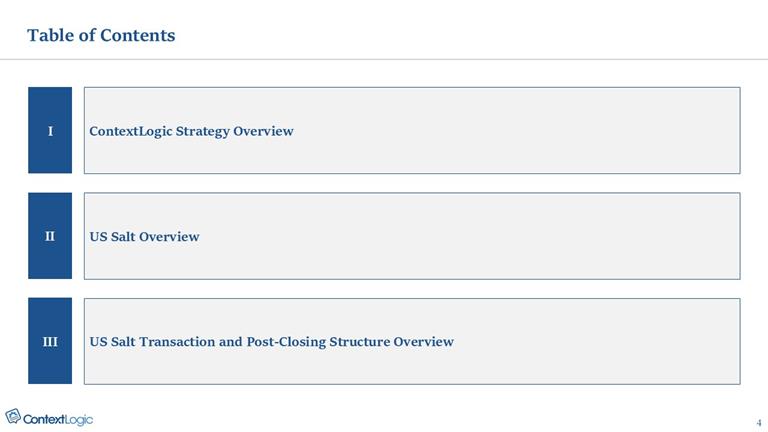
I II ContextLogic Strategy Overview US Salt Overview III US Salt Transaction and Post - Closing Structure Overview 4 Table of Contents
5 I. ContextLogic Strategy Overview
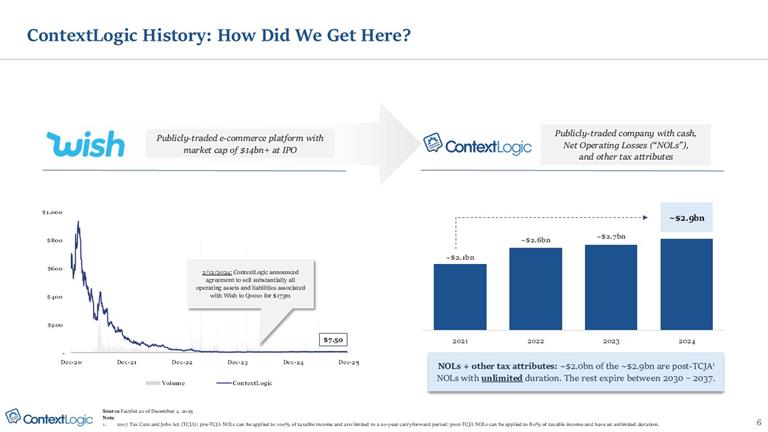
- $200 $400 $600 $800 $1,000 Dec-20 Dec-21 Dec-22 Dec-23 Dec-24 Dec-25 Volume ContextLogic 2/12/2024: ContextLogic announced agreement to sell substantially all operating assets and liabilities associated with Wish to Qoo10 for $173m Publicly - traded e - commerce platform with market cap of $14bn+ at IPO Publicly - traded company with cash, Net Operating Losses ( “ NOLs”), and other tax attributes ~$2.1bn ~$2.6bn ~$2.7bn 2021 2022 2023 2024 ContextLogic History: How Did We Get Here? NOLs + other tax attributes : ~$2.0bn of the ~$2.9bn are post - TCJA 1 NOLs with unlimited duration. The rest expire between 2030 – 2037. Source FactSet as of December 4, 2025 Note 1. 2017 Tax Cuts and Jobs Act (TCJA); pre - TCJA NOLs can be applied to 100% of taxable income and are limited to a 20 - year carryforw ard period; post - TCJA NOLs can be applied to 80% of taxable income and have an unlimited duration. $ 7.50 6 ~$2.9bn
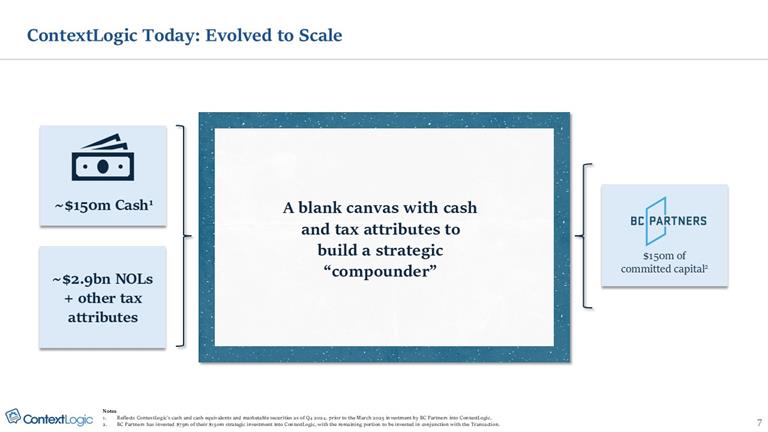
7 ContextLogic Today: Evolved to Scale ~$15 0 m Cash 1 ~$2.9bn NOLs + other tax attributes A blank canvas with cash and tax attributes to build a strategic “compounder” $150m of committed capital 2 Notes 1. Reflects ContextLogic's cash and cash equivalents and marketable securities as of Q4 2024, prior to the March 2025 investment by BC Partners into ContextLogic. 2. BC Partners has invested $75m of their $150m strategic investment into ContextLogic, with the remaining portion to be investe d i n conjunction with the Transaction.
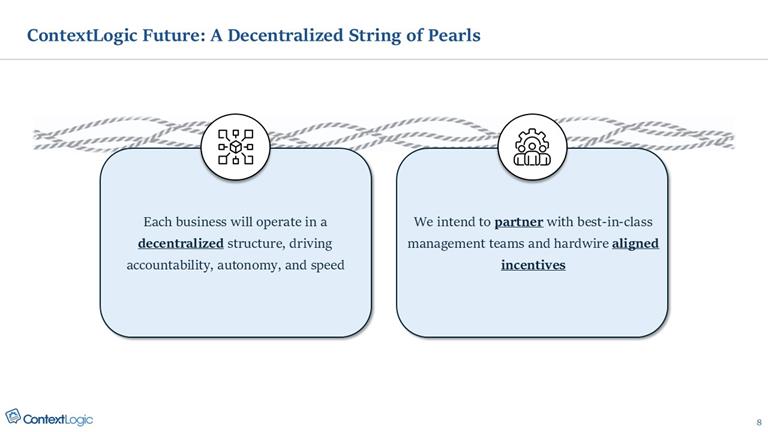
ContextLogic Future: A Decentralized String of Pearls Each business will operate in a decentralized structure, driving accountability, autonomy, and speed We intend to partner with best - in - class management teams and hardwire aligned incentives 8
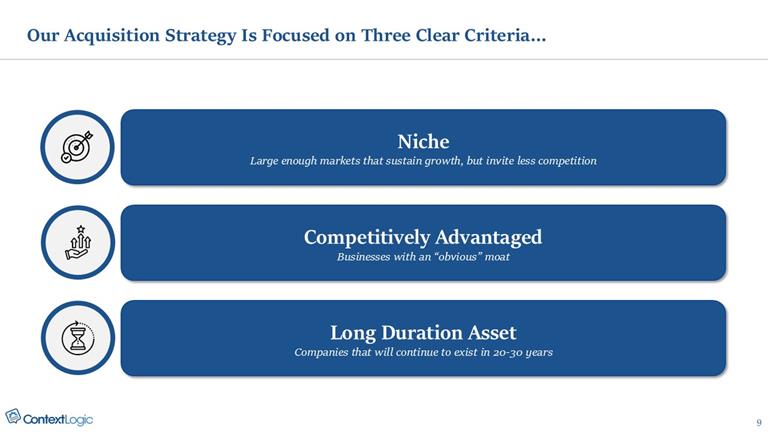
Our Acquisition Strategy Is Focused on Three Clear Criteria... Niche Large enough markets that sustain growth, but invite less competition Competitively Advantaged Businesses with an “obvious” moat Long Duration Asset Companies that will continue to exist in 20 - 30 years 9
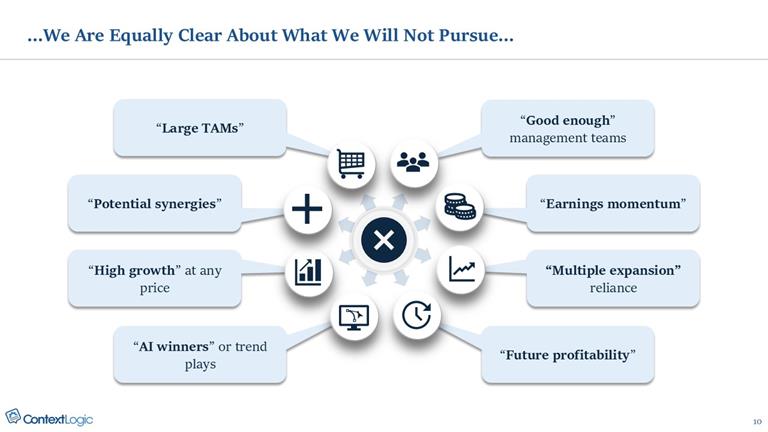
…We Are Equally Clear About What We Will Not Pursue… “ Large TAMs ” “Multiple expansion” reliance “ Earnings momentum ” “ Future profitability ” “ Good enough ” management teams “ High growth ” at any price “ Potential synergies ” “ AI winners ” or trend plays 10
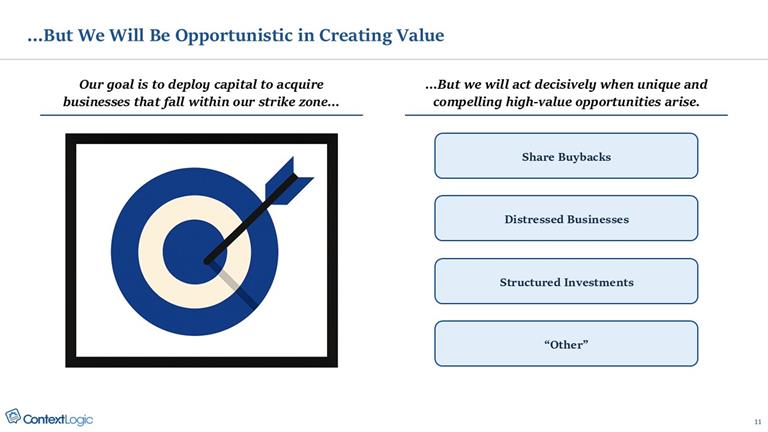
11 ...But We Will Be Opportunistic in Creating Value Our goal is to deploy capital to acquire businesses that fall within our strike zone… …But we will act decisively when unique and compelling high - value opportunities arise. Share Buybacks Distressed Businesses Structured Investments “Other”
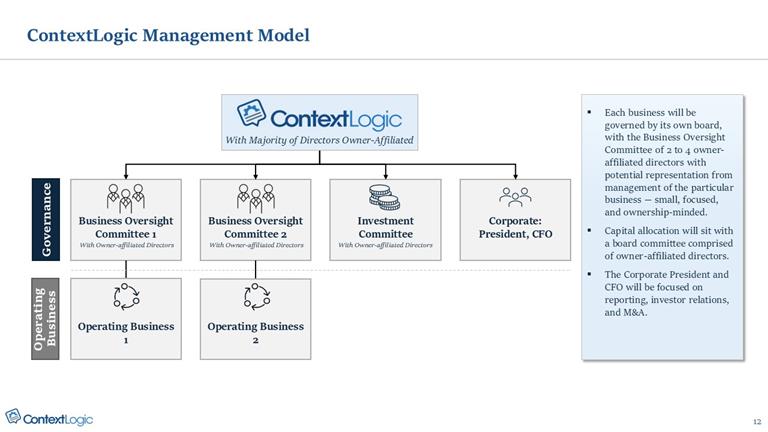
Operating Business 1 Operating Business 2 12 ContextLogic Management Model Governance Operating Business ▪ Each business will be governed by its own board, with the Business Oversight Committee of 2 to 4 owner - affiliated directors with potential representation from management of the particular business — small, focused, and ownership - minded. ▪ Capital allocation will sit with a board committee comprised of owner - affiliated directors . ▪ The Corporate President and CFO will be focused on reporting, investor relations, and M&A. Business Oversight Committee 1 With Owner - affiliated Directors Business Oversight Committee 2 With Owner - affiliated Directors Investment Committee With Owner - affiliated Directors Corporate: President, CFO With Majority of Directors Owner - Affiliated
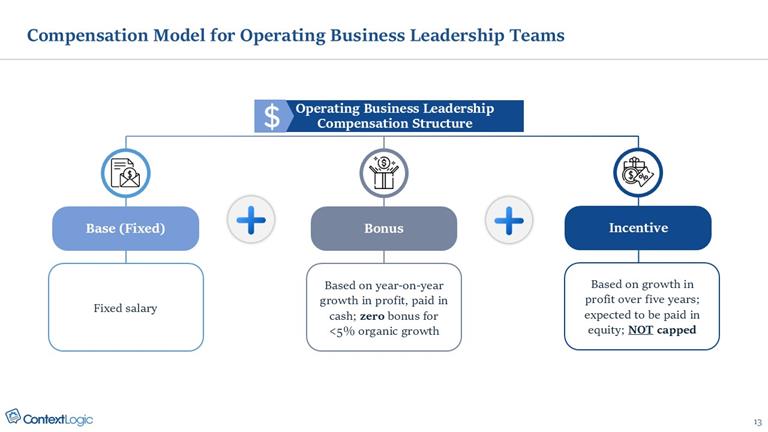
13 Compensation Model for Operating Business Leadership Teams Fixed salary Base (Fixed) Based on year - on - year growth in profit, paid in cash; zero bonus for <5% organic growth Bonus Based on growth in profit over five years; expected to be paid in equity; NOT capped Incentive Operating Business Leadership Compensation Structure
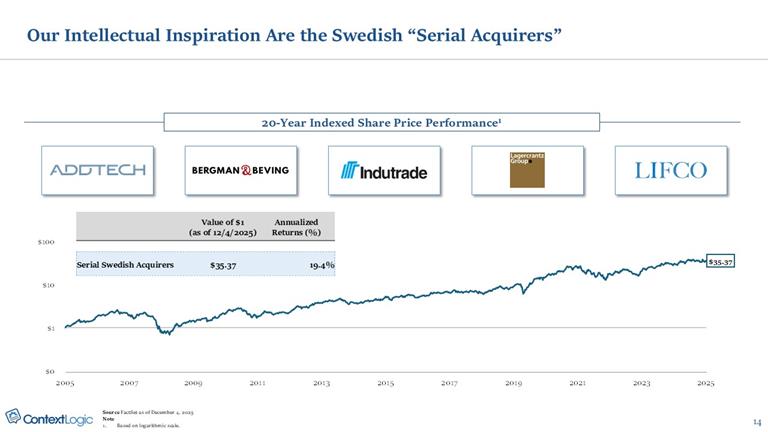
$0 $1 $10 $100 2005 2007 2009 2011 2013 2015 2017 2019 2021 2023 2025 14 Our Intellectual Inspiration Are the Swedish “Serial Acquirers” Source FactSet as of December 4 , 2025 Note 1. Based on logarithmic scale. 20 - Year Indexed Share Price Performance 1 $ 35.37 Annualized Returns (%) Value of $1 (as of 12/4/2025) 19.4% $35.37 Serial Swedish Acquirers
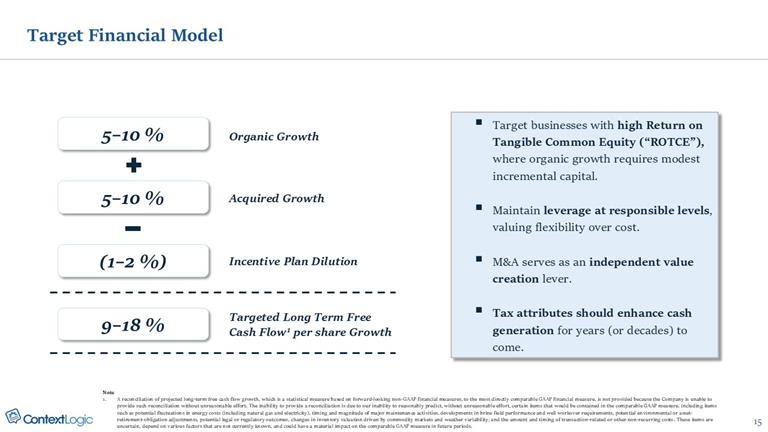
15 Target Financial Model 5 – 10 % 9 – 18 % Targeted Long Term Free Cash Flow 1 per share Growth 5 – 10 % Acquired Growth (1 – 2 % ) Incentive Plan Dilution Organic Growth Note 1. A reconciliation of projected long - term free cash flow growth, which is a statistical measure based on forward - looking non - GAAP financial measures, to the most directly comparable GAAP financial measure, is not provided because the Company is unable to provide such reconciliation without unreasonable effort. The inability to provide a reconciliation is due to our inability to re asonably predict, without unreasonable effort, certain items that would be contained in the comparable GAAP measure, includin g i tems such as potential fluctuations in energy costs (including natural gas and electricity), timing and magnitude of major maintenance act ivi ties, developments in brine field performance and well workover requirements, potential environmental or asset - retirement - obligation adjustments, potential legal or regulatory outcomes, changes in inventory valuation driven by commodity ma rkets and weather variability, and the amount and timing of transaction - related or other non - recurring costs . These items are uncertain, depend on various factors that are not currently known, and could have a material impact on the comparable GAAP me asu re in future periods. ▪ Target businesses with high Return on Tangible Common Equity (“ROTCE”), where organic growth requires modest incremental capital. ▪ Maintain leverage at responsible levels , valuing flexibility over cost. ▪ M&A serves as an independent value creation lever. ▪ Tax attributes should enhance cash generation for years (or decades) to come.
II. Introducing The First Pearl… 16
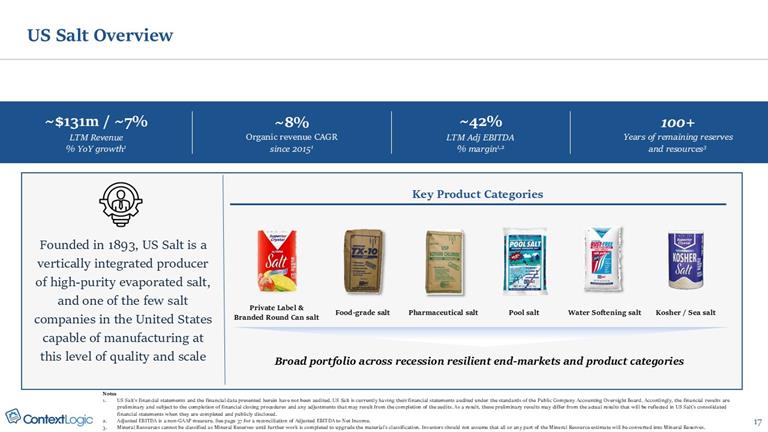
17 US Salt Overview Notes 1. US Salt's financial statements and the financial data presented herein have not been audited. US Salt is currently having the ir financial statements audited under the standards of the Public Company Accounting Oversight Board. Accordingly, the financial re sults are preliminary and subject to the completion of financial closing procedures and any adjustments that may result from the comple tio n of the audits. As a result, these preliminary results may differ from the actual results that will be reflected in US Salt' s c onsolidated financial statements when they are completed and publicly disclosed. 2. Adjusted EBITDA is a non - GAAP measure. See page 37 for a reconciliation of Adjusted EBITDA to Net Income. 3. Mineral Resources cannot be classified as Mineral Reserves until further work is completed to upgrade the material's classifi cat ion. Investors should not assume that all or any part of the Mineral Resource estimate will be converted into Mineral Reserve s. Broad portfolio across recession resilient end - markets and product categories Key Product Categories Food - grade salt Pharmaceutical salt Water Softening salt ~$131m / ~7% LTM Revenue % YoY growth 1 100+ Years of remaining reserves and resources 3 ~8% Organic revenue CAGR since 2015 1 ~42% LTM Adj EBITDA % margin 1,2 Founded in 1893, US Salt is a vertically integrated producer of high - purity evaporated salt, and one of the few salt companies in the United States capable of manufacturing at this level of quality and scale Private Label & Branded Round Can salt Kosher / Sea salt Pool salt
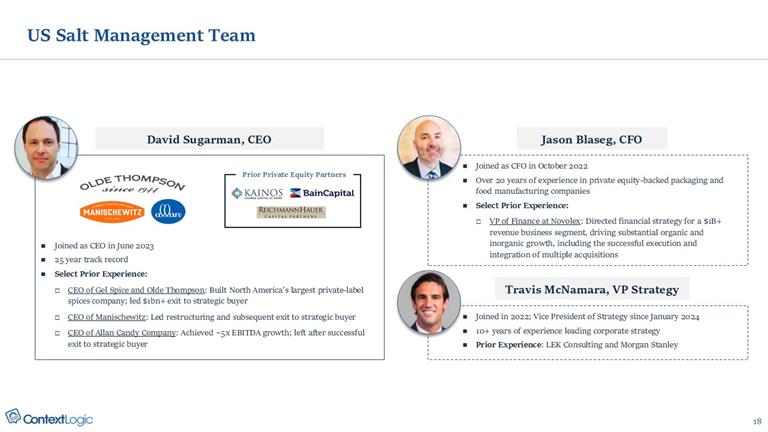
§ Joined as CFO in October 2022 § Over 20 years of experience in private equity - backed packaging and food manufacturing companies § Select Prior Experience: □ VP of Finance at Novolex : Directed financial strategy for a $1B+ revenue business segment, driving substantial organic and inorganic growth, including the successful execution and integration of multiple acquisitions 18 US Salt Management Team § Joined in 2022; Vice President of Strategy since January 2024 § 10+ years of experience leading corporate strategy § Prior Experience : LEK Consulting and Morgan Stanley Jason Blaseg, CFO Travis McNamara, VP Strategy § Joined as CEO in June 2023 § 25 year track record § Select Prior Experience: □ CEO of Gel Spice and Olde Thompson : Built North America's largest private - label spices company; led $1bn+ exit to strategic buyer □ CEO of Manischewitz : Led restructuring and subsequent exit to strategic buyer □ CEO of Allan Candy Company : Achieved ~5x EBITDA growth; left after successful exit to strategic buyer Prior Private Equity Partners David Sugarman, CEO
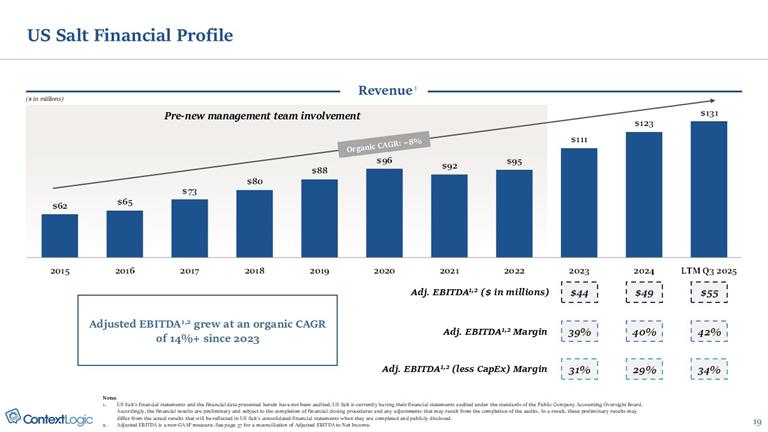
Pre - new management team involvement 19 Notes 1. US Salt's financial statements and the financial data presented herein have not been audited. US Salt is currently having the ir financial statements audited under the standards of the Public Company Accounting Oversight Board. Accordingly, the financial results are preliminary and subject to the completion of financial closing procedures and any adju stm ents that may result from the completion of the audits. As a result, these preliminary results may differ from the actual results that will be reflected in US Salt's consolidated financial statements when they are completed and publicly disclosed. 2. Adjusted EBITDA is a non - GAAP measure. See page 37 for a reconciliation of Adjusted EBITDA to Net Income. Adjusted EBITDA 1,2 grew at an organic CAGR of 14%+ since 2023 ($ in millions) Revenue 1 US Salt Financial Profile Adj. EBITDA 1,2 (less CapEx) Margin Adj. EBITDA 1,2 Margin Adj. EBITDA 1,2 ($ in millions) 34% 42% $55 31% 39% $44 29% 40% $49 ϫЄЃ ϫЅЁ ϫІϾ ϫІІ ϫЇЄ ϫЇЀ ϫЇЃ ϫϿϿϿ ϫϿЀЁ ϫϿЁϿ 2015 2016 2017 2018 2019 2020 2021 2022 2023 2024 LTM Q3 2025
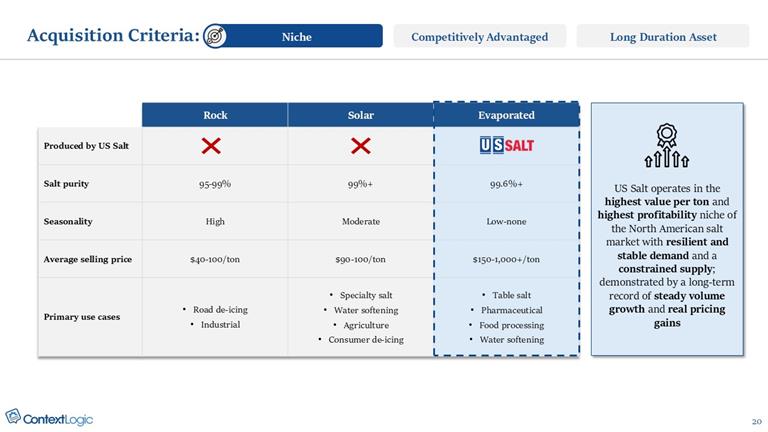
20 Evaporated Solar Rock Produced by US Salt 99.6%+ 99%+ 95 - 99% Salt purity Low - none Moderate High Seasonality $150 - 1,000+/ton $90 - 100/ton $40 - 100/ton Average selling price • Table salt • Pharmaceutical • Food processing • Water softening • Specialty salt • Water softening • Agriculture • Consumer de - icing • Road de - icing • Industrial Primary use cases US Salt operates in the highest value per ton and highest profitability niche of the North American salt market with resilient and stable demand and a constrained supply ; demonstrated by a long - term record of steady volume growth and real pricing gains Acquisition Criteria: Niche Competitively Advantaged Long Duration Asset
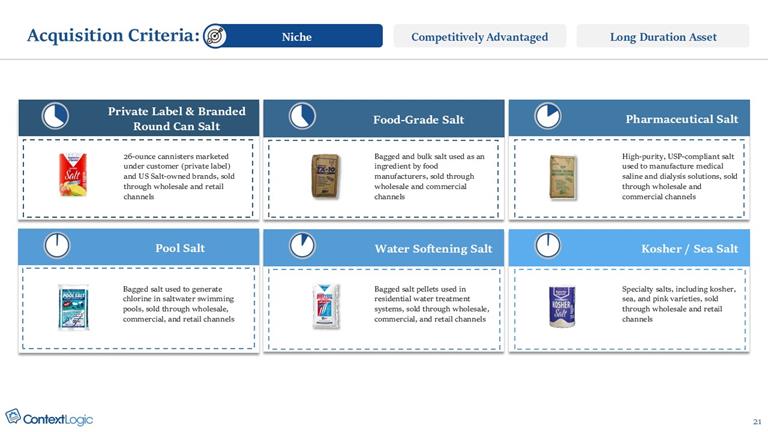
21 Acquisition Criteria: Pool Salt Bagged salt used to generate chlorine in saltwater swimming pools, sold through wholesale, commercial, and retail channels 26 - ounce cannisters marketed under customer (private label) and US Salt - owned brands, sold through wholesale and retail channels High - purity, USP - compliant salt used to manufacture medical saline and dialysis solutions, sold through wholesale and commercial channels Bagged salt pellets used in residential water treatment systems, sold through wholesale, commercial, and retail channels Bagged and bulk salt used as an ingredient by food manufacturers, sold through wholesale and commercial channels Specialty salts, including kosher, sea, and pink varieties, sold through wholesale and retail channels Niche Competitively Advantaged Long Duration Asset Private Label & Branded Round Can Salt Water Softening Salt Kosher / Sea Salt Pharmaceutical Salt Food - Grade Salt
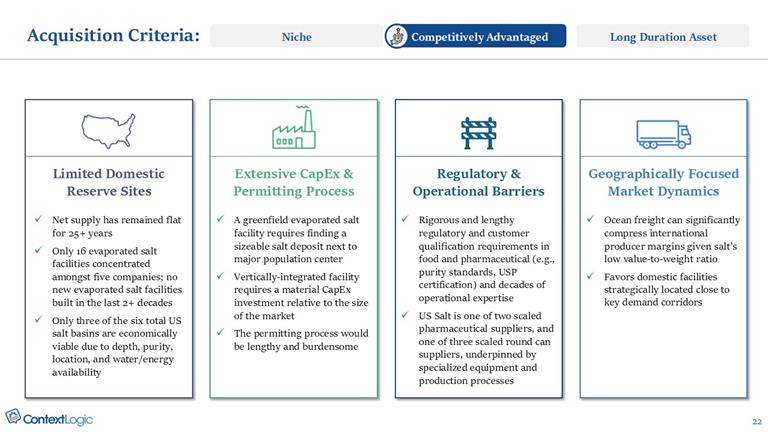
Acquisition Criteria: x Net supply has remained flat for 25+ years x Only 16 evaporated salt facilities concentrated amongst five companies; no new evaporated salt facilities built in the last 2+ decades x Only three of the six total US salt basins are economically viable due to depth, purity, location, and water/energy availability Limited Domestic Reserve Sites x Ocean freight can significantly compress international producer margins given salt's low value - to - weight ratio x Favors domestic facilities strategically located close to key demand corridors Geographically Focused Market Dynamics x A greenfield evaporated salt facility requires finding a sizeable salt deposit next to major population center x Vertically - integrated facility requires a material CapEx investment relative to the size of the market x The permitting process would be lengthy and burdensome Extensive CapEx & Permitting Process Niche Competitively Advantaged Long Duration Asset x Rigorous and lengthy regulatory and customer qualification requirements in food and pharmaceutical (e.g., purity standards, USP certification) and decades of operational expertise x US Salt is one of two scaled pharmaceutical suppliers, and one of three scaled round can suppliers, underpinned by specialized equipment and production processes Regulatory & Operational Barriers 22
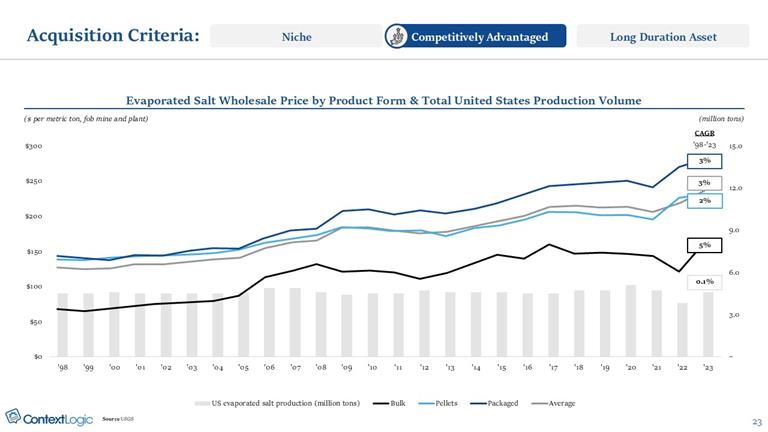
23 Acquisition Criteria: Evaporated Salt Wholesale Price by Product Form & Total United States Production Volume ($ per metric ton, fob mine and plant) CAGR '98 - '23 Source USGS – 3.0 6.0 9.0 12.0 15.0 $0 $50 $100 $150 $200 $250 $300 '98 '99 '00 '01 '02 '03 '04 '05 '06 '07 '08 '09 '10 '11 '12 '13 '14 '15 '16 '17 '18 '19 '20 '21 '22 '23 US evaporated salt production (million tons) Bulk Pellets Packaged Average 3% 3% 2% 5% 0.1% (million tons) Niche Competitively Advantaged Long Duration Asset
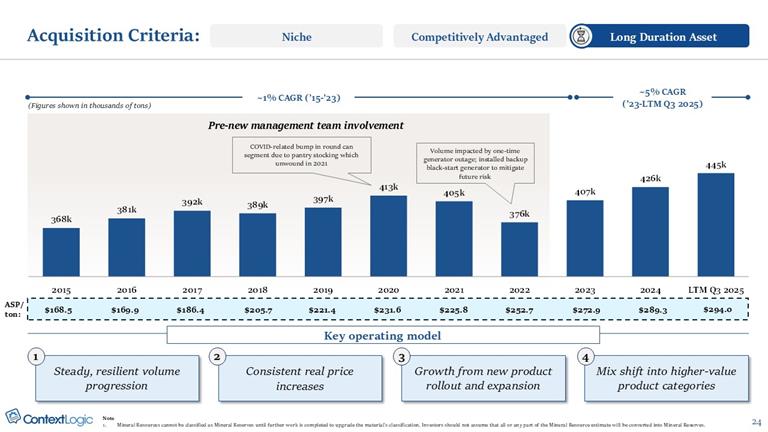
24 Acquisition Criteria: (Figures shown in thousands of tons) ~1% CAGR ('15 - '23) ~5% CAGR ('23 - LTM Q3 2025) Pre - new management team involvement Volume impacted by one - time generator outage; installed backup black - start generator to mitigate future risk COVID - related bump in round can segment due to pantry stocking which unwound in 2021 Steady, resilient volume progression 1 Consistent real price increases 2 Growth from new product rollout and expansion 3 Mix shift into higher - value product categories 4 Key operating model Competitively Advantaged Long Duration Asset ASP/ ton: $272.9 $168.5 $186.4 $169.9 $252.7 $225.8 $231.6 $221.4 $205.7 $289.3 $294.0 Note 1. Mineral Resources cannot be classified as Mineral Reserves until further work is completed to upgrade the material's classifi cat ion. Investors should not assume that all or any part of the Mineral Resource estimate will be converted into Mineral Reserve s. ЁЄІ¼ ЁІϿ¼ ЁЇЀ¼ ЁІЇ¼ ЁЇЅ¼ ЂϿЁ¼ ЂϾЃ¼ ЁЅЄ¼ ЂϾЅ¼ ЂЀЄ¼ ЂЂЃ¼ 2015 2016 2017 2018 2019 2020 2021 2022 2023 2024 LTM Q3 2025 Niche
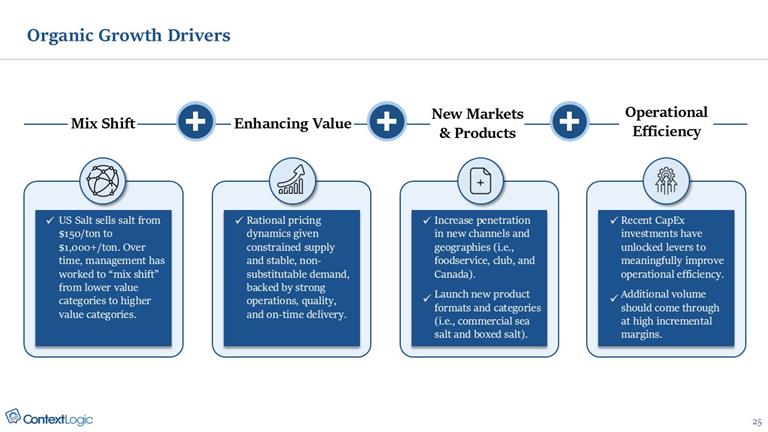
25 Organic Growth Drivers US Salt sells salt from $150/ton to $1,000+/ton. Over time, management has worked to “mix shift” from lower value categories to higher value categories. Rational pricing dynamics given constrained supply and stable, non - substitutable demand, backed by strong operations, quality, and on - time delivery. Increase penetration in new channels and geographies (i.e., foodservice, club, and Canada). Launch new product formats and categories (i.e., commercial sea salt and boxed salt). Mix Shift New Markets & Products Enhancing Value + Recent CapEx investments have unlocked levers to meaningfully improve operational efficiency. Additional volume should come through at high incremental margins. + Operational Efficiency + x x x x x x
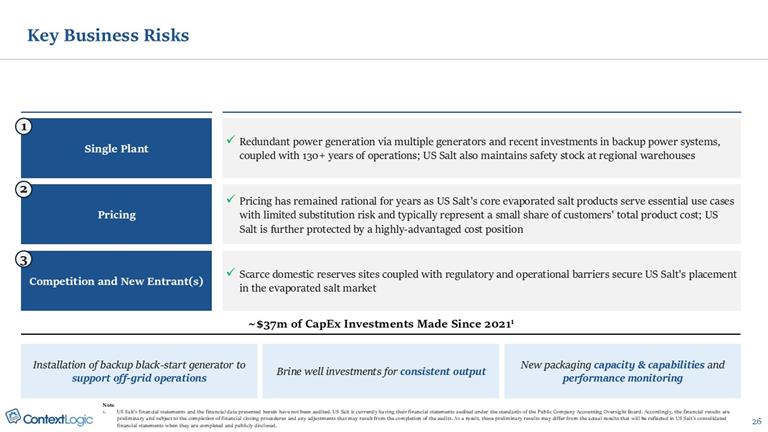
26 Key Business Risks Single Plant Pricing Competition and New Entrant(s) x Redundant power generation via multiple generators and recent investments in backup power systems, coupled with 130+ years of operations; US Salt also maintains safety stock at regional warehouses x Pricing has remained rational for years as US Salt's core evaporated salt products serve essential use cases with limited substitution risk and typically represent a small share of customers' total product cost; US Salt is further protected by a highly - advantaged cost position x Scarce domestic reserves sites coupled with regulatory and operational barriers secure US Salt's placement in the evaporated salt market Brine well investments for consistent output Installation of backup black - start generator to support off - grid operations New packaging capacity & capabilities and performance monitoring ~$37m of CapEx Investments Made Since 2021 1 1 2 3 Note 1. US Salt's financial statements and the financial data presented herein have not been audited. US Salt is currently having the ir financial statements audited under the standards of the Public Company Accounting Oversight Board. Accordingly, the financial re sults are preliminary and subject to the completion of financial closing procedures and any adjustments that may result from the comple tio n of the audits. As a result, these preliminary results may differ from the actual results that will be reflected in US Salt' s c onsolidated financial statements when they are completed and publicly disclosed.
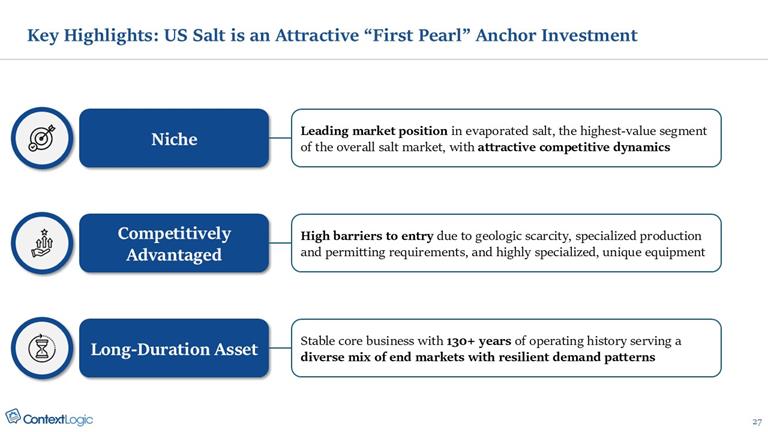
27 Key Highlights: US Salt is an Attractive “First Pearl” Anchor Investment Niche Leading market position in evaporated salt, the highest - value segment of the overall salt market, with attractive competitive dynamics Competitively Advantaged High barriers to entry due to geologic scarcity, specialized production and permitting requirements, and highly specialized, unique equipment Long - Duration Asset Stable core business with 130+ years of operating history serving a diverse mix of end markets with resilient demand patterns
III. US Salt Transaction and Post - Closing Structure Overview 28
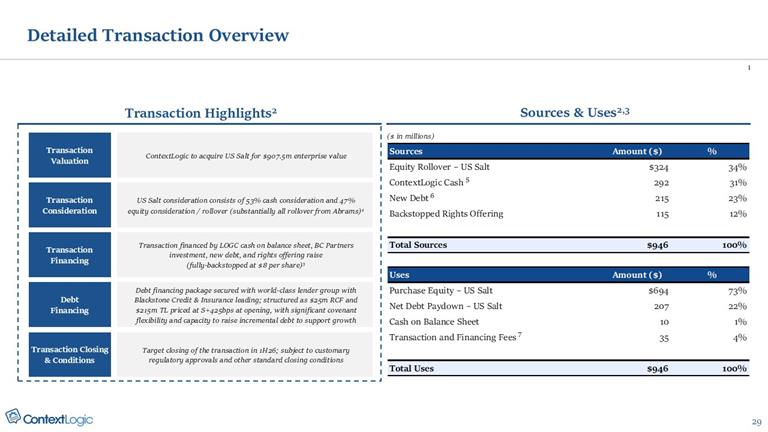
Uses Amount ($) % Purchase Equity – US Salt $694 73% Net Debt Paydown – US Salt 207 22% Cash on Balance Sheet 10 1% Transaction and Financing Fees 35 4% Total Uses $946 100% Sources Amount ($) % Equity Rollover – US Salt $324 34% ContextLogic Cash 292 31% New Debt 215 23% Backstopped Rights Offering 115 12% Total Sources $946 100% 29 Detailed Transaction Overview Transaction Highlights 2 Transaction Valuation ContextLogic to acquire US Salt for $907.5m enterprise value Transaction Consideration US Salt consideration consists of 53% cash consideration and 47% equity consideration / rollover (substantially all rollover from Abrams ) 4 Transaction Closing & Conditions Target closing of the transaction in 1H26; subject to customary regulatory approvals and other standard closing conditions Sources & Uses 2,3 ($ in millions) 7 5 Transaction Financing Transaction financed by LOGC cash on balance sheet, BC Partners investment, new debt, and rights offering raise (fully - backstopped at $8 per share) 3 Debt Financing Debt financing package secured with world - class lender group with Blackstone Credit & Insurance leading ; structured as $25m RCF and $215m TL priced at S+425bps at opening, with significant covenant flexibility and capacity to raise incremental debt to support growth 1 6
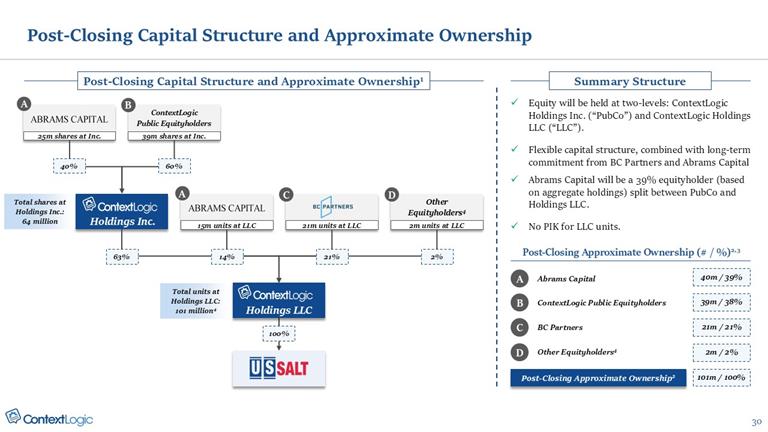
30 Post - Closing Capital Structure and Approximate Ownership 1 Summary Structure x Equity will be held at two - levels: ContextLogic Holdings Inc. (“PubCo”) and ContextLogic Holdings LLC (“LLC”). x Flexible capital structure, combined with long - term commitment from BC Partners and Abrams Capital x Abrams Capital will be a 39% equityholder (based on aggregate holdings) split between PubCo and Holdings LLC. x No PIK for LLC units. Other Equityholders 4 ContextLogic Public Equityholders Holdings LLC Holdings Inc. 25m shares at Inc. 39m shares at Inc. Total shares at Holdings Inc.: 64 million 40% 60% 2m units at LLC 21m units at LLC 15m units at LLC Total units at Holdings LLC: 101 million 4 63% 14% 21% 2% 100% A B A C D A Abrams Capital 40m / 39% Post - Closing Approximate Ownership (# / %) 2,3 B ContextLogic Public Equityholders 39m / 38% C BC Partners 21m / 21% D Other Equityholders 4 2m / 2% Post - Closing Approximate Ownership 2 101m / 100% Post - Closing Capital Structure and Approximate Ownership
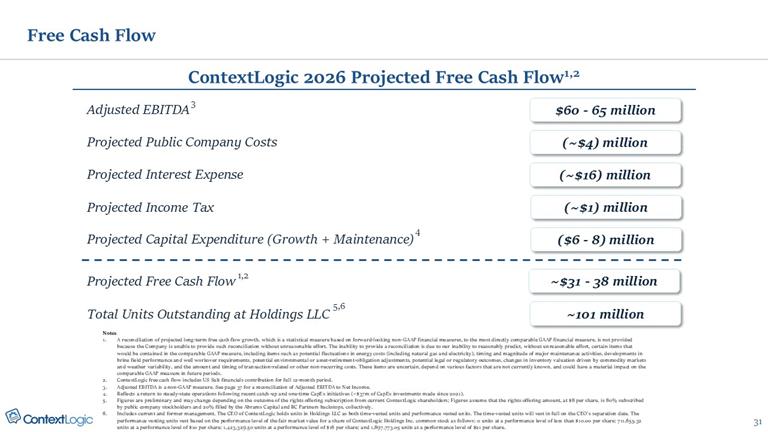
ContextLogic 2026 P rojected Free Cash Flow 1,2 31 Free Cash Flow Notes 1. A reconciliation of projected long - term free cash flow growth, which is a statistical measure based on forward - looking non - GAAP financial measures, to the most directly comparable GAAP financial measure, is not provided because the Company is unable to provide such reconciliation without unreasonable effort. The inability to provide a reconcil iat ion is due to our inability to reasonably predict, without unreasonable effort, certain items that would be contained in the comparable GAAP measure, including items such as potential fluctuations in energy costs (including natural gas and electricity), timing and magnitude of major maintenance act ivi ties, developments in brine field performance and well workover requirements, potential environmental or asset - retirement - obligation adjustments, pote ntial legal or regulatory outcomes, changes in inventory valuation driven by commodity markets and weather variability, and the amount and timing of transaction - related or other non - recurring costs . These items are uncertain, depend on various factors that are not currently known, and could have a material impact on the comparable GAAP measure in future periods. 2. ContextLogic free cash flow includes US Salt financials contribution for full 12 - month period. 3. Adjusted EBITDA is a non - GAAP measure. See page 37 for a reconciliation of Adjusted EBITDA to Net Income. 4. Reflects a return to steady - state operations following recent catch - up and one - time CapEx initiatives (~$37m of CapEx investment s made since 2021). 5. Figures are preliminary and may change depending on the outcome of the rights offering subscription from current ContextLogic sh areholders; Figures assume that the rights offering amount, at $8 per share, is 80% subscribed by public company stockholders and 20% filled by the Abrams Capital and BC Partners backstops, collectively. 6. Includes current and former management. The CEO of ContextLogic holds units in Holdings LLC as both time - vested units and perfor mance vested units. The time - vested units will vest in full on the CEO's separation date. The performance vesting units vest based on the performance level of the fair market value for a share of ContextLogic Holdings I nc. common stock as follows: 0 units at a performance level of less than $10.00 per share; 711,655.32 units at a performance level of $10 per share; 1,423,329.50 units at a performance level of $16 per share; and 1,897,773.05 u nit s at a performance level of $21 per share. (~$4) million Projected P ublic Company Costs (~$16) million Projected I nterest Expense ($6 - 8) million Projected Capital Expenditure ( G rowth + M aintenance ) 4 Projected I ncome Tax (~$1) million Adjusted EBITDA $60 - 65 million 3 ~$31 - 38 million Projected F ree Cash Flow 1,2 ~101 million Total Units Outstanding at Holdings LLC 5,6
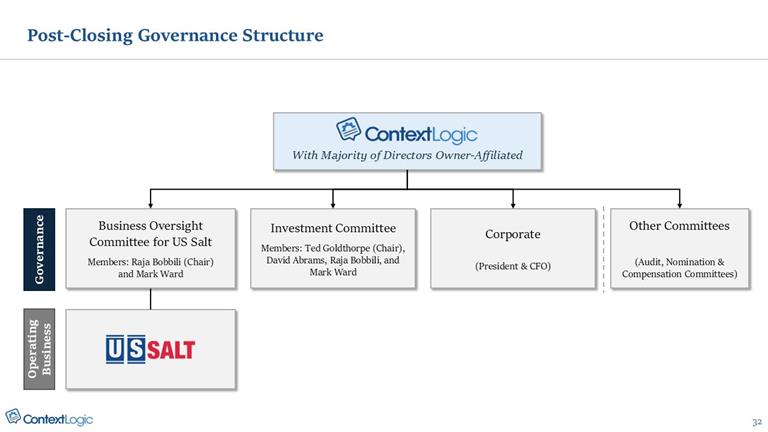
32 Post - Closing Governance Structure With Majority of Directors Owner - Affiliated Business Oversight Committee for US Salt Members: Raja Bobbili (Chair) and Mark Ward Investment Committee Members: Ted Goldthorpe (Chair), David Abrams, Raja Bobbili, and Mark Ward Corporate (President & CFO) Other Committees (Audit, Nomination & Compensation Committees) Governance Operating Business
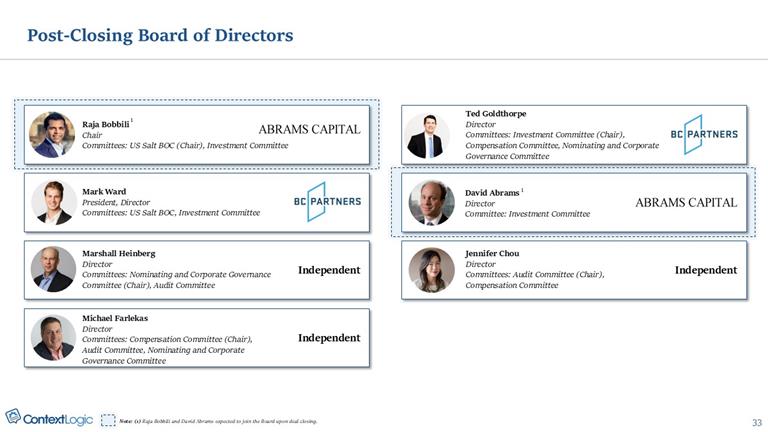
33 Post - Closing Board of Directors Ted Goldthorpe Director Committees: Investment Committee (Chair), Compensation Committee, Nominating and Corporate Governance Committee Raja Bobbili Chair Committees: US Salt BOC (Chair), Investment Committee Jennifer Chou Director Committees: Audit Committee (Chair), Compensation Committee Independent Michael Farlekas Director Committees: Compensation Committee (Chair), Audit Committee, Nominating and Corporate Governance Committee Independent Marshall Heinberg Director Committees: Nominating and Corporate Governance Committee (Chair), Audit Committee Independent Mark Ward President, Director Committees: US Salt BOC, Investment Committee David Abrams Director Committee: Investment Committee Note: (1) Raja Bobbili and David Abrams expected to join the Board upon deal closing. 1 1
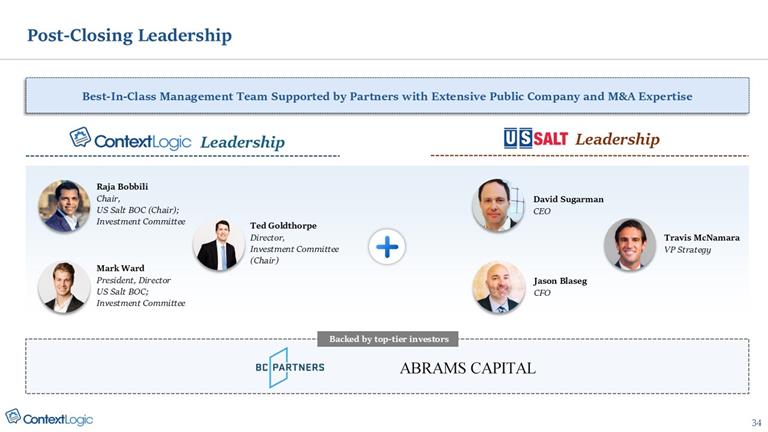
34 Post - Closing Leadership Best - In - Class Management Team Supported by Partners with Extensive Public Company and M&A Expertise Backed by top - tier investors Leadership David Sugarman CEO Jason Blaseg CFO Travis McNamara VP Strategy Leadership Raja Bobbili Chair, US Salt BOC (Chair); Investment Committee Mark Ward President, Director US Salt BOC; Investment Committee Ted Goldthorpe Director, Investment Committee (Chair)
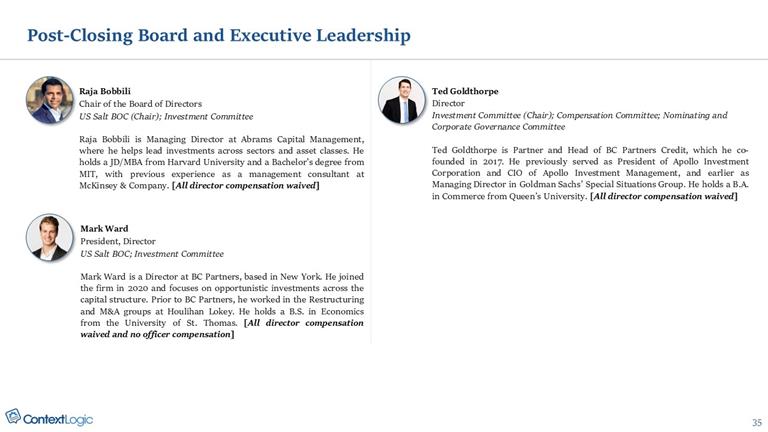
35 Post - Closing Board and Executive Leadership Mark Ward President, Director US Salt BOC; Investment Committee Mark Ward is a Director at BC Partners, based in New York . He joined the firm in 2020 and focuses on opportunistic investments across the capital structure . Prior to BC Partners, he worked in the Restructuring and M&A groups at Houlihan Lokey . He holds a B . S . in Economics from the University of St . Thomas . [ All director compensation waived and no officer compensation ] Ted Goldthorpe Director Investment Committee (Chair); Compensation Committee; Nominating and Corporate Governance Committee Ted Goldthorpe is Partner and Head of BC Partners Credit, which he co - founded in 2017 . He previously served as President of Apollo Investment Corporation and CIO of Apollo Investment Management, and earlier as Managing Director in Goldman Sachs' Special Situations Group . He holds a B . A . in Commerce from Queen's University . [ All director compensation waived ] Raja Bobbili Chair of the Board of Directors US Salt BOC (Chair); Investment Committee Raja Bobbili is Managing Director at Abrams Capital Management, where he helps lead investments across sectors and asset classes . He holds a JD/MBA from Harvard University and a Bachelor's degree from MIT, with previous experience as a management consultant at McKinsey & Company . [ All director compensation waived ]
Investor Relations Information • Listing: Company intends to pursue a listing on a national exchange. • Quarterly Updates: Provide regular updates with opportunity for Q&A. • Annual Investor Day: In - person event featuring subsidiary CEOs and strategic growth discussions. • Financial Targets: No formal guidance to be given on a go - forward basis (except for 2026 projected adjusted EBITDA and free cash flow included in this presentation). • Investor Contact: [email protected] • Additional Information: https://ir.contextlogic.com/ ContextLogic plans to increase engagement with the investor community following the close of the US Salt transaction. 36
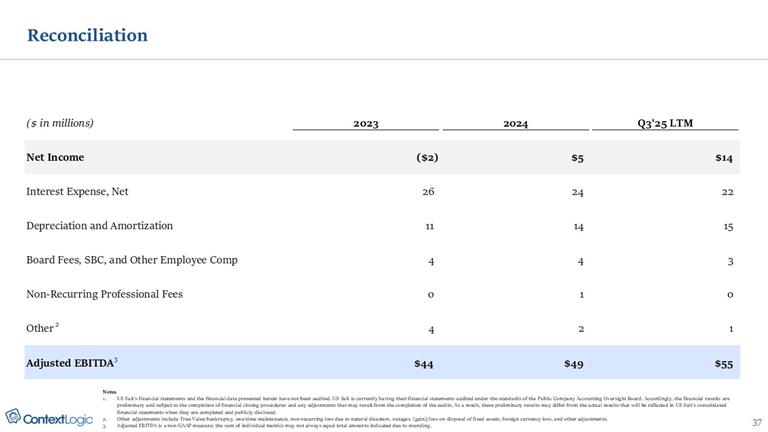
37 Reconciliation ($ in millions) 2023 2024 Q3'25 LTM Net Income ($2) $5 $14 Interest Expense, Net 26 24 22 Depreciation and Amortization 11 14 15 Board Fees, SBC, and Other Employee Comp 4 4 3 Non-Recurring Professional Fees 0 1 0 Other 4 2 1 Adjusted EBITDA $44 $49 $55 Notes 1. US Salt's financial statements and the financial data presented herein have not been audited. US Salt is currently having the ir financial statements audited under the standards of the Public Company Accounting Oversight Board. Accordingly, the financial re sults are preliminary and subject to the completion of financial closing procedures and any adjustments that may result from the comple tio n of the audits. As a result, these preliminary results may differ from the actual results that will be reflected in US Salt' s c onsolidated financial statements when they are completed and publicly disclosed. 2. Other adjustments include True Value bankruptcy, one - time maintenance, non - recurring loss due to natural disasters, outages, (ga in)/loss on disposal of fixed assets, foreign currency loss, and other adjustments. 3. Adjusted EBITDA is a non - GAAP measure; the sum of individual metrics may not always equal total amounts indicated due to roundin g. 3 2
Exhibit 99.3
Conference Call Script
ContextLogic/US Salt Acquisition Call
Slide 1 – 3: Welcome Message / Legal Disclaimer (Operator)
Good morning, ladies and gentlemen, and thank you for standing by. Welcome to today’s call, announcing the acquisition of US Salt by ContextLogic, and the formation of a new Business Ownership Platform backed by Abrams Capital and BC Partners. At this time, all participants are in listen-only mode and there will not be a Question-and-Answer section at the conclusion of today’s call; however, a recording and transcript will be made available online, and management will make themselves available to the investor community over the coming days and weeks.
Before we begin, I would like to note that during this call we will be referring to a slide deck that is available on ContextLogic’s investor relations website at https://ir.contextlogic.com/.
Please note that today’s call contains forward-looking statements regarding future events and future performance of ContextLogic, US Salt and the combined company. These forward-looking statements are based upon information available today and actual results could differ materially from those contemplated by these forward-looking statements. Please refer to slides two and three for important disclaimers and cautionary statements regarding forward-looking information.
I will now turn the call over to the hosts of today’s call: Ted Goldthorpe, current Chairman of ContextLogic; Mark Ward, President of ContextLogic, Raja Bobbili, incoming Chairman of ContextLogic; and David Sugarman, CEO of US Salt.
Slide 4: Table of Contents (Ted)
Good morning, and thank you for joining us. We’re excited to walk you through what we’re building at ContextLogic and to provide a comprehensive overview of our anchor acquisition— an exceptional business called US Salt.
First, I’ll provide an overview of ContextLogic’s origins and how it ended up with a unique combination of short term balance sheet liquidity and billions of dollars in available tax attributes to pursue compelling acquisitions.
Second, we’ll introduce the first major building block of the Company’s strategy: the acquisition of US Salt.
And third, we’ll walk through the transaction details, the ownership structure, and the numbers that shape what ContextLogic will look like once this deal closes, which we expect to be in the first half of 2026, subject to customary approvals and closing conditions.
Slide 5: ContextLogic Strategy Overview
(No script—title slide.)
| 1 |
Slide 6: ContextLogic History: How Did We Get Here? (Ted)
The story starts with a company many of you probably remember: Wish.com. At its IPO in 2020, during peak pandemic e-commerce enthusiasm, Wish was valued at more than $14 billion.
But the business model just wasn’t sustainable. The company burned through billions of dollars of cash and, over time, the underlying economics caught up with it. Eventually, the legacy board and management team made the tough but correct decision to sell the business.
However, they successfully undertook efforts to preserve roughly $2.9 billion of net operating losses plus other tax attributes.
Slide 7: ContextLogic Today: Evolved to Scale (Ted)
When we at BC Partners first got involved in March 2025, we saw a blank canvas—a chance to build a strategic, acquisition-driven compounder, with cash and tax attributes, from the ground up. BC Partners committed to purchasing up to $150 million of convertible preferred units. The investment and commitment by BC Partners, was led through a private fund advised by BC
Partners credit. Our goal, in partnership with the company, was to review, identify and evaluate strategic opportunities for the benefit of ContextLogic and its stockholders.
Very shortly afterward, we met Abrams Capital—led by renowned investor David Abrams, along with his partner Raja Bobbili, whom you’ll hear from shortly.
Since then, our two firms have worked side-by-side to structure ContextLogic based on first principles, asking ourselves time and again: how would a company run by owners, for owners be designed and constructed?
What we’re sharing today is exactly that—the architecture of our business ownership platform designed to produce sustainable, long-term free cash flow per share growth. The fundamental principles behind it—aligned incentives, decentralized operations, and governance that keeps owners close to the operators—are core building blocks, and we’re proud to walk through them today.
Slide 8: ContextLogic Future: A Decentralized String of Pearls (Ted)
There are two design principles that sit at the center of our business strategy.
First, every operating business that ContextLogic acquires will be run in a decentralized manner. Decisions should and will be made as close to the business as possible, by people who actually run it. Corporate exists as a support function, not a command center. Its job is to help the operators, not to micromanage them.
| 2 |
Second, we will only work with top-tier management teams—and ensure their incentives are truly aligned with shareholders. This is critical to us.
Slide 9: Our Acquisition Strategy Is Focused on Three Clear Criteria… (Ted)
To identify target businesses, we look for three clear criteria.
First: niche markets. We like markets that are big enough to grow in but small enough to avoid competitive spotlight. As a general principle, strong businesses in small markets tend to be pretty good businesses.
Second: competitive advantages. What we call “obvious” competitive advantages. Not theoretical or “potential” future advantages—actual, durable competitive strengths and positioning you can point to and understand.
Third: long-duration assets. Businesses that we expect to have a clear reason to exist 20 or 30 years from now. We’re building a long-term business ownership platform, not something we hope to flip in a couple of years.
Slide 10: We’re Equally Clear About What we will not pursue (Ted)
Just as important is what we won’t pursue.
We’re not pursuing big “TAMs” just because the market size looks impressive on a slide. We’re not paying for “multiple expansion” in the hope that the market rerates the stock. We’re not trying to ride “earnings momentum” or “future profitability” narratives.
We’re also not interested in “good enough” management teams or high growth at any price, or loose synergy stories, or grabbing whatever happens to be the AI trend of the moment.
We’re focused on durable, understandable businesses with real advantages.
Slide 11 – ...But We Will Be Opportunistic in Creating Value (Ted)
Our primary goal is to deploy capital into businesses that fit squarely within our strike zone— niche, competitively advantaged, long-duration businesses run by great teams.
But when we see unique, high-value opportunities outside of that core—such as share buybacks, a special situation, a distressed opportunity, or a structured investment—we have the expertise to capitalize.
One of the advantages of having a strong cash-generating base, combined with our tax attributes, is that we expect to have cash to deploy opportunistically for the benefit of shareholders.
| 3 |
Slide 12 – ContextLogic Management Model (Ted)
Just as we decentralize operations, we also decentralize governance.
Each operating business will be overseen by its own Business Oversight Committee of the ContextLogic board—made up of a small group of two to four directors. Each committee will work with management to oversee the business under it. The idea is to have a governance structure that’s small, focused, accountable, and ownership-minded.
Capital allocation decisions sit with a separate Investment Committee of the board.
And at the corporate level, we’ve made a very deliberate choice: we are not appointing a corporate CEO at ContextLogic. It’s an acknowledgment that the real CEOs—the people with true authority and accountability—are the leaders running each operating business. Corporate exists to support them, not to sit above them.
What we will have is a very lean but constructive corporate team: a president and a CFO who focus on reporting, investor relations, and M&A—fully addressing all of the company responsibilities as a public company. My colleague Mark has agreed to serve as president, and he will receive no salary from ContextLogic. More broadly, the majority of our board at closing will consist of representatives from Abrams and BC Partners, and none of us will receive a dollar of director compensation from ContextLogic. We will complement the Board with independent and highly experienced directors. The interests of the Board will be fully aligned with our public shareholders.
To reiterate, the guiding principle is simple: ContextLogic will be governed by owners, for owners.
Slide 13 – ContextLogic Management Model (Ted)
Now let’s talk about how we align leaders in the operating businesses with shareholders. There are three components that are tightly linked to value creation:
| 1. | Base salary – straightforward fixed pay. |
| 2. | Annual bonus – based on year-over-year profit growth. If organic profit growth is below 5%, the bonus is zero. |
| 3. | Long-term incentive – based on profit growth over a five-year period, not capped, and expected to be paid in equity. |
If a team delivers strong, sustained profit growth, they do very well. If they don’t, they don’t.
For managers, this really is the best of both worlds: private-equity-level incentives without the forced exit that pushes so many good companies to sell before their time. ContextLogic will attract operators who want true pay-for-performance and the freedom to build against the backdrop of a long-term horizon and the backing of public capital markets.
| 4 |
Slide 14 – ContextLogic Management Model (Ted)
A big part of our thinking has been shaped by a group of Swedish serial acquirers—companies like Addtech, Lifco, Indutrade, and others you see on this slide.
Over the last two decades, these businesses have created extraordinary shareholder value by doing a few things very well:
| · | disciplined capital allocation, |
| · | radical decentralization, and |
| · | tightly aligned incentives. |
They are proof that you can create a lot of value by adding one good business after another, attracting talented operators, aligning their incentives with shareholders, giving them real autonomy, and doing this with consistency and discipline. That process is exactly what compounds into highly compelling results.
Slide 15 – Target Financial Model (Ted)
Let me close my section with the financial model we’re holding ourselves accountable to. Our true north star is free cash flow per share. To be clear, by free cash flow, we mean operating cash flow less all capital expenditures.
We want to own businesses that can grow free cash flow organically at 5–10% per year, sustainably, over a long time.
On top of that, we expect to target acquisitions that add another 5–10% growth each year, and importantly, we believe we can do that without needing to issue additional equity.
The incentive plan creates 1–2% dilution a year, but it’s triggered only when the team delivers. It’s dilution tied to financial performance—not dilution handed out for free.
So when you net it all out, our target is to compound free cash flow per share growth at 9–18% annually. Yes, that’s a wide range. But our goal is straightforward: to show, year after year, that this is a repeatable model for long-term, tax-optimized compounding at ContextLogic.
With that, I want to turn it over to Raja Bobbili from Abrams Capital. Abrams is expected to hold a combined equity stake of a little under 40% on an aggregate basis between ContextLogic and our holding subsidiary, making them our largest equityholder. We are thrilled that as part of this transaction, Raja will join the Board and serve as chair. In fact, Raja introduced US Salt to ContextLogic, and he has been a true thought partner in designing this platform. I couldn’t be more excited to work with him and with David Abrams, who will also join the Board.
| 5 |
Slide 16 – Introducing the First Pearl, US Salt (Raja)
Thank you, Ted, and good morning, everyone. I’m really glad to be here and to talk about why we’re doing this.
Abrams Capital was founded in 1999. We invest with a long time horizon, usually in a fairly concentrated way, across both public and private companies. And over the years, we’ve seen the very best of both worlds.
So when we had the chance to get involved here—right at the ground floor, with a true blank canvas, as Ted put it, to build something new—we rolled up our sleeves and got to work. We saw an opportunity to combine the most attractive parts of private ownership with the most attractive parts of being a public company, and to design something from scratch that could be genuinely exceptional.
On the private side, what we love is the long-term orientation, the direct alignment between owners and operators, a mindset of pay-for-performance, and an ability to move quickly without the bureaucracy and agency issues that public companies sometimes accumulate. In simple terms, there’s an ownership mindset that runs through great private businesses.
On the public side, you have the advantages of liquidity, a currency to attract and retain great management teams, transparency and accountability, and the ability to build something with permanent capital—a company that isn’t tied to the lifespan of a single fund or a single financial sponsor. That means you can be a long-term home for owners who are looking to transition, and for management teams who want to build without a clock ticking towards an exit.
The vision for ContextLogic is to bring these strengths together. Every design choice—governance, incentives, structure—has been thought through from first principles to create something unique in the public markets.
The other reason we’re excited to be here is US Salt. We invested in this company about four years ago, and we’re the largest investor. David will tell you more about the business, but I’ll say this: it’s a gem that looks ordinary at the outset but it is extraordinary once you understand it. You see it in the 40–45% Adjusted EBITDA margins; you see it in the high returns on capital; you see it in decades of pricing growth; and you see it in the real, structural barriers to entry.
We were fortunate to recruit David Sugarman as CEO two and a half years ago, and he and his team have done a tremendous job. We couldn’t be more pleased with the business or with the leadership running it.
In fact, as an investor in US Salt our biggest concern—really our only major concern—was that the dynamics with our equity partners might force a premature sale, ceding its enormous future potential to the next buyer. So we’re thrilled to have the opportunity to roll substantially all our current investment, and even more than that, to put additional capital to work through buying out other sellers and helping backstop the rights offering.
With that, I want to turn the call over to David Sugarman.
| 6 |
Slide 17 – US Salt Overview (David)
Thanks, Raja, and good morning everyone. I’m David Sugarman, CEO of US Salt. I’m excited to walk you through the business and explain why we think it’s such a special company.
US Salt has been around since 1893. We’re one of the very few vertically integrated producers of high-purity evaporated salt in the United States — meaning we control everything from the brine wells to production to packaging.
We serve recession-resilient end markets such as food, pharmaceuticals, and water conditioning. These are stable, everyday uses, not discretionary categories.
We’ve grown consistently for a long time. For LTM ended September 30, we have over 40% Adjusted EBITDA margins and still see significant room to grow, with estimated remaining reserves and resources of more than 100 years in our brine field.
Slide 18 – Management Team (David)
Let me quickly introduce the leadership team.
Our CFO, Jason Blaseg, has more than 20 years of experience in packaging and food manufacturing. Before joining us, he helped lead a billion-dollar division at Novolex and played a key role in several successful acquisitions and integrations.
Our VP of Strategy, Travis McNamara, joined in 2022 after spending time at LEK and Morgan Stanley. He leads commercial strategy, pricing, and long-term initiatives.
And as for me — I joined as CEO in 2023 after spending 25 years building and scaling private food businesses, often alongside financial sponsors. What drew me to ContextLogic was exactly what Raja described: the chance to operate with a true private-company mindset inside a public platform that doesn’t need to sell or flip businesses to create value. It gives my team and me
the ability to build with a long time horizon, and we’re already hard at work looking at both organic and inorganic opportunities.
I’m also rolling a significant investment into ContextLogic, and it will be my single largest personal holding. The incentive structure is simple, objective, and works only when shareholders win. After 25 years in this industry, this is one of the most compelling and energizing opportunities I’ve had.
Slide 19 – US Salt Financial Profile (David)
Since 2015, revenue has grown at 8% annualized. Most importantly, our Adjusted EBITDA has grown organically at more than 14% since 2023, and our Adjusted EBITDA margins consistently sit near 40%.
| 7 |
Free cash flow conversion remains extremely strong because this is not a capex-heavy business once the core infrastructure is in place.
In short: long-term, stable growth, consistently high margins, and excellent cash generation.
Slide 20 – Acquisition Criteria, Niche (David)
Salt is a deceptively simple product, but the industry structure really matters.
There are three main forms of salt: rock, solar, and evaporated. We operate in the highest value, highest purity segment — evaporated salt. This has over 99% purity, low seasonality, and premium pricing many multiples of where Rock and Solar salt can sell.
Slide 21 – Acquisition Criteria, Niche (David)
Within evaporated salt, we focus on the highest value niches. We sell a significant amount of 26-ounce private label round can salt, and we sell high-purity pharmaceutical grade salt which carries some of the highest prices in the entire industry because the standards are so strict and the qualification process is long and demanding.
Slide 22: Acquisition Criteria, Competitively Advantaged (David)
Salt may sound like a commodity, but evaporated salt is absolutely not a commodity market. The barriers to entry are meaningful.
First, reserve scarcity. Only a few basins in the United States have the right combination of depth, purity, and access to energy and water. As far as we know, no new evaporated salt facility has been built in over two decades.
Second, geography matters. Salt has a low value-to-weight ratio, so shipping long distances erodes margins quickly. Domestic producers close to major demand corridors have a structural cost advantage. We are ideally positioned in upstate New York with access to population corridors.
Third, capex and permitting. Building a new evaporated salt facility would require massive capital — and years of permitting and regulatory approvals, if it is even possible to do near major population centers.
Fourth, regulatory and customer qualification. Pharmaceutical and food customers require extensive testing, audits, and documentation. It can take years to qualify a new supplier.
These barriers aren’t theoretical. They’re real, they’re structural. And keep in mind that this is a niche market. The economics are attractive for incumbents, but the total size is typically too small to justify the capex, permitting, and qualification hurdles for a new entrant. Put simply: if you’re not already in this market, it’s not attractive to enter it.
| 8 |
Slide 23: Acquisition Criteria, Competitively Advantaged (David)
This chart shows two things: steady growth in pricing over 25 years and nearly flat domestic evaporated salt supply.
Because supply is concentrated and doesn’t change much, and because demand is stable, pricing has been rational for decades. Across all evaporated salt categories — bulk, pellets, packaged — you see steady upward pricing. It’s effectively an inflation-protected business, and our customers understand that pricing moves with input costs. And we price to the value we deliver.
Slide 24: Acquisition Criteria, Long Duration Asset (David)
Here you can see our volume progression and average selling price (ASP) over time.
Volume has grown steadily at about 1% annually over the long term, and closer to 5% more recently as we introduced new products and increased penetration in certain channels.
But the bigger story is ASP which has increased consistently through a combination of pricing, mix shift, and new product introductions.
We’ve had one-off events — like the generator outage — but we believe we have addressed those risks with backup capacity and redundant power systems to prevent recurrence.
Slide 25: Organic Growth Drivers (David)
Our organic growth playbook is straightforward.
First, mix shift. We sell salt for $150 per ton and salt for much over $1,000 per ton. Every day, we continue mix-shifting up toward higher-value categories like pharma-grade and specialty salts.
Second, we price the product for the value we deliver, as evidence in our quality, on-time delivery, reliability, and service.
Third, new products and new markets. We are expanding into foodservice, club channels, Canada, and new formats like commercial sea salt and boxed salt.
And finally, operating efficiency. We’ve made significant capex investments since 2021 — more than $37 million — which are starting to unlock capacity, improve uptime, and enhance margins.
Our long-term goal is to deliver 5–10% annual organic profit growth, and we believe the combination of mix, new markets, and operational efficiency gives us a clear path to achieve that.
Slide 26: Key Business Risks (David)
Every business has risks, and we take ours seriously.
| 9 |
We’re a single-site operation, so we’ve invested heavily in redundant power generation, backup systems, and safety stock in regional warehouses.
Pricing is always a risk, but our products serve essential, non-substitutable use cases, and typically make up a very small percentage of a customer’s total cost. Pricing has remained rational across the industry for years.
And while new entrants are always possible, the competitive advantages of our experience and location I described earlier — geology, permitting, capex, and qualification — make it difficult for anyone to replicate what we do.
We’ve built this business to be resilient, and we’ve invested ahead of risk to protect the company.
Slide 27 – Why US Salt Is a “First Pearl” (David)
Let me close with why US Salt is such a compelling anchor investment for ContextLogic. We check all three of the acquisition criteria Ted laid out earlier:
| · | Niche: We operate in the highest-value segment of the salt market, with stable demand and rational pricing. |
| · | Competitively advantaged: Our experience and location are an asset, from geology to regulatory approvals to specialized equipment. |
| · | Long-duration asset: This is a 130-year-old business with approximately 100+ years of reserves remaining and a diversified set of end markets. |
This is exactly the kind of business you want as the foundation of a long-term compounding platform — stable, high-margin, cash-generative, and very hard to replicate.
I’m incredibly proud of what our team has built, and we’re excited to start this next chapter as part of ContextLogic.
I’m going to turn the call over to Mark Ward.
Slide 28 – Transaction and Post-Closing Structure Overview (Mark)
Thanks, David.
And good morning everyone. I’m Mark Ward, and I am the President of ContextLogic.
I’m excited to join this platform, working alongside Ted and Raja. My role is to spearhead day-to- day oversight and ContextLogic’s strategy, overseeing the core responsibilities that come with being a public company. That includes financial reporting, SEC compliance, and the many operational and regulatory requirements that a public company must execute well, and consistently, while supporting our businesses as needed.
| 10 |
Let me walk you through the transaction structure and the post-closing company.
Slide 29 – Detailed Transaction Overview (Mark)
This slide lays out the sources and uses for the transaction. Let me point out just a few things.
First, a significant portion of the purchase price is being funded through meaningful equity roll- over from Abrams Capital, as well as from members of the US Salt management team. That alignment matters and incentivizes.
Second, the company will be about 3.4 times gross levered at closing, which we feel comfortable with given the fundamentals of the business. And for now, our intention is to keep leverage at or below that level.
Third, we will be commencing a $115 million rights offering, fully backstopped at $8 per share by a fund advised by BC Partners Credit and Abrams Capital.
Slide 30 - Transaction and Post-Closing Structure Overview (Mark)
A quick note on structure.
Shares will be held at two levels:
| · | ContextLogic Holdings LLC, and |
| · | ContextLogic Holdings Inc., the public company. |
This dual-entity approach is designed to facilitate access to additional capital, allowing the public vehicle to invest alongside BC Partners and Abrams Capital in an opportunity of this size while maximizing shareholder value through maintaining structural flexibility.
On an aggregate basis including the controlled subsidiary, Abrams Capital will own about 39%, current public equityholders about 38%, BC Partners about 21%, and other rolling shareholders and management will own roughly 2%.
Importantly, as part of the transaction BC Partners has agreed to further align interests with Abrams and the public shareholders by foregoing the PIK feature in its original investment.
Slide 31 – Free Cash Flow 2026 Reference Point (Mark)
As a matter of practice, we don’t plan to issue formal guidance. But we also understand that shareholders need a starting point.
So we’re providing a single reference point for 2026, shown on this slide. Although, the transaction won’t close until 1H2026, this reflects our estimate of a full-year of 2026.
On a full-year basis—after all capital expenditures, including growth capex—we expect free cash flow of $31m to $38m.
| 11 |
Think of this as the starting point for the free cash flow algorithm that Ted walked through earlier.
Slide 32 – Post-Closing Governance Structure (Mark)
This slide illustrates the governance structure we’ve been discussing.
The board will operate through committees that are small, focused, and accountable. These are not check-the-box committees. For example, to oversee US Salt, we’ll have a Business Oversight Committee that is directly accountable to the rest of the board for oversight and governance of that business. To start, it’ll just be Raja and me, working closely with David. We’ll approve budgets, weigh in on key hires, review performance, and make compensation decisions.
Separately, we have the Investment Committee that will make all material capital allocation decisions across the platform. This will have Ted, David Abrams, Raja, and myself. And it’s worth underscoring: the four of us represent the largest owners of the business.
To reiterate, the whole structure is designed to keep governance focused and ownership- minded.
Slide 33 — Post-Closing Board of Directors (Mark)
Beyond the four of us, the board will consist of seven directors, with three independents.
Raja will serve as Chair of the Board, and Ted will serve as Chair of the newly formed Investment Committee.
Slide 34 – Post-Closing Leadership (Mark)
To recap the leadership:
At the ContextLogic level, Ted, Raja, and I will be working closely together and at US Salt, that team consists of David, Jason, and Travis.
This tight relationship between owner-affiliated directors and operating executives is exactly the model we intend to maintain as we add more businesses over time. Even as we grow, our intent is to keep decision making fast, tight, and clear.
Slide 35 – Post-Closing Board and Executive Leadership (Mark)
This page includes the full bios for reference.
(Keep moving—no script needed here.)
Slide 36 – Investor Communication & Closing (Mark)
Finally, a few words on investor communication.
We will actively work to re-list the Company’s shares on a national securities exchange. That is an immediate priority.
| 12 |
Our goal is to communicate clearly and honestly with shareholders. We plan to provide quarterly updates and we look forward to engaging with shareholders during the course of the year.
We also intend to host an annual investor day, where the focus will be on our operating management teams—not on us. They are the ones building the businesses.
As a general matter, we do not plan to issue ongoing guidance, other than the 2026 reference point we’ve provided today. But we welcome shareholder inquiries, and some combination of Ted, Raja, and myself will try to make ourselves available.
With that I will conclude the call. Thank you again for joining us today.
Slide 37 – Non-GAAP Measures (Mark)
Slide 37 shows the reconciliation of non-GAAP metrics.
<no script needed here>
Closing Message (Operator)
Ladies and gentlemen, this does conclude today’s conference call. A replay of the call will be available along with the investor presentation on the company’s investor relations website at https://ir.contextlogic.com/. Again, thank you very much for joining us today. You may all disconnect and have a wonderful day. Goodbye.
13