
MS 8-K
Morgan Stanley (MS)
8-K
2020-01-16
For: 2020-01-16
View Original
Added on
April 05, 2026
UNITED STATES
SECURITIES AND EXCHANGE COMMISSION
WASHINGTON, D.C. 20549
SECURITIES AND EXCHANGE COMMISSION
WASHINGTON, D.C. 20549
FORM
CURRENT REPORT
Pursuant To Section 13 or 15(d) of
the Securities Exchange Act of 1934
Pursuant To Section 13 or 15(d) of
the Securities Exchange Act of 1934
|
Date of report (Date of earliest event reported):
|
||
|
|
||
|
|
||
|
(Exact Name of Registrant
as Specified in Charter) |
||
|
|
||
|
|
|
|
|
(State or Other Jurisdiction of Incorporation)
|
(Commission File Number)
|
(IRS Employer Identification No.)
|
|
|
||
|
|
|
|
|
(Address of Principal Executive Offices)
|
|
(Zip Code)
|
|
|
|
|
|
Registrant’s telephone number, including area code: (
|
||
|
|
||
|
(Former Name or Former Address, if Changed Since Last Report)
|
||
Check the appropriate box below if the Form 8-K filing is intended to simultaneously satisfy the filing obligation of the registrant under
any of the following provisions:
Securities registered pursuant to Section 12(b) of the Act:
|
Title of each class
|
Trading Symbol(s)
|
Name of each exchange on which registered
|
|
|
|
|
|
Depositary
Shares, each representing 1/1,000th interest in a share of Floating Rate
|
|
|
|
Depositary Shares, each representing 1/1,000th interest in a share of Fixed-to-Floating Rate
|
|
|
|
Depositary Shares, each representing 1/1,000th interest in a share of Fixed-to-Floating Rate
|
|
|
|
Depositary Shares, each representing 1/1,000th interest in a share of Fixed-to-Floating Rate
|
|
|
|
Depositary Shares, each representing 1/1,000th interest in a share of Fixed-to-Floating Rate
|
|
|
|
Depositary Shares, each representing 1/1,000th interest in a share of 4.875%
|
|
|
|
of Morgan Stanley Finance LLC (and Registrant’s guarantee with respect thereto)
|
|
|
|
|
|
|
|
|
|
|
|
|
|
|
Indicate by check mark whether the registrant is an emerging growth company as defined in Rule 405 of the Securities Act of 1933 (§230.405
of this chapter) or Rule 12b-2 of the Securities Exchange Act of 1934 (§240.12b-2 of this chapter).
Emerging growth company ☐
If an emerging growth company, indicate by check mark if the registrant has elected not to use the extended transition period for complying with any new or revised financial accounting standards provided pursuant to
Section 13(a) of the Exchange Act. ☐
|
Item 2.02.
|
Results of Operations and Financial Condition
|
On January 16, 2020, Morgan Stanley (the "Company") released financial information with respect to its quarter
and year ended December 31, 2019. A copy of the press release containing this information is annexed as Exhibit 99.1 to this Report and by this reference incorporated herein and made a part hereof. In addition, a copy of the Company's Financial
Data Supplement for its quarter and year ended December 31, 2019 is annexed as Exhibit 99.2 to this Report and by this reference incorporated herein and made a part hereof.
The information furnished under Item 2.02 of this Report, including Exhibit 99.1 and Exhibit 99.2, shall be deemed to be "filed" for
purposes of the Securities Exchange Act of 1934, as amended.
|
Item 7.01.
|
Regulation FD disclosure
|
On January 16, 2020, Morgan Stanley (the “Company”) released financial information with respect to its quarter
and year ended December 31, 2019 and will hold an investor conference call. Exhibit 99.3 is a copy of a presentation (the “Presentation”) to be presented on the conference call, furnished for, and posted on the Company’s website.
The Presentation is being furnished pursuant to Item 7.01, and the information contained therein shall not be
deemed “filed” for purposes of Section 18 of the Securities Exchange Act of 1934, as amended, or otherwise subject to the liabilities under that Section. Furthermore, the information contained in Exhibit 99.3 shall not be deemed to be
incorporated by reference into the filings of the Registrant under the Securities Act of 1933, as amended.
Item 7.01 of this Current Report on Form 8-K (including Exhibit 99.3 hereto) contains forward-looking statements, including the
attainment of certain financial and other targets, objectives and goals. Readers are cautioned not to place undue reliance on forward-looking statements, which speak only as of the date on which they are made, which reflect management's
current estimates, projections, expectations, assumptions, interpretations or beliefs and which are subject to risks and uncertainties that may cause actual results to differ materially. Morgan Stanley does not undertake to update the
forward-looking statements to reflect the impact of circumstances or events that may arise after the date of the forward-looking statements. For a discussion of risks and uncertainties that may affect the future results of Morgan Stanley,
please see “Forward-Looking Statements” immediately preceding Part I, Item 1, “Competition” and “Supervision and Regulation” in Part I, Item 1, “Risk Factors” in Part I, Item 1A, “Legal Proceedings” in Part I, Item 3, “Management’s Discussion
and Analysis of Financial Condition and Results of Operations” in Part II, Item 7 and “Quantitative and Qualitative Disclosures about Risk” in Part II, Item 7A, each of Morgan Stanley’s Annual Report on Form 10-K for the year ended December 31,
2018 and other items throughout the Form 10-K, Morgan Stanley’s Quarterly Reports on Form 10-Q and Morgan Stanley’s Current Reports on Form 8-K, including any amendments thereto, which have been filed with the Securities and Exchange Commission
and are available on Morgan Stanley’s website at www.morganstanley.com and on the Securities and Exchange Commission’s website at www.sec.gov.
|
Item 9.01.
|
Financial Statements and Exhibits.
|
|
(d)
|
Exhibits |
|
Exhibit
|
|
|
Number
|
Description
|
|
|
|
|
|
|
|
|
|
|
|
|
|
101
|
Interactive Data Files pursuant to Rule 406 of Regulation S-T formatted in Inline eXtensible Business Reporting Language (“Inline XBRL”).
|
|
|
|
| 104 | Cover Page Interactive Data File (formatted in Inline XBRL and contained in Exhibit 101). |
SIGNATURE
Pursuant to the requirements of the Securities Exchange Act of 1934, the registrant has duly caused this report to be signed on its
behalf by the undersigned, hereunto duly authorized.
|
|
|
MORGAN STANLEY
(Registrant) |
|||
|
Date:
|
January 16, 2020
|
|
By:
|
/s/ Paul C. Wirth
|
|
|
|
|
|
|
Name:
|
Paul C. Wirth
|
|
|
|
|
|
Title:
|
Deputy Chief Financial Officer
|
Exhibit 99.1

Morgan Stanley Fourth Quarter and Full Year
2019 Earnings Results
Morgan Stanley Reports Fourth Quarter Net Revenues of $10.9 Billion and EPS of $1.30; Full Year Net Revenues of $41.4
Billion and EPS of $5.19
NEW YORK, January 16, 2020 – Morgan Stanley
(NYSE: MS) today reported net revenues of $10.9 billion for the fourth quarter ended December 31, 2019 compared with $8.5 billion a year ago. Net income applicable to Morgan Stanley was $2.2 billion, or $1.30 per diluted share,1 compared with net income of $1.5 billion, or $0.80 per diluted share,1 for the same period a year ago. The current quarter included an intermittent net discrete tax benefit of $158
million or $0.10 per diluted share compared with an intermittent net discrete tax benefit of $111 million or $0.07 per diluted share a year ago.2 The fourth quarter of 2019 was also impacted by severance costs of $172 million associated
with a December employee action.3
Full year net revenues were a record $41.4 billion compared with $40.1 billion a year ago. Net income applicable to Morgan Stanley for the current year was
$9.0 billion, or $5.19 per diluted share,1 compared with net income of $8.7 billion, or $4.73 per diluted share,1 a year ago. The current year included an intermittent net discrete tax benefit of $348 million, or $0.21 per
diluted share compared with an intermittent net discrete tax benefit of $203 million or $0.12 per diluted share a year ago.2
James P. Gorman, Chairman and Chief Executive Officer,
said, “We delivered strong quarterly earnings across all of our businesses. Firmwide revenues were over $10 billion for the fourth consecutive
quarter, resulting in record full year revenues and net income. This consistent performance met all of our stated performance targets.”
|
Financial Summary4
|
||||||||||||||||
|
Firm ($MM, except per share data)
|
4Q 2019
|
4Q 2018
|
FY 2019
|
FY 2018
|
||||||||||||
|
Net revenues
|
$
|
10,857
|
$
|
8,548
|
$
|
41,419
|
$
|
40,107
|
||||||||
|
Compensation expense
|
$
|
5,228
|
$
|
3,787
|
$
|
18,837
|
$
|
17,632
|
||||||||
|
Non-compensation expenses
|
$
|
2,896
|
$
|
2,904
|
$
|
11,281
|
$
|
11,238
|
||||||||
|
Pre-tax income7
|
$
|
2,733
|
$
|
1,857
|
$
|
11,301
|
$
|
11,237
|
||||||||
|
Net income app. to MS
|
$
|
2,239
|
$
|
1,531
|
$
|
9,042
|
$
|
8,748
|
||||||||
|
Expense efficiency ratio8
|
75
|
%
|
78
|
%
|
73
|
%
|
72
|
%
|
||||||||
|
Earnings per diluted share
|
$
|
1.30
|
$
|
0.80
|
$
|
5.19
|
$
|
4.73
|
||||||||
|
Book value per share
|
$
|
45.82
|
$
|
42.20
|
$
|
45.82
|
$
|
42.20
|
||||||||
|
Tangible book value per share
|
$
|
40.01
|
$
|
36.99
|
$
|
40.01
|
$
|
36.99
|
||||||||
|
Return on equity5
|
11.3
|
%
|
7.7
|
%
|
11.7
|
%
|
11.8
|
%
|
||||||||
|
Return on tangible equity5
|
13.0
|
%
|
8.8
|
%
|
13.4
|
%
|
13.5
|
%
|
||||||||
|
Institutional Securities
|
||||||||||||||||
|
Net revenues
|
$
|
5,054
|
$
|
3,839
|
$
|
20,386
|
$
|
20,582
|
||||||||
|
Investment Banking
|
$
|
1,576
|
$
|
1,417
|
$
|
5,734
|
$
|
6,088
|
||||||||
|
Sales & Trading
|
$
|
3,194
|
$
|
2,487
|
$
|
13,695
|
$
|
13,777
|
||||||||
|
Wealth Management
|
||||||||||||||||
|
Net revenues
|
$
|
4,582
|
$
|
4,144
|
$
|
17,737
|
$
|
17,242
|
||||||||
|
Fee-based client assets ($Bn)9
|
$
|
1,267
|
$
|
1,046
|
$
|
1,267
|
$
|
1,046
|
||||||||
|
Fee-based asset flows ($Bn)10
|
$
|
24.9
|
$
|
16.2
|
$
|
64.9
|
$
|
65.9
|
||||||||
|
Loans ($Bn)
|
$
|
80.1
|
$
|
72.2
|
$
|
80.1
|
$
|
72.2
|
||||||||
|
Investment Management
|
||||||||||||||||
|
Net revenues
|
$
|
1,356
|
$
|
684
|
$
|
3,763
|
$
|
2,746
|
||||||||
|
AUM ($Bn)11
|
$
|
552
|
$
|
463
|
$
|
552
|
$
|
463
|
||||||||
|
Long-term net flows ($Bn)12
|
$
|
6.7
|
$
|
(3.2
|
)
|
$
|
15.4
|
$
|
4.8
|
|||||||
|
Highlights
|
|
|
●
|
Fourth quarter net revenues 27% increase helped deliver record full year net revenues of $41.4 billion.
|
|
|
|
|
●
|
Achieved record full year net income reflecting the strength and balance of the franchise.
|
|
|
|
|
|
|
|
●
|
Full year ROE of 11.7%5 and ROTCE of 13.4%5 in line with our target ranges.
|
|
|
|
|
●
|
Institutional Securities reflects the fourth consecutive quarter of net revenues over $5 billion. Results for the full year reflect solid performance across products despite a mixed market backdrop.
|
|
|
|
|
●
|
Wealth Management delivered a pre-tax margin of 27.2% for the full year reflecting record net revenues and pre-tax income.6,7
|
|
|
|
|
●
|
Investment Management results reflect both a strong quarter and full year on accrued carried interest and higher fee revenues. AUM up 19% reflecting continued strong positive net flows.
|
|
Media Relations: Wesley McDade 212-761-2430
|
Investor Relations: Sharon Yeshaya 212-761-1632
|

Fourth Quarter Results
Institutional Securities
Institutional Securities reported net revenues for the current quarter of $5.1
billion compared with $3.8 billion a year ago. Pre-tax income was $1.1 billion compared with $780 million a year ago.7
|
Investment Banking revenues up 11% from a year ago:
|
|
|
|
|
|
●
|
Advisory revenues decreased from a year ago driven by lower levels of completed M&A activity.
|
|
|
|
|
●
|
Equity underwriting revenues increased from a year ago driven by higher revenues on IPOs, particularly in Asia, and follow-on offerings.
|
|
|
|
|
●
|
Fixed income underwriting revenues increased from a year ago primarily driven by higher investment grade and non-investment grade bond fees.
|
|
|
|
|
Sales and Trading net revenues up 28% from a year ago:
|
|
|
|
|
|
●
|
Equity sales and trading net revenues were in line with a year ago reflecting continued strength in prime brokerage and solid results in cash
equities, partially offset by declines in derivatives on lower volatility.
|
|
|
|
|
●
|
Fixed Income sales and trading net revenues increased from a year ago reflecting improvement across all businesses with particular strength in
credit products.
|
|
|
|
|
●
|
Other sales and trading net revenues compared with a year ago reflect gains on investments associated with certain employee deferred compensation
plans, offset by losses on economic hedges associated with corporate lending activity.
|
|
|
|
|
Investments and Other:
|
|
|
|
|
|
●
|
Investment revenues increased from a year ago driven by mark-to-market net gains on holdings of publicly traded investments compared with net
losses in the prior year.
|
|
|
|
|
●
|
Other revenues increased from a year ago primarily related to mark-to-market gains associated with corporate lending activity and a gain on sale
of a commodities related intangible asset.
|
|
|
|
|
Total Expenses:
|
|
|
|
|
|
●
|
Compensation expense increased from a year ago driven by higher
revenues, increases in the fair value of deferred compensation plan referenced investments and severance costs associated with the December employee action of $124 million.3
|
|
($ millions)
|
4Q 2019
|
4Q 2018
|
||||||
|
Net Revenues
|
$
|
5,054
|
$
|
3,839
|
||||
|
Investment Banking
|
$
|
1,576
|
$
|
1,417
|
||||
|
Advisory
|
$
|
654
|
$
|
734
|
||||
|
Equity underwriting
|
$
|
422
|
$
|
323
|
||||
|
Fixed income underwriting
|
$
|
500
|
$
|
360
|
||||
|
Sales and Trading
|
$
|
3,194
|
$
|
2,487
|
||||
|
Equity
|
$
|
1,920
|
$
|
1,929
|
||||
|
Fixed Income
|
$
|
1,273
|
$
|
564
|
||||
|
Other
|
$
|
1
|
$
|
(6
|
)
|
|||
|
Investments and Other
|
$
|
284
|
$
|
(65
|
)
|
|||
|
Investments
|
$
|
68
|
$
|
(52
|
)
|
|||
|
Other
|
$
|
216
|
$
|
(13
|
)
|
|||
|
Total Expenses
|
$
|
3,929
|
$
|
3,059
|
||||
|
Compensation
|
$
|
2,057
|
$
|
1,179
|
||||
|
Non-compensation
|
$
|
1,872
|
$
|
1,880
|
||||
|
|
||||||||
2
Wealth Management
Wealth Management reported net revenues for the current quarter of $4.6 billion compared with $4.1 billion a year ago. Pre-tax income of $1.2 billion7 in the current quarter resulted in a pre-tax margin of 25.4%.6
|
Net revenues up 11% from a year ago:
|
|
|
|
|
|
●
|
Asset management revenues increased from a year ago reflecting higher asset levels with record positive flows.
|
|
|
|
|
●
|
Transactional revenues13 increased from a year ago primarily driven by gains on investments associated with certain employee
deferred compensation plans and increases in investment banking activity.
|
|
|
|
|
●
|
Net interest income decreased 6% compared with a year ago primarily driven by changes in funding mix. Wealth Management client
liabilities14 were $90 billion at quarter end compared with $83 billion a year ago.
|
|
|
|
|
Total Expenses:
|
|
|
|
|
|
●
|
Compensation expense increased from a year ago primarily
driven by increases in the fair value of deferred compensation plan referenced investments and severance costs associated with the December employee action3 partially offset by decreases in retention note expense.
|
|
($ millions)
|
4Q 2019
|
4Q 2018
|
||||||
|
Net Revenues
|
$
|
4,582
|
$
|
4,144
|
||||
|
Asset management
|
$
|
2,655
|
$
|
2,576
|
||||
|
Transactional13
|
$
|
829
|
$
|
422
|
||||
|
Net interest
|
$
|
1,033
|
$
|
1,095
|
||||
|
Other
|
$
|
65
|
$
|
51
|
||||
|
Total Expenses
|
$
|
3,419
|
$
|
3,134
|
||||
|
Compensation
|
$
|
2,590
|
$
|
2,286
|
||||
|
Non-compensation
|
$
|
829
|
$
|
848
|
||||
Investment Management
Investment Management reported net revenues of $1.4 billion compared with $684
million a year ago. Pre-tax income was $447 million compared with $74 million a year ago.7
|
Net revenues up 98% from a year ago:
|
|
|
|
|
|
●
|
Asset management revenues increased from a year ago driven by higher levels of AUM on strong net flows and higher performance fees.
|
|
|
|
|
●
|
Investment revenues increased from a year ago on accrued carried interest related to an underlying investment’s initial public offering, subject
to sales restrictions, within an Asia private equity fund managed on behalf of clients.
|
|
|
|
|
●
|
Other revenues were negative $50 million compared with negative $26 million in the prior year. Results include impairments of two distinct
equity method investments in third party asset managers, one in each year.
|
|
|
|
|
Total Expenses:
|
|
|
|
|
|
●
|
Compensation expense increased from a year ago principally due to
an increase in carried interest and severance costs associated with the December employee action.3
|
|
|
|
|
●
|
Non-compensation expenses increased from a year ago driven by higher brokerage and clearing costs, relating to higher fee revenue and client
capital raising.
|
|
($ millions)
|
4Q 2019
|
4Q 2018
|
||||||
|
Net Revenues
|
$
|
1,356
|
$
|
684
|
||||
|
Asset management
|
$
|
736
|
$
|
628
|
||||
|
Investments
|
$
|
670
|
$
|
82
|
||||
|
Other
|
$
|
(50
|
)
|
$
|
(26
|
)
|
||
|
Total Expenses
|
$
|
909
|
$
|
610
|
||||
|
Compensation
|
$
|
581
|
$
|
322
|
||||
|
Non-compensation
|
$
|
328
|
$
|
288
|
||||
3
Full Year Results
|
Institutional Securities
|
|
|
|
|
|
●
|
Institutional Securities net revenues reflect a strong
performance across all businesses which resulted in pre-tax income of $5.5 billion compared with $6.3 billion in the prior year.7
|
|
|
|
|
●
|
Investment Banking net revenues declined from a year ago. Results reflect solid underwriting revenues which were essentially unchanged from
a strong prior year, offset by declines in advisory revenues on lower completed M&A volumes.
|
|
|
|
|
●
|
Sales and Trading net revenues were in line with the prior year. Fixed Income sales and trading increased 11% from a year ago on strong
client engagement while Equity sales and trading net revenues decreased in an environment characterized by lower cash market volumes and lower volatility in derivatives.
|
|
|
|
|
●
|
Investment revenues increased from a year ago reflecting mark-to-market net gains on publicly traded investments.
|
|
|
|
|
●
|
Other revenues increased from a year ago reflecting mark-to-market gains on corporate lending activity partially offset by lower results
in our Japanese joint venture Mitsubishi UFJ Morgan Stanley Securities Co., Ltd.
|
|
|
|
|
●
|
Compensation expense increased from a year ago driven by
increases in the fair value of deferred compensation plan referenced investments, higher salaries and severance costs associated with the December employee action,3 partially offset by lower discretionary incentive compensation.
|
|
|
|
|
●
|
Non-compensation expenses increased from a year ago reflecting higher technology costs, partially offset by lower professional services.
|
|
($ millions)
|
FY 2019
|
FY 2018
|
||||||
|
Net Revenues
|
$
|
20,386
|
$
|
20,582
|
||||
|
Investment Banking
|
$
|
5,734
|
$
|
6,088
|
||||
|
Sales and Trading
|
$
|
13,695
|
$
|
13,777
|
||||
|
Investments
|
$
|
325
|
$
|
182
|
||||
|
Other
|
$
|
632
|
$
|
535
|
||||
|
Total Expenses
|
$
|
14,896
|
$
|
14,322
|
||||
|
Compensation
|
$
|
7,433
|
$
|
6,958
|
||||
|
Non-compensation
|
$
|
7,463
|
$
|
7,364
|
||||
4
Wealth Management
|
●
|
Wealth Management’s record pre-tax income of $4.8 billion
delivered a pre-tax margin of 27.2%.6,7
|
|
|
|
|
●
|
Asset management revenues increased modestly from a year ago as the impact of higher asset levels during the year were offset by lower fee
based client asset levels at the beginning of the year due to significant market declines in the fourth quarter of 2018.
|
|
|
|
|
●
|
Transactional revenues13 increased from a year ago primarily driven by gains on investments associated with certain employee deferred compensation
plans.
|
|
|
|
|
●
|
Net interest income remained essentially unchanged from a year ago reflecting higher costs due to changes in funding mix and increases in
mortgage securities prepayment amortization expense partially offset by the impact of higher average rates and growth in bank lending.
|
|
|
|
|
●
|
Other revenues increased from a year ago driven by higher realized gains on available for sale securities.
|
|
|
|
|
●
|
Compensation expense increased from a year ago primarily driven by increases in the fair value of deferred compensation plan referenced
investments and higher salaries, partially offset by decreases in retention note expense.
|
|
|
|
|
●
|
Non-compensation expenses decreased 3% from a year ago reflecting continued focus on expense discipline.
|
|
($ millions)
|
FY 2019
|
FY 2018
|
||||||
|
Net Revenues
|
$
|
17,737
|
$
|
17,242
|
||||
|
Asset management
|
$
|
10,199
|
$
|
10,158
|
||||
|
Transactional13
|
$
|
2,969
|
$
|
2,558
|
||||
|
Net interest
|
$
|
4,222
|
$
|
4,277
|
||||
|
Other
|
$
|
347
|
$
|
249
|
||||
|
Total Expenses
|
$
|
12,905
|
$
|
12,721
|
||||
|
Compensation
|
$
|
9,774
|
$
|
9,507
|
||||
|
Non-compensation
|
$
|
3,131
|
$
|
3,214
|
||||
Investment Management
|
●
|
Investment Management net revenues increased 37% from a year
ago, resulting in pre-tax income of $985 million compared with $464 million in the prior year.7
|
|
|
|
|
●
|
Asset management revenues increased from a year ago driven by higher levels of AUM on strong net flows and higher performance fees.
|
|
|
|
|
●
|
Investment revenues increased from a year ago on accrued carried interest primarily in Asia private equity.
|
|
|
|
|
●
|
Other revenues were negative $79 million compared with positive revenues a year ago, driven by the deconsolidation of a fund and
impairments on equity method investments.
|
|
|
|
|
●
|
Compensation expense increased from a year ago principally due to an increase in carried interest.
|
|
|
|
|
●
|
Non-compensation expenses increased from a year ago driven by higher brokerage and clearing costs, relating to higher fee revenue and
client capital raising.
|
|
($ millions)
|
FY 2019
|
FY 2018
|
||||||
|
Net Revenues
|
$
|
3,763
|
$
|
2,746
|
||||
|
Asset management
|
$
|
2,629
|
$
|
2,468
|
||||
|
Investments
|
$
|
1,213
|
$
|
254
|
||||
|
Other
|
$
|
(79
|
)
|
$
|
24
|
|||
|
Total Expenses
|
$
|
2,778
|
$
|
2,282
|
||||
|
Compensation
|
$
|
1,630
|
$
|
1,167
|
||||
|
Non-compensation
|
$
|
1,148
|
$
|
1,115
|
||||
5
Other Matters
|
●
|
The Firm repurchased $1.5 billion of its outstanding common stock during the quarter as part of its Share Repurchase Program. During the
year ended December 31, 2019, the Firm repurchased $5.4 billion of its common stock or approximately 121 million shares.
|
|
|
|
|
●
|
The Board of Directors declared a $0.35 quarterly dividend per share, payable on February 14, 2020 to common shareholders of record on
January 31, 2020.
|
|
|
|
|
●
|
The effective tax rate for the current quarter was 15.7% and the full year was 18.3% which included intermittent net discrete tax benefits
of $158 million and $348 million, respectively. The effective tax rate in the prior year quarter was 16.2% and the full year was 20.9%, which included intermittent net discrete tax benefits of $111 million and $203 million,
respectively. The intermittent net discrete tax benefits in the current and prior year periods were primarily associated with remeasurement of reserves as a result of new information pertaining to the resolution of
multi-jurisdiction tax examinations and other tax matters.
|
|
4Q 2019
|
4Q 2018
|
FY 2019
|
FY 2018
|
|||||||||||||
|
Common Stock Repurchases
|
||||||||||||||||
|
Repurchases ($MM)
|
$
|
1,500
|
$
|
1,180
|
$
|
5,360
|
$
|
4,860
|
||||||||
|
Number of Shares (MM)
|
31
|
27
|
121
|
97
|
||||||||||||
|
Average Price
|
$
|
48.49
|
$
|
43.77
|
$
|
44.23
|
$
|
50.08
|
||||||||
|
Period End Shares (MM)
|
1,594
|
1,700
|
1,594
|
1,700
|
||||||||||||
|
Tax Rate
|
15.7
|
%
|
16.2
|
%
|
18.3
|
%
|
20.9
|
%
|
||||||||
|
Capital15
|
||||||||||||||||
|
Common Equity Tier 1 capital16
|
16.4
|
%
|
16.9
|
%
|
||||||||||||
|
Tier 1 capital16
|
18.6
|
%
|
19.2
|
%
|
||||||||||||
|
Tier 1 leverage17
|
8.2
|
%
|
8.4
|
%
|
||||||||||||
|
SLR18
|
6.3
|
%
|
6.5
|
%
|
||||||||||||
6
Morgan Stanley is a leading global financial services firm
providing a wide range of investment banking, securities, wealth management and investment management services. With offices in more than 41 countries, the Firm’s employees serve clients worldwide including corporations, governments,
institutions and individuals. For further information about Morgan Stanley, please visit www.morganstanley.com.
A financial summary follows. Financial, statistical and business-related information, as well as information regarding business and segment trends, is
included in the Financial Supplement. Both the earnings release and the Financial Supplement are available online in the Investor Relations section at www.morganstanley.com.
NOTICE:
The information provided herein and in the financial supplement may include certain non-GAAP financial measures. The definition of such measures or
reconciliation of such metrics to the comparable U.S. GAAP figures are included in this earnings release and the Financial Supplement, both of which are available on www.morganstanley.com.
This earnings release may contain forward-looking statements, including the attainment of certain financial and other targets, objectives and goals.
Readers are cautioned not to place undue reliance on forward-looking statements, which speak only as of the date on which they are made, which reflect management’s current estimates, projections, expectations, assumptions, interpretations or
beliefs and which are subject to risks and uncertainties that may cause actual results to differ materially. The Firm does not undertake to update the forward-looking statements to reflect the impact of circumstances or events that may arise after
the date such forward-looking statements were made. For a discussion of risks and uncertainties that may affect the future results of the Firm, please see “Forward-Looking Statements” immediately preceding Part I, Item 1, “Competition” and
“Supervision and Regulation” in Part I, Item 1, “Risk Factors” in Part I, Item 1A, “Legal Proceedings” in Part I, Item 3, “Management’s Discussion and Analysis of Financial Condition and Results of Operations” in Part II, Item 7 and “Quantitative
and Qualitative Disclosures about Risk” in Part II, Item 7A in the Firm’s Annual Report on Form 10-K for the year ended December 31, 2018 and other items throughout the Form 10-K, the Firm’s Quarterly Reports on Form 10-Q and the Firm’s Current
Reports on Form 8-K, including any amendments thereto.
7
1 Includes preferred dividends related to the calculation of earnings per share for the fourth quarter of 2019 and 2018 of approximately $154
million and $170 million, respectively. Includes preferred dividends related to the calculation of earnings per share for the years ended 2019 and 2018 of approximately $530 million and $526 million, respectively.
2 The
intermittent net discrete tax benefits in the current and prior year periods were primarily associated with remeasurement of reserves as a result of new information pertaining to the resolution of multi-jurisdiction tax examinations and other tax
matters.
3 The Firm
recorded severance costs of $172 million in the fourth quarter of 2019, associated with a business unit and infrastructure December employee action, which were reported in the business segments’ results as follows: Institutional Securities $124
million, Wealth Management $37 million and Investment Management $11 million.
4 The Firm prepares its Consolidated Financial Statements using accounting principles generally accepted in the United States (U.S. GAAP). From
time to time, Morgan Stanley may disclose certain “non-GAAP financial measures” in the course of its earnings releases, earnings conference calls, financial presentations and otherwise. The Securities and Exchange Commission defines a “non-GAAP
financial measure” as a numerical measure of historical or future financial performance, financial positions, or cash flows that is subject to adjustments that effectively exclude, or include amounts from the most directly comparable measure
calculated and presented in accordance with U.S. GAAP. Non-GAAP financial measures disclosed by Morgan Stanley are provided as additional information to analysts, investors and other stakeholders in order to provide them with greater transparency
about, or an alternative method for assessing our financial condition, operating results, or prospective regulatory capital requirements. These measures are not in accordance with, or a substitute for U.S. GAAP, and may be different from or
inconsistent with non-GAAP financial measures used by other companies. Whenever we refer to a non-GAAP financial measure, we will also generally define it or present the most directly comparable financial measure calculated and presented in
accordance with U.S. GAAP, along with a reconciliation of the differences between the non-GAAP financial measure we reference and such comparable U.S. GAAP financial measure.
5 Return on average common equity and return on average
tangible common equity are non-GAAP financial measures that the Firm considers useful for analysts, investors and other stakeholders to allow better comparability of period-to-period operating performance and capital adequacy. The calculation of
return on average common equity and return on average tangible common equity represents full year net income or annualized net income applicable for the quarter applicable to Morgan Stanley less preferred dividends as a percentage of average common
equity and average tangible common equity, respectively. Tangible common equity, also a non-GAAP financial measure, represents common equity less goodwill and intangible assets net of allowable mortgage servicing rights deduction.
6 Pre-tax margin is a non-GAAP financial measure that the Firm considers useful for analysts, investors and other stakeholders to assess
operating performance. Pre-tax margin represents income (loss) before taxes divided by net revenues.
7 Pre-tax income is a non-GAAP financial measure that the Firm considers useful for analysts, investors and other stakeholders to assess
operating performance. Pre-tax income represents income (loss) before taxes.
8 The Firm expense efficiency ratio represents total non-interest expenses as a percentage of net revenues.
9 Wealth Management fee-based client assets represent the amount of assets in client accounts where the basis of payment for services is a fee
calculated on those assets.
10 Wealth Management fee-based asset flows include net new fee-based assets, net account transfers, dividends, interest, and client fees and
exclude institutional cash management related activity.
11 AUM is defined as assets under management.
8
12 Long-term net flows include the Equity, Fixed Income and Alternative/Other asset classes and exclude the Liquidity asset class.
13 Transactional revenues include investment banking, trading, and commissions and fee revenues.
14 Wealth Management client liabilities reflect U.S. Bank Subsidiaries’ lending and broker-dealer margin activity. U.S. Bank refers to the
Firm’s U.S. Bank operating subsidiaries Morgan Stanley Bank, N.A. and Morgan Stanley Private Bank, National Association.
15 Capital ratios are estimates as of the press release date, January 16, 2020.
16 The Firm’s risk-based capital ratios for purposes of determining
regulatory compliance are the lower of the capital ratios computed under the (i) standardized approaches for calculating credit risk and market risk risk-weighted assets (“RWAs”) (the “Standardized Approach”); and (ii) applicable advanced
approaches for calculating credit risk, market risk and operational risk RWAs (the “Advanced Approach”). At December 31, 2019 and December 31, 2018, the Firm’s ratios are based on the Standardized Approach. For information on the
calculation of regulatory capital and ratios for prior periods, please refer to the Firm’s Annual Report on Form 10-K for the year ended December 31, 2018.
17 The Tier 1 leverage ratio is a non-risk based capital requirement that measures the Firm’s leverage. Tier 1 leverage ratio utilizes Tier 1
capital as the numerator and average adjusted assets as the denominator.
18 The Firm must maintain a Tier 1 supplementary leverage ratio of 5% inclusive of a capital buffer of at least 2% in order to avoid limitations
on capital distributions, including dividends and stock repurchases, and discretionary bonus payments to executive officers. The Firm’s Supplementary Leverage Ratio utilizes a Tier 1 capital numerator of approximately $73.3 billion and $70.6
billion, and supplementary leverage exposure denominator of approximately $1.16 trillion and $1.09 trillion, for the fourth quarter of 2019 and 2018, respectively.
9
Consolidated Income Statement Information
(unaudited, dollars in millions)
|
Quarter Ended
|
Percentage Change From:
|
Twelve Months Ended
|
Percentage
|
|||||||||||||||||||||||||||||
|
Dec 31, 2019
|
Sep 30, 2019
|
Dec 31, 2018
|
Sep 30, 2019
|
Dec 31, 2018
|
Dec 31, 2019
|
Dec 31, 2018
|
Change
|
|||||||||||||||||||||||||
|
Revenues:
|
||||||||||||||||||||||||||||||||
|
Investment banking
|
$
|
1,696
|
$
|
1,635
|
$
|
1,488
|
4
|
%
|
14
|
%
|
$
|
6,163
|
$
|
6,482
|
(5
|
%)
|
||||||||||||||||
|
Trading
|
2,314
|
2,608
|
1,736
|
(11
|
%)
|
33
|
%
|
11,095
|
11,551
|
(4
|
%)
|
|||||||||||||||||||||
|
Investments
|
739
|
87
|
28
|
*
|
*
|
1,540
|
437
|
*
|
||||||||||||||||||||||||
|
Commissions and fees
|
984
|
990
|
1,046
|
(1
|
%)
|
(6
|
%)
|
3,919
|
4,190
|
(6
|
%)
|
|||||||||||||||||||||
|
Asset management
|
3,451
|
3,363
|
3,266
|
3
|
%
|
6
|
%
|
13,083
|
12,898
|
1
|
%
|
|||||||||||||||||||||
|
Other
|
240
|
131
|
(5
|
)
|
83
|
%
|
*
|
925
|
743
|
24
|
%
|
|||||||||||||||||||||
|
Total non-interest revenues
|
9,424
|
8,814
|
7,559
|
7
|
%
|
25
|
%
|
36,725
|
36,301
|
1
|
%
|
|||||||||||||||||||||
|
Interest income
|
3,952
|
4,350
|
4,111
|
(9
|
%)
|
(4
|
%)
|
17,098
|
13,892
|
23
|
%
|
|||||||||||||||||||||
|
Interest expense
|
2,519
|
3,132
|
3,122
|
(20
|
%)
|
(19
|
%)
|
12,404
|
10,086
|
23
|
%
|
|||||||||||||||||||||
|
Net interest
|
1,433
|
1,218
|
989
|
18
|
%
|
45
|
%
|
4,694
|
3,806
|
23
|
%
|
|||||||||||||||||||||
|
Net revenues
|
10,857
|
10,032
|
8,548
|
8
|
%
|
27
|
%
|
41,419
|
40,107
|
3
|
%
|
|||||||||||||||||||||
|
Non-interest expenses:
|
||||||||||||||||||||||||||||||||
|
Compensation and benefits
|
5,228
|
4,427
|
3,787
|
18
|
%
|
38
|
%
|
18,837
|
17,632
|
7
|
%
|
|||||||||||||||||||||
|
Non-compensation expenses:
|
||||||||||||||||||||||||||||||||
|
Occupancy and equipment
|
375
|
353
|
358
|
6
|
%
|
5
|
%
|
1,428
|
1,391
|
3
|
%
|
|||||||||||||||||||||
|
Brokerage, clearing and exchange fees
|
633
|
637
|
598
|
(1
|
%)
|
6
|
%
|
2,493
|
2,393
|
4
|
%
|
|||||||||||||||||||||
|
Information processing and communications
|
567
|
557
|
529
|
2
|
%
|
7
|
%
|
2,194
|
2,016
|
9
|
%
|
|||||||||||||||||||||
|
Marketing and business development
|
200
|
157
|
220
|
27
|
%
|
(9
|
%)
|
660
|
691
|
(4
|
%)
|
|||||||||||||||||||||
|
Professional services
|
555
|
531
|
605
|
5
|
%
|
(8
|
%)
|
2,137
|
2,265
|
(6
|
%)
|
|||||||||||||||||||||
|
Other
|
566
|
660
|
594
|
(14
|
%)
|
(5
|
%)
|
2,369
|
2,482
|
(5
|
%)
|
|||||||||||||||||||||
|
Total non-compensation expenses
|
2,896
|
2,895
|
2,904
|
--
|
--
|
11,281
|
11,238
|
--
|
||||||||||||||||||||||||
|
Total non-interest expenses
|
8,124
|
7,322
|
6,691
|
11
|
%
|
21
|
%
|
30,118
|
28,870
|
4
|
%
|
|||||||||||||||||||||
|
Income (loss) from continuing operations before taxes
|
2,733
|
2,710
|
1,857
|
1
|
%
|
47
|
%
|
11,301
|
11,237
|
1
|
%
|
|||||||||||||||||||||
|
Income tax provision / (benefit) from continuing operations
|
428
|
492
|
300
|
(13
|
%)
|
43
|
%
|
2,064
|
2,350
|
(12
|
%)
|
|||||||||||||||||||||
|
Income (loss) from continuing operations
|
2,305
|
2,218
|
1,557
|
4
|
%
|
48
|
%
|
9,237
|
8,887
|
4
|
%
|
|||||||||||||||||||||
|
Gain (loss) from discontinued operations after tax
|
0
|
0
|
1
|
--
|
*
|
0
|
(4
|
)
|
*
|
|||||||||||||||||||||||
|
Net income (loss)
|
$
|
2,305
|
$
|
2,218
|
$
|
1,558
|
4
|
%
|
48
|
%
|
$
|
9,237
|
$
|
8,883
|
4
|
%
|
||||||||||||||||
|
Net income applicable to nonredeemable noncontrolling interests
|
66
|
45
|
27
|
47
|
%
|
144
|
%
|
195
|
135
|
44
|
%
|
|||||||||||||||||||||
|
Net income (loss) applicable to Morgan Stanley
|
2,239
|
2,173
|
1,531
|
3
|
%
|
46
|
%
|
9,042
|
8,748
|
3
|
%
|
|||||||||||||||||||||
|
Preferred stock dividend / Other
|
154
|
113
|
170
|
36
|
%
|
(9
|
%)
|
530
|
526
|
1
|
%
|
|||||||||||||||||||||
|
Earnings (loss) applicable to Morgan Stanley common shareholders
|
$
|
2,085
|
$
|
2,060
|
$
|
1,361
|
1
|
%
|
53
|
%
|
$
|
8,512
|
$
|
8,222
|
4
|
%
|
||||||||||||||||
The End Notes are an integral part of this presentation. Refer to the Financial Supplement on pages 12 - 17 for Definition of U.S. GAAP to Non-GAAP Measures, Definition of Performance Metrics and Terms, Supplemental Quantitative Details and
Calculations and Legal Notice for additional information.
10
Consolidated Financial Metrics, Ratios and Statistical Data
(unaudited)
|
Quarter Ended
|
Percentage Change From:
|
Twelve Months Ended
|
Percentage
|
|||||||||||||||||||||||||||||
|
Dec 31, 2019
|
Sep 30, 2019
|
Dec 31, 2018
|
Sep 30, 2019
|
Dec 31, 2018
|
Dec 31, 2019
|
Dec 31, 2018
|
Change
|
|||||||||||||||||||||||||
|
Financial Metrics:
|
||||||||||||||||||||||||||||||||
|
Earnings per basic share
|
$
|
1.33
|
$
|
1.28
|
$
|
0.81
|
4
|
%
|
64
|
%
|
$
|
5.26
|
$
|
4.81
|
9
|
%
|
||||||||||||||||
|
Earnings per diluted share
|
$
|
1.30
|
$
|
1.27
|
$
|
0.80
|
2
|
%
|
63
|
%
|
$
|
5.19
|
$
|
4.73
|
10
|
%
|
||||||||||||||||
|
|
||||||||||||||||||||||||||||||||
|
Return on average common equity
|
11.3
|
%
|
11.2
|
%
|
7.7
|
%
|
11.7
|
%
|
11.8
|
%
|
||||||||||||||||||||||
|
Return on average tangible common equity
|
13.0
|
%
|
12.9
|
%
|
8.8
|
%
|
13.4
|
%
|
13.5
|
%
|
||||||||||||||||||||||
|
|
||||||||||||||||||||||||||||||||
|
Book value per common share
|
$
|
45.82
|
$
|
45.49
|
$
|
42.20
|
$
|
45.82
|
$
|
42.20
|
||||||||||||||||||||||
|
Tangible book value per common share
|
$
|
40.01
|
$
|
39.73
|
$
|
36.99
|
$
|
40.01
|
$
|
36.99
|
||||||||||||||||||||||
|
|
||||||||||||||||||||||||||||||||
|
Excluding intermittent net discrete tax provision / benefit
|
||||||||||||||||||||||||||||||||
|
Adjusted earnings per diluted share
|
$
|
1.20
|
$
|
1.21
|
$
|
0.73
|
(1
|
%)
|
64
|
%
|
$
|
4.98
|
$
|
4.61
|
8
|
%
|
||||||||||||||||
|
Adjusted return on average common equity
|
10.5
|
%
|
10.7
|
%
|
7.1
|
%
|
11.2
|
%
|
11.5
|
%
|
||||||||||||||||||||||
|
Adjusted return on average tangible common equity
|
12.0
|
%
|
12.3
|
%
|
8.1
|
%
|
12.9
|
%
|
13.2
|
%
|
||||||||||||||||||||||
|
Financial Ratios:
|
||||||||||||||||||||||||||||||||
|
Pre-tax profit margin
|
25
|
%
|
27
|
%
|
22
|
%
|
27
|
%
|
28
|
%
|
||||||||||||||||||||||
|
Compensation and benefits as a % of net revenues
|
48
|
%
|
44
|
%
|
44
|
%
|
45
|
%
|
44
|
%
|
||||||||||||||||||||||
|
Non-compensation expenses as a % of net revenues
|
27
|
%
|
29
|
%
|
34
|
%
|
27
|
%
|
28
|
%
|
||||||||||||||||||||||
|
Firm expense efficiency ratio
|
75
|
%
|
73
|
%
|
78
|
%
|
73
|
%
|
72
|
%
|
||||||||||||||||||||||
|
Effective tax rate from continuing operations
|
15.7
|
%
|
18.2
|
%
|
16.2
|
%
|
18.3
|
%
|
20.9
|
%
|
||||||||||||||||||||||
|
Statistical Data:
|
||||||||||||||||||||||||||||||||
|
Period end common shares outstanding (millions)
|
1,594
|
1,624
|
1,700
|
(2
|
%)
|
(6
|
%)
|
|||||||||||||||||||||||||
|
Average common shares outstanding (millions)
|
||||||||||||||||||||||||||||||||
|
Basic
|
1,573
|
1,604
|
1,674
|
(2
|
%)
|
(6
|
%)
|
1,617
|
1,708
|
(5
|
%)
|
|||||||||||||||||||||
|
Diluted
|
1,602
|
1,627
|
1,705
|
(2
|
%)
|
(6
|
%)
|
1,640
|
1,738
|
(6
|
%)
|
|||||||||||||||||||||
|
Worldwide employees
|
60,431
|
60,532
|
60,348
|
--
|
--
|
|||||||||||||||||||||||||||
The End Notes are an integral part of this presentation. Refer to the Financial Supplement on pages 12 - 17 for Definition of U.S. GAAP to Non-GAAP Measures, Definition of Performance Metrics and Terms, Supplemental Quantitative Details and
Calculations and Legal Notice for additional information.
11
Exhibit 99.2
|
Fourth Quarter 2019 Earnings Results
|
|
|
Quarterly Financial Supplement
|
Page
|
|
Consolidated Financial Summary
|
1
|
|
Consolidated Financial Metrics, Ratios and Statistical Data
|
2
|
|
Consolidated Financial Information
|
3
|
|
Consolidated Average Common Equity and Regulatory Capital Information
|
4
|
|
Institutional Securities Income Statement Information, Financial Metrics and Ratios
|
5
|
|
Wealth Management Income Statement Information, Financial Metrics and Ratios
|
6
|
|
Wealth Management Financial Information and Statistical Data
|
7
|
|
Investment Management Income Statement Information, Financial Metrics and Ratios
|
8
|
|
Investment Management Financial Information and Statistical Data
|
9
|
|
Consolidated Loans and Lending Commitments
|
10
|
|
U.S. Bank Supplemental Financial Information
|
11
|
|
Definition of U.S. GAAP to Non-GAAP Measures
|
12
|
|
Definition of Performance Metrics and Terms
|
13 - 14
|
|
Supplemental Quantitative Details and Calculations
|
15 - 16
|
|
Legal Notice
|
17
|

Consolidated Financial Summary
(unaudited, dollars in millions)
|
Quarter Ended
|
Percentage Change From:
|
Twelve Months Ended
|
Percentage
|
|||||||||||||||||||||||||||||
|
Dec 31, 2019
|
Sep 30, 2019
|
Dec 31, 2018
|
Sep 30, 2019
|
Dec 31, 2018
|
Dec 31, 2019
|
Dec 31, 2018
|
Change
|
|||||||||||||||||||||||||
|
Net revenues
|
||||||||||||||||||||||||||||||||
|
Institutional Securities
|
$
|
5,054
|
$
|
5,023
|
$
|
3,839
|
1
|
%
|
32
|
%
|
$
|
20,386
|
$
|
20,582
|
(1
|
%)
|
||||||||||||||||
|
Wealth Management
|
4,582
|
4,358
|
4,144
|
5
|
%
|
11
|
%
|
17,737
|
17,242
|
3
|
%
|
|||||||||||||||||||||
|
Investment Management
|
1,356
|
764
|
684
|
77
|
%
|
98
|
%
|
3,763
|
2,746
|
37
|
%
|
|||||||||||||||||||||
|
Intersegment Eliminations
|
(135
|
)
|
(113
|
)
|
(119
|
)
|
(19
|
%)
|
(13
|
%)
|
(467
|
)
|
(463
|
)
|
(1
|
%)
|
||||||||||||||||
|
Net revenues
|
$
|
10,857
|
$
|
10,032
|
$
|
8,548
|
8
|
%
|
27
|
%
|
$
|
41,419
|
$
|
40,107
|
3
|
%
|
||||||||||||||||
|
Non-interest expenses
|
||||||||||||||||||||||||||||||||
|
Institutional Securities
|
$
|
3,929
|
$
|
3,716
|
$
|
3,059
|
6
|
%
|
28
|
%
|
$
|
14,896
|
$
|
14,322
|
4
|
%
|
||||||||||||||||
|
Wealth Management
|
3,419
|
3,120
|
3,134
|
10
|
%
|
9
|
%
|
12,905
|
12,721
|
1
|
%
|
|||||||||||||||||||||
|
Investment Management
|
909
|
599
|
610
|
52
|
%
|
49
|
%
|
2,778
|
2,282
|
22
|
%
|
|||||||||||||||||||||
|
Intersegment Eliminations
|
(133
|
)
|
(113
|
)
|
(112
|
)
|
(18
|
%)
|
(19
|
%)
|
(461
|
)
|
(455
|
)
|
(1
|
%)
|
||||||||||||||||
|
Non-interest expenses (1)
|
$
|
8,124
|
$
|
7,322
|
$
|
6,691
|
11
|
%
|
21
|
%
|
$
|
30,118
|
$
|
28,870
|
4
|
%
|
||||||||||||||||
|
Income (loss) before taxes
|
||||||||||||||||||||||||||||||||
|
Institutional Securities
|
$
|
1,125
|
$
|
1,307
|
$
|
780
|
(14
|
%)
|
44
|
%
|
$
|
5,490
|
$
|
6,260
|
(12
|
%)
|
||||||||||||||||
|
Wealth Management
|
1,163
|
1,238
|
1,010
|
(6
|
%)
|
15
|
%
|
4,832
|
4,521
|
7
|
%
|
|||||||||||||||||||||
|
Investment Management
|
447
|
165
|
74
|
171
|
%
|
*
|
985
|
464
|
112
|
%
|
||||||||||||||||||||||
|
Intersegment Eliminations
|
(2
|
)
|
0
|
(7
|
)
|
*
|
71
|
%
|
(6
|
)
|
(8
|
)
|
25
|
%
|
||||||||||||||||||
|
Income (loss) before taxes
|
$
|
2,733
|
$
|
2,710
|
$
|
1,857
|
1
|
%
|
47
|
%
|
$
|
11,301
|
$
|
11,237
|
1
|
%
|
||||||||||||||||
|
Net Income (loss) applicable to Morgan Stanley
|
||||||||||||||||||||||||||||||||
|
Institutional Securities
|
$
|
1,034
|
$
|
1,073
|
$
|
702
|
(4
|
%)
|
47
|
%
|
$
|
4,599
|
$
|
4,906
|
(6
|
%)
|
||||||||||||||||
|
Wealth Management
|
889
|
962
|
769
|
(8
|
%)
|
16
|
%
|
3,728
|
3,472
|
7
|
%
|
|||||||||||||||||||||
|
Investment Management
|
317
|
138
|
65
|
130
|
%
|
*
|
719
|
376
|
91
|
%
|
||||||||||||||||||||||
|
Intersegment Eliminations
|
(1
|
)
|
0
|
(5
|
)
|
*
|
80
|
%
|
(4
|
)
|
(6
|
)
|
33
|
%
|
||||||||||||||||||
|
Net Income (loss) applicable to Morgan Stanley
|
$
|
2,239
|
$
|
2,173
|
$
|
1,531
|
3
|
%
|
46
|
%
|
$
|
9,042
|
$
|
8,748
|
3
|
%
|
||||||||||||||||
|
Earnings (loss) applicable to Morgan Stanley common shareholders
|
$
|
2,085
|
$
|
2,060
|
$
|
1,361
|
1
|
%
|
53
|
%
|
$
|
8,512
|
$
|
8,222
|
4
|
%
|
||||||||||||||||
The End Notes are an integral part of this presentation. See pages 12 - 17 for Definition of U.S. GAAP to Non-GAAP Measures, Definition of Performance Metrics and Terms, Supplemental Quantitative Details and Calculations, and Legal Notice.
1
Consolidated Financial Metrics, Ratios and Statistical Data
(unaudited)
|
Quarter Ended
|
Percentage Change From:
|
Twelve Months Ended
|
Percentage
|
|||||||||||||||||||||||||||||
|
Dec 31, 2019
|
Sep 30, 2019
|
Dec 31, 2018
|
Sep 30, 2019
|
Dec 31, 2018
|
Dec 31, 2019
|
Dec 31, 2018
|
Change
|
|||||||||||||||||||||||||
|
Financial Metrics:
|
||||||||||||||||||||||||||||||||
|
Earnings per basic share
|
$
|
1.33
|
$
|
1.28
|
$
|
0.81
|
4
|
%
|
64
|
%
|
$
|
5.26
|
$
|
4.81
|
9
|
%
|
||||||||||||||||
|
Earnings per diluted share
|
$
|
1.30
|
$
|
1.27
|
$
|
0.80
|
2
|
%
|
63
|
%
|
$
|
5.19
|
$
|
4.73
|
10
|
%
|
||||||||||||||||
|
Return on average common equity
|
11.3
|
%
|
11.2
|
%
|
7.7
|
%
|
11.7
|
%
|
11.8
|
%
|
||||||||||||||||||||||
|
Return on average tangible common equity
|
13.0
|
%
|
12.9
|
%
|
8.8
|
%
|
13.4
|
%
|
13.5
|
%
|
||||||||||||||||||||||
|
Book value per common share
|
$
|
45.82
|
$
|
45.49
|
$
|
42.20
|
$
|
45.82
|
$
|
42.20
|
||||||||||||||||||||||
|
Tangible book value per common share
|
$
|
40.01
|
$
|
39.73
|
$
|
36.99
|
$
|
40.01
|
$
|
36.99
|
||||||||||||||||||||||
|
Excluding intermittent net discrete tax provision / benefit (1)(2)
|
||||||||||||||||||||||||||||||||
|
Adjusted earnings per diluted share
|
$
|
1.20
|
$
|
1.21
|
$
|
0.73
|
(1
|
%)
|
64
|
%
|
$
|
4.98
|
$
|
4.61
|
8
|
%
|
||||||||||||||||
|
Adjusted return on average common equity
|
10.5
|
%
|
10.7
|
%
|
7.1
|
%
|
11.2
|
%
|
11.5
|
%
|
||||||||||||||||||||||
|
Adjusted return on average tangible common equity
|
12.0
|
%
|
12.3
|
%
|
8.1
|
%
|
12.9
|
%
|
13.2
|
%
|
||||||||||||||||||||||
|
Financial Ratios:
|
||||||||||||||||||||||||||||||||
|
Pre-tax profit margin
|
25
|
%
|
27
|
%
|
22
|
%
|
27
|
%
|
28
|
%
|
||||||||||||||||||||||
|
Compensation and benefits as a % of net revenues
|
48
|
%
|
44
|
%
|
44
|
%
|
45
|
%
|
44
|
%
|
||||||||||||||||||||||
|
Non-compensation expenses as a % of net revenues
|
27
|
%
|
29
|
%
|
34
|
%
|
27
|
%
|
28
|
%
|
||||||||||||||||||||||
|
Firm expense efficiency ratio
|
75
|
%
|
73
|
%
|
78
|
%
|
73
|
%
|
72
|
%
|
||||||||||||||||||||||
|
Effective tax rate from continuing operations (1)(2)
|
15.7
|
%
|
18.2
|
%
|
16.2
|
%
|
18.3
|
%
|
20.9
|
%
|
||||||||||||||||||||||
|
Statistical Data:
|
||||||||||||||||||||||||||||||||
|
Period end common shares outstanding (millions)
|
1,594
|
1,624
|
1,700
|
(2
|
%)
|
(6
|
%)
|
|||||||||||||||||||||||||
|
Average common shares outstanding (millions)
|
||||||||||||||||||||||||||||||||
|
Basic
|
1,573
|
1,604
|
1,674
|
(2
|
%)
|
(6
|
%)
|
1,617
|
1,708
|
(5
|
%)
|
|||||||||||||||||||||
|
Diluted
|
1,602
|
1,627
|
1,705
|
(2
|
%)
|
(6
|
%)
|
1,640
|
1,738
|
(6
|
%)
|
|||||||||||||||||||||
|
Worldwide employees
|
60,431
|
60,532
|
60,348
|
--
|
--
|
|||||||||||||||||||||||||||
The End Notes are an integral part of this presentation. See pages 12 - 17 for Definition of U.S. GAAP to Non-GAAP Measures, Definition of Performance Metrics and Terms, Supplemental Quantitative Details and Calculations, and Legal Notice.
2
Consolidated Financial Information
(unaudited, dollars in millions)|
Quarter Ended
|
Percentage Change From:
|
Twelve Months Ended
|
Percentage
|
|||||||||||||||||||||||||||||
|
Dec 31, 2019
|
Sep 30, 2019
|
Dec 31, 2018
|
Sep 30, 2019
|
Dec 31, 2018
|
Dec 31, 2019
|
Dec 31, 2018
|
Change
|
|||||||||||||||||||||||||
|
Regional revenues
|
||||||||||||||||||||||||||||||||
|
Americas
|
$
|
7,890
|
$
|
7,489
|
$
|
6,312
|
5
|
%
|
25
|
%
|
$
|
30,226
|
$
|
29,301
|
3
|
%
|
||||||||||||||||
|
EMEA (Europe, Middle East, Africa)
|
1,374
|
1,409
|
1,200
|
(2
|
%)
|
15
|
%
|
6,061
|
6,092
|
(1
|
%)
|
|||||||||||||||||||||
|
Asia
|
1,593
|
1,134
|
1,036
|
40
|
%
|
54
|
%
|
5,132
|
4,714
|
9
|
%
|
|||||||||||||||||||||
|
Consolidated net revenues
|
$
|
10,857
|
$
|
10,032
|
$
|
8,548
|
8
|
%
|
27
|
%
|
$
|
41,419
|
$
|
40,107
|
3
|
%
|
||||||||||||||||
|
Balance sheet
|
||||||||||||||||||||||||||||||||
|
Deposits
|
$
|
190,356
|
$
|
180,738
|
$
|
187,820
|
5
|
%
|
1
|
%
|
||||||||||||||||||||||
|
Total assets
|
$
|
895,429
|
$
|
902,604
|
$
|
853,531
|
(1
|
%)
|
5
|
%
|
||||||||||||||||||||||
|
Global liquidity reserve
|
$
|
217,457
|
$
|
226,923
|
$
|
249,735
|
(4
|
%)
|
(13
|
%)
|
||||||||||||||||||||||
|
Long-term debt outstanding
|
$
|
190,060
|
$
|
192,362
|
$
|
188,117
|
(1
|
%)
|
1
|
%
|
||||||||||||||||||||||
|
Maturities of long-term debt outstanding (next 12 months)
|
$
|
20,402
|
$
|
23,498
|
$
|
24,694
|
(13
|
%)
|
(17
|
%)
|
||||||||||||||||||||||
|
|
||||||||||||||||||||||||||||||||
|
Common equity
|
$
|
73,029
|
$
|
73,862
|
$
|
71,726
|
(1
|
%)
|
2
|
%
|
||||||||||||||||||||||
|
Less: Goodwill and intangible assets
|
(9,249
|
)
|
(9,350
|
)
|
(8,847
|
)
|
(1
|
%)
|
5
|
%
|
||||||||||||||||||||||
|
Tangible common equity
|
$
|
63,780
|
$
|
64,512
|
$
|
62,879
|
(1
|
%)
|
1
|
%
|
||||||||||||||||||||||
|
|
||||||||||||||||||||||||||||||||
|
Preferred equity
|
$
|
8,520
|
$
|
8,520
|
$
|
8,520
|
--
|
--
|
||||||||||||||||||||||||
3
Consolidated Average Common Equity and Regulatory Capital Information
(unaudited, dollars in billions)|
Quarter Ended
|
Percentage Change From:
|
Twelve Months Ended
|
Percentage
|
|||||||||||||||||||||||||||||
|
Dec 31, 2019
|
Sep 30, 2019
|
Dec 31, 2018
|
Sep 30, 2019
|
Dec 31, 2018
|
Dec 31, 2019
|
Dec 31, 2018
|
Change
|
|||||||||||||||||||||||||
|
Average Common Equity
|
||||||||||||||||||||||||||||||||
|
Institutional Securities
|
$
|
40.4
|
$
|
40.4
|
$
|
40.8
|
--
|
(1
|
%)
|
$
|
40.4
|
$
|
40.8
|
(1
|
%)
|
|||||||||||||||||
|
Wealth Management
|
18.2
|
18.2
|
16.8
|
--
|
8
|
%
|
18.2
|
16.8
|
8
|
%
|
||||||||||||||||||||||
|
Investment Management
|
2.5
|
2.5
|
2.6
|
--
|
(4
|
%)
|
2.5
|
2.6
|
(4
|
%)
|
||||||||||||||||||||||
|
Parent
|
12.4
|
12.3
|
10.7
|
1
|
%
|
16
|
%
|
11.6
|
9.8
|
18
|
%
|
|||||||||||||||||||||
|
Firm
|
$
|
73.5
|
$
|
73.4
|
$
|
70.9
|
--
|
4
|
%
|
$
|
72.7
|
$
|
70.0
|
4
|
%
|
|||||||||||||||||
|
Regulatory Capital
|
||||||||||||||||||||||||||||||||
|
Common Equity Tier 1 capital
|
$
|
64.7
|
$
|
64.3
|
$
|
62.1
|
1
|
%
|
4
|
%
|
||||||||||||||||||||||
|
Tier 1 capital
|
$
|
73.3
|
$
|
72.9
|
$
|
70.6
|
1
|
%
|
4
|
%
|
||||||||||||||||||||||
|
|
||||||||||||||||||||||||||||||||
|
Standardized Approach
|
||||||||||||||||||||||||||||||||
|
Risk-weighted assets
|
$
|
394.3
|
$
|
394.9
|
$
|
367.3
|
--
|
7
|
%
|
|||||||||||||||||||||||
|
Common Equity Tier 1 capital ratio
|
16.4
|
%
|
16.3
|
%
|
16.9
|
%
|
||||||||||||||||||||||||||
|
Tier 1 capital ratio
|
18.6
|
%
|
18.5
|
%
|
19.2
|
%
|
||||||||||||||||||||||||||
|
|
||||||||||||||||||||||||||||||||
|
Advanced Approach
|
||||||||||||||||||||||||||||||||
|
Risk-weighted assets
|
$
|
381.5
|
$
|
387.4
|
$
|
363.1
|
(2
|
%)
|
5
|
%
|
||||||||||||||||||||||
|
Common Equity Tier 1 capital ratio
|
17.0
|
%
|
16.6
|
%
|
17.1
|
%
|
||||||||||||||||||||||||||
|
Tier 1 capital ratio
|
19.2
|
%
|
18.8
|
%
|
19.5
|
%
|
||||||||||||||||||||||||||
|
|
||||||||||||||||||||||||||||||||
|
Leverage-based capital
|
||||||||||||||||||||||||||||||||
|
Tier 1 leverage ratio
|
8.2
|
%
|
8.2
|
%
|
8.4
|
%
|
||||||||||||||||||||||||||
|
Supplementary Leverage Ratio
|
6.3
|
%
|
6.3
|
%
|
6.5
|
%
|
||||||||||||||||||||||||||
The End Notes are an integral part of this presentation. See pages 12 - 17 for Definition of U.S. GAAP to Non-GAAP Measures, Definition of Performance Metrics and Terms, Supplemental Quantitative Details and Calculations, and Legal Notice.
4
Institutional Securities
Income Statement Information, Financial Metrics and Ratios
(unaudited, dollars in millions)|
Quarter Ended
|
Percentage Change From:
|
Twelve Months Ended
|
Percentage
|
|||||||||||||||||||||||||||||
|
Dec 31, 2019
|
Sep 30, 2019
|
Dec 31, 2018
|
Sep 30, 2019
|
Dec 31, 2018
|
Dec 31, 2019
|
Dec 31, 2018
|
Change
|
|||||||||||||||||||||||||
|
Revenues:
|
||||||||||||||||||||||||||||||||
|
Advisory
|
$
|
654
|
$
|
550
|
$
|
734
|
19
|
%
|
(11
|
%)
|
$
|
2,116
|
$
|
2,436
|
(13
|
%)
|
||||||||||||||||
|
Equity
|
422
|
401
|
323
|
5
|
%
|
31
|
%
|
1,708
|
1,726
|
(1
|
%)
|
|||||||||||||||||||||
|
Fixed income
|
500
|
584
|
360
|
(14
|
%)
|
39
|
%
|
1,910
|
1,926
|
(1
|
%)
|
|||||||||||||||||||||
|
Underwriting
|
922
|
985
|
683
|
(6
|
%)
|
35
|
%
|
3,618
|
3,652
|
(1
|
%)
|
|||||||||||||||||||||
|
Investment Banking
|
1,576
|
1,535
|
1,417
|
3
|
%
|
11
|
%
|
5,734
|
6,088
|
(6
|
%)
|
|||||||||||||||||||||
|
Equity
|
1,920
|
1,991
|
1,929
|
(4
|
%)
|
--
|
8,056
|
8,976
|
(10
|
%)
|
||||||||||||||||||||||
|
Fixed Income
|
1,273
|
1,430
|
564
|
(11
|
%)
|
126
|
%
|
5,546
|
5,005
|
11
|
%
|
|||||||||||||||||||||
|
Other
|
1
|
34
|
(6
|
)
|
(97
|
%)
|
*
|
93
|
(204
|
)
|
*
|
|||||||||||||||||||||
|
Sales & Trading
|
3,194
|
3,455
|
2,487
|
(8
|
%)
|
28
|
%
|
13,695
|
13,777
|
(1
|
%)
|
|||||||||||||||||||||
|
Investments
|
68
|
(18
|
)
|
(52
|
)
|
*
|
*
|
325
|
182
|
79
|
%
|
|||||||||||||||||||||
|
Other
|
216
|
51
|
(13
|
)
|
*
|
*
|
632
|
535
|
18
|
%
|
||||||||||||||||||||||
|
Net revenues
|
5,054
|
5,023
|
3,839
|
1
|
%
|
32
|
%
|
20,386
|
20,582
|
(1
|
%)
|
|||||||||||||||||||||
|
Compensation and benefits
|
2,057
|
1,768
|
1,179
|
16
|
%
|
74
|
%
|
7,433
|
6,958
|
7
|
%
|
|||||||||||||||||||||
|
Non-compensation expenses
|
1,872
|
1,948
|
1,880
|
(4
|
%)
|
--
|
7,463
|
7,364
|
1
|
%
|
||||||||||||||||||||||
|
Total non-interest expenses
|
3,929
|
3,716
|
3,059
|
6
|
%
|
28
|
%
|
14,896
|
14,322
|
4
|
%
|
|||||||||||||||||||||
|
Income (loss) before taxes
|
1,125
|
1,307
|
780
|
(14
|
%)
|
44
|
%
|
5,490
|
6,260
|
(12
|
%)
|
|||||||||||||||||||||
|
Net income (loss) applicable to Morgan Stanley (1)
|
$
|
1,034
|
$
|
1,073
|
$
|
702
|
(4
|
%)
|
47
|
%
|
$
|
4,599
|
$
|
4,906
|
(6
|
%)
|
||||||||||||||||
|
Pre-tax profit margin
|
22
|
%
|
26
|
%
|
20
|
%
|
27
|
%
|
30
|
%
|
||||||||||||||||||||||
|
Compensation and benefits as a % of net revenues
|
41
|
%
|
35
|
%
|
31
|
%
|
36
|
%
|
34
|
%
|
||||||||||||||||||||||
|
Non-compensation expenses as a % of net revenues
|
37
|
%
|
39
|
%
|
49
|
%
|
37
|
%
|
36
|
%
|
||||||||||||||||||||||
|
Return on Average Common Equity
|
9
|
%
|
10
|
%
|
6
|
%
|
10
|
%
|
11
|
%
|
||||||||||||||||||||||
|
Return on Average Tangible Common Equity (2)
|
9
|
%
|
10
|
%
|
6
|
%
|
10
|
%
|
11
|
%
|
||||||||||||||||||||||
|
Trading VaR (Average Daily 95% / One-Day VaR)(3)
|
$
|
39
|
$
|
42
|
$
|
49
|
||||||||||||||||||||||||||
The End Notes are an integral part of this presentation. See pages 12 - 17 for Definition of U.S. GAAP to Non-GAAP Measures, Definition of Performance Metrics and Terms, Supplemental Quantitative Details and Calculations, and Legal Notice.
5
Wealth Management
Income Statement Information, Financial Metrics and Ratios
(unaudited, dollars in millions)|
Quarter Ended
|
Percentage Change From:
|
Twelve Months Ended
|
Percentage
|
|||||||||||||||||||||||||||||
|
Dec 31, 2019
|
Sep 30, 2019
|
Dec 31, 2018
|
Sep 30, 2019
|
Dec 31, 2018
|
Dec 31, 2019
|
Dec 31, 2018
|
Change
|
|||||||||||||||||||||||||
|
Revenues:
|
||||||||||||||||||||||||||||||||
|
Asset management
|
2,655
|
2,639
|
2,576
|
1
|
%
|
3
|
%
|
10,199
|
10,158
|
--
|
||||||||||||||||||||||
|
Transactional
|
829
|
595
|
422
|
39
|
%
|
96
|
%
|
2,969
|
2,558
|
16
|
%
|
|||||||||||||||||||||
|
Net interest income
|
1,033
|
1,043
|
1,095
|
(1
|
%)
|
(6
|
%)
|
4,222
|
4,277
|
(1
|
%)
|
|||||||||||||||||||||
|
Other
|
65
|
81
|
51
|
(20
|
%)
|
27
|
%
|
347
|
249
|
39
|
%
|
|||||||||||||||||||||
|
Net revenues
|
4,582
|
4,358
|
4,144
|
5
|
%
|
11
|
%
|
17,737
|
17,242
|
3
|
%
|
|||||||||||||||||||||
|
Compensation and benefits
|
2,590
|
2,340
|
2,286
|
11
|
%
|
13
|
%
|
9,774
|
9,507
|
3
|
%
|
|||||||||||||||||||||
|
Non-compensation expenses
|
829
|
780
|
848
|
6
|
%
|
(2
|
%)
|
3,131
|
3,214
|
(3
|
%)
|
|||||||||||||||||||||
|
Total non-interest expenses
|
3,419
|
3,120
|
3,134
|
10
|
%
|
9
|
%
|
12,905
|
12,721
|
1
|
%
|
|||||||||||||||||||||
|
Income (loss) before taxes
|
1,163
|
1,238
|
1,010
|
(6
|
%)
|
15
|
%
|
4,832
|
4,521
|
7
|
%
|
|||||||||||||||||||||
|
Net income (loss) applicable to Morgan Stanley (1)
|
$
|
889
|
$
|
962
|
$
|
769
|
(8
|
%)
|
16
|
%
|
$
|
3,728
|
$
|
3,472
|
7
|
%
|
||||||||||||||||
|
Pre-tax profit margin
|
25
|
%
|
28
|
%
|
24
|
%
|
27
|
%
|
26
|
%
|
||||||||||||||||||||||
|
Compensation and benefits as a % of net revenues
|
57
|
%
|
54
|
%
|
55
|
%
|
55
|
%
|
55
|
%
|
||||||||||||||||||||||
|
Non-compensation expenses as a % of net revenues
|
18
|
%
|
18
|
%
|
20
|
%
|
18
|
%
|
19
|
%
|
||||||||||||||||||||||
|
Return on Average Common Equity
|
19
|
%
|
21
|
%
|
17
|
%
|
20
|
%
|
20
|
%
|
||||||||||||||||||||||
|
Return on Average Tangible Common Equity (2)
|
34
|
%
|
37
|
%
|
32
|
%
|
36
|
%
|
37
|
%
|
||||||||||||||||||||||
The End Notes are an integral part of this presentation. See pages 12 - 17 for Definition of U.S. GAAP to Non-GAAP Measures, Definition of Performance Metrics and Terms, Supplemental Quantitative Details and Calculations, and Legal Notice.
6
Wealth Management
Financial Information and Statistical Data
(unaudited)|
Quarter Ended
|
Percentage Change From:
|
|||||||||||||||||||
|
Dec 31, 2019
|
Sep 30, 2019
|
Dec 31, 2018
|
Sep 30, 2019
|
Dec 31, 2018
|
||||||||||||||||
|
Wealth Management Metrics
|
||||||||||||||||||||
|
Wealth Management representatives
|
15,468
|
15,553
|
15,694
|
(1
|
%)
|
(1
|
%)
|
|||||||||||||
|
Annualized revenue per representative (000's)
|
$
|
1,182
|
$
|
1,118
|
$
|
1,058
|
6
|
%
|
12
|
%
|
||||||||||
|
Client assets (billions)
|
$
|
2,700
|
$
|
2,565
|
$
|
2,303
|
5
|
%
|
17
|
%
|
||||||||||
|
Client assets per representative (millions)
|
$
|
175
|
$
|
165
|
$
|
147
|
6
|
%
|
19
|
%
|
||||||||||
|
Client liabilities (billions)
|
$
|
90
|
$
|
86
|
$
|
83
|
5
|
%
|
8
|
%
|
||||||||||
|
Fee-based client assets (billions)
|
$
|
1,267
|
$
|
1,186
|
$
|
1,046
|
7
|
%
|
21
|
%
|
||||||||||
|
Fee-based asset flows (billions)
|
$
|
24.9
|
$
|
15.5
|
$
|
16.2
|
61
|
%
|
54
|
%
|
||||||||||
|
Fee-based assets as a % of client assets
|
47
|
%
|
46
|
%
|
45
|
%
|
||||||||||||||
|
Retail locations
|
592
|
590
|
591
|
--
|
--
|
|||||||||||||||
The End Notes are an integral part of this presentation. See pages 12 - 17 for Definition of U.S. GAAP to Non-GAAP Measures, Definition of Performance Metrics and Terms, Supplemental Quantitative Details and Calculations, and Legal
Notice.
7
Investment Management
Income Statement Information, Financial Metrics and Ratios
(unaudited, dollars in millions)|
Quarter Ended
|
Percentage Change From:
|
Twelve Months Ended
|
Percentage
|
|||||||||||||||||||||||||||||
|
Dec 31, 2019
|
Sep 30, 2019
|
Dec 31, 2018
|
Sep 30, 2019
|
Dec 31, 2018
|
Dec 31, 2019
|
Dec 31, 2018
|
Change
|
|||||||||||||||||||||||||
|
Revenues:
|
||||||||||||||||||||||||||||||||
|
Asset management
|
$
|
736
|
$
|
664
|
$
|
628
|
11
|
%
|
17
|
%
|
$
|
2,629
|
$
|
2,468
|
7
|
%
|
||||||||||||||||
|
Investments (1)
|
670
|
105
|
82
|
*
|
*
|
1,213
|
254
|
*
|
||||||||||||||||||||||||
|
Other
|
(50
|
)
|
(5
|
)
|
(26
|
)
|
*
|
(92
|
%)
|
(79
|
)
|
24
|
*
|
|||||||||||||||||||
|
Net revenues
|
1,356
|
764
|
684
|
77
|
%
|
98
|
%
|
3,763
|
2,746
|
37
|
%
|
|||||||||||||||||||||
|
Compensation and benefits
|
581
|
319
|
322
|
82
|
%
|
80
|
%
|
1,630
|
1,167
|
40
|
%
|
|||||||||||||||||||||
|
Non-compensation expenses
|
328
|
280
|
288
|
17
|
%
|
14
|
%
|
1,148
|
1,115
|
3
|
%
|
|||||||||||||||||||||
|
Total non-interest expenses
|
909
|
599
|
610
|
52
|
%
|
49
|
%
|
2,778
|
2,282
|
22
|
%
|
|||||||||||||||||||||
|
Income (loss) before taxes
|
447
|
165
|
74
|
171
|
%
|
*
|
985
|
464
|
112
|
%
|
||||||||||||||||||||||
|
Net income (loss) applicable to Morgan Stanley (2)
|
$
|
317
|
$
|
138
|
$
|
65
|
130
|
%
|
*
|
$
|
719
|
$
|
376
|
91
|
%
|
|||||||||||||||||
|
Pre-tax profit margin
|
33
|
%
|
22
|
%
|
11
|
%
|
26
|
%
|
17
|
%
|
||||||||||||||||||||||
|
Compensation and benefits as a % of net revenues
|
43
|
%
|
42
|
%
|
47
|
%
|
43
|
%
|
42
|
%
|
||||||||||||||||||||||
|
Non-compensation expenses as a % of net revenues
|
24
|
%
|
37
|
%
|
42
|
%
|
31
|
%
|
41
|
%
|
||||||||||||||||||||||
|
Return on Average Common Equity
|
51
|
%
|
22
|
%
|
10
|
%
|
29
|
%
|
14
|
%
|
||||||||||||||||||||||
|
Return on Average Tangible Common Equity (3)
|
82
|
%
|
36
|
%
|
15
|
%
|
47
|
%
|
22
|
%
|
||||||||||||||||||||||
The End Notes are an integral part of this presentation. See pages 12 - 17 for Definition of U.S. GAAP to Non-GAAP Measures, Definition of Performance Metrics and Terms, Supplemental Quantitative Details and Calculations, and Legal
Notice.
8
Investment Management
Financial Information and Statistical Data
(unaudited, dollars in billions)|
Quarter Ended
|
Percentage Change From:
|
Twelve Months Ended
|
Percentage
|
|||||||||||||||||||||||||||||
|
Dec 31, 2019
|
Sep 30, 2019
|
Dec 31, 2018
|
Sep 30, 2019
|
Dec 31, 2018
|
Dec 31, 2019
|
Dec 31, 2018
|
Change
|
|||||||||||||||||||||||||
|
Assets under management or supervision (AUM)
|
||||||||||||||||||||||||||||||||
|
Net flows by asset class (1)
|
||||||||||||||||||||||||||||||||
|
Equity
|
$
|
2.4
|
$
|
2.1
|
$
|
(0.9
|
)
|
14
|
%
|
*
|
$
|
7.3
|
$
|
6.0
|
22
|
%
|
||||||||||||||||
|
Fixed Income
|
3.4
|
2.3
|
(2.7
|
)
|
48
|
%
|
*
|
5.8
|
(2.6
|
)
|
*
|
|||||||||||||||||||||
|
Alternative / Other
|
0.9
|
(0.2
|
)
|
0.4
|
*
|
125
|
%
|
2.3
|
1.4
|
64
|
%
|
|||||||||||||||||||||
|
Long-Term Net Flows
|
6.7
|
4.2
|
(3.2
|
)
|
60
|
%
|
*
|
15.4
|
4.8
|
*
|
||||||||||||||||||||||
|
|
||||||||||||||||||||||||||||||||
|
Liquidity
|
22.4
|
9.1
|
13.9
|
146
|
%
|
61
|
%
|
28.7
|
(13.8
|
)
|
*
|
|||||||||||||||||||||
|
Total net flows
|
$
|
29.1
|
$
|
13.3
|
$
|
10.7
|
119
|
%
|
172
|
%
|
$
|
44.1
|
$
|
(9.0
|
)
|
*
|
||||||||||||||||
|
Assets under management or supervision by asset class (2)
|
||||||||||||||||||||||||||||||||
|
Equity
|
$
|
138
|
$
|
126
|
$
|
103
|
10
|
%
|
34
|
%
|
||||||||||||||||||||||
|
Fixed Income
|
79
|
74
|
68
|
7
|
%
|
16
|
%
|
|||||||||||||||||||||||||
|
Alternative / Other
|
139
|
135
|
128
|
3
|
%
|
9
|
%
|
|||||||||||||||||||||||||
|
Long‐Term Assets Under Management or Supervision
|
356
|
335
|
299
|
6
|
%
|
19
|
%
|
|||||||||||||||||||||||||
|
|
||||||||||||||||||||||||||||||||
|
Liquidity
|
196
|
172
|
164
|
14
|
%
|
20
|
%
|
|||||||||||||||||||||||||
|
Total Assets Under Management or Supervision
|
$
|
552
|
$
|
507
|
$
|
463
|
9
|
%
|
19
|
%
|
||||||||||||||||||||||
|
Share of minority stake assets
|
$
|
6
|
$
|
6
|
$
|
7
|
--
|
(14
|
%)
|
|||||||||||||||||||||||
The End Notes are an integral part of this presentation. See pages 12 - 17 for Definition of U.S. GAAP to Non-GAAP Measures, Definition of Performance Metrics and Terms, Supplemental Quantitative Details and Calculations, and Legal
Notice.
9
Consolidated Loans and Lending Commitments
(unaudited, dollars in billions)
|
Quarter Ended
|
Percentage Change From:
|
|||||||||||||||||||
|
Dec 31, 2019
|
Sep 30, 2019
|
Dec 31, 2018
|
Sep 30, 2019
|
Dec 31, 2018
|
||||||||||||||||
|
Institutional Securities
|
||||||||||||||||||||
|
Loans:
|
||||||||||||||||||||
|
Corporate (1)
|
$
|
11.5
|
$
|
13.3
|
$
|
13.3
|
(14
|
%)
|
(14
|
%)
|
||||||||||
|
Secured lending facilities
|
29.6
|
27.7
|
21.3
|
7
|
%
|
39
|
%
|
|||||||||||||
|
Commercial & residential real estate
|
13.1
|
10.5
|
11.4
|
25
|
%
|
15
|
%
|
|||||||||||||
|
Securities-based lending and other
|
7.4
|
7.4
|
8.3
|
--
|
(11
|
%)
|
||||||||||||||
|
Total Loans
|
61.6
|
58.9
|
54.3
|
5
|
%
|
13
|
%
|
|||||||||||||
|
Lending Commitments
|
106.9
|
108.6
|
95.0
|
(2
|
%)
|
13
|
%
|
|||||||||||||
|
Institutional Securities Loans and Lending Commitments (2)
|
$
|
168.5
|
$
|
167.5
|
$
|
149.3
|
1
|
%
|
13
|
%
|
||||||||||
|
Wealth Management
|
||||||||||||||||||||
|
Loans:
|
||||||||||||||||||||
|
Securities-based lending and other
|
$
|
49.9
|
$
|
47.4
|
$
|
44.7
|
5
|
%
|
12
|
%
|
||||||||||
|
Residential real estate
|
30.2
|
29.2
|
27.5
|
3
|
%
|
10
|
%
|
|||||||||||||
|
Total Loans
|
80.1
|
76.6
|
72.2
|
5
|
%
|
11
|
%
|
|||||||||||||
|
Lending Commitments
|
13.1
|
11.7
|
10.7
|
12
|
%
|
22
|
%
|
|||||||||||||
|
Wealth Management Loans and Lending Commitments (3)
|
$
|
93.2
|
$
|
88.3
|
$
|
82.9
|
6
|
%
|
12
|
%
|
||||||||||
|
Consolidated Loans and Lending Commitments (4)
|
$
|
261.7
|
$
|
255.8
|
$
|
232.2
|
2
|
%
|
13
|
%
|
||||||||||
The End Notes are an integral part of this presentation. See pages 12 - 17 for Definition of U.S. GAAP to Non-GAAP Measures, Definition of Performance Metrics and Terms, Supplemental Quantitative Details and Calculations, and Legal
Notice.
10
U.S. Bank Supplemental Financial Information
(unaudited, dollars in billions)
|
Quarter Ended
|
Percentage Change From:
|
|||||||||||||||||||
|
Dec 31, 2019
|
Sep 30, 2019
|
Dec 31, 2018
|
Sep 30, 2019
|
Dec 31, 2018
|
||||||||||||||||
|
U.S. Bank assets
|
$
|
219.6
|
$
|
211.0
|
$
|
216.9
|
4
|
%
|
1
|
%
|
||||||||||
|
Institutional Securities U.S. Bank loans
|
||||||||||||||||||||
|
Corporate (1)
|
$
|
5.6
|
$
|
6.9
|
$
|
7.4
|
(19
|
%)
|
(24
|
%)
|
||||||||||
|
Secured lending facilities
|
26.8
|
25.0
|
17.5
|
7
|
%
|
53
|
%
|
|||||||||||||
|
Commercial & residential real estate
|
12.0
|
9.8
|
10.5
|
22
|
%
|
14
|
%
|
|||||||||||||
|
Securities-based lending and other
|
5.4
|
5.7
|
6.0
|
(5
|
%)
|
(10
|
%)
|
|||||||||||||
|
Total loans
|
$
|
49.8
|
$
|
47.4
|
$
|
41.4
|
5
|
%
|
20
|
%
|
||||||||||
|
Wealth Management U.S. Bank loans
|
||||||||||||||||||||
|
Securities-based lending and other
|
$
|
49.9
|
$
|
47.4
|
$
|
44.7
|
5
|
%
|
12
|
%
|
||||||||||
|
Residential real estate
|
30.2
|
29.2
|
27.5
|
3
|
%
|
10
|
%
|
|||||||||||||
|
Total loans
|
$
|
80.1
|
$
|
76.6
|
$
|
72.2
|
5
|
%
|
11
|
%
|
||||||||||
|
U.S. Bank loans
|
$
|
129.9
|
$
|
124.0
|
$
|
113.6
|
5
|
%
|
14
|
%
|
||||||||||
|
U.S. Bank investment securities portfolio (2)
|
$
|
68.5
|
$
|
70.7
|
$
|
69.2
|
(3
|
%)
|
(1
|
%)
|
||||||||||
|
U.S. Bank deposits
|
$
|
189.3
|
$
|
179.6
|
$
|
187.1
|
5
|
%
|
1
|
%
|
||||||||||
The End Notes are an integral part of this presentation. See pages 12 - 17 for Definition of U.S. GAAP to Non-GAAP Measures, Definition of Performance Metrics and Terms, Supplemental Quantitative Details and Calculations, and
Legal Notice.
11
Definition of U.S. GAAP to Non-GAAP Measures
|
(a)
|
The Firm prepares its Consolidated Financial Statements using accounting principles generally accepted in the United States (U.S. GAAP). From time to
time, Morgan Stanley may disclose certain “non-GAAP financial measures” in the course of its earnings releases, earnings conference calls, financial presentations and otherwise. The Securities and Exchange Commission
defines a “non-GAAP financial measure” as a numerical measure of historical or future financial performance, financial positions, or cash flows that is subject to adjustments that effectively exclude, or include amounts from
the most directly comparable measure calculated and presented in accordance with U.S. GAAP. Non-GAAP financial measures disclosed by Morgan Stanley are provided as additional information to analysts, investors and other
stakeholders in order to provide them with greater transparency about, or an alternative method for assessing, our financial condition, operating results, or prospective regulatory capital requirements. These measures are
not in accordance with, or a substitute for U.S. GAAP, and may be different from or inconsistent with non-GAAP financial measures used by other companies. Whenever we refer to a non-GAAP financial measure, we will also
generally define it or present the most directly comparable financial measure calculated and presented in accordance with U.S. GAAP, along with a reconciliation of the differences between the non-GAAP financial measure we
reference and such comparable U.S. GAAP financial measure. In addition to the following notes, please also refer to the Firm's Quarterly Report on Form 10-Q for the quarter ended September 30, 2019.
|
|
|
(b)
|
The following are considered non-GAAP financial measures that the Firm considers useful for analysts, investors and other stakeholders
to allow better comparability of operating performance and capital adequacy. These measures are calculated as follows:
|
|
| - |
Earnings per diluted share, excluding intermittent net discrete tax provision / benefit represents net income (loss) applicable to Morgan Stanley, adjusted for the impact of the intermittent net discrete tax provision / benefit, less preferred dividends divided by the average number of diluted shares outstanding. | |
| - | The return on average common equity and return on average tangible common equity represents full year net income or annualized net income for the quarter applicable to Morgan Stanley less preferred dividends as a percentage of average common equity and average tangible common equity, respectively. | |
| - | The return on average common equity and the return on average tangible common equity excluding intermittent net discrete tax provision / benefit are adjusted in both the numerator and the denominator to exclude the intermittent net discrete tax provision / benefit. | |
| - |
Segment return on average common equity and return on average tangible common equity represents full year net income or annualized
net income for the quarter applicable to Morgan Stanley for each segment, less preferred dividend segment allocation, divided by average common equity and average tangible common equity for each respective segment. The
segment adjustments to common equity to derive segment average tangible common equity are generally set at the beginning of the year, and will remain fixed throughout the year until the next annual reset unless a significant
business change occurs (e.g., acquisition or disposition).
|
|
| - | Tangible common equity represents common equity less goodwill and intangible assets net of allowable mortgage servicing rights deduction. | |
| - | Tangible book value per common share represents tangible common equity divided by period end common shares outstanding. | |
| - | Pre-tax profit margin percentages represent income before income taxes as percentages of net revenues. | |
12
|
Page 1:
|
|
|
(a)
|
Net income (loss) applicable to Morgan Stanley represents net income, less net income applicable to nonredeemable noncontrolling interests.
|
|
(b)
|
Earnings (loss) applicable to Morgan Stanley common shareholders represents net income (loss) applicable to Morgan Stanley, less preferred dividends.
|
|
Page 2:
|
|
|
(a)
|
Book value per common share represents common equity divided by period end common shares outstanding.
|
|
(b)
|
The Firm expense efficiency ratio represents total non‐interest expenses as a percentage of net revenues.
|
|
Page 3:
|
|
|
(a)
|
Firmwide regional revenues reflect the Firm's consolidated net revenues on a managed basis. Further discussion regarding the geographic methodology
for net revenues is disclosed in Note 21 to the consolidated financial statements included in the Firm's Annual Report on Form 10-K for the year ended December 31, 2018 (2018 Form 10-K).
|
|
(b)
|
The global liquidity reserve, which is held within the bank and non-bank operating subsidiaries, is comprised of highly liquid and diversified cash
and cash equivalents and unencumbered securities. Eligible unencumbered securities include U.S. government securities, U.S. agency securities, U.S. agency mortgage-backed securities, non-U.S. government securities and
other highly liquid investment grade securities.
|
|
(c)
|
The Firm's goodwill and intangible balances utilized in the calculation of tangible common equity are net of allowable mortgage servicing rights
deduction.
|
|
Page 4:
|
|
|
(a)
|
The Firm's attribution of average common equity to the business segments is based on the Required Capital framework, an internal capital adequacy
measure. This framework is a risk-based and leverage use-of-capital measure, which is compared with the Firm's regulatory capital to ensure that the Firm maintains an amount of going concern capital after absorbing
potential losses from stress events, where applicable, at a point in time. The Required Capital framework is based on the Firm's regulatory capital requirements. The Firm defines the difference between its total average
common equity and the sum of the average common equity amounts allocated to its business segments as Parent common equity. The amount of capital allocated to the business segments is generally set at the beginning of the
year, and will remain fixed throughout the year until the next annual reset unless a significant business change occurs (e.g., acquisition or disposition). The Required Capital framework is expected to evolve over time in
response to changes in the business and regulatory environment, for example, to incorporate changes in stress testing or enhancements to modeling techniques. For further discussion of the framework, refer to Part II, Item
7 "Liquidity and Capital Resources—Regulatory Requirements" in the Firm's Annual Report on Form 10-K for the year ended December 31, 2018 and Part I, Item 2 "Liquidity and Capital Resources—Regulatory Requirements" in the
Firm's Quarterly Report on Form 10-Q for the quarter ended September 30, 2019.
|
|
(b)
|
The Firm's risk-based capital ratios for purposes of determining regulatory compliance are the lower of the capital ratios computed under the (i)
standardized approaches for calculating credit risk and market risk risk-weighted assets (RWAs) (the “Standardized Approach”); and (ii) applicable advanced approaches for calculating credit risk, market risk and
operational risk RWAs (the “Advanced Approach”). At December 31, 2019 and December 31, 2018, the Firm's ratios are based on the Standardized Approach. For information on the calculation of regulatory capital and ratios
for prior periods, please refer to Part II, Item 7 "Liquidity and Capital Resources—Regulatory Requirements" in the Firm's 2018 Form 10-K and Part I, Item 2 "Liquidity and Capital Resources—Regulatory Requirements" in the
Firm's 10-Q for the quarter ended September 30, 2019.
|
|
(c)
|
Supplementary leverage ratio represents Tier 1 capital divided by the total supplementary leverage exposure.
|
|
Page 5:
|
|
|
(a)
|
Institutional Securities Sales & Trading net revenues includes trading, net interest income (interest income less interest expense), asset
management, commissions and fees revenues.
|
13
|
(b)
|
VaR represents the loss amount that one would not expect to exceed, on average, more than five times every one hundred trading days in the Firm's
trading positions if the portfolio were held constant for a one-day period. Effective for the quarter ended September 30, 2019, the Firm changed its VaR model primarily in preparation for updates to regulatory rules and
we believe the resulting VaR continues to accurately measure our market risk. The previous model used four years of historical data with a volatility adjustment to reflect current market conditions, the new model uses one
year of unadjusted historical data. Prior periods VaR amounts have not been recast to reflect the new model. Further discussion of the calculation of VaR and the limitations of the Firm's VaR methodology, is disclosed in
Part II, Item 7A "Quantitative and Qualitative Disclosures about Risk" included in the Firm's 2018 Form 10-K.
|
|
Page 6:
|
|
|
(a)
|
Transactional revenues for the Wealth Management segment includes investment banking, trading, and commissions and fee revenues.
|
|
(b)
|
Net interest income represents interest income less interest expense.
|
|
(c)
|
Other revenues for the Wealth Management segment includes investments and other revenues.
|
|
Page 7:
|
|
|
(a)
|
The average annualized revenue per representative metric represents annualized net revenues divided by average representative headcount.
|
|
(b)
|
Client assets per representative represents total client assets divided by period end representative headcount.
|
|
(c)
|
Client liabilities reflect U.S. Bank lending and broker dealer margin activity.
|
|
(d)
|
Fee-based client assets represent the amount of assets in client accounts where the basis of payment for services is a fee calculated on those
assets.
|
|
(e)
|
Fee-based asset flows include net new fee-based assets, net account transfers, dividends, interest, and client fees and exclude institutional cash
management related activity.
|
|
Page 8:
|
|
|
(a)
|
Other revenues for the Investment Management segment includes investment banking, trading, net interest and other revenues.
|
|
Page 9:
|
|
|
(a)
|
Investment Management Alternative/Other asset class includes products in Fund of Funds, Real Estate, Private Equity and Credit strategies, as well as
Multi-Asset portfolios.
|
|
(b)
|
Investment Management net flows include new commitments, investments or reinvestments, net of client redemptions, returns of capital post-fund
investment period and dividends not reinvested and excludes the impact of the transition of funds from their commitment period to the invested capital period.
|
|
(c)
|
The share of minority stake assets represents Investment Management's proportional share of assets managed by entities in which it owns a minority
stake.
|
|
Page 10:
|
|
|
(a)
|
Corporate loans include relationship and event-driven loans and typically consist of revolving lines of credit, term loans and bridge loans.
|
|
(b)
|
Secured lending facilities include loans provided to clients to warehouse loans secured by underlying real estate or other assets.
|
|
(c)
|
The Institutional Securities business segment engages in securities-based and other lending activity, which includes corporate loans purchased in the
secondary market, financing extended to commodities customers, and loans to municipalities.
|
|
(d)
|
Institutional Securities Lending Commitments principally include Corporate lending activity.
|
|
Page 11:
|
|
|
(a)
|
U.S. Bank refers to the Firm's U.S. Bank operating subsidiaries Morgan Stanley Bank, N.A. and Morgan Stanley Private Bank, National Association and
excludes balances between Bank subsidiaries, as well as deposits from the Parent and affiliates.
|
|
(b)
|
Corporate loans include relationship and event-driven loans and typically consist of revolving lines of credit, term loans and bridge loans.
|
|
(c)
|
Secured lending facilities include loans provided to clients to warehouse loans secured by underlying real estate or other assets.
|
|
(d)
|
The Institutional Securities business segment engages in securities-based and other lending activity, which includes corporate loans purchased in the
secondary market, financing extended to commodities customers, and loans to municipalities.
|
14
|
Page 1:
|
|
|
(1)
|
The Firm non-interest expenses by category are as follows:
|
|
4Q19
|
3Q19
|
4Q18
|
4Q19 YTD
|
4Q18 YTD
|
||||||||||||||||
|
Compensation and benefits (a)
|
$
|
5,228
|
$
|
4,427
|
$
|
3,787
|
$
|
18,837
|
$
|
17,632
|
||||||||||
| Non-compensation expenses: | ||||||||||||||||||||
|
Occupancy and equipment
|
375
|
353
|
358
|
1,428
|
1,391
|
|||||||||||||||
|
Brokerage, clearing and exchange fees
|
633
|
637
|
598
|
2,493
|
2,393
|
|||||||||||||||
|
Information processing and communications
|
567
|
557
|
529
|
2,194
|
2,016
|
|||||||||||||||
|
Marketing and business development
|
200
|
157
|
220
|
660
|
691
|
|||||||||||||||
|
Professional services
|
555
|
531
|
605
|
2,137
|
2,265
|
|||||||||||||||
|
Other
|
566
|
660
|
594
|
2,369
|
2,482
|
|||||||||||||||
|
Total non-compensation expenses
|
2,896
|
2,895
|
2,904
|
11,281
|
11,238
|
|||||||||||||||
|
Total non-interest expenses
|
$
|
8,124
|
$
|
7,322
|
$
|
6,691
|
$
|
30,118
|
$
|
28,870
|
||||||||||
|
(a)
|
The Firm recorded severance costs of $172 million in the fourth quarter of 2019, associated with a business unit and
infrastructure December employee action, which were reported in the business segments’ results as follows: Institutional Securities $124 million, Wealth Management $37 million and Investment Management $11
million.
|
|
Page 2:
|
|
(1)
|
The fourth quarter and full year ended December 31, 2019 included intermittent net discrete tax benefits of $158 million
and $348 million, respectively, primarily associated with remeasurement of reserves as a result of new information pertaining to the resolution of multi-jurisdiction tax examinations and other tax matters. The
third quarter ended September 30, 2019 included intermittent net discrete tax benefits of $89 million primarily associated with the filing of the 2018 federal tax return and remeasurement of reserves as a result of
new information pertaining to multi-jurisdiction tax examinations. The fourth quarter and full year ended December 31, 2018 included intermittent net discrete tax benefits of $111 million and $203 million,
respectively, primarily associated with remeasurement of reserves as a result of new information pertaining to the resolution of multi-jurisdiction tax examinations.
|
|
The following sets forth the impact of the intermittent net discrete tax items to earnings per diluted share, return on
average common equity and return on average tangible common equity (which are excluded):
|
|
|
4Q19
|
3Q19
|
4Q18
|
4Q19 YTD
|
4Q18 YTD
|
|||||||||||||||
|
Earnings per diluted share impact
|
$
|
0.10
|
$
|
0.06
|
$
|
0.07
|
$
|
0.21
|
$
|
0.12
|
||||||||||
|
Return on average common equity impact
|
0.8
|
%
|
0.5
|
%
|
0.6
|
%
|
0.5
|
%
|
0.3
|
%
|
||||||||||
|
Return on average tangible common equity impact
|
1.0
|
%
|
0.6
|
%
|
0.7
|
%
|
0.5
|
%
|
0.3
|
%
|
||||||||||
|
(2)
|
The income tax consequences related to employee share-based payments, which are recurring-type tax items, are recognized in
Provision for income taxes in the consolidated income statement, and may be either a benefit or a provision. Conversion of employee share-based awards to Firm shares will primarily occur in the first quarter of each
year. The impacts of recognizing excess tax benefits upon conversion of awards, in the applicable quarter and year-to-date amounts, are as follows: 4Q18: $1 million, 4Q19 YTD: $127 million and 4Q18 YTD: $165
million. The impact of intermittent net discrete tax provisions and benefits reflected above do not include the recurring-type discrete tax benefits related to employee share‐based payments as we anticipate
conversion activity each year.
|
|
Page 5:
|
|
(1)
|
For the fourth quarter and full year ended December 31, 2019, the Institutional Securities segment net income applicable to
Morgan Stanley included intermittent net discrete tax benefits of $149 million and $317 million, respectively, primarily associated with remeasurement of reserves as a result of new information pertaining to the
resolution of multi-jurisdiction tax examinations and other tax matters. The third quarter ended September 30, 2019 included intermittent net discrete tax benefits of $67 million primarily associated with the filing
of the 2018 federal tax return and remeasurement of reserves as a result of new information pertaining to the resolution of multi‐jurisdiction tax examinations. The fourth quarter and full year ended December 31,
2018 included intermittent net discrete tax benefits of $94 million and $182 million, respectively, primarily associated with the remeasurement of reserves as result of new information pertaining to the resolution of
multi‐jurisdiction tax examinations and tax other matters.
|
|
(2)
|
Institutional Securities average tangible common equity represents average common equity adjusted to exclude goodwill and
intangible assets net of allowable mortgage servicing rights deduction. The adjustments are as follows: 4Q19: $536mm; 3Q19: $536mm; 4Q19 YTD: $536mm; 4Q18: $641mm; 4Q18 YTD: $641mm
|
|
(3)
|
Effective for the quarter ended September 30, 2019, the Firm changed its VaR model primarily in preparation for updates to
regulatory rules and we believe the resulting VaR continues to accurately measure our market risk. The previous model used four years of historical data with a volatility adjustment to reflect current market
conditions, the new model uses one year of unadjusted historical data. Prior periods VaR amounts have not been recast to reflect the new model. The difference in Trading VaR for 3Q19 between the new model ($42
million) and old model ($43 million) was not significant.
|
|
Page 6:
|
|
|
(1)
|
For the full year ended December 31, 2019, the Wealth Management segment net income applicable to Morgan Stanley included
intermittent net discrete tax benefits of $13 million. Additionally, the quarter ended September 30, 2019 included intermittent net discrete tax benefits of $13 million.
|
|
(2)
|
Wealth Management average tangible common equity represents average common equity adjusted to exclude goodwill and
intangible assets net of allowable mortgage servicing rights deduction. The adjustments are as follows: 4Q19: $8,088mm; 3Q19: $8,088mm; 4Q19 YTD: $8,088mm; 4Q18: $7,604mm; 4Q18 YTD: $7,604mm
|
15
|
Page 8:
|
|
|
(1)
|
Includes investment gains or losses for certain funds included in the Firm's consolidated financial statements for which the
limited partnership interests in these gains or losses were reported in net income (loss) applicable to nonredeemable noncontrolling interests.
|
|
(2)
|
For the fourth quarter and full year ended December 31, 2019, the Investment Management segment net income applicable to
Morgan Stanley included intermittent net discrete tax benefits of $9 million and $18 million, respectively. The fourth quarter and full year ended December 31, 2018 included intermittent discrete tax benefits of $20
million and $21 million, respectively.
|
|
(3)
|
Investment Management average tangible common equity represents average common equity adjusted to exclude goodwill and
intangible assets net of allowable mortgage servicing rights deduction. The adjustments are as follows: 4Q19: $940mm; 3Q19: $940mm; 4Q19 YTD: $940mm; 4Q18: $950mm; 4Q18 YTD: $950mm
|
|
Page 9:
|
|
|
(1)
|
Net Flows by region for the quarters ended December 31, 2019, September 30, 2019 and December 31, 2018 were:
|
|
North America: $19.4 billion, $6.4 billion and $3.1 billion
|
|
|
International: $9.7 billion, $6.9 billion and $7.6 billion
|
|
|
(2)
|
Assets under management or supervision by region for the quarters ended December 31, 2019, September 30, 2019 and December
31, 2018 were:
|
|
North America: $307 billion, $282 billion and $260 billion
|
|
|
International: $245 billion, $225 billion and $203 billion
|
|
|
Page 10:
|
|
|
(1)
|
Corporate loans in the Institutional Securities segment represents relationship and event lending.
|
|
(2)
|
For the quarters ended December 31, 2019, September 30, 2019 and December 31, 2018, Institutional Securities recorded a
provision for credit losses of $47 million, $31 million and $7 million, respectively, related to loans, and a provision for credit losses of $5 million, $18 million and $3 million, respectively, related to lending
commitments.
|
|
(3)
|
For the quarters ended December 31, 2019, September 30, 2019 and December 31, 2018, Wealth Management recorded a provision
for credit losses of $4 million, $3 million and $2 million, respectively, related to loans. For the quarters ended December 31, 2019, September 30, 2019 and December 31, 2018, there was no material provision
recorded by Wealth Management related to lending commitments.
|
|
(4)
|
For the quarters ended December 31, 2019, September 30, 2019 and December 31, 2018, Investment Management reflected loan
balances of $256 million, $43 million and $26 million, respectively, and lending commitments of $21 million for the quarter ended December 31, 2019, which are not included in the Consolidated Loans and Lending
Commitments balance.
|
|
Page 11:
|
|
|
(1)
|
Corporate loans in the Institutional Securities segment represents relationship and event lending.
|
|
(2)
|
For the quarters ended December 31, 2019, September 30, 2019 and December 31, 2018, the U.S. Bank investment securities portfolio included held
to maturity investment securities of $26.1 billion, $26.7 billion and $23.7 billion, respectively.
|
16
This Financial Supplement contains financial, statistical and business-related information, as well as business and segment trends.
The information should be read in conjunction with the Firm's fourth quarter earnings press release issued January 16, 2020.
17
Exhibit 99.3

Strategic Update James P. Gorman, Chairman and Chief Executive Officer January 16, 2020
Notice The information provided herein includes certain non-GAAP financial measures. The definition of
such measures and/or the reconciliation of such measures to the comparable U.S. GAAP figures are included in this presentation, or in the Morgan Stanley's (the "Company") Annual Report on Form 10-K, Definitive Proxy Statement, Quarterly Reports
on Form 10-Q and the Company’s Current Reports on Form 8-K, as applicable, including any amendments thereto, which are available on www.morganstanley.com.This presentation may contain forward-looking statements including the attainment of
certain financial and other targets, and objectives and goals. You are cautioned not to place undue reliance on forward-looking statements, which speak only as of the date on which they are made, which reflect management’s current estimates,
projections, expectations, assumptions, interpretation or beliefs and which are subject to risks and uncertainties that may cause actual results to differ materially. The Company does not undertake to update the forward-looking statements to
reflect the impact of circumstances or events that may arise after the date of forward-looking statements. For a discussion of risks and uncertainties that may affect the future results of the Company, please see the Company’s most recent
Annual Report on Form 10-K, Quarterly Reports on Form 10-Q and Current Reports on Form 8-K, as applicable, which are available on www.morganstanley.com. This presentation is not an offer to buy or sell any security.The End Notes are an integral
part of this presentation. See slides 14 – 17 at the back of this presentation for information related to the financial metrics and defined terms in this presentation.Please note this presentation is available at www.morganstanley.com. 2

$41Bn Three Five Year Journeys 2010 – 2014 2020 ‒ 2024 3 Net Revenues 2015 –
2019 $34Bn Efficiency Ratio Net Income ROTCE Shares Outstanding EPS Firm 73% 79% $9.0Bn $4.5Bn 12.9% 7.5% 1.6Bn 2.0Bn $4.98 $2.13 The Transformation Continues… 2019 51% 49% 2010 74% 26% Institutional
Securities Wealth and Investment Management Pre-Tax Profit Mix ex. DVA (4) The End Notes are an integral part of this Presentation. See slides 14 - 17 at the back of this presentation for information related to the financial metrics and
defined terms in this presentation …Increasing Durable Sources of Revenues (5) II III I Tangible Book Value per Share (3) $40 $28 Adjusted Year Ended December 31, 2014 (1) Adjusted Year Ended December 31, 2019 (2)
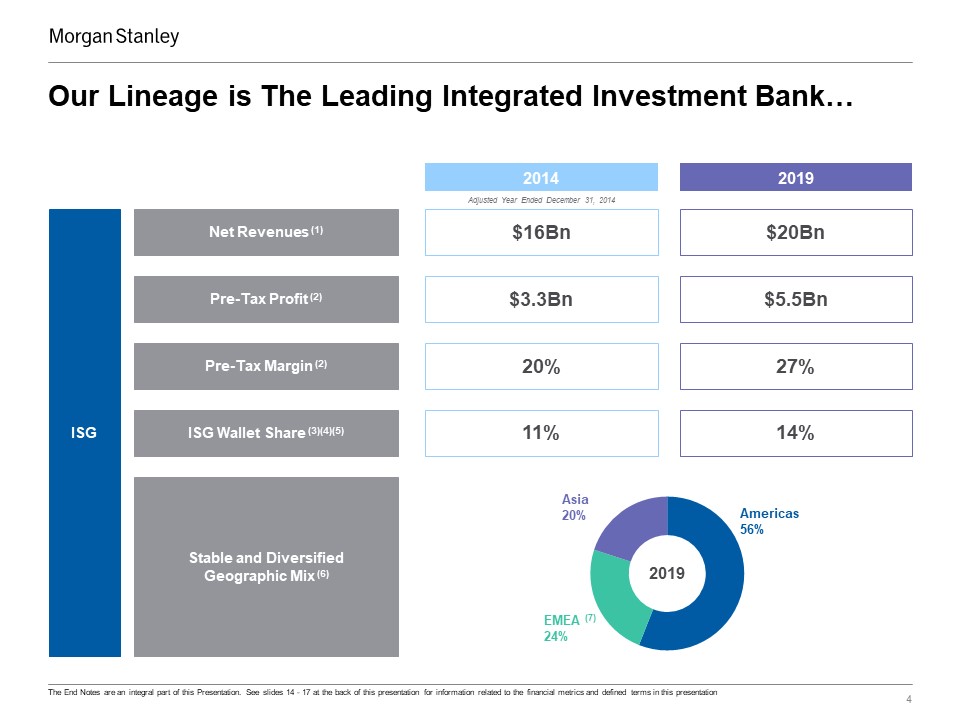
Our Lineage is The Leading Integrated Investment Bank… 4 The End Notes are an integral part of this
Presentation. See slides 14 - 17 at the back of this presentation for information related to the financial metrics and defined terms in this presentation $20Bn Net Revenues (1) $16Bn $5.5Bn Pre-Tax Profit (2) $3.3Bn 27% Pre-Tax Margin
(2) 20% Stable and Diversified Geographic Mix (6) ISG Wallet Share (3)(4)(5) ISG 11% 14% 2014 2019 Americas56% EMEA (7)24% Asia20% 2019 Adjusted Year Ended December 31, 2014

…While The Contribution from Wealth and InvestmentManagement Continues to Grow 5 WM Pre-Tax Margin
(3) Quarterly AveragePre-Tax Profit (3) 27% 21% $1.2Bn $0.8Bn IM The End Notes are an integral part of this Presentation. See slides 14 - 17 at the back of this presentation for information related to the financial metrics and defined
terms in this presentation Net Revenues $21Bn $17Bn Client Assets and Assets Under Management (2) $3.3Tn $2.4Tn Long-Term Net Flows (5) $15.4Bn $6.6Bn WM&IM % of Days with Revenue/Day ≥$60MM (4) 95% 32% Adjusted Year Ended
December 31, 2014 Pre-Tax Profit (1) $5.8Bn $3.9Bn 2014 2019
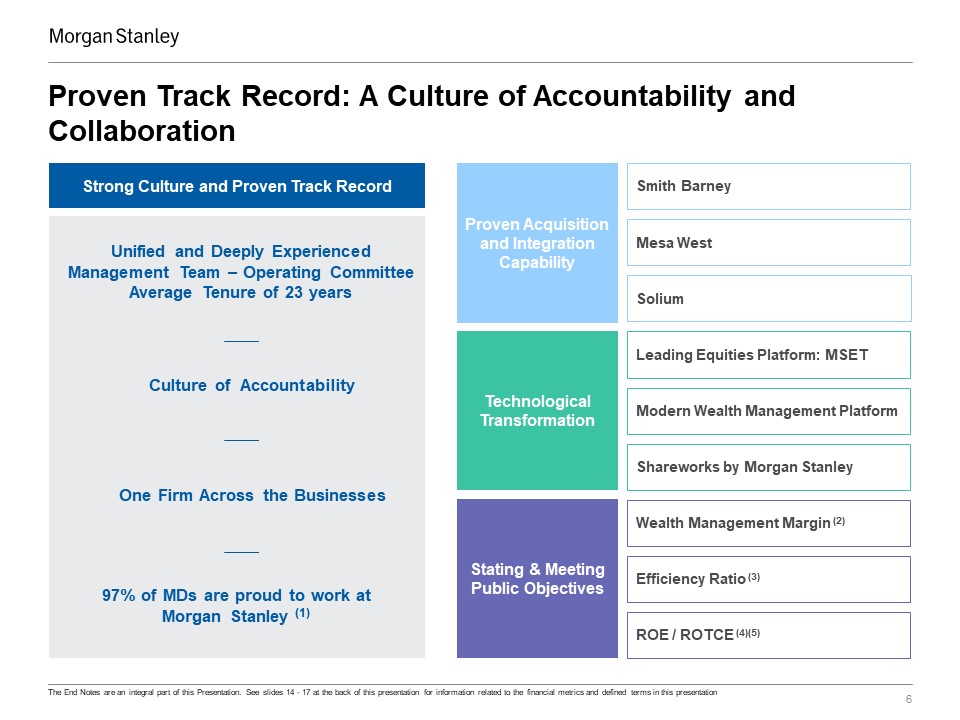
Unified and Deeply Experienced Management Team – Operating Committee Average Tenure of 23 years
Proven Track Record: A Culture of Accountability and Collaboration 6 The End Notes are an integral part of this Presentation. See slides 14 - 17 at the back of this presentation for information related to the financial metrics and defined
terms in this presentation Proven Acquisition and Integration Capability Technological Transformation Mesa West Solium Leading Equities Platform: MSET Modern Wealth Management Platform Smith Barney Stating & Meeting Public
Objectives Wealth Management Margin (2) Efficiency Ratio (3) ROE / ROTCE (4)(5) Shareworks by Morgan Stanley Strong Culture and Proven Track Record 97% of MDs are proud to work at Morgan Stanley (1) One Firm Across the
Businesses Culture of Accountability
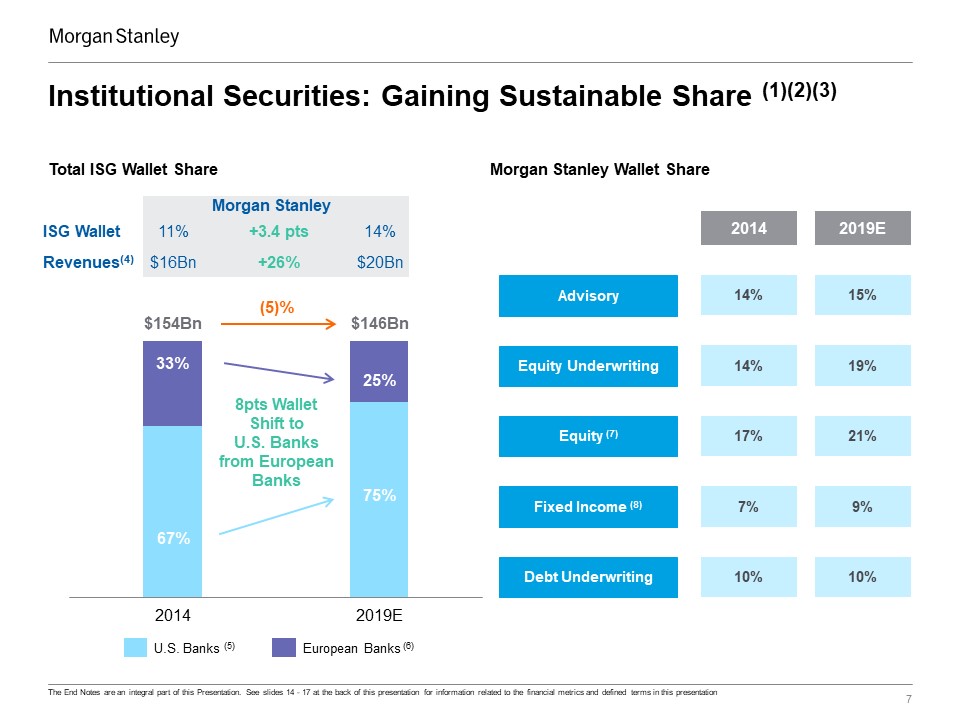
Institutional Securities: Gaining Sustainable Share (1)(2)(3) 7 The End Notes are an integral part of
this Presentation. See slides 14 - 17 at the back of this presentation for information related to the financial metrics and defined terms in this presentation Total ISG Wallet Share Morgan Stanley Wallet Share Debt
Underwriting Advisory Equity Underwriting Equity (7) Fixed Income (8) 2014 2019E 11% 14% 75% 33% 25% 14% 14% 17% 7% 10% 15% 19% 21% 9% 10% 67% U.S. Banks (5) European Banks (6) $16Bn $20Bn $154Bn $146Bn +3.4
pts +26% ISG Wallet Revenues(4) (5)% 8pts Wallet Shift to U.S. Banksfrom EuropeanBanks Morgan Stanley

Wealth Management: Acquire New Client Relationships Through Morgan Stanley at Work The End Notes are an
integral part of this Presentation. See slides 14 - 17 at the back of this presentation for information related to the financial metrics and defined terms in this presentation Add New Corporate Clients EngageEmployeeParticipants Convert to
Wealth Management Relationships ~$1.5Tn Estimated Total Wealth Held Away by Existing Stock Plan Participants (1) ~3,900 Shareworks by Morgan Stanley Corporate Clients ~2.7MM Stock Plan Participants II III I Workplace
Opportunity Steps to Convert Shareworks Participants to Wealth Management Clients (%) Addressable Corporate Clients Converted to MS at Work Model (2)(3) (#) New Corporate Clients Added (#) Participants Converted to Active
Clients(4) Deal Announcement to Close Feb – May 2019 Post-Close – December 2019 Cumulative Shareworks by Morgan Stanley Emerging Opportunities through Financial Wellness and Retirement 8
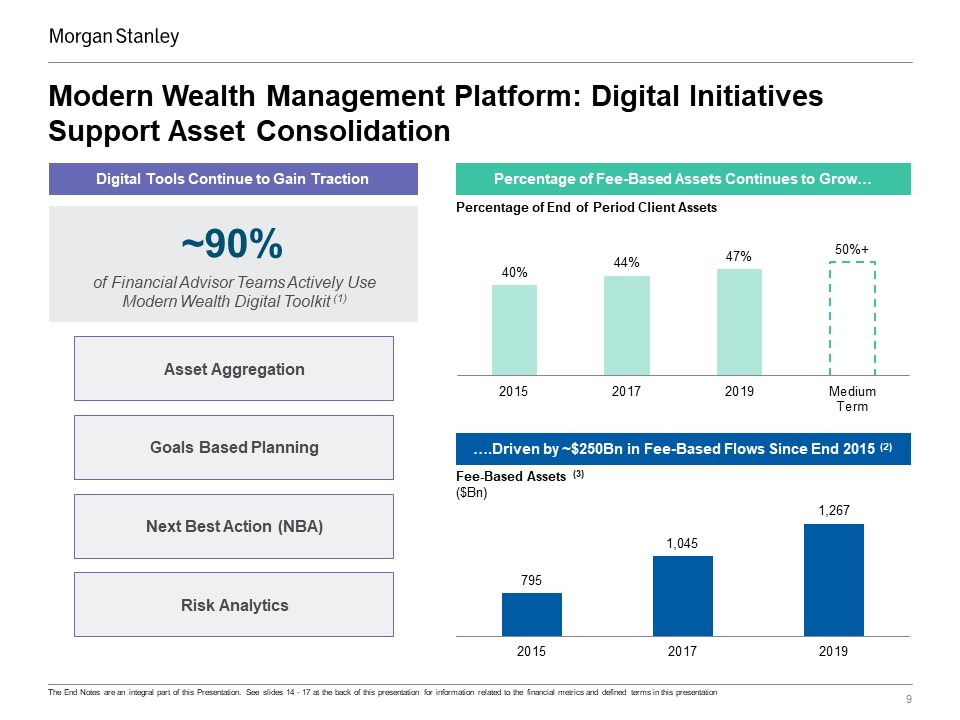
9 Percentage of Fee-Based Assets Continues to Grow… Modern Wealth Management Platform: Digital
Initiatives Support Asset Consolidation The End Notes are an integral part of this Presentation. See slides 14 - 17 at the back of this presentation for information related to the financial metrics and defined terms in this
presentation Digital Tools Continue to Gain Traction Asset Aggregation Goals Based Planning Next Best Action (NBA) Risk Analytics Percentage of End of Period Client Assets Fee-Based Assets (3)($Bn) ~90% of Financial Advisor Teams
Actively Use Modern Wealth Digital Toolkit (1) ….Driven by ~$250Bn in Fee-Based Flows Since End 2015 (2)
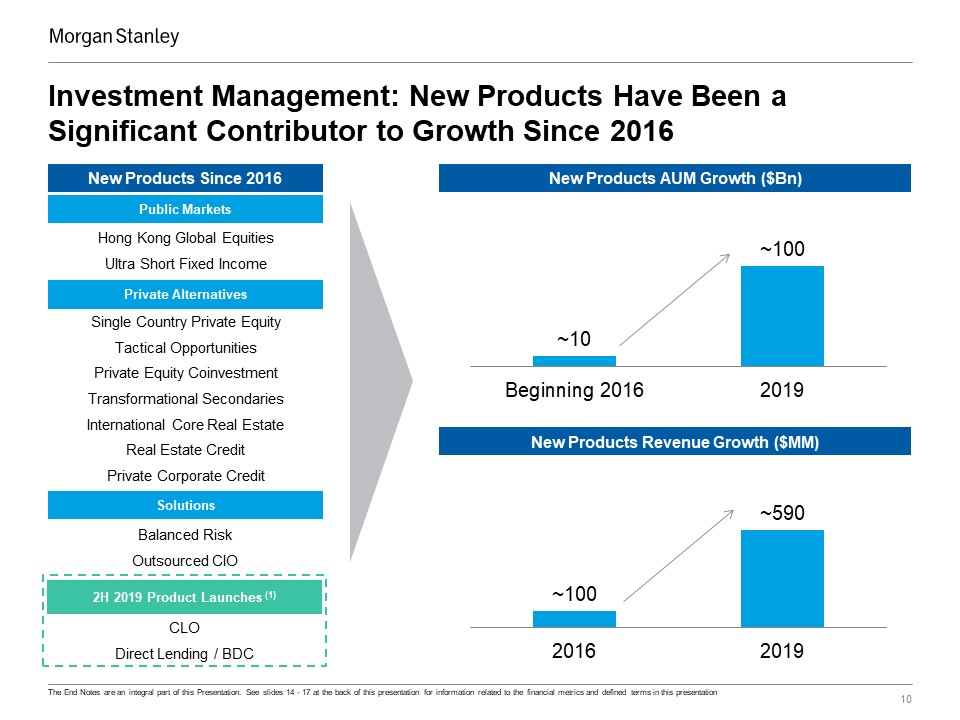
10 Public Markets Hong Kong Global EquitiesUltra Short Fixed Income Private
Alternatives Solutions Single Country Private EquityTactical OpportunitiesPrivate Equity CoinvestmentTransformational SecondariesInternational Core Real EstateReal Estate CreditPrivate Corporate Credit Balanced Risk Outsourced CIO New
Products AUM Growth ($Bn) New Products Revenue Growth ($MM) Investment Management: New Products Have Been a Significant Contributor to Growth Since 2016 2H 2019 Product Launches (1) CLODirect Lending / BDC New Products Since 2016 The
End Notes are an integral part of this Presentation. See slides 14 - 17 at the back of this presentation for information related to the financial metrics and defined terms in this presentation

11 Investment Management: Diverse Alternatives Client Franchise a Driver of the Next 50% Revenue Growth
Opportunity (1) Scaled Alternatives Client Capital Platform… >$105Bn Client Capital in Alternatives (2) …With Growth through Raising Client Capital >$20Bn Capital Raised in Alternatives Since January 2018 …Including Premier
Private Real Estate & Infrastructure Franchise… ~$50Bn Client Capital in Premier Private Real Assets Franchise (2)(3) The End Notes are an integral part of this Presentation. See slides 14 - 17 at the back of this presentation for
information related to the financial metrics and defined terms in this presentation
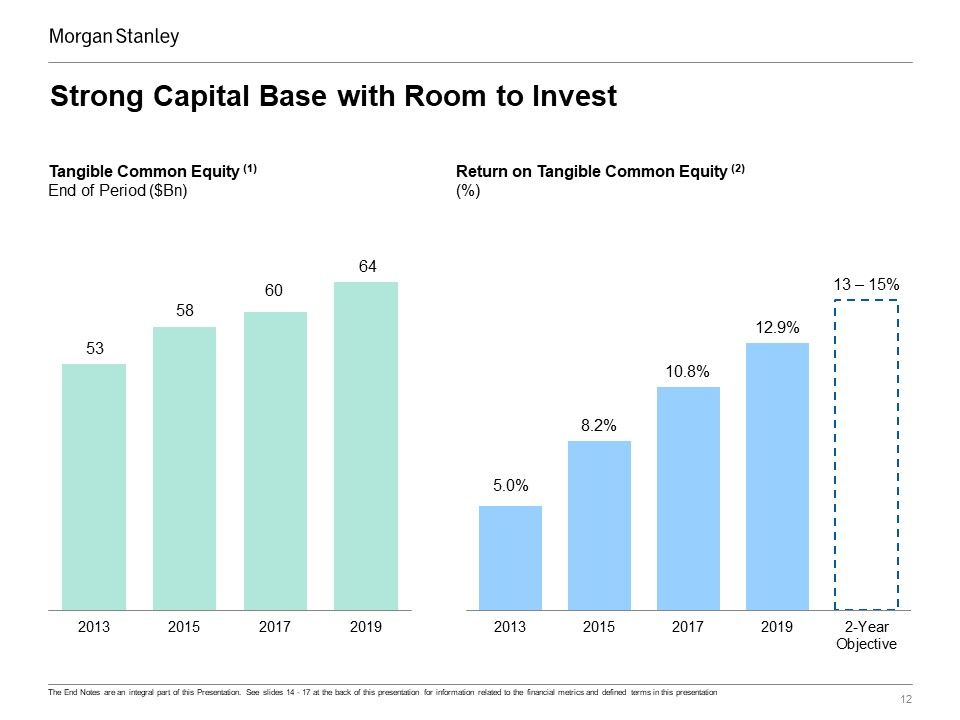
Strong Capital Base with Room to Invest The End Notes are an integral part of this Presentation. See
slides 14 - 17 at the back of this presentation for information related to the financial metrics and defined terms in this presentation 12 Return on Tangible Common Equity (2) (%) 13 – 15% Tangible Common Equity (1) End of Period ($Bn)
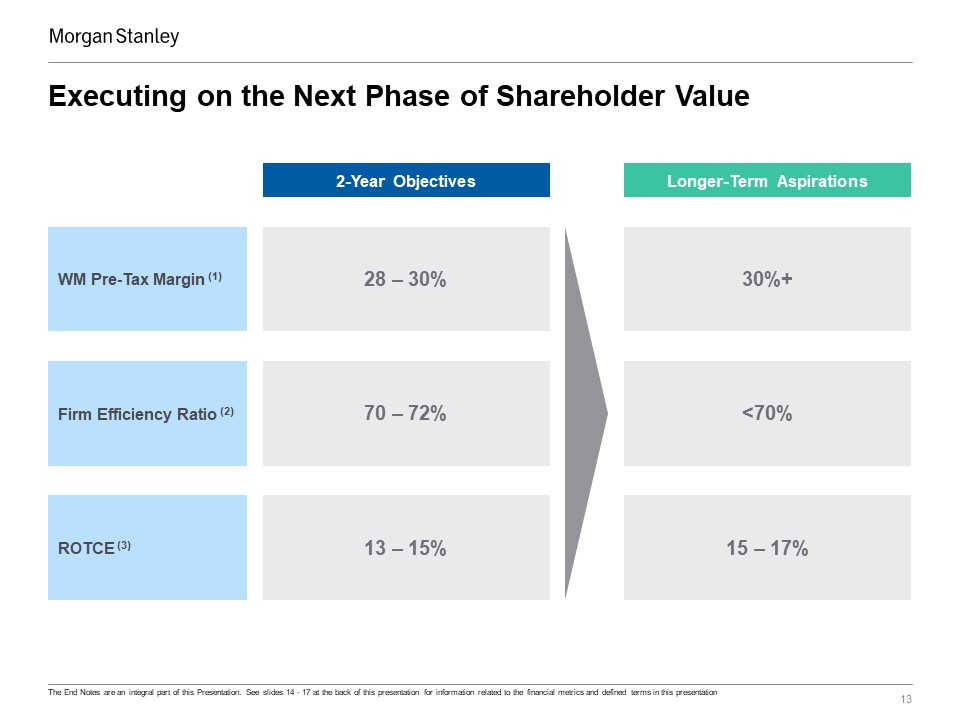
Executing on the Next Phase of Shareholder Value 2-Year Objectives The End Notes are an integral part
of this Presentation. See slides 14 - 17 at the back of this presentation for information related to the financial metrics and defined terms in this presentation 13 WM Pre-Tax Margin (1) Firm Efficiency Ratio (2) ROTCE (3) Longer-Term
Aspirations 28 – 30% 70 ‒ 72% 13 ‒ 15% 30%+ <70% 15 – 17%

These notes refer to the financial metrics and/or defined term presented on Slide 3(1) 2014 Adjusted
Operating Performance Metrics: Net revenues adjustment to exclude the positive impact of DVA. DVA represents the change in fair value resulting from fluctuations in our debt credit spreads and other credit factors related to borrowings and
other liabilities carried under the fair value option. The full amount of the Net revenues adjustment was recorded in the Institutional Securities ('ISG') segment.Compensation expense adjustment to exclude the negative impact of the
Discretionary Incentive Compensation Actions. The Discretionary Incentive Compensation Actions were recorded in the business segments as follows: ISG ($904) million; Wealth Management ('WM') ($88) million; and Investment Management ('IM')
($145) million.Non-compensation expense adjustment to exclude the negative impact of Credit Crisis Litigation. The full amount of the non-compensation adjustment was recorded in the ISG segment.Income from continuing operations before income
taxes (‘Pre-Tax Profit’) adjustment is the aggregation of the positive DVA adjustment and the negative Credit Crisis Litigation and Discretionary Incentive Compensation Actions adjustments, impacting the business segments as follows: ISG ($3.3)
billion, WM ($88) million and Investment Management ($145) million. Pre-Tax Profit is a non-GAAP financial measure that the Firm considers useful for analysts, investors and other stakeholders to assess operating performance.Net income
applicable to Morgan Stanley (‘Net Income’) adjustment to exclude: the aggregate net after tax impacts of the positive DVA adjustment ($418 million) and the negative Credit Crisis Litigation ($2.9 billion) and Discretionary Incentive
Compensation Actions ($781 million) adjustments; and the positive Discrete Tax Benefits adjustment ($2.2 billion).Expense efficiency ratio (‘Efficiency Ratio’) adjustment to exclude the positive impact of DVA and the negative impacts of Credit
Crisis Litigation and Discretionary Incentive Compensation Actions. Expense efficiency ratio represents total Non-interest expenses as a percentage of Net revenues.Earnings per share (‘EPS’) adjustments to exclude: the aggregate net after tax,
per share impacts of the positive DVA adjustment ($0.21) and the negative Credit Crisis Litigation ($1.47) and Discretionary Incentive Compensation Actions ($0.40) adjustments; and the positive per share impacts of the Discrete Tax Benefits
adjustment ($1.13). The calculation of EPS uses Net income applicable to Morgan Stanley less preferred dividends (approximately $315 million) divided by Average diluted common shares outstanding (1,971 million for 2014).Return on tangible
common equity (‘ROTCE’) adjustment to exclude: the aggregate net after tax impacts of the positive DVA adjustment and the negative Credit Crisis Litigation and Discretionary Incentive Compensation Actions adjustments; and the positive Discrete
Tax Benefits adjustment. The calculation of ROTCE uses net income applicable to Morgan Stanley less preferred dividends (approximately $315 million) as a percentage of Average tangible common equity. Tangible Common Equity ('TCE') equals common
equity less goodwill and intangible assets, net of allowable mortgage servicing rights. Average TCE reported and adjusted was approximately $55.5 billion and $56.2 billion, respectively for 2014. Reported and Adjusted ROTCE and TCE are non-GAAP
financial measures that the Firm considers useful for analysts, investors and other stakeholders to assess operating performance. 14 To provide a comparative view of 2014 operating performance, our full year reported results are adjusted
below to exclude several significant intermittent items, which were highlighted in our 2014 Annual Report on Form 10-K, as follows: Litigation costs of approximately $3.1 billion related to residential mortgage backed securities and other
credit crisis-related matters ('Credit Crisis Litigation'); Net discrete tax benefits of approximately $2.2 billion related to a legal entity restructuring, the remeasurement of reserves and related interest due to new information related to
multi-year tax examinations and the repatriation of non-U.S. earnings at a lower cost than originally estimated ('Discrete Tax Benefits'); Compensation expense of approximately $1.1 billion related to changes in the approach for awards of
discretionary incentive compensation (i.e., reducing the average deferral of such awards to an approximate baseline of 50%) and the acceleration of vesting for certain outstanding deferred cash based incentive compensation awards
('Discretionary Incentive Compensation Actions'); andThe impact of Debt Valuation Adjustment ('DVA‘) of approximately $651 million on Net revenues.These 'Adjusted Operating Performance Metrics' will be utilized throughout this presentation.
Adjusting reported results to exclude the intermittent impacts of Credit Crisis Litigation, Discrete Tax Benefits, Discretionary Incentive Compensation Actions and DVA are non-GAAP financial measures that the Firm considers useful for analysts,
investors and other stakeholders to assess year-over-year operating performance. End Notes

End Notes 15 2019 Adjusted Operating Performance Metrics only relate to 2019 ROTCE and EPS which
exclude the impact of approximately $348 million of intermittent discrete tax benefits as reconciled in the Fourth Quarter 2019 Earnings Results Quarterly Financial Supplement included in this Current Report on Form 8-K. ROTCE and EPS excluding
intermittent net discrete tax benefits are non-GAAP measure that the Firm considers useful for analysts, investors and other stakeholders to assess operating performance.Tangible Book Value per Common Share (‘Tangible Book Value per Share’)
equals reported TCE divided by period end common shares outstanding. Tangible Book Value per Share is a non-GAAP financial measure that the Firm considers useful for investors to assess our financial condition.Pre-Tax Profit for 2010 excludes
the negative impact of DVA of approximately $873 million. Pre-Tax Profit, excluding DVA is a non-GAAP financial measure that the Firm considers useful for analysts, investors and other stakeholders to assess operating performance.Durable
sources of revenues represent revenues associated with fee-based pricing arrangements, financing and lending that are generally less susceptible to significant fluctuation as a result of market volatility when compared to other Firm revenues,
and are comprised of: Asset Management revenues in the Wealth and Investment Management segments; revenues from Financing and Secured Lending activities in the ISG and Wealth Management (‘WM’) segments; and revenues from Investment Banking
Advisory services.These notes refer to the financial metrics and/or defined term presented on Slide 4ISG Net Revenues for 2014 excludes the positive impact of approximately $651 million from DVA (refer to note (1) for Slide 3). ISG Pre-Tax
Profit and Pre-Tax Margin for 2014 are adjusted to exclude the aggregation of the positive DVA adjustment and the negative Credit Crisis Litigation and Discretionary Incentive Compensation Actions adjustments, ($3.3 billion) (refer to note (1)
for Slide 3). Pre-Tax Margin represents Pre-Tax Profit divided by Net revenues. Pre-Tax Margin is a non-GAAP financial measures that the Firm considers useful for analysts, investors and other stakeholders to assess operating performance.Wallet
represents aggregated reported net revenues of Morgan Stanley and the following peers: Goldman Sachs, JP Morgan, Bank of America, Citigroup, UBS, Deutsche Bank, Credit Suisse, and Barclays. Morgan Stanley’s ISG wallet share represents total ISG
segment net revenues. Peer wallet includes revenues that represent Advisory, Equity Underwriting, Debt Underwriting, Equity Sales & Trading and Fixed Income Sales & Trading, where applicable. For firms that do not disclose separate
results for Advisory, Equity Underwriting, Debt Underwriting, Equity Sales & Trading and Fixed Income Sales & Trading, assumptions have been made based on industry volumes sourced from Dealogic or based on company disclosures if the
company provides the product splits within some of its segments but not others. Morgan Stanley’s 2014 Wallet Share is calculated as the percentage of Morgan Stanley’s net revenues, excluding DVA to the Wallet. Peer data reflects revenues from
applicable business lines and 2014 has been adjusted for DVA, where it is reported and where applicable.European peer results were translated to USD using average exchange rates for the appropriate period; sourced from Bloomberg.The 2019 Wallet
estimates utilize results for peers that have reported full-year 2019 results as of January 15, 2020. For the European peers that have not yet reported, a 2019 full year results estimate is derived assuming the aggregate share of the Wallet for
European peers for the first nine months remains constant in the fourth quarter of 2019.Regional revenues reflect ISG’s net revenues on a managed basis. Further discussion regarding the geographic methodology for net revenues is disclosed in
Note 21 to the consolidated financial statements included in the Firm's Annual Report on Form 10‐K for the year ended December 31, 2018 (‘2018 Form 10‐K’).EMEA represents Europe, Middle East and Africa.These notes refer to the financial metrics
and/or defined term presented on Slide 5WM and IM Pre-Tax Profit represents the aggregation of the Pre-Tax Profit for the WM and IM segments. WM and IM Pre-Tax Profit for 2014 is adjusted to exclude the negative impact ($233 million) of the
Discretionary Incentive Compensation Actions (refer to note (1) for page 3). Represents the sum of total WM segment client assets and IM segment assets under management (‘AUM’).Quarterly Average Pre-Tax Profit and Pre-Tax Margin for the WM
segment for 2014 are adjusted to exclude the negative impact ($88 million) of the Discretionary Incentive compensation Actions. (refer to note (1) for page 3). Quarterly Average Pre-Tax Profit is a non-GAAP financial measure that the Firm
considers useful for analysts, investors and other stakeholders to assess operating performance.The daily revenue distribution reflects net revenues for the WM segment attributed as follows: Transactional revenues on the day the revenue was
recorded; and Asset Management, Net Interest and Other revenues based on the a daily average, where the reported revenue for the period is divided by the number of business days in the period.Long-term Net Flows include the Equity, Fixed Income
and Alternative/Other asset classes and exclude the Liquidity asset class.

End Notes 16 These notes refer to the financial metrics and/or defined term presented on Slide
6Represents percentage of Managing Directors (‘MDs’) who were proud to work at Morgan Stanley based on employee survey results in 2018 and 2019.Wealth Management Margin equals Pre-Tax Margin. Wealth Management Margin is a non-GAAP financial
measure that the Firm considers useful for analysts, investors and other stakeholders to assess operating performance.Efficiency Ratio represents total non-interest expenses as a percentage of net revenues.The calculation of ROE uses net income
applicable to Morgan Stanley less preferred dividends as a percentage of average common equity. The ROE target excludes intermittent discrete tax items. ROE target, excluding intermittent discrete tax items, is a non-GAAP financial measure that
the Firm considers useful for investors to assess operating performance.The calculation of ROTCE uses net income applicable to Morgan Stanley less preferred dividends as a percentage of average tangible common equity. TCE equals common equity
less goodwill and intangible assets net of allowable mortgage servicing rights. The ROTCE target excludes intermittent discrete tax items. ROTCE excluding intermittent discrete tax items and TCE are non-GAAP financial measures that the Firm
considers useful for investors to assess operating performance.These notes refer to the financial metrics and/or defined term presented on Slide 7Wallet represents aggregated reported net revenues of Morgan Stanley and the following peers:
Goldman Sachs, JP Morgan, Bank of America, Citigroup, UBS, Deutsche Bank, Credit Suisse, and Barclays. Morgan Stanley’s ISG wallet share represents total ISG segment net revenues. Peer wallet includes revenues that represent Advisory, Equity
Underwriting, Debt Underwriting, Equity Sales & Trading and Fixed Income Sales & Trading, where applicable. For firms that do not disclose separate results for Advisory, Equity Underwriting, Debt Underwriting, Equity Sales & Trading
and Fixed Income Sales & Trading, assumptions have been made based on industry volumes sourced from Dealogic or based on company disclosures if the company provides the product splits within some of its segments but not others. Morgan
Stanley’s 2014 Wallet Share is calculated as the percentage of Morgan Stanley’s net revenues, excluding DVA to the Wallet. Peer data reflects revenues from applicable business lines and 2014 has been adjusted for DVA, where it is reported and
where applicable.European peer results were translated to USD using average exchange rates for the appropriate period; sourced from Bloomberg.The 2019 Wallet estimates utilize results for peers that have reported full-year 2019 results as of
January 15, 2020. For the European peers that have not yet reported, a 2019 full year results estimate is derived assuming the aggregate share of the Wallet for European peers for the first nine months remains constant in the fourth quarter of
2019.Net Revenue for 2014 excludes the positive impact of approximately $651 million from DVA. (refer to note (1) for Slide 3). U.S. Banks include: Morgan Stanley, Goldman Sachs, JP Morgan, Bank of America and Citigroup.European Banks includes:
UBS, Deutsche Bank, Credit Suisse, and Barclays. In determining 2014 Wallet Share, Equity Sales & Trading net revenues, exclude the positive impact from DVA of $232 million. Equity Sales & Trading Net Revenues, excluding DVA is a
non-GAAP financial measure the Firm considers useful for analysts, investors and other stakeholders to allow better comparability of period to period operating performance.In determining 2014 Wallet Share, Fixed Income Sales & Trading net
revenues, exclude the positive impact from DVA of $419 million. Fixed Income Sales & Trading Net Revenues, excluding DVA is a non-GAAP financial measure the Firm considers useful for analysts, investors and other stakeholders to allow
better comparability of period to period operating performance.These notes refer to the financial metrics and/or defined term presented on Slide 8$1.5 trillion represents total wealth held away of total stock plan participants, which includes
both legacy Solium and Morgan Stanley participants, and is estimated using data from IXI as of November 2018.Addressable corporate clients includes ~3,400 U.S. public and private corporate clients of Shareworks by Morgan Stanley.Defined as on
Shareworks platform with Brokerage Capabilities and Educational Content Enabled. Defined as Wealth Management clients serviced through Morgan Stanley Financial Advisor, Virtual Advisor, Access Investing, or Access Direct.

End Notes 17 These notes refer to the financial metrics and/or defined term presented on Slide
9Percentage represents number of Morgan Stanley Advisor Teams and Sole Practitioners that use at least two of the following four tools each month: NBA, Planning, Risk Analytics and Asset Aggregation; Analysis is a snapshot as of December
2019.Fee‐based asset flows include net new fee‐based assets, net account transfers, dividends, interest, and client fees and exclude institutional cash management related activity.Fee‐based client assets represent the amount of assets in client
accounts where the basis of payment for services is a fee calculated on those assets.These notes refer to the financial metrics and/or defined term presented on Slide 10AUM and Revenue related to 2H 2019 Products Launches are not included in
the New Products AUM Growth and New Products Revenue Growth charts shown on the slideThese notes refer to the financial metrics and/or defined term presented on Slide 1150% Revenue growth opportunity based on last twelve months revenues as of
September 30, 2019. Please refer to Morgan Stanley presentation at the Bank of America Merrill Lynch Future of Financials Conference dated November 6, 2019, which is available on www.morganstanley.com.Includes client assets under management,
unfunded commitments, and co-investments as of December 31, 2019.“Private Real Assets” is reported under the "Alternative/Other" category in Morgan Stanley’s Quarterly Report on Form 10-Q for the period ended September 30, 2019. Client Capital
as of December 31, 2019.These notes refer to the financial metrics and/or defined term presented on Slide 12Represents TCE as reported for each period. Tangible Common Equity equals common equity less goodwill and intangible assets net of
allowable mortgage servicing rights. TCE is a non-GAAP financial measure that the Firm considers useful for investors to assess capital adequacy.The calculation of ROTCE for each year utilizes net income applicable to Morgan Stanley less
preferred dividends as a percentage of average tangible common equity, respectively, exclusive of intermittent discrete tax items. Average tangible common equity represents average common equity adjusted to exclude goodwill and intangible
assets net of allowable mortgage servicing rights deduction. The calculation for 2013 excludes the aggregate net after tax impact of the negative DVA adjustment of $452 million and the positive discrete tax benefit adjustment of $407 million
(which offset resulting in no material impact to ROTCE). For reconciliations of ROTCE, excluding intermittent discrete tax items and DVA for the years 2015 and 2017, see pages 37 and 38 of the Firm’s Annual Report on Form 10-K for the year
ended December 31, 2017 (‘2017 Form 10-K‘). The 2019 ROTCE percentages exclude intermittent net discrete tax benefits of approximately $348 million (an approximate 50 basis point reduction). When excluding intermittent net discrete tax items
and DVA, both the ROTCE numerators and denominators are adjusted. Beginning in 2017, income tax consequences associated with employee share-based awards are recognized in the provision for income taxes in the income statement, but are excluded
from the intermittent net discrete tax items adjustment, as we anticipate conversion activity each year. The ROTCE target excludes intermittent discrete tax items. ROE and ROTCE, excluding intermittent discrete tax items and DVA are non-GAAP
financial measures that the Firm considers useful for analysts, investors and other stakeholders to allow better comparability of period to period operating performance.These notes refer to the financial metrics and/or defined term presented on
Slide 13Pre-Tax Margin represents income (loss) from continuing operations before taxes divided by net revenues. Pre-Tax Margin is a non-GAAP financial measure that the Firm considers useful for analysts, investors and other stakeholders to
assess operating performance.Efficiency Ratio represents total non-interest expenses as a percentage of net revenues.The calculation of ROTCE uses net income applicable to Morgan Stanley less preferred dividends as a percentage of average
tangible common equity. Tangible common equity (‘TCE’) represents common equity less goodwill and intangible assets net of allowable mortgage servicing rights. The ROTCE target of 13% to 15% and Longer-Term Aspiration of 15% to 17% exclude
intermittent discrete tax items. ROTCE excluding intermittent discrete tax items and TCE are a non-GAAP financial measures that the Firm considers useful for investors to assess operating performance.
Strategic Update James P. Gorman, Chairman and Chief Executive Officer January 16, 2020