8-K
Match Group, Inc. (MTCH)
UNITED STATES
SECURITIES AND EXCHANGE COMMISSION
Washington, DC 20549
FORM 8-K
CURRENT REPORT
Pursuant to Section 13 OR 15(d) of The Securities Exchange Act of 1934
Date of Report (Date of earliest event reported): November 4, 2025
MATCH GROUP, INC.
(Exact name of registrant as specified in its charter)
| Delaware | 001-34148 | 59-2712887 |
|---|---|---|
| (State or other jurisdiction <br>of incorporation) | (Commission <br>File Number) | (IRS Employer <br>Identification No.) |
8750 North Central Expressway, Suite 1400
Dallas, TX 75231
(Address of principal executive offices) (Zip Code)
Registrant’s telephone number, including area code: (214) 576-9352
Check the appropriate box below if the Form 8-K filing is intended to simultaneously satisfy the filing obligation of the registrant under any of the following provisions (see General Instruction A.2. below):
☐ Written communications pursuant to Rule 425 under the Securities Act (17 CFR 230.425)
☐ Soliciting material pursuant to Rule 14a-12 under the Exchange Act (17 CFR 240.14a-12)
☐ Pre-commencement communications pursuant to Rule 14d-2(b) under the Exchange Act (17 CFR 240.14d-2(b))
☐ Pre-commencement communications pursuant to Rule 13e-4(c) under the Exchange Act (17 CFR 240.13e-4(c))
| Securities registered pursuant to Section 12(b) of the Act: | ||
|---|---|---|
| Title of each class | Trading Symbol | Name of exchange on which registered |
| Common Stock, par value $0.001 | MTCH | The Nasdaq Stock Market LLC |
| (Nasdaq Global Select Market) |
Indicate by check mark whether the registrant is an emerging growth company as defined in Rule 405 of the Securities Act of 1933 (§230.405 of this chapter) or Rule 12b-2of the Securities Exchange Act of 1934 (§240.12b-2 of this chapter).
Emerging growth company ☐
If an emerging growth company, indicate by check mark if the registrant has elected not to use the extended transition period for complying with any new or revised financial accounting standards provided pursuant to Section 13(a) of the Exchange Act. ☐
Item 2.02. Results of Operations and Financial Condition.
Item 7.01. Regulation FD Disclosure.
On November 4, 2025, Match Group, Inc. (“Match Group”) published a press release and prepared remarks, each of which included results for the quarter ended September 30, 2025. The press release and prepared remarks are attached hereto as Exhibits 99.1 and 99.2, respectively, and are incorporated herein by reference. Match Group has also posted supplemental investor materials on the "Investor Relations" section of its website at https://ir.mtch.com.
Exhibits 99.1 and 99.2 are being furnished under both Item 2.02 “Results of Operations and Financial Condition” and Item 7.01 “Regulation FD Disclosure.”
Item 8.01. Other Events.
On November 4, 2025, Match Group announced that its Board of Directors declared a cash dividend of $0.19 per share of its outstanding common stock, payable on January 21, 2026 to stockholders of record as of the close of business on January 6, 2026.
Item 9.01. Financial Statements and Exhibits.
(d) Exhibits
| Exhibit<br><br>Number | Description |
|---|---|
| 99.1 | Press Release dated November 4, 2025. |
| 99.2 | Prepared Remarks dated November 4, 2025. |
| 104 | Inline XBRL for the cover page of this Current Report on Form 8-K |
SIGNATURE
Pursuant to the requirements of the Securities Exchange Act of 1934, the registrant has duly caused this report to be signed on its behalf by the undersigned hereunto duly authorized.
| MATCH GROUP, INC. | |
|---|---|
| By: | /s/ Steven Bailey |
| Steven Bailey | |
| Chief Financial Officer |
Date: November 4, 2025
Document
Exhibit 99.1
Match Group Announces Third Quarter Results
Match Group Delivers on Revenue and Accelerates Innovation Focused on User Outcomes
LOS ANGELES, November 4, 2025 - Match Group (NASDAQ: MTCH) today announced financial results for the third quarter ended September 30, 2025, as well as meaningful advances in its product-led transformation. The company delivered on its revenue expectations and exceeded its Adjusted EBITDA expectations, excluding a $61 million legal settlement charge.
“We’ve moved quickly to accelerate innovation, strengthen accountability, and build for long-term growth,” said CEO Spencer Rascoff. “Our strategy is showing real progress this quarter, as we achieved our revenue goals and made meaningful progress on our product roadmap.”
Rascoff continued, “This quarter we increased product velocity, strengthened trust and safety, and operated with sharper discipline across the business. Our focus on execution, accountability, and efficiency is driving stronger performance while setting the foundation for long-term growth. I firmly believe that by combining innovation, operational rigor, and user empathy, we can shape the future of connection and strengthen our leadership in the category.”
In Q3, Match Group executed against its $50 million reinvestment plan across its portfolio to test user-first features, strengthen marketing, and expand its international footprint. Early results are instilling confidence in our strategy and learnings from these investments will inform how we deploy capital in 2026 and lay the foundation for the “Resurgence” phase of the turnaround that Match Group expects to take hold in 2026 and 2027.
Match Group also resolved Candelore v. Tinder, Inc., a decade-old case challenging Tinder’s former age-based pricing practices. The settlement closes a long-running matter and allows the company to move forward with focus and confidence.
Match Group Q3 2025 Financial Highlights
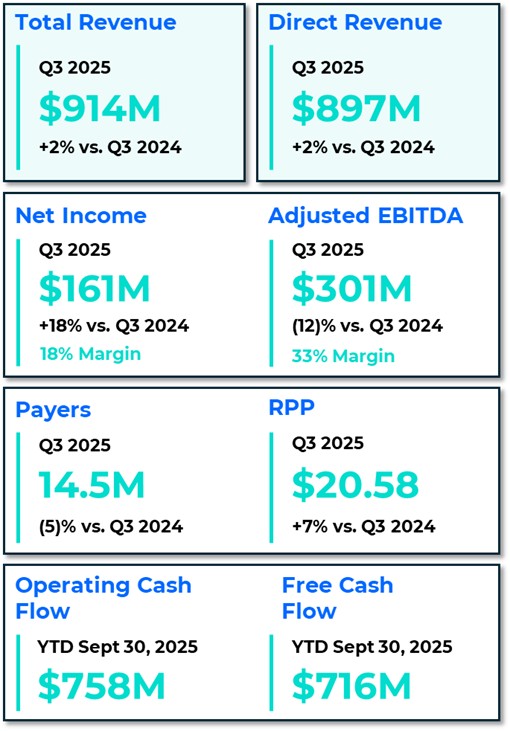
•Total Revenue of $914 million was up 2% year-over-year (“Y/Y”), up 1% on a foreign exchange (“FX”) neutral basis (“FXN”), driven by a 7% Y/Y increase in RPP to $20.58, partially offset by a 5% Y/Y decline in Payers to 14.5 million.
•Net Income of $161 million increased 18% Y/Y, representing a Net Income Margin of 18%.
•Adjusted EBITDA of $301 million declined 12% Y/Y, representing an Adjusted EBITDA Margin of 33%.
•Excluding a $61 million legal settlement charge and $2 million of restructuring costs, Adjusted EBITDA would have been $364 million, up 6% Y/Y, representing an Adjusted EBITDA Margin of 40%.
•Operating Cash Flow and Free Cash Flow were $758 million and $716 million, respectively, year-to-date through September 30, 2025.
•Repurchased 17.4 million of our shares at an average price of $32 per share on a trade date basis for a total of $550 million and paid $141 million in dividends, deploying 97% of our free cash flow for capital return to shareholders year-to-date through September 30, 2025.
•Diluted shares outstanding1 were 245 million as of October 31, 2025, a decrease of 8%, since November 1, 2024.
The following table summarizes total company consolidated financial results for the three months ended September 30, 2025 and 2024.
| Three Months Ended September 30, | ||||||||
|---|---|---|---|---|---|---|---|---|
| (Dollars in millions, except RPP, Payers in thousands) | 2025 | 2024 | Y/Y Change | |||||
| Total Revenue | $ | 914 | $ | 895 | 2 | % | ||
| Direct Revenue | $ | 897 | $ | 879 | 2 | % | ||
| Net income attributable to Match Group, Inc. shareholders | $ | 161 | $ | 136 | 18 | % | ||
| Net Income Margin | 18 | % | 15 | % | ||||
| Adjusted EBITDA | $ | 301 | $ | 343 | (12) | % | ||
| Adjusted EBITDA Margin | 33 | % | 38 | % | ||||
| Payers | 14,527 | 15,214 | (5) | % | ||||
| RPP | $ | 20.58 | $ | 19.26 | 7 | % |
We have updated the title of our primary non-GAAP measure to “Adjusted EBITDA” from our previous title “Adjusted Operating Income.” We believe this updated title better aligns with our peers. Numerically, Adjusted EBITDA is the same as Adjusted Operating Income; however, the starting point of the reconciliation to the most comparable GAAP financial measure has changed from operating income to net income. See below for the full definition of Adjusted EBITDA and a reconciliation of net income attributable to Match Group, Inc. shareholders to Adjusted EBITDA.
1 As defined on page 10 of this press release.
Other Quarterly Highlights:
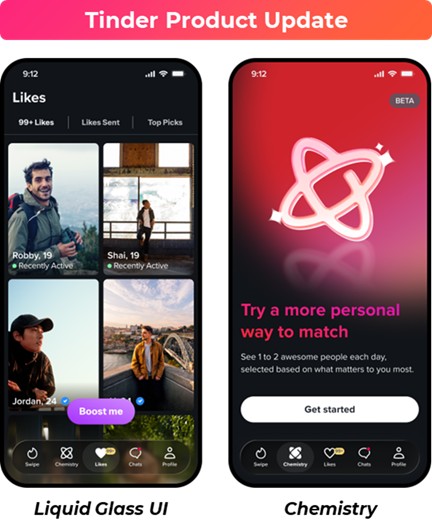
•Tinder’s AI-driven Interactive Matching feature, Chemistry, continues to evolve how people connect by creating a more intentional and personalized discovery experience. Using deep learning and user-permissioned data (like camera roll insights), Chemistry surfaces a few highly compatible profiles each day, leading to more relevant matches and engaging conversations. Chemistry is currently live in New Zealand and Australia, with plans to expand to additional countries in the coming months.
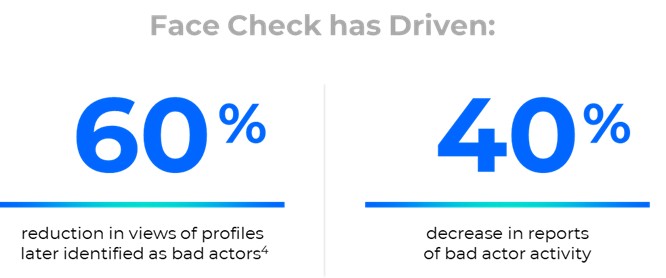
•Face Check, Tinder’s new facial verification feature, is setting a new standard for authenticity in dating. It helps confirm users are real and match their profile photos. The feature is now mandatory for all new users in California and will roll out to additional U.S. states and countries in the coming months, following successful launches in Canada, India, Australia, and Colombia. Early results show an over 60% decrease in exposure to potential bad actors2, a 40% reduction in bad actor reports, and meaningful improvements in users’ reported trust and authenticity.
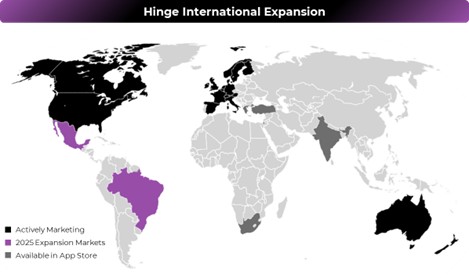
•Hinge continues to build strong momentum, with sustained growth and continued progress across its international markets. The app launched in Mexico in September and is expanding to Brazil in Q4, extending its reach in key international markets. Hinge also continues to advance its AI-powered features, including Conversation Starters and its Recommendation System, to improve connection quality and drive more meaningful engagement globally.
•Match Group’s continued rollout of alternative payments across its portfolio is increasing flexibility for users and lowering processing fees. These efforts are expected to generate approximately $14 million in savings in Q4 2025 and roughly $90 million in savings in 2026. Combined with earlier cost-reduction initiatives that produced $100 million in annualized savings, these improvements are enabling reinvestment in growth, including $50 million dedicated to testing new user-first features, strengthening marketing, and expanding internationally.
A webcast of our third quarter 2025 results will be available at https://ir.mtch.com, along with our Prepared Remarks and Supplemental Financial Materials. The webcast will begin today, November 4, 2025, at 5:00 PM Eastern Time. This press release, including the reconciliations of certain non-GAAP measures to their nearest comparable GAAP measures, is also available on that site.
Dividend Declaration
Match Group's Board of Directors has declared a cash dividend of $0.19 per share of the company's common stock. The dividend is payable on January 21, 2026 to stockholders of record as of January 6, 2026.
Financial Outlook
For Q4 2025, Match Group expects:
•Total Revenue of $865 to $875 million, up 1% to 2% Y/Y.
•Adjusted EBITDA of $350 to $355 million, representing a Y/Y increase of 9% at the midpoints of the ranges.
•Adjusted EBITDA Margin of 41% at the midpoints of the ranges.
2 Based on a random weighted sample of in-app profile views. Bad actors include accounts that engage in deceptive or harmful behaviors, including spam, scam attempts, or operating automated fake profiles (bots).
Financial Results
Consolidated Operating Costs and Expenses
| Three Months Ended September 30, | ||||||||
|---|---|---|---|---|---|---|---|---|
| (Dollars in thousands) | 2025 | % of Revenue | 2024 | % of Revenue | Y/Y Change | |||
| Cost of revenue | $ | 247,043 | 27% | $ | 253,129 | 28% | (2) | % |
| Selling and marketing expense | 169,142 | 19% | 156,656 | 17% | 8 | % | ||
| General and administrative expense | 148,021 | 16% | 103,923 | 12% | 42 | % | ||
| Product development expense | 104,969 | 11% | 103,724 | 12% | 1 | % | ||
| Depreciation | 14,845 | 2% | 25,302 | 3% | (41) | % | ||
| Impairments and amortization of intangibles | 8,921 | 1% | 42,090 | 5% | (79) | % | ||
| Total operating costs and expenses | $ | 692,941 | 76% | $ | 684,824 | 76% | 1 | % |
Liquidity and Capital Resources
During the nine months ended September 30, 2025, we generated operating cash flow of $758 million and Free Cash Flow of $716 million.
During the quarter ended September 30, 2025, we repurchased 3.7 million shares of our common stock for $130 million on a trade date basis at an average price of $35.30. Between October 1 and October 31, 2025, we repurchased an additional 3.0 million shares of our common stock for $100 million on a trade date basis at an average price of $33.02. As of October 31, 2025, $1.10 billion in aggregate value of shares of Match Group stock remains available under our share repurchase program.
As of September 30, 2025, we had $1.1 billion in cash, cash equivalents, and short-term investments and $4.1 billion of long-term debt, inclusive of current maturities, all of which is fixed rate debt, including $1.1 billion of Exchangeable Senior Notes. Our $500 million revolving credit facility was undrawn as of September 30, 2025. Match Group’s trailing twelve-month leverage3 as of September 30, 2025 was 3.4x on a gross basis and 2.5x on a net basis.
On August 20, 2025, we completed a private offering of $700 million aggregate principal amount of 6.125% Senior Notes due 2033. The proceeds from the issuance of these notes will be used to repay all of the outstanding 0.875% exchangeable senior notes due 2026 at or prior to their maturity and the remaining proceeds will be used for general corporate purposes.
On September 8, 2025, we repurchased $76 million aggregate principal amount of 0.875% exchangeable senior notes due 2026.
On October 17, 2025, we paid a dividend of $0.19 per share to holders of record on October 3, 2025. The total cash payout was $45 million.
3 Leverage is calculated utilizing the non-GAAP measure Adjusted EBITDA as the denominator. For a reconciliation of the non-GAAP measure for each period presented, see page 8.
GAAP Financial Statements
Consolidated Statement of Operations
| Three Months Ended September 30, | Nine Months Ended September 30, | |||||||
|---|---|---|---|---|---|---|---|---|
| 2025 | 2024 | 2025 | 2024 | |||||
| (In thousands, except per share data) | ||||||||
| Revenue | $ | 914,275 | $ | 895,484 | $ | 2,609,191 | $ | 2,619,197 |
| Operating costs and expenses: | ||||||||
| Cost of revenue (exclusive of depreciation shown separately below) | 247,043 | 253,129 | 725,889 | 754,859 | ||||
| Selling and marketing expense | 169,142 | 156,656 | 474,492 | 476,585 | ||||
| General and administrative expense | 148,021 | 103,923 | 396,096 | 324,468 | ||||
| Product development expense | 104,969 | 103,724 | 340,334 | 333,037 | ||||
| Depreciation | 14,845 | 25,302 | 54,635 | 66,915 | ||||
| Impairments and amortization of intangibles | 8,921 | 42,090 | 29,897 | 63,409 | ||||
| Total operating costs and expenses | 692,941 | 684,824 | 2,021,343 | 2,019,273 | ||||
| Operating income | 221,334 | 210,660 | 587,848 | 599,924 | ||||
| Interest expense | (37,024) | (40,120) | (104,440) | (120,511) | ||||
| Other income, net | 9,328 | 7,100 | 7,888 | 27,099 | ||||
| Income before income taxes | 193,638 | 177,640 | 491,296 | 506,512 | ||||
| Income tax provision | (32,882) | (41,159) | (87,491) | (113,477) | ||||
| Net income | 160,756 | 136,481 | 403,805 | 393,035 | ||||
| Net income attributable to noncontrolling interests | (7) | (13) | (8) | (55) | ||||
| Net income attributable to Match Group, Inc. shareholders | $ | 160,749 | $ | 136,468 | $ | 403,797 | $ | 392,980 |
| Net earnings per share attributable to Match Group, Inc. shareholders: | ||||||||
| Basic | $ | 0.67 | $ | 0.53 | $ | 1.65 | $ | 1.49 |
| Diluted | $ | 0.62 | $ | 0.51 | $ | 1.55 | $ | 1.43 |
| Basic shares outstanding | 240,510 | 257,070 | 245,298 | 263,181 | ||||
| Diluted shares outstanding | 260,324 | 275,738 | 265,303 | 281,255 | ||||
| Stock-based compensation expense by function: | ||||||||
| Cost of revenue | $ | 1,498 | $ | 1,747 | $ | 5,048 | $ | 5,267 |
| Selling and marketing expense | 3,042 | 3,259 | 8,908 | 9,395 | ||||
| General and administrative expense | 15,996 | 26,639 | 68,738 | 75,868 | ||||
| Product development expense | 35,770 | 32,843 | 111,473 | 107,645 | ||||
| Total stock-based compensation expense | $ | 56,306 | $ | 64,488 | $ | 194,167 | $ | 198,175 |
Consolidated Balance Sheet
| September 30, 2025 | December 31, 2024 | |||
|---|---|---|---|---|
| (In thousands) | ||||
| ASSETS | ||||
| Cash and cash equivalents | $ | 1,053,240 | $ | 965,993 |
| Short-term investments | 3,561 | 4,734 | ||
| Accounts receivable, net | 344,444 | 324,963 | ||
| Other current assets | 126,524 | 102,072 | ||
| Total current assets | 1,527,769 | 1,397,762 | ||
| Property and equipment, net | 128,582 | 158,189 | ||
| Goodwill | 2,343,305 | 2,310,730 | ||
| Intangible assets, net | 198,341 | 215,448 | ||
| Deferred income taxes | 227,485 | 262,557 | ||
| Other non-current assets | 117,957 | 121,085 | ||
| TOTAL ASSETS | $ | 4,543,439 | $ | 4,465,771 |
| LIABILITIES AND SHAREHOLDERS’ EQUITY | ||||
| LIABILITIES | ||||
| Current maturities of long-term debt, net | $ | 497,588 | $ | — |
| Accounts payable | 26,252 | 18,262 | ||
| Deferred revenue | 159,756 | 166,142 | ||
| Accrued expenses and other current liabilities | 400,308 | 365,057 | ||
| Total current liabilities | 1,083,904 | 549,461 | ||
| Long-term debt, net of current maturities | 3,547,718 | 3,848,983 | ||
| Income taxes payable | 31,554 | 33,332 | ||
| Deferred income taxes | 12,241 | 11,770 | ||
| Other long-term liabilities | 91,849 | 85,882 | ||
| Commitments and contingencies | ||||
| SHAREHOLDERS’ EQUITY | ||||
| Common stock | 299 | 294 | ||
| Additional paid-in capital | 8,708,758 | 8,756,482 | ||
| Retained deficit | (6,175,956) | (6,579,753) | ||
| Accumulated other comprehensive loss | (412,180) | (449,611) | ||
| Treasury stock | (2,344,857) | (1,791,071) | ||
| Total Match Group, Inc. shareholders’ equity | (223,936) | (63,659) | ||
| Noncontrolling interests | 109 | 2 | ||
| Total shareholders’ equity | (223,827) | (63,657) | ||
| TOTAL LIABILITIES AND SHAREHOLDERS’ EQUITY | $ | 4,543,439 | $ | 4,465,771 |
Consolidated Statement of Cash Flows
| Nine Months Ended September 30, | ||||
|---|---|---|---|---|
| 2025 | 2024 | |||
| (In thousands) | ||||
| Cash flows from operating activities: | ||||
| Net income | $ | 403,805 | $ | 393,035 |
| Adjustments to reconcile net income to net cash provided by operating activities: | ||||
| Stock-based compensation expense | 194,167 | 198,175 | ||
| Depreciation | 54,635 | 66,915 | ||
| Impairments and amortization of intangibles | 29,897 | 63,409 | ||
| Deferred income taxes | 35,161 | 5,223 | ||
| Other adjustments, net | 15,507 | 5,553 | ||
| Changes in assets and liabilities | ||||
| Accounts receivable | (16,450) | (41,412) | ||
| Other assets | 43,803 | 4,968 | ||
| Accounts payable and other liabilities | 36,572 | 403 | ||
| Income taxes payable and receivable | (31,118) | 11,387 | ||
| Deferred revenue | (8,379) | (29,647) | ||
| Net cash provided by operating activities | 757,600 | 678,009 | ||
| Cash flows from investing activities: | ||||
| Capital expenditures | (42,100) | (43,011) | ||
| Other, net | (25,783) | (8,061) | ||
| Net cash used in investing activities | (67,883) | (51,072) | ||
| Cash flows from financing activities: | ||||
| Proceeds from Senior Notes offerings | 700,000 | — | ||
| Principal payments on Term Loan | (425,000) | — | ||
| Payments to settle exchangeable notes | (74,437) | — | ||
| Debt issuance costs | (8,619) | — | ||
| Proceeds from issuance of common stock pursuant to stock-based awards | 3,598 | 9,411 | ||
| Withholding taxes paid on behalf of employees on net settled stock-based awards | (115,619) | (11,430) | ||
| Dividends | (140,893) | — | ||
| Purchase of treasury stock | (549,905) | (630,623) | ||
| Purchase of noncontrolling interests | (84) | (1,291) | ||
| Other, net | (6,225) | (2,193) | ||
| Net cash used in financing activities | (617,184) | (636,126) | ||
| Total cash provided (used) | 72,533 | (9,189) | ||
| Effect of exchange rate changes on cash and cash equivalents | 14,714 | 2,281 | ||
| Net increase (decrease) in cash and cash equivalents | 87,247 | (6,908) | ||
| Cash, cash equivalents, and restricted cash at beginning of period | 965,993 | 862,440 | ||
| Cash, cash equivalents, and restricted cash at end of period | $ | 1,053,240 | $ | 855,532 |
Reconciliations of GAAP to Non-GAAP Measures
Reconciliation of Net Income to Adjusted EBITDA
| Three Months Ended September 30, | Nine Months Ended September 30, | |||||||||||
|---|---|---|---|---|---|---|---|---|---|---|---|---|
| 2025 | 2024 | 2025 | 2024 | |||||||||
| (Dollars in thousands) | ||||||||||||
| Net income attributable to Match Group, Inc. shareholders | $ | 160,749 | $ | 136,468 | $ | 403,797 | $ | 392,980 | ||||
| Add back: | ||||||||||||
| Net income attributable to noncontrolling interests | 7 | 13 | 8 | 55 | ||||||||
| Income tax provision | 32,882 | 41,159 | 87,491 | 113,477 | ||||||||
| Other income, net | (9,328) | (7,100) | (7,888) | (27,099) | ||||||||
| Interest expense | 37,024 | 40,120 | 104,440 | 120,511 | ||||||||
| Stock-based compensation expense | 56,306 | 64,488 | 194,167 | 198,175 | ||||||||
| Depreciation | 14,845 | 25,302 | 54,635 | 66,915 | ||||||||
| Impairments and amortization of intangibles | 8,921 | 42,090 | 29,897 | 63,409 | ||||||||
| Adjusted EBITDA | $ | 301,406 | $ | 342,540 | $ | 866,547 | $ | 928,423 | ||||
| Revenue | $ | 914,275 | $ | 895,484 | $ | 2,609,191 | $ | 2,619,197 | ||||
| Net Income Margin | 18 | % | 15 | % | 15 | % | 15 | % | ||||
| Adjusted EBITDA Margin | 33 | % | 38 | % | 33 | % | 35 | % |
Reconciliation of Net Income to Adjusted EBITDA used in Leverage Ratios
| Twelve months ended<br>September 30, 2025 | ||
|---|---|---|
| (In thousands) | ||
| Net income attributable to Match Group, Inc. shareholders | $ | 562,093 |
| Add back: | ||
| Net loss attributable to noncontrolling interests | (10) | |
| Income tax provision | 126,757 | |
| Other income, net | (21,604) | |
| Interest expense | 144,000 | |
| Stock-based compensation expense | 263,373 | |
| Depreciation | 75,219 | |
| Amortization of intangibles | 40,663 | |
| Adjusted EBITDA | $ | 1,190,491 |
Reconciliation of Forecasted Net Income to Forecasted Adjusted EBITDA
| Three Months EndedDecember 31, 2025 | |
|---|---|
| (In millions) | |
| Net income attributable to Match Group, Inc. shareholders | 159 to 164 |
| Add back: | |
| Net income attributable to noncontrolling interests | 7 |
| Income tax provision | 46 |
| Other income, net | 7 |
| Interest expense | 43 |
| Stock-based compensation expense | 66 |
| Depreciation and amortization of intangibles | 22 |
| Adjusted EBITDA | 350 to 355 |
| Revenue | 865 to 875 |
| Net Income Margin (at the mid-point of the ranges) | 19 |
| Adjusted EBITDA Margin (at the mid-point of the ranges) | 41 |
All values are in US Dollars.
Reconciliation of Operating Cash Flow to Free Cash Flow
| Nine Months Ended September 30, | ||||
|---|---|---|---|---|
| 2025 | 2024 | |||
| (In thousands) | ||||
| Net cash provided by operating activities | $ | 757,600 | $ | 678,009 |
| Capital expenditures | (42,100) | (43,011) | ||
| Free Cash Flow | $ | 715,500 | $ | 634,998 |
Reconciliation of GAAP Revenue to Non-GAAP Revenue, Excluding Foreign Exchange Effects
| Three Months Ended September 30, | Nine Months Ended September 30, | |||||||||||||
|---|---|---|---|---|---|---|---|---|---|---|---|---|---|---|
| 2025 | Change | % Change | 2024 | 2025 | Change | % Change | 2024 | |||||||
| (Dollars in millions, rounding differences may occur) | ||||||||||||||
| Total Revenue, as reported | $ | 914.3 | 2 | % | $ | 895.5 | $ | 2,609.2 | — | % | $ | 2,619.2 | ||
| Foreign exchange effects | (12.2) | (4.0) | ||||||||||||
| Total Revenue, excluding foreign exchange effects | $ | 902.1 | 1 | % | $ | 895.5 | $ | 2,605.2 | (1) | % | $ | 2,619.2 |
All values are in US Dollars.
Dilutive Securities
Match Group has various tranches of dilutive securities. The table below details these securities and their potentially dilutive impact (shares in millions; rounding differences may occur).
| Average Exercise Price | 10/31/2025 | |
|---|---|---|
| Share Price | $32.34 | |
| Absolute Shares | 236.1 | |
| Equity Awards | ||
| Options | $16.69 | 0.2 |
| RSUs and subsidiary denominated equity awards | 8.6 | |
| Total Dilution - Equity Awards | 8.8 | |
| Outstanding Warrants | ||
| Warrants expiring on September 15, 2026 (5.8 million outstanding) | $131.67 | — |
| Warrants expiring on April 15, 2030 (7.0 million outstanding) | $131.73 | — |
| Total Dilution - Outstanding Warrants | — | |
| Total Dilution | 8.8 | |
| % Dilution | 3.6% | |
| Total Diluted Shares Outstanding | 244.8 |
______________________
The dilutive securities presentation above is calculated using the methods and assumptions described below; these are different from GAAP dilution, which is calculated based on the treasury stock method.
Options — The table above assumes the options are settled net of the option exercise price and employee withholding taxes, as is our practice, and the dilutive effect is presented as the net shares that would be issued upon exercise. Withholding taxes paid by the Company on behalf of the employees upon exercise is estimated to be $5.6 million, assuming the stock price in the table above and a 50% estimated employee withholding tax rate.
RSUs and subsidiary denominated equity awards — The table above assumes RSUs are settled net of employee withholding taxes, as is our practice, and the dilutive effect is presented as the net number of shares that would be issued upon vesting. Withholding taxes paid by the Company on behalf of the employees upon vesting is estimated to be $277.6 million, assuming the stock price in the table above and a 50% withholding rate.
All performance-based and market-based awards reflect the expected shares that will vest based on current performance or market estimates. The table assumes no change in the fair value estimate of the subsidiary denominated equity awards from the values used for GAAP purposes at September 30, 2025.
Exchangeable Senior Notes — The Company has two series of Exchangeable Senior Notes outstanding. In the event of an exchange, each series of Exchangeable Senior Notes can be settled in cash, shares, or a combination of cash and shares. At the time of each Exchangeable Senior Notes issuance, the Company purchased call options with a strike price equal to the exchange price of each series of Exchangeable Senior Notes (“Note Hedge”), which can be used to offset the dilution of each series of the Exchangeable Senior Notes. No dilution is reflected in the table above for any of the Exchangeable Senior Notes because it is the Company’s intention to settle the Exchangeable Senior Notes with cash equal to the face amount of the notes; any shares issued would be offset by shares received upon exercise of the Note Hedge.
Warrants — At the time of the issuance of each series of Exchangeable Senior Notes, the Company also sold warrants for the number of shares with the strike prices reflected in the table above. The cash generated from the exercise of the warrants is assumed to be used to repurchase Match Group shares and the resulting net dilution, if any, is reflected in the table above.
Non-GAAP Financial Measures
Match Group reports Adjusted EBITDA, Adjusted EBITDA Margin, Free Cash Flow, and Revenue Excluding Foreign Exchange Effects, all of which are supplemental measures to U.S. generally accepted accounting principles (“GAAP”). The Adjusted EBITDA, Adjusted EBITDA Margin, and Free Cash Flow measures are among the primary metrics by which we evaluate the performance of our business, on which our internal budget is based and by which management is compensated. Revenue Excluding Foreign Exchange Effects provides a comparable framework for assessing the performance of our business without the effect of exchange rate differences when compared to prior periods. We believe that investors should have access to the same set of tools that we use in analyzing our results. These non-GAAP measures should be considered in addition to results prepared in accordance with GAAP but should not be considered a substitute for or superior to GAAP results. Match Group endeavors to compensate for the limitations of the non-GAAP measures presented by providing the comparable GAAP measures and descriptions of the reconciling items, including quantifying such items, to derive the non-GAAP measures. We encourage investors to examine the reconciling adjustments between the GAAP and non-GAAP measures, which we describe below. Interim results are not necessarily indicative of the results that may be expected for a full year.
Definitions of Non-GAAP Measures
Adjusted EBITDA is defined as net income attributable to Match Group, Inc. shareholders excluding: (1) net income attributable to noncontrolling interests; (2) income tax provision or benefit; (3) other income (expense), net; (4) interest expense; (5) depreciation; (6) acquisition-related items consisting of amortization of intangible assets and impairments of goodwill and intangible assets, if applicable; and (7) stock-based compensation expense. We believe Adjusted EBITDA is useful to analysts and investors as this measure allows a more meaningful comparison between our performance and that of our competitors. Adjusted EBITDA has certain limitations because it excludes certain expenses.
Adjusted EBITDA Margin is defined as Adjusted EBITDA divided by revenues. We believe Adjusted EBITDA Margin is useful for analysts and investors as this measure allows a more meaningful comparison between our performance and that of our competitors. Adjusted EBITDA Margin has certain limitations in that it does not take into account the impact to our consolidated statement of operations of certain expenses.
Free Cash Flow is defined as net cash provided by operating activities, less capital expenditures. We believe Free Cash Flow is useful to investors because it represents the cash that our operating businesses generate, before taking into account non-operational cash movements. Free Cash Flow has certain limitations in that it does not represent the total increase or decrease in the cash balance for the period, nor does it represent the residual cash flow for discretionary expenditures. Therefore, we think it is important to evaluate Free Cash Flow along with our consolidated statement of cash flows.
We look at Free Cash Flow as a measure of the strength and performance of our businesses, not for valuation purposes. In our view, applying “multiples” to Free Cash Flow is inappropriate because it is subject to timing, seasonality and one-time events. We manage our business for cash, and we think it is of utmost importance to maximize cash – but our primary valuation metric is Adjusted EBITDA.
Revenue Excluding Foreign Exchange Effects is calculated by translating current period revenues using prior period exchange rates. The percentage change in Revenue Excluding Foreign Exchange Effects is calculated by determining the change in current period revenues over prior period revenues where current period revenues are translated using prior period exchange rates. We believe the impact of foreign exchange rates on Match Group, due to its global reach, may be an important factor in understanding period over period comparisons if movement in rates is significant. Since our results are reported in U.S. dollars, international revenues are favorably impacted as the U.S. dollar weakens relative to other currencies, and unfavorably impacted as the U.S. dollar strengthens relative to other currencies. We believe the presentation of revenue excluding foreign exchange effects in addition to reported revenue helps improve the ability to understand Match Group’s performance because it excludes the impact of foreign currency volatility that is not indicative of Match Group’s core operating results.
Non-Cash Expenses That Are Excluded From Our Non-GAAP Measures
Stock-based compensation expense consists principally of expense associated with the grants of RSUs, performance-based RSUs, and market-based awards. These expenses are not paid in cash, and we include the related shares in our fully diluted shares outstanding using the treasury stock method; however, performance-based RSUs and market-based awards are included only to the extent the applicable performance or market condition(s) have been met (assuming the end of the reporting period is the end of the contingency period). To the extent stock-based awards are settled on a net basis, we remit the required tax-withholding amounts from our current funds.
Depreciation is a non-cash expense relating to our property and equipment and is computed using the straight-line method to allocate the cost of depreciable assets to operations over their estimated useful lives, or, in the case of leasehold improvements, the lease term, if shorter.
Amortization of intangible assets and impairments of goodwill and intangible assets are non-cash expenses related primarily to acquisitions. At the time of an acquisition, the identifiable definite-lived intangible assets of the acquired company, such as customer lists, trade names and technology, are valued and amortized over their estimated lives. Value is also assigned to (i) acquired indefinite-lived intangible assets, which consist of trade names and trademarks, and (ii) goodwill, which are not subject to amortization. An impairment is recorded when the carrying value of an intangible asset or goodwill exceeds its fair value. We believe that intangible assets represent costs incurred by the acquired company to build value prior to acquisition and the related amortization and impairment charges of intangible assets or goodwill, if applicable, are not ongoing costs of doing business.
Additional Definitions
Tinder consists of the world-wide activity of the brand Tinder®.
Hinge consists of the world-wide activity of the brand Hinge®.
Evergreen & Emerging (“E&E”) consists of the world-wide activity of our Evergreen brands, including Match®, Meetic®, OkCupid®, Plenty Of Fish®, and a number of demographically focused brands, and our Emerging brands, including BLK®, ChispaTM, The League®, Archer®, Upward®, YuzuTM, Salams®, HERTM, and other smaller brands.
Match Group Asia (“MG Asia”) consists of the world-wide activity of the brands Pairs® and Azar®.
Direct Revenue is revenue that is received directly from end users of our services and includes both subscription and à la carte revenue.
Indirect Revenue is revenue that is not received directly from end users of our services, a majority of which is advertising revenue.
Payers are unique users at a brand level in a given month from whom we earned Direct Revenue. When presented as a quarter-to-date or year-to-date value, Payers represents the average of the monthly values for the respective period presented. At a consolidated level and a business unit level to the extent a business unit consists of multiple brands, duplicate Payers may exist when we earn revenue from the same individual at multiple brands in a given month, as we are unable to identify unique individuals across brands in the Match Group portfolio.
Revenue Per Payer (“RPP”) is the average monthly revenue earned from a Payer and is Direct Revenue for a period divided by the Payers in the period, further divided by the number of months in the period.
Monthly Active User (“MAU”) is a unique registered user at a brand level who has visited the brand’s app or, if applicable, their website in the given month. For measurement periods that span multiple months, the average of each month is used. At a consolidated level and a business unit level to the extent a business unit consists of multiple brands, duplicate users will exist within MAU when the same individual visits multiple brands in a given month.
Leverage on a gross basis is calculated as principal debt balance divided by Adjusted EBITDA for the period referenced.
Leverage on a net basis is calculated as principal debt balance less cash and cash equivalents and short-term investments divided by Adjusted EBITDA for the period referenced.
Other Information
Safe Harbor Statement Under the Private Securities Litigation Reform Act of 1995
This press release and our conference call, which will be held at 5:00 p.m. Eastern Time on November 4, 2025, may contain “forward-looking statements” within the meaning of the Private Securities Litigation Reform Act of 1995. All statements that are not historical facts are “forward looking statements.” The use of words such as “anticipates,” “estimates,” “expects,” “plans,” “believes,” “will,” and “would,” among others, generally identify forward-looking statements. These forward-looking statements include, among others, statements relating to: Match Group’s future financial performance, Match Group’s business prospects and strategy, anticipated trends, and other similar matters. These forward-looking statements are based on management’s current expectations and assumptions about future events, which are inherently subject to uncertainties, risks and changes in circumstances that are difficult to predict. Actual results could differ materially from those contained in these forward-looking statements for a variety of reasons, including, among others: our ability to maintain or grow the size of our user base and convert users to paying users, the success of our product strategies, competition, our ability to realize reductions in in-app purchase fees, the limited operating history of some of our brands, our ability to attract users to our services through cost-effective marketing and related efforts, our ability to distribute our services through third parties and offset related fees, risks relating to our use of artificial intelligence, foreign currency exchange rate fluctuations (including anticipated gains from fluctuations), the integrity and scalability of our systems and infrastructure (and those of third parties) and our ability to adapt ours to changes in a timely and cost-effective manner, our ability to protect our systems from cyberattacks and to protect personal and confidential user information, impacts to our offices and employees from more frequent extreme weather events, risks relating to certain of our international operations and acquisitions, damage to our brands' reputations as a result of inappropriate actions by users of our services, and macroeconomic conditions. Certain of these and other risks and uncertainties are discussed in Match Group’s filings with the Securities and Exchange Commission. Other unknown or unpredictable factors that could also adversely affect Match Group’s business, financial condition and results of operations may arise from time to time. In light of these risks and uncertainties, these forward-looking statements may not prove to be accurate. Accordingly, you should not place undue reliance on these forward-looking statements, which only reflect the views of Match Group management as of the date of this press release. Match Group does not undertake to update these forward-looking statements.
About Match Group
Match Group (NASDAQ: MTCH), through its portfolio companies, is a leading provider of digital technologies designed to help people make meaningful connections. Our global portfolio of brands includes Tinder®, Hinge®, Match®, Meetic®, OkCupid®, Pairs™, PlentyOfFish®, Azar®, BLK®, and more, each built to increase our users’ likelihood of connecting with others. Through our trusted brands, we provide tailored services to meet the varying preferences of our users. Our services are available in over 40 languages to our users all over the world.
Contact Us
| Tanny Shelburne<br><br>Match Group Investor Relations<br><br>ir@match.com | Vidhya Murugesan<br><br>Match Group Corporate Communications<br><br>matchgroupPR@match.com |
|---|---|
| Match Group<br><br>8750 North Central Expressway, Suite 1400, Dallas, TX 75231, (214) 576-9352 https://mtch.com |
13
MTCH 8-K 2025.11.04 EX99.2 1 We have updated the title of our primary non-GAAP measure to “Adjusted EBITDA” from our previous title
“Adjusted Operating Income.” We believe this updated title better aligns with our peers. Numerically, Adjusted
EBITDA is the same as Adjusted Operating Income; however, the starting point of the reconciliation to the most
comparable GAAP financial measure has changed from operating income to net income. See below for the full
definition of Adjusted EBITDA and a reconciliation of net income attributable to Match Group, Inc. shareholders to
Adjusted EBITDA.
| 1 |
|---|
Exhibit 99.2
Q3 2025 Match Group Prepared Remarks
Since joining Match Group in

February, my focus has been clear:
confront challenges directly, move
with urgency, and rebuild the
company around product
excellence and long-term growth.
The work on our three-part
turnaround is well underway and
focused on Reset, Revitalize, and
Resurgence. We’ve successfully
completed the “Reset” phase,
instilling a culture of speed,
accountability, and outcomes, and
this shift has come to life across our
products, teams, and users.
That progress is reflected in this
quarter’s results: we delivered on our
revenue expectations and exceeded
our Adjusted EBITDA1 goals,
excluding a legal settlement. At
Tinder® and Hinge®, momentum
continues to build as we make
progress in our “Revitalization”
phase. We’re starting to see green
shoots and believe continued
progress will come from delivering experiences that solve user pain points, deepen
engagement, and improve user outcomes.
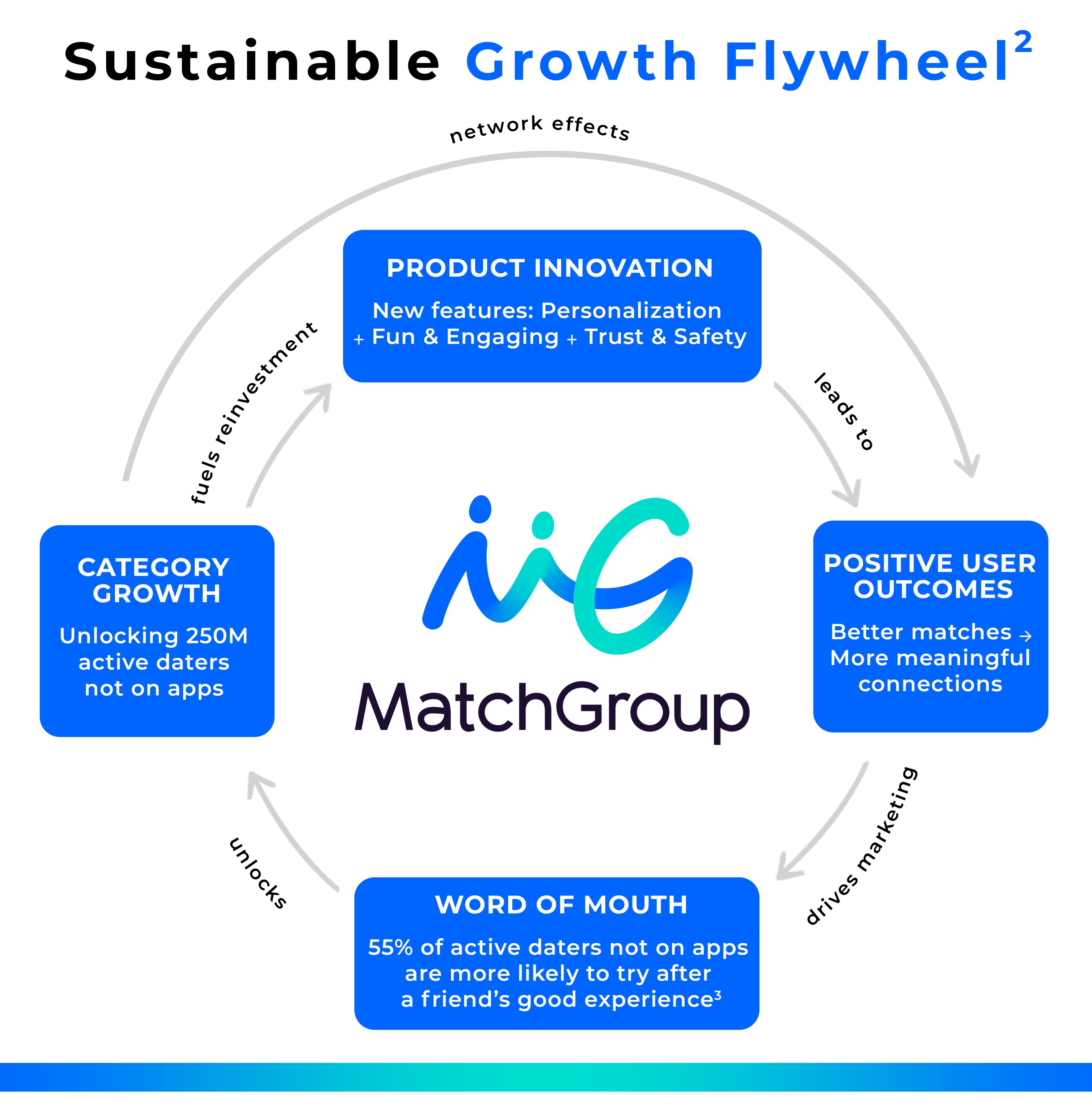
We believe our business model thrives when user outcomes improve. Better
outcomes, driven by higher-quality experiences, better matches, and more
meaningful connections, build confidence in our product and drive new users
through positive word of mouth. User success builds trust in the category and in
Match Group’s apps. By getting the user experience right, we will further deliver real
success stories, which we use in marketing to amplify growth by driving new user
2 Represents Match Group’s product-driven user outcome philosophy to drive category growth.
3 Source: Match Group survey of 2,491 U.S. adults conducted October 2025; “Using a scale of 1 to 10, please rate how
much more likely you would be to recommend a dating app based on the following—with 1 being “not at all more
likely” and 10 being “much more likely.” A family member or friend recommended the app after seeing good reviews
about it.”
| 2 |
|---|
acquisition and reactivations. Our marketing strategy, especially at Tinder and Hinge,
is focused on fueling category consideration, bringing in new and lapsed users
through product-led storytelling that reflects real experiences happening across our
brands. We estimate there are roughly 250 million actively dating singles worldwide
not currently on dating apps. Re-engaging the 30 million lapsed users and attracting
the 220 million potential first-time entrants expands our user base, building a
healthier, more efficient growth engine that compounds over time, and we are
investing to capture this large addressable market. Hinge continues to prove that
with the right product experience and brand positioning, we can win with Gen Z and
drive real growth at scale. Soon, we believe Tinder will too.
2,3

We’ll walk through three proof points today. First, our product progress, where our
obsession with outcomes is showing up across our brands, especially at Tinder and
Hinge. Second, the essential work we’re doing to strengthen trust and authenticity
across the ecosystem. And third, the financial discipline and operational rigor that
are now showing up in how we execute.
| 3 |
|---|
Product: Different Paths, One Shared Goal
Across Match Group, our brands share one goal: delivering better user outcomes. I
want to highlight the progress at our two flagship brands, Tinder and Hinge, and
how each is building affinity with users in different segments.
At Tinder, our focus this year has been to accelerate innovation, rebuild trust, and
ship great products so we can reintroduce Tinder in 2026 to our core audience, Gen
Z. Our new mission statement, Tinder is the most fun way to spark something new
with someone new, captures the energy and the sense of possibilities we want every
user to feel. Guided by new personas – prototypical user archetypes – that reflect real
people and their motivations, we’re creating experiences that feel more personal
and more aligned with what users want.
We’ve clarified what Tinder stands for and who we’re building it for, and that focus is
already paying off. Users are seeing and feeling the difference through updates that
are reshaping the Tinder experience in the following ways:
•First, we’re building a product and

design-led culture. Our new Liquid
Glass refresh planned on iOS this
quarter will make the app more
modern, fluid, and visually appealing,
further bringing our mission to life
every time you open the app.
•Second, ChemistryTM is redefining
how people connect. Powered by AI,
this Interactive Matching feature, now
known as Chemistry, is a major pillar
of Tinder’s upcoming 2026 product
experience. It gets to know users
through interactive questions and,
with permission, learns from their
camera roll to better understand their
interests and personality. Using deep
learning, Chemistry combats “swipe
fatigue” by surfacing a few highly relevant profiles each day, driving more
compatible matches and engaging conversations. Chemistry is now live in
New Zealand and Australia, with plans to expand to additional countries in the
coming months.
•Third, Modes are powering a new social energy on Tinder. Our new Modes
navigation gives users more choice in how they use Tinder, from meeting new
| 4 |
|---|
people with a friend to connecting within their college community. Since
launching Modes in September, Double Date adoption is up 30% in the U.S.,
while College Mode is gaining traction, with one in four eligible students using
it and over 8% engaging daily as of October. Modes makes the ‘fun’ part of our
mission real, giving people new ways to spark something together and
redefining Tinder as a fun, social, and low-pressure way to meet new people.
◦We’re also seeing this momentum reflected in our marketing. The
Double Date Island campaign across Europe drove the highest brand
consideration lift of the year, boosted downloads, and particularly
resonated with Gen-Z. It proved that when we connect product
innovation with authentic, social-first storytelling, we can reignite
excitement and bring new energy back to Tinder.
•Fourth, evaluating profiles is becoming more meaningful and holistic.
We’ve started testing several new features resonating with Gen Z by giving
users more information to evaluate and connect with potential matches. Bio
information now appears on the first photo card, and prompts content is
integrated into the photo carousel. These improvements let users learn more
about a potential match before deciding to Swipe RightTM. We’ve also started
testing features like Contextual Likes and Open Messaging, and we’ve fully
rolled out Prompts on Photos, to let users share why they swiped right,
making interactions more intentional and authentic.
•Finally, app performance is a major focus and a key driver of user
experience. On Android, Tinder startup times are now 38% faster, and crash
rates reduced by more than 32%. On iOS, app stability is up more than 57%.
We’re also removing long-running tests and unused features to make the app
leaner. As we bring load times closer to one second on iOS and Android,
Tinder already feels faster and smoother. Our app performance work on iOS
and Android is in service of the ‘fun’ part of our mission, because no one enjoys
a slow, buggy app.
You can feel the energy across Tinder. During our Hack Week last week, teams
brought incredible innovation and creativity, building some of the most exciting
products and prototypes we’ve seen in years. The company feels electric.
Meanwhile, Hinge continues to be one of the best (and most undiscovered) stories in
consumer tech, powered by a clear mission, motivated team, leading product
experience, and sustained momentum. Hinge’s “Designed to be Deleted®”
philosophy drives a focus on user outcomes; specifically, helping people go out on
‘great dates’, our north star. This clarity of purpose has resulted in category-leading
growth in both users and revenue.
| 5 |
|---|
Hinge is leading the way on AI innovation in dating with category-first AI features
that drive better connections and more real-world outcomes. This quarter brought
both wins and learnings. Conversation Starters, which offers personalized prompts
for first messages, was a clear win, driving approximately 10% more likes with
comments and stronger engagement overall during the test, particularly with
women. Updates to our Recommendation System improved matching quality
through rigorous testing and provided valuable insights that are already refining our
approach. Warm Intros, designed to surface compatibility cues, didn’t resonate and
we won’t move forward with it. While understanding compatibility remains a key
focus, Hinge continues to prioritize user outcomes over simply launching new tools,
reflecting our principled approach to innovation.
As we look ahead to the next few quarters, Hinge has an exciting slate of category-
first features that showcase our leadership in product innovation and user
experience.
•First Impressions is helping daters lead with personality. This new feature
introduces prompts above photos, giving users more ways to express who
they are and add depth to their profiles. A similar experience in the Standouts
earlier this year was well received, and we’re eager to see how users respond
as we continue making Hinge more personal and expressive.
•Preferences will become more meaningful. Reimagined preferences will
take a new look at how daters express what they’re looking for, capturing
compatibility with greater nuance and intentionality. This update addresses
key user pain points, helping people share what truly matters and find better
matches faster.
These are just a few ways Hinge continues to drive innovation in service of user
outcomes.
The next pillar of our strategy is centered on deepening trust in the category.
Trust and Authenticity and the Ways In Which It Strengthens the
Foundation of Our Ecosystem
In dating apps, everything depends on the integrity of the ecosystem. No matter
how many new features we launch, people use our apps to meet other new people,
and that only works when they feel safe, respected, and confident in being
themselves. Building and maintaining that trust is core to our long-term success,
which is why we’re doubling down on trust and safety across our platforms.
Nowhere is that more evident than at Tinder, where we’re integrating safety directly
into the product experience like never before. The centerpiece of this effort is Face
Check™, our new facial verification feature that helps confirm users are real and
4 Based on a random weighted sample of in-app profile views. Bad actors include accounts that engage in
deceptive or harmful behaviors, including spam, scam attempts, or operating automated fake profiles (bots).
| 6 |
|---|
match their profile photos. It’s now required for all new users in California, Colombia,
Canada, India, Australia, and Southeast Asia, and will roll out to additional U.S. states
and countries in the coming months.
4

Face Check sets a new standard for authenticity. Using only a short video selfie, it
helps confirm a user is real and matches their profile photos. We built this
technology with care, ensuring it delivers meaningful improvements to trust and
safety while keeping the user experience seamless. Early results are strong and
reinforce our confidence in the long-term benefits to the broader ecosystem. We
have seen a 60% reduction in user views of profiles later identified as bad actors4, and
a 40% decrease in reports of bad actor activity. Our ongoing optimization efforts
have resulted in only low-single-digit impacts to MAU and revenue in test markets,
which lessens over time. Early Net Promoter Scores results show a clear and
sustained improvement in user trust and satisfaction in key test markets, with scores
up roughly 10 points for men and 5 points for women in key markets where Face
Check has launched. This is just the beginning. We plan to expand Face Check
across the portfolio, with testing on Hinge beginning in the next few months.
We’re also expanding safety beyond verification into everyday user interactions.
Tinder and Hinge have introduced new, fairer enforcement tools to educate users
and promote better behavior through faster and more consistent moderation. This
approach calibrates responses based on severity, helping create a safer and more
respectful community. We’re also enhancing our “Are You Sure?” feature, which
prompts users to pause before sending potentially offensive or disengaging
messages, with large language models (“LLM”) to make it smarter and more
effective at encouraging better conversations in real time. Originally developed at
Tinder and later enhanced by Hinge, this LLM-powered version improves accuracy
and tone. Now, Tinder is incorporating those learnings back into its own experience:
a great example of how our portfolio of brands innovate together, share insights, and
make each other stronger.
| 7 |
|---|
Within Hinge, these principles come together through our product design and user
experience. Beyond moderation, Hinge continues to refine the onboarding
experience to build confidence and trust early in the user journey. Recent updates
include clearer guidance during setup, refreshed Community Guidelines and Help
Center, and the introduction of an AI-powered chatbot that quickly answers
commonly asked questions. Together, these updates reinforce Hinge’s position as a
dating app grounded in authenticity and safety, where people can show up as their
true selves and form meaningful relationships.
Financial and Operational Rigor and How it Translates Into Results
The same discipline driving product innovation is also reflected in how we execute
day-to-day. We are operating with sharper focus and accountability across the
company, hitting deadlines, shipping Match Group-wide features, such as alternative
payments, faster, and acting like a more nimble and decisive company. These
improvements are creating operational momentum and financial optionality as we
plan for 2026.
You can see this strategy in action through Project Aurora, our large-scale test in
Australia that brings together many of Tinder’s biggest advancements into a faster,
safer, and more personal experience. As part of this work, we’re overhauling the
recommendations engine to better align with user outcomes, improving both
match quality and overall satisfaction. We’re being thoughtful with our tests,
prioritizing user trust, outcomes, and long-term impact over quick wins. We may see
some short-term revenue and Adjusted EBITDA impacts from these tests, which
we’ve included in our guidance, as we trade short-term monetization for a better
user experience and improved user outcomes. These tests will help us refine our
strategy and further validate that improved user outcomes will drive more
sustainable user and revenue growth over the long term, which in turn will drive
increased shareholder value. We will share more on these results next quarter.
At Hinge, momentum continues to build

as the product delivers meaningful
outcomes for users. Revenue, Adjusted
EBITDA, and user growth remain strong,
supported by continued innovation and
disciplined execution. Hinge’s
international expansion remains on track
with a successful Mexico launch in
September and with Brazil planned for
Q4. The team is actively working on plans
for new expansion markets in 2026 as
well.
| 8 |
|---|
Hinge launched alternative payments testing ahead of schedule in Q3 with strong
early results. We plan to fully roll out alternative payments across our major apps,
including Tinder and Hinge, in the U.S. in Q4. Strong initial performance at Hinge
and ongoing optimizations at Tinder and E&E have increased adoption of web
payments, and we now expect to generate approximately $14 million of savings in
Q4 2025 and approximately $90 million in 2026. We have seen some impact to gross
revenue in some of our tests at Tinder and Hinge, which we are continuing to
optimize for.
We are also seeing early success from our recent acquisition of HER™, which
expands our reach among queer women and gender-diverse communities. The
team has already delivered strong results, with algorithmic improvements and
monetization optimizations driving over 20% revenue increase in test markets. This
success highlights the opportunity to scale high-potential brands across our
portfolio and deepen our presence in key segments of the dating market.
That same disciplined approach to growth is reflected in how we manage the
business. Our financial discipline earlier this year generated approximately $100
million of annualized savings, allowing us to reinvest approximately $50 million
across the portfolio to test user-first features, strengthening marketing, and
expanding our international footprint. The early results from our Q3 investments are
instilling confidence in our strategy, and we’re executing well against our Q4 plans.
The learnings from these investments and the ongoing benefits of our cost savings
efforts will help inform how we prioritize and deploy capital in 2026. Together, these
steps are setting the foundation for the next phase of the turnaround and the
“Resurgence” we expect to take hold in 2026 and 2027.
Conclusion
We’re entering this next chapter with real progress and a clear path forward. At
Tinder, our new measure of success, Sparks, tracks six-way conversations, meaning
at least six total messages exchanged between two users. This has become one of
the clearest indicators that a genuine connection is forming. While the total number
of Sparks is lower year-over-year (“Y/Y”) due to a smaller MAU base, Sparks coverage,
or the proportion of users in the ecosystem having these deeper conversations,
continues to improve and is up year-over-year. This shows that more users are
having better experiences on the platform, an early but encouraging sign that our
focus on improving product quality and user outcomes is taking hold.
Match Group holds a unique position in solving one of the most important
challenges of our time: helping people connect in a world that increasingly feels
disconnected. Our focus is on fostering genuine human connection, while ensuring
technology strengthens relationships and is the social fabric that brings people
together.
| 9 |
|---|
Q3 2025 Financial Performance
We’re pleased with our Q3 results, as Match Group Total Revenue was in-line with
our expectations for the quarter, and Adjusted EBITDA meaningfully exceeded our
expectations excluding a $61 million charge to settle the Candelore v. Tinder, Inc.
case on a class-wide basis (“legal settlement charge”). Candelore is a 10-year-old case
involving Tinder's former age-based pricing. The parties are preparing a long-form
agreement reflecting the settlement terms and will then seek approval of the
settlement by the Court.

In Q3, Match Group’s Total Revenue was $914 million, up 2% Y/Y, up 1% Y/Y on a
foreign exchange (“FX”) neutral basis (“FXN”). FX was $4 million better than expected
at the time of our last earnings call. Payers declined 5% Y/Y to 14.5 million, while RPP
increased 7% Y/Y to $20.58. Indirect revenue of $18 million was up 8% Y/Y driven
primarily by strength in our third-party advertising business.
In Q3, Match Group’s Adjusted EBITDA was $301 million, down 12% Y/Y, representing
an Adjusted EBITDA Margin of 33%. Excluding the $61 million legal settlement
charge and $2 million of restructuring costs (included in the $25 million of
restructuring costs announced in May), Adjusted EBITDA would have been $364
million, up 6% Y/Y, representing an Adjusted EBITDA margin of 40%.
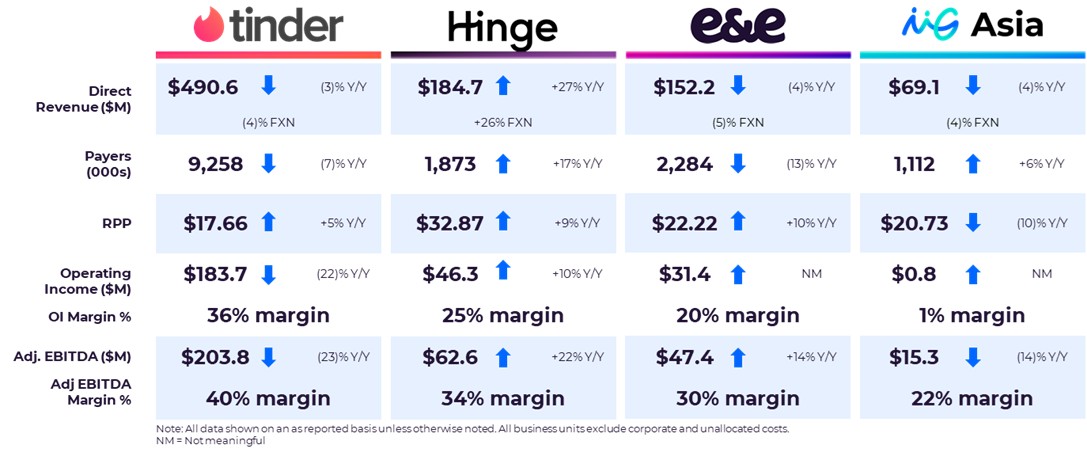
•Tinder Direct Revenue in Q3 was $491 million, down 3% Y/Y and down 4% Y/Y
FXN. Q3 Direct Revenue includes an approximately $3 million negative impact
from user experience testing in the quarter. Payers declined 7% Y/Y to 9.3
million and RPP increased 5% Y/Y to $17.66. Adjusted EBITDA in the quarter
was $204 million, down 23% Y/Y, representing an Adjusted EBITDA margin of
40%. Excluding the legal settlement charge, Adjusted EBITDA would have
been $264 million, representing an Adjusted EBITDA margin of 52%.
| 10 |
|---|
•Hinge continued its strong momentum in Q3 with Direct Revenue of $185
million, up 27% Y/Y and up 26% Y/Y FXN. Payers increased 17% Y/Y to 1.9 million,
and RPP increased 9% to $32.87. Adjusted EBITDA was $63 million, up 22% Y/Y,
representing an Adjusted EBITDA Margin of 34%.
•E&E Direct Revenue in Q3 was $152 million, down 4% Y/Y and down 5% Y/Y
FXN. Payers decreased 13% Y/Y to 2.3 million, while RPP increased 10% Y/Y to
$22.22. Adjusted EBITDA was $47 million, up 14% Y/Y, representing an
Adjusted EBITDA Margin of 30%.
•MG Asia delivered Direct Revenue in Q3 of $69 million, down 4% Y/Y on both
an as reported and FXN basis. Excluding the exit of our live streaming
businesses, MG Asia Direct Revenue in Q3 was flat Y/Y on both an as reported
and FXN basis. Azar® Direct Revenue was flat Y/Y and up 2% Y/Y FXN. Azar
Direct Revenue was negatively impacted by an estimated $3 million after Azar
was blocked in Turkey by Turkish regulators in late August. We’re pursuing all
available legal remedies and working with Turkish regulators to get Azar
unblocked; however, it is unclear at this time when that may happen. Pairs™
Direct Revenue was down 1% Y/Y and down 2% Y/Y FXN. Across MG Asia,
Payers increased 6% Y/Y to 1.1 million, while RPP declined 10% Y/Y to $20.73,
partially due to the exit of Hakuna® mid-last year. Adjusted EBITDA was $15
million, down 14% Y/Y, representing an Adjusted EBITDA Margin of 22%.
Consolidated Operating Costs and Expenses
Including stock-based compensation expense, total expenses were up 1% Y/Y in Q3.
Cost of revenue decreased 2% Y/Y and represented 27% of Total Revenue, down one
point Y/Y, driven by reduced variable expenses from the shutdown of our live
streaming services mid-last year, lower web services costs, and lower employee
compensation expense from our restructuring efforts. Selling and marketing costs
increased $12 million, or 8% Y/Y, and represented 19% of Total Revenue, up one point
Y/Y, primarily due to increased marketing spend at Tinder, Hinge, and MG Asia,
partially offset by lower employee compensation expense from our restructuring
efforts. General and administrative costs increased 42% Y/Y, up 5 points Y/Y as a
percentage of Total Revenue to 16%, driven primarily by the legal settlement charge,
partially offset by lower employee compensation expense from our restructuring
efforts. Product development costs increased 1% Y/Y and were flat Y/Y as a percent of
Total Revenue at 11%. Depreciation and amortization decreased by $44 million Y/Y to
$24 million due to impairments of intangible assets at E&E and MG Asia in the prior
year quarter and lower internally developed capitalized software costs, primarily at
Tinder and MG Asia.
5 Leverage is calculated utilizing the non-GAAP measure Adjusted EBITDA as the denominator. For a reconciliation
of the non-GAAP measure for each period presented, see page 15.
6 Diluted shares outstanding is calculated using the methods and assumptions described in our press release issued
November 4, 2025; these are different from GAAP dilution, which is calculated based on the treasury stock method.
See page 10 of the press release for additional information. Diluted shares outstanding is reported at the time of each
respective quarter’s earnings release.
| 11 |
|---|
Capital Allocation & Liquidity
Our trailing twelve-month gross leverage was 3.4x and net leverage5 was 2.5x at the
end of Q3. We ended the quarter with $1.1 billion of cash, cash equivalents, and short-
term investments on hand. In August, we issued $700 million of 6.125% senior notes
due 2033. The proceeds from these notes will be used to repay all of the
exchangeable senior notes coming due in 2026 on or before maturity and for
general corporate purposes. In September, we repurchased $76 million of the 2026
exchangeable senior notes at a discount to par.
Year-to-date through Q3, we delivered Operating Cash Flow of $758 million and Free
Cash Flow of $716 million. We repurchased 17.4 million shares at an average price of
$32 per share on a trade date basis for a total of $550 million and paid $141 million in
dividends, deploying nearly 100% of free cash flow for capital return to shareholders.
In October, we repurchased an additional 3.0 million shares of our common stock for
$100 million on a trade date basis at an average price of $33 per share. As of October
31, 2025, we’ve reduced diluted shares outstanding by 8% Y/Y6. We maintain our
commitment to target returning 100% of Free Cash Flow to shareholders through
buybacks and the dividend.
Financial Guidance
Q4 2025
We expect Q4 Total Revenue for Match Group of $865 million to $875 million, up 1%
to 2% Y/Y. This range assumes a nearly two and a half-point Y/Y tailwind from FX.
FXN, we expect Total Revenue to be down 1% to 2% Y/Y. We expect Match Group
Adjusted EBITDA of $350 million to $355 million in Q4, representing a Y/Y increase of
9%, and an Adjusted EBITDA margin of 41% at the midpoints of the ranges.
| Total Revenue | Adjusted EBITDA | |
|---|---|---|
| Q4 2025 | $865 to $875 million | $350 to $355 million |
Q4 Total Revenue guidance reflects continued strong performance at Hinge, and
Tinder performance that is in-line with the expectations we had at our last earnings
in August, including an expected $14 million negative impact to Tinder Direct
Revenue from user experience testing. It also reflects weaker-than-expected
| 12 |
|---|
performance at E&E and assumes a continuation of Azar’s block in Turkey. E&E saw
weaker trends in Q3, which we are working quickly to address, and we no longer
expect Emerging brands’ Direct Revenue growth to offset Evergreen brands’
declines in 2025. We expect an estimated $9 million negative impact to MG Asia
Direct Revenue from Azar’s block in Turkey. We expect Indirect Revenue to be
approximately $15 million in the quarter.
Our Q4 Adjusted EBITDA guidance includes $4 million of restructuring-related costs
(included in the $25 million of restructuring-related costs announced in May) and an
$8 million positive impact from an expected sale of one of our two office buildings in
LA that was not fully utilized.
We are increasing our 2025 full year Free Cash Flow guidance to $1.11 to $1.14 billion,
which assumes the Candelore settlement will not be paid until Q1 2026.
We now expect our 2025 full year tax rate to be in the high teens.
| 13 |
|---|
Appendix
Reconciliations of GAAP to Non-GAAP Measures
Reconciliation of Net Income to Adjusted EBITDA
| Three Months Ended September 30, 2025 | |||||||
|---|---|---|---|---|---|---|---|
| Tinder | Hinge | E&E | MG Asia | Corporate &<br><br>unallocated<br><br>costs | Eliminations | Total Match<br><br>Group | |
| (Dollars in thousands) | |||||||
| Net income<br><br>attributable to<br><br>Match Group, Inc.<br><br>shareholders | $160,749 | ||||||
| Add back: | |||||||
| Net income<br><br>attributable to<br><br>noncontrolling<br><br>interests(a) | 7 | ||||||
| Income tax<br><br>provision(a) | 32,882 | ||||||
| Other income, net(a) | (9,328) | ||||||
| Interest expense(a) | 37,024 | ||||||
| Operating income<br><br>(loss)(b) | $183,743 | $46,314 | $31,447 | $801 | $(40,971) | $— | $221,334 |
| Stock-based<br><br>compensation<br><br>expense | 17,624 | 15,238 | 5,956 | 5,332 | 12,156 | — | 56,306 |
| Depreciation | 2,451 | 1,071 | 6,268 | 3,938 | 1,117 | — | 14,845 |
| Amortization of<br><br>intangibles | — | — | 3,702 | 5,219 | — | — | 8,921 |
| Adjusted EBITDA | $203,818 | $62,623 | $47,373 | $15,290 | $(27,698) | $— | $301,406 |
| Revenue | $505,344 | $184,671 | $156,252 | $69,364 | $— | $(1,356) | $914,275 |
| Net Income Margin | 18% | ||||||
| Operating Income<br><br>Margin(b) | 36% | 25% | 20% | 1% | NA | NA | 24% |
| Adjusted EBITDA<br><br>Margin | 40% | 34% | 30% | 22% | NA | NA | 33% |
| 14 | |||||||
| --- |
Reconciliation of Net Income to Adjusted EBITDA (continued)
| Three Months Ended September 30, 2024 | |||||||
|---|---|---|---|---|---|---|---|
| Tinder | Hinge | E&E | MG Asia | Corporate &<br><br>unallocated<br><br>costs | Eliminations | Total Match<br><br>Group | |
| (Dollars in thousands) | |||||||
| Net income<br><br>attributable to<br><br>Match Group, Inc.<br><br>shareholders | $136,468 | ||||||
| Add back: | |||||||
| Net income<br><br>attributable to<br><br>redeemable<br><br>noncontrolling<br><br>interestsa | 13 | ||||||
| Income tax provisiona | 41,159 | ||||||
| Other income, neta | (7,100) | ||||||
| Interest expensea | 40,120 | ||||||
| Operating income<br><br>(loss)(b) | $234,304 | $42,207 | $3,110 | $(18,895) | $(50,066) | $— | $210,660 |
| Stock-based<br><br>compensation<br><br>expense | 22,601 | 8,599 | 13,310 | 5,844 | 14,134 | — | 64,488 |
| Depreciation | 9,420 | 620 | 5,918 | 8,031 | 1,313 | — | 25,302 |
| Impairments and<br><br>amortization of<br><br>intangibles | — | — | 19,230 | 22,860 | — | — | 42,090 |
| Adjusted EBITDA | $266,325 | $51,426 | $41,568 | $17,840 | $(34,619) | $— | $342,540 |
| Revenue | $516,778 | $145,425 | $161,181 | $72,282 | $— | $(182) | $895,484 |
| Net Income Margin | 15% | ||||||
| Operating Income<br><br>(Loss) Margin(b) | 45% | 29% | 2% | (26)% | NA | NA | 24% |
| Adjusted EBITDA<br><br>Margin | 52% | 35% | 26% | 25% | NA | NA | 38% |
______________________
(a) These items are not allocated to a segment.
(b) At a segment level, the closest GAAP measure is operating income as items outside operating
income are not allocated to segments.
Reconciliation of Operating Cash Flow to Free Cash Flow
| Nine Months Ended<br><br>September 30, 2025 | |
|---|---|
| (In thousands) | |
| Net cash provided by operating activities | $757,600 |
| Capital expenditures | (42,100) |
| Free Cash Flow | $715,500 |
| 15 | |
| --- |
Reconciliation of Forecasted Operating Cash Flow to Free Cash Flow
| Year Ended<br><br>December 31, 2025 | |
|---|---|
| (In millions) | |
| Net cash provided by operating activities | $1,175 to $1,195 |
| Capital expenditures | (55 to 65) |
| Free Cash Flow | $1,110 to $1140 |
Reconciliation of Net Income to Adjusted EBITDA used in Leverage Ratios
| Twelve months<br><br>ended<br><br>September 30, 2025 | |
|---|---|
| (In thousands) | |
| Net income attributable to Match Group, Inc. shareholders | $562,093 |
| Add back: | |
| Net loss attributable to noncontrolling interests | (10) |
| Income tax provision | 126,757 |
| Other income, net | (21,604) |
| Interest expense | 144,000 |
| Stock-based compensation expense | 263,373 |
| Depreciation | 75,219 |
| Amortization of intangibles | 40,663 |
| Adjusted EBITDA | $1,190,491 |
Reconciliation of Forecasted Net Income to Forecasted Adjusted EBITDA
| Three Months Ended<br><br>December 31, 2025 | |
|---|---|
| (In millions) | |
| Net income attributable to Match Group, Inc. shareholders | $159 to $164 |
| Add back: | |
| Net income attributable to noncontrolling interests | 7 |
| Income tax provision | 46 |
| Other income, net | 7 |
| Interest expense | 43 |
| Stock-based compensation expense | 66 |
| Depreciation and amortization of intangibles | 22 |
| Adjusted EBITDA | $350 to $355 |
| Revenue | $865 to $875 |
| Net Income Margin (at the mid-point of the ranges) | 19% |
| Adjusted EBITDA Margin (at the mid-point of the ranges) | 41% |
| 16 | |
| --- |
Reconciliation of GAAP Revenue to Non-GAAP Revenue, Excluding
Foreign Exchange Effects
| Three Months Ended September 30, | ||||
|---|---|---|---|---|
| 2025 | $ Change | % Change | 2024 | |
| (Dollars in millions, rounding differences may<br><br>occur) | ||||
| Total Revenue, as reported | $914.3 | $18.8 | 2% | $895.5 |
| Foreign exchange effects | (12.2) | |||
| Total Revenue, excluding foreign exchange effects | $902.1 | $6.6 | 1% | $895.5 |
| Direct Revenue, as reported | $896.7 | $17.5 | 2% | $879.2 |
| Foreign exchange effects | (12.0) | |||
| Direct Revenue, excluding foreign exchange effects | $884.6 | $5.4 | 1% | $879.2 |
| Tinder Direct Revenue, as reported | $490.6 | $(12.6) | (3)% | $503.2 |
| Foreign exchange effects | (8.2) | |||
| Tinder Direct Revenue, excluding foreign exchange effects | $482.4 | $(20.8) | (4)% | $503.2 |
| Hinge Direct Revenue, as reported | $184.7 | $39.2 | 27% | $145.4 |
| Foreign exchange effects | (1.6) | |||
| Hinge Direct Revenue, excluding foreign exchange effects | $183.0 | $37.6 | 26% | $145.4 |
| E&E Direct Revenue, as reported | $152.2 | $(6.1) | (4)% | $158.4 |
| Foreign exchange effects | (2.5) | |||
| E&E Direct Revenue, excluding foreign exchange effects | $149.8 | $(8.6) | (5)% | $158.4 |
| MG Asia Direct Revenue, as reported | $69.1 | $(3.0) | (4)% | $72.2 |
| Foreign exchange effects | 0.3 | |||
| MG Asia Direct Revenue, excluding foreign exchange effects | $69.4 | $(2.7) | (4)% | $72.2 |
| MG Asia Direct Revenue excluding Hakuna, as reported | $69.1 | $(0.2) | —% | $69.3 |
| Foreign exchange effects | 0.3 | |||
| MG Asia Direct Revenue excluding Hakuna, excluding foreign exchange effects | $69.4 | $0.1 | —% | $69.3 |
| Azar Direct Revenue | $40.1 | $0.1 | —% | $40.0 |
| Foreign exchange effects | 0.6 | |||
| Azar Direct Revenue, excluding foreign exchange effects | $40.7 | $0.7 | 2% | $40.0 |
| Pairs Direct Revenue, as reported | $29.0 | $(0.3) | (1)% | $29.3 |
| Foreign exchange effects | (0.3) | |||
| Pairs Direct Revenue, excluding foreign exchange effects | $28.7 | $(0.6) | (2)% | $29.3 |
| 17 | ||||
| --- |
Non-GAAP Financial Measures
Match Group reports Adjusted EBITDA, Adjusted EBITDA Margin, Free Cash Flow, and Revenue
Excluding Foreign Exchange Effects, all of which are supplemental measures to U.S. generally accepted
accounting principles (“GAAP”). The Adjusted EBITDA, Adjusted EBITDA Margin, and Free Cash Flow
measures are among the primary metrics by which we evaluate the performance of our business, on
which our internal budget is based and by which management is compensated. Revenue Excluding
Foreign Exchange Effects provides a comparable framework for assessing the performance of our
business without the effect of exchange rate differences when compared to prior periods. We believe
that investors should have access to the same set of tools that we use in analyzing our results. These
non-GAAP measures should be considered in addition to results prepared in accordance with GAAP but
should not be considered a substitute for or superior to GAAP results. Match Group endeavors to
compensate for the limitations of the non-GAAP measures presented by providing the comparable
GAAP measures and descriptions of the reconciling items, including quantifying such items, to derive
the non-GAAP measures. We encourage investors to examine the reconciling adjustments between the
GAAP and non-GAAP measures, which we describe below. Interim results are not necessarily indicative
of the results that may be expected for a full year.
Definitions of Non-GAAP Measures
Adjusted EBITDA is defined as net income attributable to Match Group, Inc. shareholders excluding: (1)
net income attributable to noncontrolling interests; (2) income tax provision or benefit; (3) other income
(expense), net; (4) interest expense; (5) depreciation; (6) acquisition-related items consisting of
amortization of intangible assets and impairments of goodwill and intangible assets, if applicable; and
(7) stock-based compensation expense. We believe Adjusted EBITDA is useful to analysts and investors
as this measure allows a more meaningful comparison between our performance and that of our
competitors. Adjusted EBITDA has certain limitations because it excludes certain expenses. At a
segment level, the closest GAAP measure is operating income as items outside operating income are
not allocated to segments.
Adjusted EBITDA Margin is defined as Adjusted EBITDA divided by revenues. We believe Adjusted
EBITDA Margin is useful for analysts and investors as this measure allows a more meaningful
comparison between our performance and that of our competitors. Adjusted EBITDA Margin has
certain limitations in that it does not take into account the impact to our consolidated statement of
operations of certain expenses.
Free Cash Flow is defined as net cash provided by operating activities, less capital expenditures. We
believe Free Cash Flow is useful to investors because it represents the cash that our operating
businesses generate, before taking into account non-operational cash movements. Free Cash Flow has
certain limitations in that it does not represent the total increase or decrease in the cash balance for the
period, nor does it represent the residual cash flow for discretionary expenditures. Therefore, we think it
is important to evaluate Free Cash Flow along with our consolidated statement of cash flows.
We look at Free Cash Flow as a measure of the strength and performance of our businesses, not for
valuation purposes. In our view, applying “multiples” to Free Cash Flow is inappropriate because it is
subject to timing, seasonality and one-time events. We manage our business for cash, and we think it is
of utmost importance to maximize cash – but our primary valuation metric is Adjusted EBITDA.
Revenue Excluding Foreign Exchange Effects is calculated by translating current period revenues
using prior period exchange rates. The percentage change in Revenue Excluding Foreign Exchange
Effects is calculated by determining the change in current period revenues over prior period revenues
where current period revenues are translated using prior period exchange rates. We believe the impact
of foreign exchange rates on Match Group, due to its global reach, may be an important factor in
| 18 |
|---|
understanding period over period comparisons if movement in rates is significant. Since our results are
reported in U.S. dollars, international revenues are favorably impacted as the U.S. dollar weakens relative
to other currencies, and unfavorably impacted as the U.S. dollar strengthens relative to other currencies.
We believe the presentation of revenue excluding foreign exchange effects in addition to reported
revenue helps improve the ability to understand Match Group’s performance because it excludes the
impact of foreign currency volatility that is not indicative of Match Group’s core operating results.
Non-Cash Expenses That Are Excluded From Our Non-GAAP Measures
Stock-based compensation expense consists principally of expense associated with the grants of
RSUs, performance-based RSUs, and market-based awards. These expenses are not paid in cash, and
we include the related shares in our fully diluted shares outstanding using the treasury stock method;
however, performance-based RSUs and market-based awards are included only to the extent the
applicable performance or market condition(s) have been met (assuming the end of the reporting
period is the end of the contingency period). To the extent stock-based awards are settled on a net
basis, we remit the required tax-withholding amounts from our current funds.
Depreciation is a non-cash expense relating to our property and equipment and is computed using the
straight-line method to allocate the cost of depreciable assets to operations over their estimated useful
lives, or, in the case of leasehold improvements, the lease term, if shorter.
Amortization of intangible assets and impairments of goodwill and intangible assets are non-cash
expenses related primarily to acquisitions. At the time of an acquisition, the identifiable definite-lived
intangible assets of the acquired company, such as customer lists, trade names and technology, are
valued and amortized over their estimated lives. Value is also assigned to (i) acquired indefinite-lived
intangible assets, which consist of trade names and trademarks, and (ii) goodwill, which are not subject
to amortization. An impairment is recorded when the carrying value of an intangible asset or goodwill
exceeds its fair value. We believe that intangible assets represent costs incurred by the acquired
company to build value prior to acquisition and the related amortization and impairment charges of
intangible assets or goodwill, if applicable, are not ongoing costs of doing business.
Additional Definitions
Tinder consists of the world-wide activity of the brand Tinder®.
Hinge consists of the world-wide activity of the brand Hinge®.
Evergreen & Emerging (“E&E”) consists of the world-wide activity of our Evergreen brands, including
Match®, Meetic®, OkCupid®, Plenty Of Fish®, and a number of demographically focused brands and our
Emerging brands including, BLK®, ChispaTM, The League®, Archer®, Upward®, YuzuTM, Salams®, HERTM, and
other smaller brands.
Match Group Asia (“MG Asia”) consists of the world-wide activity of the brands Pairs® and Azar®.
Direct Revenue is revenue that is received directly from end users of our services and includes both
subscription and à la carte revenue.
Indirect Revenue is revenue that is not received directly from end users of our services, a majority of
which is advertising revenue.
Payers are unique users at a brand level in a given month from whom we earned Direct Revenue.
When presented as a quarter-to-date or year-to-date value, Payers represents the average of the
monthly values for the respective period presented. At a consolidated level and a business unit level to
the extent a business unit consists of multiple brands, duplicate Payers may exist when we earn
| 19 |
|---|
revenue from the same individual at multiple brands in a given month, as we are unable to identify
unique individuals across brands in the Match Group portfolio.
Revenue Per Payer (“RPP”) is the average monthly revenue earned from a Payer and is Direct Revenue
for a period divided by the Payers in the period, further divided by the number of months in the period.
Monthly Active User (“MAU”) is a unique registered user at a brand level who has visited the brand’s
app or, if applicable, their website in the given month. For measurement periods that span multiple
months, the average of each month is used. At a consolidated level and a business unit level to the
extent a business unit consists of multiple brands, duplicate users will exist within MAU when the same
individual visits multiple brands in a given month.
Leverage on a gross basis is calculated as principal debt balance divided by Adjusted EBITDA for the
period referenced.
Leverage on a net basis is calculated as principal debt balance less cash and cash equivalents and
short-term investments divided by Adjusted EBITDA for the period referenced.
Safe Harbor Statement Under the Private Securities Litigation Reform Act
of 1995
These prepared remarks and our conference call, which will be held at 5:00 p.m. Eastern Time on
November 4, 2025, may contain “forward-looking statements” within the meaning of the Private
Securities Litigation Reform Act of 1995. All statements that are not historical facts are “forward looking
statements.” The use of words such as “anticipates,” “estimates,” “expects,” “plans,” “believes,” “will,” and
“would,” among others, generally identify forward-looking statements. These forward-looking
statements include, among others, statements relating to: Match Group’s future financial performance,
Match Group’s business prospects and strategy, anticipated trends, and other similar matters. These
forward-looking statements are based on management’s current expectations and assumptions about
future events, which are inherently subject to uncertainties, risks and changes in circumstances that
are difficult to predict. Actual results could differ materially from those contained in these forward-
looking statements for a variety of reasons, including, among others: our ability to maintain or grow the
size of our user base and convert users to paying users, the success of our product strategies,
competition, our ability to realize reductions in in-app purchase fees, the limited operating history of
some of our brands, our ability to attract users to our services through cost-effective marketing and
related efforts, our ability to distribute our services through third parties and offset related fees, risks
relating to our use of artificial intelligence, foreign currency exchange rate fluctuations (including
anticipated gains from fluctuations), the integrity and scalability of our systems and infrastructure (and
those of third parties) and our ability to adapt ours to changes in a timely and cost-effective manner,
our ability to protect our systems from cyberattacks and to protect personal and confidential user
information, impacts to our offices and employees from more frequent extreme weather events, risks
relating to certain of our international operations and acquisitions, damage to our brands' reputations
as a result of inappropriate actions by users of our services, and macroeconomic conditions. Certain of
these and other risks and uncertainties are discussed in Match Group’s filings with the Securities and
Exchange Commission. Other unknown or unpredictable factors that could also adversely affect Match
Group’s business, financial condition and results of operations may arise from time to time. In light of
these risks and uncertainties, these forward-looking statements may not prove to be accurate.
Accordingly, you should not place undue reliance on these forward-looking statements, which only
reflect the views of Match Group management as of the date of this press release. Match Group does
not undertake to update these forward-looking statements.