MTCH 8-K
Match Group, Inc. (MTCH)
8-K
2025-08-05
For: 2025-08-05
View Original
Added on
April 04, 2026
UNITED STATES
SECURITIES AND EXCHANGE COMMISSION
Washington, DC 20549
FORM 8-K
CURRENT REPORT
Pursuant to Section 13 OR 15(d) of The Securities Exchange Act of 1934
Date of Report (Date of earliest event reported): August 5, 2025
(Exact name of registrant as specified in its charter)
| (State or other jurisdiction of incorporation) | (Commission File Number) | (IRS Employer Identification No.) | ||||||
(Address of principal executive offices) (Zip Code)
Registrant’s telephone number, including area code: (214 ) 576-9352
Check the appropriate box below if the Form 8-K filing is intended to simultaneously satisfy the filing obligation of the registrant under any of the following provisions (see General Instruction A.2. below):
| Securities registered pursuant to Section 12(b) of the Act: | ||||||||||||||
| Title of each class | Trading Symbol | Name of exchange on which registered | ||||||||||||
| (Nasdaq Global Select Market) | ||||||||||||||
Indicate by check mark whether the registrant is an emerging growth company as defined in Rule 405 of the Securities Act of 1933 (§230.405 of this chapter) or Rule 12b-2of the Securities Exchange Act of 1934 (§240.12b-2 of this chapter).
Emerging growth company ☐
If an emerging growth company, indicate by check mark if the registrant has elected not to use the extended transition period for complying with any new or revised financial accounting standards provided pursuant to Section 13(a) of the Exchange Act. ☐
Item 2.02. Results of Operations and Financial Condition.
Item 7.01. Regulation FD Disclosure.
On August 5, 2025, Match Group, Inc. (“Match Group”) published a press release and prepared remarks, each of which included results for the quarter ended June 30, 2025. The press release and prepared remarks are attached hereto as Exhibits 99.1 and 99.2, respectively, and are incorporated herein by reference. Match Group has also posted supplemental investor materials on the "Investor Relations" section of its website at https://ir.mtch.com.
Exhibits 99.1 and 99.2 are being furnished under both Item 2.02 “Results of Operations and Financial Condition” and Item 7.01 “Regulation FD Disclosure.”
Item 8.01. Other Events.
On August 5, 2025, Match Group announced that its Board of Directors declared a cash dividend of $0.19 per share of its outstanding common stock, payable on October 17, 2025 to stockholders of record as of the close of business on October 3, 2025.
Item 9.01. Financial Statements and Exhibits.
(d) Exhibits
Exhibit Number | Description | ||||
| 104 | Inline XBRL for the cover page of this Current Report on Form 8-K | ||||
SIGNATURE
Pursuant to the requirements of the Securities Exchange Act of 1934, the registrant has duly caused this report to be signed on its behalf by the undersigned hereunto duly authorized.
| MATCH GROUP, INC. | ||||||||
| By: | /s/ Steven Bailey | |||||||
| Steven Bailey | ||||||||
| Chief Financial Officer | ||||||||
Date: August 5, 2025
Exhibit 99.1
Match Group Announces Second Quarter Results
Tinder Transformation Advances, Hinge Grows Revenue 25%
Year-Over-Year
Year-Over-Year
LOS ANGELES, August 5, 2025 - Match Group (NASDAQ: MTCH) today announced financial results for the second quarter ended June 30, 2025, and outlined progress on the company’s multi-phase transformation. The company’s Total Revenue and Adjusted Operating Income both exceeded guidance and Wall Street expectations in the quarter, after excluding an unanticipated $14 million legal settlement charge.
Earlier this year, Match Group launched a bold, three-phase turnaround strategy: Reset, focused on reworking the company’s structure and culture; Revitalize, centered on accelerating product development and aligning around user outcomes; and Resurgence, the forward-looking phase aimed at strengthening the category and driving long-term growth.
“Six months ago, we took a hard look at how we work, what we build, and what users want from our apps,” said CEO Spencer Rascoff. “We moved fast to reset the company culturally, organizationally, and strategically. We then began revitalizing our apps around clearer brand purpose and real user outcomes. Match Group is now oriented around urgency, accountability, and product obsession.”
Rascoff continued, “With meaningful product progress at Tinder, strong momentum at Hinge, and a portfolio of distinct brands aligned around user needs, we’re building a product-first company positioned for long-term success. We’re moving with urgency, operating with focus, and committed to the long game. As we look ahead to our resurgence phase in 2026 and 2027, we are focused on delivering app experiences that feel modern, human, and built for today’s users. We are also working to spark a resurgence of trust, relevance, and confidence among both our users and investors.”
To support this strategy, Match Group plans to reinvest savings of approximately $50 million in the second half of 2025 in strategic initiatives across the portfolio. This includes product testing at Tinder, geographic expansion for Hinge, Azar, and The League, and early-stage bets like Archer, HER, and a new dating app concept. By enhancing product experiences and increasing marketing support, the company is aiming to deliver more value to users while meeting its previously shared full year revenue growth and margin targets.
1
Match Group Q2 2025 Financial Highlights
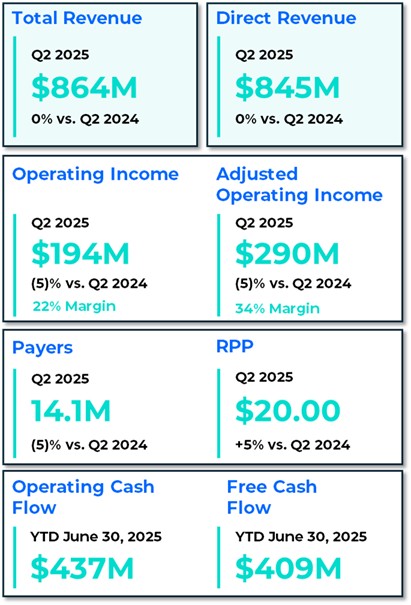
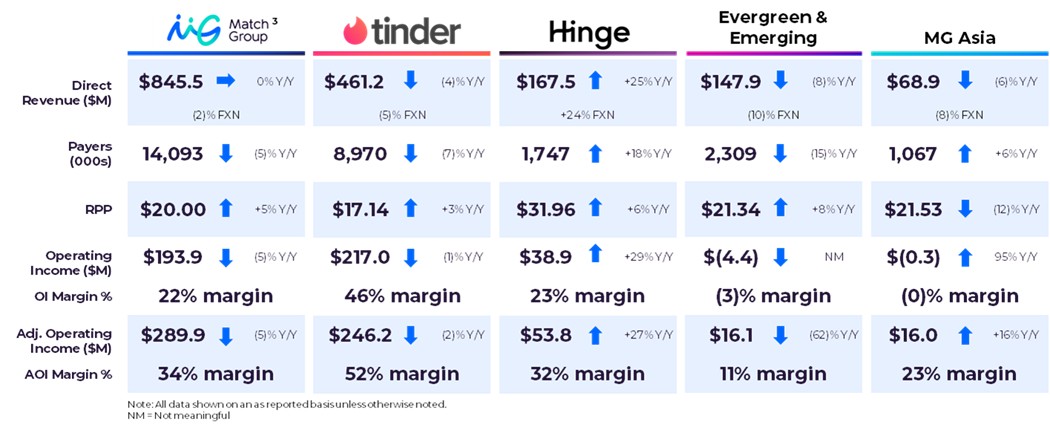
•Total Revenue of $864 million flat year-over-year (“Y/Y”), down 1% on a foreign exchange (“FX”) neutral basis (“FXN”), driven by a 5% Y/Y decline in Payers to 14.1 million, partially offset by a 5% Y/Y increase in RPP to $20.00.
•Operating Income of $194 million declined 5% Y/Y, representing an Operating Income Margin of 22%.
•Adjusted Operating Income of $290 million declined 5% Y/Y, representing an Adjusted Operating Income Margin of 34%.
•Operating Cash Flow and Free Cash Flow were $437 million and $409 million, respectively, year-to-date through June 30, 2025.
•Repurchased 13.7 million of our shares at an average price of $31 per share on a trade date basis for a total of $420 million and paid $95 million in dividends, deploying over 125% of our free cash flow for capital return to shareholders year-to-date through June 30, 2025.
•Diluted shares outstanding1 were 249 million as of July 31, 2025, a decrease of 9%, since July 26, 2024.
The following table summarizes total company consolidated financial results for the three months ended June 30, 2025 and 2024.
| Three Months Ended June 30, | |||||||||||||||||
| (Dollars in millions, except RPP, Payers in thousands) | 2025 | 2024 | Y/Y Change | ||||||||||||||
| Total Revenue | $ | 864 | $ | 864 | — | % | |||||||||||
| Direct Revenue | $ | 845 | $ | 848 | — | % | |||||||||||
| Operating Income | $ | 194 | $ | 205 | (5) | % | |||||||||||
| Operating Income Margin | 22 | % | 24 | % | |||||||||||||
| Adjusted Operating Income | $ | 290 | $ | 306 | (5) | % | |||||||||||
| Adjusted Operating Income Margin | 34 | % | 35 | % | |||||||||||||
| Payers | 14,093 | 14,841 | (5) | % | |||||||||||||
| RPP | $ | 20.00 | $ | 19.05 | 5 | % | |||||||||||
1 As defined on page 10 of this press release.
2
Other Quarterly Highlights:
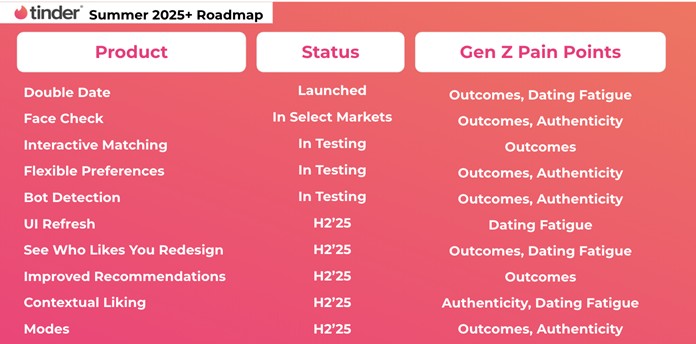
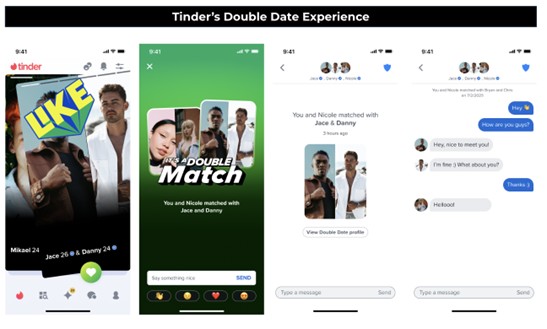
•Tinder launched Double Date globally in June, introducing a new social discovery feature that lets users connect as a pair. Rolled out six months ahead of schedule, the feature is already showing strong early traction, with 92% of Double Date users under 30.
•Tinder advanced development of new product features focused on solving three core Gen Z user pain points: authenticity, dating fatigue, and outcomes. Recent initiatives include a redesigned Recommendations engine and a new Interactive Matching product (also referred to as “AI-enabled Discovery”). Upcoming features include a Modes navigation system that lets users tailor discovery to their dating goals, and Contextual Liking, which enables users to react to specific parts of a profile.
•Tinder improved platform trust and authenticity through the expanded rollout of Face Check, which helps confirm users are real and match their photos, and enhanced Bot Detection systems that more effectively identify bad actors while reducing false positives.
•Hinge continued its strong performance, with MAU up nearly 20% year-over-year in the first half of 2025. In European Expansion2 markets, users grew over 60% year-over-year as locally tailored brand campaigns drove gains in awareness and perception. Hinge is set to expand into Mexico and Brazil later this year.
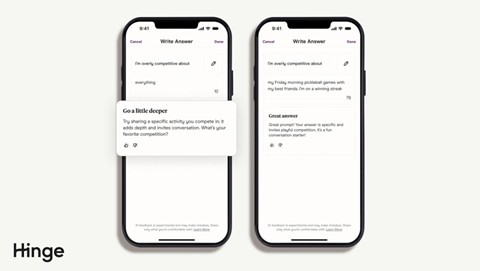
•Hinge’s new AI-powered Core Discovery Algorithm has driven a 15% increase in matches and contact exchanges since launching in March. Additional features like Prompt Feedback and Chat-Specific Notifications improved onboarding quality and user engagement.
A webcast of our second quarter 2025 results will be available at https://ir.mtch.com, along with our Prepared Remarks and Supplemental Financial Materials. The webcast will begin today, August 5, 2025 at 5:00 PM Eastern Time. This press release, including the reconciliations of certain non-GAAP measures to their nearest comparable GAAP measures, is also available on that site.
Dividend Declaration
Match Group's Board of Directors has declared a cash dividend of $0.19 per share of the company's common stock. The dividend is payable on October 17, 2025 to stockholders of record as of October 3, 2025.
Financial Outlook
For Q3 2025, Match Group expects:
•Total Revenue of $910 to $920 million, up 2% to 3% Y/Y.
•Adjusted Operating Income of $330 to $335 million, down 3% Y/Y.
•Adjusted Operating Income Margin of approximately 36% at the midpoints of the ranges.
2 European Expansion markets include Austria, Denmark, Finland, France, Germany, Italy, Netherlands, Norway, Spain, Sweden, and Switzerland.
3
Financial Results
Consolidated Operating Costs and Expenses
| Three Months Ended June 30, | |||||||||||||||||||||||||||||
| (Dollars in thousands) | 2025 | % of Revenue | 2024 | % of Revenue | Y/Y Change | ||||||||||||||||||||||||
| Cost of revenue | $ | 241,938 | 28% | $ | 244,988 | 28% | (1) | % | |||||||||||||||||||||
| Selling and marketing expense | 148,254 | 17% | 154,628 | 18% | (4) | % | |||||||||||||||||||||||
| General and administrative expense | 136,555 | 16% | 114,304 | 13% | 19 | % | |||||||||||||||||||||||
| Product development expense | 114,511 | 13% | 113,576 | 13% | 1 | % | |||||||||||||||||||||||
| Depreciation | 18,061 | 2% | 21,092 | 2% | (14) | % | |||||||||||||||||||||||
| Amortization of intangibles | 10,498 | 1% | 10,952 | 1% | (4) | % | |||||||||||||||||||||||
| Total operating costs and expenses | $ | 669,817 | 78% | $ | 659,540 | 76% | 2 | % | |||||||||||||||||||||
Liquidity and Capital Resources
During the six months ended June 30, 2025, we generated operating cash flow of $437 million and Free Cash Flow of $409 million.
During the quarter ended June 30, 2025, we repurchased 7.6 million shares of our common stock for $225 million on a trade date basis at an average price of $29.45. Between July 1 and July 31, 2025, we repurchased an additional 1.5 million shares of our common stock for $47 million on a trade date basis at an average price of $32.62. As of July 31, 2025, $1.28 billion in aggregate value of shares of Match Group stock remains available under our share repurchase program.
As of June 30, 2025, we had $340 million in cash, cash equivalents, and short-term investments and $3.5 billion of long-term debt, inclusive of current maturities, all of which is fixed rate debt, including $1.2 billion of Exchangeable Senior Notes. Our $500 million revolving credit facility was undrawn as of June 30, 2025. Match Group’s trailing twelve-month leverage3 as of June 30, 2025 was 2.8x on a gross basis and 2.5x on a net basis.
On July 18, 2025, we paid a dividend of $0.19 per share to holders of record on July 3, 2025. The total cash payout was $46 million.
3 Leverage is calculated utilizing the non-GAAP measure Adjusted Operating Income as the denominator. For a reconciliation of the non-GAAP measure for each period presented, see page 8.
4
GAAP Financial Statements
Consolidated Statement of Operations
| Three Months Ended June 30, | Six Months Ended June 30, | ||||||||||||||||||||||
| 2025 | 2024 | 2025 | 2024 | ||||||||||||||||||||
| (In thousands, except per share data) | |||||||||||||||||||||||
| Revenue | $ | 863,738 | $ | 864,066 | $ | 1,694,916 | $ | 1,723,713 | |||||||||||||||
| Operating costs and expenses: | |||||||||||||||||||||||
| Cost of revenue (exclusive of depreciation shown separately below) | 241,938 | 244,988 | 478,846 | 501,730 | |||||||||||||||||||
| Selling and marketing expense | 148,254 | 154,628 | 305,350 | 319,929 | |||||||||||||||||||
| General and administrative expense | 136,555 | 114,304 | 248,075 | 220,545 | |||||||||||||||||||
| Product development expense | 114,511 | 113,576 | 235,365 | 229,313 | |||||||||||||||||||
| Depreciation | 18,061 | 21,092 | 39,790 | 41,613 | |||||||||||||||||||
| Amortization of intangibles | 10,498 | 10,952 | 20,976 | 21,319 | |||||||||||||||||||
| Total operating costs and expenses | 669,817 | 659,540 | 1,328,402 | 1,334,449 | |||||||||||||||||||
| Operating income | 193,921 | 204,526 | 366,514 | 389,264 | |||||||||||||||||||
| Interest expense | (32,160) | (40,038) | (67,416) | (80,391) | |||||||||||||||||||
| Other (expense) income, net | (4,056) | 10,525 | (1,440) | 19,999 | |||||||||||||||||||
Earnings before income taxes | 157,705 | 175,013 | 297,658 | 328,872 | |||||||||||||||||||
Income tax provision | (32,227) | (41,693) | (54,609) | (72,318) | |||||||||||||||||||
Net earnings | 125,478 | 133,320 | 243,049 | 256,554 | |||||||||||||||||||
Net earnings attributable to noncontrolling interests | — | (6) | (1) | (42) | |||||||||||||||||||
Net earnings attributable to Match Group, Inc. shareholders | $ | 125,478 | $ | 133,314 | $ | 243,048 | $ | 256,512 | |||||||||||||||
Net earnings per share attributable to Match Group, Inc. shareholders: | |||||||||||||||||||||||
| Basic | $ | 0.51 | $ | 0.50 | $ | 0.98 | $ | 0.96 | |||||||||||||||
| Diluted | $ | 0.49 | $ | 0.48 | $ | 0.93 | $ | 0.93 | |||||||||||||||
| Basic shares outstanding | 244,370 | 264,397 | 247,731 | 266,270 | |||||||||||||||||||
| Diluted shares outstanding | 263,773 | 281,882 | 267,832 | 284,047 | |||||||||||||||||||
| Stock-based compensation expense by function: | |||||||||||||||||||||||
| Cost of revenue | $ | 1,715 | $ | 1,809 | $ | 3,550 | $ | 3,520 | |||||||||||||||
| Selling and marketing expense | 3,124 | 3,298 | 5,866 | 6,136 | |||||||||||||||||||
| General and administrative expense | 25,736 | 25,018 | 52,742 | 49,229 | |||||||||||||||||||
| Product development expense | 36,892 | 39,742 | 75,703 | 74,802 | |||||||||||||||||||
| Total stock-based compensation expense | $ | 67,467 | $ | 69,867 | $ | 137,861 | $ | 133,687 | |||||||||||||||
5
Consolidated Balance Sheet
| June 30, 2025 | December 31, 2024 | ||||||||||
| (In thousands) | |||||||||||
| ASSETS | |||||||||||
| Cash and cash equivalents | $ | 335,243 | $ | 965,993 | |||||||
| Short-term investments | 5,172 | 4,734 | |||||||||
| Accounts receivable, net | 342,299 | 324,963 | |||||||||
| Other current assets | 87,201 | 102,072 | |||||||||
| Total current assets | 769,915 | 1,397,762 | |||||||||
| Property and equipment, net | 153,844 | 158,189 | |||||||||
| Goodwill | 2,347,699 | 2,310,730 | |||||||||
| Intangible assets, net | 207,850 | 215,448 | |||||||||
| Deferred income taxes | 270,959 | 262,557 | |||||||||
| Other non-current assets | 117,549 | 121,085 | |||||||||
| TOTAL ASSETS | $ | 3,867,816 | $ | 4,465,771 | |||||||
| LIABILITIES AND SHAREHOLDERS’ EQUITY | |||||||||||
| LIABILITIES | |||||||||||
| Current maturities of long-term debt, net | $ | 573,424 | $ | — | |||||||
| Accounts payable | 18,535 | 18,262 | |||||||||
| Deferred revenue | 161,868 | 166,142 | |||||||||
| Accrued expenses and other current liabilities | 351,374 | 365,057 | |||||||||
| Total current liabilities | 1,105,201 | 549,461 | |||||||||
| Long-term debt, net of current maturities | 2,855,277 | 3,848,983 | |||||||||
| Income taxes payable | 39,393 | 33,332 | |||||||||
| Deferred income taxes | 12,741 | 11,770 | |||||||||
| Other long-term liabilities | 85,980 | 85,882 | |||||||||
| Commitments and contingencies | |||||||||||
| SHAREHOLDERS’ EQUITY | |||||||||||
| Common stock | 298 | 294 | |||||||||
| Additional paid-in capital | 8,720,153 | 8,756,482 | |||||||||
| Retained deficit | (6,336,705) | (6,579,753) | |||||||||
| Accumulated other comprehensive loss | (400,974) | (449,611) | |||||||||
| Treasury stock | (2,213,653) | (1,791,071) | |||||||||
| Total Match Group, Inc. shareholders’ equity | (230,881) | (63,659) | |||||||||
| Noncontrolling interests | 105 | 2 | |||||||||
| Total shareholders’ equity | (230,776) | (63,657) | |||||||||
| TOTAL LIABILITIES AND SHAREHOLDERS’ EQUITY | $ | 3,867,816 | $ | 4,465,771 | |||||||
6
Consolidated Statement of Cash Flows
| Six Months Ended June 30, | |||||||||||
| 2025 | 2024 | ||||||||||
| (In thousands) | |||||||||||
Cash flows from operating activities: | |||||||||||
Net earnings | $ | 243,049 | $ | 256,554 | |||||||
| Adjustments to reconcile net earnings to net cash provided by operating activities: | |||||||||||
| Stock-based compensation expense | 137,861 | 133,687 | |||||||||
| Depreciation | 39,790 | 41,613 | |||||||||
| Amortization of intangibles | 20,976 | 21,319 | |||||||||
| Deferred income taxes | (7,908) | 16,964 | |||||||||
| Other adjustments, net | 15,721 | (109) | |||||||||
| Changes in assets and liabilities | |||||||||||
| Accounts receivable | (12,739) | (28,670) | |||||||||
| Other assets | 32,304 | 2,410 | |||||||||
| Accounts payable and other liabilities | (19,438) | 3,118 | |||||||||
| Income taxes payable and receivable | (6,071) | (11,690) | |||||||||
| Deferred revenue | (6,586) | (22,128) | |||||||||
Net cash provided by operating activities | 436,959 | 413,068 | |||||||||
Cash flows from investing activities: | |||||||||||
| Capital expenditures | (28,297) | (29,905) | |||||||||
| Other, net | (25,976) | (8,807) | |||||||||
| Net cash used in investing activities | (54,273) | (38,712) | |||||||||
Cash flows from financing activities: | |||||||||||
| Principal payments on Term Loan | (425,000) | — | |||||||||
| Proceeds from issuance of common stock pursuant to stock-based awards | 3,598 | 5,739 | |||||||||
Withholding taxes paid on behalf of employees on net settled stock-based awards | (89,921) | (10,095) | |||||||||
| Dividends | (94,968) | — | |||||||||
Purchase of treasury stock | (419,676) | (387,366) | |||||||||
| Purchase of noncontrolling interests | (84) | (737) | |||||||||
| Other, net | (6,225) | (2,184) | |||||||||
Net cash used in financing activities | (1,032,276) | (394,643) | |||||||||
Total cash used | (649,590) | (20,287) | |||||||||
| Effect of exchange rate changes on cash and cash equivalents | 18,840 | (4,361) | |||||||||
| Net decrease in cash and cash equivalents | (630,750) | (24,648) | |||||||||
| Cash, cash equivalents, and restricted cash at beginning of period | 965,993 | 862,440 | |||||||||
| Cash, cash equivalents, and restricted cash at end of period | $ | 335,243 | $ | 837,792 | |||||||
7
Reconciliations of GAAP to Non-GAAP Measures
Reconciliation of Operating Income to Adjusted Operating Income
| Three Months Ended June 30, | Six Months Ended June 30, | ||||||||||||||||||||||
| 2025 | 2024 | 2025 | 2024 | ||||||||||||||||||||
| (Dollars in thousands) | |||||||||||||||||||||||
Operating Income | $ | 193,921 | $ | 204,526 | $ | 366,514 | $ | 389,264 | |||||||||||||||
| Stock-based compensation expense | 67,467 | 69,867 | 137,861 | 133,687 | |||||||||||||||||||
| Depreciation | 18,061 | 21,092 | 39,790 | 41,613 | |||||||||||||||||||
Amortization of intangibles | 10,498 | 10,952 | 20,976 | 21,319 | |||||||||||||||||||
| Adjusted Operating Income | $ | 289,947 | $ | 306,437 | $ | 565,141 | $ | 585,883 | |||||||||||||||
| Revenue | $ | 863,738 | $ | 864,066 | $ | 1,694,916 | $ | 1,723,713 | |||||||||||||||
| Operating Income Margin | 22 | % | 24 | % | 22 | % | 23 | % | |||||||||||||||
| Adjusted Operating Income Margin | 34 | % | 35 | % | 33 | % | 34 | % | |||||||||||||||
Reconciliation of Operating Income to Adjusted Operating Income used in Leverage Ratios
| Twelve months ended June 30, 2025 | |||||
| (In thousands) | |||||
Operating Income | $ | 800,562 | |||
| Stock-based compensation expense | 271,555 | ||||
| Depreciation | 85,676 | ||||
Impairments and amortization of intangibles | 73,832 | ||||
| Adjusted Operating Income | $ | 1,231,625 | |||
Reconciliation of Forecasted Operating Income to Forecasted Adjusted Operating Income
| Three Months Ended September 30, 2025 | |||||
| (In millions) | |||||
Operating Income | $241 to $246 | ||||
| Stock-based compensation expense | 63 | ||||
| Depreciation and amortization of intangibles | 26 | ||||
| Adjusted Operating Income | $330 to $335 | ||||
| Revenue | $910 to $920 | ||||
| Operating Income Margin (at the mid-point of the ranges) | 27 | % | |||
| Adjusted Operating Income Margin (at the mid-point of the ranges) | 36 | % | |||
8
Reconciliation of Operating Cash Flow to Free Cash Flow
| Six Months Ended June 30, | |||||||||||
| 2025 | 2024 | ||||||||||
| (In thousands) | |||||||||||
| Net cash provided by operating activities | $ | 436,959 | $ | 413,068 | |||||||
| Capital expenditures | (28,297) | (29,905) | |||||||||
| Free Cash Flow | $ | 408,662 | $ | 383,163 | |||||||
Reconciliation of GAAP Revenue to Non-GAAP Revenue, Excluding Foreign Exchange Effects
| Three Months Ended June 30, | Six Months Ended June 30, | ||||||||||||||||||||||||||||||||||||||||||||||
| 2025 | $ Change | % Change | 2024 | 2025 | $ Change | % Change | 2024 | ||||||||||||||||||||||||||||||||||||||||
| (Dollars in millions, rounding differences may occur) | |||||||||||||||||||||||||||||||||||||||||||||||
| Total Revenue, as reported | $ | 863.7 | $ | (0.3) | — | % | $ | 864.1 | $ | 1,694.9 | $ | (28.8) | (2) | % | $ | 1,723.7 | |||||||||||||||||||||||||||||||
| Foreign exchange effects | (11.2) | 8.2 | |||||||||||||||||||||||||||||||||||||||||||||
| Total Revenue, excluding foreign exchange effects | $ | 852.5 | $ | (11.5) | (1) | % | $ | 864.1 | $ | 1,703.1 | $ | (20.6) | (1) | % | $ | 1,723.7 | |||||||||||||||||||||||||||||||
9
Dilutive Securities
Match Group has various tranches of dilutive securities. The table below details these securities and their potentially dilutive impact (shares in millions; rounding differences may occur).
| Average Exercise Price | 7/31/2025 | ||||||||||
| Share Price | $34.27 | ||||||||||
| Absolute Shares | 240.6 | ||||||||||
| Equity Awards | |||||||||||
| Options | $16.76 | 0.3 | |||||||||
| RSUs and subsidiary denominated equity awards | 8.2 | ||||||||||
| Total Dilution - Equity Awards | 8.5 | ||||||||||
| Outstanding Warrants | |||||||||||
| Warrants expiring on September 15, 2026 (6.7 million outstanding) | $132.39 | — | |||||||||
| Warrants expiring on April 15, 2030 (6.9 million outstanding) | $132.45 | — | |||||||||
| Total Dilution - Outstanding Warrants | — | ||||||||||
| Total Dilution | 8.5 | ||||||||||
| % Dilution | 3.4% | ||||||||||
| Total Diluted Shares Outstanding | 249.1 | ||||||||||
______________________
The dilutive securities presentation above is calculated using the methods and assumptions described below; these are different from GAAP dilution, which is calculated based on the treasury stock method.
Options — The table above assumes the options are settled net of the option exercise price and employee withholding taxes, as is our practice, and the dilutive effect is presented as the net shares that would be issued upon exercise. Withholding taxes paid by the Company on behalf of the employees upon exercise is estimated to be $9.3 million, assuming the stock price in the table above and a 50% estimated employee withholding tax rate.
RSUs and subsidiary denominated equity awards — The table above assumes RSUs are settled net of employee withholding taxes, as is our practice, and the dilutive effect is presented as the net number of shares that would be issued upon vesting. Withholding taxes paid by the Company on behalf of the employees upon vesting is estimated to be $282.2 million, assuming the stock price in the table above and a 50% withholding rate.
All performance-based and market-based awards reflect the expected shares that will vest based on current performance or market estimates. The table assumes no change in the fair value estimate of the subsidiary denominated equity awards from the values used for GAAP purposes at June 30, 2025.
Exchangeable Senior Notes — The Company has two series of Exchangeable Senior Notes outstanding. In the event of an exchange, each series of Exchangeable Senior Notes can be settled in cash, shares, or a combination of cash and shares. At the time of each Exchangeable Senior Notes issuance, the Company purchased call options with a strike price equal to the exchange price of each series of Exchangeable Senior Notes (“Note Hedge”), which can be used to offset the dilution of each series of the Exchangeable Senior Notes. No dilution is reflected in the table above for any of the Exchangeable Senior Notes because it is the Company’s intention to settle the Exchangeable Senior Notes with cash equal to the face amount of the notes; any shares issued would be offset by shares received upon exercise of the Note Hedge.
Warrants — At the time of the issuance of each series of Exchangeable Senior Notes, the Company also sold warrants for the number of shares with the strike prices reflected in the table above. The cash generated from the exercise of the warrants is assumed to be used to repurchase Match Group shares and the resulting net dilution, if any, is reflected in the table above.
10
Non-GAAP Financial Measures
Match Group reports Adjusted Operating Income, Adjusted Operating Income Margin, Free Cash Flow, and Revenue Excluding Foreign Exchange Effects, all of which are supplemental measures to U.S. generally accepted accounting principles (“GAAP”). The Adjusted Operating Income, Adjusted Operating Income Margin, and Free Cash Flow measures are among the primary metrics by which we evaluate the performance of our business, on which our internal budget is based and by which management is compensated. Revenue Excluding Foreign Exchange Effects provides a comparable framework for assessing the performance of our business without the effect of exchange rate differences when compared to prior periods. We believe that investors should have access to the same set of tools that we use in analyzing our results. These non-GAAP measures should be considered in addition to results prepared in accordance with GAAP but should not be considered a substitute for or superior to GAAP results. Match Group endeavors to compensate for the limitations of the non-GAAP measures presented by providing the comparable GAAP measures and descriptions of the reconciling items, including quantifying such items, to derive the non-GAAP measures. We encourage investors to examine the reconciling adjustments between the GAAP and non-GAAP measures, which we describe below. Interim results are not necessarily indicative of the results that may be expected for a full year.
Definitions of Non-GAAP Measures
Adjusted Operating Income is defined as operating income excluding: (1) stock-based compensation expense; (2) depreciation; and (3) acquisition-related items consisting of (i) amortization of intangible assets and impairments of goodwill and intangible assets, if applicable, and (ii) gains and losses recognized on changes in the fair value of contingent consideration arrangements, as applicable. We believe Adjusted Operating Income is useful to analysts and investors as this measure allows a more meaningful comparison between our performance and that of our competitors. The above items are excluded from our Adjusted Operating Income measure because they are non-cash in nature. Adjusted Operating Income has certain limitations because it excludes certain expenses.
Adjusted Operating Income Margin is defined as Adjusted Operating Income divided by revenues. We believe Adjusted Operating Income Margin is useful for analysts and investors as this measure allows a more meaningful comparison between our performance and that of our competitors. Adjusted Operating Income Margin has certain limitations in that it does not take into account the impact to our consolidated statement of operations of certain expenses.
Free Cash Flow is defined as net cash provided by operating activities, less capital expenditures. We believe Free Cash Flow is useful to investors because it represents the cash that our operating businesses generate, before taking into account non-operational cash movements. Free Cash Flow has certain limitations in that it does not represent the total increase or decrease in the cash balance for the period, nor does it represent the residual cash flow for discretionary expenditures. Therefore, we think it is important to evaluate Free Cash Flow along with our consolidated statement of cash flows.
We look at Free Cash Flow as a measure of the strength and performance of our businesses, not for valuation purposes. In our view, applying “multiples” to Free Cash Flow is inappropriate because it is subject to timing, seasonality and one-time events. We manage our business for cash, and we think it is of utmost importance to maximize cash – but our primary valuation metric is Adjusted Operating Income.
Revenue Excluding Foreign Exchange Effects is calculated by translating current period revenues using prior period exchange rates. The percentage change in Revenue Excluding Foreign Exchange Effects is calculated by determining the change in current period revenues over prior period revenues where current period revenues are translated using prior period exchange rates. We believe the impact of foreign exchange rates on Match Group, due to its global reach, may be an important factor in understanding period over period comparisons if movement in rates is significant. Since our results are reported in U.S. dollars, international revenues are favorably impacted as the U.S. dollar weakens relative to other currencies, and unfavorably impacted as the U.S. dollar strengthens relative to other currencies. We believe the presentation of revenue excluding foreign exchange effects in addition to reported revenue helps improve the ability to understand Match Group’s performance because it excludes the impact of foreign currency volatility that is not indicative of Match Group’s core operating results.
11
Non-Cash Expenses That Are Excluded From Our Non-GAAP Measures
Stock-based compensation expense consists principally of expense associated with the grants of RSUs, performance-based RSUs, and market-based awards. These expenses are not paid in cash, and we include the related shares in our fully diluted shares outstanding using the treasury stock method; however, performance-based RSUs and market-based awards are included only to the extent the applicable performance or market condition(s) have been met (assuming the end of the reporting period is the end of the contingency period). To the extent stock-based awards are settled on a net basis, we remit the required tax-withholding amounts from our current funds.
Depreciation is a non-cash expense relating to our property and equipment and is computed using the straight-line method to allocate the cost of depreciable assets to operations over their estimated useful lives, or, in the case of leasehold improvements, the lease term, if shorter.
Amortization of intangible assets and impairments of goodwill and intangible assets are non-cash expenses related primarily to acquisitions. At the time of an acquisition, the identifiable definite-lived intangible assets of the acquired company, such as customer lists, trade names and technology, are valued and amortized over their estimated lives. Value is also assigned to (i) acquired indefinite-lived intangible assets, which consist of trade names and trademarks, and (ii) goodwill, which are not subject to amortization. An impairment is recorded when the carrying value of an intangible asset or goodwill exceeds its fair value. We believe that intangible assets represent costs incurred by the acquired company to build value prior to acquisition and the related amortization and impairment charges of intangible assets or goodwill, if applicable, are not ongoing costs of doing business.
Additional Definitions
Tinder consists of the world-wide activity of the brand Tinder®.
Hinge consists of the world-wide activity of the brand Hinge®.
Evergreen & Emerging (“E&E”) consists of the world-wide activity of our Evergreen brands including Match®, Meetic®, OkCupid®, Plenty Of Fish®, and a number of demographically focused brands and our Emerging brands including BLK®, ChispaTM, The League®, Archer®, Upward®, YuzuTM, Salams®, HER, and other smaller brands.
Match Group Asia (“MG Asia”) consists of the world-wide activity of the brands Pairs® and Azar®.
Direct Revenue is revenue that is received directly from end users of our services and includes both subscription and à la carte revenue.
Indirect Revenue is revenue that is not received directly from end users of our services, a majority of which is advertising revenue.
Payers are unique users at a brand level in a given month from whom we earned Direct Revenue. When presented as a quarter-to-date or year-to-date value, Payers represents the average of the monthly values for the respective period presented. At a consolidated level and a business unit level to the extent a business unit consists of multiple brands, duplicate Payers may exist when we earn revenue from the same individual at multiple brands in a given month, as we are unable to identify unique individuals across brands in the Match Group portfolio.
Revenue Per Payer (“RPP”) is the average monthly revenue earned from a Payer and is Direct Revenue for a period divided by the Payers in the period, further divided by the number of months in the period.
Monthly Active User (“MAU”) is a unique registered user at a brand level who has visited the brand’s app or, if applicable, their website in the last 28 days as of the measurement date. At a consolidated level and a business unit level to the extent a business unit consists of multiple brands, duplicate users will exist within MAU when the same individual visits multiple brands in a given month.
Leverage on a gross basis is calculated as principal debt balance divided by Adjusted Operating Income for the period referenced.
Leverage on a net basis is calculated as principal debt balance less cash and cash equivalents and short-term investments divided by Adjusted Operating Income for the period referenced.
12
Other Information
Safe Harbor Statement Under the Private Securities Litigation Reform Act of 1995
This press release and our conference call, which will be held at 5:00 p.m. Eastern Time on August 5, 2025, may contain “forward-looking statements” within the meaning of the Private Securities Litigation Reform Act of 1995. All statements that are not historical facts are “forward looking statements.” The use of words such as “anticipates,” “estimates,” “expects,” “plans,” “believes,” “will,” and “would,” among others, generally identify forward-looking statements. These forward-looking statements include, among others, statements relating to: Match Group’s future financial performance, Match Group’s business prospects and strategy, anticipated trends, and other similar matters. These forward-looking statements are based on management’s current expectations and assumptions about future events, which are inherently subject to uncertainties, risks and changes in circumstances that are difficult to predict. Actual results could differ materially from those contained in these forward-looking statements for a variety of reasons, including, among others: our ability to maintain or grow the size of our user base and convert users to paying users, the success of our product strategies, competition, our ability to realize reductions in in-app purchase fees, the limited operating history of some of our brands, our ability to attract users to our services through cost-effective marketing and related efforts, our ability to distribute our services through third parties and offset related fees, risks relating to our use of artificial intelligence, foreign currency exchange rate fluctuations (including anticipated gains from fluctuations), the integrity and scalability of our systems and infrastructure (and those of third parties) and our ability to adapt ours to changes in a timely and cost-effective manner, our ability to protect our systems from cyberattacks and to protect personal and confidential user information, impacts to our offices and employees from more frequent extreme weather events, risks relating to certain of our international operations and acquisitions, damage to our brands' reputations as a result of inappropriate actions by users of our services, and macroeconomic conditions. Certain of these and other risks and uncertainties are discussed in Match Group’s filings with the Securities and Exchange Commission. Other unknown or unpredictable factors that could also adversely affect Match Group’s business, financial condition and results of operations may arise from time to time. In light of these risks and uncertainties, these forward-looking statements may not prove to be accurate. Accordingly, you should not place undue reliance on these forward-looking statements, which only reflect the views of Match Group management as of the date of this press release. Match Group does not undertake to update these forward-looking statements.
About Match Group
Match Group (NASDAQ: MTCH), through its portfolio companies, is a leading provider of digital technologies designed to help people make meaningful connections. Our global portfolio of brands includes Tinder®, Hinge®, Match®, Meetic®, OkCupid®, Pairs™, PlentyOfFish®, Azar®, BLK®, and more, each built to increase our users’ likelihood of connecting with others. Through our trusted brands, we provide tailored services to meet the varying preferences of our users. Our services are available in over 40 languages to our users all over the world.
Contact Us
Tanny Shelburne Match Group Investor Relations | Vidhya Murugesan Match Group Corporate Communications | ||||
Match Group 8750 North Central Expressway, Suite 1400, Dallas, TX 75231, (214) 576-9352 https://mtch.com | |||||
13