
MTUS 8-K
Metallus Inc. (MTUS)
UNITED STATES
SECURITIES AND EXCHANGE COMMISSION
WASHINGTON, D.C. 20549
FORM
CURRENT REPORT
Pursuant to Section 13 OR 15(d) of The Securities Exchange Act of 1934
|
|
|
|
Date of Report (Date of Earliest Event Reported): |
|

|
|
|
(Exact name of registrant as specified in its charter) |
|
|
||||
|
|
|
|
|
|
|
|||
(State or Other Jurisdiction of Incorporation) |
|
(Commission File Number) |
|
(I.R.S. Employer Identification No.) |
(Address of Principal Executive Offices) (Zip Code) |
( |
(Registrant's Telephone Number, Including Area Code) |
Not Applicable |
(Former name or former address, if changed since last report) |
Check the appropriate box below if the Form 8-K filing is intended to simultaneously satisfy the filing obligation of the registrant under any of the following provisions:
Written communications pursuant to Rule 425 under the Securities Act (17 CFR 230.425) |
|
|
|
Soliciting material pursuant to Rule 14a-12 under the Exchange Act (17 CFR 240.14a-12) |
|
|
|
Pre-commencement communications pursuant to Rule 14d-2(b) under the Exchange Act (17 CFR 240.14d-2(b)) |
|
|
|
Pre-commencement communications pursuant to Rule 13e-4(c) under the Exchange Act (17 CFR 240.13e-4(c)) |
Securities registered pursuant to Section 12(b) of the Act:
|
||
|
|
|
Title of each class |
Trading Symbol(s) |
Name of each exchange on which registered |
Indicate by check mark whether the registrant is an emerging growth company as defined in Rule 405 of the Securities Act of 1933 (§230.405 of this chapter) or Rule 12b-2 of the Securities Exchange Act of 1934 (§240.12b-2 of this chapter).
Emerging growth company
If an emerging growth company, indicate by check mark if the registrant has elected not to use the extended transition period for complying with any new or revised financial accounting standards provided pursuant to Section 13(a) of the Exchange Act.
Item 2.02 |
Results of Operations and Financial Condition. |
On February 24, 2022, TimkenSteel Corporation (the “Company”) issued a press release announcing results for the fourth quarter and full-year of 2021. A copy of the press release is attached as Exhibit 99.1 to this Current Report on Form 8-K.
The information contained in Item 2.02 of this Current Report on Form 8-K, including Exhibit 99.1, shall not be deemed to be “filed” for the purposes of Section 18 of the Securities Exchange Act of 1934, as amended (the “Exchange Act”), or otherwise subject to the liabilities of that section, nor shall it be incorporated by reference into a filing under the Securities Act of 1933, as amended, or the Exchange Act, except as shall be expressly set forth by specific reference in such a filing.
Item 7.01 |
Regulation FD Disclosure. |
On February 24, 2022, the Company posted to the investor relations page of its website an investor presentation expected to be used by the Company in connection with certain future presentations to investors and others. A copy of the investor presentation is attached as Exhibit 99.2 to this Current Report on Form 8-K.
The information contained in Item 7.01 of this Current Report on Form 8-K, including Exhibit 99.2, shall not be deemed to be “filed” for the purposes of Section 18 of the Exchange Act or otherwise subject to the liabilities of that section, nor shall it be incorporated by reference into a filing under the Securities Act of 1933, as amended, or the Exchange Act, except as shall be expressly set forth by specific reference in such a filing.
Item 9.01 Financial Statements and Exhibits.
(d) Exhibits
|
||
|
|
|
Exhibit No. |
|
Description |
99.1** |
|
Press Release of TimkenSteel Corporation dated February 24, 2022. |
99.2** |
|
Investor Presentation of TimkenSteel Corporation dated February 24, 2022 |
104 |
|
Cover Page Interactive Data File (embedded within the Inline XBRL document) |
|
|
|
** Furnished herewith.
SIGNATURES
Pursuant to the requirements of the Securities Exchange Act of 1934, the registrant has duly caused this report to be signed on its behalf by the undersigned hereunto duly authorized.
|
|||
|
|
|
|
|
|
|
TIMKENSTEEL CORPORATION |
|
|
|
|
Date: February 24, 2022 |
By: |
/s/ Kristopher R. Westbrooks |
|
|
|
|
Kristopher R. Westbrooks |
|
|
|
Executive Vice President and Chief Financial Officer |

TimkenSteel Announces Fourth-Quarter and Full-Year 2021 Results
CANTON, Ohio: February 24, 2022 – TimkenSteel (NYSE: TMST), a leader in high-quality specialty steel, manufactured components, and supply chain solutions, today reported fourth-quarter 2021 net sales of $338.3 million and net income of $57.1 million, or $1.07 per diluted share. On an adjusted basis(1), fourth-quarter 2021 net income was $42.3 million, or $0.80 per diluted share, and adjusted EBITDA was $62.1 million.
Third-quarter 2021 net sales were $343.7 million with net income of $50.1 million, or $0.94 per diluted share. On an adjusted basis(1), third-quarter 2021 net income was $55.2 million, or $1.04 per diluted share, and adjusted EBITDA was $72.0 million.
Fourth-quarter 2020 net sales were $211.2 million with a net loss of $12.8 million, or a loss of $0.28 per diluted share. On an adjusted basis(1), fourth-quarter 2020 net income was $0.6 million, or $0.01 per diluted share, and adjusted EBITDA was $20.7 million.
“I’d like to thank the TimkenSteel employees for their resiliency and drive during a transformative year. The demand environment in 2021 remained robust throughout the year and coupled with our efforts to improve commercial effectiveness, enhance manufacturing efficiency, and streamline business processes, we achieved strong profitability and significant operating cash flow,” said Mike Williams, president and chief executive officer. “We are guided by a set of new strategic imperatives – centered around people, sustainable through-cycle profitability, process improvement, business development, and environmental, social and governance, which we believe will serve as a roadmap for 2022 and beyond.”
FOURTH-QUARTER 2021 FINANCIAL SUMMARY
(1) Please see discussion of non-GAAP financial measures in this news release.
1
FULL-YEAR 2021 FINANCIAL SUMMARY
Net income for the full-year 2021 was $171.0 million, or $3.18 per diluted share, compared with a net loss of $61.9 million, or a loss of $1.38 per diluted share, for the full-year 2020. On an adjusted basis(1), full-year 2021 net income was $172.7 million, or $3.21 per diluted share, and adjusted EBITDA was $245.9 million. In comparison to the full-year 2020 on an adjusted basis(1), the net loss was $42.0 million, or a loss of $0.93 per diluted share, and adjusted EBITDA was $38.0 million.
CASH AND LIQUIDITY
As of December 31, 2021, the company's cash balance was a record $259.6 million, benefitting from significant operating cash flow of $90.7 million in the fourth-quarter of 2021. For the full-year 2021, operating cash flow was $196.9 million driven by strong profitability. Total liquidity(2) was a record $510.7 million as of December 31, 2021. In January of 2022, the company repurchased $5 million of its convertible notes at a cash cost of $12.4 million.
2022 OUTLOOK
Commercial:
Operations:
Cash:
2
TIMKENSTEEL EARNINGS WEBCAST INFORMATION
TimkenSteel will provide live Internet listening access to its conference call with the financial community scheduled for Friday, February 25, 2022 at 9:00 a.m. ET. The live conference call will be broadcast at investors.timkensteel.com. A replay of the conference call will also be available at investors.timkensteel.com.
ABOUT TIMKENSTEEL CORPORATION
TimkenSteel (NYSE: TMST) manufactures high-performance carbon and alloy steel products from recycled scrap metal in Canton, OH, serving demanding applications in mobile, energy and a variety of industrial end markets. The company is a premier U.S. producer of alloy steel bars (up to 16 inches in diameter), seamless mechanical tubing and manufactured components. In the business of making high-quality steel for more than 100 years, TimkenSteel's proven expertise contributes to the performance of our customers' products. The company employs approximately 1,850 people and had sales of $1.3 billion in 2021. For more information, please visit us at www.timkensteel.com.
-###-
Investor contact:
Jennifer Beeman
P 330.471.7760
3
NON-GAAP FINANCIAL MEASURES
TimkenSteel reports its financial results in accordance with accounting principles generally accepted in the United States (“GAAP”) and corresponding metrics as non-GAAP financial measures. This earnings release includes references to the following non-GAAP financial measures: adjusted earnings (loss) per share, adjusted net income (loss), EBIT, adjusted EBIT, EBITDA, adjusted EBITDA, free cash flow and base sales. These are important financial measures used in the management of the business, including decisions concerning the allocation of resources and assessment of performance. Management believes that reporting these non-GAAP financial measures is useful to investors as these measures are representative of the company’s performance and provide improved comparability of results. See the attached schedules for definitions of the non-GAAP financial measures referred to above and corresponding reconciliations of these non-GAAP financial measures to the most comparable GAAP financial measures. Non-GAAP financial measures should be viewed as additions to, and not as alternatives for, TimkenSteel's results prepared in accordance with GAAP. In addition, the non-GAAP measures TimkenSteel uses may differ from non-GAAP measures used by other companies, and other companies may not define the non-GAAP measures TimkenSteel uses in the same way.
FORWARD-LOOKING STATEMENTS
This news release includes "forward-looking" statements within the meaning of the federal securities laws. You can generally identify the company's forward-looking statements by words such as "will," "anticipate," "aspire," "believe," "could," "estimate," "expect," "forecast," "outlook," "intend," "may," "plan," "possible," "potential," "predict," "project," "seek," "target," "could," "should," "would," "strategy," or "strategic direction" or other similar words, phrases or expressions that convey the uncertainty of future events or outcomes. The company cautions readers that actual results may differ materially from those expressed or implied in forward-looking statements made by or on behalf of the company due to a variety of factors, such as: the potential impact of the COVID-19 pandemic on the company's operations and financial results, including cash flows and liquidity; whether the company is able to successfully implement actions designed to improve profitability on anticipated terms and timetables and whether the company is able to fully realize the expected benefits of such actions; deterioration in world economic conditions, or in economic conditions in any of the geographic regions in which the company conducts business, including additional adverse effects from global economic slowdown, terrorism or hostilities, including political risks associated with the potential instability of governments and legal systems in countries in which the company or its customers conduct business, and changes in currency valuations; climate-related risks, including environmental and severe weather caused by climate changes, and legislative and regulatory initiatives addressing global climate change or other environmental concerns; the effects of fluctuations in customer demand on sales, product mix and prices in the industries in which the company operates, including the ability of the company to respond to rapid changes in customer demand including but not limited to changes in customer operating schedules due to supply chain constraints, the effects of customer bankruptcies or liquidations, the impact of changes in industrial business cycles, and whether conditions of fair trade exist in U.S. markets; competitive factors, including changes in market penetration, increasing price competition by existing or new foreign and domestic competitors, the introduction of new products by existing and new competitors, and new technology that may impact the way the company's products are sold or distributed; changes in operating costs, including the effect of changes in the company's manufacturing processes, changes in costs associated with varying levels of operations and manufacturing capacity, availability of raw materials and energy, the company's ability to mitigate the impact of fluctuations in raw materials and energy costs and the effectiveness of its surcharge mechanism, changes in the expected costs associated with product warranty claims, changes resulting from inventory management, cost reduction initiatives and different levels of customer demands, the effects of unplanned work stoppages, and changes in the cost of labor and benefits; the success of the company's operating plans, announced programs, initiatives and capital investments, and the company's ability to maintain appropriate relations with unions that represent its associates in certain locations in order to avoid disruptions of business; unanticipated litigation, claims or assessments, including claims or problems related to intellectual property, product liability or warranty, and environmental issues and taxes, among other matters; the company's ability to achieve its ESG goals, including its 2030 ESG goals; the availability of financing and interest rates, which affect the company's cost of funds and/or ability to raise capital, including the ability of the company to refinance or repay at maturity the convertible notes due December 1, 2025; the company's pension obligations and investment performance, and/or customer demand and the ability of customers to obtain financing to purchase the company's products or equipment that contain its products; the overall impact of pension and other postretirement benefit mark-to-market accounting; the effects of the conditional conversion feature of the convertible notes due December 1, 2025, which, if triggered, entitles holders to convert the notes at any time during specified periods at their option and therefore could result in potential dilution if the holder elects to convert and the company elects to satisfy a portion or all of the conversion obligation by delivering common shares instead of cash; and the impacts from any repurchases of our common shares, including the timing and amount of any repurchases. Further, this news release represents our current policy and intent and is not intended to create legal rights or obligations. Certain standards of measurement and performance contained in this news release are developing and based on assumptions, and no assurance can be given that any plan, objective, initiative, projection, goal, mission, commitment, expectation, or prospect set forth in this news release can or will be achieved.
4
Inclusion of information in this news release is not an indication that the subject or information is material to our business or operating results.
Additional risks relating to the company's business, the industries in which the company operates, or the company's common shares may be described from time to time in the company's filings with the SEC. All of these risk factors are difficult to predict, are subject to material uncertainties that may affect actual results and may be beyond the company's control. Readers are cautioned that it is not possible to predict or identify all of the risks, uncertainties and other factors that may affect future results and that the above list should not be considered to be a complete list. Except as required by the federal securities laws, the company undertakes no obligation to publicly update or revise any forward-looking statement, whether as a result of new information, future events or otherwise.
5
CONSOLIDATED STATEMENTS OF OPERATIONS
|
|
Three Months Ended |
|
|
Year Ended |
|
||||||||||
(in millions, except per share data) (Unaudited) |
|
2021 |
|
|
2020 |
|
|
2021 |
|
|
2020 |
|
||||
Net sales |
|
$ |
338.3 |
|
|
$ |
211.2 |
|
|
$ |
1,282.9 |
|
|
$ |
830.7 |
|
Cost of products sold |
|
|
282.9 |
|
|
|
197.0 |
|
|
|
1,062.9 |
|
|
|
815.1 |
|
Gross Profit |
|
|
55.4 |
|
|
|
14.2 |
|
|
|
220.0 |
|
|
|
15.6 |
|
Selling, general & administrative expenses (SG&A) |
|
|
16.8 |
|
|
|
18.6 |
|
|
|
77.2 |
|
|
|
76.7 |
|
Restructuring charges |
|
|
4.7 |
|
|
|
1.5 |
|
|
|
6.7 |
|
|
|
3.1 |
|
Loss on sale of consolidated subsidiary |
|
|
— |
|
|
|
— |
|
|
|
1.1 |
|
|
|
— |
|
Loss (gain) on sale or disposal of assets, net |
|
|
0.8 |
|
|
|
0.6 |
|
|
|
1.3 |
|
|
|
(2.4 |
) |
Impairment charges |
|
|
2.4 |
|
|
|
— |
|
|
|
10.6 |
|
|
|
— |
|
Loss on extinguishment of debt |
|
|
— |
|
|
|
0.9 |
|
|
|
— |
|
|
|
0.9 |
|
Other (income) expense, net |
|
|
(31.2 |
) |
|
|
1.8 |
|
|
|
(59.5 |
) |
|
|
(14.2 |
) |
Earnings (Loss) Before Interest and Taxes (EBIT) (1) |
|
|
61.9 |
|
|
|
(9.2 |
) |
|
|
182.6 |
|
|
|
(48.5 |
) |
Interest expense |
|
|
1.2 |
|
|
|
3.0 |
|
|
|
5.9 |
|
|
|
12.2 |
|
Income (Loss) Before Income Taxes |
|
|
60.7 |
|
|
|
(12.2 |
) |
|
|
176.7 |
|
|
|
(60.7 |
) |
Provision (benefit) for income taxes |
|
|
3.6 |
|
|
|
0.6 |
|
|
|
5.7 |
|
|
|
1.2 |
|
Net Income (Loss) |
|
$ |
57.1 |
|
|
$ |
(12.8 |
) |
|
$ |
171.0 |
|
|
$ |
(61.9 |
) |
|
|
|
|
|
|
|
|
|
|
|
|
|
||||
Net Income (Loss) per Common Share: |
|
|
|
|
|
|
|
|
|
|
|
|
||||
Basic earnings (loss) per share |
|
$ |
1.24 |
|
|
$ |
(0.28 |
) |
|
$ |
3.73 |
|
|
$ |
(1.38 |
) |
Diluted earnings (loss) per share (2) |
|
$ |
1.07 |
|
|
$ |
(0.28 |
) |
|
$ |
3.18 |
|
|
$ |
(1.38 |
) |
|
|
|
|
|
|
|
|
|
|
|
|
|
||||
|
|
|
|
|
|
|
|
|
|
|
|
|
||||
Weighted average shares outstanding - basic |
|
|
46.2 |
|
|
|
45.1 |
|
|
|
45.9 |
|
|
|
45.0 |
|
Weighted average shares outstanding - diluted |
|
|
54.1 |
|
|
|
45.1 |
|
|
|
55.0 |
|
|
|
45.0 |
|
(1) EBIT is defined as net income (loss) before interest expense and income taxes. EBIT is an important financial measure used in the management of the business, including decisions concerning the allocation of resources and assessment of performance. Management believes that reporting EBIT is useful to investors as this measure is representative of the company's performance.
(2) For the three months and year ended December 31, 2021, common share equivalents for shares issuable upon the conversion of outstanding convertible notes (5.9 million shares and 7.4 million shares, respectively) and common share equivalents for shares issuable for equity-based awards (2.0 million shares and 1.7 million shares, respectively) were included in the computation of diluted earnings (loss) per share, as they were considered dilutive. For the convertible notes, the company utilizes the if-converted method to calculate diluted earnings (loss) per share. As such, net income was adjusted to add back $0.8 million and $4.1 million for the three months and year ended December 31, 2021, respectively, of convertible notes interest expense (including amortization of convertible notes issuance costs).
6
CONSOLIDATED BALANCE SHEETS
(Dollars in millions) (Unaudited) |
|
December 31, |
|
|
December 31, |
|
||
ASSETS |
|
|
|
|
|
|
||
Cash and cash equivalents |
|
$ |
259.6 |
|
|
$ |
102.8 |
|
Accounts receivable, net of allowances |
|
|
100.5 |
|
|
|
63.3 |
|
Inventories, net |
|
|
210.9 |
|
|
|
178.4 |
|
Deferred charges and prepaid expenses |
|
|
3.9 |
|
|
|
4.0 |
|
Assets held for sale |
|
|
4.3 |
|
|
|
0.3 |
|
Other current assets |
|
|
3.1 |
|
|
|
8.8 |
|
Total Current Assets |
|
|
582.3 |
|
|
|
357.6 |
|
|
|
|
|
|
|
|
||
Property, plant and equipment, net |
|
|
510.2 |
|
|
|
569.8 |
|
Operating lease right-of-use assets |
|
|
14.5 |
|
|
|
21.0 |
|
Pension assets |
|
|
43.1 |
|
|
|
33.5 |
|
Intangible assets, net |
|
|
6.7 |
|
|
|
9.3 |
|
Other non-current assets |
|
|
2.1 |
|
|
|
2.8 |
|
Total Assets |
|
$ |
1,158.9 |
|
|
$ |
994.0 |
|
|
|
|
|
|
|
|
||
LIABILITIES |
|
|
|
|
|
|
||
Accounts payable |
|
$ |
141.9 |
|
|
$ |
89.5 |
|
Salaries, wages and benefits |
|
|
37.9 |
|
|
|
29.4 |
|
Accrued pension and postretirement costs |
|
|
4.3 |
|
|
|
2.3 |
|
Current operating lease liabilities |
|
|
5.7 |
|
|
|
7.5 |
|
Current convertible notes, net |
|
|
44.9 |
|
|
|
38.9 |
|
Other current liabilities |
|
|
16.1 |
|
|
|
13.4 |
|
Total Current Liabilities |
|
|
250.8 |
|
|
|
181.0 |
|
|
|
|
|
|
|
|
||
Non-current convertible notes, net |
|
|
— |
|
|
|
39.3 |
|
Credit Agreement |
|
|
— |
|
|
|
— |
|
Non-current operating lease liabilities |
|
|
8.8 |
|
|
|
13.5 |
|
Accrued pension and postretirement costs |
|
|
223.0 |
|
|
|
240.7 |
|
Deferred income taxes |
|
|
2.2 |
|
|
|
1.0 |
|
Other non-current liabilities |
|
|
9.5 |
|
|
|
11.0 |
|
Total Liabilities |
|
|
494.3 |
|
|
|
486.5 |
|
SHAREHOLDERS' EQUITY |
|
|
|
|
|
|
||
Additional paid-in capital |
|
|
832.1 |
|
|
|
843.4 |
|
Retained deficit |
|
|
(188.2 |
) |
|
|
(363.4 |
) |
Treasury shares |
|
|
— |
|
|
|
(12.9 |
) |
Accumulated other comprehensive income (loss) |
|
|
20.7 |
|
|
|
40.4 |
|
Total Shareholders' Equity |
|
|
664.6 |
|
|
|
507.5 |
|
Total Liabilities and Shareholders' Equity |
|
$ |
1,158.9 |
|
|
$ |
994.0 |
|
7
CONSOLIDATED STATEMENTS OF CASH FLOWS
(Dollars in millions) (Unaudited) |
|
Three Months Ended |
|
|
Year Ended |
|
||||||||||
|
|
2021 |
|
|
2020 |
|
|
2021 |
|
|
2020 |
|
||||
CASH PROVIDED (USED) |
|
|
|
|
|
|
|
|
|
|
|
|
||||
Operating Activities |
|
|
|
|
|
|
|
|
|
|
|
|
||||
Net income (loss) |
|
$ |
57.1 |
|
|
$ |
(12.8 |
) |
|
$ |
171.0 |
|
|
$ |
(61.9 |
) |
Adjustments to reconcile net income (loss) to net cash provided (used) by operating activities: |
|
|
|
|
|
|
|
|
|
|
|
|
||||
Depreciation and amortization |
|
|
15.0 |
|
|
|
17.8 |
|
|
|
63.1 |
|
|
|
70.0 |
|
Amortization of deferred financing fees and debt discount |
|
|
0.3 |
|
|
|
1.3 |
|
|
|
1.0 |
|
|
|
5.3 |
|
Loss on extinguishment of debt |
|
|
— |
|
|
|
0.9 |
|
|
|
— |
|
|
|
0.9 |
|
Loss on sale of consolidated subsidiary |
|
|
— |
|
|
|
— |
|
|
|
1.1 |
|
|
|
— |
|
Loss (gain) on sale or disposal of assets |
|
|
0.8 |
|
|
|
0.6 |
|
|
|
1.3 |
|
|
|
(2.4 |
) |
Impairment charges |
|
|
2.4 |
|
|
|
— |
|
|
|
10.6 |
|
|
|
— |
|
Deferred income taxes |
|
|
1.3 |
|
|
|
0.4 |
|
|
|
1.2 |
|
|
|
— |
|
Stock-based compensation expense |
|
|
1.8 |
|
|
|
1.4 |
|
|
|
7.3 |
|
|
|
6.6 |
|
Pension and postretirement expense (benefit), net |
|
|
(27.0 |
) |
|
|
9.6 |
|
|
|
(38.7 |
) |
|
|
8.6 |
|
Changes in operating assets and liabilities: |
|
|
|
|
|
|
|
|
|
|
|
|
||||
Accounts receivable, net |
|
|
29.7 |
|
|
|
17.9 |
|
|
|
(37.2 |
) |
|
|
14.2 |
|
Inventories, net |
|
|
3.5 |
|
|
|
(4.1 |
) |
|
|
(41.6 |
) |
|
|
103.5 |
|
Accounts payable |
|
|
9.2 |
|
|
|
14.9 |
|
|
|
53.5 |
|
|
|
23.1 |
|
Other accrued expenses |
|
|
(0.6 |
) |
|
|
4.8 |
|
|
|
9.7 |
|
|
|
9.4 |
|
Deferred charges and prepaid expenses |
|
|
1.2 |
|
|
|
1.0 |
|
|
|
0.1 |
|
|
|
(0.7 |
) |
Pension and postretirement contributions and payments |
|
|
(4.0 |
) |
|
|
0.1 |
|
|
|
(6.9 |
) |
|
|
(4.1 |
) |
Other, net |
|
|
— |
|
|
|
(1.3 |
) |
|
|
1.4 |
|
|
|
1.0 |
|
Net Cash Provided (Used) by Operating Activities |
|
|
90.7 |
|
|
|
52.5 |
|
|
|
196.9 |
|
|
|
173.5 |
|
Investing Activities |
|
|
|
|
|
|
|
|
|
|
|
|
||||
Capital expenditures |
|
|
(4.9 |
) |
|
|
(3.9 |
) |
|
|
(12.2 |
) |
|
|
(16.9 |
) |
Proceeds from sale of consolidated subsidiary |
|
|
— |
|
|
|
— |
|
|
|
6.2 |
|
|
|
— |
|
Proceeds from disposals of property, plant and equipment |
|
|
1.0 |
|
|
|
0.9 |
|
|
|
1.2 |
|
|
|
10.9 |
|
Net Cash Provided (Used) by Investing Activities |
|
|
(3.9 |
) |
|
|
(3.0 |
) |
|
|
(4.8 |
) |
|
|
(6.0 |
) |
Financing Activities |
|
|
|
|
|
|
|
|
|
|
|
|
||||
Proceeds from exercise of stock options |
|
|
0.8 |
|
|
|
— |
|
|
|
4.1 |
|
|
|
— |
|
Shares surrendered for employee taxes on stock compensation |
|
|
— |
|
|
|
(0.3 |
) |
|
|
(0.5 |
) |
|
|
(0.6 |
) |
Repayments on convertible notes |
|
|
— |
|
|
|
— |
|
|
|
(38.9 |
) |
|
|
— |
|
Repayments on credit agreements |
|
|
— |
|
|
|
(20.0 |
) |
|
|
— |
|
|
|
(90.0 |
) |
Debt issuance costs |
|
|
— |
|
|
|
(1.2 |
) |
|
|
— |
|
|
|
(1.2 |
) |
Net Cash Provided (Used) by Financing Activities |
|
|
0.8 |
|
|
|
(21.5 |
) |
|
|
(35.3 |
) |
|
|
(91.8 |
) |
Increase (Decrease) in Cash and Cash Equivalents |
|
|
87.6 |
|
|
|
28.0 |
|
|
|
156.8 |
|
|
|
75.7 |
|
Cash and cash equivalents at beginning of period |
|
|
172.0 |
|
|
|
74.8 |
|
|
|
102.8 |
|
|
|
27.1 |
|
Cash and Cash Equivalents at End of Period |
|
$ |
259.6 |
|
|
$ |
102.8 |
|
|
$ |
259.6 |
|
|
$ |
102.8 |
|
8
Reconciliation of Free Cash Flow(1) to GAAP Net Cash Provided (Used) by Operating Activities:
This reconciliation is provided as additional relevant information about the company's financial position. Free cash flow is an important financial measure used in the management of the business. Management believes that free cash flow is useful to investors because it is a meaningful indicator of cash generated from operating activities available for the execution of its business strategy.
|
|
Three Months Ended |
|
|
Year Ended |
|
||||||||||
(Dollars in millions) (Unaudited) |
|
2021 |
|
|
2020 |
|
|
2021 |
|
|
2020 |
|
||||
Net Cash Provided (Used) by Operating Activities |
|
$ |
90.7 |
|
|
$ |
52.5 |
|
|
$ |
196.9 |
|
|
$ |
173.5 |
|
Less: Capital expenditures |
|
|
(4.9 |
) |
|
|
(3.9 |
) |
|
|
(12.2 |
) |
|
|
(16.9 |
) |
Free Cash Flow |
|
$ |
85.8 |
|
|
$ |
48.6 |
|
|
$ |
184.7 |
|
|
$ |
156.6 |
|
(1) Free Cash Flow is defined as net cash provided (used) by operating activities less capital expenditures.
9
Reconciliation of adjusted net income (loss)(3) to GAAP net income (loss) and adjusted diluted earnings (loss) per share(3) to GAAP diluted earnings (loss) per share for the three months ended December 31, 2021, December 31, 2020, and September 30, 2021
Adjusted net income (loss), adjusted diluted earnings (loss) per share and other adjusted items referred to below are financial measures not required by, or presented in accordance with GAAP. These Non-GAAP financial measures should be considered as a supplement to, and not as a substitute for, the financial measures prepared in accordance with GAAP, and a reconciliation of these financial measures to the most comparable GAAP financial measures is presented. Management believes this data provides investors with additional useful information on the underlying operations and trends of the business and enables period-to-period comparability of the company’s financial performance.
Three months ended December 31, 2021 |
|
|||||||||||||||||||||||||||||||
(Dollars in millions) (Unaudited) |
|
Net |
|
|
Cost of products sold |
|
|
SG&A |
|
|
Restructuring |
|
|
Loss (gain) on sale or disposal of assets, net |
|
|
Impairment charges |
|
|
Other |
|
|
Diluted |
|
||||||||
As reported |
|
$ |
57.1 |
|
|
$ |
282.9 |
|
|
$ |
16.8 |
|
|
$ |
4.7 |
|
|
$ |
0.8 |
|
|
$ |
2.4 |
|
|
$ |
(31.2 |
) |
|
$ |
1.07 |
|
Adjustments:(3) |
|
|
|
|
|
|
|
|
|
|
|
|
|
|
|
|
|
|
|
|
|
|
|
|
||||||||
Restructuring charges |
|
|
4.7 |
|
|
|
— |
|
|
|
— |
|
|
|
(4.7 |
) |
|
|
— |
|
|
|
— |
|
|
|
— |
|
|
|
0.09 |
|
Gain from remeasurement of benefit plans |
|
|
(22.3 |
) |
|
|
— |
|
|
|
— |
|
|
|
— |
|
|
|
— |
|
|
|
— |
|
|
|
22.3 |
|
|
|
(0.41 |
) |
Business transformation costs(2) |
|
|
0.6 |
|
|
|
— |
|
|
|
(0.6 |
) |
|
|
— |
|
|
|
— |
|
|
|
— |
|
|
|
— |
|
|
|
0.01 |
|
Customer program early termination |
|
|
1.4 |
|
|
|
1.0 |
|
|
|
— |
|
|
|
— |
|
|
|
— |
|
|
|
(2.4 |
) |
|
|
— |
|
|
|
0.03 |
|
Gain on sale of TMS assets |
|
|
(0.1 |
) |
|
|
— |
|
|
|
— |
|
|
|
— |
|
|
|
0.1 |
|
|
|
— |
|
|
|
— |
|
|
|
(0.01 |
) |
Loss on sale of non-core assets(6) |
|
|
0.9 |
|
|
|
— |
|
|
|
— |
|
|
|
— |
|
|
|
(0.9 |
) |
|
|
— |
|
|
|
— |
|
|
|
0.02 |
|
As adjusted |
|
$ |
42.3 |
|
|
$ |
283.9 |
|
|
$ |
16.2 |
|
|
$ |
— |
|
|
$ |
— |
|
|
$ |
— |
|
|
$ |
(8.9 |
) |
|
$ |
0.80 |
|
Three months ended December 31, 2020 |
|
|||||||||||||||||||||||||||||||
(Dollars in millions) (Unaudited) |
|
Net |
|
|
Cost of |
|
|
SG&A |
|
|
Restructuring |
|
|
Loss (gain) on sale or disposal |
|
|
Loss on extinguishment of debt |
|
|
Other |
|
|
Diluted |
|
||||||||
As reported |
|
$ |
(12.8 |
) |
|
$ |
197.0 |
|
|
$ |
18.6 |
|
|
$ |
1.5 |
|
|
$ |
0.6 |
|
|
$ |
0.9 |
|
|
$ |
1.8 |
|
|
$ |
(0.28 |
) |
Adjustments:(3) |
|
|
|
|
|
|
|
|
|
|
|
|
|
|
|
|
|
|
|
|
|
|
|
|
||||||||
Loss on sale of TMS assets |
|
|
1.0 |
|
|
|
— |
|
|
|
— |
|
|
|
— |
|
|
|
(1.0 |
) |
|
|
— |
|
|
|
— |
|
|
|
0.02 |
|
Restructuring charges |
|
|
1.6 |
|
|
|
— |
|
|
|
(0.1 |
) |
|
|
(1.5 |
) |
|
|
— |
|
|
|
— |
|
|
|
— |
|
|
|
0.03 |
|
Accelerated depreciation and amortization |
|
|
1.3 |
|
|
|
(1.3 |
) |
|
|
— |
|
|
|
— |
|
|
|
— |
|
|
|
— |
|
|
|
— |
|
|
|
0.03 |
|
Loss from remeasurement of benefit plans |
|
|
11.2 |
|
|
|
— |
|
|
|
— |
|
|
|
— |
|
|
|
— |
|
|
|
— |
|
|
|
(11.2 |
) |
|
|
0.25 |
|
Loss on extinguishment of debt |
|
|
0.9 |
|
|
|
— |
|
|
|
— |
|
|
|
— |
|
|
|
— |
|
|
|
(0.9 |
) |
|
|
— |
|
|
|
0.02 |
|
Employee retention credit |
|
|
(2.3 |
) |
|
|
— |
|
|
|
— |
|
|
|
— |
|
|
|
— |
|
|
|
— |
|
|
|
2.3 |
|
|
|
(0.05 |
) |
Business transformation costs(2) |
|
|
0.2 |
|
|
|
— |
|
|
|
(0.2 |
) |
|
|
— |
|
|
|
— |
|
|
|
— |
|
|
|
— |
|
|
|
0.00 |
|
Gain on sale of non-core property |
|
|
(0.5 |
) |
|
|
— |
|
|
|
— |
|
|
|
— |
|
|
|
0.5 |
|
|
|
— |
|
|
|
— |
|
|
|
(0.01 |
) |
As adjusted |
|
$ |
0.6 |
|
|
$ |
195.7 |
|
|
$ |
18.3 |
|
|
$ |
— |
|
|
$ |
0.1 |
|
|
$ |
— |
|
|
$ |
(7.1 |
) |
|
$ |
0.01 |
|
10
Three months ended September 30, 2021 |
|
|||||||||||||||||||||||
(Dollars in millions) (Unaudited) |
|
Net |
|
|
SG&A |
|
|
Restructuring |
|
|
Loss on sale of consolidated subsidiary |
|
|
Other |
|
|
Diluted |
|
||||||
As reported |
|
$ |
50.1 |
|
|
$ |
19.9 |
|
|
$ |
0.4 |
|
|
$ |
1.1 |
|
|
$ |
(6.6 |
) |
|
$ |
0.94 |
|
Adjustments:(3) |
|
|
|
|
|
|
|
|
|
|
|
|
|
|
|
|
|
|
||||||
Restructuring charges |
|
|
0.4 |
|
|
|
— |
|
|
|
(0.4 |
) |
|
|
— |
|
|
|
— |
|
|
|
0.01 |
|
Gain from remeasurement of benefit plans |
|
|
2.7 |
|
|
|
— |
|
|
|
— |
|
|
|
— |
|
|
|
(2.7 |
) |
|
|
0.05 |
|
Business transformation costs(2) |
|
|
0.9 |
|
|
|
(0.9 |
) |
|
|
— |
|
|
|
— |
|
|
|
— |
|
|
|
0.02 |
|
Loss on sale of consolidated subsidiary |
|
|
1.1 |
|
|
|
— |
|
|
|
— |
|
|
|
(1.1 |
) |
|
|
— |
|
|
|
0.02 |
|
As adjusted |
|
$ |
55.2 |
|
|
$ |
19.0 |
|
|
$ |
— |
|
|
$ |
— |
|
|
$ |
(9.3 |
) |
|
$ |
1.04 |
|
(1) For the three months ended December 31, 2021, common share equivalents for shares issuable upon the conversion of outstanding convertible notes (5.9 million shares) and common share equivalents for shares issuable for equity-based awards (2.0 million shares) were included in the computation of as reported and as adjusted diluted earnings (loss) per share, as they were considered dilutive. The total diluted weighted average shares outstanding for the three months ended December 31, 2021 was 54.1 million shares. For the convertible notes, the company utilizes the if-converted method to calculate diluted earnings (loss) per share. As such, net income was adjusted to add back $0.8 million of convertible notes interest expense (including amortization of convertible notes issuance costs).
(2) Business transformation costs consist of items that are non-routine in nature. For the three months ended December 31, 2021 and September 30, 2021, these costs are primarily related to professional service fees associated with organizational changes. For the three months ended December 31, 2020, these costs are primarily related to professional service fees associated with the disposition of non-core assets, as well as CEO transition fees.
(3) Adjusted net income (loss) and adjusted diluted earnings (loss) per share are defined as net income (loss) and diluted earnings (loss) per share, respectively, excluding, as applicable, adjustments listed in the foregoing table. Other adjusted items referred to in the foregoing tables are also defined as the applicable item excluding any adjustments listed in the foregoing tables with respect to such item.
(4) Common share equivalents for shares issuable for equity-based awards for the three months ended December 31, 2020, were included in the computation of adjusted diluted earnings (loss) per share and common share equivalents for shares issuable upon the conversion of outstanding convertible notes were excluded, as they were anti-dilutive in the computation of adjusted diluted earnings (loss) per share. The total diluted weighted average shares outstanding for the three months ended December 31, 2020 was 45.6 million shares.
(5) For the three months ended September 30, 2021, common share equivalents for shares issuable upon the conversion of outstanding convertible notes (5.9 million shares) and common share equivalents for shares issuable for equity-based awards (1.8 million shares) were included in the computation of as reported and as adjusted diluted earnings (loss) per share, as they were considered dilutive. The total diluted weighted average shares outstanding for the three months ended September 30, 2021 was 53.9 million shares. For the convertible notes, the company utilizes the if-converted method to calculate diluted earnings (loss) per share. As such, net income was adjusted to add back $0.8 million of convertible notes interest expense (including amortization of convertible notes issuance costs).
(6) Loss on sale of non-core assets consists of losses incurred related to older excess assets sold via an auction process.
11
Reconciliation of adjusted net income (loss)(3) to GAAP net income (loss) and adjusted diluted earnings (loss) per share(3) to GAAP diluted earnings (loss) per share for the year ended December 31, 2021 and December 31, 2020
Adjusted net income (loss), adjusted diluted earnings (loss) per share and other adjusted items referred to below are financial measures not required by, or presented in accordance with GAAP. These Non-GAAP financial measures should be considered as a supplement to, and not as a substitute for, the financial measures prepared in accordance with GAAP, and a reconciliation of these financial measures to the most comparable GAAP financial measures is presented. Management believes this data provides investors with additional useful information on the underlying operations and trends of the business and enables period-to-period comparability of the company’s financial performance.
Year ended December 31, 2021 |
|
|||||||||||||||||||||||||||||||||||
(Dollars in millions) (Unaudited) |
|
Net |
|
|
Cost of |
|
|
SG&A |
|
|
Restructuring |
|
|
Loss on sale of consolidated subsidiary |
|
|
Loss (gain) on sale or disposal of assets, net |
|
|
Impairment charges |
|
|
Other |
|
|
Diluted |
|
|||||||||
As reported |
|
$ |
171.0 |
|
|
$ |
1,062.9 |
|
|
$ |
77.2 |
|
|
$ |
6.7 |
|
|
$ |
1.1 |
|
|
$ |
1.3 |
|
|
$ |
10.6 |
|
|
$ |
(59.5 |
) |
|
$ |
3.18 |
|
Adjustments:(3) |
|
|
|
|
|
|
|
|
|
|
|
|
|
|
|
|
|
|
|
|
|
|
|
|
|
|
|
|||||||||
Restructuring charges |
|
|
6.7 |
|
|
|
— |
|
|
|
— |
|
|
|
(6.7 |
) |
|
|
— |
|
|
|
— |
|
|
|
— |
|
|
|
— |
|
|
|
0.12 |
|
Accelerated depreciation and amortization |
|
|
1.5 |
|
|
|
(1.5 |
) |
|
|
— |
|
|
|
— |
|
|
|
— |
|
|
|
— |
|
|
|
— |
|
|
|
— |
|
|
|
0.03 |
|
Gain from remeasurement of benefit plans |
|
|
(20.1 |
) |
|
|
— |
|
|
|
— |
|
|
|
— |
|
|
|
— |
|
|
|
— |
|
|
|
— |
|
|
|
20.1 |
|
|
|
(0.37 |
) |
Write-down of supplies inventory |
|
|
2.1 |
|
|
|
(2.1 |
) |
|
|
— |
|
|
|
— |
|
|
|
— |
|
|
|
— |
|
|
|
— |
|
|
|
— |
|
|
|
0.04 |
|
Business transformation costs(2) |
|
|
2.0 |
|
|
|
— |
|
|
|
(2.0 |
) |
|
|
— |
|
|
|
— |
|
|
|
— |
|
|
|
— |
|
|
|
— |
|
|
|
0.04 |
|
TMS impairment charges |
|
|
0.3 |
|
|
|
— |
|
|
|
— |
|
|
|
— |
|
|
|
— |
|
|
|
— |
|
|
|
(0.3 |
) |
|
|
— |
|
|
|
0.01 |
|
Sales and use tax refund |
|
|
(2.5 |
) |
|
|
— |
|
|
|
— |
|
|
|
— |
|
|
|
— |
|
|
|
— |
|
|
|
— |
|
|
|
2.5 |
|
|
|
(0.05 |
) |
Executive severance and transition costs |
|
|
0.5 |
|
|
|
— |
|
|
|
(0.5 |
) |
|
|
— |
|
|
|
— |
|
|
|
— |
|
|
|
— |
|
|
|
— |
|
|
|
0.01 |
|
Harrison melt impairment charges |
|
|
7.9 |
|
|
|
— |
|
|
|
— |
|
|
|
— |
|
|
|
— |
|
|
|
— |
|
|
|
(7.9 |
) |
|
|
— |
|
|
|
0.14 |
|
Loss on sale of consolidated subsidiary |
|
|
1.1 |
|
|
|
— |
|
|
|
— |
|
|
|
— |
|
|
|
(1.1 |
) |
|
|
— |
|
|
|
— |
|
|
|
— |
|
|
|
0.02 |
|
Customer program early termination |
|
|
1.4 |
|
|
|
1.0 |
|
|
|
— |
|
|
|
— |
|
|
|
— |
|
|
|
— |
|
|
|
(2.4 |
) |
|
|
— |
|
|
|
0.03 |
|
Gain on sale of TMS assets |
|
|
(0.1 |
) |
|
|
— |
|
|
|
— |
|
|
|
— |
|
|
|
— |
|
|
|
0.1 |
|
|
|
— |
|
|
|
— |
|
|
|
(0.01 |
) |
Loss on sale of non-core assets(5) |
|
|
0.9 |
|
|
|
— |
|
|
|
— |
|
|
|
— |
|
|
|
— |
|
|
|
(0.9 |
) |
|
|
— |
|
|
|
— |
|
|
|
0.02 |
|
As adjusted |
|
$ |
172.7 |
|
|
$ |
1,060.3 |
|
|
$ |
74.7 |
|
|
$ |
— |
|
|
$ |
— |
|
|
$ |
0.5 |
|
|
$ |
— |
|
|
$ |
(36.9 |
) |
|
$ |
3.21 |
|
12
Year ended December 31, 2020 |
|
|||||||||||||||||||||||||||||||
(Dollars in millions) (Unaudited) |
|
Net |
|
|
Cost of |
|
|
SG&A |
|
|
Restructuring |
|
|
Loss (gain) on sale |
|
|
Loss on extinguishment of debt |
|
|
Other |
|
|
Diluted |
|
||||||||
As reported |
|
$ |
(61.9 |
) |
|
$ |
815.1 |
|
|
$ |
76.7 |
|
|
$ |
3.1 |
|
|
$ |
(2.4 |
) |
|
$ |
0.9 |
|
|
$ |
(14.2 |
) |
|
$ |
(1.38 |
) |
Adjustments:(3) |
|
|
|
|
|
|
|
|
|
|
|
|
|
|
|
|
|
|
|
|
|
|
|
|
||||||||
Loss on sale of scrap processing facility |
|
|
0.1 |
|
|
|
— |
|
|
|
— |
|
|
|
— |
|
|
|
(0.1 |
) |
|
|
— |
|
|
|
— |
|
|
|
0.00 |
|
Gain on sale of TMS assets |
|
|
(3.6 |
) |
|
|
— |
|
|
|
— |
|
|
|
— |
|
|
|
3.6 |
|
|
|
— |
|
|
|
— |
|
|
|
(0.08 |
) |
Restructuring charges |
|
|
3.2 |
|
|
|
— |
|
|
|
(0.1 |
) |
|
|
(3.1 |
) |
|
|
— |
|
|
|
— |
|
|
|
— |
|
|
|
0.07 |
|
Accelerated depreciation and amortization |
|
|
3.4 |
|
|
|
(3.4 |
) |
|
|
— |
|
|
|
— |
|
|
|
— |
|
|
|
— |
|
|
|
— |
|
|
|
0.08 |
|
Loss from remeasurement of benefit plans |
|
|
14.7 |
|
|
|
— |
|
|
|
— |
|
|
|
— |
|
|
|
— |
|
|
|
— |
|
|
|
(14.7 |
) |
|
|
0.33 |
|
Faircrest plant asset disposal, net of recovery |
|
|
(0.1 |
) |
|
|
— |
|
|
|
— |
|
|
|
— |
|
|
|
(0.2 |
) |
|
|
— |
|
|
|
0.3 |
|
|
|
(0.00 |
) |
Loss on extinguishment of debt |
|
|
0.9 |
|
|
|
— |
|
|
|
— |
|
|
|
— |
|
|
|
— |
|
|
|
(0.9 |
) |
|
|
— |
|
|
|
0.02 |
|
Employee retention credit |
|
|
(2.3 |
) |
|
|
— |
|
|
|
— |
|
|
|
— |
|
|
|
— |
|
|
|
— |
|
|
|
2.3 |
|
|
|
(0.05 |
) |
Business transformation costs(2) |
|
|
1.0 |
|
|
|
— |
|
|
|
(1.0 |
) |
|
|
— |
|
|
|
— |
|
|
|
— |
|
|
|
— |
|
|
|
0.02 |
|
TMS inventory write-down |
|
|
3.1 |
|
|
|
(3.1 |
) |
|
|
— |
|
|
|
— |
|
|
|
— |
|
|
|
— |
|
|
|
— |
|
|
|
0.07 |
|
Gain on sale of non-core property |
|
|
(0.5 |
) |
|
|
— |
|
|
|
— |
|
|
|
— |
|
|
|
0.5 |
|
|
|
— |
|
|
|
— |
|
|
|
(0.01 |
) |
As adjusted |
|
$ |
(42.0 |
) |
|
$ |
808.6 |
|
|
$ |
75.6 |
|
|
$ |
— |
|
|
$ |
1.4 |
|
|
$ |
— |
|
|
$ |
(26.3 |
) |
|
$ |
(0.93 |
) |
(1) For the year ended December 31, 2021, common share equivalents for shares issuable upon the conversion of outstanding convertible notes (7.4 million shares) and common share equivalents for shares issuable for equity-based awards (1.7 million shares) were included in the computation of as reported and as adjusted diluted earnings (loss) per share, as they were considered dilutive. The total diluted weighted average shares outstanding for the year ended December 31, 2021 was 55.0 million shares. For the convertible notes, the company utilizes the if-converted method to calculate diluted earnings (loss) per share. As such, net income was adjusted to add back $4.1 million of convertible notes interest expense (including amortization of convertible notes issuance costs).
(2) Business transformation costs consist of items that are non-routine in nature. For the year ended December 31, 2021, these costs are primarily related to professional service fees associated with organizational changes. For the year ended December 31, 2020, these costs are primarily related to professional service fees associated with the disposition of non-core assets, as well as CEO transition fees.
(3) Adjusted net income (loss) and adjusted diluted earnings (loss) per share are defined as net income (loss) and diluted earnings (loss) per share, respectively, excluding, as applicable, adjustments listed in the foregoing table. Other adjusted items referred to in the foregoing tables are also defined as the applicable item excluding any adjustments listed in the foregoing tables with respect to such item.
(4) Common share equivalents for shares issuable upon the conversion of outstanding convertible notes and common share equivalents for shares issuable for equity-based awards for the year ended December 31, 2020, were excluded from the computation of as reported and as adjusted diluted earnings (loss) per share because the effect of their inclusion would have been anti-dilutive.
(5) Loss on sale of non-core assets consists of losses incurred related to older excess assets sold via an auction process.
13
Reconciliation of Earnings (Loss) Before Interest and Taxes (EBIT)(1), Adjusted EBIT(3), Earnings (Loss) Before Interest, Taxes, Depreciation and Amortization (EBITDA)(2) and Adjusted EBITDA(4) to GAAP Net Income (Loss):
This reconciliation is provided as additional relevant information about the company's performance. EBIT, Adjusted EBIT, EBITDA and Adjusted EBITDA are important financial measures used in the management of the business, including decisions concerning the allocation of resources and assessment of performance. Management believes that reporting EBIT, Adjusted EBIT, EBITDA and Adjusted EBITDA is useful to investors as these measures are representative of the company's performance. Management also believes that it is appropriate to compare GAAP net income (loss) to EBIT, Adjusted EBIT, EBITDA and Adjusted EBITDA.
|
|
Three Months Ended |
|
|
Year Ended |
|
|
Three Months Ended |
|
|||||||||||
(Dollars in millions) (Unaudited) |
|
2021 |
|
|
2020 |
|
|
2021 |
|
|
2020 |
|
|
2021 |
|
|||||
Net income (loss) |
|
$ |
57.1 |
|
|
$ |
(12.8 |
) |
|
$ |
171.0 |
|
|
$ |
(61.9 |
) |
|
$ |
50.1 |
|
|
|
|
|
|
|
|
|
|
|
|
|
|
|
|
|
|||||
Provision (benefit) for income taxes |
|
|
3.6 |
|
|
|
0.6 |
|
|
|
5.7 |
|
|
|
1.2 |
|
|
|
0.5 |
|
Interest expense |
|
|
1.2 |
|
|
|
3.0 |
|
|
|
5.9 |
|
|
|
12.2 |
|
|
|
1.2 |
|
Earnings Before Interest and Taxes (EBIT) (1) |
|
$ |
61.9 |
|
|
$ |
(9.2 |
) |
|
$ |
182.6 |
|
|
$ |
(48.5 |
) |
|
$ |
51.8 |
|
EBIT Margin (1) |
|
|
18.3 |
% |
|
|
(4.4 |
%) |
|
|
14.2 |
% |
|
|
(5.8 |
%) |
|
|
15.1 |
% |
|
|
|
|
|
|
|
|
|
|
|
|
|
|
|
|
|||||
Depreciation and amortization |
|
|
15.0 |
|
|
|
17.8 |
|
|
|
63.1 |
|
|
|
70.0 |
|
|
|
15.1 |
|
Earnings Before Interest, Taxes, Depreciation and Amortization (EBITDA) (2) |
|
$ |
76.9 |
|
|
$ |
8.6 |
|
|
$ |
245.7 |
|
|
$ |
21.5 |
|
|
$ |
66.9 |
|
EBITDA Margin (2) |
|
|
22.7 |
% |
|
|
4.1 |
% |
|
|
19.2 |
% |
|
|
2.6 |
% |
|
|
19.5 |
% |
Adjustments: |
|
|
|
|
|
|
|
|
|
|
|
|
|
|
|
|||||
Loss on sale of scrap processing facility |
|
|
— |
|
|
|
— |
|
|
|
— |
|
|
|
(0.1 |
) |
|
|
— |
|
Gain (loss) on sale of TMS assets |
|
|
0.1 |
|
|
|
(1.0 |
) |
|
|
0.1 |
|
|
|
3.6 |
|
|
|
— |
|
Restructuring charges |
|
|
(4.7 |
) |
|
|
(1.6 |
) |
|
|
(6.7 |
) |
|
|
(3.2 |
) |
|
|
(0.4 |
) |
Accelerated depreciation and amortization (EBIT only) |
|
|
— |
|
|
|
(1.3 |
) |
|
|
(1.5 |
) |
|
|
(3.4 |
) |
|
|
— |
|
Gain (loss) from remeasurement of benefit plans |
|
|
22.3 |
|
|
|
(11.2 |
) |
|
|
20.1 |
|
|
|
(14.7 |
) |
|
|
(2.7 |
) |
Loss on extinguishment of debt |
|
|
— |
|
|
|
(0.9 |
) |
|
|
— |
|
|
|
(0.9 |
) |
|
|
— |
|
Write-down of supplies inventory |
|
|
— |
|
|
|
— |
|
|
|
(2.1 |
) |
|
|
— |
|
|
|
— |
|
Employee retention credit |
|
|
— |
|
|
|
2.3 |
|
|
|
— |
|
|
|
2.3 |
|
|
|
— |
|
Faircrest plant asset disposal, net of recovery |
|
|
— |
|
|
|
— |
|
|
|
— |
|
|
|
0.1 |
|
|
|
— |
|
Business transformation costs (5) |
|
|
(0.6 |
) |
|
|
(0.2 |
) |
|
|
(2.0 |
) |
|
|
(1.0 |
) |
|
|
(0.9 |
) |
Sales and use tax refund |
|
|
— |
|
|
|
— |
|
|
|
2.5 |
|
|
|
— |
|
|
|
— |
|
Executive severance and transition costs |
|
|
— |
|
|
|
— |
|
|
|
(0.5 |
) |
|
|
— |
|
|
|
— |
|
TMS inventory write-down |
|
|
— |
|
|
|
— |
|
|
|
— |
|
|
|
(3.1 |
) |
|
|
— |
|
Harrison melt impairment charges |
|
|
— |
|
|
|
— |
|
|
|
(7.9 |
) |
|
|
— |
|
|
|
— |
|
TMS impairment charges |
|
|
— |
|
|
|
— |
|
|
|
(0.3 |
) |
|
|
— |
|
|
|
— |
|
Loss on sale of consolidated subsidiary |
|
|
— |
|
|
|
— |
|
|
|
(1.1 |
) |
|
|
— |
|
|
|
(1.1 |
) |
Customer program early termination |
|
|
(1.4 |
) |
|
|
— |
|
|
|
(1.4 |
) |
|
|
— |
|
|
|
— |
|
Loss on sale of non-core assets(6) |
|
|
(0.9 |
) |
|
|
— |
|
|
|
(0.9 |
) |
|
|
— |
|
|
|
— |
|
Gain on sale of non-core property |
|
|
— |
|
|
|
0.5 |
|
|
|
— |
|
|
|
0.5 |
|
|
|
— |
|
Adjusted EBIT (3) |
|
$ |
47.1 |
|
|
$ |
4.2 |
|
|
$ |
184.3 |
|
|
$ |
(28.6 |
) |
|
$ |
56.9 |
|
Adjusted EBIT Margin (3) |
|
|
13.9 |
% |
|
|
2.0 |
% |
|
|
14.4 |
% |
|
|
(3.4 |
%) |
|
|
16.6 |
% |
Adjusted EBITDA (4) |
|
$ |
62.1 |
|
|
$ |
20.7 |
|
|
$ |
245.9 |
|
|
$ |
38.0 |
|
|
$ |
72.0 |
|
Adjusted EBITDA Margin (4) |
|
|
18.4 |
% |
|
|
9.8 |
% |
|
|
19.2 |
% |
|
|
4.6 |
% |
|
|
20.9 |
% |
14
(1) EBIT is defined as net income (loss) before interest expense and income taxes. EBIT Margin is EBIT as a percentage of net sales.
(2) EBITDA is defined as net income (loss) before interest expense, income taxes, depreciation and amortization. EBITDA Margin is EBITDA as a percentage of net sales.
(3) Adjusted EBIT is defined as EBIT excluding, as applicable, adjustments listed in the table above. Adjusted EBIT Margin is Adjusted EBIT as a percentage of net sales.
(4) Adjusted EBITDA is defined as EBITDA excluding, as applicable, adjustments listed in the table above. Adjusted EBITDA Margin is Adjusted EBITDA as a percentage of net sales.
(5) Business transformation costs consist of items that are non-routine in nature. For the three months and year ended December 31, 2021 and three months ended September 30, 2021, these costs were primarily related to professional service fees associated with organizational changes. For the three months and year ended December 31, 2020, these costs are primarily related to professional service fees associated with the disposition of non-core assets, as well as CEO transition fees.
(6) Loss on sale of non-core assets consists of losses incurred related to older excess assets sold via an auction process.
15
Reconciliation of Base Sales by end market sector to GAAP Net Sales by end-market sector:
The tables below present base sales by end-market sector, which represents a financial measure that has not been determined in accordance with U.S. GAAP. Base Sales by end-market sector are defined as net sales by end-market sector excluding raw material and natural gas surcharges. Base Sales by end-market sector are an important financial measure used in the management of the business. Management believes presenting base sales by end-market sector is useful to investors as it provides additional insight into key drivers of base sales such as base price and product mix.
End-Market Sector Sales Data
(Dollars in millions, tons in thousands) |
|
|
|
|
|
|
|
|
|
|
|
|
|
|||||||
|
|
Three Months Ended December, 2021 |
|
|||||||||||||||||
|
|
Mobile |
|
|
Industrial |
|
|
Energy |
|
|
Other |
|
|
Total |
|
|||||
Tons |
|
|
84.5 |
|
|
|
101.6 |
|
|
|
12.2 |
|
|
|
— |
|
|
|
198.3 |
|
|
|
|
|
|
|
|
|
|
|
|
|
|
|
|
|
|||||
Net Sales |
|
$ |
127.9 |
|
|
$ |
180.9 |
|
|
$ |
21.5 |
|
|
$ |
8.0 |
|
|
$ |
338.3 |
|
Less: Surcharges |
|
|
46.2 |
|
|
|
61.5 |
|
|
|
8.0 |
|
|
|
— |
|
|
|
115.7 |
|
Base Sales |
|
$ |
81.7 |
|
|
$ |
119.4 |
|
|
$ |
13.5 |
|
|
$ |
8.0 |
|
|
$ |
222.6 |
|
|
|
|
|
|
|
|
|
|
|
|
|
|
|
|
|
|||||
Net Sales / Ton |
|
$ |
1,514 |
|
|
$ |
1,781 |
|
|
$ |
1,762 |
|
|
$ |
— |
|
|
$ |
1,706 |
|
Surcharges / Ton |
|
$ |
547 |
|
|
$ |
606 |
|
|
$ |
655 |
|
|
$ |
— |
|
|
$ |
583 |
|
Base Sales / Ton |
|
$ |
967 |
|
|
$ |
1,175 |
|
|
$ |
1,107 |
|
|
$ |
— |
|
|
$ |
1,123 |
|
|
|
|
|
|
|
|
|
|
|
|
|
|
|
|
|
|||||
|
|
Three Months Ended December 31, 2020 |
|
|||||||||||||||||
|
|
Mobile |
|
|
Industrial |
|
|
Energy |
|
|
Other(1) |
|
|
Total |
|
|||||
Tons |
|
|
96.3 |
|
|
|
63.3 |
|
|
|
4.1 |
|
|
|
0.3 |
|
|
|
164.0 |
|
|
|
|
|
|
|
|
|
|
|
|
|
|
|
|
|
|||||
Net Sales |
|
$ |
109.1 |
|
|
$ |
89.7 |
|
|
$ |
6.4 |
|
|
$ |
6.0 |
|
|
$ |
211.2 |
|
Less: Surcharges |
|
|
19.0 |
|
|
|
14.7 |
|
|
|
0.9 |
|
|
|
0.1 |
|
|
|
34.7 |
|
Base Sales |
|
$ |
90.1 |
|
|
$ |
75.0 |
|
|
$ |
5.5 |
|
|
$ |
5.9 |
|
|
$ |
176.5 |
|
|
|
|
|
|
|
|
|
|
|
|
|
|
|
|
|
|||||
Net Sales / Ton |
|
$ |
1,133 |
|
|
$ |
1,417 |
|
|
$ |
1,561 |
|
|
N/M |
|
|
$ |
1,288 |
|
|
Surcharges / Ton |
|
$ |
197 |
|
|
$ |
232 |
|
|
$ |
220 |
|
|
$ |
333 |
|
|
$ |
212 |
|
Base Sales / Ton |
|
$ |
936 |
|
|
$ |
1,185 |
|
|
$ |
1,341 |
|
|
N/M |
|
|
$ |
1,076 |
|
|
(1) N/M is data that is not meaningful. The "Net Sales/Ton" and "Base Sales/Ton" data is not meaningful given the low ship tons in the Other category above.
16
(Dollars in millions, tons in thousands) |
|
|
|
|
|
|
|
|
|
|
|
|
|
|||||||
|
|
Year Ended December 31, 2021 |
|
|||||||||||||||||
|
|
Mobile |
|
|
Industrial |
|
|
Energy |
|
|
Other |
|
|
Total |
|
|||||
Tons |
|
|
370.4 |
|
|
|
408.9 |
|
|
|
39.3 |
|
|
|
— |
|
|
|
818.6 |
|
|
|
|
|
|
|
|
|
|
|
|
|
|
|
|
|
|||||
Net Sales |
|
$ |
527.9 |
|
|
$ |
661.2 |
|
|
$ |
62.9 |
|
|
$ |
30.9 |
|
|
$ |
1,282.9 |
|
Less: Surcharges |
|
|
167.7 |
|
|
|
218.3 |
|
|
|
22.1 |
|
|
|
— |
|
|
|
408.1 |
|
Base Sales |
|
$ |
360.2 |
|
|
$ |
442.9 |
|
|
$ |
40.8 |
|
|
$ |
30.9 |
|
|
$ |
874.8 |
|
|
|
|
|
|
|
|
|
|
|
|
|
|
|
|
|
|||||
Net Sales / Ton |
|
$ |
1,425 |
|
|
$ |
1,617 |
|
|
$ |
1,601 |
|
|
$ |
— |
|
|
$ |
1,567 |
|
Surcharges /Ton |
|
$ |
453 |
|
|
$ |
534 |
|
|
$ |
563 |
|
|
$ |
— |
|
|
$ |
498 |
|
Base Sales / Ton |
|
$ |
972 |
|
|
$ |
1,083 |
|
|
$ |
1,038 |
|
|
$ |
— |
|
|
$ |
1,069 |
|
|
|
|
|
|
|
|
|
|
|
|
|
|
|
|
|
|||||
|
|
Year Ended December 31, 2020 |
|
|||||||||||||||||
|
|
Mobile |
|
|
Industrial |
|
|
Energy |
|
|
Other |
|
|
Total |
|
|||||
Tons |
|
|
308.1 |
|
|
|
267.0 |
|
|
|
36.3 |
|
|
|
29.0 |
|
|
|
640.4 |
|
|
|
|
|
|
|
|
|
|
|
|
|
|
|
|
|
|||||
Net Sales |
|
$ |
346.0 |
|
|
$ |
391.7 |
|
|
$ |
53.2 |
|
|
$ |
39.8 |
|
|
$ |
830.7 |
|
Less: Surcharges |
|
|
59.3 |
|
|
|
61.1 |
|
|
|
8.4 |
|
|
|
7.2 |
|
|
|
136.0 |
|
Base Sales |
|
$ |
286.7 |
|
|
$ |
330.6 |
|
|
$ |
44.8 |
|
|
$ |
32.6 |
|
|
$ |
694.7 |
|
|
|
|
|
|
|
|
|
|
|
|
|
|
|
|
|
|||||
Net Sales / Ton |
|
$ |
1,123 |
|
|
$ |
1,467 |
|
|
$ |
1,466 |
|
|
$ |
1,372 |
|
|
$ |
1,297 |
|
Surcharges / Ton |
|
$ |
192 |
|
|
$ |
229 |
|
|
$ |
232 |
|
|
$ |
248 |
|
|
$ |
212 |
|
Base Sales / Ton |
|
$ |
931 |
|
|
$ |
1,238 |
|
|
$ |
1,234 |
|
|
$ |
1,124 |
|
|
$ |
1,085 |
|
17
Calculation of Total Liquidity(1):
This calculation is provided as additional relevant information about the company's financial position.
(Dollars in millions) (Unaudited) |
|
December 31, |
|
|
December 31, |
|
||
Cash and cash equivalents |
|
$ |
259.6 |
|
|
$ |
102.8 |
|
|
|
|
|
|
|
|
||
Credit Agreement: |
|
|
|
|
|
|
||
Maximum availability |
|
$ |
400.0 |
|
|
$ |
400.0 |
|
Suppressed availability(2) |
|
|
(143.5 |
) |
|
|
(183.2 |
) |
Availability |
|
|
256.5 |
|
|
|
216.8 |
|
Credit facility amount borrowed |
|
|
— |
|
|
|
— |
|
Letter of credit obligations |
|
|
(5.4 |
) |
|
|
(5.5 |
) |
Availability not borrowed |
|
$ |
251.1 |
|
|
$ |
211.3 |
|
|
|
|
|
|
|
|
||
Total liquidity |
|
$ |
510.7 |
|
|
$ |
314.1 |
|
(1) Total Liquidity is defined as available borrowing capacity plus cash and cash equivalents.
(2) As of December 31, 2021 and December 31, 2020, TimkenSteel had less than $400 million in collateral assets to borrow against.
18
ADJUSTED EBITDA(1) WALKS |
|
|||||||||||
(Dollars in millions) (Unaudited) |
|
2020 4Q |
|
|
2021 3Q |
|
|
Full Year 2020 |
|
|||
Beginning Adjusted EBITDA(1) |
|
$ |
21 |
|
|
$ |
72 |
|
|
$ |
38 |
|
Volume |
|
|
6 |
|
|
|
(1 |
) |
|
|
36 |
|
Price/Mix |
|
|
13 |
|
|
|
10 |
|
|
|
(11 |
) |
Raw Material Spread |
|
|
20 |
|
|
|
(7 |
) |
|
|
91 |
|
Manufacturing |
|
|
— |
|
|
|
(14 |
) |
|
|
74 |
|
Inventory Reserve |
|
|
(2 |
) |
|
|
(2 |
) |
|
|
9 |
|
SG&A |
|
|
2 |
|
|
|
3 |
|
|
|
1 |
|
Other |
|
|
2 |
|
|
|
1 |
|
|
|
8 |
|
Ending Adjusted EBITDA(1) |
|
$ |
62 |
|
|
$ |
62 |
|
|
$ |
246 |
|
(1) Please refer to the Reconciliation of Earnings (Loss) Before Interest and Taxes (EBIT), Adjusted EBIT, Earnings (Loss) Before Interest, Taxes, Depreciation and Amortization (EBITDA) and Adjusted EBITDA to GAAP Net Income (Loss).
19

TimkenSteel Corporation Investor Presentation February 24, 2022

Forward-looking statements & non-GAAP financial measures Forward-looking statements This presentation includes "forward-looking" statements within the meaning of the federal securities laws. You can generally identify the company's forward-looking statements by words such as "will," "anticipate," "aspire," "believe," "could," "estimate," "expect," "forecast," "outlook," "intend," "may,” “plan,” "possible," "potential," "predict," "project," "seek," "target," "could," "should“, "would“, “strategy” or “strategic direction” or other similar words, phrases or expressions that convey the uncertainty of future events or outcomes. The company cautions readers that actual results may differ materially from those expressed or implied in forward-looking statements made by or on behalf of the company due to a variety of factors, such as: the potential impact of the COVID-19 pandemic on the company's operations and financial results, including cash flows and liquidity; whether the company is able to successfully implement actions designed to improve profitability on anticipated terms and timetables and whether the company is able to fully realize the expected benefits of such actions; deterioration in world economic conditions, or in economic conditions in any of the geographic regions in which the company conducts business, including additional adverse effects from global economic slowdown, terrorism or hostilities, including political risks associated with the potential instability of governments and legal systems in countries in which the company or its customers conduct business, and changes in currency valuations; climate-related risks, including environmental and severe weather caused by climate changes, and legislative and regulatory initiatives addressing global climate change or other environmental concerns; the effects of fluctuations in customer demand on sales, product mix and prices in the industries in which the company operates, including the ability of the company to respond to rapid changes in customer demand including but not limited to changes in customer operating schedules due to supply chain constraints, the effects of customer bankruptcies or liquidations, the impact of changes in industrial business cycles, and whether conditions of fair trade exist in U.S. markets; competitive factors, including changes in market penetration, increasing price competition by existing or new foreign and domestic competitors, the introduction of new products by existing and new competitors, and new technology that may impact the way the company's products are sold or distributed; changes in operating costs, including the effect of changes in the company's manufacturing processes, changes in costs associated with varying levels of operations and manufacturing capacity, availability of raw materials and energy, the company's ability to mitigate the impact of fluctuations in raw materials and energy costs and the effectiveness of its surcharge mechanism, changes in the expected costs associated with product warranty claims, changes resulting from inventory management, cost reduction initiatives and different levels of customer demands, the effects of unplanned work stoppages, and changes in the cost of labor and benefits; the success of the company's operating plans, announced programs, initiatives and capital investments, and the company's ability to maintain appropriate relations with unions that represent its associates in certain locations in order to avoid disruptions of business; unanticipated litigation, claims or assessments, including claims or problems related to intellectual property, product liability or warranty, and environmental issues and taxes, among other matters; the company’s ability to achieve its ESG goals, including its 2030 ESG goals; the availability of financing and interest rates, which affect the company's cost of funds and/or ability to raise capital, including the ability of the company to refinance or repay at maturity the convertible notes due December 1, 2025; the company's pension obligations and investment performance, and/or customer demand and the ability of customers to obtain financing to purchase the company's products or equipment that contain its products; the overall impact of pension and other postretirement benefit mark-to-market accounting; the effects of the conditional conversion feature of the convertible notes due December 1, 2025, which, if triggered, entitles holders to convert the notes at any time during specified periods at their option and therefore could result in potential dilution if the holder elects to convert and the company elects to satisfy a portion or all of the conversion obligation by delivering common shares instead of cash; and the impacts from any repurchases of our common shares, including the timing and amount of any repurchases. Further, this presentation represents our current policy and intent and is not intended to create legal rights or obligations. Certain standards of measurement and performance contained in this presentation are developing and based on assumptions, and no assurance can be given that any plan, objective, initiative, projection, goal, mission, commitment, expectation, or prospect set forth in this presentation can or will be achieved. Inclusion of information in this presentation is not an indication that the subject or information is material to our business or operating results. Additional risks relating to the company's business, the industries in which the company operates, or the company's common shares may be described from time to time in the company's filings with the SEC. All of these risk factors are difficult to predict, are subject to material uncertainties that may affect actual results and may be beyond the company's control. Readers are cautioned that it is not possible to predict or identify all of the risks, uncertainties and other factors that may affect future results and that the above list should not be considered to be a complete list. Except as required by the federal securities laws, the company undertakes no obligation to publicly update or revise any forward-looking statement, whether as a result of new information, future events or otherwise. Non-GAAP financial measures TimkenSteel reports its financial results in accordance with accounting principles generally accepted in the United States ("GAAP") and corresponding metrics as non-GAAP financial measures. This presentation includes references to the following non-GAAP financial measures: EBIT, adjusted EBIT, EBITDA, adjusted EBITDA, free cash flow, and base sales. These are important financial measures used in the management of the business, including decisions concerning the allocation of resources and assessment of performance. Management believes that reporting these non-GAAP financial measures is useful to investors as these measures are representative of the company's performance and provide improved comparability of results. See the Appendix for definitions of the non-GAAP financial measures referred to above and corresponding reconciliations of these non-GAAP financial measures to the most comparable GAAP financial measures. Non-GAAP financial measures should be viewed as additions to, and not as alternatives for, TimkenSteel's results prepared in accordance with GAAP. In addition, the non-GAAP measures TimkenSteel uses may differ from non-GAAP measures used by other companies, and other companies may not define the non-GAAP measures TimkenSteel uses in the same way.

TimkenSteel today Founded in 1917 and established as a standalone public company in 2014, TimkenSteel (NYSE: TMST) is a manufacturer of high-quality specialty steel, manufactured components and supply chain solutions Produces 100% of steel primarily from recycled scrap metal in electric arc furnace (“EAF”) Annual melt capacity of ~1.2M tons with ~0.9M tons ship capacity Reported net sales of $1.3B in 2021 Wide size range of special bar quality (“SBQ”) steel products Largest domestic producer of seamless mechanical tube (“SMT”) products 1,850 employees with headquarters and steel making operations in Canton, Ohio, manufactured components locations in Eaton, Ohio and Columbus, North Carolina, and a distribution center in Mexico Primary end market sectors served include mobile, industrial and energy Established 2030 environmental goals building on our long-standing reputation as a sustainable steel supplier

TimkenSteel investment highlights Long-standing commitment to operating safely and responsibly to protect our employees, our communities and the environment Leveraging long-term, trusted partnerships with industry leading customers to drive growth Serving diverse and demanding end market sectors with a broad portfolio of differentiated and specialized products and solutions Experienced leadership team successfully executing on business transformation to drive profitable growth Use of EAF technology enables our greenhouse gas (“GHG”) emissions to be consistently less than the industry average(1) (1) Please refer to TimkenSteel’s ESG Performance, or page 17 in this presentation, for source of GHG industry average.

Significant transformation underway 2014-19 2020-21 2022+ Capital investment and volatility Transformation begins through cost and cash discipline 5 Invested over $350M to support and grow higher-value product manufacturing capabilities Experienced significant financial and operational volatility as end market sectors contracted and expanded Strategic direction and financial strength Deliver strategic imperatives for sustainable through-cycle profitability, targeting $80M run-rate profitability improvement Drive growth with balanced capital allocation Achieve 2030 ESG targets Actions New leadership team Indefinitely idled, closed and sold underutilized and unprofitable assets Restructured organization, reducing headcount by 38% Improved working capital management process Enhanced Commercial and Manufacturing discipline Expanded SW Ohio facility to support growth Successful Outcomes Achieved over $100M of permanent cost reductions Generated $341M of free cash flow(1) Repaid all outstanding borrowings on credit facility Excelled at on-time delivery to customers Finalized new 4-year USW labor agreement (1) Free Cash Flow is defined as net cash provided (used) by operating activities less capital expenditures; see Appendix for a reconciliation of non-GAAP measures

Experienced leadership team executing sustainable growth strategy Finance & Accounting Capital Markets Strategic Planning Treasury Acquisitions & Divestitures Working Capital Management Information Technology Sales & Marketing Product Management Business Development Strategic Planning Manufacturing & Quality Acquisitions & Divestitures SEC & Finance Corporate Governance Ethics & Compliance ESG Human Resources Compensation & Benefits Labor & Employment Acquisitions & Divestitures Manufacturing Optimization Sales & Marketing Business Development Acquisitions & Divestitures Business Transformation Strategic Planning ESG Information Technology President and Chief Executive Officer 39 Years Experience / 30 Years in Steel Industry EVP and Chief Financial Officer 20 / 3 EVP, Sales, Marketing and Business Development 31 / 16 EVP, General Counsel and Secretary 28 / 7 MICHAEL WILLIAMS KRISTOPHER WESTBROOKS KEVIN RAKETICH KRISTINE SYRVALIN Supply Chain Planning Procurement Inventory Management Transportation & Logistics Forecasting & Demand Planning Warehouse Management Operations Management Asset Management Procurement Operations Management Workplace Safety Quality Assurance & Improvement CAROLEE VANICEK VP, Manufacturing 25 / 25 ANDREW BISSOT VP, Engineering, Manufacturing Excellence and Reliability 21 / 21 MARCIN BINCZYK VP, Supply Chain 28 / 10

Financial summary and highlights (1) Adjusted EBITDA is defined as net income (loss) before interest expense, income taxes, depreciation and amortization, presented on a non-GAAP basis excluding certain items; see Appendix for a reconciliation of non-GAAP measures (2) Free Cash Flow is defined as net cash provided (used) by operating activities less capital expenditures; see Appendix for a reconciliation of non-GAAP measures (3) Total Liquidity is defined as available borrowing capacity under credit facility plus cash and cash equivalents; see Appendix for supporting calculations ADJUSTED EBITDA ($M)(1) TOTAL LIQUIDITY ($M)(3) FREE CASH FLOW ($M)(2) Record Record Q4 2021 OUTLOOK Net sales of $338.3M, down slightly from Q3 2021 Net income of $57.1M and Adjusted EBITDA(1) of $62.1M 11th consecutive quarter of positive free cash flow(2) Customer demand remains strong Meaningful increase in 2022 base prices on ~70% of order book Melt utilization is expected to be at or above 80% in Q1 2022
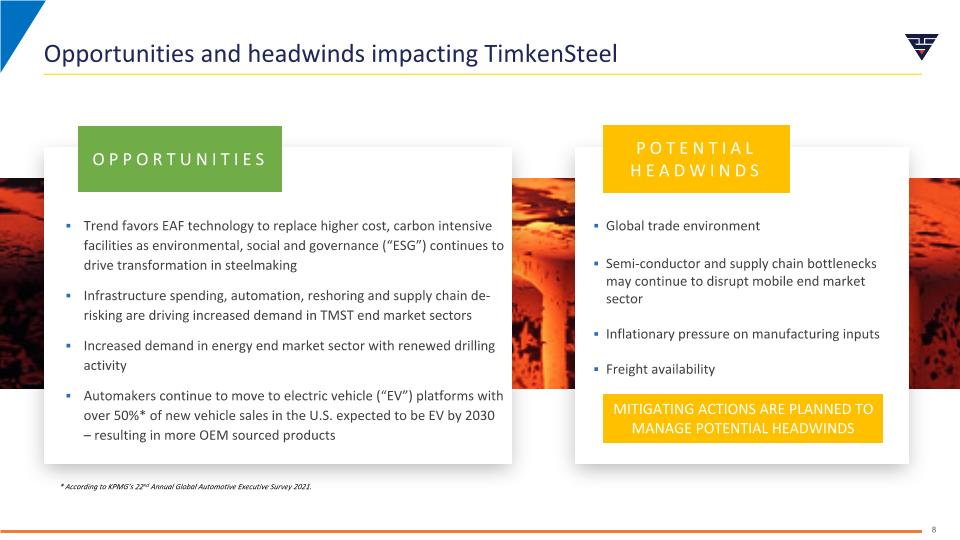
Trend favors EAF technology to replace higher cost, carbon intensive facilities as environmental, social and governance (“ESG”) continues to drive transformation in steelmaking Infrastructure spending, automation, reshoring and supply chain de-risking are driving increased demand in TMST end market sectors Increased demand in energy end market sector with renewed drilling activity Automakers continue to move to electric vehicle (“EV”) platforms with over 50%* of new vehicle sales in the U.S. expected to be EV by 2030 – resulting in more OEM sourced products Opportunities and headwinds impacting TimkenSteel Global trade environment Semi-conductor and supply chain bottlenecks may continue to disrupt mobile end market sector Inflationary pressure on manufacturing inputs Freight availability OPPORTUNITIES POTENTIAL HEADWINDS * According to KPMG’s 22nd Annual Global Automotive Executive Survey 2021. MITIGATING ACTIONS ARE PLANNED TO MANAGE POTENTIAL HEADWINDS

Long-term, trusted partnerships with industry leading customers Our specialized products and services are used in a wide range of demanding applications around the world Support more than 350 diverse customers in automotive, oil and gas, industrial equipment, mining, construction, rail, defense, heavy truck, agriculture and power generation Majority of customer relationships span more than 20 years Customer pricing agreements cover approximately 70% of our portfolio and are typically annual CUSTOMER APPLICATION EXAMPLES Bearings Crankshafts Electric vehicle ring gears and pinion shafts Munitions Energy drilling tools

Serving diverse and demanding end market sectors with broad product portfolio 2021 END MARKET SECTOR MIX Tons: 818,600 (1) Net sales mix includes “other” sales attributable to the company’s scrap sales (2) Shipment tons, by product type, as a percentage of 2021 shipments (3) Net sales dollars, by product type, as a percentage of 2021 net sales; excludes 3% of “other” sales attributable to the company’s scrap sales 22% of total shipments were sold via distribution channel SHIPMENT MIX Net Sales: $1.3B Other 2% Seamless Mechanical Tubing (SMT) Engineered Bars (SBQ) Manufactured Components 80% 10% 13% 67% 17% SHIPMENTS(2) (in tons) NET SALES(3) (in $’s) 10% PRODUCT MIX NET SALES MIX(1)
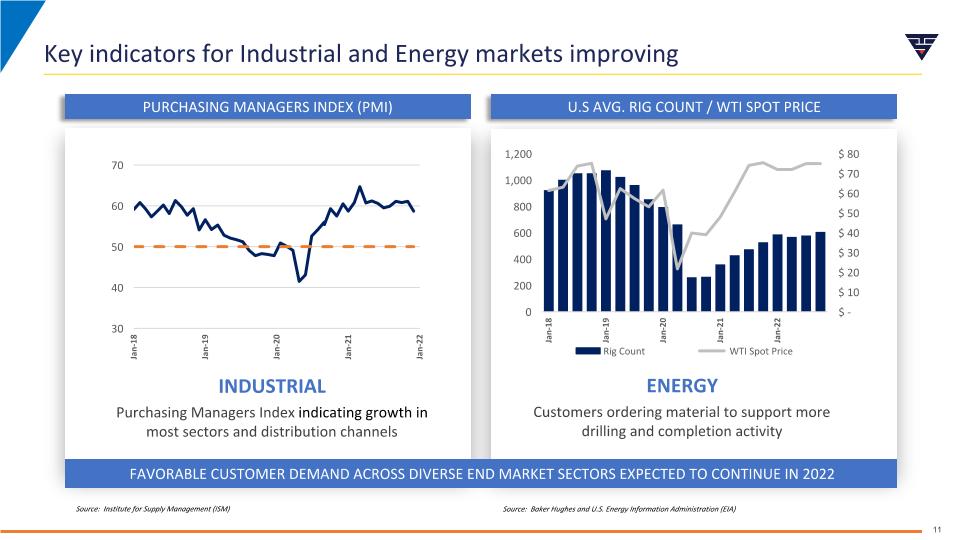
Key indicators for Industrial and Energy markets improving FAVORABLE CUSTOMER DEMAND ACROSS DIVERSE END MARKET SECTORS EXPECTED TO CONTINUE IN 2022 PURCHASING MANAGERS INDEX (PMI) U.S AVG. RIG COUNT / WTI SPOT PRICE 11 INDUSTRIAL Purchasing Managers Index indicating growth in most sectors and distribution channels ENERGY Customers ordering material to support more drilling and completion activity Source: Institute for Supply Management (ISM) Source: Baker Hughes and U.S. Energy Information Administration (EIA)

Key indicators for Mobile market showing expected growth MOBILE-ON-HIGHWAY Light vehicle production is still disrupted due to supply chain difficulties; however, growth is expected as consumer demand remains high and vehicle inventory remains at historic lows FAVORABLE CUSTOMER DEMAND ACROSS DIVERSE END MARKET SECTORS EXPECTED TO CONTINUE IN 2022 N.A. LIGHT VEHICLE SAAR (M UNITS) N.A LIGHT VEHICLE INVENTORY (DAYS) 12 Source: Wards’ Intelligence and IHS Markit

TimkenSteel applications in vehicles with internal combustion engines Engine Crankshafts Cam lobes Connecting rods Fuel components Driveline Bearing hubs Drive pinion gears Axle tubing Constant-velocity joint housing and cages Ring gears Side gears Steering knuckles Transmission Sun, ring and pinion planetary gears Continuously variable transmission pulley Drive gears Shafts Hubs

TimkenSteel applications in electric vehicles Motor/Transfer Drive (Front Unit) Motor shaft Pinion shaft Transfer gear Final drive gear Ring gear Motor/Transfer Drive (Rear Unit/AWD) Motor shaft Pinion shaft Transfer gear Final drive gear Ring gears Driveline/Chassis Bearing hubs Constant-velocity joint housing and cages Steering knuckles Suspension components

Electric vehicle transformation Long-term manufactured component agreements secured for growing EV and hybrid portfolio Current EV portfolio consists of 16 awarded applications, ~15k annual ship tons and ~$50M annual base sales when fully ramped Margin in EV applications awarded to date is generally more favorable than comparable internal combustion engine (“ICE”) applications Actively quoting and exploring additional EV and hybrid manufactured component opportunities WELL-POSITIONED FOR EV TRANSITION WITH LONG-STANDING CUSTOMER RELATIONSHIPS AND HIGH STRENGTH PRODUCTS

Growing commitment to ESG supports safe and responsible legacy LEGACY OF SUSTAINABILITY AND RESPONSIBILITY 100% of steel produced primarily from recycled scrap metal – since 1952 A safety metric is included in the annual incentive compensation plan for salaried employees GHG emissions are consistently less than the industry average(1) 2 million pounds of iron captured and recycled annually at our water treatment plant Since 2015, reclaimed and recycled approximately 2.6 billion pounds of slag byproduct Long-standing relationships with local community organizations 44% of our Board members are women or racially or ethnically diverse (1) Please refer to TimkenSteel’s ESG Performance, or page 17 in this presentation, for source of GHG industry average. The company completed its fourth consecutive year of consuming less raw water than the prior year

ESG performance In 2021, 1.1M tons of recycled scrap were melted in TimkenSteel’s EAF furnaces EMISSIONS FOOTPRINT 2018 2019 2020 Global Industry Average5 1.81 1.85 1.89 TimkenSteel 0.80 0.82 0.85 2018 2019 2020 Global Industry Average5 19.5 20.1 20.6 TimkenSteel 7.4 7.8 8.5 GHG EMISSIONS INTENSITY3 ENERGY INTENSITY4 Total Recordable Injury Rate is defined as OSHA recordable incidents x 200,000 / hours worked Lost Time Injury Rate is defined as OSHA days away from work cases x 200,000 / hours worked Greenhouse Gas (GHG) Emissions Intensity defined as average metric tons of CO2 emitted per metric ton of steel produced. 2021 data will be published in a future company ESG update. Energy Intensity defined as average gigajoule consumed per metric ton of steel produced. 2021 data will be published in a future company ESG update. (5) Global industry average GHG emissions data source: https://www.worldsteel.org/steel-by-topic/sustainability/sustainability-indicators.html. In addition to scopes 1 (direct) and 2 (indirect), global industry average GHG emissions may include scope 3 emissions. TimkenSteel data incorporates scopes 1 and 2 only as TimkenSteel has not created a scope 3 inventory. Global industry average includes all types of steel furnaces. Electric arc furnaces (EAFs) are widely acknowledged to be cleaner than blast furnaces and TimkenSteel produces steel only using EAFs. ISO 14001 Environmental Management System certifications for all our facilities that produce or process steel

Committed to protecting employees, community and the environment NEXT-LEVEL ESG IMPLEMENTATION absolute reduction in fresh water withdrawn 2030 environmental goals* announced in October 2021 (compared with a 2018 baseline – see our SASB disclosure) TimkenSteel is committed to making progress toward and achieving our long-term goals and building on our long-standing reputation as a sustainable steel supplier Additionally, TimkenSteel reaffirmed its commitments to safety first and fostering diversity, with an aspiration to achieve zero workplace injuries and to build a diverse, equitable and inclusive workplace culture on our Board, in leadership and throughout our company Sustainability Accounting Standards Board (SASB) disclosures published in April 2021 Beyond 2030, TimkenSteel aspires to achieve carbon neutrality Absolute reduction in combined Scope 1 and Scope 2 greenhouse gas emissions 40% Absolute reduction in total energy consumption (direct and indirect) 30% Absolute reduction in fresh water withdrawn 35% Reduction in waste-to-landfill intensity 10% * The company’s 2030 targets for GHG emissions, energy consumption and fresh water withdrawn are based on an absolute or total reduction in the amount of GHG emissions, energy consumption and fresh water withdrawn as compared to a 2018 baseline. In contrast, the company’s waste-to-landfill target is based on an intensity or percentage reduction of waste-to-landfill per ton of steel shipped as compared to a 2018 baseline. All 2030 targets are based on the company’s operating assets as of 2018 and do not account for any future inorganic growth or other expansion of its facilities or operating assets, for which an adjustment to the absolute reduction may be required.
GROWTH STRATEGY AND LONG-TERM OUTLOOK
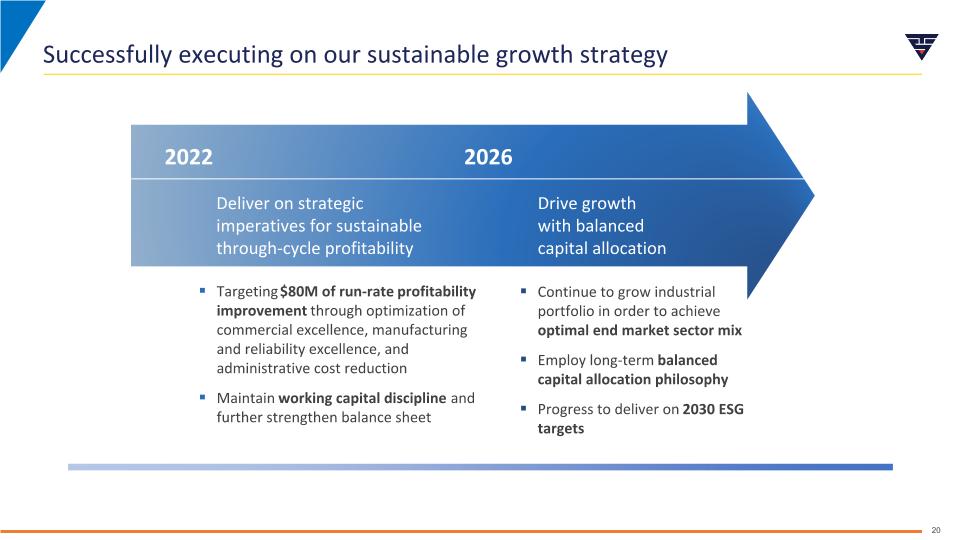
Successfully executing on our sustainable growth strategy 2022 2026 Deliver on strategic imperatives for sustainable through-cycle profitability Drive growth with balanced capital allocation 20 Targeting $80M of run-rate profitability improvement through optimization of commercial excellence, manufacturing and reliability excellence, and administrative cost reduction Maintain working capital discipline and further strengthen balance sheet Continue to grow industrial portfolio in order to achieve optimal end market sector mix Employ long-term balanced capital allocation philosophy Progress to deliver on 2030 ESG targets

Advance our commitment to environmental, social, governance Empower and attract top talent Achieve sustainable profitable growth Thoughtfully pursue new opportunities to enhance our portfolio of products and services Prioritize the ease of doing business Strategic imperatives driving innovation and growth Prioritize efforts to highest value activities Improve cost competitiveness across all aspects of the organization and operations Reduce time to service Improve business process efficiency and effectiveness with the use of digital technologies Invest in reducing greenhouse gas emissions and intensity, and achieve published 2030 ESG targets Continuously improve safety processes to maintain industry leading performance Invest in talent and leadership development at all levels throughout the organization Align compensation, performance management and organization system consistent with vision and mission Separate, but coordinated, strategies for SBQ, SMT and Manufactured Components Optimize mix and profitability through on-going portfolio review process

HISTORICAL AVERAGE(1) THROUGH-CYCLE LONG-TERM TARGETS(2) Melt utilization rate 61% Mid 80%’s Adjusted EBITDA margin(3) 8% > 12% Return on capital employed(4) 11% 15% to 17% Capital expenditures $28M $30M to $40M Net leverage(5) 1.2x < 1.0x (1) Historical average calculated from 2017 through 2021; see Appendix for reconciliation of non-GAAP measures and supporting calculations. (2) Through-cycle long-term (five-year) targets first published in Q1 2022 (3) Adjusted EBITDA Margin is adjusted EBITDA as a percentage of net sales; see Appendix for a reconciliation of non-GAAP measures (4) Return on Capital Employed is defined as Adjusted EBITDA divided by average total assets minus average current liabilities; see Appendix for supporting calculations (5) Net Leverage is defined as total debt minus cash, divided by Adjusted EBITDA; see Appendix for supporting calculations Long-term operational and financial targets

Significant drivers to deliver long-term targets COMMERCIAL EXCELLENCE Portfolio optimization to improve product mix and margin Targeted growth applications and markets MANUFACTURING & RELIABILITY EXCELLENCE Manufacturing productivity and efficiency projects Example of 2022 project – scrap yard relocation to improve efficiency and drive run rate savings by $3M ADMINISTRATIVE PROCESS SIMPLIFICATION Multi-year IT transformation in process – $7M run rate savings; CapEx $13M Leverage shared services to drive efficiency and cost reduction MAINTAIN A STRONG BALANCE SHEET Pension de-risking – targeting over $300M of pension annuitizations next 3 years Convertible notes – repurchased $5M in Q1 2022 at a cash cost of $12M; may repurchase additional convertible notes in the future depending on the repurchase price and holder interest, among other factors $30M $30M $20M Overall objective is to deliver sustainable through-cycle profitability, aided by $80M of targeted profitability improvement opportunities, while maintaining a strong balance sheet and operating cash flow $80M

Balanced approach to capital allocation INVEST IN PROFITABLE GROWTH Focused organic investments with returns in excess of cost of capital 2022 CapEx budget of $40M, with over half allocated to profitability improvement projects Approved 2022 CapEx more than double 2020 and 2021 maintenance spending level Committed to deliver 2030 ESG targets with annual spending of approximately $3M MAINTAIN A STRONG BALANCE SHEET Sound capital structure supported by $510.7M of total liquidity(1) at the end of 2021 and no outstanding borrowings on asset-based revolving credit facility Continue to maintain working capital discipline No required pension contributions until after 2031 based on current assumptions RETURN CAPITAL TO SHAREHOLDERS Share repurchase program of $50M authorized in December 2021, reflective of the company’s improved financial position and confidence in our business outlook Repurchased $5M of convertible notes in Q1 2022, reducing dilution and outstanding debt (1) Total Liquidity is defined as available borrowings capacity under credit facility plus cash and cash equivalents; see Appendix for supporting calculations

TimkenSteel investment highlights Long-standing commitment to operating safely and responsibly to protect our employees, our communities and the environment Leveraging long-term, trusted partnerships with industry leading customers to drive growth Serving diverse and demanding end market sectors with a broad portfolio of differentiated and specialized products and solutions Experienced leadership team successfully executing on business transformation to drive profitable growth Use of EAF technology enables our greenhouse gas (“GHG”) emissions to be consistently less than the industry average(1) (1) Please refer to TimkenSteel’s ESG Performance, or page 17 in this presentation, for source of GHG industry average.

APPENDIX

TimkenSteel uses EAF technology for its steelmaking EAF process Uses recycled steel scrap as primary raw material Uses electricity as main source of energy to melt scrap Produces substantially fewer emissions and consumes less energy than traditional blast furnace technology EAF allows for all types of steel to be created Blast furnace process Uses iron ore as primary raw material and coal as the main source of energy Melts iron ore and coke to produce pig iron and then feeds into a converter to remove impurities Requires a significant investment in facility development and takes up a large footprint Emits ~2x amount of carbon dioxide to the environment compared with EAF process

Overview of broad product offering SEAMLESS MECHANICAL TUBES ENGINEERED BARS MANUFACTURED COMPONENTS OVERVIEW Mobile Planetary gear preforms; blanks for shafts and hubs Awarded contracts for electric and hybrid vehicles Served through SW Ohio owned facility and supplier network Industrial Bearing, heavy equipment and military blanks Manufactured through North Carolina owned facility and supplier network Energy Tubular products for drilling applications Manufactured through supplier network Diversified customer mix 35-ton average order size ~33,000+ orders per year Additional product offering forms including ingots, cast blooms, billets and manufactured components BROAD COMMERCIAL POSITION Bars 1” – 16” Round Corner Squares 3.1” – 12.5” 3” – 13”

Pension and OPEB benefit plans overview PROACTIVE PENSION MANAGEMENT EXPECTED TO SIGNIFICANTLY DE-RISK THE BALANCE SHEET OVER NEXT SEVERAL YEARS. NO REQUIRED CONTRIBUTIONS TO U.S. BARGAINING PLAN UNTIL AFTER 2031 BASED ON CURRENT ASSUMPTIONS. 29 Plan status Assets* Liabilities* % Funded Number of participants** Recent actions / current projects U.S. bargaining plan Closed, accruing $863 $1,025 84% 4,530 Closed to new entrants effective 1/1/22 Lump sum option added effective 1/1/22 Certain participants have the option to move to 401k plan 1/1/22 to 6/30/22 Increased return seeking asset allocation in Q1 2022 Exploring partial annuity de-risking alternatives U.S. salaried plan Closed, frozen 206 187 110% 1,424 Board approved plan termination effective 3/31/22 Annuity purchase targeted for 2023 U.S. Supplemental Executive Retirement Plan Closed, frozen 0 24 0% 28 Accruals frozen effective 12/31/20 Liabilities funded with cash as required UK pension scheme Closed, no actives 107 83 129% 594 Initiated plan settlement process in 2021 Annuity purchase targeted for 2023 Total pension plans 1,176 1,319 89% 6,576 U.S. other postemployment benefit plans (OPEB) Closed, accruing 77 118 65% 4,349 Salaried Medicare-eligible retirees moved to exchange effective 1/1/17 Bargaining Medicare-eligible retirees who retired prior to 1/1/18 moved to exchange effective 8/1/19 * Actual as of 12/31/21 in $M; ** Participant counts as of 10/1/21

NET SALES ($M) / SHIPPED TONS (K) / MELT UTILIZATION Historical financial performance (1) Adjusted EBITDA is defined as net income (loss) before interest expense, income taxes, depreciation and amortization, presented on a non-GAAP basis excluding certain items; see Appendix for a reconciliation of non-GAAP measures (2) Free Cash Flow is defined as net cash provided (used) by operating activities less capital expenditures; see Appendix for a reconciliation of non-GAAP measures (3) Base Selling Price is defined as Net sales excluding surcharges; see the reconciliation of base sales to net sales in the Appendix (4) Adjusted EBITDA Margin is Adjusted EBITDA as a percentage of net sales, see Appendix for a reconciliation of non-GAAP measures. The five-year historical average for Adjusted EBITDA Margin is calculated by adding the Adjusted EBITDA margin for the applicable periods and dividing by the respective number of periods. AVERAGE BASE SELLING PRICE ($/TON)(3) ADJUSTED EBITDA ($M)(1) AND MARGIN %(4) FREE CASH FLOW ($M)(2) 6.2% 7.9% 2.7% 4.6% 19.2% Record

(1) Base Sales is defined as Net sales excluding surcharges; see the reconciliation of base sales to net sales in the Appendix (2) OCTG Billet business began in 2016 – represented in "Other" Select performance history by end market sector SHIPMENTS BY END MARKET SECTOR (K TONS)(3) AVERAGE BASE SALES BY END MARKET SECTOR ($ / TON)(1)(2) QUARTERLY (2)
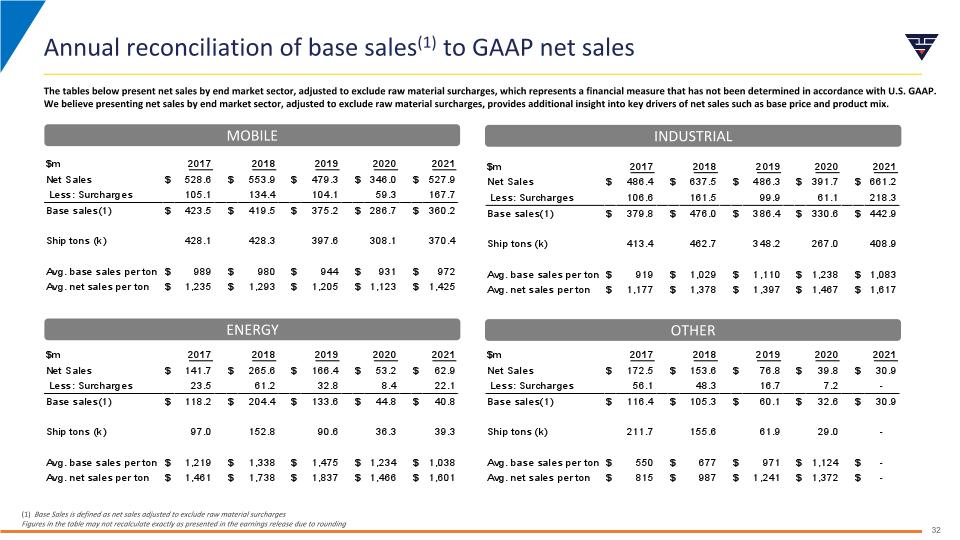
Other $m 2017 2018 2019 2020 2021 Net Sales $ 172.5 $ 153.6 $ 76.8 $ 39.8 $ 30.9 Less: Surcharges 56.1 48.3 16.7 7.2 - Base sales(1) $ 116.4 $ 105.3 $ 60.1 $ 32.6 $ 30.9 Ship tons (k) 211.7 155.6 61.9 29.0 - Avg. base sales per ton $ 550 $ 677 $ 971 $ 1,124 $ - Avg. net sales per ton $ 815 $ 987 $ 1,241 $ 1,372 $ - Energy $m 2017 2018 2019 2020 2021 Net Sales $ 141.7 $ 265.6 $ 166.4 $ 53.2 $ 62.9 Less: Surcharges 23.5 61.2 32.8 8.4 22.1 Base sales(1) $ 118.2 $ 204.4 $ 133.6 $ 44.8 $ 40.8 Ship tons (k) 97.0 152.8 90.6 36.3 39.3 Avg. base sales per ton $ 1,219 $ 1,338 $ 1,475 $ 1,234 $ 1,038 Avg. net sales per ton $ 1,461 $ 1,738 $ 1,837 $ 1,466 $ 1,601 Industrial $m 2017 2018 2019 2020 2021 Net Sales $ 486.4 $ 637.5 $ 486.3 $ 391.7 $ 661.2 Less: Surcharges 106.6 161.5 99.9 61.1 218.3 Base sales(1) $ 379.8 $ 476.0 $ 386.4 $ 330.6 $ 442.9 Ship tons (k) 413.4 462.7 348.2 267.0 408.9 Avg. base sales per ton $ 919 $ 1,029 $ 1,110 $ 1,238 $ 1,083 Avg. net sales per ton $ 1,177 $ 1,378 $ 1,397 $ 1,467 $ 1,617 Mobile $m 2017 2018 2019 2020 2021 Net Sales $ 528.6 $ 553.9 $ 479.3 $ 346.0 $ 527.9 Less: Surcharges 105.1 134.4 104.1 59.3 167.7 Base sales(1) $ 423.5 $ 419.5 $ 375.2 $ 286.7 $ 360.2 Ship tons (k) 428.1 428.3 397.6 308.1 370.4 Avg. base sales per ton $ 989 $ 980 $ 944 $ 931 $ 972 Avg. net sales per ton $ 1,235 $ 1,293 $ 1,205 $ 1,123 $ 1,425 Annual reconciliation of base sales(1) to GAAP net sales The tables below present net sales by end market sector, adjusted to exclude raw material surcharges, which represents a financial measure that has not been determined in accordance with U.S. GAAP. We believe presenting net sales by end market sector, adjusted to exclude raw material surcharges, provides additional insight into key drivers of net sales such as base price and product mix. (1) Base Sales is defined as net sales adjusted to exclude raw material surcharges Figures in the table may not recalculate exactly as presented in the earnings release due to rounding MOBILE INDUSTRIAL ENERGY OTHER

$m 2017 2018 2019 2020 2021 Net Sales $ 1,329.2 $ 1,610.6 $ 1,208.8 $ 830.7 $ 1,282.9 Less: Surcharges 291.3 405.4 253.5 136.0 408.1 Base sales(1) $ 1,037.9 $ 1,205.2 $ 955.3 $ 694.7 $ 874.8 Ship tons (k) 1,150.2 1,199.4 898.3 640.4 818.6 Avg. base sales per ton $ 902 $ 1,005 $ 1,063 $ 1,085 $ 1,069 Avg. net sales per ton $ 1,156 $ 1,343 $ 1,346 $ 1,297 $ 1,567 Annual reconciliation of base sales(1) to GAAP net sales The tables below present net sales by year, adjusted to exclude raw material surcharges, which represents a financial measure that has not been determined in accordance with U.S. GAAP. We believe presenting net sales by year, adjusted to exclude raw material surcharges, provides additional insight into key drivers of net sales such as base price. (1) Base Sales is defined as net sales adjusted to exclude raw material surcharges Figures in the table may not recalculate exactly as presented in the earnings release due to rounding ANNUAL – CONSOLIDATED TOTAL

Other Q4 Q1 Q2 Q3 Q4 $m 2020 2021 2021 2021 2021 Net Sales $ 6.0 $ 7.6 $ 7.6 $ 7.8 $ 8.0 Less: Surcharges 0.1 — — — — Base sales(1) $ 5.9 $ 7.6 $ 7.6 $ 7.8 $ 8.0 Ship tons (k) 0.3 — — — — Avg. base sales per ton $ — $ — $ — $ — $ — Avg. net sales per ton $ — $ — $ — $ — $ — Energy Q4 Q1 Q2 Q3 Q4 $m 2020 2021 2021 2021 2021 Net Sales $ 6.4 $ 7.7 $ 13.2 $ 20.4 $ 21.5 Less: Surcharges 0.9 2.1 4.6 7.4 8.0 Base sales(1) $ 5.5 $ 5.6 $ 8.6 $ 13.0 $ 13.5 Ship tons (k) 4.1 5.5 8.7 12.9 12.2 Avg. base sales per ton $ 1,341 $ 1,018 $ 989 $ 1,008 $ 1,107 Avg. net sales per ton $ 1,561 $ 1,400 $ 1,517 $ 1,581 $ 1,762 Industrial Q4 Q1 Q2 Q3 Q4 $m 2020 2021 2021 2021 2021 Net Sales $ 89.7 $ 124.7 $ 173.6 $ 182.0 $ 180.9 Less: Surcharges 14.7 32.7 57.6 66.6 61.5 Base sales(1) $ 75.0 $ 92.0 $ 116.0 $ 115.4 $ 119.4 Ship tons (k) 63.3 84.4 111.9 111.0 101.6 Avg. base sales per ton $ 1,185 $ 1,090 $ 1,037 $ 1,040 $ 1,175 Avg. net sales per ton $ 1,417 $ 1,477 $ 1,551 $ 1,640 $ 1,781 Mobile Q4 Q1 Q2 Q3 Q4 $m 2020 2021 2021 2021 2021 Net Sales $ 109.1 $ 133.6 $ 132.9 $ 133.5 $ 127.9 Less: Surcharges 19.0 32.8 41.7 47.0 46.2 Base sales(1) $ 90.1 $ 100.8 $ 91.2 $ 86.5 $ 81.7 Ship tons (k) 96.3 103.5 93.6 88.8 84.5 Avg. base sales per ton $ 936 $ 974 $ 974 $ 974 $ 967 Avg. net sales per ton $ 1,133 $ 1,291 $ 1,420 $ 1,503 $ 1,514 Quarterly reconciliation of base sales(1) to GAAP net sales The tables below present net sales by end market sector, adjusted to exclude raw material surcharges, which represents a financial measure that has not been determined in accordance with U.S. GAAP. We believe presenting net sales by end market sector, adjusted to exclude raw material surcharges, provides additional insight into key drivers of net sales such as base price and product mix. MOBILE INDUSTRIAL ENERGY OTHER (1) Base Sales is defined as net sales adjusted to exclude raw material surcharges Figures in the table may not recalculate exactly as presented in the earnings release due to rounding

Q4 Q1 Q2 Q3 Q4 $m 2020 2021 2021 2021 2021 Net Sales $ 211.2 $ 273.6 $ 327.3 $ 343.7 $ 338.3 Less: Surcharges 34.7 67.6 103.9 121.0 115.7 Base sales(1) $ 176.5 $ 206.0 $ 223.4 $ 222.7 $ 222.6 Ship tons (k) 164.0 193.4 214.2 212.7 198.3 Avg. base sales per ton $ 1,076 $ 1,065 $ 1,043 $ 1,047 $ 1,123 Avg. net sales per ton $ 1,288 $ 1,415 $ 1,528 $ 1,616 $ 1,706 Quarterly reconciliation of base sales(1) to GAAP net sales The tables below present net sales by quarter, adjusted to exclude raw material surcharges, which represents a financial measure that has not been determined in accordance with U.S. GAAP. We believe presenting net sales, adjusted to exclude raw material surcharges, provides additional insight into key drivers of net sales such as base price. (1) Base Sales is defined as net sales adjusted to exclude raw material surcharges Figures in the table may not recalculate exactly as presented in the earnings release due to rounding QUARTERLY – CONSOLIDATED TOTAL

December 31, (Unaudited) 2017 2018 2019 2020 2021 Net income (loss) $ (31.3) $ (10.0) $ (110.0) $ (61.9) $ 171.0 Provision for income taxes 1.5 1.8 (16.1) 1.2 5.7 Interest expense 14.8 17.1 15.7 12.2 5.9 Earnings (loss) Before Interest and Taxes (EBIT)(1) $ (15.0) $ 8.9 $ (110.4) $ (48.5) $ 182.6 EBIT margin(1) (1.1%) 0.6% (9.1%) (5.8%) 14.2% Depreciation and amortization 74.9 73.0 73.5 70.0 63.1 Earnings (loss) Before Interest, Taxes, Depreciation and Amortization (EBITDA)(2) $ 59.9 $ 81.9 $ (36.9) $ 21.5 $ 245.7 EBITDA margin(2) 4.5% 5.1% (3.1)% 2.6% 19.2% Executive severance and transition costs (1.7) (5.6) (0.5) Impairment charges and loss on sale or disposal of assets (8.9) Loss on sale of scrap processing facility (0.1) Gain/(loss) on sale of TMS assets 3.6 0.1 Restructuring charges (0.7) (0.9) (8.9) (3.2) (6.7) Accelerated depreciation and amortization (EBIT only) (2.8) (3.4) (1.5) Gain (loss) from remeasurement of benefit plans (21.8) (43.5) (40.6) (14.7) 20.1 Write-down of supplies inventory (2.1) Loss on extinguishment of debt (0.9) Employee retention credit 2.3 Facility phase down: Inventory write-down (4.8) Faircrest plant asset disposal, net of recovery 0.1 Business transformation costs(5) (0.5) (1.0) (2.0) Sales and use tax refund 2.5 TMS inventory write-down (3.1) Harrison melt impairment charges (7.9) TMS impairment charges (0.3) Loss on sale of consolidation subsidiary (1.1) Customer program early termination (1.4) Loss on sale of non-core assets(6) (0.9) Gain on sale of non-core property 0.5 Adjusted EBIT(3) $ 7.5 $ 55.0 $ (38.3) $ (28.6) $ 184.3 Adjusted EBIT margin(3) 0.6% 3.4% (3.2%) (3.4%) 14.4% Adjusted EBITDA(4) $ 82.4 $ 128.0 $ 32.4 $ 38.0 $ 245.9 Adjusted EBITDA margin(4) 6.2% 7.9% 2.7% 4.6% 19.2% $m Reconciliation of Earnings (Loss) Before Interest and Taxes (EBIT)(1), Adjusted EBIT(3), Earnings (Loss) Before Interest, Taxes, Depreciation and Amortization (EBITDA)(2) and Adjusted EBITDA(4) to GAAP Net Income (Loss) This reconciliation is provided as additional relevant information about the company's performance. EBIT, Adjusted EBIT, EBITDA and Adjusted EBITDA are important financial measures used in the management of the business, including decisions concerning the allocation of resources and assessment of performance. Management believes that reporting EBIT, Adjusted EBIT, EBITDA and Adjusted EBITDA is useful to investors as these measures are representative of the company's performance, and provide improved comparability of results. Management also believes that it is appropriate to compare GAAP net income (loss) to EBIT, Adjusted EBIT, EBITDA and Adjusted EBITDA. $M Annual – Consolidated Total (1) EBIT is defined as net income (loss) before interest expense and income taxes. EBIT Margin is EBIT as a percentage of net sales (2) EBITDA is defined as net income (loss) before interest expense, income taxes, depreciation and amortization. EBITDA Margin is EBITDA as a percentage of net sales (3) Adjusted EBIT is defined as EBIT excluding, as applicable, adjustments listed in the table above. Adjusted EBIT Margin is Adjusted EBIT as a percentage of net sales (4) Adjusted EBITDA is defined as EBITDA excluding, as applicable, adjustments listed in the table above. Adjusted EBITDA Margin is Adjusted EBITDA as a percentage of net sales (5) Business transformation costs consist of items that are non-routine in nature (6) Loss on sale of non-core assets consists of losses incurred related to older excess assets sold via an auction process

Q4 Q1 Q2 Q3 Q4 (Unaudited) 2020 2021 2021 2021 2021 Net income (loss) $ (12.8) $ 9.8 $ 54.0 $ 50.1 $ 57.1 Provision for income taxes 0.6 0.2 1.4 0.5 3.6 Interest expense 3.0 1.9 1.7 1.2 1.2 Earnings (loss) Before Interest and Taxes (EBIT)(1) $ (9.2) $ 11.9 $ 57.1 $ 51.8 $ 61.9 EBIT margin(1) (4.4%) 4.3% 17.4% 15.1% 18.3% Depreciation and amortization 17.8 17.6 15.4 15.1 15.0 Earnings (loss) Before Interest, Taxes, Depreciation and Amortization (EBITDA)(2) $ 8.6 $ 29.5 $ 72.5 $ 66.9 $ 76.9 EBITDA margin(2) 4.1% 10.8% 22.2% 19.5% 22.7% Executive severance and transition costs (0.5) Gain/(loss) on sale of TMS assets (1.0) 0.1 Restructuring charges (1.6) (0.5) (1.0) (0.4) (4.7) Accelerated depreciation and amortization (EBIT only) (1.3) (1.5) Gain (loss) from remeasurement of benefit plans (11.2) (0.2) 0.7 (2.7) 22.3 Loss on extinguishment of debt (0.9) Write-down of supplies inventory (2.1) Employee retention credit 2.3 Business transformation costs(5) (0.2) (0.3) (0.2) (0.9) (0.6) Sales and use tax refund 2.5 TMS impairment charges (0.3) Harrison melt impairment charges (7.9) Gain on sale of non-core property 0.5 Loss on sale of consolidated subsidiary (1.1) Customer program early termination (1.4) Loss on sale of non-core assets(6) (0.9) Adjusted EBIT(3) $ 4.2 $ 24.7 $ 55.6 $ 56.9 $ 47.1 Adjusted EBIT margin(3) 2.0% 9.0% 17.0% 16.6% 13.9% Adjusted EBITDA(4) $ 20.7 $ 40.8 $ 71.0 $ 72.0 $ 62.1 Adjusted EBITDA margin(4) 9.8% 14.9% 21.7% 20.9% 18.4% $m Reconciliation of Earnings (Loss) Before Interest and Taxes (EBIT)(1), Adjusted EBIT(3), Earnings (Loss) Before Interest, Taxes, Depreciation and Amortization (EBITDA)(2) and Adjusted EBITDA(4) to GAAP Net Income (Loss) This reconciliation is provided as additional relevant information about the company's performance. EBIT, Adjusted EBIT, EBITDA and Adjusted EBITDA are important financial measures used in the management of the business, including decisions concerning the allocation of resources and assessment of performance. Management believes that reporting EBIT, Adjusted EBIT, EBITDA and Adjusted EBITDA is useful to investors as these measures are representative of the company's performance, and provide improved comparability of results. Management also believes that it is appropriate to compare GAAP net income (loss) to EBIT, Adjusted EBIT, EBITDA and Adjusted EBITDA. (1) EBIT is defined as net income (loss) before interest expense and income taxes. EBIT Margin is EBIT as a percentage of net sales (2) EBITDA is defined as net income (loss) before interest expense, income taxes, depreciation and amortization. EBITDA Margin is EBITDA as a percentage of net sales (3) Adjusted EBIT is defined as EBIT excluding, as applicable, adjustments listed in the table above. Adjusted EBIT Margin is Adjusted EBIT as a percentage of net sales (4) Adjusted EBITDA is defined as EBITDA excluding, as applicable, adjustments listed in the table above. Adjusted EBITDA Margin is Adjusted EBITDA as a percentage of net sales (5) Business transformation costs consist of items that are non-routine in nature (6) Loss on sale of non-core assets consists of losses incurred related to older excess assets sold via an auction process $M Quarterly – Consolidated Total

Q4 Q1 Q2 Q3 Q4 (Unaudited) 2020 2021 2021 2021 2021 Net Cash Provided (Used) by Operating Activities $ 52.5 $ 13.2 $ 39.2 $ 53.8 $ 90.7 Less: Capital expenditures (3.9) (2.3) (1.5) (3.5) (4.9) Free Cash Flow(1) $ 48.6 $ 10.9 $ 37.7 $ 50.3 $ 85.8 (Unaudited) 2017 2018 2019 2020 2021 2020 - 2021 Total Net Cash Provided (Used) by Operating Activities $ 8.1 $ 18.5 $ 70.3 $ 173.5 $ 196.9 $ 370.4 Less: Capital expenditures (33.0) (40.0) (38.0) (16.9) (12.2) (29.1) Free Cash Flow(1) $ (24.9) $ (21.5) $ 32.3 $ 156.6 $ 184.7 $ 341.3 (1) Free Cash Flow is defined as net cash provided (used) by operating activities less capital expenditures $M QUARTERLY – CONSOLIDATED TOTAL Reconciliation of Free Cash Flow(1) to GAAP Net Cash Provided (Used) by Operating Activities This reconciliation is provided as additional relevant information about the company's financial position. Free cash flow is an important financial measure used in the management of the business. Management believes that free cash flow is useful to investors because it is a meaningful indicator of cash generated from operating activities available for the execution of its business strategy. $M ANNUAL – CONSOLIDATED TOTAL
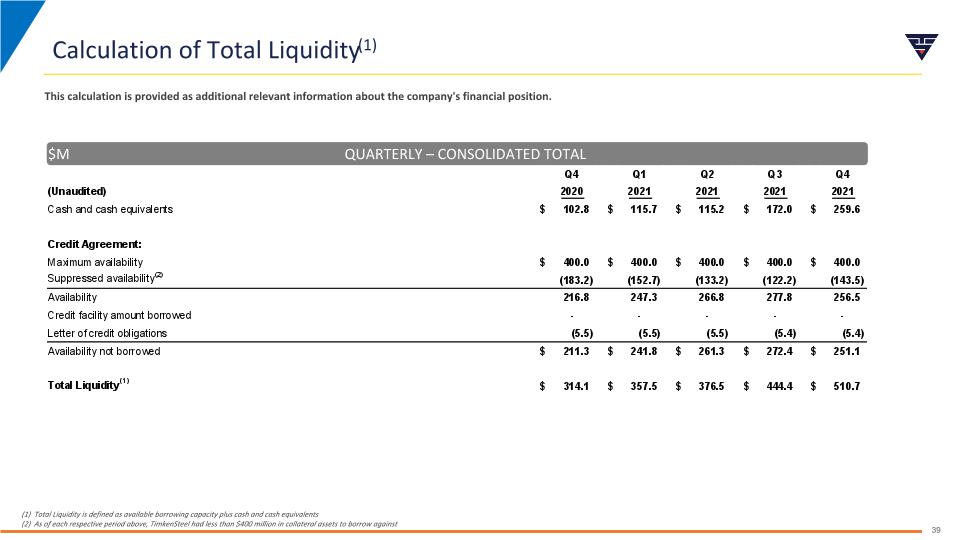
Q4 Q1 Q2 Q3 Q4 (Unaudited) 2020 2021 2021 2021 2021 Cash and cash equivalents $ 102.8 $ 115.7 $ 115.2 $ 172.0 $ 259.6 Credit Agreement: Maximum availability $ 400.0 $ 400.0 $ 400.0 $ 400.0 $ 400.0 Suppressed availability(2) (183.2) (152.7) (133.2) (122.2) (143.5) Availability 216.8 247.3 266.8 277.8 256.5 Credit facility amount borrowed - - - - - Letter of credit obligations (5.5) (5.5) (5.5) (5.4) (5.4) Availability not borrowed $ 211.3 $ 241.8 $ 261.3 $ 272.4 $ 251.1 Total Liquidity(1) $ 314.1 $ 357.5 $ 376.5 $ 444.4 $ 510.7 (1) Total Liquidity is defined as available borrowing capacity plus cash and cash equivalents (2) As of each respective period above, TimkenSteel had less than $400 million in collateral assets to borrow against Calculation of Total Liquidity(1) This calculation is provided as additional relevant information about the company's financial position. $M QUARTERLY – CONSOLIDATED TOTAL

2017 2018 2019 2020 2021 "Historical Average(1)" Capital Expenditures $ 33.0 $ 40.0 $ 38.0 $ 16.9 $ 12.2 $ 28.0 2017 2018 2019 2020 2021 "Historical Average(1)" Melt Utilization(2) 73% 74% 50% 37% 73% 61% Calculation of Average Capital Expenditures and Average Melt Utilization This calculation is provided as additional relevant information about the company's financial position. $M ANNUAL – CONSOLIDATED TOTAL ANNUAL – CONSOLIDATED TOTAL (1) Historical average calculated from 2017 through 2021 (2) Melt Utilization is actual melt divided by total melt capacity, see historical information published on our website for additional details

2017 2018 2019 2020 2021 "Historical Average(1)" Short-Term Debt $ — $ — $ — $ 38.9 $ 44.9 $ 16.8 Long-Term Debt 70.1 74.1 78.6 39.3 — 52.4 Convertible Debt 95.2 115.0 90.0 — — 60.0 Less: Cash and Cash Equivalents 24.5 21.6 27.1 102.8 259.6 87.1 Net Debt $ 140.8 $ 167.5 $ 141.5 $ (24.6) $ (214.7) $ 42.1 Adjusted EBITDA $ 82.4 $ 128.0 $ 32.4 $ 38.0 $ 245.9 $ 105.3 Net Leverage 1.7x 1.3x 4.4x (0.6x) (0.9x) 1.2x Calculation of Average Net Leverage(1) This calculation is provided as additional relevant information about the company's financial position. $M ANNUAL – CONSOLIDATED TOTAL (1) Net Leverage is defined as total debt minus cash, divided by Adjusted EBITDA (2) Historical average calculated from 2017 through 2021 (3) Adjusted EBITDA is defined as net income (loss) before interest expense, income taxes, depreciation and amortization, presented on a non-GAAP basis excluding certain items; see Appendix for a reconciliation of non-GAAP measures

2016 2017 2019 2020 Total Assets $ 1,113.4 $ 1,212.6 Total Assets $ 1,085.2 $ 994.0 Less: Total Current Liabilities 130.7 206.8 Less: Total Current Liabilities 112.3 181.0 Capital Employed $ 982.7 $ 1,005.8 Capital Employed $ 972.9 $ 813.0 Average Capital Employed $ 994.3 Average Capital Employed $ 893.0 Adjusted EBITDA $ 82.4 Adjusted EBITDA $ 38.0 Return on Capital Employed 8.3% Return on Capital Employed 4.3% 2017 2018 2020 2021 Total Assets $ 1,212.6 $ 1,275.3 Total Assets $ 994.0 $ 1,158.9 Less: Total Current Liabilities 206.8 220.8 Less: Total Current Liabilities 181.0 250.8 Capital Employed $ 1,005.8 $ 1,054.5 Capital Employed $ 813.0 $ 908.1 Average Capital Employed $ 1,030.2 Average Capital Employed $ 860.6 Adjusted EBITDA $ 128.0 Adjusted EBITDA $ 245.9 Return on Capital Employed 12.4% Return on Capital Employed 28.6% 2018 2019 2017 Return on Capital Employed 8.3% Total Assets $ 1,275.3 $ 1,085.2 2018 Return on Capital Employed 12.4% Less: Total Current Liabilities 220.8 112.3 2019 Return on Capital Employed 3.2% Capital Employed $ 1,054.5 $ 972.9 2020 Return on Capital Employed 4.3% 2021 Return on Capital Employed 28.6% Average Capital Employed $ 1,013.7 Historical Average(2) Return on Capital Employed 11.3% Adjusted EBITDA $ 32.4 Return on Capital Employed 3.2% Calculation of Average Return on Capital Employed(1) This calculation is provided as additional relevant information about the company's financial position. 2017 ($M) 2018 ($M) 2019 ($M) 2020 ($M) 2021 ($M) HISTORICAL AVERAGE(2) (1) Return on Capital Employed is defined as Adjusted EBITDA divided by average total assets minus average current liabilities (2) Historical average calculated from 2017 through 2021 (3) Adjusted EBITDA is defined as net income (loss) before interest expense, income taxes, depreciation and amortization, presented on a non-GAAP basis excluding certain items; see Appendix for a reconciliation of non-GAAP measures