
NexGen Energy Ltd 40-F for FY2025
NexGen Energy Ltd. (NXE)
About this 40-F
NexGen Energy Ltd filed this 40-F on March 4, 2026, covering the fiscal year ended December 31, 2025 (FY2025).
Headline figures
Fiscal year ended December 31, 2025, as reported in this filing, compared with the same period a year earlier where the filing states it.
- Net loss
- 309.68M CAD
- compared with a net loss of 77.56M CAD a year earlier
- Diluted EPS
- -0.53 CAD
- compared with -0.14 CAD a year earlier
| (Province or other jurisdiction of incorporation or organization) |
(Primary Standard Industrial Classification Code Number (if applicable)) |
Not Applicable (I.R.S. Employer Identification Number (if Applicable)) |
Title of each class |
Trading Symbol(s) |
Name of each exchange on which registered | ||
| value |
| (a) | Annual Information Form for the fiscal year ended December 31, 2025; |
| (b) | Management’s Discussion and Analysis for the fiscal year ended December 31, 2025; and |
| (c) | Audited Consolidated Financial Statements for the fiscal years ended December 31, 2025 and 2024. The Company’s Audited Consolidated Financial Statements included in this Annual Report have been prepared in accordance with International Financial Reporting Standards, as issued by the International Accounting Standards Board. Therefore, they are not comparable in all respects to financial statements of United States companies that are prepared in accordance with United States generally accepted accounting principles. |
RESOURCE AND RESERVES ESTIMATES
Unless otherwise indicated, all resource and reserve estimates included in the documents incorporated by reference into this Annual Report have been prepared in accordance with Canadian National Instrument 43-101 (“NI 43-101”) and the Canadian Institute of Mining and Metallurgy Classification System. Canadian standards, including NI 43-101, differ significantly from the requirements of the United States Securities and Exchange Commission (the “SEC” or the “Commission”), and resource information contained in the documents incorporated by reference into this Annual Report may not be comparable to similar information disclosed by U.S. companies. Accordingly, information concerning mineral deposits in this Annual Report may not be comparable with information made public by companies that report in accordance with United States standards.
ADDITIONAL DISCLOSURE
Certifications and Disclosure Regarding Controls and Procedures.
| (a) | Certifications. See Exhibits 99.4, 99.5, 99.6 and 99.7 to this Annual Report on Form 40-F. |
| (b) | Disclosure Controls and Procedures. As of the end of NexGen’s fiscal year ended December 31, 2025, an evaluation of the effectiveness of NexGen’s “disclosure controls and procedures” (as such term is defined in Rules 13a-15(e) and 15d-15(e) of the Securities Exchange Act of 1934, as amended (the “Exchange Act”)) was carried out by NexGen’s management, with the participation of its principal executive officer and principal financial officer. Based upon that evaluation, NexGen’s principal executive officer and principal financial officer have concluded that as of the end of that fiscal year, NexGen’s disclosure controls and procedures are effective to ensure that information required to be disclosed by NexGen in reports that it files or submits under the Exchange Act is (i) recorded, processed, summarized and reported within the time periods specified in the Commission rules and forms and (ii) accumulated and communicated to NexGen’s management, including its principal executive officer and principal financial officers, to allow timely decisions regarding required disclosure. |
It should be noted that while NexGen’s principal executive officer and principal financial officer believe that NexGen’s disclosure controls and procedures provide a reasonable level of assurance that they are effective, they do not expect that NexGen’s disclosure controls and procedures or internal control over financial reporting will prevent all errors or fraud. A control system, no matter how well conceived or operated, can provide only reasonable, not absolute, assurance that the objectives of the control system are met.
| (c) | Management’s Annual Report on Internal Control Over Financial Reporting. For management’s report on internal control over financial reporting, see “Disclosure Controls and Internal Control Over Financial Reporting – Management’s Report on Internal Control Over Financial Reporting” in NexGen’s Management Discussion and Analysis for the year ended December 31, 2025 attached as Exhibit 99.2 to this Annual Report on Form 40-F and incorporated by reference herein. |
| (d) | Attestation Report of the Registered Public Accounting Firm. The required disclosure is included in the Report of Independent Registered Public Accounting Firm on NexGen’s internal control over financial reporting that accompanies NexGen’s Audited Consolidated Financial Statements for the fiscal years ended December 31, 2025 and 2024, filed as Exhibit 99.3 to this Annual Report on Form 40-F. |
| (e) | Changes in Internal Control Over Financial Reporting. During the fiscal year ended December 31, 2025, no changes were made in NexGen’s internal control over financial reporting that have materially affected or are reasonably likely to materially affect NexGen’s internal control over financial reporting. |
Notices Pursuant to Regulation BTR
None.
Audit Committee Financial Expert
NexGen’s board of directors has determined that each of Sharon Birkett, Sybil Veenman, and Richard Patricio, members of NexGen’s audit committee, is “independent” as that term is defined in the rules of the NYSE New York Stock Exchange (“NYSE”) and that Ms. Birkett qualifies as an “audit committee financial expert” (as such term is defined in Form 40-F).
Code of Ethics
NexGen has adopted a Code of Ethics that meets the definition of a “code of ethics” set forth in Form 40-F, and that applies to NexGen’s principal executive officer, principal financial officer, principal accounting officer or controller, and persons performing similar functions.
The Code of Ethics is available for viewing on NexGen’s website at http://www.nexgenenergy.ca/corporate/corporate-governance/, and is available in print to any shareholder who requests it. Requests for copies of the Code of Ethics should be made by contacting: Investor Relations by phone at (604) 428-4112 or by e-mail at mkras@nxe-energy.ca.
If any amendment to the Code of Ethics is made, or if any waiver from the provisions thereof is granted, NexGen may elect to disclose the information about such amendment or waiver required by Form 40-F to be disclosed, by posting such disclosure on NexGen’s website, which may be accessed at www.nexgenenergy.ca.
Principal Accountant Fees and Services
The required disclosure is included under the headings “Audit Committee Disclosure – External Auditor Service Fees (By Category)” in NexGen’s Annual Information Form for the fiscal year ended December 31, 2025, filed as Exhibit 99.1 to this Annual Report.
Pre-Approval Policies and Procedures.
| (a) | NexGen’s audit committee pre-approves all audit and non-audit services provided to NexGen by its external auditor, KPMG LLP. Also see “Audit Committee Disclosure – Pre-Approval Policies and Procedures” in NexGen’s Annual Information Form for the fiscal year ended December 31, 2025, filed as Exhibit 99.1 to this Annual Report on Form 40-F. |
| (b) | Of the fees reported in Exhibit 99.1 to this Annual Report on Form 40-F under the heading “Audit Committee Disclosure – External Auditor Service Fees (By Category)”, none of the fees billed by KPMG LLP were approved by NexGen’s audit committee pursuant to the de minimis exception provided by Section (c)(7)(i)(C) of Rule 2-01 of Regulation S-X. |
Off-Balance Sheet Arrangements
NexGen does not have any off-balance sheet arrangements that have or are reasonably likely to have a current or future effect on its financial condition, changes in financial condition, revenues or expenses, results of operations, liquidity, capital expenditures or capital resources that is material to investors.
Cash Requirements
The required disclosure is included under the headings “Liquidity and Capital Resources” and “Contractual Obligations and Commitments” in NexGen’s Management’s Discussion and Analysis for the year ended December 31, 2025, filed as Exhibit 99.2 to this Annual Report on Form 40-F.
Identification of the Audit Committee.
We have a separately designated standing audit committee established in accordance with Section 3(a)(58)(A) of the Exchange Act. The members of the audit committee are Sybil Veenman, Richard Patricio, and Sharon Birkett.
Mine Safety Disclosure
Not applicable.
Disclosure Regarding Foreign Jurisdictions that Prevent Inspections
Not applicable.
Recovery of Erroneously Awarded Compensation
Not applicable.
NYSE Statement of Governance Differences
As a Canadian corporation listed on the NYSE, we are not required to comply with certain NYSE corporate governance standards, so long as we comply with Canadian and TSX corporate governance requirements. In order to claim such an exemption, however, we are required to disclose any significant differences between our corporate governance practices and those required to be followed by U.S. domestic issuers under the NYSE corporate governance standards. We have prepared a summary of the significant ways in which our corporate governance practices differ from those required to be followed by U.S. domestic companies under the NYSE’s corporate governance standards, and that summary is available for viewing on our website at:
http://www.nexgenenergy.ca/corporate/corporate-governance
UNDERTAKING AND CONSENT TO SERVICE OF PROCESS
| A. | Undertaking. |
We undertake to make available, in person or by telephone, representatives to respond to inquiries made by the Commission staff, and to furnish promptly, when requested to do so by the Commission staff, information relating to: the securities registered pursuant to Form 40-F; the securities in relation to which the obligation to file an annual report on Form 40-F arises; or transactions in said securities.
| B. | Consent to Service of Process. |
We have previously filed a Form F-X in connection with the class of securities in relation to which the obligation to file this report arises.
Any change to the name or address of our agent for service shall be communicated promptly to the Commission by an amendment to the Form F-X referencing our file number.
EXHIBITS
| Exhibit |
Description | |
| 97 | ||
| 99.1 | Annual Information Form for the fiscal year ended December 31, 2025 | |
| 99.2 | Management’s Discussion and Analysis for the fiscal year ended December 31, 2025 | |
| 99.3 | Audited Consolidated Financial Statements for the fiscal years ended December 31, 2025 and 2024 | |
| 99.4 | ||
| 99.5 | ||
| 99.6 | Certification of Chief Executive Officer pursuant to 18 U.S.C. Section 1350 | |
| 99.7 | Certification of Chief Financial Officer pursuant to 18 U.S.C. Section 1350 | |
| 99.8 | ||
| 99.9 | ||
| 99.10 | ||
| 99.11 | ||
| 99.12 | ||
| 99.13 | ||
| 99.14 | ||
| 101 | Inline Interactive Data File (the instance document does not appear in the Interactive Data File because its XBRL tags are embedded within the Inline XBRL document) | |
| 104 | Cover Page Interactive Data File (formatted as Inline XBRL and contained in Exhibit 101) | |
SIGNATURES
Pursuant to the requirements of the Exchange Act, the registrant certifies that it meets all of the requirements for filing on Form 40-F and has duly caused this annual report to be signed on its behalf by the undersigned, thereunto duly authorized, on March 3, 2026.
| NexGen Energy Ltd. | ||
| By: /s/ Benjamin Salter | ||
| Name: | Benjamin Salter | |
| Title: | Chief Financial Officer | |
Exhibit 99.1

ANNUAL INFORMATION FORM
FOR THE FINANCIAL YEAR ENDED DECEMBER 31, 2025
March 3, 2026
Table of Contents
| ABOUT THIS ANNUAL INFORMATION FORM |
1 | |||
| ABOUT NEXGEN |
3 | |||
| GENERAL DEVELOPMENT OF THE BUSINESS |
3 | |||
| DESCRIPTION OF THE BUSINESS |
8 | |||
| DETAILS OF THE ROOK I PROJECT |
9 | |||
| RISK FACTORS |
26 | |||
| DIVIDENDS |
33 | |||
| DESCRIPTION OF CAPITAL STRUCTURE |
33 | |||
| MARKET FOR SECURITIES AND TRADING PRICE AND VOLUME |
33 | |||
| PRIOR SALES |
34 | |||
| DIRECTORS AND OFFICERS |
34 | |||
| AUDIT COMMITTEE DISCLOSURE |
36 | |||
| LEGAL PROCEEDINGS AND REGULATORY ACTIONS |
37 | |||
| INTEREST OF MANAGEMENT AND OTHERS IN MATERIAL TRANSACTIONS |
38 | |||
| TRANSFER AGENT AND REGISTRAR |
38 | |||
| MATERIAL CONTRACTS |
38 | |||
| INTERESTS OF EXPERTS |
38 | |||
| ADDITIONAL INFORMATION |
39 |
| SCHEDULE “A” AUDIT COMMITTEE CHARTER |
A-1 |
ABOUT THIS ANNUAL INFORMATION FORM
In this annual information form (“AIF”), except as otherwise required by the context, reference to the “Corporation” or “NexGen” means, collectively, NexGen Energy Ltd. and its subsidiaries. All information contained in this AIF is at December 31, 2025, being the date of the Corporation’s most recently completed financial year, unless otherwise stated.
This AIF has been prepared in accordance with Canadian securities laws and contains information regarding NexGen’s history, business, mineral reserves and resources, the regulatory environment in which NexGen conducts business, the risks that NexGen faces as well as other important information for NexGen’s shareholders.
This AIF incorporates by reference NexGen’s management discussion and analysis (“MD&A”) for the year ended December 31, 2025 and accompanying audited consolidated financial statements which are available under the Corporation’s profile on SEDAR+ (www.sedarplus.ca) and on EDGAR (www.sec.gov/edgar) as an exhibit to the Corporation’s Form 40-F.
Financial Information
Unless otherwise specified in this AIF, all references to “dollars” or to “$” or to “C$” are to Canadian dollars, all references to “US dollars” or to “US$” are to United States of America dollars, and all references to A$ or AUD$ are to Australian dollars. Financial information is derived from consolidated financial statements that have been prepared in accordance with the International Financial Reporting Standards as issued by the International Accounting Standards Board.
Cautionary Note Regarding Forward-Looking Information and Statements
This AIF contains “forward-looking statements” within the meaning of the United States Private Securities Litigation Reform Act of 1995 and “forward-looking information” within the meaning of applicable Canadian securities legislation. Forward-looking information and statements include, but are not limited to, statements with respect to planned exploration and development activities, budgets, the interpretation of drill results and other geological information, mineral reserve and resource estimates (to the extent they involve estimates of the mineralization that will be encountered if a Project is developed), requirements for additional capital, capital costs, operating costs, cash flow estimates, production estimates, the future price of uranium and similar statements relating to the economic viability of a project, including the Rook I Project, or other statements that are not statements of fact.
Generally, forward-looking information and statements can be identified by the use of forward-looking terminology such as “plans”, “expects”, “is expected”, “budget”, “scheduled”, “estimates”, “forecasts”, “intends”, “anticipates”, or “believes”, or the negative connotation thereof or variations of such words and phrases or state that certain actions, events or results “may”, “could”, “would”, “might” or “will be taken”, “occur” or “be achieved” or the negative connotation thereof.
Forward-looking information and statements are based on NexGen’s current expectations, beliefs, assumptions, estimates and forecasts about its business and the industry and markets in which it operates, which could prove to be significantly incorrect. Forward-looking information and statements are made based upon numerous assumptions, including, among others; that the results of planned exploration and development activities will be as anticipated and on time; the price of uranium; the cost of planned exploration and development activities; that as plans continue to be refined for the development of the Rook I Project, there will be no changes in project parameters that would materially adversely affect the Project; that financing will be available if and when needed and on reasonable terms; that third-party contractors, equipment, supplies and governmental and other approvals required to conduct NexGen’s planned exploration and development activities will be available on reasonable terms and in a timely manner; that there will be no revocation of adverse amendments to or delays in granting government approvals; that general business, economic, competitive, social, and political conditions will not change in a material adverse manner; the assumptions underlying the Corporation’s mineral reserve and resource estimates; assumptions made in the interpretation of drill results and other geological information; the ability to achieve production on the Rook I Project; and other estimates, assumptions, and forecasts. Although the assumptions made by the Corporation in providing forward-looking information or making forward-looking statements were considered reasonable by management at the time they were made, there can be no assurance that such assumptions will prove to be accurate.
1
Forward-looking information and statements also involve known and unknown risks and uncertainties and other factors, which may cause actual results, performances and achievements of NexGen to differ materially from any projections of results, performances and achievements of NexGen expressed or implied by such forward-looking information or statements, including, among others, negative operating cash flow and dependence on third-party financing, uncertainty of additional financing, the risk that pending assay results will not confirm previously announced preliminary results, the imprecision of mineral reserve and resource estimates, the price and the appeal of alternate sources of energy, sustained low uranium prices, aboriginal title and consultation issues, exploration and development risks, risks related to business readiness and transitioning to an operating mine, climate change, uninsurable risks, reliance upon key management and other personnel, risks related to title to its properties, information security and cyber threats, failure to manage conflicts of interest, failure to obtain or maintain required permits and licences, changes in laws, regulations and policy, competition for resources, political and regulatory risks, general inflationary pressures, industry and economic factors that may affect the business, and other factors discussed or referred to in this AIF under “Risk Factors”.
Although the Corporation has attempted to identify important factors that could cause actual results to differ materially from those contained in the forward-looking information or statement or implied by forward-looking information or statements, there may be other factors that cause results not to be as anticipated, estimated or intended.
There can be no assurance that forward-looking information and statements will prove to be accurate, as actual results and future events could differ materially from those anticipated, estimated or intended. Accordingly, readers should not place undue reliance on forward-looking statements or information. The forward-looking statements and information contained in this AIF are made as of the date of this AIF and, accordingly, are subject to change after such date. The Corporation undertakes no obligation to update or reissue forward-looking information or statements as a result of new information or events except as required by applicable securities laws.
Cautionary Note to U.S. Investors
This AIF has been prepared in accordance with the requirements of the securities laws in effect in Canada, which differ materially from the requirements of United States securities laws applicable to U.S. companies. Information concerning NexGen’s mineral properties has been prepared in accordance with the requirements of Canadian securities laws, which differ in material respects from the requirements of the United States Securities and Exchange Commission (the “SEC”) applicable to domestic United States issuers. Accordingly, the disclosure in this AIF regarding the Corporation’s mineral properties is not comparable to the disclosure of United States issuers subject to the SEC’s mining disclosure requirements.
Technical Disclosure
All scientific and technical information in this AIF has been reviewed and approved by Mr. Simon Allard, P.Eng., Vice President, Commercial, and Mr. Jason Craven, P.Geo., Vice President, Exploration for NexGen. Mr. Allard approved the scientific and technical information related to operational matters contained in this AIF and Mr. Craven approved the scientific and technical information related to exploration matters contained in this AIF. Each of Mr. Allard and Mr. Craven is a qualified person for the purposes of National Instrument 43-101 Standards of Disclosure for Mineral Projects (“NI 43-101”). Mr. Craven has verified the sampling, analytical, and test data underlying the information or opinions contained herein by reviewing original data certificates and monitoring all of the data collection protocols.
For details of the Rook I Project, including the key assumptions, parameters and methods used to estimate the updated feasibility study (the “Feasibility Study”) please refer to the technical report entitled Arrow Deposit, Rook I Project, Saskatchewan, NI 43-101 Technical Report on Feasibility Study dated March 10, 2021 (the “Rook I FS Technical Report”). The Rook I FS Technical Report is filed under the Corporation’s profile on SEDAR+ (www.sedarplus.ca) and EDGAR (www.sec.gov/edgar) but shall not be deemed to be incorporated by reference into this AIF.
2
ABOUT NEXGEN
NexGen Energy Ltd. is engaged in uranium development and exploration. The Corporation’s head office is located at Suite 3150-1021 West Hastings Street, Vancouver, British Columbia, V6E 0C3 and its registered office is located at 25th Floor, 700 West Georgia Street, Vancouver, British Columbia, V7Y 1B3. NexGen’s website address is https://www.nexgenenergy.ca.
NexGen was incorporated on March 8, 2011 under the Business Corporations Act (British Columbia) (the “BCBCA”) as “Clermont Capital Inc.” and changed its name to “NexGen Energy Ltd.” on April 19, 2013.
The Corporation’s common shares (the “Shares”) trade on the Toronto Stock Exchange (“TSX”) and the New York Stock Exchange (the “NYSE”) under the symbol “NXE”, and on the Australian Securities Exchange (the “ASX”) in the form of CHESS Depositary Instruments (“CDIs”) under the symbol “NXG”.
NexGen is a reporting issuer in all provinces and territories of Canada. The Shares are also registered under the United States Securities Exchange Act of 1934, as amended, and NexGen files periodic reports with the SEC. NexGen was admitted to the official list of the ASX as an “ASX Foreign Exempt Listing”.
NexGen’s Corporate Structure
NexGen does not have any material subsidiaries.
GENERAL DEVELOPMENT OF THE BUSINESS
Overview
NexGen is a British Columbia corporation with a focus on developing into production the 100% owned Rook I Project (the “Rook I Project”) located in the southwestern Athabasca Basin of Saskatchewan, Canada. NexGen has a highly experienced team of uranium industry professionals with a successful track record in the discovery of uranium deposits and in the development of projects from discovery to production. NexGen also owns a portfolio of highly prospective uranium properties in the southwestern Athabasca Basin of Saskatchewan, Canada.
The Rook I Project hosts the Arrow Deposit, which was discovered in February 2014. The Arrow Deposit has: Measured Mineral Resources of 2.18 million tonnes (“Mt”) at an average grade of 4.35% U3O8 containing 210 million pounds (Mlb) of U3O8; Indicated Mineral Resources of 1.57 Mt at an average grade of 1.36% U3O8 containing 47 Mlb of U3O8; for a total of 3.75 Mt grading 3.10% U3O8 containing 257 Mlb U3O8. The Probable Mineral Reserves were estimated at 240 Mlb U3O8 contained in 4.6Mt grading 2.37% U3O8. Details of all such resources and reserves can be found in the Rook I FS Technical Report.
NexGen’s land package consists of the SW1, SW2 and SW3 properties. The Rook I Project is located within the broader Rook I property. The Rook I property consists of thirty-two (32) contiguous mineral claims totaling 35,065 hectares, and comprises a portion of SW2. The Corporation has intersected numerous other mineralized zones on trend from the Arrow Deposit along the Patterson Corridor on SW2, which are subject to further exploration before economic potential can be assessed.
History
Year Ended December 31, 2023
Project Development
In June 2023, the Corporation commenced the 2023 Site Infrastructure and Confirmation Program (“SI&CP”) under Provincial approvals received from the Saskatchewan Ministry of the Environment (the “ENV”). The SI&CP focus was to expand and upgrade existing infrastructure at the Rook I property that supports regional exploration activity as well as to conduct exploration activities in support of continued engineering data confirmation for the Rook I Project.
During the year, NexGen further advanced the FEED for the Rook I Project, while continuing to progress the Rook I Project through the critical path detailed engineering and procurement phases.
Permitting, Regulatory and Engagement
On June 15, 2023, NexGen announced the signing of an industry-leading impact benefit agreements (“IBAs” or “Benefit Agreements”) with the Métis Nation – Saskatchewan Northern Region 2 (“MN-S NR2”) and the Métis Nation – Saskatchewan (the “MN-S”) covering all phases of the Rook I Project. The IBA defines the environmental, cultural, economic, training, employment, business opportunities, and other benefits to be provided to the MN-S NR2 and MN-S by NexGen and to confirm the consent and support of the MN-S NR2 and MN-S for the Rook I Project.
3
The signing of the IBA with the MN-S NR2 and MN-S followed the signing of Benefit Agreements with each of the Clearwater River Dene Nation (the “CRDN”), the Birch Narrows Dene Nation (the “BNDN”), and the Buffalo River Dene Nation (the “BRDN”). These four Nations collectively represent the First Nation and Métis communities for which the ENV assigned procedural aspects of the Duty to Consult for the Rook I Project to NexGen, and which were identified by NexGen as the primary Indigenous Nations for consultation in consideration of the Federal requirements of the Canadian Nuclear Safety Commission (“CNSC”).
On August 21, 2023, NexGen announced the completion of the Provincial EA technical review process and submission of the Final Provincial environmental impact statement (“EIS”) to the ENV. The ENV subsequently announced the commencement of the 30-day public review period for the Final Provincial EIS on September 2, 2023, which concluded on October 3, 2023. On November 9, 2023, NexGen announced that it received Ministerial Environmental Assessment approval under The Environmental Assessment Act of Saskatchewan to proceed with the development of the Rook I Project.
In parallel to the Provincial EA process, on September 5, 2023, NexGen submitted responses to the Federal information requests received on the draft EIS through the Federal EA review process completed in Q4 2022.
On November 9, 2023, NexGen announced receipt of Ministerial EA approval under The Environmental Assessment Act of Saskatchewan to proceed with the development of the Rook I Project.
The CNSC conducted a completeness check of NexGen’s responses to the Federal information requests on the Draft EIS, and on November 14, 2023 deemed NexGen’s submission complete and confirmed commencement of technical review by the Federal-Indigenous Review Team.
Exploration
On October 12, 2023, the Corporation completed its 2023 regional exploration drilling program on the SW1 and SW2 properties. The program consisted of 22,114.4 meters (“m”) focused on prospective targets for uranium mineralization along with an extensive geophysical program over high priority areas for drill target generation (SW1, SW2, and SW3 properties) of NexGen’s mineral tenure in the southwest Athabasca Basin, Saskatchewan.
Corporate
On January 6, 2023, NexGen established an at-the-market equity program (the “ATM Program”) pursuant to the terms of an equity distribution agreement dated January 6, 2023 (the “January Sales Agreement”) among the Corporation, Virtu ITG Canada Corp., as Canadian agent, and Virtu Americas, LLC, as U.S. agent (together, the “Agents”), which allowed it to issue up to $250 million of Shares to the public, from time to time, at its discretion, on the TSX and/or the NYSE, and/or any other marketplace for the Shares in Canada or the United States or as otherwise agreed between the Agents and the Corporation. The ATM Program is designed to provide NexGen with additional financing flexibility which may be used in conjunction with other funding sources.
On January 31, 2023, NexGen appointed Mr. Ivan Mullany to the Board.
On April 26, 2023, the Corporation announced the publication of its 2022 Sustainability Report highlighting the specific programs, initiatives, and organizational frameworks that NexGen has created or expanded upon to demonstrate the continued seamless integration of sustainability throughout the Corporation.
On May 1, 2023, NexGen announced it received significant initial interest from prospective financial institutions, including commercial lenders and export credit agencies, for providing project financing for the Rook I Project. The Corporation received non-binding expressions of interest totaling over US$1 billion in available debt for the Rook I Project, subject to acceptable financing terms and conditions as well as satisfactory due diligence (including environmental and social reviews) and the entering into of definitive documentation.
On August 29, 2023, the Corporation announced the appointment of Benjamin Salter as Chief Financial Officer and Tracy Primeau as Special Advisor.
On September 22, 2023, NexGen announced the closing of a private placement (the “2023 Private Placement”) of US$110 million in aggregate principal amount of 9.0% unsecured convertible debentures (the “2023 Debentures”) with Queen’s Road Capital Investment Ltd. (“QRC”) and Washington H Soul Pattinson and Company Limited (“WHSP”). The Corporation paid a 3% establishment fee of $4.4 million (US$3.3 million) to the investors through the issuance of 634,615 Shares.
In connection with the 2023 Private Placement, the Corporation entered into an amended and restated investor rights agreement with QRC and an investor rights agreement with WHSP, each containing voting alignment, standstill, and transfer restriction covenants that will apply (subject to certain exceptions) unless and until there is a change of control of the Corporation. Copies of the investor rights agreements are available under the Corporation’s profile on SEDAR+ at www.sedarplus.ca.
4
On September 28, 2023, QRC elected to convert into Shares the US$15 million aggregate principal amount of 7.5% unsecured convertible debentures issued by the Corporation in 2020, that were due to mature on May 27, 2025 (the “2020 Debentures”). The Corporation issued 8,663,461 Shares relating to the conversion of the principal and 19,522 Shares relating to the accrued and unpaid interest up to the date of conversion for the 2020 Debentures.
On December 5, 2023 IsoEnergy Limited (“IsoEnergy”) and Consolidated Uranium Inc. (“CUR”) completed a merger (the “Merger”), whereby IsoEnergy acquired all of the issued and outstanding common shares of CUR (the “CUR Shares”). CUR shareholders received 0.500 common shares of IsoEnergy (each whole share, an “IsoEnergy Share”) for each CUR Share held. Following completion of the Merger, the IsoEnergy Shares continued to trade on the TSXV.
In connection with the Merger, on October 19, 2023, IsoEnergy closed a private placement of 8,134,500 subscription receipts at an issuance price of $4.50 (“Iso Subscription Receipts”). Each Iso Subscription Receipt entitled the holder thereof to receive, for no additional consideration and without further action on part of the holder thereof, on or about the date the Merger is completed, one IsoEnergy Share. NexGen participated in the private placement by purchasing 3,333,350 Iso Subscription Receipts at an issuance price of $4.50 per subscription, totalling $15 million. On December 5, 2023, the 3,333,350 Iso Subscription Receipts held by NexGen were converted into 3,333,350 IsoEnergy Shares in connection with the Merger.
Upon completion of the Merger, NexGen’s ownership in IsoEnergy decreased from 48.7% immediately prior to the transaction to 34.0% as of December 5, 2023, resulting in NexGen’s loss of control as defined by IFRS and subsequent deconsolidation of IsoEnergy. Commencing December 5, 2023, NexGen’s investment in IsoEnergy is accounted for using the equity method.
On December 11, 2023, NexGen announced that it updated its ATM Program in accordance with the terms and conditions of an equity distribution agreement dated December 11, 2023 (the “December Sales Agreement”) among the Corporation and the Agents, which allowed it to issue up to $500 million of Shares to the public, from time to time, at its discretion, on the TSX and/or the NYSE, and/or any other marketplace for the Shares in Canada or the United States or as otherwise agreed between the Agents and the Corporation. Concurrent with entering into the December Sales Agreement, the January Sales Agreement was terminated. The December Sales Agreement will be effective until the earlier of the sale of all of the Shares issuable pursuant to the ATM Program and December 11, 2025, unless terminated prior to such date. Prior to the termination of the January Sales Agreement, the Corporation issued 24,724,125 Shares under the ATM Program at an average price of $7.36 per share for gross proceeds of $182.1 million.
Year Ended December 31, 2024
Project Development
On August 1, 2024, the Corporation announced an internally prepared interim trend report for cost sensitivities for the Rook I Project (the “Interim Trend Update”). The Interim Trend Update was prepared for ongoing project financing discussions and disclosed as a trend report for cost sensitivities. It does not change the base case or constitute an economic analysis derived from material scientific or technical information not included in the Rook I FS Technical Report.
The Interim Trend Update disclosed an expected increase in pre-production capital costs from approximately C$1.3 billion in the Rook I FS Technical Report to approximately C$2.2 billion. This increase reflects approximately C$310 million in inflationary adjustments since 2020 and approximately C$590 million in incremental capital costs identified through advanced engineering and procurement activities. In addition, the Interim Trend Update included an expected increase in life-of-mine cash operating costs from C$7.58/lb U3O8 (US$5.69/lb) to approximately C$13.86/lb (US$9.98/lb) U3O8. Sustaining capital costs are expected to increase from C$362.4 million (inclusive of closure costs of approximately C$69.5 million) to approximately C$785 million, inclusive of closure costs of approximately C$70 million.
The Corporation is continuing with Front-End Engineering Design (“FEED”) and internal cost refinement, with engineering expected to continue up to and beyond the commencement of construction.
Permitting, Regulatory and Engagement
On February 12, 2024, NexGen received the results of the CNSC technical review of NexGen’s responses to Federal information requests received on the Draft Environmental Impact Statement (the Federal “EIS”) through the Federal Environmental Assessment (the Federal “EA”) review process. On May 21, 2024, the Corporation submitted responses to the remaining information requests from the CNSC February 12, 2024 correspondence, along with a revised Federal EIS. The CNSC concluded their completeness check of NexGen’s May 21, 2024 submission on June 21, 2024.
5
On November 19, 2024, the CNSC confirmed that the completion of the Federal technical review of NexGen’s May 21, 2024 submission, that the Corporation’s responses to all information requests received through the Federal technical review process had been accepted, and that the information provided by the Corporation fully addresses the regulatory requirements for the Federal EA.
On January 28, 2025, the CNSC announced their acceptance of the Federal Final EIS. On March 11, 2025, the CNSC announced CNSC Hearing dates for the Project, with the public hearing to be conducted over two parts on November 19, 2025 and February 9 to 13, 2026, subject to which the CNSC will render an approval decision on the Rook I Project.
Exploration
On March 11, 2024, the Corporation announced the discovery of uranium mineralization on its 100% owned1 Rook I property, 3.5 kilometers (“km”) east of the Arrow Deposit. The mineralized occurrence in RK-24-183 is located on a previously untested conductor segment of Patterson Corridor East (“PCE”). Localized uranium mineralization was intersected over 19.8 m between 347.7 and 367.5 m, with radiometric readings ranging from <500 to >61,000 counts per second (cps), as measured with a handheld RS-125 spectrometer.
On May 29, 2024, the Corporation announced an additional intersection of mineralization in RK-24-193 at PCE over 67.5 m between 383.5 and 451.0 m. Additionally, assay results from RK-24-183 reflected two narrow, mineralized veins with best intervals of 10% U3O8 over 0.5 m at 348.0 m and 6.23% U3O8 over 0.5 m at 356.5 m, respectively.
On August 8, 2024, NexGen announced that drilling at PCE had intersected mineralization in a total of eight drill holes, four of which included off-scale (>61,000 cps) radiometric readings, as measured with a handheld RS-125 spectrometer. These included RK-24-183, -197, -202, and -207. The mineralization includes localized veins (including intervals with off-scale >61,000 cps radiometric readings) within broader zones of elevated radioactivity that extends over more than 100 m.
On November 12, 2024, NexGen completed the 2024 exploration program with over 34,000 m drilled. Included within the results was RK-24-222 at PCE, which intersected a 17.0 m wide interval with multiple high intensity (>61,000 cps) radiometric occurrences.
Corporate
The Corporation entered into a placement agreement dated April 30, 2024 (as amended, the “Placement Agreement”) with a lead manager and bookrunner to arrange and manage an offering of 20,161,290 Shares at a price of $11.11 for aggregate gross proceeds of approximately $224 million (the “ASX Offering”) settled through newly listed CDIs on the ASX. The ASX Offering closed on May 14, 2024.
Concurrent with and to facilitate the ASX Offering, the Corporation also agreed with the Agents to amend the December Sales Agreement to reduce the aggregate value of the Shares that may be offered and sold under the ATM Program from up to $500 million to up to approximately $276 million.
On May 7, 2024, the Corporation entered into a binding term sheet with MMCap International Inc. SPC (“MMCap”) pursuant to which the Corporation agreed to issue US$250 million aggregate principal amount of 9.0% unsecured convertible debentures (the “2024 Debentures”), as consideration for the purchase (the “Acquisition”) of approximately 2.7M lbs. of natural uranium concentrate (U3O8). The Acquisition closed on May 28, 2024.
In connection with the Acquisition, the holders of the 2024 Debentures entered into an investor rights agreement with the Corporation containing voting alignment, standstill, anti-hedging, and transfer restriction covenants that will apply (subject to certain exceptions) unless and until there is a change of control of the Corporation.
On May 22, 2024, the Corporation announced the publication of its 2023 Sustainability Report highlighting the specific programs, initiatives, and organizational frameworks that NexGen has created or expanded upon to demonstrate the continued seamless integration of sustainability throughout the Corporation.
On June 17, 2024, Ms. Susannah Pierce was elected to the Board. Ms. Pierce was in the role of President and Country Chair of Shell Canada and was responsible for driving integration and coordination of business activity and corporate policy across Shell’s business in Canada.
On December 4, 2024, NexGen was awarded its first uranium sales agreements with major US nuclear utility companies. These contracts feature market-related pricing mechanisms at the time of delivery, some of which are subject to floor and ceiling prices.
1 Note: Certain claims comprising the Rook I property are subject to a 2% NSR royalty in favour of Advance Royalty Corporation (which can be reduced to 1% upon payment of $1.0 million).
6
For the year ended December 31, 2024, the Corporation issued 13,000,800 Shares under the ATM Program for gross proceeds of $135.0 million and recorded commissions of $1.4 million and other transaction costs of $3.6 million for aggregate net proceeds of $130.0 million.
Year Ended December 31, 2025
Project Development
On January 28, 2025 the CNSC announced their acceptance of the Final Federal Environmental Impact Statement (“EIS”) for the Project. On March 11, 2025 the CNSC announced CNSC Hearing dates for the Project, with the public hearing to be conducted over two parts on November 19, 2025 and February 9 to 13, 2026. NexGen commenced the regulatory Environmental Assessment (“EA”) process for the Rook I Project over six years ago in April 2019 and received Provincial EA approval in November 2023. Further it received acceptance of its license application in September 2023 from the CNSC.
On June 12, 2025, the Corporation announced that the Saskatchewan Ministry of Environment (“ENV”) granted approval for NexGen’s 2025 Site Program (the “Program”) at the Rook I property. The Program - approved under the ENV’s authority for exploration-related activities - includes the establishment of a temporary exploration airstrip, expansion of the exploration accommodation camp facilities by 373 beds (to approximately 600 beds), and site access road improvements.
Exploration
In 2025, NexGen announced the commencement of a 43,000 m exploration drill program testing the extent of mineralization identified in early 2024 at the PCE discovery. Drilling in 2025 has focused, and will continue to focus on, on testing the interpreted extents of mineralization, following up on higher-intensity radiometric intervals within the mineralized zone, with ongoing evaluation for additional mineralization within the same target area.
Objectives of the 2025 program at PCE included continued testing of the extents of mineralization and follow-up on higher-intensity intervals identified in 2024. Drilling in 2025 expanded the interpreted limits of mineralization relative to the end of 2024. A total of 35,366.2 m were completed in 2025. A high-resolution magnetic survey was carried out in the fall on SW3 to advance interpretations and prioritize drill-ready targets.
During the third quarter the Corporation announced that it has exercised its Right of First Refusal to acquire the 10% production carried interest held by Rio Tinto Exploration Canada Inc. over 39 of NexGen’s mineral claims in the Southwest Athabasca Basin, including those hosting the PCE discovery. The Corporation’s entire portfolio including the Arrow deposit is now 100% owned.
Corporate
At the Corporation’s Annual and Special General Meeting, Sharon Birkett was appointed to the Corporation’s Board of Directors along with all Directors nominated. Ms. Birkett assumed the role of Chair of the Audit Committee following the retirement of long-serving Board member and Chair of the Audit Committee, Trevor Thiele.
In June 2025, the Corporation announced the publication of its 2024 Sustainability Report highlighting the specific programs, initiatives, and organizational frameworks that NexGen has created or expanded upon to demonstrate the continued integration of sustainability practices throughout the Corporation, aligned with the Global Reporting Initiative (“GRI”) Standards and broader industry expectations.
During the third quarter, the Corporation announced that it secured an additional uranium offtake contract with a major US based utility for the delivery of 1 million pounds of uranium per year over a five-year period, doubling the Corporation’s awards of contracted volumes to 2 million pounds of uranium over a five-year period while maintaining its exposure to future uranium prices.
On October 15, 2025, the Corporation closed a global equity offering (the “Global Offering”), comprised of: an agreement with a syndicate of underwriters (the “North American Underwriters”) led by Merrill Lynch Canada Inc. (“Bank of America”) under which the North American Underwriters agreed to buy on a bought deal basis 33,112,583 Shares at a price of C$12.08 per Share (the “Offering Price”) for gross proceeds of approximately C$400 million; and an amended and restated placement agreement with Aitken Mount Capital Partners Pty Ltd (the “Australian Underwriter”) under which the Australian Underwriter agreed to fully underwrite an upsized offering of 45,801,527 Shares to be settled as CDIs, at the Offering Price, translated at an exchange rate of C$1.00 = A$1.0850 (A$13.10), for gross proceeds of approximately AUD $600 million.
Subsequent to December 31, 2025
The second part of the two-part CNSC hearing was conducted from February 9 to 12, 2026. The CNSC approval decision on the Rook I Project remains pending as of March 3, 2026.
7
DESCRIPTION OF THE BUSINESS
General
The principal business activity of the Corporation has been, and continues to be, the development of the Rook I Project, and the expansion of the PCE mineralized zone as well as regional exploration of its highly prospective portfolio of uranium properties, located in the southwestern section of the Athabasca Basin of Saskatchewan, Canada.
Principal Products
The Corporation is in the mineral development and exploration business, has not produced any marketable products at this time, and is not distributing any products at this time. In addition, the Corporation does not know when or if certain of its properties will reach the development stage. See “Details of the Rook I Project” below for further information.
Specialized Skill and Knowledge
The Corporation’s business requires specialized skill and knowledge in the areas of geology, mineral development and exploration, business negotiations, accounting and management. To date, the Corporation has been able to locate and retain such employees and consultants and believes it will continue to be able to do so. See “Risk Factors – Reliance upon Key Management and Other Personnel” below.
Competitive Conditions
The mineral development and exploration business is a competitive business. The Corporation competes with numerous other companies and individuals who may have greater financial resources in the search for and the acquisition of personnel, contractors, funding and attractive mineral properties. As a result of this competition, the Corporation may be unable to obtain additional capital or other types of financing on acceptable terms or at all, acquire properties of interest or retain qualified personnel and/or contractors. See “Risk Factors – Competition”.
Environmental Protection
The Corporation’s exploration and development activities are subject to various levels of Federal and Provincial laws and regulations relating to the protection of the environment. If needed, the Corporation will make and will continue to make expenditures to ensure compliance with applicable laws and regulations. New environmental laws and regulations, amendments to existing laws and regulations, or more stringent implementations of existing laws and regulations could have a material adverse effect on the Corporation by potentially increasing capital and/or operating costs. See “Risk Factors – Environmental and Other Regulatory Requirements”.
Employees
As at December 31, 2025, the Corporation had 142 full time employees. The operations of the Corporation are managed by its directors and officers. NexGen engages consultants from time to time in the areas of mineral exploration and development, geology, business negotiations, and management. See “Risk Factors – Reliance upon Key Management and Other Personnel”.
Business or Seasonal Cycles
Due to the excellent infrastructure in the Athabasca Basin area of Saskatchewan, Canada, exploration and development can be carried out year-round. Prospecting, mapping, surface bedrock sampling, and certain development activities are however limited by snow cover during the period from approximately December to May.
Economic Dependence
The Corporation’s business is not substantially dependent on any contract upon which its business depends. It is not expected that the Corporation’s business will be affected in the current financial year by the renegotiation or termination of any contracts or sub-contracts.
Foreign Operations
The Corporation’s principal assets are located in the Province of Saskatchewan. The Corporation is not dependent on any foreign operations.
8
Social and Environmental Policies
The Corporation is committed to carrying out all of its activities in an ethical manner that prioritizes health and safety, recognizes the concerns of indigenous peoples, communities, local stakeholders and preserves the natural environment. The Corporation ensures that all employees are trained and instructed in their assigned tasks and that safety procedures are followed at all times. The importance of ethical behavior and preservation of the natural environment is stressed to all employees and contractors, and all are charged with monitoring operations to ensure they are being carried out in an environmentally-friendly manner. The Corporation ensures that it will work with and consult local communities, indigenous peoples and stakeholders, recognizing this practice as a benefit to all. To this end, the Corporation regularly engages with stakeholders and in the case of indigenous communities, provides frequent updates before and during program activity.
On February 22, 2021, the Corporation announced positive results from the Feasibility Study for the Rook I Project. Details of the Feasibility Study, including an updated mineral resource estimate and an updated mineral reserve estimate, are provided in the Rook I FS Technical Report.
The scientific and technical information contained in this AIF regarding the Rook I Project has been derived from the Rook I FS Technical Report (Arrow Deposit, Rook I Project, Saskatchewan, NI 43-101 Technical Report on Feasibility Study dated 10 March 2021 and authored by Mr. Mark Hatton, P.Eng., Stantec Consulting Ltd; Mr. Paul O’Hara, P.Eng., Wood Canada Limited (“Wood”); and Mr. Mark Mathisen, C.P.G., Roscoe Postle Associates (USA) Ltd. (now a part of SLR International Corporation (“SLR”)), and was filed on March 10, 2021). All such scientific and technical information is subject to the assumptions, qualifications and procedures described in the Rook I FS Technical Report, and is qualified in its entirety by the full text thereof, which readers should refer to but which is not deemed to be incorporated by reference into this AIF.
On August 1, 2024, the Corporation announced the internally prepared Interim Trend Update for cost sensitivities for the Rook I Project. The Interim Trend Update was prepared for ongoing project financing discussions and disclosed as a trend report for cost sensitivities.
The Interim Trend Update disclosed an expected increase in pre-production capital costs from approximately C$1.3 billion in the Rook I FS Technical Report to approximately C$2.2 billion. This increase reflects approximately C$310 million in inflationary adjustments since 2020 and approximately C$590 million in incremental capital costs identified through advanced engineering and procurement activities. In addition, the Interim Trend Update included an expected increase in life-of-mine cash operating costs from C$7.58/lb U3O8 (US$5.69/lb) to approximately C$13.86/lb (US$9.98/lb) U3O8. Sustaining capital costs are expected to increase from C$362.4 million (inclusive of closure costs of approximately C$69.5 million) to approximately C$785 million, inclusive of closure costs of approximately C$70 million.
The Corporation is continuing with FEED and internal cost refinement, with engineering expected to continue up to and beyond the commencement of construction.
Project Description, Location and Access
The Rook I Project is located in northwest Saskatchewan, approximately 40 km east of the Alberta–Saskatchewan border, 150 km north of the town of La Loche, and 640 km northwest of the city of Saskatoon. The Rook I Project can be accessed via all-weather gravel Highway 955, which travels north-south approximately 8 km west of the Arrow Deposit. From Highway 955, a 13 km long all-weather road provides access to the western portion of the Rook I Project, including the Arrow Deposit area.
The Rook I Project will take place in a region with a sub-arctic climate typical of mid-latitude continental areas. It is expected that mining activities will be conducted on a year-round basis.
The topography of the Rook I Project area is variable. Drumlins and lakes / wetlands dominate the northwest and southeast parts of the project area, respectively; and lowland lakes, rivers, and muskegs dominate the central part of the project area. The northwest part of the project area lies over portions of Patterson Lake and Forrest Lake, which are two of the largest waterbodies within 100 km of the Rook I Project. Elevations range from 583 m above sea level (“masl”) on drumlins, to 480 masl in lowland lakes. The elevation of Patterson Lake is 499 masl.
The Rook I Project is covered by boreal forest common to the Canadian Shield. Bedrock outcrops are very rare, but are known to exist in areas of the eastern half of the project area.
9
As of December 6, 2012, mineral dispositions are defined as electronic mineral claims parcels within the Mineral Administration Registry Saskatchewan (“MARS”) using a Geographical Information System (“GIS”). MARS is a web-based, electronic tenure system used for issuing and administrating mineral permits, claims, and leases. Mineral claims are acquired via electronic map staking, and administration of the dispositions is also web-based.
As of the effective date of the Rook I FS Technical Report, all 32 contiguous mineral claims comprising the Rook I property, a total of 35,065 ha, are in good standing with expiry dates between June 2040 and June 2043, and are all registered in the name of NexGen.
The Rook I Project is located on provincial Crown land; as the owner, the Province of Saskatchewan can grant surface rights under the authority of the Forest Resources Management Act and the Provincial Lands Act. Granting surface rights for the purpose of accessing the land to extract minerals is done by issuing a mineral surface lease subject to the Crown Resource Land Regulations. Mineral surface leases have a 33-year maximum term which may be extended, as necessary.
NexGen does not currently hold surface rights of the Rook I Project area. Surface rights are obtained after the ministerial review and approval of the EA, and the successful negotiation of a mineral surface lease agreement with the Province of Saskatchewan.
History
The Geological Survey of Canada in 1961 included the Rook I property as part of a larger area.
From 1968 to 1970, Wainoco Oil and Chemicals Ltd. completed airborne magnetic and radiometric surveys, and geochemical sampling programs. No structures or anomalies of interest were detected.
In 1974, Uranerz Exploration and Mining Ltd. completed geological mapping, prospecting, and lake sediment sampling around the property.
From 1976 to 1982, Canadian Occidental Petroleum Ltd. and other companies (e.g., Saskatchewan Mining and Development Corporation (SMDC, now Cameco)) completed airborne INPUT electromagnetic (“EM”) surveys. These surveys detected numerous conductors, many of which were subject to ground surveys prior to drilling.
Airborne magnetic-radiometric surveys were also completed and followed up on with prospecting, geological mapping, lake sediment surveys, and some soil and rock geochemical sampling. Few anomalies were found, other than those that were already located during the airborne and ground EM survey.
From 2005 to 2008, Titan Uranium Inc. (“Titan”) carried out airborne time-domain EM surveys using MEGATEM and Versatile Time Domain Electromagnetic (“VTEM”) systems, which detected numerous strong EM anomalies. A ground MaxMin II survey conducted in 2008 confirmed the airborne anomalies identified by the airborne surveys.
In 2012, pursuant to a mineral property acquisition agreement between Mega Uranium Ltd. (“Mega”) and Titan dated February 1, 2012, Mega acquired all dispositions comprising the Rook I property. A gravity survey was completed over 60% of S-113921 through S-113933, which defined several regional features and some additional local smaller scale features. Simultaneously, Mega sampled organic-rich soils and prospected the same area. No soil geochemical anomalies or radioactive boulders were found.
In 2012, NexGen acquired Mega’s interest in the Rook I property.
Geological Setting, Mineralization and Deposit Types
The Rook I property is located along the southwestern rim of the Athabasca Basin, a large Paleoproterozoic-aged, flat-lying, intracontinental, fluvial, redbed sedimentary basin that covers much of northern Saskatchewan and part of northern Alberta. The Athabasca Basin is ovular at surface, with approximate dimensions of 450 km × 200 km. It reaches a maximum thickness of approximately 1,500 m near its centre.
The southwest portion of the Athabasca Basin is overlain by the flat-lying Phanerozoic stratigraphy of the Western Canada Sedimentary Basin, including the carbonate-rich rocks of the Lower to Middle Devonian Elk Point Group, Lower Cretaceous Manville Group sandstones and mudstones, moderately lithified diamictites, and Quaternary unconsolidated sediments.
South of the Athabasca Basin, where Athabasca sandstone cover becomes thin, paleo-valley fill and debris flow sandstones of the Devonian La Loche / Contact Rapids formation (Alberta) or Meadow Lake (Saskatchewan) formation unconformably overlie the basement rocks.
10
The Paleoproterozoic basement rocks of the Taltson Domain unconformably underlies the Athabasca Basin and the Phanerozoic stratigraphy within the extents of the Rook I property. The crystalline basement rocks comprise a spectrum of variably altered mafic to ultramafic, intermediate, and local alkaline rock types. The most abundant basement lithologies consist of gneissic, metasomatized-feldspar-rich granitoid rocks, and dioritic to quartz dioritic and quartz monzodioritic gneiss, with lesser granodioritic and tonalitic gneiss.
The Arrow Deposit is currently interpreted as being hosted chiefly in variably altered porphyroblastic quartz-flooded quartz-feldspar-garnet-biotite (± graphite) gneiss. Mineralization at the Arrow Deposit is defined by an area comprised of several steeply dipping shears that have been labelled as the A0, A1, A2, A3, A4, and A5 shears. The A0 through A5 shears locally host high-grade (“HG”) uranium mineralization.
The Arrow Deposit is considered to be an example of a basement-hosted, vein type uranium deposit.
Exploration
Since acquiring the Rook I property in December 2012, and prior to the effective date of the Rook I FS Technical Report, NexGen carried out exploration activities consisting of the following:
| • | Ground gravity surveys |
| • | Ground direct current (DC) resistivity and induced polarization surveys |
| • | Airborne magnetic-radiometric- very low frequency (VLF) survey |
| • | Airborne VTEM survey |
| • | Airborne Z-Axis Tipper electromagnetic (ZTEM) survey |
| • | Airborne gravity survey |
| • | Radon-in-water geochemical survey |
| • | Ground radiometric and boulder prospecting program |
Geophysical surveys and surface sampling identified a series of sub-parallel, southwest-northeast trends with locally coincident anomalies across multiple exploration methods. The trends were interpreted to be steeply dipping to sub-vertical with responses indicating structural disruption and associated alteration. Most trends have a relatively continuous strike length across the extent of the property, approximately 9 km each, while some are segmented and less developed causing their electromagnetic signatures to lapse and resume. Underlying geological setting means that targets include both unconformity and basement-hosted uranium mineralization. Emphasis was placed on basement mineralization proximal to the margin of the Athabasca Basin. NexGen noted several target areas for drill testing that were first investigated in the fall of 2013. A review of drill results is discussed below.
Drilling
As of the effective date of the Rook I FS Technical Report, NexGen and its predecessors had drilled 754 holes totalling 380,051 m. From 2013 to the effective date of the Rook I FS Technical Report, NexGen drilled 716 holes totaling 374,917 m.
Three types of drill core samples are collected at site for geochemical analysis and uranium assay.
| • | Mineralized samples in exploration holes are taken over intervals of elevated radioactivity and are 0.5-meter samples. Shoulder samples are taken immediately above and below the first and last mineralized split and are one m or two m beyond radioactivity, depending on the length of the mineralization and distance between mineralized intervals. |
| • | Point samples taken at nominal spacings of five m or 50 m for infill holes, which is meant to be representative of the interval or of a particular rock unit. |
| • | Composite samples in the Devonian and Athabasca sandstone units where one-centimeter long pieces are taken and spaced throughout sample intervals ranging from one m to 10 m long. |
NexGen also conducted diamond drilling programs to test several targets on the Rook I property, which resulted in the discovery of the Arrow Deposit in drill hole AR-14-001 (formerly known as RK-14-21) in February 2014.
Mineralization at the Arrow Deposit is defined by an area comprising the A0 through A5 shears, which locally host high grade (“HG”) uranium mineralization. The mineralized area is 315 m wide, with an overall strike of 980 m. Mineralization is noted to occur 100 m below surface, and it extends to a depth of 980 m. The individual shear zones vary in thickness from 2 m to 60 m. The Arrow Deposit is open in most directions and at depth.
11
Regional drilling completed by NexGen from 2015–2019 along the Patterson conductive corridor identified new uranium discoveries at the Harpoon, Bow, Cannon, Camp East, and Area A occurrences, and the South Arrow Discovery.
Sampling, Analysis and Data Verification
Sample Preparation Methods
On-site sample preparation consists of geological technicians splitting cores under the supervision of geologists. All split samples (mineralized, sandstone, basement) with anomalous radioactivity (>300 cps) are assayed for U3O8. Non-mineralized split samples include zones of structure, elevated cps intervals, and gold sampling. The first 3m of basement rock below any unconformity need to be split in equal 1.0m splits (e.g. if the basement rock starts at 126.4m, the basement splits will be from 126.4-127.4 m, 127.4-128.4 m, and 128.4-129.4 m)
One-half of the core is placed in plastic sample bags pre-marked with the sample number, along with a sample number tag. The other half is returned to the core box and stored at the core storage area located near the logging facility on the project site. The bags containing the split samples are then placed in lidded buckets to be transported by NexGen personnel to Saskatchewan Research Council Geoanalytical Laboratories (“SRC”), a wholly independent laboratory in Saskatoon, Saskatchewan.
NexGen personnel perform full core bulk density measurements using standard laboratory techniques. In mineralized zones, average bulk density is measured from samples at 2.5 m intervals, where possible (i.e., approximately 20% of all mineralized samples). In order for density to be correlated with uranium grades across the data set, each density sample directly correlates with a sample sent to SRC for assay.
Samples are also collected for clay mineral identification using infrared spectroscopy in areas of clay alteration. Samples are typically collected at five-meter intervals and consist of centimeter-long pieces of core selected by a geologist.
Security
As each hole is being drilled, drilling contractor personnel place the core in wooden boxes at the drill site and seal core boxes with screwed-on wooden lids. Core is then delivered to the Rook I Project core processing facility by the contractor twice daily. Only the contractor and NexGen geological staff are authorized to be at drill sites and in the core processing facility. Any external entities must be escorted by NexGen staff. After logging, sampling, and shipment preparation, samples are transported directly from the project site to SRC by NexGen staff.
SRC places a large emphasis on confidentiality and data security. Appropriate steps are taken to protect the integrity of samples at all processing stages. Access to the SRC premises is restricted by an electronic security system and patrolled by security guards 24 hours a day.
After the completion of analyses, data is sent securely via electronic transmission to NexGen. These results are provided as a series of PDFs and an Excel spreadsheet.
Assaying and Analytical Procedures
SRC crushes each sample until 60% is capable of passing -10 mesh. It is then riffle-split to a 200 g sample, with the remainder retained as coarse reject. The 200 g sample is then milled to 90% passing -140 mesh.
All samples are analyzed at SRC by inductively coupled plasma optical emission spectroscopy (“ICP-OES”) or inductively coupled plasma mass spectroscopy (“ICP-MS”) for 64 elements including uranium. Samples with low radioactivity are analyzed using ICP-MS. Samples with anomalous radioactivity are analyzed using ICP-OES. Partial and total digestion runs are completed for most samples. For partial digestion, an aliquot of each sample is digested in HCI:HNO3 for one hour at 95°C, and then diluted using de-ionized water. For the total digestion, an aliquot of each sample is heated in a mixture of HF/HNO3/HClO4 until completely dried, and the residue dissolved in dilute HNO3.
For uranium assays, an aliquot of sample pulp is completely digested in concentrated HCl:HNO3, and then dissolved in dilute HNO3 before being analyzed using ICP-OES. For boron, an aliquot of pulp is fused in a mixture of NaO2/NaCO3 in a muffle oven. The fused melt is dissolved in de-ionized water before being analyzed using ICP-OES.
Selected samples are also analyzed for gold, platinum, and palladium using traditional fire assay methods.
Quality Control Measures
NexGen’s quality assurance and quality control (QA/QC) program includes the following.
12
| • | Standard reference materials (SRM) to determine accuracy. |
| • | Duplicate samples to determine precision / repeatability. |
| • | Blank samples to screen for cross-contamination between samples during preparation and analyses. |
The QA/QC program used at the Arrow Deposit includes the insertion of SRMs, blanks, and duplicates into the sample stream at the frequency summarized in the table below.
Laboratory QA/QC Protocols
| QA/QC Type | Insertion Frequency | Acceptance Criteria | ||
|
Blank |
1 in 50 | Assay > 10% detection limit | ||
|
Field Duplicate |
1 in 50 | Relative Difference ≤ ±20% | ||
| SRM |
1 in 50 | 95% of samples ≤ ±2 Std. Dev ≤ 1% of samples ≥ ±3 Std. Dev | ||
Results from the QA/QC samples are continually tracked by NexGen as certificates for each sample batch are received. If QA/QC samples of a sample batch pass within acceptable limits, the results of the sample batch are imported into the master database.
Data Verification Procedures
The Qualified Person’s (“QP”) data verification steps included site visits during which RPA, now part of SLR, personnel reviewed core handling, logging, sample preparation and analytical protocols, density measurement system, and storage procedures. The QP also reviewed the Leapfrog model parameters and geological interpretation, reviewed how drill hole collar locations are defined, inspected the use of directional drilling methods, observed the data management system, obtained a copy of the master database, and obtained SRC laboratory certificates for all drilling assays.
A review of the database indicated no significant issues. A separate review of the assay table determined minimal errors, and all are most likely due to rounding. Limitations were not placed on the QP’s data verification process.
Mineral Processing and Metallurgical Testing
NexGen conducted a metallurgical test program in 2018, which included a bench test program, a pilot plant, and paste backfill testing. Test work samples comprised three composite samples, consisting of low grade (“LG”), medium grade (“MG”), and HG material, and ten samples of localized deposit areas.
Completed bench test work included the following:
| • | Quantitative evaluation of materials by scanning electron microscopy (“QEMSCAN”), potential acid generation |
| • | SAGDesignTM and Bond ball mill index |
| • | Batch leach |
| • | Optimization leaching |
| • | Confirmation and variability |
| • | Settling |
| • | Solvent extraction (“SX”) |
| • | Separating funnel shakeout |
| • | Stripping |
| • | Gypsum precipitation |
| • | YC precipitation |
| • | Preliminary sulfide flotation |
| • | Diagnostic gravity separation |
Additionally, two pilot leaching tests were performed in 2018 using two different feed samples.
In 2019, a series of tests were carried out to advance the process design. These tests were carried out at the SRC facilities and included the following. Wood’s qualified person was involved in the design of the metallurgical test program, including the pilot program, review of the results and their use in the mineral process design. Wood’s qualified person visited the metallurgical test facilities.
13
| • | Bench-scale testing to recover uranium from gypsum (June 2019). |
| • | Trade-off study / test work of dewatering and washing technologies using belt filters (July 2019). |
| • | Trade-off study / test work of dewatering and washing technologies using centrifuges (August 2019). |
An advanced phase of the paste backfill testing program was conducted in 2019 using drill core samples from the pilot plant program. Geotechnical and geochemical evaluations were performed to validate the mine / mill design, and results will be used in for the Rook I Project’s EA. Test work included investigating the following.
| • | Particle size distribution |
| • | Whole rock analysis |
| • | Mineralogy |
| • | Static yield stress |
| • | Rheology |
| • | Transportable moisture limit |
| • | Uniaxial compressive strength (“UCS”) |
| • | Process water analysis |
| • | Tailings and kinetic tests |
The Rook I FS Technical Report assumes a metallurgical steady state uranium recovery of 97.6%. This value was determined based on the results of pilot plant test work, and by compiling the performance of unit operation uranium recoveries. Pilot leach testing results indicated uranium extractions of 99.3%. The washing efficiency in the counter current decantation was greater than 99.6%. All other unit operations in the pilot testing had uranium recoveries of greater than 99.6%.
The QEMSCAN analysis identified that there were no primary molybdenum-bearing minerals present. However, molybdenum did occur in chalcopyrite and galena solid solutions. Similarly, there were no arsenic-bearing minerals identified. No major deleterious elements have been identified to date that would affect the process.
Mineral Resource and Mineral Reserve Estimates
Mineral Resource Estimation
The Mineral Resource estimate for the Rook I Project was based on results from 521 diamond drill holes. It was reported using a $50/lb U3O8 price, at a cut-off grade of 0.25% U3O8.
| • | Measured Mineral Resources total 2.18 Mt at an average grade of 4.35% U3O8, for a total of 209.6 Mlb of U3O8. |
| • | Indicated Mineral Resources total 1.57 Mt at an average grade of 1.36% U3O8, for a total of 47.1 Mlb U3O8. |
| • | Inferred Mineral Resources total 4.40 Mt at an average grade of 0.83% U3O8, for a total of 80.7 Mlb U3O8. |
The effective date of the Mineral Resource estimate is July 19, 2019. From July 19, 2019 to the effective date of the Rook I FS Technical Report, no additional exploration drilling occurred at the Arrow Deposit. In the QP’s opinion, as noted in the Rook I FS Technical Report, the Mineral Resource estimate remained current as of the effective date of Rook I FS Technical Report. Estimated block model grades are based on chemical assays only. The Mineral Resources were estimated by NexGen and audited by RPA, now part of SLR. Mineral Resources are inclusive of Mineral Reserves. The QP noted, per the Rook I FS Technical Report, that the deposit is open in many directions.
The Arrow Deposit Mineral Resource estimate is based on the results of surface diamond drilling campaigns conducted from 2014–2019. The Mineral Resources of the Arrow Deposit are classified as Measured, Indicated, and Inferred based on drill hole spacing and apparent continuity of mineralization, as summarized in the following table:
14
Mineral Resource Estimate – 19 July 2019
| Classification | Zone |
Tonnage (t) |
Grade (% U3O8) |
Contained Metal (lb U3O8) | ||||
|
Measured |
A2-LG | 920,000 | 0.79 | 16,000,000 | ||||
| A2-HG | 441,000 | 16.65 | 161,900,000 | |||||
| A3-LG | 821,000 | 1.75 | 31,700,000 | |||||
| Measured Total |
– | 2,183,000 | 4.35 | 209,600,000 | ||||
|
Indicated |
A2-LG | 700,000 | 0.79 | 12,200,000 | ||||
| A2-HG | 56,000 | 9.92 | 12,300,000 | |||||
| A3-LG | 815,000 | 1.26 | 22,700,000 | |||||
| Indicated Total |
– | 1,572,000 | 1.36 | 47,100,000 | ||||
|
Measured + Indicated |
A2-LG | 1,620,000 | 0.79 | 28,100,000 | ||||
| A2-HG | 497,000 | 15.90 | 174,200,000 | |||||
| A3-LG | 1,637,000 | 1.51 | 54,400,000 | |||||
| Measured + Indicated Total |
– | 3,754,000 | 3.10 | 256,700,000 | ||||
|
Inferred |
A1 | 1,557,000 | 0.69 | 23,700,000 | ||||
| A2-LG | 863,000 | 0.61 | 11,500,000 | |||||
| A2-HG | 3,000 | 10.95 | 600,000 | |||||
| A3-LG | 1,207,000 | 1.12 | 29,800,000 | |||||
| A4 | 769,000 | 0.89 | 15,000,000 | |||||
| Inferred Total |
– | 4,399,000 | 0.83 | 80,700,000 |
Notes:
| 1. | CIM (2014) definitions were followed for Mineral Resources. |
| 2. | Mineral Resources are reported at a cut-off grade of 0.25% U3O8. |
| 3. | Mineral Resources are estimated using a long-term uranium price of US$50/lb U3O8 and estimated mining costs. |
| 4. | A minimum thickness of one m was used. |
| 5. | Tonnes are based on bulk density weighting. |
| 6. | Mineral Resources are inclusive of Mineral Reserves. |
| 7. | Mineral Resources that are not Mineral Reserves do not have demonstrated economic viability. |
| 8. | Numbers may not sum due to rounding. |
| 9. | HG = High Grade, LG = Low Grade. |
Per the Rook I FS Technical Report, the QP reviewed the geology, structure, and mineralization of the Arrow Deposit based on the results of 566 diamond drill holes. The QP also audited three-dimensional (“3D”) wireframe models developed by NexGen, which represent 0.05% U3O8 grade envelopes with a minimum thickness of one m.
Of the 566 holes completed, 45 drill holes were drilled on the South Arrow Discovery and were not used for the purposes of the Mineral Resource estimate. The wireframe models representing the Arrow Deposit mineralized zones are intersected in 418 of 566 drill holes. The updated 2019 Mineral Resource estimate does not account for HG domains within A3, which were accounted for in the previous 2017 Mineral Resource estimates. The A3-HG domains were found to be of relatively LG, with average grades just above the HG modelling threshold of 5% U3O8; after the 2019 infill drilling, the variability of grades was better handled with ordinary kriging (“OK”), where the locally varying mean, in conjunction with the density of data, counters grade smearing.
Based on 5,850 dry bulk density determinations for the Arrow Deposit, NexGen developed a formula that relates bulk density to grade. This formula was used to assign a density value to each assay. Bulk density values were then used to weight the grade estimation and convert volume to tonnage.
HG values were capped, and their influence was further restricted during the block estimation process. HG outliers were capped at 1%, 2%, 3%, 4%, 5%, 6%, 8%, 10%, 15%, 25%, and 30% U3O8, depending on the domain. This resulted in 428 capped assay values. No outlier assay values were identified in the HG domains. Therefore, no capping was applied to the assays as each HG domain dataset was determined to be stationary and appropriate for interpolation, with the exclusion of the A2-HG8, which was capped at 30% U3O8.
15
Variable density and grade multiplied by density (“GxD”) were interpolated using OK in the A2-HG domains (excluding A2-HG6 and A2-HG8), the A2-LG domain that envelopes a HG domain, and two large A3-LG domains (301 and 312). Inverse distance squared (“ID2”) was used on all remaining mineralized domains. Estimates used a minimum of one to three composites per block estimate, to a maximum of 50 composites per block estimate. The majority of the domains used a maximum of two composites per drill hole.
Sample selection criteria were based on sensitivity testing that compared the estimated block means of each domain to the composited mean. Unsampled intervals and samples below the detection limit within the domains were assigned a grade of zero and considered to be internal dilution. Hard boundaries were used to limit the use of composites between domains. Block grade was derived by dividing the interpolated GxD value by the interpolated density value for each block.
The block model was validated by swath plots, volumetric comparison, visual inspection, and statistical comparison. The average block grade at zero cut-off was compared to the average of the composited assay data to ensure that there was no global bias.
Per the Rook I FS Technical Report, the QP was not aware of any environmental, permitting, legal, title, taxation, socio-economic, marketing, political, or other relevant factors that could materially affect the Mineral Resource estimate other than what has been described in the Rook I FS Technical Report.
Mineral Reserve Estimation
The vertical extent of the Mineral Reserves extends from approximately 320 m below surface to 680 m below surface.
Based on the cut-off grade assessment, an incremental cut-off grade of 0.30% U3O8 was applied as the input parameter for designing stopes. This cut-off grade was applied at the level of stoping solids, after inclusion of waste and fill dilution. The Mineral Reserves are limited to the A2 and A3 veins within the Arrow Deposit.
A nominal amount of material between 0.03% U3O8 (the regulatory limit between benign waste and mineralized material) and 0.26% U3O8 (which is uneconomic to process) has been included in the mine plan.
The Rook I Project assumes that both transverse stope and longitudinal retreat stope mining methods would be used. The assumed mining rate is nominally 1,300 tonnes per day (“t/d”).
The Mineral Reserve estimate is reported using the 2014 CIM Definition Standards. The effective date of the Mineral Reserve estimate is January 21 2021. The table below summarizes Mineral Reserves based on a US$50/lb uranium price at a cut-off grade of 0.30% U3O8.
Factors that may affect the Mineral Reserve estimate include the following.
| • | Commodity price assumptions. |
| • | Changes in local interpretations of mineralization geometry and continuity of mineralization zones. |
| • | Changes to geotechnical, hydrogeological, and metallurgical recovery assumptions. |
| • | Input factors used to assess stope dilution. |
| • | Assumptions that facilities such as the underground tailings management facility (the “UGTMF”) can be permitted. |
| • | Assumptions regarding social, permitting, and environmental conditions. |
| • | Additional infill or step out drilling. |
Mineral Reserve Estimate
| Classification | Recovered Ore Tonnes (thousands) | U3O8 Grade (%) | U3O8 lb (millions) | |||
|
Proven |
0 | 0 | 0 | |||
| Probable |
4,575 | 2.37% | 239.6 | |||
|
Total |
4,575 | 2.37% | 239.6 |
Notes:
| 1. | CIM definitions were followed for Mineral Reserves. |
| 2. | Mineral Reserves are reported with an effective date of 21 January 2021. |
| 3. | Mineral Reserves include transverse and longitudinal stopes, ore development, marginal ore, special waste, and a nominal amount of waste required for mill ramp-up and grade control. |
| 4. | Stopes were estimated at a cut-off grade of 0.30% U3O8. |
| 5. | Marginal ore is material between 0.26% U3O8 and 0.30% U3O8 that must be extracted to access mining areas. |
16
| 6. | Special waste in material between 0.03% and 0.26% U3O8 that must be extracted to access mining areas. 0.03% U3O8 is the limit for what is considered benign waste and material that must be treated and stockpiled in an engineered facility. |
| 7. | Mineral Reserves are estimated using a long-term metal price of US$50/lb U3O8, and a 0.75 US$/C$ exchange rate (C$1.00 = US$0.75). The cost to ship the YC product to a refinery is considered to be included in the metal price. |
| 8. | A minimum mining width of 3.0 m was applied for all longhole stopes. |
| 9. | Mineral Reserves are estimated using a combined underground (“UG”) mining recovery of 95.5% and total dilution (planned and unplanned) of 33.8%. |
| 10. | The density varies according to the U3O8 grade in the block model. Waste density is 2.464 t/m3. |
| 11. | Numbers may not add due to rounding. |
Mining Operations
Based on the Rook I FS Technical Report, access to the UG Arrow Deposit will be via two shafts, a larger Production Shaft for intake air and personnel/material transport, and an Exhaust Shaft serving as a secondary egress and ventilation outlet. Underground levels, spaced 30 m apart, will be connected by an internal ramp system.
Production will be via a conventional longhole mining. The longhole mining methods and mine design discussed in this section were chosen to optimize safety performance, reduce worker exposure to physical hazards and radiation, maximize Mineral Resource extraction, and increase operational flexibility and productivity by achieving simultaneous production from multiple mining fronts.
The estimated mill capacity is targeted at 1,300 tonnes per day (t/d) of ore. Production profile and head grade from UG are shown in the following figure.
Underground Production Profile with Grade (U3O8)
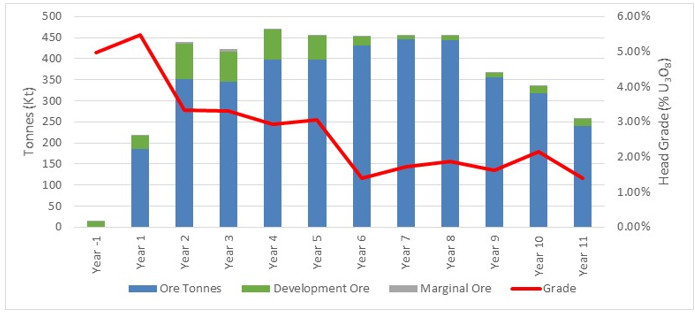
Shaft sinking will occur through a variety of stable and unstable strata, including water saturated overburden, Devonian Sandstone, Cretaceous Shales and Athabasca Sandstones, and finally into the basement rocks.
The processing of uranium ore will generate tailings and will be returned UG as paste backfill to the production stopes and into stopes that will be created for the purpose of paste backfill placement, the UGTMF. The UGTMF will be located on the north side of the deposit and will consist of waste stopes and related development.
Transverse stope mining will be used in areas of wider stopes (generally greater than 12 m), while longitudinal retreat stope mining will be used in areas of thinner stope widths. Transverse longhole mining will be completed using primary and secondary stoping sequences to avoid leaving pillars. Mechanized and remotely operated equipment will reduce worker exposure to physical hazards.
Ore handling involves load-haul-dump (“LHD”) units transporting material to centrally located ore and waste passes. Ore will be sized and conveyed to the Production Shaft for surface transport. Separate handling systems will manage development waste and tailings.
17
The ventilation system is designed as a predominately negative or “pull” system. Fresh air will be distributed throughout the mine from two primary shaft stations from the Production Shaft and internal ramp. The auxiliary ventilation system will utilize both flow-through and extraction ventilation to exhaust contaminated air from localized areas to return air drifts and raises.
The Rook I mine will be developed using a high degree of equipment mechanization. Each of the main pieces of equipment will have remote operating capability, and in some cases will be autonomous to reduce radiation exposure. A raisebore machine will be used for development of ore and waste passes, and internal ventilation raises.
Processing and Recovery Operations
The process plant design for the Rook I Project is based on the metallurgical testing and on the latest unit processes successfully used in uranium process plants across the world, including plants in northern Saskatchewan. The design of tailings preparation has been improved to facilitate a more reliable tailings deposition strategy through the paste plant. The process plant will consist of the following.
| • | Ore sorting |
| • | Grinding |
| • | Leaching |
| • | Liquid-solid separation via counter current decantation and clarification |
| • | SX |
| • | Gypsum precipitation and washing |
| • | YC precipitation and washing |
| • | YC drying, calcining and packaging |
| • | Tailings preparation and paste tailings plant |
| • | Effluent treatment |
Plant throughput will be 1,300 t/d and design production will be 30 Mlb U3O8 per annum.
Water from the settling pond and fresh water from Patterson Lake will be fed to the process plant to provide the process requirements. The amount of water recycled from the settling pond has been further optimized to reduce the amount of fresh water required by using settling pond water for counter current decantation wash water and using belt filter filtrate for paste process water.
The major reagents required will include sulphur, sulphuric acid, unslaked lime, hydrogen peroxide, flocculant, kerosene, tertiary amine, isodecanol, sodium carbonate, magnesia, barium chloride and ferric sulphate.
Infrastructure, Permitting and Compliance Activities
Project Infrastructure
The key infrastructure contemplated for the Rook I Project includes the following.
| • | UG mine with two vertical shafts. |
| • | UG infrastructure, including material handling systems, maintenance facilities, fuel bay, explosives magazine, ventilation, paste backfill and paste tailings distribution system, electrical and communications facilities, UG water supply, dewatering facilities. |
| • | UGTMF. |
| • | Surface support infrastructure for the mine, including headframe and hoist facilities, surface explosives magazine, and ventilation fans. |
| • | Surface support infrastructure for the mill, including process plant, SX plant, effluent treatment plant, and acid plant. |
| • | Site support infrastructure, including accommodation camp, Liquefied Natural Gas (“LNG”) facilities, LNG power plant, mine and mill dry facilities, analytical and metallurgical laboratory and maintenance, warehouse and security buildings. |
| • | Surface ore storage stockpile facility. |
| • | Waste rock storage facilities for potentially acid generating (“PAG”), non-potentially acid generating (“NPAG”) and special waste materials. |
18
| • | Water management facilities, including: two site water runoff ponds, six contact water process ponds, a PAG stockpile runoff collection pond, and conveyance and diversion structures. |
| • | Domestic / industrial waste management areas. |
| • | Airstrip. |
| • | LNG power plant. |
Ore and Special Waste Stockpiles
There will be an ore stockpile area with multiple ore stockpiles of varying grades for blending purposes. A special waste stockpile will contain mineralized, but non-economic, material that will be processed through the plant alongside ore.
The ore and special waste stockpiles will be dual lined with high-density polyethylene (“HDPE”) and will be a self-contained facility capable of holding a full probable maximum precipitation (“PMP”) 24-hour event.
Environmental Studies
NexGen commenced collection of baseline data in 2015, with the majority of field studies commencing in 2018. Where necessary, some studies continued into 2019 and 2021 to complete the baseline data and information collection requirements for the Rook I Project environmental assessment.
Waste Rock Management Facility
Waste rock will be generated over the course of the life of mine (“LOM”) including PAG and NPAG waste rock. The PAG and NPAG waste rock will have separate storage areas. The PAG storage area will be HDPE lined and the NPAG storage area will not be lined.
Water Management
The water management infrastructure has been designed to maximize the diversion of non-contact surface runoff water away from the general site footprint and developed features. Precipitation events and snow melt runoff that come in contact with disturbed infrastructure areas, or potential contact zones, are captured, collected, and directed to respective impound areas identified as site runoff ponds or collection areas.
All ponds and pads containing mineralized or radiologically contaminated material have been designed to accommodate a PMP 24-hour event. These areas are self-contained in that the initial precipitation events are contained within the feature itself. The initial precipitation event does not exit elsewhere until pumped. These contained waters are tested before release to the environment based on regulatory requirements; water that does not meet specification will report to the effluent treatment plant for treatment.
Closure and Reclamation Planning
Following the completion of mining and milling activities, a detailed decommissioning plan will be developed in accordance with Provincial and Federal regulations and guidelines. Once finalized, the plan and an application for approval to decommission will be submitted to Provincial and Federal authorities. Following approval, decommissioning activities will commence.
Decommissioning will be preceded by the orderly cessation of operations and transition of the operation into a safe inactive state. Production mining will be completed, and active mining areas backfilled and secured. The mill processing circuits will be systematically shut down, flushed, and cleaned. Surface facilities, infrastructure, and equipment will be cleaned, as necessary, scanned, and prepared for decommissioning.
Wherever practicable, surface and UG infrastructure, equipment, and materials not required during the decommissioning phase and which meet radiological criteria for off-site removal will be salvaged, sold, or transferred off-site for recycling or disposal. Remaining infrastructure, equipment and materials will undergo final decommissioning on-site.
19
Permitting
There are several Federal and Provincial regulatory approvals required for a new uranium mine and mill development. Federally, under the authority of the Nuclear Safety Control Act, proponents wishing to carry out uranium mining and milling must first obtain a licence from the Federal nuclear regulator, the CNSC, authorizing the preparation of the site and construction. The CNSC licensing process is in progress. Before the CNSC can make a licensing decision, proponents are required to undergo an EA of the proposed project. As the Rook I Project falls under both Federal and Provincial jurisdictions for an EA, each of the CNSC and the ENV require completion of an EA prior to project approval. Provincial EA approval for the Rook I Project was received in November 2023. As licensing applications are in progress, any findings, including any notable issues that could materially impact NexGen’s ability to extract the Mineral Resources, were not available for inclusion in the Rook I FS Technical Report. Furthermore, no recommendations from the EA or licensing processes for future monitoring and/or management of environmental and social aspects of the Rook I Project were not available for inclusion in the Rook I FS Technical Report.
On July 12, 2022 the CNSC announced their acceptance of the draft EIS which followed a 30-day period during which the CNSC conducted a conformance review of the Corporation’s EIS submission. Completion of the CNSC conformance marked the formal commencement of the 90-day Federal public and technical EIS review period.
Provincial review of the draft EIS advanced in parallel to the CNSC review, with technical review comments from the ENV provided to NexGen on September 22, 2022. The CNSC public and technical review concluded on October 12, 2022.
On December 1, 2022, the Corporation announced it had received all Federal information requests and public review comments and Provincial technical review comments on the Rook I draft EIS.
On August 21, 2023, NexGen announced the completion of the Provincial EA technical review process and submission of the Final Provincial EIS to the ENV. The ENV subsequently announced the commencement of the 30-day public review period for the Final Provincial EIS on September 2, 2023, which concluded on October 3, 2023.
On November 9, 2023, NexGen announced that it received Ministerial EA approval under The Environmental Assessment Act of Saskatchewan to proceed with the development of the Rook I Project.
On September 5, 2023 and in parallel to the Provincial EA process, NexGen submitted responses to Federal technical information requests received on the draft EIS through the Federal EA review process completed in Q4 2022. On November 14, 2023, the CNSC confirmed conclusion of the CNSC completeness check of NexGen’s submission and commencement of their technical review. Results of the CNSC technical review of NexGen’s responses were received on February 12, 2024.
On May 21, 2024, the Corporation submitted responses to the remaining information requests from the CNSC February 12, 2024 correspondence, along with a revised Federal EIS. The CNSC concluded their completeness check of NexGen’s May 21, 2024 submission on June 21, 2024.
On November 19, 2024, the CNSC confirmed completion of the Federal technical review of NexGen’s May 21, 2024 submission, that the Corporation’s responses to all information requests received through the Federal technical review process had been accepted, and that the information provided by the Corporation fully addresses the regulatory requirements for the Federal EA.
On November 29, 2024, NexGen submitted a Final Federal EIS package to the CNSC, including responses to comments received as part of the Federal public review period conducted on the draft EIS. On January 28, 2025, CNSC staff completed review of the package and deemed the Federal EIS package acceptable.
On March 11, 2025, the CNSC announced CNSC Hearing dates for the Project, with the public hearing to be conducted over two parts on November 19, 2025 and February 9 to 13, 2026, subject to which the CNSC will render an approval decision on the Rook I Project.
Social or Community Impacts
NexGen has engaged regularly and established relationships with local communities and Indigenous groups since 2013. Engagement mechanisms have included notification letters, meetings with leadership, community information sessions, establishing joint working groups (“JWGs”) for detailed discussions, and providing funding for traditional land use studies. The engagement process will continue throughout the EA and licensing processes.
In Q4 2019, NexGen entered into Study Agreements (the “Study Agreements”) with the following four Indigenous groups.
20
| • | CRDN |
| • | MN-S including on behalf of the Locals of MN-S Northern Region II |
| • | BNDN |
| • | BRDN |
The Study Agreements provided a framework for working collaboratively to advance the EA and exchange information that will be used to inform the Crown as the Crown undertakes its Duty to Consult.
The Study Agreements provided funding to each Indigenous group and outlined a collaborative process for formal engagement to support the inclusion of Indigenous knowledge in the EA. The Study Agreements also outlined processes for identifying potential effects to Indigenous rights, treaty rights, and socio-economic interests, and avoidance and accommodation measures in relation to the Rook I Project.
Since the execution of the Study Agreements, the Corporation has entered into Benefit Agreements with each of the above mentioned Indigenous groups formalizing their support for the Rook I Project.
Cost Estimate
Except for the table under “Sensitivity Analysis”, the information below has been derived from the Rook I FS Technical Report and reflects the Feasibility Study base case. The Sensitivity Analysis table is provided for illustrative purposes only and compares selected economic metrics from the Rook I FS Technical Report with the illustrative impact of the cost assumptions disclosed in the Interim Trend Update. The Interim Trend Update was prepared for ongoing project financing discussions and disclosed as a trend report for cost sensitivities; it does not change the base case or constitute an economic analysis derived from material scientific or technical information not included in the Rook I FS Technical Report.
Capital Cost Estimates
Mining capital costs primarily comprise the following areas: shaft sinking, lateral mine development, shaft and hoisting infrastructure, mobile equipment, and UG mine infrastructure. Process plant costs include the construction of the entirety of the process plant facility. Infrastructure costs include provision for the LNG power plant, as well as site preparation, permanent camp, maintenance shop, fuel storage, administration and dry facility, water treatment systems, airstrip, and site roads. Indirect costs include temporary construction facilities, construction services and supplies, and construction management (“CM”) costs, construction equipment, freight, Owner’s costs, and contingency.
The table below, being Table 1-3 from the Rook I FS Technical Report, outlines the estimated capital costs for supplying, constructing, and pre-commissioning the Rook I Project before any potential impact from the Interim Trend Update.
Total Capital Cost Estimate
| Description | Units | Cost | ||||||||||||||
| Pre-commitment early works |
$ million | 157.9 | ||||||||||||||
| Project Capital |
||||||||||||||||
| UG Mining |
$ million | 240.0 | ||||||||||||||
|
Processing |
$ million | 216.4 | ||||||||||||||
| Site Development |
$ million | 27.7 | ||||||||||||||
| On-Site / Off-Site Infrastructure |
$ million | 118.9 | ||||||||||||||
| Subtotal Project Direct Costs |
$ million | 602.9 | ||||||||||||||
| Project Indirect Costs |
$ million | 326.5 | ||||||||||||||
| Project Owner’s Costs |
$ million | 97.9 | ||||||||||||||
| Subtotal Project Direct and Indirect Costs |
$ million | 1,027.2 | ||||||||||||||
| Project Contingency |
$ million | 114.8 | ||||||||||||||
| Total Project Capital |
$ million | 1,142.0 | ||||||||||||||
| Pre-production Capital Cost (Pre-Commitment & Project) |
$ million | 1,299.9 | ||||||||||||||
|
Sustaining |
$ million | 362.4 | ||||||||||||||
| Closure |
$ million | 69.5 | ||||||||||||||
|
Total |
$ million | 1,731.8 | ||||||||||||||
Note: totals may not sum due to rounding.
21
Sustaining capital incorporates all capital expenditures after the pre-production period. Capital costs also include reclamation costs of $78.6 million.
Operating Cost Estimates
Operating cost estimates were developed to present annual costs for production. Unit costs are expressed as $/tonne processed and $/lb U3O8. Operating costs were allocated to either mining, process, tailings facility and paste plant, or general and administration (“G&A”). LOM operating costs in the Rook I FS Technical Report were estimated to be $1,769.8 million. The table below is Table 1-4 from the Rook I FS Technical Report, and outlines the LOM operating costs before any potential impact from the Interim Trend Update.
UG mining begins with capital development in Year -2 and the capitalized development continues through the LOM.
Operating Cost Estimate Summary
| Description | LOM Cost
($ million) |
Average Annual
($ million) |
Unit Cost
($/t processed) |
Unit Cost
($/lb U3O8) | ||||
|
Mining |
691.3 | 64.6 | 151.09 | 2.96 | ||||
|
Processing |
647.0 | 60.5 | 141.41 | 2.77 | ||||
|
Tailing Facility and Paste Plant |
144.0 | 13.5 | 31.46 | 0.62 | ||||
|
G&A |
287.5 | 26.9 | 62.84 | 1.23 | ||||
|
Total |
1,769.8 | 165.4 | 386.80 | 7.58 | ||||
Note: totals may not sum due to rounding.
G&A costs include labour, camp and catering costs, flights to and from site, insurance premiums, general maintenance of the surface buildings, and marketing and accounting functions.
Economic Analysis
The results of an economic analysis represents forward-looking information that is subject to a number of known and unknown risks, uncertainties, and other factors that may cause actual results to differ materially from those presented here. Forward-looking statements include, but are not limited to, statements with respect to future uranium prices, estimation of Mineral Resources and Mineral Reserves, estimated mine production and uranium recovered, estimated capital and operating costs, and estimated cash flows generated from the planned mine production. Actual results may be affected by the following:
| • | Differences in estimated initial capital costs and development time from what has been assumed. |
| • | Unexpected variations in quantity of ore, grade, or recovery rates, or presence of deleterious elements that would affect the process plant or waste disposal. |
| • | Unexpected geotechnical and hydrogeological conditions from what was assumed in the mine designs, including water management during construction, mine operations, and post mine closure. |
| • | Differences in the timing and quantity of estimated future uranium production, costs of future uranium production, sustaining capital requirements, future operating costs, assumed currency exchange rate, requirements for additional capital, unexpected failure of plant, or equipment or processes not operating as anticipated. |
| • | Changes in government regulation of mining operations, environment, and taxes. |
| • | Unexpected social risks, higher closure costs and unanticipated closure requirements, mineral title disputes or delays to obtaining surface access to the property. |
If additional mining, technical, and engineering studies are conducted, these may alter the project assumptions presented and may result in changes to the calendar timelines and the information and statements.
Full development and licensing approvals are not currently in place, and statutory permits, including environmental permits, are required to be granted prior to mine commencement.
The economic analysis did not include any estimates involving the Mineral Resources that are not Mineral Reserves.
22
The Rook I Project has been evaluated using discounted cash flow analysis. Cash inflows consist of annual revenue projections. Cash outflows consist of project capital expenditures, sustaining capital costs, operating costs, taxes, royalties, and commitments to other stakeholders. These are subtracted from revenues to arrive at the annual cash projections.
Cash flows are taken to occur at the mid point of each period. To reflect the time value of money, annual cash flow projections are discounted to the Rook I Project valuation date using the yearly discount rate. The discount rate appropriate to a specific project can depend on many factors, including the type of commodity, the cost of capital to the project, and the level of project risks (e.g., market risk, environmental risk, technical risk, and political risk) in comparison to the expected return from the equity and money markets.
The base case discount rate is 8%. The discounted present values of the cash flows are summed to arrive at the Rook I Project’s NPV. In addition to the NPV, the IRR and the payback period are also calculated. The IRR is defined as the discount rate that results in an NPV equal to zero. The payback period is calculated as the time required to achieve positive cumulative cash flow for the Rook I Project from the start of production.
The table below includes Table 1-5 from the Rook I FS Technical Report, before any potential impact from the Interim Trend Update. See “Sensitivity Analysis” below with respect to the illustrative impact of the Interim Trend Update:
LOM Cashflow Forecast Summary Table
| Description | Units |
Feasibility Study (Q4 2020 Dollars) | ||||||
|
Gross revenue |
$ million | 15,573.2 | ||||||
|
NSR |
$ million | 15,573.2 | ||||||
|
Less: revenue royalties |
$ million | (1,129.1) | ||||||
|
Net revenue |
$ million | 14,444.1 | ||||||
|
Less: total operating costs |
$ million | (1,769.8) | ||||||
|
Operating cash flow |
$ million | 12,674.3 | ||||||
|
Less: capital costs |
$ million | (1,573.9) | ||||||
|
Pre-tax cash flow |
$ million | 11,100.4 | ||||||
|
Less: provincial profit royalties |
$ million | (1,683.5) | ||||||
|
Less: taxes |
$ million | (2,404.5) | ||||||
|
Post-tax cash flow |
$ million | 7,012.4 | ||||||
23
Sensitivity Analysis
The table below illustrates, for sensitivity purposes only, the impact of uranium price on key economic metrics for the Rook I Project, as presented in the Rook I FS Technical Report (Q4-2020 dollars) and, for comparison, the illustrative impact on such metrics from using cost assumptions disclosed in the Interim Trend Update (Q4-2023 dollars):
| Feasibility Study (Q4 2020 Dollars) | Interim Trend Update (Q4 2023 Dollars) | |||||||||||||||
| Uranium Price (US$/ lb) |
Average Annual Free Cash Flow (Y1-5) (C$ billion) |
Payback Period (Years) |
IRR (%) |
NPV (C$ billion) |
Average Annual Free (Y1-5) (C$ billion) |
Payback Period (Years) |
IRR (%) |
NPV (C$ billion) | ||||||||
|
$100 |
2.11 | 0.6 | 81.6 | 8.13 | 2.04 | 1 | 46.9 | 6.79 | ||||||||
|
$90 |
1.9 | 0.6 | 76.8 | 7.2 | 1.82 | 1.1 | 43.4 | 5.84 | ||||||||
|
$80 |
1.68 | 0.7 | 71.5 | 6.27 | 1.61 | 1.2 | 39.6 | 4.89 | ||||||||
|
$70 |
1.47 | 0.7 | 65.8 | 5.33 | 1.39 | 1.3 | 35.4 | 3.96 | ||||||||
|
$60 |
1.25 | 0.8 | 59.5 | 4.4 | 1.18 | 1.6 | 30.7 | 3.04 | ||||||||
|
$50 (FS Base Case) |
1.04 | 0.9 | 52.4 | 3.47 | 0.97 | 2 | 25.2 | 2.1 | ||||||||
|
$40 |
0.82 | 1.1 | 44 | 2.53 | 0.76 | 2.6 | 18.9 | 1.19 | ||||||||
|
$30 |
0.61 | 1.3 | 33.8 | 1.59 | 0.55 | 3.8 | 10.5 | 0.23 | ||||||||
| 1. | The Base Case from the Rook I FS Technical Report uses a discount rate of 8%. Free Cash Flow represents the after-tax net cash flow from the Project, determined in accordance with the Rook I FS Technical Report. It assumes that 100% of the uranium produced from the Rook I Project can be sold at a long-term price of US$50/lb U3O8 at an exchange rate of C$/US$ of 1.00:0.75. |
| 2. | The Interim Trend Update reflects revised capital and operating cost assumptions for the Rook I Project as of August 1, 2024, including updated estimates for sustaining capital, royalties, and taxes. |
| 3. | As noted in the Rook I FS Technical Report, NPV and IRR are most sensitive to uranium price, head grade, process recovery, and exchange rates. To demonstrate these sensitivities, the Rook I FS Technical Report includes an extended sensitivity analysis (Figures 22-2 and 22-3) illustrating the impact of uranium price fluctuations on project economics. The Interim Trend Update indicates that positive after-tax NPV (8%) is maintained across the range of uranium price scenarios, including at US$30/lb U3O8. The sensitivity information is provided for illustrative purposes only, is not an updated feasibility study or an economic analysis derived from material scientific or technical information not included in the Rook I FS Technical Report, and does not represent forecasts of uranium prices or prices at which uranium produced from the Rook I Project can be sold. |
Interpretation and Conclusions
The Rook I Project indicates positive economics. The anticipated Rook I Project cash flow is most sensitive to the price of uranium, head grade, and process recovery. The Canadian dollar to United States dollar exchange rate significantly influences Rook I Project economics.
Exploration, Development and Production Recommendations
Development and Production
Due to the positive, robust economics, it is recommended to advance the Rook I Project to the next phase of engineering. The recommended development path is to continue to advance the EA and licensing efforts while concurrently advancing key activities that will provide further project definition and reduce project execution timeline risks. Associated project risks are manageable and identified opportunities can provide enhanced economic value.
Engineering and field investigations should be advanced in support increased certainty of costs and project timelines in preparation for regulatory approvals and a Final Investment Decision.
Exploration
Exploration will focus on areas near possible future infrastructure to maximize economic viability of any newly identified resources and provide streamlined supply for eventual mill capacity. Once these areas are fully tested there will be a shift to geologically high priority targets across all of NexGen’s land packages (ie SW1, SW2, SW3).
Activities will include drilling of advanced targets while also completing geophysical surveys to create more drill-ready targets elsewhere. In conjunction, these methods will systematically investigate for additional uranium mineralization. Costs of such activity will vary based on methods used and amount of drilling completed.
24
Subsequent Exploration Activities
Since the effective date of the Rook I FS Technical Report, NexGen’s exploration programs have had a dual focus on the advancement of the Rook I Project and the expanded exploration in the surrounding areas on SW2, as well as high priority targets on SW1 and SW3.
2021 Exploration Activities
The Corporation successfully completed its 2021 exploration drilling program which focused on regional exploration targets at SW2. SW2 is host to numerous electromagnetic (“EM”) conductors and structural corridors with high priority exploration targets within a 10 km radius of the Arrow Deposit, including along the Patterson Lake Corridor, which hosts the Arrow Deposit.
The 2021 exploration program completed 18 drill holes for a total of 10,849.04 m, of which 6,400.31 m targeted electromagnetic conductors (conductors) that neighbour the one hosting Arrow and 4,448.73 m targeted significantly below the current Arrow Deposit.
2022 Exploration Activities
The 2022 drill program tested structural corridors with intersections exhibiting favourable features indicative of uranium bearing systems, including strong alteration, reactivated brittle fault zones, and local dravite clay coated fractures. Results indicate these structural corridors lie along significant rheological/lithological contrasts interpreted as potential hosts for uranium mineralization. The program completed 11,784.7 m in 35 drill holes (including 6 restarts relating to casing issues) within the following five (5) structural corridors: Patterson Corridor, Derkson West, Derkson, PLC East, and Mirror.
2023 Exploration Activities
The 2023 drill program tested prospective conductors in proximity to the Arrow deposit in the winter. During summer 2023, exploration drilling was focussed on the R7 and Morrow corridors on the SW2 property. A total of 22,114.4 m were completed in 49 drill holes with numerous prospective intersections of structure and alteration for follow-up in future programs. Geophysical surveys for drill target generation and refinement were completed and a high-resolution magnetics survey was completed on SW2. Many of the refined targets through geophysics were successfully tested in 2023. The anomalies identified through the geophysical surveys will also be tested in subsequent programs.
2024 Exploration Activities
The 2024 drill program refocused in February after discovery of new mineralization on PCE, 3.5 km east of Arrow. Follow up drilling utilized broadly spaced targets that tied together structural disruption, well developed hydrothermal alteration, and continuity of mineralization. Results indicate a mineralized footprint of 600 m along strike with 600 m of depth extent. The vein-type uranium is steeply dipping and hosted in competent basement rock, characteristically similar to Arrow. A high-grade sub domain that spans 100 m along strike and 170 m of depth extent was loosely defined. In total, 34,210 m and 46 drill holes were completed. Geophysical surveys to advance interpretations and prioritize drill ready targets were carried out as part of the winter program.
Refer to the News Releases dated May 29, 2024, August 8, 2024 and November 12, 2024, and filed under the Corporation’s profile on SEDAR+ at www.sedarplus.ca and on EDGAR at www.sec.gov/edgar for spectrometer results of the 2024 drill program.
All core on NexGen properties must be measured thoroughly for radioactivity with a handheld RS-125 spectrometer or RS-120 spectrometer. Measurement occurs in two stages. Once the core arrives from the drill site, an initial scan is done to separate the core with elevated levels of radioactivity. If the initial reading exceeds >300 counts per second (“cps”), additional readings are taken at 0.3 m to 0.5 m equal intervals per 1 m of core. If counts of 61,000 cps or greater are encountered, the core is broken out into an off-scale sub-interval. If the initial reading is <300 cps, the core is entered at the approximate high measurement.
2025 Exploration Activities
In 2025, NexGen announced the commencement of a 43,000 m exploration drill program to continue testing the extents of mineralization identified in early 2024 at the PCE discovery. Drilling in 2025 has focused, and will continue to focus, on testing the interpreted extents of mineralization, following up on higher-intensity radiometric intervals within the mineralized zone, with ongoing evaluation for additional mineralization within the same target area.
Objectives of the 2025 program at PCE included continued testing of the extents of mineralization and follow-up on higher-intensity intervals identified in 2024. Drilling in 2025 expanded the interpreted limits of mineralization relative to the end of 2024. A total of 35,366.2 m were completed in 2025. A high-resolution magnetic survey was carried out in the fall on SW3 to advance interpretations and prioritize drill-ready targets.
25
During the third quarter of 2025, the Corporation announced that it has exercised its Right of First Refusal to acquire the 10% production carried interest held by Rio Tinto Exploration Canada Inc. over 39 of NexGen’s mineral claims in the Southwest Athabasca Basin, including those hosting the PCE discovery. The Corporation’s entire portfolio including the Arrow deposit is now 100% owned.2
RISK FACTORS
The operations of the Corporation are speculative due to the high-risk nature of its business which is the exploration of mining properties. These are not the only risks and uncertainties that NexGen faces. Additional risks and uncertainties not presently known to the Corporation or that the Corporation currently considers immaterial may also impair its business operations. These risk factors could materially affect the Corporation’s future operating results and could cause actual events to differ materially from those described in forward- looking statements relating to the Corporation.
Negative Operating Cash Flow and Dependence on Third-Party Financing
The Corporation has no source of operating cash flow and there can be no assurance that the Corporation will ever achieve profitability. Accordingly, the Corporation is dependent on third-party financing to continue exploration and development activities on the Corporation’s properties, maintain capacity and satisfy contractual obligations. Accordingly, the amount and timing of expenditures depends on the Corporation’s cash reserves and access to third-party financing. Failure to obtain such additional financing could result in delay or indefinite postponement of further exploration and development of the Corporation’s properties, including the Rook I Project, or require the Corporation to sell one or more of its properties (or an interest therein). In particular, there can be no assurance that the Corporation will have achieved profitability prior to the maturity date and may be required to finance the repayment of all or a part of the principal amount of the 2023 Debentures or 2024 Debentures (collectively, the “Debentures”). Failure to repay the Debentures in accordance with the terms thereof would have a material adverse effect on the Corporation’s financial position.
In the long-term, the Corporation’s success will depend on continued exploration, development and mining activities on its existing properties, which will ultimately determine the Corporation’s ability to achieve and maintain profitability and positive cash flow from operations, by developing the properties into profitable mining activities. The economic viability of mining activities, including the expected duration and profitability of the Rook I Project, has many risks and uncertainties. See “Risk Factors – General Inflationary Pressures” and “Risk Factors – Industry and Economic Factors that May Affect the Business” below.
Capital Intensive Operations and Uncertainty of Additional Financing
The Corporation’s operations are capital intensive and future capital expenditures are expected to be substantial. The Corporation will require significant additional financing to fund its operations, including the development of the Rook I Project and associated mine construction costs. In the absence of such additional financing, the Corporation will not be able to fund its operations, which may result in delays, curtailment or abandonment of any one or all of its uranium properties. See “Risk Factors – Exploration and Development Risks” below.
Although the Corporation has been successful in raising funds to date, there is no assurance that the Corporation will be successful in obtaining required financing in the future or that such financing will be available on terms acceptable to the Corporation. The Corporation’s access to third-party financing depends on several factors including the price of uranium, the results of ongoing exploration, the Corporation’s obligations under the Debentures, a claim against the Corporation, a significant event disrupting the Corporation’s business or uranium industry generally, or other factors may make it difficult or impossible to obtain financing through debt, equity, or other means on favourable terms, or at all. As previously stated, failure to obtain such additional financing could result in delay or indefinite postponement of further exploration and development of the Corporation’s properties, including the Rook I Project, or require the Corporation to sell one or more of its properties (or an interest therein).
The Price of Uranium and Alternate Sources of Energy
The price of the Corporation’s securities is highly sensitive to fluctuations in the price of uranium. Historically, the fluctuations in these prices have been, and are expected to continue to be, affected by numerous factors beyond the Corporation’s control. Such factors include, among others: demand for nuclear power; political and economic conditions in uranium producing and consuming countries; public and political response to a nuclear accident; improvements in nuclear reactor efficiencies; reprocessing of used reactor fuel and the re-enrichment of depleted uranium tails; sales of excess inventories by governments and industry participants; and production levels and production costs in key uranium producing countries.
2 Note: Certain claims comprising the Rook I property are subject to a 2% NSR royalty in favour of Advance Royalty Corporation (which can be reduced to 1% upon payment of $1.0 million).
26
In addition, nuclear energy competes with other sources of energy like oil, natural gas, coal and hydroelectricity. These sources are somewhat interchangeable with nuclear energy, particularly over the longer term. If lower prices of oil, natural gas, coal and hydroelectricity are sustained over time, it may result in lower demand for uranium concentrates and uranium conversion services, which, among other things, could lead to lower uranium prices. Growth of the uranium and nuclear power industry will also depend on continuing and growing public support for nuclear technology to generate electricity. Unique political, technological and environmental factors affect the nuclear industry, exposing it to the risk of public opinion, which could have a negative effect on the demand for nuclear power and increase the regulation of the nuclear power industry. An accident at a nuclear reactor anywhere in the world could affect acceptance of nuclear energy and the future prospects for nuclear generation.
All of the above factors could have a material and adverse effect on the Corporation’s ability to obtain the required financing in the future or to obtain such financing on terms acceptable to the Corporation, resulting in material and adverse effects on its exploration and development programs, cash flow and financial condition.
Exploration and Development Risks
Exploration for mineral resources involves a high degree of risk and few properties that are explored are ultimately developed into producing mines. The risks and uncertainties inherent in exploration and development activities include but are not limited to: general economic, market and business conditions; the regulatory process and actions; failure to obtain necessary permits and approvals; technical issues; new legislation; competitive and general economic factors and conditions; the uncertainties resulting from potential delays or changes in plans; the occurrence of unexpected events; and, the Corporation’s operational capacity to execute and implement its future plans. There is also no assurance that even if commercial quantities of ore are discovered that it will be developed and brought into commercial production, whether as expected or at all. The commercial viability of a mineral deposit once discovered is also dependent upon a number of factors, most of which factors are beyond the control of the Corporation and may result in the Corporation not receiving adequate return on investment capital, including significantly higher than expected capital costs to construct the mine and/or processing plant; significant delays, reductions or stoppages of mining development or uranium extraction activities; difficulty in marketing and/or selling uranium concentrates; significantly higher than expected extraction costs and significantly lower than expected uranium extraction. See “Risk Factors – General Inflationary Pressures” and “Risk Factors – Industry and Economic Factors that May Affect the Business” below. The Corporation’s ability to develop and bring the Rook I Project into production is dependent upon the services of appropriately experienced personnel and/or third-party contractors who can provide such expertise and develop appropriate systems and processes required to efficiently develop and operate the Rook I Project. There can be no assurance that the Corporation will have available to it the necessary expertise when and if it brings the Rook I Project into production. See “Risk Factors – Reliance upon Key Management and Other Personnel” below.
Business Readiness, Transition to an Operating Mine, and Remote Operations
As an exploration and development-stage mining company, NexGen faces significant risks in transitioning from exploration and development activities to an operational mine, including the need to establish and scale key systems, processes, and organizational capabilities. Successfully starting up operations requires the development of robust operational frameworks, supply chain logistics, technology integration, and management structures to support efficient production. The complexity of building out these critical functions introduces execution risk, and any inefficiencies, delays, or challenges in their implementation could impact the Corporation’s ability to achieve stable operations, increase costs, and materially affect the Corporation’s business and financial condition.
The Corporation’s principal project activities are conducted in a remote and isolated region of northern Saskatchewan with limited access and infrastructure. As the Corporation advances toward construction and, ultimately, operations, the site’s remoteness can amplify the consequences and costs of incidents and operational interruptions. In particular, medical response and emergency evacuation, logistics and supply chain continuity, weather-related access constraints, and contractor availability may be adversely affected by the site’s isolation. These factors may increase the duration and cost of responding to incidents, contribute to business interruption, increase mitigation and operating costs, and materially adversely affect the Corporation’s ability to execute its plans, as well as its business, results of operations, financial condition, or reputation.
27
Uninsurable Risks
Mining operations generally involve a high degree of risk. Exploration, development and production operations on mineral properties involve numerous risks, including but not limited to unexpected or unusual geological operating conditions, seismic activity, rock bursts, cave-ins, fires, floods, landslides, earthquakes and other environmental occurrences, and political and social instability, any of which could result in damage to, or destruction of, life or property, environmental damage and possible legal liability. Although the Corporation believes that appropriate precautions to mitigate these risks are being taken, operations are subject to hazards such as equipment failure or failure of structures, which may result in environmental pollution and consequent liability. It is not always possible to obtain insurance against all such risks and the Corporation may decide not to insure against certain risks because of high premiums or other reasons. Should such liabilities arise, they could reduce or eliminate the Corporation’s future profitability and result in increasing costs and a decline in the value of the Shares. While the Corporation may obtain insurance against certain risks in such amounts as it considers adequate, the nature of these risks is such that liabilities could exceed policy limits or be excluded from coverage. The potential costs that could be associated with any liabilities not covered by insurance or in excess of insurance coverage may cause substantial delays and require significant capital outlays, thereby adversely affecting the Corporation’s business and financial condition.
Reliance upon Key Management and Other Personnel
The Corporation relies on the specialized skills of management and third-party contractors in the areas of mineral exploration, geology, project development and business negotiations and management. The loss of any of these individuals or arrangements could have an adverse affect on the Corporation. The Corporation does not currently maintain key-man life insurance on any of its key employees. In addition, as the Corporation’s business activity continues to grow, it will require additional key financial, administrative and qualified technical personnel, and third-party contractors. Although the Corporation believes that it will be successful in attracting, retaining and training qualified personnel, there can be no assurance of such success. If it is not successful in attracting, retaining and training qualified personnel, the efficiency of the Corporation’s business could be affected, which could have an adverse impact on its future cash flows, earnings, results of operation and financial condition.
Even if appropriately skilled personnel and third-party contractors are secured, the timely and cost-effective completion of work will depend to a large degree on the satisfactory performance of such personnel and third-party contractors who will be responsible for different elements of the Corporation’s exploration and development work, including the site and mine plan. If any of these personnel or third-party contractors do not perform to accepted or expected standards, the Corporation may be required to hire different personnel or contractors to complete tasks, which may impact schedules and add costs to the Rook I Project, which, in some cases could be significant. A major contractor default, or the failure of the Corporation to properly manage contractor performance, could have an adverse impact on the Corporation’s future cash flows, earnings, results of operations and financial conditions.
Imprecision of Mineral Reserve and Resource Estimates
Mineral reserve and resource figures are estimates, and no assurances can be given that the estimated levels of uranium will be produced. Such estimates are expressions of judgment based on knowledge, mining experience, analysis of drilling results and industry practices. Valid estimates made at a given time may significantly change when new information becomes available. While the Corporation believes that its mineral resource estimate is well established and reflects management’s best estimates, by their nature, mineral resource estimates are imprecise and depend, to a certain extent, upon geological assumptions based on limited data, and statistical inferences which may ultimately prove unreliable. Should the Corporation encounter mineralization or formations different from those predicted by past sampling and drilling, resource estimates may have to be adjusted.
Pending Assay Results
Due to the nature of uranium and immediate visibility of radioactive content, in the interest of good disclosure practices it is the Corporation’s practice to measure the natural gamma radiation of all core using a Radiation Solutions Inc. RS-125 gamma-ray handheld spectrometer as soon as practicable and immediately announce the results thereof by news release. After core has been appropriately handled and logged, samples are dispatched for testing. Assay results historically are generally received between 30 and 120 days after receipt of samples by the laboratory. The total count gamma readings using the spectrometer may not be directly or uniformly related to uranium grades of the sample measured and are only a preliminary indication of the presence of radioactive minerals. Core interval measurements and true thicknesses are not determined until assay results are received. There can be no assurance that assay results, once received, will confirm the previously announced spectrometer readings.
28
Climate Change
The exploration, development and future operations of NexGen’s properties may be adversely affected by climate change. Governments are moving to introduce climate change legislation and treaties at all levels of government. Changes to the climate, such as increased greenhouse gases and diminishing energy and water resources, may affect the cost and profitability of developing the Corporation’s properties. The scientific community has predicted an increase, over time, in the frequency and severity of extraordinary or catastrophic natural phenomena as a result of climate change. The Corporation can provide no assurance that NexGen will be able to predict, respond to, measure, monitor or manage the risks posed as a result. Physical climate change events, and the trend toward more stringent regulations aimed at reducing the effects of climate change, could impact the Corporation’s decision to pursue future opportunities, which could have an adverse effect on the business and future operations. There is no assurance that efforts to mitigate the risks of climate changes will be effective and that the physical risks of climate change will not have an adverse effect on the Corporation’s operations and profitability.
Potential Impact of Tariffs and Trade Restrictions
The imposition of tariffs and trade restrictions between Canada and the United States presents a risk to the Corporation and the global economy, which may have adverse effects on supply chains, capital expenditures, and operational costs. These tariffs, and any changes to these tariffs or imposition of any new tariffs, taxes or import or export restrictions or prohibitions, could have a material adverse effect on the Canadian economy, the Canadian mining industry and the Corporation. Furthermore, there is a risk that a broader trade war triggered by tariffs imposed by the United States on other countries could have a material adverse effect on the Canadian, United States and global economies, and by extension the Canadian mining industry and the Corporation.
Higher capital and operating costs resulting from tariffs may negatively impact project economics, profitability, and production efficiency. Supply chain disruptions and delays in procuring essential equipment could also affect project timelines and operational efficiency. In addition, the imposition of tariffs and other trade restrictions may also exacerbate other risk factors such as currency fluctuations and general economic volatility. Tariffs could impact trade flows, investor sentiment, and monetary policy decisions, leading to greater fluctuations in the CAD/USD exchange rate. These impacts may have a material adverse effect on the Corporation’s business, results of operations and financial condition.
Aboriginal Title and Consultation Issues
Aboriginal and treaty rights in Canada, as well as related consultation issues, may impact the Corporation’s ability to conduct exploration, development and mining activities at its mineral properties in Saskatchewan. The Corporation’s properties are located within areas subject to First Nation treaty rights and asserted aboriginal rights and title of the Métis, including an outstanding land claim that encompasses a large portion of northern Saskatchewan and Alberta. The legal requirements associated with aboriginal and treaty rights in Canada, including aboriginal title and land claims, are complex and constantly evolving. While the decision of the Supreme Court of Canada in Tsilhqot’in Nation v. British Columbia (2014 SCC 44) provided additional clarity in relation to the scope and content of aboriginal title in Canada, there remains considerable uncertainty about how aboriginal title claims will be reconciled with other interests in land. For example, the Tsilhqot’in decision did not fully address the impacts of a declaration of aboriginal title on third-party interests, including holders of mineral rights, within aboriginal title lands. The Federal government has also recently introduced proposed legislation to implement the United Nations Declaration on the Rights of Indigenous Peoples in Canada, the impacts of which may not be fully understood for some time. Developing and maintaining strong relationships with First Nations and Métis people is a matter of paramount importance to the Corporation. However, there can be no assurance that aboriginal and treaty rights claims and related consultation issues, including outstanding land claims, will not arise on or impact the Corporation’s mineral properties. These legal requirements and the risk of Indigenous Peoples’ opposition may increase our operating costs and affect our ability to carry on our business. See “Legal Proceedings and Regulatory Actions”.
Title to Properties
NexGen has diligently investigated all title matters concerning the ownership of all mineral claims and plans to do so for all new claims and rights to be acquired. While to the best of its knowledge, titles to NexGen’s mineral properties are in good standing, this should not be construed as a guarantee of title. NexGen’s mineral properties may be affected by undetected defects in title, such as the reduction in size of the mineral titles and other third-party claims affecting NexGen’s interests. Maintenance of such interests is subject to ongoing compliance with the terms governing such mineral titles. Mineral properties sometimes contain claims or transfer histories that examiners cannot verify. A successful claim that NexGen does not have title to any of its mineral properties could cause NexGen to lose any rights to explore, develop and mine any minerals on that property, without compensation for its prior expenditures relating to such property.
29
Information Systems and Cyber Security
The Corporation’s information systems are vulnerable to an increasing threat of continually evolving cybersecurity risks. Unauthorized parties may attempt to gain access to these systems or the Corporation’s information through fraud or other means of deception. The Corporation’s operations depend, in part, on how well the Corporation and those entities with which it does business, protect networks, equipment, information technology systems and software against damage from a number of threats. The failure of information systems or a component of information systems could, depending on the nature of any such failure, adversely impact the Corporations reputation and results of operations.
Although to date the Corporation has not experienced any material losses relating to cyber-attacks or other information security breaches, there can be no assurance that the Corporation will not incur such losses in the future. The Corporation’s risk and exposure to these matters cannot be fully mitigated because of, among other things, the evolving nature of these threats. As a result, cyber security and the continued development and enhancement of controls, processes and practices designed to protect systems, computers, software, data and networks from attack, damage or unauthorized access remain a priority.
Conflicts of Interest
Directors and officers of NexGen are and may become directors of other public companies or hold significant shareholdings in other mineral resource companies. The directors and officers of NexGen are required by law to, at all times, act honestly and in good faith with a view to the best interests of NexGen. In the event that any such director has a material interest in a material contract or transaction of NexGen that is subject to review and approval by the Board, such director is required to disclose such conflict to the Board and abstain from voting on any resolution in respect of such contract or transaction. NexGen and its directors will monitor and manage conflicts of interests in compliance with applicable laws.
Permits and Licences
NexGen’s exploration and development activities are subject to receiving and maintaining licenses, approvals and permits (collectively, “permits”) from appropriate governmental and non-governmental authorities. NexGen may be unable to obtain on a timely basis or on reasonable terms or maintain in the future all necessary permits to explore and develop its properties, commence construction or operating of mining facilities and properties. Delays may occur in obtaining necessary renewals or modifications of permits for NexGen’s existing activities, additional permits for existing or future operations and activities, or additional or amended permits associated with new legislation. Such permits will be subject to changes in rules, regulations and/or new legislation and in various operating circumstances. There can be no assurance that NexGen will be able to obtain all necessary permits required to carry out planned exploration, development and mining operations at any of its projects or that such necessary permits may not be refused or revoked in the future.
Development and operation of NexGen’s Rook I Project requires approval from various governmental and non- governmental authorities in Canada. There can be no assurance that all future permits that NexGen requires for its operations at Rook I will be obtainable on reasonable terms, or at all. Delay or a failure to obtain required permits would materially affect NexGen’s business.
Environmental and Other Regulatory Requirements
Environmental and other regulatory requirements affect the current and future operations of NexGen, including exploration and development activities, require permits from various Federal and local governmental authorities and such operations are and will be governed by laws and regulations governing prospecting, development, mining, production, exports, taxes, labour standards, occupational health, waste disposal, toxic substances, land use, environmental protection, mine safety and other matters. NexGen believes it is in substantial compliance with all material laws and regulations which currently apply to its activities. Companies engaged in the development and operation of mines and related facilities often experience increased costs, along with delays in production and other schedules, as a result of the need to comply with applicable laws, regulations and permits.
Additional permits and studies, which may include environmental impact studies conducted before permits can be obtained, may be necessary prior to operation of NexGen’s mineral properties. There can be no assurance that NexGen will be able to obtain or maintain all necessary permits that may be required to commence construction, development or operation of mining facilities at NexGen’s mineral properties on terms which enable operations to be conducted at economically justifiable costs. Further, such additional permits and studies may require significant capital outlays, impacting NexGen’s earning power, or cause material changes in its intended activities.
30
Failure to comply with applicable laws, regulations, and permitting requirements may result in enforcement actions, including orders issued by regulatory or judicial authorities causing operations to cease or be curtailed, and may include corrective measures requiring capital expenditures, installation of additional equipment, or remedial actions. Parties engaged in mining operations may be required to compensate those suffering loss or damage by reason of the mining activities and may have civil or criminal fines or penalties imposed for violations of applicable laws or regulations and, in particular, environmental laws.
Past or ongoing violations of mining or environmental laws could provide a basis to revoke existing permits or to deny the issuance of additional permits. In addition, evolving reclamation or environmental concerns may threaten NexGen’s ability to renew existing permits or obtain new permits in connection with future development, expansions and operations.
Amendments to current laws, regulations and permits governing operations and activities of mining companies, or more stringent implementation thereof, could have a material adverse impact on NexGen and cause increases in capital expenditures or production costs or reductions in levels of production at producing properties or require abandonment or delays in development of new mining properties.
Political Regulatory Risks
Any changes in government policy may result in changes to laws affecting ownership of assets, mining policies, monetary policies, taxation, rates of exchange, environmental regulations, labour relations and return of capital. Any such changes may affect both NexGen’s ability to undertake exploration and development activities in respect of present and future properties in the manner currently contemplated, and its ability to continue to explore, develop and operate those properties in which it has an interest or in respect of which it has obtained exploration and development rights to date. The possibility that future governments may adopt substantially different policies, which might extend to expropriation of assets, cannot be ruled out.
Competition
The mineral exploration business is a competitive business. The Corporation competes with numerous other companies and individuals who may have greater financial resources in the search for and the acquisition of personnel, funding and attractive mineral properties. As a result of this competition, the Corporation may be unable to obtain additional capital or other types of financing on acceptable terms or at all, acquire properties of interest or retain qualified personnel.
Trading Price and Volatility of Shares
The trading price of the Shares may be subject to large fluctuations. The trading price of the Shares may increase or decrease in response to a number of events and factors, including: the price of metals and minerals including the price of uranium; the Corporation’s operating performance and the performance of competitors and other similar companies; exploration and development of the Corporation’s properties; the public’s reaction to the Corporation’s press releases, other public announcements and the Corporation’s filings with the various securities regulatory authorities; changes in earnings estimates or recommendations by research analysts who track the Shares or the shares of other companies in the resource sector; changes in general economic conditions; the volume of Shares publicly traded; the arrival or departure of key personnel; and acquisitions, strategic alliances or joint ventures involving the Corporation or its competitors.
In addition, the market price of the Shares is affected by many variables not directly related to the Corporation’s success and not within the Corporation’s control, including: developments that affect the market for all resource sector shares; the breadth of the public market for the Shares; and the attractiveness of alternative investments. In addition, securities markets have recently experienced an extreme level of price and volume volatility, and the market price of securities of many companies has experienced wide fluctuations which have not necessarily been related to the operating performance, underlying asset values or prospects of such companies. As a result of these and other factors, the Corporation’s share price may be volatile in the future and may decline below the price at which an investor acquired its shares. Accordingly, investors may not be able to sell their securities at or above their acquisition cost.
General Inflationary Pressures
General or market specific inflationary pressures, including international trade issues such as tariffs and export taxes, may affect labour, development, mining, and other costs, which could have a material adverse effect on the Corporation’s financial condition, results of operations and the capital expenditures required to advance the Corporation’s business plans. There can be no assurance that any governmental action taken to control inflationary or deflationary cycles will be effective or whether any governmental action may contribute to economic uncertainty. Governmental action to address inflation or deflation may also affect currency values. Accordingly, inflation and any governmental response thereto may have a material adverse effect on the Corporation’s business, results of operations, cash flow, financial condition and the price of the Common Shares.
31
Industry and Economic Factors that May Affect the Business
The business of mining for minerals involves a high degree of risk. NexGen is an exploration and development company and is subject to risks and challenges similar to companies in a comparable stage and industry. These risks include, but are not limited to, the challenges of securing adequate capital, exploration, development and operational risks inherent in the mining industry; changes in government policies and regulations; the ability to obtain the necessary permitting; and global economic and uranium price and foreign exchange volatility; all of which are uncertain. The Corporation’s expected mining activities may change as a result of any one or more of these risks and uncertainties and there is no assurance that any resources that the Corporation extracts materials from will result in profitable mining activities.
The underlying value of the Corporation’s exploration and evaluation assets is dependent upon the existence and economic recovery of mineral reserves and is subject to, but not limited to, the risks and challenges identified above. Changes in future conditions could require material write-downs of the carrying value of the Corporation’s exploration and evaluation assets. Certain of NexGen’s properties are subject to various royalty agreements.
In particular, the Corporation does not generate revenue. As a result, the Corporation continues to be dependent on third-party financing to continue exploration and development activities on the Corporation’s properties, maintain capacity and satisfy contractual obligations including servicing the interest payments due on the Debentures and repaying the principal amount thereof at maturity (or sooner in the event of redemption in accordance with the terms of the Debentures). Accordingly, the Corporation’s future performance will be most affected by its access to financing, whether debt, equity or other means.
Access to such financing, in turn, is affected by general economic conditions, the price of uranium, exploration risks and the other factors described in this section entitled “Risk Factors”.
Potential Dilution from Future Financings
Additional financing needed to continue funding the exploration, development and operation of the Corporation’s properties may require the issuance of additional securities of the Corporation. The issuance of additional securities and the exercise of Shares, stock options and other convertible securities will result in dilution of the equity interests of any persons who are or may become holders of Shares.
Loss of Foreign Private Issuer Status in the Future
The Corporation may in the future lose its foreign private issuer status if a majority of the Shares are owned of record in the United States and the Corporation fails to meet the additional requirements necessary to avoid loss of foreign private issuer status. The regulatory and compliance costs to the Corporation under U.S. federal securities laws as a U.S. domestic issuer may be significantly more than the costs the Corporation incurs as a Canadian foreign private issuer eligible to use a multi-jurisdictional disclosure system (the “MJDS”) adopted in the United States and Canada. If the Corporation is not a foreign private issuer, it would not be eligible to use the MJDS or other foreign issuer forms and would be required to file periodic and current reports and registration statements on U.S. domestic issuer forms with the SEC, which are more detailed and extensive than the forms available to a foreign private issuer.
Reliance on a Third Party for Storage of U3O8 Purchased
The U3O8 purchased in connection with the 2024 Debentures is held by a third-party storage provider (the “Storage Provider”) pursuant to a storage contract that generally only allows for a book transfer of U3O8 between holders of accounts at such storage facility. Since the U3O8 held with the Storage Provider cannot physically be removed from the storage facility, except in limited specified circumstances, this could limit the number of potential buyers in the future.
In addition, the terms of the storage contract allow for the commingling of assets with ownership generally determined by book entry. Thus, if the Storage Provider were to become insolvent, or the Storage Provider or another third party were to seek to challenge the Corporation’s beneficial ownership of U3O8 held by the Storage Provider, it may be difficult not to only to access the storage facility but also to retrieve the Corporation’s U3O8 from storage. Any such challenge, if successful in preventing or delaying the Corporation from transferring or retrieving its U3O8 from storage, could have a material adverse effect on the Corporation’s business, results of operations or financial condition.
The Storage Provider’s liability to the Corporation for breaches of the storage contract is limited to the cost of the affected U3O8 and excludes any indirect, special, economic, incidental and consequential losses. If the Corporation suffers such losses, it may have no recourse against the Storage Provider, which could have a material adverse effect on the Corporation’s business, results of operations or financial condition.
32
The Corporation has the benefit of insurance arrangements obtained by a third party on standard industry terms to cover the loss of a portion of the physical uranium. There is no guarantee that insurance in favour of the Corporation will fully cover the Corporation in the event of loss or damage to U3O8. NexGen may be financially and legally responsible for losses and/or damages not covered by insurance. Such responsibility could have a material adverse effect on its business, results of operations or financial condition.
DIVIDENDS
Although not restricted from doing so, the Corporation has not paid any dividends since incorporation and the Corporation does not expect to pay dividends in the foreseeable future. Payment of dividends in the future will be made at the discretion of the Corporation’s board of directors based upon, among other things, cash flow, the results of operations and financial condition of the Corporation, the need for funds to finance ongoing operations and such other considerations as the board of directors considers relevant.
DESCRIPTION OF CAPITAL STRUCTURE
The authorized capital of NexGen consists of an unlimited number of Shares and an unlimited number of preferred shares. As at December 31, 2025, there were 659,960,072 Shares and no preferred shares issued and outstanding. As of the date hereof, there are 661,069,566 Shares and no preferred shares issued and outstanding.
Holders of Shares are entitled to receive notice of meetings of shareholders of the Corporation, to attend and to cast one vote per Share at all such meetings. Holders of the Shares are entitled to receive, on a pro rata basis, such dividends if, as and when declared by the Corporation’s board of directors. In the event of any liquidation, dissolution or winding-up of the Corporation or other distribution of the assets of the Corporation among holders of Shares for the purposes of winding-up its affairs, the holders of Shares will be entitled, subject to the rights of the holders of any other class or series of shares ranking senior to the Shares, to receive on a pro rata basis the remaining property or assets of the Corporation available for distribution, after the payment of debts and other liabilities. The Shares do not have attached to them any conversion, exchange rights, exercise, redemption or retraction provisions.
MARKET FOR SECURITIES AND TRADING PRICE AND VOLUME
The Shares are listed and posted for trading on the TSX and the NYSE under the symbol “NXE” and trade as CDIs on the ASX under the symbol “NXG”. The following table sets forth the high and low trading prices and trading volumes of the Shares on the TSX, NYSE and ASX on a monthly basis for the financial year ended December 31, 2025:
|
Month |
High TSX (C$)
|
Low TSX (C$)
|
Volume TSX
|
High NYSE (US$)
|
Low NYSE (US$)
|
Volume NYSE
|
High ASX (AUD$)
|
Low ASX (AUD$)
|
Volume ASX
| |||||||||
|
January |
10.76 | 8.75 | 36,979,106 | 7.49 | 6.09 | 176,084,833 | 12.07 | 10.18 | 3,891,902 | |||||||||
|
February |
9.55 | 7.55 | 29,090,935 | 6.68 | 5.22 | 174,558,212 | 10.74 | 8.37 | 10,863,626 | |||||||||
|
March |
7.39 | 6.45 | 45,358,445 | 5.17 | 4.49 | 229,174,798 | 8.46 | 7.20 | 12,008,057 | |||||||||
|
April |
7.36 | 5.77 | 33,748,874 | 5.30 | 4.06 | 213,486,563 | 8.67 | 6.51 | 11,131,967 | |||||||||
|
May |
8.90 | 7.22 | 35,833,366 | 6.41 | 5.24 | 198,223,086 | 10.08 | 8.08 | 13,753,592 | |||||||||
|
June |
9.49 | 8.24 | 35,987,435 | 6.99 | 6.02 | 215,987,928 | 10.79 | 9.30 | 7,828,047 | |||||||||
|
July |
10.13 | 8.81 | 41,243,679 | 7.43 | 6.43 | 165,730,163 | 11.14 | 9.66 | 8,043,580 | |||||||||
|
August |
10.81 | 8.93 | 37,506,539 | 7.88 | 6.46 | 149,772,345 | 11.75 | 9.99 | 8,522,651 | |||||||||
|
September |
12.70 | 10.49 | 47,923,349 | 9.10 | 7.60 | 176,424,595 | 13.92 | 11.55 | 11,862,958 | |||||||||
|
October |
13.71 | 11.44 | 79,619,308 | 9.78 | 8.16 | 278,339,086 | 15.04 | 12.66 | 18,268,533 | |||||||||
|
November |
12.85 | 10.64 | 40,945,645 | 9.14 | 7.56 | 158,979,883 | 15.09 | 11.82 | 14,129,907 | |||||||||
|
December |
13.83 | 11.30 | 42,355,810 | 9.90 | 8.20 | 156,091,917 | 14.83 | 12.49 | 18,622,114 | |||||||||
The price of the Shares as quoted by the TSX at the close of business on December 31, 2025 (being the last trading day in 2025) was C$12.63 and at the close of business on March 3, 2026 was C$16.86. The price of the Shares as quoted by the NYSE at the close of business on December 31, 2025 was US$9.20 and at the close of business on March 3, 2026 was US$12.36. The price of the Shares as quoted by the ASX at the close of business on December 31, 2025 was A$14.00 and at the close of business on March 3, 2026 was A$18.32.
33
PRIOR SALES
The following table sets forth the securities of the Corporation that were issued during the financial year ended December 31, 2025, but not listed or quoted on a marketplace:
| Issue or Grant Date |
Type of Security |
Conversion / Exercise Price per Security ($) |
Number of Securities |
Maturity / Expiry Date | ||||
| August 15, 2025 |
Stock Options(1) | 9.37 | 4,250,000 | August 15, 2030 | ||||
| December 10, 2025 |
Stock Options(1) | 13.04 | 7,714,167 | December 10, 2030 | ||||
Notes:
1. Stock options have a term of five (5) years and vest one third annually, commencing on the grant date.
DIRECTORS AND OFFICERS
The following table sets forth the name, province/state and country of residence, position(s) held with the Corporation and principal occupation during the five (5) preceding years of each person who is a director and/or an executive officer of the Corporation as at the date hereof.
|
Name and Province/State and Country of Residence(1) |
Position with NexGen and Employment for the Past Five Years | |
| Leigh Curyer(5), British Columbia, Canada |
President, CEO and Director of NexGen (April 19, 2013 to present); CEO and Director of NexGen’s predecessor (2011 to April 2013); Director of IsoEnergy Ltd. (February 2016 to present) and former Chairman (February 2016 to December 2023); and Partner, Head of Corporate Development of Accord Nuclear Resources Management (2008 to 2011). | |
| Chris McFadden, Brighton, Australia |
Director of NexGen (April 19, 2013 to present); Chairman of NexGen (May 22, 2014 to present); Director of IsoEnergy Ltd. (April 2016 to present); Director of Engenco Limited (April 2024 to September 2025) President and CEO of NxGold Ltd. (February 2017 to March 2020); Business Development Manager, Newcrest Mining Limited (August 2015 to January 2017); Head of Commercial, Strategy and Corporate Development Tigers Realm Coal Limited (2013 to July 2015); General Manager, Business Development of Tigers Realm Minerals Pty Ltd. (2010 to 2013); Managing Director of Resolution Minerals Limited (May 2023 – November 2023). | |
| Richard Patricio(2)(3)(4), Ontario, Canada | Director of NexGen (April 19, 2013 to present); President and CEO of Mega Uranium Ltd. (March 2015 to present) and Executive Vice President (2005 to 2015); Director of IsoEnergy Ltd. (April 2016 to present) and Chairman of IsoEnergy Ltd (December 2023 to present); CEO of Pinetree Capital Ltd. (February 2015 to April 2016); Vice-President, Legal and Corporate Affairs, Pinetree Capital Ltd. (investment firm) (2005 to February 2015). | |
| Sharon Birkett(2), Florida, USA |
Director of NexGen (June 17, 2025 to present); Director of ENVU (April 2024 to Present); Former Vice-President & Chief Financial Officer of Multi-Color Corp. (March 2010 to April 2022).
| |
| Warren Gilman(4), Hong Kong |
Director of NexGen (July 2017 to present); Chairman and CEO of Queen’s Road Central Capital Ltd. (2019 to present); Chairman of Queen’s Road Capital Investment Ltd. (August 2019 to present); Director of Gold Royalty Corp. (March 2021 to present); Director of Los Andes Copper (August 2021 to April 2024); Director of Chaarat Gold Holdings Limited (2019 to 2022); Director of Aurania Resources Ltd. (2019 to 2022); Director of Niobec Inc (2014 to 2019); Chairman and CEO of CEF Holdings (May 2011 to 2019); Managing Director and Head of Asia Pacific Region for Canadian Imperial Bank of Commerce (February 2002 to May 2011). | |
| Sybil Veenman(2)(5), Ontario, Canada |
Director of NexGen (August 27, 2018 to present); Director Royal Gold Inc. (January 2017 to present); Director of Major Drilling International Inc. (December 2019 to present); Director IAMGOLD Corporation (December 2015 to May 2021); Director Noront Resources Ltd. (August 2015 to February 2020); General Counsel of Barrick Gold Corporation (July 2010 to September 2014).
| |
| Karri Howlett(4)(5), Saskatchewan, Canada |
Director of NexGen (August 27, 2018 to present); Director of Gold Royalty Corp. (February 2022 – present); Director of Saskatchewan Power Corporation (February 13, 2013 to May 2021); President and Director of RESPEC Consulting Inc. (July 1, 2018 to March 21, 2019); President and Director of North Rim Exploration (November 2, 2009 to July 1, 2018); President of Karri Howlett Consulting Inc. (November 2006 – present). | |
34
| Brad Wall(5), Saskatchewan, Canada |
Director of NexGen (March 21, 2019 to present); Director of Ag Growth International Inc. (February 2026 to present); Director of REalloys Inc. (February 2026 to present); Director of Maxim Power Corp. (May 13, 2019 to present); Director of Whitecap Resources Inc. (July 30, 2019 to present); President of Flying W Consulting Inc. (November 2007 to present); Director of Helium Evolution Incorporated (2022 to present).
| |
| Ivan Mullany(3)(5), Ontario, Canada |
Director of NexGen (January 2023 to present); Non-executive Director of Westgold Resources Limited (May 2025 to present); Non-executive Director of BMC Minerals Ltd. (December 2025 to present); Senior Vice President Projects of Newmont Corporation (May 2019 to December 2022); Senior Vice President Technical Services of Goldcorp Inc. (August 2017 to May 2019), Global Director Mining & Mineral Processing of Hatch Ltd. (August 2015 to July 2017).
| |
| Travis McPherson, British Columbia, Canada |
Chief Commercial Officer of NexGen (January 2023 to present); Senior Vice President, Corporate Development of NexGen (2020 to 2022); Vice President, Corporate Development of NexGen (2017 to 2019); Manager, Investor Relations of NexGen (2015 to 2017) and Consultant to NexGen (2014 to 2015). | |
| Graeme Johnson Ontario, Canada |
Chief Project Officer of NexGen (October 2024 to present); Projects Director, Canada of Newmont Corporation (January 2018 to October 2024) | |
|
Benjamin Salter, British Columbia, Canada |
Chief Financial Officer of NexGen (August 2023 to present); Interim Chief Financial Officer and Vice President of Finance of NexGen (June 2023 to August 2023); Vice President of Finance of NexGen (2022 to 2023); Director, Finance of NexGen (2021 to 2022); Manager, Corporate Reporting of Methanex Corporation (2020 to 2021); Manager, Corporate Accounting of Methanex Corporation (2018 to 2019). | |
Notes:
| 1. | The information as to place of residence and principal occupation is not within the knowledge of the management of NexGen and has been furnished by the respective directors and officers of NexGen. |
| 2. | Member of the Audit Committee |
| 3. | Member of the Compensation Committee |
| 4. | Member of the Nomination and Governance Committee |
| 5. | Member of the Sustainability Committee |
Directors are elected at each annual meeting of NexGen’s shareholders and serve as such until the next annual meeting or until their successors are elected or appointed.
The directors and executive officers of NexGen, as a group, beneficially own, directly or indirectly, or exercise control or direction over 32,076,664 Shares, representing approximately 4.9% of the total number of Shares outstanding as of the date of this AIF, before giving effect to the exercise of options to purchase Shares held by such directors and executive officers. The statement as to the number of Shares beneficially owned, directly or indirectly, or over which control or direction is exercised by the directors and executive officers of NexGen as a group (i) is based upon information obtained from SEDI (the System for Electronic Disclosure by Insiders database) as at the date hereof and (ii) does not include Shares held by certain investors, including QRC, WHSP or MMCap, which are subject to voting alignment provisions under the terms of the investor rights agreement summarized under the “General Development of the Business” section.
Cease Trade Orders, Bankruptcies, Penalties and Sanctions
To the knowledge of the Corporation, no director, executive officer or promoter of the Corporation is, or within ten years prior to the date hereof has been, a director, chief executive officer or chief financial officer of any company (including the Corporation) that, (i) was subject to a cease trade order, an order similar to a cease trade order or an order that denied the relevant company access to any exemption under securities legislation, that was in effect for a period of more than 30 consecutive days, that was issued while the director or executive officer was acting in the capacity as director, chief executive officer or chief financial officer; or (ii) was subject to a cease trade order, an order similar to a cease trade order or an order that denied the relevant Corporation access to any exemption under securities legislation, that was in effect for a period of more than 30 consecutive days, that was issued after the director or executive officer ceased to be a director, chief executive officer or chief financial officer and which resulted from an event that occurred while that person was acting in the capacity as director, chief executive officer or chief financial officer.
35
To the knowledge of the Corporation, no director, executive officer or promoter of the Corporation, or a shareholder holding a sufficient number of securities of the Corporation to affect materially control of the Corporation, (i) is, or within ten (10) years prior to the date hereof has been, a director or executive officer of any company (including the Corporation) that, while that person was acting in that capacity, or within a year of that person ceasing to act in that capacity, became bankrupt, made a proposal under any legislation relating to bankruptcy or insolvency or was subject to or instituted any proceedings, arrangement or compromise with creditors or had a receiver, receiver manager or trustee appointed to hold its assets, or (ii) has, within ten years prior to the date hereof, become bankrupt, made a proposal under any legislation relating to bankruptcy or insolvency, or become subject to or instituted any proceedings, arrangement or compromise with creditors, or had a receiver, receiver manager or trustee appointed to hold the assets of the director, executive officer or shareholder.
To the knowledge of the Corporation, no director, executive officer or promoter of the Corporation, or a shareholder holding a sufficient number of securities of the Corporation to affect materially the control of the Corporation, has been subject to (i) any penalties or sanctions imposed by a court relating to securities legislation or by a securities regulatory authority or has entered into a settlement agreement with a securities regulatory authority; or (ii) any other penalties or sanctions imposed by a court or regulatory body that would likely be considered important to a reasonable investor in making an investment decision.
Conflicts of Interest
To the best of the Corporation’s knowledge, and other than as disclosed in this AIF, there are no known existing or potential conflicts of interest between NexGen and any director or officer of NexGen, except that certain of the directors and officers serve as directors and officers of other public companies, and therefore it is possible that a conflict may arise between their duties as a director or officer of NexGen and their duties as a director or officer of such other companies. See “Risk Factors — Conflicts of Interest”.
AUDIT COMMITTEE DISCLOSURE
The Audit Committee has the responsibility of, among other things: recommending the Corporation’s independent auditor to the Board of Directors, determining the extent of involvement of the independent auditor in reviewing unaudited quarter financial results, evaluating the qualifications, performance and independence of the independent auditor; reviewing and recommending approval of the Board of Directors of the Corporation’s annual and quarter financial results and management’s discussion and analysis and overseeing the establishment of “whistle-blower” and related procedures. A copy of the Audit Committee Charter is attached hereto as Schedule “A”.
Composition of the Audit Committee
The Audit Committee currently comprises Ms. Birkett (Chair), Messr. Patricio, and Ms. Veenman. All of the members of the Audit Committee are independent and financially literate, in each case, as defined under National Instrument 52-110 – Audit Committees (“NI 52-110”). A general description of the education and experience of each Audit Committee member which is relevant to the performance of his responsibilities as an Audit Committee member is contained in their respective biographies set out below:
Sharon Birkett, Director
Ms. Birkett has more than 20 years’ experience as a finance executive and strategic advisor, guiding global organizations, public and private boards of directors, and stakeholders on financial management, rapid business growth, and compliance. Over nearly two decades as Chief Financial Officer at Multi-Color (NASDAQ: LABL)/Collotype Labels, Ms. Birkett was responsible for financial planning and analysis, board reporting, compliance, and key corporate transactions. She substantially contributed to organizational growth and led over 30 bolt-on acquisitions ranging from $20 million to over $1 billion, creating significant shareholder value. Previously, Ms. Birkett served as Director of Finance for Avery Dennison Materials Pty Ltd. She holds an MBA from the University of Adelaide and a BA in Accounting from the University of South Australia and is a member of the Australian Society of Certified Practicing Accountants. Currently, Sharon is an independent director and audit committee chair of ENVU.
36
Richard Patricio, Director
In March 2015, Mr. Patricio was appointed Chief Executive Officer and President of Mega Uranium Ltd., having been its Executive Vice-President since 2005. From February 2015 to April 2016, Mr. Patricio was the Chief Executive Officer of Pinetree Capital Ltd., having been its Vice-President, Corporate and Legal Affairs since 2005. Previously, Mr. Patricio worked as in-house General Counsel for a senior TSX-listed manufacturing company. Prior to that, Mr. Patricio practiced law at Osler LLP in Toronto where he focused on mergers and acquisitions, securities law and general corporate matters. Mr. Patricio has built a number of mining companies with global operations and holds senior officer and director positions in several companies listed on stock exchanges in Toronto, Australia, London and New York. Mr. Patricio received his law degree from Osgoode Hall and was called to the Ontario bar in 2000.
Sybil Veenman, Director
Ms. Veenman has more than 30 years of mining industry experience, including as a senior executive and, as a public company director. Previously, Ms. Veenman was a Senior Vice-President and General Counsel and a member of the executive leadership team at Barrick Gold Corporation. In that capacity, Ms. Veenman was responsible for overall management of legal affairs, extensively engaged in that company’s significant M&A and financing transactions and involved in a wide range of operational, regulatory, political, and social responsibility aspects of the mining business. Ms. Veenman currently serves as Director at Nasdaq-listed Royal Gold Inc., and TSX-listed Major Drilling Group International Inc.
Audit Committee Oversight
At no time since the commencement of NexGen’s most recently completed financial year have any recommendations by the Audit Committee respecting the appointment and/or compensation of NexGen’s external auditors not been adopted by the Board.
Reliance on Certain Exemptions
At no time since the commencement of the Corporation’s most recently completed financial year has the Corporation relied on the exemption in Section 2.4 of NI 52-110 (De Minimis Non-Audit Services); Section 3.2 (Initial Public Offerings); Section 3.4 (Events Outside Control of Member); Section 3.5 (Death, Disability or Resignation of Audit Committee Member); an exemption from NI 52-110, in whole or in part, granted under Part 8 (Exemptions) of NI 52-110; the exemption in subsection 3.3(2) (Controlled Companies) or section 3.6 (Temporary Exemption for Limited and Exceptional Circumstances); or section 3.8 (Acquisition of Financial Literacy).
Pre-Approval Policies and Procedures
Pursuant to the terms of the Audit Committee Charter, the Audit Committee shall pre-approve all audit and non-audit services to be provided to NexGen by the external auditor.
External Auditor Service Fees (By Category)
The aggregate fees billed by the external auditors, KPMG LLP, in each of the last two (2) financial years are as follows:
| Financial Year Ending | Audit Fees(1) | Audit-Related Fees(2) | Tax Fees(3) | All Other Fees(4) | ||||
| 2024 |
$431,826 | Nil | Nil | Nil | ||||
| 2025 |
$614,145 | Nil | Nil | Nil | ||||
Notes:
| 1. | $173,378 of this amount in 2025 related to audit services performed in connection with securities filings (2024 - $81,691). |
| 2. | The aggregate fees for assurance and related services that are reasonably related to the performance of the audit or review of the Corporation’s financial statements which are not included under the heading “Audit Fees”. |
| 3. | The aggregate fees for professional services rendered for tax compliance, tax advice and tax planning. |
| 4. | The aggregate fees for products and services other than as set forth under the headings “Audit Fees”, “Audit Related Fees” and “Tax Fees”. |
LEGAL PROCEEDINGS AND REGULATORY ACTIONS
As of March 3, 2026, and during the fiscal year ended December 31, 2025, the Corporation is and was not subject to any material legal proceedings or regulatory actions.
37
INTEREST OF MANAGEMENT AND OTHERS IN MATERIAL TRANSACTIONS
Other than as described below and elsewhere in this AIF, no director, executive officer or person or company that beneficially owns, or controls or directs, directly or indirectly, more than 10% of the Shares of the Corporation or any associate or affiliate of any such person or company, has or had any material interest, direct or indirect, in any transaction either within the three most recently completed financial years or during the current financial year that has materially affected or is reasonably expected to materially affect the Corporation.
TRANSFER AGENT AND REGISTRAR
The transfer agent and registrar for the Shares in Canada is Computershare Investor Services Inc. at its principal offices in Vancouver, British Columbia and Toronto, Ontario. The co-transfer agent and registrar for the Shares in the United States of America is Computershare Trust Company, N.A. in Louisville, KY. The co-transfer agent and registrar for the CDIs in Australia is Computershare Investor Services Pty Limited in Perth, Western Australia.
MATERIAL CONTRACTS
The only material contracts entered into by the Corporation within the financial year ended December 31, 2025, or before such time that are still in effect, other than in the ordinary course of business, are as follows:
| • | The Shareholder Rights Plan Agreement dated April 22, 2017 between the Corporation and Computershare Investor Services Inc., as amended and restated on April 24, 2023. |
| • | The Trust Indenture dated September 22, 2023 between the Corporation and Computershare Trust Company of Canada with respect to the issuance of the 2023 Debentures. |
| • | The Trust Indenture dated May 28, 2024 between the Corporation and Computershare Trust Company of Canada with respect to the issuance of the 2024 Debentures. |
Copies of the above material contracts are available under the Corporation’s profile on SEDAR+ at www.sedarplus.ca.
INTERESTS OF EXPERTS
KPMG LLP, Chartered Accountants, provided an auditors report dated March 3, 2026 in respect of the Corporation’s financial statements for the year ended December 31, 2025. KPMG LLP are the auditor of NexGen Energy Ltd. and have confirmed with respect to NexGen Energy Ltd. that they are independent within the meaning of the relevant rules and related interpretations prescribed by the relevant professional bodies in Canada and any applicable legislation or regulations, and also that they are independent accountants with respect to NexGen Energy Ltd. under all relevant US professional and regulatory standards.
Mr. Simon Allard, P.Eng., Vice President, Commercial, and Mr. Jason Craven, P.Geo., Vice President, Exploration for NexGen, who are each a “Qualified Person” within the meaning of this term in NI 43-101, has reviewed and approved sections of this AIF that are of a scientific or technical nature. To the knowledge of NexGen, each of Messrs. Allard and Craven is the registered or beneficial owner, directly or indirectly, of less than one percent of the outstanding Shares.
The Rook I FS Technical Report was authored by Mr. Mark Hatton, P.Eng., Stantec Consulting Ltd (“Stantec”); Mr. Paul O’Hara, P.Eng., formely of Wood Canada Limited (“Wood”); and Mr. Mark Mathisen, C.P.G., Roscoe Postle Associates (USA) Ltd. (“RPA”) (now a part of SLR International Corporation). Each of Mr. Hatton and Mr. Mathisen is a “qualified person” and “independent” of the Corporation within the meaning of NI 43-101. Each of Stantec, Wood, and RPA are also independent within the meaning of NI 43-101 as at the date of the Rook I FS Technical Report. Mr. O’Hara was a “qualified person” and “independent” of the Corporation within the meaning of NI 43-101 as at the date of the Rook I FS Technical Report. Mr. O’Hara has since retired from Wood and, accordingly, the Corporation is no longer relying upon the work of Mr. O’Hara. Wood should now be regarded as the expert with respect to the portions of the Rook I FS Technical Report previously attributed to Mr. O’Hara.
To the knowledge of NexGen as of the date hereof, each of Messrs. Hatton, O’Hara, and Mathisen, and Stantec, Wood and RPA and each of their respective partners, employees and consultants who participated in the preparation of the Rook I FS Technical Report, or who were in a position to influence the outcome of such reports, are the registered or beneficial owner, directly or indirectly, of less than one percent of the outstanding Shares.
38
ADDITIONAL INFORMATION
Additional information relating to the Corporation can be found on SEDAR+ at www.sedarplus.ca; or on NexGen’s website at www.nexgenenergy.ca. Additional information, including directors’ and officers’ remuneration and indebtedness, principal holders of the Corporation’s securities and securities authorized for issuance under equity compensation plans is contained in the management information circular of the Corporation dated May 1, 2025, which is available on SEDAR+ at www.sedarplus.ca. Additional financial information is provided in the Corporation’s audited consolidated financial statements and management’s discussion and analysis for the financial year ended December 31, 2025.
39
SCHEDULE “A ”

AUDIT COMMITTEE CHARTER
| I. | ROLE AND OBJECTIVES |
The Audit Committee is a committee of the Board of Directors (the “Board”) of NexGen Energy Ltd. (the “Corporation”) to which the Board has delegated certain oversight responsibilities relating to the Corporation’s financial statements, external auditors, risk management, compliance with legal and regulatory requirements and management information technology. In this Charter, the Corporation and all entities controlled by the Corporation are collectively referred to as “NexGen”.
The objectives of the Audit Committee are to maintain oversight of:
| (a) | the Corporation’s accounting and financial reporting processes |
| (b) | the audits of the Corporation’s financial statements; |
| (c) | the integrity of the Corporation’s financial statements, the reporting process and its internal control over financial reporting; |
| (d) | the reports, qualifications, independence and performance of the Corporation’s external auditor; |
| (e) | the performance of the Corporation’s internal audit function; |
| (f) | the Corporation’s risk identification, assessment and management program; |
| (g) | the Corporation’s compliance with applicable legal and regulatory requirements; |
| (h) | the Corporation’s management of information technology related risks, including cybersecurity and data privacy, and those related to financial reporting and financial controls; and |
| (i) | the maintenance of open channels of communication among management of the Corporation, the external auditors and the Board. |
| II. | MEMBERSHIP AND POLICIES |
The Board, based on recommendations from the Nomination and Governance Committee, will appoint or reappoint members of the Audit Committee. Each member shall serve until his or her successor is appointed unless the member resigns, is removed or ceases to be a director. The Board of Directors may fill a vacancy that occurs in the Committee at any time.
The Audit Committee must be composed of not less than three (3) members of the Board, each of whom must be independent pursuant to the rules and regulations of all applicable stock exchanges and United States and Canadian securities laws and regulations.
No member of the Audit Committee may have participated in the preparation of the financial statements of the Corporation or any of its then-current subsidiaries at any time during the immediately prior three years.
Each member of the Audit Committee must be financially literate, as determined by the Board, and be able to read and understand fundamental financial statements, including the Corporation’s balance sheet, income statement, and cash flow statement. Additionally, at least one member of the Audit Committee must have accounting or related financial management expertise, as determined by the Board. A person who is an “audit committee financial expert” as defined in Item 407(d)(5)(ii) of Regulation S-K may be presumed to have accounting or related financial management expertise.
No member of the Audit Committee may serve simultaneously on the audit committee of more than two other public companies without prior approval of the Board.
A-1
The Board, in consultation with the Nomination and Governance Committee, will appoint or reappoint the Chair of the Audit Committee from amongst its members.
The Audit Committee may at any time retain outside financial, legal or other advisors as it determines necessary to carry out its duties, at the expense of the Corporation. The Corporation shall provide for appropriate funding, as determined by the Audit Committee in its capacity as a committee of the Board, for payment of: (i) compensation to the external auditor for the purpose of preparing or issuing an audit report or performing other audit, review or attestation services for the Corporation, (ii) compensation to any advisors employed by the Audit Committee, and (iii) ordinary administrative expenses of the Audit Committee that are necessary or appropriate in carrying out its duties.
In discharging its duties under this Charter, the Audit Committee may investigate any matter brought to its attention and will have access to all books, records, facilities and personnel, may conduct meetings or interview any officer or employee, the Corporation’s legal counsel, external auditors and consultants, and may invite any such persons to attend any part of any meeting of the Audit Committee.
The Audit Committee has neither the duty nor the responsibility to conduct audit, accounting or legal reviews, or to ensure that the Corporation’s financial statements are complete, accurate and in accordance with International Financial Reporting Standards (“IFRS”) as issued by the International Accounting Standards Board (“IASB”); rather, management is responsible for the financial reporting process, internal review process, and the preparation of the Corporation’s financial statements in accordance with IFRS, and the Corporation’s external auditor is responsible for auditing those financial statements.
| III. | SUB COMMITTEES |
The Audit Committee may, in its discretion, delegate any of its responsibilities that it is permitted by law to delegate, to the Chair or a subcommittee of the Audit Committee.
| IV. | FUNCTIONS |
| A. | Financial Statements, the Reporting Process and Internal Controls over Financial Reporting |
The Audit Committee will meet with management and the external auditor to review and discuss annual and quarterly financial statements, management’s discussion and analyses (“MD&A”), any earnings press releases, other financial disclosures and earnings guidance provided to analysts and rating agencies, and determine whether to recommend the approval of such documents to the Board and will produce the audit committee report required to accompany the annual financial statements.
| (a) | In connection with these procedures, the Audit Committee will, as applicable and without limitation review and discuss with management and the external auditor: |
| i. | the information to be included in the Corporation’s financial statements and other financial disclosures which require approval by the Board including the Corporation’s annual and quarterly financial statements, notes thereto, MD&A and any earnings press releases or earnings guidance provided to analysis and rating agencies, paying particular attention to any use of “pro forma”, “adjusted” and “non-GAAP” information, and ensuring that adequate procedures are in place for the review of the Corporation’s public disclosure of financial information extracted or derived from the financial statements; |
| ii. | any significant financial reporting issues, including major issues regarding accounting principles and financial statement presentations, identified during the reporting period; |
| iii. | any change in accounting policies, or selection or application of accounting principles, and their impact on the Corporation’s financial results and disclosure; |
| iv. | all significant estimates and judgments, significant risks and uncertainties madein connection with the preparation of the Corporation’s financial statements that may have a material impact to the financial statements; |
A-2
| v. | any significant deficiencies or material weaknesses identified by management or the external auditor, compensating or mitigating controls and the final assessment and impact of such deficiencies or material weaknesses on disclosure; |
| vi. | any major issues as to the adequacy of the internal controls and any special audit steps adopted in light of material internal control deficiencies; |
| vii. | significant adjustments identified by management or the external auditor and the assessment of associated internal control deficiencies, as applicable; |
| viii. | any unresolved issues between management and the external auditor that could materially impact the financial statements and other financial disclosures; |
| ix. | any material correspondence with regulators, government agencies, any employee or whistleblower complaints and other reports of non-compliance which raise issues regarding the Corporation’s financial statements or accounting policies and significant changes in regulations which may have a material impact on the Corporation’s financial statements; |
| x. | the effect of regulatory and accounting initiatives, as well as any off-balance sheet structures; |
| xi. | significant matters of concern respecting audits and financial reporting processes, including any illegal acts, that have been identified in the course of the preparation or audit of the Corporation’s financial statements; and |
| xii. | any analyses prepared by management and/or the external auditor setting forth significant financial reporting issues and judgments made in connection with the preparation of financial statements including analyses of the effects of IFRS on the financial statements. |
| (b) | In connection with the annual audit of the Corporation’s financial statements, the Audit Committee will review with the external auditor: |
| i. | prior to commencement of the annual audit, plans, scope, staffing, engagement terms and proposed fees; |
| ii. | reports or opinions to be rendered in connection with the audit including the external auditor’s review or audit findings report including alternative treatment of significant financial information within IFRS that have been discussed with management and the associated impact on disclosure; and |
| iii. | the adequacy of internal controls, any audit problems or difficulties, including: |
| a) | any restrictions on the scope of the external auditor’s activities or on access to requested information; |
| b) | any significant disagreements with management, and management’s response (including discussion among management, the external auditor and, as necessary, internal and external legal counsel); |
| c) | any litigation, claim or contingency, including tax assessments and claims, that could have a material impact on the financial position of the Corporation; and |
| d) | the impact on current or potential future disclosures. |
In connection with its review of the annual audited financial statements and quarterly financial statements, the Audit Committee will also review any significant concerns raised during the Chief Executive Officer (“CEO“) and Chief Financial Officer (“CFO“) certifications with respect to the financial statements and NexGen’s disclosure controls and internal controls. In particular, the Audit Committee will review with the CEO, CFO and external auditor: (i) all significant deficiencies, material weaknesses or significant changes in the design or operation of NexGen’s internal control over financial reporting that could adversely affect the Corporation’s ability to record, process, summarize and report financial information required to be disclosed by the Corporation in the reports that it files or submits under applicable securities laws, within the required time periods; and (ii) any fraud, whether or not material, that involves management of NexGen or other employees who have a significant role in NexGen’s internal control over financial reporting. In addition, the Audit
A-3
Committee will review with the CEO and CFO, NexGen’s disclosure controls and procedures and at least annually will review management’s conclusions about the efficacy of disclosure controls and procedures, including any significant deficiencies, material weaknesses or material non-compliance with disclosure controls and procedures.
The Audit Committee will also maintain a Whistleblower Policy, including procedures for the:
| (a) | receipt, retention and treatment of complaints received regarding accounting, internal accounting controls or auditing matters; and |
| (b) | confidential, anonymous submissions of concerns regarding questionable accounting or auditing matters. |
| B. | The External Auditor |
The Audit Committee, in its capacity as a committee of the Board, is directly responsible for overseeing the relationship, reports, qualifications, independence and performance of the external auditor and audit services by other registered public accounting firms engaged by the Corporation. The Audit Committee has responsibility to take, or recommend that the Board take, appropriate action to oversee the independence of the external auditor. The Audit Committee shall have the authority and responsibility to recommend the appointment and the revocation of the appointment of the external auditors engaged for the purpose of preparing or issuing an audit report or performing other audit, review or attest services, and to fix their remuneration.
The external auditor will report directly to the Audit Committee. The Audit Committee’s appointment of the external auditor is subject to annual approval by the shareholders.
With respect to the external auditor, the Audit Committee is responsible for:
| (a) | the appointment, termination, compensation, retention and oversight of the work of the external auditor engaged by the Corporation for the purpose of preparing or issuing an audit report or performing other audit, review or attest services for the Corporation, including the review and approval of the terms of the external auditors annual engagement letter and the proposed fees; |
| (b) | resolution of disagreements or disputes between management and the external auditor regarding financial reporting for audit, review or attestation services; |
| (c) | pre-approval of all audit services and legally permissible non-audit services to be provided by the external auditors considering the potential impact of such services on the independence of external auditors and, subject to any de minimis exemption available under applicable laws. Such approval of non-audit services can be given either specifically or pursuant to pre-approval policies and procedures adopted by the committee including the delegation of this ability to one or more members of the Audit Committee to the extent permitted by applicable law, provided that any pre-approvals granted pursuant to any such delegation may not delegate Audit Committee responsibilities to management of the Corporation, and must be reported to the full Audit Committee at the first scheduled meeting of the Audit Committee following such pre-approval; |
| (d) | obtaining and reviewing, at least annually, a written report by the external auditor describing the external auditor’s internal quality-control procedures, any material issues raised by the most recent internal quality-control review, or peer review, of the firm, or by any inquiry or investigation by governmental or professional authorities, within the preceding five years, respecting one or more independent audits carried out by the firm, and any steps taken to deal with any such issues and all relationships between the external auditors and the Corporation; |
| (e) | obtaining a formal written statement delineating all relationships between the auditor and the Corporation, consistent with The Public Company Accounting Oversight Board Rule 3526, and discussing any disclosed relationships or services with the auditor and how they may impact the objectivity and independence of the auditor; |
A-4
| (f) | review of the external auditor which assesses three key factors of audit quality for the Audit Committee to consider and assess including: independence, objectivity and professional skepticism; quality of the engagement team; and quality of communications and interactions with the external auditor. A written comprehensive review of the external auditor to be considered if required each year and completed at least every five (5) years which will include an: |
| i. | assessment of quality of services and sufficiency of resources provided by the external auditor; |
| ii. | assessment of auditor independence, objectivity and professional skepticism, including the review and evaluation of the lead partner of the external auditor; |
| iii. | assessment of value of services provided by the external auditor; |
| iv. | assessment of written input from external auditor summarizing: |
| a) | background of firm, size, resources, geographical coverage, relevant industry experience, including reputational challenges, systemic audit quality issues identified by Canadian Public Accountability Board (“CPAB“) and Public Company Accounting Oversight Board (“PCAOB“) in public reports; |
| b) | industry experience of the audit team and plans for training and development of the team; |
| c) | how the external auditor demonstrated objectivity and professional skepticism during the audit; |
| d) | how the firm and team met all criteria for independence including identification of all relationships that the external auditor has with the Corporation and its affiliates and steps taken to address possible institutional threats; |
| e) | involvement of engagement quality control review (“EQCR”) partner and significant concerns raised by the EQCR partner; |
| f) | matters raised to national office or specialists during the review; |
| g) | significant disagreements between management and the external auditors and steps taken to resolve such disagreements; |
| h) | satisfaction with communication and cooperation with management and the Audit Committee; and |
| i) | findings and firm responses to reviews of the Corporation by CPAB and PCAOB; |
| v. | communication of the results of the comprehensive review of the external auditor to the Board and recommending that the Board take appropriate action, in response to the review, as required. It is understood that the Audit Committee may recommend tendering the external auditor engagement at their discretion. In addition to rotation of the EQCR partner as required by law, the Audit Committee, together with the Board, will also consider whether it is necessary to periodically rotate the external audit firm itself. It will be at the discretion of the Audit Committee if the incumbent external auditor is invited to participate in the tendering process; and; |
| vi. | setting clear hiring policies for the Corporation regarding partners and employees and former partners and employees of the present and former external auditor of the Corporation. Before any such partner or employee is offered employment by the Corporation, prior approval from the Chair of the Audit Committee must be received and a one year grace period must pass from the date any work was last completed on an audit engagement before an external auditor employee can be considered for contract or employment by the Corporation. |
A-5
| C. | Risk Management |
The Audit Committee, in its capacity as a committee of the Board, is directly responsible for overseeing the risk identification, assessment and management program of the Corporation by discussing guidelines and policies to govern the process by which risk is identified, assessed and managed. At least annually, in conjunction with senior management, internal counsel and, as necessary, external counsel and the Corporation’s external auditors, the Audit Committee will review the following:
| (a) | the Corporation’s method of reviewing significant risks inherent in NexGen’s business, assets, facilities, and strategic directions, including the Corporation’s risk management and evaluation process; |
| (b) | discuss guidelines and policies with respect to risk assessment and risk management, including the Corporation’s major financial risk exposures and the steps management has taken to monitor and control such exposures. The Audit Committee is not required to be the sole body responsible for risk assessment and management, but, as stated above, the committee must discuss guidelines and policies to govern the process by which risk assessment and management is undertaken. |
| (c) | the major financial risk exposures and steps management has taken to monitor and manage such exposures; |
| (d) | the Corporation’s annual insurance report including its risk retention philosophy and resulting uninsured exposure, if any, including corporate liability protection programs for directors and officers; |
| (e) | the Corporation’s information technology cyber security and data privacy risks and related policies, including management’s related protections and risk mitigations; |
| (f) | the Corporation’s loss prevention policies, risk management programs, disaster response and recovery programs in the context of operational considerations; and |
| (g) | other risk management matters from time to time as the Audit Committee may consider appropriate or the Board may specifically direct. |
| D. | Internal Audit Review |
| (a) | Review and discuss the responsibilities, functions and performance of the Company’s internal audit function, including internal audit plans, budget, staffing and the scope and results of internal audits; |
| (b) | Ensure the reporting lines between the Audit Committee and the internal auditors are clearly understood and utilized; and |
| (c) | Review and discuss any reports by management regarding the effectiveness of, or any deficiencies in, the design or operation of internal controls and any fraud, whether or not material, that involves management or other employees who have a significant role in the Company’s internal controls. |
| E. | Additional Duties and Responsibilities |
The Audit Committee will also:
| (a) | report regularly to the Board on its discussions and actions, including any significant issues or concerns that arise at its meetings and discussion of the responsibilities, budget and staffing of the listed company’s internal audit function, and shall make recommendations to the Board as appropriate; |
| (b) | meet separately, and periodically, with management, internal auditors, the external auditor and, as is appropriate, internal and external legal counsel and independent advisors in respect of issues not elsewhere listed concerning any other audit, finance or risk matter; |
| (c) | review the appointment of the CFO and any other key financial executives who are involved in the financial reporting process; |
| (d) | review the Corporation’s information technology practices as they relate to financial reporting; |
| (e) | annually review Directors’ and Officers’ Liability Insurance Coverage; |
A-6
| (f) | from time to time, discuss staffing levels and competencies of the finance team with the external auditor; |
| (g) | review incidents, alleged or otherwise, as reported by whistleblowers, management, the external auditor, internal or external counsel or otherwise, of fraud, illegal acts or conflicts of interest and establish procedures for receipt, treatment and retention of records of incident investigations; |
| (h) | facilitate information sharing with other committees of the Board as required to address matters of mutual interest or concern in respect of the Corporation’s financial reporting; |
| (i) | assist Board oversight in respect of issues not elsewhere listed concerning the integrity of the Corporation’s financial statements, the Corporation’s compliance with legal and regulatory requirements, the independent auditor’s qualifications and independence, the performance of the external auditors, and the performance of the internal audit function; |
| (j) | have the authority and responsibility to recommend the appointment and the revocation of the appointment of registered public accounting firms (in addition to the external auditors) engaged for the purpose of preparing or issuing an audit report or performing other audit, review or attest services, and to fix their remuneration. |
In addition, the Audit Committee will perform such other functions as are assigned by law and on the instructions of the Board.
| V. | MEETINGS |
The Audit Committee will meet quarterly, or more frequently at the discretion of the members of the Audit Committee, as circumstances require.
Notice of each meeting of the Audit Committee will be given to each member and, if applicable, to the external auditors. The notice will:
| (a) | be in writing (which may be communicated by fax or email); |
| (b) | be accompanied by an agenda that states the nature of the business to be transacted at the meeting in reasonable detail; |
| (c) | include copies of documentation to be considered at the meeting and reasonably sufficient time to review documentation; and |
| (d) | be given at least 48 hours preceding the time stipulated for the meeting, unless notice is waived by the Audit Committee members. |
A quorum for a meeting of the Audit Committee is a majority of the members present in person, by video conference, webcast or telephone.
If the Chair is not present at a meeting of the Audit Committee, a Chair will be selected from among the members present. The Chair will not have a second or deciding vote in the event of an equality of votes.
At each meeting, the Audit Committee will meet “in-camera”, without management or external auditors present, and will periodically, and at least annually, meet in separate sessions with the lead partner of the external auditor and periodically with the internal auditor (or persons responsible for the internal audit function).
The Audit Committee may invite others to attend any part of any meeting of the Audit Committee as it deems appropriate. This includes other directors, members of management, any employee, the Corporation’s internal or external legal counsel, external auditors, advisors and consultants.
Minutes will be kept of all meetings of the Audit Committee. The minutes will include copies of all resolutions passed at each meeting, will be maintained with the Corporation’s records, and will be available for review by members of the Audit Committee, the Board, and the external auditor.
A-7
| VI. | OTHER MATTERS |
| A. | Review of Charter |
The Audit Committee shall review and reassess the adequacy of this Charter at least annually or otherwise, as it deems appropriate, and propose recommended changes to the Nomination and Governance Committee.
| B. | Reporting |
The Audit Committee shall report to the Board activities and recommendations of each Audit Committee meeting and review with the Board any issues that arise with respect to the quality or integrity of the Corporation’s financial statements, the Corporation’s compliance with legal or regulatory requirements, the performance and independence of the Corporation’s external auditors, management information technology with respect to financial reporting matters, risk management and communication between the parties identified above.
| C. | Evaluation |
The Audit Committee’s performance shall be evaluated annually by the Nomination and Governance Committee and the Board as part of the Board assessment process established by the Nomination and Governance Committee and the Board.
This Charter was last approved by the Board of Directors on August 6, 2024.
A-8
Exhibit 99.2
Management’s Discussion and Analysis
For the twelve months ended December 31, 2025
(expressed in thousands of Canadian dollars, except as noted)
CONTENTS
| CAUTIONARY NOTE REGARDING FORWARD-LOOKING INFORMATION AND STATEMENTS |
3 | |||
| BUSINESS OVERVIEW |
5 | |||
| 2025 HIGHLIGHTS |
5 | |||
| ROOK I PROJECT OVERVIEW |
6 | |||
| OPERATIONS OUTLOOK |
9 | |||
| HEALTH, SAFETY, AND ENVIRONMENT |
10 | |||
| FINANCIAL RESULTS |
10 | |||
| Financial Position Summary |
13 | |||
| Liquidity and Capital Resources |
13 | |||
| Capital Management |
15 | |||
| Contractual Obligations and Commitments |
16 | |||
| Summary of Quarterly Results |
16 | |||
| Related Party Transactions |
18 | |||
| Outstanding Share Data |
18 | |||
| Outstanding Convertible Debentures |
18 | |||
| OFF-BALANCE SHEET ARRANGEMENTS |
19 | |||
| SEGMENT INFORMATION |
19 | |||
| ACCOUNTING POLICY OVERVIEW |
19 | |||
| Critical Accounting Policies and Judgments |
19 | |||
| Key Sources of Estimation Uncertainty |
19 | |||
| FINANCIAL INSTRUMENTS AND RISK MANAGEMENT |
20 | |||
| Risk Factors |
20 | |||
| Financial Risks |
21 | |||
| Other Risk Factors |
22 | |||
| DISCLOSURE CONTROLS AND INTERNAL CONTROL OVER FINANCIAL REPORTING |
28 | |||
| Disclosure Controls and Procedures |
28 | |||
| Management’s Report on Internal Control Over Financial Reporting |
28 | |||
| TECHNICAL DISCLOSURE |
29 | |||
| APPROVAL |
29 |
1
NexGen Energy Ltd.
Management’s Discussion and Analysis for the twelve months ended December 31, 2025
(expressed in thousands of Canadian dollars, except as noted)
This Management’s Discussion and Analysis (“MD&A”) was prepared as of March 3, 2026 and provides an analysis of the financial and operating results of NexGen Energy Ltd. (“NexGen” or the “Company”) for the twelve months ended December 31, 2025. Additional information regarding NexGen, including its Annual Information Form for the year ended December 31, 2025, as well as other information filed with the Canadian, US, and Australian securities regulatory authorities, is available under the Company’s profile on SEDAR+ at www.sedarplus.ca, on the Electronic Data Gathering, Analysis, and Retrieval (“EDGAR”) at www.sec.gov, and on the website of the Australian Securities Exchange (“ASX”) at www.asx.com.au. All monetary amounts are in thousands of Canadian dollars unless otherwise specified.
The following discussion and analysis of the financial condition and results of operations of NexGen should be read in conjunction with the Company’s audited consolidated financial statements for the twelve months ended December 31, 2025 and December 31, 2024 (the “Annual Financial Statements”), and the related notes, which have been prepared in accordance with International Financial Reporting Standards (“IFRS”).
Management is responsible for the Annual Financial Statements and this MD&A. The Audit Committee of the Company’s Board of Directors (the “Board”) reviews and recommends for approval to the Board, who then review and approve, the Annual Statements and this MD&A. This MD&A contains forward-looking information. Please see the section, “Cautionary Note Regarding Forward-Looking Information and Statements” for a discussion of the risks, uncertainties, and assumptions used to develop the Company’s forward-looking information.
2
NexGen Energy Ltd.
Management’s Discussion and Analysis for the twelve months ended December 31, 2025
(expressed in thousands of Canadian dollars, except as noted)
CAUTIONARY NOTE REGARDING FORWARD-LOOKING INFORMATION AND STATEMENTS
This MD&A contains “forward-looking statements” within the meaning of the United States Private Securities Litigation Reform Act of 1995 and “forward-looking information” within the meaning of applicable Canadian securities legislation. Forward-looking information and statements include, but are not limited to, statements with respect to planned exploration and development activities and budgets, the interpretation of drill results and other geological information, mineral reserve and resource estimates (to the extent they involve estimates of the mineralization that will be encountered if a project is developed), the Canadian Nuclear Safety Commission (“CNSC”) rendering an approval decision on the Rook I Project following satisfactory completion of the announced hearings, requirements for additional capital, capital costs, operating costs, cash flow estimates, production estimates, the future price of uranium and similar statements relating to the economic viability of a project, including the Rook I Project, or other statements that are not statements of facts.
Generally, forward-looking information and statements can be identified by the use of forward-looking terminology such as “plans”, “expects”, “is expected”, “budget”, “scheduled”, “estimates”, “forecasts”, “intends”, “anticipates”, or “believes” or the negative connotation thereof or variations of such words and phrases or state that certain actions, events or results “may”, “could”, “would”, “might” or “will be taken”, “occur” or “be achieved” or the negative connotation thereof.
Forward-looking information and statements are based on NexGen’s current expectations, beliefs, assumptions, estimates and forecasts about its business and the industry and markets in which it operates, which could prove to be significantly incorrect. Forward-looking information and statements are made based upon numerous assumptions, including, among others; that the results of planned exploration and development activities will be as anticipated and on time; the price of uranium; the cost of planned exploration and development activities; that, as plans continue to be refined for the development of the Rook I Project, there will be no changes in project parameters that would materially adversely affect the Project; that financing will be available if and when needed and on reasonable terms; that third-party contractors, equipment, supplies and governmental and other approvals required to conduct NexGen’s planned exploration and development activities will be available on reasonable terms and in a timely manner; that there will be no revocation of adverse amendments to or delays in granting government approvals; that general business, economic, competitive, social and political conditions will not change in a material adverse manner; the assumptions underlying the Company’s mineral reserve and resource estimates; assumptions made in the interpretation of drill results and other geological information; the ability to achieve production on the Rook I Project; and other sensitivities, estimates, assumptions and forecasts including the Updated Cost Estimate. Although the assumptions made by the Company in providing forward-looking information or making forward-looking statements were considered reasonable by management at the time they were made, there can be no assurance that such assumptions will prove to be accurate.
Forward-looking information and statements also involve known and unknown risks and uncertainties and other factors, which may cause actual results, performances and achievements of NexGen to differ materially from any projections of results, performances and achievements of NexGen expressed or implied by such forward-looking information or statements, including, among others, negative operating cash flow and dependence on third-party financing, uncertainty of additional financing, the risk that pending assay results will not confirm previously announced preliminary results, the imprecision of mineral reserve and resource estimates, the price and appeal of alternate sources of energy, sustained low uranium prices, aboriginal title and consultation issues, exploration and development risks, risks related to business readiness and transitioning to an operating mine, climate change, uninsurable risks, reliance upon key management and other personnel, risks related to title to its properties, information security and cyber threats, failure to manage conflicts of interest, failure to obtain or maintain required permits and licences, changes in laws, regulations and policy, competition for resources, political and regulatory risks, general inflationary pressures, industry and economic factors that may affect the business, the potential impact of tariffs and trade restrictions, and other factors discussed or referred to in the Company’s most recent Annual Information Form under “Risk Factors” and also in this MD&A under “Other Risks Factors”.
3
NexGen Energy Ltd.
Management’s Discussion and Analysis for the twelve months ended December 31, 2025
(expressed in thousands of Canadian dollars, except as noted)
Although the Company has attempted to identify important factors that could cause actual results to differ materially from those contained in the forward-looking information or statement or implied by forward-looking information or statements, there may be other factors that cause results not to be as anticipated, estimated or intended.
There can be no assurance that forward-looking information and statements will prove to be accurate, as actual results and future events could differ materially from those anticipated, estimated or intended. Accordingly, readers should not place undue reliance on forward-looking statements or information. The forward-looking statements and information contained in this MD&A are made as of the date of this MD&A and, accordingly, are subject to change after such date. The Company undertakes no obligation to update or reissue forward-looking information or statements as a result of new information or events except as required by applicable securities laws.
4
NexGen Energy Ltd.
Management’s Discussion and Analysis for the twelve months ended December 31, 2025
(expressed in thousands of Canadian dollars, except as noted)
BUSINESS OVERVIEW
NexGen is a British Columbia corporation with a focus on developing into production the 100% owned Rook I Project (the “Rook I Project” or the “Project”) located in the southwestern Athabasca Basin of Saskatchewan, Canada. NexGen has a highly experienced team of uranium industry professionals with a successful track record in the discovery of uranium deposits and in the development of projects from discovery to production. NexGen also owns a portfolio of highly prospective exploration uranium properties in the southwestern Athabasca Basin of Saskatchewan, Canada.
The Company’s Arrow Deposit is the focus of the Rook I Project and was discovered in February 2014. The Arrow Deposit has Measured and Indicated Mineral Resources totaling 3.75 million tonnes (“Mt”) grading 3.10% U3O8 containing 257 million (“M”) lbs U3O8. The Probable Mineral Reserves were estimated at 240 M lbs U3O8 contained in 4.6Mt grading 2.37% U3O8. See “Rook I FS Technical Report” below.
The Company has also intersected numerous other mineralized zones on trend from Arrow along the Patterson Corridor on the Rook I property which are subject to further exploration before economic potential can be assessed. The Rook I property consists of thirty-two (32) contiguous mineral claims totaling 35,065 hectares.
The Company’s common shares (the “Shares”) trade on the Toronto Stock Exchange (the “TSX”) and the New York Stock Exchange (the “NYSE”) under the symbol “NXE”, and on the ASX in the form of CHESS Depository Instruments (“CDIs”) under the symbol “NXG”.
In 2016, the Company spun out its non-core properties in the Eastern Athabasca Basin into IsoEnergy Ltd. (“IsoEnergy”), a newly-formed vehicle focused on exploring, acquiring, financing, and advancing a portfolio of uranium assets including strategic assets in the U.S. On December 5, 2023, NexGen deconsolidated IsoEnergy and the Company’s investment in IsoEnergy has been accounted for using the equity method of accounting from such date. The Company owns approximately 30.0% of IsoEnergy’s outstanding common shares as of December 31, 2025 (December 31, 2024 – 32.8%).
2025 HIGHLIGHTS
Corporate
At the Company’s Annual and Special General Meeting, Sharon Birkett was appointed to the Company’s Board of Directors along with all Directors nominated. Ms. Birkett assumed the role of Chair of the Audit Committee following the retirement of long-serving Board member and Chair of the Audit Committee, Trevor Thiele.
In June 2025, the Company announced the publication of its 2024 Sustainability Report highlighting the specific programs, initiatives, and organizational frameworks that NexGen has created or expanded upon to demonstrate the continued integration of sustainability practices throughout the Company, aligned with the Global Reporting Initiative (“GRI”) Standards and broader industry expectations.
During the third quarter, the Company announced that it secured an additional uranium offtake contract with a major US based utility for the delivery of 1 million pounds of uranium per year over a five-year period, doubling the Company’s awards of contracted volumes to 2 million pounds of uranium per year over a five-year period, while maintaining its high exposure to future uranium prices.
5
NexGen Energy Ltd.
Management’s Discussion and Analysis for the twelve months ended December 31, 2025
(expressed in thousands of Canadian dollars, except as noted)
On October 15, 2025, the Company closed a global equity offering (the “Global Offering”), pursuant to: an agreement with a syndicate of underwriters (the “North American Underwriters”) led by Merrill Lynch Canada Inc. (“Bank of America”) under which the North American Underwriters agreed to buy on a bought deal basis 33,112,583 Shares at a price of C$12.08 per Share (the “Offering Price”) for gross proceeds of approximately C$400 million; and an amended and restated placement agreement with Aitken Mount Capital Partners Pty Ltd (the “Australian Underwriter”) under which the Australian Underwriter agreed to fully underwrite an upsized offering of 45,801,527 Shares to be settled as CDIs, at the Offering Price, translated at an exchange rate of C$1.00 = A$1.0850 (A$13.10), for gross proceeds of approximately AUD $600 million.
Operational
Permitting and Site Activities
On January 28, 2025 the CNSC announced their acceptance of the Final Federal Environmental Impact Statement (“EIS”) for the Project. On March 11, 2025 the CNSC announced Commission Hearing dates for the Project, with the public hearing conducted over two parts on November 19, 2025 and February 9 to 13, 2026. NexGen commenced the regulatory Environmental Assessment (“EA”) process for the Rook I Project over six years ago in April 2019 and received Provincial EA approval in November 2023. Further it received acceptance of its licence application in September 2023 from the CNSC.
On June 12, 2025, the Company announced that the Saskatchewan Ministry of Environment (“ENV”) granted approval for NexGen’s 2025 Site Program (the “Program”) at the Rook I property. The Program - approved under the ENV’s authority for exploration-related activities - includes the establishment of a temporary exploration airstrip, expansion of the exploration accommodation camp facilities by 373 beds (to approximately 600 beds), and site access road improvements.
Exploration
In 2025, NexGen announced the commencement of a 43,000 meter (“m”) exploration drill program to continue to test the extents and growth of mineralization discovered in early 2024 at the Patterson Corridor East (“PCE”) discovery. Drilling in 2025 has focused on, and in 2026 will continue to focus on, testing the broad extents of the mineralized footprint, further investigating high-grade zones within the open mineralized footprint, and determining potential for additional mineralization within the same target area.
During the third quarter of 2025, the Company announced that it exercised its right of first refusal to acquire the 10% production carried interest held by Rio Tinto Exploration Canada Inc. over 39 of NexGen’s mineral claims in the Southwest Athabasca Basin, including those hosting the PCE discovery. The Company’s entire portfolio including the Arrow deposit is now 100% owned.1
ROOK I PROJECT OVERVIEW
Permitting, Regulatory, and Engagement
NexGen has implemented an integrated approach to the Federal EA and licensing processes for the Project whereby information to support the licence application has been submitted to the CNSC in a staged manner since 2019 to ensure alignment between the EA and licensing documentation. To that end, on September 1, 2023, the CNSC provided formal notification confirming the sufficiency of NexGen’s initial licence application to prepare site and construct the Project.
1 Note: Certain claims comprising the SW2 Property are subject to a 2% NSR royalty in favour of Advance Royalty Corporation (which can be reduced to 1% upon payment of $1.0 million).
6
NexGen Energy Ltd.
Management’s Discussion and Analysis for the twelve months ended December 31, 2025
(expressed in thousands of Canadian dollars, except as noted)
On November 19, 2024, the CNSC confirmed completion of the Federal technical review of NexGen’s May 21, 2024 submission, that the Company’s responses to all information requests received through the Federal technical review process had been accepted, and that the information provided by the Company fully addressed the regulatory requirements for the Federal EA. With completion of the CNSC technical review, the next and final steps in the Federal approval process include holding a CNSC hearing for the Rook I Project, subject to satisfactory completion of which the CNSC will render an approval decision on the Rook I Project.
On November 29, 2024, NexGen submitted a Federal Final EIS package to the CNSC, including responses to comments received as part of the Federal public review period conducted on the draft EIS, and on January 28, 2025 the CNSC announced their acceptance of the Federal Final EIS.
On March 11, 2025, the CNSC announced hearing dates for the Project, and the two part public hearings were conducted over two parts on November 19, 2025 and February 9 to 13, 2026. Following this announcement by CNSC, the CRDN and MN-S NR2 (as defined below) – two of the impacted Indigenous Nations in the Local Project Area - publicized their objection to the CNSC hearing dates being delayed until Q1 2026. The Company is continuing its longstanding engagement with the communities within proximity of the Rook I Project, as per the Benefit Agreements (as defined below) entered into with the four Rights-bearing (i.e., primary) Indigenous Groups.
The study agreements entered into in the fourth quarter of 2019 (the “Study Agreements”) formalized the engagement approaches that would support each primary Indigenous Group’s participation in the EA process, particularly to:
| • | develop a Joint Working Group (“JWG”) structure for each Indigenous Group to support the inclusion of Indigenous Knowledge into the EA process and to facilitate regular, ongoing engagement; |
| • | assist in the identification of valued components for the EA; |
| • | explore special interest topics for each Indigenous Group; |
| • | support Indigenous Knowledge and Traditional Land Use (“IKTLU”) Studies in various forms particular to each Indigenous Group; and |
| • | establish a Community Coordinator position in each Indigenous Group to act as the primary contact between NexGen and the Indigenous Group. |
In addition, each Study Agreement committed NexGen to providing capacity funding for the JWG engagement, retention of technical support by the Indigenous Group, and completion of the self-directed IKTLU Studies. Each of the Clearwater River Dene Nation (“CRDN”), Métis Nation – Saskatchewan Northern Region 2 (“MN-S NR2”) and Métis Nation – Saskatchewan (“MN-S”), Birch Narrows Dene Nation (“BNDN”), and Buffalo River Dene Nation (“BRDN”) completed IKTLU Studies in support of the EA for the Project.
Further, the Study Agreements confirmed that the parties would negotiate impact benefit agreements or mutual benefit agreements (each, a “Benefit Agreement”) in good faith. The Company signed Benefit Agreements with each of the BNDN and the BRDN in 2021, the CRDN in 2022, and the MN-S NR2 and MN-S in 2023 which represent all of the impacted primary Indigenous Nations.
The Benefit Agreements cover all phases of the Rook I Project, and have been developed to define the environmental, cultural, economic, training, employment, business opportunities, and other benefits to be provided to the Indigenous Groups by NexGen. Further, each of the four Benefit Agreements provide and confirm their support for the Project throughout its lifecycle from approval to closure, as described in the Benefit Agreements. These four Indigenous Groups (i.e., the CRDN, MN-S NR2 and MN-S, BNDN, and BRDN) collectively represent the First Nation and Métis communities for which the ENV assigned procedural aspects of the Duty to Consult for the Project to NexGen, and which have been identified by NexGen as the primary Indigenous Nations for consultation in consideration of the Federal requirements of the CNSC.
7
NexGen Energy Ltd.
Management’s Discussion and Analysis for the twelve months ended December 31, 2025
(expressed in thousands of Canadian dollars, except as noted)
NexGen has developed Environmental Committees with each of the Indigenous Groups with signed Benefit Agreements. JWG activities with the CRDN, MN-S NR2 and MN-S, BNDN, and BRDN are now being implemented through the respective Environmental Committees.
Rook I FS Technical Report
In the first quarter of 2021, NexGen filed an independent feasibility study (the “Rook I FS Technical Report”) in accordance with National Instrument 43-101 – Standards of Disclosure for Mineral Projects (“NI 43-101”) entitled “Arrow Deposit, Rook I Project, Saskatchewan, NI 43-101 Technical Report on Feasibility Study dated March 10, 2021”, which supports the EA processes and licence application activities. The Rook I FS Technical Report also validated the previous stage engineering and produced an operating and initial capital cost estimate meeting the requirements for a Class 3 estimate as defined by the Association for the Advancement of Cost Engineering International. The Rook I FS Technical Report is based on an initial 10.7-year mine life.
Interim Trend Update for Cost Sensitivities
On August 1, 2024, the Company announced an internally prepared interim trend report for cost sensitivities for the Rook I Project (the “Interim Trend Update”). The Interim Trend Update disclosed an expected increase in pre-production capital costs from approximately C$1.3 billion in the Rook I FS Technical Report to approximately C$2.2 billion. This increase reflects approximately C$310 million in inflationary adjustments since 2020 and approximately C$590 million in incremental capital costs identified through advanced engineering and procurement activities. In addition, the Interim Trend Update included an expected increase in life-of-mine cash operating costs from C$7.58/lb U3O8 (US$5.69/lb) to approximately C$13.86/lb (US$9.98/lb) U3O8. Sustaining capital costs are expected to increase from C$362.4 million (inclusive of closure costs of approximately C$69.5 million) to approximately C$785 million, inclusive of closure costs of approximately C$70 million.
The Company is continuing with Front-End Engineering Design, procurement and detailed engineering expected to continue up to and beyond the commencement of construction.
8
NexGen Energy Ltd.
Management’s Discussion and Analysis for the twelve months ended December 31, 2025
(expressed in thousands of Canadian dollars, except as noted)
Sensitivity of NPV and IRR to Uranium Price
The table below illustrates, for sensitivity purposes only, the impact of uranium price on key economic metrics for the Rook I Project, as presented in the Rook I FS Technical Report (Q4-2020 dollars) and, for comparison, the illustrative impact on such metrics from the cost assumptions in the Interim Trend Update (Q4-2023 dollars):
| Feasibility Study (Q4 2020 Dollars) | Interim Trend Update (Q4 2023 Dollars) | |||||||||||||||
| Uranium Price (US$/lb) |
Average (C$ billion) |
Payback (Years) |
IRR (%) |
NPV (C$ billion) |
Average (Y1-5) (C$ billion) |
Payback Period |
IRR (%) |
NPV (C$ billion) | ||||||||
|
$100 |
2.11 | 0.6 | 81.6 | 8.13 | 2.04 | 1 | 46.9 | 6.79 | ||||||||
|
$90 |
1.90 | 0.6 | 76.8 | 7.20 | 1.82 | 1.1 | 43.4 | 5.84 | ||||||||
|
$80 |
1.68 | 0.7 | 71.5 | 6.27 | 1.61 | 1.2 | 39.6 | 4.89 | ||||||||
|
$70 |
1.47 | 0.7 | 65.8 | 5.33 | 1.39 | 1.3 | 35.4 | 3.96 | ||||||||
|
$60 |
1.25 | 0.8 | 59.5 | 4.40 | 1.18 | 1.6 | 30.7 | 3.04 | ||||||||
|
$50 (FS Base Case) |
1.04 | 0.9 | 52.4 | 3.47 | 0.97 | 2 | 25.2 | 2.10 | ||||||||
|
$40 |
0.82 | 1.1 | 44 | 2.53 | 0.76 | 2.6 | 18.9 | 1.19 | ||||||||
|
$30 |
0.61 | 1.3 | 33.8 | 1.59 | 0.55 | 3.8 | 10.5 | 0.23 | ||||||||
| (1) | The Base Case from the Rook I FS Technical Report uses a discount rate of 8%. Free Cash Flow represents the after-tax net cash flow from the Project, determined in accordance with the Rook I FS Technical Report. It assumes that 100% of the uranium produced from the Rook I Project can be sold at a long-term price of US$50/lb U3O8 at an exchange rate of C$/US$ of 1.00:0.75. |
| (2) | The Interim Trend Update reflects revised capital and operating cost assumptions for the Rook I Project as of August 1, 2024, including updated estimates for sustaining capital, royalties, and taxes. |
| (3) | As noted in the Rook I FS Technical Report, NPV and IRR are most sensitive to uranium price, head grade, process recovery, and exchange rates. To demonstrate these sensitivities, the Rook I FS Technical Report includes an extended sensitivity analysis (Figures 22-2 and 22-3) illustrating the impact of uranium price fluctuations on project economics. The Interim Trend Update indicates that positive after-tax NPV (8%) is maintained across the range of uranium price scenarios, including at US$30/lb U₃O₈. Readers are cautioned that these sensitivity analyses are provided for illustrative purposes only, may not be appropriate for other uses, and do not represent forecasts of uranium prices or prices at which uranium produced from the Rook I Project can be sold. |
OPERATIONS OUTLOOK
The Company continues to develop the Rook I Project by progressing the engineering, procurement, training, and other project development activities.
Specifically, throughout 2026, the Company will continue to:
| • | advance offtake agreements with utilities globally; |
| • | advance detailed engineering, design, and procurement activities related to the Project; |
| • | progress towards obtaining a Uranium Mine and Mill Licence from the CNSC through the CNSC hearing process; |
| • | commence construction of the Rook I Project, subject to a positive CNSC licensing decision; and |
| • | engage with local communities and Provincial and Federal regulators. |
9
NexGen Energy Ltd.
Management’s Discussion and Analysis for the twelve months ended December 31, 2025
(expressed in thousands of Canadian dollars, except as noted)
HEALTH, SAFETY, AND ENVIRONMENT
NexGen places the health and safety of its people as the highest priority in the form of a zero-harm culture and is committed to sustainable development in a safe and responsible manner. NexGen recognizes that the long-term sustainability of its business is dependent upon elite stewardship in the protection of its people, the environment, and the careful management of the exploration, development, and extraction of mineral resources.
Management is focused on optimizing its strong culture of safety, which includes equipping people with the tools, training, and mindset to result in constant safety awareness. NexGen operates a zero-harm workplace, while also recognizing the need for emergency preparedness. The Company has a site-specific emergency response plan and conducts periodic exercises followed by critical analysis that evaluates the response and recommends improvements. This plan is reviewed at least annually. NexGen takes a proactive and long-term approach to risk management that supports investment in the practices needed to be successful and meet commitments.
FINANCIAL RESULTS
Financial results for the twelve months ended December 31, 2025 and 2024 (Unaudited)
| Three months ended Dec 31, | Twelve months ended Dec 31, | |||||||||||||||
| 2025 | 2024 | 2025 | 2024 | |||||||||||||
| Expenses |
||||||||||||||||
| Salaries, benefits and directors’ fees |
$ | 6,599 | $ | 6,099 | $ | 14,599 | $ | 13,831 | ||||||||
| Office, administrative, and travel |
6,569 | 6,095 | 22,993 | 20,400 | ||||||||||||
| Professional fees and insurance |
3,239 | 2,416 | 11,822 | 12,221 | ||||||||||||
| Depreciation |
564 | 592 | 2,200 | 2,252 | ||||||||||||
| Share-based payments |
19,677 | 9,214 | 38,222 | 29,534 | ||||||||||||
| (36,648) | (24,416) | (89,836) | (78,238) | |||||||||||||
| Finance income |
7,316 | 6,021 | 17,818 | 21,726 | ||||||||||||
| Mark-to-market gain (loss) on convertible debentures |
1,802 | (27,924) | (78,178) | 18,375 | ||||||||||||
| Interest expense on convertible debentures |
(12,003) | (11,771) | (46,446) | (32,497) | ||||||||||||
| Interest on lease liabilities and accretion expense |
(101) | (21) | (285) | (110) | ||||||||||||
| Share of net loss from associate |
(1,404) | (11,640) | (279) | (13,798) | ||||||||||||
| Loss on dilution of ownership interest in associate |
(11) | (12) | (11,481) | (113) | ||||||||||||
| Impairment loss on investment in associate |
- | - | (81,009) | - | ||||||||||||
| Mark-to-market loss on derivative instruments |
(597) | - | (2,133) | - | ||||||||||||
| Foreign exchange gain (loss) |
(2,340) | 2,365 | (3,739) | 2,688 | ||||||||||||
| Other expense |
- | - | - | (159) | ||||||||||||
| Loss before taxes |
(43,986) | (67,398) | (295,568) | (82,126) | ||||||||||||
| Deferred income tax recovery (expense) |
1,157 | 1,011 | (14,108) | 4,567 | ||||||||||||
| Net loss |
(42,829) | (66,387) | (309,676) | (77,559) | ||||||||||||
| Basic and diluted loss per share |
$ | (0.07) | $ | (0.11) | $ | (0.53) | $ | (0.14) | ||||||||
10
NexGen Energy Ltd.
Management’s Discussion and Analysis for the twelve months ended December 31, 2025
(expressed in thousands of Canadian dollars, except as noted)
Three months ended Dec 31, 2025 versus three months ended December 31, 2024
During the three months ended December 31, 2025 (the “Current Quarter”), NexGen recorded a net loss of $42.8 million or $0.07 basic loss per share compared to the three months ended December 31, 2024 (the “Comparative Quarter”) with a net loss of $66.4 million or $0.11 basic loss per share representing a decrease in net loss of $23.6 million over the Comparative Quarter. The result was primarily due to the following:
| • | Non-cash mark-to-market gain (loss) on convertible debentures increased by $29.7 million from a mark-to-market loss of $27.9 million in the Comparative Quarter to a mark-to-market gain of $1.8 million in the Current Quarter due to a weakening of the USD against the CAD foreign exchange rate, partially offset by an increase in share price in the Current Quarter, compared to an increase in the Company’s share price and a significant appreciation of the US dollar compared to the Canadian dollar during the Comparative Quarter. |
| • | Non-cash share based payments increased by $10.5 million from $9.2 million during the Comparative Quarter to $19.7 million during the Current Quarter. The increase is primarily due to a higher fair value of options granted in the Current Quarter than in the Comparative Quarter. The Company uses the Black-Scholes option pricing model to estimate the fair value of options in order to calculate share-based payments expense resulting in non-cash gains/losses. |
| • | Foreign exchange gain (loss) relates primarily to US dollar denominated cash balances, and decreased by $4.7 million from a gain of $2.4 million in the Comparative Quarter to a loss of $2.3 million in the Current Quarter. This is consistent with the movement in the CAD/USD foreign exchange rate. |
| • | Finance income increased by $1.3 million due to a higher average cash balance after the Global Offering closed in the Current Quarter on October 15, 2025, compared to a lower average cash balance during the Comparative Quarter, partially offset by lower earned interest as the benchmark rates decreased relative to the Comparative Quarter. |
| • | Professional fees and insurance increased by $0.8 million from $2.4 million in the Comparative Quarter to $3.2 million in the Current Quarter primarily reflecting normal course fluctuations in corporate development activities over the Comparative Quarter. |
| • | Non-cash mark-to-market loss on derivative instruments of $0.6 million is due to the weakening of the USD against the CAD foreign exchange rate forward curve. |
| • | Office, administrative, and travel increased by $0.5 million from $6.1 million in the Comparative Quarter to $6.6 million in the Current Quarter due to an overall increase in costs as the Company prepares for construction subject to final Federal approval, and expansion of operations into the construction execution phase. |
Twelve months ended December 31, 2025 versus twelve months ended December 31, 2024
During the twelve months ended December 31, 2025 (the “Current Period”), NexGen recorded a net loss of $309.7 million or $0.53 basic loss per share compared to the twelve months ended December 31, 2024 (the “Comparative Period”) with a net loss of $77.6 million or $0.14 basic loss per share representing an increase in net loss of $232.1 million over the Comparative Period. The result was primarily due to the following:
| • | Non-cash mark-to-market gain (loss) on convertible debentures decreased by $96.6 million from a mark-to-market gain of $18.4 million in the Comparative Period to a mark-to-market loss of $78.2 million in the Current Period. The loss in the Current Period is due to an increase in share price during the Current Period, partially offset by a strengthening of the CAD against the USD foreign exchange rate, compared to the gain in the Comparative Period, which was primarily due to a decrease in the Company’s share price. |
11
NexGen Energy Ltd.
Management’s Discussion and Analysis for the twelve months ended December 31, 2025
(expressed in thousands of Canadian dollars, except as noted)
| • | Non-cash impairment loss on investment in associate of $81.0 million relates to the impairment recorded on the investment in associate. During the first quarter of the Current Period, the Company determined the carrying value of its investment in IsoEnergy had become impaired due to the significant and prolonged decline in the fair value of the IsoEnergy shares as a result of macroeconomic circumstances. |
| • | Non-cash deferred income tax recovery (expense) decreased by $18.7 million from a recovery of $4.6 million in the Comparative Period to an expense of $14.1 million in the Current Period due to the tax impact of changes in the fair value of the Debentures attributable to changes in credit risk. |
| • | Interest expense on the Debentures increased by $13.9 million from $32.5 million in the Comparative Period to $46.4 million in the Current Period. The increase is primarily due to an increase in the principal amount of outstanding convertible debentures which occurred during the Comparative Period. The 2024 Debentures (as defined below) were issued on May 28, 2024, increasing the principal amount of outstanding convertible debentures from US$110 million to US$360 million, compared to US$360 million principal amount of outstanding convertible debentures for the duration of the Current Period. |
| • | The non-cash loss on dilution of ownership interest in associate during the Current Period of an $11.5 million loss is due to the reduction of NexGen’s holding in IsoEnergy during the Current Period, from 32.8% as at December 31, 2024 to 30.0% as at December 31, 2025. |
| • | Non-cash share-based payments increased by $8.7 million from $29.5 million during the Comparative Period to $38.2 million in the Current Period. The increase is primarily due to a higher number of options granted in the Current Period than in the Comparative Period, resulting in higher vesting in the Current Period than the Comparative Period. The Company uses the Black-Scholes option pricing model to estimate the fair value of options in order to calculate share-based payments expense. |
| • | Foreign exchange gain (loss) relates primarily to US dollar denominated cash balances, and decreased by $6.4 million from a gain of $2.7 million in the Comparative Period to a loss of $3.7 million in the Current Period. This is consistent with the movement in the CAD/USD foreign exchange rate. |
| • | Finance income decreased by $3.9 million as the Company had a lower average cash balance over the first three quarters of the Current Period compared to the Comparative Period, and lower interest rates as the benchmark rates decreased in the Current Period. |
| • | Salaries, benefits, and directors’ fees increased by $0.8 million from $13.8 million in the Comparative Period to $14.6 million in the Current Period due to an increase in the number of employees in line with the advanced stage of project development and increased operations. |
| • | Office, administrative, and travel costs increased by $2.6 million from $20.4 million in the Comparative Period to $23.0 million in the Current Period due to an overall increase in costs consistent with the increase in number of employees as the Company prepares for construction subject to final Federal approval and expansion of operations into the construction execution phase. |
| • | Non-cash mark-to-market loss on derivative instruments of $2.1 million is due to the weakening of the USD against the CAD foreign exchange forward curve. |
| • | The non-cash share of net loss from associate of $0.3 million income is due to the recognition of the Company’s share of IsoEnergy’s net loss for the Current Period. This compares to a loss of $13.8 million in the Comparative Period, and correlates directly with IsoEnergy’s net income or loss in the period. |
| • | Professional fees and insurance decreased by $0.4 million from $12.2 million in the Comparative Period to $11.8 million in the Current Period primarily reflecting normal course fluctuations in corporate development activities over the Comparative Period. |
12
NexGen Energy Ltd.
Management’s Discussion and Analysis for the twelve months ended December 31, 2025
(expressed in thousands of Canadian dollars, except as noted)
Statement of financial position summary as at December 31, 2025 and December 31, 2024
| December 31, 2025 | December 31, 2024 | |||||||
| Assets |
||||||||
| Current assets |
||||||||
| Cash |
$ | 802,578 | $ | 476,587 | ||||
| Short-term investments |
321,084 | – | ||||||
| Amounts receivable |
2,232 | 1,727 | ||||||
| Prepaid expenses and other assets |
21,220 | 14,358 | ||||||
| Lease receivable |
512 | 512 | ||||||
| 1,147,626 | 493,184 | |||||||
| Non-current assets |
||||||||
| Exploration and evaluation assets |
812,270 | 584,889 | ||||||
| Property and equipment |
7,565 | 5,354 | ||||||
| Investment in associate |
153,845 | 229,594 | ||||||
| Strategic inventory |
341,150 | 341,150 | ||||||
| Other non-current assets |
10,477 | 3,072 | ||||||
| Total assets |
$ | 2,472,933 | $ | 1,657,243 | ||||
| Liabilities |
||||||||
| Current liabilities |
||||||||
| Accounts payable and accrued liabilities |
$ | 40,347 | $ | 18,683 | ||||
| Interest payable |
2,594 | 2,719 | ||||||
| Lease liabilities |
697 | 926 | ||||||
| Derivative liability |
524 | – | ||||||
| Convertible debentures |
586,214 | 455,783 | ||||||
| 630,376 | 478,111 | |||||||
| Non-current liabilities |
||||||||
| Long-term derivative liability |
1,609 | – | ||||||
| Other non-current liabilities |
8,840 | 91 | ||||||
| Total liabilities |
$ | 640,825 | $ | 478,202 | ||||
| Total equity |
1,832,108 | 1,179,041 | ||||||
| Total liabilities and equity |
$ | 2,472,933 | $ | 1,657,243 | ||||
Liquidity and Capital Resources
Debentures
On September 22, 2023, NexGen announced the closing of a private placement (the “2023 Private Placement”) of US$110 million in aggregate principal amount of 9.0% (6% cash, 3% Shares) unsecured convertible debentures (the “2023 Debentures”) with Queen’s Road Capital Investment Ltd. (“QRC”) and Washington H Soul Pattinson and Company Limited (“WHSP”).
On May 28, 2024, NexGen issued US$250 million in aggregate principal amount of 9.0% (6% cash, 3% Shares) convertible debentures (the “2024 Debentures” and together with the 2023 Debentures, the “Debentures”), as consideration for the purchase of approximately 2.7M lbs of natural uranium concentrate (U3O8) in accordance with a binding term sheet with MMCap International Inc. SPC (“MMCap”).
13
NexGen Energy Ltd.
Management’s Discussion and Analysis for the twelve months ended December 31, 2025
(expressed in thousands of Canadian dollars, except as noted)
ATM Program
On December 11, 2023, NexGen updated its at-the-market equity program (“ATM Program”) in accordance with the terms and conditions of an equity distribution agreement dated December 11, 2023 (the “December Sales Agreement”) between NexGen and Virtu Canada Corp. (formerly ITG Canada Corp.), as Canadian agent, and Virtu Americas, LLC, as U.S. agent (together, the “Agents”), which allowed it to issue up to $500 million of Shares to the public, from time to time, at its discretion, on the TSX and/or the NYSE, and/or any other marketplace for the Shares in Canada or the United States or as otherwise agreed between the Agents and NexGen.
In 2024, 13,000,800 Shares were issued under the December Sales Agreement at a weighted average price of $10.38 per Share. No Shares have been issued since the beginning of 2025 through to the termination of the December Sales Agreement on September 30, 2025, such termination creating $141.0 million in room under its final short form base shelf prospectus filed in all provinces and territories of Canada dated December 8, 2023.
2024 Australian Equity Financing
On May 14, 2024, the Company closed an equity offering of 20,161,290 Shares at a price of $11.11 per Share for aggregate gross proceeds of approximately $224 million, pursuant to a placement agreement dated April 30, 2024, with settlement occurring through newly listed CDIs on the ASX.
2025 Global Offering
On October 15, 2025, the Company closed the Global Offering totaling AUD $1 billion, comprised of an equity financing pursuant to an underwriting agreement with the North American Underwriters led by Merrill Lynch Canada Inc., under which the North American Underwriters agreed to buy on a bought deal basis 33,112,583 Shares at the Offering Price for gross proceeds of approximately C$400 million, and pursuant to an amended and restated underwriting agreement with the Australian Underwriter under which the Australian Underwriter agreed to fully underwrite an offering of 45,801,527 Shares to be settled as CDIs at the Offering Price translated at an exchange rate of C$1.00 = A$1.0850, for gross proceeds of approximately AUD$600 million.
As at March 3, 2026, the Company had not applied any net proceeds from the Global Offering to the objectives and milestones previously disclosed given the existing cash balances held prior to the Global Offering, and such net proceeds remain available for those purposes.
Working Capital and Non-IFRS Measures
NexGen had a working capital surplus of $517.3 million, including the Debentures, as at December 31, 2025 (December 31, 2024 - surplus of $15.1 million) and $802.6 million of cash on hand as at December 31, 2025 (December 31, 2024 - $476.6 million). The Company currently has sufficient cash to fund it well through the start of construction following a positive CNSC decision inclusive of current operating and administration costs for greater than 15 months. In addition, the Company held 2.7 M lbs of U3O8 at a cost of $341.2 million as at December 31, 2025 (December 31, 2024 - $341.2 million).
14
NexGen Energy Ltd.
Management’s Discussion and Analysis for the twelve months ended December 31, 2025
(expressed in thousands of Canadian dollars, except as noted)
Excluding the Debentures from working capital, and including the strategic inventory of 2.7 M lbs of U3O8, the Company had an adjusted working capital surplus of $1,444.6 million. Adjusted working capital is a non-IFRS financial measure used by management to monitor the Company’s liquidity and ability to fund its operations. Management believes that providing such information to securities analysts, investors, and other interested parties who frequently use non-IFRS measures such as working capital and adjusted working capital in the evaluation of issuers will allow them to better compare NexGen’s liquidity and capital resources against others in its industry on a period-by-period basis.
| December 31, 2025 | December 31, 2024 | |||||||
| Current assets |
$ | 1,147,626 | $ | 493,184 | ||||
| Current liabilities |
630,376 | 478,111 | ||||||
| Working capital |
$ | 517,250 | $ | 15,073 | ||||
| Strategic inventory |
341,150 | 341,150 | ||||||
| Debentures |
586,214 | 455,783 | ||||||
| Adjusted working capital |
$ | 1,444,614 | $ | 812,006 | ||||
The increase in working capital of $502.2 million from December 31, 2024 to December 31, 2025 was primarily attributable to the closing of the Global Offering offset by expenditures incurred to advance the Rook I Project and an increase in the fair value of the Debentures.
Change in Cash Position
The net change in cash position at December 31, 2025 from December 31, 2024 was an increase of $326.0 million, primarily attributable to $903.7 million of net proceeds from the Global Offering and $34.7 million of proceeds from the exercise of stock options, offset by $185.1 million of expenditures associated with the development of the Rook I Project including detailed engineering and procurement, and the advancement of the 2025 drill program, acquisition of short-term investments of $320.0 million, additional investments in IsoEnergy of $18.3 million, cash used in operating activities of $47.5 million, restricted cash of $8.2 million, and the $29.7 million of Debenture interest payments during the year ended December 31, 2025.
Capital Management
The Company manages its capital structure, and adjusts it, based on the funds available to the Company, to support the acquisition, exploration and evaluation of assets. To effectively manage the entity’s capital requirements, the Company has in place a planning, budgeting and forecasting process to help determine the funds required to ensure the Company has the appropriate liquidity to meet its operating and growth objectives. In the management of capital, the Company considers all components of equity and debt, net of cash, and is dependent on third-party financing, whether through debt, equity, or other means. Although the Company has been successful in raising funds to date, there is no assurance that the Company will be successful in obtaining the required financing in the future or that such financing will be available on terms acceptable to the Company.
The properties in which the Company currently has an interest are in the exploration and development stage. As such, the Company has historically relied on the equity markets and convertible debentures to fund its activities and will continue to require significant additional financing to fund its operations, including continuing with currently contemplated exploration and development activities. The Company will continue to assess new properties and seek to acquire an interest in additional properties if it determines that there is sufficient geologic or economic potential and if it has adequate financial resources to do so.
The Company is not subject to externally imposed capital requirements. There were no changes in the Company’s approach to capital management during the year ended December 31, 2025.
15
NexGen Energy Ltd.
Management’s Discussion and Analysis for the twelve months ended December 31, 2025
(expressed in thousands of Canadian dollars, except as noted)
Contractual Obligations and Commitments
The Company’s significant undiscounted commitments at December 31, 2025 are as follows (the Debentures are classified as a current liability due to the adoption of amendments to IAS 1, however there is no obligation to cash settle these in the next twelve months).
Significant Undiscounted Obligations and Commitments as at December 31, 2025
| Less than 1 year |
1 to 3 years |
4 to 5 years |
Over 5 years |
Total | ||||||||||||||||
| Accounts payable and accrued liabilities |
$ | 40,347 | $ | - | $ | - | $ | - | $ | 40,347 | ||||||||||
| Interest payable |
2,594 | - | - | - | $ | 2,594 | ||||||||||||||
| Convertible debentures |
586,214 | - | - | - | 586,214 | |||||||||||||||
| Lease liabilities |
1,508 | 3,443 | 1,327 | 1,216 | 7,494 | |||||||||||||||
| $ | 630,663 | $ | 3,443 | $ | 1,327 | $ | 1,216 | $ | 636,649 | |||||||||||
Summary of Quarterly Results (Unaudited)
| For the three months ended | ||||||||||||||||
| $000s except per share amounts | Dec 31 2025 |
Sep 30 2025 |
Jun 30 2025 |
Mar 31 2025 |
||||||||||||
| Finance income |
7,316 | 2,912 | 3,505 | 4,085 | ||||||||||||
| Net income (loss) |
(42,829) | (129,220) | (86,693) | (50,934) | ||||||||||||
| Net income (loss) for the period attributable to shareholders of NexGen |
(42,829) | (129,220) | (86,693) | (50,934) | ||||||||||||
| Basic earnings (loss) per share |
(0.07) | (0.23) | (0.14) | (0.09) | ||||||||||||
| Diluted (loss) per share |
(0.07) | (0.23) | (0.14) | (0.09) | ||||||||||||
|
|
||||||||||||||||
| For the three months ended | ||||||||||||||||
| $000s except per share amounts | Dec 31 2024 |
Sep 30 2024 |
Jun 30 2024 |
Mar 31 2024 |
||||||||||||
| Finance income |
6,021 | 6,277 | 5,923 | 3,505 | ||||||||||||
| Net income (loss) |
(66,387) | 10,252 | 13,196 | (34,620) | ||||||||||||
| Net income (loss) for the period attributable to shareholders of NexGen |
(66,387) | 10,252 | 13,196 | (34,620) | ||||||||||||
| Basic earnings (loss) per share |
(0.11) | 0.02 | 0.02 | (0.06) | ||||||||||||
| Diluted earnings (loss) per share |
(0.11) | (0.02) | (0.02) | (0.06) | ||||||||||||
16
NexGen Energy Ltd.
Management’s Discussion and Analysis for the twelve months ended December 31, 2025
(expressed in thousands of Canadian dollars, except as noted)
Summary of Selected Annual Financial Results
Summary of Selected Annual Financial Results (Audited)
| $000s except per share amounts | December 31 2025 |
December 31 2024 |
December 31 2023 |
|||||||||
| Total Revenue |
- | - | - | |||||||||
| Net income (loss) for the year |
(309,676) | (77,559) | 70,168 | |||||||||
| Comprehensive income (loss) for the year |
(349,051) | (63,501) | 67,746 | |||||||||
| Net income (loss) for the year attributable to shareholders of NexGen Energy Ltd. |
(309,676) | (77,559) | 80,816 | |||||||||
| Basic net earnings (loss) per share attributable to shareholders of NexGen Energy Ltd. |
(0.53) | (0.14) | 0.16 | |||||||||
| Diluted earnings (loss) per share attributable to shareholders of NexGen Energy Ltd. |
(0.53) | (0.14) | 0.16 | |||||||||
| Total Assets |
2,472,933 | 1,657,243 | 1,007,425 | |||||||||
| Total Liabilities |
640,825 | 478,202 | 187,406 | |||||||||
| Dividends declared |
- | - | - | |||||||||
NexGen does not derive any revenue from its operations except for interest income from its cash and short-term investments. Its primary focus is the development of the Rook I Project, in addition to the acquisition, exploration, evaluation and development of resource properties.
The fluctuations in income (loss) are mainly the result of non-cash charges, including impairment of NexGen’s investment in IsoEnergy in the first quarter of 2025 of $81.0 million, mark-to-market gains or losses recognized on the fair value re-valuation of the Debentures each quarter driven primarily by the price of the Shares with any changes in the fair value being recognized in the income (loss) for the quarter, and interest expense on the Debentures.
Interest income recorded as finance income has fluctuated depending on cash and short-term investment balances available to generate interest and the earned rate of interest.
The income (loss) per period has also fluctuated depending on the Company’s activity level and periodic variances in certain items. Quarterly periods are therefore not comparable due to the nature and timing of exploration and development activities.
The increase in total assets year over year coincides with the exploration, evaluation and development of NexGen’s resource properties, the timing of financings and the fair value adjustment of the Company’s investment in IsoEnergy. The increase in total liabilities in 2025 compared to 2024 is primarily due to the fair value adjustment of the Company’s Debentures and the increase in total liabilities in 2024 compared to 2023 is primarily due to the issuance of the 2024 Debentures.
17
NexGen Energy Ltd.
Management’s Discussion and Analysis for the twelve months ended December 31, 2025
(expressed in thousands of Canadian dollars, except as noted)
Compensation of Key Management and Directors
| Three months ended Dec 31, | Twelve months ended Dec 31, | |||||||||||||||
| 2025 | 2024 | 2025 | 2024 | |||||||||||||
| Short-term compensation(1) |
$ | 3,622 | $ | 3,557 | $ | 5,950 | $ | 6,034 | ||||||||
| Share-based payments(2) |
15,757 | 8,033 | 32,397 | 24,747 | ||||||||||||
| Consulting fees(3) |
33 | 33 | 130 | 130 | ||||||||||||
| $ | 19,412 | $ | 11,623 | $ | 38,477 | $ | 30,911 | |||||||||
(1) Short-term compensation to key management personnel which includes directors and management personnel responsible for planning, directing, and controlling the activities of the Company for the three and twelve months ended December 31, 2025 amounted to $3,622 and $5,950, respectively (2024 - $3,557 and $6,034) of which $3,461 and $5,488 (2024 - $3,557 and $6,034) was expensed and included in salaries, benefits, and directors’ fees on the statement of net loss and comprehensive loss and $161 and $462 (2024 - nil and nil) was capitalized to exploration and evaluation assets.
(2) Share-based payments to key management personnel for the three and twelve months ended December 31, 2025 amounted to $15,757 and $32,397, respectively (2024 - $8,033 and $24,747) of which $14,341 and $30,486 (2024 - $8,033 and $24,747) was expensed and $1,416 and $1,911 (2024 - nil and nil) was capitalized to exploration and evaluation assets.
(3) The Company used consulting services from Flying W Consulting Inc., which is associated with Brad Wall, a director of the Company in relation to advice on corporate matters pursuant to a consulting contract providing for a monthly service fee of $11 and terminable upon three months’ notice.
The Company received rental income for shared office space from IsoEnergy for the twelve months ended December 31, 2025 of $6 (2024 - $34).
On February 28, 2025, IsoEnergy completed a non-brokered private placement of 2.5 million common shares at a price of $2.50 per share with the Company, for aggregate gross proceeds of $6,250. On June 24, 2025, IsoEnergy completed a bought deal financing in which the Company participated by purchasing 1.2 million common shares at a price of $10.00 per share with the Company for aggregate gross proceeds of $12,000. On March 20, 2025, IsoEnergy completed a 4:1 common share consolidation.
As at December 31, 2025, there was $43 (December 31, 2024 - $43) included in accounts payable and accrued liabilities owing to Flying W Consulting Inc.
The authorized capital of NexGen consists of an unlimited number of Shares and an unlimited number of preferred shares. As at March 3, 2026, there were 661,069,566 Shares, 48,331,462 stock options with exercise prices ranging between $5.31 and $13.04, representing 7.3% of the total issued and outstanding Shares, and no preferred shares issued and outstanding.
Outstanding Convertible Debentures
On September 22, 2023, the Company entered into agreements with QRC and WHSP in connection with the 2023 Private Placement, providing for the purchase of the 2023 Debentures for aggregate gross proceeds of US$110 million. In addition, the Company entered into investor rights agreements with each of the purchasers, which include voting alignment, standstill and transfer restriction covenants that will apply (subject to certain exceptions) unless and until there is a change of control of the Company. The 2023 Debentures carry a 9.0% coupon (6% cash, 3% Shares), have a maturity date of September 22, 2028 and are convertible at the holders’ option at a conversion price of US$6.76 into a maximum of 16,272,189 Shares of NexGen. The Company will be entitled, on or after the third anniversary of the issuance of the 2023 Debentures (September 22, 2026), at any time the 20-day volume-weighted average trading price of the Company’s Shares on the TSX exceeds 130% of the conversion price, to redeem, prior to maturity, the 2023 Debentures at par plus accrued and unpaid interest. As at March 3, 2026, US$110 million of the principal of the 2023 Debentures remain outstanding.
18
NexGen Energy Ltd.
Management’s Discussion and Analysis for the twelve months ended December 31, 2025
(expressed in thousands of Canadian dollars, except as noted)
On May 28, 2024, NexGen entered into an agreement with MMCap in connection with the issuance of the 2024 Debentures as consideration for the purchase of approximately 2.7 M lbs of natural uranium concentrate (U3O8). In addition, the Company entered into an investor rights agreement with MMCap, which includes voting alignment, standstill, transfer restriction, and anti-hedging covenants that will apply (subject to certain exceptions) unless and until there is a change of control of the Company. The 2024 Debentures carry a 9% coupon (6% cash, 3% Shares), have a maturity date of May 28, 2029, and are convertible at the holder’s option at a conversion price of US$10.73 into a maximum of 23,299,161 Shares of NexGen. The Company will be entitled, on or after the third anniversary of the issuance of the 2024 Debentures (May 28, 2027), at any time the 20-day volume-weighted average trading price of the Company’s Shares on the NYSE exceeds 130% of the conversion price, to redeem; prior to maturity; the 2024 Debentures at par plus accrued and unpaid interest. As at March 3, 2026, US$250 million of the principal of the 2024 Debentures remain outstanding.
| Convertible Debenture |
Principal | Conversion Price | Type of shares issuable upon conversion |
Number of shares issuable upon conversion | ||||
| 2023 Debentures |
US$110 million | US$6.76 | Shares | 16,272,189 | ||||
| 2024 Debentures |
US$250 million | US$10.73 | Shares | 23,299,161 |
OFF-BALANCE SHEET ARRANGEMENTS
In connection with future decommissioning and reclamation costs, the Company has provided financial assurances of $6.2 million (2024 - nil) in the form of surety bond to satisfy current regulatory requirements. NexGen has not entered into any other material off-balance sheet arrangements such as guarantee contracts, contingent interests in assets transferred to unconsolidated entities, derivative instrument obligations, or with respect to any obligations under a variable interest entity arrangement.
SEGMENT INFORMATION
The Company operates in one reportable segment, being the acquisition, exploration and development of uranium properties. All of the Company’s exploration and evaluation assets are located in Canada.
ACCOUNTING POLICY OVERVIEW
Critical Accounting Policies and Judgments
The critical judgments that the Company’s management has made in the process of applying the Company’s accounting policies, apart from those involving estimations, that have the most significant effect on the amounts recognized in the Company’s consolidated financial statements include exploration and evaluation assets, convertible debentures, strategic inventory, assessment of control, and share-based payments. Refer to the Annual Financial Statements for further detail of the Company’s critical accounting estimates.
Key Sources of Estimation Uncertainty
The preparation of consolidated financial statements in conformity with IFRS requires management to make estimates and assumptions that affect the amounts reported in the consolidated financial statements and related notes to the consolidated financial statements. Estimates and assumptions are continuously evaluated and are based on management’s experience and other factors, including expectations of future events that are believed to be reasonable under the circumstances.
The significant assumptions about the future and other major sources of estimation uncertainty as at the end of the reporting period that have a significant risk of resulting in a material adjustment to the carrying amounts of the Company’s assets and liabilities include exploration and evaluation assets, strategic inventory, convertible debentures, assessment of control, and share-based payments. Refer to the Annual Financial Statements for further detail of the Company’s critical accounting estimates.
19
NexGen Energy Ltd.
Management’s Discussion and Analysis for the twelve months ended December 31, 2025
(expressed in thousands of Canadian dollars, except as noted)
Changes in Accounting Policies including Initial Adoption
The Company has had no significant changes in accounting policies to date in 2025, except the addition of derivative financial instruments and the recognition of a decommissioning and restoration provision (refer to Note 4 of the Annual Financial Statements). Refer to the Annual Financial Statements for further details of the Company’s accounting policies.
FINANCIAL INSTRUMENTS AND RISK MANAGEMENT
The Company’s financial instruments consist of cash short-term investments, amounts receivable, lease receivable, accounts payable and accrued liabilities, derivatives and the Debentures.
Financial instruments measured at fair value are classified into one of three levels in the fair value hierarchy according to the relative reliability of the inputs used to estimate the fair values.
The three levels of the fair value hierarchy are:
| • | Level 1 - unadjusted quoted prices in active markets for identical assets or liabilities |
| • | Level 2 - inputs other than quoted prices that are observable for the asset or liability either directly or indirectly; and |
| • | Level 3 - inputs that are not based on observable market data. |
The Company’s cash, short-term investments amounts receivable, accounts payable and accrued liabilities, and lease receivable are classified as Level 1 as the fair values of the Company’s cash, short-term investments, amounts receivable, and accounts payable and accrued liabilities approximate their carrying values due to their short-term nature and the lease receivable’s fair value is equal to its carrying value.
The Debentures are re-measured at fair value at each reporting date with any change in fair value recognized in the consolidated statement of net loss with the exception that under IFRS 9, the change in fair value that is attributable to change in credit risk is presented in other comprehensive loss. The Debentures are classified as Level 2.
The derivatives consist of foreign currency derivatives and are measured using a market approach, based on the difference between contracted foreign exchange rates and quoted forward exchange rates as of the reporting date. As of December 31, 2025, restricted cash of $8.0 million in respect of open foreign exchange contracts (refer to “Foreign Currency Risk” below) is included in other non-current assets. The foreign currency derivatives are classified as Level 2.
Risk Factors
Readers of this MD&A should give careful consideration to the information included or incorporated by reference in this document and the Company’s Annual Financial Statements and related notes for the year ended December 31, 2025. For further details of risk factors, please refer to the most recent Annual Information Form filed on SEDAR+ at www.sedarplus.ca, and the below discussions.
20
NexGen Energy Ltd.
Management’s Discussion and Analysis for the twelve months ended December 31, 2025
(expressed in thousands of Canadian dollars, except as noted)
Financial Risks
The Company is exposed to varying degrees of a variety of financial instrument related risks. The Board approves and monitors the risk management processes, inclusive of counterparty limits and controlling and reporting structures. The type of risk exposure and the way in which such exposure is managed is provided as follows:
Credit Risk
Credit risk is the risk that one party to a financial instrument will fail to discharge an obligation and cause the other party to incur a financial loss. Financial instruments potentially subject to credit risk are cash, amounts receivable, lease receivable, and restricted cash. The Company holds cash, short-term investments and restricted cash with large Canadian financial institutions. The Company’s amounts receivable consists of input tax credits receivable from the Government of Canada. Accordingly, the Company does not believe it is subject to significant credit risk.
The Company’s maximum exposure to credit risk is as follows:
| December 31, 2025 | December 31, 2024 | |||||||
| Cash |
$ | 802,578 | $ | 476,587 | ||||
| Short-term investments |
321,084 | - | ||||||
| Amounts receivable |
2,232 | 1,727 | ||||||
| Lease receivable |
2,989 | 3,502 | ||||||
| Restricted cash |
8,000 | - | ||||||
| $ | 1,136,883 | $ | 481,816 | |||||
Liquidity Risk
Liquidity risk is the risk that an entity will encounter difficulty in raising funds to meet commitments associated with financial instruments. Liquidity requirements are managed based on expected cash flows to ensure that there is sufficient capital to meet short-term obligations. The Company’s approach to managing liquidity risk is to ensure that it will have sufficient liquidity to meet liabilities when due. As at December 31, 2025, NexGen had cash of $802.6 million to settle current liabilities of $630.4 million including the Debentures. Refer to “2025 Global Offering” under “Liquidity and Capital Resources” for the financing completed in October 2025.
Foreign Currency Risk
The functional currency of the Company and its subsidiaries is the Canadian dollar. The Company is affected by currency transaction risk and currency translation risk. Consequently, fluctuations of the Canadian dollar in relation to other currencies impact the fair value of financial assets, liabilities and operating results. Financial assets and liabilities subject to currency translation risk primarily includes US dollar denominated cash, US dollar accounts payable and the Debentures. The Company maintains Canadian and US dollar bank accounts in Canada.
The Company is exposed to foreign exchange risk on the Debentures. At maturity, the aggregate US$360 million principal amount of the Debentures is due in full, and prior to maturity, at a premium upon the occurrence of certain events. The Company holds sufficient US dollars to make all cash interest payments due under the Debentures until June 10, 2026. The Company holds a USD/CAD forward contract to hedge the balance of the foreign currency risk associated with the US dollar interest payments on the Debentures due to maturity. The forward contract has a notional amount of approximately $82.5 million (US$60 million), at an average rate of 1.3851, of which $73.0 million will be settled in the next 1 to 3 years and the remaining $9.5 million will be settled in the next 4 to 5 years. The fair value of the forward contract is a liability of $2.1 million as at December 31, 2025
21
NexGen Energy Ltd.
Management’s Discussion and Analysis for the twelve months ended December 31, 2025
(expressed in thousands of Canadian dollars, except as noted)
As at December 31, 2025, the Company’s US dollar net financial liabilities were US$417.0 million. Thus a 10% change in the Canadian dollar versus the US dollar exchange rates would give rise to a $57.2 million change in net loss and comprehensive loss.
While the Company’s strategic inventory is not a financial instrument, the prices of uranium are quoted in US dollars and routinely traded in US dollars, and fluctuations in the Canadian dollar relative to the US dollar can significantly impact the valuation of the Company’s physical uranium in Canadian dollars.
Equity and Commodity Price Risk
The Company is exposed to price risk with respect to commodity and equity prices. Equity price risk is defined as the potential adverse impact on the Company’s earnings due to movements in individual equity prices or general movements in the level of the stock market. Accordingly, significant movements in equity prices may affect the valuation of the Debentures which may adversely impact its earnings.
Commodity price risk is defined as the potential adverse impact on earnings and economic value due to commodity price movements and volatility. Future declines in commodity prices may impact the valuation of long-lived assets. The Company closely monitors commodity prices of uranium, individual equity movements, and the stock market to determine the appropriate course of action, if any, to be taken by the Company.
Interest Rate Risk
Interest rate risk is the risk that the future cash flows of a financial instrument will fluctuate due to changes in market interest rates. The Company holds its cash in bank accounts that earn variable interest rates. Due to the short-term nature of these financial instruments, fluctuations in market rates do not have a significant impact on the estimated fair value of the Company’s cash balances as of December 31, 2025. The Company manages interest rate risk by maintaining an investment policy for short-term investments. This policy focuses primarily on preservation of capital and liquidity. The Company monitors the investments it makes and is satisfied with the credit rating of its banks. The Debentures in an aggregate principal amount of US$360 million, carry a fixed interest rate of 9.0% per annum and are not subject to interest rate fluctuations.
Other Risk Factors
The operations of the Company are speculative due to the high-risk nature of its business which is the exploration of mining properties. For a comprehensive list of the risks and uncertainties facing the Company, please see “Risk Factors” in the Company’s most recent Annual Information Form and below. These are not the only risks and uncertainties that NexGen faces. Additional risks and uncertainties not presently known to the Company or that the Company currently considers immaterial may also impair its business operations. These risk factors could materially affect the Company’s future operating results and could cause actual events to differ materially from those described in forward-looking statements relating to the Company.
Negative Operating Cash Flow and Dependence on Third Party Financing
The Company has no source of operating cash flow and there can be no assurance that the Company will ever achieve profitability. Accordingly, the Company is dependent on third-party financing to continue exploration and development activities on the Company’s properties, maintain capacity and satisfy contractual obligations. Accordingly, the amount and timing of expenditures depends on the Company’s cash reserves and access to third-party financing. Failure to obtain such additional financing could result in delay or indefinite postponement of further exploration and development of the Company’s properties, including the Rook I Project, or require the Company to sell one or more of its properties (or an interest therein). In particular, there can be no assurance that the Company will have achieved profitability prior to the maturity date and may be required to finance the repayment of all or a part of the principal amount of the Debentures. Failure to repay the Debentures in accordance with the terms thereof would have a material adverse effect on the Company’s financial position.
22
NexGen Energy Ltd.
Management’s Discussion and Analysis for the twelve months ended December 31, 2025
(expressed in thousands of Canadian dollars, except as noted)
In the long term, the Company’s success will depend on continued exploration, development and mining activities on its existing properties, which will ultimately determine the Company’s ability to achieve and maintain profitability and positive cash flow from operations, by developing the properties into profitable mining activities. The economic viability of mining activities, including the expected duration and profitability of the Rook I Project, has many risks and uncertainties. See “Other Risk Factors – General Inflationary Pressures” and “Other Risk Factors – Industry and Economic Factors that May Affect the Business” below.
Capital Intensive Operations and Uncertainty of Additional Financing
The Company’s operations are capital intensive and future capital expenditures are expected to be substantial. The Company will require significant additional financing to fund its operations, including the development of the Rook I Project and associated mine construction costs. In the absence of such additional financing, the Company will not be able to fund its operations, which may result in delays, curtailment or abandonment of any one or all of its uranium properties. See “Other Risk Factors – Exploration and Development Risks” below.
Although the Company has been successful in raising funds to date, there is no assurance that the Company will be successful in obtaining required financing in the future or that such financing will be available on terms acceptable to the Company. The Company’s access to third-party financing depends on several factors including the price of uranium, the results of ongoing exploration, the Company’s obligations under the Debentures, a claim against the Company, a significant event disrupting the Company’s business or uranium industry generally, or other factors may make it difficult or impossible to obtain financing through debt, equity, or other means on favourable terms, or at all. As previously stated, failure to obtain such additional financing could result in delay or indefinite postponement of further exploration and development of the Company’s properties, including the Rook I Project, or require the Company to sell one or more of its properties (or an interest therein).
The Price of Uranium and Alternate Sources of Energy
The price of the Company’s securities is highly sensitive to fluctuations in the price of uranium. Historically, the fluctuations in these prices have been, and are expected to continue to be, affected by numerous factors beyond the Company’s control. Such factors include, among others: demand for nuclear power; political and economic conditions in uranium producing and consuming countries; public and political response to a nuclear accident; improvements in nuclear reactor efficiencies; reprocessing of used reactor fuel and the re-enrichment of depleted uranium tails; sales of excess inventories by governments and industry participants; and production levels and production costs in key uranium producing countries.
In addition, nuclear energy competes with other sources of energy like oil, natural gas, coal and hydroelectricity. These sources are somewhat interchangeable with nuclear energy, particularly over the longer term. If lower prices of oil, natural gas, coal and hydroelectricity are sustained over time, it may result in lower demand for uranium concentrates and uranium conversion services, which, among other things, could lead to lower uranium prices. Growth of the uranium and nuclear power industry will also depend on continuing and growing public support for nuclear technology to generate electricity. Unique political, technological and environmental factors affect the nuclear industry, exposing it to the risk of public opinion, which could have a negative effect on the demand for nuclear power and increase the regulation of the nuclear power industry. An accident at a nuclear reactor anywhere in the world could affect acceptance of nuclear energy and the future prospects for nuclear generation.
All of the above factors could have a material and adverse effect on the Company’s ability to obtain the required financing in the future or to obtain such financing on terms acceptable to the Company, resulting in material and adverse effects on its exploration and development programs, cash flow and financial condition.
23
NexGen Energy Ltd.
Management’s Discussion and Analysis for the twelve months ended December 31, 2025
(expressed in thousands of Canadian dollars, except as noted)
Exploration and Development Risks
Exploration for mineral resources involves a high degree of risk and few properties that are explored are ultimately developed into producing mines. The risks and uncertainties inherent in exploration activities include but are not limited to: general economic, market and business conditions; the regulatory process and actions; failure to obtain necessary permits and approvals; technical issues; new legislation; competitive and general economic factors and conditions; the uncertainties resulting from potential delays or changes in plans; the occurrence of unexpected events; and the Company’s operational capacity to execute and implement its future plans. There is also no assurance that even if commercial quantities of ore are discovered that it will be developed and brought into commercial production, whether as expected or at all. The commercial viability of a mineral deposit once discovered is also dependent upon a number of factors, most of which factors are beyond the control of the Company and may result in the Company not receiving adequate return on investment capital, including significantly higher than expected capital costs to construct the mine and/or processing plant; significant delays, reductions or stoppages of mining development or uranium extraction activities; difficulty in marketing and/or selling uranium concentrates; significantly higher than expected extraction costs and significantly lower than expected uranium extraction. See “Other Risk Factors – General Inflationary Pressures” and “Other Risk Factors – Industry and Economic Factors that May Affect the Business” below. The Company’s ability to develop and bring the Rook I Project into production is dependent upon the services of appropriately experienced personnel and/or third-party contractors who can provide such expertise and develop appropriate systems and processes required to efficiently develop and operate the Rook I Project. There can be no assurance that the Company will have available to it the necessary expertise when and if it brings the Rook I Project into production. See “Other Risk Factors – Reliance upon Key Management and Other Personnel” below.
Business Readiness, Transition to an Operating Mine, and Remote Operations
As an exploration and development-stage mining company, NexGen faces significant risks in transitioning from exploration and development activities to an operational mine, including the need to establish and scale key systems, processes, and organizational capabilities. Successfully starting up operations requires the development of robust operational frameworks, supply chain logistics, technology integration, and management structures to support efficient production. The complexity of building out these critical functions introduces execution risk, and any inefficiencies, delays, or challenges in their implementation could impact the Company’s ability to achieve stable operations, increase costs, and materially affect the Company’s business and financial condition.
The Company’s principal project activities are conducted in a remote and isolated region of northern Saskatchewan with limited access and infrastructure. As the Company advances toward construction and, ultimately, operations, the site’s remoteness can amplify the consequences and costs of incidents and operational interruptions. In particular, medical response and emergency evacuation, logistics and supply chain continuity, weather-related access constraints, and contractor availability may be adversely affected by the site’s isolation. These factors may increase the duration and cost of responding to incidents, contribute to business interruption, increase mitigation and operating costs, and materially adversely affect the Company’s ability to execute its plans, as well as its business, results of operations, financial condition, or reputation.
24
NexGen Energy Ltd.
Management’s Discussion and Analysis for the twelve months ended December 31, 2025
(expressed in thousands of Canadian dollars, except as noted)
Uninsurable Risks
Mining operations generally involve a high degree of risk. Exploration, development and production operations on mineral properties involve numerous risks, including but not limited to unexpected or unusual geological operating conditions, seismic activity, rock bursts, cave-ins, fires, floods, landslides, earthquakes and other environmental occurrences, and political and social instability, any of which could result in damage to, or destruction of life or property, environmental damage and possible legal liability. Although the Company believes that appropriate precautions to mitigate these risks are being taken, operations are subject to hazards such as equipment failure or failure of structures, which may result in environmental pollution and consequent liability.
It is not always possible to obtain insurance against all such risks and the Company may decide not to insure against certain risks because of high premiums or other reasons. Should such liabilities arise, they could reduce or eliminate the Company’s future profitability and result in increasing costs and a decline in the value of the Shares. While the Company may obtain insurance against certain risks in such amounts as it considers adequate, the nature of these risks is such that liabilities could exceed policy limits or be excluded from coverage. The potential costs that could be associated with any liabilities not covered by insurance or in excess of insurance coverage may cause substantial delays and require significant capital outlays, thereby adversely affecting the Company’s business and financial condition.
Reliance upon Key Management and Other Personnel
The Company relies on the specialized skills of management in the areas of mineral exploration, geology, project development and business negotiations and management. The loss of any of these individuals could have an adverse effect on the Company. The Company does not currently maintain key-man life insurance on any of its key employees. In addition, as the Company’s business activity continues to grow, it will require additional key financial, administrative and qualified technical personnel. Although the Company believes that it will be successful in attracting, retaining and training qualified personnel, there can be no assurance of such success. If it is not successful in attracting, retaining and training qualified personnel, the efficiency of the Company’s business could be affected, which could have an adverse impact on its future cash flows, earnings, results of operation and financial condition.
Even if appropriately skilled personnel and third-party contractors are secured, the timely and cost-effective completion of work will depend to a large degree on the satisfactory performance of such personnel and third-party contractors who will be responsible for different elements of the Company’s exploration and development work, including the site and mine plan. If any of these personnel or third-party contractors do not perform to accepted or expected standards, the Company may be required to hire different personnel or contractors to complete tasks, which may impact schedules and add costs to the Rook I Project, which, in some cases could be significant. A major contractor default, or the failure of the Company to properly manage contractor performance, could have an adverse impact on the Company’s future cash flows, earnings, results of operations and financial condition.
Imprecision of Mineral Reserve and Resource Estimates
Mineral Reserve and Resource figures are estimates, and no assurances can be given that the estimated levels of uranium will be produced. Such estimates are expressions of judgment based on knowledge, mining experience, analysis of drilling results and industry practices. Valid estimates made at a given time may significantly change when new information becomes available. While the Company believes that its Mineral Resource estimate is well established and reflects management’s best estimates, by their nature, Mineral Resource estimates are imprecise and depend, to a certain extent, upon geological assumptions based on limited data, and statistical inferences which may ultimately prove unreliable. Should the Company encounter mineralization or formations different from those predicted by past sampling and drilling, resource estimates may have to be adjusted.
25
NexGen Energy Ltd.
Management’s Discussion and Analysis for the twelve months ended December 31, 2025
(expressed in thousands of Canadian dollars, except as noted)
General Inflationary Pressures
General or market specific inflationary pressures, including international trade issues such as tariffs and import taxes, may affect labour, development, mining and other costs, which could have a material adverse effect on the Company’s financial condition, results of operations and the capital expenditures required to advance the Company’s business plans. There can be no assurance that any governmental action taken to control inflationary or deflationary cycles will be effective or whether any governmental action may contribute to economic uncertainty. Governmental action to address inflation or deflation may also affect currency values. Accordingly, inflation and any governmental response thereto may have a material adverse effect on the Company’s business, results of operations, cash flow, financial condition and the price of the Shares.
Industry and Economic Factors that May Affect the Business
The business of mining for minerals involves a high degree of risk. NexGen is an exploration and development company and is subject to risks and challenges similar to companies in a comparable stage and industry. These risks include, but are not limited to: the challenges of securing adequate capital; exploration, development and operational risks inherent in the mining industry; changes in government policies and regulations; the ability to obtain the necessary permitting; and global economic and uranium price and exchange rate volatility, all of which are uncertain. The Company’s expected mining activities may change as a result of any one or more of these risks and uncertainties and there is no assurance that any resources that the Company extracts materials from will result in profitable mining activities.
The underlying value of the Company’s exploration and evaluation assets is dependent upon the existence and economic recovery of mineral reserves and is subject to, but not limited to, the risks and challenges identified above. Changes in future conditions could require material write-downs of the carrying value of the Company’s exploration and evaluation assets. Certain of NexGen’s properties are subject to various royalty agreements.
In particular, the Company does not generate revenue. As a result, the Company continues to be dependent on third-party financing to continue exploration and development activities on the Company’s properties, maintain capacity and satisfy contractual obligations including servicing the interest payments due on the Debentures and repaying the principal amount thereof at maturity (or sooner in the event of redemption in accordance with the terms of the Debentures). Accordingly, the Company’s future performance will be most affected by its access to financing, whether debt, equity or other means.
Access to such financing, in turn, is affected by general economic conditions, the price of uranium, exploration risks and the other factors described in the section entitled “Risk Factors” in the Company’s most recent Annual Information Form.
Potential Impact of Tariffs and Trade Restrictions
The imposition of tariffs and trade restrictions between Canada and the United States presents a risk to the Company and the global economy, which may have adverse effects on supply chains, capital expenditures, and operational costs. These tariffs, and any changes to these tariffs or imposition of any new tariffs, taxes or import or export restrictions or prohibitions, could have a material adverse effect on the Canadian economy, the Canadian mining industry and the Company. Furthermore, there is a risk that a broader trade war triggered by tariffs imposed by the United States on other countries could have a material adverse effect on the Canadian, United States and global economies, and by extension the Canadian mining industry and the Company.
26
NexGen Energy Ltd.
Management’s Discussion and Analysis for the twelve months ended December 31, 2025
(expressed in thousands of Canadian dollars, except as noted)
Higher capital and operating costs resulting from tariffs may negatively impact project economics, profitability, and production efficiency. Supply chain disruptions and delays in procuring essential equipment could also affect project timelines and operational efficiency. In addition, the imposition of tariffs and other trade restrictions may also exacerbate other risk factors such as currency fluctuations and general economic volatility. Tariffs could impact trade flows, investor sentiment, and monetary policy decisions, leading to greater fluctuations in the CAD/USD exchange rate. See also “Foreign Currency Risk” above. These impacts may have a material adverse effect on the Company’s business, results of operations and financial condition.
Reliance on a Third Party for Storage of U3O8 Purchased
The U3O8 purchased in connection with the 2024 Debentures is held by a third-party storage provider (the “Storage Provider”) pursuant to a storage contract that generally only allows for a book transfer of U3O8 between holders of accounts at such storage facility. Since the U3O8 held with the Storage Provider cannot physically be removed from the storage facility, except in limited specified circumstances, this could limit the number of potential buyers in the future.
In addition, the terms of the storage contract allow for the commingling of assets with ownership generally determined by book entry. Thus, if the Storage Provider were to become insolvent, or the Storage Provider or another third party were to seek to challenge the Company’s beneficial ownership of U3O8 held by the Storage Provider, it may be difficult not to only to access the storage facility but also to retrieve the Company’s U3O8 from storage. Any such challenge, if successful in preventing or delaying the Company from transferring or retrieving its U3O8 from storage, could have a material adverse effect on the Company’s business, results of operations or financial condition.
The Storage Provider’s liability to the Company for breaches of the storage contract is limited to the cost of the affected U3O8 and excludes any indirect, special, economic, incidental and consequential losses. If the Company suffers such losses, it may have no recourse against the Storage Provider, which could have a material adverse effect on the Company’s business, results of operations or financial condition.
The Company has the benefit of insurance arrangements obtained by a third party on standard industry terms to cover the loss of a portion of the physical uranium. There is no guarantee that insurance in favour of the Company will fully cover the Company in the event of loss or damage to U3O8. NexGen may be financially and legally responsible for losses and/or damages not covered by insurance. Such responsibility could have a material adverse effect on its business, results of operations or financial condition.
For further information on Risk Factors, refer to those set forth in the Company’s most recent Annual Information Form, filed under the Company’s profile on SEDAR+ at www.sedarplus.ca on EDGAR at www.sec.gov.
These are not the only risks and uncertainties that NexGen faces. Additional risks and uncertainties not presently known to the Company or that the Company currently considers immaterial may also impair its business operations. These risk factors could materially affect the Company’s future operating results and could cause actual events to differ materially from those described in forward-looking statements relating to the Company.
27
NexGen Energy Ltd.
Management’s Discussion and Analysis for the twelve months ended December 31, 2025
(expressed in thousands of Canadian dollars, except as noted)
DISCLOSURE CONTROLS AND INTERNAL CONTROL OVER FINANCIAL REPORTING
Disclosure Controls and Procedures
Disclosure controls and procedures have been designed to provide reasonable assurance that all relevant information required to be disclosed by the Company is accumulated and communicated to senior management as appropriate and recorded, processed, summarized and reported to allow timely decisions with respect to required disclosure, including in its annual filings, interim filings or other reports filed or submitted by it under securities legislation.
The Company’s management, including the Chief Executive Officer (the “CEO”) and Chief Financial Officer (the “CFO”), has evaluated the effectiveness of the design and operation of the Company’s disclosure controls and procedures and, as defined in the rules of the US Securities and Exchange Commission and the Canadian Securities Administrators, as at December 31, 2025. Based on this evaluation, the CEO and CFO have concluded that the Company’s disclosure controls and procedures were effective as at December 31, 2025.
Management’s Report on Internal Control Over Financial Reporting
The Company’s management, including its CEO and CFO, is responsible for establishing and maintaining internal control over financial reporting, and conducted an evaluation of the effectiveness of the Company’s internal control over financial reporting based on the Internal Control — Integrated Framework issued by the Committee of Sponsoring Organizations of the Treadway Commission (COSO).
Based on this evaluation, management concluded that the Company’s internal control over financial reporting was effective as of December 31, 2025. There have been no changes in the Company’s internal control over financial reporting during the year that have materially affected, or are reasonably likely to materially affect, the Company’s internal control over financial reporting. Internal control over financial reporting is intended to provide reasonable assurance regarding the reliability of the Company’s financial reporting for external purposes in accordance with IFRS, as issued by the IASB. The Company’s management, including the CEO and the CFO, believe that any control system, no matter how well conceived and operated, can provide only reasonable, not absolute, assurance that the objectives of the control system are met. Further, the design of a control system must reflect the fact that there are resource constraints, and the benefits of controls must be considered relative to their costs. Because of the inherent limitations in all control systems, they cannot provide absolute assurance that all control issues and instances of fraud, if any, within the Company have been prevented or detected. These inherent limitations include the realities that judgments in decision-making can be faulty, and that breakdowns can occur because of simple error or mistake. Additionally, controls can be circumvented by the individual acts of some persons, by collusion of two or more people, or by unauthorized override of the control. The design of any systems of controls also is based in part upon certain assumptions about the likelihood of future events, and there can be no assurance that any design will succeed in achieving its stated goals under all potential future conditions. Accordingly, because of the inherent limitations in a cost-effective control system, misstatements due to error or fraud may occur and not be detected.
KPMG LLP, an independent registered public accounting firm that audited and reported on the Company’s consolidated financial statements, has issued an attestation report on the effectiveness of the Company’s internal control over financial reporting as of December 31, 2025. The attestation report is included in the Report of Independent Registered Public Accounting Firm on NexGen’s internal control over financial reporting that accompanies the Company’s Annual Financial Statements.
28
NexGen Energy Ltd.
Management’s Discussion and Analysis for the twelve months ended December 31, 2025
(expressed in thousands of Canadian dollars, except as noted)
TECHNICAL DISCLOSURE
All scientific and technical information in this MD&A is derived from the Company’s Rook I FS Technical Report. For details of the Rook I Project, including the key assumptions, parameters and methods used to estimate the updated Mineral Resource, please refer to the Rook I FS Technical Report filed under the Company’s profile on SEDAR+ at www.sedarplus.ca and on EDGAR at www.sec.gov.
All scientific and technical information in this MD&A has been reviewed and approved by Mr. Simon Allard, P.Eng, Vice President, Commercial, and Mr. Jason Craven, P.Geo., Vice President, Exploration for NexGen. Mr. Allard approved the scientific and technical information related to operational matters contained in this MD&A and Mr. Craven approved the scientific and technical information related to exploration matters contained in this MD&A. Each of Mr. Allard and Mr. Craven is a qualified person for the purposes of NI 43-101. Mr. Craven has verified the sampling, analytical, and test data underlying the information or opinions contained herein by reviewing original data certificates and monitoring all of the data collection protocols.
All references in this MD&A to “Mineral Resource”, “Inferred Mineral Resource”, “Indicated Mineral Resource”, “Measured Mineral Resource”, “Mineral Reserve”, “Proven Mineral Reserve” and “Probable Mineral Reserve” have the meanings ascribed to those terms by the Canadian Institute of Mining (“CIM”), Metallurgy and Petroleum, as the CIM Definition Standards on Mineral Resources and Mineral Reserves adopted by CIM Council, as amended. The requirements of NI 43-101 are different than Securities and Exchange Commission disclosure requirements applicable to mineral reserves and mineral disclosure. Therefore, disclosure relating to Mineral Reserves and Mineral Resources contained herein is not comparable to disclosure by issuers required to comply with Securities and Exchange Commission disclosure requirements.
APPROVAL
The Board approved the disclosure contained in this MD&A. A copy of this MD&A will be provided to anyone who requests it and can be located, along with additional information, including the Company’s current Annual Information Form, on the Company’s profile on SEDAR+ at www.sedarplus.ca, on EDGAR at www.sec.gov, on the ASX at www.asx.com.au or by contacting the Company’s Corporate Secretary, located at Suite 3150, 1021 West Hastings Street, Vancouver, BC V6E 0C3 or at (604) 428-4112.
29
/s/ Leigh Curyer |
/s/ Benjamin Salter | |||||||
Leigh Curyer |
Benjamin Salter | |||||||
President and Chief Executive Officer |
Chief Financial Officer | |||||||
March 3, 2026 |
||||||||
Note |
December 31, 2025 |
December 31, 2024 | ||||||||
Assets |
||||||||||
Current assets |
||||||||||
Cash |
$ |
$ | |
|||||||
Short-term investments |
||||||||||
Amounts receivable |
||||||||||
Prepaid expenses and other assets |
||||||||||
Lease receivable |
||||||||||
Non-current assets |
||||||||||
Exploration and evaluation assets |
5 | |||||||||
Property and equipment |
6 | |||||||||
Investment in associate |
7 | |||||||||
Strategic inventory |
8 | |||||||||
Other non-current assets |
||||||||||
Total assets |
$ |
$ | ||||||||
Liabilities |
||||||||||
Current liabilities |
||||||||||
Accounts payable and accrued liabilities |
$ |
$ | ||||||||
Interest payable |
||||||||||
Lease liabilities |
||||||||||
Derivative liability |
13 | |||||||||
Convertible debentures |
9 | |||||||||
Non-current liabilities |
||||||||||
Long-term derivative liability |
13 | |||||||||
Other non-current liabilities |
||||||||||
Total liabilities |
$ |
$ | ||||||||
Equity |
||||||||||
Share capital |
10 | $ |
$ | |||||||
Reserves |
10 | |||||||||
Accumulated other comprehensive income (deficit) |
( |
|||||||||
Accumulated deficit |
( |
( |
||||||||
Total equity |
||||||||||
Total liabilities and equity |
$ |
$ | ||||||||
| The accompanying notes are an integral part of these consolidated financial statements. |
| 1 |
Note |
Twelve months ended Dec 31, |
|||||||||
2025 |
2024 | |||||||||
Expenses |
||||||||||
Salaries, benefits and directors’ fees |
$ |
$ | |
|||||||
Office, administrative, and travel |
||||||||||
Professional fees and insurance |
||||||||||
Depreciation |
6 | |||||||||
Share-based payments |
10(b) | |||||||||
( |
( |
|||||||||
Finance income |
||||||||||
Mark-to-market |
9 | ( |
||||||||
Interest expense on convertible debentures |
9 | ( |
( |
|||||||
Interest on lease liabilities and accretion expense |
( |
( |
||||||||
Share of net loss from associate |
7 | ( |
( |
|||||||
Loss on dilution of ownership interest in associate |
7 | ( |
( |
|||||||
Impairment loss on investment in associate |
7 | ( |
||||||||
Mark-to-market |
13 | ( |
||||||||
Foreign exchange gain (loss) |
( |
|||||||||
Other expense |
( |
|||||||||
Loss before taxes |
( |
( |
||||||||
Deferred income tax recovery (expense) |
14 | ( |
||||||||
Net loss |
( |
( |
||||||||
Items that may not be reclassified subsequently to profit or loss: |
||||||||||
Change in fair value of convertible debenture attributable to the change in credit risk |
9 | ( |
||||||||
Deferred income tax recovery (expense) |
( |
|||||||||
Share of other comprehensive income (loss) from associate |
7 | ( |
||||||||
Net comprehensive loss |
$ |
( |
$ | ( |
||||||
Loss per share |
||||||||||
Basic and diluted loss per share |
$ |
( |
$ | ( |
||||||
Weighted average common shares outstanding |
||||||||||
Basic and diluted |
||||||||||
| The accompanying notes are an integral part of these consolidated financial statements. |
| 2 |
Note |
||||||||||
2025 |
2024 | |||||||||
Net loss for the year: |
$ |
( |
$ | ( |
||||||
Adjust for: |
||||||||||
Depreciation |
6 | |||||||||
Share-based payments |
10(b) | |||||||||
Mark-to-market |
9 | ( |
||||||||
Interest expense on convertible debentures |
9 | |||||||||
Interest on lease liabilities and accretion expense |
||||||||||
Share of net loss from associate |
7 | |||||||||
Loss on dilution of ownership interest in associate |
7 | |||||||||
Impairment loss on investment in associate |
7 | |||||||||
Mark-to-market |
13 | |||||||||
Deferred income tax (recovery) expense |
14 | ( |
||||||||
Unrealized foreign exchange loss |
||||||||||
Finance income |
( |
|||||||||
Other expense |
||||||||||
Operating cash flows before working capital |
( |
( |
||||||||
Changes in working capital items: |
||||||||||
Amounts receivable |
( |
|||||||||
Prepaid expenses and other |
( |
( |
||||||||
Accounts payable and accrued liabilities |
( |
|||||||||
Cash used in operating activities |
$ |
( |
$ | ( |
||||||
Expenditures on exploration and evaluation assets |
5 | ( |
( |
|||||||
Acquisition of property and equipment |
6 | ( |
( |
|||||||
Acquisition of short-term investments |
( |
|||||||||
Investment in IsoEnergy |
7 | ( |
||||||||
Cash used in investing activities |
$ |
( |
$ | ( |
||||||
Proceeds from at-the-market |
10(a) | |||||||||
Proceeds from ASX CDI offering, net of issuance costs |
10(a) | |||||||||
Proceeds from global offering, net of issuance costs |
10(a) | |||||||||
Proceeds from exercise of stock options |
10(a) | |||||||||
Restricted cash |
13 | ( |
||||||||
Payment of lease liabilities |
( |
( |
||||||||
Interest paid on convertible debentures |
9 | ( |
( |
|||||||
Cash provided by financing activities |
$ |
$ | ||||||||
Effect of exchange rates on cash and cash equivalents |
( |
( |
||||||||
Increase in cash |
$ |
$ | ||||||||
Cash, beginning of year |
||||||||||
Increase in cash |
||||||||||
Cash, end of year |
$ |
$ | |
|||||||
| The accompanying notes are an integral part of these consolidated financial statements. |
| 3 |
Share Capital |
||||||||||||||||||||||||||
Common Shares |
||||||||||||||||||||||||||
Note |
Number |
Amount |
Reserves |
Accumulated Other Comprehensive Income (Loss) |
Accumulated Deficit |
Total |
||||||||||||||||||||
Balance at December 31, 2023 |
$ |
$ |
$ |
( |
) |
$ |
( |
) |
$ |
|||||||||||||||||
At-the-market |
10 | – | – | – | ||||||||||||||||||||||
| Shares issued on ASX CDI Offering, net of issuance costs | 10 | – | – | – | ||||||||||||||||||||||
| Share-based payments | 10(b) | – | – | – | – | |||||||||||||||||||||
| Shares issued on exercise of stock options | 10(b) | ( |
) | – | – | |||||||||||||||||||||
| Shares issued for convertible debenture interest payments | 9 | – | – | – | ||||||||||||||||||||||
| Shares issued for convertible debentures establishment fee | 9 | – | – | – | ||||||||||||||||||||||
| Net loss | – | – | – | – | ( |
) | ( |
) | ||||||||||||||||||
| Other comprehensive income | – | – | – | |||||||||||||||||||||||
Balance at December 31, 2024 |
$ |
$ |
$ |
$ |
( |
) |
$ |
|||||||||||||||||||
Balance at December 31, 2024 |
$ |
$ |
$ |
$ |
( |
) |
$ |
|||||||||||||||||||
| Shares issued on global offering, net of issuance costs | 10 | – | – | – | ||||||||||||||||||||||
| Share-based payments | 10(b) | – | – | – | – | |||||||||||||||||||||
| Shares issued on exercise of stock options | 10(b) | ( |
) | – | – | |||||||||||||||||||||
| Shares issued for convertible debenture interest payments | 9 | – | – | – | ||||||||||||||||||||||
| Net loss | – | – | – | – | ( |
) | ( |
) | ||||||||||||||||||
| Other comprehensive loss | – | – | – | ( |
) | – | ( |
) | ||||||||||||||||||
Balance at December 31, 2025 |
$ |
$ |
$ |
( |
) |
$ |
( |
) |
$ |
|||||||||||||||||
The accompanying notes are an integral part of these consolidated financial statements. |
4 |
1. |
REPORTING ENTITY |
2. |
NATURE OF OPERATIONS |
3. |
BASIS OF PREPARATION |
i. |
Share-based payments |
ii. |
Convertible debentures |
iii. |
Exploration and evaluation assets |
iv. |
Strategic Inventory |
v. |
Assessment of Control |
vi. |
Impairment Assessment of Investment in Associate |
4. |
MATERIAL ACCOUNTING POLICIES |
a) |
Functional and presentation currency |
b) |
Consolidation |
c) |
Investments in Associates |
d) |
Exploration and evaluation assets |
e) |
Inventories |
f) |
Impairment |
g) |
Decommissioning and restoration provisions |
h) |
Share capital |
i) |
Share-based payments |
j) |
Earnings (loss) per share |
k) |
Income taxes |
l) |
Financial instruments |
| i. | Classification |
| Financial assets/liabilities | Classification | |
| Cash | ||
| Amounts receivable | ||
| Short-term investments | ||
| Accounts payable and accrued liabilities | ||
| Derivative liability | ||
| Convertible debentures | ||
| ii. | Measurement |
| iii. | Impairment of financial assets at amortized cost |
| iv. | Derecognition |
m) |
Adoption of new accounting standards |
5. |
EXPLORATION AND EVALUATION ASSETS |
Rook I |
Other Athabasca Basin Properties |
Total | ||||||||||
Deferred exploration and acquisition costs |
||||||||||||
Balance at December 31, 2024 |
||||||||||||
Additions: |
||||||||||||
Camp and infrastructure |
||||||||||||
General exploration and drilling |
||||||||||||
Environmental, permitting, and engagement |
||||||||||||
Technical, engineering and design |
||||||||||||
Acquisition and other costs |
||||||||||||
Labour and wages |
||||||||||||
Share-based payments (Note 10(b)) |
||||||||||||
Asset retirement obligation assets |
||||||||||||
Total Additions |
||||||||||||
Balance at December 31, 2025 |
$ |
$ |
$ |
|||||||||
Rook I |
Other Athabasca Basin Properties |
Total | ||||||||||
Deferred exploration and acquisition costs |
||||||||||||
Balance at December 31, 2023 |
||||||||||||
Additions: |
||||||||||||
Camp and infrastructure |
||||||||||||
General exploration and drilling |
||||||||||||
Environmental, permitting, and engagement |
||||||||||||
Technical, engineering and design |
||||||||||||
Acquisition and other costs |
||||||||||||
Labour and wages |
||||||||||||
Share-based payments (Note 10(b)) |
||||||||||||
Total Additions |
||||||||||||
Balance at December 31, 2024 |
$ | |
$ | |
$ | |
||||||
6. |
PROPERTY AND EQUIPMENT |
Machinery and Equipment |
Computer Equipment and Software |
Other |
Total | |||||||||||||
Cost |
||||||||||||||||
As at December 31, 2023 |
$ | $ | $ | $ | ||||||||||||
Additions |
||||||||||||||||
Disposals |
( |
( |
||||||||||||||
As at December 31, 2024 |
$ | $ | $ | $ | ||||||||||||
Additions |
||||||||||||||||
Balance at December 31, 2025 |
$ |
$ |
$ |
$ |
||||||||||||
Accumulated Depreciation |
||||||||||||||||
As at December 31, 2023 |
$ | $ | $ | $ | ||||||||||||
Depreciation |
||||||||||||||||
As at December 31, 2024 |
$ | $ | $ | $ | ||||||||||||
Depreciation |
||||||||||||||||
Balance at December 31, 2025 |
$ |
$ |
$ |
$ |
||||||||||||
Net book value at December 31, 2024 |
$ |
$ |
$ |
$ |
||||||||||||
Net book value at December 31, 2025 |
$ |
$ |
$ |
$ |
||||||||||||
7. |
INVESTMENT IN ASSOCIATE |
Balance at December 31, 2023 |
$ |
|||
Loss on dilution of ownership interest in associate |
( |
|||
Share of net loss from associate |
( |
|||
Share of other comprehensive income from associate |
||||
Balance at December 31, 2024 |
$ |
|||
Loss on dilution of ownership interest in associate |
( |
|||
Share of net loss from associate |
( |
|||
Share of other comprehensive loss from associate |
( |
|||
Acquisition of additional investment in associate |
||||
Impairment loss |
( |
|||
Balance at December 31, 2025 |
$ |
|||
Fair value of investment in associate as at December 31, 2025 |
$ |
December 31, 2025 |
December 31, 2024 | |||||||
Cash |
$ |
$ | ||||||
Other current assets |
||||||||
Marketable securities |
||||||||
Non-current assets |
||||||||
Total assets |
$ |
$ | ||||||
Current liabilities |
||||||||
Non-current liabilities |
||||||||
Total liabilities |
$ |
$ | |
|||||
Year ended Dec 31, 2025 |
Year ended Dec 31, 2024 |
|||||||
Net loss |
$ |
( |
$ | ( |
||||
Other comprehensive income (loss) |
$ |
( |
$ | |||||
Total comprehensive loss |
$ |
( |
$ | ( |
||||
8. |
STRATEGIC INVENTORY |
9. |
CONVERTIBLE DEBENTURES |
2024 Debentures |
2023 Debentures |
Total | ||||||||||
Fair value at December 31, 2023 |
$ |
$ |
$ |
|||||||||
Fair value on issuance |
||||||||||||
Fair value adjustment |
( |
( |
( |
|||||||||
Fair value at December 31, 2024 |
$ |
$ |
$ |
|||||||||
Fair value adjustment |
||||||||||||
Fair Value at December 31, 2025 |
$ |
$ |
$ |
|||||||||
December 31, 2025 |
December 31, 2024 | |||||||
Volatility |
||||||||
Expected life |
||||||||
Risk free interest rate |
||||||||
Expected dividend yield |
||||||||
Credit spread |
||||||||
Underlying share price of the Company |
US$ |
US$ |
||||||
Conversion exercise price |
US$ |
US$ |
||||||
Exchange rate (C$:US$) |
$ |
$ |
||||||
December 31, 2025 |
December 31, 2024 |
|||||||
Volatility |
||||||||
Expected life |
4.4 years |
|||||||
Risk free interest rate |
||||||||
Expected dividend yield |
||||||||
Credit spread |
||||||||
Underlying share price of the Company |
US$ |
US$ |
||||||
Conversion exercise price |
US$ |
US$ |
||||||
Exchange rate (C$:US$) |
$ |
$ |
||||||
10. |
SHARE CAPITAL |
(a) |
Authorized capital |
(b) |
Share options |
Options outstanding |
Weighted average exercise price (C$) | |||||||
As at December 31, 2023 |
$ | |||||||
Granted |
||||||||
Exercised |
( |
|||||||
Forfeited |
( |
|||||||
As at December 31, 2024 |
$ | |||||||
Granted |
||||||||
Exercised |
( |
|||||||
Expired |
( |
|||||||
Forfeited |
( |
|||||||
At December 31, 2025 - Outstanding |
$ |
|||||||
At December 31, 2025 - Exercisable |
$ |
|||||||
Options Outstanding |
Options Exercisable |
|||||||||||||||||
Range of exercise price |
Weighted average remaining contractual life (years) |
Number of options |
Weighted average exercise price |
Number of options |
Weighted average exercise price |
|||||||||||||
$ $ |
$ | $ | ||||||||||||||||
$ |
$ | $ | ||||||||||||||||
| $ |
$ | $ | ||||||||||||||||
$ |
$ | $ | ||||||||||||||||
$ |
$ |
|||||||||||||||||
Twelve months ended Dec 31, | ||||||||
2025 |
2024 | |||||||
Expected stock price volatility |
||||||||
Expected life of options |
||||||||
Risk free interest rate |
||||||||
Expected forfeitures |
||||||||
Expected dividend yield |
||||||||
Weighted average fair value per option granted in period |
$ | $ | ||||||
Weighted average exercise price |
$ | $ | ||||||
11. |
SUPPLEMENTAL CASH FLOW INFORMATION |
Twelve months ended Dec 31, | ||||||||
2025 |
2024 | |||||||
Capitalized share-based payments |
$ |
$ | ||||||
Exploration and evaluation asset expenditures included in accounts payable and accrued liabilities |
( |
|||||||
Interest expense included in accounts payable and accrued liabilities |
||||||||
Decommissioning and restoration provision included in exploration and evaluation assets |
– | |||||||
Shares issued for convertible debenture interest payments |
( |
( |
||||||
Lease extension |
– | |||||||
Issuance of convertible debentures |
– | |||||||
Purchase of U 3 O8 strategic inventory |
– | ( |
||||||
12. |
RELATED PARTY TRANSACTIONS |
Twelve months ended Dec 31, |
||||||||
2025 |
2024 | |||||||
Short-term compensation (1) |
$ |
$ | ||||||
Share-based payments (2) |
||||||||
Consulting fees (3) |
||||||||
$ |
$ | |
||||||
13. |
FINANCIAL INSTRUMENTS AND RISK MANAGEMENT |
● |
Level 1 - unadjusted quoted prices in active markets for identical assets or liabilities |
● |
Level 2 - inputs other than quoted prices that are observable for the asset or liability either directly or indirectly; and |
● |
Level 3 - inputs that are not based on observable market data. |
December 31, 2025 |
December 31, 2024 | |||||||
Cash |
$ |
$ | ||||||
Short-term investments |
– | |||||||
Amounts receivable |
||||||||
Lease receivable |
||||||||
Restricted cash |
– | |||||||
$ |
$ | |||||||
Less than 1 year |
1 to 3 years |
4 to 5 years |
Over 5 years |
Total | ||||||||||||||||
Accounts payable and accrued liabilities |
$ | $ | $ | $ | $ |
|||||||||||||||
Interest payable |
$ |
|||||||||||||||||||
Convertible debentures (Note 9) |
||||||||||||||||||||
Lease liabilities |
|
|
|
|
||||||||||||||||
$ |
$ |
$ |
$ |
$ |
||||||||||||||||
14. |
INCOME TAXES |
2025 |
2024 | |||||||
Net income (loss) before taxes for the year |
$ |
( |
) |
$ | ( |
) | ||
Statutory rate |
% |
% | ||||||
Expected income tax expense (recovery) |
$ |
( |
) |
$ | ( |
) | ||
Permanent differences |
||||||||
Impact of (gain) loss recognized in other comprehensive income |
( |
) | ||||||
Impact of (gain) loss on convertible debentures |
( |
) | ||||||
Change in unrecognized deductible temporary differences |
||||||||
Deferred income tax expense (recovery) |
$ |
$ | ( |
) | ||||
2025 |
2024 | |||||||
Deferred income tax expense (recovery) |
$ |
$ | ( |
) | ||||
Total |
$ |
$ | ( |
) | ||||
2025 |
2024 | |||||||
Change in fair value of convertible debentures attributable to the change in credit risk |
$ |
( |
) |
$ | ||||
Share of other comprehensive income (loss) of associate |
||||||||
Deferred tax expense (recovery) charged to OCI |
$ |
( |
) |
$ | ||||
2025 |
2024 | |||||||
Exploration and evaluation assets |
$ |
$ | ||||||
Convertible debentures |
||||||||
Non-capital losses |
( |
) |
( |
) | ||||
Investment in associate |
||||||||
Net deferred tax liabilities |
$ |
$ | ||||||
2025 |
2024 | |||||||
Opening balance |
$ |
$ | ||||||
Recognized in income tax expense (recovery) |
( |
) | ||||||
Recognized in OCI/equity |
( |
) |
||||||
Net deferred tax liabilities |
$ |
$ | ||||||
Temporary Differences |
2025 |
Expiry Date Range |
2024 | Expiry Date Range | ||||||||
Non-capital losses available for future periods |
$ |
2030 to 2045 |
$ | |||||||||
Convertible debentures |
– |
– | ||||||||||
Other |
– |
– | ||||||||||
15. |
SEGMENTED INFORMATION |
16. |
SUBSEQUENT EVENTS |
EXHIBIT 99.4
CERTIFICATION REQUIRED BY RULE 13a-14(a) OR RULE 15d-14(a) UNDER THE SECURITIES
EXCHANGE ACT OF 1934
I, Leigh R. Curyer, certify that:
| 1. | I have reviewed this annual report on Form 40-F of NexGen Energy Ltd.; |
| 2. | Based on my knowledge, this report does not contain any untrue statement of a material fact or omit to state a material fact necessary to make the statements made, in light of the circumstances under which such statements were made, not misleading with respect to the period covered by this report; |
| 3. | Based on my knowledge, the financial statements, and other financial information included in this report, fairly present in all material respects the financial condition, results of operations and cash flows of the issuer as of, and for, the periods presented in this report; |
| 4. | The issuer’s other certifying officer(s) and I are responsible for establishing and maintaining disclosure controls and procedures (as defined in Exchange Act Rules 13a-15(e) and 15d-15(e)) and internal control over financial reporting (as defined in Exchange Act Rules 13a-15(f) and 15d-15(f)) for the issuer and have: |
| (a) | Designed such disclosure controls and procedures, or caused such disclosure controls and procedures to be designed under our supervision, to ensure that material information relating to the issuer, including its consolidated subsidiaries, is made known to us by others within those entities, particularly during the period in which this report is being prepared; |
| (b) | Designed such internal control over financial reporting, or caused such internal control over financial reporting to be designed under our supervision, to provide reasonable assurance regarding the reliability of financial reporting and the preparation of financial statements for external purposes in accordance with generally accepted accounting principles; |
| (c) | Evaluated the effectiveness of the issuer’s disclosure controls and procedures and presented in this report our conclusions about the effectiveness of the disclosure controls and procedures, as of the end of the period covered by this report based on such evaluation; and |
| (d) | Disclosed in this report any change in the issuer’s internal control over financial reporting that occurred during the period covered by the annual report that has materially affected, or is reasonably likely to materially affect, the issuer’s internal control over financial reporting; and |
| 5. | The issuer’s other certifying officer(s) and I have disclosed, based on our most recent evaluation of internal control over financial reporting, to the issuer’s auditors and the audit committee of the issuer’s board of directors (or persons performing the equivalent functions): |
| (a) | All significant deficiencies and material weaknesses in the design or operation of internal control over financial reporting which are reasonably likely to adversely affect the issuer’s ability to record, process, summarize and report financial information; and |
| (b) | Any fraud, whether or not material, that involves management or other employees who have a significant role in the issuer’s internal control over financial reporting. |
| Date: March 3, 2026 |
||||||
| /s/ Leigh R. Curyer | ||||||
|
| ||||||
| Name: |
Leigh R. Curyer | |||||
| Title: |
Chief Executive Officer | |||||
EXHIBIT 99.5
CERTIFICATION REQUIRED BY RULE 13a-14(a) OR RULE 15d-14(a) UNDER THE SECURITIES
EXCHANGE ACT OF 1934
I, Benjamin Salter, certify that:
| 1. | I have reviewed this annual report on Form 40-F of NexGen Energy Ltd.; |
| 2. | Based on my knowledge, this report does not contain any untrue statement of a material fact or omit to state a material fact necessary to make the statements made, in light of the circumstances under which such statements were made, not misleading with respect to the period covered by this report; |
| 3. | Based on my knowledge, the financial statements, and other financial information included in this report, fairly present in all material respects the financial condition, results of operations and cash flows of the issuer as of, and for, the periods presented in this report; |
| 4. | The issuer’s other certifying officer(s) and I are responsible for establishing and maintaining disclosure controls and procedures (as defined in Exchange Act Rules 13a-15(e) and 15d-15(e)) and internal control over financial reporting (as defined in Exchange Act Rules 13a-15(f) and 15d-15(f)) for the issuer and have: |
| (a) | Designed such disclosure controls and procedures, or caused such disclosure controls and procedures to be designed under our supervision, to ensure that material information relating to the issuer, including its consolidated subsidiaries, is made known to us by others within those entities, particularly during the period in which this report is being prepared; |
| (b) | Designed such internal control over financial reporting, or caused such internal control over financial reporting to be designed under our supervision, to provide reasonable assurance regarding the reliability of financial reporting and the preparation of financial statements for external purposes in accordance with generally accepted accounting principles; |
| (c) | Evaluated the effectiveness of the issuer’s disclosure controls and procedures and presented in this report our conclusions about the effectiveness of the disclosure controls and procedures, as of the end of the period covered by this report based on such evaluation; and |
| (d) | Disclosed in this report any change in the issuer’s internal control over financial reporting that occurred during the period covered by the annual report that has materially affected, or is reasonably likely to materially affect, the issuer’s internal control over financial reporting; and |
| 5. | The issuer’s other certifying officer(s) and I have disclosed, based on our most recent evaluation of internal control over financial reporting, to the issuer’s auditors and the audit committee of the issuer’s board of directors (or persons performing the equivalent functions): |
| (a) | All significant deficiencies and material weaknesses in the design or operation of internal control over financial reporting which are reasonably likely to adversely affect the issuer’s ability to record, process, summarize and report financial information; and |
| (b) | Any fraud, whether or not material, that involves management or other employees who have a significant role in the issuer’s internal control over financial reporting. |
| Date: March 3, 2026 |
||||||
| /s/ Benjamin Salter | ||||||
|
| ||||||
| Name: |
Benjamin Salter | |||||
| Title: |
Chief Financial Officer | |||||
Exhibit 99.6
CERTIFICATION PURSUANT TO 18 U.S.C. SECTION 1350,
AS ADOPTED PURSUANT TO SECTION 906
OF THE SARBANES-OXLEY ACT OF 2002
In connection with the Annual Report of NexGen Energy Ltd. (the “Company”) on Form 40-F for the year ended December 31, 2025, as filed with the Securities and Exchange Commission on the date hereof (the “Report”), I, Leigh R. Curyer, Chief Executive Officer of the Company, certify, pursuant to 18 U.S.C. Section 1350, as adopted pursuant to Section 906 of the Sarbanes-Oxley Act of 2002, that to the best of my knowledge:
| 1. | The Report fully complies with the requirements of Section 13(a) or 15(d) of the Securities Exchange Act of 1934; and |
| 2. | The information contained in the Report fairly represents, in all material respects, the financial condition and results of the operations of the Company. |
| Date: March 3, 2026 |
||||||||
| /s/ Leigh R. Curyer
|
||||||||
| Leigh R. Curyer |
||||||||
| Chief Executive Officer |
Exhibit 99.7
CERTIFICATION PURSUANT TO 18 U.S.C. SECTION 1350,
AS ADOPTED PURSUANT TO SECTION 906
OF THE SARBANES-OXLEY ACT OF 2002
In connection with the Annual Report of NexGen Energy Ltd. (the “Company”) on Form 40-F for the year ended December 31, 2025, as filed with the Securities and Exchange Commission on the date hereof (the “Report”), I, Benjamin Salter, Chief Financial Officer of the Company, certify, pursuant to 18 U.S.C. Section 1350, as adopted pursuant to Section 906 of the Sarbanes-Oxley Act of 2002, that to the best of my knowledge:
| 1. | The Report fully complies with the requirements of Section 13(a) or 15(d) of the Securities Exchange Act of 1934; and |
| 2. | The information contained in the Report fairly represents, in all material respects, the financial condition and results of the operations of the Company. |
| Date: March 3, 2026 |
||||||||
| /s/ Benjamin Salter
|
||||||||
| Benjamin Salter |
||||||||
| Chief Financial Officer |
Exhibit 99.8
Consent of Independent Registered Public Accounting Firm
The Board of Directors
NexGen Energy Ltd.
We consent to the use of:
| • | our report dated March 3, 2026, on the consolidated financial statements of NexGen Energy Ltd. (the “Company”) which comprise the consolidated statements of financial position as of December 31, 2025 and December 31, 2024, the related consolidated statements of net loss and comprehensive loss, changes in equity and cash flows for each of the years in the two-year period ended December 31, 2025, and the related notes (collectively the “consolidated financial statements”), and |
| • | our report dated March 3, 2026 on the effectiveness of the Company’s internal control over financial reporting as of December 31, 2025, |
each of which is included in the Annual Report on Form 40-F of the Company for the fiscal year ended December 31, 2025.
/s/ KPMG LLP
Chartered Professional Accountants
Vancouver, Canada
March 3, 2026
Exhibit 99.9
|
|
NexGen Energy Ltd. Head Office 3150 – 1021 West Hastings Street Vancouver, BC, V6E 0C3 Tel: 604.428.4112 Fax: 604.259.0321
Saskatoon Office Suite 200, 475-2nd Ave S Saskatoon SK, S7K 1P4 Tel: 306 954 2275 |
In connection with the Annual Report on Form 40-F of NexGen Energy Ltd. (the “Annual Report”) for the year ended December 31, 2025, I, Simon Allard, P.Eng., Vice President of Commercial for NexGen Energy Ltd., hereby consent to the references in the Annual Report and in NexGen Energy Ltd.’s Registration Statement on Form F-10 (File No. 333-275839) (the “Registration Statement”) to my name, and the inclusion and incorporation by reference in the Annual Report and in the Registration Statement of the information prepared by me, that I supervised the preparation of or reviewed or approved by me that is of scientific or technical nature and all other references to such information included or incorporated by reference in the Annual Report and in the Registration Statement.
I also consent to the use of my name, including as an expert or “qualified person,” in connection with the Annual Report and the Registration Statement.
Dated: March 3, 2026
/s/ Simon Allard
Simon Allard, P. Eng.
Exhibit 99.10
|
|
NexGen Energy Ltd. Head Office 3150 – 1021 West Hastings Street Vancouver, BC, V6E 0C3 Tel: 604.428.4112 Fax: 604.259.0321
Saskatoon Office Suite 200, 475-2nd Ave S Saskatoon SK, S7K 1P4 Tel: 306 954 2275 |
In connection with the Annual Report on Form 40-F of NexGen Energy Ltd. (the “Annual Report”) for the year ended December 31, 2025, I, Jason Craven, P.Geo., Vice President of Exploration for NexGen Energy Ltd., hereby consent to the references in the Annual Report and in NexGen Energy Ltd.’s Registration Statement on Form F-10 (File No. 333-275839) (the “Registration Statement”) to my name, and the inclusion and incorporation by reference in the Annual Report and in the Registration Statement of the information prepared by me, that I supervised the preparation of or reviewed or approved by me that is of scientific or technical nature and all other references to such information included or incorporated by reference in the Annual Report and in the Registration Statement.
I also consent to the use of my name, including as an expert or “qualified person,” in connection with the Annual Report and the Registration Statement.
Dated: March 3, 2026
/s/ Jason Craven
Jason Craven, P. Geo.
Exhibit 99.11
To: NexGen Energy Ltd.
In connection with the Annual Report on Form 40-F of NexGen Energy Ltd. (the “Annual Report”) for the year ended December 31, 2025, I, Mark Hatton, P. Eng., hereby consent to the references in the Annual Report and in NexGen Energy Ltd.’s Registration Statement on Form F-10 (File No. 333-275839) (the “Registration Statement”), to my name and to the inclusion and incorporation by reference in the Annual Report and Registration Statement of extracts from or summaries of sections for which I am responsible in the report entitled “Arrow Deposit, Rook I Project, Saskatchewan, NI 43-101 Technical Report on Feasibility Study”, with an effective date of February 22, 2021, and as amended and restated on March 10, 2021.
Dated: March 3, 2026
| /s/ Mark Hatton |
|
|
| Mark Hatton, P. Eng. |
Exhibit 99.12
To: NexGen Energy Ltd.
In connection with the Annual Report on Form 40-F of NexGen Energy Ltd. (the “Annual Report”) for the year ended December 31, 2025, we hereby consent to the references in the Annual Report and in NexGen Energy Ltd.’s Registration Statement on Form F-10 (File No. 333-275839) (the “Registration Statement”), to our firm’s name and to the inclusion and incorporation by reference in the Annual Report and Registration Statement of extracts from or summaries of sections for which we have assumed responsibility in the report entitled “Arrow Deposit, Rook I Project, Saskatchewan, NI43-101 Technical Report on Feasibility Study”, with an effective date of February 22, 2021, and as amended and restated on March 10, 2021.
Dated: March 3, 2026
| /s/ Wood Canada Limited |
|
|
| Wood Canada Limited |
Exhibit 99.13
To: NexGen Energy Ltd.
In connection with the Annual Report on Form 40-F of NexGen Energy Ltd. (the “Annual Report”) for the year ended December 31, 2025, I, Mark B. Mathisen, C.P.G., hereby consent to the references in the Annual Report and in NexGen Energy Ltd.’s Registration Statement on Form F-10 (File No. 333-275839) (the “Registration Statement”), to my name and to the inclusion and incorporation by reference in the Annual Report and Registration Statement of extracts from or summaries of sections for which I am responsible in the report entitled “Arrow Deposit, Rook I Project, Saskatchewan, NI 43-101 Technical Report on Feasibility Study”, with an effective date of February 22, 2021, and as amended and restated on March 10, 2021.
Dated: March 3, 2026
| /s/ Mark B. Mathisen |
|
|
| Mark B. Mathisen, C.P.G. |
Exhibit 99.14

Code of Ethics
NexGen’s Commitment
REPUTATION AND VALUES
The reputation of NexGen Energy Ltd. (the “Corporation”) and all its affiliated entities, other than those controlled entities that have securities listed on a securities exchange and are subject to their own corporate governance standards and policies, (collectively, “NexGen”) is one of its most important assets. The Corporation’s reputation is built through the conduct of directors, officers, employees, consultants, contractors, and agents (collectively, “Personnel”) in the dealings on behalf of NexGen. NexGen expects its reputation to be beyond reproach, and one that all stakeholders can be proud of. NexGen’s reputation is built on the following core values and beliefs:
| 1. | Honesty - Transparent and clear with self and others; open to giving and receiving feedback; |
| 2. | Resilience – Agile and entrepreneurial – nimble with the structure to pivot. NexGen is committed to the long-term; |
| 3. | Respect – Treat others in the way we want to be treated and without judgement; |
| 4. | Accountability – Clear in our expectations, open, we have ownership of our work and execute with excellence. |
NEXGEN’S CODE OF ETHICS (the “Code”)
NexGen expects and requires its Personnel to:
| ● | Behave honestly and ethically. |
| ● | Act with integrity. |
| ● | When acting on behalf of NexGen, afford those with whom you encounter respect and courtesy. |
| ● | Maintain confidentiality, where required, to ensure the protection of corporate, personal and third party information. |
| ● | Take responsible steps to avoid any conflicts of interest, either real or perceived. |
| ● | Behave in ways which uphold and reflect NexGen’s values. |
| ● | Never use one’s power or status in an effort to gain undue benefit or advantage over others. |
| ● | Respectful in every way with communities and the environment. |
| ● | Always comply with the law and relevant rules and regulations. |
1
COMPLIANCE WITH THE CODE
The Code reflects NexGen’s commitment to the highest standards of governance and ethics. As such, Personnel are required to:
| ● | comply with the Code; |
| ● | assist and co-operate with audits and investigations related to the Code and other polices of the Corporation; and |
| ● | promptly report violations of the code. |
The Code is designed to foster a consistent and high standard of ethical behavior by NexGen’s Personnel and is NexGen’s guide in its relationships with internal and external parties. All Personnel are expected to conduct themselves by, and be familiar with, the Code. Any violation of the Code can result in disciplinary action, including dismissal. It is the Corporation’s responsibility to ensure that any individuals who report violations of this Code are treated fairly and with respect.
SOME EXAMPLES OF THE APPLICATION OF OUR CODE OF ETHICS: CONFLICTS OF INTEREST
Our Responsibilities
Personnel may experience situations during the course of their employment that represent a conflict of interest. A conflict of interest exists whenever individual interests interfere or conflict (or even appear to interfere or conflict) with the interests of NexGen in a way that may adversely influence Personnel’s objectivity, ability to perform NexGen work effectively, or the exercise of sound, ethical business judgment. Conflicts of interest can also arise when Personnel, or a member of his or her family, receive improper personal benefits as a result of his or her position at NexGen. No Personnel should improperly benefit, directly or indirectly, from his or her status as Personnel of NexGen, or from any decision or action by NexGen where he or she is in a position to influence.
By way of example, a conflict of interest may arise if any Personnel:
| ● | has a material personal interest in a transaction or agreement involving NexGen; |
| ● | accepts a loan, or a guarantee of an obligation, from NexGen; |
| ● | accepts a gift, service, payment or other benefit (other than a nominal gift) from a competitor, supplier or customer of NexGen, or any person, entity or organization with which NexGen does business or seeks or expects to do business; |
| ● | lends to, borrows from, or has a material interest in a competitor, supplier or customer of NexGen, or any entity or organization with which NexGen does business or seeks or expects to do business (other than routine investments in publicly traded companies or borrowing from financial institutions); |
| ● | knowingly competes with NexGen or diverts a business opportunity from NexGen; |
| ● | serves as an officer, director, employee, consultant or in any management capacity in an entity or organization with which NexGen does business or seeks or expects to do business (other than routine business involving immaterial amounts, in which the individual has no decision-making or other role); |
| ● | has a material interest in an entity or organization with which NexGen does business or seeks or expects to do business; or |
| ● | participates in a venture in which NexGen has expressed an interest. |
2
Personnel are expected to use common sense and good judgment in deciding whether a potential conflict of interest may exist. In the event of a potential conflict of interest, Personnel should notify the Corporation and clear any potential conflicts in writing.
GIFTS, BENEFITS AND ENTERTAINMENT
Our Responsibilities
Personnel at NexGen are expected to act responsibly and with integrity when making a decision on whether to accept the offer of a gift, benefit or entertainment. Gifts should not be accepted if they could be reasonably considered to be extravagant for an individual in the position of the recipient, and Personnel must avoid the appearance and the act of improperly influencing business relationships with the organizations or individuals with whom they deal. If there is any doubt in a Personnel’s mind about any gift, the Personnel should discuss it with his or her supervisor.
Personnel shall not furnish, on behalf of NexGen, expensive gifts or provide excessive benefits to other persons. The direct or indirect use of NexGen’s funds, goods or services as contributions to political parties, campaigns or candidates of election to any level of government requires approval of a senior executive officer of the Corporation.
HONESTY, INTEGRITY AND THE LAW
Our Responsibilities
Personnel are expected to act honestly, with integrity and to comply with the law at all times. Dishonest, unethical or illegal behavior will have a negative impact on NexGen and its reputation. Compliance with both the letter and spirit of all laws, rules and regulations applicable to NexGen’s business is critical to its reputation and continued success. All Personnel must respect and obey the laws of the cities, provinces, states and countries in which we operate and avoid even the appearance of impropriety. Personnel who fail to comply with this Code and applicable laws will be subject to disciplinary measures, up to and including dismissal.
HEALTH, SAFETY AND ENVIRONMENT
Our Responsibilities
NexGen demonstrates its accountability in the areas of health, safety and the environment (“HSE”) by managing risk and complying with HSE laws and regulations. All Personnel are expected to make health and safety a top priority. NexGen believes environmental responsibility, a safe and healthy workplace, and reliable operations are integral to generating benefits for our investors, stakeholders, Personnel and the communities where we operate. NexGen has procedures in place that instigate a rigorous program to minimize and mitigate the impact to the environment.
PERSONNEL RELATIONS
Our Responsibilities
All Personnel of NexGen shall be treated with respect and dignity. NexGen is an equal opportunity employer and shall not permit its Personnel to discriminate against Personnel or potential directors, officers or employees on the basis of race, ancestry, national/ethnic/place of origin, color, religion/religious beliefs, age, sex/gender, sexual orientation, marital status, family status, disability, class of persons, source of income, or pardoned conviction, or any other characteristic protected by United States law, Canadian or provincial laws and regulations, as applicable.
3
NexGen will make reasonable accommodations for its Personnel in compliance with applicable laws and regulations. NexGen is committed to actions and policies to ensure fair employment, including equal treatment in hiring, promoting, training, compensation, termination and corrective action and will not tolerate discrimination.
PUBLIC RELATIONS
Our Responsibilities
Unless Personnel are specifically authorized to represent NexGen to the media, they may not respond to media inquiries or requests for information. This includes newspapers, magazines, trade publications, radio and television as well as any other external sources requesting information about NexGen. Any media contact on any topic should be immediately referred to the designated spokespersons identified in the Corporation’s Disclosure Policy. Personnel must be careful not to disclose confidential, personal or business information through public or casual discussions with the media or others.
OUTSIDE BUSINESS ACTIVITIES
Our Responsibilities
Personnel may not take for themselves personally opportunities that are discovered through the use of NexGen assets, information or position. Personnel may not participate in outside business or financial activities that compete directly with NexGen. Personnel may not use NexGen assets or information or their position with NexGen at any time, for personal gain. Personnel owe a duty to NexGen to advance its legitimate business interests when the opportunity to do so arises.
It is expected that Personnel will not participate in an outside business that distract the performance of their role and function at NexGen as governed by their employment agreement, or businesses that supply services or has business dealings with NexGen where there is a possibility of preferential treatment being received by virtue of the Personnel’s position.
FAIR DEALING
Our Responsibilities
Each Personnel should deal fairly with NexGen’s customers, suppliers, competitors and Personnel, and should not take unfair advantage of anyone through manipulation, concealment, abuse of privileged information, misrepresentation of material facts, or any other unfair dealing practice.
PRIVACY AND CONFIDENTIALITY
Our Responsibilities
The protection of information and confidentiality is extremely important to NexGen, regardless of whether it is personal or corporate. Personnel are expected, and should expect, that personally identifiable information be treated with respect and protected from collection or disclosure without consent and the Corporation complies with applicable legislation governing the protection of personal information. Moreover, we are required to preserve and protect the confidentiality of corporate initiatives and intellectual property as well as business and operational plans. Personnel should exercise care when discussing what may be considered confidential or private information with other Personnel or outside parties.
4
INTEGRITY OF FINANCIAL INFORMATION
Our Responsibilities
Stakeholders must be provided with accurate, up-to-date financial information in order to make informed decisions. Many NexGen Personnel contribute directly to various reporting processes that impact the integrity and accuracy of financial information, statements and management reports. All Personnel have a responsibility to ensure that financial records accurately reflect financial transactions. Adequate controls must be maintained to ensure the accuracy of financial reporting. The books and records of the Corporation must reflect in reasonable detail its transactions in a timely, fair and accurate manner to, among other things, permit the preparation of accurate financial statements in accordance with applicable generally accepted accounting principles and maintain recorded accountability for assets and liabilities. All Personnel responsible for maintaining the Corporation’s financial records must maintain the accuracy of asset and liability records by comparing the records to the existing assets and liabilities at reasonable intervals, and appropriate action must be taken with respect to any differences. All business transactions in which Personnel have participated must be properly authorized, properly recorded and supported by accurate documentation in reasonable detail. Any intentional misrepresentations, regardless of size, are a clear contravention of this Code and bring into question the integrity of the Personnel as well as the Corporation itself. These situations are taken extremely seriously by the Corporation and will be promptly dealt with.
DISCLOSURE MATTERS
Our Responsibilities
The Corporation is required to provide full, fair, accurate, timely and understandable disclosure in the reports and documents that it files with, or submits to, the United States Securities and Exchange Commission, the Australian Securities and Investments Commission, the British Columbia Securities Commission and other Canadian securities regulatory authorities, the Toronto Stock Exchange, the New York Stock Exchange, and the Australian Securities Exchange as well in other public communications made by the Corporation. Many Personnel contribute directly to the preparation of the Corporation’s public disclosures or provide information as part of the process. All such Personnel must ensure that the disclosures are prepared, and information is provided honestly, accurately, and in compliance with the Corporation’s various disclosure controls and procedures.
No information may be concealed from the Corporation’s external auditors, the Board of Directors of the Corporation, or the audit committee of the Board of Directors. It is illegal to fraudulently influence, coerce, manipulate or mislead an external auditor who is auditing the Corporation’s financial statements.
INSIDER TRADING / MISUSE OF FINANCIAL INFORMATION
Our Responsibilities
All non-public information about NexGen or its partners should be considered confidential information. To use non-public information for personal financial benefit or to “tip” others who might make an investment decision on the basis of this information is not only unethical but also illegal. This includes but is not limited to shares or securities which the Corporation is evaluating, or is studying, as a possible acquisition or joint venture partner or with whom a major contract may be concluded. Use or disclosure of such information can result in civil or criminal penalties, for both the individuals involved and the Corporation. If you have any questions, please consult the Insider Trading Policy Administrator identified in the Corporation’s Insider Trading and Reporting Policy.
5
PROTECTION AND USE OF NEXGEN ASSETS
Our Responsibilities
All Personnel should protect and promote the responsible use of NexGen’s assets and resources and ensure their efficient use. Theft, carelessness and waste have a direct impact on the Corporation’s profitability. Any suspected incidents of fraud or theft should be immediately reported for investigation.
NexGen assets, such as proprietary information, funds, materials, supplies, products, computers, software, facilities and other assets owned or leased by NexGen or that are otherwise in NexGen’s possession may only be used for legitimate business purposes. NexGen assets must only be used for legitimate business purposes and may never be used for illegal purposes.
Proprietary information includes any information that is not generally known to the public or would be helpful to our competitors. Examples of proprietary information are geological data and results, development and business plans, and Personnel information. The obligation to use proprietary information for legitimate business purposes only continues even after Personnel leave NexGen. Confidential information, including all non-public information that might be of use to competitors or harmful to NexGen if disclosed, must not be disclosed except when disclosure is authorized or legally mandated.
WORKPLACE ENVIRONMENT AND RELATIONSHIPS
Our Responsibilities
Personnel are expected to conduct themselves in a professional and courteous manner with their peers and coworkers as part of the fulfillment of their work responsibilities and day-to-day relationships. Any report of violation of this standard will be investigated and may result in disciplinary action, up to and including dismissal. Conversely, filing of frivolous or false reports will also be investigated and could result in disciplinary action.
WORKPLACE VIOLENCE
Our Responsibilities
The workplace must be free from violent behavior. Threatening, intimidating or aggressive behavior, as well as bullying, subjecting to ridicule or other similar behavior toward fellow Personnel or others in the workplace will not be tolerated. No weapons of any kind will be tolerated in the workplace unless such are required for property security purposes and then only after written authorization from an officer of the Corporation.
WORKPLACE HARASSMENT
Our Responsibilities
NexGen is committed to maintaining a working environment free from unlawful harassment. All Personnel must treat each other in a manner free from verbal or physical harassment. The Corporation is committed to providing a work environment in which all individuals are treated with respect and dignity. Harassment is against the law, and it will not be tolerated from any person in the workplace.
6
NexGen is committed to maintaining a work environment where Personnel feel free to report any irregularities they witness or become aware of regarding any legal or regulatory matter, accounting, internal controls, auditing, or violations of this Code, without the fear of retribution, retaliation, or inaction. If Personnel observe or become aware of an actual or potential violation of this Code or of any law, rule or regulation, whether committed by Personnel or by others associated with NexGen, it is the individual’s responsibility to report the circumstances and to cooperate with any investigation by the Corporation. This Code is designed to provide an atmosphere of open communication for compliance issues and to ensure that an individual acting in good faith has the means to report actual or potential violations. If Personnel are unsure about the best course of action to take with respect to a particular situation, the individual is encouraged to seek guidance, using the procedures set forth in the Corporation’s Whistleblower Policy. Individuals who become aware of, or have any questions with respect to, any violation or potential violation of any law, rule or regulation or of this Code, or have any concerns with respect to accounting, internal controls or auditing matters, are required to promptly report it in accordance with the Corporation’s Whistleblower Policy. Any reports submitted hereunder and thereunder will be promptly and thoroughly investigated and addressed in accordance with the Whistleblower Policy.
There will be no reprisals against Personnel for good faith reporting of compliance concerns or violations. Open communication of issues and concerns without fear of retribution or retaliation is vital to the successful implementation of this Code.
WAIVERS AND AMENDMENTS
Our Responsibilities
Any waivers of this Code for directors or officers may be made only by the Board of Directors. Waivers in respect of employees, consultants, contractors or agents may be given by the Chief Executive Officer who shall report any waivers given to the Board of Directors at its next meeting.
Amendments to or waivers of the provisions in this Code will be promptly publicly disclosed in accordance with applicable laws and regulations and stock exchange rules.
This Policy was last approved by the Board of Directors on December 31, 2021.
7